 Tongan Prime Minister ‘Akilisi Pōhiva … plan to lodge additional legal action to force pay back of the Tomgasat money. Image: Kalino Lātū/Kaniva News
Tongasat’s appeal aimed at hindering suing former PMs, says Pōhiva

By Kalino Lātū, editor of Kaniva News
Tonga’s Prime Minister ‘Akilisi Pōhiva says he believes an appeal by Tongasat against a Supreme Court ruling over the illegal payment of millions of dollars is an attempt to hinder attempts to sue those involved and to force Princess Pilolevu to pay back the money.
Parliament tabled a submission by the government early this month to sue ex Prime Ministers Lord Sevele and Lord Tu’ivakanō for their involvement in the illegal payment of TP$90 million (NZ$60 million).
Pōhiva has revealed there was also a plan to lodge additional legal action to force Princess Pilolevu and Tongasat to pay back the money.
READ MORE: Petition to sue ex-PMs over US$50m Tongasat payment
However, he said he had discussed this with his counsel, Dr Rodney Harrison, and there was concern that the money could not be recovered and it would be very hard to investigate it.
Pōhiva told Kaniva News in an exclusive interview this week in Auckland that Tongasat’s appeal would not change Lord Chief Justice Paulsen’s decision.
“They are free to appeal and that was part of the judicial process, but I don’t think it would affect the Supreme Court’s decision,” the Prime Minister said.
Pohiva said he had read the decision repeatedly and marvelled at how Judge Paulsen looked at all evidence and arguments before he declared that the payments of the money made by the government of Tonga to Tongasat was unlawful within the meaning of the Public Finance Management Act.
Appeal filed
Tongasat, which is also known as The Friendly Islands Satellite Communications Ltd. (Tongasat), filed a notice of appeal against the Supreme Court decision in August.
Its counsel, W.C. Edwards, then filed the appeal in the Court of Appeal of Tonga on October 16.
The appellants said they had fresh evidence from witnesses, including former Ministers of Finance Lord Matoto, Dr ‘Aisake Eke, Sunia Fili and former Chief Secretary to Cabinet ‘Aholotu Palu.
Lord Chief Justice Paulsen issued a declaration on the legal status of the main points of the claims made in the court case in September.
He said the first tranche payment of US$24.45 million in aid grant funds received by the kingdom from the People’s Republic of China on September 4, 2008, was a grant and therefore public money within the meaning of the Public Finance Management Act.
“Following its receipt by the Kingdom, US$20,985,667 of the first payment was paid to or for the benefit of Tongasat pursuant to a purported agreement between the then Prime Minister of Tonga, Dr Feleti Sevele and Tongasat,” the judge said.
“The payment of US$20,985,667 of the first payment to or for the benefit of Tongasat was expended in breach of section 9 of the PFMA and accordingly unlawful and invalid.
Finance act breach
“To the extent that the first payment was expended to satisfy pre-existing liabilities of Tongasat that expenditure was in breach of section 30 of the PFMA and accordingly unlawful and invalid.
“The purported agreement between the then Prime Minister and Tongasat was in breach of the PFMA and in excess of Dr Sevele’s lawful powers and authority as Prime Minister and accordingly unlawful and invalid.
“Tongasat was not entitled to payment of the first payment or any part thereof under either the Agency Agreement or the Agency Termination Agreement.
“The second payment of US$25.450 million in aid grant funds received by the kingdom from the People’s Republic of China on June 9, 2011 was a ‘grant’ and accordingly public money within the meaning of the PFMA.
“Following its receipt by the Kingdom, the second payment was paid in its entirety to or for the benefit of Tongasat pursuant to a purported agreement between the then Prime Minister of Tonga, Dr Feleti Sevele and Tongasat.
“The payment of the second payment in its entirety to or for the benefit of Tongasat was expended in breach of section 9 of the PFMA and accordingly unlawful and invalid.
“To the extent that the first payment was expended to satisfy pre-existing liabilities of Tongasat that expenditure was in breach of section 30 of the PFMA and accordingly unlawful and invalid.
“The purported agreement between the then Prime Minister and Tongasat was both in breach of the PFMA and in excess of Dr Sevele’ s lawful powers and authority as Prime Minister and accordingly unlawful and invalid.
“Tongasat was not entitled to payment of the second tranche payment or any part thereof under either the Agency Agreement or the Agency Termination Agreement.”
The Pacific Media Centre has a content sharing arrangement with Kaniva News.

Article by AsiaPacificReport.nz
]]>Royals talk empowerment, gender and climate advocacy with USP students

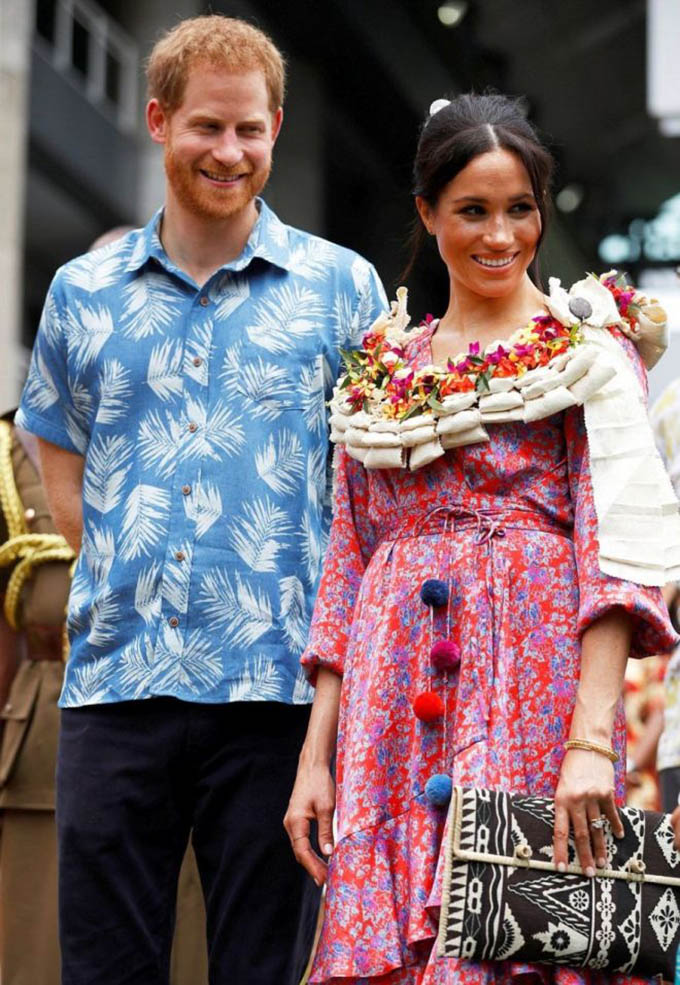 The Duke and Duchess of Sussex outside the University of the South Pacific’s Japan-Pacific ICT Centre on Laucala campus in Suva. Image: Wansolwara
By Mereoni Mili in Suva
Meeting the Duke and Duchess of Sussex in person was a humbling experience this week for specially selected students from the University of the South Pacific, including two first-year student journalists Apenisa Vatuniveivuke and Dhruvkaran Nand.
Vatuniveivuke, who is an undergraduate student majoring in journalism and law, said he was pleased to be one of 10 students from the Faculty of Arts, Law and Education chosen to speak with the royal couple about their involvement in empowerment projects, women’s development and climate change advocacy.
“I was in the second group on youth leadership to meet the Duchess of Sussex. We were introduced to the Duchess by her escort,” he says.
“But we had a chance to speak to her. I introduced myself, my area of study and the work I was engaged in with civil society organisations and political parties especially working to get young people’s voices in national discussions,.”
“And she said, ‘Oh, that’s so wonderful. I think more young people should get involved’.
“We had a small display about a marginal man – half-Pacific Islander and half-modernist. Our message through that was to show when we come to USP, we come to get educated but at the same time we try not to forget our culture.
“We were advocating on those types of platforms to ensure that when young people are educated they won’t forget where they’re from. The Duchess of Sussex’s reaction to our theme was wonderful.
‘Broke a bit of protocol’
“She was very receptive. We broke a bit of protocol by having a group photo taken. We were briefed not to do that but she actually agreed to have a group photo.”
Other student journalists were in the audience to witness the inaugural speeches while other journalism alumni were part of the accredited media team covering the royal tour in Fiji.
Solomon Islands student Cynthia Hou, 22, was another youth leader who was given an opportunity to meet the Duchess.
 Solomon Islands student Cynthia Hou (middle) is flanked by friends at USP’s Laucala campus. Image: Mereoni Mili/Wansolwara
“It was an overwhelming experience because I’ve only seen her in magazines and on television. She encouraged me to continue the work I’m doing and to look into issues facing the Pacific.
“It was like a dream that went by so fast but the feeling is indescribable,” she said.
Another student, Sheenal Chand, 20, dubbed her encounter with the royals as an “amazing experience”.
Youth empowerment
“It was one I never thought would be so good. I spoke to her about the youth empowerment work I’m involved in and how our voices as young people can make a difference especially when highlighting issues such as climate change,” Chand said.
Inside the Japan-Pacific ICT Centre, the couple witnessed a cultural performance on the effects of climate change in the Pacific by Oceania Dance group.
They were hosted by the Queen’s Young Leader Elisha Azeemah Bano and the Commonwealth Youth Award recipient Elvis Kumar, two outstanding USP students.
The event was live streamed to several USP campuses in the region.
Mereoni Mili is a final-year journalism student at the University of the South Pacific’s Laucala campus reporting for Wansolwara. She was one of 250 students chosen to be part of the audience inside the USP Japan ICT Lecture Theatre. Wansolwara and the Pacific Media Centre have a content sharing partnership.
 USP Journalism student Apenisa Vatuniveivuke was one of 10 students from USP’s Faculty of Arts, Law and Education chosen to meet the royal couple at Laucala campus. Image: Wansolwara
Article by AsiaPacificReport.nz
]]>Rabuka acquitted on assets charge, free to contest 2018 general election

 SODELPA leader Sitiveni Rabuka in court today. He has been acquitted and will be free to contest the 2018 general election on November 14. Image: Litia Cava/Fiji Times
By Litia Cava in Suva
Former Prime Minister and Social Democratic Liberal Party (SODELPA) leader Sitiveni Rabuka is now sure to contest the 2018 general election next month.
The Suva Magistrates Court acquitted him today on a charge of failing to declare his assets, liabilities and income.
Magistrate Jioji Boseiwaqa ruled that the prosecution had failed to prove the elements of the alleged offence.
READ MORE: Asia Pacific Report special pre-election reports
Rabuka, the original coup leader who staged two military coups in 1987, was charged by the Fiji Independent Commission Against Corruption (FICA) in relation to his alleged failure to declare his assets, liabilities, and income contrary to the Political Party Act.
In the second matter, Rabuka was charged for allegedly interfering with a prosecution witness.
Defence lawyer Filimoni Vosarogo informed the court that he would be liaising with FICAC on whether they would proceed with the matter.
The case has been adjourned to November 23, 2018 – more than a week after the general election.
Litia Cava is a Fiji Times journalist.
Article by AsiaPacificReport.nz
]]>Simon Birmingham’s intervention in research funding is not unprecedented, but dangerous

Source: The Conversation (Au and NZ) – By Jon Piccini, UQ Research Fellow, School of Historical and Philosophical Inquiry, The University of Queensland
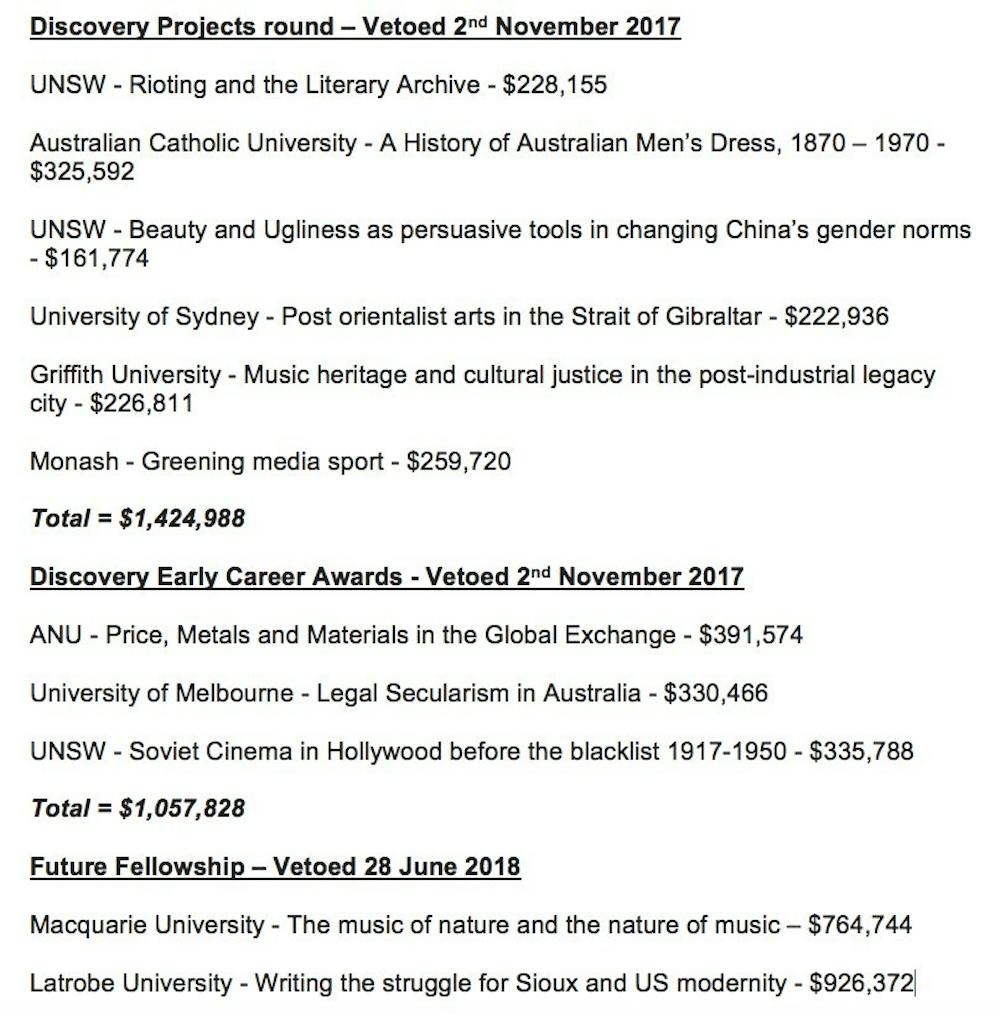
Senator Simon Birmingham’s personal intervention during his time as education minister in 2017 and 2018 to deny funding to 11 Australian Research Council (ARC) grants, all in the humanities and worth a combined total of A$4.2 million, has sparked outrage.
Revealed in Senate estimates on Thursday, the vetoed projects included $926,372 for a La Trobe University project titled “Writing the struggle for Sioux and US modernity”, $764,744 for a Macquarie University project on “the music of nature and the nature of music”, and $391,574 for an ANU project called “Price, metals and materials in the global exchange”.
Projects vetoed by Simon Birmingham. Ben Eltham/TwitterOn Friday, Birmingham defended his intervention, suggesting most Australian taxpayers would prefer their funding be directed to other research.
In a statement, Ian Jacobs, the vice chancellor and president at UNSW, from which three grants were vetoed, said “the unjustified and unexplained decision to solely deny funding for research that contributes to scholarship in arts and humanities is deeply troubling”.
The decisions are, in the words of Australian Academy of the Humanities president Joy Damousi, “political interference” that “undermines confidence and trust” in Australia’s world-leading peer review system. It has incalculable effect on the lives of academics, but such action is not unprecedented, and only further evidences the vital need for strong, independent humanities research.
How does the process normally work?
The Australian Research Council (ARC) administers the National Competitive Grants Program that, alongside the National Health and Medical Research Council, provides the lion’s share of external research funding to Australian academics.
These are apportioned through difference schemes. Of those, Birmingham rejected six Discovery Projects; three Early Career Researcher Awards; and two Future Fellowships.
These grants are incredibly competitive. In 2017, the ARC approved only 18% of discovery grant applications, and 17% of Discovery Early Career Researcher Awards. Only 20% of Future Fellowships were awarded in the 2018 round.
Such high standards are maintained by a rigorous system of peer review. Each application is assigned two general assessors – members of a group of experts for the field of research in which the project falls. After initial review, each is sent to as many as six reviewers, who provide anonymous comments and ratings.
By intervening at the end of the process – what should be a ministerial “tick” for the work of the ARC’s experts – the minister undermines this exacting process. What’s more, by rejecting only humanities projects, Birmingham has placed this discipline at a decided funding disadvantage.
Not unprecendented
Government interference in research is not unprecedented, however. Australian Catholic University historian Hannah Forsyth writes of how, in 1956, Australian historian Russell Ward was denied a lectureship in history at what became the University of New South Wales purportedly on the grounds of his having had communist associations.
Brendan Nelson, minister for education in the Howard government, made a similar intervention to Birmingham’s in 2005, rejecting at least three, but as many as 20, applications. All had already passed the strenuous ARC process.
Coming at the tail end of the “history wars” of the Howard era, the decision was greeted with joy by the likes of Andrew Bolt and horror by the academy.
Writing in The Monthly, Gideon Haigh called this “the new censorship”, not only because such interference directly denied research funding to worthy candidates, but because it brought about “self-censorship”.
As one of Haigh’s interviewees put it, “young academics will sheer away from gender, because of the perception that it’s [the ARC process] being monitored”. That Australia has “no other form of research advancement apart from government” made this particularly problematic.
Which humanities?
Birmingham’s singling out of humanities grants, and his explanatory tweet appealing to populist sentiments, exposes a particular vision of the humanities. This vision also became apparent in the criticisms of the ANU when it broke off negotiations with the Ramsay Centre about introducing a degree in “Western civilisation”.
Government figures and conservative journalists accused the ANU and universities generally of inadequately teaching “Western civilisation”, indeed of undermining it with politically correct emphases on class, gender and race.
Many Australians would disagree that this is the case. One of the attributes of “Western civilisation” vaunted by government figures is the secular Enlightenment, which encouraged debate and criticism of established ideas. Yet this government is inhibiting the continuing process of inquiry in all spheres of the humanities. Birmingham’s decision demonstrates that the government is unwilling to leave funding decisions to the free market of ideas institutionalised in peer review.
The Australian Labor Party has a “protocol” of issuing explanatory details when a minister intercedes on these types of matters, something it accuses the present government of ignoring. However, it may be time for such informal processes to be institutionalised in changes to legislation. It may be time to limit – and perhaps forbid – the minister’s rights to intercede for political purposes.
– ref. Simon Birmingham’s intervention in research funding is not unprecedented, but dangerous – http://theconversation.com/simon-birminghams-intervention-in-research-funding-is-not-unprecedented-but-dangerous-105737]]>The rise of sponges in Anthropocene reef ecosystems
Source: The Conversation (Au and NZ) – By James John Bell, Associate Professor of Marine Biology, Victoria University of Wellington
Coral reefs across the world have been altered dramatically in recent decades. Human activities have contributed to mass coral die-offs in tropical oceans.
The degradation of reef-building corals is expected to worsen under current climate trajectories, but our work shows that most reef sponges are resilient enough to tolerate climate conditions projected for 2100.
In our latest research, we examine how future reefs that include more sponges might function compared to the current coral‐dominated ecosystems.
Many marine sponges can tolerate ocean warming and acidification better than reef-building corals. James BellSponges on coral reefs
On the Great Barrier Reef, the amount of living coral has declined over the past 30 years. Recurrent bleaching events are having profound impacts on the ecology of reef systems and the resources reefs can provide for humans.
Read more: How much coral has died in the Great Barrier Reef’s worst bleaching event?
Marine sponges are found across the world’s oceans. They are among the oldest known multicellular organisms and first appeared in the fossil record about 580 million years ago.
Over this long evolutionary history, sponges experienced a range of environmental conditions and have shown remarkable persistence to survive the end-Triassic mass extinction, some 200 million years ago. While sponges are found in shallow and deep-water environments from the tropics to the poles, they are particularly important on coral reefs. There, the filter feeders form a critical link between the seafloor and the overlying body of seawater.
Sponges pump large quantities of water and remove bacteria, plankton and dissolved food. They also maintain symbiotic partnerships with diverse communities of microorganisms that can provide them with nutrients and secondary metabolites that bolster their defence against predators and infection.
Sponge tolerance and super larvae
The latest report from the Intergovernmental Panel on Climate Change suggests very different outcomes for coral reefs at a 1.5°C or 2.0°C increase in seawater temperature. Even if we manage to keep ocean warming to 1.5°C, corals will nevertheless be seriously impacted.
However, we have shown that many sponge species are more tolerant than corals of the impacts of climate change. We think sponges could be future “winners” on coral reefs.
Our work explored the tolerance of four Great Barrier Reef sponge species to ocean warming and ocean acidification levels predicted for 2100. All species were unaffected by moderate climate change scenarios where we increased the temperature by 1.5°C. However, the environmental conditions projected under the most extreme scenarios (4°C increase in temperature) had significant adverse effects in some species.
While higher temperatures can decrease the health and survival of some sponge species, ocean acidification generally appears to have negligible effects. Research conducted at natural carbon dioxide vents also confirms the overall pH tolerance of many sponge species.
Testing marine sponges in the laboratory. Holly Bennett, CC BY-NDOur experimental work showed that responses to the combined effects of ocean warming and ocean acidification vary between different types of sponges. While acidification exacerbated the effect of warming in sponge species that feed on plankton, it mitigated the warming effect in species with photosynthetic symbionts.
Sponges respond differently throughout their life history stages. Larvae of the abundant sponge Rhopaloeides odorabile have a thermal threshold 4°C higher than their parents. Survival and settlement of larvae of the common reef sponge Carteriospongia foliascens are unaffected by worst case climate change predictions.
These findings suggest that sponges have an inherent capacity to tolerate climate change, but that this tolerance is not maintained in adult populations.
Sponge resilience
In our most recent research, we explored the potential mechanisms that underpin sponge tolerance to warming and acidification. We measured the composition of lipids and fatty acids in sponge species with different environmental sensitivities. We found that sponges with greater proportions of storage lipids and certain long‐chain polyunsaturated fatty acids were more resistant to warming.
These specific lipids and fatty acids likely preserve cell membrane function and other cellular processes in the face of temperature stress. Further exploration of how sponges alter their membrane lipids in response to rising temperatures revealed a potential mechanism through which ocean acidification may increase resistance to thermal stress by increasing production of membrane‐stabilising sterols. Our research shows that lipids and fatty acids are an important component of how sponges respond and may support their survival in future oceans.
How a sponge reef could work
Reefs dominated by sponges will likely function very differently compared to existing coral-dominated systems. Reefs where sponges are already the most abundant taxa have been reported from Indonesia and the Central Pacific. Some researchers also consider many Caribbean reefs to be mostly dominated by sponges.
Recent research modelled how reef ecosystems with increased sponge abundance would function. It highlighted the need to better understand how changes in the dominant group of reef organisms could alter marine food webs. While it is unlikely that sponge-dominated reefs would provide the same resources to humans as coral reefs, they offer habitat and food for some reef species. They are also responsible for nutrient recycling and contribute to structural complexity that should have positive effects on reef biodiversity.
This research was conducted as part of a collaboration between the authors and Alberto Rovellini, Simon K. Davy, Michael W. Taylor, Elizabeth A. Fulton, Matthew R. Dunn, Holly M. Bennett, Nora M. Kandler and Heidi M. Luter.
– ref. The rise of sponges in Anthropocene reef ecosystems – http://theconversation.com/the-rise-of-sponges-in-anthropocene-reef-ecosystems-105493]]>Spinifex grass would like us to stop putting out bushfires, please
Source: The Conversation (Au and NZ) – By Kristian Bell, PhD candidate, Deakin University
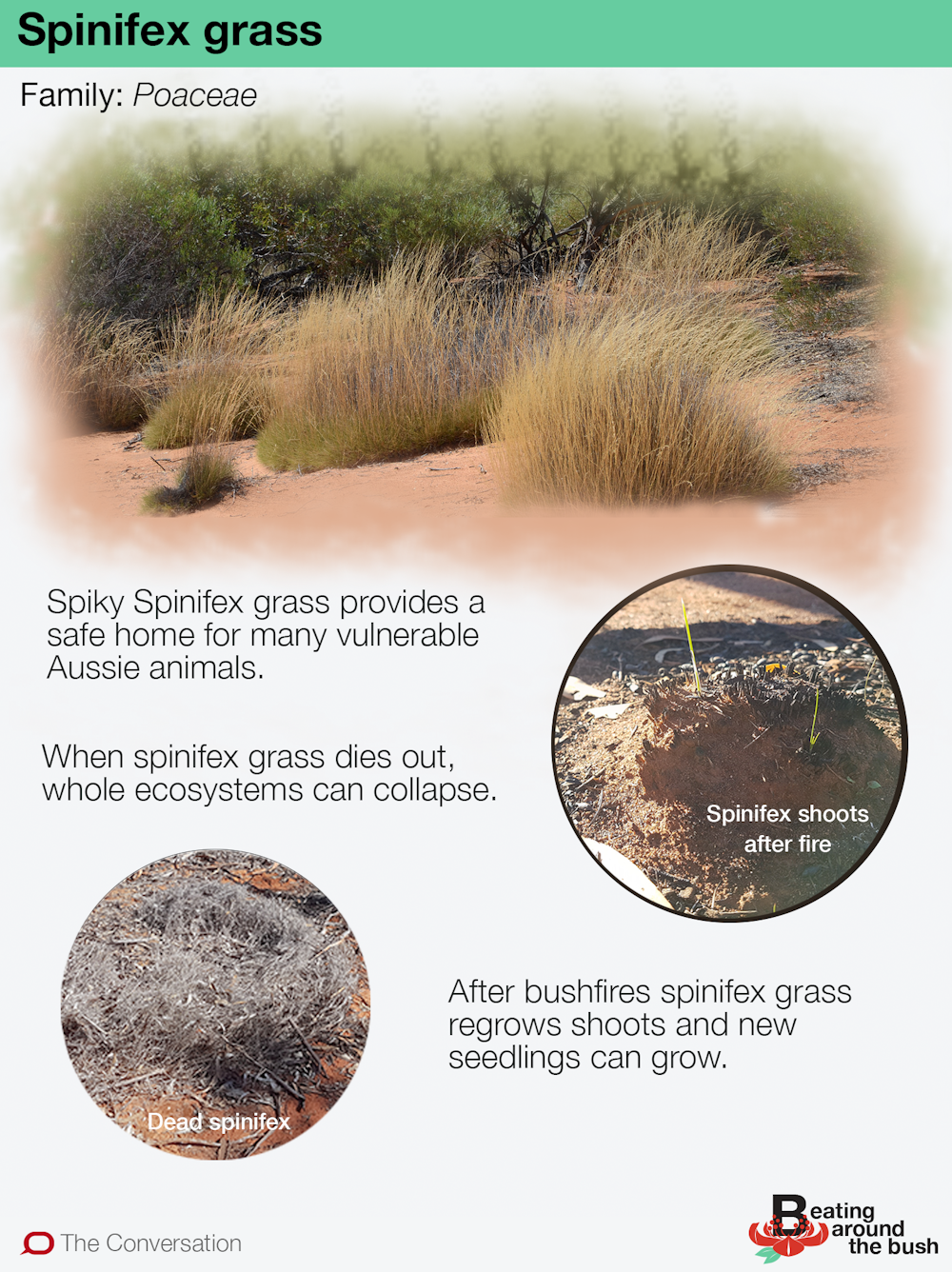
Spinifex grass: it’s spiky, dominates a quarter of the continent, and has no recognised grazing value. To top it all off, people have reportedly experienced anaphylactic shock from being pricked by its sharp leaf tips.
Given this less-than-stellar rap sheet, you may wonder why this plant is the subject of my research attention.
Well, it turns out that these less desirable traits are also its virtue. A plethora of birds, mammals and reptiles rely on the unique plant for their survival – to such an extent that it’s considered a keystone of its environment.
For animals small enough to navigate its sharp spines, spinifex offers a fortress of safety. Everything from mallee emu wrens, to hopping mice, to the near-mythical night parrot hide out from predators in spinifex (and snack on tasty termites and ants within).
Read more: Still here: Night Parrot rediscovery in WA raises questions for mining
For me, as an immigrant from the grey and drizzly lands of the UK, the bone-dry arid outback of Australia – where even the grass can harm you – was the perfect antidote to the dull, predictable safety of home.
This weird-looking plant, which always seemed to be associated with huge numbers of equally exotic animals, was so intoxicatingly new to me that I fell in love instantly. This lead to my current research: trying to stop the decline of spinifex.
The Conversation, CC BY
Spinifex isn’t really spinifex
To back up a little, the common name “spinifex” is a bit misleading. There’s a genus called Spinifex (mostly made up of coastal grasses), but spinifex grass doesn’t belong to it. Spinifex grass is actually part of the genus Triodia.
There are two main kinds of spinifex: an older, harder form suited to arid environments which generally grows in the south of Australia; and a “soft” form, which tends to perform better in more tropical, northerly regions.
Regardless of species, spinifex is well adapted to thrive in some of the harshest environments in Australia, growing in well-drained, infertile, sandy soils. It can cope with extremes of long-term drought and responds well to fire.
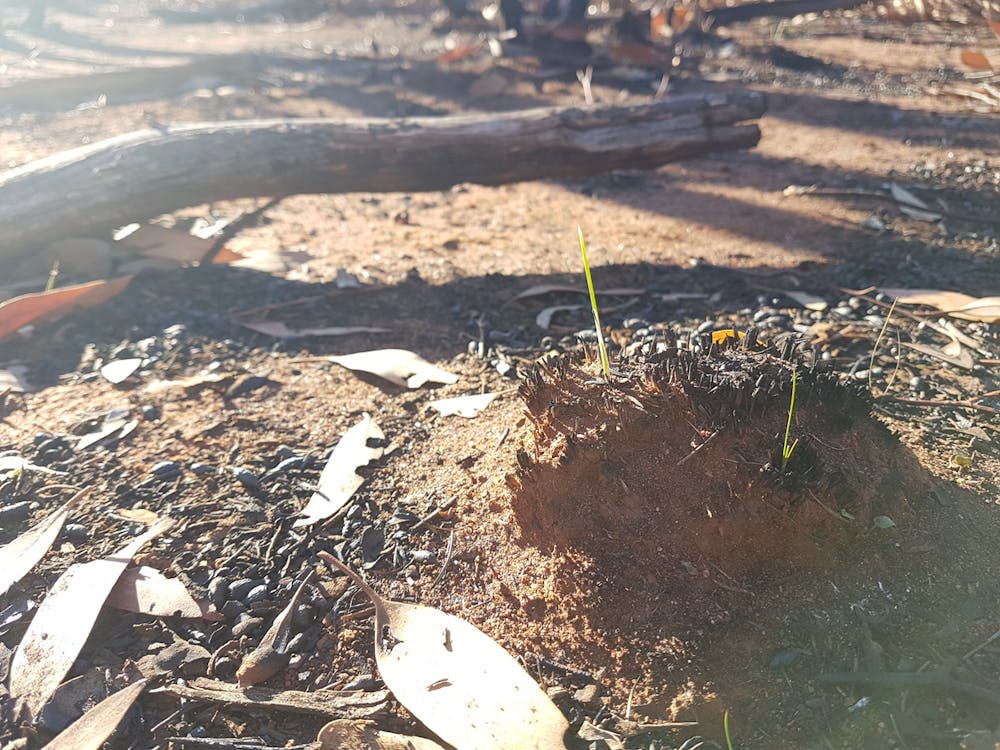
Spinifex emerging after a fire. Author providedYou might think, given the near-ubiquity of spinifex across the arid wildernesses of Australia, and its ability to withstand poor soils, infrequent rain, extreme temperatures and fire, that this hardy plant is free from the almost inevitable stories of doom and gloom associated with many native species.
However, all is not well for some spinifex communities. Spinifex in mallee woodland, such as can be found in south-central New South Wales, has suffered from heavy clearing (mostly for agriculture), with only about 3% remaining from pre-European settlement levels.
Counterintuitively, firefighting efforts in these areas may have also hurt spinifex. Bushfires clear the land and help new spinifex plants grow; in their absence, old and decaying plants dominate. This means the habitat degrades, which could spell disaster for the many animals that rely on abundant, healthy spinifex.
Read more: Aboriginal fire management – part of the solution to destructive bushfires
Spinifex is such an important species that its disappearance could even precipitate an extinction cascade. Indeed, studies suggest that some reptiles rely on spinifex habitat to survive in remnant bush in farming landscapes.
Despite these issues, there is plenty to be hopeful about. Spinifex has recently attracted more attention from industry as an abundant and under-used resource, building on what many Indigenous people have known for centuries. Spinifex has traditionally been used by some Indigenous people to craft waterproof thatching for shelters, or as a source of adhesive resin.
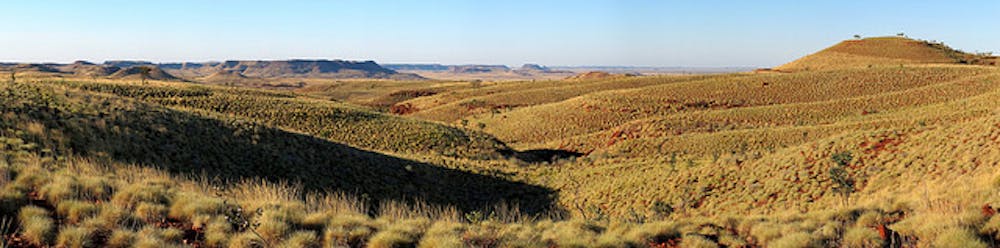
Spinifex covers vast swathes of Australia. Thomas Jundt/Flickr, CC BY-NCRecent technological advances may make the plant’s nanocellulose easier to extract. That means spinifex could be a component of everything from cardboard to carbon fibre, fire hose liner, cattle tags, and even condoms.
Researchers in the field – like me – are also starting to gain a better understanding of the factors that affect spinifex. We’re creating maps of grass distribution, and reintroducing fire to areas with significant amounts of spinifex.
Read more: Leek orchids are beautiful, endangered and we have no idea how to grow them
Returning from time in the field with hands covered in more spinifex splinters than I can count has done nothing to dampen my ardour for this overlooked group of grasses. After all, what’s not to love about a unique plant found nowhere else in the world, that provides a refuge for some of Australia’s most iconic animals, and may also lead to safer sex in the future? No matter how many times it pricks me, I’m still coming back for more.
– ref. Spinifex grass would like us to stop putting out bushfires, please – http://theconversation.com/spinifex-grass-would-like-us-to-stop-putting-out-bushfires-please-105651]]>Housing trust chief slams ‘short cuts’ approach to NZ homes crisis

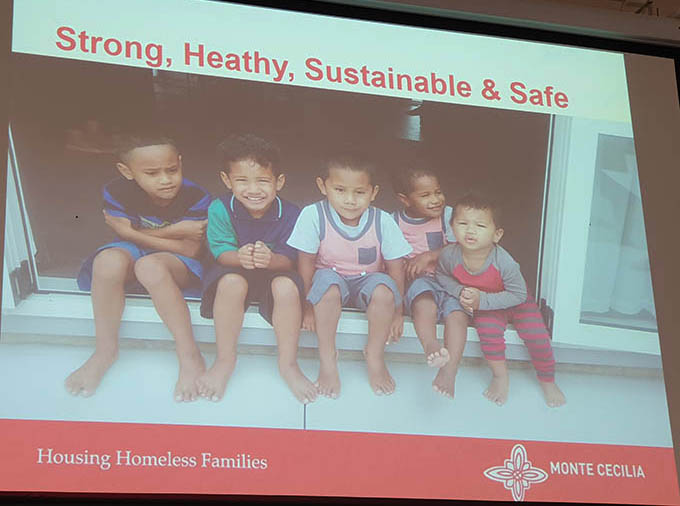 Kiwi Build … criticised as not an affordable housing solution for many New Zealanders as only caters for middle class people with higher household incomes. Image: Rahul Bhattarai/PMC
By Rahul Bhattarai
A housing trust chief executive has condemned the government for taking “short cuts” to tackle New Zealand’s housing crisis.
“We need to stop pulling rabbits out of hats and looking for quick fixes,” said Bernie Smith, CEO of Monte Cecilia Housing Trust.
Speaking at the annual Bruce Jesson Foundation lecture in Auckland on the topic “housing crisis – a smoking gun with no silver bullet”, he soundly criticised the government for not doing enough to provide affordable housing.
“A bit dramatic but I am known to be dramatic from time to time.”
READ MORE: Tūhoe leader’s address to deliver ‘hard truths’ about New Zealand
He said that there were no short-cuts to building affordable housing.
Smith has 40 years of experience in various forms of leadership in state and local government and not-for-profit sector.
The lecture has been delivered in previous years by prominent figures such as investigative journalist Nicky Hager and a former prime minister, David Lange, in honour of the late journalist and political thinker Bruce Jesson.
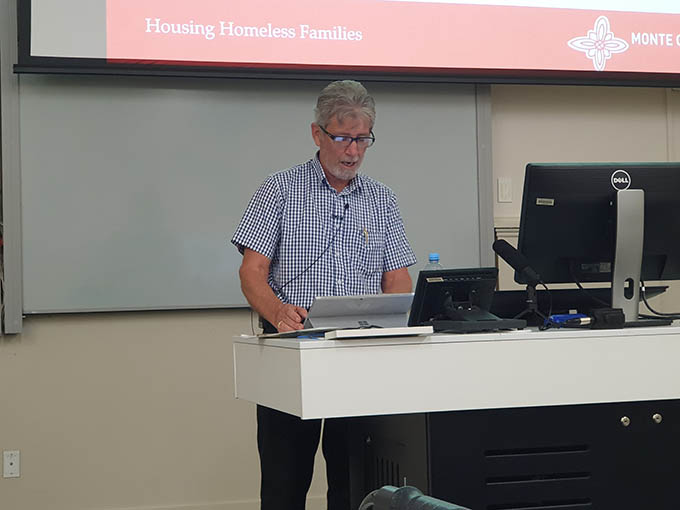 Bernie Smith … “We need to stop the blame game, we need to stop thinking central or local government will resolve this issue.” Image: Rahul Bhattarai/PMC
Work together
To resolve the housing crisis, Smith said the government and bureaucrats needed to work together and have a generational housing strategy that “builds strong housing communities for the present and the future generations”.
The coalition has been in government for 11 months and it has been “claiming all the issues that we are confronted with today are solely due to previous government”, he said.
“We need to stop the blame game, we need to stop thinking central or local government will resolve this issue, that housing first or some other programme is a quick fix,” he said.
Barry Wilson, president of Auckland Council for Civil Liberties, said that the political parties should be working together to “house the homeless in a comfortable secure condition”.
“There should be some unified political approach, it’s not productive every time they change the government,” Wilson said.
Long term strategy
New Zealand needs a 25 to 30-year-long housing strategy “that every political party agrees and signs to”, Smith said
“Labour has a plan that National is trying to drag down. What they should do is be working together on a long-term plan, not one that depends on the three-year election cycle,” Wilson said.
New Zealand housing strategy should be created not by the politicians or bureaucrats, rather by the people from the community, who have lived with experience, like the homeless, the renters, community housing providers, and people form wide ethnic communities including Māori or Pasifika, Smith said.
“A strategy that looks at the whole of the continuum and recognises into generational living affordable rentals, affordable home ownership, does not forget a strategy that includes building strong healthy and safe communities with clear mile stones and targets,” he said.
Smith said the country needed to have a strategy that is housing community “value” focused rather than the housing “volume” focused.
Community value was focused when each and every individual is seen as equal no matter their housing option, either state housing, private renter, or an owner-occupier.
Overcrowded households
In Auckland there are 92,000 households living in unaffordable rental situations spending more than the 30 percent of their net income on rent.
“Thirty six thousand households living in overcrowded conditions.”
In Auckland alone, there is 20,300 homeless people, where the Māori population is five times and Pasifika 10 times more disproportionately affected.
Kiwi Build was not an affordable housing solution to many New Zealanders as it was only affordable to middle class people with higher household incomes, Smith said.
Smith said it was noted at a recent Kiwi Build Affordability meeting with Auckland city mayor Phil Goff:
“Auckland Council’s chief economist stated in July that to buy a 3-bedroom Kiwi Build house at $650,000 they will need either an income of $106,000 with a $130k (20 percent) deposit or an income of $120,000 and a $65,000 (10 percent deposit) for the household to affordably purchase a Kiwi Build home (and that is with debt servicing ratio of 35 percent.
“This means that Kiwi Build houses are only affordable for the top 40 percent of Auckland’s households.”
• Housing issue not just ethnic – Pākehā leaders have ‘failed’, says author
• Pasifika voters want ‘hand-ups, not hand-outs’ in NZ housing crisis
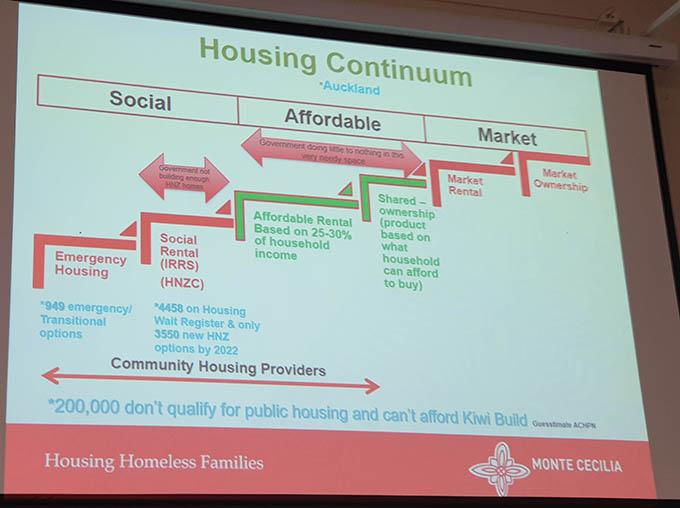 The Auckland housing continuum. Image: Rahul Bhattarai/PMC
Article by AsiaPacificReport.nz
]]>VIDEO: Michelle Grattan on the Wentworth washup
Source: The Conversation (Au and NZ) – By Michelle Grattan, Professorial Fellow, University of Canberra
Michelle Grattan speaks about the week in politics with University of Canberra deputy VC Nick Klomp. They discuss the results of the Wentworth byelection, the resettlement of refugees off Nauru and Manus, the government’s continued strugles with energy policy and former prime ministers Julia Gillard and Kevin Rudd returning to parliament house.
– ref. VIDEO: Michelle Grattan on the Wentworth washup – http://theconversation.com/video-michelle-grattan-on-the-wentworth-washup-105738]]>Three charts on: how and what Australians eat (hint: it’s not good)

Source: The Conversation (Au and NZ) – By Rebecca Golley, Associate Professor (Research) Nutrition and Dietetics, Flinders University
More than one-third of Australians’ energy intake comes from junk foods. Known as discretionary foods, these include biscuits, chips, ice-cream and alcohol. For those aged 51-70, alcoholic drinks account for more than one-fifth of discretionary food intake.
These are some of the findings from the Nutrition across the life stages report released by the Australian Institute of Health and Welfare today.
The report also shows physical activity levels are low in most age groups. Only 15% of 9-to-13-year-old girls achieve the 60-minute target. The prevalence of overweight and obesity remains high, reaching 81% for males aged 51–70.
The food intake patterns outlined in this report, together with low physical activity levels, highlight why as a country we are struggling to turn the tide on obesity rates.
Read more: Fat nation: the rise and fall of obesity on the political agenda
Not much change in our diets
The report shows little has changed in Australians’ overall food intake patterns between 1995 and 2011-12. There have been slight decreases in discretionary food intake, with some trends for increased intakes of grain foods and meat and alternatives.
The message to eat more vegetables is not hitting the mark. There has been no change in vegetable intake in children and adolescents and a decrease in vegetable intake in adults since past surveys. The new data show all Australians fall well short of the recommended five serves daily. We are are closer to meeting the recommended one to two serves of fruit each day.
Australians are consuming around four serves of grains, including breads and cereals, compared to the recommended three to seven serves.
One serve of vegetables is equivalent to ½ cup of cooked vegetables. For fruit, this is a medium apple; grains is around ½ cup of pasta. A glass of milk and 65-120g of cooked meat are the equivalent serves for dairy and its alternatives, and meat and its alternatives respectively.
Read more: Food as medicine: why do we need to eat so many vegetables and what does a serve actually look like?
The data show a trend of lower serves of the five food groups in outer metro, regional and remote areas of Australia. Access to quality, fresh foods such as vegetables at affordable prices is a key barrier in many remote communities and can be a challenge in outer suburban and country areas of Australia.
There was also a 7-10 percentage point difference in meeting physical activity targets between major cities and regional or remote areas of Australia. Overweight and obesity levels were 53% in major cities, 57% in inner regional areas and 61% in outer regional/remote areas.
The CSIRO Healthy Diet Score compares food intake to Australian Dietary Guidelines. You can use these to see how your diet stacks up and how to improve.
Discretionary food servings
Discretionary foods are defined in guidelines as foods and drinks that are
not needed to meet nutrient requirements and do not fit into the Five Food Groups … but when consumed sometimes or in small amounts, these foods and drinks contribute to the overall enjoyment of eating.
A serve of discretionary food is 600kJ, equivalent to six hot chips, two plain biscuits, or a small glass of wine. The guidelines advise no more than three serves of these daily – 0.5 serves for under 8-year-olds.
Since 1995, the contribution of added sugars and saturated fat to Australians’ energy intake has generally decreased. This may be a reflection of the small decrease in discretionary food intake seen for most age groups.
But across all life stages, discretionary food intakes remain well in excess of the 0-3 serves recommended. Children at 2-3 years are eating more than three servers per day, peaking at seven daily serves in 14-to-18-year-olds. The patterns remains high throughout adulthood, still more four serves per day in the 70+ group.
Read more: Junk food packaging hijacks the same brain processes as drug and alcohol addiction
The excess intake of discretionary foods is the most concerning trend in this report. This is due to the doubleheader of their poor nutrient profile and being eaten in place of important, nutrient-rich groups such as vegetables, whole grains and dairy foods.
Our simulation modelling compared strategies to reduce discretionary food intake in the Australian population. We found cutting discretionary choice intake by half or replacing half of discretionary choices with the five food groups would have significant benefits for reducing intake of energy and so-called “risk” nutrients (sodium and added sugar), while maintaining or improving overall diet quality.
Main contributors to discretionary foods
Alcohol is often the forgotten discretionary choice. The NHMRC 2009 guidelines state:
For healthy men and women, drinking no more than two standard drinks on any day (and no more than four standard drinks on a single occasion) reduces the lifetime risk of harm from alcohol-related disease or injury.
For adults aged 51–70, alcoholic drinks account for more than one-fifth (22%) of discretionary food intake. Alcohol intake in adults aged 51-70+ has increased since 1995. This age group includes people at the peak of their careers, retirees and older people. Stress, increased leisure time, mental health challenges and factors such as loneliness and isolation would all play a part in this complex picture.
Read more: Four ways alcohol is bad for your health
Young children have small appetites and every bite matters. The guidelines suggest 2-to-3-year-olds should have very limited exposure to discretionary foods. In, studies the greatest levels of excess weight are seen in preschool years.
Biscuits, cakes and muffins are the key source of added sugars for young children. These are also the top source of energy and saturated fat and a key source of salt in young children. This is the time when lasting food habits and preferences are formed.
– ref. Three charts on: how and what Australians eat (hint: it’s not good) – http://theconversation.com/three-charts-on-how-and-what-australians-eat-hint-its-not-good-105646]]>Newsletter: New Zealand Politics Daily – October 26 2018
Newsletter: New Zealand Politics Daily – October 26 2018
Editor’s Note: Here below is a list of the main issues currently under discussion in New Zealand and links to media coverage.
[caption id="attachment_297" align="aligncenter" width="640"] The Beehive and Parliament Buildings.[/caption]
Government
Thomas Coughlan (Newsroom): One year on: Change worthy of its name?
Press Editorial: The Government is in good shape on its first anniversary
Claire Trevett (Herald): Kindness and chaos – Ardern and Peters are the political odd couple
Barry Soper (Newstalk ZB): Politics’ odd couple mark one year in power
Newsroom: One year in: the fault lines ahead
ODT: Baby steps: PM faces sobering challenges
Chris Trotter (Daily Blog): Who Do The Greens Think They Are?
Toby Manhire (Spinoff): On their first birthday, how is the National-NZ First government getting on?
Tracy Watkins (Stuff): Jacinda Ardern and Winston Peters on making their relationship work
1News: One year on, Jacinda Ardern and Winston Peters reflect on the decision to work together
Claire Trevett (Herald): Government turns one: PM Jacinda Ardern and NZ First leader Winston Peters look back – and forward to 2020
Jane Patterson (RNZ): One Year On: Together in the political hot seat
Barry Soper (Newstalk ZB): All smiles for the Government one year on
Talisa Kupenga (Māori TV): PM and deputy PM talk first year in govt
Angela Cuming (Huff Post): This Could Be The Most Progressive Country On Earth
Devdiscourse: New Zealand: Analysts fault PM Ardern for making slow progress
RNZ: Beyond the Beehive: Students mark the govt on fees policy
Alice Webb-LIddall (Newshub): Kids quiz Jacinda Ardern on 1080, petrol prices, mental health at PM’s Picnic
Collette Devlin (Stuff): Prime Minister Jacinda Ardern hosts kids’ picnic, but all eyes are on Neve
Herald: ‘Ja Mon!’ Baby Neve receives hilarious gift from world leader
Newshub: Prime Minister of St Lucia’s unique gift to baby Neve
National Party, political finance
Matthew Hooton (Herald): Jami-Lee Ross fiasco a symptom of wider disease
David Fisher (Herald): The chain of events which put Jami-Lee Ross in mental health care began with a concerning text to a former lover
Selwyn Manning (Evening Report): National Affairs and the Public Interest
Martyn Bradbury Daily Blog): Cameron Slater drops an atomic bomb on National
Martyn Bradbury Daily Blog): Love him or hate him, Slater’s nuclear bomb on National must be investigated
Geoff Simmons (Spinoff): The Greens’ proposed donation ban would serve to ban new parties from parliament
Bryce Edwards (Herald): Should taxpayers fund political parties?
Simon Louisson (Standard): Ross saga quiescent, but donations scandal needs addressing
Greg Presland (Standard): Nothing to worry about
Herald: Greens reiterate call for change after National received $3.5m in anonymous donations
Bryce Edwards (RNZ): The case for and against Judith Collins leading National
Tova O’Brien (Newshub): Winston Peters won’t rule out working with Simon Bridges after 2020 election
Herald: The Country: Simon Bridges: I’ve been through a fire but I’ve come out stronger
No Right Turn: An admisison of guilt
Curwen Ares Rolinson (Daily Blog): On National’s Yet-Unsinking Poll Numbers
Parliament
Herald: Justice Minister Andrew Little is changing voting laws to allow enrolling on Election Day
Collette Devlin (Stuff): The Electoral Commission wants Parliament to make voting changes
Jo Moir (RNZ): Minister wants voters to be able to register on election day
Michael Daly (Stuff): Former MPs, partners travel cost $1.1m in past year
No Right Turn: Time to end this rort
Stephanie MItchell (Stuff): Do celebrities really have the skills to be political leaders?
Fuel taxes and petrol prices
Hamish Rutherford (Stuff): Since Jacinda Ardern said consumers were being fleeced, Z Energy shareholders have lost more than $500m
Herald: ‘We have the power’: Kiwis give fuel companies middle finger as nationwide boycott underway
Dan Satherley (Newshub): Jacinda Ardern ‘making policy up on the hoof’ – Judith Collins
Craig McCulloch (RNZ): PM rejects claims regional fuel tax promise was impromptu
Derek Cheng (Herald): PM Jacinda Ardern’s claims over regional fuel tax ‘silly’ and not credible – National
Derek Cheng (Herald): PM says she was ‘very clear’ about regional fuel tax ban well before yesterday
David Farrar: PM claims it wasn’t policy on the hoof
Colin Craig vs Cameron Slater
Alison Mau (Stuff): Colin Craig defamation case breaks new ground for victims of sexual harassment
Cameron Slater: Craig vs Slater: MacGregor vindicated
Herald :‘It’s a win’: Colin Craig labels lawsuit a victory, despite sexual harassment ruling
Dan Satherley and Karen Rutherford (Newshub): Colin Craig claims victory in Cameron Slater defamation case, considers appeal anyway
Sam Hurley (Herald): The rise and fall of Colin Craig: A brief and bizarre delve into politics
Cameron Slater: Craig v Slater: Damning findings against Craig, found to have sexually harassed Rachel MacGregor
Cameron Slater: Craig vs Slater: What the judge said about me
Sam Hurley (Herald): Judge rules Cameron Slater defamed Colin Craig who sexually harassed Rachel MacGregor
Tommy Livingston (Stuff): Colin Craig defamed by Cameron Slater, but also found ‘guilty’ of sexual harassment
Sarah Robson (RNZ): Judge rules Colin Craig was defamed by Cameron Slater
Dan Satherley (Newshub): Colin Craig ‘guilty of moderately serious sexual harassment’ against Rachel MacGregor, judge rules
David Farrar: Zero damages in Craig vs Slater
Primary industries
Rosalind Holland (Stuff): I met a ‘meat chicken’ en route to the slaughter and she was just a baby
Stuff: Five graphs which show how big New Zealand’s chicken industry is
Sophie Bateman (Newshub): No good reason for pig farrowing crates – animal expert
Herald: Woman in cage outside Parliament protests against farrowing crates
Angie Skerrett (Newshub): Milestone for M bovis team
Health
Melanie Earley (Stuff): One third of Kiwis drinking ‘hazardously’ their entire adult lives, research shows
ODT Editorial: Hospitals too valuable to politicise
Cate Broughton (Stuff): Population growth drives suicide rate down, but total number of deaths still rising
Nicholas Jones (Herald): Review Pharmac model, urge breast cancer petitioners
Janet Hoek and Philip Gendall (Public Health Expert): Tobacco product innovation in a smokefree world. Oxymoron or commercial cynicism?
Herald: Alarming number of Kiwis failing to slip, slop and slap, study finds
Newshub: Popular kids’ areas need more shade – Otago University study
Regan Paranihi (Māori TV): Kaumātua concerns highlighted in new report
Natalie Akoorie (Herald): Health and Disability Commissioner seeks advice over conflict of interest claim
Herald: Ministry warns of dangers of purchasing medicines online
David Clarkson and Joel Ineson (Stuff): Canterbury couple who stole $500k from disabled clients avoid prison
Birttany Keogh (Stuff): Meet the young woman hoping to be the Far North’s first female Māori GP
Drug law
1News: Kiwis divided on legalising cannabis, but more are in favour, 1 NEWS poll reveals
1News: MPs reveal when they last smoked cannabis
Tova O’Brien (Newshub):‘We could fix that’: Government’s changes to medicinal cannabis Bill
Vomle Springford (Noted): What you learn at NZ’s cannabis museum-cafe ‘will stay in your system for weeks’
Wendy Allison (Spinoff): Here comes festival season, where dodgy drugs thrive thanks to a dumb law
Employment
Katie Scotcher (RNZ): National MP has ‘no problem’ speaking at conference on bullying
Kirk Hope (Stuff): Migration must balance priorities of communities with need to attract skills to NZ
Nicole Lawton and Matthew Rosenberg (Stuff): ‘Be a safe guy’: Kaitaia comedian uses humour to speak up for Māori workers
1News: Ecostore tells Auckland shop manager ‘what discrimination is’ after she gave job to ‘physically strong’ man
Education
Dan Satherley (Newshub): Government ‘just useless’ at negotiating with teachers – Judith Collins
Katie Fitzgerald (Newshub): Principals unanimously support teachers’ strike – NZ Principals’ Federation president
1News: Primary teachers, principals vote for rolling strikes nationwide next month
Jessica Long (Stuff): Primary school teachers and principals vote to strike across country
Newshub: Teachers vote ‘overwhelmingly in favour’ of week of strikes
Herald: Primary school teachers vote to commence rolling strikes
RNZ: Primary school teachers vote for rolling strikes
Adele Redmond (Stuff): One in five teacher training graduates don’t work in schools
Bronwyn Wood (Newsroom): Engaged students make for engaged citizens
Jessica Long (Stuff): Students are missing out on science due to inadequate training, says science group
John Lewis (ODT): OGHS pupils given option of trousers
Simon Collins (Herald): Mt Albert Grammar shuts out senior students on final day of school to avoid pranks
Adele Redmond (Stuff): Lincoln University could be governed by Canterbury University under potential ‘partnership’ plan
Transport, roading
Tom Hunt (Stuff): MPs, union, and companies in harmony: Capital bus overhaul too big, too quick
RNZ: NZ Bus chief takes swipe at council over troubled bus network
RNZ: Few passengers miss the bus as Wellington bus drivers strike
Matthew Littlewood (Stuff): Timaru could become national leader in public transport
Simon Wilson (Herald): Nightmare on Albert St
NIta Blake-Persen (RNZ): Checkpoint: Lime e-scooters: Genius idea or public nuisance?
1News: Auckland mayor orders Lime scooter safety probe after city councillor almost hit
Alice Wilkins (Newshub): Auckland council to seek advice on Lime Scooter safety
RNZ: E-scooter safety check urgently needed – councillor
Mandy Te (Stuff): Explainer: Where can you ride e-scooters and what are the rules?
RNZ: Ngāruawāhia community sets up patrol to try to keep children off bridge
RNZ: Coroner probes train speeds after death of 11-year-old
Cleo Fraser (Newshub): ‘Slow the hell down’: Grieving Ngaruawahia mum’s plea to train drivers after daughter’s death
Lois Williams (RNZ): Whangārei MP says road plan change a letdown for the north
Housing
Teuila Fuatai (Newsroom): KiwiBuild: a ‘community trainwreck’
Tom Furley (RNZ): First home buyer dreams hindered by existing debt
Mitchell Alexander (Newshub): Solar panels weren’t considered for Kiwibuild
Mānia Clarke (Māori TV): Kaumātua concerned KiwiBuild homes unaffordable
Regan Paranihi (Māori TV): Minister announces 175 new homes for Te Kauwhata
Anne Gibson (Herald):Tenants for life? Open-ended tenancies suggested in wide-sweeping rent law reform
Anne Gibson (Herald): Landlords want new three strikes rule to evict tenants
CPAG: Rental reform proposal offers little more than minor modifications
Susan Edmunds (Stuff): Methamphetamine rules unclear as insurers stick to lower standard
Treaty of Waitangi
RNZ: Ngāpuhi agree to vote on settlement negotiation model
Leigh-Marama McLachlan (RNZ): Waitangi tribunal judges burnt out – Chief Judge speaks out
RNZ: Meeting over who should lead Ngāpuhi treaty negotiations
Rukuwai Tipene-Allen (Māori TV): Crown proposal causing division
No Right Turn: Ignoring the obvious solution
Royal visit
Gordon Campbell: On our addiction to the monarchy
Alice Guy (Stuff): Nerves setting in for Rotorua performers chosen to sing for royal couple
Foreign affairs
RNZ: NZ Foreign Minister defends assistance to PNG for APEC
Peter McKenzie (Newsroom): Time for NZ to get tough on China
MIchael Reddell: “Free from interference” – Ardern
Environment and conservation
Jamie Morton (Herald): ‘Breakthrough’ plan to tackle NZ’s vanishing nature
RNZ: Forest & Bird hails biodiversity report as breakthrough
Laura Mills (ODT): Public’s views on whitebait fishery sought
1News: Whitebaiters could hold the key to securing the future of endangered New Zealand tradition
Mark Quinlivan (Stuff): Greenpeace protesters escape conviction over Mackenzie farm demonstration
Stuff: Invasive wilding pines concern
RNZ: Controversial Craggy Range track found to be dangerous
Scott Palmer (Newshub): Auckland’s filthiest beaches: Where ‘faecal contamination’ is worst
Justice, corrections, police
Samantha Gee (Stuff): Raped woman backs stronger rights for victims attacked by those declared insane
Laura Walters (Newsroom): Fixing the justice system will take a generation
Blair Ensor (Stuff): Prison guard Alastair Wood receives final warning over alleged interfering in investigation
Scott Palmer (Newshub): Police failing to meet emergency response times targets
Jono Edwards (ODT):Inmate in hospital after Otago prison assault
Defence
Matt Stewart (Stuff): New Defence Force boss ushers in major shake-up of military top brass
Jonathan Mitchell (RNZ): NZ soldiers leave for Iraq mission
Jamie Tahana (RNZ): Giant conch shell unveiled as NZ’s memorial to Pacific soldiers
Oil and gas exploration
Gavin Evans (Newsroom): Submitters send serious message on exploration ban
No Right Turn: Climate Change: One state at a time
Media and broadcasting
Mark Jennings (Newsroom):TVNZ could merge with RNZ: Kevin Kenrick
James Croot (Stuff): TVNZ contemplating charging Kiwis for an ad-free on-demand service
Eden More (RNZ): Legend of television: Tini Molyneux
Tema Hemi (Māori TV): Tini Molyneux receives Television Legend award
John Drinnan: Seven best of the credible media left
Entrust election
Todd Niall (Stuff): Entrust election staggers to possible record low turnout
No Right Turn: Voter suppression right here in NZ
Relationship property laws
Elena McPhee (ODT): Property division law examined
Isaac Davison (Herlad): Time to ditch 50-50 split after a breakup? A majority of New Zealanders think so
Emma Cropper (Newshub): How New Zealand’s divorce laws could soon change
Sport
Stuff: Hamish Carter resigns from High Performance NZ
RNZ: Former Olympic champion resigns after leaking information to Peden
Local government
Janine Rankin (Stuff): Peace Action heads to court over weapons forum
Tina Law (Stuff): Christchurch residents need to conserve water to avoid restrictions, mayor says
Chris Morris (ODT): DCC calls for review of debt arrangements
Chris Morris (ODT): DCC’s policy on alcohol approved
Tourism, freedom camping
1News: Cruise ships’ air pollution sparks calls for Government to sign international rules
Dan Dalgety (RNZ): Cruise scheduling angers Akaroa locals: ‘It’s just chaos’
RNZ: Plans to control Queenstown freedom camping revealed
Ngāi Tahu
Moana Makapelu Lee (Māori TV): Ngāi Tahu net worth $1.65bil
Chris Hutching (Stuff): Ngāi Tahu more cautious looking ahead as it posts strong profit
RNZ: Profit climbs to $150m for Ngāi Tahu iwi
Other
Richard Harman (Politik): Saving Labour from itself
Tom Pullar-Strecker (Stuff): Humans still have final say on ‘almost all’ NZ government decisions
Jason Walls (Herald): Trade Minister David Parker unable to secure steel and aluminium tariff exemption on US trip
Herald: Landlord to up rent after getting $1500 power bill for one week
Stuff: Most of Wellington – and the rest of New Zealand – hasn’t done basic earthquake preparation
Michael Littlewood (Interest): The Tax Working Group’s recommendations on retirement saving lack evidence
1News: Calls in NZ for non-disclosure agreements to be banned in sexual assault cases
Samuel Becher and Jessica Lai (Newsroom): What fake honey and trade wars have in common
Herald: Bill to establish reviews of criminal cases passes first reading
Morgan Godfery: High Court to the MWWL: “more care and gentleness required”
Sam Hurley (Herald): Law Society elects Gisborne lawyer Tiana Epati, its first female Pacific Island president
Anuna Nadkarni (Stuff): Tech awards speakers have more ‘John’s, Mark’s and Wayne’s’ than women
RNZ: Plagued Hawke’s Bay museum could sell items to cut costs
Gyles Beckford (RNZ): NZ posts record monthly trade deficit
Taroi Black (Māori TV): SPCA launches unique book in te reo Māori]]>
The Beehive and Parliament Buildings.[/caption]
Government
Thomas Coughlan (Newsroom): One year on: Change worthy of its name?
Press Editorial: The Government is in good shape on its first anniversary
Claire Trevett (Herald): Kindness and chaos – Ardern and Peters are the political odd couple
Barry Soper (Newstalk ZB): Politics’ odd couple mark one year in power
Newsroom: One year in: the fault lines ahead
ODT: Baby steps: PM faces sobering challenges
Chris Trotter (Daily Blog): Who Do The Greens Think They Are?
Toby Manhire (Spinoff): On their first birthday, how is the National-NZ First government getting on?
Tracy Watkins (Stuff): Jacinda Ardern and Winston Peters on making their relationship work
1News: One year on, Jacinda Ardern and Winston Peters reflect on the decision to work together
Claire Trevett (Herald): Government turns one: PM Jacinda Ardern and NZ First leader Winston Peters look back – and forward to 2020
Jane Patterson (RNZ): One Year On: Together in the political hot seat
Barry Soper (Newstalk ZB): All smiles for the Government one year on
Talisa Kupenga (Māori TV): PM and deputy PM talk first year in govt
Angela Cuming (Huff Post): This Could Be The Most Progressive Country On Earth
Devdiscourse: New Zealand: Analysts fault PM Ardern for making slow progress
RNZ: Beyond the Beehive: Students mark the govt on fees policy
Alice Webb-LIddall (Newshub): Kids quiz Jacinda Ardern on 1080, petrol prices, mental health at PM’s Picnic
Collette Devlin (Stuff): Prime Minister Jacinda Ardern hosts kids’ picnic, but all eyes are on Neve
Herald: ‘Ja Mon!’ Baby Neve receives hilarious gift from world leader
Newshub: Prime Minister of St Lucia’s unique gift to baby Neve
National Party, political finance
Matthew Hooton (Herald): Jami-Lee Ross fiasco a symptom of wider disease
David Fisher (Herald): The chain of events which put Jami-Lee Ross in mental health care began with a concerning text to a former lover
Selwyn Manning (Evening Report): National Affairs and the Public Interest
Martyn Bradbury Daily Blog): Cameron Slater drops an atomic bomb on National
Martyn Bradbury Daily Blog): Love him or hate him, Slater’s nuclear bomb on National must be investigated
Geoff Simmons (Spinoff): The Greens’ proposed donation ban would serve to ban new parties from parliament
Bryce Edwards (Herald): Should taxpayers fund political parties?
Simon Louisson (Standard): Ross saga quiescent, but donations scandal needs addressing
Greg Presland (Standard): Nothing to worry about
Herald: Greens reiterate call for change after National received $3.5m in anonymous donations
Bryce Edwards (RNZ): The case for and against Judith Collins leading National
Tova O’Brien (Newshub): Winston Peters won’t rule out working with Simon Bridges after 2020 election
Herald: The Country: Simon Bridges: I’ve been through a fire but I’ve come out stronger
No Right Turn: An admisison of guilt
Curwen Ares Rolinson (Daily Blog): On National’s Yet-Unsinking Poll Numbers
Parliament
Herald: Justice Minister Andrew Little is changing voting laws to allow enrolling on Election Day
Collette Devlin (Stuff): The Electoral Commission wants Parliament to make voting changes
Jo Moir (RNZ): Minister wants voters to be able to register on election day
Michael Daly (Stuff): Former MPs, partners travel cost $1.1m in past year
No Right Turn: Time to end this rort
Stephanie MItchell (Stuff): Do celebrities really have the skills to be political leaders?
Fuel taxes and petrol prices
Hamish Rutherford (Stuff): Since Jacinda Ardern said consumers were being fleeced, Z Energy shareholders have lost more than $500m
Herald: ‘We have the power’: Kiwis give fuel companies middle finger as nationwide boycott underway
Dan Satherley (Newshub): Jacinda Ardern ‘making policy up on the hoof’ – Judith Collins
Craig McCulloch (RNZ): PM rejects claims regional fuel tax promise was impromptu
Derek Cheng (Herald): PM Jacinda Ardern’s claims over regional fuel tax ‘silly’ and not credible – National
Derek Cheng (Herald): PM says she was ‘very clear’ about regional fuel tax ban well before yesterday
David Farrar: PM claims it wasn’t policy on the hoof
Colin Craig vs Cameron Slater
Alison Mau (Stuff): Colin Craig defamation case breaks new ground for victims of sexual harassment
Cameron Slater: Craig vs Slater: MacGregor vindicated
Herald :‘It’s a win’: Colin Craig labels lawsuit a victory, despite sexual harassment ruling
Dan Satherley and Karen Rutherford (Newshub): Colin Craig claims victory in Cameron Slater defamation case, considers appeal anyway
Sam Hurley (Herald): The rise and fall of Colin Craig: A brief and bizarre delve into politics
Cameron Slater: Craig v Slater: Damning findings against Craig, found to have sexually harassed Rachel MacGregor
Cameron Slater: Craig vs Slater: What the judge said about me
Sam Hurley (Herald): Judge rules Cameron Slater defamed Colin Craig who sexually harassed Rachel MacGregor
Tommy Livingston (Stuff): Colin Craig defamed by Cameron Slater, but also found ‘guilty’ of sexual harassment
Sarah Robson (RNZ): Judge rules Colin Craig was defamed by Cameron Slater
Dan Satherley (Newshub): Colin Craig ‘guilty of moderately serious sexual harassment’ against Rachel MacGregor, judge rules
David Farrar: Zero damages in Craig vs Slater
Primary industries
Rosalind Holland (Stuff): I met a ‘meat chicken’ en route to the slaughter and she was just a baby
Stuff: Five graphs which show how big New Zealand’s chicken industry is
Sophie Bateman (Newshub): No good reason for pig farrowing crates – animal expert
Herald: Woman in cage outside Parliament protests against farrowing crates
Angie Skerrett (Newshub): Milestone for M bovis team
Health
Melanie Earley (Stuff): One third of Kiwis drinking ‘hazardously’ their entire adult lives, research shows
ODT Editorial: Hospitals too valuable to politicise
Cate Broughton (Stuff): Population growth drives suicide rate down, but total number of deaths still rising
Nicholas Jones (Herald): Review Pharmac model, urge breast cancer petitioners
Janet Hoek and Philip Gendall (Public Health Expert): Tobacco product innovation in a smokefree world. Oxymoron or commercial cynicism?
Herald: Alarming number of Kiwis failing to slip, slop and slap, study finds
Newshub: Popular kids’ areas need more shade – Otago University study
Regan Paranihi (Māori TV): Kaumātua concerns highlighted in new report
Natalie Akoorie (Herald): Health and Disability Commissioner seeks advice over conflict of interest claim
Herald: Ministry warns of dangers of purchasing medicines online
David Clarkson and Joel Ineson (Stuff): Canterbury couple who stole $500k from disabled clients avoid prison
Birttany Keogh (Stuff): Meet the young woman hoping to be the Far North’s first female Māori GP
Drug law
1News: Kiwis divided on legalising cannabis, but more are in favour, 1 NEWS poll reveals
1News: MPs reveal when they last smoked cannabis
Tova O’Brien (Newshub):‘We could fix that’: Government’s changes to medicinal cannabis Bill
Vomle Springford (Noted): What you learn at NZ’s cannabis museum-cafe ‘will stay in your system for weeks’
Wendy Allison (Spinoff): Here comes festival season, where dodgy drugs thrive thanks to a dumb law
Employment
Katie Scotcher (RNZ): National MP has ‘no problem’ speaking at conference on bullying
Kirk Hope (Stuff): Migration must balance priorities of communities with need to attract skills to NZ
Nicole Lawton and Matthew Rosenberg (Stuff): ‘Be a safe guy’: Kaitaia comedian uses humour to speak up for Māori workers
1News: Ecostore tells Auckland shop manager ‘what discrimination is’ after she gave job to ‘physically strong’ man
Education
Dan Satherley (Newshub): Government ‘just useless’ at negotiating with teachers – Judith Collins
Katie Fitzgerald (Newshub): Principals unanimously support teachers’ strike – NZ Principals’ Federation president
1News: Primary teachers, principals vote for rolling strikes nationwide next month
Jessica Long (Stuff): Primary school teachers and principals vote to strike across country
Newshub: Teachers vote ‘overwhelmingly in favour’ of week of strikes
Herald: Primary school teachers vote to commence rolling strikes
RNZ: Primary school teachers vote for rolling strikes
Adele Redmond (Stuff): One in five teacher training graduates don’t work in schools
Bronwyn Wood (Newsroom): Engaged students make for engaged citizens
Jessica Long (Stuff): Students are missing out on science due to inadequate training, says science group
John Lewis (ODT): OGHS pupils given option of trousers
Simon Collins (Herald): Mt Albert Grammar shuts out senior students on final day of school to avoid pranks
Adele Redmond (Stuff): Lincoln University could be governed by Canterbury University under potential ‘partnership’ plan
Transport, roading
Tom Hunt (Stuff): MPs, union, and companies in harmony: Capital bus overhaul too big, too quick
RNZ: NZ Bus chief takes swipe at council over troubled bus network
RNZ: Few passengers miss the bus as Wellington bus drivers strike
Matthew Littlewood (Stuff): Timaru could become national leader in public transport
Simon Wilson (Herald): Nightmare on Albert St
NIta Blake-Persen (RNZ): Checkpoint: Lime e-scooters: Genius idea or public nuisance?
1News: Auckland mayor orders Lime scooter safety probe after city councillor almost hit
Alice Wilkins (Newshub): Auckland council to seek advice on Lime Scooter safety
RNZ: E-scooter safety check urgently needed – councillor
Mandy Te (Stuff): Explainer: Where can you ride e-scooters and what are the rules?
RNZ: Ngāruawāhia community sets up patrol to try to keep children off bridge
RNZ: Coroner probes train speeds after death of 11-year-old
Cleo Fraser (Newshub): ‘Slow the hell down’: Grieving Ngaruawahia mum’s plea to train drivers after daughter’s death
Lois Williams (RNZ): Whangārei MP says road plan change a letdown for the north
Housing
Teuila Fuatai (Newsroom): KiwiBuild: a ‘community trainwreck’
Tom Furley (RNZ): First home buyer dreams hindered by existing debt
Mitchell Alexander (Newshub): Solar panels weren’t considered for Kiwibuild
Mānia Clarke (Māori TV): Kaumātua concerned KiwiBuild homes unaffordable
Regan Paranihi (Māori TV): Minister announces 175 new homes for Te Kauwhata
Anne Gibson (Herald):Tenants for life? Open-ended tenancies suggested in wide-sweeping rent law reform
Anne Gibson (Herald): Landlords want new three strikes rule to evict tenants
CPAG: Rental reform proposal offers little more than minor modifications
Susan Edmunds (Stuff): Methamphetamine rules unclear as insurers stick to lower standard
Treaty of Waitangi
RNZ: Ngāpuhi agree to vote on settlement negotiation model
Leigh-Marama McLachlan (RNZ): Waitangi tribunal judges burnt out – Chief Judge speaks out
RNZ: Meeting over who should lead Ngāpuhi treaty negotiations
Rukuwai Tipene-Allen (Māori TV): Crown proposal causing division
No Right Turn: Ignoring the obvious solution
Royal visit
Gordon Campbell: On our addiction to the monarchy
Alice Guy (Stuff): Nerves setting in for Rotorua performers chosen to sing for royal couple
Foreign affairs
RNZ: NZ Foreign Minister defends assistance to PNG for APEC
Peter McKenzie (Newsroom): Time for NZ to get tough on China
MIchael Reddell: “Free from interference” – Ardern
Environment and conservation
Jamie Morton (Herald): ‘Breakthrough’ plan to tackle NZ’s vanishing nature
RNZ: Forest & Bird hails biodiversity report as breakthrough
Laura Mills (ODT): Public’s views on whitebait fishery sought
1News: Whitebaiters could hold the key to securing the future of endangered New Zealand tradition
Mark Quinlivan (Stuff): Greenpeace protesters escape conviction over Mackenzie farm demonstration
Stuff: Invasive wilding pines concern
RNZ: Controversial Craggy Range track found to be dangerous
Scott Palmer (Newshub): Auckland’s filthiest beaches: Where ‘faecal contamination’ is worst
Justice, corrections, police
Samantha Gee (Stuff): Raped woman backs stronger rights for victims attacked by those declared insane
Laura Walters (Newsroom): Fixing the justice system will take a generation
Blair Ensor (Stuff): Prison guard Alastair Wood receives final warning over alleged interfering in investigation
Scott Palmer (Newshub): Police failing to meet emergency response times targets
Jono Edwards (ODT):Inmate in hospital after Otago prison assault
Defence
Matt Stewart (Stuff): New Defence Force boss ushers in major shake-up of military top brass
Jonathan Mitchell (RNZ): NZ soldiers leave for Iraq mission
Jamie Tahana (RNZ): Giant conch shell unveiled as NZ’s memorial to Pacific soldiers
Oil and gas exploration
Gavin Evans (Newsroom): Submitters send serious message on exploration ban
No Right Turn: Climate Change: One state at a time
Media and broadcasting
Mark Jennings (Newsroom):TVNZ could merge with RNZ: Kevin Kenrick
James Croot (Stuff): TVNZ contemplating charging Kiwis for an ad-free on-demand service
Eden More (RNZ): Legend of television: Tini Molyneux
Tema Hemi (Māori TV): Tini Molyneux receives Television Legend award
John Drinnan: Seven best of the credible media left
Entrust election
Todd Niall (Stuff): Entrust election staggers to possible record low turnout
No Right Turn: Voter suppression right here in NZ
Relationship property laws
Elena McPhee (ODT): Property division law examined
Isaac Davison (Herlad): Time to ditch 50-50 split after a breakup? A majority of New Zealanders think so
Emma Cropper (Newshub): How New Zealand’s divorce laws could soon change
Sport
Stuff: Hamish Carter resigns from High Performance NZ
RNZ: Former Olympic champion resigns after leaking information to Peden
Local government
Janine Rankin (Stuff): Peace Action heads to court over weapons forum
Tina Law (Stuff): Christchurch residents need to conserve water to avoid restrictions, mayor says
Chris Morris (ODT): DCC calls for review of debt arrangements
Chris Morris (ODT): DCC’s policy on alcohol approved
Tourism, freedom camping
1News: Cruise ships’ air pollution sparks calls for Government to sign international rules
Dan Dalgety (RNZ): Cruise scheduling angers Akaroa locals: ‘It’s just chaos’
RNZ: Plans to control Queenstown freedom camping revealed
Ngāi Tahu
Moana Makapelu Lee (Māori TV): Ngāi Tahu net worth $1.65bil
Chris Hutching (Stuff): Ngāi Tahu more cautious looking ahead as it posts strong profit
RNZ: Profit climbs to $150m for Ngāi Tahu iwi
Other
Richard Harman (Politik): Saving Labour from itself
Tom Pullar-Strecker (Stuff): Humans still have final say on ‘almost all’ NZ government decisions
Jason Walls (Herald): Trade Minister David Parker unable to secure steel and aluminium tariff exemption on US trip
Herald: Landlord to up rent after getting $1500 power bill for one week
Stuff: Most of Wellington – and the rest of New Zealand – hasn’t done basic earthquake preparation
Michael Littlewood (Interest): The Tax Working Group’s recommendations on retirement saving lack evidence
1News: Calls in NZ for non-disclosure agreements to be banned in sexual assault cases
Samuel Becher and Jessica Lai (Newsroom): What fake honey and trade wars have in common
Herald: Bill to establish reviews of criminal cases passes first reading
Morgan Godfery: High Court to the MWWL: “more care and gentleness required”
Sam Hurley (Herald): Law Society elects Gisborne lawyer Tiana Epati, its first female Pacific Island president
Anuna Nadkarni (Stuff): Tech awards speakers have more ‘John’s, Mark’s and Wayne’s’ than women
RNZ: Plagued Hawke’s Bay museum could sell items to cut costs
Gyles Beckford (RNZ): NZ posts record monthly trade deficit
Taroi Black (Māori TV): SPCA launches unique book in te reo Māori]]>
Bryce Edwards’ Political Roundup: Should taxpayers fund political parties?
Bryce Edwards’ Political Roundup: Should taxpayers fund political parties?
[caption id="attachment_13635" align="alignleft" width="150"] Dr Bryce Edwards.[/caption]
One of the more substantial and contentious political issues to arise out of the Jami-Lee Ross mega-scandal concerns electoral finance rules, and the increasingly promoted idea that taxpayers should fund the parties, so that they are less reliant on private funding.
The Government has now indicated that it is open to introducing extensive state funding of political parties, with a possible review of how such funding could be introduced – see: Justice Minister Andrew Little says there is ‘scope for debate’ around political funding rules.
Prime Minister Jacinda Ardern was reported as being open to following any public lead on state funding: “She said the Government was reviewing the 2017 general election, as it does with every election, and if there is public appetite for a change in political funding rules, she was open to listening to those concerns.” She is quoted saying that “There are overseas examples where [Governments] have chosen to opt-out of that [private system of funding], and to have a different system. I’m not sure whether there is the public license for that”.
However, the same article quotes New Zealand First leader Winston Peters’ opposition to such a change: “If you haven’t got market demand for a political party, why should the taxpayer be propping them up?”. See also, Collette Devlin’s Prime Minister Jacinda Ardern open to taxpayer funding for political parties.
Former Massey University Vice Chancellor, Bryan Gould, who was also previously a senior British Labour MP, is an enthusiast for state funding, arguing that it’s important for democracy to have parties well-funded, and it’s the lack of state funding which has produced some of the current problems – see: Jami-Lee Ross saga underlines need for public funding of parties.
He also argues that political parties – once considered separate from the state – are now quasi-state institutions and therefore needed to be properly resourced. He says taxpayers should be ready to make a “valuable financial contribution to that essential purpose” of ensuring parties are strong enough to carry out their democratic role.
The best case for state funding is put today in the Dominion Post by Victoria University of Wellington’s Michael Macaulay who highlights “concerns private donations simply lead to policy capture: that vested interests buy political influence to benefit their own agenda”, and hence donations could be replaced by the “radical” idea of state subsidies – see: Line between political access and political influence is porous.
Macaulay points out that this doesn’t have to cost a large amount, and would allow parties to focus on more important tasks: “Public funding need not be a huge burden: the total funds parties raise and declare amount to 0.0001 per cent of the government budget. It also builds on current arrangements that make public funding available for party electoral broadcasts, which at the moment stands at $4 million. Furthermore, public funding would enable party supporters to refocus their energies: not on fundraising but on developing public policy for the decades to come.”
Business journalist David Hargreaves also likes this idea, saying “I increasingly think ‘donations’ should be banned. I think it should be illegal for anybody to contribute money to a political party” – see: We should urgently consider changes to the way our political parties are funded.
For him, the cost to the taxpayer would be worth it: “All right, another tax, I hear you grumble. But could we just direct maybe some of the tax take towards a realistic pool of funds that are allocated to political parties to allow them to operate? Of course, we’ve already got public funding for election campaigns. This would extend that concept out to the day-to-day operations of political parties. Even-handed. It would be quite even-handed and mean that no political party would enjoy a ‘moneybags’ advantage over its competitor.”
In light of the current National Party scandal, various leftwing bloggers are also enthusiasts for such a reform – for example, Martyn Bradbury asks: Isn’t it time to seriously consider making Political Parties taxpayer funded?, and No Right Turn puts forward, A reason to support public funding of political parties.
No system of political party funding is perfect, and yesterday I wrote an article for Newsroom, which argued that in addition to state funding not being a panacea for the problems of political finance, it could actually make things worse – see: State funding of parties is bad for democracy.
In this, I point out that New Zealand actually already has a very generous system of state funding via Parliament, which is generally used for electioneering: “The latest annual report of the Parliamentary Service – just published – shows that the most recent “Party and Member Support” budgets for the parties totalled $122 million. Individual parliamentary budgets were as follows: National, $65.1m; Labour, $43.7m; New Zealand First, $6.2m; and the Greens, $5.8m. Amongst other things, these budgets pay for about 402 parliamentary staff working for the parties and their MPs.”
I argue that such state funding has actually led to more problems, especially in regard to the parties becoming less connected to society, and also providing incumbents with a significant monopoly over fledgling new parties trying to enter into Parliament.
Today the NZ Herald has published an editorial making similar points: “The disadvantage of public funding is that these benefits are not available to parties outside Parliament. It becomes harder for new parties to form and compete with those that have gained a foothold in the system. If the law was to forbid private donations, an exemption or a provision would have to be made for parties not in Parliament and where would that line be drawn?” – see: Complete public funding of parties would be a big step.
Furthermore, the Herald points out that “Exclusive public funding of parties could make the incumbents more comfortable and deprive our politics of some for the challenges, changes and dynamism a democracy needs. It requires careful thought.”
Finally, it’s worth reflecting upon the irony that the whole Jami-Lee Ross mega-scandal was triggered with questions about Simon Bridges’ alleged misuse of the state funding, with the leak of his travel expenditure details. As John Armstrong argued at the time, the parliamentary budgets of the parties are meant for “parliamentary business” but all the politicians have “licence to do just about anything”, and in the case of the National Party leader, he was essentially using the budgets to electioneer – see: Simon Bridges’ travel spending ‘was state funding of a political party in drag’.]]>
Dr Bryce Edwards.[/caption]
One of the more substantial and contentious political issues to arise out of the Jami-Lee Ross mega-scandal concerns electoral finance rules, and the increasingly promoted idea that taxpayers should fund the parties, so that they are less reliant on private funding.
The Government has now indicated that it is open to introducing extensive state funding of political parties, with a possible review of how such funding could be introduced – see: Justice Minister Andrew Little says there is ‘scope for debate’ around political funding rules.
Prime Minister Jacinda Ardern was reported as being open to following any public lead on state funding: “She said the Government was reviewing the 2017 general election, as it does with every election, and if there is public appetite for a change in political funding rules, she was open to listening to those concerns.” She is quoted saying that “There are overseas examples where [Governments] have chosen to opt-out of that [private system of funding], and to have a different system. I’m not sure whether there is the public license for that”.
However, the same article quotes New Zealand First leader Winston Peters’ opposition to such a change: “If you haven’t got market demand for a political party, why should the taxpayer be propping them up?”. See also, Collette Devlin’s Prime Minister Jacinda Ardern open to taxpayer funding for political parties.
Former Massey University Vice Chancellor, Bryan Gould, who was also previously a senior British Labour MP, is an enthusiast for state funding, arguing that it’s important for democracy to have parties well-funded, and it’s the lack of state funding which has produced some of the current problems – see: Jami-Lee Ross saga underlines need for public funding of parties.
He also argues that political parties – once considered separate from the state – are now quasi-state institutions and therefore needed to be properly resourced. He says taxpayers should be ready to make a “valuable financial contribution to that essential purpose” of ensuring parties are strong enough to carry out their democratic role.
The best case for state funding is put today in the Dominion Post by Victoria University of Wellington’s Michael Macaulay who highlights “concerns private donations simply lead to policy capture: that vested interests buy political influence to benefit their own agenda”, and hence donations could be replaced by the “radical” idea of state subsidies – see: Line between political access and political influence is porous.
Macaulay points out that this doesn’t have to cost a large amount, and would allow parties to focus on more important tasks: “Public funding need not be a huge burden: the total funds parties raise and declare amount to 0.0001 per cent of the government budget. It also builds on current arrangements that make public funding available for party electoral broadcasts, which at the moment stands at $4 million. Furthermore, public funding would enable party supporters to refocus their energies: not on fundraising but on developing public policy for the decades to come.”
Business journalist David Hargreaves also likes this idea, saying “I increasingly think ‘donations’ should be banned. I think it should be illegal for anybody to contribute money to a political party” – see: We should urgently consider changes to the way our political parties are funded.
For him, the cost to the taxpayer would be worth it: “All right, another tax, I hear you grumble. But could we just direct maybe some of the tax take towards a realistic pool of funds that are allocated to political parties to allow them to operate? Of course, we’ve already got public funding for election campaigns. This would extend that concept out to the day-to-day operations of political parties. Even-handed. It would be quite even-handed and mean that no political party would enjoy a ‘moneybags’ advantage over its competitor.”
In light of the current National Party scandal, various leftwing bloggers are also enthusiasts for such a reform – for example, Martyn Bradbury asks: Isn’t it time to seriously consider making Political Parties taxpayer funded?, and No Right Turn puts forward, A reason to support public funding of political parties.
No system of political party funding is perfect, and yesterday I wrote an article for Newsroom, which argued that in addition to state funding not being a panacea for the problems of political finance, it could actually make things worse – see: State funding of parties is bad for democracy.
In this, I point out that New Zealand actually already has a very generous system of state funding via Parliament, which is generally used for electioneering: “The latest annual report of the Parliamentary Service – just published – shows that the most recent “Party and Member Support” budgets for the parties totalled $122 million. Individual parliamentary budgets were as follows: National, $65.1m; Labour, $43.7m; New Zealand First, $6.2m; and the Greens, $5.8m. Amongst other things, these budgets pay for about 402 parliamentary staff working for the parties and their MPs.”
I argue that such state funding has actually led to more problems, especially in regard to the parties becoming less connected to society, and also providing incumbents with a significant monopoly over fledgling new parties trying to enter into Parliament.
Today the NZ Herald has published an editorial making similar points: “The disadvantage of public funding is that these benefits are not available to parties outside Parliament. It becomes harder for new parties to form and compete with those that have gained a foothold in the system. If the law was to forbid private donations, an exemption or a provision would have to be made for parties not in Parliament and where would that line be drawn?” – see: Complete public funding of parties would be a big step.
Furthermore, the Herald points out that “Exclusive public funding of parties could make the incumbents more comfortable and deprive our politics of some for the challenges, changes and dynamism a democracy needs. It requires careful thought.”
Finally, it’s worth reflecting upon the irony that the whole Jami-Lee Ross mega-scandal was triggered with questions about Simon Bridges’ alleged misuse of the state funding, with the leak of his travel expenditure details. As John Armstrong argued at the time, the parliamentary budgets of the parties are meant for “parliamentary business” but all the politicians have “licence to do just about anything”, and in the case of the National Party leader, he was essentially using the budgets to electioneer – see: Simon Bridges’ travel spending ‘was state funding of a political party in drag’.]]>
Ancient fish evolved in shallow seas – the very places humans threaten today
Source: The Conversation (Au and NZ) – By John Long, Strategic Professor in Palaeontology, Flinders University
You walk and talk and live on land, but your ancient relatives were fish.
It took about 480 million years for these fish to evolve and adapt to different environments and become the many different back-boned species (including ourselves) that are known as vertebrates.
But how did it happen?
The field of palaeontology looks at the when, where and why of animals changing over time and in response to their environment. Today a new paper by University of Pennsylvania’s Lauren Sallan (with other US and UK colleagues) answers the “where” question concerning our most distant fishy ancestors.
For the first time, the work shows that shallow coastal lagoons were vital in the early days of fish evolution. Today, similar seas (“shelf seas”) include places like Bass Strait, where water less than 200m deep forms around a continental shelf.
These places are still important today in sustaining biodiversity of life on Earth – so if we don’t look after our shallow oceans, the long term consequences for sea life could be dire.
Ancient fishes lived, evolved and died in relatively shallow seas near land, similar to today’s Bass Strait between Tasmania and Victoria. from www.shutterstock.comInvasion of the ocean
To conduct their research, the scientists used a database of 2,827 fossil vertebrate species. These spanned the 120 million years from when fishes first appeared (around 480 million years ago) to when they conquered the land as four-limbed creatures known as tetrapods (around 360 million years ago). The database plotted species habitats against their time ranges, and identified important stages in new species forming (known as diversification).
The research highlights that nearshore coastal environments, including estuarine and lagoonal settings, were hotspots for major episodes of early vertebrate diversification – not the open oceans where we might think fishes would naturally undergo evolutionary events.
Fishes with robust body shapes (such as lobe-finned species like the lungfishes) later sought habitats closer to land to diversify, whereas slender small-scaled forms like the jawless thelodontids (such as the yellow fish in the image below) and certain sharks tended to move to deeper water environments.
Lead researcher Lauren Sallan told me:
An angelfish-like jawless thelodont schools among jellyfish in shallow waters 415 million years ago (artist’s impression). Nobumichi Tamura]This research sets up an “invasion of the ocean” on par with the invasion of land. Our early ancestors moved into freshwaters quickly, but shifts onto reefs, and from there to the open ocean and new continents, required a great deal of time and change.
Fish with and without jaws
The first diversification of early jawless fishes (resembling the lampreys and hagfish of today) lead to many armoured fish groups appearing early in the Silurian Period (around 420 million years ago). Armoured fish had hard plates on their bodies, and most lived in shallow inland seas of the Northern hemisphere continents.
The oldest fossil record of jawless fishes comes from Australia, as seen by simple torpedo-shaped forms like Arandaspis that lived in the shallow Larapintine seaway across Australia some 470 million years ago.
The first great radiation of jawed fishes (known as “gnathostomes”) took place in China about 440 million years ago. By the start of the Devonian Period (419 million years ago), all the major groups of jawed fishes had appeared and dispersed to all parts of the globe.
Read more: The eyes have it: how vision may have driven fishes onto land
Other fishes evolved in discrete regions, like the East Gondwana Province (Australia and Antarctica) and in the supercontinent of Euramerica (a landmass combining much of North America and Europe).
Animals known as “the Wuttagoonaspis fauna” included many bizarre forms of placoderm and other primitive fishes, and is Australia’s oldest local group of vertebrates. Remains of these distinctive fishes that lived around 395 million years ago are found at many sites within a two million square kilometre area of central Australia.
Devonian reef scene showing ancient bony fishes (foreground) and armoured placoderms behind. Reefs are not seen to play an important role in early fish diversification (artist’s impression). Brian Choo, Flinders University (with permission), Author providedHistoric reefs were different
Reefs are well known as hotspots of biodiversity – today, many thousands of species of fishes live around coral reefs. But we now know this wasn’t always the case.
Prehistoric reefs, known from about 500 million years ago, were built by different organisms throughout time. Devonian period reefs, home to many species of fishes, were predominantly constructed by algae and sponges, with lesser input from corals.
Kimberley Devonian reefs were home to over 50 different species of ancient fishes that lived on algal structures bordering most of north-western Australia.
But the new research shows that Silurian and Devonian reefs were not unusually high in diversity, as previously supposed. This suggests that reefs played a much less important role in the early rise of jawed fishes than we thought.
A jawed placoderm from the Devonian period but resembling a modern stingray sits near the edge of the shelf in Germany (artist’s impression). Nobumichi TamuraLook after our shallow waters
The take home message of the new paper is that the cradle of early vertebrate diversification took place mostly in shallow water habitats near or spilling over the edges of a continent.
The regular rise and fall of sea levels over time would have had a great effect on habitat size for these marine species, making them particularly vulnerable to extinction when communities lived in basins that developed low oxygen levels.
Such extinctions involved many factors, and wiped out some of the dominant groups of fishes at the end of the Devonian period, including the placoderms. This allowed the modern fish groups, comprising mostly bony fishes and sharks, to become established.
Read more: Elementary new theory on mass extinctions that wiped out life
The research holds some implications for today, as explained by one of the paper’s authors, University of Birmingham’s Ivan Sansom:
– ref. Ancient fish evolved in shallow seas – the very places humans threaten today – http://theconversation.com/ancient-fish-evolved-in-shallow-seas-the-very-places-humans-threaten-today-105386]]>This work highlights how important these increasingly vulnerable near-shore areas are for species evolution. Modern threats from a combination of climate change, elevated sea levels, over-fishing and pollution could have extremely damaging effects on future species diversification.
More than a century on, the battle fought by Australia’s suffragists is yet to be won
Source: The Conversation (Au and NZ) – By Clare Wright, Associate Professor in History, La Trobe University
When Kerryn Phelps claimed her historic by-election win on the weekend, she called the triumph a “a victory for democracy”, signalling “a return of decency, integrity and humanity to the Australian government”.
As well as taking a progressive stand on social issues, Phelps vowed to represent all those who were disgusted by the internal brawling and destructive power plays of Australia’s elected officials. One commentator rejoiced that people who were “tired of the spineless and incompetent politicians who are intent on destroying the joint” were finally getting their moment in the sun. “Hear us roar,” the journalist cheered, channelling a mutinous Helen Reddy.
Was Phelps aware that her roll call of values and virtues — decency, integrity, humanity — harked back to a much earlier age of grassroots political activism led by women?
The idea that institutional outliers are the new brooms that can sweep clean the filthy floors of national legislatures has a far-reaching lineage. “Cleansing the Augean stables” has long been an allegory for ridding an administration of corruption. Most recently, we have seen what can happen when a perceived underdog promises to “drain the swamp” of American government, as Donald Trump did.
Trump was hailed as the hero of the marginalised and silenced — those buried by the sludge of Washington — for being a man of steel, able to leap petty bureaucrats (and nasty women) in a single bound.
But the “new brooms” metaphor for scrubbing the halls of power has more often been gendered female. This is particularly true in Australia, where white women had a singular advantage: they were the first in the world to win the right to stand for parliament, a paradigm-shifting reform that was ushered in by the passage of the Commonwealth Franchise Act in 1902. Pre-figuring Phelps, Australia’s trail-blazing political reformers at the turn of the 20th century were fully enfranchised women intent on using their new super power to puncture the fetid pustule of federal parliament.
Read more: Quotas are not pretty but they work – Liberal women should insist on them
One of the arguments against women’s eligibility to sit in parliament was that parliament, like the pub, was “no place for a lady”. “If such were true,” countered Nellie Martel, who stood for election to the Senate in 1903, “women should be sent there to purify it, and it certainly required cleansing.”
The notion that women would “purify politics” through their inherent female qualities of munificence, rectitude and sobriety — as well as maternal skills of negotiation, conciliation and care — was central to the suffragists’ moral claim to political equality.
Vida Goldstein, who also ran for the Senate in 1903, adopted a light-hearted way to describe the need for women’s direct parliamentary representation:
Vida Goldstein. NLAMan seems to be constitutionally unable to keep things tidy.
As I write in my new book, during her 1903 campaign for the Senate Goldstein joked that it had always been woman’s lot to tidy up after men: “He leaves the bathroom in a state of flood, his dressing-room a howling wilderness of masculine paraphernalia, his office a chaos of ink and papers” — and this disorderly boor was equally “untidy in the nation”. No wonder the “national household” was in such “a terrible state of muddle”. Women’s vote and their presence in parliament would, according to Goldstein, lead to a more principled approach to “national housekeeping”.
Such gendered metaphors and stereotypes were not challenged by Edwardian-era women’s rights advocates. It was a later generation of feminists whose demand was to be liberated from the role of “angel of the hearth” or spiritual redeemer — God’s Police, the hand rocking the cradle and wielding the broom.
Suffrage campaigners of the early 20th century proudly accepted their “natural” function as civilisers of the civilisers. (It’s sobering to remember that the same act that gave Australia’s white women their leading global edge also disenfranchised all Indigenous Australians on the grounds that, as Senator Alexander Matheson argued in debating the Franchise Bill, “if every one of these savages and their gins [were put] upon the federal rolls” the nation would be “swamped by aboriginal votes”).
In settler-colonial White Australia, suffragists simply wanted the political power to make the white man’s burden woman’s burden too.
But the first-wave feminists would be rolling in their largely unmarked graves to know that women joining the ranks of parliamentarians barely changed their male colleagues’ outlook and demeanour at all. Some women (Margaret Thatcher, for example) revelled in the opportunity to play the hawk and had no qualms about ruffling geopolitical and domestic feathers in the most noxious fashion. Other women have found it more difficult to adopt moves from the playbook of toxic masculinity: belligerence, bellicosity and bullying.
Recently, we’ve seen female MPs in Australia call time’s up — or at least time-out — on such on-field antics, particularly when the aggression is directed at women themselves. In August this year, Liberal MP Julia Banks announced her decision to quit federal politics, citing the “cultural and gender bias, bullying and intimidation” of women in parliament.
Read more: A ‘woman problem’? No, the Liberals have a ‘man problem’, and they need to fix it
It’s worrisome that the prevailing culture of sexism has changed so little in over a century of parliamentary politics being a gender-inclusive workplace. “We were subjected to ridicule, contempt, abuse and to anything but flattering cartoons,” lamented Nellie Martel after her 1903 Senate campaign. The limits of participatory democracy are sorely tested by such cultural intransigence.
Despite Kerryn Phelps and her support crew being dressed in suffragette purple — the symbolic colour of courage — she did not claim her victory as a win for women as such. Rather, as a seasoned and astute campaigner, Phelps flew the flag for the non-party vote. By running as an independent, she was able to channel the disaffection and discontent of a cosmopolitan community.
Suffragettes graffiti on a wall to make their feelings known, 1900-1910. NLAThis call to grassroots activism was also a hallmark of the Federation-era feminists. Vida Goldstein deplored what she called “the ticket system” of politics. In her view, the party machine led to “disastrous consequences”: feeble candidates, selfish and greedy egoists, mere “log-rollers” who had been trundled into parliament purely because they were on the party’s ticket. Oftentimes, such politicians were “men of doubtful character, men whose social life is a scandal” and who could be found “intoxicated” in parliament.
The teetotalling Goldstein ran for parliament as an independent five times – in vain. Contemporaries believed she would have easily won if she’d stood for the Labor Party. Women, it transpired, voted more along class than gender lines.
It may well be that neither female voters nor female politicians turned out to be the democratic disinfectants that the women who fought for the franchise expected. Perhaps, the degree of muck and debris to which they were exposed as fully enfranchised citizens was more insidiously entrenched than they could have imagined from outside the stable.
Or, maybe, women just aren’t that fond of cleaning. But one insight from the Federation era of hope and optimism still rings true. Goldstein was ever at pains to:
… give honour where honour is due: to the men of Australia, who have grown so far in democratic sentiment that they can tolerate the idea of living with political equals.
Living with and as political equals is surely the most potent solution for reform.
Clare Wright is the author of You Daughters of Freedom: The Australians who won the vote and inspired the world, by Text Publishing.
– ref. More than a century on, the battle fought by Australia’s suffragists is yet to be won – http://theconversation.com/more-than-a-century-on-the-battle-fought-by-australias-suffragists-is-yet-to-be-won-104262]]>Heart attacks more frequent in colder weather
Source: The Conversation (Au and NZ) – By Garry Jennings, Chief Medical Advisor at National Heart Foundation of Australia; Senior Director, Baker Heart and Diabetes Institute
Heart attacks happen more frequently in winter, a major Swedish study has confirmed.
Published today in JAMA Cardiology the research found the incidence of heart attacks in a sample of more than one-quarter of a million people increased with lower air temperature, lower atmospheric air pressure, higher wind velocity and shorter sunshine duration.
They saw the most pronounced association with air temperature. An increase in 7.4℃ was associated with a 2.8% reduction of heart attack risk.
Doctors have long acknowledged heart attacks are more likely to occur in cold weather. Every medical student over the past five decades has seen medical artist Frank H Netter’s classical illustration of a middle-aged man clutching his chest as he steps out of a warm building into a cold winter’s night.
Not all heart attacks are typical but in the mind of Netter and his medical advisers of the time, there is nothing more typical than that.
Frank Netter’s famous painting of a man clutching his heart shows how typically medical literature associates heart attacks with cold weather. ElsevierIt is well documented that heart attack rates rise soon after a major natural disasters such as an earthquake, volcanic eruption or tsunami. These probably bring forward the timing a heart attack that was going to happen anyway as there are slightly fewer heart attacks a few weeks later.
But natural disasters are of course unpredictable, so we can’t prepare for them in the same way as some natural rhythms: night and day, summer or winter, wet or dry seasons. This is why research that confirms something we can plan for is a risk factor is important.
Predicting heart attacks
Reasons for why someone is prone to a heart attack are clear. These are obvious risk factors such as high blood pressure, abnormal cholesterol, smoking or diabetes as well as unseen underlying genetic and environmental factors. But the the reasons for the timing of heart attack are more difficult to understand.
Atherosclerosis, the underlying disease process leading to blockage of a coronary artery and heart attack, develops over many decades. There appears to be randomness to when thrombosis, the blood clot that forms in a vein or artery and causes the final and sudden event, occurs. It can occur during sleep, emotional stress and extreme physical activity – but more commonly, it occurs when not much is happening at all.
Read more: How Australians Die: cause #1 – heart diseases and stroke
Then there are other people with advanced coronary artery disease who have never had a heart attack. If we knew more about the short-term triggers, we could help people with coronary disease avoid some of them. And if we knew some of the longer-term influences on rates, we could tailor scarce resources in the emergency and health systems to be ready for peak periods.
Why is winter riskier?
There is a clear association between cold and artery function (the vessels that deliver oxygenated blood from the heart to other parts of the body). This can be illustrated by a common physiology lab manoeuvre known as the cold pressor test. People are asked to put their forearm into iced water. Blood pressure rises immediately because arteries constrict, presumably to maintain core body temperature at normal levels.
Read more: Health Check: what do my blood pressure numbers mean?
Simple hydrodynamics tells us constriction is more profound and impacts more on the flow through a tube – in this case a coronary artery – at points of obstruction. In a few people with coronary disease the cold pressor test is enough to cause the artery to spasm and for flow to cease until the artery relaxes again.
But there are other factors that make heart attack more likely in winter than in summer. In many places, air pollution is more common, and evidence is accumulating that certain particles in the air are related to heart disease. Winter is also flu season, which makes people already at risk of heart disease more vulnerable.
Emotions run high when people are confined to small groups. from shutterstock.comAnd our life is very different in winter than in summer. Studies performed by myself and my colleague Dr Gillian Deakin while she spent a year on a polar station in Antarctica demonstrated this. In winter it is always dark, and the weather prevents expeditioners doing much outside activity; they tend to put on weight and drink more alcohol.
Inevitably emotions are high when a disparate group is confined to a small area for a long time and away from their families and other everyday supports. Not surprisingly, their heart health was not the same as when they arrived. Blood pressure was higher and the metabolic pattern of their blood less healthy. This was remedied with a regular supervised exercise program.
Read more: Interactive body map: physical inactivity and the risks to your health
In summer there was a general feeling of “joie de vivre” as expeditioners conducted most of their work activities for the year. These often involved long hikes, moving large items of equipment and other physically demanding tasks. More light and milder weather allowed more time for outside leisure activities too as they explored the extraordinary Antarctic landscape and fauna.
Their blood pressure and metabolic profile improved markedly. The same exercise program they had undertaken in winter did little to improve these further as they were already at peak or near peak fitness.
What about heat?
This is an extreme example of what happens to many of us in temperate climates across the seasons and most smaller studies have reported a similar pattern to Sweden. Sudden variations in temperature also seem to be associated with heart attacks.
In Sweden and Antarctica there are very cold winters and much warmer summers. What about in the tropics where extreme heat is a defining climatic feature. A study in Pakistan also found a winter peak in admissions to coronary care units in winter. However, there was another peak in mid-summer when temperatures were highest.
So, by all means keep warm and comfortable in winter but get out and do something too. Look after your risk factors and see your doctor regularly for a heart check.
– ref. Heart attacks more frequent in colder weather – http://theconversation.com/heart-attacks-more-frequent-in-colder-weather-105654]]>Research Check: can you cut your cancer risk by eating organic?
Source: The Conversation (Au and NZ) – By Rosemary Stanton, Nutritionist & Visiting Fellow, UNSW
A new study out this week has shoppers wondering whether it’s worth paying more for pesticide-free organic food.
The research, published in JAMA Internal Medicine, found those who chose more organically grown foods over 4.5 years had slightly lower rates of cancer, and in particular, lymphoma and postmenopausal breast cancer.
But while there is a correlation between eating organic foods and lower rates of cancer, it doesn’t necessarily mean one caused the other. People who choose organic foods are likely to be healthier, wealthier and better educated, all factors known to impact risk of cancer.
Read more: Clearing up confusion between correlation and causation
As the researchers note, this is the first study of its kind. The findings need to be confirmed in other studies before organic food can be proposed as a preventive strategy against cancer.
Past research has found, however, that higher intakes of fruit, vegetables and wholegrains – however they’re grown – and lower intakes of processed and red meats can decrease your risk of cancer.
So, if you don’t want to buy organic produce or can’t afford it, it’s fine to buy conventionally grown plant foods, especially if this means you eat more fruit and veg.
How was the research conducted?
This research was part of the French NutriNet-Santé study and included almost 70,000 volunteers who were free of cancer.
At the beginning of the study, each participants’ diet was assessed based on the French nutritional guidelines and their food and drink consumption recorded in three 24-hour snapshots over two weeks.
Two months into the study, the participants were asked to provide specific information about their consumption of 16 categories of organically labelled foods. This included fruits, vegetables, soy-based products, dairy products, meat and fish, and so on.
The study included nearly 70,000 volunteer participants. Alyson McPheeThe participants were then given an “organic food score”. If they chose organically produced foods in all 16 categories, they would get a maximum score of 32.
The health of each participant was assessed each year and monitored for a median period of 4.5 years. When any cases of cancer occurred, details were independently confirmed with the individual’s hospital or treating physician.
What did they find?
The participants’ organic food scores ranged from 0.7 to 19.4. These were used to divide the group into equal quartiles.
The overall cancer risk was 25% lower in those who had the highest organic food score.
Read more: Interactive body map: what really gives you cancer?
Cancers showing the greatest correlation with decreased risk were breast cancer (especially in postmenopausal women) and lymphomas (especially non-Hodgkin’s lymphoma).
No correlation appeared with prostate or colorectal cancers, although the relatively short time frame would have made any change unlikely.
What do we need to take into account?
As previous studies with this group had shown, people who choose organically grown products tend to have higher income, higher levels of education and healthier diets. So the researchers adjusted for these factors.
They also made adjustments for other factors that could affect the outcome: age, sex, the month the participants were included in the program, marital status, physical activity, smoking status, alcohol intake, family history of cancer, body mass index, height, energy intake, and the intake of dietary fibre and also red and processed meat.
For women (who made up 78% of the study group), they also adjusted for the number of children they had, oral contraception use, postmenopausal status and use of hormonal treatment for menopause.
But although the researchers tried to adjust their results for these confounding factors, when so many are relevant in those who consumed more organically grown products, it’s hard to be definite about the validity of the findings.
Consumers of organic food tend to have healthier diets. Henrique FélixParticipants with a high organic food score also had generally healthier diets with higher intake of fruits and vegetables and lower consumption of red and processed meats. They also had lower levels of obesity.
So was it pesticides in conventional products that are related to some cancers, as the researchers hypothesised? Or is it that those who choose organic products over conventional foods have better diets and healthier lifestyles?
This research doesn’t, and can’t, tell us the answer.
Read more: Organic, grass fed and hormone-free: does this make red meat any healthier?
Confirmation in future studies
This is the first study of its kind. The only study with some resemblance was a 2014 British study that asked women if they ate organic foods “never, sometimes, usually or always”.
The British researchers found 21% less non-Hodgkin’s lymphoma in women who “usually or always” ate organic food. It also noted organic food eaters had a very slight increase in breast cancer (but the participants also drank more alcohol and had fewer children – both factors that can increase the risk of breast cancer).
In 2015, the International Agency for Research on Cancer classified some pesticides as “probably carcinogenic to humans”. This means there is limited evidence of a link between pesticide use and cancer in humans, but sufficient evidence of a link between pesticide use and cancer in experimental animal studies.
Read more: Stop worrying and trust the evidence: it’s very unlikely Roundup causes cancer
There’s also evidence that people who consume more organically grown products have lower levels of pesticide residue in their urine and some research showing that self-reported intake of organic produce can be used to predict urinary levels of metabolites of some pesticides. So it’s an area worthy of more research.
The French study may have told us more if it included more accurate measurements of the various organically grown foods that were consumed and also the levels of particular pesticide residues in the participants’ urine.
An ideal way to study this issue in future would be to monitor rates of cancer in a group of similar people. Half would be given set amounts of organically grown foods; the other half would have the same amount of the same foods grown using conventional agriculture.
Their urinary levels of pesticide residues and the incidence of cancer over some years could then be assessed more accurately.
But the time and costs to conduct such a study make it unlikely to happen. – Rosemary Stanton
Blind peer review
The article is presents a fair, balanced and accurate assessment of the research study. – Tim Crowe
Read more: Research Check: will eating ‘ultra-processed’ foods give you cancer?
Research Checks interrogate newly published studies and how they’re reported in the media. The analysis is undertaken by one or more academics not involved with the study, and reviewed by another, to make sure it’s accurate.
– ref. Research Check: can you cut your cancer risk by eating organic? – http://theconversation.com/research-check-can-you-cut-your-cancer-risk-by-eating-organic-105492]]>Inside the world of million-dollar beauty pageants – for camels
Source: The Conversation (Au and NZ) – By Jaime Gongora, Associate Professor, Animal and Wildlife Genetics and Genomics, University of Sydney
When you hear “beauty pageants” you probably think of human women (and men) competing. However, a series of pageants on the Arabian Peninsula celebrate the beauty of the dromedary, or one-humped camel.
Interest in camel beauty competitions has grown since the boom of oil production during the 20th century, as camels became associated with status and wealth.
Read more: Fossil suggests giant ancient camels roamed Canada’s Arctic north
These pageants have become massive. In 2017, some 30,000 camels competed in the King Adul Aziz Camel Festival in Saudi Arabia, which has a prize pool of around AU$45 million. The winners in six categories each get roughly AU$7.5 million, along with the crown of “Miss Camel”.
Camels need ‘pendulous’ lips to be beauty queens. Mahmood Al amri and Jaime Gongora, Author providedThe lure of these glittering prizes has also led to cheating. Earlier this year 12 camels were disqualified from a camel beauty pageant in Saudi Arabia after receiving Botox injections to improve the look of their lips and noses.
So what constitutes a prize-winning camel?
Omani camel contests
Many breeds of camels compete in pageants across the Arabian Peninsula, so they are all assessed differently. I have worked with the Omani Camel Racing Federation to help develop a new scoring system, which aims to improve transparency and fairness.
A requirement of Omani beauty contests is that only pure-bred camels from Oman may participate. Camel owners must testify under oath to the authenticity of their animals’ pedigree, or they are banned from taking part.
Local committees of experts assess and rank the camels, which are categorised by age after a teeth examination. They look for:
- Coat: a natural appearance with shiny hair of a clearly definable colour. The brighter the hair, the more beautiful the pageant entrant is considered to be. No hair-colouring, tattooing or other cosmetic modification is allowed.
-
Neck: must be long, wide, and elegant and lean, neither overly full nor skinny. The area between the neck and the hump should be long and strong.
-
Head: should be large and upright as well as proportioned to the rest of the body. Lips are pouty and pendulous, with the upper lip being cleft, chin is visible from the front and side, and eyes are wide with long, dark lashes. Ears are long, furrowed and pricked up, and also keep the sand out.
-
Hump: large and shapely, in the usual position close to the back – a good posture and a large hump may increase a camel’s chance of winning.
How competitions happen
Pageant contestants are housed away from the sun and fed milk, wheat, honey and dates before the competition. During the contest itself, a handful of judges appointed by Omani Camel Racing Federation inspect the camels, consult with each other, and rank the animals. The whole scoring process is qualitative, and at no point do the judges write a score or explain the reasoning behind their decisions.
Ears should be nicely pricked up. Jaime Gongora, Author providedThe increasing popularity of camel beauty contests has caused some dissatisfaction over the absence of a formal scoring system.
While studying the genetics of a range of animals as diverse as crocodiles, platypuses, oryxes, wild pigs and peccaries, I agreed to take on a project to define criteria for competitions, based on the traditional judging system.
We began with a simple question: “What features make a camel beautiful from an Omani perspective?” We then developed a numerical scoring card to help judges explain their decisions.
We identified 22 body measurements across the head, upper body, front and rear, as well as general appearance and colour. Each of these is scored to give a maximum total of 100 points. The judges we have consulted are happy with the outcome and are looking forward to validating the system in upcoming major contests across Oman.
We are also assessing overall genetic patterns of the pageant contestants and their association with beauty traits. We will be extending our genetic studies to camels used for racing, milk and meat in Oman.
Read more: From feral camels to ‘cocaine hippos’, large animals are rewilding the world
The scoring and ranking of camels during beauty contests can be a challenging business. We hope giving judges a numerical system will lend support to their decisions and help keep the owners and the general public, and consequently the pageant contestants, happy.
– ref. Inside the world of million-dollar beauty pageants – for camels – http://theconversation.com/inside-the-world-of-million-dollar-beauty-pageants-for-camels-98759]]>Being in nature is good for learning, here’s how to get kids off screens and outside
Source: The Conversation (Au and NZ) – By Tonia Gray, Associate Professor, Centre for Educational Research, Western Sydney University
Contrary to the belief we Aussies are a nature-loving outdoor nation, research suggests we’re spending less and less time outdoors. This worrying trend is also becoming increasingly apparent in our educational settings.
I have devoted the majority of my teaching and academic career to examining the relationship of people and nature. In the last few decades, society has become estranged from the natural world, primarily due to urban densification and our love affair with technological devices (usually located in indoor built environments).
Contact with nature can enhance creativity, bolster mood, lower stress, improve mental acuity, well-being and productivity, cultivate social connectedness, and promote physical activity. It also has myriad educational benefits for teaching and learning.
Read more: Why a walk in the woods really does help your body and your soul
Outdoors and learning
The word “kindergarten” originated in the 1840s from the ideologies of German educator Friedrich Froebel and literally translates to “children garden”. Propelled by innate curiosity and wonder, a Froebelian approach to education is premised on the understanding students learn best when they undertake imaginative play and curious exploration.
Not only is outdoor play central to children’s enjoyment of childhood, it teaches critical life skills and enhances growth and development.
Contemporary research shows outdoor play-based learning can also help improve educational outcomes. A recent study found being outside stimulated learning and improved concentration and test scores.
Nature contact also plays a crucial role in brain development with one recent study finding cognitive development was promoted in association with outdoor green space, particularly with greenness at schools.
Contact with nature boosts brain development. from www.shutterstock.edu.auAutonomy and freedom in the outdoors is both liberating and empowering for kids. Burning off excess energy outdoors makes children calmer and fosters pro-social behaviours.
Teaching and learning in natural environments encourages self-mastery through risk taking, physical fitness, resilience, self-regulation, and student-centred discovery. Imagination is also enhanced by free, unstructured play.
Read more: Play-based learning can set your child up for success at school and beyond
How to get kids outdoors more
Children need outdoor play, but we’re not giving them enough opportunity. Countries such as Denmark, Sweden, Finland and Norway spend up to half the school day outdoors (rain, hail or shine) exploring the real-world application of their classroom learning. Here’s what parents and teachers can do to get kids outside more.
Taking the classroom outside
Children learn better when they can experience learning, rather than hearing it read from a text book. A study in Chicago used brain scans to show students who took a hands-on approach to learning had experienced an activation in their sensory and motor-related parts of the brain. Later, their recall of concepts and information was shown to have greater clarity and accuracy.
Practical lessons outside will stick better in young brains than learning theory from a book. This may be why in 2017, the Australian Curriculum and Assessment Authority (ACARA) included outdoor learning in the national curriculum.
Options for teachers include taking the class outside to write poetry about nature, measuring the height of trees for maths classes, or de-stressing using mindfulness and breathing techniques while sitting quietly in the shade of a tree.
An upcoming initiative Outdoor Classroom Day is happening in schools across Australia on November 1. This is a day where teachers are encouraged to take their classes outside. Alternatively, parents can make a special effort to take their child to the local park, river or beach.
Less time on screens
Conversations with parents and teachers show they’re increasingly concerned about technology’s broader impact on their children, in both dramatic and subtle ways.
In many ways our hunger for technology has overridden our desire for direct human interaction. Screens compete directly with authentic channels of communication such as face-to-face interaction. To combat this, parents can assign one hour on and one hour off screens.
Parents are role models and so we also need to monitor our own time on screens and spend quality time with children detached from our digital devices.
The sad reality is technology can become a pseudo-parenting device, a form of pacifier to keep the kids busy. Instead, we can encourage our kids to engage in simple, unstructured play experiences.
These could include creating an outdoor scavenger hunt where they collect items from nature, building forts or dens incorporating inexpensive materials such as branches and old sheets or blankets, climbing trees, or laying on the grass and looking upwards into the sky to watch the cloud formations.
Other methods include making mud pies or sandcastles at the beach or in a sandbox; encouraging the collection of feathers, petals, leaves, stones, driftwood, twigs or sticks to make creative artworks on large sheets of paper; planting a garden with vegetable seedlings or flowers with your child (let them decide what will be planted); putting on a jacket and gumboots when it rains and jump in puddles together; or making an outdoor swing or billycart.
Nature offers a never-ending playground of possibilities with all the resources and facilities needed. If stuck, search on the web for wild play or nature play groups nearby as they are growing in popularity and number. But most importantly, reinforce the message that getting wet, having dirt stains on their clothes and getting their hair messy is good and adds to the fun.
– ref. Being in nature is good for learning, here’s how to get kids off screens and outside – http://theconversation.com/being-in-nature-is-good-for-learning-heres-how-to-get-kids-off-screens-and-outside-104935]]>Imagining your own SeaChange – how media inspire our great escapes
Source: The Conversation (Au and NZ) – By Rachael Wallis, Lecturer and Research Fellow, University of Southern Queensland
Many Australians dream about moving to the country, escaping the city for good.
We might have grown up watching television shows such as All Creatures Great and Small. More recently, we might have tuned in to McLeod’s Daughters, Gourmet Farmer or River Cottage.
This year the ABC has started production of Escape from the City, an Australian version of the long-running and popular British Escape to the Country series. And Channel Nine is reviving the series SeaChange, with its producer saying it’s more relevant now than when it first aired 20 years ago.
Read more: Meet the new seachangers: now it’s younger Australians moving out of the big cities
It seems many of us dream about making our escape from the rat race while watching these shows or leafing through a copy of Country Style magazine.
Most Australians live in cities, but there seems to be a collective desire to escape the concrete and glass for green fields and open spaces. Those who do this are popularly known in Australia as seachangers and treechangers.
So what is the media’s role in this?
My recent research has shown that the ideas of rural life presented in media can influence certain people in such a way that they might relocate to the country themselves. For these people, the places they end up moving to tend to embody in some way the values and ideals they find important. These values tend to be reflected in and shared in the media they consume.
Media – whether magazines, television shows, movies, or blogs – give consumers a space to imaginatively explore different ideas and roles. Leafing through the October 2018 issue of Country Style illustrates this. The “Living History” story sets the scene:
A sprawling heritage house in NSW’s upper Blue Mountains is the perfect stage for a family’s treasured collections.
Readers feel transported to this idyllic lifestyle, and the accompanying glossy pictures enable them to imagine their own lives in the country. They can picture themselves there, feel what it may feel like for the people in the story, experience the joys and sense their troubles.
Readers will maybe say things like how much they like this room, or how they hate the colour of the paint there. In doing this, they’re exploring these ideas in their own minds and relating to them.
This then allows people to expand their concepts of themselves. They can take these ideas and adopt the bits they want into their own lives. Influenced by the pictures in the story, they might choose to buy the table shown in the living room, or copy the style of sink in the kitchen. They might even decide to adopt a bigger version of this life story and move to the country themselves.
Read more: A housing affordability crisis in regional Australia? Yes, and here’s why
This is what these media do – they expand people’s imagination with new concepts that can be adopted or discarded as desired.
Tastes, values and ideals reflected and reinforced
The objects shown in the above example reflect taste. The style of house, the furniture, the clothes worn are all examples of taste, put together by stylists, home owners and photographers. They demonstrate the values and ideals that the owners want to share with others in material form.
In the magazine’s example, the armoire is painted a distressed white. The kitchen bench is an old converted table. These pieces of furniture have patina, which reflects longevity and connectedness.
The enclosed verandah floors are covered in jute rugs; these natural fibres connect people to the land and nature.
Owning objects like these gives people an opportunity to share their identity through material culture, which strengthens both their identity and their personal narrative.
The ideals and ideas passed on in this way are linked together in groupings called social imaginaries. These are sets of values and ideas common to a particular group of people.
In River Cottage and Gourmet Farmer, for instance, values include home-grown food and the beauty of the rural landscape. These shows promote an ideal of the country that is commonly shared by viewers who believe these things, or a version of them, themselves.
The original SeaChange series valued natural spaces such as the beach it was set on and the small town’s friendly community. These values are less evident in cities.
Media reinforce what the audience already has affinity for, and the audience influences what is produced because media creators want their work to succeed in the marketplace. This is an ongoing cycle that is self-perpetuating and evolving. It’s tweaked and adjusted continually, because media productions echo the culture they’re produced in.
We might think that we’re independent people who decide things for ourselves, but we also live in and are influenced by a culture that is reflected back at us through media and has impacts on our ideas about ourselves and our lives. We can’t underestimate the power of these reflections on our daily decision-making.
Read more: Why young women say no to rural Australia
– ref. Imagining your own SeaChange – how media inspire our great escapes – http://theconversation.com/imagining-your-own-seachange-how-media-inspire-our-great-escapes-105207]]>
Please, not another super scheme, Mr Keating. It’s what the pension is for
Source: The Conversation (Au and NZ) – By Helen Hodgson, Associate Professor, Curtin Law School and Curtin Business School, Curtin University
Talk about a solution seeking a problem.
Former prime minister Paul Keating this week called for a national insurance scheme to support Australians aged 80 and over.
He says it will be needed to pay medical and other bills when super runs out, often around the age of 80.
We already have such a scheme. It’s called the age pension.
Read more: We won’t fix female super until we fix female pay, but Labor’s ideas are a start
We are prudent in retirement
As it happens, research from the Productivity Commission has found that older Australians are generally prudent in retirement.
Less than 30% of superannuation assets are taken as lump sums, and the amounts taken are small; typically around A$20,000 per person.
These amounts are usually used to pay down debt or to buy goods and services that can be used throughout retirement, such as home improvements and consumer durables.
The Productivity Commission reports concern that some retirees run down their superannuation balances too slowly.
The former prime minister’s idea isn’t new. He has been talking about an extra superannuation contribution of 2-3% of salary for some years. He badged it “Super Mark II” at a forum organised by Australia’s richest man, Anthony Pratt, executive chairman of Visy Industries, last November.
Yet we would be asked to pay another levy
It would require all taxpayers to pay a levy, as for Medicare, which would be used to fund an insurance scheme that would pay age care and health bills for those who lived beyond 80.
Like any insurance scheme, it wouldn’t pay out to those who paid the levy but didn’t satisfy the payout requirement – in this case living beyond 80.
It would be a form of longevity insurance, just like the age pension, which is funded from general taxation.
Which not all of us would get back
On its face it would benefit women more than men, because on average they live longer.
But funding it would disproportionately hurt women. On average women’s wages are lower than men’s, meaning they would notice more an extra 2-3% of their employers’ salary bill being directed away from their pay packets. It would be on top of the 12% of salary Labor and the Coalition have pledged to eventually direct to super in a few years’ time, up from the present 9.5%.
Those women might be better served by setting the age pension and rent assistance at reasonable levels, the sort that are needed to live properly in retirement, as was originally intended.
And we already have access to lifetime anuities
The proposal also cuts across the current drive to get people to take their super payouts as deferred annuities that keep paying out for as long as they live.
These products have been available privately for some time, but their tax treatment and their treatment under the age pension means test punish people who take them up.
One of the recommendations of the 2014 Financial System Inquiry (Murray Inquiry), was that the industry further develop these products and the Treasury examine removing barriers to taking them up.
Even though they are not popular
The regulations that govern superannuation have already been amended to make it easier.
One of the problems is that, with current low returns on safe investments, such products require a large amount of capital to deliver a low income, whereas account-based pensions can do better, at least until they run out – and they are more flexible.
Adequate retirement incomes are fundamental to the dignity of Australians as they age and live longer.
Longevity is what the pension is for
For women, typically on lower working incomes than men, the continued safety net of the pension is vital to providing for them.
For the growing number of women who rent in retirement, adequate rent assistance is essential, and the current rate should be reviewed with a view to being lifted.
Doing things properly would help more people, more easily, than yet another add-on to an already complicated web of schemes.
– ref. Please, not another super scheme, Mr Keating. It’s what the pension is for – http://theconversation.com/please-not-another-super-scheme-mr-keating-its-what-the-pension-is-for-105666]]>Vital Signs: Australia’s 5% jobless rate is not full employment; pushing up interest rates would be wrong
Source: The Conversation (Au and NZ) – By Richard Holden, Professor of Economics and PLuS Alliance Fellow, UNSW
According to ABS figures released last week, the unemployment rate in Australia has fallen to 5%. This isn’t as low as the 3.7% level in the United States, but by historical standards it is low for us.
We need to go back a decade, to just before the financial crisis of 2008, to see levels much lower than this, when the unemployment rate briefly touched 4%.
This raises the important question of what level of unemployment constitutes “full employment”?
Economists often used to say it was 5%. That’s because even if the jobs market was so tight that employers couldn’t get workers, there would always be some unemployment. Some completely unsuitable people wouldn’t get jobs and some people would be counted as unemployed even when they were moving from one job to another.
Read more: The problem with official statistics – and three ways to make them better
Attempts to stimulate the economy or cut interest rates to get the unemployment rate below 5% was therefore seen as pointless, because it would merely stoke inflation. Which is why the 5% rate has been referred to by the ungainly acronym of NAIRU – the non-accelerating inflation rate of unemployment.
How low can our unemployment rate fall before it genuinely reaches NAIRU and can fall no further, and what are the barriers to getting there?
The short answer is we have no idea, but we should find out by setting policy levers to push unemployment as low as we can.
Do we measure unemployment correctly?
First to the question of whether we measure the unemployment rate correctly. The Australian Bureau of Statistics defines unemployment this way:
Unemployed persons are defined as all persons aged 15 years and over who were not employed during the reference week, and (i) had actively looked for full-time or part-time work at any time in the four weeks up to the end of the reference week, and were available for work in the reference week, or (ii) were waiting to start a new job within four weeks from the end of the reference week, and could have started in the reference week if the job had been available then.“
Critics often point out that this does not capture “underemployment” – where people do work but not as much as they want to – very well at all.
Read more: How the unemployed ‘disappear’ and why it matters
They are almost surely correct, but there’s nothing new in that, meaning we can be confident comparing the unemployment statistics now to those five years or a decade ago.
Unemployment can’t be zero
The 2010 Nobel Prize for Economic Sciences was won by Peter Diamond, Dale Mortensen and Christopher Passarides for their analysis of how “search frictions” can affect markets. Chief among these frictions is looking for a job. Employers need to advertise. Employees need to find these ads. A good match must be made. These things take time.
Indeed, Peter Diamond’s seminal contribution was to show that even small frictions can have a very large effect on things like the level of unemployment. LinkedIn and online job ads are great, but they make neither search frictions nor unemployment go away.
How low can unemployment go?
The idea of NAIRU is still routinely spouted in generic commentary about why a drop in unemployment means we should immediately brace for an interest-rate rise.
But there are a couple of problems with it – which is why modern economics has largely eschewed it.
Read more: Why the unemployment rate will never get to zero percent – but it could still go a lot lower
First, NAIRU may not even exist. It is premised on the notion of a “Phillips Curve” – a stable negative relationship between the the rate of unemployment and wage rise that hasn’t been found in the data for at least 25 years.
Second, even if the NAIRU does exists, we have known for more than 20 years that its level is super-hard to estimate. Is it 5%, or 4% or 3.5%? Hard to say.
Even an architect of the theory, Nobel-prize winning Ned Phelps, has argued that structural change might change it over time..
Testing the waters
All this means that for the Reserve Bank to raise interest rates because unemployment has fallen to 5% would be a missed opportunity at best, and dangerously silly at worst.
With inflation still subdued, room to move downward on interest rates, and wages growth stagnant, we should test what full employment really means in Australia in 2018.
Having fully 5% of Australians looking for work who can’t find it – plus potentially many more underemployed – is a huge waste of economic, and much more importantly, human resources.
We shouldn’t let out-of-date acronyms and failed theories suggest otherwise.
– ref. Vital Signs: Australia’s 5% jobless rate is not full employment; pushing up interest rates would be wrong – http://theconversation.com/vital-signs-australias-5-jobless-rate-is-not-full-employment-pushing-up-interest-rates-would-be-wrong-105523]]>Friday essay: a fresh perspective on Leonard Cohen and the island that inspired him
Source: The Conversation (Au and NZ) – By Tanya Dalziell, Associate Professor, English and Literary Studies, University of Western Australia
This week sees the Australian release of Leonard Cohen’s posthumous volume The Flame: Poems and Selections from the Notebooks. Among the song lyrics and notebook extracts that comprise the book are selections of new poetry, much of it touching on ageing and mortality, but not without characteristic humour.
In one, the poet wryly recounts: “In the elevator / Of the Manchester Malmaison Hotel / I have to put on reading glasses / To find the button for my floor”.
This elevator experience is very different from that which Cohen had in the late 1960s at the Chelsea Hotel in New York, where he encountered Janis Joplin. As legend has it, by the time the hotel’s slow-moving lift reached the fourth floor, Cohen and Joplin were destined to spend the night together.
The Chelsea Hotel is one place with which Cohen is inextricably linked, thanks in large part to the song “Chelsea Hotel no. 2” wherein he gave his own version of the Joplin liaison. Another is the Greek island of Hydra, where Cohen spent much of his 20s before “running for the money and the flesh” offered by New York’s singer-songwriter scene. He would also pinpoint Hydra’s erotic potential in song, with Half the Perfect World describing “The polished hill / The milky town” where “love’s unwilled, unleashed / Unbound”.
Cohen was working on The Flame at the very end of his life, a circumstance reflected in its contents. But his formative years on Hydra were influential in shaping his sense of self and career. The story of Cohen on Hydra in the ’60s has become central to his personal myth because it is seen as a crucial time of existential and sexual freedom, intellectual liberation and creative solidarity.
One version has it that, after several months in London on a Canadian government grant, a conversation with a suntanned bank teller on a gloomy spring day propelled Cohen to buy a ticket to Athens, and then take a ferry to Hydra in search of sunshine, succour and sex. He was to find all three in abundance and to start his makeover as a bohemian, cosmopolitan author and singer-songwriter.
The research for our book Half the Perfect World: Writers, Dreamers and Drifters on Hydra, 1955-1964 has uncovered and drawn on many new first-hand accounts of Hydra’s artists and writers, as well as LIFE photographer James Burke’s photographs of this postwar expatriate community. We have been particularly indebted to a little-known New Zealand-born novelist, journalist, editor and publisher, Redmond Frankton “Bim” Wallis.
With his wife Robyn, Wallis turned up on Hydra in mid-April 1960, only days before Cohen arrived. The Wallises eventually left Hydra for good in August 1964. In September 1960, Cohen would buy an island house where he lived for much of the next decade and to which he returned occasionally throughout his life.
Fortunately for us, Wallis had a camera with him and kept a diary of his time on the island. He later worked intermittently at turning his diarised observations into fiction.
Even more fortunately, the National Library of New Zealand’s Turnbull Library later proactively solicited from Wallis numerous personal documents, including unpublished diaries, photos, correspondence and manuscripts. These included his only adult novel, Point of Origin (1961), written on Hydra, and unpublished titles such as The Submissive Body; Bees on a String; Juan Carlos and the Bad-assed Belgian; and The Unyielding Memory.
Thinly veiled autobiographical fiction
Whatever the shortcomings that saw The Unyielding Memory left unfinished, it immediately commanded our attention. The manuscript was Wallis’s attempt to represent his Hydra experience as thinly veiled autobiographical fiction, and it provides many insights into life on the island in the early 1960s. These include an intriguing first-hand account of Cohen on the brink of the international renown that would make him one of the most significant literary and musical figures of the coming decades.
Not only did Wallis and Cohen arrive on Hydra within days of each other, but they also had a similar introduction to the island when they immediately fell within the orbit of the Australian writers, George Johnston and Charmian Clift.
Hydra Port, 1960. Photograph by Redmond Wallis. Reproduced with the permission of Dorothy Wallis.This couple had been on Hydra since 1955 and was the gravitational centre of the expatriate colony. With their shared devotion to writing piqued by the quarrelsome intensity of their relationship, Johnston and Clift — who appear in The Unyielding Memory as George and Catherine Grayson — adopted a nurturing attitude to the younger generation of would-be authors and artists who made their way to the island. They organised accommodation for the newly arrived Wallises and provided a bed in their own house for Cohen.
Wallis and Cohen would become close. They were of similar age, with Wallis born in September 1933 and Cohen in September 1934. They would have recognised in each other the commonalities in their conservative, upper-middle-class, religiously based backgrounds. The rabbis in Cohen’s family were matched by the ministers in Wallis’s.
It was a similarity that Wallis acknowledged in The Unyielding Memory, although the character Nick Alwyn (Wallis) ruefully observes that while he and Saul Rubens (Cohen) had a shared experience of overbearing mothers, “Saul somehow managed to cope with that, [and] there was no trace of it in his work”.
They were also united by stepping into, and becoming part of, an intricate web of artistic, intellectual and sexual rivalries and affiliations that swirled through the expatriate community amid long days and nights in the taverns and kafenia of the dockside agora.
The Unyielding Memory follows closely the known relationship between Wallis and Cohen as they establish themselves among the expats. This includes Cohen’s rapidly blossoming relationship with Marianne Ihlen (Margaretha in the manuscript) and his purchase of an island house; Cohen visiting the Wallises when they spend a period in London — where he introduces them to marijuana — and the Wallises moving into Cohen’s/Rubens’s house when they return to Hydra and Cohen/Ruben is away.
Letters between Cohen and Wallis
During Cohen’s/Rubens’s absence, the relationship continues in the form of correspondence between the two characters. The letters in the novel are based entirely on correspondence between Wallis and Cohen. They show Cohen/Rubens focused on the reception of his work and the demands put upon him as his career moves into television and film, while Wallis/Alwyn is interested in reporting to his absent landlord island happenings and gossip, of which there are plenty.
The other important link between the two young men is the literary one, as their comparable upbringings in cities at the fringe of the Anglophone literary world find them equally ambitious and serious in their intention to make a living from writing. There was, however, a notable gulf in their achievements at the point when they arrived on Hydra.
By 1960 Cohen already had a reputation as a promising poet with support from some of Canada’s foremost writers of a previous generation. He also had a first collection, Let Us Compare Mythologies (1956), to his credit, which had been generously praised by Northrop Frye, Canada’s (and indeed North America’s) leading critic.
Wallis, on the other hand, had little to his literary arsenal in 1960 other than ambition. In his diaries Wallis reported his belief of Cohen: “This one is going to come very close to being a great writer.” In The Unyielding Memory, Wallis/Alwyn concedes that Cohen/Rubens not only possesses abilities that far outweigh his own, but these are also married to an intense focus that he himself is unable to match.
As Wallis wrote, he found in Cohen’s/Rubens’s demeanour an ironic, observational detachment that seemed necessary to a writer.
[Rubens] interested Nick, because he seemed to be so self-contained, mildly amused by what he saw around him, passionate about work, and deliberately enigmatic. His public utterances were always somewhat non-committal or pregnantly oblique … He was, to use a word coming into fashion, cool.
Wallis creates a portrait of a man who could engage in literary matters without the competitiveness that troubles others’ relationships. He also paints Cohen/Rubens at some remove from the boisterous expatriates but also willing and happy to socialise with them.
Douskos 1960, including Redmond Wallis and Leonard Cohen (second and third left). Photograph by James Burke. Photograph by James Burke, Getty images.As photographs of Cohen strumming a guitar one September evening at the Douskos taverna in 1960 suggest, while his career as a singer-songwriter was still some years away, he had a fledgling ability to engage an audience. According to the Australian political commentator Mungo MacCallum, another who found himself on Hydra in the early 1960s, Cohen’s musical tastes in those days were “union songs – Old Paint, the horse with the union label, was a speciality”. Wallis recorded Cohen/Rubens similarly:
As for Saul’s politics he was, Nick had decided, as revolutionary as the songs he sang, but an observer. Saul would never — like Malraux, like Camus — actively fight fascism. What Saul would do was look at the results of rebellion, visit Cuba, talk to radicals, observe demonstrations. He would recognise that he was not equipped to man the barricades, but was equipped to stir the emotions, to encourage.
Whereas Cohen would go on “to stir the emotions” and attract lasting international fame for his songs, books and poetry, Wallis’s future took a quieter path.
On leaving Hydra for good in 1964, Wallis returned to journalism and worked for Australian Associated Press on Fleet Street. He then had a long career in editing and publishing. He did not write another adult novel. He returned to New Zealand only rarely and briefly, living his last years in France.
Many chapters of The Unyielding Memory exist in variant drafts and reflect Wallis’s lifelong struggle to find a suitable structure for his Hydra material. As he conceded: “The problem has always been that the reality was more powerful than fiction I could invent, and turning fact into fiction has proved extraordinarily difficult.”
In this photo taken on Hydra in 1960, Marianne Ihlen is pictured in the front left and Robyn Wallis is front centre. Photographer unknown. Reproduced with the permission of Dorothy Wallis.Taking stock
Turning his experiences into art was something Cohen was good at, as The Flame attests. There is a sense that, at the end of his life, Cohen is taking stock and putting things in order with this volume.
As per Cohen’s design, the book is organised into three sections, with drawings and self-portraits interspersed throughout. The first part is a collection of 63 poems, a selection from decades of work. The second section contains lyrics from recent albums. And the third part is made up of extracts from the notebooks Cohen kept since he was a teenager.
Among the notebook sketches is acknowledgement of the cost involved for those brought into Cohen’s creative orbit. Janis Joplin was not the only one whose encounter with Cohen was laid bare in song. Cohen writes with understanding of his Hydra lover, Marianne Ihlen (of So Long Marianne fame, a song that was started in Montreal and completed in the Chelsea Hotel):
Marianne on Aylmer Street
enduring my hatred
until it rusted
and naming me higher and higher
until my view was wide
enough to love her
The poems tell of lovers and friends, and desires hardly lessened with age. They also range across contemporary politics and music culture. One pointed poem declares “Kanye West is Not Picasso”, while a notebook entry tells of a dream of Tom Waites playing his music, “so / beautiful and original and / sophisticated – so much better / than mine”.
The last poem in the sequence, I Pray For Courage, faces death and faith directly:
I pray for courage
At the end
To see death coming
As a friend
If Cohen writes unblinkingly of his coming death, then he also looks back to his past. Tucked among the notebook extracts is a modest stanza in which he reflects on how singular and enduring his experience of Hydra is:
I could not slip away
without telling you
that I died in Greece
was buried in that
place where the donkey
is tethered to the olive tree
I will always be there
As with his chronicler, Redmond Wallis, Hydra was never far from Leonard Cohen’s mind.
– ref. Friday essay: a fresh perspective on Leonard Cohen and the island that inspired him – http://theconversation.com/friday-essay-a-fresh-perspective-on-leonard-cohen-and-the-island-that-inspired-him-105392]]>Grattan on Friday: Morrison fights political fire with leaky buckets
Source: The Conversation (Au and NZ) – By Michelle Grattan, Professorial Fellow, University of Canberra
At the unveiling of her official portrait on Wednesday, Julia Gillard said she’d wanted it to reflect that “I was different to every other prime minister who came before me”, and she hoped it would send some messages to the school children who would see it in future years.
Gillard has approached the painting – a large, dramatic close-up of her face – as part of her legacy record, which will always revolve around her as Australia’s first female PM. Beyond that – and I write as someone critical of her government at the time – I suspect she’ll likely be viewed more favourably in retrospect than while in office.
One important initiative she took was highlighted this week: she set up the royal commission into the sexual abuse of children, which led to Monday’s apology to victims. At the ceremony Gillard was the centre of warm regard.
Judgements about prime ministerial legacies often change as time goes on. The “small stuff” and the mistakes can over-influence the early assessments. With that qualification, what can we say about how the legacies of the three prime ministers of this government will be seen?
Tony Abbott and Malcolm Turnbull will both be condemned for squandering the mandate given to the Coalition in 2013 – Abbott by breaking promises and bad decisions, Turnbull by his flawed 2016 campaign.
Scott Morrison, unless his prayers for a political miracle are answered, will go down as the fireman who arrived late armed only with leaky buckets to confront a building ablaze and collapsing.
Even after all that’s happened and regardless of Morrison’s own pragmatism, the government remains in thrall to revenge and ideology, seemingly unable to rise above either. This is despite the obvious point that the only way of improving its fortunes is to do so.
Saturday’s Liberal disaster in Wentworth brought messages that are not being heeded. If anything, the byelection result has reinforced the old schisms.
Take the hoo-ha over Morrison sending Malcolm Turnbull to represent Australia at next week’s conference in Bali on ocean sustainability. Before he was deposed, Turnbull had promised Joko Widodo that he would attend. Morrison, unable or unwilling to go himself, told the Indonesian president Turnbull would keep the appointment.
With their hostility to Turnbull further fuelled by his failure to assist the Wentworth campaign, assorted critics, including Tony Abbott and Barnaby Joyce, have condemned the decision to have the former PM represent Australia at this conference about the environment.
The critics simply don’t care that a row about whether Turnbull’s services are used just puts disunity on display again – to say nothing of looking petty and embarrassing to the outside world.
This is a minor sideshow, however, compared with the continuing crisis over energy policy.
Wentworth told the government voters care about climate change and want it properly addressed. The right’s argument about the seat not being typical doesn’t negate that fact – it’s a general message, albeit particularly strong from Wentworth.
Yet the government continued to display its tin ear, with its one-sided policy that fails to properly integrate emissions reduction into a broad approach on energy.
Morrison and minister Angus Taylor announced, or rather re-announced, their “big stick” measures to force power companies to lower prices, including threatening to break up recalcitrants. As well, they’re on the look out for a new coal-fired power plant to underwrite, undeterred by experts’ scepticism.
They’re deaf to the plea from a diverse group of stakeholders who in a joint statement called “on all sides of politics to deliver stable policy and investment certainty by addressing all parts of the energy trilemma – cost, reliability and emissions reduction.”
Instead the government resorts to its sloganeering about “fair dinkum power” and Angus Taylor being the minister “to get electricity prices down”. The danger for the Coalition is that come the election, Taylor’s moniker (perhaps in Labor advertising?) might become “the minister who failed to get electricity prices down”.
When he reshuffled the ministry after becoming leader, Morrison split energy and environment, giving the latter to West Australian Melissa Price. Over the past fortnight Price’s weakness as a performer has been exposed in parliament.
Although the issue she’s been pursued on – an alleged (but disputed) crass remark to the former president of Kiribati – is unrelated to emissions reduction policy, it’s obvious she’s a soft target for the opposition. Coalition strategists will be anxious to keep her out of head-to-head election debates against Labor’s competent climate spokesman, Mark Butler.
The government’s ragged edges are obvious on multiple fronts.
It has sent out conflicting signals this week on whether it is serious about trying to get refugees, especially children, off Nauru, a touchy subject in its own ranks, reflected in an emotional parliamentary speech on Thursday by Liberal MP Julia Banks.
It was unable to reach a deal with Labor to bring in legislation to scrap discrimination against gay students – which it had promised this sitting fortnight. Something that should have been simple became complicated; anyway, by this week Morrison had noticeably lost his earlier pre-Wentworth sense of urgency.
Meanwhile evidence to Senate estimates hearings exposed the haste around last week’s announcement, also directed at Wentworth, that Australia would consider moving its embassy to Jerusalem. Foreign Minister Marise Payne admitted the proposal was first discussed with her on the Sunday before the Tuesday announcement.
Morrison dismisses anything about process as just reflecting “the Canberra bubble”. But process matters for good governance – and at the moment it’s decidedly slapdash.
On Thursday Kerryn Phelps, new independent member for Wentworth, was in Canberra. Phelps has yet to be sworn in but her presence was a reminder that things will just become more fraught for the government in the hung parliament.
– ref. Grattan on Friday: Morrison fights political fire with leaky buckets – http://theconversation.com/grattan-on-friday-morrison-fights-political-fire-with-leaky-buckets-105692]]>Want to improve care in nursing homes? Mandate minimum staffing levels

Source: The Conversation (Au and NZ) – By Julie Henderson, Research Associate, Southgate Institute for Health, Society and Equity, Flinders University
The Royal Commission into aged care has begun its 18-month investigation into the quality and safety of Australia’s residential aged-care system.
Topping the list of priorities is to uncover substandard care, mistreatment and abuse, and to identify the system failures and actions that should be taken in response.
But we don’t need a royal commission to tell us the number-one thing that can improve care in nursing homes: implementing minimum staffing levels.
Read more: Essential reading to get your head around Australia’s aged care crisis
Based on our research from 2016, the Australian Nursing and Midwifery Federation recommends residents receive 4 hours and 18 minutes of care per day for optimal health and well-being.
It’s also important to get the right mix of staff performing for these hours and minutes. Half of the care should be provided by care workers (who undertake a short TAFE course), 30% by registered nurses (who complete a three-year bachelor degree at university), and 20% by enrolled nurses (who complete an 18-month diploma).
Nurse ratios in hospitals
It’s no surprise nurse shortages affect patient care. Nurse staffing shortfalls in hospitals have been associated with poorer patient outcomes, longer stays in hospital, and a higher risk of death within 30 days of discharge.
Poor staffing causes stress and frustration among nurses, who constantly feel rushed and unable to provide the type of care their patients deserve. This leads to greater job dissatisfaction and burnout.
One way to ensure nurse staffing levels is to implement mandatory nurse-to-patient ratios. California did this in 1999, when it mandated ratios ranging from one nurse to two patients in intensive care, to one nurse to six patients for women who had given birth.
Read more: Australia’s aged care residents are very sick, yet the government doesn’t prioritise medical care
After the ratios were implemented, the nurses’ patient loads decreased and they reported being able to provide better quality care. They also felt more job satisfaction and were less likely to burn out. Importantly, rates of complications and premature death decreased.
Minimum aged-care staffing
Seemingly small tasks in aged care can have a big impact on residents. If they don’t receive adequate assistance at meal times, for instance, they may lose weight and become malnourished. If they’re bed-bound and aren’t moved frequently enough, they’re at risk of developing painful pressure sores.
As with hospital-based care, minimum staffing ensures staff have enough time to complete these important tasks and has been associated with improvements in health outcomes for residents with multiple illnesses.
Missed or delayed care can have an enormous impact on residents. Elien Dumon/Importantly, increasing direct care hours reduces the use of medication to manage difficult resident behaviour, allowing residents to maintain their independence.
Increasing direct nursing care also decreases the likelihood of residents being transferred to emergency departments, as their symptoms can be managed in the facility.
One key downside, however, is that the introduction of minimum staffing levels can result in a shift away from employment of registered nurses towards staff with less education and skills, as has happened in the United States.
What happens in Australia?
All Australian states and territories have legislation to determine the minimum staffing levels in hospitals to ensure patients receive timely care and close monitoring. But no such legislation exists in the aged-care sector.
The current Australian Aged Care Quality Agency standards say aged-care facilities need to be adequately staffed with appropriately skilled and qualified staff but they don’t specify what constitutes adequate.
In 2015, residents in Australian aged-care facilities received 39.8 hours of direct care per fortnight. This averaged 2.86 hours per resident per day and is significantly below the recommended 4 hours 18 minutes per day.
Read more: What is ‘quality’ in aged care? Here’s what studies (and our readers) say
Our research, commissioned by the Australian Nursing and Midwifery Federation commissioned research, set out to investigate what constitutes safe levels of staffing in residential aged care.
In phase one, we tested six “profiles” for residents requiring between 2.5 and 5 hours of nursing care daily, using the de-identified data of 200 residents. We then recruited experienced registered nurses to time and record what amounted to nearly 2,000 nursing and personal care interactions in hospitals, aged care and rehabilitation facilities.
We ran the six “profiles” made up of timed care activities through seven focus groups of nurses working in aged care to determine the proportion of residents who meet each profile.
Nurses and carers want the time to provide quality care to residents. Alexander Raths/ShutterstockOverall, we found more than 60% of aged care residents required four or more hours of care per day. This rate is likely to be similar in most aged-care facilities across the country.
The second component of our research involved surveying 3,206 staff working in aged care to determine the amount and types of care missed and the reasons why. This is care missed or delayed because of multiple demands, inadequate staffing and material resources, or communication breakdowns.
Staff believed care was being missed in all facilities, with higher levels of missed care reported in privately owned facilities (both for-profit and not-for-profit).
Author providedUnscheduled tasks such as responding to call bells and to toileting needs within five minutes were most likely to be missed – as were the social and behavioural needs of residents.
Complex care activities such as wound care, medication and end-of-life care were less likely to be missed, although there were deficits in some areas.
When asked to indicate the reasons why care was missed, the respondents cited:
- having too few staff
- the complexity of resident needs (for example, more residents receiving palliative care and with dementia)
- inadequate skill mix of nursing and care work staff
- unbalanced resident allocation (some staff having heavier workloads than others).
Beware cost saving
Many of the problems in the aged-care sector can be addressed with adequate staffing, and ensuring residents receive, at a minimum, the required 4 hours and 18 minutes of care each day. But staffing hours should not be increased by replacing nursing staff (who have clinical education and skills) with lower-skilled care workers.
Read more: Aged care failures show how little we value older people – and those who care for them
In recent years, some residential aged-care providers have been reducing the number of enrolled nurses employed and substituting them with care workers to offset staffing costs. Between 2003 and 2012, 21,000 more care workers were employed, along with 2,326 fewer registered nurses.
It’s important to ensure the skill mix includes enough registered nurses for the complex assessment and specialised nursing care now required by residents.
It’s clear the royal commission must investigate staffing shortfalls rather than simply blame nurses and carers who often struggle to provide the level of care they’d like to.
Read more: FactCheck: is the Coalition spending ‘$1 billion extra, every year’ on aged care?
– ref. Want to improve care in nursing homes? Mandate minimum staffing levels – http://theconversation.com/want-to-improve-care-in-nursing-homes-mandate-minimum-staffing-levels-104393]]>
Kanak independence struggle gains Maohi support as vote looms

By Nic Maclellan in Ponerihouen, New Caledonia
In a show of support for the Kanak independence movement, Maohi leader Oscar Manutahi Temaru has joined the campaign trail in New Caledonia, urging voters to support a Yes vote in the country’s referendum on self-determination next month.
Temaru is a former President of French Polynesia and long-time leader of the Maohi independence movement Tavini Huiraatira no Te Ao Maohi. He was joined in New Caledonia by Moetai Brotherson, an elected member of the local Assembly in Tahiti and one of French Polynesia’s representatives in the French National Assembly in Paris.
In New Caledonia, the Tahitian delegates faced a punishing schedule of speaking engagements around the country in the lead up to the referendum vote on November 4.
READ MORE: Special reports on New Caledonia/Kanaky by Dr Lee Duffield
 NEW CALEDONIA OR KANAKY? THE INDEPENDENCE VOTE
Brotherson was welcomed at a public meeting at the University of New Caledonia in Noumea, and then travelled to the rural towns of Foha (La Foa), Waa Wi Lûû (Houailou) and Pwäräiriwa (Ponerihouen).
Speaking at community meetings in each location, he highlighted the longstanding support of Tavini Huiraatira for the Kanak struggle, and called on people to mobilise for the referendum on self-determination.
At a festival in the east coast town of Ponerihouen, Oscar Temaru said he had travelled to New Caledonia to support the independence movement Front de Liberation National Kanak et Socialiste (FLNKS).
“I am here to support them – to show that the international community is here to watch what will happen in New Caledonia,” he said. “We are sure that the accession of New Caledonia to independence and sovereignty will also mean self-determination for our country Maohi Nui.”
Long history
The Maohi independence leader highlighted the long history that links independence movements across the French-speaking Pacific, from Vanuatu to Kanaky-New Caledonia and Maohi Nui-French Polynesia.
In 1977, there were significant challenges to French colonialism across the region. Under the leadership of Jean-Marie Tjibaou, New Caledonia’s main political party Union Calédonienne adopted a position in favour of independence from France instead of autonomy.
In the Anglo-French condominium of New Hebrides, Father Walter Lini joined other leaders to launch a boycott of the 1977 elections, transforming the New Hebrides National Party into the Vanua’aku Pati and ultimately serving as the first Prime Minister of independent Vanuatu.
In 1977, Oscar Temaru also established the Front de Libération de Polynésie (FLP – Polynesian Liberation Front) in Tahiti. The following year, he travelled to the United Nations in New York for the first time, to call for the right to self-determination and an end to nuclear testing on Moruroa and Fangataufa atolls.
“For more than 40 years, we’ve been fighting together to get our independence back,” Temaru said. “Over all those years, so many things have happened: the former leaders of the FLNKS got killed, they’ve had the Matignon Accords and the Noumea Accord. But on November 4, they have the right to decide to decide their future.”
Oscar Temaru highlighted the importance of international scrutiny of the self-determination process, and welcomed the arrival of a United Nations mission to monitor the vote.
While the French government has supported its involvement in recent years, the UN’s role has been contested over many decades.
Refused authority
From 1947, soon after the United Nations was created, France refused to accept UN authority over decolonisation and the right to self-determination. New Caledonia was only reinscribed on the UN list of non-self-governing territories in December 1986, as members of the Pacific Islands Forum supported the FLNKS to successfully lobby for UN General Assembly resolution 41/41.
It took another 27 years for French Polynesia to be similarly re-inscribed with the UN Special Committee on Decolonisation. In 2013, a UN General Assembly resolution on French Polynesia, sponsored by Solomon Islands, Nauru and Tuvalu, was adopted by the 193-member body without a vote.
Moetai Brotherson told a public meeting in La Foa that the FLNKS had achieved more recognition than the Maohi independence movement.
“You’re a bit ahead of us on the path to independence, so we’re watching what is happening with great attention,” he said. “Oscar Temaru was in New York with Jean-Marie Tjibaou in 1986 when New Caledonia was re-inscribed on the list of non-self-governing territories at the United Nations.
“Our re-inscription, however, only came in 2013. You have advanced along the path. You have made agreements with the French State, you have welcome UN special missions, all of this leading to the decision on November 4. But for us, we’re not there yet.”
He noted fundamental legal differences between the three French Pacific dependencies, which all hold a different constitutional status within the French Republic. The 1998 Noumea Accord is entrenched as a sui generis section within the French Constitution, unlike French Polynesia’s 2004 autonomy statute and the 1961 statute for Wallis and Futuna.
The Noumea Accord creates a clear, legally binding pathway for up to three referendums on self‐determination in New Caledonia. In contrast, French Polynesia has no such path to a referendum.
Constitutional difference
Moetai Brotherson explained: ”There is a difference between the constitutional situation of our two countries. Today, Kanaky-New Caledonia is the only territory of the French Republic to have a specific section in the Constitution.
“You, the Kanak people are the only ‘people’, apart from the French people, recognised in the French Constitution. Apart from that reference, there are no overseas peoples, just ‘populations’.
“You’ve achieved this higher level within the laws of the French Republic,” he said. “For us in Maohi Nui – or French Polynesia as they call it – we only have a population, not a people. This is unacceptable for us.”
For Oscar Temaru, international monitoring of November’s referendum is vital, given France’s ongoing refusal to organise a decolonisation process in his own country.
“Re-inscription in 2013 was very important,” he said. “The resolution that has been adopted by the UN General Assembly was very clear. It reminds the administering power of the right of the Maohi people to self-determination, our right to all our resources of our country and also calls for France to answer to the international community on thirty years of nuclear testing.”
However, Brotherson stressed that the French government refuses to acknowledge any role for the United Nations over self-determination in French Polynesia, failing to meet its obligations as an administering power. Each year, under Article 73e of the UN Charter, colonial powers are required to submit information to the United Nations relating to economic, social and political conditions in their territories.
In recent years, France has formally submitted information about New Caledonia, but refused to submit similar information on French Polynesia.
‘Schizophrenic situation’
Brotherson noted: “We’re in this schizophrenic situation where France has two territories listed at the United Nations. In the case of New Caledonia, France collaborates completely with the United Nations. But in our case, they’re in denial about our re-inscription.
“Every time we’re at the UN Decolonisation Committee, the French representative is in the room when the question of New Caledonia is raised, but as soon as they announce discussion of the question of French Polynesia, he leaves.”
In June 2017, Brotherson defeated Patrick Howell of the governing party Tapura Huiraatira, in the election for French Polynesia’s third constituency in the French National Assembly. Today, as a member of the Republican Democratic Left parliamentary group, Brotherson serves on the French parliament’s Foreign Affairs Commission and overseas delegation.
New Caledonia is currently represented in the French National Assembly by Philippe Gomes and Philippe Dunoyer of the anti-independence Calédonie ensemble party. Brotherson told the FLNKS meeting in Ponerihouen: “When I arrived in Paris, I was saddened to see that there were no Kanak brothers in the National Assembly.
“If in coming times, there are still no Kanak deputies in the Parliament, you will still have a voice there. To ensure that your message will be heard in Paris, you can count on me.”
He pledged support for the Kanak people in the French Parliament in the aftermath of November’s referendum: “I hope that – if there is a Yes vote – the current loyalist deputies in the National Assembly will have the intelligence to serve as dignified representatives of the New Caledonian nation that will be born from this referendum.
“But if that’s not the case, I reiterate my commitment – with the approval of your leaders – to act as a spokesperson for your cause within the French parliament.”
Campaigning for Yes
On October 20, more than 2000 people gathered at the major FLNKS festival in Ponerihouen, which marked the end of referendum campaigning in the Kanak customary region of Ajie-Aro. They were joined by the leaders of three major independence parties – Daniel Goa of Union Calédonienne (UC), Paul Neaoutyine of the Parti de Libération Kanak (Palika) and Victor Tutugoro of Union Progressiste Mélanesienne (UPM).
Temaru and Brotherson joined FLNKS representatives and two Corsican independence activists, Francois Benedetti and Alain Mosconi, for a roundtable on sovereignty and decolonisation.
Just as Scotland is debating independence from the United Kingdom and Catalan nationalists want independence for their region in Spain, there is a strong autonomist movement in Corsica. In a significant breakthrough in December last year, Gilles Simeoni led the nationalist alliance Pè a Corsica to victory in the Corsican Assembly, uniting the autonomist party Femu a Corsica and the pro-independence Corsica Libera.
Three months before travelling to New Caledonia for his first visit last May, French President Emmanuel Macron also visited the French-controlled Mediterranean island. Macron, however, refused the nationalists’ longstanding call to recognise Corsican as an official language.
Congratulating the work of the Academy of Kanak Languages (ALK) and the teaching of local indigenous languages in New Caledonian schools, Corsica Libera’s Alain Mosconi noted: “For decades, the French government has hindered the use of dialects, of patois, regional languages and our language in Corsica.
“They’ve promoted French as the official language. This is a lamentable situation. That’s why we call for our national rights and support the Kanak right to nationhood.”
Tavini Huiraatira’s Moetai Brotherson highlighted the common cause of independence movements across the Pacific.
‘We share many things’
“We share many things – we share the same colonial power and the same colonial history,” he said.
“At a time of resistance to colonial rule in Maohi Nui, the resisters were exiled here to New Caledonia. The high chiefs on Raiatea resisted annexation for many years in the Leeward Islands, but were sent here as exiles.
“At the same time, many of your resisters were exiled to the Marquesas Islands, in our homeland.
“Today, colonisation is symbolised by the concentration of wealth in the hands of a few – always the same few – and by a totally inequitable distribution of that wealth. In both our countries, there is wealth enough, but it’s concentrated in a few hands, That’s the challenge of decolonisation, sovereignty and independence.”
Polynesians from Wallis and Futuna and French Polynesia make up 10 per cent of the population of New Caledonia, so Brotherson called on the Kanak people to mobilise for a Yes vote, but to maintain their welcome for people from other lands.
“The Yes must be an inclusive Yes, not one that excludes people, not a Yes that turns people against each other,” he said. “On November 5, everyone must have their place in Kanaky-New Caledonia. You have a chance that we don’t – to have your say about the future through this referendum. You must seize this moment.”
Nic Maclellan is a journalist and researcher specialising in Pacific island affairs. This article was first published in Islands Business.
Article by AsiaPacificReport.nz
]]>We have so many ways to pursue a healthy climate – it’s insane to wait any longer
Source: The Conversation (Au and NZ) – By Peter C. Doherty, Laureate Professor, The Peter Doherty Institute for Infection and Immunity
As a broadly trained life scientist, my concern about climate change isn’t the health of the planet. The rocks will be just fine! What worries me is a whole spectrum of “wicked” challenges, from sustaining food production, to providing clean water, to maintaining wildlife diversity and the green environments that ensure the survival of complex life on Earth.
What’s more, as a disease and death researcher, I think of climate change as equivalent to lead poisoning: slow, cumulative, progressive and initially silent but, if not treated in time, causing irreversible, catastrophic damage.
The link between climate change and human health is obvious. The likely success of Dr Kerryn Phelps in the Wentworth byelection also suggests the informed public gets it. More broadly, Doctors for the Environment Australia has campaigned vigorously against Adani’s proposed Queensland coal mine, and has very strong student chapters. Young people are energised and, as they mature and take power, the political and legal situation regarding energy generation could change very quickly.
Read more: Infographic: here’s exactly what Adani’s Carmichael mine means for Queensland
The world’s oldest medical journal, The Lancet, has a high-profile commission that will report every two years until 2030 on the broad-ranging issue of climate and human health. The journal has just published a letter from just about every leading Australian medical scientist working in a relevant area that protests the federal government’s contemptuous dismissal of the latest report from the Intergovernmental Panel on Climate Change.
Read more: The UN’s 1.5°C special climate report at a glance
Astronauts have shown us how incredibly fragile the atmosphere looks from space. The idea that we should wait for things to get worse before taking action to protect it seems insane.
Apollo 8 gave us a valuable perspective on our planet. NASAWe need legislators who can think and act for the long term. This issue is simply too big for individuals or volunteer groups. Unless politicians are prepared to put a substantial price on greenhouse emissions, it’s difficult to see how a capitalist economic system can move us forward. Clean coal? The US 45Q tax reform, which offers credits for carbon capture and storage projects, suggests we would need a carbon price of at least US$50 a tonne to make this technology economically feasible.
Australia’s governments at every level could be acting now to promote the planting of vegetation, including less readily combustible tree species. We could be embracing, and funding, energy efficiency while constructing all new buildings – especially hospitals and large apartment complexes – in ways that protect their inhabitants. A realistic carbon tax could pay for some of that, while also stimulating jobs and growth and providing investment certainty.
Some moves are already being made in the right direction. The Gorgon gas project is planning to extend its strategy to inject carbon dioxide into the ground rather than releasing it to the atmosphere. CSIRO’s new hydrogen economy roadmap shows how (with the endorsement of Chief Scientist Alan Finkel) we can develop gas exports based on hydrogen rather than natural gas, to supply emerging markets in countries such as Japan.
Read more: The science is clear: we have to start creating our low-carbon future today
A more familiar export product is wood. Planting and harvesting trees mimics nature’s mechanism for storing carbon. Perhaps it’s time for CSIRO and the universities to reinvest in developing wood technologies that displace concrete for at least some forms of construction. Modular wooden houses could also easily be moved away from low-lying areas hit by river flooding and sea level rise.
My wife Penny and I recently joined a small organised tour that took us more than 5,000km around Western Australia. That made us very aware of competing realities. On one hand, we have the human constructs of community, politics and economy. On the other is the reality of nature, imposed by the laws of physics and the fact that all life systems have evolved to live within defined environmental “envelopes”.
Apart from the glorious WA wildflowers and extensive wheat fields, the prominence of mining was very clear. Metals are essential for just about any renewable energy strategy, although the massive amounts of diesel burned in the extraction process are clearly an issue. Could that transition to carbon-neutral biodiesel?
WA also has extensive coastal salt pans: might they be used, perhaps with pumped seawater, to cultivate algae for biofuel production? And, in the face of a global obesity pandemic, the best thing we could do with sugar cane is to convert it to biofuels.
If ethanol is bad for internal combustion engines, perhaps we should revisit external combustion? In WA, we went to the HMAS Sydney memorial in Geraldton. Like all big ships of her time, the Sydney was powered by steam turbines. Turbine power generation could be part of a mix driving electric/wind ships of the future.
Our WA trip also made us very conscious of the complex ecosystems that, in the end analysis, sustain all life. Plants use chemical signals (plant pheromones) to “talk” among themselves, to other species, and to the insects they attract for pollination. Some plants rely for reproduction on a single insect species. If the insects die, they die. We’re currently in the sixth mass extinction – this one caused by humans. As temperatures ramp up, rainfall patterns change, and firestorms grow stronger and more frequent, the effects will be terminal for many species.
Read more: Earth’s sixth mass extinction has begun, new study confirms
With much of our land unsuited to agriculture, Australia is the biggest solar collector on Earth. Visiting WA also made us very aware of the enormous, untapped wind potential on the west coast. Apart from battery storage, making hydrogen from seawater offers an obvious strategy for dealing with both the remoteness of generation sites and the variability of supply from renewables, while also returning oxygen to the atmosphere. We could be the clean energy giants!
None of this will happen without the help of major corporations that have the wealth and power to influence governments, along with the globalised structure that facilitates the development and implementation of solutions. What’s very encouraging is that many of the multinationals are now moving forward to develop strategies for supplying global energy needs while minimising greenhouse gas emissions. There’s no way they want to be the “tobacco villains” of the 21st century!
This is an adapted version of a speech given in Melbourne on October 24 at the international ghgt-14 meeting.
– ref. We have so many ways to pursue a healthy climate – it’s insane to wait any longer – http://theconversation.com/we-have-so-many-ways-to-pursue-a-healthy-climate-its-insane-to-wait-any-longer-105647]]>Can your actions really save the planet? ‘Planetary accounting’ has the answer
Source: The Conversation (Au and NZ) – By Peter Newman, Professor of Sustainability, Curtin University
The climate is changing before our eyes. News articles about imminent species extinctions have become the norm. Images of oceans full of plastic are littering social media. These issues are made even more daunting by the fact that they are literally global in scale.
In the face of these global environmental crises it can be hard to know where to start to help change the state of our planet. But in a paper published in the journal Sustainable Earth, we set out how to translate many of our global environmental issues into action at a more manageable level.
Our approach aims to chop global problems into digestible chunks that you – as an individual, a chief executive, a city councillor, or a national committee member – can tackle.
We call it “planetary accounting”, because it is about creating a series of environmental “budgets” that will stop us overshooting the planet’s natural boundaries. From that, we can then calculate everyone’s fair share, and hopefully in the process make it easier to visualise which individual, corporate or community actions will have a real environmental impact.
Read more: Is it possible for everyone to live a good life within our planet’s limits?
The planetary boundaries, developed in 2009, are a set of non-negotiable global limits for factors such as temperature, water use, species extinctions and other environmental variables. These aim to quantify how far we can push the planet before threatening our very survival.
The nine planetary boundaries are listed below; exceeding any of these limits puts us at risk of irreversible global damage. We are currently exceeding four, so it’s fair to say the situation is urgent.
Summary of the planetary boundaries. Adapted from Steffen et al. 2015, Author providedDespite providing important information about the health of our planet, the planetary boundaries fail to answer one very important question: what can we do about it?
The problem with the planetary boundaries is that they are limits for the environment, not for people. They cannot be easily related to human activities, nor do they make sense at smaller scales.
A national government would be hard-pressed to determine what a fair share of the world’s species extinctions might be. A commuter deciding whether to take the bus or drive to work doesn’t really know how her decision will affect the amount of carbon dioxide in the atmosphere. The planetary boundaries measure outcomes; they do not prescribe actions.
The ecological footprint – which estimates how many Earths would be required for a given level of human activity – has long been used as a tool for environmental policy and action. But many experts think this measure is too simplistic. How can a single statistic possibly capture the range and complexity of human impacts on our planet?
Planetary accounting
This is where planetary accounting comes in. It offers a new approach to understanding the global impacts of any scale of human activity. It takes the “safe operating space” defined by the planetary boundaries, and then uses these limits to derive a set of quotas that we can act on.
Using this approach, we have drawn up a set of ten global budgets for environmental factors, including carbon dioxide emissions, release of nitrogen to the environment, water consumption, reforestation, and so on.
These budgets can then be divided among the world’s population in easily quantifiable units. That way, nations, cities, businesses and even individuals can begin to understand what their fair share actually looks like.
If the planetary boundaries are a health check for planet Earth, then you can think of these quotas as the prescription for a healthy global environment.
The Planetary Quotas are global budgets for environmental pressures that can be divided and managed at different levels and areas of society. Peter Newman/Kate Meyer, Author providedTo extend the health analogy, it’s rather like having a general checkup with a doctor, who might measure a range of variables such as your blood pressure, heart rate, weight and liver function. If any of these are outside the healthy range, the doctor might recommend a healthier diet, more exercise, or avoiding smoking or drinking too much.
Read more: Our food system is at risk of crossing ‘environmental limits’ – here’s how to ease the pressure
Similarly, if we find we are exceeding our environmental fair share – say, by taking too much carbon-intensive transport, or eating too much nitrogen-intensive food – then we can begin to take action.
The planetary quotas. Peter Newman/Kate Meyer, Author providedPlanetary accounting is designed to work at a range of scales. We could use it to inform anything from individual actions, to city planning targets, to corporate sustainability goals, to global environmental negotiations.
It could even be “gamified”, perhaps in the form of apps that let players compete with one another to live within their share of global environmental budgets. Or it could be used to draw up “planetary labels” similar to the nutritional information labels that help keep food companies honest and the public informed.
Planetary Facts labels could be used to disclose the critical environmental impacts of goods and services. Peter Newman/Kate Meyer, Author providedPlanetary accounting won’t solve all the complex problems our planet faces. But it could make it easier to answer that all-important question: “What can I do to help?”
– ref. Can your actions really save the planet? ‘Planetary accounting’ has the answer – http://theconversation.com/can-your-actions-really-save-the-planet-planetary-accounting-has-the-answer-104005]]>Why we need more than just data to create ethical driverless cars

Source: The Conversation (Au and NZ) – By Seth Lazar, Associate Professor, Australian National University
What do we want driverless cars to do in unavoidable fatal crashes?
Today researchers published a paper The Moral Machine experiment to address this question.
To create data for the study, almost 40 million people from 233 countries used a website to record decisions about who to save and who to let die in hypothetical driverless car scenarios. It’s a version of the classic so-called “trolley dilemma” – where you have to preference people to prioritise in an emergency.
Read more: The trolley dilemma: would you kill one person to save five?
Some of the key findings are intuitive: participants prefer to save people over animals, the young over the old, and more rather than fewer. Other preferences are more troubling: women over men, executives over the homeless, the fit over the obese.
The experiment is unprecedented in both scope and sophistication: we now have a much better sense of how peoples’ preferences in such dilemmas vary across the world. The authors, sensibly, caution against taking the results as a simple guide to what self-driving cars should do.
But this is just the first move in what must be a vigorous debate. And in that debate, surveys like these (interesting as they are) can play only a limited role.
How good is our first judgement?
Machines are much faster than us; they don’t panic. At their best, they might embody our considered wisdom and apply it efficiently even in harrowing circumstances. To do that, however, we need to start with good data.
Clicks on online quizzes are a great way to find out what people think before they engage their judgment. Yet obviously we don’t pander to all prejudices. The authors omitted race and nationality as grounds for choice, and rightly so.
Good survey design can’t be done in a vacuum. And moral preferences are not supposed to just be tastes. To work out the morally right thing to do (think of any morally weighty choice that you have faced), you have to do some serious thinking.
We want to base ethical artificial intelligence on our best judgements, not necessarily our first ones.
Read more: At last! The world’s first ethical guidelines for driverless cars
The world is ‘chancy’
The study used dilemmas that involved two certain outcomes: either you definitely hit the stroller or definitely kill the dog.
But actual decisions involve significant uncertainty: you might be unsure whether the person ahead is a child or a small adult, whether hitting them would kill or injure them, whether a high-speed swerve might work.
Computers might make better predictions, but the world is intrinsically “chancy”. This is a big problem. Either-or preferences in certain cases only go so far in telling us what to do in risky ones.
Suppose a self-driving vehicle must choose between letting itself crash and so killing its elderly passenger, or instead veering to the side and killing an infant.
The moral machine experiment predicts that people are on the side of the infant. But it doesn’t say by how much we would prefer to spare one over the other. Maybe it’s almost a toss-up, and we just lean towards sparing the child. Or maybe saving the child is much more important than saving the pensioner.
Views on this will be extremely diverse, and this survey offers us no guidance. But we can’t know how to weigh, say, a 10% probability of killing the child against a 50% probability of killing the pensioner, unless we know how much more important sparing one is than sparing the other.
Since literally every choice made by driverless cars will be made under uncertainty, this is a significant gap.
What surveys can’t tell us
The motivation for the moral machine experiment is understandable. The responsibility of encoding the next generation of ethical artificial intelligence is a daunting one.
Moral disagreement appears rife. A survey looks like a good way to triangulate opinions in a heated world.
But how we handle moral disagreement is not just a scientific problem. It is a moral one too. And, since the times of the ancient Greeks, the solution to that moral problem is not aggregating preferences, but democratic participation.
No doubt democracy is in crisis, at least in parts of the rich world. But it remains our most important tool for making decisions in the presence of unavoidable disagreement.
Democratic decision-making can’t be reduced to box ticking. It involves taking your vote seriously, not just clicking a box on a website. It involves participation, debate, and mutual justification.
Surveys like this one cannot tell us why people prefer the options that they do. The fact that a self-driving car’s decision correlates with the views of others does not, on its own, justify that choice (imagine a human driver justifying her actions in an accident in the same way).
Mutual justification is the heart of democratic citizenship. And it presupposes engaging not just with what our choices are, but why we make them.
Deciding together
Studies like this are intrinsically interesting, and the authors of this one are admirably explicit about what it is, and what it is not designed to show.
To build on these foundations we need to do much more reflection on how to weigh our moral commitments under uncertainty.
And we need to do so as part of an inclusive democratic process where we don’t just aggregate people’s preferences, but take seriously the task of deciding, together, our artificial intelligence future.
– ref. Why we need more than just data to create ethical driverless cars – http://theconversation.com/why-we-need-more-than-just-data-to-create-ethical-driverless-cars-105650]]>Explainer: why removing sex from birth certificates matters to gender diverse people

Source: The Conversation (Au and NZ) – By Fiona Kelly, Professor, Law School, La Trobe University
Next month, Tasmania’s parliament will consider a bill that would remove sex from birth certificates. If it passes, it would be the first state in Australia to take such a step.
Under the proposed law, a baby’s sex would still be recorded in the register of births and hospital records, enabling the state to track gender information for statistical purposes, but it would not appear on the child’s birth certificate.
The argument behind the proposal is that people who do not identify with the gender of their birth – transgender, gender-diverse and intersex people – are forced to “out” themselves constantly throughout life when their birth certificate is requested. This can cause embarrassment, raise privacy concerns and potentially lead to discrimination.
The difference between sex and gender
Sex is a biological concept that relates to a person’s physical features and characteristics, including genitalia and other reproductive anatomy, chromosomes and hormones. These features don’t always fit neatly within “male” and “female” categories. For instance, between 0.05% and 1.7% of people are born intersex.
In contrast, gender is a social concept that describes the way a person self-identifies or expresses themselves. A person’s gender identity may not always be exclusively male or female and may not always correspond with their sex assigned at birth.
The majority of Australian states and territories already permit birth certificates that record an individual’s sex as something other than male or female. South Australia, the ACT, NSW and the Northern Territory all provide a range of gender-neutral options for recording a person’s sex on their birth certificate, including non-binary, indeterminate, intersex, other and unknown.
In April, Queensland announced a review that would consider introducing similar measures.
Read more: Gender diversity is more accepted in society, but using the pronoun ‘they’ still divides
Other countries, including New Zealand, India, Germany and Bangladesh, as well as recently New York City, also permit gender-neutral and/or non-binary designations on birth certificates.
The proposal being debated in Tasmania goes a step further. While providing a gender-neutral option on birth certificates may improve the situation for non-binary and intersex Australians, there is growing interest in removing sex designations from birth certificates altogether.
A March 2018 discussion paper produced by the Law Reform Commission of Western Australia recommended doing this on the basis that:
it is preferable to avoid conflating information about a person’s biological sex (recorded at birth) with information about a person’s gender identity (which cannot be known at birth and only becomes apparent at a later time when the child is able to form and articulate their own gender identity)
Other jurisdictions around the world are now moving in this direction. The Canadian provinces of Ontario and Saskatchewan, for instance, recently amended their laws to permit individuals to opt out of displaying a sex designation on their birth certificate.
Why remove sex from birth certificates?
For the transgender and intersex communities, removing sex from birth certificates just makes life less complicated.
Having a gender identity that does not match the sex designation on a birth certificate can create confusion and potentially expose people to discrimination when an identity document is requested, such as when they register at a school or university or apply for a passport. Birth certificates are also used to accumulate identity “points” for anything from applying for a credit card to commencing a job.
Read more: Friday essay: transgenderism in film and literature
As Dr David Cox, chairman of the Law Commission of Western Australia’s recent review, put it:
For the vast majority of the population it’s not going to make one iota of difference … it’s not going to affect the fabric of government, it’s not going to affect the fabric of society, it’s not doing anything really, but it’s going to make life a lot easier for a small group of people.
Removing sex from birth certificates would also eliminate the need for the parents of an intersex child to choose a sex for their baby to be publicly recorded.
This can be a highly difficult and emotional decision for parents and, in some instances, will not reflect the child’s understanding of their gender later on. Leaving the birth certificate blank allows the child to make that decision once they have the knowledge and maturity to confirm their gender identity.
In some states, such as Victoria and Tasmania, people can only change the sex on their birth certificates if they undergo gender reassignment surgery. The decision to have this costly and invasive surgery should be based on one’s health and emotional needs alone.
Would this impact society in any way?
Even though such a move wouldn’t impact society at large, opposition to the proposed Tasmanian legislation has been extremely vocal.
The Australian Christian Lobby, for instance, said the proposed reforms “greatly diminish” the significance of birth certificates because they would erase “historical truths”.
This suggests a fundamental misunderstanding of the purpose of birth certificates. As the Victorian Law Reform Commission recently concluded, the primary purpose of a birth certificate is to provide verification of a person’s legal identity, not to record biological details.
For example, birth certificates for people who were adopted or conceived via assisted reproduction reflect their legal parentage, not their genetic origins. It is birth and hospital records that provide an historical record of birth, along with adoption and donor conception registers.
Tasmanian Attorney-General Elise Archer also expressed her concern, saying such a move:
exposes the state to a range of potentially serious unintended consequences.
She didn’t articulate what those “unintended consequences” might be.
Allowing transgender and intersex people to accurately state their legal identity and giving them control over their sensitive personal information will greatly improve their lives, without any impact on the broader population.
Like past decisions to remove race and parental occupations from birth certificates, eliminating sex is another step towards combating discrimination.
– ref. Explainer: why removing sex from birth certificates matters to gender diverse people – http://theconversation.com/explainer-why-removing-sex-from-birth-certificates-matters-to-gender-diverse-people-105571]]>Working to reclaim and rebuild our food systems from the ground up
Source: The Conversation (Au and NZ) – By Alana Mann, Senior Lecturer, Department of Media and Communications, Faculty of Arts and Social Sciences, University of Sydney
This article is part of the ongoing Democracy Futures series, a joint global initiative between the Sydney Democracy Network and The Conversation. The project aims to stimulate fresh thinking about the many challenges facing democracies in the 21st century.
One might be tempted to ask “what’s cooking?” as a slew of leading thinkers on food systems change converge on Australia.
Among those giving workshops, talks and town halls in cities throughout Australia this month are: Eric Holt-Giménez, executive director of the Food First think-tank in Oakland, California, and author of A Foodie’s Guide to Capitalism; Jahi Chappell, author of Beginning to End Hunger: Food and the Environment in Belo Horizonte, Brazil, and Beyond; Jonathan Latham, author of The Poison Papers; Carey Gillam, author of Whitewash: The Story of a Weed Killer, Cancer, and the Corruption of Science; and food systems researchers Charles Levkoe and Jose L. Vivero Pol. Devita Davison, co-founder of FoodLab Detroit, travelled here in 2017 to share how food entrepreneurs are breathing life back into her post-industrial city.
Brought to our shores by local advocates of food systems change, these thought leaders are sharing their knowledge and experiences of how we might reclaim a food system that has effectively been corporatised, to the great detriment of our health, our planet and our democracy.
Contrary to popular critique, our food system is not broken. As Holt-Giménez explains so eloquently in his book, it works perfectly well for Big Food. Multinational food, beverage, agri-business and retail corporations control global supply chains. But they don’t feed the world.
The UN Food and Agriculture Organisation (FAO) reports that family farms produce 80% of the world’s food in 2014. It’s mostly produced by women and girls who, ironically, are the most likely to be food-insecure.
Why? Largely due to poverty, made worse by flawed government policies and global mega-corporations that wield the power to destroy local food economies, ruin human health and annihilate biodiversity.
Four companies: Bayer-Monsanto, ChemChina-Syngenta, DowDuPont and BASF now control over 50% of the world’s commercial seeds. These highly profitable businesses are enabled by a regulatory system that effectively criminalises the saving, exchange and sale of seeds by local farmers.
In terms of health, nearly one in three people globally suffer from at least one form of malnutrition in the form of wasting, stunting, vitamin deficiency, diabetes or obesity in what has become known as the “double burden” of malnutrition.
How have we got here? As Holt-Giménez explains, the global capitalist economy that drives our food system has fostered overproduction of cheap, calorific food. In doing so it has transformed the relationship between capital and labour to create social exclusion, poverty and food insecurity.
In pockets of economic irrelevance in every country and city on Earth people are deprived of basic infrastructure and services, particularly if they are perceived to have no value in global flows of wealth and property.
Hope of a turning point
Holt-Giménez has hope, however, that we are reaching a critical juncture in capitalism, with the emergence of “food utopias” that prefigure radical, structural change.
At the October 17 event “Building Food Utopias: Voice, Power and Agency”, hosted by University of Sydney, he was joined by sustainable food systems advocate Eva Perroni and Joel Orchard, founder of Future Feeders. It’s an organisation dedicated to creating peer-to-peer support networks for young farmers.
Given the average age of the Australian farmer is 56, Orchard’s initiative is a vital step to ensure our future food security, particularly in conditions of high financial risk and land scarcity.
Seeing milk poured down the drain because of low prices convinced Joel Orchard of the need to challenge industrial food production. AAPAs a scientist working with farmers to improve the quality of milk, Orchard saw those same farmers pouring it down drains in a depressed market. His experience led him to become part of the counter-movement against industrial agriculture.
Now managing his own peri-urban plot in Mullumbimby, Orchard has co-founded the Community Supported Agriculture (CSA) Network Australia and New Zealand with Victorian grower Sally Ruljancich. It provides a platform for small-scale and agro-ecological farmers who need a strong voice in policymaking.
“Farming has historically been such an individual and isolating pursuit,” Orchard said. “It’s vital that we include the perspectives of farmers both at the policy and consumer education level.
“At the moment, many small-scale and agro-ecological farmers don’t have a say in the policies that make a difference to their working lives.”
The CSA Network joins a number of like-minded organisations including the Australian Food Sovereignty Alliance (AFSA). AFSA lobbied the Victorian government for planning system reforms that now recognise small-scale pastured pig and poultry farms as low risk. This has effectively unshackled these farmers from their industrial counterparts in planning legislation.
At the Food Sovereignty Convergence in Canberra this month, AFSA amended its constitution to be an explicitly farmer-led organisation, like its international allies La Via Campesina and the International Planning Committee for Food Sovereignty.
“Putting the voice and decision-making power in the hands of small-scale agroecological farmers puts AFSA in alignment with the global food sovereignty movement – we’re here to radically transform the food system from the ground up,” said AFSA president and farmer Tammi Jonas.
An underground insurgency
These farmers are part of what Charles Massy, in his remarkable book Call of the Reed Warbler: A New Agriculture, A New Earth, calls an “underground insurgency”. They are regenerating the land and revisioning market exchange. They represent an emergent thinking that manifests itself not only in care for the Earth but in genuine concern for the health of rural and urban eaters.
These networks are essential in the counter-movement against input-intensive, conventional modes of agriculture and the crippling effects of market concentration – including the “Colesworth” duopoly in Australia – that put the price squeeze on farmers.
According to Holt-Giménez, strengthening these social networks and institutions that promote the interests of small-scale, agroecological farmers is essential in our privatised food system. “It’s in policymakers’ best interest to strengthen them so that truly transformative and effective public policy is achieved.”
Information-sharing with international advocates is key to the transformation we need, but solutions also lie closer to home.
Indigenous Australians developed sophisticated ecosystem management. By “getting out of the way of Mother Nature” – or combining ecological literacy with lack of ego, as Massy puts it – First Nations people survived for more than 40,000 years.
Their innovation is now internationally recognised through initiatives like the Aboriginal Carbon Fund, which is building a sustainable Aboriginal carbon industry through peer-to-peer knowledge-sharing.
The voices of these local thought leaders must be included in policymaking.
Novel approaches to community engagement are needed to bring us all together on food-related issues. These include communities of practice, food policy councils, social enterprises and solidarity economies.
Many of these fledgling “utopias” are already incubating in rural towns and urban neighbourhoods.
One thing is clear. Separated more by time and capacity than ideological approach, groups and communities working for a better food system are mobilising across Australia. Our food system is ripe for repairing, reclaiming and revisioning.
The author acknowledges and thanks: food activist and researcher Eva Perroni, organiser of Holt-Giménez’s visit to Australia; Sydney Environment Institute, Sydney Policy Lab and Sydney Ideas.
– ref. Working to reclaim and rebuild our food systems from the ground up – http://theconversation.com/working-to-reclaim-and-rebuild-our-food-systems-from-the-ground-up-103773]]>Bank codes of conduct: add bars to the window dressing and make them legally binding

Source: The Conversation (Au and NZ) – By Benjamin Koh, Honorary Associate, Faculty of Business, School of Management, University of Technology Sydney
Banks don’t need 10 commandments to do the right thing, but just six, says the head of the banking royal commission.
The first of those commandments set out by Commissioner Kenneth Hayne is to “obey the law”. The other five relate to ethical conduct: do not mislead or deceive; be fair; provide services fit for purpose; deliver services with reasonable care and skill: and when acting for another, act in their best interests.
Banks are, in fact, required as a condition of their banking licence to treat customers “efficiently, honestly and fairly”. In addition to the ABA Code of Banking Practice, which covers the industry, banks also have “codes of conduct” that they promote with assurances any breaches will be dealt with harshly.
Read more: Banking Royal Commission’s damning report: ‘Things are so bad that new laws might not help’
Often this is mere window dressing. The truth is that most codes of conduct are just glossy, aspirational documents handed to new employees then promptly forgotten until an excuse to fire someone is needed. Their lie has been exposed by the many examples of dishonest, illegal, deceptive, fraudulent, grossly incompetent or grossly negligent conduct revealed by the royal commission.
How to make codes of conduct real tools of good behaviour rather than exercises in deceptive advertising? The answer is to enshrine Justice Hayne’s six commandments in every bank’s code of conduct, and make any breach to that code criminal.
Codes of conduct
Major banks publish their official codes of conduct prominently. The codes are endorsed by boards, and clearly state there are censures for code breaches. For example, the National Australia Bank code threatens staff with termination for breaches.
These codes are effectively a company’s promise about how it will behave and what it will deliver. Any failure to uphold it could potentially be pursued in court – by the corporate regulator, individuals or a class action – as misleading and deceptive conduct.
Read more: Codes of conduct: making things clear is better than ‘keeping it real’
Value to customers
In general, the banks have viewed their codes as non-binding statements of comfort with no real enforceable value to aggrieved customers.
Two legal rulings in recent years, though, have taken a different view.
In 2015 the Victorian Supreme Court of Appeal ruled (in Doggett v CBA) that the Commonwealth Bank of Australia had breached the Code of Banking Practice by failing to exercise care and diligence in forming a view on a borrower’s ability to repay a loan. The bank had been chasing two loan guarantors for more than $3 million.
The Court of Appeal followed this up with a 2016 ruling that the National Australia Bank had no claim to demand nearly $4 million from a man who had agreed to be a loan guarantor. The judgement in NAB v Rose found the NAB officer involved in the loan had breached two clauses of the Code of Banking Practice by failing to tell the guarantor he should seek independent advice or offer him a 24-hour cooling-off period.
Value to shareholders
While failing to uphold its code of conduct may make a bank liable to customers, failing to report breaches makes it potentially liable to shareholder action. This is because shareholders arguably rely on those promises to guide their investment decisions.
In 2017 shareholders sued the Commonwealth Bank for inadequately disclosing bank risks from climate change. They did so on the basis of the bank’s duty to notify investors of material matters under section 299A of the Corporations Act.
Though the lawsuit was dropped when CBA acknowledged these risks in its 2017 annual report and promised to report climate change risks in the future, this case shows shareholders expect banks to declare all risks, not merely credit and market risk.
APRA’s prudential report into the CBA, published in April, also highlighted the importance of risk from reputational damage from practices inconsistent with its code of conduct.
This may be why ANZ has become the first Australian bank to publicly report such breaches. However, the information in its reports is meagre. The reports do not identify how significant a breach is, actions taken, managerial sanctions or lessons learnt.
Changing climate
Regulators, and to some extent political parties in government, have traditionally been reluctant to pursue banks too aggressively (as evidenced by the protracted delay in calling the financial services royal commission).
Read more: Royal Commission shows banks have behaved appallingly, but we’ve helped them do it
Growing public anger and the revelations at the royal commission have now changed the operating climate. There is now serious risk that all conduct (even those inconsistent with a bank’s code of conduct) are fair game for legal challenges.
Statutory reform
Public reporting of code breaches should be standard industry practice. Banks should see such reporting as one step in rebuilding public confidence and trust. Shareholders have no other way to assess a company’s expected behavioural standards except through its published code of conduct.
But just reporting failures to meet minimum conduct standards doesn’t change a bank’s culpability in breaching its responsibilities in the first place. If a board fails to take remedial action when that code is breached, it should be held liable for providing false or misleading information and breaking contractual guarantees.
Codes of conduct should be an area where the banking royal commission’s final report recommends specific reforms.
Read more: There is nothing sacrosanct about corporate culture; we can and must regulate it
To protect customers, the law could mandate behaviour defined in a code of conduct to be strictly liable, and breaches criminal, and allow exemplary damages to be awarded.
Even if regulators are reluctant to enforce the law to protect customers, making it clear that codes of conduct are legally binding and breaches strictly liable will allow more individuals and class actions to confidently sue banks that fail to uphold the minimum standards of behaviour society expects.
To most of us Justice Hayne’s guidelines for ethical conduct might seem like stating the obvious, but apparently bankers need to be told explicitly.
– ref. Bank codes of conduct: add bars to the window dressing and make them legally binding – http://theconversation.com/bank-codes-of-conduct-add-bars-to-the-window-dressing-and-make-them-legally-binding-105391]]>Pianist Sir András Schiff returns to Sydney for a sublime recital

Source: The Conversation (Au and NZ) – By Zoltan Szabo, Cellist and musicologist, University of Sydney
Review: András Schiff, Sydney
On top of its usual, high quality series of chamber music concerts, Musica Viva presented its audiences with a special event this week. After an absence of more than 20 years, pianist András Schiff gave two gala concerts with different programs in Melbourne and Sydney.
Schiff’s solo concerts always follow a carefully designed plan. For example, in recent years, he was touring the world with a program that consisted of the last sonatas by Haydn, Mozart, Beethoven and Schubert. After the success of this program, he created a similar one of the second-last sonatas by the same Viennese masters.
The Sydney recital paid homage to the late piano pieces of Johannes Brahms, complemented with compositions by other composers, whom Brahms held in high esteem, such as Bach, Mozart and Schumann. Appealingly, there was also a tonal relationship between the individual works; the last movement of one piece was in the same or closely related key as the first one of the next.
In order to appreciate these harmonic connections, Schiff politely but emphatically asked his audience in a short speech before he sat at the piano, that they hold their applause until he, the artist, indicated the appropriate time.
Read more: How Beethoven’s ‘mistake’ became one of our most famous tunes
Random, tentative clapping between movements has often disturbed the atmosphere of a performance at the Opera House’s Concert Hall. By explaining his attempt to achieve the intimacy of a recital in a living room, Schiff persuaded his near-capacity audience to remain completely silent until the very end of each half of the program – a major coup in itself.
He didn’t stand or take any break between the various compositions, forming a majestic arch of sixteen continuous movements in the first half of the concert, lasting over an hour, and only marginally less in the second. While this created an ethereal atmosphere and the intimacy of the recital was almost tangible, at the same time, the unremitting focus on music, and the music alone, demanded an extreme level of concentration from the audience, one that few music lovers are ever exposed to.
Robert Schumann in 1850. WikimediaThe sense of intimacy was both appropriate and palpable in the opening item of the concert, the seldom performed Theme and Variations in E-flat major, “Ghost Variations”, the very last composition of Robert Schumann. The composer attempted suicide after writing the first few variations, then completed the work the following day, before he was admitted to an asylum for the mentally disturbed, never to write music again.
Schiff’s reading of this poignant work was indeed “quiet and inward”, as the theme’s description suggests (leise, innig). It was as if the audience was witnessing a simple, private conversation with a close friend. The atmosphere of the recital was immediately established, with every note clear, a perfect balance between various parts, when dynamics were treated not so much as levels of volume but as sound qualities.
The gentle murmur of the last variation led with no more break than a second, maybe two, into the first of Three intermezzi by Johannes Brahms. This cycle is headed by an epigraph, taken from Johann Gottfried Herder’s folksongs, starting with “Sleep softly, my child, sleep softly and sweetly!” This, coming immediately after the heartbreaking circumstances around the composition of the Schumann variations, and Beethoven’s “Farewell” (Lebewohl) sonata following later, suggested a possible second connecting thread for the evening: the feeling of departure, dreaming, otherworldliness, an underlying theme of the sublime and surreal.
Johannes Brahms in 1889. WikimediaOne of the most appealing features of Schiff’s artistry is the clarity of texture. In these Intermezzi, soft dynamics prevail. (In the first one of them, extraordinarily, the composer’s dynamic instructions oscillate between the softest sounds, “piano” and “pianissimo” in musical notation, and never go louder.) In this performance, every voice was audible and had its own significance, without ever becoming overly strong.
Wolfgang Amadeus Mozart’s Rondo in A minor followed, in a similarly introverted performance; polished and presented as if behind a veil. By now, it was clear to everyone in the hall that Schiff’s appearance on stage may have looked subdued with something bordering on insouciance, but in fact, his utmost focus was on effectuating his singularly unique sense of musical style.
It was not until the first and third of Brahms’s Six Pieces for piano, the last item before the interval, when the audience was exposed to the first outbursts of energy and louder dynamics. They were much needed amongst the regal poise surrounding them.
Johann Sebastian Bach’s final Prelude and Fugue no 24 in B minor from the first volume of his collection The Well-tempered Clavier opened the second half, exposing Schiff’s esoteric, almost meditative approach at its best. Governed more by a gentle and irreversible flow than a direction towards a musical climactic moment, it was as pleasing as Four pieces for piano, the last compositions written by Brahms for piano.
Read more: Decoding the music masterpieces: Bach’s Six Solo Cello Suites
With Ludwig van Beethoven’s Piano Sonata in E-flat major, “Les adieux”, Schiff demonstrated that his virtuosity is not burdened by technical difficulties. The turmoils of the work brought out a far greater range of dynamic contrast than ever before in this concert. Even these dynamics were less than sufficient in the enormous cavity of the Concert Hall, serving as a warning that, economic considerations aside, it is an unsatisfactory venue for solo recitals.
The structure of Schiff’s programs, the combination of music and silence, his measured walk onto stage, the careful planning of his playing, his unique sonic world and its faultless execution make his musical personality hugely compelling and an almost cultic one.
However, while fully respecting his artistry, I was rarely touched by emotional upheavals, volatility and an element of surprise during the concert, surely an integral part of great compositions. The pianist’s artistic personality often appeared to be more prominent than that of the composers.
Four encores finished the evening, including truly authentic and touchingly simple readings of two smaller compositions by Schiff’s compatriot, Béla Bartók.
András Schiff performed at the Sydney Opera House on October 22.
– ref. Pianist Sir András Schiff returns to Sydney for a sublime recital – http://theconversation.com/pianist-sir-andras-schiff-returns-to-sydney-for-a-sublime-recital-105569]]>A future in journalism in the age of ‘media phobia’ – USP media awards

Report by Dr David Robie – Café Pacific. –
Kia Ora Tatou and Ni Sa Bula
For many of you millennials, you’re graduating and entering a Brave New World of Journalism … Embarking on a professional journalism career that is changing technologies at the speed of light, and facing a future full of treacherous quicksands like never before.
When I started in journalism, as a fresh 18-year-old in 1964 it was the year after President Kennedy was assassinated and I naively thought my hopeful world had ended, Beatlemania was in overdrive and New Zealand had been sucked into the Vietnam War.
And my journalism career actually started four years before the University of the South Pacific was founded in 1968.
Being a journalist was much simpler back then – as a young cadet on the capital city Wellington’s Dominion daily newspaper, I found the choices were straight forward. Did we want to be a print, radio or television journalist?
The internet was unheard of then – it took a further 15 years before the rudimentary “network of networks” emerged, and then another seven before computer scientist Tim Berners-Lee invented the World Wide Web and complicated journalism.
The first rule for interviewing, aspiring journalists were told in newsrooms – and also in a 1965 book called The Journalist’s Craft that I rediscovered on my bookshelves the other day – was to pick the right source. Rely on sources who were trustworthy and well-informed.
This was long before Robert Woodward and Carl Bernstein of The Washington Post made “deep throat’ famous in their Watergate investigation in 1972.
The second rule was: make sure you get the truth, the whole truth and nothing but… We were told that we really needed to get a sense of when a woman or a man is telling the truth.
This, of course, fed into the third rule, which was: talk to the interviewee face to face. Drummed into us was accuracy, speed, fairness and balance.
Many of my days were spent on the wharves of Wellington Harbour painstakingly taking the details of the shipping news, or reporting accidents.
The whole idea was accuracy, accuracy, accuracy. And what a drumming we experienced from a crusty news editor calling us out when we made the slightest mistake.
If we survived this grueling baptism of fire, then we were bumped up from a cadet to a real journalist. There were few risks to journalists in those days – a few nasty complaints here and there, lack of cooperation from the public, and a possible defamation case if we didn’t know our media law.
It wasn’t until I went to South Africa in 1970 – the then white-minority ruled country that jailed one of the great leaders of our times, Nelson Mandela – that I personally learned how risky it could be being a journalist.
Jailings, assaults and banning orders were commonplace. One of my colleagues on the Rand Daily Mail, banned then exiled Peter Magubane, a brilliant photographer, was one of my earlier influences with his courage and dedication.
However, today the world is a very different place. It is basically really hostile against journalists in many countries and it continues to get worse.
Today assassinations, murders – especially the killing of those involved in investigating corruption – kidnappings, hostage taking are increasingly the norm. And being targeted by vicious trolls, often with death threats, is a media fact of life these days.
In its 2018 World Press Freedom Index annual report, the Paris-based media watchdog Reporters Without borders (RSF), declared that journalists faced more hatred this year than last year, not only in authoritarian countries but also increasingly in countries with democratically elected leaders.
RSF Secretary-General Christophe Deloire said in a statement:
Fifty seven journalists have been killed so far in 2018, plus 10 citizen journalists for a total of 67; 155 journalists have been imprisoned, with a further 142 citizen journalists jailed – a total of 297.“The unleashing of hatred towards journalists is one of the worst threats to democracies.
“Political leaders who fuel loathing for reporters bear heavy responsibility because they undermine the concept of public debate based on facts instead of propaganda.
“To dispute the legitimacy of journalism today is to play with extremely dangerous political fire.”
| Professor David Robie (centre) with media freedom defenders at the 2018 Asia-Pacific RSF strategic summit in Paris. Image: RSF |
Much of the blame for this “press hatred” was heaped at that summit on some of today’s political leaders. We all know about US President Trump’s “media-phobia” and how he has graduated from branding mainstream media and much of what they publish or broadcast as “fake news” to declaring them “enemies of the people” – a term once used by Joseph Stalin.
#FIGHTFAKENEWS VIDEO INSERT
Source: Reporters Without Borders
However, there are many leaders in so-called democracies with an even worse record of toying with “press hatred”.
Take for example, President Rodrigo Duterte of the Philippines, who is merely two years into his five-year term of office and he has unleashed a “war on drugs” killing machine that is alleged to have murdered between some 7,000 and 12,000 suspects – most of them extrajudicial killings.
He was pictured in the media cradling a high-powered rifle and he admits that he started carrying a gun recently – not to protect himself because he has plenty of security guards, but to challenge a critical senator to a draw “Wild West” style.
Instead, he simply had the senator arrested on trumped up charges. Duterte has frequently berated the media and spiced up his attacks with threats such as this chilling message he gave casually at a press conference:
The death rate among radio journalists, in particular those investigating corruption and human rights violations, has traditionally been high in the Philippines.“Just because you’re a journalist, you’re not exempted from assassination, if you are a son of a bitch. Free speech won’t save you.”
In the Czech Republic late last year, President Miloš Zeman staged a macabre media conference stunt. He angered the press when he brandished a dummy Kalashnikov AK47 with the words “for journalists” carved into the woodstock at the October press conference in Prague, and with a bottle of alcohol attached instead of an ammunition clip.
In Slovakia, then Prime Minister Robert Fico called journalists “filthy anti-Slovak prostitutes” and “idiotic hyenas”. A Slovak reporter, Ján Kuciak, was shot dead in his home in February, just four months after another European journalist, Daphne Caruana Galizia of Malta, who was investigating corruption, was killed by a targeted car-bombing.
Last week, a 30-year-old Bulgarian investigative journalist, Viktoria Marinova, was murdered. Police said the television current affairs host investigating corruption had been raped, beaten and then strangled. Most of the media killings are done with impunity.
And then the world has been outraged by the disappearance and shocking murder of respected Saudi Arabian journalist and editor Jamal Khashoggi by a state “hit squad” of 15 men inside his own country’s consulate in Istanbul. He went into the consulate on October 2 and never came out.
The exact circumstances of what happened are still unravelling daily, but Turkish newspaper reports reveal captured audio of his gruesome killing.
BRIEF VIDEO KHASHOGGI INSERT
Source: Al Jazeera’s Listening Post
Condemning the brutal act, United Nations Secretary-General, Antonio Guterres, expressed fears that enforced media disappearances are set to become the “new normal”.
While such ghastly fates for journalists may seem remote here in the Pacific, we have plenty of attacks on media freedom to contend with in our own backyard. And trolls in the Pacific and state threats to internet freedom are rife.
The detention of Television New Zealand’s Pacific correspondent Barbara Dreaver for four hours by police in Nauru at last month’s Pacific Islands Forum Leaders Summit while attempting to interview refugees is just one example of such attempts to shut down truth-seeking. Among the many protests, Amnesty International said:
Journalists in the Pacific have frequently been persecuted by smallminded politicians with scant regard for the role of the media, such as led to the failed sedition case against The Fiji Times.“Whether it happens in Myanmar, Iran or right here in the Pacific, detaining journalists for doing their jobs is wrong. Freedom of the press is fundamental to a just society. Barbara Dreaver is a respected journalist with a long history of covering important stories across the Pacific.
“Amnesty International’s research on Nauru showed that the conditions for people who have been banished there by Australia amount to torture under international law. Children are self-harming and Googling how to kill themselves. That cannot be swept under the carpet and it won’t go away by enforcing draconian limits to media freedom.”
| Professor David Robie with Fiji Times editor-in-chief Fred Wesley and USP journalism coordinator Dr Shailendra Singh. Image: Harry Selmen/Wansolwara |
In this year’s World Media Freedom Day speech warning about the “creeping criminalisation” of journalism, the new UNESCO chair of journalism Professor Peter Greste at the University of Queensland, asked:
Peter Greste himself, and his two colleagues paid a heavy price for their truth-seeking during the post Arab Spring upheaval in Egypt – being jailed for 400 days on trumped up terrorism charges for doing their job.“If we appear to be heading into journalism’s long, dark night, when did the sun start to disappear? Although the statistics jump around a little, there appears to be a clear turning point: in 2003, when the numbers of journalists killed and imprisoned started to climb from the historic lows of the late ’90s, to the record levels of the present.
“Although coincidence is not the same as causation, it seems hard to escape the notion that the War on Terror that President George W. Bush launched after 9/11 had something to do with it.”
His media organisation, Al Jazeera, and rival media groups teamed up to wage their global “Journalism is not a crime” campaign.
Now that I have done my best to talk you out of journalism by stressing the growing global dangers, I want to draw attention to some of the many reasons why journalism is critically important and why you should be congratulated for taking up this career.
Next month, Fiji is facing a critically important general election, the second since the return of democracy in your country in 2014. And many of you graduating journalists will be involved.
Governments in Fiji and the Pacific should remember journalists are guardians of democracy and they have an important role to play in ensuring the legitimacy of both the vote and the result, especially in a country such as this which has been emerging from many years of political crisis.
But it is important that journalists play their part too with responsibilities as well as rights. Along with the right to provide information without fear or favour, and free from pressure or threats, you have a duty to provide voters with accurate, objective and constructive information.
The University of the South Pacific has a proud record of journalism education in the region stretching back ironically to the year of the inaugural coups, in 1987. First there was a Certificate programme, founded by Dr Murray Masterton (who has sadly passed away) and later Diploma and Degree qualifications followed with a programme founded by François Turmel and Dr Philip Cass.
It is with pride that I can look back at my five years with USP bridging the start of the Millennium. Among high points were gaining my doctorate in history/politics at USP – the first journalism educator to do so in the Pacific – and launching these very Annual Journalism Awards, initially with the Storyboard and Tanoa awards and a host of sponsors.
When I look at the outstanding achievements in the years since then with current Journalism Coordinator Dr Shailendra Singh and his colleagues Eliki Drugunalevu and Geraldine Panapasa, it is with some pleasure.
And USP should be rightly delighted with one of the major success journalism programmes of the Asia-Pacific region.
Wansolwara newspaper, which celebrated two decades of publishing in 2016, has been a tremendous success. Not many journalism school publications have such sustained longevity and have won so many international awards.
Innovation has been the name of the game, such as this climate change joint digital storytelling project with E-Pop and France 24 media. At AUT we have been proud to be partners with USP with our own Bearing Witness and other projects stretching back for two decades.
Finally, I would like pay tribute to two of the whistleblowers and journalists in the Pacific and who should inspire you in your journalism career.
Firstly, Iranian-born Behrouz Boochani, the refugee journalist, documentary maker and poet who pricked the Australian conscience about the terrible human rights violations against asylum seekers on Manus Island and Nauru. He has reminded Canberra that Australia needs to regain a moral compass.
And activist lawyer communicator Joe Moses, who campaigned tirelessly for the rights of the villagers of Paga Hill in Port Moresby. These people were forced out of their homes in defiance of a Supreme Court order to make way for the luxury development for next month’s APEC summit.
Be inspired by them and the foundations of human rights journalism and contribute to your communities and countries.
Don’t be seduced by a fast foods diet of distortion and propaganda. Be courageous and committed, be true to your quest for the truth.
Vinaka vakalevu
Professor David Robie is director of the Pacific Media Centre and professor of journalism in the School of Communication Studies at Auckland University of Technology. He is also editor of Pacific Journalism Review research journal and editor of the independent news website Asia Pacific Report. He is a former USP Journalism Coordinator 1998-2002.
david.robie@aut.ac.nz
| University of the South Pacific’s award winning Class of 2018. Image: Image: Harry Selmen/Wansolwara |
Newsletter: New Zealand Politics Daily – October 25 2018
Newsletter: New Zealand Politics Daily – October 25 2018
Editor’s Note: Here below is a list of the main issues currently under discussion in New Zealand and links to media coverage.
[caption id="attachment_297" align="aligncenter" width="640"] The Beehive and Parliament Buildings.[/caption]
National Party, political finance
Michael Macaulay (Stuff): Line between political access and political influence is porous
Simon Chapple (The Conversation): New Zealand politics: foreign donations and political influence
Bryce Edwards (Newsroom): State funding of parties is bad for democracy
Herald Editorial: Complete public funding of parties would be a big step
Mike Hosking (Newstalk ZB): Where’s the scandal in political donations?
1News: Seven Sharp: How much influence do foreign donors have in Kiwi politics?
John Anthony (Stuff): Police approach Electoral Commission following Jami-Lee Ross complaint
1News: Greens’ Marama Davidson wants political donation system changed – ‘We’re a bit open for corruption’
RNZ: Greens urge political donation reform
Martyn Bradbury (Daily Blog): Isn’t it time to seriously consider making Political Parties taxpayer funded?
No Right Turn: A reason to support public funding of political parties
Nicky Hager (Spinoff): Dirty Politics, 2018:Nicky Hager assesses the Jami-Lee Ross saga
David Fisher (Herald): National’s leader Simon Bridges rings Dirty Politics blogger to talk Jami-Lee Ross
Tracy Watkins (Stuff): Jacinda Ardern thinks MPs can ‘shift the dial’ – but is it too late?
Peter Dunne (Newsroom): Serious questions amid salacious gossip
Merepeka Raukawa-Tait (Rotorua Daily Post): What we can learn from the Jami-Lee Ross saga
Southland Times Editorial: Another issue arises from the Ross case
Martyn Bradbury (Daily Blog): Could the Spinoff be possibly wrong about JLR? Maybe?
Gordon Campbell: On what the polls say about National’s leadership
Michael Daly (Stuff): Bridges says he’s doing a good job as leader, despite poll drop
Toby Manhire (Spinoff): Senior National MP sets ultimatum for Simon Bridges
Point of Order: Down but not out – Bridges can take heart from Jim Bolger’s poll experience
Glenn McConnell (Stuff): Simon Bridges needs to call the hazmat team and order a full scale clean-out
Eleanor Ainge Roy (Guardian): New Zealand’s scandal-hit National party to investigate safety of female workers
Leith Huffadine (Stuff): How Parliament can put pressure on MPs’ mental health
Herald: New Zealand’s rules for detaining someone mentally unwell against their will
Kyle MacDonald (Herald): Jami-Lee Ross and New Zealand’s need for compassion
1News: Simon Bridges insists there’s been no ‘weaponising’ of Jami-Lee Ross infidelity allegations
Moana Makapelu Lee (Māori TV): Former independent MP’s advice for Jami-Lee Ross
Fuel taxes and petrol prices
Jason Walls (Herald): Not telling Shane Jones about ruling out new regional fuel taxes a ‘glitch on our part’ says Transport Minister
Craig McCulloch (RNZ): Regional fuel tax off the table: Local government wants alternatives
Newshub: Borrowing, road tolls better than taxes – Infrastructure NZ
Newshub: Jacinda Ardern’s climate change crusade ‘nothing but hot air’ – Ryan Bridge
Richard Harman (Politik): Beleaguered Bridges revels in Ardern backdown
Barry Soper (Newstalk ZB): Leadership locked into a single issue
Claire Trevett (Herald): PM Jacinda Ardern’s fuel tax moment delights National’s Bridges, surprise for Shane Jones
Emma Hatton (RNZ): ‘There will be no other regional fuel taxes while I am Prime Minister’
Alice Webb-LIddall (Newshub): Jacinda Ardern promises no more fuel taxes while she’s Prime Minister
Thomas Manch and Collette Devlin (Stuff): Prime Minister Jacinda Ardern rules out more regional fuel taxes
Jenée Tibshraeny (Interest): Ardern rules out regional fuel taxes beyond Auckland while she’s PM
Jason Walls (Herald): National hits back at Prime Minister for making up ‘policy on the hoof’
Jenna Lynch (Newshub): Government slams ‘mischief-making’, ‘desperate’ Simon Bridges over fuel tax claims
Melanie Earley, Todd Niall and Dileepa Fonsenka (Stuff): Regional fuel tax wouldn’t work outside Auckland, AA says
Hamish Rutherford (Stuff): Law change clears way for Commerce Commission probe into fuel prices
Jason Walls and Derek Cheng (Herald): New law means competition regulator can now investigate fuel companies
1News: Poll: Rising petrol costs causing Kiwis to cut back on driving and essential spending
1News: Families face stark choice between filling up their car or their kids’ bellies, budgeting service says
Migrant exploitation, employment
MIchael Morrah (Newshub): ‘Abuse of power’: Immigration Minister fumes over overseas students’ treatment
Katie Scotcher (RNZ): ‘We still have some old, inherited cultures of power’
Matthew Ronsenberg (Stuff): Unsuccessful female candidate told store opted for ‘physically strong’ male
Government
Jane Patterson (RNZ): One Year On: Rating the government’s performance
Leigh-Marama McLachlan (RNZ): One Year On: Māori remain optimistic under Labour-led Government
Mike Hosking (Newstalk ZB): Coalition has held together and prospered
Peter Dunne: NZ First and Greens move to promote their brands more vigorously
Stuff: Jacinda Ardern on Clarke Gayford going back to work: ‘We’re just making it work’
Newshub: ‘We’re making it work’: Jacinda Ardern discusses Clarke Gayford’s return to work
Parliament
Talisa Kupenga (Māori TV): Parliament workplace culture needs “tidy-up” – CultureSafe
Laura Wiltshire (Hawkes Bay Today): Claims of voter suppression in Flaxmere go to Parliament
Daniela Maoate-Cox (RNZ): 100 years of Parliament’s debating chamber
OIA
David Fisher (Herald): OIA inquiry launched after lobby group exposed using false names to get information
No Right Turn: Looking into it II
Refugees, foreign affairs, defence
AAP: Australia later blocking entry of asylum seekers accepted by NZ risks undermining all Kiwis’ rights: Winston Peters
RNZ: NZ confirms refugee offer is 150 each year
Herald: Nauru refugees would be screened before coming to NZ
Nina Hall (Stuff): Seeking a broader debate on New Zealand’s role in the world
Philip Matthew (Stuff): Give the peace unit a chance
Sam Sachdeva (Newsroom): Push for peace from new foreign policy body
Herald: Defence Ministers of US, Russia, Japan and New Zealand respond to the ‘scourge of terrorism’
Primary industries
Gerard Hutching (Stuff): Free range meat chicken claims fail to stack up
Stuff: New Zealand’s chicken industry in six graphs
RNZ: Mycoplasma bovis eradication cost split still undecided
Guy Trafford (Interest): How our current struggle with mycoplasma bovis compares with how others have tackled major animal disease outbreaks
RNZ: NZ patrols find no serious fisheries offending
1News: Over keen fishers stung with $4000 in fines after taking undersized fish
Mike Chapman (Newshub): Horticulture on a roll
Environment and conservation
Dominic Harris (Stuff): $3500 bill for every household in small-town New Zealand to fix ageing wastewater plants
Gavin Evans (Newsroom): Costs of improved waste treatment
RNZ: Carbon neutral project in Southland wins government funding
Māori TV: Landmark court decision to protect Westport Water Conservation Reserve
RNZ: Fixing Te Mata Peak’s contentious track could cost $1m
Chris Harrowell (Stuff): Water quality alert at south Auckland’s Weymouth Beach lifted after 18 years
Dave De Lorean and Leith Huffadine (Stuff): We’re interrupting dolphins’ downtime, and it’s wearing them out
Luke Appleby (1News): DOC investigating after leopard seal found dead with suspected gunshot wound near Bluff
Treaty claims
Anna Bracewell-Worrall (Newshub): ‘It’s theft’: Government faces decade in court over Māori water rights
David Rankin (Herald): Ngāpuhi will never settle Treaty claims on today’s procedure
Health
Marty Sharpe (Stuff): Median length of stay in a rest home for someone receiving govt funding is just 1.7 years
Nicholas Jones (Herald): ‘Through the cracks’: 11-year-old loses sight waiting for treatment
Eva Corlett (RNZ): Anonymous letter reopens inquest into medical student’s death nine years later
Ruby Macandrew (Stuff): Calls for Pharmac review after funds made available to offset wage settlements
Mike Houlahan (ODT): Hep C drug delay confirmed
Katy Jones (Stuff): Mental health nurse says return of attacker shows victims’ rights ignored
Rachael Kelly (Stuff):Southland anaesthetic technicians give notice of strike action
Esther Taunton (Stuff): Study links glyphosate to antibiotic resistance
Paul Elias (Stuff): Cancer ruling against Monsanto weed killer Roundup is upheld in US
Education
Jessica Long (Stuff): Schools not quick enough to recruit teachers, claims Education Minister Chris Hipkins
Herald: More than 2000 applications for New Zealand teaching jobs
John Lewis (ODT): Teacher shortage looming in South
Simon Collins (Herald): Ōtāhuhu College closes activity centre for at-risk teens after damning ERO report
Jessica Long (Stuff): Victoria University name change decision could be ‘legally challenged’, minister says
Media and broadcasting
Damien Venuto (Herald): TVNZ may charge Kiwis for online TV next year
Herald: NZME and Stuff won’t challenge Court of Appeal media merger decision
BusinessDesk: NZME and Stuff pull plug on merger
RNZ: NZME gives up on plans to merge with Stuff
RNZ: Reporter wins award for stories on Lake Alice mental hospital
Transport
Phil Pennington (RNZ): Auckland MP wants answers over brake test failings
Damian George (Stuff): Ōtaki to north of Levin highway gets green light following Government review
RNZ: Wellington bus drivers begin indefinite strike
1News: Nineteen Wellington bus drivers go on strike, disruption ‘minimal’
Kate Nicol-Williams (1News): Tranzurban asks for mediation as it seeks agreement with Wellington bus drivers
RNZ: Two injuries a day after e-scooters sent out on streets
Katie Fitzgerald (Newshub): Road or footpath? The official ruling on where Limes should be used
Cameron Smith (Herald): Auckland public sees red as concerns grow around the safety of Lime e-scooters
Police
Astrid Austin (Hawkes Bay Today): Skype a cop: The new crime-fighting technique being trialled in Waipukurau
1News: Watch: NZ Police release another big-budget recruitment ad, laden with Kiwi humour
Scott Palmer (Newshub): Watch: NZ Police release hilarious new recruitment video
Auckland
Phil Twyford (Herald): Light rail will serve Auckland commuters as well as the airport
Peter Williams (Herald): That sinking feeling about a new Auckland waterfront stadium
Geoff Cooper (Herald): Why Auckland’s growth is wavering
Trade
Jason Walls and Derek Cheng (Herald): Comprehensive Progressive Trans-Pacific Partnership trade deal passes third reading
Collette Devlin (Stuff): CPTPP trade deal one step closer as amendment bill passes third reading
Legal profession
Tom Hunt (Stuff): New NZ Law Society president enters amid #Metoo turmoil
Te Aniwa Hurihanganui (RNZ): NZ Law Society elects first woman of Pacific descent as president
Te Aniwa Hurihanganui (RNZ): Law firm offers staff extra six weeks of paid parental leave
Steel & Tube fined
Phil Pennington (RNZ): Steel & Tube says its conduct was ‘unintentional’ after record fine
RNZ: Steel and Tube fined a record $1.9m for ‘grossly negligent’ conduct
Megan Sutherland (Newshub): Steel and Tube fined $1.8 million for misleading public over earthquake strenghtening mesh
Other
Paula Penfold and Eugene Bingham (Stuff): Privacy commissioner recommends Serco could be liable for damages over missing video of beaten prisoner
Tamsyn Parker (Herald): Employers should have to pay KiwiSaver for over 65s – academic
Pattrick Smellie (Stuff): Giving oxygen to hydrogen
Gerald Piddock (Stuff): Housing and Urban Development Minister Phil Twyford announces 175 Kiwibuild homes for Waikato town
Laura Walters (Newsroom): Has NZ got the balance right on free speech?
Amy Williams (RNZ): Hobson’s Pledge receives apology: ‘We are not racist and we are not anti-Māori’
RNZ: NZ moves up to second place on riskiest country rankings
Tamsyn Parker (Herald): ‘NZ second riskiest country for insurance’: global research
Gareth Vaughan (Interest): MBIE strongly opposed to the introduction of a comprehensive creditor licensing regime as part of government’s loan shark crackdown
BusinessDesk: Govt Minister Kris Faafoi tweaks legislation and protect Kiwis from bill shock
Susan Edmunds (Stuff): How Kiwis get into mega debt trouble
Jo LInes-MacKenzie (Stuff): Street’s recycling dumped in rubbish truck
Katie Scotcher (RNZ): Only 1.5% of Te Papa’s collection on display
John Tamihere (Herald): Milestones that shaped our nation
RNZ: Water filter firm sold $12m of units with unsubstantiated claims
Conan Young (RNZ): Quake-damaged homes a rich resource for some
RNZ: NZ investigation into needles in strawberries closes without arrest
RNZ: NZ Cycle Trail to get $770k upgrade
Mere McLean (Māori TV): Reviving the Tokelauan language
1News: Georgina Beyer follows footsteps of political giants, speaking at Oxford Union
Tracey Roxburgh (ODT): Public outcry leads to U-turn on freedom camping plans
RNZ: Consumer spending growth rate outpaces Australia
Hinemoa Elder (Stuff): My Mum’s generation was strapped at school for speaking our language]]>
The best way to boost the economy is to improve the lives of deprived students
Source: The Conversation (Au and NZ) – By Richard Holden, Professor of Economics and PLuS Alliance Fellow, UNSW
What if we had an opportunity to double the size of the tourism industry, or to quadruple the size of the beef industry, or to boost the economy by more than any of the presently proposed tax switches?
What if we could do it while permanently improving the lives of disadvantaged young people?
We surely wouldn’t let it slip away.
Yet we do every day while we fail to address the gap in school achievement between between rural, regional and remote children and their city counterparts.
New estimates
In a report for UNSW Gonski Institute on Education launched on Monday, Jessie Zhang and I estimated the size of the gap. We also document its causes, and outline what the research in the United States and Europe tells us about ways to narrow it.
Over the past decade education research has undergone a transformation with the use of large-scale randomised controlled trials to determine what works.
Read more: We need a radical rethink of how to attract more teachers to rural schools
It isn’t easy because correlations can be misleading. If, for instance, we discover that women who eat more fish during pregnancy tend to have children who perform better in primary school, we might be tempted to conclude its the Omega-3 fatty acids that do it.
It’s hard to work out what works
But women who eat a lot of fish tend to be wealthier. It might be that extra wealth – and the educational resources it affords – that are driving the better performance.
Who knows? Increasingly, the social scientists who construct randomised trials do.
Using techniques from pharmaceutical and other trials they are getting good at zeroing in actual causes and ignoring mere correlations.
Read more: Five things we wouldn’t know without NAPLAN
What works the most, according to the US studies, are high-dose-small-group tutoring, balanced incentives for students, managed professional development for teachers, smaller class sizes, and a culture of high expectations.
Some of what works is as good as free
Some of these measures are expensive, some are almost free.
All have been shown to have a high return in the US.
There are good reasons to believe they could be highly effective in rural, regional and remote Australia.
It would be worthwhile conducting our own randomised controlled trials in our own cultural and educational environment to be sure.
The prize is big
In our report we translate the differences in school achievement to the differences in human capital and eventually lifetime earnings.
This puts the economic benefit of closing the urban-non urban gap at A$56 billion — about 3.3% of Gross Domestic Product.
Massive though that number is, it is both narrow and an underestimate. It focuses purely on how better skills can translate into better wages.
Read more: How to get quality teachers in disadvantaged schools – and keep them there
It doesn’t consider how the benefits of better skills can spread and multiply throughout the economy. Nor does it consider the benefit of revitalising country towns, or the benefits of better physical and mental health.
Bigger than we can measure
Most of all, it doesn’t capture the truth that bridging this achievement gap would provide a world of expanded opportunities for millions of young Australians, and give them the chance to live out their full potential.
Bridging the urban non-urban achievement gap between is easier said than done, but the potential benefits from it to both the economy and the lives of Australians who would become more able to achieve their full potential are too big to ignore.
– ref. The best way to boost the economy is to improve the lives of deprived students – http://theconversation.com/the-best-way-to-boost-the-economy-is-to-improve-the-lives-of-deprived-students-105522]]>Why DNA tests for Indigenous heritage mean different things in Australia and the US

Source: The Conversation (Au and NZ) – By Elizabeth Watt, Research Fellow, Deakin University
Last week, Massachusetts Senator Elizabeth Warren released a video strongly suggesting two things: she is running for US president in 2020, and she has Native American ancestry.
The second claim was apparently confirmed by the results of a DNA test, which compared genetic data from Warren’s whole genome with that from people of known Central and South American ancestry.
Warren has come under fire from both sides of US politics for releasing her genomic information. Many have questioned the veracity of the test. Others have said that even if Warren does have Native American ancestry, that doesn’t make her Native American.
Read more: Two Native American geneticists interpret Elizabeth Warren’s DNA test
Things would likely have unfolded differently from a similar scenario in Australia. For starters, there isn’t enough DNA data of Indigenous Australians to do the kind of genetic test that Warren did here. And Indigenous communities in Australia are generally more accepting of people who discover Indigenous heritage later in life, due to the Stolen Generations.
But Australia too is grappling with a bigger conversation about what DNA testing means when it comes to Indigenous identity and culture.
Indigenous recognition in the United States
In the United States, Indigenous-specific rights are reserved for members of the 573 federally recognised tribes. As Cherokee Nation’s Secretary of State Chuck Hoskin junior noted in his response to Warren’s announcement, admixture tests can’t distinguish between North and South American ancestry, let alone between tribal groups.
Even if the resolution of these tests increased, the Cherokee and other tribes have made it clear they won’t provide an avenue to membership. Most have minimum “blood quantum” requirements – a complicated calculation of one’s ancestry determined by the number of documented ancestors in tribal censuses from the late 19th century.
Within this “tribal roll” system, Hoskin pointed out, DNA testing has only one, very specific use:
to determine lineage, such as paternity to an individual.
While blood quantums are controversial, many Native Americans defend them on the grounds that they provide a “stand-in for cultural affiliation”. They argue that strict membership rules protect tribes against the increasing number of so-called “ethnic frauds”, “fake Indians”, “New Age poseurs” and “wannabes” identifying as Native American.
The genetic testing boom has added to this apparent “onslaught”, which is one of the reasons Warren’s use of DNA testing has angered so many tribal citizens.
As the enrolment clerk of the Mashantucket Pequot tribe noted in 2006:
It used to be “someone said my grandmother was an Indian”. Now it’s “my DNA says my grandmother was an Indian”.
DNA testing for Indigenous ancestry in Australia
For those watching from Australia, this debate is at once familiar and strange.
Like the US, there are growing numbers of people who identify as Indigenous Australian. And, as in America, this has created debate about who “is” and “isn’t” Aboriginal.
Debates have been particularly heated in Tasmania, where the self-identifying Aboriginal population has risen from 671 people in the 1971 census to 23,000 in 2016. The prospect of using genetics to “prove” these new claims to Aboriginality had been raised at various times over the past 15 years, by both the “new identifiers” and their detractors.
So far, however, DNA testing has been dismissed on technical grounds in Australia.
As we’ve previously explained, there is a deficit of Indigenous autosomal samples in public and private databases. The term “autosomal” refers to genetic material not on the sex chromosomes and not in mitochondria (a separate type of DNA passed from mother to child).
Not even AncestryDNA, which has amassed more than 10 million samples, has enough to offer a “direct estimate of Aboriginal Australian ethnicity”. This means Aboriginal ancestors can only be reliably detected through direct maternal or paternal lines (using mitochondrial and Y-chromosome tests).
The only two companies to offer “Aboriginality tests” – DNA Tribes and GTDNA – rely on short tandem repeat (STR) genetic testing. STR is commonly used in criminal cases and for paternity testing.
Journalist Andrea Booth has recently highlighted the deep flaws in using STRs for ancestry purposes. She and her NITV colleague Rachael Hocking both took tests with DNA Tribes. While Booth, who is of East Asian and European ancestry, received results suggesting “Central Australian ancestry”, Hocking’s known Walpiri ancestry was “nowhere to be seen”.
Read more: Explainer: can a DNA test reveal if you’re an Indigenous Australian?
Differences in community attitudes
But even if the future holds more accurate Indigenous ancestry testing, situations like Warren’s would likely play out very differently in Australia.
With the exception of the tense situation in Tasmania, Australians who have come to identify as Aboriginal in recent years have generally received a warm welcome from Indigenous communities relative to their American counterparts.
There is widespread sympathy for those affected by the Stolen Generations, who – with the help of government-funded services such as Link Up – have reconnected with Indigenous family. Some lack documentary evidence of their genealogical links. But they may still gain recognition from one of the many diverse regional organisations (including Stolen Generations organisations) that can provide “Certificates of Aboriginality”.
Unlike Native American tribes, these organisations may not require applicants to have Aboriginal ancestors from their specific community or region, and none have “blood quantum” requirements, which are widely considered offensive in Australia.
This approach means that the geographically broad ancestry information offered by genetic tests may carry greater meaning in Australia than in the US. It also means that the question of whether a person can “become” Aboriginal after discovering ancestry through a DNA test is more complicated.
Read more: A DNA test says you’ve got Indigenous Australian ancestry. Now what?
As Waanyi and Jaru man Gregory Phillips points out, “cultural knowledge and experience of living Black” is an important criterion for determining Aboriginality. But he goes on to qualify that the Stolen Generations:
…through no fault of their own, might not be able to say they have cultural knowledge or experience of growing up Black, but if they can prove their Aboriginality through biological descent, then of course they can claim Aboriginality.
Hocking also expressed sympathy for those looking for evidence of Aboriginality when reflecting on her own “dodgy DNA results)”, stating:
I feel for our brothers and sisters who were part of the Stolen Generations, perhaps looking for some closure, only to be given results … which say, ‘You are not black.’
Given these more inclusive attitudes and systems of recognition, it’s unlikely an Australian Elizabeth Warren would be summarily dismissed by the Indigenous community.
But it also means that, if an “Aboriginal DNA test” is developed, its impact on Indigenous identification could be greater than it has been on Native American tribes.
– ref. Why DNA tests for Indigenous heritage mean different things in Australia and the US – http://theconversation.com/why-dna-tests-for-indigenous-heritage-mean-different-things-in-australia-and-the-us-105367]]>Why Australia needs a Religious Discrimination Act

Source: The Conversation (Au and NZ) – By Renae Barker, Lecturer in Law, University of Western Australia
The Ruddock review on Religious Freedom has recommended the creation of a Religious Discrimination Act as part of its 20 recommendations.
Some have argued there is no pressing need for a Religious Discrimination Act. All states and territories, except South Australia and New South Wales, currently prohibit discrimination on the basis of a person’s religion. Religious discrimination is also prevented at the workplace under the federal Fair Work Act.
However, a Religious Discrimination Act is necessary to introduce other important protections for Australia’s religiously diverse population. Besides Christians, who make up about half the population, Australia is home to other religious minorities, including Muslims (2.6% of the population), Hindus 1.9% and Sikhs 0.5%. A Religious Discrimination Act would also protect the growing number of Australians who identify as having no religion (30%).
As Chief Justice John Latham explained in the Jehovah’s Witnesses case of 1943:
…it should not be forgotten that such a provision as s. 116 [of the Constitution] is not required for the protection of the religion of a majority. The religion of the majority of people can look after itself. Section 116 is required to protect the religion (or absence of religion) of minorities, and, in particular, of unpopular minorities.
Read more: Why Australia does not need a Religious Discrimination Act
Religious discrimination is not a new issue
Religious discrimination is not a new discussion in Australia. Twenty years ago, the Human Rights and Equal Opportunity Commission noted that:
Despite the legal protections that apply in different jurisdictions, many Australians suffer discrimination on the basis of religious belief or non-belief, including members of both mainstream and non-mainstream religions and those of no religious persuasion.
Submissions received by the commission detailed the areas in which people experienced religious discrimination. For example, Pagan groups found it difficult to hire facilities to conduct events, while Muslim, Buddhist and Sikh communities reported having problems with planning authorities. Some people said they kept their religions a secret at work for fear of being fired or denied promotions.
The commission recommended the introduction of a federal Religious Freedom Act, which included provisions prohibiting discrimination on the basis of a person’s religion.
What’s the state of religious discrimination in Australia?
Australians already enjoy a relatively high level of religious freedom. However, this does not mean that people are never discriminated against on the basis of their religion.
In 2014, for instance, the parliament banned people wearing face coverings from entering the open public viewing gallery in Parliament House. Instead, they were relegated to the glass viewing area usually reserved for school children. The effect of the ban was to discriminate against Muslim women who wear burqas or niqabs as part of their religious devotion.
During the same-sex marriage postal survey, there were reports of people claiming they were discriminated against because they supported the “No” campaign. An entertainer who worked as a contractor for a children’s party business was fired after changing her Facebook profile frame to one that included the words “it’s OK to vote no”. She claimed she was discriminated against due to her Christian beliefs.
Read more: The ‘gay wedding cake’ dilemma: when religious freedom and LGBTI rights intersect
Under the International Covenant on Civil and Political Rights, Australia is also obligated to enact laws prohibiting both religious discrimination and vilification.
Religious vilification is behaviour that incites hatred, serious contempt for, or revulsion or severe ridicule of a person or group of people because of their religion. Only three states – Victoria, Queensland and Tasmania – currently prohibit religious vilification.
In response to concerns about the tone of the same-sex marriage debate, the federal government passed a temporary Marriage Law Survey (Additional Safeguards) Act 2017 (Cth). The act prohibited vilification on the basis of a person’s “view in relation to the marriage law survey question” or a person’s “religious conviction, sexual orientation, gender identity or intersex status.” It automatically lapsed on November 15 2017, the day the survey results were released.
Without the full details of the Ruddock review, it is unclear whether the proposed Religious Discrimination Act would include provisions prohibiting religious vilification.
What would a Religious Discrimination Act do?
Introducing a Religious Discrimination Act would also fix an anomaly in the existing Racial Discrimination Act. Section 9 of this act prohibits discrimination on the basis of a person’s “race, colour, descent or national or ethnic origin”.
Ethnic origin has been interpreted by the courts to cover both Sikhs and Jews. By contrast, Muslims and Christians are not covered by the Racial Discrimination Act, as they do not constitute a single ethnic group.
But as the Federal Court of Australia explained in Jones v Scully, ethnic origin covers more than a person’s racial identity. It includes groups who have shared customs, beliefs, traditions and characteristics derived from their histories.
Those claiming discrimination on the basis of their lack of religious beliefs are also not covered under the Racial Discrimination Act. This creates a discrepancy in the treatment of different religious groups under the law.
Read more: Ruddock report constrains, not expands, federal religious exemptions
As Australia continues to debate the best way to protect freedom of religion, while also guaranteeing the rights of other groups, such as the LGBTI community, balance and compromise will be necessary.
As part of that balancing act, the government has already announced it will remove some religious exemptions from the Sex Discrimination Act, making clear, for instance, that students cannot be expelled from religious schools on the basis of their sexuality.
Other restrictions, such as requiring religious organisations to be transparent in their use of exemptions in anti-discrimination legislation such as the Sex Discrimination Act, may also be needed.
A Religious Discrimination Act should also be part of the compromise and balance. Religious discrimination may not be an everyday occurrence for many Australians. However, this does not mean the law should ignore those who have been discriminated against because of their faith or lack of it.
– ref. Why Australia needs a Religious Discrimination Act – http://theconversation.com/why-australia-needs-a-religious-discrimination-act-105132]]>Dental tourism: things to consider before going that extra mile for your smile

Source: The Conversation (Au and NZ) – By Madhan Balasubramanian, NHMRC Sidney Sax Research Fellow, University of Sydney
Australians spend up to A$300 million each year on health-care costs abroad. As part of this phenomenon, each year around 15,000 of us are travelling overseas for cosmetic surgery tourism, including dental procedures.
We don’t have firm numbers on exactly how much Australians spend on dental procedures. But we know for sure dental implants, crowns and bridges (prosthetic devices implanted to cover a damaged tooth or missing teeth), endodontics (such as root canal treatments) and other cosmetic dental procedures are becoming highly desirable.
There has never been more pressure to have a straight, bright and white set of teeth.
Read more: 50 shades whiter: what you should know about teeth whitening
The rise of dental tourism
Health-care tourism refers to people travelling overseas to undergo a medical or dental procedure. People travel for a range of dental procedures including having implants, crowns and bridges fitted, or for dentures, root canal treatment, fillings, veneers and teeth whitening.
In Australia, three in ten people have avoided visiting a dentist due to cost, while one in five were unable to afford treatment recommended by a dentist. Dental care in Australia is not subsidised for the majority of Australians, and about half don’t have any private dental insurance, which makes the allure of dental tourism clear.
Some companies offer all-inclusive packages for sun, sea and smiles, meaning you can receive dental care as part of your holiday.
Dental treatment abroad including flights and luxury hotel accommodation is often still cheaper than some dental treatments at home. For Australians, the most popular destinations are countries in Southeast Asia such as Thailand, Indonesia, Malaysia and the Philippines.
Patients who travel tend to be ordinary people with modest incomes. And, like medical tourism, a substantial part of overseas dental travel involves diaspora patients returning to their home country for more familiar (and cheaper) care.
Read more: Medical tourism: having an op overseas adds to the everyday risk of surgery
What are the risks?
Dentistry, whether provided at home or abroad, is never risk-free. You might pay top dollar to see the best provider and still have something go wrong.
The Australian Dental Association advocates for patients to reconsider mixing holidays abroad with their oral health care. The association says the standards of dentistry overseas aren’t as good as in Australia and there could be issues with cleanliness and infection risk.
While there are no strong population-based studies that prove overseas dental treatment leads to poor outcomes, case studies do exist. These have shown lack of accountability and regulation are the main issues with dental tourism, particularly when complications arise.
Education, training and practice philosophies of overseas-trained dentists might be different to those of Australian-trained dentists. Dental education systems in a few major tourist destinations in Southeast Asia and the Indian subcontinent are facing several challenges in terms of rapid privatisation, quality and regulation.
On the other side on the coin, Australia has also had reported cases of poor infection control practices.
There are many things to consider when planning dental surgery overseas. From shutterstock.comThings to consider
Whether you choose to have dental treatment overseas or in Australia, here are some things to consider:
Have you had enough time to think about your treatment? If you have a plane to catch and a tight schedule, you need to be wary about being pressured into committing to treatments before you feel ready. Holidays come and go but the effects of dental treatment stick around for a lot longer.
Have you been able to ask questions? Most dentists are really good at telling patients about treatments and different options. If you don’t feel you can ask questions, or that you are getting answers that satisfy your needs, you should be able to have a second opinion. Don’t be afraid to ask for one.
What happens if things don’t work out? Dentistry is as much of an art as it is a science. No matter how skilled your dentist, sometimes things don’t go to plan or are more complex than first thought. It usually isn’t too much of a problem to put things right, but if you need to see a dentist again, is this going to be difficult?
From dental tourism to transnational dental care
In this era of globalisation, overseas travel for dental care seems unavoidable. On a positive note, increased international flows of patients are likely to stimulate debate and develop solutions to enable more effective and cheaper access to dental care in Australia.
Host countries that benefit from dental tourism and have modified their clinical facilities for an international clientele may be encouraged to offer similar levels of quality care to local patients.
Read more: How to fill the gaps in Australia’s dental health system
Professional and patient regulation and other mechanisms (such as insurance) that are preserved for national interests will need to widen to include the concerns of overseas health-care travellers.
Regional cooperation across countries where dental tourism occurs will need to be actively pursued. This includes streamlined support for understanding dental tourism such as the inflows and outflows of patients, types of treatments, care providers and after care. Better data on dental tourism are vital for tracing and explaining this phenomenon.
– ref. Dental tourism: things to consider before going that extra mile for your smile – http://theconversation.com/dental-tourism-things-to-consider-before-going-that-extra-mile-for-your-smile-102910]]>Victorian election 2018: how to spot and suggest a fact check

Source: The Conversation (Au and NZ) – By Lucinda Beaman, FactCheck Editor
Between now and November 24, when Victorians will choose their next government, they’re sure to be hit with more than their fair share of political spin, misinformation, half-truths, and maybe even a few brazen falsehoods.
That’s why we’ll be turning our fact-checking efforts to the issues facing Victorians as they decide the future course of their state.
And it’s why we want to hear from you, our readers – particularly those of you who live in Victoria. What’s the most pressing issue for you in this election campaign? What do you want to see fact-checked?
With your help, we’ll identify the most questionable claims and test them against the evidence, working with some of Australia’s leading academic experts to bring you information you can trust.
Here’s how you can get in touch with us, plus some ideas for locating material in need of myth-busting.
Things that make you go ‘hmmm’
Many of our FactChecks are published in response to statements made by politicians and other influential public figures. But there are plenty of other potential sources of misinformation.
Whenever you read or hear something that makes you think: “Really? Is that right?” That’s the perfect time to request a FactCheck.
For a claim to be checkable, there needs to be a data set or body of research evidence against which it can be tested. But don’t worry too much about that – we can assess the possibilities when we receive your suggestion.
The email address for requests is checkit@theconversation.edu.au. It helps if you can let us know where and when you came across the claim.
If the source is an online article or social media post, send us a link, where possible.
If it’s something you read in print, perhaps in a newspaper, a letter or a pamphlet, consider taking a photo with your phone.
It’s not always easy to remember the exact details of a quote, especially if you heard it on the radio or on television. In those cases, just provide as much information as you can.
Perhaps the questionable claim is something you heard at a leaders’ debate or community event.
It could be a statement made in an advertisement, or a robo-call from a politician.
There’s a growing trend of misinformation being spread through private messaging platforms like WhatsApp. If you receive a viral message or meme that you would like to share with us, you can take a screen shot on your phone. If you’re not sure how to do that, you can find instructions here and here.
Alternatively, if you haven’t spotted a particular claim, but there’s an election issue you’re interested in, or a perception in your community you’d like to see explored in more detail, let us know.
How we do FactChecks at The Conversation
The Conversation’s FactCheck unit has been running since January 2013.
Our method is unique, and we’re proud of it. Our experienced journalists work closely with some of Australia’s most respected academic experts to test claims against the best available data and scientific research. Our FactCheck authors bring years, and often decades, of expertise to the task.
After being rigorously researched, verified and tested from all angles, each FactCheck is subject to a blind review from another academic expert, who analyses the article without knowing the author’s identity. This is a valuable process that ensures the integrity and accuracy of The Conversation’s FactChecks.
These are just some of the reasons our FactCheck unit is accredited by the International Fact-Checking Network, an alliance of fact-checkers hosted at the Poynter Institute in the United States.
The accreditation means we’re committed to a code of principles that require non-partisanship and fairness, transparency of sources and methodology, transparency of funding and organisation, and a commitment to open and honest corrections.
Steal our FactChecks (seriously)
At The Conversation, we believe that a healthy information ecosystem is fundamental to a healthy society, and that everyone should have access to accurate information.
That’s why The Conversation publishes all of its content under a Creative Commons licence. This means our FactChecks, and all other articles, can be republished online or in print, for free.
Our FactChecks have been republished by The Guardian, the ABC, SBS, Fairfax and more.
All you need to do is click the blue “Republish this article” button on the right hand side of the article. The republishing guidelines are simple, and you can find them here.
Stay in touch
You might like to sign up to our GetFacts newsletter, so you’ll receive FactChecks direct to your inbox when they’re published.
The GetFacts newsletter is also home to blind reviewed articles from The Conversation’s excellent Research Check series and other great myth-busting science pieces.
We look forward to reading your FactCheck suggestions, and wish you a well-informed election season.
The Conversation is an independent, not-for-profit media service. If you value what we do, please consider becoming a Friend of The Conversation by making a tax-deductible donation.
The Conversation FactCheck is accredited by the International Fact-Checking Network.
The Conversation’s FactCheck unit was the first fact-checking team in Australia and one of the first worldwide to be accredited by the International Fact-Checking Network, an alliance of fact-checkers hosted at the Poynter Institute in the US. Read more here.
Have you seen a “fact” worth checking? The Conversation’s FactCheck asks academic experts to test claims and see how true they are. We then ask a second academic to review an anonymous copy of the article. You can request a check at checkit@theconversation.edu.au. Please include the statement you would like us to check, the date it was made, and a link if possible.
– ref. Victorian election 2018: how to spot and suggest a fact check – http://theconversation.com/victorian-election-2018-how-to-spot-and-suggest-a-fact-check-105507]]>The best way to boost the economy is the best way to improve the lives of disadvantaged students

Source: The Conversation (Au and NZ) – By Richard Holden, Professor of Economics and PLuS Alliance Fellow, UNSW
What if we had an opportunity to double the size of the tourism industry, or to quadruple the size of the beef industry, or to boost the economy by more than any of the presently proposed tax switches?
What if we could do it while permanently improving the lives of disadvantaged young people?
We surely wouldn’t let it slip away.
Yet we do every day while we fail to address the gap in school achievement between between rural, regional and remote children and their city counterparts.
New estimates
In a report for UNSW Gonski Institute on Education launched on Monday, Jessie Zhang and I estimated the size of the gap. We also document its causes, and outline what the research in the United States and Europe tells us about ways to narrow it.
Over the past decade education research has undergone a transformation with the use of large-scale randomised controlled trials to determine what works.
Read more: We need a radical rethink of how to attract more teachers to rural schools
It isn’t easy because correlations can be misleading. If, for instance, we discover that women who eat more fish during pregnancy tend to have children who perform better in primary school, we might be tempted to conclude its the Omega-3 fatty acids that do it.
It’s hard to work out what works
But women who eat a lot of fish tend to be wealthier. It might be that extra wealth – and the educational resources it affords – that are driving the better performance.
Who knows? Increasingly, the social scientists who construct randomised trials do.
Using techniques from pharmaceutical and other trials they are getting good at zeroing in actual causes and ignoring mere correlations.
Read more: Five things we wouldn’t know without NAPLAN
What works the most, according to the US studies, are high-dose-small-group tutoring, balanced incentives for students, managed professional development for teachers, smaller class sizes, and a culture of high expectations.
Some of what works is as good as free
Some of these measures are expensive, some are almost free.
All have been shown to have a high return in the US.
There are good reasons to believe they could be highly effective in rural, regional and remote Australia.
It would be worthwhile conducting our own randomised controlled trials in our own cultural and educational environment to be sure.
The prize is big
In our report we translate the differences in school achievement to the differences in human capital and eventually lifetime earnings.
This puts the economic benefit of closing the urban-non urban gap at A$56 billion — about 3.3% of Gross Domestic Product.
Massive though that number is, it is both narrow and an underestimate. It focuses purely on how better skills can translate into better wages.
Read more: How to get quality teachers in disadvantaged schools – and keep them there
It doesn’t consider how the benefits of better skills can spread and multiply throughout the economy. Nor does it consider the benefit of revitalising country towns, or the benefits of better physical and mental health.
Bigger than we can measure
Most of all, it doesn’t capture the truth that bridging this achievement gap would provide a world of expanded opportunities for millions of young Australians, and give them the chance to live out their full potential.
Bridging the urban non-urban achievement gap between is easier said than done, but the potential benefits from it to both the economy and the lives of Australians who would become more able to achieve their full potential are too big to ignore.
– ref. The best way to boost the economy is the best way to improve the lives of disadvantaged students – http://theconversation.com/the-best-way-to-boost-the-economy-is-the-best-way-to-improve-the-lives-of-disadvantaged-students-105522]]>