Page 1148

Going travelling? Don’t forget insurance (and to read the fine print)

]]>

Source: The Conversation (Au and NZ) – By David Beirman, Senior Lecturer, Tourism, University of Technology Sydney

Over the past year, Australians took almost 11 million international trips. We’re among the world’s leading international travellers on a per-capita basis.

Australians took more than 3.5 million trips to Asia in the past year. Indonesia (especially Bali), Thailand, Malaysia, Philippines, Vietnam, Singapore and Cambodia are the most popular destinations in the region. This is especially the case for young Australian travellers, who are attracted by low prices, the range of activities, and the easy-going lifestyle.

However, all international travel involves risks. You may have an accident or illness that lands you in hospital; you may even need to be repatriated to Australia. So it’s important to take out appropriate insurance for your trip.


Read more: What to claim for lost, delayed or damaged bags on overseas flights


No, the consulate won’t pay

In the late 1970s, travel insurance companies struggled to convince 50% of Australian international travellers to purchase travel insurance. Now around 90% purchase health insurance.

Travellers aged under 30 are much more likely to travel without insurance cover than any other age group. Around 82% of international travellers aged 18-29 have insurance.

Young men are more likely to refuse travel insurance than women. This is concerning because young men are more likely to engage in risky behaviour, such as riding motorbikes or risky drinking, and the peer pressure to take a dare remains strong. Some men, particularly those travelling in groups, imagine themselves to be bulletproof.

Young Australians are less likely to travel with insurance. Goh Rhy Yan

Some Australians still naively believe their government will bail them out if they become sick or are injured and aren’t covered by travel insurance.

But while Australian diplomatic legations can provide details of local doctors and hospitals in an emergency, they won’t pay for medical or psychiatric services or medications.

Check the fine print

Some insurance claims run to hundreds of thousands of dollars, especially if the person requires extensive treatment in an intensive care unit.

Most reputable travel insurance companies offer substantial medical coverage. They generally provide unlimited cover for any illness or accident experienced overseas. This includes covering the costs of treatment, hospitalisation, medication, surgery and, if necessary, evacuation or repatriation.

Some cheaper policies may require travellers to pay an excess on their premium for unlimited medical coverage.

Travellers are covered for tropical diseases such as Malaria, Zika and other conditions which can be contracted while travelling.

Many adventurous travellers engage in high risk activities but these are not necessarily covered by travel insurance policies. Travellers who plan to ski, bungee jump, mountaineer, abseil, trek or engage in other risky activities, should choose your insurance cover carefully.

This Choice guide is a good place to start. It explains traps and exclusions that may apply to insurance cover for loss, injury or illness.


Read more: Mobile apps might make you feel better about travelling alone, but they won’t necessarily make you safer


Few travel insurance companies will cover policy-holders for treatment related to pre-existing medical conditions, including pregnancy or heart attacks at any age.

Travellers who need medical treatment from injuries incurred while intoxicated by drugs or alcohol may also have their claims rejected.

Australians who are injured in a motorbike accident abroad may find their claims rejected if they don’t have a motorbike licence in Australia and especially if they aren’t wearing a helmet (even if it isn’t required in the country they’re riding in).

If you’re over 75, you might need to shop around for the right policy. Yichuan Zhan

Insurance companies’ definition of a senior can range from age 50 to over 80, but in many cases premiums will rise from age 75.

Some travel insurance companies have more stringent fitness requirements and require more medical documentation for senior travellers, especially those who have previously had a heart attack.

Reading the fine print of an insurance policy or obtaining expert advice is one of the least glamorous aspects of travel planning but it’s an essential part of minimising risk for your trip.


Read more: Bali tourism and the Mt Agung volcano: quick dollars or long term reputation


ref. Going travelling? Don’t forget insurance (and to read the fine print) – http://theconversation.com/going-travelling-dont-forget-insurance-and-to-read-the-fine-print-107961

Labour rally in Jakarta, Fiji march highlight global human rights issues

]]>

How UN agencies strive to put human rights at the centre of their work. Video: UN

Pacific Media Centre Newsdesk

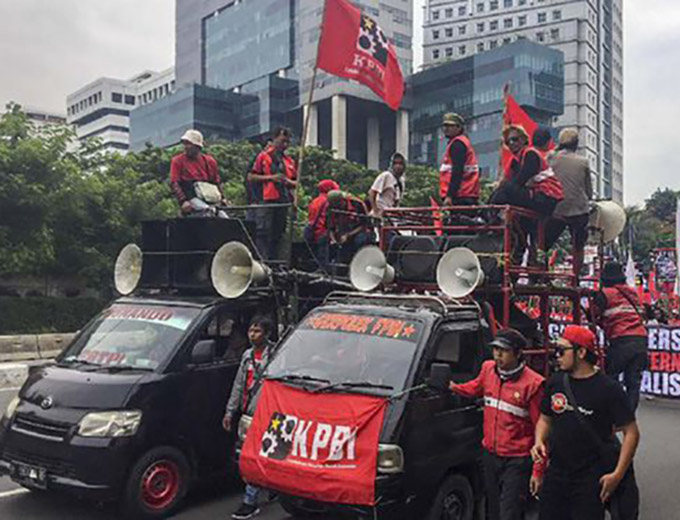
Hundreds of workers from the Confederation of United Indonesian Workers (KPBI) held a protest march at the weekend in the capital of Jakarta and Fiji’s Coalition on Human Rights staged a march today to commemorate World Human Rights Day.

In Jakarta, the Indonesian workers marched from the Farmers Monument in Central Jakarta to the nearby State Palace on Saturday, reports CNN Indonesia.

During the action, the workers highlighted the problems of corruption and the failure to resolve human rights violations.

READ MORE: The Universal Declaration of Human Rights turns 70

“This action is a reflection of the regime that is in power, Jokowi [President Joko Widodo] has failed, particularly in cases of corruption and human rights violations in Indonesia”, said KPBI secretary-general Damar Panca.

The Jakarta rally for human rights at the weekend. Image: Rayhand Purnama Karim/CNNI

-Partners-

Panca said that during Widodo’s administration corruption had become more widespread as had human rights violations. Trade unions had also suffered human rights violations when holding protests.

Panca said that not long ago during a peaceful demonstration, workers were assaulted and had tear gas fired at them by security forces.

“Not just that, 26 labour activists have been indicted. So we are articulating this now because it is the right moment – namely in the lead up to Anti-Corruption Day (December 9) and Human Rights Day (December 10),” he said.

Social welfare demands
In addition to highlighting human rights violations, they also demanded that the government take responsibility for providing social welfare for all Indonesians and rejected low wages, particularly in labour intensive industries, low rural incomes and contract labour and outsourcing.

Panca said that Saturday’s action was also articulating several other problems such as inequality in employment, the criminalisation of activists and the need for free education.

The KPBI is an alliance of cross-sector labour federations. Saturday’s action was joined by the Indonesian Pulp and Paper Trade Union Federation (FSP2KI), the Cross-Factory Labour Federation (FBLP), the Populist Trade Union Federation (SERBUK), the Indonesian Harbour Transportation Labour Federation (FBTPI), the Indonesian Workers Federation of Struggle (FPBI), the Industrial Employees Trade Union Federation (FSPI), the Solidarity Alliance for Labour Struggle (GSPB) and the Greater Jakarta Railway Workers Trade Union (SPKAJ)

“This action is not just in Jakarta, similar actions with the same demands are also being organised by KBPI members in North Sumatra. In Jakarta they have come from across Jabodetabek [Jakarta, Bogor, Depok, Tangerang and Bekasi, Greater Jakarta],” he said.

According to CNN Indonesia’s observations, the hundreds of workers wearing red and carrying protest gear continued to articulate their demands from two command vehicles near the State Palace, directly in front of the West Monas intersection.

They also sang songs of struggle and followed the directions of speakers shouting labour demands. The protest was closely watched over by scores of police officers.

Fiji rally for rights
In Suva, Fiji, the NGO Coalition on Human Rights organised a march for today to commemorate World Human Rights Day.

The march will begin at 10am from the Flea Market ending in a rally at Sukuna Park and is the culmination of 16 days of activism against gender-based violence from November 25 to December 10.

World Human Rights Day is celebrated annually on December 10 to mark the adoption of the Universal Declaration of Human Rights (UDHR) by the United Nations General Assembly in 1948.

This year is a significant milestone for the UDHR as it marks its 70th Anniversary.

Human Rights Day is a day to celebrate and advocate for the protection of Human Rights globally. Since its launch in 1997, the NGOCHR now includes members such as the Fiji Women’s Crisis Centre, Fiji Women’s Rights Movement, Citizen’s Constitutional Forum, FemLINK Pacific, Ecumenical Centre for Research and Advocacy, Drodrolagi Movement, Social Empowerment and Education Program and observers, Pacific Network on Globalisation, Haus of Khameleon and Diverse Voices and Action for Equality.

The Indonesian report was translated by James Balowski of Indoleft News. The original title of the article was “Ratusan Buruh Berunjuk Rasa di Istana, Soroti Pelanggaran HAM”.

Print Friendly, PDF & Email

Article by AsiaPacificReport.nz

Curious Kids: Where do dreams come from?

]]>

Source: The Conversation (Au and NZ) – By Shane Rogers, Lecturer in Psychology, Edith Cowan University

This is an article from Curious Kids, a series for children. The Conversation is asking kids to send in questions they’d like an expert to answer. All questions are welcome: find out how to enter at the bottom. You might also like the podcast Imagine This, a co-production between ABC KIDS listen and The Conversation, based on Curious Kids.


Where do dreams come from? – Winifred, age 4, Selby, Victoria.

Hi Winifred. People have wondered about where dreams come from for a very long time. To be honest, scientists still don’t fully understand where dreams come from. But we have a few ideas.

Dreams are like imagining stuff while you are asleep, so you could say dreams come from your imagination. As you know, our imaginations can be very powerful – if you try imagining your favourite food, your mouth might even start watering.


Read more: Curious Kids: Why do we need food?


Going to sleep is like putting a computer into “sleep” mode. The computer is not completely switched off, it just is not working as hard. When we go into sleep mode, we can rest and save our energy but we don’t fully turn ourselves off.

When we are asleep our brain does not switch off. It keeps working, but not as hard. But the part of the brain that helps us make decisions when we are awake? It is resting. That’s when our imagination can run wild.

What is she dreaming about? Flickr/Jon Huss, CC BY

Why do we dream?

People who have done research on why we dream have found most dreams people have tend to be about common stuff that happens in our lives (like playing with a friend).

Or we dream about stuff that might be important to us (like an upcoming party).

We think this is the same for animals who dream, too. Cats seem to commonly dream about chasing things, because that’s what cats think about doing a lot when they are awake.

Scientists have found out that when we dream about stuff, it might help us to remember that stuff better when we are awake. So maybe our dreams help us make stronger memories.

It’s a good idea for kids to get a good sleep each night to help you remember what you are learning about each day.

Solving problems

Other scientists think that maybe dreams help us to solve problems.

Let’s say you are learning how to ride a bike or a scooter. You might dream about riding. Maybe you are trying out different ways to ride, get the balance right, and not crash. It’s like you are practising while you are asleep. Then when you are awake, you might even have an idea about how to get better at riding.

Have you ever dreamed you were in a strange place? Flickr/marco, CC BY

But what about strange dreams? Well, it might be that our brain is just trying to make sense of some strange thoughts that come to us while we are asleep.

Maybe nightmares are the brain trying to replay scary experiences in an effort to make sense of them. Researchers have shown that some people might be able to make their bad dreams less scary if they imagine and write down different endings for their dreams and “practise” them before bed.

Some people think dreams might keep the mind busy and entertained, allowing the body to have a good rest.

The truth is, nobody really knows for sure where dreams come from. Maybe the answer will come to you in a dream.


Read more: Curious Kids: Why do our brains freak us out with scary dreams?


Hello, curious kids! Have you got a question you’d like an expert to answer? Ask an adult to send your question to us. You can:

* Email your question to curiouskids@theconversation.edu.au
* Tell us on Twitter by tagging @ConversationEDU with the hashtag #curiouskids, or
* Tell us on Facebook

CC BY-ND

Please tell us your name, age and which city you live in. You can send an audio recording of your question too, if you want. Send as many questions as you like! We won’t be able to answer every question but we will do our best.

ref. Curious Kids: Where do dreams come from? – http://theconversation.com/curious-kids-where-do-dreams-come-from-105130

Newsflash. The government doesn’t need to break up power companies in order to tame prices. The ACCC says so

]]>

Source: The Conversation (Au and NZ) – By Tony Wood, Program Director, Energy, Grattan Institute

Who wouldn’t want cheaper power?

And who wouldn’t enjoy a bit of a stoush between the big bad generators and the government, trying to break them up on our behalf?

Even if it was largely tangential to keeping prices low.

The “big stick” of forced divestiture, where the government through a court could order an energy company to sell off bits of itself, never made it to a vote in the final chaotic fortnight of parliament just finished.

It will be the subject of a Senate inquiry that will report on March 18. After that, parliament is set to sit for only seven days before the election, so its possible it’ll never happen, under this government.

The government’s bill is good in parts

Parts of its Treasury Laws Amendment (Prohibiting Energy Market Misconduct) Bill are uncontroversial.

The main trigger was the Australian Competition & Consumer Commission’s June report, Restoring Electricity Affordability and Australia’s Competitive Advantage.

It found against forced divestiture, but thought along similar lines to the government in some respects.

The legislation presented to parliament this month bans three types of misconduct:

  • electricity retailers’ failing to pass on cost savings
  • energy companies’ refusing to enter into hedge contracts (agreements to buy and sell at a particular price) with smaller competitors
  • generators’ manipulating the spot (short term) market, for example by withholding supply.

It imposes civil penalties for the first, forces companies to offer contracts for the second, and provides for divestiture orders for the third, after they have been recommended by the government and approved by the Federal Court.


Read more: Consumers let down badly by electricity market: ACCC report


There are good reasons for the government to act on the three behaviours, although each of the its proposed solutions raises concerns.

The ACCC wants something similar but different

Firstly, the ACCC did not identify the legislation’s first target as a major cause of high prices. They did observe that it is complicated to shop around and the offers are confusing, and sometime next year Australian governments will force retailers in some states to offer fairer default offers at an affordable price.

But it unclear why the energy sector has been singled out as an industry whose retailers have to pass on cost savings and not supermarkets or banks or airlines or petrol stations or any other kind of industry.

Secondly, the ACCC most certainly did raise concerns about dominant generator-retailers preferring not to enter into hedge contracts with competitors, particularly in South Australia.


Read more: FactCheck Q&A: are South Australia’s high electricity prices ‘the consequence’ of renewable energy policy?


It recommended that the Australian Energy Market Commission impose a “market making obligation” forcing large, so-called gentailers to buy and sell hedge contracts.

Its recommendation has the same intent as the one proposed by the government, although it has the advantage of being administered by a regulator that already exists.

Thirdly, the ACCC also concluded that concentration in the wholesale market means higher prices. Its report focused on the bidding activity of the Queensland government owned generator Stanwell Corporation.

Manipulation isn’t a major price driver

The Grattan Institute identified market manipulation by generators as a contributor to higher prices in our July 2018 report Mostly working: Australia’s wholesale electricity market.

But we found it made a much smaller contribution than high gas and coal prices and the closure of ageing coal generators.

We recommended a rule change to constrain generators’ bidding practices in specific circumstances.


Read more: Why the free market hasn’t slashed power prices (and what to do about it)


The ACCC recommended giving powers to the Australian Energy Regulator to investigate and fix such problems.

It considered a divestiture mechanism of the kind in the government’s leglislation, but rejected it as extreme.

Its own less extreme recommendations would “if implemented, be a better means to restore competition to a level which serves consumers well”.

Breaking up corporations is a broader question

There may well be a case for breaking up corporations whose size prevents or substantially lessens competition. It happens overseas.

The government cites the example of the United States Sherman anti-trust legislation. It has been in place since 1890 and has been famously used to break up Standard Oil and AT&T. The ACCC does not have this power.

There is debate about whether it would work in the much smaller market of Australia.


Read more: Uncomfortable comparisons. Why Rod Sims broke the ACCC record


Allan Fels, a former head of the Australian Competition and Consumer Commission a believes it would.

But quite sensibly he argues it should apply across the board, including sectors such as banking in light of the findings of the royal commission.

Ian Harper, who led the government’s 2015 competition review, is less convinced. However, he says if a divestment power is introduced, it should be introduced broadly.


Read more: Harper Review: a mixed basket for Coles and Woolworths


It’s worth considering divestment powers broadly, rather than rushing to introduce them in one sector of the economy in what was to have been the leadup to Christmas because of a concern that its prices were too high.

The ACCC has already delivered a comprehensive report on the means to bring them down.

The government would be better served acting comprehensively on its recommendations.

ref. Newsflash. The government doesn’t need to break up power companies in order to tame prices. The ACCC says so – http://theconversation.com/newsflash-the-government-doesnt-need-to-break-up-power-companies-in-order-to-tame-prices-the-accc-says-so-108333

How researchers assess whether medications work

]]>

Source: The Conversation (Au and NZ) – By Yasmine Probst, Senior lecturer, School of Medicine, University of Wollongong

This article is in the series This is research, where we ask academics to share and discuss open access articles that reveal important aspects of science. Today’s piece explains how clinical trials assess drug effectiveness.


Ear infections, or “otitis media”, can cause of a lot of pain and discomfort in youngsters. In some children, persistent infections result in hearing loss.

But what sort of treatment should these children have, and how can doctors work out what is actually effective?

Here’s where a type of research called a clinical trial is useful.

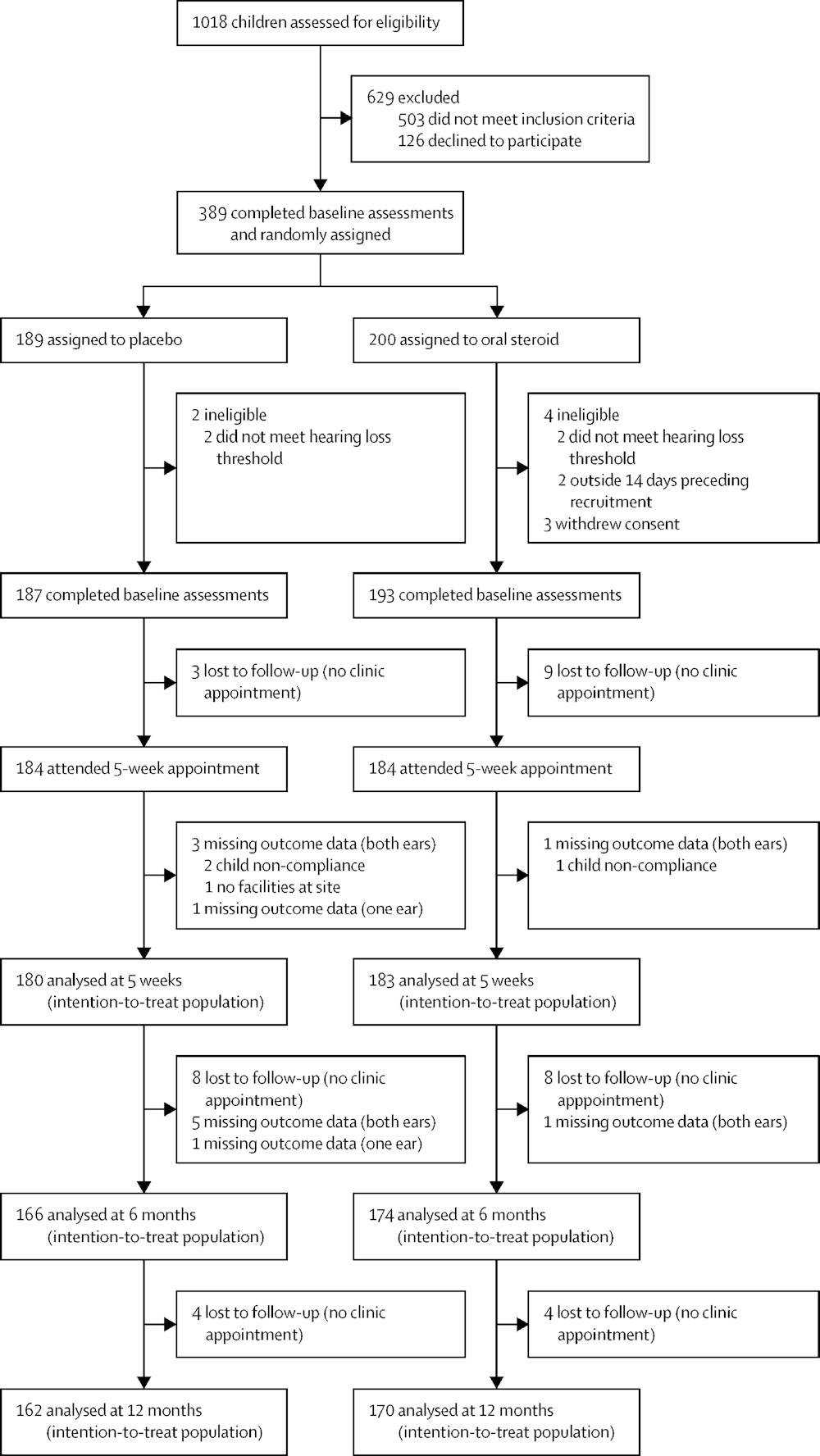
Let’s take a look at the “OSTRICH” clinical trial, which investigated the impact of a short course of oral steroids (prednisolone) in children with persistent ear infection leading to fluid build-up in the ear, and hearing loss.


Read more: Bulging ear drums and hearing loss: Aboriginal kids have the highest otitis media rates in the world


What is a clinical trial?

Clinical trials are the favoured type of study for showing cause and effect. They sit near the top of the study pecking order, only outdone in importance by summaries of lots of clinical trials put together.

Clinical trials can assess impact of a medication on a disease or condition. Researchers generally test a particular treatment, and compare the outcome to a different treatment or no treatment (if it’s ethical to do so).

The ideal design is one when the researchers and participants do not know who is assigned to the different treatments being tested. This is referred to as blinding.

Blinding may not always be possible. In food trials for example (where we do most of our work), it is very hard to blind a participant from a food they need to eat. Measures can be taken to minimise the impact of this, though.


Read more: Randomised control trials: what makes them the gold standard in medical research?


The OSTRICH trial

The OSTRICH trial used an approach where they tested a real medication, in this case a steroid, and compared it to a treatment that was almost the same but without the active ingredient – called a placebo.

The researchers worked with 389 children aged two to eight years with ear infection symptoms, fluid build up for at least three months, and with confirmed hearing loss in both ears. Two hundred kids were allocated to received oral steroids, and 189 to receive placebo for seven days.

With this approach they recorded the impact of the treatments on the ear canal and middle ear, and also conducted clinical tests for hearing. The parents kept a diary of symptoms, and completed questionnaires.

The children were followed up five weeks weeks, six months and 12 months after completion of the treatment. The primary outcome for the trial was acceptable hearing confirmed by an audiometry test at five weeks.

Both the families and the researchers did not know who had the real medication until the study was finished – this is called double blinding. This time period meant that researchers had to be careful with the information they collected to avoid potential errors.

Kids are unpredictable

Even with the best laid plans, children are hard to predict. As well as looking at the effect of a medication on a disease, the number of study participants who follow all instructions and finish the study as per the plan is an important outcome.

Not all of the starting 389 kids finished the full 12 months of the OSTRICH trial, and this was due to a variety of reasons. Some families withdrew consent to take part, some children didn’t meet the hearing loss criteria at the outset, and some families couldn’t be contacted as time moved on. Some children didn’t always take their medication. This won’t surprise you if you have ever needed to give a child medicine – of any sort.

Lots of things happen during a clinical trial that reduce your sample size. Francis and colleagues, Lancet Volume 392, Issue 10147, p557-568, August 18, 2018, CC BY

In children who did complete the trial, the results showed no statistically significant difference between children treated with the steroid and those treated with the placebo drug. Assessed at five weeks, hearing was only slightly improved in the group assigned the real medication compared to the group given the placebo.

The study authors wrote:

A short course of oral prednisolone is not an effective treatment for most children aged 2–8 years with persistent otitis media with effusion, but is well tolerated. One in 14 children might achieve improved hearing but not quality of life.

What didn’t they find?

Clinical trials can only make conclusions regarding the effect of what they are testing on the group they have tested it with.

This study quite simply shows that in children aged two to eight, a one-week course of oral steroids has minimal impact on hearing loss in children who had hearing loss due to ear infection and fluid build up, and assessed five weeks after the treatment started.

The study authors can’t conclude that this same finding will apply to children outside of the two- to eight-year age group, or to other types of medications, or steroids given for different time periods.

The researchers commented at the end of their study report that perhaps a clinical trial of oral steroids plus antibiotics is required for children with infection and hearing loss in this age group.


The open access research paper for this analysis is Oral steroids for resolution of otitis media with effusion in children (OSTRICH): a double-blinded, placebo-controlled randomised trial.

ref. How researchers assess whether medications work – http://theconversation.com/how-researchers-assess-whether-medications-work-102773

Human rights in 2018 – ten issues that made headlines

]]>

Source: The Conversation (Au and NZ) – By Louise Chappell, Director of the Australian Human Rights Institute; Professor of Law, UNSW

On December 10, the world marks 70 years since the adoption of the Universal Declaration of Human Rights. Regrettably, instead of the anniversary signalling the enduring impact of human rights, some are fearing the “end of human rights”. Here we highlight some of the rights challenges that captured the world’s attention this year, illustrating the struggle to secure human rights is far from over.

1. Australia’s first year on the UN Human Rights Council

Australia took its place on the UN Human Rights Council this year for a three-year term. Australia delivered a strong statement about Myanmar’s atrocities against ethnic Rohingya Muslims, but was criticised for holding refugees and asylum seekers offshore. While Australia supported important country resolutions, it failed to take a leadership role on any key issues.

2. United States’ retreat from Human Rights Council

The US faced international condemnation when it quit the Human Rights Council, calling it a “protector of human rights abusers and a cesspool of political bias”. The US has long complained of the council’s perceived bias against Israel. But, by withdrawing, the US decreased its options for confronting and addressing human rights violators. This increases the responsibility of governments like Australia’s to ensure the council addresses the world’s most serious human rights violations.

3. Violence against women

In Australia, while the #MeToo movement has spurred women to come forward with their experiences of sexual harassment and abuse, a number of high-profile cases of alleged sexual harassment by actors and politicians highlighted ongoing barriers to justice for victims. At the same time, the #countingdeadwomen femicide index reports that one woman in Australia is killed every week by an intimate partner.

4. Facebook’s reckoning

Free speech, privacy and electoral integrity came under the microscope in March, when a former employee of Cambridge Analytica blew the whistle on its practice of harvesting data from millions of US Facebook users in an effort to influence the 2016 presidential elections.

Cambridge Analytica was also investigated in the UK for a possible role in the Brexit referendum.

There is also growing criticism of Facebook for not doing enough to stop its use to spread hate speech. For example, in Myanmar it has been used as a tool to incite violence against Rohingya.

5. Rohingya crisis

In August, a UN Fact Finding Mission on Myanmar, which included Australian human rights expert Chris Sidoti, delivered a scathing report detailing crimes against humanity, war crimes, sexual violence and possible genocide by Myanmar’s security forces against the Rohingya.


Read more: Explainer: why the UN has found Myanmar’s military committed genocide against the Rohingya


The UN Human Rights Council, in response, created a mechanism to collect and preserve evidence to aid future prosecutions for atrocity crimes in Myanmar. Australia joined other Western nations in imposing targeted sanctions on military officers named in the UN report. While the Australian government maintains an arms embargo on Myanmar, our defence forces continue to provide training to the Myanmar military.

6. Crackdown against Turkic Muslims in Xinjiang

Turkic Muslims in China’s northwestern Xinjiang region have long faced repression. In 2018, Human Rights Watch and others reported an escalation in this repression with the government detaining 1 million people in political re-education camps, with evidence of their torture and mistreatment. Muslims not detained still face pervasive controls on freedom of movement and religion. The Foreign Affairs Department revealed under parliamentary questioning that three Australians were detained in the camps.

7. Saudi Arabia

Saudi Arabia made international headlines when a prominent journalist, Jamal Khashoggi, was murdered in the Saudi consulate in Istanbul. The case prompted a closer examination of Saudi Arabia’s human rights record. The country’s repression, imprisonment and ill-treatment of activists includes the alleged torture of leading women’s rights defenders.

In Yemen, the Saudi-led coalition has committed many violations of international humanitarian law, including apparent war crimes, killing thousands of civilians. Millions of Yemenis are confronting a famine, in part because of restrictions on aid delivery. Yet the USA, UK, France and Australia sell the Saudi government weapons and military equipment that may well contribute to its Yemen campaign.

Millions of Yemenis are facing a famine. Yarya Arhab/AAP/EPA

8. Children off Nauru

Australia’s government appeared to respond to the “Kids Off Nauru” campaign launched by civil society groups, medical professionals and lawyers. December figures show ten refugee children remain on the island, down from 119 children in August.


Read more: As children are airlifted from Nauru, a cruel and inhumane policy may finally be ending


Mounting political pressure forced the government to remove children who had been transferred there in 2013 and 2014, though many were removed from Nauru only after legal proceedings were started. But the departure of families makes the situation even more desperate for the adults left behind. And those transferred to Australia are told they will not remain permanently, keeping them in limbo.

9. One year since the Uluru statement

Indigenous communities have fought hard throughout 2018 to have the federal government focus on the Uluru Statement from the Heart, after the Turnbull government dismissed it out of hand in 2017.

The statement calls for a constitutionally enshrined “First Nations Voice” in parliament and the establishment of a Makarrata Commission to supervise agreement-making between governments and First Nations, and facilitate truth-telling of First Nations’ histories. These steps were seen as laying the foundation for a treaty with Australia’s First Nations peoples. A 2018 parliamentary committee endorsed the need for a voice in parliament and has called for a process of co-design between Indigenous people and government appointees.

10. LGBTI discrimination

One year on from the breakthrough on marriage equality, the parliamentary year ended with Australia’s politicians unable to find a way to remove legislative exemptions allowing religious schools to discriminate against LGBTI pupils and teachers.


Read more: Political impasse stops protection for LGBT students passing this year


Advocates and the Labor opposition rejected government amendments that sought to stop schools being able to exclude students on the basis of their sexual orientation, gender identity, or sex characteristics, but would also allow them to enforce rules in line with their religious teachings.

ref. Human rights in 2018 – ten issues that made headlines – http://theconversation.com/human-rights-in-2018-ten-issues-that-made-headlines-106534

We asked five experts: should I lie to my children about Santa?

]]>

Source: The Conversation (Au and NZ) – By Sophie Heizer, Commissioning Editor, Education, The Conversation

Ah yes, December. Christmas trees and decorations are popping up in shop windows, the weather is warming up, and the school holiday period looms. This may be exciting or distressing, depending on your relationship with your family.

Not everyone celebrates Christmas. But, for those who do, you may find yourself lying to your children during the holidays about jolly old Saint Nick. But is there real harm in lying to your children to prop up a popular myth? And don’t you deserve the credit for buying all the presents?

As adults we know Santa Claus isn’t real, but many of us remember the disappointing day we discovered this was the case. We asked five experts from various fields if you should lie to your children about Santa.

Four out of five experts said no

Here are their detailed responses:


If you have a “yes or no” education question you’d like posed to Five Experts, email your suggestion to: sophie.heizer@theconversation.edu.au


Disclosures: David Zyngier is convenor of The Public Education Network.

ref. We asked five experts: should I lie to my children about Santa? – http://theconversation.com/we-asked-five-experts-should-i-lie-to-my-children-about-santa-106930

Grey nomad lifestyle provides a model for living remotely

]]>

Source: The Conversation (Au and NZ) – By Timothy Moore, PhD Candidate, Melbourne School of Design, Monash University

Every other year, retired couple Jorg and Jan journey some 5,000 kilometres in their campervan from Port Fairy in southeastern Australia to Broome in the far northwest for a change of lifestyle and scenery. There they catch up with other couples from across the nation, who often converge on the beach for communal dinners. Jorg and Jan’s break lasts several weeks.

They are two of tens of thousands of retired adults travelling independently across the continent at any given time in search of adventure, warmer weather and camaraderie after a lifetime of hard work. These part-time nomadic adventurers, or grey nomads, have recast the image of Australia’s ageing population. Rather than being inert and conservative, or in need of care, these older Australians are champions of a radical type of urbanism: dwellings are mobile, infrastructure is portable or pluggable, social networks are sprawled, and adherents are on the move daily or weekly.


Read more: Grey dawn or the twilight years? Let’s talk about growing old


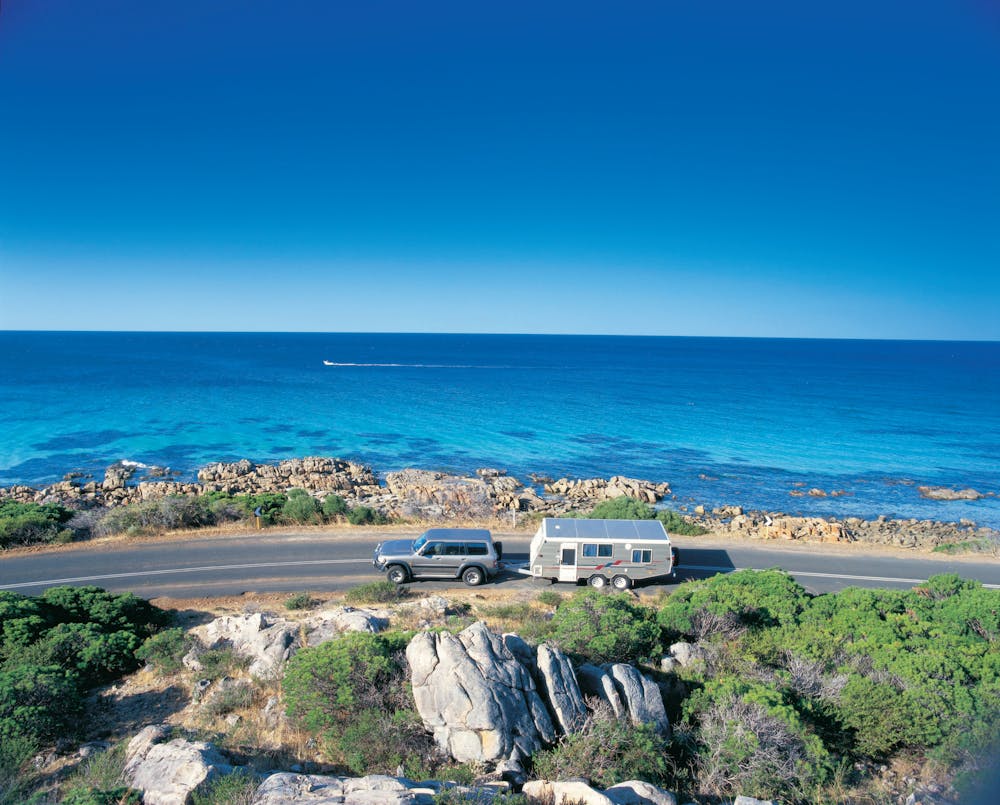
Nomads driving along Meelup Beach Road near Dunsborough. Image courtesy of Tourism Western Australia

Grey nomad is a term used to describe Australians over 55 years old who travel for an extended time – from weeks to months – and cover more than 300 kilometres in a day across semi-arid and coastal Australia. The term was popularised following the 1997 Australian documentary Grey Nomads, which captured the phenomenon of older travellers who made their homes wherever they parked.

What is the scale of grey nomadism?

Travellers, including grey nomads, contribute to a “roaming economy”: decentralised dwelling results in decentralised spending. The Western Australian government estimated in its Caravan and Camping Visitor Snapshot 2016 report that 1.54 million domestic visitors spent time in caravans or camping, contributing more than A$1 billion to the state economy.

According to the Campervan & Motorhome Club of Australia, RV drivers spend an average of $770 per week. And their value to a remote place extends beyond economic capital to human capital. Grey nomads often provide labour (such as gardening, house-sitting or their pre-retirement professional skills) in exchange for a place to park or for extra income.

Nomads relax at a caravan site in Esperance. Image courtesy of Tourism Western Australia

The availability of caravan parks, campsites and public parking reserves is essential to attract the grey nomad to regional towns. According to a 2012 report for Tourism WA, A Strategic Approach to Caravan & Camping Tourism in Western Australia, the state had a total of 37,369 campsites at 769 locations. In addition, remote private properties are becoming available through apps such as WikiCamps Australia.


Read more: Grey nomads drive caravan boom but camp spots decline


But while many nomads go off-grid, carrying their solar panels and generators, others are just looking for free reserves to park in. Beyond the site and its amenities – such as power, water, showers or flushing toilets – qualities such as “authenticity” are important to nomads, as highlighted by Mandy Pickering. Sites should feel remote rather than urban.

Will future generations be as fortunate?

The rise of the grey nomad over the past half-century has been made possible through the ability of ageing Australians to fund this retirement lifestyle. They might sell their houses (some may simply benefit from having secure accommodation), withdraw their superannuation or receive government benefits. Nomadism is a reward after a lifetime entangled in an economic and social system that keeps the individual tied to a stable workplace and place to live.

Aerial view of Osprey Campground near Ningaloo Reef. Image courtesy of Tourism Western Australia

For future generations, the outlook in terms of grey nomadism being a viable retirement lifestyle is not especially bright. Home ownership is sliding out of reach for many younger people. And many are enmeshed in the gig economy, meaning they are not receiving employer superannuation contributions.


Read more: Renters Beware: how the pension and super could leave you behind


Future generations may be so much in debt or living in such straitened circumstances that they cannot retire to a life of leisurely travel.

While grey nomadism might not be a sustainable model in the future, the lifestyle demonstrates how future generations of nomads – not necessarily grey – can live cheaply while populating regional centres for weeks or months, bringing economic and human capital to these remote places. These nomads will be able to work on their laptops in the public libraries, cafes, share houses and co-working spaces of country towns, accessing work remotely through cloud-based telecommunications.

They might not come in campervans but be dropped off in driverless vehicles; vacant campsites might become sites for small cabins. Or, as these nomads will be looking for temporary accommodation, spare rooms or entire houses might be made available. To find these dwellings, they might use apps that bring great efficiency to managing housing occupancy, enabling the “sharing” (renting) of unoccupied space for days, weeks or months.

Are regional towns ready to embrace these “emerging nomads” who are attracted by affordable living costs, network coverage, fast internet speeds, great weather, temporary housing options and unique regional identities, as the grey nomads were before them?

Grey nomads are recognised as a group that requires distributed infrastructures. They demonstrate a capacity for domesticity and urbanity without boundaries. The grey nomads are the precursor to a new generation that might not only want to travel, but need to in an economic environment that is not static or stable. And that will mean they can no longer afford to stay in one place.


This article was co-authored by Amelia Borg, a director of Sibling Architecture and a Masters of Business student at the University of Melbourne.

The Conversation is co-publishing articles with Future West (Australian Urbanism), produced by the University of Western Australia’s Faculty of Architecture, Landscape and Visual Arts. These articles look towards the future of urbanism, taking Perth and Western Australia as its reference point, with the latest series focusing on the regions. You can read other articles here.


Read more: Off the plan: shelter, the future and the problems in between


ref. Grey nomad lifestyle provides a model for living remotely – http://theconversation.com/grey-nomad-lifestyle-provides-a-model-for-living-remotely-106074

The government can restrain electricity prices without threatening to break up power companies. Its adviser says so

]]>

Source: The Conversation (Au and NZ) – By Tony Wood, Program Director, Energy, Grattan Institute

Who wouldn’t want cheaper power?

And who wouldn’t enjoy a bit of a stoush between the big bad generators and the government, trying to break them up on our behalf?

Even if it was largely tangential to keeping prices low.

The “big stick” of forced divestiture, where the government through a court could order an energy company to sell off bits of itself, never made it to a vote in the final chaotic fortnight of parliament just finished.

It will be the subject of a Senate inquiry that will report on March 18. After that, parliament is set to sit for only seven days before the election, so its possible it’ll never happen, under this government.

The government’s bill is good in parts

Parts of its Treasury Laws Amendment (Prohibiting Energy Market Misconduct) Bill are uncontroversial.

The main trigger was the Australian Competition & Consumer Commission’s June report, Restoring Electricity Affordability and Australia’s Competitive Advantage.

It found against forced divestiture, but thought along similar lines to the government in some respects.

The legislation presented to parliament this month bans three types of misconduct:

  • electricity retailers’ failing to pass on cost savings
  • energy companies’ refusing to enter into hedge contracts (agreements to buy and sell at a particular price) with smaller competitors
  • generators’ manipulating the spot (short term) market, for example by withholding supply.

It imposes civil penalties for the first, forces companies to offer contracts for the second, and provides for divestiture orders for the third, after they have been recommended by the government and approved by the Federal Court.


Read more: Consumers let down badly by electricity market: ACCC report


There are good reasons for the government to act on the three behaviours, although each of the its proposed solutions raises concerns.

The ACCC wants something similar but different

Firstly, the ACCC did not identify the legislation’s first target as a major cause of high prices. They did observe that it is complicated to shop around and the offers are confusing, and sometime next year Australian governments will force retailers in some states to offer fairer default offers at an affordable price.

But it unclear why the energy sector has been singled out as an industry whose retailers have to pass on cost savings and not supermarkets or banks or airlines or petrol stations or any other kind of industry.

Secondly, the ACCC most certainly did raise concerns about dominant generator-retailers preferring not to enter into hedge contracts with competitors, particularly in South Australia.


Read more: FactCheck Q&A: are South Australia’s high electricity prices ‘the consequence’ of renewable energy policy?


It recommended that the Australian Energy Market Commission impose a “market making obligation” forcing large, so-called gentailers to buy and sell hedge contracts.

Its recommendation has the same intent as the one proposed by the government, although it has the advantage of being administered by a regulator that already exists.

Thirdly, the ACCC also concluded that concentration in the wholesale market means higher prices. Its report focused on the bidding activity of the Queensland government owned generator Stanwell Corporation.

Manipulation isn’t a major price driver

The Grattan Institute identified market manipulation by generators as a contributor to higher prices in our July 2018 report Mostly working: Australia’s wholesale electricity market.

But we found it made a much smaller contribution than high gas and coal prices and the closure of ageing coal generators.

We recommended a rule change to constrain generators’ bidding practices in specific circumstances.


Read more: Why the free market hasn’t slashed power prices (and what to do about it)


The ACCC recommended giving powers to the Australian Energy Regulator to investigate and fix such problems.

It considered a divestiture mechanism of the kind in the government’s leglislation, but rejected it as extreme.

Its own less extreme recommendations would “if implemented, be a better means to restore competition to a level which serves consumers well”.

Breaking up corporations is a broader question

There may well be a case for breaking up corporations whose size prevents or substantially lessens competition. It happens overseas.

The government cites the example of the United States Sherman anti-trust legislation. It has been in place since 1890 and has been famously used to break up Standard Oil and AT&T. The ACCC does not have this power.

There is debate about whether it would work in the much smaller market of Australia.


Read more: Uncomfortable comparisons. Why Rod Sims broke the ACCC record


Allan Fels, a former head of the Australian Competition and Consumer Commission a believes it would.

But quite sensibly he argues it should apply across the board, including sectors such as banking in light of the findings of the royal commission.

Ian Harper, who led the government’s 2015 competition review, is less convinced. However, he says if a divestment power is introduced, it should be introduced broadly.


Read more: Harper Review: a mixed basket for Coles and Woolworths


It’s worth considering divestment powers broadly, rather than rushing to introduce them in one sector of the economy in what was to have been the leadup to Christmas because of a concern that its prices were too high.

The ACCC has already delivered a comprehensive report on the means to bring them down.

The government would be better served acting comprehensively on its recommendations.

ref. The government can restrain electricity prices without threatening to break up power companies. Its adviser says so – http://theconversation.com/the-government-can-restrain-electricity-prices-without-threatening-to-break-up-power-companies-its-adviser-says-so-108333

Blowing up the Parthenon: the power of a symbol

]]>

Source: The Conversation (Au and NZ) – By Bronwen Neil, Professor of Ancient History, Macquarie University

The Parthenon is one of the most famous and recognisable buildings in the world. Designed as a testimony to Athenian greatness, visible miles from the Acropolis (the citadel) on which it stands, the Parthenon still stands proudly among the remains of a massive complex of buildings that celebrated Athens’s deities. It is a witness to the lasting legacy of the ancient Greeks and their architectural ingenuity. But it is also a very good reminder of the fragility of Western power.

It has been seen as central to the history of Western civilisation, a symbol of democracy, and was included on a draft curriculum put forward by the Ramsay Centre, where it is the only work included that doesn’t stem from the Judaeo-Christian tradition.

But the building has a troubled past that is somewhat at odds with our ideas of democratic values.

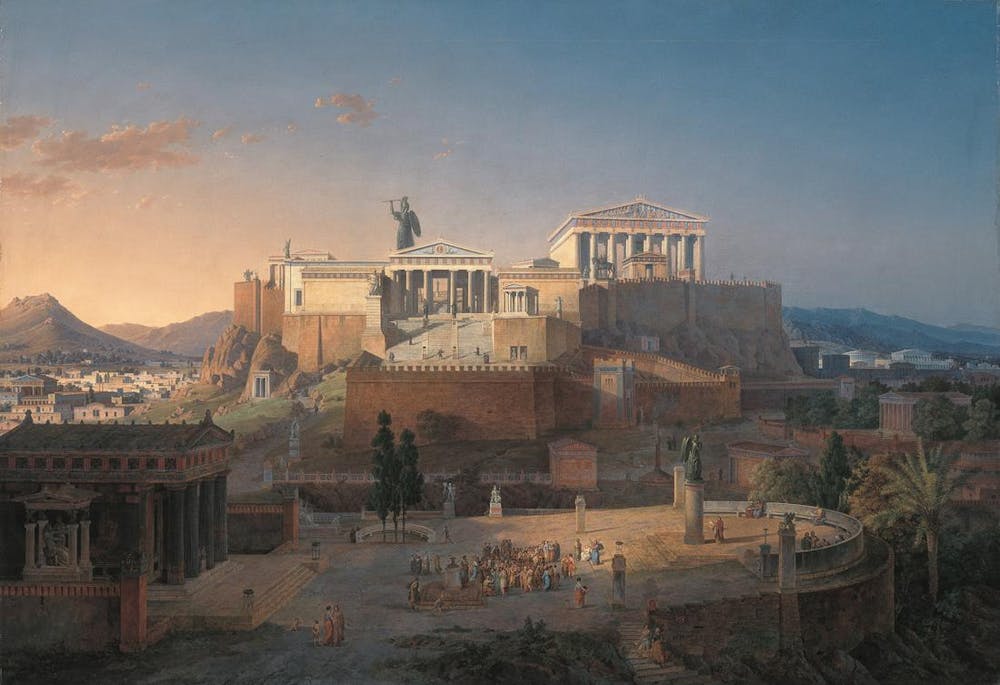
An 18th-century reconstruction of the Acropolis, including the Parthenon. Leo von Klenze, 1846. Wikimedia

A potted history

The Parthenon is a temple named for the virgin goddess Athena. It was built from 447 to 432 BCE from compulsory donations by the city’s tributary states. Athens had called on some 200 city-states to support it against the threatening Persian Empire, an alliance known as the Delian League. This ultimately led to the development of an Athenian empire. What started as a united front against an external enemy became an excuse for Athens to gain more ships and then more money from her allies. The Parthenon was built from the profits of this arrangement.

Sparta, Athens’ major rival, and her allies soon got tired of paying for the far-away capital’s expenses. The ensuing wars between the Delian League, led by Athens, and the Peloponnesian league, led by Sparta, in the Peloponnesian peninsula seriously dented Athenian supremacy.

Later, in around 296-295 BCE, a native citizen of Athens, the tyrant Lachares, stripped the Parthenon’s massive gold-and-ivory statue of Athena the Virgin (Athena Parthenos) of her ornaments to pay his troops. This was rather like asking the Mexicans to pay for the building of a wall to separate them from the United States.

The temple to Athena later served as an orthodox church of St Mary the Virgin for 1,000 years and then as a mosque during the Ottoman occupation from 1458 to 1821. It has been used as a barricade and an arsenal, or storage place for gunpowder, by Greece’s enemies. In 1687 an Ottoman ammunition pile was ignited when the occupying power came under attack from the Venetians. The explosion blew the roof off and the temple has never been fully restored.

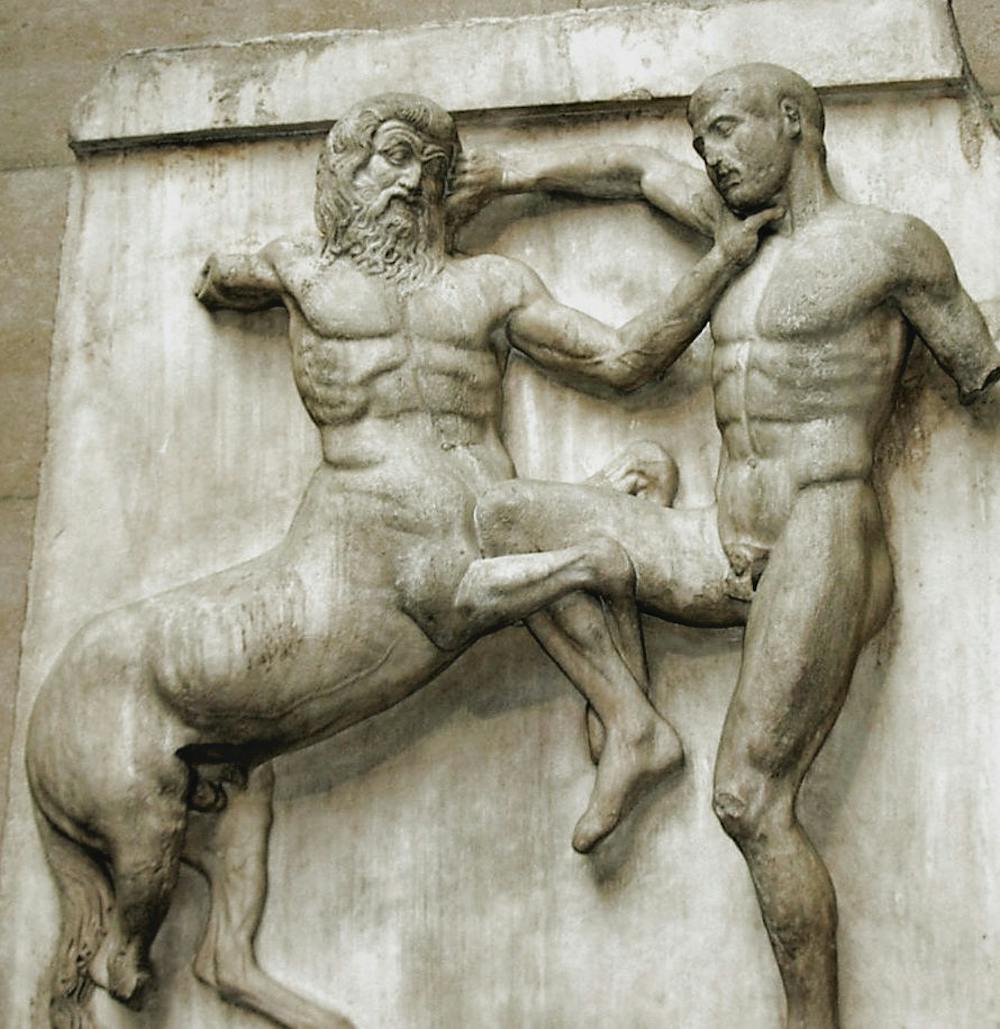
Its relics have been ransacked by collectors under the guise of keeping them safe. The most famous example is the Parthenon Marbles, sculptures which were removed to London in the early 1800s by Lord Elgin. They were acquired by “conservators” for the British Museum, where they still have their own dedicated display in the Parthenon Room 18.

A scene from the Parthenon Marbles, held in the British Museum. Wikimedia, CC BY-SA

After a long-term campaign by the Greek government, some of the Parthenon statues have recently been returned to the magnificent Acropolis museum. The history of re-purposing of the Parthenon thus runs the full gamut of Western civilisation’s ups and downs, and raises important questions about cultural hegemony, and the relationship between art, architecture and power, and who controls that power.

The power of symbols

The study of the western canon of Classical art and architecture is undoubtedly still relevant. The Greco-Roman civilisation was the source of so many modern European and New World institutions, in the areas of law, defence, agriculture and politics, to name a few.

As James Ostenberg (better known by his stage name Iggy Pop) commented, reading Edward Gibbon’s The History of the Decline and Fall of the Roman Empire helped him “gain perspective” by showing him the parallels between the United States and the ancient Roman (and by extension Greek) past.

America is Rome … All of Western life and institutions are traceable to the Romans and their world. We are all Roman children, for better or worse,” he said.

The Parthenon has long been upheld as a symbol of democracy. The ideal of rule by the people was established in Greece as a political system at the same time as the Parthenon was built, the mid-fifth century BCE. Pericles, the Athenian statesman who started the building of the Acropolis, also founded a limited democracy with voting rights for male citizens. However, he also limited Athenian citizenship to those with Athenian parentage on both their mother’s and father’s side.

More recently, Melina Mercouri, who has campaigned to have the Parthenon Marbles returned to Greece from the British Museum, has stated that they are “a tribute to democratic philosophy”.

But when we celebrate the survival of Athenian culture in the enduring symbol of the Parthenon, we should also remember the chequered history of the temple. And we should not forget Sparta, another ancient Greek city-state with its own distinctive culture and values, at whose expense the Acropolis was raised.

As with any survey of Western civilisation, only context can help us decide which elements of our cultural history are rightly celebrated, and which serve as monuments to other characteristics that are not so great.

ref. Blowing up the Parthenon: the power of a symbol – http://theconversation.com/blowing-up-the-parthenon-the-power-of-a-symbol-100826

Nations close ranks to stop ‘big four’ oil producers watering down UN report

]]>

By Sara Stefanini and Karl Mathiesen in Katowice, Poland

In a moment of drama in Poland, countries have closed ranks against a push by oil producers to water down recognition of the UN’s report on the impacts of 1.5C warming.

Four big oil and gas producers blocked the UN climate talks from welcoming the most influential climate science report in years, as the meeting in Katowice descended into acrimony yesterday.

By failing to reach agreement after two and half hours of emotional negotiations, delegates in Katowice set the scene for a political fight next week over the importance of the UN’s landmark scientific report on the effects of a 1.5C rise in the global temperature.

READ MORE: 12 activists denied entry to Poland for UN climate summit

The battle, halfway through a fortnight of Cop24 negotiations, was over two words: “note” or “welcome”.

Saudi Arabia, the US, Kuwait and Russia said it was enough for the members of the UN climate convention (the UNFCCC) to “note” the findings.

-Partners-

But poor and undeveloped countries, small island states, Pacific nations, Europeans and many others called to change the wording to “welcome” the study – noting that they had commissioned it when they reached the Paris climate agreement in 2015.

“This is not a choice between one word and another,” Rueanna Haynes, a delegate for St Kitts and Nevis, told the plenary.

‘This is us’
“This is us, as the UNFCCC, being in a position to welcome a report that we requested, that we invited [scientists] to prepare. So it seems to me that if there is anything ludicrous about the discussion that is taking place, it is that we in this body are not in a position to welcome the report.”

The four opposing countries argued the change was not necessary. Saudi Arabia threatened to block the entire discussion if others pushed to change the single word – and warned that it would disrupt the last stretch of negotiations between ministers next week.

The aim of the Cop24 climate summit is to agree a dense set of technical rules to underpin the Paris Agreement’s goals for limiting global warming to well below 2C, and ideally 1.5C, by the end of the century.

The scientific report was published by the Intergovernmental Panel on Climate Change (IPCC) in October. It found that limiting global warming to 1.5C, rather than below 2C, could help avoid some of the worst effects of climate change, and potentially save vulnerable regions such as low-lying Pacific islands and coastal villages in the Arctic.

But it also made clear that the world would have to slash greenhouse gases by about 45 percent by 2030.

Before the plenary on Saturday, the UN’s climate chief Patricia Espinosa said she hoped to see countries “really welcoming and highlighting the importance of this report… Even if the IPCC is very clear in saying how difficult it will be to achieve that goal, it still says it is possible”.

The US, which raised doubts about the science behind the report before it was finalised, said on Saturday that it would accept wording that noted the IPCC’s findings – while stressing that that “does not imply endorsement” of its contents.

Russia said “it is enough just to note it”, rather than welcoming the report, while Kuwait said it was happy with the wording as it stood.

Plenary push
The push in the plenary to change the wording to “welcome” began with the Maldives, which chairs the alliance of small island states. It was quickly backed by a wide range of countries and groups, including the EU, the bloc of 47 least developed countries, the Independent Association of Latin America and the Caribbean, African countries, Norway (another large oil and gas producer), Argentina, Switzerland, Nepal, Bhutan, Marshall Islands, Belize and South Korea.

Negotiators huddled with the plenary meeting’s chair, Paul Watkinson, for nearly an hour to try and work out a compromise.

But Watkinson’s suggestion – welcoming the “efforts” of the IPCC experts and noting the “importance of the underlying research” – fell flat.

Delegates from Latin America, small islands, Europe, New Zealand, Canada, Africa and elsewhere argued it was not enough to highlight the work that went into the report, it needed to address the findings.

Watkinson said he was disappointed that they could not agree. But a negotiator said the talks would continue: “This is a prelude to a huge fight next week,” when ministers arrive in Poland. It will be up to the Polish hosts to find a place for the report’s findings in the final outcome of the talks.

Wording that welcomes, rather than notes, the 1.5C report should be the bare minimum, Belize negotiator Carlos Fuller told Climate Home News. However, “the oil producing countries recognise that if the international community takes it on board, it means a massive change in the use of fossil fuels”, he said. “From the US point of view, this is the Trump administration saying ‘we do not believe the climate science’.”

‘Won the fight’
Fuller added: “In my opinion we have won the fight, because the headline tomorrow will be: the UNFCCC cannot agree the IPCC report’, and people will say ‘Why, what’s in the report?’ and go and look.”

The 1.5C science wasn’t the only divisive issue after a week of Cop24 talks, with countries still mostly holding their ground on the Paris Agreement’s rulebook.

Contentious decisions related to the transparency of reporting emissions and the make up of national climate plans have all been refined, but ultimately kicked to the higher ministerial level. Several observers raised the concern that some unresolved issues may be too technical for ministers to debate with adequate expertise.

Financial aid is still contentious issue. The rules on how and what developed countries must report on their past and planned funding, and the extent to which emerging economies are urged to do the same, remains largely up for debate.

In a further moment of drama on Saturday afternoon, Africa stood firm as UN officials tried to finalise a draft of the rules that will govern the deal. Africa’s representative Mohamed Nasr said the continent could not accept the deal as it was presented, forcing the text to be redrafted on the plenary floor.

“You can’t bully Africa, it’s 54 countries,” said one negotiator, watching from the plenary floor.

The change will mean new proposals to be made to the text next week. That would allow African ministers to attempt to strengthen a major climate fund dedicated to helping countries adapt to climate change and push for less strict measures for developing countries.

‘Voicing our concerns’
“We have been voicing our concerns, maybe the co-chairs in their attempt to seek a balanced outcome they overlooked some of the stuff. So we are saying that we are not going to stop the process but we need to make sure that our views are included,” Nasr told CHN.

Mohamed Adow, a campaigner with Christian Aid, said the African intervention had “saved the process” by ensuring that dissatisfied countries could still have their issues heard.

“It’s actually much better than it’s ever been in this process at this stage,” he said. “Because this is the end of the first week and ministers have been provided with clear options. Of course nothing is closed but the options are actually narrower.”

This article is republished with permission from Climate Home News.

Print Friendly, PDF & Email

Article by AsiaPacificReport.nz

Widodo wants security forces to guard all development projects in Papua

]]>
Sixteen bodies have been retrieved from the killings of workers on a Papuan infrastructure project claimed by pro-independence militants to be Indonesian soldiers. Image: Hark Arena

By Ray Jordan in Lampung, Indonesia

President Joko “Jokowi” Widodo insists that work on the Trans-Papua road project will continue despite this week’s shooting of construction workers in the Papua regency of Nduga.

Widodo is asking that all infrastructure projects and Trans-Papua construction workers always be accompanied by security personnel.

For the moment, Widodo said that the government would prioritise the evacuation of the victims of the shooting by the West Papuan Liberation Army that is regularly branded by the authorities as armed criminal “separatists”.

READ MORE: West Papua independence leader urges calm after killings

“Yes this is because there is still a process there that isn’t finished yet, we will prioritise the evacuation as quickly as possible. After that construction will continue”, Widodo told journalists at the Mahligai Agung Convention Hall at the Bandar Lampung University in Lampung City, North Sumatra.

According to The Jakarta Post, the casualties include 19 workers of state-owned construction company PT Istaka Karya, who had been assigned to build a 275 km section to connect Wamena and Mamugu as part of President Widodo’s flagship trans-Papua road project.

-Partners-

One Indonesian Military (TNI) soldier was also killed.

But the West Papua National Liberation Army (WPNLA), which claimed responsibility for the attack and said 24 people had been killed, alleged the workers were in fact soldiers in disguise, according to RNZ Pacific.

Independence rallies
Last Saturday, as members of the Liberation Army held a ceremony to commemorate Papua’s independence from Dutch colonial rule on December 1, 1961, as part of many rallies across Papua, Indonesia and internationally, a worker was said to have snapped a photo of the scene.

This enraged the militants.

In Sumatra, President Widodo said that wherever construction work was being carried out in Papua, workers must be accompanied by security forces in order to provide a sense of safety.

A Papuan freelance journalist John Pakage, who was reportedly beaten by members of the Indonesian Mobile Brigade Corps and his family threatened. Image: Wenslaus

“I want to convey that wherever construction work is going on it is always accompanied by security personnel in order to truly provide security guarantees for workers who are working in the field, in the jungles, in preparing infrastructure, particularly roads in the land of Papua which will never stop, but will continue regardless,” he said.

Widodo said the government’s goal was to continue development in Papua in order to create a sense of social justice in eastern Indonesia. Widodo said he wanted all of Indonesian society to experience this development.

“This is to provide infrastructure in the land of Papua and secondly also social justice for all Indonesian people to address the discrepancies in infrastructure between Java and Papua, between the east and west, that is what we can truly pursue”, said Widodo.

Earlier, national police chief General Tito Karnavian claimed that the West Papua Liberation Army led by Egianus Kogoya numbered no more than 50 people who had around 20 firearms.

‘Diplomatic’ resolution
The Guardian reports that Benny Wenda, the chair of the United Liberation Movement for West Papua (ULMWP), said it was hard to know exactly what happened at Nduga, amid conflicting reports on the long-running tensions, and without free access for media or human rights groups.

Indonesian authorities had not responded to requests for comment from The Guardian.

Wenda told The Guardian he could not stop the liberation army but wanted to tell them the UMLWP wanted to solve the issue “diplomatically”.

“We don’t want any bloodshed, we want Indonesia to come to the international table to discuss and we can agree to a referendum That’s what our campaign is about,” he said.

Sebby Sambom, spokesman for the WPNLA, the military wing of the Free Papua Movement (OPM), said in a telephone interview that they attacked a government construction site last weekend because they believe the project is conducted by the military, according to Jawa Pos TV.

“Trans-Papua road projects are being carried out by Indonesian military and that is a risk they must bear,” Sambom said.

“We want them to know that we don’t need development, what we want is independence.”

According to Wenslaus, John Pakage, a freelance journalist who was also a former Reuters and Tabloid Jubi journalist, was beaten by members of the Indonesian Mobile Brigade Corps and his family threatened.

Detik News translated by James Balowski for the Indoleft News Service. The original title of the article was “Jokowi Minta Pekerja Trans Papua Selalu Didampingi Aparat Keamanan“.

Print Friendly, PDF & Email

Article by AsiaPacificReport.nz

Comic explainer: forest giants house thousands of animals (so why do we keep cutting them down?)

]]>

Source: The Conversation (Au and NZ) – By Madeleine De Gabriele, Deputy Editor: Energy + Environment

Giant eucalypts play an irreplaceable part in many of Australia’s ecosystems. These towering elders develop hollows, which make them nature’s high-rises, housing everything from endangered squirrel-gliders to lace monitors. Over 300 species of vertebrates in Australia depend on hollows in large old trees.

These “skyscraper trees” can take more than 190 years to grow big enough to play this nesting and denning role, yet developers are cutting them down at an astounding speed. In other places, such as Victoria’s Central Highlands Mountain Ash forests, the history of logging and fire mean that less than 1.2% of the original old-growth forest remains (that supports the highest density of large old hollow trees). And it’s not much better in other parts of our country.

David Lindenmayer explains how these trees form, the role they play – and how very hard they are to replace.


Read more: Mountain ash has a regal presence: the tallest flowering plant in the world


Wes Mountain/The Conversation, CC BY-ND


Read more: The plan to protect wildlife displaced by the Hume Highway has failed


Sign up to Beating Around the Bush, a series that profiles native plants: part gardening column, part dispatches from country, entirely Australian.

ref. Comic explainer: forest giants house thousands of animals (so why do we keep cutting them down?) – http://theconversation.com/comic-explainer-forest-giants-house-thousands-of-animals-so-why-do-we-keep-cutting-them-down-106708

PMC director reports on historic New Caledonia referendum 30 years on

]]>

By Craig Major of AUT Communications

Professor David Robie, Director of the Pacific Media Centre in the School of Communication Studies, has been part of the contingent of more than 100 journalists and media academics reporting on and analysing the historic New Caledonian independence referendum in early November. Only 2 out of the 100 were from New Zealand.

David was interviewed by Tokyo TV and other media and had several of his archival photos used in media such as SBS World News because of his specialist knowledge of the 1980s insurrection known locally as “les evenements” that led to the referendum 30 years later.

New Caledonians voted 56% against independence from France while the strong yes vote of 44% (the indigenous Kanaks are in a minority) has opened the door for delicate negotiations and two further referendums in 2020 and 2022.

Professor Robie authored a book in 1989, Blood On Their Banner: Nationalist Struggles in the South Pacific, published by Zed Books in London, which is widely cited today about the period, and a sequel in 2014 Don’t Spoil My beautiful face: Media, Mayhem & Human Rights in the Pacific.

He has also written several articles on the referendum and the events leading up to on Asia Pacific Report.

The Pacific Media Centre has had a busy month with coverage of the Fiji general election on November 14 in collaboration with the University of the South Pacific Journalism programme and also coverage of the Asia Pacific Economic Cooperation (APEC) in collaboration with EMTV News.

Postgraduate student Sri Krishnamurthi flew to Fiji to report on the election in partnership with USP’s Wansolwara student newspaper as a continuation of his International Journalism Project.

Read David’s articles on the Asia Pacific Report website

Report by Pacific Media Centre

The government’s encryption laws finally passed despite concerns over security

]]>

Source: The Conversation (Au and NZ) – By Robert Merkel, Lecturer in Software Engineering, Monash University

After being caught up in the broader drama of the last day of Parliament for 2018, the Telecommunications and Other Legislation Amendment (Assistance and Access) Bill 2018 passed both houses on Thursday, with the support of the Coalition and Labor.

The bill is long and complex, but arguably its most significant new provision is the ability to issue companies or individuals with a “technical capability notice”.

These notices compel companies to modify software and the services they provide to allow access to information that could not otherwise be obtained. There are large financial penalties for companies that do not comply.


Read more: Yes, a WhatsApp message could be subject to FOI – but you’d have to find it first


A technical capability notice can be issued at the behest of law enforcement bodies, including state, federal, in some circumstances foreign law enforcement bodies (via the federal Attorney-General), and the Australian Security Intelligence Organisation (ASIO).

The capabilities permitted in the bill can only be used by law enforcement when investigating crimes with a maximum penalty of three years’ jail or more. This covers a much broader range of offences than terrorism or the distribution of child abuse material.

Law enforcement bodies must obtain judicial warrants to use the capability.

The bill is very broad in the types of assistance that could be requested. The one attracting most attention is the ability to intercept messages sent using end-to-end encryption used by tools such as WhatsApp, iMessage and Telegram.

Messages in the ‘dark’

It was claimed that without this bill, law enforcement agencies face risks of “going dark” – a term used by the FBI to describe when communications can’t be intercepted.

Labor MP Peter Khalil told Parliament:

We’ve heard … that members of the Parliamentary Joint Committee on Intelligence and Security have heard evidence from security, intelligence and law enforcement agencies about the risks of the surveillance environment going dark because of some of this technology where terrorists, paedophiles, organised crime and drug traffickers all utilise encrypted technologies and applications for their communications and their planning.

In practice, the picture for law enforcement is more grey than completely dark.
Israeli company NSO group already sells spyware that is reportedly able to gain full access to iPhone and Android smartphones.

It is almost certain that Australian intelligence and some law enforcement bodies have software with similar capabilities.

But this type of spyware relies on accidental security flaws in Android and iOS, which may be fixed by updates from Google or Apple at any time.

Would the new laws be effective?

There has been considerable debate as to how effective the bill will be in enabling access to end-to-end encrypted messaging, were a warrant to be issued.

In my opinion, a law enforcement body could use capabilities gained from issuing technical capability notices to get access to just about anything on a standard smartphone or PC, including end-to-end encrypted messages. This would be the case even if the encrypted messaging system was developed by a foreign company beyond the direct reach of Australian law.

A technical capability notice could be used to compel the supplier of system software for a smartphone or PC (for instance, Google, Apple, Microsoft, a smartphone hardware manufacturer, or even an Australian telecommunications company that distributes custom firmware for the phones it sells) to hide spyware in an update targeted at a specific smartphone or computer user who is the subject of a law enforcement warrant or an ASIO investigation.

The spyware would be able to see everything done on the device. This includes the contents of end-to-end encrypted messages after they are decrypted, or the decrypted contents of a hard disk encrypted using full disk encryption.

But while the act is an extremely powerful tool for law enforcement seeking help to access encrypted information, there will be circumstances where it will not be effective.

Not every system that can be used to run an end-to-end encrypted messaging system has an Australian corporate or individual presence that can be served with a technical capability notice.

So what are the risks?

In theory, only law enforcement and intelligence agencies will be able to gain access to material through the mechanisms detailed in the new law.

The law specifically prohibits the creation of “systemic vulnerabilities”. That includes changes to systems that might allow hackers to gain access to information from other users of the system.

But it is extraordinarily difficult to create mechanisms that allow law enforcement to gain access to information about specific people from specific systems, while posing no risk that anyone else can use the same mechanism to gain unauthorised access to other information. In other words, a “targeted capability” could easily end up becoming a “systemic vulnerability”.

Access tools used by intelligence agencies have been stolen and used in extremely damaging ways in the past. It’s impossible to guarantee that it won’t happen with the access mechanisms created under this law.

What happens now?

One major concern with the bill is its potential effect on parts of the Australian IT industry, as foreign customers may be concerned that their own secrets may not be protected from Australian governments.

This may pose a particular problem for companies selling into the European Union, where a strict data privacy law known as the General Data Protection Regulation applies.

Encryption system provider Senetas was one of the several companies that expressed concern over the bill. It warned of the potential loss of trust in Australian cyber security and products and that could lead to a loss in exports, and jobs and technical expertise relocating overseas.


Read more: Protecting our digital heritage in the age of cyber threats


For regular users of computers and smartphones, in theory, things won’t change much.

If you get caught up in the investigation of a serious crime, or are of interest to intelligence agencies (a group which could easily include journalists receiving leaks of classified material), the new powers will make it much easier for government agencies to gain full access the information, encrypted or not, on your computers and smartphones.

But for the majority of us, life goes on. We can only hope that in the process of trying to fight crime and protect Australia’s national security, that the Australian government doesn’t accidentally facilitate events like the WannaCry ransomware attack.

ref. The government’s encryption laws finally passed despite concerns over security – http://theconversation.com/the-governments-encryption-laws-finally-passed-despite-concerns-over-security-108409

The problems with small satellites – and what Australia’s Space Agency can do to help

]]>

Source: The Conversation (Au and NZ) – By Duncan Blake, PhD candidate, law and military uses of outer space, University of Adelaide

Australia is part of the global explosion in space industries – including the design and engineering of satellites smaller than a loaf of bread.

But we’re at a point now where we need to take the next step.

The growing number of small satellites orbiting Earth presents some unique challenges, such as interference with communication networks, the buildup of space junk, and the legal questions that arise if something goes wrong.

Australia’s new Space Agency can play a vital role in coordinating our government policy around these issues.


Read more: Yes we’ve got a space agency – but our industry needs ‘Space Prize Australia’


Acceleration in small sats

Since Sputnik 1 in 1957, there have been 8,303 registered space objects. Only 20 of those, so far, have been registered to Australia, but five satellites have been launched for Australia in just the past four weeks (although not all of them have been registered yet).

Fleet Space in Adelaide had two satellites launched from New Zealand, one from India and one from the United States. The University of New South Wales in Canberra had the M1 satellite launched on the same rocket as the Fleet Space satellite from the US.

Globally, there are almost 1,900 active satellites in orbit. That number is set to increase rapidly in the near future – regulators in the US alone have recently approved more than 12,000 new satellites to be launched into space over the next decade.

In Australia, Fleet Space plans to launch 100 satellites over the next decade.

The volume is growing, but the satellites are shrinking. We’ve moved from satellites the size of buses, to those similar in size to a washing machine, to cubesats (10x10x10cm), and even smaller still.


Read more: We’re drafting a legal guide to war in space. Hopefully we’ll never need to use it


Australia has committed itself to secure a large proportion of a global space market worth more than A$400 billion, tripling the Australian space industry from A$4 billion to A$12 billion and growing many thousands of jobs in the many new space start-ups in Australia.

That’s great news for the Australian economy, and the new Australian Space Agency has the mandate to make that happen.

Here’s where we need new policy around satellites to meet the challenges involved.

1. Congestion in signalling networks

Communication with your satellite is essential, even if communication is not its main purpose – to get data from remote sensing satellites, navigational satellites, experimental satellites, or just to track it, control it and monitor its status. But the use of radio frequency by small satellites has been hotly contested.

Big satellite manufacturers and operators, and others, oppose the allocation of frequency to small satellites through the international regulator – the International Telecommunications Union and its domestic equivalent – the Australian Communication and Media Authority (ACMA).

Notwithstanding that big satellite manufacturers and operators have a commercial incentive to oppose the disruptive upstarts, they have a point.

Small satellites don’t use less bandwidth in proportion to their small size (although they may transmit with less power). So, by their sheer number, they represent a significant risk of congestion and interference in the electromagnetic spectrum – leading to mobile phones not working properly, WiFi networks being degraded, and maybe even failure of your Netflix account.

The ACMA is seeking solutions to those potential problems, but if the solutions involve imposing significant technical and financial burdens on new space start-ups, these companies may go offshore to find better solutions – a loss for Australia.

2. The problem of space junk

Small satellites add to the space debris problem in outer space – because a significant proportion of them fail and not all of them follow international best practice (such as it is) on the operation of small satellites.

For example, US company Swarm Technologies went ahead with the launch of several very small satellites known as “Space Bees” via a launch on an Indian rocket even though the US Federal Communications Commission had previously declined to grant them a licence, on the basis that they were too small to be tracked, thereby making collision avoidance impossible.

SpaceFlight, a company that finds and facilitates launch opportunities for satellite operators, facilitated this opportunity for Swarm Technologies, and it was SpaceFlight that facilitated launch opportunities for the five Australian satellites launched in the last four weeks.

To be fair, Swarm Technologies and SpaceFlight have taken good steps to earn back the confidence of regulators in the US and globally, but it does demonstrate the need for clear and enforced best practice standards.

Unfortunately, there is a lack of consensus internationally on what those standards should be.

In Australia, our Space Agency has yet to decide on the content of subordinate legislation (Rules) under the new Space Activities (Launches and Returns) Act 2018 that may commit Australia to best practice standards for small satellites.

Again, there is a difficult balancing act – if the standards are too lax, there is a greater possibility of something going wrong and we lose reputation, influence, bargaining power and the opportunity to optimise international conditions for Australian commercial and other national interests.

If they are too strict, new space start-ups may find them unpalatable, and move their operations offshore – and the prospect of new jobs and economic growth in the industry dissipates.

3. Mistakes can happen

What happens if something does go wrong? Who bears the liability?

Under international law, in the first instance, liability rests with any state that launches, procures the launch or whose facility or territory is used for launch. Ultimately, that means the taxpayer.

A small satellite could conceivably be responsible for a failure at launch, or a collision in orbit, where there is infrastructure worth many hundreds of billions of dollars (not least, the International Space Station). Thankfully, the probability of any such failure or collision is generally extremely small.

But who accepts that risk of liability on behalf of the Australian taxpayer? For non-governmental operators, it is the Australian Space Agency.

Government operators are largely exempt from the legislation. Australia’s Department of Defence has been involved in the recent Buccaneer cubesat and the M1 cubesat, and CSIRO has recently initiated a project to acquire its own cubesat.

An artist’s impression of CSIROSat-1 CubeSat. Inovor Technologies

There is the possibility of different standards within government and relative to the private sector. Australia’s Space Agency does not currently have a strong mandate to coordinate across all space activities in which our nation participates.

In the case of the Buccaneer cubesat and the M1 cubesat, the University of New South Wales in Canberra – which built and arranged the launch of the satellites – is subject to control by the Space Agency under legislation.

In other cases, the Space Agency will have to engage and influence others through excellent communication and soft influence. So far, the staff and leadership of the agency have managed that with great skill.

But there’s more work to be done.


Read more: It’s not clear where Trump’s ‘Space Force’ fits within international agreement on peaceful use of space


ref. The problems with small satellites – and what Australia’s Space Agency can do to help – http://theconversation.com/the-problems-with-small-satellites-and-what-australias-space-agency-can-do-to-help-108156

Five ways to reduce the risk of stillbirth

]]>

Source: The Conversation (Au and NZ) – By Vicki Flenady, Professor, Mater Research Institute; Director, Centre of Research Excellence in Stillbirth, The University of Queensland

Six Australian babies are stillborn each day. This equates to more than 2,000 babies each year.

Stillbirth is defined as the death of a baby of at least 20 weeks’ gestation or 400 grams in weight. Most stillbirths occur during pregnancy.

There’s been a reduction over the past 20 years of baby deaths within the first four weeks of life. But stillbirth rates have not declined. The current rate of 7.1 per 1,000 births puts Australia 28th among the 34 OECD countries for stillbirth.

The rate of late gestation stillbirths (after 28 weeks) in Australia of 2.7 per 1,000 births is around 50% higher than top performing countries worldwide, such as the Netherlands, Finland and Denmark, which have rates of 1.8, 1.8 and 1.7 per 1,000 respectively. And the rates of stillbirth for Aboriginal and Torres Strait Islander and disadvantaged women are often double that of non-Indigenous Australians.

Up to 50% of stillbirths happen unexpectedly and a clear cause is never identified. In around one-third, deficiencies in the quality of care in pregnancy and labour are known to play a part.


Read more: Five ways to help parents cope with the trauma of stillbirth


This week, a Senate Report put forward 16 recommendations to reduce the rates of stillbirth in Australia targetting a 20% reduction in the stillbirth rate within three years.

We can achieve this aim by focusing on five evidence-based practices for women and health providers:

1) Sleep on your side in the last trimester

The position pregnant women sleep in has recently emerged as an important risk factor for stillbirth. Women who report going to sleep on their back after 28 weeks of pregnancy have an almost three-fold increased risk of stillbirth.

It’s recommended women after 28 weeks of pregnancy settle to sleep on their side although not all women are aware of this advice. A public awareness campaign on maternal sleep position will be launched in Australia early in 2019. This is based on those in the United Kingdom and New Zealand.

2) Seek help if fetal movements decrease

Women who experience decreased or altered fetal movement should immediately contact their midwife or doctor, as this is a marker for potential problems with the baby, including poor growth, disability and stillbirth.

But women are often not aware of this risk factor and, as such, don’t immediately report decreased fetal movement. A public awareness program on decreased fetal movement was recently launched in Victoria.

We are currently testing a mobile phone app for women to track fetal movement. Our preliminary data shows around 20% of women report concerns about decreased fetal movement during their pregnancy. Of these, around one-third will wait longer than 24 hours to contact their health care provider.

The response by care providers to maternal reporting of decreased fetal movement is often not as good as it should be.

3) Get help to stop smoking

Smoking during pregnancy is strongly associated with stillbirth and other serious problems such as fetal growth restriction, premature birth, and SIDS. It impacts on the child’s health throughout his or her life.

One in ten Australian mothers smoke during pregnancy, and rates are higher for women under 20 years (31%), who live remotely (35%) or are Indigenous (42%).

Quitting smoking has massive benefits for women and their babies, but the rate of quitting in pregnancy is low.


Read more: Here’s how to close the gap on Indigenous women smoking during pregnancy


4) Attend check-ups to monitor baby’s growth

Fetal growth restriction – when the baby isn’t growing well – is a strong marker of potential problems with the baby, including stillbirth, death in the first weeks of life and also chronic diseases later in life.

Good antenatal detection, combined with careful management, improve the baby’s chances of being born healthy.

But Australian midwives and doctors are often poor at detected fetal growth restriction; we only identify around one-third of babies who have it.

We have developed a program to educate midwives and doctors about fetal growth restriction, through improved screening and management of women at risk. So far this has been well-received.

We hope to see similar improvements to that of the UK’s screening and management program, which increased the detection of babies with growth restriction from 34% to 54%.

5) Optimise birth timing, if possible

The risk of stillbirth increases as women approach and go past their due date, as the placental function decreases.

The absolute risk of stillbirth from being overdue is very low, affecting about one in 1,000 women. But women in higher-risk groups should be more closely monitored for their risk of stillbirth and, if necessary, have their labour induced. This includes women who:

  • are older than 35 years
  • smoke
  • are overweight or obese
  • have pre-existing diabetes
  • are having their first baby
  • have had a previous stillbirth
  • are Indigenous or from other disadvantaged groups
  • have South Asian heritage.

However, the benefit of reducing the risk of stillbirth via an early birth needs to be carefully weighed against the risk of intervention for the baby at a given gestation.

We’ve long known that preterm babies have poorer outcomes than those born at term. It’s becoming increasingly apparent birth at 37-38 weeks’ gestation is also associated with a greater risk of disease, developmental problems and early death.

Obstetric interventions, such as caesarean section, also increase risks of infection and blood loss for the mother. The aim is to reduce stillbirths for women at or near the end of the pregnancy, while not increasing unnecessary intervention.


Read more: What happens when labour is induced and when is it necessary?


Education to improve risk assessment and monitoring are under development, as are measures to assist women and their care providers to jointly assess the risks and benefits of inducing labour.

While the Senate report highlighted need for further research to better understand and predict who is at highest risk of stillbirth, with what is already known, we can substantially reduce the numbers of stillborn babies and families who suffer the tragedy of this loss.

ref. Five ways to reduce the risk of stillbirth – http://theconversation.com/five-ways-to-reduce-the-risk-of-stillbirth-108253

The best thing about the new Oz horror film The School is its poster

]]>

Source: The Conversation (Au and NZ) – By Ari Mattes, Lecturer in Media Studies, University of Notre Dame Australia

Review: The School


There’s something about the Australian context that lends itself to explorations of horror. As I have argued elsewhere, the combination of what historian Geoffrey Blainey famously described as the “tyranny of distance,” the barrenness of the Australian outback and landscape for European settlers, white Australia’s convict origins, and its guilt regarding the genocide of the Indigenous Australians, have all helped create a cultural milieu ripe for narratives of anxiety, despair, and terror.

Some of the best examples of horror and fantasy genre films have emerged from Australia, from Peter Weir’s masterful The Cars that Ate Paris to Leigh Whannell’s recent Upgrade.

Unfortunately, The School, a new film from writer-director Storm Ashwood, is not one of them. Like many of the 1980s trashploitation films by which The School seems to be inspired, the best thing about this kids adventure-cum-horror film – think The Goonies meets Silent Hill – is its poster.

Poster for The School. Bronte Pictures, Head Gear Films, Kreo Films FZ

The film opens quite well, recalling, in its pre-title sequence, recent, closed-room horror thrillers like Saw and Cube. The protagonist, Amy (Megan Drury), wakes in a grimy, post-apocalyptic style building in a bathtub full of blood, to find herself under attack from “hungries,” zombie-like creatures who crawl along the ground, as young Timmy (Jack Ruwald) tells her.

From this point, though, things get murky, with the story cutting between Amy’s past – she is a doctor who works in the same hospital in which her son has lain in a coma for two years following a near-drowning accident – and “The School,” a kind of purgatory presided over by Escape From New York-style gangs of upset schoolkids and an array of creatures like “weepers” and “the wall walker.”

She discovers that her son David (who is or isn’t dead?) is in a place called the Forbidden Zone, and sets off with two young guides, Timmy and Becky (Alexia Santosuosso), to help her navigate the nightmarish School. Along the way, they battle creatures and the more menacing gang, ruled by the tyrannical and predictably camp Zac (Will McDonald). It culminates with various revelations that aren’t at all unexpected, and yet still don’t seem to make much sense according to the rules established by the film itself.

The tyrannical and predictably camp Zac (Will McDonald). Bronte Pictures, Head Gear Films, Kreo Films FZ

The filmmakers seem to think it’s more interesting if the audience doesn’t know what’s going on, and that confusion automatically leads to curiosity. This, of course, usually isn’t the case.

Its incoherent story is matched by limp design choices. It embraces a trash aesthetic, and yet looks cheap and ineffective, and thus lacks the capacity to convince the viewer and make us believe in this world. The creatures look like they’ve come from a low-rent videogame, and the score is awkward in its attempt to create an atmosphere of dark fantasy.

It is critical to the success of a film like The School, so centralised as it is around the interior psychological and emotional shape of its protagonist, that its lead actor is flawless; this, unfortunately, is not the case here – Megan Drury’s performance is wooden and melodramatic, and not at all compelling.

Indeed, the worst thing about The School is the acting. Aside from the always excellent Nicholas Hope in a small role, most of the performances are well below what one expects from a professionally-made feature film with these resources.

Even though it’s not a complete disaster – few films are, and The School is efficiently shot and edited – it is a good example of an indie film that doesn’t work in part because of a poor story and script.

The scenario of the film should be engaging – seeing someone trapped in an inescapable hell automatically raises compelling existential questions, which explains why it’s been the premise of a diverse array of narratives from Jean-Paul Sartre’s play, No Exit, to the recent television series Wayward Pines.

And yet The School just doesn’t seem to know what it’s doing – it never gets into, for example, the potentially interesting material raised by the overlaying of two key modern disciplinary institutions, the school and the hospital – instead settling for lines like Dr Masuta’s (delivered by Nicholas Hope with a serious face): “And hell, like heaven – it’s only a story… Hell exists only in the mind Amy. It is the place we imagine all our suffering belongs.”

The School is a dreary and unsatisfying film; any potentially interesting notes are drowned out by the acting and heavy-handed approaches to most of the key cinematic areas, including composition and production design. It is a shame, because there are much better indie Australian genre films around – Michael Chrisoulakis’ Los Angeles Overnight, for example – that fail to acquire local theatrical release.


The School is in cinemas now.

ref. The best thing about the new Oz horror film The School is its poster – http://theconversation.com/the-best-thing-about-the-new-oz-horror-film-the-school-is-its-poster-108340

Sexual subcultures are collateral damage in Tumblr’s ban on adult content

]]>

Source: The Conversation (Au and NZ) – By Zahra Zsuzsanna Stardust, PhD Candidate, Arts/Media & Law, UNSW

The social networking and microblogging site Tumblr announced on Monday that from December 17 it will no longer host adult content on its platform. The Washington Post reported that the policy “removes one of the last major refuges for pornography on social media”.

But the move will affect more than just porn.

Over time, Tumblr has become a haven for fanfiction writers, artists, sex workers, kinksters and independent porn producers who have built subcultural community networks by sharing and discussing their user-generated content.

Tumblr’s definition of what constitutes permissible adult content fails to recognise the value of this kind of work. It separates sex from politics, preserves a class-based distinction between art and pornography, and limits representations of female nudity to reproduction and health.

The result is the loss of a dynamic cultural archive and the unnecessary sanitisation of public space.


Read more: What the latest data reveals about our passion for pornography – and its legality


Policing women’s bodies

In updates to Tumblr’s Community Guidelines:

Adult content primarily includes photos, videos, or GIFs that show real-life human genitals or female-presenting nipples, and any content—including photos, videos, GIFs and illustrations—that depicts sex acts.

Aside from the obvious regulatory dilemma of ascertaining which nipples appear to be “female-presenting”, this kind of targeting of women’s bodies has met with public criticism. For example, the Free the Nipple campaign has protested the criminalisation, censorship and fetishisation of women’s breasts.

Tumblr’s new policy still permits:

… exposed female-presenting nipples in connection with breastfeeding, birth or after-birth moments.

These policies are presumably a response to campaigns to normalise breastfeeding. Nipples are also permitted in:

… health-related situations, such as post-mastectomy or gender confirmation surgery.

These policies restrict representations of women’s bodies to their reproductive functions and repeat the tired framing of women’s bodies through medical lenses, at the expense of pleasure.

Distinguishing art and pornography

Tumblr will continue to allow written erotica and artistic nudity, which is defined as “nudity found in art, such as sculptures and illustrations”. But this policy reinforces a tenuous conceptual distinction between art and pornography.

The demarcation of art as something distinct from pornography was influenced by the increasing availability of photography in the 19th century, which threatened the very existence of art. While traditional paintings sought to imitate the real, photography was considered “too real” and “too close”. It prompted fears about proximity (its corporeal effect on the viewer), danger (its seductive power) and contagion (its potential to harm or infect).

Pornographic photography became a scapegoat. It was used to distinguish lowbrow forms of cultural consumption for the masses from highbrow forms of art for the elite. Pornography became a pejorative term that served to preserve and maintain the status of art.

Phanatic/Flickr, CC BY


Read more: Virtual reality could transform pornography – but there are dangers


Purging sex workers

Although Tumblr maintains its policy change was unrelated to its failure to effectively filter child pornography, the decision comes against the backdrop of the Fight Online Sex Trafficking Act (FOSTA), which was passed in the United States in April.

FOSTA prompted platforms such as Google, Microsoft and Facebook to amend their terms of service to preclude nudity, sexual content and sexual services in order to avoid charges of promoting or facilitating sex work.

Migrant sex workers respond to anti-trafficking campaigns. Scarlet Alliance and the Cross Border Collective

Unfortunately this legislation has not improved grievance avenues for those experiencing exploitation. Instead, this blunt law has shut down sites that law enforcement could use to trace criminal activity, platforms where survivors could seek assistance, and forums where sex workers could screen safety information.

Sex workers were pioneers of the web. They designed, coded, built and used websites and cryptocurrencies to advertise and transact in the context of criminalisation.

They helped sites like Tumbr to flourish by populating the platforms with content, increasing their size and commercial viability. Indeed, adult content was reportedly responsible for 20% of traffic to Tumblr.

Now sex workers are now being effectively erased from social media.

There is evidence about the human rights impact of anti-trafficking campaigns, which can victimise those they are intended to protect.

But the pressure to be seen as proactive partners in response to trafficking and child abuse is so significant that tech companies are willing to erase sex completely from their platforms and accept sex as a necessary casualty.

Containing the democratisation of culture

The sequestering of sex is not an inevitable response. It has not always been the case that adult content has been treated as something external to art, culture or society.

Depictions of sexual practices can be traced back to ancient civilisations. The sexually explicit frescoes of ancient Greece and Rome were displayed publicly and integrated into daily life rather than being, as Walter Kendrick describes, “locked away in secret chambers safe from virginal minds”.

It was the process of archaeological extraction in the 18th century that commenced a process of identifying and labelling ancient artefacts as “pornographic”, and removing them from public view.

A two thousand years old roman antique erotic fresco in Pompeii, Italy.

Historians have found that the modern regulatory category of “pornography” was invented at the same time, alongside the emergence of technologies (such as the printing press) that allowed for mass-distribution. As Lynn Hunt argues, it was created:

in response to the perceived menace of the democratization of culture.

As the evolution of the internet promises increased access to technologies and rapid circulation of cultural materials, regulatory attempts to restrict them are being met with contest, protest and resistance.


Read more: Porn viewers prefer women’s pleasure over violence


Sanitising public space

Private corporations have now become the arbiters of community standards, making decisions about what content is permissible to circulate. Corporate monopolies now have a greater impact than national classifiers on what material the public can access.

Apple, which dropped Tumblr from its App Store on 20 November, has had a “homogenizing and sanitizing effect on the internet”. It refuses any apps that contain “pornographic” or “offensive” content, including hook up apps with “overtly sexual content”.

Steve Jobs himself has stated:

We do believe we have a moral responsibility to keep porn off the iPhone.

Designating representations of sex to the private, personal realm, outside of the public or political sphere, obscures the fact that heterosexual intimacies saturate public culture. Tumblr has been a site for LGBTQ, kinky and geeky individuals to build spaces, networks and cultures, and for sex workers to share skills and referrals for safety.

From December 17 (coincidentally, International Day to End Violence Against Sex Workers), Tumblr will only permit nudity “related to political or newsworthy speech”. This positioning reflects the historical development of obscenity law that has viewed representations of sex as devoid of merit unless they are redeemed by “serious literary, artistic, political or scientific value”.

In removing sex and nudity entirely from the platform, Tumblr’s new policy misses the fact that sexual subcultures are a crucial part of public life and contribute to critical social conversations and meaningful political alliances.

ref. Sexual subcultures are collateral damage in Tumblr’s ban on adult content – http://theconversation.com/sexual-subcultures-are-collateral-damage-in-tumblrs-ban-on-adult-content-108169

Australians love their sport, but investing in new venues is another matter

]]>

Source: The Conversation (Au and NZ) – By Jessica Richards, Lecturer Sport Business Management, Western Sydney University

For Australians, the accolade “sporting capital of the world” is arguably more prized than “world’s most liveable city”.

Australian cities (and the states) have appeared hell-bent on outdoing one another in building bigger and better sporting venues in pursuit of this moniker. Likewise, across the world, the construction of new stadiums and arenas has been increasing over the last 30 years. However, recent developments suggest that times may be changing.

The Adelaide Oval, the venue for this summer’s first Test between India and Australia, was redeveloped in recent years. It is just over the Torrens River from the central business district and has been widely praised for retaining the charm of the old while adding modern features.

The Australian sports market is comparatively small. As a result, there has been a rationalisation of venues, moving from traditional suburban grounds to multi-use, centrally-located ones. For example, in Victoria, AFL matches are generally now played at either the Melbourne Cricket Ground or Docklands Stadium (now known as Marvel Stadium). Following this example, in 2012 the New South Wales state government announced that funding was to be focused on seven venues across the state, with other venues earmarked for training and exhibition matches.
However, Labor opposition leader Michael Daley has announced NSW Labor will not rebuild either the Sydney Football Stadium at Moore Park, or proceed with an $800 million upgrade to ANZ Stadium if it wins government at the March election.

The backlash has been swift, with NSW Sports Minister Stuart Ayres calling Labor’s plan “irresponsible”, suggesting it would leave Sydney as a “sporting backwater” . National Rugby League (NRL) chief executive Todd Greenberg is also threatening to move the NRL Grand Final away from Sydney if the stadium upgrades are stopped.

Indeed, of all the nation’s state capitals, Sydney appears to be the most befuddled in terms of planning and simply getting on with it. After years of controversy and cost blow-outs, even Perth has welcomed its own new stadium ahead of this year’s cricket season.

The moon rising over Perth Optus Stadium, which opened in February this year, replacing the ground known affectionately as the WACA as the main venue for Test cricket in the Western Australian capital. Shutterstock

As a nation, our love of watching sport is undeniable, but our love of building large multi-purpose stadiums appears to be waning. With a few exceptions, the decades-long infatuation with building large multi-purpose stadiums is now met with a healthy amount of scepticism. Again, that trend can be seen in some overseas markets.

A global trend

In the United Kingdom, sports teams typically own their own venues. These teams are now financing the construction of new home grounds through a combination of bank loans, property development, and private finance. When there is local government involvement, financial support can be in the form of a loan.

Sporting developments involving the substantial investment of public money are unpopular in the UK. For example, there is ongoing frustration that the London Stadium (site of the London 2012 Olympic Games) continues to cost taxpayers money. Built for an initial cost of £486 million, it required a further £323 million to convert it for use by West Ham United Football Club, a soccer club in the English Premier League. The club pays a tiny yearly rent that does not cover running costs.

London Stadium has proved a boon for West Ham United Football Club, a soccer club in the English Premier League – as they get it for fairly cheap rent. Shutterstock

Historically, in the United States, venues were privately owned, but there has been a shift towards public subsidies for sporting venues. One study suggests about 70% of stadium development was publicly funded. While the amount of public funding is high, this contribution is not always from public subsidies. Hotel taxes, tax exemptions for venues, infrastructure improvements, and lottery funding can be used. Indeed, the construction of new venues is an often-used ploy to encourage sporting franchises to relocate to new cities. (Franchise relocation is so common in the US that it even appears as an option in video games.)

Yet even here, there are signs that the tide of public opinion may be turning against this practice. The US$700 million contribution toward the Atlanta Falcons stadium and the US$750+ million outlay for a new Las Vegas stadium have been criticised.

In Australia, KPMG recently conducted a study on Australian stadiums, highlighting how the costs for ongoing maintenance, repair and reinvestment of Australian stadium are significant. This can be more than 2% per annum (e.g. A$4 million per annum for a $200 million stadium).

State governments, who own many of the 12 large-capacity multi-purpose stadiums in Australia, now have to justify government spending on sports stadiums. Should public private partnerships (PPP) of stadiums be considered, where the cost is bridged through increased private sector funding?

Any benefits to partially privatising arenas?

The PPP model sees private contribution in return for a proportion of revenue over a period of time. In the US, public-private partnerships are now the most frequently used funding mix for new sports venues. Such arrangements add value and either lower the financial burden on taxpayers or allow a superior venue to be constructed.

Fully privatising sport stadiums is also being adopted. For example, the central government of Japan plans to privatise the National Stadium to be built for the 2020 Tokyo Olympics after the sports event ends. It is hoped that this move will reduce the running costs and the burden on taxpayers.

Beautifully located Bellerive Oval in Hobart has faced financial hardship given a dropoff in international cricket played in Tasmania. Shutterstock

Elsewhere, it is now common for privately or club financed stadium redevelopments to incorporate residential property development to generate income for the club. Yet in Australia, it is rare for government financed venues to look beyond the stadium itself. In contrast, the Cronulla Sharks, who own their own stadium, have been able to enter into a partnership with Capital Bluestone to develop residential and retail properties that will generate income for both parities.

A study on the relationship between stadium funding and ticket prices in the US revealed that the average ticket prices increased seasonally, regardless of the composition of stadium funding. The results indicated that on average, there is a reduction of US 42c in ticket prices with a 10% increase in public funding.

With proceeds from privatising the NSW Land Titles and Registry office funding the stadium redevelopment, we consider that the question of privatising stadiums should be at least discussed. Otherwise, other publicly owned assets may need to be sold off to fund stadiums.

ref. Australians love their sport, but investing in new venues is another matter – http://theconversation.com/australians-love-their-sport-but-investing-in-new-venues-is-another-matter-108020

Remembering Pearl Harbor and America’s entry into the theatre of war

]]>

Source: The Conversation (Au and NZ) – By James H. Liu, Professor of Psychology, Massey University

December 7, 1941. A date which will live in infamy. The United States of America was suddenly and deliberately attacked by naval and air forces of the Empire of Japan. The United States was at peace with that nation and, at the solicitation of Japan, was still in conversation with its government and its emperor looking toward the maintenance of peace in the Pacific.

Thus began President Franklin Delano Roosevelt’s speech declaring war against Japan. On the 77th anniversary of Japan’s surprise attack on Pearl Harbor, we do well to revisit these words, for they claim “casus belli”: provocation where war is a justified response.

President Franklin D. Roosevelt declares war on Japan the day after American naval and military forces were attacked at Pearl Harbor.

Churchill had begged Roosevelt to enter the war against the Axis (Japan, Germany, Italy) for months, but without casus belli, the American President refused. The US had a tradition of “non-interventionism” in European affairs, and its Congress had passed Neutrality Acts in the 1930s to prevent US entanglement in the power politics of the old world that might lead to war. The attack on Pearl Harbor marked a violent end to this era, and the beginning of America’s rise to the centre of world power.


Read more: How the attack on Pearl Harbor shaped America’s role in the world


Narrative of redemption

Psychologist Dan McAdams writes that the narrative of redemption – a story turning from bad to good – is fundamental to the American national identity and character. Roosevelt cast his declaration of war just so: after recounting Japan’s military deeds, he says:

No matter how long it may take us to overcome this premeditated invasion, the American people in their righteous might will win through to absolute victory.

In the case of Pearl Harbor, history vindicated Roosevelt’s claim. There is consensus that America’s entry into the war was justified, in the United Nations and in American public opinion. Consensus is crucial to the force and magnitude of collective remembering. More than this, the consequences of American entry into the theatre of war warrants a redemption narrative casting the USA as a heroic nation in the making of modernity.

The Axis was responsible for the deaths of more than 20 million civilians worldwide (about half in Asia, half in Europe). American entry into the conflict coupled with Russians’ heroic defence of their motherland turned the tide against that brutality.

Visitors at the National World War II Memorial. EPA/Matthew Cavanaugh, CC BY-ND

Truth and facts

Narrative configures facts as “food for thought” in the greater meaning underlying its surface words. Because Stalin was a brutal dictator, and because Western democracies were going to enter into a half century of Cold War with the Communists over whose system would dominate, Russian heroism in WWII is less celebrated in the world’s collective remembering than American.

Churchill once quipped:

History shall be kind to me, for I intend to write it.

Winners write widely accepted history as part of their story of why they have the right to rule. Losers’ versions of history are frequently forgotten, along with the facts that supported them.

Misquoting Alexis de Toqueville in 1983, President Ronald Reagan said:

America is good. If America ever ceases to be good, America will cease to be great.

Reagan invented this quote to argue that the “shrewdest of all observers of America” attributed its greatness to church-going. He contrasted this with the godlessness of their great rival, the Soviet Union:

While they preach the supremacy of the State, declare its omnipotence over individual man, and predict its eventual domination of all peoples on the earth, they are the focus of evil in the modern world.

History as soft power

Reagan understood that victory in WWII provided both the US and the Soviet Union with soft and hard power. Even he practised military buildup, he negotiated for arms control, but ultimately undermined the soft power of the Soviets with speeches like this.

It was soft, not hard power that brought about the collapse of the Soviet Union. This required Soviet leader Gorbachev to buy into the story of glasnost (openness), which was most assuredly keyed to major themes in Western, not Soviet narratives (or its constitution).

The power of narrative is extraordinary, and not as well understood as hard power (e.g. armies). Stories about people like Hitler, the most evil man in the history of the world according to young people today, have the power to cast people and peoples as heroes and villains. These augment or undermine hard power.

The burden of history for the Axis nations Germany and Japan, cast as the villains of WWII, crippled their ability to assert global political power through the latter half of the 20th century, even though they were among the most powerful economies in the world.

The formation of the European Union was assisted by two complementary forces in terms of soft power: Germans needing a positive (superordinate) identity after the war, and French identity becoming more Europeanised as a way to bolster French power. While the signing of treaties forming the European Economic Community and then the European Union may have been decisive, historians assisted by developing more consensual accounts of the past that allowed new identities to emerge, ending more than a century of competition and revenge-based warfare between these two states.

By contrast, Japan’s inability to come to a consensus about the meaning of WWII with its neighbours has rendered Asia incapable of gaining the level of agreement necessary for an “Asian Union”.

The relevance of these collective memories may be fading as a focus of world attention with the rise of China. China’s rise is not a direct consequence of WWII, but the work of two to three generations following in its wake. History is a moving feast of lessons and identity positions that thrives as communicative or “living memory” of generations alive communicating to one another the stories of their lives.

The bombing of Pearl Harbor, and the heroism of the United States in response provided America with an unparalleled position of soft and hard power following WWII: a narrative of redemption. The near dismemberment of China and its suffering at the hands of Japan provided China with a different identity position and different lesson. As WWII fades from living memory, and new crises emerge to challenge our world, what new lessons and identity positions will the new century carve out?

ref. Remembering Pearl Harbor and America’s entry into the theatre of war – http://theconversation.com/remembering-pearl-harbor-and-americas-entry-into-the-theatre-of-war-107698

Men get postnatal depression too, and as the mother’s main support, they need help

]]>

Source: The Conversation (Au and NZ) – By Richard Fletcher, Associate professor, University of Newcastle

England’s National Health Service (NHS) this week announced it will offer mental health screening and treatment for new and expectant fathers whose partners are suffering from mental illness. The NHS described this as a “radical action to support families”, and it certainly is an unusual step.

In Australia, screening mothers for mental illness before and after birth is standard, but fathers are not routinely assessed at any point. The idea new fathers could also have mental health issues related to the birth may seem odd. But there is increasing evidence men experience postnatal mental health and adjustment issues that deserve attention.


Read more: Dads get postnatal depression too


It is true that the rate of depression for new fathers, estimated at 10%, is around half that of mothers. But that still amounts to more than 30,000 babies who start life each year with a father who is miserable and irritable on top of the normal fatigue and stress that come with a newborn. This has negative short- and long-term effects on the mother and child.

Father’s mental health affects the baby

Of 1,500 men surveyed by mental health organisation beyondblue in 2015, one in four said only mothers could get postnatal depression. Health professionals too can be so focused on the risk to mothers that they overlook fathers’ mental health.

But having a stressed and depressed father can have serious implications for infants and relationships. These dads are more likely to be withdrawn and speak with less warmth to their infant. Compared to those who are well, fathers who are depressed are also more likely to use physical discipline on even one-year-old babies and participate less in tasks such as reading storybooks.

We now know this can lead to long-term consequences for the child. Compared to children of fathers without signs of depression, those whose fathers show signs of depression in the first year will have three times the risk of behavioural problems in preschool and twice the risk of mental health problems once at school.


Read more: Children’s well-being goes hand in hand with their dads’ mental health


Leaving aside the effect on children, there are economic costs of fathers’ depression, estimated at A$17.97 million. Further indirect productivity costs add A$223.75 million to the bill.

And fathers’ mental health affects that of mothers. When the predictors of mothers’ depression are examined, fathers’ mental health stands out among the most influential.

Depressed or irritable fathers are less likely to read with their children. Picsea/Unsplash

The NHS will not target all fathers with mental health issues, just those where the mothers have depression, anxiety or a more serious mental illness. This strategy may be simply a way for the NHS to dip a toe into the water of fathers’ mental health. But there is a logic to the approach in that the relationship between the parents may yield the biggest gain for the health dollar.

Helping fathers will help mothers

Treating these dads has multiple benefits. The emotional and practical support a father can offer to his mentally ill partner can contribute to her healing. Mothers with mental illness identify their partner as their main support.

And his involvement in caring for their infant can have dual benefits. The mother is relieved of some responsibility for the care and the impact of the impaired care by the mother can be lessened. Supporting fathers in this role and improving their confidence in parenting has major benefits.

Deciding to screen fathers is the first step. The hard part will be to engage men in screening and then follow through with treatment when there are many barriers. Fathers have relatively little contact with health services, they return to work soon after the birth and there is stigma to combat. Many don’t recognise their own symptoms of mental ill health.


Read more: I had postnatal depression as a new father and know why mental health checks for dads should be expanded


Australia is ahead of the UK in this regard. Beyondblue has developed effective campaigns that have raised awareness of male depression. With funding from Movember, it has also supported SMS4dads sending texts to fathers during and after the pregnancy. The texts provide information and links to online resources to help fathers develop healthy attachments with their infants and offer support to the mother.

We piloted sending such texts to both mothers with severe mental illness and their partners in rural Queensland. We found that fathers were happy to get the texts for up to six months and commented on the usefulness of the messages.

Australia should screen fathers too

The UK has decided that perinatal mental health, with fathers included, will become an ongoing feature of its long-term national health plan. In Australia, we should also set this as a focus and develop approaches to true early intervention and mental health support that benefit parents and infants.

We should use the opportunities of the upcoming National Men’s Health Strategy 2020-2030, the Royal Commission into Mental Health in Victoria and the Productivity Commission’s inquiry into the effects of mental health on workplace and community participation. Supporting men in early parenting is a key national strategy in promoting community mental health.

ref. Men get postnatal depression too, and as the mother’s main support, they need help – http://theconversation.com/men-get-postnatal-depression-too-and-as-the-mothers-main-support-they-need-help-108256

Perth’s brief abalone season is a time of delicacies and danger

]]>

Source: The Conversation (Au and NZ) – By John Charles Ryan, Postdoctoral Research Fellow, University of New England

Starting on December 8, recreational abalone fishing will be allowed in Perth. Fishing will be limited to one hour on four Saturday mornings between December and February. The maximum catch is still 15 per person per day. A complete ban on abalone fishing between Geraldton and the Northern Territory border will remain in place.


Read more: Abalone poaching: lifting the lid on why, how and who


This brief, intense season is a social and dining highlight of the year for many Australians – particularly Chinese migrants. It’s also a risky business, with dangers to both people and the reefs the abalone grow on.

As part of our research, my colleague Li Chen and I interviewed abalone fishers (and even took part ourselves). We found that more needs to be done to communicate how to fish for abalone safely and sustainably, especially on Chinese social media.

Abalone is popular but vulnerable

Among Chinese people, abalone represents wealth and confers social status. In some Hong Kong restaurants, dried abalone can sell for as much as A$5,000 per 500 grams.

But abalone is a fragile marine resource. Western Australia is one of few places in the world with relatively healthy wild stocks.

Among the 11 species found in the state, only brownlip, greenlip and Roe’s abalone grow large enough to be collected.

A young woman holds up a dried Australian abalone on the first day of Seafood Asia Expo 2015, Hong Kong, China. ALEX HOFFORD/EPA

In recent years, marine heatwaves and unlawful harvesting have begun to deplete numbers. Cases of trafficking and overharvesting have been reported.

According to a WA Department of Fisheries report, around 3 tonnes of greenlip is collected illegally each year on the state’s south coast alone.

Despite mounting pressures, the slow-growing mollusc is increasingly sought as a delicacy.

More than 17,000 recreational licences are issued annually in WA. Yet the safety risks, ecological impacts and cultural factors at work each season are not well understood.


Read more: Marine heatwaves are getting hotter, lasting longer and doing more damage


What are the risks?

Earlier this year, a man drowned while collecting abalone at Ocean Reef Marina in Perth. Five recreational fishers have died since 2012.

During 2017–18 patrols, Surf Life Saving WA volunteers intervened to prevent 206 potential accidents and performed five rescues at abalone fishing sites around Perth.

In preparation for the upcoming season, SLSWA has developed a new campaign including online images of safety equipment and translations of safety brochures into Chinese.

Chrissie Skehan, health promotion and research coordinator for SLSWA, explains that “a key target demographic for our campaign has been internationals, particularly the Chinese population”.

Known as a “dive fishery,” the commercial abalone industry in WA operates mainly in shallow waters off the south coast. In contrast, recreational fishing around Perth requires wading and snorkelling.

Fishers must come prepared with reef shoes, prying tools, measuring gauges, and licence cards. Conditions can turn dangerous rapidly. What’s more, many new enthusiasts are not skilled swimmers.

Regulations attempt to reduce the impacts of the intense four-hour season on ecosystems that are already vulnerable to climate change. Wear on reefs would be severe if not tightly managed.

In our survey, which spanned two Perth abalone seasons, we interviewed Chinese migrants and took part in the activities so as to get a feel for the experience.

Our research suggests that more education is needed to reduce environmental impacts and personal risks. Increasing cross-cultural understanding through the abalone harvest is important.

What are the benefits?

For the people we interviewed, the benefits outweigh the risks. Abalone fishing contributes to personal well-being and social networks.

When Billy Han first encountered wild abalone more than 13 years ago, he could not believe the sea treasure was real. “I thought it was impossible to find abalone at the roadside. It is so expensive in China.”

Duan Xin, an experienced fisher, took only ten minutes to reach the daily bag limit of 15 abalone. He spent the rest of the hour helping others learn how to fish while staying safe. The experience each year strengthens Duan’s standing as a mentor.

The abalone season builds a sense of community among Chinese migrants. But participation can also enhance awareness of the environment.

For Tommy Zhan, fishing was a chance to learn more about the coastal habitat. “I know what abalone looks like and tastes like, but I do not know how to harvest it or about the places where it lives.”

Chinese people share fishing stories and swap recipes in person and on social media. These exchanges allow them to adapt ancient traditions to the local environment.

The future of the abalone season

We recommend the inclusion of stronger marine conservation messages in public outreach and safety campaigns.

Undersized abalone can die if returned to the sea upside down. Shelling on the beach can attract sharks and other marine predators.

Conservation and safety groups could work with community leaders such as Duan Xin to spread information via Chinese social media networks rather than English-only channels.

Environmental education will be essential to the long-term sustainability of the abalone harvest.


Read more: We discovered 20 new fish in northern Australia – now we need to protect them


Not merely a management issue, the upcoming season is an opportunity for cultural dialogue in a city that is growing more ethnically diverse all the time.


This article was coauthored by Li Chen, drawing on research conducted for her PhD at Edith Cowan University.

ref. Perth’s brief abalone season is a time of delicacies and danger – http://theconversation.com/perths-brief-abalone-season-is-a-time-of-delicacies-and-danger-108043

The double juggle: how working parents manage school holidays and their jobs

]]>

Source: The Conversation (Au and NZ) – By Candice Harris, Professor of Management, Auckland University of Technology

The countdown is on towards the summer school holidays – a time many working parents approach with a mix of anticipation and trepidation.

School holidays are important for children as they offer a break from the routine and demands of school. They also give families a chance to spend time together doing things they enjoy.

However, the amount of leave employees get doesn’t match school holidays and for working parents the summer school break can be challenging, stressful and expensive.

We know very little about how working families juggle the conflicting demands during the holiday period, but our research aims to better understand the working parents’ conundrum.


Read more: Should we shorten the long summer break from school? Maybe not


The holiday care jigsaw

Lengthy school holidays are an antiquated relic of the Victorian era. They were a necessity for the agricultural economy of the 19th century when schools needed to break for long periods so children could toil in the fields. While the dates and lengths of school holidays around the world differ, a long summer holiday is still a feature in most school systems.

In England, local education authority schools must open for at least 380 sessions (190 days) during a school year. In the US, the academic year typically has around 180 school teaching days, as required by most states. In Australia, school lasts approximately 200 days divided into four terms, as do the New Zealand and Singaporean systems. Minus weekends, all these systems still require children to be on holiday for at least 60 week days a year.

Many parents piece together a jigsaw of childcare, using a mix of formal and informal (complementary) childcare across a week. Such arrangements tend not to be discussed beyond the level of the household. As a consequence, little is known academically, in workplaces or publicly about how working parents manage the juggle.

Formal childcare during school holidays can include services delivered through state, market or voluntary institutions such as creches, childminders, sports clubs, churches or private holiday programmes. It is worth noting that workplace childcare for school aged children is rare, especially in the private sector, and New Zealand and Australia are no exception. Even less is known about the use of informal childcare options, such as relying on friends and relatives to take care of children through arrangements such as play dates, unpaid babysitting, outings with grandparents, or leaving older children home alone.


Read more: To keep your curious kids happy these school holidays, check out Imagine This


Guilt and performance

Our research explores the responses to school holidays by corporate mothers based in New Zealand. We examined how holidays present a form of conflict for working mothers and the mothers’ perceptions of organisational support around managing the holiday period.

The research was conducted as part of a larger study with members of the Corporate Mothers Network which was established in 2013 as an Auckland-based networking platform for corporate women who are balancing busy family commitments with a career. The network recognises that one of the keys to success in business is relationships, so it was designed to provide a forum to hear from inspirational people, facilitate business relationships and support mothers in their careers. The network has 1,100 members and approximately 350 participated in the study.

School holidays clearly create pertinent issues for mothers in the study. Most respondents (90%) have children under the age of 18 living in their household. Just over two-thirds (64%) of respondents said that they experience conflict around managing the school holidays. Further, 60% agreed that the school holidays make it challenging to focus on work and achieve their usual work performance.

Beyond the work performance issues, 68% said they don’t feel like a good parent during the school holidays. This is a major concern.

Minding the gap

The burden tends to fall to families themselves to manage holiday arrangements. In our study, we found the majority of respondents (71%) thought their organisation provided only limited (or less) support, with only 29% reporting some positive level of support.

In New Zealand, all working employees are legally covered by the Holidays Act (2003), under which employees are entitled to at least four weeks of paid annual holidays. However, primary and secondary school aged children are on school holidays for at least 12 weeks each year. This equates to around a quarter of the year.

The silence about how working parents manage school holidays remains surprising.

Until we have a greater shared understanding of the ways working parents manage the holidays in terms of child care provisions, use of leave, cost of services, guilt at not being there for children, and impact on their work performance the holidays will remain the elephant in the room – large and looming but often ignored until the stampede.

Potential solutions to alleviate the difficult holiday juggle could include organisations offering working parents enhanced flexibility during the school holiday weeks. They could also consider providing holiday childcare or programme subsidies built into remuneration options, workplace school holiday programmes for employees’ children, and giving staff the ability to work remotely and/or part-time during holiday weeks.

Organisations could also show care where possible in scheduling work across the year, for example by not offering coveted leadership development initiatives or launching major new products during school holiday weeks. If line managers had regular conversations with employees about school holidays to acknowledge that they are aware of the additional pressures, that would be a good start.

We would like to acknowledge the contribution of our co-author Rebecca Armour, the founder of the Corporate Mothers’ Network and a KPMG tax partner.

ref. The double juggle: how working parents manage school holidays and their jobs – http://theconversation.com/the-double-juggle-how-working-parents-manage-school-holidays-and-their-jobs-108080

Are the tech giants taking over as your city leaders?

]]>

Source: The Conversation (Au and NZ) – By Cristina Mateo Rebollo, Executive Director, IE School of Architecture and Design, IE University

Global tech players such as Amazon, Google, Apple, Facebook, Amazon – the so-called Big 4, or GAFA – Airbnb and Tesla are redefining work, mobility, leisure and the everyday of how we live. Our cities are increasingly being used as laboratories for countless innovations. Cities are expected to be home to nearly 70% of the world’s population by 2050, with 95% of urban population growth taking place in developing countries.

The Big Four have a combined global workforce of more than 400,000 people and market capitalisation of more than US$2.3 trillion, which is roughly equivalent to France’s GDP. Many people demonise them for their excessive power, but how about considering the ways they are contributing to urban life?


Read more: The battle to be the Amazon (or Netflix) of transport


These giant technological gurus are carrying out experiments with cities themselves. For example, Belmont is a futuristic city in southwestern Arizona, conceived by Bill Gates and very much looking to the future. Oakland, California, is another field of social experimentation in which Silicon Valley entrepreneur Sam Altman is analysing the social impact of universal basic income.

Beyond these exercises in urban acupuncture, we need to know who is making the decisions that will define the day-to-day life of our cities, places where we find ourselves swinging between digital and analog realities, between the physical and the virtual. The speed and impact of change means we have a duty to know who is charge of our cities.

The following are just some of the initiatives being driven by the tech giants.

Apple, or how to interact in the city

Apple is building stores it says will redefine the shopping experience. Instead of just buying something, the idea is to generate excitement about entering a space-cum-event in which something is always going on thanks to free WiFi. It’s a kind of private-development town square – a place where we can expect to experience a range of interactive activities, as well as buying stuff, of course.

Apple Michigan Avenue, Chicago. Foster & Partners

A new store at the Carnegie Library in Washington DC will open soon. Designed by Foster & Partners, it will occupy the space previously reserved for library users who can now sniff the aroma of the latest iPhone while watching what happens on the stage.

Google, the world’s first neighbourhood built on our data

Sidewalk Toronto brings together Waterfront Toronto, a government agency, and Sidewalk Labs, belonging to Alphabet, Google’s parent company. The project aims to create a mixed residential and commercial community on Toronto’s eastern shore. It’s the right choice of city, as the economist and town planner Richard Florida would say when describing the best locations for innovation based on the three Ts: technology, tolerance and talent.

Sidewalk Labs’ Quayside project in Toronto. SideWalkToronto

Toronto has a culturally diverse creative community within a highly technological cluster. This didn’t go unnoticed when the decision was made to create the first internet city. Data will be monitored by an independent organisation called the Civic Data Trust in response to some residents’ fears about privacy. Meanwhile, the eyes of the world are on the initiative.


Read more: Can a tech company build a city? Ask Google


Uber, mobility as a service and the future of work

When Uber recently announced it was going to distribute Uber Eats by drones, we all looked skyward. Autonomous driving is now a reality and Uber one of its great explorers.

At its Pittsburgh HQ, located on “Robotics Row” next to the headquarters of other companies developing AI and machine-learning technology, the outside of the Uber building gives little indication of what is happening within. Some 200 high-tech Volvo cars, equipped with 360-degree rotating LIDAR cameras, are constantly coming and going, collecting data from tests on vehicles carrying Uber passengers.

In line with research in the Netherlands, China and Switzerland, Uber is also studying autonomous public transport options. These include driverless electric ferries that can carry up to nine people, along with full-size self-driving buses.

Initiatives like these will redefine transportation and the design of our cities. All this involves important, seemingly unconnected changes: along with the rising value of property located close to public transport nodes, reduced revenue sources from fuel taxes, traffic tickets and parking fees for local authorities, there is also the transformation of the future of work, from driver to mobility manager. If millennials no longer want to own a car and mobility becomes a basic service like electricity, there are new opportunities to explore that must involve consulting citizens and taxpayers.


Read more: For Mobility as a Service (MaaS) to solve our transport woes, some things need to change


The first Amazon Go store on opening day in Seattle, Washington, in 2016. SounderBruce/Wikimedia Commons, CC BY-SA

Amazon’s Olympic contest

While Amazon continues to use its Seattle headquarters as a laboratory to test new retail and logistics models such as Amazon Go and Storefront Pickup, cities throughout the United States have been vying to be the location for the e-commerce giant’s joint new headquarters in a process likened to the bidding process to host the Olympics.


Read more: Amazon drives a fifth city-shaping retail revolution


The winning bid for HQ2, as the dual initiative has come to be known, was decided last month after almost a year of uncertainty. The mayor of Frisco, Texas, had promised to build the remaining 40% of the town around Amazon, while Stonecrest, Georgia, said it would construct a new urban centre called Amazon, and Newark, New Jersey, offered extensive tax cuts. But the decision came down in favour of Arlington, Virginia, and Long Island, New York, and was rightly based on the three Ts mentioned above.

The winds of change are blowing. There was a time when governments invested in infrastructure and taxpayers had a voice in decision-making. Now Apple tells us how to interact in the city, Google controls our data, Uber redefines transportation as a service, and Amazon chooses whether a city is suitable or not to host its headquarters. Are these companies our new mayors?


This is an edited translation of an article that first appeared on The Conversation Spain.

ref. Are the tech giants taking over as your city leaders? – http://theconversation.com/are-the-tech-giants-taking-over-as-your-city-leaders-108259

Vital Signs: 35 extraordinary years. What the float of Australian dollar bought us

]]>

Source: The Conversation (Au and NZ) – By Richard Holden, Professor of Economics and PLuS Alliance Fellow, UNSW

If a week is a long time in politics, then 35 years must be an eternity.

35 years ago, on Monday December 12, 1983, the Hawke-Keating government announced the Australian dollar would be floated.

That is, the prices set by willing buyers and sellers would determine the value of the dollar in US cents rather than decisions made at occasional and later daily meetings of Reserve Bank and Treasury.

Even by the mid-1970s the huge amounts of cash sloshing around international markets had made it hard to pick the right value.


Read more: Explainer: how the Australian dollar affects the results of companies


Too expensive a dollar would mean Australians couldn’t get access to the foreign exchange they needed.

Too cheap a dollar would make imports expensive.

Yet floating it was not a white flag.

It was a bold decision – former RBA governor Glenn Stevens once described it as “one of most profound economic policy decisions in Australia’s modern history” – and one that set the stage for the 27 years of uninterrupted economic growth that began less than a decade afterwards.

It gave us a giant shock absorber

Since it floated, the Australian dollar has bought as much as US$1.10 (in July 2011) and as little as 47.75 US cents (in April 2001).

At first glance that looks like a whole lot of instability. In fact, the opposite is true.

Each time the Australian dollar falls, it makes the products we produce cheaper for overseas buyers, and it makes them cheaper for us compared to overseas products.


After the mining boom ended and overseas buyers of our minerals had less need for our currency, the Australian dollar slid from US$1.10 to US$0.70.

As it happened, other Australian exporters and businesses gained a new lease of life, smoothing the adjustment and creating other homes in other parts of the economy for the labour and other resources that had been devoted to mining.

The floating dollar was just as useful as the mining boom was ramping up.


Read more: Sense, think, act: the principle that governs everything from rocket landings to interest rates


As foreign buyers tried to get hold of the Australian dollars they needed to pay for our minerals, the dollar climbed, making life harder for other exporters and firms that competed with imports who ceded labour and other resources to mining.

The higher dollar made imports cheaper, meaning we didn’t need to make as much, and pushing down inflation in order to give even Australians not connected with mining a higher standard of living – effectively spreading the benefits of the boom.

Australian businesses were also able to import as they couldn’t before – everything from earth-movers to robot production lines to personal computers –investing for the next boom.


Read more: After the boom: where will growth come from?


It was an automatic stablisation that could never have been achieved by bureaucratic price-setting.

Even if the bureaucrats had known what prices to set, the political pressures they would have faced from manufacturers lobbying for a low dollar, and retailers and consumers lobbying for a high one, would have made the process agonising.

Political food fights make for bad economic policy. The floating dollar enables politicians to duck them, blaming “the market”.

Then we freed the Reserve Bank

It was a bit the same with the Reserve Bank. Until the mid-1990s it needed to consult with the Treasurer before moving interest rates.

Its declaration of independence, in a document countersigned by the newly appointed Treasurer Peter Costello in 1996, opened the way for it respond to shocks – such as the financial crisis of 2008 – without involving politicians.


Read more: Call to change Reserve Bank charter raises important questions about macroeconomic policy


The Treasurer does no more than ask it to keep inflation low (2-3% pa) while keeping employment and economic growth sustainability high. The rest is up to the Reserve Bank.

Because it is less likely than the government to succumb to political pressure, its resolve to do these things isn’t doubted. It has been able to embed low inflationary expectations in a way the government might not have been able to, making disastrous wage-price spirals a thing of the past.

And while there is an important debate about what the right monetary policy framework should be in a post-2008 world, there is little debate that Reserve Bank independence is crucial for implementing it.

The world’s fifth most traded currency

Australia is the world’s 15th to 20th largest economy – depending on how it is measured – but it has the fifth most traded currency.

As I noted in a report for the US Studies Centre and American Chamber of Commerce, the Australian dollar is globally relevant. It is increasingly used as a proxy for Asia and for commodity currencies.

The Australia-US dollar pair is the fourth most traded pair in the world. That wouldn’t be possible without a freely floating currency.

It’s about more than vanity. Much of the funding that Australian banks need comes not from deposits but from overseas capital markets. It allows them to lend as needed, unconstrained by the extent of their deposits.

They wouldn’t have that access to overseas capital markets unless the Australian dollar floated; unless it was always possible to find a price at which they could bring in overseas funds.

What’s next?

Bob Hawke and Paul Keating’s floating of the dollar was a one-off. It can’t happen again.

Geoff Pryor cartoon depicting Paul Keating, Bob Hawke, Opposition Leader Andrew Peacock and deputy John Howard. National Library of Australia

But there are other big reforms in prospect. On issues from climate change to tax reform to immigration, it is important to get the underlying settings right.

As could have happened with the dollar, the costs of getting them wrong could be enormous.

ref. Vital Signs: 35 extraordinary years. What the float of Australian dollar bought us – http://theconversation.com/vital-signs-35-extraordinary-years-what-the-float-of-australian-dollar-bought-us-108052

Darwin port’s sale is a blueprint for China’s future economic expansion

]]>

Source: The Conversation (Au and NZ) – By John Garrick, Senior Lecturer, Business Law, Charles Darwin University

An agreement between Darwin’s city council and an overseas municipal counterpart normally wouldn’t attract much attention. Local government officials love signing such deals. Darwin already has no less than six “sister city” arrangements, including with the Chinese city of Haikou.

But attention has been drawn to Darwin’s newly minted “friendship” deal with Yuexiu District, in Guangzhou, due to Chinese media describing it as part of President Xi Jinping’s signature Belt and Road Initiative.

This suggests Chinese authorities regard Darwin as having strategic significance.

It invites reflection on the wisdom, three years ago, of the Northern Territory government deciding to lease the Port of Darwin (now known as Darwin Port) to a Chinese company for 99 years – and of the federal government going along with it.

At the time the new owner, billionaire Ye Cheng, claimed the Darwin port deal was “our involvement in One Belt, One Road”. This was discounted by some commentators as hyperbole, an attempt to curry favour with the Chinese government.

But now, by design or not, the Darwin port deal increasingly looks like a blueprint for how Chinese interests can take control of foreign ports – as it is doing by various means around the world – without arousing local opposition. Quite the reverse. All levels of Australian government have encouraged it.

It makes Darwin an interesting case study – a point of contest between the strategies of the US and China. Darwin’s port is under Chinese control, while thousands of US marines are based in the city, as part of the US “Pacific pivot” seen by many as an effort to contain China’s influence in the region.

CC BY-ND

How the port deal was done

The deal to lease parts of the port followed successive federal governments refusing to fund necessary upgrading of the port’s infrastructure to meet growing demand.

Infrastucture Australia advised privatisation. Rather than sell outright, the territory government decided to lease the port, and sell a controlling stake in the port’s operator.

Landbridge Industry Australia, a subsidiary of Shandong Landbridge, won the 99-year lease with its bid of A$506 million in November 2015.

Shandong Landbridge has substantial and varied interests including port logistics and petrochemicals. Though privately owned, like many Chinese companies it has strong ties to the ruling Chinese Communist Party.

The company knows how to cultivate political connections. In Australia it gave influential Liberal Party figure and former trade minister Andrew Robb an $880,000 job just months after he retired from parliament.


Read more: Chinese influence compromises the integrity of our politics


The bid for the port was examined and approved by the Foreign Investments Review Board, the Defence Department and ASIO.

Strategic importance

But the deal put Darwin directly in the crossfire between US and Chinese interests. Then US president Barack Obama expressed concern about the lack of consultation. Former deputy secretary of state Richard Armitage said he was “stunned” that Australia had “blind-sided” its ally.

While the centre of US-Chinese tensions is the South China Sea – where China has militarised reefs in disputed waters – Darwin is important because it is the southern flank of US operations in the Pacific.

An Australian Border Force Cape-class patrol boat docked at the Darwin port. Lukas Coch/AAP

Managing the tensions

Zhang Jie, a researcher at the Chinese Academy of Social Sciences, wrote in 2015 about the concept of “first civilian, later military” – in which commercial ports are to be built with the goal of slowly being developed into “strategic support points” – to assist China defending maritime channel security and control key waterways.

Military-civilian integration was among the goals China set in its 13th five-year plan for 2016-20. President Xi subsequently established an integration committee to oversee civilian and military investment in technology.

As with other Chinese port acquisitions, such as in Sri Lanka, Pakistan, Greece and Djibouti, Landbridge is interested in acquiring and developing not only Darwin’s port facilities but nearby waterfront property.

But the Darwin port deal differs in significant ways to other port acquisitions.

It is a far cry from the “debt-trap colonialism” China stands accused of using to gain leverage over other foreign governments, such as Sri Lanka and Nepal.


Read more: Soft power goes hard: China’s economic interest in the Pacific comes with strings attached


Landbridge has bought the lease, rather than a Chinese bank lending funds to the Northern Territory government to develop the port. If Landbridge was to default, it would lose its money. Any attempt by Landbridge to use the port as security to borrow money from a Chinese bank would trigger renegotiation of the lease.

The territory government retains a 20% stake in the port operator and has a say in key appointments such as the chief executive and chief financial officer. But it will not share any profit that Landbridge may eventually make.

That potential is a long way off. Landbridge Infrastructure Australia reported a loss of A$31 million for the 2017 financial year, with its total borrowings rising to A$463 million. If the deal falls over, the government will need to seek new equity partners. But its immediate commercial risks are relatively contained.

Other risks

Yet risk exposure may take other forms. China’s strategy is very long-term. Darwin is now on the front line in managing tensions between Australia’s most important strategic ally and partner and its major trading partner. Balancing between powerful friends with competing interests may not prove easy.


Read more: The risks of a new Cold War between the US and China are real: here’s why


There are indications of some recognition of this at the federal level. Australia’s foreign investment review processes have been tightened. A Critical Infrastructure Centre has been created to give extra national security advice. There has been some tweaking of rules about political parties accepting foreign donations.

But others may have learnt valuable lessons too.

Weaknesses in Australian governments at all levels have been revealed. They have been reactive, readily accepting the lure of pearls cast on our shores without considering longer-term currents. Foreign and strategic policy has effectively been left to the local level. While the federal government now seeks to shore up its interests in the Pacific with cash for infrastructure, similar commitments to investing in local infrastructure are essential.

Clumsiness and indecision do not serve Australian interests well.

ref. Darwin port’s sale is a blueprint for China’s future economic expansion – http://theconversation.com/darwin-ports-sale-is-a-blueprint-for-chinas-future-economic-expansion-108254

Friday essay: love hurts – on a life of sports fandom

]]>

Source: The Conversation (Au and NZ) – By Sally Breen, Senior Lecturer in Writing and Publishing, Griffith University

When you grow up with no books in the house except maybe the full Readers Digest set of Catherine Cooksons and Bert Ryan’s Guide to Fishing you worship other heroes. The great battles in life are not going down in drama theatres, they’re not happening in-between the dusty covers of old books, they’re happening every weekend on sporting fields. I know this because my dad and everyone else in my suburb is into sport, and really, I have no choice. The other thing is – I like it.

This is the 1980s and the passion that flares in the smoke-filled lounge rooms of suburban houses and public bars is addictive. The ribbing and the rivalries funny, even if they do sometimes edge toward the dark side. The passion is the same whether the action is broadcast from big ticket fields or live on scratchy little league ovals. In fact, the passion is actually worse when it’s occurring on the two lane driveway in my front yard – my dad presiding over cricket matches with improvised rules. Six and out, wheelie bin for wickets and when the ball cannot be retrieved even by the dog – definitely out.

Life moments are one-day test matches between the West Indies and Australia going down to the wire, 16 runs off seven balls, everyone sunburnt and screaming at the TV. Cut to the underdog thrill of watching Wally Lewis get right up into Mark Geyer’s face in a tense State of Origin decider or the excitement I feel racing out of bed at dawn to witness an unlikely Australian victory in the America’s Cup even though I’ve never been on a yacht in my life – a bright blue day when I learn that drinking beer out of a yard glass is a national and political skill and not just something that happens at BBQs.

Sport is a dominant thread in Australia’s cultural DNA. But it’s also divisive. I didn’t realise how much until I started hanging out in underground art scenes and falling asleep under tables in my university tutorials. Not liking sport was something that could set you apart. Sport was the enemy. I wasn’t sure why you had to choose sides. For people who were heavily into pointing out the problematics of binaries on a day to day basis I was pretty surprised they couldn’t see when they were making one.

Most of the artists I knew were always looking for excuses why art couldn’t seem to compete with sport. Publishers chatted to me in mild tones about rugby union over lunch but when I got too excited about sport and my working class roots started showing they tended to change the subject.

That’s why I wasn’t so surprised when around the turn of the new millennium no one except me seemed to like Lleyton Hewitt. Lleyton was a fighter. He wasn’t so different in spirit from many of the Aussie cricket players I’d watched. Or NRL stars. He had that same take no prisoners attitude my dad worshipped and had instilled in me but by the time Lleyton erupted onto the world stage no one was really listening.

When you play tennis there’s no team and no 20 metres of paddock to protect you. Still. I didn’t understand why telling a few inept lines people to go back to the satellites was so harsh, especially when I’d heard worse. By then my dad was gone. His ashes splayed out in sad ceremony over Manly Beach and I watched Lleyton win his first ATP tournament in Adelaide alone. When I watched Lleyton play I admired his skill and his attitude but he fired something else in me. I believed I could win. Achieve things. Make things happen because deep down I doubted if I really could.

Crazy five-hour slogs

By 1999 I’d graduated honours, I’d enrolled in a PhD. I was still poor and hungry but kicking goals and one golden summer day in November my mates and I car pooled it down to the polling booth at Main Beach to vote in the referendum on the republic, slightly stoned, taking great pleasure in freaking out the royalists in their “no” t-shirts. We went home and partied but by six-o-clock the bad news became clear. Australia had voted no. When it came to winning in the political arena, we were getting used to disappointment.

I watched Lleyton’s US Open victory in 2001 alone. The match started at 3am Australian time and ended at 9.15am when a big serving Pete Sampras was summarily dispatched. At 8.15am I rang my boss and said I’m not coming in until he wins. He said who? I said Lleyton Hewitt and then I hung up. I nearly lost my job that day but my boss let it go. I wanted him to fire me. A Gold Coast businessman riding on the coat tails of a Howard government-sponsored sell out of welfare – I spent most of the day taking resumes off people the company rolled through the database tubes like stale bread rolls.

At around 9.15am Lleyton went for a dig down the line and Sampras lost and said he wished he had legs like him and I got on the bus and wondered why there weren’t people screaming in the streets – I’d seen streamers hanging off Yatala pies when Paddy Rafter made the final at Wimbledon but he was a Queenslander and better looking and said “sorry mate” when he fluffed a serve. He also sweated so much he cramped up and lost. People loved Paddy and people didn’t love Lleyton. So I went in to work.

The Australian sports media doesn’t have a great history of supporting individual sports stars. We’re a team sport country, a pack mentality country. There are exceptions. Greg Norman. Pat Rafter. Craig Lowndes. Men with Teflon reputations who can sell anything: housing developments, hotel chains, car insurance, underpants. A preference that stands in for the defining modus operandi of the country. The swell of the crowd. It’s just too easy to run things down especially when you have someone very damn good in your midst. The media was ferocious. Even when Lleyton won they found a way to spin it negatively.

By 2004, I was living in a share house with a bunch of people working the kind of university teaching hours a week that are pretty much illegal now rolling in cash until the semesters ended and then we weren’t. And Mark Latham was priming us to believe in a revolution we thought we wanted. Articulating a distaste for the status quo that felt right and probably real at the time and something we fell for. Maybe the power structure did have a flair. I even wrote him a letter when he lost. I’m glad now, of course, that I never sent it. That’s the thing about political heroes. They come and go. Latham was like a Tamagotchi – something you feel embarrassed about coveting when it’s over. Lleyton, I never gave up on.

Leighton Hewitt training in 2004. Darshan Kumar/AAP

No one who has ever watched Lleyton play one of his epic matches comes out a hater and I mean the whole thing – not just the chainsaws and his trademarked “C’mon’s” in bite-sized highlights. I mean those crazy five hour slogs where you end up doing three weeks’ worth of ironing because you can’t sit still, drinking a bottle of port or whatever’s congealing in the cupboard because the match has gone so long there’s no shops open, going down on your knees in despair when he misses a pull shot, running around the house like you’re on ice swearing you’ll never say a bad word about Nalbandian again as long as the true gods, wherever they are, shine down on the guy in the Rusty branded shoes.

The Darth Vader

That all changed in 2016 when Lleyton walked up the tunnel at Rod Laver arena for the last time, his blonde-locked kids in tow, looking star struck and sad in front of the cameras, their dad stoic and dignified saying only, “Let’s go find mummy.”

If Lleyton was the Vegemite of Australian men’s tennis then Nick Kyrgios is its Darth Vader. The most talented Jedi in the universe, whose greatest battle seems to be playing out in his head. Skulking onto court headphones in, he silences arenas, punters waiting with baited breath to see what the show is going to consist of next – more intense dark or that brilliant, untouchable light?

Whatever he gives, the Australian media makes him pay for it – selecting three second bites from three hour games where he might have let his composure slip. The armchair judgement spooling out in a bad case of déjà vu. Lleyton cared too much, Kyrgios doesn’t care enough. The new Aussie tennis player everyone loves to hate even when he’s got the kind of serve that can slice up a court like a light saber. But to say Nick doesn’t care is a misreading. Like Tomic, one gets the sense that he is very, very conscious of how he appears.

Nick Kyrgios playing in London earlier this year: the most talented Jedi in the universe. Neil Hall/AAP

Both of them playing at times like they don’t want to be there because looking like you couldn’t care less is cool. The kind of guys that might expend a lot of energy to get you alone but once you’re there they spend the whole time looking at their phones. Because you don’t want to appear as if you’re really invested. The difference between them and Lleyton is generational. It’s an attitude I recognise sometimes in my students. When Kyrgios can’t zone, he tunnels into his head.

World rankings of Aussie tennis players shift regularly. Many of our current players have slid in and out of the Top 20 but Australia has not had a world number one since Hewitt. So I wait for the Davis Cup team to grow up under Lleyton’s tutelage and get fired up watching our women tennis players, the bouncy tenaciousness of Daria Gavrilova and the steely determination of Ash Barty – knowing the future of Aussie tennis is bright even if it’s perhaps too hard to call because Top 20 in the world is an incredible achievement by any standard but it ain’t number one – and I’ll keep relishing those moments Lleyton comes back out of retirement to strut his stuff on the doubles court, thankful he’s still got it – the power to exhilarate and light up the winner inside me.

The way I feel about all of this can probably be exemplified by the film clip for the Grimes song Oblivion. Grimes knows she’s playing on that gap between what is real and what gets played out. Oiled up dudes in white towels doing weights in slow motion in dressing rooms while she’s smooching around in an Amish dress or slam dancing jocks at a frat party – she’s not above the fray, she’s in it. When I watch her I am that girl with the boom box at the footy, maybe less cool but with the same smirk, dancing in the spare seats.

ref. Friday essay: love hurts – on a life of sports fandom – http://theconversation.com/friday-essay-love-hurts-on-a-life-of-sports-fandom-105661

Grattan on Friday: Hokey-pokey politics as the government is shaken all about

]]>

Source: The Conversation (Au and NZ) – By Michelle Grattan, Professorial Fellow, University of Canberra

In the topsy turvy Liberal universe, just when the right is trying to tighten its grip on the throat of the party, the government is haring off to the left, with this week’s legislation to allow it to break up recalcitrant energy companies.

As former deputy Liberal leader Julie Bishop – who as a backbencher has become very forthright – said in the Coalition party room on Tuesday, “this is not orthodox Liberal policy”. Bishop canvassed the danger of sovereign risk.

To find a rationale for a frolic into what in other circumstances the Liberals would no doubt denounce as “socialism”, one might see it as driven by the veto of the so-called conservatives.

Those on the right (led by Tony Abbott and his band) have long stopped the government putting forward a sound energy policy, despite the strong pleas from stakeholders across the board.

Instead, trying to respond to the pressing electoral issue of high electricity prices, the government has reached for its “big stick” including the threat of divestiture – a policy that’s being attacked by Labor as well as business.

Shadow treasurer Chris Bowen was correct on Thursday when he said: “this is what we see when a government’s policy agenda falls apart”.

Having to defend this draconian policy, first from critical Coalition backbenchers (who won some changes) and then in parliament, the government found itself tied in knots.

Given this is such a radical proposal, it was also in an enormous rush with the legislation, introducing it on Wednesday and wanting the House of Representatives to pass it by Thursday.

But that timetable was stymied by Labor. Passage through the House will have to wait until February.

Meanwhile there will be a Senate inquiry, reporting in March. This puts off a Senate vote until budget week in April – ensuring a lot of noise about this controversial measure just when the government will want all the attention on a budget crafted to appeal to voters for a May election.

Even if the divestiture legislation gets through the Senate next year, a likely Labor election victory would mean we’ll probably never see this particular “big stick” wielded. It’s highly doubtful the threat will have been worth the angst, or the trashing of Liberal principles.

The final parliamentary fortnight of 2018 coincided with the first fortnight of the hung parliament.

For Scott Morrison, it has been an excruciating two weeks, with the backlash from the Liberals’ trouncing in Victoria, Julia Banks’ defection to the crossbench, Malcolm Turnbull’s provocative interventions, and an impasse with Labor over the plan to protect LGBT students.

The government’s stress culminated in Thursday’s extraordinary battle to prevent a defeat on the floor of the House.

This test of strength was over amendments, based on a proposal originally coming from new Wentworth member Kerryn Phelps, that would make it easier to transfer people needing medical treatment from Nauru and Manus to Australia.

As both sides played the tactics, a remarkable thing happened in the House of Representatives. Behaviour improved one hundred percent, with none of the usual screaming and exchanges of insults. This pleasing development was, unsurprisingly, driven by cynicism – neither government nor opposition could afford to have anyone thrown out ahead of the possible crucial vote.

Earlier, Morrison had shown anything but restraint when at his news conference he described Bill Shorten as “a clear and present threat to Australia’s safety”. Once that would have been taken as a serious claim, which a prime minister would have been called on to justify. In these days, it’s seen as a passing comment.

In what was a highly aggressive performance, Morrison gave us another foretaste of what he’ll be like on the hustings.

In the end, by its delaying tactics in the Senate, the government prevented the amendments reaching the House before it adjourned, and so avoided a test of the numbers.

Defeat in the House would not have equalled a no confidence vote, but it would have been a serious blow for Morrison. Looking for a precedent, the House of Representatives’ clerks office went back to votes lost in 1929 (which led to an election) and on the 1941 budget (which brought down the Fadden government).

But the government may have just put off, rather than prevented, the reckoning. Phelps said on Sky, “I am sad that we didn’t get this through today … because I believe it would have gone through on the numbers … But you know if have to wait until February, at least I believe that there is a light at the end of the tunnel.”

Dodging this vote meant that legislation to give authorities better access to encrypted messages to help in the fight against terrorism looked like it would be delayed. Once the House had adjourned, any Labor amendments the Senate might pass couldn’t go back there until February.

The government had declared the encryption measure was urgent, and the blame game started in anticipation of a hold up. Then, mid-debate in the Senate, Labor abandoned its attempt to amend the bill, which glided through. In an agreement which may mean something or nothing, the government undertook to consider the ALP amendments in the new year.

Shorten didn’t want to be open to the government’s accusations of impeding legislation the security agencies said would help prevent terrorist acts. “I couldn’t go home and leave Australians over Christmas without some of the protections which we all agree are necessary,” he said.

The events of this week show why the government decided to have the minimum of sitting days before the election next year.

The new parliamentary session will open with a deadlock on the protection of gay students, the divestiture plan up in the air, and the Nauru-Manus vote hanging over the government.

And by that time Scott Morrison will have had his first and probably his last Christmas at Kirribilli.

ref. Grattan on Friday: Hokey-pokey politics as the government is shaken all about – http://theconversation.com/grattan-on-friday-hokey-pokey-politics-as-the-government-is-shaken-all-about-108364

Infant formula companies are behind the guidelines on milk allergy, and their sales are soaring

]]>

Source: The Conversation (Au and NZ) – By Karleen Gribble, Adjunct Associate Professor, School of Nursing and Midwifery, Western Sydney University

There has been a six-fold increase in sales of infant formula prescribed for babies with cows’ milk protein allergy in the United Kingdom from 2006 to 2016. This is despite no evidence of a concurrent increase in the prevalence of infants with the allergy.

An investigation published today in the BMJ found infant formula manufacturers have been funding the development of guidelines for the diagnosis and treatment of cows’ milk allergy as well as providing research and consultancy funds to those who wrote them.

Rates of cow’s milk allergy appear to have been relatively stable – estimated at between 1-2% over the last decade.

Research has found the perception of an allergic response to cow’s milk protein in children is ten times greater than what actual diagnosis would indicate. This means guidelines on allergy for doctors are really important.

In some cases, doctors who spoke to the BMJ said the guidelines were so vague that

virtually every single infant could potentially be diagnosed using these symptoms.

A diagnosis can only be made only by excluding cow’s milk protein from the maternal diet, observing symptoms, and then reintroducing it. But the BMJ paper notes that evidence for advising such exclusions to treat non-specific symptoms in breastfed infants is weak.

The paper also found much of the education for health professionals and parents about cows’ milk allergy was provided by organisations also funded by the infant formula industry.

Previous research has found that changes in diagnostic and treatment guidelines can have enormous effects on the revenue of pharmaceutical and nutritional products. Conflicts of interest due to industry funding have been found to affect doctors’ prescribing behaviour, research results and the quality of patient care.

Parents are also vulnerable to marketing. They crave a happy, quiet, calm baby who sleeps, eats and poos in a predictable pattern.

But babies wake often. They can have difficulty adjusting to life outside the womb and their stomachs are getting used to digesting food. They vomit. They cry for reasons that are hard to understand.

Marketing takes this normal infant behaviour and turns it into a problem that can be solved by buying a product.


Read more: Why advertisers use pictures to sell pharmaceuticals – and shouldn’t


When businesses are allowed to shape the guidelines health professionals use to diagnose and treat, this can lead to guidelines that find normal infant behaviour is treatable – with a product.

Unfortunately there may similar pressures on doctors in Australia.

A variety of infant formula products available in Australia claim to be antidotes to normal challenges new parents face such as crying, vomiting and constipation.

An advertisement in Australian Doctor. ., Author provided

The above advertisement is from the publication Australian Doctor (which is available through subscription to medical professionals and includes drug advertising). It is a powerful piece of persuasion. It invokes every parent’s desire for a good night’s sleep and a contented, healthy baby to drive purchasing behaviour. Notice the presence of the mother in this picture. Although we can’t see her, we presume she is also sleeping somewhere.

When parents are desperate for help, doctors want to provide it. Colic is a variation of normal infant behaviour. It has no known medical cause or cure and this can make doctors feel powerless. However, this advertisement offers them a way to help. It gives doctors a solution – they just need to suggest the infant formula.


Read more: My baby is crying. Is it colic? How can I help?


Parents are told to seek assistance from health professionals when they are concerned about their baby. However, if health professional guidelines and education is contaminated with marketing and influenced in other ways by infant formula manufacturers, the support they provide will be of poor quality.

Health professionals need independent, non-commercial information on infant feeding and parents should be protected from predatory marketing through effective enforcement of regulations.

ref. Infant formula companies are behind the guidelines on milk allergy, and their sales are soaring – http://theconversation.com/infant-formula-companies-are-behind-the-guidelines-on-milk-allergy-and-their-sales-are-soaring-108255

George Bush Sr could have got in on the ground floor of climate action – history would have thanked him

]]>

Source: The Conversation (Au and NZ) – By Marc Hudson, PhD Candidate, Sustainable Consumption Institute, University of Manchester

Among the tributes, critiques and personal reminsces on the life of former US president George H.W. Bush, there has been plenty of reflection on his war record – but less on how he handled himself during the early skirmishes of the climate battle.

Scientists had been warning of potential problems from the buildup of greenhouse gases for a decade before Bush took office. The warnings culminated in 1988, when NASA climatologist James Hansen, after testifying to a Senate panel, uttered the famous words:

It is time to stop waffling so much and say that the evidence is pretty strong that the greenhouse effect is here.

By then, Bush’s presidential run was gaining steam. After eight years as vice-president to Ronald Reagan, he wanted the top job, and in Michael Dukakis he faced a Democrat opponent with relatively strong environmental credentials.


Read more: Why we’ll miss George H.W. Bush, America’s last foreign policy president


On August 31, 1988, on the campaign trail, Bush promised:

Those who think we are powerless to do anything about the ‘greenhouse effect’ are forgetting about the ‘White House effect’. In my first year in office, I will convene a global conference on the environment at the White House. It will include the Soviets, the Chinese… The agenda will be clear. We will talk about global warming.

Bush won the election, and hosted his promised summit in April 1990. But he fudged his promise for a clear and open discussion of global warming.

Bert Bolin, the “father of climate science” and founding chair of the Intergovernmental Panel on Climate Change, found himself mysteriously not invited to the summit. Leaked briefing papers showed the Bush administration’s line was that it was “not beneficial to discuss whether there is or is not warming… In the eyes of the public we will lose this debate.”

Denial and obfuscation

In May 1989, Al Gore, who had unsuccessfully sought the Democratic presidential nomination the previous year, accused the president of seeking to dodge the climate issue, after it emerged that the Bush Administration had censored Hansen’s Congressional testimony, altering his conclusions about global warming data to make them seem less certain.

Meanwhile, climate deniers were becoming increasingly active, including in the Bush White House. A coal industry-sponsored documentary titled The Greening of Planet Earth began circulating, while Bush’s chief of staff John Sununu became a vocal roadblock to climate policy, throwing up bureaucratic obstacles and winning Cabinet battles against those who wanted a stronger policy. Bush himself reportedly had no strong interest in global warming and was largely briefed on it by non-scientists.

Yet the world pressed on with the climate issue, setting the June 1992 Rio Earth Summit as the deadline for completing a new United Nations treaty that would formalise the global negotiation process. The US administration said that Bush – up for re-election in November – would refuse to attend if the treaty text included targets and timetables for emissions reductions. Bush’s words were: “The American way of life is not up for negotiations. Period.” It’s a sentiment we’re still used to hearing from many of today’s politicians.

The major dilemma facing international negotiators was whether to accommodate the United States and have a weak treaty, or push ahead without them. The fate of the Convention on the Law of the Sea – which languished for almost a decade without ratification because of US opposition – pushed them towards compromise. It took a British initiative – with UK Environment Secretary Michael Howard flying to the US to convince the Americans they could sign on – before Bush would agree to attend.

An October 1992 Washington Post profile paints a picture of a man who was not really engaged in the global warming issue. Based on interviews with more than 20 policy officials and other advisers, Bush was described as being:

…detached, uninterested, and as his brief remarks in the April meeting showed, responsive only to the politics of a complex issue. He never sat for a full-dress scientific briefing on it or exercised control over administration policy, even after infighting among administration officials became public, or leaders of other industrialised nations pledged action.

Historic compromises

The Rio deal – the UN Framework Convention on Climate Change – was quickly signed and ratified by enough countries, including the US, to become international law. The first annual summit was held in Berlin in 1995, and negotiators are currently gathered in Katowice, Poland, for the 24th round of talks. Along the way, the negotiations have delivered the Kyoto Protocol and the Paris Agreement.

But the key battle, which has never been won, was for the implementation of binding targets and timetables for countries, especially wealthy ones, to cut their emissions. The inherent weakness of Paris Agreement, which does not contain binding targets and is not currently on track to meet its stated goals, is the result of compromises made decades ago.

Bush’s son, George W. Bush, had a far worse record on climate action during his own presidency. But Bush senior was in the White House during the formative years of the international climate effort. He had the chance to be a genuine leader, had he seized it. But when we needed decisive, brave and far-sighted leadership, instead we got the same backing-in of corporate interests, and nearsighted defence of the status quo, that we have grown so used to seeing from political leaders.


Read more: 15th-century Chinese sailors have a lesson for Trump about climate policy


There is of course plenty of blame to go around for our species’ failure to address climate change. One of Bush’s oldest friends, who served as secretary of state, James Baker, has tried to get Republicans on board with climate action, including with the recent Baker-Shulz carbon dividend plan. But many high-profile Republicans, the current president included, still wear their climate recalcitrance as a badge of honour.

We are living with the consequences today. And the children who went on strike last Friday, fighting a battle they should not have had to join, will live with them for the rest of their lives.

ref. George Bush Sr could have got in on the ground floor of climate action – history would have thanked him – http://theconversation.com/george-bush-sr-could-have-got-in-on-the-ground-floor-of-climate-action-history-would-have-thanked-him-108050

Media Files: Covering Trump, funding news and the rise of impunity. The Guardian’s Kath Viner on the big media stories of 2018

]]>

Source: The Conversation (Au and NZ) – By Andrew Dodd, Director of the Centre for Advancing Journalism, University of Melbourne

Today we’re taking a look back at some of the biggest issues of 2018 with special guest Kath Viner, editor-in-chief of The Guardian.

As the media grappled this year with how to cover Donald Trump and his “alternative facts”, Viner says it may be time for the media to pay less attention to what he says.

“Surely the thing to do is report on what is actually happening. So less on what Trump is saying but actually what his administration is doing,” Viner said.

“We don’t hear about what he’s doing because we’re too busy commenting on what he’s saying.”

We also talked about how newsrooms are funding journalism and particularly investigative journalism, in an era when journalists are increasingly vilified and even physically attacked or killed.

Viner also identified what she saw as the major challenges ahead.

“I think the other big challenge for next year is how we deal with the rise of the far right and how we report on it without inflaming it or over-exaggerating it,” she said.


Read more: Media Files: On the Serena Williams cartoon — and how the UK phone hacking scandal led to a media crackdown in South Africa


Media Files is produced by a team of academics who have spent decades working in and reporting on the media industry. They’re passionate about sharing their understanding of the media landscape, especially how journalists operate, how media policy is changing, and how commercial manoeuvres and digital disruption are affecting the kinds of media and journalism we consume.

Media Files will be out every month, with occasional off-schedule episodes released when we’ve got fresh analysis we can’t wait to share with you. To make sure you don’t miss an episode, find us and subscribe on Apple Podcasts, in Pocket Casts or wherever you find your podcasts. And while you’re there, please rate and review us – it really helps others to find us.

You can find more podcast episodes from The Conversation here.


Read more: Media Files: What does the future newsroom look like?


Recorded at the University of Melbourne’s Centre for Advancing Journalism. Producer: Andy Hazel. Production assistance Gavin Nebauer.

Additional audio

Theme music by Susie Wilkins.

ref. Media Files: Covering Trump, funding news and the rise of impunity. The Guardian’s Kath Viner on the big media stories of 2018 – http://theconversation.com/media-files-covering-trump-funding-news-and-the-rise-of-impunity-the-guardians-kath-viner-on-the-big-media-stories-of-2018-106540

Voters are crying out for better government but have mixed views on how to achieve it

]]>

Source: The Conversation (Au and NZ) – By Nicholas Biddle, Associate Professor, ANU College of Arts and Social Sciences, Australian National University

Support for democracy and trust in politicians is falling. We hear a lot about evidence-based policy as a way to stem this decline, but less about how that evidence should be generated.

One idea that may generate the type of evidence that will help make more informed decisions appears, paradoxically, fairly unpopular with the punters.

Perhaps the problem is that not enough has been done to explain to the public what this idea – carefully testing new policies on small groups first – might mean in practice.

In a new paper just released, we show that we may still be a long way off adopting this practice.

The rollout of the National Broadband Network has been plagued by delays, changes of plan and consumers unhappy with the end result. Mark Esposito/AAP

There is an emerging view that there should be much greater use of evaluations of public policies, including randomised controlled trials (RCTs), to test the effectiveness of new policies before they are rolled out. This applies particularly to policies or programs for which there is limited or no evidence about their likely impact.

RCTs have been around for years in medicine and other sciences, and are increasingly being used by small and large companies to test products and services. Conceptually they are simple, although implementing one can be complex. A RCT involves selecting a sample from a population of interest and randomly dividing them into two groups (using the equivalent of a coin toss). One group is given an intervention (that is, a program or policy) and the other is not. If the RCT has been done properly, the differences in the outcomes of the two groups tells us the impact of the intervention being trialled.


Read more: The heart of the matter: how effective is the flu jab really?


There are other ways to try to measure causation, and some are necessary when an RCT isn’t possible. However, Shadow Assistant Treasurer Andrew Leigh argues in his new book Randomistas that:

Researchers have spent years thinking about how best to come up with credible comparison groups, but the benchmark to which they keep returning is the randomised controlled trial. There’s simply no better way to determine the counterfactual than to randomly allocate participants into two groups: one that gets the treatment, and another that does not.

Our study

While there is strong support within the policy and research community on the important role of trials and evaluations, we know far less about what the general public thinks about how policies should be implemented and to what extent they should be trialled before widespread introduction.


Read more: From ‘trust us, we’re doctors’ to the rise of evidence-based medicine


In a survey undertaken as part of the ANUPoll series, we ran an online survey experiment that measured the level of support for trials in general and RCTs in particular. We also looked at the factors that influence that support, and whether there is a causal relationship between expert opinion, party identification and support for an RCT.

That is, we ran an RCT on RCTs.

As part of the survey, we asked respondents to “consider a hypothetical proposal to reform” in one of five policy areas (school education; early childhood education; health; policing; support for those seeking employment). We then asked “which of the following approaches do you think the government should take?”:

  • Introduce the policy for everyone in Australia at the same time
  • Introduce the policy to everyone, but do it in stages
  • Trial on a small segment of the population who need it most, or
  • Trial on a small segment of the population chosen randomly,

We found that more people want new government policies rolled out without testing – except for jobless support.

Some key findings emerge:

  • There is a roughly even split between those who think a new policy should be introduced to everyone at once and those who think it should be trialled on a small segment of the population.

  • Respondents support trials for employment policies the most strongly but are most likely to support an RCT for a policy related to school education. They are least likely to support it for health service delivery and employment support.

  • Those who live in disadvantaged areas and those with low levels of education are the least supportive of RCTs.

What influence do experts’ views have?

The type of policy that is being proposed clearly matters for whether the general public thinks it should be trialled as part of an RCT. However, the views of those outside the political system also matter. We tested this potential effect by randomly varying the wording of the question across respondents.

One “treatment” that we applied to the question was to vary what respondents were told on whether experts generally support the policy, are generally opposed to the policy, or are divided on the policy (with one-third of respondents given each of the options).

Randomised controlled trials are commonplace in the area of medical products – after all, we all feel better knowing a new product has been thoroughly tested. AAP

The greatest support for a trial in general or an RCT in particular occurs when experts are generally opposed to the policy. Conversely, the least support for a trial or an RCT comes when experts are generally in support of the policy, implying respondents believe sufficient evidence must already exist. Support is somewhere in between when there is variation in support.

This has implications, we think, for researchers engaged in policy debates. One potential effect of arguing publicly for a different point of view to policymakers or other researchers is to increase the level of support for trials among the general population. We should make a case for uncertainty when it does exist, as that would appear to increase support for future gathering of evidence.

Indeed, this advocacy for uncertainty has underpinned the push for greater trials and evaluations in policy (and the social sciences).

Building support

It is clear that RCTs are likely to be increasingly used by policymakers to test the effect of policy interventions. However, to be truly effective and to avoid a backlash, RCTs need to be supported not only by researchers and policymakers but also by the general public. At first glance, this buy-in is a long way off.

ref. Voters are crying out for better government but have mixed views on how to achieve it – http://theconversation.com/voters-are-crying-out-for-better-government-but-have-mixed-views-on-how-to-achieve-it-107713

Thanks for the $2 billion for small-business expansion; now all we need are plans to expand

]]>

Source: The Conversation (Au and NZ) – By Jana Matthews, ANZ Chair in Business Growth. Director, Australian Centre for Business Growth, University of South Australia

The Australian government has a plan to help the nation’s small and medium-sized businesses – but it’s not a very well-developed one.

Its cornerstone is A$2 billion for a “Securitisation Fund” to provide loans to small business through smaller banks and non-bank lenders, plus a “Business Growth Fund” that will enable big banks and super funds to take passive equity stakes in small business. The assumption is that more money will help small and medium-sized enterprises fund their expansion plans.

The problem is most small and medium companies do not have expansion plans.

The Australian Bureau of Statistics’ first management capability survey, published in August 2017, indicates that only a third of medium-sized companies (defined as those with 20 to 199 employees) have a written plan of any kind. The percentage is much lower for small companies – those with five to 19 employees (and lower still for micro-businesses, employing four or fewer people).


The Australian Centre for Business Growth at the University of South Australia collects data and delivers programs for those running small and medium-sized companies. Since it began in 2014, the centre has worked with more than 1,500 business proprietors. They all wanted to do better. Hardly any of them had a plan.

The federal government’s assistance package seems to assume that access to more capital will accelerate company growth. Our experience suggests executives of small and medium companies need knowledge capital as well as financial capital to grow.

If they don’t know what to do when, who to hire, how to manage people, or how to plan and execute, simply providing more money does not accelerate growth.


This year we collected data from 145 of the companies that have been through one of our growth programs. In the past financial year they increased their revenues, on average, by 27%, their profits by 19%, and employment by 32%. Their growth was the result of learning how to develop and execute an expansion plan, that is, knowing how to generate and where to deploy financial capital in order to grow.

Passing a public-interest test

It’s true that small and medium enterprises need money for growth. But before they get funding, they need to learn what to do with that money to grow.

Driver’s education and a proficiency test are compulsory before we give people a licence to drive a car. We need something equivalent before we provide public funds – even as loans – to businesses.

We justify allowing people to borrow against their homes to start a company because it’s “their decision” and “their money”. But if taxpayers’ money is being provided, the federal government has a duty of care to ensure every company has a comprehensive plan for growth before receiving funding.

That plan should cover all the bases from products to markets and customers; culture, people and organisation; finance; risks and externalities; governance and strategy.

If financial capital is not coupled with knowledge capital, investments in small and medium-sized companies will not deliver returns. Only after those running a company understand how to grow, and have a plan to grow, will they achieve what we all want – more jobs, higher wages, and greater economic prosperity for all.

ref. Thanks for the $2 billion for small-business expansion; now all we need are plans to expand – http://theconversation.com/thanks-for-the-2-billion-for-small-business-expansion-now-all-we-need-are-plans-to-expand-107797

Student protests show Australian education does get some things right

]]>

Source: The Conversation (Au and NZ) – By Kellie Bousfield, Lecturer, Charles Sturt University

Australia’s education system often suffers a barrage of criticism – claims of stagnant or declining NAPLAN results, slippage in international comparisons and rankings, and an irrelevant curriculum, tend to draw the attention of politicians, the media, and the Australian public.

It’s not often we are able to celebrate what’s right in Australia’s education system. But yesterday’s student presence at Parliament house and Friday’s protests where more than 15,OOO Australian students skipped class to demand greater action on climate change should be cause for celebration.


Read more: The world needs a new generation of citizen lobbyists


Far from being concerned about an afternoon off school, parents should feel satisfied schools and teachers are doing their job. Participation in these protests meets many of the key goals of our current education system, including students’ capacity to engage in, and strengthen, democracy. Rather than proof of a flawed education system, politically active and engaged students are evidence many aspects of our education system are working well.

Students want action on climate change

Protests called out the federal government’s lack of action on climate change during the protests. Wednesday’s parliament house rally specifically targeted the Adani coal mine project. Students were also seeking an audience with the prime minister to have their concerns heard.

The government’s response to these protests has been, at best, dismissive. Students’ actions have not been recognised as a genuine attempt to engage in robust democratic debate about climate change. Before Friday’s walk-out, Scott Morrison relegated students to the confines of their classrooms, “what we want”, he argued, “is more learning in schools and less activism”.

The students are right: activism is learning. Lukas Coch/AAP

Other members of government have been equally off-hand. Senator James McGrath was more concerned with a spelling error on a single student’s placard than the basis of their grievance. Resources minister Matt Canavan deemed protests as nothing more than a quick ticket “to the dole queue”.

The government’s response is both misinformed and misdirected. Beyond the obvious lack of recognition of political protest as a fundamental pillar of democracy, and means to political change, it also demonstrates a lack of recognition of the goals of Australian schooling, as outlined in our Melbourne Declaration.

The Melbourne Declaration and the role of education

The Melbourne Declaration on Educational Goals for Young Australians is a document signed by all Australian education ministers which outlines the mandated knowledge, skills and values of schooling for the period 2009-2018. The declaration is a national road map for education and a statement of intent by both federal and state governments, across partisan lines.

The declaration outlines two key goals:

  1. Australian schooling promotes both equity and excellence
  2. all young Australians become: successful learners, confident and creative individuals, and active and informed citizens

It’s the first goal that gathers public attention as excellence and equity, in the form of measurable academic outcomes, dominates public discussion (think NAPLAN, My School, and PISA). More often than not, we’re told it’s here we’re getting things wrong.


Read more: The Melbourne Declaration on Educational Goals for Young Australians: what it is and why it needs updating


In the second goal, the declaration attends to the broad purpose and significance of education. That is, the democratic purpose of education, as an avenue for students’ successful participation in civil society. If events of the last week are anything to go by, our students are all over goal two.

Students at a rally demanding action on climate change in Sydney, Friday, November 30, 2018. Dan Himbrechts/AAP

Sustainability is a stated priority in the Australian curriculum. Beyond understanding sustainable patterns of living and impacts of climate change, students are expected to develop skills to inform and persuade others to take action. Through these protests, relevant sections of the Melbourne Declaration read like a tick-list of student achievement. Students have demonstrated:

  • the ability to think deeply and logically, and obtain and evaluate evidence
  • creativity, innovation, and resourcefulness
  • the ability to to plan activities independently, collaborate, work in teams and communicate ideas
  • enterprise and initiative to use their creative abilities
  • preparation for their roles as community members
  • the ability to embrace opportunities and make rational and informed decisions about their own lives
  • a commitment to participate in Australia’s civic life
  • ability to work for the common good, to sustain and improve natural and social environments
  • their place as responsible global and local citizens.

The Melbourne Declaration is a recognition that education is more than a classroom test and more than measurable results. This is not to suggest the much lauded 3R’s (reading, writing and arithmetic) are not important in education – they are. Rather, it’s an understanding that education and learning is also, and importantly, social, and sometimes immeasurable in nature and practice.


Read more: Why we’re building a climate change game for 12-year-olds


Australian students’ activities over the past week evidence their knowledge and capabilities in an education system valuing both economic and democratic functions of education.

Rather than dismiss students’ actions as ill-informed or misdirected, or deny their capacity to effectively participate in democratic processes, we should recognise their learning and achievements. Let’s celebrate this achievement in Australian education, and encourage their capacity as active and informed citizens within our democracy.

Australian students understand progress happens when individuals join together to demand change. Politicians, take heed.

ref. Student protests show Australian education does get some things right – http://theconversation.com/student-protests-show-australian-education-does-get-some-things-right-108258

Will Hayne blink? The problems with banks demand tough measures that neither they nor their regulators want

]]>

Source: The Conversation (Au and NZ) – By Andrew Linden, Sessional Lecturer, PhD (Management) Candidate, School of Management, RMIT University

As the final round of what the Twitterverse calls #BankingRC ended, two of Australia’s most highly respected business journalists sought to sum up what has emerged in the 68 days of hearings. They didn’t hold back.

Adele Ferguson said it had exposed rampant institutionalised corruption. The ABC’s Peter Ryan said that, after 34 years in journalism, it had struck him that the royal commission was not so much a finance story as a crime story.

If you were to take both assessments at face value, it would look as if Commissioner Kenneth Hayne’s final recommendations in February will be straightforward: criminal prosecutions and sweeping changes to make the costs of misconduct much higher.

However, as we argue here, there are grounds for concern this won’t be the way it plays out.

Hayne under pressure

This isn’t because Hayne and senior counsel haven’t been diligent in exposing the problems, but because they now have to make a choice between acting on the concerns of victims, or the concerns of those who think that recommending anything (other than asking banks to say sorry and do better in the future) will threaten financial stability and economic growth.

The stakes are suddenly high.

Acting on the concerns of victims and protecting the public requires a three-pronged approach:

  1. ending the traditional exploitative but lucrative business model
  2. tightening regulatory oversight
  3. reforming the basic building blocks of corporate governance.

The finance services sector knows it will have to do something, but it wants to do as little as possible. It’s prepared to raise the spectre of financial instability in order to get away with it.

The illusion of change

It is keen to create the illusion of change – divestitures, executive departures, reorganisations – even before Hayne reports.

Its supporters are putting forward minor red-herring solutions already known not to work, such as increasing financial literacy and “professionalising” selling.

The regulators who have traditionally supported it are launching long-delayed court actions, even though putting bankers behind bars requires watertight cases.

The threat of instability

At the same time external pressures on the commissioner are being ratcheted up.

There is talk of a credit crunch if banks are forced to obey the law and lend responsibly.

Reserve Bank governor Philip Lowe told a parliamentary committee that an overreaction could “stifle innovation”.

Neither the Reserve Bank nor the Australian Prudential Regulation Authority seems keen to accept that the nature of big banks could itself threaten financial stability.

Even though big banks are riskier

That is certainly a finding of longitudinal studies of European banks during and after the global financial crisis.

The big shareholder-focused banks were found to be systemically riskier, less efficient and have lower-quality loans than the smaller not-for-profit banks overseen by boards with employee-and-union-elected directors.


Read more: Research suggests bigger banks are worse for customers


Business models also made a difference. Universal banks that cross-sell financial products were found to be riskier than banks that simply take deposits and provide loans.

Our banks are in denial

The big banks themselves don’t seem to get that their size, cross-selling business models and shareholder-focused boards are part of the problem.

In the final fortnight’s hearings Westpac’s Brian Hartzer was belligerent. ANZ’s Shayne Elliott said his bank had been a victim of credit growth.

AMP chief executive Mike Wilkins blamed bad apples. Commonwealth Bank chair Catherine Livingstone and her new chief executive, Matt Comyn, blamed their predecessors.

The National Australia Bank’s Ken Henry said the problem was a culture that would take years to change. His chief executive, Andrew Thorburn, spoke of “organisational drift”.

They are trying to sidetrack discussion into a narrow debate about how bank directors should interpret their duties, rather than a broader discussion about the nature of banks and who their directors work for.

Anything but structure

Former Institute of Company Directors chair Elizabeth Proust doesn’t see the need to make banks accountable to their customers given that “boards already take non-shareholder interests into account”.

The chair of the Australian Competition and Consumer Commission, Rod Sims, doesn’t see it either.

“We don’t want companies to get confused, so I think their duty should be just to the long-term interests of shareholders,” he said.

Hayne is at risk of being sidetracked into wrestling with what he at one point called a column of smoke – organisational culture.

In the final round he invoked the Group of Thirty as a definitive statement about how to fix bank culture.


Read more: A tip for bankers ahead of the royal commission: be more like doctors


The Group of Thirty is a private think tank made up of a who’s who of ex-central bankers, academics and banking executives, including former Westpac chief Gail Kelly.

Its 2015 report might be the source of incoming AMP chairman David Murray’s line that you can’t regulate for culture.

But the research the Group of Thirty relies on is old, United States-focused and equivocal.


Read more: In defence of ASIC: there’s more to regulation than prosecution


If its views are accepted, it will be left to boards and executives to reform themselves.

Worse still, they won’t get much assistance. Australian Prudential Regulation Authority chairman Wayne Byres has told the commission that his organisation not only lacks the skill set to oversee cultural change but doesn’t want the job.

Which is a column of smoke

You can see where things are heading.

If everyone starts talking about changing culture rather than rules and structures little is likely to change.

Adele Ferguson is right to worry out loud. “This is a moment in time that won’t easily be recaptured. Let’s hope it isn’t squandered,” she said.

Indeed.

ref. Will Hayne blink? The problems with banks demand tough measures that neither they nor their regulators want – http://theconversation.com/will-hayne-blink-the-problems-with-banks-demand-tough-measures-that-neither-they-nor-their-regulators-want-107953

Mythmaking, social media and the truth about Leonard Cohen’s last letter to Marianne Ihlen

]]>

Source: The Conversation (Au and NZ) – By Tanya Dalziell, Associate Professor, English and Literary Studies, University of Western Australia

The note Leonard Cohen wrote to his former lover Marianne Ihlen as she lay upon her death bed became a viral phenomenon after they both died in 2016. But Cohen’s last letter to Ihlen was not entirely what you read.

Ihlen had been hospitalised with leukaemia in Norway when a friend contacted Cohen to inform him of her impending death. He responded with the letter (sent as an email) within hours. Ihlen died several days later, on July 28th, having had this farewell message read to her. For a private communication, this letter soon became very public.

Already it is canonised, and not only among fans of the Canadian poet, singer and songwriter. It was recently included in a collection of correspondence, Written in History: Letters that Changed the World, edited by English historian Simon Sebag Montefiore.

Montefiore starts his introduction to the book with the declaration that, “Nothing beats the immediacy and authenticity of a letter.” But the history of the Cohen letter’s circulation shows how “authenticity” can be rendered questionable by those seeking to exploit its “immediacy”. It also highlights the myth-making around this writer-muse relationship that gathered fabled resonance after Cohen and Ihlen met on the Greek island of Hydra in 1960, although the relationship had all but run its course by the decade’s end.

Ihlen’s friend who brokered this final exchange with Cohen was film-maker Jan Christian Mollestad. Within days of Ihlen’s passing, Canada’s national English-language broadcaster, CBC radio, had tracked down Mollestad. An interview with him was posted on the station’s website, along with a truncated transcription, on August 5 2016.

In response to a question from the interviewer, Mollestad went on to “quote” Cohen’s letter in full.

Well Marianne it’s come to this time when we are really so old and our bodies are falling apart and I think I will follow you very soon. Know that I am so close behind you that if you stretch out your hand, I think you can reach mine.

And you know that I’ve always loved you for your beauty and your wisdom, but I don’t need to say anything more about that because you know all about that. But now, I just want to wish you a very good journey. Goodbye old friend. Endless love, see you down the road.

The text of this letter, as Mollestad recited it, was immediately picked up by other news outlets. The Guardian and Rolling Stone both ran the story of the letter on August 7th, repeating the CBC version in full.


Read more: Friday essay: a fresh perspective on Leonard Cohen and the island that inspired him


The letter’s instant notoriety was born not only of its gentle farewell to the soon-to-be departed Ihlen, but also because of the intimations of Cohen’s own demise. And its consumption was massively enabled by social media.

A YouTube tribute video created after Marianne and Leonard’s deaths.

‘The syntax of love’

A follow-up article in the Guardian praised the letter’s “economy of words, the syntax of love, his ability to go straight to the only matter that matters – her death, his mortality, their love – is a thing of beauty and wisdom in itself.” It was a sentiment echoed by many.

On November 7 2016, Cohen died. The letter was immediately resurrected across multiple news and social media outlets. It was used now to focus on Cohen’s prediction that, “I will follow you very soon,” and his evocation, through the image of Ihlen’s reaching hand, of being drawn towards her in death.

Over the following months, the letter was read in “tributes” for the departed singer, frequently paired with a performance of So Long, Marianne from Cohen’s 1967 debut album. In November 2017, Adam Cohen, Leonard’s son, interpolated the letter into the lyrics of So Long, Marianne at a star-studded, first-anniversary tribute show in Montreal.

Cohen’s letter, now seemingly endorsed by his family, had become part of his canon. All good … except that the words used in it weren’t Cohen’s.

What happened?

Bypassing the abbreviated transcript and listening to the recorded version of the CBC interview with Mollestad is revealing. Journalist Rosemary Barton asks: “I know you don’t have it [the letter] in front of you, but I’m sure given it was written by Leonard Cohen you can remember part of it?”

In response, it is clear that Mollestad is paraphrasing. He stumbles a number of times, trying several phrases over in different forms as he struggles to accurately recall Cohen’s words. As he reaches the conclusion of the letter as he recalls it, he simply mumbles, “something like that”.

When the interview was transcribed for the CBC website some editorial “smoothing” of Mollestad’s recalled version of the letter was undertaken to remove his justifiable hesitations. In the process, more minor changes were made.

In his book, Montefiore resurrects what is likely an accurate copy of Cohen’s letter, with permission to use attributed to “The estate of Leonard Cohen”. Its differences are, understandably, considerable. It reads in full:

Dearest Marianne,

I’m just a little behind you, close enough to take your hand. This old body has given up, just as yours has too, and the eviction notice is on its way any day now.

I’ve never forgotten your love and your beauty. But you know that. I don’t have to say any more. Safe travels old friend. See you down the road. Love and gratitude. Leonard

Not only is the Mollestad/CBC version a full third longer, but in small but meaningful ways the intent of Cohen’s original was also altered.

Cohen’s “Dearest Marianne” strikes a different opening note to the resignation of “Well Marianne”. Mollestad has Ihlen reaching out (or back) for Cohen’s hand, whereas Cohen gives himself the possibility of reaching for hers; Mollestad’s introduced reference to Ihlen’s “wisdom” changes the inflection of the relationship between the two protagonists; and Cohen’s reference to the couple facing “eviction” from their bodies alters the constant gentleness and intimacy of Mollestad’s version.

Arguably Mollestad’s version is a little more pleasing in some of its phrasing, with “so close behind you” coming more easily than Cohen’s “just a little behind you”; and his reference to a “good journey” chiming more satisfactorily than Cohen’s “safe travels” with the shared closing salutation, “see you down the road”.

The Cohen letter’s circulation in its original form may change, ever so slightly, how the personal histories of Cohen and Ihlen are remembered. And this is a letter that has been changed by history, as journalists and social media commentators, feeding a voracious news-cycle, cast authenticity aside in the process.

Although the appearance of the Cohen letter in Montefiore’s volume appears to correct the record, it will be interesting to see which of the two versions survives.

It will likely be the one originally posted by the CBC. Not only is it far more widely known and available, but many people will probably find it more appealing and moving than the original.

ref. Mythmaking, social media and the truth about Leonard Cohen’s last letter to Marianne Ihlen – http://theconversation.com/mythmaking-social-media-and-the-truth-about-leonard-cohens-last-letter-to-marianne-ihlen-108082