Page 1104

Politics with Michelle Grattan: Richard Eccleston on the electoral mood in Tasmania

Source: The Conversation (Au and NZ) – By Michelle Grattan, Professorial Fellow, University of Canberra

University of Tasmania political science professor, Richard Eccleston, says a lack of a coherent energy policy could count against the Coalition in the island state.

“The party which seems to offer the more compelling commitment to climate change and renewable production will probably be well placed to capitalize on that [Tasmania’s environmental interests].”

Eccleston told The Conversation the volatile seats of Braddon and Bass could won by the Liberals.

However he says Lyons should be a “safe Labor hold” after to the controversy over the Liberals’ now-dumped candidate Jessica Whelan.

On the Senate, Eccleston says there will be an impact from the minor parties, with fisherman Craig Garland – who attracted a big vote at the Braddon byelection – “a name to watch”. But he doesn’t think Jacqui Lambie will be successful. Lambie, who resigned from the Senate in the citizenship crisis, is trying to make a comeback.

“She’s clearly got a profile but I think she’ll be struggling to get a seat at a half-Senate election.”

New to podcasts?

Podcasts are often best enjoyed using a podcast app. All iPhones come with the Apple Podcasts app already installed, or you may want to listen and subscribe on another app such as Pocket Casts (click here to listen to Politics with Michelle Grattan on Pocket Casts).

You can also hear it on Stitcher, Spotify or any of the apps below. Just pick a service from one of those listed below and click on the icon to find Politics with Michelle Grattan.

Additional audio

A List of Ways to Die, Lee Rosevere, from Free Music Archive.

Image:

Facebook

ref. Politics with Michelle Grattan: Richard Eccleston on the electoral mood in Tasmania – http://theconversation.com/politics-with-michelle-grattan-richard-eccleston-on-the-electoral-mood-in-tasmania-116613

Assassination of Kanak leader Jean-Marie Tjibaou marked 30 years on

By RNZ Pacific

Commemorations have been held in New Caledonia over the weekend to mark the 30th anniversary of the assassination of the pro-independence leader Jean-Marie Tjibaou and his deputy on 4 May 1989.

Tjibaou, leader of the pro-indeoendence Kanak and Socialist National Liberation Front (FLNKS), was killed along with Yeiwéné Yeiwéné.

The two Kanak leaders were gunned down on the island of Ouvéa by a local independence advocate Djubelly Wéa who was upset with the signing of the 1988 Matignon Accord which ended years of unrest.

READ MORE: Blood in the Pacific: 30 years on from the Ouvéa massacre

Wea was in turn shot dead by Tjibaou’s bodyguard.

On the island of Ouvéa, there was also a remembrance of the 19 Kanaks killed by French commandos in the Ouvéa cave hostage crisis a year earlier.

-Partners-

In Hienghène in the north east of the main island, where Tjibaou used to be the mayor, this year’s Tjibaou Cup sports events have been timed to conincide with the anniversary.

Print Friendly, PDF & Email

Article by AsiaPacificReport.nz

Media celebrated as ‘backbone of democracy’ in Pacific

Pacific Media Watch Newsdesk

The role of the media in elections and democracy was a celebrated theme on World Press Freedom Day on Friday with multiple events and talks held throughout the Pacific.

In a statement on the day, Pacific Islands News Association (PINA) president Kora Nou said that a free media was the “backbone of democracy”.

“Here in the Pacific, national media organisations are organising activities to celebrate the day and be reminded of the important role the media plays in promoting democracy and rule of law,” reports the Vanuatu Daily Post.

READ MORE: Pacific Media Centre and Pacific Media Watch coverage of World Press Freedom Day issues

World Press Freedom Day – May 3

“The media can only play this role well if it is guaranteed freedom of expression to deliver messages to the people without being oppressed or intimidated by authorities or any entities that have authority to prevent information from the people.”

The sentiments in Samoa were similar with a celebration organised by the Journalists Association of Samoa (JAWS) and held at the Niule’a building at the National University of Samoa.

-Partners-

Keynote speaker Electoral Commissioner Faimalomatumua Mathew Lemisio said the evening was about celebrating the importance of journalists’ work, reports the Samoa Observer.

A former journalist, Faimalomatumua implored young reporters to become more involved in the electoral process and cover it in more depth.

“This is the process that elects our leaders. If the process is corrupt, that means the leaders we elect are corrupt.”

Countering fake news
At the Suva-based regional University of the South Pacific, journalism students discussed and debated ways journalists could counter “fake news” and the leaders who viewed “media as an adversary”.

Meanwhile, celebrations were marred by grim reports about the state of journalism in the Phillippines and Indonesia.

A report in the Philippines published by the Philippine Center for Investigative Journalism found that threats, harassment and attacks against journalists had significantly increased in the past six months.

“The number of cases of threats or harassment against online news agencies also increased from 30-50.”

Indonesia’s President Joko Widodo has been criticised for breaking his promise to allow more media freedom and access to West Papua.

“It is still difficult for foreign journalists to gain access to Papua and this is evidence that the president has yet to fulfil his verbal pledge,” Alliance of Independent Journalists chairperson Abdul Manan told VOA–Indonesia.

“For RSF (Reporters Without Borders) and the international community, the issue of foreign journalists’ access to Papua is a pledge that will continue to be sought. Jokowi made this pledge openly in 2015″.

Print Friendly, PDF & Email

Article by AsiaPacificReport.nz

‘Not good enough!’ Auckland Councillor Daniel Newman Slams Mayor Goff’s CCO Review

Auckland councillor, Daniel Newman represents South Auckland's Manurewa-Papakura ward.

Politically powerful South Auckland Councillor Daniel Newman has labelled Auckland Mayor Phil Goff’s promise to review the city’s Council Controlled Organisations as ‘Not good enough!’ Newman insists some of the CCOs be axed as they are “not fit for purpose”.

Auckland councillor, Daniel Newman represents South Auckland’s Manurewa-Papakura ward.

Auckland Council is split into two significant blocks, referred to as Goff’s A-team and his opposition, the B-team, which is often strategically positioned by Manurewa-Papakura ward Councillor Daniel Newman.

Over the past twelve months, the B-Team has siphoned support off the Mayor, and can claim some big hit wins, including out-politicising Goff over the city’s stadium-strategy and also winning a reprieve for Speedway, effectively ensuring the sport is able to continue operating at Western Springs albeit for a finite period.

Auckland Council’s CCO, Regional Facilities Auckland (RFA), has come under significant attack by the B-Team, and Newman singles it out for pushing what he calls, a “disastrous Venue Development Strategy”.

The B-Team councillors want to have some of the CCOs axed and the structure of Auckland’s supercity council reformed.

Newman’s reaction to the Mayor’s campaign promise suggests at least half of the city’s councillors believe Goff’s move is tepid and will not correct a power imbalance where CCOs have too much control and elected councillors are rendered ineffective due to the legal and corporate structure of the Auckland supercity.

CCOs were initially set at seven, but now number five. They are: Auckland Transport, Watercare, Auckland Tourism, Events and Economic Development (Ateed), Regional Facilities Auckland and Panuku Development Auckland.

The supercity was designed in 2010 by former leader of the ACT party, Rodney Hide. He was then the local government minister in John Key’s National-led Government and was given free-reign to restructure and legislate to pull all of the greater Auckland region’s city and district councils under one supercity umbrella.

Hide, like those of his party, ideologically believed Auckland’s councillors had too much say in the city’s affairs, and structured the new Auckland Council so that the CCOs could effectively operate undeterred as commercial entities or elites. Problems arose when the CCOs were seen to under-perform (as Auckland Transport did during the Rugby World Cup). They were seen by the public as beyond reach and faceless corporate entities.

Under the current structure, there’s a sense that at least half of the city’s elected councillors feel they are unable to adequately represent their constituents – even when they inject a good dose of public interest into their politics.

Clearly, something has to change. On one side, the current Mayor Phil Goff promises to have an ‘independent review’ of the CCO structure. On the other hand, Daniel Newman and the B-Team want some CCOs to be axed, brought under control, and for councillors to again become effective representatives of their respective communities.

For more, read Mayor Phil Goff’s view in the New Zealand Herald report by Bernard Orsman titled: Auckland Mayor Phil Goff promises review of council-controlled organisations if re-elected

For Councillor Daniel Newman’s view, read below:

Not good enough. This is completely insufficient and is doomed to deliver no meaningful change.

I am not surprised that Mayor Phil Goff reportedly favours appointing “… four independent people” to review council-controlled organisations (CCOs). Nor am I surprised that he reportedly has no fixed plans to axe any of these organisations.

I have come to the conclusion that Mayor Goff prefers to appoint ‘independent people’ to undertake review exercises such as this one because it’s a convenient way to avoid taking a controversial decision.

Here’s a better option: how about we axe CCOs that are not fit for purpose.

The most obvious CCO to go would have to be Regional Facilities Auckland (RFA). That CCO’s performance in relation to its disastrous Venue Development Strategy has bled support within the community for years.

The debacle over trying to turf speedway out of its spiritual home at Western Springs is a case in point. I note that years of forecasting the demise of Western Springs as a venue for speedway was reversed after approximately one week of bad publicity and 30,000 (THIRTY THOUSAND) Aucklanders signing a petition declaring they wont stand for that eviction.

The EBITDA results for stadia run by RFA is inferior to the financial performance of Eden Park. The financial performance of RFA in relation to other entities like the Auckland Art Gallery isn’t much better, frankly. Quarterly meetings with RFA have become something of a ritual …. questions from me and colleagues like John Watson and Wayne Walkerabout unfavourable results against financial targets elicit sobering reflections about the need to constantly review assumptions etc etc. You get the picture?

I support Watercare Services Limited but I think Panuku is the product of the wrong strategy to sell-down too many publicly-owned landholdings when in fact you hold assets to build your wealth. But the A-team are generally the practitioners of asset sales, which surprises me as many of them claim to come from the Left-side of politics. As from ATEED, it was Mayor Goff’s decision to promote the controversial Accommodation Provider Targeted Rate, which (wrongly) rates the capital value of property rather than bed-nights (and which is now subject to a judicial review in the High Court).

Unlike the majority of my colleagues I did not vote to put the boot into Auckland Transport in April 2019. I am surprised the Mayor did but suspect it had more to do with political calculation.

Mayor Goff removed elected councillors from the board of Auckland Transport. The Mayor took the decision to remove Christine Fletcher and Mike Lee from the board of directors, thus removing an immediate reference to the community that elects regional councillors.

Mayor Goff championed the regional fuel tax despite that tax being hypothecated. A hypothecated tax does not provide for revenue derived from charging my constituents 10 cents per litre of fuel at the pump with the means easily move that revenue around to address community need and community expectation in the transport space. This is something that colleagues like Fa’anana Efeso Collins, Mike Lee, Greg Sayers, Desley Simpson, Sharon Stewart, Sir John Walker and I pointed out.

Mayor Goff lamented Auckland Transport’s no-show at St Heliers (but I do pay tribute to Desley Simpson who is a formidable advocate for her constituents). Did he front similar meetings at other centres subject to painful and controversial changes such at the Mt Albert and Mt Eden town centre upgrades?

This campaign promise is a bland one.

India election 2019: millions of Indian youth are underemployed and going to the polls

Source: The Conversation (Au and NZ) – By Sunanda Creagh, Head of Digital Storytelling

Here’s an astonishingly large number. Around 900 million Indians are heading to the polls to decide if they want to reelect the current government of Narendra Modi and his Hindu nationalist Bharatiya Janata Party (BJP).

India Tomorrow is a seven-part podcast series by The Anthill (produced by The Conversation UK), exploring some of the major issues facing India – identity politics, the rise of Hindu nationalism, Kashmir, the role of caste and gender in shaping Indian society, and how women and young people experience these phenomena.

Part one, an episode on India’s information wars and how fake news fuels violence, launched on April 9. You can sign up to The Anthill newsletter to stay up to date and send questions via podcast@theconversation.com or via Twitter @AnthillPod. The producers will be putting your questions to academics.


Read more: Why Australia should engage with the unemployment crisis affecting Indian youth


Today on Trust Me, I’m An Expert, we’re hearing from an academic featured on India Tomorrow. Craig Jeffrey is the director and CEO of the Australia India Institute and Professor of Development Geography at the University of Melbourne.

He explains what issues are front of mind for India’s millions of first-time voters delivering their verdict on the performance of the BJP government, led by Narendra Modi.

“Two things are really crucial. One is jobs. Young people across India and particularly in parts of India where the economy’s been less successful at creating jobs – so some of the northern states, for example, are going to be really concerned with the capacity of the government to provide better employment opportunities,” Professor Jeffrey told The Conversation’s editorial intern Bageshri Savyasachi.

“The second issue, I think, that they’ll be very concerned about is education. So they’ll be looking to see which political parties and politicians are promising to improve higher education […] Because for a lot of young people who aren’t part of the elite in India, there is a mismatch, often, between the educational opportunities they obtain in school or university and then the employment markets and the demands of key private sector firms.”

“A third area that’s perhaps less obvious is the issue of health care and public health. And my own observations, as an anthropologist and human geographer working in mainly Uttar Pradesh and Uttarakhand over the past 25 years on social change, is that young people are often demanding access to health services that are poorly provisioned in provincial India, particularly in relation to issues like sexual health, mental health, reproductive health and that’s an area where I think young people are looking to government for more action.”

Join us as Professor Jeffrey explains what implications this enormous election will have for the world’s second most populous nation, and for the rest of the globe as well.


Read more: India Tomorrow: a podcast series from The Anthill – episode guide


New to podcasts?

Podcasts are often best enjoyed using a podcast app. All iPhones come with the Apple Podcasts app already installed, or you may want to listen and subscribe on another app such as Pocket Casts (click here to listen to Trust Me, I’m An Expert on Pocket Casts).

You can also hear us on Stitcher, Spotify or any of the apps below. Just pick a service from one of those listed and click on the icon to find Trust Me, I’m An Expert.

<imgsrc=”” alt=”Listen on Apple Podcasts” width=”268″ height=”68″/> <imgsrc=”” alt=”” width=”268″ height=”68″/>

<imgsrc=”” alt=”Stitcher” width=”300″ height=”88″/> <imgsrc=”” alt=”Listen on TuneIn” width=”318″ height=”125″/>

<imgsrc=”” alt=”Listen on RadioPublic” width=”268″ height=”87″/> <imgsrc=”” width=”268″ height=”82″/>

Transcript

Craig Jeffrey: Those numbers are astonishing, aren’t they? And it’s very difficult, I think, for pundits to predict what precisely they’ll do in terms of the elections. What’s slightly easier to say, though, I think, is what’s in the minds of those voters. And I think two things are really crucial, one is jobs. So young people across India and particularly in parts of India where the economy’s been less successful at creating jobs – so some of the northern states, for example – are going to be really concerned with the capacity of the government to provide better employment opportunities. The second issue, I think, that they’ll be very concerned about is education. So they’ll be looking to see which political parties and politicians are promising to improve higher education, tertiary education more generally, the skills environment and school education. Because for a lot of young people who aren’t part of the elite in India, there is a mismatch, often, between the educational opportunities they obtain in school or university and then the employment market and the demands of key private sector firms.

So I think jobs and education are going to be at the top of young people’s minds as they go into the polling booths. What are parties and politicians promising in those areas?

A third area that’s perhaps less obvious is the issue of health care and public health. And my own observations, as an anthropologist and human geographer working in mainly Uttar Pradesh and Uttarakhand over the past 25 years on social change, is that young people are often demanding access to health services that are poorly provisioned in provincial India particularly in relation to issues like sexual health, mental health, reproductive health and that’s an area where I think young people are looking to government for more action. And I think that will also be in young people’s minds in the lead up to the elections.


Read more: India Tomorrow part 1 podcast transcript: Fake news and the battle for information


Bageshri Savyasachi: What jobs are available to young people and do they want to do those jobs?

Craig Jeffrey: Well, I think one of the stories of Indian economic growth since 1990 is its failure to create a large number of what might be regarded as white collar or middle class jobs for the increasing numbers of young people who are getting high school matriculation certificates or degrees in India. Now, India’s not especially unusual in that regard. Particularly since the global financial crisis in the late 2000s, economies around the world have often found it difficult to create secure employment opportunities for people. Of course, automation, mechanisation is changing the nature of work throughout the world. So this isn’t specific to India but India is an almost very condensed or intense example of the failure of economic growth to create lots of good quality jobs, that long predates 2014 and the coming to power of the BJP. It’s a structural feature of the Indian economy since 1990 and especially since the mid-2000s period.

So to get to your question of what jobs actually exist, in many cases what we’re seeing in India is people having to realign their expectations of what work they’re going to do in that five to 10 year period after they graduate from high school or university. This is not new. Ronald Dore wrote in his book The Diploma Disease in 1970 that India was the country of the BA bus conductor. So that sense of having to downplay your expectations in light of circumstances is quite old in India. But now, I would argue, that a lot of people with bachelors degrees in India would be very keen to have a job on state roadways as a bus conductor, so intense and cut-throat has the employment market become. So you’re seeing people with masters degrees, with PhDs having to do very small scale entrepreneurial business work, you’re seeing them especially having to go back into agriculture – not as large-scale agricultural innovators making large amounts of money and employing other people but rather working on quite small plots of land in an environment where they didn’t imagine that they would go back into farming. So one of the alarming statistics, I think, is that while in most of the period between 2000 and 2010 the number of young people in agriculture was declining, as you would expect in a country that’s undergoing a structural transformation from agriculture into manufacturing and services, in the 2010s and particularly since 2014 there has been an increase in young people in agriculture. Now that is quite worrying for India and reflects the point that jobs in the modern economy are not becoming available quickly enough, young people are not finding the infrastructural and institutional environment conducive to moving into successful medium-scale entrepreneurship where they employ other people and find an outlet for their talents.

Bageshri Savyasachi: How crucial has mobilising young people been to the electoral successes of the ruling party, the BJP?

Craig Jeffrey: That’s an easy question to answer because of the demographic structure of India and the figures for voting in 2014 in particular show that of course the BJP has been very successful at mobilising people generally in India to vote for them and that includes young people. It’s done so through making a series of important statements about its approach to social and economic change. And it has done so also through tapping into, I think, a sense of national identity that’s important to young people. So the BJP has been pretty successful. Not just the BJP but also various organisations connected to the party at the grassroots level.

Bageshri Savyasachi: Is young people’s support for Modi on the wane? A lot of young people supported him when he was first running for prime minister but now a lot of young people are feeling disappointed. What do you think?

Craig Jeffrey: I should do that classic academic thing of saying that I’m not an expert on the contemporary views of young people in India. Where I’ve done most of my research has been in particular pockets of India, Uttar Pradesh and Uttarakhand and the bulk of that research was done in the period between 1995 and 2010. Since 2010, my work has been mainly in a village in quite a remote part of Uttarakhand, in Chamoli district, and I’ve written quite a lot about the social and political attitudes of young people in that village. Now, those are quite particular to one part of India. Like you and like lots of people, I read the newspapers, I talk to friends in different parts of India, I try to pick up on the streets a sense of the mood. But in that regard, I’m an armchair or amateur interpreter of young people’s political views at the moment.

With those caveats in mind, my sense is that young people may not support Modi as much as they did five years ago but that doesn’t mean that they won’t vote for him. So one needs to maybe distinguish between support and how people will actually behave in the ballot booth. I think lots of people that I speak to recognise that given the high pitch to which Modi raised people’s aspirations in 2014 there was always going to be a sense of disappointment, that skilling hundreds of millions of people quickly was going to be a very tough ask. And that the vision of New India, while attractive in certain respects, is not borne out in social reality for those outside of the elite and particularly in provincial parts of India, in small town and rural India. So people see on the social and economic side a kind of mismatch between promise and actuality. And I think that’s undermined a certain enthusiasm for the ruling BJP government. I’m really not in a position to be able to adjudicate on the extent to which people have sort of fallen out of love with a particular vision of the nation as primarily Hindu or driven by a Hindu civilisational push. That’s, I think, more difficult to ascertain. It’s tricky. The question, I suppose, is: is 2019 to be like 2004, where there was a bit of a surprise that actually the Indian population, including the young population, did move away from the BJP? And it was partly because they didn’t feel that they were sharing in the social gains associated with economic growth. And it was partly, as you just observed, that some of the aspects of the sort of rhetoric of Hindu nationalism were not anymore particularly attractive. So it is possible that the same kind of cocktail will still exist in 2019, of sort of a sense of social and economic exclusion and a sense of being a little bit tired of the same message coming out from the government. But it’s very very difficult to tell. As I said, one has to distinguish between support and enthusiasm on the one hand and the actual decision to vote on the other. Because one thing you see again and again in elections in India is people putting their votes in for politicians or parties that they don’t actually very much like but they feel like they ought to. Ultimately, it’s the least bad choice that they want to make, which is of course it’s not distinctly Indian, it’s an aspect of how people vote across the world.


Read more: India Tomorrow podcast series from The Anthill – trailer


Bageshri Savyasachi: We’ll just have to wait and watch. What is the state of youth unemployment in India? My impression is that for young people, it’s hard to get a job if you don’t have a masters or a bachelor’s degree. And even then you may not get a job in your chosen field.

Craig Jeffrey: Oh, that’s absolutely right. The recent NSSO figures show that youth unemployment in India is something around 16 or 17%. Now those figures are contested but my view is that they are fairly robust. And, of course, beyond that problem of outright unemployment, there’s a very large problem of underemployment where people are working in part-time insecure work that doesn’t reflect their skills, ambitions and credentials. So both outright unemployment and underemployment are becoming increasing problems in India. In 2010, I wrote a book called Timepass which drew attention to this problem based on fieldwork work in Western Uttar Pradesh. I talked about the emergence of a generation of young people who described themselves as people with nothing to do. Who were doing nothing but also in some sense saw themselves as being nothing. A very intense form of social suffering associated with a prolonged period of unemployment or underemployment.

When I talk to young people in the same area now they say that actually that book is more relevant in 2019 than it was in 2010. Someone told me when I visited India two weeks ago “I felt like it had been written yesterday” and this reflects the way this problem of unemployment and underemployment to young people has intensified over the past nine years rather than dissipated.

Bageshri Savyasachi: In her recent book, Dreamers: how young Indians are changing the world, the prominent Indian journalist Snigdha Poonam writes, “the world’s future depends on young Indians meeting their aspirations but it’s a pipe dream at this point”. How big of a problem is this disconnect between young Indians’ aspirations and their reality?

Craig Jeffrey: Well, I think it’s a huge problem and I think that the book Dreamers is very successful in setting that out. It’s worth again going back to the point about demographics. One in eight people in the world is an Indian under the age of 30. It’s worth repeating that: one in eight people in the world is an Indian young person, someone under the age of 30. Now, that’s an extraordinary statistic and it gives a sense of the importance of that demographic for the future of Asia and of the world. Now unlike the same generation 25 years ago, that set of young people are very well aware of events in other parts of the world which are streamed to them via their mobile phones or on the internet. They are increasingly in secondary school, including young women, and in school they’re learning to obviously dream big. And the government is also encouraging those young people to see themselves as part of a new India that’s modern, in which people are based often in urban areas doing what historically has been described as sort of middle class work, service work. And now where you’ve got that situation of both demographic growth and the rapid sort of revolution of rising aspirations, you need an outlet for young people so that they feel as they move into their 20s and 30s that they’re achieving the goals that they desire. And that’s not happening. And the question then is, how much of a problem is that? Well, obviously for the young people concerned it’s a big problem for their families. Young people are not passive in that situation, they actively and creatively seek ways to make do. That may be entering into fallback work in agriculture. It may be finding jobs that perhaps they weren’t aspiring to originally but which provide a means for establishing a family and getting by, in areas like sales and marketing. But there is also a lot of just disappointment, I think, and a sense of stuckedness and limbo that, again, I wrote about in detail in my book Timepass. What’s surprising, perhaps, is that that sense of social suffering hasn’t led to more unrest in India and I think there are several reasons for that. I think partly because India is a democracy people have an outlet for frustration through the political system, through voting, through demonstrating on the streets. I think a second reason why there hasn’t been more political mobilisation is that people often perceive this as a personal failure rather than a failure of government or of society or as a structural failure, as social scientists would put it. They see it as “Well, I didn’t try hard enough” or “I wasn’t successful enough in that examination”. So it’s quite a lot of this failure I think often is personalised rather than seen as a reflection of the structural features of the Indian economy and the wider institutional environment in which people may be trying to start businesses. There’s a whole history of commentators on India talking about the country as being poised to sort of fall into unrest. I’m not going to do that. I think India, it holds together and as I said people are, young people are actively finding ways to make do. But I do think it’s a major social issue at the moment, the lack of capacity for young people to realise their aspirations and it should be and will remain an absolutely critical issue for government in India.

Bageshri Savyasachi: How has national politics played out in Indian universities under Modi?

Craig Jeffrey: Well, the information that leaks out on this issue tends to come from a small number of the very well-known universities in India. So universities like Jawaharlal Nehru University, Hyderabad University, Delhi University and that there has been, over the past few years as you’ll be well aware, a series of controversies over the government’s treatment of student protesters in those universities and of the ideological, the role of government in shaping how universities operate ideologically through, for example, the appointment of particular vice-chancellors with particular views on politics that then shape those institutions. Now, that’s a very important debate and it’s one that people can follow through a whole series of articles in magazines and newspapers in India. What interests me more is what’s happening outside of those well known central universities. What is happening actually in universities like the one that I worked in quite a bit 15 years ago. Chaudhary Charan Singh University which is the sixth largest university in the world if one excludes universities that provide distance education. And is actually, according to some sources, the second largest university in India after Indira Gandhi National Open University, which of course is largely a distance university, distance education university. So what’s happening in those big state universities that are affiliating other colleges. And that’s an area which desperately requires consideration. I think it would repay close social research. You’re seeing the emergence of different types of student politics to that which existed 15 years ago and some of those forms of student politics are linked to a Hindu nationalist agenda. Some are not. There’s a great deal of foment in those sort of more provincial universities that operates under the radar on which commentators and social scientists know very little about but which is really important in terms of shaping the environment in which the vast majority of students in India study, which is in colleges, not actually in universities. It’s in colleges affiliated to universities like Chaudhary Charan Singh University. I’d be really interested in hearing from anyone who’s listening to this podcast about their views or experiences of the curricular, of student action in India’s colleges where most people study.

Bageshri Savyasachi: Do you think there is a growing shift towards illiberalism among India’s youth?

Craig Jeffrey: Well, I think that’s a really interesting question. First, one has to think about, well, what is liberalism? And if we define that relatively narrowly in terms of a commitment to formal equality and individual freedoms then I think there’s evidence both ways. There’s evidence of young people contesting those visions of formal equality and individual freedom, for example through their views on areas like sexuality. So there was a recent Centre for the Study of Developing Societies survey that showed that the majority of young Indians didn’t approve of homosexuality. So there’s some evidence there of a certain kind of “illiberalism”. There’s evidence of young people’s involvement in societies or organisations that are policing people’s right to eat certain foods, again which would suggest the rise of a certain form of illiberalism. But there’s also of course a great deal of evidence the other way, that young people are very active in nongovernmental organisations that are seeking to protect people’s formal equality, protect people’s freedoms. The number of youth NGOs in India is growing very, very quickly. There’s also, I think, a very interesting debate about the relationship between the individual and liberalism in India. So an argument that’s been made by several people is that actually liberalism in India is organised around a sense of group rights rather than around individual rights. So it’s perfectly possible to be part of a caste organisation or a religious organisation that’s about equality and freedom but nevertheless is articulating those notions of equality and freedom through reference to caste and religion. So that would be an argument that I think lots of Hindu nationalists would make, is that even though Hindus are the majority and even though that they’re making an argument in Hindu terms, it’s an argument about tolerance and about liberalism rather than about violence or exclusion or limiting people’s freedoms. So it’s a very complicated question. There’s evidence both ways. There’s also a tangled set of debates about whether you could have a kind of liberalism based on a sense of group rights and whether so-called Western visions of liberalism can really be applied to a place like India, where notions of religion and caste and family are so strong. That might be a more detailed answer than you wanted but it’s one that really interests, this is a question that really interests me.

Bageshri Savyasachi: What do young people think now in 2019 that their parents or grandparents may not have thought at the same age?

Craig Jeffrey: Well, I think one of the effects of more young people studying in secondary school is that they’ve often absorbed notions of citizenship and good government that are communicated in school textbooks. So in one of the villages where I work, I was sitting working with a young person who was doing an English lesson recently and one of the English exercises was to write a letter to the local district magistrate in English complaining about the state of the drains in their neighbourhood. And this was obviously an attempt not only to learn English but to inculcate a particular vision of the citizen and of the state. And I think the effect of having large numbers of young people in school, being exposed to these narratives is actually that many more people have accepted and appreciate that kind of vision of rights and citizenship than in the 1990s when I started doing fieldwork in north India. So you see that’s reflected, for example, in young people’s support for anti-corruption movements. You see it in terms of young people’s questioning of forms of malpractice that exist in certain bureaucracies in India. Another point I’d really like to stress is the revolution that’s been happening in India with reference to women’s and especially young women’s rights and capacities. And that’s, I think, really a major success story in the last 20 years in India or 30 years, is that women and young women have achieved a much greater degree of autonomy and voice at all levels of society and in cities as well as in villages. Now, that comes, of course with all sorts of caveats about the continued problems of gender violence, of disparities in terms of pay and access to schooling and social goods. Nevertheless, I think that is a really important point to stress about the achievements of India in the period since 2000.


Additional audio

Kindergarten by Unkle Ho, from Elefant Traks

Image:

Shutterstock

ref. India election 2019: millions of Indian youth are underemployed and going to the polls – http://theconversation.com/india-election-2019-millions-of-indian-youth-are-underemployed-and-going-to-the-polls-113563


Labor’s election pledge to improve Australian diets is a first – now we need action, not just ‘consideration’

Source: The Conversation (Au and NZ) – By Gary Sacks, Associate Professor, Deakin University

Last week Labor pledged to consider serious steps to improve Australian diets and tackle our obesity epidemic. This would form part of a A$115.6 million plan from the Opposition to address preventable illness.

This is the first time one of the two major parties in Australia has included such a strong focus on nutrition as part of its election commitments.

Key elements of the preventive health package include promises to consider making the health star rating food labelling scheme mandatory, together with food reformulation targets for manufacturers.

But these aren’t concrete commitments. Rather, they are actions the party said it would consider as part of its preventive health pledge.

Firmly committing to these measures, and taking action on them, is crucial as we face a growing obesity crisis in Australia.


Read more: Election stays on tax and health battlegrounds


What are food reformulation targets?

Packaged foods and drinks available in Australia include many products with excessive levels of saturated fats, added sugar, and salt.

Almost half of all packaged food and drinks available in our supermarkets are classified as “discretionary”. These are foods that are not necessary as part of a healthy diet, and are recommended to be consumed only in small amounts.

There have been no significant improvements in the overall healthiness of packaged foods in Australia over the past two years. This indicates that is has not been an effective strategy to leave it up to food manufacturers to voluntarily reduce nutrients of concern.

A growing number of other countries have already legislated to reduce levels of either saturated fats, added sugar or salt in the food supply. A prominent example is South Africa, where mandatory salt-reduction targets were introduced across a range of food categories in 2013. Several countries have banned trans fats from being added to foods.


Read more: The ten things Australia needs to do to improve health


Labor has said mandatory reformulation targets will be on the cards if the industry does not voluntarily take steps to reduce unhealthy ingredients. With no good evidence that food manufacturers are systematically doing so, there is an urgent need for policy change.

Restricting the levels of harmful components such as fats, sugars and salt from the foods we eat would help Australia keep pace with other countries already taking serious action in this area.

Importantly, mandatory implementation of health star ratings would complement food reformulation targets for packaged foods.

What is the health star rating system?

The health star rating is a front-of-pack labelling system that rates the overall nutritional profile of packaged food. Each product is assigned a rating from ½ a star to 5 stars. The system provides a quick, standard way to compare similar packaged foods.

Australian governments first endorsed the health star rating scheme in 2014 for voluntary implementation. About a third of packaged foods in Australian supermarkets now display the health star rating.


Read more: Food labels are about informing choice, not some nanny state


Consumers have the right to know about the healthiness of the foods they buy. Some food manufacturers have put the health star rating on all of their products. But many food manufacturers have elected only to display the health star rating on their healthier products.

The health star rating system will work best for consumers when it’s displayed on all packaged foods. Mandatory implementation would ensure that. It would also ensure a “level playing field” for manufacturers.

If the system were to continue to be voluntary, it’s hard to imagine how implementation would increase much beyond current levels, unless powerful incentives were put in place. Simple encouragement to increase implementation is unlikely to be sufficient.

So this proposed policy, too, needs unambiguous commitment over mere consideration.

What difference would these policies make?

Unhealthy diets and obesity are leading contributors to poor health in Australia. Some 35% of the energy Australian adults consume every day comes from discretionary foods. The proportion is even higher for children.

Health star ratings on packaged foods make it easier to identify healthy choices. From shutterstock.com

Recent modelling shows mandatory implementation of the health star rating system would result in substantial reductions in diabetes, heart disease and stroke. The policy is also likely to be highly cost-effective. This is because it is likely to reduce government health-care costs and deliver large health benefits over the long term.

Mandatory reformulation targets are also likely to be excellent value for money.

A welcome focus on prevention

Australia currently spends far less on preventive health (as a proportion of total expenditure on health) than most other comparable countries.

Labor’s election commitment would go some way to addressing this substantial preventive health spending gap. The commitment is particularly commendable for having multiple elements, for being coordinated across different sectors, and for being evidence-based.

The proposed policies with respect to obesity are consistent with best-practice recommendations from the World Health Organisation as well as consensus recommendations from key health groups in Australia.

The commitments also address major gaps in Australia’s obesity prevention efforts when compared with international benchmarks.


Read more: Industry winning the fight against better food labelling


Labor’s announcement indicates a willingness to address one of the most critical issues influencing the health of Australians.

The challenge for Labor, should it win the election, will be to follow through with effective action. A common political road to prevention policy is that strong initial plans are met with forceful opposition from commercial vested interests (such as the processed food industry). Politicians then buckle to the pressure, and minor ineffectual policy changes are the result.

We can’t afford that now – our health depends on it.

ref. Labor’s election pledge to improve Australian diets is a first – now we need action, not just ‘consideration’ – http://theconversation.com/labors-election-pledge-to-improve-australian-diets-is-a-first-now-we-need-action-not-just-consideration-116425

Sexual aggression key to spread of deadly tumours in Tasmanian devils

Source: The Conversation (Au and NZ) – By David Hamilton, PhD Candidate in Zoology, University of Tasmania

Tasmanian devils have a reputation as a fearsome animal – most of the time this is undeserved. When it comes to the mating season, however, it’s a fair judgement. Between February and April, mating can be incredibly aggressive, with male and female devils prone to biting one another both during and after the act.

That could be deadly for the devils, according to new research published online in the journal Behavioral Ecology.

Unfortunately, biting drives the spread of devil facial tumour disease (DFTD) a transmissible cancer that has been afflicting the species since the mid-1990s.


Read more: Survival of the fittest? Perhaps not if you’re a Tasmanian devil


DFTD is highly unusual for a cancer because it can transfer between individual devils and grow in its new host.

The fact that devils regularly bite one another around the mouth means tumour cells can easily transfer from an infected devil to an open wound on a healthy devil. This makes the buildup of wounds in devils extremely important to our understanding of this disease.

When devils mate

In our study, we examined the accumulation of bite wounds in a population of wild devils in northwest Tasmania.

We found males were much more likely than females to pick up high numbers of bite wounds. But these wounds appear to be related to the amount of time males spent in mating season interactions with females, as opposed to fights with other males (as we had previously thought).

In the mating season, after male devils have mated with females, they spend an extended period either confining the female in a den, or closely following her to make sure other males are unable to mate with her.

During our study we found this behaviour could go on for up to two weeks in the wild. The process is known as “mate guarding” and is relatively common in the animal kingdom.

We found the longer males spent engaging in mate guarding behaviour, the more bite wounds they received. This would seem to put successful males, who mate with a high number of females, in the firing line when it comes to acquiring DFTD.

But no pattern of sex bias in DFTD prevalence has ever been observed in the wild.

So how does this fit with our study on the increased vulnerability in males?

A Tasmanian devil with the Devil Facial Tumour Disease. Menna Jones/PLOS ONE, CC BY

Disease transfer

A crucial unknown in the DFTD transmission process involves directionality – which way the deadly disease is passed on by a devil. There are two possibilities:

  1. an infected devil bites an uninfected animal, transferring tumour cells (from its teeth or saliva) directly into the wound it causes

  2. an uninfected devil bites into tumours on an infected animal, and cells transfer into an open wound inside the biter’s mouth.

The reality is likely to involve a combination of the two.

Our results indicate that most disease transmission occurs during extended mating season interactions, when females appear to be causing high numbers of wounds to their mates.

If DFTD can transfer in either direction during these encounters, then both the males receiving the wounds and the females causing them would be equally at risk of acquiring the disease.

Future of the devil

We have highlighted mating season encounters between the sexes as crucial transmission points for the spread of DFTD. The behaviour of male devils appears to be driving patterns that support transmission of the disease.

This information is important for potential disease management options, as it pinpoints males in good condition – who are likely to be reproductively successful – as targets for management interventions, such as vaccinations.

Most importantly, these results add one more piece to the puzzle of rapid evolution in the Tasmanian devil, in response to the strong evolutionary pressure DFTD is placing on this iconic species. With almost 100% mortality once devils reach breeding age, any advantage an individual devil might have to survive a little longer and reproduce should – over time – spread through the population.

The species has already shown remarkably rapid shifts in their life history and genome, while some are able to mount an immune response and recover from the tumours.

DFTD is spread through biting so we can expect strong evolutionary pressure for devils to become less aggressive towards each other over time.

With these new results, we can now pinpoint for the first time who (healthy, successful males) and when (guarding females after mating) the intense selection pressure on aggressive behaviour in devils will operate.


Read more: Could Tassie devils help control feral cats on the mainland? Fossils say yes


Ultimately, devils will solve the DFTD problem themselves by evolving resistance, tolerance and changing their behaviour. One of the best things we can do is let evolution take its course, giving a helping hand along the way via well guided management actions.

ref. Sexual aggression key to spread of deadly tumours in Tasmanian devils – http://theconversation.com/sexual-aggression-key-to-spread-of-deadly-tumours-in-tasmanian-devils-116271

Newsletter: New Zealand Politics Daily – May 06 2019

New Zealand Parliament Buildings, Wellington, New Zealand.

Newsletter: New Zealand Politics Daily – May 06 2019

Editor’s Note: Here below is a list of the main issues currently under discussion in New Zealand and links to media coverage.

New Zealand Parliament Buildings, Wellington, New Zealand.

Today’s content

Welfare
Tim Watkin (Pundit): Another chance to be transformational rejected… Labour’s cautious welfare response
Sue Bradford (Spinoff): No hope for progressive welfare reform from this government
Henry Cooke (Stuff): Greens fail to win major change with welfare review
Zane Small and Lisette Reymer (Newshub): Welfare reform: National says Greens received ‘nothing’
Chris Trotter (Interest): The State and welfare: Opportunity or cost?
Isaac Davison (Herald): Analysis: Government acts quickly, but serious reform of welfare not on the horizon (paywalled)
Dan Satherley (Newshub): Social Development Minister Carmel Sepuloni defends no increase to benefits in ‘wellbeing’ Budget
Sarah Robson and Craig McCulloch (RNZ): Government response to welfare expert advisory group ‘more rhetoric than action’ – Poverty group
Steven Cowan: Government response to welfare report is a shocker
Max Rashbrooke (RNZ): At last welfare emphasis will move from punishment to support
Māni Dunlop (RNZ): Whanau ora group says government needs to responsible to Māori while overhauling welfare
Danielle Clent (Stuff): Removing benefit sanction could help women leave violent relationships, domestic violence charity says
Brad Flahive (Stuff): Government to scrap benefit sanction for solo mums, among welfare changes
Isaac Davison (Herald): Beneficiaries will be able to earn more, face fewer penalties after review finds welfare system failing NZ’s most vulnerable people
Sarah Robson (RNZ): Recommendations on welfare system reform released
Leo Horgan (Māori TV): Whakamana Tāngata report calls for welfare “overhaul”
Jenée Tibshraeny (Interest): $72 million welfare tweaks announced as $5 billion overhaul recommended
Alex Braae (Spinoff): Big changes to the welfare system just announced: all you need to know
Thomas Coughlan (Newsroom): Benefit increases put on hold
Mike Wesley-Smith (Newshub): Pregnant by rape and forced to pay child support

Cannabis referendum, medicinal cannabis
Craig McCulloch (RNZ): Little guarantees binding cannabis referendum – but yet to define ‘binding’
1News: National’s Simon Bridges concerned cannabis referendum could see ‘Brexit-type situation’
Dan Satherley (Newshub): Simon Bridges won’t smoke out cannabis Cabinet source
Duncan Garner (Newshub): Talk of cannabis referendum flip-flop
Lucy Bennett (Herald): Leaked Cabinet paper from National proposes age 20 for legal cannabis use
Lucy Bennett (Herald): National releases cannabis referendum options ahead of Cabinet discussion
Thomas Manch (Stuff): National party claims cannabis referendum document leak, showing cannabis referendum won’t be binding
1News: Paula Bennett reveals leaked Cabinet Paper on cannabis referendum
Sam Farrell (Newshub): Leaked Cabinet document proves New Zealand not ready for cannabis referendum – National
Derek Cheng (Herald): Cabinet set to consider cannabis referendum on Monday
RNZ: Cabinet tipped to discuss cannabis poll next week
Pete George: Andrew Little vague on timing and form of cannabis referendum
Charlie Dreaver (RNZ): Health experts want medicinal cannabis to meet same standards as other medicine
John Roughan (Herald): Why the ‘health approach’ to marijuana won’t work

National Party
John Armstrong (1News): Collins’ seeming praise of Bridges maintains fiction she’s not plotting to oust him
Thomas Coughlan (Newsroom): Who is the National Party?
Tracy Watkins (Stuff): National’s sinking feeling after Jacinda Ardern springs engagement news
Audrey Young (Herald): Judith Collins’ meteoric rise from dead last to first contender (paywalled)
Peter Wilson (RNZ): Week in Politics: National leadership speculation starts from the inside
Heather du Plessis-Allan (Herald): National needs a coalition partner (paywalled)
Bill Ralston (Noted): Simon Bridges can save himself, but not with slushies

Southern Response 
1News: Under Surveillance 
John Campbell (1News): Exclusive: Major Australian law firm backing around 3000 Canterbury homeowners in class action against Southern Response

Political party donations
Henry Cooke (Stuff): National Party donations in 2018 topped $700,000 – more than any other party
RNZ: National Party donations dwarf Labour’s by more than $500k
Zane Small (Newshub): The Government coalition partner with the least donations revealed
David Farrar: 2018 party donations
No Right Turn: Labour’s MPs don’t support their own party

Ardern engaged, marriage and divorce in NZ
Spinoff: Jacinda and Clarke: the wedding planner
Kristin Price (Herald): Wedding of the year: Ideas for Jacinda Ardern and Clarke Gayford nuptials
Emma West and Stacey Kirk (Stuff): Prime Minister Jacinda Ardern and Clarke Gayford engaged
RNZ: Prime Minister Jacinda Ardern engaged to partner Clarke Gayford
Herald: Prime Minister Jacinda Ardern and Clarke Gayford engaged
Eleanor Ainge Roy (Guardian): ‘Clarinda or Jarke?’: New Zealand PM Jacinda Ardern and Clarke Gayford engaged
Stuff: Leaders send well-wishes to Jacinda Ardern and Clarke Gayford over engagement
Dan Satherley and Delphine Herbert (Newshub): How Jacinda Ardern’s engagement bucks the trend
Emily Brookes (Stuff): Finances, unnecessary, and not important – why Kiwi marriage rates are dropping
Herald: ‘We don’t’: NZ’s marriage rate lowest since 1971
RNZ: Marriage hits lowest rate in almost 50 years
Susan Edmunds (Stuff): Later-life divorces a financial hurdle for New Zealanders

Shelly Bay
Tom Hunt and Hamish Rutherford (Stuff): Long shadow over development of Wellington jewel Shelly Bay
Georgina Campbell (Herald): Shelly Bay land sold to fund Eastbourne development

Media
Colin Peacock (RNZ): Tapping the readers for revenue
Martyn Bradbury: 5 reflections on a week of the Herald’s Paywall
Colin Peacock (RNZ): Mediawatch: Uncharted waters for media freedom
David Robie (Asia Pacific Report): Pacific media freedom and news ‘ black holes’ worsen for World Press Day
Bonnie Flaws (Stuff): Court order to reveal Campbell Live story sources overturned
RNZ: Court order forcing two reporters to give up documents quashed
David Farrar: International criticism of NZ media for collective decision on the Tarrant trial
Dale Husband (E-Tangata): Indira Stewart: When one of us wins, all of us win
Hayden Donnell (Stuff): John Campbell’s first week on Breakfast – the good, the bad and the bizarre
Joanna Hunkin (Herald): A marvellous start? TVNZ positive as John Campbell debuts on Breakfast
Karl Puschmann (Herald): Can you stomach John Campbell’s hard-hitting Breakfast? (paywalled)
John Roughan (Herald): From Muldoon to Key: 45 years in the middle of it all (paywalled)

Cancer
Herald: Cancer series: Experts on failing system, need for medical accountability (paywalled)
Emma Russell (Herald): Cancer: $15 million paid to cancer sufferers let down by public system (paywalled)
Emma Russell (Herald): Cancer: Couple’s dreams shattered after man waits months for life-saving scan (paywalled)
Emma Russell (Herald): Cancer: Woman watches two loved ones fighting cancer suffer ill treatment (paywalled)

Health and disability
Oliver Lewis (Stuff): Intellectually disabled man has spent 15 years in a locked mental health unit, in breach of his rights
Oliver Lewis (Stuff): Emaciated mental health patient received ‘excellent’ care – CDHB
RNZ: Woman under DHB care was emaciated, injured – brother
Libby Wilson (Stuff): Clock ticking on health minister’s commissioner call for Waikato DHB
Raniera Harrison (Māori TV): Rural Northland school raises $20k for meningitis vaccines
Lois Wiliams (RNZ): Meningitis vaccinations: ‘This is such a relief’
Hannah Martin (Stuff): Nearly 100 New Zealanders have contracted measles so far this year
Jonathan MItchell (RNZ): Petition for better disability access gains momentum
Nicholas Jones (Herald): Filthy fountains: Auckland’s dirty public drinking fountains (paywalled)
Te Aniwa Hurihanganui (RNZ): Emergency medical staff to get te reo, tikanga training
Helen Harvey (Stuff): Mother’s terrifying ambulance ride highlights St John’s funding issues
Meriana Johnsen (RNZ): Serious dog attacks rise: Researcher calls for review of breed ban
Jessica Long (Stuff): Celebrating New Zealand Sign Language Week and working toward an accessible future
Jessica Long (Stuff): Deaf children need better access to New Zealand Sign Language to close the education gap
Eric Janssen (Stuff): Together we stand: Why The Dominion Post has a sign language masthead
Alice Wilkins (Newshub): ‘We miss out’: Deaf Māori plead for more trilingual sign language interpreters

Sugar tax
1News: Renewed calls for sugar tax as research finds Kiwis more addicted to sugary drinks than ever
Ben Leahy (Herald): Tax needed to curb New Zealand’s deadly sugar rush: University of Auckland study
RNZ: Sugar more harmful in drinks than food, study finds
Stephanie Ockhuysen (Stuff): Sugary drinks are worse for you than sugary food
Bridget Grace (Newshub): Sugary drinks even worse than sugary food – study

Education
Laura Walters (Newsroom): Public onside as teachers vote on mega-strike
Hayley Jacobsen and Dan Satherley (Newshub): Public overwhelmingly backs more money for teachers – poll
John Gerritsen (RNZ): Primary and secondary teachers to vote on mega-strike
Belinda Feek (Herald): New Zealand’s shame: Kiwis lead the world in student bullying (paywalled)
Simon Collins (Herald): Modern learning: It’s reading, but not as we knew it (paywalled)
Simon Collins (Herald): Modern learning: Maths – getting the right answer is not enough (paywalled)
Simon Collins (Herald): Cellphone ban helps propel low-decile Māori school to top of NCEA ranks (paywalled)
Talisa Kupenga (Māori TV): More support needed to increase Māori teacher numbers – Iwi leaders
Dan Satherley (Newshub): Teaching still a tough job few people want to do – National
Ernie Barrington (E-Tangata): The history I wasn’t taught
Deena Coster (Stuff): Māori language programme for educators gets underway in Taranaki
George Heagney (Manawatū Standard): Manawatū schools shun overseas qualifications for NCEA
Alex Loo (Manawatū Standard): Students struggle to make ends meet on government allowances
Dominic Harris (Stuff): Academic accused of ‘racism’ for saying ‘Pākeha’ after championing ethnic communities
Brittany Keogh (Stuff): Discrimination, climate change and mental health: The big issues worrying young NZ leaders

Parliament
Andrea Vance (Stuff): Ex-Parliament staffer accused of breaching NDA, Speaker Trevor Mallard says they shouldn’t exist
Alison Mau (Stuff): Gag orders don’t work, here’s why
Phil Smith (RNZ): Feeding the hand that bites you
Daniela Maoate-Cox (RNZ): A briefing, a farewell, and a paycheck at Parliament
Jessica Mutch-McKay, Maiki Sherman and Benedict Colins (1News): Inside Parliament: Slushies, census and Brian Tamaki (video)
Pamela Wade (Stuff): Wellington’s Parliament Tour provides an inside look at our government buildings

Māori MPs
Jo Moir (RNZ): Prime Minister reins in MPs over attacks on Paula Bennett’s Māori heritage
Jamie Ensor (NEwshub): Willie Jackson claims he ‘attacked’ Māori National MPs as they didn’t support Nuk Korako
Daily Blog: Willie Jackson hits back
Jo Moir (RNZ): National’s Paula Bennett and Labour’s Willie Jackson in ‘racism’ row
Anna Whyte (1News): National’s Paula Bennett and Labour’s Willie Jackson locked in spat around ‘racist taunt’

Pike River
Jaime Ensor (Newshub): Andrew Little open to cancelling Pike River re-entry if progress cannot be made safely
Katie Fitzgerald (Newshub): Faulty monitoring equipment ‘almost certain’ to be behind Pike River delay – Andrew Little
RNZ: Pike River: Families accept conveyer belt finding, Anna Osborne says
Heather MCarron and Dan Satherley (Newshub): Pike River: Finding cause of first explosion more important – widow
RNZ: Pike River: No evidence 2nd explosion from conveyor belt
Scott Palmer and Laura Tupou (Newshub): Pike River: Police conclude conveyor belt didn’t cause second explosion
RNZ: Pike River: Faulty monitoring equipment likely to blame for re-entry delay
RNZ: Pike River delays: ‘We’ve just got to carry on’
Herald: Pike River: Speeches and ceremony to go ahead despite delay
Stuff: Oxygen in Pike River tunnel didn’t get in through mine entrance
Patrick Gower (Newshub): ‘The man in the mountain’: Pike River child visits resting place of father she never met

Environment and conservation
Judy Lawrence (stuff): New Zealand needs transformational change for a changing climate
Sarah Thomson (Spinoff): Hey, Jacinda. Listen to Greta
Amber-Leigh Woolf (Stuff): Survey reveals most of us believe climate change is man-made
Michael Cropp (RNZ): Kaipara ‘sending a signal’ about climate change
Isobel Eweing (Newshub): No plans for New Zealand to ban polystyrene – Government
David Williams (Newsroom): Why ecologists think Govt’s high country plan will fail
RNZ: New Great Walk decision delayed, more work needed – Department of Conservation
Jamie Morton (Herald): Fears of overuse as crowds flock to ‘People’s Beach’ at Awaroa, long-visiting ecologist says
Anusha Bradley (RNZ): Wood plant’s illegally leaking waste to be fixed
Brianna McIlraith (Taranaki Daily News): National MP Erica Stanford backs school climate strikes, unlike party leaders
Piers Fuller (Stuff): Conservation minister launches wetland project in South Wairarapa 
Carla Penman (1News): Surge in Northland Kiwi numbers offers new hope for survival of national icon

Primary and extractive industries
Richard Harman (Politik): Green Minister under pressure over gold mine turndown
Grant Bradley (Herald): Row over oil exploration heating up ahead of Just Transition Summit (paywalled)
Leigh-Marama McLachlan (RNZ): Māori disappointed ancestral land up for tender for oil and gas drilling in Taranaki
RNZ: Company’s application to buy land for mining waste declined
Virginia Nicholls (ODT): Cleaner hydrocarbons needed for transition
Emma Dangerfield (Stuff): Farmer-led group lobbying for changes to Waimakariri water plan

Transport
RNZ: Auckland Transport to cancel 40 bus services next week
David Farrar: Govt tries to fix problem they created
RNZ: NZTA suspends three more vehicle inspectors from issues WOFs
Marty Sharpe (Stuff): Roads would be safer if last government focused on safety, not big road projects – Genter
Matthew Rosenberg (Stuff): E-scooters strain emergency departments, cost ACC $1.4m reports show
Katie Fitzgerald (Newshub): Truck driver not at fault in Dunedin lime scooter crash – report
Rikihana Smallman (Stuff): Hamilton City Council joins e-bike revolution
Dan Satherley (Newshub): Infrastructure not keeping up with cycling boom – researcher
Bernard Orsman (Herald): Protesters to march across Auckland Harbour Bridge to demand action on bridge walkway and cycleway
Bernard Orsman (Herald): A look at how Auckland’s motorway projects and transport plan is progressing (paywalled)
Bernard Orsman (Herald): Auckland Transport told to change its culture after claims it is ‘arrogant’ and doesn’t listen to people (paywalled)

Employment, migrant workers
Debrin Foxcroft (Stuff): Better pay and more support for migrant builder
Tema Hemi (Māori TV): Positive changes to employment law for Kiwi workers
Susan Edmunds (Stuff): Court backs posties who want compensation for being available for work
Maria Slade (Spinoff): The robots are not coming for your job. With a few exceptions
Tom Hunt (Stuff): A 59-year career with the arts in Wellington ends with an email

Treaty settlements
Te Aniwa Hurihanganui (RNZ): An iwi nearly extinct reclaim identity through treaty settlement
Stuff: Ngāti Hinerangi and Crown settle Treaty breaches
Taroi Black (Māori TV): Waikato iwi gifts land to Tauranga Moana

Insurance
Susan Edmunds (Stuff): Insurance price rises: Govt told to take responsibility for its part
Rob Mitchell (Stuff): Fears rising insurance and body corp costs could make apartment living unsustainable
Rob Mitchell (Stuff): Wellington apartment owners walking away from insurance
Sam Farrell (Newshub): Wellington apartment owners abandoning insurance as premiums spike
Dominion Post Editorial: Risk-averse insurers creating threat to NZ economy

Local government
Henry Cooke (Stuff): LGNZ say online voting could be needed for local elections as postal votes cannot be guaranteed
David Farrar: Postal voting is dying
Todd Niall (Stuff): Phil Goff’s first election policy: Review Auckland Council agencies
Bernard Orsman (Herald): Auckland Mayor Phil Goff promises review of council-controlled organisations if re-elected
Debrin Foxcroft (Stuff): Controversial Waiheke marina passes another hurdle as court rejects extension request
Dominic Harris (Stuff): Christchurch City Council tightens belt over spending on consultants
Thomas Manch (Stuff): Wellington mayor’s attack ‘grossly unfair’, says developer accused of neglecting dangerous building
Debbie Jamieson (Stuff): Proposed Queenstown bed tax drops to 5 per cent after concerns

Christchurch mosque shootings
Veronica Schmidt and Max Towle (RNZ): Chch families desperate as Victim Support holds onto donated millions
RNZ: Mosque terror attacks inquiry to begin hearing evidence this month
Sam Sherwood (Stuff): Conspiracy theorist claims police have visited him five times after Christchurch terror attack
Derek Cheng (Herald): United Nations head Antonio Guterres to pay respects in Christchurch visit (paywalled)
Carolyn Meng-Yee (Herald): The unremarkable town where Brenton Tarrant grew up: Accused Christchurch gunman’s family, friends scared of retribution (paywalled)

Social media
Branko Marcetic (Spinoff): Jacinda Ardern must not let Emmanuel Macron co-opt the Christchurch Call
Paul Brislen (RNZ): Opinion: Facebook changes will let extremists flourish in peace
Max Towle (RNZ): Anonymity on the internet and fighting extremism
Jamie Ensor (Newshub): More copies of Christchurch mosque attack video found on Facebook, Instagram – report
Taroi Black (Māori TV): “Fat, useless, ugly- I should’ve died” – the rise of digital self-harm
Simon Draper (Stuff): Kiwi leaders blind to power and reach of Asian social media in New Zealand

Firearms
RNZ: Gun lobby seeks legal advice on new legislation
Florence Kerr (Stuff): Gun equipment company’s remarkable ‘red tape’ excuse
Joanna MacKenzie (RNZ): Reports Auckland shooting club continuing to operate despite court order

Crusaders name change
RNZ: Rebranding the Crusaders
Steve Deane (Newsroom): (Almost) nobody says it better than us

Oranga Tamariki, child abuse in state care
Newshub: What is Oranga Tamariki doing to improve our child abuse rates? (video)
Dan Satherley (Newshub): Oranga Tamariki confident Budget will deliver ‘hundreds’ more social workers
Duncan Garner (Stuff): Our rotting dark shame is worse than we think
Kerri Cleaver: The Royal Commission into Abuse in State Care: Where is the survivor voice?

Housing
Peter Lyons (ODT): We need to know just who home buyers are
Damian George (Stuff): Record numbers of people buying first homes as rent prices continue to escalate

Ihumātao
Taroi Black (Māori TV): Where are they going to go when Auckland gets too big? – Nanny Betty
Melanie Earley (Stuff): Fletcher Building to close road, blocking home of protesters at Ihumātao

Inequality, poverty
Hinemoa Elder (Stuff): On luxurious Waiheke Island whānau are sleeping rough, the Wellbeing Budget must deliver
Rob Stock (Stuff): How rich are you? Stats NZ’s wealth calculator will tell you

West Coast floods
RNZ: Govt’s Fox River landfill clean-up cash falls short – Forest and Bird
RNZ: $400k more to help West Coast recover from March flooding

Auckland Pride
Felix Desmarais and Kelly Dennett (Stuff): Rival Auckland pride group set to run own parade – with uniformed police
Felix Desmarais (Stuff): Police Inspector ‘really offended’ in email to-and-fro with Auckland Pride

Other
Charlie Mitchell (Stuff): Who is this public agency’s chief executive? It won’t say
John Anthony (Stuff): New Zealand will not always see eye to eye with China, Prime Minister says
Tom Dillane (Herald): HBO hoping NZ Government will pay for Game of Thrones visual effects done by Peter Jackson’s Weta Digital (paywalled)
Matt Shand (Stuff): Domestic violence victim encouraged to accept cash and halt prosecution
Southland Times Editorial: Pokies need better official watchdog, not citizen underdog, vigilance
Finn Hogan (Newshub): NZ embracing gene-editing is a ‘no-brainer’ – Geoff Simmons
Rod Oram (Newsroom): There should be more to capitalism than capital
Kirsty Johnston (Herald): Documentary ‘Fighting The Demon’ inside New Zealand’s methamphetamine crisis launches
Bruce Logan (Herald): NZ law already covers prosecuting ‘hate speech’ (paywalled)
Stuff: Lottery Grants Board chips in $792,000 for Tasman fire relief
RNZ: Controversial statue of Captain James Cook to be moved
Newshub: Capt Cook statue going from mountain to museum
Martin van Beynen (Stuff): Give the royals a break – set them free
RNZ: Waitohiariki Quayle is the world’s first Māori woman bishop
Albert Redmore (Newshub): Maori Council leader Matthew Tukaki bombarded with hateful messages
Liam Dann (Heald): Big Wednesday looms on Reserve Bank rate-cut chances (paywalled)
BusinessDesk: Reserve Bank’s rate cut decision on a knife edge
Matthew LIttlewood (Timaru Herald): Andrew Falloon, Jo Luxton will vote in favour of End of Life Choice Bill
Nicholas Boyack (Stuff): Museum exhibits under threat, as the way we see museums changes
Heather McCarron and Dan Satherley (Newshub): ‘The reality is we’re hunters’: Duck season scrap over claims thousands of injured birds will be left to die
Richard Meadows (Stuff): Easy money: How the new era of tax refunds affects your back pocket
Tamsyn Parker (Herald): Battle heats up to become the cheapest KiwiSaver provider

Greens on track for stability, rather than growth, this election

Source: The Conversation (Au and NZ) – By Narelle Miragliotta, Senior Lecturer in Australian Politics, Monash University

The Greens are not expected to be the beneficiaries of a supposed surge in support for minor parties and independent candidates at this election. Since June 2017, Newspoll has rarely recorded the Greens’ primary vote much above 10%. And since October 2018, its vote has seemingly stagnated at 9%.

Relative to most other campaigns at this election, the Greens have had a strong run. They have avoided candidate debacles and contained the factional infighting that has blighted the Victorian and New South Wales divisions.

The party’s policy agenda contains strong appeals to its base (climate change and immigration) but also speaks to some of the concerns of Labor’s traditional working-class voter (industrial relations, education and health).


Read more: Shorten distances himself from Green overtures on climate policy


But the Greens seem quite circumspect. They are not strongly pushing for a formal coalition with Labor, nor are they talking up the prospects of a minority government. Party leader Richard Di Natale says he remains:

very confident that some time in the not-too-distant future majority governments will be the exception rather than the rule.

However, he is only talking about a “constructive” relationship with Labor.

Why are the Greens low-key?

When Di Natale was asked at the National Press Club on Wednesday about the party’s stalling electoral prospects, he struggled to articulate a reason. In the end, he countered that a single-digit outcome was likely “pessimistic”. Rather, he said:

I think we’ll continue to grow. Our trajectory has been characterised by consolidation in periods of rapid growth. And I’m sure one’s on the way very soon.

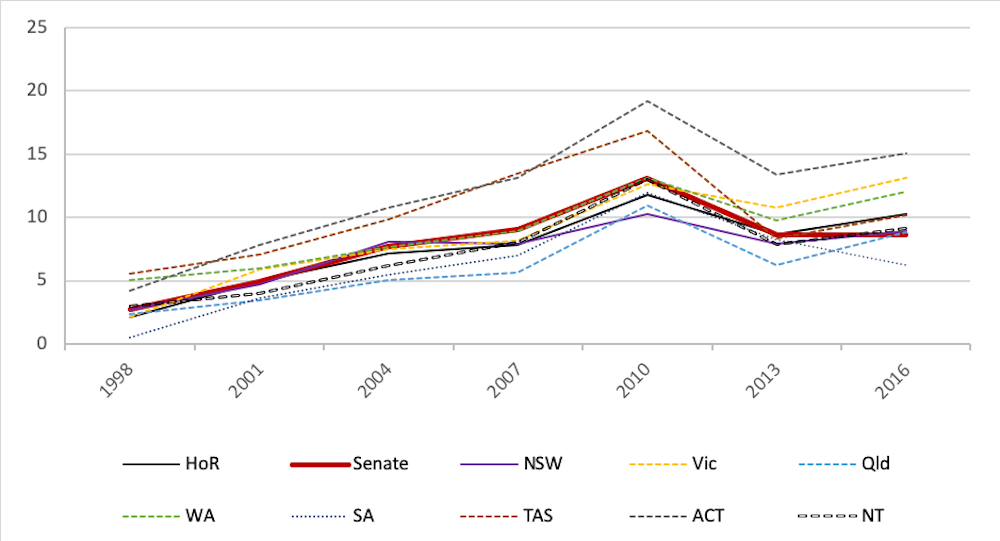
Federal voting data support Di Natale’s assessment about the arc of the party’s electoral performance. As the table below shows, the Greens’ primary vote in the House of Representatives (solid black line) and in the Senate (solid red line) has been broadly trending upwards since 1998.

Greens’ primary vote 1998-2016. Author provided

But when you compare the party’s support at the state and territory level, then it becomes apparent that the strength of the Greens’ vote is mixed. The Greens poll consistently strongly in Victoria, Tasmania, Western Australia and the ACT. However, in the case of the ACT, the territory’s constitutional status means the Greens are unable to convert their support into Senate representation.

In other states, the party has experienced some difficulty in gaining a comfortable footing, even if it does manage to elect senators. South Australian voters support non-major party candidates but have tended to prefer other vehicles, such as the now (mostly) defunct Australian Democrats and more recently the Nick Xenophon Team (now Centre Alliance).

A similar pattern is apparent in Queensland, but in this case much of the momentum for minor parties is behind right-tending parties, such as Katter’s Australia Party, the United Australia Party and One Nation. In NSW, the party’s support tends to run hot and cold.

What does this mean?

The degree of electoral support for minor parties (and independents), such as the Greens, is typically contingent on the electoral health of the major parties and the number of other non-major parties in the field.

An electorally diminished Labor is generally helpful for boosting the Greens’ primary vote. For example, at the 2010 federal election, the collapse in Labor’s primary vote (-5.40%) coincided with a spike in the Greens vote (+3.97%).

If Labor’s electoral malaise presents an opportunity for the Greens then a Labor recovery can limit the Greens’ growth prospects. In 2016, as Labor showed signs of electoral recovery (+1.34%), the Greens were able to achieve only modest growth in their primary vote. Although the Greens did increase their share of the vote (+1.58%), it was not enough to return it to their 2010 levels.

Even then, the 2013 election suggests there might be limits to the Greens’ ability to profit from swings against Labor. At this election, both parties suffered a swing against them, an outcome attributed to the parliamentary alliance/agreement that the two parties entered into following the 2010 election. What this suggests is that disgruntled Labor voters are probable but not “sure bets” for the Greens.
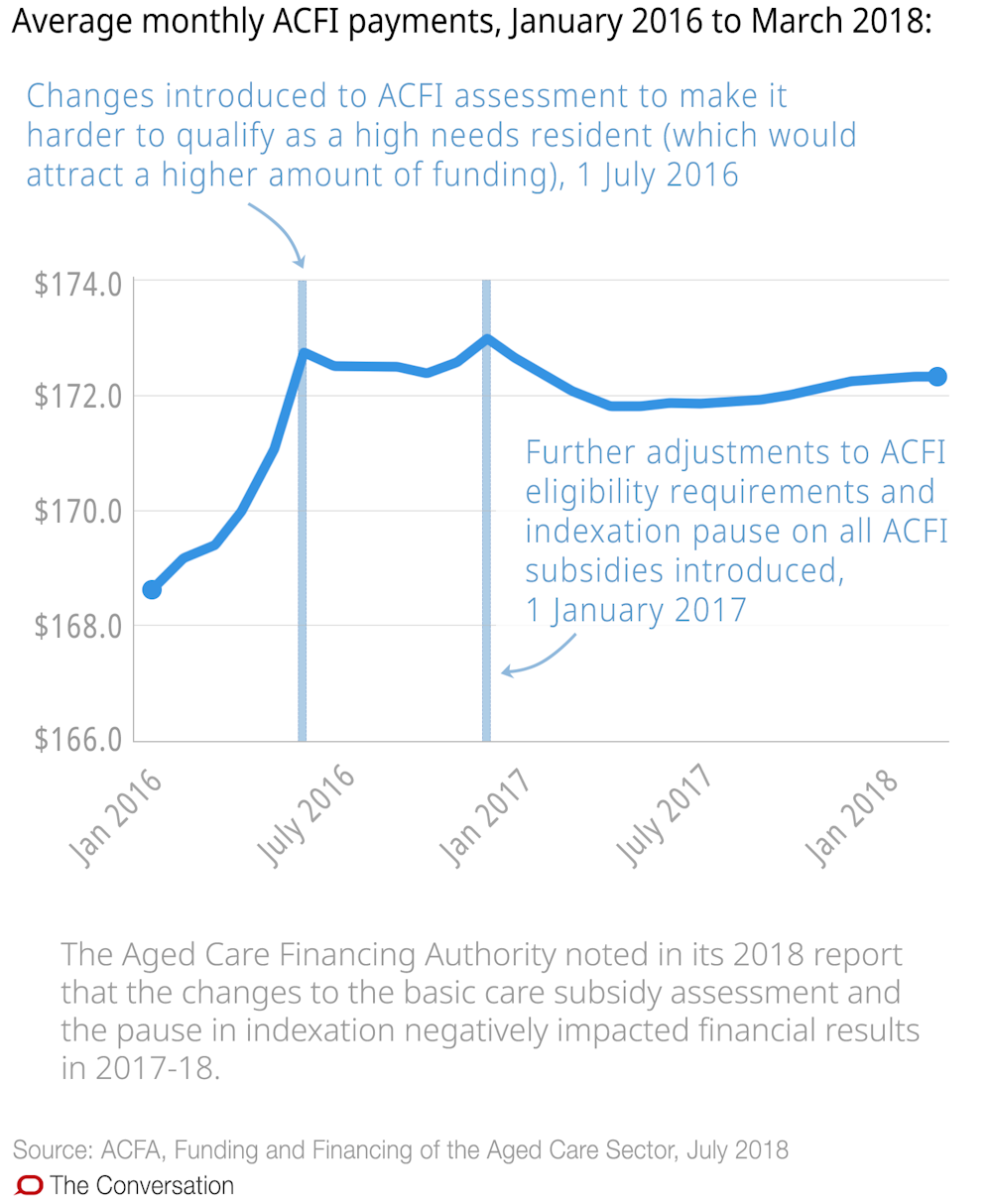
What might the Greens expect from the 2019 federal election?

It’s important to acknowledge that the above analysis frames the Greens’ gains and losses in relation to Labor’s electoral performance, which is only a part of the story. But it does point to the fact that the Greens’ ability to achieve a double-digit share of the national vote might depend on Labor crashing out, which is not supported by the polling in 2019.

Nevertheless, even if the Greens attain only a 9% share of the primary vote, this is likely to result in them retaining some of the six Senate vacancies they are defending. According to election analyst William Bowe:

Senate contenders will need something approaching 6% to be competitive, and around 8% to feel entirely confident.

Moreover, most analysts agree that Adam Bandt will retain Melbourne. His prospects were further strengthened when his Labor opponent quit after historical social media posts came to light.


Read more: Poll wrap: Labor’s Newspoll lead falls to 51-49 on dubious assumptions as Palmer and Coalition do a deal


And while high-profile Greens challengers, such as Julian Burnside in Kooyong, are not expected to win the lower house seats they are contesting, they do complicate the contest, particularly in those seats where there is no incumbent. Major party candidates in most inner metropolitan seats can never feel entirely relaxed when a high-profile Greens candidate enters the race.

Given that the Greens’ underlying primary vote is stable, even if not spectacular, it should be sufficient to ensure the Greens are returned as important players to the Senate.

ref. Greens on track for stability, rather than growth, this election – http://theconversation.com/greens-on-track-for-stability-rather-than-growth-this-election-116295

Avengers: Endgame and why a smaller population doesn’t guarantee paradise

Source: The Conversation (Au and NZ) – By Chelsea Mullens, PhD candidate in the School of Ecosystem and Forest Sciences, University of Melbourne

In Avengers: Endgame, the highly-anticipated 22nd film in the Marvel franchise, Earth’s mightiest heroes contend with the repercussions of supervillain Thanos wiping out half of all life in the universe with the snap of his fingers.

But did he need to? Not exactly. When setting the events of Endgame in motion during Avengers: Infinity War, Thanos said:

It’s a simple calculus. This universe is finite, its resources finite. If life is left unchecked, life will cease to exist. It needs correction.

Thanos turns half of all life into dust. But according to the study of resource management and geography, population reduction does not necessarily solve the problem of resource scarcity.

Avengers: Endgame Official Trailer.

Read more: Avengers: Endgame exploits time travel and quantum mechanics as it tries to restore the universe


‘Relative abundance’

When Thanos snapped his fingers, he performed what 18th century scholar Thomas Robert Malthus called a “positive check” on the population. Positive checks, like Thanos’s snap, increase the death rate to reduce population to a sustainable level.

Malthus argued that population collapse and environmental degradation occurred when there were too many people and not enough food. This is when positive checks – such as famine, plague, war, and natural disaster – would occur.

However, he argued that, once population size fell, strain on the environment eased, and population would increase to suit the amount of available resources .

Thanos assumed that halving population size would solve resource over-exploitation. But according to Malthus, as resources suddenly become abundant, the population of 3.5 billion people at the start of Endgame would inevitably grow again.


Read more: A country can never be too rich, too beautiful or too full of people


The politics of distribution

Thanos also overlooked the influence of social, political, and economic processes on access to resources – known as the “distributional” argument for explaining resource scarcity.

Average global supply of food exceeds the minimum dietary energy requirement globally, which shows that the world can produce enough food, but that food isn’t reaching everyone who needs it. Uneven access – rather than overpopulation – is the problem.

When explaining his reasoning, Thanos noted that the snap would be “at random, dispassionate, fair to rich and poor alike”.

However, removing half of everyone who is rich and poor doesn’t address the underlying reasons for wealth inequity. The disparities which created inequitable distribution of food and other resources will persist, and the same patterns of resource use and access are likely to continue.

Supervillain Thanos assumed that halving the population of the universe would create a better world. Marvel Studios/IMDB

Read more: How to feed a growing population healthy food without ruining the planet


Similarly, a “political ecology” perspective argues that those with the greatest economic and political power often get to control how the environment is used, and how resources are distributed, typically at the expense of disadvantaged groups.

We see this in the ongoing civil war in Yemen, where fighting has blocked aid shipments, food prices have doubled, and food has been stolen by those with greatest access to resources.

Food insecurity and hunger among marginalised populations can occur even within affluent, industrialised societies.

In some Indigenous communities in Australia, for example, traditional diets and methods of food production and gathering have been replaced with processed foods popular on globalised markets, which often offer lower quality diets. To counter such detrimental forces of globalisation, many Indigenous communities are shifting focus back to traditional practices.

Creating paradise?

In Endgame, our heroes find that the underlying challenges which created the conditions for resource overuse persist. There might be whales in New York Bay because there are fewer ships, as Captain America notes, but Hawkeye (the archer and one of the original Avengers) is still fighting systems that generate injustice and exploitation in Tokyo.

Today, there are plenty of scholars working alternative solutions to resource scarcity, imagining a world that is sustainable for everyone.

Instead of halving the population, for example, Thanos could have created a universe built on local food production.

Or, he could have made each planet in the universe a series of circular economies, which minimise waste by maintaining, reusing, recycling, and remanufacturing resources.

All energy could have instantly been produced by low carbon sources within sustainable energy grids and power infrastructure.

Or the universe could have been reshaped to exist within the safe and just space for humanity, in which we would exert enough pressure on the earth for everyone to live free of poverty, while keeping resource use within planetary boundaries to prevent overexploitation of those resources.

Surely this could get us closer to the paradise Thanos envisioned than a terrified planet with half as many people and just as many issues.

ref. Avengers: Endgame and why a smaller population doesn’t guarantee paradise – http://theconversation.com/avengers-endgame-and-why-a-smaller-population-doesnt-guarantee-paradise-116070

After a dark decade for Australia’s regional newspapers, a hopeful light flickers

Source: The Conversation (Au and NZ) – By Steinar Ellingsen, Senior Lecturer in Journalism, Communication and Media, University of Wollongong

Over the past decade the profits of 160-odd regional and rural publications that make up the former Fairfax business division known as Australian Community Media (ACM) have fallen steeply.

In 2012 the division made a A$169 million profit. In 2018 it was A$67.5 million.

Nine Entertainment Co acquired the division with its $3 billion takeover of Fairfax Media last year. It has been keen to get rid of it ever since.

There are grounds for some optimism about the long-anticipated sale. It may signal better fortunes for regional publishing. But any optimism must be tempered by ongoing concerns about the viability of the local news business model.

What’s in the deal?

ACM’s new owner is a 50:50 partnership between real estate advertising mogul Antony Catalano and Thorney Investment Group. They are paying Nine A$125 million for the 160-odd mastheads and 130 associated websites. The deal involves Nine getting $10 million of advertising space, and content and printing sharing arrangements for a period of time.

Thorney Investment Group has established itself over the past 25 yeas as one of the most profitable investors in Australian property and resources. Its foray into local news may appear somewhat peripheral to its general investment profile, despite an ongoing investment in Domain, Fairfax’s real estate brand, which was listed as a separate entity on the Australian Stock Exchange in 2017.

Catalano, on the other hand, has a long and colourful history with Fairfax’s real estate classifieds business. He is expected to chair the new company.

A one-time property editor at The Age, he was made redundant in 2008 and went on to found, with the backing of major real estate brokers, the free property magazine The Weekly Review.

The magazine took off, winning business away from The Age’s real estate pages. In 2011 Fairfax bought half of Catalano’s Metro Media Publishing business for A$35 million. It bought the other half in 2015 (for A$72 million). It then merged the business with Domain, putting Catalano at the helm.

He left his role with Domain in January last year, just two months after its successful listing on the Australian Stock Exchange. Reportedly his resignation came amid complaints of a party-boy culture in the Domain workplace.

Fairfax Media shareholders voted to spin off the Domain real estate listings business from the news publisher in November 2017. Brendan Esposito/AAP

Catalano’s successful bid for Domain is a particular coup. He attempted to thwart Nine’s takeover bid of Fairfax at the 11th hour by proposing to buy 19.9% of Fairfax shares.

Bidding against him and Thorney were private equity giants Anchorage Capital Partners and Allegro Funds. Seven West’s regional TV affiliate, Prime Media Group, and News Corp were also rumoured to have been interested.

Changing priorities

A few months ago Crikey labelled ACM’s impending sale a “blueprint for disaster” regardless of who won the bid, describing closures and consolidation of some local papers as “almost certain”.

Catalano, on the other hand, has talked up the potential of the larger daily regional mastheads. These include The Canberra Times, The Newcastle Herald, The Border Mail (based in Albury), The Illawarra Mercury (in Wollongong), The Ballarat Courier, The Examiner (in Launceston), and the Bendigo Advertiser. Between them, these papers reach about half ACM’s total audience of up to eight million people.

Catalano says he is looking to invest “aggressively” in these areas.


Read more: Why restoring accuracy will help journalism win back credibility


Without offering much detail, he has intimated there were ways to monetise ACM’s audience that didn’t happen under Fairfax, due to it having “bigger priorities in the face of very significant structural decline in the newspaper business”.

“Under us, it’s our only priority,” he said.

However, when pushed on whether there would be efficiencies, including redundancies and closures, he conceded there was likely to be some “consolidation” in print operations.

Such consolidation might echo Fairfax’s 2017 merger of six Western Sydney suburban newspapers into a single North West Magazine.

The state of local journalism

It would be naive to be overly hopeful about a new dawn for regional newspapers given the broader context of the Australian news industry.

According to the journalists’ union, the Media Entertainment and Arts Alliance, at least 3,000 journalism jobs have been lost since mass redundancies began about seven years ago. Cutbacks, the union says, have seen “rural and regional audiences lose their “voice” and their access to local information”.

At the regional daily with the largest readership, The Newcastle Herald, the editorial staff has been cut from about 100 to less than 24.


Read more: What a local newspaper means to a regional city like Newcastle


Workloads have escalated in consequence. Veteran journalist and union rep Ian Kirkwood told ABC’s Media Watch that journalists, perhaps once expected to produce one or two news stories a day, were now required to produce six, including headlines and photographs.

The New Beats study, a comprehensive longitudinal study of redundancies in Australian journalism since 2012, calculates the total revenue of Australian newspapers fell from A$6.2 billion in 2007-08 to A$3 billion in 2016-17.

The New Beats researchers say the “market failure of regional journalism” is that local advertising is simply insufficient to make a local newspaper financially viable. How Catalano is going to change that, given his stated opposition to paywalls, is an open question.

But given the unrelenting bad news faced by newspaper newsrooms over the past decade, it’s no surprise journalists are hoping for the best. The ABC reports that sources within the Canberra Times regard the deal as the best of available options. The Media Entertainment and Arts Alliance has expressed cautious optimism, tempered by concerns investment in the larger regional mastheads will come at the expense of smaller publications.

Only time will tell whether it is the hopes or the fears that are the most prophetic.

ref. After a dark decade for Australia’s regional newspapers, a hopeful light flickers – http://theconversation.com/after-a-dark-decade-for-australias-regional-newspapers-a-hopeful-light-flickers-116359

Poll wrap: Newspoll and Ipsos have contrasting leaders’ ratings trends; Abbott trails in Warringah

Source: The Conversation (Au and NZ) – By Adrian Beaumont, Honorary Associate, School of Mathematics and Statistics, University of Melbourne

With 12 days until the May 18 election, this week’s Newspoll, conducted May 2-5 from a sample of 1,880, gave Labor a 51-49 lead, unchanged since last week. Primary votes were 38% Coalition (steady), 36% Labor (down one), 9% Greens (steady), 5% One Nation (up one) and 4% for Clive Palmer’s United Australia Party (UAP) (down one).

An Ipsos poll, conducted for Nine Newspapers May 1-4 from a sample of 1,207, gave Labor a 52-48 lead, a one-point gain for the Coalition since the post-budget Ipsos in April. Primary votes were 36% Coalition (down one), 33% Labor (down one), 14% Greens (up one), 5% One Nation (steady) and 3% UAP (not previously asked). As usual, Ipsos has the Greens far too high and Labor too low.

Respondent allocated preferences in Ipsos were also 52-48 to Labor. Ipsos has had no difference between respondent and previous election preferences since Scott Morrison replaced Malcolm Turnbull as PM. Rounding probably also assisted the Coalition.

The Poll Bludger’s BludgerTrack currently gives Labor a 51.9-48.1 lead and 84 of the 151 seats. BludgerTrack is adjusting One Nation preferences to 60-40 to the Coalition, but not UAP preferences. Analyst Kevin Bonham’s aggregate is 51.8-48.2 to Labor by pure last election preferences, but 51.4-48.6 with a One Nation adjustment.

In Newspoll, 44% were satisfied with Morrison’s performance (down one), and 45% were dissatisfied (also down one), for a net approval of -1. However, Bill Shorten’s net approval tanked six points to -18, his worst since February. Morrison led Shorten by 46-35 as better PM (45-37 last week).

In Ipsos, leaders’ ratings moved in Labor’s favour. 47% approved of Morrison’s performance (down one) and 44% disapproved (up five), for a net approval of +3, down six points. Shorten’s net approval was up four points to -11. Morrison led Shorten by 45-40 as better PM (46-35 in April).

If we compare this Newspoll to the post-budget Newspoll for a better comparison with Ipsos, Morrison’s net approval is down three points, Shorten’s is down four, and the better PM is unchanged. So even compared to the last time both pollsters were in the field, there is considerable difference in the leaders’ ratings trends.


Read more: Post-budget poll wrap: Coalition gets a bounce in Newspoll, but not in Ipsos or Essential


These leaders’ ratings changes are important as they are indicative of which side is winning the policy arguments. The movement to Labor on all these measures in Ipsos is encouraging for them. If Ipsos is correct, Labor is likely to win the election comfortably.

The drop in Shorten’s Newspoll ratings appears to indicate that Coalition attacks on Labor’s abolition of franking credit cash refunds policy, and on economic costs associated with Labor’s climate change policy, are having an impact. If Newspoll trends continue, the Coalition is a reasonable chance of winning the election.

If the Coalition won partly through attacks on the economic costs of Labor’s climate change policy, it is likely to be a disaster for global action on climate change. Whoever wins the US Democratic presidential nomination will very likely need a strong climate change policy, and Donald Trump will be able to attack this policy in the same way the Coalition is attacking Labor. So using this template, Trump could also be re-elected.

Regarding Newspoll’s decision to assign 60% of UAP preferences to the Coalition, Bonham says that Newspoll has adjusted some preferences in favour of the Coalition, but there has been no preference adjustment to favour Labor. Without Turnbull, Greens preferences could be a bit better for Labor, and many independents are running on climate change issues, so the remaining Others could be more Labor-friendly.


Read more: Poll wrap: Labor’s Newspoll lead falls to 51-49 on dubious assumptions as Palmer and Coalition do a deal


Seat polls of Cowan, Pearce, Swan and Warringah

YouGov Galaxy polls of three WA marginal seats – Cowan, Pearce and Swan – were conducted for The Sunday Times on May 1 from samples of 500-530. In Cowan, Labor led by 51-49 (50.7-49.3 at the 2016 election). In Pearce, the Liberals led by 51-49 (53.6-46.4 in 2016). In Swan, the Liberals led by 51-49 (53.6-46.4 in 2016). Note that seat polls are unreliable.

Primary votes in Cowan were 41% Labor, 40% Liberals, 6% Greens, 4% One Nation and 4% UAP. In Swan, primary votes were 44% Liberals, 37% Labor, 11% Greens, 4% UAP and 1% One Nation. In Pearce, primary votes were 40% Liberals, 35% Labor, 11% Greens, 5% One Nation and 2% UAP.

Newspoll, which is conducted by YouGov Galaxy, polled Pearce on April 20. Primary vote changes since that Newspoll were Liberals steady, Labor down one, Greens up three, One Nation down one and UAP down six. All Others are at 7%, which is more credible than the 2% in that Newspoll.


Read more: Poll wrap: Palmer’s party has good support in Newspoll seat polls, but is it realistic?


In Pearce, voters believed action on climate change is more important than detailed costings by a 53-42 margin. There were similar margins in Swan (49-38) and Cowan (52-38).

The Sun-Herald reported that a Lonergan poll of Warringah for GetUp, conducted May 1 from a sample of 805, gave independent Zali Steggall a 56-44 lead over incumbent Tony Abbott. The only primary vote reported was Abbott’s at 38%, down from 51.6% in 2016.

Once nominations close, disendorsed candidates still appear on ballot paper

There have been some cases this election in which a major party candidate was disendorsed for embarrassing material. Nominations closed on April 23, and were declared on April 24; after this date the ballot paper cannot be changed. Even though she has resigned as the Liberal candidate for Lyons, Jessica Whelan will still be listed on the ballot paper as the Liberal candidate.

In 1996, Pauline Hanson was disendorsed as the Liberal candidate for Oxley, but began her political career by winning that seat. Disendorsement has no impact on the vote count.

47.6% of enrolled voters are aged 50 or over

In April I wrote that, from the ABS 2016 Census, those aged 50 and over represented 43.7% of all eligible voters. However, the population has aged since then, and enrolment rates are higher with older people than younger. Those aged 50 and over were 47.6% of the final electoral roll.


Read more: Poll wrap: Labor maintains its lead in Newspoll, while One Nation drops; NSW upper house finalised


Those aged 18-34 were 26.7% of voters, and those aged 35-49 were 25.7%. In the Newspoll breakdowns I referenced in the April article, younger people were strong for Labor, so the higher proportion aged 50 or over is good news for the Coalition.

Analyst Peter Brent has a graph showing the ageing of enrolled voters in 2019 compared to the 2016 election.

The polls below were conducted the weekend before last.

Essential: 51-49 to Labor

Last week’s Essential poll, conducted April 24-29 from a sample of 1,010, gave Labor a 51-49 lead, a one-point gain for the Coalition since the post-budget Essential. Primary votes were 39% Coalition (up one), 37% Labor (up two), 9% Greens (down two) and 6% One Nation (up one). There was no separate UAP vote reported, with all Others at 9% (down one).

In this poll, Labor gained two points on primary votes and the Coalition gained one, but the reduction in Greens preferences from their two-point drop hurt Labor after preferences. Essential still uses 2016 preference flows, and The Poll Bludger estimated this poll would be 51.9-48.1 to Labor from the unrounded primary votes. Rounding contributed to the result.

Although voting intentions moved to the Coalition, better PM moved to Shorten. He trailed Morrison by 40-31 (44-31 in early March). Morrison led Shorten on most of Essential’s personal relatability measures.

Voters thought Labor would win the election by a 59-41 margin. 40% said health care was very important in deciding their vote, followed by national security on 35%, economic management on 33%, jobs and education both on 31%, tax on 28%, the environment and climate change both on 26%, immigration on 25%, housing on 24% and infrastructure on 22%.

19% said they had paid no attention to the election campaign, 29% a little attention, 33% some intention and 20% a lot of attention. 56% said they would vote on election day, 21% would pre-poll vote and 12% would vote by post. There was little difference by party on this question despite the greater use of postal voting by Coalition voters.

Morgan poll: 51-49 to Labor

Roy Morgan research has been conducting face-to-face polling every weekend for a long time, but the results are only occasionally released. Such releases have tended to occur when the poll is good news for the Coalition.

The Morgan poll has had the most dramatic recovery for the Coalition. Labor led by 55-45 before the budget, but the lead was reduced to 52.5-47.5 in the post-budget Morgan poll. In polling conducted over the Easter weekend (April 20-21), Labor’s lead fell to 51-49, and that result was repeated the weekend before last. The latest Morgan poll was conducted April 27-28 from a sample of 826.

Primary votes in the latest Morgan were 39.5% Coalition, 36% Labor, 9.5% Greens, 2.5% One Nation and 2% UAP. Bonham says Morgan skews against politically incorrect parties like One Nation and the UAP, and in favour of nice-sounding minor parties.

Prior to the 2013 election, Morgan regularly published face-to-face results, and they would always skew to Labor. However, the Coalition has been assisted in this poll by no longer being seen as the most right-wing party.

Seat polls of Sturt and Braddon

A YouGov Galaxy poll of the SA seat of Sturt for The Advertiser, conducted April 24 from a sample of 504, gave the Liberals a 53-47 lead over Labor (55.4-44.6 at the 2016 election after a redistribution). Primary votes were 42% Liberals, 35% Labor, 9% UAP and 6% Greens. Sturt was formerly held by Christopher Pyne.

A ReachTEL poll of the Tasmanian seat of Braddon for the Australian Forest Products Association, conducted April 29 from a sample of 861, gave the Liberals a 51-49 lead (51.7-48.3 to Labor at the 2016 election after a redistribution). Primary votes, excluding 4.5% undecided, were 40.0% Liberals, 35.1% Labor, 6.6% Greens, 5.5% UAP and 3.7% Nationals. This poll was taken before the resignation of Jessica Whelan as the Liberal candidate for Lyons.

NSW election final result: 52.0-48.0 to the Coalition

At the New South Wales election held on March 23, the ABC’s Antony Green says the Coalition won the lower house two party vote by a 52.0-48.0 margin, a 2.3% swing to Labor since the 2015 election. Final primary votes were 41.6% Coalition (down 4.1%), 33.3% Labor (down 0.8%), 9.6% Greens (down 0.7%) and 3.5% Shooters, Fishers & Farmers. The Coalition won 48 of the 93 lower house seats, a three-seat majority.

ref. Poll wrap: Newspoll and Ipsos have contrasting leaders’ ratings trends; Abbott trails in Warringah – http://theconversation.com/poll-wrap-newspoll-and-ipsos-have-contrasting-leaders-ratings-trends-abbott-trails-in-warringah-116413

Curious Kids: what is brain freeze?

Source: The Conversation (Au and NZ) – By David Farmer, Researcher, University of Melbourne

Curious Kids is a series for children. If you have a question you’d like an expert to answer, send it to curiouskids@theconversation.edu.au You might also like the podcast Imagine This, a co-production between ABC KIDS listen and The Conversation, based on Curious Kids.

What is brain freeze? – Question from the students of Ms Young’s Grade 5/6 class, Baden Powell College, Victoria.

Australia had one one of its hottest summers on record this year (thanks, climate change, thanks a lot). Many of us probably gobbled up an ice cream and perhaps too quickly.

After doing this, you may have been unlucky enough to get an intense squeezing or stabbing sensation on your forehead, your temples or the back of your head. This is brain freeze, also known as an “ice cream headache”.

“So” you say, feeling smart, “brain freeze is just a kind of headache! I already know all about those”.

You are, of course, correct. But brain freeze is a bit weird. While it’s true that you do put ice-cream inside your head to eat it (your mouth is technically part of your head), you don’t typically put it into the parts of your head that hurt when you experience brain freeze. To put ice-cream into your forehead or temples would be a very weird surgical procedure that I do not advise you to try at home or anywhere else. It’s also hard to imagine a situation in which it would be medically necessary so it seems unlikely that it would be available on Medicare.

So why do your forehead and temples (or even the back of your head) hurt when you put ice cream in your mouth too fast?

There are several different ideas as to why, but the answer definitely has something to do with what happens when we cool down the roof of our mouth.

When you cool down the roof of your mouth, the coldness is picked up by nerve cells that live there and whose job it is to detect cold. This information about coldness is sent to your brain via a nerve. When the roof of your mouth is very cold, these cells (and so this nerve) will be very active.

Now, this nerve also contains information from other cells, including the ones that detect cold and painful stimuli from other parts of your head, including your very face.

It may be (we’re honestly not sure) that when the cells that sense cold in the roof of your mouth are very active, this somehow also activates the bits of the brain that are usually activated by the face cells. As a result, the cold fools your brain into thinking that your forehead hurts.

Another possibility is that, as delicious icy treats quickly cool down our tongues and mouths, it actually cools the blood in blood vessels that supply blood to your head. These blood vessels respond by changing how much blood flows into your brain. Only a few scientists have actually tried to measure this, and those that have don’t even agree about whether there is more or less blood going into your head. Everyone, however, agrees that it hurts.

It may be some combination of these two things: that activation of nerves causes a change in how much blood is going into your head. It might even be both things together!

Why don’t we know how brain freeze works?

Here’s the thing about science: “what is brain freeze” is a fantastic question for a curious scientist to ask, but to get the answer, scientists need to convince other people (politicians, other scientists and members of the public) that they should be given the time and money to answer that question.

Unfortunately, the availability of time and money are not as boundless as the curiosity of scientists.

The result of all this is that sometimes, simple and beautiful questions like “what is brain freeze?” don’t get as much attention as other questions that might seem more pressing.

Instead, these beautiful questions fall away, like a scoop of ice cream loosened by an enthusiastic but careless scientist who may not have the time or resources to investigate brain freeze in the lab, but excitedly discusses it with a friend over an ice cream anyway. My advice? Stay curious. Eat ice cream. Slowly.


Read more: Curious Kids: If Australia is at the bottom of the world, why are we the right way up?


Hello, curious kids! Have you got a question you’d like an expert to answer? Ask an adult to send your question to curiouskids@theconversation.edu.au

CC BY-ND

Please tell us your name, age and which city you live in. We won’t be able to answer every question but we will do our best.


Read more: Curious Kids: If Australia is at the bottom of the world, why are we the right way up?


Hello, curious kids! Have you got a question you’d like an expert to answer? Ask an adult to send your question to curiouskids@theconversation.edu.au

CC BY-ND

Please tell us your name, age and which city you live in. We won’t be able to answer every question but we will do our best.

ref. Curious Kids: what is brain freeze? – http://theconversation.com/curious-kids-what-is-brain-freeze-112774

View from The Hill: Lots of ministry spots to fill if Morrison wins, while many Shorten ministers would return to a familiar cabinet room

Source: The Conversation (Au and NZ) – By Michelle Grattan, Professorial Fellow, University of Canberra

Jumping beyond May 18, we know a good deal more about how a Shorten government ministry would look than the shape of a re-elected Morrison government.

A rash of ministers quitting politics at the election has left some significant holes to be filled if the Coalition managed to hang on.

This would provide opportunities for up-and-comers, but it raises a lot of questions about who’d be responsible for what. And that’s leaving aside the need to reshuffle some incompetents.

The loss of cabinet minister Kelly O’Dwyer means we don’t know who’d fill the key portfolio of jobs and industrial relations. Morrison would also be in search of a minister for women, a post held by O’Dwyer. Michaelia Cash second time round perhaps?

Indigenous affairs, which has been the responsibility of Nationals Senate leader, Nigel Scullion, would be vacant, as would human services and digital transformation, the outgoing Michael Keenan’s patch.


Read more: View from The Hill: Shorten presents the ‘case for change’ in sleek launch


Morrison has already nominated Linda Reynolds as defence minister if he wins – she’d replace Christopher Pyne, another retiree.

It was a promise driven by politics – Morrison wanted to promote a woman. When Steve Ciobo, who held defence industry, announced he was quitting, he stepped down from the ministry immediately, unlike most departees, who stayed until the election.

This enabled Morrison to elevate Reynolds from a parliamentary secretary into the defence industry job and cabinet (with the defence portfolio promise for later, if there was a later).

Morrison could then boast a record number of women (seven) for a federal cabinet.

If he wanted to retain that number he’d have to find another woman to replace O’Dwyer. One possibility would be Sussan Ley, now a parliamentary secretary, who previously served in cabinet (but is now fighting for her seat of Farrer against an independent challenger).

In a new Morrison government there would once again be women in both foreign affairs and defence, as was the case when Julie Bishop was foreign minister and Marise Payne defence minister. Payne would stay in her present foreign affairs post.

Pyne’s job of leader of the house, very important in managing tactics, would have to be filled. Maybe Christian Porter? (We can assume, in the event of a government win, it would be likely attorney general Porter and home affairs Minister Peter Dutton would have kept their seats.)


Read more: Up close and personal: Morrison and Shorten get punchy in the second leaders’ debate. Our experts respond.


If the Coalition hung on, presumably Michael McCormack would survive as Nationals leader, and consequently as deputy prime minister, despite the pressure he has been under.

The most obvious elevation to a Morrison cabinet would be Arthur Sinodinos, a one time cabinet minister who has only recently returned to parliament after a long illness.

Reshuffles are always unpredictable but it would be outrageous if environment minister Melissa Price were not moved. In the campaign she had been gagged and kept in the political equivalent of a dark room. One option would be to bring energy and environment together again under one minister.

A question mark is whether Morrison would give a cabinet spot to Tony Abbott (again assuming Abbott survived). Abbott would want defence – but that has been promised.

A notable feature of the campaign is that Morrison has had fewer frontbenchers at his appearances than has Bill Shorten. This is a function of gaps, poor performers, and the difficult fights some ministers are having in their seats, which are keeping them tied down.

A Liberal prime minister selects their frontbench team, with the exception of the Nationals, who are chosen by their own leader. The number of spots going to the Nationals depends on the proportion of seats they have. Portfolios are allocated by the PM, with some of those going to Nationals automatically, and others a matter of negotiation.

In Labor the factions get their allocations according to their proportions in the caucus, and choose their people. Shorten would have leeway to secure the odd “captain’s pick” in the factional line up.

If she wasn’t chosen on the right’s factional ticket, there’s no doubt Shorten would want Kristina Keneally in his ministry. She’s had a prominent role as “bus captain” in the campaign, and at press conferences.

The Labor leader chooses the portfolios. Shorten has already announced Pat Dodson would be his minister for Indigenous affairs (now he’s shadow assistant minister).


Read more: VIDEO: Michelle Grattan on candidate troubles – and pre-polling


The reason we know more about a post-election Labor ministry is that most of its occupants are already “shadowing” the jobs they’d hold. Chris Bowen pointed out recently that half of the shadow cabinet had been in the same roles for the past six years.

But while most “shadows” would slot into similar roles in office, there’d be some shuffling at the edges.

For example, who would be put in charge of home affairs? Defence spokesman Richard Marles would be an obvious choice, though he mightn’t want the switch.

Bowen has produced some interesting statistics about how experienced a Labor cabinet would be. If Labor were elected, “we would come into government with the most experienced incoming cabinet in 50 years,”‘ he told the National Press Club.

“When the Hawke government was elected, there were three cabinet ministers that had sat at the cabinet table previously. When the Howard government came to power in 1996 there were also three with prior cabinet experience.

“And with Labor’s victory in 2007, there were just two cabinet members who could draw on their experience sitting around the cabinet table.

“If Labor forms a government 16 out of 21 of us in the cabinet would have served at the cabinet level before.”

ref. View from The Hill: Lots of ministry spots to fill if Morrison wins, while many Shorten ministers would return to a familiar cabinet room – http://theconversation.com/view-from-the-hill-lots-of-ministry-spots-to-fill-if-morrison-wins-while-many-shorten-ministers-would-return-to-a-familiar-cabinet-room-116589

David Anderson’s appointment as ABC managing director is a relief and will further steady the broadcaster

Source: The Conversation (Au and NZ) – By Denis Muller, Senior Research Fellow in the Centre for Advancing Journalism, University of Melbourne

The appointment of David Anderson as managing director and editor-in-chief of the ABC is something of a relief.

It is an important early signal of how the new ABC chair, Ita Buttrose, is giving effect to her promise of bringing stability to the ABC after the chaotic events of last September in which the broadcaster lost both its chair, Justin Milne, and managing director Michelle Guthrie.

While nothing is known about the alternative candidates, quite a bit is known about Anderson.


Read more: Ita Buttrose’s appointment as new ABC chair a promising step in the right direction


He has 30 years’ experience with the ABC. Before being appointed acting managing director after Guthrie’s sudden sacking, he was responsible for all ABC radio music and broadcast television networks and for its on-demand products and services.

He seems to be well-regarded inside the organisation. The director of news, Gaven Morris, tweeted “order restored”. The comedian Shaun Micallef posted a YouTube video clip from one of his sketches, the making of which required human ballast to tilt the set on an angle. Anderson, he said, came down from his office and lent his heft to the task.

It can be safely anticipated that the ABC’s critics will see in this a cosy insiders’ choice designed to ensure the organisation remains self-referential in outlook and impervious to conservative influences.

It will be entertaining, in a droll kind of way, to see if epithets such as “the ABC collective”, “Trotskyite” and “sheltered workshop” get another run as they did when Russell Balding replaced Jonathan Shier after the latter’s chaotic reign came to an abrupt end in 2001.

Anderson’s appointment has many echoes of Balding’s. Balding too was an insider – he had been general manager of finance. He too was appointed following a chaotic reign and abrupt departure. He, too, was seen as a safe pair of hands who would restore stability, as indeed he did.

Like Balding, Anderson also inherits an ABC facing acute financial pressures and a recent history of hostility from the federal government.

However, a structural problem that was central to the way the Milne-Guthrie debacle played out is yet to be fixed.

That problem is the combining of the roles of managing director and editor-in-chief in the one person. Guthrie was hopelessly ill-suited by experience and inclination to be editor-in-chief. Anderson, whatever his other qualities, has no journalistic experience either.


Read more: ABC inquiry finds board knew of trouble between Milne and Guthrie, but did nothing


Mark Scott, who was editor-in-chief at the then Fairfax newspapers before being appointed managing director of the ABC, was exceptionally well qualified for both jobs. He has been reported as saying the chief executive of the broadcaster needs to embrace the editor-in-chief role. Scott said:

The chief executive is responsible for everything that goes to air and you cannot have a structure where finally the chief executive is not responsible.

While this is true, in most media organisations it is achieved differently. The editor-in-chief answers to the board through the chief executive; the board and chief executive answer to the shareholders – or, in the ABC’s case, to the government.

Moreover, under a structure like that, the editor-in-chief is not a board member and therefore is not a party to board decisions with the associated requirements of board solidarity.

In these two important ways, the editor-in-chief is shielded from becoming compromised, enabling him or her to make news decisions independent of corporate interests. It is called editorial independence and is the cornerstone of good journalism.


Read more: ABC inquiry finds board knew of trouble between Milne and Guthrie, but did nothing


Strong editorial leadership founded on independence liberates editors and journalists at every level to tell stories that matter to the public interest without looking over their shoulders fearful of politically inspired retribution.

There has never been a time in Australia’s modern history when there was a greater need for an editorially robust ABC.

In December 2018, Fairfax newspapers were swallowed up into the Nine entertainment conglomerate, with consequences for their editorial quality that are yet to be seen.

Fairfax controlled about 20% of metropolitan daily newspaper circulation in Australia.

News Corp, which controls about two-thirds of this circulation, has morphed into a hybrid of news service and political propaganda machine, its usefulness as a news provider declining in proportion as its propagandising mission has grown.

Fairfax’s regional newspapers were acquired last week by a former Fairfax journalist and corporate executive, Antony Catalano, along with a financial backer in the form of Thorney Investment Group.

While that provides Australia with some sorely needed diversity in media ownership, it is unlikely to have a significant impact on journalism at the national level.

Without a strong ABC news and current affairs service, the fourth estate of Australia’s democracy would be severely diminished.

The appointment of a new chair and a new managing director means that two of the three salient features of the ABC’s post-Milne landscape are in place.

The third is the composition of the board as a whole. The surviving members came out badly from the majority report of the Senate inquiry into political interference in the ABC, which was published in April.

The report found that the catalogue of events leading up to the sacking of Guthrie and the resignation of Milne “may give rise to the perception that the ABC Board had not been sufficiently active in protecting either the ABC’s independence from political interference or its own integrity”.

What, if anything, Buttrose does about that remains to be seen.

ref. David Anderson’s appointment as ABC managing director is a relief and will further steady the broadcaster – http://theconversation.com/david-andersons-appointment-as-abc-managing-director-is-a-relief-and-will-further-steady-the-broadcaster-116540

Nearly 2 out of 3 nursing homes are understaffed. These 10 charts explain why aged care is in crisis

Source: The Conversation (Au and NZ) – By Emil Jeyaratnam, Data + Interactives Editor, The Conversation

The Royal Commission into Aged Care Quality and Safety begins hearings on residential aged care facilities, or nursing homes, in Sydney today.

The standards of nursing homes in Australia have been in the public eye since the Oakden Aged Mental Health Care Service in Adelaide became embroiled in an elder abuse and neglect scandal, sparking reviews, inquiries and investigations across the sector. This was the most prominent of a series of incidents of abuse and negligence that eventually led to the establishment of a royal commission.

So what are the challenges facing nursing homes and why are they under so much strain?

How many Australians use aged care services?

In the 2017-18 financial year, more than 1.2 million Australians accessed some form of aged care service:


Residential care is the most resource-intensive category of aged care, providing higher level care to older Australians with complicated medical needs, those in the last years of life, and people who can no longer live independently in their own homes.


Read more: Don’t wait for a crisis – start planning your aged care now


How old are residents?

A large proportion of aged care residents are 90 and over. This reflects the increasing preference of older Australians to remain in their own homes longer, and only moving into residential care when home care is no longer adequate.


Why aren’t you guaranteed a place?

Australia has a relatively large proportion of older people, with more than 15% of the population aged 65 years or over, which has resulted in strong demand for aged care places.

In 2017-18, almost a quarter of a million Australians (241,723) were approved for residential aged care, but just over 207,000 places were available. This left a shortfall of 34,581 places.


The aged care provision ratio

The supply of home care packages and residential care places is determined using the aged care provision ratio. The ratio will increase from its current target of 113 subsidised care places for every 1,000 people aged 70 and over to 125 places by 2021-22.


Minimum staffing levels

A 2015 survey by Bentley’s Chartered Accountants estimated that residents received an average of 2 hours and 48 minutes of care per day. The Australian Nursing and Midwifery Federation recommends residents receive 4 hours and 18 minutes of care per day.

The aged care industry does not currently have regulation related to minimum staffing levels, with the exception of a small number of publicly owned aged care homes Victoria.


Read more: Want to improve care in nursing homes? Mandate minimum staffing levels


The workforce and skills shortage

The Productivity Commission estimated in 2011 the workforce will need to grow to about 980,000 by 2050 to meet the demand of aged care consumers. (And the population projections this estimate is based on have increased substantially since then, so this number may end up being significantly higher).

But providers are already finding it difficult to adequately staff nursing homes, with 64% of residential care facilities reporting shortages in 2016. And with employee costs representing 70% of the total expenses for residential care providers (an increase from 67% of total expenses in 2015-16), there is concern that residents will not be given proper care.


Residential care providers and their financial viability

There were 210,815 operational residential care places as at June 30 2018, an increase of about 24,500 places in the last five years. Over that time, the number of providers has decreased from 1,034 to 886, mainly due to consolidation.


While profits (before tax) have almost doubled since 2012-13, only 68% of providers reported a net profit in 2016-17 (compared to 69% in 2015-16). A survey of more than 970 residential care facilities found 45% of facilities had negative earnings (before tax) in 2018, an increase from 33% in 2017.


Funding for residential aged care

Residential aged care facilities require government funding as well as resident contributions to operate.

Government contributions accounted for 67.3% (A$12.4 billion) of total provider funding in 2017-18, the majority (89%) of which is made up of the basic care subsidy.

The subsidy is calculated for each resident based on their needs using the aged care funding instrument (ACFI). To care for a resident with high needs the provider will receive a larger subsidy.


ref. Nearly 2 out of 3 nursing homes are understaffed. These 10 charts explain why aged care is in crisis – http://theconversation.com/nearly-2-out-of-3-nursing-homes-are-understaffed-these-10-charts-explain-why-aged-care-is-in-crisis-114182

Why Labor’s childcare policy is the biggest economic news of the election campaign

Source: The Conversation (Au and NZ) – By John Daley, Chief Executive Officer, Grattan Institute

In an election campaign full of giveaways but short on serious economic reform, Labor’s proposed change to childcare support is the most important economic news.

It fits in with this year’s Grattan Institute Commonwealth Orange Book, which identified getting more women into the workforce as one of the most valuable things the next government could do.

Female participation in the labour force is lower in Australia than in similar countries. It is particularly low for women working full-time.

That’s because motherhood hurts female participation more in Australia than in other countries. Before having children, Australian women are just as likely to work as men. On having children, many drop out of work and some never go back. Those who do return often pay a career penalty.

Childcare is the biggest barrier to work

Childcare is the highest hurdle. When surveyed, more than 40% of Australian women who would like more work say caring for children and its cost are the main reasons they can’t take on more hours over the coming weeks.

Women with children get relatively little financial reward for entering the workforce, and even less for working more hours. Some find working more hours costs more than it pays.

They face high effective marginal tax rates because as they work more hours they lose more family and childcare benefits as well as paying more income tax. Factoring in the cost of childcare itself, some face costs exceeding 100% of what they earn.

Here the Coalition deserves some credit. Its previous reforms to the childcare subsidy helped reduce effective marginal tax rates.

But there’s still a long way to go, with many mothers still facing very high effective rates.

Effective tax rates make returning expensive

A woman in a low-income household still loses 85 to 95 cents of every extra dollar she earns if she increases her work days from three to four, or from four to five.

Even women in middle earning households face effective marginal tax rates near 80% if they move from four days paid work per week to five.

These effective marginal rates are much higher than the headline marginal tax rate paid by those earning more than A$180,000 per year, which is the focus of many who purport to be worried about the impact of tax rates on incentives to work.

Labor will make work pay better

Under Labor’s proposal, childcare will become free for families with incomes of up to $69,000 a year, up to the hourly cap of $11.77 an hour, or $141 a day.

Families on higher incomes will still have to pay some of their childcare costs, but less than they do today.


Child care subsidy per child in care per day, 2020-21

Assumes families pay for ten hours of childcare per day, at the hourly rate cap. Families earning between $194,000 and $365,000 (in 2020-21 dollars) are subject to an annual cap under the current child care subsidy. Source: Australian Labor Party, DSS

The savings per extra day worked would be substantial.

Consider a middle-income family with two children in childcare: a primary earner bringing in the average full-time wage of $95,103 in 2020-21, and the other choosing how many days to work in a week in a job that would pay the median full-time wage of $61,000.

Labor’s plan would increase the reward for working an extra day a week by about $1,260 a year.

It would give that second earner an extra 10 cents out of every extra dollar she earns.


Gross earnings less childcare costs net of subsidy if second earner works an extra day

Note: Primary earner on $95,102 a year; Secondary earner makes $12,200 a year for each extra day of work ($61,000 if working full time). Assumes families pay for ten hours of childcare per day, at the hourly rate cap. Source: Grattan analysis

Now consider a lower-income family with a primary earner on $50,000 a year and a secondary earner in a job that also pays $50,000 a year full time, again with two children in childcare.

Labor’s plan will boost the reward for working two days a week rather than one by around $1,784 a year. That worker would be keeping an extra 18 cents out of every extra dollar she earned. The change would be more than big enough to lead many families to make different decisions about work.

The change will be smaller when the second income earner goes from working four days a week to five, because the subsidy tapers out. For this low income family, Labor’s plan would boost the reward for working four days rather than five by only $421, a four cents in the dollar improvement.


Gross earnings less childcare costs net of subsidy if second earner works an extra day

Note: Primary earner on $50,000 a year; Secondary earner makes $10,000 a year for each extra day of work ($50,000 if working full time). Assumes families pay for ten hours of childcare per day, at the hourly rate cap. Cents saved are on pre-tax income. Source: Grattan analysis

Again, the change is a big deal.

These improvements in effective marginal tax rates are much larger than those offered by the actual tax plans of either major party.

And the empirical evidence also suggests women caring for younger children are more sensitive than others to effective marginal tax rates, and more likely to change their decisions about working if effective marginal tax rates change.

It means Labor’s childcare plan is likely to provide a bigger economic kick for each dollar spent than either of the two sides’ proposed tax cuts.

The policy isn’t perfect

Some aspects need more work.

Labor plans to cut the subsidy suddenly from 60% to 50% for families with incomes above $174,527. The cliff will distort incentives to work for some second earners, because they’ll instantly have to pay a lot more for childcare – around an extra $5,000 a year more – the moment their household income climbs a dollar over $174,527.


Read more: The budget’s dirty secret is the hikes in tax rates you’re not meant to know about


A better approach would be to gradually reduce the subsidy rate from 60% for incomes of $174,527 to 50% for incomes above $205,000.

Childcare centres could raise their fees

Labor will also have to be careful to ensure its higher subsidies don’t simply result in childcare centres jacking up their prices and providing little benefit to families.

The existing cap on childcare subsidies of $11.77 per hour will limit any childcare fee increases. But Australians paid an average of just $9.20 per hour in 2018.

If the subsidies are higher so that many families only pay a small fraction of the cost of childcare, childcare providers will be very tempted to increase their fees up to the cap, and perhaps further. Centres serving lots of low-income families – who in many cases will pay nothing for childcare – will be particularly tempted.

Labor says it will ask the Competition and Consumer Commission to crack down on fee increases and to find ways to control child care fee increases in future. But past attempts to use the ACCC to police prices, such as during the introduction of the goods and services tax and the carbon tax, have had mixed success.

But overall, it’s a large and worthwhile reform

But overall, much of the increased subsidy is likely to be passed on to parents.

While there are limits to how much governments can influence economic growth, there are some worthwhile reforms they can pursue.

With its new childcare policy, Labor has produced one of the best there is.


Read more: Grattan Orange Book. What the election should be about: priorities for the next government


ref. Why Labor’s childcare policy is the biggest economic news of the election campaign – http://theconversation.com/why-labors-childcare-policy-is-the-biggest-economic-news-of-the-election-campaign-116441

Six ways robots are used today that you probably didn’t know about

Source: The Conversation (Au and NZ) – By Jonathan Roberts, Professor in Robotics, Queensland University of Technology

How many times in the past week do you think your life was affected by a robot?

Unless you have a robot vacuum cleaner, you might say that robots had no real impact on your life.

But you’re wrong. Let’s take a look at some of the ways robots are being used right now but that you probably have no idea about.


Read more: Why R2D2 could be your child’s teacher sooner than you think


So what is a robot?

Before we start, we need to define what actually is a robot. There is no official definition of what constitutes a robot, but many roboticists (like me) consider it to be a machine that moves, or has moving parts, and that makes basic decisions while interacting with the world.

Hence, your vacuum cleaner that you leave to do its job while you are away is a robot. It senses the world around it and makes driving decisions as it sucks and sweeps.

But your washing machine is not a robot. You tell it how to wash when you select the cycle and it gets on with it. There are grey areas and the definition is debated, but let’s leave it there.

On to your past week.

Food sorting robots

If you eat rice, chances are that every grain you consumed was sorted by a robotic machine with a lightning-fast vision system.

Rice-sorting machines are miracles of automation and most people have no idea they exist. Did you actually think rice grows as uniformly (in colour and shape) as it appears in the bag you buy at the supermarket? It doesn’t.

Rice sorting by colour.

Every grain of rice passes through a robotic machine that uses very high-speed cameras, lights and a computer. The image of each rice grain is analysed by that computer and a decision is made as to its grade. Jets of air are turned on and off to steer or flick the grain into the correct bin. This happens hundreds of times per second.

In fact, rice is not the only food that is sorted by robots, and the food-sorting market is growing rapidly. Robotic machines are available to sort wheat, pulses and seeds.

Robots for medical training

Did you see a health care professional? If you did, you should have noticed if they were human or a robot. Chances are they were a human.

But did you know that many nurses, paramedics and doctors now train on robot patients.

Robot patients for training.

These training robots can simulate various conditions and give student health workers the ability to practice diagnosis and treatment of various conditions before they go near a real person. You can think of these robotic patients as being like the flight simulators that airline pilots use during their flight training.

Some of these medical training robots are life-sized and look like a real person, but some are more specialised and might be representative of just one part of a person.

A robot rectum in action.

Robots for police training

Have you been taken hostage in an armed robbery? I hope not. But if you were, and an armed response team from your police service attended, those police snipers that aimed their red laser dot at the criminals may have been trained using robots.

Sydney-based company Marathon Targets sells a range of highly capable mobile robots that can be shot at by military and police trainees. These robots are armour-plated (for obvious reasons) and can be used to simulate real people (targets) during live-fire training.

It’s okay to shoot these targets.

Robots for extracting poison

Did you take medication? If it’s medication to prevent malaria or suppress your immune system, those pharmaceuticals may have used scorpion venom as one of the ingredients.

It is quite obvious the extraction of venom from scorpions is quite hazardous to people, but the perfect job for a robot.

A robot that extracts venom from a scorpion.

Robots down the sewer

You must have used a toilet? Hopefully! We do not often think about our sewers, but when they go wrong, we certainly know about it.

Fatbergs have become a major problem in many cities around the world.

Sewer inspection and maintenance is more important than ever and dome inspection workers now have robots to help them with their difficult business.

Robots can be used to help inspect sewers.

Robots and your shopping

Did you go shopping or order anything online? Did you know that many items you buy are partially moved from where they are made to where you receive them by robots?

Some container ports are now partially automated. The huge containers are offloaded from ships by human operators controlling cranes.

But from then on, the containers are handled by giant robotic cranes on wheels – known as straddle carriers. They are moved around the port, stacked, unstacked, re-stacked, and once ready for transport, they are automatically loaded onto container-carrying trucks for road transport.

Many warehouses are also operated using mobile robots. The best-known example of warehouse automation is Amazon. The retail giant built many of its warehouses specifically for mobile robots that could autonomously transport shelf units.

Amazon felt the robots it used in its warehouses were so vital to its success that it bought the robot company that made them for USD$775 million in 2012.

Robotic warehouse workers.

The robot revolution is now

So that’s just six ways that robots may have affected you in the past week. Of course there are dozens more ways in which robots are likely to have affected your life; this list is just a taster.


Read more: Robots can learn a lot from nature if they want to ‘see’ the world


The point is that the so-called upcoming robot revolution that is often talked about in the media is already happening. It’s just that most people don’t notice.

And there’s more…

ref. Six ways robots are used today that you probably didn’t know about – http://theconversation.com/six-ways-robots-are-used-today-that-you-probably-didnt-know-about-82067

New Zealand’s well-being approach to budget is not new, but could shift major issues

Source: The Conversation (Au and NZ) – By Arthur Grimes, Professor of Wellbeing and Public Policy, Victoria University of Wellington

At the end of this month, New Zealand will release its first “Well-being Budget”. It builds on treasury’s Living Standards Framework (LSF), published last December, which introduced a suite of well-being measures, including cultural identity, environment, housing, income and consumption, and social connections.

To help interpret what this might mean for policy, I look at how well-being has been used as a guide for policy elsewhere.

Let’s first look at some prime ministerial words:

Wealth is about so much more than […] dollars can ever measure. It’s time we admitted that there’s more to life than money, and it’s time we focused not just on GDP, but on GWB – general well-being.

And some words from treasury:

The ultimate value of the well-being framework is that it improves the quality of Treasury’s policy advice to government, through helping to identify the important trade-offs for well-being, and providing a consistent basis for understanding their impact.


Read more: It’s time to vote for happiness and well-being, not mere economic growth. Here’s why:


The eagle-eyed will have noticed some words left out of the first quotation. They are “pounds, or euros or”. The quotation is from UK prime minister David Cameron, in 2006. The second is from the Australian Treasury in 2004, prepared during the Howard government. Its framework built on an Australian Bureau of Statistics (ABS) publication in 2001.

In introducing the LSF, the New Zealand Treasury stated:

There is more to well-being than just a healthy economy. That’s why the Treasury has developed its Living Standards Framework (LSF) – it helps us advise governments about how the policy trade-offs they make are likely to affect everyone’s living standards.

This is an amalgam of the Cameron speech and the Australian Treasury approach of the mid-2000s. Is there anything new in the New Zealand government’s approach that conservative governments in the UK and Australia had not already considered over a decade ago?

International well-being initiatives

There was another well-being initiative in France, based on the highly publicised Stiglitz-Sen-Fitoussi (SSF) report in 2009. That report, headed by Jean-Paul Fitoussi and Nobel laureates Joseph Stiglitz and Amartya Sen, was commissioned by French president Nicholas Sarkozy – again a conservative on the political spectrum. It recommended monitoring a broad list of indicators of well-being and sustainability to guide policy.

The UK well-being initiative died as a policy framework with the demise of David Cameron. But the Office of National Statistics has kept the UK’s well-being indicator framework alive. The Australian initiative was maintained by its treasury to inform policy considerations, but it never made it to the frontline of political debate.

The French framework is alive and well. A 2015 budget law requires the French government to report the evolution of new wealth indicators and to assess major reforms. Similar frameworks have been formally adopted as a basis for policy in several other countries.

New Zealand’s approach to well-being

The New Zealand approach is far from new, but it has some distinctive features. Most obviously, it addresses the well-being of New Zealanders rather than people elsewhere. The parallel Stats NZ well-being indicator framework, Indicators Aotearoa New Zealand (IANZ), includes a selection of measures of how New Zealand interacts with the well-being of the rest of the world.

The LSF bears close similarities to the OECD’s Better Life Index. The LSF dashboard comprises 38 indicators across 12 well-being “domains” and measurements of inequalities across different population groups for nine of those domains.


Shutterstock/The Conversation

Perhaps the most valuable contribution of the LSF has been to highlight differential aspects of well-being across population groups. For instance, on average, Māori perform more poorly compared to the rest of the population on almost every well-being domain. While we suspected this before, some other interesting findings emerge.

Take age, for instance. Treasury shows that while older people’s health is likely to be poorer than average (which is not surprising) they do better, on average, than the rest of the population on most other measures, including material well-being such as income, consumption and housing. Most do not require extra help from government, and they do not need the cash handout that was misleadingly labelled the “winter energy payment”.

How best to use well-being data

Most of the indicators included in both the LSF and IANZ already exist and have long been published by Stats New Zealand. My treasured 1903 (paper) copy of the New Zealand Official Yearbook contains over 750 pages of measures relating, inter alia, to well-being. For instance, it reports that there were 20 “lunatics” per 10,000 population in 1874, which rose to 34 by 1901, and that the proportion was higher among males than females.

For policy purposes, it’s not just what we measure but how we use it. While the treasury’s LSF follows a tried and true course internationally, its use has the potential to be novel. In his budget policy statement, finance minister Grant Robertson listed five priority areas for the “well-being budget”:

  • transitioning to a sustainable and low-emissions economy

  • boosting innovation, and social and economic opportunities in a digital age

  • lifting Māori and Pacific incomes, skills and opportunities

  • reducing child poverty, improving child well-being and addressing family violence

  • supporting mental well-being, with a special focus on under 24-year-olds.

It’s not clear how the minister arrived at these five priorities, but prioritisation in fiscal policy is a virtue. The last National government went through a similar exercise with its Better Public Services targets that aimed to reduce long-term welfare dependence, support vulnerable children, boost skills and employment and reduce crime.

The current government has insisted that “budget bids” by public sector agencies align with the five priorities. Even defence expenditures have been analysed as contributors to societal well-being. While we shouldn’t stretch the well-being policy framework too hard (or it may become a nonsense), the stated approach could see real progress in addressing issues at the heart of these priority areas.

The acid tests

There are two key tests. The first is whether the 2019 Well-being Budget provides meaningful fillips to the five priority areas. Ignoring the opaque way in which these priorities were derived, the process will have paid dividends if it succeeds in focusing policy attention on key areas requiring social and economic policy. For too long, budgets have spread largesse thinly over many policy areas, achieving little in any of them.

The second test is whether resources are freed up for the five priority areas by cutting poorly performing programs. The winter energy payment is one example. Interest-free loans to students from wealthy families is another.

A true well-being budget will target public programs and resources to where they have the greatest bang-for-buck and will cease support for programs that have low well-being payoffs. I expect a moderate pass mark for the first test, but will be (pleasantly) surprised if I see a pass mark for the second.

ref. New Zealand’s well-being approach to budget is not new, but could shift major issues – http://theconversation.com/new-zealands-well-being-approach-to-budget-is-not-new-but-could-shift-major-issues-116296

Sit! Seek! Fly! Scientists train dogs to sniff out endangered insects

Source: The Conversation (Au and NZ) – By Julia Mynott, Research Officer, Centre for Freshwater Ecosystems, La Trobe University

Three very good dogs – named Bayar, Judd and Sasha – have sniffed out the endangered Alpine Stonefly, one of the smallest animals a dog has been trained to successfully detect in its natural habitat.

The conservation of threatened species is frequently hampered by the lack of relevant data on their distributions. This is particularly true for insects, where the difficulty of garnering simple information means the threatened status of many species remains unrecognised and unmanaged.


Read more: How many species on Earth? Why that’s a simple question but hard to answer


In alpine areas there is a pressing need for innovative methods to better reveal the distribution and abundance of threatened insects.

Alpine regions rely on cool temperatures, and since climate change will bring warmer weather and lower rainfalls, insects like the Alpine Stonefly, which lives in the alpine freshwater system, will struggle to survive.

And while insects might not be appealing to everyone, they are extremely important for ecosystem function.

The Alpine Stonefly is under threat from climate change as they need rainfall and cool temperature to survive. Author provided (No reuse)

Traditional survey detection methods are often labour intensive, and hard-to-find species provide limited information. This is where the labrador, border collie and samoyed came to the rescue.

La Trobe’s Anthrozoology Research Group Dog Lab in Bendigo, Victoria have been training a pool of local community volunteers and their dogs in conservation detection to use with environmental DNA sampling. Using both environmental DNA and detection dogs has the potential to generate a lot of meaningful data on these threatened stoneflies.

For seven weeks in a special program, dogs were trained to memorise the odour of the Alpine Stonefly (Thaumatoperla alpina), a threatened but iconic insect in the high plains.

The dogs have previously been trained to sniff out animal nests or faeces but not an animal itself, so this was a new approach and an Australian first.

Sasha, a very helpful dog. Author provided (No reuse)

Stoneflies are hard to catch

The Alpine Stonefly are brightly coloured aquatic insects and are difficult to find, especially as larvae in water where they live as predators for up to two years in the streams on the Bogong High Plains, Mount Buller-Mount Stirling, Mt Baw Baw and the Yarra Ranges.

Bayar sniffs an Alpine Stonefly. Author provided (No reuse)

They often burrow underneath cobbles, boulders and into the stream bed while the adults only emerge from the water for a few months between January and April to reproduce.

With all this in mind, it’s easy to understand why traditional detection methods can be time consuming and often ineffective.

We predominately focused on the endangered Alpine Stonefly, found across the Bogong High Plains. Their restricted distribution and habitat made them an ideal candidate to trial detection dogs and environmental DNA techniques.


Read more: We need a bank of DNA from dirt and water to protect Australia’s environment


How dogs and environmental DNA help

We collected water samples from across the Bogong High Plains, Mount Buller and Mount Stirling with trace DNA, such as cells shed from the insect. The ability to quickly take these samples from a broad area to indicate the presence of a species is important to understand distribution. But this approach limits the amount of ecological information that is gathered.

Initial training introduced the dogs to the odour of the Alpine Stonefly in a controlled laboratory setting. Then they graduated from the laboratory to small areas of bushland to search for the insect.

Once the dogs successfully completed their training, it was time to trial the dogs in the alpine environment and survey Alpine Stoneflies in their natural environment.

The trial was conducted at Falls Creek with the dogs’ three volunteer handlers. And the surveys were successful, with all three dogs finding Alpine Stoneflies in their natural habitats.

Judd in conservation detection training. Author provided (No reuse)

So could this success be transferred to a similar species?

Absolutely. In preliminary trials, Bayar, Judd and Sasha detected the Stirling Stonefly, a related species of Thaumatoperla that lives in Mount Buller and Mount Stirling, suggesting detection dogs can transfer their conservation training from one species to another.

This is a great find as it means this technique can be used to survey yet another species of Thaumatoperla that lives in Mt Baw Baw and the Yarra Ranges.


Read more: It’s not worth wiping out a species for the Yeelirrie uranium mine


Our research is showing that these new sampling techniques supporting conservation are an important part of keeping biodiversity protected in alpine regions.

Now that we’ve successfully trained three dogs, we’re hoping to secure funding to conduct future and more thorough surveys on the Alpine and Stirling Stonefly, and eventually on the third species of stonefly.

By developing creative techniques to detect these species, we boost our ability to document them and, importantly, to protect them.

ref. Sit! Seek! Fly! Scientists train dogs to sniff out endangered insects – http://theconversation.com/sit-seek-fly-scientists-train-dogs-to-sniff-out-endangered-insects-116517

Almost every Australian teacher has been bullied by students or their parents, and it’s taking a toll

Source: The Conversation (Au and NZ) – By Paulina Billett, Lecturer, Sociology, La Trobe University

Teachers are bullied daily by parents and students. They experience the kind of harassment that would be deemed unacceptable in most workplaces. But, in the case of teachers, such treatment is often dismissed as par for the course.

Radio presenter Jon Faine recently suggested we might be overstating students’ bullying behaviour towards teachers. He said:

What now is called bullying is what we used to regard as, you know, kind of giving teachers a hard time and teasing and being little horrible monsters.

We conducted a survey of 560 teachers across Australia in 2018. In the month-long social media campaign, 80% of respondents recorded having been a victim of some form of student or parent bullying and harassment over the previous 9 to 12 months.

A separate survey also conducted in 2018 – which has been following school principals since 2011 – found one-third of Australian principals had been bullied or harassed. They reported both physical and verbal threats and abuse.


Read more: Bullies, threats and violence: who would want to be a school principal?


This doesn’t only happen in Australia. Studies in New Zealand, Luxembourg, the United States, Slovakia and South Africa all yield similar findings.

Student-to-teacher bullying and harassment has also been recorded in countries such as Taiwan, where students are taught to revere teachers, and in Finland, where the teaching profession is well regarded.

What our study found

In our study, just over 70% of participants reported having been bullied or harassed by a student in the last 12 months. Verbal aggression was the most common form of bullying. Nearly 30% of respondents recorded a student having sworn at them in the last 9 to 12 months, closely followed by yelling (28%) and disparaging verbal comments (25.5%).

Around 10% of teachers had been hit or punched by a student in the last year, 12.5% had a student damage their personal property and 16.6% had a student stand over them or invade their personal space.

Female teachers experienced student bullying and harassment slightly more often than males – 71% to 68.4%.

Female teachers were more likely to experience students standing over them or invading their personal space (9.9% to 6.9%), as well as students harassing them through phone calls or text messages (2.3% to 1.4%).

Female teachers were more likely than males to be harassed over the phone. from shutterstock.com

Male teachers, on the other hand, were more likely to have students organise others against them (8.3% and 6% respectively), lie about them to get them in trouble (7.6% to 6.4%), be discriminated against by students (5.5% to 2.5%) and have parents engaged to argue on a student’s behalf (11% to 9.4%).

Nearly 60% of teachers reported experiencing at least one incident of bullying and harassment by parents in the last 12 months. The most common were parents verbally disparaging a teacher (15.2%), yelling (14.4%) and arguing on their child’s behalf (13.4%).

Female teachers bore the brunt of parental abuse (nearly 60%, compared to 41% for male teachers).

Physical attacks by parents on teachers were rare, with 8.8% reporting a parent standing over or invading their personal space and just 1.1% being hit or punched by a parent.

Long-lasting impacts

Bullying and harassment have a considerable impact on teachers. Respondents in our survey reported severe repercussions for their mental health and well-being. A number of teachers said they were suffering symptoms of anxiety, depression and PTSD, including panic attacks and uncontrollable shaking.

Around 83% of respondents who we interviewed disclosed a desire to leave the profession due to teacher-targeted student and parental bullying.

A male teacher who had been in the profession for nearly 15 years told us:

[…] bullying from students […] contributed to me wanting to commit suicide. I felt worthless […] It has taken years of support, encouragement and medical and spiritual intervention to enable me to teach full-time again.

Most teachers said they didn’t feel well supported when they made a report and that responses were often tokenistic. Many interviewees accused school management of allying themselves with students and parents rather than supporting the bullied teacher. One teacher told us:

I could deal with it if there was any form of support […] Teachers have no rights anymore and all we can realistically do is tell students they have detention or call their parents. Students don’t come to detention, then what!


Read more: Teachers who feel appreciated are less likely to leave the profession


What can we do?

Bullying occurs in the context of a power imbalance. Teachers are understood to occupy a position of power over their students, which obscures the prevalence of teacher-targeted bullying in and out the classroom.

There was a feeling among respondents that student behaviour was contextualised in terms of teachers’ ability (or inability) to manage complicated situations. One teacher told us:

[…] I worry about grades on report cards and how parents will react. They no longer accept it, but instead try to influence and intimidate teachers to change the grades based on what they believe their child deserves.

Teachers also expressed dismay at their inability to create real and lasting change to bullying behaviour. Initial findings from our study call for more support by management and peak organisations for teachers who report even minor incidents.


Read more: Teenagers who are both bully and victim are more likely to have suicidal thoughts


Respondents suggested a code of conduct be created in schools. This would include a zero-tolerance policy and clear guidelines spelling out which behaviours are considered to be bullying and harassment. They suggested students and parents face penalties for breaching the code of conduct.

Teachers also called for stronger measures, such as the ability to expel students or ban parents from contacting teachers, to prevent aggressors from stepping back into classrooms or school grounds.

ref. Almost every Australian teacher has been bullied by students or their parents, and it’s taking a toll – http://theconversation.com/almost-every-australian-teacher-has-been-bullied-by-students-or-their-parents-and-its-taking-a-toll-116058

Don’t forget the footpath – it’s vital public space

Source: The Conversation (Au and NZ) – By Yvonne Meng, PhD Candidate, Department of Architecture, Monash University

When we think about public spaces, we often imagine large open areas such as squares and parks. The humble footpath is overlooked, although it is an equally if not more important public space for urban social life. Every day, most people will at some point use a footpath. Their ubiquity makes them a fundamental part of cities.

Due to their narrow form and seemingly undesigned nature, it is easy to neglect footpaths. Urban design research tends to favour the bigger picture of streets and streetscapes, or focus on architectural elements such as building forms and frontages. And planning policies tend to treat footpaths as road and transport assets, rather than as public space.


Read more: New minister for public spaces is welcome – now here are ten priorities for action


However, footpaths in urban areas support complex social systems and a wide variety of uses. They are a vital public space and deserve more attention in the planning and design of our cities.

Daily life on Footscray’s Paisley Street. Yvonne Meng, Author provided

The case for footpaths

In rapidly densifying suburbs such as Footscray in Melbourne’s inner west, footpaths can become a valuable asset to accommodate daily life. Of the 23 hectares that make up Footscray’s commercial core, only 1% is public open space⁠. This is well below the 9.9% average in the wider City of Maribyrnong area.

Despite the lack of public open space in Footscray, activity on the streets is lively due to a diverse social and cultural mix and changing tempo of street activity.

Gentrification, population growth and multi-storey apartment developments are rapidly changing the physical and demographic landscape. Over the next 20 years Footscray’s population is forecast to grow by 153.19%⁠. This means more people will need access to limited public space.

There are efforts to create more open space in Footscray. For example, in 2016 the City of Maribyrnong redeveloped an open-lot car park at Byron Street as a multilevel car park with an adjacent plaza. However, solutions of this sort have limitations because publicly owned and underdeveloped land is not readily available.


Read more: People love parklets, and businesses can help make them happen


If we rethink definitions of public space to include footpaths, we can start to establish these as spaces for social interaction rather than merely paths for getting from A to B.

More than walking

Modern footpaths are relatively recent urban space. In Western cities, records of footpaths date back to the third century BC, but only in the mid-18th century did they become prevalent in Europe. Before this there was no real physical separation between pedestrians and the carriageway.

In Melbourne, footpaths were scarce at the time the Hoddle Grid was laid in 1837. Not until the 1880s were the city’s footpaths properly paved.

Paisley Street shops in Footscray, where part of the footpath becomes an internalised space. Yvonne Meng, Author provided

In their most pragmatic form, footpaths provide a safe zone for people to walk, away from moving traffic. However, they can also be an extension of the abutting buildings. Retail goods spill out in front of shops and on kerbs, creating internalised regions. Cafes set up chairs and tables for patrons to sit outside, extending trade into the public realm.

In addition, people use footpaths to congregate or socialise. There are buskers, beggars, authorities, people waiting for transport, or simply those taking a moment to stop.


Read more: Contested spaces: living off the edge in a city mall where design fuels conflict


As a result, footpaths are an ever-changing hybrid of social, commercial and recreational use. Although there can be friction between different activities, the value of urban footpaths is that they are many things to many people.

By offering a seat for passers-by, a window bench improves the footpath’s amenity as public space. Yvonne Meng, Author provided

Yet, despite being such a heavily used space, footpaths in Melbourne are often categorised in planning strategies and policies as road and transport assets. This approach is problematic as it treats them as infrastructure to be managed rather than spaces for human use.

Some cities such as New York do consider footpaths as people-oriented places. The city planning department provides design guidelines to help architects and designers. Footpaths are conceptualised as a “room” with four surfaces: the horizontal pavement, the wall of the building facing the street, the roadside, and the canopy.

This type of thinking acknowledges that footpaths are immersive spaces and the experience of walking them is integral to the success of a street.

Learning from footpath users

Appropriating a doorway space with fake grass and plastic stools. Yvonne Meng, Author provided

People devise many creative and adaptive ways of using them, and architects and planners can learn from these uses. For example, nooks and indents in buildings abutting footpaths enable people to socialise outside in opportunistic ways. However, when unplanned and unmanaged, footpaths can become a jumble of electrical boxes, signposts, café tables, and other disconnected objects.

Footpaths are also the site of temporary events such as markets, which help activate the streets. With local council support, these events not only unlock the potential role of footpaths in community-building, but also help strengthen existing cultural identities.

The weekly Mini Green Market on the corner of Hopkins and Leeds streets was born out of a longstanding tradition of informal street vending in Footscray. Despite some conflict and uncertainty in 2018, vendors can use a wide portion of the footpath to sell their wares in a regular organised event.

The Footscray Mini Green Market occupies the footpath on the corner of Hopkins and Leeds streets. Yvonne Meng, Author provided

The conundrum facing footpaths is that, despite being a site for many diverse activities, they are not often considered an important public space in their own right. What makes a space “public” is its capability to enable a wide range of uses and allow for interaction between people. Footpaths do exactly that.

To make the most of our footpaths, Melbourne and other Australian cities need a change in mindset in how we view these public spaces. If footpaths were more carefully considered in city design and planning, they could contribute even more to the quality of the urban realm.

ref. Don’t forget the footpath – it’s vital public space – http://theconversation.com/dont-forget-the-footpath-its-vital-public-space-115151

Why the Reserve Bank shouldn’t (but might) cut interest rates on Tuesday

Source: The Conversation (Au and NZ) – By Warren Hogan, Industry Professor, University of Technology Sydney

Unbelievably, given that he hasn’t moved interest rates once during his entire 33 months as governor, financial markets have Reserve Bank chief Philip Lowe odds on favourite to cut them on Tuesday, just a week and a half before we vote.

What they might be missing is that during an election campaign, a case to adjust rates isn’t enough. The case to wait must be weak as well.

Adjusting rates during a campaign can be seen as interfering with the democratic process. It unavoidably has an impact on perceptions of the economy and economic management. That said, not changing policy rates when there is a compelling case to do so can itself be seen as interfering with the democratic process.

That’s why, during campaigns, the decision becomes less about whether a change is needed than whether a change wait.

The case for cutting is strong, and weak

Inflation is shockingly low. The headline rate for the March quarter was zero. When averaged, the Reserve Bank’s measures of so-called underlying inflation produce a rate for the year to March of 1.4%.

The bank’s current forecast of an underlying inflation rate of 1.75% by the middle of the year will be missed by a lot. The forecast itself was well short of the bank’s 2% to 3% target. The bank will under pressure to downgrade the forecast or explain why it hasn’t when it releases its quarterly update on Friday.

In the absence of an election, it builds a case for an immediate rate cut. Lower inflation raises real interest rates and constitutes an unwanted tightening of monetary conditions. It also puts upward pressure on the dollar.

However, there are reasons to think that structural changes to the world’s economy make this framework is not as relevant as it used to be. Inflation is subdued around the world, yet the global economy is growing and unemployment is low.

In the new environment it isn’t at all clear that even lower interest rates would have a meaningful effect on inflation. Given that the present cash rate is at 1.5%, they would certainly ensure that the bank had less capacity to seriously cut when it was seriously indicated.

The case for waiting is anything but weak

Senior Reserve Bank officials keep intimating that the biggest trigger for the next cut will be rising unemployment. They have said they expect inflation to remain low and that the climb back to 2% will be gradual.

The case for a lower cash rate rests on both inflation staying lower than expected for longer than expected and unemployment rising.

Cutting now would respond to one of these conditions: a low inflation rate.

The April board minutes read as argument for stability:

Given this outlook for further progress towards the bank’s goals, members agreed that there was not a strong case for a near-term adjustment in monetary policy. Members recognised that it was not possible to fine-tune outcomes and that holding monetary policy steady would enable the Bank to be a source of stability and confidence.

The latest economic news has not been bad. The loss of momentum in the second half of 2018 doesn’t seem to continued in 2019. Indicators of consumer spending, consumer confidence, housing activity and business spending appear to have stabilised.

And the new information the board has received since its last meeting has on balance been positive, including a short term fiscal stimulus (presented as a tax package) announced in the budget.

In the global economic environment, indicators show signs of improvement with many equity markets hitting new highs. Global financial conditions remain easy. Asset and commodity prices are strong. Global unemployment is lower than it has been in years. There are no signs of economic or financial strains creating an urgent need to act.

It makes the case for further inaction while the bank waits and watches strong.

And some of us are savers

Often left out of discussion of rates is their effect on savers.

This was noted a few years ago by the then governor Glenn Stevens, who reported receiving letters from upset savers – typically retirees – complaining about the impact of lower rates on their incomes.

Assuming that a cut in the cash rate cuts term deposit rates by a similar amount (as it usually does) then as the Reserve Bank’s cash rate approaches zero the impact of cuts in it has bigger and bigger effects on retirees’ incomes.

A cut in a term deposit rate from 2% to 1.5% means a 25% cut means a cut in income from the deposit of 25%. But a cut from 1.5% to 1% means a cut of 33%.

It’s not only retirees that are hurt. Young people saving for housing deposits, small businesses and non-profits also use term deposits. Many have substantial operational funds sitting on deposit with banks and will be seriously hurt by lower rates. They might even effect their ability to hire, invest and pay higher wages.

So what’ll happen Tuesday?

Our political class would find it hard to believe that after two and a half years of inaction, the Reserve Bank board suddenly needed to cut rates ten days out from an election.

For that reason alone, even if the latest inflation figures presented a compelling case for cutting rates, the case for doing nothing would remain quite strong.

It’ll be up to the board, meeting at the Reserve Bank’s Martin Place headquarters in Sydney on Tuesday morning.

Ultimately rates may need to be adjusted at some point, but for now there seems enough evidence to justify sitting back and waiting throughout the election campaign, and perhaps beyond, to see how the economy performs in the second half of the year.


Read more: Vital signs. Zero inflation means the Reserve Bank should cut rates as soon as it can, on Tuesday week


ref. Why the Reserve Bank shouldn’t (but might) cut interest rates on Tuesday – http://theconversation.com/why-the-reserve-bank-shouldnt-but-might-cut-interest-rates-on-tuesday-116354

Inside the story: Leigh Sales, ordinary days and crafting empathy ‘between the lines’

Source: The Conversation (Au and NZ) – By Sue Joseph, Senior Lecturer, Writing and Journalism, FASS, University of Technology Sydney

Why do we tell stories, and how are they crafted? In a new series, we unpick the work of the writer on both page and screen.


Decades ago, American journalist and screenwriter Dan Wakefield published Between the Lines: A reporter’s personal journey through public events. In terms of reflection and consideration, Wakefield was years ahead of his time. He writes of the “shadows that lurk behind the printed word … We journalists are trained by the custom and conventions of our craft to remain out of sight, pretending not to be there but simply to know”.

He then returns to many of his own pieces of journalism, and fills in the gaps – what he was feeling, seeing, doing, behind the scenes. What actually happened, as opposed to what was reported. This does not take away from the integrity of the original report but bolsters it in terms of completeness; they are now deeper, richer stories. Possibly “truer”.

Penguin Random House

Leigh Sales does this “between the lines” of the individual narratives in her latest (and third) book Any Ordinary Day: Blindsides, resilience and what happens after the worst day of your life.

Sales recounts the stories of seven ordinary Australians whose lives, in a heartbeat, became extraordinary and visible through traumatic incident; Stuart Diver, Louisa Hope, Walter Mikac, Hannah Richell, Michael Spence, James Scott and Juliet Darling.

What makes this book so valuable is that she interweaves discussion of some of her more dubious decision-making processes as a journalist, recognising the depth of her questionable actions. This is courageous writing, particularly from such a high profile professional.

But rather than framing Sales as untrustworthy, her self-effacement pertaining to ethical breaches helps us to see how decisions are made in the field, in the heat of reporting. How mistakes are made, in the name of getting the “story”. She writes shamefully of some of these decisions, but not necessarily regretfully; all were made as part of her own learning curve, manifesting as the skilled anchor we turn to nightly on our screens.


Read more: Journalism needs to practice transparency in a different way to rebuild credibility


Stuart Diver, survivor of the Thredbo landslide, one of the Australians whose stories are explored in Sales’s book. David Moir/AAP

The power of disclosure

Sales’s book performs as part memoir/part trauma narrative/s/part investigation/part meta; and it is on page 99 that she begins her craft mea culpa. She writes:

When I look back at the mistakes I’ve made as a reporter including experiences that to this day make me feel ashamed, I can see that they were usually due to a failure of empathy […]

Authentic empathic journalistic disclosure is a means to garner more public trust, potentially portraying journalists as robust yet feeling professionals; as mortals with flaws; as fallible, but with a genuine belief in the integrity of their mission – informing the people, for the people.

Shining from the pages of Sales’ text is a self-effacing honesty, rarely accessed, around this type of journalistic thinking, craft and process. Included is not just a discussion of empathy, but demonstration of embodied empathic, on-the-ground interviewing.

The text is framed by trauma. Sales begins this hybrid narrative with her own: the breath-taking story of her near-death experience in 2014, during the emergency delivery of her second child; not only her near-death, but that of her tiny son, as well; and with his survival, the lingering probability of brain damage.

Leigh Sales moderates a town-hall with Hillary Clinton in 2013. Michael Reynolds/AAP

She then launches into well-formed and intimate discussions with the seven people whose stories form the basis of the book. This is Sales’ attempt at dealing with her own brush with death; a gathering of tales about resilience, fears and vulnerability.

The dominant craft on display here is her interviewing skills, and her ability to elicit authentic responses from her subjects. She writes:

I know how to craft a good line of questioning that helps [people] open up. I’m a strong listener and I follow up what people are saying.

These are the two most essential techniques a young journalist or writer can acquire – crafting the right questions and listening – and it takes practise and time to develop and evolve.

Intimate narration

What Sales also does supremely well is narrate – intimately and closely, as if she is whispering in your ear. She begins the text with second person point of view (you), unusual from a journalist and difficult to sustain.

But she gets away with it as it helps convey her main theme – ordinary days turning extraordinary in a heartbeat – and she places us in her metaphoric shoes. She switches to singular third person narration (he); then to plural first person (we), before launching into her first person voice. This technique only works when it is apt – and it is apt here.

Sales narrates her book intimately and closely. Daniel Boud

Her research into the neuroscience around trauma is in depth but accessible; and her quest to discover more about growth following traumatic pain is insightful and (dare I write without sounding mawkish) hopeful.

“What we see about shocking blindsides doesn’t tell us anything remotely like the whole story,” she writes. “Being struck by something awful is not the end of every good part of life”. For everyone, this is knowledge worth having.

The final chapter bookends the text with more of Sales’ own story – the breakdown of her marriage (succinctly and unsentimentally narrated) and an undiagnosed illness of her eldest son (we also learn that her youngest son has shown no sign of damage from his birth ordeal).

Teaching empathy

Sales tells us of callow mistakes made starting out as a journalist. It is with this hindsight and insight – a glimpse behind the maturing practice – where we sense both her ambition and elation for her assignments. Some she executes well, sometimes fluking it; in undertaking others, she clearly believes she made unethical choices.

But she does not lend herself the freedom of simply hiding behind youth, as she writes: “ … sadly, I can identify similar mistakes when I was a senior reporter”. It is in the candid telling of these fraught back stories that the humanity of Sales is made whole.

Not just the resolute grip of the interviewer on 7.30; nor fellow journalist Annabel Crabb’s best friend – clever, funny, playful – on their podcast Chat 10 Looks 3. But the woman, in love with story and storytelling, growing into her profession.

It is easy to write that empathy must be taught to our young journalists and writers; that it may be the key to subverting the disparaging distrust the public embraces towards industry.

But how to “teach” empathy? It has to be a discussion framed by ethics – the almighty notion of swapping shoes and walking in them. Stopping in the field, just stopping for a moment, and thinking about the person or story you are pursuing. Feeling what it must feel like to be them.


Read more: Do art and literature cultivate empathy?


Now we have an idiosyncratically Australian text, written by one of the most respected Australian journalists, to teach with; one that expounds honesty about poor ethical choices, and evidence of embodied empathic interviewing. Sales’ deep enmeshing with her interviewees does not undermine the rigour of her interrogation – she still asks the hard questions and mines deeply – and the interviewees always answer, with grace.

We hear and read the back and forth of the interview with her subjects; her reflections and asides set out in print. Would she be asking these questions in this way, if she had not suffered her own cataclysmic trauma with the birth of her second son? Perhaps – I think she was getting there.

Tributes for cricketer Phillip Hughes at the Adelaide Oval in November 2014. His death was one of the traumatic stories Sales covered in that year. Robert Forsaith/AAP

Sales writes of the end of that year, 2014, and broadcasting the coverage of two incidents that vibrated throughout the nation, binding us collectively in their thrall: the public death of cricketer Phillip Hughes and the Lindt Cafe siege in Sydney.

It was all getting a little too much, on the back of her son’s traumatic birth. There was just too much palpable pain adrift, and she no longer felt safe. So she imagined this book, and by using the tools of her trade, she interviewed and wrote until it was done.

Perhaps it is journalistic therapy – conceptually, it definitely began that way, Sales admits. She was looking to write her way out of aggregated pain and sorrow. But I believe the denouement of this text is her greatest gift – the demonstration of empathy not as antithesis to good story re-telling, but as integral.

ref. Inside the story: Leigh Sales, ordinary days and crafting empathy ‘between the lines’ – http://theconversation.com/inside-the-story-leigh-sales-ordinary-days-and-crafting-empathy-between-the-lines-107890

Wouwou rejoins PNG breakaway camp as O’Neill loses more support in crisis

Seven Pangu Pati members join the breakaway camp hoping to ousted Prime Minister Peter O’Neill. Video: EMTV News

Pacific Media Centre Newsdesk

All five MPs from Sandaun province have now joined Papua New Guinea’s breakaway camp at Port Moresby’s Laguna Hotel after the return of Sandaun Governor Tony Wouwou.

Wearing a Trukai Fun Run t-shirt, Wouwou appeared quite jovial as he was welcomed by other MPs into the leadership crisis camp.

And the breakaway camp now believe they have the numbers to oust Prime Minister Peter O’Neill as the rival groups shape up for the no-confidence vote this week.

READ MORE: PNGi investigates corruption, nertworks and the issues

About 1000 extra police are reportedly being deployed in the capital for tomorrow.

-Partners-

Scott Waide of EMTV News reported last night that during the past week Wouwou had been attacked and ridiculed on social media after he had initially appeared in an opposition news conference.

Then later – on the same day – Wouwou declared that he was a “diehard member” of O’Neill’s ruling People’s National Congress (PNC).

“We have the member for Vanimo Green, the member for Aitape-Lumi, the Member for Nuku and now we have the Governor,” former Defence Minister Solan Mirisim said in the news conference.

Consent needed
“I am the here as the Member for Telefomin.”

Various MPs, including East Sepik Governor Allan Bird, defended Wouwou, saying he needed to seek consent from his people before officially moving to the opposition.

Vanimo-Green MP Belden Namah, who did a head count this afternoon, said the camp now had two-thirds of the governors in the country.

He added that it was a sizable figure that expressed how provinces were feeling.

Wouwou’s arrival this afternoon now adds one more MP to the camp, taking the total to 58. Fifty seven MPs are needed to defeat O’Neill’s government in the 111-member Haus of Parliament.

Earlier at the weekend, seven members of the Pangu Pati – PNG’s first and oldest political party founded by Sir Michael Somare – had joined the breakaway camp led by former Finance Minister James Marape who quit O’Neill’s government last month.

Soon after resigning from Pangu, the MPs were welcomed at Laguna by Marape and other leaders.

Sandaun Governor Tony Wouwou (right) with Vanimo Green MP Belden Namah. Image: EMTV News

Not managed well
Speaking on their behalf, Central Governor Robert Agarobe said their stand was to change government leadership.

Morobe Governor Ginson Sinou said the country had not been managed well despite the vast mineral and forestry resources available.

Sinou said this was the time to stop the current leadership for the good of the nation.

PNG Deputy Prime Minister Charles Abel … defending O’Neill’s government. Image: Loop PNG

Carmella Gware of Loop PNG reported that Deputy Prime Minister Charles Abel said the PNC “remains solid”.

Addressing the media on Saturday evening at the Crown Hotel, in the presence of Milne Bay Governor John Luke Crittin, Abel stressed the PNC’s teamwork “despite our good brothers leaving us”.

“We certainly take on board all those issues that were raised by our brothers and issues that were raised by myself,” he said.

‘Understanding attitude’
“And I’m so thankful that the party and our Prime Minister has the understanding attitude that they have, we go forward together, we take on those issues, and as a team, we continue to respond to those issues.”

RNZ Pacific’s Johnny Blades reported opposition MPs were “quietly confident” that they had the momentum to remove O’Neill as his government “reels from a series of resignations”.

He said the opposition Laguna Hotel camp was offering an “open door” for any more government MPs who wished to join their bid to remove the prime minister.

Print Friendly, PDF & Email

Article by AsiaPacificReport.nz

View from The Hill: Shorten presents the ‘case for change’ in sleek launch

Source: The Conversation (Au and NZ) – By Michelle Grattan, Professorial Fellow, University of Canberra

Bill Shorten’s Sunday launch in Brisbane was politics at its most slickly professional. Every box was ticked.

Indigenous dancers were part of the Welcome to Country. Pat Dodson – who would be Indigenous affairs minister in a Shorten government – pledged Labor would “walk with First Nations peoples”.

The star roles of Penny Wong and Tanya Plibersek were a reminder that women are at the top of the Shorten team – something Scott Morrison can’t match.

Former Labor prime ministers Kevin Rudd, Julia Gillard, and Paul Keating were front row for Shorten’s launch. Lukas Coch/AAP

Kevin Rudd and Julia Gillard, past animosities locked away, were there for heroes’ welcomes, as was Paul Keating.

Bob Hawke sent good wishes.

Shorten declared “Bob, we love you, and in the next 13 days we’re going to do this for you”.

A video had members of Shorten’s frontbench extolling the virtues of their leader and each other, putting unity up in lights.

In the audience, cheering supporters in their red t-shirts bobbed up and down repeatedly to applaud on cue.

Chloe Shorten was the final warm up speaker. A Queenslander, she started with the simple words, “it’s so lovely to be home”.

She lauded her partner in terms that might make anyone but a prime ministerial aspirant blush. “Caring, smart, funny, gentle, he is a wonderful dad, a terrible dancer, and a very proud bulldog owner”, she said, before asking the crowd “would you please welcome my husband Bill Shorten”.

Bill Shorten’s wife, Chloe, introduced the opposition leader. Lukas Coch/AAP

Razzmatazz aside, the opposition leader – standing in front of Labor’s slogan “A Fair Go For Australia” – brought together the “case for change” in a carefully-honed, strongly delivered address. His speech cast Labor as the party for working people and the government as giving priority to the privileged.

“Today we sharpen the argument,” he said. “Today we make the choice clear.

“Our great country needs real change – because more of the same isn’t good enough for Australia.”

“Our case for change rests on all the great things we are determined to achieve for our country’s future. Everything from equality for women, to getting the NDIS back on track.

“Our agenda is ambitious – it aims high. We are choosing hope over fear. We’re choosing the future over the past.”

Labor has put out a swag of policies before and during the campaign and Shorten’s speech contained minimal new initiatives.

He announced businesses with a turnover under A$10 million which take on new workers under 25 or over 55, or a parent or carer trying to get back into the workforce, would be able to claim an extra 30% tax deduction on that salary for up to five employees.

Shorten said Labor was the only party with a plan to help youth unemployment and age discrimination. The measure would cost $141 million over the forward estimates.

Under Labor there would also be a new crackdown, flagged by Shorten during Friday’s leaders debate, on tax avoidance by multinationals. It would prevent large corporations using “dodgy royalties” to get around paying tax in Australia. This would yield $2 billion for the budget.

Shorten’s comprehensive election program spans health, education, childcare, a dental subsidy for pensioners, jobs and wages. The detail of its fiscal commitment to stronger surpluses than promised by the government will be unveiled late this week.

Central to Shorten’s policy pitch is climate change, on which he highlighted Coalition divisions and its aggressive campaign against Labor.

“In the next 13 days, our opponents and their vested interests will throw everything at us on this issue. But we will stand our ground. We will fight hard. We will defy the pseudo-science and the scare campaigns.”

On climate change Labor would “not run nor hide from the problem. We’ll get on and do something about it.

“And on this issue, perhaps above all others, the contrast and the case for change is night-and-day, black-and-white.

“If you want to see real action on climate change you need to vote for a Labor government.”

Shorten played on the years of government disunity underlining the contrast with Labor’s solid front. “If you vote Labor, you can end the chaos in Canberra – by electing a stable and united team.”

The choice, he said, was between “three more years of smug, smirking, unfair complacency under the conservatives, or a bolder, better and more equal future for Australia under a new Labor government.”

He painted Morrison as captive of Pauline Hanson and Clive Palmer, and the Coalition as only interested in giving money to the rich.

“Scott Morrison cannot promise you stable government because he’s already made himself hostage to Pauline Hanson and Clive Palmer,” he said.

“If the Liberals and Nationals get another three years they want to give $77 billion of taxpayer money to the highest tier of income earners in this country.”

And – to plant a hint of conspiracy – he said, “I don’t know what secret deal my opponent has done with Clive Palmer to lock in his preferences.

“But no one gets something for nothing from Clive Palmer. And I bet big tax giveaway for big business was right in the mix.”

He said that often throughout the campaign the Liberals and Nationals had claimed Australia could not afford Labor’s initiatives. “So before you vote, understand this: every time you hear the Liberals say ‘Australia can’t afford it’, what they really mean is ‘you don’t deserve it’”.

“If we win the election, our priority is not making the very rich, even richer – it’s getting wages moving again for working people.”

He promised to “respect the capacity of business and the economy to pay” for the improved wages and conditions he pledged. “But I know I can deliver a better deal for working people through negotiation and cooperation – because I’ve been doing it for 30 years.”

Shorten said the Australian economy was “not working in the interests of working people”, with wages at record lows, one million people wanting more hours of work and one million doing two jobs just to make ends meet.

“And the economy is running on empty – the fumes of zero per cent inflation last quarter.”

The Liberals “are the architects of low wages growth and they are proud of it”.

Later, in his indomitable style, Keating sharpened the contrast in an interview with the ABC. Shorten, he said, was a “pied piper” with big ideas, while Morrison was “a fossil with a baseball cap”.

ref. View from The Hill: Shorten presents the ‘case for change’ in sleek launch – http://theconversation.com/view-from-the-hill-shorten-presents-the-case-for-change-in-sleek-launch-116580

Pacific media freedom and news ‘black holes’ worsen for World Press Freedom Day

Report by Dr David Robie – Café Pacific.

World Press Freedom Day coverage on the Pacific Media Centre’s Asia Pacific Report. Image: PMC screenshot

 By David Robie 

While Pacific countries have got off rather lightly in a major global media freedom report last month with most named countries apparently “improving”, the reality on World Press Freedom Day is that politicians are becoming more intolerant and belligerent towards news media and information “black holes” are growing.

The Pacific is at the milder end on the scale of media freedom violations – there are no assassinations, murders, gaggings, torture and disappearances.

But the global trend of “hatred of journalists [degenerating] into violence, contributing to an increase of fear” warned about by the Paris-based global watchdog Reporters Without Borders is being reflected in our region.

READ MORE: Pacific countries score well in media freedom index, but reality is far worse

Lack of safety for journalists is a growing concern for media organisations around a world where 80 journalists were killed last year, with 348 being jailed and 60 held hostage.

At least 49 of the slain journalists were “deliberately targeted” because they were media workers.

“If the political debate slides surreptitiously or openly towards a civil war-style atmosphere, in which journalists are treated as scapegoats, then democracy is in great danger,” says RSF secretary-general Christophe Deloire in the introduction to RSF’s annual World Press Freedom Index.

“Halting this cycle of fear and intimidation is a matter of the utmost urgency for all people of good will who value the freedoms acquired in the course of history.”

Global concerns
The global concerns have been echoed in the Pacific in recent times.

In Papua New Guinea last week, for instance, amid what appeared to be the unravelling of Prime Minister Peter O’Neill’s coalition government – described by many critics as a “dictatorship” – with the defection of seven members including the finance minister and attorney-general, an opposition leader made an extraordinary threat against the country’s two foreign-owned newspapers.

Vanimo-Green MP Belden Namah, leader of the PNG Party, one of the two major parties in the opposition, put the Australian-owned Post-Courier and Malaysian-owned National newspapers “on notice” that a new government would “deal” to the media.

Angered by the two dailies for not running his news conference stories, he threatened to regulate the print media if a new government is installed in vote of no-confidence due on Tuesday.

EMTV journalist Scott Waide … fighting for media freedom in Papua New Guinea. Image: PMC Screenshot

Last November, one of Papua New Guinea’s leading journalists, EMTV’s award-winning Lae bureau chief Scott Waide, was suspended by his company under pressure from the O’Neill government to have him sacked.

Why? Because he exposed the “inside story”of a diplomatic Chinese tantrum and a scandal over the purchase of a fleet of luxury Maserati cars during the Asia Pacific Economic Forum (APEC) hosted by Port Moresby.

Writing in Pacific Media Watch, columnist Vincent Moses thundered:

“Peter O’Neill is acting like another Chinese dictator in Papua New Guinea by exerting control over both state-owned and private media to not report truths and facts that expose his government and their corrupt acts to PNG and the world.”

Journalist Joyce McClure … under
local fire for her
investigative articles.
Image: Twitter

‘Huge attack’
“This is a huge attack on media freedom in PNG and must be condemned by everyone,” Moses added.

The strong condemnation that followed forced EMTV to reverse its decision and the network reinstated Waide.

Ironically, Papua New Guinea’s Index “freedom” score lifted it 15 places to 38th in the global list of 180 countries.

Other Pacific countries and Timor-Leste also improved in the report assessing 2018 – except for Samoa, which was unchanged at 21st (just one place behind Australia).

But this improvement must be seen against the background of global deterioration of media freedom.

The qualitative assessments in the index report make it clear media freedom in Pacific countries is also declining, just not as rapidly as in many other countries.

In the North Pacific, a Pacific Island Times magazine editorial last month blasted the traditional chiefs on Yap in the Federated States of Micronesia for demanding the expulsion of a probing US reporter as harassment and an attempt to “silence a journalist”.

The magazine’s editor-in-chief, Mar-Vic Cagurangan, strongly defended her Yap correspondent, Joyce McClure, who has been living on the island for the past three years, saying that declaring her persona non grata would set a “dangerous precedent”.

Joyce McClure’s reporting provided transparency, which was “vital to every democratic society”.

‘Truthful information’
“The Pacific Island Times and Ms McClure have no agenda other than to provide truthful information to the people of the Pacific region. She is doing this job not as an outsider but as a member of the community, which has become home to her,” the Times said in its editorial.

Stories that McClure has written include reports on a private company’s apparent attempt to bribe newly installed state officials. She has also exposed Chinese commercial vessels harvesting Yap fish with local help.

The Yap media freedom saga was well documented last week by my Pacific Media Watch colleague Michael Andrew in his “Bid to Expel Journalist” report.

This week, on Wednesday, the Times reported that Joyce McClure “won’t be kicked off the island” as demanded by the chiefs.

“And questions are being raised about the legitimacy of the letter conveying the chiefly demands to the Yap State Legislature and then on to the Federated States of Micronesia Congress,” the Times added.

Pacific Island Times publisher and
chief editor Mar-Vic Cagurangan …
strong support for threatened Yap
correspondent.
Image: Pacific Island Times

Replying to questions from Pacific Media Watch, Cagurangan admitted the stakes are high for small and vulnerable “self-funded” independent island publications such as Pacific Island Times.

“During last year’s elections [on Guam], the campaign team of then candidate and Bank of Guam president (now governor) Lou Leon Guerrero signed a political ad contract with us,” she said.

“Despite the signed contract, the campaign team pulled out their ad following the publication of an op-ed piece written by a guest writer, which displeased them.

“Although we rely on advertising revenue to keep going, we refuse to compromise our journalistic integrity and independence.” Malolo environmental expose

In Fiji, an independent New Zealand website, Newsroom, investigated a major environmental development disaster by the Chinese company Freesoul Real Estate on the remote tourism island of Malolo, exposing how Fijian news media had been effectively gagged by 13 years of draconian media legislation and a climate of fear since the 2006 military coup.

Although democracy has returned and two post-coup elections have been held, the most recent last November, journalists are often intimidated into silence.

Opposition Leader Sitiveni Rabuka, the man who staged Fiji’s first two coups in 1987, said the “rot and culture of fear” in the civil service and the “intimidated and cowed media” were now so ingrained in the country that it had taken foreign journalists to break the story.

The three New Zealand Newsroom journalists reporting about Malolo were arrested early last month but Prime Minister Voreqe Bainimarama ordered their release a day later and apologised to them personally for their ordeal at the hands of “rogue officers”.

The intimidation of the Fiji media is an issue that the editor of the award-winning Wansolwara student journalist newspaper, Rosalie Nongebatu, and three of her fellow students addressed at a World Press Freedom Day seminar hosted by the University of the South Pacific on Friday.

It’s a pity that New Zealand student journalists don’t take media freedom issues more seriously. Press freedom doesn’t come on a platter.

Journalism students Kirisitiana Uluwai (from left), Apenisa Vatuniveivuke, Eparama Warua
and Rosalie Nongebatu engage with the audience during World Press Freedom Day
celebrations at the University of the South Pacific in Suva on Friday.

Read the full article at Asia Pacific Report

This article was first published on Café Pacific.

‘The President does not lie’ – and Duterte’s proven untrue claims

By Pia Ranada in Manila

Besieged by criticisms and questions about the veracity of Philippines President Rodrigo Duterte’s “ouster plot matrix“, Presidential Spokesman Salvador Panelo sought to assure the public that the Chief Executive would never make any baseless claims.

Last Thursday, he said Filipinos had no reason to doubt the diagram because it came from a President who “never lies”.

“I don’t have to verify what the President told me because he is the President. The President does not lie about those things…. The President does not lie on anything, on serious matters. He’s a very honest man,” said Panelo.

READ MORE: Presidential ‘ouster plot’ false news – the background

“The President has many sources and the President, knowing him as a man of intellect, a probing mind, a thinking President, he will not release any information that he has not validated,” added the spokesman, himself a lawyer like Duterte.

Yet the President himself has not been accurate or even honest about some of his claims in the past.

-Partners-

Here’s a list of just a few of the false and baseless claims, and even an outright lie that came from Duterte:

1. ‘Invented’ bank account number
He has admitted “inventing” a Singaporean bank account number which he had previously claimed belonged to opposition Senator Antonio Trillanes IV, his fierce critic who had been accusing him of hidden wealth.

Prior to his admission, the President presented in a public address the alleged undeclared bank account numbers of Trillanes in Singapore. After the senator went to Singapore himself and personsally disproved the allegation, Duterte countered, “‘Yung imbento ko na numero, putang ina, akin ‘yan, galing sa utak ko ‘yan (That number I invented, son of a bitch, that’s mine, I made it up).”

2. Wrong claim: No projects for Davao City
In January, the President falsely claimed Davao City got no projects under his watch but government data showed that his hometown has P52 billion worth of infrastructure projects.

3. Wrong claim about timing of Hague ruling
There was also a time when he falsely claimed the Hague ruling was issued during the presidency of Benigno Aquino III when, in fact, it was issued during his presidency.

4. Errors in early drug matrix
And how about past matrices? In 2016, Duterte had to apologize to some local government officials for errors in a drug matrix he released to the public. The President admitted his government was “negligent in counterchecking” the document.

5. Wrong, baseless claims: ICC judges are ‘white,’ mostly pedophiles
In November 2018, he wrongly claimed all International Criminal Court (ICC) judges were Caucasian and baselessly suspected most of them of being pedophiles.

Pia Ranada is a senior political reporter with Rappler covering the Malacañang presidential palace beat. This article is republished under a Creative Commons licence.

Print Friendly, PDF & Email

Article by AsiaPacificReport.nz

Britain, home of industrial revolution, plans ‘net-zero’ climate change

ANALYSIS: By Megan Darby in London

A world-leading climate action plan or a betrayal of future generations? The UK’s net zero emissions plan certainly sorted the technocrats from the activists.

In a 277-page report, the Committee on Climate Change set out how Britain could stop changing the climate by 2050, calling for legislation to make it happen.

It is a level of ambition that would have stretched credibility five years ago. This week, it landed on fertile ground, softened up by technological advances and social momentum. Even the rightwing press was relatively receptive.

Indeed, the strongest criticism of the report came from Extinction Rebellion.

Riding high after Parliament declared a “climate emergency”, one of its key asks, the activist movement asked whether the 1-2 percent of GDP cost estimate – there to reassure middle Britain – was commensurate with the scale of the challenge.

Of course, endorsing higher ambition in principle is one thing. Applying it to tough policy and investment decisions like expanding Heathrow Airport or opening a new coal mine (decisions backed by both major parties) is another.

-Partners-

The UK has a projected shortfall against existing emissions targets from the mid-2020s.

On an international level, together with similar plans under development in France, it is a shot in the arm for the Paris Agreement.

As Britain bids to host key UN climate talks in 2020, it signals a seriousness about ratcheting up ambition over time.

This article is republished under a Creative Commons licence.

Print Friendly, PDF & Email

Article by AsiaPacificReport.nz

Student journos call for quality, factual reporting in USP free media debate

By Wansolwara staff in Suva

Links between quality information, elections and democracy topped discussions among panelists at this year’s World Press Freedom Day celebration hosted by the University of the South Pacific’s journalism programme at Laucala campus in Suva yesterday.

Reflecting on the universal theme, “Media for Democracy: Journalism and Elections in Times of Disinformation”, final-year journalism student Kirisitiana Uluwai said the existence of the media as the Fourth Estate guaranteed the presence of democracy in the country.

“More and more democratically-elected leaders no longer see the media as an essential part of democracy. Instead, they see the media as an adversary,” said Uluwai, who was one of four student panelists at the event.

READ MORE: Pacific media freedom and news ‘black holes’ worsen for World Press Freedom Day

“As journalists, we work for the truth no matter how uncomfortable that will make some people feel. We will step on some people’s toes, all in the name of truth.”

Uluwai, who is also the president of the USP Journalism Students Association, said an issue of concern was the increase in fake news on social media.

-Partners-

She said fake news grossly distorted actual news reports and lies.

“Just because we are student journalists doesn’t mean we are zoned out from professional fulltime journalism work in the field,” she said.

‘Real news’
“As student journalists, we cover real news in the real world through Wansolwara and bound by the journalism standard code of ethics.”

In terms of reporting elections in the Solomon Islands, Wansolwara student editor and experienced journalist Rosalie Nongebatu said access to quality information was important, especially during elections.

“According to the United Nations, the right to information is a fundamental human right, which underpins all other freedoms. Access to information is the ability for a person to pursue, receive and share information effectively,” she said.

“On the same note, the media plays a crucial role in a democracy in promoting development, upholding good governance and holding leaders accountable. In order to report more effectively to ensure citizens are kept informed and equipped to make informed decisions to benefit their lives, the media needs to impart quality information.

“This is a big challenge in many Pacific countries, including the Solomon Islands. In my country, many reporters are young and under trained, thus the reporting is mostly straight news, with little or no analysis.”

In his opening remarks, USP journalism coordinator Dr Shailendra Singh said World Press Freedom Day was an important occasion considering the dire state of the media in the world, including in our Pacific region.

“This year’s theme, “Media for Democracy and Elections”, discusses issues such as rising above emotional content and fake news during elections and strategies to counter speeches demeaning journalists,” he said.

Global trends
“These global trends have ramifications in the Pacific, and affect our journalists too. In reporting elections, journalists should ask, ‘why is this happening?’. Is it merely the people exercising their democratic right, or is there more to it?

“In covering elections, journalists shouldn’t just focus on the political horse race.

“They should also examine and critique the electoral system. This includes questioning the impacts of culture and tradition on elections.”

The Fijian Media Association also organised a panel discussion in Suva with editors of major news media organisations.

The Pacific Media Centre and Asia Pacific Report have a publishing partnership with the University of the South Pacific journalism programme.

Print Friendly, PDF & Email

Article by AsiaPacificReport.nz

Adrian Blackburn: A Herald love/hate relationship and the new premium

COMMENT: By Adrian Blackburn

After something of a love/hate relationship with The New Zealand Herald since I joined as a cadet reporter in 1957, I have decided to show some love by taking up this week a one-year $199 subscription to the paper’s new premium digital content offer.

This is in the context of a keen newshound who had made the Herald site for more than 15 years his alternative to a paid sub, with just the occasional purchase of a Saturday print Herald.

Good sign in terms of efficiency: the nzherald.co.nz website immediately (within seconds) enabled me to read the full David Fisher piece on the French beacon built on the Chathams which I had already open on my laptop.

READ MORE: NZ Herald launches premium paywall – how will it impact on other media?

When minutes later I spotted David’s piece spruiked on his FB page I thought I might have found a workaround for those unprepared to pay, but the same conditions (roughly only first 100 words free) still applied.

Earlier I confirmed that the new syndication agreements Granny has signed with the New York Times, Financial Times, The Times (UK) and the Harvard Business Review are not (as I suspected) in the too-good-to-be-true category of offering full digital access to their websites.

-Partners-

The Herald will just select some content to publish as it has done for years with existing agreements with the Daily Telegraph (UK), Washington Post and South China Morning Post (SCMP). Fair enough.

Put in context
Just to put the Herald’s Premium payment in context, you can get

Much of the Financial Times digitally for $NZ6.45 p.w. (or $11.25 for the lot),

Full Tele for GBP2 after a month free

The Harvard Business Review $NZ23 per month

The Washington Post US$45 per year (some free articles) but a separate payment for the archive

NY Times a few free articles, then US$1 p.w. (special offer, normally $3).

For Anglophiles the availability of 200 years of news archives of The Times makes its GBP5 per month (after a month free trial) look pretty inviting.

And the SCMP (now apparently owned by the Alibaba online sales empire) seems to offer full free access, including 20 years of archives.

I’ll be interested to see if the Herald experience persuades me to renew in a year’s time. As renewals roll over automatically I’ll need to be vigilant to cancel in good time.

Adrian Blackburn is lifelong journalist and writer. Staff writer on many publications, including The NZ Herald, Sydney Morning Herald, BBC World Service, Beaverbrook Newspapers, NZ Listener and NZ Woman’s Weekly. Author of The Shoestring Pirates (Hodder and Stoughton, 1974) a history of pirate Radio Hauraki. This brief commentary was originally a Facebook posting on Kiwi Journalists Association and is republished here with permission.

Print Friendly, PDF & Email

Article by AsiaPacificReport.nz

Five PNG ministers have now quit as O’Neill government hit by crisis

EMTV News reports on the latest defections from Prime Minister Peter O’Neill’s government.

Pacific Media Centre Newsdesk

The latest group of Papua New Guinea MPs who have defected from Prime Minister Peter O’Neill’s government include three senior ministers, making a total of five to quit the ruling People’s National Congress Party coalition.

They held a news conference in Port Moresby yesterday slamming O’Neill’s leadership.

Health Minister Sir Puka Temu, Defence Minister Solan Mirisim and Forests Minister Douglas Tomuries announcing their resignation from their portfolios, and from the PNC party, reports EMTV News.

They joined former Finance Minister James Marape and Justice Minister and Attorney-General Davis Steven who resigned last week.

Six other MPs also quit the party yesterday.

Prime Minister Peter O’Neill … asked to resign. Image: PMC screenshot/EMTV News

-Partners-

According to reports today, rebel government factions of government MPs had gathered at Port Moresby’s Laguna Hotel and already numbered about 57 in the 120-seat Parliament ahead of the no confidence vote due on Tuesday. The Opposition numbers about 24 seats.

Mirisim, who is also the member for Telefomin, called on other MPs to leave the coalition.

PM asked to resign
He told the news conference that during the PNC caucus meeting on Wednesday, Sir Puka Temu had asked Prime Minister O’Neill to resign as he had “lost the confidence” of the cabinet.

The negative response from O’Neill led to the defections and resignations.

In other developments in the ongoing parliamentary crisis, 15 Pangu MPs have resigned from the party effectively killing the party’s parliamentary wing of the country’s oldest political party, reports EMTV News.

The move is meant to put an end to the ongoing conflict between the executive arm of the party led by President Patrick Pundao and General Secretary, Morris Tovebae.

Lae bureau chief Scott Waide reports that in the 2017 elections, “a long running feud evolved into a tit-for-tat power play” when the executive wing had nominated candidates for the same seats contested by those endorsed by party leader, Sam Basil, who is now part of the O’Neill government.

Prime Minister O’Neill is yet to issue an official response to the ongoing exodus of coalition members.

He was attending the National Lands Forum in Port Moresby when the three ministers and other MPs announced their resignations.

The Pacific Media Centre republishes news items in collaboration with EMTV News.

Print Friendly, PDF & Email

Article by AsiaPacificReport.nz

How a US-backed coup attempt failed in Venezuela

Report by Dr David Robie – Café Pacific.How A US-Backed Coup Attempt Failed In Venezuela from Rising Up With Sonali on Vimeo.
The Rising Up video on Venezuela.

By Rising Up with Sonali

A US-backed coup attempt in Venezuela has failed. On Tuesday April 30th, opposition leader Juan Guaidó, who has simply declared himself President, gathered in front of supporters along with another leader Leopoldo Lopez, and claimed that military generals were defecting from President Nicolás Maduro.

Tens of thousands of protesters were gathered in Caracas hoping for a downfall of Maduro’s government as US leaders like Vice President Mike Pence, and former Vice President Joe Biden, were tweeting their ardent support for the opposition.

There have been violent clashes with government security forces.

But Maduro declared that the attempt to sway military generals had failed. Mass protests in support of his regime took place elsewhere in Caracas.

In addition to the violence on the streets there is an information war taking place around Venezuela.

Rising Up talks to Lucas Koerner of Venezuela Analysis for an assessment of the crisis.

This article was first published on Café Pacific.

View from The Hill: Bill Shorten at ease in town hall-type forum

Source: The Conversation (Au and NZ) – By Michelle Grattan, Professorial Fellow, University of Canberra

Bill Shorten’s many town hall meetings stood him in good stead in the Sky “people’s forum” in Brisbane on Friday night.

His engagement with the audience was more direct than Scott Morrison’s, and he packed multiple references to his promises into his answers.

Shorten was forceful, especially on the topic of Labor’s plan to cancel cash refunds from franking credits, a policy that is troublesome for the opposition. He insisted on getting enough opportunity to explain his arguments and would not be shut down by moderator David Speers until he had made his points comprehensively.

When it comes to offerings for the future, Morrison has much less in his kit bag than Shorten, so his emphasis was on defending the government’s record.


Read more: Up close and personal: Morrison and Shorten get punchy in the second leaders’ debate. Our experts respond.


As in Monday night’s Perth debate, Morrison was on top of his facts and figures. Shorten, for his part, seemed better prepared than in their first encounter, when he was caught short a couple of times.

Like Shorten, Morrison was assertive, in his case physically as well as verbally. This produced the “line” of the night, when in response to Morrison moving close in Shorten declared him “a classic space invader”.

Those who claimed it was a “Latham moment” – a reference to Mark Latham’s famous fierce shaking of John Howard’s hand in the 2004 campaign – have over-vivid imaginations. Shorten’s quip played to the crowd – and he got a laugh.

The audience of 109 undecided voters broke almost evenly between the two leaders: 43% favoured Shorten, 41% Morrison, while 16% remained undecided after the hour’s encounter. Shorten’s “win” in the room was by a much smaller margin than he scored with the Perth studio audience.

As often happens with this “forum” format, the questions were an eclectic mix, ranging from education and climate change to the plight of local post offices. On the latter, Shorten mused that ways could be found to give these small businesses the ability to compete with the banks in regional areas, though he conceded he didn’t have a policy to do so.

One questioner suggested people should be able to determine how their tax was spent. Another was concerned about religious freedom, specifically that of Christians to speak in public forums about their beliefs on matters such as abortion and same-sex marriage.

When the subject of youth mental health came up, Shorten asked people to put up their hands if they’d known a family affected by suicide. Morrison was among the many who did so.

There were moments of agreement on topics such as mental health and sexual assault.

But inevitably much of the discussion and many of the clashes focused on money and tax. The conflicting arguments have been well rehearsed throughout the campaign.


Read more: Leaders try to dodge them. Voters aren’t watching. So, are debates still relevant?


Morrison dwelt on his theme of the need to manage money to pay for priorities. “If you can’t control your taxes you can’t control your spending.” Shorten’s pitch was familiar too. “The economy is not working in the interests of working and middle class people” .

Shorten said that his government would give “across the board” tax cuts when the budget could afford it. (This is how he covers that glitch on the campaign trail when he held out the prospect to one worker that Labor would give a tax cut to high income earners – although its policy is to reject the Coalition’s high-end tax relief.)

He flagged that Sunday’s Labor launch will promise a further crackdown on multi-nationals’ tax avoidance.

Labor will release its costings on Thursday or Friday of next week, he said, with bigger surpluses than in the budget. Labor planned “to have a budget surplus each year we are in government”.

Plans for a third debate remain fluid.

ref. View from The Hill: Bill Shorten at ease in town hall-type forum – http://theconversation.com/view-from-the-hill-bill-shorten-at-ease-in-town-hall-type-forum-116555

Up close and personal: Morrison and Shorten get punchy in the second leaders’ debate. Our experts respond.

Source: The Conversation (Au and NZ) – By Rob Manwaring, Senior Lecturer, Politics and Public Policy, Flinders University

The best line of the second leaders’ debate between Scott Morrison and Bill Shorten wasn’t about policy, it was about … personal space.

Some in Queensland may have skipped the debate to watch the Friday night rugby, but they would have missed a pretty spirited clash between the Labor and Coalition leaders over everything from franking credits to religious freedom to even the closure of post offices across Australia.

Free to pace the stage and talk directly to voters in the “people’s forum” debate format in Brisbane, both Morrison and Shorten looked far more comfortable – and were certainly more confrontational – than in Monday’s more staid, conventional first debate in Perth.

Here’s what our academic experts thought.


Rob Manwaring, Senior Lecturer, Politics and Public Policy, Flinders University

When they are finally published, the no-doubt low viewing figures might well confirm that it is only a minority of committed political nerds whose idea of a great Friday night is to watch the leaders’ debate (albeit behind a TV paywall)!

Yet, once the debate got going, this was a strangely engrossing contest, covering a range of issues including religious freedom, post office closures, climate change, mental health, and inevitably, the economy.

What helped set up this oddly watchable debate was the first question on how the major parties will tackle high rates of sexual assault. It seemed to re-set the “mood”. There was a good degree of bipartisanship here, although a fault line did emerge over Labor’s commitment to introduce paid domestic violence leave.

This was a strong segment, perhaps reinforcing the best of what these debates can offer where political leaders are seeking to engage directly with the public concerns.

There were similarly compassionate discussions on other issues, especially about mental health and young people, as well as a question about support for veterans. Bill Shorten, on a number of occasions sought to engage people directly, perhaps most effectively asking the audience to indicate, with raised hands, if suicide and mental illness had impacted on their friends and family. Almost all hands went up.

On a lighter note, the debate itself had some decent jokes – for example, Scott Morrison amusingly allowing more time for Shorten to talk, as he “had more taxes to explain”. Later, as a questioner muddled their names, Shorten laughed off the claim that they looked the same.

An interesting flash point was during an increasingly heated exchange on income tax cuts for high-income earners when a fired-up Morrison moved to “stand over” and lecture Shorten. Shorten called out the PM as a “classic space invader”, and it had echoes of Mark Latham’s infamous encounter with John Howard in 2004, with the roles reversed.

Morrison tended to be better with numbers, Shorten stronger on key social policies and climate change. It was messy in places, but it was also considered, and there were clear policy and value differences at play. It was strangely watchable – much like Australian democracy.


Read more: Leaders try to dodge them. Voters aren’t watching. So, are debates still relevant?


Alexandra Wake, Program Manager, Journalism, RMIT University

Even Sky News’ Peta Credlin effectively gave the second leaders’ debate to Bill Shorten, albeit through gritted teeth.

The Sky News panel agreed it was close, but by tackling issues like franking credits and negative gearing front on, Shorten came across as confident in Labor’s policy positions.

Both leaders did well, effortlessly using the campaign playbook to attempt to win over the 109 audience members chosen to attend by Galaxy Research. Shorten out-polled Scott Morrison as winner of the debate among audience members, but it was very close, just 43% to 41%. The rest were undecided.

There was a broad range of questions, most dedicated to familiar issues. But three questions were related to mental health in some way, and that appears to be the sleeper issue in this campaign.

A surprising question about the value of post offices in communities saw Shorten hint that an incoming government might use the country’s postal service as a possible competitor to the big banks.

Morrison, meanwhile, stuck to the Liberals’ core campaign message of better budget management and spending. He didn’t fluff his lines, but it’s not clear that his stock-standard responses will resonate with voters.

Shorten worked the room harder, and engaged the audience well by asking everyone who had been affected by suicide or mental illness to raise their hands. That’s an adept political tactic.

There were some light-hearted moments between the pair, but Shorten’s quip that Morrison was a “space invader”, as the taller PM came a little too close, might grab the headlines.

It’s easy to suggest the Twitterverse of political junkies hash-tagging #auspol with their sausage icon were also the real winners.

Scheduling the second leaders’ debate on Sky News in Brisbane at the same time as an NRL game – and in front of a Galaxy-selected audience – might have seemed like a stroke of PR lunacy.

But those Canberra-based commentators who scoffed at the terrible time and station for a debate clearly overlooked the fact Sky News is broadcast on WIN’s free-to-air network for regional Australia.

Morrison and Shorten were clearly tuned into 2018 Digital News Report Australia, which found that TV remains the main source of news for 36% of Australian news consumers – and it’s more popular in regional areas than metropolitan ones.


Read more: Morrison and Shorten take aim at one another in leaders’ debate: experts respond


Mark Rolfe, Honorary Associate in Social Sciences, UNSW

For those who like sporting metaphors, this rumble in the jungle – well, a debate in Brisbane – showed that neither party leader is Muhammad Ali or George Foreman.

However, the “people’s forum” format made for a more free-flowing discussion that partially mitigated the leaders’ desire to control it and deliver prepared moves. Sure, they often returned to pet themes and slogans where they could. As such, we were presented with warnings of the danger of change and the failure to change, and both fought for the last word.

But both Scott Morrison and Bill Shorten were determined to emphasise civility and bipartisanship where they could. They wanted to appease the anti-politics sentiment and disillusion that abounds in Australia now, but also present differences in a palatable way to voters. Just like on Monday, Shorten got the better on these points with his queries to questioners and attempts to connect with their backgrounds.

They also had to demonstrate their spontaneity and knowledge when answering audience questions on important issues not usually highlighted in debates, such as domestic violence, sexual assault, mental health and veterans. In the process, the need to be flexible showed the personalities of both men, an important measure when there is still so much public suspicion of politicians.

With that, Shorten was more humorous, as demonstrated by his quip about Morrison being “a classic space invader” when he got too close.

And Shorten was prepared to directly demonstrate respectful disagreement with interrogators rather than avoid their questions, such as on the issue of freedom of religious expression. In this way, he aimed to present himself as not the usual politician but a man of substance.

Both leaders supplied substance with data and details of policies on issues such as profit-shifting, transfer pricing and taxing. Yet, both men were defensive on the vulnerabilities we’d expect: Morrison on climate and the Ruddock report on religious freedom; Shorten on franking credits and taxing multinationals.

Fortunately, they could avoid discussing the Labor and Liberals candidates who had walked the plank this week over imbecilic social media posts. But that is typical of a campaign so far absent the culture war battles of the past, although they still rumble below decks amongst some media.

ref. Up close and personal: Morrison and Shorten get punchy in the second leaders’ debate. Our experts respond. – http://theconversation.com/up-close-and-personal-morrison-and-shorten-get-punchy-in-the-second-leaders-debate-our-experts-respond-116521

VIDEO: Michelle Grattan on candidate troubles – and pre-polling

Source: The Conversation (Au and NZ) – By Michelle Grattan, Professorial Fellow, University of Canberra

University of Canberra Deputy Vice-Chancellor Leigh Sullivan joins Michelle Grattan to talk about the week in politics. They discuss the first leaders debate on Monday held in Western Australia, the loss of candidates from multiple parties over offensive social media posts, questions around the cost of Labor’s climate change policy and the big number of votes cast in the first week of pre-polling.

ref. VIDEO: Michelle Grattan on candidate troubles – and pre-polling – http://theconversation.com/video-michelle-grattan-on-candidate-troubles-and-pre-polling-116530

What a local newspaper means to a regional city like Newcastle

Source: The Conversation (Au and NZ) – By Paul Scott, Lecturer, School of Creative Industries, Faculty of Education and Arts, University of Newcastle

The Newcastle Herald has won eight Walkley awards for journalistic excellence over the past seven years. This includes a Gold Walkley for the groundbreaking reportage that led to Australia’s royal commission into institutional responses to child sex abuse. It has told stories of national and international importance.

But this local newspaper, serving the NSW regional city of Newcastle and the surrounding Hunter region, is not profitable enough for Nine Entertainment Co, which acquired it in the takeover of Fairfax Media last year.


Read more: Media Files: What does the Nine Fairfax merger mean for diversity and quality journalism?


Nine has offloaded it and the rest of Fairfax’s Australian Community Media (ACM) division, comprising about 160 regional news titles, 130 community-based news websites and 650 editorial staff.

But this is the best news the staff of the Newcastle Herald have had for a long time. There’s a cautious optimism among both staff and readers that the newspaper (which began as the Newcastle Chronicle and Hunter River District News in 1858) could undergo – like the city itself – revitalisation.

Cautious optimism

The Newcastle Herald, Saturday December 8, 2018. The Newcastle Herald

The new owner is a consortium of former Fairfax real estate supremo Antony Catalano and the Thorney Investment Group, a company that “concentrates on producing absolute returns for shareholders over the medium to long term”.

Catalano has said he plans to “grow the business, not shrink it to greatness”. He has assured Herald staff that he is about “hiring, not firing”. That’s comforting following cutbacks and two brutal rounds of redundancies in the past seven years.

Yet these inspiring assurances may prove hard to keep.

Newspapers – and journalism more generally – still face structural headwinds. Neither platform prophets nor philanthropists have found a dead-cert solution to the dried-up rivers of gold once richly fed by classified and display advertising streams.


Read more: How the decision to paywall NZ’s largest newspaper will affect other media


The ACM division is still profitable, but its revenue in the first half of the 2019 financial year was down 8% on the previous year (A$194.1 million, against A$212.1 million), with advertising revenue down 13% (to A$121.2 million).

So optimism about the benevolence of the Herald’s new owner must be cautious indeed.

Benefiting the community

The Newcastle Herald, Monday, October 22, 2018. The Newcastle Herald

But optimistic we must be. Research provides empirical evidence to support just how important a local newspaper is to a local community.

According to a US study published in the Columbia Journalism Review in 2018, local government becomes more wasteful without a local newspaper.

The researchers compared local government costs in counties where a newspaper had closed with demographically comparable counties still with a newspaper. It’s evidence media scrutiny is essential to governments being kept accountable.

Local media coverage is also associated with better informed voters and higher voter turnouts, the study’s authors suggest.

Good local journalism sees, knows and cares about the local community. It reflects that community’s history, present and where its future might lie.

Setting the agenda

This is certainly the case with the Newcastle Herald.

Newcastle is the nation’s second-biggest non-capital city, with a population of about 325,000; the population of the Greater Hunter Region is about 625,000. The Newcastle Herald is the only newspaper serving the region six days a week.

As such the newspaper plays a significant role in setting the news agenda for other local media.

Journalists and production staff at remaining commercial news outlets in Newcastle all operate – in the words of one senior newsroom contact – on the smell of an oily rag. Repeated savage cuts and increased networking have played their part in reducing commercial radio bulletins to rip-and-reads of the day’s Herald. Even the ABC has decreased the number of local radio bulletins it provides.

The Newcastle Herald clearly influences the city’s only local commercial television news bulletin (from NBN Television, owned by Nine Entertainment).

Local, original stories

The Herald has maintained its relevance largely because of the local, original stories it has pursued. It has done this despite its own newsroom being slashed, with a third of the journalists it had seven years ago.

Its much admired reporting on child sexual abuse (the Catholic diocese of Newcastle-Maitland diocese was a hotspot of crimes and cover-ups) is just one example.


Read more: Review: Spotlight’s revealing story of child abuse in my home town – and maybe yours


The paper has also led the way with coverage of the medical traumas of local women that propelled a Senate inquiry into pelvic mesh devices in 2017.

It also exposed the story of Cabbage Tree Road, a cluster of 50 cancer cases near a drain carrying toxic chemicals from the Williamtown RAAF base. The Herald’s reporting came from journalists knocking on the door of every home on the road. (The NSW Health Department has dismissed there being a link.)

Investigative journalism is expensive to produce. No other local commercial outlet in the area has the resources to do public-interest and accountability journalism. They all rely on the Newcastle Herald to set the agenda.

For the good of the Newcastle and dozens of other local regional and rural communities, we can only hope the Herald’s new owner can do better than its last.

ref. What a local newspaper means to a regional city like Newcastle – http://theconversation.com/what-a-local-newspaper-means-to-a-regional-city-like-newcastle-116276

We’ve detected new gravitational waves, we just don’t know where they come from (yet)

Source: The Conversation (Au and NZ) – By Tara Murphy, Professor and ARC Future Fellow, University of Sydney

The hunt for gravitational waves is back on with the announcement overnight of the detection of signals from what’s thought to be the merger of two neutron stars, the incredibly dense remains of a collapsed star.

The signals were actually picked up on Thursday April 25 – ANZAC Day here in Australia – from a binary merger named S190425z), only the second ever neutron star merger to be observed.

The twin detectors of the Laser Interferometer Gravitational-Wave Observatory (LIGO) – in Washington and Louisiana in the United States -— along with Virgo, located at the European Gravitational Observatory (EGO) in Italy, only resumed their operations on April 1 after a year and a half of upgrades. The latest result shows hunt is back with a bang.


Read more: Signals from a spectacular neutron star merger that made gravitational waves are slowly fading away


This is the third observing run (named O3) and soon after the merger signal was detected, astronomers around the world started searching for a host galaxy, but this time there was an extra challenge.

Where is the signal coming from?

When LIGO detects gravitational waves – the ripples in space-time predicted by Albert Einstein – we can work out some information quite accurately, such as the mass of merging neutron stars.

The images (below) of all the signals detected in the first and second observing runs of the detectors (named O1 and O2) show how each signal is unique. These differences allow us to work out the masses and distances to the objects.

Gravitational wave events detected by LIGO before O3. Each signal is different, revealing the properties of the merging objects. LIGO/VIrgo/Georgia Tech/S. Ghonge & K. Jani

But one thing that is harder to work out is where the signal is coming from?

We do this by triangulating the signal received at the three detectors (the two LIGO detectors in the US and the Virgo detector in Italy).

For the first detection of merging binary neutron stars, GW170817, we got lucky. We were able to narrow down the signal to a region of 28 square degrees on the sky (about 140 times the area of the full Moon).

But S190425z was only detected in a single LIGO detector and Virgo, and hence the localisation region was 10,000 square degrees. That’s about a quarter of the entire sky.

LIGO localisation for the neutron star merger S190425z. The area covers about a quarter of the entire sky. LIGO

The neutron star merger is also estimated to have happened about 500 million light-years away from Earth.

Needle in a haystack

Astronomers around the world, including Australian teams, have been using telescopes from the outback of Western Australia to The Canary Islands in the Atlantic Ocean, to search for possible counterparts: galaxies that could be hosting the neutron star merger.

To do this we had to work out which of the 45,000 possible galaxies in the region would be the most likely hosts.

No confirmed matches have been found, so far, but on the way, we’ve found lots of other interesting events such as new supernovae – the explosions that occur when massive stars die.

This effort is an integral part of the Australian gravitational-wave hunting team at OzGrav. OzGrav supports more than 100 scientists and engineers who are making critical contributions to improving LIGO instrumentation, data analysis software, and interpretation of the results.

How far can LIGO see now?

The recent upgrades of LIGO and Virgo mean astronomers can now detect gravitational waves from binary neutron star mergers further than ever before, up to 500 million light years away.

Any signals we detect from these distant mergers would have left their host galaxy around the time the first fish evolved on Earth (two hundred million years before dinosaurs came along).

Every second counts when astronomers are trying to use gravitational wave triggers to capture the last moments as neutron stars collide.

The team at the University of Western Australia node of OzGrav has developed a real-time search program (called “SPIIR”) to trigger gravitational waves from the LIGO-Virgo data within ten seconds.

The team has already identified four gravitational-wave candidates, and in the future it may even be possible to eventually alert astronomers before the emission of any light from a merger.

Beating the noise

An important part of the LIGO O3 upgrade was the installation of instruments called “quantum squeezers”, designed by OzGrav scientists at the Australian National University.

One of the most significant engineering challenges in building LIGO is reducing noise that can drown out the miniscule gravitational-wave signals. This noise comes from many different sources, such as seismic noise from earthquakes, ocean waves and even vehicle traffic.

Another source of noise is quantum noise, due to the discrete nature of light. The squeezers dampen this quantum noise by changing the quantum properties of the light used by LIGO to detect ripples in the fabric of spacetime.

LIGO team members (left-to-right: Fabrice Matichard, Sheila Dwyer, Hugh Radkins) install in-vacuum equipment as part of the squeezed-light upgrade. Nutsinee Kijbunchoo/ANU

Another event detected

With the third observing run now well underway, we’re already seeing the results of these improvements to LIGO instrumentation and software.


Read more: How we found a white dwarf – a stellar corpse – by accident


In addition to the technical improvements there’s another marked contrast with previous observing runs: all detections are being released to the astronomy community, and the wider public, straight away.

In the midst of the excitement about S190425z there was another gravitational-wave alert a day later – a candidate signal with properties that suggest it could be a merger of a neutron star and a black hole.

This was picked up by all three detectors but as yet we also have no host identified for this, so we are not yet sure of the nature of this event. But it’s another hint of the exciting results yet to come.

ref. We’ve detected new gravitational waves, we just don’t know where they come from (yet) – http://theconversation.com/weve-detected-new-gravitational-waves-we-just-dont-know-where-they-come-from-yet-116267