Curious Kids is a series for children. If you have a question you’d like an expert to answer, send it to curiouskids@theconversation.edu.au You might also like the podcast Imagine This, a co-production between ABC KIDS listen and The Conversation, based on Curious Kids.
How does electricity work? – Edie, age 5.
Electricity is all around us. Maybe some of the toys you play with run on batteries, which have electricity stored in them. You or your parents are reading this article on a computer, phone or tablet, all of which use electricity. The light bulbs, the television, the traffic lights, cars, aeroplanes – they all run on electricity. Electricity is exciting and important, so I am glad you asked this excellent question.
Everything is made from atoms
Everything is made from little tiny things called atoms. They are so small we cannot see them. They are much smaller than chickpeas, rice, ants, and ant eggs.
Because atoms are so small, we need a lot of them to make things. For example, a grain of rice has billions and billions and billions of atoms. Those atoms make up the rice, in the way LEGO pieces make up a LEGO car or house. They atoms click together and hold onto each other.
Even though an atom is extremely small, it is also made from even smaller things.
One of the things that make up the atom is called an “electron”. Electrons have many jobs. Some electrons help the atoms hold onto each other. Scientists call these electrons the “bonding electrons”. Bond means to stick together.
Other electrons just keep running around in the atoms. They are free electrons and they’re always on the move. Sometimes, they can move from one atom to another.
Electricity happens when electrons move from one atom to another.
Electricity in the power cable
So, the story so far: we know there are billions and billions and billions of atoms. There are also billions and billions and billions of electrons in everything around you. A leaf, a plastic cup, your pet – they all have electrons. Some things, like metals, have more free electrons than other things. A plastic cup, for example, doesn’t have as many free electrons.
You probably have a lot of power cables at home. They might be plugged into the TV or computer or a phone charger. Power cables have a huge number of free electrons.
When the free electrons in a power cable move from one atom to another, almost all in the same direction, you get something called an “electric current” running through the power cable.
How do we push the electrons through the cable? Adults do that by plugging the cable into a wall socket.
Remember, electricity can be very dangerous and can even kill people, so it’s important that kids just let adults handle the cables and wall sockets.
The socket makes a thing called “voltage”, which is like an invisible force that pushes all the electrons in the same direction down the cable.
Once the cable is plugged into the socket, the socket pushes the electrons inside the cable, like cars moving down lots of lanes in a highway. The electrons inside the cable then keep pushing each other forward (and sometimes back and forth depending on the type of electricity). This creates an electric current inside the cable.
The cables have a kind of jacket (which we call “insulation”) on the outside to keep the electrons moving along the metal safely. These jackets make it safe for us to use electricity by keeping them in the metal.
But where does electricity come from?
Electricity comes from power stations – great, big places that can make electricity in different ways.
One way is by burning coal. But this way is bad for our environment. Some power stations use the light from the Sun to make electricity, using large solar panels. Or they might use wind, or water to make electricity. These methods are not as bad for our environment.
If you’re interested in learning more about how electricity is made, check out this Curious Kids article over here.
Hello, curious kids! Have you got a question you’d like an expert to answer? Ask an adult to send your question to curiouskids@theconversation.edu.auPlease tell us your name, age and which city you live in. We won’t be able to answer every question but we will do our best.
Kramer said they included a complaint filed by a journalist who he claimed to have exposed accepting payments from an MP.
-Partners-
The police minister said he would not be going into hiding and would make himself available for police interviews.
“Since taking office, I have declined police close protection, police escort or even a designated driver,” he said.
“I regularly get asked about the risks that come with what I do. My response has always been and will continue to be I have no question of doubt I will eventually get killed for what I do.
“It goes without saying when you get in the way of those stealing billions in public funds, they will do whatever it takes to get rid of you.”
Kramer last week replaced police commissioner Gary Baki and his two deputies, prompting Baki to apply through the courts for a restraining order against the move.
This article is published under the Pacific Media Centre’s content partnership with Radio New Zealand.
Review: Contemporary Worlds: Indonesia, National Gallery of Australia
They talk of a family of nations, or families of nations. In Australia, the UK can still be referred to as the mother country, while the English talk of their American cousins. Geographic neighbours usually have these relationships down pat, though with a frisson of sibling rivalry or pecking orders of favouritism.
However, one of the truths about Australia and Indonesia, so physically close, is that there is pretty well no familial relationship at all. It’s like we are different species.
I think this is central to the on-again, off-again, try-hard, well-meant, scratchy relationship that struggles to get to first base, always slipping back into the no-man’s-land of “it-is-all-too-hard” and “who-cares-anyway-ville”.
I recently listened to an ABC RN arts program on the Contemporary Worlds: Indonesia exhibition, now at the National Gallery of Australia, where the announcer spoke of Australian artists travelling to “New York or Berlin or London” with no instinctive, familial thought that, just maybe, travelling to “Jakarta, Singapore or Tokyo” might also be part of the mix.
Zico Albaiquni, For evidently, the fine arts do not thrive in the Indies, 2018, oil and synthetic polymer paint on canvas.Courtesy of the artist and Yavuz Gallery, Singapore
Indeed Contemporary Worlds: Indonesia could be from outer space. Despite 30 years of close contact with Indonesia by Australian curators and artists; despite goodwill and a lot of government rhetoric about the “importance of the relationship”; despite so many exchanges and residences and lectures, the nuance is still irredeemably “other”.
I’ve been involved in arts management training programs in Indonesia, curated exhibitions (from 1990, when I organised Eight Views at the National Gallery in Jakarta), been behind the Asialink Artist-in Residency program in Indonesia, served on the Australia-Indonesia Institute (pushing always for strong, intelligent, meaningful arts programs to be supported) and I still see Australians not able to catch Indonesian names, or artists, and hold them as important. Teaching of Indonesian language is struggling; academic inclusion of Indonesian cultural material remains minimal.
Yet Indonesian art was and is great. This exhibition shows many of the reasons why: it is fresh, energetic, human, performative, warm, serious, funny, clever, sensitive, political and not political.
Tita Salina, 1001st Island – the most sustainable island in Archipelago 2015, plastic waste, fishing net, rope, floats, bamboo, LED lights and oil barrels, single-channel video: 14:11 minutes, colour, sound.Courtesy of the artist
There are many wonderful works: Tita Salina has built a raft of rubbish that she rides into Jakarta Bay (shown here as a video), a totally pertinent comment on pollution, but also beautiful and elegaic.
Yudha “Fehung” Kusuma Putera dresses and photographs motley groups of people and animals in cloths that distort their forms – out of it comes humorous but pointed comment on what we are.
Eko Nugroho, We keep it as hope, no more no less 2018, manual embroidery on fabric with rayon thread.National Gallery of Australia, Canberra. Purchased 2018
Eko Nugroho’s graphic work based on popular culture is relatively well known in Australia, but here he blows three-dimensional air into his usually flat cartoon forms, which then seem about to waddle off down the street.
Mella Jaasma’s work is classy as usual: a video of a Sufi dancer outlined against the sky, twirling his skirt made of mock Mooi-Indie (“beautiful Indies”) sentimental colonial landscapes. His trance-dance is a comment on humanity’s capacity to seek and find inner strength despite fake news – current and past.
And then there’s Entang Wiharso’s just wonderful magic house made of cut metal (but it could be of lace cobwebs), lit by a chandelier. It throws shadows to the walls like any self respecting environment for the flat, back-lit forms of wayang puppetry, though on closer inspection the cut forms are illustrations of the artist’s life and world, totally of this day.
This is some of the art of the archipelago. It is an art scene as lively as anywhere and both this and the art is increasingly recognised around the world as being a hot spot of creative energy and interest. Why do Australians not know this?
We have had heaps of opportunities, yet this exhibition in Canberra is the first ever of “contemporary” Indonesian art for our premier national visual arts gallery. The NGA has previously held exhibitions of Islamic Indonesian imagery, with calligraphy to the fore, and textiles – both of great quality – but they are not what would be called contemporary art.
Jaklyn Babington, one of the two in-house curators of this new exhibition, was candid about the paucity of Indonesian art in the NGA collection during her talk at the associated conference. This is despite leading curators being nearby at ANU, Caroline Turner in the main, the leader with David Williams and Jim Supangkat in the selection of Indonesian work for the First Asia Pacific Triennial in Brisbane, nearly 30 years ago (with a selection trip in November 1991 in which I also took part). That selection and subsequent ones have seen a significant collection of Indonesian work held in Brisbane … But not Canberra.
The exhibition now in Canberra was obviously put together quickly – too quickly, as Babington noted them not having “long enough” (no criticism here of the curators, caught between changing administrations of the gallery).
Yudha ‘Fehung’ Kusuma Putera , Past, present and future come together 2017, series of 9 inkjet prints with accompanying instructions for participatory elements of the work.National Gallery of Australia, Canberra. Purchased 2018
Compare the time now put into collecting at the National Gallery Singapore, which recently acquired one of the icons of Indonesian 20th century art, Semsar Siahaan’s Olympia. This is the gallery that had the chutzpah to research and bring together the seminal show of Raden Saleh’s 19th century Indonesian paintings a year ago, and put on their current Awakenings, a serious investigation of 1960-90s art of the region including Indonesia – a show that really offers new research work into this area.
The great themes of Indonesian art need space to emerge: to find the sense of theatre, of the magic lurking in shadows, of the mischief and moral purity of the gods, of the elegance of line and style of a culture trained to see the angle of an arm or the bend of the knee as highly pondered action. The art is also permeated by an easy communal sense of coming together to make cultural objects and performance, including friends and members of villages, both urban and rural, in their creation.
Sunshower, the 2017 exhibition of Southeast Asian Art by major institutions in Tokyo, was given due space and time to work itself into its proper shape. The miraculous program the Japan Foundation instigated in Indonesia ten years ago, Kita! Japanese Artists Meet Indonesia, sent curators and artists to work with Indonesians, in a project that sang with energy and creative interest.
In 2014, there was an inspiring show of Indonesian art at the National Gallery of Victoria in a much smaller space than the NGA has provided, but the two curators Joel Stern and Kristi Monfries, uniting sound with visual art, used their expertise to create something new.
A way forward
Australia used to be considered a player in Indonesian art scenes. We were proactive; we created collaborative projects; we worked throughout the archipelago – from Timor Barat to Sumatra. In the early 2000s we fell back, just as Indonesians were starting to hit their international stride. Jim Supangkat, doyen curator, said to me around 2005: “where have you Australians gone?”
We went. Partly deterred by events, that is sure, like the Bali bombing, but also by an Australian arts fraternity probably relieved not to have to face Indonesia any more. The Australia Council’s funding of Indonesian projects sank like a stone in these years; only the Australia-Indonesia Institute keeping a frail flame alight.
Eko Nugroho , Carnival trap 2 2018, resin, wire, upcycled plastic, iron and syntehtic polymer paint.National Gallery of Australia, Canberra. Purchased 2018
This review started by talking about families, an implication of blood families. If that doesn’t work with Indonesia, what about marriages? Or even engagements? Even dating needs a commitment and, it would be hoped, some sense of a future, some idea that actions now can lead to positive outcomes later.
What about a commitment to trying something for a length of time, say a five-year plan mentality? The big institutions, and the Australia Council, could build programs of yearly collaborations; significant regular talk series; regular curatorial and “interested-others” tours of Java in particular, seeing the arts sights, visiting studios, attending the many performances that abound.
Or what about a commitment to a new Australian Cultural Centre in Yogyakarta? That was mooted some 15 years ago, and a budget put forward, but it languished with the bombing threats. Almost every other country that deals with Indonesia culturally has one of these, except us. It was to be a site for engagement, a site for linkages, for some discussions and exhibitions; not expensive; not staffed by public servants; a bit free and loose like so much in Java that makes the art scene there so beguiling.
This is about a commitment over tokenism; about the long-term; about building knowledge and about keeping delivering. If we aspire in this way, then maybe those personal links will lead to outcomes we all acknowledge as part of our inheritance.
Vanuatu’s first President and one of the founding fathers of political Independence, Ati George Sokomanu, is calling on the Vanuatu government to stop the sale of Vanuatu passports under its citizenship programme.
“It is lowering our dignity as Ni-Vanuatu and Melanesian people,” Sokomanu told the Vanuatu Daily Post.
“It is degrading, it is totally unacceptable and non-negotiable in any way you can think. We the people of Vanuatu cannot accept this.”
Sokomanu became the first President of the Republic of Vanuatu on July 30, 1980. He stressed the country won its political independence from Britain and France through political struggle and sheer determination.
“The sale of Vanuatu green passports is removing the value of our identity and who we are the Ni-Vans in our own land,” he said.
He added that he was speaking for and on behalf of the founding fathers of Vanuatu’s political independence who had died and those who were still living today.
-Partners-
‘Never meant for sale’ “None of us who fought for our political independence ever dreamed that one day we will be sitting back and watching our national identity – our green passports – go on sale on foreign soil,” Sokomanu said.
“It was not our dream, it was not our hope for making money, it was never meant to be for sale. It must be stopped. Not in the name of budget constraints and if you want to raise more revenue for the country, look elsewhere but do not sell our national identity.
“This is our God-given identity should not be exploited and sold for money. No money in the world can buy our national identity, so stop the sale of Vanuatu passports.”
Asia Pacific Report republishes Vanuatu Daily Post articles with permission.
Source: The Conversation (Au and NZ) – By Onno van der Groen, Research Fellow in the school of medical and health sciences, Edith Cowan University
Like to work in a noisy environment while your colleague prefers silence? It could be your brain is simply less “noisy” so this extra, external noise improves your cognitive functioning.
Every day of our lives we effortlessly use our senses to perceive the world around us. We take in information so we can learn new things, taste our food, watch our favourite Netflix show. What we often don’t consider is that our senses are being bombarded with “noise”, and by that I mean random interference.
This interference can be noise that you hear – for example the humming of an air-conditioner in your office or listening to background music played through your headphones – or noise that you see (for example when your TV is not tuned in properly and you see some “snow” on your screen).
Such noise would usually be considered a nuisance, but evidence shows that small amounts of noise can actually be beneficial for our senses. The phenomenon is known as “stochastic resonance”.
Stochastic-resonance was originally investigated in animals. For example, crayfish were shown to be better at avoiding predators when a small amount of random electrical currents were added to their tail fins. Paddlefish caught more plankton when small currents were added to the water.
Paddlefish are a smooth-skinned freshwater fish.Shutterstock
These experiments demonstrate that sensory signals can be enhanced by noise and improve behaviour in various animals. Research in humans has manipulated noise levels by making people listen to noisy sounds, look at static on a screen or by adding random vibration to the skin.
It’s been shown that as the intensity of noise is increased, a certain optimal noise level allows people to see, hear and feel better. Too much noise degrades our performance.
Stochastic resonance occurs when an optimal level of noise is added to a weak signal. In this example the signal alone (red line) remains below the threshold for detecting the signal (dotted line). Adding an optimal amount of noise raises the stimulus periodically above the system threshold. If the added noise is too weak, the threshold is not crossed. Conversely, if the noise is too strong, the signal remains buried and cannot be discriminated from the noise.Author provided
This inverted-U relationship between performance and noise levels is a characteristic of stochastic-resonance. The phenomenon has real life applications. For example, adding noise to the feet of people with vibrating insoles can improve balance performance in elderly adults. It also has applications for patients with diabetes, those recovering from stroke and it may be used to augment muscle function.
Human behaviour and perception occurs due to the firing of brain cells. Sometimes your brain cells fire randomly. There is more and more evidence that this random activity of your brain cells can be beneficial for your perception and cognitive performance.
My research team is interested in finding out what happens when we change noise levels in the brain directly with non-invasive brain-stimulation.
Your brain cells use electricity for their communication. In experiments conducted with my colleague Nicole Wenderoth at the Swiss Federal Institute of Technology (ETH) in Zurich, we applied currents to the brain to activate brain cells in a random fashion with transcranial random noise stimulation (tRNS). We found that when participants received stimulation, it improved how well they could see a low-quality image. This suggests that brain noise can help us see better.
In two additional experiments, conducted with Jason Mattingley and Matthew Tang at the Queensland Brain Institute, we used tRNS to provide further insight into how noise affects the brain. In one study we found that decision making can actually be improved. That is, decisions were more accurate and faster when brain cell noise levels are tuned up. Improved decision making only occurred for difficult decisions, such as when the information was ambiguous.
In a third study we found that tRNS can influence what you see during a visual illusion. This suggests that noise is important in making sure that your brain doesn’t get stuck on one way of looking at things.
In summary, our data showed that brain noise is a crucial part of human perception, decision making and being able to see from different perspectives.
The optimal level of noise that can enhance cognitive functions could be different for everyone. That might explain why some people perform best in noisy environments, while others prefer silence.
There might also be a role played by brain noise in various neurological conditions. For example, it seems that individuals with autism, dyslexia, ADHD and schizophrenia have excessive brain variability compared to others.
Elderly individuals might also have more brain noise, which might be associated with a decline in cognitive performance. Small amounts of noise can improve performance, but excessive amounts degrade performance. This could explain some of the disease characteristics and cognitive and perceptual problems occurring with increasing age.
The level of brain noise can be altered with tRNS, which opens up new avenues of studying the role of brain noise on human performance. Our understanding of the role of noise in the human nervous system is expanding. This allows us to develop interventions or devices to manipulate noise levels, which could improve cognitive functioning in health and disease.
For now, if you do prefer to work in a noisy environment, you can safely make the argument that it’s likely boosting your performance.
In the not too distant past, players who suffered head injuries in professional contact sports quickly returned to the field of play, sometimes in the same game, seemingly able to shake off any concussion concerns.
Last month, however, a report was released by researchers from the University of Sydney and the Royal Prince Alfred Hospital finding scientific evidence of CTE in the brains of two middle-aged, former National Rugby League (NRL) players who had each played more than 150 games over many years.
The report, published as a “letter to the editor” in a medical journal, is the first time CTE has been identified in rugby league players anywhere in the world.
a degenerative brain disease found in athletes, military veterans, and others with a history of repetitive brain trauma.
The Sydney researchers acknowledge that their report is limited by a lack of clinical information collected during the lifetimes of the two NRL players and note that
it is difficult to assess whether these two CTE cases are serendipitous findings, or emblematic of a more common issue with Rugby League and other Australian football codes.
Nonetheless, in the face of this discovery, a legal question has arisen in the rugby league world: who should be responsible for brain injuries suffered by former players? The answer is likely to be determined in Australian courts if a threatened class action lawsuit is brought by former NRL players against the league and its clubs.
According to media reports, several former, but as yet unnamed, NRL players have expressed interest in joining a proposed class action suit, claiming the league and its clubs failed to provide a safe workplace.
Without full details of the complaints, media reports have suggested the case will revolve around whether the league and clubs did enough to protect players from the long-term effects of repetitive concussive and subconcussive injuries and whether they knew or ought to have known about the risks associated with mismanaging such injuries.
Central to the case will be whether the players can demonstrate they were owed a duty of care by the league and whether that duty was breached. Another critical question will be whether players can prove that any breach of duty caused or contributed to the players’ long-term injuries.
A key challenge in any class action suit is to first establish that the claims of several parties are against the same person or organisation, and arise from the “same, similar or related circumstances” involving a substantial common issue of law or fact.
Like most professional sports leagues, the NRL has adopted its own concussion protocols over the years to properly manage how and when players can return to the sport following a head injury. As NRL chief executive Todd Greenberg says:
We have made huge changes going back to 2014 and I’m very confident those rules are in place for the primary reason for the care of our players.
A key question in the proposed class action, therefore, is how this was handled in the past, before the current protocols were put in place. Were players returning to competition too soon after a head injury? And were the concussion protocols properly implemented and enforced?
These questions rely on first establishing whether the NRL, as the sport’s governing body, owed a legal duty to provide and invest in a safe workplace to prevent or reduce the risk of mismanaging head injuries.
Another important question is the level of scientific understanding of the risks associated with mismanaging concussions at the time the players were injured. Was the sport following best practices based on the scientific understanding at the time?
Who is legally responsible for players’ safety?
A professional sportsperson can legally be classified as an employee, with the right to expect a safe working environment. In professional team sport, this includes an obligation to remove a player from a game or training when they are believed to have suffered a concussion.
In 2000, the High Court in Agar v Hyde established that the governing body of a sport does not owe a duty to voluntary, amateur participants to amend the rules of the game to make it safer. One of the reasons for this decision was a finding that a sport governing body lacked any real or effective control over recreational or amateur participants.
However, the court left open the possibility of re-examining whether professional athletes who are classified as employees and injured at work fall within a different category.
Since the Agar v Hyde case, this question has not been determined in any Australian case, so it is likely to arise in a rugby league class action suit, should it proceed to trial.
How cases have been handled elsewhere
The heightened awareness around CTE in Australia follows the 2011 class action lawsuit filed in the United States by former football players against the National Football League. The case involved allegations the league knew about the dangers associated with repetitive concussive and subconcussive injuries but, among other things, fraudulently concealed this information and failed in its duty of care to ensure the safety of players.
The NFL case settled for US$1 billion before going to trial, so these allegations were not tested in court. The NFL case did, however, bring into sharp focus the role of a sport’s governing body and who is ultimately responsible for the long-term health of players.
In a culture known for its litigation appetite, hundreds of legal cases have since been filed in US courts – against clubs, schools, colleges, doctors, coaches, hospitals and insurers, to name a few. The National Hockey League has also been sued by former players, but the case was settled last year.
But the US and Australian sports and court systems are different, and any Australian case will need to be based on Australian law in accordance with the federal or state-based civil procedures.
The long-term impact of such lawsuits also remains to be seen. In the US, there are fewer high school students playing football due to concerns over the long-term effects of brain injuries. Whether the links between CTE and rugby league players will have the same effect on participation rates in Australia is another issue worth further study.
Inactivity in school children has been in the news again with the release of a study into the health of Australian 11-12 year olds from around the country.
The 1,800 person study found most children were healthy. But there was room for improvement in areas including physical activity and weight.
It’s a different story for Finnish children and their other Nordic counterparts. They outperform most other highly developed nations when it comes to childrens’ physical activity levels and obesity rates.
So what can Australia’s school system learn from the Nordic approach to physical education?
Throughout the world, physical education is recognised for its contribution to education itself (teaching movement skills), development of personal and social skills (including learning rules, strategy and cooperation with others) and of course children’s physical health.
More research is also suggesting physical activity (which in school, is achieved through physical education and active play during break periods) is positively associated with educational attainment, particularly in maths. In other words, active kids tend to do better at school.
The health component sets out to teach children about many aspects of health, including alcohol, nutrition, relationships and sexuality. The physical education component offers children the chance to take part in games, adventure activities, fundamental movement skills, sports and rhythmic movement activities such as dance.
The Australian national curriculum is on the right track in many ways. Gone are the harrowing days of waiting to be picked for a team, being made to run for punishment, and measuring children’s weight or skinfolds in front of the class.
The national curriculum emphasises enjoyment and participation in movement-based activities, positive challenges, leading to personal and social outcomes, intended to set children up for lifelong activity.
However, by failing to mandate physical education time each week, we risk physical education being “pushed to the periphery” and losing out to other priorities.
Australia could learn from the Nords by:
introducing nationwide mandatory physical education policy that ensures every school in Australia schedules weekly classes as part of the core curriculum;
mandating every school in Australia delivers high-quality physical education through tertiary-trained physical education teachers for all students.
Without these mandates, great things are happening in some schools. However, other schools are slipping through the cracks. It’s time to learn from the Nordic countries to ensure high-quality physical education for all. Because the right physical education can lay the foundations for an active lifestyle, for life.
Curious Kids is a series for children. If you have a question you’d like an expert to answer, send it to curiouskids@theconversation.edu.au You might also like the podcast Imagine This, a co-production between ABC KIDS listen and The Conversation, based on Curious Kids.
I would like to find out something about swallows: we have noticed that they return to the same nests each year, but there must be younger birds that have no nest. Where do they sleep until they have built their new nest? – Nefeli, age 13, Corfu, Greece.
Thank you for your question, Nefeli.
It’s true that some swallows return to the same nests each year. But what do they do there?
We need to understand what nests are really for – and they are not for sleeping. They are for putting eggs into. The eggs need protection from the weather (hot and cold, wind and rain) and from other animals that would eat them. For predators, eggs taste great!
Adult swallows must build their nests away from predators and unsafe weather conditions, such as the wind, heat and cold.merec0/flickr, CC BY-NC
Eventually the eggs hatch, then a blind and featherless baby swallow emerges. The babies are called nestlings or sometimes chicks. So nests are not for sleeping, they are for raising a family.
The babies that hatch from the swallow’s eggs are called nestlings or chicks.Rafael V/flickr, CC BY-NC
It is true that when an adult is sitting on eggs and nestlings, it may sleep, especially at night.
But the young swallows who don’t have a nest to return to must build their own nest (to protect and feed their babies) or sleep on a tree branch, a rock ledge of a cliff face, or inside the hollow of a tree.
When swallows sleep away from the nest they sleep in places called roosts.
So remember: nests are mostly for babies; roosts are for sleep.
Hello, curious kids! Have you got a question you’d like an expert to answer? Ask an adult to send your question to curiouskids@theconversation.edu.auPlease tell us your name, age and which city you live in. We won’t be able to answer every question but we will do our best.
Greening our cities has become one of the great global imperatives of the 21st century including to tackle climate change. And Australia’s sprawling car-based cities are gradually changing to embrace green or living infrastructure.
Green cities bring together elements of architectural design and urban planning, often combining plants and built infrastructure to meet the needs of humans, such as our love of nature.
Trees, plants, waterways and wetlands can deliver climate conditioning, cooling cities by reducing the urban heat island effect. They also absorb carbon dioxide, filter wastewater and create habitats.
Living elements can be incorporated with built infrastructure at a range of scales, from individual buildings with green walls and roofs, through to citywide strategies. And there are a suite of strategies to guide more widespread integration of biological elements and ecological processes in cities.
In recent months, we profiled Australian examples of living infrastructure that show some of Australia’s approaches to developing green infrastructure, from greening Melbourne’s laneways to Canberra’s urban forest. These cities are already redesigning their water systems and implementing urban forest strategies to create green belts and protect and restore waterways.
Melbourne and Canberra provide some useful examples of the green cities movement, but to make it mainstream, these techniques need to be adopted widely through policies supporting more holistic and better integrated urban planning.
Why we need urban forests
Percival Alfred Yeoman was one of the first Australian pioneers of urban forestry. In 1971, he articulated a clear vision for enhancing cities with trees.
Local governments in Adelaide, Brisbane, Melbourne and Sydney, are implementing his ideas, committing to ambitious increases in urban canopy cover. Their targets range from 25% to 40%.
This revived interest in urban forestry comes from its well documented potential for accelerating the transition to more climate adaptive cities.
The social, environmental and economic benefits of urban trees, or “ecosystem services”, are becoming better recognised, including for their recreational and cultural values.
Melbourne and Canberra are leading Australia’s green cities movement
Melbourne
Melbourne has a rich legacy of urban parks and green belts thanks to planning decisions made in the city’s early years.
These parks underpin a new wave of urban greening, with projects that aim to deliver action on climate change, biodiversity and the health and well-being of communities.
a “growing green guide” that provides practical advice to community and business groups on planning, design and maintenance of green infrastructure
the greening laneways strategy, which builds on the commercial revitalisation of Melbourne’s laneways over three decades. Laneways with greening potential were mapped and demonstration project developed to display techniques for making them more vibrant green spaces for business, tourists and locals to enjoy
an urban forest strategy, with an overall target of 40% canopy cover by 2040. And 5 to 8 million trees will be planted over coming decades for the greater Melbourne metropolis.
Canberra
Canberra is often described as “a city within a landscape” and the “bush capital”. But its higher altitude, hot dry summers and cold winters bring a set of challenges for green infrastructure.
With more than 800,000 planted trees, Canberra is an urban forest. But these trees require special care and attention given they are ageing and suffering from a hotter, drier climate.
Wildfire also represents a significant risk where urban and rural areas connect. This means Canberra needs urban forests that will cool the city in warmer months without also escalating wildfire risks.
The ACT Government has committed to action on climate change, legislating targets for 100% renewable electricity by 2020 and carbon neutrality (no net carbon emissions) by 2045.
With more than 800,000 trees, Canberra is an urban forest.Shutterstock
Integrated approach needed to expand green cities
Greening cities requires a holistic approach – for instance, not leaving the health of waterways entirely to water engineers.
Greening cities is more than just a technical challenge. Transforming the form and functions of urban systems, through urban forests and other living infrastructure, requires greater leadership and political commitment, integrated planning and community participation, and long-term thinking.
An integrated approach to greening cities involves mapping diverse opportunities and mobilising support for change in the community. As an example, urban storm water can be a productive resource when used in constructed wetlands or to irrigate urban forests.
The vertical gardens in One Central Park in Sydney are globally renowned for their green infrastructure.Shutterstock
And often urban drainage lines and wastelands can be transformed into green spaces, but it’s worth recognising there is intense competition for space for housing.
But for more widespread adoption of integration, institutional support within local governments and metropolitan water and planning agencies is needed.
So to scale up living infrastructure in our urban landscapes, we must learn from local success stories, conduct more research, and better understand how to deal with climate adaptation and mitigation challenges.
Nations behave wisely, Israeli foreign minister Abba Eban observed five decades ago, “once they have exhausted all other alternatives”.
One can only hope that proves the case with water policy in Australia’s Murray-Darling Basin, the nation’s largest river system and agricultural heartland.
The ABC’s Four Corners program Cash Splash, aired last night, illustrates how thoroughly we are exhausting the options that don’t work to keep rivers being sucked dry by irrigators. Billions of dollars have been spent on infrastructure schemes that have failed to deliver any measurable improvement in water flows or the state of the environment.
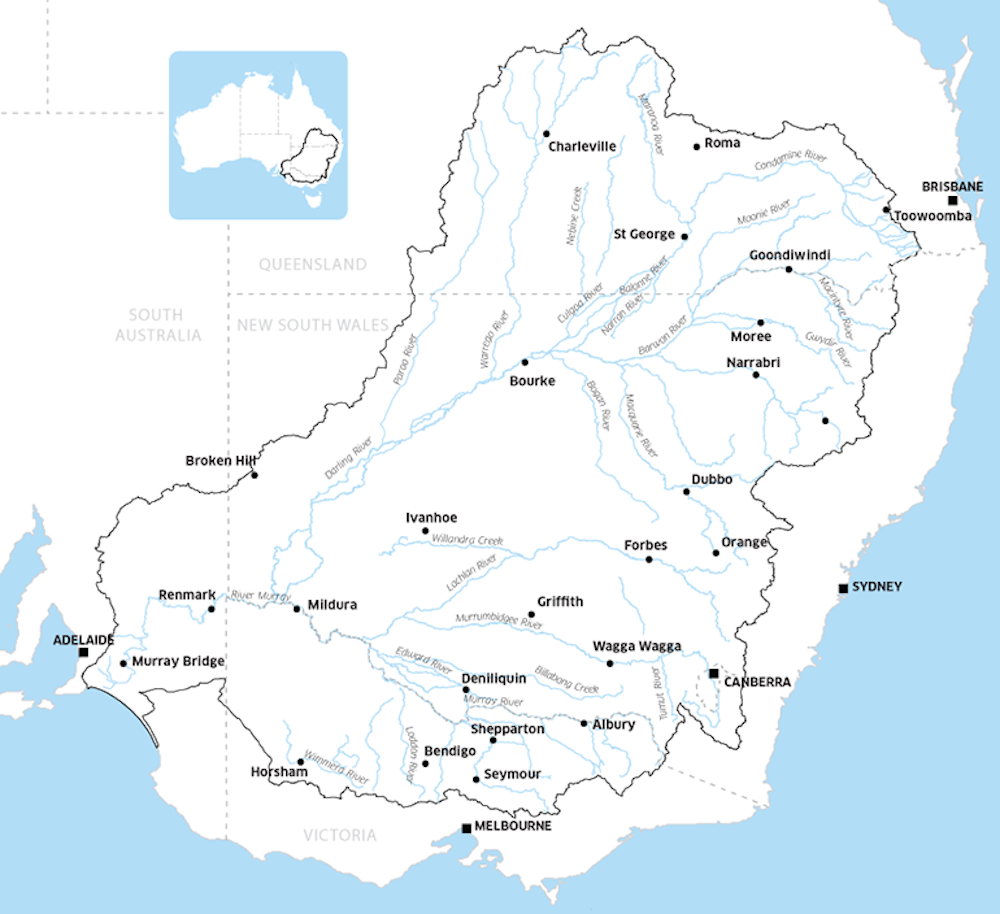
The Murray–Darling Basin is Australia’s largest and most complex river system. With 77,000 km of rivers, it is the food bowl of the nation.Murray–Darling Basin Authority
This failure is no surprise to economists who have studied the problems of the Murray-Darling Basin for decades.
The central problem is well understood, as are the workable (and unworkable) possible responses.
The basin covers four states: Queensland, New South Wales, Victoria and South Australia. All state governments have allocated permits to extract water for human uses (irrigated agriculture and urban water). The allocations grew rapidly in the second half of the 20th century, exceeding the sustainable capacity of the natural environment.
One sign of the failure became dramatically obvious in 1991, with an outbreak of toxic blue-green algae over 1,200 km of the Darling River. Algal blooms are fed by nitrogen and other nutrients in fertiliser runoff and sewerage. They continue to occur.
A 2009 algae bloom in the Murray-Darling Basin.Office of the NSW Minister for Water/AAP
This event underlined the need to leave enough water in rivers for “environmental flows” to keep the system healthy.
Acting with what now seems like impressive promptness, the Murray-Darling Basin Ministerial Council (made up of the water resources ministers from the basin states, the Australian Capital Territory and the federal government) imposed a cap on water extractions in 1995. It limited extractions to the volume of water capable of being taken out by the infrastructure (pumps, dams, channels, management rules) that existed in 1993-94.
The cap was supposed to be a temporary measure. It wasn’t intended to solve the problem, just stop it getting any worse in the short run.
The long-term solution was to be a system of trade in water rights, introduced by the Council of Australian Governments in 1994. Combined with the right price signals from environmental purchases, this system was meant to allocate water to its most productive uses while reducing extractions to sustainable levels.
A quarter-century on, the cap is only now being phased out, and a vast array of measures have come and gone, including the National Water Initiative, the Water Act of 2007, Water for the Future and the Murray-Darling Basin Plan.
Buying block
The failure of these initiatives rests on one simple fact: the refusal of irrigation lobby groups to countenance the government buying water rights on the open market to increase environmental flows. Their opposition has been immovable, despite many individual irrigators being keen to sell their water rights and use the money to invest in alternative cropping activities or retire.
On the other hand, there are a lucky (often politically well-connected) few who have done very well from “strategic” purchases of water. Investigative journalist Michael West has noted the National Party’s Party Barnaby Joyce has been publicly hostile towards buybacks of water entitlements but authorised, as federal water resources minister, three major “strategic purchases”.
Instead of water purchases, politicians like Joyce have put their faith in subsidies to infrastructure, to improve the efficiency of water use.
The idea has a lot of intuitive appeal. If less water can be used, it should be possible to increase flows in the river system without reducing agricultural output. With rare exceptions, this appealing vision has dominated the thinking of politicians and much of the public.
The reality is sadly different. The failure of infrastructure-based water recovery was both predictable and predicted.
I pointed out the main difficulties in a piece for ABC Online in 2012. The article didn’t contain any remarkable insights. It simply stated views shared by every independent economist who has worked on the issue.
The illusion of efficiency
Among the many problems with infrastructure schemes, two have stood out.
First, the measured cost of saving water through infrastructure schemes is two to three times as much as that of buying water on the open market.
Second, and more importantly, much of the supposed water savings are illusory. Much of the water “wasted” in irrigation systems is not lost to the environment. Most of the water leakage and seepage from irrigation channels eventually returns to rivers through groundwater systems. So “saving” this water through infrastructure efficiency doesn’t actually add anything more to environmental flows.
My 2012 analysis assumed a scientifically based effort to secure water savings at the lowest possible cost to the public. As the Four Corners report has shown, that assumption was massively over-optimistic. In reality, the scheme has been characterised by lax monitoring, cronyism and rorting.
After the expenditure of billions in public money, the system may be worse off than before. As a result, environmental disasters keep on happening.
Along with recurring algal outbreaks, we are witnessing disasters such as the massive fish kills like that in western New South Wales in January. The massive fish kills have been attributed to little or no flow in the Darling River combined with plunges from high temperatures, starving the water of oxygen.
Hundreds of thousands of dead fish in waterways around Menindee, far-west New South Wales, in January 2019.Graeme McCrabb/AAP
As the riverine environment keeps deteriorating, there’s no sign of any positive change in policy.
Eventually, though, we must hope Abba Eban will be proved right. Having exhausted all the options that don’t work, we will have to turn to those that do.
Earlier this year, researchers suggested the amount of water returned to the Murray Darling Basin under a federal program has been “grossly exaggerated”, to the tune of hundreds of billions of litres.
The report argued that government investment in irrigation improvements might even result in a net loss of water for the environment.
To investigate these claims, the Murray Darling Basin Authority commissioned us to undertake an independent review to examine the best available data for every irrigation efficiency project funded across the basin.
We found the government investment into irrigation efficiency projects has achieved 85% of the 750 gigalitres per year target. The remaining 15% of the target may be affected by unintended side-effects.
This result highlights the need for continued review of risks to the basin plan, as Australia grapples with the management of an extraordinary complex natural system.
How is water for the environment recovered?
The Water Act 2007 introduced significant reforms aimed at setting aside more water for the environment. At the time, record high levels of surface water were being consumed. Aiming to save 2,750 gigalitres of surface water (water flowing in the open air, rather than underground) the federal government began buying back water rights and investing in more efficient infrastructure.
The Commonwealth is providing A$3.1 billion to buy these water rights, of which A$2.5 billion has been spent. It is also providing more than A$8 billion for modernising infrastructure and water efficiency improvements, of which more than A$4 billion has so far been spent.
These projects aim to improve water delivery – reducing leaks and evaporation – and make irrigation more efficient. The water saving generated from these projects is shared between the governments for environmental use, and irrigators.
Mass fish deaths earlier in the year raised serious concerns about the health of the Murray-Darling system.DEAN LEWINS/AAP
What are “return flows”?
To understand why the government investment in irrigation efficiency projects have not achieved 100% of the original target, we need to talk about return flows.
When water is diverted from the river for irrigation, not all of it gets consumed by the plants. Some water will make its way back to the river. This is called return flow. A large part of the return flow is through groundwater to the rivers, and this part is extremely difficult to measure. More efficient infrastructure and irrigation generally means less return flow to the river.
If these reductions are not considered when calculating the water savings, it is possible there will be implications for irrigators, the environment and other water users downstream, that previously benefited from return flows.
What we tried to determine is how much the efficiency projects reduced return flow.
For the first time, we attempted to bring together data on individual projects in order to assess return flows across the basin. We developed a framework for calculating return flows, which took into account water in the rivers, groundwater, and efficiency projects.
This is the first attempt to bring together the existing data on individual projects to assess return flows in the basin at a detailed level. A large portion of the data used in this study was collated for the first time and not previously available in a readily accessible format.
We found a reduction in return flow of 121 gigalitres per year as a result of the government funded projects. This is comparable to 16% of the recovery transferred to environmental entitlements.
What does this mean for the Basin Plan?
There are several important details that must be considered to assess the importance of the return flow volume for the environment and Basin Plan objectives. We do not attempt here to quantify the outcomes, but instead to raise a number of important considerations beyond simply “volume”.
1. Recovered water should be legally protected
Return flows are good for the environment, but are essentially accidental. As irrigation becomes more efficient, inevitably they will diminish.
On the other hand, formally allocated environmental water entitlements are legally protected. It is more secure for the environment – and far easier to keep track of.
2. It’s not ‘efficiency vs the environment’
Part of this debate centres around the idea that reducing return flows means less water for the environment. But in Victoria and New South Wales, before water is allocated to anyone (irrigators or the environment), a base level is set aside. This is the minimum required to keep the rivers physically flowing and to meet critical human needs.
Efficiency projects mainly affect this base-level flow of the river. This means the water reduction is shared across everyone who holds a water licence – the majority of which are irrigators.
This policy means it does not make sense to compare the effect of efficiency projects directly with the recovery of environmental water.
3. Volume is a crude measure of environmental benefit
The focus of the debate around return flows has been based on the annual volume of returned environmental water in comparison to the stated Basin Plan target.
However, the real objective of the water recovery is to achieve environmental objectives in the Basin. This is not just about annual volumes, but the quantity, timing, and quality of fresh water.
How should we move forward?
Our review has particularly highlighted the need for better ongoing data collection and regular evaluations.
Both taxpayer investments and the water market are changing irrigation to become more efficient and reducing the river’s base flow. With this in mind, we need to regularly reexamine how we share water between everyone (and everything) that needs it, particularly in extended dry periods.
The Murray-Darling Basin is a constantly changing system, both in terms of climate and irrigation. Return flows are one of a number of potential threats to the Basin Plan. As the system is continually changing, these threats will need to be reassessed with each Basin Plan review.
A Four Corners program on the $13 billion Murray-Darling Basin Plan will air on ABC at 8.30pm on July 8.
This article was co-written by Glen Walker, a former CSIRO employee and now private consultant, who worked with the University of Melbourne on the independent review.
Want to boost your immune system, reduce your physical signs of ageing, or cleanse your blood to get rid of toxins? Intravenous (IV) vitamin therapy, or vitamin drips, promise to help. Some claim they can even benefit serious conditions like cancer, Parkinson’s disease, the eye condition macular degeneration, the pain of fibromyalgia and depression.
Celebrities have promoted them on social media. The demand has led to alternative therapy lounges popping up around the world, including in Australia. Patients can kick back in comfy leather chairs while they’re hooked up to IVs in the infusion lounge, watch Netflix and have some tea.
But do they work? Or are you just paying for really expensive urine? Let’s look at what the science says.
What is IV vitamin therapy?
IV vitamin therapy administers vitamins and minerals directly into the bloodstream via a needle that goes directly into your vein. Fans of the therapy believe this enables you to obtain more nutrients as you avoid the digestion process.
Providers of these injections say they customise the formula of vitamins and minerals depending on the perceived needs of the patient.
Right now for example, many Australian lounges are offering drip “cocktails” containing immune boosting vitamins like vitamin C and zinc to help protect against the flu. Other popular therapy sessions come under names like “Energy Cocktail” and “Glow”. One vitamin IV therapy session can take 30-90 minutes and will cost between A$80 to $1,000.
IV therapy itself is not new and has been used in the medical profession for decades. In hospitals, it is commonly used to hydrate patients and administer essential nutrients if there is an issue with gut absorption, or long-term difficulty eating or drinking due to surgery. Single nutrient deficiencies like vitamin B12 or iron are also often treated in hospital with infusions under medical supervision.
But the “cocktails” IV vitamin therapy clinics create and administer are not supported by scientific evidence. There have been no clinical studies to show vitamin injections of this type offer any health benefit or are necessary for good health. In fact, there are very few studies that have looked at their effectiveness at all.
There is one review on the use of the “Myers’ cocktail” (a solution of magnesium, calcium, vitamin C and a number of B vitamins). But it just contains a collection of anecdotal evidence from singular case studies.
Another trial looked into the effectiveness of IV vitamin therapy in reducing symptoms of 34 people with the the chronic pain condition fibromyalgia. It found no significant differences between those who received the “Myers’ cocktail” once a week for eight weeks and those who did not. In fact, the authors noted a strong placebo effect. In other words, many people said their symptoms improved when they were only injected with a “dummy” cocktail.
Another study that examined IV vitamin use in fibromyalgia patients was missing a placebo group, involved just seven patients and showed only short-term improvement in symptoms. The only other published study examined IV vitamin therapy use for asthma. But that study was of even poorer quality.
What are the risks of IV vitamin therapy?
Even when it comes to vitamins and minerals, you can have too much of a good thing. For example, if you take in more of the fat soluble vitamin A than you need, your body stores it, risking damage to major organs, like the liver.
IV vitamin therapy “cocktails” also often contain significant levels of the water soluble vitamins C and B. These are processed by the kidneys and excreted into urine when the body cannot store any more. This makes for some very expensive urine.
There is also the risk of infection with IV vitamin therapy. Any time you have an IV line inserted, it creates a direct path into your bloodstream and bypasses your skin’s defence mechanism against bacteria.
People with certain conditions like kidney disease or renal failure shouldn’t have IV vitamin therapy because they cannot quickly remove certain minerals from the body. For these people, adding too much potassium could lead to a heart attack.
People with heart, kidney or blood pressure conditions should also avoid IV vitamin therapy as there is risk of fluid overload without consistent monitoring. The consequences of fluid overload in these patients can include heart failure, delayed wound healing, and impaired bowel function.
What’s the bottom line?
For most of us, the quantities of vitamins and minerals needed for good health can be obtained by eating a healthy diet with a wide range of foods and food groups. Obtaining vitamins and minerals from your diet is much easier, cheaper, and safer.
Unless you have a medically diagnosed reason for getting a vitamin infusion and it was prescribed by your doctor, you are always better off obtaining vitamins and minerals through food.
Amid the hype around Facebook’s plan to launch its own cryptocurrency, Libra, there’s one big question. How is the company going to profit from it?
The project relies on developing blockchain technology. But blockchain’s whole raison d’être is to challenge the way corporate capitalism and businesses like Facebook make money.
Facebook has also established, with several dozen equally capitalistic partners, the Libra Association, a nonprofit organisation based in Switzerland, to spearhead the venture.
After years of copping criticism for questionable business practices, has Facebook decided to take an altruistic turn?
Probably not. It’s more likely that blockchain, and even Libra, is a means to a end; it’s about Facebook wanting to be not only the world’s biggest social media platform but also the globe’s go-to marketplace, putting Amazon, eBay, Apple and Google in the shade.
To appreciate why this suggestion isn’t also hyperbole, we need to talk not so much about Libra but its companion technology, the “custodial wallet” called Calibra.
Blockchain, but not blockchain
First, let’s do a quick recap of some fundamentals.
In 2008, a person or group calling themselves Satoshi Nakamoto proposed a method for transacting over the internet without a trusted third party such as a bank. It uses a distributed ledger known as a blockchain and cryptography to maintain a tamper-proof record of ownership of electronic cash – hence the term cryptocurrency.
Blockchain’s core innovation is to do away with the need for trusted entities like banks. So how do people safely send or receive cryptocurrency? Well, they can use a “cryptocurrency wallet”. A cryptocurrency balance is recorded against a blockchain address. Proving ownership depends on a secret code (or “private key”) known only to the owner. The “wallet” is essentially software that allows people to manage their private keys and authorise transactions.
Facebook has other ideas for its cryptocurrency. The Libra Association says it wants to “make sending money as easy and cheap as sending a text message”. Tapping addresses and secret codes into a wallet interface every time wouldn’t be that easy. These codes can be long – up to 64 characters, compared to 16 for a credit card.
So Facebook will instead provide a “custodial wallet” – Calibra. It will be the custodian of your cryptocurrency, much like a bank is custodian of your money, and thus manage your wallet for you.
Facebook can certainly argue that this makes it much easier to use Libra – and it wants to make Libra easy to use so you can buy items through Facebook and its other platforms, such as Whatsapp and Instagram.
But this aspect has little to do with the original ideals behind blockchain. It makes Calibra more like a bank, with a record of your electronic payments. It will know everything you buy or sell through its wallet; and it will share “Calibra customer data with managed vendors and service providers — including Facebook”.
How Facebook monetises data
Why is this important? Because Facebook is in the business of gathering your personal data.
It now uses this information to make about 99% of its income from selling advertising – US$14.9 billion in the first quarter of 2019 alone.
Facebook revenue, in millions.Facebook
Its value as an advertising delivery mechanism comes not just from its sheer number of users (1.56 billion daily users, and 2.37 billion monthly users) but from what it knows about them.
Facebook daily active users, in millions.Facebook
This goes way beyond basic personal details like your birthdate. Almost everything about Facebook is designed to get you to reveal personal information. You do this through what you post and the posts you like or respond to. You do this even when not directly using Facebook. Lots of online stores report back to Facebook when you visit them, for example.
Identifying key personality traits can be used to predict purchasing behaviour – or political preference, as demonstrated in the Cambridge Analytica controversy. The British-based political consultancy bragged it effectively swung the US 2016 election to Donald Trump by using Facebook to harvest user data and then directing customised political messages to users’ newsfeeds.
While there is some scepticism about Cambridge Analytica’s electoral impact, it is generally agreed the process of “micro-targeting” can be very effective for marketers.
So the more information Facebook has about you, the more money it can potentially make by influencing you.
Becoming bigger than Amazon
There’s more.
Facebook’s value as an advertising powerhouse has made its founder, Mark Zuckerberg, extremely wealthy – worth an estimated US$73 billion. But that’s less than half of Amazon’s founder, Jeff Bezos, who’s worth US$158 billion.
Both companies are in the business of helping merchants sell products. But Amazon’s position as an online marketplace is more lucrative than Facebook’s role as a shop window. Amazon can take a cut from every sale. Its retail business makes up about 80% of its US$950 billion value, which is greater than Facebook’s total value of US$550 billion.
What if Facebook could be both the shop window and the cash register? What if it no longer just introduced users to merchants but also became the digital marketplace supporting those merchants? What if it could collect not just social data but also buyer history data?
This is what Libra, and more critically, Calibra, could mean for Facebook.
Libra’s an important part of this picture. But it’s Calibra that could deliver the data Facebook needs to become possibly the most valuable, and powerful, online company in the world.
Fifty years after her death, Australian writer Charmian Clift is experiencing a renaissance. Born in 1923, Clift co-authored three novels with her husband George Johnston, wrote two under her own name, produced two travel memoirs, and had weekly column widely syndicated to major Australia papers during the the 1960s.
Clift has long been overshadowed by the legacy of Johnston, whose novel My Brother Jack is considered an Australian classic. Her novels and memoirs are sadly out of print, yet she is increasingly recognised for her important place in Australian culture.
Charmian Clift, pictured on the front cover of her memoir, Peel Me a Lotus.Hutchinson, 1959
In 2018 she, along with Johnston, was inducted into the Australian Media Hall of Fame in recognition of her work as a columnist. She is also being reimagined in fiction, as the subject of A Theatre of Dreamers (2020), a forthcoming novel by English author, Polly Samson, and in Tamar Hodes’ The Water and the Wine (2018).
The revival of interest in Clift is more than a collective nostalgia or feminist correction of the historical record, although both are relevant. Many of her readers from the 60s still remember her newspaper column, and the impact that it had on their view of Australia’s place in the world, with great affection.
Younger generations, particularly women, have also been exposed to Clift’s clear and passionate voice after the columns were published in several volumes in the years following her death. That Clift and her writing continue to resonate with contemporary Australia tells us something about both her and the nation.
The Hydra years
Much of the renewed interest in Clift is focused not only on her writing, but also on the near decade that she and Johnston lived on the Greek Island of Hydra. In late 2015, artist Mark Schaller’s Melbourne exhibition, Homage to Hydra, featured paintings depicting Clift and Johnston’s island lives, with several featuring other residents from Hydra’s international population of writers and artists, including Canadian poet and songwriter, Leonard Cohen.
The same year, Melbourne musicians Chris Fatouros and Spiros Falieros debuted Hydra: Songs and Tales of Bohemia, marrying Cohen’s songs to a narrative about Clift and Johnston’s time on Hydra.
To date in 2019, Sue Smith’s play, Hydra, has been staged in Brisbane and Adelaide, casting Clift in ways that resonate sympathetically with the concerns of contemporary audiences. As Smith writes in her script’s introduction:
Charmian was a woman ahead of her time. We see this in the choices she made both in her personal life, whether it be scandalising the Greek locals by wearing trousers and drinking in bars, to insisting upon her personal and sexual freedom and, of course, through her work.
Modern readers might respond to Clift the writer, but the focus on her years on Hydra suggests there is also great interest in her charismatic personality and tempestuous life with Johnson, as their dream of a cheap and sun-soaked creative island life slowly soured.
While researching the couple’s lives on Hydra, we came across a suggestive, eye-witness diary entry by a fellow writer, New Zealander Redmond Wallis, written in 1960.
Charm is her greatest creation, Charmian Clift, the great Australian woman novelist. Charmian is very curious. She is, potentially at least, a better writer than George but she has and is deliberately creating a picture of herself … which one feels she hopes will appear in her biography some day.
The head of a literary coterie, beautiful, brilliant, compassionate but still the mother of 3 children, running a house. Sweating blood against almost impossible difficulties – a husband inclined to unfounded jealousy, the heat, creative problems, the children, the problems foisted on her by other people … and yet producing great art.
Wallis’s observations are accurate, and prophetic, in noting Clift’s capacity for self-mythologising and her belief that both she and her Hydra idyll would be remembered. Nearly four decades after Clift returned from Greece to Australia amid the acclaim for My Brother Jack, she did become the subject of an excellent biography, Nadia Wheatley’s The Life and Myth of Charmian Clift (2001).
Nadia Wheatley’s biography of Clift.Goodreads
But there were also failures amongst the success. The vision she and Johnston shared for a writing life on Hydra floundered amid poverty, alcoholism and illness. Their return to Australia in 1964 was an unlikely triumph for Johnston following the success of My Brother Jack, but Clift did not return with the same profile.
Wheatley also traced another of Clift’s great disappointments – her failure to complete her long-dreamt of autobiographical novel The End of the Morning, a struggle that was the subject of Susan Johnson’s 2004 novel, The Broken Book.
Clift did, however, leave an autobiography of sorts, in her newspaper articles. These often focused on domestic circumstances and everyday thoughts – ranging from conscription, to the rise of the Greek military junta after she left Hydra, to the changing social circumstances in Australia, and her daughter’s engagement.
These articles might not have always reflected the experiences of her readers – not everyone invited Sidney Nolan over for drinks – but Clift’s first-person narratives of a life lived with great passion and a sceptical eye to the consequences, garnered a large readership.
These readers responded to an incisive intellect with a vision of a culturally enriched Australia. She understood well the need for the country to outgrow its entrenched conservatism in order to realise its potential; and she emerged as a generous spirit who realised that the dreams and passions that drove her life were found everywhere in Australian suburbs.
Clift’s death reported by The Canberra Times in July, 1969.
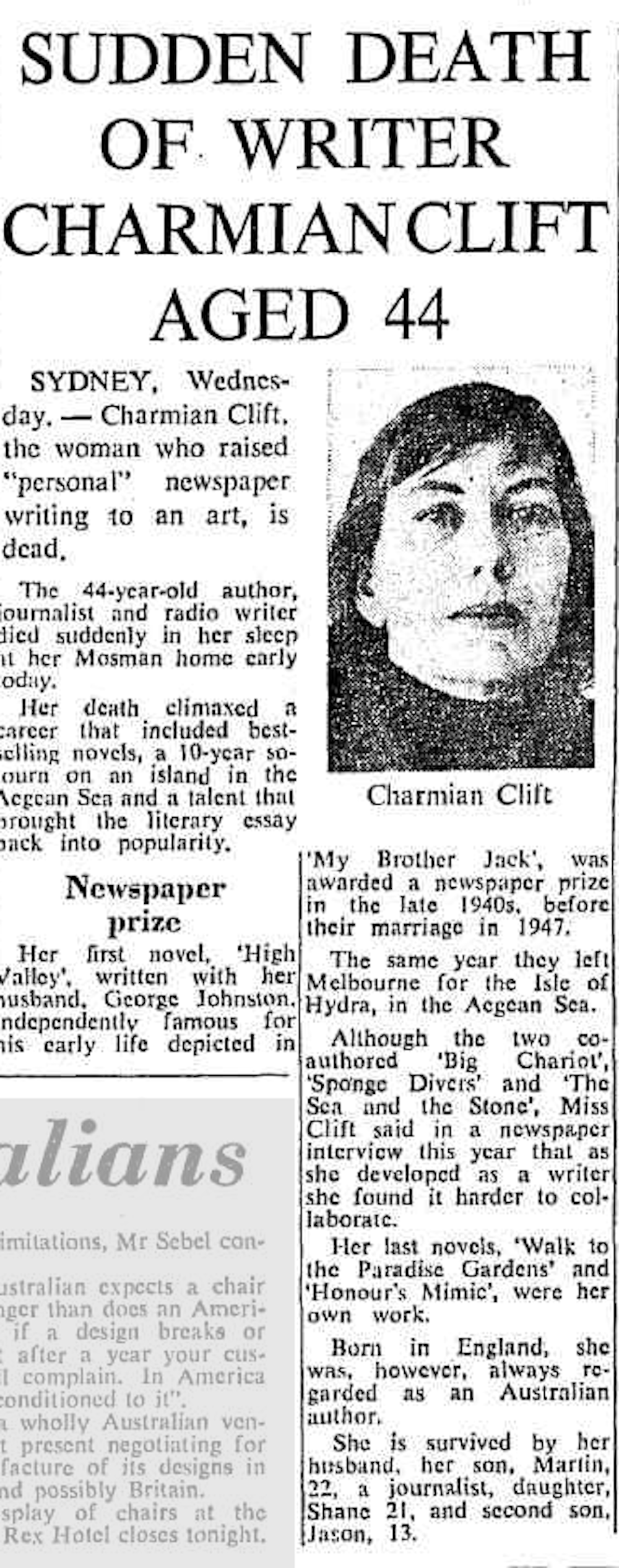
Wallis’s detection of Clift’s hubris and narcissism paints her as a potentially tragic figure. It was a fate she perhaps fulfilled, when Johnston eventually wrote of Clift’s infidelities on Hydra. Clift took her own life on July 8 1969, an event that curtailed her voice while leaving behind a legacy of loyal and grieving readers.
A natural cosmopolitan
Clift’s is one of the voices – and one of the most important female voices – that rose above the crowd during the post-war period, as the western world unknowingly girded itself for the social revolution that was to come.
Through her columns she advocated for a bolder, more outward looking future, and as someone who was naturally cosmopolitan she was avidly interested in seeing Australia become more open to the world and better integrated into the Asia-Pacific.
She didn’t always get it right (an essay decrying the rise of the Beatles and the Rolling Stones stands out!), but she helped navigate the path to a more broad-minded and inclusive vision of Australia.
Over the years Clift has emerged as someone who was not only modern, but also engaged in that most post-modern of activities, self-creation. For while Wallis scorned Clift’s self-mythologising at the time, it might now be recognised as the finest gift of the creative artist – to re-make oneself in the image of a world yet to be made. It was her gift to her readers and Australia.
TVNZ’s Pacific correspondent Barbara Dreaver reports on organisers trying to shut down the outgoing Miss Heilala Queen during her final address. Video: TVNZ
By Kalafi Moala in Nuku’alofa
Angry criticism has flooded social media over a reported intervention by Tonga’s Deputy Prime Minister – including calls for his resignation – at the Miss Heilala beauty pageant in Nuku’alofa on Friday.
Semisi Sika is reported to have instructed the DJ to play loud music to drown out the controversial speech of Kalo Funganitao, the outgoing Miss Heilala.
Funganitao condemned pageant officials for tormenting and bullying her during her reign and claimed she had been cheated, lied to, backstabbed and messed around.
The law student from Auckland University is considered to have dealt the pageant the strongest condemnation ever in its 40-year history.
-Partners-
“Enough is enough,” Kalo, as she is commonly known, yelled over the music.
Her mother, brother and other contestants joined her on stage for the speech for which her microphone was eventually cut, allegedly at the instruction of Sika, who was the honoured official at the pageant.
But Kalo continued to give her speech, a protocol given to every reigning Miss Heilala as they are about to depart and hand over the crown to the next winner.
“My mother and I were cheated, lied to, backstabbed and generally messed around,” Kalo claimed.
The support she was promised as a Miss Heilala winner never came, she said. Instead, she claims to have been bullied and rudely treated.
“Up until today I have experienced just how hard it can be to be a young Tongan woman. I have dealt with people in official roles and in other places in the workforce that have been unprofessional and rude,” Kalo said.
Resignation calls Social media users criticised the way Kalo’s speech appeared to have been shut down with a few calling for Sika’s resignation.
She described her experience during her reign as Miss Heilala as a direct result of the way she was treated by pageant officials and some of the public.
She also spoke about vicious attacks she had endured on social media, as people in the crowd started booing her and shouted obscenities.
The attempt to silence Kalo was recorded on video and posted on social media. She was ushered off the stage and was unable to crown the new Miss Heilala.
Sika is also accused of failing to intervene when someone from the VIP table reportedly screamed racist abuse at Leoshina Kariha, Miss Pacific Islands from Papua New Guinea.
A senior journalist in Tonga, Taina Kami, has expressed embarrassment at the abuse.
“Miss Pacific Islands Leoshina Kariha. I hang my head in shame and apologise for such unpleasant and uncalled for behaviour,” she wrote.
Kami has called for an apology from the pageant organisers.
No apologies have been issued by the tourism committee that organises the pageant or the Tourism Ministry for which Sika is the minister.
This article is published under the Pacific Media Centre’s content partnership with Radio New Zealand.
2018 Miss Heilala Kalo Funganitao … condemned pageant officials for being “tormented and bullied” during her reign. Image: Kalo Funganitao/RNZ Pacific
From the Fitbit to Apple’s smartwatch, wearable tech is becoming increasingly popular across the globe. Compared to other nations like US, which has seen higher adoption of fitness trackers, uptake in Australia is still less than 10% in 2019. But news reports indicate that Australians are taking to fitness monitoring more than ever before.
And wearable devices are not only being embraced by consumers, but also across insurance industries. Health and life insurance companies collect data from fitness trackers with the goal of improving business decisions.
Hollywood actor Christopher Walken was the spokesperson for Qantas’s 2016 Assure campaign.
Currently, these business models work as a “carrot” incentive. That means consumers can benefit from discounts and cheaper premiums if they are willing to share their Fitbit data.
But we could see voluntary participation become mandatory, shifting the incentive from carrot to stick. John Hancock, one of the largest life insurance companies in the United States, has added fitness tracking with wearable devices to all of its policies. Though customers can opt out of the program, some industry experts argue that this “raises ethical questions around privacy and equality in leaving the traditional life insurance model behind”.
Is this the beginning of a major trend? And, more importantly, how do consumers feel about being “persuaded” into fitness tracker-based insurance policies?
In a study conducted with my colleague Professor Stefanie Paluch at RWTH University in Germany, we investigated people’s perceptions of fitness tracker-based insurance policies.
What are the concerns?
Unfair price discrimination
People are concerned that the data monitoring will lead to personal disadvantages. They don’t want to be penalised with higher insurance rates if they stop using the fitness tracker. One Fitbit user said:
The problem lies in the disadvantage if I don’t wear it.
Data protection
Consumers are concerned about how insurance firms will access, use, and store their fitness data. One person said:
I find it very important to have strict regulations, especially in these times, when personal data is collected and stored everywhere, but can also be shared, exchanged, sold and passed on to third parties, to those I don’t want […] to have my data.
Privacy
People have a wide range of privacy concerns. In general, they fear becoming “observable”, “transparent”, “predictable”, “easy to manipulate” and “rated” by the insurance provider. One user said:
The risk is that you will become so transparent and […] institutions will know about you, that is actually not their right at all, only on the basis that they somehow want to make a profit […] it’s none of their business.
How to reduce the risks?
Our study shows that the strongest opposition is based on people’s fear of unfair and exploitative behaviour of commercial data users, in particular switching from voluntary to mandatory enrolment. To avoid backlash, insurance firms should follow the following four recommendations.
1. Understand your customer
Insurance firms need to first segment their customer base to better understand consumer lifestyles and motivations to use a fitness tracker. While some consumers have a personal affinity towards self-tracking, other individuals will not change their habits. One user said:
I am not sure how this helps? If you lie on the sofa for 12 hours a day with a fitness tracker. Do you see a result? No! The insurance cannot force you to move your ass. Normally only people who are active already and do sports regularly, they wear such trackers.
2. Provide value
People wish to receive a benefit for their participation. This ranges from financial value (discounts, lower premium) to functional value, such as the quality of the device (design features, ease of use), as well as its reliability and accuracy in tracking data.
I like sports, and fitness trackers are important to me. As I said, to follow my progress, and if I can get them cheap, then I find that very positive.
The tracker itself must be good. […] I have to have a feeling that I really benefit from it.
3. Be transparent
In order to reduce privacy concerns, insurance firms need to offer transparent and fully informative privacy policies and should more clearly educate and inform users about the terms and conditions. One Fitbit user said:
…if a little more is published [about] what happens with our data, […] one can inform oneself about it […] Perhaps general education in schools or so would be desirable, too.
For me, the personal contact is important, because if someone explains that to me, then I will trust this person, and then I do not think that he/she will try to conceal any things […]. Once this has been explained to me, then I’m ok with it.
4. Give customers control
People are more willing to participate in fitness tracker-based insurance policies when they are in control of their participation. Greater empowerment increases their perceived self-determination and acceptance. Thus, participation should remain voluntary and be flexible regarding the timeframe. Two respondents said:
Well, if they [fitness trackers] are on a voluntary basis […] then I would use them.
That I can choose this bonus program myself, that I can choose the different functions from it and that I can resign at any time without any financial, health or insurance disadvantages.
As the sharing of personal biometric data increases further, we hope that our findings will contribute to an emerging public policy and legal debate about the practice.
The rapid spread of fake news can influence millions of people, impacting elections and financial markets. A study on the impact of fake news on the 2016 US presidential election, for instance, has found that fake news stories about Hillary Clinton was “very strongly linked” to the defection of voters who supported Barack Obama in the previous election.
To stem the rising influence of fake news, some countries have made the creation and distribution of deliberately false information a crime.
Singapore is the latest country to have passed a law against fake news, joining others like Germany, Malaysia, France and Russia.
But using the law to fight the wave of fake news may not be the best approach. Human rights activists, legal experts and others fear these laws have the potential to be misused to stifle free speech, or unintentionally block legitimate online posts and websites.
Legislating free speech
Singapore’s new law gives government ministers significant powers to determine what is fake news, and the authority to order online platforms to remove content if it’s deemed to be against the public interest.
What is considered to be of public interest is quite broad, but includes threats to security, the integrity of elections, and the public perception of the government. This could be open to abuse. It means any content that could be interpreted as embarrassing or damaging to the government is now open to being labelled fake news.
Similar problems have arisen in Malaysia and Russia. Both nations have been accused of using their respective laws against fake news to further censor free speech, especially criticism of the government.
Malaysia’s previous government outlawed fake news last year, making it a crime punishable by a fine up to 500,000 Malaysian (A$171,000) ringgit or six years’ imprisonment, or both. The new government has vowed to repeal the law, but so far has yet to do so.
Russia banned fake news – which it labels as any information that shows “blatant disrespect” for the state – in April. Noncompliance can carry a jail sentence of 15 days.
Discriminating between legitimate and illegitimate content
Even countries like Germany are facing difficulties enforcing their laws in a way that doesn’t unintentionally also target legitimate content.
Germany’s law came into effect on January 1, 2018. It targets social media platforms such as Facebook and Twitter, and requires them to remove posts featuring hate speech or fake information within 24 hours. A platform that fails to adhere to this law may face fines up to 50 million euros.
The Association of German Journalists has complained that social media companies are being too cautious and refusing to publish anything that could be wrongly interpreted under the law. This could lead to increasing self-censorship, possibly of information in the public interest.
But there has been no serious talk of passing a law banning fake news here. Instead, Australian politicians from all sides have been pressuring the biggest social media platforms to be more vigilant and remove fake news before it becomes a problem.
Are there any alternatives to government regulation?
Unlike attempts to limit or ban content in pre-internet days, simply passing a law against fake news may not be the best way to deal with the problem.
But there are already concerns the code was “softened” to minimise the amount of content that would need to be removed or edited.
Whenever governments get involved in policing the media – even for the best-intended reasons – there is always the possibility of corruption and a reduction in genuine free speech.
Industry self-regulation is also problematic, as social media companies often struggle to objectively police themselves. Compelling these companies to take responsibility for the content on their sites through fines and other punitive measures, however, could be effective.
Another alternative is for media industry groups to get involved.
Media freedom watchdog Reporters Without Borders, for instance, has launched the Journalism Trust Initiative, which could lead to a future certification system that would act as a “guarantee” of quality and accuracy for readers. The agreed standards are still being discussed, but will include issues such as company ownership, sources of revenue, independence and ethical compliance.
Most illicit drugs used at festivals, including ecstasy (methylenedioxymethamphetamine or MDMA), started out as relatively benign pharmaceuticals.
MDMA is most commonly implicated in drug-related harm at festivals. Fatal and non-fatal MDMA overdoses are usually a result of high-purity MDMA, dangerous contaminants, or environmental factors such as overheating or drinking too much or too little water. So to reduce harms we need to address all these problems.
Police presence, random drug searches and drug detection dogs don’t deter drug use and may increase harms. Yet they are common at festivals and come at a substantial financial cost to festival goers, which has to be covered in the price of the ticket.
Publicly, the police focus is on drug dealing, but the reality is that most people who are arrested at festivals are people who use, rather than sell, drugs. NSW police reported that, at Sydney’s 2019 Field Day Festival, of the 28,000 people who attended, there were 155 drug-related arrests: 149 for possession and 6 for supply.
When police dogs are present, people are more likely to buy drugs inside the festival rather than risk detection by carrying drugs in. This means they are more likely to buy from unknown sources, which increases their risk of harm compared with buying from a trusted source.
Decriminalising illicit drugs would significantly reduce harms and allow festival police to focus on public safety issues, such as antisocial behaviour and public drunkenness.
presence of peer-led organisations, like Dancewize, which provide harm reduction information and support
emergency services and first aid
chill out spaces
availability of cool clean water
good ventilation in indoor spaces, and
staff and volunteer training in responding to drug affected people.
Pill testing direct to consumer
On-site pill testing, which identifies the content and purity of drugs brought in by festival goers, also includes contact with a health professional to provide a brief intervention, that can include advice about risks of taking drugs and harm reduction information. Festival goers are always told that it is safest not to take drugs at all.
Brief interventions from a health professional can reduce risky drug use among young people. But without a way to offer an intervention, most young people who go to festivals will not come into contact with a health worker to receive that information.
Some Australian police, politicians and policymakers are reluctant to consider pill testing at festivals. That may be because, so far, only on-site, direct-from-consumer testing has been offered as a viable way of reducing harm.
Some people have concerns about the idea of accepting and testing illicit drugs direct from the people using them, given that they are still illegal.
But there are many other ways of pill testing that can also reduce harm.
Testing of police-acquired drugs
We could also test drugs on-site that have been seized by police, acquired from emergency services after an incident or surrendered in amnesty bins.
This approach has been used at a number of festivals in the UK since 2013. When a potentially problematic drug is identified during the festival, an alert is issued on-site through social media usually within hours, to alert others who may have bought drugs from similar batches.
As well as potentially reducing harm for people who use drugs, these alerts mean police are better able to monitor the local drug market; on-site paramedics, first aid and outreach workers are better informed about drugs in circulation, helping to improve responses; and according to the UK testing facility, medical services report having more confidence in dealing with presentations because of the alerts.
Medical services can also benefit from alerts letting people know which problem drugs might still be in circulation.from www.shutterstock.com
This approach is not as effective in reducing harms as direct-from-consumer testing. That’s because it doesn’t include contact with a health professional who can offer a brief intervention, and the information about pill contents doesn’t go direct to the people intending to use them.
But if testing of police acquired drugs is combined with real-time alerts about potential problem drugs to festival goers, it can still reduce harms.
Off-site testing
Testing of pills brought in by festival goers can also occur off site before the festival. It works the same way as onsite testing, and includes brief intervention, but operates away from the festival site.
Off-site testing removes the need to change the way the drugs are policed at festivals, so may be more acceptable to some. If both off-site and on-site testing are implemented, testing services will have greater reach and be more effective in reducing harm.
Testing drug purity
The only official pill testing that has been undertaken in Australia has been at Canberra’s Groovin’ the Moo in 2018 and 2019. The on-site facility tested samples provided directly by consumers and identified the drugs present. But they could only estimate the purity of drug powders and did not measure the dose of MDMA in the pills.
High-dose MDMA has been implicated in a number of the recent festivals deaths. Knowing the dose may help reduce overdoses from MDMA pills because people can choose to take a smaller amount of the drug if they know the strength is high.
The Loop UK has developed a method of more accurately measuring the dose in MDMA pills, which could help reduce the harms associated with high purity. The process does not require any specialised equipment and is performed on-site by trained chemists. At this year’s Parklife Festival the organisation identified high-strength pills and send out warnings.
Example of alerts from The Loop UK at this year’s Parklife Festival.
Understanding drug use at festivals
We also don’t really know how many young people use drugs at Australian festivals and how much they use. Most of what we know is from anecdotal reports. There’s probably differences between festivals.
We know both festival attendance and illicit drug use hit a peak among people in their 20s. So more research on how common drug use is at festivals and the kinds of drugs people use would help inform better and more targeted harm reduction policies.
We will never completely eliminate drug use at festivals but we can make them safer by implementing what we know works and stopping what we know doesn’t. It’s normal for young people to take risks. Whether you agree with drug taking or not, our young people don’t deserve to die just because they have taken drugs.
Source: The Conversation (Au and NZ) – By Warren Midgley, Honorary Associate Professor of Applied Linguistics, University of Southern Queensland
Just before the May federal election, then shadow treasurer Chris Bowen gave a speech in which he lamented the low levels of Year 12 students studying Mandarin in Australia. The speech was at a launch for Labor’s plan to deepen Australia’s engagement with Asia.
According to the launch’s media release, Labor’s strategy would include “improving Asian literacy and cultural understanding through school curriculums”.
Bowen mentioned that only about 130 Australians of non-Chinese heritage can speak Chinese to a level good enough to do business with China. In recent weeks, experts confirmed this number may be correct, although an educated guess.
But whatever the exact number, 100 or 130 or 200, an expert told the ABC “it’s still absolutely peanuts”.
For decades, Australian schools have focused on teaching Asian languages to strengthen our opportunities in Asia. One of the four target languages has been Standard Chinese, or Mandarin, the official language of mainland China.
If only 130 people of non-Chinese heritage can speak it after all these years, has something gone catastrophically wrong?
The bigger picture
There are many more than 130 people in Australia who can speak Mandarin fluently. According to the latest census data, almost 600,000 people in Australia speak Mandarin at home, which indicates a very high level of fluency.
Given more than 500,000 Australians were born in China, there is a good chance most Mandarin-speaking Australians would be, to use Bowen’s term, of “Chinese heritage”. But it’s unclear why this is concerning.
From a purely academic perspective, these data suggest Australia is well placed to recruit Mandarin-speaking leaders in business, international relations, diplomacy and so forth, to strengthen our engagement with Asia.
Clearly, there is no critical shortage of fluent Mandarin speakers in Australia. There may be a shortage of Mandarin-speaking Australians entering into leadership positions, but that is an entirely different discussion.
Mandarin learning in schools
There is no definitive source of data for the number of children learning languages in Australian schools. One source indicates that in 2015, more than 170,000 students were learning Mandarin in Australian schools – almost twice as many as were learning it in 2008.
However, only about 4,000 of those students were in Year 12, and of those only an estimated 400 were of non-Chinese heritage. So while the total number of students has risen, the number of non-Chinese heritage students continuing to study Mandarin through to Year 12 has remained low.
These figures are similar to those for Japanese, which is the most popular language taught in Australian schools. In 2015 there were estimated to be just over 210,000 students studying Japanese at school in Australia. Following a similar pattern to Mandarin, only 572 of those students were in the upper years of secondary school.
What does success mean?
Not all language students start at the same proficiency level. The Australian Curriculum has five different streams for students of Mandarin to accommodate a range of different starting levels of proficiency.
In theory, this means Chinese heritage students who already speak Mandarin very well can study a much higher level of Mandarin than non-Chinese heritage students. However, many students with very good starting proficiency in Mandarin end up in classes designed for students with lower starting levels of proficiency.
These differences in starting levels of proficiency mean it is difficult to determine whether Mandarin language programs have been successful. An excellent written paper by a non-native speaker of Mandarin may be a very poor result for a student who is a native speaker of Mandarin.
In one study, Year 12 students who spoke Mandarin at home achieved an average score of 77 on a proficiency test that had a maximum possible score of 120. The average for students who did not speak Mandarin at home was 16.
We need to think carefully about what we mean by success in language learning. If speaking as a native speaker would, which is what might be required for someone to be able to conduct business in China, is the measure of success, all language classes will perform poorly. A school student in China will learn about 6,000 written characters by the time they graduate. By comparison, a Year 12 student in Australia will graduate with a knowledge of only about 500 characters.
By the time a school student in China graduates, they will have learnt about 6,000 written characters.from shutterstock.com
Even languages that don’t have large numbers of characters are almost impossible to master in the small amount of time allocated to language classes in Australian schools.
In the same way, if winning an Olympic gold medal were the measure of success of sports classes, then they also have been a monumental failure. There have only been 267 Australian gold medallists in all Summer and Winter Games since 1896.
The same could be said for any other subject in which achieving such rare levels of excellence is considered to be the only measure of success.
None of these benefits requires the learner to be able to speak, read or write that second language as well as a native speaker.
Some of the questions we should be asking are:
are our children making progress in learning the language?
are they engaged with the lessons and the materials?
are they demonstrating interest in other cultures and ideas?
are they exploring new ways of seeing the world and solving problems?
are they reaching out to others in the community who have different language and cultural backgrounds?
The first two of these are regularly measured, or at least noted, by classroom teachers. But the others are often overlooked. It is difficult to know how successful our programs have been without measuring these things too.
Source: The Conversation (Au and NZ) – By Hal Pawson, Associate Director – City Futures – Urban Policy and Strategy, City Futures Research Centre, Housing Policy and Practice, UNSW
In the wake of slumping demand for apartment building, it’s little wonder the multi-unit housing industry has been eagerly eyeing a possible new residential product: “build-to-rent”.
In fact, the latest figures show that apartment-building construction starts were down 36% in 2018 from 2016. But how much will this little-known type of housing solve our housing problems?
Build-to-rent won’t be a silver bullet solution for Australia’s housing affordability stress, but it does have potential to tick the box on several important public policy objectives. These include widened housing diversity, enhanced build standards, and a better-managed, more secure form of private rental housing.
But for this to happen, Australia’s tax settings need adjustment.
Project design of build to rent properties in Mirvac Olympic Park, Sydney. Build to rent has already started in Australia, but can only be fully embraced with government support.Author provided (No reuse)
What is ‘build-to-rent’?
This refers to apartment blocks built specifically to be rented, usually at market rates, and held in single ownership as long-term income-generating assets.
The enduring owner might be, for instance, an insurance company, an Australian super fund, a foreign sovereign wealth fund, a private equity firm, or the building’s developer.
A scattering of build-to-rent schemes are already underway or completed, mainly in inner Sydney and Melbourne. And they may prove to be the forerunners of a new Australian residential property sector – but that is far from guaranteed.
In Australia, our private rental market is almost entirely owned by small-scale mum-and-dad investors, so this kind of housing would be a largely new departure from typical Australian real estate.
Potential benefits
The build-to-rent development model, involving a long-term owner commissioning an entire building, creates an incentive for higher, more enduring quality than the standard “build-to-sell” apartment development approach.
Importantly, build-to-rent is a long-run investment that caters for rental demand, which tends to grow steadily.
This means the model is largely immune to the fickle changes in housing demand resulting from typically short time horizons and primarily speculative instincts of individual buyers traditionally dominant in our market.
So at its full potential, this new housing product could introduce a valuable counter-cyclical component into the notoriously volatile residential construction industry, helping to offset damaging booms and busts. In other words, build-to-rent can create stability in the Australian property market.
How build-to-rent can incorporate affordable housing
Optimistically, some have claimed build-to-rent could also provide an “affordable housing” fix for many earners who are doing it tough in our existing private rental market.
But this could be possible only with the aid of major government funding or planning concessions.
A design for build to rent property in Latrobe Street, Melbourne.Author provided (No reuse)
Ideally, housing at rents affordable to low or moderate income earners would be included in predominantly market-rate build-to-rent schemes. Indeed, one major construction industry player recently advocated this as a standard expectation.
So how should affordable housing be provided in this case?
To find out, our analysis compares the cost of developing affordable housing by a for-profit company with development under a not-for-profit community housing provider.
Thanks to that non-profit format, and the tax advantages that go along with it, community housing providers can, in fact, construct affordable rental housing at significantly lower cost than their for-profit counterparts. Less subsidy is therefore needed.
Nonetheless, government help in some form will be essential to enable an affordable housing element. The most painless way for this to happen, from the government perspective, is through allocating sections of federal or state-owned redevelopment sites to community housing providers at discounted rates.
Encouragingly, this strategy was recently advocated by newly designated federal housing minister Michael Sukkar.
Such designation of government-owned sites could, for instance, be factored into large-scale urban renewal projects like Sydney’s Central-to-Eveleigh and Rozelle Bays. When complete, it could fulfil the widely voiced demand that 30% of these developments should be affordable housing.
Levelling the playing field
Our modelling shows that under current conditions, even market-rate build-to-rent projects are barely viable – at least in Sydney.
The inflated price of developable land in Australia’s urban housing markets is an important contributing constraint. But our research also identifies a range of government tax settings that disadvantage build-to-rent, compared with both mum-and-dad-investors and traditional build to sell developers.
Removing less favourable land tax and GST treatment could markedly improve build-to-rent feasibility.
From a housing policy perspective, there’s also a case for the federal government to reconsider its recent “withholding tax” decision that treats overseas-based institutional investment in rental property less favourably than investment in commercial property.
Since such global funds would likely lead the establishment of a new Australian build-to-rent asset class, revisiting the withholding tax changes could be a significant step in making build-to-rent a reality in Australia.
In any case, build-to-rent is no simple solution for Australia’s affordable housing shortage.
But even as a market-rate product, it could fulfil several important public policy objectives. How far it might do so in practice is something that governments rightly need to weigh up when considering industry-proposed tax and regulatory reforms.
Australia took its eyes off long-term unemployment, for what it thought were good reasons.
Long-term unemployment is defined as unemployment for more than 12 months in a row.
In the early 1990s, after the “recession we had to have”, long-term unemployment grew to a postwar high of 4% and became a major concern for the government amid fears that once Australians had became long-term unemployed, they would never easily get back to work.
Over time, that concern lessened.
Strong economic growth delivered a steady decline in the overall rate of unemployment and, as a consequence, long-term unemployment.
With the long-term rate low, we looked away…
By the time the financial crisis hit in 2008, Australia’s long-term unemployment rate was down to just 0.6%. After the crisis, our lack of attention continued.
The crisis had caused only a relatively small increase in unemployment, and it seemed reasonable to assume that it hadn’t caused much of an uptick in long-term unemployment.
In absolute terms, it hadn’t. Today, long-term unemployment is 1.25%, still way below its peak in the early 1990s.
But that figure of 1.25% demands closer attention.
It is about 0.3 percentage points higher than would have been the case for the same unemployment rate a few years earlier.
…and kept looking away…
Those few fractions of a percentage point mightn’t seem like much, but they add up to 41,000 more long-term unemployed Australians than would be expected.
The surprising growth in long-term unemployment relative to unemployment can be seen in the figure below, which shows rates of unemployment and long-term unemployment from 2003 onwards.
Unemployment rates and long-term unemployment rates, 2003-19
It is clear that something changed after mid-2016.
Before then, an unemployment rate of 5% meant a rate of long-term unemployment of about 1%. After then it has meant a long-term unemployment rate of about 1.3%.
While the change has become most apparent since 2016, I argue in my recent briefing on this topic that it began earlier, in the years between 2009 and 2016.
During those seven years, the overall rate of unemployment changed little.
…while something changed
Standard theories predict that if the overall rate of unemployment remains stable, the rate of long-term unemployment should also remain stable.
But the rate of long-term unemployment virtually doubled from 0.7% to 1.35% during those seven years, meaning the proportion of the unemployed who were long-term unemployed climbed from 13% to 23%.
The growth in long-term unemployment has been pervasive – affecting male and female jobseekers equally, and all age categories – although young jobseekers seem to have been the most affected.
At this stage, the reasons for the increase remain unclear.
Low wage growth deepens the mystery
Paradoxically, it makes Australia’s current low rate of wage growth even harder to understand.
Standard theories characterise the long-term unemployed as being less immediately employable than the short-term unemployed, meaning that as long-term unemployment grows as a proportion of total unemployment, employers will try to fill vacancies from a smaller and smaller pool of short-term unemployed, making it easier for existing workers to extract higher wages.
If this is happening, it is being more than offset by something else.
What this development certainly does mean is that we ought to be concentrating more on getting the long-term unemployed back into work. Fortuitously, this is already happening.
In 2018 an expert panel commissioned by the then Commonwealth Department of Jobs and Small Business recommended rebalancing of employment services towards jobseekers facing the highest barriers to employment.
The increasingly chunk of the unemployed who are long-term unemployed makes the need for such a shift more critical.
Michael Andrew’s Pacific Media Watch interview with Rosa Moiwend of West Papua. Video: Pacific Media Centre
By Michael Andrew
West Papuan human rights defender Rosa Moiwend was in New Zealand this week, speaking about the need for more countries to challenge Indonesia on its human rights abuses in her homeland.
Her New Zealand tour featured talks in Dunedin, Christchurch, Wellington and Auckland where she discussed West Papuan resistance to expanding Indonesian military and business interests.
She told Pacific Media Watch contributing editor Michael Andrew about Indonesia’s confiscation of indigenous land for oil palm developments and its attempt to isolate West Papua from the rest of the Pacific.
West Papuan human rights defender Rosa Moiwend talks to Pacific Media Watch contributing editor Michael Andrew at the Pacific Media Centre this week. Image: Del Abcede/PMC
“Land has been taken away from the indigenous people,” she says in this video report.
“And this massive food project is a kind of third wave of taking people’s land without permission.”
-Partners-
Moiwend also says there needs to be stronger media coverage.
“To get the information, maybe they are not well informed, that’s my assumption,” she says.
“Or, the second thing is, maybe they don’t have access to get into West Papua. Again, it is really important that the New Zealand government talks to the Indonesian government and asks them that they should open up to the media.”
West Papuan human rights defender Rosa Moiwend at the Pacific Media Centre this week with publications from the centre. Image: Del Abcede/PMC
The Chinese Embassy has for a second time failed to respond to a request for comment concerning its role in the arrest, detention and planned deportation of six Chinese nationals on Vanuatu soil.
The Vanuatu Daily Post originally contacted the embassy by telephone last week, but were instructed to send a written request for comment instead. The newspaper complied.
Another request was sent yesterday shortly before lunch. No reply had been received by the time the article went to press.
Vanuatu’s investment “fast citizenship” Vanuatu Development Programme (VDP) is gaining momentum. Image: Vanuatu Daily Post
The presence of Chinese law enforcement officials on Vanuatu soil, their official status, and their role in the arrest and detention of the six arrested people has raised numerous questions about due process and the rule of law.
The Office of the Prime Minister, which oversees the Citizenship Office, shared further information yesterday concerning the six Chinese nationals currently in detention, pending their expected deportation.
-Partners-
Four of the six individuals had applied for Vanuatu citizenship under the Development Support Programme (DSP). They had their citizenship granted in mid-May this year. Two others were not citizens.
The four citizenship applications approvals were made on the same day in mid-May, a PMO spokesman said.
Standard security check At that time, they had been subjected to the standard security and background check, which included a query against the Interpol database. Vanuatu joined Interpol in November last year.
In late June this year, Chinese authorities informed the government of Vanuatu that six individuals were involved in what they characterised as a “pyramid” scheme, aimed at victims in China.
These activities were allegedly based in a commercial property in the Seaside neighbourhood.
The Daily Post was shown a letter, evidently from Chinese police, stamped and dated from June 2019, which alleged that a Chen Bo had forged his criminal record check form. Commonly called a police clearance, it is a required document for any residence or citizenship application.
The letter described Chen as a fugitive from the law.
The Daily Post asked if all of the six were the subject of similar correspondence. The PMO spokesman said yes, they were.
The identities of the other five detainees are not known.
Woman in hiding A woman named Liana Chen is also reportedly wanted by Chinese authorities. The Daily Post has been told that she was currently in hiding in Vanuatu.
Sources informed the Daily Post that six Chinese law enforcement officials were later joined by five more. These individuals have been occupying the same property as the detainees, but it is not clear what their role in regarding the six people.
It is known that Vanuatu Police are providing a security detail to ensure the six remain on the premises.
Sources with direct knowledge of their circumstances told the Daily Post that the six were or are being held on a property owned by the China Civil Engineering and Construction Company (CCECC), in the Prima neighbourhood.
The Daily Post contacted CCECC to ask about their collaboration on this matter, but did not receive a reply by the time the article went to press.
The PMO also clarified that the DSP was mandated to supply up to 600 citizens via its investment opportunity. The total cash value of this offering would be VT 10.74 billion (US$93 million). That number has yet to be reached.
A Parliamentary Committee was recently informed that over 4000 applications have been approved. Therefore, PRG ImmiMart Ltd, which operates the rival Vanuatu Contribution Programme, is responsible for more than 3600 citizenship approvals so far.
Under scrutiny PMO officials stressed that PRG had not processed the six applications currently under scrutiny.
The Daily Post was unable to discover any local legal professionals working to represent or defend the detainees.
Internal Affairs Minister Andrew Napuat earlier told the newspaper that these people would not be going to court in Vanuatu, as they were not accused of committing any crime in Vanuatu.
But the question of their right to appeal their extradition remains unanswered.
Also, Vanuatu authorities are empowered to summarily remove a person’s passport under certain circumstances, but a person’s right to appeal the loss of citizenship remains.
NOTE: After this article appeared in the Vanuatu Daily Post, A PMO spokesman told the newspaper that in fact only four of the six Chinese nationals arrested had applied for citizenship. The newspaper originally reported that all six had applied, but that only four had been granted citizenship, with two applications still pending. This article has been updated to reflect the clarification.
The Pacific Media Centre’s Asia Pacific Report has a content sharing arrangement with the Vanuatu Daily Post.
Have you ever walked into the ocean from a stunning Australian beach and realised the sand was covered with hundreds of ticklish leaves? This submerged canopy is a seagrass meadow, and while you might see them as a nuisance to swim past, they’re a hidden treasure.
Seagrasses are the only group of flowering plants that have adapted to the marine environment. This group comprises nearly 60 species, which typically occupy tropical and temperate regions of the world distributed across 1,646,788 km2.
There is a disproportionately large number of temperate seagrass species in southern Australia, with Zostera species dominating extensive and very diverse meadows.
Eelgrass (Zostera muelleri) is one of the dominant meadow-forming species in Australia. It has the widest distribution of its family (Zosteraceae) in temperate Australian waters, and is vital to our oceans’ health.
The Conversation
Don’t call me weedy!
These aquatic plants have evolved myriad adaptations to survive in the seas, and contrary to what many people think, seagrasses are very different from seaweeds.
Seaweeds are comparatively simple organisms: they are macroalgae with no vascular tissue, which is what conducts water and nutrients throughout a plant. In comparison, eelgrass has leaves, root and rhizomes, with flowers, fruits and seeds for reproduction.
They do, however, share one thing. Seagrasses and seaweeds are “holobionts” – meaning that they each play host to a range of microorganisms such as bacteria, fungi and microalgae that help to support their health and survival.
Climate change is not just affecting the seagrass host; the entire holobiont and even the environment it occupies are suffering from rising temperatures.
Purple plants in warm waters
My research involves studying the response of seagrass and their associated microbes to environmental degradation. I realised how much warming oceans were affecting eelgrass when I suddenly came across purple shoots in a meadow I was sampling once a month.
I was shocked. I had never seen anything like it.
While previous research has described the phenomenon of seagrass leaf reddening, I’d never heard of seagrass going purple in this specific black-purple-white pattern.
We already knew that the eelgrass accumulates red pigments as a sunscreen against the increased UV radiation that results from ozone depletion and related consequences of climate change. My PhD (soon to be published) has found that this colour change has a strong effect on the microbial communities that live on seagrass leaves.
Seagrasses establish and maintain fundamental relationships with the microbes that live among them.Valentina Hurtado McCormick, Author provided
Why should we care?
Besides producing weird sensations on human feet, eelgrass and its counterparts are a crucial part of our coastal ecosystems. Probably the best example is their nursery role in supporting juvenile fish and crustaceans.
They also provide food for a wide range of grazers, from dugongs to the green sea turtle (as featured in the movie Finding Nemo), which feed on bounteous seagrass meadows.
I could keep writing about the virtues of Zostera species (and seagrasses in general) for much, much longer, but I will leave you with a single thought: we breathe and eat from a healthy ocean, and the ocean is not healthy without seagrass.
Not just grass under your feet
Seagrass is so protective, I think of them as one of the most altruistic plants on the planet. They keep waterborne pathogens in check and neutralise harmful bacteria, keeping coral reefs healthy, and acting as an important part of the ocean’s well-being.
On the other hand, these aquatic plants also help preserve human heritage. They create a thick sediment layer on the seafloor, beneath which shipwrecks and other treasures are buried and protected from decomposition.
For some 400 million years, eelgrass and other seagrass species have protected the ocean, our planet, and the creatures who live here.
In return, we have managed to create uncountable ways to directly or indirectly threaten seagrass-based ecosystems. As a result, meadows have declined globally at the accelerated rate of 7% per year.
For many of us, seagrass meadows are simply an obstacle to get past on the way to the waves. But for those of us who spend our days with a snorkel and collection tubes, these little watery plants mean far more. When I look at a single seagrass leaf, I see an entire microcosm of interacting entities.
Source: The Conversation (Au and NZ) – By Sangeetha Pillai, Senior Research Associate, Andrew & Renata Kaldor Centre for International Refugee Law, UNSW Law School, UNSW
Yesterday, the government introduced a bill into Parliament that, if passed, would allow the home affairs minister Peter Dutton to temporarily exclude some Australian citizens – including children – from returning to Australia.
The bill is aimed at mitigating threats posed by foreign fighters coming back to Australia from conflicts in Syria and Iraq. It was first put before Parliament in February, and has now been reintroduced with some amendments.
National security laws must continue to adapt to changing circumstances. But the government has not made it clear how the bill would fill an identified gap in Australia’s already extensive national security regime.
Dutton and the Prime Minister in parliament yesterday. Dutton proposed a bill that if passed could prevent Australian citizens from entering the country for up to two years.Sam Mooy/ AAP
How would the bill work?
If passed, the bill will allow the minister to issue a Temporary Exclusion Order (TEO) preventing an Australian citizen who is overseas from re-entering Australia. These exclusion orders aren’t designed to exclude citizens from Australia forever, but rather to provide a system that manages their return.
A TEO can be imposed on a citizen outside Australia if they are at least 14 years old, and:
the minister reasonably suspects that issuing the TEO would substantially help prevent terrorism-related acts, or
ASIO has assessed the person to be a direct or indirect risk to security, for reasons related to political violence. ASIO doesn’t need to be satisfied to any standard of proof when making this assessment.
But neither of these criteria actually requires a TEO candidate to have engaged in any wrongdoing.
A person may not enter Australia while a TEO is in force against them. If they do, they can face up to two years behind bars. A TEO may also require the person to surrender their Australian passport.
Each TEO can be issued for a maximum of two years, but a person may have multiple TEOs issued against them. This means the actual period of exclusion from Australia can be much longer.
So how does a return to Australia work?
The return of citizens with TEOs against them is managed through “return permits”. This is designed to allow the government to monitor and control foreign fighters’ entry and presence in Australia. A return permit must be issued if the person applies for one, or if a foreign country moves to deport them to Australia.
A return permit may prescribe various conditions. Significantly, it doesn’t guarantee an immediate right to return to Australia – a person may be prohibited from entering Australia for up to 12 months after the permit is issued.
Once in Australia, a range of post-entry conditions may also be imposed. These can include passport surrender, and requirements to report changes to residence or employment, contact with particular individuals and technology use.
Breaching the conditions of a return permit is an offence, punishable by up to two years in prison.
Are the proposed laws constitutional and compatible with international law?
The right to return to one’s country is commonly regarded as a core aspect of citizenship. And some experts have argued that a citizen’s right to return home is constitutionally protected in Australia.
But the High Court has never ruled on the question of whether a constitutional right of this nature exists, so it’s impossible to say for certain whether the bill, if passed, would be unconstitutional. Still, it’s likely to face constitutional challenge.
In any case, international law protects an individual’s right to voluntarily return to their country of citizenship. The government acknowledges that TEOs restrict a person’s capacity to do this, but says the bill is justified because it’s “reasonable, necessary and proportionate”. This, however, isn’t clear.
Does the bill contain adequate safeguards?
In April, when reviewing the original bill, the Parliamentary Joint Committee on Intelligence and Security recommended 18 changes, aimed at improving safeguards.
But the new bill only took on seven changes in full, including requiring the minister to consider specific criteria when imposing a TEO on a child, and providing independent oversight of decisions to issue TEOs.
Importantly, some of the committee’s most significant recommendations have been ignored, such as narrowing the criteria for issuing a TEO. And others have only been partially implemented.
Given the significant impact a TEO has on a person, the bill should adopt the committee’s recommendations in full.
Is the bill even necessary?
In parliament, Dutton said national security agencies advise that many Australians who have travelled to conflict zones in Syria and Iraq to support extremist groups are “likely to seek return to Australia in the very near future”, and the bill is needed to keep Australians safe.
But the government hasn’t explained why Australia’s extensive suite of existing anti-terrorism mechanisms doesn’t already adequately protect against threats posed by Australians returning from conflict zones.
AFP Assistant Commissioner, Ian McCartney, addressed the media earlier this week after police successfully disrupted an alleged Islamic State-inspired plot in Sydney.Dan Himbrechts/ AAP
Australia’s 75 pieces of legislation provide for criminal penalties, civil alternatives to prosecution, expanded police and intelligence powers, and citizenship revocation.
And they protect Australia from the risks posed by returning foreign fighters in a variety of ways.
For example, a person who returns to Australia as a known member of a terrorist organisation can be charged with an offence punishable by up to 10 years’ imprisonment. Where the person has done more – such as fight, resource or train with the organisation – penalties of up to 25 years each apply.
Although gathering sufficient evidence to prosecute returning foreign fighters can prove challenging, there are mechanisms in our legislation that already account for this.
For instance, a control order may be imposed on a person in cases where they are deemed a risk but there is not enough evidence to prosecute. This restricts the person’s actions through measures such as curfews and monitoring requirements.
Arguably, this suggests Australia has not only the capacity, but also the responsibility to use the full force of our laws to bring foreign fighters to justice in Australia, rather than leave them stranded in conflict zones where their only connections may be to terrorist groups, thereby weakening global security.
Of course, if it’s to remain fit for purpose, Australia’s national security framework must continue to adapt to changing circumstances. But with extensive, demonstrably effective mechanisms in place, the government must clearly explain what gap this bill would fill. This has not been done.
The New Zealand government’s plan to introduce deposit insurance is a welcome step. Last week, finance minister Grant Robertson announced a new deposit protection regime to make the banking system safer for customers and to strengthen accountability for banks’ actions.
Worldwide, 143 countries have deposit insurance schemes, and New Zealand has long been an outlier. It is high time one was introduced.
Currently, if a bank fails in New Zealand, depositors could lose all or some of their savings. Deposit insurance would change that and protect depositors’ savings. It operates like other types of insurance. If disaster strikes and a bank fails, depositors’ savings would be repaid up to a set limit.
According to Reserve Bank data, New Zealand households store about NZ$177.98 billion of their cash resources in banks. The proposed plan is important for all New Zealanders. Most people with a bank account are retail depositors and may be unaware of the vulnerable position they could find themselves in.
Under the Reserve Bank’s controversial open bank resolution policy, if a bank is distressed and under statutory management, part of a retail depositor’s savings may be frozen and used to recapitalise the bank, if shareholder and subordinated creditor funds prove insufficient. Essentially, New Zealand retail depositors would have to bail out their banks, unlike retail depositors in other countries who are protected by deposit insurance up to a set limit.
Apart from protecting depositors, the insurance helps to maintain stability in the financial system. It operates primarily to stop bank runs where depositors, afraid that they will lose their money, all demand repayment at once. Images of people lining up outside banks and at ATM machines all trying to get their money out were a feature of the 2007-2008 Global Financial Crisis (GFC). If people are confident that they will get their money back quickly from deposit insurance, they do not need to “run” on their banks.
Banks own the money you deposit
Depositors are vulnerable because once their money is with a bank, it no longer legally belongs to them. It belongs to the bank which can use it for its own commercial purposes. Typically, banks will lend this money to individuals and businesses (for example, through mortgages), making a profit by charging interest. In return, depositors get the right to repayment of their savings on demand.
Banks have fragile business models because they borrow short (through deposits which are repayable on demand) and lend long (through mortgages and other loans that are repayable at a fixed date in the future). Banks do not hold sufficient funds to repay all, or even most, of their depositors at once. Bank regulation provides some protection because banks are required to maintain certain levels of capital and liquidity, but if depositors panic and enough of them demand repayment, a bank can very quickly become insolvent.
Problems in one bank can pass to other banks and from banks to other types of businesses like a virus (this process is known as contagion). Eventually, this can build up to a financial crisis and lead to a recession, just as the GFC did in New Zealand and in many other countries. In a recession, almost everyone suffers, but the burden often falls most heavily on the poorest in society who have few assets to fall back on.
Protecting people and businesses
Retail depositors provide the bulk of bank funding in New Zealand (more than 60% of bank funding comes from households) and they currently carry a degree of risk of bank failure but are not properly protected by the law.
The Reserve Bank has traditionally opposed deposit insurance because of “moral hazard”. Their argument has been that protecting retail depositors from bank failure would discourage depositors from monitoring and disciplining their banks by withdrawing their savings if banks engage in overly risky activities.
This argument is based on the premise that retail depositors are capable of monitoring their banks, which requires a high level of financial literacy. The weakness in this argument was exposed during the GFC when New Zealand was forced to establish a temporary deposit guarantee scheme to reassure depositors that their savings were safe. Other countries, like the UK, recognise this vulnerability and provide an appropriate level of deposit insurance.
The New Zealand government has proposed a limit of between NZ$30,000 and NZ$50,000, saying that this would cover up to 90% of depositors. But this is well below the limits set by other comparable countries. For example, the limit is about NZ$374,000 in the US, NZ$114,000 in Canada, NZ$161,000 in the UK and NZ$262,000 in Australia.
If the limit is too low, the risk is that the deposit insurance scheme will not stop bank runs and not protect financial stability and the economy. It could even cause pre-emptive bank runs. If that happened, the government would need to urgently increase the deposit insurance limit and take other extraordinary measures, but this can lead to other difficulties, including increased overall costs, which ultimately fall back on the taxpayer.
The government should be given credit for raising the issue of deposit insurance – a scheme should have been introduced years ago. But the low limit was proposed without public consultation. That is wrong.
The deposit insurance limit should not be decided solely by the Reserve Bank and Treasury. Other stakeholders have an important and valuable contribution to make. The debate should be transparent and well informed.
The second phase of the current review of the Reserve Bank Act will look at how a deposit insurance scheme should be funded. It should also include public consultation on the optimal level of deposit insurance. Having finally got the issue on the table, we should not squander the opportunity to do something important for New Zealanders.
Why do we tell stories, and how are they crafted? In this series, we unpick the work of the writer on both page and screen.
Ryan O’Neill’s recent book The Drover’s Wives joins a rich corpus of Australian literary works inspired by Henry Lawson’s short story, The Drover’s Wife (first published in The Bulletin in 1892).
But O’Neill’s approach differs from that of other authors, by offering not one reinterpretation – as in Frank Moorhouse’s satirical take and Barbara Jefferis’ feminist retelling, for example – but 99 different versions of the story.
His book envisages the Lawson story in various forms, including: as a tweet, a school English essay, an Amazon book review, a limerick, a computer game, a gossip column, and even a sporting commentary.
O’Neill’s book is dedicated to both Henry Lawson and French novelist Raymond Queneau. The latter was a founding member of the Oulipo (Ouvroir de Littérature Potentielle), a mostly French assortment of experimental writers, mathematicians and scientists, founded in 1960.
O’Neill attempts Queneau’s method of literary variations on a theme in Exercises In Style (first published in French in 1947), but with an Australian context.
Goodreads
Lawson’s The Drover’s Wife provides the central narrative of O’Neill’s test. In the story, the titular wife of the absent drover spends a sleepless night keeping watch for a snake that had earlier alarmed her children. She passes the time reminiscing on hardships she has faced in the bush before. As daylight nears, the snake appears, and she clubs it to death.
As with Exercises In Style, the original narrative in O’Neill’s book is of secondary importance to the telling and the myriad ways these tellings transform the tale.
O’Neill’s experiment highlights the fact all writing is constrained by certain rules. It’s easier to play the game when you know these rules (and bend them, too).
By taking a text so familiar as its starting point, O’Neill’s tweaks show the conventions of 99 different forms of writing, while shining new light on Lawson’s classic in the process.
Narrative techniques
The fourth reinterpretation in The Drover’s Wives – a “Year 8 English Essay” – begins with the prompt: “What narrative techniques does Lawson use to shape the reader’s perception of the drover’s wife?” With some substitution, we might re-render the question: “What narrative techniques does O’Neill use to shape the reader’s perception of The Drover’s Wife?” Let me count the ways …
Among the most interesting rewrites is a version of the poem where the story is reduced to only onomatopoeia (words that look like the sound they make): the snake is represented by “slithers, sizzles and snaps”.
In another version, he experiments with “spoonerisms” – a display of shining wit where the initial syllables of two or more words are transposed. Instead of a “small herd of grass eaters”, O’Neill renders the drover’s flock as a “small herd of ass greeters”.
He even includes a tanka, a Japanese poetic form similar to haiku:
A snake approaches. The woman and children run And hide in the house. Through the long night she watches – Shedding memories like scales And the snake burns with the dawn.
O’Neill departs from the methods originally proposed by Queneau’s book by progressing into more contemporary territory (using PowerPoint lecture slides; a 1980s computer game; emojis; tweets; an Amazon book review; a reality TV show; a meme; a spam e-mail; and internet comments).
He also uses forms specific to an Australian cultural context (an RSCPA report; a letter to the Daily Telegraph; Ocker; and Bush Ballad).
A useful way to illustrate the impact of each technique employed by O’Neill is to examine its effect on the opening paragraph in Lawson’s original, used to establish the scene:
The two-roomed house is built of round timber, slabs, and stringy-bark, and floored with slit slabs. A big bark kitchen standing at one end is larger than the house itself, veranda included.
In O’Neill’s text:
the Monosyllabic chapter re-renders the opening with single syllable words: “They lived in the bush in a shack with two rooms, miles and miles from the main road […] ”
the Yoked Sentence chapter, requiring each sentence to begin with the last word of the previous sentence, opens: “The drover’s wife and her four children lived in an isolated house deep in the bush. Bush was all around, and the nearest neighbour was miles away. Away to the north somewhere, the drover […]”
in the Lipogram chapter, which requires the conscious omission of one or more letters, the omission of the letter E renders the exposition differently: “A bush cabin in an outlying part of Australia marks a distant location for our story”.
The opening paragraph is likewise transformed by the use of rhyme in various other chapters.
One that takes the form of a 1950s Children’s Book begins: “There was once a bush farm that the sun rose over, and on that little farm lived the wife of a drover.”
In the Elizabethan Drama chapter, the chorus does the expositional work, beginning their prologue: “A household, poor but rich in dignity / In fair Australia where we lay our scene / Bush all around in stretches to infinity / No indoor plumbing, just an old latrine.”
As is common, the opening lines of the limerick chapter introduce not the house, but the central character of the poem: “There once was the wife of a drover, Who met with a snake, and moreover …”.
In the 1980s Computer Game chapter, the new level of interactivity is made apparent with a shift to second person narration: “You are in a large kitchen by a two-room house”.
A similar technique is used to achieve the tone in the Cosmo Quiz chapter, which parodies the conventions of a glossy magazine quiz: ten multiple choice questions to show you whether you’re a time traveller’s wife, a Stepford wife or a drover’s wife.
How do these various narrative techniques shape perception of Lawson’s original story? On their own, each may heighten or enhance a latent quality that lies in waiting. For instance, the Cosmo Quiz reveals the gender dynamics, satirising the protagonist’s apparent absent agency.
Taken as a whole, the book functions equally as a playful and experimental collection of brief narratives, and an illustrative compendium of writing techniques.
Options to camouflage or remove unwanted hair include plucking, shaving, bleaching, using creams and epilation (using a device that pulls out multiple hairs at once).
Longer-term options include electrolysis, which uses an electrical current to destroy individual hair follicles, and laser therapy.
So what is laser therapy? What can it achieve? And what are the side-effects?
Lasers emit a wavelength of light with a specific single colour. When targeted to the skin, the energy from the light is transferred to the skin and hair pigment melanin. This heats up and damages the surrounding tissue.
But to remove hair permanently and to minimise damage to the surrounding tissue, the laser needs to be targeted to specific cells. These are the hair follicle stem cells, which sit in part of the hair known as the hair bulge.
Laser treatment can either permanently reduce the density of the hair or permanently remove unwanted hair.
Permanent reduction in hair density means some hairs will regrow after a single course of therapy and patients will need ongoing laser treatment.
Permanent hair removal means none of the hairs in the treated area will regrow after a single course of therapy and no ongoing laser therapy is needed.
Whether hair is removed permanently or just reduced in density is influenced by:
the colour and thickness of the hairs being treated
the colour of the patient’s skin
the type and quality of the laser used, and
the competence and training of the person operating the laser.
However, if you have grey hairs, which have no melanin pigmentation, currently available lasers don’t work.
How many treatments will I need?
The number of treatments you’ll need depends on your Fitzpatrick skin type. This classifies your skin by colour, its sun sensitivity and its likelihood to tan.
Pale or white skin, burns easily, rarely tans (Fitzpatrick types 1 and 2) People with dark hair can usually achieve permanent hair removal with 4-6 treatments every 4-6 weeks. People with fair hair will generally only achieve permanent hair reduction and after an initial course of treatment may need 6-12 treatments a month apart.
Laser treatment work best in the hands of a professional.Author provided
Light brown skin, sometimes burns, slowly tans to light brown (type 3) People with dark hair can usually achieve permanent hair removal with 6-10 treatments every 4-6 weeks. People with fair hair will generally only achieve permanent hair reduction and after an initial course of treatment may require 3-6 repeat treatments a month apart.
Moderate brown to dark brown skin, rarely burns, tans well or to moderate brown (type 4 and 5) People with dark hair can usually achieve permanent hair reduction with 6-10 treatments every 4-6 weeks. Maintenance will usually be required with 3-6 monthly repeat treatments. People with fair hair are unlikely to respond.
Re-treatments must be long enough apart to allow new hair growth to reach the level of the bulge.
What side effects or complications should I be aware of?
You will be advised to wear goggles during the treatment to prevent eye injury.
You will also experience some pain during treatment, especially the first few. This is mainly due to not removing all hair in the area to be treated before the procedure. Hairs missed while shaving absorb laser energy and heat the skin surface. There is less pain with repeat treatments at regular intervals.
Your skin will feel hot for 15-30 minutes after laser treatment. There may be redness and swelling for up to 24 hours.
More serious side effects include blisters, too much or too little skin pigmentation, or permanent scarring.
These generally occur in people with a recent suntan and the laser settings have not been adjusted. Alternatively, these side-effects can occur when patients are taking medications that affect their skin’s response to sunlight.
Does the type of laser matter?
The type of laser not only influences how well it works, it influences your chance of side-effects.
Intense pulsed light (IPL) devices are not laser devices but flash lamps that emits multiple wavebands of light simultaneously. They work in a similar way to lasers, albeit less effectively and they are much less likely to permanently remove hair.
To minimise the risk of damage to melanin producing cells on the skin surface, the choice of laser and how it’s used can be matched to your skin type.
Fair skinned people with dark hair can use an IPL device, an alexandrite laser or a diode laser; people with dark skin and dark hair can use a Nd:YAG or diode laser; and people with blond or red hair can use a diode laser.
To control the spread of heat and unwanted tissue damage, short laser pulses are used. The energy of the laser is also adjusted: it needs to be high enough to damage the bulge cells but not so high to cause discomfort or burns.
Can I buy a home laser device and do it myself?
Home laser devices and IPL home devices are available in Australia and cost between $200 and $1,000. But they don’t tend to work as well and you need to use them repeatedly to maintain hair reduction.
Parameters are only set for people with fair skin (Fitzpatrick types 1 and 2) and dark hair. For safety, energy settings are capped. And in inexperienced hands, complications may still arise. This includes burns, pain, blistering and changes to skin pigmentation.
So, a safe and regulated laser in the hands of a skilled professional is recommended.
When to see your GP
Not all excess hair is cause for concern. But severe hirsuitism (excess growth of dark and coarse hair over areas of the body where it ordinarily wouldn’t grow) or hypertrichosis (excess hair growth for someone’s age, sex or race) can be clues to underlying illness.
Hirsutism, especially when associated with symptoms including irregular periods or acne, can be caused by extra androgen hormones. Hypertrichosis later in life can be a sign of malignancy.
Michelle Grattan talks with University of Canberra Vice-Chancellor and President Professor Deep Saini about the new parliament’s first week back on the hill, including how Jacqui Lambie and Centre Alliance’s vote made it possible for the government’s tax cuts to be passed, and the Reserve Bank’s decision to further cut interest rates.
This is an article from I’ve Always Wondered, a series where readers send in questions they’d like an expert to answer. Send your question to alwayswondered@theconversation.edu.au
Who calls cyclones their names? – Guy Mullin, Mozambique.
In the Australian region, the Bureau of Meteorology gives tropical cyclones their name. You can write to the Bureau of Meteorology to suggest a cyclone name, but it is likely to be more than a 50-year wait.
Tropical cyclones are named so we can easily highlight them to the community, and to reduce confusion if more than one cyclone happens at the same time. The practice of naming tropical cyclones (or storms) began years ago to help in the quick identification of storms in warning messages. Humans find names far easier to remember than numbers and technical terms.
Now, people ask us all the time how we come up with the names for tropical cyclones. It started in 1887 when Queensland’s chief weather man Clement Wragge began naming tropical cyclones after the Greek alphabet, fabulous beasts, and politicians who annoyed him.
After Wragge retired in 1908, the naming of cyclones and storms occurred much less frequently, with only a handful of countries informally naming cyclones. It was almost 60 years later that the Bureau formalised the practice, with Western Australia’s Tropical Cyclone Bessie being the first Australian cyclone to be officially named on January 6, 1964.
Other countries quickly began using female names to identify the storms and cyclones that affected them.
Naming cyclones helps people quickly identify storms in warning messages. Cameras outside the NASAA international space station capture Hurricane Florence in 2018.NASA Goddard Space Flight Center/flickr, CC BY-SA
While the world was giving female names to cyclones and storms, International Women’s Year in 1975 saw Bill Morrison, the then Australian science minister, recognise that both sexes should bear the shame of the devastation caused by cyclones. He ordered cyclones to carry both male and female names, a world first.
These days the Bureau is responsible for naming tropical cyclones in the Australian region, with the names coming from an alphabetical list suggested by the Australian public. These names alternate between male and female. The Bureau of Meteorology receives many requests from the public to name tropical cyclones after themselves, friends, and even pets.
The Bureau cannot grant all these requests, as they far outnumber the tropical cyclones that occur in the Australian region.
Trees on the side of the road at Mission Beach, North Queensland, in the aftermath of Cyclone Yasi, 2011. Cyclone Yasi formed in Fiji and maintained the name from that region’s weather agency.Michael Dawes/flickr, CC BY-NC
Cyclone names are reused, but when a tropical cyclone severely impacts the coast, or is deadly, like Debbie in 2017 and Tracy in 1974, the name is permanently retired for reasons of sensitivity.
If a listed name comes up that matches the name of a well-known person, or someone in the news for a sensitive or controversial reason, the name is skipped to avoid any offence or confusion.
When a cyclone forms in another region, say near Fiji or in the Indian Ocean, and then travels into the Australian region, the original name given by that region’s weather agency is kept, such as 2019’s Cyclone Oma, which came from Fiji.
Tropical cyclone Bessie was the first Australian cyclone to be officially named by the Bureau of Meteorology.
A list of cyclone names around the world can be found here.
Call it “state housing”, “social housing” or this Government’s preference, “public housing” – it’s the accommodation solution that continues to be overlooked and neglected by both Labour and National governments. Sure, the current government might talk a lot about “public housing” and they might be building more state houses than the previous government, but it’s still on a piffling scale, leaving the housing crisis entirely unaffected. So, is it time for a programme of mass state house building?
There’s an argument that with KiwiBuild so utterly discredited as the Government’s flagship policy for this term in power, Labour should now be shifting quickly to something more radical and progressive. State provision of quality and cheap rental housing is still the best remedy for the problems of housing-related poverty and homelessness. Therefore, perhaps the state housing sector – which has largely been neglected not just by this government but previous National and Labour administrations – should become the focus of efforts under the new “housing reset” following last week’s Cabinet reshuffle.
This would effectively mean a shift to the left, which is what I argued last week is a possibility, given that Megan Woods might well be “the first genuine left-wing housing minister in ages” – see: Is the government now more serious about the housing crisis?
Responding to this, Chris Trotter has made the case for what a leftwing shift in housing and state housing policy would look like: “It would kick-off with the complete scrapping of KiwiBuild. In its place, a state-planned and executed programme of state house construction would be announced. Instead of 100,000 ‘affordable homes’ for the frustrated sons and daughters of the middle-class, Woods’ programme would commit to constructing 100,000 state houses for the nation’s poorest families to move into. A state-owned construction company would be required, along with state-owned prefabrication plants. Such a programme would necessitate casting aside practically all of the policy assumptions of the last 35 years” – see: If Megan Woods really is a left-wing housing minister, then pushing for a left-wing shift in housing policy is the last thing she will do.
Trotter goes further in explaining the theory of a leftwing state housing policy: “The construction of so many housing units, their rentals fixed at 25% of the tenant’s income, would very quickly impose massive downward pressure on rents. The business model of the ordinary property investor would be wrecked – forcing more and more of those landlords at the margins to sell-up and exit the market. With more and more properties being offered for sale, prices would plummet. The very people for whom KiwiBuild was originally created would now be able to purchase their first home at an affordable price. By placing its thumb firmly on the supply side of the market’s scales, the state would have solved the housing crisis. At least, that is how a “left-wing shift” in housing policy is supposed to work.”
However, Trotter doubts that the current administration would be bold enough to deliver such a traditional policy mechanism. Furthermore, they’d have to be willing to put up with a lot of negative reaction from the business community and Labour’s middle class voters etc.
Given the worsening housing crisis, it’s not only leftists calling for this Government to get serious about state housing. The OECD report out last week about the New Zealand economy and wellbeing was explicit in recommending that in the area of housing, the Government “should do more to focus on people on low incomes”, and that this meant they should “reallocate money from KiwiBuild to social housing” – see Jason Walls’ The OECD says the Government should make significant changes to its KiwiBuild policy.
Phil Twyford responded to this call for a shift from KiwiBuild to state housing by pointing out the key problem with this: “The idea of just transferring the KiwiBuild allocation across to public housing doesn’t really work because it costs a lot of money to build public housing, as you continue to own them.”
He also explained that resources directed at state housing would be more beneficial than being directed at more wealthy citizens, saying “Better targeting of government programmes (including KiwiBuild) through focussing more on low-income renters would enhance overall well-being”, and that “Further expansion of social housing in areas where there are shortages has the potential to deliver improvements across a number of well-being dimensions, including health, education and life satisfaction”.
Even on the political right there now seems to be a realisation that an increase in state houses needs to occur. For example, National’s Housing spokesperson Judith Collins is in favour of a greater public housing build.
And rightwing political commentator Matthew Hooton has long argued that the Government must think bigger about supplying housing than the limited and piecemeal approach of the Labour Party. Like Trotter, he suggests that instead of the 10,000 new state houses promised by the Government, this should be escalated to 100,000.
In his latest column on the matter, however, he adds a rightwing element to such a massive state house-building programme: “Better still, [Twyford] would have implemented KiwiBuild as the construction of 100,000 new state houses which would then be sold to tenants under a rent-to-buy scheme. While the Labour left would have whined about privatisation, such a scheme would be a beautiful fusing of the politics of Michael Joseph Savage and Margaret Thatcher” – see: Why Housing Minister Phil Twyford must go (paywalled).
Any sort of mass programme of state building is unlikely, according to Newsroom’s Bernard Hickey, who argues that the current government is just too obsessed with leaving the private sector to fix the housing crisis (even via KiwiBuild, which essentially relies on the private sector), because they don’t want to have to spend money – see: How Phil Twyford lost housing and why KiwiBuild failed.
According to Hickey, the Government is “mindlessly” stuck in the “dark days of late 1980s”, keeping to rightwing fiscal policy that is “horribly out of date” and is precluding them from properly investing in things like state housing.
Hickey says this conservative thinking from Ardern, Robertson and Twyford is having horrible consequences: “They fear an unknown and yet-to-exist crisis in the future when a very present and known crisis exists right now and is right in front of their noses: a massive shortage of affordable and healthy housing that has consigned 250,000 kids to such poverty that 40,000 of them get so sick each year with respiratory and skin conditions they end up in hospital. Their parents are mired in working or non-working poverty that is impossible to break out of without affordable and healthy housing.”
So why is the lack of state house building under the current Government not causing outrage? Perhaps it’s because many people actually mistakenly believe that a massive building programme is already underway. While it’s certainly true that Labour is delivering more than National – which is hardly a surprise or something that Labour supporters can really see as a triumph – it’s still on a tiny scale and one that is more in line with National’s efforts than with current needs.
To get a sense of the increased state housing build, see Henry Cooke’s article, While KiwiBuild falters, state house build rockets ahead with ninefold increase. This article explains how it’s possible that the Government can argue there has been a massive increase in state housing: “There are 2700 state homes under construction, with 1389 due for completion before July 2020. In June 2016 just 282 homes were under construction.”
Although the National Party might quibble with those figures – especially since many of the new builds are actually houses planned and consented by the previous government – there has definitely been an increase. The problem is, given the burgeoning population and greater need resulting from worsening affordability of home ownership, it’s a tiny increase.
Significantly, even under Labour, the proportion of state houses will remain at its lowest point since the early 1990s. Back then, there was one state house for every 50 citizens, and now there is only one for every 70 – for more on this, see my Newsroom column from late last year: Will state housing fix what KiwiBuild can’t?
And many of the new state houses are merely replacing older state houses that have been demolished, meaning that the net increase of state houses is somewhat less impressive than the Government likes to suggest. The new builds also tend to be much smaller than previous state houses.
What’s more, when Housing New Zealand demolishes state houses, the new developments that replace them often involve the sale of some of that state housing land to private developers and KiwiBuild homes – see Mike Treen’s Phil Twyford the privatiser of state assets.
Added to that, not all “new social housing” is actually new. The incorporation of community and council housing into “public housing” means that the increasing house number count might be much less than is presented to the public. For example, earlier in the year Isaac Davison reported: Only one in four of Government’s new public housing places in Auckland are new builds. In this, it is explained that a large proportion of the supply of “new public housing” is actually “redirects” in which properties sourced from the private sector or “non-government providers – like councils or charities – are moved on to government funding”.
The community housing sector is also critical of the way the Government is funding social housing provision, which they say is benefiting the private sector developers. Isaac Davison and Ben Leahy have reported on this, citing one community housing provider worrying that “that Government funding will be pocketed by private owners” – see: ‘Short-sighted’: Govt looks to developers to ramp up social housing – angering non-profit groups.
The community sector is also disappointed that the Government isn’t funding them to build more social housing. Todd Niall reports: “Social housing providers in Auckland say they are being restricted by the absence of capital funding, once provided by the Government. One of the largest said it would not be able to continue building new homes, once its current programme of 167 homes is completed. The body representing 21 Auckland providers said the Government appeared to now be ignoring them, at a time when they could do more for those needing affordable homes” – see: Auckland social housing developers say building will stop because of government funding vacuum.
Meanwhile the housing affordability crisis for those at the bottom just gets worse, as indicated by the official state housing waiting list, which has doubled over the last couple of years and is at its highest point for a decade – see Henry Cooke’s Public housing waitlist climbs to 11,655 as winter begins to bite. And in addition to the increased numbers waiting for housing, waiting times seem much longer.
The factors behind the increase in state housing demand are discussed in Katarina Williams’ article, How NZ’s social housing problem is expected to worsen before it gets better. This also explains why “1261 public houses across the country were sitting vacant at the end of March”. And Auckland Action Against Poverty coordinator Ricardo Menendez March is quoted saying “The Government needs to ramp up the target of state homes being built if it is serious about making a dent on the social housing waiting list”.
And while the proportion of state houses continues to shrink, the private sector just becomes more and more profitable, with landlords continuously putting up rents, turning the “housing crisis” into a “rental crisis”. The latest report on this, out today, says that rents in the capital are growing twice as fast as wages – see Julie Iles’ Wellington rent rises outstripping wages and it’s tipped to get worse.
Finally, the Government’s low ambitions on state housing are putting lives at risk. This is best illustrated in a harrowing RNZ Checkpoint story and interview by Lisa Owen – watch: Working poor: The long, excruciating wait for a state house. This follows the story of one family, on the waiting list for more than four years despite their youngest child recently having “meningitis, prompting a doctor at Middlemore Hospital to write a letter saying the family’s overcrowded conditions were putting the baby’s health at risk.”
An estimated 2000 people have joined a march in French Polynesia this week to mark the 53rd anniversary of France’s first atomic weapons test in the Pacific.
The first test was on July 2, 1966, after nuclear testing was moved from Algeria to the Tuamotus.
Organisers of the Association 193 described it as a “sad date that plunged the Polynesia people into mourning forever”.
The test on Moruroa atoll was the first of 193 which were carried out over three decades until 1996.
The march was to the Pouvanaa a Oopa place honouring a Tahitian leader.
-Partners-
The march and rally were called by test veterans’ groups and the Maohi Protestant church to also highlight the test victims’ difficulties in getting compensation for ill health.
After changes to the French compensation law, the nuclear-free organisation Moruroa e Tatou wants it to be scrapped as it now compensates no-one.
The Association 193 said it was withdrawing from the project of the French state and the French Polynesian government to build a memorial site in Papeete, saying it will only serve as propaganda.
Apart from reparations for the victims, the organisation want studies to be carried out into the genetic impact of radiation exposure.
This article is published under the Pacific Media Centre’s content partnership with Radio New Zealand.
Mock coffins as Tahitians “mourn” the 53rd anniversary of France’s first atomic weapons test in the Pacific. Image: Association 193Tahitians at the rally to “mourn” the 53rd anniversary of France’s first atomic weapons test in the Pacific. Image: Association 193
In Australia, more than 9 million people commute to work every weekday. The distance they travel and how they get there – car, public transport, cycling or walking – can influence their well-being and performance at work.
Our study, involving 1,121 full-time workers who commute daily to work, made several important findings:
those who commute longer distances tend to have more days off work
among middle-aged workers, those who walk or cycle performed better in the workplace
Those who commute short distances, walk or cycle to work, are more likely to be happy commuters, which makes them more productive.
In Australia, full-time workers spend 5.75 hours a week on average travelling to and from work. Among them, nearly a quarter of commutes can be classed as lengthy (travel for 45 minutes or more one way).
Long commutes not only cause physical and mental strains on workers, but may also affect their work participation, engagement and productivity.
Driving to work is associated with a series of health problems and lower social capital (smaller social networks with less social participation), which all affect work performance and productivity.
What did the study look at?
Our research investigated how and to what extent our daily commuting can influence workplace productivity. We surveyed 1,121 employees from Sydney, Melbourne and Brisbane. These employees are all employed full-time, have a fixed place of employment, make regular commuting trips and work in different industries and occupations.
We found that workers with a long-distance commute have more absent days, as the graph below shows.
Predicted number of days absent from work with increasing commuting distance.Author provided
Two reasons can explain this result. First, workers with long commutes are more likely to become ill and be absent. Second, workers with long commutes receive less net income (after deducting travel costs) and less leisure time. Therefore, they are more likely to be absent to avoid the commuting cost and time.
The average commuting distance for Australian capital cities is about 15km. Workers with a commuting distance of 1km have 36% fewer absent days than those commuting 15km. Workers who commute 50km have 22% more absent days.
This study also finds that middle-aged (35-54) commuters who walk or cycle – known as active travel – have better self‐reported work performance than public transport and car commuters. This result may reflect the health and cognitive benefits of active travel modes.
Finally, this study finds the short-distance and active travel commuters reported they were relaxed, calm, enthusiastic, and satisfied with their commuting trips, and were more productive.
Urban economic theory provides one explanation of the link between commuting and productivity. It argues that workers make trade-offs between leisure time at home and effort in work. Therefore, workers with long commutes put in less effort or shirk work as their leisure time is reduced.
Commuting can also affect work productivity through poorer physical and mental health. Low physical activity can lead to obesity as well as related chronic diseases, significantly reducing workforce participation and increasing absenteeism. The mental stress associated with commuting can further affect work performance.
A growing number of studies have found active commuting by walking and cycling is perceived to be more “relaxing and exciting”. By contrast, commuting by car and public transport is more “stressful and boring”. These positive or negative emotions during the commute influence moods and emotions during the work day, affecting work performance.
Finally, commuting choice could influence work productivity through cognitive ability. Physical activity improves brain function and cognition, which are closely related to performance. So it’s possible that active travel commuters might have better cognitive ability at work, at least in the several hours after the intense physical activity of cycling or walking to work.
The pathways through which walking and cycling to work might influence productivity.authors
Employers should consider types of commuting as part of their overall strategies for improving job performance. They should aim to promote active commuting and, if possible, to shorten commuting time. For example, providing safe bike parking and showers at work could significantly increase cycling to work.
As for governments, in most states of Australia, only a tiny portion (less than 2%) of transport funding is devoted to bicycling infrastructure.
By contrast, in the Netherlands most municipalities have specific budget allocations to implement cycling policies. Australia should allocate more transport infrastructure funding to active travel, given the economic benefits of walking and cycling to work.
We’re much more likely to be hanging out on social media than at the watercooler these days. But just because we’re no longer face-to-face when we chat, doesn’t mean our communication is completely disembodied.
Over the last three decades, psychologists, linguists, and anthropologists, along with researchers from other traditions, have come together to understand how people gesture, and the relationship between gesture and speech.
The field of gesture studies has demonstrated that there are several different categories of gesture, and each of them has a different relationship to the words that we say them with. In a paper I co-authored with my colleague Gretchen McCulloch, we demonstrate that the same is true of emoji. The way we use emoji in our digital messages is similar to the way we use gestures when we talk.
We can break speech down into its component parts: sentences are made of words, words are made of morphemes, and morphemes are made of sounds.
Signed languages have the same features of grammar as spoken languages, but with hand shapes instead of sounds. They have some advantages in complex expressions that spoken languages don’t have, but there are gestures as well as grammatical features when people sign.
By contrast, gestures and emoji don’t break down into smaller parts. Nor do they easily combine into larger words or sentences (unless we’re using a clunky version of the grammar of our language).
While there are preferences, there is nothing “grammatical” about using ? instead of ?. Rather, what is most important is context. ? could be a reference to your own dog, a good dog you saw while out for a walk, or a sign of your fondness for puppers over kitties.
There are some gestures that can have a full meaning even in the absence of speech, including the thumbs up ?, the OK sign ? and good luck ?. Gestures like these are known as emblems, some of which are found in the emoji palette. Some object emoji have also developed emblematic meanings, such as the peach ?, which is most typically used non-illustratively to represent a butt.
Many gestures and emoji do not have these specific meanings. So, let’s take a look at different ways emoji are used to communicate with reference to a common framework used to categorise gestures.
Illustrative and metaphoric emoji
Illustrative gestures model an object by indicating a property of its shape, use, or movement, such as the classic “the fish was THIS big” gesture. Similarly, we often use emoji to illustrate the nature of a message. When you wish someone a happy birthday you might use a variety of emoji, such as the cake with candles ?, slice of cake ?, balloon ?, and wrapped gift ?.
It’s not grammatically correct to say “birthday happy”, but there’s no “correct” sequence of emoji, just as there is no one correct way to gesture your description of the fish you caught.
We also have metaphoric uses of gesture and emoji. Unlike a “big fish”, a “big idea” doesn’t have a physical size, but we might gesture that it does. Similarly, our analysis showed that people typically use the “top” emoji ? to mean something is good.
Another common type of gesture used to draw attention is a beat gesture, distinguished by a repetitive “beat” pattern. Some uses of emoji have a direct parallel to beat gestures. For example, using the double clap ? for emphasis, which has its origins in African American English.
The emphatic nature of beat gestures helps explain something about common strings of emoji. When we looked at sequences of emoji the most common patterns are pure repetition, such as two tears of joy emoji ??, or partial repetition such as two heart eyes and blowing a kiss/heart ???. Repetition for emphasis is rare (but possible) with words, but very common for gesture and emoji.
Along with these categories, we also looked at pointing and illocutionary gestures and emoji, which help show your intentions behind what you’re saying – whether that’s amused ? or ambivalent ?.
There are obviously some differences between online and physical chat. Gestures and speech are closely synchronised in a way emoji and text can’t be. Also, the scope of possibilities with gesture are limited only to what the hands and body can do, while emoji use is limited to the (currently) 2,823 symbols encoded by Unicode.
Despite these differences, people still use the resources available to them online to do what they’ve been doing in face-to-face conversations for millennia. Bringing together research on gesture and internet linguistics, we argue there are far more similarities between emoji and gesture than there are between emoji and grammar.
Instead of worrying that emoji might be replacing competent language use, we can celebrate the fact that emoji are creating a richer form of online communication that returns the features of gesture to language.
Labor has criticised former ministers Christopher Pyne and Julie Bishop for taking up new roles related to their government portfolios, saying these actions breach ministerial standards.
Pyne, the former defence minister, was appointed as defence consultant to consulting firm EY a month after leaving parliament, while Bishop, the former foreign minister, was appointed to the board of the private overseas aid consultancy firm Palladium, less than a year after quitting the ministry.
Following the threat by Senator Rex Patrick to call a Senate inquiry into Pyne’s new job, Prime Minister Scott Morrison has sought advice from the head of his department on whether there has been a breach of ministerial standards.
What do the ministerial standards say?
Ministerial standards set out the standards of conduct expected of ministers. The principle underlying the standards is that ministers should uphold the public’s trust since they wield a great deal of power deriving from their public office.
All ministers and assistant ministers are expected to conduct themselves in line with standards established in this statement in order to maintain the trust of the Australian people.
In the cases of Pyne and Bishop, the standards further state that ministers must not “lobby, advocate or have business meetings with members of the government, parliament, public service or defence force” for 18 months after leaving parliament on matters they dealt with in their final 18 months as ministers.
It also prohibits ministers from taking personal advantage of information to which they have had access as a minister, where that information is not generally available to the public.
Pyne and Bishop have both claimed their new jobs are consistent with the ministerial standards.
Pyne argued that providing occasional high-level strategic advice in his new role at EY does not equate to lobbying or involve the use of information he had acquired in his portfolio.
I am obviously aware of the obligations of the ministerial guidelines and I am entirely confident that I am and will remain compliant with them.
Regardless of their statements of assurances, it can be argued that neither of these new positions pass the “pub test.”
Why should we have cooling-off periods for ministers?
The Grattan Institute has found that one in four former ministers go on to take lucrative roles with special interest groups after leaving politics.
Likewise, as my co-authored discussion paper for the NSW Independent Commission Against Corruption shows, more than one-third of lobbyists are former government representatives (that is, former politicians, senior public servants or ministerial advisers).
There is, thus, a well-established revolving door between government and lobbying due to the extensive and beneficial networks developed by public officials in the course of their duties.
The post-ministerial employment restrictions have been put into place to reduce the risk of corruption and undue influence by former public officials-turned-lobbyists hoping to sway their former colleagues and underlings and influence public policy for the benefit of their clients.
There are three main ethical and democratic issues underlying this phenomenon.
The first is the possession of confidential information by former officials.
Second, there is the issue of a minister-turned-lobbyist’s access to and influence over key decision-makers in government – connections that can be used to benefit cheque-writing interest groups.
And third, there is the risk that powerful industry groups may approach ministers while they are still in office with promises of lucrative positions after politics if their grants or applications are approved.
Despite these issues, the cooling-off periods for ex-ministers who go on to lobbying roles have been historically poorly enforced. As a result, former politicians are often able to take up roles in breach of these post-employment restrictions without any repercussions.
For example, former Australian trade minister Andrew Robb walked into a $880,000-a-year consultancy with Chinese company Landbridge five months after leaving parliament in 2016. The then-special minister of state ruled that this did not breach ministerial rules, claiming that someone with a broad portfolio like Robb should not be prohibited completely from work after they leave parliament.
How can we fix the system?
The post-employment separation requirements serve a legitimate purpose in reducing the risk of corruption and undue influence in our democracy.
The first step for the government to address the problem is to properly enforce the cooling-off periods. Having these requirements in ministerial standards does no good if prime ministers turn a blind eye to these kinds of appointments. We need to pass a law to give an independent commissioner the power to punish those who are in breach.
For example, Canada has a law mandating a five-year post-separation period for ministers, MPs, ministerial advisers and senior public servants before taking up positions as third-party or in-house lobbyists. This law is strongly enforced by an independent commissioner of lobbying. Breaches are an offence punishable by a C$50,000 fine.
Second, the rules need to be tightened to avoid technical arguments about compliance. For example, laws are needed to explicitly ban former ministers, their advisers and senior public servants from carrying out lobbying activities for a certain period of time, whether as individuals, or on behalf of organisations or corporations, including consulting firms.
More broadly, there is also a need for greater transparency in the lobbying industry – specifically, what types of individuals and organisations are successfully gaining access to and influencing government.
Due to concerns over this, the NSW ICAC has launched a public inquiry into the regulation of political lobbying called “Operation Eclipse.” The outcome of this inquiry should provide many options for reform at both the federal and state levels.
The regulation of the revolving door between politicians and lobbying groups has been extraordinarily weak in Australia. The phenomenon of ministers taking up plum positions that create actual or perceived conflicts of interest has continued unabated for many years.
To restore public trust in government, it is time to tighten the rules and be serious about enforcement.
Researchers from the University of Nottingham in the UK recently published a study in the journal Scientific Reports suggesting caffeine increases brown fat.
This caught people’s attention because brown fat activity burns energy, which may help with weight loss. Headlines claimed drinking coffee can help you lose weight, and that coffee is possibly even the “secret to fighting obesity”.
Unfortunately, it’s a little more complicated than that. The researchers did find caffeine stimulated brown fat, but this was mainly in cells in a lab.
For a human to reap the benefits seen in the cells, we estimate they’d need to drink at least 100 cups of coffee.
Although part of this research did look at people, the methods used don’t support coffee or caffeine as weight-loss options.
Brown adipose (fat) tissue is found deep within the torso and neck. It contains fat cell types which differ from the “white” fat we find around our waistlines.
Brown fat cells adapt to our environment by increasing or decreasing the amount of energy they can burn when “activated”, to produce heat to warm us up.
When people are cold for days or weeks, their brown fat gets better at burning energy.
We understand caffeine may be able to indirectly accentuate and prolong some of these processes, mimicking the effects of cold exposure in stimulating brown fat.
Brown fat – and anything thought to increase its activity – has generated significant research interest, in the hope it might assist in the treatment of obesity.
What did the researchers do in this latest study?
The research team first conducted experiments where cells taken from mice were grown into fat cells in petri dishes. They added caffeine to some samples, but not others, to see whether the caffeinated cells acquired more brown fat attributes (we call this “browning”).
The dose of caffeine (one millimolar) was determined based on what would be the highest concentration that browned the cells but didn’t kill them.
The fat cell culture experiment showed adding caffeine did “brown” the cells.
The researchers then recruited a group of nine people who drank a cup of instant coffee, or water as a control.
Before and after the participants drank coffee, the researchers measured their brown fat activity by assessing the temperature of the skin near the neck, under which a major region of brown fat is known to lie.
Skin temperature increased over the shoulder area after drinking coffee, whereas it didn’t after drinking only water.
How should we interpret the results?
Some people will criticise the low number of human participants (nine). We shouldn’t make broad recommendations on human behaviour or medicine based on small studies like this, but we can use them to identify new and interesting aspects of how our bodies work – and that’s what these researchers sought to do.
But whether the increased skin temperature after drinking coffee is significant cannot be determined for a few important reasons.
Firstly, although the study showed an increase in skin temperature after drinking coffee, the statistical analysis for the human experiment doesn’t include enough data to accurately compare the coffee and water groups, which prevents meaningful conclusions. That is, it doesn’t use appropriate methods we apply in science to decide if something really changed or only happened by chance.
Enjoy coffee for the taste, or the buzz. But don’t expect it to affect your waistline.From shutterstock.com
Second, measuring skin temperature is not necessarily the most accurate indicator for brown fat in this context. Skin temperature has been validated as a way to measure brown fat after cold exposure, but not after taking drugs which mimic the effects of cold exposure – which caffeine is in the context of this study.
Myself and other researchers have shown the effects of these “mimic” drugs result in diverse effects including increased blood flow to the skin. Where we don’t know if changes in the skin temperature are due to brown fat or unrelated factors, relying on this measure may be problematic.
Although also suffering its own limitations, PET (poistron emission tomography) imaging is currently our best option for directly measuring active brown fat.
It’s the dose that matters most
The instant coffee used in the study contained 65mg of caffeine, which is standard for a regular cup of instant coffee. Brewed coffees vary and might be double this.
Regardless, it’s difficult to imagine this dose could increase brown fat energy burning when studies using large doses of more potent “cold-mimicking” drugs (such as ephedrine) cause no, or at best modest, increases in brown fat activity.
But let’s look at the caffeine dose used in the cell experiments. The one millimolar concentration of caffeine is a 20-fold larger dose than 300-600mg of caffeine dose used by elite athletes as a performance-boosting strategy. And this dose is five to ten times higher than the amount of caffeine you’d get from drinking an instant coffee.
Rough calculations therefore suggest we’d need to drink 100 or 200 cups of coffee to engage the “browning” effects of caffeine.
So people should continue to drink and enjoy their coffee. But current evidence suggests we shouldn’t start thinking about it as a weight loss tool, nor that it has anything meaningful to do with brown fat in humans. – Andrew Carey
Blind peer review
This Research Check is a fair and balanced discussion of the study. The limitations identified by this Research Check apply equally to diabetes, which the study encompassed, but didn’t get picked up as much in the headlines.
Coffee contains more than caffeine, and while there is some evidence that modest coffee consumption may reduce diabetes risk, decaffeinated coffee seems to be as effective as caffeinated coffee. This is consistent with the point made by the Research Check that you would need to drink an implausible number of cups of coffee to produce the effect seen with caffeine in the cultured fat cells. – Ian Musgrave
Research Checks interrogate newly published studies and how they’re reported in the media. The analysis is undertaken by one or more academics not involved with the study, and reviewed by another, to make sure it’s accurate.
This year, the small Pacific Island nation of Vanuatu announced a plan to ban disposable nappies, as well as other throwaway items such as plastic bags. While some commentators praised the move, others worried about what the alternatives might be, and how this might affect household workloads, particularly for women.
While Vanuatu is the first nation to take such a bold step, it is not the first nation to recognise the environmental problems disposable nappies pose. Although most landfill waste in Australia and New Zealand consists of building waste, disposable nappies make up a significant percentage of household waste entering landfill – Australia uses an estimated 3.75 million of them every day.
Many urban parents find that a week’s worth of nappies barely fits into their kerbside bin, especially for families with two children in nappies. I’ve certainly met these parents stalking the streets on the evening before bin day, searching for half-empty bins to dump their surplus dirty nappies.
But this is not the only problem: nappies are a significant source of contamination in the waste stream. Infant faeces are a source of live vaccine, bacteria such as E. coli, and many other hazardous contaminants. The correct procedure is to scrape faeces into the toilet before disposing of the nappy. But let’s be honest – the whole attractiveness of disposable nappies is not having to do this, especially while out and about.
Lessons from a bygone age
So what is the alternative? Obviously, before disposable nappies, parents had to use cloth nappies. In Australia, the standard was the fluffy terry cloth folded into a triangle; in New Zealand, the flat flannelette folded differently for boys and girls.
Traditional cloth nappies were much less absorbent, and therefore had to be changed about 15 times per day, before being washed, dried, and folded for next time. It’s no coincidence that this practice dates to an era when households typically featured a stay-at-home mother.
In recent years, modern cloth nappies have emerged, with more absorbent designs that require less frequent changing. They use modern materials such as microfibre, microfleece, polyurethane laminate, and fabrics derived from bamboo. These nappies may be snug in design, pleasing to the eye, and less prone to leaks. They also require less water for laundry, because they can be put straight into a washing machine rather than being soaked as traditional nappies were.
Yet, as Ni-Vanuatu commentators have already pointed out, these designs are not necessarily suitable for tropical climates or warmer weather due to the use of non-breathable fabrics. These fabrics might also encourage nappy rash and other related problems for babies’ delicate skin.
Lessening the load
The search for alternatives does not need to be limited to Oceania, however. My research with families with young infants in northwestern China examined a practice known as ba niao, or “holding out to urinate”. This method of infant hygiene involves very limited use of nappies, meaning laundry can feasibly be done by hand.
Briefly, it involves learning the signals and timing of a baby’s patterns of poop and pee, then holding them out over a basin, toilet or potty for them to release, nappy-free. Caregivers look for signs such as squirming, pushing, fussing, stillness, and other forms of more direct communication that precede an “elimination”. As babies get older and begin to walk, they can be taught to urinate in Chinese-style squat toilets or other appropriate places, with the help of pants with a hole cut out of the crotch.
Items used for ba niao in northwestern China.Kelly Dombroski, Author provided
In colder parts of China, this is done by using several layers of pants, each with a hole, so babies do not have to be undressed. Caregivers tuck nappy-cloths made from old sheets or other soft rags up into the waistband of the pants, to be quickly and easily removed when a baby seems ready to “go”. If the caregiver misses the signal, the small, light cloth can be easily handwashed and dried on a balcony or radiator. If the caregiver is not near a toilet, the baby may even be held out over the ground or tiles, and urine cleaned up with a mop.
For faeces, babies are encouraged into a regular routine through a large morning feed of milk, and patient “holding out” until the morning elimination is done. If the baby’s bowel movements are less predictable, perhaps due to illness, some families use disposable nappy pads, tucked in the same way as the traditional nappies, but more as a backup for missing a signal rather than relying on it.
‘Holding out’ over a basin as part of traditional hygiene practices.Kelly Dombroski, Author provided
Households without indoor toilets also use this method, including families who live in their shop and rely on public showers and toilets for hygiene.
This method is used by rich and poor families alike. Research by disposable nappy producers Proctor & Gamble estimated that Chinese consumers of disposable nappies use only one per day – or more accurately, per night. Even those who can afford disposable nappies tend to eschew them in favour of ba niao during daylight hours. Besides a lot less laundry, the reported benefits include less nappy rash, earlier toilet independence, and less crying and fussing.
Is this a realistic practice for countries seeking to quit disposable nappies? It may seem far from westernised norms, but my research has also analysed the content of Australian and New Zealand-based web forums and Facebook groups, with collectively around 2,000 members. These caregivers, mostly mums, are trying to work out the best way to introduce a similar practice to everyday life here, too.
They are inspired by the fact that this is possible in other parts of the world, and may indeed be a key to reducing the laundry load. And if they’re not quite ready to quit disposable nappies altogether, they might at least give up the weekly raid on the neighbours’ rubbish bins.