Three journalism students from The University of the South Pacific in Suva have been selected to participate in a week-long environmental reporting project in the Solomon Islands.
After a stringent selection process, students Rosalie Nongebatu, Romeka Kumari and Ben Bilua were chosen to be part of the project titled, “Adapting to and mitigating effects of climate change and island sea level rise”, made possible through the Internews/Earth Journalism Network (EJN) Asia-Pacific and Bay of Bengal 2019 media grants.
The project involves journalism students conducting climate change reporting in the Cook Islands and the Solomon Islands.
Led by Wansolwara editor and USP Journalism staff member Geraldine Panapasa, the team is expected to visit areas in Honiara that are susceptible to the devastating impacts of climate change as well as report on vital efforts undertaken by stakeholders to address climate impacts on vulnerable communities.
Kumari, who is also the sports editor for USP Journalism’s student training newspaper Wansolwara, said climate change was an urgent issue that needed to be addressed at all levels.
-Partners-
“There are many untold stories of the threat and risks of climate changed faced by many Pacific Islanders, including those in the Solomon Islands,” she said.
“The trip is an opportune time to put faces to the stories of climate change and to re-emphasise the reality and gravity of the situation for grassroots people in these vulnerable communities.”
Epeli Lalagavesi…”it will enable me to witness, learn and report on climate change injustice…”Image: SRI KRISHNAMURTHI/PMC/WANSOLWARA
Benefitting aspiring journalists Second-year journalism student, Epeli Lalagavesi, who will join the environmental reporting team to the Cook Islands later in the year, said the project would benefit aspiring journalists.
“I am excited about the trip to the Cook Islands for two reasons. First, it will enable me to witness, learn and report on climate change injustice as well as the challenges faced by the people of Cook Islands,” he said.
“Secondly, I hope to learn new skills, especially the concept of ‘mojo’ or using mobile journalism tools to disseminate information.”
Boost for environmental reporting USP Journalism coordinator Dr Shailendra Singh said the grant was a boost for solidifying the foundations of environmental reporting for the future.
He said the Pacific was at the forefront of climate change impacts, on top of various other problems, such as the exploitation of fisheries and forestry resources, plastic pollution and waste disposal and management.
“Environmental issues in the Pacific are under-reported compared to the magnitude of the problems and because of the smallness of the Pacific media industry, journalists are generalists by necessity, with no specific beats such as environmental journalism,” Dr Singh said.
Although USP Journalism lacks resources to offer specific courses in environmental journalism, students report on the environment as part of their assessed news assignments, using the expertise available at other USP faculties as resource material.
Authentic learning “The $US20k grant from EJN would take authentic learning – the idea of incorporating the classroom with the real world – to another level, with two teams of the best student reporters sent to the Cook Islands and the Solomon Islands to report on community mitigation efforts,” Dr Singh said.
He said the project was geared towards expanding coverage horizontally beyond Fiji, and vertically down to the grassroots level, building future capacity through student journalism.
The trip will take place from June 24 until July 1.
The Pacific Media Centre and Asia Pacific Report have a publishing partnership with the University of the South Pacific journalism programme.
When you go online and write something nasty about a person, or even a small business, you risk being sued for defamation.
But if someone else goes online and writes something nasty about a person on your social media page, can you be held liable even though you didn’t write it? Depending on who you are: maybe.
A recent decision of the Supreme Court of New South Wales determined that media companies could be liable for the defamatory comments made on news stories on their Facebook pages.
That is, media organisations could be held liable for the comments of random people on the internet. Journalists, the companies that employ them, and a bunch of people on Twitter are not happy.
Dylan Voller is the young man whose treatment in custody inspired a Royal Commission. His case attracted significant press coverage, as well as “commentary” which seems to pass itself off as news but is really something else.
What makes this case unique is that Voller did not sue based on posts made by the media companies who were responsible for the pages. Rather, he sued based on comments made by members of the public on ten Facebook posts, arguing that the media companies behind the pages were responsible.
The media defendants argued that Voller’s case was based on an incorrect understanding of the law. Justice Rothmam disagreed, holding that they were “publishers” of third-party comments on their public Facebook pages.
Anyone can be a ‘publisher’ of defamation
The case turns on the concept of “publication”.
To be liable for defamation, you must publish something that is defamatory. In defamation law, publication is the process of communication of defamatory “matter” to a person other than the plaintiff.
This means that a publisher of defamatory content is not necessarily the author of the defamatory content. For example, consider a defamatory letter to the editor. Although the newspaper does not author that letter, it may still be treated as a publisher because it communicated that defamatory letter.
“Publication” does not even require a positive act: in certain cases, an omission may constitute a publication of defamation. More than 90 years ago, an English court determined that owners of a golf club could be liable for defamation posted on the club notice board which they did not author. The court reasoned that the owners knew of the defamation, and could have prevented it, but didn’t.
The common law adapts that old reasoning to the internet age. Before Voller’s case, a New Zealand court held that a host of a Facebook page could be liable for defamatory comments on their page if the host actually knew about the comments and failed to remove them in a reasonable time.
Providers of digital forums and platforms – from businesses with Facebook pages, to Google itself – could be liable for defamatory content authored by other people if they know about it and fail to act.
In some ways, this case just adapts the old authorities on publication to a modern situation. It is also a fact-specific decision, made with reference to evidence of the particular moderation functionality available to the hosts of these particular pages on particular dates.
But the reasoning deployed in Voller’s case does have broader significance. The fact that the Facebook pages of the defendants allowed them to vet comments in advance meant that they had some control over those comments. The defendant companies could have dedicated staff to ensure any comments were not defamatory before making them visible, but failed to do so. Their control over the comments opened the door to their responsibility for the comments as “publishers”.
The court also considered the business model of the defendants. It should go without saying, but it is important to remember that the production of news and commentary is a business. Media companies depend on broad readership to make money. Arguably, social media platforms like Facebook have helped media companies build readership by linking to news websites. The public’s “engagement” with media companies’ social media content via the comments sections of news posts could be one of the factors keeping those companies alive.
The court heard evidence that the appearance of defamatory comments was a “thoroughly predictable” result of posting a relevant article onto a public Facebook page. Social media defamation risk is a moral hazard of the modern media business.
Here is the controversial gist of Voller’s case: by encouraging engagement, the media walked into this mess. In the judge’s words:
[a] defendant cannot escape the likely consequences of its action by turning a blind eye to it.
According to my friend and professor of media law David Rolph, the case “seems to go further than any decision in the common law world holding intermediaries liable for defamation as publishers”.
It is, however, a first-instance decision, which may be appealed. Justice Rothmam’s decision is on the issue of publication, not liability.
Further, even if an “intermediary” like a media company is held to be a publisher, it may still escape liability. In certain cases, would-be publishers will have an innocent dissemination defence for the publication of defamatory content they did not know about.
A NSW-led law reform process is considering bolstering that defence even further. The parts of Voller’s case which media companies do not like may be short lived.
Until then: be wary of what people say on your social media pages.
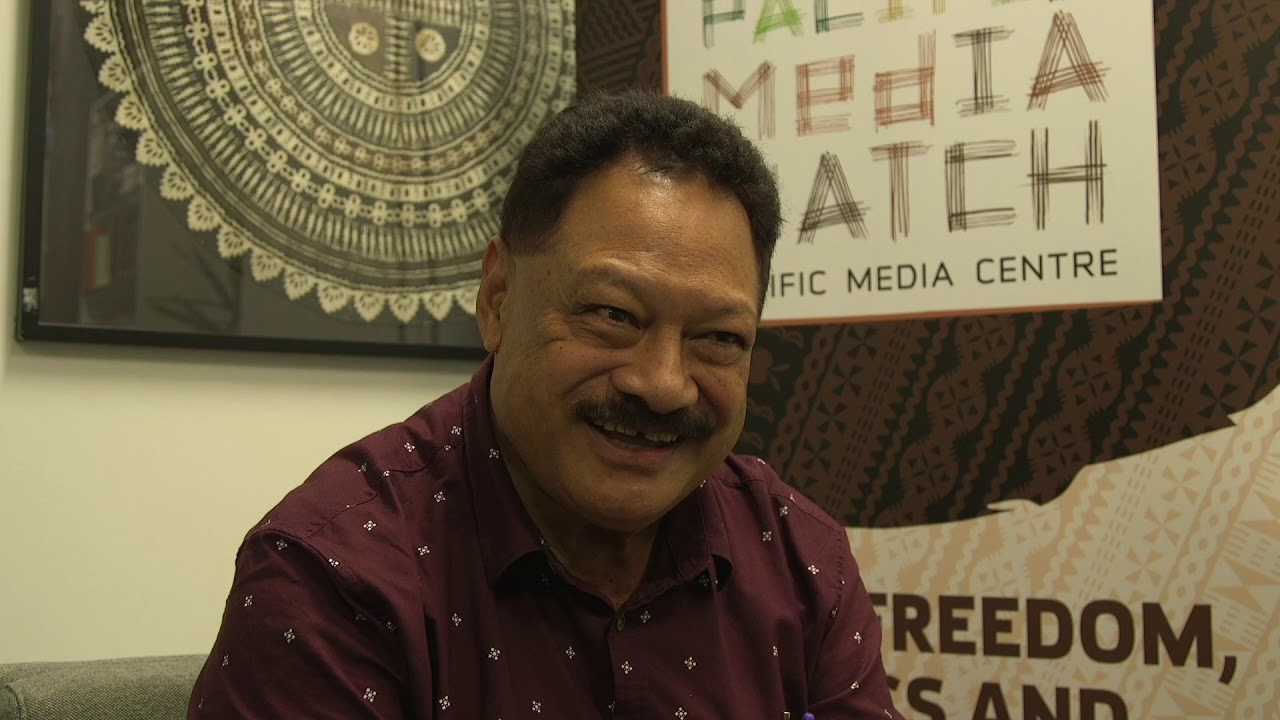
Tongan journalist, publisher and broadcaster Kalafi Moala talks to Pacific Media Watch project’s Sri Krishnamurthi. Video: Sri Krishnamurthi/Blessen Tom
By Sri Krishnamurthi
After 30 years as chief editor and publisher of Tonga’s flagship Taimi ‘o Tonga newspaper, the iconic Pacific media personality Kalafi Moala has sold his business and is looking to move on.
He plans to explore greenfield operations in Tonga in the digital era by presenting news through a mobile phone platform.
“I want to be engaged in something where we continue to produce news and maybe deliver news in a different platform maybe online, digital or maybe something to do with the phone,” he said in a recent interview with the Pacific Media Centre in Auckland.
“Who needs a newspaper, who needs a television set, who needs a computer when you have a telephone, in Tonga everybody has a telephone.
-Partners-
“The mobile phone is a major thing that has changed the life of Tongans and we want to use that platform.”
Moala expressed his concerns too about the “sovereignty” of Pacific peoples who he said were being subjected to “colonisation through other means”.
He has sold his publishing and broadcast business Taimi Media Network to enterprising businessman Tausinga Taumoefolau and his company Keitahi Limited.
Moala spoke to the PMC’s Pacific Media Watch freedom project as part of a series of interviews for a forthcoming mini-documentary, Pacific Media Watch – The Genesis.
I recently purchased a bedroom bundle (mattress, bed base, pillows and sheets) from a well known Australian startup for my son, who has flown the nest. Now I’m swamped with Google and Facebook ads for beds and bedding. The week before it was puffer jackets.
Ever wonder why and how this happens? The answer is surveillance capitalism.
Surveillance capitalism describes a market driven process where the commodity for sale is your personal data, and the capture and production of this data relies on mass surveillance of the internet. This activity is often carried out by companies that provide us with free online services, such as search engines (Google) and social media platforms (Facebook).
These companies collect and scrutinise our online behaviours (likes, dislikes, searches, social networks, purchases) to produce data that can be further used for commercial purposes. And it’s often done without us understanding the full extent of the surveillance.
The term surveillance capitalism was coined by academic Shoshana Zuboff in 2014. She suggests that surveillance capitalism depends on:
…the global architecture of computer mediation […] [which] produces a distributed and mostly uncontested new expression of power that I christen: “Big Other”.
The late 20th century has seen our economy move away from mass production lines in factories to become progressively more reliant on knowledge. Surveillance capitalism, on the other hand, uses a business model based on the digital world, and is reliant on “big data” to make money.
The data used in this process is often collected from the same groups of people who will ultimately be its targets. For instance, Google collects personal online data to target us with ads, and Facebook is likely selling our data to organisations who want us to vote for them or to vaccinate our babies.
Third-party data brokers, as opposed to companies that hold the data like Google or Facebook, are also on-selling our data. These companies buy data from a variety of sources, collate information about individuals or groups of individuals, then sell it.
Smaller companies are also cashing in on this. Last year, HealthEngine, a medical appointment booking app, was found to be sharing clients’ personal information with Perth lawyers particularly interested in workplace injuries or vehicle accidents.
Cambridge Analytica was a wake-up call
Last year’s Cambridge Analytica revelations highlighted the extent to which internet companies surveil online activity. Cambridge Analytica’s actions broke Facebook’s own rules by collecting and on-selling data under the pretence of academic research. Their dealings may have violated election law in the United States.
Despite the questionable nature of Cambridge Analytics actions, the bigger players and leading actors in surveillance capitalism, Facebook and Google, are still legally amassing as much information as they can. That includes information about their users, their users’ online friends, and even their users’ offline friends (known as shadow profiling). A shadow profile is a profile created about someone who hasn’t signed up to particular social platform, but might have some data stored about them because they have interacted with someone who has. Platforms make huge profits from this.
In this sense, Cambridge Analytica was small player in the big data economy.
Surveillance capitalism practices were first consolidated at Google. They used data extraction procedures and packaged users’ data to create new markets for this commodity.
Currently, the biggest “Big Other” actors are Google, Amazon, Facebook and Apple. Together, they collect and control unparalleled quantities of data about our behaviours, which they turn into products and services.
This has resulted in astonishing business growth for these companies. Indeed, Amazon, Microsoft, Alphabet (Google), Apple and Facebook are now ranked in the top six of the world’s biggest companies by market capitalisation.
Google, for instance, processes an average of 40 searches per second, 3.5 billion per day and 1.2 trillion per year. Its parent company, Alphabet, was recently valued at US$822 billion.
Sources of data are increasing
Newly available data sources have dramatically increased the quantity and variety of data available. Our expanding sensor-based society now includes wearables, smart home devices, drones, connected toys and automated travel. Sensors such as microphones, cameras, accelerometers, and temperature and motion sensors add to an ever expanding list of our activities (data) that can be collected and commodified.
Commonly used wearables like smart watches and fitness trackers, for example, are becoming part of everyday health care practices. Our activities and biometric data can be stored and used to interpret our health and fitness status.
This same data is of great value to health insurance providers. In the US, some insurance providers require a data feed from the policyholder’s device in order to qualify for insurance cover.
Connected toys are another rapidly growing market niche associated with surveillance capitalism. There are educational benefits from children playing with these toys, as well as the possibility of drawing children away from screens towards more physical, interactive and social play. But major data breaches around these toys have already occurred, marking childrens’ data as another valuable commodity.
In her latest book, The Age of Surveillance Capitalism, Zubboff suggests that our emerging sensor based society will make surveillance capitalism more embedded and pervasive in our lives.
Source: The Conversation (Au and NZ) – By Alex Reilly, Director of the Public Law and Policy Research Unit, Adelaide Law School, University of Adelaide
With all the hyperbole about the medevac law, it is easy to lose sight of its purpose.
Refugees have been transferred off Nauru and Manus Island for emergency medical treatment since offshore detention restarted on these islands in 2013. The Department of Home Affairs reported to Senate estimates that 898 refugees and asylum seekers had been sent to Australia for medical treatment prior to the passage of the medevac law earlier this year. Of those, 282 were returned to Manus and Nauru after receiving treatment, and the rest remained in Australia in detention.
These transfers occurred in response to pleas from doctors and health professionals on an ad hoc basis. And it was up to the Home Affairs Department and Minister Peter Dutton whether to comply with such a request. Medical emergencies could include life-threatening brain or heart conditions, complex abortions, or emergency psychiatric care for children at risk for suicide – all of which are beyond the capacity of the health systems on Nauru and Manus to treat.
Although some refugees were granted emergency medical evacuation, many others were not. In response, legal cases were brought against the government for breaching its responsibility to care for the refugees.
This required the federal court to convene at short notice to hear cases. It also required the expenditure of huge amounts of taxpayer money to call expert medical witnesses and file thousands of pages of supporting documentation.
Because of the delays in treatment, these legal battles were enormously risky for those in need of medical care.
Through these early cases, the court established that it was a breach of the government’s duty not to provide refugees with emergency medical treatment. And yet, the Home Affairs Department continued to fight applications for transfers for emergency medical treatment, only to be overturned by the courts, time and time again.
How the process works under the medevac law
The medevac law was passed due to concerns the department was rejecting transfer applications for political rather than medical reasons. The point was to provide an expedient, objective process to determine whether transfers were required.
And despite the Coalition government’s opposition to the bill, the process for determining which refugees are moved off Nauru and Manus for treatment remains highly deferential to the minister and Department of Home Affairs.
First, two doctors must assess the person and make a recommendation for transfer. The federal court recently ruled it was possible to make this medical assessment based on documentation alone, as opposed to an in-person or teleconference assessment. This was a necessary adjustment to the law, given that the Nauru government has banned teleconferences for residents.
The minister is required to approve or refuse the recommendation for transfer within 72 hours. There are three grounds for refusal:
the person is deemed a security risk
the person has a “substantial criminal record” (which equates to having been convicted of an offence with a sentence of imprisonment for 12 months or more)
the minister does not accept the transfer is necessary on medical grounds.
If the minister rejects the transfer on medical grounds, the second stage of the process kicks in, with an independent health advice panel (IHAP) assessing the doctors’ recommendation. It is important to note that this panel is comprised of government medical officers and other health professionals appointed by the minister.
To date, there have been 31 medical transfers under the law. In addition, nine recommendations were refused by the government. The panel of health experts upheld seven of the minister’s refusals, and overturned two.
Dutton’s claims don’t stand up under scrutiny
Dutton has made a number of claims about the impact of the medevac law that he argues justify its repeal. All defy reason and logic.
First, the minister has claimed “activist doctors” were using the law to bring people to Australia when they do not require emergency medical care.
This is frankly highly offensive to the medical profession in Australia, and contradicts the clear intention of the law to take politics out of transfer decisions. Even if doctors making the initial recommendation are too left-leaning for Dutton, the expert panel is stacked with medical practitioners of his choosing.
Second, the minister has argued that the capacity to be transferred to Australia for emergency medical treatment will lead to a resumption of the people-smuggling trade.
This is patently absurd. It is true that people smugglers can make up all sorts of stories about Australia relaxing its policies and it being easier to get to Australia. But the facts are crystal clear: the Coalition government maintains a policy of boat turn-backs and indefinite offshore detention for anyone thinking of making the journey.
Medical transfers to Australia are for a temporary period. Once people have been treated, they are returned to detention on Nauru or Manus. It is true that many asylum seekers have remained in Australia for extended periods for ongoing treatment, but these refugees remain within the immigration detention system. They are escorted to medical appointments and remain under guard while receiving treatment. They are given no hope of putting down roots in Australia.
The deterrent to people smugglers remains overwhelming. And, unsurprisingly, we have not seen a restarting of boat arrivals following the passage of the medevac law. Dutton’s own department has signalled this is unlikely in a briefing:
[Potential illegal immigrants] will probably remain sceptical of smuggler marketing and await proof that such a pathway is viable, or that an actual change of policy has occurred, before committing to ventures.
The only possible messaging that people smugglers might use to persuade people to get on a boat is the Coalition government’s own dire warnings of reopening the floodgates and political stunts like the brief resurrection of the Christmas Island detention centre at the staggering cost to taxpayers of over A$180 million.
Dutton’s third claim is that some refugees are refusing resettlement offers in the US because of the medevac law.
Again, it defies logic for refugees to refuse the US option – it is the only hope of resettlement currently on offer. One wonders whether the minister is using this claim as a cover for the fact that transfers to the US have come to a grinding halt under President Donald Trump.
The medevac law and human compassion
For over six years, successive Australian governments have maintained an unwavering narrow focus on stopping refugee boats with no concern for the victims of this policy – the innocent people on Manus and Nauru.
These people are under Australia’s care. It is Australia that pays the governments of Nauru and PNG to house offshore detention centres to create the disincentive for others to travel by boat to Australia. It is Australia that pays the security companies to keep them detained. And so it is Australia that is responsible for the dramatic decline in their mental and physical health.
It is the narrowest of concessions to offer emergency medical treatment in Australia to people we have so mistreated.
Influenza is a moving target for vaccines. Each year, up to four different strains circulate, and they are constantly evolving to escape our immune system.
So rather than childhood jabs giving long lasting immunity, we need annual flu shots to provide optimal protection against influenza.
But while you might sometimes get sick after having a flu shot, it’s a myth that having a flu shot can give you the flu.
A quick history of the flu vaccine
Influenza vaccines were first developed in the 1930s and 1940s, starting with the isolation of the influenza virus.
Back then, we learned there were many different influenza strains. To be effective, early research showed the vaccine needed to be matched to the circulating strains, and to be able to stimulate a response from the immune system.
The process to produce modern influenza vaccines now occurs on a much more refined and industrial scale. Hundreds of thousands of influenza viruses are collected by hundreds of national influenza centres around the world.
From these, four strains are selected for the annual flu vaccine, based on the viruses that are circulating at that time, how well the vaccines activate the immune system, how the strains are evolving, and the effectiveness of previous vaccines.
Modern flu vaccine development is slow and labour-intensive process.hotsum/Shutterstock
Most modern vaccines are manufactured by growing large quantities of live virus – mostly in chicken eggs or less commonly animal cells – which are then purified, deactivated and split into smaller components. These vaccines are inactive and cannot replicate.
There are also two new “enhanced” vaccines that are used in older people, who don’t tend to respond as strongly to vaccines: Fluzone High Dose and Fluad, which is designed to better stimulate immunity and draw immune cells to the site of vaccination.
The human immune system has several strategies to protect against infection. For viral infections such as influenza, the key strategy is known as adaptive immunity. This part of the immune system can “remember” previous exposure to pathogens.
When you get an influenza infection, the virus enters and hijacks the machinery of the host cell to replicate itself, before releasing these copies to infect more cells.
T lymphocyte cells of the immune system can recognise this viral incursion. T cells protect against further spread of the virus by activating pathways that cause infected cells to trigger a “suicide” process.
Another strategy the body uses is to produce antibodies, which are molecules produced by B cells that recognise components of the viral capsule. These antibodies work by sticking to the surface of the influenza virus to prevent it spreading and facilitating disposal.
Flu shots help mount a quicker defence
On a first exposure to a pathogen, our B cells take at least two weeks to ramp up production of antibodies. However, on subsequent challenges, antibody production occurs much more quickly.
Influenza vaccines harness this arm of the immune system, known as “humoral” immunity. By “practising” on viral components, vaccines allow the immune system to react more quickly and effectively when faced with the real virus.
The flu shot takes about two weeks to start protecting you against influenza.DonyaHHI/Shutterstock
So why do you sometimes get sick after a flu shot?
There are several reasons why you might feel a bit off after getting your flu shot.
First, your flu shot only protects you against influenza and not other respiratory illness which might causes similar cold or flu symptoms. This includes RSV (respiratory syncytial virus), which is common in late autumn and early winter.
Second, stimulating the immune system can result in symptoms similar to that of influenza, although much milder and short-lived. These include local inflammation (redness, pain or swelling at the site of the vaccine) and more general symptoms (fever, aches and pains, tiredness).
Third, vaccine-induced protection isn’t complete. In some years, the vaccine is not well matched to circulating strains. Usually this is due to mutations that may develop in circulating strains after the vaccine strains are selected.
The flu vaccine also doesn’t “kick in” for two weeks after vaccine administration. In some people, particularly those who are older and those who have weakened immune systems, antibody production is not as strong, and the level of protection is lower.
A problem with current vaccines is the reliance on eggs, which results in a relatively slow and labour-intensive production process.
Current work is aiming to speed up this process by using different technologies so that vaccine manufacturers can react more quickly to changes in circulating viruses.
The “holy grail” for influenza vaccines is to stimulate an effective immune response to a component of influenza that doesn’t change each year, so annual vaccination is not required.
A better strategy might be to harness T cell immunity. Recent work has shown that a type of T cell, known as “killer” T cells, can recognise other parts of the influenza virus, and therefore can provide broad protection against seasonal and pandemic strains.
But while we wait for a better alternative, getting an annual flu shot is the best way to avoid the flu.
The location of this earthquake is no surprise. Three earthquakes greater than magnitude 6 occurred within a few kilometres of each other and within the same general area in 2016 and 2018. Nor is the size of the quake particularly out of the ordinary. A magnitude 7.1 earthquake struck here in 1962, and a magnitude 7.3 earthquake in 1983.
The quake’s epicentre was in the Banda Sea about 700km north of Darwin.US Geological Survey
Why is this zone so active?
Even though this seismic zone is at the boundary between two tectonic plates, these earthquakes occur within the Australian tectonic plate, and owe their character to variations in the type of crust that makes up the northern part of the plate.
Where the Australian Plate collides with Asia, some of it has slid (subducted) under the volcanoes of Eastern Indonesia, and is descending into the mantle. This process is driven by buoyancy (the tendency of material to sink or float). Continental crust is more buoyant, and thus resists sinking into the mantle. Ocean crust, meanwhile, is denser and has more of a tendency to sink. As the Australian Plate travels northward, the front edge is high-density ocean crust, and the part following behind it is lower-density continental crust.
Where one part of a plate subducts easily and starts to sink and the other wants to float and refuses to subduct, a tear can develop, and this is what we believe is happening north of Darwin. The northern edge of the Australian Plate used to be made up of ocean crust that is now completely subducted. The buoyant Australian continent is refusing to subduct, and as a result the ocean crust is tearing off as it sinks into the mantle.
In the region of Timor this tearing seems to have happened already, so there is virtually no seismicity at similar depths for several hundred kilometres west of this earthquake in the vicinity of Timor. Earthquakes cannot occur where there is a hole in the plate, and instead they mainly happen at the spot where the tear is growing.
A useful analogy to visualise this is tearing a piece of cheese – the kind of pre-sliced, soft cheese that you put on your sandwiches. The picture below shows a piece of cheese that is bent around a cylinder (representing the descent of the plate into the mantle), and is torn along one edge.
A cheese analogy for the Banda Sea earthquake. The cheese represents the Australian plate, which is bending down as it slides (subducts) under Indonesia and Timor.Brendan Duffy/Mark Quigley, Author provided
As the tear in the cheese (plate) gets longer, earthquake activity stops where there is no longer any cheese (plate) present, and gets more intense at the point where the tear is happening.
The official earthquake record from the US Geological Survey indicates that this earthquake consisted of a combination of lateral displacement and vertical extension (lengthening), which is consistent with our cheese analogy.
The vertical extension is caused by the stretching of the crust while lateral displacement, known as strike slip, probably accommodates the eastward movement required by the continuing attachment of the slab east of the earthquake.
Why did it rock Darwin so hard?
Earthquakes such as this occur within the Australian plate, and the seismic waves travel through the cold, strong Australian plate quite efficiently. This means that it did not lose much of its energy before reaching Darwin.
This is particularly true for long-period (low frequency) waves, which disproportionately affect tall buildings, causing them to move quite violently. This is consistent with news reports that offices in Darwin’s central business district were evacuated and are now being assessed for damage.
In contrast, the city of Dili, which is closer to the earthquake, experienced only minor wobbling for less than 10 seconds, according to Federation University geology lecturer Nicole Cox, who is visiting Dili. Seismic waves emanating from the lower plate have already weakened considerably by the time they pass through the upper plate to reach Dili.
Local earthquakes are relatively infrequent around Darwin, because like the rest of Australia it sits on strong continental crust, relatively far from a plate boundary. However, earthquakes like today’s are quite common. Queensland seismologist Kevin McCue has compiled a long list of earthquakes that affected Darwin, including many from the region of the Banda Sea that produced today’s earthquake. Even in 1900, local people recognised the relative normality of severe Banda Sea earthquakes.
Aftershock sequences from these types of events commonly include a few earthquakes greater than magnitude 6, and ten or more above magnitude 5. The key to managing this hazard is preparedness and carefully considered action in the aftermath of the earthquake.
Now is probably as good a time as any for Territorians and other Australians to re-read the advice of state emergency services on how to be safe when an earthquake strikes, and the best places to take cover.
Media coverage of mass coral bleaching on the Great Barrier Reef may have been a major tipping point for public concerns around climate change, according to research published today.
While the physical effects of the bleaching have been well documented, we wanted to understand the social and cultural impact.
Our research, including a study published today in Nature Climate Change, has compared survey responses from thousands of Australians and international visitors, before and after the bleaching event.
Reef grief
Our research team conducted face-to-face interviews with 4,681 visitors to the Great Barrier Reef region, in 14 coastal towns from Cooktown to Bundaberg, over June to August in both 2013 and 2017. We asked more than 50 questions about their perceptions and values of the Reef, as well as their attitudes towards climate change.
We found a large proportion of respondents, including Australians and overseas visitors, expressed forms of grief in response to loss and damage to the iconic ecosystem. Negative emotions associated with words given in short statements about “what the Great Barrier Reef means to you”, included sadness, disgust, anger and fear.
Emotional appeals are widely used in media stories and in social media campaigns, and appealing to fear in particular can heighten a story’s impact and spread online.
However, a side-effect of this approach is the erosion of people’s perceived ability to take effective action. This is called a person’s “self-efficacy”. This effect is now well documented in reactions to representations of climate change, and is actually a barrier to positive community engagement and action on the issue.
In short, the more afraid someone is for the Great Barrier Reef, the less they may feel their individual efforts will help to protect it.
While our results show a decline in respondents’ self-efficacy, there was a corresponding increase in how highly they valued the Reef’s biodiversity, its scientific heritage and its status as an international icon. They were also more willing to support action to protect the Reef. This shows widespread empathy for the imperilled icon, and suggests greater support for collective actions to mitigate threats to the Reef.
Researchers surveyed thousands of visitors to the Great Barrier Reef in 2013 and 2017.Matt Curnock, Author provided
Changing attitudes
We observed a significant increase in the proportion of people who believe that climate change is “an immediate threat requiring action”. In 2013 some 50% of Australian visitors to the Great Barrier Reef region agreed climate change is an immediate threat; in 2017 that rose to 67%. Among international visitors, this proportion was even higher (64% in 2013, rising to 78% in 2017).
This represents a remarkable change in public attitudes towards climate change over a relatively short period. Previous surveys of Australian climate change attitudes over 2010 to 2014 showed that aggregate levels of opinion remained stable over that time.
Comparing our findings with other recent research describing the extent of coverage and style of reporting associated with the 2016-2017 mass coral bleaching event, we infer that this event, and the associated media representations, contributed significantly to the shift in public attitudes towards climate change.
Moving beyond fear
As a source of national pride and with World Heritage status, the Great Barrier Reef will continue to be a high profile icon representing the broader climate change threat.
Media reports and advocacy campaigns that emphasise fear, loss and destruction can get attention from large audiences who may take the message of climate change on board.
But this does not necessarily translate into positive action. A more purposeful approach to public communication and engagement is needed to encourage collective activity that will help to mitigate climate change and reduce other serious threats facing the Reef.
Examples of efforts that are underway to reduce pressures on the Reef include improvements to water quality, control of crown-of-thorns starfish outbreaks, and reducing poaching in protected zones. Tourism operators on the Reef are also playing an important role in restoring affected areas, and are educating visitors about threats, to improve Reef stewardship.
Clearly there remains an immediate need to reduce greenhouse gas emissions to ensure the Reef’s World Heritage qualities are maintained for future generations.
However, maintaining hope, and offering accessible actions towards attainable goals is critical to engaging people in collective efforts, to help build a more sustainable future in which coral reefs can survive.
The authors would like to acknowledge Nadine Marshall, who co-wrote this article while employed by CSIRO. We thank our other co-authors of the Nature Climate Change paper, including Lauric Thiault (National Center for Scientific Research, PSL Université Paris), Jessica Hoey and Genevieve Williams (Great Barrier Reef Marine Park Authority), Bruce Taylor and Petina Pert (CSIRO Land and Water) and Jeremy Goldberg (CSIRO & James Cook University). The scientific results and conclusions, as well as any views or opinions expressed herein, are those of the authors and do not necessarily reflect those of the Australian Government or the Minister for the Environment, or the Queensland Government, or indicate commitment to any particular course of action.
This essay is part of a series of articles on the future of education.
Technological developments are expected to majorly, and rapidly, disrupt or change the nature of employment. The multiplier effect of these disruptions interacting with each other has led to what has been termed the fourth industrial revolution (i4.0).
The first industrial revolution took us from agrarian to industrial economies and the second used resources like electricity and steel to create mass production. The third refers to technology advancing from analog and mechanical devices to the digital technology available today.
The fourth industrial revolution represents ways technology has become embedded in societies by the fusion of technologies, or what is known as cyber-physical systems. For example, 3D printing needs advanced materials with printers linked to the internet, which are increasingly intelligent and autonomous.
The consensus among experts is that our training providers and employers aren’t adapting fast enough to meet the skill needs of the fourth industrial revolution. This is reflected in a growing technological and digital skills gap. But there are some things the sector can do to catch up.
Commentators have polarising views on the possible effects of the fourth industrial revolution. Some see technologies offering limitless new opportunities while others see major economic disruptions – the so-called dark side of technological change.
The pessimistic perspective is provided in an often cited 2013 study by labour researchers Carl Benedikt Frey and Michael A. Osborne, who argue 47% of total employment in developed economies is at risk of automation. This figure also underlies eye-catching headline such as:
In Australia, the Productivity Commission estimates 40% of employment is at risk of being digitally disrupted by automation over the next 10-15 years. The Australian Industrial Transformation Institute estimates the level of disruption to be between 5-10%.
But an important point often overlooked in these and related studies based on Frey and Osborne’s modelling, is that they investigate the potential for existing jobs to be automated. They don’t take into account the net effect of automation on jobs and that new jobs may be created as a consequence of automation.
More recent reports address this issue and point to a less pessimistic future. The World Economic Forum recently projected that while 75 million jobs will likely be displaced by robots, 133 million new jobs will be created. This means a net gain of more than 50 million jobs globally.
Robots will take some jobs, but more might be created.from shuttrestock.com
This suggests by 2022, some established roles such as data analysts and software developers – as well as so-called emerging roles such as machine learning specialists and robotics engineers, together with existing roles based on distinctively human traits such as customer service workers and people and culture specialists – will rise from 16% of the labour force to 27%.
On the flip side, as algorithms replace workers, declining roles such as accountants and telemarketers, currently representing around one third of the labour force, will fall to one in five workers.
In Australia, Deloitte Access Economics estimates more than 80% of jobs will be created between now and 2030 for knowledge workers.
Should we be worried?
The suggested net employment gains are not a foregone conclusion. There is growing consensus developed economies like Australia must take urgent steps to mitigate the negative effects of technological disruption and take advantage of opportunities.
More than half expect they will need skills they currently lack within five years and that they will need to upskill, reskill and retrain.
Skills are a Darwinian, survival issue, not only for workers, but for the organisations that employ them. Two-thirds of employers say technology-related skills shortages are impacting them now (not in five years) and have noted their biggest challenge is to re-skill employees.
Recent research shows that while disruptive technology has reduced the need for some jobs, the main issue facing Australian employers is the changing the nature of existing jobs.
This is particularly the case for the expanded range of tasks workers are expected to do. Employers seeking external training report difficulties finding VET providers delivering training in disruptive technologies.
Employers also often view university graduates with technology-related skills as more valuable than employees with VET qualifications. The result is a decline in confidence in the ability of the VET sector to deliver training that meets the challenges of technological disruption.
What kind of skills will future jobs need?
Much of the recent debate related to digital disruption has focused on the dichotomy between the importance of hard or technical skills (such as industry 4.0 programming, software engineering and data science) and soft or non-technical skills (such as creativity, design and teamwork).
For example, about half of Chief Information Officers favour hard skills while the other half prefer soft skills among future employees.
This divide is driven by modelling based on a technology-centred (automation) scenario. But it ignores two other important scenarios, as reported by German researchers, into the fourth industrial revolution: the hybrid and specialisation scenarios.
More than half of Chief Information Officers prefer soft skills in future employees.
Under the hybrid scenario, the distribution of tasks between people and technologies is based on the relative strengths and weaknesses of workers versus machines, and employees will face increased demand to be highly flexible. Control tasks will still need to be performed through technologies that require people for monitoring and directing.
Under the specialisation scenario, people use cyber-physical systems to aid decision-making. Cyber-physical systems are technologies that enable bringing the virtual and material dimensions together to produce a fully networked domain in which intelligent objects interact with each other.
For example, in new smart production systems, there will be less need for employees with administrative, production and monitoring competencies. But there will be a growing need for qualified and ultra-specialised employees with IT competencies, in particular those who can integrate them with production—technical competencies.
Applying this to the Australian context, disruptive technologies are influencing the demand for both hard and soft skills in many occupations, with some skills in decline and others in demand. Industry needs both technical and non-technical skills to “future-proof” Australian workers.
A good example of this is the first nationally recognised qualification in automation, launched in Perth earlier this month. This came out of a collaboration led by Rio Tinto, South Metropolitan TAFE and the WA government.
Employers should alsotake a lead with experimenting and testing new methods to meet future skill needs. A South Australian electronics firm, REDARC, is preparing employees to become ready for the fourth industrial revolution by engaging experts to run dedicated sessions on the application of an overarching i4.0 lens across the core competencies of mechanical, chemical and electronic engineering.
Federal and state governments need to work to restore the confidence of employers and students in the VET sector. An important first step is to implement the early recommendations of the Joyce Review on VET.
Recent initiatives indicate the VET sector, industry and government have recognised these issues. They will need to pick up the pace to ensure vocational education provides students – and businesses that employ them – with the future-ready skills needed to succeed in the fourth industrial revolution.
Facebook’s proposed new digital currency, if even modestly successful, will hand over much of the control of monetary policy from central banks to Facebook and a group of partner companies including Uber and eBay.
So says Chris Hughes, a Facebook co-founder. He calls the plan frightening. “This currency would insert a powerful new corporate layer of monetary control between central banks and individuals,” he writes in the Financial Times.
But fear not, central banks are more resilient than this.
What is Libra, and who is behind it?
At this point there’s no guarantee Facebook will succeed in establishing its own currency (called the Libra) that you can use to make payments with a digital wallet integrated into Facebook’s Messenger and WhatsApp applications.
But let’s assume it does.
Key to the success of any currency is ubiquity. Facebook has that (in most parts of the world). Along with its enormous customer base, and wealth, it also has the backing of 27 other corporations. These include key global players in electronic payments – Mastercard, Visa and Paypal.
Joined together in a Swiss-based not-for-profit entity called the Libra Association, these companies are particularly interested in the prospect of billions of people making payments using a mobile phone without ever needing a bank account. There are, tellingly, no banks in the group.
The Libra’s utility as a payment system is underlined by its design differences to a cryptocurrency like Bitcoin. The value of Bitcoin fluctuates wildly. The Libra’s value will instead be stabilised. This will be done using a private sector version of a mechanism known as a “currency board”.
The threat to monetary policy
A goal of the Libra Association is to “move toward increasing decentralisation”.
As Hughes notes, central banks were established to deal with the problems that came with a decentralised financial system. “After many mistakes, we have learnt that we want a central bank to act to increase or decrease the monetary supply in moments of contraction or expansion.”
To understand why decentralisation might pose a threat to the role of central banks, let’s recap how they exercise monetary policy.
The power of a central bank comes from setting interest rates.
The Reserve Bank of Australia, for example, does this through operating what is called the Interbank Overnight Money Market. Banks must deposit enough currency with the RBA to cover obligations to other banks. The RBA effectively sets the floor and ceiling in the market by offering to take deposits or lend in the market at rates 25 basis points below and above its target interest rate. It also transacts in the market by buying and selling bonds and derivatives.
Doing this keeps the interest rate in the market very close to the RBA’s target. Changes in the rate are generally reflected in interest rates on bank loans. These in turn affect economic activity and inflation.
The concern is that a substantial move towards using electronic money for payments could reduce banks’ importance as money lenders, and therefore the role of the interbank markets. If the central bank’s balance sheet is smaller, its ability to influence the interest rates offered by financial institutions is theoretically weakened.
But the vast bulk of loans made by banks are to consumers to buy homes and cars, and to companies to buy capital equipment. These do not seem the types of goods likely to be paid for in Libras.
The central bank could also expand its balance sheet by issuing its own central bank bills or bonds.
And so long as a government requires taxes to be paid in its national currency, the demand for the interbank market will never totally dry up.
So at this point, even if successful, I think it’s an exaggeration to suggest the Libra poses a threat to the important role of central banks in keeping economies stable through monetary policy.
Will the Libra project even succeed?
Other concerns, though, such as the use of cryptocurrencies for money laundering, should be taken seriously.
But let’s also take a reality check. There is no certainty the Libra project will succeed.
In the 1990s Mondex and Digicash were promoted by some major banks as the payments systems that would replace cash. They never achieved critical mass.
Bitcoin has been much hyped for more than a decade but still only accounts for a miniscule proportion of transactions (which is a good thing given the process of creating bitcoins is so energy-intensive).
Many other similar cryptocurrencies have come and gone.
A decade ago Facebook had ambitions to establish a “safe and secure way” to make online payments with its Facebook Credits system. It abandoned the project after three years.
So it is unsurprising that Reserve Bank of Australia economists “see little likelihood of a material take-up of cryptocurrencies for retail payments in Australia in the foreseeable future”.
Source: The Conversation (Au and NZ) – By Tom Ross, Professor in Food Microbiology, Centre for Food Safety and Innovation, Tasmanian Institute of Agriculture, University of Tasmania
Last Thursday, dairy company Lactalis Australia recalled eight varieties of milk over concerns the products could be contaminated with the bacteria Escherichia coli (E. coli).
This recall affects several brands of milk purchased at Coles, Woolworths, IGA and other retailers in Victoria and southern New South Wales with a use-by date of July 2.
Milk provides many of the nutrients needed for human growth and development, including protein, fat, carbohydrates (lactose) and calcium. But because milk is such a complete mix of nutrients, it’s also an ideal breeding ground for bacteria. This is why milk spoils quickly, particularly when it’s left out of the fridge.
But the presence of E. coli in food – including the recalled milk – doesn’t necessarily mean the food is unsafe. It means the product is more likely to cause illness, and indicates further testing is needed. To minimise risk to public health, it’s advised that implicated products are not consumed.
Milk from a cow is laden with bacteria. The bacteria come from the skin on the teats of the cow, and sometimes directly from the milk if the cow has mastitis (a bacterial infection in the udder).
The same is true of human breast milk – the milk itself contains bacteria, while bacteria can also come from the mother’s skin. But a difference in a cow is that the cow’s udder is close to its anus, so contamination of the udder with the cow’s faeces is common.
Pathogenic bacteria (those that cause illness) that can occur in cow’s milk include some strains of E. coli, Listeria monocytogenes (L. monocytogenes), salmonella, Bacillus cereus (B. cereus) and Staphylococcus aureus (S. aureus).
While B. cereus and S. aureus can cause unpleasant illnesses, most people recover quickly and completely.
But some strains of E. coli and L. monocytogenes can cause more serious illness and even death. A raw (unpasteurised) milk product contaminated with pathogenic E. coli was found to have caused the death of an infant in Victoria in 2014.
L. monocytogenes and S. aureus can be present in the milk in the cow’s udder, or on the udder itself, while B. cereus is found in the soil on dairy farms and in milking shed environments.
E. coli, however, arises from faecal contamination of the udder. While every effort is made by dairy farmers to clean cows’ udders before the milking begins, it’s not possible to do this with complete certainty. A low risk remains that faecal bacteria will enter the raw milk.
E. coli won’t necessarily make you sick
E. coli is commonly found in the faeces of warm-blooded animals, including mammals and birds. Most strains of E. coli are not harmful. Rather, the presence of E. coli is widely used in public health management as an indicator of faecal contamination (called an “indicator bacterium”).
It’s important we measure faecal contamination in food and water sources because gastrointestinal pathogens can be released from the infected host (in this case, the cow) through their faeces.
So faecal contamination of food or water represents a risk that a person exposed to those sources would become ill from gastrointestinal pathogens including pathogenic strains of E. coli, salmonella, norovirus, Clostridium perfringens, and many others.
Those infected would then be likely to repeat the cycle of infection – that is, to shed the pathogens that made them sick via their faeces into their environment, and from there, to infect other people.
E. coli bacteria makes its way into milk from cows’ faecal matter.Stijn te Strake/Unsplash
Testing can relatively quickly detect E. coli in foods or water. The presence of E. coli is an indication there is a much greater risk of infections because of the concurrent risk of other pathogens, like those listed above, being present.
So from a positive E. coli result, further testing might be conducted to see whether other pathogens are present. Generally, the presence of E. coli is enough to cause alarm and recall of contaminated foods, or to advise people not to swim in water that has been contaminated, to minimise the risk of infections.
Pasteurisation and testing
The government has mandated that milk sold in Australia should be pasteurised to eliminate any harmful bacteria and protect public health. This process also extends the shelf-life of the product by reducing other bacteria that cause milk spoilage.
Pasteurisation involves heating the milk for sufficient time to eliminate the pathogenic bacteria; usually to 72–74°C for 15–20 seconds. The time and temperature of pasteurisation are monitored in real time and, if the conditions are less than required, the “suspect” milk is diverted and not filled into retail containers.
As an additional check, the pasteurised milk is subjected to further testing for the presence of E. coli after those processes. These tests, however, typically require 12–20 hours to obtain results. Because of all the other safeguards in place, the milk is assumed to be safe for sale and distributed before the test results are obtained, unless the other tests show a process failure requiring a product recall.
This recent recall of milk from Australian retail markets after the detection of E. coli is a very rare event. In this case, the causes of the possible pasteurisation failure remain unknown. The “back-up” testing for E. coli in the milk, however, did reveal a failure in the system that will now be investigated to prevent recurrence.
Importantly, the detection of E. coli does not mean the milk is unsafe, but indicates that it could be.
The identification of E. coli in the milk initiated a rapid product recall of specifically “at-risk” products, and removal from sale of all potentially contaminated milk, alongside alerts to consumers. These actions are part of the food safety systems in place in Australia and many other nations.
This process was also implemented earlier this month when another eight milk varieties were recalled by the food safety regulator over concerns they may be contaminated with cleaning solution.
Zoe Bartlett, an early career researcher at the University of Tasmania, contributed to this piece.
Staff of the University of the South Pacific at the university’s main Laucala campus in Suva have called for pro-chancellor Winston Thompson to step aside to allow for an independent investigation into alleged abuse and mismanagement to proceed.
This was one of three demands USP staff made in a petition they presented today to the university’s senior management team.
The petition was signed by 500 staff members comprising academic and administrative, and addressed to pro-chancellor Thompson, who is also the university council chair, as well as to his deputy chair Aloma Johansson of Tonga, council members and the university’s vice-chancellor and president, Professor Pal Ahluwalia.
The June edition cover of Islands Business featuring vice-chancellor Professor Pal Ahluwalia. Image: IB
Demand number two in the petition calls for pro-chancellor Thompson to “be recused from council chair immediately,” adding “his public defence of those implicated in the allegations is premature and unprofessional and compromises his position as chair.
“Furthermore, his recent public statements against VC&P Pal Ahluwalia are unprofessional, prejudicial and damaging to the university.”
-Partners-
To regional governments who are owners of the USP, as well as donor partners “especially Australia and New Zealand,” university staff in their petition wanted them to ensure that the investigation into the alleged abuses would be fair, thorough and remedial actions effected.
Closely watching University staff are closely watching the investigation process being led by the USP audit and risk committee.
The committee is headed by Mahmood Khan, a Fiji government nominee to the USP Council, and a chartered accountant who used to work in New Zealand.
In a statement last week, the university council deputy chair Aloma Johansson of Tonga said four Auckland-based accounting firms had been invited to submit bids to undertake the probe.
She said then that the Khan-led committee would meet tomorrow to select the investigation firm.
This Islands Business article is republished with permission.
Populations around the world are ageing rapidly. Almost one in four people will be aged 60 or more by 2050. This growing cohort of older adults is often portrayed as too trusting – why should this be so?
Trust may be particularly important for the successful functioning of older adults as they come to rely more on others in the face of physical and cognitive decline.
Trust is also important for establishing and maintaining cooperation between individuals and groups, and promoting social behaviour, good health, life satisfaction, and longevity.
Our new meta-analysis aggregating data from 38 independent studies suggests that the short answer is “yes”: older people are more trusting than younger people.
But are they trusting the right people?
Financial versus non-financial trust
In research terms, trust is defined from a multidisciplinary perspective as
a psychological state comprising the intention to accept vulnerability based on positive expectations of the intentions or behaviour of another.
Our meta-analysis shows that when trust is expressed non-financially, older adults are more trusting than young adults, regardless of the trustworthiness of the recipient of that trust.
The clear downside of greater trust is increased vulnerability to deception and exploitation. A common perception is that wealth accumulated over a lifetime combined with trusting natures makes older adults targets for financial exploitation.
There are two primary types of elder financial exploitation: elder financial fraud and scams and elder financial abuse. The two types are differentiated by the absence or presence of trust.
Fraud and scams do not rely on trust. One in 18 cognitively healthy older adults is reported to experience financial fraud each year, with this figure likely to be even higher due to under-reporting. But contrary to popular opinion, consumer fraud is less common among older adults than younger adults.
Elder financial abuse on the other hand is defined by the relationship of trust within which it occurs, and is one of the fastest growing crimes. Financial trust involves investing money with some expectation of a return on investment. Our meta-analysis shows that, relative to young adults, older adults invest more financial trust in the untrustworthy, but not the trustworthy.
If greater financial reserves were the sole explanation for older adults investing more in the untrustworthy, we would expect to see them investing more in the trustworthy too.
But this was not the case for financial trust. A better explanation might be found in the age-related positivity effect. This effect refers to a well-documented finding that older adults are less likely to remember and pay attention to negative information (for example, untrustworthiness) relative to positive information (such as trustworthiness).
Age-related positivity
There are both empirical and theoretical grounds for predicting that trust in the untrustworthy relative to trustworthy increases disproportionately with age.
Socioemotional selectivity theory attributes this age-related shift in information processing to changes in motivation across the lifespan.
Young adults, who see their lives stretching ahead of them, tend to prioritise future-oriented goals such as gaining knowledge. Older adults with shorter time horizons are motivated to prioritise present-focused goals such as emotional satisfaction and positivity.
Further evidence for the age-related positivity effect comes from studies measuring changes in brain activity. With age, activity in a region of the brain called the amygdala decreases in response to negative stimuli, but is maintained in response to positive stimuli.
Another region, the anterior insula, is thought to be responsible for “gut feelings” associated with risk. This region is less active in older adults when viewing faces with an untrustworthy appearance.
Genuine versus superficial trustworthiness
It’s important to keep in mind that, sometimes, information about trustworthiness can’t be trusted. Fraudsters can have trustworthy-looking faces. Think Bernie Madoff. These superficial appearances are by no means a reliable indicator of trustworthiness.
Interestingly, our meta-analysis found that reliability of the cue to trustworthiness has no effect on age-related differences in trust. Older adults are more trusting than young adults in response to both genuine cues to trustworthiness (such as past behaviour) and superficial cues like facial appearance.
This is dangerous when trust is extended to the wolf in sheep’s clothing. But it is an advantage when trust is given to a worthy recipient who may otherwise appear untrustworthy.
Older adults are generally more trusting than their younger counterparts. But to be considered “too trusting” conveys only negative implications. Trust not only increases risk of financial abuse, it also confers many benefits, especially in older age.
A Cook Islands News editorial acknowledged Internal Affairs Secretary Anne Herman and Chief Censor Dennis Tangirere’s decision to cancel the ban.
-Partners-
“It’s difficult to do a public about-turn – we all know that. So Herman and Tangirere deserve acknowledgement for their willingness to listen to public opinion and reverse Internal Affairs’ initial position.”
Te Tiare Association secretary and LGBTI spokesperson Valery Wichman welcomed the about-turn from the Secretary of Internal Affairs reports the Cook Islands News.
“We were happy that it was not banned or condemned but rated 18,” she said.
Fundamental human rights “This means that our fundamental human rights have been upheld. We can now enjoy another expression of art and a good story.”
However, the owner of the empire cinema Kathleen Napa-Bergin claimed that she was not informed about Internal Affairs decision to cancel the ban.
The cinema has not screened the film since the censor’s request to pull it 10 days ago and as its license run has now ended, it is unlikely that it will be screened again.
Cook Islands News editor Jonathan Milne hopes that this will change.
Special screening “I hope Empire Cinema boss Pa Napa can somehow negotiate to bring it back for a special screening – and if he does, I’ll happily pay my 11 bucks to see it,” he wrote.
“Because, by all accounts, this is not a raunchy, sexual film.”
“If anything, it is an inspiring story of a young man’s triumph over the demons of drugs, alcohol and abuse.”
“It offers hope to young adults trying to make sense of who they are in a confusing world.”
Doused in black warpaint, draped in ammunition and clutching guns almost as big as some of them, the boys stare with hardened gazes into the camera.
The photo, taken somewhere in Papua’s remote hills, is like countless others released by the West Papua Liberation Army, a rebel group waging war on the Indonesian military and proclaiming independence from the state.
But unlike the stream of propaganda showing what the group says is its burgeoning guerrilla force, the ceremoniously staged scene in May appears to show children fighting within the Liberation Army’s ranks.
“These children automatically become fighters and opponents of the colonial military of Indonesia,” said Sebby Sambom, a spokesperson for the Liberation Army.
He said about a dozen soldiers between the ages of 15 and 18 were currently fighting for the rebel group in different parts of Papua.
-Partners-
Under international human rights laws, 18 is the minimum legal age for the recruitment and use of children in hostilities, according to the UN Working Group on Children and Armed Conflict.
Using children under the age of 15 as soldiers is defined as a war crime by the International Criminal Court.
Necessary combatants Sambom, who is based in Papua New Guinea, accepted the Liberation Army was in violation of international conventions but said the enlistment of children as combatants was necessary because of what he described as oppression by the Indonesian military in Papua.
He said children had been fighting for various rebel groups in Papua for decades.
The Liberation Army has been under the spotlight since a renewed campaign in the Central Highlands regency of Nduga since late last year.
The attack, which also killed an Indonesian soldier, was the bloodiest in years and sparked a huge military-led hunt for the rebel fighters which has seen dozens killed on both sides in the past six months.
Scorched earth The Liberation Army has accused Indonesia of a scorched earth campaign, which the military has denied.
Rights groups have documented a widespread displacement of civilians from Nduga as the Liberation Army and Indonesian military and police engage in frequent gunfights.
In April, the Irish human rights group Front Line Defenders said more than 32,000 people had been displaced from the regency since December.
Children have also been caught up.
The Humanity Volunteer Team of Nduga said in April there were more than 700 students at an emergency school for displaced people from Nduga that was set up in nearby Wamena.
Cycle of violence Experts say the use of child soldiers in Papua is part of a cycle of violence, with many joining the fight after their parents die in battles with Indonesia’s military.
“Some of them feel angry. If there is no trauma healing process for these kids, it is a matter of time in coming years, in coming months, they will join their fellow friends in the jungle,” said Hipolitus Wangge, an Indonesian researcher who interviewed people displaced from Nduga this month.
He said one boy he interviewed in a Wamena displacement camp – who he estimated was aged between 10 and 11 – expressed a desire to join the Liberation Army, which is led in Nduga by Ekianus Kogoya, an ambitious commander who’s about 20 years old.
“To some refugees, they still see Eki as the commander, as one of the strongmen in the Highlands at the moment. Because he can fight, he can kill, and to some he can be a symbol of Papuan resistance,” said Wangge.
Chris Wilson, a senior lecturer at Auckland University who specialises in terrorism and conflict in Indonesia, said the use of child soldiers would prolong the violence in Papua by enlisting young people in the conflict before they are fully developed.
“It’s going to be very difficult for them to be reintegrated into society once they’re involved in the actual violence from that type of age.”
“Overwhelming force” Wilson said their presence would also complicate any clashes for Indonesia’s military, which would be likely prevented from using “overwhelming force” if it was aware of children within the rebels’ ranks.
A spokesperson for Indonesia’s military, Mohammed Aidi, said he did not know of the use of child soldiers by the Liberation Army.
This article is published under the Pacific Media Centre’s content partnership with Radio New Zealand.
The phrase “colonial settlement” sounds benign, but Julie Gough’s Tense Past presents compelling evidence to the contrary.
Since 1994, Gough has been searching the archives, piecing together the evidence and representing Tasmania’s overlooked history of dispossession and frontier war.
She has made art installations by collecting maps, correspondence and text, found objects and natural materials, and by recording her own movement – walking, running and driving – through her ancestors’ land.
In this major exhibition, surveying 25 years of her work, Trawlwoolway artist Gough generously shares her own, and her family’s experiences as Tasmanian Aboriginal people to skilfully entwine the past with the present.
Julie Gough’s major exhibition reconnects us to the consequences of the frontier wars.Photo Credit: Dark Mofo/Rosie Hastie, 2019
A legacy of early Australian landscapes
We understand our colonial history through art. In Hunting Ground Pastoral, Gough counters the bucolic and idyllic narrative of Australian colonial paintings.
Representing new lives in a “new” land, colonial painters like John Glover and Joseph Lycett helped to create — and continue to maintain today — an official story of peaceful settlement in their paintings of Australia.
Their early landscapes give the impression of Europeans farming a fertile and ordered countryside. Aboriginal people are generally not present at all, but if they are, they are portrayed in some parallel Antipodean Arcadia, living harmoniously in an environment unaffected by European settlement.
In this video, Gough corrects the visual record. She recreates hidden scenes from the Black Wars by animating a series of historic prints of familiar Tasmanian locations such as the village of Richmond, a major tourist destination just outside Hobart.
Julie Gough, Hunting Ground (Pastoral) Van Diemen’s Land, 2017.
As the video progresses, each print is slowly inscribed with quotations from historical documents detailing a massacre that occurred at the same site:
Launceston … pursuit 12 miles … four men, one woman and a child killed.
Blood red arrows, crosses or circles appear beneath the superimposed words and a blood red stain seeps into the landscape. Each image is then slowly obscured by soil until it is completely buried, just as these colonial paintings in their gilded frames have painted out a history in which the hunting grounds of Gough’s ancestors become the site where they themselves were hunted and murdered.
Brutal dispossession
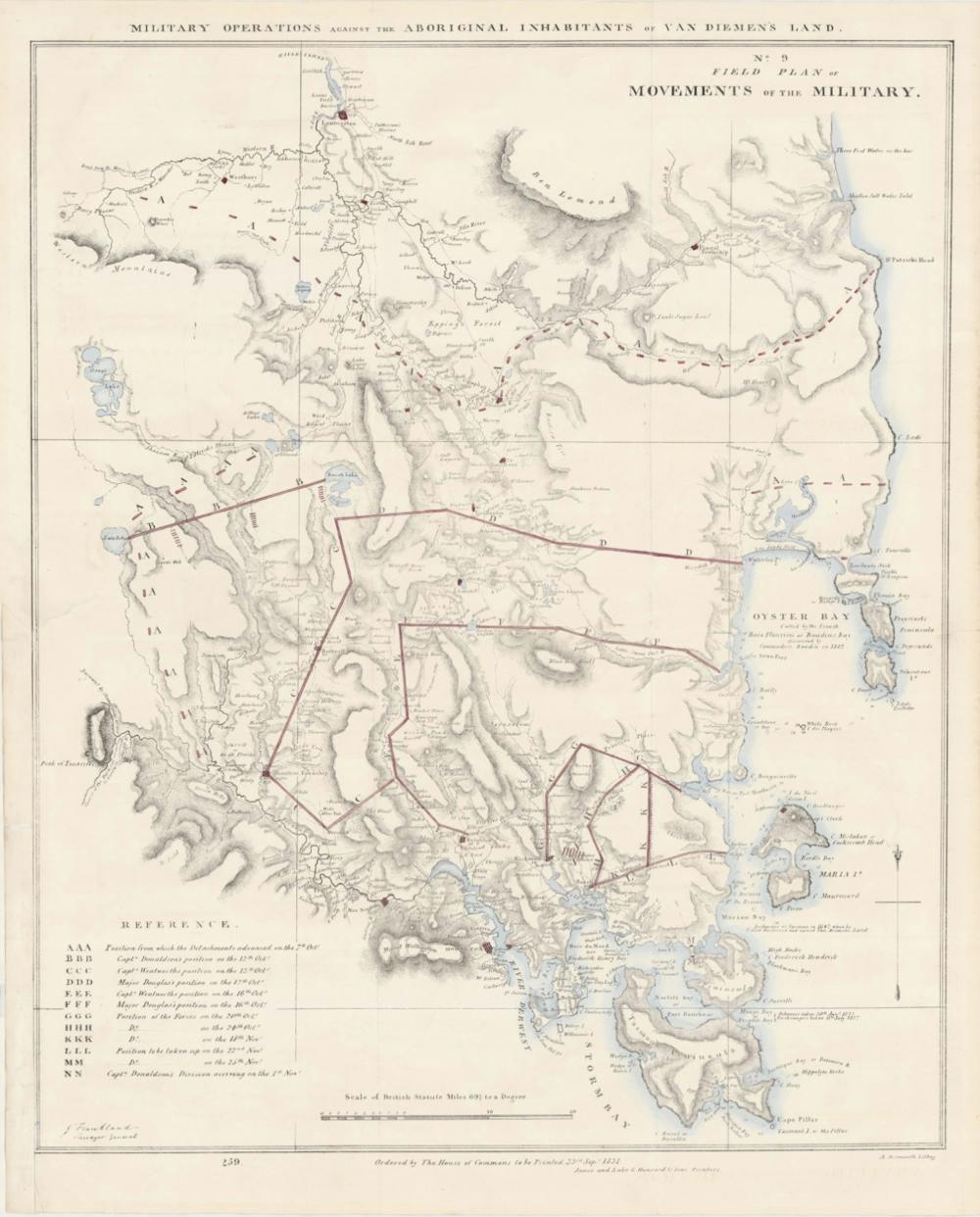
Field plan of military movements against Aboriginal inhabitants of Van Diemen’s Land, 1831.Author provided
Curated by Mary Knights, Gough’s sculptures, videos and installations are deftly supported by colonial artworks and artefacts from TMAG and other major collections.
And just as Gough re-inserts Aboriginal resistance fighters into the landscape of the colonial painting, these genteel portraits, items of furniture, cutlery and letters remind us that Tasmanian history was not some abstract process, but a series of deliberate acts carried out by men and women of refined tastes.
The 1830 Black Line map graphically illustrates the tactical manoeuvres of a cordon of soldiers, police and settlers moving across the island north to south, attempting to force all remaining Tasmanian Aboriginal people off their land.
A campaign desk with a sealed box provides the staging to re-imagine the moment that the plan of attack was conceived, approved, activated and managed.
And in her piece, We Ran/I am, Gough gives human form to these brutal attempts to dispossess Aboriginal people and links herself to her ancestors. Retracing the Black Line on foot, she captures her own body running and stumbling in 14 still images.
Julie Gough, We ran/I am. Journal of George Augustus Robinson 3 November 1830, Swan Island, North East Tasmania – ‘I issued slops to all of the fresh natives, gave them baubles and played the flute, and rendered them as satisfied as I could. The people all seemed satisfied with their clothes. Trousers is excellent things and confines their legs so they cannot run’ (2007).Photo by Craig Opie, Author provided (No reuse)
Above the prints hang seven, earth-stained pairs of calico trousers that she recreated to resemble those described in a journal entry by the “protector” of Aborigines George Augustus Robinson as “excellent things”, because they made it impossible to run.
The first stolen generation
One of the most powerful ways in which Gough connects the past with the present is through the stories of children. In a sound installation she sings a Tasmanian Aboriginal children’s song, Song for the Aborigines, that was transcribed by Mrs Maria Logan in 1856. The historic manuscript is also displayed in the gallery.
But she also tells us about the first generation of stolen children, long before the term was first adopted, in her piece, “Missing or Dead”.
Over a ten-year period, Gough gathered the names of Aboriginal children who had been living with non-Aboriginal people up until 1840.
She identified more than 180 individuals and created a haunting memorial to these forgotten children by inscribing some of these names (including three of her ancestors) onto unfinished tea-tree spears.
Julie Gough, Some Tasmanian Aboriginal children living with non-Aboriginal people before 1840, 2008.Dark Mofo/Rosie Hastie, 2019, Author provided
Bundled together and constrained by the suspended frame of a broken chair, names like “Girl x”, “Goldie” and “Charley x” are burnt onto the bare wood, offering a sharp, poignant glimpse of their lives and so resisting their erasure from history.
Beyond the gallery, Gough extends this work in a temporary memorial that forms part of the Dark Mofo’s Dark Path program.
More than 180 posters bearing the names of stolen and missing children are nailed to the trees in Queen’s Domain, referencing how proclamations were displayed in colonial times.
This work illustrates the tragedy and scale of child removal while also alluding to white anxieties about losing children in the Australian bush.
Gough tells us she has only been able to track ten of these missing children’s descendants through the archives. The tragic loss is not confined to the past but continues through time: the stolen children of the 19th Century are the missing generations of today.
Julie Gough, Missing or Dead. Posters of stolen or missing children are nailed to trees along Dark Mofo’s ‘Dark Path’.Dark Mofo/Rémi Chauvin, 2019
Tense Past reconnects our hearts and minds to the consequences of the frontier wars, the missing ancestors and lost generations, and the impact of colonisation on Tasmania’s first people — then and now.
Julie Gough – Tense Past Presented by Dark Mofo and the Tasmanian Museum and Art Gallery Tasmanian Museum and Art Gallery, Hobart 7 June – 3 November 2019.
Curious Kids is a series for children. If you have a question you’d like an expert to answer, send it to curiouskids@theconversation.edu.au You might also like the podcast Imagine This, a co-production between ABC KIDS listen and The Conversation, based on Curious Kids.
Can you find out why spiders need six eyes but we only need two? – Amos, age 3, Newcastle.
Hi, Amos. Thanks for your excellent question.
The first thing we should say is that while it’s true that some spiders have six eyes, most actually have eight.
The short answer to your question is that animals have evolved different eyes that best suit the lives they lead.
Humans have two eyes that face forward. Our eyes are very good at seeing colours and shapes. Having two big eyes in the front of our head means they can work together to guess how far away something is (we call this “judging distance”). That makes it easier for us to catch another animal so we can eat it.
Spiders are also hunters and they need eyes that help them find and catch their food. In fact, most spiders can’t see very well, and use touch and taste to explore the world. But the kind of eyes they have tells us something about the food they eat and the lives they live.
Spider eyes for spider lives
Jumping spiders are active hunters, like tiny lions chasing down their prey (bugs). They usually have eight eyes: two very large front eyes to get a clear, colour image and judge distance, and extra side eyes to detect when something is moving. Here’s a picture of an Australian jumping spider.
Jumping spiders need two big eyes on the front so they can guess how far away their prey is.Michael Duncan., Author provided
Some spiders make nets to catch their prey. These net-casting spiders also need to see clearly and judge distances. Some have developed huge, scary-looking black eyes that stare straight ahead, so they are nicknamed ogre spiders! These gigantic eyes help the spider to see a wide area and accurately throw down its spider web net to catch its prey. Here’s a picture of a net-casting spider.
This net-casting spider is from the Deinopis family. The little dots that look like nostrils are actually eyes!Michael Duncan, Author provided
Some spiders live in caves that are completely dark, where eyes are no use at all. They have to rely on other senses to find their food in the dark. To save energy making eyes, these spiders lost their eyes during evolution, so now some of them have no eyes at all. You can see a picture of a spider like that here.
So why did most spiders end up with so many eyes?
Both human and spider eyes are the result of slowly evolving to help us survive in our different environments. One reason our human eyes are different from spiders is because our bodies and brains are also built differently.
For example, spiders don’t have necks. So they can’t turn their heads to look at things like we can. Having extra eyes around their heads is one way that spiders see more of the world around them, helping them to quickly spot prey or a potential predator.
Human eyes and spider eyes also do different jobs. Our two eyes are very complex and are good at doing many jobs at once, while spiders have different sorts of eyes that do different jobs.
For example, the large central eyes of jumping spiders are best for seeing shapes, but the simple side eyes have the important job of watching out for predators.
So a two-eyed spider or even an eight-eyed human isn’t impossible. But the two eyes we have and the eight eyes most spiders have are perfectly suited to help each of us live our lives just the way they are.
The recent viral “deepfake” video of Mark Zuckerberg declaring, “whoever controls the data controls the world” was not a particularly convincing imitation of the Facebook CEO, but it was spectacularly successful at focusing attention on the threat of digital media manipulation.
While photographic fakes have been around since the dawn of photography, the more recent use of deep learning artificial intelligence techniques (the “deep” in deepfakes) is leading to the creation of increasingly credible computer simulations.
The Zuckerberg video attracted online attention both because it featured the tech wunderkind who is partially responsible for flooding the world with fake news, and because it highlighted the technology that will surely make the problem worse.
We have seen the pain and tragedy that viral falsehoods can cause, from the harassment of parents who lost children in the Sandy Hook shooting, to mob murders in India and elsewhere.
Deepfakes, we worry, will only worsen the problem. What if they are used to falsely implicate someone in a murder? To provide fake orders to troops on the battlefield? Or to incite armed conflict?
We might describe such events as the “false positives” of deep fakery: events that seemed to happen, but didn’t. On the other hand, there are the “false negatives”: events that did happen, but which run the risk of being dismissed as just another fake.
Think of US President Donald Trump’s claim that the voice on the notorious Access Hollywood tape, in which he boasts about groping women, was not his own. Trump has made a political speciality out of asking people not to believe their eyes or ears. He misled people about the size of the audience at his inauguration, and said he didn’t call Meghan Markle “nasty” in an interview when he did.
This strategy works by calling into question any and all mediated evidence. That is, anything we do not experience directly ourselves, and even much of what we do to the extent that it is not shared by others.
What is at issue is our ability to communicate truths to one another and to generate a consensus around them. These stakes are high indeed, since democracy relies on the efficacy of speaking truth to power. If, as The Guardian put it, “deepfakes are where truth goes to die”, then they threaten to take public accountability down with them.
Because the problem seems to be a technological one, it’s tempting to cast about for technological, rather than social or political, solutions. Typically, these proposed solutions take the form of enhanced verification, which entails increasingly comprehensive surveillance.
One idea is to have every camera automatically tag images with a unique digital signature. This would enable images to be traced back to the device that took them, and, in the case of networked devices, to its user or owner. One commentator has described this as “a surveillance state’s dream”.
Or we might imagine a world in which the built environment is permeated with multiple cameras, constantly capturing and constructing a “shared” reality that can be used to debunk fake videos as they emerge. This would be not just the dream of a surveillance state, but its fantasy realised.
The fact that such solutions are not only dystopian, but also fail to effectively address the problem (since signatures can be faked, and the “official” version of reality can be dismissed as yet another fake), does not make us any less likely to be pursue them.
The additional flaw of such solutions is they assume people and platforms circulating fake information will defer to the truth when confronted with it.
We know social media platforms, until they are held accountable for verifying the information they circulate, have an incentive to promote whatever gets the most attention, regardless of its authenticity. We’re more reluctant to admit the same is true of people.
In the online attention economy, it’s not just the platforms that benefit from circulating sensational disinformation, it’s also the people who use them.
Consider the case of the London-based Islamic journalist Hussein Kesvani. Kesvani recounts the time he tracked down a Twitter troll named “True Brit” who had been peppering him with Islamophobic comments and memes. After establishing a regular online conversation with his online antagonist, Kesvani was able to land a face-to-face interview with him.
He asked True Brit why he was willing to circulate demonstrably false facts, claims, and mislabelled and misleading images. True Brit shrugged off the question, saying, “You don’t know what’s true or not these days, anyway”. He didn’t care about literal truth, only about the “deeper” emotional truth of the images, which he felt confirmed his prejudices.
Strategies of verification may be useful for ramping up surveillance society, but they will have little purchase on the True Brits of the world who are willing to embrace and circulate deepfakes because they believe their lies contain deeper truths. The problem lies not just in the technology, but in the degraded version of civic upon which social media platforms thrive.
The ALP’s defeat at the 2019 federal election was a surprise. Shorten’s Labor fell short, against both wider commentariat predictions and unrepresentative polls. Yet, if we take a step back, the result is less surprising if we locate Labor’s defeat in the wider “crisis” of social democracy.
Across the advanced industrial world, the centre-left largely remains in opposition, with poor prospects for immediate future government. In the UK, Corbyn-led Labour has been unable to capitalise on the Brexit result, and the chaos that enveloped Theresa May’s Conservatives. A likely “Boris bounce” (or “Hunt honeymoon”) may only make the gap wider.
In Germany, the Social Democratic Party (SPD) was once a colossus of European social democracy. But it has failed to dent Angela Merkel’s long dominance of German politics, and critically, is now being pushed even behind the German Greens as the main left challenger.
Elsewhere, the results are poor. Last year, Matteo Renzi’s centre-left coalition lost out at the Italian elections, and the extraordinary populist government of the Five Star Movement and far-right League hold office. In France, the Socialist Party (PS) has seemingly not recovered from the Macron win at the French Presidential election. The Dutch Labour Party (PvDA) is also still licking its wounds from a humiliating defeat in 2017.
The picture is not consistently bleak, though. In Portugal, Antonio Costa’s left coalition (an unwieldy group of left parties dubbed “the contraption”) has proved remarkably resilient. Moreover, the Swedish Social Democratic Party is governing in coalition in that traditional bastion of social democracy. The recent win of Mette Frederiksen in Denmark has also given optimism for the centre-left parties. And of course, the impact and leadership of Jacinda Ardern in New Zealand was another positive result for the left.
Yet, there are wider structural problems for the centre-left, which mean that even these more recent positive electoral results may conceal ongoing identity issues. If we return to Australia, we can see what is underpinning these results – the structural decline of the vote for the centre left.
As the table below shows, the primary vote of the ALP has consistently fallen, and certainly stagnated over the past three elections. Indeed, the ALP has not won an election outright for over a decade.
Author supplied
If we put this into a comparative view, we can see more starkly the wider trend and decline in the structural vote of the left. The following table aggregates the main centre-left party’s vote share for each decade, and is grouped by region. Here, the Australian story of decline parallels the fortunes of its sister parties.
Generally, the left vote is falling in the Nordic countries and Western Europe – the mainstay of social democracy. In the Mediterranean countries, the centre-left parties have been electorally devastated by the GFC and, critically, the Euro debt crisis. Even in countries where the centre left has not been dominant (Ireland, Japan, Canada – in the “other” category), the story is of decline.
Author supplied
If it is a story of decline, what might be driving it? Two key factors help capture, but not necessarily explain, the problem. First, the centre left is losing its traditional vote base in many countries, in some measure because citizens are far less likely to have a strong partisan identity.
The second part of the story is the decline of the major parties as dominant forces, and increasingly the rise of far right, populist, and other party challengers. The recent election in Finland is a striking case where, for the first time, neither major party achieved over 20% of the vote. Social democratic parties face more challengers and, as in France, are squeezed by left and right.
Is this a crisis of social democracy? Perhaps. The bleakest view, offered by writers like Ashley Lavelle is that the parties are actually already “dead”. In this view, social democracy was a specific egalitarian model – especially in the 1970s – and since the parties have capitulated to neoliberal orthodoxy they are bereft of meaning (Hawke-Keating era is the Australian exemplar).
A different approach is to understand the problems facing the centre-left as an electoral “crisis”, particularly the European parties. Much of this literature focuses on what has happened to these parties since the heyday of the “third way” in the 1990s. In sum, it is unclear that the parties have yet to sufficiently recover their core mission and aims.
A third view sees this less as a crisis and more a “transition” – epitomised by a writer like Herbert Kitschelt. In this view, the parties are in a process of change as they reconcile with left libertarian agendas. That central dilemma – environment concerns vs “traditional” jobs – played out starkly in Queensland for the ALP, over the Adani mine.
Moreover, as Carol Johnson writes in her excellent new book, the centre left parties have expanded their idea of equality, and this has brought new dilemmas.
As Anthony Albanese, freshly minted among a whole crop of centre-left leaders, is discovering, these issues will not be resolved quickly. Given the wider diversity of the centre-left, it remains unclear what the next, “fourth” wave of social democracy might entail.
The latest government statistics, released last week, show that from 2001-2016, the rate of cardiac events (heart attacks or unstable angina) fell by more than half among Australian women.
That’s largely because of greater education about risk factors for heart disease (smoking rates continue to fall), and medical advances in prevention and treatment.
One thing that might reduce rates of heart disease even further is to make sure women, in particular, are asked about their current mental health. This can be a pointer to a hidden risk of developing heart disease in the future.
Mental illness can directly affect heart health by placing extra pressure on the cardiovascular system. Depression has been linked to inflammation, which can clog a person’s arteries. Depression also increases the presence of stress hormones in the body, which dull the response of the heart and arteries to demands for increased blood flow.
Less direct effects on heart health include the impact of depression on a person’s health behaviours, such as diet and exercise, and their connections with other people.
We’ve shown Australian middle-aged women with depression have double the risk of having a heart attack or stroke in the following 18 years compared to women without depression.
Preventing heart disease
Cardiovascular diseases including stroke, coronary heart disease, and heart failure remain the number one killer of Australian women. In 2016, three in ten deaths were due to heart disease. Indigenous women are twice as likely as non-Indigenous women to die from this cause.
While we’re seeing significant reductions in the number of people getting heart disease overall, the latest report shows the opposite is true in young women. The rate of cardiovascular events like stroke is increasing in women aged 35 to 54.
Drinking alcohol, smoking, high cholesterol, type 2 diabetes, overweight/obesity, and a family history of heart disease are some of the important predictors of a person developing heart disease over the next five years.
So if someone is considered to have high risk of a cardiovascular event, this risk can be managed with the help of a medical professional.
April 1 saw the introduction of two new Medicare item numbers allowing eligible patients (those aged 45 and over, or 35 and over for Aboriginal and Torres Strait Islander peoples) to be assessed for their risk of developing cardiovascular disease. This is known as a heart health check.
Using the Australian Risk Calculator, the doctor collects information to assess a patient’s risk of experiencing a cardiovascular event in the next five years.
If a person is identified as being sufficiently at risk, they will be targeted with preventative measures such as assistance with lifestyle modifications, and/or interventions like blood pressure or cholesterol medications.
Women have some unique risk factors
While many of the common risk factors for heart disease are shared between women and men, young and middle aged women have some that men don’t.
We’re only beginning to understand how these factors affect a woman’s risk, but they are likely to be as important as traditional risk factors in the context of heart health checks.
Heart health checks are a good thing. They could be even more effective if they assessed mental health as a risk factor for heart disease.From shutterstock.com
Another common issue in young women that influences heart disease risk is poor mental health. Common mental disorders like depression are more common in women than men until age 75.
Both heart disease and depression are largely socially determined, especially for women and girls. Early life trauma, poverty, and gendered violence and discrimination can accumulate across a woman’s lifespan to shape her risk of heart disease and stroke.
Screening for mental health
We did some statistical modelling to see whether depression should be added to the risk equation that underpins the heart health checks.
For women who reported depression in this context, we were able to more accurately predict whether they’d go on to develop heart disease over the next ten years.
While more research is needed, asking about a woman’s mental health may help GPs better identify risk of heart disease in younger women.
Large population-based studies show reducing the prevalence of depression could have major implications for the prevention of heart disease and stroke. One study found having a poor psychosocial profile (depression, stress, isolation and anxiety) contributes 32% of the risk for heart attacks across the population.
In other words, if these psychosocial issues were eliminated, the incidence of heart attacks would be reduced by one-third.
Given the burden of these psychosocial issues is greater for women than men, women may have even more to gain if depression was targeted as part of preventing heart disease.
How can we address depression as a risk factor?
The heart health checks represent a significant step in the government’s investment in preventive medicine and public health.
While time poor clinicians can’t be expected to capture an infinite number of risk factors in a short consultation, these sessions may present a good opportunity for GPs to ask their patients about their mental health in the context of their heart disease risk. Equally, this may be a good time for patients to flag any concerns about their mental health with their GP.
There are few studies yet that definitively show treating depression will prevent a first heart attack or a recurrent event.
This is especially true for women, who are under-represented in this type of research. One study, where participants were given psychological therapy after a cardiac event like a heart attack, found the intervention benefited future heart health outcomes for “white men, but not other subgroups”.
We need more research to tell us if and how treating depression might prevent heart disease and stroke, especially for women. In the meantime, there are many free or subsidised options for the management of depression available either via your GP (psychologists and counsellors) or online.
For many of us, eating a meal containing meat is a normal part of daily life. But if we dig deeper, some sobering issues emerge.
Every year, 66 billion terrestrial animals are slaughtered for food. Predictions are that meat consumption will rise, with increasing demand for meat from China and other Asian countries as their standards of living increase.
Cattle being readied for auction at the Roma Saleyards in Queensland, the largest cattle-selling centre in the Southern Hemisphere with over 400,000 cattle auctioned each year.Darren England/AAP
Some experts have even said meat may not be essential for most people, and a vegetarian diet is healthier than a meat-based one. So the rationale for developing meat alternatives – “fake meat” – is strong.
Fake meat can be made from plant-based materials that mimic the taste of meat. But for those who want something closer to the real thing, meat cells can be grown in a laboratory – this is called “in vitro agriculture”. Here’s how it works.
Growing meat, but not in an animal
The concept of cultured meat has been around for some time. In 1931, Winston Churchill even said:
We shall escape the absurdity of growing a whole chicken in order to eat the breast or wing. By growing these parts separately under a suitable medium.
The world’s first cultured beef burger was produced by Professor Mark Post at Maastricht University in The Netherlands. It was cooked and eaten publicly at a London restaurant in 2013. It took three months to grow the meat and cost €250,000.
Professor Mark Post’s TEDx Talk on “test tube meat”, 2013.
Since then, the race has been on to produce commercially available synthetic meat. Many companies have taken out patents to grow meat on a commercially viable scale and some have even received funding from people like Bill Gates and Richard Branson.
Thanks to advances in tissue engineering, we can take all sorts of cells ranging from skin and blood to muscle and the brain from different animals, and grow them under controlled laboratory conditions.
The type of meat people want to eat is from muscle. This means synthetic meat production involves producing large quantities of muscle cells in a laboratory.
selecting precursor (or “starter” cells) from the animal – in this case, muscle precursor cells – and providing them with the correct environment for growth
growing them in bulk in an environment that mimics an animal body
the precursor cells then have to be switched on (or “induced”) to turn into skeletal muscle by chemical or mechanical signals.
Simple culture of cells in a flask where they are grown in a single layer and covered with orange nutrient liquid.
The growing and conversion of cells into skeletal muscle are the major challenges the industry currently faces. The appearance of this meat would likely resemble burger-type meat, like a patty, rather than carcass meat, which is very structured.
For example, when you cut into a steak, you might see the meat organised into long strands or fibres. But with cultured meat, the organisation of the cells may be more haphazard.
It’s entirely feasible for some types of cells to grow fast and reproduce themselves once every 24 hours in a laboratory setting – this is much faster than in an animal. The challenge is to achieve this on a large scale in bio-reactors (a vessel to contain the laboratory-grown cells), and then to get all the cells converted from precursor cells to muscle cells.
If eating the products of tissue cells seems unsavoury, consider that people already consume products of cell culture technologies. Over 50% of biological molecules for vaccines and for treating diseases (such as antibodies for cancer treatment) are produced in mammalian cell cultures..
So we are already on track to consume “fake”, or artificially synthesised, molecules.
What takes more resources – growing cows or growing cells?
It takes around 18 months for a cow to grow fully, after a pregnancy of 10 months.
So in total, it takes two years and four months of growth in a space roughly 10.5 by 15.2 square metres, in a barn. When a cow is killed, it produces a 300kg carcass and 180kg of butchered meat.
On the other hand, it takes 8 trillion cells in a laboratory to make 1 kilogram of muscle meat.
A container of 5,000 litres (the size of an average rainwater tank, or somewhere around 5 cubic metres) would be needed to grow this number of cells. This would account for cells grown in layers, and covered by a liquid to provide nutrients.
If cells in a laboratory divide every 24 hours, then it would take just over 26 days to grow 1kg of meat.
This image shows how cells can be grown in three dimensions, and resemble an organ.
This growth rate is feasible for some types of cells, such as skin and gut, but has not yet been reported for muscle cells in a laboratory.
Therefore, lab-grown meat could take fewer natural resources (like vegetation and water) to grow the equivalent amount of animal meat. The commercial availability of “fake meat” could profoundly decrease the enormous environmental impact of grazing animals and reduce animal cruelty.
The federal education minister, Dan Tehan, has called on universities to implement a model code to protect freedom of speech and academic freedom on campus. He’s referring to the code drafted by a former High Court chief justice, Robert French, in his review of freedom of speech in Australian universities.
Tehan said he commissioned the review due to concerns certain views were being shut down on campus. This followed protests at Sydney University during a talk by sex-therapist and commentator Bettina Arndt. The talk challenged notions of a rape culture on campus.
French’s report concluded there was no systemic free speech crisis in Australian universities. But he noted many universities’ policies use broad terms that create the potential to limit free speech on campus.
He therefore suggested universities voluntarily strengthen their protections for free speech by adopting general principles, which he set out in a model code. So, what does that code look like? And should universities be adopting it?
French’s proposed model code has, at its core, the need to ensure both the freedom of lawful speech and academic freedom. French differentiates between the two, which he says are often conflated. He writes:
The proposed Code uses the terms ‘freedom of speech’ and ‘academic freedom’ instead of ‘freedom of intellectual inquiry’. They are intended to distinguish between freedom of speech as a common societal freedom and freedom of speech and intellectual inquiry as aspects of academic freedom.
Former High Court chief justice Robert French put together a draft model code of conduct in his review of freedom of speech at Australian universities.Federal Court of Australia
The code also makes clear a university can restrict free speech and academic freedom if this is necessary to achieve the university’s core research and teaching mission, to comply with legal duties and to “foster the well-being of students and staff”.
This last element includes that universities have a duty to protect staff and students from discrimination. This acknowledges that a person’s freedom of speech stops when it starts to infringe on another’s rights.
The model code recognises that universities’ duties include preventing staff and students using lawful speech in a way that would be regarded as “likely to humiliate or intimidate” others. This provides quite a generous scope for universities to prevent discriminatory and vilifying speech, even if it would not meet the legal threshold for vilification under federal law or state law such as in NSW.
The code recognises that academic freedom can be limited by reasonable requirements about course content and pedagogy (although offensive or shocking material that is otherwise compliant is protected by academic freedom).
Finally, the model code turns to concerns that have dominated media headlines and motivated the inquiry – hosting controversial speakers.
In this respect, the code:
protects universities’ ability to set the conditions under which external speakers will use their facilities, including paying for security costs
requires universities to seek to minimise the impact of donors and other third parties on staff and students’ free speech and academic freedom
subjects universities’ ability to deny speakers a platform if their content is unlawful, or prevents the university from fulfilling its duty to foster staff and student well-being, or if it involves
the advancement of theories or propositions which do not meet scholarly standards […] and would be […] “detrimental to the university’s character as an institution of higher learning”.
It could be said, then, that these protections reflect the existing state of affairs on Australian campuses. Although universities, their staff and students all stand to benefit from clarifying obscure policy language, the pressure for universities to take action may be more about politics than anything else.
In response to the French report, Universities Australia’s chief executive, Catriona Jackson, said universities would consider its recommendations. She also emphasised universities’ independence, saying that:
[…] sector-wide legislative or regulatory requirements would be aimed at solving a problem that has not been demonstrated to exist and any changes could conflict with fundamental principles of university autonomy.
The University of Melbourne has, in recent days, released a new policy on free speech, which is substantially similar to the model code. It begins from the presumption free speech, academic freedom and university autonomy are all “core values”. It limits free speech that “unreasonably disrupts activities or operations of the university […] or jeopardises the physical safety of individuals”.
But it arguably goes further in permitting limitations on speech that “undermines the capacity of individuals to participate fully in the University”.
This provision is particularly interesting. At first it appears similar to the model code’s duty of the university to foster student and staff well-being, but the code requires the university to prevent discriminatory harms.
By contrast, the University of Melbourne’s policy suggests an affirmative duty for members of the university community to support one another’s capacity for full engagement in university life. This is possibly a more positive understanding of the freedom than encapsulated by the model code.
The University of Sydney has also announced plans to “thoughtfully” implement the principles of the model code. It remains to be seen how this will play out.
The university recently concluded its investigation into the protests against Arndt, disciplining one student while also reinforcing that protests are protected speech.
Focusing on policies is only part of the story. As French stated:
A culture powerfully predisposed to the exercise of freedom of speech and academic freedom is ultimately a more effective protection than the most tightly drawn rule. A culture not so predisposed will undermine the most emphatic statement of principles.
New housing in Australia must meet minimum energy performance requirements. We wondered how many buildings exceeded the minimum standard. What our analysis found is that four in five new houses are being built to the minimum standard and a negligible proportion to an optimal performance standard.
There have been calls for these minimum standards to be raised. However, many policymakers and building industry stakeholders believe the market will lift performance beyond minimum standards and so there is no need to raise these.
What did the data show?
We wanted to understand what was happening in the market to see if consumers or regulation were driving the energy performance of new housing. To do this we explored the NatHERS data set of building approvals for new Class 1 housing (detached and row houses) in Australia from May 2016 (when all data sets were integrated by CSIRO and Sustainability Victoria) to December 2018.
Our analysis focuses on new housing in Victoria, South Australia, Western Australia, Tasmania and the ACT, all of which apply the minimum six-star NatHERS requirement. The other states have local variations to the standard, while New South Wales uses the BASIX index to determine the environmental impact of housing.
The chart below shows the performance for 187,320 house ratings. Almost 82% just met the minimum standard (6.0-6.4 star). Another 16% performed just above the minimum standard (6.5-6.9 star).
Only 1.5% were designed to perform at the economically optimal 7.5 stars and beyond. By this we mean a balance between the extra upfront building costs and the savings and benefits from lifetime building performance.
NatHERS star ratings across total data set for new housing approvals, May 2016–December 2018.Author provided
The average rating is 6.2 stars across the states. This has not changed since 2016.
Average NatHERS star rating for each state, 2016-18.Author provided
The data analysis shows that, while most housing is built to the minimum standard, the cooler temperate regions (Tasmania, ACT) have more houses above 7.0 stars compared with the warm temperate states.
NatHERS data spread by state.Author provided
The ACT increased average performance each year from 6.5 stars in 2016 to 6.9 stars in 2018. This was not seen in any other state or territory.
The ACT is the only region with mandatory disclosure of the energy rating on sale or lease of property. The market can thus value the relative energy efficiency of buildings. Providing this otherwise invisible information may have empowered consumers to demand slightly better performance.
The evidence suggests consumers are not acting rationally or making decisions to maximise their financial well-being. Rather, they just accept the minimum performance the building sector delivers.
The fact that these improvements aren’t being made suggests there are significant barriers to the market operating efficiently. This is despite increasing awareness among consumers and in the housing industry about the rising cost of energy.
Eight years after the introduction of the six-star NatHERS minimum requirement for new housing in Australia, the results show the market is delivering four out of five houses that just meet this requirement. With only 1.5% designed to 7.5 stars or beyond, regulation rather than the economically optimal energy rating is clearly driving the energy performance of Australian homes.
Increasing the minimum performance standard is the most effective way to improve the energy outcomes.
The next opportunity for increasing the minimum energy requirement will be 2022. Australian housing standards were already about 2.0 NatHERS stars behind comparable developed countries in 2008. If mandatory energy ratings aren’t increased, Australia will fall further behind international best practice.
If we continue to create a legacy of homes with relatively poor energy performance, making the transition to a low-energy and low-carbon economy is likely to get progressively more challenging and expensive. Recent research has calculated that a delay in increasing minimum performance requirements from 2019 to 2022 will result in an estimated A$1.1 billion (to 2050) in avoidable household energy bills. That’s an extra 3 million tonnes of greenhouse gas emissions.
Our research confirms the policy proposition that minimum house energy regulations based on the Nationwide House Energy Rating Scheme are a powerful instrument for delivering better environmental and energy outcomes. While introducing minimum standards has significantly lifted the bottom end of the market, those standards should be reviewed regularly to ensure optimal economic and environmental outcomes.
Scott Morrison will commit to getting consumers, business and investors “off the economic sidelines and on the field again” in his first major domestic speech of the new term.
Addressing a business audience in Perth on Monday, Morrison will set out the government’s economic priorities for the next few months, including delivering its tax plan when the new parliament meets, and “provoking the ‘animal spirits’” in the economy by removing regulatory and bureaucratic barriers to investment.
He will also foreshadow a new look at industrial relations reform while stressing that it must benefit both employers and employees.
Acknowledging the challenges and headwinds affecting the Australian economy, which registered low growth in the latest national accounts, Morrison will say political uncertainty in the election run up weighed on the confidence of consumers, businesses and investors. This saw them “sitting on the sidelines” until it was over.
“Our job post election is now very clear – to get Australians off the economic sidelines and on the field again.”
With shadow cabinet on Monday discussing the opposition’s position on the Coalition’s three-stage decade-long tax package, Morrison will seek to increase pressure on Labor to pass all stages, saying the plan doesn’t just have a strong political mandate but also “a compelling policy rationale”.
The first stage will boost consumption and be equivalent to at least two 25 basis point interest rate cuts, he says in his speech, released ahead of delivery.
Labor agrees with stage one but is yet to decide whether it will wave through the second and third stages, both due to start after the next election. It has been particularly critical of stage three, which delivers to the highest income earners. The government says it won’t split the bill, which will be introduced when the new parliament begins next week.
While some in Labor believe it should pass the whole package, others argue it is irresponsible to commit to tax cuts years out in uncertain times.
Shadow treasurer Jim Chalmers, interviewed on the ABC, reiterated on Sunday that Labor wanted to know how the third stage – worth $95 billion of the $158 billion package – was distributed through the various tax brackets. He said Labor’s highest priority was to get the first stage flowing through the economy, while the government’s highest priority seemed the third stage which didn’t come in for another five years.
But Morrison says in his speech: “It still baffles me why Labor can readily sign up to spending schemes that run for decades, yet cannot do the same to let Australians keep more of their own money.
“Under our changes, from 2024-25, 94% of Australians will pay a maximum marginal tax rate of no more than 30 cents in the dollar, compared to only 16% if stages two and three are not delivered.
“Or to put it another way, almost 80% of hard working Australians will keep more of what they earn following stages two and three of our tax plan.”
Morrison says that to provoke the “animal spirits” in the economy, regulatory and bureaucratic barriers to business investment must be removed.
This requires “reducing regulatory barriers to growth and driving improvements in industrial relations that improve outcomes for both workers and businesses”.
“Congestion is not just on our roads and in our cities. We also need to bust regulatory congestion, removing obstacles to business investment,” he says, instancing the experience of the mining industry in Western Australia.
“In 1966, the late Sir Arvi Parbo took the Kambalda nickel mine near Kalgoorlie from discovery to operation in 18 months. By contrast, the Roy Hill iron ore mine took around 10 years to complete around 4,000 approvals. Delays to the project meant delays to over 5,000 construction jobs and 2,000 ongoing jobs.
“There is a clear need to improve approvals timeframes and reduce regulatory costs, but in many cases regulators are making things worse.
“Look at the WA Environment Protection Authority and the uncertainty it has created over new emissions requirements for the resources sector. Business will also make valid criticisms of many Commonwealth agencies and departments.”
Morrison is appointing his close confidant Ben Morton, from WA, who is Assistant Minister to the Prime Minister, to work with him, Treasurer Josh Frydenberg and other ministers “to tackle the full suite of barriers to investment in key industries and activities”.
The government will focus on regulatory reform “from the perspective of a business looking, say, to open a mine, commercialise a new biomedical innovation, or even start a home-based, family business.
“By focusing on regulation from the viewpoint of business, we will identify the regulations and bureaucratic processes that impose the largest costs on key sectors of the economy and the biggest hurdles to letting those investments flow.
“What are the barriers, blockages and bottlenecks? How do we get things moving?
“Step one is to get a picture of the regulatory anatomies that apply to key sectoral investments. Step two is to identify the blockages. Step three is to remove them, like cholesterol in the arteries.”
Morrison will highlight the need “to protect investment from the impact of militant unions” and reaffirm that the government plans to try to get through the new parliament its Ensuring Integrity bill, that stalled in the last term. This would strengthen its hand against militant unions, notably the CFMMEU.
Beyond this, Morrison will say he has asked the new Minister for Industrial Relations, Christian Porter “to take a fresh look at how the system is operating and where there may be impediments to shared gains for employers and employees.
“Any changes in this area must be evidence-based, protect the rights and entitlements of workers and have clear gains for the economy and for working Australians.”
Depicting the moment of creative inspiration has been a challenge for filmmakers since the first ribbon of film rattled its way past a camera lens. In numerous films, the artist’s studio has been mythologised as a tantalising mystery, a place of transgression, of wild imaginings and not infrequently, of sexual license and debauchery.
In search of a window into that most mysterious of all human activities – the creative imagination – historians, filmmakers and journalists have tried to prise open the mind of famous artists.
A long list of films purports to show these artists in the throes of inspiration as they create the certified masterpieces we see adorning galleries in the world’s museums. Indeed, we seem to be amid an artist-biopic tidal wave as directors pull focus on yet another famous painter (occasionally sculptor, even more occasionally, a woman) and present their interpretation of what actually goes on in that holy sanctum, the studio.
The most recent is Never Look Away, loosely adapted from the life of Gerhard Richter by Florian Henckel von Donnersmarck. It comes hot on the heels of Julian Schnabel’s At Eternity’s Gate, another retelling of Vincent van Gogh’s life story and Thomas M. Wright’s Acute Misfortune, which delves into Adam Cullen’s psyche. Other films are in the wings, examining the lives and work of L.S Lowry, Leonardo da Vinci, and Théodore Géricault.
Daniel Henshall in Acute Misfortune (2018).Arenafilm, Blackheath Film, Plot Media
Disappointingly, there is still an absence of women artists in filmmakers’ mythmaking biopics. While there are wonderful examples, such as the films documenting the lives and work of Camille Claudel (1988), Frida Kahlo (2002) and Séraphine de Senlis (2008) they are rare exceptions.
Trailer for Frida.
Filmmakers are predictably entranced by their heroes it seems and eagerly trawl the depths of their practice to better understand the processes of artistic creation, but why is this topic of such interest to a general public?
One reason may be that creativity is being promoted as an essential skill for the fourth industrial revolution.
The World Economic Forum is calling for a lifelong approach to learning that encourages complex problem solving, critical thinking and creativity rather than the one-dimensional professional focus of the past. So, what better models could there be as the epitome of creative practice, than those great artists embedded in our collective conscience?
Charles Laughton in Rembrandt (1936).London Film Productions
Famous artists have been the subject of popular films since Alexander Korda called action in 1936 and the cameras rolled on Charles Laughton shuffling through a vast studio in the guise of Rembrandt, sucking his pipe and wielding his mahlstick while creating an unseen masterpiece.
At least one scene, in which Rembrandt unveils a portrait of a powerful soldier to a hostile reception – an act of creative rebellion that ends a stellar career – is a total fiction. Still, it makes for a compelling scene.
In At Eternity’s Gate, Julian Schnabel, who is a famous artist himself, infuriatingly depicts Vincent van Gogh’s precarious mental state through a manic hand-held camera that has his audience lurching around in their seats seeking stasis.
Fortunately, Vincent’s own words, through his letters to his brother Theo, reveal something of the inner torment and the process of re-interpretation that brings some clarity and insight into how these wondrous images were formed on the canvas. (These letters also featured in Paul Cox’s 1987 film Vincent). Without these voice-overs, Schnabel’s film would invoke nothing other than incoherent queasiness.
Florian Henckel von Donnersmarck’s epic portrayal of 30 years of German history, reflected in the life of a young artist seeking his way in the world, is not perfect. Still, it does go further than many of his predecessors in peeling back some of the unhelpful tropes that have blinkered our understanding of the creative process.
Like Korda, he is not squeamish about fictionalising the events in the life of his protagonist in the process of a creative re-imagining. Kurt Barnert – the lead protagonist in the film – is not Gerhard Richter, just a slightly blurred facsimile of the famous German artist.
In this way, von Donnersmarck gives himself license to reinterpret and refocus his understanding of how memory, pain, and anger can be fused in the act of making an image on a canvas.
In his studio in the Kunstakademie Düsseldorf in 1963, Barnert thrashes around re-making the works of contemporary American and German artists who have found success in the marketplace.
Waltzing with paint-soaked feet on a roll of paper, making papier-mâché figures and painting geometric abstractions, he finally resolves to fuse his undeniable technical virtuosity with his life experiences.
The black and white photographs he had packed in his bag on his flight from East Germany to the West were the catalyst for the works we associate with Richter; a soft brush drawn slowly over almost dry oil paint to create a blurring that seals the image as memory.
Tom Schilling in Never Look Away.Pergamon Film, Wiedemann & Berg Filmproduktion, Beta Cinema
They are images that elicit complex responses from an audience who may not have experienced the same events but can relate closely enough to find solace.
Von Donnersmarck doesn’t entirely relinquish the stereotypes of depicting the “lightbulb” moment of creative insight. Like Korda’s pensive, pipe-sucking Rembrandt, Schnabel’s whirling dervish van Gogh and Carol Reed’s version of Michelangelo’s epiphany in his 1965 film The Agony and the Ecstasy – when an image of God holding out his hand to touch the finger of a recumbent Adam is revealed in the clouds to a spellbound Charlton Heston – we have Barnert and his blank canvas.
Trailer for The Agony and the Ecstasy.
Sitting for days staring at that tabula rasa, the wind rustling the leaves outside framed by the window in his light-soaked studio, the music slowly building to a crescendo, his artistic revelation comes.
However, von Donnersmarck has built layers of experience and memory into a complex amalgam of ideas over two and a half hours before we get to that scene. From a childhood visit to the Nazi Entartete Kunst (Degenerate Art) exhibition and the murder of his aunt, through his training and early success in the DDR under Soviet influence, we have seen Barnert build the armoury of skills and experience from which he will forge his artistic career.
In the process von Donnersmarck has developed his thesis that “creativity is the scab that forms on the wound” of these artists’ lives. “It gives us that wonderful feeling that our suffering can be of use.”
“Never look away, everything is beautiful,” his aunt tells the young Barnert. The transformative power of art is to embrace that freedom to engage without limits and “by freeing yourself, you are liberating the world”.
Where to eat? It’s a question you’ve probably pondered when visiting somewhere unfamiliar. Though it’s fun to explore a strange suburb, town or city, when you’re hungry you’d rather minimise the chance of paying exorbitant prices for an unpleasant experience.
Can economics help?
We’ve combined economic theory with data from online restaurant ratings to identify a few simple strategies that will help you find a decent restaurant in unfamiliar places.
The key? Location is almost everything – but in the opposite sense to what a real estate agent would have you think. When it comes to restaurants, quality of location is inversely correlated to quality of food and service.
Search costs
The first economic principle that’s important here are “search costs”.
If you’re from out of town, it’s likely your search strategy will involve looking for something appealing within walking distance of where you are staying. To decide if it’s appealing will involve walking past it.
Suppose you do this. Perhaps it not exactly what you wanted. Should you press on, looking for a better option?
It’s a risk. You may end up trudging around only to end back at the same spot 30 minutes later. Settling on the first restaurant you find may therefore be the best option to minimise search costs.
Economic theory provides a key insight about markets with search costs for customers. Businesses can take advantage of these costs to raise prices or lower quality. They can do this because they deal with more uninformed customers.
Consider a large city with tourist and non-tourist areas.
Being close to tourist hot spots increases the probability of food being lower quality and higher priced.Paul Rysz/Unsplash
In non-tourist areas, restaurants will rely on local customers. If they do not provide good food and prices, customers are likely to go elsewhere next time. A restaurant that satisfies its customers will get return business; one that doesn’t is more likely to go out of business.
In tourist areas, the situation is different. Visitors do not know the quality of each restaurant they encounter, and at best might be repeat customers for a few days. So restaurants can charge higher prices and serve lower quality food without much risk of harming long-term profits.
Big data to the rescue
To investigate how customer ignorance influences restaurants price and quality, we used data from Yelp, a major online platform where users rate restaurants.
Yelp has a global outreach that allowed us to investigate this question in cities all over the world, such as Paris, London and Sydney.
We mapped Yelp’s ratings onto topographical information from OpenStreetMap, an open-source repository of local information on streets and buildings.
What we found was exactly what was predicted by economic theory: restaurants in tourist areas have lower ratings than those in non-tourist areas.
Mapping Sydney
The map below presents the results for Sydney. You can see the valley of tourist points (the red dots) in the centre of the city generally align with average ratings. There are just a few cases of exceptional ratings near tourist attractions, such as around the Sydney Opera House.
The pattern is even clearer in London, where areas with higher local ratings seem to be systematically away from touristic locations. Our map suggests that you’d be advised not to look for lunch around Victoria Station, near Buckingham Palace (in the southwest corner) or near the British Museum (northwest from the centre of the map).
Finally this Paris map suggests you are advised to venture away from all the landmarks you know – Eiffel Tower, the Sacré-Cœur Basilica, the Louvre – when looking for some good French food. Definitely steer clear of the area around the Paris-Gare de Lyon train station.
The existence of tourist traps may come as no surprise. If you’ve ever gone sight-seeing in a big city, you know there are restaurants whose business is based on attracting tourists, and that they are often pricey and ordinary.
Small restaurants, away from the tourist traps of inner city, are often the perfect places to chow down.Dominic Dreier/unsplash
This insight goes beyond just restaurants. In economic terms, any time a business deals with uninformed customers, higher prices and lower quality is more likely.
A key characteristic to attract uninformed customers is visibility. A restaurant on a main road or busy thoroughfare, for example, can be found by potential customers simply walking around.
To test whether restaurants with high visibility are indeeed more likely to offer worse deals, we looked at restaurants that were more visible but not necessarily in touristic locations.
We focused on corner restaurants – visible to pedestrians from two streets instead of just one.
Again we looked at Yelp ratings, and again the effect was there: corner restaurants had lower average ratings. The largest effect was for corner restaurants on big avenues in tourist areas, where average restaurant ratings were more than 0.2 stars (out of 5 stars) lower.
Chain reactions
Though our results show restaurants in tourist areas and in visible locations are generally more likely to offer worse quality and prices, there are some caveats.
An advantage of fast-food franchises is that they tend to provide the same quality across locations.www.shutterstock.com
Economic theory suggests chain restaurants should have more incentive to keep the standard their consumers are used too, even if located in visible locations.
A customer dissatisfied by the food/service of one chain restaurant is less likely to come back to the chain elsewhere. Corporate headquarters can therefore not allow individual franchises to use a visible location to lower quality or raise prices.
This economic prediction was also confirmed in our data: restaurants that belong to a chain are not rated significantly lower in visible locations.
Find the hidden restaurants
So our advice is the following:
You maximise your chance of finding a fantastic dining experience by stepping away from the beaten tracks. Whether searching online or on foot, look for the “hidden restaurants” tucked away on side streets and the like. Avoid the establishments with huge garish signs that are clearly pitching themselves to tourists.
Your second-best option, when in doubt, is to look for a chain restaurant as a “safe haven” in a touristic location. Such establishments are unlikely to offer you a surprising experience, one way or other other. What you expect is probably what you’ll get.
But when it comes to restaurants, the better option is usually around the corner.
A leading cyber security expert has called on universities to play a more active role in implementing ethics and legal frameworks for communications smart technology to save society from an Orwellian future.
Mohamed El-Guindy, an Egyptian consultant to the UN Office on Drugs and Crime (UNODC-ROMENA), says communication research programmes should promote “ethically aligned” design.
In an era of “accelerated addictiveness” to smartphone and other digital technologies, he told media researchers, policy advisers and journalists at the 27th Asian Media Information and Communication (AMIC) conference in Bangkok, Thailand, this week that it was vital for democracy that universities stepped up.
He also said families and parents needed to be more critically active by balancing screen time and promoting “real social interaction”.
Professor Eddie Kuo, a keynote speaker and founder of the Wee Kim Wee School of Communication and Information at Singapore’s Nanyang Technological University. Image: David Robie/PMC
Addressing the “persuasive technologies” industry, Al-Guindy spoke about being “hooked”, the “scrolling dopamine loop” and the “digital skinner box” models and how they had made smartphones fill psychological needs.
-Partners-
“Our social fabric is being torn apart,” he said.
“As we expect more from technology, we expect less from each other as people.
“We have suffered a loss of ability to focus without distraction. The result is mental health issues, less empathy and more confusion.”
‘Misinformation, lies’ Al-Guindy said societies were engulfed in “misinformation, propaganda and lies”.
“Orwell warns that we will be overcome by an externally imposed oppression. But in [Aldous] Huxley’s vision, no Big Brother is required to deprive people of their autonomy, maturity and history. As he saw it, people will come to love their oppression, to ignore the technologies that undo their capacity to think.”
The three-day AMIC conference at Chulalongkorn University featured the theme “Are you human? Communication, Technology and New Humanism”.
Manila-based AMIC is the major global organisation focused on Asian media policy and research and publishes two leading journals, the Asian Journal of Communication and Media Asia.
Professor Crispin Maslog (right) presenting the first copy of his climate change journalism book to Professor Bundhit Eua-arporn, president of Chulalongkorn University. Image: David Robie/PMC
AMIC board chair Professor Crispin Maslog challenged the more than 300 participants to take a more “humanist” approach to communication research and policy building.
“We stand on the brink of a technological revolution that will fundamentally alter the way we live, work, and relate to one another,” he said. “In its scale, scope and complexity, the transformation will be unlike anything humankind has experienced before.
“As the millennials would say, OMG!”
Climate change guide Among four new international books about communication research and technology, prolific Filipino author Dr Maslog launched his 36th title, Science Writing and Climate Change.
Developed as a guide for journalists in the Asia-Pacific region, it has been co-authored with New Zealand’s Pacific Media Centre director Professor David Robie and regional editor Joel Adriano of SciDev.Net, a leading online publication with a focus of science and development.
UNESCO’s Dorothy Gordon … lobby for action. Image: David Robie/PMC
Among several UNESCO delegates and speakers at the conference, Dorothy Gordon, of the governing board of the UNESCO Institute for Information Technologies in Education, called on participants to lobby through their national commissions and global agencies if they wanted action.
“Asia has the potential to be in control, it can make changes for tech for peace,” she said.
“UNESCO is made up of member states. If you want something to happen, you need to lobby your own country first to take up the issue.”
Dr Azman Azwan Azmawati … an “are you man enough?’ slide in her “humanity” presentation. Image: David Robie/PMC
Malaysia’s Dr Azman Azwan Azmawati, an associate professor at the Universiti Sains Malaysia (USM) in Penang and president of the Asian Congress for Media and Communication (ACMC), called for more critical research on patriarchal systems.
Dr Azman Azwan Azmawati … more research needed on the patriarchy. Image: David Robie/PMC
“It is crucial for more study of patriarchal systems because of their negative impact on women and stereotyping of women,” she said.
“The patriarchal system hinders women from reaching their potential.
Power imbalance Much more research was needed to focus on the imbalance of power – ‘deconstructing the power of the powerful over the powerless.
“Cultural norms and mindsets must be re-examined, critiqued, reevaluated and rethought.”
Former AMIC secretary-general Dr Martin Hadlow introducing professor Mark Pearson at the conference. Image: David Robie/PMC
Professor Mark Pearson of Australia’s Griffith University spoke of human rights advocacy journalism in a global justice context.
“Global justice can be a legitimate ethical objective of advocacy journalism, requiring factuality as a platform,” he said.
“It is achievable in some cases through a wise and intentional position of ‘advocacy journalism’ which sits comfortably with the professional values of the livelihood of journalists.”
Dr Martin Loffelholz of Germany, Professor Mark Pearson (Australia) and Misako Ito (UNESCO Bangkok) at the conference. Image: David Robie/PMC
Dr Pearson, author of The Journalist’s Guide to Media Law, also spoke about “mindful journalism”, a form of journalism with “wisdom and compassion” drawing from elements of secular Buddhist approaches to meditation and ethics.
He dedicated a separate paper on the topic to the memory of Dr Shelton Gunaratne, who died in March this year after being awarded the 2016 AMIC Asia Communication Award for his “ground-breaking scholarship and intellectual contribution to Asian media and communication research”.
High tech ‘slavery’ Professor Jack Linchuan Qiu, author of Goodbye iSlave and director of the Chinese University of Hong Kong’s C-Centre for Chinese Media and Comparative Communication Research, gave an inspired address on the impact of modern day “slavery” in the high tech industries.
Professor Jack Linchuan Qiu of the Chinese University of Hongkong … tech industries as modern day slavery. Image: David Robie/PMC
Taiwan’s Professor Georgette Wang of the National Chengchi University engaged with the debate about Asian research methodologies, saying that perhaps the right questions were not being asked.
Professor Georgette Wang … searching for a new East-West research paradigm. Image: David Robie/PMC
She said there was an absence of “East-West dialogue” over research methodologies and there needed to be more engagement.
Blaming globalisation, she said that while the “periphery” had gained greater presence in the international arena, it had also “brought the profile of theories and questions originating in the West to greater prominence”.
Instead of rejecting Western research models in an Asian context, more effort was needed to “develop a new paradigm” drawing on both East-West traditions.
New Zealand was represented by only three academics, Professor David Robie and Khairiah A. Rahman of Auckland University of Technology (AUT), and Dr Adam Brown of the Auckland Institute of Studies.
Professor David Robie … the new face of decolonisation in a New Caledonian context. Image: AMIC2019
Dr Robie addressed the November 2018 referendum on independence and last month’s territorial elections in New Caledonia and the implications for the future in the Pacific; Rahman addressed the fallout from the Christchurch massacre on March 15 and “negotiating discrimination of the Pan-Asian identity”; and Dr Brown examined learner-centred, interactive learning strategies.
Next year’s AMIC conference will take place in Beijing hosted by the Chinese University of Communication (CUC).
Khairiah Rahman of New Zealand’s Auckland University of Technology … negotiating discrimination of the Pan-Asian identity. Image: David Robie/PMCDaniela Abalos … a University of Santo Tomas postgraduate student presenting about the online self-expression of young people in “Meme, Myself and I”. Image: David Robie/PMC
Dr David Robie is the New Zealand country representative of AMIC.
Michelle Grattan talks with University of Canberra Deputy Vice-Chancellor for Research and Innovation, Professor Leigh Sullivan, about the week in politics.
The discussion includes Cory Bernardi announcing that he will be winding up his party, the Australian Conservatives; how the government’s income tax cuts may play out; the reignition of the debate on the medevac bill; and whether there is a resolution in sight following last week’s allegations against Victorian construction union boss John Setka.
Sport science can offer some valuable insights to the teams contesting the 2019 Women’s World Cup currently underway in France.
Our new analysis of every goal scored at the last Women’s World Cup in Canada in 2015 revealed the most effective way for teams to put one in the back of the net – and it’s all about turnovers, quick movement, and transitions.
Our study found that the middle third of the pitch is the most effective area for gaining possession and creating goalscoring opportunities. And the average time needed to create a goalscoring opportunity was just under 12 seconds.
To date, there is very little published research on the strategies involved in women’s football. Our study at Edith Cowan University was the first of its kind to take an in-depth look at the most effective attacking strategies and goalscoring opportunities at a major international women’s football tournament.
We analysed videos of all 52 matches at the 2015 Women’s World Cup to assess the specific factors that led to goalscoring opportunities for the 24 teams in the tournament. In total, there were 390 goalscoring opportunities, 95 of which resulted in a goal, or about 24%.
All 95 goals scored in the 2015 Women’s World Cup.
Various factors played a part in scoring, such as:
the “zone of possession gain” – the location on the field where a team gained possession of the ball
the “type of possession gain” – whether possession was gained via a tackle, high pressure or interception, for example
the “time taken to create a goalscoring opportunity”
and the “type of goalscoring opportunity” – whether it was created from a cross, a ball played in behind the defence, or a shot from distance.
Zone-by-zone analysis
Our findings showed that most goalscoring opportunities originated with a team gaining possession in the central midfield zone. This part of the pitch accounted for more than half of all possession gains during the 2015 Women’s World Cup.
The advantage of recovering the ball in this zone is that it gives the opposing team little time to organise into defensive positions, and also allows for space to pass the ball behind an opponent’s defence.
We also found that more teams gained possession and created goalscoring opportunities on the left side of the midfield compared with the right. This could be explained by the tactic of teams deploying right-footed players in left midfield positions, allowing them to play passes inside or behind defences on their stronger and preferred foot.
The attacking central zone, directly in front of the goal, accounted for about 15% of possession gains leading to goalscoring opportunities. The attacking team often caught their opponents in transition and off-guard, making goalscoring much easier.
By contrast, a team that gained position of the ball in their defensive zone rarely resulted in a goalscoring opportunity. Only 44 goalscoring opportunities started with possession gained in this part of the field, or just over 10%.
The nine zones on a football field.Author provided
Possession, passes and plays
When we looked at the type of possession gain that led to goalscoring opportunities, we found three that stood out:
intercepting a wayward pass
setting a trap to intercept a good pass
waiting for a pass from the opponent that is underhit
Again, this could be the result of a specific tactic by teams at the World Cup to wait patiently for their opponents to make a risky pass, or for teams to use a compact defensive setup in midfield to pressure their opponents into making a risky pass they can try to intercept.
When it came to the type of goalscoring opportunity that was most effective, our findings weren’t surprising. Teams were most likely to score if they got the ball behind their opponents’ defensive line or by putting a cross into the box.
But a further look showed just how effective getting the ball behind an opponent’s defensive line was: a third of these opportunities resulted in a goal being scored. This was by far the most effective way for a team to score, followed closely by scoring from crosses.
Lastly, our analysis also found that goalscoring opportunities happened very quickly after a turnover. On average, it took teams just under 12 seconds from gaining possession to move the ball into a position for a goalscoring opportunity.
How is the 2019 tournament shaping up?
In all of the games played in the first and second matchdays of the group stage, 51 goals were scored, with almost half of these (23) resulting from getting the ball behind the opponent’s defence.
And 36 of these goals came after a team regained possession and made no more than five passes, emphasising the speed with which successful attacks occur once possession is secured.
France has looked impressive so far during the 2019 tournament.Eddy Lemaistre/EPA
In terms of which team looks most dominant – and most likely to win – it’s hard to look past the traditional powerhouse United States. France has started well and has a team full of Champions League winners, while the Netherlands, the European champions, also look very good and have maybe the best striker in the tournament in Vivianne Miedema.
And Australia always looks capable of scoring with Sam Kerr on the pitch, it’s just a case of whether the Matildas can keep their opponents out of their end of the field.
Sam Kerr’s four goals in Australia’s win over Jamaica.
Elise Kellond-Knight greatly improves the Matildas’ midfield attack, so expect to see her get the ball to the likes of Kerr, Hayley Raso, Caitlin Foord and Lisa De Vanna to create those all-important goalscoring chances.
Sign up to the Beating Around the Bush newsletter here, and suggest a plant we should cover at batb@theconversation.edu.au.
Among the nearly 1,000 species of Australian acacias, there are few with a reputation for hardiness, resilience and endurance to match mulga. Once the higher rainfall of the coastal fringes of the continent diminishes, from west to east and south to north, the mulga prevails.
It grows over the vast expanse of about 20% of our continent and is often the dominant woody species of the grassland communities that are themselves known as the mulga. It is also an important shrub component of inland woodlands, such as those dominated by poplar box, Eucalyptus populnea.
Any species that covers 1.5 million km² of any landmass is clearly a vital part of its ecosystems.
The scientific name of mulga is Acacia aneura, which refers to the lack of a prominent mid-rib in their leaves (a means “no” and neura means “nerve”). Interestingly, like most Australian acacias, mulga lacks spines which their African relatives possess in abundance on their foliage, and they don’t actually have leaves.
The structures that appear to be leaves are actually flattened leaf stems called phyllodes. They function as leaves, but are very efficient in arid conditions. The narrow and rolled mulga leaves often have a sharp tip, so while they are not spiny they are still prickly.
Mulga plays an important ecological role in drier parts of Australia. It is a nitrogen-fixing species that enriches often impoverished soils, provides habitat for birds, insects, reptiles and mammals, and is important for honey production.
They drop many of their phyllodes during very dry spells, which not only reduces demand for water, but provides a vital mulch to their ecosystems during tough times. Acacia aneura is fire-sensitive, and changes to fire regimes can see it displaced by grass species. In parts of the outback, the species is not regenerating, and as the old specimens die the mulga is disappearing.
The Conversaion
Frugal lifestyle
Mulga are brilliantly designed for coping with the arid Australian interior, as they do not get too big in places where resources are limited. In good conditions they are small trees that can grow taller than 10m, but in dry conditions they may be shrubs little more than 2-3m tall. They have a very deep root system that begins with a tap root 3m or more in length when the tree is only 20cm tall, and which exploits a large volume of soil for water.
This biology often leads to individual specimens being evenly spaced in the landscape as if they were positioned by design. The roots may be considerably longer than the tree is tall!
The little apertures on the phyllodes that regulate water loss and gaseous exchange (stomata) are located at the bottom of deep pits called stomatal crypts, which further slows water loss.
It is common for gardeners to think of acacia species as being short-lived, but with nearly 1,000 different species there is great variation in the age that various species can reach. While many shrubby species might only survive for a decade or two, Acacia aneura can live for three centuries or more. It is hard to believe many of the scrubby little specimens only a metre or two high growing in the arid heart of Australia are such a venerable age.
Mulga can be very slow-growing, and its wood can be both strong and durable. It grows a light cream sapwood that surrounds a dark reddish-brown or black heartwood. The combination is ideal for wood carving, especially of ornaments, utensils, and of course prized souvenirs of a trip to the red centre. It is durable as indigenous weapons, digging sticks or modern fence posts, and its foliage can provide emergency fodder for stock during prolonged dry periods. Resin from the leaves is also used for sealing cracks and splits in cups and bowls.
Like many acacia species, the seeds of mulga are protein-rich and have made an excellent food source for many centuries, particularly in seed cakes. Boiling young leaves and twigs in water has been used for treating colds, and lerps – the sticky protective coverings of insects that grow on the leaves – provide a sugary treat.
Many of those who have never seen the outback of Australia imagine it to be a vast and barren red sandy desert. However, for those areas where mulga rules, it is a place of diversity and complex ecosystems. Acacia aneura typifies the resilience of a huge part of the Australian landscape, and its wonderful biology deserves to be better known.
Where to eat? It’s a question you’ve probably pondered when visiting somewhere unfamiliar. Though it’s fun to explore a strange suburb, town or city, when you’re hungry you’d rather minimise the chance of paying exorbitant prices for an unpleasant experience.
Can economics help?
We’ve combined economic theory with data from online restaurant ratings to identify a few simple strategies that will help you find a decent restaurant in unfamiliar places.
The key? Location is almost everything – but in the opposite sense to what a real estate agent would have you think. When it comes to restaurants, quality of location is inversely correlated to quality of food and service.
Search costs
The first economic principle that’s important here are “search costs”.
If you’re from out of town, it’s likely your search strategy will involve looking for something appealing within walking distance of where you are staying. To decide if it’s appealing will involve walking past it.
Suppose you do this. Perhaps it not exactly what you wanted. Should you press on, looking for a better option?
It’s a risk. You may end up trudging around only to end back at the same spot 30 minutes later. Settling on the first restaurant you find may therefore be the best option to minimise search costs.
Economic theory provides a key insight about markets with search costs for customers. Businesses can take advantage of these costs to raise prices or lower quality. They can do this because they deal with more uninformed customers.
Consider a large city with tourist and non-tourist areas.
Being close to tourist hot spots increases the probability of food being lower quality and higher priced.Paul Rysz/Unsplash
In non-tourist areas, restaurants will rely on local customers. If they do not provide good food and prices, customers are likely to go elsewhere next time. A restaurant that satisfies its customers will get return business; one that doesn’t is more likely to go out of business.
In tourist areas, the situation is different. Visitors do not know the quality of each restaurant they encounter, and at best might be repeat customers for a few days. So restaurants can charge higher prices and serve lower quality food without much risk of harming long-term profits.
Big data to the rescue
To investigate how customer ignorance influences restaurants price and quality, we used data from Yelp, a major online platform where users rate restaurants.
Yelp has a global outreach that allowed us to investigate this question in cities all over the world, such as Paris, London and Sydney.
We mapped Yelp’s ratings onto topographical information from OpenStreetMap, an open-source repository of local information on streets and buildings.
What we found was exactly what was predicted by economic theory: restaurants in tourist areas have lower ratings than those in non-tourist areas.
Mapping Sydney
The map below presents the results for Sydney. You can see the valley of tourist points (the red dots) in the centre of the city generally align with average ratings. There are just a few cases of exceptional ratings near tourist attractions, such as around the Sydney Opera House.
The pattern is even clearer in London, where areas with higher local ratings seem to be systematically away from touristic locations. Our map suggests that you’d be advised not to look for lunch around Victoria Station, near Buckingham Palace (in the southwest corner) or near the British Museum (northwest from the centre of the map).
Finally this Paris map suggests you are advised to venture away from all the landmarks you know – Eiffel Tower, the Sacré-Cœur Basilica, the Louvre – when looking for some good French food. Definitely steer clear of the area around the Paris-Gare de Lyon train station.
The existence of tourist traps may come as no surprise. If you’ve ever gone sight-seeing in a big city, you know there are restaurants whose business is based on attracting tourists, and that they are often pricey and ordinary.
Small restaurants, away from the tourist traps of inner city, are often the perfect places to chow down.Dominic Dreier/unsplash
This insight goes beyond just restaurants. In economic terms, any time a business deals with uninformed customers, higher prices and lower quality is more likely.
A key characteristic to attract uninformed customers is visibility. A restaurant on a main road or busy thoroughfare, for example, can be found by potential customers simply walking around.
To test whether restaurants with high visibility are indeeed more likely to offer worse deals, we looked at restaurants that were more visible but not necessarily in touristic locations.
We focused on corner restaurants – visible to pedestrians from two streets instead of just one.
Again we looked at Yelp ratings, and again the effect was there: corner restaurants had lower average ratings. The largest effect was for corner restaurants on big avenues in tourist areas, where average restaurant ratings were more than 0.2 stars (out of 5 stars) lower.
Chain reactions
Though our results show restaurants in tourist areas and in visible locations are generally more likely to offer worse quality and prices, there are some caveats.
An advantage of fast-food franchises is that they tend to provide the same quality across locations.www.shutterstock.com
Economic theory suggests chain restaurants should have more incentive to keep the standard their consumers are used too, even if located in visible locations.
A customer dissatisfied by the food/service of one chain restaurant is less likely to come back to the chain elsewhere. Corporate headquarters can therefore not allow individual franchises to use a visible location to lower quality or raise prices.
This economic prediction was also confirmed in our data: restaurants that belong to a chain are not rated significantly lower in visible locations.
Find the hidden restaurants
So our advice is the following:
You maximise your chance of finding a fantastic dining experience by stepping away from the beaten tracks. Whether searching online or on foot, look for the “hidden restaurants” tucked away on side streets and the like. Avoid the establishments with huge garish signs that are clearly pitching themselves to tourists.
Your second-best option, when in doubt, is to look for a chain restaurant as a “safe haven” in a touristic location. Such establishments are unlikely to offer you a surprising experience, one way or other other. What you expect is probably what you’ll get.
But when it comes to restaurants, the better option is usually around the corner.
Review: The Torrents, Heath Ledger Theatre (Black Swan & STC)
Set in a regional Australian newsroom in the 1890s, Oriel Gray’s The Torrents is a play about change. On the surface, it is about one man’s attempt to revitalise a declining gold mining town, but it also looks at the challenges of young journalist Jenny Milford as she tries to be taken seriously in the workforce. Both issues are unfortunately still relevant over 60 years after the play was first produced.
But a contemporary playwright could also be commissioned to address these issues, so why revive a play that was long ago dropped from the Australian theatrical canon?
In 1955, The Torrents was recognised as an important work at the vanguard of Australian-written plays contesting the dominance of British works. It shared the Playwrights Advisory Board Competition prize with Summer of the Seventeenth Doll by Ray Lawler that year.
The latter play is better-known and has been produced countless times, while The Torrents has only received brief recognition. One could speculate that Gray’s youthful commitment to feminism, communism and anti-fascism may have affected her reception into the more conservative theatre world, even though she drifted away from overt political alignment in her late twenties.
It is a well-made play and Gray is a consummate writer. The script is wonderfully structured, skilfully playing out two intersecting storylines through complex and engaging characters. And it is very funny in places too, with some excellent one-liners provided by Jenny’s co-workers. Geoff Kelso (Christy), Sam Longley (Jock) and Rob Johnson (Bernie) all put in fine performances as this comic trio.
Celia Pacquola, perhaps best known for her role in the ABC comedy series Rosehaven, shines in the role of J. G. (Jenny) Milford, who applied for a job at the paper without using her first name. Once this “error” is discovered she has to fight to stay employed.
Luke Carroll, Celia Pacquola, and Tony Cogin in The Torrents.Philip Gostelow
Jenny knows her own mind and handles the foibles of men very well, although she finds this frustrating. She also has a clever way of flipping our perspective. Jenny declares on her entrance that she “always uses her initials because she does not to wish to take any advantage from being a woman”.
While the play’s humour may reflect the quick-witted dialogue, precise stage directions and political undercurrents of George Bernard Shaw, who Gray admired, it is very Australian. References to morning drinking in the pub, and the view held by entrepreneur-turned-newspaper proprietor, John Manson (Steve Rodgers) that mining is the only way to get rich, are both familiar.
At its centre, this play is about the reconciliation between a father and son, Rufus and Ben Torrent. Rufus (Tony Cogin), who owns the paper, does not respect his son and heir, the hard drinking philanderer, Ben (Gareth Davies). Even though Ben is engaged to Gwynne (Emily Rose Brennan), he does not love her, and the marriage is destined to failure.
Gareth Davis and Emily Rose Brennan in The Torrents.Philip Gostelow
This makes the role of Jenny an interesting one. She acts more like a catalyst for these characters to change. She inspires the spoilt gadabout Ben to take himself more seriously and stand up to his father. She forces Rufus to advocate for a plan he knows the town needs to survive, but is too timid to champion. And she shows the passive Gwynne that she too can be a “new woman” and have agency in her life.
But Jenny herself is not changed by the end of the play. She arrives as an independent woman and at the end of the play she still is one. She is more like Mary Poppins, or even Puck, although her only magical skills are in leading by example.
Directed by Black Swan’s Clare Watson, this production’s nine performers work well as an ensemble with delightful moments of clowning and comic timing. All the action happens in the wooden panelled news room, allowing for smooth scene transitions and good pacing (set design by Renée Mulder). Joe Paradise Lui’s sound design adds to this with music that blends past and present, and the two-level set is perfectly lit by Lucy Birkinshaw, with subtle changes in tone to support the mood.
The Torrents presents an Australia that seems eerily similar to today. The character John Manson, holds familiar attitudes to mining and exploitation of land. He even says, “Australia’s a big country and its yours for the taking”. The play also deals with freedom of the press and the position of women in the workplace, two issues that still remain critical.
The play also makes us think about issues we are now more conscious of in Australia. Local engineer, Kingsley, played sensitively by Luke Carroll, plans to revitalise the town by building an irrigation pipe to grow fruit such as apples and melons. However, casting an Indigenous actor in this role complicates this European notion of land use, and contemporary questions of land rights and sustainability are highlighted by their absence.
Tony Cogin, Luke Carroll, Sam Longley, Celia Pacquola and Rob Johnson in The Torrents.Philip Gostelow
If the aim of this production is to rehabilitate a long-forgotten play, then it has succeeded. However, it is presented here as a play of its time, recreated very closely to what may have been its original staging, rather than as a modern take on a classic work.
Because of this play’s relative obscurity, presenting as it was written seems more appropriate. This gives the play time to find its place in the canon, and test if it deserves to be there.
Gray died in 2003 aged 83 and was acclaimed as a “playwright of ideas”. The author of numerous plays, including some for radio, Gray also worked on several TV dramas, and she published a novel and her memoirs. This production is an important step towards recognising the contribution she made to Australian performance writing.
Whilst this production may not be shaking up theatrical conventions, it is a solid, immaculately performed and very funny presentation of a forgotten classic by an important female Australian playwright. And it still has something to say to us today.
New Zealand Parliament Buildings, Wellington, New Zealand.
This week might turn out to be pivotal in the National Party’s road back to Government, culminating in Prime Minister Christopher Luxon taking office in 2023 or 2026. Or it might prove to be a false start, typifying the hype that so often occurs in political commentary. Either way, the commentariat are abuzz with the possibilities and problems of the retiring CEO of Air New Zealand going into public office and leading National out of its doldrums.
For the best account of why the high-profile businessman is a great candidate, not only to be the National MP for Botany or Epsom, but also leader of the party and then PM, see Heather du Plessis-Allan’s opinion piece, Christopher Luxon – from national carrier to National leader?
Du Plessis-Allan has been a long-time Luxon-watcher, and was able to get her must-read opinion piece out within hours of his announcement. She clearly has some very good sources in National, and says: “Luxon is said to be firmly focused on becoming PM. I’m told he’s considered how to time his run in order to maximise his chances at becoming PM. He’s said to have studied Jacinda Ardern’s elevation from MP to leader to Prime Minister – with a view to emulating it.”
Here’s du Plessis-Allan’s main points about how Luxon is a near-perfect candidate: “He’s got economic credentials. He’s spent seven years running one of the most popular companies in the country. Economic credentials matter, especially to National voters. It’s at least part of what made John Key popular. He has green credentials. Under his leadership, Air New Zealand has pitched itself quite aggressively as something of a ‘green’ airline. That matters to the National Party which is keen on neutering any suggestion they’re being left behind on climate-change politics. And he’s got conservative credentials. He’s a Christian and a family man. Again, that matters, especially to National Party voters.”
In addition, she says “He’s good on TV. He’s got warmth and likeability. That counts for a lot. It’s what makes Jacinda Ardern popular.” And he’s certainly been doing the rounds on TV yesterday. For his best performance, see him casually chat and joke last night on TV3’s The Project. (Login and watch from about the eight-minute mark.)
Luxon was also interviewed by Duncan Garner on the AM Show yesterday – see the 12-minute interview: Air NZ chief executive Christopher Luxon ‘absolutely’ interested in standing for National. In this, Luxon says that if he chooses to go into politics, it’d “absolutely” be as a National MP. He says “It’s where my politics is and how I feel. I’m a pretty centrist kind of guy, and that’s where I’d go.”
He also talked about getting encouragement to go into politics from his friend John Key, saying “It’s just a conversation we’ve had over the years.” And he joked “John and I are good friends. I actually like his wife better than him, she’s really great. I have to tolerate John as a consequence of that relationship.”
Like du Plessis Allan, Garner also argues this is a big deal for National: “The National Party may just have cause to have some hope again with departing Air NZ boss Christopher Luxon, who, I am told has had an informal offer to stand for the party next election. It’s a detailed offer. Luxon would stand in Botany – where there’s a vacancy” – see: Christopher Luxon brings new hope to the National Party.
According to Garner, it’s all about National finding a new leader: “he’s been approached because these party people don’t believe Simon Bridges and Judith Collins can do it. Simon – not believable. Judith, well, she’s just Judith. Go the John Key way – who, by the way, is also on the Air NZ board and advising Luxon, not just on the ins and outs of politics but the crash course required to go from the private sector to the awful shark-infested waters of Parliament”.
Bernard Hickey has commented on Luxon’s media appearances: “There were no clangers and his live televisual persona will have done him no harm. He was notably keen to portray himself as an apolitical problem solver able to work with anyone. But the jury remains well out. The welcome is friendly now, but a few tough interviews from Corin Dann and Lisa Owen will put him to the test. I would pay money to see Kim Hill have a go at him.”
Similarly, talkback radio host Peter Williams was impressed with Luxon’s TV appearances: “Luxon is good, very good. Sorry, Simon, he’s better than you. He is fluent, confident, knowledgeable about a whole lot of things, and on the surface seems a thoroughly likeable sort of bloke” – see: Is Christopher Luxon really Prime Minister material?
Williams also reports on rumours about National helping Luxton into Parliament even earlier, and how all this might ruffle feathers in the current leadership: “There may even be some behind the scenes movement to get a poor performing National Party MP to resign before the end of the year, create a by-election somewhere and get him into Parliament this term. I suspect the National Party board might be thinking like that although you can be absolutely assured Simon Bridges is not thinking like that. Why would a turkey vote for Christmas?”
Commentators such as Williams still have strong reservations about whether Luxon could make the necessary transition into politics, and whether the apparent parallels with John Key are correct – especially questioning whether Luxon has the same “relatability” as the former prime minister (or our current one).
Interestingly, Williams cites some online reader comments to backup this notion: “A few Air New Zealand workers or ex-workers remarked about him never being seen around the workers, about always wanting to cut costs which invariably had an impact on staff morale, especially in recent times. The theme seemed to be that he was always mixing it with those of his type, and not so much getting down and dirty with his staff. That’s a worrying thought.”
The difficulty of businesspeople and other high profile individuals going into politics is very well examined by Bernard Hickey in an important column on the obstacles for Luxon’s rumoured new political career – see: Luxon readies for political takeoff. Comparing Luxon to John Key, he points out that “Not everyone who is successful in business or finance inevitably succeeds in politics. And 2019 is a vastly different era to the one facing the National Party in the early 2000s.”
Hickey does, however, admit that Luxon may have something over Key in regard to his reputation – as the Air New Zealand CEO actually runs a company that produces a real product rather than just trades currencies, and Luxon “can talk the sustainability and wellbeing talk with the best of them”.
But his background in Air New Zealand could also be a problem for National’s electoral appeal in the provinces: “Ask anyone in Nelson, New Plymouth, Palmerston North and Napier how they feel about Luxon’s leadership of the national airline and the answer will be mixed. They saw what happened to air fares when Air New Zealand finally got some competition from Jetstar. Residents of Invercargill, Gisborne or Kerikeri feel even less enamoured when flights to our biggest cities cost the same as flights to Australia.”
Hickey also points out that Luxon’s “more socially conservative background and approach may also stand in the way of emulating Key’s socially liberal way of appealing to the centre.” On top of this, “He also may struggle to emulate Key’s easygoing style with the public and deft touch with the media. Luxon is derided by some internally at Air New Zealand as ‘Reverend’ Luxon for his occasionally preachy style.”
There could be a problem with rank-and-file National Party members, too. Traditionally it’s the local electorate branch who get to decide the candidate, and rumours that party president Peter Goodfellow has stitched up a deal for Luxon in either Botany or Epsom will go down badly.
In fact, the idea of a Johnny-come-lately candidate parachuted into a safe seat could be seen as arrogant. And, of course, the way that Luxon’s publicity has pushed him into the public imagination as National’s next leader will be resented by many. Although some are drawing parallels with John Key in this regard, the former leader actually came into public life very quietly and made his way to the top without a lot of publicity.
Former leadership contestant Amy Adams has warned Luxon that such a high-publicity arrival into politics could do him damage. The NBR reports that “she also had a warning about what he might confront if he opted for a political career. She said in her experience people who come into Parliament with huge reputations tend to have the hardest road” – see Brent Edwards’ Adams unaware of any Botany electorate deal for Luxon (paywalled).
Adams says: “If I think back over the time I’ve been here, people who’ve come in here, with this big media interest in how this person is going to be the second coming, often tend to perform on the downside.”
This article also reports that “Adams said she had no idea beforehand that Luxon would resign from Air New Zealand”, and she says: “If Simon and Christopher have talked about politics that’s a matter for them, but I’m certainly not aware of any deal being done. And that’s not the way our rules work.”
Furthermore, “Adams said National Party members choose electorate candidates and for Botany, like every other seat, it would come down to the local members to decide who would be their candidate. The party leader could not anoint someone in the seat, as has been portrayed from the outside.”
The first obstacle is getting a nomination for a safe seat: “It stands to reason that if there’s a good National safe seat like Botany going, then every aspiring centre-right politician will be gunning for it. That could be former mayoral candidate Victoria Crone.”
The existing National Party caucus is the second hurdle: “Are we really expected to believe a bunch of people who have been patiently waiting for their chance will just stand aside and allow a newcomer through?… What about MPs who were formerly known as the next National PM, like Nicola Willis?”
Braae concludes by admonishing political commentators for hyping up the whole story: “There’s always a race with these things. Have the first take, be the most savvy, call it before it happens, make a prediction that will look like genius if it comes off. But it’s just noise. Let’s all just have an in-flight lolly and calm down.”
Finally, if a successful airline CEO isn’t quite right as the fantasy new leader of the National Party, what about an outspoken conservative breakfast TV host? Today Finlay Macdonald discusses celebrities moving into politics in his opinion piece, Is there a problem with Mark Richardson’s transition into politics?
Australian elections have been won in outer metropolitan and regional electorates, but Labor did badly in swing terms in those types of seats at the May 18 election. In inner metropolitan areas, where Labor had swings in its favour, most seats are safe for one side or the other.
You can see this particularly in Queensland. The provincial seat of Capricornia blew out from a 0.6% LNP margin to 12.4%, the outer metropolitan seat of Forde from 0.6% to 8.6% and the rural seat of Flynn from 1.0% to 8.7%.
In NSW, the rural seat of Page went from a 2.3% to a 9.5% Nationals margin, and the provincial seat of Robertson from a 1.1% to 4.2% Liberal margin. Even in Victoria, the only state to swing to Labor in two party terms, the outer metropolitan seat of La Trobe, went from a 3.5% to a 4.5% Liberal margin.
Ignoring seats with strong independent challengers like Warringah and Wentworth, the biggest swings to Labor occurred in seats already held by Labor, or safe conservative seats. There was a 6.4% swing to Labor in Julie Bishop’s old seat of Curtin, but the Liberals still hold it by a 14.3% margin. The Liberals hold Higgins by a 3.9% margin despite a 6.1% swing to Labor.
After the election, the Coalition holds 77 of the 151 seats and Labor 68. Assuming there is no net change in the six crossbenchers, Labor will require a swing of 0.6% to gain the two seats needed to deprive the Coalition of a majority (Bass and Chisholm). To win more seats than the Coalition, Labor needs to gain five seats, a 3.1% swing. To win a majority (76 seats), Labor needs to gain eight seats, a 3.9% swing.
As Labor won 48.5% of the two-party vote at the election, it needs 49.1% to deprive the Coalition of a majority, 51.6% to win more seats than the Coalition, and 52.4% for a Labor majority. Mayo and Warringah were not counted in swings required as they are held by crossbenchers. Warringah is likely to be better for the Liberals in 2022 without Tony Abbott running.
It will be a bit harder for Labor than the 0.6% swing notionally needed to cost the Coalition a majority, as the Liberals now have a sitting member in Chisholm and defeated a Labor member in Bass. The Liberals will thus gain from personal vote effects in both seats.
There will be redistributions before the next election, which are likely to affect margins. But unless Labor improves markedly with the lower-educated, they risk losing the seat count while winning the popular vote at the next election.
Had the polls for this election been about right and Labor had won by 51.0-49.0 (2.5% better than their actual vote), they would have added just three seats – Bass, Chisholm and Boothby – and the Coalition would have had a 74-71 seat lead.
The Electoral Commission will eventually release details of how every minor party’s preferences flowed between Labor and the Coalition nationally and for each state, but this data is not available yet. However, we can make some deductions.
Nationally, Labor won 60.0% of all minor party preferences, down from 64.2% in 2016. This partly reflects the Greens share of all others falling from 44.0% in 2016 to 41.2%, but it also reflects more right-wing preference sources like One Nation and the United Australia Party (UAP). Had preferences from all parties flowed as they did in 2016, Labor would have won 49.2% of the two party vote, 0.7% higher than their actual vote.
In Queensland, Labor’s preference share dropped dramatically from 57.9% in 2016 to just 50.2%, even though the Greens share of all others rose slightly to 34.8% from 34.1% in 2016. Of the 29.6% who voted for a minor party in Queensland, the Greens won 10.3%, One Nation 8.9%, the UAP 3.5%, Katter’s Australian Party 2.5% and Fraser Anning’s party 1.8%. The flow of these right-wing preferences to the LNP almost compensated for Greens preferences to Labor.
Parties like One Nation and the UAP would have attracted most of their support from lower-educated voters who despised Labor and Bill Shorten. As I wrote in my previous article, there was a swing to the Coalition with lower-educated voters.
Final Senate results: Coalition has strong position
In the Senate that sits from July 1, the Coalition will hold 35 of the 76 senators, Labor 26, the Greens nine, One Nation two, Centre Alliance two, and one each for Cory Bernardi and Jacqui Lambie. The final Senate results were the same as in my June 3 preview of the likely Senate outcome.
The table below gives the senators elected for each state at this half-Senate election. A total of 40 of the 76 senators were up for election. The one “Other” senator is Jacqui Lambie in Tasmania. The table has been augmented with a percentage of seats won and a percentage of national Senate votes won at the election.
Final Senate results by state in 2019.
There was a small swing in late counting against the Coalition. When I wrote my previous Senate article, they had 38.3% of the national Senate vote (up 3.1%). They ended with 38.0% (up 2.8%).
The Senate results are not very proportional, but this is mostly a consequence of electing six senators per state. If all 40 senators were elected nationally, the outcome would be far more proportional to vote share.
The Coalition and Greens benefitted from having large fractions of quotas on primary votes, which Labor and One Nation did not have in most states. Lambie was the only “Other” to poll a large fraction of a quota, and so she is the only Other to win.
Changes in Senate seats since the pre-election parliament were Coalition up four, Lambie up one, Labor, Greens and One Nation steady, and the Liberal Democrats, Brian Burston, Derryn Hinch, Tim Storer and Fraser Anning all lost their seats.
Ignoring Bernardi’s defection from the Coalition, changes since the 2016 double-dissolution election were Coalition up six, Labor and Greens steady, One Nation down two, and Family First, Liberal Democrats, Hinch and Centre Alliance all down one.
Senate preference flows for each state
In the Senate, voters are asked to number six boxes above the line or 12 below, though only one above or six below is required for a formal vote. All preferences are now voter-directed.
With six senators to be elected in each state, a quota was one-seventh of the vote, or 14.3%. In no state was there a narrow margin between the sixth elected senator and the next closest candidate. Preference information is sourced from The Poll Bludger for Queensland, Victoria, WA and SA here, for NSW here and for Tasmania here.
In NSW, the Coalition had 2.69 quotas on primary votes, Labor 2.08, the Greens 0.61 and One Nation 0.34. Jim Molan won 2.9% or 0.20 quotas from fourth on the Coalition ticket on below the line votes, but was excluded a long way from the end. The Greens and third Coalition candidate each got almost a quota with One Nation trailing well behind.
In Victoria, the Coalition had 2.51 quotas, Labor 2.17, the Greens 0.74 and One Nation and Hinch both 0.19. Hinch finished seventh ahead of One Nation, but was unable to close on the Coalition, with the third Coalition candidate elected just short of a quota. The Greens crossed quota earlier on Labor preferences.
In Queensland, the LNP had 2.72 quotas, Labor 1.57, One Nation 0.71 and the Greens 0.69. One Nation and the LNP’s third candidate, in that order, crossed quota, and the Greens extended their lead over Labor’s second candidate from 1.8% to 2.7% after preferences.
In WA, the Liberals had 2.86 quotas, Labor 1.93, the Greens 0.82 and One Nation 0.41. The third Liberal, second Labor and Greens passed quota in that order with One Nation well behind. The Liberals beat Labor to quota on Nationals and Shooters preferences.
In SA, the Liberals had 2.64 quotas, Labor 2.12, the Greens 0.76 and One Nation 0.34. The Greens and third Liberal, in that order, reached quota well ahead of One Nation.
In Tasmania, the Liberals had 2.20 quotas, Labor 2.14, the Greens 0.87, Lambie 0.62 and One Nation 0.24. Lisa Singh, who won from sixth on Labor’s ticket on below the line votes in 2016, had 5.7% or 0.40 quotas this time in below the line votes. On her exclusion, Labor’s second candidate and Lambie were elected with quotas, well ahead of One Nation; the Greens had crossed quota earlier.
Analyst Kevin Bonham has a detailed review of the Senate system’s performance at this election, after it was introduced before the 2016 election. One thing that should be improved is the issue of preferences for “empty box” groups above the line. Such boxes without a name beside them confused voters, and these groups received far fewer preferences than they would have done with a name.
UK Conservative leadership: Johnson vs Hunt
On June 20, UK Conservative MPs finished winnowing the field of ten leadership candidates down to two. In the final round, Boris Johnson won 160 of the 313 Conservative MPs, Jeremy Hunt 77 and Michael Gove was eliminated with 75 votes.
Johnson and Hunt will now go to the full Conservative membership in a postal ballot expected to conclude by mid-July. Johnson is the heavy favourite to win, and become the next British PM. I will have a fuller report for The Poll Bludger by tomorrow.
Nike’s London store recently introduced a plus-sized mannequin to display its active clothing range which goes up to a size 32.
The mannequin triggered a cascade of responses ranging from outrage to celebration. One side argues that the mannequin normalises obesity and leads obese people to feel that they are healthy when in fact they are not.
The other side argues the representations are inclusive, combat fat stigma and encourage fat women to exercise.
Both arguments have some merit.
The representations of bodies we see around us — including shop mannequins – affect the way we calibrate our sense of what is normal and acceptable. And obesity is indeed associated with a greater risk of heart disease, stroke, type 2 diabetes and early death.
It is possible to be metabolically healthy and fat. But even metabolically healthy obese people may still have a shorter life expectancy than their lean peers.
On the other hand, exercise is almost universally beneficial, and people of all shapes and sizes should be encouraged to participate.
Based on body mass index (BMI), about two-thirds of Australian adults and one-quarter of kids are overweight or obese. While this proportion has flattened out for children in the last 20 years, it continues to rise for adults.
There is strong evidence parents consistently misjudge the weight status of their children because they see more and more fat kids.
The same is true for adults: a recent study from the United Kingdom found 55% of overweight men and 31% of overweight women considered their weight to be in the healthy range.
I would guess the Nike mannequin is close to 100 kg, with a BMI maybe in the low 30s, well into the obese category.
But given the average female shop mannequin has a BMI of about 17, there are probably at least ten times as many Australian women like the plus-size mannequins than like the usual minus-size variety.
Obesity is not a lifestyle choice like smoking
Obesity is necessarily the result of behaviours — eating too much, exercising too little — albeit heavily constrained by genetic predispositions, and social and economic pressures.
Australia’s 2009 Measure Up campaign is built on fear and shame.
There has, to my knowledge, been no high-quality research comparing the actual effectiveness of shaming versus empowering anti-obesity, or pro-physical activity, campaigns.
However a number of studies show, unsurprisingly, that obese and inactive people prefer empowering campaigns, find them more motivating and less stigmatising.
Health risks of obesity
It has been argued one can be “fit and healthy at any size”: that an obese person can be as fit and healthy as a lean person.
Depending on definitions, about 25-50% of obese people have “metabolically healthy obesity” – normal levels of inflammation, blood sugar, insulin, blood fats, and blood pressure. Other than being obese, these people appear healthy.
But obese people — fit or unfit, active or not — remain on average at greater risk of heart disease, diabetes and early death than lean people with similar behaviours.
Similarly, the claim that people can be both fit and fat, and that fit, fat people are at less risk than unfit, lean people depends on how we define fitness and fatness.
One study, for example, might compare overweight people in the top 20% of fitness with lean people in the bottom 20%. Because there are modest differences in fatness and big differences in fitness, fat people are much more likely to have a similar risk to lean people.
But if another study compares obese people in the top 50% of fitness to lean people in the bottom 50%, the fatter people will be much less healthy.
What is certain is that whoever you are, exercise will almost certainly improve your health.
The Nike mannequin controversy is a morality tale of how we navigate between the devil of normalising obesity and the deep blue sea of excluding obese people from the world of exercise.
Obesity has been called both a disability and a disease, and just another way of being in the world. The reality is that for most people, it’s something in between.
South Australia is a crucial step closer to becoming one of few places in the world to decriminalise sex work.
After 13 attempts in recent years, a bill for sex work law reform passed South Australia’s upper house – the Legislative Council. Next, the bill will head to the House of Assembly.
Current South Australian sex industry laws are outdated and law reform is desperately needed. As a sex worker and researcher of South Australia’s sex industry, I’ve found decriminalising sex work will not only allow us to conduct our work with more safety and dignity, it will also free us from the fear of police detection and heavy-handed police raids.
While an amendment to the bill was introduced, which allows police to enter anywhere commercial sex occurs if they suspect a crime has been, or will be, committed, the new bill still brings sex workers some relief from general policing.
Policing sex work prohibits sex workers from reporting crimes committed against them. In fact, many sex workers I interviewed for my research said they are more afraid of police detection and being charged or fined, than screening out dangerous clients.
One research participant said:
You feel like there’s a slight concern that someone, a client might hurt you or something like that, there is absolutely no comparison to the fear that I have of the police.
Supporters standing outside Parliament House during the second reading of the bill, June 5 2019.Author provided
What does the bill aim to do?
This bill aims to delete the term “common prostitute” from the Criminal Law Consolidation Act (1935) and Summary Offences Act (1953). It also removes common law offences relating to sex work, inserting the definition of “sex work” into the Equal Opportunity Act and adding clauses that will make it unlawful to discriminate against a person because they are, or were, a sex worker.
The bill amends the Spent Convictions Act by deleting a person’s criminal record relating to sex work offences. It also repeals offences relating to brothels, removing barriers for people wanting to leave the industry.
It amends the Return to Work Act to recognise commercial sexual services and employee/employer relationships like other industries.
And sex workers will also automatically come within the coverage of the Work Health and Safety Act once the bill passes, as it covers all forms of legal work and workplaces.
Sex workers fear police charges
I first conducted interviews in 2015 and, during that year, only 36 sex work related charges were handed down.
Now, four years on, sex workers still have the same concerns about being charged, but fears have grown as law enforcement has become more heavy handed in how they apply the law.
For example, The Advertiser last year reported that in the 2017-18 financial year, 211 sex work related charges were laid by police.
One of my interviewees, a private worker, spoke about a raid she experienced in late 2017:
I was home alone. And it was the middle of the night, and this was about six months ago. And I had six men in casual clothes that were armed surrounding my house, bursting in and tearing the place apart. And I thought I’m getting robbed.
[…] I’m actually not even sure that they were cops […] because once they had torn my house apart and […] made a lot of disparaging remarks about me, and searched my house, and come up with nothing they left me with no report number, no file number, no calling card, no nothing.
They went through my bins, they checked me for track marks. They made remarks to each other whether I was worth my advertised rate in front of me.
Police corruption
In 1997, the Wood Royal Commission found evidence corroborating sex worker testimonies regarding police corruption in New South Wales.
And earlier this week, South Australian Police (SAPOL) were questioned during a parliamentary committee, and asked if their policing tactics are lawful.
For instance, SAPOL have been accused of raiding sex workers’ homes without showing warrants.
Greens Legislative Council member Tammy Franks – who first introduced the bill – told parliament:
when SAPOL did not get their way and found that a decrim bill for sex work had passed the upper house, they actually raided brothels and used uncorrected, off the record Hansard from this parliament, from select committee proceedings, as evidence against those workers in those brothels, contrary to the parliament’s processes, contrary to good policing process.
Working with 50-year-old laws
Research has found criminalising sex work is futile as it fails to offer any solutions for the structural conditions, such as access to legal justice, that put sex workers at a disadvantage.
Criminalisation denies sex workers the human rights of occupational work, health and safety protections.
When sex work was largely decriminalised in NSW in 1995, sex workers experienced better human rights, no police corruption, and savings for the criminal justice system. Decriminalisation also increased surveillance, health promotion, and safety of the NSW sex industry.
But in South Australia, the majority of laws governing sex work have remained intact since they were enacted more than 50 years ago.
Common offences regarding sex work include: soliciting, procurement, keeping a brothel and “living on the earnings”. These laws also allow police to enter suspected brothels simply based on “suspicion”.
And public health research clearly demonstrates how criminalisation, including regulatory systems, put sex workers at further risk by leaving the majority of the industry working outside the law.
Families formed using donor conception have, for a decade or more, assumed donors of sperm and eggs are not legal parents because state and territory laws state they are not.
Over time, judges have opened up cracks in that apparent certainty, particularly for lesbian families and single mothers.
This week’s High Court’s decision in the Masson case blasts those cracks wide open, leaving the legal parentage of many donor-conceived children uncertain.
What is the Masson case about?
This week, the High Court held that under the Family Law Act, Robert Masson, a man who provided sperm to a friend, Susan Parsons, for insemination is a legal parent of the child who resulted, and not merely a donor. Masson and Parsons (both court pseudonyms) agreed that Masson would be involved in the child’s life and named on her birth certificate.
After the birth of the child, who the court named B, Masson developed a close relationship with her and she referred to him as “Daddy”. At the time of conception, the mother was in a relationship with another woman, Margaret Parsons, but it was found that their relationship did not yet meet the legal definition of a de facto relationship. Margaret Parsons was therefore not a legal parent of the child.
The couple went on to have a second child, C, with an unknown donor, and later married in New Zealand, where Susan Parsons had grown up. The case went to court because the women wanted to relocate with the children to New Zealand to be closer to Susan’s family and where their marriage would be recognised.
What did the court decide?
Before a court could decide the relocation issue, it needed to determine who were B’s parents.
This was not easy. While state and territory laws expressly state a sperm donor is not a legal parent, the federal Family Law Act does so only where the child is born to a couple. Single women, as Susan Parsons was held to have been at the time of conception, are not explicitly addressed in s60H of the Act, which defines parentage where artificial conception is used.
The High Court held that though this part of the Act did not address the factual situation in this case, it should be read “expansively”. This allowed the court to draw on other provisions in the Act to determine legal parentage in this case.
Because there is no comprehensive definition of “parent” in the Act, the court held that “parent” is given its ordinary, accepted English meaning:
The question of whether a person is a parent of a child born of an artificial conception procedure depends on whether the person is a parent of the child according to the ordinary, accepted English meaning of “parent” … This is a question of fact and degree to be determined according to the ordinary, contemporary understanding of “parent” and the relevant circumstances of the case at hand.
The trial judge had found that, based on the pre-conception intentions of the parties and the level and type of involvement Masson had in B’s life, he was a legal parent. The High Court found no reason to doubt that conclusion.
What are the implications for mothers?
This latest decision provides legal certainty for the people involved in the dispute. But it has created uncertainty for other women who have conceived with known donors, and their children. This is because the court provides little guidance on what level of involvement is necessary to transform a donor into a parent.
The parenting arrangements in the Masson case are uncommon. The vast majority of women who conceive with a known donor do not co-parent with him. Typically, the donor plays an “uncle-like” role, though arrangements can vary enormous from virtually no contact to regular contact.
The case also does not provide certainty for single women or women not in a de facto relationship at the time of conception.Rawpixel.com/Shutterstock
What is not clear after the Masson case is how much involvement is needed for a donor to qualify as a parent, or even whether it is necessary to be involved at all. The “ordinary” definition of parent could arguably include all biological parents, given that a genetic connection is all that is needed to make a man a parent where conception is via heterosexual intercourse.
What does this mean for single women?
It is also troubling that this expansive understanding of “parent” only applies where the birth mother did not have a spouse (married or de facto) when she conceived. In other words, known donors can be legal parents where the mother is single, but not where the mother has a partner at the time of conception.
Single women are the fastest growing demographic of people using donated sperm and a significant number use known donors to conceive. This ruling creates considerable uncertainty about their children’s legal status. It also creates an inequity in the legal framework; couples are protected from donors’ assertions of legal parentage while single women are not.
Finally, the decision raises serious concerns for the growing number of women who conceive through fertility clinics with the sperm of an unknown donor, but are making “early contact” with the donor. This is via legislation, such as that in Victoria, which facilitates contact between clinic-based sperm donors and their offspring where both parties consent.
Many mothers have done so wanting to give their child a connection with the other half of their genetic heritage. But now it is unclear whether having some level of involvement could make the donor a legal parent. If the child calls him “Dad”, might he suddenly be a legal parent and entitled to a say in major parenting decisions? When should a donor’s involvement be assessed? Could he gradually become a parent over time?
This decision opens up any number of possibilities. It will be important for families and donors to be aware of the legal risks early contact may involve.
What about donors?
This judgement may also worry donors, who donated on the understanding they would not be responsible for financial support of children born from their donations. Whether they now meet the definition of “parent” for the purposes of child support is unclear.
There may also be positives to this judgement. The High Court was willing to take into account the reality of a child’s relationship with the people they regard as their parents – in other words, “psychological parenthood”.
This is a big improvement on the narrow biological definition of “parent” which had prevailed until very recently:
a person who has begotten or borne a child.
How exactly this broader definition of legal parent might work in practice remains to be seen.
Successful city squares act as nodes that connect places. They facilitate flows of people going about their daily lives through them as much, if not more, than they attract people to them. These flows enable the kind of random encounters Jane Jacobs saw as the lifeblood of cities.
Melbourne’s Federation Square is a destination, rather than a node through which everyday life flows. To argue that tenancies, programming, governance and funding alone are behind the square’s problems is to ignore the basic issue that underpins the need for them in the first place. Federation Square was always going to struggle as a public space because it always needed to draw people to it, rather than through it.
Connections with the CBD and Flinders Street Station limit access to Federation Square, whereas topography and lack of permeability limit access through it. The lack of connection to other destinations limits the desire to move through the square.Jonathan Daly, Author provided
As part of research exploring intercultural encounter in the public spaces of Western cities, I spent more than 200 hours in 2017 and 2018 observing and documenting life in Federation Square. I also interviewed its designers, managers and users.
The patterns of occupation and use are very consistent. Most people are tourists and visitors, rather than locals. They walk around, take photographs and leave. Few linger.
Some occupy the edge of the plaza at lunchtime, but the most occupied area is the part of the plaza that faces the city. This is no coincidence; people want to observe other people.
On occasion, large groups occupy the plaza, mainly school groups during weekdays and AFL fans on the weekend. Otherwise, it is relatively quiet.
The sparsely occupied main plaza, except for a group of children on a school outing and some tourists taking photographs.Jonathan Daly, Author provided
Several factors constrain how people use the plaza. Security guards enforce rules that prohibit many everyday practices, like ball playing, skateboarding and busking. Extensive use of CCTV aids enforcement.
The topography is challenging for the mobility impaired, while the surface of the plaza is challenging for anyone on wheels or in heels. Not much can take place without a permit.
In other words, Federation Square operates like a venue, not a public space.
(Left) Security guards patrol and survey the square. (Right) You surrender your image rights by setting foot in the square.Jonathan Daly, Author provided
My research also showed that these factors have a disproportionate impact on local minority ethnic groups. Several interviewees reported feeling out of place. They felt unworthy of a space that is, for them, “too fancy” and unaffordable. For these groups, Federation Square is like the beautifully designed, highly curated home full of expensive furniture and artworks, rather than the somewhat messy but cosy family home.
Melburnians love Federation Square for the same reasons that the Victorian state government built it in the first place; it has significant symbolic capital. This is also why Apple wanted to locate there and not in a dozen other viable places in the city.
Melbourne had always lacked an icon, a symbol of the city, something to identify itself to a global audience. It also lacked a civic square. The centenary of Federation in 2001 offered an opportunity to address both.
Apple understood this. Locating one of these “Town Square” flagship stores in Federation Square would position them within of the most recognisable places in (what was then) the world’s “most liveable city”. The Apple controversy can therefore be better understood as a battle for the square’s symbolic capital.
However, it also holds significant symbolic value for the general public – as the civic square so long denied to them since Hoddle first laid out the grid and deliberately excluded public squares. The community campaign slogan against the Apple proposal – “Our City, Our Square” – pointedly captured this symbolic status.
Absolut brand used the symbolic capital of Federation Square on a billboard in Melbourne in 2003.Kim Dovey 2003, Author provided
The dictionary defines the verb “to fix” as “to make firm, stable, or stationary” or “to give a permanent or final form to”. The recent heritage protection given to Federation Square, which arose out of the Apple controversy and ultimately ended its proposed tenancy, comes with the risk of locking in the future form, uses and role of the square.
Fixing Federation Square will be significantly more challenging than finding the “right” tenancies or changing how the space is governed and financed. Resolving the obvious urban design problems will mean developing over the rail yard to the east – a site perhaps more suited for Apple’s town square concept – to draw everyday life through Fed Square. It will also require changing the role of Flinders Street and Swanston Street-Princes Bridge to create more connections for pedestrians. It could also entail a significant redesign of the existing square.
Federation Square was always going to struggle because it relied on drawing people to it, rather than through it.