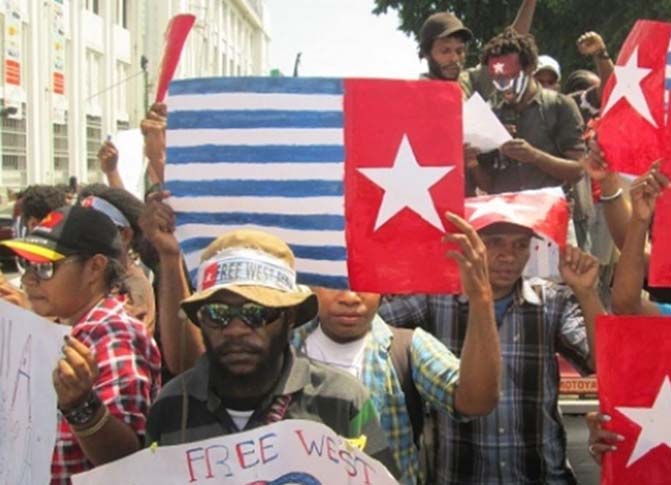
Timor-Leste national police (PNTL) have arrested 46 students at a West Papua independence solidarity protest in Dili, amid accusations the group failed to get permission to hold their demonstration in public.
The Dili protest, which moved from the Government Palace to the Indonesian Embassy in Farol last Thursday afternoon, was part of an international West Papua solidarity protests that have swept across across Indonesia and West Papua over the past two weeks.
The protesters are calling for independence from Indonesia for the people of West Papua.
Police made the arrests for failing to have permission to hold the protest, obstructing traffic and breaches of the peace.
Those arrested were from the Progressive Student Movement (KEP), including 39 men and seven women.
– Partner –
A spokesperson for KEP, Adriano da Costa, said they made the demonstration to show that Timorese youth were in solidarity with the people of West Papua.
Costa said it was important West Papuans knew that Timor-Leste stood with them in their struggle for independence, as the people of Papua had done for Timor-Leste’s own fight to be a sovereign nation.
Police told the Independente that people have a “right to express themselves” but they must get permission from the police to hold demonstrations in public.
“As long as they meet all these requirements, PNTL is ready to carry out security, but because KEP did not fulfil this requirement the PNTL is boycotting their activities,” Armando Monteiro, the Commander of National Police in Dili, said.
Monteiro confirmed that protest organisers had met with PNTL and submitted a letter of request to conduct the protest, but that their demand had been rejected for “legal” reasons.
He said submissions to hold public protests must be made at least five days before the proposed day of action.
Domingos Gomes is a reporter with the Independente newspaper in Dili.
On November 23 this year, Bougainvilleans will vote in a referendum to decide whether they wish to stay part of Papua New Guinea or become an independent nation.
The referendum is not the final step – the vote must be ratified by the PNG Parliament and is subject to a final agreement between PNG and the Autonomous Government of Bougainville, set up under the peace process.
However, Bougainvilleans have long held a sense of separate identity from the rest of PNG, and it appears this island group of 300,000 people is heading for nationhood, with a clear majority expected to vote in favour of independence.
This puts Australia in a tricky position, given its close relationship with PNG. With rising geopolitical tensions in the region as China asserts its interests and courts Pacific territories, including Bougainville, Australia has less room to manoeuvre than it once did.
– Partner –
Australia has a vested interest in seeing this long-running issue resolved peacefully.
Bougainville was part of Australian-administered PNG from 1915 until PNG’s independence in 1975. Australia’s relations with the territory have a long and complicated history ranging across the colonial era, two world wars, the 1988–98 Bougainville conflict, and subsequent peacekeeping missions.
Since the Bougainville war, Canberra invested heavily in various peacekeeping operations, at considerable cost to the Australian taxpayer. The Bougainville peace process has been rightly lauded as a successful model, and Australia can be proud of its record, whatever the criticisms of its role in the war.
The November referendum is in keeping with a process laid out in the Bougainville Peace Agreement, signed by virtually all parties in 2001, as a roadmap for Bougainville’s future status.
Canberra has since signalled that it will be guided by the terms of the peace agreement and any “negotiated outcome” under that arrangement. For Canberra, the status quo – that Bougainville remain part of PNG – is likely the preferred outcome, avoiding another small, aid-dependent nation emerging in the region.
If, however, the result is overwhelmingly in favour of independence, and if the negotiated outcome with the PNG government supports that result, then Australia has little choice but to accept it. Once the result is known, Australia may be better to anticipate it, meet the challenge head-on, and work with regional players to ensure as peaceful and successful a transition as possible.
Bougainville has significant natural resources. It has copper, gold, and silver reserves valued at more than $58 billion, rich fishing grounds, and a history of agricultural production, including large cocoa plantations. These resources – and good management of them – will be crucial if Bougainville is to become a viable independent nation. Its challenge now is to educate and mobilise a “lost generation” of younger people disenfranchised by the war, while forging a unified people and bringing integrity to its political system. It faces many challenges ahead, not least of which is finding consensus on mining issues.
However, the autonomous government is largely ready for the referendum, while the new government in PNG has suggested that it is more committed to the process than the previous government under Peter O’Neill.
Strong sentiments for independence on the ground, combined with the new geopolitics of the region, suggest there is little Bougainville’s neighbours, including Australia, can do to slow the momentum towards independence.
Australia’s challenge is to allow the peace process to unfold, signal its neutrality, and engage more with all parties to the process.
While Australia may have legitimate concerns about Bougainville’s prospects as a new nation in the region, these need to be balanced against the possibility of a crisis unfolding if a clear majority of Bougainvilleans vote yes, as expected, and their wishes are then stymied by events.
NASA is reportedly investigating what could be the first ever alleged crime in space. Astronaut Anne McClain has been accused of accessing her estranged spouse’s bank account via the internet while on board the International Space Station (she denies the accusation).
This gives rise to the question: what criminal law, if any, applies in outer space? The short answer is that, for a US astronaut aboard the International Space Station with a US alleged victim, US criminal jurisdiction applies.
The long answer is more complicated, and set to become even more so with the advent of space tourism, space militarisation, and commercial activity. Human activity has increased in space, with at least 50 nations currently engaged in space activities.
Space, like the high seas, is considered res communis – it belongs to everyone and to no one, nor can any country lay claim to it.
But that doesn’t mean the high seas and outer space are free from national laws. International law allows countries to assert jurisdiction outside their territory in several ways, including via the nationality principle, which covers crimes committed by a country’s citizens outside its borders, and the universality principle, which allows countries to prosecute anyone for serious crimes against international law, such as piracy.
So far there are no pirates in space, outside the realms of science fiction at least.
The Outer Space Treaty is one of the most relevant when it comes to dealing with alleged crimes in space.
Broadly, the treaty requires the exploration and use of outer space to be free, in the interests of all countries, and not subject to any claim of national sovereignty. The Moon and other bodies are to be used only for peaceful purposes. Nations are responsible for national space activities and are liable for damage caused by their space objects.
As for the question of who prosecutes space crimes, the short answer is that a spacefaring criminal would generally be subject to the law of the country of which they are a citizen, or the country aboard whose registered spacecraft the crime was committed, because the treaty grants that country authority “over any personnel thereof”.
However, the term “personnel” is not defined, and this raises questions as to what the case might be for private citizens such as, for example, an Australian space tourist flying aboard a US-registered spacecraft.
Far from home, far from simple
The International Space Station (ISS) in fact has its own intergovernmental agreement, signed by the project’s partner nations, that makes express provision for nationality-based jurisdiction over crime. It says:
Canada, the European Partner States, Japan, Russia, and the United States may exercise criminal jurisdiction over personnel in or on any flight element who are their respective nationals.
As McClain is reportedly a US citizen, this means US criminal law will apply to her conduct. This is also known as “active-nationality” jurisdiction. This is made simpler by the fact that her alleged victim is also a US national.
If the victim of a crime committed on the ISS was a citizen of a different partner nation, and if the US did not provide assurance it would prosecute the perpetrator, that other nation’s criminal law would apply. This is known as “passive nationality” jurisdiction. There is also a possibility that if the crime took place in a partner nation’s section of the space station, its criminal law may apply.
For other space flights not on board the ISS, things potentially get more complicated still, for several reasons.
The treaty framework on criminal law in space relies heavily on nationality. This makes the situation more complicated if an alleged criminal is a dual citizen.
Since 2001, when Dennis Tito became the first space tourist, a total of just seven private citizens have paid to go to space. But Virgin Galactic promises “a regular schedule of spaceflights for private individuals and researchers” in the future.
Future space tourists are unlikely to be aboard the ISS, so that agreement won’t apply. It is most likely that the criminal law of the country of registration of the space plane would apply, but this could be problematic if the countries whose citizens are on board also attempt to claim jurisdiction.
Another issue is the question of where space even begins. Earth’s atmosphere does not have a solid boundary, which makes it hard to determine whether air law or space law should apply at a given altitude, and whether space-bound flights can be deemed to have violated another country’s air space.
Finally, for really serious crimes such as genocide, crimes against humanity, or war crimes, the jurisdiction of the International Criminal Court may also extend into outer space. While some people already see space as a military arena, we can only hope this theoretical jurisdiction is never applied in practice.
The Morrison government is setting up a University Foreign Interference Taskforce, as it grapples with encroachments by China into Australia’s higher education sector.
The taskforce, to be announced in a Wednesday National Press Club address by Education Minister Dan Tehan, will have members from universities, national security agencies and the federal education department.
Representation will be on a fifty fifty basis between the university sector and the government. Tehan says in his speech, extracts of which were released ahead of delivery, that this will provide “a perspective of the sector’s unique position partnered with frank advice from our government”.
There has been mounting concern over a range of foreign interference issues affecting the sector. These include China targeting sensitive research for non-transparent transfer of technology; the apparent inability of some universities to be fully aware of the nature of the Chinese institutions they are dealing with; the Chinese government’s grooming of some Australian student organisations; the use of Chinese money for soft propaganda; and the cyber penetration of university systems to obtain research intellectual property and as well as personal details.
The taskforce will have a wide remit, with Tehan outlining its work in four key areas.
A cyber security working group “will ensure our ecosystem is resilient to unauthorised access, manipulation, disruption or damage”. It will help “better manage and protect our networks, as well as detect and respond to cyber security incidents”
A research and intellectual property group is to “protect against deception, undue influence, unauthorised disclosure or disruption to our research, intellectual property and research community, while also protecting academic freedom”
A foreign collaboration group will have the task of making sure “collaboration with foreign entities will be transparent” and not harm Australia’s interests
A culture and communication group is to “foster a positive security culture” by engaging with government and the community to “increase awareness and improve research and cyber resilience”.
Tehan will also announce the government wants questions relating to freedom of speech included in the Quality Indicators for Learning and Teaching, which is survey data that includes student feedback about higher education.
“I will work with the sector on what questions to ask to measure diversity of opinion on campus and whether students feel empowered to voice non-conformist opinions,” he says.
“I ask the sector to also seek the views of their staff on this matter, and I will work with the sector to develop a set of uniform questions to ask.
“I believe universities want to know if students and staff are afraid to discuss certain topics.
“It is only through diversity of thinking, perspective and intellectual style that we get innovation and problem solving,” Tehan says in his speech.
Tehan will also release the results from an inquiry done by former Victorian Liberal premier Denis Napthine for a strategy for regional, rural and remote education. Its recommendations include improving access for students from these areas to financial support, to enhance fairness and more equal opportunity.
On August 30, Timor-Leste will celebrate the referendum that gave it independence from Indonesia. For the people of this small island, it has been a long battle – and one that continues today. You can read our companion story on the island nation’s struggle for independence here.
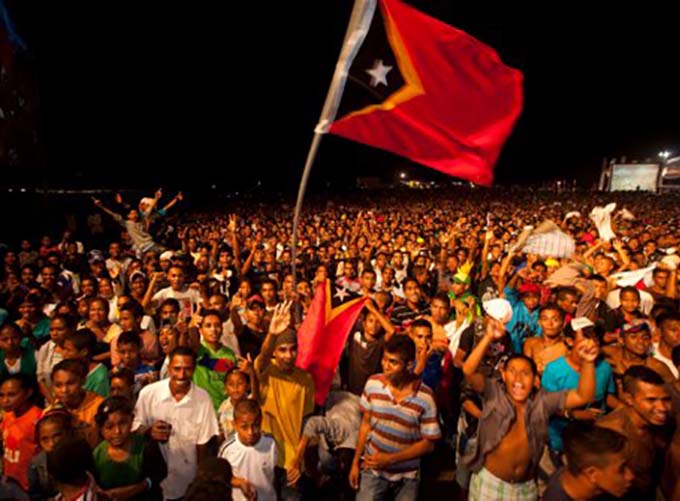
This Friday marks the 20-year anniversary of the day the East Timorese people voted overwhelmingly for independence from Indonesia after a 24-year occupation.
Another significant anniversary comes next month, on September 20. That was the day of the arrival of the INTERFET mission, the Australian-led multinational force that brought an end to the violence that wracked Timor-Leste after the independence vote.
In the intervening three weeks, 1,500 Timorese were killed in the violence, which had been orchestrated by the Indonesian military and its proxy militias. Over 250,000 were forcibly displaced to West Timor and some 80% of the infrastructure was destroyed.
Many Australians are rightly proud of their contribution to Timor-Leste’s independence, which served as an historical corrective to Australia’s longstanding support for Indonesian’s invasion and forced integration of East Timor in 1975-76. The more than 5,000 Australian soldiers in the INTERFET mission marked the nation’s largest military deployment since the Vietnam War.
Yet despite the goodwill the mission engendered in Timor-Leste for the Australian people, relations between the two nations have repeatedly been undermined by contentious negotiations over control of the lucrative oil and gas fields that lie in the Timor Sea.
As Prime Minister Scott Morrison prepares to travel to Dili for the anniversary this week, Australia-Timor-Leste relations finally seem to be back on track.
A treaty signed last March created a permanent maritime boundaries between the two states for the first time. This border is widely expected to come into force this week following its ratification by both parliaments – another momentous milestone in Timor-Leste’s young history.
Australian soldiers conducting an operation to flush out militia fighters in Timor-Leste in September, 1999.Jon Hargest/AAP
Conflict over oil and gas
Since its independence, Timor-Leste’s relations with Australia have been overshadowed by one major factor: the oil and gas fields on its contested maritime border.
Relations hit rocky waters in 2012 when Timor-Leste challenged the Treaty on Certain Maritime Arrangements in the Timor Sea (CMATS), which had been signed by the two countries in 2006. This treaty had established a 50-year moratorium on maritime boundary negotiations, or five years after exploitation of the Greater Sunrise gas field ended, whichever occurred first.
Allegations then emerged in 2013 from a former ASIS agent (now known as Witness K) that Australia had spied on Timorese officials during the negotiations over the CMATS treaty. This led Timor-Leste to launch a case in The Hague challenging the treaty for want of good faith.
Australia was embarrassed by the exposure, but determined to maintain the countries’ ongoing treaty arrangements and focus instead on revenue-sharing agreements. However, Timor-Leste argued that the bulk of the oil and gas fields in the Timor Sea would lie on their side of a median line and pushed for a permanent boundary to be drawn between the countries.
As relations deteriorated, ministerial visits ceased for almost five years.
Because Australia had abandoned the international courts as a means of resolving the maritime boundary in 2002, Timor-Leste had only one option left. In 2016, it pioneered the use of the UN Convention on the Law of the Sea (UNCLOS) compulsory conciliation process: a non-binding but mandatory mediation between nations on maritime disputes.
The conciliation panel of five judges found the CMATS treaty’s moratorium on defining a maritime boundary was invalid. This dealt a fatal blow to decades of Australian foreign policy focused on maintaining its continental shelf claim in the Timor Gap in line with the 1972 Australia-Indonesia border treaty.
Australia could have attempted to tough it out since the tribunal’s finding was non-binding. But by this point, the Labor opposition was arguing the maritime boundary with Timor-Leste should be renegotiated in line with international law, putting additional pressure on the government to resolve the dispute.
A separate dispute over China’s claims in the South China Sea, also settled in 2016, made Australia’s position increasingly untenable, as well. The world was urging China to respect an international tribunal’s maritime ruling, so it would be difficult for Australia not to do the same.
Announcement of the new maritime border treaty followed in March 2018. It was a major diplomatic breakthrough and soon led to the resumption of ministerial visits.
The new maritime boundary between Australia and Timor-Leste.Department of Foreign Affairs and Trade
The treaty created a median-line boundary in the former Timor Gap, placing the wells in the former Joint Petroleum Development Area (JPDA) in Timor-Leste’s sovereign waters.
The Timorese believe there is another A$1.5 billion of oil reserves in this area, but as these fields near the end of their life, the greater game lies in the as-yet-untapped Greater Sunrise field. This field straddles the eastern side of the new boundary and is believed to be worth in excess of US$40 billion.
Timor-Leste also achieved a major increase in royalties from the future development of this field, up from 50% under the CMATS treaty to 70-80%, depending on whether the pipeline eventually goes to Timor or Darwin.
Since then, Timor-Leste’s focus has shifted to negotiations with its commercial partners over its ambitious plans for the Tasi Mane oil and gas megaproject on its southern coast.
This project could bring additional challenges for the relationship with Australia. The East Timorese government estimates that external financing will provide some 80% of the estimated US$10.5-12 billion funding for the project. And Timor-Leste’s ambassador to Australia has already stated that if funding partners cannot be found among Timor-Leste’s friends in Australia, the United States, Japan or South Korea, then Chinese capital would be a clear alternative.
Timor-Leste has rejected reports that China’s Exim bank offered a A$16 billion loan to finance the megaproject, though it acknowledges both countries have expressed willingness to cooperate over the separate development of Timor-Leste’s petrochemical industry.
Even though China might be seen as a logical partner for developing Timor-Leste’s oil and gas processing capabilities, Beijing’s involvement would certainly complicate relations with Australia.
Timor-Leste has generally sought to balance its relationships with key regional powers, in part to prevent the dominant influence of any single nation. The country’s foreign minister recently emphasised that discussions on the Tasi Mane project are ongoing with potential partners in Australia, the US, Europe and Asia.
Foreign Minister Julie Bishop meets with her Timor-Leste counterpart, Dionisio Soares, in Dili in 2018. She was the first Australian government minister to visit Timor-Leste in five years.Greg Roberts/AAP
Remaining obstacles to closer ties
Despite the major improvement in bilateral ties between the two countries, there are some remaining points of contention.
The prosecutions of Witness K and his lawyer Bernard Collaery in the espionage whistleblower case have been criticised by former Timor-Leste leaders Xanana Gusmão and Jose Ramos-Horta. This week, Gusmão indicated he would appear as a witness to give evidence on behalf of the two, raising the potential for further embarrassment for Australia.
Some political activists in both Australia and Timor-Leste have also called for Canberra to pay back oil and gas revenues it has received from the JPDA since the border treaty was signed in 2018, and accused Australia of delays in ratification.
While these accusations have made headlines, Timor-Leste’s parliament had not ratified the treaty either until last month. In any case, Timorese NGOs point to the far larger question of up to US$5 billion in revenues that Australia has received dating back to 2002, when revenue-sharing agreements began.
But it appears there is no appetite in either country to consider repayment of historical royalties.
As Australia and Timor-Leste prepare to celebrate the anniversary of the independence referendum – as well as the recent restoration of good bilateral relations – it’s worth keeping in mind that new hurdles potentially lie ahead, with implications for the wider region.
On August 30, Timor-Leste will celebrate the referendum that gave it independence from Indonesia. For the people of this small island, it has been a long battle – one that continues today. You can read our companion story on the island nation’s vexed relationship with Australia here.
Indigenous myth attributes the high mountain chain that runs like a spine down the centre of the crocodile-shaped island of Timor to Mother Earth’s dying movements when she retreated underground. This mountain chain is more pronounced in the east, in the territory of Timor-Leste, and often protrudes directly down into the sea along the rugged northern coast.
The island is also surrounded by significant waters. To the south are the vast and disputed oil reserves. To the north is a deep exchange pathway for warm water moving from the Pacific to the Indian Ocean, creating conditions for a major “cetacean migration” highway for 24 different species of whale and dolphin.
In 1944, the anthropologist Mendes Correa described the Portuguese colony of Timor as a “Babel … a melting pot”, and a diverse mix of traditions is still strongly felt today.
The island is a bridge between the Malay and Melanesian world and has as much in common with Pacific Island cultures as Indonesia. The diverse indigenous societies cross the spectrum of matriarchal and patriarchal organisation.
Women are accorded a sacred status within Timorese cosmology and the divine female element is prominent in much indigenous belief. Female spirits dominate the sacred world, while men dominate the secular world. So, while women may hold power in a ritual context, they generally do not have a strong public or political voice. But they are fighting to change this and now make up a third of members in the national parliament.
By the early 16th century, Portuguese colonisers arrived in the Spice Islands of which Timor was part. This was the beginning of a colonial relationship now 500 years old.
Revolts by Timorese against Portuguese rule were frequent and bloody. Famous Timorese rebel Dom Boaventura lost an armed uprising against his Portuguese colonisers in 1911, leaving East Timor to be ruled directly from Portugal by the fascist dictatorship of Salazar for most of the 20th century.
The marginal colony remained neglected and closeted from any modern liberalising trends. But in the early 1970s the Timorese independence movement Fretilin, partly inspired by Dom Boaventura, began to oppose Portuguese colonialism, while developing a revolutionary program that included the emancipation of women.
Rosa “Muki” Bonaparte was one of the founders of the nationalist movement and the leader of its women’s organisation. While Bonaparte participated directly in the struggle against colonialism, she also stood against “the violent discrimination that Timorese women had suffered in colonial society”.
After the colonial regime collapsed in 1974, a three-week civil war, secretly manipulated by Indonesian military agents, was the precursor to the larger war and invasion to come.
The victors of the civil war, Fretilin, reconstituted the faction of loyal Timorese soldiers serving in the Portuguese Army as resistance army Falintil. This army, and the civilian resistance, countered the massive and brutal attack of US-and-Australian-backed Indonesian military for 24 years. The horrors were kept as secret as possible, even to the point of covering up the deaths of those trying to report them, such as the “Balibo 5”.
After the Indonesian invasion of December 7 1975, much of the population of East Timor retreated to the mountains, with the resistance living in free zones for the next three years.
However, in November 1978, the Indonesian campaign of annihilation finally encircled the remaining resistance leadership and 140,000 civilians on Mount Matebian, in the east of the island. Most surrendered. They were placed in prisons and “resettlement camps” where many slowly starved to death. The violence of the 24-year Indonesian occupation affected and traumatised the whole of Timorese society.
After the collapse of the Suharto dictatorship in Indonesia in 1998, President B.J. Habibie agreed to let the Timorese decide their future in a ballot. In his honour, they recently named a bridge after him.
Xanana Gusmao was the key negotiator with Indonesia after the independence ballot.AAP/EPA/John_Feeder
Timor’s pre-eminent leader, Xanana Gusmao, was the key negotiator with UN representatives. He conducted negotiations from his prison house in Jakarta where he’d been since 1992, serving a 20-year sentence for fighting Indonesian forces in his homeland. He persevered with ballot preparations despite growing Indonesian military and militia violence.
In the August 30 1999 referendum, nearly 80% of East Timorese voted for independence by indicating the blue and green National Council of Timorese Resistance (CNRT) flag on the ballot paper.
Extensive military and militia slayings followed the announcement of the vote. An estimated 1500 East Timorese were killed and more than 250,000 forcibly displaced into Indonesia. About 80% of infrastructure was destroyed. Survivors struggled to feed and look after their families while recovering psychologically from the mayhem.
Stories from the resistance period and 1999 are constantly remembered in Timor-Leste and are hugely significant in the new society. A hierarchy based on past service to the resistance has been established. Pensions and payments to male veterans are one of the biggest expenses for the government.
Anthropologists have described an indigenous belief that those who fought and sacrificed “purchased” the nation with their own lives and are owed a living.
Along with celebration there will be much reflection in Timor in the next weeks about the last 20 years of building a nation from “zero” and the 24 years of struggle that came before that. It will consider what they have achieved and what still needs to be done.
Hopefully, Timor-Leste can build a free and fair future for the over 1 million citizens, 60% of them under 18. They include many inspiring, educated young leaders who are ready to take up the responsibility.
As we watch and cheer from the sidelines, we hope for a less eventful and more peaceful future for all Timorese.
Every year a new batch of diets become trendy. In the past, the blood group, ketogenic, Pioppi and gluten-free diets were among the most popular. These have made way for the mono diet, charcoal detox, Noom, time-restricted feeding and Fast800.
So what are these new diets and is there any scientific evidence to support them?
The monotrophic or mono diet limits food intake to just one food group such as meat or fruit, or one individual food like potato or chicken, each day.
The mono diet has no scientific basis and no research has been done on it. It’s definitely a fad and should not be followed.
It leads to weight loss because your food intake is so limited (one food per day) that you get sick of that food very quickly and so automatically achieve a reduced kilojoule intake.
If you ate three apples at each main meal and had another three as between-meal snacks then your total kilojoule intake from the 12 apples would be about 4,000 kilojoules (950 calories).
The mono diet is nutritionally inadequate. The nutrients most deficient will depend on the individual foods consumed, but if you follow the mono diet long term, you would eventually develop vitamin and mineral deficiencies.
2. Charcoal detox
The charcoal detox diet claims to help people lose weight by “detoxing” them. It involves periods of fasting and consumption of tea or juice drinks that contain charcoal.
It is definitely not recommended.
Medical professionals use activated charcoal to treat patients who have been poisoned or have overdosed on specific medications. Charcoal can bind to some compounds and remove them from the body.
There is no scientific evidence to support the use of charcoal as a weight loss strategy.
Charcoal detox plans also include dietary restrictions or fasts, so people might lose weight because they’re consuming fewer kilojoules.
Charcoal is not selective. It can bind to some medications and nutrients, as well as toxic substances, so there is the potential for charcoal to trigger nutrient deficiencies and/or make some medications less effective.
The Noom diet isn’t actually a diet at all. It is a smartphone app called Noom Coach that focuses on behaviour change techniques to assist with weight loss. It allows users to monitor their eating and physical activity, and provides support and feedback.
The Noom diet does not provide a diet plan, but it gets users to record within the app, all foods and drinks consumed. It then uses a traffic light system (red, yellow, green) to indicate how healthy the foods are.
One advantage of Noom is that is doesn’t eliminate any foods or food groups, and it encourages healthy lifestyle behaviour change to assist with weight loss.
A disadvantage is that while you can download the app for a free short-term trial, membership is about A$50 per month for four months. And additional services cost extra. So consider whether this approach suits your budget.
One study has examined the app’s effectiveness. In a cohort of 35,921 Noom app users over 18 months, almost 78% reported a reduction in body weight. About 23% of these people reported losing more than 10% of their body weight.
Time-restricted feeding is a type of intermittent fast that involves restricting the time of day that you are “allowed” to eat. This typically means eating in a window lasting four to ten hours.
While energy-restriction during this period is not a specific recommendation, it happens as a consequence of eating only during a shorter period of time than usual.
It’s unclear whether weight loss results from changes in the body after you fast, or if it’s just because you can’t eat as much in a short period of time.Best_nj/Shutterstock
The difference between time-restricted feeding compared to other intermittent fasting strategies is that recent research suggests some metabolic benefits are initiated following a fasting period that lasts for 16 hours, as opposed to a typical overnight fast of ten to 12 hours.
Further research is required to determine whether any health effects of time-restricted feeding are due to regular 16-hour fasting periods, or simply because eating over a small time window reduces energy intake.
If this approach helps you get started on a healthy lifestyle and your GP gives you the all clear, then try it. You will need to follow up with some permanent changes to your lifestyle so your food and physical activity patterns are improved in the long term.
5. Fast800
The Fast800 diet by Dr Michael Mosley encourages a daily intake of just 800 calories (about 3,350 kilojoules) during the initial intensive phase of the Blood Sugar Diet.
This lasts for up to eight weeks and is supposed to help you rapidly lose weight and improve your blood sugar levels. You can buy the book for about A$20 or pay A$175 for a 12-week online program that says it includes a personal assessment, recipes, physical and mindfulness exercises, tools, access to experts, an online community, information for your doctor and advice for long-term healthy living.
Two recent studies provide some evidence that supports these claims: the DiRECT and DROPLET trials.
In these studies, GPs prescribed patients who were obese and/or had type 2 diabetes an initial diet of 800 calories, using formulated meal replacements. This initial phase was followed by a gradual reintroduction of food. Participants also received structured support to help them maintain the weight loss.
Both studies compared the intervention to a control group who received either usual care or treatment using best practice guidelines.
They found participants in the 800 calorie groups lost more weight and more of the adults with type 2 diabetes achieved remission than the control groups.
This is what you would expect, given the intervention was very intensive and included a very low total daily energy intake.
But the low energy intake can make the Fast800 difficult to stick to. It can also be challenging to get enough nutrients, so protocols need to be carefully followed and any recommended nutrient supplements taken.
Fast800 is not suitable for people with a history of eating disorders or health conditions such as liver disease. So if you’re considering it, talk to your GP.
When it comes to weight loss, there are no magic tricks that guarantee success. Have a health check up with your GP, focus on making healthy lifestyle changes and if you need more support, ask to be referred to an accredited practising dietitian.
Climate Explained is a collaboration between The Conversation, Stuff and the New Zealand Science Media Centre to answer your questions about climate change.
If you have a question you’d like an expert to answer, please send it to climate.change@stuff.co.nz
Would you please explain how the New Zealand Emissions Trading Scheme (ETS) works in simple terms? Who pays and where does the money go?
Every tonne of emissions causes damages and a cost to society. In traditional market transactions, these costs are ignored. Putting a price on emissions forces us to face at least some of the cost of the emissions associated with what we produce and consume, and it influences us to choose lower-emission options.
An emissions trading scheme (ETS) is a tool that puts a quantity limit and a price on emissions. Its “currency” is emission units issued by the government. Each unit is like a voucher that allows the holder to emit one tonne of greenhouse gases.
The New Zealand Emissions Trading Scheme (NZ ETS) is the government’s main tool to meet our target under the Paris Agreement. In a typical ETS, the government caps the number of units in line with its emissions target and the trading market sets the corresponding emission price.
In New Zealand, the price for a tonne of greenhouse gases is currently slightly below NZ$25, which is not in line with our target. We are still waiting for the government to set a cap on the NZ ETS, which is (hopefully) coming.
In the past, we had no limit on the number of emission units in the system, which is why emission prices stayed low, our domestic emissions continued to rise, and the system accumulated a substantial number of banked units.
How an ETS works and who pays
The government decides which entities (typically companies) in each sector (e.g. fossil fuel producers and importers, industrial producers, foresters, and landfill operators) will be liable for their emissions. In some cases (e.g. fossil fuel producers and importers), liable entities are not the actual emitters but they are responsible for the emissions generated when others use their products.
There is a trading market where entities can buy units to cover their emissions liability and sell units they don’t need. The trading price depends on market expectations for supply versus demand. Steeper targets mean lower supply and higher emissions mean higher demand; both mean higher emission prices and more behaviour change.
Each liable entity is required to report emissions and surrender to the government enough units to cover the amount of greenhouse gases they release. The companies that have to surrender units pass on the associated cost to their customers, like any other production cost. In this way, the emission price signal flows across the economy embedded in the cost of goods and services, influencing everyone to make more climate-friendly choices.
First, some get free allocation from the government. Currently, these free allocations are granted to trade-exposed industrial producers (for products such as steel, aluminium, methanol, cement and fertiliser) as a way of preventing the production and associated emissions from shifting to other countries without reducing global emissions. Producers who emit beyond their free allocation need to buy more units, whereas those who improve their processes and emit less can sell or bank their excess units.
Second, entities can earn units by establishing new forests or through industrial activities that remove emissions. By stripping emissions from the atmosphere, such removal activities make it possible to add units to the cap without increasing net emissions. The government publishes information on ETS emissions and removals every year.
Third, entities can buy units from the government through auctioning. In this case, market demand still sets the price. The NZ ETS does not yet have auctioning, but again this is (hopefully) coming. The government currently does allow emitters to buy uncapped fixed-price units at NZ$25.
In the past, entities had a fourth option – buying offshore units – but this stopped in mid-2015. This option is not currently available under the Paris Agreement. If that changes in the future, quantity and quality limits will be needed on offshore units.
The entities that surrender units to the government directly face the price of emissions – either because they had to buy units from other entities or the government, or because they lost the opportunity to sell freely allocated units.
When the government sells units – through auctioning or the fixed-price mechanism – it earns revenue. In 2018, the New Zealand government sold 16.82 million fixed-price units and received NZ$420 million in revenue. When selling fixed-price units that allow the market to emit more, the government has to compensate through more action to reduce domestic emissions (like reducing fossil fuel use or planting more trees) or purchasing emission reductions from other countries – and these actions have a cost.
When ETS auctioning is introduced (potentially in late 2020), the government will receive more significant revenue. It has signalled that any revenue from pricing agricultural emissions (methane and nitrous oxide) will be returned to the sector to help with a transition to lower emissions.
What will happen with NZ ETS auction revenue from other sectors is an open policy question. So are the questions of how large the NZ ETS cap, and how high the emission price, should be. This will be determined under the Zero Carbon Bill and future amendments and regulations to the ETS.
This article was prepared in collaboration with Bronwyn Bruce-Brand and Ceridwyn Roberts at Motu Economic and Public Policy Research.
In the past 30 years, Australia has settled thousands of African refugees. But many arrived here at a young age and with low educational attainment. That presents challenges in trying to encourage more to participate in higher education.
Yet only about 10% of young people from the main countries of origin of African refugees go to university within five years of arrival. That trend has not changed much in the past 25 years.
For those who do enter higher education, completion is a serious challenge. In the past 17 years, only one in five African refugee students completed their undergraduate course.
Nationally, just under half (46%) of domestic students who commenced undergraduate university courses in 2009 completed their degrees in four years. When the cohort length increases to nine years, the completion rate is three quaters (74%) of students.
The challenge for young refugees
So given only a small portion of young African refugees go to university here, and very few of those successfully completed their degrees, what are the factors underpinning this predicament?
Many African refugees arrived in Australia with interrupted educational experiences. They may have endured the trauma of war, violence and family separation. These negative effects of forced displacement can inhibit them from taking full advantage of educational opportunities.
In the early stage of their settlement, young African refugees faced informational barriers in relation to available educational options and accessing financial support. In exploring pathways to university, they have a limited social network to rely on.
Most African refugees come from non-English speaking countries and limited English language proficiency is a stumbling block. Fragmented educational histories also mean they enter the Australian education system with limited academic skills.
Black African youth face explicit racism in educational institutions and public spaces. Experiences of racism cause stress that can negatively affect academic engagement. Studies in social psychology show the stress of racial bias hinders learning.
As a result of the combined effects of the above issues, young refugees often get low school results, so many fail to meet entrance requirements of most universities. Institutions that attract low-ATAR students may not have sufficient resources to run effective enabling programs such as courses for academic skills development.
High expectations
Most African parents hold high expectations for their children’s academic achievement.
But career educators in selected secondary schools in Melbourne have told me there often exists a significant gap between what parents want and what students are able to achieve.
In other words, due to unrealistic parental expectations, African students miss viable higher education options.
For example, students who cannot meet entrance requirements of most universities, could find TAFE diplomas more rewarding than university degrees. But career educators told me that often, due to parental pressure, students are less interested in non-university degrees.
What can be done to improve things?
Equity practitioners in schools and universities are aware that enabling programs that benefit refugee students are resource-intensive. For educational institutions to secure the necessary resources, the issue needs first to be recognised at a policy level by governments.
Early intervention is critical. Such intervention can be in the form of expanding tailored educational opportunities at the settlement stage. These may include intensive lessons on academic skills, information on alternative pathways to university, and supplementary academic support within schools.
We also need to avoid negative representations of African youth in the public conversation. Black African youth are often incorrectly labelled as inherently violent, dangerous and unsocial, as we’ve seen in recent “African gang” media portrayals.
This sort of depiction distorts public perception of people of African origin. And it reinforces racial bias in the community. Research shows that experiences of racial discrimination results in academic disengagement.
Why we need more African refugees in higher education
There are economic and social reasons for governments to promote higher education participation of refugee-background Africans.
Widening their participation in higher education can boost human capital and productivity for the nation. A recent report from the Organisation for Economic Cooperation and Development shows that in Australia the key driver of youth unemployment is low educational attainment.
In 2016, the unemployment rate of people from the main countries of origin of African refugees was as high as 22.4%. This is over three times higher than the national average (6.9%).
The group also had low access to professional occupations (22%), compared with 49% for the general population.
A lack of knowledge and skills means not only poor employment prospects but also high youth disengagement. The youth incarceration rate is disproportionately high among African communities.
In 2017, young people of African background accounted for 19% of the total population in youth justice in Victoria. Yet in 2016, Africans accounted for only 1.5% of the state’s population.
As the Australian Human Rights Commission cautions, structural barriers may leave African communities on the margins of society. In a fair society such as Australia, lasting marginal existence of any group is detrimental. It undermines economic prosperity, democratic order, and social cohesion.
Improved higher education attainment does not just boost the employability and income of African refugee youth, it also equips them with the necessary skills and confidence to meaningfully engage in the political and cultural spheres of life.
“What we need to do is rebuild confidence in Australia’s building and construction sector,” said federal minister Karen Andrews after the July 2019 meeting of the Building Ministers’ Forum).
This has been a recurring theme since the federal, state and territory ministers commissioned Peter Shergold and Bronwyn Weir in mid-2017 to assess the effectiveness of building and construction industry regulation across Australia. They presented their Building Confidence report to the ministers in February 2018.
In the 18 months since then, the combined might of nine governments has made scant progress towards implementing the report’s 24 simple recommendations. Confidence in building regulation and quality has clearly continued to deteriorate among the public and construction industry.
In last week’s Four Corners program, Cracking Up, Weir was asked whether she would buy an apartment. She responded: “I wouldn’t buy a newly built apartment, no […] I’d buy an older one.” She went on to say:
We have hundreds of thousands of apartments that have been built across the country over the last two, three decades. Probably the prevalence of noncompliance has been particularly bad, I would say in the last say 15 to 20 years […] And that means there’s a lot of existing building stock that has defects in it […] There’ll be legacy issues for some time and I suspect there’ll be legacy issues that we’re not even fully aware of yet.
These comments may not have delighted those developers trying to sell new apartments, or owners selling existing apartments, but they are fair and correct. Confidence will not be restored until all the governments act together to improve regulatory oversight and deal with existing defective buildings.
Residents of the Lacrosse, Neo200, Opal and Mascot towers and other buildings with serious defects are already living with the impact of “legacy” problems. Over the weekend, another apartment building was evacuated – this time in Mordialloc in southeast Melbourne. The building was deemed unsafe because it was clad with combustible material and had defects in its fire detection and warning system.
Residents had to evacuate an apartment building in Mordialloc, Melbourne, after it was found to pose an extreme fire safety risk.
Fixing such defects is a costly business. A Victorian Civil and Administrative Tribunal decision established that replacing the combustible cladding on the Lacrosse building in Melbourne would cost an average of A$36,000 per unit. At Mascot Towers, consultant engineers estimated the cost of structural repairs at up to A$150,000 per unit on average.
According to UNSW and Deakin research, between 70% and 97% of units in strata apartments have significant defects. Let’s assume 85% have such defects and the average cost of fixing these is only $25,000 per unit. That would mean total repair costs for the 500,000 or so tall apartments (four-storey and above) across Australia could exceed A$10 billion.
The Victorian government has taken the lead on combustible cladding, setting up and funding a A$600 million scheme to replace it. It’s also replacing combustible cladding on low-rise school buildings even though these may comply with the letter of the National Construction Code.
No other state has yet followed this lead. This is concerning given the risk to life. No one viewing images of the Neo200 fire in the Melbourne CBD could doubt how dangerous combustible cladding can be.
Combustible cladding allowed fire to spread rapidly up the Neo200 building.
The other states and territories should immediately copy the Victorian scheme. While not perfect, and probably underfunded, it is a positive step to improve public safety. The Andrews government should be congratulated for doing something practical while its counterparts in New South Wales and Queensland, which have many buildings with combustible cladding, fiddle about.
The federal government’s response has been inadequate. When asked about contributing to the Victorian scheme, Karen Andrews said:
The Commonwealth is not an ATM for the states […] this problem is of the states’ making and they need to step up and fix the problem and dig into their own pockets.
This flies in the face of reality. All nine governments are responsible for building regulation and enforcement. All signed the intergovernmental agreement on building regulation.
The federal government, which chairs the Building Ministers’ Forum, leads building regulation in Australia. The Australian Building Codes Board, which produces the National Construction Code, is effectively a federal government agency. The precursor to the national code, the Building Code of Australia, was a federal initiative.
The crop of building defects we see today are a direct result of negligent regulation by all nine governments over the past two decades. Clearly, they all have a legal and moral duty to coordinate and contribute to a program to manage the risks and economic damage this has created.
The governments must stop playing a blame game. Effective programs are urgently needed to fix defects, including combustible cladding, incorrectly installed fire protection measures, structural noncompliance, structural failure and leaks.
The Australian Building Codes Board, which is directly responsible for the mess, should be reformed to ensure it becomes an effective regulator. The National Construction Code should be changed to make consumer protection an objective in the delivery of housing for sale.
All parties involved will have to take some pain: regulators, developers, builders, subcontractors, consultants, certifiers, insurers, aluminium panel manufacturers, suppliers and owners. Only governments can broker a solution as it will require legislation and an allocation of responsibility for fault.
The alternative will probably be a huge number of individual legal cases and a rash of owner bankruptcies, which may well leave the guilty parties untouched.
That was the immediate greeting from the driveway attendant when pulling into the service station in the days before self-serve pumps.
Yes, once there was someone to pump your fuel and check your oil and water.
The colloquially named “servo” actually provided service.
Then, in order to reduce operational costs and remain competitive, they became “self-service” – you pumped your own fuel, pumped your own tyres, and didn’t dare ask for mechanical assistance.
An attendant pumps petrol at Griffin’s Garage at Victor Harbor, South Australia circa 1921.RAA
Today’s announcement that David Jones and BP are joining forces to to “create all-new centres of convenience” appears to mean servos are getting back into service, taking the focus off fuel prices and putting it back onto customer experience.
Back in 2015, the new South African owner of David Jones, Woolworths Holdings (which shouldn’t be confused with Australia’s Woolworths) asked South African retailing veteran Pieter de Wet to overhaul its food business.
At first he rolled out “Food Stores”, similar to British retailer Marks & Spencers “Food Halls”, inside existing David Jones stores. Then earlier this year, he launched DJ’s first stand-alone food store in Melbourne’s South Yarra.
Moving into fuel and convenience is a logical, although risky, move. Two service station chains have moved first.
Rather than competing only on fuel prices or 4 cent discounts, they are competing on “customer experience”. Stay a little longer, charge your phone and deal with some important emails. Have a barista-made espresso, or a Boost Juice. Grab a YouFoodz meal to take home for dinner.
Service stations are rediscovering service
When Singapore-based multinational Puma Energy entered Australia’s petrol market in 2013, it acquired Ausfuel Gull, Matilda, Neumann and Central Combined Group, making it Australia’s largest fuel retailer outside the big four; Caltex, BP, Shell and Mobil.
In 2016 it began installing 7th Street artisan café and convenience stores in its service stations, offering barista-made coffee, fresh baguettes, free Wi-Fi and phone recharging stations.
Puma Energy
Then, in 2017, Caltex also opened its first Foodary, offering “breakfast, lunch and dinner options to go, locally roasted barista-made coffee and goods from local businesses”.
We are more time poor than ever, but we don’t want to scrimp on quality.
The same phenomenon is contributing to the growth of meal delivery services. One-third of consumers are now using a restaurant or meal delivery service, and 7% get delivery once a week.
The “premiumisation” of convenient fast food is an enormous growth opportunity, with market research company IbisWorld forecasting revenue growth of 4.7% through 2018-19 to A$7.6 billion, something David Jones wants to grab a part of in partnership with BP.
It won’t happen everywhere
Don’t expect to see a David Jones infused BP service station in your own neighbourhood any time soon.
DJs says over the next six months they will be “strategically positioned” in 10 key locations in Sydney and Melbourne populated by a high proportion of “busy, urban, health-conscious customers”.
It can be thought of as customer segmentation, this time based on time and income.
It will fragment the fuel and convenience sector. At one end will be Coles Express and Caltex Starmart, offering value and low prices. At the other will be Caltex with The Foodary, Puma with 7th Street, and David Jones/BP offering “gourmet convenience”.
But it might take our minds off prices
Offering a premium food and customer experience will help insulate BP from the effect of high fuel prices.
Last week, Coles Express announced a decline of almost 70% in earnings before interest in tax. When your offer is low prices and convenience but you can’t control fuel prices, you are at risk of losing customers.
Aiming at time-poor high income motorists offers protection. People filling up their BMW don’t care whether the price is $1.50 or $1.80 a litre.
Of course while there would be winners, there would also be losers, the biggest being traditional convenience stores and second tier supermarkets bearing brands such as IGA and Foodland, supplied by the listed wholesaler Metcash.
The ability to zip in, fill up and grab a quality food might become another nail in the coffin of the local convenience store.
The legitimacy crisis facing corporate America must be starting to scare its affluent elite. The US Business Round Table has just published an open letter arguing that it’s time for business to put people before profits.
Signed by chief executives of some of the world’s richest firms – including Amazon chief Jeff Bezos, Apple boss Tim Cook, and Fox’s executive chairman Lachlan Murdoch – the statement admits that in the past business leaders believed “corporations exist principally to serve their shareholders”.
But it says the times have changed. Corporations should now also focus on helping workers, the environment and other vulnerable “stakeholders”.
Since 1978, Business Roundtable has periodically issued Principles of Corporate Governance that include language on the purpose of a corporation. Each version of that document issued since 1997 has stated that corporations exist principally to serve their shareholders.
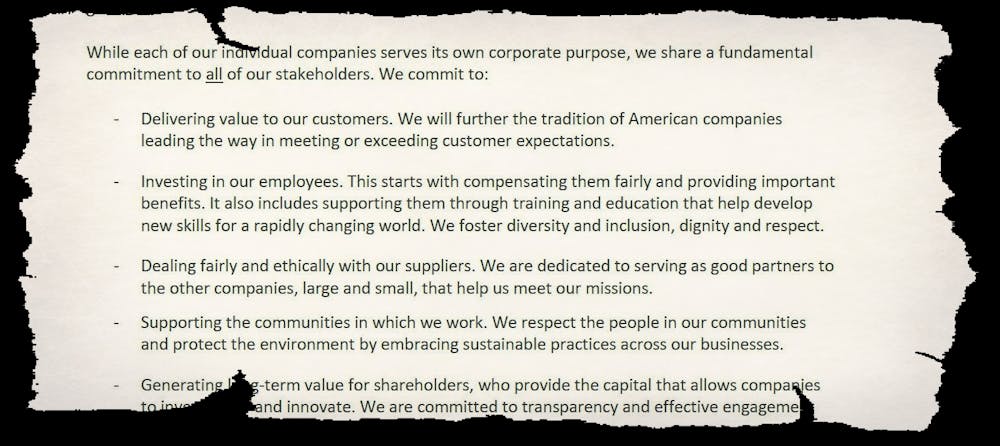
It has become clear that this language on corporate purpose does not accurately describe the ways in which we and our fellow CEOs endeavor every day to create value for all our stakeholders, whose long-term interests are inseparable.
Like many similar proclamations by the ultra-wealthy clique of American chief executives, the statement is meant to look as if capitalism is changing its ways.
Big business is no longer just about increasing shareholder value but “investing in our employees” as well as supporting communities, the environment, and suppliers.
The New York Times prominently featured news about the letter on its website, announcing a sea change in how America does business.
But looking through the platitudes about caring for “stakeholders”, an ulterior motive emerges.
Less than it seems
In the long wake of the 2008 global financial crisis, when working people carried the brunt of the US recession while Jeff Bezos increased his wealth by US$107 million every day, the business elite needs to periodically tell people that it really does care, that corporate capitalism is a force for good and not evil.
There are signs in the statement that point to its strategic nature.
For example, it says the tenets of neoliberalism and free markets are basically sound and do not require reform:
We believe the free-market system is the best means of generating good jobs, a strong and sustainable economy, innovation, a healthy environment and economic opportunity for all.
This is the free-market system that gave us the global financial crisis, income inequality on an unprecedented scale, unattainable house prices and, in Australia, wage growth that has stagnated for half a decade. Economies in the US and Europe are a mess, and Australia’s isn’t looking good.
The underlying sentiment in the statement is business-as-usual, plus “ethical fluff”.
And much is missing
What it doesn’t mention speaks volumes.
Nowhere does it broach the thorny issue of tax. Several of the signatories of the letter – including Larry Fink from Blackrock – praised President Donald Trump’s corporate tax cuts. Their effect on inequality isn’t canvassed.
The elite often dismiss criticisms of corporate capitalism as pie-in-the-sky: tax is complex, we’re told. But don’t be fooled. A practical step would be a simple change in tax laws that makes Amazon and Google pay more than the minuscule percentage of revenue in tax that they current do.
Statements of “corporate social responsibility” – where oil firms, mining conglomerates and others pledge to do more for the environment or for workers or “stakeholders” – are often designed to ward off regulations that could limit their ability to make profits. They are often pre-emptory, designed to get in first.
The Great Gatsby, F. Scott Fitzgerald’s 1925 masterpiece of the Jazz Age, ushers readers into a corrupt but glittering world of cocktails, fast cars, stolen kisses and broken dreams. Status anxiety and conspicuous consumption generate a dazzling, often surreal poetry as the novel unfolds over a single summer in Long Island, New York. Beneath them trembles an ominous sense of malaise.
The novel is narrated in the first-person by Nick Carraway, a well-to-do Yale graduate from the Midwest, whose limited acquaintance with the millionaire Jay Gatsby is the reader’s only window onto the mysterious title character.
Fitzgerald’s editor Max Perkins complained to the author that Gatsby’s characterisation was too vague — that readers “can never quite focus upon him” — but this criticism missed the point. Jay Gatsby is not a man but “an unbroken series of successful gestures”, the product of an age — not unlike today’s culture of Instagrammable celebrity — in which identity is less a matter of innate qualities than of projecting an image.
Fittingly, the only God invoked in Gatsby appears on a billboard, in the famous image of oculist Dr J.T. Eckleberg’s gigantic blue eyes looking down on events in admonition.
Oculist Dr J.T. Eckleberg’s all-seeing eyes, here in Baz Luhrmann’s film, look down on events.ResearchGate, CC BY
The Great American novel
Although short in length, The Great Gatsby is widely recognised as an exemplar of that most elusive of literary phenomena: the Great American Novel. It achieves aesthetic greatness as a self-conscious tour de force, the product of Fitzgerald’s desire “to write something new – something extraordinary and beautiful and simple [and] intricately patterned” as he wrote in a 1922 letter to Perkins.
Its American-ness is likewise self-conscious: one of Fitzgerald’s working titles was Under the Red, White, and Blue, and Nick’s account of Gatsby’s rise and fall exposes deep flaws and fissures underlying the American Dream of unlimited social mobility.
Affirming the presence of class prejudice in the land where all men were supposedly created equal, Gatsby constructs a fragile romance across the gulf between old and new money — a gulf that separates Gatsby from his love interest Daisy and her husband Tom Buchanan. Whereas Daisy and Tom come from established families, Gatsby lacks pedigree. The sources of his vast wealth are the subject of much speculation as his colossal mansion dwarfs those of other millionaires with freshly-minted fortunes.
Erosion of orthodoxies
Like many of his modernist contemporaries, Fitzgerald was fascinated by the erosion of old orthodoxies and traditional constraints in the aftermath of the first world war. For women, many taboos on dress and deportment were lifting, and Gatsby’s female characters play sports, dance wildly, and drink and smoke to excess — even in the midst of Prohibition. Yet for all its “spectroscopic gaiety”, such license brings little fulfilment.
Shelley Winters starred in the 1949 film adaptation.IMDB/Paramount
In Chapter 1, the jaded Daisy expresses a sense of crippling ennui: “I think everything’s terrible anyhow […] And I KNOW. I’ve been everywhere and seen everything and done everything […] God, I’m sophisticated!”
Those with the right connections can afford to be amoral. When Daisy accidentally runs down Myrtle and flees the scene in Gatsby’s “monstrous” car, Tom manages a cover-up, shifting the blame onto Gatsby. As Nick reflects:
They were careless people, Tom and Daisy — they smashed up things and creatures and then retreated back into their money or their vast carelessness […] and let other people clean up the mess they had made.
Social mobility and the question of race
In the year of Gatsby’s publication, US President Calvin Coolidge announced “the chief business of the American people is business”, and in Fitzgerald’s novel it seems that “the pursuit of happiness” — that vague third term in the Declaration of Independence — has been reduced to the pursuit of material success.
Daisy, played in 1974 by Mia Farrow, is a blue-blooded society belle.IMDB
Even romance and tragedy obey the logic of boom and bust. Nick reports in stockbroking language that Gatsby’s failure “temporarily closed out my interest in the abortive sorrows and short-winded elations of men”, and Gatsby’s love for Daisy — a golden girl whose voice is “full of money” — is as deeply rooted in class and material aspirations as in sexual or personal attachment.
He desires not only Daisy but what winning her would symbolise. Indeed when the penniless Gatsby first met her, Daisy’s social elevation as a Kentucky debutante is said to have “increased her value in his eyes”.
Gatsby’s publication coincided with a high water mark of racism and xenophobia in the United States. The Johnson-Reed Immigration Act of 1924 introduced strict immigration quotas, while the revitalised Klu Klux Klan peaked at four million members in the same year. The novel has drawn criticism for its marginalisation of African Americans: one would hardly know from Fitzgerald’s novel that the Harlem Renaissance was underway. Fitzgerald is credited with naming the Jazz Age, but largely erases its origins.
Nick calls Tom a “prig”, but he too associates race with class difference when the spectacle of “three modish negroes” driven by a “white chauffeur” prompts his reflection that this is a world where “anything can happen … even Gatsby”.
Sensuous prose
Fitzgerald’s prose is never more richly sensuous than when dealing with the strange alchemy of affluence, and the film adaptations by Jack Clayton (1974) and Baz Luhrmann (2013) struggle to do justice to Fitzgerald’s verbal pyrotechnics.
Even the intense colour and movement of Baz Luhrmann’s Gatsby struggled to match Fitzgerald’s prose.
How can one portray “a scarcely human orchid of a woman” sitting in “ghostly celebrity” under a white plum tree, as a Hollywood actress is described? Like the cover of the novel’s first edition, Gatsby’s halls are “gaudy with primary colors”. His parties swell to “yellow cocktail music”, while a “green light” shines from Daisy’s dock across the bay.
At left, Francis Cugat’s original gouache painting for The Great Gatsby. A first edition of the book (right).USC
In the novel’s closing paragraphs, Gatsby’s faith in this green light symbolises the vagueness of an American commitment to an endlessly receding future glory: “tomorrow we will run faster, stretch out our arms farther”, Americans assure themselves, only to find themselves “boats against the current, borne back ceaselessly into the past”.
Indeed, Gatsby’s plan for the future is precisely to “repeat the past” by recovering “some idea of himself that had gone into loving Daisy … I’m going to fix everything just the way it was before”.
Neither Gatsby’s ambitions or the nation’s can stand much scrutiny. Even before his fall, Gatsby’s “dream […] was already behind him” in “the dark fields of the republic”, leaving a “foul dust” in its wake.
Still, what Nick most admires in Gatsby is his “heightened sensitivity to the promises of life” and Fitzgerald implies that this “extraordinary gift for hope” might be the essence of the American Dream.
Public space is an essential component of democratic cities. Modelled on the agora of ancient Greece, it is a marketplace for the exchange of goods and ideas, a place where public affairs are debated and disputes resolved.
But historically, access was restricted. Famously, the classical agora was open only to the “free-born” and closed to women and slaves. Throughout history, just as access to public space is contentious, so are the rights of citizenship.
Even in liberal democratic societies, the right to appear in public is mediated, dependent on local social, political and legal convention. In the U.S., for example, although freedom of speech and freedom of assembly are enshrined in the 18th-century Constitution, it wasn’t until the early 20th century that those freedoms were fully recognized in law.
Nearly 150 years ago, a modest park in the middle of New York City helped effect that change.
The 19th-century American landscape architect Frederick Law Olmsted is best known for Central Park, often referred to as a “democratic landscape.” Exploiting the natural features of its craggy site, it was designed as a city wilderness, a place of respite from the stresses of urban life intended for use by all New Yorkers.
But few know that Olmsted was also involved with the renovation of Union Square Park, two miles to the south. Smaller and more traditional in its design, this park was a democratic landscape in a different sense – a modern plaza for public meetings.
Early in the 20th century, contentious political rallies held in the plaza helped progressive social reformers argue for the legal protection of freedom of speech and freedom of assembly.
A people’s forum
Union Square was not planned as a public space in the political sense: enclosed by an iron fence, it was an amenity for the elite residents who lived close by.
This statue, depicting Washington on horseback, was modelled on the classical statue of Emperor Marcus Aurelius in Rome. At the end of the war, the citizens of New York raised funds for a matching statue of Abraham Lincoln, depicting him holding a copy of the Emancipation Proclamation. As Union Square transformed from a residential neighbourhood to a busy commercial centre, these statues became popular focal points for public meetings.
In 1872, Olmsted and his partner Calvert Vaux redesigned Union Square. They tore down the fence, rejecting the focus on heroic figures and introducing instead a modern American version of the agora.
While the statues of Washington and Lincoln commemorated the military and political triumphs of the past, Olmsted and Vaux’s plaza was designed to facilitate democracy as an ongoing and active process.
Union Square became the place where working class New Yorkers, many of them recent immigrants, met to demand access to the benefits of American citizenship. Located between the sweatshops of Lower Manhattan and the department stores of Ladies’ Mile, it was the site of boisterous labor meetings, including the first Labor Day parade in 1882. The plaza became the place where the city’s emerging industrial working class demonstrated its political strength.
The unity and common purpose that characterized the first Labor Day parade did not last. Within a decade, radical groups splintered away from the mainstream wing of the labor movement. From 1890, socialists and anarchists began a new tradition, the celebration of May Day – and as this grew, Union Square acquired a reputation as a forum for anti-American ideas.
In response, police put extreme pressure on political meetings, denying permits, infiltrating the activities of meeting organisers, censoring speeches and breaking up demonstrations by force.
By the early 1890s, the mass rallies that regularly occurred at Union Square seemed to foreshadow complete social disintegration. In 1893, the anarchist Emma Goldman was arrested and charged with inciting a riot following an address to a mass meeting of the unemployed. Her trial was a national sensation.
In his defense, her lawyer Abraham Oakey Hall argued that Goldman had committed no crime. He quoted the section of the penal code that allowed for “peaceable assemblage of lawful purposes of protest and petition”. Though unsuccessful, this defense helped promote a new interpretation of the rights to freedom of speech guaranteed in the First Amendment.
Goldman found little sympathy among the general population. However, her arrest fostered an alliance among radical political groups, labor organisations and progressive social reformers, leading to the formation of the non-partisan Free Speech League.
Prompted by Olmsted’s redesign, which offered New Yorkers a new kind of forum, political meetings held at Union Square helped change judicial opinion. After the turn of the 20th century, these meetings became key tests for the free speech movement, with liberal commentators decrying the suppression of political speech as a violation of the fundamental rights of American citizens.
Influenced by a progressive municipal administration, the police and the Parks Departments were increasingly protective of peaceful political rallies in the early 1900s.
This attitude anticipated new rulings in the Supreme Court after the first world war. In this sense Olmsted’s Union Square deserves to be remembered, just as much as Central Park, as a democratic landscape.
A senior Jakarta Post managing editor has predicted it is possible that West Papua may face a self-determination vote following the Timor-Leste example and this could pave the way for independence.
Writing an opinion column in the Post today, Kornelius Purba warned the Papuan people may “fulfill their dream of independence much sooner than their expectations”.
“Remember what happened in East Timor 20 years ago could recur in Papua,” he wrote in his article after almost two weeks of unrest in the Melanesian Pacific region following a racist attack in the Java city of Surabaya on August 17.
“We are too lazy to discern the roots of the Papua problem but resort to the use of force to make sure that family unity is intact, although some no longer regard the country as their home,” he wrote.
“The Papuans will only feel Indonesia is their true home when they find the love and equal treatment that they deserve as part of the family.”
– Partner –
Purba compared the Papuan crisis with Timor-Leste, which will be celebrating 20 years of independence from Indonesia on Friday.
“You may laugh at me now if I forecast the Papuan people will fulfill their dream of independence much sooner than their expectations, just like the way East Timor separated from Indonesia following the historic August 30, 1999, referendum,” he wrote.
“Many will no doubt blame the United States or Australia if a Papua exit comes to pass.
‘Blame ourselves’ “But seeing the racial abuse against Papuan students and the heightened reactions in Papua, we Indonesians, not just the government, should blame ourselves. We have treated the Papuans the same way we did the people of East Timor.”
While the Timorese were considering special autonomy or limited self-governance that Jakarta had offered in January 1999, Indonesia’s third president BJ Habibie gave East Timor the option of breaking free.
Responding to the decision of the Communications and Information Ministry to shut down mobile internet in Papua and West Papua provinces, Amnesty International Indonesia’s executive director Usman Hamid described it as an “appalling attack” on the Papuan people’s right to freedom of expression.
“This is not a time for censorship. These tensions are not an excuse to prevent people from sharing information and peacefully speaking their mind,” he said.
“In addition, the decision would also prevent people from documenting and sharing evidence of abuses committed by security forces, just as authorities are sending more security forces to the region.”
Call for investigation Hamid said the immediate priority for the Indonesian authorities should be to launch a thorough and effective investigation into the root cause of the unrest – allegations of discrimination and unlawful use of force against Papuan students in Surabaya and Malang in East Java almost two weeks ago.
“Further restricting the exercise of human rights must not be the answer,” he said.
The Indonesia Alliance of Independent Journalists (AJI Indonesia), of which he is a member, reported that Mambor, the editor of TabloidJubi newspaper and a correspondent for The Jakarta Post, had fallen victim to “doxing” by a social media user with the Twitter handle @antilalat last Thursday.
Doxing refers to the publishing of private or identifying information about individuals on the internet, usually with malicious intent.
A day later, UK-based law firm Doughty Street Chambers announced that Mambor had filed an urgent appeal to UN Special Rapporteur on Freedom of Expression David Kaye regarding internet blocking in the provinces amid protests that have occurred since Monday.
The dust has well and truly settled on Scott Morrison’s surprise victory in this year’s federal election but opinion is still divided on exactly what happened in Queensland.
Why did Labor perform so poorly in the Sunshine State? Is Queensland an inherently conservative part of Australia? During the campaign, were southern-born politicians talking about a state they essentially didn’t understand? And – #Quexit jokes aside – is it time to redraw state lines in Australia, or even add new states?
Today on Trust Me, I’m An Expert, we bring you a discussion organised by The Conversation, recorded at Avid Reader bookshop in Brisbane and broadcast by Big Ideas on the ABC’s RN.
In this chat, political scientist Anne Tiernan from Griffith University speaks with the University of Southern Queensland’s John Cole, who has research expertise in the history of Australian federation, regional development and regional communities.
Host Paul Barclay began by asking them to name the biggest misconceptions floating around about Queensland.
New to podcasts?
Podcasts are often best enjoyed using a podcast app. All iPhones come with the Apple Podcasts app already installed, or you may want to listen and subscribe on another app such as Pocket Casts (click here to listen to Trust Me, I’m An Expert on Pocket Casts).
You can also hear us on Stitcher, Spotify or any of the apps below. Just pick a service from one of those listed below and click on the icon to find Trust Me, I’m An Expert.
Credits:
Recording and editing by RN’s Big Ideas, additional editing by Sunanda Creagh.
A group of the world’s poorest fishermen are protecting endangered whale sharks from being finned alive at Oslob in the Philippines.
The fishermen have stopped fishing and turned to tourism, feeding whale sharks tiny amounts of krill to draw them closer to shore so tourists can snorkel or dive with them.
Oslob is the most reliable place in the world to swim with the massive fish. In calm waters, they come within 200m of the shore, and hundreds of thousands of tourists flock to see them. Former fishermen have gone from earning just a US$1.40 a day on average, to US$62 a day.
Our research involved investigating what effect the whale shark tourism has had on livelihoods and destructive fishing in the area. We found that Oslob is one of the world’s most surprising and successful alternative livelihood and conservation projects.
A drone shot of whale shark tourism, about 100 metres from shore. The small boats with one person are feeders. The longer boats are for the tourists swimming with face masks to see the whale sharks.Luigi Borromeo
Destructive fishing
Illegal and destructive fishing, involving dynamite, cyanide, fish traps and drift gill nets, threatens endangered species and coral reefs throughout the Philippines.
Much of the rapidly growing population depend on fish as a key source of protein, and selling fish is an important part of many people’s income. As well as boats fishing illegally close to shore at night, fishermen use compressors and spears to dive for stingray, parrotfish and octopus. Even the smallest fish and crabs are taken. Catch is sold to tourist restaurants.
Despite legislation to protect whale sharks, they are still poached and finned alive, and caught as bycatch in trawl fisheries. “We have laws to protect whale sharks but they are still killed and slaughtered,” said the mayor of Oslob.
“Finning” is a particularly cruel practice: sharks’ fins are cut off and the shark is thrown back into the ocean, often alive, to die of suffocation. Fins are sold illegally to Taiwan for distribution in Southeast Asia. Big fins are highly prized for display outside shops and restaurants that sell shark fin products.
Whale sharks come close to the coast to feed on krill.Andre Snoopy Montenegro, Author provided
To protect the whale sharks on which people’s new tourism-based livelihoods depend, Oslob pays for sea patrols by volunteer sea wardens Bantay Dagat. Funding is also provided to manage five marine reserves and enforce fishery laws to stop destructive fishing along the 42km coastline. Villagers patrol the shore. “The enforcement of laws is very strict now,” said fisherman Bobong Lagaiho.
Destructive fishing has declined. Fish stocks and catch have increased and species such as mackerel are being caught for the first time in Tan-awan, the marine reserve where the whale sharks congregate.
The decline in destructive fishing, which in the Philippines can involve dynamite and cyanide, has also meant there are more non-endangered fish species for other fishers to catch.
Strong profits means strong conservation
The project in Oslob was designed by fishermen to provide an alternative to fishing at a time when they couldn’t catch enough to feed their families three meals a day, educate their children, or build houses strong enough to withstand typhoons.
“Now, our daughters go to school and we have concrete houses, so if there’s a typhoon we are no longer afraid. We are happy. We can treat our children to good food, unlike before,” said Carissa Jumaud, a fisherman’s wife.
Creating new forms of income is an essential part of reducing destructive fishing and overfishing in less developed countries. Conservation donors have invested hundreds of millions of dollars in various projects, however research has found they rarely work once funding and technical expertise are withdrawn and can even have negative effects. In one example, micro-loans to fishermen in Indonesia, designed to finance new businesses, were used instead to buy more fishing equipment.
Former fisherman Jesson Jumaud with his daughter Kheny May, who now goes to school. The profits of whale shark tourism mean they now have a brick house, and Jesson was able to buy a motor bike. He can feed their family three times a day with good food.Judi Lowe, Author provided
In contrast, Oslob earned US$18.4 million from ticket sales between 2012 and 2016, with 751,046 visitors. Fishermen went from earning around US$512 a year to, on average, US$22,699 each.
Now, they only fish in their spare time. These incredible results are the driving force behind protecting whale sharks and coral reefs. “Once you protect our whale sharks, it follows that we an have obligation to protect our coral reefs because whale sharks are dependant on them,” said the mayor.
Feeding whale sharks is controversial, and some western environmentalists have lobbied to shut Oslob down. However, a recent review of various studies on Oslob found there is little robust evidence that feeding small amount of krill harms the whale sharks or significantly changes their behaviour.
Oslob is that rare thing that conservation donors strive to achieve – a sustainable livelihoods project that actually changes the behaviour of fishermen. Their work now protects whale sharks, reduces reliance on fishing for income, reduces destructive fishing, and increases fish stocks – all while lifting fishermen and their families out of poverty. Oslob is a win-win for fishermen, whale sharks and coral reefs.
Federation Square in Melbourne has been listed on the Victorian state heritage register just 17 years after its completion. The push for heritage status was provoked by the now-abandoned Apple store proposal for the city centre site. Heritage considerations will now guide this important public space, widely known as Fed Square, as it evolves now and over future generations.
Places and objects listed on the Victorian Heritage Register have legal protections. Fed Square joins around 2,500 other items, ranging from landscapes and gardens to buildings, memorials and artefacts.
To make a major change to a listed place, its owner and custodian must apply to Heritage Victoria for a permit.
Heritage Victoria will consider the cultural heritage impacts of any suggested changes. A public statement of significance will guide its decision-making. As long as Fed Square’s heritage significance is, on balance, retained, then the proposal can proceed.
After all, Fed Square is located above the historical Princes Bridge Station and a metro station enhances both the square and Melbourne. Similarly, ACMI must be kept up-to-date as a forward-looking, technology-orientated cultural institution.
The process
Australia has comprehensive heritage systems. That’s why it has taken over 18 months to reach the point of listing Fed Square.
The Heritage Council held a public consultation. A record 754 submissions were received. Only three were against listing. A one-week hearing presided over by three council members followed in April 2019.
The Heritage Council then deliberated for four months. On August 26 2019 it made its final determination: to list Fed Square.
Among supporters of the heritage listing, there were disagreements about which criteria applied.
There are eight state heritage criteria, of which three were found not to apply. Fed Square was not deemed to be an uncommon or instructive aspect of Victoria’s cultural history. Nor was it said to be specifically important for its design connection to LAB Architecture Studio.
Fed Square was originally conceived in 1995-96 by LAB Architecture Studio (Fed Square Design Competition Display Board).State Library of Victoria
That Fed Square is only 17 years old – relatively young for a heritage listing – was factored into the determination. A principle exists that, ordinarily, a generation should have passed before considering a listing.
Although recognising that caution was necessary when listing youthful places, the Heritage Council sided with the Royal Historical Society, which wrote that Fed Square has within a generation become an “integral and essential part of the fabric of Melbourne life”.
Fed Square ultimately satisfied five state heritage criteria:
Whether Fed Square should be listed as a public space was particularly contentious. Many Melburnians might well think it’s primarily important as a public gathering place, but that view does not automatically lead to heritage protections.
Fed Square management sought to quash the idea that it was a public square. The argument was two-fold: the square is not really a public space because cultural exchange and commercial tenants are also central to this place; and public squares should not be heritage listed at all. Both of these arguments were rejected.
The Heritage Council found Fed Square is a pre-eminent public space. Perhaps the cinemas and galleries and even the cafes and restaurants enhance it. Establishing an important precedent, Fed Square was specifically identified as a “notable example” of a public square for its size, civic prominence and cultural activities.
As visitors enter Fed Square by walking up the steps from the Yarra River or Flinders Street Station, in front of the digital screen, the civic square itself – intact, legible and enclosed – has been explicitly protected.
The civic square at Fed Square during Prime Minister Kevin Rudd’s Apology to Australia’s Indigenous peoples in 2008.Virginia Murdoch/Flickr, CC BY-SA
The future
Over the last two decades, Fed Square has become the civic heart of Melbourne. It was only a question of time before it would be recognised as a listed heritage place.
The misconceived Apple store simply created a sense of urgency. The Apple proposal was based on the incongruous idea that Fed Square should be a commercial hub, a notion that must be dismissed in favour of community, civic and cultural objectives for this place.
At the moment, the custodians of Fed Square – its management and the Victorian government – have a once-in-a-generation opportunity to shape the next stage of this place.
The heritage system has worked at Fed Square by recognising the breadth of associations between people and this place. As the square continues to evolve, its role as Melbourne’s foremost public space will hopefully be assured.
For most of us, it is easy to pass judgement on others while finding it difficult to reflect on ourselves.
Diversity Arts Australia recently undertook a research project, Shifting the Balance, with the assistance of Western Sydney University and BYP Group. We investigated representation of culturally and/or linguistically diverse (CALD) Australians in leadership positions within our major arts, screen and cultural organisations.
The focus was on CALD rather than other measures because we wanted to reflect the Australian Human Rights Commission’s classification of cultural backgrounds. Where participants self-identified as First Nations people we recorded this data but we did not include it in this report (we aim to expand the focus in collaboration at a future date).
We began with an analysis of the publicly available biographical information about board chairs and members, CEOs, creative directors, senior executives and award panel judges from 200 major cultural organisations, awards and government bodies. These findings were then returned to these organisations to confirm or review the data.
We made it clear the information would be non-identifiable – our aim, after all, is to identify issues, not attack organisations.
It did not take long for some of our funders to call us about concerns that had been raised with them regarding our research.
The 2019 Ramsay Art Prize displaying exciting work from young Australian artists of many cultural backgrounds.Saul Steed/Art Gallery of South Australia
A number of organisations and individuals told us they would not participate. We were accused of not understanding the complexity of the organisations or, indeed, diversity.
One respondent explained to us that, because their spouse was ethnically Chinese, they did not see themselves as “Anglo-Australian”. Privately, I was even told by one potential funder that migrant populations did not prioritise “the arts” – so such research was a waste of time.
This sort of sensitivity demonstrates exactly why we need this research: many Australians are not aware of how far their misunderstanding of lack of diversity extends.
Despite such reactions, we made the decision to persist with the research. When organisations refused to participate, we thanked them for their consideration, removed them from our database and replaced them with alternative ones.
Overwhelmingly non-migrant
The findings were staggering. Despite public commitments to diversity, leaders, directors and board members of Australia’s major cultural bodies are overwhelmingly from non-migrant backgrounds.
Less than half of our nation’s museums, music and opera companies, screen organisations and theatre companies have any representatives from diverse cultural or linguistic heritage among their leadership teams.
Less than 10% of artistic directors come from culturally diverse backgrounds.
Belvoir Theatre’s Counting and Cracking (2018) had a primarily Sri Lankan-Australian cast.Brett Boardman/Belvoir
The literary and publishing industry had the highest CALD representation among leaders, 14%. This figure in theatre, dance and stage was just 5% – mirroring numbers found by the Australian Human Rights Commission when looking at the broader corporate sector.
A progressive sector?
Australia’s arts sector sees itself – and is seen by others – as progressive and inclusive. So understanding why it falls short in actual representation is complex.
England’s primary art funding body, Arts Council England, has released an annual diversity report since 2016. In the introduction to this year’s report, chair Nicholas Serota noted “in some respects there are improvements; in others we are still treading water”.
Writing on this for the Guardian, Clive Nwonka, a fellow at the London School of Economics, argued that:
A combination of industries placing economic interests over social interests, resistance and disinterest from stakeholders, and poorly conceptualised initiatives left diversity in the wilderness. […] The sector became littered with the corpses of failed diversity schemes.
While it is difficult to compare the experience of different nations, the response from our research shows similar resistance in some sections of the community.
A culture of resistance
Australia has a history of separating “ethnic art” from the mainstream arts community. Non-English language companies peaked in the late 1980s, with companies such as the Greek-language Filiki Players in Melbourne and the Italian-language Doppio Teatro in Adelaide.
Despite almost 50% of Australians having at least one parent born overseas, this separation between “mainstream” and “ethnic” art has continued.
Through many symposium and discussion forums, we confirmed many artists and creatives felt major organisations often saw diversity as the domain of minor organisations.
This bias is likely to be unconscious. Recognition of such bias within orchestras saw the introduction of “blind auditions”, which have increased the representation of female musicians in top orchestras from 5% in 1970 to over 30% today.
What can be done?
The arts are there to tell the stories that capture the rich tapestry of our nation – and to do this, we must seek out artists and artistic leaders that reflect this diversity.
The cast of The Heights, a new Australian soap showing the diversity of Australia.Ben King/ABC
The cultural and screen sectors must set targets, design, and implement diversity inclusion plans. These should not be undertaken via a tick-the box-training session, but progressive and ongoing strategies that are embedded into the organisation.
We need strong arts policy (Australia doesn’t have a national arts policy at all) with diversity at its core.
As in the UK, funding bodies must tie funding to meeting minimum diversity targets, ensuring organisations reflect on what it means to tell an Australian story.
The arts act as a mirror to who we are. If the arts community simply reflects on Australia of a bygone era we fail to acknowledge our complexity, exclude most Australians and lack authenticity.
Finally, while 22 organisations refused to participate in our research, and many did not respond, we must remember 49% did send through their data – giving us the potential for an arts and screen community that really reflects Australia.
As the inquest begins into the death in custody of Yorta Yorta woman Tanya Day, who fell asleep on a train in Victoria before she was arrested for public intoxication, questions are being asked about what it takes to stop Aboriginal people dying in custody.
Earlier this month was the fifth anniversary of the death of Ms Dhu, a young Yamatji woman who died after four days in South Hedland police lockup. The Western Australian coroner said:
In her final hours she was unable to have the comfort of the presence of her loved ones, and was in the care of a number of police officers who disregarded her welfare and her right to humane and dignified treatment.
And in 2016, Wiradjuri mother Rebecca Maher died in custody after police failed to conduct any physical checks for her safety or take her to hospital, where expert evidence indicated she could have survived.
A recent analysis found Australia’s incarceration rate is sitting at 0.22%, the highest it’s been since 1899, with Indigenous people making up 28% of those in prison. Tanya Day, Ms Dhu and Rebecca Maher are among the 400 people who have died in custody, more than 25 years since the Royal Commission into Aboriginal Deaths in Custody.
But how many deaths could have been avoided?
In Ms Dhu and Maher’s inquests, the families believed access to a custody notification service would have been an important check in the absence of police care.
The custody notification service is a 24/7 “telephone hotline” for Aboriginal people to receive legal advice and a welfare check. The Royal Commission recommended it be
mandatory for Aboriginal Legal Services to be notified upon the arrest or detention of any Aboriginal person.
A custody notification service is necessary as a health and legal line, including to alert police when a person needs medical help and make crucial referrals to community-controlled health and legal services.
But custody notification services aren’t accessible to people in protective custody, such as for intoxication.
And the services operate inconsistently across Australia, on short-term funding arrangements. Often they do not enable a conversation between the person in custody and the person on the line. Generally, the police are the ones who contact the service.
If Aboriginal deaths are to be prevented, the custody notification service needs to be funded nationally and implemented locally. It must encompass a well-being and legal service to Aboriginal people in police custody, a direct line to the Aboriginal person in custody and a mechanism for police accountability.
Northern Territory: too little and too late
In the Northern Territory, protective custody was introduced to decriminalise intoxication. But it has led to police stations becoming known as “drunk tanks” exclusively for Aboriginal people.
Between 2003 and 2012, eight Aboriginal men and women died in the Northern Territory while in, or associated with, protective custody.
The Northern Territory government set down regulations for a custody notification service only last month – the last Australian jurisdiction to commit to such a service.
While the regulations provide little detail, they do have two notable exclusions: protective custody and paperless arrests.
The regime of paperless arrests allows police to take a person into custody where they would otherwise receive an on-the-spot fine.
Under these laws, Warlpiri artist and children’s book illustrator Kumunjayi Langdon died on a concrete bench in police lockup in Darwin in 2015 from treatable heart disease.
Both paperless arrests and protective custody already provide fewer procedural protections than arrests for an offence that result in charges. Removing access to the custody notification service for Aboriginal people arrested under these laws is another denial of safeguards.
New South Wales is leading by example
New South Wales led the way with its state-wide custody notification service, implemented in 2007. It is set apart from many other custody notification services in Australia by providing direct contact with the person in custody.
Like the NT and most other Australian jurisdictions, NSW police have the power to detain an intoxicated person for their own protection.
Maher died in custody in 2016 within five hours of being held in protective custody for intoxication, and wasn’t given access to the custody notification service.
She was held under part 16 of the Law Enforcement (Powers and Responsibilities) Act 2002 (LEPRA), which allows for the detention of intoxicated people. It means she didn’t receive the benefit of a notification to the Aboriginal Legal Services given to those arrested under part 9 of the same law.
In July 2019, the NSW coroner in the inquest into Maher’s death identified the custody notification service was too narrow in its application.
She recommended that an Aboriginal person detained under part 16 of LEPRA is given the same access to the service as an Aboriginal person held under part 9, and that the service should be sufficiently funded to extend to these people.
What’s more, the federal government is working with the NSW government to ensure the custody notification service is funded so it “extends to protective custody”.
The custody notification service needs to be rolled out to protective custody across the nation to enable Aboriginal and Torres Strait Islander people in custody to have a direct line to the service.
For this service to effectively stop deaths in police custody, it must be fully-funded, consistently-funded and available to all Aboriginal and Torres Strait Islander people in custody, not only those arrested.
Opposition leader Anthony Albanese is a step closer to securing the expulsion of rogue union leader John Setka from the ALP, although a court judgment has highlighted possible internal party complications.
The Supreme Court of Victoria on Tuesday dismissed the construction union boss’s bid to prevent the Labor party from expelling him.
Judge Peter Riordan said the legitimacy of the motion to expel Setka was not within the court’s jurisdiction.
“The court does not interfere with internal decisions of voluntary unincorporated associations unless it is protecting or enforcing a contractual or other right recognised in law or equity,” the judge said.
But he said that in case he was wrong and the court had jurisdiction, he had determined that the powers of the ALP national executive to expel a member “are subject to compliance with the preconditions set out” in the rules of the ALP’s Victorian branch.
Setka’s lawyers had argued that the party’s power of expulsion lay with its Victorian branch, and the national executive therefore could not expel him.
A spokesperson for Albanese immediately repeated the case for expulsion:
While we are waiting to read the full judgement, we welcome the decision.
John Setka has been convicted by the court of harassment against a woman.
He has also been convicted of breaching a Family Violence Intervention Order. He denigrated the work of anti-violence campaigner Rosie Batty.
There is no place in the Labor Party for somebody who treats women with the contempt Mr Setka has shown.
The numbers are there on the ALP national executive to expel Setka. But Labor sources said it was uncertain whether Setka could launch fresh legal action.
Albanese’s move against Setka was initially triggered by claims he had denigrated Batty in comments at an internal union meeting – claims that were then contested – but he also broadened the grounds for expulsion to Setka’s general record of bad behaviour.
ACTU secretary Sally McManus urged Setka to quit his union post for the good of the movement, but he refused.
Setka has strong backing from his union rank and file. The Victorian branch of the Construction, Forestry, Mining and Energy Union has warned if Setka is expelled “all financial and in-kind support to the ALP [would cease] immediately from the Victorian branch of the CFMEU”.
The Morrison government has declared that Australian citizen and writer Dr Yang Hengjun has not been spying for Australia.
Yang, 54, who has been incarcerated by the Chinese for more than seven months, was formally arrested last Friday on suspicion of espionage.
Foreign Minister Marise Payne, asked by The Conversation whether Yang had been spying for Australia, said “there is no basis for any allegation Dr Yang was spying for the Australian government”.
The Chinese have not specified who Yang is alleged to have been spying on behalf of.
A one-time official in the Chinese foreign ministry, Yang, who moved to Australia in 1999, has been an outspoken democracy advocate.
His charging will inject further tension into the already strained relationship between Australia and China.
In a strong statement, Payne said the government was “very concerned and disappointed”.
“Dr Yang has been held in Beijing in harsh conditions without charge for more than seven months. Since that time, China has not explained the reasons for Dr Yang’s detention, nor has it allowed him access to his lawyers or family visits,” Payne said.
“I have discussed this twice with China’s Foreign Minister, State Councilor Wang Yi, and have written to him three times, stating my concerns, and those of the Australian government and people. We have serious concerns for Dr Yang’s welfare, and about the conditions under which he is being been held. We have expressed these in clear terms to the Chinese authorities.”
Payne said Australia expected that “basic standards of justice and procedural fairness” were met.
“If Dr Yang is being held for his political beliefs, he should be released. We expect Dr Yang to be treated in accordance with international human rights law, including the Universal Declaration of Human Rights, with special attention to those provisions that prohibit torture and inhumane treatment, guard against arbitrary detention and that protect the right to freedom of thought, conscience and religion.”
Consular officials are due to visit Yang immediately.
Payne said she would “continue to advocate strongly on behalf of Dr Yang to ensure a satisfactory explanation of the basis for his arrest, that he is treated humanely and that he is allowed to return home”.
Yang, who was living in the United States and was a visiting scholar at Columbia University, flew to China with his wife and child in January. He was detained at once. The Chinese Foreign Ministry said that month that he was suspected of “engaging in criminal acts that endangered China’s national security”.
Source: The Conversation (Au and NZ) – By Terry Slevin, Adjunct Professor, School of Psychology, Curtin University and College of Health and Medicine, Australian National University
Much loved former deputy prime minister Tim Fischer, who died last week from leukaemia, has talked about the possible link between his exposure to Agent Orange in Vietnam and his various cancers.
Mr Fischer had reportedly been dealing with cancer for the past ten years, starting with bladder cancer, then prostate cancer, two melanomas, and finally, a blood cancer called acute myeloid leukaemia.
While his is a classic instance of the challenge in definitively linking a specific exposure to a specific cancer, Mr Fischer told the ABC TV’s Australian Story last year, “at least one specialist has suggested my immunity broke down a lot more quickly as a direct consequence” of exposure to Agent Orange.
Fischer’s death is a timely reminder of the long-term implications of Agent Orange to our Vietnam veterans and the many other hazards to which defence force personnel, and other Australian workers, are exposed.
What is Agent Orange and how does it affect your health?
Agent Orange was a mixture of two herbicides, 2,4-D and 2,4,5-T, and kerosene or diesel fuel. Each herbicide contained small amounts of dioxin, a highly toxic and carcinogenic compound.
US aerial spraying of jungle aimed to expose Viet Cong and North Vietnamese troops who sheltered under the jungle’s thick canopy. It also sought to destroy “the enemy’s” food crops.
Some 60,000 Australians served in Vietnam between 1962 and 1975. There were 521 Australian deaths and 3,000 wounded in the conflict. But the damage did not stop there.
Concerns about the effect of Agent Orange on Vietnam veterans emerged in the 1970s. A 1985 Australian Royal Commission recognised Agent Orange’s adverse health effects but could not find a definitive link to cancer in the veterans. It did, however, leave the door open to further investigation.
In 1991, the United States congress passed the Agent Orange Act, which required a report from the National Academies of Sciences, Engineering and Medicine, updated every two years, of Agent Orange’s health effects.
The most recent report from 2018, the 11th in the series, lists diseases that are clearly associated with exposure to this herbicidal chemical cocktail. This includes cancers such as soft tissue sarcoma, Hodgkin and non-Hodgkin lymphoma and chronic lymphocytic leukaemia, as well as hypertension (high blood pressure).
Another 12 conditions including prostate and bladder cancer have “limited or suggestive evidence of association” with Agent Orange.
The US Department of Veterans Affairs also recognises more than 18 birth defects among the children of mothers who served in the military in Vietnam. These conditions have been linked to the birth mother’s service in Vietnam and not specifically to exposure to Agent Orange or a specific component of it.
Exposure to cancer-causing agents at work
Too many Australians are exposed to to cancer- and other disease-causing agents at work.
But the longer the time between exposure and the occurrence of a related health problem, the harder it is to establish any causation link, and then to respond constructively.
When it comes to occupational cancers more broadly, we have taken action on asbestos, but more cases of cancer and lung disease are likely to emerge in future.
There is much more work to be done on other occupational health issues such as silica dust which can enter the lungs of joiners making kitchen benchtops from stone, causing silicosis, a type of lung disease.
Defence force personnel are exposed to many more hazards in the course of their employment.
Death in battle, or in the course of training, are stark realities.
Exposure to physical, chemical and biological hazards is also greater than it is, on average, in civilian life.
Returned service personnel must also face the prospect of long-term health problems from chemical exposure in their distant past, such as from nuclear radiation during nuclear weapons testing.
Nuclear radiation is known to cause cancer; Australian defence force and related staff were measurably exposed during the conduct of these tests from 1952 to 1965.
Tim Fischer’s commitment to help those who have, or may have, suffered long-term health consequences of their defence force experience should drive our efforts to openly, systematically and fairly address these issues.
When Alan Jones encouraged Australian Prime Minister Scott Morrison to “shove a sock down” the throat of New Zealand Prime Minister Jacinda Ardern, it was not the first time he launched a broadside and lost advertisers.
This time, 52 advertisers have so far withdrawn from Jones’ 2GB radio programme, buoyed by social media campaigns by activist groups publicising a list of boycotting advertisers as well as naming and shaming those who remain, such as Virgin Australia.
When asked about Jones’ comment on a television morning news programme, Ardern said she didn’t engage and does not intend to respond because she doesn’t “have an opinion on every single person who says something about me.”
Ardern has risen to worldwide recognition, particularly following her empathetic response to the terror attacks in Christchurch. Her fans have been quick to call out slurs on her character such as Jones’ comments, as well as any associated brands.
In today’s interconnected and increasingly more accessible world, brands are recognising the potential damage of not responding to an incident like this. Brands are actually responding strategically by capitalising on the press attention, visibly and loudly disassociating themselves from negative events or scandals.
It is not primarily about the money. Between at least seven of the boycotting brands, the money they put towards Jones’ 2GB radio show accounts for less than 1% of their media budget. But the long-term reputational and financial risk avoided by dissociating from Alan Jones is significant.
A toxic affiliation, even when that accounts for only a small piece of the marketing budget and media exposure pie, can have disastrous effects on a brand.
When brands partner
Like Jacinda Ardern, Alan Jones is a brand. People are aware of who he is and his name evokes certain associations (rightwing, shock jock). When companies choose to buy advertising space within his talk show, they are engaging in a brand partnership.
Once partnered, brands gain exposure to each other’s audiences and trigger the transfer of associations between brands (for example, George Clooney’s global status can be transferred to an instant coffee brand). But when one brand attracts bad publicity, it is not the only one that suffers damage to their image. All affiliated brands are at risk.
Tiger Woods lost US$22 million in endorsement and sponsorship contracts after his 2009 sex scandal. Accenture, AT&T and Gatorade dropped Tiger Woods, and the scandal cost shareholders of brands such as Nike and Gatorade US$12 billion. Similarly, Sandpapergate saw some major sponsors cutting ties with the Australian cricket team in 2018 for fear of the negative associations with cheating that accompanied the ball tampering incident.
Partnerships mean that the brands involved are not completely in charge of their narrative. People encounter brands in various ways and each encounter shapes perceptions, despite not being curated by the brand.
While boycotting advertisers such as ME Bank, Chemist Warehouse, Koala and Volkswagen knew that audiences would be exposed to their brand within Alan Jones’ radio show, they can’t control what else is happening at that time and what they are being linked to by virtue of association.
Turning a negative into a double positive
Advertisers have not only mitigated the spillover of misogynistic and violent connotations to their images, they’ve used this boycott as an opportunity to drive up brand sentiment. Walking away from Alan Jones not only firewalls them from his brand of outrage but signals their brand as principled, virtuous and willing to take a stand.
The incident has also highlighted the fact that these companies actually sponsored the show in the first place – a show which was known for its controversial viewpoints before this particular incident. Paradoxically, righting this wrong by boycotting could enhance satisfaction with these companies more than if they had never advertised with the programme in the first place.
This is particularly meaningful in a climate where consumers want to buy from brands that share their own values and act on social and political issues. Yet consumers discern between brands that back up their messages through practice. They’re looking for brands to “walk the talk”.
Credibility based on attractiveness, expertise and trustworthiness is key.
A recognisable brand is one of the most lucrative assets on a company’s books. The Apple brand, for example, is worth US$214 billion. Partnering with an entity with characteristics that boost a brand’s credibility will also increase brand equity, which captures the value of the brand name alone.
Brand equity starts with people’s knowledge of the brand – what comes to mind when they hear the name. By cutting ties with 2GB, the boycotting companies have made sure it’s not Alan Jones, sock-shoving and misogyny.
If you have a question you’d like an expert to answer, send it to curiouskids@theconversation.edu.au.
Why do our toes and fingers get wrinkly in the bath? – Jade, aged almost 4.
Thanks for your question, Jade.
The truth is scientists aren’t exactly sure why our fingers and toes get wrinkly in the bath.
Here’s what we do know:
it happens when we stay in the bath for more than about five minutes, but can happen faster if the water is hotter. In warm water (about 40 degrees Celsius), the skin on your hands and feet can wrinkle in only 3.5 minutes
it only happens on our hands and feet. The rest of our skin doesn’t tend to wrinkle in this way.
The truth is: scientists aren’t sure why our fingers and toes get wrinkly in hot water.Radarsmum67/flickr, CC BY
We do know the water doesn’t just leak into our fingers all by itself. The body actually works to let the water past the first few layers of skin. It has something to do with our nervous system, the network of “wires” that help pass messages from your brain to various parts of your body.
And we also know the wrinkling has something to do with blood vessels shrinking. Blood vessels are the tiny pipes that carry blood around your body. Veins, arteries and capillaries are all types of blood vessels.
So we have some clues about how the skin wrinkles, but no clear answer on why.
Even though we don’t really understand why this wrinkling happens, there are some theories. Theories means scientists have come up with their best guesses.
Good grip in a slippery situation?
Have you found things that are wet are easier to pick up when your hands are wrinkly?
Some scientists think wrinkling may give us better grip in water. This makes it easier for us to touch and hold wet objects with our hands. Our toes also wrinkle in water, and so maybe this helps us safely walk on wet surfaces.
A very long time ago, this would have helped our ancestors collect food from underwater, especially in fast-flowing water like you might see in a creek or river.
However, some scientists tested this idea, and found having wrinkled fingers often did not help. So maybe this isn’t the answer after all.
Why aren’t our fingers always wrinkly?
If there are some good things to do with wrinkly fingers and toes, why aren’t they always this way?
Well, wrinkles might make it easier for our skin to get injured or make it harder to feel sensations. And if your feet are wet and wrinkly all the time you might get a painful and dangerous condition called trench foot.
So maybe wrinkly hands and feet aren’t something you want all the time.
Your question is a very interesting one that scientists still wonder about. Maybe one day you will find the answer.
Source: The Conversation (Au and NZ) – By Amanda Tattersall, Postdoc in Urban Geography and Research Lead at Sydney Policy Lab. Host of ChangeMakers Podcast., University of Sydney
The Hong Kong protest movement is not deescalating – nor will it. Having battled for 12 weeks, this multi-million-person movement has lasted much longer than the unsuccessful 79-day Umbrella protests in 2014.
This is because protesters believe this is their last chance to protect the “one country, two systems” model that came into effect after Hong Kong’s 1997 handover to China and also expand the scope of the democracy in the city.
Yet, despite the enormous, peaceful marches, along with the more militant protesters who have shut down the airport and engaged in repeated battles with police, Hong Kong Chief Executive Carrie Lam has remained unmoved.
This dynamic is hard for Western governments to understand. If these protests were happening in a democratic society, the government would likely seek to enter into concession bargaining with the protesters, knowing that compromise and negotiation are core strategies for deescalating tensions.
This has not happened in Hong Kong. At her regular Friday press conferences, Lam neither acknowledges nor engages in any discussions about the protesters’ five key demands, including the formal withdrawal of the extradition bill that initially sparked the protests back in June.
It raises two questions – why isn’t this movement slowing down, and what will Lam, or Beijing, eventually do in response?
Carrie Lam evading questions about her inability to formally withdraw the extradition bill.
As one protest leader described it to me in Hong Kong,
we flow to where the needs or energy lies, and leave where it’s not working.
This is the approach behind the apparently spontaneous protests all over the city – from the airport, to the New Territories, to Hong Kong Island. But they aren’t spontaneous at all – the ideas for the demonstrations are deliberated on LIHKG, a Reddit-style website where anyone can post an idea and have it debated and voted up or down by other protesters.
The movement has great solidarity across it, despite the presence of sometimes militant tactics. This, too, is hard to understand in the West, as most assume the radically different tactics by the largely older, more peaceful weekend protesters and the younger, more militant faction is likely to lead to a split.
What many don’t see is that the peaceful wing and the more militant youthful wing deeply respect each other’s roles. During the 1.7 million-person march on August 18, for instance, some suggested there should be an occupation of police headquarters. Yet, this idea was voted down on LIHKG because most said it would undermine the peaceful role the rally was designed to serve.
There are some tensions, of course. During Sunday’s clashes with police, there was some criticism after a photo emerged of a protester brandishing a BB gun. But overall, the movement has largely stuck together.
This is exactly what the protesters didn’t do during Umbrella. When a more militant arm emerged during those protests, it was criticised by the older generation. The split meant that the movement was incapable of making decisions, including negotiating an end to the occupation. The movement became isolated, leaving it vulnerable to attack. It lost support from the Hong Kong people.
The other cohesive element this time around is the recognition that the “one country, two systems” model that ensures certain rights and freedoms for Hong Kong residents until 2047 is increasingly under threat.
While previous generations of Hong Kong democratic leaders drew their energy from collective anger over the 1989 Tiananmen Square massacre, the current generation fears living as adults within the People’s Republic of China.
The 2047 timeline has been brought forward to 2019, and the fight for a democratic Hong Kong is now.
Lam’s reluctance to negotiate
So what does Carrie Lam – and her backers in Beijing – do in response to that?
Last week, Lam instigated a so-called “listening process”. But protesters accused her of being disingenuous. Her first act involved listening to her allies and members of her cabinet. Even so, several pro-Beijing supporters suggested she withdraw the extradition bill and consider an inquiry into accusations of police brutality.
But Lam hasn’t shifted. And this begs the question – what autonomy does she have? If Hong Kong has its own “separate system”, then negotiations with the protesters on questions related to that system should be seen as an important political step.
Many protesters fear the lack of momentum on negotiations reflects the extent to which Hong Kong’s system is under threat. And this, in turn, affirms the need to continue protesting.
Instead of prioritising real dialogue, the government’s response has been an escalation of force. On Sunday, we saw water cannons fired into crowds for the first time and live ammunition shot into the air. Beijing has also amassed large convoys of military vehicles at the border in recent weeks.
The government’s escalating response to the protesters: fight water with water.Jerome Favre/EPA
Is another Tiananmen in the offing?
The internet is wild with rumours about “another Tiananmen”. And, in many ways, that is the purpose of the tanks on the border. Their presence provokes great fear. It raises the stakes for any protester.
This kind of fear also circulated during the Umbrella movement. I interviewed many protest leaders back then who said they went to the streets prepared to die for Hong Kong.
That said, a military incursion in a place as large as Hong Kong would be gravely difficult. Making it even more challenging is the fact it is hard to shoot water, which is akin to taking aim at a guerrilla army instead of people standing in a square.
And, it’s important to remember that even the military crackdown on the Tiananmen protesters was a process. First, the government implemented curfews in late April in 1989, followed by martial law in late May. The tanks were finally deployed on June 4.
A more likely response from the government in Hong Kong is an intensification of the police response to the protesters. There will be more water cannons, more rubber bullets. Chinese military and police might also be deployed to support the Hong Kong police on the ground. It’s a kind of military engagement, but done through the Hong Kong system.
There will also likely be more attacks on the protesters’ digital tools. Telegram, Whatsapp and LIHKG may be targeted with cyber attacks or temporarily shut down – turning the water off at its source.
The government will also ramp up its use of face recognition tools to identify the protesters to use in future prosecutions. The protesters are aware of this possibility and have begun removing “smart lamp posts” and their cameras at the site of recent protests.
No one knows what will happen in Hong Kong – not the government, not Beijing, not the protesters. The fluid dynamic of the protests is unprecedented.
The protesters are young, but highly experienced after having participated in the 2014 Umbrella movement. They are also motivated to continue fighting for what they believe is the future of their city.
Lam has deeply underestimated their momentum and the enormous levels of support they have across all segments of society. The protests will not stop until a pathway for a stronger democracy is on the table. Western governments can either help make that pathway happen through diplomatic interventions, or watch as the movement faces increasingly violent repression.
Source: The Conversation (Au and NZ) – By Susan Harris Rimmer, Australian Research Council Future Fellow, Griffith Law School, Griffith University
Prime Minister Scott Morrison has had a busy fortnight of international diplomacy. Barely had the dust settled from his performance at the Pacific Island Forum in Tuvalu, than the prime minister announced troop commitments to the Straits of Hormuz, then fronted a delicate press conference in Vietnam speaking about the South China Sea, en route to France.
After a year in the top job, Morrison may be slowly understanding what it takes to make an impact at a global level in order to pursue Australia’s interests.
The Golden G7 Ticket
Morrison scored a rare and valuable invitation to the 45th Group of Seven (G7) Summit in Biarritz, France. The G7 membership consists of the industrialised economies of US, France, Germany, Japan, the UK, Italy and Canada, along with the Presidents of the European Union and European Commission, and usually Spain. The World Bank, IMF, OECD, African Union, ILO, African Development Bank and NEPAD are also usually invited, the UN Secretary-General was also there.
The G7 used to be the G8, but Russia is still suspended. On March 24 2014, the G7 members cancelled the planned G8 summit that was to be held in June that year in the Russian city of Sochi, and suspended Russia’s membership of the group, due to Russia’s annexation of Crimea. However, Russia has not been permanently expelled.
French President Emmanuel Macron used his invitations strategically to promote a “league of democracies” concept. He invited leaders from Australia, India, Chile and South Africa to join the outreach activities at the summit, in particular to attend a Sunday night dinner to discuss environmental challenges.
Australia is a member of the G20, which includes India, Indonesia and China. But it has often cast a wistful eye to Canada’s participation in the G7/8, despite the relative similarity in economic strength between the two nations.
This year, the Henry Jackson Society released its second Audit of Geopolitical Capability report, which assesses the geopolitical capability of the Group of 20 nations plus Nigeria. It ranked Australia as the eighth most capable in the world, ahead of India and Russia.
But since the election of Donald Trump as US president, the G7 has lost much of its consensus and related power. The 2019 summit was like an Agatha Christie play, full of shocks, tensions, surprise reveals and difficulties.
Tensions and diplomatic shocks
The US president walked out early from last year’s G7 summit in Canada over criticism of his tariffs policy, and then refused to sign the final statement. Macron therefore organised the summit to have a two-hour lunch alone with the president, and abandoned the idea of a final communique.
Saturday working sessions were held on jobs, global inequality, climate change and women’s empowerment, leading to criticisms from the US delegation that the agenda was too “niche”. Sunday was devoted to the extremely difficult trade discussions and the Amazon forest fires.
The European G7 nations, as well as other EU members such as Ireland and Spain, sparred over whether to block the EU-Mercosur free trade agreement unless Brazilian President Jair Bolsonaro takes forceful action on the forest fires raging in the Amazon and on climate change in general.
Trump pulled out of the Paris Climate Agreement in 2017, shortly after he attended his first G7 in Italy. Climate was still a sticking point at this summit, with leadership from the G7 unlikely on climate as an economic risk.
The Saturday dinner was thrown into uproar by Trump championing the re-entry of Russia to the G7, with the EU arguing back that Crimea would be better.
Sunday saw the surprise arrival of Iranian Foreign Minister Mohammad Javad Zarif to meet with Macron. Zarif, sanctioned by the US, said salvaging the 2015 nuclear deal would be difficult but “worth trying”.
Trump withdrew the US from the Iran nuclear accord in 2018, leaving European signatories scrambling to preserve the pact. German Chancellor Angela Merkel said she welcomed efforts toward deescalation. Europeans have so far declined to join Australia, the US, Bahrain and the UK by engaging in the Strait of Hormuz. The situation in Hong Kong was barely raised.
Salty summit
Just before the summit, UK Prime Minister Boris Johnson – attending his first G7 summit – and European Council President Donald Tusk traded barbs over the UK’s exit from the European Union. Tusk said he would not negotiate a no-deal scenario, and said he hoped the prime minister did not want to go down in history as “Mr No Deal”. Johnson took a swim in the sea and created a lengthy metaphor for journalists about Brexit as a result.
Most world leaders attending the summit declared they would ask the US to resolve the trade war with China. However, Trump announced additional duties on Chinese imports one day before he arrived in France. He then threatened to levy import duties on French wine “like they’ve never seen before”. The US president also said the British would lose “the anchor around their ankle” after leaving the EU.
Outside the summit, more than 9,000 anti-G7 protesters marched peacefully over a bridge linking France and Spain, about 30 kilometres from Biarritz. Yellow Jacket protesters held pictures of Macron upside-down.
Australian leadership on digital hate
In the midst of such turmoil, it would be difficult to make an impact as an invited guest. However, Morrison kept up his advocacy on the Christchurch Call.
At the close of the G7, Morrison announced an undisclosed amount of funding from the OECD and A$300,000 to fund the development of voluntary transparency reporting protocols for social media companies to prevent, detect, and remove terrorist and violent extremist content.
A summit of ‘senseless disputes’
This was the EU President Tusk’s final G7 Summit and he reflected sadly on Saturday that leaders of the world’s richest and most powerful democracies are increasingly unable to find “common language”, and were instead at risk of getting caught up in “senseless disputes among each other”.
The summit seems to have borne out his worse fears. Hopefully Scott Morrison was inspired by the fractured state of the big stage to become part of the solution.
If you went to your dentist for a check-up and dental clean in the last year, give yourself a pat on the back. Not everyone loves the dentist, but research shows people who visit at least once a year for preventative care are happier with their smile.
Regular dental visitors are also less likely to need a filling or have a tooth removed.
So how often do we need to go to the dentist? Most of us can get away with an annual trip, but some people at higher risk of dental problems should visit more often.
While we all do the best we can on our own, professional teeth cleaning removes plaque, the soft yellowish build-up, and calculus (hardened plaque) we can’t get to. This soft build-up is made up of billions of different types of bacteria that live and reproduce in our mouth by feeding on the food we eat.
Most bacteria live in our bodies without causing too much trouble. But certain bacteria in dental plaque, when they grow in numbers, can lead to cavities (holes in the teeth) or gum disease.
A dental clean will reduce your chance of getting cavities or gum disease by significantly reducing the amount of plaque and calculus in your mouth.
So how often?
As a dentist, my patients often ask me how regularly they should get their teeth cleaned. My response is usually: “That depends”.
Most private health insurance schemes cover a dental check-up and clean once every six months. But there’s no hard and fast evidence, particularly if you’re a healthy person who is less likely to get a cavity or gum disease.
However, some people are at higher risk of getting dental cavities or gum disease – and this group should get their teeth cleaned more often.
Hole in one
We know certain health and lifestyle factors can affect a person’s risk of developing cavities. Here are some yes/no questions you can ask yourself to understand whether you’re at a higher risk:
is your drinking water or toothpaste fluoride-free?
do you snack a lot, including on sweets?
do you avoid flossing?
do you brush your teeth less than twice a day?
do you visit your dentist for toothaches rather than check-ups?
do you need new fillings every time you visit the dentist?
is your dentist “watching” a lot of early cavities?
do you have to wear an appliance in your mouth such as a denture or braces?
do you suffer from a chronic long-term health condition such as diabetes?
do you suffer from a dry mouth?
If you answered “yes” to most of these questions, you’re likely to need to see your dentist or hygienist at least every six months, if not more often.
As well as removing the bug-loaded plaque and calculus, people prone to cavities benefit from the fluoride treatment after scaling.
Evidence shows professional fluoride treatment every six months can lead to a 30% reduced risk of developing cavities, needing fillings or having teeth removed.
People taking blood thinners and other medications, such as pills and infusions for osteoporosis, may need to visit the dentist more regularly too. These medications can complicate the process of an extraction or other dental work, so regular checks and cleans are best to help detect problems before they become serious.
People who visit the dentist regularly are less likely to need a filling or have a tooth removed.From shutterstock.com
People with bleeding gums should also see their dental practitioners more often. This is especially important if you have been diagnosed with advanced gum disease, known as periodontal disease.
What about the budget?
The average cost of a check-up, dental clean and fluoride treatment is A$231, but the cost can vary from A$150 to A$305. You can contact your local dentist to find out what they charge. Your dentist may offer you a payment plan.
If you can’t afford this, you may qualify for free or discounted treatment if you hold a concession card. Children from families that receive a Family Tax Benefit A may be eligible for free dental treatment through the Child Dental Benefits Schedule.
People with private health insurance with extras or ancillary cover will also have some or all of their dental treatment covered.
Protecting your smile
So you don’t really get cavities or have gum disease, but would prefer to see your dentist every six months? Great. Some people prefer to go twice a year to reduce the chance of a nasty toothache.
Parents often wish to set a good example for their children by making regular check and clean appointments for the whole family.
There are many benefits to regular checks and cleans. Visiting your dentist regularly helps reduce the chance of needing more complex and expensive dental treatment later on.
And touching base with your oral health practitioner provides that nudge we all need now and again to eat healthily, brush better and floss more often.
Increasingly acidic oceans are putting algae at risk, threatening the foundation of the entire marine food web.
Our research into the effects of CO₂-induced changes to microscopic ocean algae – called phytoplankton – was published today in Nature Climate Change. It has uncovered a previously unrecognised threat from ocean acidification.
In our study we discovered increased seawater acidity reduced Antarctic phytoplanktons’ ability to build strong cell walls, making them smaller and less effective at storing carbon. At current rates of seawater acidification, we could see this effect before the end of the century.
Carbon dioxide emissions are not just altering our atmosphere. More than 40% of CO₂ emitted by people is absorbed by our oceans.
While reducing the CO₂ in our atmosphere is generally a good thing, the ugly consequence is this process makes seawater more acidic. Just as placing a tooth in a jar of cola will (eventually) dissolve it, increasingly acidic seawater has a devastating effect on organisms that build their bodies out of calcium, like corals and shellfish.
Many studies to date have therefore taken the perfectly logical step of studying the effects of seawater acidification on these “calcifying” creatures. However, we wanted to know if other, non-calcifying, species are at risk.
Diatoms in our oceans
Phytoplankton use photosynthesis to turn carbon in the atmosphere into carbon in their bodies. We looked at diatoms, a key group of phytoplankton responsible for 40% of this process in the ocean. Not only do they remove huge amounts of carbon, they also fuel entire marine food webs.
Diatoms use dissolved silica to build the walls of their cells. These dense, glass-like structures mean diatoms sink more quickly than other phytoplankton and therefore increase the transfer of carbon to the sea floor where it may be stored for millennia.
Diatoms are microscopic plant plankton that collectively remove huge amounts of carbon from the atmosphere.Alyce M. Hancock, Author provided
This makes diatoms major players in the global carbon cycle. That’s why our team decided to look at how climate-change-driven ocean acidification might affect this process.
We exposed a natural Antarctic phytoplankton community to increasing levels of acidity. We then measured the rate at which the whole community used dissolved silica to build their cells, as well as the rates of individual species within the community.
More acid means less silicone
The more acidic the seawater, the more the diatom communities were made up of smaller species, reducing the total amount of silica they produced. Less silica means the diatoms aren’t heavy enough to sink quickly, reducing the rate at which they float down to the sea bed, safely storing carbon away from the atmosphere.
On examining individual cells, we found many of the species were highly sensitive to increased acidity, reducing their individual silicification rates by 35-80%. These results revealed not only are communities changing, but species that remain in the community are building less-dense cell walls.
Most alarming, many of the species were affected at ocean pH levels predicted for the end of this century, adding to a growing body of evidence showing significant ecological implications of climate change will take effect much sooner than previously anticipated.
Marine diversity is in decline
These losses in silica production could have far reaching consequences for the biology and chemistry of our oceans.
Many species affected are also an important component of the diet of the Antarctic krill, which is central to the Antarctic marine food web.
Fewer diatoms sinking to the ocean floor mean significant changes in silicon cycling and carbon burial. In a time when carbon drawn down by our ocean is crucial to helping sustain our atmospheric systems, any loss from this process will exacerbate CO₂ pollution.
Our new research adds yet another group of organisms to the list of climate change casualties. It emphasises the urgent need to reduce our dependency on fossil fuels.
The only course of action to prevent catastrophic climate change is to stop emitting CO₂. We need to cut our emissions soon, if we hope to keep our oceans from becoming too acidic to sustain healthy marine ecosystems.
Many teenagers use mobile phones and social media almost constantly. And children are gaining access to these devices and platforms at increasingly younger ages.
This is a challenge for parents who need to keep up with their children’s use, the evolution of devices, and how this changes how they have to parent.
Studies show parents feel anxious and lack sufficient knowledge about their children’s use of devices.
When parents try to restrict their children’s online interactions, children usually find a way around it. Instead, parents should have conversations with children from a young age about cybersecurity. This will help them develop the skills they need to be safe online.
What are children exposed to?
Social networking – which includes interactions through gaming, as well as texting and social media – brings with it exciting opportunities and unique risks.
Online gaming presents unique dangers because user-generated games (where content is developed by gamers on platforms such as Roblox) are not regulated. This means children can be exposed to inappropriate sexualised and violent content.
Children are vulnerable when they interact with other users on social media, in chat rooms and within gaming. This could involve grooming by a sexual predator either to meet in person or send sexually explicit images.
While the study by the eSafety Commissioner found children and teenagers usually attempted to assess the danger of meeting someone unknown face-to-face, such as by looking for similar interests and ensuring there was no sexual content in the online communication, sexual predators use deceptive tactics to lure their victims into meeting in person.
Another Australian study found half of children played online games with someone they didn’t know. Boys were more likely to do so than girls.
How do children deal with online situations?
Research has been mixed on how young people manage cybersecurity risks.
One study found that children who are at least 11 years old seem to have some awareness of the consequences of online interactions. They use safety measures including removing comments, tags and images and blocking and deleting content when interacting online. They also rarely use photos of themselves and disable their geolocations to protect their identities.
But children also engage in risky behaviours such as sharing passwords and contacting strangers. Some findings indicated the more teens use social media sites, the more they tend to disclose personal information.
In one US study, researchers asked nearly 600 students aged 11-13 about cybersafety. The results indicated 40% accepted friend requests from people they do not know, and they were more concerned with protecting their personal information from parents than strangers online.
Several studies found children think parental restrictions are intrusive and invade their privacy. This includes teens feeling disrespected and even stalked by their parents, which leads to a loss of trust.
What can parents do?
Restricting children’s online use is unhelpful. Parents should talk to their children about healthy and age-appropriate online interactions.
This includes avoiding disclosing personal information (real name, date of birth, phone number, address, school, or pictures that reveal such information). Parents should provide guidance and explain the consequences of online dangers to their children in a way that does not instil fear but explains their concern.
Parents should talk to their children about online risk and safety behaviours from a young age, as soon as they start using online games and engaging on social media sites, to help them build a stronger foundation for their transition to adolescence.
Children deserve to play online games and participate on social media, but still be protected from harm. Internet technology does have many advantages, including connecting people through social networking, education and recreation. With caution and open communication, the risks can be managed together.
When children are supported and can discuss safety strategies with their parents, they’re more likely to reach out when something happens that makes them feel unsure or uncomfortable about certain online interactions.
Source: The Conversation (Au and NZ) – By Rachel Ong ViforJ, Professor of Economics, School of Economics, Finance and Property, Curtin University
Outright home ownership has long been regarded as a supporting pillar of Australian retirement incomes policies. A report released today by the Australian Housing and Urban Research Institute (AHURI) raises concerns that rising mortgage debt and falling home ownership rates in later life are undermining the role of home ownership in supporting retirees’ financial wellbeing.
Achieving outright home ownership is similar to the accumulation of pension income entitlements that come on stream in later life. This is because the outright owner does not have to meet rents. That reduces the need for a large income stream to pay for shelter as well as the chances of low-income older Australians falling into poverty.
According to data from the Australian Bureau of Statistics (ABS) Survey of Income and Housing, home-ownership rates among Australians aged 55-64 years dropped from 86% to 81% between 2001 and 2016. We are also seeing a major shift in older Australians’ readiness to shoulder mortgage debt in later life.
Mortgage burdens have spiked in the 55-64 age group. In 2001 roughly 80% were mortgage-free. Fifteen years later this had plummeted to only 56%.
Indebtedness is even growing among owners aged 65 and over. In 2001 nearly 96% were mortgage-free. By 2016 this proportion had fallen below 90%.
These trends are expected to continue. That means, as the population ages, a growing number of older Australians will still be paying off mortgages, or trying to meet rents from fixed incomes.
The table below shows how the housing tenures of older Australians are projected to change between 2016 and 2031 based on ABS population forecasts and modelling estimates.
Projected changes in housing tenures of older Australians between 2016 and 2031.Authors’ calculations from HILDA Survey and ABS population projections, Author provided
We expect the number of outright owners aged 55-64 to plunge by 42%, from more than 1.2 million to 708,000. The number of 65-plus outright owners is predicted to rise by 41%, but this lags behind the 52% population growth in this age group.
On the other hand, the numbers of older mortgagors and private renters are projected to soar. Among 55-to-64-year-olds, mortgagor numbers jump from under 1 million to over 1.6 million, a 71% increase. The number of private renters rises by 54% from 369,000 to 567,000.
Beyond what was the age pension threshold of 65 years, mortgagors and private renters are expected to roughly double in number.
The combined impact of these changes in tenure and demographics is expected to increase Commonwealth Rent Assistance (CRA) eligibility among seniors.
On its own, demographic change is forecast to lift the number of CRA recipients, and the real cost of providing CRA, by around 35%.
Add the projected increases in the private rental share of the housing stock and the number of CRA recipients is estimated to rise by 60%, from 414,000 to 664,000, between 2016 and 2031.
The real cost to the federal budget of rent assistance payments to older Australians is forecast to blow out from $972 million to $1.55 billion a year.
Actual 2016 and projected 2031 tenure shares and population counts among Australians aged 55+ years.Authors’ calculations from HILDA Survey and ABS population projections, Author provided
We can also expect to see public housing waiting lists grow if these tenure changes and demographics eventuate. Their combined impact through to 2031 is expected to swell the number of older persons eligible for public housing from 247,000 to 441,000 – a 79% increase.
What are the impacts on poverty?
On an income-only basis we estimate 1.25 million seniors were in poverty in 2016. On taking their housing costs into account, that number falls to 802,000.
But the role of home ownership in preventing poverty is challenged if our projected declines in home ownership rates and increases in debt eventuate. The table below shows the projected increase in the after-housing-cost poverty count from 802,000 in 2016 to 1.15 million in 2031.
Actual 2016 and projected 2031 poverty counts on a before- and after-housing-cost basis among Australians aged 55+ years.Authors’ calculations from HILDA Survey and ABS population projections, Author provided
Policy challenges on multiple fronts
The demand for public housing will grow. If all else remains unchanged in the housing system and economy, seniors on public housing wait lists will increase by over 75%. That’s more than twice the 35% increase in the population of seniors between 2016 and 2031.
Community housing organisations would also come under increasing pressure.
As the number of senior private rental tenants grows, governments will need to reform tenancy regulations in ways that enable housing retrofits to meet mobility needs and allow for ageing in place. Tenure insecurity in the rental sector could hinder planning for aged support services.
We may also see a more fundamental transformation of Australia’s housing system and lifestyles in old age. High real house price growth relative to incomes remains a barrier to first home ownership despite low interest rates. Furthermore, the mandatory superannuation guarantee likely displaces some saving in other assets, including housing.
There is therefore a growing prospect of delayed entry into home ownership and of people carrying more debt in later life. Longer working lives and the use of superannuation benefits to pay down mortgages both look increasingly likely.
Treasurer Josh Frydenberg’s key message to business in a landmark speech on Monday was “back yourself”.
He said the best way to boost economic growth was to boost productivity, and the best way to do that was for businesses to undertake productivity-enhancing investments.
My message today for business is to back yourself and use your balance sheet to invest and grow.
With Australian corporates enjoying healthy balance sheets, record low borrowing costs and strong equity market conditions, the question is: are corporates being aggressive enough in the pursuit of growth?
On Thursday the Bureau of Statistics will release investment figures for the three months to June. The trend estimates for the three months to March showed mining investment down 2.8%, manufacturing investment down 4.3%, and other investment up just 0.7%.
According to Frydenberg too many businesses are using funds that would have once invested to buy back their own shares and return capital to their shareholders.
Why businesses don’t back themselves
He was effectively alluding to something that had come to notice as far back as the 1980’s and that has fascinated some economists, but mostly those outside the mainstream.
It is the incentive for firms to avoid the difficult and risky search for the long-term returns that can come from expansion and modernisation and instead maximise immediate shareholder value.
To the extent that it inhibits growth, it certainly doesn’t help the economy.
But if his speech was meant to be a piece of moral suasion directed at corporations, I fear it missed the point and might in any case be fruitless.
Decisions about whether to invest come down to views about returns from investments, and they come down to views about likely growth in consumer and business spending.
Consumers aren’t spending
Put another way, investing in new capacity is ultimately about whether or not there will be demand for the goods and services that will be produced by the new capacity.
Right now, to state the bleeding obvious, the outlook for spending isn’t particularly rosy.
We’ve sluggish consumer demand, sluggish business demand, and are facing sluggish overseas demand in part because of an impending trade war and in part from a government over-reliant on using the Reserve Bank to stimulate the economy instead of its won spending.
In this sort of climate, I suspect no amount of moral suasion will improve the expected rates of return on investments in new capacity.
Investment can be counterproductive
The treasurer is aware that there is a demand problem, as his comments about trade agreements and public sector infrastructure projects indicate.
But in underplaying the need create demand, his calls for investments that boost labour productivity bring with them a potential downside.
Enhanced productivity growth in the absence of sustained improvements in spending is likely to cost jobs or force up unemployment.
Being able to produce more with the same amount of labour means less employment, unless demand is increasing.
Of course, when demand does take off the economy will need the capacity to meet it, so the concern with productivity enhancing investment is legitimate. But it helps not to have it until it is clear demand is going to take off.
Frydenberg might be leaning to the view that once productivity grows, demand will be taken care of.
More productivity mightn’t always be good
It is a popular view; that greater labour productivity (more production per worker) will create the conditions for faster wage growth which will itself boost consumer spending.
Frydenberg set it out at the beginning of his speech. Economic growth was driven by population, productivity and (labour market) participation.
There’s even a view that technological change will itself create jobs and consumer demand.
The counter proposition is that technological change displaces workers and generates technological unemployment.
It’s a debate with real world Australian resonance. If Australian businesses did boost investment as the treasurer wants, the improved productivity that resulted would necessarily generate unemployment unless demand grew alongside it.
The question for us is whether the productivity growth would increase demand in and of itself, or whether the government would need to act to make sure it happened.
Michel Foucault was one of the most famous thinkers of the late 20th century, achieving celebrity-like status before his untimely death in 1984.
His academic career culminated in a 1970 appointment as “professor of history of systems of thought” at France’s most prestigious university – the College de France. This unusual title was created because of the distinctive nature of Foucault’s work, which straddled disciplines such as philosophy, history, and politics.
Foucault was interested in power and social change. In particular, he studied how these played out as France shifted from a monarchy to democracy via the French revolution.
He believed that we have tended to oversimplify this transition by viewing it as an ongoing and inevitable attainment of “freedom” and “reason”. This, he said, had caused us to misunderstand the way that power operates in modern societies.
For instance, even though the new form of government no longer relied on torture, and public hangings as punishments, it still sought to control people’s bodies — by focusing on their minds.
In his 1975 book Discipline and Punish, Foucault argued that French society had reconfigured punishment through the new “humane” practices of “discipline” and “surveillance”, used in new institutions such as prisons, the mental asylums, schools, workhouses and factories.
These institutions produced obedient citizens who comply with social norms, not simply under threat of corporal punishment, but as a result of their behaviour being constantly sculpted to ensure they fully internalise the dominant beliefs and values.
In Foucault’s view, new “disciplinary” sciences (for instance, criminology, psychiatry, education) aimed to make all “deviance” visible, and thus correctable, in a way that was impossible in the previous social order.
He used English philosopher Jeremy Bentham’s 1787 Panopticon as a metaphor to illustrate his point. This was a circular prison designed to lay each inmate open to the scrutiny of a central watchtower, which was positioned so that individual prisoners could never know when they are being watched.
The prisoners therefore always had to act as though they were being watched. In the wider world, he argued, this resulted in docile people who could fit into the discipline of factories, mental institutions, and the dominant sexual morality.
Foucault argued that people with “mental illnesses” (formerly known as madness) were controlled by relentless efforts at correction to a scientifically determined “norm”.
His 1976 History of Sexuality Volume 1 argued that, rather than talking about deviant acts, scientists talked about deviant types, such as “the pervert” or “the homosexual”, who were in need of concerted efforts of medical intervention and correction.
Power/knowledge
Foucault argued that knowledge and power are intimately bound up. So much so, that that he coined the term “power/knowledge” to point out that one is not separate from the other.
Every exercise of power depends on a scaffold of knowledge that supports it. And claims to knowledge advance the interests and power of certain groups while marginalising others. In practice, this often legitimises the mistreatment of these others in the name of correcting and helping them.
What has made Foucault so appealing to such a broad range of scholars is that he didn’t just look at abstract theories of philosophy or of historical change. Rather, he analysed what was actually said. In his most important works, this included an analysis of texts, images and buildings in order to map how forms of knowledge change.
For example, he argued that sexuality was not simply repressed in the 19th century. Rather, it was widely discussed in an expanding new scientific literature where patients were encouraged to talk about sexual experiences in clinical settings.
With the recent explosion in surveillance cameras as well the role of “big data” we have now well and truly entered the surveillance society. Foucault’s insights on this topic continue to be explored by scholars across the social sciences and humanities.
He has also had a substantial influence on contemporary work in sexuality and gender, sociological studies of mental health institutions and of the medical profession; and in history, politics, cultural studies, and beyond.
An important feature of his theory is that where there is power there is also always resistance. So there are always “sites of resistance”: spaces that hold out the promise for a reconfiguring of power relations in a way that might redress oppressive institutions and practices.
For example, homosexuality has historically been reinterpreted as a “sin”, a “medical pathology”, and now a legitimate “sexuality”, showing how change is possible.
But it is only through a deepened understanding of the origin and structure of our present social order that we will be able to grasp and seize future possibilities for social change.
A West Papuan journalist, editor and media freedom advocate has lodged a protest to the United Nations about Indonesia’s internet blackout as more protests reportedly spread across the Melanesian region, including Wamena in the highlands.
Victor Mambor and Tabloid Jubi have made the protest with the help of human rights lawyers and he appealed through Pacific Media Watch for the Pacific media to “spread information about the appeal”.
Indonesian authorities claim the internet gag has been necessary to stem “fake news” which it blames for the rash of Papuan protests over the past week, with at least one death and dozens injured.
The journalist group issued a statement saying that a fake Twitter account had “disseminated an unfounded attempt to discredit and intimidate” Mambor, who is a national organiser for AJI.
– Partner –
“We consider that what Victor has done through his media is the standard thing done by the media, which is to convey information as objectively as possible and publish it after going through a verification process,” the AJI statement said.
The AJI reminded social media users – and the security forces – that journalists carrying out their profession were protected by Press Law 40.
Hampered by blackout Mambor said the ability of Papuan journalists to report on the protests had been hampered by the internet blackout.
Journalist and media freedom advocate Victor Mambor at a public meeting for West Papua in Jakarta in May, 2017. Image: David Robie/PMC
RNZ Pacific reported earlier today that Victor Mambor had filed an urgent appeal to the UN Special Rapporteur on Freedom of Expression, David Kaye.
The Communications Ministry said blocking of the internet would continue until the Papua region was “absolutely normal”.
Mambor said the blockage violated international human rights law.
“When we talk about the ability of journalism to send the real true situation about West Papua,” he said.
“But now we cannot do it. There’s much information from the road. They send it to me, but we cannot clarify or cannot verify the information. There is a problem for journalism.”
The block has also restricted the people’s right to mobilise, RNZ Pacific reported Mambor saying.
‘Discrimination against Papuans’ “I think it’s a kind of discrimination against West Papuan people. The authorities should look for perpetrators who say ‘monkey’ to our people. They should arrest them, not block the internet.”
Mambor said people could generally tell the difference between hoax and accurate news coverage.
His appeal, made through the human rights lawyers Jennifer Robinson and Veronica Koman, also claims the internet blocking fundamentally violates the rights of all West Papuans,” RNZ Pacific reports.
“We appeal to the UN Special Rapporteur, and to the UN Human Rights Commissioner Michele Bachelet, to raise our concerns with the Indonesian government about the military crackdown and internet blocking in West Papua,” Robinson said.
She also urged the UN to call on Indonesia to ensure that Mambor and West Papuan journalists were able to report “without fear of intimidation and harassment”.
The government has deployed 1000 extra military and police to Papua, as some of the protests turned violent.
Local media outlets have been restricted in their ability to send photographs and videos of the protests.
A Papuan protest in Wamena. Image: via Andrew Johnson/FB
The Jakarta Post reports that legal experts have demanded the police prove that shooting tear gas and arresting 43 Papuan students at a dorm in Surabaya on August 17 without an investigation was “necessary” just because the police suspected there were “certain items” inside the dorm.
This was the incident that triggered the widespread protests.
East Java police spokesperson Frans Barung Mangera said on Friday in Surabaya that an internal police investigation carried out late last week revealed that none of the personnel had violated standard operating procedures by using tear gas.
The Paris-based Reporters Without Borders, New York-based Committee to Protect Journalists and other global media groups have demanded Indonesian authorities immediately restore internet access to Papua region.
The Pacific Media Centre has also condemned the internet blackout, with director Professor David Robie saying the authorities have “inflamed’ the situation with the ban by encouraging misinformation and rumours.
“Papuans, and indeed everybody, are entitled to free and unfettered information about the crisis and the reports of human rights violations,” he said.
Outgoing secretary of the Prime Minister’s Department Martin Parkinson has condemned “entrenched disadvantage” in Australia, in his valedictory address on leaving the public service.
Parkinson also warned it was imperative that Australia did not allow “the kind of retreat from openness and vilification of differences” that had happened in some other countries.
During his long career Parkinson headed the climate change department (now defunct) and treasury (from which he was sacked by Tony Abbott), as well as the prime minister’s department, where he will now be succeeded by Phil Gaetjens, formerly Scott Morrison’s chief of staff and most recently head of treasury.
In his Monday address Parkinson said Australia had not had “the rising income inequality at the top end” of the United States and much of western Europe, “although wealth has become more unequally distributed off the back of rising house prices”.
But this was a “low bar”, he said.
“Our history has bequeathed a degree of entrenched disadvantage that should be seen as a disgrace in any country, but particularly one as developed as Australia,” he said.
More than half of those in the bottom decile in 2000 were still in the lowest 20% 15 years later, he said.
Ideally, people should only be at the bottom of the income distribution spectrum temporarily due to life events, not whole families and communities sentenced to it for generations.
If you want a single thing to blame for the disadvantage we see in Australia, particularly in our remote areas, look no further than an understandable lack of hope. With those kind of odds, anything else would be irrational.
A key to evening people’s chances was to have the best education system that could be achieved and a culture valuing learning, Parkinson said.
He said Australia would need to use all its advantages to sustain its prosperity and security in the future. These included its multicultural society, a merit-based culture and a market-based approach.
There are really only two choices for this country. We can take pride in our diversity and use it as an advantage when interacting with the world, or we can hunker down behind borders and slowly gnaw at each other.
Parkinson said that “to their credit, our parliamentary leaders have maintained a remarkable commitment to an open economy and social cohesion, despite immense pressures the other way”.
On the international front, Parkinson said many regional and global institutions, including the International Monetary Fund and the World Bank, the G20 and APEC, were struggling.
It’s particularly hard for the WTO to enforce trade rules when the largest countries are openly flouting them.
The United States largely built this order in its own image, under-writing it with security guarantees. We benefit immensely from this order and must help support it wherever we can.
He reflected on his disappointment at his dismissal as treasury secretary. “I received the ‘wooden spoon’ as head of the Treasury in 2013 – a job I enjoyed and in which I aspired to follow the nation-building work done by predecessors such as Chris Higgins, Ted Evans and Ken Henry.
“It was a drawn out departure, and I couldn’t even look forward to sitting on the couch to watch a care free game on the weekend as the Essendon Bombers also had a terrible season.”
The number of suicides in Australia has been rising in the last decade, with more than 3,000 Australians taking their life in 2017, according to the latest available ABS figures. Some of the most vulnerable groups include Indigenous Australians, young Australians, unemployed people, and veterans.
Scott Morrison has declared this a key priority area for the government. He has appointed Christine Morgan, CEO of the National Mental Health Commission, as the national suicide prevention advisor to the prime minister.
On this episode, Christine Morgan speaks with Michelle Grattan about the issue – what we know so far, and what needs more clarity. She stresses the role of communities in tackling the rising rates, and also argues for a more holistic view – beyond narrow mental health problems – of the factors that drive people to contemplate taking their own lives.
Yes, it may be that they’re suffering from a mental health condition. Yes, they may be suffering from a health condition. But they may also be being affected by other things which significantly impact, like what is their housing security?[…]What is their employment situation? what is their financial situation? Have they come from a background of trauma?
Anyone seeking support and information about suicide can contact Lifeline on 131 114 or Beyond Blue on 1300 224 636.
New to podcasts?
Podcasts are often best enjoyed using a podcast app. All iPhones come with the Apple Podcasts app already installed, or you may want to listen and subscribe on another app such as Pocket Casts (click here to listen to Politics with Michelle Grattan on Pocket Casts).
You can also hear it on Stitcher, Spotify or any of the apps below. Just pick a service from one of those listed below and click on the icon to find Politics with Michelle Grattan.
Pasifika people in New Zealand need to take charge against climate change which is already threatening their home islands, an Auckland hui has heard.
Political leaders have been too slow, warned climate experts, community, youth and Pasifika leaders who were joined at the Roskill Climate Restart hui by Minister for Climate Change James Shaw and Mt Roskill Labour MP Michael Wood.
“We have no choice. It’s about my people surviving in this world. My people [in Tuvalu] are already suffering. In terms of food they can’t plant crops now because of the salinity of the soil,” said E Tū union Komiti Pasifika representative Fala Haulangi.
“Every day our people live in fear and that’s the reality people have to face. So, when we talk about what we will do in the next 10 years, no, let’s talk about today.”
Haulangi said there is a lack of trust in politicians among Pasifika communities but believes in the power of community to tackle climate change.
– Partner –
Pacific climate warrior Brianna Fruean said more attention needs to be placed on the resilience and adaptability of Pasifika people.
“Young people in Tokelau are building keyhole gardens for their villages so their gardening is raised off the ground as a way of adapting to climate change and soil salinisation. I’ve seen so many examples of the resilience humans can bring forward.
“We need more attention on the solutions and how we can look at people who really shouldn’t be as resilient as they are, considering all the obstacles that are given to them, and how they’ve overcome them. If someone in the Pacific can put up a fight against climate change, then anyone in the world can.”
James Shaw agreed, saying it was critical government works with communities when it comes to assessing real life effects of climate change.
“Wellington can’t work that out all by itself. [Risk assessment] is an area where we need to work closely with other communities because they have on the ground knowledge. Communities often have knowledge that has been passed down from generations.
“It’s going to take everything that we’ve got at every single level. It is one of those things that has to involve political change.”
The hui began with a community cycle ride around the newly-opened Te Auaunga (Oakley Creek) walkway led by “local biking heroes” Roskill Bike Kitchen and Global Hope Mission, followed by a free lunch provided by Wise Collective.
Ayla Miller is studying Journalism through AUTs postgraduate diploma of communications and has an interest in arts, culture, entertainment and environmental news
Over the last week, a weight loss app targeted at children and teenagers aged 8-17 has sparked concern among health professionals and parents around the world.
More than 90,000 people have signed an online petition calling for withdrawal of an app called Kurbo.
Kurbo was launched in 2014. WW (formerly Weight Watchers) bought it last year and have recently relaunched it.
It’s currently only available in the United States, but we could see it launched in Australia.
Overweight and obesity affect one in four Australian children and adolescents. Excess weight is likely to persist into adulthood and is associated with the development of chronic disease.
While there are calls for better treatment options, the way treatments for obesity are delivered is important.
Unsupervised use of an app that encourages children to track their weight carries the danger of perpetuating body image issues and leading to disordered eating.
“red” (limit or budget them into your plan, for example lollies and soft drinks)
“amber” (watch your portion, for example lean meat and pasta)
“green” (eat any time, for example fruit and vegetables)
The aim of this system is to encourage families to eat more “green” foods and less “red” foods. The traffic light system has been shown to be effective in improving weight-related outcomes in children treated for overweight or obesity without a negative effect on eating behaviours, when used by the whole family through a supported program.
But Kurbo uses the traffic light system as an online app targeted to children directly, rather than to parents or families. Children aged under 13 need a parent’s permission to download the app, but those over 13 don’t.
Alongside other features, the paid version of the app provides children with a weekly video-chat check-in with a health coach. The training health coaches have had in child obesity, mental health and body image is unclear.
Technology and apps providing health services are growing in number, and can be convenient and cost effective.
Importantly, families actually want to use technology for more flexibility in the way they receive nutritional support.
In one study of a telehealth nutrition intervention with a website, Facebook group and text messages, benefits included ease of self-monitoring and increased access to services for families living in regional or remote areas. This intervention resulted in improved eating habits in children.
Apps in particular are a promising option because they’re portable and can connect with other technologies.
Kurbo was one of three apps targeted to children identified in a 2016 review of mobile apps for weight management. The version of the app evaluated at the time of the review was found to meet eight evidence-based strategies for weight management: self-monitoring, goal-setting, physical activity support, healthy eating support, social support, gamification, and personalised feedback delivered via a health coach.
Technology evolves rapidly, so it’s unclear if these features all remain in the current version. As we’re based in Australia, and the app is only available in the US, we can’t access the app directly to verify this.
But importantly, the app hasn’t been researched scientifically and independently.
Possible cons
Targeting children with a weight-focused app brings up concerns about the potential risk of developing disordered eating or eating disorders.
Research has shown an association between self-reported dieting during adolescence and an increased risk of binge eating and eating disorders. These data highlight the risk of unsupervised dietary change.
Children around the age of puberty are particularly vulnerable to body image issues.From shutterstock.com
Targeting children, rather than parents, shifts the responsibility to the child. With the foods available to them largely out of their control, this could lead to internalised feelings of failure if they cannot comply with the program.
While Kurbo is designed to develop healthy eating behaviours, the marketing materials send different messages. This includes the use of before and after pictures in children as young as eight years old to promote success stories.
We don’t know how these will impact children, both in the short and long term. Children are at an age where body image is fragile due to changes occurring in preparation for, or during, puberty.
The importance of supervision
A recently published review of 30 studies found professionally run obesity treatment programs, conducted in children and adolescents, were associated with reduced eating disorder risk.
Treatment programs included in the review involved regular face-to-face contact with a trained professional; usually a dietitian, nutritionist or psychologist.
This review highlights that mode of delivery and length of contact are important aspects of weight management.
There have been limited studies assessing children’s risk of developing eating disorders following online interventions, so the impact of Kurbo on this remains unknown.
Kurbo states it will monitor participants for safety concerns including rapid weight loss and mental health issues, notifying parents if these occur.
As a commercially available program, it is unclear how and if such safety measures will be acted upon. This compares to a program delivered in a health setting or as a clinical trial, which would have strategies in place, approved by an ethics committee, to identify unexpected adverse events.
Weight loss isn’t always the right goal
Australian guidelines recommend weight maintenance rather than weight loss for most children before puberty, because it’s expected their weight and height will increase as they grow.
Weight loss is recommended, with the support of a health professional, for adolescents with moderate to severe obesity and/or those who have started to develop complications such as pre-diabetes. Treatment should be targeted to the individual lifestyle, and involve regular contact.
If parents are concerned about their child’s weight, they should consult their GP or an Accredited Practising Dietitian, to assess if intervention is required, and suitable options.
Source: The Conversation (Au and NZ) – By Quentin Grafton, Director of the Centre for Water Economics, Environment and Policy, Crawford School of Public Policy, Australian National University
While this is a laudable aim, the Inspector General – currently former Australian Federal Police Commissioner Mike Keelty – cannot hope to do this job without knowing how much water is being used in the Basin, by whom it is used, and where.
We urgently need a comprehensive audit to track the water in the Murray Darling Basin, so Inspector General Keelty can effectively investigate what he has already described as a “river ripe for corruption”.
Up the creek
Back in 2004 all governments in Australia agreed to track and provide information on water in terms of planning, monitoring, trading, environmental management, and on-farm management.
But water accounts still lack many essential features including double-entry accounting. When applied to water, double-entry accounts means that when one person consumes more water, someone else must consume less.
As a recent report from the Natural Resources Commission shows, without proper accounting, too much water is taken upstream – seriously harming downstream communities.
Wide support for an audit
An independent Basin-wide water audit is supported by communities and some irrigators.
In July NSW farmers voted in support of a federal royal commission into “the failings of the Murray Darling Basin Plan”. In our view, this vote shows many farmers support much greater transparency about how much water is being consumed, and by whom.
Double-entry water consumption accounts would help identify whether the billions of dollars planned in subsidies to increase irrigation efficiency will actually deliver value for money. But irrigation improvements only generate public benefits when more water is left or returns to flow in streams and rivers. Such flows are essential to healthy rivers and sustainable Basin communities.
Irrigators’ crops benefit from increased efficiency, so subsidies help farmers greatly – but it is very unclear whether they do anything for the public good. In fact, they seem to reduce the amount of water that finds its way back into the rivers. Research also shows infrastructure subsidies to improve irrigation efficiency typically increases water consumption at the Basin level.
Our research, published earlier this year in the Australasian Journal of Water Resources shows federal irrigation infrastructure subsidies may have reduced net stream and river levels. This is even after accounting for the water entitlements irrigators provided to the government in exchange for these subsidies.
For the average taxpayer, who has to justify every dollar they get from the government, it’s hard to imagine how some corporations can be given millions of dollars in subsidies without actual measurements (before and after) of the claimed water savings.
If Newstart recipients need to report and manage their income and have a job plan, as part of a system of appropriate checks and balances, shouldn’t the Australian government also be checking whether billions spent on subsidies for irrigators actually saves water?
Importantly, independent water consumption accounts would allow the Inspector General for the Murray-Darling Basin to effectively manage our most critical nature resource, water.