This article is part of Flora, Fauna, Fire, a special project by The Conversation that launched this week. The project tracks the recovery of Australia’s native plants and animals after last summer’s bushfire tragedy. Explore the project here and read related articles here.
Bushfires are a threat to most animal species. But for one rare lizard living on a rocky island in the sky, a single blaze could wipe the species off the planet.
The Kaputar rock skink (Egernia roomi) is thought to have have one of the smallest ranges of any reptile in New South Wales – at the summit of a single extinct volcano, Mount Kaputar.
The existence of this mysterious skink was informally known for decades, and in August last year the species was finally scientifically described. But months later, it may already be headed for extinction.
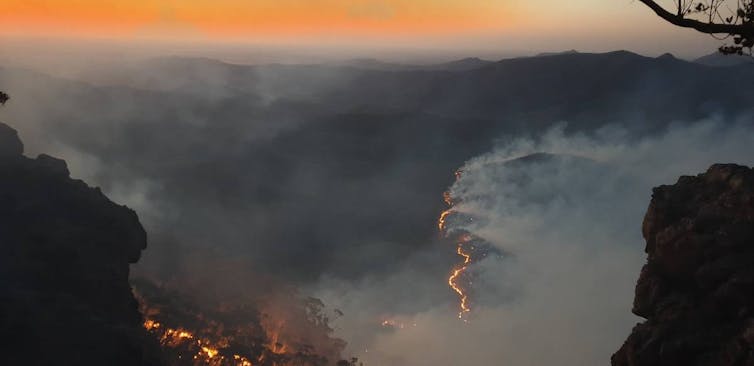
Late last year, bushfires are thought to have ripped through more than half the Kaputar rock skink’s habitat. We don’t yet know what this means for its survival, but the outlook is not good.
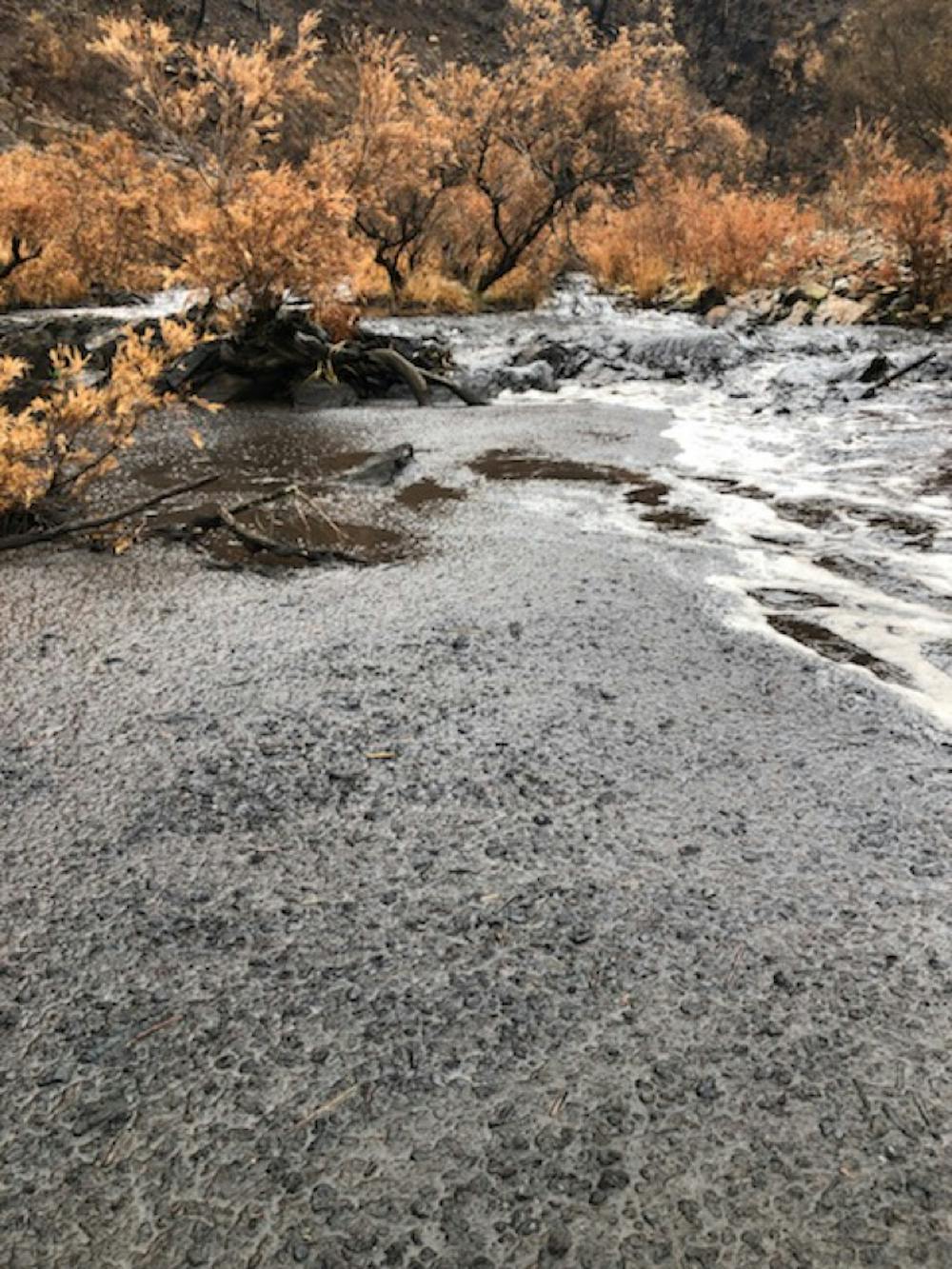
The fire in Kaputar National Park that tore through the skink’s habitat.Narrabri Rural Fire Brigade
A very special skink
The Kaputar rock skink is handsome lizard, typically around 10 centimetres in body length, with dark chocolate brown and grey scales and an orange belly.
It’s found in the Nandewar Ranges near Narrabri. The ranges – weathered remnants of ancient volcanic eruptions between 21 and 17 million years ago – rise out of the surrounding plains in a series of breathtaking rock formations.
The Kaputar rock skink lives on one of these outcrops, Mount Kaputar. It exists on a narrow band of rock at the summit, more than 1,300 metres above sea level.
This high elevation areas is cooler than the surrounding plains, which suits this cool-adapted species perfectly. But the species’ tiny range means it’s highly vulnerable. When danger strikes, the Kaputar rock skink has nowhere to go.
The skink lives at the highest point of Mount Kaputar.Jodi Rowley, Author provided
When the fires hit
Bushfires tore through the Nandewar Ranges in October and November last year, reportedly burning more than 17,000 hectares of bush. More than half of Kaputar rock skink habitat is believed to have burned.
The expert panel advising the federal government on bushfire recovery has named the skink as one of 119 severely-affected species needing urgent conservation intervention. But the species’ rugged, remote habitat, combined with COVID-19 restrictions, have delayed efforts to assess the extent of the damage.
It’s likely that many Kaputar rock skinks died during the fires themselves, although we hope others survived by crawling deep into rock cracks.
But after the fires, threats remain. Vegetation loss may make the skinks easy prey, and in a charred landscape, there may be little for the reptiles to eat.
History tells us fires do affect high-elevation skinks. For example, fire is thought to have driven the rock-dwelling Guthega skink (Liopholis guthega) to become locally extinct at some sites on the Bogong High Plains in northeast Victoria.
A mountain of threats
Species restricted to a small area are vulnerable to any loss of habitat. And fire is not the only threat to the Kaputar rock skink.
Climate change is a big concern. While many species respond to increasing temperatures by migrating uphill to cooler climes, that’s not possible for the skink, which is already precariously perched on a summit.
Introduced goats may also be taking a toll as they trample through the rocky terrain.
Evidence suggests humans are also a disturbance to the Kaputar rock skink’s habitat. The reptiles live close to the edge of cliff lines that are readily accessible by walking tracks. Trampling of low vegetation has been observed at many sites, as have disturbed rocks – the latter possibly from people wanting to find and photograph the species.
The Kaputar rock skink’s tiny habitat was badly affected by fire.Mark Eldridge, Author provided
Where to now?
Scientists know relatively little about the Kaputar rock skink. One thing we’re sure of, though, is that the species’ existence is threatened.
Surveys are needed at known skink locations, as well as surrounding areas where it might lie undiscovered. Understanding where the species occurs and how it responds to fires, drought and other disturbances is critical to conservation efforts.
Of course it’s the middle of winter now, so the skinks may not be very active on their cold mountain top. But my colleagues and I hope to travel to Mount Kaputar soon to survey the skink’s habitat and find out how the species fared.
It’s just months since science officially welcomed the Kaputar rock skink to the world. It’s far too early to say goodbye.
Dane Trembath, an Australian Museum biologist with a focus on reptiles, contributed to this article.
How did the Polynesian peoples come to live on the far-flung islands of the Pacific? The question has intrigued researchers for centuries.
Norwegian explorer Thor Heyerdahl brought the topic to public attention when he sailed a balsa-wood raft called the Kon-Tiki from Peru to Polynesia in 1947. His goal was to demonstrate such voyages were possible, supporting theories linking Polynesian origins to the Americas.
Decades of research in archaeology, linguistics and genetics now show that Polynesian origins lie to the west, ultimately in the islands of southeast Asia. However, the myth of migrations from America has lingered in folk science and on conspiracy websites.
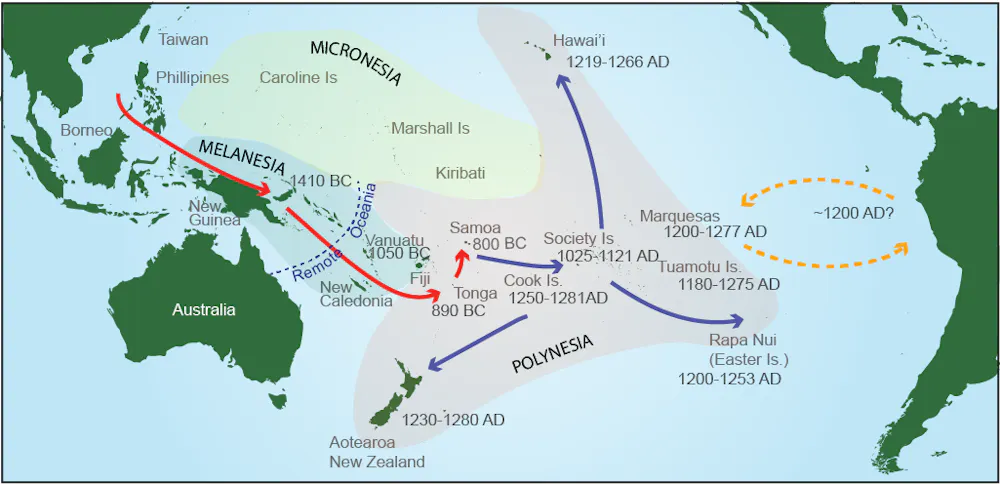
Pacific migrations: red arrows show expansion from island southeast Asia, blue arrows show Polynesian expansion, yellow arrows show proposed contact with the Americas.Anna Gosling / Wilmshurst et al. (2011), Author provided
New evidence for American interlopers?
A new study published in Nature reports genetic evidence of Native American ancestry in several Polynesian populations. The work, by Alexander Ioannidis and colleagues, is based on a genetic analysis of 807 individuals from 17 island populations and 15 indigenous communities from South and Central America.
Other researchers have previously found evidence of indigenous American DNA in the genomes of the modern inhabitants of Rapa Nui. (Rapa Nui, also known as Easter Island, is the part of Polynesia closest to South America.)
The estimated timing of these interactions, however, raised concerns. Analyses of DNA from ancient Rapa Nui skeletal remains found no evidence of such mingling, or admixture. This suggests the “Amerindian” genetic component was likely introduced later via Chilean colonists.
Ioannidis and colleagues found southern South American Indigenous DNA in the genomes – the genetic material – of modern Rapa Nui, but they claim it represents a second pulse of contact. They also found signs of earlier contact, coming from as far north as Colombia or even Mexico.
More novel was the fact that this earlier signal was also found in modern DNA samples collected in the 1980s from the Marquesas and the Tuamotu archipelagos. The researchers argue this likely traces to a single “contact event” around 1200 AD, and possibly as early as 1082 AD.
Both suggested dates for this first event are earlier than those generally accepted for the settlement of Rapa Nui (1200-1250 AD). The earlier date predates any archaeological evidence for human settlement of the Marquesas or any of the other islands on which it was identified.
Ioannidis and colleagues make sense of this by suggesting that perhaps “upon their arrival, Polynesian settlers encountered a small, already established, Native American population”.
The 1200 AD date and the more northerly location of the presumed contact on the South American continent are not unreasonable. They are consistent with the presence and distribution of the sweet potato, or kūmara.
This plant from the Americas is found throughout Eastern Polynesia. It gives us the strongest and most widely accepted archaeological and linguistic evidence of contact between Polynesia and South America.
Kūmara remains about 1,000 years old have been found in the Cook Islands in central Polynesia. When Polynesian colonists settled the extremes of the Polynesian triangle – Hawai’i, Rapa Nui, and Aotearoa New Zealand – between 1200 and 1300 AD, they brought kūmara in their canoes.
So contact with the Americas by that time fits with archaeological data. The suggestion that it was Native Americans who made the voyage, however, is where we think this argument goes off the rails.
Polynesian voyagers travelled in double-hulled canoes much like the Hokule’a, a reconstruction of a traditional vessel built in the 1970s.Phil Uhl / Wikimedia, CC BY-SA
A great feat of sailing
Polynesians are among the greatest navigators and sailors in the world. Their ancestors had been undertaking voyages on the open ocean for at least 3,000 years.
While Heyerdahl showed American-made rafts could make it out to the Pacific, Indigenous Americans have no history of open ocean voyaging. Similarly, there is no archaeological evidence of pre-Polynesian occupation on any of the islands of Polynesia.
Genetic analyses attempting to reconstruct historical events based on data from modern populations are fraught with potential sources of error. Addressing questions where only a few hundred years make a major difference is particularly difficult.
Modelling population history needs to consider demographic impacts such as the massive depopulation caused by disease and other factors associated with European colonisation.
Ioannidis and colleagues took this into account for Rapa Nui, but not for the Marquesas. Estimates of population decline in the Marquesas from 20,000 in 1840 to around 3,600 by 1902 indicate a significant bottleneck.
The choice of comparative populations was also interesting. The only non-East Polynesian Pacific population used in analyses was from Vanuatu. Taiwanese Aboriginal populations were used as representatives of the “pure” Austronesian ancestral population for Polynesians.
This is wrong and overly simplistic. Polynesian genomes themselves are inherently admixed. They result from intermarriages between people probably from a homeland in island southeast Asia (not necessarily Taiwan) and other populations encountered en route through the Pacific.
The Marquesas islands in what is now French Polynesia are one of the potential sites for American contact proposed by Ioannidis and colleagues.James Shrimpton / AAP
Polynesian Y chromosomes and other markers show clear evidence of admixture with western Pacific populations. Excluding other Oceanic and Asian populations from the analyses may have skewed the results. Interestingly, the amount of Native American admixture identified in the Polynesian samples correlates with the amount of European admixture found in those populations.
Finally, like many recent population genetic studies, Ioannidis and colleagues did not look at sequences of the whole genome. Instead, they used what are called single nucleotide polymorphism (SNP) arrays.
SNP arrays are designed based on genetic variation identified through studies of primarily Asian, African and European genomes. Very few Pacific or other indigenous genomes were included in the databases used to design SNP arrays. This means variation in these populations may be misinterpreted or underestimated.
Summing up
While the results presented by Ioannidis and colleagues are very interesting, to fully understand them will require a level of scholarly engagement that may take some time.
Did contact between Polynesians and indigenous Americans happen? Significant evidence indicates that it did. Do these new data prove this? Perhaps, though there are a number of factors that need further investigation. Ideally, we would like to see evidence in ancient genetic samples. Engagement with the Pacific communities involved is also critical.
However, if the data and analyses are correct, did the process likely occur via the arrival of indigenous Americans, on their own, on an island in eastern Polynesia? This, we argue, is highly questionable.
Source: The Conversation (Au and NZ) – By Ben Phillips, Associate Professor, Centre for Social Research and Methods, Director, Centre for Economic Policy Research (CEPR), Australian National University
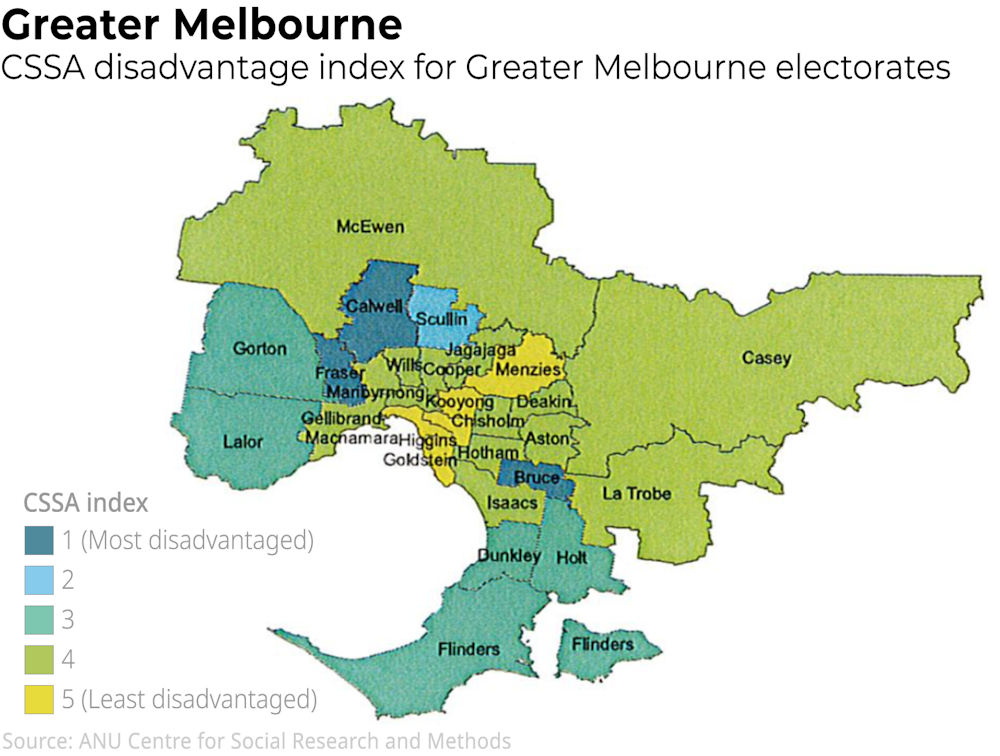
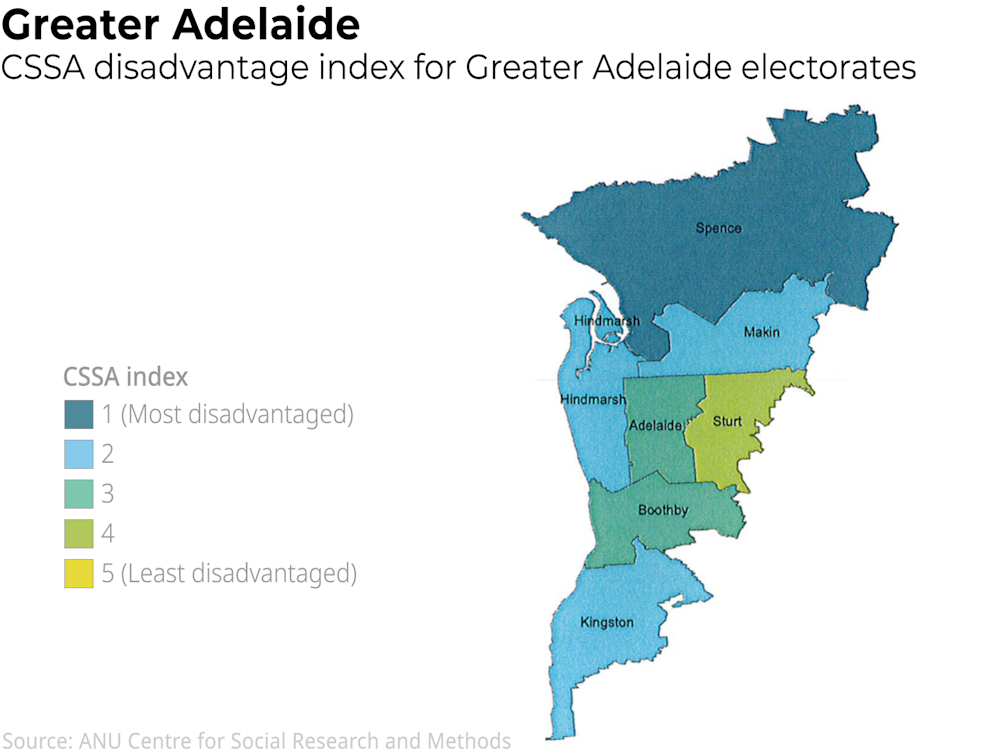
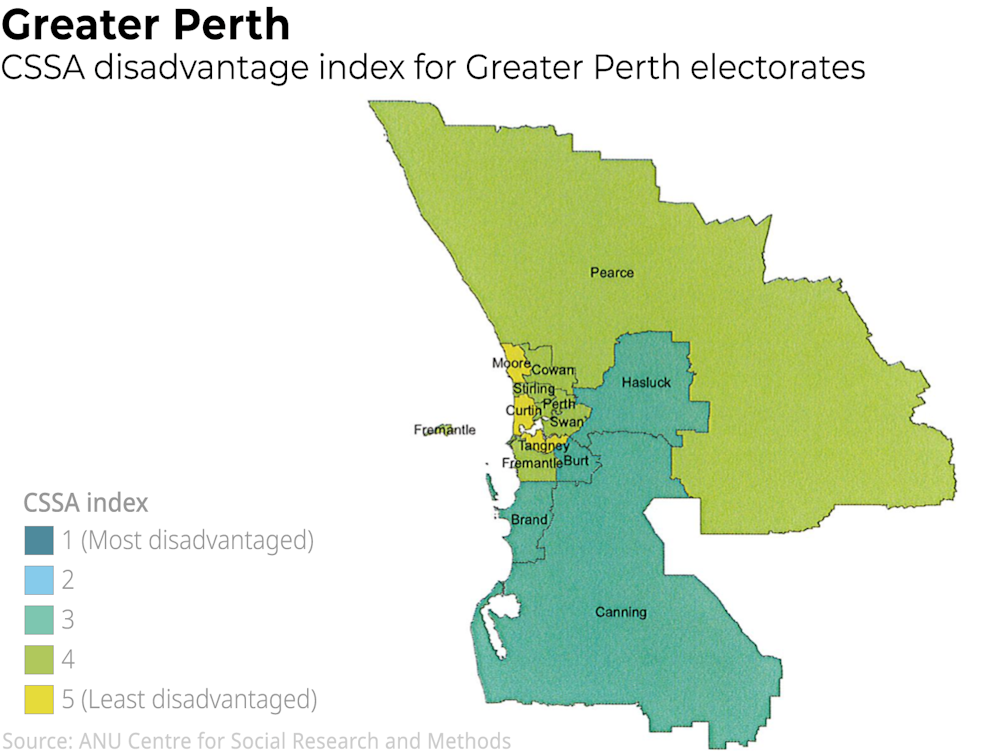
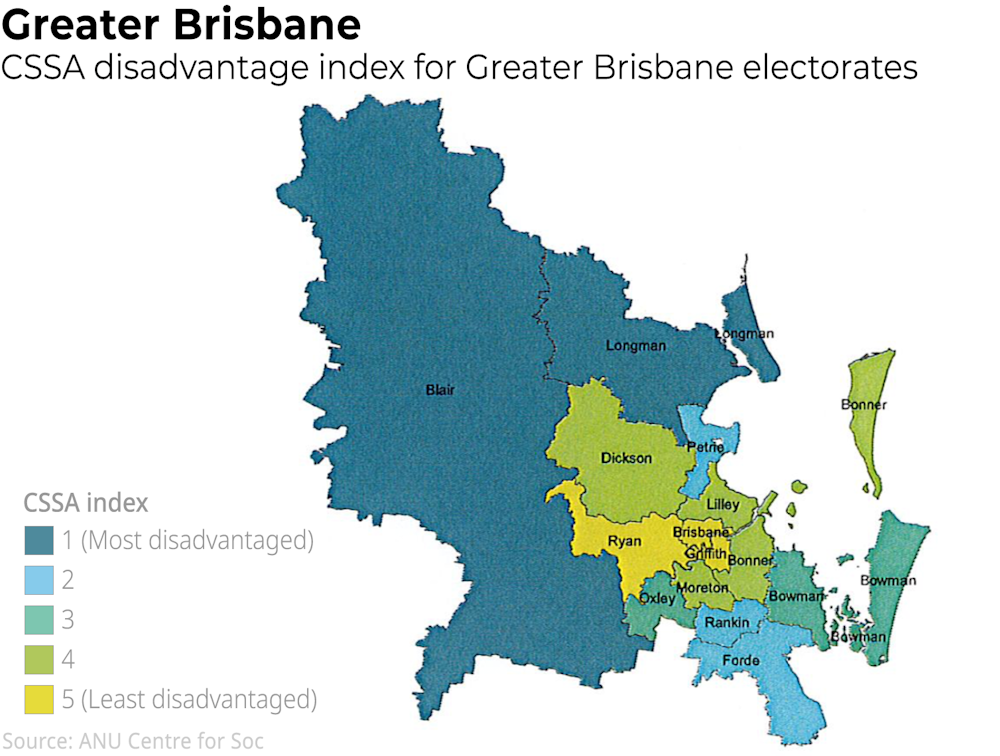
New research on disadvantage in Australia has found the gap between rich and poor is very wide in Sydney, while much of Queensland struggles with educational disadvantage and regional NSW and Victoria are both more disadvantaged when it comes to health.
Previous research on poverty has placed a heavy emphasis on income and economic outcomes at a given point in time. But disadvantage often goes beyond just economic factors. It’s also necessary to analyse the educational, health and social inequities in society to get a more accurate understanding of disadvantage.
At the core of our new research, published in our Mapping the Potential report, is the idea that disadvantage in Australia is more varied and complex than many people may think.
How we conducted our research
This research, conducted by the ANU Centre for Social Research and Methods and commissioned by Catholic Social Services Australia, expands on the socioeconomic indexes produced by the Australian Bureau of Statistics by adding more detailed variables across health, education, social and economic domains.
We also incorporated a “persistence” element to disadvantage – in that, disadvantage isn’t tied to a singular point in time, but persists for a longer period.
In our research, disadvantage was data-driven. And to quantify disadvantage, we chose variables that were generally considered relevant for each area. For economic disadvantage, for instance, we looked at low incomes, low-skilled jobs and unemployment. Areas with a large share of people with these characteristics tended to be more disadvantaged.
Health disadvantage was based on various chronic health conditions, such as diabetes, heart and circulatory conditions, and obesity.
Educational disadvantage focused on levels of educational attainment and child educational disadvantage – both cognitive and physical development. We used data from the Australian Educational Development Census to gauge this.
Social disadvantage was less clearly defined. We focused on variables that contribute to social capital, or the interpersonal networks that help a society function effectively. Regions with social disadvantage, for example, tended to have low rates of volunteering, internet connection and social cohesion.
Geographically, we analysed these variables at the SA2 level (areas comprised roughly of suburbs and towns) across Australia. We then aggregated the results to the federal electorate level to avoid singling out and possibly stigmatising individual suburbs.
For comparison purposes, each index was standardised to an average score of 1,000 across all SA2s. Nearly all SA2s (95%) had a score between 800 (high disadvantaged) and 1,200 (low disadvantage).
To better understand differences between our major populations, we further aggregated our results to nine larger geographic entities: the five major capitals, the regional areas of NSW, Queensland and Victoria and a “catch all” remainder of Australia region. This last grouping was used due to the small number of electorates in some states and territories.
The most disadvantaged parts of Australia
The key finding of the report is there is considerable variation in the types of disadvantage experienced across Australia. Moreover, the types of disadvantage varied between locations, as well.
Australia’s most disadvantaged electorate overall was Hinkler in regional Queensland. Hinkler ranks poorly in three of the disadvantage domains we tracked: health, economic and social.
Australia’s least disadvantaged electorate is North Sydney.
When we looked at each type of disadvantage individually, we found that electorates had very different needs.
From an economic perspective, for example, our most disadvantaged electorate is Blaxland in Western Sydney. Our most disadvantaged health electorate is Braddon in regional Tasmania.
The most disadvantaged educationally was Spence in the northern suburbs of Adelaide. Socially, the most disadvantaged electorate was Parkes in regional NSW.
When comparing the larger regions in our report, we found Adelaide faces the most disadvantage overall, while Sydney and Perth have, on average, the least overall disadvantage.
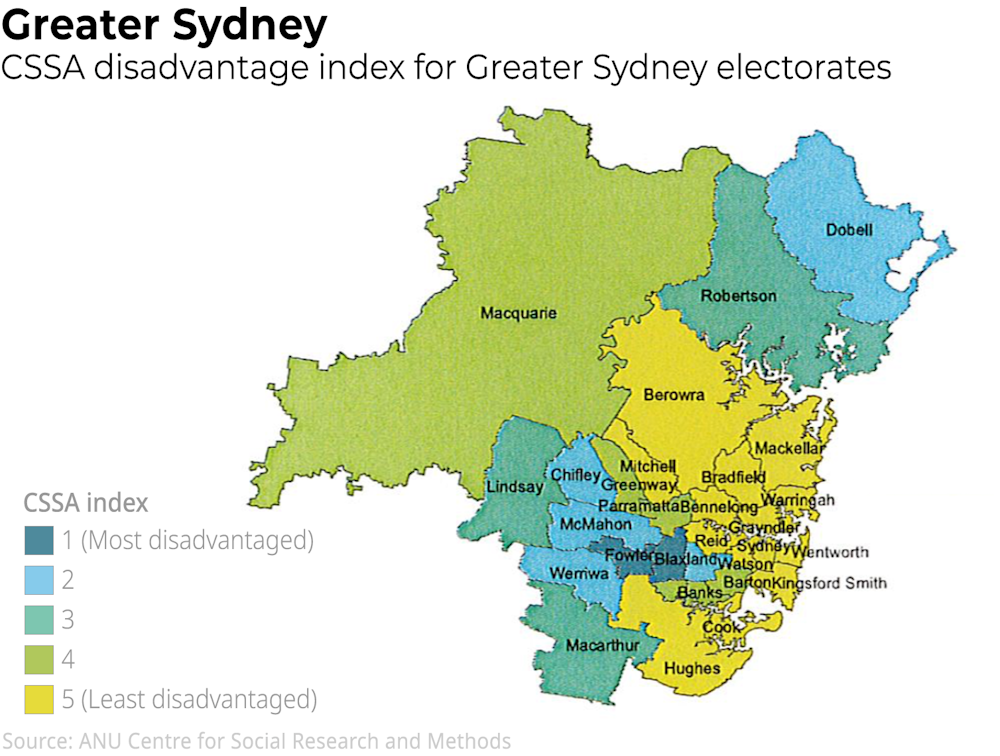
Even the best-performing regions have pockets of high disadvantage. For example, while Sydney has a relatively strong overall result, it also has the most economically disadvantaged electorate in Australia (Blaxland) and several suburbs with scores below 800.
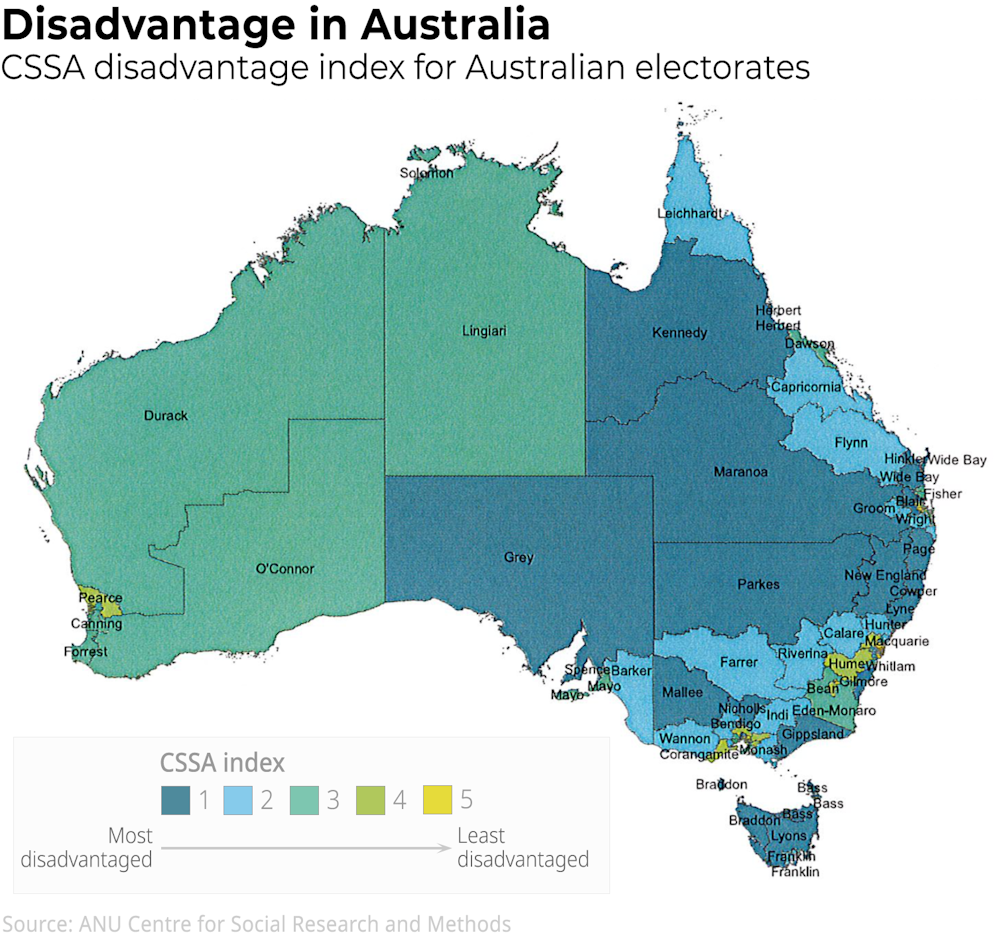
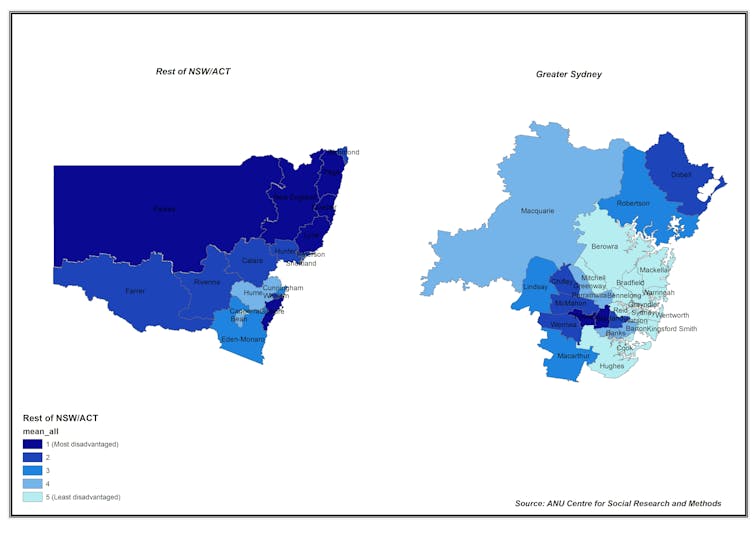
The research also shows the vast disparities between urban and regional areas in Australia. For example, according to our data, nearly the whole of regional NSW is considered disadvantaged. In contrast, the inner suburbs of Sydney are much better-off.
Differences in disadvantage between regional NSW and greater Sydney.
Most concerning was the deep level of disadvantage found in predominantly Indigenous communities, mostly in the Northern Territory. The electorate of Lingiari, for instance, has a marked split between the relatively advantaged suburbs around Darwin and the deeply disadvantaged areas outside the city.
We also found a number of electorates in coastal NSW, Queensland and Tasmania with significant health disadvantage. This is concerning given the threat of future outbreaks of COVID-19.
The indexes remind us that despite nearly 30 years of continued economic growth in Australia, prosperity has not come to all parts of the country. Nor is economic advantage necessarily an indication of other facets of well-being, such as educational or health equality.
This data is important because it can help non-profit organisations make better-informed decisions on where and how to allocate future resources and investments.
It will also help governments at all levels gain a deeper understanding of the types of disadvantage that exist within regions and how their programs and other methods of assistance – both financial or non-financial – can be most effective.
This article is part of Flora, Fauna, Fire, a special project by The Conversation that launched this week. The project tracks the recovery of Australia’s native plants and animals after last summer’s bushfire tragedy. Explore the project here and read related articles here.
I looked through the microscope at the insides of a dead smoky mouse, and could barely believe my eyes. Thousands of tiny smoke particles lined its lungs. But the mouse had been kept more than 50 kilometres from the nearest bushfires. How could this be?
As it turned out, the critically endangered mouse had died from smoke inhalation. Some 45 had been held at a captive breeding facility near Canberra. Nine ultimately died – the first recorded wildlife in the world killed by bushfire smoke far outside a fire zone.
The deaths were a blow for conservation efforts. But in recent weeks, there’s been good news: smoky mice have been spotted at seven sites burnt in the fires. For now, at least, the species lives on.
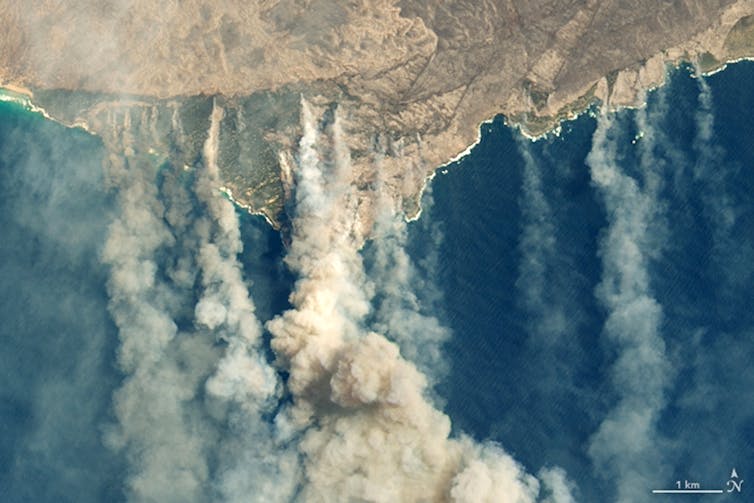
The smoky mouse case shows bushfire smoke can affect wildlife far from the fire zone.NASA Earth Observatory
A unique, bulgy-eyed rodent
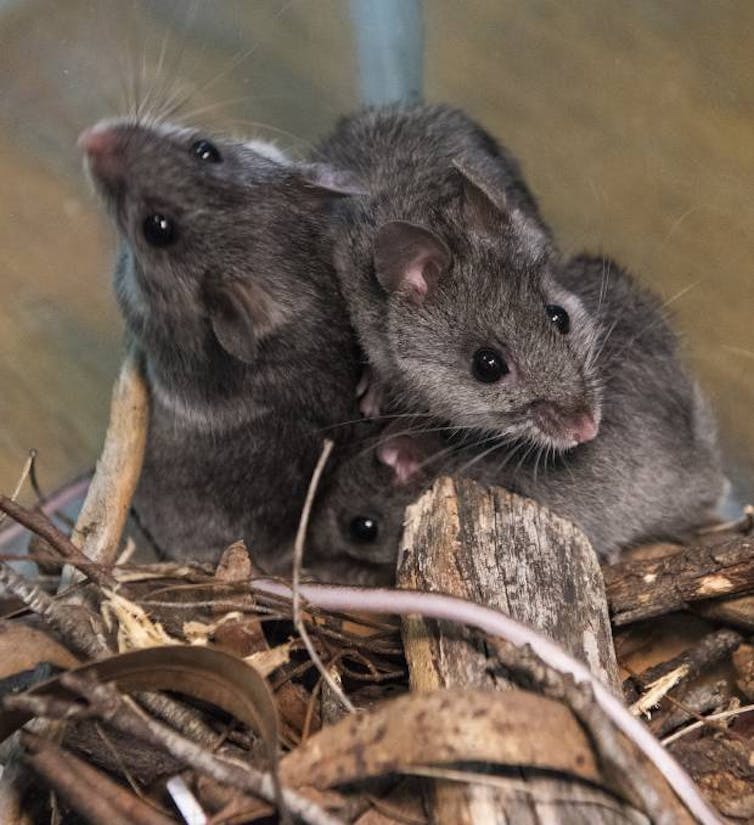
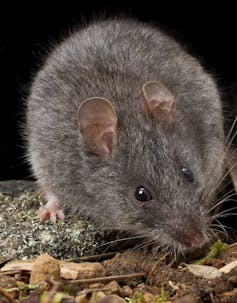
The smoky mouse is shy, gentle and small – usually about nine centimetres in body length, plus its tail. They are rather cute, with bulgy eyes and very soft grey fur which inspired the species’ name.
In the wild, the smoky mouse is limited to a few sites in Victoria’s Grampians and East Gippsland, as well as in Kosciuszko National Park in New South Wales. It lives in underground communal nests, in heath and forest habitats.
Ancestors of the smoky mouse arrived in Australia more than five million years ago when the Australian continent finally drifted close enough to Southeast Asia for rodents to raft across.
Several threats are reducing smoky mouse numbers, but feral cats and foxes are a major cause.
Baby smoky mice photographed in 2017 at the captive breeding facility.Office of Environment and Heritage
Death by irony?
Some 119 animal species were identified for urgent conservation intervention following the fires. The smoky mouse was among them. Modelling showed 26% of its distribution overlapped with burnt areas, and in NSW more than 90% of the species’ habitat burned.
I am a wildlife health and pathology expert based in Wagga Wagga in NSW, and part of my job is to diagnose why animals have died. The first dead smoky mouse I encountered had come from a Canberra breeding facility. It was sent by a vet and arrived via courier in mid-January.
Through the microscope: smoke particles in the lungs of a smoky mouse suffering smoke inhalation.
In a note attached, the vet suggested bushfire smoke had killed the smoky mouse – and asked, in a nod to the species’ name, if this was a case of “death by irony”.
Canberra, like many other cities and towns, was shrouded in thick smoke in January. But the breeding facility was more than 50 kilometres from the nearest fire zone, so I thought the vet’s theory was unlikely.
When I and other veterinary pathologists examined organs of the mouse under the microscope, the only abnormality we could find was fluid and congestion in the mouse’s lungs.
Over the following month, eight more smoky mice died. I inspected the lungs of one – to my shock, it contained thousands of brown smoke particles. Once I knew the distribution of particles to look for, I found them in most of the other dead mice too.
The mice didn’t die immediately after inhaling the smoke. They hung on, but when temperatures in Canberra spiked at more than 40℃, they went into respiratory distress and died.
Death from smoke inhalation has long been suspected in wildlife. But it’s poorly recorded because after bushfires, the bodies of dead animals are usually incinerated or too decomposed to make a diagnosis.
The smoky mouse case shows bushfire smoke can damage wild animals far beyond fire zones. That means the impact of bushfires on wildlife may be greater than we thought.
Seven smoky mice have been spotted in the wild since the bushfires.Museums Victoria
A bit of good news
There is hope for the smoky mouse. Motion-sensing cameras set up in Kosciuszko National Park after the fires have recorded smoky mice at seven burnt sites. Over the next year, more sites will be surveyed to better understand how many individuals remain, and where they live.
Most smoky mice at the Canberra captive breeding facility survived, and there are plans to release some into the wild. This captive breeding program has also been identified as a priority for federal funding.
But as global warming escalates, fires in Australia are predicted to become even worse. Now more than ever, the future of the smoky mouse, along with many other Australian animals, hinges on decisive climate action. Captive breeding programs and blind hope will not be enough.
On Sunday, Victorian Premier Daniel Andrews announced government school students in prep to Year 10 in metropolitan Melbourne and the Mitchell Shire will learn from home for term three. The remote learning period will run from July 20 until at least August 19, and will follow five pupil-free days scheduled for this week.
Students in Years 11 and 12, as well as those in Year 10 attending schools for VCE or VCAL classes, and students with special needs, will resume face-to-face learning today.
Many independent schools had already decided, before the premier’s announcement, they will resume remote learning this week.
We conducted a national survey from April 27 until May 25 of more than 1,200 teachers’ experiences during Australia’s first wave of remote learning. Based on teachers’ responses, we know a sustainable return to remote learning must ensure schools and the government address the concerns around the social and emotional impacts on students, accessibility, and increasing workloads for teachers.
Social development and emotional well-being
Around the same number of teachers said the remote learning period had a positive (33%), negative (36%) or neither positive nor negative (31%), impact on students’ educational progress. But most of them expressed concerns about the impact on students’ social development and emotional well-being.
More than half (58%) of all teachers were concerned about students’ social development. Meanwhile, 68% of primary school and 79% of secondary school teachers felt remote learning was having a negative impact on students’ emotional well-being.
These results were fairly consistent across state capitals, regional and rural areas, as well as across government (73.6%), Catholic (76.5%) and independent (78.2%) schools.
One teacher said
it is the social-emotional well-being of our young people, particularly those at risk in their homes, that is my biggest concern.
Schools play a critical role in supporting student well-being. Feelings of isolation can have serious negative impacts such as increased stress, anxiety and disengagement. It is important there are strategies for maintaining a strong teacher presence online.
Teachers said the level of support students received for remote learning varied depending on the students’ home environment. Some vulnerable students can completely disengage from the school system and we have seen this increased vulnerability during remote learning.
Some students didn’t attend live lessons, disguised attendance by only logging in but without video or audio, or did not submit work. Use of learning analytics to assist in tracking student access would be beneficial during remote learning.
In some cases, remote learning issues disrupted the capacity for teachers to provide additional support, despite repeated attempts to communicate with students and their families.
Schools play a critical role in supporting engagement and maintaining essential connections, routines and supports during a pandemic, and during recovery.
During the lockdown, schools and the government must take urgent measures to address student well-being. Teachers need support to identify and help students with high needs. They need professional learning programs to help them navigate this territory.
Not everyone is equal
In 2019, 87% of Australians could access the internet at home. But only 68% of Australian children aged 5 to 14 living in disadvantaged communities had internet access at home, compared to 91% of students living in advantaged communities.
In our survey, 49.45% of teachers reported all of their students had access to devices, while 43.28% indicated most of their students had access.
Fewer primary teachers (37.46%) than secondary teachers (56.25%) indicated all their students had access to devices.
Some students had to share devices with other family members, a few used their phones and some didn’t have any access to technology at all. For those who had access to devices, there were other challenges, such as the availability and reliability of apps and programs, with parents and teachers trying to troubleshoot IT problems.
A teacher said one of the challenges was “the large amount of disadvantaged families that [the] school serves [where] most don’t have access to three meals a day”.
Increasing the number of loan devices to students is essential during the upcoming remote learning period, as are engaging and interactive lessons. But it’s also important to plan for accessible tasks that aren’t internet-dependent, for those who don’t have ready access – such as school packs or the possibility of attending school.
During the first wave of remote learning, some telecommunications companies provided relief by waiving internet charges or extending data access limits. The government can play a more active role by working with internet providers to ensure further access to this kind of support is available.
Reasonable work expectations
In our survey, 68% of primary teachers and 75% of secondary teachers reported working more hours than usual during the lockdown period. Nearly 50% worked more than six hours extra a week and 19% worked between 11-15 hours extra per week.
Teachers reported increased stress levels, isolation, excessive screen time and exhaustion.
One teacher said there were
unrealistic expectations of teachers — using multiple platforms concurrently with very little training. The time to prepare per class is limited yet we are supposed to provide technologically advanced methods of delivery.
As a priority, setting realistic expectations for teachers, students and parents will ensure the workload is reasonable and manageable.
Remote teaching is not equivalent to classroom teaching and the same content will not be covered in the same amount of time online. Good teaching and curriculum design will soon address any gaps in learning once students are back in the classroom. But the social and emotional impacts could have a more negative impact in the longer term.
Source: The Conversation (Au and NZ) – By Phillippa Carnemolla, Senior Research Fellow, School of the Built Environment, University of Technology Sydney
The stated purpose of the Morrison government’s HomeBuilder program is to stimulate the economy and create construction jobs during the COVID-19 pandemic. Our research shows home improvements could do much more than just add capital value and a spare room. They can also restore or maintain a person’s ability to live independently – whether they are older, have a disability, are unwell or have been injured.
In other words, these home improvements could transform life for any one of us at some point in our lives. They greatly improve people’s well-being and reduce dependence on carers. This affects a great many people – including nearly a million who receive some form of aged care in their own home.
Our study of 157 people receiving community care found home modifications reduced the overall hours of care they required by 42%. Their quality of life (measured as health-related quality of life) improved by 40%.
By reducing care needs and costs, and increasing independence and well-being, home modifications lead to a multitude of government, community and personal benefits. These include lowering the risk of COVID-19 transmission that providing and receiving personal care entails.
Doors might have to be widened to enable a resident in a wheelchair to continue living in their home.Shutterstock
Home modifications specifically help residents to live safely and independently in their own homes.
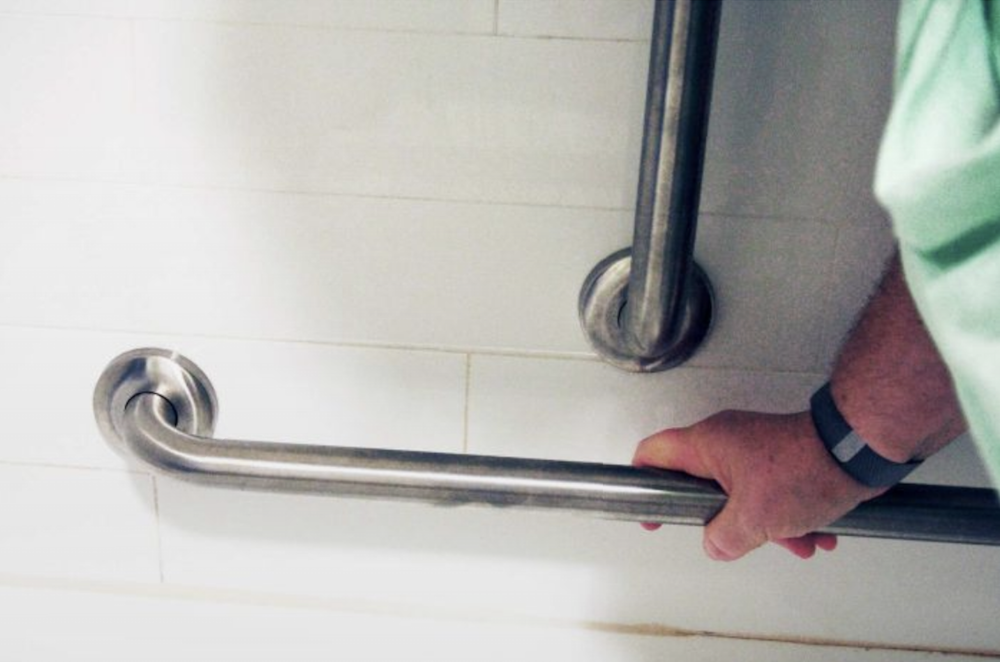
The range of possible renovations is diverse, so costs vary widely. Minor modifications might be installing a grab rail in a bathroom to aid stability, or levelling a step at a front door. A major modification could install a ramp or a lift, widen door frames or provide a new bathroom.
Modifications must be tailored to individual needs, as no “one size fits all” – just like every home renovation.
Enabling greater independence for longer
My research measures how home modifications directly influence the amount of care needed to live, and continue living, at home.
The study included 157 Australians aged from 15 to 92 who received community care. Some had arthritis, cancer or a motorcycle injury. Others were born with a disability. All required care in their home.
Hours of care for participants (most of it unpaid care by family and friends) were compared before and after home modifications. The changes liberated them. Home modifications reduced or eliminated their need for help, restored their confidence in caring for themselves and reduced carer stress.
As people’s confidence grew, they were happier to venture out into the broader community. Importantly, relationships improved.
Stories of lives transformed
Simple home modifications meant David* no longer had to help his mother shower as she could safely do that herself. His mother was saved the embarrassment of her son being involved in what is normally a private activity. Instead, they could enjoy each other’s company with regular activities like shopping and having afternoon tea together.
Ravi* had a spinal injury as a result of an accident. He was glad to be back at home but was sleeping in a converted sunroom at street level because he couldn’t get to his bedroom upstairs. The only bathroom for showering was a small ensuite, up three stairs.
Adding an entry ramp makes a home accessible again.Shutterstock
The house was not suitable for a wheelchair, so his wife had to help him get around their home. The effort required to take care of basic daily living activities left them too exhausted to even think about going out.
An accessible bathroom with a hand-held shower was installed, as well as a ramp at the home entrance. Not only was Ravi able to shower independently again, but he and his wife also regained their energy and interest in going out. He attributed home modifications to enabling them to go to the movies and a restaurant for the first time in the three years after the accident.
Simple modifications can enable a person to go to the toilet unaided.Claire Cunningham, Author provided
Genevieve* needed to go to the toilet often at night, but was unsteady on her feet. She had to wake her husband to escort her safely to the bathroom. Installing handrails from the bedroom to the bathroom, as well as reconfiguring the bathroom, meant she could safely take herself to the toilet at night.
Now that he was getting a good night’s sleep, her husband also expressed relief that he was able to continue his full-time job – he had thought he would have to give it up.
People regain choice about where they live
The design of a house can be the single reason that forces a person into an aged care home. A bathroom, kitchen, entrance and exit, as well as how rooms connect, can all dictate whether a person lives independently in later life.
Research shows how home modifications reduce fall risks. Think about an older bathroom where the shower has a hob or is over a bath. Such features commonly lead to falls, which can dramatically shorten lives or send us straight from hospital into residential aged care.
Of all the home modifications, my research showed those in the bathroom were most central to reducing dependence on others. They provided the freedom to shower and use the toilet without help.
Bathroom modifications that allow people to shower while seated greatly reduce the risk of slipping and falling.Claire Cunningham, Author provided
For example, Heath* was 72 with a few overlapping health conditions. He had lost confidence using his shower and toilet on his own. His daughter, who lived five hours’ drive away, was convinced he would fall if he remained at home.
But Heath didn’t want someone coming in to help him shower. He absolutely did not want to go into a nursing home. Home modifications meant he could sit while showering independently and use grab rails to get in and out safely.
A minor home modification like a hand rail might be all a person needs to continue living safely in their own home.Author provided
Modifications protect lives in a pandemic
The ability to take care of our own bathroom needs during a pandemic is particularly critical. The close proximity required to receive and provide care has been well documented. Who knows how much home modifications have helped to curb the spread of COVID-19 to people most vulnerable to it?
This research into home modifications highlights why renovations could be so much more than a new pool, kitchen island or cinema room. The government has a golden opportunity to reform HomeBuilder and encourage take-up of grants for home modifications. It would be a win for both tradies and the many Australians who may need help to stay at home.
Suddenly, the idea of a “job guarantee” is back in vogue.
Lawyer, academic, land rights activist and founder of the Cape York Institute Noel Pearson has come out of it favour of it, University of Newcastle labour market specialist Bill Mitchell has a document before the prime minister, and the Per Capita think tank is pushing for a youth-only guarantee.
The idea is that the government would make an unconditional job offer at a minimum wage to anyone willing and able to work. There would be no need for the Newstart unemployment benefit (now called JobSeeker).
It is not widely known that it’s been tried before, by the Keating government in 1994. The scheme was limited to the long-term unemployed, making it more manageable than a scheme that offered employment to everyone who was unemployed.
Working Nation
The centrepiece of Working Nation, unveiled by Prime Minister Paul Keating in February 1994, the so-called “Job Compact” guaranteed subsidised employment for six to 12 months to everyone who had been unemployed for more than 18 months.
This article draws on my research into what happened, including interviews with senior government officials from that time.
By late 1993 300,000 people had been reliant on unemployment payments for more than 12 months.
The idea was that paid work experience in regular jobs would improve their chances of securing unsubsidised jobs by renewing their confidence and skills, and instilling confidence in employers about their ability to work.
We started off wanting to guarantee the long-term unemployed a job. We thought that’s what this agenda was all about (official, department of prime minister and cabinet)
The original plan was for most of the job placements (70%) to be offered through a private sector wage subsidy scheme, Jobstart, which had a good record for placing people in ongoing jobs.
Even with payment, employers weren’t keen to take on subsidised applicants.
The other jobs would be provided through the New Work Opportunities program (which offered community organisations a 100% wage subsidy to employ people fulltime for six months) and Jobskills (which offered a combination of part time paid employment and training run by community organisations).
When fewer private employers than expected took on Jobstart wage subsidies (134,000 in 1995) the job guarantee could only be fulfilled by expanding public and community sector jobs (to 123,000 positions).
As has been the case in other overseas public sector job creation schemes, these jobs often turned out to be very different to mainstream jobs, reducing transitions to unsubsidised jobs.
And as the number of subsidised jobs ballooned, their quality declined. And instead of case managers matching jobs and experience to needs, the process became a conveyor belt.
There was some dissatisfaction even within the department of prime minister and cabinet about how it was going. It appeared to be going the [old] way of not treating people as individuals, just putting people into any program that was coming along (official, department of prime minister and cabinet)
And the language of the program became increasingly punitive.
You often start with a great idea and later it gets modified. Focus groups showed the public were really down on the unemployed and sole parents. That got reflected back in the ‘reciprocal obligation’ language, which was not how we originally had it (official, department of prime minister and cabinet)
Only one third of the participants were in unsubsidised jobs three months after the subsidies ended. The official evaluation of the “net impact” of the program (the extent to which it increased the probability of employment) was a 28% improvement from Jobstart, 11% for Jobskills and 4% for New Work Opportunities.
‘High cost, low outcomes’
The Job Compact was expected to reduce the number of people on unemployment benefits for more than 18 months by 50% in its first year, but the actual decline was less than 20%.
The official evaluation pointed to its “high cost and low outcomes”, and concluded it was “not the most appropriate strategy for assisting the long-term unemployed”.
It said subsidised public sector jobs should be created only to help “the most disadvantaged clients who may not meet the job readiness requirements of many private employers”.
Right now, 700,000 people have been on unemployment benefits for more than a year, making the case for some sort of large-scale investment in paid work experience and training strong.
Subsidised jobs can help reduce long-term unemployment, as shown by the success of the Future Jobs Fund in the Britain and small-scale wage subsidy schemes in Australia.
Britain’s Conservative Government has just announced plans to generate 350,000 subsidised community jobs for unemployed young people.
But Australia’s experience with the Job Compact shows guarantees are no panacea.
Subsidised jobs help, but they’re no panacea
When subsidised jobs schemes are scaled up to offer jobs to everyone who is unemployed, their costs increase and their quality and their impact on future employability diminish.
We will need large-scale programs to create jobs, and we should offer the 700,000 people who are already long-term unemployed all the help they need to secure them.
But that needn’t always mean subsidised jobs. Many who are unemployed will benefit from training, others from their employment service provider partnering with an employer to skill them up.
Higher unemployment is a price we’ve paid to control the virus. It will take a mix of measures to ensure that cost is only temporary.
For some people tax time will result in no tax paid this year, and if past years are anything to go by, about 50 of them will be millionaires.
Not mere millionaires, but millionaires earning more than A$1 million per year.
For some of these 50 or so very high earners, managing tax will be expensive. The two dozen or so that typically claim deductions for the “cost of managing tax affairs” claim an average of about $1.7 million each.
It might have been with this in mind that during last year’s election campaign Labor promised to cap the size of the deduction people could claim for “managing tax affairs”. The proposed cap was $3,000.
Tax agents would still be able to charge more than $3,000 – a lot more if they want to, even an additional million or more – but their clients would only be able to deduct $3,000 of it from their income when submitting their tax return.
Labor wanted to cap deductions
The rationale was straightforward: if people are claiming over $1 million in deductions on money spent managing their taxes, then putting a ceiling on those deductions ought to stop it.
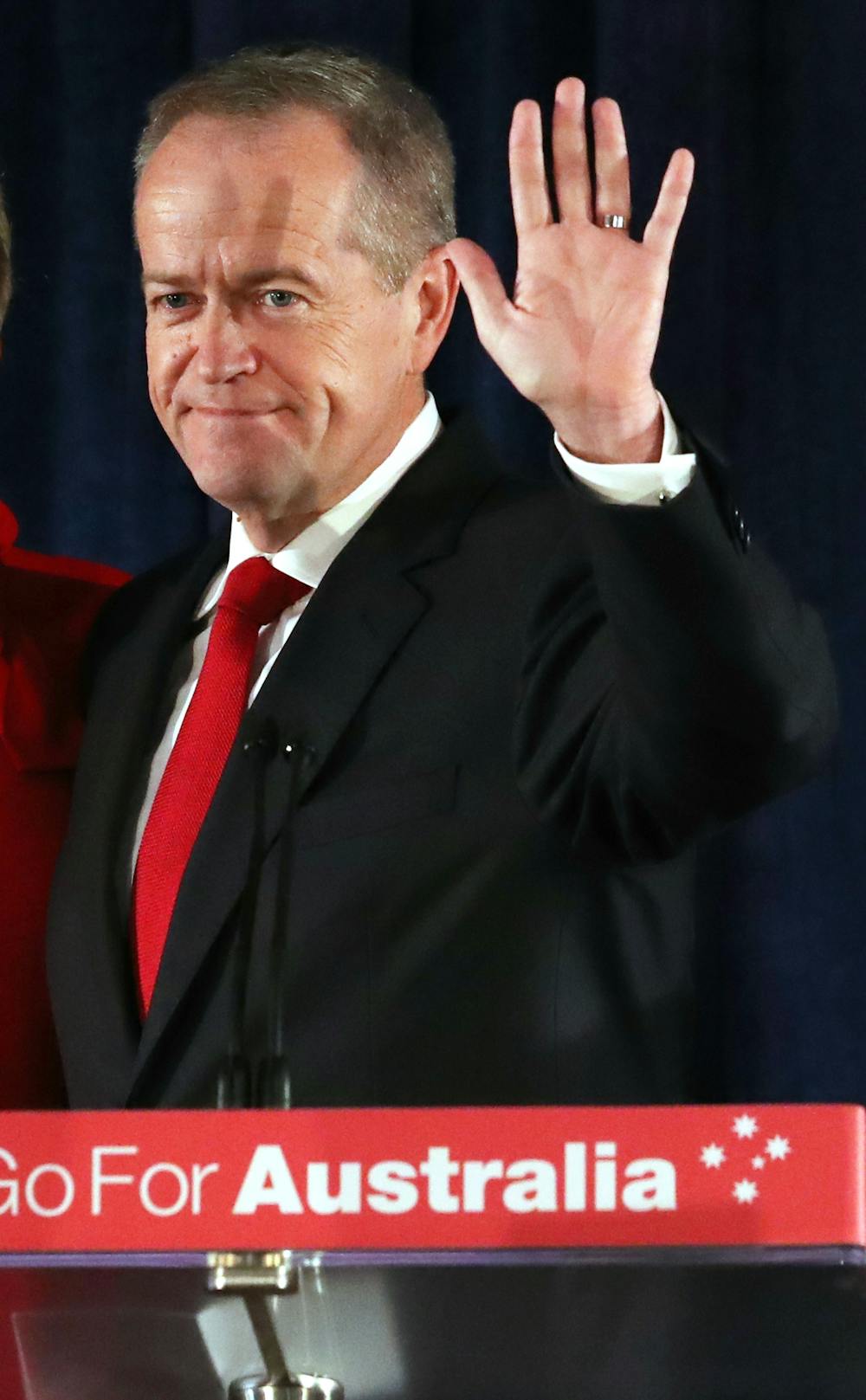
Labor leader Bill Shorten wanted to cap the deduction for the cost of managing tax affairs at $3,000.DAVID CROSLING/AAP
Not so fast.
Often in tax we plug holes quickly rather than stepping back and looking at the whole system and its interactions. And then we have to plug another one.
The question to ask first is whether capping this individual line item would prevent or move the leakage.
We went to the source by conducting a nationwide survey of Australia’s most senior tax professionals to glean their perspectives.
Our findings reflect the views of people who, to paraphrase Mandy Rice Davies, “would say that, wouldn’t they”.
It might not have worked
Nonetheless, the detail of what they told us was surprising.
Here’s what they said.
Most of the targets would be unaffected. They would be able to switch their deductions into associated corporate entities. This interchangeability of personal and corporate tax deductions highlights the importance of considering the system as a whole.
Because of this it might, counter-intuitively, have the opposite effect to what was intended, creating a saturation where the truly wealthy could escape the cap, but those of lesser means could not.
A better solution would be for the tax office to conduct more tax audits. Studies suggest the decisions of high wealth individuals to engage in aggressive tax planning practices are stronglyinfluenced by the probability of being selected for audit.
There are definitional ambiguities in relation to the subcomponents of the deduction that make it hard to work out what is going on. Sometimes “litigation” includes tax planning, other times it does not. “Other” is a grab bag that can include software costs, travel costs and reference material. It would help if the tax office provided guidance.
High wealth individuals often employ tax advisers to cope with complexity and uncertainty of the tax system rather than to reduce tax.
As we said, you are welcome to consider the possibility that the observations of the tax professionals are self-serving, but their overwhelming embrace of more tax audits and their pleas for the tax law to be easier to understand also suggest a keenness to ensure that taxpayers do the right thing.
Labor’s proposal to cap the deduction for the cost of managing tax affairs at $3,000 (when for most people the deduction is closer to $300) was understandable, although it might not have worked as intended.
It was a reminder of the oft-quoted maxim that for every problem there is a solution that is simple, neat – and wrong.
Source: The Conversation (Au and NZ) – By Philip C. Almond, Emeritus Professor in the History of Religious Thought, The University of Queensland
From the 11th century onwards, the Legend of Barlaam and Josaphat enjoyed a popularity in the medieval West attained perhaps by no other legend. It was available in over 60 versions in the main languages of Europe, the Christian East and Africa. It was most familiar to English leaders from its inclusion in William Caxton’s 1483 translation of the Golden Legend.
Little did European readers know that the story they loved of the life of Saint Josaphat was in fact that of Siddhartha Gautama, the Buddha, the founder of Buddhism.
The ascetic life
According to the legend, there reigned in India a king called Abenner, immersed in the pleasures of the world. When the king had a son, Josaphat, an astrologer predicted he would forsake the world. To forestall this outcome, the king ordered a city to be built for his son from which were excluded poverty, disease, old age and death.
But Josaphat made journeys outside of the city where he encountered, on one occasion, a blind man and a horribly deformed one and, on another occasion, an old man weighed down by illness. He realised the impermanence of all things:
No longer is there any sweetness in this transitory life now that I have seen these things […] Gradual and sudden death are in league together.
While experiencing this spiritual crisis, the sage Barlaam from Sri Lanka reached Josaphat and told him of the rejection of worldly pursuits and the acceptance of the Christian ideal of the ascetic life. Prince Josaphat was converted to Christianity and began to practise the ideal of the spiritual life of poverty, simplicity and devotion to God.
To forestall his quest, his father surrounded him with seductive maidens who “tantalised him with every kind of temptation with which they sought to arouse his appetites”.
Josaphat resisted them all.
After the death of his father, Josaphat remained determined to continue his ascetic life and abdicated the throne. He journeyed to Sri Lanka in search of Barlaam. After a quest lasting two years, Josaphat found Barlaam living in the mountains and joined him there in a life of asceticism until his death.
A great saint
Barlaam and Josaphat were included in the calendars of saints in both the Western and Eastern churches. By the 10th century, they were included in the calendars of the Eastern churches, and by the end of the 13th century in those of the Catholic church.
In the book we know as The Travels of Marco Polo, published around the year 1300, Marco gave the West its first account of the life of the Buddha. He declared that — were the Buddha a Christian — “he would have been a great saint […] for the good life and pure which he led”.
In 1446, an astute editor of the Travels noticed the similarity. “This is like the life of Saint Iosaphat”, he declared.
It was, however, only in the 19th century the West became aware of Buddhism as a religion in its own right. As a result of editing and translating of the Buddhist scriptures dating (from the first century BCE) from the 1830s onwards, reliable information about the life of the founder of Buddhism began to grow in the West.
Then the West came to know the story of the young Indian prince, Gautama, whose father – fearful his son would forsake the world – kept him secluded in his palace. Like Josaphat, Gautama eventually encountered old age, disease and death. And, like Josaphat, he left the palace to live an ascetic life in quest of the meaning of suffering.
After many trials, Gautama sat beneath the Bodhi tree and finally attained enlightenment, thereby becoming a Buddha.
Only in 1869 did this new-found knowledge in the West about the life of the Buddha lead inescapably to the realisation that, in his guise as Saint Josaphat, the Buddha had been a saint in Christendom for some 900 years.
Intimate connections
How did the story of the Buddha become that of Josaphat? The process was long and complicated. Essentially, the story of the Buddha that began in India in the Sanskrit language travelled east to China, then west along the Silk Road where it was influenced by the asceticism of the religion of the Manichees.
It was then transposed into Arabic, Greek and Latin. From these Latin versions it would be translated into various European languages.
Years before the West knew anything about the Buddha, his life and the ascetic ideal which it symbolised were a positive force in the spiritual life of Christians.
The Legend of Barlaam and Josaphat demonstrates powerfully the intimate connections between Buddhism and Christianity in their commitment to the ascetic, meditative and mystical religious life.
Few Christian saints have a better claim to that title than the Buddha.
In an era where the Buddhist spirituality of “mindfulness” is very much on the Western agenda, we need to be mindful of the long and positive history of the influence of Buddhism on the West. Through the story of Barlaam and Josaphat, Buddhist spirituality has played a significant role in our Western heritage for the last one thousand years.
New Zealand children use a lot less Kiwi media than they used to. New research shows its Netflix, YouTube and TikTok engaging their eyeballs big time these days. If our kids screen out our local media, what does the future hold for them?
The news media seized on one startling stat in New Zealand on Air’s latest survey of how children use the media here.
Nearly 90 percent of the 1100 children aged between 10 and 14 surveyed had seen content that had upset them in the past year – such as animal torture and sexual material.
There is increasing concern they are seeing a lot more potentially upsetting content at an earlier age these days, thanks to the internet. But when it comes to the media kids choose to use, other survey findings were upsetting for homegrown media.
The five most popular networks kids could name were YouTube, Netflix, Disney Plus, Cartoon Network and Nickelodeon – none of them local.
The survey found websites and apps were more popular than television. Children are watching much more video on overseas platforms such as YouTube and Netflix than the kids who were surveyed the same way six years ago.
TikTok did not exist in New Zealand back then – now its the most popular social media platform for kids (Tiktok is a video sharing mobile app created in China eight years ago, only launched outside China in 2017 on major mobile phone platforms and in the US in August 2018).
Real bad news But the real bad news for New Zealand broadcasters is that it is only one of several global online platforms more popular than old fashioned TV with kids here today.
YouTube (51 percent) and Netflix (47 percent) have the highest daily reach and children spend the longest time watching content there. Of local options, TVNZ 1, with 16 percent daily reach and TVNZ 2 at 15 percent, have the highest reach – but two thirds of the children surveyed couldn’t name a favourite locally-made show.
That is also a dilemma for NZ On Air which spends more than $15 million of public money a year on locally-made programmes and content for New Zealand children.
Back in 2016 it launched a review of its spending when TV1, TV2 and TV3 began backing away from screening children’s shows – even when the taxpayer was picking up the tab for making them.
TV3 – as it was then – shunted its local kids shows onto a slot on its sister channel Four – and they disappeared altogether when MediaWorks canned that channel for the reality TV showcase Bravo.
These days it screens Keeping up with the Kardashians and Dance Mums UK in the after school slots.
The only free-to-air TV channel showing kids shows after school anymore is Māori TV. On Wednesdays for example, it airs youth shows Grid and Swagger, followed by its long running show in te reo:Pūkana.
Pūkana … popular in the indigenous language Te Reo on Māori Television. Image: PMC screenshot
‘None of us are shocked’ “None of us are shocked by what’s in this research,“ said Nicole Hoey, chief executive of Cinco Cine Film Productions. maker of Pūkana and many other local programmes.
“In terms of the research it’s already old once it’s published in terms of the world we now work and live in. The last time this research was done was six years ago. It’s great research but it’s too far apart,“ she said.
Two years ago, NZ On Air launched an online children’s programme platform – HeiHei – now hosted by TVNZ on Demand, in the hope it would attract young digital natives to the local programmes alongside the international ones
But only 49 percent of children aged 6-14 are aware of HeiHei and only 17 percent said they had used it.
Janette Howe is chair of the NZ Children’s Screen Trust (Kidsonscreen), which has long advocated for a kid’s TV channel.
“I think it has to be remembered the children’s local content has basically disappeared from free to air platforms in New Zealand, so there’s no alternative basically,” she said.
“Those international platforms and global shows have a lot of money behind them. They are easy to find and you stick with them because there’s a lot of choice once you’re there. I think for HeiHei to thrive it needs more funding and to be more discoverable and there needs to be more choice of content once kids find it,“ she said.
‘Small seed in garden’ “It’s a very small seed in a very populated garden.”
“At Māori TV programmes are still at the forefront for television. HeiHei uptake isn’t too bad but the reality is it’s got to be aggressively marketed in the digital world,“ said Nicole Hoey, who’s also a former board member at NZ On Air.
“What’s important is the parents and kids in the survey are still saying that they value local content and I think that really we have to work out better how we deliver it to them,“ said Janette Howe.
So will today’s tamariki and rangatai have any interest in local media at all?
Howe said that around the world where there are dedicated children’s channels that are established they are holding their own against the rise of streaming services apps and websites.
“If you have kids in your whānau, you know they don’t watch television. Early in the morning you can see kids that have iPhones and from 12 or 14 months and they know how to touch the screen. They don’t even know how to use a remote control for television,” said Nicole Hoey.
“It’s about getting out in front of kids where ever they are,“ she said.
This article is republished by the Pacific Media Centre under a partnership agreement with RNZ.
Described by a Guardian reviewer as “superb hate-reading”, writer and columnist Anand Giridharadas‘s latest book Winners Take All: The Elite Charade of Changing the World investigates the hypocrisy of billionaire “do-gooders”.
He questions how and why we have become reliant on the philanthropy of the super-rich to help solve our biggest global issues, and their role in eroding the public institutions that should be leading the way.
Giridharadas is an editor-at-large for Time magazine and was a foreign correspondent and columnist for The New York Times from 2005 to 2016. His two previous books are India Calling: An Intimate Portrait of a Nation’s Remaking and The True American: Murder and Mercy in Texas.
He told Saturday Morning he once rubbed shoulders with the elite at Aspen Institute but had a revelation when seminar rooms there were named after some of the “worst actors in American and global life, David Koch for example and others”.
“We were discussing how to make the world better. And it occurred to me that some of these very people in the room had flown into Aspen from their jobs making the world worse.
“They worked for some of the Silicon Valley tech companies putting our democracy at risk, monopolising the economy and political power, they worked for food companies … lobbying against nutrition wavering, they worked for employers that fought against … raising minimum wages. And then they would fly to Aspen to talk about solving problems they were causing.”
Giridharadas said there was a spectrum of complicity – from the naive to the shrewd – among the richest and most powerful people in the world.
‘Shrewd’ financial crisis actions He referred to the actions of Goldman Sachs in the global financial crisis of 2008 as shrewd.
“Tech is where the new money, the new power is.”
Tech elites like Mark Zuckerberg, Jeff Bezos and Elon Musk, felt privileged because of their finances and that they had mastery over a specific set of tools which they could use to change the world, he said.
“This vision is fundamentally incompatible with democracy.”
He said neoliberalism was a notion that “you should always do what’s good for money because when you do what’s good for money, people benefit somehow”.
But the money never trickles down.
“This was a fraudulent ideology from the beginning.”
Tech elites Jeff Bezos, Mark Zuckerberg and Elon Musk … feel privileged because of their finances. Composite image: RNZ/AFP
‘Reputation laundering’ At the heart of the argument of “winner takes all”, he said flamboyant do-gooding around the world increased one’s chokehold on wealth and power.
“You first get rich by cutting every possible social corner you can cut – you avoid taxes if you can avoid them, you use trusts and Cayman Islands accounts, you lobby for bottle service public policies that are good for you and your rich friends and bad for most people, you avoid paying people in creative ways by suppressing minimum wage, outsourcing to contractors.”
Bottle service, he explained, was like at a nightclub, where a patron commits to spending a large sum for it.
“You now have a lot of money, but you also have a lot of resentment if these connections are going to be made by people about what’s going on.
“Then what you do is you turn around and you start donating a fraction of that money to various forms of elite do-gooding – philanthropy, corporate social responsibility, for-profit social enterprises, maybe something involving Africa even if you’ve never been.”
He called this “reputation laundering”.
Do-gooding a smokscreen Giridharadas said a person with money and a selfless demeanour could easily reach policymakers.
He said elite do-gooding was a smokescreen so the rich and powerful could continue to have their way.
There was a need for thought leaders to combat plutocracy, he said.
“A lot of these very wealthy business people are smart enough at business to make money and keep power, they’re not intellectuals, they’re not thinkers and they’re not necessarily gifted at spinning the web for justifications for their rule, so there is a need for quirk thinkers to supply the argumentation for an age of plutocracy.”
This article is republished by the Pacific Media Centre under a partnership agreement with RNZ.
A request by the Philippines’ biggest radio and TV network for a new franchise has been rejected by a congressional committee in a vote that will go down in history as a flagrant violation of the country’s constitution, says Reporters Without Borders (RSF).
The Paris-based media freedom watchdog has urged support for the #HoldTheLine coalition as the way to respond.
TV screens will remain dark and radio sets silent as a result of yesterday’s decision by the House Committee on Legislative Franchises to drive the final nails into the ABS-CBN network’s coffin.
Between the two decisions, ABS-CBN’s representatives argued their cause in a series of 13 hearings lasting a total of around 100 hours.
But the committee’s members, most of whom support President Rodrigo Duterte, responded with a range of accusations against the network’s management, including tax evasion and violation of the law on foreign investment in the media.
“Rump parliament” Above all, they implied that any decision to give ABS-CBN’s TV channels and radio stations a new franchise would be conditioned on a change in editorial policy and on coverage favourable to the Duterte administration’s nationalist and populist policies. The network refused.
This means that ABS-CBN has little chance of getting a new franchise before the end of the current legislature in 2022 – a legislature in which the overwhelming majority behaves likes a “rump parliament” blindly following the executive, said RSF in a statement.
“The parliamentarians who rejected this request for a new franchise will go down in history as legislators who preferred to support the ruling caste’s personal interests instead of defending the spirit of the 1987 constitution,” said Daniel Bastard, head of RSF’s Asia-Pacific desk.
“This vote is like a thunderbolt in the Philippine media landscape’s already troubled sky. It should be noted that, in a sign of how the independent media are persecuted, many of the spurious arguments used by parliamentarians hostile to ABS-CBN were identical to those that government agencies have been using against the Rappler news website.”
Repeated attacks Rappler and its CEO, Maria Ressa, are also charged with tax evasion and violating the law on foreign investment in the media although “even the quickest analysis shows that the cases against them are riddled with legal inconsistencies”, said RSF.
In response to these “repeated attacks on the Fourth Estate by the Duterte clique, which has managed to corrupt both legislature and judiciary”, RSF has launched an international “HoldTheLine” campaign in support of independent media that are trying to hold out in the Philippines.
An online petition demands the withdrawal of all the spurious charges against Maria Ressa, Rappler and its journalists.
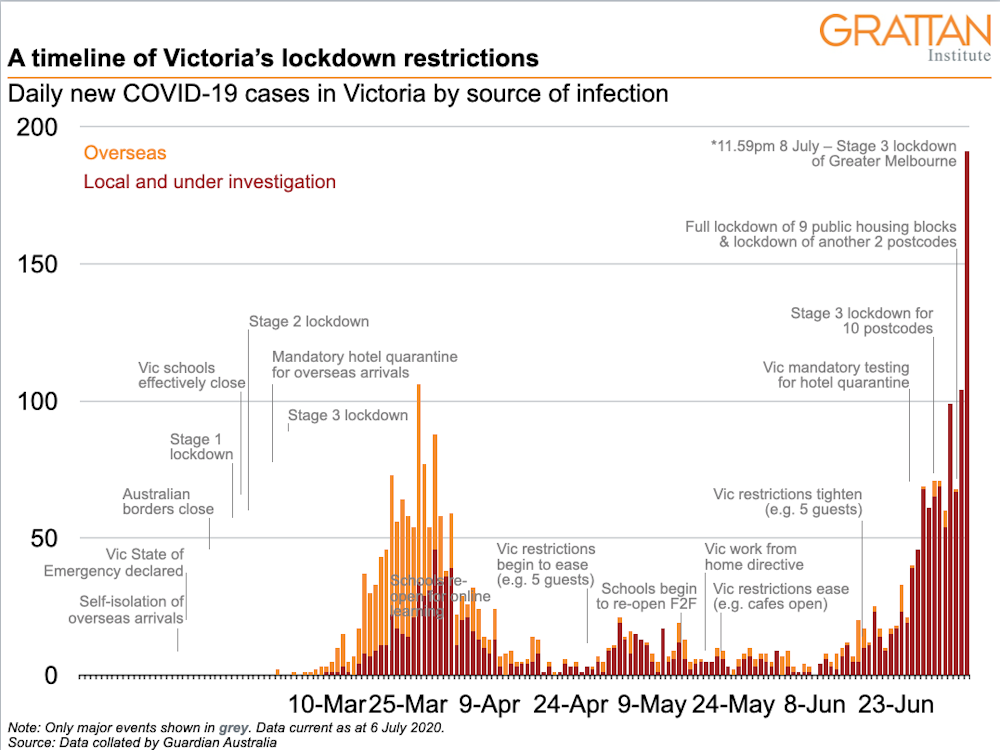
Victoria has recorded 288 new COVID-19 cases since yesterday, the largest daily increase we’ve seen so far.
This big jump must have the Victorian government and health authorities very concerned, especially since nearly all of these cases are under investigation, with many likely having no known source of infection.
This rapid spike in numbers is likely to be an extension of the outbreak that began with the private security guard bungle at the quarantine hotels.
The progression of this outbreak was probably compounded when nearly 1,000 people refused testing during the recent testing blitz in hotspot areas.
Once a person has been infected with SARS-CoV-2, the coronavirus that causes COVID-19, it can generally take up to 14 days for symptoms to appear (if they do at all).
So cases are likely to keep increasing for the next couple of weeks, until the reintroduced restrictions take effect.
Notably, nearly half of current cases are among people under 30. This probably has a lot to do with the spread of infection within families.
It’s a positive step that residents of Melbourne’s public housing towers who have tested positive for COVID-19 will be offered the option of hotel quarantine until they are well. As much as possible, to prevent spread in families, any infected person living in crowded conditions should be moved to hospital or hotel quarantine.
The Victorian government has made the right move in reintroducing restrictions and now needs to pull out all stops to crush the current outbreak.
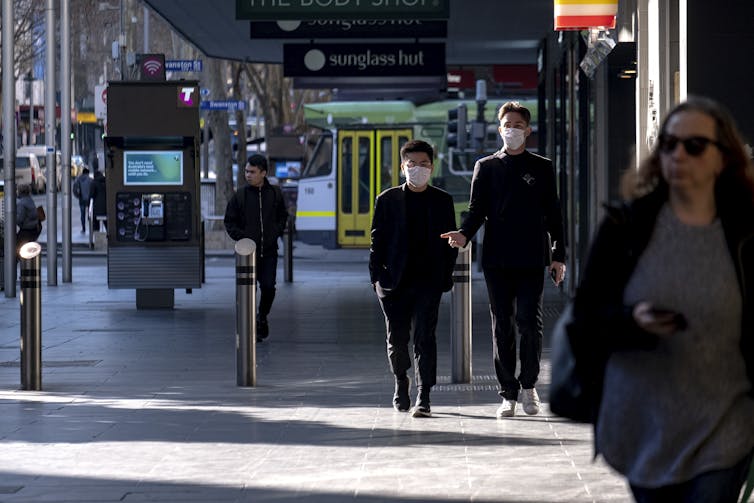
They have today taken the step of advising people in Melbourne to wear masks when they may not be able to practise physical distancing.
It’s also essential the government presents clear messaging around why the restrictions are needed, especially to communities from non-English-speaking backgrounds.
At the same time, they may need to get stricter in enforcing the various facets of their strategy. They should not allow people to refuse testing and should limit exemptions to restrictions as much as possible.
Any person found to be a contact of an infected person should be tested on entry into 14 days quarantine, and then tested again towards the end.
Melbourne is settling in for another six weeks of lockdown.Luis Ascui/AAP
Will Victoria’s woes spread to other states and territories?
New South Wales and South Australia have now closed their borders with Victoria. Nonetheless, there are still many people living near Victorian border areas being granted exemptions.
Because there have been no community-acquired cases in these border areas (there was a recent case in Albury, but he was a contact of a known case), the risk at the moment is not high.
However, in the next couple of weeks, if we see community transmissions spreading outside the current greater Melbourne area, the provision of these exemptions should be re-evaluated.
I have suggested a possible strategy might be to incorporate these Victorian border towns into the states they are close to, just for the period of the epidemic. For example, to make Mildura part of South Australia and Wodonga part of New South Wales. This would be much more convenient for the populations affected, and much easier to police.
There are already epidemiologists who believe New South Wales should reimpose restrictions — though perhaps not as severe as those in Victoria — to eliminate the current steady drip of infections. I think it might be a little bit early for that, but as we’ve seen from the current situation in Victoria, it’s better to be early than late.
In the meantime, all other states and territories should be offering support to Victoria, particularly in lending staff for contact tracing.
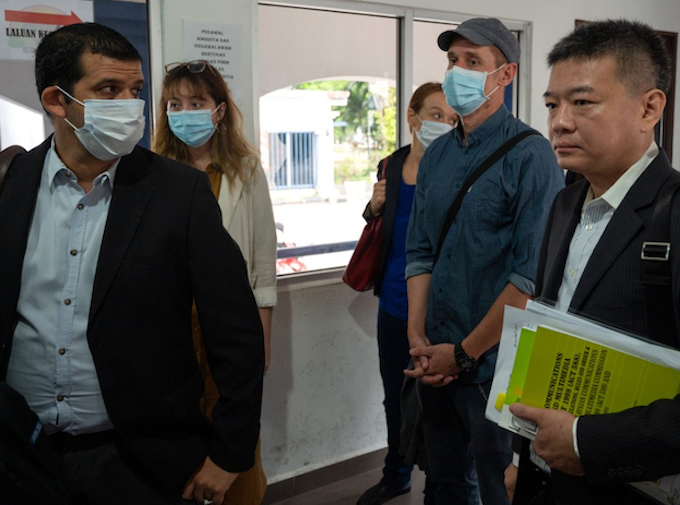
Malaysian police summoned six Al Jazeera media workers today for questioning relating to an investigation for defamation and violation of Malaysia’s Communications and Multimedia Act (CMA), reports IFJ Asia-Pacific.
The International Federation of Journalists (IFJ) and its Australian affiliate the Media, Entertainment and Arts Alliance (MEAA) have called on authorities to drop the case against Al Jazeera immediately.
The IFJ received reports that six media workers were called to Malaysia Central Police Headquarter in Bukit Aman about 8:50 am (GMT+8) on July 10.
They include senior producer and correspondent Drew Ambrose, producer Jenni Henderson, and the network’s bureau chief, executive producer, cameraman, and digital crew.
According to MEAA, five of the six media workers are Australian. The investigation relates to allegations against Al Jazeera for “sedition, defamation and violation of the country’s Communications and Multimedia Act” after airing Al Jazeera’s 101 East documentary Locked Up in Malaysia’s Lockdown that investigated why the covid-19 pandemic has forced migrant workers into hiding.
In its statement, Al Jazeera “strongly refutes” the charges, which criticised the documentary as being inaccurate, misleading and unfair.
The network “stands by the professionalism, quality and impartiality of its journalism”.
Al Jazeera emphasised the episode does not contain the personal opinions of any its staff, stating the network repeatedly requested and was denied interviews with several senior government ministers and officials.
Malaysia’s CMA is routinely abused targetting journalists despite the Communication and Multimedia minister’s commitment to review the act’s restrictions on press freedom.
Since March 2020, the IFJ has recovered 19 instances of authorities enforcing the CMA to intimidate media workers and freedom of expression advocates.
MEAA wrote to the High Commission of Malaysia in Australia noting: “Malaysia’s obligations under UN General Assembly resolution 74/157 The Safety of journalist and the issue of impunity adopted on December 18 2019 that states Malaysia, as a UN member state, should do its ‘utmost to prevent, violence, threats and attacks targeting journalists and media workers.’ MEAA calls on you to fulfil that obligation towards our colleagues.”
The IFJ said:“The IFJ deeply regrets Malaysian authorities abusing the Communications and Multimedia Act to silence and intimidate journalists. There has been a distinct pattern under the Covid-19 crisis of media workers targeted under Malaysia’s Communications and Multimedia Act and Penal Code for simply doing their job. It is urgent for Malaysia during the Covid-19 pandemic to prioritise the public’s right to know and for the media to be able to report freely and fairly without the threat of persecution.”
Al Jazeera journalists arrive at the Bukit Aman police headquarters in Kuala Lumpur today. Image: Mohid Rasfan/AFP
Australia’s chief medical officer Paul Kelly today recommended people in Melbourne and the Mitchell Shire wear masks when leaving the house:
[…] If people have symptoms and they need to go for a test, for example, which we would definitely encourage, they should wear a mask. Other people, where physical distancing cannot be guaranteed, they should also wear a mask in Melbourne and Mitchell Shire.
However, Kelly did not say wearing masks in public in these areas would be mandatory.
There are many different ways to cover your face to protect against infectious diseases, whether that’s with a bought surgical mask, one you make yourself out of cloth, or with a scarf or bandana. Each type has its pros and cons.
The idea is not only to protect other people if you have the coronavirus, but also to protect yourself from catching the virus from other people.
A surgical mask can do both, with the latest evidence coming from a major review of evidence so far of the effectiveness of a range of masks, including surgical and cloth masks.
The evidence prompted the World Health Organisation to strenghthen its advice on people wearing masks in public where physical distancing wasn’t possible and where community transmission was high.
No type of mask provides perfect protection. How well a mask filters out droplets from coughs and sneezes carrying the coronavirus depends on a variety of factors, including the nature of the mask itself and how it’s used.
For the public, the two major options are a surgical mask (also known as a medical mask) or a cloth mask. While you can buy respirators (known as N95 masks), these should really be reserved for health professionals.
Surgical masks
Surgical (or medical) masks are the ones to aim for. But there are other options.from www.shutterstock.com
This is the type you not only see surgeons wear in hospital, but are being worn by the public in the community. They are generally blue or green. Put them on by holding by the ear loops and hooking over the ears. Make sure you cover the nose, and pull them down under the chin (see diagram below for the correct procedure of putting on and taking off a mask). Pinch the bridge to ensure a good seal around the top of the nose.
You can buy these online, or from a pharmacy, and are relatively cheap.
Many studies show surgical masks are better filters of particles from coughs and sneezes than cloth masks. You’re also less likely to get infected when wearing a surgical mask compared with a cloth mask.
If you cannot find a surgical mask, then you can use a cloth mask, which people have used throughout history to protect themselves from various respiratory infections. You can either buy one ready made or make one yourself.
While it’s generally accepted cloth masks don’t do as good a job at filtering out particles from coughs and sneezes as surgical masks, new evidence shows there are several things to look out for when choosing or making a cloth mask:
use two or three layers of fabric
choose fabric with a high thread count (so a tighter weave, for instance from a good quality sheet is generally better than a fabric with a looser weave that you can clearly see light through)
fabrics made with more than one type of thread (for instance cotton–silk, cotton–chiffon, or cotton–flannel) may be good choices because they provide better filtration and are more comfortable to wear
make sure any cloth mask fits well and seals around the face.
While in an ideal world, we should wait for high quality evidence from robust trials before implementing public health measures, we also need to be pragmatic.
During the current COVID-19 pandemic, not a single country was able to manage the supply of face masks. That’s why cloth masks are an option for the public.
Cloth masks have the added advantage of not depleting stocks meant for health workers and can be re-used. You can wash them with soap and water or household detergents, or preferably in a washing machine (at 60℃). Put the mask somewhere isolated until you can wash it.
Wearing a bandana or scarf around your face should be a last resort. That’s because it’s hard to get a good fit around your face and the cloth they are usually made from tends to have a loose weave. There have also been no studies to show they work.
But with many cases of COVID-19 arising without symptoms, a bandana or scarf may provide some protection and prevent spread of infection from sick people.
Whichever mask you use, it’s important you put it on, take it off and dispose of it correctly, otherwise you risk contaminating your hands and spreading the virus further.
Wearing a mask in public is more common in Asia, and it’s compulsory in other parts of the world during the COVID-19 pandemic.
But for most Australians, wearing a mask in public will be a major shift in how they go about their daily lives.
Remember, this latest advice is only for parts of Australia where there are high rates of community transmission. And this needs to be combined with other interventions, like physical distancing and washing your hands.
There is no need for everyone to wear masks in public in other parts of the country where there are only a few locally transmitted cases, most cases are imported, and the risk of catching the virus is low.
Keeping health-care workers COVID-free is critical to delivering care to those who need it during a pandemic. So as Victoria’s second wave rolls on, we need to consider what more we can do to protect our health workers.
In the absence of a vaccine, subsequent waves of COVID-19 have always been a possibility.
Health-care workers tend not to contract COVID-19 from patients, as appropriate personal protective equipment (PPE) is used in high risk encounters.
But health-care workers are normal people commuting to work and living and interacting in communities. So it’s more likely they contract it outside work.
Undetected, they can then bring it into the hospital or other health-care setting, putting fellow staff and vulnerable patients at risk.
Over the past week, we’ve seen a number of COVID-19 cases among hospital staff.Shutterstock
What are the implications for health care?
At the most basic level, the specialised health-care workforce is core to health-care delivery; without nurses, doctors and allied health staff, there’s no health-care system.
Infections in this group — whether confirmed outbreaks or suspected contamination —will reduce health-care workforce capacity.
High rates of staff off work due to COVID-19 may also increase fatigue and burnout in the remaining workforce, adding to the burden.
The greater the scope of these outbreaks, the greater the strain on the affected hospitals and the health-care system. This will be compounded as they’re faced with increased demand due to COVID-19 cases in the community.
Australia has had time to prepare its workforce with additional skills and capabilities in critical care. But there are always concerns regarding potential workforce shortages in the height of a pandemic, particularly in areas of specialised practice such as intensive care.
Especially in “hotspots”, as we weather this second wave, there remains a risk demand could outweigh supply.
What can the health system do to cope?
A number of possible interventions could increase system capacity and help manage demand.
This may include decreasing elective or non-urgent surgery, as we saw during the first wave of the virus.
Increasing the use of virtual models of care including phone consultations and telehealth, where appropriate, could also help ease the pressure. Quarantined frontline workers could provide virtual care through telephone support, such as helplines or other telehealth services.
A reduced health-care workforce can put added stress on remaining staff.Shutterstock
Adapting care to minimise the movement and interaction of hospital staff across wards and sites is another important option. For example, some hospitals have shifted from a model where a team of doctors works across multiple wards to a small team of doctors providing care to only one ward.
Most hospitals have also set-up dedicated COVID wards to screen patients for COVID-19 at the first point of contact with the health system.
Increased routine screening of health-care workers, with or without suspected exposure, will increase the number of days away from work while staff wait for results, reducing service capacity. But the pay-off will be greater — it will limit COVID-19 spread.
From this week, staff at several major Melbourne hospitals have been required to wear masks at all times while at work. These precautions have previously been reserved for staff in areas of higher clinical risk such as emergency and intensive care.
This is in addition to a range of guidelines health professionals follow to minimise the spread of COVID-19, including around hand hygiene, cleaning, PPE, and keeping physical distance from patients where possible.
But the responsibility to take precautions and stop the spread falls to all of us.
Hospital patients and visitors are also being encouraged to wear face masks.
In fact, everyone in Melbourne is now advised to wear a mask in public when social distancing is not possible. Hopefully this will go some way to protecting our health-care workers and the entire community.
University of Canberra Vice-Chancellor and President Professor Paddy Nixon and Professorial Fellow Michelle Grattan discuss the week in politics including the return to lockdown in Victoria, National Cabinet setting to slow the flow of Australian’s returning from overseas, the Prime Minister Scott Morrison’s announcement that the government will be providing more liberalised visa conditions for citizens of Hong Kong, and Kristy McBain, the Labor candidate, winner of the Eden-Monaro by-election.
Donald Trump has ordered US federal agencies to bypass environmental protection laws and fast-track pipeline, highway and other infrastructure projects. Signing the executive order last month, the US president declared regulatory delays would hinder “our economic recovery from the national emergency”.
Trump withdrew the US from the Paris Agreement for international climate action in 2017 for the same reason. The accord, he said, would undermine the US economy “and put us at a permanent disadvantage to the other countries of the world”.
This idea that environmental regulation costs jobs and hurts the economy is deeply entrenched in pro-business discourse. But it is true?
To assess the impact of greater environmental policy on economic productivity we analysed data of 22 member nations of the Organisation for Economic Cooperation and Development (OECD) between 1990 and 2007. Our results show little evidence that environmental “green tape” inhibits economic growth over the long run. The opposite, in fact.
Comparing environmental policy stringency
Past studies of the economic impact of tougher environmental policies have tended to be limited by focusing on immediate effects and looking only at individual nations. Such results are of no help to understand the long-term effects and do not allow for straightforward cross-country comparison either.
This is why we analysed cross-country data stretching over a long period. We used data up to 2007 because that is the most recent year for which the OECD provides free access to all the information we needed for our analysis.
We rated nations’ environmental policies using the OECD’s Environmental Policy Stringency Index, developed in 2014. The index calculates a single score based on polices to limit air and water pollution, reduce carbon emissions, promote renewable energy and so on.
All 22 nations improved their stringency scores to varying degrees between 1990 and 2007. The following shows the trajectory of a few example nations – Australia, Germany, Japan and United States against the OECD average. Germany had the second-highest average score over the 17 years. Australia had the worst.
Author provided
We then did complex calculations to measure what effect more stringent environmental policies had on economic productivity – the value of output obtained with one unit of input – both over the short run (one year) and the long run (after three years).
While results for individual nations varied – reflecting local circumstances – overall our results showed a consistent pattern.
In the short run environmental regulations did increase the cost of production. For example, a carbon tax would make coal more expensive, increasing the costs of things like steel production (which uses coal).
But in the long run tighter environmental policies were associated with greater productivity. This positive effect was greater in countries that took the lead on tougher environmental policies. Germany had the highest average economic productivity growth of the 22 nations.
Healthier environment
This positive association might be due to a cleaner environment in the long run increasing the quality of various “production inputs”, such as better health of workers.
For example, a significant 2017 study showed higher exposure to lead (once added to fuel and paint) in childhood was associated with lower intelligence and job status in adulthood. Bans on lead additives in the 1970s have thus contributed to a smarter workforce – a key input for economic growth, as shown by the work of 2018 Nobel economics laureate Paul Romer.
Environmental regulations may also prompt industries to focus on efficiency, improving their productivity in the long run.
US President Donald Trump signs an executive order cutting regulations on May 19 2020.Kevin/Dietsch
Environmental winners
Our findings suggest stronger environmental protection is compatible with a stronger economy in the long run.
Indeed the evidence is mounting that not taking strong environmental action is likely to have serious economic consequences.
Research suggests, for example, that the continued destruction of natural habitats is making pandemics like COVID-19 more likely, due to pathogens crossing from wild animals to humans.
Air and water pollution contributes to chemical body burden and disease. Industrialised farming practices have contributed to the loss of about a third of the world’s arable land over the past 40 years.
Then there’s climate change. The consequences of burning fossil fuel are no longer a distant concern. Countries around the world are counting the costs of increased or more catastrophic extreme weather events and other climate impacts.
The countries that show leadership on environmental protection will be the economic winners in the longer run. Those that don’t will be poorer for it in more ways than one.
Unites States and Australia rising. Chart by Keith Rankin.
Analysis by Keith Rankin.
Chart 1: United States and Australia rising. Chart by Keith Rankin.
These charts look at Covid19 incidence in China (the most important first-wave country, with a limited second wave), Italy (the lead second-wave country), and USA and Australia (second-wave countries – drawing their caseload from Europe – with limited first-wave exposure from Asia in January and February).
Chart 1 shows the first-wave in China, which in February was having nearly 100 daily cases per 100 million of the population, and upto 8 daily deaths per 100,000 people. It also shows the first-wave in Australia and USA (days 0 to 9), with a few resulting first-wave deaths (in early March; days 10 to 20).
Italy shows the classic single-wave covid curve, with a sharp exponential rise in cases for about 30 days, with deaths lagging by about 10 days. This is followed by a slow drawn-out downward exponential decline, with a bit of a plateau in new reported cases in the last few weeks (but with new deaths still declining).
Australia showed a similar but shorter exponential rise, ending with a peak an order of magnitude lower than Italy’s peak. Then Australia showed an exponential fall must faster than Italy’s. But Australia failed to eliminate Covid19, with new cases ticking over for many weeks, followed by the current Victoria outbreak. (In Victoria, the peak of the current outbreak is higher than its peak at the end of March.
The United States’ second-wave closely followed that of Italy; indeed, most of America’s early cases almost certainly came into New York from Milan in Italy. The decline in the United States was much slower than for the other countries; it took a couple of months for average daily cases to halve. Then, in early June, United States cases returned to a rising trend. Daily cases are now nearly double the May peak. However, American deaths have yet to show much of a rise. If Covid19 deaths turn up over the next week or so, then it will indicate a significant increase of the incidence of Covid19 in the USA. Otherwise, the rising case incidence may mainly reflect more testing, though it could be that new cases are mostly young adults.
Chart 2: Cumulative Incidence of Covid-19. Chart by Keith Rankin.
The second chart looks at accumulated cases, rather than new cases. It shows that Australian cases are six times higher than China’s. However, the death rates for the two countries are similar, meaning that China has a much bigger undercount than Australia. Indications are now revealing that – at least for economically developed countries with substantial elderly populations – the true case fatality rate is about one percent. That means deaths should be two orders of magnitude lower than cases. We see for Australia that the difference between deaths and cases is close to two orders of magnitude; so the reported data are close to the actual data. China’s true accumulated case incidence is probably a little more than half of Australia’s, perhaps 2,500 infections per 10 million people compared to Australia’s known 3,500 per 10 million. So China probably has four times more actual than known cases of infection.
In Chart 2, Australia is a close proximate for New Zealand, both for deaths and cases.
If we compare Italy and the United States, the undercount of infections looks higher for Italy. United States deaths are sitting at 3,000 per 10,000,000 people. If actual cases are 100 times higher (two orders of magnitude), they should be showing 300,000 on the chart (instead of the 100,000 shown). So, the actual case numbers in USA are about three times higher than the confirmed case numbers. If we multiply Italy’s deaths by 100, as we did for USA, then we get almost 500,000 infections in Italy per 10 million people; that’s five percent of the Italian population.
While Italy and USA have many infections (both between three and five percent infected), that indicates between 95 and 97 percent of people not infected; well short of ‘herd immunity’. To achieve herd immunity without an effective vaccine, deaths in Italy and the USA will need to increase by an order of magnitude (ie tenfold); maybe deaths would need to increase by more than that in the United States (and Mexico) where obesity is known to be a significant public health problem.
Source: The Conversation (Au and NZ) – By Hugh Breakey, President, Australian Association for Professional & Applied Ethics. Senior Research Fellow, Moral philosophy, Institute for Ethics, Governance & Law, Law Futures Centre., Griffith University
Earlier this week, 150 high-profile authors, commentators and scholars signed an open letter in Harper’s magazine claiming that “open debate and toleration of differences” are under attack. Signatories included JK Rowling, Margaret Atwood, Gloria Steinem and Noam Chomsky.
While prefacing their comments with support for current racial and social justice movements, the signatories argue there has been a weakening of the norms of open debate in favour of dogma, coercion and ideological conformity. They perceive
an intolerance of opposing views, a vogue for public shaming and ostracism, and the tendency to dissolve complex policy issues in a blinding moral certainty.
Sackings, investigations and withdrawn words
The letter’s signing by Rowling comes in the wake of widespread backlash against her controversial comments on transgender issues and womanhood.
The Harper’s letter invoked similar cases of what it saw as punitive overreactions to unpopular views, suggesting they formed part of a larger trend:
Editors are fired for running controversial pieces; books are withdrawn for alleged inauthenticity; journalists are barred from writing on certain topics; professors are investigated for quoting works of literature in class; a researcher is fired for circulating a peer-reviewed academic study; and the heads of organizations are ousted for what are sometimes just clumsy mistakes.
The reference to editors being fired is perhaps the most well-known recent incident. Last month, the New York Times published an opinion piece by Republican Senator Tom Cotton calling for the military to provide an “overwhelming show of force” to restore order in US cities during the protests over the killing of George Floyd.
The piece’s publication attracted immediate criticism for promoting hate and putting black journalists in danger. In response, the editorial page editor emphasised the newspaper’s longstanding commitment to open debate, arguing the public would be better equipped to push back against the senator’s stance if it heard his views.
Indeed, the link the open letter makes between a repressive government and an intolerant society may seem a long bow to draw. There is a world of difference between the legal prohibition of speech and a wave of collective outrage on Twitter.
Yet, it is nevertheless worth considering whether important ethical outcomes are threatened in a culture of outrage, de-platforming and cancelling.
Some speech requires consequences, but which speech?
Almost everyone would agree some types of speech are beyond the pale. Racial slurs doesn’t deserve careful consideration. They require “calling out”, social censure and efforts at minimising harm.
Rather than objecting to outrage per se, the Harper’s letter asserts there is a broadening in the scope of views that attract punitive responses. This seems plausible. In recent scholarly work on the tensions between censorship and academic freedom on university campuses, both sides of the dispute acknowledge that in the current environment virtually all utterances offend someone.
Yet, perhaps there are good reasons for this broadening of scope. In each of the cases raised in the letter, there were seemingly sensible reasons for applying social sanctions. These included judgements that:
the speech was morally wrongful
the speech was gravely offensive
the speech would have seriously worrying consequences. It was “unhelpful”, “harmful”, “damaging” or “divisive”.
For someone who is genuinely concerned that speech is wrong in these ways, it will seem not just morally permissible to take action against the speaker. It will feel obligatory.
But several concerns arise when we attach punitive consequences to people’s speech based on its perceived moral wrongfulness (as opposed to simply arguing it is mistaken or false).
First, claims of moral wrongfulness in a debate assume immediate urgency and distract from the debate itself. For example, let’s say in a debate about immigration, one person says something that offends another. Discussion of the original issue (immigration) will be bracketed until the issue of moral wrongdoing (the perceived slight or offence) is resolved.
Second (except in obvious cases), claims about wrongfulness, offensiveness and harmfulness are all open to debate. As philosopher John Stuart Mill once observed:
The usefulness of an opinion is itself a matter of opinion: as disputable, as open to discussion, and requiring discussion as much, as the opinion itself.
Third, allegations of wrongdoing create heat. Few people respond constructively to allegations of wrongdoing. They often retaliate in kind, escalating the conflict.
In a less politicised environment, a contentious claim might be treated as a contribution to a debate to be considered on its merits. But in our current climate, the same claim creates only angry allegations flying in both directions. As a result, the claim isn’t considered or debated.
Should this worry us?
If we think a person’s view is wrong and immoral, we might suppose there is no great loss about a debate being derailed. But there are genuine ethical concerns here.
First, public deliberation is a source of legitimacy. The fact that different views are widely heard and inclusively considered provides a reason for accepting collective decisions.
Democracy itself assumes citizens can hear different arguments, evidence and perspectives. If significant parts of the political spectrum are no longer tolerated, then social institutions lose this important type of legitimacy.
On the flip side, being consistently outraged by opposing viewpoints provides a ready reason not to consider them. This feeds directly into confirmation bias and group-think.
Third, shaming people can cause a “persuasive boomerang” to occur. When people feel others are trying to control them, they can become even more attached to the view others are trying to combat.
None of these concerns categorically rule out attaching punishing consequences to hateful or harmful speech. But they do imply the open letter has a point worth serious attention. Seeing mistaken views as intolerable speech carries genuine ethical costs.
While many people may enjoy a game of backyard cricket, only a few go on to become elite professional batsmen in Australia.
Cricket batting is example of what human skills can achieve. The fastest bowling delivery speeds can exceed 150km/h. That leaves a batsman with less than half a second to react.
And to complicate the challenge even further, the environment and pitch they play on can change the trajectory of the delivery every time.
To find out what gives elite cricketers the edge we interviewed eight expert high-performance international or state-level coaches, who themselves were batsmen at those levels.
We asked them a series of questions to capture the skills they saw as underpinning batting expertise. The results were published recently in PLOS ONE.
While the sample was small, there are not many people who were both elite-level players and coaches, so the research provides a unique understanding of the skills needed to become an expert in their field.
It takes more than just technical ability to be an elite batsman.AAP Image/Dave Hunt
Learn to adapt and know your limits
A key finding of our study is that cricket batting can be viewed, at least in the minds of expert batsmen, as a battle for a sense of control of the game.
To gain this sense of control, batsmen must possess the skills to assess all the key environmental conditions, such as the opposition bowler’s plan, the pace of the ball off the pitch, and whether the situation of the game requires scoring or surviving.
An expert batsman’s ability to read these conditions and then adapt their strategy and technique was grounded in an understanding of their own game. One said:
You have to be adaptable to change the momentum of the innings – whether that is by batting through an hour or whether it is counter-attacking during a period.
But it’s not just about knowledge of their own strengths, it’s also about their limitations. As another said:
So if you get on a tough wicket … you’ve got to have the decision-making and planning and discipline to say, right now I can’t do that today, or, I can’t do that for the first hour or two; until the balls a bit older, or the wicket’s a bit flatter, or the ball is a bit closer to me.
Being able to accurately assess the opposition’s plan and the pitch conditions, and adapt accordingly, is no easy feat, and it doesn’t always go to plan.
A batsman’s worst enemy, as any sportsperson knows, can sometimes be themselves. The high-stakes, high-pressure situation within a game can create anxiety, clouding the ability to read the conditions, and have a negative impact on decision-making.
So as cricketers we miss them all the time (a perceived scoring shot), and you have to just reset and refocus.
Routines and reflection
How expert batsmen continually assess the state of the game and keep their emotions in check comes down to what they do between deliveries.
A very important part of batting is … what you think about, and how you let the previous (ball) go, and then prepare (yourself) to be ready for the next one.
Expert batsmen highlighted these periods in between deliveries as crucial. They engaged in a process of reflection to update their knowledge of the key environmental conditions, such as the pitch or the way the opposition bowled.
A good batter will always adapt to the bowler.ESPA/Cal Sport Media/Sipa USA
A brief switch-off period between deliveries was also highlighted as crucial to help overcome mental and physical fatigue during performances that can stretch for hours or across days.
To help with that process, expert players develop routines.
Everybody has a routine. When I talk to people, particularly good players, their routines aren’t that dissimilar. There is a physical aspect to it, at the end of each ball they have a break so they might walk down the pitch and pat down imaginary things, or they might walk out towards square leg, just take a few steps away and walk back in again.
Now you know what’s happening next time you see a batsman walk about the pitch between play.
We can all learn from elite players
Traditionally in sport, expertise has been thought of as the attainment of near-flawless technical abilities. But at the professional level that’s what all players from both sides are hoping to achieve.
For those players to have the edge, our research shows technical ability is only part of the game. The ability to be flexible, learn and adapt to each environment is seen as critical, including the ability to learn from any mistakes.
Taking that time to reflect on what just happened is crucial. And what happens between each delivery can sometimes be just as important as how they play the delivery itself.
Incorporating these ideas within any coaching practices, be it sport or something else, could greatly benefit the development of any expertise.
Source: The Conversation (Au and NZ) – By Lee Baumgartner, Professor of Fisheries and River Management, Institute for Land, Water, and Society, Charles Sturt University
This article is a preview of Flora, Fauna, Fire, a multimedia project launching on Monday July 13. The project tracks the recovery of Australia’s native plants and animals after last summer’s bushfire tragedy. Sign up to The Conversation’s newsletter for updates.
The unprecedented intensity and scale of Australia’s recent bushfires left a trail of destruction across Australia. Millions of hectares burned and more than a billion animals were affected or died. When the rains finally arrived, the situation for many fish species went from dangerous to catastrophic.
A slurry of ash and mud washed into waterways, turning freshwater systems brown and sludgy. Oxygen levels plummeted and water quality deteriorated rapidly.
Hundreds of thousands of fish suffocated. It was akin to filling your fish tank with mud and expecting your goldfish to survive.
Take, for example, the plight of the endangered Macquarie perch (Macquaria australasica), an Australian native freshwater fish of the Murray-Darling river system.
Macquarie perch like rocky river sections with clear, fast-flowing water, shaded by trees and bushes on the banks.
Massive change wrought on our rivers over the past century means Macquarie perch are now only found at a handful of locations in the Murray-Darling Basin.
One habitat – Mannus Creek near the NSW Snowy Mountains – is particularly special because it was relatively pristine before the fires. In fact, this creek contained the last population of the threatened Macquarie perch in the NSW Murray catchment. A study in 2017 found a Macquarie perch population that was restricted to a 9km section of the creek but was doing quite well.
That was until bushfire rapidly swept through the catchment in January this year.
Some of us visited the creek three weeks after the fires. The intensity, ferocity and speed of the fires meant nothing was spared. The former forest floor was literally a trail of death and destruction – dead and charred kangaroos, wallabies, deer, possums and birds were everywhere.
All that remained of Mannus Creek was green pools in a blackened landscape, still smouldering days after the fire front passed. We immediately feared for the Macquarie perch we’d sampled, which were quite healthy less than a year before.
To our surprise, some Macquarie perch had survived. But with most of the catchment fully burnt, and no vegetation to stop runoff, we knew it was a ticking time bomb.
A desperate rescue attempt
With little time, we had to remove as many fish as possible from Mannus Creek before the rains arrived. The plan was to create an “insurance population” in case rain caused the water conditions to deteriorate.
We rescued ten fish. Days later, rain washed ash and silt into the channel. Within hours, the once-pristine creek became flowing mud with the consistency of cake mix.
A government rescue team arrived a few days later to rescue more fish, and despaired at the “wall of ash and mud”.
The ark is housing not only the Macquarie perch but other threatened species too. The rescued individuals, and perhaps their entire species, would have almost certainly perished during runoff events without these interventions.
Now a waiting game begins.
What next for the Macquarie perch?
Nobody knows for sure how many fish survived in Mannus Creek, nor how long it will take for the creek to recover. It could be years.
Ash and mud flow into Lake Macquarie after the fires.Luke Pearce, Author provided
The challenge now is to support the rescued fish until it’s safe to either return them to the creek, or breed offspring and introduce them to their natural habitat.
Fish must be kept healthy and disease-free in captivity, and enough genetic diversity must be maintained for the population to remain viable.
If these rescued fish are held in captivity for too long, they might die. But equally worrying is that affected waterways may not recover in time to allow reintroduction.
While maintaining the rescued populations, we must redouble our efforts to improve their natural habitats.
Burnt areas can allow pest plant and animal species to take hold and change habitats, so these threats need to be controlled. Finding similar, unburnt refuge areas is also crucial to prepare for future events and protect ecosystem resilience.
Working through these considerations – and quickly – is essential to giving these species the best hope of survival.
Funding, equipment and human resources are desperately needed to help our rivers recover. But we know that without an effective on-ground intervention, recovery could take decades.
For the iconic Macquarie perch, that would be too late.
In Hidden Hand, China scholars Clive Hamilton and Marieke Ohlberg examine the Chinese Communist Party’s influence in Europe and North America in a similar way to how Hamilton dissected the CCP’s influence in Australia in his 2018 book, Silent Invasion.
Perhaps Hamilton’s book is a useful reminder that we must not be naïve about our relationship with China. But his prescription, premised on China being our enemy and determined to achieve world domination, is precisely the wrong direction for addressing the genuine issues he raises.
The new book warrants a similar conclusion, though President Xi Jinping’s continued strengthening of CCP controls and pursuit of hegemony in our region add to the importance of not being naïve.
Hamilton and Ohlberg chronicle the various ways the CCP has attempted to wield influence in North America and Europe, from political and business elites to the Chinese diaspora, media, think tanks and academia, as well as through espionage and diplomacy.
Central to the book’s thesis is the diagram on pages 124-5 summarising most of the channels of influence from Chinese institutions (particularly party institutions) to various groups and organisations in Western nations. This is a one-direction diagram and assumes a totally coordinated strategy.
The book’s presentation is extremely detailed, including not just the names of Chinese institutions but the individuals said to be directing the strategies of influence. Similarly on the receiving end, the authors describe not only the groups and organisations in the West they claim are being influenced, but many of the individuals involved.
This level of detail is highlighted by the book’s 113 pages of footnotes and a 24-page index.
Despite this, the book is not a balanced, scholarly document. The narrative centres on a single-minded Communist Party that has always sought a Leninist world and is now taking advantage of its increased economic power to advance that objective more effectively.
There is little recognition of the huge shifts in Chinese economic, social and strategic policies over the past 50 years, or of the scale of the changes to its institutional arrangements and the role of government.
The authors also do not allow those in the West who they claim have been successfully (and naively) influenced the opportunity to respond, let alone to present evidence of their influence in the other direction.
Containment vs. ‘engage and constrain’
Hidden Hand is right to remind people that:
China and the CCP are not one and the same
China has a party-state system of government that is authoritarian and not democratic
China does not have Western-style rule of law
it does not recognise universal human rights in the way we understand them.
What is missing is a balanced discussion of the central debate about the appropriate approach to be taken in the West’s relations with China.
As Peter Varghese, the former head of DFAT, recently put it, the choice for Australia is between trying to “contain” China or “engage and constrain”.
Containment, he argues, is gaining traction in the US and among cheerleaders in Australia, but risks dismantling the global economic system and the supply chains that support it. For Australia, Varghese says, decoupling from our largest trading partner would be “sheer folly” irrespective of legitimate complaints about China’s behaviour.
The “engage and constrain” approach he favours involves expanding areas of cooperation where mutual interests are served, while holding firm to our values and strengthening our capacity to resist Chinese coercion through increased investment in defence and diplomacy.
This would show Beijing that “leverage is a two-way street” and that, with others, we are willing to “push back” if China pursues its interests in ways that do not respect our sovereignty.
While increasing investment in defence may well be justified, boosting our spending in diplomacy is even more important.
In this light, viewing China as our “enemy” is counterproductive and ignores the mutual benefits and increased sharing of interests that have resulted from China’s opening up since 1978. (Hidden Hand does not repeat the explicit description of China as our enemy found in Hamilton’s earlier book, but it comes close, saying for the past 30 years China has viewed both sides of the Atlantic as its enemies).
Diplomacy may influence China’s perceptions of its national interests and, where significant differences remain, help to forge important alliances elsewhere.
Hamilton and Ohlberg seem to favour the “containment” strategy, warning on page 96 that
in fact, today it [the party-state] is more powerful than ever because of market forces.
Engagement can still have a positive effect
The implication, presumably, is that we should no longer contribute to China’s economic growth. This dismisses the remarkable benefits involved in China’s growth, including not only massive reductions in poverty, but also, for most Chinese, freedoms that were unimaginable in the Mao Zedong era. There have also been flow-on benefits for the rest of the world.
China’s opening up has of course not led to Western-style democracy, and is unlikely to do so in the foreseeable future. Indeed, under Xi, the CCP’s position has been consolidated and many of the reforms of the 1990s and 2000s have been wound back. Human rights have been seriously curbed, most recently in Hong Kong.
But Hidden Hand’s presentation of a single, continuous CCP Leninist agenda ignores the existence of different views among the leadership and elsewhere in China, including those who favour further liberal reform (as described in Richard McGregor’s 2019 book, Xi Jinping: The Backlash).
And it fails to appreciate the underlying contradictions of China’s “socialist market economy” and Xi’s “China Dream”, which offer avenues for Western leaders and academics to influence debates in China through engagement – as has happened over the past 30 years.
But this surely makes it even more important to continue the engagement while resisting the pressures involved.
Similarly, I am not at all convinced by the book’s attacks on any cooperation with the Belt and Road Initiative.
While the Asian Infrastructure Investment Bank has more sound governance, there are similar arguments for participation in BRI, providing support from the inside for transparency, proper cost-benefit analysis of projects and good understanding of debt obligations. It would also limit opportunities for China to pursue improper methods of influence.
How the West should respond to Chinese influence
The book’s afterword provides a slightly more moderate position on what should be done to counter Chinese influence moving forward. It still overplays its hand in promoting an “active pushback strategy” and its recommendation the Western
elites who acquiesce to or actively support Beijing deserve public scrutiny and robust criticism.
But the other recommendations have merit: defending democratic institutions through greater transparency and foreign interference laws, addressing the underfunding of universities and financial challenges facing our media, reducing vulnerability of our industries to CCP pressure and promoting more alliances, including with developing countries.
We cannot lose faith in liberal economics as Hamilton and Ohlberg seem to suggest, relying only on democratic forces to ensure freedom. The truth is, we need both.
Sixty press freedom groups and civil society organisations, journalism institutions, filmmakers, and other supporters have formed a coalition in support of Maria Ressa and independent media in the Philippines, united around the call to #HoldTheLine.
Today the Committee to Protect Journalists (CPJ), the International Center for Journalists (ICFJ), and Reporters Without Borders (RSF) announced the launch of the #HoldTheLine campaign in support of journalist Ressa and independent media under attack in the Philippines.
Acting in coordination with Ressa and her legal team, representatives from the three groups form the steering committee, working alongside dozens of partners on the global campaign and reporting initiatives.
The campaign takes its name from Ressa’s commitment to “hold the line” in response to sustained state harassment and prolific online violence.
An internationally celebrated Filipino-American journalist, Ressa is best known for two decades covering South East Asia for CNN and founding the multi-award winning Philippines news website Rappler.
On 15 June 2020, she was convicted of “cyber-libel,” alongside former Rappler colleague Reynaldo Santos Jr – a criminal charge for which they face up to six years in prison.
The conviction relates to a story about corruption from 2012 – before the law was even enacted – and hung on the correction of a typo.
Pair may be imprisoned Ressa and Santos both posted bail, but could be imprisoned if the case is not overturned on appeal.
Rappler is also implicated in most of these cases, with several involving criminal charges related to libel, foreign ownership, and taxes.
The convictions are the latest offence in the Duterte government’s wider campaign to stifle independent reporting, including the recent shutdown of the main national broadcaster ABS-CBN.
“I am moved by the incredible outpouring of support we’ve received from around the globe for our campaign to #HoldTheLine against tyranny – even as President Duterte continues his public attacks on me, the legal harassment escalates, and the state-licensed and Facebook-fuelled online violence rages on,” Ressa said.
“We can’t stay silent because silence is consent. We need to be outraged, to fight back with journalism. If we don’t use our rights, we will lose them. Please stand with us!”
What you can do Those interested in showing support and helping to #HoldTheLine can take two immediate steps in the run-up to Ressa’s next hearing scheduled on July 22:
Join the #HoldTheLine coalition by getting in touch via the contacts below.
Sign and share this petition calling for the Philippine government to drop all charges and cases against Ressa, Santos and Rappler, and end pressure on independent media in the Philippines.
The 60 founding members of the #HoldTheLine Coalition are:
The Committee to Protect Journalists (CPJ), the International Center for Journalists (ICFJ) and Reporters Without Borders (RSF), which form the steering committee; African Media Initiative; Association for International Broadcasting (AIB); Alliance for Journalists’ Freedom; Amnesty International; ARTICLE 19; Association of Caribbean Media Workers; Canadian Journalism Forum on Violence and Trauma; Centre for Freedom of the Media (CFOM); Centre for Law and Democracy; CineDiaz; The Coalition For Women In Journalism; Community Media Forum Europe (CMFE); DART Asia Pacific; Dart Center; Doc Society; English PEN; European Journalism Centre; First Look Media; Free Press Unlimited; Global Alliance on Media and Gender (GAMAG); Global Forum for Media Development (GFMD); Global Voices; Graduate School of Journalism, Columbia University; Index on Censorship; Institute for Regional Media and Information (IRMI); International Media Support (IMS); International Association of Women in Radio and Television (IAWRT); International News Safety Institute (INSI); International Press Institute (IPI); International Women’s Media Foundation (IWMF); James W. Foley Legacy Foundation; Judith Neilson Institute; Justice for Journalists Foundation; Media Association for Peace (MAP); Media Development Investment Fund (MDIF); Namibia Media Trust (NMT); National Union of Journalists of the Philippines (NUJP); Open Society Foundations (OSF); Pacific Media Centre (PMC), Pakistan Press Foundation; Panos Institute Southern Africa; PEN America; Philippine Center for Investigative Journalism (PCIJ); Press Freedom Defence Fund; Project Syndicate; Public Media Alliance; Pulitzer Center on Crisis Reporting; Rappler; Rory Peck Trust; Rural Media Network Pakistan; South African National Editors’ Forum (SANEF); Storyhunter; The Signals Network; Tanzania Media Practitioners Association; Union of Journalists in Finland; World Association of Newspapers and News Publishers (WAN-IFRA); and World Editors Forum.
Opposition National list MP Dr Jian Yang has announced his retirement from New Zealand politics and says he will not stand in the 2020 general election after three terms in the party caucus.
He said politics was “demanding” and he wanted to spend more time with his family.
“Accordingly, I have informed the party president that I should not be considered by the regional list ranking committee of the Northern Region in its meeting tomorrow, hence my announcement today.
“I truly believe that New Zealand is a great country.”
Of the 21 years he has been in New Zealand, he has spent 12 years in academia and nine in politics.
“I have been proud to be a part of what I think is a caucus that is truly representative of the ethnic diversity that is modern New Zealand, and to have played my part as a Chinese New Zealander in the governance of our amazing country.”
He said he was honoured to represent the Chinese community in Parliament.
Support for Chinese community “I am proud that I have been able to assist numerous Chinese constituents and enabled the Chinese community to better understand and participate in New Zealand’s open and democratic politics. And I will continue to support New Zealand’s hard-working Chinese community outside of caucus.
In 2017, Yang confirmed he had taught ‘spies’ in China, but denied that he was a spy himself. A story on the Newsroom website raised questions about his involvement with Chinese military and intelligence.
He was a member of the Communist Party while he was in China but had not been since he left the country, he had said.
He said he enjoyed being part of governments led by Sir John Key and Sir Bill English and to have chaired two select committees.
“My trips to China with Prime Minister John Key, ministers and colleagues are some highlights of my political career. I have witnessed the rapid growth of New Zealand’s trade with China and I am pleased to have played a role in it.
“I wish Todd and the team all the best to win the election. New Zealand needs a National government.”
Last month National MP and ousted deputy leader Paula Bennett had also announced she would not be standing at the upcoming election.
This article is republished by the Pacific Media Centre under a partnership agreement with RNZ.
As the global climate shifts, it’s important to know which species have adaptations to survive. Our research published today in PNAS found it largely depends on where they evolved.
We looked at the capacity of life to respond to future climates in three different regions: temperate and subtropical regions, and in deserts. We did this by studying rainbowfishes from Australia.
The “winners” – those best at adapting to projected summer temperatures – evolved in the warm, subtropical regions. Those that evolved in cooler temperate ecosystems – the “losers” – risk becoming extinct.
This research is the first of its kind. It helps identify the types of biodiversity and ecosystems most vulnerable to climate change.
When migration is not an option
As local temperatures rise, some animals and plants might migrate from their native homes to colonise more favourable climatic regions elsewhere.
However, human activities, such as agriculture and urbanisation, are destroying and fragmenting habitats around the world. And this makes it impossible for many species to migrate away to safety.
This is where evolution comes in. Evolution creates adaptations over time that make organisms resilient to environmental changes. Species with higher “adaptive resilience” are more likely to keep up with changes in climate and survive.
The problem is, we don’t know which types of organisms might have evolved resilience, and which might be more vulnerable to projected climate change.
We know even less about how patterns of resilience vary across different climatic regions. This is what our research explored.
Using rainbowfish to study climate change adaptation
We studied three similar species of rainbowfishes from different climatic regions of Australia: the subtropics, the desert and the temperate region.
Rainbowfish are diverse, small and beautiful freshwater fishes that can be kept in captivity. Rainbowfish do not migrate, so we can compare populations that evolved in different climatic regions.
The ecological range of our study species of rainbowfishes (genus Melanotaenia). Photos by Gunther Schmida.
We used wild rainbowfishes separated in two groups. One group was kept at a contemporary average summer temperature (21℃). In the other, the temperature was slowly increased until it reached a summer temperature projected for 2070 under a high emission scenario (33℃).
After 14 days in these conditions, we humanely killed the fishes and removed their livers. This organ plays a central role in the body’s metabolism, including during heat stress. We used the liver samples to test how gene expression (which genes are activated within a cell) changed because of our experiments.
The results were striking. Although the three species activated thousands of identical genes in a contemporary climate, they used very different sets of genes to respond to a future climate.
They also showed different levels of response in a future climate. Subtropical rainbowfish built a much larger response (with 109 genes activated) than the desert (84 genes) and the temperate rainbowfish (27 genes).
Strong association between genetic responses and heat tolerance
Alongside, we did another experiment to measure how much heat each species could tolerate (their “upper thermal tolerance limit”).
Here, rainbowfishes were exposed to increasing temperature until they showed loss of balance. As expected, the subtropical rainbowfish showed the highest tolerance, with their upper limit at 38℃. Desert rainbowfish could tolerate up to 37℃, while the temperate rainbowfish could tolerate up to 35℃.
With both experiments, we discovered a strong association between number of genes responding to projected temperatures and heat tolerance. In other words, “winners” can regulate the expression of a larger number of genes in future climates than “losers” can.
The capacity to respond to projected climates in rainbowfishes.Author provided
The signal of evolution on heat stress genes
It is difficult to determine whether a gene is responding just because of the environment, or because of a genetic constraint that came about from evolution.
Another fascinating discovery of our study is that evolution left a strong signal on many heat stress genes. These genes are known to play a central role in dealing with heat stress and allowing survival in a variety of vertebrates. This attests to their importance in providing long-term resilience to future climates.
Our findings indicate that resilience or vulnerability to rising temperatures is expected to be influenced by geographic factors, such as the climatic region where species evolved.
Subtropical species showed greater capacity to adapt to future climates, with temperate species being the most vulnerable. Desert species, which are predicted to be exposed to more extreme heatwaves and longer droughts in the future, are also vulnerable.
Habitat of the desert rainbowfish is predicted to shrink due to climate change. Photo by Gunther Schmida.
This information will help identify the types of biodiversity and ecosystems at high risk of extinction and to develop ways to help them to adapt and survive. This includes restoring lost habitat and actively moving populations to more favourable climatic locations.
The implications of our study can be extended to many non-migratory animals and plants – aquatic and terrestrial – under pressure due to climate change.
Federal Education Minister Dan Tehan released his Job-ready Graduates Package on June 19 2020. In his National Press Club address, he said it would help drive our economic recovery after COVID-19 and “put more funding into the system in a way that encourages people to study in areas of expected employment growth”.
He said the package would deliver an additional 39,000 university places by 2023 and 100,000 places by 2030.
But my analysis shows the growth in student places is illusory. It will not meet any additional demand from the COVID-19-induced economic slowdown or future growth in the university-age cohort.
I show that — over the period from December 2017 (when the government put a cap on demand-driven funding) to 2024 (when the job-ready policies are fully implemented) — the government will deliver itself an annual saving of nearly A$1 billion.
A bit of background
In 2018, the government used a legislative handbrake to stop student subsidies for bachelor degrees from growing by capping funding.
Before that, the government was providing funding to universities based on how many students had enrolled. A two-year freeze on funding was followed by population-based increases of less than the inflation rate.
This stopped new student places being subsidised. And over time, it eroded the number of places receiving a subsidy.
There was no coherent plan for longer-term growth. The Job-ready policies are meant to fix this. If legislation passes, they will start in 2021 and be fully phased in by 2024.
New subsidy and student contribution arrangements would replace the current arrangements. The total revenue for a student place would be better aligned with the estimated cost of teaching in each discipline, removing the surplus funding now spent on other things like research.
Student contributions are being set to encourage them to study things like maths and agriculture, and to discourage them from studying things like history and communications. The government subsidy meets the remainder of the cost in each discipline.
These changes save the government money, but it spends some of it on “additional student places”. It also spends some on grants to promote links with industry and on resuming inflation-linked increases of the subsidies for student places.
It is a complicated package. There is a three-year transition period in which existing students, whose contributions would otherwise increase, stay on the old funding arrangements.
If a university would get more funding for the same total number of students under the old funding arrangements, the government will make up the difference. Funding will be progressively increased to allow universities to provide more places over this three-year period.
The government didn’t release any analysis of the end point of its changes. What will have happened to university funding by 2024? Will there be more student places than when it first capped the system? Will it be spending more or less than in the past?
My calculations
In the pink scenario (below), I calculate funding for 2018 student load using current 2021 funding rates and no funding cap.
In the yellow scenario, I calculate funding for 2018 student load using current 2021 funding rates and with the funding cap in place at its 2021 value. I calculate how many places are no longer funded due to the operation of the cap using the average funding rate for all places.
In the blue scenario, I calculate how much the 2018 student load, combined with the growth in student places to 2024, would be worth in 2021 (in 2021 dollars) with the new Job-ready graduate funding rates.
From 2018 to 2021, the funding cap has reduced university revenue by around $266 million, down to $12.6 billion. Using the average bachelor subsidy rate, around 23,000 student places are no longer subsidised.
Comparing the yellow and blue scenarios
University revenue declines by a further $0.5 billion to $12.1 billion. To earn this revenue, universities will have to provide around 11,700 more student places than in the yellow scenario.
Those 11,700 extra places arise from the Job-ready policy providing 3.5% growth for bachelor degrees at regional campuses, 2.5% for high-growth metropolitan campuses and 1% for low-growth metropolitan campuses.
The government is allocating other places to universities too (for national priorities, the University of Notre Dame Australia and Charles Sturt University’s medical school), but the total number of “new” places remains just over 15,000 – fewer than the 23,000 that have their funding taken away by the operation of the funding cap from 2018 to 2021.
While universities lose around $0.5 billion in student place funding, they receive an extra $222 million as Industry Linkage funding. We are yet to find out what they need to do for that funding.
The government makes large savings from two sources – students and universities. On average it increases contributions from students and every extra student dollar reduces what the government pays. It also reduces funding overall to more closely align with discipline teaching costs. My model estimates it goes to 94% of its former value.
Total student contributions rise by around $564 million a year in the change from current to new Job-ready graduate rates. Students will pay an average of 48-49% of costs by 2024.
The bottom line
Over the period from December 2017 to 2024, the government will deliver itself an annual saving of around $988 million. Around $266 million is from capping the system over the four years 2018 to 2021. Around $722 million is from the Job-ready policies.
Student choices will be little affected by changing student contribution levels, due to our income-contingent loan system, but restoring indexation of student subsidies is sensible policy. The lack of growth in student places into the future is not. It is essentially a policy to reduce higher education attainment levels.
Outside the US, however, the tide is heading in the other direction. China is deploying facial recognition on a vast scale in its social credit experiments, policing, and suppressing the Uighur population. It is also exporting facial recognition technology (and norms) to partner countries in the Belt and Road initiative. The UK High Court ruled its use by South Wales Police lawful last September (though the decision is being appealed).
Should Australia be using this technology? To decide, we need to answer fundamental questions about the kind of people, and the kind of society, we want to be.
It can verify individual identity by comparing a target image with data held on file to confirm a match – this is “one-to-one” facial recognition. It can also compare a target image with a database of subjects of interest. That’s “one-to-many”. The most ambitious form is “all-to-all” matching. This would mean matching every image to a comprehensive database of every person in a given polity.
Each approach can be carried out asynchronously (on demand, after images are captured) or in real time. And they can be applied to separate (disaggregated) data streams, or used to bring together massive surveillance datasets.
Facial recognition occurring at one end of each of these scales – one-to-one, asynchronous, disaggregated – has well-documented benefits. One-to-one real-time facial recognition can be convenient and relatively safe, like unlocking your phone, or proving your identity at an automated passport barrier. Asynchronous disaggregated one-to-many facial recognition can be useful for law enforcement – analysing CCTV footage to identify a suspect, for example, or finding victims and perpetrators in child abuse videos.
However, facial recognition at the other end of these scales – one-to-many or all-to-all, real-time, integrated – amounts to face surveillance, which has less obvious benefits. Several police forces in the UK have trialled real-time one-to-many facial recognition to seek persons of interest, with mixed results. The benefits of integrated real-time all-to-all face surveillance in China are yet to be seen.
And while the benefits of face surveillance are dubious, it risks fundamentally changing the kind of society we live in.
Real-time facial recognition applied to crowds amounts to face surveillance.Shutterstock
Face surveillance often goes wrong, but it’s bad even when it works
The errors tend to be false positives – making incorrect matches, rather than missing correct ones. If face surveillance were used to dole out cash prizes, this would be fine. But a match is almost always used to target interventions (such as arrests) that harm those identified.
More false positives for minority populations means they bear the costs of face surveillance, while any benefits are likely to accrue to majority populations. So using these systems will amplify the structural injustices of the societies that produce them.
Even when it works, face surveillance is still harmful. Knowing where people are and what they are doing enables you to predict and control their behaviour.
You might believe the Australian government wouldn’t use this power against us, but the very fact they have it makes us less free. Freedom isn’t only about making it unlikely others will interfere with you. It’s about making it impossible for them to do so.
Face surveillance relies on the idea that others are entitled to extract biometric data from you without your consent when you are in public.
This is false. We have a right to control our own biometric data. This is what is called an underived right, like the right to control your own body.
Of course, rights have limits. You can lose the protection of a right – someone who robs a servo may lose their right to anonymity – or the right may be overridden, if necessary, for a good enough cause.
But the great majority of us have committed no crime that would make us lose the right to control our biometric data. And the possible benefits of using face surveillance on any particular occasion must be discounted by their probability of occurring. Certain rights violations are unlikely to be overridden by hypothetical benefits.
Many prominent algorithms used for face surveillance were also developed in morally compromised ways. They used datasets containing images used without permission of the rightful owners, as well as harmful images and deeply objectionable labels.
Arguments for face surveillance don’t hold up
There will of course be counterarguments, but none of them hold up.
You’ve already given up your privacy to Apple or Google – why begrudge police the same kind of information? Just because we have sleepwalked into a surveillance society doesn’t mean we should refuse to wake up.
Human surveillance is more biased and error-prone than algorithmic surveillance. Human surveillance is indeed morally problematic. Vast networks of CCTV cameras already compromise our civil liberties. Weaponizing them with software that enables people to be tracked across multiple sites only makes them worse.
We can always keep a human in the loop. False positive rates can be reduced by human oversight, but human oversight of automated systems is itself flawed and biased, and this doesn’t address the other objections against face surveillance.
Technology is neither good nor bad in itself; it’s just a tool that can be used for good or bad ends. Every tool makes some things easier and some things harder. Facial recognition makes it easier to oppress vulnerable populations and violate everyone’s basic rights.
It’s time for a moratorium
Face surveillance is based on morally compromised research, violates our rights, is harmful, and exacerbates structural injustice, both when it works and when it fails. Its adoption harms individuals, and makes our society as a whole more unjust, and less free.
A moratorium on its use in Australia is the least we should demand.
Facial recognition technology is increasingly being trialled and deployed around Australia. Queensland and Western Australia are reportedly already using real-time facial recognition through CCTV cameras. 7-Eleven Australia is also deploying facial recognition technology in its 700 stores nationwide for what it says is customer feedback.
And Australian police are reportedly using a facial recognition system that allows them to identify members of the public from online photographs.
Facial recognition technology has a somewhat nefarious reputation in some police states and non-democratic countries. It has been used by the police in China to identify anti-Beijing protesters in Hong Kong and monitor members of the Uighur minority in Xinjiang.
With the spread of this technology in Australia and other democratic countries, there are important questions about the legal implications of scanning, storing and sharing facial images.
Use of technology by public entities
The use of facial recognition technology by immigration authorities (for example, in the channels at airports for people with electronic passports) and police departments is authorised by law and therefore subject to public scrutiny through parliamentary processes.
In a positive sign, the government’s proposed identity matching services laws are currently being scrutinised by a parliamentary committee, which will address concerns over data sharing and the potential for people to be incorrectly identified.
Indeed, Australian Human Rights Commissioner Edward Santow recently sounded an alarm over the lack of regulation in this area.
At the moment, there are not strong and clear enough legal protections in place to prevent the misuse of facial recognition in high stakes areas like policing or law enforcement.
Another specific concern with the legislation is that people’s data could be shared between government agencies and private companies like telcos and banks.
How private operators work
Then there is the use of facial recognition technology by private companies, such as banks, telcos and even 7-Elevens.
Here, the first thing to determine is if the technology is being used on public or private land. A private landowner can do whatever it likes to protect itself, its wares and its occupants so long as it doesn’t break the law (for example, by unlawful restraint or a discriminatory practice).
By contrast, on public land, any decision to deploy such tools must go through a more transparent decision-making process (say, a council meeting) where the public has an opportunity to respond.
This isn’t the case, however, for many “public” properties (such as sports fields, schools, universities, shopping centres and hospitals) that are privately owned or managed. As such, they can be privately secured through the use of guards monitoring CCTV cameras and other technologies.
Facial recognition is not the only surveillance tool available to these private operators. Others include iris and retina scanners, GIS profiling, internet data-mining (which includes “predictive analytics,” that is, building a customer database on the strength of online behaviours), and “neuromarketing” (the use of surveillance tools to capture a consumer’s attributes during purchases).
There’s more. Our technological wizardry also allows the private sector to store and retrieve huge amounts of customer data, including every purchase we make and the price we paid. And the major political parties have compiled extensive private databanks on the makeup of households and likely electoral preferences of their occupants.
Is it any wonder we have started to become a little alarmed by the reach of surveillance and data retention tools in our lives?
What’s currently allowed under the law
The law in this area is new and struggling to keep up with the pace of change. One thing is clear: the law does not prohibit even highly intrusive levels of surveillance by the private sector on private land in the absence of illegal conduct.
The most useful way of reviewing the legal principles in this space is to pose specific questions:
Can visitors be legally photographed and scanned when entering businesses?
The answer is yes where visitors have been warned of the presence of cameras and scanners by the use of signs. Remaining on the premises denotes implied consent to the conditions of entry.
Do people have any recourse if they don’t want their image taken?
No. The law does very little to protect those who may be upset by the obvious presence of a surveillance device on a door, ceiling or wall. The best option for anybody concerned about this is to leave the premises or not enter in the first place.
What about sharing images? Can private operators do whatever they like with them?
No. The sharing of electronic data is limited by what are referred to as the “privacy principles”, which govern the rights and obligations around the collection, use and sharing of personal information. These were extended to the private sector in 2001 by amendments to the Commonwealth Privacy Act 1988.
These privacy principles would certainly prohibit the sharing of images except, for example, if a store was requested by police to hand them over for investigation purposes.
Can private businesses legally store your image?
Yes, private or commercial enterprises can store images of people captured on their cameras in their own databases. A person can ask for the image to be disclosed to them (that is, to confirm it is held by the store and to see it) under the “privacy principles”. Few people would bother, though, since it’s unlikely they would know it even exists.
The privacy principles do, however, require the business to take reasonable steps to destroy the data or image (or ensure there is de-identification) once it is no longer needed.
What if facial recognition technology is used without warnings like signs?
If there is a demonstrable public interest in any type of covert surveillance (for example, to ensure patrons in casino gaming rooms are not cheating, or to ensure public safety in crowded walkways), and there is no evidence of, or potential for, misuse, then the law permits it.
Any change to the laws in this area is a matter for our parliamentarians. They have been slow to respond given the difficulty of determining what is required.
It will not be easy to frame legislation that strikes the right balance between respecting individuals’ rights to privacy and the desires of commercial entities to keep their stock, patrons and staff secure.
In the meantime, there are steps we can all take to safeguard our privacy. If you want to protect your image completely, don’t select a phone that switches on when you look at it, and don’t get a passport.
And if certain businesses want to scan your face when you enter their premises, give them a wide berth, and your feedback.
The coronavirus pandemic has forced many of us to work from home, often in less than ideal circumstances.
Many employees had little choice in the decision, limited time to prepare, patchy technology skills, and inadequate home workspaces. Some managers neglected remote workers, while others zealously monitored them.
And yet some people thrived. Having tried it, many employees anticipate they will continue to work from home, and value employers who encourage it.
So if you decide to continue working from home after the pandemic, is it good or bad for your health in the long run?
Easy access to snacks meant some employees may have gained weight while working from home during the pandemic. Some employees stared at their screen for hours, sitting in awkward positions with no breaks.
Sitting down all day is linked with various health problems. Employees working from home need to be supported to take breaks and engage in physical activity.Reuters/Abdel Hadi Ramahi
But properly supported working from home could improve employees’ health. It enables them to work toward aspirational fitness goals by scheduling workouts at convenient times.
It creates opportunities for employees to take breaks from the laptop to toss in a load of laundry, take the dog for a quick walk, vacuum the carpets, or do a few stretches in another room. Small bits of activity, interspersed throughout the day, have long-term positive impacts on physical and psychological health. Ten minutes of energetically climbing the stairs in your house could boost your lung capacity and raise your spirits.
Achieving those benefits requires employees to have control over their work schedule. Organisations can help by providing resources to design better home workspaces and software that nudges employees to take breaks throughout the day.
2. More free time, or just more time working?
Commuting — especially by car in dense communities — exposes employees to air pollution and raises their risk of respiratory or cardiovascular problems. In theory, working from home should let employees breathe easier, both physically and psychologically. Avoiding the commute saves time and money, two crucial resources that can be channelled to improve the quality of employees’ personal lives.
However, the commute serves a valuable function that is often overlooked. It gives employees time to transition between work and non-work roles, which is especially important for people in difficult service and professional jobs.
The loss of a 30-minute commute can blur boundaries and increase stress spillover between work and non-work. When we lose the defined “buffer zone” of a commute, too often the “saved time” is gobbled up by more work. Long work hours are associated with more stress, lower-quality sleep and higher blood pressure.
Working from home therefore needs to incorporate transitional periods that substitute for a commute. This might be as simple as a walk around the block before sitting down at the desk, or doing a meditation practice before cooking dinner.
Organisations need to respect role boundaries too. This involves clarifying when employees need to be available, and establishing clear policies about email and phone access outside business hours.
3. Less distraction, or lonely and disconnected?
Working from home can create opportunities for employees to engage in “deep work” — focusing on a demanding task without distraction. It helps employees fully engage with their work when they are working, and be more psychologically present with their family when they are not working.
Employees who work from home can intersperse their work and family time to benefit the entire family, for example by using a work break to read a story or share a meal. Quality moments of connection with parents have a more significant impact on children’s academic achievement, behaviour, and emotional well-being than the quantity of interactions.
Workers who engage in office chatter tend to enjoy work more.Shutterstock
But not every employee has those close family relationships, and contact with coworkers can be an essential source of support for many workers. Employees who participate in office small talk experience more positive emotions, go out of their way to help coworkers, and end the workday in a better frame of mind.
The spontaneity of office small talk is hard to replicate in a virtual context, so employees working from home can experience loneliness. This can lead to depression, insomnia, and substance abuse. In terms of death and disease, loneliness is in the same league as smoking, obesity and alcoholism.
Organisations can help by providing “virtual cafés” to foster informal interactions. Research also recommends hybrid models of remote work that can achieve the benefits of working from home (more focused time for deep work) alongside those of the office environment (more collaboration with coworkers). For example, employees might work from home four days a week, with the fifth day in the office.
Employees need to be supported
Working from home is not always better or worse for an employee’s health than traditional office arrangements.
It will be most beneficial when employees make wise decisions about their time, and employers provide support in the form of technology, ergonomic equipment, and managers trained to supervise remote workers.
Most importantly, when employees are given choice over the schedule and location of their work, the psychological, physical and productivity benefits can double.
When New Zealanders go to the polls in September, they will also be asked to vote in a referendum on assisted dying.
Parliament already passed the End of Life Choice Act in 2019, but the referendum will decide whether it comes into force.
We will be asked if we accept or decline the right of people to seek an assisted death, without the need for consultation with family and with no stand-down period other than a requirement of 48 hours to prepare the medication. The act would allow people to choose when they die and by what means, whether the medication is self-administered or given by suitably qualified clinicians.
This appears an ideal scenario, affirming the right to choose, but it is a deeply profound decision for the public to make. Many may be unaware of issues beyond the goal of ending suffering for people with life-limiting conditions.
My research shows an assisted death can have repercussions for many people — those left behind or others struggling with a chronic disease. Experiences from countries where assisted dying has been legal for some time have highlighted these challenges.
In the Netherlands, assisted dying has been legal for 18 years. Over time, there have been notable slips in the criteria that have to be met. This includes the level of physical suffering, which is a subjective experience, and the requirement that people must be competent to agree to an assisted death at the point of administration. This may not be possible for people with dementia who have previously given written consent but can no longer consent at the point of death.
While the law hasn’t changed, its interpretation has, and people with mental illness can now also request an assisted death. Data from the Netherlands show one in 30 people now die by euthanasia, compared to one in 90 when the law was introduced in 2002.
In Canada, where assisted dying has been legal for four years, the number of people seeking medical help to die has risen significantly, with figures more than doubling year on year. This has exposed unexpected consequences, such as fear of judgement for leaving family members unsupported after an assisted death and stigmatisation of clinicians, whether or not they support people choosing the time of their death.
To consider assisted dying legislation as an issue of individual autonomy denies that we are part of a much larger group with complex connections. This is particularly important when we consider Māori and Pasifika populations, whose voices are notably absent from the current act in New Zealand.
The act proposes people may seek assisted dying without any consultation with whānau (family), but the impact of an assisted death reaches far beyond relieving suffering for the individual. The ripple effects can fracture families and communities. As the act currently stands, it has the potential to cause greater harm than good.
The New Zealand legislation carries this risk. It includes restrictions on disclosure of the use of the law and on individuals being recorded as having died an assisted death, often for insurance purposes.
The contagion effect
There is another significant issue to consider. One person’s assisted death could influence the decisions of others — and this contagion effect could play out in two ways.
Those who are not aware of the legislation but discover a friend or family member is accessing it may consider using it themselves. More concerning is people with chronic conditions may feel obliged to seek assisted dying, should they feel burdensome to their family.
There is a notable difference in the New Zealand population in how support for elders or unwell family members is provided. Māori and Pasifika people tend to care for their sick and elders while pākehā (New Zealanders of European descent) often rely on external support. Our research shows when one family member has an assisted death, others with a chronic illness can feel an expectation for them to consider it.
Such broader consequences of introducing assisted dying legislation are often hidden, but they must be addressed as New Zealand moves towards the referendum. The current binary positioning of the debate focuses on autonomy of the individual versus protecting the public, whereas the reality is that assisted dying is more than merely either of these opposing values. It has already been demonstrated that the effects of assisted dying legislation reach beyond the individual and, as such, must be considered as we enter this referendum. The act lacks the necessary detail to make a fully informed decision.
The idea that choice is being given to a popular vote is, in itself, problematic. It is suggestive of a government unwilling to take responsibility for the fallout, should the referendum produce a supportive vote.
We need to safeguard our families and communities from these social consequences of assisted dying legislation. Vulnerable populations have to remain safe from persuasion to die and there has to be a supportive framework for those left behind after an assisted death, so they can grieve without feeling stigmatised.
This article is a preview of Flora, Fauna, Fire, a multimedia project launching on Monday July 13. The project tracks the recovery of Australia’s native plants and animals after last summer’s bushfire tragedy. Sign up to The Conversation’s newsletter for updates.
The green carpenter bee (Xylocopa aerata) is an iconic, beautiful native species described as a “jewel of nature” for its metallic green and gold colouring. Carpenter bees are so named because they excavate their own nests in wood, as opposed to using existing holes.
With a body length of about 2 centimetres, it is among the largest native bees in southern Australia. While not used in honey farming, it is an important pollinator for several species of Australian native plants.
Last summer’s catastrophic bushfires significantly increased the risk of local extinctions of this magnificent species. We have studied the green carpenter bee for decades. For example, after the 2007 fires on Kangaroo Island, we bolstered the remaining population by providing nesting materials.
To see our efforts – and more importantly, most of the habitat these bees rely on – destroyed by the 2020 fire was utterly devastating.
Much of Kangaroo Island was incinerated by the summer bushfires.Daniel Mariuz/AAP
A crucial pollinator on the brink
The green carpenter bee is a buzz-pollinating species. Buzz pollinators are specialist bees that vibrate the pollen out of the flowers of buzz-pollinated plants.
Many native plants, such as guinea flowers, velvet bushes, Senna, fringe, chocolate and flax lilies, rely completely on buzz-pollinating bees for seed production. Introduced honey bees do not pollinate these plants.
The green carpenter bee went extinct on mainland South Australia in 1906 and in Victoria in 1938. It still occurs on the relatively uncleared western half of Kangaroo Island in South Australia, in conservation areas around Sydney, and in the Great Dividing Range in New South Wales.
Local extinctions were probably due to habitat clearing and large, intense bushfires. The last time the green carpenter bee was seen in Victoria was early December 1938 in the Grampians, which burnt completely during the Black Friday fires of January 1939.
There are several reasons green carpenter bees are vulnerable to fire, including:
the species uses dead wood for nesting, which burns easily
if the nest burns before the offspring matures in late summer, the adult female might fly away but won’t live long enough to reproduce again, and
the bees need floral resources throughout the year.
A male green carpenter bee.Remko Leijs, Author provided
Nowhere to nest
The bees mainly dig their nests in two types of soft wood: dry flowering stalks of grass trees and, crucially important, large dead Banksia trunks. The availability of both nesting materials is intricately connected with fire.
Green carpenter bees sometimes nest n the dried flowering stalks of grass trees, also known as Xanthorrhoea.Remko Leijs, Author provided
Grass trees flower prolifically after fire, but the dry stalks are only abundant between two and five years after fire. Banksia species don’t survive fire, and need to grow for at least 30 years to become large enough for the bees to use.
Bees nesting in an artificial stalk.Remko Leijs, Author provided
With increasingly frequent and intense fires, there’s not enough time for Banksia trunks to grow big enough, before they’re wiped out by the next fire.
A helping hand after the 2007 fires
In 2007, Flinders Chase National Park on Kangaroo Island burnt almost entirely.
An artificial stalk nesting site installed in a Xanthorrea.Remko Leijs, Author provided
However, in long-unburnt areas adjacent to the park, carpenter bee nests were still present. From there, they colonised the many dry grass tree stalks that resulted from the fire in the park.
In 2012, most flowering stalks had decayed. In an attempt to bolster population size, we successfully developed artificial nesting stalks to tide the bees over until new Banksia, suitable for nesting, would become available.
Since then, each year we’ve placed artificial nesting stalks in fire-affected areas where the bee still occurred. Almost 300 female carpenter bees have successfully used our stalks to raise their offspring.
Then came the January 2020 fires
At the time of the 2020 fires on Kangaroo Island, there were more than 150 nests containing mature brood in the stalks we had provided.
We’d placed these in 12 sites in and around Flinders Chase National Park, to spread risk – to no avail, as they all burnt.
We were horrified to see the intensity and speed of the fire that turned our efforts to ash, along with most of the remnant, long (more than 60 years) unburnt Banksia habitat the bees rely on. In New South Wales, much of the species’ natural range was also burnt.
The yellow dots represent known green carpenter bee nests. In red: the area burnt in 2020. Only a subset of the remaining green and yellow patches still have the right vegetation for the green carpenter bee.Nature Maps SA/Remko Leijs, Author provided
What’s next for the green carpenter bee?
To fully appreciate the impact, we need to survey the remaining long unburnt areas on Kangaroo Island and in NSW.
Encouragingly, we have already found a few natural nests on Kangaroo Island, but the remaining suitable areas are small and isolated, and densities are likely to be low.
With funds raised through the Australian Entomological Society and the Wheen Bee Foundation, and with help of the Kingscote Men’s Shed, we are making new nesting stalks.
The Kingscote Men’s Shed on Kangaroo Island is helping build new nesting stalks.Remko Leijs, Author provided
With permission of landholders, we’ll place these new stalks in areas with good floral support, to enhance reproduction and help the bees disperse into conservation areas once suitable.
As we have learnt, success is not guaranteed. Extensive and repeated bush fires, combined with asset protection and fuel reduction burns, are making longtime unburnt habitat increasingly rare. It is this lack of old, continuous, unburnt forest that severely threatens the green carpenter bees’ existence.
The future of fire-vulnerable biodiversity
The carpenter bee is not the only species facing this problem. Many Australian plants and animals are not resilient to high frequency fires, no matter their intensity or time of year.
The ecological importance of longtime unburnt forest needs urgent recognition, as increased fire frequency – both of natural and “managed” fires – is likely to drive a suite of species to extinction.
Given the expected increase in fire frequency and intensity associated with global heating, it’s time we recognise fire-vulnerable species as a category that requires urgent habitat protection.
Women manage many overlapping responsibilities in both public and private spheres. Their busy routines leave them with just a little time to take a break or a pause in their activity. These pauses are a time for self or for activities other than home, work or care-giving responsibilities.
What is the role of such pauses in migrant women’s everyday lives? Interviews were conducted with 20 migrant women (mostly migrants from rural areas) in Hyderabad, India, and 19 Indian migrants in Melbourne, Australia, as part of doctoral research. From the interviews, these seemingly incidental pauses emerged as an integral part of their daily lives.
Each pause served a specific purpose and was itself as important as the women’s other routine activities. Pauses particularly helped the women strengthen their social ties in the community. Pauses also helped them get to know different (public) places.
Most of the participants were married women with children. They saw home and family as their primary responsibility. Some did paid work, or owned a small home-based business, while also managing domestic responsibilities.
What kind of pauses matter to these migrant women? It appears pauses in their busy routines were most important for:
social interactions
moments of self-reflection or relaxation
opportunities for work or other activities.
Social interactions
In India, we observed social interactions as pauses when the migrant women co-ordinated their chores or made trips in their neighbourhood. Washing and airing laundry or prepping meals while chatting together in the common corridors of apartment buildings was common during the day.
Socialising at the doorstep was convenient, accessible and easy to manage between chores. As Monica* explained:
Even if we are busy with work, we can step outside and rest for a bit […] Everyone can get back to their work after that!
Corridor spaces provide places for co-ordinated daily chores and casual interactions.Author provided
Trips on foot, to chaperone children to schools or to buy groceries, were similarly co-ordinated within small groups of women. Through these trips the migrant women identified others with similar cultural backgrounds and (migration) experiences and formed local connections.
Similarly, in Melbourne, women of similar ethnic or cultural backgrounds regularly co-ordinated lunch hours at work as time to “hang out” at a cafe or a restaurant. These acquaintances sometimes transformed into lasting friendships.
Self-reflection or relaxation
In India, the participants said their personal time was limited to only a short nap between chores when their spouse and children were away and if time permitted. In Melbourne, some used lunch hours at work for walks in the park, for both reflection and relaxation. Space for reflection helps cultivate self-awareness for any individual.
For Sejal*, this lunch hour was also an opportunity to spend quality time with her spouse during a brief period when they worked together in the CBD.
… because me and my husband never dated you know, (and) after one-and-a-half years (of marriage) I had a baby and that’s it … my life changed! […] So, I am spending it (that time) now … after 16 years of my marriage!
Opportunities for work and other activities
As women’s family responsibilities reduced at different life stages, some longer pauses appeared in their daily routines. For example in India, some women started a small home-based business like sewing or making handicrafts as their children got older. These activities were sometimes considered secondary, but provided a creative outlet and extra income for the family.
In Melbourne, some women felt they had lesser familial expectations than in their country of origin and they could pursue other interests. Nirmala* said that before migrating she had always felt the need to prioritise her children over her own needs.
‘Why do you want to study?’ they asked me, because I already have two children.
After her migration, Nirmala felt encouraged to study further, while continuing to be the primary carer at home.
Women’s everyday movements and activities have primarily emerged from gender norms shaped by patriarchy and societal expectations. Intervals of everyday casual interactions helped the women take a break from their “expected” responsibilities.
Pauses varied in duration and formats. They appeared in different spaces linked to the core routine activities of the women. These spaces ranged from home and its vicinity, to public spaces like streets and parks.
These interactions helped the women identify others (mainly women) with similar interests or backgrounds. This helps them overcome unfamiliarity with a new place due to limited social connections. Social and cultural connections are particularly necessary for migrants to build a sense of belonging in their new cities.
Interactions at a weekly informal market.Author provided
Further, through their individual and shared routines, the women identified familiar routes and “comfortable” places. For any individual, these routine and repetitive practices help develop an attachment to a place.
The process of migration is a complex social phenomenon affecting the women’s health and vulnerability. In today’s “new normal” of restricted mobility and social distancing, what becomes of these pauses? What are the impacts on women as they face an increased burden of domestic responsibilities and vulnerabilities while everyone stays home?
And what will these turbulent times mean for the migrants who are already experiencing instability? Will these pauses take a different social and spatial form, or be forever lost?
The pandemic has changed the way we think about supply chains, in particular the chains that feed our need for food, medical supplies, and defence equipment.
It has led Prime Minister Scott Morrison to frame access to supplies in terms of economic sovereignty.
Andrew Liveris, now an advisor to Morrison, and a former Dow Chemical Chief and advisor to both the Obama and Trump administrations, is pushing for re-shoring of critical supply chains.
“Australia drank the free-trade juice and decided that off-shoring was okay,” he is quoted as saying. “Well, that era is gone.”
But ensuring supplies can withstand shocks needn’t mean bringing production onshore. It might make it harder.
Stockpiling isn’t that useful
Firms usually talk about managing supply risk in terms of resilience or robustness.
Canada has a strategic maple syrup reserve.
Robustness is the ability to continue supplying during a disruption (for a while we didn’t have this with toilet paper).
Resilience is the ability to get supplies back to normal in an acceptable time frame (which we had with toilet paper).
For critical supplies, robustness is the most important, but it hard to achieve for entire categories such as “medical equipment”. There, stockpiling is of limited use.
The United States has a stockpile of oil, enough to fill half of its car tanks. Canada has a vault of maple syrup, called a “strategic reserve” – about 80,000 barrels worth.
But when it comes to stockpiling “medical equipment” we might put a lot of effort into stockpiling ventilators, for example, only to find that the next emergency requires something different, or a different type of ventilator.
And it’s hard to stockpile fresh food.
We are exposed at choke points
Face masks and food illustrate the risks.
Half of global facemask production is concentrated in China. China’s factories closed during its lockdown at the time global demand simultaneously soared, resulting in a major shortages.
Australia is one of the most food-secure nations on earth, exporting far more than it needs, but a 2012 department of agriculture report found that many of the inputs, including pesticides and packaging, especially long-life packaging, were made overseas.
We got a taste of that vunerability in March 2020. After drought-breaking rains across the country generated a spike in demand for these essential farm inputs, supply tightened due to coronavirus-related restrictions in China.
The crunch led Australian farm supply firm Nufarm to publically warn that Australia was dangerously dependent upon China.
Disasters can happen here too
The best way to achieve supply chain robustness is to build supply chains involving more than one supplier, located in more than one national territory.
While worth considering as part of the solution, re-shoring won’t achieve this.
Japan’s 2011 Japan earthquake illustrates the point. Japan is self-sufficient in auto parts, but the earthquake hit the region that supplies them.
If we do re-shore, it will make sense to continue to use at least one international supplier to ensure diversification. Self sufficiency isn’t the same as robustness.
Building robustness will require a federally-directed supply chain risk diversification strategy.
Self-sufficiency isn’t robustness
Given the extent of our trade with China, the best approach might be China-Plus-One. It could mean one stream of the supply of a good coming through China and another coming through, for example, Vietnam.
Re-shoring can play a role, but we are going to need a top-down assessment of the risks facing supplies of critical goods, and quite possibly the imposition of robustness requirements on firms distributing them.
Those firms can be offered a diversification tax credit.
A robustness strategy would be more likely to be pro-trade rather than anti-trade, but we won’t know until we do the work. It’d be best to start before the next crisis.
Australia-wide, we’ve so far achieved a seven-day rolling average of a little more than 50,000 tests a day. The highest single-day record was 66,525 on June 22.
Since the beginning of the pandemic, proponents of mass testing having been arguing the need to test dramatically larger numbers.
One is US economist Paul Romer, who shared the 2018 Nobel Prize for economics for his work on the importance of knowledge and ideas in the economy. In late March he modelled a “frequent testing policy” in which:
7% of the population is randomly selected for testing each day. Over the 500 days illustrated in the plots and the animation, this means that the average person is tested about 30 times in 500 days – roughly once very two weeks.
This rate of testing would mean testing close to 2 million Australians a day. But even that is probably not enough.
The mathematics of mass testing
To appreciate why an even large number of tests is needed, imagine purely random testing is being used. That is, testing not focused on “hot spots” as has been the case in Melbourne.
Testing, tracing and isolating will only be effective if, on average, the process identifies cases before those people transmit the virus. Epidemiologists call the number of infections caused by a single case the “reproduction” (R) number. If it’s less than 1, the pandemic will die out. If it’s more than 1, the virus spreads.
When uncontrolled, COVID-19 spreads roughly once every six days. This corresponds to a reproduction number of 2.5 over the 15 days a person with COVID-19 is generally infectious.
Moreover, as Romer notes, current tests are far from perfect. He assumes a 20% false negative rate (tests results saying someone doesn’t have COVID-19 when they do) and a 1% false positive rate (results saying someone has it when they don’t).
The mathematics says to control the disease we need to test the entire population roughly every four days.
In a paper published by Harvard University’s Edmond J. Safra Center for Ethics, Divya Siddarth and Glen Weyl] calculate the 20% who are false negatives will, on average, pass the virus to 2.5 people. The other 80% of cases are caught on average halfway through the testing cycle.
To put it in basic maths terms, if we test people every “x” days, we catch those infections on average after half that time (x/2 days). To keep the effective reproduction rate at, say, 0.75 we need “x” to be 3.75. That means testing everyone roughly once every four days.
And that would mean testing more than 6.5 million Australians a day. Yikes!
Door-to-door checks and testing being done in the northern Melbourne suburb of Broadmeadows on June 25 2020.Daniel Pockett/AAP
Asymptomatic cases
Given the scale needed to make random testing a success, it is perhaps not surprising authorities have opted for targeted testing – focusing on transmission hot spots.
But Siddarth and Weyl explain the fatal flaw with any testing strategy reacting only to symptomatic cases:
By the time symptomatic patients show up, they will already have infected .833 people. Furthermore, 20% of those infected will be asymptomatic throughout the time they have the disease, and 20% of those tested will yield false negatives. This means that a policy of only testing those who present with symptoms and only quarantining those who test positive will lead an average infected individual to infect others at a rate of 1.4.
Being above 1, this means the virus still grows exponentially.
A better solution is to test based on rigorous contact tracing of known infections. This is why governments pinned such great hopes on the technology of tracing apps such as Australia’s COVIDSafe.
Siddarth and Weyl consider a kind of best-case scenario that traces everyone an infectious person has come into contact with, and everyone those people have come into contact with as well. They calculate this could lead to tracking down 75% of cases. Other transmission would be pursued through prompt testing of everyone with symptoms.
In the US this would require about 2 million tests a day. In Australia it would need about 150,000 tests a day – three times as many tests as are being done now.
Group testing
An intriguing solution is “group testing”. This idea has been around since the 1940s and involves pooling patient specimens for testing. If the pooled test is negative, the whole group is cleared. If the test is positive, more focused testing is done to identify individual cases.
The question, then, is what is the optimal group-testing strategy? For instance, what is the best group size to choose? Should some people be placed in multiple groups? Should there be multiple stages of group testing?
In a US National Bureau of Economic Research working paper published this month, four scholars from the University of California Berkeley show how machine learning can help to determine the optimal strategy.
For example, optimal group test size depends on the prevalence of the virus in the population. By estimating individual risk profiles – a person’s age, pre-existing health problems, where they live, if they work in a job that exposes them to risks, and so on – it is possible to target tests more efficiently than if treating everyone as equally at risk.
The goal is to improve predictive accuracy by incorporating as many observable characteristics that may influence risk as possible. This is a classic problem for “supervised machine learning”. Using machine learning could make group testing perhaps four to five times more efficient, the Berkeley researchers suggest.
Done this way, we might be able to achieve an effective strategy by testing as few as 30,000 to 40,000 Australians a day.
But the approach will need to be very different from now.
Our pre-vaccine future
Until an effective vaccine is found and widely deployed, testing is crucial to control COVID-19.
As the Berkeley authors emphasise, modern analytic techniques can make “high-frequency, intelligent group testing a powerful new tool in the fight against COVID-19, and potentially other infectious diseases”.
Source: The Conversation (Au and NZ) – By Jean Burgess, Professor and Director, Digital Media Research Centre, Queensland University of Technology
Perhaps no single character has been as iconic a symbol of Twitter as the now-ubiquitous hashtag.
The syntax of the hashtag has a few simple rules: it consists of the hash symbol (#) immediately followed by a string of alphanumeric characters, with no spaces or punctuation.
It is used routinely in social media communication across a number of platforms including Tumblr, Instagram, and even Facebook, but its most important point of emergence and polarisation has been in Twitter.
The hashtag remains most comfortable in Twitter, and it was Twitter that turned it into a highly significant, multi-functional feature. The hashtag has made its way off the internet, appearing regularly on television, in advertising, on products and on protest signs around the world.
From its beginnings as a geeky tool designed to help individual users deal with an increasingly fragmented information stream, Twitter made the hashtag a new and powerful part of the world’s cultural, social and political vocabulary.
The @ feature helped people organise into pairs and create conversational streams. The hashtag, which organises tweets into topics, publics, and communities, goes to the heart of a crucial question: how is the internet organised and for whom?
Although its use on Twitter was new, the # has a prehistory both as a punctuation mark and as part of internet communication. Imported from elsewhere, as was the @, the hashtag brought some of its prior conventional understandings with it.
Known as the “octothorpe” by typography experts, in early computer-mediated communication the hash or pound symbol was used to mark channels and roles in systems like Internet Relay Chat (real-time, online text messaging used as early as 1988). It therefore worked to both categorise topics and group users.
As the hashtag grew more common on Twitter, a clash of cultures emerged.Shutterstock
The # also became closely tied to crowd-sourced content tagging systems. On the music-streaming site Last.fm, users could tag artists and songs. The site used these tags as information to “learn” about music, fuelling recommendations and radio streams, and laying the groundwork for Spotify and other apps’ current recommendation algorithms.
User-contributed tags were important on the Flickr photosharing website, where they helped direct people to images and to one another — a practice that was carried over to Instagram. Crucially, users could add as many tags to their Flickr photographs as they liked, creating a system that was less a taxonomy (an expertly ordered system based on exclusive, hierarchical categories) and more a “folksonomy” (a crowd-sourced one, based on inclusive tags and aggregation).
Folksonomical ordering, in the mid-2000s, was widely imagined as a more efficient, organic way of ordering content than categories or directories, and it was this model that underpinned the popular social bookmarking service del.icio.us.
The Flickr folksonomy of user-contributed tags was paradigmatic of the Web 2.0 ideology — marked by a shift from the web 1.0 idea that web development was about serving content to audiences to one where the goal was building architectures for participation of users (sometimes distinguished from passive website “visitors”) and the expectation that the user community’s activities would add further value.
Reddit’s systems for upvoting user-curated content, subreddits and modern Twitter’s aggregated trending topics are contemporary versions of this early tag-based co-curation model.
As far as we know, the hashtag’s use in Twitter was first proposed in mid-2007 by Chris Messina in a series of blog posts.
In Messina’s view, the hashtag was a solution to a need. At this time, it was still possible to see a public feed of every single tweet from a public account. Topical conversations among people who did not follow one another were incoherent at best.
The users advocating for the hashtag were technically proficient (many of them also developers) with an active online presence, who positioned themselves as participants in a community of lead users.
While some users were experimenting with hashtags, Messina’s vision for them didn’t catch on widely until a particularly acute and sufficiently significant event — the San Diego brushfires in 2007.
With this event, Messina achieved wider take-up of the hashtag as a tool for coordinating crisis communication by actively lobbying other lead users and media organisations.
Although this rapidly unfolding disaster demonstrated a clear and legitimating use case, the broader meaning of the hashtag and its possible uses remained ambiguous. Despite this, Messina, as a tech-industry insider and lead user, continued to widely advocate for its use — even reportedly pitching it to the Twitter leadership.
Journalist Nick Bilton relates an encounter between Twitter founders Biz Stone and Ev Williams and Messina, at the Twitter offices, as follows:
‘I really think you should do something with hashtags on Twitter,’ Chris told them. ‘Hashtags are for nerds,’ Biz replied. Ev added that they were ‘too harsh and no one is ever going to understand them.’
Culture clash
Twitter had begun wrestling with the problem (which still haunts it) of conflict between the cultures of expert users that made the platform work for them and the new users they alienated but whom the company badly needed to sustain its growth. The hashtag provoked contestation between Twitter’s different cultures as it was taken up both for the serious uses – such as disaster and professional discussion Messina had envisioned – and to create sociable rituals and play.
From the beginning, there was debate around the right way to use hashtags.
As Messina’s historical documentation and that of others show, there were several competing models of how and why to coordinate Twitter activity as the flow of tweets started to grow beyond an easily manageable size.
Perhaps the # was a tag, designed to help organise collections of tweets on shared topics? Or was it a way to form channels, or groups of users interested in those topics?
Underlying these different models of what the hashtag could become were different models of Twitter: as an information network, a social networking site or online community, or a platform for discussion and the emergence of publics (organised communities).
Such ideas were still new and hotly contested at the time. Though the informational seems to have won out over the conversational model of Twitter, the hashtag remains, and is used for an astonishing array of social, cultural, and political purposes — some of them vitally useful, not all of them serious, and some of them downright toxic.
The website Hashtags.org was launched in December 2007, and provided a real-time tracking and indexing of hashtags before Twitter implemented search. Participants at an event, for instance, could visit the website to see other tweets from the same event.
The hashtags in the earliest archived version of the Hashtags.org homepage, from April 2008, include a number of academic and tech conferences (#EconSM, #netc08, #interact2008) and sporting and entertainment events (#idol, #yankees, #REDSOX), and tweet categories (#haiku). Hashtags were used for coordinating discussion topics and finding like-minded users (#seriousgames, #punknews, #college, #PHX), brands and products (#gmail, #firefox), and even people (such as Wired journalist #ChrisAnderson).
Back then, the most tweeted hashtags were represented as amassing tweets numbering in the tens or at most hundreds, a reminder of the modest scale of Twitter at the time. Uses of hashtags, such as for humour, activism or second-screen television viewing, had yet to emerge.
Social media hashtags can have real political impact, as shown by TikTok teens and K-pop fans.
More than chatter
Ever since those early debates about whether Twitter needed “channels” (of topics) or “groups” (of users), hashtags have continued to play both structural and semantic roles: that is, they coordinate both communities and topics, helping users find each other and encounter a range of contributions to the discussion of issues and events.
The hashtag has fostered the rise of Twitter as a platform for news, information and professional promotion, yet the forces that allowed hashtags to become influential are deeply rooted in its conversational and sociable uses.
The capacity of the hashtag to help people navigate real-time events such as disasters, protests and conferences, and to expand and solidify social connections and community, proved particularly ideal for social movements and activism.
Such uses have in many ways come to define both the hashtag and, increasingly, Twitter itself. Perhaps the most notable confluence of hashtags and bodies-in-the-street activism has come from #Blacklivesmatter. As US academics Deen Freelon, Charlton D. McIlwain, and Meredith D. Clark document:
The Twitter hashtag was created in July 2013 by activists Alicia Garza, Patrisse Cullors, and Opal Tometi in the wake of George Zimmerman’s acquittal for second-degree murder of unarmed Black teenager Trayvon Martin.
For more than a year, #Blacklivesmatter was only a hashtag, and not a very popular one: it was used in only 48 public tweets in June 2014 and in 398 tweets in July 2014. But by August 2014 that number had skyrocketed to 52,288, partly due to the slogan’s frequent use in the context of the Ferguson protests. Some time later, Garza, Cullors, Tometi, and others debuted Black Lives Matter as a chapter-based activist organization.
It’s easy to dismiss hashtag activism as a form of slacktivism rather than real political engagement. But the rise of #Blacklivesmatter and its ties to street protests and unjust policing serves as an important reminder of the embodiment and liveness of many events that might look merely like “data” or chatter when viewed as hashtags.
This is an edited extract from Twitter: A Biography by Jean Burgess and Nancy K. Baym, published by NYU Press.
Nancy K. Baym is Senior Principal Researcher, Microsoft Research and Research Affiliate in Comparative Media Studies/Writing, Massachusetts Institute of Technology, Cambridge Massachusetts.
Frederick B. Mills, Rita Jill Clark-Gollub, Alina Duarte From Washington DC
On October 21, 2019, the Organization of American States (OAS) issued a fateful communique on the presidential elections in Bolivia: “The OAS Mission expresses its deep concern and surprise at the drastic and hard-to-explain change in the trend of the preliminary results revealed after the closing of the polls.”[1] The mission’s report came in a highly polarized political context. Rather than wait for a careful and fair-minded analysis of the election results, it raised unsubstantiated doubts about the legitimacy of President Evo Morales’ lead as some of the later vote tallies were being reported. This was a bombshell report at a time when it appeared that Morales had garnered a sufficient margin of victory over his right wing opponent, Carlos Mesa, to avoid a runoff election.
The manufactured electoral fraud was quickly debunked by experts in the field. Detailed analyses of the election results were conducted by the Center for Economic and Policy Research (CEPR)[2] and Walter R. Mebane, Jr., professor of Political Science and Statistics at the University of Michigan in early November 2019.[3] These were later corroborated by researchers at MIT’s Election Data and Science Lab[4] and more recently by an article published by the New York Times[5] featuring the study of three academics: Nicolás Idrobo (University of Pennsylvania), Dorothy Kronick (University of Pennsylvania), and Francisco Rodríguez (Tulane University)[6].
All of these professional and academic analyses found the charges of fraud by the OAS to have been unfounded.
The OAS electoral mission, however, had already poisoned the well. The false narrative of electoral fraud gave ammunition to anti-Bolivarian forces in the OAS and the right wing opposition inside Bolivia to contest the outcome of the election and go on the offensive against Morales and his party, the Movement Towards Socialism (Movimiento al Socialismo, MAS). During a three-week period, a right wing coalition led protests over the alleged electoral fraud, while pro-government counter protesters defended the constitutional government. The military and police cracked down on the pro-Morales protesters, while showing sympathy for right wing demonstrators. Then, on November 10, 2019, in its “Electoral integrity analysis,” the OAS doubled down on its dubious claims, impugning “the integrity of the results of the election on October 20, 2019.”[7]
The track record of the OAS electoral mission, which was invited to observe and assess the election by the Bolivian government of Evo Morales, had already been stained by its 2015 debacle in Haiti.[8] In the case of Bolivia, the mission politicized election results and set the stage for murder by a coup regime. It appears that there is not much political daylight between the judgment of the OAS electoral commission and the rabidly anti-Bolivarian OAS Secretary, Luis Almagro. Far from finding that the coup against Morales constituted a breach in the democratic order of Bolivia, the OAS simply exploited its position as arbiter of the election to rally behind the right wing coup leaders.
Morales resigns and a “de facto” right wing regime unleashes a wave of repression
Despite the relentless drive by Washington against Bolivarian governments in the region, President Morales was apparently unprepared for the disloyalty within his security forces and he was caught off guard by the OAS propensity to serve US interests in the region. MAS activists, legislators, union activists, Indigenous organizations, and social movement activists, however, continued to resist the coup even as they faced arrest and violence from the de facto regime.
The coup forces exercised extreme violence against authorities of the Morales’ administration and MAS legislators (the majority of Congress). Several houses were burned down and some relatives of authorities were kidnapped and injured, all with total impunity and without protection by the security forces.[9]
With the OAS-instigated coup gaining traction within the security forces and police, as well as Morales’ political adversaries, the President chose the path of accommodation. He offered to reconstitute the electoral authority and hold fresh elections. This concession to OAS authority was met by calls from the police and military for his resignation. Rather than launch a campaign of resistance from the MAS stronghold of Chapare, Morales resigned his post, opting for exile in an unsuccessful bid to avoid further bloodshed. Jeanine Áñez, an opposition party senator with Plan Progreso para Bolivia Convergencia Nacional, proclaimed herself President after the resignation of Senate President Adriana Salvatierra, who refused to legitimize the coup with an unjustified “succession.”[10]
The scenes in the streets of Cochabamba turned ugly. It was a field day for racist attacks on the majority Indigenous population. The Indigenous flag–the wiphala–was burned in the streets, and much fanfare was made when Áñez, surrounded by right wing legislators, held up a large leather bible and declared, “The Bible has returned to the palace.” Such attempts to resubordinate Bolivia’s plurinational heritage were met with widespread resistance.
Workers of all industries and sectors keep protests against Áñez going, to protect social laws created under Morales’s government (photo credit: MAS-IPSP, http://www.masipsp.bo).
After thirteen years of impressive economic growth, poverty reduction, recovery of the nation’s natural resources, and the inclusion of formerly marginalized sectors in the political life of the country under the leadership of President Evo Morales, Bolivia had now suffered an enormous blow to the liberatory project of the 2009 Constitution. But the coup fit perfectly into the US-OAS drive to recolonize the Americas.
Secretary General Luis Almagro, who would never let an opportunity to attack the Bolivarian cause go to waste, immediately recognized self-proclaimed President, Senator Jeanine Áñez, adding yet one more crime to the long list from his shameful tenure at the OAS.[11] At a special meeting of the OAS on November 12, 2020 Almagro declared, “There was a coup in the State of Bolivia; it happened when an electoral fraud gave the triumph to Evo Morales in the first round.”[12]
During the meeting, 14 member states of the OAS (Argentina, Brasil, Canada, Chile, Colombia, Costa Rica, Ecuador, the US, Guatemala, Guyana, Honduras, Panama, Paraguay, Peru) and the unelected US-backed shadow government of Venezuela called for new elections in Bolivia “as soon as possible,” while Mexico, Uruguay and Nicaragua warned against the precedent being set by the “coup” against Evo Morales. The ambassador of Mexico to the OAS, Luz Elena Baños, described the coup against Morales as “a serious breach in the constitutional order by means of a coup d’etat,” adding “the painful days when the Armed Forces sustained and deposed governments ought to remain in the past.” [13] The Trump administration echoed Almagro’s declaration and moved quickly to endorse what was now a “de facto” government.[14] The OAS was now at the service of two unelected, US-backed, self-proclaimed presidents (Juan Guaidó for Venezuela and Jeanine Áñez for Bolivia).
What followed was the brutal repression of widespread protests amid grass roots clamor for the return of President Morales,[15] who, from his exile in Mexico and later Argentina, still held great clout among rank and file MAS militants and the popular movements. The horrific massacre in Sacaba, on November 15, followed by a massacre in Senkata, on November 19, carried out by the security forces, exposes the coup regime to future prosecution for crimes against humanity.[16] Rather than pacify the country, the repression only galvanized the MAS, which still held a majority in the legislature, as well as the peasant unions and grassroots organizations in their struggle to restore Bolivian democracy. There was indeed a coup, but it had not and still has not been consolidated.
New elections could be compromised by lawfare
Today, Bolivia stands at a crossroads. In June 2020, popular calls were mounting for new elections and the restoration of democracy, despite the ongoing repression. In response to this pressure, on June 22, Áñez signed off on legislation to hold new elections in September. Former president Carlos Mesa (2003-2005) of the right wing Citizens Community Party would face off against the MAS candidate, former Minister of Finance (2006-2019), Luis Arce. Áñez’s decision drew the ire of Minister of Government, Arturo Murillo, who characterizes the most popular political party in the country as narco-terrorist. Murillo even threatened MAS legislators with arrest if they refused to approve promotions for the very military officials responsible for the repression.[17]
Should democratic elections prevail, recent polls do not look good for the “de facto” regime. In a poll taken by CELAG between June 13 and July 3, the MAS candidate, Luis Arce, leads with 41.9% support, followed by Carlos Mesa, with 26.8%, and Áñez, with 13.3%.[18]
Luis Arce, from the MAS party, leads the presidential race in Bolivia (Source: CELAG, https://www.celag.org/wp-content/uploads/2020/07/panorama-politico-y-social-bolivia-web-2.pdf)
Although Áñez initially said she would not run for president,[19] she later decided to do so even over the objections of her fellow opposition members.[20] The latter said that this went against her purported objective of only serving as a transition government until new elections could be held—initially on May 3, but later canceled due to the COVID-19 pandemic. Not only was Áñez never a favorite in the polls, her de facto government has been unrelenting in its attempts to persecute the MAS and kick it out of the race.
On March 30 a government oversight agency (Gestora Pública de Seguridad Social de Largo Plazo) filed formal charges against MAS presidential candidate Luis Arce for “economic damages to the State” while he was Minister of Finance. According to the Bolivian Information Agency, his alleged crimes are linked to the contracting of two foreign companies to provide software for the administration of the national pension system.[21]
The charges state that the previous administration paid US$3 million as an advance for a contract valued at US$5.1 million to the Panamanian company Sysde International Inc. However, said company never delivered the software. Consequently, the MAS administration contracted the Colombian company Heinsohn Business Technology for US$10.4 million, on top of which payments were to be made of US$1.6 million annually for the license and source code.
Luis Arce responded to the charges during a press conference,[22] stating that during his tenure, “We entered into a contract for a system and the company failed us, so we filed suit against the company.” But he stressed that the charges simply seek to disqualify the MAS to prevent the party from participating in the presidential election.
Evo Morales took to Twitter to say, “The imminent electoral defeat of the de facto government is leading it to trump up new charges against the MAS-IPSP every day. Now, as we have denounced, they have filed charges based on false conjecture against our candidate to ban him from running for office because he is leading in the polls.”[23]
On July 6, the Attorney General of Bolivia charged Evo Morales himself. The charges are terrorism and financing of terrorism coordinated from exile, and preventive detention has been requested. This is a rehashing of similar charges brought last November, charges denied by Morales.[24]
The persecution against the overthrown government has not stopped. Seven former officials remain asylees at the Mexican Embassy in La Paz: the former Minister of the Presidency, Juan Ramón Quintana Taborga; the former Minister of Defense, Javier Zavaleta; the former government minister, Hugo Moldiz Mercado; the former Minister of Justice, Héctor Arce Zaconeta; the former Minister of Cultures, Wilma Alanoca Mamani; the former governor of the Department of Oruro, Víctor Hugo Vásquez; and the former director of the Information Technology Agency, Nicolás Laguna.
The current Minister of Government, Arturo Murillo, affirmed upon assuming power that the authorities of the constitutional government of Evo Morales would be “hunted” and imprisoned before any arrest warrant was issued.[25] And now, eight months after the coup d’etat, the de facto government has refused to deliver safeguards to the asylum seekers at the embassy even though Bolivia and Mexico are parties to the American Convention on Human Rights, which in its article 22 establishes the right to seek and receive asylum[26].
Calls for free and fair elections without subversion by the OAS
The consequences of the OAS’ bad faith monitoring of the 2019 Bolivian election cannot be overstated. Not only were lives lost in the chaos and violence spurred by the statements of the OAS Electoral Observation Mission, which also resulted in scores of injuries and detentions. But the de facto regime continues its reign of terror, even repressing people protesting hunger during the pandemic lockdown,[27] while it dismantles the extensive social programs put into place during the years of MAS government.[28] Despite the repression, grassroots social movements in Bolivia, most notably peasant and Indigenous women who have bravely withstood attacks by the de facto regime, continue to insist on true democracy. They are inspired by the 2009 Constitution creating the Plurinational State, with its promise of a “democratic, productive, peace-loving and peaceful Bolivia, committed to the full development and free determination of the peoples.”[29]
Indigenous women have been at the upfront of the fight to restore democracy in Bolivia (photo credit: MAS-IPSP, http://www.masipsp.bo).
On July 8, the MAS-IPSP “categorically” rejected the participation of an OAS electoral mission for the September presidential election, on account of their responsibility for the coup against the constitutional government.[30] The communique declared that “it is not ethical for [the OAS electoral mission] to participate again for having been part of and complicit with a coup against the democracy and Social State of Constitutional Law of Bolivia”, and “that [the OAS] is not an impartial organization to defend and guarantee peace, democracy and transparency, but rather a sponsor of petty interests that are foreign to the democratic will of the Bolivian people.” [31]
Bolivia is at a crossroads. Will the de facto regime of Jeanine Áñez, having completed a coup and in command of the security forces, allow a return to democratic procedures to resolve political differences? Or will she join her Minister of Government, Arturo Murillo, in seeking to undermine, through political persecution and lawfare, any chance that the MAS ticket will be on the ballot, let alone allow free elections to take place?
The condemnation of the coup by Mexico, Nicaragua and Uruguay on November 12 was just the start of international solidarity with the call for a return to democracy in Bolivia. On November 21, 31 US organizations denounced “the civic-military coup in Bolivia.” [32] On June 29, 2020 the Grupo de Puebla, a forum that convenes former presidents, intellectuals, and progressive leaders of the Americas, released a statement condemning the actions of the OAS. “The Puebla Group considers that what happened in Bolivia casts serious doubts on the role of the OAS as an impartial electoral observer in the future.”[33] The international community can honor the clamour for free and fair elections in Bolivia by condemning the de facto regime’s use of political persecution and lawfare, supporting democratic elections in September, and rejecting any further role of the OAS in monitoring elections in the Americas.
Patricio Zamorano provided editorial support and research for this article. Translations from Spanish to English are by the authors. Main photo: Protest in front of the OAS building to oppose the coup, November 2019. Credit: Cele León)
Luis Arce, presidential candidate, and David Choquehuanca, running for the vicepresidency. They lead all surveys so far (photo credit: MAS-IPSP, http://www.masipsp.bo/).
[5] “New York Times Admits Key Falsehoods that Drove Last Year’s Coup in Bolivia: Falsehoods Peddled by the US, its Media, and the Times,” https://theintercept.com/2020/06/08/the-nyt-admits-key-falsehoods-that-drove-last-years-coup-in-bolivia-falsehoods-peddled-by-the-u-s-its-media-and-the-nyt/. See also the study by CELAG, “Sobre la OEA y las elecciones en Bolivia”, (Nov. 19, 2019). CELAG conducted a study of both the OAS report and CEPR’s analysis and concluded: “The findings of the analysis allow us to affirm that the preliminary report of the OAS does not provide any evidence that could be definitive to demonstrate the alleged “fraud” alluded to by Secretary General, Luis Almagro, at the Permanent Council meeting held on November 12 . On the contrary, instead of sticking to a technically grounded electoral audit, the OAS produced a questionable report to induce a false deduction in public opinion: that the increase in the gap in favor of Evo Morales in the final section of the count was expanding by fraudulent causes and not by the sociopolitical characteristics and the dynamics of electoral behavior that occur between the rural and urban world in Bolivia.” https://www.celag.org/sobre-la-oea-y-las-elecciones-en-bolivia/
[10] “Salvatierra: Mi renuncia fue coordinada con Evo y Alvaro,” https://www.google.com/url?q=https://www.paginasiete.bo/nacional/2020/1/24/salvatierra-mi-renuncia-fue-coordinada-con-evo-alvaro-244454.html&sa=D&ust=1593696030403000&usg=AFQjCNE_kAMqtAOBGCXdjJV5nkBsfQEWPQ
SPECIAL REPORT:By David Robie, who sailed on the original Rainbow Warrior to Rongelap and is author of the bookEyes of Fire.
Thirty five years ago today the Greenpeace ship Rainbow Warrior was bombed in Auckland’s Waitematā Harbour by French secret agents in a blatant act of state terrorism, killing a photojournalist.
People’s campaigns have moved on since then from nuclear tests and refugees to climate justice – and future Pacific refugees.
The environmental campaign flagship was bombed on 10 July 1985 just weeks after it had been in the Marshall Islands carrying out four humanitarian voyages to rescue more than 320 Rongelap atoll villagers from the ravages of US nuclear tests and take them to a new home, Mejato island on Kwajalein atoll.
They were nuclear refugees seeking justice, relief and a healthy life far from the dangerous legacy left from 105 tests on Bikini and nearby atolls.
Ironically, the bombing in Auckland and mounting Pacific opposition led to a massive wave of New Zealand and Pacific anti-nuclear solidarity and ultimately to the halt of French nuclear testing at Moruroa and Fangataufa atolls in 1996 after 193 blasts.
The bombed ship’s pioneering environmental work has since been carried on by Rainbow Warrior II and the state-of-the-art eco campaign ship Rainbow Warrior III.
Today the focus is on climate refugees, the lack of adequate health compensation for the Polynesians who suffered radiation and failure to provide proper clean-up of the French nuclear testing zones that are still off-limits after almost a quarter century. Tests were carried out by balloon, derrick, in the lagoon and in a series of underground shafts which have threatened the stability of the 60 km long atoll, leaving it fractured “like Swiss cheese”.
Rongelap islanders with their belongings approach the Rainbow Warrior in May 1985. Image: (C) David Robie
Landmark ruling In January this year, in a landmark United Nations ruling, the International Covenant on Civil and Political Rights, governments have been told not to return people to countries where their lives might be threatened by climate change.
Climate action activists have greeted this ruling as a potential game changer for both climate refugees, or migrants, and for advocates for global climate action.
The UN Human Rights Committee ruled in the covenant that “without robust national and international efforts, the effects of climate change in receiving states may expose individuals to violations of their rights”.
The ruling applied to a humble New Zealand vegetable farm foreman, Ioane Teitiota, from the island nation of Kiribati, who had become a poster boy for climate refugee legal advocates even though he had little understanding of this concept.
Five years earlier, his lawyers had applied for protection for him in New Zealand after presenting a legal argument that he and his family’s lives were at risk from the impact of climate change and rising Pacific Ocean level in Kiribati as one of the “frontline states” facing global warming.
Although Teitiota and his lawyers lost the case because the threat to Kiribati was not deemed to be an imminent risk, the ruling opened the door to recognition of the existence of climate refugees and the possibility of legal refugee protection.
Climate change will force tens of millions of people to leave their homes in the next decade, according to a report by the Environmental Justice Foundation (EJF). And this would include many on low-lying atolls in the South Pacific.
‘Humanitarian visa’ In October 2017, New Zealand’s Climate Minister James Shaw announced that the incoming government was planning an “experimental humanitarian visa” category for Pacific Islanders forced to leave their homes. Partially inspired by the Teitiota case, it was envisaged that up to 100 people a year might settle in New Zealand under this scheme.
However, this humanitarian plan was quietly shelved because Pacific Islanders generally do not want to leave their homes. They prefer support for adaptation and mitigation for their continuing lives on ancestral land with refugee status as merely a last resort.
The Rainbow Warrior had visited Kiribati and Vanuatu on the voyage to New Zealand after the Marshall Islands mission. Crew members saw at first hand some of the climate pressures already apparent back then.
A panoramic view of Moruroa atoll, French Polynesia. Image: GW
Cancer sufferers seeking nuclear compensation from the French government under the controversial Morin law received a boost last month when a man who had developed bladder cancer as a result of the nuclear tests was awarded almost US$180,000 by the administrative court.
This news was welcomed by both health advocates and activists.
According to the local news service Tahiti-Infos, an earlier application for compensation had been turned down by the authority dealing with the case.
The compensation law has been tightened up again after being earlier relaxed with most claims being rejected between 2010 and 2017.
A French nuclear test balloon at Moruroa atoll. Image: Gerard Will
Uproar in Tahiti In May, there was an uproar in Tahiti when the French National Assembly attempted to include a clause about compensation over nuclear weapons testing into generic covid-19 legislation while the French Polynesian representatives were absent from the chamber because of the pandemic travel bans.
Tahiti’s Moetai Brotherson, one of the two French Polynesian representatives, described this move as a “scandal” and two nuclear test veteran advocacy groups, Moruroa e Tatou and Association 193, were also angry, reports RNZ Pacific.
During the three decades of French tests, the early atmospheric explosions had dusted atolls and islets with radioactive fallout.
Brotherson expressed disappointment that the French state had demonstrated yet again that it “detested” the Tahitian people. Moruroa e Tatou’s Hiro Tefaarere said he was “outraged” but not surprised because all French presidents from de Gaulle to Macron “couldn’t care less” about Polynesians.
During 2019, the French Polynesian social security agency CPS reported that it had spent US$770 million on health care costs for radiation-induced illnesses. The CPS, responsible for medical expenses and pension payments, has struggled with its budgets and wants France to take responsibility for compensation.
However, French authorities do not accept liability for test-related illnesses, claiming the nuclear blasts were “clean” unlike the earlier US and British tests in the Pacific.
The dumping of military waste at sea off Moruroa during the nuclear testing period. Image: GW
A French Watergate? Five years ago, the unmasked French bomber who sank the Rainbow Warrior in 1985 made some revealing comments during his interviews with the investigative website Mediapart and TVNZ’s Sunday programme, none more telling than that “the first bomb was too powerful, it should have ended as a Watergate” for French President François Mitterrand.
The last secret of the “Greenpeace affair”. Image: Mediapart
Mitterrand stayed in office for 14 years – a decade after the bombing and before he finally stepped down when his second presidential term ended in May 1995, the year before nuclear tests ended.
The bomber, retired colonel Jean-Luc Kister, added that had Operation Satanique – the sabotage plot – involved the United States, “more heads would have rolled”.
However, while the “innocent death” of Portuguese-born Dutch photographer Fernando Pereira has clearly played on his conscience for all these years, Kister’s sincere apology wasn’t without a hint of trying to rewrite history.
The claim that the secret sabotage operation never meant to kill anybody is unconvincing for anybody on board the Rainbow Warrior on that tragic night when New Zealand lost its political innocence and the crew lost a dear friend.
In 2005, two decades after the bombing and nine years after Mitterrand’s death, Le Monde published a leaked document revealing that the late president had personally approved the sinking of the ship.
The newspaper obtained a handwritten account of the operation, written in 1986 by Pierre Lacoste, who was sacked as head of the secret services.
The Democracy Now! report – Rainbow Warrior and President François Mitterrand. Video: Democracy Now!
‘Neutralise’ the Warrior He had testified that he had asked President Mitterrand for permission to “neutralise” the Rainbow Warrior at a meeting two months before the attack and would never have gone ahead without the president’s authorisation.
The so-called nuclear “war” in the Pacific dates back to the US bombing of Hiroshima and
Nagasaki in 1945. The bombing was followed by atmospheric nuclear testing by the United States in the Marshall Islands between 1946 and 1958, arguably the “dirtiest” nuclear testing.
The first so-called nuclear refugees in the Pacific were the Bikini atoll islanders who were relocated into “exile” for the first US weapons tests in 1946.
Then came the British tests at Christmas Island (now Kiribati) and in the Australian outback; the start of the French testing at Moruroa in 1966; more US tests at Johnston Atoll in the early 1960s; flight testing of ICBMs, anti-satellite weapons; and more recently “Star Wars” technology at the Kwajalein Missile Range in the Marshall Islands.
As the late Steve Sawyer, Greenpeace campaign coordinator on board the Rainbow Warrior and whose birthday was being celebrated on board the night of the bombing, noted, “the displacement of local populations and adverse health effects as a result of these programmes has not been without opposition.
“But that opposition has been so scattered and unorganised until recently that it has been little felt in Washington and Paris.”
And the Rainbow Warrior Pacific voyage was planned to make a global difference. It did, but one that shook the world and ended in tragedy.
Moruroa – “Military Grounds – Do Not Enter!” Image: GW
Scott Morrison summoned his self-restraint and resisted temptation. Invited on Thursday to attack the Victorian government over its disastrous decision to use private security guards to monitor people in hotel quarantine, the prime minister was careful.
He hadn’t seen himself as a “commentator” on state governments, he said. “I’ve seen myself simply seeking to help them deal with the problems that they’ve had.”
He added just a little dig, saying he understood many Victorians would be frustrated and angry and “I’m aware of where they’re directing that frustration and anger.”
“But it won’t help the situation if I were to engage in any of that. I have a good working relationship with the Victorian government.”
Morrison needs to keep his national cabinet as united as possible, and turning on Victoria would be counterproductive.
The cynics might also note there’s no imminent election in Victoria. Contrast the federal criticism of the Palaszczuk government, which goes to the polls in October, over its refusal to open its border (which it is finally doing this Friday, except to Victorians).
Federal Liberals from Victoria are sending mixed messages. Tim Wilson told Sky the Andrews government had put the interests of companies “that hired their union mates” above the public health of citizens.
But Russell Broadbent said now was the time to be “backing the premier, not attacking the premier. This is not a time for politics and divisions. We all make mistakes.”
This second wave of the coronavirus that’s hit Victoria will test whether the strong public support we’ve seen for Australian leaders during COVID will hold.
Morrison is being diplomatic but Daniel Andrews this week has come under intense criticism, especially from sections of the media, with calls for ministerial heads and greater accountability. Andrews’ decision to appoint a judicial inquiry into the quarantine disaster has been condemned as a way of avoiding having to answer immediate questions.
The premier was particularly exposed because early on, he had been so insistant there should be tough restrictions.
The reporting has also, naturally enough, focussed on the hardships stories. But it is yet to become clear what the majority of the community thinks, or how much more difficult the drastic new lockdown will be to run than the last one.
On treasurer Josh Frydenberg’s figures the lockdown will cost the Victorian economy $1 billion a week – and it goes for six weeks.
The rest of the country will pay for the mistakes and lapses in Victoria, even if it will be some time before we know how high the price will be.
The new situation will reset the parameters for the federal government’s July 23 economic statement, with even more spending needed after September than was anticipated.
The government is now framing that statement against a background of greater uncertainty than expected only weeks ago.
The Victorian outbreak has meant the state has not been able to accept flights of Australians returning from overseas. Other states want inflows of returnees restricted and national cabinet is set to cap numbers generally, adding to the hurdles faced by those who have delayed coming home. Federal and state governments are showing little sympathy for these laggards, believing they should have returned earlier.
On another front, the new outbreak means the hoped-for Tasman bubble – opening of travel between Australia and New Zealand – now seems a distant prospect, certainly at a national level. The Australian National University and the University of Canberra have delayed plans to bring back some overseas students.
If the second wave moves interstate, the consequences could be dire. No wonder premiers are erecting walls against Victorians. ACT chief minister Andrew Barr has even suggested some Victorian federal parliamentary backbenchers might be encouraged to stay at home.
A broader second wave would make the October budget much more difficult. Potentially it could become near impossible to pursue the substantial reform agenda which Morrison has flagged he wants. The government is talking about bringing forward the legislated tax cuts but that is not new reform.
The Victorian situation has reignited the issue of whether Australia should pursue an elimination strategy, rather than a suppression one.
Morrison, with an eye to the economy, early on embraced suppression.
He and the federal health authorities warned, as the economy’s reopening began, that there would be spikes – localised outbreaks that would have to be dealt with.
What was perhaps not adequately appreciated was the fine line between spikes and a new “wave”.
Admittedly an elimination strategy would not have prevented an outbreak caused by a lapse in quarantine arrangements for overseas returnees, although it might have been easier to control.
Morrison always preferred the suppression strategy because he thought the economic costs of pitching for “elimination” would be too high. But the cost-benefit weighting did depend on the “suppression” model working.
The benefits of elimination, despite the greater short-term pain of tougher lockdowns, are to be seen in New Zealand. As of Thursday there were 24 cases there, all overseas returnees and all in hotel quarantine. There is currently no community transmission. The NZ health ministry said it had been 69 days since the last case was acquired locally from an unknown source. The economy has been able to reopen.
The question is whether elimination would be practical for a bigger country like Australia. Some experts believe so.
Former secretary of the federal health department Stephen Duckett is arguing for an elimination approach to be adopted even now.
Duckett, with the Grattan Institute, and Will Mackey this week wrote in the Sydney Morning Herald that the Melbourne situation “lays bare the uncertainty that comes with the nation’s suppression strategy”.
“Australia’s national cabinet should explicitly pursue an elimination strategy similar to that of New Zealand. The current suppression strategy carries the certainty of repeated outbreaks and lockdowns, shattering business confidence, confusing the public, and prolonging the COVID-19 ordeal,” they wrote.
“It will cost the economy more than an elimination strategy. If we reassess and refocus, the benefits of elimination are within our reach. If not, we must all prepare to live with uncertainty.”
Health minister Greg Hunt dismissed of Duckett’s call, telling the ABC “to pretend we can wish the disease away is not … a realistic or responsible statement”.
In fact a number of states have in effect been pursuing elimination, through their border policies, and this has been largely successful.
But nationally, the suppression versus elimination debate is one that we’ve never properly had. Maybe it’s time we did.