Frogs are one of the most threatened groups of animals on Earth. At least four of Australia’s 240 known frog species are extinct and 36 are nationally threatened. After last summer’s bushfires, we needed rapid information to determine which frogs required our help.
This was a challenging task. The fire zone ranged from southern Queensland through New South Wales and Victoria, to Kangaroo Island off South Australia. The area was too large for scientists alone to survey, especially with COVID-19 travel restrictions.
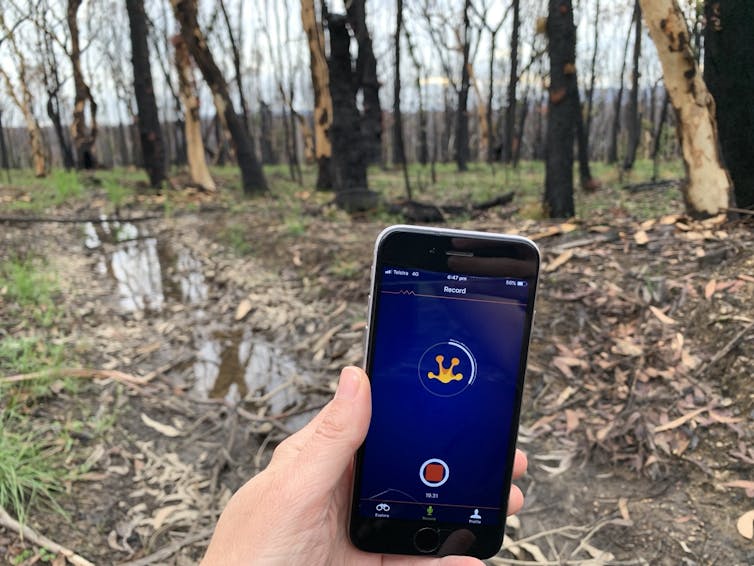
But all was not lost. Thousands of everyday citizens across the fire zone, armed with their mobile phones, began monitoring their local frogs through an app called FrogID.
In research published today, we reveal how 45 frog species, some rare and threatened, were recorded calling after the fires. This has allowed us to collate a snapshot of where frog species are surviving – at least for now.
The FrogID app means anyone can help monitor frog numbers.Jodi Rowley
Scientists knew the damage to many plant and animal species was likely to be dramatic, particularly for species already in trouble. Many of Australia’s frog species are already vulnerable, due to pressures such as disease and habitat loss. There was a very real risk the fires had pushed many frog species closer to extinction. However, information on how frogs respond to fires has historically been limited.
FrogID is a free app downloaded to smart phones. Led by the Australian Museum, the project allows anyone to record a frog call and upload it. The FrogID team then identifies the species by its call, to create a national frog database.
Since the app launched in November 2017, more than 13,000 citizen scientists have recorded the calls of about 220,000 frogs across Australia. Before last summer’s fires, app users had submitted 2,655 recordings of 66 frog species in what would later become fire zones. This gave us a remarkable understanding of the frogs present before the fires.
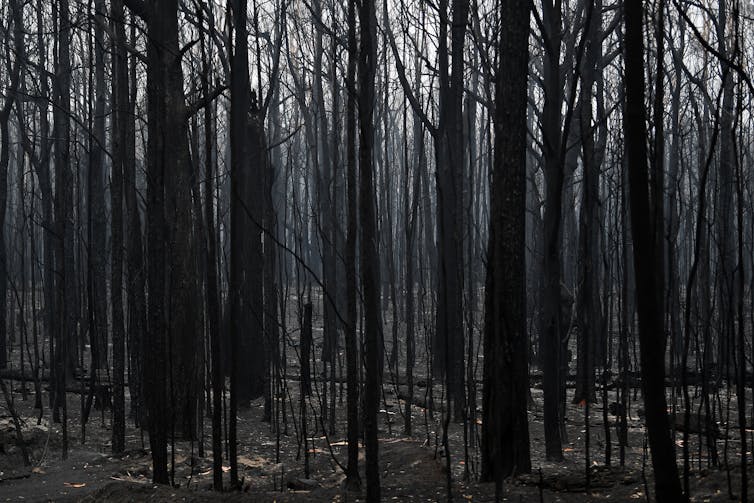
In some places, the fires burnt so intensely it was hard to imagine any wildlife survived.Dean Lewins/AAP
Within four months of the fires, app users submitted 632 recordings. These confirmed the existence of 45 of the 66 frog species known to live in the fire zones. Hearteningly, all 33 summer-breeding frog species recorded before the fires were also detected afterwards. In other words, there were no obviously “missing” frog species.
The frog species recorded most frequently in burnt areas were common, broadly distributed species of low conservation concern. These include the common eastern froglet (Crinia signifera) and striped marsh frog (Limnodynastes peronii).
However, rare and threatened species were also recorded in fire-damaged areas. These included:
the vulnerable southern barred frog (Mixophyes balbus), which lives in patches of forest along the NSW east coast. The species was recorded ten times after the fires in northern NSW
the mountain frog (Philoria kundagungan), endangered in NSW and known only from the headwaters of streams in a few pockets of rainforest in far northern NSW and southern Queensland. It is rarely encountered but was recorded once after the fires
the endangered giant barred frog (Mixophyes iteratus), found in forest from southeast Queensland to central NSW. It was recorded twice after the fires.
There was no clear trend in the ecological group or lifestyle of species that were detected post-fire. Burrowing frogs, tree frogs and ground-dwelling frogs were all detected, as were stream, pond, and land-breeding species.
In many places, frogs survived the inferno against the odds.Jodi Rowley
A powerful tool
The FrogID records are good news. They show some species have survived in the short term, and male frogs are calling to attract female frogs to mate with.
But there is still much we don’t know about the fate of these frogs. For example, many frogs species in southeastern Australia don’t call in the cooler months, so we don’t yet have a clear picture of how these species have fared over winter.
The frogs’ longer-term prospects also remain uncertain. Fire damage varies dramatically from place to place, and the survival of a frog species in one burnt area does not guarantee its survival in another. We remain worried about species with small geographic ranges, especially rainforest species more sensitive to fire.
We urgently need more information on how last summer’s fires affected Australia’s frogs. This is particularly important given the more frequent and severe fires predicted under climate change, combined with all the other threats frogs face.
Traditional biodiversity surveys by professionals will be needed. This is especially true for frog species of high conservation concern at remote or inaccessible sites, for which the FrogID app has little or no data.
But continued data collection by citizen scientists, through projects such as FrogID, will remain powerful tools. They allow information to be gathered quickly and at scale. This raises the chances that species suffering most after a catastrophic event might get the help they need.
Child care will reopen to all Melbourne families this week, as the Australian government’s latest child care support package comes into effect. Education Minister Dan Tehan has pledged:
an additional A$305.6 million for families and child-care providers to deliver hip pocket relief and ensure the sector remains open to help drive the COVID-19 recovery.
Most of the measures are designed to keep afloat Victorian service providers suffering financially due to lockdown (especially in Melbourne). Child care — increasingly recognised as an essential service — has now effectively received three rescue packages in less than 12 months.
Some of the measures will also affect families, but this depends on circumstances such as where they live and what kind of service their children attend.
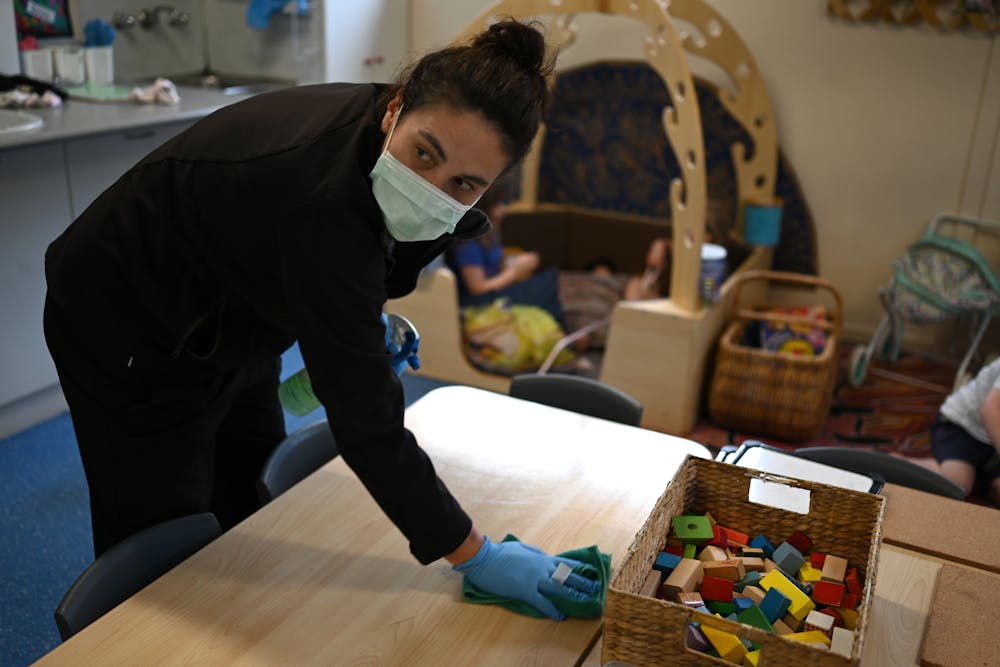
Most of the measures are designed to keep afloat Victorian service providers suffering financially due to lockdown (especially in Melbourne).DAVE HUNT/AAP
I’m a child care provider. How will recovery payments help me?
The government introduced payments of at least 25% of pre-COVID revenue to approved Australian child care services when the previous relief package and Jobkeeper ended for the sector. These payments are known as “transition payments”.
They were a lifeline for Melbourne services while only children of permitted workers and vulnerable children were attending (and paying fees).
These payments were due to end on September 28, but have now been extended for Victorian services only to January 31, 2021.
An additional 15% top-up payment will be provided to out of school hours care (OSHC) providers when schools open to more students. This is currently scheduled to happen in week two of term four (from October 12).
This top-up means OSHC providers’ payments will equal around 40% of their pre-pandemic revenue, recognising they have been hit particularly hard by the lockdown.
Payments to services won’t impact directly on fees for parents. But they will mean their service is more likely to remain financially viable, and open for children to attend when they open up to all families in September and October.
Payments to services won’t impact directly on fees for parents. But they will mean their service is more likely to remain financially viable.DAVE HUNT/AAP
I’m a parent. Will fees change?
The fee freeze makes for a good headline promising more help for parents but it’s difficult to say how much difference it will really make.
Fee freezes might save some families up to A$5 per day, per child. But these aren’t savings on their current spending, it just means they’re being shielded from a planned fee hike. Parents using child care shouldn’t face any fee hikes until January 31 at the earliest.
Whether families actually save anything at all depends on where they live and what provider they use.
Some local councils in Melbourne had already committed to no fee increases. Fees at child care centres that are not run by councils, however, are determined by individual providers. They decide whether and how much to increase fees, so parents’ savings will vary significantly.
Parents with children in four-year-old sessional kindergarten will be saving on fees, with the Victorian government (which co-funds kindergarten with the federal government) committing to free kinder for term four.
Will child care centres lose staff or reduce hours?
The federal government’s employment guarantee, which has been extended along with transition payments, is a big issue for educators and carers.
The government has made it clear it expects child care providers receiving transition payments not to stand down educators or make them redundant, even where there is reduced need for staff.
However, it’s possible for child care centre managers to reduce shifts significantly. For example, under the July transition payment arrangements, centre managers were only required to offer more than one shift to their workers over a period of ten weeks.
More than three quarters of the early childhood centre workforce is casual or part-time, so many Melbourne child care workers are likely to face significant income reductions.
Despite the employment guarantee, there have been reports of Melbourne educators being stood down.
Many child care workers are casual or part time.DEAN LEWINS/AAP
I’m a parent. How will changes to the Activity Test affect me and my subsidy?
The federal government’s “Activity Test” links how much time parents spend in work, education or training with the level of child care subsidy. Parents working and studying less can only access a limited number of subsidised hours of childcare.
But the Activity Test was eased in July, meaning that if parents’ income has been impacted by COVID-19, they can still get the same or more child care subsidy even if they were working or studying less. This measure has now been extended to April 4, 2021.
But parents will still have to meet the gap fees (the difference between fees charged by providers and subsidies paid by the government). For those really struggling, it may be difficult to keep paying fees if one parent is at home and able to care for children.
I’m a parent and I lost my job. Can I get free child care?
Parents who’ve lost their jobs may also be eligible for free child care temporarily. Application for the Additional Childcare Subsidy must be made through Centrelink.
How do filmmakers communicate big ideas on screen? In this video series, film scholar Bruce Isaacs analyses pivotal film scenes in detail.
Watching Christopher Nolan’s 2010 film Inception, especially in the cinema, is an overwhelming experience. The viewer has no idea what is going on but can marvel at the visual spectacle.
In this scene on a Parisian street, young architect Ariadne (Ellen Page) rebuilds the landscape with her imagination and without being bound by physical constraints. It is notable that Nolan forgoes a fully digital effect here, perhaps drawing inspiration from the work of Stanley Kubrick decades prior. This is live-action footage, seamlessly blended digitally. The “radical realness” of the impossible image — with cars travelling vertically through space and the street folding onto itself — is what makes it so strange and so strangely unsettling to us as the audience.
Daniel Andrews’ Sunday announcement of some modest steps out of lockdown will bring both relief and reassurance to many Victorians, but frustration to those who think he should move faster.
Certainly the Morrison government wants the state to take bigger strides.
As the federal government finalises next week’s budget, with a deficit for this financial year of a magnitude none of us have seen before and large red numbers into the future Morrison, Treasurer Josh Frydenberg and Health Minister Greg Hunt applied the blow torch to the premier.
“It will be important that more be done in the weeks ahead to safely ease more restrictions,” they said in a joint statement.
“We note that at similar case levels NSW was fundamentally open while remaining Covidsafe due to a world class contact tracing facility.
“As many epidemiologists have encouraged, we would support Victoria in reviewing the trigger of five and zero cases with regards to the third and last steps.
“As it stands this lockdown is already longer than that faced by residents in many cities around the world. We remain deeply concerned about the mental health impacts of a prolonged lock down on Melbourne residents,” they said.
Andrews has responded to a more rapid than expected fall in new cases, and says he will now be driven by numbers rather than dates.
But there is every indication he will continue to be risk averse, after the disaster of the second wave, and on the evidence of last week’s Newspoll, he has public support for that approach. Some 62% of Victorians thought he was handling COVID well.
Andrews has become a highly polarising figure in the pandemic and that’s only likely to increase after his and other evidence to the inquiry into hotel quarantine, followed by Saturday’s resignation of health minister Jenny Mikakos.
In contrast to his demeanour at his news conferences, when appearing before the inquiry on Friday Andrews seemed to be barely containing his anger.
He, like a conga line of witnesses, couldn’t say who had decided to use private security guards to supervise the quarantine.
But he made it clear he held Mikakos responsible for the program.
She, however, thought responsibility spread more widely and indicated her resignation was triggered by Andrews throwing her under the bus.
It continues to be unfathomable to most observers that no one – whether minister, bureaucrat or anyone else – can answer the fundamental but on the face of it simple question: who made the decision about the private security guards?
But Kristen Rundle, from Melbourne University’s Law School, is not so surprised, given the often opaque accountability situations created by contracting out, increasingly a default practice of governments around the country.
She writes in a policy brief titled Reassessing Contracting-Out published last week, that “we need to look beyond standard mechanisms of political accountability in order to address the structural problems posed by contracting-out highstakes government functions.
“Specifically, we need to analyse more deeply the appropriateness of contracting-out in cases that carry serious consequences for public safety and security, and develop frameworks to achieve better decision-making on when, and whether, to contract out complex government functions.
“The failures in this case underscore that choices about who delivers such government functions, and how, matter to those directly affected by them.”
Clearly the Victorian disaster had three root causes: the bad quarantine arrangements, the failure of Victorian contact tracing, and the vulnerability of aged care.
The first two can be completely sheeted home to the Victorian government; aged care is a federal government responsibility although the state government is responsible for the public health aspects.
Andrews’ supporters aren’t too preoccupied with the state government’s mistakes. They believe he has put health first (despite the death toll, which has been overwhelmingly in aged care). They have been impressed by his willingness to front up day after day to those extended news conferences. They see that as a sign of accountability.
The premier’s critics look at the news conferences in a totally different way. Andrews’ physical presence is not a mark of accountability, they argue, because he pushes aside vital questions (often repeated again and again), saying they must wait for the inquiry’s findings.
Many of Andrews’ strongest critics are those who believe the economy and people’s livelihoods have not received sufficient consideration generally in the pandemic. They are outraged at the economic costs of Victoria’s second wave, and at the slowness of the reopening.
The divisions have an ideological element, between the priorities of the left and the right during the crisis.
Mikakos’ quitting has renewed the calls from those who say it is the premier who should go.
There doesn’t seem a lot of common sense in this. Andrews has said he accepts ultimate responsibility for what’s happened. So he should – what’s occurred in Victoria has been appalling.
But would his going actually do any good? Would a replacement perform any better? Would a change of leader amount to anything more than a notch on the critics’ belts?
While Andrews remains the best person for the current job, the pandemic has revealed serious inadequacies in his government, and thus in his leadership, and in parts of the state’s administration.
Source: The Conversation (Au and NZ) – By Chris Wallace, Associate Professor, 50/50 By 2030 Foundation, Faculty of Business Government & Law, University of Canberra
The politician who achieved equal rights legislation for women in Australia, Hon Susan Ryan AO, died unexpectedly yesterday in Sydney aged 77, still fighting for fairness in a country challenged by deep inequalities.
In 1983, new Prime Minister Bob Hawke appointed Ryan Minister for Education and Youth Affairs and Minister Assisting the Prime Minister for the Status of Women. She was the first woman to be appointed to cabinet in a Labor government.
Rivalled only by the achievement of voting rights for women earlier in the 20th century, the Sex Discrimination Act Ryan created and saw through parliament was the single biggest step forward for women in Australian history.
Ryan was a wry, intelligent, witty and energetic force for good in public life. She rose to the biggest policy challenges besetting Australia – inequality and discrimination – and achieved real change.
She brought brains and spirit to the big fights and relished them. Not for Ryan any slinking to the sidelines, crushed by sledges and slights.
The first time I saw her was at a party in 1983, in the Old Parliament House office of her Hawke Government cabinet colleague, Peter Walsh. Here they led a raucous wine-fuelled rendition of a Catholic hymn, followed by an equally spirited version of The Internationale. Ryan was from a generation of politicians who knew how to fight, have fun and get really important things done.
Born in Maroubra in 1942, Ryan was educated at the Brigidine School where she absorbed the lesson that “St Brigid was the equal of St Patrick, she worked with him in partnership”. It was here she registered too that:
… women were as clever, energetic and knowledgeable as men (but) society at large and the Church placed women in an inferior position and fought hard to keep us there.
Ryan was the first in her family and school to win a scholarship to the University of Sydney. She studied education, expecting to go on to a career in teaching. After graduating she married public servant and later diplomat Richard Butler. “Because of this I lost my scholarship and had to pay back the scholarship money,” Ryan recalled, a penalty not suffered by men in the same position.
In 1965, Ryan and Butler moved to Canberra and the next six years saw Ryan study for an MA in English Literature at the Australian National University, tutor at the Canberra College of Advanced Education (now University of Canberra), and become a founding member of the Belconnen Branch of the ALP.
This was interrupted by two periods living overseas when Butler was posted first to Vienna and then, in the early 1970s, to New York just as the foundational texts of second-wave feminism by Kate Millett, Gloria Steinem and others, primed by earlier work by Betty Friedan, were published. Ryan’s fellow Sydney University alumna Germaine Greer’s The Female Eunuch was part of the mix too, giving Ryan and her peers revolutionary insights into the outrageous injustices permeating their lives as women.
Ryan returned to Canberra in 1971 with their two children but without Butler, whom she divorced the following year. Her energetic, entwined Women’s Electoral Lobby (WEL) and ALP activism were conducted while completing her ANU masters degree and being employed as head of the Australian Council of State School Organisations.
Ryan worked hard for the Whitlam government’s election in 1972. Two federal elections later, at the “Dismissal” election of December 1975, she was elected a Labor senator for the ACT. When Bill Hayden succeeded Gough Whitlam as opposition leader after the 1977 election, he made Ryan Labor’s first ever woman frontbencher with responsibility for communications, the arts, media and women’s affairs.
Focused intently on the development of high-quality policy, Ryan was on the progressive end of the Labor party and impatient with the its left/right factional battles, which she perceived as more about personal power struggles than genuine differences over ideas.
Ryan joined the Hayden-led Centre Left faction, home of federal parliamentary Labor’s sophisticated policy thinkers who modernised the ALP platform in a progressive direction focused on jobs and social justice.
These policies were embraced and implemented by the Hawke government on its election in March 1983, with tremendous success.
Susan Ryan in 1984, the first woman appointed to cabinet in a Labor government.National Museum of Australia
Ryan was initially sceptical of the virtues of Bob Hawke over Hayden as Labor leader and she, like Paul Keating whose dynamism she admired and with whom she shared a deep mutual respect, switched camps late.
Ryan nevertheless came to admire Hawke’s leadership, which culminated in the 1983 victory and three subsequent election wins. With Paul Keating’s 1993 election win, this gave Labor five consecutive terms of government in what it retrospect has come to be seen as a golden age in postwar social democratic politics and policy in Australia.
Within three months of the government’s election, Ryan introduced the Sex Discrimination Bill, which drew heavily on a private member’s bill she pursued unsuccessfully from the opposition benches in 1981. The bill was controversial and its passage rocky. Ryan fought the good fight and won.
Ryan’s work as a spearhead for progressive policy took its toll. As the government wrestled with economic policy adjustments necessitated by Australia’s current account crisis in the mid-1980s, she left politics after just five years in cabinet. Her post-parliamentary life saw her focus on superannuation policy and rights for the aged, especially for older women.
Ryan’s contribution to public life was outstanding. She was happy with the reality of her achievements and did not look for credit or applause. She is a signal example to those who despair of getting things done in democratic politics. Ryan showed, even on the most controversial issues, it can and should be done.
With just under three weeks until the election, Newshub’s new political poll shows the gap is closing between Labour and National, but Labour could still govern alone.
The Newshub Reid Research Poll had Labour at 50.1 percent – down 10 percent on the last poll – but well above National at 29.6 percent.
ACT is on 6.3 percent and the Greens are at 6.5 percent. NZ First is at 1.9 percent.
On those figures, Labour would have 65 seats in Parliament, National 38, and the Greens and ACT eight each.
As for the minor parties, the New Conservatives are polling at 2.1 percent, the Māori party at 1.5 percent and The Opportunities Party at .9 percent.
In the preferred prime minister stakes, Jacinda Ardern is on 53.2 percent and Judith Collins is on 17.7 percent.
Last week’s TVNZ Colmar Brunton poll had Labour at 48 percent, National on 31 percent, ACT on 7 percent, Greens on 6 percent and NZ First on 2 percent.
Victorian Premier Daniel Andrews has announced an end to the curfew and a COVID-safe return to work for 127,000 Melburnians, as restrictions ease at 11.59pm tonight. He has also flagged a provisional early lifting of many other aspects of the lockdown on October 19.
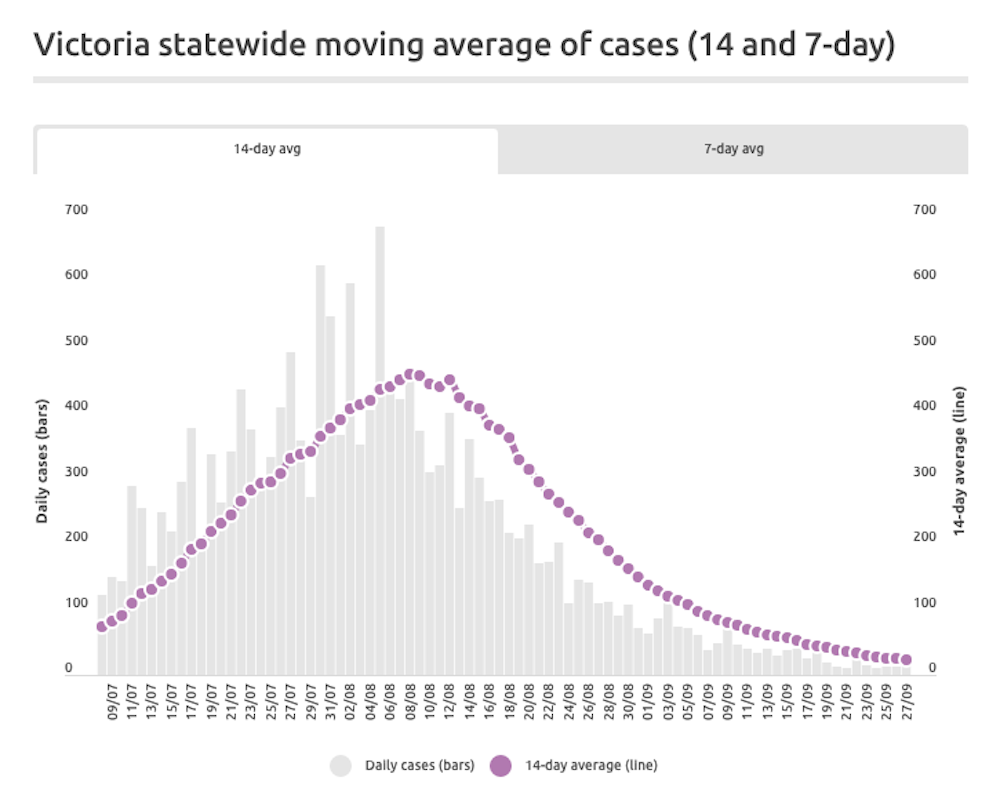
The downward trend in new COVID cases has been better than expected, with the crucial 14-day moving average of daily new cases reaching 22.1. This is good news for Victorians, prompting Andrews to move metropolitan Melbourne to the second step of the state’s roadmap to COVID-normal.
According to the roadmap, today’s announcement was contingent on the 14-day rolling average being below 30-50 cases. The 50-case mark was passed on September 17, and the lower bound of 30 cases was reached a week later, on September 24.
covid19data.com.au
Rather than easing restrictions when the criterion for new cases was met, the government had also, unnecessarily, set a date for moving to the second step: September 28.
Before today’s announcement, the better-than-expected decline in case numbers, coupled with the reduction in the number of “mystery” cases with an unknown source, had led Andrews to flag the possibility of easing restrictions faster than the provisional dates in the roadmap.
This is indeed what he has announced, with the next step potentially moving forward from October 26 to October 19. The government will now rely predominantly on epidemiological thresholds rather than dates. But Andrews added it is necessary to monitor the effects of today’s announcement for a further three weeks.
Andrews and his advisors had to keep in mind the ultimate goal of reaching zero active cases. Lifting restrictions too soon would jeopardise that.
The main changes are cautious ones, and still consistent with the zero target. The key changes are shown below.
One of the most welcome changes will be the abolition of the curfew. It had no real evidence base, given the other restrictions in place, and it became a policy orphan with no one owning up to recommending it.
Retired and serving police officers in Papua New Guinea are being investigated for alleged offences such as gun-smuggling, fraud and theft, according to Police Minister Bryan Kramer.
It includes “massive corruption at the police headquarters in Port Moresby by retired and serving senior police officers”.
“Cases now under investigation are the smuggling of firearms, land/housing fraud, payroll fraud, drugs, fuel theft, insurance scam, stealing from the retired officers’ pension fund and misusing police allowances,” Kramer said.
“Investigations are halfway complete in most of the cases.
“Arrests will be done at the completion of the investigations.”
Kramer said the “massive corruption” at police headquarters in Konedobu was done during the term of the previous government led by former Prime Minister Peter O’Neill.
Kramer said the police force, once described as a national pride, had been “reduced to a private security business serving corrupt politicians and dodgy foreign businessmen”.
Weapons on-sold to province Meanwhile, a source at police headquarters said detectives were struggling with the investigations into the smuggling of guns allegations because the suspects were retired senior police officers.
PNG’s Police Minister Bryan Kramer…PNG police “reduced to a private security business serving corrupt politicians and dodgy foreign businessmen” under the previous government. Image: Kramer Report
“These retired senior officers purchased firearms for the police force and brought them into the country,” the source said.
“However, the firearms were then smuggled out of Port Moresby to another province by a private security company.”
Clifford Faiparikis a reporter for The National newspaper in Papua New Guinea. The Pacific Media Centre republishes National articles with permission.
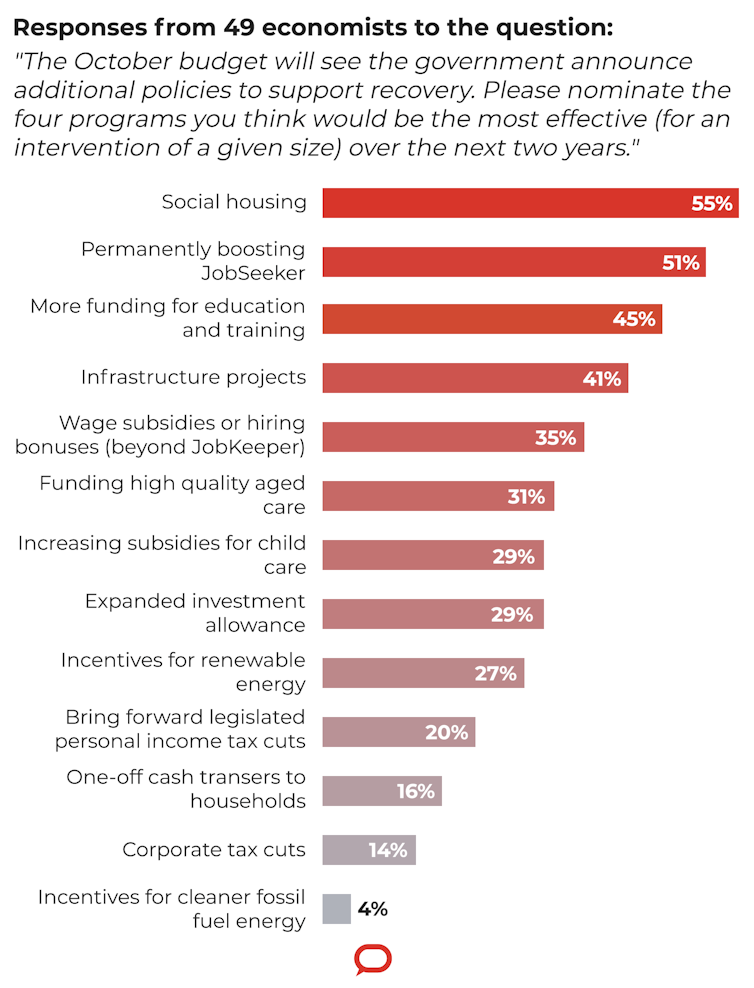
Overwhelmingly, Australia’s leading economists want the budget to boost social housing and the JobSeeker unemployment benefit rather than bring forward personal income tax cuts.
The 49 eminent economists who responded to Conversation-Economic Society of Australia pre-budget survey were asked to rate 13 options in terms of “bang for the buck” – effectiveness in boosting the economy over the next two years.
Among the options offered were boosting JobSeeker (previously called Newstart), wage subsidies beyond the expiry of JobKeeper, one-off cash payments to households, big infrastructure spending, bringing forward the personal income tax cuts, and company tax cuts.
The options were selected by a committee of the central council of the Economics Society and were presented to each surveyed economist in a random (shuffled) order.
The economists surveyed are Australia’s leaders in the fields of microeconomics, macroeconomics, economic modelling and public policy. Among them are former and current government advisers, former heads of statutory authorities, and a former member of the Reserve Bank board.
Each was asked to nominate the four most effective options for boosting the economy.
Economic Society of Australia/The Conversation, CC BY-ND
The most popular option, endorsed by 55% of those surveyed, was boosting spending on social housing.
Monash University econometrician Lisa Cameron said the budget provided an unusual opportunity to fix things for the long term while boosting the economy.
Social housing would leave us with something worthwhile (as did the school hall building program during the global financial crisis) in addition to providing work for the building industry. Alleviating homelessness would be a lasting benefit.
If it goes to the unemployed, it will be spent
The second most popular option, endorsed by 51%, was permanently boosting JobSeeker, previously known Newstart. The temporary boost in the A$282.85 per week payment was wound back last week and will end in December.
Melbourne University economist John Freebairn pointed out that with no real increase in Newstart since 1993 and many on it in demonstrable poverty, every extra cent spent on it will be spent rather than saved.
Supported by fewer than half of those surveyed, but third most popular at 45%, was more funding for education and training.
Flinders University labour market specialist Sue Richardson said education was labour-intensive, which would help with employment, and would assist young people severely hit by the pandemic to get the skills they would need to get jobs rather than stay unemployed.
Matthew Butlin, who heads the South Australian Productivity Commission, said the decimation of income from student fees means universities will have less money to subsidise research. There was a case for more direct funding of university research in the form of competitive grants for projects with practical applications.
The fourth most popular option was infrastructure spending, supported by 41%.
Why not a Hoover Dam, a new Opera House?
Many made the point that the projects chosen would have to be worthwhile in their own right, and feared this might not be the case. Others looked to big “nation building” projects along the lines of the Hoover Dam in the United States which was built during the Great Depression and employed 21,000 people.
“Why not building a massive dam in Australia? Why not building a new Sydney Symphony Orchestra building like the Berlin Philharmonie? Why not expand the National Parks? Why not building green libraries all over Australia?,” asked Sydney University’s Stefanie Schurer.
Done right, like the Sydney Harbour Bridge which was completed during the Great Depression, big imaginative projects could leave us with something valuable.
There was less enthusiasm for continued wage subsidies (35%) and an expanded investment allowance (29%) with University of NSW economist Gigi Foster saying investment allowances could be replaced with income-contingent loans along the lines of the Higher Education Contributions Scheme.
That way businesses could borrow to invest, with an obligation to repay if the investment paid off.
If it goes on tax cuts, it might not be spent
The same approach was taken by some to funding higher quality aged care (supported by 31%) and increasing subsidies for child care (29%).
Economic modeller Warwick McKibbin suggested funding child care through income-contingent loans (repayable on the basis of income) rather than subsidies.
Bringing forward the leglislated personal income tax cuts as proposed by the government and cash payments to households were relatively unpopular, supported by 20% and 16%.
Saul Eslake said that while he agreed with the treasurer that early tax cuts would “put money in people’s pockets”, there was no guarantee the high earners “into whose pockets most of that money would be put”, would take it out and spend it in sufficient quantity.
Eslake suggested that rather than supporting households with cheques as happened during the financial crisis, households could be handed time-limited tradeable vouchers that could be spent in areas hurt by restrictions, such tourism and the arts, or used for other worthwhile purposes such as childcare or reskilling.
Among those who did support bringing forward the tax cuts was John Freebairn, who said that although presented as cuts, what was proposed would do little more than restore what had been lost to bracket creep, keeping income tax steady.
Company tax cuts an also-ran
Company tax cuts, once touted by former prime minister Malcolm Turnbull as the key to jobs and qrowth garnered minimal support, being backed by just six of the 49 economists surveyed.
The least popular option, backed by only economists surveyed, was government support for cleaner fossil fuels such as natural gas. In contrast 13 of those surveyed (26%) backed support for renewable energy.
Source: The Conversation (Au and NZ) – By Prudence Flowers, Lecturer in US History, College of Humanities, Arts, and Social Sciences, Flinders University
Last week, US Supreme Court Justice Ruth Bader Ginsburg died of metastatic pancreatic cancer. Ginsburg’s “most fervent wish”, revealed by her granddaughter, was that she “not be replaced until a new president is installed”.
Just eight days later, President Donald Trump has announced Amy Coney Barrett to fill Ginsburg’s newly vacant seat.
Barrett is 48, a devout Catholic and a professor at Notre Dame Law School in Indiana.
She was appointed by Trump to the US Court of Appeals for the Seventh Circuit in 2017 and was shortlisted for the Supreme Court vacancy ultimately filled by Brett Kavanaugh in 2018.
The future of Roe v. Wade
Ginsburg, known to her fans as the “Notorious RBG”, dedicated her life to the fight for equality and was the de facto leader of the liberal Supreme Court justices. If Barrett is confirmed, and Republicans have indicated they have the votes to fill the vacancy, this will be Trump’s third Supreme Court appointment.
Conservatives on the court would then have a 6-3 majority, which would likely have sweeping implications for an array of issues, including the future of Roe v. Wade, the 1973 Supreme Court ruling that guarantees a woman’s right to an abortion.
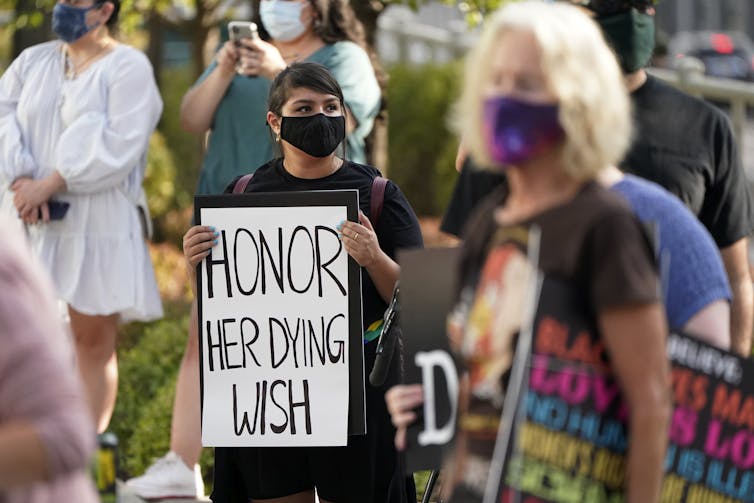
Abortion rights advocates have protested Trump’s move to immediately fill Ginsburg’s seat.Rick Bowmer/AP
Since the late 1970s, Republicans have made opposition to Roe v. Wade a central element of their social, political and legal identity.
The Supreme Court has been at the heart of this strategy. Every Republican presidential candidate since Ronald Reagan has campaigned on a pledge to appoint justices who respect “the sanctity of innocent human life”.
However, once a justice is confirmed to a lifetime appointment on the nation’s highest court, his or her voting behaviour is impossible to guarantee.
In the early 1990s, there were ostensibly seven conservative justices on the court, five of whom had been nominated by Republican presidents Reagan and George H.W. Bush.
Yet in the case Planned Parenthood v. Casey (1992), a challenge over abortion laws in the state of Pennsylvania, a triumvirate of Reagan-Bush appointees sided with the two liberal justices, arguing that “liberty finds no refuge in a jurisprudence of doubt” and the weight of precedent meant Roe v. Wade must be upheld.
Trump believes he has enough Republican votes in the Senate to confirm his pick.ALEX BRANDON/POOL/EPA
But the current crop of conservative justices share a more uniform judicial philosophy than the Reagan-Bush appointments.
Like Barrett and her mentor, the late Justice Antonin Scalia, they champion the legal theory of “originalism”, which views Roe v. Wade and the broader right to privacy as a “fanciful reading” of the US Constitution.
Anti-abortion lawyers argue that if the court finds that the right to privacy does not exist, “the state would be free to regulate and prohibit abortion”.
When Kavanaugh was confirmed in 2018, conservatives had a 5-4 majority on the court. Court watchers predicted Chief Justice John Roberts would emerge as a swing vote on a range of issues.
Roberts had cast votes with the liberal justices, most significantly in upholding the constitutionality of Obamacare (otherwise known as the Affordable Care Act) in 2012. He also has a well-established interest in the reputation of the Supreme Court and the importance of precedent.
In his 15 years on the bench, Roberts has made it clear he does not support abortion rights, but he was expected to avoid an outright assault on Roe v. Wade.
Supreme Court Chief Justice John Roberts would no longer be a swing vote on a 6-3 majority conservative court.Leah Millis/Pool Reuters
In June this year, Roberts sided with the liberal justices to rule a Louisiana anti-abortion law unconstitutional on the grounds that precedent was established in a nearly identical case the court had struck down in 2016. Yet in his separate concurrence, Roberts was clear he still agreed with his dissenting position in 2016.
If Barrett is confirmed, Roberts’ power as a swing voter will be dramatically diminished. This would affect the final judgements of the court, but just as significantly, it would shape what kind of cases the court hears.
Less dependent on Roberts, the conservative justices are likely to take up a broader range of controversial matters, confident they have a majority.
Currently, there are two abortion cases the justices could decide to hear. One is a challenge to a 2018 Mississippi law that banned abortion from 15 weeks, and the other relates to the provision of early medication abortions during the COVID-19 pandemic.
Many of these could be heard by the court in the next year or two. These include targeted regulation of abortion provision (TRAP) laws, which place prohibitive and medically unnecessary restrictions on doctors and clinics that provide abortion care.
Activists protesting a new law in Utah last year banning abortions after 18 weeks.Rick Bowmer/AP
There are also gestational bans (outlawing abortion after 20 weeks), method bans (targeting dilation and evacuation, the most common second-trimester abortion procedure) and reason bans (outlawing abortion for reasons of race, sex or disability).
There are also more restrictive bans that prohibit abortion in the first trimester, either at conception or up to 6–8 weeks’ gestation.
Although Roe v. Wade is politically contentious, its popularity with the general public has remained stable since the late 1980s.
Most Americans support the ruling; surveys last year found between 60% and 77% want to see the decision upheld.
Yet the future of safe, legal abortion in the US will ultimately depend on how emboldened the conservative justices now feel.
Will they choose cases that incrementally erode abortion rights and access, or will they, for the first time since the 1990s, push for reconsideration of the constitutional issues and rights at the very heart of Roe v. Wade?
UPDATE: This story was updated on September 27 after Trump officially announced Barrett as his pick.
Three crew members of an unnamed foreign ship intercepted by a Papua New Guinea Navy vessel near Kavieng, New Ireland, last month have denied violating local laws and withholding information from authorities.
In the Kavieng District Court before Magistrate Patrick Baiwan on Wednesday were ship’s captain Shi Kehu from Fujian province in China, second-in-command Ying Kit Lam from Hong Kong, and crew member Mariglen Dhimogjini from Albania.
They will return to court next Tuesday and have been ordered to stay on board the vessel berthed at the Kavieng port, under a 24/7 police guard.
The unnamed vessel which police believe is linked to a K1.47 billion (NZ$642 million) drug bust recently in Australian waters, was intercepted in waters north of Kavieng on August 23 by the crew of the HMPNGS Moresby.
Shots were fired at the crew when they refused to stop.
The captain was later treated in hospital for a gunshot wound.
National Fisheries Authority (NFA) executive manager monitoring control and surveillance Giza Komangin told The National the three had violated provisions of the Fisheries Management Act 1998.
Captain charged Captain Shi was charged with:
REFUSING to divulge names and contacts of persons and vessels that the vessel was conducting bunkering activities at sea;
REFUSING to stop the vessel for boarding and inspection by fisheries and navy officials when instructed to;
DESTROYING and deleting electronic data and tracks to avoid seizure or detection by fisheries officers;
FAILING to comply with requirements of gear stowage when navigating inside PNG waters; and,
VIOLATING other state laws to supply fishing vessels with fuel and other supplies an activity requiring a valid fishing licence.
Yong was charged with knowingly giving information that is false and misleading about the operation of the vessel and refusing to divulge names of contacts of person to investigation officials.
Dhimogjini was charged with refusing to divulge names and contacts of persons and vessels engaged in its operation inside Pacific Island waters.
Vessel named Min Shi Yu NFA officials during their investigations discovered that the vessel’s name was Min Shi Yu 00368 engaged in fishing activities, and supplying fuel and food to other fishing vessels at sea.
On May 1, 2020, it left Quanzhou in China with a crew of seven and picked up Kit Lam and Mariglen Dhimogjini in Hong Kong.
The vessel had no markings to show its name, flag or country of registry, or international radio call sign to show that it was legitimately navigating through PNG waters.
Only three of the nine crew members have passports, five have identification cards, and one has no identification at all and no logbooks or records were available.
Miriam Zarrigais a reporter for The National newspaper in Papua New Guinea. The Pacific Media Centre republishes National articles with permission.
Source: The Conversation (Au and NZ) – By Prudence Flowers, Lecturer in US History, College of Humanities, Arts, and Social Sciences, Flinders University
Last week, US Supreme Court Justice Ruth Bader Ginsburg died of metastatic pancreatic cancer. Ginsburg’s “most fervent wish”, revealed by her granddaughter, was that she “not be replaced until a new president is installed”.
Just eight days later, President Donald Trump is expected to announce Amy Coney Barrett to fill Ginsburg’s newly vacant seat.
Barrett is 48, a devout Catholic and a professor at Notre Dame Law School in Indiana.
She was appointed by Trump to the US Court of Appeals for the Seventh Circuit in 2017 and was shortlisted for the Supreme Court vacancy ultimately filled by Brett Kavanaugh in 2018.
The future of Roe v. Wade
Ginsburg, known to her fans as the “Notorious RBG”, dedicated her life to the fight for equality and was the de facto leader of the liberal Supreme Court justices. If Barrett is confirmed, and Republicans have indicated they have the votes to fill the vacancy, this will be Trump’s third Supreme Court appointment.
Conservatives on the court would then have a 6-3 majority, which would likely have sweeping implications for an array of issues, including the future of Roe v. Wade, the 1973 Supreme Court ruling that guarantees a woman’s right to an abortion.
Abortion rights advocates have protested Trump’s move to immediately fill Ginsburg’s seat.Rick Bowmer/AP
Since the late 1970s, Republicans have made opposition to Roe v. Wade a central element of their social, political and legal identity.
The Supreme Court has been at the heart of this strategy. Every Republican presidential candidate since Ronald Reagan has campaigned on a pledge to appoint justices who respect “the sanctity of innocent human life”.
However, once a justice is confirmed to a lifetime appointment on the nation’s highest court, his or her voting behaviour is impossible to guarantee.
In the early 1990s, there were ostensibly seven conservative justices on the court, five of whom had been nominated by Republican presidents Reagan and George H.W. Bush.
Yet in the case Planned Parenthood v. Casey (1992), a challenge over abortion laws in the state of Pennsylvania, a triumvirate of Reagan-Bush appointees sided with the two liberal justices, arguing that “liberty finds no refuge in a jurisprudence of doubt” and the weight of precedent meant Roe v. Wade must be upheld.
Trump believes he has enough Republican votes in the Senate to confirm his pick.ALEX BRANDON/POOL/EPA
But the current crop of conservative justices share a more uniform judicial philosophy than the Reagan-Bush appointments.
Like Barrett and her mentor, the late Justice Antonin Scalia, they champion the legal theory of “originalism”, which views Roe v. Wade and the broader right to privacy as a “fanciful reading” of the US Constitution.
Anti-abortion lawyers argue that if the court finds that the right to privacy does not exist, “the state would be free to regulate and prohibit abortion”.
When Kavanaugh was confirmed in 2018, conservatives had a 5-4 majority on the court. Court watchers predicted Chief Justice John Roberts would emerge as a swing vote on a range of issues.
Roberts had cast votes with the liberal justices, most significantly in upholding the constitutionality of Obamacare (otherwise known as the Affordable Care Act) in 2012. He also has a well-established interest in the reputation of the Supreme Court and the importance of precedent.
In his 15 years on the bench, Roberts has made it clear he does not support abortion rights, but he was expected to avoid an outright assault on Roe v. Wade.
Supreme Court Chief Justice John Roberts would no longer be a swing vote on a 6-3 majority conservative court.Leah Millis/Pool Reuters
In June this year, Roberts sided with the liberal justices to rule a Louisiana anti-abortion law unconstitutional on the grounds that precedent was established in a nearly identical case the court had struck down in 2016. Yet in his separate concurrence, Roberts was clear he still agreed with his dissenting position in 2016.
If Barrett is confirmed, Roberts’ power as a swing voter will be dramatically diminished. This would affect the final judgements of the court, but just as significantly, it would shape what kind of cases the court hears.
Less dependent on Roberts, the conservative justices are likely to take up a broader range of controversial matters, confident they have a majority.
Currently, there are two abortion cases the justices could decide to hear. One is a challenge to a 2018 Mississippi law that banned abortion from 15 weeks, and the other relates to the provision of early medication abortions during the COVID-19 pandemic.
Many of these could be heard by the court in the next year or two. These include targeted regulation of abortion provision (TRAP) laws, which place prohibitive and medically unnecessary restrictions on doctors and clinics that provide abortion care.
Activists protesting a new law in Utah last year banning abortions after 18 weeks.Rick Bowmer/AP
There are also gestational bans (outlawing abortion after 20 weeks), method bans (targeting dilation and evacuation, the most common second-trimester abortion procedure) and reason bans (outlawing abortion for reasons of race, sex or disability).
There are also more restrictive bans that prohibit abortion in the first trimester, either at conception or up to 6–8 weeks’ gestation.
Although Roe v. Wade is politically contentious, its popularity with the general public has remained stable since the late 1980s.
Most Americans support the ruling; surveys last year found between 60% and 77% want to see the decision upheld.
Yet the future of safe, legal abortion in the US will ultimately depend on how emboldened the conservative justices now feel.
Will they choose cases that incrementally erode abortion rights and access, or will they, for the first time since the 1990s, push for reconsideration of the constitutional issues and rights at the very heart of Roe v. Wade?
Academics who made allegations of racism at the University of Waikato are welcoming the outcome of an independent review.
While individual claims have been dismissed as “inaccurate”, “incorrect” and “reflective of differing perspectives”, it is hoped the findings could lead to nationwide action on racism at tertiary institutions.
Six academics wrote to the Ministry of Education last month, expressing concerns about casual and structural racism at the University of Waikato – prompting the review.
The review was led by Harawira Gardiner and Hekia Parata, who held individual and group meetings with 80 people and received 96 submissions, and the findings were released yesterday.
Instead of upholding specific claims, it concluded that New Zealand’s public institutions, including universities, adhere to Western university traditions and cultures – so there was a case for structural, systemic, and casual discrimination.
“Today, in 2020, in this post-settlement world, it is not acceptable for places of teaching and learning, of research, scholarship and debate, of nation building, to continue this selectively accommodating patronage, of Māori, tāngata whenua, their mana, tikanga and mātauranga,” it said.
Delighted with outcome Professor of Māori Education at Victoria University of Wellington Joanna Kidman – who has publically supported the six academics – says she was delighted with that outcome, and confirmation from the University of Waikato that it would set up a taskforce to “open up the dialogues” and tackle the issues.
“I think this will be a positive step forward… we will look towards the university to lead what could be a model for other universities in times to come,” she said.
However, she said the findings could also be put on a “national footing”.
“We’ve seen recently, a group of Māori professors have put an open letter to Education Minister Chris Hipkins saying that they would like an independent review of New Zealand universities. I think this is an excellent way forward.”
The report also recommended the university engaged in a future-focused process to determine how to apply the 1840 Treaty of Waitangi, and to refresh its relationships with iwi.
The University of Waikato declined to comment further on the report or speak to RNZ, but Vice-Chancellor Professor Neil Quigley posted a video statement saying the university council unanimously accepted the recommendations.
He said the taskforce would create an action plan over the next few months.
“This is an opportunity for the University of Waikato to provide leadership both here, and nationally, for the development of ideas that will address structural and systemic discrimination and racism in the university system,” he said.
“It’s going to be a difficult journey, a challenging journey, but we are committed to making it work.”
This article is republished by the Pacific Media Centre under a partnership agreement with RNZ.
Amid the COVID-19 pandemic, it’s easy to forget one of the largest health challenges we face remains the global obesity epidemic. World Health Organisation data shows obesity has nearly tripled in less than 50 years, with about 40% of adults worldwide now overweight or obese. High body fat increases the risk of chronic diseases, including heart problems, diabetes and cancer.
However, it’s not simply the total amount of body fat that can increase the risk of disease. The type and location of fat is also important. We’ve known for some time that subcutaneous fat — the fat just below the skin — increases inflammation in the body. But in recent years, researchers have realised an even more serious risk is the unseen deep body fat that accumulates around vital organs.
Fat around organs can be ‘toxic’
Fat is not all bad — in fact, some fat does a lot of good. It helps protect vulnerable organs and tissues, and provides a convenient energy supply. If you’re out in the cold, it’s essential fuel for body warming through shivering.
But excess fat can increase blood pressure and potentially lead to complications such as heart disease and stroke. Many clinicians use body mass index (BMI) to measure a healthy weight range. It’s calculated as body weight divided by the square of height, and it factors in a healthy amount of fat.
But BMI can’t provide information about the shape and size of potentially dangerous internal fat deposits, known as “visceral fat”. Over recent years it’s become apparent visceral fat can lead to disease, and good fat can turn into toxic fat when there is too much.
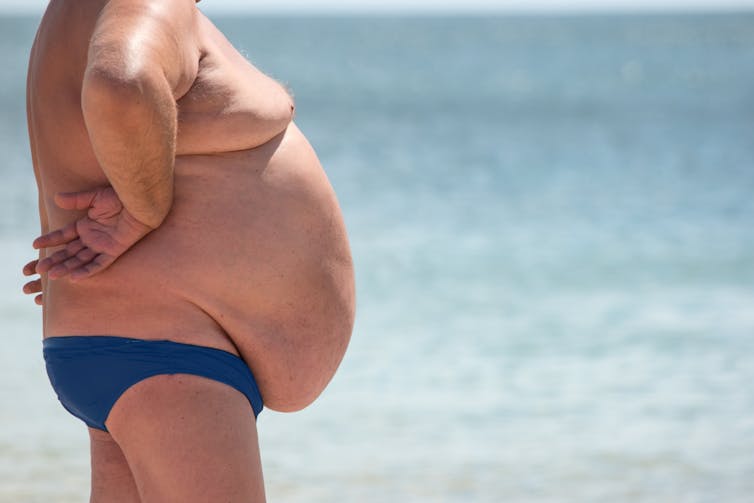
It’s well-known high amounts of body fat can lead to further health problems. But lesser-known is that deep fat wrapped around organs can release damaging molecules.Shutterstock
Various organs seem to accumulate visceral fat. This can be a problem because it can create and release damaging molecules and hormones into the blood. These are transported in the bloodstream, potentially causing health complications in distant parts of the body.
For example, toxic fat can release proteins that blunt the body’s sensitivity to insulin. Blood glucose levels then rise, potentially causing diabetes in the long term. Visceral fat can also stimulate uncontrolled cell growth and replication, potentially triggering some forms of cancer. A fatty liver is associated with metabolic diseases, and excess kidney fat interferes with the body’s fluid balance.
The heart is especially vulnerable
Visceral fat can also directly affect the organ around which it’s wrapped. Our new research, published in September in the Journal of the American College of Cardiology, found visceral fat around the heart produces biochemical molecules that can make the heart beat erratically. These molecules potentially cause a serious heart condition called atrial fibrillation, by disrupting the heart’s electrical activity.
Atrial fibrillation is one of the most common types of heart rhythm disturbance, and one in three people over 55 will develop the condition. It occurs when the regular signal to drive each heartbeat originating in the top portion of the heart, the atria, is disrupted. It can cause an irregular and chaotic heartbeat, disrupting the heart’s coordinated pumping action. This can mean not enough fresh blood is circulated to allow regular daily activity.
For some people, living with episodes of atrial fibrillation is a daily challenge – coping with bouts of dizziness, the distressing awareness of a “racing heart”, and chest palpitations. Other people may be unaware they have the condition and the first sign could be tragic, such as a stroke due to a blood clot travelling to the brain. This can lead to heart failure.
An advertisement from the Western Australian health department warning viewers about toxic fat. Only in recent years have researchers discovered the dangers of hidden fat around organs.
We worked with clinical cardiologists at the Royal Melbourne Hospital and found fat around the heart secretes molecules which change how nearby cells “talk” to each other, slowing cell-to-cell communication. Because the transfer of electrical signals in the heart muscle are delayed, the heartbeat is potentially destabilised.
Although a high BMI increases the risk of atrial fibrillation, it’s the fat burden on the heart, and not BMI itself, that’s most important in electrical and structural disruption.
This suggests toxic substances released from the surrounding fat can directly harm the nearby organ, without travelling via the blood.
For heart patients, these findings mean the surgical removal of cardiac fat could be an effective treatment to consider. Also, it potentially paves the way for the future development of drugs that can suppress the release of damaging molecules from hidden fat.
Nevertheless, these findings underscore the danger of an “obese heart”, particularly amid the COVID-19 pandemic. Research is emerging that obesity is a major risk factor for serious complications while infected with the virus, and the fat load on the heart may be implicated.
Staff of the regional University of the South Pacific have condemned the Fiji government’s “dictatorial” action in freezing a $28 million grant, accusing it of holding the governing University Council to ransom and jeopardising the future of students.
“Fiji is reneging on its commitment to its people and the region,” say the staff in a letter to Prime Minister Voreqe Bainimarama.
The letter, signed yesterday by the university’s academic Association of USP Staff (AUSPS) and the USP Staff Union (USPSU) leadership, was sent in support of the 29,000 students following the grant suspension statement by the Attorney-General that has “sent shock waves across this regional institution to which 80 percent of graduates from Fiji are indebted”.
Attorney-General Aiyaz Saiyed-Khaiyum was reported as saying the Fiji government – as the largest grant contributor to the USP – was concerned at the “continuous question marks about the lack of adherence to the principles of good governance in the day to day administration of USP”.
This came after months of conflict at the regional institution between the University Council and the Fiji-based university management.
It also followed recent exoneration by the University Council of popular Canadian vice-chancellor Professor Pal Ahluwalia who had been targeted by two senior Fiji officials over his reforms.
Yesterday’s staff letter said: “It is poor governance when a single member state of the USP Council attempts to dictate its course of action.
Critical financial position “The staff of the USP strongly object to the AG and Minister for Economy’s decision to cease Fiji’s grant contribution to the USP,” the letter said.
“This places the university in a critical financial position, jeopardising the education of Fiji students (80 percent) and Fiji staff (80 percent).
“This decision is viewed as an assault on the Fiji students and staff who, to date, in this covid and pre-covid environment of 2019 have been able to continue their education and work with minimum impact under the current vice-chancellor’s prudent leadership and council oversight.
“The government is seen to be using Fiji students and staff to dictate to and to hold the USP Council to ransom whilst holding a ‘gun’ to the head of the vice-chancellor and president.
“The action is tantamount to ‘cutting off USP students and staff legs at their knees’ and therefore their lifelines to coping with living in the current and post-covid environment.
“Not only will hundreds of families suffer, the quality of support and education for USP students in Fiji and the region will be seriously affected due to the domino effect of this decision.
“The question being asked is, why would the government use such strong arm tactics and punitive action to jeopardise the education of its youth who are their voters and the next generation of leaders when the USP’s supreme governing body of 12 regional states and development partners have spoken,” the letter said.
‘Mere pawns on political game’ “Rather than being treated as valuable citizenry, it appears that all are mere pawns in a political game.
“The vice-chancellor and president is doing what every government, university, corporation and family business in the world needs to do to survive – reflect, redesign and reorganise.
To date, said the letter, no staff member had lost a job, no student had been refused admission – except for “mandated academic reasons” – and there had been an increase in student enrolments.
“The gravity of this decision and its implications require serious reflection on the basis of the decision and in-depth reconsideration by the Fiji government for the greater good of the students of Fiji and our Pacific `vuvale’ [canoe sail].”
Fiji Labour Party Leader Mahendra Chaudhry has branded the Economy Minister’s suspension of Fiji’s grant to USP as “simply childish”, reports Fiji Village radio.
Chaudhry said it looked like Fiji wass on its own, “like a lone wolf crying foul”.
The FLP leader said he was concerned that students’ university education would be affected and it would also affect the reputation of USP.
Testing remains a vital component of Australia’s success in managing COVID-19.
We need to diagnose people infected with SARS-CoV-2, the virus that causes COVID-19, as early as possible so they can be isolated from others and their contacts quarantined. Testing also helps us understand to what degree the virus is present in the population, so we can tailor public health measures accordingly.
If you’ve had a COVID-19 test, in all likelihood you received a PCR test. That’s the one with the throat and nose swabs, and is regarded as the “gold standard” in COVID-19 testing.
But now the Therapeutic Goods Administration (TGA) has approved a new kind of COVID-19 test, which can produce results in as little as 15 minutes, as opposed to a day or more for standard tests.
So is this new rapid test set to revolutionise COVID-19 testing in Australia? Not quite yet.
The traditional tests
Nucleic acid tests, or PCR tests, can detect ribonucleic acid (RNA) of SARS-CoV-2 from a day or two before symptoms start, and for a week or more afterwards, as symptoms resolve. Of course, some people will test positive without ever having symptoms.
PCR tests have been the backbone of SARS-CoV-2 testing worldwide. Because of the vast global experience with PCR tests and their high performance, they’re considered the most reliable COVID-19 test.
PCR tests require specialised laboratory equipment and trained scientists and technicians to test the specimens; processing and testing take several hours.
Since January, we’ve performed an astonishing 7.4 million SARS-CoV-2 PCR tests in Australia, which has needed a massive upscaling of capacity in laboratories nationally.
At times, demand for PCR testing has exceeded capacity, occasionally resulting in delays of up to several days in getting results back to patients. Meanwhile, laboratories swamped with COVID-19 tests may be limited in their capacity to perform their routine business, including diagnostic testing for other infectious diseases.
As people are required to isolate until they receive a negative test result and their symptoms resolve, these delays may come at a cost to the person waiting, their family, and the economy.
Recognising these costs may lead some people to choose not to be tested, Victoria has offered financial compensation for people without leave entitlements awaiting test results.
But delayed case confirmation also increases the time to identification and quarantine of contacts, undermining public health efforts.
Rapid antigen tests can diagnose COVID-19 in 15 minutes. They’re relatively inexpensive and require a swab from the nose.
These tests detect viral antigens, proteins on the surface of SARS-CoV-2. The immune system recognises these proteins as foreign, and responds by making antibodies to SARS-CoV-2 (“anti-gen” means antibody generator).
Antigen tests perform best early in the infection when the amount of virus in a person’s system is highest. For a person with symptomatic COVID-19, this would be in the first week of symptoms. So they only pick up current infections – unlike antibody tests, which can detect if a person was previously infected with SARS-CoV-2.
Four SARS-CoV-2 rapid antigen tests have been licensed for use in Australia in the past two months.
Unfortunately, rapid antigen tests for COVID-19 appear to be less sensitive than PCR tests, meaning they may give a negative result in someone who does actually have COVID-19. One of the recently licensed rapid antigen tests may give a false negative result in up to 18.3% of people with COVID-19 diagnosed by PCR.
While a positive rapid antigen test result is more reliable, widespread use of these tests in asymptomatic people will result in some false positive results — that is, a positive test result in someone who doesn’t have COVID-19.
At this stage, national COVID-19 guidelines don’t include information on antigen tests. So a person with a positive antigen test would need to undergo a PCR test to be counted in Australia’s official COVID-19 case numbers.
Our capacity to process COVID-19 tests has been challenged at times during the pandemic.James Ross/AAP
Considering the pros and cons
We’re faced with a trade-off between the potential benefits of the rapid antigen tests — the ability to test larger numbers of people, consuming fewer laboratory resources, and quicker results — and the potential to miss a few cases because of the lower test sensitivity.
Despite the lower sensitivity, increasing testing rates might result in an overall net increase in the proportion of COVID-19 cases diagnosed, and therefore a public health benefit by preventing onward transmission from these cases.
One possible strategic use of these tests may be in screening people without symptoms to detect asymptomatic and pre-symptomatic infection that might otherwise go undetected. This could include people in workplaces where ongoing exposure to colleagues and the public is unavoidable, including sectors of the food supply chain or other essential services.
Because of the lower test sensitivity for the rapid antigen test, a PCR test remains most appropriate for people with symptoms, those at greater risk of poor outcomes from COVID-19, and people working in high-risk settings like aged care and health care.
While rapid antigen tests show promise, we’ll need to evaluate their efficacy in Australia before we can determine their role in our fight against COVID-19.
Source: The Conversation (Au and NZ) – By Joanna Mendelssohn, Principal Fellow (Hon), Victorian College of the Arts, University of Melbourne. Editor in Chief, Design and Art of Australia Online, University of Melbourne
Namatjira junior’s subject is a double portrait of himself with Adam Goodes called Stand strong for who you are. The painting, in Namatjira’s characteristic style, shows the two firmly clasping hands.
In the background we see Goodes the champion footballer, Goodes responding to racial vilification, and Goodes standing firm with the Aboriginal flag. Blood red footprints are the record of the path they have walked. This is the art of a generation of Aboriginal people who will not accept being downtrodden.
It is worth noting the trustees, laid down by Jules François Archibald’s will as judges of the prize which he established, are (with two exceptions) non-artists. Their choice is more than purely aesthetic.
I have long argued the Archibald is in essence a social history prize, not an art prize. In announcing the first Indigenous winner in the prize’s history, this year the guardians of New South Wales’ visual cultural heritage are proclaiming the value of integrity, and for Aboriginal people to stand proud. They are also indicating it is no longer a given white men of a certain class are entitled to take the prize.
Winning artist Vincent Namatjira.AGNSW/Meg Hansen/Iwantja Arts
As fine as this painting is, it is not as strong as his 2018 entry Studio self portrait, which later entered the gallery’s collection. That showed his studio, his love of Chuck Berry, and in the background the always present legacy of Albert.
Albert Namatjira’s legacy is seen throughout all the prizes. Every Aboriginal artist I know is aware of how he appropriated the grammar of Western art to paint his country. Every Aboriginal person I have met knows how he was chewed up and spat out by the colonial legal system. His art has stood as a message to successive generations that they too can be artists.
Nowhere is that legacy more evident than in Hubert Pareroultja’s Tjorita (West MacDonnell Ranges, NT), this year’s Wynne Prize winning painting. The Wynne Prize is awarded annually for “the best landscape painting of Australian scenery in oils or watercolours or for the best example of figure sculpture by Australian artists”.
This is a large work, exquisitely painted in a detailed style that cites Namatjira’s landscapes. But because of its detail, it also holds an otherworldly quality.
Pareroultja is a Western Aranda man, so those who know Namatjira’s country will find the subject matter to be familiar. It is no longer a surprise to find Aboriginal artists being awarded the Wynne Prize, but this is the first time a painting that belongs to the same visual tradition as well as the same cultural tradition as Namatjira has been so honoured.
Tjoritja (West MacDonnell Ranges, NT), winner of the 2020 Wynne Prize, by Hubert Pareroultja.AGNSW/Mim Stirling
Artists’ choice
The Sulman Prize is judged by an artist, and is more adventurous than the Archibald and Wynne. Khadim Ali awarded this year’s prize to Marikit Santiago for The divine, a tribute to her three children.
They are painted as saints, gold haloes and all. She has consciously drawn on her heritage as a Filippina artist as well as the central place her children hold in her life. The work’s subjects even participated in creating its complex patterned background.
Marikit Santiago’s The divine, winner of the 2020 Sulman Prize.AGNSW/Jenni Carter
The Archibald and Wynne are judged on the morning of the announcements, but the Sulman is judged some time before. So Santiago was the only artist physically present when the chairman of the trustees, David Gonski, made his announcement.
A different kind of announcement at AGNSW.Author, Author provided (No reuse)
Unlike previous years where the crush of journalists, artists, dealers and others associated with the event can induce claustrophobia, the gallery was dominated by television cameras and a crew at the bank of computers. The silence in the minutes before AGNSW Director Michael Brand introduced Gonski for the announcements was almost unnerving. The switch to the other winners, streamed live from their studios in the Northern Territory went without a hitch. It was an impressive production, this art prize in the time of COVID-19.
Archibald finalists will be on view at the AGNSW until January 10. They will then travel to the Tweed Regional Gallery & Margaret Olley Art Centre, Cairns Art Gallery, Griffith Regional Art Gallery, Broken Hill Regional Art Gallery, Shoalhaven Regional Gallery, and Penrith Regional Gallery.
Source: The Conversation (Au and NZ) – By Simon Coghlan, Senior Research Fellow in Digital Ethics, Centre for AI and Digital Ethics, School of Computing and Information Systems, University of Melbourne
Violence against animals in video games is ubiquitous. Players can kill or torture animals in various popular games, including Minecraft and Grand Theft Auto V. The rise of this (increasingly realistic) trend in games, along with people’s tendency to go along with it, raises important questions.
Violence against humans in video games has long been contentious – underpinned by the never-ending debate over whether on-screen violence begets the real thing. But violence against animals in video games has attracted considerably less attention.
In a recently published paper, we argue there is good reason to think violence against animals in video games is problematic – perhaps even more so than in-game violence against humans. We think game violence against animals is more likely to promote disrespect for their living counterparts.
The jury is out
In 2005, Australia banned a first-person shooter game called Postal 2, in which players could mutilate and desecrate (virtual) human bodies. Australia has controversially banned several games available in other countries because of depictions of violence and other potentially objectionable themes.
Players evidently have varying views on harming virtual animals. Some express concern or remorse — one gamer wrote on a forum:
It’s weird how bad I feel about killing animals in the game … I will actively try and shoot guys off horses instead of just shooting the horses.
People for the Ethical Treatment of Animals (PETA) – itself a somewhat troubledorganisation – has criticised games it says “promote hurting and killing” animals. Examples include whale-hunting in Assassin’s Creed, and fishing and catching bugs in Animal Crossing: New Horizons.
Other players have no such qualms, however, with one writing:
I kill humans in games all the time. Why would I care about animals?
Many share this view. Video game “amoralists” say abusing animals (or humans) in video games can’t be wrong, as the “victims” are virtual and no living being is hurt.
It’s not clear exactly why players feel so differently about in-game violence. Attitudes towards in-game violence may be shaped by personal views, social mores, gaming culture and also the amount someone plays violent games.
If video games can promote particular ethical messages, could certain games encourage disrespect for living things?
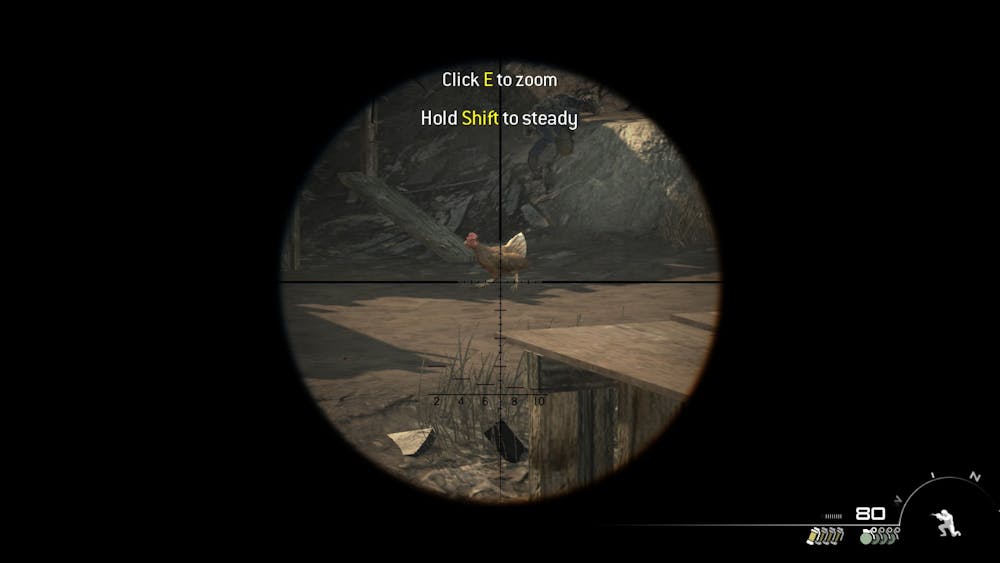
First-person shooters, such as Call of Duty, have been around for more than 45 years now. They’re some of the most popular video games today.jit/Flickr, CC BY-NC-SA
A moral dilemma in plain sight
Social scientists have long debated whether violent video games cause antisocial attitudes towards other people. Some think they might, but conclusive evidence for a causal link is lacking. The moral issue of violence against animals in video games has received much less philosophical attention.
Both animals and humans are often portrayed as objects to kill and harm for fun in gaming. However, animals are presented in even more disposable ways. They are often mere tools for players to kill to complete quests, or to gain materials and trophies.
This is true even for games in which players are encouraged to reflect morally on their in-game actions. In Dragon Age: Inquisition, the game’s characters will approve or disapprove of a wide variety of player actions. But harming non-aggressive wild animals is not one of the things that prompts a moral reaction.
While societal respect for animals is growing (albeit slowly), animals today are routinely treated very badly. We confine them to factory farms, put them on live export ships where many suffer (and even die) and “humanely” kill unwanted companion animals.
Many of us ignore these realities. Morally speaking, animals are relatively invisible to society – whereas other humans generally are not. In this context, depicting animals as disposable commodities in video games could reinforce disrespect towards them, at least for many players.
Some games may help normalise the mistreatment and moral invisibility of animals.
Examining our prejudices
So if video games can, in fact, reinforce disrespect for animals, does this mean we should ban or boycott them? We don’t advocate that. However, it would be useful for scientists to investigate whether video games do help or hinder social respect for animals.
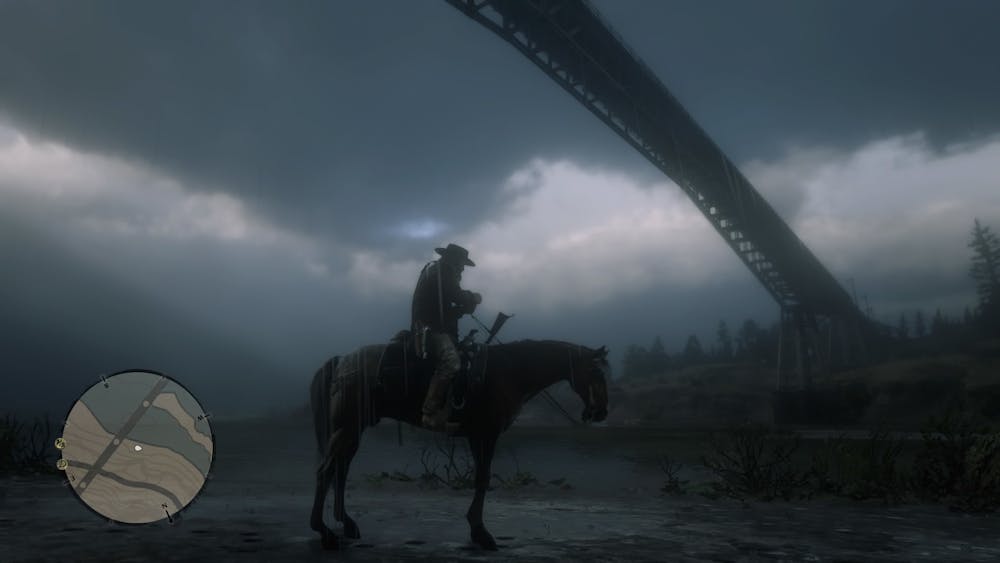
Game designers may also consider depicting animals in ways that encourage (or at least don’t inadvertently discourage) respecting them. Some already do this. In Red Dead Redemption, killing your horse leads to the same loss of “honour” points as killing an innocent person.
In the Red Dead game series, ‘honour’ is a system that measures the social acceptability of the main character in his world. Specific in-game actions are considered honourable or dishonourable.ekkun/Flickr, CC BY-NC
Finally, players themselves could choose to become more aware of how animals are portrayed in the various games they spend hours of their lives absorbed in.
Given the enormous popularity and ongoing transformation of video games, there is an opportunity here for all of us to reassess our often unjust treatment of animals.
University of Canberra Professorial Fellow Michelle Grattan and University of Canberra Vice-Chancellor and President Professor Paddy Nixon discuss the week in politics.
This week Michelle and Paddy discuss the upcoming 6 October budget, the government’s plans to reform the insolvency system, comments made by former Prime Minister Paul Keating on the reserve bank, and former Prime Minister Malcolm Turnbull’s thoughts on the government’s ‘gas-lead recovery’.
Source: The Conversation (Au and NZ) – By Thomas M Wilson, Honorary Research Fellow in Literature and Environment, University of Western Australia
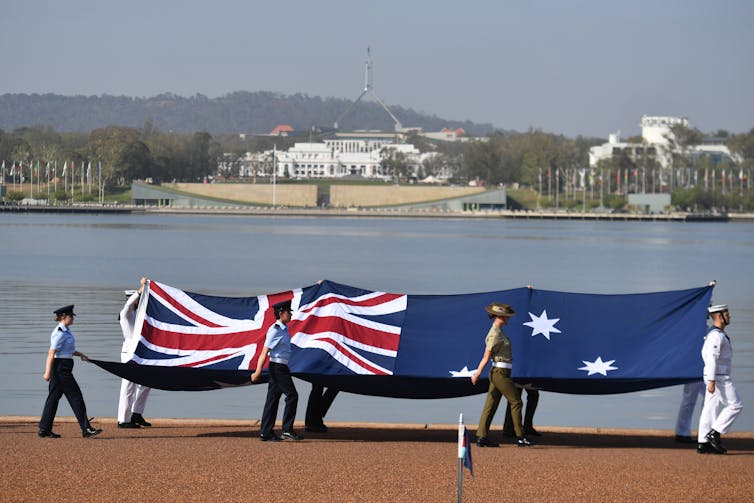
Australia’s proposed changes to the citizenship test has raised questions about whether you can really evaluate someone’s “Australian values” via a set of exam questions.
But here’s another question not even considered by the test: should Australian citizenship entail a knowledge and appreciation of Australia’s unique wildlife and natural history?
At its heart, this is a question about what it truly means to be an Australian. Some would argue I’m not qualified even to ask it. My ancestors arrived in Perth in 1830 from England and unloaded plenty of inappropriate cultural baggage, including cats, onto the shores of Australia.
Modern Australia is both an ancient land of hundreds of different languages and cultures, and a creation of transplanted Europeans who have sought to establish Western democratic ideals such as freedom of speech. There have also been many waves of economic migrants or those fleeing persecution and violence in their homelands.
With democratic ideals attacked or disregarded in many parts of the world, Australia’s citizenship test aims to ensure new citizens have a shared knowledge of these values and responsibilities. The current test puts a lot of emphasis on knowing about free speech, the constitution, and how parliaments are organised.
There’s more to being Australian than knowing how Canberra works.Mick Tsikas/AAP Image
But being Australian shouldn’t just mean agreeing with the principles of free speech and deliberative democracy. In 2006, the Australian author William J. Lines published Patriots: Defending Australia’s Natural Heritage. The title presupposes that being Australian is bound up with knowing and appreciating at least a little of Australia’s heritage of unique lifeforms and ecosystems.
My own book, Stepping Off: Rewilding and Belonging in the South West, published in 2017, also champions the idea of embracing the natural environment as part of one’s identity, with a particular focus on Perth and Australia’s southwest corner, an internationally recognised hotspot for unique plants and animals.
An appreciation of Australia
In my book I lament some aspects of the “Britanisation” of this country by my forebears. I also decry the smooth surface that corporate globalisation has more recently smeared over our modern cities.
As a counterbalance to these forces, I suggest other ways of “becoming Australian” that might help us live more gracefully and sustainably on this landscape.
What if we asked prospective Australian citizens to know and value the land on which we live, and the living things with which we share it? This might involve knowing facts such as:
much of southern Australia is geologically ancient, and broke from Antarctica around 40 million years ago before drifting north alone, evolving thousands of unique species
a eucalyptus leaf contains oils that can cause massive explosions in the forest canopy when fires tear through the environment, but which can also be used in kitchen detergents
Australia has about 70 species of macropod, of which kangaroos and wallabies are just two examples, and kangaroo meat is more sustainable than beef or lamb because of its low carbon footprint and its softer impact on the landscape compared with hoofed animals
a chuditch (or a quoll on the eastern side of the country), is a small carnivorous marsupial that is very friendly, although it’s (sadly) illegal to keep one as a pet.
Do you know a chuditch when you see one?SJ Bennett/Wikimedia Commons, CC BY-SA
I’m not suggesting throwing the baby out with the bathwater. I appreciate many of the legacies of Western civilisation, including freedom of speech, deliberative democracy, and the rule of law by an independent judiciary. Of course being Australian should mean accepting these central tenets.
But we should expect new arrivals to our shores — including those whose ancestors have been here for a couple of centuries — to supplement this culture with an understanding and appreciation of land and ecosystem we live in. These values are also more aligned with those of Indigenous Australian cultures.
Being Australian shouldn’t just mean knowing about federation and the ANZACs, mateship and Vegemite. It should also mean knowing at least a little of the plants and animals, stones and clouds, smells and sights, of our wide shared land.
When it comes to new botanical discoveries, one might imagine it’s done by trudging around a remote tropical rainforest. Certainly, that does still happen. But sometimes seemingly familiar plants close to home hold unexpected surprises.
We recently discovered a new genus of Australian daisies, which we’ve named Scapisenecio. And we did so on the computer screen, during what was meant to be a routine analysis to test a biocontrol agent against a noxious weed originally from South Africa.
The term “genus” refers to groups of different, though closely related, species of flora and fauna. For example, there are more than 100 species of roses under the Rosa genus, and brushtail possums are members of the Trichosurus genus.
This accidental discovery shows how much is still to be learned about the natural history of Australia. Scapisenecio is a new genus, but thousands of visitors to the Australian Alps see one of its species flowering each summer. If this species was still misunderstood, surely similar surprises are still out there waiting for us.
How it began
It all started with a biocontrol researcher asking a plant systematist, who looks at the evolutionary history of plants, to help figure out the closest Australian native relatives of the weed, Cape ivy (Delairea odorata).
Cape ivy is destructive to agriculture and native plants.Murray Fagg/Australian Plant Image Index, Author provided
Weeds like Cape ivy cause major damage to agriculture in Australia, displace native vegetation and require extensive management. Biological control (biocontrol) is one way to reduce their impact. This means taking advantage of insects or fungi that attack a weed, generally after introducing them from the weed’s home range.
A well-known Australian example is the introduction of the Cactoblastis moth in 1926 to control prickly pear in Queensland and New South Wales. Even today it continues to keep that weed in check.
To minimise the risk of selecting a biocontrol agent that will damage native flora, ornamental plants or crops, it’s tested carefully against a list of species of varying degrees of relatedness to the target weed.
Authorities will approve the release of a biocontrol agent only if scientists can show it’s highly specific to the weed. Assembling a list of species to test therefore requires us to understand the evolutionary relationships of the target weed to other plant species.
If such relationships are poorly understood, we might fail to test groups of species that are closely related to the target.
Missing data
Our target weed Cape ivy is a climbing daisy that has become invasive in temperate forests and coastal woodlands throughout south-eastern Australia. One of us, Ben Gooden, is researching the potential use of Digitivalva delaireae — a stem-boring moth — for its biocontrol.
We tried to design a test list, but could not find up-to-date information on Cape ivy’s relatives. We already knew it is related to the large groundsel genus Senecio, but we didn’t know how closely. And no genetic data existed for many Australian native species of Senecio.
So, we set out to solve this problem together.
First, we assembled already-published DNA sequences for as many Senecio species and relatives as we could find, and then generated sequences for an additional 32 native Australian species.
We then united all these genetic data into a comprehensive phylogenetic analysis. “Phylogenetics” infers the evolutionary relatedness of organisms to each other.
Hidden in the evolutionary tree
The resulting “evolutionary tree” showed many of the native Senecio species where we expected them to be. More importantly, however, it showed us that Cape ivy is actually quite distantly related to Senecio.
To our surprise, the analysis also placed several Australian species traditionally belonging to the Senecio genus far outside of it, indicating they didn’t belong to Senecio at all and needed to be renamed.
Simplified phylogenetic tree of the daisy tribe Senecioneae showing the evolutionary distance between Senecio, Cape ivy, and the new genus. Unlabelled branches indicate other lineages of the same tribe.Alexander Schmidt-Lebuhn, Author provided
The most interesting group of not-actually-Senecio are five species with leaf rosettes and one (or rarely, a few) flowerheads carried on distinctive stalks.
They’re all restricted to alpine or subalpine areas of south-eastern Australia, and all except one are found only in Tasmania. They turned out to be so unrelated, and so distinct from any other named plant genera, that they have to be recognised as a genus in its own right.
Introducing Scapisenecio
We have now named this new genus as Scapisenecio, after the long flower stalks (scapes) characterising the plants.
The most widespread and common species is Scaposenecio pectinatus, commonly known as the alpine groundsel, which is a familiar sight to hikers and bushwalkers in the Australian mainland alps and the central highlands of Tasmania.
Species belonging to this genus are a common sight to alpine hikers.Alexander Schmidt-Lebuhn, Author provided
Apart from the excitement of finding a previously undescribed, distinctive genus, these results were also directly relevant to the original purpose of our work: informing a plant list to test possible biocontrol agents.
The traditional misclassification of these species would have misled us about their true relationships. Our new genetic data now allow us to test biocontrol agents on an appropriate sample of species, to minimise risks to our native flora.
It is not often we find that a new, unexpected lineage of plants has existed all along, right in front of us.
Unity is a common theme every year on Malaysia Day, the holiday celebrated last week that marks the day Malaysia became a federation in 1963.
That year, Britain agreed to relinquish control of most of its remaining colonies in Southeast Asia — Singapore, North Borneo (now called Sabah) and Sarawak. They then joined with Malaya, which had gained independence from Britain in 1957, to form a new nation called Federation of Malaysia.
Yet, for the people of Sabah and Sarawak, located on the island of Borneo, the agreement left many with mixed emotions. Some people in these states have long desired secession and, in recent years, the drumbeat of separation has only grown louder.
This issue is now a key political issue in the Sabah state election this weekend and upcoming the Sarawak elections, which must be held before the end of 2021.
The two parts of Malaysia are separated by the South China Sea.Shutterstock
Source of historical grievances
In a nutshell, most people in Sabah and Sarawak (also known as East Malaysia) are unhappy with federation because they think it has not delivered on two main promises made in 1962 — high levels of autonomy and economic development.
In the first area, the federal government has stripped away a lot of local powers in Sabah and Sarawak in the last 57 years. On top of that, the federal authorities have tried to impose the same toxic racial and religious politics found in Malaya (also known as West Malaysia) to the eastern states.
East Malaysia is much more ethnically and religiously diverse compared to the west. For example, the Malay population is a minority in both Sabah and Sarawak; in fact, no ethnic group constitutes more than 40% in eitherstate. As a result, political Islam has not taken root here.
In fact, one of the defining features of East Malaysia is intermarriage among the different ethnic and religious groups. The divide between Muslims and non-Muslims is reasonably insignificant — a marked difference from the often suspicious attitude Islamic leaders have toward non-Muslims in Kuala Lumpur.
In terms of economic development, Sabah remains one of the poorest states in Malaysia. And the infrastructure in both Sabah and Sarawak is vastly underdeveloped compared to the west of Malaysia.
To add insult to injury, more than half of Malaysia’s oil and gas production comes from Sabah and Sarawak. The common joke is that all the iconic infrastructure in peninsular Malaysia, such as the Petronas Towers, Penang Bridge and Kuala Lumpur international airport, was built with money from East Malaysia.
The infrastructure in Kuala Lumpur far exceeds that in Malaysia’s eastern states.FAZRY ISMAIL/EPA
Britain’s hand in the federation
In recent times, one of the biggest grievances in East Malaysia comes from the process of decolonisation administered by the British after the second world war.
There is clear, documented evidence that back in 1962, the colonial office in London used its powers and influence to get the local leaders in Sabah and Sarawak to agree to the formation of Malaysia.
The British wanted a clean exit from Southeast Asia and to ensure its former colonies did not turn to communism. So the British conceived the idea of a “Federation of Malaysia”, where its former territories would come under a single political entity.
Activists in East Malaysia say if the British had not supported the formation of the federation, it was highly unlikely local leaders would have agreed to it. Many would have instead preferred independence or a federation consisting of Sabah, Sarawak and Brunei (which gained independence from Britain much later, in 1984).
A campaign event in Sabah ahead of this weekend’s elections.Shutterstock
What Sabah and Sarawak want
All these historical grievances have led to a growing movement in Sabah and Sarawak advocating for secession from the federation.
With elections upcoming in both states, all local politicians — including those serving in the federal government — are now claiming to be MA63 nationalists trying to keep “Malaya out” of Sabah and Sarawak.
Social media is one key reason the secessionist movement has taken off in East Malaysia. It is now much easier for advocates to organise and magnify their grievances.
What the Sabah and Sarawak people want, at the very least, is a constitutional amendment to recognise the special autonomy of both states. But a significant minority argues the whole federation has failed, and thus secession is the only way forward.
Currently, the secessionist groups pose no real threat to the federation. But if enough people buy the secession argument in the future, public sentiment may be too strong for the national leaders to ignore.
How should the federal government respond?
There are basically two options available to the federal government.
The first is the ostensibly easy option — the political route. This would require the federal government to recognise the historical grievances and try to resolve them.
However, this is not as simple as it seems. The government is reluctant to grant real autonomy to the two states, worried this will end up weakening federal powers in the other 11 states of the federation.
There was an attempt to reword the Constitution last year to symbolically recognise the special status of both states, but it failed.
This is the only way to keep the federation together, however. The federal leaders need to agree to recognise the special status of Sabah and Sarawak and grant them wide autonomy in the Constitution, as envisaged in the 1963 Malaysia Agreement.
The second option for the government is to play a wait-and-see game. Politically, this is dangerous, as the final outcome could very well be secession.
By way of comparison, the push for independence in Catalonia was similarly based on historical grievances that mushroomed into a mainstream political movement and eventually an independence referendum — declared illegal by Spain’s constitutional court.
At the very least, what is happening on the ground in East Malaysia suggests the decolonisation process in Southeast Asia is not yet complete. This colonial legacy is not merely history, but is clearly reflected in the present reality.
A new deal to televise and live stream more secondary school sports in New Zealand has attracted significant attention and debate.
First XV secondary school rugby in New Zealand has been televised for some time on Sky Sport. The attraction of new revenue for broadcasters and other sporting organisations is clear, but what might the cost be for young athletes?
The new broadcast deal is a collaboration between the New Zealand Sport Collective (created by former Olympic rowing champion Rob Waddell and representing more than 50 sports) and Sky Sport Next, a YouTube channel run by Sky TV.
The deal evolved after consultation with several bodies including the New Zealand Secondary School Sports Council (NZSSSC), which coordinates secondary school sport.
It is easy to understand why some school students would like to be on television. But there are moral and ethical issues that need to be considered by those charged with governing school sport.
The increased television exposure adds to concerns of an overly professionalised, “win at all costs” culture that already exists in some school sport.
In response to these concerns, the NZSSSC set up a broadcasting charter in an attempt to protect the health and well-being of students and allow those who do not want to be televised to opt out.
But in reality, the power imbalances at play and other influences mean the charter is unlikely to be effective in many situations. For example, rather than opting out, some schools may feel pressure on them to stay in, to please players and parents.
Health vs performance
Adult high-performance sport must constantly balance health and performance, but secondary school sport must prioritise health.
Evidence suggests professional, high-performance athletes are at increased risk of a “high athlete identity”. This is the degree to which someone defines themself based on their athletic role, and looks to others for confirmation based on that role. This can have both positive and negative consequences.
School sport should be more about promoting health.Shutterstock/taka
A performance culture in school sport increases the likelihood of students developing a high athlete identity and this has been linked to dropout from sport.
Given only a very small number of students will become professional athletes (possibly less than 2%) the potentially negative consequences on mental health are a major concern.
Research in adults and US college athletes shows greater difficulty adjusting to a lack of sporting success and more frequent psychological issues in people with higher levels of athletic identity.
A recent secondary school rugby study in New Zealand found high performance expectations often led to a fear of failure. The expected commitment was too much alongside academic workloads.
On the physical side, there is real concern about attitudes to injury. The under-reporting of concussion in rugby is associated with the perceived importance of a match. More than 50% of players across multiple secondary school sports say they’ve seen a player play on when they thought they were concussed.
Recent data from the Accident Compensation Corporation (ACC) and Netball NZ reveal a rise in injuries in the 10–14 age group over the past ten years.
Protecting young athletes
In response to concerns, Sport New Zealand recently launched its Balance is Better initiative, which promotes an evidence-based, developmental approach to youth sport.
We’re all about competition, but …
This philosophy does not seem to align with increased television exposure for school sport. It led to questions being asked about the mixed messages emanating from our government agency and their lack of leadership on this issue.
In New Zealand we appear to be at a crossroads in relation to youth sport. As researchers concerned about some of the costs associated with the increasing professionalisation of youth sport, the Balance is Better philosophy suggests we were moving in the right direction.
But increased exposure on television risks extending the high-performance culture in which success is measured solely by the scoreboard. This is increasingly irreconcilable with a culture in which healthy competition contributes to positive youth development.
School sport for all
At a time when the current culture of youth sport is a concern in many countries, is validating participation through the televising of youth sport the direction we want to go?
School sport should be an inclusive form of physical activity. It should be strategically aligned with health and developmental benefits for all students. It should engage as many students as possible, for as long as possible.
A performance-driven culture in school sport, fuelled by television exposure, promotes an inefficient and ineffective way to identify and develop talent. There is little evidence success in school sport predicts future adult sporting success.
The priority for schools should be to develop healthy, high-performing people, not high-performing athletes. School sport can (and should) be a highlight in the educational experience of youth, potentially enhancing physical, social and cultural development.
Prime Minister Jacinda Ardern and National Party leader Judith Collins - during the first One News leaders debate, 2020.
Analysis by Keith Rankin.
Keith Rankin.
The most recent TVNZ Colmar Brunton poll felt about right: Labour/Green on 54% and National/Act on 38% of decided voters. But I sense that Labour is losing momentum.
What needs to happen to make Judith Collins the Prime Minister in October? National/Act need just five percentage points more, and Green to fall below five percent. This combination of possibilities is not improbable.
Act is running hot with many voters just now, and seems to be winning over many undecided voters, just as the Bob Jones party did in 1984. While Act’s message of fiscal rectitude – a message laced with comedy – is quite cynical, it is effective with an electorate trained by almost all of our political messengers to be very afraid of public debt.
National has managed this fiscal policy issue much better than Labour, by promising – through ‘temporary’ tax cuts – both the need for immediate fiscal stimulus and the promise of lower future public debt. Further, Labour has boxed itself into a corner with its doubled ‘winter energy benefit’ soon coming to an end. Many poor Auckland families will fall into immediate poverty as a result, because they have been using this to pay the rent.
Disenchantment arising from the insensitivity of withdrawing benefits at this time may see many potential Labour voters not bothering to vote at all.
Labour stands to being seen as, simultaneously, both stingy, which it is, and profligate, as Act paints it. Both perceptions could be costly to Labour. The Green Party suffers likewise, and is looking less attractive to its past left-feminist supporters, thanks to the James Shaw ‘Green School’ gaff.
Not only has Labour mismanaged the messaging about fiscal stimulus and public debt, it has also mismanaged the messaging about our two-vote voting system. Labour has failed to train the media into properly distinguishing between the proportional party vote and the plurality (ie ‘FPP’) electorate vote. Labour has shown no inclination to facilitate the election of a Green electorate MP, and that naïve pretence that the candidate vote is also a party vote could cost the present Government dearly.
To vote Labour in Auckland Central or Wellington Central or Tamaki-Makaurau (or anywhere else) is to vote for the Labour Party, not for the Labour electorate candidate. To vote for a Labour-led government, Labour supporters in those named electorates should vote for the Green Party candidate; in each case, to achieve their political objective, it is crucially important that those three Green candidates be in Parliament.
Even if Labour wins this time despite the Green Party failing, this would make a Jacinda Ardern led government unnecessarily vulnerable in 2023.
I think that Labour/Green will prevail, nevertheless, despite both parties’ ‘own goals’. First, Labour’s billboards emphasising the electorate vote over the party vote may inadvertently help the Green Party get over five percent. Second, Labour’s biggest asset is the Judith Collins’ billboards showing Gerry Brownlee standing behind her. Gerry is truly yesterday’s man, is gaff-prone, and unpopular. The important question is whether Labour or Act becomes the main beneficiary of the Brownlee ‘turn-off’ effect.
(Judith Collins will be very happy if National gets 30% and Act gets 20%. Indeed, in that scenario, National may get some overhang MPs. And, with Paul Goldsmith not making it back to Parliament under that scenario, then David Seymour may become the next Minister of Finance. Help!)
The one that it has been using doesn’t mention unemployment at all and instead talks about offsetting new spending “by reductions in spending elsewhere” and commits it to “achieve budget surpluses, on average, over the course of the economic cycle” – something that’s not going to happen for a long time.
A realistic fiscal strategy is a good idea. A lot of behaviour is driven by expectations. If consumers and businesses think the government is going to slash and burn its way to a surplus, any stimulus in the meantime will be less effective.
People are more likely to save, and businesses less likely to hire, if they think tax hikes and spending cuts are around the corner.
Former US Federal Reserve Chairman William McChesney Martin Jr. once famously said that the central bank’s role is “to take away the punch bowl just as the party gets going”.
Tightening budget policy – raising taxes or cutting spending – when unemployment crosses the 6% mark would be packing away the booze when many of the guests haven’t even arrived.
In the 15 years before COVID-19 struck, Australia’s unemployment rate had been above 6% only briefly, between mid 2014 and early 2016.
The unemployment rate was well below 6% before the pandemic struck, yet the labour market was clearly running below its potential.
Before the pandemic, the Reserve Bank revised down its estimate of the unemployment speed limit – the unemployment rate at which inflation and wages would accelerate – from 5% to around 4.5%.
The Treasurer should wait until we’re closer to that speed limit before reaching for the brakes. The difference between 6% and 4.5% unemployment might not sound like much, but it amounts to an extra 200,000 people or so in work.
And it affects the rest of us too. Most Australians won’t get anything more than modest pay rises until the labour market tightens.
The danger is declaring victory too soon
The government handled the acute phase of this crisis well, although not perfectly. It deserves credit for moving very quickly to support the economy. But the danger now is that it turns too soon to budget tightening, stunting a nascent recovery.
This is the mistake many governments and central banks made after the global financial crisis – acting commendably to shore up activity in the crisis phase, but then pulling away support before enough of the damage had been repaired.
With interest rates are so low, the government has a lot of capacity to run deficits without the debt-to-GDP ratio getting out of control.
As Frydenberg noted, “with historically low interest rates, it is not necessary to run budget surpluses to stabilise and reduce debt as a share of GDP — provided the economy is growing steadily”.
It’s a point made by former IMF Chief Economist Olivier Blanchard in one of the most influential recent papers in economics – his 2019 presidential address to the American Economics Association.
Blanchard noted that when the interest rate on government debt is less than the nominal growth rate of the economy, “public debt may have no fiscal cost”.
We’ve access to money for nothing
The Australian government can borrow for 10 years at a fixed interest rate of about 0.9%. It recently issued 30-year fixed-rate bonds for less than 2%.
Both are less than the Reserve Bank’s inflation target, suggesting that over time in real terms the money will cost nothing.
Over the past five years, Australia’s nominal growth rate has averaged 4%. The most recent Intergenerational Report projected average nominal growth of 5.25% a year for 40 years.
Even if economic growth falls well short of that projection it is hard to imagine it going below the rate at which the government can borrow for very long.
That means debt is likely to remain manageable relative to the size of the economy, and debt servicing costs will be modest, particularly compared to the benefits of stimulus.
Over the medium-term the government will need to ensure its debt is sustainable and does not continue to rise as a share of the economy.
But rushing too quickly to “repair” the budget position would be an economic ‘own goal’ – hampering job creation, economic growth, and ultimately the bottom line it sought to protect.
Reserve Bank Deputy Governor Guy Debelle said this week that “absent the fiscal stimulus, the economy would be significantly weaker and debt levels even higher”.
He is right. Taking the foot off the economic accelerator when unemployment is at 6% would condemn Australia to a long and slow recovery. It’s not in the Treasurer’s interest, and it’s not in ours.
Fiji’s Suva foreshore has been under “enormous” pressure from decades of destructive practices with little to no public awareness about the various afflictions, says prominent academic professor Vijay Naidu.
The problems have been exacerbated by no sustained public awareness campaign, absence of environmental issues in Pacific news media coverage and lack of leadership, Professor Naidu said.
Professor Naidu made the comment while delivering his keynote address at a two-day workshop this week organised by the University of the South Pacific’s journalism programme and the Earth Journalism Network (EJN).
The workshop looked at the causes and impacts of pollution in the Suva bay area and possible solutions.
“I have observed over 60 years massive changes to our foreshore including reclamation, destruction of mangrove forests, sewerage and solid waste, and the epidemic of plastic pollution,” he said.
“Fisheries in Suva Bay have been depleted enormously, and it is not safe to consume shell fish, or ‘kaikoso‘, collected here. Very sadly, there has hardly any systematic ‘fight back’!
“The public who use the water around the Suva Bay area for fishing have little or no idea about the state of the lagoon and what needs to be done to preserve such a wonderful resource for the people of Suva.
‘Need a penicillin injection’ “Some years ago, USP reported that if you fell in the waters of Suva harbour and Laucala Bay, you’d need a penicillin injection.”
The former head of the University of the South Pacific’s School of Government, Development and International Affairs was speaking as the chief guest at an environmental journalism workshop.
Professor Naidu said there was a need for greater collaboration between journalists and scientists to bring attention to these issues and to “help us begin the fightback”.
He commended the EJN for providing crucial support to Pacific journalists in the form of grants and training for stronger environmental reporting.
“The workshop is a great example of how scientists and journalists can work together for the greater good,” Professor Naidu said.
Such partnerships should make the public become more aware of the issues regarding the marine environment, and lead to stronger calls for change, Professor Naidu said.
Sheldon Chanel is the training editor for Wansolwara, USP Journalism’s student training newspaper and online publication. USP Journalism works in partnership with the Pacific Media Centre.
It’s been more than four years since New South Wales greyhound racing was rocked by a special inquiry that found overwhelming evidence of systemic animal cruelty, including mass killings. Overbreeding and euthanasia of healthy dogs is still one of the industry’s biggest challenges.
A key issue to emerge from the 2016 inquiry was the euthanasia of healthy greyhounds. It found evidence that, over 12 years, between 48,891 and 68,448 dogs were killed because they were considered “too slow to pay their way or were unsuitable for racing”.
The NSW Greyhound Racing Act was established in 2017 in response to the inquiry. The act is now under review. One question being examined is whether the industry needs an “unnecessary euthanasia” target.
I believe such a target is necessary. But it would require tracking greyhounds over their entire lives, to ensure none slip through the cracks. Such a scheme will come with a financial cost, but is the only way to assure the public the greyhound racing industry has truly reformed.
Greyhounds born to the racing industry should be tracked.Shutterstock
Better accountability
Ten years ago, I argued for better accountability for all dogs bred for the greyhound racing industry – including tracking dogs over their lifespan.
In 2017, a panel considering industry reform recommended such an initiative. It also called for a target date for achieving zero unnecessary euthanasia, saying this should be considered in two years, informed by more robust data. The NSW government accepted the recommendation.
I believe zero unnecessary euthanasia, in the context of this industry, ought to mean all pups born for the industry are rehomed, die of natural causes, or are euthanased following an injury – where that injury occurred on a race track where greyhound welfare is paramount in the design.
Greyhounds are registered when they start racing – usually at around 16 months of age.
For more accurate data, all pups ought to be given an identification number at birth. This number would stay with them throughout their racing career and into retirement.
The Greyhound Welfare and Integrity Commission (GWIC) is an independent industry regulator established in 2017. According to GWIC figures for the year to June 2019, there were:
3,747 greyhound puppy births
1,435 greyhounds retirements
832 greyhound deaths.
The difference in the number of greyhounds leaving the industry and those entering (as puppies) was 1,480 greyhounds. This suggests those who were not retired, or did not die, remain unaccounted for.
In a statement to The Conversation, the GWIC said it could not be assumed the 1,480 pups were surplus to the industry that year. The commission said it recently tracked a group of pups born between July and September 2018 and found the majority were either still with their original owner or breeder, or in the custody of a trainer. It said 13% had been sold for racing – either in NSW or to other states.
But without lifelong tracking, we cannot know for sure the fate of these pups, and whether any have been unnecessarily killed.
The fate of many greyhound racing pups is unknown.Shutterstock
What happens after retirement?
A dog may be retired because it is not suitable for racing, is injured, or reaches the end of its racing life. Currently in NSW, greyhounds are retired via the Greyhound Adoption Program or alternative greyhound rehoming organisations.
In the year to June 2019, NSW’s Greyhound Adoption Program reported rehoming 729 greyhounds. While this is encouraging, it’s not clear how many greyhounds entered the program. The Conversation has sought comment from Greyhound Racing NSW, which runs the program, on the total number of dogs in the program.
In addition to rehoming programs, industry participants can also rehome dogs to people outside the greyhound industry. The animals must then be registered as companion animals. The GWIC must be empowered to undertake follow up inspections to ensure these dogs are safe.
In some cases, racing greyhounds can be rehomed.Shutterstock
Winning back the public
For greyhound lifecycle data to be accurate, the animals must be tracked via a birth identification number, which stays with them for life.
GWIC reports indicate it is working on these tracking issues. A lifespan tracking approach will cost money. The NSW government must ensure the regulator is adequately funded to implement and enforce such a scheme.
After the special inquiry, the greyhound racing industry said it was “willing to change” to meet strict animal welfare standards and regulatory guidelines. According to GWIC figures, the industry has made progress on lowering breeding rates, which obviously helps.
Ultimately, the greyhound industry’s future hangs on the question of unnecessary euthanasia – and targets for this must be based on accurate data. Only then will the industry convince the public that it’s committed to being cruelty-free.
Indonesia saw a one-day record of 4465 new covid-19 cases on Wednesday, bringing the total number of confirmed cases to 257,388 nationwide, government data shows.
More than 4000 new covid-19 cases have been reported per day since Monday. At least 9977 people have succumbed to the disease so far, and 187,958 have recovered.
Jakarta had the largest share of Wednesday’s figure with 1133 new cases, despite having reimposed large-scale social restrictions (PSBB) a week earlier, bringing the capital’s total to 65,687 recorded cases and 1628 fatalities.
A recent survey by the Health Ministry has found that many citizens do not believe that covid-19 exists and that many have challenged the call to adhere to health protocols, authorities have said, leading to more widespread transmission of the virus.
In response, the national covid-19 task force has formed so-called “behavioural change” units to raise public awareness about the danger of the disease.
The initiative will be tested first in Jakarta, a hotbed of covid-19 contagion, before being brought to other regions.
Five behavioural change units consisting of a total of 100 volunteers have been deployed in five subdistricts of the capital to inform people about the virus and reinforce the need to adhere to health protocols, national covid-19 task force head Doni Monardo said on Tuesday.
You might have missed it – what with the biggest recession since the 1930s and a pandemic going on – but there may be big, and bad, changes happening to a media landscape near you.
Right now the Australian government is considering amending the Competition and Consumer Act 2010 to force Google and Facebook to pay local commercial media organisations for the sharing of their content on the digital platforms.
The News Media and Digital Platforms Bargaining Code proposed by the Australian Competition and Consumer Commission will require the tech and media companies to make terms through “mandatory binding arbitration”. It will also oblige them to divulge parts of their core intellectual property (such Google’s search algorithm).
It has been lauded as a world-first in addressing the power imbalance between the platforms and traditional news organisations.
Champions such as commission chief Rod Sims argue it’s a simple matter of forcing Google and Facebook to pay a fair price for extracting value from journalism for which they pay nothing. As Sims put it:
What this was all about was the imbalance in bargaining power, the market failure that comes from that, and underpayment for news having a detrimental effect on Australian society.
Who could argue with that? Even federal treasurer Josh Frydenberg has described it as “a question of fairness”.
Australian Competition and Consumer Commission chairman Rod Sims argues the News Media and Digital Platforms Bargaining Code will correct a market failure.Joel Carrett/AAP
But from an economic standpoint the whole bargaining code is hopelessly confused. It fails to properly understand the source of competitive pressure for media companies, and why they have lost revenues over the last 15 years.
Mandatory binding arbitration between tech and media companies is also a completely inappropriate policy tool to achieve the public policy goal of fostering high-quality journalism.
As I have written about in detail for the Stigler Center at the University of Chicago Booth School of Business, making the code law risks doing serious harm to Australian consumers while shovelling money to large media companies like Nine Entertainment and News Corp Australia.
Faced with the prospect of having to divulge key intellectual property, it would not be surprising if Google and Facebook simply prefer not to be in the Australian market. Millions of Australians using Google, YouTube and Facebook will lose out.
Media revenue sinking
Between 2002 and 2018, consulting firm AlphaBeta estimates total annual revenue for Australian newspapers fell from A$4.4 billion to A$3.0 billion. Almost all of this was due to lost classified advertising revenue, worth A$1.5 billion in 2002 but just A$200 million in 2018.
“That’s Google’s fault,” you might cry.
Actually no. The vast bulk of lost classified advertising revenue was due to online “pure-plays” such as Seek, Domain and Carsales. Google and Facebook took basically none of this revenue.
The media companies were sitting on a gold mine of classified advertising. Then there was massive technological disruption due to the internet and smart phones.
That, as they say in the classics, is show business.
It doesn’t justify making companies who happened to succeed in an adjacent space at the same time fork over a chunk of their revenues.
But aren’t tech companies ‘stealing’ content?
If big tech companies were somehow allowing you and me free access to content we would otherwise have to pay for, there might be a case to answer.
That would be like Google Maps not only giving you directions to a restaurant but the means to also avoid paying for your meal.
But using a search engine does not allow you to get free meals, nor to get around a news organisation’s pay wall.
In fact, having their content pop up in search results, or shared on social media, helps Australian media companies to attract readers and sell subscriptions – something that now accounts for roughly half the revenues of some leading players such as The Australian.
All you get for “free” is a snippet of a line or two from the search.
For instance, when I searched for news about recently deceased US Supreme Court Justice Ruth Bader Ginsburg, I got this:
If you can figure out the full content of the article from that snippet, you should be using your superpowers for other, more lucrative purposes.
Beware the politics
There is a very real risk this misguided code will end up becoming law.
An overzealous regulator has proposed something that stands to benefit the big media companies, who are – not surprisingly – strongly for it.
Those same media companies have huge influence over public perceptions and the fate of politicians. It will be a brave elected representative who pushes back on the proposed code and draft legislation.
But if politicians were serious about resolving the real issue at stake in all of this, they would act more directly.
Like newspapers all around the world, Australian media and journalists are under pressure – and one thing most people agree on is that high-quality news and journalism is critical to a well-functioning democracy.
Whatever the market forces that have slashed the funding of such journalism, there is a strong case for government intervention. But if the Australian government wants to subsidise high-quality journalism, it should do it itself.
With the 10-year bond rate less than 1%, it would cost the government just A$18 million a year to fund the interest bill on A$2 billion of media subsidies a year. That’s 72 cents per Australian a year.
And all without driving away the hugely valuable services of companies like Google and Facebook that Australian consumers love.
The United Kingdom has already been battered by COVID-19, with about 410,000 cases and more than 41,000 deaths.
But after some respite over summer — and entreaties to “Eat Out to Help Out” to boost the economy — the UK is now facing a terrifying second wave. This week, experts predicted almost 50,000 new cases a day by October if the current infection rate does not slow.
What does this mean for UK? And what is the significance for Australia as it watches on from the other side of the world?
New restrictions
This week, British Prime Minister Boris Johnson announced a new set of restrictions. These include early closures of pubs and restaurants, working form home if possible and wearing masks in shops.
As Johnson warned, if people don’t comply, a second lockdown is on the cards.
Since Johnson himself almost died of COVID in April, amid the UK’s disastrous first wave, international attention has been elsewhere. Not surprisingly, we have been looking instead to the United States, which has the highest number of deaths and is in the middle of an election.
Attention is once again on the UK and its COVID response.Dominic Lipinski/AAP
So the UK’s relaxation of restrictions in July seemed counter-intuitive. While people in Britain have certainly enjoyed the summer sun, infections have once again climbed at an alarming rate.
The UK government’s policy choices can in part be explained by its hostility towards the public service. This is part of the so-called “Brexit revolution,” designed to shake up post-Brexit Britain.
This has seen decisions that suggest the government is choosing the evidence it likes, rather than what will best address the health crisis.
The recently announced 10pm pub curfew, is a good example here — it is not clear that COVID only comes out late at night.
No one can doubt the difficult trade-offs required between health and the economy (although the two are much more linked than public debates suggest). But the government appears to favour economic needs and seems cavalier with the public health consequences.
Trust in government, essential during a public health crisis, has suffered accordingly. This was not helped when Johnson’s chief adviser, Dominic Cummings, broke the rules he helped set by travelling across England during lockdown.
Cummings survived this scandal, which is down to Johnson’s 80-seat majority, won during last year’s “Brexit” election.
Those watching Johnson’s erratic COVID-response take note: when governments command big majorities, they can ride out political crises.
The Conservatives and the pandemic
Of course, a pandemic is especially difficult terrain for the conservative side of British politics. Like its US counterpart, from which it takes many of its cues, government intervention is anathema.
For many Conservatives, personal freedom and individual liberty are expressed through a functioning market economy. The strength of this feeling is seen in the criticism of Johnson (and the new restrictions) in the UK’s influential right-wing press this week.
UK Prime Minister Boris Johnson has warned a second lockdown is possible if COVID infections keep climbing.Jon Super/AAP
But others of course do not think Johnson has gone far enough, with parts of England already in local lockdowns. Scotland has also taken a much clearer approach to the pandemic, mirroring policies adopted in Australia and New Zealand, further boosting support for independence.
What does this mean for Australia?
What happens to the UK during COVID is more than just a passing headline in Australia. A looming second wave will not make it easier for Australians stuck in the UK to come home.
Stranded Australians are also just the tip of the iceberg. People-to-people relations between Australia and the UK remain hugely significant. As of 2018, 1.2 million people born in the UK were living in Australia.
Britain has recently angered Europe further with new legislation that could ignore parts of its EU exit agreement.
But this does not affect Australia’s plans for a free trade deal with the UK, with talks there already underway.
Indeed, Australia and the UK now need each other more than they have for decades — despite their locations at opposite ends of the earth. The British even have former prime minister Tony Abbott as a UK trade envoy to help.
A tough winter ahead
The current infection rates — combined with questionable decision-making from the Johnson government — do not bode well for a possible second lockdown in England.
New UK restrictions could last for six months.Dominic Lipinski/AAP
As Melburnians can attest, a second lockdown does not have the “we’re all in this together” feel of the first. For England, this means that the pseudo-Churchillian rhetoric and invocation of the wartime spirit will paper over the policy cracks even less.
Back in Australia, those people wanting to get to the UK will have to wait longer before such visits become possible. But given the increasing importance of both countries to each other, no doubt Australians and Britons will meet again some sunny day.
Smokers are worried. A respiratory disease is running rampant across the globe and people with unhealthy lifestyle habits appear to be especially vulnerable.
We know smokers hospitalised with COVID-19 are more likely to become severely unwell and die than non-smokers with the disease.
At any point in time, most smokers want to quit. But COVID-19 provides the impetus to do it sooner rather than later.
In our new study, we surveyed 1,204 adult smokers across Australia and the United Kingdom. We found the proportion intending to quit within the next two weeks almost tripled from around 10% of smokers before COVID-19 to 29% in April.
Many more were thinking about quitting some time soon, and most wanted help to do so.
Our research shows many people who smoke understand they can reduce their COVID-19 related risk by addressing their smoking. Given this, and the broader health gains associated with stopping smoking, we must ensure people who want to quit in the face of COVID-19 are supported.
When asked whether they’d like to receive information about the risks of COVID-19 for smokers, almost half (45%) of our respondents said they would. This was especially the case among those wanting to quit very soon.
As for where they wanted to get this information, participants most commonly chose government representatives (59%) and doctors (47%) as their preferred sources.
Television news was the most favoured information delivery channel (61%), followed by online news (36%), social media (31%) and email (31%).
We surveyed about 1,200 smokers in Australia and the UK.Shutterstock
As well as being receptive to information, our participants were keen for support to help them quit.
Evidence-based forms of smoking cessation assistance include nicotine replacement therapy (for example, gum, patches and inhalers) and counselling.
Almost two-thirds (61%) of our respondents expressed an interest in receiving nicotine replacement therapy to help them quit, which rose to more than three-quarters (77%) if it could be home-delivered and provided free of charge.
Half (51%) wanted access to personal advice and support, such as that provided by Quitline. A similar number (49%) were receptive to being part of a text support program for smokers.
These results show us smokers are interested in forms of quitting assistance that can be delivered remotely. Making sure smokers know these sorts of things are available in lockdown could increase uptake, and in turn reduce smoking rates.
It’s also important to note the social isolation associated with the pandemic may make people more vulnerable to the addictive effects of nicotine. So they may need extra support during this time.
Two big risks to our health
Strong groundwork in the form of anti-smoking campaigns, tobacco taxes, and smoke-free environment legislation has reduced smoking levels in Australia to a record low of 11%. But even at this rate, smoking remains Australia’s number-one avoidable killer.
Smoking eventually kills up to two-thirds of regular users, and the number of people dying from smoking-related diseases still dwarfs COVID-19 deaths.
Roughly eight million people around the world die each year from tobacco-related diseases (such as cancer, stroke and heart disease), compared to the almost one million deaths attributed to COVID-19 so far.
Of course, the infectious nature of COVID-19 brings its own set of challenges. But combined, we have a potent reason to prioritise encouraging and helping smokers to quit as soon as possible.
There has been speculation about whether smoking increases the risk of contracting COVID-19, or whether nicotine might actually protect against the disease. The evidence remains unclear.
Regardless of whether smoking affects the risk of contracting COVID-19 in the first place, we know it increases the risk of dying from it. Providing intensive quit support during the pandemic could facilitate a substantial boost to cessation rates and bring us closer to the day when smoking becomes history.
Capitalising on this opportunity
Smokers’ increased risk from COVID-19 and the importance of encouraging smokers to quit to reduce their risk of a range of non-communicable diseases means health agenciesaround the world are sending messages about the importance of quitting now.
Our results suggest these statements should ideally be accompanied by explicit offers of help to quit in the form of nicotine replacement therapy and counselling. Investment in these is cost-effective, and now is an ideal time to make them as widely available and affordable as possible.
Many smokers would also likely benefit from the use of mass media to provide more information about their greater risk if infected with COVID-19.
This heightened interest in quitting in the face of COVID-19 — reflected not only in our research, but elsewhere — represents a unique opportunity for governments and health agencies to help smokers quit, and stay off smoking for good.
It’s been more than four years since New South Wales greyhound racing was rocked by a special inquiry that found overwhelming evidence of systemic animal cruelty, including mass killings. Overbreeding and euthanasia of healthy dogs is still one of the industry’s biggest challenges.
A key issue to emerge from the 2016 inquiry was the euthanasia of healthy greyhounds. It found evidence that, over 12 years, between 48,891 and 68,448 dogs were killed because they were considered “too slow to pay their way or were unsuitable for racing”.
The NSW Greyhound Racing Act was established in 2017 in response to the inquiry. The act is now under review. One question being examined is whether the industry needs an “unnecessary euthanasia” target.
I believe such a target is necessary. But it would require tracking greyhounds over their entire lives, to ensure none slip through the cracks. Such a scheme will come with a financial cost, but is the only way to assure the public the greyhound racing industry has truly reformed.
Greyhounds born to the racing industry should be tracked.Shutterstock
Better accountability
Ten years ago, I argued for better accountability for all dogs bred for the greyhound racing industry – including tracking dogs over their lifespan.
In 2017, a panel considering industry reform recommended such an initiative. It also called for a target date for achieving zero unnecessary euthanasia, saying this should be considered in two years, informed by more robust data. The NSW government accepted the recommendation.
I believe zero unnecessary euthanasia, in the context of this industry, ought to mean all pups born for the industry are rehomed, die of natural causes, or are euthanased following an injury – where that injury occurred on a race track where greyhound welfare is paramount in the design.
Greyhounds are registered when they start racing – usually at around 16 months of age.
For more accurate data, all pups ought to be given an identification number at birth. This number would stay with them throughout their racing career and into retirement.
The Greyhound Welfare and Integrity Commission (GWIC) is an independent industry regulator established in 2017. According to GWIC figures for the year to June 2019, there were:
3,747 greyhound puppy births
1,435 greyhounds retirements
832 greyhound deaths.
The difference in the number of greyhounds leaving the industry and those entering (as puppies) was 1,480 greyhounds. This suggests those who were not retired, or did not die, remain unaccounted for.
In a statement to The Conversation, the GWIC said it could not be assumed the 1,480 pups were surplus to the industry that year. The commission said it recently tracked a group of pups born between July and September 2018 and found the majority were either still with their original owner or breeder, or in the custody of a trainer. It said 13% had been sold for racing – either in NSW or to other states.
But without lifelong tracking, we cannot know for sure the fate of these pups, and whether any have been unnecessarily killed.
The fate of many greyhound racing pups is unknown.Shutterstock
What happens after retirement?
A dog may be retired because it is not suitable for racing, is injured, or reaches the end of its racing life. Currently in NSW, greyhounds are retired via the Greyhound Adoption Program or alternative greyhound rehoming organisations.
In the year to June 2019, NSW’s Greyhound Adoption Program reported rehoming 729 greyhounds. While this is encouraging, it’s not clear how many greyhounds entered the program. The Conversation has sought comment from Greyhound Racing NSW, which runs the program, on the total number of dogs in the program.
In addition to rehoming programs, industry participants can also rehome dogs to people outside the greyhound industry. The animals must then be registered as companion animals. The GWIC must be empowered to undertake follow up inspections to ensure these dogs are safe.
In some cases, racing greyhounds can be rehomed.Shutterstock
Winning back the public
For greyhound lifecycle data to be accurate, the animals must be tracked via a birth identification number, which stays with them for life.
GWIC reports indicate it is working on these tracking issues. A lifespan tracking approach will cost money. The NSW government must ensure the regulator is adequately funded to implement and enforce such a scheme.
After the special inquiry, the greyhound racing industry said it was “willing to change” to meet strict animal welfare standards and regulatory guidelines. According to GWIC figures, the industry has made progress on lowering breeding rates, which obviously helps.
Ultimately, the greyhound industry’s future hangs on the question of unnecessary euthanasia – and targets for this must be based on accurate data. Only then will the industry convince the public that it’s committed to being cruelty-free.
The extreme, recent drought has devastated many communities around the Murray-Darling Basin, but the processes driving drought are still not well understood.
Our new study helps to change this. We threw a weather model into reverse and ran it back for 35 years to study the natural processes leading to low rainfall during drought.
And we found the leading cause for drought in the Murray-Darling Basin was that moisture from oceans didn’t reach the basin as often as normal, and produced less rain when it did. In fact, when moisture from the ocean did reach the basin during drought, the parched land surface actually made it harder for the moisture to fall as rain, worsening the already dry conditions.
These findings can help resolve why climate models struggle to simulate drought well, and ultimately help improve our ability to predict drought. This is crucial for our communities, farmers and bushfire emergency services.
There’s still a lot to learn about rain
The most recent drought was relentless. It saw the lowest rainfall on record in the Murray-Darling Basin, reduced agricultural output, led to increased food prices, and created tinder dry conditions before the Black Summer fires.
A water restrictions sign at the entrance to Stanthorpe, Queensland, in October 2019. Then, the Storm King Dam water level was at just 25%AAP Image/Dan Peled
Drought in the Murray-Darling Basin is associated with global climate phenomena that drive changes in ocean and atmospheric circulation. These climate drivers include the El Niño and La Niña cycle, the Indian Ocean Dipole and the Southern Annular Mode.
Each influences the probability of rainfall over Australia. But drivers like El Niño can only explain around 20% of Australian rainfall — they only tell part of the story.
To fully understand the physical processes causing droughts to begin, persist and end, we need to answer the question: where does Australia’s rainfall come from? It may seem basic, but the answer isn’t so simple.
Where does Australia’s rainfall come from?
Broadly, scientists know rainfall derives from evaporation from two main sources: the ocean and the land. But we don’t know exactly where the moisture supplying Australia’s rainfall originally evaporates from, how the moisture supply changes between the seasons nor how it might have changed in the past.
To find out, we used a sophisticated model of Australia’s climate that gave data on atmospheric pressure, temperature, humidity, winds, rainfall and evaporation.
We put this data into a “back-trajectory model”. This traced the path of water from where it fell as rain, backwards in time through the atmosphere, to uncover where the water originally evaporated from. We did this for every day it rained over Australia between 1979 and 2013.
Not surprisingly, we found more than three-quarters of rain falling in Australia comes from evaporation from the surrounding oceans. So what does this mean for the Murray-Darling Basin?
Up to 18% of rain in the basin starts from the land
During the Millennium Drought and other big drought years (such as in 1982), the Murray-Darling Basin heavily relied on moisture transported from the Tasman and Coral seas for rain. Moisture evaporated off the east coast needs easterly winds to transport it over the Great Dividing Range and into the Murray-Darling Basin, where it can form rain.
This means low rainfall during these droughts was a result of anomalies in atmospheric circulation, which prevented the easterly flow of ocean moisture. The droughts broke when moisture could once again be transported into the basin.
A lack of vegetation on the land can exacerbate drought.Shutterstock
The Murray-Darling Basin was also one of the regions in Australia where most “rainfall recycling” happens. This is when, following rainfall, high levels of evaporation from soils and plants return to the atmosphere, sometimes leading to more rain – particularly in spring and summer.
This means if we change the way we use the land or the vegetation, there is a risk we could impact rainfall. For example, when a forest of tall trees is replaced with short grass or crops, humidity can go down and wind patterns change in the atmosphere above. Both of these affect the likelihood of rain.
In the northern part of the basin, less evaporation from the dry land surface exacerbated the low rainfall.
On the other hand, when the drought broke, more moisture evaporated from the damp land surface, adding to the already high levels of moisture coming from the ocean. This meant the region got a surplus of moisture, promoting even more rain.
This relationship was weaker in the southern part of the basin. But interestingly, rainfall there relied on moisture originating from evaporation in the northern basin, particularly during drought breaks. This is a result we need to explore further.
Summer rain not so good for farmers
Rainfall and moisture sources for Australia and the Murray-Darling Basin are changing. In the past 35 years, the southeast of the country has been receiving less moisture in winter, and more in summer.
This is likely due to increased easterly wind flows of moisture from the Tasman Sea in summer, and reduced westerly flows of moisture from the Southern Ocean in winter.
Southeast Australia has been getting more rain in summer and less in winter over the past 35 years.AAP Image/Dean Lewins
This has important implications, particularly for agriculture and water resource management.
Less winter rain also means less runoff into creeks and rivers — a vital process for mitigating drought risk. And this creates uncertainty for dam operators and water resource managers.
Understanding where our rainfall comes from matters, because it can improve weather forecasts, seasonal streamflow forecasts and long-term rainfall impacts of climate change. For a drought-prone country like Australia — set to worsen under a changing climate — this is more crucial than ever.
You might have missed it – what with the biggest recession since the 1930s and a pandemic going on – but there may be big, and bad, changes happening to a media landscape near you.
Right now the Australian government is considering amending the Competition and Consumer Act 2010 to force Google and Facebook to pay local commercial media organisations for the sharing of their content on the digital platforms.
The News Media and Digital Platforms Bargaining Code proposed by the Australian Competition and Consumer Commission will require the tech and media companies to make terms through “mandatory binding arbitration”. It will also oblige them to divulge parts of their core intellectual property (such Google’s search algorithm).
It has been lauded as a world-first in addressing the power imbalance between the platforms and traditional news organisations.
Champions such as commission chief Rod Sims argue it’s a simple matter of forcing Google and Facebook to pay a fair price for extracting value from journalism for which they pay nothing. As Sims put it:
What this was all about was the imbalance in bargaining power, the market failure that comes from that, and underpayment for news having a detrimental effect on Australian society.
Who could argue with that? Even federal treasurer Josh Frydenberg has described it as “a question of fairness”.
Australian Competition and Consumer Commission chairman Rod Sims argues the News Media and Digital Platforms Bargaining Code will correct a market failure.Joel Carrett/AAP
But from an economic standpoint the whole bargaining code is hopelessly confused. It fails to properly understand the source of competitive pressure for media companies, and why they have lost revenues over the last 15 years.
Mandatory binding arbitration between tech and media companies is also a completely inappropriate policy tool to achieve the public policy goal of fostering high-quality journalism.
As I have written about in detail for the Stigler Center at the University of Chicago Booth School of Business, making the code law risks doing serious harm to Australian consumers while shovelling money to large media companies like Nine Entertainment and News Corp Australia.
Faced with the prospect of having to divulge key intellectual property, it would not be surprising if Google and Facebook simply prefer not to be in the Australian market. Millions of Australians using Google, YouTube and Facebook will lose out.
Media revenue sinking
Between 2002 and 2018, consulting firm AlphaBeta estimates total annual revenue for Australian newspapers fell from A$4.4 billion to A$3.0 billion. Almost all of this was due to lost classified advertising revenue, worth A$1.5 billion in 2002 but just A$200 million in 2018.
“That’s Google’s fault,” you might cry.
Actually no. The vast bulk of lost classified advertising revenue was due to online “pure-plays” such as Seek, Domain and Carsales. Google and Facebook took basically none of this revenue.
The media companies were sitting on a gold mine of classified advertising. Then there was massive technological disruption due to the internet and smart phones.
That, as they say in the classics, is show business.
It doesn’t justify making companies who happened to succeed in an adjacent space at the same time fork over a chunk of their revenues.
But aren’t tech companies ‘stealing’ content?
If big tech companies were somehow allowing you and me free access to content we would otherwise have to pay for, there might be a case to answer.
That would be like Google Maps not only giving you directions to a restaurant but the means to also avoid paying for your meal.
But using a search engine does not allow you to get free meals, nor to get around a news organisation’s pay wall.
In fact, having their content pop up in search results, or shared on social media, helps Australian media companies to attract readers and sell subscriptions – something that now accounts for roughly half the revenues of some leading players such as The Australian.
All you get for “free” is a snippet of a line or two from the search.
For instance, when I searched for news about recently deceased US Supreme Court Justice Ruth Bader Ginsburg, I got this:
If you can figure out the full content of the article from that snippet, you should be using your superpowers for other, more lucrative purposes.
Beware the politics
There is a very real risk this misguided code will end up becoming law.
An overzealous regulator has proposed something that stands to benefit the big media companies, who are – not surprisingly – strongly for it.
Those same media companies have huge influence over public perceptions and the fate of politicians. It will be a brave elected representative who pushes back on the proposed code and draft legislation.
But if politicians were serious about resolving the real issue at stake in all of this, they would act more directly.
Like newspapers all around the world, Australian media and journalists are under pressure – and one thing most people agree on is that high-quality news and journalism is critical to a well-functioning democracy.
Whatever the market forces that have slashed the funding of such journalism, there is a strong case for government intervention. But if the Australian government wants to subsidise high-quality journalism, it should do it itself.
With the 10-year bond rate less than 1%, it would cost the government just A$18 million a year to fund the interest bill on A$2 billion of media subsidies a year. That’s 72 cents per Australian a year.
And all without driving away the hugely valuable services of companies like Google and Facebook that Australian consumers love.
It’s another to leave wide open an arrangement that allows substantial tax minimisation (or elimination) on income of a trust for generations.
Many people know about discretionary trusts, often called family trusts.
They allow a trust’s taxable income to be directed to family members on the zero and lowest tax rates, and also to so-called bucket companies, cutting the tax paid to much less if payouts had been directed to the real controllers of the income.
Payments can be made to family members with little or no other income (such as adult students, stay-at-home partners and retired parents) taking advantage of multiple tax-free thresholds and multiple low-rate bands.
But they can’t be directed to under 18 year olds, not without running the risk of incurring the punitive children’s tax rate that was introduced back in 1980 to stop controllers of trusts using (or abusing) the adult tax-free threshold and low rate bands.
However, payouts from the lesser-known testamentary discretionary trust to under 18 year olds are not subject to the children’s punitive tax.
These are set up in wills and run on behalf of the deceased’s family members.
Their tax treatment is so generous it could be argued that financial advisers, drafters of wills and other professionals who fail to alert asset-rich elderly people to their existence are being negligent.
The gift that keeps on giving
In most ways, testamentary trusts operate just like other trusts. Each adult beneficiary gets the same ability to use his or her tax-free threshold, meaning (again) that the more beneficiaries there are with a usable tax-free threshold, the greater the opportunity to minimise tax.
But testamentary trusts also give the same right to under 18-year olds; they also get the adult tax-free threshold and low-rate bands.
In practice it can mean that a two-day old baby can get what amounts to A$21,900 shielded from any income tax.
The more toddlers or children or teens that get allocations, the greater the tax saved.
Even to children not yet born
More extraordinarily (and more generously), the concession for under 18-year olds lasts for the life of the testamentary trust.
Trusts can last 80 years. In South Australia, potentially longer.
This means the concession for allocations to under 18-year olds can last across generations, perhaps across two or three generations. The tax break can therefore apply to children who weren’t born when the creator of the trust died.
It’s hard to see the justification for such a generous tax break.
Death of a grandparent is a sad occasion for children and grandchildren. However, it is hard to see how such a death can be a sad occasion for children who weren’t alive at the time.
It’s hard to work out why
The tax system offers other concessions in the event of death which are generally accepted as appropriate. One is that no capital gains tax is payable when assets are transferred to survivors or a testamentary trust.
The argument that removing the adult tax scale from some under 18 year olds would be a “death duty” cannot be sustained because the tax concession is not focused on the transfer of wealth, but on future income derived from that wealth.
A strong case can be made that the testamentary trust concession for under 18-year olds should be limited to the children who existed at the time of the trust creator’s death.
Other “death concessions” for under 18-year-olds such as insurance policy payouts do not operate beyond the children who were alive at the time the donor died.
The under-18 measure for testamentary trusts costs the government scarce income. It was closed for other family trusts 40 years ago.
Tax concessions need to be properly targeted and justified. The taxation of closely held (family trusts) trusts is already the subject of widespread ridicule. Continuation of the open-ended under-18 tax concession for testamentary trusts will compound the ridicule.
In 1765, a young, peasant woman left a remote corner of rural France where her impoverished family had scraped a living for generations. She set out on a journey that would take her around the world from the South American jungles and Magellan Strait to the tropical islands of the Indo-Pacific.
Jeanne Barret (also Baret or Baré) was the first woman known to have circumnavigated the world. Abandoning her bonnet and apron for men’s trousers and coats, she disguised herself as a man and signed on as assistant to the naturalist, Philibert Commerson on one of the ships of Louis-Antoine de Bougainville’s expedition around the world.
During that voyage, Jeanne helped Commerson amass the largest individual natural history collection known at the time. Thousands of the plant specimens can still be found in the herbarium of the Paris natural history museum, although few bear Jeanne’s name.
Despite Jeanne’s singular achievement, she left no account of her journey or her life. She might have been entirely forgotten were it not for a dramatic revelation on a Tahitian beach in 1768.
Bougainville’s voyage famously promoted Tahiti as a utopian paradise of beautiful women and sexual freedom. But the Tahitian men were equally keen to meet European women and, despite her disguise, they swiftly identified Jeanne as one.
Joseph Ducreux’s 1790 portrait of Louis Antoine de Bougainville.Wikimedia Commons
This revelation caused consternation on board and Bougainville was forced to intervene. He described Jeanne’s confession briefly in his best-selling narrative of the voyage. Having nothing but praise for her work, Bougainville ordered she be left alone to continue her work as a man.
Jeanne had done nothing wrong. French naval regulations did not forbid women from embarking, but there were penalties for men who brought a woman on board. Both Jeanne and Commerson insisted he was unaware of Jeanne’s ruse and that they did not know each other prior to the journey. As soon as the voyage reached French territory, the island of Mauritius in the Indian Ocean, Jeanne and Commerson disembarked.
Jeanne’s adventure was soon retold in a book on celebrated women and in the philosopher Denis Diderot’s famous Supplement to the Bougainville voyage. She was ultimately awarded a French naval pension for her services.
An allegorical image of Jeanne by Giuseppe dall’Acqua in 1816.Author provided
The only known image of Jeanne appeared in a book of famous voyages, drawn long after her death. The image is probably allegorical. Loose sailor’s clothes represent her voyage, a bunch of flowers represents botany and the red cap presents her as Marianne, an iconic revolutionary symbol of liberty and the new French republic.
In reality, a servant and botanist like Jeanne would have worn gentleman’s clothes, carrying an assortment of pins, knives, bags, weapons and papers for collecting. Plants were pressed in the field in a portable plant press.
Despite such early renown, details of Jeanne’s life beyond her famous voyage were scarce. For many years, little was known about her past, what happened when she left the expedition in Mauritius in 1768, how she returned to France or what she did with the rest of her life.
Writing the biography of a woman about whom we knew so little was always going to be challenging. I found myself searching for a pre-existing model to base Jeanne on — in fiction or in history. But in literature, as in reality, women, the poor, the illiterate, the nonconformists and those from other cultures and languages are poorly represented.
When they appear, they are simplistic stereotypes — supporting characters for a lead role reserved for a wealthy, white man. A woman like Jeanne could be a peasant or a servant, a wife or a fallen woman — there was no conventionally acceptable opportunity for her to be an adventurer or an independent woman of her own means. She had to create that opportunity for herself.
Initial accounts of Jeanne focused on her work, appearance and sexual conduct. She was described as being indefatigable, an expert botanist and a beast of burden who carried heavy provisions while plant collecting. Men noted she was neither attractive nor ugly, but she behaved with “scrupulous modesty”.
Commerson suffered from an incapacitating leg injury during his journey, which limited his mobility. Jeanne was probably responsible for collecting most of the South American plants, of which over a thousand are still found in herbariums today.
When museum scientists began posthumously publishing some of Commerson’s species descriptions, pioneering evolutionary biologist Jean Baptiste Lamarck was the only one who mentioned Jeanne’s contribution and courage. She was a servant, after all, so hardly warranted acknowledgement.
Commerson himself rarely mentioned Jeanne. It was not until after they left the voyage that he named a plant after her: Baretia bonafidia (now known as Turraea rutilans).
The isotype, or defining specimen of Turraea rutilans, originally named Baretia bonafidia by Commerson.Muséum national d’Histoire naturelle, Paris (France) Collection: Vascular plants (P) Specimen P00391569.
In his description of this plant, Commerson recognised her “thirst for knowledge” and that he was indebted to “her heroism, for so many plants never before harvested, all the industrious drying, so many collections of insects and shells”.
Nineteenth century accounts of Jeanne appeared as footnotes in the biographies of great men. Avoiding all impropriety, she was presented as Commerson’s “faithful servant”, like Crusoe’s Man Friday, or Phileas Fogg’s Jean Passepartout. An early biographer, Paul-Antoine Cap recounted a family story in which Jeanne loyally cared for Commerson on his deathbed in Mauritius and that she returned to live in his hometown in France.
“By way of remembrance and veneration for her former master, she left all she possessed to the natural heirs of the famous botanist,” he wrote. It was a story of boundless devotion much repeated in subsequent accounts.
Partial details
It has been left to female researchers to uncover the details of Jeanne’s life. Attention has shifted to Jeanne as an individual, rather than an addendum to Commerson’s or Bougainville’s story.
In the 1980s, a local historian from Burgundy, Henriette Dussourd, uncovered the parish record of Jeanne’s birth in 1740 to a poor peasant family in the town of La Comelle. She also found a declaration of pregnancy (obligatory under French law) signed by Jeanne when she was 24-years-old. When she was five months pregnant, Jeanne had fled to Paris with Commerson, travelling under a new surname, as his housekeeper.
Jeanne’s birthplace La Comelle.Author provided
The circumstances are suspicious. Jeanne had presumably been working as a servant for the recently widowed Commerson and they moved to Paris to escape a local scandal. Early Parisian parish records were destroyed in the Commune fires of 1871, but Dussourd suggests a son was born, left in the Foundling Home and died young.
Since then, I have found that Jeanne had a second son while in Paris, who appears to have died while she was away on her voyage.
More recently, a biography in English has attempted to fill in the gaps left in the archival record. Glynis Ridley’s popular biography has been criticised for scientific errors and speculation, but her version of Jeanne’s story has propagated widely across the internet.
Unlike the loyal servant trope of the 19th century, Ridley utilises a modern cautionary tale to fill out Jeanne’s story – the well-rehearsed narrative that adventurous women inevitably come to a sticky end.
Ridley’s biography seeks to give Jeanne an agency that she lacked in 18th and 19th century accounts. She argues Commerson sought Jeanne’s advice as an expert herbswoman. Was an unsigned list of medicinal plants among Commerson’s archives, she asks, actually Jeanne’s work?
Appealing though this idea is, Commerson was, however, renowned for his medicinal teas, and herbal remedies were a staple of medical treatment at the time.
Philibert Commerson (1727-1773).Wikimedia Commons
Nor is there any evidence Jeanne was taught to read and write by her mother, as Ridley suggests. My archival research found her mother died when Jeanne was 15- months-old. It seems more likely Commerson taught her to write and trained her in botany.
More controversially, Ridley contends that the story of Jeanne’s revelation as a woman in Tahiti was a cover for a gang rape on New Ireland, off Papua New Guinea. And that Jeanne fell pregnant and gave birth to a son in Mauritius.
This story originates from a description by the doctor on board Jeanne’s ship, Francois Vivez. Vivez disliked Commerson and intended to publish a salacious account of his servant when he returned to France.
In his manuscripts, Vivez describes Jeanne being attacked by her crew mates and her gender exposed after her identification by the Tahitians. While Vivez greatly embroiders his accounts, there is enough confirmation from other journals to suggest they are based on facts. On balance, it seems likely that Jeanne was identified as a women in Tahiti and some of the crew decided to confirm this for themselves when they were next went ashore.
But was there a rape? It is difficult to interpret these 18th century accounts, written in either French or Latin and laden with historical contexts and classical metaphors that have long since lost their associations for modern readers.
Bougainville had ordered that Jeanne was not to be harassed. Rape was punishable by death in the French navy. Could a naval commander tolerate such a serious crime and insubordination to go unrecorded and unpunished?
Bougainvillea, a flower named after the French explorer.Author provided
It seems unlikely. In his only comment on the subject, Commerson noted Jeanne “evaded ambush by wild animals and humans, not without risk to her life and virtue, unharmed and sound”.
In any case, there is no evidence that Jeanne, suffering from scurvy and malnutrition, conceived a child on the voyage, nor of the obligatory declaration of pregnancy, or a child born in Mauritius.
A woman of means
Jeanne’s life in Mauritius and her return to France were actually more interesting than dramatic denouements that fulfil conventional expectations. The adventurous woman did not come to a sticky end.
She was not the faithful servant, comforting Commerson on his death bed. She was not left “alone, homeless, penniless” after his death, waiting for a man to rescue her. She did not return to Commerson’s hometown or remember him in death.
The archives tell a different story. I found Jeanne was granted property in her own right in Mauritius. When Commerson died, Jeanne was running her own profitable business. She bought a license to run a lucrative bar near the port.
By the time she married Jean Dubernat, a soldier in a French colonial regiment, she was wealthy enough to require a pre-nuptial contract. Her husband brought 5000 livres to the marriage while Jeanne brought a house, slaves, furniture, clothes, jewellery and a small fortune of 19,500 livres – two thirds of which would remain in her control. She was a woman of means.
Further research by Sophie Miquel and Nicolle Maguet in Dordogne, where Jeanne lived out her life after her return to France in 1775, has revealed more details. She purchased various properties including a farm, which is still recognisable today.
Her husband signed another legal document acknowledging these properties were shared equally with his wife. Jeanne gathered her family around her, including her orphaned niece and nephew, and ran a successful business as a landowner and trader – a far cry from her illiterate, impoverished childhood in Burgundy.
If we need a conventional story arc for Jeanne’s life, it should be rags-to-riches, rather than the loyal servant or road-trip tragedy. But better, surely, to construct Jeanne’s story with an objective attention to the archival record.
Jeanne was full of contradictions. She was a devoted aunt, yet left her own children in Paris to an unknown fate. She struggled to escape the constraints of France’s rigid class system and patriarchy, but also owned slaves. Her life does not always fit a comfortable familiar narrative structure.
What we do know reveals Jeanne as a confident, capable, resilient woman — neither victim nor hero but a complex, inspiring and unconventional role model.
Danielle Clode’s new biography of Jeanne Barret, In Search of the Woman who Sailed the World, is published by Picador Australia.
We’ve all observed Scott Morrison’s pragmatism in this pandemic but COVID has highlighted another notable feature of his political style.
The prime minister is a great admirer of Theodore (“Teddy”) Roosevelt, US president in the early 1900s, and this year has shown how he draws on the Roosevelt political toolbox.
American biographer and historian Doris Kearns Goodwin has written that the essence of Roosevelt’s leadership “lay in his enterprising use of the ‘bully pulpit,’ a phrase he himself coined to describe the national platform the presidency provides to shape public sentiment and mobilise action”.
Roosevelt himself said, when crafting a message to Congress, “I suppose my critics will call that preaching, but I have got such a bully pulpit”.
Assisted by televised news conferences, which people suddenly tuned into, Morrison has exploited the bully pulpit to the full during COVID. And he’s liked to start these press conferences with a “preachy” message to the public.
He has also used a loud voice to try to make up for a power deficit – for example, publicly hammering his message about opening state borders.
It isn’t just Morrison for whom the pandemic has provided a bully pulpit. The premiers haven’t missed the opportunity. They’ve been seen much more than before, their importance underlined by their constitutional clout, and their status by their inclusion in a “national cabinet”.
The most notable is Victoria’s Daniel Andrews with those daily news conferences that can bust an hour and don’t recognise weekends. It’s trial by exhaustion, of premier and journalists, as he deals with all questions before his “I’ll see you tomorrow” sign off.
The bully pulpit has worked better for Morrison than Andrews, because the latter is more vulnerable, with his government’s disastrous mistakes and administrative shortcomings.
But Andrews’ continual public presence has probably contributed to the high rating he still receives, despite everything. During Victoria’s lockdown, the press conferences have become quite a thing. In the latest Newspoll, 62% of Victorian voters think he’s handled the crisis well.
At the end of this week there’s a feeling Victoria may at last have scrambled over the hump of its second wave, which has affected other states via border closures and dragged down the economy further.
Victorian new cases have declined to what should be manageable levels, and faster than anticipated. Andrews is speeding up the state’s opening, though very cautiously. Borders, significantly the Queensland border, are loosening.
In light of Victoria’s progress, it seems an odd and inappropriate time for the Andrews government to be seeking highly controversial new powers.
The proposal, already through the state’s lower house, would allow authorised officers to issue detention orders to anyone considered likely to breach isolation and would expand the range of those who could issue such orders.
The provision’s fate lies with the upper house’s crossbench. The Victorian public have accepted extreme curbs on civil liberties, in the cause of keeping the community safe. But at some point there must be a limit, and this surely is where a line should be drawn.
Andrews saying the power would be rarely used is irrelevant. If a power is on the books it’s prudent to assume it will be exercised.
Unsurprisingly, the move is encountering substantial pushback from many senior lawyers.
An open letter from 14 Queen’s Counsels said: “Authorising citizens to detain their fellow citizens on the basis of a belief that the detained person is unlikely to comply with emergency directions by the ‘authorised’ citizens is unprecedented, excessive and open to abuse.”
Despite the good health news from Victoria, there is no guarantee that after the second wave there won’t be future serious outbreaks in some parts of the country. It’s more likely, however, there’ll be small ones, with localised shutdowns.
Morrison calls this living “with the virus” while others might dub it living with uncertainty and disruption. This virus has the potential to destroy communities’ equilibrium for a long time (short of a vaccine).
Nevertheless, the focus now is moving increasingly to economic recovery. The October 6 budget will contain massive spending to try to accelerate the comeback, even taking account of the reductions in JobKeeper and JobSeeker.
On Thursday treasurer Josh Frydenberg presented a grim picture of the Australian economy, as it emerges out of COVID.
That economy will be a much shrunken version of what was expected less than a year ago. Frydenberg said by the middle of 2021, Australia’s real economy will be about 6% smaller than was forecast in the budget update last December.
It seems only yesterday we had a debate about whether migration was too high. Now it has dried up and that will hold back our return to prosperity.
The fallout from COVID will for some time hit those crucial drivers: population, productivity and participation.
Frydenberg had bad news on wages. Their growth is “likely to remain subdued for at least the next few years”.
But he did have one reassuring message: he stressed the government would give first priority to repairing the economy – the benchmark for success being unemployment falling to “comfortably” under 6% – over the challenge of budget repair.
Of course, as he said, “only through repairing the economy can we repair the budget”. The commitment indicated a welcome putting aside of ideology, as the government has done in its earlier support measures.
But action through the budget and other initiatives is not enough. The intangible but vital ingredient is confidence – business confidence, consumer confidence, community confidence.
The danger is confidence remains elusive, that fears and new circumstances make us risk averse on multiple fronts. So many of our default settings can undermine the return of confidence.
Living “with the virus” will make it difficult for many businesses to survive because inevitably some restrictions will remain, squeezing what may have been tight profit margins before COVID (for example in restaurants). Reserve Bank Governor Philip Lowe has warned of the coming business failures.
Consumers worried about the future will restrain their spending. Even modest virus outbreaks will be unnerving. And the past months have been enervating for the community generally.
Partisanship has sharpened again. The government is trying to talk up the national mood but the increase in public trust the pandemic brought may erode.
How effectively Morrison can use his bully pulpit will be severely tested in coming months.
The government has announced reforms to facilitate an increased flow of credit to households and businesses.
A key change will be that lenders will be able to rely on the information provided by borrowers, unless there are reasonable grounds for doubting it.
The current practice of “lender beware” will be replaced with a “borrower responsibility” principle, under which borrowers will be made more accountable for providing accurate information to inform lending decisions.
The new arrangements will be designed to ensure credit assessment is more attuned to the borrower’s needs and the credit product.
At present lenders have to obtain and verify extensive information about the expenses of borrowers, regardless of the loan product involved. Under the new system the obligations on the lender will be proportionate to the risk. This will simplify the assessment and speed up the process.
The government says the reform should reduce the “excessive risk aversion” that had been restricting the flow of credit.
It says its cutting of red tape under the new regime will reduce the cost and time it takes consumers and businesses to access credit.
The changes are also aimed at strengthening consumer protection for those who need it. This will include protection from predatory behaviour by debt management firms.
The announcement of the new credit regime follows the government earlier this week outlining proposed changes to the insolvency provisions, to give distressed businesses their best chance of pulling through the recession.
Treasurer Josh Frydenberg said that as the country recovered from the pandemic, “it is more important than ever that there are no unnecessary barriers to the flow of credit to households and small businesses.”
“With billions of dollars extended to borrowers each month, credit underpins the Australian dream of home ownership while allowing businesses to invest, grow and create jobs,” he said.
“By simplifying the loan application process for borrowers it will reduce barriers to switching between credit providers, encouraging consumers to seek out a better deal.”
The government says these will be the most significant changes to the credit regime in a decade.