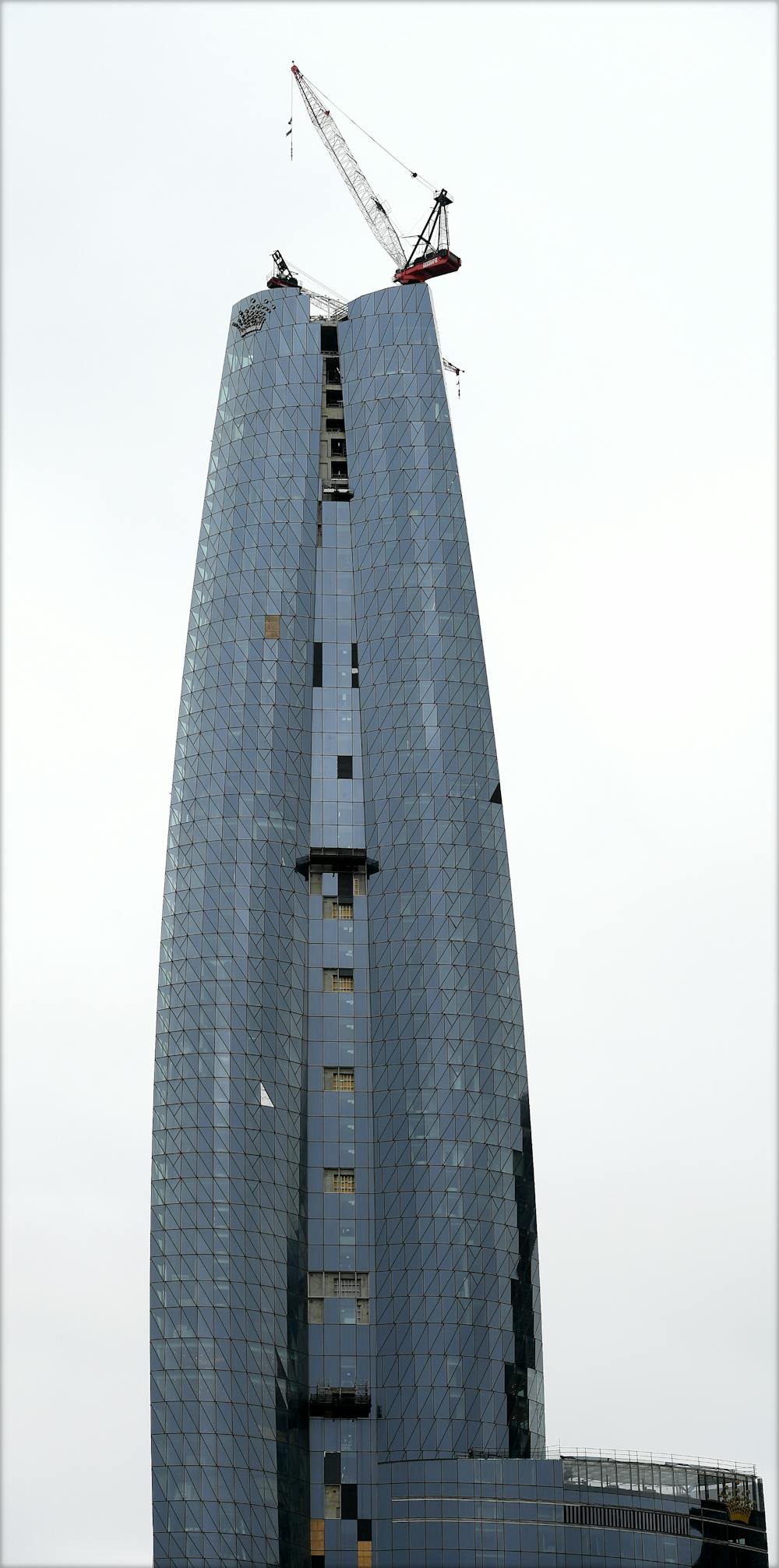
A Grattan Institute report released today finds Australian governments spent A$34 billion, or 21%, more on transport projects completed since 2001 than they first told taxpayers they would. And as we enter the era of megaprojects in Australia, costs continue to blow out.
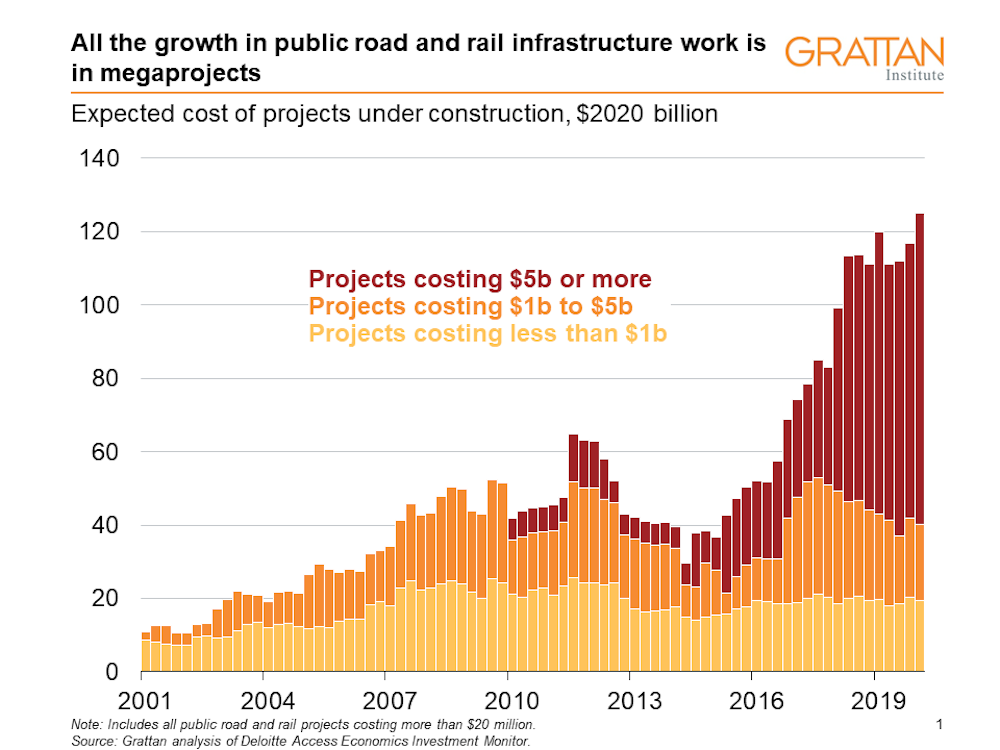
Transport projects worth A$5 billion or more in today’s money were almost unheard of ten years ago. Today, as the chart below shows, megaprojects make up the bulk of the work under way across the country.
We are also hearing calls to add to this bulging pipeline. In June, the transport and infrastructure ministers of all states and territories said they were “clearing the way for an infrastructure-led recovery” from the COVID-19 recession.
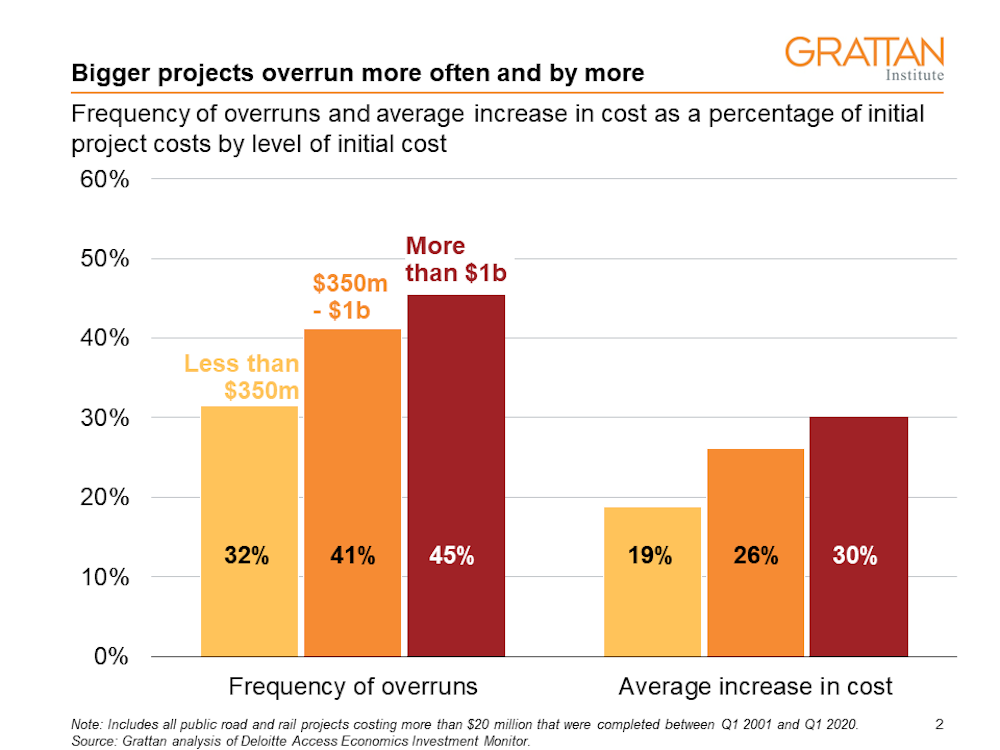
The Grattan report, The rise of megaprojects: counting the costs, sounds a warning about the risks of this approach. The report uses the Deloitte Access Economics Investment Monitor to look at the final cost of all public road and rail projects worth A$20 million or more and completed since 2001. As the chart below shows, we found bigger projects overran their initial cost estimates more often and by more.
Author provided
Almost half of the projects with an initial price tag of more than A$1 billion in today’s money had a cost overrun. These projects overran their initial costs by 30% on average. The extra amount spent on some megaprojects was the size of a megaproject itself.
Cost announcements before governments were prepared to commit formally to a project were particularly risky. Only one-third of projects had costs announced prematurely, but these accounted for more than three-quarters of the A$34 billion overrun.
When early costings of infrastructure turn out to be too low, it distorts investment planning in three ways:
underestimating the costs of transport infrastructure can lead to over-investing in it relative to other spending priorities
if governments misunderstand the uncertainty in a project’s cost at the time they commit to it, their decision to invest in that project was made on an incorrect basis
because unrealistic cost estimates are more prevalent for larger projects, governments are more likely to over-invest in larger projects.
There’s also a fourth and no less important problem: when unrealistically low cost estimates are announced, the public is misled.
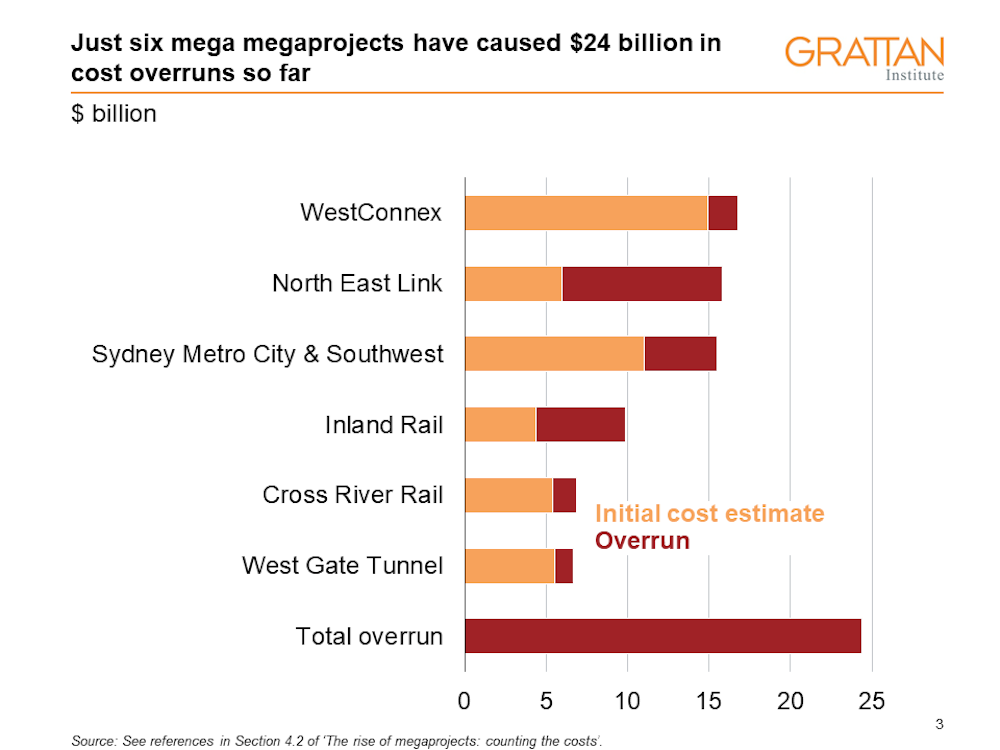
Despite the experience of the past 20 years, the costs of big projects continue to be underestimated. The chart below shows A$24 billion more than first expected will be spent on just six mega megaprojects (that is, projects with an initial cost estimate of A$5 billion or more) now under construction. Overruns on other megaprojects have been reported too.
With megaproject costs continuing to blow out, governments should take immediate steps to manage better the portfolio of work under way — particularly if they are looking to add to it in the name of economic stimulus.
Each state’s auditor-general should conduct a stocktake of current projects. This would give the public and the government a clear picture of the situation.
Ministers should report to parliament any changes in project costs, dates and benefits as they become known.James Ross/AAP
Ministers should begin reporting to parliament on a continuous disclosure basis. Any material changes in expected costs, benefits or completion dates of very large projects should be disclosed.
Steps should be taken to put decisions on the incoming batch of projects on a sounder basis, too. When announcing a cost, ministers and government agencies should disclose how advanced the estimate is. If the proposal is at an early stage, they should quote a range of estimates.
Governments should also require their infrastructure advisory bodies to at least assess — if not approve — large proposals before funding is committed.
Looking further ahead, action is needed to stop the pattern of spending billions more than expected on megaprojects. State departments of transport and infrastructure should devote more resources to identifying modest-sized transport infrastructure proposals.
And governments need to start learning from the past. Detailed project data, particularly on expected and actual costs, should be centrally collated in each state.
Post-completion reviews should be mandatory on all large projects. These reviews should be published.
If there is no change in the way infrastructure is conceived and delivered in Australia, then the era of the megaproject will indeed mean megaproblems.
House prices are spiking again, with “affordable homes” showing most growth. That’s no surprise really, with multiple factors in play.
Market instability due to COVID-19 is driving asset acquisition — property is the classic port in a storm for investors. Interest rates are at all-time lows and likely to stay that way. The pandemic has curtailed people’s spending, costly holidays are cancelled, socialising is limited and home working has reduced travel costs.
Overall, homeowners have more disposable income. This has led to an uptick in home improvements, renovations and real estate activity. Media coverage adds fuel to the fire by breathlessly reporting rapid price rises. First-time buyers panic that they will miss their chance.
Bottom line: the conditions are in place for a house price boom.
Into this febrile atmosphere stepped the Property Investors’ Federation CEO, claiming first-time buyers were causing recent price rises. The reasoning was that people moving out of a flat to buy a home — one that was previously a rental property — effectively reduce the available housing stock.
This is unfair at best. It shifts blame onto a younger, poorer demographic for reduced cost efficiency and return on investment. Those buyers may be looking to settle down and start a family. They are already largely locked out of the housing market by the depredations of property speculators and investors.
The rise of renting
For many years, property investment has been the main way in which New Zealanders have grown their wealth and provided for retirement. Developing a property portfolio is a tax-efficient, cost-efficient option for individuals with surplus wealth.
Capital growth in previous acquisitions leverages funding for further acquisitions, making the process self-sustaining. Better yet, investors can congratulate themselves for offering rental accommodation options that the state does not provide.
Government attempts to limit investment through capital gains taxes or some other mechanism have encountered substantial pushback. New Zealanders want the freedom to invest in property.
The result has been an ever-increasing proportion of the population in rental accommodation and an accompanying decline in the total number of owner occupiers. Over the past 40 years, owner occupancy has declined from 74% nationally to its current 62% (close to 50% in Auckland).
House prices — irrespective of media narratives — are not driven by production costs. They are driven by the residual values of existing houses. Like any commodity, scarcity drives values up. Abundance forces values down. Investors and first-time buyers pursuing the same properties create artificial scarcity.
The issue, then, is how to rapidly generate enough housing to meet the demand, given house building is not a rapid process. Irrespective of how many new houses of a particular type are wanted, capacity is constrained.
At best, additional “emergency” housing stock will take several years to be built. New houses are generally commissioned and bought by individual customers, and each house is unique and distinct. To date, most of this type of development has involved large, standalone — not affordable — homes.
This is not a market set up to provide mass housing at short notice. It is certainly not a market to create the housing surplus that would force down values.
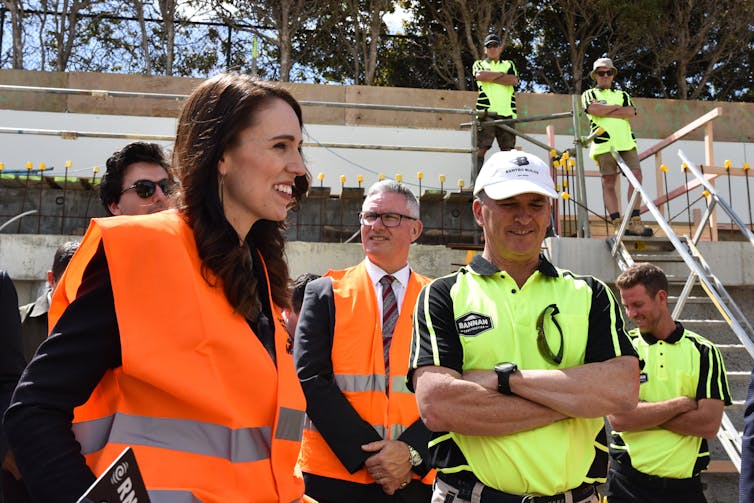
Prime Minister Jacinda Ardern visits a construction site to announce Labour’s housing policy during the 2020 election campaign.AAP
Governments should think like builders
The options are clear — moderation of supply and demand, with houses constructed ahead of the market.
But successive governments have failed to recognise builders will not do this of their own accord. So-called “special housing areas” failed because the market drove the development of standalone sections, not high-density plots.
KiwiBuild, the previous government’s ambitious house-building policy, failed utterly. Once again, it was because the government assumed builders would scale up their production and productivity without pre-existing commitment of funding and contracts.
Starting large development contracts without guaranteed customers is risky. Builders have limited resources and will not take on speculative builds.
On the other hand, housing scarcity leads to regular business and reasonable margins. In a volatile economy this is a good place to be. In a free society we can’t simply compel builders to build more. We can only encourage and incentivise them with large contracts.
This is where the government would need to provide the development capital to get ahead of the market — in other words, be the customer of first resort.
This does create the secondary problem of the state stepping into a commercial space. Using public funds to favour certain projects and providers will certainly trigger outraged howls of “unfair competition” from those not favoured.
But the demand side could be dampened with various measures to limit property investors and meet the urgent need to wean New Zealanders off property investment by:
limiting the number of properties that individuals or household trusts can hold
limiting the number of trusts that individuals can hold
incentivising divestment of property holdings (in favour of selling to first-home buyers, for example).
The elephant in the room is a capital gains tax on secondary and rental properties — something the current government backed away from during its first term.
Ultimately, though, given a choice between helping first-home buyers into housing or limiting cost-effective property investment, a left-leaning government will likely side with social need over optimising capital formation. To do otherwise would be unacceptable to its voter base.
In the final analysis, the Property Investors’ Federation is likely to be sorely disappointed with future policy.
Literary culture carries profound social value. In general terms it is essential to employment, cultural literacy and understanding of community, as well as to Australia’s post-pandemic recovery and growth. It is also radically underfunded and in urgent need of new support.
I am particularly concerned with the low level of investment in literature through state and federal funding agencies compared with other art forms.
The economic benefits
Literature is a mainstay of the creative and cultural industries, which contributed $63.5 billion to the Australian economy in 2016-17. Creative arts employ 645,000 Australians and those numbers were increasing before the pandemic. Literature operates in the economy in many and complicated ways, since writers are “primary producers” of creative content.
Books form an often invisible bedrock of robust resources for the wider economy. They provide creative content in areas such as film, television, theatre and opera; moreover they contribute fundamentally to the educational sector, to libraries, events and what might be called our forms of cultural conversation.
Julia Ormond and Angourie Rice in Ladies in Black, a 2018 film based on the novel by Australian author Madeleine St John.Lumila Films, Ladies in Black SPV, Screen Australia
The most conspicuous areas of economic benefit and employment are libraries, universities, schools, festivals, bookshops and publishing.
Indirect benefits, such as to tourism and cross-cultural understanding, are often overlooked in reference to the economic benefits of literature. Our books carry implicit, prestigious reference to a national culture and place; they attract interest, visitors and students and arguably establish a presence of ideas above and beyond more direct mechanisms of cultural exchange.
Cross-cultural exchange and understanding are crucial to the literary industries and of inestimable benefit in “recommending” Australia and its stories.
However, writers’ incomes are disastrously low, $12,900 on average; and COVID-19 has eliminated other forms of supplementary income. It has always been difficult to live as a writer in Australia (which is why most of us have “day jobs”) and it is clear writers are disproportionately disadvantaged. Although essential to the economic benefits of a healthy arts sector overall, writers are less supported by our institutions and infrastructure.
We need additional government-directed support such as the funding delivered to visual arts through the Visual Arts and Craft Strategy ($6.6 million in 2018-19), regional touring delivered through Playing Australia ($7.4 million 2018-19) and the Major Festivals Initiative ($1.5 million 2018-19).
Melbourne’s State Library.Valeriu Campan/AAP
Shaping national identity
The literary culture in Australia is chronically underfunded, but its benefits are persistent, precious and immense. “Social well-being” requires social literacy, a sense of connection to one’s history, community and self: these are generated and nourished through narrative, conversation and reflection.
The literary arts create a sense of pride, community and solidarity. A single library in a country town can offer astonishing opportunities of learning and self-knowledge: how do we calculate value like this?
As someone who grew up in remote and regional areas, I’m aware of how crucial libraries and book culture are to a sense of connection with the nation. Moreover, reading is an indicator of mental health, especially among young people.
Brothers Douglas and Dare Strout read a school book together while home schooling in Brisbane in April.Darren England/AAP
“National identity” also requires reflexive literacy: social understanding and agency derive from reading and writing; a nation that neglects its literary culture risks losing the skills that contribute to creative thinking in other areas — including in industry and innovative manufacturing. Local reading and writing initiatives have had remarkable success in areas like Aboriginal literacy and aged care mental support.
More Australians are reading, writing and attending festival events than ever before. Reading is the second most popular way Australians engage with arts and culture.
Writers’ festivals are flourishing and attendances growing. Libraries remain crucial to our urban and regional communities. It is no overstatement to claim that literature has shaped and reflected our complex national identity.
Australian literature at universities
The formulation of a Creative Economy Taskforce by Arts Minister Paul Fletcher is a positive step in establishing better understanding of this crucial economy. I would draw attention, however, to the lack of literary expertise on the taskforce. The appointment of a publisher or a high-profile Indigenous writer, for example, would give more diversity to the collective voice of our literary community.
The additional appointment of an academic concerned with Australian literature, such as the current director of the Association for the Study of Australian Literature, would further enhance the claims of literature.
The education sector will have a role in implementing creative arts initiatives. There has been a deplorable lack of support for Australian literature within the academy.
Under the current wish to renovate the jobs sector through the creative arts there is an opportunity to direct dedicated funds within the education budget to establishing a Chair of Australian Literature in each university (or at least in the Group of Eight).
There is currently one Chair at the University of Western Australia and a privately endowed one at the University of Melbourne. Postgraduate scholarships could also be offered specifically in the area of Australian literary studies.
Alexis Wright, pictured here in 2007 after winning the Miles Franklin award, is the Boisbouvier Chair of Australian Literature at Melbourne University.Dean Lewins/AAP
For a comparatively small outlay in budget terms, such a move would signal direct support for Australian reading, writing and research and would be widely celebrated in the education and library sectors.
‘Embarrassing’
It is embarrassing to discover that some European universities (in my experience Belgium, Germany and Italy, in particular) study more Australian literature than is offered in our own nation.
The case for increased Australia Council funding in the neglected area of literature has already been made. Writers’ incomes are, as attested, direly low and I worry in particular about diminishing funding for new and emerging writers.
An injection of funds into the literature sector of the Australia Council is another efficient and speedy way in which to signal understanding of the fundamental role of literature to our cultural enterprises and economic growth.
Cuts to publishing, festivals, journals, individual writers’ grants and programs generally, have had a disastrous effect on the incomes and opportunities for writers in this nation. Notwithstanding a few highly publicised commercial successes, most writers truly struggle to make ends meet. The “trickle down effects” — from a sustaining grant, say, to a literary journal — have direct economic benefits to writers and therefore to the wider economy.
Most writers’ work is not recognised as a “job”; if it were, if there were a definition of “writer” as a category of honourable labour (such as it is, for example, in Germany and France), writers would be eligible for Jobmaker and Jobseeker benefits.
This may be blue-sky thinking, but I look forward to a future in which forms of precarious labour, like writing, are recognised and honoured as legitimate jobs.
Another area that may work well with literature is foreign aid. The government of Canada, for example, donates entire libraries of Canadian literature as part of its aid program. (I’ve seen one installed on the campus of the University of New Delhi.)
What about gifting libraries of Australian books as part of our aid program?Hamilton Churton/PR Handout
This works as a stimulus to the host economy (benefiting publishers and writers) and also the receiving community, for whom access to books and education may be difficult. It also encourages study of the host culture’s writings and has benevolent “soft power” effects of inestimable worth.
‘Literature houses’
The government has indicated physical infrastructure (buildings and so on) will be necessary to the renovation of the domestic economy post-COVID. This is a wonderful opportunity to consider funding “literature houses”, purpose-built sites for readings, writer accommodation for local and overseas residencies, places for book-launches, discussion and the general support of literature.
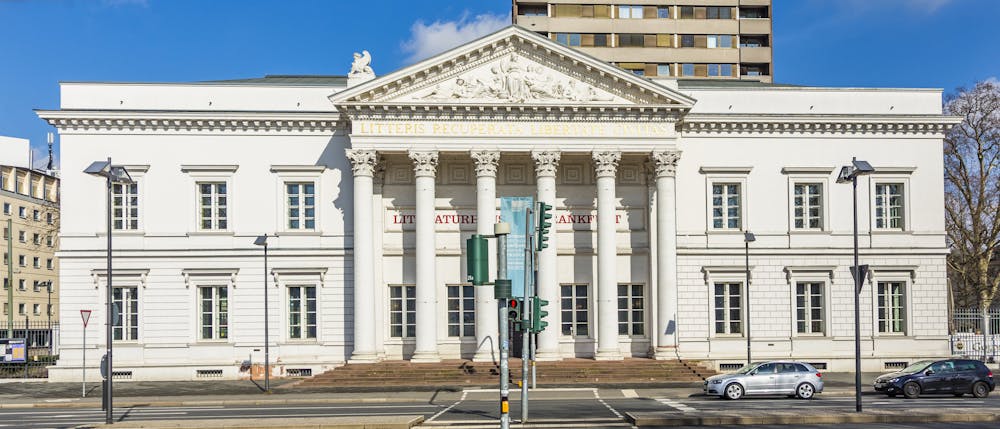
The Literaturhaus system in Germany, in which all major cities have funded buildings for writer events, and in which, crucially, writers are paid for readings and appearances, is a wonderful success and helps writers’ incomes enormously.
The Frankfurt Literaturhaus.shutterstock
The inclusion of Indigenous, regional, rural and community organisations in proposals for “literature houses” would stimulate local building economies and generate community recognition of Australian literature.
The Regional Australia Institute considers creative arts as a potentially productive area of regional economies. However its 2016 map of Australia has a tiny space allocated to creative industries (situated around Alice Springs and linked to the Indigenous art industry). This strikes me as a radical imbalance and a missed opportunity.
A priority for this inquiry could be support for initiatives in literature, perhaps through existing library or schools infrastructure, to address creatively matters of both rural innovation and disadvantage.
Encouraging workshops in writing, including visiting writers, addressing reading and writing as a creative enterprise for the community as a whole: these could form the basis for an enlivening cultural participation and skills. Dedicated funds in literature for regional, remote and rural communities are urgently required.
Literature, in all its forms, is crucial to our nation — to the imaginations of our children, to the mental health and development of our adolescents, to the adult multicultural community more generally — in affirming identity, purpose and meaning.
Scott Morrison has lost no time pivoting to the incoming US administration, declaring on Sunday he hopes Joe Biden and his wife Jill will visit Australia for next year’s 70th anniversary of ANZUS.
“This is a profound time, not just for the United States, but for our partnership and the world more broadly,” Morrison told a news conference.
“And I look forward to forging a great partnership in the spirit of the relationships that has always existed between prime ministers of Australia and presidents of the United States.”
Those around Morrison say the government is already familiar with many figures in the Biden firmament, who were players in the Obama years.
Morrison also thanked Donald Trump and his cabinet “with whom we have had a very, very good working relationship over the years of the Trump administration and, of course, that will continue through the transition period.”
Meanwhile, Anthony Albanese retrospectively sought to put a less controversial gloss on his Friday comment, when he said Morrison should contact Trump and convey “Australia’s strong view that democratic processes must be respected”.
On Sunday Albanese said: “What I suggested was that Scott Morrison needed to stand up for democracy. He’s done that in acknowledging the election of President-elect Biden”.
Within Australia political attention is quickly turning to what a Biden administration will mean for the Morrison government’s climate change policies, and how Biden will handle China.
With an activist climate policy a central feature of Biden’s agenda, including a commitment to net zero emissions by 2050 (which Australia has refused to embrace), Australia faces an increased risk of becoming isolated internationally on the issue.
That could have trade and investment implications, something of concern to the business community.
Morrison sought to highlight a common Australian-US commitment to technology.
He said he particularly welcomed campaign comments Biden made “when he showed a lot of similarity to Australia’s views on how technology can be used to address the lower emissions challenge.
“We want to see global emissions fall and it’s not enough for us to meet our commitments,” Morrison said.
“We need to have the transformational technologies that are scalable and affordable for the developing world as well, because that is where all the emissions increases are coming from … in the next 20 years,” he said.
“I believe we will have a very positive discussion about partnerships we can have with the United States about furthering those technological developments that will see a lower emissions future for the world but a stronger economy as well where we don’t say goodbye to jobs,” Morrison said.
Labor will use the Biden win as a springboard to ramp up its attack on the government over climate policy, including in parliament this week.
Albanese said Biden would reject “accounting tricks” like the government’s argument to be allowed to use carryover credits to reach emission reduction targets.
Former Liberal prime minister Malcolm Turnbull told the ABC the US result gave Morrison the opportunity to pivot on climate policy. Now was the time for him to say, “I don’t have to go on with all of the BS about a gas-led recovery, which is political piffle,” Turnbull said.
Chief of the Australian Industry Group Innes Willox said the Biden administration would place much more emphasis on climate change and energy policy.
“The commitment to net zero emissions by 2050 will encourage other economies to move down this path. We are already seeing significant steps in recent times from other major trading partners such as Japan, South Korea, the UK and the European Union.
“Australia, led by industry and investor action, is already headed this way without making a formal target commitment,” Willox said.
Willox said independent Zali Steggall’s climate change bill – with a pathway to a 2050 target – provided an immediate opportunity to move the debate forward. The bill will be introduced on Monday.
“The Bill is non-partisan. 2050 is many changes of government away, but for some industries it’s just a couple of investment cycles,” Willox said. The Steggall bill is receiving considerable business support.
Willox said the other major shift from a Biden administration would be “the opportunity for the US to re-engage with China on trade and broader economic issues.
“Efforts to take the heat out of differences on global trade through a change in tone will be welcomed but there should be no illusion that a Biden administration would seek to markedly soften the US’s stance on key issues,” Willox said.
“The risk for Australia until now has been that we have been caught up as collateral damage in the US-China trade dispute.
“The future risk is that China may seek to substitute Australian exports in key sectors with goods from the US in an effort to reset their economic relationship,” Willox said.
Asked about the prospect of the US rejoining the Trans-Pacific Partnership, Morrison said, “I think it would be very early days to speculate on those matters. I would simply say to the United States, the door has always remained open on the TPP. It is open now. It will be open in the future and you are welcome any time.”
Last week, the fifth most senior minister in the Morrison Government, Agriculture Minister and Deputy National Party Leader David Littleproud, threatened the ANZ bank with “every lever at the federal government’s disposal – including the availability of deposit guarantees”.
His concern was an ANZ statement about climate change.
The bank had said that it supported the transition to a net zero emissions economy by 2050, and that as a consequence it would no longer provide banking services for new business customers with “material thermal coal exposures”.
For me, it evoked 18-year old memories of when I was the ANZ bank’s chief economist in the early 2000s.
I had delivered a speech to a conference of accountants in which I’d been critical of the Howard government for its pretence that the goods and services tax wasn’t a federal tax and therefore didn’t need to be included in budget estimates of total tax collections.
After seeing media reports of that speech, the then treasurer Peter Costello phoned the then chief executive of the ANZ John McFarlane threatening (as McFarlane subsequently relayed his words to me) regulatory action which ANZ would not like if I said that sort of thing again.
‘Regulatory action ANZ would not like’
Costello also had his then press secretary fax (it was 2002) a press report of my remarks to the then Chairman of ANZ, Charles Goode, with the offending passage circled.
I was, frankly, astonished, that the third most important minister in the government at that time, someone who by his own account was single-handedly returning the budget to surplus, promoting wide-ranging tax reform and reversing a long-term decline in Australia’s birth rate, would have the time to ring the head of one of Australia’s big four banks to complain about something its chief economist had said on an arcane topic to an obscure conference.
And I was appalled that any Australian treasurer would be willing to use the regulatory powers granted to him to help ensure the stability of the financial system to (at the very least) silence someone who’d had the temerity to question the accounting treatment of a tax measure.
To their very great credit, neither the chief executive John McFarlane nor the chairman Charles Goode sought to take any disciplinary actions against me.
A delicate relationship
Saul Eslake, ANZ Chief Economist 1995-2009.
Goode sought an assurance that there was nothing personal in what I’d said (there wasn’t) and reminded me that I should not create the impression that ANZ was aligned with any side of politics.
McFarlane indicated that it was important that the ANZ “got on well” with the man who was (in his words) “likely to be the next prime minister”, and asked me to ring Costello up and “smooth things over”, and to avoid commenting on that particular topic again.
In accordance with these instructions I rang the treasurer’s office, but he refused to take the call (so I was told).
I scrupulously avoided such comments from then on.
When I declined an invitation from a journalist to comment on a subsequent government decision to fiddle with the timing of the Reserve Bank dividend to improve the 2004-05 budget position at the expense of the 2003-04 one, I received a note from McFarlane thanking me “for taking the greater good of ANZ and an easier life for me into account”.
A more ominous threat
Agriculture Minister David Littleproud.
Minister Littleproud’s threat to the ANZ’s current chief executive Shayne Elliott is more sinister.
Costello was trying to silence what could never have been more than a mere irritant.
Littleproud is seeking to prevent one of Australia’s leading banks from making a conscious, ethically-based decision to bring its lending practices into line with the goal of reducing Australia’s carbon emissions.
He is threatening to withdraw from its deposit customers the protection provided by Australia’s deposit insurance scheme – presumably in the hope that those customers would take their deposits to another financial institution.
Instead Littleproud seems to believe (as perhaps does the government of which he is a part, since no-one more senior has sought to “clarify” his remarks), that the government should decide who gets loan funds, and the circumstances under which they get them.
Free enterprise is only as free as the government allows it to be.
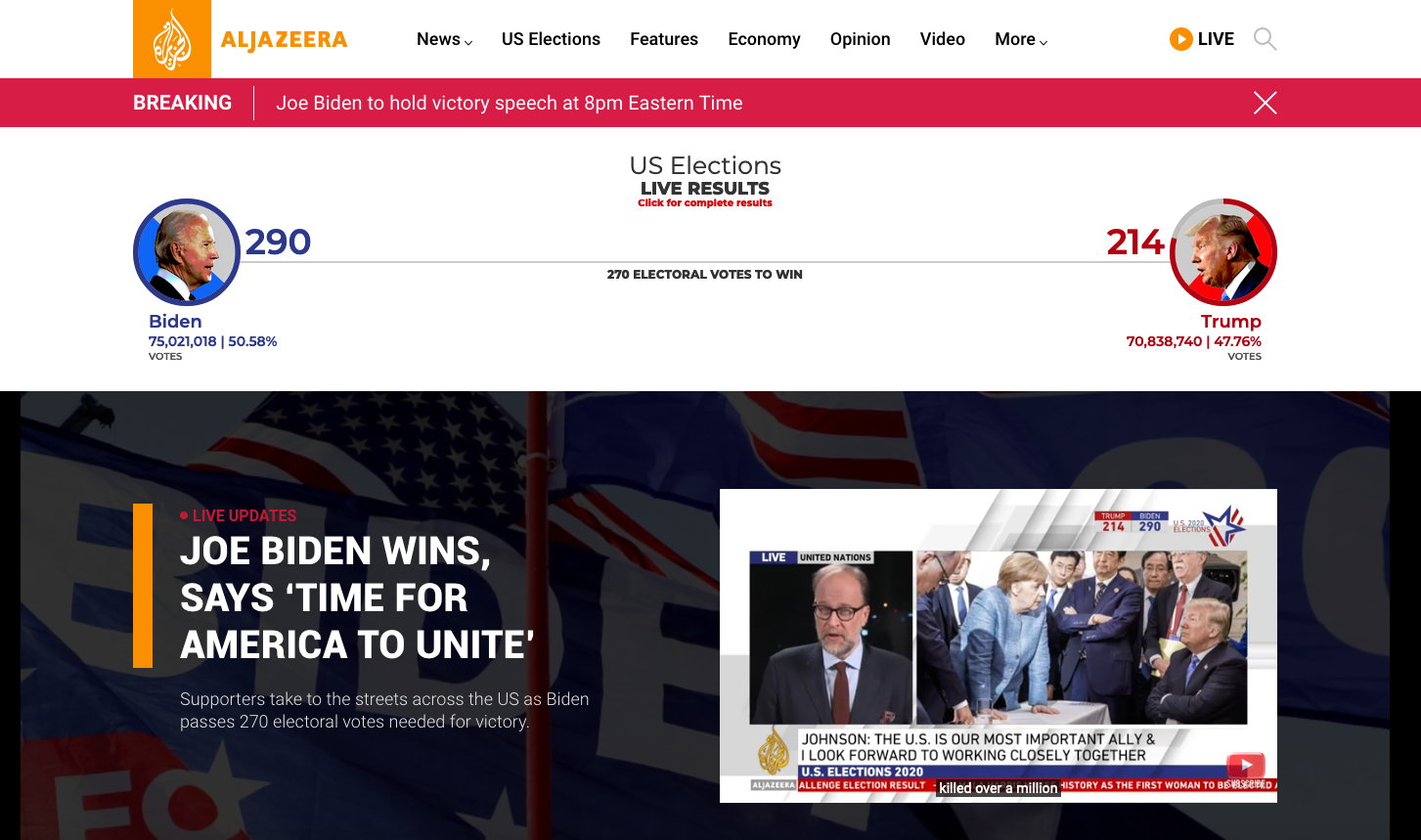
Pennsylvania and Nevada were today called for Joe Biden, taking him to 279 Electoral Votes, nine more than the 270 required to win. Biden is now the US president-elect, defeating an incumbent president for the first time since 1992.
Donald Trump has won 214 electoral votes. He is very likely to win North Carolina and Alaska. In Georgia, Biden leads by over 9,000 votes or 0.2%, with virtually all votes counted. In Arizona, Biden leads by under 19,000 votes or 0.6%.
If Biden holds his current leads in Georgia and Arizona, he will win the Electoral College by a 306 to 232 margin. That’s the exact margin by which Trump won the 2016 election, ignoring “faithless” electors.
On election night, Trump was well ahead in Wisconsin, Michigan, Pennsylvania and Georgia. This occurred because election day votes were strongly Republican, and much of the mail-in votes in those states had not been counted. With the inclusion of mail-ins, Biden won Wisconsin by 0.6% and Michigan by 2.6%.
Pennsylvania took longer to process its mail, but Biden’s lead there will expand from its current 37,000 or 0.6%. Virtually all votes needed to be counted in Georgia for Biden to move ahead.
The late counting trend has been different in Arizona, in which Biden’s large lead on election night induced Fox News and the AP to prematurely call for him. In Arizona, the early mail, which was counted on election night, was good for Biden, but the later mail has been good for Trump. This pattern has normally been reversed in Arizona.
Cook Political Report analyst Dave Wasserman has a graphic tracking the national popular vote. Biden currently leads Trump by 50.7% to 47.6%, and that margin will expand further owing to there being far more vote remaining to be counted in Democratic strongholds like California and New York. The total number of votes cast is already up over 9% from 2016.
While the polls were biased against Trump both nationally and in key states, there was a large gap between the popular vote and the Electoral College “tipping-point” state, as they predicted. Wisconsin, which Biden won by just 0.6%, is likely to be the tipping-point state, with Biden’s lead likely to grow in Pennsylvania but drop in Arizona.
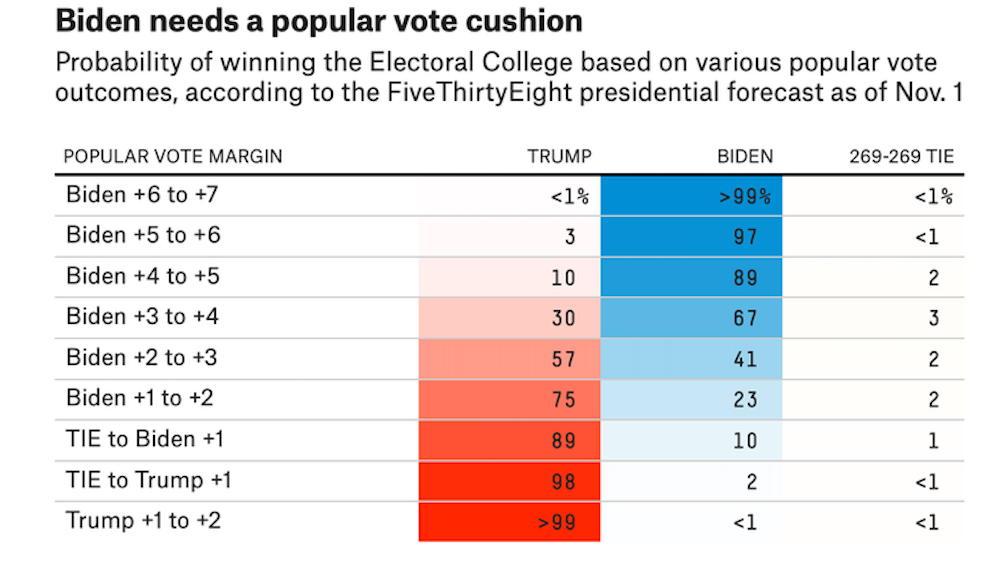
If Biden wins the national popular vote by four to five points, Wisconsin would be 3.5 to 4.5 points better for Trump than the overall popular vote.
While Trump outperformed his polls, the cause was unlikely to be shy Trump voters, as Trump under-performed Republican candidates for the House and Senate. CNN analyst Harry Enten says Republican House candidates are leading overall in Pennsylvania by two points. The small portion of the electorate that voted for Biden but Republicans in Congress made the difference.
The final FiveThirtyEight forecast gave Trump a 10% chance to win. Analyst Nate Silver wrote that in 2016, Trump was just a “normal polling error” from winning, but he needed a bigger error in 2020. In the end, Biden’s polling lead was large enough to survive the errors that occurred.
In the Senate, Republicans are tied 48-48 with Democrats in called races, but Republicans are very likely to win the final two uncalled races in Alaska and North Carolina. Democrats would need to win both Georgia Senate runoffs on January 5 to tie it 50-50, and allow Vice President-elect Kamala Harris to break the tie.
In the House, Democrats lead Republicans by 215 to 196 with 24 races uncalled. Republicans have so far made a five-seat net gain from the 2018 results.
Fiji’s Prime Minister Voreqe Bainimarama is reported to have become the first world leader to publicly congratulate US President-elect Joe Biden on his victory – despite there being no clear winner yesterday morning when he did so.
Bainimarama took to Twitter on Saturday to express his well wishes to Biden and called on him to work toward tackling climate change, which is a major problem for Fiji and Pacific nations, reports Newsweek.
“Congratulations, @JoeBiden,” Bainimarama wrote. “Together, we have a planet to save from a #ClimateEmergency and a global economy to build back better from #COVID19. Now, more than ever, we need the USA at the helm of these multilateral efforts (and back in the #ParisAgreement — ASAP!)”
Biden has said he would rejoin the Paris Climate Agreement if he became president, saying the US would reverse President Donald Trump’s decision to leave the accord immediately after his inauguration.
Biden was declared victorious early today after successfully overturning his hometown state of Pennsylvania, giving him enough electoral college votes to surpass the required 270. Nevada was also declared for Biden a short time later.
Bainimarama has been Fiji’s prime minister since 2007, serving as acting prime minister from 2007 to 2014 following his 2006 military coup.
Fiji was the first country to ratify the Paris Climate Agreement.
Bainimarama was not the first world leader to offer congratulations on the outcome of the 2020 election. Slovenia Prime Minister Janez Janša congratulated President Donald Trump for his false declaration of “victory” on November 5, according to Newsweek.
Janša’s tweet prompted criticism from some members of the European Parliament, while his claim that Trump would win the election was premature and mistaken.
It is common for world leaders to congratulate newly-elected presidents but most heads of government and heads of state wait until the election is concluded.
Ardern said she looked forward to strengthening the ties between both nations in the coming years, reports TVNZ.
“There are many challenges in front of the international community right now, the message of unity from Joe Biden positions us well to take those challenges on,” she said.
Noting Biden’s previous visits to New Zealand in 2016, Prime Minister Ardern said the win would allow for the two countries to work closely on prominent issues like covid-19 and climate change.
“New Zealand will continue to work side-by-side with the United States on the issues that matter to both of us, including the prosperity, security, and sustainability in the Indo-Pacific and Pacific Island regions.”
Joe Biden wins the US presidency today – “time for America to unite”. Image: Al Jazeera screenshot
A timeless tradition in political journalism is trying to find a narrative that explains an electoral outcome.
A widely accepted narrative to explain Barack Obama’s win over John McCain in 2008 was that Americans wanted to embrace the “change” candidate who appeared the most dissimilar to then-President George W Bush. The narrative four years later in 2012 was that Republican Mitt Romney was too “elite” to resonate with American voters, and Obama was returned. Then in 2016, it was that Hillary Clinton was so confident of becoming president, she overlooked “Middle America”.
The accuracy of these widely accepted narratives in explaining electoral victories is fiercely debated. So, too, will be many of the narratives for Joe Biden’s election win to become the 46th president of the United States.
One narrative for this election may be that Biden ran a campaign that was unspectacular, when unspectacular was exactly what Americans wanted after four years of endless spectacles. Perhaps Americans wanted more conventionality after an exceedingly unconventional president.
Another potential narrative may be the death toll of nearly a quarter of a million Americans from the coronavirus pandemic was simply too overwhelming for President Donald Trump to overcome. When a majority of Americans blame the US government for the coronavirus situation in the country now seeing record numbers of infections each day, it’s not hard to see why they would want to change course.
Yet perhaps the most lasting narrative of this election is how fearful, uncertain, and polarised Americans are. Although this is not novel in modern American history, the ever-increasing reach and volume of this sentiment certainly is.
In receiving more than 70 million votes, more Americans voted for Trump in this election than any other candidate in history – except for Biden, who earned more than 74 million votes. (Both of these totals will likely increase as further ballots are counted.) There’s no denying increased voter participation is an encouraging sign for American democracy, yet some of the passions fuelling that turnout are worrying.
Recent polling found a majority of Americans unwilling to agree the other side’s electoral victory in the presidential election should be accepted.
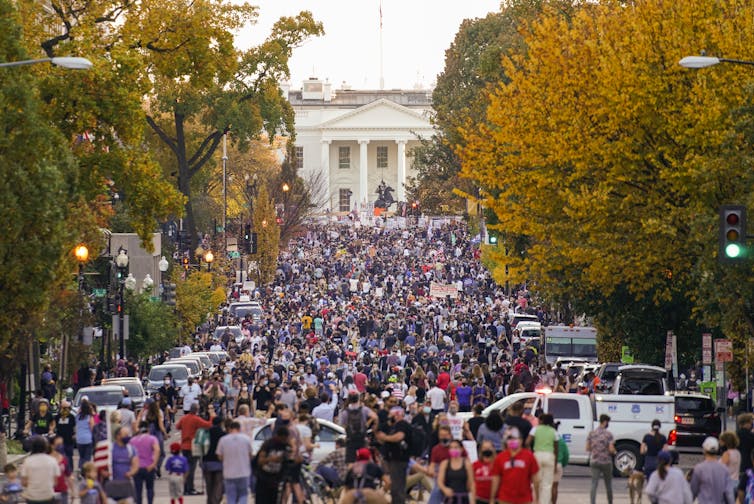
Biden supporters celebrate in front of the White House in Washington, D.C.AAP/AP/Pablo Martinez Monsivais
Americans recognise this in the other side too: only 16% of Trump voters said Democrats would accept a Trump re-election; 26% of Biden supporters said Republicans would accept a Biden win.
Alarmingly, other polling found around a third of Americans believed violence could be justified in support of their political parties’ goals, while 21% of those with a strong political affiliation were “quite willing to endorse violence if the other party wins the presidency”.
With more than three quarters of Americans saying they expected violence in the aftermath of the election, a record number of Americans in 2020 decided to arm themselves.
For more than a decade, the United States has had more guns than people. But 2020 has already broken records for the number of gun sales. This was often a partisan trend in previous years – Americans who leaned Republican were more than twice as likely to own a gun as those who leaned Democratic – yet there are some indications that in 2020, increased gun ownership became bipartisan.
Just last month, the Trump administration’s own Department of Homeland Security – an organisation set up in the aftermath of the September 11 2001 terror attacks – said it was Americans, specifically violent white supremacists, who posed the “most persistent and lethal threat in the homeland”.
Amid reports of a foiled plot to attack a vote-counting centre in Philadelphia and continued inflammatory rhetoric, there is little question as to whether violence in the aftermath of this election is likely.
So what happens now?
Trump will remain president for another 73 days, as a “lame duck” president. Biden will be inaugurated on January 20 2021.
So far, Trump has refused to concede defeat – in fact, he in insisting he won without offering any evidence of it – and has launched a series of legal challenges to the outcome. Many of those challenges have already been dismissed.
Simultaneous to his ceaseless battles over the integrity of his electoral loss, Trump will likely face extensive lobbying for presidential pardons – a unique privilege given to the president by the constitution “to grant reprieves and pardons for offenses against the United States”.
Conventional presidents have traditionally been concerned about how history will perceive their pardons. Trump is certainly not conventional, having used and considered using pardons for much of his presidency.
Trump will eventually leave the White House. But it is hard to see his loyal base leaving him anytime soon. Like so many other norms, Trump will be unlikely to adhere to the norm that former US presidents retire from political life after leaving the White House.
Trump will leave the White House in January, but he still has many supporters, leaving the possibility of him running again in 2024 an open question.AAP/AP/Julio Cortez
The fact Trump is still eligible to run for another term of office may allow him to follow in the footsteps of President Grover Cleveland, who was ousted from the White House by Benjamin Harrison in 1888, but four years later, defeated Harrison and took back the presidency.
While some Republican leaders are distancing themselves from the president, the fact Trump still enjoys a 95% approval rating among Republicans means he is undeniably an early favourite for the 2024 Republican nominee for president.
Lastly, Biden will assume the presidency facing multiple crises, ranging from a pandemic and economic downturn to overwhelming levels of fear, uncertainty, and polarisation. Should the US Senate remain Republican-controlled, he will need to navigate these crises in the face of a divided government. In this scenario, his former Republican colleagues in the senate would have final approval of his cabinet and legislative agenda.
From expanding NATO to the 2009 economic stimulus bill, Biden comes to the White House with arguably more bipartisan achievements than any president of the last half century. The question is whether he will overcome the widely-accepted narrative of a dangerously divided America.
Throughout the four years of Donald Trump’s presidency, Joe Biden spent significant time reassuring American allies around the world that Trump’s America is not “who we are” and pledging “we’ll be back”.
Now that he’s the president-elect, those who were most worried about another four years of “America First” foreign policy are no doubt breathing a sigh of relief.
Much has been written about a Biden presidency being focused on restoration, or as David Graham of The Atlantic put it,
returning the United States to its rightful place before (as he sees it) the current president came onto the scene and trashed the joint.
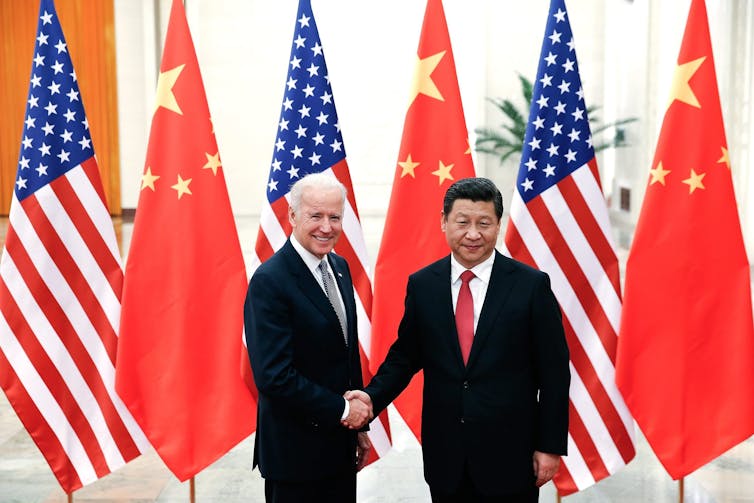
Then-Vice President Biden meeting Chinese leader Xi Jinping in 2013.LINTAO ZHANG / POOL /EPA
The old world order doesn’t exist anymore
This idea has revolved around restoring the post-1945 liberal international order – a term subject to a lot of academic contention. The US played a central role in creating and leading the order around key institutions such as the United Nations, International Monetary Fund, World Trade Organisation, North Atlantic Treaty Organisation and the like.
However, there is now no shortage of evidence that many of these institutions have come under extreme strain in recent years and have been unable respond to the challenges of the 21st century geopolitics.
Trump questioned the US commitment to NATO and expressed affinity for Russian leader Vladimir Putin.Hau Dinh/AP
Moreover, nations themselves are no longer the only important actors in the international system. Terror groups like the Islamic State now have the ability to threaten global security, while corporations like Alphabet, Amazon, Apple and Facebook have such economic power, their combined revenue would qualify them for the G20.
Equally, the so-called liberal international order was built on the idea that a growing number of democracies would be willing to work within institutions like the UN, IMF and WTO and act in ways that would make everyone in the system better off.
Clearly, that has not been the case for the past 15 years as democracies around the world slowly eroded, from European Union states like Hungary and Poland to Brazil to the US.
From his first days in office, Trump was on a mission to roll back US commitments to myriad organisations, deals and relationships around the world. Most significantly, this included questioning commitments to its closest allies in Europe, Asia and elsewhere that had been unwavering for generations.
Trump damaged some of America’s strongest alliances in Europe.Francisco Seco/AP
Biden takes over at a precarious time. The world is more unstable than it has been in decades and the US image has been severely damaged by the actions and rhetoric of his predecessor.
There is no naivety on Biden’s part that he will be able to fix everything that was broken along the way. After all, many of these challenges predated Trump and are merely a reflection of a changing world.
Furthermore, Biden will have many pressing domestic issues that will demand his immediate attention — first and foremost addressing the greatest public health and economic crisis in a century.
Given this, Biden’s presidency should be approached with managed expectations. Unlike President Barack Obama, he did not campaign on lofty promises of change. He ran on being the opposite of Trump and, as such, being better able to understand the intricacies of foreign policy.
This will mean a swift return to multilateralism and rejoining the deals and organisations Trump abandoned, from the Paris climate agreement and Iran nuclear deal to the the World Trade Organisation and World Health Organisation.
Given these moves by Trump required no congressional input, Biden will be able to return to Obama-era policies in a relatively straightforward fashion through executive action.
Biden’s campaign put a great emphasis on strengthening America’s existing alliances and forging new ones to maintain what he frequently refers to as “a free world”.
This shift will benefit America’s traditional allies in western Europe the most. However, these countries are more determined than ever to stop depending on the whims of the Electoral College to decide their security. Instead, they are strengthening their own defence capabilities.
‘America First’ finished second
Lastly, on the greatest geopolitical question of our time, there is no doubt the US will continue its competition with China in the coming years, no matter who is president.
Yet, there are still plenty of questions around how Biden will handle this relationship. His campaign adopted a much more hawkish stance toward China compared to the Obama administration, which reflects a growing bipartisan consensus the US must get tougher with Beijing.
At the same time, there is significant debate about how far his administration should push Beijing on issues ranging from technological competition to human rights, particularly given Biden has said the US needs to find a way to cooperate with China on other pressing issues, such as climate change, global health and arms control.
America might be coming back under Biden, but this is not the same world or the same country it once was. So, while the restoration of the US will be challenging, one thing is certain: “America First” finished second.
Joe Biden is almost certain to be the next president of the United States, ushering in a welcome return to engagement with the climate crisis after four years of denial. Great news for the Pacific.
In contrast with Donald Trump’s premature declaration of victory and desperate calls to “stop the count”, Biden is modelling patience, with around 10 percent of ballots still to be tallied.
But he let his confidence in the eventual outcome show with a tweet promising his White House will rejoin the Paris Agreement, 77 days after the official exit of the United States, reports Climate Change News.
That is the easy part. Much harder will be delivering emissions cuts, after disappointing Senate results for the Democrats.
They could yet scrape a majority — subject to a January run-off in Georgia — but do not have the 60 seats needed to pass a framework climate law.
A Biden administration will have to get creative to submit a credible 2030 climate target to the UN next year, as required under Paris.
Biden made climate change a cornerstone of his vision to recover the American economy from the impacts of covid-19, with a US$2 trillion plan to drive green investments and create jobs, reports Chloé Farand of Climate Change News.
Blue wave never materialised
But the blue wave Democrats hoped for in the Senate has failed to materialise, dampening Biden’s prospects of passing climate legislation.
While Democrats are confident they will retain control of the House of Representatives, the Senate election is down to the wire, with both sides having 48 seats as of Friday.
The contest is so tight, the Senate majority could be determined on January 5 in a hotly contested special election for at least one, and maybe two seats in Georgia.
Even with a slim majority in the Senate, Biden would need some Republican support to pass climate legislation. Under US Senate rules, policy changes beyond spending and taxation require at least 60 of the 100 senators to agree to move the issue to a vote.
Bipartisan backing will be required to introduce a clean electricity standard, for example, which would mandate a transition to zero carbon electricity generation by 2035 and help deliver on a campaign promise. So would a carbon pricing mechanism.
“Control of the Senate will have a huge impact on climate policy in the US,” said Jamie Henn, cofounder of US environmental group 350.org.
“There’s little hope for passing sweeping climate legislation if [Republican majority leader] Mitch McConnell keeps his claws on the gavel. There’s a lot the president can do through executive authority, but to really rise to the scale of this crisis, we need the votes in the Senate.”
Without congressional backing, “a sweeping economic regeneration policy… will not happen in the next two years,” said Nathan Hultman, director of the Center for Global Sustainability at the University of Maryland.
“Then we have to look at it as a stage process.”
Republished with permission from Climate Change News.
As Aotearoa New Zealand waited for the election special votes results there was no talk of violence in the streets or threatened endless litigation.
Our citizens are more tolerant of opposition and more liberal than the citizens of the divided nation that used to be called the “United States” of America.
A womanising, egotistical, vain, ignorant and self-serving person would never become Prime Minister here.
So — feeling rather proud of ourselves— let us turn to the New Zealand special votes announced this afternoon.
Opposition National’s agonies continue with its loss of two more seats, and Labour won three electorates that it lost on election night.
In Maungakiekie, Labour’s Priyanca Radhakrishnan won by a 635 majority over National’s Denise Lee.
In Northland, Willow-Jean Prime defeated Matt King by a 163 vote majority, while in Whangārei, Emily Henderson won over Shane Reti with a 431 vote majority. Reti will, however, retain a seat in Parliament.
Greens hold Auckland Central The Green Party’s Chloe Swarbrick held on to Auckland Central, doubling her election night lead of 1068, and Rawiri Waititi held his hat on to hold Waiariki and add a second Māori Party seat.
Radio NZ reports the Māori Party extra seat goes to co-leader Debbie Ngarewa-Packer who comes in on the list.
“Today’s success is first and foremost about Waiariki, and that absolute belief in mana motuhake, belief in their candidate,” she said.
Labour’s Tamati Coffey has conceded to Waiariki electorate winner, Māori Party’s Rawiri Waititi.
Waititi won the seat by doubling his election night majority to 836.
In the United States, democratic norms are breaking down.
The president, Donald Trump, baselessly claimed at a White House press conference on Friday morning, Australian time, that the presidential election has been stolen from him by fraudulent and corrupt electoral processes.
This confronted the television networks, whose job is to report the news, with an acute dilemma.
In an already volatile political atmosphere, do they go on reporting these lies, laced with an undertone of veiled incitement to violence? Or do they cut away on the grounds that by continuing to broadcast this stuff, they are helping to propagate lies and perhaps to oxygenate a threat to the civil peace?
It was not rooted in reality and at this point, where our country is, it’s dangerous.
CNBC presenter, Shepard Smith, said the network was not going to allow it to keep going because what Trump was saying was not true.
CNN and Rupert Murdoch’s Fox News broadcast Trump’s entire press conference but immediately afterwards challenged what he said. CNN’s fact-checker Daniel Dale said it had been the most “dishonest” speech Trump had ever given, with anchor Jake Tapper saying Trump’s statements were “pathetic” and “a feast of falsehoods”.
Fox’s host Martha MacCallum said the supposed evidence and proof of election misconduct would need to be produced.
Even Murdoch’s New York Post, which had endorsed Trump’s re-election, accused him of making “baseless” election fraud claims, quoting a Republican Congressman as saying they were “insane”.
The Washington Post carried two news stories on its front page, clearly calling out Trump’s lies: “Falsehood upon falsehood”; “A speech of historic dishonesty”.
A serious decision to silence the President
But what of the networks’ decision to cut away?
Silencing a public official in the course of his official duties is a very serious abrogation of the media’s duty in a democracy.
But so is allowing the airwaves to be used in such a way as to arouse fears for public confidence in the democratic process and — as MSNBC’s Williams argued — even public safety.
Caption text.Shawn Thew/ EPA
On the run, many of the big networks prioritised public confidence in the democratic process, and public safety, over the reporting of the president’s words.
It is a rare circumstance in any democratic society that the media are placed in the position of having to shoulder such a heavy burden of responsibility.
It is most unlikely that once the present crisis is over, assuming Democrat candidate Joe Biden wins, the American media will find themselves in this position again.
Even so, a Rubicon has been crossed. A president of the United States, a publicly elected official, has been silenced by significant elements of the professional mass media in the course of his public duties.
This was done principally on the grounds he was lying to the people in circumstances where there was a foreseeable risk of serious harm to the body politic, and there was no practicable way to reduce the risk.
Is that a standard the media is prepared to set for the future? If so, it would be giving itself a power that goes well beyond anything the media has claimed for itself up till now.
Journalists need to keep their nerve
In considering this, two questions arise.
What if all media outlets had adopted this course? No one except those at the White House press conference would have known the whole of what Trump said, seen the context and observed the demeanour with which he said it.
Would it have been enough to do as CNN and Fox did — report the speech and then repudiate it?
An answer to that would be: the lies were coming so thick and fast, and were so damaging to the public interest, that it would have been impossible to set the record straight in anything like real time.
Real-time fact-checking is a relatively new development, and a welcome one. But its feasibility should not be a criterion for deciding whether to publish breaking news, unless there is doubt about whether the breaking news is actually happening.
The networks that cut away doubtless acted in good faith to do right by the country. Trump’s speech was shocking and irresponsible.
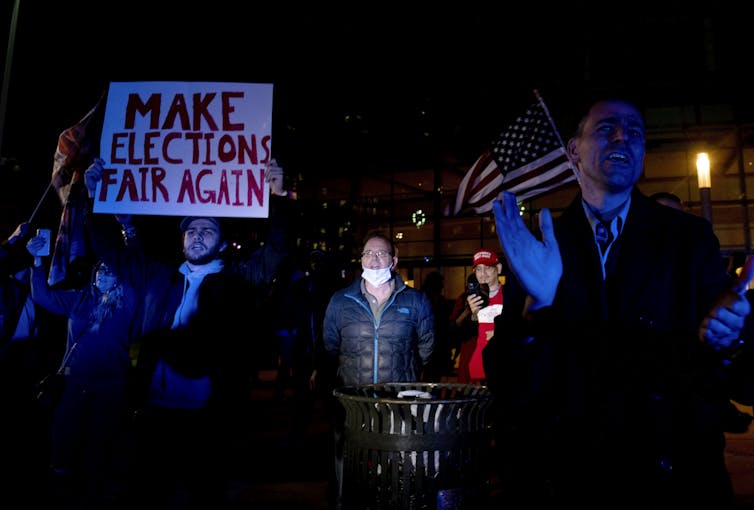
Trump supporters have taken to the streets since the polls closed on November 3.Nicole Hester/AP
However, American democracy is in crisis. At this time, above all, the public needs the institution of the fourth estate to keep its nerve and a clear head.
A primary norm of journalism is to inform the public. That certainly means being fair and accurate. But if the news contains lies, the norm is to publish and then call out the lying and set the record straight as soon as possible.
The networks need to explain to their audiences their reasoning behind the decision to cut away, and the media as a whole need to realise that if the norms of journalism break down, that just adds to the tragic chaos into which their country has descended.
The division of the findings of the Victorian COVID-19 Hotel Quarantine Inquiry into two – the interim report published today, with a final report due December 21 – is aimed at making a timely contribution to the redesign of the quarantine systems that will remain key to Australia’s management of the COVID-19 pandemic for some time to come.
With a view to the expected influx of returnees at Christmas, the national cabinet is due to discuss necessary changes later this month. Justice Jennifer Coate’s clear recommendations for how to devise and operate a quarantine system will surely be pivotal to its deliberations.
Key recommendations
Coate’s primary message is that quarantine – in whatever form it might take – is a public health operation. So any future quarantine system needs to be designed in a manner that ensures the centrality of this public health imperative.
We must wait until the final report to find out what Coate has to say on the larger governance and accountability questions surrounding “the decision” to contract out the front line of Victoria’s hotel quarantine operation to private security provision. However, her interim report already tells us a lot – if indirectly.
The report states it “is clear from the evidence to date” that the majority of those involved in the hotel quarantine program who contracted the virus were:
private security personnel engaged by way of contracting arrangements that carried with them a range of complexities.
It is therefore unsurprising that the issue of the appropriateness of contracting-out is the elephant in the room across a number of its key recommendations.
In particular, the recommendations record that the expertise of those involved in future quarantine operations will be crucial. Moreover, every effort should be made to ensure people working at quarantine facilities are “salaried employees” who are “not working in other forms of employment”.
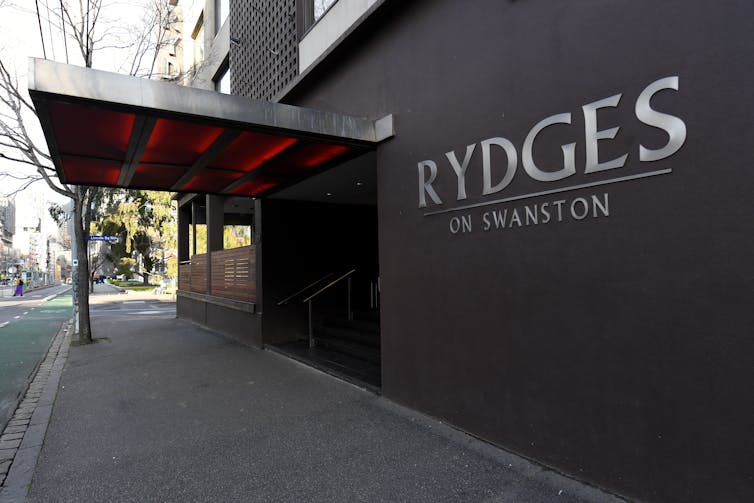
Rydges on Swanston was one of the quarantine hotels where coronavirus outbreaks occurred.James Ross/AAP
It takes little effort to surmise that contracted-out service delivery is unlikely to meet any of these demands.
As I have explained elsewhere, to contract out a statutory function in whole or in part requires that it be translated into a “service” that private sector providers are capable of delivering.
In the Victorian case, this meant the front line of the hotel quarantine operation was performed pursuant to an “observe and report” security services contract. It was carried out by an entirely casualised workforce with little infection-control training and no lawful powers of enforcement. Many or most of them worked in other jobs at the same time.
Coate also recommended that, alongside the “embedded” presence of expert infection-control personnel, a 24/7 police presence be established at every facility-based quarantine operation. This clearly points to the failure of contracting-out from an enforcement perspective as well.
So, by implication or otherwise, the interim report confirms that too little thought was given to whether the contracted service could meet the dual public health and detention demands of the function at issue.
Coate’s conclusions on how a facility-based quarantine program should work make the multiple dimensions of this mismatch plain.
Where to from here?
The final report of the inquiry may well prove to be the most sustained critique of contracting-out, from the perspective of public expectations of government action, that Australia has yet seen. This would be a welcome shift from what has prevailed so far, with much more effort dedicated to refining and expanding the practice than to challenging it.
As for where the interim report fits with the “whodunnit” exercise that has dominated so much of the interest in the inquiry’s work so far, Coate makes clear we must wait until the final report to find out more. Whether Victoria ended up with private security at the front line of its hotel quarantine program as a result of a “decision” by one or more individuals, or (as counsel assisting Rachel Ellyard described it) a “creeping assumption that became a reality”, is something that ultimately might never be clear.
Either way, the question of accountability will remain. Providing a clear answer to it stands to be every bit as complicated as it has been so far.
The inquiry, which found the bungled scheme cost the state $195 million, has shown the relationship between contracting-out and political accountability is incoherent. Substantial reform in both directions is needed to make it otherwise. Coate’s final report will hopefully guide that much-needed conversation.
But, again, we can already take a lot from the interim report about where – minimally – we need to be. Any future Victorian quarantine program must be operated “by one cabinet-approved department”, in accordance with a “clear line of command vesting ultimate responsibility in the approved department and Minister”.
That department must in turn be “the sole agency responsible for any necessary contracts”. Among other things, its responsible minister must also ensure senior members of its governance structure “maintain records […] of all decisions reached”.
Such is the vision for the future. But it also highlights why it is so important not to lose sight of the “why” questions when the issue of accountability for what actually happened in Victoria’s disastrous hotel quarantine program is again upon us.
If the front line of the hotel quarantine system was simply too important a responsibility to be outsourced, it is time to get to the bottom of why this was the case, and why it might also be the case for other high-stakes government functions that carry serious consequences for public health or safety.
Providing sensible answers to those questions needs to be the goal. But what matters above all else is that we actually start asking them.
Mining magnate Clive Palmer has lost his challenge to the closure of the Western Australian border in response to COVID-19. Palmer has also been ordered to pay costs.
While it is clear from the High Court’s order in Palmer v Western Australia that Palmer lost, it remains unclear whether the border closure was and remains valid.
The reason for the lack of clarity is because the High Court has not yet handed down its reasons, which may take weeks or months. In the meantime, all we have is its orders – and they are phrased in a rather peculiar and limited way.
Section 92 of the Constitution says the movement of people among the states shall be “absolutely free”. But the High Court has previously accepted it can be limited if it is reasonably necessary to achieve another legitimate end, such as the protection of public health.
In the Palmer case, the High Court gave a very limited answer to the questions it was asked. In relation to the Emergency Management Act it said that “on their proper construction”, sections 56 and 67,
in their application to an emergency constituted by the occurrence of a hazard in the nature of a plague or epidemic comply with the constitutional limitation of section 92 of the Constitution.
Both these sections are quite general in nature. Section 56 says the minister can declare a state of emergency in the whole of the state or a part of it. There is nothing on obvious that would appear to offend section 92 of the Constitution in each of its limbs.
Section 67 says during a state of emergency, certain officers may issue directions that prohibit the movement of persons within, into or out of an emergency area. On the face of it, it is not directed at the movement of people across state borders. However, if a state of emergency were issued for the entire state under section 56, then section 67 would potentially allow a direction to be made that would prevent people from entering or leaving WA.
Clive Palmer launched his challenge after WA closed its border in April.Lukas Coch/AAP
The High Court’s qualification in the phrase “on their proper construction” is therefore important. This raises the question of how the High Court has interpreted section 67 and whether it has restricted its interpretation in a manner that accommodates section 92 of the Constitution. We will have to wait for the High Court’s reasons to learn this.
The court’s order in relation to the Quarantine Directions is more unusual. It says the exercise of this power under clauses 4 and 5 of the directions “does not raise a constitutional question”. This refers to an issue raised during the hearing. The argument, initially raised by Victoria, was that the validity of a direction made under a power conferred by an act will depend on whether the direction falls within the scope of that power in the act.
If the section in the act that confers the power (in this case, section 67 of the Emergency Management Act) is constitutionally valid, then any direction that falls within that power will be valid too.
The real question, then, is whether the direction falls within the scope of the legislative power. This is not a constitutional question, but a question of administrative law. The High Court then said in its order that it had not been asked this question, so it did not need to answer it.
On the basis of this technicality, the High Court (or at least a majority of the Justices) concluded it was not necessary to address whether the actual directions that stop people going in or out of Western Australia were valid.
Does this mean more litigation?
As this case does not seem to have resolved whether or not the directions are valid, will there be more litigation? It is possible someone could challenge the directions, arguing this time that they do not fall within the scope of the authorising section in the legislation.
But such litigation would have to start from square one and so would take some time to determine. As it would not be a constitutional matter, it might have to be decided by a lower court first.
WA Premier Mark McGowan celebrated the High Court result on Friday.Richard Wainwright/AAP
Further, before initiating any such litigation, it would be important to read the High Court’s reasons, which may not be produced for some time. Those reasons will tell us about the scope of the legislative provision, which will be essential to know before any challenge to the directions made under it could proceed.
Hopefully, by the time we get to that point, there will be no need for such litigation because no such directions will exist, if the pandemic continues to ease in Australia.
But it does mean we may be left with inadequate guidance about such matters for the future, which would be unfortunate given the cost and time taken with this litigation. Perhaps the court’s reasoning about the interpretation of section 67 of the Emergency Management Act will give us sufficient understanding about the operation of section 92 of the Constitution and the tests applicable to border closures in a pandemic. But that remains to be seen.
Victorian lockdown challenge also rejected
In a busy day for the High Court on Friday, it also threw out hotelier Julian Gerner’s challenge to Melbourne’s lockdown laws.
Gerner’s challenge, to be successful, would have required the High Court to find an implied freedom of movement in the Constitution.
This would have opened up all sorts of other laws to challenge and been condemned by conservatives as judicial activism. The court was so unimpressed by the argument that it unanimously rejected it on the spot, without even needing to hear Victoria’s response.
The end of the case was swift and brutal. It is unlikely this point will be raised again before the court.
The article was updated on Friday November 6, 2020, to reflect the final official figures released by the Electoral Commission.
Labour is celebrating a landslide victory tonight after winning 49% of the vote (confirmed as 50% after special votes were counted). The result means Labour could govern alone — the first time this has happened since New Zealand introduced a mixed member proportional (MMP) electoral system in 1993.
In her victory speech, Prime Minister Jacinda Ardern said the result gave Labour “the mandate to accelerate our [COVID-19] response and our recovery. And tomorrow we start”.
Earlier, National Party leader Judith Collins, whose party only won 26.8% of the vote (reduced to 25.6% in the final count), promised to be a “robust opposition” and “hold the government to account for failed promises”.
You can read the analysis of the results by our five political experts here.
In the new parliament, Labour will have 65 seats — four more than the 61 needed to form government. National has 33, the Green Party ten, ACT ten and the Māori Party is expected to return to parliament with one seat (later increased to two seats after special votes increased the party vote to 1.2%).
The numbers are a reversal of the 2017 results, when Labour polled 36.9%, National had 44.4% of the vote and New Zealand First leader Winston Peters became the kingmaker.
New Zealanders had to wait almost a month before Peters announced he would form a coalition with the Labour Party, becoming deputy prime minister. The Green Party joined the coalition in a confidence and supply arrangement.
In this election, NZ First was ousted from parliament, after the party failed to reach the 5% threshold and neither of its candidates managed to win an electorate seat.
Five parties gained seats in parliament. The Māori Party is expected to win one of seven Māori electorate seats and return to parliament even though it only achieved 1% of the party vote (1.2% in the final count). None of the other minor parties won electorate seats or reached the 5% party vote threshold.
Compared to previous elections, record numbers of New Zealanders voted early in 2020. A day before the election, almost 2 million people had already cast their vote.
The results for those are now finalised. Almost two thirds of the vote was in support of the introduction of the Right to Life legislation.
The vote for legalising the recreational use of cannabis was much closer but the majority favoured the No decision.
2017 election results
In 2017, the National Party won 44.4% of the votes and on election night, then prime minister Bill English celebrated victory.
But NZ First won 7.5% and held the balance of power. It was the third time for NZ First leader Winston Peters to become the veto player in the government-formation process.
After almost four weeks of negotiations, he opted to go into coalition with Labour, with the Green Party in a confidence and supply role. For the first time under New Zealand’s MMP electoral system, the new government was not led by the party that had won the largest number of seats.
Jacinda Ardern became prime minister in an extraordinary period in New Zealand’s political history. Just three months earlier, Ardern had been the deputy leader of a Labour Party polling in minor party territory.
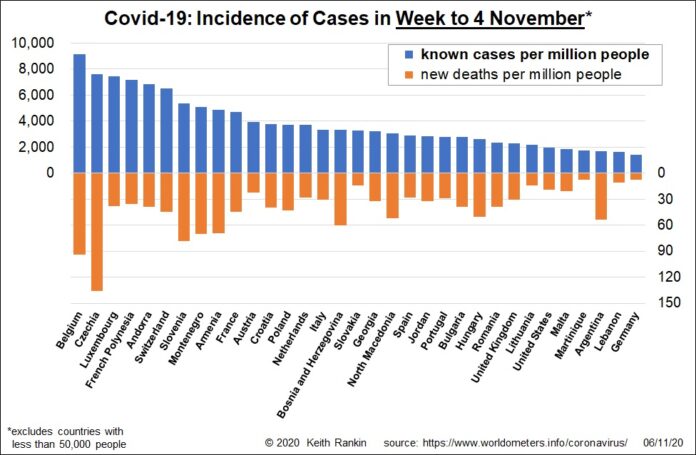
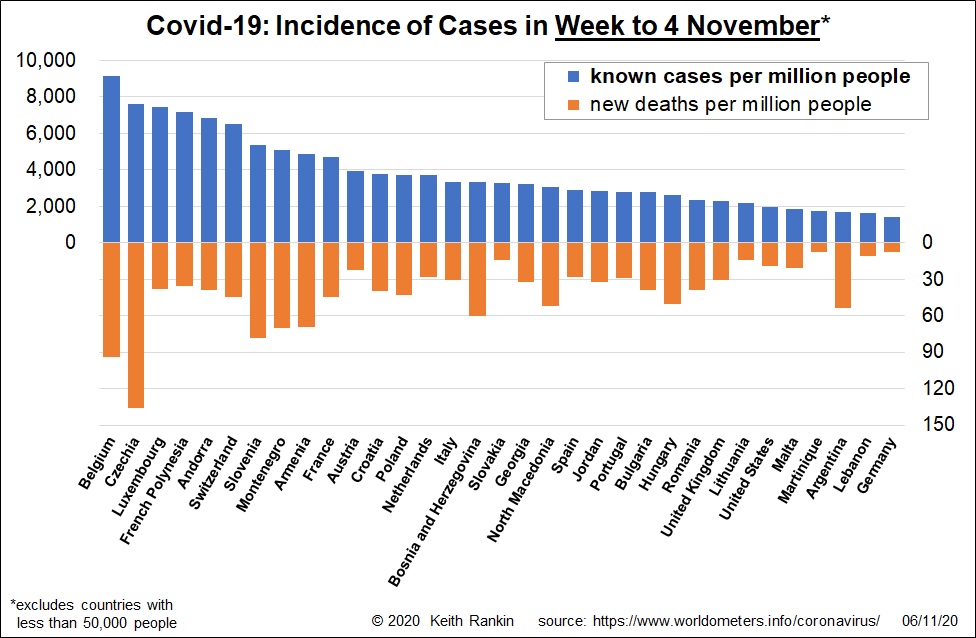
Europe including Eastern Europe and French Polynesia. Chart by Keith Rankin.
Analysis by Keith Rankin.
Europe including Eastern Europe and French Polynesia. Chart by Keith Rankin.
This week’s first chart shows the resurgence of Covid19 in Europe, with Eastern Europe now much more prominent than before. The only countries in the Americas to appear in this chart are the Martinique (French Caribbean), United States and Argentina. There are no countries showing from Asia (excl. the Middle East and the Caucasus) or Africa.
For us in New Zealand, the alarming presence is that of French Polynesia. 7,200 weekly cases per million people would be equivalent to 36,000 weekly cases in New Zealand, or over two million weekly cases in the United States.
Much vaunted Germany appears on the chart. Its 1,400 weekly cases per million would be equivalent to 7,000 weekly cases in New Zealand.
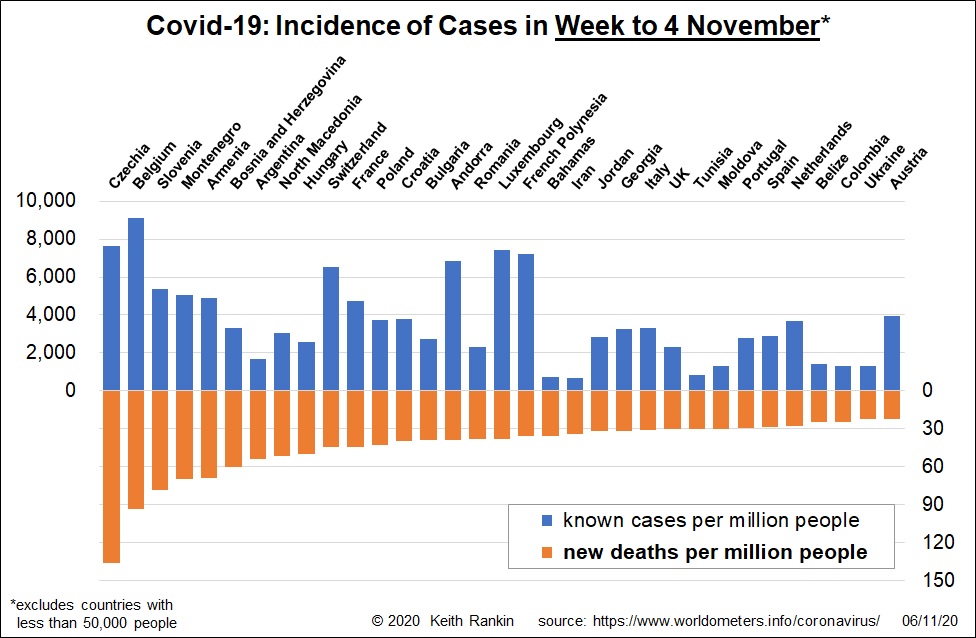
Deaths follow cases; Czechia leads the Eastern European wave. Chart by Keith Rankin.
Czechia (the Czech Republic) has 136 Covid19 deaths per million over the week to 4 November, equivalent to 680 deaths in New Zealand in just one week, or 45,000 deaths in the United States in just one week. The United States doesn’t make the deaths’ chart this time, but is not far off. And with nearly 210,000 new cases in the last two days, United States deaths will surely return to this chart next time I publish it.
French Polynesia will also be more prominent, next time, in the deaths chart.
The former Yugoslavia countries are also very prominent, with Slovenia – the most prosperous and westernised of these now leading the way.
The only African country in this chart is Tunisia, reflecting the consequences of European tourism, especially in the autumn months when tourist centres further north become colder.
Source: The Conversation (Au and NZ) – By David Perkins, Director, Centre for Rural and Remote Mental Health and Professor of Rural Health Research, University of Newcastle
Among the Bushfire Royal Commission’s 80 recommendations, released last week, was a call to prioritise mental health support during and after natural disasters.
The Australian Medical Association this week called on the federal government to implement the recommendations to lessen the health impacts of future disasters, noting the ongoing mental health fallout from the 2019-20 Black Summer bushfires.
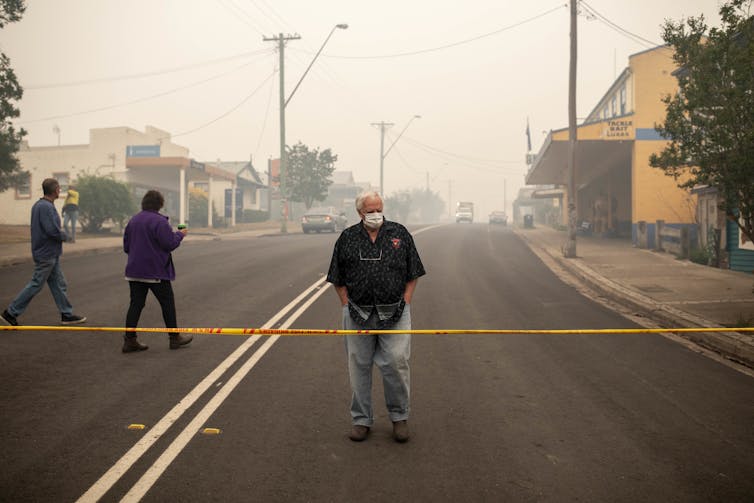
The Royal Commission’s report comes as Australia heads into a bushfire season during a pandemic. Some farmers have this year lost their crops due to unseasonal rain and hail, as many rural communities anticipate further “big weather” events. Certain local economies, which are reliant on exports like wine and barley, are concerned about strained trade relations with China.
The combined effects of these adverse events is taking a toll on the health and well-being of rural people.
A year of cumulative stress
Australian Bureau of Statistics released last month showed rural suicide rates are much higher than those in the big cities.
The causes of psychological stress for rural people are many and varied, depending on who you are and where you live. Many are facing environmental and weather events at increasing frequency and intensity. Some of these events happen rapidly, such as fire and floods, whereas others are long-lasting and uncertain, like drought.
The effects of these events include direct losses such as injury and death, as well as loss of livestock and buildings. Indirect losses include declines in businesses and employment, and the disruption of social fabric when friends or family leave town.
These stresses of course come in addition to life’s normal challenges likes illness, bereavement and relationship breakdown.
For rural people, COVID has likely compounded these cumulative stresses and contributed to higher levels of trauma, mental ill-health and in some cases, suicidal behaviour.
Band-aid policies
In most rural communities, access to mental health services is relatively poor.
There’s longstanding evidence Medicare Benefits Scheme expenditure for mental health services is skewed towards metropolitan services.
State expenditure is focused on hospital services and care for those with high and complex needs. Consequently, many rural people with mild to moderate needs are under-served.
Among the bushfire royal commission’s 80 recommendations was a call to strengthen mental health services for people impacted by disasters.Lukas Coch/AAP
Traditionally, governments respond to crises reactively and by treating these events as short-term and disconnected. But this isn’t the experience of rural people.
Each adverse event is accompanied by (usually short-term) funding announcements by governments and agencies for new Headspace centres, expanded telephone helplines, websites, counsellors, or coordinators in the most affected areas.
Sometimes there’s overlap of effort across different government departments, federal and state jurisdictions or from different disaster responses, potentially wasting resources.
For example, in NSW, the longstanding drought has recently broken. But the social and economic recovery will take longer — possibly up to five years with consistent rain as it did following the Millennium drought.
Counsellors were funded to support rural residents during the drought in 2018, with more counsellors funded in response to the bushfires. And now additional services are being offered due to COVID.
While the extra support is welcome, the fragmentation and temporary nature of the funding means rural people may not know what services are available, and accessing services becomes confusing.
What’s more, with short-term contracts, it may be the same staff moving between roles and agencies, therefore not actually adding new staff to support local rural communities. This funding instability makes it difficult to retain a stable rural mental health workforce.
In the first instance, policymakers need to ask people living in rural areas what they need and involve them in the process of developing appropriate and accessible services.
Second, we need to adopt a systemic approach that examines the full range of adverse events that affect the mental health and well-being of individuals, families and communities. This means going beyond treating illness, to addressing environmental, economic, social and personal factors.
As part of this, we need people on the ground to support communities through preparedness activities such as educating people about mental health and how to access services, while stepping into disaster response and recovery as needed. Continuity and building on what already exists locally is key.
The Rural Fire Service is a good example of such a structure. It has a clear role in disaster response, but also works to prepare communities between disasters (for example, by conducting back-burning and educating about bushfire plans).
Localised support is important because preparedness and response look very different depending on where you live in rural Australia. For example, Lismore on the northern NSW coast experiences regular flooding, whereas Broken Hill in the state’s far west contends with more frequent drought, and fierce dust storms.
Accessing mental health support during and after disasters can be confusing and bureaucratic.Sean Davey/AAP
Third, to fully understand and plan for the diversity of rural communities, we need sophisticated data planning, collection and analysis systems. Beyond health data, we need to look at the social, economic, environmental factors which all contribute to mental health and the way people access care.
If we can do this well, local planning will become easier, more transparent and tailored to need.
Finally, rural communities need support to develop local leadership, so they’re empowered to lead local responses. This is unlikely to succeed with short-term band-aid solutions, but rather with long-term investment and strategic policy to build and sustain capacity to cope with adversity.
When the US formally left the Paris climate agreement, Joe Biden tweeted that “in exactly 77 days, a Biden Administration will rejoin it”.
The US announced its intention to withdraw from the agreement back in 2017. But the agreement’s complex rules meant formal notification could only be sent to the United Nations last year, followed by a 12-month notice period — hence the long wait.
While diplomacy via Twitter looks here to stay, global climate politics is about to be upended — and the impacts will be felt at home in Australia if Biden delivers on his plans.
Biden’s position on climate change
Under a Biden administration, the US will have the most progressive position on climate change in the nation’s history. Biden has already laid out a US$2 trillion clean energy and infrastructure plan, a commitment to rejoin the Paris agreement and a goal of net-zero emissions by 2050.
If I have the honour of being elected president, we’re not just going to tinker around the edges. We’re going to make historic investments that will seize the opportunity, meet this moment in history.
And his plan is historic. It aims to achieve a power sector that’s free from carbon pollution by 2035 — in a country with the largest reserves of coal on the planet.
Biden also aims to revitalise the US auto industry and become a leader in electric vehicles, and to upgrade four million buildings and two million homes over four years to meet new energy efficiency standards.
Can he do it under a divided Congress?
While the votes are still being counted — as they should (can any Australian believe we actually need to say this?) — it seems likely the Democrats will control the presidency and the House, but not the Senate.
This means Biden will be able to re-join the Paris agreement, which does not require Senate ratification. But any attempt to legislate a carbon price will be blocked in the Senate, as it was when then-President Barack Obama introduced the Waxman-Markey bill in 2010.
In any case, there’s no reason to think a carbon price is a silver bullet, given the window to act on climate change is closing fast.
What’s needed are ambitious targets and mandates for the power sector, transport sector and manufacturing sector, backed up with billions in government investment.
Fortunately, this is precisely what Biden is promising to do. And he can do it without the Senate by using the executive powers of the US government to implement a raft of new regulatory measures.
Take the transport sector as an example. His plan aims to set “ambitious fuel economy standards” for cars, set a goal that all American-built buses be zero emissions by 2030, and use public money to build half a million electric vehicle charging stations. Most of these actions can be put in place through regulations that don’t require congressional approval.
Donald Trump announced the US would withdraw from the Paris Agreement in 2017.AP Photo/Evan Vucci
And with Trump out of the White House, California will be free to achieve its target that all new cars be zero emissions by 2035, which the Trump administration had impeded.
If that sounds far-fetched, given Australia is the only OECD country that still doesn’t have fuel efficiency standards for cars, keep in mind China promised to do the same thing as California last week.
What does this mean for Australia?
For the last four years, the Trump administration has been a boon for successive Australian governments as they have torn up climate policies and failed to implement new ones.
Rather than witnessing our principal ally rebuke us on home soil, as Obama did at the University of Queensland in 2014, Prime Minister Scott Morrison has instead benefited from a cosy relationship with a US president who regularly dismisses decades of climate science, as he does medical science. And people are dying as a result.
Obama on climate change at the University of Queensland.
For Australia, the ambitious climate policies of a Biden administration means in every international negotiation our diplomats turn up to, climate change will not only be top of the agenda, but we will likely face constant criticism.
Indeed, fireside chats in the White House will come with new expectations that Australia significantly increases its ambitions under the Paris agreement. Committing to a net zero emissions target will be just the first.
The real kicker, however, will be Biden’s trade agenda, which supports carbon tariffs on imports that produce considerable carbon pollution. The US is still Australia’s third-largest trading partner after China and Japan — who, by the way, have just announced net zero emissions targets themselves.
A Biden presidency would pressure the Morrison government to adopt more ambitious climate policies.AAP Image/Mick Tsikas
Should the US start hitting Australian goods with a carbon fee at the border, you can bet Australian business won’t be happy, and Morrison may begin to re-think his domestic climate calculus.
And what political science tells us is if international pressure doesn’t shift a country’s position on climate change, domestic pressure certainly will.
With Biden now in the White House, it’s not just global climate politics that will be turned on its head. Australia’s failure to implement a serious domestic climate and energy policy could have profound costs.
Costs, mind you, that are easily avoidable if Australia acts on climate change, and does so now.
University of Canberra Professorial Fellow Michelle Grattan and University of Canberra Assistant Professor Caroline Fisher discuss the week in politics.
This week the pair discuss the outcome of the Queensland election, the likely outcome and repercussions of the US election, as well as Christine Holgate’s resignation as CEO of Australia post, and the government’s securing of additional possible vaccination distribution agreements.
Over 37 million Myanmar citizens, including 5 million first-time voters, will go to the polls on November 8.
The election represents a litmus test for the popularity of National League for Democracy (NLD) leader Aung San Suu Kyi, who was placed under a house arrest by the military for about 15 years intermittently between 1989 and 2010.
Much is at stake in this election, but the role of the military still looms large in Myanmar politics.
The constitutional change needed to further democratise Myanmar is impossible without the military’s consent, so achieving major political transformation through the election alone seems unlikely.
The Myanmar constitution allows the military to occupy 25% of parliamentary seats.AP/Aung Shine Oo
In 2011, after about five decades of military rule, the military nominally handed power to the government of President Thein Sein and his Union Solidarity and Development Party (USDP).
Soon after, in the 2015 election, Suu Kyi’s NLD party won a landslide victory. She is now Myanmar’s incumbent state counsellor (equivalent to prime minister) but her international standing has taken a hit in recent years.
Critics accuse her of allowing widespread abuse of minority Rohingyas. Many Rohingya villages were burned down during a military crackdown in 2016 and 2017. Over 900,000 Rohingya — including more than 400,000 children — fled to Bangladesh and a large number of Rohingya refugees are dispersed across Southeast Asia.
Meanwhile, armed conflicts between ethnic armed organisations and the military continue, especially in the Rakhine state and the northern borderlands, and Myanmar’s transition to democracy is faltering.
New parties and political alliances
Suu Kyi’s NLD and its main rival, the USDP, are the two largest political parties vying for a majority of seats.
With its origin in the bloody 1988 anti-government uprising, the NLD has long fought for democracy and freedom.
The USDP (currently chaired by Than Htay), on the other hand, was formally registered in June 2010 with tacit support from the military. However, the USDP’s recent decision not to favour retired military generals as candidates indicates its ties with the military are weakening.
Than Htay is the current chair of the military-backed Union Solidarity and Development Party (USDP).Aung Shine Oo/AP
Many smaller parties and alliances are emerging and some, such as the People’s Party and the United Political Parties Alliance (UPPA), are likely to divide NLD’s traditional voters.
In states such as Kachin, Shan, Rakhine, Mon, Chin and Karen, many ethnic parties have recently merged to form a united front. They aim to win a majority in state parliaments and claim most of the national parliament seats in their states. These mergers may also weaken the NLD’s position; it had performed well in ethnic majority states in 2015.
Despite some notable economic and policy reforms, many ethnic parties are dissatisfied with the NLD government for the slow pace of transition from the military rule.
As the COVID-19 pandemic restricts freedom of movement, the candidates will be forced to campaign largely through social media and traditional media, which might work in the favour of larger and better-resourced parties. Not all parties and candidates have the finances to run online campaigns.
Big issues driving the voters
The election campaign will bring to light complex issues around Myanmar’s rich ethnic diversity: the continuation of armed conflict, demand from ethnic minorities for federalism, devolution of state power and better economic opportunities.
Despite the NLD’s promise of greater freedom and civil liberties, Suu Kyi’s government has prosecuted more journalists, social media users and human rights activists than the previous government.
Myanmar leader Aung San Suu Kyi is expected to win the November election.AAP Image/Aung Shine Oo
Myanmar’s economic and infrastructure development has been limited and, as my research argues, has been manipulated for political gain by powerful interest groups.
Deep reforms for a federal system and equitable economic development policies are needed to bring real progress toward peace between ethnic armed groups and the government. The way land ownership and natural resources are managed would need to be overhauled. Such reforms, however, are constrained by provisions in Myanmar’s constitution that ensure state power is shared with the military.
The constitution allows the military to occupy 25% of parliamentary seats. Only serving military officers can lead the three most powerful ministries – defence, home affairs and border affairs. This makes the military a very powerful political institution, which effectively controls the peace process and the direction of the transition.
The Rohingya crisis: ‘seems a textbook example of ethnic cleansing’
The persecution of Rohingya Muslims in Myanmar, which then-United Nations human rights chief Zeid Ra‘ad al-Hussein said in 2017 “seems a textbook example of ethnic cleansing”, continues to loom large in Myanmar politics. It has created one of the world’s largest refugee crises.
A boat carries ethnic Rohingya off North Aceh, Indonesia, in June 2020.AP Image/Zik Maulana
Many international observers have criticised Suu Kyi’s silence on the Rohingya crisis. Inside Myanmar, however, her popularity remained strong (especially among the country’s majority Bamar community) as she was called to answer for allegations of genocide made at the International Court of Justice late last year.
The Bamar community makes up about 70% of the country’s population and is the major voter base of Suu Kyi’s party. They largely consider Rohingyas illegal migrants, despite the fact many have lived in Myanmar for generations. A section of the community supports radical Buddhist nationalism and resists ethnic pluralism.
The Rohingya crisis has made ethnic minority voters deeply sceptical of Suu Kyi, but within the Bamar community, Buddhist nationalist narratives have surged and may come to dominate electoral campaigns.
Critics protested against Aung San Suu Kyi outside the International Court of Justice, during a case brought by The Gambia alleging Myanmar has committed genocide against the Rohingya.AP/KYDPL KYODOThe Rohingya crisis forced many to flee and has made ethnic minority voters deeply sceptical of Suu Kyi.AP/KYDPL KYODO
What’s the outlook for reform?
Myanmar’s military has frequently resisted constitutional reforms that would reduce its power.
If, as is expected, Suu Kyi’s NLD wins a majority this year, the military will likely collaborate with its allies in the parliament to block any constitutional reform.
If Suu Kyi’s political rivals — the USDP and other smaller parties and alliances — obtain a larger presence in the parliament, no single party will have a big enough majority to push through constitutional reforms. This will ultimately benefit the military and delay the transition to democracy.
Two former New Zealand prime ministers have called for an end to polarisation and the need for “healing” as the US presidential election remains in limbo.
Both former Labour PM Helen Clark and ex-National PM Sir John Key talked up the “television spectacle” in newspaper columns today with Key admitting that he “finally gets” why many voters like incumbent President Donald Trump.
Key said he had spent an hour watching one of Trump’s many rallies in Pennsylvania rather than “a few clips on the news”.
“While some of Trump’s behaviour was unbecoming of a President, and the speech itself bereft of substance, for the first time I could see why 5000 people had bothered turning up on a freezing afternoon to watch him,” he wrote in The New Zealand Herald.
“Trump was their guy.
“He stands against all of what they believe is wrong with the world and, in particular, the Washington ‘swamp’.
“He is the outsider unafraid to say it as he sees it, which is how his audience sees the world. He identifies their favourite villain, China, repeatedly calling it out.”
He called on the next President to “get the nation’s mojo back”.
‘Compassionate leadership’ needed Also writing in The Herald, Helen Clark said one thing was very clear from the election – “the United States is a deeply polarised country”.
But she predicted that a Biden presidency had a chance of turning this situation around.
“The fractures which run along political lines are a reflection of not only long-standing inequalities, particularly along ethnic lines, and widely divergent world views, but also of the impact of technological change and globalisation which have seen once secure and unionised jobs diappear, leaving whole communities and regions behind.”
Clark said Biden would have the skills for “calming emotions within the country and making it clear that he would pursue policies inclusive of all Americans”.
She also warned: “A superpower racked by division and self-doubt about its core values and its place in the world is a destabilising force in global affairs at a time when collaborative and compassionate leadership is sorely needed.”
Facing the gradual erosion of early leads in several battleground states — and increasingly likely defeat in the presidential election — the Trump campaign is launching a well-planned legal assault to challenge the validity of ballots and the process of vote-counting itself.
The Biden campaign is responding with an equally well-coordinated legal defence and a grassroots fundraising effort called the “Biden Fight Fund”.
Once again, the courts will be called in to resolve a US presidential election, although it is unlikely any rulings will change the results significantly — unless the election comes down to extremely narrow margins in Pennsylvania or Georgia.
The unusual nature of the 2020 election — with a record 100 million people voting early — ensured a topsy-turvy election night. Compounding the problem has been the large partisan divide in how people voted, with Democrats favouring early and mail-in voting and Republicans favouring in-person voting on election day.
Many states quickly reported the results from in-person ballots on election night, giving Trump an early lead in several battleground states. Those leads were then offset as mail-in and early votes were added to the tallies.
Trump has been encouraging his supporters to view these shifting totals as fishy, claiming:
This is a major fraud on our nation. We want the law to be used in a proper manner. So we’ll be going to the US Supreme Court. We want all voting to stop.
So far, Trump has indicated he will bring challenges in four states. This is what he is claiming and the chances that he could be ultimately be successful.
Wisconsin: Trump requests a recount In Wisconsin, where Biden leads Trump by less than a percentage point, the Trump campaign announced it will seek a recount. This is a relatively routine occurrence when margins are tight. Indeed, small margins often trigger automatic recounts in many states.
After Hillary Clinton lost to Trump in 2016 by less than a combined total of 80,000 votes in Michigan, Pennsylvania and Wisconsin, the Green Party candidate, Jill Stein, requested a recount. The courts denied the request in Pennsylvania, but partial recounts occurred in Michigan and Wisconsin.
Poll workers sort out early and absentee ballots in Kenosha, Wisconsin. Image: The Conversation/Wong Maye-E/AP
Michigan: Trup seeks a (temporary) halt to counting In Michigan, the Trump campaign has filed a complaint seeking to halt the vote count on the basis that Republican Party “election inspectors” (that is, poll workers) do not have access to venues where the counting is taking place.
Election challengers observe as absentee ballots are processed in Detroit. Image: The Conversation/Carlos Osorio/AP
However, the filing provides no evidence that Republican poll workers have been denied access to vote-counting sites. Additionally, the legal bases of the claim appear weak.
For example, the complaint alleges Michigan is breaching the equal protection clause of the US Constitution because it is treating some voters differently from others in the state. Presumably, as the campaign alleges, this is because Democratic poll workers have been granted access to vote-counting sites that Republicans have not.
The complaint seeks a “speedy hearing,” which the Court of Claims has yet to grant. If it does, both the Trump campaign and the Michigan Secretary of State will have to provide evidence of the access given to poll workers of different parties on election day.
Pennsylvania: Taking it to the Supreme Court In Pennsylvania, the Trump campaign has initiated court procedings to stop the vote count.
The first part of the lawsuit is similar to the challenge in Michigan: the campaign is seeking to stop vote-counting until Republican poll observers are given access to the sites.
Deputy campaign manager Justin Clark alleges Republican poll observers were unable to observe vote counting because they were forced to be too far away – a claim conspicuously absent in the Michigan filing.
Pennsylvania Gov. Tom Wolf said the Trump campaign’s lawsuit to stop counting votes in the state is “simply wrong.”
“It goes against the most basic principles of our democracy,” he said.https://t.co/9SXNSmGndA
The second part of the Pennsylvania action seeks to reject mail-in ballots from first-time voters who did not provide proof of identity when they registered.
The campaign claims Pennsylvania’s secretary of state didn’t follow the proper process in deciding to accept the ballots from these voters — a breach of federal law. However, the campaign has yet to produce evidence that significant numbers of first-time voters did not prove their identity.
If the Trump campaign’s lawsuit is successful, it could result in the removal of a swathe of mail-in ballots from the Pennsylvania vote tally. In addition to these two challenges, the Trump campaign is appealing a decision by the Pennsylvania Supreme Court to allow the counting of mail-in ballots received within three days after election day to the US Supreme Court.
As of yet, we do not know how many ballots could be affected by this ruling — and the counting of ballots continues.
The Trump campaign announces its legal challenges to vote counting in Pennsylvania. Image: The Conversation/Matt Slocum/AP
Georgia: Confusion created by the courts takes centre stage Finally, in Georgia, the Trump campaign has filed a petition to prevent any potential counting of late-arriving mail-in ballots.
In one sense, this action is the most straightforward of all the challenges. The petition seeks an order that the existing law be enforced: that all mail-in ballots arriving after 7pm on election day are excluded from the count.
However, the deadline for mail-in ballots in Georgia was also the subject of pre-election legal challenges — meaning voters could have been confused by the rules.
A court initially ruled these ballots could be counted for up to three days after the election, but this decision was then overturned by a higher court.
Challenges are unlikely to be Trump’s path to victory For now, the Trump campaign has not launched any challenges in the other battleground states of Nevada and Arizona.
We may not end up seeing any challenges in these states, given the tight deadlines involved with elections. All litigation must be resolved or halted by December 8 so the election results can be certified and the Electoral College process can continue. This culminates in the vote that legally chooses the next president on January 6.
The legal challenges are a long shot for the Trump campaign to change the outcome of the election.
If Biden is declared the winner this week and the challenges fail, there may be another repercussion. It could further undermine confidence in the electoral process — a strategy Trump has employed, with varying degrees of success, throughout the race.
Albanerpetontids, or “albies” for short, are the cute little salamander-like amphibians you’ve likely never heard of.
Now extinct, Albies had a dream run. They’d been around since the Middle Jurassic around 165 million years ago, and probably even earlier. They lived through the age of dinosaurs (and saw out their extinction), then lived through the rise of the great apes, before quietly disappearing about 2.5 million years ago.
Albie fossils are scattered across continents, including in Japan, Morocco, England, North America, Europe and Myanmar. But until recently, we knew relatively little about what they looked like or how they lived.
New research by my colleagues and I, published today in Science, reveals these amphibians were the earliest known creatures to have rapid-fire tongues. This also helps explain why albies were once misidentified as chameleons.
A miniature marvel uncovered
The reason albies remained largely elusive until recently is because they were tiny. Their slight, fragile bones are usually found as isolated jaw and skull fragments, making them hard to study.
Peretti Museum Foundation/Stephanie Abramowicz, Author provided (No reuse)
The first almost complete albie specimen was found in the wetland environment deposits of Las Hoyas, Spain, and reported in 1995. Even though it was squashed flat, it was enough for palaeontologists to conclude albies were unlike any living salamander or any other amphibian.
They were completely covered in scales like reptiles, had highly flexible necks like mammals, an unusual jaw joint and large eye sockets suggesting good vision. Why were albies so unique?
The answer partly came to light in 2016, when a group of researchers published a paper demonstrating the diversity of lizards found in the Cretaceous forests of what is now Myanmar.
They presented a dozen tiny 99-million-year-old “lizards”, all preserved in amber. Some were even found with soft tissue remains such as skin, claws and muscles, still attached within the fossilised tree resin.
The researchers used “micro-CT” technology to digitally excavate and study the specimens in detail. This involved using 3D imaging to digitally remove the fossil from the amber and study it on a computer — a technique that avoids the risk of physically damaging the fossil.
They noticed one small, juvenile specimen had a long rod-shaped tongue bone. It was identified as the earliest known chameleon: a remarkable discovery! Or was it?
See a chameleon’s rapid-fire tongue in attack mode. (BBC Earth)
Alas, mistakes do happen in science. As lizard experts, the researchers had interpreted their results through this lens. It took the keen eye of Susan Evans, a professor of vertebrate morphology and palaeontology at University College London, to recognise this particular “lizard” was actually a misidentified albie.
A tongue-tying revelation
Some time later, Sam Houston State University assistant professor Juan Daza spotted another unbelievable specimen among a collection of fossils preserved in Burmite amber, ethically sourced from Myanmar’s Kachin state.
It was an adult version of the juvenile albie Evans identified. Needing higher-resolution 3D images, the sample was sent to me to study at the Australian Nuclear Science and Technology Organisation’s Australian Synchrotron in Melbourne.
Named after a class of mythical spirits responsible for guarding natural treasures, Yaksha, and the person who discovered the fossil, Adolf Peretti (founder of the non-profit Peretti Museum Foundation) — the Yaksha perettii specimen was an entire skull trapped in golden amber.
The Yaksha perettii specimen is preserved in amber. The fossil was studied without being removed.Author provided
Quick hits to unsuspecting prey
Its features that stood out were a long bone projecting back out of the mouth and soft tissue remains, including part of the tongue, jaw muscles and eyelids. By sheer luck, the soft tissue remains proved the long bone in the mouth was directly attached to the tongue.
This rendering of the Yaksha perettii skull shows the extinct amphibian’s soft tissue and projectile tongue apparatus (in orange).Edward Stanley/Florida Museum of Natural History, Author provided
In other words, Y. perettii was a predator armed with an incredible weapon: a specialised ballistic tongue that fired at lightning speed to capture prey — just as chameleons do today. It’s no wonder the original juvenile, only 1.5 centimetres long, was initially mistaken for a chameleon.
Modern chameleons have accelerator muscles in their tongues that lock in stored energy. This lets them fire their tongues at speeds of up to 100 kilometres per hour in just a fraction of a second.
We believe albies’ projectile tongues were just as fast, used to great effect while sitting motionless in trees or on the ground. If so, this also explains why albies had unusual jaw joints, flexible necks and large, forward-facing eyes. All these traits would have made up their predator toolkit.
Tree sap turned to iridescent amber
Despite these remarkable new insights, however, many mysteries of albanerpetontids remain. For instance, how exactly are they related to other amphibians? How did they survive for so long, only to die out relatively recently?
We’ll need more intact specimens to answer these questions. And most of these specimens will probably come from the Hukawng Valley in Kachin, Myanmar.
It’s expected about 100 million years ago this region was an island covered in vast forests. Global temperatures back then would have exceeded today’s, with trees producing vast amounts of resin (which later turned into amber) as a result of damage by insects and fire.
Amber studied from this region will not only increase our knowledge of its expired ecosystems, it could also provide insight into how certain organisms today might evolve in response to a warming climate.
How can we concentrate on a particular thing (like studies) without getting distracted? Melvina, aged 14
Thanks for this great question Melvina!
Many students are probably wondering the same thing as end-of-year assessments approach.
To concentrate best we need to resist distractions. To do this, it helps if you know what concentration looks like.
What is concentration?
When you concentrate, you direct or focus your thinking. Imagine your focus is like a torch beam.
This torch beam needs energy, which comes from your concentration. So we can think of concentration as the “mental energy” or “thinking petrol” your brain needs to focus.
We know it’s important to concentrate to get the best results from a project or task. But, with distractions everywhere, we also know how hard it can be.
So what distractions should we look out for?
Deal with physical distractions
These are distractions in your environment. It’s a good idea to take steps to reduce them.
First, try to adjust the amount of light and noise to a level that works best for you.
Being in a noisy environment can make it tricky to concentrate, so try to study somewhere quiet.Shutterstock
Thoughts and feelings can be pretty distracting too
If you find yourself thinking of things you’d rather be doing than the task at hand, take a moment to consider what you’ll do after you’ve completed the task, and how much more you’ll enjoy them because of what you’ve achieved.
If you feel worried about how people will respond to what you produce, like an essay or presentation, you might be hesitant to get started. To manage this, try noting how a task or topic fits with what you already know, or remind yourself of a time you got through a similar task.
There are a few things you can do before, during and after a task to help too.
How to manage distractions
When you start a study session, it’s useful to:
decide what you want to get from the activity. What will the outcome look like?
set yourself up so you can see your computer screen or books without straining your body
remember what you already know about the topic or the task
plan the steps you could take to complete the task.
You’ll probably become distracted at some point during your study. That’s OK! Try your best to get back on track and recap what you’ve learnt toward the end of a task.Shutterstock
As you work through the topic or the task, it’s helpful check your progress. Note what you’ve achieved so far. Are you moving towards your goal or do you need to change direction?
This helps you deal with distractions while you’re learning.
How to beat distractions
Towards the end of a task, review what you’ve learnt and store it in memory. This allows you to get around distractions that occurred during the learning.
Give this a go:
say what you know now that you didn’t know earlier
say how your new understanding has changed or added to what you knew
feel positive about what you know now. Congratulate yourself on what your brain has done. The positive feeling helps you remember it better in the future
imagine yourself remembering and using the main ideas in the future.
When you store your new understanding like this, you can use it more easily in the future to concentrate and to get around distractions.
Hello, curious kids! Have you got a question you’d like an expert to answer? Ask an adult to send your question to curiouskids@theconversation.edu.au
As fires ravaged large sections of the Australian bush last summer, cities and towns all along the coast were blanketed in toxic smoke. Air pollutants were measured at unheard of levels across the country.
Hazardous air descended on cities hundreds of kilometres away from the fires themselves. This air was the most dangerous to breathe on the planet.
The bushfire royal commission was tabled on October 30, with some sobering findings about fires and air pollution. Unfortunately, it showed that as a nation we were not prepared to deal with this public health emergency.
These disasters are inevitable under climate change, and while we need to urgently act on climate change to protect future generations, we also need to make changes now to mitigate the risks that already face us.
Australia must get better at communicating how to identify and then stay safe in hazardous air. A national set of air quality categories would go a long way to achieving this.
Over 400 deaths attributed to bushfire smoke
The royal commission heard that air pollution from the summer fires likely caused more than 400 deaths. Thousands of additional hospital admissions put added strain on our hospitals. All up the added burden to our health system was estimated at almost A$2 billion.
This satellite image from NASA shows thick bushfire smoke moving into the Tasman Sea from NSW and Victoria on January 3, 2020.EPA/NASA HANDOUT
Even in the absence of extreme natural disasters, air pollution is one of Australia’s biggest public health concerns. Pollution from all sources causes thousands of deaths per year. This includes emissions from coal-fired power stations, diesel cars and wood-fired heaters.
Better preparing ourselves to deal with bushfire smoke will have flow-on benefits in tackling these problems.
Different state, different health advice
The royal commission found “there is an urgent need for national consistency in the categorisation of air quality”. At the moment, every state has their own system to categorise air quality and communicate it to the public.
But there are major discrepancies with how different states identify the worst air quality.
Air quality is the sum impact of the concentration of various unhealthy chemicals in the air. These include ozone, nitrogen and sulfur oxides, and fine particulate matter. To communicate this to the public, most countries convert these chemical concentrations into an Air Quality Index (AQI).
In the US, there is a standardised AQI categorisation for the whole country.
In Australia, the situation is very different. Every state has its own bands, with their own colour codes. These bands trigger at different pollutant levels and carry different health advice. The Royal Commission told us this needs to be standardised, and now.
For example, in NSW the worst air quality category is “Hazardous”, which triggers at an AQI of 200. South Australia, however, only recognises “Very Poor” as the worst class of air quality, with an AQI of 150 and above.
During the summer bushfires, AQI values as high as 5,000 were measured. It’s clear the highest bands of air pollution are no longer appropriate.
We need a national air quality system
We have faced a similar problem before. After Victoria’s Black Saturday fires in 2009, we recognised that our fire danger ratings were inadequate.
The Black Saturday royal commission found we needed a higher category for the most dangerous fire conditions. The “Catastrophic” category (“CODE RED” in Victoria) was added. It carried clear advice about what to do in such dangerous conditions, instructing people to safely leave as early as possible.
The ‘CODE RED’ or ‘Catastrophic’ fire danger rating was added after the Black Saturday fires.Shutterstock
Something similar now needs to happen with air quality ratings.
When facing future extreme bushfires, we need a way to identify when catastrophic conditions have led to air so unhealthy that everyone should take precautions, such as staying indoors and wearing masks. We then need to get clear health advice out to the public.
A national air quality rating system could achieve this, and would also help address other important recommendations of the Royal Commission: That we need improved means of getting reliable information out to the public, along with better community education around what to do when air quality plummets.
There’s work to do
An Australian AQI should be featured on national weather reports and forecasts, providing important health information to the public every day of the year. At the same time it would familiarise Australians with air quality measures and actions that need to be taken to protect ourselves from unhealthy air.
But there is work to do. First, we need to develop a new set of air quality categories that work for the entire country, and reflects both the everyday hazards of industrial pollution and the extreme dangers of bushfires. These categories also need to be matched with sound health advice.
And if we are going to report these measures more widely then we also need to get better at measuring and predicting air quality across the nation — two other important royal commission recommendations.
Achieving all of this won’t be easy. But if we can get it right then we will be much better placed to deal with smoke risk the next time severe bushfires inevitably happen.
When it comes to handling the waste crisis in Australia, options are limited: we either export our waste or bury it. But to achieve current national targets, policy-makers are increasingly asking if we can instead safely burn waste as fuel.
Proposals for waste incinerators are being considered in the Greater Sydney region, but these have been lambasted by the Greens and independent members of the NSW parliament, who cite public health concerns.
Meanwhile, the ACT government has recently put a blanket ban on these facilities.
But are their concerns based on evidence? In our systematic review of the scientific literature, we could identify only 19 papers among 269 relevant studies — less than 10% — that could help address our question on whether waste-to-energy incinerators could harm our health.
This means the answer remains unclear, and we therefore call for a cautious approach to waste-to-energy technology.
NSW Greens MP Cate Faehrmann introduced a bill in August to prohibit waste-to-energy incinerators.AAP Image/Steven Saphore
On average, Australia produces roughly 500 kilograms of municipal (residential and commercial) waste each year. This aligns with the OECD average.
New Zealand in comparison, despite its strong environmental stance, is among the worst offenders for producing waste in any OECD country. It produces almost 800 kilograms per person per year.
Now, most recyclable or reusable waste in Australia goes to landfill. This poses a potential risk to both climate and health with the emission of potent greenhouse gases such as methane and the leaching of heavy metals such as lead into the groundwater. As a result, local governments may want to seek alternative options.
Burning waste in Denmark
“Waste-to-energy” incineration is when solid waste is sorted and burned as “refuse-derived” fuel to generate electricity. This can replace fossil fuel such as coal.
The technology is on the rise among OECD countries. Denmark and Japan, for example, rely on waste-to-energy incineration to reduce their dependency on landfills and reach carbon neutrality.
In fact, Denmark’s waste-to-energy incinerator, Amager Bakke, is so well known it has become a tourist attraction, and is celebrated as one of the world’s cleanest waste-to-energy incinerators.
Amager Bakke provides electricity to around 680,000 people.
Every day, around 300 trucks filled with non-recyclable municipal solid waste are sent to Amager Bakke.
This fuels a furnace that runs at 1,000℃, turning water into steam. And this steam provides electricity and heat to around 100,000 households. Generally, people in Denmark warmly welcome it.
So what’s the problem?
In Australia and the US, community reception towards the building of new incinerators has been cold.
The big concern is burning waste may release chemicals that can harm our health, such as nitrogen oxide and dioxin. Exposure to high levels of dioxin can lead to skin lesions, an impaired immune system and reproductive issues.
Burning waste may release substances that can harm our health, such as nitrogen oxide and dioxin.Shutterstock
Supply of this plastic could come from the waning fossil fuel industry. This would work against the goal of establishing a “circular economy” that reuses and recycles goods where possible.
An analysis from 2019 found that to meet European Union circular economy goals, Nordic countries would need to increase their recycling, and significantly shift away from incineration.
This concern is understandable given incinerators operate cleanest when fuelled at full capacity. This is because a higher temperature means a more complete combustion — a bit like less ash and smoke coming off of a well-built campfire.
A lack of evidence
As with many policy solutions, determining the safety of burning waste is complicated.
Our review found a lack of evidence to fully reject well-designed and operated facilities. However, based on the limited number of health studies we found, we support a precautionary planning approach to waste-to-energy proposals.
This means we need appropriate health risk assessment and life cycle analyses built into the approval process for each and every incinerator proposed in the near-future.
The studies we found were all performed in the last 20 years. None were from the Nordic countries, however, where waste-to-energy incineration has been in use for many decades.
The reasons for the Nordic embrace of this technology are speculative. One reason may be that their level of economic development allows large capital investment for safe, state-of-the-art design and operation.
Waste incineration goes against the goals of a circular economy.Shutterstock
Where to from here?
If councils are determined to pursue waste-to-energy incineration, we suggest they prioritise specific applications.
For example, we found the process with the most favourable life-cycle assessment (the most beneficial to health compared to traditional fossil fuel use) was the “co-incineration” of refuse-derived fuel for industrial cement.
Currently, cement kilns are mostly fuelled by burning coal, and it’s difficult to reach the high temperatures required with traditional renewables. This means substituting coal for refuse-derived fuel could reduce the industry’s dependency on coal, when renewables aren’t an option.
Another solution is to focus instead on the waste hierarchy. This means first minimising waste production, maximising energy efficiency and maximising recycling and reuse of waste materials.
So, while we wait for more knowledge on how waste-to-energy incineration may affect our health, let’s focus on improving our waste hierarchy, rather than exporting our waste to feed a global crisis.
Children come into the world ready to communicate. A baby cries and coos to express their feelings and respond to sounds. The ability to communicate develops quickly but uniquely in every child.
By the age of three, most children are able to understand simple requests such as, “pick up your shoes and bring them to me”. They can identify colours, shapes or food groups and use familiar names to recognise important people in their lives, like “grandma”. And they can respond to “who”, “what” or “where” questions.
At three, your child may be saying a lot of words and putting them together into simple sentences. They may ask questions (often a lot of questions) such as, “Where are we going?”
It is an exciting and wonderful time for children to learn about their world and share their discoveries. It can also be a time of anxiety, if a child is not showing the communication signs the parent expects them to at a particular age.
Children learn to speak and develop their communication through day-to-day interactions with their parents and caregivers.
In 2019 as part of my yet unpublished research (that draws on previous work in the United States), I went to three different preschools to work with three to four year olds using puppets. I observed all the children — including kids with a disability, those learning English as an additional language or those who are very shy — communicated more often and more effectively when talking to a puppet.
Research with school-aged children shows puppets, like a favourite doll or teddy bear, can encourage learning and improve communication and behaviour. Talking to a puppet, as opposed to a person, makes the conversation feel less personal and more pretend. It is a play-based technique sometimes used in therapy to help the child feel less self-conscious, and open up.
I noticed the joy puppets brought to the children, as well as a growth in their understanding of feelings and the feelings of others. The children showed greater confidence when speaking to puppets and engaged in positive social interactions such as taking turns and sharing.
Parents can also use puppets to support their child’s development at home. Here are three things puppets can help with.
1. Use puppet play to encourage conversation
We introduced a range of puppets to children and quickly discovered the type of puppet used was important. Dinosaurs were very popular as was a duckling named Mabel and a Great White Shark called Bruce.
Think about the animals, characters, colours or creatures your child likes before choosing a puppet to add to your family. You can even make a simple puppet with an old sock.
Once you have your puppet, introduce it thoughtfully to your child. For example, you may pat it softly and have your child touch it with you. Ask your child to help you discover the sounds the puppet makes, its name and what it likes to play.
Think about the toys and animals your child likes best.Shutterstock
Make your child the expert in bringing your puppet to life. Through the creation of the puppet you can build your child’s vocabulary by modelling descriptive words and longer sentences.
For young children, try narrating their actions with the puppet. For example, “You are patting the puppet’s yellow beak, I think he likes it”.
Play peek-a-boo, sing songs or tell stories. The important thing to remember is to have fun.
2. Use puppets to get your child to answer questions
Try using a puppet to ask questions about your child’s day at preschool, their favourite part of a story or about their drawings or play.
Your puppet can help your little one by offering prompts such as, “Tell me about what you ate at snack time” or “I wonder what you made in the sandbox outside”?
Children may open up more to the puppet because they are funny and create a relaxed and playful environment, which is ideal for interactions.
Other ideas may include using the puppet to make up stories together or to take the puppet on a walk and ask questions about the things you see together.
3. Use a puppet to talk about feelings
Three year olds may find it hard to name their feelings or identify the reason they may be happy or upset. A puppet can act as a soothing way to have children tell you how they feel or learn the names of feelings.
For example, the puppet can use an angry voice or be crying to express emotion. Involve your child in helping the puppet by naming its feelings and coming up with possible solutions to their distress.
Two puppets can act out a frustrating situation and model new approaches such as sharing a favourite toy, trying new foods or cleaning up.
Puppets are a creative way to bring about speech and communication with your child. By bringing fun and imaginative play into your day, you can help your child develop their ability to share their world with you.
Source: The Conversation (Au and NZ) – By Charles Livingstone, Associate Professor, School of Public Health and Preventive Medicine, Monash University
Counsel assisting the NSW Inquiry into the suitability of Crown Resorts to operate Sydney’s new Barangaroo casino summed up this week by telling the Commissioner Crown was
not a suitable person to continue to give effect to the licence, and that Crown Resorts is not a suitable person to be a close associate of the licensee
Adam Bell SC reached the conclusion after considering the deleterious impact on the good governance of Crown Resorts caused by its dominant shareholder [James Packer’s Consolidated Press Holdings] and ultimately, Mr Packer”.
He reminded the inquiry that protection of the public interest was a key objective of the NSW Casino Control Act.
The Barangaroo casino is yet to open, but Crown already operates two other Australian casinos, one in Melbourne and one in Perth, and one in London.
The Melbourne casino has been the centre of multiple whistle-blower and other allegations connected with tampering with gambling machines, associations with criminal identities and the arrest of 19 Crown staff in China in 2016.
The Sydney inquiry was initiated after the Nine network and The Age and Sydney Morning Herald published allegations about money laundering and links with criminals.
A tale of two cities
The Melbourne regulator, the Victorian Commission for Gambling and Liquor Regulation, acted more quietly, initiating a still-uncompleted inquiry into the arrest of Crown staff in China in 2017 and putting its inquiry into the money laundering allegations on hold until it had seen the outcome of the NSW inquiry.
Sydney’s Crown hotel and casino development.DAN HIMBRECHTS/AAP
Belatedly, last month, a full eight months after the NSW hearings began, it issued Crown with a “show cause” notice relating to money laundering controls.
In 2017, Victoria’s auditor general identified serious issues relating to the Commission’s oversight of Crown.
It highlighted a “lack of leadership”, the second lowest staff satisfaction levels in the Victorian public sector, a lack of a “coherent organisation-wide approach to casino supervision” and insufficient attention to key areas of risk in the casino’s operations including money laundering.
In its five-yearly review of Crown’s licence in 2018 the Commission identified some concerns.
The concerns involved compliance with money laundering rules, the lack of engagement of independent directors with an oversight of the Melbourne casino, an uninspiring adoption of the responsible gambling rules, and a less than complete honouring of requests for self-exclusion.
It nevertheless concluded that it was in the public interest for Crown to maintain its license.
Fines rather than sanctions
Fines have been its the Commission’s preferred means of dealing with breaches of licence conditions.
In 2018 it fined Crown A$300,000 for gambling machine tampering and $25,000 in 2018 for a breach of junket rules.
It said it believed fines were enough in the light of
Crown’s past compliance history and general and specific deterrence, balanced against the level of co-operation, remorse, contrition and corrective action taken by Crown
Yet the NSW inquiry has heard evidence from James Packer and the company’s directors and management pointing to multiple continued failures in all these categories, in Melbourne.
The NSW premier has signalled concern about the casino’s planned opening in December, given that inquiry is not due to report until February.
West Australia’s regulator found no issues with Crown Burswood in its most recent (2018-19) annual report, but says it is monitoring the NSW inquiry.
Too big to touch?
It might be that Crown has become too big to regulate, at least in Victoria.
For some reason, the company has had enormous success with deflecting criticism. Along with other gambling operators, it has recruited powerful political figures from both major parties to assist it and is a major political donor.
There was ample evidence of the problems in Victoria well before the NSW inquiry identified them.
The Victorian regulator’s slow and overly respectful approach might be because it felt Crown was too important to be held to account, or had too many political connections, or was too important as an employer or contributor to government revenue.
Or it might be because, as the auditor suggested, it has problems with staff.
But if we are to have any faith in Victoria’s ability to regulate gambling and crime, it’ll need to do more. NSW is showing how.
In 2017, when a biology professor in a state college in Washington protested against a proposed day-long ban on the presence of white students on campus, radical students shut the campus down.
The ban was part of a yearly college event designed to give black and minority students and staff a separate space in which to discuss the issues they face. Tensions were high that year. White nationalist groups had invaded the campus, targeting black students and members of staff.
The comments by the professor, Bret Weinstein, and his opposition to the colllege’s equity programs, led to campus protests against him. In protest against the failure of the college administration to quell the students, he resigned from his job.
Pluckrose, a US magazine editor who describes herself as an exile from the humanities, and Lindsay, a mathematician and writer on politics and religion, were participants in the controversial 2018 Grievance Studies project, which aimed to discredit gender and race studies by submitting hoax articles to academic journals.
By getting articles on bogus topics through the reviewing processes of respected journals and into print, the authors believed they were proving that studies focusing on identity issues are “corrupt” and unscientific.
One hoax article, published in a journal of “feminist geography” looked at “human reactions to rape culture and queer performativity” at dog parks in Portland, Oregon; another purported to be a two-year study involving “thematic analysis of table dialogue” to explore why heterosexual men like to eat at Hooters.
Critics of their hoax quickly pointed out there was no scientific evidence to suggest that journals in fields focusing on identity are corrupt — indeed such hoaxes had happened in other areas of study too.
Pluckrose and Lindsay’s book, which grew out of the 2018 project, traces the evolution and growing influence during the late 20th century of theories about how the language we use to think and talk about the world structures our relationships.
The book takes aim at postmodern and post-structuralist thinkers, particularly the French philosopher and historian Michel Foucault. The authors blame him for propagating the view that all discourses, including science, create relations of power and subordination.
In the new millennium, these postmodernist and deconstructionist projects morphed — according to Pluckrose and Lindsay — into the political weapon they call Social Justice Theory, or simply Theory.
In Cynical Theories, the pair trace the march of Theory as a political ideology through post-colonial studies, queer theory, feminism, and studies of race, disability and body size.
In their view, Theory is a harmful, anti-scientific ideology. It divides society into the oppressed — whose subordinate identities are constructed by hierarchies of power — and the oppressors who, wittingly or not, maintain oppressive relationships through their participation in political and social discourses and institutions.
Constructed identities
This Theory is cynical, according to the authors, because it finds oppression everywhere — even in the best intentions of progressive people and their movements of reform.
And it is bad for everyone, including disadvantaged groups, they say, because it gets in the way of an empirical approach to understanding and correcting social ills.
Social Justice Theory, say Pluckrose and Lindsay, finds oppression everywhere.Micheile Henderson/Unsplash
One aim of Pluckrose and Lindsay is to defend the central liberal value of freedom of inquiry against what they regard as an attack on free speech by the rise of identity politics — spawned by Theory.
The application of Theory is also harmful, they say, because it provokes a backlash from people who cannot understand why being white or male puts them into the camp of racists or sexists.
The result, they argue, is a racial politics that becomes increasingly fraught. We hear that:
racism is embedded in culture and that we cannot escape it. We hear that white people are inherently racist. We are told that only white people can be racist. […] Adherents actively search for hidden and overt racial offences until they find them.
According to the authors, these categories — race, sex, gender, being gay or straight, abled or disabled, fat or of normal body size — are forced onto individuals by the organising power of dominant discourses in politics, social life and science.
According to Social Justice Theory, the authors write, identity determines how a person thinks, acts and what she knows.Angela Compagnone/Unsplash
Adherents of Theory, they say, then argue these constructed identities are, nevertheless, real and inescapable experiences. For Theory, identity determines how a person thinks, acts and what she knows. A black person is not an individual who happens to be black. Blackness is central to who he is. Being black makes him into a victim of discourses that privilege whites.
Respecting the standpoint of those who have a subordinate position in hierarchies created by the ways we speak and act — blacks, women, people with minority sexual identities, victims of colonial power, the disabled and the fat — is a key political demand for activists influenced by Theory.
No truth, only discourse
Social hierarchies exist. Prejudice can be perpetuated by the unthinking behaviour of individuals. Discriminatory treatment of women and black people is sometimes embedded in institutions.
Pluckrose and Lindsay do not deny this.
They admit legal reforms have not eliminated racism, sexism and other forms of discrimination. They recognise discriminatory treatment and prejudice can blight the lives of victims and undermine their ability to access the opportunities of their society.
Cynical theories acknowledges legal reforms have not stopped discrimination.Unseen Histories/Unsplash
What, then, is wrong with what they call Social Justice Theory?
The authors’ main contention is that Theory is relativist and unscientific. For its theorists, there is no objective truth — only the perspectives of people with different identities. And they demand the same respect for the standpoint of an oppressed group as for the views of scientists.
Pluckrose and Lindsay write:
It is no exaggeration to observe that Social Justice Theories have created a new religion, a tradition of faith that is actively hostile to reason, falsification, disconfirmation and disagreement of any kind.
Because Theory is a faith, it can insulate itself from criticism, say the authors.
It can dismiss dissenters, like the aforementioned biology professor, as the purveyors of an oppressive discourse.
‘Cancel culture’
Is Social Justice Theory as pernicious as Pluckrose and Lindsay want us to believe? Their criticism gets most of its plausibility from applications of Theory that do seem harmful and even absurd.
Disability, for instance, is not merely a social construction. Treating it as such may prevent the use of treatments that could make the lives of people better.
When doctors tell obese people they should lose weight they are not engaging in an act of oppression, but in healthcare.
Pluckrose and Lindsay are right to point out that campaigns to expose oppressive speech and behaviour can cause unjustified harm to individuals who are called out and “cancelled” for minor misdemeanours, or for stating a view that identity activists deem unacceptable.
The abuse heaped on J.K. Rowling, author of the Harry Potter series, for saying that sexual differences are real and not constructed by discourse is an example.
J.K. Rowling has been abused for her stance.Christophe Ena/AP
In my opinion, however, the authors overstate both the illiberal tendencies of Theory and its influence on culture.
You do not have to be a relativist to think the opinions and feelings of people from minority groups ought to be respected. You are not anti-science if you think scientific research sometimes ignores the needs and perspectives of women and minorities.
Advocates of Theory aim to make institutions more inclusive and respectful of differences.
Liberals — as advocates of critical engagement — should be open to the possibility that Theory, despite faults, has detected forms of prejudice our society tends to overlook.
The question of universities
The most problematic aspect of Pluckrose and Lindsay’s book is the blame it heaps on humanities departments of universities for stirring up a cancel culture and the culture wars.
This gives ammunition to those who want to defund humanities and discourage students from taking humanities courses.
It gives support to the position of the Australian Federal Education Minister, Dan Tehan, who thinks that Australian universities have succumbed to a left-wing culture that “cancels” conservatives and their opinions.
There is scant evidence of a freedom of speech crisis on Australian campuses.Jordan Encarnacao/Unsplash
This accusation, also made by conservative groups like the Institute of Public Affairs, is the reason why critics of universities want to force them to sign up to a free speech code.
But according to Glyn Davis, Professor of Political Science at the Australian National University, there is no evidence of a meaningful or growing threat to free speech in Australian universities.
Those who emphasise the dangers of a cancel culture often ignore more serious threats to universities and an open society. The students at the Washington college were reacting to the presence of groups that threatened the safety of black students.
They were responding to a real threat.
Combatants in the war
Pluckrose and Lindsay agree that threats to free speech can come from the right as well as the left, but their preoccupation with the latter indicates where they want to put most of the blame.
Cynical Theories is, on one hand, a scholarly book. Pluckrose and Lindsay are well versed in the literature they criticise, as their participation in the Grievance Studies hoax indicates.
Their book provides an in depth discussion of the works they want to criticise. Their critique of what they call Social Justice Theory deserves to be taken seriously.
But by overstating their case and aiming their weapons at humanities and universities they cannot pass themselves off as objective contributors to a search for truth.
They are combatants in the culture wars.
Cynical Theories: How Universities Made Everything about Race, Gender, and Identity – and Why This Harms Everybody, by Helen Pluckrose and James Lindsay, is published by Swift Press.
The US presidential election may still be extremely close, but one thing is clear: those pundits and pollsters who predicted Trump was in no position to win will be going back to the drawing board.
In any case, “Trumpism” is unlikely to disappear even after he’s gone — including in New Zealand.
Hardcore Trump supporters in the US may make up as few as 12% of America’s registered voters. But polls have consistently underestimated Trump’s numbers compared with actual election results.
The Real Clear Politics pre-election poll average had Joe Biden up by 7.2 points nationally, but as of November 5 he led by only 2.1 points. Perhaps there really is a “hidden Trump vote”.
Meanwhile in New Zealand, with Jacinda Ardern in charge of the country’s most diverse cabinet ever, the prospect of a Trump-like leader might seem remote. However, in online surveys conducted by Stuff.co.nz and Massey University in 2017 and 2020, we found a significant minority in support of Trump.
Kiwis for Trump
In mid-2017, 13% of respondents said they would have voted for Trump had they been able to, compared to a scientifically sampled poll in mid-2016 that found 9% support for Trump.
How to explain the difference? Trump’s victory in November 2016 may have boosted that support slightly. The Stuff/Massey survey is reader-initiated and non-representative, and may have over-represented disaffected conservatives. Or people may be more willing to indicate support for Trump online than by phone.
Nonetheless, there was a measurable level of support for Trump in New Zealand.
In the mid-2020 survey, we asked respondents if they hoped Trump would win or lose in the November election. This time, 11% said they hoped he would win (after weighting for gender due to the sample having a male bias of 61.2%).
The Stuff/Massey survey sample also had a conservative bias, as 36.8% said they supported National — above where the party was polling at the time, and well above its election night result of 26.8%.
But let’s say roughly one in ten New Zealanders is a Trump supporter. Under New Zealand’s electoral system, that’s well above the threshold of 5% for a party to win parliamentary seats.
Of the 55,147 who answered the question in the mid-2020 survey, 6,833 said they hoped Trump would win. So, who are these Kiwi Trumpers? And what do they really think?
Even demographic spread
They are evenly spread across age-groups, but slightly higher (15.4%) in the 18-24 range. This may reflect a known phenomenon in which populist leaders boost young people’s satisfaction with democracy — or, to put it another way, help to reverse the trend towards political disengagement in democracies.
Kiwi men are more than twice as likely to support Trump than women — a much wider gender gap than was found in the US after the 2016 election.
Kiwi Trumpers are distributed evenly across lower and middle income brackets, and support declines only slightly in the upper income brackets.
Perhaps surprisingly, 15.6% of Pasifika respondents and 20% of those who ticked the “gender-diverse” box hoped Trump would win — above the overall 11% result.
A whopping 92% of the Kiwi Trumpers said we should leave statues of figures from our colonial past where they are, compared to the 49.8% of those who hoped Trump would lose.
Preferred party of Trump supporters: National Party leader Judith Collins with MPs after the 2020 election.GettyImages
National is the preferred party
Very few Kiwi Trumpers identified with arch-populist Winston Peters, however. Only 4.9% of them said he is the party leader they felt closest to, perhaps because of his coalition with Labour after the 2017 election. They were more attached to National’s Judith Collins (46.6%) and ACT Party leader David Seymour (30.2%).
Only 20% of National supporters overall said they hoped Trump would win. But this sub-group of National supporters made up 56% of the entire cohort of Kiwi Trumpers. A further 23% of Kiwi Trumpers supported ACT. So, the National Party is the preferred party of the Kiwi Trumper.
The far-right New Conservative Party’s supporters were only 1.2% of our sample, and that party won only 1.5% of the vote at the October election. But a clear majority of them (69%) supported Trump.
In general, Kiwi Trumpers see society as more discontented, and politicians as less trustworthy, than the average New Zealander.
Some 47.5% of the Trump supporters endorsed conspiracy theories about the COVID-19 virus. For them, it was either “an invention of shadowy forces that want to control us” (11%) or “a biological weapon created by one of the world’s super-powers” (35.5%).
Only 7.7% of Trump opponents ticked either of those statements. And, overall, 85.8% of the sample agreed that the virus came from a natural source.
Moreover, only 11.7% of Trump supporters agreed the New Zealand government was taking the right approach to dealing with the economic impact of COVID-19, while 62% of Trump opponents agreed.
And 84% of the Kiwi Trumpers preferred the government take a “cautious and sceptical” approach to climate change, compared with 23.8% of opponents.
Populist but not preferred: Trump fans were not drawn to NZ First leader Winston Peters.GettyImages
Could a Trump emerge in NZ?
Unsurprisingly, 54.6% of Kiwi Trumpers were in favour of New Zealand developing a closer alignment with the USA, compared with only 6.2% of Trump opponents. The vast majority (80.9%) of survey respondents preferred that New Zealand aim for greater independence from both the USA and China.
National’s Judith Collins made favourable comments about Trump during a pre-election debate, perhaps aware of support for him within her base.
Suppose, then, that the National Party chose as leader a Trump-like conservative “non-politician” — someone who divided rather than united, and who put economic liberty ahead of health and human lives.
Bearing in mind that this inference is based on a non-scientific survey, he or she could energise perhaps an existing base of one-fifth of National’s supporters, while winning over others from parties further to the right.
Traditional conservatives and centre-right liberals within National would be aghast. But, desperate to change the government, they may have nowhere else to turn.
Then again, it could all end badly. Those voters who switched from National to Labour in 2020 may not want to switch back. And in New Zealand politics, the winning party is the one that wins those centrist voters.
Joe Hockey, former Australian ambassador to the United States who’s now in business there, came under sharp attack for some ill-informed comments about the high Democrat vote in Washington, DC.
Despite this faux pas, Hockey’s description of the American system as a dog’s breakfast – with states, counties and even some cities having responsibility for running presidential elections – is actually not far off the mark.
“In Australia you have the Australian Electoral Commission, thank god,” Hockey said.
Indeed, let’s give thanks not just for the AEC, but also for a few other features of our system, not least compulsory voting.
On a pure view of people’s rights in a democracy, they shouldn’t be forced to vote. But for the overall health of the polity, compulsory voting is a boon, on two levels.
It prevents attempts to game or defraud the system by using tactics that are dubious, or worse, to get out the vote or to discourage participation.
Compulsory voting also works to contain the extremes in the political debate, because contests are won or lost in the centre (broadly defined).
All the legal action we’re hearing about in the US is not the way of things in Australia. Challenges are rare, although there is one big recent exception.
The dual citizenship crisis embroiling a swathe of federal parliamentarians hugely disrupted the last parliament; even so, this was handled in an orderly manner via the High Court and byelections.
A strong political system has a calming effect.
Even allowing that Donald Trump is a one-off phenomenon, can anyone imagine an Australian leader giving the sort of speech he did in the early hours after election day?
In Australia, people were tut-tutting when Malcolm Turnbull was a touch graceless on election night in 2016.
Which goes, in part, to political culture. Australia is a more bound-together society than the US, economically and socially.
But we should beware. As in other countries, there’s been an increasing loss of trust in political institutions (although trust here has been boosted, at least temporarily, during COVID).
To keep our democracy in good shape, we must nurture and increase trust, ensure the economy works for the population generally, and maintain a strong social safety net. There is a significant relationship between economic security and a well-functioning political system.
We also need to do what’s possible to keep the political debate civil. Social media and polarisation in the mainstream media have already coarsened the conversation. That hasn’t undermined our democracy yet, but there are risks.
Without being complacent – and recognising there are many faults in government and elsewhere that should be vigorously called out – this is a week in which to celebrate what we have in this country.
After conquering the second wave of COVID, we’re in an enviable position on the virus – nearly at elimination, although that isn’t government policy. Looking at the deterioration in Britain and Europe, and the American situation, the contrast is dramatic.
The big challenge for Australia is, and will remain, the path out of recession. Many people will have a rotten Christmas, unemployed or with their businesses having failed or collapsing.
But we are continuing to see an official commitment to do what can be done to get the economy moving.
In the package it unveiled this week, the Reserve Bank pulled out all stops available to it to stimulate the economy, although its firepower is limited. It’s taking this action even as it revises up its forecasts on growth and unemployment.
Reserve Bank Governor Philip Lowe said on Tuesday: “Unemployment is a major economic and social problem that damages the fabric of our society. So, it is important that it is addressed.
“The Board recognises that, in the context of the pandemic, the responsibility for job creation falls mainly on the shoulders of business and government. But the Reserve Bank can, and will, make a contribution too.”
In the months ahead, the pressure will be on the Morrison government to ensure Australians are, in economic terms, best protected in these bad times.
One very significant decision the government will have to soon make is the longer-term level of JobSeeker, currently bolstered by the Coronavirus Supplement.
The government also must assess whether more stimulus is needed to get those unemployment numbers down as far and fast as possible.
How the Australian economy fares will depend on the responses of business and consumers, which goes to confidence, as well on the performance of the world economy, which is highly uncertain, affected by the course of the virus and countries’ economic decisions.
As the count stands, a Biden presidency is the most probable outcome in the US but it would be one constrained by a likely Republican Senate, making it harder for Biden to deliver the level of stimulus he has promised.
From Australia’s standpoint, what Joe Biden did on China would be vitally important. He might seek to dial down tensions somewhat – although it would be a matter of degree – and that would have implications for Australia’s policy.
A Biden presidency would put Australia on the spot over climate change. This is expected increasingly to become a major issue for the Morrison government internationally in 2021.
Already British Prime Minister Boris Johnson has pointedly stressed to Morrison, in a recent telephone conversation, “that we need bold action to address climate change”.
Johnson noted “the UK’s experience demonstrates that driving economic growth and reducing emissions can go hand-in-hand”, according to the official Downing Street read-out of the call.
“Looking ahead to the Climate Ambition Summit on 12 December and COP26 in Glasgow next year, [Johnson] emphasised the importance of setting ambitious targets to cut emissions and reach Net Zero.”
The read-out from Morrison’s office omitted the zero target reference.
Morrison developed a functional relationship with Donald Trump and was feted at the White House by a president who didn’t have many friends among international leaders.
Assuming things go Biden’s way, Morrison would pivot to what would be a more conventional presidency, although one that would bring its own challenges for him, especially on climate policy.
If he were wise, Morrison would make a beeline for a Biden White House as quickly as he could get a time slot in early 2021.
Source: The Conversation (Au and NZ) – By Adam Taylor, Early Career Research Leader, Emerging Viruses, Inflammation and Therapeutics Group, Menzies Health Institute Queensland, Griffith University
The federal government’s announcement of agreements to supply vaccines from Novavax and Pfizer/BioNTech potentially increases the pool of COVID-19 vaccines Australians will be able to access.
These two vaccines are in addition to supply arrangements for vaccines from Oxford University/AstraZeneca and the University of Queensland/CSL, announced in September. Australia will also have access to vaccines via the World Health Organisation-backed COVAX initiative.
However, these arrangements depend on whether the vaccines are shown to be safe and effective in clinical trials, which are still ongoing. So what do we know about the two vaccines in this latest deal?
The Novavax vaccine, NVX-CoV2373, contains purified pieces of the spike protein of SARS-CoV-2, the virus that causes COVID-19.
These proteins are administered with an adjuvant, a molecule that enhances the immune response. The idea is that when this vaccine is administered, the body recognises its contents as “foreign” and mounts a protective immune response.
Early clinical trials were performed in Australia. In the phase 1 clinical trials, the vaccine was generally well-tolerated and produced strong antibody responses, stronger than what we see in patients recovering from COVID-19.
In September, Novavax launched a phase 3 clinical trial in the United Kingdom. Further large-scale clinical trials are planned for other countries in late 2020 and early 2021.
If the Novavax vaccine is successful 40 million doses are expected to be available in Australia during 2021, with the option to buy a further 10 million.
What do we know about the Pfizer vaccine?
The vaccine developed by Pfizer, BNT162b2, is based on the genetic material mRNA (or messenger ribonucleic acid). Such mRNA vaccines carry a piece of genetic material that codes for viral proteins, or parts of them. Once inside your cells, the mRNA instructs your cells’ protein factories to make copies of these viral proteins. These then stimulate your immune system to mount a protective immune response.
Pfizer’s BNT162b2 vaccine codes for the virus’ full-length spike protein.
Vaccines based on RNA use your cells’ protein factories to make viral protein, which stimulates your immune system.Shutterstock
When older adults (65-85 years of age) were vaccinated, they produced a greater neutralising antibody response than seen in patients who contracted SARS-CoV-2 naturally.
Interestingly, BNT162b2 is one of the first COVID-19 vaccines to be tested in adolescents (12-18 years of age).
In July, Pfizer announced the launch of large-scale phase 2/3 trials. Trials are under way in several countries, including the United States, Germany, Argentina, Brazil and South Africa, involving 44,000 participants.
One of the challenges facing this vaccine is distribution, as it needs to be stored below -70℃. This is costly and makes transportation difficult, particularly in developing regions.
Both vaccines, if successful in clinical trials, will be manufactured outside Australia.
This will allay fears Australia might miss out on mRNA vaccines as the country does not have the technology and capacity to make these vaccines itself.
A successful COVID-19 vaccine will also need to navigate the rigorous assessment and approval processes of the Therapeutic Goods Administration for use in Australia.
It is unlikely all COVID-19 vaccines currently in development will be successful. We have already seen COVID-19 vaccine trials temporarily halted due to safety issues. And not all vaccines will provide a consistent level of immunity. Some vaccines may only provide immunity for limited periods of time and require a booster shot.
By investing in numerous front-running candidates, the Australian government’s strategy of not putting all its eggs in one basket is a wise one.
Investing in a range of vaccine technologies also has benefits, should more than one vaccine become available. This is because different vaccine technologies may be more effective or safe in different populations. This increases the likelihood all sections of society — young and old, with or without existing medical complications — could be targeted.
Facing the gradual erosion of early leads in several battleground states — and increasingly likely defeat in the presidential election — the Trump campaign is launching a well-planned legal assault to challenge the validity of ballots and the process of vote-counting itself.
The Biden campaign is responding with an equally well-coordinated legal defence and a grassroots fundraising effort called the “Biden Fight Fund”.
Once again, the courts will be called in to resolve a US presidential election, although it is unlikely any rulings will change the results significantly — unless the election comes down to extremely narrow margins in Pennsylvania or Georgia.
The unusual nature of the 2020 election — with a record 100 million people voting early — ensured a topsy-turvy election night. Compounding the problem has been the large partisan divide in how people voted, with Democrats favouring early and mail-in voting and Republicans favouring in-person voting on election day.
Many states quickly reported the results from in-person ballots on election night, giving Trump an early lead in several battleground states. Those leads were then offset as mail-in and early votes were added to the tallies.
Trump has been encouraging his supporters to view these shifting totals as fishy, claiming:
This is a major fraud on our nation. We want the law to be used in a proper manner. So we’ll be going to the US Supreme Court. We want all voting to stop.
So far, Trump has indicated he will bring challenges in four states. This is what he is claiming and the chances he will ultimately be successful.
After Hillary Clinton lost to Trump in 2016 by less than a combined total of 80,000 votes in Michigan, Pennsylvania and Wisconsin, the Green Party candidate, Jill Stein, requested a recount. The courts denied the request in Pennsylvania, but partial recounts occurred in Michigan and Wisconsin.
Poll workers sort out early and absentee ballots in Kenosha, Wisconsin.Wong Maye-E/AP
Michigan: Trump seeks a (temporary) halt to counting
In Michigan, the Trump campaign has filed a complaint seeking to halt the vote count on the basis that Republican Party “election inspectors” (that is, poll workers) do not have access to venues where the counting is taking place.
Election challengers observe as absentee ballots are processed in Detroit.Carlos Osorio/AP
However, the filing provides no evidence that Republican poll workers have been denied access to vote-counting sites. Additionally, the legal bases of the claim appear weak.
For example, the complaint alleges Michigan is breaching the equal protection clause of the US Constitution because it is treating some voters differently from others in the state. Presumably, as the campaign alleges, this is because Democratic poll workers have been granted access to vote-counting sites that Republicans have not.
The complaint seeks a “speedy hearing,” which the Court of Claims has yet to grant. If it does, both the Trump campaign and the Michigan secretary of state will have to provide evidence of the access given to poll workers of different parties on election day.
The first part of the lawsuit is similar to the challenge in Michigan: the campaign is seeking to stop vote-counting until Republican poll observers are given access to the sites.
Deputy campaign manager Justin Clark alleges Republican poll observers were unable to observe vote counting because they were forced to be too far away – a claim conspicuously absent in the Michigan filing.
The second part of the Pennsylvania action seeks to reject mail-in ballots from first-time voters who did not provide proof of identity when they registered.
The campaign claims Pennsylvania’s secretary of state didn’t follow the proper process in deciding to accept the ballots from these voters — a breach of federal law. However, the campaign has yet to produce evidence that significant numbers of first-time voters did not prove their identity.
In addition to these two challenges, the Trump campaign is appealing a decision by the Pennsylvania Supreme Court to allow the counting of mail-in ballots received within three days after election day to the US Supreme Court.
As of yet, we do not know how many ballots could be affected by this ruling — and the counting of ballots continues.
The Trump campaign announces its legal challenges to vote counting in Pennsylvania.Matt Slocum/AP
Georgia: confusion created by courts takes centre stage
Finally, in Georgia, the Trump campaign has filed a petition to prevent any potential counting of late-arriving mail-in ballots.
In one sense, this action is the most straightforward of all the challenges. The petition seeks an order that the existing law be enforced: that all mail-in ballots arriving after 7pm on election day are excluded from the count.
However, the deadline for mail-in ballots in Georgia was also the subject of pre-election legal challenges — meaning voters could have been confused by the rules.
A court initially ruled these ballots could be counted for up to three days after the election, but this decision was then overturned by a higher court.
Challenges are unlikely to be Trump’s path to victory
For now, the Trump campaign has not launched any challenges in the other battleground states of Nevada and Arizona.
We may not end up seeing any challenges in these states, given the tight deadlines involved with elections. All litigation must be resolved or halted by December 8 so the election results can be certified and the Electoral College process can continue. This culminates in the vote that legally chooses the next president on January 6.
The legal challenges are a long shot for the Trump campaign to change the outcome of the election.
If Biden is declared the winner this week and the challenges fail, there may be another repercussion. It could further undermine confidence in the electoral process — a strategy Trump has employed, with varying degrees of success, throughout the race.
In a year that began during one of the worst bushfire seasons in living memory and then saw a global pandemic take hold, rereading Ben Elton’s Stark offers an eerily prescient window into 2020 as the end of the world.
First published in 1989, Elton’s debut novel offered a doubly prophetic vision. First, his depiction of environmental destruction. Second, his vision of high-stakes private space exploration.
The world of Elton’s Stark is ruled by a shadowy ultra-rich cabal (akin to the Bilderberg Group), known as the Stark Conspiracy. Members of Stark have long been aware their profit-seeking activities have caused irrevocable environmental damage. They realise the Earth’s “vanishing point”, a scenario of total environmental collapse, is imminent.
The novel begins with the world facing a mass extinction event:
The earth was dying. To be more specific, the earth was being killed. Done to death by its fond owners. Killed by the pursuit of money. For the men gathered round the table it was utterly frustrating to have inherited the earth and then have the damn thing die on you.
Rereading Elton’s dystopian fiction today is unsettling. His prediction the world would be ruled, or rather owned, by the ultra-rich is closer to reality than fiction.
In 2019, months before the Australian bushfire crisis, the United Nations observed that around 1 million plant and animal species were threatened with extinction. Californian bushfires recently ravaged 4 million hectares of land, double the 2019 record.
That we are moving closer to a vanishing point is no longer confined to the realm of fiction. The last decade was one of the hottest on record.
In Stark, Elton predicts how deforestation will lead to irreversible salinisation of the landscape:
Now the trees are gone and Western Australia — like many hot parts of the world where surface evaporation is speedy and the forests have been cleared — faces a terrible problem with the salt of the earth.
The most unnerving similarity between Elton’s novel and the world of today is the speed at which the effects of climate change and environmental degradation take place.
Species of animals that were not meant to die out until mid twenty-first century were already extinct. Trees were proving far less resilient against acid ‘die-back’ than had been hoped.
Elton’s novel can be considered a product of the 1980s, when depletion of the ozone layer due to chlorofluorocarbons (CFCs) was a hot topic.
He has reflected, with scepticism, on Margaret Thatcher’s commitment to reducing CFCs. The influence of this socio-cultural milieu is evidenced by the book’s cover art — showing an aerosol-shaped spaceship leaving the earth.
While Elton has described the writing of Stark as from the perspective of an “outsider looking in”, its success and subsequent adaptation into a TV series is a testament to its compelling (and depressingly) poignant commentary. Before his debut novel Elton was a stand-up comic who co-wrote British television hits The Young Ones and Blackadder.
Responding to the imminent threat of annihilation, the members of the Stark conspiracy provide for themselves a creative solution: colonising the moon.
In 2020, Elton’s vision of colonising space is an increasingly immediate reality. Likewise, only for those who can afford it.
Sir Richard Branson’s Virgin Galactic spruiks a company view that humanity’s challenges lie in “better use of space”. In May, one of Tesla founder Elon Musk’s SpaceEx rocket ships launched two NASA astronauts into the earth’s orbit.
Elton sits among a pantheon of fiction writers in the ecocritical tradition, including David Mitchell (Cloud Atlas), Margaret Atwood (The Year of the Flood), Richard Powers (The Overstory) and Ian McEwan (Solar).
Stark stands out from other ecocritical texts for its weaving of humour, conspiracy, a critique of capitalism in a narrative with a distinctively dry (Western) Australian flavour.
The conspiracy theory elements of the novel that sounded outlandish in 1989 are far more believable in 2020. Indigenous land rights and the fictional town of “Kalgoorkatta” (a play on the Western Australian mining town of Kalgoorlie) feature as key plot points in the novel.
Though the text is satirical, readers recognised enough elements to make it Elton’s first bestseller. He has since written 14 bestsellers, including Popcorn, Inconceivable, Dead Famous, and High Society, three West End plays and three musicals.
A comedian and TV writer before Stark, Ben Elton has gone on to write another 14 bestsellers, three plays, three musicals and two films.AAP Image/Tracey Nearmy
So, Elton’s dual depictions of global environmental destruction and space colonisation by the rich were light years ahead of their time. Yet the novel ends with a weary indictment of society’s unwillingness to make environmental change:
Too much money was involved, it simply wasn’t economical. Nothing had been done and now the reckoning was upon them all.
Elton’s vision is scarily poignant when re-read today. The book exemplifies the quote by Frederic Jameson:
It is easier to imagine the end of the world than to imagine the end of capitalism.
In a year that began during one of the worst bushfire seasons in living memory and then saw a global pandemic take hold, rereading Ben Elton’s Stark offers an eerily prescient window into 2020 as the end of the world.
First published in 1989, Elton’s debut novel offered a doubly prophetic vision. First, his depiction of environmental destruction. Second, his vision of high-stakes private space exploration.
The world of Elton’s Stark is ruled by a shadowy ultra-rich cabal (akin to the Bilderberg Group), known as the Stark Conspiracy. Members of Stark have long been aware their profit-seeking activities have caused irrevocable environmental damage. They realise the Earth’s “vanishing point”, a scenario of total environmental collapse, is imminent.
The novel begins with the world facing a mass extinction event:
The earth was dying. To be more specific, the earth was being killed. Done to death by its fond owners. Killed by the pursuit of money. For the men gathered round the table it was utterly frustrating to have inherited the earth and then have the damn thing die on you.
Rereading Elton’s dystopian fiction today is unsettling. His prediction the world would be ruled, or rather owned, by the ultra-rich is closer to reality than fiction.
In 2019, months before the Australian bushfire crisis, the United Nations observed that around 1 million plant and animal species were threatened with extinction. Californian bushfires recently ravaged 4 million hectares of land, double the 2019 record.
That we are moving closer to a vanishing point is no longer confined to the realm of fiction. The last decade was one of the hottest on record.
In Stark, Elton predicts how deforestation will lead to irreversible salinisation of the landscape:
Now the trees are gone and Western Australia — like many hot parts of the world where surface evaporation is speedy and the forests have been cleared — faces a terrible problem with the salt of the earth.
The most unnerving similarity between Elton’s novel and the world of today is the speed at which the effects of climate change and environmental degradation take place.
Species of animals that were not meant to die out until mid twenty-first century were already extinct. Trees were proving far less resilient against acid ‘die-back’ than had been hoped.
Elton’s novel can be considered a product of the 1980s, when depletion of the ozone layer due to chlorofluorocarbons (CFCs) was a hot topic.
He has reflected, with scepticism, on Margaret Thatcher’s commitment to reducing CFCs. The influence of this socio-cultural milieu is evidenced by the book’s cover art — showing an aerosol-shaped spaceship leaving the earth.
While Elton has described the writing of Stark as from the perspective of an “outsider looking in”, its success and subsequent adaptation into a TV series is a testament to its compelling (and depressingly) poignant commentary. Before his debut novel Elton was a stand-up comic who co-wrote British television hits The Young Ones and Blackadder.
Responding to the imminent threat of annihilation, the members of the Stark conspiracy provide for themselves a creative solution: colonising the moon.
In 2020, Elton’s vision of colonising space is an increasingly immediate reality. Likewise, only for those who can afford it.
Sir Richard Branson’s Virgin Galactic spruiks a company view that humanity’s challenges lie in “better use of space”. In May, one of Tesla founder Elon Musk’s SpaceEx rocket ships launched two NASA astronauts into the earth’s orbit.
Elton sits among a pantheon of fiction writers in the ecocritical tradition, including David Mitchell (Cloud Atlas), Margaret Atwood (The Year of the Flood), Richard Powers (The Overstory) and Ian McEwan (Solar).
Stark stands out from other ecocritical texts for its weaving of humour, conspiracy, a critique of capitalism in a narrative with a distinctively dry (Western) Australian flavour.
The conspiracy theory elements of the novel that sounded outlandish in 1989 are far more believable in 2020. Indigenous land rights and the fictional town of “Kalgoorkatta” (a play on the Western Australian mining town of Kalgoorlie) feature as key plot points in the novel.
Though the text is satirical, readers recognised enough elements to make it Elton’s first bestseller. He has since written 14 bestsellers, including Popcorn, Inconceivable, Dead Famous, and High Society, three West End plays and three musicals.
A comedian and TV writer before Stark, Ben Elton has gone on to write another 14 bestsellers, three plays, three musicals and two films.AAP Image/Tracey Nearmy
So, Elton’s dual depictions of global environmental destruction and space colonisation by the rich were light years ahead of their time. Yet the novel ends with a weary indictment of society’s unwillingness to make environmental change:
Too much money was involved, it simply wasn’t economical. Nothing had been done and now the reckoning was upon them all.
Elton’s vision is scarily poignant when re-read today. The book exemplifies the quote by Frederic Jameson:
It is easier to imagine the end of the world than to imagine the end of capitalism.
At the time of writing we don’t yet know who will win the US presidential election.
But we do know this for sure: Donald Trump will be able to win with less than half the votes cast. Put another way, Joe Biden will be able to lose even if he wins the popular vote.
Election analyst Nate Silver believes Biden would have to win by three to four percentage points to have a better than 50% chance of winning the presidency.
fivethirthyeight.com
The same was true in 2016. Hillary Clinton won the popular vote by around two percentage points but lost the presidency. And in 2000. Al Gore won the popular vote but lost the presidency.
Part of the reason is the geographically-based US electoral college system in which voters don’t directly elect the president but elect representatives who will vote on their behalf in an electoral college.
But another part is the result of a more general problem called Gerrymandering.
Elbridge Gerry’s Salamander.Brittanica.com
The term is named after a governor of Massachusetts Elbridge Gerry who, in 1812, drew a district (with a pencil, on a map, on the floor of the study in his house in Cambridge MA) so oddly shaped that political cartoonists said it resembled a salamander.
Oddly shaped electorates can be designed to combine voters in very specific ways, limiting an opposing party’s ability to win many electorates.
The 4th Congressional district in Illinois, in the United States, is a famous example – combining votes from the North and South sides of Chicago, and running along a freeway at one point.
Illinois 4th Congressional District.Wikipedia
Even without odd shapes, where ever there is a geographic allocation of voters to electoral districts or states (as in the UK, Australia and many other countries) there is the prospect – indeed likelihood – that the popular vote won’t coincide with the winner of the majority of seats or states.
It’s possible to lose lots of seats by big margins and to still come out on top by winning slightly more by narrow margins.
At least in Australia and the United Kingdom, districts aren’t drawn by politicians, but in many states they are in the US.
While this doesn’t matter much for presidential elections, it has led people like me to spend a fair amount of time devoted to seeking to understand the motives of gerrymanders, whether they have advantaged incumbents, how to draw geographically-sensible looking districts, and how to use automatic means to change district boundaries as populations change.
One problem in the US is that even if the rules don’t change, voters naturally move between districts, often congregating with like-minded people, creating the effect of a gerrymander.
Even an independent electoral commission, such as Australia’s will find it hard to ensure that the party that wins the majority vote will be the party that takes office.
For federal elections the redistribution commissioners are required only to ensure that the number of voters in each electorate is roughly the same as in other electorates within the state.
In doing it they are required to take account of communities of interests, means of travel, and physical features.
Gerrymandering is semi-automatic
To look at the distribution of each party’s supporters and ensure it was evenly spread between electorates would be a highly political act.
as far as practicable, that the redistribution was fair to prospective candidates and groups of candidates, so that if candidates of a particular group attracted more than 50 per cent of the popular vote, including preferences, they would be elected in sufficient numbers to enable a government to be formed.
Until the law was repealed amid accusations about which side of politics would benefit South Australia was the only Australian state in which authorities were required to give consideration to political outcomes when drawing up electorates.
We are told that it no longer happens in South Australia and happens nowhere else in Australia. And it doesn’t, explicitly.
Yet implicitly redistribution commissions do make those calls making judgements that will either advance majority rule or retard it, regardless of whether they say or think they are.
It’s something that as voters and citizens, we should be aware of.
Hi I’m Selwyn Manning and you are watching A View from Afar. As always, we are joined by political scientist and former Pentagon analyst… Paul Buchanan… and this week we will discuss:
How voting counting continues in the United States with it being so very close but nudging favourably for Democrat candidate, Joe Biden.
But incumbent, US President Donald Trump, has already claimed victory; that the reason why he trails in the electoral college vote is due to voter fraud; that he will ‘not allow them to steal this election’; that he will take this to the US Supreme Court.
Overnight, Trump has filed a law suit to stop vote counting in Michigan.
Meanwhile, the vote counting of votes continues. The totals in key tipping states: Arizona, Georgia, Michigan, Pennsylvania should be more clear by Friday, US time (that’s Saturday here in New Zealand).
INTERACTION: Remember, if you are joining us LIVE via social media (SEE LINKS BELOW), you can make comments and include questions. We will be able to see your interaction, and include this in the LIVE show.
You can interact with the LIVE programme by joining these social media channels. Here are the links:
Source: The Conversation (Au and NZ) – By Kendall George, Lecturer, Nursing and Midwifery and Midwifery Program Leader, University of the Sunshine Coast
For most people, running a marathon sounds like a lot of work — and they probably wouldn’t even consider completing more than one within 24 hours.
The will to go the extra mile is what lies at the very heart of ultra-endurance events (and that’s exactly why they’re called “ultra”).
These events are for athletes who go beyond the typical marathon distance of about 42km, or engage in physical exertion for more than six hours. They’re generally performed via biking, swimming or running, but can also be held in activities such as kayaking.
Our new research published in the journal PLOS One looks at the role of “mental toughness” in the performance of ultra-endurance runners. Our findings suggest mind over matter is a real phenomenon — but can only get you so far.
The nitty-gritty of ultra-endurance events
On-foot ultra-marathons are notoriously challenging, with distances starting around 56km and going upwards of 150km. They’re often held in remote mountainous settings and almost always involve unpredictable course conditions and massive shifts in altitude.
Unsurprisingly, research on ultra-marathon runners has found this unique population experiences a range of difficult circumstances during these events.
The most common physical reasons for withdrawal include nausea, vomiting, blisters and/or muscle pain. Alongside extreme physical pain and discomfort, it’s also common to experience intense fatigue, unpleasant emotions and negative thoughts.
“Mental toughness” is usually associated with the ability to either remain consistent in the face of challenges, or to quickly recover from setbacks and adversity.
We wanted to investigate what motivates ultra-endurance athletes to keep going despite obvious physical and mental challenges. To do this, we focused on a group of 56 ultra-marathon runners who competed in the Hawaiian Ultra Running Trail 100, or HURT100.
This 160.1km endurance run is a difficult five-lap course in the mountains above the city of Honolulu, Hawaii. The track has little clear running space and runners spend most of the course navigating through tree roots and crossing streams. Topping it off is about 7,500m of cumulative elevation gain and loss over the course.
The elite athletes in our study completed two questionnaires, from which we found mental toughness didn’t seem to predict performance within the group.
Thus, we conclude there may be a “threshold” level of mental toughness one must overcome to even be able to prepare for, and compete in, such an event. But beyond this, other psychological, physical and logistical factors appear to have a greater impact on performance.
We also compared our group of ultra-marathon runners to athletes in other sports including hockey, tennis, professional football, high performance male athletics and mixed martial arts. We discovered the runners had significantly higher levels of mental toughness.
In terms of which specific characteristics led to greater mental toughness, such as confidence, commitment, personal responsibility or control over one’s thoughts — “self-efficacy” scored high.
This refers to an athlete’s belief in their ability to execute a task. For example, whether they believed they could complete the HURT100 distance within the 36-hour cut off time.
Our research has practical implications for athletes, whether they want to increase their own mental toughness, or know what it takes to run in an ultra-marathon event.
Having advanced knowledge of the mechanisms underpinning mental toughness (such as self-efficacy) could also help sport psychologists and coaches create more effective and targeted training programs.
That said, our findings do open doors to more questions. What other factors could predict performance in ultra-marathon runners? How wide is the range of characteristics that can be linked to mental toughness? And can these be learned by anyone?
Some may argue people are just born with greater levels of mental toughness and it’s in their genes. Others claim this can be developed over time as a result of individual experiences. It seems the age-old nature versus nurture debate persists.
Acknowledgement: the author would like to acknowledge the study’s first author, Anthony Brace, who is a Master of Psychology Candidate (Sport and Exercise) at the University of Queensland.
Let’s assume Joe Biden narrowly wins the electoral college, and the Trump team lodges a series of court challenges to overturn results in Michigan and Pennsylvania, possibly elsewhere.
The cases will revolve around the acceptance of late ballots – that is, votes that arrive after last Tuesday, November 3, even if they are postmarked earlier. Each state has its own requirements for accepting mail-in votes, and the Trump lawyers will explore every possible objection.
There is a conservative majority on the US Supreme Court, but this does not guarantee Trump would win appeals. When the court last decided an election, after the “hanging chads” dispute that delivered Florida to George W. Bush in 2000, it divided on partisan lines.
But judges are conscious of their historical legacy and they will act cautiously. If Trump is appealing results in several states, it is unlikely all appeals will succeed.
So let’s assume that, after a month of disputed returns, Biden is able to muster the bare minimum of 270 electoral college votes and Congress ratifies his election in January. On January 20 2021 he would become the 46th president of the United States.
Biden would immediately face a bitterly divided country, with millions of voters convinced he’d stolen the presidency. The Democrats’ almost certain failure to capture the Senate means he would struggle to win support for most of the key legislation he has promised.
At this point, we need speculative fiction rather than political science to predict what might happen next. If congressional Republicans adopt a policy of total resistance to the Biden presidency, he will struggle even to appoint a cabinet, as all positions need to be ratified by the Senate.
Over the past four years, the Republican Party has become essentially the party of Donald Trump, and those senators who have retained their seats will feel even more indebted to him.
Biden’s central pitch was that he could heal divisions and bring Americans together again. It was his persona as a political veteran who had the capacity for empathy and working across party lines that persuaded the Democrats to rally behind him.
But for Biden to succeed in healing the country, there needed to be an undisputed win for the Democrats across the board, which would allow a new administration to quickly take control. Biden is far less well equipped to govern a country where millions of people will not see him as their legitimate president.
On ABC television, Leigh Sales expressed her amazement that in a country torn apart by a major epidemic, economic distress and racial discord, the incumbent president could remain seriously competitive. The Democrats had assumed the impressive increase in turnout would work in their favour and they won swings in some areas of the country, especially in suburbia.
But Trump also increased his vote among some groups the Democrats had taken for granted, such as Hispanics in Florida and to a lesser extent Texas. Trump was able to energise millions of first-time voters and, against expectations, won a majority of white women. These are rough estimates based on available exit polling data.
In retrospect, the Democrats badly misjudged the mood of the country, thinking people would vote for a grandfather figure who promised safety. Against Trump, Biden seemed doddery and a relic of Washington politics, even though he is only four years older.
African-Americans remain the most loyal Democratic voters, so it is surprising many young black men, facing ongoing police brutality and unemployment, were not motivated to turn out to vote for Biden.
Trump appears an aberration to those of us who expect politicians to exhibit a certain degree of civility and a willingness to compromise. But the past decade has seen the rise of macho autocrats, men such as Duterte in the Philippines, Bolsonaro in Brazil, Orban in Hungary.
If we accept the United States is less exceptional than it likes to believe, it is not so surprising that so many might be drawn to Trump.