Page 905

The missing middle: puberty is a critical time at school, so why aren’t we investing in it more?

Source: The Conversation (Au and NZ) – By Lisa Mundy, Senior research fellow, Murdoch Children’s Research Institute

The middle years of school are defined as being from 8-14 years of age. These were often described as a latent or quiet phase of development.

We now understand this is not the case — the middle years are a foundational period for development. But there is not enough support in the education system to help young people during this period — which includes the often stressful transition from primary to secondary school.

The importance of the middle years

Much of our new understanding on the importance of the middle years comes from studies looking at the effects of puberty, such as the Childhood to Adolescence Transition Study (CATS). This has been following 1,200 Melbourne students from when they were in Year 3. In 2020, members of the group are aged 16-17.

Most of our knowledge of puberty has focused on a period that begins at around 10-11 years of age with the production of oestrogen and testosterone. This results in the development of secondary sexual characteristics (breasts, facial hair) and the ability to reproduce.

Before this period, is a process that begins at around 6-8 years of age with a rise in adrenal hormones. These hormones lead to the development of armpit hair and pubic hair, as well as acne.

Apart from infancy, the biological changes of puberty bring the greatest shifts in brain development. These pubertal changes drive a different engagement with the social world.


Read more: Book review: The New Puberty


During the middle years, which coincide with puberty, peer relationships become increasingly important. In a recent study, we found two-thirds of students between the ages of 8 and 14 reported being bullied frequently in the past four weeks. And 35% reported frequent bullying in multiple forms, such as physical and verbal attacks.

It is now increasingly recognised bullying peaks during these middle years — rates are typically lower in early primary school. For boys, bullying declines with age, but for girls it persists into secondary school.

How children’s health affects education

There is a close connection between health and education during the middle years, particularly in the transition to secondary school.

In a typical classroom in mid-primary school, around five students have emotional problems and five have behavioural problems. These students will begin secondary school a year behind their peers in numeracy skills.

This is independent of the presence of developmental vulnerabilities children may have when they start school. These include having problems that impact physical health and/or language and communication skills.


Read more: 3 out of 10 girls skip class because of painful periods. And most won’t talk to their teacher about it


Governments have invested heavily in preschool education and preparing children for school entry, such as increasing funding for more children to attend kindergarten. They also invest in identification and support of younger children with particular developmental vulnerabilities. But the middle years haven’t seen the same level of commitment.

In 2015, the Victorian Auditor General tabled a report into school transitions (early childhood to prep, prep to primary and primary to secondary). It noted the education department …

has developed a comprehensive and well-researched framework to support early-years transitions. This has led to a greater uniformity of approach and contributed to improved early-years transition outcomes. However, it does not provide the same levels of support and guidance to schools to transition students from primary to secondary school.

Similarly, there is still a lack of evidence-based, system-wide strategies that adequately respond to the educational, social and emotional needs of children in the transition to secondary school. This is despite evidence a stressful transition to secondary school may have long-term negative outcomes, such as school disengagement and poor academic performance.

A girl on a swing.
Half of adult mental health problems emerge by the age of 14. Shutterstock

The middle years have also been neglected when it comes to health. There have been major investments in service delivery systems for students in the early years and older adolescents (such as Headspace). In contrast, little attention has been given to the middle years. Yet one half of all adult mental health problems emerge by age 14 with symptoms often appearing in the preceding years.

Remote learning could have made it worse

Remote learning and physical distancing during COVID- 19 may have an unequal effect on students’ mental health and learning during the middle years.

Remote learning could cause greater disengagement and loss of learning for students who have recently transitioned to secondary school. With the disruption, many students may not have established strong routines and relationships with peers and teachers.

Students who fall behind during this period may find it difficult to catch up without proper support.


Read more: One quarter of Australian 11-12 year olds don’t have the literacy and numeracy skills they need


During the middle years, there is a shift in the relationship between parents and children — as children start to orient away from parents, towards their peer group. These changes can be seen as an opportunity to reestablish parent-child relationships, especially in the COVID-19 climate.

Research shows when parents are interested in their child’s learning, involved in an age appropriate way and have good communication with their child, it helps the child’s development, reduces risky behaviours and leads to fewer mental health problems.

Parents’ involvement in their child’s learning also leads to better academic performance and stronger school engagement.

The rise in remote learning and move to COVID-normal offers a chance for parents to become more actively involved with their child’s learning.

Beyond the family home, schools are the most important context for development. School teachers can successfully identify students that are likely to encounter issues in Year 7. Connection and familiarity between teachers and students can improve engagement with school.

Teachers also have an important role in providing a positive social environment for peer relationships and skill development.

Although the middle years are a time when students are at risk of school disengagement and health problems, these years are also a time of opportunity. Environmental effects, such as the school and peer environment, are particularly strong and intervention may have the greatest impact.

All young people must be supported during this phase of life. And governments must provide targeted programs to support those most at risk.

This should be aimed at strengthening social and emotional learning, improving the primary to secondary school transition, and enabling more effective links between education and health services.

This article was written with input from masters student Helen Ramsay.

ref. The missing middle: puberty is a critical time at school, so why aren’t we investing in it more? – https://theconversation.com/the-missing-middle-puberty-is-a-critical-time-at-school-so-why-arent-we-investing-in-it-more-150071
Custodians of Antarctica: how 5 gateway cities are embracing the icy continent

Source: The Conversation (Au and NZ) – By Juan Francisco Salazar, Professor, School of Humanities and Communication Arts & Institute for Culture and Society, Western Sydney University

Antarctica Day celebrates the icy continent and its unique governance system. It’s the anniversary of the Antarctic Treaty’s adoption on December 1 1959. Framed in a spirit of global co-operation, the treaty acknowledges Antarctica does not belong to any one country. Article IV states:
No acts or activities taking place while the present Treaty is in force shall constitute a basis for asserting, supporting or denying a claim to territorial sovereignty in Antarctica or create any rights of sovereignty in Antarctica.

In practice the region is the subject of intense commercial and geopolitical interest. Our work over the past four years has made clear the benefits of developing strategies to foster international co-operation among the five so-called Antarctic “gateway” cities rather than international competition.


Read more: Five cities that could change the future of Antarctica


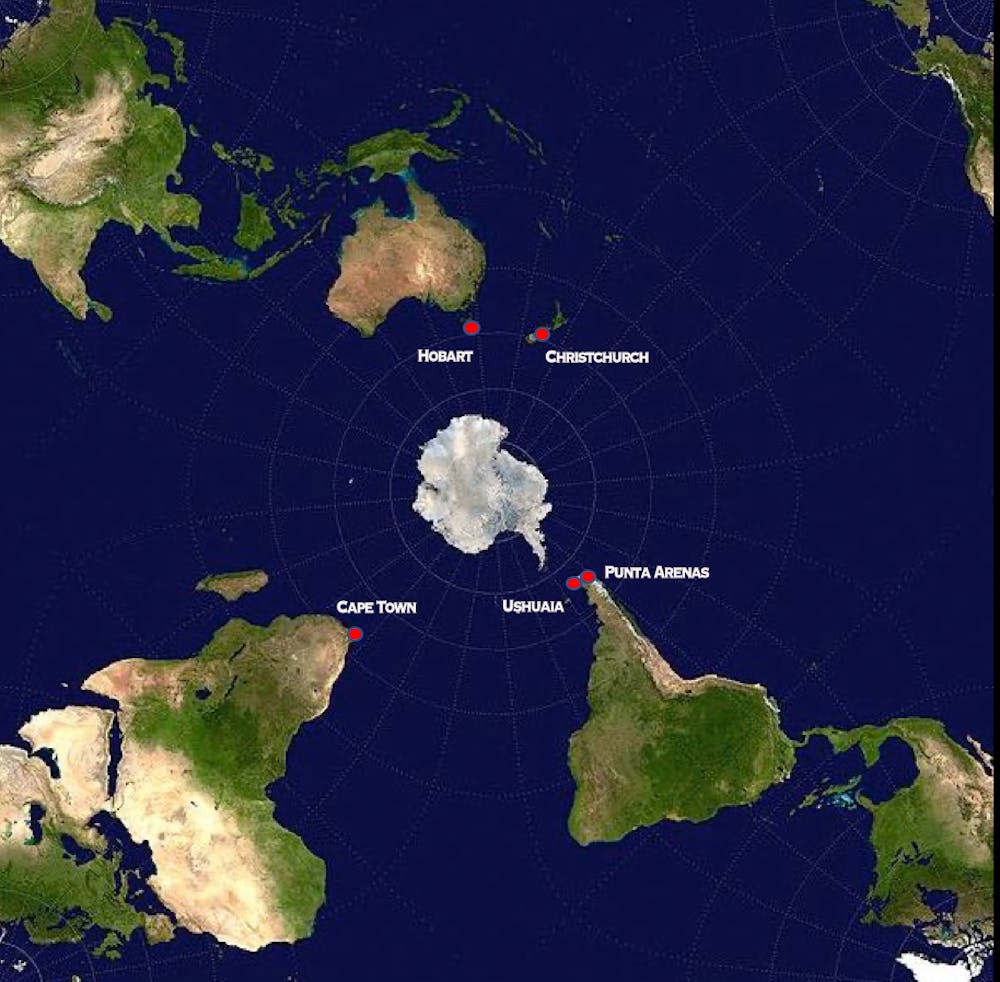
These five cities on the Southern Ocean rim — Cape Town, Christchurch, Hobart, Punta Arenas and Ushuaia — share a unique interest in Antarctica and an opportunity to shape its future.

The five Antarctic gateway cities. Author provided

How do their residents feel about Antarctica?

Our survey of 1,659 residents of these cities in July this year found they care deeply about the icy continent. Overall, and for many particular groups, environmental care greatly outweighs economic interests. Many residents express hope that this care might translate into more protective policies and action.

However, emotions were mixed, with pessimism and sadness also common responses. When we asked people how they feel about “the future of Antarctica in the next 20 years”, “hope” took first place, followed closely by “pessimism” and “sadness”.

The survey is part of the Antarctic Cities Project, which finishes this month. For the past four years an international team of researchers, city officials, national Antarctic programs and youth groups have worked together to develop a framework to strengthen Antarctic connections and a sense of guardianship for the continent. The framework encompasses the cities’ own urban sustainability strategies within a wider concern for the planet.

Our work focuses on shifting from the limited idea of “gateway” to this broader sense of becoming Antarctic “custodial cities”.

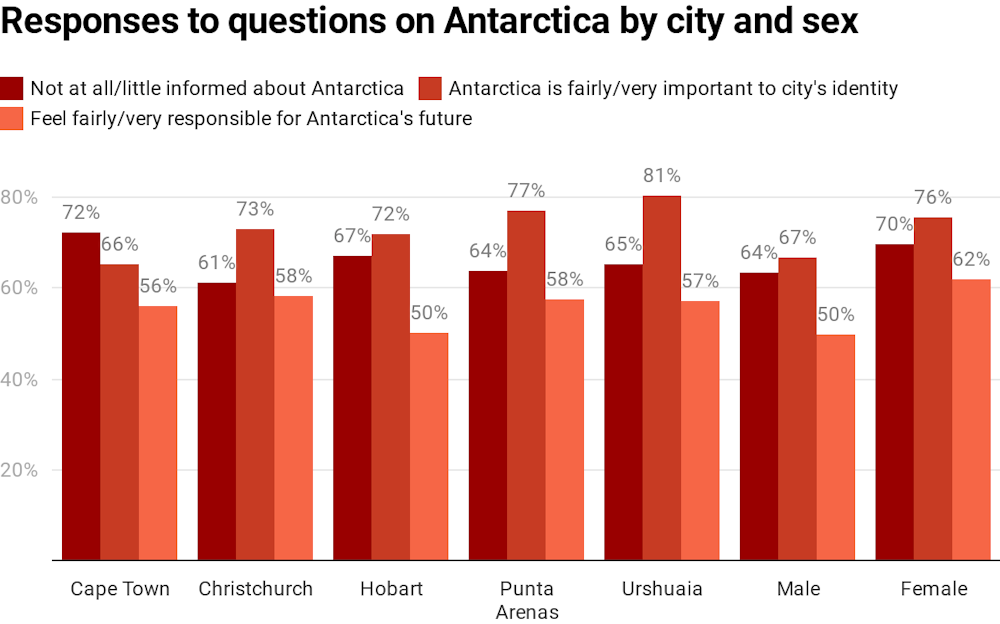
Our online survey of the cities’ residents over the age of 18 asked:

  • how informed they felt about the relationship between their city and Antarctica

  • their opinion on how important Antarctica is to their city’s identity

  • how responsible they, their families and friends think they are for the future of Antarctica.

chart showing responses to questions on Antarctica by city and sex
Antarctic Cities Project survey, Author provided

We posed the question: “Why is it important for your city to develop an identity in relation to Antarctica?” The response “it drives us to take care of the environment” was most common (57%) across all five cities. Other responses included:

  • “it creates a unique brand for our cities” (36%)
  • “it creates more jobs” (32%)
  • “it attracts more tourists” (31%)
  • “it reinforces residents’ attachment to place” (29%).

Caring for the environment was the most selected option for all ages. Women felt this particularly strongly. Men favoured the more economically oriented options, “it generates more jobs” and “it attracts more tourists”.

Women and people between the ages of 31 and 40 reported higher levels of “hope” and lower levels of “indifference”. Indifference was higher among people between 18 and 30, reaching 16.42%. In this age group, and with men overall, “pessimism” significantly outweighed “hope”. Punta Arenas and Ushuaia residents expressed more “hope” than in other cities.

Young people’s expressions of pessimism and indifference bear witness to the urgent work of reforming our relationship to the Antarctic region. They will be the beneficiaries, and increasingly the drivers, of this reform.

A decade of co-operative custodianship

The cities first came together with the 2009 signing in Christchurch of a statement of intent to promote peaceful co-operation. Though it expired 18 months later, various city and national government policies have reinforced the five cities’ “Antarctic gateway” status. They have put forward visions for enhancing and capitalising on their Antarctic identities, a key part of their relationship to the world.

In an example of action at a local level, the City of Christchurch is moving towards a custodianship model by basing its 2018 Antarctic strategy on two key principles:

  • embracing the Maori principle of Kaitiakitanga – meaning guardianship, protection, preservation or sheltering – and a customary way of caring for the environment based on traditional Māori world view to guide the city’s involvement in the region

  • taking a leadership role in sustainable actions for the benefit of the Antarctic region and the city.


Read more: Non-human Democracy: in the Anthropocene, it cannot be all about us


In coming together, the five cities are showing they can play an important role in defining how Antarctica is imagined, how discourse is framed and how the continent is vicariously experienced.

The Antarctic Cities Project has created an interlinked network of organisations that can learn from and benefit each other. This network of local government, national Antarctic programs, youth groups and polar organisations has produced Antarctic Futures, an educational online serious game.

The network also founded the Antarctic Youth Coalition. It was launched in February 2020 during an expedition to Antarctica with the Chilean Antarctic Institute.

Five young leaders from each of the cities steer the coalition. This year they put together an online Antarctica Day Festival to celebrate and learn more about the ongoing importance of this polar region.

The Antarctic Youth Coalition team with Juan Salazar at Collins Glacier, King George Island, Antarctic Peninsula, February 2020. Image: Elizabeth Leane

Principles for Antarctic cities

During 2020 we began work on a Charter of Principles for Antarctic Cities in collaboration with the Hobart and Christchurch city councils. It draws from Christchurch’s 2018 Antarctic Gateway Strategy and the 2017 Tasmanian Antarctic Gateway Strategy. This charter will guide sustainable urban practice and embrace Antarctica’s significance to the economies of these cities while charting ways forward for sustainable development.

The charter aims to celebrate the unique polar heritage of these cities and emphasises the crucial role of youth organisations for engaging with the future of Antarctica. And it acknowledges that human connections with Antarctica extend well beyond the last two centuries, embracing Indigenous conceptions of caring for Country, both land and water.

In the Anthropocene, global public consciousness of, and responsibility for, the icy continent in a time of climate change is increasing. These cities’ relationship with the region to their south and to each other is a valuable part of their urban identity and Antarctica’s future – something worth celebrating on Antarctica Day.


Read more: New research shows the South Pole is warming faster than the rest of the world


ref. Custodians of Antarctica: how 5 gateway cities are embracing the icy continent – https://theconversation.com/custodians-of-antarctica-how-5-gateway-cities-are-embracing-the-icy-continent-148006

Hidden women of history: Millicent Bryant, the first Australian woman to get a pilot’s licence

Source: The Conversation (Au and NZ) – By James Vicars, Sessional Lecturer, University of New England

In this series, we look at under-acknowledged women through the ages.

Before the glamorous flyers of the 1930s like Amelia Earhart, “Chubby” Miller and Nancy Bird Walton, another woman opened the way to the skies — and were it not for a tragic twist of fate, her name might now be just as familiar.

Her name was Millicent Maude Bryant, and in early 1927, she became the first woman to gain a pilot’s licence in Australia. She was also first in the Commonwealth outside Britain.

Millicent Bryant c.1919. Portrait by Monte Luke.
Millicent Bryant c.1919. Portrait by Monte Luke. Author provided

Read more: Hidden women of history: Catherine Hay Thomson, the Australian undercover journalist who went inside asylums and hospitals


A boundary-pusher who met an untimely end

Millicent was born in 1878 at Oberon and grew up near Trangi in western New South Wales. Her family, the Harveys, moved to Manly for a period after a younger brother, George, contracted polio (one of the treatments was “sea-bathing”). She met and married a public servant 15 years her senior, Edward Bryant. They had three children but the couple separated not long before Edward died in 1926.

Later that year, Bryant began instruction with the Australian Aero Club at Mascot in Sydney. At the time, the site of the current international airport was just a large, grassy expanse with a few buildings and hangars.

Bryant was accepted by the Aero Club’s chief instructor, Captain Edward Leggatt (himself a noted first world war fighter pilot), soon after the club had opened its membership to women.

Even then, though, she was unusual: here was a 49-year-old mother of three taking up the challenge of flying which, in the 1920’s, was still as dangerous as it was exciting and glamorous.

Millicent Bryant with a plane and other aviators.
Millicent Bryant (second from left) with other aviators beside her De Havilland Moth. Author provided courtesy of Mary Taguchi.

She quickly progressed, ahead of two other younger, women students, and made her first solo flight in February, 1927. By this time, newspapers all around Australia were following her story, and in late March she took the test for the “A” licence that would enable her to independently fly De Havilland Moth biplanes.

She passed, and with the issue of her licence by the Ministry of Defence, Bryant was acclaimed as the first woman to gain a pilot’s licence in Australia.

An image of Bryant's Aero Club training certificate.
Millicent Bryant’s training certificate from the Aero Club of Australia (NSW Section). Her ‘A’ Licence was issued by the Department of Defence in April, 1927. Author provided, Author provided

Why, then, isn’t she better known in our day? While Bryant immediately began training for a licence to carry passengers and flew regularly in the months that followed, it was her particular misfortune to step onto the Sydney ferry Greycliffe on its regular 4.14pm run to Watson’s Bay on November 3, 1927.

Less than an hour later, she was among 40 dead after the ferry was cut in half off Bradley’s Head by the mail steamer Tahiti. It was Sydney’s worst peacetime maritime disaster. Bryant was still only 49.

Her funeral two days later was attended by hundreds of people and accorded a remarkable aerial tribute, as the Wellington Times reported:

Five aeroplanes from the Mascot aerodrome flew over the procession as it wended its way to the cemetery. As the burial service was read by the Rev. A. R. Ebbs, rector of St. Matthew’s, Manly, one of the planes descended to within about 150 feet of the grave, and there was dropped from it a wreath of red carnations and blue delphiniums … Attached to the floral tribute was a card bearing the following inscription:

5th November, 1927. With the deepest sympathy of the committee and members of the Australian Aero Club — N.S.W. section.

_Greycliffe_, lifting the wreck of the ferry. The heavy lifting gear of the SHT steam sheerlegs is used to bring the hull section to the surface. From the Graeme Andrews ‘Working Harbour’ Collection, courtesy of the City of Sydney Archives.
Lifting the wreck of the ferry, Greycliffe. The heavy lifting gear of the SHT steam sheerlegs is used to bring the hull section to the surface. Author provided. Image from the Graeme Andrews ‘Working Harbour’ Collection, courtesy of the City of Sydney Archives., Author provided

A pioneer in life as well as the sky

Bryant’s story quickly lapsed into obscurity. Fortunately, some 80 years later, the rediscovery in the family of a collection of letters and other writings has enabled Bryant’s life beyond her flying achievement to be rediscovered.

The letters were — and are still until they are added to the collection of Bryant’s papers in the National Library — held by her granddaughter, Millicent Jones of Kendall, NSW, who rediscovered them in storage at her home.

The main correspondence is a conversation with her second son, John, in England. It covers the period she was flying, though it only moderately expands on the flights recorded in her logbook.

However, her letters and writings reveal much more about Bryant herself, her relationships, her feelings and her leisure, business and political activities. And they make it apparent that she was as much a pioneer in life as well as in the sky.

A clipping from a story in _The Bulletin_ about Millicent Bryant.
A clipping from The Bulletin, February 24, 1927. The Bulletin., Author provided (No reuse)

For one, flying was not Bryant’s only unconventional interest. She was also an entrepreneur, registering an importing company in partnership with John, who went on to become a pioneer of the Australian dairy industry.

She opened a men’s clothing business, Chesterfield Men’s Mercery, in Sydney’s CBD. However, disaster struck when it was inundated with water mere weeks after opening, following a fire in the tea rooms upstairs.

Bryant then became a small-scale property developer, buying and building on land in Vaucluse and Edgecliffe. She’d been well tutored in this by her father, grazier Edmund Harvey (a grandfather of billionaire Gerry Harvey), whose own holdings eventually included a large part of the Kanimbla Valley west of the Blue Mountains.

An excellent horsewoman, Bryant was also an early motorist who had driven over 35,000 miles around NSW and who could fix her own car. She was a keen golfer and reader and even a student of Japanese at the University of Sydney.

A fragment from Bryant's letters
A key writing fragment by Millicent Bryant (c.1924). Author provided

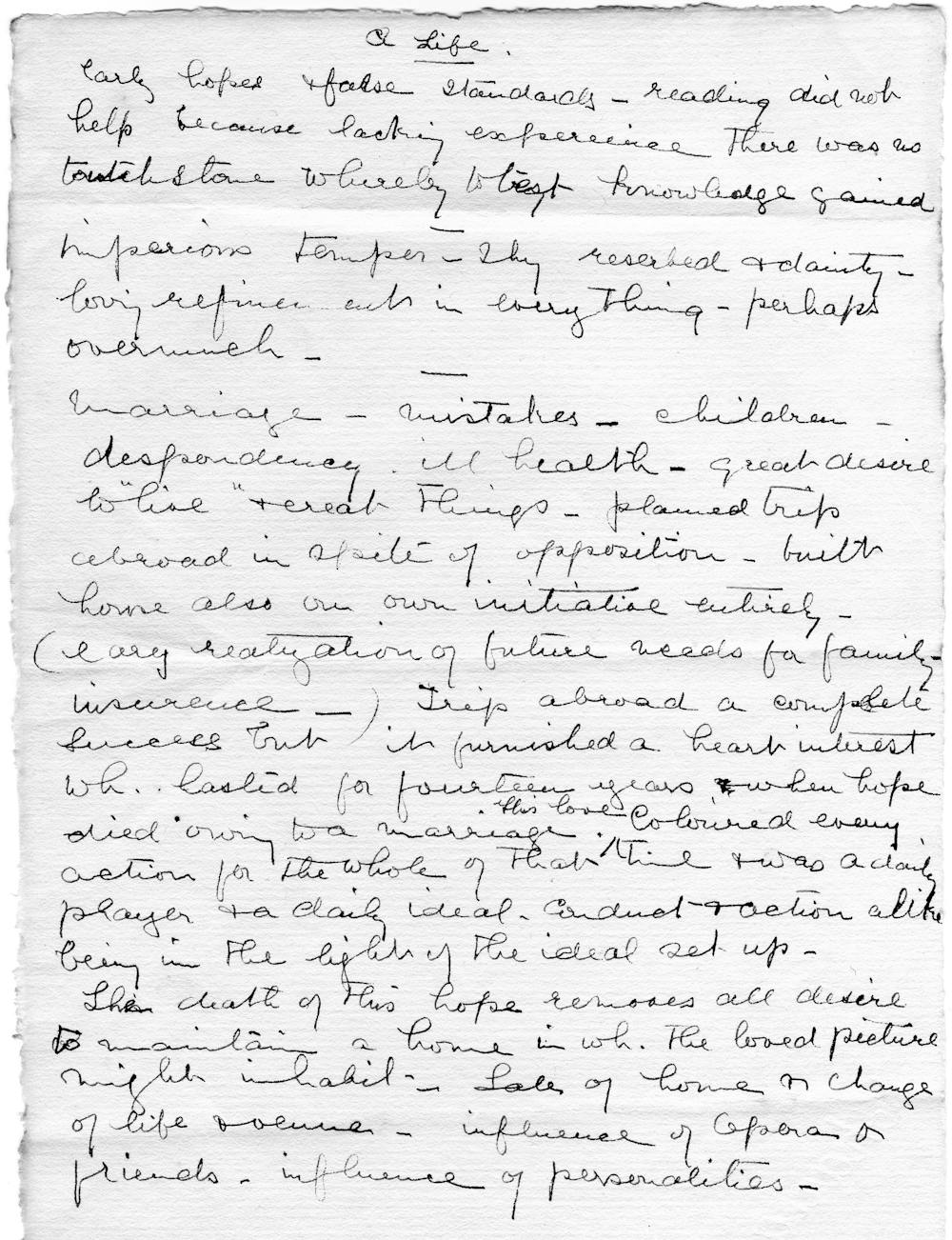
Several fragments of a family saga she planned to write, based on her own life, are among her papers. One sheet, entitled “A Life”, summarises in a series of rough notes rather more than she might have told anyone about her inner world.

Marriage – mistakes – children – despondency. Ill-health. Great desire to “live” and create things…

She notes that a trip abroad was a complete success but

it furnished a heart interest which lasted for fourteen years until hope died owing to a marriage.

This fragment provides some background to her taking, in her forties, the unusual step at that time of leaving her marriage and family home to start life afresh with her sons.

This was not long before she took her first flight, probably with Edgar Percival, a family friend and later a successful aircraft designer whose planes won air races and were noted for their graceful lines.

Vigour, values and conflicts

Growing up in the NSW inland late in the 19th century, Bryant would have begun with a fairly traditional view of what it meant to be a wife and mother.

However, her early life was also “free-spirited” (as one newspaper described her upbringing) and her determination to make decisions and shape her own life put her on a collision course with gender role expectations common at the time.

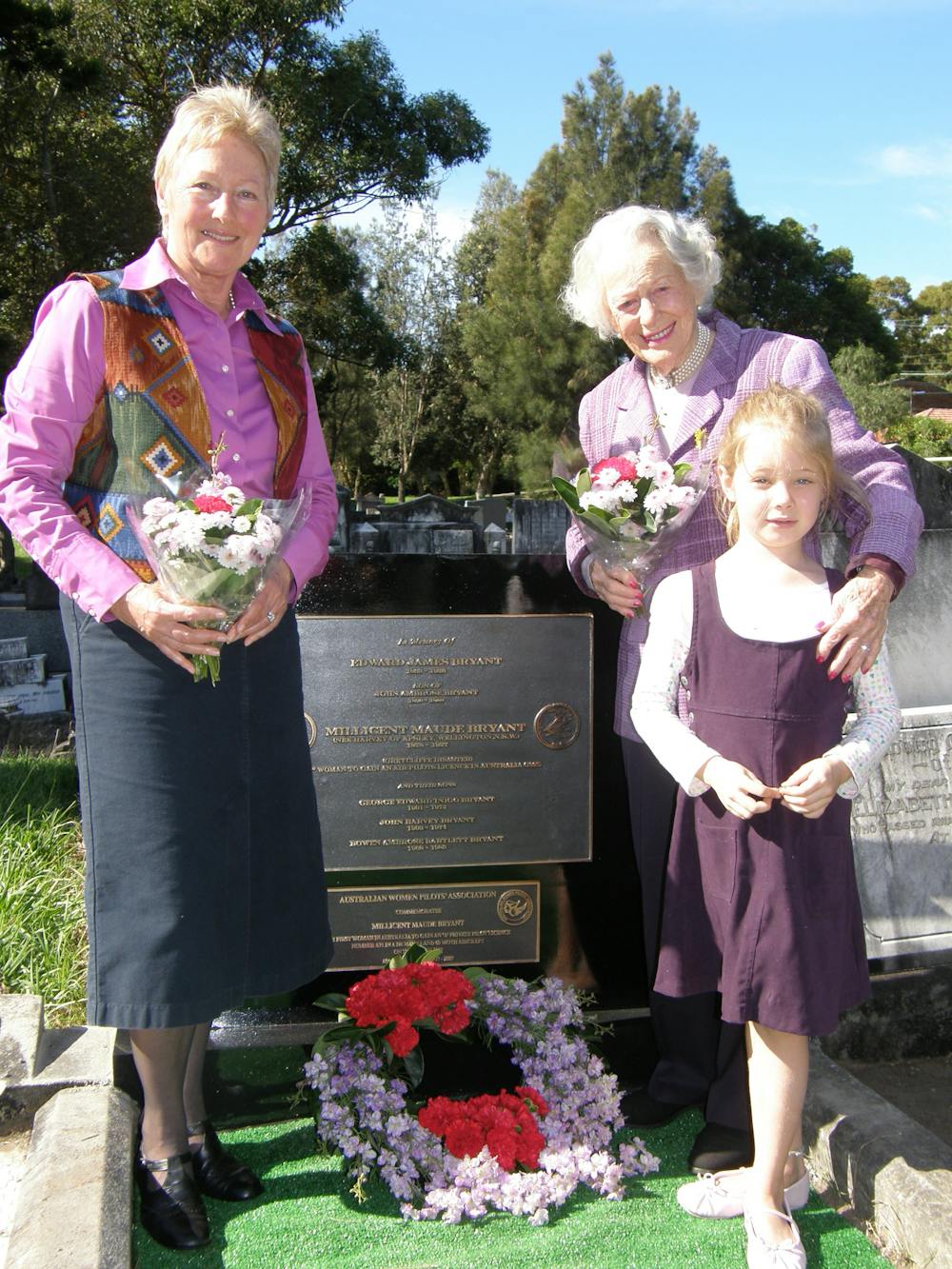
In 2006 a new memorial to Millicent Bryant was placed in Manly (now Balgowlah) Cemetery. It was dedicated by the late Nancy Bird Walton, pictured with Gaby Kennard (left) the first Australian woman to fly a single-engine plane around the world.
In 2006 a new memorial to Millicent Bryant was placed in Manly (now Balgowlah) Cemetery. It was dedicated by the late Nancy Bird Walton, pictured with Gaby Kennard (left) the first Australian woman to fly a single-engine plane around the world, and (right) a great-great-granddaughter of Millicent Bryant, Matilda Millicent Power-Jones. Author provided, Author provided

Learning to fly, especially in middle age, was a breakthrough she pursued perhaps even more keenly after being denied work with the Sydney Sun newspaper solely because she was married.

Bryant clearly came to hold strong ideas about what a woman could and couldn’t do, and her life shows a determination to make her own path, despite confronting obstacles that are still familiar in our own time.

Bryant is not just a figure in aviation history. Her life — spanning the colonial period, the newly-federated nation and the tragedies of World War I — came to reflect the vigour, values and conflicts of Australia in the early 20th century.


Read more: Hidden women of history: Wauba Debar, an Indigenous swimmer from Tasmania who saved her captors


ref. Hidden women of history: Millicent Bryant, the first Australian woman to get a pilot’s licence – https://theconversation.com/hidden-women-of-history-millicent-bryant-the-first-australian-woman-to-get-a-pilots-licence-146314

ADF Chief Angus Campbell retreats after government’s sortie over citation

Source: The Conversation (Au and NZ) – By Michelle Grattan, Professorial Fellow, University of Canberra

After government pressure, Chief of the Australian Defence Force Angus Campbell has publicly retreated in the dispute over revoking the Meritorious Unit Citation for the Special Operations Task Group serving in Afghanistan between 2007 and 2013.

When he released the Brereton report on alleged atrocities by some special forces soldiers, Campbell said he would write to the governor-general asking for the citation – which is a group award, separate to those for particular individuals – to be revoked.

Brereton said while many of the soldiers showed great courage and commitment and the group had considerable achievements, “what is now known must disentitle the unit as a whole to eligibility for recognition for sustained outstanding service.”

But as a strong backlash came from some special forces veterans, members of the general public and sections of the media, Scott Morrison indicated he opposed the revocation.

The position shifted at the weekend to putting the future of this and other recommendations in the government’s hands – although Campbell did not himself say anything until late Monday.

In his Monday statement he noted Defence was developing a comprehensive implementation plan on the Brereton recommendations.

“No decisions have yet been made with regard to the appropriate options and approaches to implement the more than 140 recommendations,” he said.

This was a different tack to the impression he gave in releasing the report, when he said he accepted all Brereton’s recommendations.

He said on Monday “the complexity and sensitivity of the issues outlined in the report will take extensive and considered deliberation”.

“Any further action in response to the Inspector-General’s recommendations will be considered as part of the implementation plan, which is being developed with the oversight of the Minister for Defence and the independent Afghanistan Inquiry Implementation Oversight Panel.

“Key issues of public interest such as accountability, referrals to the Government-established Office of the Special Investigator, compensation, honours and awards including citations, ethical development of the force and command, and control of the Australian Defence Force in coalition operations, will all be addressed through the implementation plan.”

When the implementation plan was developed it would be “first considered by Defence leadership and presented to government for consideration and input”.

Campbell’s hasty retreat from his citation decision of less than a fortnight ago will raise questions about whether there will be soft pedalling on other aspects of the Brereton report, although it is considered likely most will be implemented.

However the government now appears locked into letting the citation stand, despite some military experts believing the view of Brereton and Campbell is the correct position.

ref. ADF Chief Angus Campbell retreats after government’s sortie over citation – https://theconversation.com/adf-chief-angus-campbell-retreats-after-governments-sortie-over-citation-151116

An all-out trade war with China would cost Australia 6% of GDP

Source: The Conversation (Au and NZ) – By Rod Tyers, Winthrop Professor of Economics, University of Western Australia

China accounts for more than a third of export dollars earned by Australia.

The figures, for the 12 months to October, cover the period of coronavirus disruptions and disputes over trade.

They apply to physical exports rather than harder to measure services, and are dominated by record high Chinese takings of Australian iron ore.

But they mightn’t last.

China is changing, transitioning from growth driven by the iron-ore hungry expansion of cities and manufacturing to growth driven more by the supply of services.

Externally, its “belt and road” infrastructure investments facilitate the supply of resources from locations other than Australia, among them the Simandou iron ore and bauxite deposits in Guinea, West Africa that will eventually offer higher quality ore than Australia from a region China may regard as more friendly.


Read more: Australia demands apology from China over ‘repugnant’ slur on Twitter


Even if this source is slow to emerge, China will seek to diversify its supplies of iron ore by other means, as suggested by Australia’s former ambassador Geoff Raby in his recent book China’s Grand Strategy and Australia’s Future in the New Global Order.

One will be to ensure a steady supply from Brazil which, with China, is a member of the BRICS group of major emerging national economies.

Australia produces few manufactured goods and pays for the considerable quantity it imports by exporting commodities, mostly to China.

The loss of this export channel would be serious, but how serious?

Iron ore matters more than we think

Conversation authors John Quiggin and James Laurenceson argue the effects would be small. They point out that mineral exports account for only 1% of Australia’s national income and that China would hurt itself if it cut off the flow.

But China’s size means the damage to China would be proportionately smaller than the damage to Australia.

And while the mining sector is not the largest in Australia’s economy, its growth since 2002 has brought with it a secondary boom in Australian service industries. Australia’s East Coast cities have prospered even while most of the mining has been occurring in the Pilbara.


Read more: Relax, losing access to China won’t make us the ‘poor white trash of Asia’


The mining boom brought a substantial boost to our terms of trade (the earning power of our exports relative to the cost of our imports), pushing up the Australian dollar and making imported goods much cheaper.

A reversal would see our terms of trade fall and our cost of living rise.

Some commentators place store in our ability to redirect exports of wine and barley, and whatever else is affected by trade disputes, to other customers. At least for iron ore, however, there are few other customers at current volumes. This suggests a decline in export prices and in Australia’s terms of trade.

Damage to us, a mozzie bite for China

So its worthwhile attempting to quantify the damage from a winding back by China of its imports from Australia.

We have conducted simulations of the effect of shutting down Australia-China trade by 95% in which we allow time for capital flows and production and employment to readjust and assume that monetary policy and fiscal balances remain unaltered throughout the world.

We find the shock to the demand for Australian products is large and it is only partially offset by the redirection of our exports, even with a large depreciation of the Australian dollar.


Read more: Hopes of an improvement in Australia-China relations dashed as Beijing ups the ante


The reason for this is that the loss of Chinese exports reduces the rate of return on investment in Australia, forcing financial markets to reallocate finance to other parts of the world.

The effects on Australian gross domestic product and real disposable income per capita are big (6% and 14 %), while those on China are mosquito bites by comparison (0.5% and 2.4%).

It’s wise to be prepared

SunCable is planning the world’s biggest solar array in the Northern Territory. Apiromsene/Shutterstock

Important things we can do to hedge against such an occurrence include maintaining strong relations with current and potential export destinations and fostering innovations that will allow our export product mix to adjust so as to better service the markets that remain open.

Examples include the proposal by Ross Garnaut to turn Australia into an exporter of green energy and associated plans by Fortescue and others to raise exports of energy by more than the east coast of Australia currently consumes.

Without such innovations a substantial decline in trade with China would cut investment in Australia and cut living standards.

It is, of course, entirely possible that the worst won’t happen, but we don’t think that’s something Australians can bank on.

If our ship does begin to sink, capital and skills will jump off and what we are left with won’t be enough to support us in the manner we have come to expect.

ref. An all-out trade war with China would cost Australia 6% of GDP – https://theconversation.com/an-all-out-trade-war-with-china-would-cost-australia-6-of-gdp-151070

Lawyer X inquiry calls for sweeping change to Victoria Police, but is it enough to bring real accountability?

Source: The Conversation (Au and NZ) – By Jude McCulloch, Emeritus Professor Monash University, Monash University

Few stories have rocked Victoria as much as the so-called “lawyer X” scandal, which revealed that high-profile criminal barrister Nicola Gobbo had been used by police as an informant.

It triggered a royal commission into the affair, which after months of explosive evidence, has now released its findings.

The Victorian Royal Commission into Police Management of Informants has revealed a gaping hole in police accountability. It has also put a spotlight on a problematic police culture. The police use of a criminal defence barrister as an informant against her own clients is a massive blow to the criminal justice system. During the course of the commission, two of Gobbo’s former clients had their convictions overturned.

So, how will the police in Victoria be held to account and what needs to change to ensure such behaviour is never repeated?


Read more: The Lawyer X scandal is a massive blow to the criminal justice system: here’s why


Key findings and recommendations of the report

The four-volume report has laid bare “the far-reaching and detrimental consequence” of the behaviours of Gobbo and the Victoria Police, which may have denied a large number of people their rights to a fair trial. The commission found the convictions or findings of guilt of 1,011 people may have been affected by the police’s use of Gobbo as a human source.

The commission has recommended the conduct of both Victoria Police and Gobbo be referred to a special investigator to consider whether there is evidence to bring criminal charges and, in the case of serving police officers, disciplinary charges.

It has also recommended a suite of reforms to increase accountability and transparency in relation to Victoria Police’s use and management of informants. This includes independent external oversight and legislation to

ensure that their use is necessary, proportionate, justified and compatible with human rights.

Who polices the police?

The royal commission findings, while focused on the relationship between one informant and Victoria Police, brings into sharp focus the broader issues of police accountability and police culture.

The system for investigating police misconduct, corruption and criminality in Victoria is hopelessly flawed. As it stands, 98% of such cases are investigated by police.

The Independent Broad-based Anti-corruption Commission (IBAC) lacks the resources to carry out investigations in most cases and is hamstrung when it does. IBAC considered the Gobbo case in 2015, then sent it back to Victoria Police for investigation. The police showed little interest in probing further.


Read more: Expanding Victoria’s police powers without robust, independent oversight is a dangerous idea


It is worth noting that Gobbo acted as an informant for years before it was revealed publicly. According to the royal commission, more than 100 people within Victoria Police knew about Gobbo, but none raised concerns with the internal Ethical Standards Department or with IBAC.

Police investigating themselves always raises issues of conflict of interest. But this is even more pronounced when a matter involves senior police, or former police commissioners, as in the Gobbo case.

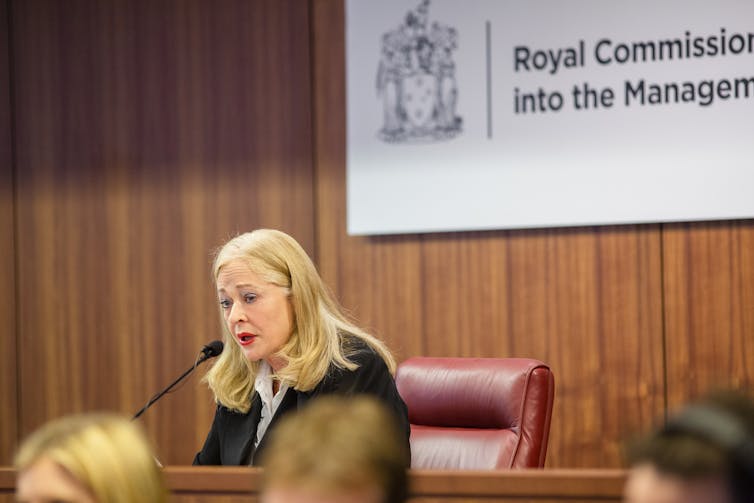
The chair of the royal commission, Margaret McMurdo, has decided not to name any current or former police implicated in criminal conduct, so as not to prejudice future legal proceedings.

McMurdo took aim at Victoria police who ‘lacked the moral clarity, vision and ability’ to fix the flaws in its system. Royal Commission into the Management of Police Informants

In 2018, a joint parliamentary inquiry report into how claims of police misconduct are investigated made 69 recommendations for reforming police oversight in the state. These included better resourcing for IBAC, and that it, rather than police, investigate all cases of serious misconduct.

More than two years since that report was released, the government has not implemented its recommendations.

Police oversight in other countries

Covert operations have long been recognised as providing fertile ground for police corruption and criminality.

Northern Ireland is a telling case. During the decades of the “Troubles” through to the peace process at the turn of the millennium, the covert arm of policing, Special Branch, acted as a force within a force. Some police engaged in and facilitated criminality, including murder.


Read more: Northern Ireland’s police transformation may hold lessons for the US


Radical reforms were made as part of the peace process through the Police Ombudsman Northern Ireland, which was established to provide independent oversight of policing, including their use of covert investigatory powers.

As such, Northern Ireland’s police accountability system is now widely recognised as the gold standard.

The UK’s Regulation of Investigatory Powers Act also provides a basis for increased control of police human intelligence sources, including intense frontline supervision of officers, clear internal guidelines, and authorisation procedures, performance management and integrity testing of officers.

In addition, the Investigatory Powers Commissioner’s Office provides independent oversight of police and other public authorities’ investigatory powers, including the use of human sources.

The Victoria royal commission specifically made reference to the role of the UK’s Investigatory Powers Commissioner’s Office and the UK law, but did not specifically recommend them as models for Victoria, instead urging consultation with stakeholders to develop a legislative framework.

When the ends do not justify the means

The commission found evidence of “systemic failure in Victoria Police” and

a pervasive and negative cultural emphasis, led from the top down, on getting results, with insufficient regard to the serious consequences for the rights of individuals and the proper administration of the criminal justice system.

Even after the High Court blasted the Victoria Police for “reprehensible conduct” in 2018, its former chief commissioner, Graham Ashton, continued to [defend the police’s actions in the media]t(https://www.theguardian.com/australia-news/2020/sep/05/lawyer-x-how-victoria-police-got-it-profoundly-wrong-with-informant-nicola-gobbo), on the basis of getting results in the “gangland wars”.

This “ends justifies the means” rationale, often referred to as “noble cause” corruption, belies an above-the-law mentality. Much evidence was put forth at the royal commission to suggest that Victoria Police rejected or set out to thwart or co-opt systems designed to deliver independent scrutiny.

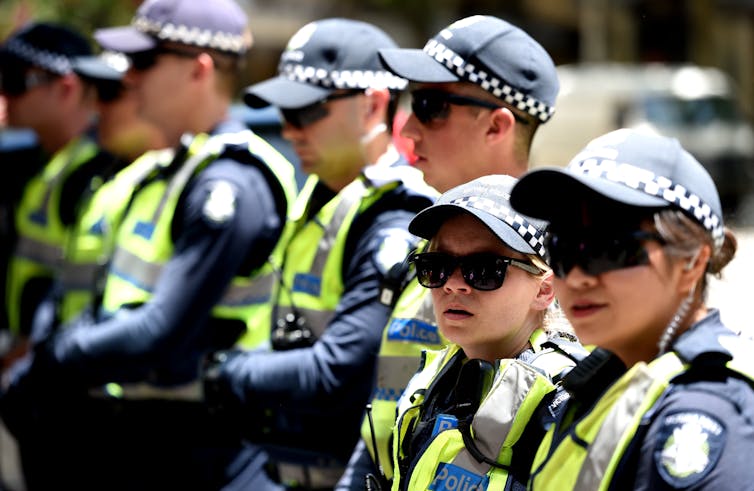
The royal commission findings suggest a change of culture within Victoria Police is urgently required. AAP/Tracey Nearmy

There have been a series of reviews and inquiries into Victoria Police over the past two decades. They have pointed to deficiencies in its management of informants, along with broader issues related to culture and leadership. Despite this, the royal commission findings reflect many of the same issues.

The commission maintains it is “encouraging” that the new chief commissioner of Victoria Police, Shane Patton, has stated publicly the police will heed the recommendations of the inquiry.

If things are to substantially change, however, reforms need to extend beyond these recommendations.

The recommendations of the 2018 parliamentary inquiry also need to be implemented to ensure that in all cases of serious misconduct, police are investigated by an independent body that has sufficient resources and powers to carry out such investigations effectively.

ref. Lawyer X inquiry calls for sweeping change to Victoria Police, but is it enough to bring real accountability? – https://theconversation.com/lawyer-x-inquiry-calls-for-sweeping-change-to-victoria-police-but-is-it-enough-to-bring-real-accountability-147836

Fatal shark attacks are at a record high. ‘Deterrent’ devices can help, but some may be nothing but snake oil

Source: The Conversation (Au and NZ) – By Daryl McPhee, Associate Professor of Environmental Science, Bond University

As summer descends, sharks may be at the forefront of the minds of many beach goers and reef adventurers.

Globally, the number of shark bites is on the rise, with a threefold increase since 1982. White sharks, bull sharks and tiger sharks are most commonly responsible.

In Australia this year, there have been 20 unprovoked shark bites (when humans don’t initiate contact) — a similar number to recent years. However, we’ve had eight fatalities, the highest on record since 1929. The latest fatality was at Cable Beach in Western Australia, a location not recognised as a shark bite hotspot.

Still, the risk of an unprovoked shark bite is still exceptionally low. You’re more likely to drown at a beach than be killed by a shark. But there are things people can do to reduce the already low risk even further.

Aerial shot of Cable Beach
Last week a 59-year-old man was killed by a shark in Cable Beach in Broome, the first fatal shark incident in almost 30 years. Shutterstock

What’s behind the shark bite trends?

There is no single reason for the observed trends in unprovoked shark bite.

A 2016 study found more people in the water contributes to rising incidents, as populations around coastal cities and towns increase. But this doesn’t tell the whole story.

Another reason may be due to changes in the distribution and an increasing abundance of key prey such as humpback whales (Megaptera novaeangliae) and New Zealand fur seal (Arctocephalus forsteri) along parts of the coast.

For some sharks, weather conditions can also play a role. This is the case for bull sharks, which are commonly found in warm, shallow waters along coasts and rivers, such as in Sydney Harbour during summer and autumn when water temperatures are higher.

Bull shark swims near smaller fish
Bull sharks are more active after heavy rainfall, especially near river mouths. Shutterstock

After flooding, there is a heightened risk of an unprovoked bite, as bull sharks prefer turbid water in the coastal zone. In other words, more rain generally means more bull shark activity.

Research in 2018 confirmed this. The authors found when total rainfall in a catchment near a beach was greater than or equal to 100 millimetres, the bull shark catch increased between one and eight days later.

And as we’re entering a summer with La Niña weather conditions — which means we’ll see increased rainfall — the risk of encountering a bull shark will be higher, particularly near river mouths.


Read more: La Niña will give us a wet summer. That’s great weather for mozzies


Shark deterrent technology

If you want to learn about safety and sharks, it’s a good idea to start at the Shark Smart websites for Queensland and NSW, which provide simple ways to reduce your personal risk.

This includes identifying times, locations and conditions to avoid, such as not swimming at dawn and dusk, and avoiding swimming with schools of baitfish or diving birds.

For those wanting greater peace of mind, personal electric shark deterrents are commercially available, with products suitable for divers, surfers and swimmers.

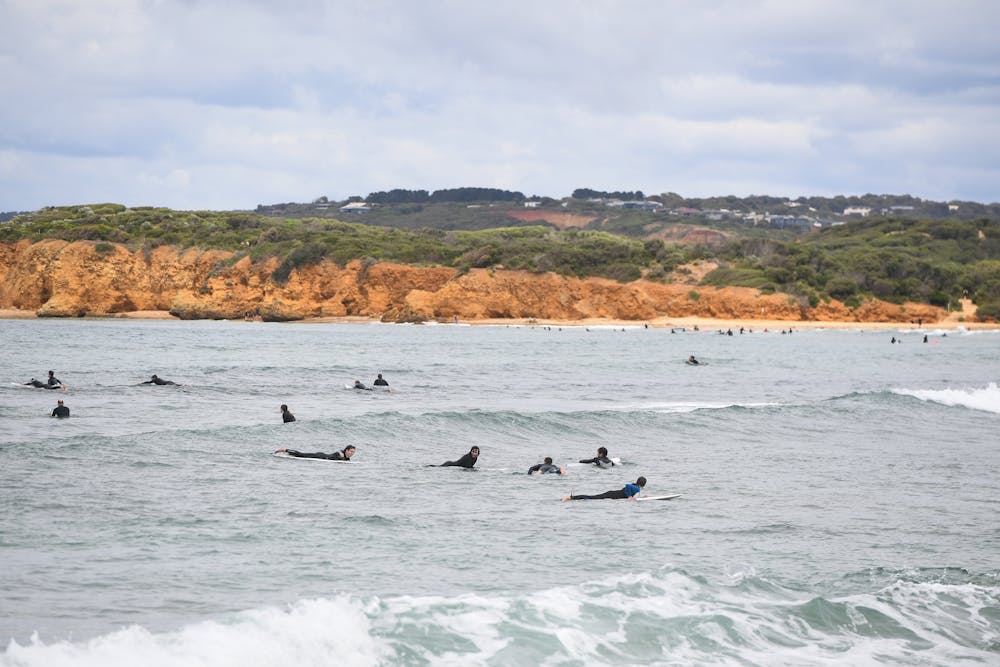
Surfers in Torquay on a cloudy day.
For greater peace of mind, shark deterrent devices can help reduce your chances of encountering a shark (but make sure they’re evidence-based). AAP Image/Erik Anderson

Sharks have a set of sense organs called ampullae of Lorenzini that can detect very weak electric currents in the water. Deterrent devices produce a electric current strong enough to elicit an avoidance response by the sharks without hurting them.


Read more: The shocking facts revealed: how sharks and other animals evolved electroreception to find their prey


No shark deterrent is 100% effective, but independent testing has demonstrated several can significantly reduce the risk of a bite. Still, results are variable.

For white sharks, one electric deterrent reduced the percentage of bait taken from 96% to 40%. And for bull sharks, researchers tested several different electric deterrents and found the best-performing device resulted in a 42.3% reduction in baits being consumed.

Electric devices aren’t the only type of deterrent. Chemical deterrents based on a necromone (dead shark smell!) have been effectively tested on Caribbean reef and blacknose sharks. They may not be effective against large species, such as tiger or white sharks though.

And research from earlier this year on reinforced neoprene wetsuits — fortified with composite fibres — shows promise for reducing the physical trauma of a shark bite, potentially reducing the chance of a fatality or serious injury.

The Freedom+ Surf is an electric shark deterrent that has been independently tested.

Know your deterrent from snake oil

If you’re thinking of buying a deterrent, a challenge for consumers is that many on the market have little to no biological or ecological basis, and have not been independently tested, as CHOICE, Australia’s leading consumer advocacy group, pointed out in 2016.

A shark deterrent is a safety device and as such should be the subject of an Australian Standard – similar to the way a life jacket must follow a standard – to ensure claims are valid. Currently no specific Australian Standard exists for shark deterrents.

No one can legally make a seat belt in their garage and sell it as an effective safety device. The same should apply to shark deterrents.


Read more: Why do shark bites seem to be more deadly in Australia than elsewhere?


There is a risk a person may place themselves in a more dangerous situation than they otherwise would have on the false belief the deterrent they have purchased has some level of effectiveness.

If you are looking to purchase a shark deterrent, look for those that have been independently tested in the field and found to have an actual deterrent effect. Don’t just rely on anecdotes and “the vibe”. In any case, the most effective deterrent is to make informed choices when entering the water this summer.

And we should never lose sight that an unprovoked shark attack is traumatic for surviving victims, first responders, and friends and families who lose a loved one.


Read more: How will sharks respond to climate change? It might depend on where they grew up


ref. Fatal shark attacks are at a record high. ‘Deterrent’ devices can help, but some may be nothing but snake oil – https://theconversation.com/fatal-shark-attacks-are-at-a-record-high-deterrent-devices-can-help-but-some-may-be-nothing-but-snake-oil-150845

‘War in space’ would be a catastrophe. A return to rules-based cooperation is the only way to keep space peaceful

Source: The Conversation (Au and NZ) – By Steven Freeland, Professor of International Law, Western Sydney University

In 2019, US President Donald Trump declared “space is the new war-fighting domain”. This followed the creation of the US Space Force and a commitment to “American dominance” in outer space.

Other space-faring nations, and those who fear the acceleration of an arms race in space, were greatly concerned. At the latest meeting of the United Nations Committee on the Peaceful Uses of Outer Space, states noted with alarm that “preventing conflicts in outer space and preserving outer space for peaceful purposes” is more necessary than ever.

The election of Joe Biden as the next US president and Kamala Harris as vice-president suggests there is cause for hope. The future of space may look more like the recent launch of NASA’s SpaceX Crew-1 mission to the International Space Station.

Onboard were US and Japanese astronauts, who joined Russian and US crew already living aboard the ISS. As the Falcon 9 rocket soared into space, the collaborative, cooperative and commercial nature of space was once again clear for all to see.


Read more: The US-Russian Space Station mission is a study in cooperation


Cooperation, not confrontation

The incoming Biden-Harris administration appears more interested in international cooperation, and much more cognisant of the challenges of climate change, pandemics and other global issues. A carefully calibrated space policy can do much to address “terrestrial” challenges, while still allowing for many positive space activities.

Since 1967, human activity in space has been guided by the universally accepted principles embedded in the Outer Space Treaty. This has ensured we have had no military conflict in space, and required the exploration and use of space “for the benefit and in the interests of all countries”.

Any alternative vision of the future of space is dreadful to consider. Rhetoric about the inevitability of “war in space” makes such conflict more likely and risks a “tragedy of the commons” in space.


Read more: The US plan for a Space Force risks escalating a ‘space arms race’


Any space war would have no clear winner. In a complex, globally shared arena such as space, it is important that states abide by accepted rules and established practices.

The US has great scientific and technological advantages and a robust and competitive commercial space sector. Instead of seeking dominance, it can better serve the world (and itself) by focusing its leadership on harnessing space for the benefit of all humankind.

In a promising sign, Biden and Harris’s NASA review team is composed of an outstanding group of space scientists as well as a former astronaut.

The current administration re-established the National Space Council, which is chaired by the vice president, and this has reinvigorated American investment and leadership in space exploration. This includes an ambitious plan to return to the Moon under the terms of the Artemis Accords.

Astronaut Soichi Noguchi is greeted by astronaut Kate Rubins as he enters the International Space Station from the vestibule between the SpaceX Dragon capsule and the ISS. NASA

Respect the rules

To ensure the fragile and shared domain of outer space does not become an arena for conflict, the rules that apply to any military uses of space need to be understood, respected and further developed. Failure to do so could lead to devastation, disruption and impact on civilian lives, particularly in the largest and most powerful countries like the US, whose economies and societies are heavily dependent on space infrastructure. Their access to space has given them the greatest competitive advantage, but they are therefore the most vulnerable if that access is compromised.

Space is a “congested, contested and competitive” area where scientific, commercial and economic interests converge, as well as military and national security concerns. In this sense space is like the radio frequency spectrum, which has been successfully regulated and managed for decades under international rules adopted through the International Telecommunication Union.

But space is also much more. As the recent Crew-1 mission demonstrated, there are significant benefits when nations come together and cooperate. Enlightened leadership, guided by commonly agreed laws and practices and a recognition that we share outer space as custodians for future generations, is the only realistic way forward.

ref. ‘War in space’ would be a catastrophe. A return to rules-based cooperation is the only way to keep space peaceful – https://theconversation.com/war-in-space-would-be-a-catastrophe-a-return-to-rules-based-cooperation-is-the-only-way-to-keep-space-peaceful-150947

Australia demands apology from China over ‘repugnant’ slur on Twitter

Source: The Conversation (Au and NZ) – By Michelle Grattan, Professorial Fellow, University of Canberra

Prime Minister Scott Morrison has demanded China apologise for – and Twitter remove – a highly offensive tweet depicting an Australian soldier with a knife to the throat of a child.

Morrison described the tweet as disgusting and utterly outrageous. Australia has protested to the Chinese embassy in Canberra, and a protest is also being made by Australia’s embassy in Beijing.

“The Chinese government should be totally ashamed of this post. It diminishes them in the world’s eyes,” Morrison told a virtual news conference from The Lodge, where he is still in isolation after his trip to Japan.

“Australia is seeking an apology from the Ministry of Foreign Affairs, from the Chinese Government, for this outrageous post. We are also seeking its removal immediately and have also contacted Twitter to take it down immediately.”

Following the recent release of the Brereton inquiry into alleged atrocities by some members of Australian special forces in Afghanistan, the tweet was posted by Lijian Zhao, spokesman and deputy director general of the information department in the Chinese Foreign Ministry.

It said: “Shocked by murder of Afghan civilians & prisoners by Australian soldiers. We strongly condemn such acts, &call for holding them accountable”.

A line in the illustration said: “Don’t be afraid, we are coming to bring you peace!”

Morrison said the repugnant post of a falsified image of an Australian soldier threatening a young child had come from an official Chinese government Twitter account.

It was “truly repugnant” and “deeply offensive” to every Australian.

“[To] every Australian who has served in that uniform. Every Australian who serves in that uniform today. Everyone who has pulled on that uniform and served with Australians overseas from whatever nation,” he said.

“It is a false image and a terrible slur on our great defence forces and the men and women who’ve served in that uniform for over 100 years.”


Read more: Biden win offers Morrison the chance to reshape Australia’s ailing relationship with China


Morrison said while there undoubtedly tensions between China and Australia, “this is not how you deal with them”.

Rather, the way was to engage directly in dialogue between ministers and leaders.

“And despite this terribly offensive post today, I would ask again and call on China to re-engage in that dialogue.

“This is how countries must deal with each other to ensure that we can deal with any issues in our relationship, consistent with our national interests and respect for each other’s sovereignty. Not engaging in this sort of deplorable behaviour.”

Morrison said he hoped “this rather awful event” might lead to a “reset” in the relationship, allowing a dialogue to be restarted where there could be sensible talk about issues — “because this type of behaviour is not on”.

Morrison sought to put the situation in a wider international context.

“It’s not just about Australia. Countries around the world are watching this. They see how Australia is seeking to resolve these issues and they’re seeing these responses.

“This impacts not just on the relationship here, but with so many other sovereign nations, not only in our own region, but like-minded countries around the world who have expressed similar sentiments to Australia about many issues. And so it is important that these things end and the dialogue starts.”

When he was asked why he didn’t write to Chinese President Xi Jinping directly, Morrison said, “You assume that there hasn’t been such interactions. We’ve constantly sought that engagement. This is not new.”

Asked about the controversial issue of revoking the Meritorious Unit Citation for Special Operations Task Groups who served in Afghanistan between 2007 and 2013, which was recommended by the Brereton report, Morrison said no decision had been made.

This is despite the chief of the Defence Force, Angus Campbell, saying when releasing the Brereton report that he would write to the governor-general asking for the revocation.

“No decisions have been made on that and were decisions to be made on that, that would only be following a further process. And that is where that matter rests right now,” Morrison told his news conference.

Opposition leader Anthony Albanese said he stood with Morrison in his condemnation of the China tweet. He said the opposition would not be asking about it in question time — the matter was above politics.

The latest deepening of tensions in the bilateral relationship comes days after the Chinese imposed punitive tariffs on Australian wine.


Read more: It’s hard to tell why China is targeting Australian wine. There are two possibilities


ref. Australia demands apology from China over ‘repugnant’ slur on Twitter – https://theconversation.com/australia-demands-apology-from-china-over-repugnant-slur-on-twitter-151099

Australia’s world-first repository of ‘modern slavery statements’ a step in the right direction

Source: The Conversation (Au and NZ) – By Fiona McGaughey, Senior Lecturer in International Human Rights Law, University of Western Australia

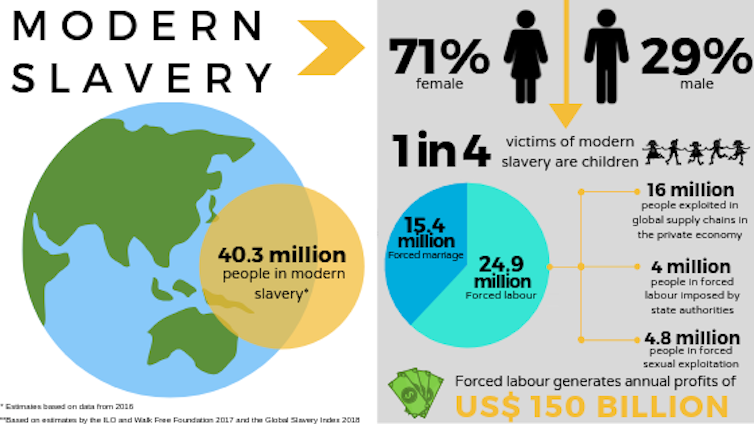
From “fast fashion” to tinned tuna to the components in your mobile phone, what guarantee do you have the goods you buy are slave-free?

The Australian government has taken a step forward by just publishing the first batch of statements from Australian companies outlining their efforts to ensure their supply chains do not involve modern slavery.

The reports are the first substantial fruits of Australia’s Modern Slavery Act, passed in December 2018, requiring all businesses with an annual turnover of A$100 million to publish “modern slavery statements” each year.

Businesses must report on the risks of modern slavery in their operations and supply chains, and on the actions they have taken to address these.

There are 121 statements in the repository so far. This includes 19 that are voluntary statements from businesses not required do so, but which have done so anyway to demonstrate their commitment to tackling modern slavery.

With the deadline for submitting reports extended due to COVID-19, the remainder will come by December 31 or March 31 next year (depending on the company’s financial year).

The repository is a world first. Although there are repositories of statements made under similar laws such as the UK Modern Slavery Act and the French Duty of Vigilance Act, these were established by non-government organisations (NGOs) in the absence of a government repository.

Anti-Slavery Australia

What’s in the repository so far?

Among those to have their statements published in this first tranche are major companies such as Coles Group and Wesfarmers (which owns Bunnings, Kmart and Officeworks).

Coles’ statement reports on “risks or indicators” of modern slavery, based on each country in its supply chain. For example, for China it identifies risks of forced or bonded labour, deceptive recruitment, exploitation of migrant workers, child labour, underpayment of wages and excessive working hours.

Wesfarmers’ statement is relatively detailed and transparent and reports “critical breaches” including allegations of excessive overtime, transparency (record keeping and documentation), safety (building and fire safety) and unauthorised subcontracting and bribery.

Don’t expect to see widespread disclosures of modern slavery in any statements. The Modern Slavery Act requires reporting on risks and the actions to address these. So the content of the statements tends to cover risk assessment, policies, training and, to a lesser extent, remedies.


Read more: Four Corners’ forced labour exposé shows why you might be wearing slave-made clothes


Most of the reports so far come from companies headquartered in Australia. Japan, the United States and the United Kingdom are home to six reporting entities each. Four are based in New Zealand.

The statements submitted vary widely in the length and level of detail provided. The 16 statements in the industry category “mining, metals, chemicals and resources” range from three pages to 22 pages. Unsurprisingly, the longer – and glossier – statements come from the larger companies who often find their social and environmental practices under scrutiny, such as Santos, South 32 and BHP.

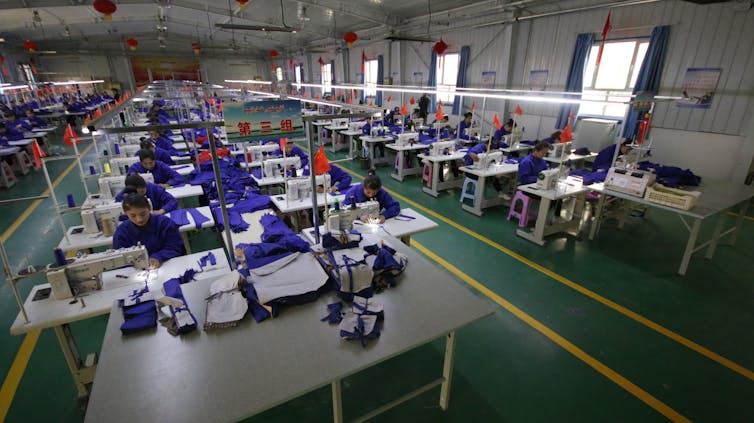
Uyghur women work in a clothing factory in Hotan prefecture, Xinjiang province, China in April 2019. The Chinese regime has allegedly to put up to a million detained Uyghurs to work. Azamat Imanaliev/Shutterstock

Why the repository is important

Internationally, a key criticism of business reporting laws such as Australia’s Modern Slavery Act is the lack of penalties for non-compliance. Critics argue that non-compliance with a range of other corporate laws, from Occupational Health and Safety to tax laws, result in penalties. The Law Council and others have called for penalties.

Others disagree and suggest the Modern Slavery Act has been introduced with significant good will on the part of businesses and that reputational risks from poor (or no) reporting are sufficient to keep businesses on track.

Of course, both a carrot and a stick approach could work. Issuing a fine also carries reputational risk, for example. Another way of driving compliance is to limit government tenders to those businesses complying with the Modern Slavery Act, such as is included in the WA Government’s proposed “procurement debarment regime”.

A three-year review of the Modern Slavery Act should take place in 2021. It is likely the question of enforcement and penalties will be raised again.

What this mean for consumers

In the lead-up to Christmas, a key question for consumers is how the repository can help inform ethical purchasing.

The repository is not designed for this purpose and doesn’t offer “performance scorecards”, for example.

Scrutiny of the statements is an important informal regulatory measure. But it is likely to be carried out by academics and non-government organisations, rather than individual consumers. This is the government’s expectation. But a shortcoming of this approach is that the non-government sector is chronically underfunded in Australia, particularly for advocacy work.

Consumers can already access ethical purchasing information, such as Oxfam’s report published last week on the manufacturing practices behind leading clothing brands in Australia.

Highlighting concerns from garment factories in Bangladesh, the report examined well-known stores including Best & Less, Big W, Cotton On, H&M, Zara, Kmart, Myer, Target, Rockmans, Rivers, Noni B, Just Jeans and Portmans. The repository could be further developed to inform reports and scorecards that would be more accessible to consumers.


Read more: At last, Australia has a Modern Slavery Act. Here’s what you’ll need to know


A societal shift in corporate accountability?

The Modern Slavery Act is just one of a number of recent developments that signal a move towards strengthening corporate accountability. These include the Banking Royal Commission and the Australian Law Reform Commission report on Corporate Criminal Responsibility.

These developments, together with the modern slavery reporting regime can be used to drive better human rights standards among Australian businesses.

ref. Australia’s world-first repository of ‘modern slavery statements’ a step in the right direction – https://theconversation.com/australias-world-first-repository-of-modern-slavery-statements-a-step-in-the-right-direction-151029

We modelled how a COVID vaccine roll-out would work. Here’s what we found

Source: The Conversation (Au and NZ) – By Olga Kokshagina, Researcher – Innovation & Entrepreneurship, RMIT University

How well we distribute and administer a COVID-19 vaccine will have massive health, social and economic ramifications. So attention is turning to vaccine supply chains and logistics.

Designing how best to vaccinate billions of people worldwide is complex. This is particularly so for large countries, such as Australia, where distributing vaccine to rural and remote areas is needed.

Despite numerous past pandemics and epidemics, very few studies globally have tackled the problem of designing and building an efficient vaccine distribution network. Existing studies have also not fully considered all factors affecting vaccine distribution.

So our team designed a mathematical model to test different scenarios for COVID-19 vaccine distribution, which we have submitted for publication.

What we took into account

Our model looked at different ways to distribute COVID vaccine to 6.9 million Victorians, based on the number of residents predicted in 2021.

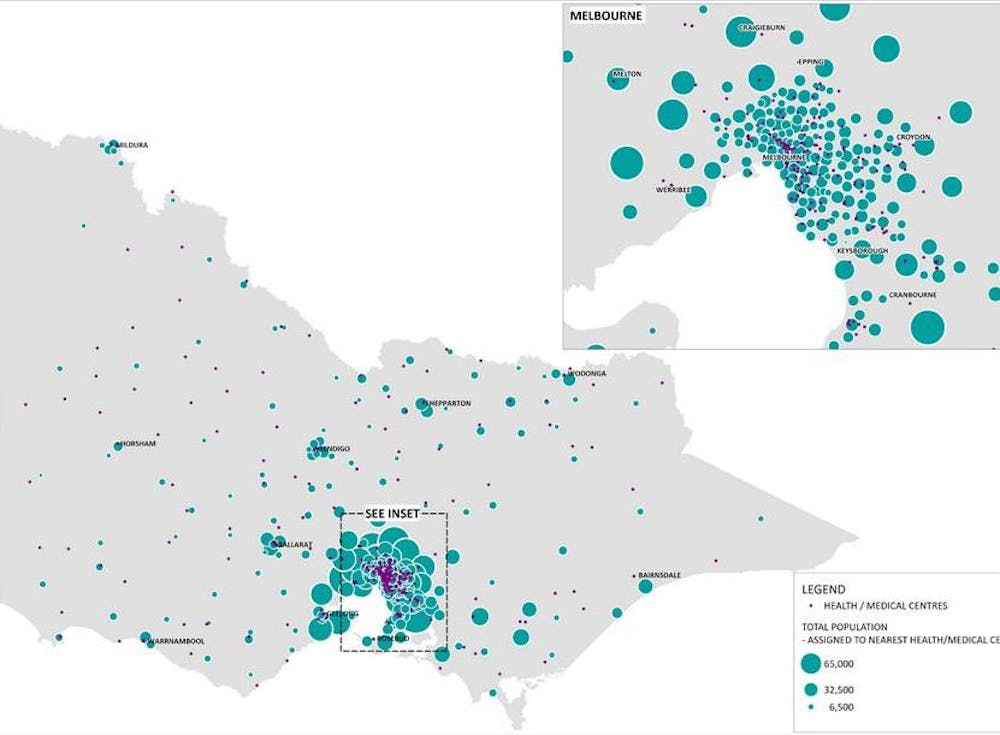
We modelled this using distribution via the state’s 325 medical centres, which can be everything from big city hospitals to small medical centres in regional areas.

Map of medical centres in Victoria
This map shows the location and capacity of the 325 medical centres in Victoria, using data from Victoria’s health department. Author provided

We assumed most vaccine distribution would be by road and enough refrigerated vehicles would be available.

We also factored into our model that certain sections of the community are at increased risk of exposure (for instance, city dwellers) and others are more susceptible to infection (for instance, aged-care residents and health-care workers). These people are not uniformly distributed around the state, affecting vaccine distribution logistics.

We then tested different scenarios to see how long vaccination would take.

Our research shows we need three key factors for success.


Read more: Scientific modelling is steering our response to coronavirus. But what is scientific modelling?


1. Medical centres need to be big enough

We calculated that if the capacity of the 325 medical centres is large enough, and if enough vaccine is available, the entire population of Victoria can be vaccinated within 60 days.

By capacity we mean the maximum number of vaccine doses each medical centre can administer. And this capacity depends on a range of factors including centres’ physical size, and having enough staff to administer vaccines.

This time frame or “target horizon” is the total number of days to vaccinate the population of Victoria. Although we have calculated this is possible within 60 days, the state or federal government will actually set this target.


Read more: Creating a COVID-19 vaccine is only the first step. It’ll take years to manufacture and distribute


To vaccinate all Victorians in 60 days, we calculated we would need a minimum of roughly 9,500 vaccine packs with 12 vaccines per pack, every day. This assumes one shot per person and adequate vaccines are available. A limited supply or a disruption to supplies might increase the administration period beyond 60 days.

If medical centres run at reduced capacity or existing capacity is not enough, this also increases the time taken to vaccinate. Conversely, if the aim is to vaccinate Victorians in under 60 days, our model suggests we need to boost our capacity to vaccinate.

This could be by using mobile vaccination units or hiring extra staff.

2. Vaccines need to be shipped between medical centres

We also show the importance of transporting vaccines between medical centres, known as transhipment. This allows medical centres short on vaccine to obtain doses from the nearest medical centres with extra supply.

Transhipment is also crucial when it comes to vaccinating the most vulnerable people. That’s because we can transfer vaccines from medical centres serving less-vulnerable populations to those with more residents in higher priority groups. Transhipment also allows us to transfer vaccines from areas with less exposure to areas of higher exposure. And it allows vaccines to reach remote areas.

However, transhipment places extra burden on road transport networks.

3. Vaccine packs need to be the right size

We also show it is important to get the vaccine pack size right. This seemingly minor detail had a significant effect on the overall period of vaccine administration.

We considered pack sizes that contain 5, 12, 20, 30 and 50 vaccines. Larger pack size significantly increases the need for transhipment between medical centres. That’s because larger packs would need to be broken up into smaller portions, then distributed to multiple medical centres.

We suggest governmental agencies carefully evaluate vaccine pack size when contracting and negotiating with vaccine manufacturers.


Read more: Keeping coronavirus vaccines at subzero temperatures during distribution will be hard, but likely key to ending pandemic


This is relevant to all Australia

While we used Victoria as a case study, we can apply our model to other states and territories.

In particular, the importance of pack size, transhipment between medical centres, and considering extra capacity to vaccinate in a shorter amount of time will apply in every context.

Certainly, the results for other states and territories will depend on their number of available medical centres, population size and population distribution.

Our model helps decision makers strike a balance between the cost of building extra capacity to try to achieve population vaccination in a given time scale or accepting a less costly approach that takes more time.

ref. We modelled how a COVID vaccine roll-out would work. Here’s what we found – https://theconversation.com/we-modelled-how-a-covid-vaccine-roll-out-would-work-heres-what-we-found-150544

The Picture of Dorian Grey review: Eryn Jean Norvill stuns in all 26 roles

Source: The Conversation (Au and NZ) – By Huw Griffiths, Senior Lecturer in English Literature, University of Sydney

Review: Sydney Theatre Company’s The Picture of Dorian Gray, directed by Kip Williams

Australian theatres are slowly coming back to life. And, with Kip Williams’ exuberantly inventive adaptation of Oscar Wilde’s 1890 novel, The Picture of Dorian Gray, the STC is giving us everything we have missed from live performance. This is despite much of the show consisting of a complex interplay between live action and video.

The strength of the show lies in the brilliant combination of Williams’ confident direction and an extraordinary performance from Eryn Jean Norvill, who is emerging as one of the best actors of her generation.

Here, she takes on every single role in the play — 26 characters in all. Sometimes she switches personas live on stage and, at others, she interacts with video representations of the other characters.

These exchanges between multiple different Norvills often display an exquisitely-timed comic effect; the show is genuinely hilarious at times. But it also allows, at other times, for a genuinely chilling terror.

Conception and performance offer more, however, than a display of technical brilliance. Both serve to translate some of the trickier aspects of this confounding, but magnificent, novel to the stage.


Read more: A litany of losses: a new project maps our abandoned arts events of 2020


A Wilde milestone

Dorian Gray marked a turning point in Wilde’s short writing career. Published before he started writing plays, it is the culmination of a period in which he was known mainly for his prose: essay-writing, journalism, and short fiction, including magical fairy stories.

Even though we see hints of his dramatic dialogue, particularly in the paradoxical aphorisms of Lord Henry Wootton, the novel really has as much in common with Wilde’s short story The Selfish Giant as it does The Importance of Being Earnest’s farce. It is fable-like, as in love with its own charm and beauty as Dorian himself.

Woman projected on screen behind women seated onstage.
Eryn Jean Norvill plays all the roles, thanks to a combination of quick switches and technology. STC/Dan Boud

Wilde described the novel as a reaction, “against the crude brutality of plain realism”. The STC production picks up on this quality; we see the story being woven together before us.

More significantly, the use of a single actor underlines and accentuates a signature Wildean idea: the self as a performance, as inauthentic even.

Just as Norvill shifts between all of the characters on stage, so Wilde saw different elements of himself refracted through the three main characters of his book: “Basil Hallward [the artist] is what I think I am”, he wrote. “Lord Henry [Dorian’s seducer into a life of pleasure] what the world thinks me”, and “Dorian what I would like to be — in other ages, perhaps”.

The Picture of Dorian Gray pursued Wilde throughout his life, questioning the limits of art and life in increasingly perilous ways.

The first edition was published in Lippincott’s Monthly Magazine in 1890 and was already a much-censored version of the original typescript Wilde had sent to the editors. It caused a scandal and Wilde amended it still further for its publication as a novel in 1891, reducing the homoeroticism, particularly in Hallward’s obsession with Dorian, and emphasising the moral of the story.


Read more: Oscar Wilde would have been on Grindr – but he preferred a more clandestine connection


Art, still on trial

Wilde’s trials, which began with him pursuing a case of libel against his lover’s father and ended with a conviction against him for gross indecency, were haunted by the book.

In his first trial, trying to prove that accusations of sodomy against him were untrue, evidence was produced from the original publication of the novel. In lines suppressed in the 1891 version, Hallward declares, “I have worshipped you with far more romance of feeling than a man should ever give to a friend”.

In a later trial, where Wilde was attempting to save himself from imprisonment, he defended himself in terms that also came from the censored version of the book, where he described male same-sex attraction as, “such love as Michael Angelo had known, and Montaigne, and Winckelmann, and Shakespeare himself”. Resisting the prosaic truths of the trial, Wilde claimed the role-playing of art.

Woman smoking, surrounded by actors as reporters.
Norvill transforms again and again. STC/Dan Boud

Read more: Friday essay: the myth of the ancient Greek ‘gay utopia’


This 2020 STC production might not have the same radical edge as the 1890s novel. Same-sex desire no longer offers the same challenge to society as it did in late Victorian England. References to selfie culture instead provide some elements of contemporary satire.

However, as we emerge from our zoom-framed isolation, this show — like the often underrated novel upon which it is based — offers a smart reflection on the complex relationships between public image and private passion, between art and life, between representation and reality.

Its shrewd examinations of both the liberation and the limitations of art constitute an enormously impressive response to the challenges of theatre-making in the 2020s.

The Picture of Dorian Gray runs until December 19 at the Roslyn Packer Theatre, Sydney

ref. The Picture of Dorian Grey review: Eryn Jean Norvill stuns in all 26 roles – https://theconversation.com/the-picture-of-dorian-grey-review-eryn-jean-norvill-stuns-in-all-26-roles-150165

Kylie Moore-Gilbert is one of hundreds of victims of state attacks on academic freedom

Source: The Conversation (Au and NZ) – By Mubashar Hasan, Adjunct Research Fellow, Humanitarian and Development Research Initiative, Western Sydney University

Australian academic Kylie-Moore Gilbert is finally free and back home. The Melbourne university academic was unjustly deprived of her liberties for 804 days for being in the wrong place at the wrong time. She was arbitrarily imprisoned on cooked-up espionage charges while visiting Iran for a conference.

While we are celebrating Moore-Gilbert’s freedom here in Australia, let us not forget we are living in a world where a disturbing pattern of rising and often violent attacks on higher education communities, both academics and students, is taking shape. A harsh fact remains: nobody will face justice for unjustly imprisoning and traumatising Moore-Gilbert.


Read more: Kylie Moore-Gilbert has been released. But will a prisoner swap with Australia encourage more hostage-taking by Iran?


Academic freedom is under attack

The recently released Free to Think 2020 report of a New York University-based advocacy group for defending academic freedom, Scholars at Risk, shines a light on these attacks on higher education institutions. It reports:

State authorities around the world used detentions, prosecutions, and other coercive legal measures to punish and restrict hundreds of scholars’ and students’ research, teaching, and extramural expression and associations. These actions were frequently carried out under laws or on grounds ostensibly related to national security, terrorism, sedition, and defamation.

In just one year (September 1 2019 to August 31 2020), Scholars at Risk documented 341 attacks arising from 259 verified incidents in 58 countries. It reports 124 higher education community members (both students and scholars) were killed, faced violent bodily harm or were forcefully disappeared. Another 96 were imprisoned.

Chart showing reported attacks on higher education institutions worldwide
Free to Think 2020/Scholars at Risk

Freedom to Think reports covering the past four years (September 1 2016 to August 31 2020) worldwide show 395 higher education community members were killed, faced violent bodily harm or forcefully disappeared. During this period, 393 were sent to jail and 260 were prosecuted for rightfully exercising their academic freedom.

These are just the confirmed figures. Many such cases go unreported or undocumented.

In the past year, the Free to Think report notes that scholars and students in Spain, Bangladesh, Pakistan, India, Egypt, Russia and Zimbabwe were arrested and/or imprisoned in connection with explicitly academic work, as well as nonviolent expression and activism.

In Hungary, the Central European University was forced out of the country altogether. In Turkey, Istanbul Sehir University was shut down. And in Romania and Poland calls to cut funding for gender studies and “LGBT ideology” have received strong political backing.

Student protest near the Gateway of India monument
Students protest the day after a politically motivated attack on January 5 2020 by 50 masked men on students and staff at Jawaharlal Nehru University, injuring at least 34. Rafiq Maqbool/AP/AAP

This is the nature of a time when freedom is in retreat. According to a 2019 report by Reporters Without Borders, 76% of the world’s people live in places where the press is not free.

Acknowledging this pattern, Australian Prime Minister Scott Morrison said after Moore-Gilbert’s release:

[W]e live in an uncertain world and we live in a world where there are regimes that don’t act in relation to people’s liberties and rights and with the freedoms that we enjoy here in Australia and that is just a sad reality of the world which we live in. And Australia has to deal in that world […].

Australia has a role to play

So should Australia be worried about this world where attacks on higher education institutions are on the rise? The simple answer is yes. And Australia should be a strong and active international defender of academic freedom.


Read more: The Australian government needs to step up its fight to free Kylie Moore-Gilbert from prison in Iran


The government should spell out its commitment to academic freedom in its foreign policy, research grants, development assistance and travel advice. Australia is a global force; it invests millions of dollars in providing development assistance to many countries where academic freedom is under threat.

Our country has opportunities to directly influence key actors in these countries. Australia offers training, short courses and scholarships to foreign bureaucrats, military professionals, pro-regime academics and security forces of non-democratic countries. Despite their Australian training and experience of our free, law-abiding and democratic society, many of these actors actively suppress academic freedom in their home countries.

Similarly, Australian academics and their research are not isolated from these issues. They study many of these problematic countries, visit them for fieldwork, form cross-country research collaborations and exchange knowledge. Their work contributes to Australian understanding and helps shape foreign policy.

In the wake of the release of Kylie Moore-Gilbert, I hope the Australian higher education community will remain passionate about academic freedom abroad and engage in more research and discussion of the global decline in academic freedom. The pursuit of truth and expansion of knowledge are not confined within geographic boundaries. These issues affect us all.

ref. Kylie Moore-Gilbert is one of hundreds of victims of state attacks on academic freedom – https://theconversation.com/kylie-moore-gilbert-is-one-of-hundreds-of-victims-of-state-attacks-on-academic-freedom-151088

Morrison remains very popular in Newspoll as the Coalition easily retains Groom in byelection

Source: The Conversation (Au and NZ) – By Adrian Beaumont, Honorary Associate, School of Mathematics and Statistics, University of Melbourne

This week’s Newspoll will presumably be the final one for 2020. It gives the Coalition a 51-49% two-party-preferred lead, unchanged from three weeks ago. Primary votes were 43% Coalition (steady), 36% Labor (up one), 11% Greens (steady) and 2% One Nation (down one).

This is One Nation’s worst result in a federal Newspoll since before the 2019 federal election. It comes after the party slumped by 6.6 percentage points at the recent Queensland state election.

Newspoll figures are from The Poll Bludger. This poll was conducted November 25-28 from a sample of 1,511 people.

Two-thirds of respondents said they were satisfied with Prime Minister Scott Morrison’s performance (up two points) and 30% were dissatisfied (down two), for a net approval of +36. Morrison’s approval rating has consistently been over 60% since April, following the initial outbreak of COVID-19 in Australia.

Labor leader Anthony Albanese recorded a net approval of +3, down one point. Morrison led as better PM by 60-28% (58-29% previously).


Read more: Why good leaders need to hold the hose: how history might read Morrison’s coronavirus leadership


Coronavirus may be the only important issue for many voters at the moment, and Morrison is perceived to have handled that well. In normal times, issues less favourable to the Coalition would likely have gained traction, undermining Morrison’s ratings, but these times are not normal.

NSW Premier Gladys Berejiklian has enjoyed a similar polling boost in her state as well, due to her handling of the pandemic.

In a NSW YouGov poll taken after revelations of her affair with former Liberal MP Daryl Maguire, she still had a 68-26% approval rating.

LNP easily retains Groom at federal byelection

There was very little media attention on Saturday’s byelection for the safe Coalition seat of Groom in Queensland.

Only four candidates ran, representing the Coalition, Labor, Sustainable Australia and the Liberal Democrats.

The LNP won by 66.6-33.4%, a 3.9% swing to Labor since the 2019 federal election.


Read more: Final 2019 election results: education divide explains the Coalition’s upset victory


Primary votes were 59.0% for the LNP (up 5.6%), 27.8% for Labor (up 9.1%), 8.0% for Sustainable Australia and 5.3% for the Liberal Democrats. The major parties benefited from the absence of One Nation and the Greens, which respectively won 13.1% and 8.0% in 2019.

Analyst Kevin Bonham says the average swing against a government at byelections in its own seats is 6%, so this is not a great result for Labor.

Furthermore, there was a 5.2% swing to the Coalition in Groom in the 2019 election, as it romped to a 58.4-41.6% drubbing of Labor in Queensland.

If federal Labor had recovered support in Queensland since then, a much bigger swing would have been expected.

While Labor easily won the recent Queensland state election, state and federal voting can be very different.

Biden’s popular vote lead stretches

In the Cook Political Report tracker of the national popular vote in the US presidential election, President-elect Joe Biden leads incumbent Donald Trump by 51.1-47.1%.

Biden’s four-point lead is up from 3.1 percentage points on November 8 when the states of Pennsylvania and Nevada were called for him, making him the presumptive winner. Many mail votes are still be counted in New York, which will heavily favour Biden as well.

Biden came out on top in the Electoral College vote count, 306-232. Carolyn Kaster/AP

Biden’s popular vote margin now exceeds Barack Obama’s margin of 3.9 percentage points in 2012. But Obama won the “tipping-point” state that put him over the magic 270 electoral college votes by 5.4 points, while Biden won his tipping-point state (Wisconsin) by just 0.6 percentage points.

Trump performed 3.4 percentage points better in the tipping-point state in 2020 than in the national popular vote and this difference will increase further as more New York votes are counted. In the 2016 election, the difference was 2.9 points.


Read more: What’s behind Trump’s refusal to concede? For Republicans, the end game is Georgia and control of the Senate


In the House of Representatives, the Democrats lead the Republicans 222-206 in seats, with seven races uncalled.

Republicans lead in all seven of these uncalled races. If they hold their leads, Democrats will win the House by just 222-213. That’s a net gain of 13 seats for Republicans from the 2018 midterm election.

ref. Morrison remains very popular in Newspoll as the Coalition easily retains Groom in byelection – https://theconversation.com/morrison-remains-very-popular-in-newspoll-as-the-coalition-easily-retains-groom-in-byelection-151094

What Australia can learn from New Zealand: a new perspective on that tricky trans-Tasman relationship

Source: The Conversation (Au and NZ) – By Grant Duncan, Associate Professor, School of People, Environment and Planning, Massey University

The recurring metaphor of New Zealand as “experiment” or “social laboratory” might go back to the 1890s, but it continues to resonate in the 21st century.

Australian political journalist Laura Tingle has revived the venerable idea in the latest edition of the Quarterly Essay, The High Road: What Australia can learn from New Zealand.

Her comparative historical narrative reveals uncanny parallels between the two countries — and significant divergences — with special attention to the recent history of neoliberal reforms, beginning in the 1980s, and then through to the post-global financial crisis and COVID-19 eras.

Time and perspective make all the difference, of course.

In the 1990s, for instance, when New Zealand was the global poster child for neoliberalism, Australia’s business lobbyists might have asked: why don’t we adopt the New Zealand model? Nowadays, the Australian left might look wistfully across the Tasman and ask a similar question — for radically different reasons.

What Australians think they can learn from New Zealand, then, depends on the interests and values they stand for — and on the spin they put into retelling the histories of both countries.

Good and bad lessons

Although long, Tingle’s essay could hardly do justice to the sweep of history it covers. It’s a commendable effort all the same, with only a few inaccuracies. For example, she writes “there wasn’t any official British administrative presence in New Zealand […] until 1839”, overlooking the arrival of James Busby in 1833 as first British Resident.

But overall, Tingle’s trans-Tasman comparative political economy hits the right spots.


Read more: With a mandate to govern New Zealand alone, Labour must now decide what it really stands for


She argues: “[T]he extent and speed of change in New Zealand [in the late 1980s and early 1990s], and the havoc it wreaked, would be impossible to defend from an Australian perspective.”

And, indeed, New Zealand’s “radical industrial relations change [from 1991] has not provided any panacea” for its persistently low levels of productivity — nor for a widening income gap with Australia.

In contrast, New Zealand’s Treaty of Waitangi (1840) recognises Indigenous rights and provides constitutional backing for reconciliation and reparations. Its relevance has only grown, putting New Zealand well ahead of Australia in this respect, albeit with much work still to do.

Growing apart

At the turn of the 20th century, New Zealanders politely declined to join Australians in federation. The invitation is still open, in principle, but unlikely ever to be taken up. Neither side has any interest in completing that job.

As both countries matured after the world wars, they tended to ignore one another, looking more to the UK, Europe and US as leaders and exemplars. This is despite the Closer Economic Relations CER agreement (1983) and the many parallels in their political histories that Tingle points out.


Read more: ‘Courageous’ investment means innovation stays in NZ, not sold off overseas


Regrettably, the two countries have continued to grow apart. The post-1984 nuclear-free policy led to New Zealand being kicked out of the ANZUS Treaty. Then, as immigration and security became serious issues, the then Australian prime minister, John Howard, unilaterally withdrew the (once reciprocal) social rights of Kiwis in Australia (an event Tingle omits to mention).

There was an accusation that New Zealanders were bludging off Australians in terms of both incomes and regional defence. Nowadays Australia deports its unwanted Kiwis with alacrity, which Prime Minister Jacinda Ardern pointedly described as “corrosive to our relationship”.

John Howard and Helen Clark shaking hands
Raw deals: the then Australian and NZ prime ministers, John Howard and Helen Clark, shake hands before bilateral discussions in Auckland in 2005. AAP

Trust in government

Given that diplomatic corrosion, Australia probably won’t learn much from New Zealand. Nevertheless, the shared trauma of a global pandemic could bring the two countries closer again, especially once travel restrictions ease.

Many Australians see the conduct of politics in New Zealand as more civil and mature. Ardern certainly burnishes that reputation, even though there is scepticism at home about her government’s actual performance.

Tingle rightly points out that New Zealand’s proportional representation electoral system encourages competition for that notional median voter. Hence there is convergence between major political parties, rather than polarisation. Kiwi politicians never know when they might need their opponents’ support.


Read more: Who are Donald Trump’s supporters in New Zealand and what do we know about them?


Perhaps related to this, international comparative data indicate that people’s “dissatisfaction with democracy” has grown alarmingly in Australia, the UK and the US — but not in New Zealand.

Keeping dialogue open

Being a small unitary state with a unicameral legislature, change is institutionally easier and swifter in Wellington than in Canberra. Because of this, New Zealand occasionally does something that makes Australians stop and think.

For instance, Australia was once on the verge of adopting New Zealand’s universal no-fault model of accident compensation. That fell through with the dismissal of the Whitlam government. But Australia’s federal constitution would have made implementation more complicated.

Whether New Zealand is ever an example worth following is up to your political judgment. But Tingle’s essay is an important contribution to a maturing cross-Tasman dialogue that looks far beyond ANZAC jingoism and sporting rivalries.

Still, both countries are divided over how to understand their own histories, let alone learn one another’s. And there will always be argument about whether and why Australia could learn anything at all from New Zealand, or vice versa.

Tingle suggests paying closer attention to New Zealand — in the sense of it still being an experiment or a laboratory — and that seems to be all.

If the Australian government were to reconsider its “corrosive” approach to the relationship, however, we might begin to see a more constructive sharing of ideas in both directions.

ref. What Australia can learn from New Zealand: a new perspective on that tricky trans-Tasman relationship – https://theconversation.com/what-australia-can-learn-from-new-zealand-a-new-perspective-on-that-tricky-trans-tasman-relationship-151017

Our Truth, Tā Mātou Pono: Stuff introduces new Treaty of Waitangi based charter following historic apology

By Katarina Williams, a senior reporter of Stuff

Stuff has introduced a new company charter with Te Tiriti o Waitangi at its core, after a major internal investigation uncovered evidence of racism and marginalisation against Māori.

The media organisation issued an historic public apology today following the Our Truth, Tā Mātou Pono investigation which saw around 20 Stuff journalists scrutinise the company’s portrayal and representation of Māori from its early editions to now.

The findings unearthed numerous examples of journalism practices denying Māori an equitable voice in Aotearoa.

Stuff chief executive Sinead Boucher said it was imperative the company reckoned with its past, but denied the investigation was an exercise in political correctness or being “woke”.

“I don’t buy into that at all. If you think the job of the news media, in our company and others, is to hold the powerful to account, well, we are the powerful.

“We really have had an enormous impact in shaping public thought in New Zealand and societal norms, not just reflecting them, and I think it is only fitting that a progressive company can pause and have a look at itself,” Boucher said.

She acknowledged the presence of racism and unconscious bias in the digital and print products over the company’s 163-year history, and too often a monocultural approach had been taken that prioritise Pākehā worldviews.

Boucher was adamant Stuff could not hold others to account without facing up to its own past as a first step towards repairing the harm the company’s history has caused its relationship with Māori.

“When the project started, we didn’t know what we were going to find. They didn’t start off with a particular agenda … we just thought it was really critical that if we were going to embed the Treaty principles into our charter, that we need to do that examination and be up for whatever difficult finding might come out of it.

“After doing a deep examination … the finding was that over time, there had been many instances of where you could say that the work that our papers produced could have perpetuated negative stereotypes or misconceptions against Māori.

Sinead Boucher Stuff
Stuff’s owner and chief executive Sinead Boucher   … “If you think the job of the news media, in our company and others, is to hold the powerful to account, well, we are the powerful.” Image: Ross Giblin/Stuff

Boucher said she “struggled to think of a more important piece of work that our newsroom has produced”.

The new charter lays out Stuff’s commitment to “redressing wrongs and to doing better in future ways that will help foster trust in our work, deeper relationships with Māori and better representation of contemporary Aotearoa.”

Boucher also acknowledged Māori were under-represented in Stuff newsrooms, something the company “definitely [had] to address and redress”.

In May, Boucher took control of Stuff from its previous Australian owners, Nine – the shift into New Zealand ownership provides the company with the opportunity to reset and reposition the business, and its value system, she said.

“Our people advocated for the Treaty principles of partnership, participation and protection to be embedded in our new strategy.

“The Stuff Charter sets down a pou tiaki (guard post) to ensure we guard against this kind of inequity in our reporting and business practices in the future.

”Our wish is to be a trusted partner for tangata whenua for generations to come,” Boucher said.

This article was first published by Stuff here. It has been republished with permission.

Print Friendly, PDF & Email

Article by AsiaPacificReport.nz

Can governments mandate a COVID vaccination? Balancing public health with human rights – and what the law says

Source: The Conversation (Au and NZ) – By Amy Maguire, Associate Professor in Human Rights and International Law, University of Newcastle

Earlier in 2020, Prime Minister Scott Morrison said he expected the COVID-19 vaccine to be mandatory. He later backtracked, noting the government “can’t hold someone down and make them take it”.

But should it be able to mandate vaccination in the interests of public health?

Some argue mandatory vaccination can be justified on ethical grounds and recommend penalties for non-compliance – or even payment for compliance. It is clear the Australian government will do whatever it can to encourage widespread vaccination. It anticipates the vaccine will be rolled out in Australia from March 2021.

This is also sparking debate about liability should anything go wrong.

Meanwhile, Qantas CEO Alan Joyce signalled vaccination is likely to be compulsory for international travel with the airline. Flight Centre and others have joined the call for “vaccine passports” as the means to re-establish international travel in a COVID-safe way.

Since the beginning of the COVID-19 pandemic, public health initiatives have continued to raise questions regarding the appropriate balance between community interests and individual rights.

Alan Joyce has indicated a COVID-19 vaccination will be required of passengers wanting to board international flights. Joel Carrett/AAP

Can governments mandate vaccination?

The position of governments at national or state and territory level is nuanced.

Public authorities have the ability to implement policies that make vaccination mandatory for discrete purposes. For example, the Commonwealth “No Jab No Pay” policy makes eligibility for certain social security payments dependent upon vaccination. State-based “No Jab No Play” policies limit access to childcare services.

These policies allow for a limited number of approved exemptions at the national level, with some variation at state level.

Government may legitimately pursue such policies for public health reasons, and may do so in rolling out a COVID-19 vaccine. Governments cannot force vaccination on individuals who chose to refuse it, as acknowledged in the Australian COVID-19 Vaccination Policy. However, they can effectively punish people for refusal – as with “No Jab No Pay” – with incentives for vaccination then working as forms of compulsion.


Read more: We may have to accept a ‘good enough’ COVID-19 vaccine, at least in 2021


It is also important to distinguish between individual healthcare and public health. In Australia, informed consent, whether express or implied, is an essential pre-requisite of individual healthcare treatment. Administering medical treatment in the absence of informed consent exposes healthcare professionals to both civil and criminal liability. The requirement of informed consent protects an individual’s right to bodily integrity.

The exception is in situations of emergency, when doctors can provide treatment in the absence of consent. There is no general definition of emergency but the treatment must be necessary and not merely convenient. These interventions are limited to situations in which the patient lacks capacity to provide consent.

Responsibility for public health primarily lies with the states and territories. In the context of declared public health emergencies, authorities have some coercive powers, including the ability to impose vaccinations. For example, section 157(1)(j) of WA’s Public Health Act 2016 allows the chief health officer (or a delegate) to “direct any person to undergo medical observation, medical examination or medical treatment or to be vaccinated” during a state of emergency.

However, this power relates to individual cases and cannot form the basis of a blanket policy.

Requirements of reasonableness are also built in to ensure such a provision is not used arbitrarily.

The situation is different when it comes to international travellers, as stated in the Australian COVID-19 Vaccination Policy. This policy contemplates the introduction of “border entry or re-entry requirements that are conditional on proof of vaccination”.

What about employers and businesses?

An additional layer of vaccine compulsion is likely to operate in certain industries. Employers may compel COVID-19 vaccinations where employees are working with vulnerable people. For example, health and aged-care workers may be obliged to be vaccinated as a condition of employment. Such requirements would need to be both lawful and reasonable, and would withstand legal challenge.

The idea of a “vaccine passport” as a requirement for international travel is less legally controversial than it might sound. Airlines and other travel organisations already have detailed conditions of carriage. These permit the refusal of passengers in specific circumstances.

Of course, some passengers may refuse to fly if they do not wish to vaccinate themselves against COVID-19. From the perspective of the airlines, this is a business risk that appears insignificant in comparison to the massive damage the pandemic has done to the international travel market.

The idea of a ‘vaccine passport’ for international travellers is not as controversial as it might sound. Shutterstock

What about our human rights?

Travel bans, social distancing, quarantine, restrictions on gatherings, contact tracing and many other COVID-related measures adopted around the world have breached or constrained human rights. These rights include freedom of movement and association, the right to education, the right to work and the right to privacy.

These steps were taken to protect the most fundamental of our human rights: the right to life. They also protect our right to health.

In particular, pandemic restrictions have protected vulnerable members of society. These groups will also be prioritised when the vaccine is rolled out.

International human rights law allows for some restrictions on rights in certain circumstances, such as a state of emergency, and for public health reasons. These restrictions are subject to strict tests of necessity and proportionality.

Similarly, the Victorian Charter of Rights and Responsibilities allows for some limitations to rights.

Rights are generally not absolute. The COVID-19 pandemic has provided many instances where constraints on individual rights and freedoms have been presented as justified in order to meet the public health goal.

None of this means we should ignore the significant human rights implications of these measures. Early in the pandemic’s global transmission, the World Health Organisation director-general said:

All countries must strike a fine balance between protecting health, minimising economic and social disruption, and respecting human rights.

Unfortunately, a lack of human rights infrastructure in Australia complicates efforts to achieve balance between rights claims. Australia remains an outlier among Western democracies given its lack of a federal bill or charter of rights. Limitation and balancing provisions are set out in the subnational human rights laws of Victoria, the ACT and Queensland.

At a national level, all new federal bills and legislative instruments must have a statement of compatibility with international human rights law under the Human Rights (Parliamentary Scrutiny) Act 2011. The act applies at a federal level only and covers only “disallowable” instruments that can be repealed. As a result, some measures introduced due to COVID-19 have not been subject to scrutiny.


Read more: COVID-19, risk and rights: the ‘wicked’ balancing act for governments


Australia is undoubtedly fortunate in terms of its exposure to the pandemic. However, we are under-resourced in legal terms to debate where balances can be struck between individual freedoms and the collective interest in public health.

As the pandemic and its effects on individuals and communities continue to evolve, policymakers must ensure human rights scrutiny of restrictive measures. Such engagement can build support for interventions based on scientific evidence.

ref. Can governments mandate a COVID vaccination? Balancing public health with human rights – and what the law says – https://theconversation.com/can-governments-mandate-a-covid-vaccination-balancing-public-health-with-human-rights-and-what-the-law-says-150733

Victoria just gave 2 billion litres of water back to Indigenous people. Here’s what that means for the rest of Australia

Source: The Conversation (Au and NZ) – By Troy McDonald, Chairman of Gunaikurnai Land and Waters Aboriginal Corporation, Indigenous Knowledge

For the first time in Victoria’s history, the state government has handed back water to traditional owners, giving them rights to a river system they have managed sustainably for thousands of years.

The two billion litres of water returned to the Gunaikurnai Land and Waters Aboriginal Corporation (GLaWAC) this month means traditional owners can now determine how and where water is used for cultural, environmental or economic purposes.

The decision recognises that water rights are crucial for Indigenous people to restore customs, protect their culture, become economically independent and heal Country.

The hand-back to Gunaikurnai people is the crucial first step in a bigger, statewide process of recognising Indigenous people’s deep connection to water. It also serves as an example to the rest of Australia, where Indigenous rights to water are grossly inadequate.

Water from the river has
Gunaikurnai woman Alice Pepper on the banks of the Mitchell River. Water from the river has been handed back to traditional owners. GLaWAC

Water’s rightful home

Gunaikurnai people hold native title over much of Gippsland, from the mountains to the sea.

The water hand-back comes ten years since this native title was secured, and since Gunaikurnai people entered into the state’s first Traditional Owner Settlement Agreement with the government. Under this agreement, GLaWAC is a joint manager, with Parks Victoria, of ten parks and reserves in Gippsland, including the Mitchell River National Park.

Victorian water minister Lisa Neville said the hand-back was a key milestone in her government’s 2016 Aboriginal Water Policy. That plan aims to:

  • recognise Aboriginal values and objectives of water
  • include Aboriginal values and traditional ecological knowledge in water planning
  • support Aboriginal access to water for economic development
  • build capacity to increase Aboriginal participation in water management.

GLaWAC engages closely with government agencies that control how water is shared and used and these partnerships are highly valued. But it is only through owning water that traditional owners can really control how water is used to care for Country and for people.

For the moment, the water will be staying in the river. Its use will be decided after discussions between GLaWAC and Gunaikurnai community members.

The Mitchell River
Indigenous poeple must own water to control how they care for Country. GLaWAC

Barriers to water ownership

In 2016, the Victorian government committed A$5 million to a plan to increase Aboriginal access to water rights, including funding for traditional owners to develop feasibility plans to support water-based businesses.

There are significant barriers to reallocating water to Victoria’s traditional owners. Water is expensive to buy, hold and use. Annual fees and charges can easily run to tens of thousands of dollars a year in some locations.

Using water to care for Country supports well-being, the environment and other water uses, including tourism and recreation. But, unlike using water for irrigation, there may not be any direct economic return from a water hand-back. This means water recovery for traditional owners must include ways to cover fees and charges.


Read more: Australia has an ugly legacy of denying water rights to Aboriginal people. Not much has changed


Victoria’s water entitlement framework is also consumption-based – it is designed for water to be taken out of rivers, not left in. This can make it hard for traditional owners to leave water in the river for the benefit of the environment. So water entitlements and rules should be changed to reflect how traditional owners want to manage water.

Lastly, many traditional owners lack access to land where they can use the water. Or they may wish to use water in areas that, under natural conditions, would be watered when rivers flood, but which are now disconnected from the waterway. To help overcome this, traditional owners should be given access to Crown land, including joint management of parks. GLaWAC’s partnership agreements are a good example of how this might happen in future.

GLaWAC water team Uncle Lloyd Hood and Tim Paton.
GLaWAC water team Uncle Lloyd Hood and Tim Paton. Water rules should be changed to reflect how traditional owners manage water. GLaWAC

Change is possible

While significant barriers to water access remain, this hand-back shows how real water outcomes for traditional owners can be achieved when there is political will and ministerial support.

The water is part of six billion litres on the Mitchell River identified as unallocated, meaning no-one yet has rights over it. The remaining four billion litres will be made available on the open market, for use by irrigators or other industries. It can be extracted only during the colder months from July 1 to October 31.

The extraction and use of the water by Gunaikurnai people will be linked to specific locations, and the licence is up for renewal every 15 years. GLaWAC will work with state agency Southern Rural Water to ensure that the licence conditions match the water plans of traditional owners.

This step is crucial. There have been many instances in other states where traditional owners have obtained water, but been unable to use it due to barriers on how it can be used, and annual fees and charges.

Mitchell River scene
Water extraction form the Mitchell River will be limited to colder months. GLaWAC

Overcoming a history of injustice

Traditional owners across Australia never ceded their rights to water. Yet Aboriginal people own less than 1% of the nation’s water rights. Righting this wrong is the “unfinished business” of national water reform.

Even when political commitments are made, there has been little progress. For example, in 2018 the federal government committed A$40 million to acquire water rights for Aboriginal people in the Murray-Darling Basin, but no purchase of water rights has yet occurred.

This woeful and unjust situation is also reflected in Victoria. Before the Gunaikurnai hand-back, only a tiny handful of Aboriginal-owned organisations and one traditional owner, Taungurung, owned water rights in Victoria, and the volumes were small. In these cases, water recovery was not a formal hand-back from the state, and included a donation from a farmer.

Across Australia, Aboriginal people are watching the Victorian water reform process with great interest. The water returned to Gunaikurnai people builds momentum, and increases pressure on governments across Australia to take water justice seriously.


Read more: Aboriginal voices are missing from the Murray-Darling Basin crisis


ref. Victoria just gave 2 billion litres of water back to Indigenous people. Here’s what that means for the rest of Australia – https://theconversation.com/victoria-just-gave-2-billion-litres-of-water-back-to-indigenous-people-heres-what-that-means-for-the-rest-of-australia-150674

University free speech bill a sop to Pauline Hanson and other critics, but what difference will it make?

Source: The Conversation (Au and NZ) – By Katharine Gelber, Professor of Politics and Public Policy, The University of Queensland

The federal government has been applying somewhat of a forensic lens to the question of free speech in Australian universities for several years. Most recently, as part of a package of deals cobbled together in September to get the Job-Ready Graduates Package through parliament, One Nation Senator Pauline Hanson convinced the government to incorporate a definition of academic freedom into the Higher Education Support Act 2003 that governs universities. The Higher Education Support Amendment (Freedom of Speech) Bill 2020 was introduced into the House of Representatives on October 28 and is due to be debated in the Senate this week.

The amendments have their origins in an inquiry into free speech on university campuses, chaired by former High Court Justice Robert French, which the government commissioned two years ago. In spite of government claims the review was warranted due to concerns about the shutting down of free speech, his report found no “free speech crisis” in Australian universities.

French proposed a model code on freedom of speech that universities could adopt, while noting the importance of protecting their institutional autonomy.


Read more: Dan Tehan wants a ‘model code’ on free speech at universities – what is it and do unis need it?


Certain government members continued to express concern. These include a call in 2018 by Senator James Paterson to withhold funding from universities if they failed to uphold free speech.

A protest rally at Adelaide University
Those claiming a ‘free speech crisis’ pointed to attempts to disrupt speakers on campus, including commentator Bettina Arndt at the University of Sydney in 2018 and Prime Minister Tony Abbott at the University of Adelaide in 2014. Brendon Edwards/AAP

The government has apparently heeded such calls. This year the government tendered for a “freedom of expression survey model” to be incorporated into the annual Student Experience Survey sent out to graduates.

In August 2020, Education Minister Dan Tehan announced a new review focused on evaluating how well universities have implemented the French model code on free speech. This review was due to report by the end of November.

Most universities are reported to have adopted, or to be adopting, free speech codes that uphold and implement the intent of the model code and comply with the statutory frameworks within which they operate. They differ in minor respects from one another and from the model code. The minister has recognised the need for this flexibility.

All this is happening in a context in which claims of a free speech crisis in Australian universities have been largely discredited and shown to be spurious.


Read more: Special pleading: free speech and Australian universities


What is in the bill?

The bill proposes to do two things.

The first is to change the terminology in the existing legislation of “free intellectual inquiry” to “freedom of speech and academic freedom”. This is a sensible change. There are important distinctions between academic freedom and freedom of speech that ought to be recognised.

Academic freedom is centred in the very specific role of the university in creating and disseminating knowledge through research and teaching. For that role to flourish, academic staff and students, when engaged in research and teaching, must be accorded high levels of freedom to articulate their views, in speech and in print. This does not mean academic freedom is absolute.

Academic freedom, in fact, requires that universities ensure policies and procedures are in place to ensure as many views as possible can be heard. This obliges them to prevent conduct such as intimidation, harassment or bullying that might limit the ability of the university to carry out its special role. It also imposes on speakers in those contexts the responsibility to speak rationally, to give reasons for holding their views, and to use evidence and justifications.


Read more: How a fake ‘free speech crisis’ could imperil academic freedom


Freedom of speech, on the other hand, is a general freedom applicable to non-specialist contexts. The usual permissions and limitations that apply to free speech generally in the community also apply on the campus of a university, but are not specific to its special role.

The second change ushered in by the bill is to enshrine a definition of academic freedom in the act. It is derived from, but not identical to, the definition proposed by the French Review. The key difference is that a clause in the French definition that protected the freedom of academic staff to speak “on any issue in their personal capacity” has been removed.

This change is, again, a sensible one. Academic freedom pertains to academic contexts. It should not be confused with a general right to freedom of speech.

What impacts will these changes have?

The legislation is likely to have two effects on the status quo.

The first is that universities will be required to devote considerable resources and time to checking whether their current (and soon-to-be-implemented) policies and procedures are consistent with the statutory definition.

Substantively, this will achieve very little to protect academic freedom and freedom of speech on campus, since universities are already implementing free speech codes and had already enshrined protections for intellectual freedom in policy prior to that. Nevertheless, new efforts will be devoted to ensuring consistency between internal free speech codes, other policies and procedures, enterprise agreements and the new statutory definition.

This is likely to keep university lawyers busy. It is unlikely to substantively extend the existing protections of academic freedom or freedom of speech.

This suggests the second and symbolic effect of defining academic freedom in statute is the more important. Ultimately, it seems the purpose of this bill is less to do with substance and more to do with perception.

It will mean the government can say it has taken a stronger stand in defence of free speech. It has long wanted to be able to say this, even when the evidence suggests its free speech commitment is selective.


Read more: The Coalition’s record on social policy: big on promises, short on follow-through


Those who still subscribe to a discourse of a “free speech crisis” in universities will feel vindicated. They will feel the government has acted to defend free speech.

It is unfortunate universities have become a battleground for freedom of speech in ways that tie them up in endless “administrivia” with little impact on the real conditions in which academics work and students learn. Surely it would be better to leave universities alone to get on with their core business – teaching, conducting research, impacting on and engaging with the community in positive ways, and creating and disseminating knowledge.

ref. University free speech bill a sop to Pauline Hanson and other critics, but what difference will it make? – https://theconversation.com/university-free-speech-bill-a-sop-to-pauline-hanson-and-other-critics-but-what-difference-will-it-make-150449

New finding: boosting JobSeeker wouldn’t keep Australians away from paid work

Source: The Conversation (Au and NZ) – By Jeff Borland, Professor of Economics, University of Melbourne

Incentives, the Freakonomics author Steven Levitt once quipped, are the “cornerstone of modern life”. To this I would add: only if the incentive is big enough.

In Australia at present there is considerable support for increasing the JobSeeker unemployment payment by a significant amount to make up for decades in which it has fallen relative to wages and other payments.

Opponents say an increase might adversely affect incentives to search for and take up paid work.

I have reviewed this claim in recent research and find even a substantial increase in JobSeeker wouldn’t be big enough to make a difference.

If JobSeeker was to climb A$125 per week from $282.85 to $407.85, it would still be only a little more than half the national minimum wage.

The increase would leave JobSeeker recipients at the very bottom of the distribution of earnings of full-time adult workers – the bottom percentile. This means 99 out of every 100 full-time jobs would pay more.


Read more: Top economists want JobSeeker boosted by $100+ per week and tied to wages


A higher JobSeeker payment of $125 per week could also preserve a significant financial incentive for recipients to take on extra days of paid work.

Under the current income test, the marginal gain from working an extra day at the minimum wage would range from $93 (for the first day) to $34 (third day).

Under a better income test the gain could be smoothed across the week.

The real-life experiment

We have just had a real-life experiment that has told us what happens to incentives to shift into paid work when JobSeeker is nearly doubled.

The payment was almost doubled between March and September 2020, being boosted by a coronavirus supplement of $275 per week.


JobSeeker vs age pension

Source: Ben Phillips ANU, Services Australia

If getting the doubled payment meaningfully reduced incentives to take up paid work, JobSeeker recipients would be less likely to move from unemployment into employment than before, and job vacancies would take longer to fill.

Neither happened while JobSeeker was doubled.

Compared to the previous years of 2017, 2018 and 2019 the flow from unemployment into employment collapsed in April when the onset of COVID-19 cost 607,000 people their jobs.

But in the following months, while JobSeeker remained doubled, the proportion of unemployed people who transitioned into employment returned to previous monthly benchmarks.


Flows from unemployment to employment

ABS Labour Force, Borland

Second, there is no evidence of a rise in the vacancy rate, as would be expected if the increased JobSeeker payment was having a major impact on incentives to work.

The vacancy rate fell between February and April as would be expected, and then regained some losses, but at no point climbed higher than before the collapse, even with higher JobSeeker payments.

More JobSeeker might help

Searching for jobs takes time and costs money. More income from JobSeeker means less financial stress and more “bandwidth” to commit to job search, and more resources such as the ability to pay for transport to and clothing for interviews.


Read more: ‘If JobSeeker was cut, the unemployed would be picking fruit’? Why that’s not true


The Organisation for Economic Co-operation and Development made this point a decade ago in its review of Australia.

It said Newstart (the old name for JobSeeker) had fallen to the point where questions could be asked about its “effectiveness in providing sufficient support for those experiencing a job loss, or enabling someone to look for a suitable job.”

ref. New finding: boosting JobSeeker wouldn’t keep Australians away from paid work – https://theconversation.com/new-finding-boosting-jobseeker-wouldnt-keep-australians-away-from-paid-work-150454

‘Rona’, ‘iso’, ‘quazza’ — words of the year speak to our Australian take on COVID

Source: The Conversation (Au and NZ) – By Roland Sussex, Professor Emeritus, The University of Queensland

Language is like archaeology. It lays down evidence for following generations to excavate and write PhD theses about. Layers of the stuff. And such has been the language of the year of COVID.

Not surprisingly, COVID has spawned an efflorescence of words and expressions. And these will certainly be dug up for analysis by our descendants.

In Australia we have a characteristic way of repurposing words, and we have applied it to COVID. Isolation became “iso”, which was crowned (joke: corona is Latin for crown) Word of the Year, or WOTY, by the Australian National Dictionary.

And coronavirus became “rona”, the Macquarie Dictionary’s COVID WOTY for 2020, announced today.

The Macquarie has departed from its usual practice (as has the Oxford English Dictionary) and anointed not one but two WOTYs (should that be WOTIES?): one to honour the way COVID has dominated our world, thinking and language this year; and another across-the-board WOTY as well. Their latter choice was “doomscrolling”, the practice of continuing to read news online or on social media when you know there’s nothing new in the news, and it’s all miserable.


Read more: ‘Iso’, ‘boomer remover’ and ‘quarantini’: how coronavirus is changing our language


Short, not necessarily sweet

Iso and rona are diminutives or hypocoristics. I have a database of over 6,000 of these in Australian English. These are derived forms of words that express an emotional overtone, usually amiable and solidaristic (“barbie” for barbecue; “servo” for service station), sometimes pejorative (“commo” for communist, “drongo” for well, an idiot).

But my personal nomination for the 2020 WOTY is “quazza” for quarantine. I predicted its birth and was fulfilled when it duly appeared.

Quazza follows a pattern in Australian English where R becomes Z: Terry gives “Tezza”, Barry gives “Bazza”, and quarantine yields “quazza”. Which is a long way from the Italian word quarantina, a reference to the 40-day period ships had to anchor off Italy in days gone by to prove there was no plague on board.

These diminutives serve an important purpose. They de-demonise threatening words. Without reducing the level of the words’ threat, the diminutives imply: this is something we can get our minds around and manage.

And gradually, with some temporary reversals, that is what we have done, and much more effectively than most other countries. Though whether the diminutives have medical force is not yet proven.

Person in mask looks at laptop in darkened room
‘Doomscrolling’ captures the intersection of this year’s unfolding catastrophes and social media. Unsplash, CC BY

Getting the message

Of course, there’s more to the influence of language under COVID than diminutives. In terms of public health and communication, three key agencies have driven our handling of the pandemic: scientists, policymakers and the public.

In Australia, the passage of information and action between these three entities has worked rather well. Science has transmitted reliable and helpful analyses of coronavirus and COVID-19 to policymakers. They informed our understanding of specific pandemic terms like “incubation” and “reinfection”.

State and federal governments have issued action guidelines with terms like “COVID safe”. And the public has created their own shorthand like the diminutives described above to make it all a bit friendlier.


Read more: We’re not all in this together. Messages about social distancing need the right cultural fit


Australians have accessed the science through the media and the internet, and have generally acted responsibly.

Using words consistently and specifically is vital when it comes to health messages. Unsplash/United Nations, CC BY

The key mechanism for communicating along the three axes between science, policymakers and the public involves messaging. Words matter in this context. What is needed is simple, direct, transparent and plausible language. Translations for multilingual communities are also vital.

Australian authorities have used words effectively and fairly consistently (though not always). The words and terms have fallen within four broad lexical categories:

1. isolation — lockdown, isolation, quarantine

2. distance — social distancing, venue capacity

3. hygiene — handwashing, sanitiser (or “hand sanny” in Australian slang), masks

3. social — COVID safe, flatten the curve, stop the spread, WFH (work from home).

The British messaging was much less effective, moving from “Protect the NHS” (National Health Service) to “Stay alert” without specifying what people should be alert to.


Read more: Coronavirus anti-vaxxers: one in six British people would refuse a vaccine – here’s how to change their minds


Going the distance

Unfortunately, many countries took up the phrase “social distancing”, when what was needed was “physical distancing”, continuing social interaction as an important part of maintaining well being. The World Health Organisation agrees.

Next time — and there certainly will be a next time — we need to be better prepared.

There will be new vocabulary to describe, and perhaps to help tame, potential new threats. The messaging may be very similar, and we will know, from our experience with COVID-19 in 2020, how best to stop “covidiots” from acting “coronacrazy”.


Read more: How COVID-19 is changing the English language


ref. ‘Rona’, ‘iso’, ‘quazza’ — words of the year speak to our Australian take on COVID – https://theconversation.com/rona-iso-quazza-words-of-the-year-speak-to-our-australian-take-on-covid-150949

3 ways to transform our ‘Soviet-style’ aged-care mess into a system that puts older Australians first

Source: The Conversation (Au and NZ) – By Stephen Duckett, Director, Health Program, Grattan Institute

Australia’s aged-care system is in sore need of transformation. This is becoming increasingly clear. If the Royal Commission into Aged Care Quality and Safety — whose interim report was titled Neglect — was not enough to demonstrate the need for change, the tragic impact of COVID-19 on residential care has tipped it over the edge.

Many older Australians say they are not getting the care and support they need. Families complain of unchecked neglect and abuse. Many aged-care providers are saying the sector’s services are underfunded. Care staff say they are overworked and underpaid. And many older Australians are waiting more than a year to get the home care package they need.

At its core, Australia’s aged care is a Soviet-style, centrally planned and rationed system that controls availability of home care packages and beds from Canberra. It focuses on the transactional relationships between government and providers, rather than on delivering for the vulnerable older Australians it is meant to support.

The royal commission’s findings have prised open a window for reform. Before it slams shut again, we need to reshape the aged-care system to put the rights of older Australians at its heart.

Last month, Grattan Institute published a report that argued a reformed system should be based on enhancing the rights of older Australians.

Today, we release a second report detailing what this actually means in practice. It sets out a new rights-based system design with a new funding and governance model.

The report identifies three key changes needed to create a rights-based system that would empower older Australians to get the support they need to be independent and engaged in the community for as long as possible.

1. Tailor services to people’s needs

Currently, the aged-care system is capped, meaning the government supports only a certain number of people in home care and residential care at a given time. This means many older Australians are left without the support they need. As a result, some people end up in residential care when home care would have been better for them and, potentially, cheaper for taxpayers too.

Woman preparing vegetables in kitchen
Many older Australians would rather stay in their own homes to receive care, but the system currently caps these options. Cade Martin/Unsplash, CC BY-SA

We believe older Australians who need support should have universal access to care. Just like Medicare, access to aged care should be based on need, not on people’s capacity to pay.

Under our proposed model, funding for aged care would match a person’s individual care needs. This should be documented in individual support plans, which then form a contract about the care that person should receive. This would cater for people’s diverse care needs and allow more people to receive care at home.

But this universality should only cover necessary care services, such as nursing. Non-care services, such as cleaning or gardening, should be means-tested.


Read more: So you’re thinking of going into a nursing home? Here’s what you’ll have to pay for


2. Bring the system to the local level

Older Australians should receive face-to-face help to obtain a range of high-quality service options.

Instead of a poorly regulated and fragmented system with accountability far away in Canberra, 30 regionally based independent “system managers” across the country should be made responsible for the care of older Australians in a defined geographic area.

They should be the local gateway for older people into the aged-care system and provide a “one-stop shop” for all older people who need care – helping them develop their support plans and negotiate access to services.

They should manage the local service system in their region, and only accredit service providers dedicated to the rights of older Australians. A “national system steward”, like an independent Australian Aged Care Commission, would hold the regional bodies to account and ensure equity and performance across the whole system.

3. Enhance the voice of older Australians

Rather than viewing older Australians as passive recipients of care, we should empower and encourage them to raise issues and engage socially in the community.

Community representative committees in each region should be established that are connected to a national body. Working with regional system managers, they should enhance the independence of older people through social participation programs, promoting healthy ageing, and better integrating the aged-care system with health care and other non-aged-care services.

Funding is vital

These three measures on their own won’t be enough. A raft of fundamental changes will be needed to fix the system, and nothing will improve unless the federal government spends more on aged care.

We estimate our proposed changes will require an extra A$7 billion per year – a 35% increase on current spending. And even more will be needed as the population continues to age.

Significant reform is also needed to ensure better pay and support for staff. In residential care, regulations should mandate minimum carer-to-resident ratios and 24-hour nursing supervision.

Aged care also needs to be more accountable and transparent. We recommend a public reporting system to monitor the quality of care.


Read more: Older Australians deserve more than the aged care royal commission’s COVID-19 report delivers


Of course, creating a new aged-care system will take time. We propose that our model be phased in over three years, beginning with a trial in the smaller states of South Australia and Tasmania, and with emergency funding measures to immediately lift the quality of residential care.

Australia cannot let this window for change close without demanding a better support system that upholds the rights of older Australians.

ref. 3 ways to transform our ‘Soviet-style’ aged-care mess into a system that puts older Australians first – https://theconversation.com/3-ways-to-transform-our-soviet-style-aged-care-mess-into-a-system-that-puts-older-australians-first-151025

View from The Hill: How will ADF chief react if government insists Special Operations Task Group should keep citation?

Source: The Conversation (Au and NZ) – By Michelle Grattan, Professorial Fellow, University of Canberra

The government is getting itself onto very sticky paper in the developing row over revoking the citation awarded to the Special Operations Task Group that served in Afghanistan because of alleged atrocities committed by a number of its members.

Announcing the findings of the Brereton inquiry, the Chief of the Defence Force, Angus Campbell, was crystal clear.

He’d accepted the report’s recommendation “and will write to the Governor-General requesting he revoke the Meritorious Unit Citation for Special Operations Task Groups who served in Afghanistan between 2007 and 2013”.

The rationale was that “units live and fight as a team. The report acknowledges, therefore, that there is also a collective responsibility for what is alleged to have happened,” he said.

It should be noted this citation is distinct from honours and awards made to individual soldiers, which will be reviewed on a case-by-case basis.

The planned revocation generated an immediate backlash from some of those who’d served, and their supporters, with a petition gaining many thousands of signatures.

Now, the future of the citation is up in the air.

The Defence Department told Sunday’s ABC Insiders program: “Defence is preparing a comprehensive implementation plan to action the Inspector-General’s recommendations, with the oversight of the Minister for Defence through the recently established Afghanistan Inquiry Implementation Oversight Panel. Relevant agencies are being consulted, and advice will be provided to Government.

“It is important to note that this will take time due to the complexity of the issues outlined in the report. Final decisions on this advice will be a matter for Government.

“Any further action on the Meritorious Unit Citation, including any recommendation to the Governor-General, will be considered as part of the implementation plan.”

So when Campbell said he had accepted the Brereton recommendations in general, and the citation one in particular, it apparently did not mean quite what it seemed. The government appears to be leaving its options open to override the CDF.

Scott Morrison is highly sensitive to issues concerning the military – those serving and veterans.

Last week, asked on 2GB whether he supported the removal of the citation from some 3000 troops Morrison said: “Well, I’m waiting for General Campbell to be able to finalise his set of recommendations about what he proposes to do. And I know this is a very sensitive and controversial issue. It’s complex.”

So what are the factors in this complexity?

One: The Brereton report was unequivocal. “Although many members of the Special Operations Task Group demonstrated great courage and commitment, and although it had considerable achievements, what is now known must disentitle the unit as a whole to eligibility for recognition for sustained outstanding service.”

Justice Brereton was not unmindful of the proper behaviour of many of the soldiers. But he made the point that revocation was being recommended “as an effective demonstration of the collective responsibility and accountability of the Special Operations Task Group as a whole for those events”.

Two: Campbell was in no professional or moral doubt what he should do.

Three: The government is feeling it may not be worth the public fight and the angst to have the citation quashed.

Its removal would have costs.

But so would heading off its removal.

It would be a repudiation of the judgement of the independent inquiry.

It would also be over-ruling the professional judgement from the government’s principal military adviser and the holder of a senior statutory office. Would Campbell go along with that, or would he feel he should consider his position?

One interesting bit of speculation is whether the Governor-General, David Hurley, a former chief of the defence force himself, might offer the prime minister some informal counsel along the way.

ref. View from The Hill: How will ADF chief react if government insists Special Operations Task Group should keep citation? – https://theconversation.com/view-from-the-hill-how-will-adf-chief-react-if-government-insists-special-operations-task-group-should-keep-citation-151075

36 arrested after police break up Free Papua rallies in Manokwari, Sorong

The West Papua regional police (Polda) have arrested 36 people in Manokwari and Sorong city following a demonstration commemorating the anniversary of the West Papua New Guinea National Congress (WPNGNC) at the weekend, reports CNN Indonesia.

West Papua regional police spokesperson Assistant Superintendent Adam Erwindi said that the people arrested on Friday were currently being questioned by police.

“The Manokwari Polres [district police] backed up by West Papua Polda Brimob [Mobile Brigade paramilitary police] have secured them and are taking information,” said Erwindi .

Erwindi said that the protesters did not provide prior notification of the rally with police. The police claimed they had the authority to break up the protest as a result.

In addition to this, Erwindi said, the protest action was disrupting public order and blocking roads so that road users were unable to pass.

“The substance of the demo violated Article 6 of Law Number 9/1998 [on demonstrations]”, he said.

This article stipulated that in conveying an opinion people must respect the rights and freedoms of others, respect morality and safeguard security and public order.

Protesters told to consider security
Erwindi asked that those who wanted to hold protest actions pay attention to the security situation and public order. He also warned that all protest actions must be in accordance with regulations.

“If they’re not in accordance with the above then police in accordance with mandated laws are obliged to break them up,” he said.

At least two Brimob members were injured after being hit by stones when the rally was being broken up.

According to the Antara state news agency, the demonstrators refused to disperse and pelted police with stones and bottles until they were pushed back by teargas.

The demonstrators who were forced back became even more brutal and continued pelting police with rocks and bottles. They also ignited firecrackers and threw them at police.

The demonstrators shouted “Free Papua” as they threw stones in the direction of police.

Translated by James Balowski for IndoLeft. The original title of the article was “36 Orang Ditangkap Usai Demo Papua Merdeka”.

Australia West Papua Association protest
The Australia West Papua Association has protested to Foreign Minister Marise Payne, saying Indonesian police threats against Papuan protesters ahead of the December 1 flag-raising protests are of “grave concern”.

Association spokesman Joe Collins wrote a protest letter to Payne, saying:

“Dear Foreign Minister,

“I am writing to you concerning the issue of West Papua and in particular regarding comments made by the Indonesian national police spokesperson, Brig. Gen. Awi Setiyono on the 23 November 2020, which is of grave concern.

“Tempo News (24 November) reported the police spokesperson as saying that the “The Indonesian national police (Polri) together with the National Armed Forces (TNI) will conduct massive joint patrols ahead of the commemoration day of the 1 December. He also made an announcement that locals should not participate in the annual anniversary.

“I am sure you are aware that the 1st of December is West Papuan National day or National Flag day and it is of great importance to the West Papuan people. Fifty-nine years ago on the 1st of December in 1961, the Morning Star flag was flown for the first time officially beside the Dutch Tricolor. The Dutch were finally about to give the West Papuan people their freedom. However, it is one of the great tragedies that at their moment of freedom it was cruelly crushed and West Papua was basically handed over to Indonesia in 1963. After 6 years administration of the province, Indonesia held a sham referendum called the “Act of Free Choice” under UN supervision. The Papuans call this the’ act of no choice’.

“The West Papuan people continue to raise their flag as an act of celebration but also of protest against the injustices they suffer under Indonesian rule. They can face up to 15 years jail for doing so. Just two weeks ago 23 Papuans were given jail terms of between 1 and 2 years. They were arrested in December 2019 while on their way to take part in a flag raising ceremony on the 1 December (2019) in Fak Fak.

“The human rights situation in West Papua is deteriorating with the security forces conducting operations to intimidate local people. There is also an increase in violence towards villagers who the security forces suspect of supporting independence or to those they believe have what the security forces term “separatist” sympathies. There have been a number of killings and arrests by the security forces in the past few weeks in West Papua. Indonesian police arrested 54 participants at a public hearing organised by the Papuan People’s Council (MPR) in Merauke on the 17 November. They were arrested for alleged makar (treason). Yet all they participants were doing were holding a meeting to discuss Indonesia’s intention to extend the Special Autonomy laws. Although they were eventually released the arrests show there is no freedom of expression or freedom of assembly in West Papua.

“There have been reports that on 20-21 November 2020, 4 West Papuan school students aged between 13 and 19 and 1 West Papuan man aged 34 were shot by the Indonesian Security Forces. Eighteen year-old Manus Murib, who survived the shootings remains in a critical condition in hospital. When he was first shot Manus passed out and when he came to reported that he found that men wearing black uniforms, vests and helmets were placing guns across his chest and taking photographs. The troops were possible Detachment 88 troops which are trained by Australia.

“There have been ongoing security force operations in West Papua in the regencies of Nduga, Intan Jaya, Mimika and Puncak Jaya since the end of 2018 resulting in the loss of civilian life not only by armed conflict but also by sickness and malnutrition as these operations have created a large number of internal refugees who are reluctant to return to their villages because of their fear of the security forces.

“As recently as the 27 November 36 people were arrested by the police after being involved in rallies in Manokwari and Sorong. They were simply commemorating the anniversary of the West Papua New Guinea National Congress (WPNGNC).

“Twenty civil society organisations that are members of the Papua Civil Organisation, Solidarity (SOS), have called on the Indonesian president to “withdraw all organic TNI-Polri troops from the areas in Nduga Regency, Intan Jaya Regency, Mimika Regency and Puncak Jaya Regency which have given birth to serious human rights violations in the form of refugees and violations of the right to life”.

“I urge you to support the call by the West Papuan civil society groups and raise the matter of the human rights situation in West Papua with the Indonesian President.

“I also urge you to use your good offices with the Indonesian Government asking that it control its military in West Papua and asking it to inform the security forces that it should allow any rallies called to celebrate West Papuan National flag day to go ahead peacefully, without interference from the security forces.”

Yours sincerely

Joe Collins
AWPA (Sydney)

Print Friendly, PDF & Email

Article by AsiaPacificReport.nz

Top economists want JobSeeker boosted by $100+ per week and tied to wages

Source: The Conversation (Au and NZ) – By Peter Martin, Visiting Fellow, Crawford School of Public Policy, Australian National University

Once about as high as the pension, the JobSeeker (Newstart) unemployment payment has fallen shockingly low compared to living standards.

It’s now only two thirds of the pension, just 40% of the full-time minimum wage and half way below the poverty line.

JobSeeker has fallen relative to other payments because while the pension and wages have climbed faster than prices, JobSeeker (previously called Newstart) has increased only in line with prices since 1991.

In an apparent acknowledgement that JobSeeker had fallen too low, the government roughly doubled it during the coronavirus crisis, introducing a supplement to enable people to “meet the costs of their groceries and other bills”.

But that supplement is being wound down, from A$225 per week to $125 on September 25, and again to $75 on January 1, before expiring on March 31.

After March, the single rate of JobSeeker (including the $4.40 per week energy allowance) will drop back to about $287.25 per week.


JobSeeker vs age pension

Source: Ben Phillips ANU, Services Australia

Ahead of a decision about any permanent increase expected early next year, The Conversation and the Economic Society of Australia asked 45 of Australia’s leading economists where they thought JobSeeker should settle.

Only four think it should revert to $287.25 per week.

All but eight want a substantial increase. More than half (24 out of 45) want an increase of at least $100 per week.


Economic Society of Australia/The Conversation, CC BY-ND

The results suggest the economists would be dissatisfied with a decision to merely increase JobSeeker by $75 per week in line with the supplement that is due to expire at the end of March.

The 45 members of the society’s 57-member panel who responded include Australia’s preeminent experts in the fields of microeconomics, macroeconomics economic modelling, labour markets and public policy.

Among them are former and current government advisers, a former member of the Reserve Bank board and a former member of the Fair Work Commission’s minimum wage panel.


Read more: Top economists back boosts to JobSeeker and social housing over tax cuts in pre-budget poll


Many want an increase of about $150 a week to bring JobSeeker close to the age pension and 50% of median income.

Curtin University’s Harry Bloch asked (rhetorically) whether unemployed people had “lower needs than those on the aged pension”.

Labour market specialist Sue Richardson said keeping payments so low that people lost dignity and hope and suffered material deprivation hurt not only the people who were unemployed, but also the thousands of children who grew up in their households.

A scant incentive to shirk

She knew of no evidence that suggested a low rate of JobSeeker increased the likelihood of an unemployed person getting a job.

Jeff Borland said even if JobSeeker was increased by $125 per week, those on it would still earn less than all but 1% of full-time adult workers and would face plenty of remaining financial incentives to get paid work.

In research to be published in The Conversation on Monday he examines a real-life experiment: the temporary near-doubling on JobSeeker between March and September, and finds it played no role in creating unfilled vacancies.


Read more: ‘If JobSeeker was cut, the unemployed would be picking fruit’? Why that’s not true


Emeritus Professor Margaret Nowak said JobSeeker had been driven to the point where it denied unemployed Australians the shelter, food and transport they needed to find work.

Former Liberal party leader John Hewson described the failure to adjust JobSeeker for three decades as “immoral”, and a national disgrace driven by “little more than prejudice”.

Going forward, there was overwhelming agreement among those surveyed that once JobSeeker was restored to an acceptable level, it should be linked to wages (in line with the pension) rather than increase with prices as before.


Economic Society of Australia/The Conversation, CC BY-ND

Two thirds of those surveyed want JobSeeker increase in line with wages, and of those who do not, several want the pension to increase more slowly in order to ensure the two move in sync.

Gigi Foster and Geoffrey Kingston propose a half-way house – increases in both the pension and JobSeeker halfway between increases in the consumer price index and wages.

Wages determine living standards

Others suggest practical measures to make JobSeeker better at getting Australians into jobs. Beth Webster suggests reducing the rate at which JobSeeker cuts out with hours worked to encourage part-time workers to take on more hours.

Tony Makin suggests a relocation allowance to help people take on jobs distant from their current place of residence.


Read more: Winding back JobKeeper and JobSeeker will push 740,000 Australians into poverty


None of the economists surveyed expressed concern about the budgetary cost of restoring the relative position of JobSeeker, estimated by the Parliamentary Budget Office to be $4.8 billion per year for an increase of $95 per week.

Several expressed a desire to put the issue behind them, increasing JobSeeker to a reasonable proportion of the pension or median wage and leaving it there so that, in the words of Saul Eslake, “this issue never arises again”.


Individual responses

ref. Top economists want JobSeeker boosted by $100+ per week and tied to wages – https://theconversation.com/top-economists-want-jobseeker-boosted-by-100-per-week-and-tied-to-wages-150364

PNG Supreme Court dismisses challenge to Marape’s election

By RNZ Pacific

Papua New Guinea’s Supreme Court has dismissed a legal challenge over the election of James Marape as prime minister last year.

The challenge by Opposition Leader Belden Namah related to alleged irregularities in the parliamentary election 18 months ago.

During the May 2019 session, after resigning as prime minister, Peter O’Neill was re-nominated among the candidates for the vote in Parliament.

However, shortly before the vote he withdrew his candidature, and James Marape was elected as prime minister.

Later, the opposition leader at the time, Patrick Pruaitch, sought the court’s ruling on whether O’Neill’s withdrawal was constitutional.

Namah subsequently took over as opposition leader and pursued the same case.

A five-man Supreme Court bench today ruled against the challenge, upholding Marape’s position as prime minister.

The five judges were unanimous in dismissing the challenge.

This article is republished by the Pacific Media Centre under a partnership agreement with RNZ.

Print Friendly, PDF & Email

Article by AsiaPacificReport.nz

40-day ‘fasting for West Papua’ protest ends soon – but still no action

Pacific Media Centre Newsdesk

An appeal for a 40-day fast across the region by the Pacific Council of Churches in support of West Papua closes next week with no result in sight.

The secretary-general of the PCC, Rev James Bhagwan, and West Papua Church Council (WPCC) are still waiting for the Indonesian government to respond to their demands on stopping militarisation in West Papua.

Due to the government reluctance to respond to the call of church leaders about the prolonged conflict, indigenous Melanesians in West Papua will not celebrate their Christmas, – particularly in Nduga, Intan Jaya, Puncak Ilaga regencies – for the third year in a row.

Yones Douw, head of the justice and peace department of the Papua Kemah Gospel Church, said there was “no hope for us at all”, reports Asia Pacific Report.

“Why is [the violence] increasing like this? Well, if you find a pastor who is speaking about the suffering of his congregation, he will be called a separatist. Anyone who speaks about human rights will be called as separatist, anyone who speaks about the welfare of Papuan people will be labelled separatist,” said Douw.

Pastor Nahor Maiseni, from Moni tribe in Intan Jaya said that the duty of pastors, priests, catechists and other religious workers was to not harm the congregation, reports Tabloid Jubi.

‘Their core duty was to spread the gospel and to look after congregation.

‘Worship, education paralysed’
“With the murder of Pastor Jeremia Zanambani and the conflict in Hitadipa, the members of the GKII Klasis Hitadipa congregation have experienced bad conditions. From the spiritual aspect, the congregation no longer performs worship as usual and educational activities are paralysed,” he said.

The report said shooting the priests and preachers in Intan Jaya was like “going against God”.

“Their daily role and activities (priests, pastors, and catechists) was to pray for the peace and safety of all God’s people on this earth regardless of class,” said Pastor Maiseni.

“Whether the TNI or the TPN-PB, or any group which intends to kill a pastor, pastor and catechist …  is like fighting God or fighting with God, not with humans,” said Maiseni.

TNI is the Tentara Nasional Indonesia (Indonesian National Army) and TPN-PB represents Tentara Pembebasan Nasional Papua Barat (West Papua National Liberation Army).

Prayers for peace
Benny Wenda, chair of the United Liberation Movement for West Papua (ULMWP), said that as well as being a special month of Christian prayer for West Papuans, December was also a “historical month” for West Papuans, especially December 1.

“All West Papuans, from Sorong to Samarai, across Melanesia and throughout the globe: I invite you to hold mass prayer meetings on December 1, 2020, to commemorate this historic day for our people,” he said in a statement.

“In the last few months we have suffered greatly. West Papuans are being systematically killed at the hands of the Indonesian military. Our religious leaders, like Pastor Yeremia Zanambani and Catholic Church worker Rufinus Tigau, have been tortured and killed.

“A 19-year-old woman in Sentani, Dimisi Balingga, was killed by Indonesian troops on November 4.

“West Papuan students are being arrested and brutalised just for holding a small demonstration. We are not safe under Indonesian rule,” said the statement.

Wenda, the London-based independence movement leader, said that the Special Autonomy status should end this year peacefully.

“We will not bow down to any offer from Jakarta short of a referendum on independence. We are not bound by any law imposed by Jakarta,” said the statement.

102 groups sign protest petition
Asia Pacific Report previously reported that 90 civil and church organisations had joined together to reject the extension of special autonomy.

Victor Yeimo
Victor Yeimo … 102 organisations have joined and signed the protest petition. Image: Suara Papua

Suara Papua reports that Victor Yeimo, international spokesperson of National Committee of West Papua, said 102 organisations had joined and signed the protest petition.

He said that during special autonomy status period many West Papuan had been killed, tortured, brutally oppressed, and physically threatened.

At the end of the press conference, Yeimo declared that West Papua was a non self-governing territory – “the last colony in the Pacific” – and rejected the second version of special autonomy.

The statement also reaffirmed the “right of peaceful and democratic self-determination for the people of West Papua to determine their political destiny”.

Reported by a postgraduate communication studies student at Auckland University of Technology.

The full list of demands is at Suara Papua

Print Friendly, PDF & Email

Article by AsiaPacificReport.nz

Maradona: the Bolivarian Soccer Genius

Source: Council on Hemispheric Affairs – Analysis-Reportage

By Danny Shaw and William Camacaro
From NY and Caracas

The fighting peoples of the world lost a humble legend yesterday. Diego Armando Maradona was 60-years-old. Arguably the greatest soccer player to ever grace the pitches, the spirited striker combined unparalleled skills in his sport and an unflinching outspokenness before oppression. No other sports figure’s public statements and transformation has equally captured the changing momentum across Latin America.

The hundreds of thousands of tributes being paid throughout the world portray a particular image: Maradona in close solidarity with the biggest progressive leaders of the social reformist wave embraced by the peoples of Latin America, the so called Pink Tide. In fact, Maradona put to the service of the Bolivarian revolution in Latin America all his fame, his influence and his skilled legs. He embraced the peoples of Cuba, Venezuela, Brazil, Bolivia, Nicaragua, Argentina and more, by developing deep friendships with Fidel, Raúl, Lula, Evo, Hugo, Nicolás, Daniel, the Kirchners, and many more.

Maradona was for the people of South America what Mohamed Ali was for Black America.

The Falklands War

Born in the oppressed community of Villa Fiorito in the outskirts of Buenos Aires, “the golden kid’s” (pibe de oro) talent from an early age fetched him million dollar contracts first in his homeland and then in Barcelona and Napoli.[1] No stranger to controversy, “the soccer god,” with his rebellious natural hair, was irreverent before elites and defiant to the core. When a Spanish player hurled racist epithets at him because of his indigenous ancestry, Maradona headbutted him leading to a brawl that was broadcast before King Juan Carlos, in front of a hundred thousand fans in the stadium and with half of Spain watching on television.

Maradona, who was 22-year-old years old at the time, was radicalized by England’s 1982 Falklands War assault on his homeland, known in Latin America as “la guerra de las Malvinas” and “la guerra del Atlántico Sur”. Causing untold agony and trauma, hundreds of soldiers died on both sides and hundreds of veterans committed suicide for years after. Reagan’s US claimed to be a “mediator” but stayed faithful to their junior colonial partner led by the ultra-conservative Margaret Thatcher.

This was the backdrop of the 1986 semi final showdown between the two countries, without diplomatic relations, at the World Cup in Mexico City. Argentina was South America and South America was Argentina.

During this fateful match, Maradona famously scored a crafty goal where slow motion highlights show he illegally used his hand to redirect the ball into the English net. When the English team accused him after the game at the press conference of cheating by using his hand, he responded that “sería la mano de dios,” “it must have been the hand of god.”[2] Sports analysts applauded the “picardía” or Argentine cunningness behind the maneuver.[3] The second goal was a miracle of human athletic skill. Maradona made a full sprint, starting on the Argentinian side, far from the English goalkeeper, and clearing a path through a minefield of English defenders, to execute a stunning goal that went down in sports history as “the goal of the century.” [4]

These heroic acts sealed Diego’s destiny as an idol of the masses combatting neo-colonialism.

To beat England in Latin America was to exact revenge on the invading enemy. The soccer field was an extension of the battlefield; the arrogant English were expelled. This was the symbolic recuperation of Argentine and South American dignity.[5]

“Patria es humanidad” (“The homeland is humanity”)

Jose Marti wrote that “our homeland is humanity.” The relationship Maradona established with Cuba was the full expression of the Cuban poet’s words.

In 2000, an overweight and beleaguered Maradona travelled to Cuba to treat his drug addiction.[6] Fidel Castro visited him in his worst moments and helped take care of him. The Cuban president  took off his military coat and gave it to the patient. Maradona said he adored Fidel because he was “genuine and cared about human problems that others brushed aside.”[7] The down-and-out “wretched of the earth” was not rejected in Havana; he was accepted, treated like a dignified human being and loved. This moment of healing was another of Maradona’s entry points into the tide of resistance that was flowing across the Americas.

Jose Marti wrote that “our homeland is humanity.” The relationship Maradona established with Cuba was the full expression of the Cuban poet’s words.

The same year, Japan denied Maradona a visa because of strict laws barring anybody from the country who had a history with drugs.[8] Today, however, past and present Japanese soccer players pay tribute to Maradona.[9]

The Frontlines in the Battle of Ideas

The Argentinian took great pride in the rising of Latin America’s second independence which began on December 6th, 1998 with Hugo Chávez’s electoral victory in Venezuela.

In 2005, the Frente Amplio’s Tabaré Vázquez received George Bush in Uruguay in a move that was considered a betrayal by his party and the region. Bush was promoting the FTAA, the Free Trade Agreement of the Americas.[10] “Free trade” to Maradona and millions of Latin Americans is the freedom of the U.S. and transnational capital to expand its tentacles across more of the continent.

The Bolivarian Revolution was advancing across Latin America and had recently paid off Argentina’s foreign debt. Hugo Chávez traveled to Argentina to contest the interventionist and free trade agenda of the U.S. leader. La Plata river divided the two countries and the two sides of history. Rising to the historical occasion, with Diego by his side donning a “Stop Bush” t-shirt, the Venezuelan leader famously chanted: “El que no brinca es yankee” (If you don’t jump you’re an imperialist.) Maradona gave credence to Evo Morales’ catch phrase: “the empire stands with the right wing, football stands with the left.”[11]

This was the battle of ideas Castro spoke of.

A strong backer of the Pink Tide

It is perhaps difficult to appreciate Maradona’s greatness in a country whose sports loyalties are divided between baseball, American football and basketball. In South America and Europe, soccer is king. In Napoli, restaurants have alcoves reserved for hanging religious idols. There beside them is Maradona. The mayor has announced the famed Saint Paul stadium should be renamed after one of the city’s most beloved.[12]

Rising to the historical occasion, with Diego by his side donning a “Stop Bush” t-shirt, the Venezuelan leader Hugo Chávez famously chanted: “El que no brinca es yankee” (If you don’t jump you’re an imperialist.)

And Maradona gave credence to Evo Morales’ catch phrase: “the empire stands with the right wing, football stands with the left.”

The mainstream press is also remembering the football titan but consciously shying away from his political commitments. Other outlets are accusing Maradona of being anti-American. Like the political leadership he so admired, Maradona never expressed ire towards the people of the United States but rather towards its political leadership who thought they were “the county sheriff.”[13]

Through the years of the Pink Tide, Maradona was a regular on television programs and at rallies with Luiz Inácio Lula da Silva, Daniel Ortega, José “Pepe” Mujica and other anti-imperialist figures of the continent. His tattoos of Ernesto Che Guevara and Fidel Castro brought a new meaning to the phrase “he wore his feelings on his sleeve.” His program “De Zurda” on TeleSUR in 2014 with Víctor Hugo Morales, the famed Uruguayan sportscaster, combined humor, sports analysis and leftest political commentary. Last year, following a coaching win in April, he stated: “I want to dedicate this victory to Nicolás Maduro and all Venezuelans, who are suffering. These Yankees, the sheriffs of the world, think just because they have the world’s biggest bomb they can push us around. But no, not us.”[14]

Those who had the honor to meet Dieguito remember him as a people’s person who was always accessible. Though he had his own personal struggles, he never wavered in his commitments to elevating the voices of the poor and defending the underdog. Yesterday, on the fourth anniversary of Fidel Castro’s passing, one of his students and admirers joined him in eternity, having left so much for us all to savor and learn from.

Danny Shaw is Senior Research Fellow at COHA; William Camacaro is COHA’s Senior Analyst.


End Notes

[1] “Los apodos de Maradona: ¿por qué le llamaban Pelusa, Barrilete Cósmico o D10S?”

https://as.com/tikitakas/2020/11/25/portada/1606327193_331660.html

[2] “PAYBACK Argentina legend Diego Maradona says ‘Hand of God’ goal against England was symbolic revenge’ for the Falklands War”, https://talksport.com/football/559182/argentina-legend-diego-maradona-says-hand-of-god-goal-against-england-revenge-falklands-war/

[3] “El otro lado de ’La Mano de Dios’ – El mítico gol de Diego Maradona a Inglaterra en México ’86”,

[4] “Maradona – Gol del siglo”,

[5] “PAYBACK Argentina legend Diego Maradona says ‘Hand of God’ goal against England was symbolic revenge’ for the Falklands War”, https://talksport.com/football/559182/argentina-legend-diego-maradona-says-hand-of-god-goal-against-england-revenge-falklands-war/

[6] “Muere Maradona: la amistad entre el astro argentino y Fidel Castro, dos polémicos íconos de América Latina que murieron el mismo día”,

https://www.bbc.com/mundo/deportes-55076777#:~:text=Maradona%20se%20estableci%C3%B3%20en%20Cuba,su%20adicci%C3%B3n%20a%20las%20drogas.

[7] “Maradona viajó a Cuba para continuar su tratamiento contra las drogas”, https://www.abc.es/deportes/futbol/abci-maradona-viajo-cuba-para-continuar-tratamiento-contra-drogas-200409200300-9623741839090_noticia.html

[8] “La Copa Europeo-Sudamericana. Maradona, sin visa para ir a Japón”,

https://www.lanacion.com.ar/deportes/maradona-sin-visa-para-ir-a-japon-nid42289/

[9]https://english.kyodonews.net/news/2020/11/d2d41aaecc08-soccer-past-and-present-japanese-players-pay-tribute-to-maradona.html

[10] “10,000 protest against Bush”,

https://www.theguardian.com/world/2005/nov/04/usa.argentina

[11] “EVO MORALES: EL IMPERIO ESTÁ CON LA DERECHA Y EL FÚTBOL CON LA ZURDA”,

EVO MORALES: EL IMPERIO ESTA CON LA DERECHA Y EL FÚTBOL CON LA ZURDA

[12] “Move over St. Paul: Napoli stadium to be named for Maradona”

https://sports.yahoo.com/naples-mayor-begins-process-rename-095659735.html?guccounter=1

[13] “After Maradona’s Death, His Opinion of America Resurfaces: ‘I Hate Everything From the U.S.’” https://www.newsweek.com/diego-maradona-death-hated-everything-united-states-1550353

[14] Anya Parampil, https://twitter.com/anyaparampil/status/1331703333334159360?s=20

Coon’s rebranding dilemma: polishing a brand name to stay out of controversy

Source: The Conversation (Au and NZ) – By Abas Mirzaei, Senior Lecturer – Branding, Macquarie University

The makers of Coon cheese will no doubt have paid close attention to the publicity surrounding Nestle’s rebadging of its Red Skins and Chicos confectionary brands.

While the change of Chicos to Cheekies was uncontroversial, the change of Red Skins to Red Ripper – a name given decades to Soviet serial killer Andrei Chikatilo – was widely mocked.

The perils of rebranding helps explain the length of deliberations by Canadian-owned Saputo Dairy Australia, which has controlled the Coon brand since 2015. It announced in July it would “retire” the name, in the wake of increasing activism about brand names considered to have racist connotations.

“We are working to develop a new brand name that will honour the brand-affinity felt by our valued consumers while aligning with current attitudes and perspectives,” it said at the time.

Saputo reaffirmed this month it would change the name, but was still “working on the new brand development and look forward to revealing it to our customers and consumers once completed”.

That change can’t come soon enough for Indigenous activist Stephen Hagan, who has lobbied for Coon’s retirement from the Australian market for more than two decades.

But the Nestle experience explains why the Coon deliberations are taking so long.

A well-known brand identity is hugely valuable in the food market. It’s how shoppers find and choose things in supermarkets that stock as many as 40,000 more products than they did 50 years ago. Re-establishing a brand, with a new identity, is expensive and risks losing market share.

Supermarket aisle
The average supermarket now has 40,000 more products than 50 years ago. Shutterstock

How Coon cheese got its name

Previous owners of the Coon brand, Kraft and Dairy Farmers, resisted demands for a name change on the grounds the association with an American racial slur for African Americans was mere coincidence, with the cheese being named after its American creator Edward William Coon, who patented his method for making it – known as “Cooning” – in the 1926.

Australian dairy manufacturers began making cheese using Coon’s methods in the mid-1930s. In keeping with a common branding strategy at the time, the cheese was marketed using the name of its creator.

It is not known if that decision was made with knowledge the word had by then been in use in the US as a derogatory term for African Americans for a century.

In any event, the brand lived on in the Australian market. Coon is now the leading brand in the hard/cheddar cheese category, with a 9% market share (followed by Bega with 7.7%).

That share has been built over decades. Research shows strong brand loyalty in the cheese market, particularly for cheddar and sliced cheese. Coon’s owners will therefore be carefully weighing how to rebrand Coon to minimise the risk of shoppers failing to recognise it by another name and opting for another well-known brand.

Brands on the run

Given all this, it is reasonable to assume the retirement of Coon is being done under some duress.

But social media, woke activism and the internationalisation of the Black Lives Matter movement has changed the landscape, putting pressure on companies to retire all brand names associated with historic racial stereotypes.


Read more: Brands backing Black Lives Matter: it might be a marketing ploy, but it also shows leadership


Those brands include Minnesota-based Land O’Lakes butter (dropping its logo featuring a native American woman), Eskimo Pie ice-cream (now Edy’s Pie), and US Conagra Foods’ Mrs Butterworth’s brand of syrups, packaged in bottles the shape of a “matronly” woman.

The biggest brand to fall is the “Aunt Jemima” brand of pancake mixes, syrups and breakfast foods. In June, Quaker Foods North America (owned by PepsiCo) announced it would finally retire in use since 1889 and named after a character from 19th century minstrel shows.

The Aunt Jemima's brand of cake mixes, syrups and breakfast foods has been around since 1889.
Aunt Jemima’s brand. Shutterstock

Like Coon’s owners, Aunt Jemima’s owners are still deliberating on how to rebrand.

Should it, for example, attempt to replace the Aunt Jemima visual identity with another character (or characters) better representing people of colour? Or will it simply “deracialise” the brand. After all, while removing stereotypical black faces from brands achieves one objective of the Black Lives Matter movement, removing all black faces isn’t necessarily a step forward in promoting diversity.

But that would be an extremely difficult feat to pull off.

It’s more likely Quaker Foods will emulate the approach taken by US multinational Mars, which in September announced the end of Uncle Ben’s, a rice brand launched in 1946 named after an African American rice farmer whose logo features a bow-tied “Chicago chef and waiter named Frank Brown”. Mars has opted to rebadge as “Ben’s Original” and drop the face.

www.foodnavigator-usa.com
Uncle Ben’s rebranding as Ben’s Original. https://www.foodnavigator-usa.com/Article/2020/09/23/We-listened-we-learned-we-re-changing-Uncle-Ben-s-rebrands-to-more-inclusive-Ben-s-Original, CC BY-ND

The gravity of the deliberation over Aunt Jemima’s is exemplified by the sales boost for a competitor in the syrup market, Michele Foods, founded by African American woman Michele Hoskins. She told Forbes that July sales of her company’s syrups – based on a recipe handed down to her from her great great grandmother, America Washington, a freed slave – were 78% higher than the year before.

The Michele’s brand features Hoskins herself on the label. But as she told Forbes: “People want authentic products.”


Read more: Where ‘woke’ came from and why marketers should think twice before jumping on the social activism bandwagon


Maintaining brand continuity

Whatever Saputo decides is the next name for Coon, its intention will be to quell criticism without dramatically changing brand identity.

It will seek to do what Nestle clearly sought to do with renaming its Red Skins and Chicos confectionery. It will want to change the name as little as possible and retain continuity with brand colours and styling.

From Red Skins to Red Ripper: little else in the brand identity has changed. The Conversation

Note the new branding for Red Rippers looks almost identical to Red Skins (and the same with Chicos to Cheekies). So long as supermarkets stock these products in the same place on the shelves, customer confusion should be minimised.

Moon cheese, perhaps?

ref. Coon’s rebranding dilemma: polishing a brand name to stay out of controversy – https://theconversation.com/coons-rebranding-dilemma-polishing-a-brand-name-to-stay-out-of-controversy-150456

Keith Rankin Chart Analysis: Covid-19: Orders of Magnitude – USA vs. China, World

A Tale of Two Countries. Chart by Keith Rankin.

Analysis by Keith Rankin.

A Tale of Two Countries. Chart by Keith Rankin.

This week’s charts extend the period covered to January 2020, when almost all recorded cases were in China. Cases came into other countries in late January, including the United States in dribs and drabs, and were largely contained. All this changed with the European outbreak in mid-February.

Thus, the First Wave of Covid19 was the China wave, and the Second Wave was the massive European outbreak which quickly extended into the United States, especially New York City. By the very end of February, the rest of the world overtook China, with the vast majority of cases then being in Europe, but also many cases in South Korea. At the very beginning of March, the United States overtook China.

At the beginning of April – day 70 – the second wave peaked in the United States, but Covid19 effectively plateaued, the decline in new cases was very slow. For the world as a whole, Covid19 continued to grow – albeit at a slower pace – as it spread through more countries and continents.

By day 90 – the third week of April – Covid19 incidence had dropped to ‘magnitude zero’ in China, where magnitude zero represents one case per 100 million people (ten cases per billion). The world was then at ‘magnitude three’ (1,000 times worse than China) and the United States at ‘magnitude four’ (10 times worse than the world as a whole). China has averaged magnitude one since then, with a couple of outbreaks which were quickly snubbed out. The steady diet of about 14 cases per day in China can presumably be attributed to cases caught at the border.

The Third Wave of Covid19 began as a new wave of global exponential growth around day 110 – the beginning of June. It showed up strongly in the United States in July, and can be understood as the South American wave. World cases then flattened in August, although that was the panic month in Australia and New Zealand.

The Fourth Wave began late in September – around day 250. It was most likely linked to holidaymakers returning to Europe and United States at the end of the northern summer. This fourth wave accelerated in October (especially in Europe), as winter beckoned, and then accelerated further in early November in the United States. This second European wave was offset, in October in the global data, by case reductions in South America, moving out of winter.

Globally, there has been exponential growth from April, interspersed with two periods of near-zero growth; but no periods of decline. World incidence of Covid19 is now close to ‘magnitude four’ (10,000 times worse than China’s baseline). While the United States appears to have reached its fourth wave peak, it may in fact resurge to Covid19 ‘magnitude five’ as a result of Thanksgiving this week and, in a month, Christmas and New Year; indeed the reduction in reported cases today is probably because of yesterday’s national holiday in the USA.

Estimates of Actual Daily Incidence of Covid-19 in the World. Chart by Keith Rankin.

The second chart expands on the world data, showing cases in purple and death in brown. The death statistics represent a sad but steady stream for the eight months from the beginning of April. Daily deaths are now at their highest to date (ie at around day 305), nearly 50 percent higher than the second wave peak (day 84).

I have made conservative estimates of the true global incidence of Covid19, from the recorded death rate, and allowing for a 10-day lag (ie deaths tend to peak 10 days after cases). For cases in November, I have assumed a death rate of five in a thousand. At the beginning of the pandemic, I assumed a death rate of ten in a thousand.

My daily case estimate for this week is 30,000 in 100 million; which means three people in 10,000 are being infected by Covid19 every day; equivalent to five people in Feilding getting Covid19 every day on average.

These case estimates will still be underestimates, because the known death figures themselves are underestimates, with recording practices varying significantly on a country by country basis. If we allow for this, then there are now three million people in the world catching Covid19 every day, five times more than the reported global daily count of 600,000.

Planning a road trip in a pandemic? 11 tips for before you leave, on the road and when you arrive

Source: The Conversation (Au and NZ) – By Thea van de Mortel, Professor, Nursing and Deputy Head (Learning & Teaching), School of Nursing and Midwifery, Griffith University

As restrictions ease around the country and the prospect of travel beckons, many of us will be planning road trips for the holiday season.

To ensure your trip is memorable in the best rather than the worst way, here are some things you and your fellow travellers can do to reduce the risk of becoming infected with, or spreading, COVID on your trip.

Before you go

1. Check for any travel or other COVID-specific restrictions or rules in the areas you will be travelling through or to, before you go. These can change rapidly and may include restrictions on how far you can travel, how many people per square metre are allowed in public spaces, and whether you need border passes or to wear a mask. Each state or territory has its own health department or government COVID website you can check.

2. Don’t take COVID with you. If anyone in your group has COVID-like symptoms, however mild, it is important to be tested and cleared for COVID before leaving. Common symptoms may include fever or chills, muscle aches, sore throat, cough, runny nose, difficulty breathing, new loss of taste or smell, and vomiting or diarrhoea.

3. Pack masks, disinfectant wipes and hand sanitiser. The two most likely ways of catching COVID are inhaling viral particles an infected person sheds when they cough, sneeze, laugh, talk or breathe; and ingesting particles by touching contaminated objects and then touching your face or food. Masks (and social distancing) can help reduce the former risk, while avoiding touching your face, frequent hand hygiene and cleaning surfaces can reduce the latter. So pack masks, wipes and hand sanitiser. Hand sanitiser should contain at least 60% alcohol.

4. Pack your own pillows and linen. We know people infected with SARS-CoV-2, the virus that causes COVID, can shed virus onto linen and pillows (and other surfaces), even when asymptomatic. We also know respiratory viruses can penetrate pillow covers and get into the microfibre stuffing. So you might want to consider bringing your own pillows and linen.

On your trip

5. Use disinfectant wipes to clean high-touch surfaces in your hire car. These would include door and window handles or buttons, light switches, seat adjuster controls, radio controls, the steering wheel, glove box button, gear/drive and handbrake levers, rear-view mirrors and mirror controls.

6. How about singing in the car? The more vigorous the activity, the greater the opportunity to release droplets and aerosols and the further these will travel. So, laughing and singing will release more of these than talking, and talking will release more than breathing. However, if you are travelling in a family group, or with your housemates, then you have been in close contact with one another at home and the additional risk would be low.


Read more: This video shows just how easily COVID-19 could spread when people sing together


7. Maintain social distancing at service stations. Leave at least 1.5 metres between you and the next person while paying for fuel, ordering food and when using the bathroom. Make sure you wash or sanitise your hands after touching surfaces such as petrol pumps, door handles, bathroom taps, and before getting back in your car.

Filling car up with petrol at service station
Wash or sanitise your hands after using the petrol pump. Shutterstock

8. Pay with cards rather than cash to avoid touching money. Many people can handle bills and coins over a long duration of time, providing many opportunities to transfer disease-causing microbes from one person to the next. Using contactless payment also helps maintain social distancing.

9. It’s safer to eat outdoors than indoors if stopping for a snack or lunch. That’s because large volumes of air dilute the density of viral particles in the air. Evidence from a study of COVID clusters in Japan suggests the chance of transmitting COVID is more than 18 times higher inside than outside.


Read more: How to stay safe in restaurants and cafes


When you arrive

10. Is your hotel or rented accommodation COVID-safe? Ask the accommodation provider what steps they have taken to make the place less conducive to spreading COVID. For example, have they introduced extra cleaning or disinfection?

11. Use disinfectant wipes in rented accommodation to clean high-touch surfaces such as door handles, light switches, cupboard handles, taps and toilet flush buttons. You can also put dishes and cutlery through the dishwasher on a hot cycle. This is because the virus can remain viable (able to cause infection) on surfaces for many days.

Following these simple steps can help to keep your trip memorable in the best possible way. Happy holidays!

ref. Planning a road trip in a pandemic? 11 tips for before you leave, on the road and when you arrive – https://theconversation.com/planning-a-road-trip-in-a-pandemic-11-tips-for-before-you-leave-on-the-road-and-when-you-arrive-149620

Biden’s cabinet picks are globally respected, but one obstacle remains for the US to ‘lead the world’ again

Source: The Conversation (Au and NZ) – By John Hawkins, Senior Lecturer, Canberra School of Politics, Economics and Society, University of Canberra

The “team of rivals” was the term historian Doris Kearns Goodwin used to describe US President Abraham Lincoln’s cabinet. It included three men who had run against Lincoln for the Republican nomination for president in 1860: William Seward (secretary of state), Salmon Chase (treasury secretary) and Edward Bates (attorney general).

Appointing these strong-willed figures could have been disastrous were it not for Lincoln’s personal qualities.

Goodwin describes how Lincoln was willing to acknowledge when policies failed and change direction. He gathered facts on which to base decisions. He sought compromise but took full responsibility for his decisions, respected his colleagues and set an example of dignity. (In all these, he sounds like the antithesis of Donald Trump.)

President-elect Joe Biden has taken a different approach to filling out his cabinet so far. Aside from choosing Kamala Harris as his vice president, he’s looked past his main Democratic rivals for the nomination — Elizabeth Warren, Bernie Sanders — and appointed mainly technical experts with relevant experience and an international outlook.

Biden may have seen these more technocratic appointments as fitting with his less partisan style. It also sends a signal to the world that the US wants to reengage.

In Biden’s words, the US is “ready to lead the world, not retreat from it”. And as Linda Thomas-Greenfield, the new UN ambassador put it, “multilateralism is back”.

Linda Thomas-Greenfield is a career diplomat and former ambassador to Liberia. AHMED JALLANZO/EPA

Team of talent

Biden may not have filled his cabinet with rivals, but he has also not surrounded himself with clones or an “echo chamber”. He made clear he wanted his cabinet to

tell me what I need to know, not what I want to know.

As secretary of state, he has appointed Antony Blinken. A francophone internationalist, Blinken served as former President Barack Obama’s deputy national security adviser and deputy secretary of state.


Read more: From ‘America first’ to ‘America together’: who is Antony Blinken, Biden’s pick for secretary of state?


He once made a charming appearance on Sesame Street, telling Grover about the United Nations and refugees. He commented

we all have something to learn and gain from one another even when it doesn’t seem at first like we have much in common.

The message is a long way from “America first” and the disdain for the rest of the world shown by the Trump administration.

Advocates of free trade and climate change action

As treasury secretary, Biden has appointed Janet Yellen. She was chair of the Federal Reserve from 2014–18 and currently heads the American Economic Association. Nobel laureate Joseph Stiglitz recalled her as one of his brightest students.

It is quite an achievement to be the most famous economist in a family that includes a Nobel Prize winner (her husband George Akerlof).

Janet Yellen is a strong supporter of open trade. Craig Ruttle/AP

An advocate of free trade and expert in labour markets, she understands the damage that Trump’s trade wars, especially with China, have done to working Americans.

Being chair of the Federal Reserve also gave Yellen an important role in international organisations, such as the Bank for International Settlements.


Read more: Vital Signs: Janet Yellen, the very model of a modern Madam Secretary


John Kerry has been appointed to the new post of climate envoy. He is globally respected as a former secretary of state, and ran unsuccessfully for president himself in 2004.

His appointment signals that the Biden administration recognises the importance of recommitting the US to climate action. Most significantly, Kerry was highly influential in the final week of negotiations of the Paris Agreement in 2015 and signed it for the US the following year with his granddaughter on his lap.

Kerry was personally involved in pushing the Paris Climate Agreement over the line. Mark Lennihan/AP

And following four years of Trump’s anti-immigration policies, Biden has selected a Cuban-born immigrant, Alejandro Mayorkas, to lead the Department of Homeland Security. After his nomination, Mayorkas spoke of his desire

to advance our proud history as a country of welcome.

Potential roadblocks in the Senate

Biden has assembled a team with an international outlook that will re-commit the US to supporting international organisations, such as the World Health Organisation, and treaties like the Paris Agreement. He will seek to reform rather than just impede the World Trade Organisation.


Read more: What a Biden presidency means for world trade and allies like Australia


But there’s one significant hurdle still looming. If the Democrats can’t gain control of the Senate by winning the two run-off elections in Georgia in early January, the Republican-led chamber will likely aim to block Biden’s aims of resuming a constructive global role.

For example, Biden will be able to issue an executive order to rejoin the Paris Agreement on his first day as president. But major reforms to cut greenhouse gas emissions or his proposed $2 trillion clean energy plan would face opposition in a Republican-controlled Senate.

Senate majority leader Mitch McConnell once described Biden as a ‘trusted partner’, but it remains to be seen how well the Republicans will work with the new administration. Susan Walsh/AP

Optimists have compared Biden to former President Lyndon Johnson (also known as LBJ), who may be able to use his decades of legislative experience to achieve more change than was possible for John F. Kennedy or Obama.

Ron Klain, recently announced as Biden’s chief of staff, once put it well:

LBJ might not have been the wokest, coolest, hippest Democrat, but he’s the person who got the most actual progressive social justice legislation done since FDR […] he knew how to make the Senate work.

The rest of the world will hope Klain is right and that the Senate does not block the program of this promising new cabinet.


Read more: Winning the presidency won’t be enough: Biden needs the Senate too


ref. Biden’s cabinet picks are globally respected, but one obstacle remains for the US to ‘lead the world’ again – https://theconversation.com/bidens-cabinet-picks-are-globally-respected-but-one-obstacle-remains-for-the-us-to-lead-the-world-again-150935

NZ to admit 2000 Pacific horticulture workers under strict conditions

By Eric Frykberg, RNZ News Reporter

The New Zealand government has offered help to the under-pressure horticultural sector by allowing 2000 registered seasonal employer (RSE) workers in to help pick fruit and vegetables this summer.

Growers had complained that without these workers, some produce would rot unpicked.

The government has however imposed strict conditions.

The workers would have to be paid the living wage, of at least $22.10 an hour.

Their quarantine costs would have to be paid by their employer and workers would be paid for at least 30 hours a week while in quarantine.

Recruits would come from island nations in the Pacific, but the government has not specified which countries would be chosen.

Repatriation after the picking season is finished would have to be worked out before the workers could come in.

They would arrive between January and March next year.

‘Listened to the concerns’
“The government has listened to concerns raised by the [horticulture and wine growing] sectors,” Agriculture Minister Damien O’Connor said.

“We understand their importance for our covid economic recovery. These changes will help support their ongoing success.

“We accept they need help to meet labour shortages that threaten harvests this coming season, so we are acting to allow up to 2000 experienced RSE workers to come to New Zealand from certain Pacific Island countries.”

Due to limited capacity in managed isolation and quarantine facilities, entry would be staggered, with workers coming in groups, O’Connor said.

The 2000 workers being allowed in will augment approximately 6000 RSE workers who did not go home last year.

But it still falls short of the total number that came in earlier – up to 14,400 RSE workers arrive in New Zealand annually.

With many only staying for part of the season, the highest number of RSE workers in New Zealand was 10,500 at the peak of last season.

Blocked by covid restrictions
Their return this year has been blocked by covid-19 border restrictions.

In addition to the RSE exception, working holiday visa holders still in New Zealand with visas expiring between October 2020 and March 2021 will be, or have already been, automatically granted another visa to enable them to work in the horticulture and wine industries this summer.

Immigration Minister Kris Faafoi said the seasonal workers would arrive after the rush on managed isolation facilities as people return to New Zealand for Christmas.

“We are apportioning some of the managed isolation facilities, we’ve planned for this, so there should be plenty of capacity for managed isolation for those Kiwis who have the right, and we expect, to come home,” he told RNZ Morning Report.

There had been some “challenging discussions” with employers over paying a living wage and other conditions, with some in the sector more willing than others.

Individual growers would decide whether to extend the living wage to New Zealanders and visa holders, Faafoi said.

“RSA workers coming to New Zealand are very experienced so making sure they are paid for that experience and for the productivity is important.

“We have certainly seen proposals from sectors and regions of New Zealand where they are quite willing to meet those kinds of conditions, to meet the challenge that they have with the labour supply.”

Financial incentives for New Zealanders
There is also financial help for New Zealanders wanting to work in these seasonal industries.

Minister of Social Development Carmel Sepuloni said unemployed people who move for a season’s work, and are still paying for housing in their home area, will get up to $200 for 13 weeks for accommodations costs.

There would be a $1000 incentive payment for workers who completed jobs of six weeks or longer.

Changes have also been made to the Seasonal Work Assistance Programme for those who have moved off a benefit to take up a seasonal job, but haven’t been able to work due to bad weather and as a result have lost income. Workers will now be able to receive the equivalent of minimum wage up to 40 hours a week, depending on the number of hours lost.

She said labour shortages in the horticulture industry were not unusual and better workforce planning was needed.

Sepuloni told Morning Report the government would like to see wages go up, and there were examples of employers paying more, but it was not industry-wide. “We need to continue to work on that and we’re continuing to do that.”

“We require better workforce planning. It is not just government, it is the industry that also needs to step up.”

2000 RSE workers ‘probably not enough’
Seeka kiwifruit company chief executive Michael Franks said RSE workers would usually make up 1200 of its 3500 workforce, but at the moment there were fewer than 200.

“Our labour shortage coming up at harvest is going to be acute. Anything that takes that acute pressure off is appreciated – but probably 2000 is not enough.”

Seeka was working with MSD and Ngāti Hine in Northland and Te Arawa in Bay of Plenty to try and train more New Zealanders into horticulture work, as well as setting up a programme for workers displaced from other industries.

Paul Paynter, general manager at Hawkes Bay firm Yummy Apples, said workers would have made the living wage or more last year, so pay was not an issue.

There were issues of productivity when the labour market was tight and the company increasingly employs people who may be struggling.

“They’ve had injuries or they’re dealing with mental health issues, or whatever, so we have a lot of people who are not so productive, and we really welcome them, but those are the ones we end up topping up to the minimum wage, because they might pick two bins of apples a day wheras the average worker is picking five.”

For Central Otago grower Stephen Darling, backpackers made up a large part of the workforce, since there is was no large population centre nearby as a source of local workers.

A welcome start
While 2000 RSE workers was a welcome start, the region needed all the workers under the scheme, he said.

The harvest volume will drop and pressure will go on prices a result of the labour shortage, he said.

To date the government has provided border exceptions for up to 30 veterinarians, up to 570 deep water fishing crew, and up to 210 agricultural machinery operators.

In the end many of these did not take up their allocation because of a shortage of places in managed isolation.

This article is republished by the Pacific Media Centre under a partnership agreement with RNZ.

Print Friendly, PDF & Email

Article by AsiaPacificReport.nz

Victoria may have eliminated COVID-19, but eradication is a distant dream

Source: The Conversation (Au and NZ) – By Michael Toole, Professor of International Health, Burnet Institute

Today Victoria satisfied a common definition of elimination for COVID-19, recording its 28th consecutive day of zero new cases. While there is no international definition of elimination, two average incubation periods without community transmission is widely accepted as local elimination, especially in a geographically isolated country like Australia.

It’s a remarkable achievement following a severe second wave which peaked at daily new case rates of around 700 in early August. But elimination is not eradication, and we can expect the virus to return at some point, as has happened in several countries that previously boasted minimal or no community transmission.

So how did Victoria get here, and what can it do to keep numbers as low as possible?

Elimination is not eradication

There’s no universal definition of elimination. As applied to other infectious diseases such as polio and measles, it means a prolonged period of zero local transmission in a country or region. For measles, the World Health Organisation (WHO) is very exacting and demands no community transmission for 36 months.

With more than 500,000 new daily COVID cases being reported globally, preventing new local transmission in Victoria will depend on the state building a virus-proof defence.

Several countries have shown the virus can return after a long period of minimal local transmission. The most pertinent example is New Zealand, which experienced 102 consecutive days of zero community transmission before a cluster cropped up in Auckland on August 11. Israel, South Korea, Vietnam and Hong Kong have also experienced reemergence of the virus following significant periods of minimal community transmission. And this month, we witnessed a cluster in suburban Adelaide that originated in a quarantine hotel, after South Australia had experienced many months of no community transmission.


Read more: Of all the places that have seen off a second coronavirus wave, only Vietnam and Hong Kong have done as well as Victorians


Indeed elimination doesn’t mean the virus is completely gone. For example, Australia eliminated local transmission of polio in 1972. But it wasn’t until 30 years later, in 2002, that the WHO declared Australia polio-free.

Almost 20 years after that declaration, we still can’t say we’ve eradicated polio because eradication refers to the global removal of a human pathogen; only smallpox has achieved that status. One strain of the polio virus continues to circulate in Afghanistan and Pakistan. In 2007, a 22-year-old student from Pakistan was diagnosed with polio at Box Hill Hospital in Melbourne’s East.

Shoppers at Bourke Street Mall, Melbourne
Victorians are now enjoying relative freedom as coronavirus restrictions eased significantly. Erik Anderson/AAP

So, how did we get to zero?

Since the grim height of Victoria’s second wave in July and August, several coordinated interventions have eventually borne fruit. One of the most important was the strengthening of the test-trace-isolate-support system. While details are emerging during the parliamentary inquiry into Victoria’s hotel quarantine system, some of the features of this strengthening are known:

  • decentralisation through regional hubs and metropolitan public health units

  • increased engagement and involvement of communities, through programs aimed at public housing estates and local initiatives led by GPs and community health centres

  • adoption of “upstream” contact tracing, identifying contacts of index cases before they developed symptoms as well as after developing symptoms. In both groups, contacts of contacts were identified. This led to the rapid control of clusters such as those in Kilmore and Shepparton.

Other important initiatives included the joint federal-state Victorian Aged Care Response Centre, which eventually managed the explosive outbreaks in residential aged care facilities, and more effective infection prevention and control in health-care settings.

And there were the containment measures that kept people from intermingling. Stage 3 restrictions were reimposed on July 8, limiting the reasons people could leave home. A study published in early August found these restrictions averted between 9,000 and 37,000 cases. From July 23, masks were mandatory at all times outside the home. On August 2, stage 4 restrictions and a night curfew effectively shut down Melbourne. From then on, the number of new cases steadily declined.

Perhaps the greatest achievement of Victoria’s response was to maintain a strong health focus amid a chorus of criticism, much of it from Canberra or the Sydney-based media, pushing the “economy first” mantra. In fact, data show countries that managed to protect the health of their citizens have generally protected their economy more effectively.


Read more: Data from 45 countries show containing COVID vs saving the economy is a false dichotomy


How can we stay where we are?

The first requirement is an effective quarantine system for returned travellers. With cases surging globally, the proportion of travellers who are infected will increase significantly from the 0.7% reported between March and August. This will require arrangements that employ well-trained and adequately paid workers who are regularly monitored by infection control and occupational health and safety experts. The advance contact tracing, which will identify the close contacts of staff before they might test positive for the virus, announced by Premier Daniel Andrews would be a useful adjunct as long as confidentiality is assured.

Crucially, experienced teams of contact tracers must be on standby. They need to maintain the rigorous standards developed over the past few months and engage in simulation exercises that test their capacities. They must retain a focus on community trust and avoid the vilification of individuals that marred the South Australian response.

What’s more, the state must sustain proven containment measures such as physical distancing, hand hygiene, masks indoors, and getting tested if you have symptoms.

Australia is an almost COVID-free oasis, surrounded by a tsunami of virus. Maintaining this status for the next six months or so, while at the same time opening up, will be a huge challenge. Recent responses in Victoria, NSW and SA suggest we are up to it.

And as the story of the sharp-eyed doctor in Adelaide showed us — when she tested a patient in the emergency room who’d initially felt “weak” but had very few COVID symptoms, alerting authorities to the previously silent spread of the virus — to maintain elimination we’re also going to need a little luck.


Read more: South Australia’s 6-day lockdown shows we need to take hotel quarantine more seriously


ref. Victoria may have eliminated COVID-19, but eradication is a distant dream – https://theconversation.com/victoria-may-have-eliminated-covid-19-but-eradication-is-a-distant-dream-150736

Curious Kids: could dinosaurs evolve back into existence?

Source: The Conversation (Au and NZ) – By Stephen Poropat, Postdoctoral Researcher (Palaeontology), Swinburne University of Technology

Will there ever be dinosaurs again? — Anonymous

What an interesting question! Well, technically dinosaurs are still here in the form of birds. Just like you’re a direct descendant of your grandparents, birds are the only remaining direct descendants of dinosaurs.

_3D T. rex rendering_
Tyrannosaurus rex belonged to a dinosaur group called theropods. Shutterstock

But I suppose what you’re really asking is whether dinosaurs like Tyrannosaurus or Triceratops could ever exist again. Although that would be fascinating, the answer is almost definitely no.

While there’s only one generation between you and your grandparents – that is, your parents – there are many millions of generations between today’s birds and their ancient dinosaurs ancestors.

This is why today’s birds look, sound and behave so differently to the prehistoric beasts that once roamed Earth.

Animals evolve to change, but can’t choose how

To understand this, we have to understand “evolution”. This is a process that explains how every living thing (including humans) evolved from past living things over millions, or even billions, of years.

Different animals evolve their own differences to help them survive in the world. For example, 66 million years ago, birds survived the catastrophic event that killed all other dinosaurs and marked the end of the Mesozoic era.

3D rendering of _T. rex_ facing off against a _Triceratops_ herd.
Fossils suggest face-offs between T. rex and Triceratops were common. Shutterstock

After this, a blanket of ash wrapped around the world, cooling it and blocking out the sunlight plants need to survive. Plant-eating animals would have struggled to stay alive.

But birds did, perhaps because they were small even then. They likely ate seeds and insects and took shelter in small spaces. And being able to fly would have helped them explore far and wide for food and shelter.

That said, if the conditions that came after the dinosaur extinction event returned today, no modern animal would evolve back into a dinosaur. This is because animals today have a very different evolutionary past to dinosaurs.

They evolved to have features that help them survive in today’s world, rather than a prehistoric one. And these features limit the ways they can evolve in the future.

Which came first, the chicken or the dinosaur?

For an animal to be an actual “dinosaur”, it must belong to a group of animals known by scientists as Dinosauria. These all descended from a common ancestor shared by Triceratops and modern birds.

Other than birds, Dinosauria doesn’t include any living creature. So for a dinosaur to re-evolve in the future, it would have to come from a bird.

This animation helps paint a picture of how dinosaurs eventually evolved to become birds. (American Museum of Natural History/Youtube)

Dinosauria’s extinct members included sauropods, stegosaurs, ankylosaurs, ornithopods, ceratopsians and non-bird theropods. Modern birds evolved from a small group of theropods. However, since so much time has passed, this link is limited.

Specifically, birds have a very different collection of “genes”. These are the same built-in “rules” your parents passed down to you that decide, for example, what colour your eyes will be.

The more generations that pass between an ancestor and their descendant, the more different their genes will be.

Even if it could happen, what would this take?

Think of how much a bird would need to change to look like Tyrannosaurus rex or Triceratops. A lot.

Dinosaurs had long tails with bones all along them. Birds’ tails are stumpy and have been for more than 100 million years. It’s unlikely this would ever be reversed.

A falcon illustration with its skeleton inside visible.
While some types of birds have long tail feathers, such as falcons (above) and pheasants, on the inside their tails are short. Shutterstock

Also, modern birds walk on their back legs only and (in most cases) have four toes and three “fingers” in their wings.

Compare that with Triceratops, which walked on all four limbs, had five fingers on its front feet (the inner three of which were weight-bearing) and four toes on its back feet.

It may not be impossible for birds to gain two more fingers to have five like Triceratops; some people with a condition called “polydactyly” have more than five fingers, but this is very rare.

There aren’t really any situations where an extra finger (or one less) would be necessary for a bird’s survival. Thus, there’s little to no chance birds will evolve to change in this way.

Diagram showing different types of bird feet
Most birds have four toes and three ‘fingers’ in their wings. Shutterstock

Even if birds did eventually start to walk on all four limbs (legs and wings), they wouldn’t move the same way a Triceratops did because the purpose of a bird’s wings is very different to that of a Triceratops’s legs.

Dinosaurs are history

We know from fossil discoveries that Triceratops and Tyrannosaurus had scaly skin covering most of their bodies. Most modern birds have scaly feet, but none are scaly all over.

Although Triceratops had a ‘beak’ this was very different to a bird’s beak. Stephen Poropat/American Museum of Natural History

It’s hard to imagine what would force any bird to naturally replace its feathers with scales. Birds need feathers to fly, to save energy (by staying warm) and to put on special displays to attract mates.

Triceratops did have a “beak” at the front of its mouth, but this evolved completely separately to the beaks of birds and had two extra bones — something no living animal has.

What’s more, behind its beak and jaws, Triceratops had rows of teeth. While some birds such as geese have spiky beaks. No bird in the past 66 million years has ever had teeth.

Considering these huge differences, it’s really unlikely birds will ever evolve to look more like their extinct dinosaur relatives. And no extinct dinosaur will ever come back to life either — except maybe in movies!

Geese with open mouths
Geese don’t have actual ‘teeth’, but they do have sharp points in their mouth to hold onto slippery things. Shutterstock

ref. Curious Kids: could dinosaurs evolve back into existence? – https://theconversation.com/curious-kids-could-dinosaurs-evolve-back-into-existence-148623

Taking proper sick leave has never been more crucial. So why are people still ‘soldiering on’ at work?

Source: The Conversation (Au and NZ) – By Esme Franken, Lecturer in Management, Edith Cowan University

New South Wales premier Gladys Berejiklian, who last week carried on working for up to two hours while awaiting the results of a rapid COVID test, wasn’t the first Australian to “soldier on” in the face of health concerns and a big day at work.

And she almost certainly won’t be the last, despite the COVID pandemic making it clearer than ever before it’s important to take time off if you’re sick or self-isolating.

Soldiering on — also known as “sickness presenteeism” — is alive and well even in 2020. Many people, from state premiers to minimum-wage workers, feel they have no choice but to show up and carry on. Those with precarious employment may feel as if their entire job hinges on it.

If a pandemic won’t get workers to call in sick, then what will? What we need is for managers and leaders (state premiers included) to model responsible behaviour, and foster a healthy workplace culture in which soldiering on isn’t celebrated as heroic.

A 2016 report by Pathology Awareness Australia estimated the economic costs of workers turning up sick or putting in unnecessary extra hours at more than A$34 billion a year, due to productivity loss and the spread of infection to coworkers.

Since the advent of COVID, it has become a significant public health issue too. Cases have been traced to workers spreading the virus at work, including abattoirs and health-care facilities.

Presenteeism is found throughout the employment spectrum, but is more prevalent among “essential” workers, such as those in health care, who typically report feeling “socially obligated” to attend work.


Read more: Presenteeism: A new word for working when sick


A 2019 survey of 6,387 women in the public sector found 90% had gone to work while sick in the preceding 12 months. The main reasons included workload pressures (52%), and the perception they weren’t sick enough to stay home (54%).

But why is sickness presenteeism still a thing in 2020? The sad fact is that even amid a pandemic, workers in essential services such as aged care and teaching report feeling pressured by their managers to turn up to work.

Another reason is the broader socioeconomic issue of job insecurity. Workers on temporary or casual contracts may not have sick pay entitlements at all, or feel their job is at risk if they are absent. Coupled with the workload pressures typical of precarious work, these people face an almost impossible dilemma when sick or self-isolating.

An aged care worker wearing personal protective equipment
Many essential workers, like aged care staff and teachers, feel pressured to present to work even when feeling sick. James Ross/AAP

How workplaces can help

The onus is on businesses and organisations to ensure a safe working environment. This means establishing clear expectations and protocols regarding staying home when unwell, and should also include the opportunity for remote working when workers feel well enough to work but may still be infectious. Workplaces should also provide appropriate personal protective equipment, hand hygiene, and social distancing measures.

Organisations should offer medical and well-being support and care to employees at risk of suffering most under sickness presenteeism, such as essential workers and those in precarious employment.

More broadly, managers and organisations should understand that tacitly encouraging people to come to work while unwell impairs organisational performance. Leaders should not preside over a culture in which overwork and “always being on duty” are lionised. Instead, they should communicate that it’s OK not to come to work if you’re not well, and that it’s important to take a sick day if you’re sick.

A crucial element of this is to prepare contingency plans for absences, so employees know that work can still be done without them and their absence won’t be disastrous.


Read more: ‘Far too many’ Victorians are going to work while sick. Far too many have no choice


It should go without saying that you shouldn’t have to go to work when you’re sick (or self-isolating, which is the 2020 twist on a sick day). Many of us — especially those on the COVID frontline — may identify very strongly with our job, and view going to work as crucially important. But amid a pandemic, following health guidelines is paramount.

Unfortunately, the pressure to turn up to work regardless of illness comes from a range of sources: unsympathetic bosses, unfair employment conditions, or a personal reluctance to change your schedule. But as the backlash against Gladys Berejiklian proved, it’s rarely a wise move to soldier on.

ref. Taking proper sick leave has never been more crucial. So why are people still ‘soldiering on’ at work? – https://theconversation.com/taking-proper-sick-leave-has-never-been-more-crucial-so-why-are-people-still-soldiering-on-at-work-150931

Devastated by disease in the past, Samoa is on high alert after recent coronavirus scares

Source: The Conversation (Au and NZ) – By Tootoooleaava Dr. Fanaafi Aiono-Le Tagaloa, Law Lecturer and Convenor of Pacific Engagement, University of Waikato

Within minutes of news that crew members of the cargo ship Fesco Askold had tested positive for COVID-19, a social media storm broke across Samoa. COVID-free until then, the island nation’s anxiety was understandable. More so when you consider its history.

Memories of the deadly 2019 measles outbreak were still fresh. But more distant events resonated just as much. Next to images of the cargo ship in the harbour, people were posting pictures of the Talune, the infamous “ship of death” that brought the Spanish influenza virus to Samoa in 1918, devastating the population.

The Fesco Askold had docked in Apia, Samoa, on November 7, before sailing to Pago Pago in American Samoa, where the crew apparently tested positive. Panic increased when a hoax email claimed a school child was a direct contact of a port worker and all parents should immediately collect their children.

The government later corrected the arrival date of the cargo ship in Apia to November 8. None of the crew had left the ship and there was no contact between them and Samoan harbour pilots. Offloaded containers had been sterilised.

The crisis passed, but within weeks another positive COVID-19 test was reported in a quarantined sailor who had arrived in Samoa on a repatriation flight from New Zealand on November 13.

When further tests showed negative results, swabs were sent to Wellington for more analysis. When these were inconclusive, blood samples were sent, with results still pending.

Meanwhile, a chartered flight from the US was due to arrive in Samoa with up to half of the 300 passengers returning sailors. The flight was postponed this week. Two more repatriation flights from New Zealand scheduled for early December are still to be confirmed.

old steamship at sea
The SS Talune docked in Apia in 1918, bringing the Spanish flu to Samoa. Alexander Turnbull Library, CC BY-NC

The influenza and measles tragedies

Both New Zealand and Samoa are highly sensitive to the risks of disease spreading. The Talune was quarantined in Fiji in 1918, but no such precautions were taken in Samoa, then under New Zealand administration. Infected passengers were allowed to disembark. Over a fifth of the Samoan population died as a result.

In 2002, the then New Zealand prime minister, Helen Clark, made a formal apology in person to the people of Samoa for the grievous error of a past government. But in 2019 a measles epidemic that began in New Zealand rocked Samoa, killing 83, nearly all young children. Official inaction by New Zealand was blamed for the tragedy.


Read more: Buying and distributing a COVID-19 vaccine will involve hard ethical and practical choices


While Aotearoa New Zealand has done well controlling COVID-19, Samoa is not nearly as well resourced. Health facilities and expert staff are stretched at best. Furthermore, there are many existing health problems, making the population particularly vulnerable to the virus.

Pictures from other countries of mass graves being prepared for COVID-19 victims trigger traumatic memories in Samoa. Many were buried in this way in 1918 — and even more recently after the devastating 2009 tsunami.

My own family was not spared in what is known as the great Faamai — plague — of 1918. One of my great grandfathers and one of my great, great grandfathers died — two generations in one event.

For Samoans, as for all Pasifika people and Māori, a mass grave is particularly soul-destroying. To be buried without identification and acknowledgement of who the dead are, and their many familial connections, goes against custom and culture.

Samoans mark every rite of passage from the womb to the tomb. This is the basis of our communal structure, embedded in the customs and practices of the Faamatai — more commonly known as the Faa-Samoa or “the Samoan way”.

Medical staff in outdoor setting
Volunteers and aid workers in Apia, Samoa, during the measles vaccination campaign in 2019. GettyImages

The lasting effects of 1918

The impact of the 1918 epidemic is also still felt in the laws and political systems of Samoa. In the Land and Titles Court, for example, people represent themselves in an inquisitorial forum reflecting Samoa’s history as a German colony from 1900-1914.

Since 1918, it is not unusual to hear (or read in written petitions) a heartbreaking phrase: Ua tuua ia tama lenei aiga — in our family only the children remained.

For many Samoan families the tragedy resulted in the loss of matai (chiefly) titles and the customary lands owned by those names. The fight by later generations to reclaim their heritage has, rightly or wrongly, given the court its contemporary power, influence and value.


Read more: New cyclone forecasts: why impacts should be the focus of hazardous weather warnings


Right now, Samoans are preparing for a general election in April 2021. The government’s handling of the pandemic is likely to play a major part in campaigning and voting. As a recent Newsline Samoa opinion column was headlined: COVID-19 is a Deadly Virus Not an Election Winner.

Given the current situation and the country’s history, the panic of November 9 was to be expected. Prayers and pleas that this latest plague will pass over Samoa and spare its people are still on the lips of every Samoan, whether they live there or elsewhere.

They know their country could not withstand the ravages of COVID-19 should it reach their shores. In Samoa, 1918 is not a distant memory.

ref. Devastated by disease in the past, Samoa is on high alert after recent coronavirus scares – https://theconversation.com/devastated-by-disease-in-the-past-samoa-is-on-high-alert-after-recent-coronavirus-scares-150940

How will sharks respond to climate change? It might depend on where they grew up

Source: The Conversation (Au and NZ) – By Culum Brown, Professor, Macquarie University

They may have been around for hundreds of millions of years — long before trees — but today sharks and rays are are among the most threatened animals in the world, largely because of overfishing and habitat loss.

Climate change adds another overarching stressor to the mix. So how will sharks cope as the ocean heats up?

Our new research looked at Port Jackson sharks to find out. We found individual sharks adapt in different ways, depending where they came from.

A Port Jackson shark swimming on the sea bed
Port Jackson sharks in Jervis Bay may be better at responding to climate change than those from The Great Australian Bight. Connor Gervais, Author provided

Port Jackson sharks from cooler waters in the Great Australian Bight found it harder to cope with rising temperatures than those living in the warmer water from Jervis Bay in New South Wales.

This is important because it goes against the general assumption that species in warmer, tropical waters are at the greatest risk of climate change. It also illustrates that we shouldn’t assume all populations in one species respond to climate change in the same way, as it can lead to over- or underestimating their sensitivity.

But before we explore this further, let’s look at what exactly sharks will be exposed to in the coming years.

An existential threat

In Australia, the grim reality of climate change is already upon us: we’re seeing intense marine heat waves and coral bleaching events, the disappearance of entire kelp forests, mangrove forest dieback and the continent-wide shifting of marine life.

The southeast of Australia is a global change hotspot, with water temperatures rising at three to four times the global average. In addition to rising water temperatures, oceans are becoming more acidic and the amount of oxygen is declining.

Any one of these factors is cause for concern, but all three may also be acting together.

Coral bleaching
Oceans act like a heat sink, absorbing 90% of the heat in the atmosphere. This makes marine environments highly susceptible to climate change. Shutterstock

One may argue sharks have been around for millions of years and survived multiple climate catastrophes, including several global mass extinctions events.

To that, we say life in the anthropocene is characterised by changes in temperature and levels of carbon dioxide on a scale not seen for more than three million years.


Read more: We’ve just discovered two new shark species – but they may already be threatened by fishing


Rapid climate change represents an existential threat to all life on Earth and sharks can’t evolve fast enough to keep up because they tend to be long-lived with low reproductive output (they don’t have many pups). The time between generations is just too long to respond via natural selection.

Dealing with rising temperatures

When it comes to dealing with rising water temperature, sharks have two options: they can change their physiology to adapt, or move towards the poles to cooler waters.

Moving to cooler waters is one of the more obvious responses to climate change, while subtle impacts on physiology, as we studied, have largely been ignored to date. However, they can have big impacts on individual, and ultimately species, distributions and survival.

Juvenile Port Jackson sharks
Juvenile Port Jackson sharks from our study. Connor Gervais, Author provided

We collected Port Jackson sharks from cold water around Adelaide and warm water in Jervis Bay. After increasing temperatures by 3℃, we studied their thermal limits (how much heat the sharks could take before losing equilibrium), swimming activity and their resting metabolic rate.

While all populations could adjust their thermal limits, their metabolic rate and swimming activity depended on where the sharks were originally collected from.


Read more: Photos from the field: these magnificent whales are adapting to warming water, but how much can they take?


With a rise in water temperature of just 3℃, the energy required to survive is more than twice that of current day temperatures for the Port Jackson sharks in Adelaide.

The massive shift in energy demand we observed in the Adelaide sharks means they have to prioritise survival (coping mechanisms) over other processes, such as growth and reproduction. This is consistent with several other shark species that have slower growth when exposed to warmer waters, including epaulette sharks and bonnethead sharks.

Two brown, spiralled shark eggs: one is about half the size of the other
The smaller egg to the left is from Port Jackson sharks near Adelaide, while the right egg is from sharks in Jervis Bay. Connor Gervais, Author provided

On the other hand, a 3℃ temperature rise hardly affected the energy demands of the Port Jackson sharks from Jervis Bay at all.

Threatening the whole ecosystem

Discovering what drives responses to heat is important for identifying broader patterns. For example, the decreased sensitivity of the Jervis Bay sharks likely reflects the thermal history of the region.


Read more: Sharks: one in four habitats in remote open ocean threatened by longline fishing


Australia’s southeastern coastline is warmed by the East Australian Current, which varies in strength both throughout the year and from year to year. With each generation exposed to these naturally variable conditions, populations along this coastline have likely become more tolerant to heat.

Populations in the Great Australian Bight, in contrast, don’t experience such variability, which may make them more susceptible to climate change.

So why is this important? When sharks change their behaviour it affects the whole ecosystem.

The implications range from shifts in fish stocks to conservation management, such as where marine reserves are assigned.

Sharks and rays generally rank at the top or in the middle of the food chain, and
have critical ecosystem functions.

Port Jackson sharks, for example, are predators of urchins, and urchins feed on kelp forests — a rich habitat for hundreds of marine species. If the number of sharks decline in a region and the number of urchins increase, then it could lead to the loss of kelp forests.

The top of a swimming Port Jackson shark
Port Jackson sharks feed on feed on urchins in kelp forests. Connor Gervais, Author provided

What’s next?

There’s little research dedicated to understanding how individuals from different populations within species respond to climate change.

We need more of this kind of research, because it can help identify hidden resilience within species, and also highlight populations at greatest risk. We have seen this in action in coral bleaching events in different parts of Australia, for example.

We also need a better handle on how a wide range of species will respond to a changing climate. This will help us understand how communities and ecosystems might fragment, as each ecosystem component responds to warming in different ways and at different speeds.

Steps need to be taken to address these holes in our knowledge base if we’re to prepare for what follows.


Read more: One-fifth of ecosystems in danger of collapse – here’s what that might look like


ref. How will sharks respond to climate change? It might depend on where they grew up – https://theconversation.com/how-will-sharks-respond-to-climate-change-it-might-depend-on-where-they-grew-up-150460