It has been more than 20 years in the making, but there is now a new order in Australia’s grandest (and most problematic) example of cooperative federalism: the National Electricity Market.
Not completely national (it excludes Western Australia and the Northern Territory), it links most towns south of Port Douglas and west of Port Lincoln so that, in theory, electricity produced near any of them can be used anywhere else.
This year first Victoria, and now NSW, have brought the development of their transmission and generation systems back under their own control.
Victoria set the ball rolling earlier this year with legislation to take back the power to plan and deliver new transmission.
In November in its first major use of the new laws it announced the procurement of a 300 megawatt battery near Geelong. Just three years ago a battery this size would have been three times bigger than the biggest in the world.
NSW followed with legislation in November to create new authorities to plan and contract for the development of what it expects to be A$32 billion worth of new transmission, generation and storage facilities over the next 10 years.
In both states the legislation obtained widespread support in parliament.
Why they’re bringing electricity home
The reasons are political and economic.
Politically, reductions in the costs of wind and solar generation has meant decarbonisation is increasingly seen as a way to cut electricity prices.
But in both states a small number of privately-owned coal generators dominate production. Their owners have little interest in cutting the value of their plants by bringing on (renewable) replacements.
In addition, notwithstanding the privatisation of generation and the creation of the National Electricity Market, voters have continued to look to state ministers to decarbonise the grid, keep the lights on and get prices down.
Generators no longer need access to mines.
The arrangements that governed the market left state governments with responsibility but no control.
Economically, while the creators of the market 20 years ago recognised that separating generation from transmission could undermine the coordinated development of both, they were persuaded that the gains from competition in generation would deliver more value.
These days, in the context of the rapid switch from a small number of ageing coal-fired generators to a larger number of new renewable-powered generators that need access to transmission, coordination between generation and transmission has become more important.
And the ability of suppliers to locate generators in multiple locations (including on the roofs of factories and homes) rather than near coal mines which might be in other states, has made it easier for state governments to plan for self-sufficiency.
What state power will look like
Much remains to be worked out, but the direction is clear.
State governments will increasingly plan and contract for the delivery of generators and storage services themselves.
Retailers who own coal generators will increasingly have to buy from wind farms.
They will also be facilitating, and perhaps to some degree funding, the development of the transmission system.
Most of the assets will continue to be privately owned, but producers and storage providers will increasingly be contracting with states for access to their markets rather than competing against other producers in the national market.
The companies that own coal generators and supply to their own retail businesses will be the big losers.
Their generation will be rendered uncompetitive by wind and solar farms, and they will be forced to buy from them (and perhaps even from generators owned by state governments) in order to keep customers.
This is a much tougher business model than the one they have become used to.
But it isn’t right to say the clock has come full circle; that we are going back to the bad old days of (often self-serving) state electricity commissions.
There are certainly similarities, and a risk of governments planning and procuring badly and forcing customers to pay for their failures.
But much is different. Customers are able to choose who they buy electricity from and are able to make some of it themselves if they want to.
This ability to choose exerts a powerful discipline. It is assisted by developments in production and storage and access to data that presents opportunities that could not have been imagined five years, much less 20 years ago.
There are plenty of new opportunities waiting to be explored.
Growing up in Australia in the 1970s, I much preferred the hijinks of Han Solo and Chewie to Princess Leia’s sexualised damsel in distress. My sister and I spent an entire summer pigging out on Choc Wedges and Barney Bananas so we could collect the men’s cricket team on specially marked sticks. Feminism seemed a world “far, far away”. Yet what Australian girls could and couldn’t do was being explored through a glut of screen adaptations of classic novels.
These included Picnic at Hanging Rock (1975), The Getting of Wisdom (1977), Seven Little Australians (1973) and My Brilliant Career (1979). Many revealed a depressing picture of what happened if you were different, clever or outspoken. You could be: left behind while other girls are led through a mysterious rock portal, the subject of school bullying, or crushed more literally by a falling tree in an act of sacrificial redemption.
My Brilliant Career offered an alternative. Sybylla Melvyn, its “little bush commoner,” remains untamed and unapologetic. She would be modelled on author Miles Franklin herself, who mailed the manuscript to her literary idol, Henry Lawson. He subsequently provided a rousing endorsement and saw through its publication.
Miles Franklin in 1901.Wikimedia Commons
My Brilliant Career emerged in 1901, the same year as Federation, and aligned women’s independence with national independence through a symbolic coming-of-age narrative.
While Australian women received the right to vote the following year, My Brilliant Career voiced an irrepressible desire to be heard. Addressed to “My dear fellow Australians,” Melvyn (or Franklin) argues the story seeks to improve on other autobiographies by telling a collective truth: “This is not a romance … neither is it a novel, but simply a yarn — a real yarn”.
As such, My Brilliant Career blends the intimacy of life writing with the broader scope of a story being retold. My Brilliant Career is everywoman’s career as much as it is the career of Australia.
Sybylla is a highly likeable but flawed heroine, kicking around a crowded home and lamenting the “agonizing monotony, narrowness, and absolute uncongeniality” of teenage life.
Goodreads
The family has fallen on hard times, shifting from three stations and 200,000 acres to the small and “stagnant” Possum Gully. Dick Melvyn, once his daughter’s “hero, confidant, encyclopedia, mate, and even religion”, reneges all paternal responsibility by turning to drink after a series of failed speculations.
Franklin captures the resulting strain between Sybylla’s hardworking mother and her eldest daughter. As Sybylla knocks about as a hoydenish tomboy and dreams of joining the ranks of poets like Gordon, Lawson and Paterson, her mother sees only domestic uselessness and self-centredness.
Sent with her siblings to the local school, mingling with the Italian migrants at nearby diggings, and absorbing pub slang when retrieving her father, Sybylla has a democratic outlook:
To me the Prince of Wales will be no more than a shearer, unless when I meet him he displays some personality apart from his princeship — otherwise he can go hang.
Such colourful vernacular underscores how Franklin mobilises a living language, as much as a bush landscape, to generate national distinctiveness.
Packed off to her grandmother’s to be transformed into more marriageable material, Sybylla soon navigates a class-bound squattocracy with limited options. Besides her mother’s descent into drudgery, her Aunt Helen has been forced to return to the family home after her husband’s desertion. Sybylla realises with
a great blow that it was only men who could take the world by its ears and conquer their fate, while women, metaphorically speaking, were forced to sit with tied hands and patiently suffer as the waves of fate tossed them hither and thither.
She is critical of women’s value being reduced to an index of their beauty but also internalises it to think herself plain and unappealing. In this, she is proved wrong, for her unpretentious liveliness attracts a number of possible suitors, including neighbouring hunk, Harry Beecham.
For the 1979 film, Gillian Armstrong perfectly cast then little-known Judy Davis as the pimply, unkempt Sybylla, a far cry from the Chiko Roll or Big M girls then gracing Australian billboards and TV.
My mother, now in her 80s, still raves about Sam Neill’s blue eyes as the dashing Beecham. Both Franklin and Armstrong build the chemistry in Sybylla and Harry’s courtship, emphasising an equality of energy and wit.
A higher love
Distinguishing between sexual passion and friendship love, Aunt Helen advises Sybylla she might receive and find real love in the latter. Yet Sybylla seeks a higher love.
Having “learnt them by heart”, the “men I loved” are the poets and she continues her “hope that one day I would clasp hands with them, and feel and know the unspeakable comfort and heart rest of congenial companionship”.
Sybylla holds to a Romantic view of the poet as both bard of the people and transcendent. The poet must be “Alone because his soul is as far above common mortals as common mortals are above monkeys.” This drives her sense there is something more than her appointed lot in life.
While Harry is prepared to “give” Sybylla “a study” and “truckload of writing gear” so she can pursue her career, Sybylla refuses his marriage proposal. She reflects, “He offered me everything — but control.”
Realising she needs an unfettered life, she knows she would ultimately destroy Harry’s “honest heart”. At the same time, there is little possibility of finding an ideal mate, who would be someone who has similarly “suffered” for their dreams.
My Brilliant Career not only captured the frustration of women at the turn of the century; it refused to end happily. Whereas the novel ends with Sybylla stuck and wearisome at Possum Gully, the film has her hopeful at the fence-line sending off her finished manuscript. Even in the 1970s, a choice between career and love seemed harsh.
Whereas Franklin suggests that women’s path to success requires lonely self-determination, second-wave feminism emphasised collective consciousness-raising, even if that forum of voices remained faultily selective in its whiteness.
A social divide
While representing the “rope of class distinction” drawing “tighter” around Australian working men and women, My Brilliant Career revealed a social divide marked as much by race as class and gender. The Irish M’Swats, for whom Sybylla is forced to become a governess to repay her father’s debt, are depicted as uncivilised in their dirtiness.
The Aborigines exist as unnamed servants, their culture similarly dismissed. Servant girl Jane Haizelip tells Sybylla of her disdain for the men at Possum Gully: “They let the women work too hard. It puts me in mind er the time wen the black fellows made the gins do all the work.”
While Franklin occasionally employs a slave rhetoric to emphasise female oppression, one is struck by the novel’s racial inequities.
Many of the problems in My Brilliant Career remain prescient: drought, bushfire, economic depression and social precarity. Whereas second-wave feminists advocated having it all, too often the message today is that women can’t expect to have love, family and career simultaneously.
Franklin achieved fame and showed women as central to Australian literature. I hope my daughter’s generation keep her spirit but that the yarn becomes one of shared, all-round fulfilment.
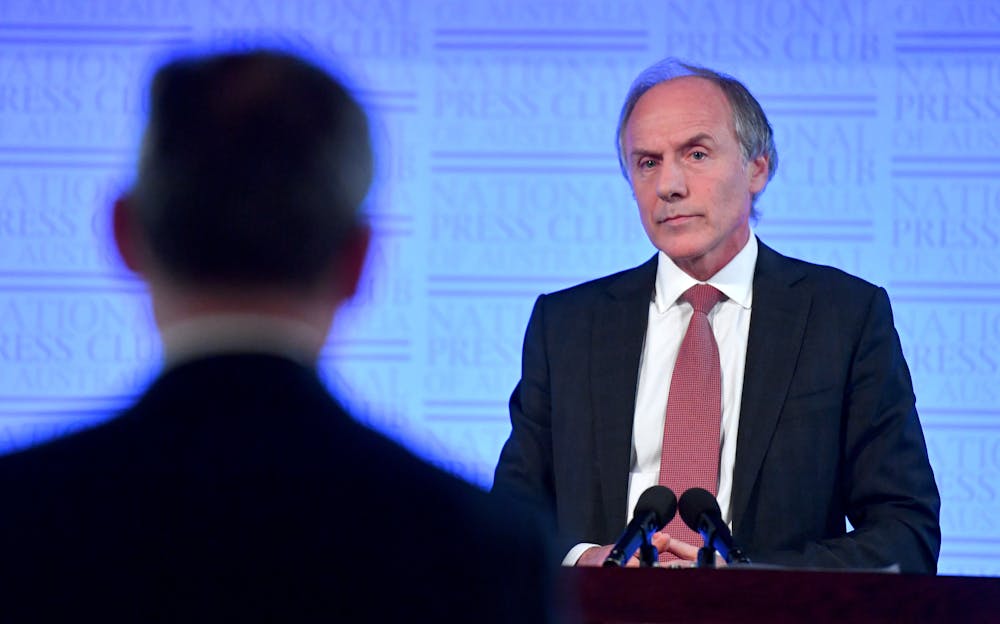
I was driving home after delivering a speech late one night in October 2016 when then federal energy minister Josh Frydenberg called and asked if I would chair a review of the National Electricity Market.
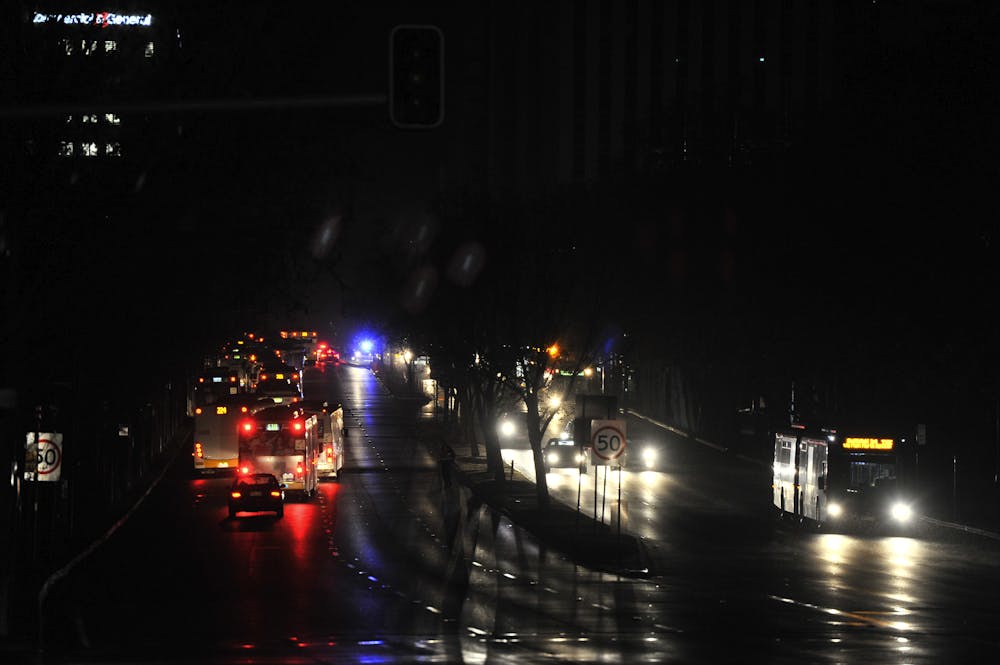
The urgent need had arisen as a consequence of the South Australian power blackout and ongoing concerns about the evolution of the electricity market. The call was brief; the task was huge.
The South Australia blackout was a widespread power outage that occurred in September 2016, triggered by storm damage.David Mariuz/AAP
This was new territory for me. While I have a PhD in electrical engineering, I had no specific interest in power systems. I had previously taken a business interest in green technologies. I had started a green lifestyle magazine, I had invested early in green technology stocks (and lost a small fortune), been involved in an electric car charging company, and I drove an electric car. I was an engineer but my work was in micro-electronics, at the scale of brain synapses. Large-scale power engineering had been my least favourite subject.
Now, it is close to my favourite. Work on low-emissions technologies has occupied a significant portion of my five-year term as Chief Scientist, which finishes at the end of this month.
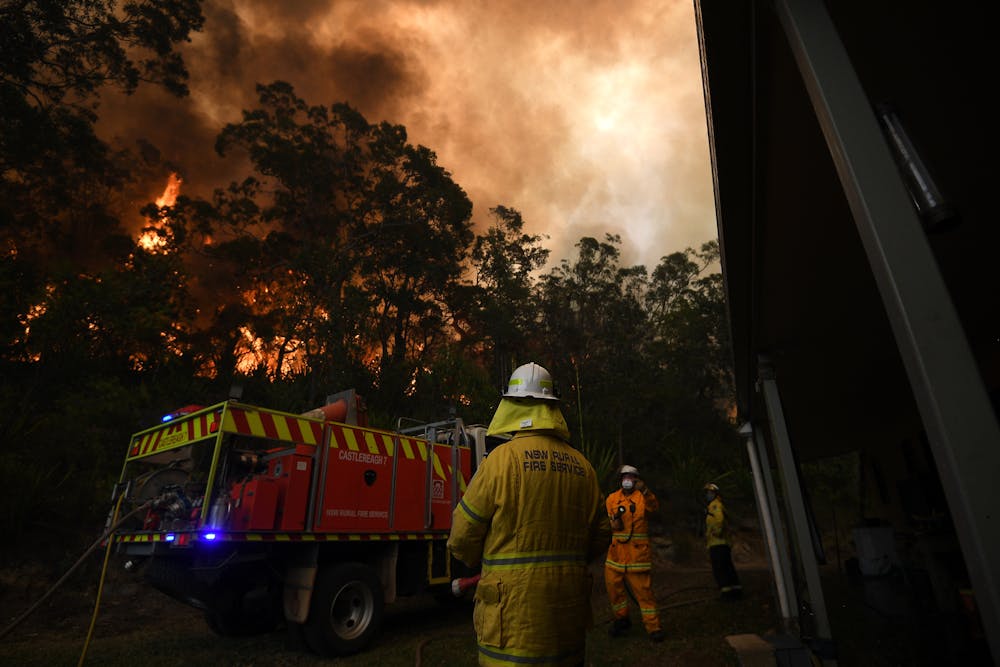
Energy is a complex, vitally important topic, on which everyone has an opinion. The physics of human-induced global warming is irrefutable and a fast reduction in greenhouse gas emissions is urgent. Last summer’s bushfires were a grim reminder.
In May, the ABC reported smoke from the Black Summer bushfires had killed nearly 450 people.Dan Humbrechts/AAP
People often ask me whether climate policy is destined to destroy political leaders in Australia. Call me an optimist, but what I have seen is progress. When my proposed Clean Energy Targetmet its maker in October 2017, I was disappointed, but I was honestly excited the Australian, state and territory governments agreed to 49 out of 50 recommendations of our review.
Many of these recommendations ensured the electricity system would retain its operating strength as ever more solar and wind generation was added, and others ensured better planning processes for long-distance interconnectors and renewable energy zones. The public narrative that climate progress is moribund overlooks this ongoing work.
In early 2018, as I began to better understand the full potential of hydrogen in a low-emission future, I informally briefed Frydenberg, who responded by asking me to prepare a formal briefing paper for him and his state and territory counterparts. With support from government, industry, research and public interest colleagues, it developed last year into the National Hydrogen Strategy, which explored fully the state of hydrogen technology internationally and its potential for Australia.
The next step came this year with the Low Emissions Technology Statement, which articulates a solid pathway to tackle some of the pressing and difficult challenges en route to a clean economy. This was developed by Frydenberg’s successor, Angus Taylor, supported by advice from a panel I chaired.
When I was appointed Australia’s Chief Scientist in 2015, my predecessor Ian Chubb took me for a drink at Canberra’s Monster Bar. He had a prepared brief for me and we flicked through it. But Ian didn’t offer prescriptive advice, given the reality that the specifics of the role are defined by each chief scientist in line with requests from the government of the day.
I came to the role with a plan no more detailed than to work hard, do things well, be opportunistic, and always say yes – despite the device that sits on my desk and barks “no” whenever you hit the red button, a gift from my staff keen to see a more measured response to the many calls on my time.
When then federal energy minister Josh Frydenberg called me one evening in 2016, I had no clue where to begin assessing the state of the electricity market. But I decided I was willing to seize the opportunity.Mick Tsikas/AAP
I am most proud of my initiatives in STEM (science, technology, engineering and maths) education. These include the Australian Informed Choices project that ensures school students are given wise advice about core subjects that will set them in good stead for their careers; the STARPortal one-stop shop for information on extracurricular science activities for children; a report to the national education ministers on how businesses and schools can work together to provide context to science education; and the Storytime Pledge that acknowledges the fundamental importance of literacy by asking scientists to take a pledge to read to children.
The incoming Chief Scientist, Cathy Foley, will no doubt find, as I did, the job brings big surprises and unexpected turns. I expect she will also find government more receptive than ever to taking advice from experts in health, the physical sciences and the social sciences.
That doesn’t mean gratuitous advice. The advice we offer as scientists must be relevant and considered. Much of my advice has been in the form of deep-dive reviews, such as the report on national research facilities that was funded in the 2018 budget. But this year, amid the pandemic, we began something quite different: the Rapid Research Information Forum, which gives fast, succinct advice to government on very specific questions. This has been a highly effective way to synthesise the most recent research results with a very quick turnaround.
Nor does advice mean criticism. The Chief Scientist’s job is not to be the chief scientific critic of government policy. It is to advise ministers with the best that science has to offer. In turn, their job is to weigh that advice alongside inputs from other sectors and interests.
In animated discussion with Angus Taylor before a meeting of the nation’s energy ministers in Perth in November 2019.Richard Wainwright/AAP Image
For me, working with the government has delivered results. Ministers have been receptive, have never told me what to say, and have agreed to the vast majority of my work being made public. In the energy sphere, we’ve made incredible progress. I am delighted to be staying on in an advisory role on low-emissions technologies.
When Frydenberg called late that evening in 2016, I had no idea where to begin to assess the state of the electricity market. And I had no idea that three years later we would be taking the first steps towards a clean hydrogen economy.
Now I am confident we will achieve the dramatic reduction in emissions that is necessary. Because of the immensity of the energy, industrial, agricultural and building systems, it will be slow and enormously difficult in a technical sense, politics aside.
Anyone who believes otherwise has not looked in detail at the production process for steel and aluminium. Converting these industries to green production is a mammoth task. But the political will is there. Industry is on the job, as is the scientific community, and the work has started.
The beginning of my term coincided with one of the most momentous scientific breakthroughs in a century: the detection of gravitational waves, literally ripples in the fabric of spacetime. This confirmed a prediction made by Einstein 100 years ago and was the final piece in the puzzle of his Theory of General Relativity.
Researchers from six universities and the CSIRO were part of a global team searching for proof of the existence of gravitational waves, as predicted by Albert Einstein. They achieved their breakthrough in 2016.Lukas Coch/AAP
As I finish my term, the contribution of Australian scientists to that discovery has just been recognised in the Prime Minister’s Prizes for Science. As chair of the Prizes selection committee, this was a nice bookend for me. More importantly, it’s a reminder we are playing the long game.
Australia is on track to meet its 2030 Paris climate targets without resorting to carryover credits and could exceed them with the aid of the recently-announced technology roadmap, according to projections to be released on Thursday.
Australia has pledged to reduce emissions by 26-28% on 2005 levels by 2030.
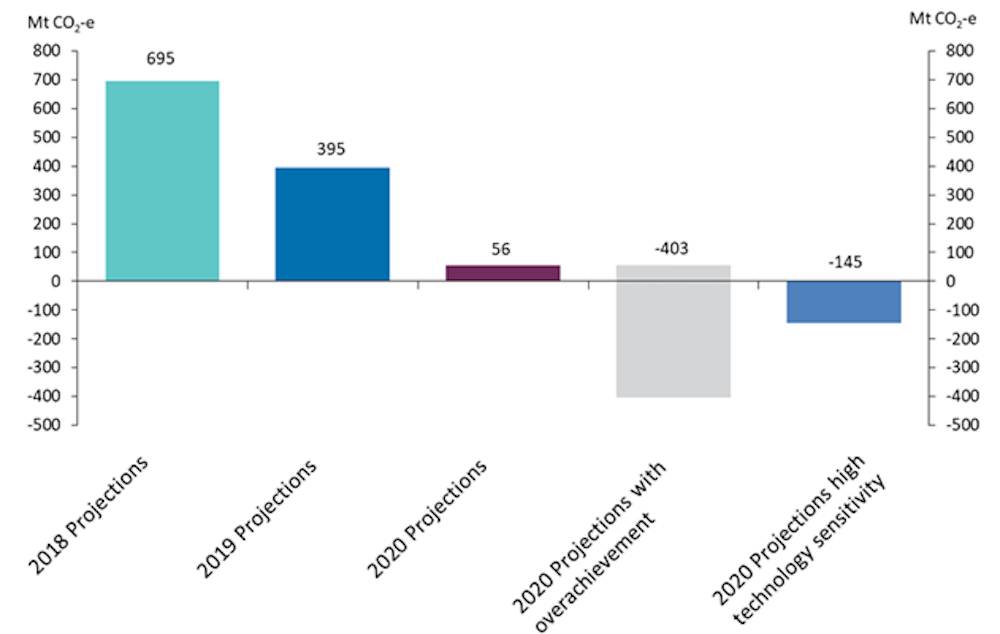
The annual update of emissions projections shows that to meet the 26% cut, without using carryover credits, a further reduction of 56 million tonnes would be needed over the decade to 2030.
image.Author provided
To reach the higher target of a 28% cut without the credits, a reduction of 123 million tonnes would be required over the decade.
Neither of these scenarios includes the technology investment roadmap – which is the government’s policy to support new and emerging energy technologies to a price that is comparable with higher emitting alternatives.
The Minister for Emissions Reduction, Angus Taylor, said if the roadmap was taken into account, “Australia is projected to beat its 2030 target by 145 million tonnes”.
This would be without relying on the credits which have been gained from exceeding earlier targets.
“Under this scenario, Australia’s emissions are projected to be 29% below 2005 levels by 2030,” Taylor said.
Scott Morrison has flagged the government won’t use the carryovers if they are not necessary to meet Australia’s commitments.
He is set to confirm this when he addresses a Pacific Islands Forum virtual climate summit on Friday. This precedes the Climate Ambition Summit hosted by Britain, France and the United Nations at the weekend to mark the fifth anniversary of the Paris accord.
The Pacific summit is aimed at putting pressure on the weekend meeting, which is being called “the sprint to Glasgow”, the delayed climate conference to be held in a year’s time.
There has been argy bargy over whether Morrison could get a speaking role at the weekend meeting, where leaders are being asked to make new commitments. As of Wednesday, he was not expected to be a speaker.
The update in the Australia’s emissions projections 2020 report shows Australia’s position against the 2030 target has improved by more than 300 million tonnes since the 2019 projections, and by 639 million tonnes since 2018.
The improvement since 2018 is equivalent to taking all of the country’s passenger vehicles off the road for 15 years.
Emissions are projected to decline to 478 million tonnes in 2030 which is 22% below 2005 levels. Incorporating the technology investment roadmap, emissions are forecast to be 436 million tonnes in 2030 – 29% below 2005 levels.
image.
The update says the downward revision in the 2020 projections reflects:
the inclusion of new measures to speed up the development and deployment of low emissions technologies in the recent budget
a further reduction in projected emissions from the electricity sector due to continued strong uptake of renewables – especially small and mid-scale solar – by households and businesses; and
the temporary effect of COVID-related restrictions on the economy.
Source: The Conversation (Au and NZ) – By Deanna Kemp, Professor and Director, Centre for Social Responsibility in Mining, The University of Queensland
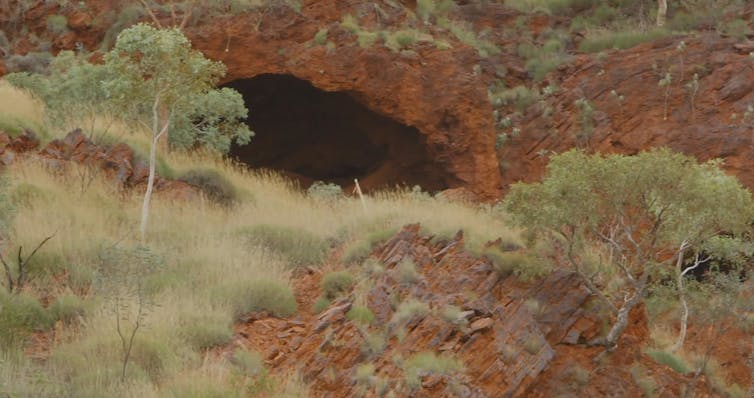
The public was appalled to learn that a mining company could legally destroy such sacred Aboriginal heritage. Rio Tinto mishandled its response, and a national and international outcry prompted a parliamentary inquiry.
Today, the joint standing committee released its interim report into the incident, entitled “Never Again”.
The inquiry lifts the lid on a deeply flawed regulatory system. While the report is scathing of Rio Tinto, it concludes that the issues “are not unique” to the company.
Flaws in WA law and the native title system
The interim report recommends major legislative reform to prevent this happening again.
The report details significant deficiencies in WA’s outdated Aboriginal Heritage Act, passed in 1972. By excluding Aboriginal peoples from decisions about land development, the law undermines their right to manage their cultural heritage.
The report recognises progress made on public consultation of a draft bill that would remove Section 18 of the act, which allows developers to apply for consent to legally damage or destroy Aboriginal sites.
The committee recommends any new legislation ensure Aboriginal people have meaningful involvement in and control over heritage decision-making, in line with the internationally recognised principles of free, prior and informed consent.
The interim report recommends placing a moratorium on any new Section 18 applications until new legislation is passed. It also encourages companies with existing permissions not to proceed with the destruction of heritage sites, but to have them assessed under the new legislation.
The findings highlight shortcomings in federal law and recommends major improvements in the statutory protection for Indigenous groups seeking to protect their significant sites.
The 46,000-year-old Juukan Gorge rock shelters in Western Australia, before they were destroyed.PKKP AND PKKP ABORIGINAL CORPORATION
The report calls for the removal of the so-called “gag clauses” in land use agreements, which prevent Aboriginal peoples from speaking out against developers.
In a public hearing, the traditional owners of Juukan Gorge, the Puutu Kunti Kurrama and Pinikura peoples, explained how their agreement with Rio Tinto prevented them from objecting to the company’s Section 18 application, or seeking an emergency injunction under federal heritage legislation.
The report recommends all companies operating in WA undertake an independent review of their land use agreements, in line with calls from investors in mining companies.
The deep flaws in Australian’s native title system are described in the report as “another means to destroy Indigenous heritage”. These flaws are so alarming that Labor Senator Patrick Dodson, a committee member and senior Aboriginal leader, had earlier called for a royal commission.
Australia’s current regulatory system approves mining developments on a project-by-project basis. The approvals process does not consider the cumulative impacts to cultural landscapes, such as Juukan Gorge, from multiple and expanding mines. The committee will likely hear more about these issues next year.
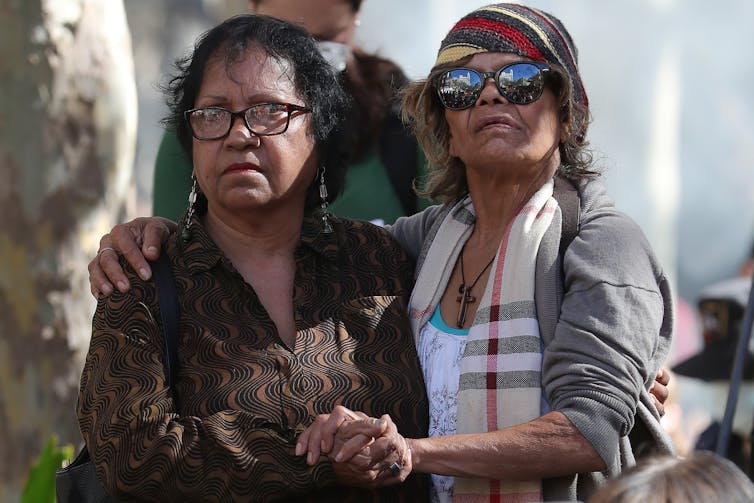
Protesters rally outside the Rio Tinto office in Perth earlier this year.RICHARD WAINWRIGHT/AAP
Corporate responsibility beyond legal compliance
After the Juukan Gorge tragedy, Rio Tinto conducted an internal, board-led review of its heritage policies, but did not deliver meaningful recommendations on accountability and fell well short of stakeholder expectations.
The inquiry report concluded that Rio Tinto’s review did not fully grapple with the root causes of the Juukan Gorge debacle and its effects.
Rather than letting this slide, inquiry chair Warren Entsch and the rest of the committee doubled down on their interrogation of the company’s senior management.
Through persistent questions in public hearings, the committee probed Rio Tinto’s generic explanations of “missed opportunities”.
Committee chair Warren Entsch and the rest of the inquiry travelled to the Pilbara to meet with Traditional Owners and to see the damage to the site several weeks ago.MICK TSIKAS/AAP
Seeing that other mining companies had “taken advantage” of the weak regulatory system, the committee also pressed BHP and Fortescue Metals Group on their cultural heritage policies and practices. This unearthed information that was not included in the companies’ public submissions. Some of this information aligns with our research.
For example, many mining companies have not kept pace with their social policy commitments. Across the industry, community relations departments have seen sizeable reductions. Our research has flagged the risks associated with these issues, but most companies have failed to adequately respond.
In many mining companies, the work of community relations and Indigenous affairs units remains peripheral to mine planning and production processes.
Mining engineers, lawyers and media managers routinely overrule the advice of social specialists — including local experts and Indigenous advisers who work directly with communities on the ground.
It is entirely normal for company personnel with a limited understanding of customary land tenure to dominate decisions about land access and cultural heritage. This knowledge gap is a known point of failure in mine-community relations.
The inquiry process has revealed a deep reluctance within mining companies to thoroughly investigate major social incidents and the impacts of their operations.
We have learned that companies don’t share these findings with the public – unless forced to do so. The report rejects the idea that companies can “feign ignorance” in order to avoid accountability.
Rio Tinto’s internal investigation of the Juukan Gorge incident was criticised in the inquiry report.Mick Tsikas/AAP
What are the prospects for change?
The inquiry has laid bare the overwhelming challenges faced by First Nations peoples when mining occurs on their land. It highlights the urgent need for a rebalancing of power to avoid mining production priorities dominating at the expense of all else.
The report confirms that legislative reform is crucial. But this can be painfully slow and notoriously piecemeal. For example, the industry has already pushed back on aspects of WA’s heritage law review. For Aboriginal groups, these and other proposed reforms do not go far enough.
Aboriginal leaders and new Aboriginal alliances are also primed to take collective action and push for national best practice standards.
The inquiry’s findings will likely be leveraged internationally, as well. The Apache people in the US have already linked Juukan to their campaign to protect the sacred Oak Flat site in Arizona. This is where Resolution Copper, jointly owned by Rio Tinto and BHP, is proposing a new mine.
Having been put on notice, global mining companies are bolstering their communities and cultural heritage teams. But it is not enough to just increase head count. Social specialists and Indigenous people must hold positions of authority and have influence internally to contain corporate self-interest.
Mining companies like Rio Tinto must do better. To avoid future catastrophes, industry leaders must internalise the lessons from Juukan and radically overhaul the way they do business.
This month Alan Finkel ends his term as Australia’s Chief Scientist.
An entrepreneur, engineer, neuroscientist, and educator in his former life, Finkel describes the role he’s held since 2016 as consisting of two activities.
There’s “reviewing” – briefing government on all matters scientific, including energy and climate change. And then there’s “making things up” – developing programs to support the communication of science, technology, innovation, and research across the community.
Writing for The Conversation, Finkel expresses confidence Australia will achieve the “dramatic reduction in emissions” that is “necessary”.
However the road has not been easy, with many political setbacks.
“I was certainly somewhat personally disappointed, and disappointed for the country, that the Clean Energy Target wasn’t adopted,” Finkel tells the podcast.
“On the other hand, I took a lot of comfort from the fact that the other 49 out of 50 recommendations [in his report] were accepted and adopted and most of them have been implemented.”
“Those recommendations – a lot of them have been part of the reason that we’ve been able to introduce solar and wind electricity at extraordinary rates in the last three years.”
The debate currently is whether Australia will sign up for zero net emissions by 2050. While Finkel says “that’s a question for politicians, not for me”, he adds that “we’re taking the right measures already consistent with a drive towards zero or low emissions”.
These measures, he says, involve cheaper batteries, solar, wind, pumped hydro, and gas as a “backstop”, as we transition out of coal fire electricity.
Asked if a new coal-fired power station project could ever be started, Finkel said that to comply with carbon capture and storage, the cost of electricity from the plant would be “five or six times higher” than electricity produced by solar and wind.
“I would never predict anything…but I can say with some degree of confidence that that economics would be challenging”. His message was clear.
Source: The Conversation (Au and NZ) – By Jim Stanford, Economist and Director, Centre for Future Work, Australia Institute; Honorary Professor of Political Economy, University of Sydney
“We are all in this together,” Prime Minister Scott Morrison solemnly intoned in April – and for a brief few months, in the face of the economic crisis wrought by the COVID-19 pandemic, Australia’s industrial relations protagonists agreed.
Business groups, unions and governments put aside their usual differences and worked together to minimise job losses.
They quickly negotiated alterations to dozens of awards and enterprise agreements, adjusting rules and rosters to help keep Australians on the job.
Then, in late May, seeing opportunity in that spirit of cooperation, Morrison heralded a new consensus-based approach to industrial relations.
The federal government set aside its effort to impose more legal restrictions on unions and established new “industrial relations reform roundtables” for employer groups, unions and government officials to work together on reforming workplace laws Morrison said were “not fit for purpose”.
“We’ve got to put down our weapons,” he declared. The change in approach was even compared to the historic Accords of the 1980s, in which the Hawke-Keating Labor government convinced unions to accept wage freezes in return for enhanced social benefits (like Medicare and superannuation).
Within weeks the parties retreated to their corners and their standard speaking points. No meaningful consensus emerged on any issue from any table.
Business Council of Australia chief executive Jennifer Westacott, federal industrial relations minister Christian Porter and the Australian Council of Trade Unions’ secretary Sally McManus and president Michele O’Neil at a roundtable meeting on June 3 2020.Bianca De Marchi/AAP
Even tentative proposals – like an idea supported by unions and the Business Council of Australia to combine fast-track approval of union-negotiated enterprise agreements with greater flexibility in determining their suitability – were shot down in partisan gunfire by more strident business lobbyists.
If passed, it will further skew the already lopsided balance of power towards employers.
The bill doesn’t just take the employers’ side in the five issues debated at those roundtables (award simplification, enterprise agreements, casual work, compliance and enforcement, and “greenfields agreements” for new enterprises).
One of its biggest changes is to suspend rules that prevent enterprise agreements from undercutting minimum award standards. This proposal wasn’t even discussed at the roundtables.
Federal attorney-general and industrial relations minister Christian Porter introduces the Morrison government’s industrial relations bills to parliament on December 9 2020.Mick Tsikas/AAP
This confirms the gloves are off once again in Australia’s interminable IR wars.
Here are the most significant ways the bill will weight the scales further to the disadvantage of workers.
Suspending the BOOT
As the law now stands, enterprise agreements cannot not undercut minimum standards in industry awards. This is known as the “better off overall test” – or BOOT. The new bill instructs the Fair Work Commission to approve agreements even if they fail this test, so long as the deal is nominally supported by affected workers (more on this below) and deemed to be in the “public interest”.
Australia is unique among wealthy nations in allowing employers to unilaterally implement enterprise agreements, without involvement by a union. The BOOT is thus necessary to prevent enterprise agreements from undermining award rights.
The bill proposes suspending BOOT for two years. But even if it were restored after that (which is uncertain), agreements approved during that window would remain in effect (enterprise agreements typically last four years). Even after they expire, under Australian law they remain in effect until replaced by a new agreement, or terminated by the FWC – neither of which is likely in a non-unionised workplace.
Apparently in anticipation that unions will actively oppose non-BOOT-compliant agreements, the bill also includes measures to speed their approval by the Fair Work Commission. The process must be completed within 21 days (with some exceptions). This will limit the ability of affected workers to learn about and resist their loss of benefits and conditions. Unions will be restricted from intervening around agreements they were not directly involved in negotiating (including intervening against agreements that had no union involvement at all).
Broadening the definition of casual work
The growing use of “casual” employment provisions was a hot topic at the IR reform tables. The new bill clarifies the definition of casual work in the most expansive way possible: a casual job is any position deemed casual by the employer, and accepted by the worker, for which there is no promise of regular continuing employment.
In other words, any job can be casual, so long as workers are desperate enough to accept it. This will foster the further spread of insecure employment without paid leave entitlements. Most importantly, it removes a big potential liability faced by employers as a result of recent court decisions, under which they might have owed back pay for holidays and sick leave to employees improperly treated as casual workers.
Further casualisation will be attained through new rules regarding rosters and hours for permanent part-time workers. The bill extends flexibility provisions originally implemented earlier this year – during that brief moment of pandemic-induced cooperation. The rules allow employers to alter hours for regular part-timers without incurring overtime penalties or other costs (currently required under some awards). This will allow employers to effectively use part-time workers as yet another form of casual, just-in-time labour.
Doubling new project agreement times
Finally, the bill grants one more big wish from the business list.
It allows super-long enterprise agreements at major new projects. Agreements can last for up to eight years – double the time now allowed – and be signed, sealed and delivered before any workers start on the job (thus denying them any input into the process).
Under revised BOOT provisions, they could also undercut the minimum standards of any industry awards.
Back to business as usual
These changes are being advertised as a spur for post-pandemic job creation. But this claim is hollow.
In reality, the changes in part-time and casual rules will actually discourage new hiring. Since existing workers can be costlessly “flexed” in line with employer needs, there is no need to hire anyone else.
Weaker BOOT protections will spur a wave of new enterprise agreements, most union-free, and aimed at reducing (not raising) compensation and standards. This makes a mockery of the goals of collective bargaining, and grants employers further opportunity to suppress labour costs (already tracking at their slowest pace in postwar history).
So what to make of that short-lived spirit of togetherness that purportedly sparked this whole process? In retrospect, it seems to have been just an opportunity for the Coalition government to pose as visionary statesmen during a time of crisis.
Now, mere months later, the government is back to its old ways – and the pandemic is just another excuse to scapegoat unions, drive down wages and fatten business profits.
Armida Salsiah Alisjahbana is the United Nations Under-Secretary-General and Executive Secretary of the Economic and Social Commission for Asia and the Pacific (ESCAP).
Opinion by Armida Salsiah Alisjahbana – Under-Secretary-General of the United Nations.
Armida Salsiah Alisjahbana is the United Nations Under-Secretary-General and Executive Secretary of the Economic and Social Commission for Asia and the Pacific (ESCAP).
The Pacific Island Developing State of Vanuatu has emerged as one of the region’s great success stories. Vanuatu has joined the ranks of Samoa and the Maldives as one of only six countries to graduate from being a least developed country, since the category was introduced by the United Nations in 1971.
This historic achievement is the result of major development gains and strategic planning. It shows that the country has successfully raised levels of income and improved social development indicators, with marked declines in mortality rates and significant progress in education. All of these are among the factors the UN regards as critical in determining whether a country is considered as a least developed country or not.
Yet despite these development successes, accelerated actions are urgently needed to ensure Vanuatu can achieve the Sustainable Development Goals by 2030.
Upon graduation, Vanuatu will no longer be eligible for international support measures granted to least developed countries. Unilateral and non-reciprocal trade preferences under Duty-Free Quota-Free schemes from various developed and developing trading partners will be off the table.
Fortunately, based on current trading patterns, the overall impact of losing preferential market access will be minimal, as more than half of Vanuatu’s main exports are being traded under negotiated duty-free market access arrangements, rather than afforded under least developed country concessional measures. Vanuatu will also remain eligible for financing on concessional terms under the World Bank’s International Development Association (IDA) as it is afforded a special status as a ‘small island economy’.
Importantly, Vanuatu will benefit from an improved country-image after graduation, which may attract larger flows of foreign direct investment as several other graduated countries have experienced.
Graduation is however taking place at a time of significant risks to the global economic situation. Unexpected shocks such as the unprecedented COVID-19 pandemic are posing grave challenges to development.
Despite acting swiftly when confronted with the rapid spread of COVID-19, taking steps such as banning travel among islands, closing international borders and imposing curfews on businesses – the impact on Vanuatu has been severe. The resulting collapse of tourism has had widespread repercussions on the economy, with arrivals declining by 65 per cent in the year to July compared to the previous year. This contributed to an estimated 70 per cent job or income loss in the first six weeks after borders were closed and is an important factor in the decline in output of 8.3 per cent expected in Vanuatu for this year. The country also recorded its first official case of COVID-19 in November, having successfully warded off the virus for many months.
As a developing country, Vanuatu still remains vulnerable to other external shocks. The threats of climate change are very real. The first category 5 tropical cyclone of 2020, Tropical Cyclone Harold, demonstrated this as it passed over Espiritu Santo, Pentecost Island and Ambrym earlier this year, displacing an estimated 80,000 Ni-Vanuatu people, equivalent to over 27 percent of the nation’s population. This was the second strongest cyclone to affect Vanuatu, following Tropical Cyclone Pam of 2015, which suggests such storms are becoming more frequent as our climate changes.
The UN family has supported Vanuatu in its independence since 1980. Its regional development arm, the UN Economic and Social Commission for Asia and the Pacific (ESCAP), has been providing development assistance to Vanuatu since it became a member in 1984. More recently, this support has included identifying avenues to mobilize financial resources domestically in recognition that achieving the Sustainable Development Goals will require significant resources, especially in such a vulnerable environment.
Dedicated technical support has been provided since 2017 to assist Vanuatu produce its smooth transition strategy (STS), built upon Vanuatu 2030 The Peoples Plan – the National Sustainable Development Plan for 2016 to 2030 – that reflects the unique identity of the Ni-Vanuatu people. At the same time, ESCAP has provided advisory services to the National Coordinating Committee on Least Developing Countries Graduation, which oversaw the formulation of the STS and decided on its associated follow-up actions.
As we focus on building back better in the aftermath of the COVID-19 pandemic, ESCAP stands ready, along with the UN family, to continue supporting Vanuatu in its development aspirations and in implementing the STS. This includes support to link the STS with budgets, offering specialized technical assistance to strengthen capacities in trade negotiations and developing productive capacities in Vanuatu, thereby enabling better structural transformation and diversification of the economy.
This year, Vanuatu celebrates 40 years since its independence. By working together, we can build resilience to external shocks in the Pacific region to ensure the next stage in Vanuatu’s development journey will continue to be a success story in the decades to come.
Armida Salsiah Alisjahbana is Under-Secretary-General of the United Nations and Executive Secretary of the United Nations Economic and Social Commission for Asia and the Pacific (ESCAP).
If you leave your car sitting the garage for too long, the battery can go flat. Similarly, if we don’t maintain our friendships, they can go a bit flat too.
So just as it’s good practice to drive your car every so often and have it serviced regularly, friendships are easier to maintain with some semblance of regular contact.
What has this meant for our friendships during 2020, a year of social distancing and lockdowns? My research suggests physical separation wasn’t necessarily associated with psychological separation or the breakdown of friendships.
And that appears to be thanks mostly to communication technologies.
My colleague Travis Cruickshank and I surveyed 1,599 Australians from various age groups during the national lockdown in April. Our study is still at the preprint stage, which means it hasn’t yet been published in a peer-reviewed journal.
A substantial proportion of participants reported a deterioration in their mental health due to COVID-19 (10% deteriorated a lot, 44% deteriorated somewhat, 40% reported no change, and 6% improved somewhat).
We also asked how their friendships had been affected, and surprisingly, most respondents reported no change (66%). This was despite 72% noting they were interacting face-to-face with friends a lot less (and a further 14% somewhat less) during the pandemic.
At first glance our results seem strange, as even the best communication technologies are arguably not an adequate substitute for face-to-face interaction. It’s difficult to make eye contact — an important social cue — through a screen. And if you’ve ever tried to catch up with a group of friends over Zoom or a similar platform, you’ll know it can become a little chaotic.
However, 56% of participants in our study reported spending more time interacting with friends using technology during the pandemic (for example, phone, email, or online chat). So it seems most people used communication technologies to stay connected with their friends during lockdown — even if it wasn’t quite the same as catching up in person.
Technology can’t entirely replicate the benefits of socialising face-to-face.Shutterstock
Social media sometimes gets a bad rap. For example, excessive social media use has been associated with negative outcomes such as lower self-esteem and narcissistic tendencies. It can also be a vehicle for spreading misinformation.
However, having a raft of options for communicating digitally, of which social media platforms are a big part, has arguably been a good thing overall.
People have been able to share jokes with a wide audience to keep spirits up. For example, a Facebook group encouraging people to dress up in costumes to take their bins out, and then post pictures, went viral around the world.
More importantly, people could stay connected with friends and family during a stressful time. We know social support is important for managing anxiety, especially during fraught times.
Our results are consistent with other Australian research and US research which found people didn’t perceive their social support to be negatively affected during the pandemic.
But not everybody made use of technology
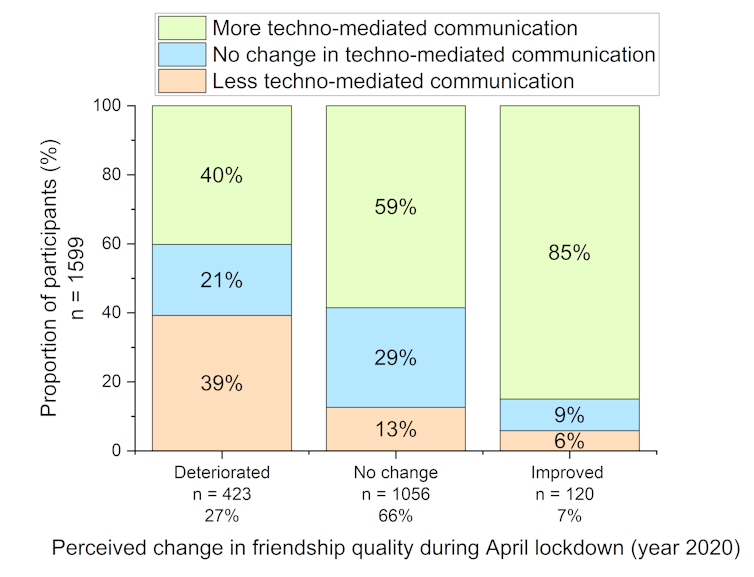
In our study, while most people reported no impact on their friendships, 27% of people reported a deterioration in their relationships with friends. These people were more likely to also report not increasing their level of communication via technological means.
Author provided
These people were also more likely to report their mental health had deteriorated.
It’s important to note we collected our data fairly early in the pandemic. So it’s possible more people, particularly those in Victoria who endured a prolonged second lockdown, may have experienced deterioration in their friendships since we collected our data.
But our results highlight the important role communication technologies can play during a pandemic, and the value of using such technologies to maintain relationships and social support, for the benefit of our mental health.
Some participants in our study reported their social relationships had deteriorated.Shutterstock
Interestingly, 7% of people reported an improvement in friendship quality. Perhaps connecting over difficult times brought some people closer. Alternatively, with various communication technologies and apps gaining traction, some people may have started interacting with friends during lockdown who they wouldn’t normally see or speak to.
New communication technologies on the horizon
Video chat platforms (such as Zoom) saw a dramatic increase in use during the pandemic. While serviceable, video chat is still lacking compared with face-to-face interaction.
The pandemic has heightened interest in the development of new digital communication technologies. One prospect is communication in virtual reality (VR).
During the pandemic, a host of start-up companies have appeared selling VR meeting platforms. There was also an increase in usage of social VR programs, although these remain on the fringe.
A current issue with social interaction in VR is that the avatars generally have minimal expression and therefore only represent a shell of a character that transmits your voice. As summed up in this article on The Conversation, “VR technologies perhaps only offer a pale imitation of the multi-sensory experiences of life”.
New VR headsets are in development that include inbuilt facial motion tracking, such as those by Facebook, and also the DecaGear 1. In the coming years, we may be interacting in VR at work and at the weekend with our friends.
VIDEO: In what will be a precursor episode to a planned Evening Report panel-series through 2021, Selwyn Manning and Paul Buchanan discuss and respond to elements of the Commission of Inquiry into the Christchurch terrorist attacks of March 15, 2019.
EDITOR’S NOTE: In correspondence after this live episode, government sector law specialist, Graeme Edgeler, wrote:
It’s a shame I missed the live-stream. I could have pointed out in real-time that Paul was inaccurate in claiming that the Royal Commission lacked the power to compel testimony. This is a power literally every government inquiry has in New Zealand. I think it may have previously been the case that the terms of reference of individual inquiries used to have to specify this power, but whether on not that is the case, since the Inquiries Act 2013 entered into force, this has not been true. It is a power all government inquiries have under section 23 of the Inquiries Act.
Paul G. Buchanan responded to Mr Edgeler’s correspondence:
Once again you fail to distinguish between general precepts under the Inquiries Act and the specific terms of reference for this RCI. It specifies that all testimony, statements and documentary provision is voluntary on the part of those who agree to appear before the Commission. The blanket name suppression of all such people below the Director level was in part designed to encourage whistle blowers to come forward when they otherwise would not under the voluntary regime. All classified material was supplied at the various agency’s discretion–the RCI could not compel production of anything that the agencies refused to supply. This is known as a self-limiting or self-binding approach, something that limits the legal exposure of people who otherwise could be held liable for actions that (however indirectly) contributed to mass murder.
Graeme Edgeler further responded:
The Royal Commission’s terms of reference are publicly available (http://www.legislation.govt.nz/regulation/public/2019/0072/latest/whole.html#LMS183988) They do no [sic] specify that all testimony, statements, and documentary provision is voluntary. In fact, the word voluntary does not appear at all. Nor do the words testimony, statement(s), document(s) or documentary.There are requirements in the terms of reference around secrecy, and confidentiality, around holding parts of the inquiry in private, etc, but there is nothing in them covering what you say is in there (feel free to suggest a clause you think has this effect). I do not rule out that as a matter of fact, the inquiry avoided using its power of summons in respect of material held by state agencies, but if it did, it was not because its terms of reference prevented it.
We thank Graeme for contributing to the discussion.
THE EPISODE:
EveningReport.nz Programme: A View from Afar
Live Discussion: Paul G. Buchanan (36th-Parallel.com) and Selwyn Manning (EveningReport.nz)
Interaction: Comments welcomed during the LIVE programme via Facebook, YouTube, or Twitter (via Periscope)
Time: Midday, NZDST (6pm, US EST), Thursday December 10, 2020.
The Report: Officially titled – Royal Commission of Inquiry into the Terrorist Attack on Christchurch Mosques on March 15 2019.
The Inquiry’s terms of reference contained three areas:
The terrorist’s actions
Actions of public sector agencies
Recommended changes that could prevent future terrorist attacks of this kind.
LIVE DISCUSSION POINTS:
This A View from Afar discussion will explore takeouts from the Inquiry’s report and will include (Ref. https://chchroyalinquiry.cwp.govt.nz/the-report/):
‘The idea that intelligence and security agencies engage in mass surveillance of New Zealanders is a myth.’
In 2014, the intelligence and security agencies were in a fragile state. A rebuilding exercise did not get underway until mid-2016 and was still unfinished when the terrorist attack took place in 2019.
Between 2016 and 15 March 2019, the primary, but not exclusive, focus of the counter-terrorism resources was on what was seen as the presenting threat of Islamist extremist terrorism.
There was an inappropriate concentration of counter-terrorism resources on the threat of Islamist extremist terrorism.
In May 2018, there was one project focused on developing an understanding of right-wing extremism in New Zealand. At that time, the New Zealand Security Intelligence Service had only a limited understanding of right-wing extremism in New Zealand and work on this was not complete when the terrorist attack occurred.
The intelligence function of New Zealand Police had degraded and from 2015 was not carrying out strategic terrorism threat assessments.
The SIS had a lack of capacity until mid-2018 both to deal with (its perceived Islamic extremist) threat and, at the same time, to baseline other threats.
Other agencies did not engage in informed discussion about the SIS approach nor consider the implications of this.
COULD THE TERRORIST HAVE BEEN DETECTED AND IDENTIFIED?:
Given the operational security that the individual maintained, the legislative authorising environment in which the counter-terrorism effort operates and the limited capability and capacity of the counter-terrorism agencies, there was no plausible way he could have been detected except by chance.
The fact the individual was not detected was not in itself an intelligence failure.
RECOMMENDATIONS (SECURITY/INTEL REFORM):
The creation of a national intelligence and security agency (NISA). This will deliver a more systematic approach to counter-terrorism and countering violent extremism efforts.
The CEO of a proposed NISA would be the national adviser on intelligence and security.
Full implementation of our recommendations will result in a better organised counter‑terrorism effort with enhanced capacity and capability and a less restrictive legislative framework.
NISA would provide:
Strategic policy advice.
Develop a counter-terrorism strategy.
Administer relevant national security legislation.
POLITICAL, PUBLIC ENGAGEMENT AND STRONGER OVERSIGHT:
The Inquiry expects to see far more political and public engagement and discussion and stronger oversight.
This will result in greater public trust and thus social licence. We wish to see discussion about counter-terrorism normalised. Our recommendations provide mechanisms for this to occur.
PUBLIC DISCOURSE:
The Inquiry stated that should a public facing two-way discourse have been encouraged by governments through: a “see something, say something” policy, it is possible that aspects of the individual’s planning and preparation may have been reported to counter-terrorism agencies.
Such reporting, the Inquiry stated, would have provided the best chance of disrupting the terrorist attack.
RETROSPECTIVE CRITICISM:
If the known risk that a terrorist could take advantage of New Zealand’s lax regulation of semi-automatic firearms had been addressed earlier, it is likely that there would have been no terrorist attack on 15 March 2019.
INQUIRY ACKNOWLEDGEMENT:
It will take time to enhance public trust and confidence in New Zealand’s counter-terrorism effort, so work to do so should begin urgently.
The agencies within the scope of the Inquiry include: National Security Group of the Department of the Prime Minister and Cabinet, the Government Communications Security Bureau, Immigration New Zealand, New Zealand Customs Service, New Zealand Police and the New Zealand Security Intelligence Service.
This year, many of us have come to appreciate, perhaps more than before, the incredible work teachers do. We may wish to show our appreciation with a gift.
But what kind of gift will show our gratitude while ensuring we’re being ethical, too?
The key ethical concepts to consider when giving a gift to a teacher is undue influence and a conflict of interest, whether they be perceived, potential or real.
Public perception of the acceptance of a gift is important. In ethics policies and codes of conduct it can be affected by factors such as whether the gift was given in secret, the relationship between the giver and the receiver, and the magnitude and frequency of giving.
Teaching is an exposed profession when it comes to public perception — everyone has gone through the education system and has an opinion. The paradox is that public perception of teaching as a profession can differ from the warm and appreciative perceptions individuals often have of their own child’s teacher.
This means any gift, benefit or hospitality given to a teacher must not be easily considered a kind of bribe for special treatment, such as giving a specific grade to your child.
Each gift comes with some risk to the reputation of a teacher. Cash and items that can be easily exchanged for cash, such as shares, are generally forbidden. Parents should assume it is inappropriate to gift a teacher money for a nice dinner out, or an expensive piece of jewellery.
In Queensland, teachers need to declare most gifts in a form. The gifts must be approved by the school and recorded on the public gift register. Gifts worth more than $150 will also be evaluated for appropriateness but those over $350 are unlikely to be approved.
Book vouchers that can’t be exchanged for cash can be a great gift.Shutterstock
In Western Australia a teacher can accept any minor gift valued less than $100 — such as chocolates, flowers, wine or jewellery — without declaring them. Other types of gifts such as consumables (event tickets) or property (mobile phones, computers) must be declared, registered and approved by the principal or director. Any gift over $1,000 cannot be kept for personal use.
In Victoria, a “gift of appreciation” valued at $100 or less from parents or guardians to a teacher can be accepted and does not need to be declared.
So, what can I give?
The questions you need to ask yourself before giving a gift are:
can I be certain the gift is simply a demonstration of my gratitude for exemplary but complete teaching (such as end of year or semester), and not loaded with further expectations, such as a public acknowledgement or favours?
is my gift excessive or could it be considered inappropriate?
can my gift be exchanged for cash?
am I a serial gift-giver? If so, calculate the total value of the gifts you have given to ensure they can’t be perceived as excessive or pressure for special treatment.
a silk tie or colourful scarf, but not more intimate clothing
scented candles, an engraved pen, a bound notebook or a small item from the antique store, as long as they are reasonably priced
regifting a quality item, making a thank you card with your child, or planting some succulents in a nice pot
getting together with other students’ families for a bigger gift. In Victoria a gift valued at over $500 may be approved if offered by multiple students or carers. In Western Australia, a teacher could be given a holiday trip as a farewell gift from a group of graduating students. So long as the teacher completes the required declaration and the gift is internally approved, the teacher can take the opportunity as a personal, private trip without requesting official travel approval
making donations on your teacher’s behalf. In NSW, it is acceptable to donate a large sum of money, such as $1,000 to the school library for resources, or for playground equipment. But consult with your school about the process of such donations
if you know your teacher has a special interest in, for instance, environmental protection, equal educational access for girls, or the provision of medical assistance to children in war-torn areas, you could give a tax-deductable donation to a reputable charity, on their behalf.
South Australia’s education department also invites students and parents to say a public thanks to their teacher on an online form.
The last ethical consideration is to ask yourself where the intended gift came from. Was it made ethically, on a living wage? Can it be recycled or made sustainably? Does it support a local industry or artist? Would your teacher like to know you have made a donation to a worthy cause on their behalf?
If you are thinking about showing your appreciation to your teacher, it might be best to ask them what they would like, or what the school might need, to be sure they will be able to enjoy it.
Thousands of TikTok users have been creating a musical based on Disney/Pixar’s 2007 film Ratatouille under the hashtag #ratatouillemusical.
It began when US-based schoolteacher Emily Jacobsen wrote a “love ballad” in honour of Remy, the anthropomorphic rat with an acute sense of smell and taste who dreams of becoming a chef.
Jacobsen’s clip was then transformed by Daniel Mertzlufft, a composer and arranger, who revamped the song. Adding strings, trumpets, additional vocals and French horn, he turned it into a big musical number, capturing the imagination of thousands of TikTok users.
The result is a viral sensation. Even Disney has picked up the enthusiasm, with the Disney Parks TikTok account posting their own contribution — a Hamilton-esque rap about Remy’s culinary ambitions.
But what if Disney wanted to bring this collectively written musical to stage? Could they? And could Ratatouille The Musical be a ticket to riches for these gifted Gen Zers?
Who owns the copyright?
Generally speaking, anyone who makes their own song or dance on TikTok automatically owns the copyright. Copyright also allows for joint authorship, but it usually requires the authors to have been working together on a common aim — could this be said of TikTok creators who take and build on each others’ works sequentially?
Working out authorship is only the first hurdle. Because creators are located all around the world, different copyright and contract laws come into play.
And these creators are not only building on each other’s creations, they are also building off Disney’s original movie.
This means there might be potential, (as unlikely as it seems,) for Disney to sue the TikTokkers for their use of Remy. In the United States and some other jurisdictions, it is possible to assert copyright in fictional characters.
This is more complicated in places like Australia, where at least one eager TikTokker, Gabbi Bolt, is crafting songs for the musical. Here, characters themselves are not protected by copyright, but aspects could be protected under the broader copyright encompassing the movie’s story and artwork.
Infringement would turn on whether a “substantial part” has been copied — something difficult to assess as it’s a matter of degree.
Mind you, as long as the collaborations stay on TikTok, it seems unlikely Disney will sue. In a statement, the company told the New York Times “we love when our fans engage with our stories”.
But who can get paid?
Even though the TikTok users own their copyright, as a condition of participating on the platform, they agree to the terms of service. These terms are complex and hard to navigate — but it appears users grant TikTok a very broad irrevocable, perpetual, sublicensable right to copy, modify and share their content on a royalty-free basis.
This licence is non-exclusive so (in theory) TikTokkers could license their videos to others, such as Disney — but the terms imply that users can only access and use any TikTok content for “personal, non-commercial use”.
It’s not clear from the terms exactly what this personal use would cover. In addition, TikTokkers specifically renounce the right to remuneration for their creativity except as provided for in the terms of service.
(It seems even sponsored posts could be contrary to the terms of service, despite being so widespread. For stars like Charli D’Amelio, TikTok clearly tolerates — or has agreed to — some commercial uses.)
Under the terms of service, TikTokkers also waive their “moral rights”: anyone who uses their work doesn’t need to attribute them as authors, which they would normally have to do in Australia.
This means Disney could use the creative contributions of the users without having to compensate the creators, or even recognise them as authors.
So it seems the TikTokkers can’t get paid. But TikTok can. Under the terms of service, users agree TikTok can authorise others to make derivative works based on their work in any format or on any platform.
Disney would probably need to get TikTok’s permission to make any commercial use of the songs, artworks and dances uploaded on its service.
And while the TikTokkers who create the content are not allowed to receive any money for their work, nothing in the terms of service prevents TikTok from charging Disney a hefty fee for granting such permission.
A double sided coin
The story of #ratatouillemusical illustrates the two sides of social media services such as Instagram or TikTok, which can launch an artist or creator while, at the same time, making it challenging for them to monetize their content.
TikTok has recently launched a Creator Fund, allowing eligible “ambitious creators” to earn money off their videos, so far some users seem disappointed with the service which reportedly pays between 2 and 4 cents per 1,000 views.
And while there are agreements in place with some recording labels and independent distributors about the use of background music, this doesn’t really help amateur contributors.
These are exciting opportunities — but the intellectual property implications of conducting more and more of our lives online have yet to be fully thought through.
When a terrorist kills 51 people and attempts to kill many others, a government has to do two things — ensure the responsible people and institutions are held accountable, and make changes to reduce the risk of another atrocity.
The basis of this obligation rests in human rights law: the state has a duty to protect its citizens from arbitrary loss of life. Royal commissions can investigate whether that duty has been breached.
The report made 44 recommendations, covering improvements to counter-terrorism, firearms licensing, social cohesion and support for those affected by atrocities. It also recommended new laws be created for crimes motivated by hate and the planning of atrocities.
The government has accepted all the recommendations “in principle”, which makes it clear these are a starting point for further discussion.
The government has also apologised for the failures of intelligence and policing. But, from a human rights perspective, several things still merit review: the commission process, its recommendations for the future, and its findings of fact.
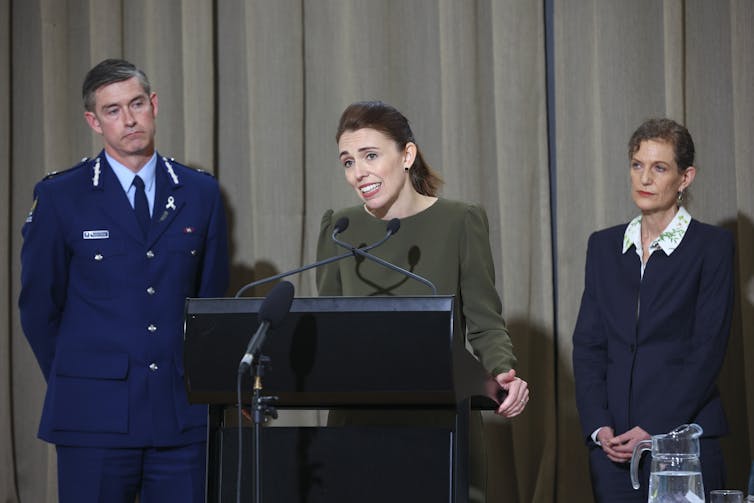
Apologies: Prime Minister Jacinda Ardern with Police Commissioner Andrew Coster and Director-General of Security Rebecca Kitteridge respond to the release of the royal commission report, December 8 2020.GettyImages
Moral and legal challenges
The duty to investigate potential state fault when there is an atrocity or disaster is owed primarily to the families of the deceased and those who were put at risk. They must be core participants in the process.
So we should listen carefully to the views of those directly affected, including the wider Muslim community, which had concerns from the outset about the commission’s terms of reference.
While the commission involved a Muslim Community Reference Group, its main function was compiling and assessing written and oral evidence. The two commissioners, with counsel assisting and a secretariat, led this process. But could more have been done, such as ensuring the team included a lawyer tasked with representing the direct victims?
Politically, there will be challenges in enacting some of the commission’s recommendations, too. New hate-based crimes might be opposed on the basis that bigoted motivations can already be raised as aggravating factors at sentencing.
Similarly, extending hate speech regulation will come up against the argument that undiluted free speech is the best counter measure.
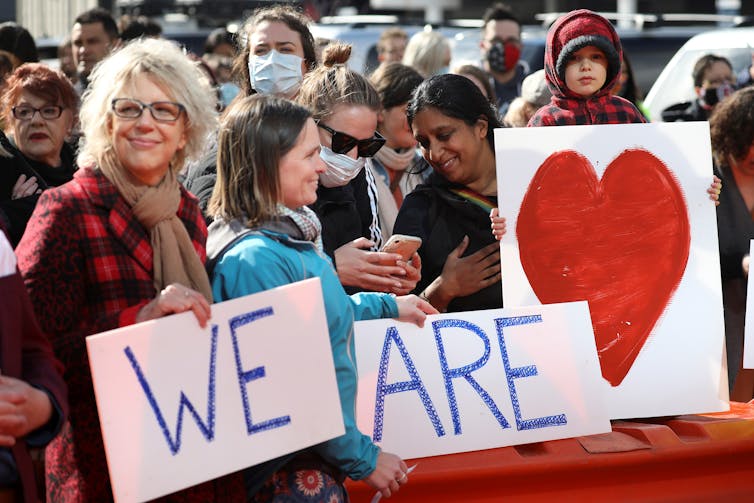
During the killer’s sentencing hearing, people gathered outside the Christchurch High Court to support relatives of the victims.GettyImages
Does the commission go far enough?
The commission is on solid ground with its view that separate hate speech offences are appropriate. Only by monitoring the extent of the specific problem can we hope to form the right policies.
Moreover, the international post-World War II consensus on hate speech created an obligation to prohibit the advocacy of hatred by inciting hostility or discrimination on the basis of nationality, race or religion.
At the moment, New Zealand is simply not compliant with this because our law doesn’t criminalise inciting hostility based on religion.
Even so, does this go far enough? If there is evidence that hostility arises also from sexuality, disability or any other grounds, should we not take this opportunity for wider reform?
What should have been known?
Just as the commission’s recommendations for change are not set in stone, nor are its conclusions of fact. Hence, questions of accountability remain open.
Of course, the state’s duty to protect life cannot always overcome the sheer unpredictability of human behaviour. But terrorism has a long history and is far from an unknown quantity. It is one reason we fund intelligence agencies and hand them significant powers to monitor, collect information and infiltrate in order to defuse potential tragedies.
Importantly in this context, the question about systemic fault must reflect not only what was known, but what should have been known.
The fact the police and Security Intelligence Service had not informed themselves adequately about the threat of right-wing terrorism is worrying. Does that lack of focus mean the duty to protect life was not carried out properly?
Related to this is the assertion that “scarce counter-terrorism resources” contributed to intelligence failures. The human right to life should not be compromised by inadequate funding. Did austerity play a role in state agencies being unprepared to protect lives?
In this wider context, then, the publication of the Christchurch commission report is an important milestone. But just as we must discuss its recommendations, we must also be able to questions its findings.
It cannot be an end, but must be treated as another step in an important process that we must get right.
The long-awaited mandatory code that will force Google and Facebook to pay Australian media companies for news content was finally unveiled yesterday.
The Treasury Laws Amendment Bill 2020 (news media and digital platforms mandatory bargaining code) will be introduced to parliament today, before being referred to a Senate committee.
Many of Australia’s news businesses have been on a hiding to nothing for more than a decade, as their revenue is undercut by the targeted advertising business model used by major digital platforms.
The most visible casualty has been public interest journalism — with the prospect of a well-informed citizenry on a slower, less obvious burn.
Against a backdrop of reports suggesting intense lobbying efforts by Facebook and Google against the new legislation, it appears some key concessions have been achieved by the platforms that weren’t present in the draft code.
First, the revised code will now abide by an added “two-way value exchange” principle. This allows the monetary worth of traffic sent to news providers to be taken into account when determining the financial value of a particular news business’s content to the platforms.
How this will be calculated, however, will likely be an ongoing bone of contention for both parties.
A second major concession will see Facebook’s Instagram and Google’s YouTube exempted from the application of the new law. But the Treasurer will be able to add these (and other platforms) at a later date, should he deem it justified at the time.
A third concession is the halving of the 28-day notice period for the platforms to warn news websites of major changes to their ranking algorithms. These directly impact how news articles are displayed on Facebook’s Newsfeed and Google Search.
It seems the basic idea to “level the playing field” between platforms and news providers remains baked into the revised code, but only time will tell whether it works in practice.
Following a year of discussion, Google last month struck a deal with French media in which the tech giant is expected to pay about €150 million (roughly A$245,003,250) over the next three years.JAE C. HONG/AP
A related objective — to implement a process that sustains public interest journalism — remains equally tricky and may hinge on the revised code’s success.
But many will be pleased the public broadcasters ABC and SBS now fall within the code’s scope, too. Both will be financially compensated for news content along with their commercial rivals.
This may seem like a win, and it may be eventually, but for now it’s unclear how this will actually play out in terms of the government’s ongoing funding of these broadcasters.
Although conjecture at this stage, it may emerge in a forum such as Senate estimates that any compensation payments should be factored into overall funding calculations for the public broadcasters.
The arbitration model
One pivotal feature of the new legislation is it will address the entrenched power of the platforms by introducing a “final offer arbitration” model for price negotiations.
This process, overseen by the Australian Communications and Media Authority, will be mandatory when parties are unable to independently reach an agreement. It will likely be central to the new code’s success, or lack thereof.
Curiously, the revised code’s framework encourages deals to be struck outside of it. In these situations, key elements of commercial negotiations between the parties can be “turned off” with mutual agreement.
This appears to be a pragmatic recognition by the ACCC the code will never be able to control the realities of commercial media deal-making, which continue to be struck despite the code’s new bargaining marketplace.
However, where negotiations break down, news media businesses will be able to trigger the code’s provisions for meeting minimum standards.
This will cover advance notice of algorithmic changes and the requirement to engage in good faith bargaining for up to three months, before participating in the mandatory arbitration process.
Smaller news publishers will be able to bargain collectively, or accept “standard” offers from the platforms.
When one party fails to engage
The code has reasonably strong enforcement provisions in cases where there is a failure to negotiate in good faith, comply with an arbitration decision, avoid participation or engage in “retaliatory action against news media companies”.
The maximum penalty for a breach by Google or Facebook is the greater of either 10% of the platform’s annual Australian turnover, A$10 million, or three times the benefit obtained as a result of hosting the specific news business’s content.
Facebook and Google have put their previousthreats to switch off local news content on hold until they see the final version of the code. For now, they appear to be engaging with the ACCC.
As we await the final version of the code, the irony is not lost on those of us also waiting eagerly for events to unfold before another Senate committee on media pluralism.
The committee was set up in response to a petition started by former Prime Minister Kevin Rudd. Amassing more than 500,000 signatures, Rudd’s petition has called for a royal commission into the negative influence of News Corp’s power in Australia’s highly concentrated media landscape.
Following the launch of the petition calling for a royal commission into the Murdoch media empire, former prime minister Kevin Rudd told media the empire had become an ‘arrogant cancer’ for Australia’s democracy.Glenn Hunt/AAP
A rich history of Australia’s parliamentary inquiries into the media indicates we can expect delays, power plays and ongoing lobbying in both these committees. And clearly there will be winners and losers in both.
There’s a serious mismatch between what New Zealand’s government identified as the most pressing environmental issues, including climate change and freshwater quality, and the investments in environmental research it actually makes.
A report released today by the Parliamentary Commissioner for the Environment (PCE) shows New Zealand spends about NZ$500m on environmental research each year. But the commissioner, former MP Simon Upton, says finding out “what gets funded and its links with policy priorities proved more difficult than I expected”.
The commissioner’s main recommendations include ring-fencing the money, developing a funding strategy and distributing funds through a new agency, based on the success of the Health Research Council.
New Zealanders are entitled to know that the environmental research they fund is focused on addressing the most important challenges we face. But the way public funds are currently invested in environmental research is fragmented, making it hard to respond to problems such as climate change, freshwater quality and biodiversity loss.
The report presents an almost complete map of environmental research funding, updating the incomplete picture previously available.
Among the major failings of the current funding system is the lack of systematic investment in collections and monitoring programmes to track the changing environment.
The commissioner proposes the Ministry for the Environment (MfE) should lead the development of a strategy to identify environmental research priorities, even though its current investment is dwarfed by other government entities and regional councils.
Two of the four largest investors in environmental research deserve special mention. About $71m is funded by universities each year, but it is challenging to verify or break down into categories. The report also shows ratepayers contribute nearly as much as universities, through projects funded by regional councils.
Monitoring buoys, like this one on Lake Okare in the Waikato region, are funded by regional councils rather than central government.David Schmale/Virginia Polytechnic Institute and State University, CC BY-ND
The best possible environmental research might develop win-win solutions to what is often seen as a trade-off between the economy and the environment. Regenerative agriculture is one example where more research investment is needed to assess its potential to reduce environmental impacts while delivering higher-value products.
Missed opportunities
The report doesn’t explore New Zealand’s approaches to environmental research funding over the last few decades. The recommendation that a policy agency should coordinate research resembles what some consider one of the worst historic funding mechanisms.
Investments in ecological research between 2005 and 2015 supported short-term policy needs well. But this may have come at the expense of long-term monitoring projects and environmental databases.
The relatively large investment by regional councils also raises the question of whether central government should support long-term environmental monitoring that is of national interest but beyond immediate benefit to local ratepayers.
The commissioner could also have highlighted the 2010 report of the Crown Research Institute task force, which concluded that stable science institutions should manage funding strategically and use international advisory boards to review their success. A similar review conducted this year recommended the development of integrated research strategies across the country’s seven institutes, particularly on environmental issues such as climate change.
A return to a simplified public-good model should be considered together with the recommendation for a dedicated funding agency. Simon Upton was the cabinet minister who reformed New Zealand’s research institutions and funding systems back in 1992, and has lamented subsequent decisions that destabilised funding and institutions.
Changing post-pandemic focus
The COVID-19 pandemic represents both an opportunity and challenge, according to advisors to an assessment of how the research sector could better contribute to economic transformation.
Success depends on the research workforce. There are major concerns about too few Māori researchers, particularly in roles leading research. Early career researchers also face difficulty finding permanent positions.
Many benefits would come from reformed institutions with flexible funding to respond to public-good needs for environmental and natural hazards research. Less contestability would also reduce the effort wasted on unsuccessful proposals.
New Zealand’s main source of contestable research funding, the Endeavour Fund, invested $187M in 17 research programmes this year, but turned down 128 (87%).
New Zealand voters want progress on water quality and climate change, but ministers and councils appear unwilling to use taxes and rates to fully support a solution.
Ideally, a future research funding system will support all New Zealanders, especially farmers, to implement changes to look after our environment.
Additional findings testing looks for variants in patients’ genes that aren’t relevant to their current health, but may be later on. For example, it can reveal if someone has an above-average chance of developing a hereditary heart condition.
But these tests can have major implications for patients and their families. Thus, individuals deciding whether they want such a test need support — which Edna can provide.
A range of medical conditions have underlying genetic causes. Historically, this has been tested with genetic testing, by looking at either a single gene or a panel of genes related to one particular condition.
In genomic testing, however, almost all the genes in a patient’s DNA are analysed using a biological sample (such as blood).
In Australia, genomic testing is done for patients with certain medical conditions, to provide more information about the condition and medical care required.
But genomic data can be analysed further in an additional findings test, to report on potential gene variants responsible for other preventable and/or treatable conditions.
Although available in the United States, additional findings tests are currently beyond immediate medical need in Australia and are only carried out in research settings. That said, conversations have started about them becoming mainstream here, too.
If additional findings tests were offered in Australia, genetic counsellors would have to spend a large proportion of their time helping patients decide whether they want one. This is where chatbots come in.
Edna the chatbot in training
For chatbots to accurately recognise human speech and provide a meaningful response, their “brain” needs to draw on a large body of data.
Many chatbot brains are developed from open source data, but this is inadequate for highly specialised fields. We developed Edna by analysing transcripts of actual counselling sessions that discussed additional findings analysis.
Edna can emulate the flow of a real patient-counsellor session, explaining various conditions, terms, concepts and the key factors patients should consider when making their decision.
For example, it prompts them to consider the personal and familial implications of undergoing an additional findings analysis. As we all share genes with our family, results from genomic testing can lead to serious conversations.
Edna’s database contains myriad details of medical conditions and terminology.
Edna has several other capabilities, such as:
knowing when to connect a patient with a genetic counsellor, if needed
providing general information covered in most genetic counselling sessions, allowing counsellors more time to focus on patients with complex needs
collecting a patient’s family history
detecting various forms of common language, such as “nan” instead of “grandmother” and “heart attack” instead of “myocardial infarct” (the medical term for heart attack)
recognising certain temporal markers. For instance, if a patient says “my mother died around Anzac Day two years ago”, Edna will know their mother died around April 25, 2018.
Edna asks about the medical conditions of a patient’s family members.
Edna is currently undergoing a feasibility trial with patients who have already had additional findings analysis done in a research setting, as well as genetic counsellors and students.
Past research has suggested people prefer chatbots that interact with empathy and sympathy, rather than unemotionally giving advice. This is called the “Eliza effect” — named after the first ever chatbot. Eliza was able to elicit an emotional response from humans.
Edna is quite advanced on this front. It can detect negative sentiment and even some forms of sarcasm. Still, this isn’t the same as true empathy.
Chatbots can’t yet match genetic counsellors’ ability to detect and respond to emotional cues. And “sentiment analysis” remains a significant challenge in natural language processing.
Edna can identify when a user likely needs to be connected to a real counsellor.
Since Edna provides generic information, it can’t discuss the implications of a future or previous genomic test for a specific patient. It also can’t link the patient with a support group, or provide expert medical advice.
Still, Edna represents a significant move towards a digital health solution that could take some pressure off genetic counsellors.
Edna’s main advantage is accessibility. It can support people living remotely, or who are otherwise unable to attend face-to-face genetic counselling.
It can also be accessed at a patient’s home, where family members may be present. They can then share in the information provided and engage Edna themselves, potentially improving the chances of an accurate history capture.
As a digital interface, Edna is almost endlessly modifiable. It can be updated continuously with data compiled during interactions with patients — whether this be information on new topics, or a new way to respond to a question.
A larger-scale patient trial is planned for the near future.
When the history of this latest low point in China-Australia relations is written, both sides will be blamed for mistakes.
Australia is not without fault. However, China is primarily responsible for the continuing deterioration in the relationship.
Its ruthlessness in asserting itself far and wide, by fair means and foul, means there will be no going back to the status quo that prevailed before President Xi Jinping emerged in 2013 as China’s most nationalistic leader since Mao Zedong.
Likewise, Beijing’s crude use of trade sanctions to penalise Australia for real or imagined slights signifies that a trading relationship born of mutual benefit risks being subject to persistent, politically-motivated interference.
This is the reality, whether we like it or not. China is done with “biding its time” in line with former leader Deng Xiaoping’s advice in pursuit of its big power ambitions. It may no longer be correct to describe China as a “rising power”. The power has risen.
China has increasingly sought to exert its power since Xi came to power.Wu Hong/EPA
What is clear is that Canberra has vastly underestimated the velocity of change in the Asia-Pacific region, and, more to the point, the costs associated with an attachment to old models for doing business.
This is not an argument for sliding away from the American alliance, the cornerstone of Australian security. Rather, a more realistic assessment is required of what is and is not in the national interest.
What is not in the national interest are policies that needlessly antagonise the nation’s dominant customer. Again, this is not making the case for excusing China’s bad behaviour, or somehow suggesting the customer is always right. It is simply saying that gratuitous provocations should be avoided.
The timeline below tracks the recent tensions between China and Australia. Multiple episodes stand out that have marked — and in some cases scarred — Canberra’s relations with Beijing since Xi came to power.
These moments have all contributed to the deterioration of the relationship to the point where Australia now risks long-term harm to its economic interests. This is policy failure on-the-run.
Timeline of a fraying relationship
Three particularly damaging episodes
Three episodes have been particularly damaging.
The first and almost certainly the most scarring was the decision in early 2019 for Australia to take the lead role in lobbying its Five Eyes partners to exclude the Chinese company Huawei from supplying technology for their 5G networks.
Australia’s decision to exclude Huawei from its own 5G roll-out is one thing, lobbying others to follow suit is another. What possessed decision-makers in Canberra to take it upon themselves to put Australia at the forefront of a global campaign against China’s economic interests remains a mystery.
To say this decision enraged Beijing would be an understatement, with the caveat that Australia had every right to exclude Huawei if it was deemed in the national security interest to do so.
The US and UK have followed Australia’s lead in banning Huawei from their 5G networks.Ng Han Guan/AP
The second damaging episode involved Prime Minister Scott Morrison volunteering to lead the charge for an investigation into China’s responsibility for the coronavirus that emerged in the city of Wuhan in late 2019.
Again, why Morrison took it upon himself to coordinate such an inquiry — when one was in train anyway under World Health Organisation auspices — is unclear. Beijing’s furious response might have been anticipated, with the editor of the state-run Global Times referring to Australia as the “gum stuck to the bottom of China’s shoe”.
The third damaging episode involved Treasurer Josh Frydenberg’s decision to prevent the Hong Kong-listed China Mengniu Dairy from taking over the Japanese-owned Lion Dairy and Drinks in a $600 million acquisition.
In rejecting Mengniu’s takeover bid, Frydenberg overrode advice from the Foreign Investment Review Board and Treasury — both of which had supported the deal.
This was a politically motivated decision to satisfy critics of the sale of Australian assets to Chinese entities. It certainly reinforced a view in Beijing that Australia’s foreign investment approval process is tilted against Chinese companies.
The closed Huanan seafood market in Wuhan, believed to be the epicentre of the coronavirus outbreak.Koki Kataoka/AP
Does the government actually have a plan for China?
Likewise, the government’s foreign relations bill — passed by parliament this week — can be read as an attempt to reinforce Canberra’s control over a panoply of relationships between Australian states, territories and educational institutions and their Chinese counterparts.
The government might pretend this is an omnibus bill aimed at asserting federal government oversight of the foreign policy-making responsibilities of the Commonwealth. But in reality it is aimed squarely at contacts with Chinese entities.
There is a central question in all of this: does the Morrison government actually have an overarching game plan for dealing with China, or is it simply stumbling from one crisis to the next?
In the past week, Morrison has demanded an apology from China and sought a diplomatic reset.Lukas Coch/AAP
Those responsible for Australia’s foreign policy clearly have not been able to navigate treacherous diplomatic terrain and avoid the pitfalls that have brought Sino-Australian relations to an all-time low.
Morrison’s foreign policy team has also proved ineffectual at facing down pressures from those in the government’s own ranks who have a particular animus towards Beijing. Such antagonism has proved to be a dead weight on constructive China policy-making.
This brings us to Morrison’s own reaction to the offensive tweet depicting a doctored image of an Australian soldier with a knife at the throat of an Afghan child. Soon after it was shared by a Chinese Foreign Ministry spokesman, Morrison went on television to denounce both the official and the crude caricature.
No one could reasonably object to the prime minister’s outrage. However, he should not have lowered himself to engage a Chinese spin-doctor in an argument about a graphic piece of Chinese propaganda.
This should have been left to Foreign Minister Marise Payne, or, better still, the head of the Department of Foreign Affairs and Trade. Morrison further compounded the issue by vaingloriously demanding an apology.
Morrison’s clumsy handing of the issue speaks to a lack of China literacy among his advisers.
An Australian media echo chamber
The Australian media has also played a role in amplifying anti-Beijing viewpoints to such an extent, it has had a deadening effect on reasonable discussion about managing the country’s China policy more effectively.
The business community, for example, has been discouraged — even intimidated — from voicing its opinion out of concern it would be accused of pandering to Beijing for its own selfish reasons.
All this adds to pressures on policymakers to pursue a one-dimensional “stand up to Chinese bullying” approach, not give ground and ascribe the worst possible motives to whatever China says or does.
This is hardly a substitute for a carefully thought-through, well-articulated, tough-minded approach to managing a highly complex relationship in the national interest.
As things stand, those in charge of framing Australia’s policies with China are failing to do this — and Australia’s best interests are clearly not being served as a result.
Pregnant women rightly expect that when they’re in labour, medical staff will observe them and their baby closely, and can deal with any potential problems quickly.
The majority of women who give birth in Australia are monitored with a cardiotocograph (CTG monitoring). But this isn’t the only way.
Research shows women want to be included in making decisions about how to monitor the baby, but often are not.
In this article, we set out some of the pros and cons for each option, to help women take an active role in deciding what’s best for them and their baby.
What is foetal monitoring?
Foetal monitoring during labour focuses on detecting particular changes in the baby’s heart rate, so doctors and midwives can respond if a problem is found.
This could be as simple as asking the woman to change position, or in other circumstances, medical staff might recommend a caesarean section. The goal is to prevent the baby dying, or suffering brain damage as a result of low oxygen levels during labour.
The first method of foetal monitoring is intermittent auscultation. The midwife or doctor will typically listen to the baby’s heart rate for one minute every 15-30 minutes, including during contractions, using a device called a foetal doppler. Foetal dopplers use ultrasound to detect the baby’s heartbeat.
The second approach is CTG monitoring. CTG records the baby’s heart rate and the strength of the woman’s contractions, usually by placing two recording discs on the woman’s abdomen, which are held in place with straps. The information is then plotted on a graph, helping the midwife or doctor understand how the baby responds during the pressure of a contraction.
CTG monitoring is the most common approach to foetal monitoring in Australia and other high-income countries, and is usually used continuously throughout labour.
Some women find the straps used to keep the monitoring devices in place uncomfortable. Depending on the specific equipment, women may need to remain lying on a bed, and therefore find their movements are restricted.
Some, but not all CTG monitors can be used in the shower or a birthing pool. So women being monitored with CTG may not be able to access these options, which bring comfort to some women during labour.
Conversely, intermittent auscultation leaves the woman free to move in between episodes of monitoring, when she is not attached to the equipment.
Women want to be involved in making decisions about their labour.Shutterstock
While intermittent monitoring may be preferable from the perspective of the woman’s comfort, let’s look at how the two approaches compare on three important outcomes for mother and baby.
Women at low risk
Women who don’t have any risk factors that may increase the likelihood of complications for their baby are considered low risk.
A Cochrane review comparing intermittent auscultation with CTG monitoring showed no significant difference in the rare event of babies dying during labour or soon after among low-risk women (seven deaths per 10,000 births).
Cerebral palsy is a type of permanent brain injury that may sometimes occur due to low oxygen levels during labour. No research has looked at how the foetal monitoring approach used affects the rate of babies born with cerebral palsy in low-risk women.
Caesarean section was twice as common in women monitored by CTG compared with intermittent auscultation. We don’t know why, although it might have something to do with the fact women monitored with CTG often report not being able to move freely during labour.
Given caesarean section is associated with a higher rate of complications for the mother such as heavy bleeding or infection, and increased rates of miscarriage and stillbirth in subsequent pregnancies, intermittent auscultation is the safer monitoring option for low-risk women.
Some factors (for example, having a baby that’s smaller than expected, giving birth prematurely, or having diabetes) are associated with a greater chance of poor outcomes for the baby. Women with risk factors such as these are considered high risk.
We recently reviewed the evidence comparing the use of intermittent auscultation and CTG monitoring for high-risk women. CTG was again no better than intermittent auscultation in preventing babies dying during labour or soon after (16 deaths per 10,000 births).
However, cerebral palsy rates were almost three times higher with CTG monitoring over intermittent auscultation (going from 769 to 1,951 babies per 10,000 births). We don’t know why this is.
Foetal monitoring during labour looks for changes in the baby’s heart rate.Solen Feyissa/Unsplash
Once again, the caesarean section rate almost doubled with CTG monitoring.
Poor outcomes such as cerebral palsy and perinatal death occur more often in high-risk women, but remain relatively uncommon. Research shows the use of CTG rather than intermittent auscultation doesn’t reduce the likelihood of these outcomes, but does increase the risk to women by making it more likely they will give birth by caesarean section.
Making a decision
Intermittent auscultation is generally the recommended monitoring technique when there are no risk factors. But all major international foetal monitoring guidelines advise CTG monitoring should be used for women considered to be at high risk, despite the evidence.
As a consequence, clinicians don’t always explain foetal monitoring choices to women with risk factors in a way that helps them make up their own mind about how they want their baby to be monitored during labour.
Notably, much of the research we have on this topic is now dated, and not necessarily of optimal quality. It’s important that recommendations in professional guidelines align with research evidence and support midwives and doctors to help women make personalised and informed decisions about their own care.
If you’re expecting a baby, talk to your midwife who will be able to discuss the advantages and disadvantages of each foetal monitoring option with you in light of your personal situation.
Source: The Conversation (Au and NZ) – By Nicholas Biddle, Professor of Economics and Public Policy, ANU College of Arts and Social Sciences, Australian National University
A large study has, for the first time, shown preschool benefits Indigenous children more than other types of care such as long daycare (childcare) or home-based care.
This is important because while past studies had shown Indigenous children who had attended preschool were more likely to be ready for school, it was unclear whether preschool contributed to better outcomes.
These children might have had better developmental outcomes regardless of their participation in preschool. For example, children who attend preschool are also more likely to live in more advantaged households. This also contributes to better outcomes.
We set out to find whether preschool itself benefited children, and to measure these benefits using real-world data.
Our study of NSW public school children, published in the Journal of Epidemiology and Community Health, shows preschool attendance appears to have developmental benefits for Aboriginal and Torres Strait Islander children, compared with home-based care in the year before school. This is after taking into account differences in children’s socioeconomic and health circumstances.
We classified any type of care that wasn’t preschool or long daycare as home-based care. This can include family daycare and care at home by parents and grandparents.
Although beneficial, Aboriginal children experienced fewer developmental benefits from preschool than non-Aboriginal children in our study. This suggests we need to improve the early childhood education experience of Aboriginal children.
We also found differences in early life circumstances explained much of the developmental gap between Aboriginal and non-Aboriginal children in all types of early childhood education and care.
This highlights the importance of meeting the health and social needs of Aboriginal children and families, alongside early childhood education, to improve early life outcomes for these children.
Why we did our study
One of the seven early Closing the Gap targets was to ensure 95% of Aboriginal and Torres Strait Islander four-year-olds were enrolled in early childhood education by 2025.
In 2018, the Morrison government updated the Closing the Gap framework in partnership with Aboriginal peak organisations. There are now two targets related to early childhood education:
to increase the proportion of Aboriginal and Torres Strait Islander children enrolled in early childhood education the year before full-time schooling to 95% by 2025
to increase the proportion of Aboriginal and Torres Strait Islander children assessed as developmentally on track in all five domains of the Australian Early Development Census (AEDC) to 55% by 2031.
One assumption underlying these targets is that early childhood education will improve developmental outcomes among Indigenous children. We wanted to find out if preschool is achieving this goal, and to what extent.
We used developmental data for 7,384 Indigenous and 95,104 non-Indigenous public school children who started school in NSW in either 2009 or 2012. The data were collected as part of the Australian Early Development Census (AEDC). It takes place every three years and is based on teachers’ knowledge and observations of the children in their classes.
Children’s development is scored between zero and ten on each of five key domains of development: physical, social, emotional, language and cognitive, and communication.
Children with scores in the bottom 10%, according to the 2009 AEDC benchmark, are considered developmentally vulnerable. We looked at how many children were developmentally vulnerable on one or more of the five domains.
We combined the developmental data with other population datasets, including birth registrations, midwives and hospital and school enrolment data. This was to understand children’s health, early childhood education and family circumstances.
We looked at whether children had attended a preschool program, a long daycare centre (without a preschool program) or home-based care in the year before full-time schooling.
Our findings
Overall, across the two school starter cohorts, 71% of Indigenous children and 74% of non-Indigenous children attended preschool in the year before full-time school. The majority of Indigenous (64%) and non-Indigenous children (80%) were not developmentally vulnerable on any of the domains assessed.
Among Indigenous children, 33% who had attended preschool and 44% who had attended home-based care were vulnerable on one or more domains. The figures for non-Indigenous children were 17% and 33% of those who attended preschool and home-based care, respectively.
Most Indigenous children are not developmentally vulnerable when they start school. This is good news. (Pictured are children taking part in the Bush to Beach program.)Jeremy Piper/AAP
There were substantial developmental gaps between Indigenous and non-Indigenous children in all types of early childhood education and care. Among children in preschool, Indigenous children were almost twice as likely as non-Indigenous children to be developmentally vulnerable at the age of five.
Our modelling shows a beneficial effect of preschool in both Indigenous and non-Indigenous children — which was larger in non-Indigenous children.
After taking into account the differences in children’s early life circumstances, the risk of developmental vulnerability was six percentage points lower for non-Indigenous children who attended preschool than those in home-based care. It was three percentage points lower for Indigenous children who attended preschool compared with those in home-based care.
Children in home-based care had the highest risk of developmental vulnerability. For non-Indigenous children, there was a lower risk for long daycare compared to home-based care.
However, we found there were no benefits of long daycare without a preschool program for Indigenous children. This highlights the type of early childhood education and care matters.
What does all this mean?
Preschool is an important part of the ongoing strategy to ensure Aboriginal and Torres Strait Islander children start full-time schooling ready to achieve their full potential.
Our findings reinforce the importance of the new Closing the Gap partnership with Aboriginal peak organisations to ensure Aboriginal leaders and communities are integrally involved in using data to understand, and respond to, the needs of their children and families.
This includes strategies to increase participation in preschool. We have shown this has benefits for Aboriginal children. It also highlights the need to invest in quality, culturally appropriate preschool for Indigenous children, as Indigenous children did not seem to benefit as much as non-Indigenous children from preschool.
Differences in their early life circumstances explained much of the gap in developmental vulnerability between Indigenous and non-Indigenous children. This suggests investments in early childhood education and care need to be considered alongside health and social services to improve the early life circumstances of Indigenous children.
A final point worth emphasising is that most Indigenous children are not developmentally vulnerable when they enter full-time schooling. This highlights areas of strength that future policies can draw upon.
This research would not be possible without governments facilitating access to, and links of, administrative datasets, and the ongoing contribution of Aboriginal and Torres Strait Islander families to data collection in Australia.
Getting ahead of climate change challenges is now a pressing need across our economy and society. Last month the bosses of 22 of Australia’s largest firms, including BHP, Rio Tinto, Wesfarmers and Commonwealth Bank, put their names to the Climate Leaders Coalition. It signalled their collective wish to push down emissions and push up their international obligations under the Paris Agreement.
Australia’s politicians are increasingly on the back foot — something universities and professions cannot risk. The cockpit of the knowledge economy must remain fit for purpose in the face of global challenges.
The biggest of these of late has been marshalling expertise to tackle a global pandemic. Climate change is an even bigger challenge.
Universities as knowledge communities take pride in leading discovery and understanding. The pressures to update and reform can come from beyond the academy, sometimes in response to perceived failure (think of economics and the GFC) or in meeting demand for new skills (the rapid expansion of business education in the past two decades).
The Preparedness Report, launched today by the UWA Public Policy Institute, argues disciplines, and the practitioners they educate and train, are already changing fast in response to climate change.
The report highlights the nature and extent of retooling in six fields: engineering, architecture, law, economics, healthcare and oceanography (the same is true for around 20 more disciplines).
Key questions for all professions
All professions need to find timely answers to some core questions:
What will be the practical impacts of climate change on the feasibility, processes, sustainability and operations of their professions?
How will future members of the professions need to be educated, trained and accredited?
How will the underlying disciplines change?
Which new fields of research and education will emerge?
How will different disciplines develop new cross-overs and synergies?
Many new skills and competencies will have to be taught. Think, for example, of the need to engineer heat-tolerant public transport systems and plan water-sensitive cities.
Fresh mechanisms are also needed to ensure the value of current expertise, such as actuaries’ capacity to model commercial and household risk for insurance purposes.
Climate change is forcing insurance risks to be reassessed, including for coastal properties.James Gourley/AAP
Greater use of cross-disciplinary collaboration will be needed too — for example, in building design and construction.
How 6 disciplines are responding
Engineering is synonymous with industrial society so has much to reflect on in terms of repurposing. Engineers will have to recalibrate their earlier assumptions. As UWA environmental engineer Anas Ghadouani notes:
Consider the fact that the sectors at the top of the emissions pyramid, including transport, electricity production and manufacturing, contributed over 75% of emissions. These top emitting sectors have been flush with engineers and engineering companies.
For architects to be credible in this new environment, they must grasp that “our modern experience of globalisation is predicated on three phenomena with spatial and environmental consequences: mobility, dispersion and density”, says UWA’s School of Design dean, Kate Hislop. Thus:
Lowering CO₂ emissions involves regenerative design, adaptive reuse, life-cycle costing, carbon modelling, post-occupancy evaluation, waste minimisation and adoption of low embodied carbon materials and systems.
Academic law is heavily exposed, and its challenges, reports David Hodgkinson from UWA’s School of Law, boil down to the laws and regulations that can be introduced to reduce emissions and assist people, species and ecosystems vulnerable to climate change. It is a question of intergenerational justice. He concludes:
The main issue at stake is that if we agree to reduce emissions now, people living in the future will benefit, not those living today. But we will, today, bear the costs of reducing such emissions.
For economists, whose counsel has become embedded in part thanks to the landmark Stern Report, the greatest contribution has been in evaluating policy options that could reduce greenhouse gas emissions. Their very strong consensus is that the key policy response is to place a price on greenhouse gas emissions. David Pannell, who leads UWA’s Centre for Environmental Economics and Policy, states:
There are differences of opinion about whether a tax or a market in permits would be superior [in reducing emissions], but there is almost no dissent among economists that one or the other of these is needed.
In the field of health care, the emphasis is on training health-care professionals. For Sajni Gudka, from UWA’s School of Population and Global Health, climate change amounts to a public health emergency:
Real capacity shortfalls are close by in responding to growing infectious diseases, heat stress, food insecurity, poor water quality and nutrition.
Finally, for oceanography the urgency lies in mitigating the effects of climate change in coastal zones. Julian Partridge and Charitha Pattiaratchi, of UWA’s Oceans Institute, say a breakthrough depends on a grand alliance of disciplinary perspectives:
Climate change challenges cannot be solved by engineers and scientists alone. They need alliances with social scientists, cultural heritage specialists and others to join this collective endeavour.
The Australian Parliament is seen behind posters depicting flames during a gathering of bushfire survivors in Canberra in October.Lukas Coch/AAP
Waiting for political action
The focus of the report is on the academic sector, related professions and the knowledge economy. But the preparedness question is also being asked of the political class and specific governments. As public attitudes become accustomed to environmental stewardship, heightened by the bushfire crisis last summer, voters are beginning to choose a direction of travel that was until recently dismissed.
In Western Australia, the government has just released its new Climate Change Policy, following several other states. Doctors for the Environment Australia is one of many campaigns that question the sagacity of short-term economic priorities.
How prepared is the country’s political class to use the advances made by universities and professions to address climate change?
The coming decades represent an era of uncertainty for Australia’s cemeteries. They also present an opportunity to reflect on what our public cemeteries could and should be.
Our cemeteries are running out of space, with more Australians dying than ever before. As a result of a growing and ageing population, the country’s annual death count has more than doubled since 1960. It will double again by around 2070.
Unlike other real estate, cemetery space is largely a non-renewable resource. Many European countries lease grave sites for a limited period, but most Australian states and territories stipulate that each burial must be preserved in perpetuity. New South Wales has introduced a system of opt-in 25-year leases.
Some intercity cemeteries have been closed to new burials for decades. Demands on cemeteries as green spaces for leisure and recreation, as well as commemorating the dead, are also growing.
This is what makes Victoria’s Harkness cemetery development, a 128-hectare site on the edge of Melbourne’s West Growth Corridor, so significant. It’s Victoria’s largest new cemetery development in 100 years.
An overview of the Harkness cemetery site 35km northwest of the Melbourne CBD.
Harkness will shape how Australians live and die for many generations to come. And it is an opportunity to imagine a new future for death in Australia.
We are investigating these issues as members of The Future Cemetery project team, in partnership with colleagues at the University of Melbourne, Oxford University and the Greater Metropolitan Cemeteries Trust. Shortly before the COVID-19 pandemic, we conducted two studies:
a co-design workshop with representatives of the Australian death care industry, which came up with five models for future cemeteries
a national survey of attitudes to cemeteries, which found many Australians are open to change.
Changes in demography, religious affiliation and technology, among other factors, shape public attitudes to how the dead should be treated.
The demographic trend is reasonably clear. Australia’s population is projected to grow strongly in coming decades (despite the effects of the coronavirus). This growth is driven mainly by high net overseas migration.
Australia’s religious diversity will likely increase, too. Christianity is projected to become a minority religion by 2050 for the first time since European colonisation, and the population of religiously unaffiliated is growing. The preference for burial or cremation within Australia’s diverse communities has a particular marked impact on future cemetery design.
Technology could also revolutionise cemetery design. New methods for treating human remains, such as recomposition (“human composting”), alkaline hydrolysis (“water cremation”) and natural burial, could alter the volume and kinds of remains that end up in cemeteries. Other technologies could change how we see the cemetery, from augmented-reality historical tours to remote grave visits through 3D drone photography.
Alkaline hydrolysis, or water cremation, is seen as a greener alternative to cremation.
Five visions of the future cemetery
The co-design workshop’s five models are:
the traditional cemetery as it currently exists
the nature park cemetery, which integrates burial grounds with native bushland to provide a space that is resource-neutral and open to the public for walking and picnics
the socially activated cemetery, which makes space available for a range of public uses, from educational activities such as birdwatching and botany to leisure activities such as playgrounds and cafés
the urban high-rise cemetery, which takes take the form of a centrally located urban building rather than a rolling open lawn, drawing inspiration from multi-storey columbaria in North-East Asia, to enable the deceased to be laid to rest close to their loved ones
the digital cemetery, which is the idea of a “technology layer” that will increasingly co-exist with, and perhaps one day even replace, the physical cemetery, where loved ones can share photographs, videos and stories about the deceased. In an age of pandemic lockdowns, this digital layer could even allow for people to visit graves remotely for memorial services.
Each of these models is a hypothetical – no cemetery in the near future is likely to follow a single model to the exclusion of all others. However, they point towards the differing options cemetery designers have to think about when planning for the next 100 years.
How do Australians see cemeteries?
Australians appear to be relatively open to considering new concepts for the cemetery.
In our national survey, two-thirds of respondents disagreed with the idea that “the cemetery should only be for the interment and memorialisation of the dead”. About a third of respondents supported the use of cemeteries as nature reserves to conserve plants and animals. Similar numbers agreed that a cemetery would be a good place to learn about historical and philosophical issues.
Leisure activities at the cemetery, such as exercise classes, picnics and concerts, attracted much less public support. And conspicuous technologies such as drones and virtual reality systems proved a bridge too far for most.
Most notable was a lack of strong feelings – positive or negative – about many of the proposals for the future cemetery. This suggests to us that, given taboos around death, Australians rarely have the chance to consider the cemetery and its potential uses. We are perhaps open to considering new technologies and ideas for the cemetery, as long as they are implemented respectfully and do not disrupt the fundamental need to mourn the dead.
One of the central ideas in tax policy is the principle of the second-best.
Economic theory gives us a good idea of what an ideal tax system would look like, given our objectives. But in real life, things fall short.
It might be thought that piecemeal reform, moving some taxes closer to the ideal, would be a step in the right direction.
But it needn’t be, if other taxes aren’t moved.
Here’s an example. Imagine that the goods and services tax exempted health products, both mainstream and alternative.
An ideal GST wouldn’t exempt health products (though the government might provide subsidised access to some products, as it does through the Pharmaceutical Benefits Scheme).
Imagine is administratively possible to remove the exemption for mainstream health products, which would bring it closer to the ideal.
Now imagine that for jurisdictional reasons it isn’t as easy to remove the exemption for alternative products.
Second-best can make things worse
Removing the exemption for mainstream products, which can be done straight away, seems like a good idea because it would be one step closer to removing all exemptions.
But if it is actually done straight away, without waiting the removal of the exemption on alternative products, it would have unintended (and perhaps dangerous) consequences.
People would be encouraged to switch from mainstream to alternative health products.
The same sort of issues arise with the plans to charge electric vehicles per kilometre driven in order to treat them more like conventionally-powered vehicles (which are taxed per kilometre driven through fuel excise).
South Australia and NSW have announced plans to do so. Victoria has announced details, and will introduce the charge from July 2021.
It will charge electric, and other zero emission vehicles 2.5 cents per kilometre travelled and plug-in hybrids at cents per kilometre travelled.
Australian drivers pay fuel excise when they fill up their vehicle with petrol, diesel or liquefied petroleum gas. Zero and low emission vehicle owners currently pay little or no fuel excise but still use our roads.
Conventionally-powered car typically pay about 4.2 cents per kilometre through fuel excise and fuel-efficient cars about 2.1 cents.
This means Victoria will be charging electric vehicles as much or more than fuel-efficient vehicles, even though (at least when charged through rooftop solar) they won’t contribute to global warming.
Not only that, but conventionally-powered cars generate health and other costs through air and noise pollution, for which they are not charged.
What first-best would look like
The ideal system would include charges to cover the cost of
building and maintaining the roads
congestion
the injury, death and damage caused by car crashes
the health and other damage caused by air and noise pollution
the global price of carbon emissions
Right now we charge through fuel taxes, registration fees and tolls (mostly paid to private firms, but this is irrelevant in economic terms) along with a variety of minor fees.
However, because fuel excise was frozen by the Howard government in 2001 (and only began increasing again in 2014) the revenue from it is barely enough to cover the cost of constructing and maintaining roads and grossly insufficient to cover the broader costs of conventional vehicle use.
Conventional vehicles get things for free
Although there is much debate about how carbon can or should be priced, any serious attempt to achieve the goals of the Paris Agreement is likely to require a carbon price of $100/tonne, which corresponds to 23 cents a litre.
Estimates for local air pollution costs (including the cost of deaths from cancer and asthma) start at 10 cents a litre. Noise pollution costs are extra.
Electric vehicles powered by renewable energy generate hardly of these costs.
Put simply, just as much (or more than) the owners of electric vehicles, the owners of conventional vehicles pay a mere fraction of what they should.
Second-best would be worse
Increasing what the owners of electric-powered vehicles pay is a second-best solution that might move us further away from first best.
It might discourage the takeup of vehicles that impose fewer costs on society.
To end on a positive note, the 1997 decisions of the High Court that effectively prohibited states from taxing petrol forced the Commonwealth to collect the tax and pass it on to the states, exacerbating the problems of an unbalanced federal tax system.
There appears to be no constitutional impediment to a tax on kilometres travelled (and nor a privacy impediment, Victoria will implement it by reading odometers rather than monitoring where cars travel).
The government’s industrial relations legislation, to be introduced on Wednesday, would allow businesses affected by COVID to be exempt from the Better Off Overall Test (BOOT) in enterprise agreements.
More broadly, the planned changes would make it easier for agreements to comply with the BOOT and speed up the approval process.
Enterprise bargaining has become sclerotic and addressing this problem is a central part of the government’s industrial relations reform package.
In December 2010 there were 25,197 current federal enterprise agreements covering some 2.6 million employees (23% of the total workforce). By June this year, the number had declined to 10,701, covering just under 2.16 million employees (20.8% of the workforce).
The BOOT considers whether the workers would be better off overall if a proposed agreement applied rather than the relevant award.
Under the current law, the Fair Work Commission (FWC) can approve an agreement that doesn’t comply with the BOOT if there are “exceptional circumstances”. The government proposes the impact of COVID effectively be the exceptional circumstance. The FWC also would have to consider the extent of support for a proposed agreement from employees and employers, and there’s a public interest test. There would be a sunset clause set at two years.
Industrial Relations Minister Christian Porter invoked the name of Paul Keating in arguing for the changes. He said the government aimed to restore Keating’s “vision when he launched the enterprise bargaining framework almost three decades ago”.
Porter said this was for workers and employers to sit down and “agree on ways to increase productivity in exchange for higher wages and better conditions.
“But in reality, the system has been slowly choked by increased technicality, complexity and regulation, leaving it almost unrecognisable today – so much so that many employers no longer even attempt to get agreements across the line,” Porter said.
The government says application of the BOOT has become complicated because the FWC has increasingly taken into account “hypothetical” working arrangements unlikely to arise. This has led to long delays in approvals.
Apart from the COVID exemption, the changes the legislation proposes for the BOOT would
remove the requirement for the FWC to consider patterns or kinds of work that are not reasonably foreseeable
replace the requirements for assessing whether an agreement is “genuinely agreed” (for example, the requirement for employers to explain every clause to their workers even when the new agreement is largely unchanged) by a test that considers the substance of the agreement
require the FWC to determine applications within 21 days (the median approval time in 2018/19 was 122 days), or explain the exceptional circumstances preventing this
require the FWC to take into account the views of the employer and employees on the BOOT (including non-monetary benefits)
restrict intervention at the approval stage to employees and bargaining representatives unless the FWC is satisfied exceptional circumstances exist for why a non-bargaining representative should be heard
allow a new franchisee employer to join an agreement (e.g. McDonald’s, KFC) by only requiring that franchisee’s employees to vote, rather than everyone already covered by the agreement.
In other changes, existing agreements made before the Fair Work Act of 2009 will end in July 2022, and the government will initiate a review of the low paid bargaining provisions.
Porter said both unions and employers knew the present enterprise bargaining system was broken and wanted it fixed.
“The government recognises the BOOT’s importance as a key safeguard for workers,” he said.
“But a situation cannot be allowed to continue where the Fair Work Commission considers completely unlikely hypothetical situations.
“Similarly, the bargaining system has become grindingly slow due to the ability of third parties who were not involved in the initial bargaining process to object to agreements being made in the commission.
“Given that many industries are still reeling from the impacts of the pandemic, it is also makes good sense for the FWC to be able to consider agreements that don’t meet the BOOT if there is genuine agreement between all parties, and where doing so would be in the public interest.”
Australian authorities’ heavy-handedness and the use of the covid-19 pandemic to curb civic and media freedoms are major concerns in the latest report, People Power Under Attack 2020, released by the international non-profit organisation CIVICUS.
Australia was downgraded last year (2019) and is still rated as having freedoms “narrowed” with Fiji, Nauru and Papua New Guinea remaining in the “obstructed” category.
However, there are bright spots for civic freedoms across the Pacific compared globally with the report finding that 87 percent of the world’s population now live in closed, repressed or obstructed countries.
“For many observers, the state of civic space in Pacific may seem relatively positive. However civil society groups are concerned about the increasing use of laws to silence dissent,” said Josef Benedict, Asia-Pacific civic space researcher for the CIVICUS Monitor.
“They are also worried about attempts to censor journalists and cover up criticism, especially around governments’ mishandling of the pandemic,” he said, as reported widely in Asia Pacific Report in May.
Australia deployed its Intelligence Services Act to prosecute a whistleblower for disclosing the bugging of Timor-Leste government buildings in 2004, with essential parts of the trial to be held in secret.
Criminal libel laws ‘chilling’ In Fiji, the Public Order (Amendment) Act 2014 has been used to silence and prosecute critics, including trade union leader Felix Anthony, while in Samoa, criminal libel laws continue to create a “chilling effect” for those wanting to speak up and criticise the authorities, the report found.
There were concerns raised about the promulgation of a public health emergency law in Papua New Guinea which was passed hurriedly without adequate consultation and contains various provisions that could restrict human rights without adequate oversight.
Censorship was another major another violation documented by the Monitor in the region; and it was particularly concerning during a pandemic, when access to accurate information is vital.
In August 2020, Fijian Prime Minister Voreqe Bainimarama ordered the Fiji Broadcasting Corporation, which is run by Riyaz Sayed-Khaiyum, brother of Fiji’s Attorney-General Aiyaz Sayed-Khaiyum, to stop airing a debate.
n Vanuatu, media outlets were not allowed to publish articles on covid-19 without government authorisation, and in the Solomon Islands the authorities sent out a memo threatening to sack staff who post comments online criticising the government’s covid-19 response.
Tonga passed new regulations that could be used to restrict press freedom in August 2020, while Nauru continued to impose high visa fees on foreign journalists hoping to access the country to report on human rights issues.
Also alarming were reports of harassment of activists and journalists. In Australia, even as fires and floods swept the country, environmental and climate action protesters were publicly vilified, with the Prime Minister Scott Morrison branding environmental activists as “anarchists”.
The CIVICUS world map.
Experienced journalists attacked In Papua New Guinea, the police minister attacked two experienced journalists in April 2020 and called for them to be sacked.
“Australia was downgraded last year to ‘narrow’ but still we continue to see restrictions on civic freedoms and a growing climate of intimidation aimed at discouraging dissent,” said Benedict.
“A range of problematic security laws have had a chilling effect on journalists and whistle-blowers. There have also been efforts to weaken privacy rights in the name of national security while stricter anti-protests laws are being pushed through.”
Despite this onslaught against civic freedoms, in the past year there have been some small victories such as the passage of the whistleblowers law in Papua New Guinea. In April 2020, four women made history by winning seats in the Kiribati parliament, the highest number of women so far.
Civil society and community groups in the region have also continued to organise and mobilise against mining, logging and development projects affecting environmental and indigenous rights, including in the Solomon Islands, Kiribati, Papua New Guinea, Australia and New Zealand.
More than 20 organisations collaborate on the CIVICUS Monitor to provide an evidence base for action to improve civic space on all continents.
The Monitor has posted more than 500 civic space updates in the last year, which are analysed in People Power Under Attack 2020.
Civic space in 196 countries is categorised as either closed, repressed, obstructed, narrowed or open, based on a methodology which combines several sources of data on the freedoms of association, peaceful assembly and expression.
Results from the longest running large-scale international assessment of maths and science show Australia has significantly improved in Year 8 maths and science, and Year 4 science.
More than 580,000 students from 64 countries participated in the latest Trends in International Mathematics and Science Study (TIMSS). This includes 14,950 Australian students from 571 Australian schools.
In Year 8 maths, Australia came in equal seventh place in the 2019 assessment cycle (up from equal 13th in 2015), along with a number of countries including Ireland, the United States and England. We came behind Chinese Taipei (Taiwan), Korea, Japan, Hong Kong and Ireland.
In Year 8 science, Australia also came in equal seventh (up from equal 15th in 2015) along with countries such as Lithuania, Ireland and the US. We were behind Singapore, Chinese Taipei, Japan, Korea, Russia and Finland.
In Year 4 science, Australia came equal ninth (up from equal 18th in 2015) along with countries including the US, England, Hong Kong and Ireland. Australia was behind Singapore, Korea, Russia, Japan, Chinese Taipei, Finland, Latvia and Norway.
In Year 4 maths, however, achievement has not changed since 2007. Australia was outperformed by 22 countries in 2019, similar to 2015. It came equal 23rd along with countries such as Germany, Poland and Canada; and behind Singapore, the US, England and Ireland.
Not just the rankings
This is the seventh time the TIMSS test has been administered. Along with completing tests in maths and science, Year 4 and 8 students involved in TIMSS answer questionnaires on their background and experiences in learning maths and science at school.
Participating in TIMSS allows Australia to measure its progress towards national educational goals, which in 2019 included the Melbourne Declaration on Educational Goals for Young Australians (now the Mparntwe Education Declaration).
In Year 4 maths, Australian students achieved an average score of 516 points. Singapore’s students scored the highest with 625 points, while England achieved 556, Canada 512 and New Zealand 487 points.
Australia’s average score in Year 8 maths was 517 points. This was compared to the highest score of 616 points for Singapore. Australia’s score was not significantly different to that of the US and England, which both achieved 515 points.
Australia not only improved in Year 8 maths and science, and Year 4 science relative to other countries, but also in an absolute sense. Compared to 2015, Australia’s mean score increased by 12 points in Year 8 maths; 16 points in Year 8 science and nine points in Year 4 science.
The TIMSS intermediate international benchmark is the nationally agreed proficient standard for maths and science achievement, which is 475 score points. In 2019 between 68% and 78% of Australian students achieved the required proficiency benchmark in maths and science at both year levels. In Singapore, more than 90% of students achieved this benchmark in both subject areas at both year levels.
Since 2015, the proportion of Australian students achieving this standard improved by five percentage points in Year 8 science. It did not change significantly in Year 4 maths and science, or Year 8 maths.
TIMSS results also provide a measure of Australia’s progress towards the United Nations 2030 Sustainable Development Goal for universal quality education. The TIMSS low international benchmark is an agreed global indicator of minimum proficiency in maths at the end of lower secondary schooling.
In the 2019 study, 90% of Australian Year 8 students achieved this benchmark, which was similar to 2015 and slightly higher than the 2019 international median of 87%. Meanwhile, 98% of students in Singapore and Chinese Taipei, and 99% of students in Japan achieved minimum proficiency in Year 8 maths.
Differences between groups
While of course these findings are positive, there are cautions evident when making comparisons among demographic groups.
There was no significant difference between the average performance of Australian girls and boys in Year 8 maths, Year 4 science or Year 8 science.
But boys outperformed girls in Year 4 maths in 27 of the 58 participating countries, including Australia.
The proportion of students who attained the national proficient standard was about the same for boys and girls (69% for girls, 70% for boys). But the proportion of boys who achieved the advanced benchmark (12%) was significantly higher than the proportion of girls (8%) who achieved at this level.
While the achievement of First Nations Australian students and other Australian students has converged slightly in Year 4 and Year 8 science since 1995, the gaps are glaringly wide in both subject areas, but particularly in maths.
At Year 4 level in maths, 42% of First Nations students achieved the national proficient standard, compared to 72% of other Australian students. And 25% of First Nations students did not achieve the low benchmark, compared to 8% of other Australian students.
In Year 8 maths, 39% of First Nations students compared to 70% of other Australian students achieved the National Proficient standard, while 29% of First Nations students compared to 8% of other Australian students did not achieve the Low benchmark.
Student socioeconomic background
The largest gaps in achievement at school are often those defined by a students’ socioeconomic background. In TIMSS, several measures are used to define socioeconomic background, but the common method for Year 4 and Year 8 is simple but effective. Students are asked to estimate the number of books in their home within five categories. These are then collapsed into three:
0-10: few books
11-200: average number of books
more than 200: many books.
Analysis has shown living in a home with many books influences academic achievement (or by implication, having a home environment that values literacy, the acquisition of knowledge and general academic support) in a positive manner.
In Year 4, 17% of students identified as living in a home with many books, and 28% with few books. In Year 8, 20% of students said their home had many books and 31% few books.
The differences between students with many books and those with few books is large at both year levels and for both subject areas. For example:
in Year 8 maths, 83% of students living in a home with many books achieved the national proficient standard, compared to 48% of those from homes with few books
in Year 8 science, 90% of students from homes with many books achieved the standard, compared to 52% of those from homes with few books
in Year 8 maths and science, around 3% of students from homes with many books compared to around 20% of students from homes with few books did not achieve the low benchmark.
Acknowledging the primary underlying factor behind poor achievement is socioeconomic background, and finding ways of redressing the imbalance in opportunities and resources available to these students, will help lift achievement for all Australian students.
The most fundamental obligation of any state is the safety of its citizens. On March 15, 2019, New Zealand completely failed in this obligation. The Royal Commission of Inquiry into the Terrorist Attack on Christchurch Mosques was designed to tell us why and how this happened — why 51 people were murdered, and what steps need to be taken to prevent such acts recurring.
In a nutshell, the commission concluded no one was solely to blame. It was a collective failure, divided between the security agencies, the police and a population lacking social cohesion and with a fear of speaking out.
The failure of the security agencies was unremarkable in the commission’s analysis. They were alienated, under-resourced and overly focusing counter-terrorism resources on the threat of Islamist extremism.
While the agencies were aware of right-wing extremism, their intelligence was underdeveloped — but even if it had been better, the outcome may not have been different.
The primary reason the terrorist was not detected, the commission concludes, was due more to
the operational security that the individual maintained, the legislative authorising environment in which counter terrorism operates, and the limited capability and capacity of the counter terrorism agencies.
Prime Minister Jacinda Ardern and senior cabinet ministers talk to media outside Nga Hau E Wha National Marae in Christchurch, ahead of the report of the royal commission being made public.GettyImages
Intelligence and police failures
So, there was “no plausible way he could have been detected except by chance”. And apparently, this failure to detect was “not in itself an intelligence failure”. In fact, no security agency failed to meet required standards or was otherwise considered to be at fault.
Views will differ on that, but the culpability of the police is clearer. The report concludes their administration of the firearms licensing system did not meet required standards, due to a lack of staff guidance and training, and flawed referee vetting processes.
This intersected with the regulation of semi-automatic firearms which was “lax, open to easy exploitation and was gamed by the individual”.
Even so, the commission concluded it was possible, perhaps likely, that the terrorist would eventually have been able to obtain a licence. Beyond that is supposition: an effective licensing regime may have delayed his preparation, but whether it would have changed his mind about the attack, the target, the weapons, or even the country he was in, will always be unknown.
Whether these failings are sufficient for ministerial and/or agency accountability is a matter of debate. The last time anything comparable happened was after the Cave Creek disaster in 1995, when the responsible minister resigned over the systemic failure at the Department of Conservation.
Official accountability aside, the commission sets out the road map to prevent such an attack happening again. Fixing the firearms licence process will be the easiest. The six recommendations calling for enhanced standards and improved quality control dovetail with laws put in place after the attack.
The type of firearms used in the attack are largely prohibited and those who show “patterns of behaviour demonstrating a tendency to exhibit, encourage, or promote violence, hatred or extremism” can no longer be considered fit and proper to possess a firearm.
The other change will be harder. There are no fewer than 18 different recommendations aimed at the security agencies, starting with the creation of a new ministerial portfolio and establishment of a new national intelligence and security agency.
It will need to be well-resourced and empowered to meet a range of objectives, from developing a counter-terrorism strategy to creating a public-facing policy that addresses, prevents, detects and responds to extremism.
Also among the recommendations are greater information sharing between agencies, public outreach, the reporting of “threatscapes” and developing indicators identifying a person’s potential for violent extremism and terrorism.
All commendable goals, but how they will be reconciled with existing security agency remits, and whether there is a budget to meet such ambitions, is not clear at this stage.
Imam Gamal Fouda of Al Noor Mosque, Prime Minister Jacinda Ardern and Muslim Association Canterbury President Mohamed Jama at the unveiling of a plaque honouring the 51 people who lost their lives in the Christchurch mosque terror attacks.GettyImages
The need for social cohesion
Perhaps most surprising in the report is the suggestion that the likeliest thing to have prevented the attack would have been a “see something, say something” culture — one in which those with suspicions about another person could safely raise their concerns with authorities.
“Such reporting,” the commission says, “would have provided the best chance of disrupting the terrorist attack.” This is a remarkable sentence, both brilliant and unnerving. It suggests the best defence against extremism was (and is) to be found within ourselves, and in the robust and multicultural communities we must create.
However, successive governments have failed in this area through their reluctance to make counter-terrorism strategies more public, perhaps worried about alienating or provoking sections of the population.
It’s a paradox, to say the least, but the commission recommends several measures to enhance social cohesion, beginning with the need to support the ongoing recovery needs of affected family, survivors and witnesses.
These evolve into a variety of soft goals, ranging from the possibility of a new agency focused on ethnic communities and multiculturalism, to investing in young New Zealanders’ cultural awareness.
Again, these recommendation are commendable, but the proof will be in their resourcing and synchronising with existing work in this area.
Free speech and public safety
Greater immediate progress may be made in the prevention of hate speech and an extension of the censorship laws to prohibit material advancing racial hatred, discrimination and/or views of racial superiority.
Although New Zealand already has law in this area (covering discrimination and sentencing in crimes related to race, ethnicity or religion), there remains a large gap when it comes to what is and isn’t permissible speech.
It then becomes a vexed question of the limits of free expression, and would be difficult to craft into law. But if the government could do this, a significant advance will have been made.
So, after all of these words, will the vision of this royal commission make New Zealand safer in the future? The answer is yes, risks can be reduced — but it is a long road ahead.
K’gari (Fraser Island) has been burning for more than seven weeks and, so far, the fires have razed half of the World Heritage-listed island off the coast of Queensland. The devastation will become more pronounced in coming weeks, despite overnight rain.
Much of the commentary on these fires has focused on how these landscapes are “meant to burn”, and that (luckily) there have been no major fires in the fire-sensitive, rainforest-style ecosystems in the island’s centre.
However, the fact remains that a fire of this magnitude will alter the ecological balance on the island. Let’s explore why.
K’gari is the largest sand island in the world.AAP Image/QFES
An uphill battle
K’gari is an incredibly biodiverse place, with more than 30 mammal species, 354 types of birds, 60 reptiles and 17 types of frogs.
For thousands of years, the Butchulla traditional owners maintained the island’s ecosystems with patch mosaic burning. The general principle behind patch mosaic burning is that by burning regularly and strategically, you create habitat niches that cater for a wide variety of generalist and specialist species, which favours biodiversity.
With an absence of this mode of burning during 130 years of logging on the island (ending in 1991), today’s environmental managers have faced an uphill battle to claw back the balance.
This — alongside tinder-dry conditions and large swathes of relatively inaccessible wilderness in the north — is why we unfortunately find ourselves in the situation where an incredibly widespread, intense fire has occurred.
These types of fires can irrevocably alter the nature of even fire-adapted ecosystems (like in the northern half of K’gari) and are likely to become more commonplace in our changing climate.
Let’s take two of K’gari’s rare plant species — the tiny wattle (Acacia baueri) and the much-loved Christmas bells (Blandfordia grandiflora) — as examples of why the Australian landscape’s need for fire isn’t straightforward, and requires patch burning.
Christmas bells flower for one to three years after a fire, and then disappear underground.Shutterstock
These species rely on low intensity fire occurring every three to five years to regenerate and avoid local extinction.
However, other fire-adapted species that grow alongside them, such as Banksia robur, would struggle to withstand burning this frequently. Some may not even be able to reach reproductive maturity during that kind of time span.
Invertebrates: the island’s unheralded heroes
K’gari is famous for its wild population of dingoes, which undoubtedly will have suffered in these fires. We won’t know the full impact for these and many other species until the dust has settled.
But one of my greatest concerns is for the largely forgotten species propping up ecosystems: invertebrates. In normal circumstances, the island is teeming with highly abundant and diverse invertebrate life if you bother to look for it — and will undoubtedly bite you or keep you awake at night even if you don’t.
Herbivorous species, including insects, are the unheralded heroes that transfer a lot of the the energy generated by plants up through the food chain, for example, by providing food for predators like dingoes.
With 50% (and counting) of the island’s ecosystems already burnt in this fire, the amount of food available for herbivores has reduced. This means significantly less energy can be fed back up the food chain, affecting the entire ecosystem.
Wild dingoes are an important feature of the World Heritage-listed island.Shutterstock
When there’s nowhere to escape
On mainland Australia, birds, bugs and fast-moving animals like dingoes and wallabies often flee to safe habitats when fires occur, and then later recolonise fire-affected regions.
Although relatively close to the mainland, K’gari is a very long and narrow island, and because the entire northern end of the island has burnt, most terrestrial species have only a narrow interface through the central part of the island to try to escape. These lack of escape routes will likely exacerbate death rates of native fauna.
To make matters worse, the ecosystems to the north are markedly different to those in the centre of the island. So while we wait to see how the northern regions regenerate, the species that depend on them may have moved further south to find equivalent ecosystems.
Effectively, only 50% of the island now provides habitat and food sources for the entire island’s wildlife, and the remaining habitat is not always a like-for-like replacement.
How will it look when it ‘bounces back’?
When the fires have extinguished and plants begin to regenerate, a sea of green may convince people the ecosystems have bounced back marvellously from the fires. But in actual fact, they may have been irrevocably changed.
Certain species will flourish in the post-fire environment, but because of the fire’s widespread nature, it’s possible the composition of the vegetation will change.
Weeds, for example, love bare ground, and even native species can become “weedy” in nature and can dominate in disturbed areas. In ongoing research, our team has observed this in areas of the island impacted by sand mining in the 1970s, where there’s an overabundance of immature Acacia and Casuarina species.
K’gari is a long, narrow island, which offers wildlife few escape routes.AAP Image/Danny Casey
My greatest hope is that the future of K’gari includes patch mosaic burning (and cultural burns) at a landscape scale.
If we want to ensure K’gari bounces back as much as possible, then we need to use these devastating bushfires as an opportunity to work collaboratively towards a common conservation goal.
The intent from key stakeholders is evident, with productive conversations already occurring between our team at the University of the Sunshine Coast, Queensland Parks and Wildlife Service and the Butchulla Aboriginal Corporation. For this to come to fruition, on-ground efforts will need to be well-resourced and supported by ongoing monitoring and research.
The Morrison government will introduce on Wednesday its legislation forcing Google and Facebook to face arbitration if they fail to come to commercial deals with traditional media on payment for content.
The government resorted to the mandatory bargaining code after it was clear agreement wouldn’t be reached for voluntary arrangements on content payment. A voluntary model had been recommended by the Australian Competition and Consumer Commission.
Treasurer Josh Frydenberg told a news conference Tuesday the government wanted the parties to reach deals outside the code. Where agreement could not be reached, the arbitration would kick in.
The ABC and SBS are among the media that will benefit from revenue under the legislation, which won’t be dealt with by parliament until next year.
Communications Minister Paul Fletcher said the ABC had indicated it would devote the revenue it receives to regional journalism. He told Tuesday’s news conference the government would not seek to offset such revenue in its funding for the ABC.
The legislation will set minimum standards for digital platforms including requiring a fortnight’s advance notice of deliberate algorithm changes that have an impact on news media businesses.
The negotiations for payment will need to incorporate the value to providers of the additional eyeballs brought by having their content on the tech platforms.
This provision was put in following consultations on the code with the tech companies. But Frydenberg stressed the money flow was only one way – from the tech companies to the traditional media.
Frydenberg said it was the government’s intention “to ensure that the rules of the digital world mirror the rules of the physical world and ultimately to sustain our media landscape here in Australia”. He described the outcome as fair and balanced.
He said “we live in the age of digital disruption – and nowhere is this more apparent than in our media landscape.” Dollars spent on print advertising had fallen by 75% since 2005; in that time, dollars spent on online advertising increased eightfold.
The application of the code can be extended beyond Facebook NewsFeed and Google Search to other digital platform services if they “give rise to a bargaining power imbalance”. The treasurer has the power to add new services.
Frydenberg said “the word coming back to us is that there are deals that may be struck very soon between the parties”.
He described the scheme as a “world first– and the world is watching what happens here in Australia”.
The Australia Institute’s Centre for Responsible Technology said the legislation was a “globally significant response to the growing power of Big Tech”.
The centre’s director, Peter Lewis, said the move “would give media organisations a fighting chance at building a viable business model, in the face of the market domination of Google and Facebook”.
Lewis called for cross party support for the legislation.
To understand the world we live in, it is important to read books written in different time periods. Older literature does not have access to the latest research and currently fashionable tropes, and they may include some expressions that would be censured today as sexist or racist or similar. All periods in time have blind spots, and books written decades (or even centuries) ago can help readers to see the blind spots of our present times.
In 1969, microbiologist John Postgate wrote Microbes and Man. Seven years later, world historian William McNeill wrote Plagues and Peoples. Both are insightful contributions to human knowledge, written in an era of scientific hubris, and at a time in which ecology was coming to be understood as an especially important discipline that cut across more traditional scientific disciplines, including social sciences such as economics and anthropology. Postgate describes his book as a text on economic microbiology [his italics].
The main theme of Plagues and Peoples was the hitherto understated impacts of ‘microparasites’ – and the various diseases they caused – on human history; particular emphasis was places on lethal epidemics, biological adaptation, and the ongoing presence of once-epidemic diseases as endemic childhood infections. McNeill was seeking to rebalance history, much of which had hitherto been about the activities of macroparasites [his term]; in doing so, McNeill intimates a new linguistic apparatus – a new discipline, if you will, of global human ecology that may be called ‘macrobiology’, an analogue of the established disciple of ‘microbiology’.
McNeill’s premise
Animals are subject to predation from without and within. A predator – as we traditionally use the word – eats other animals. And a micropredator eats animals from within; that is, a ‘microbe’ which consumes its ‘host’ and must then find another host if it (or its genes) are to survive. A better strategy than predation for a microbe is ‘parasitism’; a parasite consumes food produced by its host, while still allowing its host to lead a healthy enough life. Likewise, it may be a better strategy for a ‘macrobe’ to be a parasite than to be a predator. (We might think of an eagle as a predator, and a vulture as a parasite.)
Early humans were subject to macropredators, and of course, as hunters, were themselves macropredators. In addition, certain environments were more subject to potentially dangerous microparasites than others, and these areas were very difficult for ancient populations to populate. Nevertheless many of these more dangerous places would be populated, eventually, due to pressures of population growth; after a number of epidemic ‘die-offs’ the associated maladies would eventually become endemic childhood diseases. Microparasites had evolved to become less lethal.
As humans became better at fending off animal predators, then other humans would displace animals as predators of people. This would generally take a form more like ethnic cleansing than cannibalism; human macropredators would acquire the lands – the territories, the economic bases – of vanquished peoples.
A critical change took place with the advent of agriculture; in particular as a result of the availability of more food per person. Farmers – often weakened by endemic microparasites, and working many more hours than their forebears did as hunters – would be obliged to share the fruits of their labours with emerging macroparasites; eg raiders, warlords and landlords. Such peasant farmers, then, had to share the fruits of their labour with two sets of parasites. Frequently these farmers would be enslaved in one form or other, for example as serfs; at other times they would be nominally free but would be subject to the substantial rents and taxes that were required to support macroparasitic lifestyles.
Microbes and Macrobes
As Postgate emphasised, many microbes (ie micro-organisms) are neither harmful nor pure parasites. Many are beneficial – maybe essential – to their hosts. (McNeill understood this of course; but his main theme was parasitism, and the human social coexistence with parasites that would become a necessary feature of human civilisation.) While humans (and other creatures) provide sustenance to microbes, many microbes perform vital services to their host organisms and host species. The analogy here is with ‘environmental services’, a phrase that was not in the lexicon of 1976.
We can think of microbes as falling on a spectrum – with micropredators at the bad end (eg with a score of 1, on a scale of 1 to 5), microparasites closer to the centre (eg with a score of 2), and microservants (with scores of 4 and 5). All are microbes. An organism at level 5 on the microbial spectrum could be regarded as a micro-altruist (microaltruist), existing without a shred of self-interest.
Thus, to pursue the McNeill premise, human ‘macrobes’ are people who fall on a comparable spectrum. First, we need to divide people into two ‘classes’, principals or hosts who are equivalent to the farmers mentioned above, and macrobes who depend on the economic outputs of their hosts.
On the macrobial scale, a macropredator would score a 1; a pure macroparasite would be a 2. An altruistic servant with minimal economic appetites – a devoted servant – would be a 5. The challenge is, in today’s world, to identify today’s many macrobes, and place each group of them on this spectrum. My focus will be on whether contemporary macrobes score a 3 (mainly a feeder, though providing some useful services), or a 4 (principally a provider of beneficial services or investments, though in return for the right to feed well).
Principals
From a microparasitic perspective, the host species – eg people – represents the ‘principal’ upon which the dependent microbes sustain themselves. From McNeill’s human macroparasitic perspective, certain people are the hosts, and other people are the dependent macrobes (with the proviso that macrobes, as people, will likely be hosts to other macrobes).
For McNeill, writing as a historian of pre-modern and early-modern times, identifying principals and macroparasites was quite easy. Principals were communities of peasant (or enserfed) farmers, and their associated artisans (such as blacksmiths, thatchers and brewers). All others – especially lords, bishops and kings – were dependent macrobes, including their vassals and personal servants. The productivity of principals was maintained by long working hours; principals would spend say half their working time providing for themselves, and the other half providing for their macrobes and microbes.
In a twentyfirst century context, therefore, principals are essentially farming and lower class communities – especially the essential workers who constitute the food supply chain. There are provisos though – so ‘agribusiness’, as we usually understand the term, is for the most part not a ‘principal’ occupation. We also note that people today can ‘wear two hats’; for example, family farmers – essential to the food supply chain – may also be macrobial speculators in property and financial assets.
Thoroughly Modern Macrobes
The most important modern-day macrobes are the professionals, the managers and the bureaucrats; and the corporate business sector, called by John Kenneth Galbraith the ‘planning system’ – in distinction from the ‘market system’ (described in The New Industrial State [1967] and in Economics and the Public Purpose [1973]). Managers are our modern-day vassals.
Of particular interest is the distinction between category 3 and category 4 macrobes. Category 4 macrobes are principally servants – providers of services or goods that people actually want or need – but who nevertheless expect to be reasonably well fed. Most teachers, academics, scientists, doctors and nurses, information professionals, manufacturers, builders and hospitality workers would fit into this category.
Category 3 macrobes, while providing some services, are principally in business or management to make (or save) money for themselves and their organisations. They are exploiters. We can see this kind of macrobial activity clearly in the beverage markets, tobacco, and big business fast food. In effect businesses like Coca Cola and KFC ‘mine’ their customers (using hard-sell marketing techniques) and frontline employees (exploiting power imbalances in the labour market). The marketing industry, by and large, is made up of professionals who provide services to category 3 macrobes.
In many organisations – including health sector and education sector organisations – the management take on a category 3 ‘mining’ approach to their customers and frontline (professional) employees. As part of this, they adopt an implicit accounting methodology that treats their productive employees’ salaries as costs, but their own remuneration as benefits. This is the epitome of the ‘planning system’ – macrobial capitalism – in which organisations’ managers compete with their shareholders for the financial spoils of exploitation.
Increasingly, we see category 4 businesses run using management structures copied from category 3 macrobial organisations. And in the public sector, too. Too many bureaucrats today adapt category 3 principals to their frontline workers (such as Work and Income case managers) and their ‘clients’ who require bureaucratic services (mainly for financial or compliance reasons). Further, since the global neoliberal revolution of the 1980s, governments themselves have come to treat costs as a purely monetary matter; they govern on the basis of minimising financial costs rather than on the basis of providing comprehensive benefits to the communities they nominally serve. Incrementally, modern democratic governments are becoming more like their macrobe category 2 pre-democratic predecessors; feeding more and serving less.
We may also note that those government (or government-funded) social agencies and social programmes which are largely ineffective, may be better characterised as category 3 than category 4, especially when their programmes of work are persevered with despite being ineffective. What may happen is that workers – often professional workers – draw an income from providing ineffective professional services; indeed, in order to ensure that their income is ongoing, it may be better that they do not solve the problems that they are charged to solve. The mental health industry is a candidate here; it provides salaries for many people, yet struggles to show evidence of general improvements in mental health. Treasury may be another such organisation. In the 1980s, Treasury became the most prestigious arm of government in New Zealand just as the economic problems it was charged to address became substantially worse. The worse the problems got, the more demanded and important they became.
With regards to ineffectiveness, we should take note of a recent book Bullshit Jobs (2018), by anthropologist David Graeber. A “bullshit job” is a job that, while it may well be well paid, delivers no overall benefits to humanity. These jobs do not represent naked parasitism; but should be classified as category 3, parasitic is essence if not in intent.
Categories of Macrobes, Examples
The following represent examples of the five categories of macrobes, in both ancient and modern times:
In ancient times, this category were human predators and conquerors. Principals (host victims) would fight or flee, for their lives. In modern times, we see a few examples of genocide and ethnic cleansing, one of the most recent being the plight of the Rohingya people of Myanmar.
In ancient times, this category were warlords (kings and princes), landlords, pirates, raiders, slave proprietors, and protection racketeers; and the vassals who worked for them. They were essentially thieves, though many provided some useful services. (Public choice theorists such as Mancur Olson – author of The Rise and Decline of Nations [1982] – distinguished between roving bandits [raiders] and stationary bandits [kings and aristocrat landlords].) In modern times, we may include financial speculators – especially real estate speculators – who intentionally adopt a parasitic lifestyle by buying and selling assets without necessarily adding value to them.
In ancient times, we consider the less malign versions of the above. And the precursors of organisations like FARC (Colombia), Hamas (Palestine), and the NPA (Philippines). In modern times, we include the ‘planning’ and ‘managerial’ systems of modern liberal democracies, and their transnational equivalents; we may include ‘the state’ in autocratic countries. As liberal democratic governments evolve cultures that mimic these capitalist ‘planning’ and ‘managerial’ systems, even democratic governments are shifting from category 4 towards category 3.
In modern times, these are our professionalised service organisations, and businesses in the ‘market economy’ which respond to people’s actual wants. The principal focus of category 4 macrobes is to provide services and goods to their host populations. In ancient times this category would include the various charities, mainly associated with religious orders (such as the Order of St John).
In ancient times, these would be ascetics, who would survive on alms and would perform some basic services, often of a spiritual nature. Buddhist monks come to mind. In modern times, category 5 macrobes would include minimum wage service workers – such as rest home workers – who choose to do underpaid service work because of their altruistic motivations rather than because of their lack of skills.
Summary
Following the argument of William McNeill in Plagues and Peoples (1976), host populations are subject to the activities of both microbial and macrobial agents. I have extended the argument by both allowing for the fact that many – indeed most – microbial agents are symbiont, meaning that they give to, as well as take from, their hosts; the result is, to a large extent, mutually beneficial exchanges between microbes and their hosts. I have also extended the argument by identifying modern as well as pre-modern macrobial agents; and noting that many of these macrobes (though by no means all) are also symbionts, providing valued services and goods to the people who feed them.
Source: The Conversation (Au and NZ) – By Kate Conigrave, Senior Staff Specialist and Professor of Addiction Medicine, Royal Prince Alfred Hospital and Sydney Medical School, University of Sydney
The National Health and Medical Research Council (NHMRC) has today released new guidelines to reduce health risks from drinking alcohol. Under the new recommendations, healthy adults should drink no more than ten standard drinks a week, and no more than four on any one day.
I’m chair of the Alcohol Working Committee that for the past four years has worked on revising the Australian drinking guidelines.
These replace the previous version published in 2009, and come at the end of a year upended by a pandemic, and just before the festive season. That might sound like a curious time to release the alcohol guidelines, but it actually makes sense.
During the pandemic, some people have been drinking less because they are going less often to pubs. Others are drinking more at home. Of these, some have turned to drinking for stress relief and run into major strife with it.
But these guidelines are not just for the pandemic year. They are to help all Australians make informed decisions about how much they drink, at any time.
Alcohol contributes to a major health burden in Australia. Harms related to drinking result in more than 4,000 deaths and 70,000 hospital admissions every year.
The new NHMRC alcohol guidelines.NHMRC, Author provided
Alcohol is a key cause of injuries, including road trauma, falls, burns, violence and self-harm. It contributes to drownings and other short-term harms. But much of the damage alcohol causes is less visible, and less immediate.
In the past decade, international research has shown even low levels of consumption are linked with an increase in several common cancers, including those of the breast and bowel. And we’ve known for a long time that alcohol consumption can contribute to high blood pressure, liver disease and many other conditions. The risk increases as more alcohol is consumed.
So, in line with its mission to provide robust evidence-based health advice, NHMRC has now released a set of three guidelines so Australians can make informed decisions about their health.
Healthy adults should have no more than ten standard drinks per week.NHMRC, Author provided
What do the new guidelines say?
The first guideline recommends healthy adult men and women consume no more than 10 standard drinks a week, and no more than four on any given day.
The less you drink, the lower your risk. If this advice is followed, there is a less than one in 100 chance of dying from an alcohol-related condition across your lifetime.
Guidelines two and three concern people under the age of 18, and women who are pregnant, trying to become pregnant, or breastfeeding. In all these cases, the recommendation is to drink no alcohol at all.
The guidelines were developed by a group of 14 health experts, including clinicians, public health professionals, researchers, and consumer representatives.
If you follow these guidelines, evidence suggests you’d have a less than 1% chance of dying from an alcohol-related condition.NHMRC, Author provided
But doesn’t light drinking have a protective effect? The jury is out
After a thorough review of research evidence, NHMRC’s Alcohol Working Committee released draft guidelines for public consultation in December 2019. We received many responses, some asserting the guidelines didn’t go far enough, and others claiming they went too far.
Some studies mentioned suggested a possible protective effect of low-level consumption of alcohol, in particular against coronary heart disease.
These issues were scrutinised by our committee. The evidence for a protective effect has been challenged by research in recent years. Some researchers dispute its existence.
But at the least, any protective effect is not as strong as previously thought. Nonetheless, the guidelines do allow for a potential protective effect – if they hadn’t, the recommended maximum would have been far lower! Potential protective effects were balanced against the increased risk of certain cancers.
These guidelines are not trying to tell you what you can and can’t do. Rather, we’re providing advice on how you can reduce your health risks from drinking alcohol. That way, we can all make informed decisions in our daily lives.
Ratuva said it was expected after Rabuka lost the SODELPA leadership to Nadroga MP Viliame Gavoka just 11 days ago.
Rabuka told Parliament his departure would pave the way for the President, Jioji Konrote, to ask Prime Minister Voreqe Bainimarama to work with the new leader of the opposition and party members.
Rabuka said he could not continue as opposition leader and an MP because the prime minister did not trust him enough to work with him.
But Dr Ratuva, director of the MacMillan Brown Pacific for Studies at the University of Canterbury, said there was more to it than that.
It also signalled more trouble for SODELPA, which has been rocked with months of tensions which split the party in April.
SODELPA was suspended by the Supervisor of Elections over breach of political rules and the party constitution.
The suspension was lifted 35 days later but factions within the party remain.
On November 27, Rabuka was replaced as leader by Gavoka who had supported his predecessor to remain as SODELPA leader.
Rabuka’s resignation ‘no surprise’ Ratuva said Rabuka’s resignation was no surprise to him.
“It was coming because of the leadership struggle within the party and the multi-layered tensions to do with vanua politics, regional loyalty, personality differences, gender ethnicity and the generational gap,” he said.
“They are all packed on top of each other and Rabuka had to resign as a result of all of these complex tensions within the party.
“The writings were on the wall.”
Ratuva said it was unfortunate because Rabuka had the biggest voter-pulling power in SODELPA.
That was evident at the 2018 election when Rabuka returned to politics and led SODELPA to win 21 seats in the 52-seat parliament, Ratuva said.
He was not sure if Gavoka had the same charisma and mana to pull the voters into SODELPA.
“But certainly Rabuka was [able to pull the voters],” he said.
“And Rabuka could have easily won the next election if he had continued with the leadership of the party.”
Rabuka was elected leader of SODELPA in 2016, succeeding high chief Ro Teimumu Kepa, who publicly disapproved of Rabuka’s nomination to replace her at the time.
On 26 November 2018, Rabuka was appointed as the leader of the opposition to Parliament following the party’s 2018 election defeat.
But this week, Rabuka – who led two coups in 1987 – announced he was leaving the august house.
No-one knows how long for – all Rabuka said was he would go away and ponder his next move.
Mixed reactions Reactions have come fast and hard following Rabuka’s resignation, and they have been mixed.
New SODELPA leader Viliame Gavoka said he was shocked and saddened because he looked forward to contesting the 2022 polls with Rabuka by his side.
Gavoka said Rabuka had the firepower to help SODELPA win the election.
“This country needs a lot of institutions to be strengthened and someone like him is someone we can call up for help and he has agreed to do that.
“We are still trying to process this, no doubt at the end of the day we’ll know where we stand.”
Ro Teimumu said Rabuka had left a “huge gap” with his departure from parliament.
The Roko Tui Dreketi thanked Rabuka for his contributions, saying “his shoes would be difficult to fill”.
Ro Teimumu said it took a lot of courage for Rabuka to do what he did.
“He departs the opposition and the parliament with a clean heart and a clear conscious and he is a happy man believing that what he has done was the right thing to do.”
There’s no doubt that the future of SODELPA will determine Rabuka’s next move.
Prime Minister Bainimarama and the attorney-general acknowledged Rabuka’s contributions to the house.
Opposition whip Lynda Tabuya said she supported Rabuka’s move.
Tabuya lost the deputy leader position to Suva lawyer Filimoni Vosarogo when Rabuka was replaced.
MP Mosese Bulitavu said Rabuka’s resignation did not come as a surprise, saying he had “done the honourable thing”.
National Federation Party (NFP) leader Professor Biman Prasad said the NFP had always supported Rabuka and was sad to see him leave parliament.
Road to recovery Ratuva said SODELPA now had its work cut out, less than two years out from the general election.
SODELPA needed to maintain the support Rabuka had brought to the party, “which it is probably going to lose”, he said.
Although he has said he would remain with SODELPA, Rabuka had options elsewhere if he wanted to distance himself from the tensions within party, Ratuva said.
“He’s got a number of choices either to remain within the party – which means that his role will diminish significantly – or he moves on and joins perhaps the Fiji Unity Party which is growing in terms of its significance and attractiveness to voters at the moment.
“The Fiji Unity Party is the only party now which has a coherent plan for economic rehabilitation and development for the country.
“Led by the former governor of the reserve bank, the Unity Party is well positioned to welcome some of those supporters of SODELPA who are probably looking for alternatives.”
Ratuva said if Rabuka joined the Unity Party, he would take his voters with him and “some of his supporters have been with him since 1987”.
Rabuka was still “seen as a hero to some Fijians, although that may be misplaced… But they are that voting block that Rabuka still has some degree of control over.”
If that did happen, SODELPA would lose that group of voters and the Unity Party could come out on top, Ratuva said, adding that the Unity Party could be the only people who would gain from Rabuka’s departure from SODELPA.
This article is republished by the Pacific Media Centre under a partnership agreement with RNZ.
Source: The Conversation (Au and NZ) – By Kate Conigrave, Senior Staff Specialist and Professor of Addiction Medicine, Royal Prince Alfred Hospital and Sydney Medical School, University of Sydney
The National Health and Medical Research Council (NHMRC) has today released new guidelines to reduce health risks from drinking alcohol. Under the new recommendations, healthy adults should drink no more than ten standard drinks a week, and no more than four on any one day.
I’m chair of the Alcohol Working Committee that for the past four years has worked on revising the Australian drinking guidelines.
These replace the previous version published in 2009, and come at the end of a year upended by a pandemic, and just before the festive season. That might sound like a curious time to release the alcohol guidelines, but it actually makes sense.
During the pandemic, some people have been drinking less because they are going less often to pubs. Others are drinking more at home. Of these, some have turned to drinking for stress relief and run into major strife with it.
But these guidelines are not just for the pandemic year. They are to help all Australians make informed decisions about how much they drink, at any time.
Alcohol contributes to a major health burden in Australia. Harms related to drinking result in more than 4,000 deaths and 70,000 hospital admissions every year.
The new NHMRC alcohol guidelines.NHMRC, Author provided
Alcohol is a key cause of injuries, including road trauma, falls, burns, violence and self-harm. It contributes to drownings and other short-term harms. But much of the damage alcohol causes is less visible, and less immediate.
In the past decade, international research has shown even low levels of consumption are linked with an increase in several common cancers, including those of the breast and bowel. And we’ve known for a long time that alcohol consumption can contribute to high blood pressure, liver disease and many other conditions. The risk increases as more alcohol is consumed.
So, in line with its mission to provide robust evidence-based health advice, NHMRC has now released a set of three guidelines so Australians can make informed decisions about their health.
Healthy adults should have no more than ten standard drinks per week.NHMRC, Author provided
What do the new guidelines say?
The first guideline recommends healthy adult men and women consume no more than 10 standard drinks a week, and no more than four on any given day.
The less you drink, the lower your risk. If this advice is followed, there is a less than one in 100 chance of dying from an alcohol-related condition across your lifetime.
Guidelines two and three concern people under the age of 18, and women who are pregnant, trying to become pregnant, or breastfeeding. In all these cases, the recommendation is to drink no alcohol at all.
The guidelines were developed by a group of 14 health experts, including clinicians, public health professionals, researchers, and consumer representatives.
If you follow these guidelines, evidence suggests you’d have a less than 1% chance of dying from an alcohol-related condition.NHMRC, Author provided
But doesn’t light drinking have a protective effect? The jury is out
After a thorough review of research evidence, NHMRC’s Alcohol Working Committee released draft guidelines for public consultation in December 2019. We received many responses, some asserting the guidelines didn’t go far enough, and others claiming they went too far.
Some studies mentioned suggested a possible protective effect of low-level consumption of alcohol, in particular against coronary heart disease.
These issues were scrutinised by our committee. The evidence for a protective effect has been challenged by research in recent years. Some researchers dispute its existence.
But at the least, any protective effect is not as strong as previously thought. Nonetheless, the guidelines do allow for a potential protective effect – if they hadn’t, the recommended maximum would have been far lower! Potential protective effects were balanced against the increased risk of certain cancers.
These guidelines are not trying to tell you what you can and can’t do. Rather, we’re providing advice on how you can reduce your health risks from drinking alcohol. That way, we can all make informed decisions in our daily lives.
Source: The Conversation (Au and NZ) – By Hannah Viney, PhD Candidate, School of Philosophical, Historical & International Studies, Monash University
Under editor Esmé Fenston, by the end of the 1950s, the Australian Women’s Weekly was selling over 805,000 copies a week. More than half of all Australian women read the magazine.
It focused on promoting a vision of the “everyday” Australian woman. Of course she did not represent all women — she was white, middle class, not working in paid employment and devoted to her home and family. Articles on fashion, cooking, homemaking, motherhood and romance supported this image.
But the Weekly also saw itself as a “women’s paper” with a responsibility to educate its readership by including current affairs and news stories in each issue.
While we might not think of the 1950s housewife as taking an active interest in Cold War politics, a close reading of the Weekly – the “popular face of femininity” – shows Australian women were not only interested in global politics, but encouraged to join in the discussion.
The 1950s political landscape
The second world war had changed Australian society, particularly for women. As men were sent overseas, women filled the jobs men left behind. US servicemen charmed local women — who explored the new sexual and romantic opportunities available to them.
WWII gave many Australian women the opportunity to work outside the home, like these women cleaning dust from the interiors of Beaufort bomber oil tanks in South Australia in 1943.State Library of South Australia/flickr, CC BY
Though encouraged by the government to return to their homemaking duties, after the war, many women continued to work in paid employment and were more vocally interested in romance and sex.
By the early 1950s, meanwhile, the Cold War dominated international politics as the world split into two political blocs, aligned with the communist Soviet Union or the capitalist United States. Australia allied with the US, and fear of communism spread, with suspicion of anyone not following social norms.
An Australian propaganda film from 1952 about the threat of communism.
Many Australians, particularly the middle classes, feared women would abandon their traditional family-focused roles. The family home thus became a symbol of peace and security and a bulwark against communist overthrow.
Female readers as thinkers
The Weekly was clear in the belief women should be engaged with Cold War politics. In 1955, after the first Taiwan Strait Crisis, Fenston rued “not one woman is directly concerned with the deliberations that may or may not lead to war”.
She encouraged her readers to take on a bigger role in these discussions, paraphrasing Alfred Tennyson’s poem Locksley Hall to profess her hope that in the future “women’s commonsense shall hold a fretful realm in awe” as they took an active part in diplomacy and politics.
rise up and say: It’s time to stop. Let there be no more use of weapons which will let loose radioactive power in this world. My child, all the children of the world should have a chance to start life as sound in body and mind as possible.
Over the decade, Cold War topics were regularly combined with more socially acceptable feminine issues. In 1953, an article by Sylvia Connick appeared on the surface to be a simple romantic story of an Australian girl and a her Czechoslovakian fiancé.
But within this, Connick referenced the oppression of Soviet rule in Czechoslovakia and the horrors of communist labour camps.
Articles, like this one from January 1954, would use romantic stories to talk about political issues.Trove
The magazine positioned women as a distinct category of political thinker who had “instinctive” knowledge of how to conduct herself in political discussions with her contemporaries.
As Fenston wrote in an editorial on the 1954 Big Four Conference between France, America, Britain and the Soviet Union, while “the finer points of high-level diplomacy may be lost to many women”, women knew “tongues before guns” was a more effective political tool.
Using domestic analogies of “a quiet talk over the back fence” to describe international relations, Fenston suggested that women instinctively understood how diplomacy was more effective than the nuclear war tactics of “hurling rocks on your neighbour’s roof.”
Feminised politics
Reading the magazine’s Cold War articles, it would be easy to conclude the Weekly believed women were uninterested in international politics unless a feature also included comments on the latest fashion.
This would be a disservice to the magazine and its readership.
Instead, this approach is an example of what I have termed “feminised politics”. Overt political discussions were combined with conventionally acceptable feminine themes to avoid provoking widespread anxieties about social changes.
This feminised politics echoed the maternal feminism of the early 20th century, used by suffragists to argue women would bring a maternal morality to the political sphere, updated to fit with the changed social context.
The Australian Women’s Weekly gave readers a safe space to develop their ideas.Les Anderson/Unsplash
Women’s political interests in the 1950s are often forgotten, sandwiched as the period is between the very public first and second wave feminist movements. But while the 1950s housewife did indeed spend a lot of time on homemaking duties, that did not mean she sat out the important political discussions shaping her world.
Most Australians recognise that traditional gender stereotypes are limiting and harmful for boys and men, a new national survey has found. And perhaps contrary to popular belief, many Australians are receptive to messages about alternative, healthy versions of masculinity.
The survey of 1,619 respondents, commissioned by the Victorian Health Promotion Foundation, sought to gauge people’s attitudes towards men and masculinity. The sample was representative of the Australian population by age, state and gender.
Most people agreed on a few basic principles:
traditional gender stereotypes are limiting and harmful for boys and men
there is pressure on men to live up to traditional masculine stereotypes
masculine expectations or outdated ideas of masculinity prevent men from living full lives
boys need both women and men as role models, rather than only men.
Masculinity is enforced more by men than women
The survey revealed a consistent gender gap in attitudes toward men’s roles in society and perceptions of masculinity.
Perhaps not surprisingly, the survey showed that compared to women, men are less supportive of gender equality, less likely to see sexism as extensive and systematic, and more likely to endorse men’s dominance in relationships and families.
Ironically, the male respondents in the survey were also less aware than the female respondents of the pressure society places on men to conform to a certain ideal of masculinity.
One of the most interesting findings was the attitudes of younger men. Young men (aged 16-17) generally had more progressive attitudes than older men on traditional gender roles and how they are limiting, outdated and contribute to poor health. Yet, they also had the highest levels of endorsement of men’s use of violence, homophobia, breadwinner roles and men’s patriarchal power and control in relationships.
Conversely, young women’s attitudes were the most progressive of all respondents, creating a large gap between them and their male peers.
Teenage boys may feel peer pressure to adhere to some traditional views of manhood.Shutterstock
Who is a real man?
There was little support overall in the survey for traditional definitions of masculinity based on homophobia. About one-quarter of young men and one-fifth of adult men agreed with the statement, “a gay guy isn’t a real man”. (Even fewer women agreed with this statement.)
There was also little support for the idea men should dominate and control women in relationships, although large minorities of men and particularly young men do support this.
Asked whether “a man should always have the final say about decisions in his relationship or marriage,” 30% of young men and 19% of adult men agreed, compared to just 13% of young women and 9% of adult women.
Among our respondents, there was broad recognition that gender is socially constructed – in other words, that boys’ and men’s lives and relations are shaped by social forces as much as they are by biology.
At the same time, many respondents also believed there were “natural” differences between men and women, especially when phrased in these terms.
We also saw widespread recognition of the need to open up gender roles for men, especially because they constrain men’s own health and wellbeing.
There was strong agreement, for instance, that men and boys should be free to explore who they are without the pressures of gender stereotypes. Most people also agreed progress towards gender equality and breaking free of gender stereotypes would be good for men.
And though domestic and sexual violence continues to be a major concern, especially during the pandemic, it was encouraging to see almost universal agreement among people in Australia that men can play a role in preventing violence against women.
Gender norms are improving
The VicHealth survey complements a growing body of Australian research on people’s attitudes toward men, masculinity and gender.
This includes a national survey of young Australian men’s conformity to the “Man Box” (stereotypical masculine attitudes), a national survey of Australians’ attitudes to gender equality issues and a rolling national survey of awareness and attitudes regarding violence against women.
Other data tell us gender norms in Australia are changing, largely for the better.
Attitudes improved in the 1980s and 1990s, and although progress stalled after this, there have been steady improvements in the past decade.
There is a growing awareness in Australia that traditional gender stereotypes are limiting and harmful for men.Shutterstock
Messages for healthier views on masculinity
One of the key findings of our survey is that framing matters. How messages about gender are phrased affects whether people agree with them — that is, what messages they will support.
For example, when people are presented with messages that men are currently “under attack”, substantial proportions of the population will endorse them — particularly those with pre-existing conservative views.
On the other hand, when statements on gender are framed in progressive or feminist terms — for example, men and boys are restricted by masculine stereotypes and should be freed from them — those with conservative views have similar levels of agreement to middle-of-the-road people.
Among the key recommendations for community and health providers to better engage with men:
focus on progressive ideas that will appeal to the vast majority of people, rather than pandering to men with traditionally masculine language or focusing on myth-busting
emphasise the need to free men from outdated masculine stereotypes
focus less on the problem, and more on the solution.
There is a wealth of evidence that conformity to traditional masculine stereotypes is limiting for men and boys and harmful to those around them.
Most Australians agree. It is time to foster positive alternatives, to improve health and wellbeing for everyone.
Humans are experts at domesticating other species and our world would be unrecognisable without it. There would be no cities, no supermarkets, and no pets. Domestication is a special kind of cooperative relationship, where one species provides prolonged support in exchange for a predictable resource.
While humans have domesticated various plants and animals, these relationships are surprisingly rare in other species. It’s true some insects (ants, beetles, and termites among them) domesticate fungi, but few other examples exist outside the insect world.
In our new study, we describe what appears to be first example of a non-human vertebrate domesticating another animal.
On the coral reefs off the coast of Belize, in Central America, longfin damselfish create, manage and feed from algae farms. We noticed they regularly have “swarms” of tiny crustaceans called mysid shrimps floating above their farms.
We found this unusual, as most farming damselfishes chase away anything that ventures near their farm. We were unsure why these species associated with one another, so we decided to try to find out what was going on.
First, to see whether mysid shrimps and farming damselfish are regularly found together, we ran a series of what’s known as “transects”. In other words, we conducted a series of 30 metre swims along the reef, and during each one we recorded each time we saw mysid shrimps, as well as whether they were near farming damselfish or other fish species.
We found these mysids were far more likely to be found near farming species, like the longfin damselfish, than other species.
The Smithsonian’s Carrie Bow Cay Marine Research Station off the coast of Belize.Rohan Brooker
Next, we wanted to know if the mysids specifically seek out their damselfish partners.
So, we collected mysid shrimps from the field, brought them into the lab and exposed the mysids to water soaked with different things. For example, do they avoid the smell of a predator? Are they attracted to the smell of a farming damselfish?
We found the mysids shrimps were attracted to the longfin damselfish, repulsed by a predator and indifferent towards a non-farming fish — and to the farm itself.
I help you, you help me
Many fish eat mysid shrimps, so we ran an experiment to see if longfin damselfish provided protection to the mysids when they are in the fish’s farm.
To do this, we placed mysid shrimps in a clear plastic bag and placed the bag either inside or outside a farm.
We found that when placed outside a farm, other fish tried to eat the mysid shrimps. When inside the farms, any fish that tried to come close to the bag was chased off by the longfin damselfish. This suggested the mysids seek out longfin damselfish, as they provide mysids with protection from predators.
One question remained: do the mysid shrimps provide a benefit to the longfin damselfish?
Given the damselfish eat the algae they farm, we thought maybe by hovering above the farm, the mysid shrimps waste might act as fertiliser.
To test this, we examined the quality of the algae within farms that did, or did not have mysid shrimps. We also examined the body condition of fish that did, or did not, have mysid shrimps within their farms.
We found farms with shrimps had higher quality algae, and fish from farms with mysid shrimps were in better condition.
Insight into how domestication happens
These different analyses together suggest longfin damselfish have domesticated mysid shrimps. The longfin damselfish provide a safe refuge, and in exchange the mysid shrimps provide the damselfish with fertiliser for its farm.
This relationship is important, because while fantastic research has provided insight into the history of domestication in our ancestors, these things happened in the distant past.
In the longfin damselfish, we can watch the early stages of domestication occur as it’s happening.
This is fascinating because it’s very similar to the proposed series of events that led to our domestication of species such as chickens, cats, dogs and pigs.
New Zealand Prime Minister, Jacinda Ardern. Image, Wikipedia.
Opinion by Chris Leitch. Chris is the leader of the Social Credit Party.
My mother was born in London. She was a very cultured English lady. Not posh in the Maggie Smith – Downton Abbey – dowager countess way and not rich like her either. My parents could never afford to own a house. But she was very well-spoken, well educated, and well read. Practical too – she drove an ambulance in London during the blitz.
Amongst her favourite sayings, ‘actions speak louder than words’, or simply ‘deeds not words’, was one of her special favourites.
She had a keen sense of history and a perspective shaped by it. That’s substantially more than you could say about some of today’s younger, supposed rising stars like Chloe Swarbrick.
Swarbrick appears to think the pinnacle of her achievements would have been to make it easier for a new generation, and many more of the current one, to get stoned as an escape from the reality of a life vastly superior to the one my mother had, growing up through the depression and the bombing of London in World War 2.
My mother would have thought that housing mothers and kids living in cars, sheds and government-funded motel rooms would have been a far greater achievement, as would ensuring that no child in New Zealand went to school in the morning or to bed at night without having their hunger satisfied.
Swarbrick is making headlines in a world where truth is what you make it, where history is being rewritten as you wished it was, and where new Maori MP’s think they are standing up for Maori by insulting the very institution that is providing them with the platform to resolve some of the issues affecting Maori – like kids and mothers living in cars and kids going to school in the morning and to bed at night hungry – if they were to use it.
While what British and Colonial troops may have done to Maori in the past cannot be condoned, to describe it as a holocaust and a genocide shows a complete lack of understanding of history and is a far greater insult to the Jews of Germany, Poland, Austria and other European countries who were sent to the gas ovens under the Nazis and to the two million Cambodians who died under Pol Pot’s savage Khmer Rough regime, than any insult Stuff newspapers last week got on their knees and begged for forgiveness over.
New Zealand Prime Minister, Jacinda Ardern. Image, Wikipedia.
Our Prime Minister Jacinda Ardern, while in a stratospheric league in comparison to these beginners, is none-the-less guilty of similar virtue signalling and a distinct lack of action on the real things that count.
In her 2017 campaign opening speech, Jacinda said “I want to build a country where every child grows up free from poverty, and is filled with hope and opportunity”.
“We know we have homelessness, that there are people living in cars who can’t afford increasing rents”.
“We have infrastructure in our cities that cannot keep up with daily demand, while our regions look for the job opportunities that will make their young people stay”.
“All we can do is make sure we leave something good behind. That means taking on the hard issues. Thinking not just about the next three years, but the next ten. It means being bold and being brave”.
Of climate change she said “This is my generation’s nuclear free moment, and I am determined that we will tackle it head on.”
While being quick off the mark to remove guns from law abiding gun owners following the Christchurch mosque shootings, to supposedly make New Zealand a safer place to live in, there has been precious little action on the issues highlighted in that election speech.
Interestingly there have been more shootings and gun incidents in the past three months than in the last three years.
Now, three years after that campaign speech a formal announcement of a climate emergency – ”the challenge that defines my generation”.
Jacinda appears to think the pinnacle of her achievements are those two items in particular, and she will no doubt be feted more across the globe for this latest.
My mother would have thought that housing mothers and kids living in cars, sheds and government-funded motel rooms would have been a far greater achievement, as would ensuring that no child in New Zealand went to school in the morning or to bed at night without having their hunger satisfied.
To go back even further, in her maiden speech in Parliament in December 2008 Jacinda said “Maiden speeches are a bit like words spoken in a heated argument. Like it or not, they will come back to haunt you.”
Haunting her are those campaign promises.
It is a national disgrace that 6,000 Kiwis are being accommodated in motels, and a further 7,000 are in transitional housing, camping grounds, boarding houses, and other temporary accommodation.
In addition another 31,000 are staying with others in severely crowded dwellings with little hope of ever being able to dream about owning their own house, let alone achieving that dream with the way prices are skyrocketing.
One in three New Zealand children is now living in poverty and our infrastructure is in critical condition and contributing to our lack of productivity.
Those are her generation’s nuclear free moment, and there are no longer any excuses for not being “bold and being brave” and “taking on the hard issues”.
We saw action on Covid-19 and a spectacularly rapid economic response. While commendable, that wasn’t “bold and being brave”. It was simply following most of the rest of the world.
Michael Joseph Savage, whose picture features on the wall of the Prime Minister’s Beehive office, was different. He got stuck in to the task of building state houses and tackling poverty within months of taking office.
He implemented Social Credit ideas, using the Reserve Bank to create the credit necessary to rebuild the nation.
He appointed John A Lee as housing under-secretary and they built 5,000 state houses in four years from 1935 to 1939, and 30,000 by 1949, all financed by Reserve Bank credit.
Today, the Reserve Bank is again creating credit – $128 billion dollars worth – but it’s being used to buy government IOU’s (bonds) off banks and rich investors at a premium that’s going to provide them a profit of $11.1 billion over three years.
That $11.1 billion should be going into building state houses, and some of the $128 billion the Bank is creating could be invested in hospital care, poverty reduction, providing free dental care and free public transport, building infrastructure, and a multitude of other possibilities.
The government has absolute power. It has a Treasury and Reserve Bank report advising how it could access no-interest, no-debt Reserve Bank finance. It has former high flying politicians and numerous economists saying it should use that, and it has Michael Joseph Savage’s example to follow.
The Social Credit movement of the 1930s was happy to see Labour implement its monetary reform ideas. It would be happy to do so again in the 2020s.
Remember my mother’s favourite saying – “actions speak louder than words”.
Source: The Conversation (Au and NZ) – By Chris Wallace, Associate Professor, 50/50 By 2030 Foundation, Faculty of Business Government & Law, University of Canberra
Federal Labor marginal seat members face a very nervy Christmas.
The most recent Newspoll showed the Coalition government ahead of the Labor opposition by 51-49% on a two-party-preferred basis. It’s a relatively small margin, but Labor MPs have indelibly etched on their minds that the final Newspoll before the 2019 election had Labor ahead on 51.5%, yet it won only 48.5% of the vote and suffered a shock loss on election day itself. This was within Newspoll’s margin of error, but that was little comfort for those banking on a win because of the headline number.
Newspoll’s design was tweaked in the wake of the 2019 election but two-party-preferred estimates remain vulnerable to discretionary polling design decisions and pollster “groupthink” – that is, the herd behaviour that leads to models generating results clustered around pollsters’ intuitive assessment of how the major parties are travelling.
If the 51.5% forecast for Labor at the 2019 election turned out to be 48.5% on election day, how much worse than Newspoll’s 49% last week might Labor’s vote be if an election was held this weekend?
In How To Win an Election, I argue one of the big lessons from the 2019 election was to focus on that part of polls least subject to discretionary design decisions and pollster groupthink: the primary vote.
Since Federation, Labor has only once formed a majority government with less than 40% of the primary vote. That was in 1990, when the Hawke government won with 39.4%. In 2010, Julia Gillard patched together a minority government with just 38%. The latest Newspoll has Labor’s primary vote on 36%.
Hence the very nervy Christmas Labor’s marginal seat holders face this year. Right now, they’re giving speeches about JobSeeker. Privately, they’re wondering whether next year they’ll be on it.
Labor seems stuck. Opposition Leader Anthony Albanese is well liked and enjoys widespread loyalty. The pandemic has made Albanese’s job extra difficult this year.
However, the government has presented a rich target on a range of issues from robodebt to the repatriation of stranded Australians overseas, without the opposition landing a convincing blow. The feeling has taken hold in Canberra, and generally, that Labor is drifting inexorably to another loss.
Albanese’s stolid leadership is the central concern. Prime Minister Scott Morrison is easily besting him with the flimsiest of performances, and despite a pressing array of problems besetting the government.
Morrison’s behaviour suggests the LNP considers Albanese a political asset worth preserving. The government relentlessly attacked Bill Shorten when he was opposition leader, yet treats Albanese as Labor did Malcolm Turnbull in the previous parliament, and for the same reason: because they see him as eminently beatable compared to the alternatives.
The conversation being had around many end-of-year work functions goes like this. “Do you think Albo can win?” “No.” “Who do you think would win?” The names that come up are Tanya Plibersek, Jim Chalmers and, occasionally, Chris Bowen and Richard Marles.
When you ask who would be the best deputy to their first choice, it’s Plibersek or Chalmers. Overwhelmingly, Plibersek-Chalmers or Chalmers-Plibersek is seen as the election-winning team.
Many within Labor feel a leadership team of Tanya Plibersek and Jim Chalmers might offer their best hope of winning the next election.AAP/Samantha Manchee
Wistful musings then follow along the lines of “what happened to Albo?” One puzzled person commented to me that “he went from a ‘people eating out of the palm of his hand’ kind of guy you’d want at your barbecue to boring dude you avoid at office parties quick smart”. When your own supporters say things like this, it’s hard to see how you could win swinging voters over no matter how sharp your political cunning, the thing Albanese considers his competitive advantage.
These are the kinds of conversations Labor’s marginal seat holders are going to have at barbecues all summer as they contemplate a very uncertain 2021. Do they continue loyally marching into the valley of political death behind a leader no-one thinks can win, or do they save their political hides, and the interests of Labor voters, by installing someone who can?
The “how” is easier than many realise. By a simple majority vote, caucus can amend in any way it likes the rule change Kevin Rudd instigated to shore up his position as party leader in 2013. That amendment can instigate a fresh leadership contest, either through a straight caucus vote as occurred for a century before the Rudd rule change, or with rank-and-file party member involvement in the way that has occurred since 2013. Albanese could emerge victorious and re-energised, or Labor could have a new leader who can do better than the uninspiring effort it is weighed down by now.
After all, the Liberal Party does it all the time – and keeps winning elections. In its previous term in office, Liberal MPs replaced Turnbull with Morrison and won the 2019 election. The term before that they replaced Tony Abbott with Turnbull and won the 2016 election. The Liberals’ all-time record was replacing John Hewson with Alexander Downer, and then Downer with John Howard, in one term of opposition, setting up Howard’s 1996 election win.
Having the fittest leader is one of the keys to how to win an election. Labor still has time, if it gets a move on, to ensure it does.
As we head towards our first COVID-era Christmas, many Australians will be excited that it is once again possible to travel domestically to be with family and friends.
While international travel isn’t yet routine, some people continue to fly overseas with valid exemptions.
Of course, air travel moving forward is going to look a bit different. Qantas chief executive Alan Joyce recently declared international passengers will need to have had a COVID vaccine, and this statement has attracted some backlash.
But until a vaccine is widely available — and even beyond — testing is going to be a requirement for some travellers.
Do I need to produce a negative test to fly?
For domestic travel in Australia, airlines do not require proof of a negative COVID test. But you will still need to follow the border requirements of each state. For example, Western Australia continues to restrict visitors and require a 14-day isolation period for those who cross into the state from South Australia.
Your airline should have up-to-date information on any quarantine or other requirements, which you should check before flying. You can also check with the state government of your destination.
For people wanting to travel out of Australia who have a valid exemption from the Department of Home Affairs, some airlines and countries do require a COVID flight clearance. This is paperwork showing you have recently tested negative for the COVID-19 virus.
The clearance requirements differ depending on the airline you’re flying with and the countries through which you’re travelling. This is also something you should be able to check with your airline, as well as the government of your destination country.
For example, Emirates states that Australian tourists flying into Dubai “must present a negative COVID‑19 PCR test certificate that is valid for 96 hours from the date of the test before departure”.
Domestic travel is ramping up again, and we’re likely to see more international travel in 2021.Richard Wainwright/AAP
Where can I get a COVID flight clearance test?
In Australia, anyone can access a free COVID test through a public health facility, mobile testing centre, or GP medical centre that offers bulk billing. You might have to pay for the consultation with your GP if they don’t offer bulk billing, but the test itself is free.
However, the tests are funded through Medicare, our national health insurance program, paid through our taxes. Medicare funds are intended to support the health and safety of Australians, rather than to be used for travel purposes.
For a flight clearance certificate, you can speak to your GP for a referral to a testing clinic, but be prepared that you may be asked to pay for the test.
Certain airlines also list recommended clinics. If you know you need a COVID test to travel, it’s a good idea to check whether your airline has nominated any particular clinics.
If you need a COVID flight clearance test, you will need verified evidence, which the provider will send to you once they have the result. You will have to present a printed certificate when you travel — a text message won’t cut it.
And make sure you check the time frame with your airline (for example, if you need the clearance no more than 72 hours before travelling, you can plan accordingly).
The cost of the test and subsequent clearance certificate may vary depending on where you go. One report suggested it would be around A$140.
Travel in the age of COVID-19 is likely to look different, even once a vaccine becomes widely available.Matt Hartman/AP
Testing is an important measure, but it’s not foolproof
A negative test result does not guarantee a person is not infected with SARS-CoV-2 (the virus that causes COVID-19), particularly if they’ve been exposed very recently. This is why people quarantining after travel or exposure are not immediately released following a negative test result.
It’s also possible for somebody who is truly negative to pick up the virus in transit.
Even with a COVID vaccine, clearance certificates may still be required to protect other passengers on a flight. The intent of a vaccine is to protect a person from becoming very sick with COVID-19. But we don’t know yet whether a vaccine will render people completely immune to SARS-CoV-2, and importantly, whether it will stop the virus spreading.
Wherever you’re travelling — domestically or internationally — stay informed in the lead-up to your trip by checking the requirements of the state or country you’re travelling to, as well as the airline you’re flying with.
And if you have any questions about your own ability to travel, it’s best to consult your GP.