Review: Girls Can’t Surf, directed by Christopher Nelius
The documentary Girls Can’t Surf spans the 1980s and early 1990s as women surfers battled in and out of the ocean. It has the predictable surf movie elements — a countercultural vibe and lots of fluoro fashion — but its power comes from the untold stories of brave, tenacious and funny women who fought to be taken seriously in their sport.
In the 1980s, a fierce international group of determined women surfers decided enough was enough in the battle against sexism and unequal pay. The film highlights the fight on and off the waves that contributed to women surfers’ eventual 2019 equal pay deal with the World Surf League.
Christopher Nelius (director, writer and producer) and Julie Anne De Ruvo (co-writer) have sourced an unbelievable series of clips, likely dug out of garages the world over, combining previously unseen footage with brutally honest interviews.
The women interviewed include Australians Jodie Cooper, Pam Burridge and Layne Beachley; South African Wendy Botha and Americans Frieda Zamba, Lisa Andersen and Jorga and Jolene Smith. They speak frankly of the fight for equality in a chauvinistic time, their struggles in the surf and their own coming of age.
South African Wendy Botha surfing.Girls Can’t Surf, Madman Entertainment
In the early years of competitive surfing, the sentiment of these women could be summarised as we will succeed despite. As the film tells, pioneering women surfers earned a tenth of the prize money and were at times relegated to holding contests during the men’s lunch breaks.
Inferior waves
The film highlights how much of the sport’s early focus was on how women looked. Speaking of women surfers in the 1980s, Damien Hardman, former surfing world champion, said, “I think they just need to look like women. Look feminine, attractive and dress well.”
Pam Burridge, the world champion in 1990, observes: “I got some flack that you girls need to lose weight or else the whole sport would fail.”
Pam Burridge, 1990 women’s world champion, in Paris.Girls Can’t Surf, Madman Entertainment
It was hard for competing women to get the chance to even surf proper waves. Jorja Smith, former pro surfer and rookie of the year in 1985-86, describes men surfing the best waves while women were left with “this shitty, hell-hole, scum pit [part] of the ocean” with onshore winds.
The surf conditions provided to these women were part of the bigger picture of respect and equality, or lack of it at the time. Although pay is the most visible topic in discussions of sports equality, broader respect for women’s competitions and the provision of support services are just as important.
Pam Burridge with a prize-winning cheque in 1990.Girls Can’t Surf, Madman Entertainment
You can’t help but cringe as the film flashes back to 1989, when organisers of the Huntington Beach OP Pro in California decided to drop the women’s event to provide more prize money to the top 30 male surfers. (But, of course, keep the bikini contest). After an outcry led by the Smith twins, the OP relented, reinstating the women’s event.
An oft-stated argument at the time was that women surfers didn’t bring in the money through sponsorships from companies such as clothing brands — they didn’t sell bikinis the way male surfers sold board shorts.
But in 1993, Quicksilver discovered there was a shortage of the smallest size of boardshorts — because women were buying and wearing the men’s gear. It started a dedicated women’s surf wear brand called Roxy, which turned over US$600 million in just four years.
This film shows how women in surfing faced sexism and social backlash as they advocated for their rights, better pay, visibility and sponsorship deals.
As surf writer Nick Carroll observes:
The girls who got into pro-surfing in the early 1980s were pretty much exactly the same as the boys. They had the same dreams, the same visions but they didn’t have the permission of the surf culture.
Jodie Cooper was known for her ability to surf big waves.Girls Can’t Surf, Madman Entertainment
Girls Can’t Surf cements the idea that sport is a microcosm for society. The 1980s was a time of stark contrast: of bikini contests on the beach versus the “power suit”. For women surfers, the swimsuit was at the centre of their battle.
The skimpy bikinis they were required to wear in contests tended to go awry while competing, ending in “an enema so bad, I thought I was going to die”, in the unforgettable words of Jodie Cooper, an ex pro-surfer from West Australia, known for her ability to surf big waves. (Sadly, big waves were in short supply for women competing at that time).
Girls Can’t Surf has an ebb and flow, like the ocean’s tides. There is, at times, a sense of two steps forward, one step back. In 1999, for instance, at Jeffrey’s Bay in South Africa, women surfers were sent out to compete in a heat when there were no waves. They refused to paddle out — instead, collectively sitting at the water’s edge. This moment was regarded as a turning point.
Yet as these women show, a few passionate and dedicated people can be the start of a movement that changes history. At this year’s Tokyo Olympics, surfing events for both men and women will make their debut.
Girls Can’t Surf will premiere at the Perth Festival on January 11, at Sydney Film Festival on January 17 and be released in Australian cinemas nationally in March, 2021. The Sydney screening screening will be attended by special guests Layne Beachley, Jodie Cooper, Pam Burridge, Pauline Menczer, and Christopher Nelius.
Source: The Conversation (Au and NZ) – By Mary-Louise McLaws, Professor of Epidemiology Healthcare Infection and Infectious Diseases Control, UNSW
Australia’s COVID vaccine rollout will now begin in mid- to late February. Vaccination will commence with workers dealing with international arrivals or quarantine facilities, frontline health workers and those living in aged care or with a disability.
Prime Minister Scott Morrison said the government “optimistically” aims to vaccinate 80,000 Australians a week, and four million by the end of March.
The first vaccine doses were initially planned for March, but the rollout has now been brought forward, pending the Therapeutic Goods Administration’s approval of the Pfizer vaccine, anticipated by the end of January. Morrison said it would take a further two weeks for the first shipments of vaccine to arrive after that.
The government envisages delivering the vaccine via 1,000 distribution points, including general practitioners and possibly pharmacists.
Department of Health Secretary Brendan Murphy described the rollout as “the most complex logistical exercise in our country’s history”.
If the government’s ultimate target is to still vaccinate a minimum 80% of Australians (widely viewed as the threshold for herd immunity) by October, time will be tight to give 21 million people the requisite two doses.
The biggest threat to this timetable will be continued COVID outbreaks that take up health workers’ valuable expertise and time.
NASA-like logistics
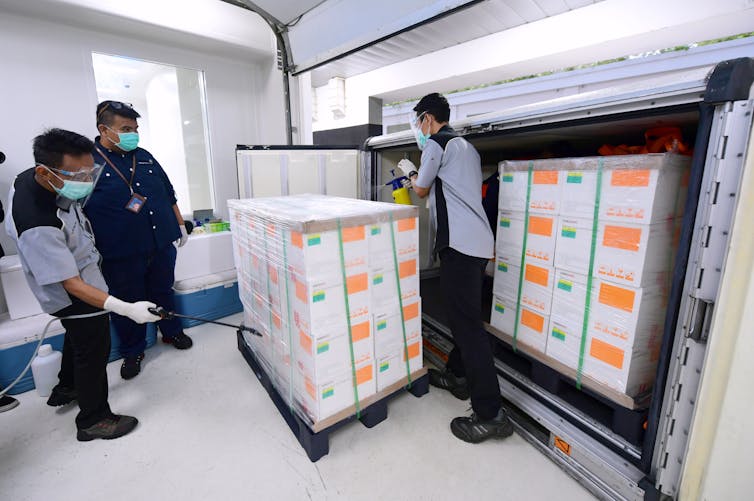
Executing the plan to vaccinate frontline workers, the vulnerable and then everyone else, will require NASA-like logistics. Intact delivery of Pfizer’s vaccine famously requires an ultra-cold chain of -70℃. Each “shipper box” holds 975 vials, each containing five doses.
According to Pfizer, once opened, a box requires dry ice every five days, delivered within 60 seconds of lifting the lid, to maintain its temperature. From the first opening of a box, the full contents of 4,875 doses must be injected within 30 days.
The next challenge is to have the right number of recipients at each vaccination session, arriving at the right time. Each vial takes between 30 minutes and 2 hours to defrost at room temperature, or 2-3 hours at normal refrigeration temperatures of 2-8℃. Defrosted vials must be used within 84 hours. The vaccine must be diluted with sodium chloride and then injected within 6 hours.
Before receiving the vaccine, each person must be pre-screened to rule out serious adverse reactions, medications, food allergies or other medical indications that might preclude them from receiving the injection. Pfizer also requires patients to give informed consent, having been advised of any risks, however small, associated with the vaccine.
For the vaccine to be effective, each recipient needs a second dose at the correct interval, 21 days according to Pfizer and Moderna, and 28 days for AstraZeneca Oxford and the same vaccine for the first and second dose in accordance with the protocols.
Getting better with practice
Logistical lessons learned will presumably make the subsequent rollout of the Moderna and AstraZeneca vaccines potentially easier. We should certainly hope so, given the government’s target will necessitate vaccinating 21 million Australians within little more than 240 days.
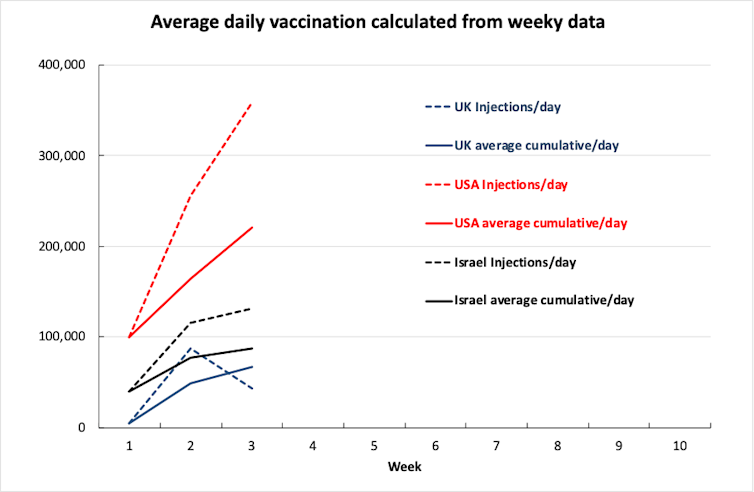
The United Kingdom has vaccinated 944,539 people (1.4% of the population) since December 13, at a daily average rate of 67,467. Even at its peak daily rate of 87,174, it will take well over three years to vaccine 80% of the population.
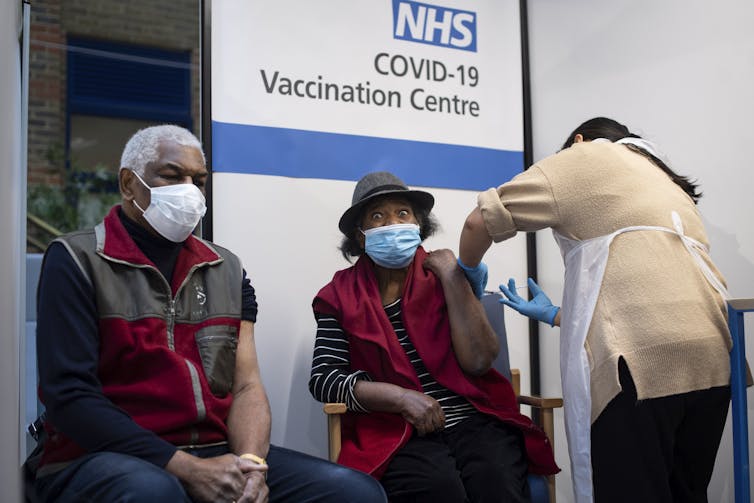
Britain has so far vaccinated around a million people, and still has a long way to go.Victoria Jones/AAP Image
The United States has vaccinated 5,306,797 people (1.6% of the population) since December 23. With its peak daily rate of 358,887, it will take 4 years to vaccinate 80% of people.
Israel has so far had the fastest rollout in relative terms, having vaccinated 1,482,307 people (16% of the population) since December 26, an average of 87,195 people per day. At its peak daily rate of 150,000, Israel will have vaccinated 80% of its population in just 39 days, and the entire population in 51 days.
Vaccine rollouts in the UK, USA and Israel so far.
Australia has a longer time frame for hitting 80%, but a population three times the size of Israel’s. Overall, an average of about 170,000 injections per day will be needed to deliver the necessary 42 million doses to 21 million Australians over 245 days (March to October).
Extrapolating from Israel’s 325 injecting sites we would need more of them. The Australian government has identified 1,000 injecting sites. One recipient injected every 15 minutes seems to be the standard.
To achieve 80% injection coverage (two injections for 21 million people) every 15 minutes, would require each injecting site to have at least eight injectors per day, or 8,000 across the 1,000 distribution sites nationwide.
In Israel, the strategy of using the care network, called kupot cholim, enables local branches to manage 75% of their local rollout.
Australia’s government plans to use GPs and pharmacies as injecting sites. Staff at each location will need to be trained for the logistics about timing and keeping record of the type of vaccination each recipient receives.
How do we protect frontline workers?
Protecting frontline workers by vaccinating them first is understandable, although evidencecurrentlyavailable indicates vaccines prevent symptomatic and severe infection. We need to wait to see if they also prevent asymptomatic infection.
Addressing the weaknesses in the return traveller program to suppress the virus circulating is our main threat to the vaccination rollout; this would mean fewer community clusters and less time spent by health workers attending COVID cases and outbreak management. Indeed, Israel’s speed of vaccination may be derailed by its third wave necessitating a protracted lockdown.
To prevent the vaccination rollout from derailing we must also quickly eliminate or at least severely suppress the current outbreaks in Greater Sydney and Melbourne. Eliminating the current spread rapidly as possible will deprive the virus of hosts and protect everyone.
Even with the best-laid plans, the vaccine rollout could still be derailed if resources are drained by having to respond to new COVID clusters.
Ultimately, success hinges not just on vaccine logistics but also on tightening the remaining weaknesses in our processes for quarantine and handling returned travellers. Removing the distraction of outbreaks will give us the best chance of getting enough people successfully vaccinated.
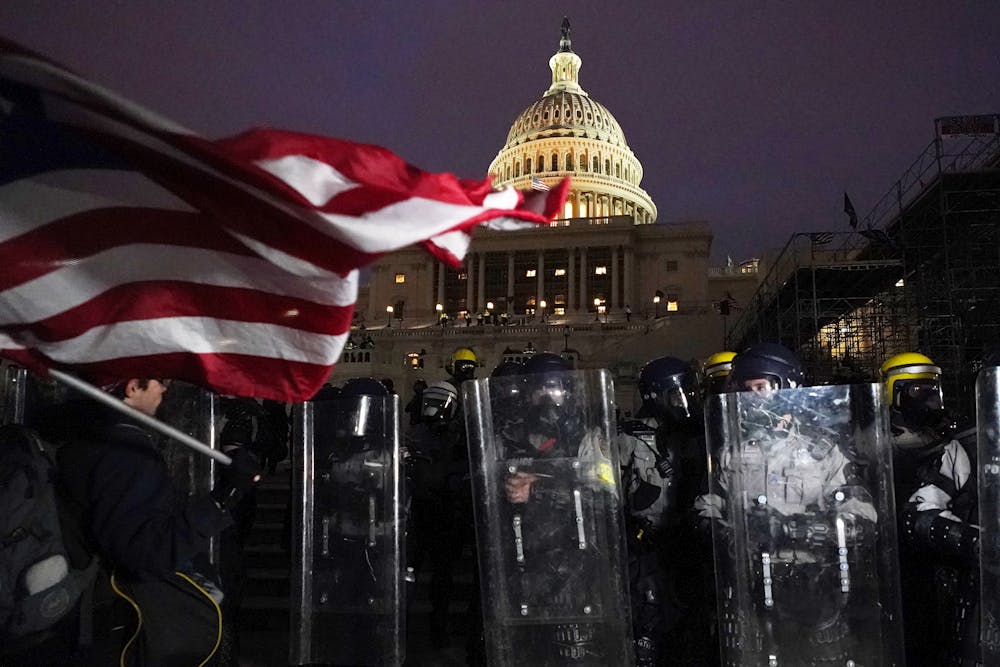
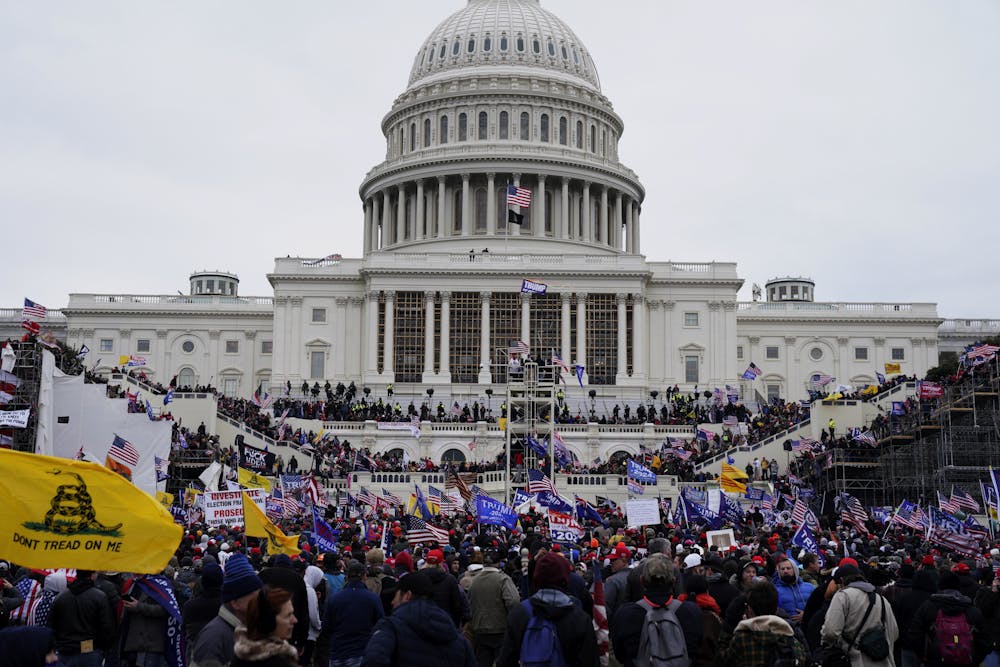
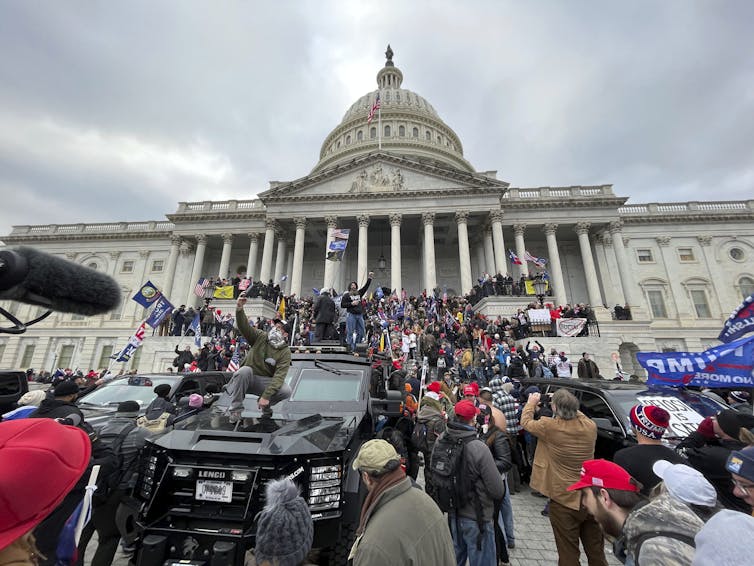
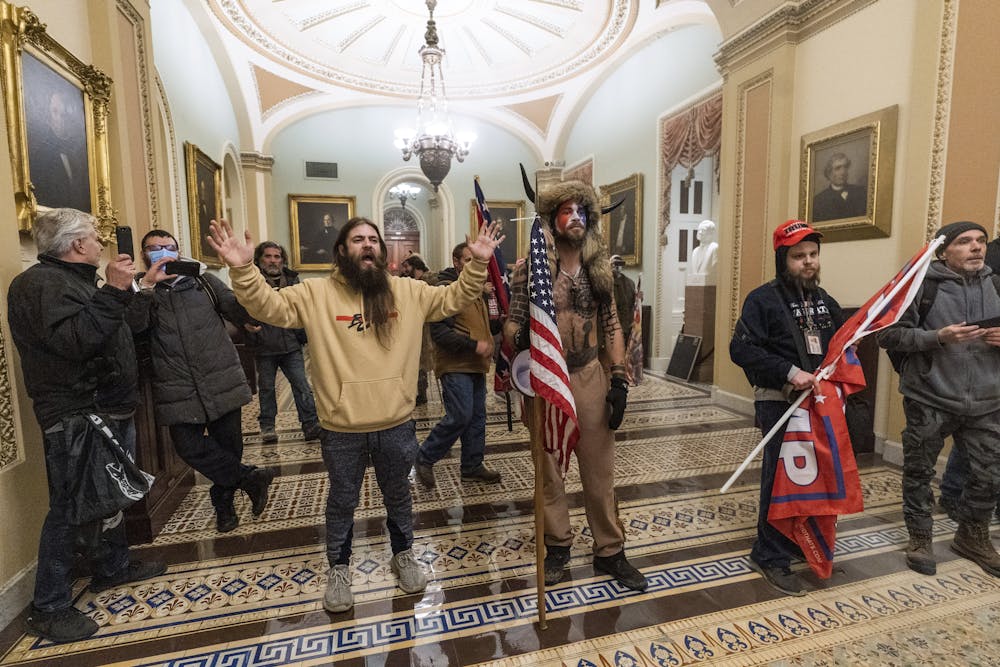
Hundreds of pro-Trump rioters today charged into the US Capitol, where Congress was set to certify Joe Biden’s presidency. Four people have reportedly died in relation to this protest, including a woman who was shot.
The protesters included “Proud Boys”, QAnon supporters and those who aren’t necessarily affiliated with a group but have engaged with these far-right ideologies.
The riot marked a disturbing escalation in the willingness and ability for the far right to mobilise against liberal democratic institutions, inspired by baseless claims peddled by the president: that this has been a stolen, fraudulent election.
It culminates years of President Donald Trump’s incitement and endorsement of these groups. Recall his endorsement of neo-Nazis in Charlottesville (“there are very fine people on both sides”) and his refusal to condemn the Proud Boys (“stand back and stand by”). He even affirmed the Capitol building protesters, calling them “very special” and “great patriots”.
Trump tells Proud Boys: ‘Stand back and stand by’ during the first presidential election debate in September 2020.
Certainly the way Trump is responding has only served to embolden the protesters and inflame the situation.
While there’s no doubt that some of the protesters were individual citizens, members of far-right extremist groups played an important, visible role in the riots. So who are the far-right rioters, and why are they so angry?
Violence is their bread and butter
The Proud Boys are one of the significant groups driving the protests, known for using violence to achieve their political ends. They describe themselves as a men’s fraternity of “Western chauvinists”, but are effectively a white nationalist gang predicated on violence.
As Proud Boys founder Gavin McGuinnes described in 2017, to reach the highest level of the organisation’s hierarchy a member must “kick the crap out of an antifa” (anti-fascist).
However, the most direct antecedent to what we’re seeing today is the storming of the Michigan State House last month by armed men involved in militia groups and other Trump-supporting protesters.
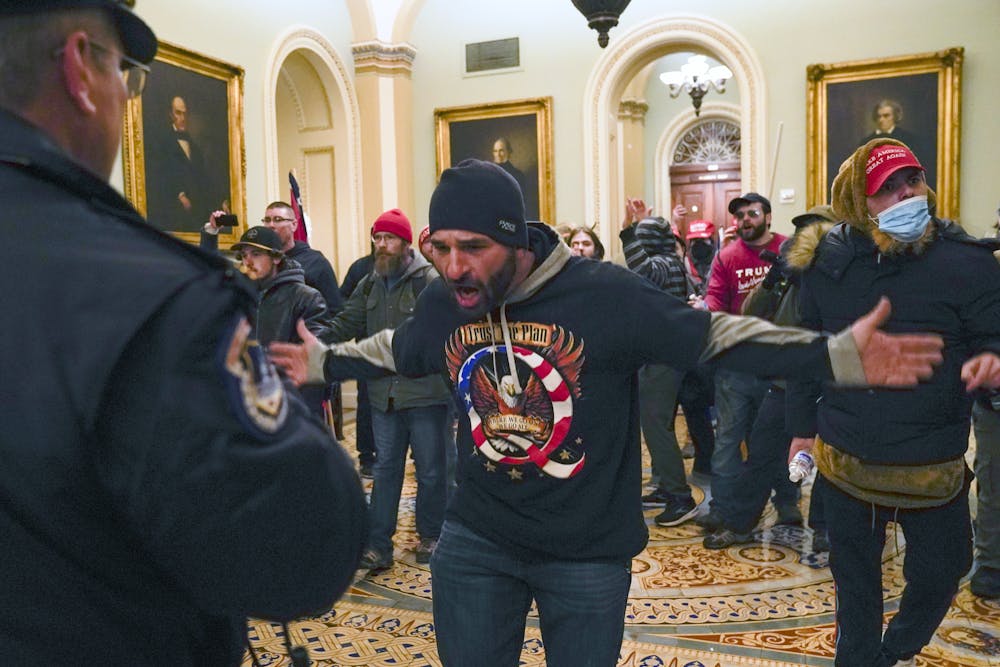
Trump supporters in a stand-off against US Capitol Police outside the Senate chamber in Washington DC.Manuel Balce Ceneta/AP Photo
The events in Michigan followed a series of tweets by Trump, one of which urged his followers to “LIBERATE MICHIGAN” in response to stay-at-home orders issued to combat rising numbers of COVID-19 infections.
The general appeal of groups like the Proud Boys is the retaliation to a perceived loss of white male supremacy and the erosion of privileges that were exclusively for the white man.
More specifically, in relation to what’s happening in Washington, their anger is fuelled by Trump’s claims of election fraud and a stolen election, including the baseless “Dominion” theory — a QAnon-related conspiracy about voting machines from Dominion Voting Systems involving Hugo Chavez and George Soros.
The way Trump is responding has only served to embolden the protesters and inflame the situation.zz/STRF/STAR MAX/IPx via AP
There is a wide spectrum of messaging from Trump’s supporters in today’s riots in Washington and outside other statehouses around America, from the comparatively banal claims of election fraud to dangerously unhinged calls for violence.
But behind their anger is almost a perverse democratic sentiment. Many no doubt genuinely believe their democratic rights have been subverted by liberal elites and “traitor Republicans” who don’t buy into Trump’s messages.
And so along with anger, there is also a sense of fear: fear that American democracy has been overturned at the hands of their “opponents”, even as they themselves actively undermine liberal democratic values and institutions.
Already, conspiracy theories and misinformation about today’s protests are being widely disseminated online. In particular, the riots are being spun as a “false flag”, with claims the rioters were actually antifascist provocateurs wanting to make Trump look bad.
Crucially, this isn’t just fringe internet conspiracy, but one being pushed by people with institutional clout. For example, Lin Wood, an attorney who until recently was embedded in Trump’s legal team, has spread this particular theory on Twitter, while alternative news outlets such as Newsmax repeated this line in their live coverage of the protest.
Misinformation plays a huge role in garnering extremist right wing views, and is being distributed widely across Facebook and other social media, as well as in mainstream press. And it’s not only in the US. Sky News in Australia, to give a local example, has been repeating without any clarification Trump’s lies of election fraud.
Unfortunately, tech companies have shown they’re unwilling to address this tidal wave of misinformation in a meaningful way.
Twitter will now slap a warning on a Trump post, and recently suspended his account for 12 hours — a temporary move followed by Facebook and Instagram. But countless white supremacists are still on there. For example, American white supremacist and founding figure of the “alt-right” Richard Spencer is still active on Twitter.
This a real danger, not only for the US, but for liberal democracies around the world, as misinformation continues to erode trust in institutions and stoke violent action.
So how do we begin addressing the far right?
To start, news and social media outlets must begin to take misinformation and hateful and extremist content seriously. This could be through more serious investment in content moderation for social media platforms, and refusing to uncritically publish patently false information, such as claims of voter fraud, for news media.
Similarly, a president who refuses to endorse organised white supremacists or conspiracy communities like QAnon would help reduce their legitimacy. As long as Trump continues speak of a “stolen election” and “very fine people”, the far right will feel validated in their violent actions and words.
While it is important security agencies take the very real threat of far-right violence seriously, we should look to other approaches to address and disrupt the far right beyond policing.
In Germany, for example, there has been some success with intervention at the interpersonal level. Educating role models for young people such as teachers and sports coaches to act as circuit breakers in the radicalisation process will help stem the flow of new recruits.
Young people are often targeted by far-right groups for recruitment. So role models like teachers are given skills to identify early signs of radicalisation, such as certain symbols or even fashion brands. They can engage with an individual who may be on the precipice of extremism, and offer them another path.
Given the very real danger posed by the far right, there needs to be a more rigorous approach to combating the allure of far-right extremist misinformation.
Amid the chaos in the US Capitol, stoked largely by rhetoric from President Donald Trump, Twitter has locked his account, with 88.7 million followers, for 12 hours.
Facebook and Instagram quickly followed suit, locking Trump’s accounts — with 35.2 million followers and 24.5 million, respectively — for 24 hours.
The locks are the latest effort by social media platforms to clamp down on Trump’s misinformation and baseless claims of election fraud.
They came after Twitter labelled a video posted by Trump and said it posed a “risk of violence”. Twitter removed users’ ability to retweet, like or comment on the post — the first time this has been done.
In the video, Trump told the agitators at the Capitol to go home, but at the same time called them “very special” and said he loved them for disrupting the Congressional certification of President-elect Joe Biden’s win.
That tweet has since been taken down for “repeated and severe violations” of Twitter’s civic integrity policy. YouTube and Facebook have also removed copies of the video.
But as people across the world scramble to make sense of what’s going on, one thing stands out: the events that transpired today were not unexpected.
Given the lack of regulation and responsibility shown by platforms over the past few years, it’s fair to say the writing was on the wall.
The US Capitol was eventually secured hours after Trump supporters invaded the halls of Congress.Julio Cortez/AP
The real, violent consequences of misinformation
While Trump is no stranger to contentious and even racist remarks on social media, Twitter’s action to lock the president’s account is a first.
The line was arguably crossed by Trump’s implicit incitement of violence and disorder within the halls of the US Capitol itself.
Nevertheless, it would have been a difficult decision for Twitter (and Facebook and Instagram), with several factors at play. Some of these are short-term, such as the immediate potential for further violence.
Then there’s the question of whether tighter regulation could further incite rioting Trump supporters by feeding into their theories claiming the existence of a large-scale “deep state” plot against the president. It’s possible.
But a longer-term consideration — and perhaps one at the forefront of the platforms’ priorities — is how these actions will affect their value as commercial assets.
I believe the platforms’ biggest concern is their own bottom line. They are commercial companies legally obliged to pursue profits for shareholders. Commercial imperatives and user engagement are at the forefront of their decisions.
What happens when you censor a Republican president? You can lose a huge chunk of your conservative user base, or upset your shareholders.
Despite what we think of them, or how we might use them, platforms such as Facebook, Twitter, Instagram and YouTube aren’t set up in the public interest.
For them, it’s risky to censor a head of state when they know that content is profitable. Doing it involves a complex risk calculus — with priorities being shareholders, the companies’ market value and their reputation.
The platforms’ decisions to not only force the removal of several of Trump’s posts but also to lock his accounts carries enormous potential loss of revenue. It’s a major and irreversible step.
And they are now forced to keep a close eye on one another. If one appears too “strict” in its censorship, it may attract criticism and lose user engagement and ultimately profit. At the same time, if platforms are too loose with their content regulation, they must weather the storm of public critique.
You don’t want to be the last organisation to make the tough decision, but you don’t necessarily want to be the first, either — because then you’re the “trial balloon” who volunteered to potentially harm the bottom line.
For all major platforms, the past few years have presented high stakes. Yet there have been plenty of opportunities to stop the situation snowballing to where it is now.
From Trump’s baseless election fraud claims to his false ideas about the coronavirus, time and again platforms have turned a blind eye to serious cases of mis- and disinformation.
The storming of the Capitol is a logical consequence of what has arguably been a long time coming.
Four people have died as a result of riots in and around the US Capitol building.Will Oliver/EPA
The coronavirus pandemic illustrated this. While Trump was partially censored by Twitter and Facebook for misinformation, the platforms failed to take lasting action to deal with the issue at its core.
In the past, platforms have cited constitutional reasons to justify not censoring politicians. They have claimed a civic duty to give elected officials an unfiltered voice.
This line of argument should have ended with the “Unite the Right” rally in Charlottesville in August 2017, when Trump responded to the killing of an anti-fascism protester by claiming there were “very fine people on both sides”.
An age of QAnon, Proud Boys and neo-Nazis
While there’s no silver bullet for online misinformation and extremist content, there’s also no doubt platforms could have done more in the past that may have prevented the scenes witnessed in Washington DC.
In a crisis, there’s a rush to make sense of everything. But we need only look at what led us to this point. Experts on disinformation have been crying out for platforms to do more to combat disinformation and its growing domestic roots.
Now, in 2021, extremists such as neo-Nazis and QAnon believers no longer have to lurk in the depths of online forums or commit lone acts of violence. Instead, they can violently storm the Capitol.
It would be a cardinal error to not appraise the severity and importance of the neglect that led us here. In some ways, perhaps that’s the biggest lesson we can learn.
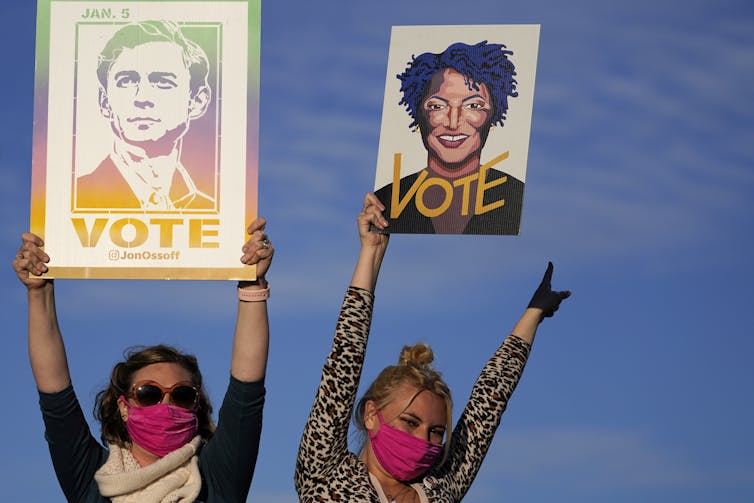
Two Democrats were announced the winners of the run-off elections for Georgia’s two Senate seats, allowing the Democrats to take back control of the chamber from the Republicans.
Jon Ossoff and Raphael Warnock were the first Democrats to win a Georgia Senate race in a quarter of a century. It also marked the first time since Herbert Hoover’s loss in 1932 that a president lost a re-election campaign and both chambers of Congress in a single term.
(From left) Ossoff, Warnock and Biden at a pre-election rally in Georgia.Carolyn Kaster/AP
Many warned that President Donald Trump’s violent and divisive rhetoric was inevitably going to lead to violence, though few would have predicted the Capitol itself would be overrun.
Today’s violence will remain a shocking moment for generations of Americans. Trump’s own former defence secretary, James Mattis, invoked the language of Franklin Delano Roosevelt to say that the political leaders who enabled the violence will “will live in infamy”.
Hundreds of Trump supporters stormed the Capitol during the certification of the election results.zz/STRF/STAR MAX/IPx/AP
No massive mandate for the Democrats
As Democrats prepare to take control of the presidency and both chambers of Congress, their attention must be focused on how to address the divisiveness and extreme partisanship that has become rooted in the US, allowing such a dramatic assault on democracy to take place.
Hoover’s landslide election loss to Roosevelt in 1932 similarly gave the Democrats control of the White House and Congress. The Democrats used this opportunity to launch the New Deal — a series of government programs and initiatives intended to lift the US out of the Great Depression. It was unprecedented in its size and ambition.
Many of these programs — ranging from Social Security (a government safety net for elderly Americans) to government regulatory agencies like the Securities and Exchange Commission and the Federal Deposit Insurance Corporation — were later expanded upon and continue through to today.
Unlike Roosevelt and his fellow Democrats in 1932, however, Joe Biden and his Democratic colleagues did not win landslide elections in 2020.
In fact, while Biden’s 306 Electoral College votes matched the total won by Trump in 2016, his pathway to victory was smaller.
Trump’s 2016 victory came from a combined 77,000 votes in the swing states of Michigan, Pennsylvania and Wisconsin. Biden’s 2020 win came as a result of a combined 45,000 votes in Arizona, Georgia and Wisconsin.
Similarly, the Democratic Senate candidates in Georgia did not win in landslides, either. And with the Senate now evenly divided by the parties, Vice President-elect Kamala Harris will spend a lot of time breaking 50-50 ties of her former colleagues in the chamber.
And beyond the White House and Senate, the Democrats actually lost, on balance, a total of 10 seats to the Republicans in the House of Representatives, thereby slimming their majority to only four seats.
Democrats celebrated their two wins in Georgia, their first in a US Senate race in the state since the 1990s.Carolyn Kaster/AP
How Biden will navigate the new Congress
But there are still clear advantages for the Democrats taking control of the Senate.
With Republicans no longer controlling when, or even if, votes occur in the Senate, everything from Supreme Court justices and Cabinet appointments to major pieces of legislation will no longer be contingent on Republican Mitch McConnell, the outgoing Senate majority leader.
In such a narrowly divided chamber, though, the onus will be on the Biden administration not to lose a single Democrat.
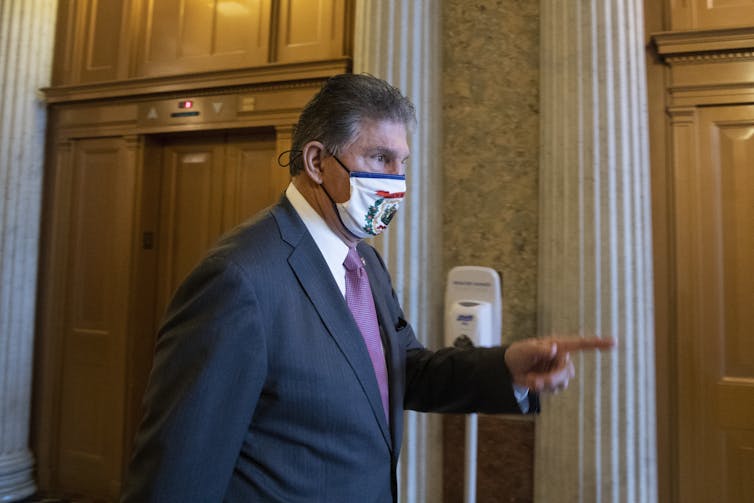
In many ways, the most powerful position in the Senate switches from McConnell to Joe Manchin of West Virginia and Kyrsten Sinema of Arizona, the two most conservative Democratic senators. They will likely prove to be the limits as to just how progressive a Biden agenda will be.
Conservative Democrat Joe Manchin could become a crucial swing vote in the Senate.Michael Reynolds/EPA
The Biden administration will need to get approval from a “large tent” of Democrats, including Manchin and Sinema, as well as progressives like Elizabeth Warren and the independent Bernie Sanders.
Ultimately, this slim hold on power will remain a hallmark of at least the first two years of the Biden administration.
That doesn’t, however, mean it will necessarily be divisive. In coming to the White House with more Washington experience than probably any other president in US history, Biden will need to prove that decades of experience as a “Washington insider” actually helps.
What will change for Biden — and what we can expect
Even before the Georgia races were called in the Democrats’ favour, Merrick Garland was tipped to be Biden’s choice for attorney general. Following four years of Trump’s blatant attempts to politicise the Department of Justice, no attorney general selection has been as consequential in decades.
This is particularly pertinent because Biden has vowed to restore the Justice Department’s independence, which would prove crucial if it faces public pressure to investigate the actions of the prior administration.
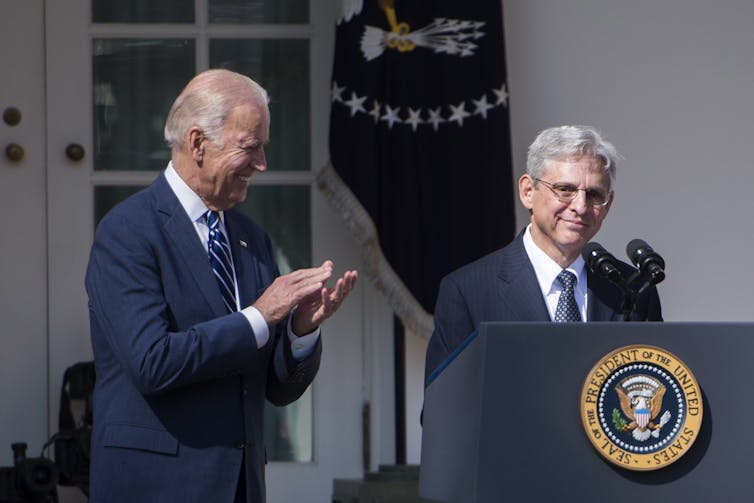
Garland’s choice as attorney general is expected to restore independence to the Justice Department.Shawn Thew/EPA
Garland is not only President Barack Obama’s former Supreme Court nominee, whom McConnell famously refused to allow a vote on. He’s also a circuit judge of the US Court of Appeals for the District of Columbia, one of the most consequential courts in the country.
It was the fact Biden can now replace Garland’s seat on this powerful bench with another Democrat — thanks to Democratic control of the Senate – that gave him the opportunity to make the selection.
Derisively labelled by some a political “weather vane”, Biden is not known to be a particularly ideological politician. Unlike most other presidents, he was not elected with a well-known ideological or political slogans focused on the future (for example, “Build the wall”, “Yes, we can” or “It’s the economy, stupid”).
Instead, Biden’s most well-known 2020 slogan, “Restoring the soul of America”, seemed to herald a return to prior years.
While many Americans may be pining for more normalcy, Biden has already seemed to acknowledge that doing so would not address the root causes of the sort of mayhem that occurred on Capitol Hill.
Taking control of the Senate, as well as the unprecedented unrest in Washington, will both widen the scope and redouble the urgency of the Biden team’s plans for addressing these issues.
But we shouldn’t expect a progressive revolution: the president-elect’s moderate tendencies are unwavering and unlikely to leave him simply because of Democrats eked out wins in Georgia. With that said, when the political spectrum has become stretched beyond conventional recognition, such moderation can often appear to be radical.
The end of coal-fired generation in Australia is inevitable.
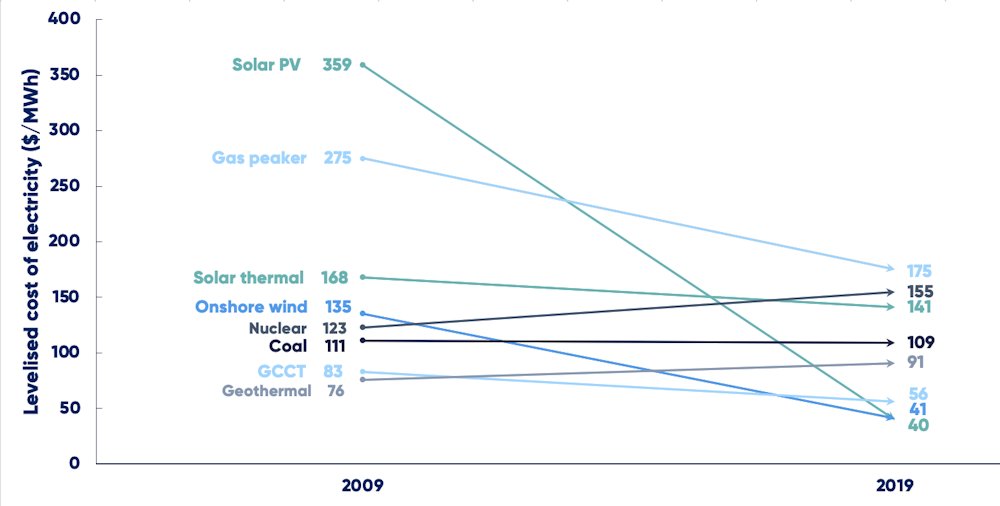
Zero marginal cost, zero emissions energy is now a reality. Wind and solar are cheaper sources of new electricity than coal in most cases, putting significant pressure on the profitability of the inflexible, ageing coal generators.
The only questions are when coal-fired power stations will close and how well Australia will manage that phasedown.
That’s why we need to talk about the role governments can play to ensure the transition is orderly, maintains energy security, avoids price spikes that have followed past closures, looks after affected workers and communities, and ensures Australia meets its commitment to reduce greenhouse gas emissions by 2030 to 26-28% below 2005 levels.
Cost of renewable energy to other sources over the past decade.Lazard, Australian Energy Market Operator
At least halving emissions from coal-fired power stations (which account for about 90% of electricity sector emissions) by 2030 is an obvious route to achieve Australia’s international commitments.
Given most state governments are already committed to forcing renewables into the grid at record pace, that could happen even without federal action.
But continuing down the current path will be unnecessarily costly, and pose significant risks to supply and prices as coal-fired generators exit on sporadic timelines based on their viability. These risks are part of the reason why Australia’s Energy Security Board is considering mechanisms that facilitate an orderly transition from coal-fired generation to renewables as one of four priority reform areas.
National leadership and careful policy design are needed to enable coal plant operators to bow out of the market gracefully, and in a manner that secures certainty for investors, consumers, workers and communities.
Learning from past closures
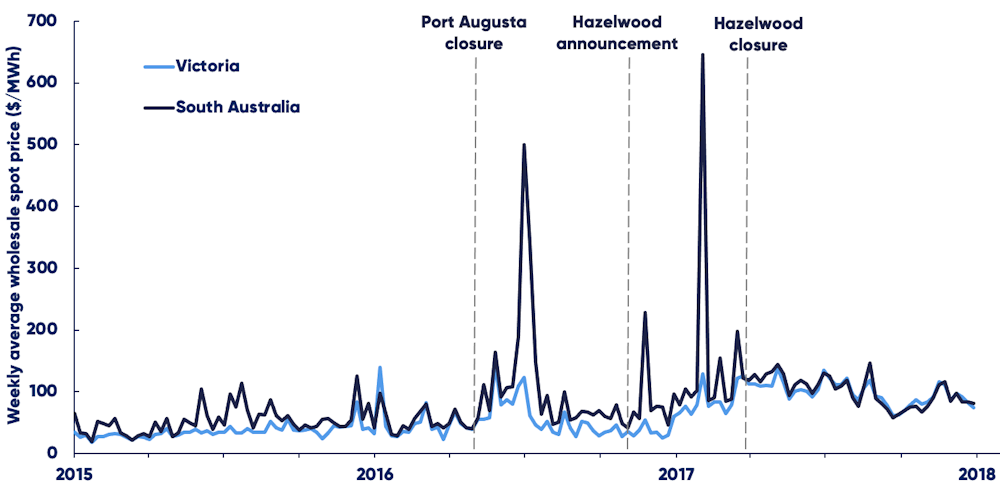
Past closures of South Australia’s Northern and Playford B power stations in Port Augusta (in 2016) and Victoria’s Hazelwood power station in the Latrobe Valley (in 2017) illustrate this point.
Price spikes followed the closure of these plants. In the case of Hazelwood, majority owner Engie gave barely five months’ notice of its closure in March 2017. With Hazelwood, a brown-coal-fired generator accounting for 20% of Victoria’s electricity supply and 5% of national output, the supply ramifications were significant. Victoria’s average electricity prices increased from A$60 to A$100 per megawatt hour (MWh).
Impact of Port Augusta and Hazelwood station closures on wholesale electricity price.Australian Energy Regulator
These offer a stark warning to policy makers. The market requires adequate notice of coal-fired generator exits. Greater certainty provides investors with the assurance they need to build enough capacity to replace retiring coal plants, and the infrastructure to connect them to the grid. A haphazard transformation is in no one’s interests.
A new Coal-Generation Phasedown Mechanism
We outline a market-based mechanism to achieve just that in a report published by the Blueprint Institute, an Australian think tank established last year to promote rational, pragmatic policy proposals.
The Coalition has generally claimed to oppose market-based mechanisms — such as emissions trading schemes or carbon taxes — to reduce greenhouse gas emissions. But the Abbott government in 2014 introduced an emissions trading scheme alongside its A$2.5 billion Emissions Reduction Fund, a mechanism the Morrison government rebadged in 2019 as the Climate Solutions Fund. A “Safeguard Mechanism” sets emissions caps for the country’s highest-emitting businesses, with emissions permits tradeable on the open market.
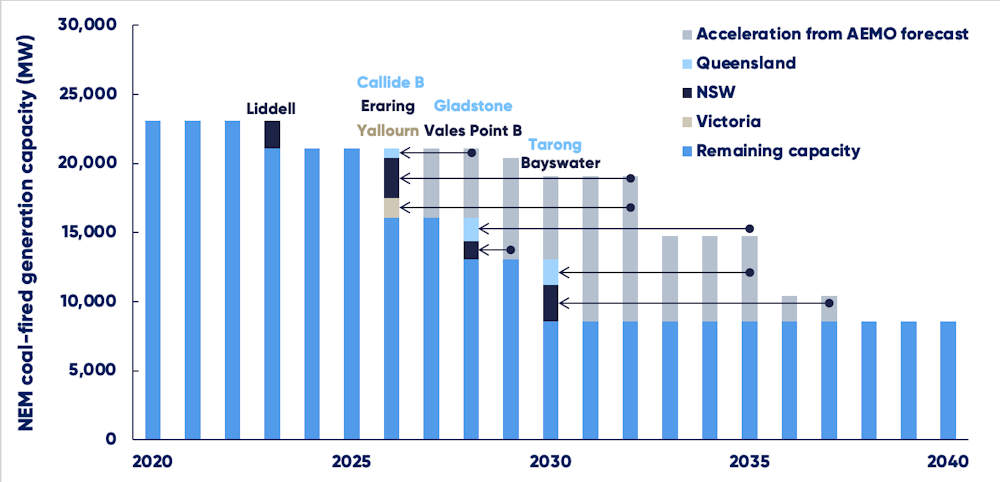
To facilitate the orderly phasedown of coal-fired electricity generation, we propose a “Coal-Generation Phasedown Mechanism” (CPM), leveraging the Safeguard Mechanism to establish sector emissions targets — for 2026, 2028 and beyond 2030.
A key component of the CPM is the use of auctions to achieve withdrawals of coal generation from the electricity market. Auctions are commonplace in commercial and government contexts. The federal government has long used auctions to allocate telecommunications spectrum, for example, and the Emissions Reduction Fund uses reverse auctions to buy the most cost-effective emissions abatement.
The CPM would set emissions targets to phase down coal-fired generation to halve current emissions by 2030. Under a well-designed auction system, the least profitable coal generators would withdraw from the market first, ensuring emissions reductions occur at minimum cost.
One possible scenario is shown in the graph below. Example generators have been chosen based on their operating costs and approximate remaining life. Those with higher costs and a shorter remaining life have greater incentives to bid for earlier exits.
A scenario showing how the CPM could reduce coal-fired generation to 2030.source
The CPM should also be designed to ensure financial support for affected workers. This could be in the form of redeployment, retraining opportunities or generous remuneration in the case of retrenchment.
Who should pay?
A phasedown of coal-fired generation will come at a cost to someone — either taxpayers or investors in coal-fired generation. This cost can be made larger or smaller. It can be hidden from view. But it cannot be avoided. The proper role for government is to minimise and fairly distribute those costs.
We can’t predict exactly how much the phasedown will cost, because that depends on information known only to the generators. But a market-based mechanism is sure to minimise those costs.
The CPM can be designed to ensure the least viable plants close first. How much money generators receive to close or pay to stay open is an entirely separate question. The CPM can be designed to accommodate any financial commitment by taxpayers.
At one extreme, the federal government could pay generators to close by fully compensating auction participants for the loss of future profits, as has been adopted in Germany. But this would likely require a federal funding commitment significantly larger than under the existing Emissions Reduction Fund, which might make it politically unpalatable.
At the other extreme, the government could charge operators for the right to stay open. One significant advantage of this option is it would raise revenue that could then be used to support directly affected communities. This could be modelled on Western Australia’s “Royalties for Regions” program, which allocates a quarter of the state’s mining and petroleum royalties to programs benefiting regional and rural areas.
A funding allocation between these two extremes is also possible, decided through government negotiation with the industry.
Ultimately, the question of who pays is a political decision. But political difficulties shouldn’t be used as an excuse for delay. The economic rationale for the CPM stacks up either way.
We must avoid another Hazelwood or Port Augusta, and coordinate an orderly grid transformation that provides certainty to communities, workers, investors, and consumers alike.
Source: The Conversation (Au and NZ) – By David Smith, Senior Lecturer in American Politics and Foreign Policy, US Studies Centre, University of Sydney
After weeks of President Donald Trump’s baseless claims about voter fraud and other improprieties costing him the presidential election, Washington erupted in chaos today as his supporters stormed the Capitol during a joint session of Congress to certify the results.
While shocking to watch, in hindsight, today’s riots feel almost inevitable.
Trump has spent weeks insisting the election was stolen, with very little push-back from the Republican Party. There have been some notable people who have challenged him, but even while this riot was going on, there were more than 100 Republican lawmakers trying to block certification of the election. This has been a highly opportunistic process on the part of Republican legislators.
For Trump, this is the whole game; at this point, it seems there is nothing else he cares about. He is desperately trying to hang on to power.
Amid all of this, it was inevitable at least some Americans would take the word of their current president very seriously. Having fired them up in this way, it becomes much harder to control mob behaviour. His belated tweet telling protesters to go home and go in peace (now removed by Twitter) was far too little, too late.
Looking at some of these images coming in from Washington, there is almost an element of “cosplay” (“costume play”). A lot of the rioters were dressed up in bizarre paraphernalia. On some level, I think they know they can’t actually seize power. There’s almost this carnival element to it of these people delighting in causing complete chaos.
Trump supporters breached the Capitol carrying Trump flags and dressed in costumes.Manuel Balce Ceneta/AP
Whether it’s Trump or his rioting supporters, if they can’t get their own way, if they can’t win, they’ll just create as much chaos as possible and revel in the absurdity of it.
Another thing that’s very obvious is these protesters didn’t fear the police. They were able to push their way past the police, they were able to force entry into the Capitol building and they’re then making jokes with reporters. They believed the police would not retaliate against them fatally — although one woman was shot and killed.
The contrast with the Black Lives Matter protests is striking. A Black Lives Matter protest would never have been allowed to get that close to the Capitol. These are people acting with all kinds of impunity.
Undermining election results at all costs
In storming the Capitol and trying to stop a legitimate process of certifying the election, the rioters are following the lead of Trump and many congressional Republicans. It’s been trend for a while for Republicans that if they lose an election, they do as much as possible to nullify the results.
With Trump’s loss to Joe Biden in November, there have been very few Republicans who have actually acknowledged this was the will of the people.
Part of that is because Trump’s victory four years ago was so unexpected, a lot of Republicans believe this was a new era in American politics. Part of that was the ability of Trump to win without actually winning the popular vote. Now that Biden has won, there’s a real unwillingness to acknowledge elections can still be lost legitimately by Republicans.
Delegitimising the election certification process was one of the goals of the protesters.John Minchillo/AP
A failure of leadership from senior Republicans
From the beginning, Kevin McCarthy, the number one Republican in the House of Representatives, was absolutely behind these ridiculous stolen election claims. He’s never backed away from them.
Mitch McConnell, the Senate majority leader, let these things go on for weeks before he made the most minimal statement that the Electoral College has spoken. It is no surprise that McConnell was then completely unable to control Republicans in the Senate who wanted to contest the certification of the election results.
Republicans have learned the lesson that the way to get the most attention, the way to further your career, is to take the most pro-Trump stance possible. So, it was no surprise so many lawmakers would back this effort to block certification of the election. They’re raising money off this, they’re creating YouTube videos to show their supporters.
It’s become Trump’s party. A lot of people see the path to political advancement backing Trump at every point.
There were a lot of Republican legislators who hoped Trump would eventually give up. In the days after the election, some were saying we should let Trump play out his legal options, he will do the right thing eventually and he’ll step aside for the good of the nation.
Trump told a rally before the Capitol breach today, ‘we will never concede’.Jacquelyn Martin/AP
But he was never, ever, ever going to step aside or concede. What he does is he just keeps people on board with him. Anyone who waits for Trump to do the right thing inevitably ends up supporting him when he does the wrong thing.
This is a lesson Republicans should have learned, but they’re scared of his supporters. None of them have supporters who would potentially risk their lives to storm the Capitol building.
The best check on power? The people
There have been surprises in both the strengths and weaknesses of America’s institutions over the last few years. For example, federalism has turned out to be quite an effective check on presidential power when it’s been exercised by someone like Trump, which is perhaps not something Democrats would have necessarily believed before.
On the other hand, we’ve seen this massive erosion of norms, especially in Congress. This has been going on for quite a while and McConnell has been one of the major eroders of norms for a long time. Congress was never really an effective check on Trump.
Ultimately, after the election, it was local and state officials like Georgia Secretary of State Brad Raffensperger and Aaron Van Langevelde, a member of Michigan’s board of state canvassers, who said enough is enough when members of Congress weren’t doing it.
And despite the fact Trump has packed the federal courts and Supreme Court with conservative judges, none of his legal challenges went anywhere.
But in the end, the lesson is the most effective check is the election. It is the voice of the people. For every norm that Trump broke, for every anti-democratic thing he did, there was a bigger backlash.
We saw an election with one of the biggest turnouts in history. We had four years of pretty consistent protests in the streets. And in the end, this is the most important check on the presidency that there is.
SPECIAL REPORT:By Victor Mambor in Jayapura – first of a three-part investigation into the Pastor Yeremia Zanambani assassination.
The Papua Province Humanitarian Team for Cases of Violence Against Religious Figures in Intan Jaya District [referred to as the Humanitarian Team from now on], has completed documenting the cases of extrajudicial killing of Pastor Yeremia Zanambani on 19 September 2020. This report documents facts about Pastor Zanambani’s murder. It also provides an analysis of the context of violence by significant security actors, namely the TNI (Indonesian National Armed Forces) and TPNPB (National Liberation Army of West Papua), and its impact on civilians in Intan Jaya district.
The shooting of Pastor Jeremiah Zanambani’s incident cannot be seen as an isolated event. There has been previous incidents of violence since 17-19 September 2020. Starting with the gathering of Hitadipa residents twice on 19 September 2020, at 9am and 12 noon at the headquarters of the Hitadipa Preparation Koramil and the Imanuel Hitadipa Church yard. In the gathering of residents, Pastor Yeremia Zanambani – along with five other residents – was branded an “enemy” by the Deputy Commander of the Sub-District Military (Wadanramil) Alpius Hasim Madi.
The intimidation and threats given by Madi to make the residents return rifles belonging to the TNI made several residents present cry out in fear. An hour later, the TPNPB attack on the Preparatory Koramil Headquarters resulted in the death of Pratu Dwi Akbar Utomo. In that incident, the official house of the health worker in Taundugu was burned by TNI officers, then the shooting and stabbing took place which killed Pastor Yeremia Zanambani.
Pastor Zanambani is not the first victim in a series of police violence in Intan Jaya. He is the 10th civilian victim who has been shot at Intan Jaya between October 2019 and 2020. The armed conflict that has occurred in Intan Jaya since October 2019 is the latest in the series of violent episodes that have emerged since the Intan Jaya regency was formed in 2008.
The Humanitarian Team documented four problem groups in analysing the violence in Intan Jaya. First, there were changes in the characteristics of the conflict in Intan Jaya over several periods – 2014-2016, 2017-2018, and 2019-2020.
In the 2014-2016 period, Intan Jaya district was marked by several cases of violence perpetrated by the Indonesian security forces against civilians. According to the Humanitarian Team’s records, violence involving Brimob (Mobile brigade) members caused at least one citizen to die, and at least 21 residents were wounded.
Meanwhile, another security apparatus committed an additional case in which one civilian victim was killed. The violence was not directly related to political reasons but was incidental with personal motives or as a result of provocation.
Entering the beginning of 2017 to 2018, regional head elections (Pilkada) rivalry added to the dynamics of the conflict in Intan Jaya. The clash occurred between sympathisers of the regent candidate pair Yulius Yapugau-Yunus Kalabetme and the incumbent Natalis Tabuni-Robert Kobogoyauw.
Pastor Yeremia Zanambani … shot dead by the Indonesian military in Hitadiap village on 19 September 2020. Image: Suara Papua
Three residents killed, 101 wounded At least three residents died, and 101 others were wounded. As tensions escalated, the Papua police called in reinforcements for security. This tension has increased the fragility of the civilian government in responding to local security dynamics.
The change in the characteristics of the conflict in Intan Jaya has been clear since 25 October 2019. Intan Jaya has become a new armed conflict zone in Papua, due to the presence of two significant security actors, namely the TNI and TPNPB.
Violence has been escalating in the conflict since the shooting incident of Indonesian Army soldiers on 17 December 2019 to 6 November 2020.
The results of the Humanitarian Team documentation show that there were 17 cases of violence committed by both the TNI and TPNPB. The violence resulted in 17 deaths. A total of 12 civilians were killed, including a child.
The shift in the conflict trend is a significant change, because previously Intan Jaya district was not included in the conflict zone between the TNI and TPNPB. Previous conflicts were more related to communal issues, land ownership issues, clashes between residents and various other disturbances to security and public order.
When social conflicts such as tribal wars occur, traditional value-based conflict resolution is carried out by warring community groups to find a middle way.
The expansion of Intan Jaya from Paniai Regency in 2008 had implications for changing the trend of the conflict. The struggle for power by local elites through Pilkada elections in 2017 has had an impact on the legitimacy of the local government and its effectiveness.
On the one hand, the addition of organic and non-organic troops for the sake of securing the Pilkada election and in responding to various local security dynamics afterwards, has significantly increased the role of the TNI-Polri in the regency with a population of 49,293 people.
Struggle consolidated On the other hand, TPNPB is increasingly consolidating its struggle by expanding Kodap [1] and reunification. After the TPNPB Summit in Biak Numfor on 1-5 May 2012, TPNPB already has 33 Kodap throughout Papua.
Intan Jaya itself is included in Kodap VIII. Internal consolidation was also strengthened by a meeting of Reunification and the Declaration of Unity and Unity of the TPNPB-Free Papua Organisation on 1 August 2019 Ilaga, Puncak Regency.[2]
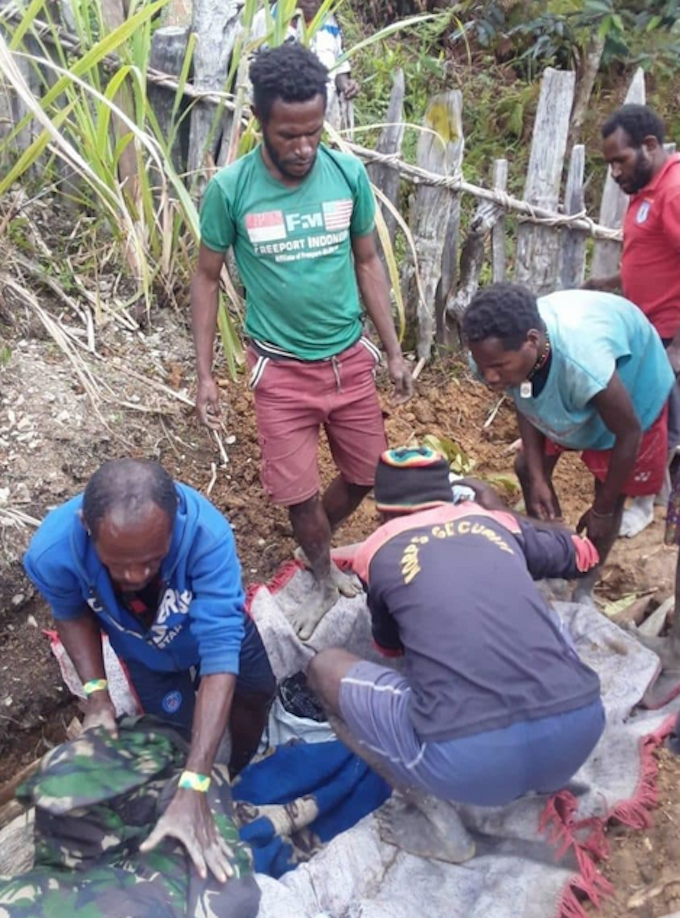
Residents recover the body of Rufianus Tugu who was buried in a shallow grave covered with banana leaves. Image: Jubi/Diocesan Diocese of Timika
Since then, the intensity of the conflict between the TNI-TPNPB has increased in Intan Jaya district.
The interaction of these various factors contributed directly or indirectly to the changes in the characteristics of the conflict in Intan Jaya regency in 2014-2020. Now, Intan Jaya regency has become a new zone for a deadly security conflict.
According to the Humanitarian Team’s record, the highest number of victims in the conflict between the TNI and TPNPB were civilians, both Papuan and non-Papuan.
Second, it is difficult to obtain clear information about the addition of organic and non-organic troops to the TNI/Polri operations in Intan Jaya. After the restructuring of the TNI organisation on 27 September 2019, the Humanitarian Team also found it difficult to identify the division of tasks among stakeholders such as the XVII/Cenderawasih Regional Military Command, Korem 173/PVB, and Kogabwilhan III.
However, Kogabwilhan III seems to have more authority and plays a role in security operations in Intan Jaya.
Information dissemination Throughout the series of violent and armed conflicts in Intan Jaya, information dissemination to the public was mostly carried out by the Kogabwilhan III Information.
After the shooting of Pastor Yeremia Zanambani, for example, the Head of Information for the Joint Defence Region Command III, Colonel Czi IGN Suriastawa, made a unilateral statement, saying that Pastor Zanambani was shot by the TPNPB. In the previous period, the delivery of similar information was mostly carried out by the XVII/Cenderawasih Military Command Information.
The implication is that it is difficult to ensure the accountability of the TNI for various human rights violations in Intan Jaya. The lack of independent and impartial investigations into various violence in TNI operations in Intan Jaya has further strengthened the structure of violence within the institution, including the practice of impunity.
Apart from the lack of information regarding the presence of TNI troops in Intan Jaya, the TNI has also violated International Humanitarian Law for occupying YPPGI Hitadipa Elementary School. The school was even used as the Headquarters of the Hitadipa Preparation Koramil (Military Rayon Commando). The use of public facilities for war purposes violates human rights. This deprivation has taken away the rights of students to attend school.
Third, there is neglect of victims’ rights to justice and reparation after various violent events since October 2019. In a number of cases of extrajudicial killings, there is minimal investigation and legal process against the TNI members involved. Until November 12, 2020, only the case of burning the official house of health workers in Taundugu has reached the investigation stage. The Indonesian Army Military Police Center (Puspomad) named eight Indonesian Army soldiers as suspects in the arson case.[3]
The lack of legal proceedings for various extrajudicial killings by security forces has resulted in impunity. People in Intan Jaya do not have access to justice and remedies for the various human rights violations that have occurred.
The Declaration of Basic Principles of Justice for Victims of Crime and Abuse of Power defines victims as “people who individually or in groups have suffered harm, including physical or mental injury, emotional suffering, economic loss or real deprivation of basic rights, either because of actions (by act) or because of negligence (by omission)”. So that the people of Hitadipa and Intan Jaya who experience direct and structural violence as a result of the conflict by security actors have the right to feel safe. Therefore, the State is obliged to guarantee justice and restoration of rights (reparations) for the people of Intan Jaya.
Fourth, the escalation of violence between the TNI-TPNPB also has an impact on the problem of refugees. Based on data compiled from the Indonesian Gospel Tent Church (GKII), the Timika Diocese Catholic Church and the Intan Jaya regency government, around 466 people were displaced.
Scattered in districts They are scattered in several districts around Intan Jaya Regency and several other districts such as Nabire, Mimika and Puncak. This number is estimated to be even higher due to the difficulty of collecting data by the Humanitarian Team. In addition, the feeling of trauma experienced by residents causes fear of reporting to government agencies.
The large number of patrols by security forces in Sugapa and Hitadipa districts has also made it difficult for church pastors to record the overall distribution of refugees.
The problem of refugees from the previous armed conflict, such as refugees from Nduga district, for example, also shows a tendency for many civilians to flee into the forest, moving away from residential centres or government locations where the security forces are based.
Data collection difficulties will cause various humanitarian problems such as limited access to basic needs such as food, adequate housing, sanitation, education and health. The presence of refugee women, children and elderly people also require immediate special attention.
Another urgent matter is the fulfilment of security guarantees for the refugees to return to their hometowns to celebrate Christmas.
Fifth, the existence of the Wabu gold block risks triggering a new conflict (a resource war). Previous findings indicate a causal relationship between exploitation of natural resources, armed conflict and escalation of violence.[4]
In the analysis of the conflict in Papua, injustice in natural resource management has become one of the triggers.[5] Such exploitative development has an impact on the marginalization of local communities. With the social, political, economic and cultural background of the people of Intan Jaya, the patterns of injustice and marginalisation could worsen in the future.
Conflict-triggering elements When people’s grievances due to imbalances in the distribution of results coincide with other conflict-triggering elements, other significant actors can construct these grievances to legitimise new violence. Because the most worrying thing about strategic natural resources such as gold is the manipulative competition between parties with different interests.[6]
The plan to mine the Wabu gold block in the midst of a situation of armed conflict between the TNI and TPNPB, will only lead to a conflict that is more complicated to resolve. TPNPB has conveyed its rejection of the Wabu block mining existence and specifically asked the Governor of Papua to withdraw the recommendation letter for the Special Mining Business Permit Area (WIUPK) Number 540/11625/SET issued in Jayapura on 24 July 2020.[7]
This resistance can produce a new cycle of violence if marginalisation worsens and the government continues to prioritise a security approach in its conflict resolution.
The Humanitarian Team’s findings indicate the risk of more widespread violence and conflict in the future. The security approach chosen by the government is dangerous, because the security forces have shown no attempt to change the culture of violence inherent in their institutional structures.
Groups of security forces have even shown a tendency to obscure the facts of the various violations they have committed, in order to protect perpetrators from legal traps by continuing to practice impunity.
The shooting of Pastor Yeremia Zanambani was an extrajudicial murder that violated human rights, international law, and the Indonesian Constitution. Pastor Jeremiah’s case proved not to be the last case, because afterwards there were the murders of two catechists of the Timika diocese.
The culture of violence inherent in the TNI institutional structure can only be changed if the practice of impunity is stopped by bringing the perpetrators of violence to justice.
To the Humanitarian Team, Mama Miriam Zoani, wife of the late Pastor Zanambani and family hopes that the security forces will leave Hitadipa, so that she can see the pastor grave for the first time. Mama Miriam Zoani also hopes that the displaced people will return to their homes, and together with their families do a thanksgiving service after Pastor Zanambani ‘s death.
It seems simple to most people. However, the presence of TNI officers in Hitadipa made it difficult for the family of Pastor Yeremia Zanambani to make it “simple”.
Translated from the original Tabloid Jubi article by a special Pacific Media Watch correspondent. Jubi articles are republished by Asia Pacific Report with permission.
Notes: [1] Kodap adalah nama satuan teritorial TPNPB, yang biasanya berbasis kepada wilayah administrasi kabupaten di Papua.
[4] Edward Aspinall. The Construction of Grievance. Natural Resources and Identity in a Separatist Conflict. Journal of Conflict Resolution.51(6), December 2017.
[5] The Indonesian Institute of Sciences (LIPI) mentions four roots of conflict in Papua, including the history of integration, political violence and human rights violations, development failures and problems of marginalization and inconsistency in the special autonomy policy. Various inequalities in development due to exploitation of natural resources cause social jealousy and become the root of conflict. According to Amich Alhumami, there are two main dimensions of the Papua conflict, namely the economic dimension and political domination. The economic dimension relates to the massive exploitation of natural resources without benefiting local communities. A sense of injustice due to economic problems can lead to conflict in the political sphere. See Suma Riella and Cahyo Pamungkas. Updating Papua Road Map. Peace Process, Youth Politics and Papuan Diaspora. (Jakarta: Yayasan Pustaka Obor Indonesia, 2017)
Papua New Guinea’s Prime Minister James Marape has visited Goilala’s remote Saki village near Tolukuma gold mine in the Goilala district of Central Province to see the extent of the damage caused by the landslide, reports the PNG Post-Courier.
Fifteen people, including three children, are feared dead in this devastating natural disaster which occurred late last month.
The people were asleep in a long house near an alluvial mine site where they had been panning for gold, when the landslide, dragging trees and logs with it, buried the hut.
Prime Minister Marape flew to the disaster site yesterday by a chartered helicopter. He was accompanied by the member for Goilala William Samb and media representatives.
How does the Sun make such pretty colours at sunsets and sunrises? — Aisling, age 7, Mount Gambier, South Australia
Hi Aisling. Thank you for this super interesting question!
We love watching all the pretty colours of sunsets and sunrises. But why does this happen, when most of the time the sky is just blue?
Well, it’s all because of light and the fact that light has colour. Believe it or not, the light around you is a combination of all the colours in the world.
But if this is true, why do we only see some colours in the sky at certain times, and not all of them?
To know this, we first need to know how day turns into night.
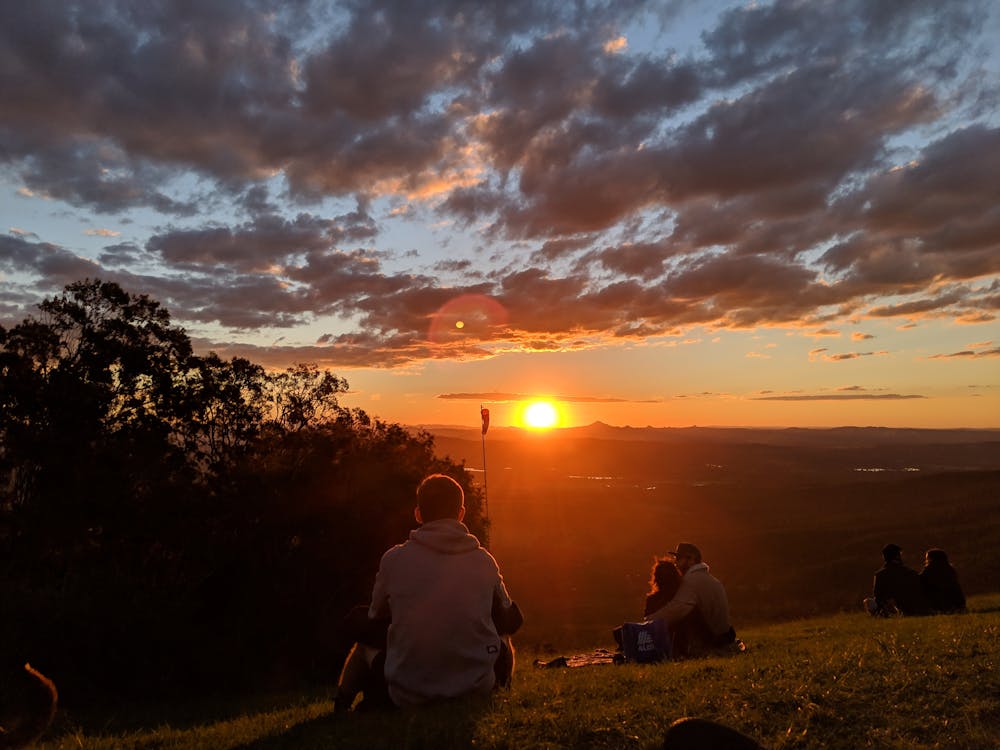
In Australia, we get beautiful views of the sun setting on most days — as long as we have a good spot to watch from. The sky lights up with bright reds and oranges.Jake Clark
Earth goes dancing through space
Our planet, Earth, moves in space with seven other planets nearby. They all spin in circles on the spot, but also move in much larger circles around the Sun.
When the Sun is setting in Australia, this means our side of the planet is turning away from the Sun. During sunrise, we’re turning towards it.
Night time happens when we’re no longer facing the Sun at all. Daytime happens when we have twirled to face the Sun directly — so its sunbeams travel (very fast) directly to us.
Although you can’t tell by looking at them, beams of light from the Sun come in different sizes. Scientists measure these sizes using something called “wavelength”.
Each different wavelength of light has its own unique colour.
Earth is wrapped in its atmosphere
So we know why the sky is bright during the day and dark at night. And we know sunbeams come in different sizes, or “wavelengths”.
But how does it become the gorgeous colours we see during sunset and sunrise?
This happens because of an important blanket of air wrapped around Earth, called the atmosphere.
Earth’s atmosphere is made up of many very tiny objects called molecules. In fact, all things are made of molecules, including you and me.
But each molecule is much, much smaller than a grain of sand. They’re so small you can’t see them without a microscope — you can only see the bigger things they make.
If you were an astronaut onboard the International Space Station, you’d have crossed Earth’s atmosphere to get there.NASA
How the atmosphere plays with light
When the Sun’s beams reach Earth, they meet the molecules in Earth’s atmosphere. The molecules then begin to play with the light — bouncing it back and forth between themselves. This is called “scattering”.
The longer a wavelength of light is, the longer it can keep scattering between the molecules in our Earth’s atmosphere before “tiring out” and going back into space.
Blue light has a shorter wavelength than red or pink light. This means it can only bounce between the molecules for a shorter distance.
When Australia is directly facing the Sun (daytime), there’s less atmosphere for the light to pass through. Blue light can easily come out the other side — giving us a blue sky.
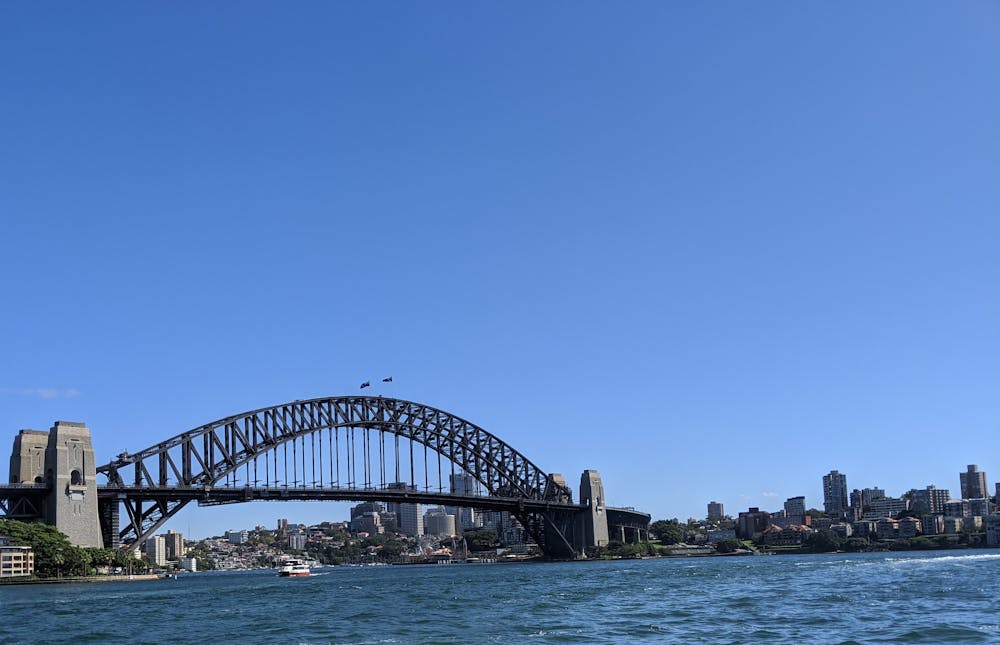
Although the sky and ocean are both blue, the reasons for why they’re blue are different.Jake Clark
The colours of sunrise and sunset
We already know Earth spins in its place. Remember that during sunset in Australia, we are circling away from the Sun and no longer facing it directly.
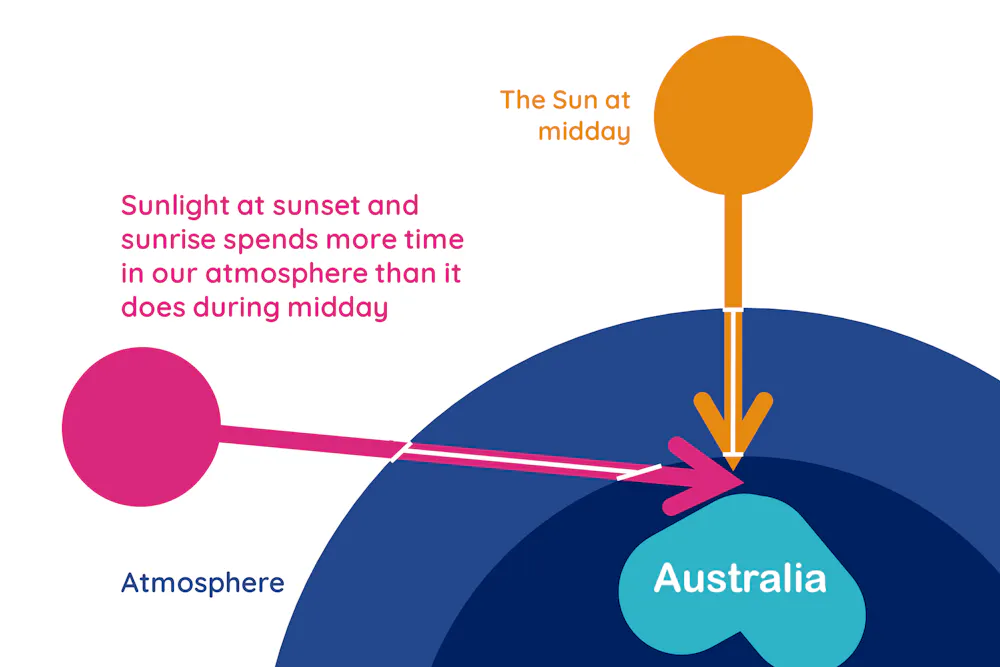
This means sunlight has to travel through a thicker slice of the atmosphere to reach us. This happens during sunrise too, when Australia is moving towards the Sun.
Here we can see how, to reach Australia, light has to travel through Earth’s atmosphere for a longer distance during sunrise and sunset, when we’re not directly facing the Sun.Author provided
With this larger distance of atmosphere to cover, the blue light gets tired. It can’t keep up anymore, so it mostly bounces back out into space.
But the red, orange and yellow light have longer wavelengths. This means they can scatter for longer and travel through the atmosphere to reach us.
And this is why we have beautiful bright sunsets and sunrises.
In the midst of the anxiety over the latest outbreaks in NSW and Victoria, it is easy to forget the wider context of Australia’s privileged COVID position.
Relative to most Western countries, some of which are losing someone to COVID every 60 seconds, we live in a largely COVID-free oasis. This puts us in an incredibly good position to carefully exit from the COVID crisis and manage a steady return to nationwide normality, without the suffering seen in other nations. But we have 12 months or so to go.
Despite how it often appears in the media, the nine jurisdictions — one federal and eight states and territories — are actually in agreement on the highest-level issues. All jurisdictions have long agreed that COVID is so serious that each wants either extremely low (the aggressive suppression strategy) or indeed zero community transmission.
In fact, we have reached an Australia-wide “zero tolerance” for COVID, increasingly recognising that COVID-zero is in the best interests of our health, social and economic well-being. This Australia-wide “crush it” attitude has been the single biggest driver of our success. It’s what we have in common with many of our equally successful neighbours, such as New Zealand and Thailand, and what sets us apart from the horror of the COVID carnage in the United Kingdom, mainland Europe, the United States and elsewhere.
We also agree this COVID-free status should be achieved with as little disruption as possible to society, non-COVID health (especially mental health) and the economy. None of this is in dispute. Moreover, we all agree on the two parallel strategies needed to achieve it:
identifying and isolating cases and exposed individuals through testing and contact tracing
and preventing transmission through interventions such as physical distancing, mask-wearing, hand-washing, movement restrictions (such as different degrees of “lockdown”, border control and quarantine) and improved ventilation.
Different styles, shared values
Where different jurisdictions do differ is around the timing and extent of these interventions, rather than the value of those interventions. For example, contrary to popular belief, NSW does not rely solely on its testing and contact-tracing strategy (excellent though it is); it also uses all the other measures mentioned above.
That’s not to say differences in how interventions are used are not sometimes important, but these differences should be seen in the wider context of the high-level agreement across Australian states and territories.
There is no textbook to guide the use of the various interventions; it is all being worked out as new knowledge becomes available. An example of difference in nuance is the recent NSW outbreak response, compared with that in South Australia in November.
SA chose to go hard and fast, implementing a short but widespread movement restriction policy. NSW also used movement restriction, but less severe and more geographically targeted.
SA chose what it hoped would be short-term pain for long-term gain (which is as it turned out); NSW opted for softer but longer-lasting restrictions.
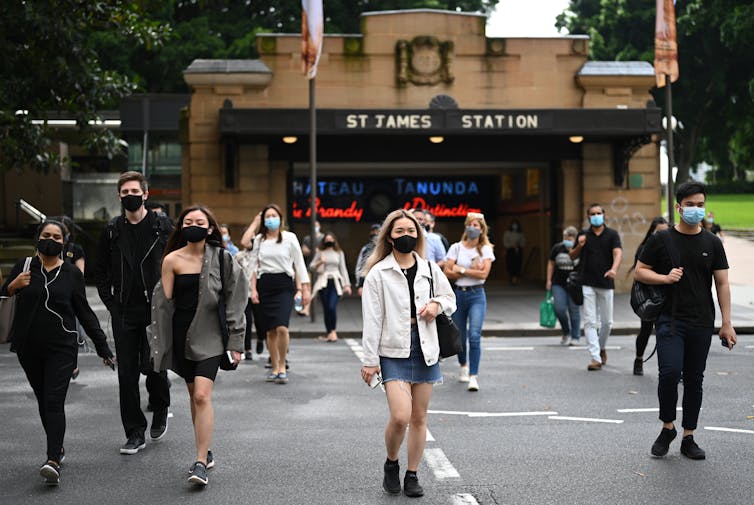
Mask mandates, such as the one recently ordered in NSW, will be here for some time to come.Dean Lewins/AAP Image
Importantly, however, both states used every one of the interventions mentioned above, and both aimed to reach COVID-zero with least disruption. Which was the better approach from a health and economic standpoint will require deeper analysis in due course.
Speaking personally, we favoured stricter and more widespread movement restrictions early on in the Sydney outbreak, because there were substantial unknowns (the source of the Avalon cluster), questions about more than one quarantine leak (there were), whether there was spread to Greater Sydney and beyond (which happened) and with Christmas and New Year approaching.
As it stands, the NSW approach is looking promising, but it is a myth to think this comes without major economic and social disruption. Despite the rhetoric, there is no easy way to COVID-zero, just a different mix of the same tools.
Why is all this important? Because although our exit strategy will be built around vaccines, the cold reality is that all the COVID controls we use now will be in place for the next nine to 12 months, and some will likely endure beyond that.
Australians will not be fully vaccinated until late in 2021, according the federal government’s timetable, although the government announced yesterday that vaccination will begin two weeks earlier. During that time, the threat of COVID coming into Australia from high-transmission countries will remain.
In fact, with the pandemic still growing, and what appear to be more highly transmissible strains becoming more prevalent, the threat of introduction is likely to increase. Once here, the threat of transmission is greater.
Given the nation is already exhausted, it is crucial we find ways to safeguard public health even more rigorously in 2021 than we did in 2020. We must find a way to reduce interstate rankles, but also to rapidly adopt new findings or tools as they come to light. We can’t be stuck in our ways.
Interstate cooperation, flexibility and open-minded public health responses are the key. Such flexibility, for example, might include a willingness to adopt a “go hard, go early” approach in one circumstance, but not in another.
Crucially, our decisions should be decided by circumstance, not ideology. Leaders need to be more receptive to discussion around vexed issues, especially aerosol transmission and what needs to be done about it. The change in stance on mandatory masks in NSW was a great example of what can be achieved with a can-do attitude.
We need pragmatic, constructive cooperation between jurisdictions. A common strategy for tight international border security and hotel quarantine is a must. Wouldn’t it have been great if NSW and Victoria had thrashed something out to each other’s satisfaction, preventing the New Year border chaos? It doesn’t reflect well on either that didn’t happen.
Australians have come to appreciate just how precious a COVID-free existence is. They will not, and should not, give it up lightly. If we are to maintain it, we have to be kinder and more cooperative. There is still a long road ahead.
2020 was a bumper year for solar power in Australia. More solar PV systems were installed in the first nine months than in all of any previous year.
Almost one in four Australian houses now have rooftop solar panels. But the number of solar panel incidents reported by fire and emergency services has increased too.
The exponential growth in solar PV and associated problems has attracted media and political attention.
In 2018, federal Energy Minister Angus Taylor warned his state counterparts lives were at risk from substandard solar panel installations. An audit of the Clean Energy Regulator by the Australian National Audit Office found there were potentially tens of thousands of badly installed and even unsafe rooftop systems. The regulator had inspected just 1.2% of rooftop installations.
It’s a nationwide problem
State and territory regulators are responsible for electrical safety. Only Victoria mandates an inspection of each installed system.
Last October, Fire and Rescue NSW Superintendent Graham Kingland said:
Over the last five years we have seen solar panel related fires increase five-fold. It is not uncommon to see solar panels cause house and building fires.
On Christmas day, ACT Fire & Rescue attended a fire at a home in Theodore where the solar panels caught alight. Coincidentally, the location was Christmas Street!
Last month, Energy Safe Victoria warned the public to get solar systems serviced.
9 News reports on the fire risks of poorly installed solar panel systems in Queensland.
Components such as DC isolators and inverters, rather than the actual panels, are the cause of most solar-related fires. A DC isolator is a manually operated switch next to a solar panel array that shuts off DC current between the array and the inverter. It was intended as an extra safety mechanism, but the switches have caused more problems than they have solved – particularly when not installed correctly or when poor-quality components are used.
Solar is cheaper in Australia but poorly regulated
A recent report rated Australia as one of the cheapest per kilowatt for solar PV, but it questioned our safety standards. Most solar systems sold in Australia use DC voltages that can pose a serious fire risk.
Unfortunately, Australia has been slow to adopt safer solar regulations. In contrast, the United States has had safety standards preventing the installation of conventional DC solar systems since as early as 2014.
It’s more difficult for lower-voltage, microinverter-based systems (requiring no DC isolator switch) to catch fire, but it’s not impossible.
An amendment to the DC isolator standard (AS/NZS 5033:2014) to improve product datasheets and ensure isolators can withstand the harsh Australian climate took effect on June 28 2019. By then, over 2 million systems had been installed on Australian rooftops.
Added to issues such as flammable cladding, dodgy electrical cable and other “grey imports” (products not sourced from approved manufacturers) in the building industry, we are now playing a game of catch-up.
Poor-quality solar rooftop components have led to an expanding list of product recalls. The latest Australian Competition and Consumer Commission (ACCC) recall list includes installations managed by industry giants such as Origin and AGL.
One notable recall in 2014 reported a risk of “arcing” and “eventual catastrophic failure, resulting in fire”. It listed no fewer than nine traders operating nationally as having used this failed product. The recall noted that the product supplier, Blueline Solar Pty Ltd, was insolvent.
What should consumers do? The ACCC said:
Owners should immediately shut down the PV system following the standard shutdown procedure.
If a consumer suspects they have one of the affected units, they should have an electrician inspect and replace the DC isolators.
Solar systems do not fall under the National Construction Code unless an ancillary structure is being created. Most systems are simply fixed with rails to an existing roof. If the code covered rooftop solar, this would require private certification and a compliance check on any system, as is the case overseas.
Research has shown consumers’ knowledge of solar systems is poor. Many owners have little idea if their system is working properly, or even at all.
And how would a consumer know what kind of DC isolator is on their roof or how to shut down the system in the event of a fire?
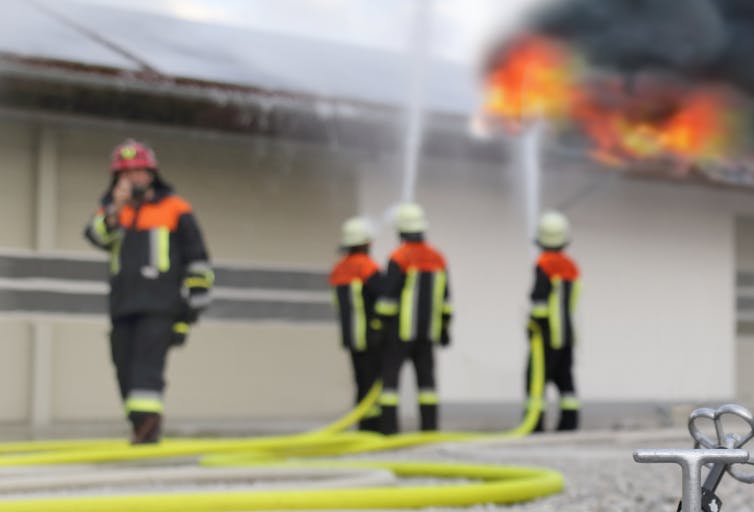
Solar panel systems are a growing incident category for firefighters. Yet even among firefighters there is some confusion on procedures to deal with a fire on live solar panels.
Even some firefighters aren’t clear about how to deal with fires on live solar panels.riopatuca/Shutterstock
Solar panel fires have yet to make it onto a top 10 list of domestic fire causes (statistically, your Christmas tree lights are a greater risk). But the sheer volume of installations and ageing components in uninspected older systems are increasing the risks.
One Aussie inventor has developed a product PVStop — “a spray-on solution to mitigate solar panel risks by reducing DC output to safe levels to offer homeowners and emergency personnel peace of mind”.
The latest update on Clean Energy Regulator inspections completed to June 30 2020 shows a negligible 0.05% decrease in substandard systems. Roughly one in 30 systems (3.1%) have been deemed unsafe and another 17.9% substandard.
Without adequate solar PV industry standards, tools, inspection regimes, procedures or training, dangerous scenarios may increasingly put lives at risk. The high uptake of solar is very good news for reducing household electricity bills and carbon emissions, but safety issues undermine these positives.
The surge in installations, the introduction of batteries, the ageing of panels and components together with more extreme weather events mean solar panel incidents are likely to continue increasing.
Australia prides itself on being a world leader in household solar but until now we have not fully appreciated the safety risks. Fire authorities would do well to update fire safety guides that omit specific information on solar. And system owners should ensure they understand the risks and shut-down procedures.
Like several classics penned during the golden age of children’s literature, The Wind in the Willows was written with a particular child in mind.
Alastair Grahame was four years old when his father Kenneth — then a secretary at the Bank of England — began inventing bedtime stories about the reckless ruffian, Mr Toad, and his long-suffering friends: Badger, Rat, and Mole.
The Wind in the Willows evolved from Alastair’s bedtime tales into a series of letters Grahame later sent his son while on holiday in Littlehampton. In the story, a quartet of anthropomorphised male animals wander freely in a pastoral land of leisure and pleasure — closely resembling the waterside haven of Cookham Dean where Grahame himself grew up.
In peaceful retreat from “The Wide World”, Rat, Mole, Badger, and Toad spend their days chatting, philosophising, pottering, and ruminating on the latest fashions and fads. But when the daredevil, Toad, takes up motoring, he becomes entranced by wild fantasies of the road. His concerned friends must intervene to restrain his whims, teaching him “to be a sensible toad”.
Kenneth Grahame, circa 1910.Wikimedia Commons
Unlike Toad’s recuperative ending, however, Alastair’s story did not end happily. In the spring of 1920, while a student at Oxford, he downed a glass of port before taking a late night stroll. The next morning, railway workers found his decapitated body on tracks near the university. An inquest determined his death a likely suicide but out of respect for his father, it was recorded as an accident.
Kenneth Grahame, by all accounts, never recovered from the loss of his only child. He became increasingly reclusive, eventually abandoning writing altogether.
In his will, he gifted the original manuscript of Willows to the Bodleian Library, along with the copyrights and all his royalties. Upon his death in 1932, he was buried in Oxford next to his first reader, Mouse.
Biographical readings are a staple in children’s literature, and the criticism surrounding The Wind in the Willows is no exception. First published in 1908 — the same year as Anne of Green Gables and Dorothy and the Wizard of Oz — the novel was initially titled The Mole and the Water-Rat. After back and forth correspondence with Grahame, his publisher Sir Algernon Methuen wrote to say he had settled on The Wind in the Willows because of its “charming and wet sound”.
Today, one of the mysteries surrounding the novel is the meaning of the title. The word “willows” does not appear anywhere in the book; the single form “willow” appears just twice.
When Willows was first released in Britain it was marketed as an allegory — “a fantastic and whimsical satire upon life”, featuring a cast of woodland and riverside creatures who were closer to an Edwardian gentlemen’s club than a crowd of animals. Indeed, the adventures structuring the novel are the meanderings of old English chaps nostalgic for another time.
The four friends, though different in disposition, are bound by their “divine discontent and longing”.
Restless enough to be easily bewitched, they are rich enough to fill their days with long picnics and strolls. Most chapters are sequenced in chronological order, but the action revolves around different types of wandering – pottering around the garden, messing about in boats, rambling along country lanes.
Messing about in boats: an image from a 1995 film version of the book.TVC London, Carlton UK Productions, HIT Entertainment
With the exception of a brief encounter with a jailer’s daughter, an overweight barge woman, and a careless mother hedgehog, there are no women in Willows. And excluding a pair of young hedgehogs and a group of field mice, all male, there are no children either.
Given the novel’s strong homosocial subtext and absence of female characters, the story is often read as an escapist fantasy from Grahame’s unhappy marriage to Elspeth Thomson. Peter Hunt, an eminent scholar of Willows, describes the couple’s relationship as “sexually arid” and suggests Grahame’s sudden resignation from the bank in 1908 was due to bullying on the basis of his sexuality.
A retouched illustration from a 1913 edition of the book.Wikimedia Commons
Indeed, Hunt ventures to call the book “a gay manifesto”, reading it as a gay allegory heavy with suppressed desire and latent homoeroticism. In one scene, for example, Mole and Rat “shake off their garments” and “tumble in-between the sheets in great joy and contentment”.
Earlier, while sharing a bed in the open air, Mole “reaches out from under his blanket, feels for the Rat’s paw in the darkness, and gives it a squeeze.” “I’ll do whatever you like, Ratty,” he whispers.
For this reason, and others, some critics suggest that Willows is not a children’s book at all, but a novel for adults that can be enjoyed by children.
Whether we read Willows as a simple animal story or a social satire, the narrative reinforces the status quo. Badger, for instance, resembles a gruff headmaster whose paternal concern for his friends extends to an earnest attempt to reform the inebriate Toad.
Toad is a recognisable type of schoolboy, charming and impulsive but wildly arrogant and lacking self-control. In the end, he is punished for his foolish behaviour and forced to forgo his flamboyant egotism in humble resignation at Toad Hall. Similarly, Mole and Ratty are afflicted by wanderlust, but inevitably retreat to their cosy, subterranean homes. All of Grahame’s animals return to their “proper” place.
Toad: charming and impulsive but wildly arrogant and lacking self-control.Cosgrove Hall Films, Thames Television
This return to civility and quiet domesticity exemplifies a criticism often levelled at children’s literature: that such stories are more about the fears and desires of adults than those of children. (Alice in Wonderland, for instance, emphasises the importance of curiosity and imagination, but is also an attempt to socialise children into responsible citizenship.)
Willows is a story about homecoming and friendship, but also a psychodrama about uncontrolled behaviour and addiction in Edwardian England.
Creatures of habit
Perhaps the most famous scene in Willows — now also a popular ride at Disneyland — is Mr Toad’s Wild Ride. In the novel, the incautious Toad, who is oddly large enough to drive a human-sized car, is frequently in trouble with the law and even imprisoned due to his addiction to joyriding.
At times delusional, the self-proclaimed “terror of the highway” writes off several vehicles before spiralling into a cycle of car theft, dangerous driving, and disorderly behaviour.
‘Messing Around in Cars’. Scene from the 1985 animated musical film version of The Wind in The Willows, directed by Arthur Rankin Jr and Jules Bass.
Eventually, Toad’s motorcar mania becomes so unmanageable that his exasperated friends are forced to stage “a mission of mercy” – a “work of rescue” that contemporary readers might recognise as an intervention. This subtext of addiction underpins the arc of recovery, and is crucial for understanding the novel’s key themes: the limits of friendship, the loss of pastoral security, and the temptations of city life.
Interestingly, in Badger’s attempt to help Toad break the cycle of withdrawal and recovery, and in Toad’s temporary abatement and relapse, the text points to another form of addiction: to alcohol.
A British postage stamp featuring the Willows gang.shutterstock
When Toad is banished to his country retreat — a typical “cure” for upper-class alcoholism at the time — Badger stresses he will remain in enforced confinement “until the poison has worked itself out of his system” and his “violent paroxysms” have passed.
In The Wind in the Willows, Grahame employs animals to render all the ups and downs of human experience. In doing so, he captures the conflict and consonance between freedom and captivity, tradition and modernity.
Whether it’s purchasing power parity or the Happiness Index, global comparisons require benchmarking. Sport does this well with World Cups and the Olympics, or better still the single ranking familiar to tennis and golf aficionados.
The problem with universities is there are around a dozen rankings. Each is a variable mix of research, reputation and teaching metrics, leading to quite different and confusing results.
University rankings certainly have their critics, who point to the potential to mislead students and distort research priorities. Our newly developed Aggregate Ranking of Top Universities (ARTU) overcomes the flaws of singling out performance in any one ranking.
This aggregated ranking helps to broaden the range of assessment — from research citations (frequency referred to in the academic literature) and impact, through to reputation, and qualitative as well as quantitative measures. It also helps address the inherent imperfections of any one of the individual ranking systems, when seen on their own.
The ARTU orders universities by cumulative performance over the mainstream scoring systems. Condensing the three most influential — the Quacquarelli Symonds (QS), Times Higher Education (THE) and Academic Ranking of World Universities (ARWU) — gives a single broad overview of a university’s position.
How does Australia fare?
Australia now has 13 universities in the global top 200. That’s an increase from just eight two years ago.
Australia ranks fourth in the world in 2020, after the US, UK and Germany. Indeed per head of population, Australia is well ahead of these nations, and second behind the Netherlands for nations of more than 10 million.
This is no new entrant fluke, as Australia has seven universities in the top 100. That’s 7% of the best universities for 0.3% of the world’s population (or 1.6% of global GDP). Two Australian institutions, Monash and UNSW, are among the five that jumped more than 20 places within the top 100 between 2012 and 2020.
Although rankings are compiled annually, performance is a lagging indicator assessed over severalyears. For instance, research citations can be judged between five to 11 years later.
On the one hand, this should help cushion our pandemic-affected universities from precipitous falls over the next few years. On the other, it conspires against rapid rises up the global ladder.
This makes the ascendancy of East Asian universities, and in particular those from China, all the more remarkable. The top two Chinese universities now come in at 18th and 27th internationally, ahead of Australia’s lead, the University of Melbourne at 29th. The next four Chinese universities have risen more than 100 spots since 2012 to crack the top 75. This is especially impressive given that research is largely judged on English-language outputs.
Australia has fared well in this battle of the old versus new order. Long-established universities benefit from major endowments, philanthropy and long-run reputation. Australia’s universities in the top 200 have an average age of 78, compared to over two centuries for overseas unis in top 200.
China has this disadvantage too. But China does have the benefit of a booming economy, which drives top-down investment in cutting-edge technologies and academic excellence through STEM (science, technology, engineering and maths) research at scale.
It can be argued that Australian universities thrived on the back of 28 years of growth, a desirable location, political stability and relatively open borders to knowledge-based entrants. But the standout contribution has been from international students. In absolute terms universities in Australia have the second-highest number after the US.
Australian universities host more international students than any other nation except for the USA.Huang He/AP/AAP
Simply put, the margin between international and domestic student income covers the indirect costs of strategic investment in research, teaching and other areas. Australian universities need to raise around an additional dollar in support and infrastructure spending for every dollar won in grant income. And all this while fulfilling the core mission of educating local students, with 43% of 25-to-34-year-olds now having a bachelor degree, up from 34% in 2010.
But coronavirus has laid bare the Achilles heel in this business model. Closed borders and geopolitical shifts have delivered a major blow to cross-subsidisation, as well as to the international collaboration so crucial for team-based research addressing the world’s grand challenges.
Vaccines now offer some light at the end of the tunnel, but it will be many years before the world resembles its former self, if ever. Trust in science and an R&D-led economy argue for a major role for universities in the recovery from COVID-19. But the only certainty is uncertainty.
So expect considerable volatility in higher education. How well our universities stack up will depend in part on how international competitors fare, and in particular their relative economies and resourcefulness. Australia looks well positioned here, but will need to weather the threats posed by contraction, domestic constraints and a challenging business model.
Rankings are not perfect. They do not assess all aspects of the mission of Australian universities and are rightly subject to criticism, often from institutions not doing so well. But rankings are the best surrogate measure of global standing that we have and they are here to stay, whether we like them or loathe them.
As the aggregate scoreboard for top universities around the globe, ARTU is well placed to track the shake-up from COVID-19 as it plays out in our universities over the next five to ten years.
For most of us, 2020 was an exhausting year. The COVID-19 pandemic heralded draining physical health concerns, social isolation, job dislocation, uncertainty about the future and related mental health issues.
Although some of us have enjoyed changes such as less commuting, for many the pandemic added extra punch to the main source of stress – engaging in or searching for work.
Here’s what theory and research tells us about how to feel more rested and alive in 2021.
Recovery activity v experience
Recovery is the process of reversing the adverse impacts of stress. Leading recovery researchers Sabine Sonnentag and Charlotte Fritz have highlighted the important distinction between recovery activities (what you do during leisure time) and recovery experiences (what you need to experience during and after those activities to truly recover).
Recovery activities can be passive (such as watching TV, lying on a beach, reading, internet browsing or listening to music) or active (walking, running, playing sport, dancing, swimming, hobbies, spiritual practice, developing a skill, creating something, learning a language and so on).
How well these activities reduce your stress depends on the extent to which they provide you with five types of recovery experiences:
psychological detachment: fully disconnecting during non-work time from work-related tasks or even thinking about work issues
relaxation: being free of tension and anxiety
mastery: challenging situations that provide a sense of progress and achievement (such as being in learning mode to develop a new skill)
control: deciding yourself about what to do and when and how to do it
enjoyment: the state or process of deriving pleasure from seeing, hearing or doing something.
Of these, psychological detachment is the most potent, according to a 2017 meta-analysis of 54 psychological studies involving more than 26,000 participants.
Here are five tips, drawn from the research, to feel more rested and alive.
1. Follow the evidence
There are mixed findings regarding the recovery value of passive, low-effort activities such as watching TV or reading a novel.
More promising are social activities, avoiding work-related smartphone use after work, as well as engaging in “receptive” leisure activities (such as attending a concert, game or cultural event) and “creative” leisure activities (designing and making something or expressing yourself in a creative way).
Spending time in “green” environments (parks, bushland, hills) is restorative, particularly when these are natural rather than urban settings. “Blue” environments (the coast, rivers, lakes) are also highly restorative.
Time spent in natural green spaces is more restorative than in urban settings.Shutterstock
Your boundary management style is the extent to which you integrate or separate your work and life beyond work. Work-life researcher Ellen Kossek has created a survey (it takes about five minutes) to help assess your style and provide suggestions for improvement.
The following table developed by Kossek shows physical, mental and social strategies to manage boundaries and separate your work and life beyond work.
Many of us define ourselves in terms of our profession (“I’m an engineer”), employer (“I work at …”) and perhaps our performance (“I’m a top performer”).
We may also have many other identities related to, for instance, (“I’m a parent”), religion (“I’m a Catholic”), interests (“I’m a guitarist”), activities (“I’m a jogger”) or learning aspirations (“I’m learning Portuguese”).
First, reorganise your physical space to reduce visual reminders of your work-related identities (e.g. your laptop, professional books, performance awards) and replace them with reminders of your other identities.
Second, do some “identity work” and “identity play”, reflecting on the identities you cherish and experimenting with potential new identities.
Document what you do when not working. Ask yourself how much these activities enable you to truly experience psychological detachment, relaxation, mastery, control and enjoyment.
Passive leisure activities are less likely to provide the five key recovery experiences of psychological detachment, relaxation, mastery, control and enjoyment.Shutterstock
You will make it easier to give up activities with minimal recovery value if you supplant them with more rejuvenating alternatives you enjoy.
Habits are behaviours we automatically repeat in certain situations. Often we fail to develop better habits by being too ambitious. The “tiny habits” approach suggests thinking smaller, with “ABC recipes” that identify:
anchor moments, when you will enact your intended behaviour
behaviours you will undertake during those moments
celebration to create a positive feeling that helps this behaviour become a habit.
Examples of applying this approach are:
After I eat lunch, I will walk for at least ten minutes (ideally somewhere green). I will celebrate by enjoying what I see along the way.
After I finish work, I will engage in 30 minutes of exercise before dinner. I will celebrate by raising my arms in a V shape and saying “Victory!”
After 8.30pm I will not look at email or think about work. I will celebrate by reminding myself I deserve to switch off.
Perhaps the most essential ingredient for building better recovery habits is to steer away from feeling burdened by ideas about what you “should” do to recover. Enjoy the process of experimenting with different recovery activities that, given all your work and life commitments, seem most promising, viable and fun.
Bitcoin continues to trade close to its all-time high reached this month. Its price is now around US $34,000 — up about 77% over the past month and 305% over the past year.
First launched in 2009 as a digital currency, Bitcoin was for a while used as digital money on the fringes of the economy.
It has since become mainstream. Today, it’s used almost exclusively as a kind of “digital gold”. That is to say, a scarce digital asset.
In response to the risk of economic collapse due to COVID, governments around the world have flooded global markets with money created by central banks, in order to boost spending and help save the economy.
But increasing the supply of money erodes its value and leads people to look for inflation-resistant assets to hold. In this climate, Bitcoin has become a hedge against looming inflation and poor returns on other types of assets.
What is Bitcoin?
Bitcoin, the world’s largest cryptocurrency by market capitalisation, has a current circulating supply of 18,590,300 bitcoins and a maximum supply of 21,000,000.
This limit is hard-coded into the Bitcoin protocol and can’t be changed. It creates artificial scarcity, which ensures the digital money increases in value over time.
Whereas government-issued currencies such as the Australian dollar can have their supply increased at will by central banks, Bitcoin has a fixed supply that can’t be inflated by political decisions.
Bitcoin is predominantly traded on online cryptocurrency exchanges, but can also be sent, received and stored in “digital wallets” on specific hardware or smartphone applications.
But perhaps the most groundbreaking aspect of the Bitcoin network is that it draws on the work of cryptographers and computer scientists to exist as a blockchain-based digital currency.
A public blockchain is an “immutable” database, which means the record of transaction history can’t be changed.
A functional and decentralised digital currency
Bitcoin is “decentralised”. In other words, it functions via a dispersed peer-to-peer network, rather than through a central authority such as a central bank.
And it does this through the participation of Bitcoin “miners”. This is anyone who chooses to run software to validate Bitcoin transactions on the blockchain. Typically, these people are actively engaged with cryptocurrency.
They are rewarded with bitcoins, more of which are created every ten minutes. But the reward paid to miners halves every four years.
This gradual reduction was encoded into the network by creator Satoshi Nakamoto, who designed it this way to mimic the process of extracting actual gold — easier at first, but harder with time.
While several have laid claim to it, the true identity of Bitcoin creator Satoshi Nakamoto (a psuedonym) has never been confirmed. His last written post on the forum bitcointalk.org was on December 12, 2010.Shutterstock
Bitocoin miners today earn 6.25 bitcoins for every block mined, down from 50 bitcoins in the early years. This creates an incentive to get involved early, as scarcity increases with time.
Because of this, the price is expected to rise to meet demand. But because future scarcity is known in advance (predictable at four-year intervals), the halving events tend to already be priced in.
Therefore, massive surges and falls in price typically reflect changing demand conditions, such as a growing number of new institutional investors. More and more public companies are now investing in bitcoin.
But what function does Bitcoin provide for society that has people so invested?
There are a few possible explanations as to why Bitcoin is now deemed significant by so many people.
It’s a “safe” asset
In the face of global uncertainty, buying bitcoins is a way for people to diversify their assets. Its market value can be compared to that of another go-to asset that shines in times of trouble: gold.
Amid the turmoil of a global pandemic, an unconventional US presidential handover and geopolitical power shifts the world over, it’s possible more people view gold and Bitcoin as better alternatives to dollars.
It ties into privacy-oriented ideologies
Bitcoin (and cryptocurrency in general) is not politically and ideologically neutral. It was born of the internet era, one plagued with grave concerns for privacy.
Bitcoin’s intellectual and ideological origins are in the “cypherpunk” movement of the 1990s and early 2000s.
Records of online forums show it was advocated for as an anonymous digital currency that allowed people to interact online without being tracked by governments or corporations, offering an alternative for anyone who distrusts the Federal central banking system.
Perhaps the overt rise of digital surveillance in response to the COVID pandemic has further stoked fears about online privacy and security — again piquing the public’s interest in Bitcoin’s potential.
Why is Bitcoin booming?
Bitcoin’s recent boom in value comes down to a combination of three factors: ideology, social sentiment and hope.
But although these are variable factors, this doesn’t discredit the significance of the digital economy, interest in the technology as it matures and the influence of institutional investors in cryptocurrency, including Bitcoin.
Bitcoin is in an upward market trend, also known as “bull market” territory.
It was designed to increase in value over time through the rules Nakamoto wrote into its software code — which Bitcoin’s most outspoken advocates, known as “maximalists”, vehemently defend.
A ‘bull market’ occurs when securities are on the rise, whereas a ‘bear market’ is when securities fall for a sustained period. Both terms are metaphors; a bull thrusts its horns into the air and a bear swipes its paws down.Shutterstock
Imagining new futures
From a larger frame of reference, decentralised cryptocurrencies allow new ways to coordinate without the need for a central arbiter.
And decentralised blockchain-based networks don’t just enable digital money. Similar to ordinary smartphone apps, software developers around the world are building decentralised applications (DApps) on top of Bitcoin and other blockchain protocols.
They have introduced other cryptocurrencies, such as Ethereum, which are also open platforms for the public.
Other DApps include decentralised financial (DeFi) tools for prediction markets, cryptocurrency borrowing and lending, investing and crowd-funding.
Nakamoto’s audacious experiment in digital currency is working as intended. And what really deserves attention now is what this means for our digital, physical and social futures.
This week, the US Congress will put the finishing touches to the chaotic, protracted 2020 US presidential election.
A joint session of the House and Senate will assemble at 1pm on January 6 (5am AEDT/7am NZDT on January 7) as the votes cast by the 538-member Electoral College following the November election are opened, counted and certified. The president of the Senate (who also happens to be Vice President Mike Pence) will then finally declare the winner.
Usually, this process generates very little public attention because it is essentially just a formal ratification of an outcome the American public has known for almost two months.
Biden’s victory in the November election will be challenged yet again.Patrick Semansky/AP
But this year will be different because a small group of President Donald Trump’s surrogates in the House and Senate have indicated they will challenge the certification and votes of the electors in what will be a futile attempt to delay the announcement of Democrat Joe Biden’s victory.
Congress should immediately appoint an Electoral Commission, with full investigatory and fact-finding authority, to conduct an emergency 10-day audit of the election returns in the disputed states.
Once completed, individual states would evaluate the commission’s findings and could convene a special legislative session to certify a change in their vote, if needed.
The move by this small group of Republican lawmakers is almost sure to fail since the Democratic majority in the House will reject the challenges, and a fair number of Republicans have said they would vote against them, too.
At most, this last-ditch attempt to overturn the election result, based on Trump’s baseless claims of voter fraud, will only delay the inevitable. This could take anywhere from a few hours to a day or so, depending on how many separate challenges are made.
This is how the drama will unfold. When Pence announces the electoral vote tally from each state, he will call for any objections. According to federal law, the objection must be made in writing and
shall state clearly and concisely, and without argument, the ground thereof, and shall be signed by at least one senator and one member of the House of Representatives.
When an objection is announced, the two houses of Congress will retire immediately and, in separate sessions, debate the objection for a maximum of two hours with no member speaking for more than five minutes or more than once. A vote on the objection is then taken.
Under the law, Congress can only reject electoral votes that have not been “regularly given”, but both the House and Senate must agree to do so. Congress doesn’t have the power to replace a state’s electors.
The challenges are expected to come against Biden victories in as many as five so-called “battleground” states: Arizona, Georgia, Michigan, Pennsylvania and Wisconsin.
The Republican rebels leading the charge against the election result know the numbers are not in their favour. As the senators note in their statement,
We are not naïve. We fully expect most if not all Democrats, and perhaps more than a few Republicans, to vote otherwise.
And despite Trump’s tweet declaring the “vice president has the power to reject fraudulently chosen electors”, the reality is, Pence doesn’t. A federal judge rejected a lawsuit last week seeking to pressure Pence to do just that.
Trump said of Pence this week: ‘I hope [he] comes through for us’.Scott Applewhite/POOL/EPA
The damage that has been done
The motivations behind the Republican challengers are not entirely clear, though some believe they are thinking only of their own political futures, including a potential run for the 2024 presidential nomination.
However, what is clear is this will be the final legal attempt to undermine the integrity of the 2020 election — since there is still no substantial evidence of fraud, corruption, rigged voting machines or any other misconduct that Trump and his surrogates have alleged.
It may take some time, but the 306 electoral votes won by Biden on election day will eventually be deemed to be “regular” — to use the official term. And Biden and Vice President-elect Kamala Harris will be sworn into office at noon on January 20, regardless of whether Trump continues to object.
But the cost of these actions will be immense. The cumulative effect of over 50 misguided court cases at the state and federal level, the failed attempts to persuade Republican-controlled state legislatures to overturn their states’ electoral votes, and the latest effort to pressure the secretary of state of Georgia to conjure up 11,780 more votes for Trump, have damaged the electoral process and American democracy itself.
Trump supporters are protesting the Electoral College vote count in Congress this week.Michael Reynolds/EPA
Moreover, the willingness of Republican lawmakers in Congress to continue to back Trump’s ineffectual efforts to overturn the results of an election — without any evidence of wrongdoing or hopes of succeeding — only compounds the damage further.
It is, as Republican Senator Ben Sasse said in opposing the electoral vote challenge by his own colleagues,
designed to disenfranchise millions of Americans simply because they voted for someone in a different party.
Source: Council on Hemispheric Affairs – Analysis-Reportage
By Frederick B. Mills, Alina Duarte, Patricio Zamorano From Washington DC
On Monday January 4 a British court denied a U.S. request to extradite world renowned journalist and Wikileaks founder, Julian Assange, to face charges in the U.S. under the Espionage Act. Shortly after this breaking news, President of Mexico, Andrés Manuel López Obrador (AMLO), urged the U.K. to consider the possibility of freeing Assange and announced that Mexico “offers political asylum” to the activist.
This bold announcement by López Obrador draws a stark contrast to the revocation of asylum by the President of Ecuador, Lenin Moreno, who turned Assange over to British authorities in April 2019 after the journalist had spent seven years inside the Ecuadorian embassy in London. To provide political cover for this controversial act, part of the mainstream press deployed character assassination, painting an image of an erratic Assange, ungrateful for Ecuadorian hospitality. Numerous human rights and civil liberty organizations, however, denounced the decision of the Moreno administration to violate Assange’s diplomatic protection and allow the police to penetrate the Embassy building and arrest the journalist. The sudden reversal of Ecuador’s provision of asylum and protection was consistent, however, with Moreno’s dramatic pivot to the right after he was elected on a leftist platform. It was viewed by his critics as an act of subordination of Ecuador’s foreign policy to the imperatives of Washington.
The struggle to free Assange is far from over. Since Judge Vanessa Baraitser employed the humanitarian argument that extradition to the U.S. could lead Assange to attempt suicide, instead of using the substantive arguments advanced by Assange’s legal team, the door remains wide open to a United States appeal which could drag out litigation for months or even years. Assange’s lawyers argued that he was acting as a journalist when he published leaked documents about U.S. military operations in Afghanistan and Iraq, and that these disclosures are protected by the First Amendment.
The international campaign to free Assange anticipates a continuing legal fight. Many of Assange’s supporters are petitioning President Donald Trump to pardon him, and failing that, will urge the incoming Biden administration not to pursue an appeal of the U.K.’s denial of extradition.
A history of protection of the persecuted
The Mexican gesture came as a surprise to many observers, but it was not out of character, as Mexico has a proud tradition of granting or offering asylum or protection to the persecuted including Víctor Raúl Haya de la Torre, José Martí, Leon Trotsky, Pablo Neruda, León Felipe, Héctor José Campora, Mohammad Reza Palhevi (the Shah of Iran), Rigoberta Menchú, Enrique Dussel, and most recently former president of Bolivia Evo Morales.
By offering asylum to Evo Morales after an Organization of American States (OAS) backed coup in November 2019, López Obrador placed Mexico on the side of popular sovereignty in the Americas against the Lima Group’s complicity with the drive to bring about regime change in Nicaragua, Venezuela, and Cuba, in addition to Bolivia. And by offering Assange asylum López Obrador adds political clout to the growing international outrage at the detention and psychological torture of Assange. AMLO has also put Mexico on the world stage and has conferred legitimacy on the actions of Assange and Wikileaks, that revealed to the world numerous illegal activities perpetrated by the U.S., including war crimes, clandestine operations and meddling in the internal political affairs of dozens of countries, foes and allies alike. Offering asylum to Assange shows respect, from the heart of the Americas, for human rights, international law, sovereign equality of nations, political independence, and multilateralism.
AMLO and his political project, also named in Wikileaks
Although López Obrador formalized his offer of political asylum at the beginning of 2021, he had already expressed his sympathy and support for the journalist as early as January 2020: “I wish that he be forgiven and released. I do not know if he has recognized that he acted against the rules and against a political system, but at the time these cables showed how the world system works in its authoritarian nature, they are like state secrets that were known thanks to this investigation and to the release of these cables. Hopefully he will receive the consideration he deserves and be freed and tortured no more.”[1]
The Mexican president also revealed how the cables released by Wikileaks covered the work of his political movement. “Here are cables that were released when we were in the opposition that spoke of our struggle and I can prove that they are true.” He added that “what is expressed here, reflects the reality at that time, of illegal relationships, of illegal actions, illegitimate violations of sovereignty, contrary to democracy, to freedoms.” That is why, López Obrador pointed out, “I express my solidarity, my wish that he be forgiven” because “if he offers an apology and he is released, it will be a very just cause in favor of the human rights of the world. It is an act of humility from the authority that has to decide on the freedom of this researcher.”[2]
Safety of journalists still a challenge in Mexico
The announcement made by López Obrador regarding journalist Julian Assange unleashed a series of reactions regarding freedom of expression and contradictory policies of the current Mexican administration.
On one hand the president has indicated that his administration backs freedom of the press: “out of conviction, we never, ever, would limit freedom of expression. None of the freedoms.” He also said that “it fills me with pride that freedom of expression is guaranteed. This hadn’t happened in a long time. The media, the press, were either sold or rented to the regime. This is new, something to celebrate.”[3]
However, the opposition, human rights advocates and concerned journalists highlight that there is still a pending debt with reporters in Mexico, because during the first two years of AMLO as president, 17 journalists have been assassinated according to the organization Article 19[4]. The Mexican government recognizes even a higher number: the Ministry of the Interior has announced that 38 communicators have been murdered from December 2018 to December 2020[5]. This indicates that there are high levels of impunity in this type of crime, since currently only two cases have resulted in convictions, 23 cases remain under investigation, and 13 are in litigation. It should be noted that the violence against journalists didn’t begin with AMLO’s administration. During the term of Enrique Peña Nieto, 47 journalists were assassinated, while under Felipe Calderón, 48, making Mexico one of the most dangerous countries to practice journalism.[6]
Mexico’s offer of asylum to Julian Assange bolsters the cause of Latin American independence by countering the subordination of the OAS, and in particular the Lima Group, to U.S. foriegn policy and exposing the underside of Washington’s interference in the internal affairs of other nations. It also promotes the values of humanitarian protection against political persecution from Latin America to the planetary stage. It advances the case of those advocating more transparency and the right to information from their governments at a time when there is mass surveillance of citizens. López Obrador recognizes that democracy can only flourish when governments are accountable to an informed citizenry. He has done us all a service.
All translations into English from Spanish language sources are by the authors.
For the majority of Papua New Guineans living in the capital of Port Moresby, providing a home for their families is only a dream as housing has become a luxury that only the rich can afford.
Many families are forced to rent out single rooms for between K500 (NZ$200) to K800 (NZ$315) with common shared facilities like bathrooms, toilets and kitchens. Others move to the many settlements scattered around the city where houses can be rented for up to K1500 (NZ$600) fortnightly.
But it wasn’t always like this.
I was born and raised in Port Moresby and back in the 1990s when I was young, we used to live at Henao Drive in Gordons in a two bedroom, two storey house with a bathroom upstairs, a large dining room and living room downstairs.
The backyard was huge. We had a small duck pond and a BBQ place with a basketball court in the back. How did much my father pay fortnightly? Less than K300 ($NZ$118).
Houses, at that time, were being sold for between K10,000 (NZ$4000) and K20,000 (NZ$8000) at the new Rainbow suburb in Port Moresby’s North-East electorate.
Fast forward to the year 2000 and boom! The housing and rental rates in the city hit the roof….No. It went straight for the heavens.
We can only dream I mean seriously … back in the 1990s we had homes. Today, we can only dream of one day providing a home for our children. It’s a sad reality for thousands in the city where most families can only afford to rent a room.
While many have cried for housing and rental rates to be regulated, the National Capital District Commission (NCDC) and the National Housing Corporation still do not have the powers to do so. Unless laws are passed on the floor of Parliament giving them the powers to do so.
Nothing has been done to address the issue. It makes one wonder if it is it because the people in authority who have the power to make decisions are also property owners. Property owners who make thousands out of the ridiculously high rental rates?
Houses on the rental market are priced at K1200 (NZ$470) to K3000 ($1180) weekly not fortnightly … WEEKLY! Looking at these prices you know right away that the majority of Papua New Guineans who are middle to low income earners won’t be able to afford this.
So, who do these real estate companies and property owners have in mind when they place ads for these prices? Expatriates? CEOs, managers and MPs?
What about the people, the people of this country?
Even the BSP First Home Ownership Scheme did not work out.
A scheme for the wealthy How can a low to middle income earner afford the 10 percent needed to get that loan to purchase a home?
Again, it was almost as if the scheme was done to benefit only the wealthy.
Property developers have built many houses over the years to complement the First Home Ownership Scheme. But with houses going for K350,000 (NZ$137,000) to K500,000 (NZ$196,000) and the bank requiring a 10 percent down payment…. where are the people supposed to get the K35,000 to K50,000?
It’s high time the issue is addressed. The current government promised to “take back PNG” and they must do that by ensuring that their people’s welfare is taken care of. The housing issue must be addressed.
Laws and policies on real estate and housing must be reviewed, amended, changed to favor of the people.
There are so many aspects to the issue and many studies has been done by various organisations including the National Research Institute, over the years. Yet none of the recommendations have ever been implemented.
So, as the rich continue to live in their glass castles the people continue to suffer – living out of rooms, trying to earn a living and supporting their families.
Rebecca Kuku is an occasional contributor to Asia Pacific Report, a content contributor to The Guardian (Australia) and to the PNG Post-Courier. This article was first published on Scott Waide’s My Land, My Country blog and is republished with permission.
If you live in the northern part of Sydney’s Northern Beaches, the epicentre of one of two current COVID outbreaks in New South Wales, you can’t currently cross any state borders. Instead, you’re confined to the local area for all but essential reasons.
But sadly, that’s pretty much where the consistency ends when it comes to Australia’s COVID-related border closures. Everyone else faces a confusing and inconsistent mishmash of hastily implemented travel restrictions, some of which may even make COVID cases harder to track between states.
Summarising such a complex situation is hard to do concisely, but here goes.
If you were in Greater Sydney (which typically includes Wollongong, the Central Coast and the Blue Mountains) any time on or after December 21, you cannot enter the ACT, South Australia, Western Australia or Victoria. You are also banned from Queensland, but only if you were in the Greater Sydney hotspot during the previous 14 days.
Tasmania, meanwhile, rates Sydney and Wollongong only as “medium risk”, so people who have visited these areas can enter the island state but must quarantine for 14 days. Tasmania has no restrictions on arrivals from the Central Coast or Blue Mountains.
Victorians can still travel to NSW, the ACT, the Northern Territory, SA and Queensland, but not WA.
Queensland has asked everyone who has recently been in Victoria to get tested, and barred them from visiting health facilities and aged-care or disability homes.
Tasmania allows anyone in from Victoria unless they have visited particular high-risk venues (although when I checked, Victoria’s own list of “close contact” exposure sites was more up-to-date).
Why is it all so confusing?
Clearly, the inconsistency is partly explained by different states’ varying tolerance of COVID risk. But are hard border closures really warranted at all?
All NSW cases, and the vast majority of exposure sites, have been confined to Greater Sydney and surrounding areas, which fulfil the Commonwealth definition of COVID hotspots: a rolling three-day average of ten locally acquired cases per day, or 30 cases in three consecutive days.
Instead of hard border closures, a more sophisticated approach would be to focus travel restrictions on these known hotspots, and be prepared to mobilise contact-tracing efforts if a case travels before they are identified.
Of course, state governments may still be tempted to close borders if cases are reported that are not linked to existing clusters, as this raises the possibility of wider undetected community transmission.
Yet it appears from NSW media releases that more than 90% of cases in Sydney’s outbreak were linked to known clusters at the time of report, and this percentage only rises with subsequent contact tracing and investigation.
Ironically, the locked-down residents of Sydney’s Northern Beaches are the only Australians with clear and consistent travel restrictions.Dan Himbrechts/AAP
In Victoria, all 27 locally acquired cases have been directly linked to one cluster, but there are also many exposure sites. As in NSW, measures have been appropriately reintroduced to reduce transmission risk, and therefore the number of potential secondary cases, through limits on gatherings, venues and mandated masks indoors. This buys precious time for health authorities to suppress these clusters, and reduces the likelihood that transmission chains will be missed.
Border closures are a blunt tool
Restricting movement in and out of designated hotspot areas is clearly a good tactic to contain clusters. But the wholesale closure of state borders does not seem proportionate to the current risk. What’s more, sudden border closures could even be counterproductive.
Consider, for example, an interstate traveller who has visited the Sydney hotspot and is now prevented from leaving NSW because the border is closed. They may instead find themselves stuck in regional NSW, rather than being able to go home where self-isolation would be easier.
Allowing the progressive return of travellers or visitors across borders would have allowed thorough scrutiny of permits, and possibly even testing, at the border. Instead, Victoria’s sudden closure of the border with NSW resulted in 62,000 people crowding the checkpoints during a chaotic day and a half until midnight on January 1. This may even have allowed people who had recently been in hotspots to pass through, as permits were not always checked.
Time to work together
No matter how firm our international border closure, we have to be ready to respond to domestic COVID outbreaks, and work collaboratively across states to manage them. Open borders do not necessarily mean more cases, but they can mean more dispersed cases, so every state has to be ready to step up.
A rigorous, nationally coordinated network of contact tracing and quarantine is surely preferable to border closures and the social and economic disruptions that follow.
If Victoria had tested at the border with NSW, maybe they would have detected “case zero” who brought the virus back into Melbourne. Not one of the thousands of returned travellers from NSW since has tested positive, yet demanding that those who returned at New Year be tested within 24 hours flooded testing sites, delaying or preventing Victorians who had actually been at local exposure sites from being tested.
In the worst-case scenario, border closures can conceivably inflame the situation within the state that’s trying to raise the drawbridge.
Environmental scientists see flora, fauna and phenomena the rest of us rarely do. In this series, we’ve invited them to share their unique photos from the field.
Which animals are quintessentially Australian? Koalas and kangaroos, emus, tiger snakes and green tree frogs, echidnas and eastern rosellas, perhaps. And let’s not forget common wombats.
Inevitably, most lists will be biased to the more conspicuous mammals and birds, hold fewer reptiles and frogs, and likely lack invertebrates — animals without a backbone or bony skeleton — altogether.
I’m an invertophile, fascinated by our rich terrestrial invertebrate fauna, so my list will be different. I’m enchanted by stunning dragon springtails, by cryptic little Tasmanitachoides beetles, and by the poorly known allothyrid mites, among thousands of others.
Australia’s terrestrial invertebrate multitude contains several hundred thousand uniquely Australian organisms. Most remain poorly known.
To preserve our biodiversity, we first must ask: “which species live where?”. For our invertebrates, we are a long way from knowing even this.
The Black Summer toll
Last year, a team of scientists estimated that the Australian 2019-2020 bushfires killed, injured or displaced three billion animals. That was a lot. But it was also a woefully inadequate estimate, because it only accounted for mammals, reptiles, birds and frogs.
Hidden from view, many trillions more invertebrates burned or were displaced by the fires. And yes, invertebrates are animals too.
A mite from the family Bdellidae (on the right) has captured a springtail, and is using its piercing mouthparts to suck it dry. Mites and springtails are among the most abundant animals on the planet.Nick Porch, Author provided
Admittedly, it’s hard to come to terms with invertebrates because they’re often hard to find and difficult to identify. Most species are inconspicuous, even if they belong to incredibly abundant groups, such as mites and springtails, which can occur in numbers exceeding 10,000 per square metre.
Most invertebrates are poorly known because there are so many species and so few people working on them. In fact, it’s likely only a quarter to one-third of Australia’s terrestrial invertebrate fauna is formally described (have a recognised scientific name).
Meredithina dandenongensis, a species from the wet forests of Victoria. It can be found during the day under rotting logs. The land snail family Charopidae contains hundreds of species across wetter parts of southern and eastern Australia.Nick Porch, Author provided
One of the problems invertebrates have, in terms of attracting attention, is that many are not easily seen with the naked eye.
Macrophotography can magnify these wonders for a view into a world most of us are completely unfamiliar with. Even then, it often will be hard to know what we see. Everyone will recognise a kangaroo, but who can identify an allothyrid mite?
The photo below shows an undescribed species of mite from the family Allothyridae, from Mount Donna Buang in Victoria. The mite family Allothyridae has three described Australian species, and dozens more awaiting description.
An undescribed Allothyridae species. Just one of the many species in this group waiting to be studied.Nick Porch, Author provided
This collage shows a selection of mites found in the forests of southeastern Australia. It’s likely many of the species shown here are unknown to science.
Mites are a very ancient and diverse group. They can be found abundantly in most terrestrial habitats but are rarely seen because most are several millimetres long or smaller.Nick Porch, Author provided
A deeply ancient lineage
Animal ecologists, most of whom work on vertebrates, often joke that I “study the ‘food’, haha…”. They think they’re funny, but this reflects a deep seated bias — one extending from scientists to the wider public. This limits the development of a comprehensive understanding of biodiversity that has flow-on effects for conservation more broadly.
It’s true: invertebrates are food for larger animals. But their vital role in maintaining Australia’s ecosystems doesn’t end there.
Every species has an evolutionary history, a particular habitat, a set of behaviours reflecting that history, and a role to play in the ecosystem. And many terrestrial invertebrates belong to especially ancient lineages that record the deep history of Australia’s past.
The moss bug family Peloridiidae, for example, dates back more than 150 million years. For context, the kangaroo family (Macropodidae) is likely 15-25 million years old.
Their history is reflected in the breakup of the ancient supercontinent, Gondwana. In fact, Australian species of moss bugs are more closely related to South American species than to those from nearby New Zealand.
Chasoke belongs to the beetle family Staphylinidae, which is currently considered the largest family of organisms on Earth, with more than 60,000 scientifically described species. Mt. Donna Buang, Victoria.Nick Porch, Author provided
This is a common pattern in terrestrial invertebrate groups. It reflects how the New Zealand plate separated from the remainder of Gondwana about 80 million years ago, while the Australian plate remained connected to South America via Antarctica.
Similar stories can be told from across the invertebrate spectrum. The photo below shows a few examples of these relics from Gondwana.
Peloridiid bugs — such as Hemiodoecus leai China, 1924 (top left) — are restricted to the wettest forests where they feed on moss. Top right: A new species of Acropsopilio (Acropsopilionidae) harvestman from the Dandenong Ranges. Bottom left: a new velvet worm from the Otway Ranges. Bottom right: Tasmanitachoides hobarti from Lake St Clair in central Tasmania.Nick Porch, Author provided
Their fascinating evolution
Overprinting this deep history are the changes that occurred in Australia, especially the drying of the continent since the middle Miocene, about 12-16 million years ago.
This continent-wide drying fragmented wet forests that covered much of the continent, resulting in the restriction of many invertebrate groups to pockets of wetter habitat, especially along the Great Dividing Range and in southwestern Australia.
A consequence of this was the evolution in isolation of many “short-range endemic” species.
A short-range endemic species means their geographic distribution is less than 10,000 square kilometres. A short-range endemic mammal you might be familiar with is Leadbeater’s possum, restricted to the wet forests of the Victorian Central Highlands.
This is Idolothrips spectrum, the largest thrips in the world. It’s called the giant thrips, even though it’s less than 10mm long. Dandenong Ranges, Victoria.Nick Porch, Author provided
But short-range endemism is much more common in invertebrates than other organisms. This is because many invertebrates are poor dispersers: they don’t move between habitat patches easily. They may also maintain viable populations in small areas of suitable habitat, and are frequently adapted to very specific habitats.
Take Tropidotrechus, pictured below, a genus of beetles mostly restricted to the same region as Leadbeater’s possum. They, however, divide the landscape at a much finer scale because they’re restricted to deep leaf litter in cool, wet, forest gullies.
As Australia dried, populations of Tropidotrechus became isolated in small patches of upland habitat, evolving into at least seven species across the ranges to the east of Melbourne.
Tropidotrechus victoriae, Victoria’s unofficial beetle emblem (left). Related described and undescribed species are found in the nearby Central Highlands and South Gippsland ranges (right)Nick Porch, Author provided
Discoveries waiting to happen
The trouble with knowing so little about Australia’s extraordinary number of tiny, often locally unique invertebrates, is that we then massively underestimate how many of them are under threat, or have been badly hit by events like the 2019-2020 fires.
If we wish to conserve biodiversity widely, rather than only the larger charismatic wildlife, then enhancing our knowledge of our short-range species should be a high priority.
You don’t necessarily need specialist equipment to take pictures of our fascinating invertebrates. This is a phone picture of mating Repsimus scarab beetles (relatives to the Christmas beetles). It was taken at Bemboka in NSW, which burnt during the 2019-2020 fires.Nick Porch, Author provided
We’ve only just scratched the surface of Australia’s wonderful invertebrate fauna, so there are enough discoveries for everyone.
You can join iNaturalist, a citizen science initiative that lets you upload images and identify your discoveries. Perhaps you’ll discover something new — and a scientist just might name it after you.
Road-user charges on electric vehicles based on distance driven were announced in November 2020 by the governments of South Australia and Victoria, while New South Wales ministers have differing views. These charges are justified on several grounds, including the costs of road use and congestion.
Criticsargue the new charges will deter uptake of these more environmentally-friendly vehicles. But Australian governments could learn from examples overseas, including New Zealand, where incentives for buyers of electric vehicles more than offset the impacts of road user charges.
One reason for introducing a distance-based charge for electric vehicles is that owners of petrol cars pay fuel excise, currently 42.3 cents per litre. With average fuel use of about 10.8 litres per 100km for Australian cars, drivers pay excise of about 4.6 cents per kilometre for road use. This is much higher than Victoria’s proposed distance charge of 2.5 cents per kilometre for electric vehicles.
The average passenger car in Australia was driven about 11,100km in the year to June 2020 (the pre-COVID average was about 13,000km). This means the federal government collected about A$557 in fuel excise per car.
Although the excise is not specifically dedicated to funding roads, the Australian government is a generous funder of road construction and maintenance. All up, Australia’s three levels of government spent A$28.5 billion on roads in 2018-19. It is reasonable to expect electric vehicle drivers to make some contribution to the roads they use.
The main argument against the new charges is that Australia’s uptake of electric vehicles has been slow and governments should be promoting a shift away from fossil fuels. However, the main disincentive is the cost of buying a new electric car, on par with a luxury car.
Governments could overcome this issue by reducing taxes on electric vehicle purchases and/or providing a subsidy for these purchases, as New Zealand has done since 2016 (with an exemption from distance charges until 2021).
The biggest obstacle for potential buyers of electric cars is the up-front cost, but governments overseas are doing something about that.David Zalubowski/AP/AAP
Infrastructure Australia found the economic cost of road congestion in the six largest capitals and their satellite cities was about A$19 billion in 2016. If infrastructure did not keep up with demand, this was likely to increase to A$39 billion a year by 2031.
However, the evidence from Australia and overseas is clear: building more roads does not overcome congestion. The phenomenon of induced demand means new roads simply fill up with more cars making more trips.
The emergence on our roads of electric vehicles that don’t generate fuel excise revenue has led to growing calls for road-user charges on these vehicles, including from Infrastructure Partnerships Australia in 2019 and RMIT researchers in November 2020.
COVID-19 has driven a shift to car use. Before recent outbreaks reduced travel, road traffic in Australian cities was as much as 25% above pre-pandemic volumes.
Australia-wide mobility trends from January 13 2019 to January 2 2020.Apple Mobility Trends
The proven remedy for road congestion is a combination of better public transport and road congestion charging. This can be a charge to enter a specific area (cordon) or a charge per kilometre. It can be varied by time of day.
In a forward-looking strategy, now open for public consultation, Infrastructure Victoria proposes a review in the next two years of the Melbourne congestion levy on parking, congestion pricing for all new metropolitan freeways and, in the next five years, a trial of full-scale congestion pricing in inner Melbourne.
Singapore has used congestion pricing since 1975 and automated electronic road pricing since 1998.
London, after some controversy, implemented a cordon scheme in 2003. The benefits include reduced traffic, noise and air pollution along with improved public transport. The scheme has been modified over the years and access is now free for electric vehicles and certain hybrids and small cars.
Other large cities with congestion pricing include Stockholm and Milan. New York is expected to follow in 2022. A congestion tax is also being considered for Auckland.
Road freight is on the rise too
I discussed road-user charges for heavy trucks in a 2017 Conversation article. At that time in Australia, hidden subsidies for heavy truck use in the form of unrecovered road system costs, along with related external costs of road crashes, pollution, emissions, noise and road congestion, totalled about A$3 billion a year. I now estimate this shortfall to be about A$4 billion.
Australia should introduce mass distance pricing as has been used in New Zealand since 1978 and increasingly in Europe. Instead it relies on annual registration fees and a discounted heavy vehicle fuel excise of 25.8 cents per litre. These charges have essentially been frozen for five years.
Proposals for a modest 2.5% increase in the heavy vehicle fuel charge were shelved after COVID-19 hit. They are now under review again.
One in three submissions to a federal inquiry into developing a National Freight and Supply Chain Strategy highlighted the need for road pricing. The final 2019 strategy all but ignored this issue, despite a projected near-doubling of road freight by 2040.
Failure to reform road pricing coupled with ongoing relaxation of mass and dimension limits for heavy trucks is a recipe for ever more “loads on roads” at the expense of rail freight and coastal shipping.
Rising numbers of freight trucks are adding billions of dollars to road costs.Dan Himbrechts/AAP
In 2002, the then Treasury secretary, Ken Henry, said of the projected increases in city traffic and interstate road freight: “Not dealing with these issues now amounts to passing a very challenging set of problems to future generations.”
In 2010, the Henry Tax Review made several road-pricing recommendations. These included that Australian governments “should accelerate the development of mass-distance-location pricing for heavy vehicles”.
The review also recommended governments analyse the network-wide benefits and costs of introducing variable congestion pricing on tolled roads and consider extending it across heavily congested parts of the road network.
Road pricing reform is now long overdue. And it should include electric vehicles.
For most of us, 2020 was an exhausting year. The COVID-19 pandemic heralded draining physical health concerns, social isolation, job dislocation, uncertainty about the future and related mental health issues.
Although some of us have enjoyed changes such as less commuting, for many the pandemic added extra punch to the main source of stress – engaging in or searching for work.
Here’s what theory and research tells us about how to feel more rested and alive in 2021.
Recovery activity v experience
Recovery is the process of reversing the adverse impacts of stress. Leading recovery researchers Sabine Sonnentag and Charlotte Fritz have highlighted the important distinction between recovery activities (what you do during leisure time) and recovery experiences (what you need to experience during and after those activities to truly recover).
Recovery activities can be passive (such as watching TV, lying on a beach, reading, internet browsing or listening to music) or active (walking, running, playing sport, dancing, swimming, hobbies, spiritual practice, developing a skill, creating something, learning a language and so on).
How well these activities reduce your stress depends on the extent to which they provide you with five types of recovery experiences:
psychological detachment: fully disconnecting during non-work time from work-related tasks or even thinking about work issues
relaxation: being free of tension and anxiety
mastery: challenging situations that provide a sense of progress and achievement (such as being in learning mode to develop a new skill)
control: deciding yourself about what to do and when and how to do it
enjoyment: the state or process of deriving pleasure from seeing, hearing or doing something.
Of these, psychological detachment is the most potent, according to a 2017 meta-analysis of 54 psychological studies involving more than 26,000 participants.
Here are five tips, drawn from the research, to feel more rested and alive.
1. Follow the evidence
There are mixed findings regarding the recovery value of passive, low-effort activities such as watching TV or reading a novel.
More promising are social activities, avoiding work-related smartphone use after work, as well as engaging in “receptive” leisure activities (such as attending a concert, game or cultural event) and “creative” leisure activities (designing and making something or expressing yourself in a creative way).
Spending time in “green” environments (parks, bushland, hills) is restorative, particularly when these are natural rather than urban settings. “Blue” environments (the coast, rivers, lakes) are also highly restorative.
Time spent in natural green spaces is more restorative than in urban settings.Shutterstock
Your boundary management style is the extent to which you integrate or separate your work and life beyond work. Work-life researcher Ellen Kossek has created a survey (it takes about five minutes) to help assess your style and provide suggestions for improvement.
The following table developed by Kossek shows physical, mental and social strategies to manage boundaries and separate your work and life beyond work.
Many of us define ourselves in terms of our profession (“I’m an engineer”), employer (“I work at …”) and perhaps our performance (“I’m a top performer”).
We may also have many other identities related to, for instance, (“I’m a parent”), religion (“I’m a Catholic”), interests (“I’m a guitarist”), activities (“I’m a jogger”) or learning aspirations (“I’m learning Portuguese”).
First, reorganise your physical space to reduce visual reminders of your work-related identities (e.g. your laptop, professional books, performance awards) and replace them with reminders of your other identities.
Second, do some “identity work” and “identity play”, reflecting on the identities you cherish and experimenting with potential new identities.
Document what you do when not working. Ask yourself how much these activities enable you to truly experience psychological detachment, relaxation, mastery, control and enjoyment.
Passive leisure activities are less likely to provide the five key recovery experiences of psychological detachment, relaxation, mastery, control and enjoyment.Shutterstock
You will make it easier to give up activities with minimal recovery value if you supplant them with more rejuvenating alternatives you enjoy.
Habits are behaviours we automatically repeat in certain situations. Often we fail to develop better habits by being too ambitious. The “tiny habits” approach suggests thinking smaller, with “ABC recipes” that identify:
anchor moments, when you will enact your intended behaviour
behaviours you will undertake during those moments
celebration to create a positive feeling that helps this behaviour become a habit.
Examples of applying this approach are:
After I eat lunch, I will walk for at least ten minutes (ideally somewhere green). I will celebrate by enjoying what I see along the way.
After I finish work, I will engage in 45 minutes of exercise before dinner. I will celebrate by raising my arms in a V shape and saying “Victory!”
After 8.30pm I will not look at email or think about work. I will celebrate by reminding myself I deserve to switch off.
Perhaps the most essential ingredient for building better recovery habits is to steer away from feeling burdened by ideas about what you “should” do to recover. Enjoy the process of experimenting with different recovery activities that, given all your work and life commitments, seem most promising, viable and fun.
Source: The Conversation (Au and NZ) – By Bruno David, Professor, Australian Research Council Centre of Excellence for Australian Biodiversity and Heritage, Monash University
New collaborative work at an Aboriginal cave in eastern Victoria, published today, shows the stark difference between contemporary archaeological research and that conducted in the 1970s.
In 1971, Cloggs Cave was rediscovered near the town of Buchan in East Gippsland, Victoria. By the end of 1972, archaeological excavations had been completed in the cave and adjacent rock shelter. The findings — extinct giant kangaroo remains (megafauna), Aboriginal stone tools dating back to the last Ice Age and buried fireplaces — made national news at the time.
Cloggs Cave belongs to the Krauatungalung clan of the GunaiKurnai nation. However in the 1970s, neither state and federal agencies, nor most of Australian society, acknowledged Traditional Owners’ rights to authorise and oversee research into their cultural places.
The outside of Cloggs Cave (vertical fissure in the middle of the cliff) pictured circa 1890-1900.Photo courtesy of the State Library of Victoria. Photographer unknown.
Of habitats and diets
Five decades ago, archaeological research and radiocarbon dating were in their infancy. Researchers were racing to find the oldest Aboriginal sites across Australia. Non-Indigenous archaeologists determined what research questions to ask and controlled how the research was conducted and interpreted. Findings often focused on how Aboriginal people had responded to their environments and what they ate.
According to these early interpretations, people had left the cave to inhabit the rock shelter outside as the climate warmed, around 10,000 years ago.
GunaiKurnai-led research, 50 years later
The GunaiKurnai Land and Waters Aboriginal Corporation revisited Cloggs Cave in the years leading up to 2019. It found sediments were eroding from the walls of the largest 1970s excavation pit. Although the pit had been shored up, the extra support was removed in the 1990s.
GunaiKurnai cultural heritage workers sought to use new technologies to revisit the original findings. Importantly, this research would now include GunaiKurnai cultural knowledge passed down from generation to generation.
In 2019, the cave was mapped in detail using a 3D Light Detection and Ranging scanner and a drone. New excavations of sections of the floor were conducted, and the chronology of people and megafauna in the cave was investigated using radiocarbon and optically stimulated luminescence dating techniques.
Archaeologist Joe Crouch excavating at Cloggs Cave in 2019.Bruno David
The investigations yielded fascinating insights about how the Old People inhabited the cave thousands of years ago. In a small alcove at the back lay a stone arrangement, including a layer of crushed minerals. Most of the stalactites on the ceiling had been intentionally broken. Uranium-series dating of parts of the regrown stalactites revealed these mineral deposits were first broken by Aboriginal people more than 23,000 years ago.
Towards the cave’s entrance, the new excavations uncovered a buried standing stone surrounded by fires lit 2,000–1,600 years ago and hundreds of thousands of animal bones. The animals’ deaths were natural — so Aboriginal people had not come to the cave to eat or cook food.
The stone arrangement, broken stalactites and ground-up powder on the floor of the alcove near the back of the cave. 23,000 years ago, small stalactites started growing from the stumps of the broken stalactites.3D modelling by Johan Berthet; photos and artwork by Jean-Jacques Delannoy.
GunaiKurnai worldviews
Since the 1970s, Australian society has changed with an increased recognition of Aboriginal cultures, knowledges, and land rights. It is now possible for the Traditional Owners to finally have a say in the story of Cloggs Cave, and in GunaiKurnai history.
The contrast in the stories from the two archaeological projects, 50 years apart, could not be starker.
GunaiKurnai cultural heritage team members Bradley Hood and Chris Mongta excavating in GunaiKurnai Country.Bruno David, Author provided
According to GunaiKurnai Traditional Owners — and Aboriginal perspectives recorded in the mid-19th century — caves are spiritually important. In 1875, Aboriginal men Turnmile and Bunjil Bottle showed Alfred W. Howitt the “Den of Nargun” in Gippsland. Howitt wrote that this rock shelter was home to “a mysterious creature which they believe haunts these mountains where they were living in caves and holes”.
Stories told early last century by residents at Lake Tyers Mission (now known as the Lake Tyers Aboriginal Trust) described fearful beings called nargun, who lived in caves.
Caves were also frequented by magical practitioners called mulla-mullung. They trained and practised their magic, using crystals and other stones, and ground powders such as ash.
This information was not considered by archaeologists in the 1970s as it did not fit their (mainly secular) interpretations in terms of habitat and diet. What was missing was a deep understanding that the rich social, cultural, and ritual lives of Aboriginal people could fundamentally shape the archaeological record. They did not simply respond to their environments.
A new picture of Cloggs Cave now emerges. The cave was not just a refuge from a cold environment, but a theatre of culturally rich, social and magical activities dating back millenia. It was avoided by people for day-to-day living, and probably used by GunaiKurnai mulla-mullung.
The 2,000-year-old standing stone, pictured during the 2019 Cloggs Cave excavations. Layers of ash — the remains of many fires — can be seen at the foot of the stone and in the wall of the excavation.Bruno David.
What was located during the 2019 research had been there all along, but was not noticed by previous researchers.
This is partly because new techniques give us a better window into the past activities of Aboriginal people at the cave. These new ways of seeing are matched with new ways of listening and researching — transforming how we tell archaeological histories.
The authors are just five of the 19 authors of the journal article. We thank the GunaiKurnai Land and Waters Aboriginal Corporation, Joanna Fresløv, Martin and Vicky Hanman of Buchan, and the nine Australian and international universities who collaborated on this project.
When UK District Judge Vanessa Baraitser declared she was rejecting the US request to extradite Julian Assange, his partner Stella Moris wept with relief. In an emotional speech outside the court, Moris described the ruling as “the first step towards justice”, and called on President Donald Trump to halt further extradition efforts.
According to Baraitser’s ruling, Assange could not be extradited because he was depressed and at risk of committing suicide. Assange’s lawyers are planning to apply for bail, while lawyers for the US government say they are going to appeal.
Although he is by no means a free man, this crucial round goes to the Australian WikiLeaks founder.
But on every other point of law, the judge found in favour of the US. She rejected claims that Assange’s case was politically motivated, that he would not get a fair trial and that it was an assault on press freedom.
So, is this a victory for Assange and his supporters, or a blow to those who believe this case to be about protecting press freedom? A close reading of the verdict and its implications suggest it is both.
Protesters demanded Assange’s release in a rally outside the British embassy in Brussels, Belgium.Stephanie Lecocq/EPA
There is little doubt that Assange’s human rights have been abused. He has been held in appalling conditions in London’s Belmarsh prison, and the judge concluded his mental health is in a dangerous state.
Trump has also poisoned the political environment in the US in a way that would surely test the American judicial system’s ability to deliver a verdict in his case free of political influence.
To be clear, I applaud much of WikiLeaks’ extraordinary work in exposing evidence of US war crimes. The shocking Collateral Murder video showing a US Apache helicopter gunning down a dozen unarmed civilians, for example, was one of the most important leaks in recent history.
But in the past, I have argued Assange did not apply ethical journalistic practices and standards to his work more broadly, and therefore cannot claim press freedom as a defence.
Soon after he published unredacted US diplomatic cables in 2011, a wide range of news organisations distanced themselves from WikiLeaks for that reason.
Implications for press freedom
But this is where nuance is important. Baraitser’s judgement also has clear implications for press freedom that must concern anyone who believes in the oversight role journalists play in a democracy.
In rejecting the notion the case threatens press freedom, Baraitser was ignoring the way it exposes journalists and their sources who seek to hold governments to account.
The Obama administration was notoriously aggressive in attacking press freedom by using the Espionage Act. But even it baulked at prosecuting Assange because of what it came to think of as “The New York Times Problem”.
The problem the department has always had in investigating Julian Assange is there is no way to prosecute him for publishing information without the same theory being applied to journalists.
And if you are not going to prosecute journalists for publishing classified information, which the department is not, then there is no way to prosecute Assange.
This may sound like splitting hairs, but it is a crucial distinction.
Journalists have a responsibility to uphold ethical principles, particularly if they are going to maintain public confidence in their watchdog role. However, we must also push back when press freedom is threatened either directly or indirectly.
There are fears the Trump administration views Assange’s prosecution as a precedent-setting case.Michael Reynolds/EPA
At Assange’s extradition hearing, Trevor Timm, the executive director of the US-based Freedom of the Press Foundation, said
every single expert witness has some sort of fear that a prosecution of Assange will lead to the prosecution of many other reporters.
This would specifically include the large number of reporters whose work might sometimes include secret documents. In other words, Timm said, US prosecutors seek a precedent that would “criminalise every reporter who received a secret document whether they asked for it or not”.
It is hard to overstate the significance of that problem. History tells us that governments will always try to hide their misdemeanours. One of journalism’s most important roles is to uncover them. It is how we hold governments to account in a democracy, but it also means there will always be a necessary tension between the press and the powerful.
While I believe that anyone who claims “press freedom” as a right also has responsibilities, I also believe we must push back against anything that threatens the media’s oversight role.
Baraitser’s ruling did not set any legal precedent in that regard, and for that we should heave a sigh of relief. But she also missed a critically important opportunity to recognise what Assange’s prosecution means for press freedom — and its importance to all who live in a democracy.
Source: The Conversation (Au and NZ) – By Nematullah Bizhan, Lecturer in Public Policy at the Development Policy Centre, Australian National University, & Senior Research Associate with the Global Economic Governance Program, Oxford University, Australian National University
Peace talks between the Afghan government and Taliban are set to resume today in Doha, at a time of heightened violence in Afghanistan and uncertainty about the prospects for an end to four decades of crushing conflict.
The agreement the US signed with the Taliban last February to start the peace process marked a breakthrough. The US pledged to significantly reduce its troop numbers in the country, while the Taliban promised to negotiate a settlement and permanent ceasefire with the Afghan government and disassociate itself from al-Qaeda and other terrorist groups.
Since the peace talks began in September, however, there has been little progress. The two sides have only agreed to the rules and procedures for future talks, while no discussion on a ceasefire has taken place.
So, as round two is set to begin, what are the main obstacles to peace and how they can be addressed?
What the parties have agreed to so far
The conflicting views of the Afghan government and Taliban have been a major sticking point in the talks so far.
The Afghan government envisions a pluralistic society in Afghanistan, where people elect the head of the state and the state guarantees equal rights to citizens and protects minorities.
For the Taliban, identity and legitimacy are based on a theocratic and totalitarian form of governance. Under their rule in the 1990s, women were banned from work and education.
The opening session of the peace talks between the Afghan government and Taliban in September.Stringer/EPA
The government is referred to as the Islamic Republic of Afghanistan, while the Taliban call themselves the Islamic Emirate. Both parties wanted their names to be included in the rules of procedures for the talks, as these names represent their core values.
In addition, the Afghan government refused to accept the US-Taliban deal as the basis for negotiations because it was not a party to the agreement.
It also rejected the Taliban demand to rely exclusively on the Hanafi sect of Islam to resolve any differences in the interpretation of Islamic law. Instead, the government recognises a role for both the Hanafi and Shiite sects.
To reach a compromise, references to both the Islamic Republic of Afghanistan and the Islamic Emirate were excluded from the rules of procedures for the talks.
The two sides also agreed that any conflicts on the interpretation of Islamic law would be resolved by a joint committee of the negotiation teams.
And the US-Taliban agreement would remain a pillar of the negotiations, in addition to three other principles: the wishes of the Afghan people, the commitment of the two parties, and the UN’s goal for a durable peace.
The major issues yet to be discussed
The next round of peace talks should be lengthy and complex. It is expected to address some fundamental issues, including an agreement on a comprehensive ceasefire, the form of state that Afghanistan should have and a transitional governing arrangement for a post-peace deal.
One major obstacle is the differing priorities of the Afghan government and Taliban.
For example, the government sees an immediate and comprehensive ceasefire as a main priority, while the Taliban does not. The Taliban believes it can gain more by violence than in talks and, if it agrees to a ceasefire, it will be difficult to retain its leverage.
Pessimism is also growing about the prospects for peace because of the continuing high levels of violence and targeted assassinations in Afghanistan. Jens Stoltenberg, the NATO security general, recently warned there is no guarantee of success for Afghan peace.
Journalists pray during a protest against the killing of a Malala Maiwand, a journalist shot dead in Afghanistan last month.Ghulamullah Habibi/EPA
The first step in the next round of talks is for the parties to set a clear agenda and focus on an acceptable outcome. The two sides should agree to an immediate and comprehensive ceasefire as a minimal condition for the talks to continue until a peace deal is agreed.
The rules of procedures for the talks specify the demand of the Afghan people for durable peace, as well as the commitment of the two Afghan negotiating parties to a durable peace. These ideals should remain a focal point for the talks.
But what matters most for Afghan citizens is the type of peace deal that comes out of the negotiations. Many citizens worry a compromise with the Taliban will endanger the gains achieved since 2001, including women’s rights, the protection of minorities and freedom of expression.
As such, a referendum is needed on any peace deal to let Afghan citizens have the final say.
The Afghan peace process is fragile, but its failure may lead to more conflict and misery for the country. It is an opportunity, and if it progresses well, it can pave a path to durable peace.
Tensions are running high in the Middle East in the waning days of the Trump administration.
Over the weekend, Iranian Foreign Minister Mohammad Javad Zarif claimed Israeli agents were planning to attack US forces in Iraq to provide US President Donald Trump with a pretext for striking Iran.
New intelligence from Iraq indicate that Israeli agent-provocateurs are plotting attacks against Americans—putting an outgoing Trump in a bind with a fake casus belli.
Be careful of a trap, @realDonaldTrump. Any fireworks will backfire badly, particularly against your same BFFs.
Today, we have no problem, concern or apprehension toward encountering any powers. We will give our final words to our enemies on the battlefield.
Israeli military leaders are likewise preparing for potential Iranian retaliation over the November assassination of senior Iranian nuclear scientist Dr Mohsen Fakhrizadeh — an act Tehran blames on the Jewish state.
The United States flew strategic bombers over the Persian Gulf twice in December in a show of force. Image: Air Force/AP
And in another worrying sign, the acting US Defence Secretary, Christopher Miller, announced over the weekend the US would not withdraw the aircraft carrier USS Nimitz and its strike group from the Middle East — a swift reversal from the Pentagon’s earlier decision to send the ship home.
Israel’s priorities under a new US administration Israeli Prime Minister Benjamin Netanyahu would like nothing more than action by Iran that would draw in US forces before Trump leaves office this month and President-elect Joe Biden takes over. It would not only give him the opportunity to become a tough wartime leader, but also help to distract the media from his corruption charges.
Any American military response against Iran would also make it much more difficult for Biden to establish a working relationship with Iran and potentially resurrect the 2015 Iran nuclear deal.
It’s likely in any case the Biden administration will have less interest in getting much involved in the Middle East — this is not high on the list of priorities for the incoming administration.
However, a restoration of the Iranian nuclear agreement in return for the lifting of US sanctions would be welcomed by Washington’s European allies.
This suggests Israel could be left to run its own agenda in the Middle East during the Biden administration.
One of Israel’s key strategic policies is also to prevent Iran from ever becoming a nuclear weapon state. Israel is the only nuclear weapon power in the Middle East and is determined to keep it that way.
While Iran claims its nuclear programme is only intended for peaceful purposes, Tehran probably believes realistically (like North Korea) that its national security can only be safeguarded by possession of a nuclear weapon.
This is a significant step and could prompt an Israeli strike on Iran’s underground Fordo nuclear facility. Jerusalem contemplated doing so nearly a decade ago when Iran previously began enriching uranium to 20 percent.
A satellite photo shows construction at Iran’s Fordo nuclear facility. Image: Maxar Technologies/AP
How the Iran nuclear deal fell apart Iran’s nuclear programme began in the 1950s, ironically with US assistance as part of the “Atoms for Peace” programme. Western cooperation continued until the 1979 Iranian Revolution toppled the pro-Western shah of Iran. International nuclear cooperation with Iran was then suspended, but the Iranian programme resumed in the 1980s.
After years of negotiations, the Joint Comprehensive Plan of Action (JCPOA) was signed in 2015 by Iran and the five permanent members of the UN Security Council and Germany (known as the P5+1), together with the European Union.
The JCPOA tightly restricted Iran’s nuclear activities in return for the lifting of sanctions. However, this breakthrough soon fell apart with Trump’s election.
Iran initially said it would continue to abide by the nuclear deal, but after the Soleimani assassination last January, Tehran abandoned its commitments, including any restrictions on uranium enrichment.
Iranians burn US and Israel flags during a funeral ceremony for Qassem Soleimani last year. Image: Abedin Taherkenareh/EPA
Israel’s history of preventive strikes Israel, meanwhile, has long sought to disrupt its adversaries’ nuclear programs through its “preventative strike” policy, also known as the “Begin Doctrine”.
Starting in 2007, Mossad also apparently conducted an assassination program to impede Iranian nuclear research. Between January 2010 and January 2012, Mossad is believed to have organised the assassinations of four nuclear scientists in Iran. Another scientist was wounded in an attempted killing.
Israel has neither confirmed nor denied its involvement in the killings.
Iran is suspected to have responded to the assassinations with an unsuccessful bomb attack against Israeli diplomats in Bangkok in February 2012. The three Iranians convicted for that attack were the ones recently exchanged for the release of Australian academic Kylie Moore-Gilbert from an Iranian prison.
Bomb suspect Mohammad Kharzei, one of the men released by Thailand in November in exchange for Kylie Moore-Gilbert. Image: Sakchai Lalit/AP
Fakhrizadeh is believed to have been the driving force behind covert elements of Iran’s nuclear programme for many decades.
The timing of his killing was perfect from an Israeli perspective. It put the Iranian regime under domestic pressure to retaliate. If it did, however, it risked a military strike by the truculent outgoing Trump administration.
It’s fortunate Moore-Gilbert was whisked out of Iran just before the killing, as there is little likelihood Iran would have released a prisoner accused of spying for Israel (even if such charges were baseless) after such a blatant assassination had taken place in Iran.
What’s likely to happen next? Where does all this leave us now? Much will depend on Iran’s response to what it sees (with some justification) as Israeli and US provocation.
The best outcome would be for no obvious Iranian retaliation or military action despite strong domestic pressure for the leadership to act forcefully. This would leave the door open for Biden to resume the nuclear deal, with US sanctions lifted under strict safeguards to ensure Iran is not able to maintain a covert weapons program.
Reporters Without Borders (RSF) is relieved by the January 4 ruling of UK District Judge Vanessa Baraitser to block the United States’ attempt to extradite WikiLeaks publisher Julian Assange.
However, it is extremely disappointed by the court’s failure to reject the substance of the case, leaving the door open to further prosecutions on similar grounds, RSF says in a statement today.
Although Judge Baraitser decided against extradition, the grounds for her decision were strictly based on Assange’s serious mental health issues and the conditions he would face in detention in the US.
On the substantive points in the case – in which the US government has pursued Assange on 17 counts under the Espionage Act and one count under the Computer Fraud and Abuse Act – the judge’s decision was heavily in favour of the prosecution’s arguments, and dismissive of the defence.
“We are immensely relieved that Julian Assange will not be extradited to the US. At the same time, we are extremely disappointed that the court failed to take a stand for press freedom and journalistic protections, and we disagree with the judge’s assessment that the case was not politically motivated and was not centred on journalism and free speech,” said RSF’ Director of International Campaigns, Rebecca Vincent.
“This decision leaves the door open for further similar prosecutions and will have a chilling effect on national security reporting around the world if the root issues are not addressed.”
The US government has indicated that it intends to appeal against the extradition decision.
Detained on remand
Assange remains detained on remand in high-security Belmarsh prison, pending the judge’s consideration of his bail application on January 6.
RSF has called again for his immediate release, and will continue to monitor proceedings.
Despite extensive difficulties securing access – including refusal by the judge to accredit NGO observers and threats of arrest by police on the scene – RSF monitored the January 4 hearing at London’s Central Criminal Court (the Old Bailey).
It has been the only NGO to monitor the full extradition proceedings against Assange.
With the festive season having come to a close, consumers the world over will be playing with a variety of new tech toys.
In recentyears, the most popular gadgets sold on Amazon have included a variety of smartphones, wearable tech, tablets, laptops and digital assistants such as Amazon’s Echo Dot.
And it’s likely our gifting habits over Christmas reflected this. But any device connected to the internet (including almost all of the above) exposes our personal data to a host of threats.
Few of us stop to consider how our new devices may impact our digital footprint, or whether they could build new channels between ourselves and cyber criminals.
With this in mind, here are some simple tips to help you lock down your digital footprint this year.
When it comes to smart home products in particular, almost all devices lose support from the vendor after a certain period (usually a couple of years). This means discontinued support and updates on security capabilities which may have once protected the device from hackers.xkcd.com/1966, CC BY
Use more sophisticated credentials
First, when it comes to setting up a new device and/or account, you should always use a unique password — every single time.
While this task may sound painful, it’s made much easier by password managers. Should your password for a particular account be stolen, at least the others will remain secure.
It’s also worth checking the Have I Been Pwned? website, which can reveal whether your online credentials have already been leaked.
And even if you’re using more sophisticated biometric-based approaches on a device (such as face or fingerprint login), you can still leave yourself exposed by having a weak password that can allow hackers to bypass the biometric.
Also, if you ever have to enter a credit card number or other financial details to set up an account, you may want to remove them through the service provider’s site or app.
Some services require ongoing payments, but deleting stored payment details where they are no longer needed will help protect your finances. Most services will provide an option to do this, although others may require you to get in touch directly.
Often this includes date of birth (to validate your age), postcode (to offer regionally locked services) or details such as your mother’s maiden name (to help restrict unauthorised access to your account).
Consider having a fake identity. That way, if your details are stolen, your real data will be safe.
You may want to set up a sacrificial email account, or even a temporary address (also called a “burner email”) to sign onto services that are likely to spam you in the future.
Apple device users may want to explore the “Sign in with Apple” feature. This restricts the amount of personal data shared with a service is being used.
It can also hide the user’s actual email address when registering — instead creating a site-specific alias that can later be blocked if necessary.
Many modern devices, particularly smartphones and tablets, have a factory reset option that removes all user data.
You can erase content and settings (personal information) from an Apple device by going into ‘settings’, ‘general’ and then ‘reset’.Author provided
For devices without a distinct wipe or reset option, you can consult with the user manual or manufacturer’s website (which will often have a copy of the user manual). If in doubt, there’s plenty of online advice on how to reset devices.
This video shows how to backup data from a PlayStation 4 console onto a USB drive, before completely wiping the console.
You may need to remove or unlink the old device from your online identities, such as your Apple ID.
It may also be necessary to delete cloud-based accounts — such as Dropbox or Google Drive — set up specifically for that device. And don’t forget about data stored on devices being returned to the seller (perhaps after Boxing Day sales).
While younger people are becoming increasingly tech-savvy with time, they don’t necessarily know the risks associated with using internet-connected technologies.
It’s important for parents to first learn about appropriate safeguards, and then remind their children of them regularly.
Don’t panic
The good news is you don’t need special cyber security training for each new tech purchase. The lessons above are transferable, so the key is simply to remember to use them.
To quote from the film The Hitchhiker’s Guide to the Galaxy: “don’t panic”. Just think carefully about how you use (or get rid of) your devices from now on.
How do we know when animals who don’t have tails are happy? — Goldie Rose, aged 5.
Great question Goldie! Animals use their tails for steering, holding, balancing and swimming, but they also use them as a way to talk to each other. A dog wagging its tail is one example, and we usually read a waggy tail as a sign that a dog is happy.
But that’s not the only way dogs can show they’re happy, and there are lots of animals that don’t have tails or don’t use them to talk to each other.
A loose, waggy tail is usually a sign that a dog is happy.
So how can we tell if an animal is happy without a wagging tail?
Different animals have different ways of showing they’re happy, so it helps to know about the animal you’re interested in.
For example, cats purr when they’re happy (although some cats also purr when they are in pain). Guinea pigs whistle when they are excited and purr when they are content. Rabbits twitch their noses when they are content and they also can make a purring sound by grinding their teeth. This usually means they are happy, but like cats, sometimes they do it loudly when they are in pain.
When a horse is happy, it’ll point its ears towards you.Shutterstock
Ferrets chirp when they are happy and excited, horses will point their ears towards you and have a relaxed mouth, and parrots sing, whistle or make a grinding, purring sound with their beak when they are content.
So, there are a lot of different ways animals can show they are happy, but sometimes they do the same thing when they are in pain. How confusing!
If an animal does an activity over and over again, like basking in the sun, then it’s probably happy doing it.Shutterstock
Often we can get a good idea if they are happy or unhappy by looking at how they are behaving in general.
A cat that purrs because it’s happy may also be winding her body around your legs, or relaxed in your lap, have her tail high in the air, or roll over on her back. All this shows she is trusting and interested.
Likewise, a rabbit grinding its teeth while relaxing will also likely be stretching its body out as well. You can tell how relaxed a rabbit is by how stretched out it is while resting. If a rabbit is in pain, it tends to hunch up and squeeze its eyes half shut like it is wincing. Animals that are relaxed and not tense are usually happy and content.
A rabbit can ‘binky’ when it’s happy. This is when it hops into the air and twists before landing.
We can also get an idea of how happy an animal is by what they do. Play is one of the most reliable ways to tell if an animal is happy, as only happy animals play. Happy, playful animals will jump into the air, pounce, kick their feet up while they run, and generally be more energetic than they need to be.
Lastly, we can see what animals like to do by what they choose to come back to over and over again. If your animal chooses to lie in the sun or look for tasty treats or dig holes, then you know when they are doing that, they are probably happy.
So, to know when an animal is happy, we need to look at more than what one body part is doing, and we might need to watch them to get to know them.
To be a good friend for our animals, we should give them the freedom to choose their own activities, and that will show us what they like. Happy animal-watching!
Hello, curious kids! Do you have a question you’d like an expert to answer? Ask an adult to send your question to curiouskids@theconversation.edu.au
Source: The Conversation (Au and NZ) – By John Hawkins, Senior Lecturer, Canberra School of Politics, Economics and Society, University of Canberra
Spotify offered the promise that, in the age of digital downloads, all artists would get paid for their music, and some would get paid a lot.
Lorde and Billie Eilish showed what was possible.
Lorde was just 16 when, in 2012, she uploaded her debut EP to SoundCloud. A few months later, Sean Parker (of Napster and Facebook fame) put her first single — “Royals” — on his popular Spotify Hipster International playlist. The song has sold more than 10 million copies.
Eilish’s rags-to-riches story is a little murkier. But the approved narrative begins in 2015, when the 13-year-old uploaded “Ocean Eyes” (a song written by her older brother) to SoundCloud. She was “discovered”. Spotify enthusiastically promoted “Ocean Eyes” on its Today’s Top Hits playlist. She is now the youngest artist with a billion streams to her name, and Spotify’s most-streamed female artist for the past two years
Billie Eilish attends the Academy Awards ceremony at the Dolby Theatre in Los Angeles, February 9 2020.Jordan Strauss/Invision/AP
Appearing on a prominent Spotify playlist is therefore a big deal.
Economists Luis Aguiar and Joel Waldfogel calculated (in 2018) that a song appearing on Today’s Top Hits was worth about 20 million extra streams and US$116,000 to US$163,000 in royalty payments. That was when Today’s Top Hits had about 18.5 million subscribers. It now has more than 26 million.
With so much power, what will Spotify do next?
The answer, apparently, is to run a pay-to-play “experiment”, dropping Spotify’s “crystal clear” commitment in 2018 that “no one can pay to be added to one of Spotify’s editorial playlists”. But now there’s this:
In this new experiment, artists and labels can identify music that’s a priority for them, and our system will add that signal to the algorithm that determines personalised listening sessions.
The catch is musicians must accept a lower payment — a “promotional recording royalty rate” — on any song streamed as a result.
The prisoner’s dilemma
Spotify presents music uploaders with a conundrum known to economists as the “prisoner’s dilemma” — a classic paradox of game theory.
This is where an article typically references the 2001 biopic “A Beautiful Mind”, about mathematical genius John Nash, who won a Nobel economics prize for his contributions to game theory. In the movie Nash (played by Russell Crowe) talks about the prisoner’s dilemma in the context of chatting up women.
John Nash (played by Russell Crowe) discusses game theory at the pub in the 2001 biographical picture ‘A Beautiful Mind’.Imagine Entertainment
One formulation of the prisoner’s dilemma involves two individuals arrested together for possessing stolen items. A conviction for possession carries a six-month jail term. The police suspect the pair might have stolen the items. Burglary carries a five-year sentence. Wthout evidence, however, to secure a burglary conviction needs one or both prisoners confessing and implicating the other.
The prisoners are separated. Each is offered a deal: immunity from prosecution on any charge if they confess and that confession leads to the other’s conviction on both charges.
Each prisoner understands they are better off collectively to both stay silent. But neither can be sure the other will.
if both stay silent, both get six months for possession
if only one confesses, they go free while the other gets five years
if both confess, both get five years.
The most predictable outcome is that both decide to confess. This is the celebrated “Nash equilibrium”, in which both players, neither wanting to be the sucker, make uncooperative decisions leading to the worse outcome for both.
The musician’s dilemma
The musician’s dilemma is that the best cooperative outcome is all artists refusing Spotify’s offer. No one gains, but no one loses either.
But who’s going to organise that, given the understandable fear of repercussions for going against Spotify?
Best placed to resist are Spotify’s superstars — the likes of Eilish, Taylor Swift, Ariana Grande, Ed Sheeran, Drake and Bad Bunny, with billions of streams between them. They have diversified marketing and revenue sources, and are cash cows Spotify doesn’t want to lose.
Puerto Rican superstar Bad Bunny was Spotify’s most-streamed artist for the year, with more than 8 billion streams globally.Eric Jamison/Invision/AP
The most likely outcome is many or most musicians accepting lower song payments from Spotify, putting the squeeze on struggling musicians who refuse while making little difference to the prominence super streamers get from Spotify’s algorithms.
Spotify’s deal has no attraction for Melbourne guitarist Sheldon King. He has decided to quit Spotify.
Originally from the UK and an accomplished live performer, the classically trained guitarist split his time in 2020 between session work, teaching and writing and recording. He released his album Navigating by the Stars in November on BandCamp.
“I am removing most of my music from Spotify,” King says. He cites all the small costs of getting songs onto streaming sites — paying a distribution service such as Tunecore, for example. “They don’t seem like much, but they can add up. With Spotify’s already laughably small royalty per stream, it’s easy to spend more money than you make.”
After the most difficult year for many working musicians in memory, Spotify’s new strategy has been compared, imperfectly, to the days of radio stations and presenters seeking bribes from record companies to play their songs.
There’s a key difference. Now Spotify is the most influential radio programmer on Earth, deciding the new songs millions of listeners hear in any minute.
And instead of a handful of record companies, every aspiring musician is now able to record and upload a song. Spotify gets about 40,000 new uploads a day.
Spotify says it paid more than US$3.5 billion to rights holders in the first nine months of 2019. But surveys of musicians suggest very few can make a living from streaming. A British survey has found eight in 10 musicians earned less than £200 (A$355) a year from streaming, with 90% saying streaming accounted for less than 5% of their earnings.
Music streaming has created a market power imbalance between corporate leviathans such as Spotify, Apple, Amazon and Tencent and the millions of individual performing artists. It is a challenge to shift the balance of power a bit towards the artists, without losing the benefits to the listening public of access to a wider range of music with far greater convenience than ever imaginable before.
If the National Gallery of Victoria’s 2017 Triennial broke attendance records with more than 1.2 million visitors, it is nothing short of a miracle the 2020 Triennial is taking place at all.
To bring together more than 100 artists, designers and collectives from more than 30 countries, featuring 86 projects, in the era of COVID, was always going to be a tall ask. It has happened and it has a huge “wow” factor with a mixture of major household names as well as completely unexpected, quirky discoveries.
The Triennial 2020 is built around four broad themes with porous borders: Illumination, Reflection, Conservation and Speculation. Even after wading through the voluminous catalogue — more like a piece of bulky furniture than a read-in-bed book — the themes are more like general conceptual props than clear categories.
The concern is with the ability for art to challenge assumptions about the status quo, alert us to impending disasters, suggest alternatives, dazzle us with unexpected inventions and inspire us with wondrous creations of undreamt of beauty.
Fallen Fruit (artist collective). United States of America est. 2004. David Allen Burns, American, 1970, Austin Young, American, 1966. Natural History 2020 digital print on self-adhesive polyester fabric. Commissioned by the National Gallery of Victoria, Melbourne. Natural History 2020 is supported by Nicholas Perkins and Paul Banks.Collection of the artists
A world guided by AI
The one work that had the greatest impact on me was by the young Turkish artist Refik Anadol, now based in Los Angeles. Titled Quantum memories, 2020, it is presented on a huge 10 by 10 metre LED display screen encountered as you enter the NGV building in St Kilda Road.
Commissioned by the gallery, it is a collaborative work between the artist and Google. Employing a dataset drawn from more than 200 million images linked to nature, Anadol uses a Google quantum computer (described as 1000 times more powerful than a conventional supercomputer) combined with machine learning algorithms enabled by AI.
The image processing algorithms ingest millions of photographs and generate new images with related statistical properties. We are exposed to images of fantastic, ever-changing landscapes that never existed — somewhat uncanny, as if remembering something not previously experienced but somehow convincing and real.
Enthralling, completely seductive and endlessly changing, this work brought to mind the words of the Sufi mystic Rumi, “Don’t grieve. Anything you lose comes round in another form.”
Anadol presents us the world “in another form” guided by artificial intelligence (AI). Unlike a video installation presented on a loop, every moment is a state of flux, constantly reinventing itself and creating new images.
Moving from the high tech to the low tech, we encounter Porky Hefer’s Plastocene – Marine Mutants, 2020, from a disposable world. Hefer, based in Cape Town, South Africa, creates through his Southern Guild fabricators a series of handmade, large-scale environments consisting of imaginary sea creatures from a dystopian future he terms “Plastocene”.
They include a huge, octopus-like creature made from hand-felted cigarette butts. In Hefer’s worldview, the end of the Anthropocene era will be marked by a new species that will transmutate and absorb plastic bags, straws, coffee cups and other pollutants.
Although humans, as we know them, will struggle to survive in this polluted environment, these mutants will flourish.
If Anadol and Hefer are relatively unknown to Australian audiences, Jeff Koons is one of the most high-profile and iconic contemporary American artists. His Venus, 2016-20, is a two-and-a-half metre, mirror-polished, stainless steel sculpture with colour coating that adds to the Baroque exuberance of the piece.
The source image is a relatively obscure 34-centimetre painted, porcelain figurine of the same name by Wilhelm Christian Meyer from 1769.
Koons has taken liberties with his model to heighten the latent eroticism of the forms. As he observes:
Venus represents the combination of understanding the needs of society and of something greater than self, while at the same time the desire for procreation and the continuation of the species. It involves the seductiveness of all the senses — the joys, pleasures and pains of life itself.
This acquisition will certainly become a selfie magnet for the NGV.
Another high profile participant in the Triennial is Korean artist Lee Ufan, who employs the Zen Buddhist practice of painting as a form of meditation revealing energy and realisation. His Dialogue, 2017, a major new acquisition for the gallery, is a sublime piece that seems to radiate in its space.
The artist recently observed: “What is light and what is darkness? I do not like the definition that sees existence in terms of light and nothingness in terms of darkness. There is darkness in all forms of light, and light penetrates all kinds of darkness. A concept of light or darkness considered in isolation cannot be valid.”
A meditative, hypnotic painting, it seems to vibrate in space and is in contrast to the loud, bombastic and attention grabbing forms populating the Triennial, which occupies all levels of the gallery building.
It is always difficult to summarise an exhibition like this one, conceived as a series of immersive spaces with superb moments such as the blue paintings and sculptures of Dhambit Mununggurr, the dialogue with the NGV collection by the Fallen Fruit or painting with neon light by the Welsh conceptual artist Cerith Wyn Evans.
The NGV Triennial is being held at a time when the success of exhibitions can no longer be measured by attendance numbers, but it seems to be hitting the right spot.
Victoria’s premier, Daniel Andrews, is allocating a record $1.46 billion for the building of a new NGV Contemporary and another $20 million is promised by the Ian Potter Foundation. The future looks bright for subsequent triennials.
Triennial 2020 is at the National Gallery of Victoria until 18 April 2021.
Source: The Conversation (Au and NZ) – By Clive Williams, Campus visitor, ANU Centre for Military and Security Law, Australian National University
Tensions are running high in the Middle East in the waning days of the Trump administration.
Over the weekend, Iran’s foreign minister, Mohammad Javad Zarif, claimed Israeli agents were planning to attack US forces in Iraq to provide US President Donald Trump with a pretext for striking Iran.
Today, we have no problem, concern or apprehension toward encountering any powers. We will give our final words to our enemies on the battlefield.
Israeli military leaders are likewise preparing for potential Iranian retaliation over the November assassination of senior Iranian nuclear scientist Mohsen Fakhrizadeh — an act Tehran blames on the Jewish state.
And in another worrying sign, the acting US defence secretary, Christopher Miller, announced over the weekend the US would not withdraw the aircraft carrier USS Nimitz and its strike group from the Middle East — a swift reversal from the Pentagon’s earlier decision to send the ship home.
The United States flew strategic bombers over the Persian Gulf twice in December in a show of force.U.S. Air Force/AP
Israel’s priorities under a new US administration
Israeli Prime Minister Benjamin Netanyahu would like nothing more than action by Iran that would draw in US forces before Trump leaves office this month and President-elect Joe Biden takes over. It would not only give him the opportunity to become a tough wartime leader, but also help to distract the media from his corruption charges.
Any American military response against Iran would also make it much more difficult for Biden to establish a working relationship with Iran and potentially resurrect the 2015 Iran nuclear deal.
It’s likely in any case the Biden administration will have less interest in getting much involved in the Middle East — this is not high on the list of priorities for the incoming administration. However, a restoration of the Iranian nuclear agreement in return for the lifting of US sanctions would be welcomed by Washington’s European allies.
One of Israel’s key strategic policies is also to prevent Iran from ever becoming a nuclear weapon state. Israel is the only nuclear weapon power in the Middle East and is determined to keep it that way.
While Iran claims its nuclear program is only intended for peaceful purposes, Tehran probably believes realistically (like North Korea) that its national security can only be safeguarded by possession of a nuclear weapon.
This is a significant step and could prompt an Israeli strike on Iran’s underground Fordo nuclear facility. Jerusalem contemplated doing so nearly a decade ago when Iran previously began enriching uranium to 20%.
A satellite photo shows construction at Iran’s Fordo nuclear facility.Maxar Technologies/AP
How the Iran nuclear deal fell apart
Iran’s nuclear program began in the 1950s, ironically with US assistance as part of the “Atoms for Peace” program. Western cooperation continued until the 1979 Iranian Revolution toppled the pro-Western shah of Iran. International nuclear cooperation with Iran was then suspended, but the Iranian program resumed in the 1980s.
After years of negotiations, the Joint Comprehensive Plan of Action (JCPOA) was signed in 2015 by Iran and the five permanent members of the UN Security Council and Germany (known as the P5+1), together with the European Union.
The JCPOA tightly restricted Iran’s nuclear activities in return for the lifting of sanctions. However, this breakthrough soon fell apart with Trump’s election.
Iran initially said it would continue to abide by the nuclear deal, but after the Soleimani assassination last January, Tehran abandoned its commitments, including any restrictions on uranium enrichment.
Iranians burn US and Israel flags during a funeral ceremony for Qassem Soleimani last year.Abedin Taherkenareh/EPA
Israel’s history of preventive strikes
Israel, meanwhile, has long sought to disrupt its adversaries’ nuclear programs through its “preventative strike” policy, also known as the “Begin Doctrine”.
Starting in 2007, Mossad also apparently conducted an assassination program to impede Iranian nuclear research. Between January 2010 and January 2012, Mossad is believed to have organised the assassinations of four nuclear scientists in Iran. Another scientist was wounded in an attempted killing.
Israel has neither confirmed nor denied its involvement in the killings.
Iran is suspected to have responded to the assassinations with an unsuccessful bomb attack against Israeli diplomats in Bangkok in February 2012. The three Iranians convicted for that attack were the ones recently exchanged for the release of Australian academic Kylie Moore-Gilbert from an Iranian prison.
Bomb suspect Mohammad Kharzei, one of the men released by Thailand in November in exchange for Kylie Moore-Gilbert.Sakchai Lalit/AP
Fakhrizadeh is believed to have been the driving force behind covert elements of Iran’s nuclear program for many decades.
The timing of his killing was perfect from an Israeli perspective. It put the Iranian regime under domestic pressure to retaliate. If it did, however, it risked a military strike by the truculent outgoing Trump administration.
It’s fortunate Moore-Gilbert was whisked out of Iran just before the killing, as there’s little likelihood Iran would have released a prisoner accused of spying for Israel (even if such charges were baseless) after such a blatant assassination had taken place in Iran.
Where does all this leave us now? Much will depend on Iran’s response to what it sees (with some justification) as Israeli and US provocation.
The best outcome would be for no obvious Iranian retaliation or military action despite strong domestic pressure for the leadership to act forcefully. This would leave the door open for Biden to resume the nuclear deal, with US sanctions lifted under strict safeguards to ensure Iran is not able to maintain a covert weapons program.
Among the four and five-star hotels reported as having been used for temporary detention are Sydney’s Intercontinental, Marriott, Hyatt Regency, Sheraton Grand, Sofitel Wentworth and Novotel Darling Harbour; Auckland’s Rydges, Crowne Plaza, Grand Millennium, Four Points by Sheraton and Ramada; and Melbourne’s Stamford Plaza, Mercure, Park Royal and Rydges on Swanston.
Each has had a valuable brand name.
Governments prefer four and five-star hotels to small ones because they are large (200 rooms or more) and easier to run as quarantine facilities.
It’s hard to blame the big international hotels for taking part. Without income from international tourists, they’ve needed the money.
But by taking the money and becoming known as places where people arelockedup, at times cross-infected, and fed food ranging from “nice” to “atrocious”, they run the risk of destroying brands that took decades to build.
‘Associative interference’
It would happen through a process known as associative interference, where it becomes difficult to focus on old and relevant information about something because new and less-relevant information gets attached to it and gets in the way.
A recent memory of something much less glamorous can contaminate a lifetime of memories associating a brand or an experience with luxury.
This can happen both at the general level (hotels are no longer a place I am particularly keen to spend time in, even five-star ones) and at a specific level (this particular brand that I always associated with quality I now associate with something less savoury).
Healthcare workers with luggage trolley outside Novotel South Warf Melbourne, December 7.JAMES ROSS/AAP
In New Zealand the names of hotels designated as COVID-19 facilities are announced in press conferences, published on an official website and reported in the media.
In Australia, it’s more hit and miss. Word spreads about the hotels being used, especially when thingsgowrong, even though some seem reluctant to confirm their status.
How damaging could it be?
Brands such as Intercontinental, Sheraton, Hyatt, Rydges and Ramada might be tempted to take comfort from the experience of Corona, the brand of beer.
It ended the year with its sales intact, despite initial concerns. But its only association with coronavirus was a name.
Hotels have been linked to COVID and detention in real life.
One way for COVID hotels to lessen the COVID taint would be to flood people’s memories with something else – their original positioning as places of luxury.
A massive advertising and public relations campaign reinforcing the earlier themes of opulence and quality might, in time, overwhelm the association with quarantine and restore the image the brands once had.
If all else fails, change the name
If the new taint still sticks, there’s an alternative. It’s to abandon the name.
Adani Mining is now Bravus Mining.
It’s a manoeuvre with an impressive history.
After years of trying to live down Britain’s worst nuclear disaster, the Windscale power plant and reprocessing facility changed its name to Sellafield in 1981.
The tobacco giant Philip Morris became Altria Group in 2003, and this year Adani Mining became Bravus Mining in a victory of sorts for opponents of its Queensland coal mine. Australia’s much-criticised Newstart unemployment benefit became JobSeeker.
A new name with no lineage might be better than a familiar one that calls forth memories of 2020.
Source: The Conversation (Au and NZ) – By James Laurenceson, Director and Professor, Australia-China Relations Institute (ACRI), University of Technology Sydney
Great power competition in the Asia-Pacific region has been building for years. But COVID-19 has turbo-charged the shifts taking place and China is finishing 2020 in a significantly stronger position compared with the US than when the year started.
Meanwhile, Canberra’s relations with Beijing continue to deteriorate and there’s little reason to be optimistic that a sudden, positive turnaround will be seen in 2021.
As competition rather than cooperation has become the dominant frame through which both Beijing and Washington view their bilateral relationship, each is increasingly sensitive to evidence that other countries in the Asia-Pacific region are supporting their opponent.
The fundamental driver of China’s hostility towards Australia in 2020 stems from its assessment that Australia’s leaders have reneged on earlier commitments to never direct the country’s security alliance with the US against China.
Prime Minister Scott Morrison has appealed for Australia and other middle and smaller powers to be granted “greater latitude” in how they manoeuvre between the US and China in the future.
But the University of Sydney’s James Curran cautions against unrealistic expectations:
Great powers simply don’t dole out strategic space to others.
China’s power on an upwards trajectory
At the end of 2019, China’s GDP stood at US$14.3 trillion. This was two-thirds that of the US GDP of $21.3 trillion.
The fallout from COVID-19 has accelerated the trend in China’s favour. The International Monetary Fund’s latest growth forecasts suggest China’s economy will jump from two-thirds to three-quarters the size of the US by the end of 2021.
And when cost differences are accounted for and the two economies are measured in terms of their respective purchasing power, China’s GDP is actually already 10% larger than the US.
Retail sales grew by 5% in China in November, compared to the same month last year, as the country’s economy continues its strong recovery.Yang Jianzheng/AP
According to the Lowy Institute’s “Asia Power Index”, which tracks power in the economic, military, diplomatic and cultural domains, the US still comes out on top, but its lead over China has been cut in half since 2018. This mainly reflected losses by the US rather than gains by China.
And even before COVID-19 hit, a survey of business, media and civil society leaders in Southeast Asia showed that Beijing was considered vastly more influential than Washington in the region, though this increasing power was viewed with apprehension.
Nearly half said they had little to no confidence in the US as a strategic partner or provider of regional security.
And when asked if the Association of South East Asian Nations (ASEAN) was forced to align itself with either the US or China, a majority in seven of the 10 ASEAN member countries chose China.
The past year has also delivered dividends for China’s leaders domestically, with most citizens giving them high marks for their handling of the public health crisis, despite some initial anger of the government’s early attempts to cover up the severity of the pandemic.
The contrast with the US in this regard is stark. In May, a cross-country survey revealed that 95% of Chinese respondents had trust in their government, compared with just 48% in the US.
All of these “wins” would naturally provide impetus for China’s international behaviour to become more confident and assertive.
But President Xi Jinping’s worldview is another factor. In September, Xi exhorted Communist Party cadres to “maintain a fighting spirit and strengthen their ability to struggle”. The word “struggle” appeared more than another 50 times in the same speech.
The Lowy Institute’s Richard McGregor says this reflects Xi’s view that China is in an
existential struggle against an implacable enemy dead-set on destroying China.
China’s diplomats had already been primed to embrace a “fighting spirit” in a speech delivered by Foreign Minister Wang Yi last November.
All of this has meant that rather than projecting a self-assured poise, China’s international behaviour has frequently veered in the direction of bullying fuelled by insecurity.
Australia has been on the front lines of this treatment — dialogue on the leader and ministerial level has been refused, exports have been targeted and propaganda campaigns have been deployed.
Beijing’s intransigence has predictably led to the strengthening of coalitions like the Quadrilateral Security Dialogue (comprised of the US, Australia, Japan and India), as well as deeper conversations among Japan, India and Australia about how to build greater resilience into supply chains that are currently heavily exposed to China.
China warned Australia and Japan will ‘pay a corresponding price’ if a new defence pact signed between the countries threatens its security.Eugene Hoshiko/AP
Greater use of carrots than sticks
There is some evidence China is beginning to recognise its over-the-top behaviour is counterproductive, at least towards some countries, and make greater use of carrots rather than sticks.
Its “vaccine diplomacy” in Southeast Asia is a case in point.
COVID-19 has hit Indonesia particularly hard, hit with more than 600,000 total cases so far. But just last week, Jakarta received 1.2 million doses of a vaccine manufactured by a Chinese pharmaceutical company, Sinovac.
China is touting this effort a “Health Silk Road”, with pledges to provide billions in aid and loans to mostly developing countries to help them recover from the pandemic.
Boxes containing coronavirus vaccines made by Sinovac arriving last week at a facility in Indonesia.Indonesian Presidential Palace/AP
Australia won’t have much latitude with a stronger China
In the case of Australia, however, China is unlikely to put the stick down any time soon.
As Dirk van der Klay, a research fellow at ANU, explains, painting a stark contrast between Southeast Asia and Australia serves the purpose of reminding the region of the benefits of staying in Beijing’s good books — as well as the costs of crossing it.
While countries like the US, Britain and France have at least offered Australia some rhetorical support in its China predicament, Australia’s most significant Southeast Asian neighbours have been notably quiet.
With China’s relative power set to grow further in 2021, Canberra might feel even more uncomfortable. But as former senior Singaporean diplomat, Bilahari Kausikan, remarked in October, Australia is “not in a unique position” as “almost everybody” in the region faces the same challenge of managing relations with China and the US to maximise their economic and security interests.
Australia’s unfortunate distinction is that because its relations with China have already sunk to such depths, it has less ability to negotiate a path between the two great powers.
Elevating partnerships with countries like Japan, India and Indonesia offers one way forward, but alongside this needs to be a pragmatic strategy for getting the China relationship at least back on an even keel.
Tokyo, New Delhi and Jakarta have all had serious challenges with Beijing, but their relations never fell to the depths of the current China-Australia tensions. These countries might offer some useful advice here, too.
Despite decades of public health campaigns, skin cancer remains a major threat to health in Australia, with more cases diagnosed each year than all other cancers combined.
Skin cancer rates remain high and sunburn is all too common in Australia.
Our research looks at how best to inform people about the hazards of ultraviolet (UV) radiation, including by evaluating and testing shade, as well as the development of wearable UV indicators including stickers and wristbands. While this technology can help to improve people’s sun protection habits, we continue to come up against some common myths about sunburn.
As we’re in the middle of summer, it seems a good time to debunk some of these.
Myth 1: “You can’t get burnt in the shade”
Effective shade can provide protection from the Sun’s UV rays, but we can still get burnt in the shade.
Shade materials with holes or gaps can allow penetration by UV radiation.
The same rule applies for tree shade, with denser foliage and wider canopies providing better protection than trees with sparse foliage and dappled sunlight.
Reflected UV radiation is another factor that means you’re not always safe in the shade. The Sun’s rays reflect from light-coloured surfaces and can bounce back under shade.
Light surfaces, such as concrete, light-coloured paint or metallic surfaces, reflect more than dark ones. Sand can reflect as much as 25% of UV radiation. This means if you’re sitting under a beach umbrella, UV radiation can still damage your skin, even though you feel like you’re covered in the shade.
Sand reflects up to 25% of UV radiation.Shutterstock
Myth 2: “You’re safe from the sun when in water”
Up to 40% of total UV radiation hits the body even half a metre below the surface of the water, according to SunSmart.
Ordinarily, you would have to dive at least 2.5m inshore and 4.5m in offshore coastal waters to avoid harmful UV radiation. This is because offshore waters tend to be clearer, so UV can penetrate further, whereas inshore waters tend to have sediment and nutrients that can cause a rapid decline in UV.
When swimming, you may not notice when your skin is burning due to the cooling effect of water. Reflective surfaces around water environments can also amplify UV, such as concrete or other hard surfaces around a swimming pool.
The importance of adequate sun protection when participating in water-based activities is highlighted by the rate of sunburn in Queenslanders, with 45% of children sunburnt in the previous 12 months and 69% of these sunburns acquired during a water-based activity.
Myth 3: “Exercise makes my skin red hot, not the sun”
You might often hear people say, when they return from exercise, that they’re red only because they’ve been running. While this does occur, redness from exercise usually dissipates quickly — so if you’re still red in the 24 hours after exercise, it’s sunburn.
When you exercise, your body temperature increases and your body’s natural mechanism is to cool down by carrying blood towards the skin’s surface, causing one to sweat and cool off.
Sweat washes sunscreen away and towelling down wipes off sunscreen.
Regular reapplication of a water-resistant sunscreen is vital. Work-out tan lines are signs of skin damage. Each time our skin gets damaged we greatly increase our risk for skin cancer.
Sweat can wash sunscreen away. If you don’t reapply regularly, you risk skin damage.Shutterstock
Myth 4: “That’s not sunburn, it’s windburn”
Windburn can make your skin red, but in Australia, windburn is pretty rare. It’s more likely to occur in instances like skiing, by very windy, cold and dry conditions, with dense mountain clouds and minimal or no sunlight. In Australia, it’s much more likely to be sunburn.
What’s more, high winds can actually increase the likelihood of getting sunburn. Wind dries out and weakens the outer layer of skin. Wind force can make these dead skin cells fall off.
When you apply sunscreen, it coats this outer layer of skin. As wind brushes these skin cells away your sunscreen goes with it, leaving unprotected skin to be burnt by the sun.
Using sun-protective clothing and reapplying sunscreen are the best ways to avoid skin damage when it’s windy.
Myth 5: “You can’t get burnt in the car through a window”
Often, glass used in car side windows is untinted. It reduces UV radiation but doesn’t completely block transmission.
This means you can still get skin damage if you spend a long time in the car next to an untinted side window. Tinted windows can help reduce the amount of UV that hits your skin, and the rule of thumb is that the darker the tint, the more it protects — it’s worth noting, though, that legally you can’t tint your whole front window in Australia, which is obviously the biggest window in the car.
More commonly, however, people are sunburnt in cars when they have the side windows down and are exposed to a short period of high levels of UV radiation.
It is possible to get sunburnt with the windows up in a car. But it’s more common to get burnt when you’ve wound down the windows.Shutterstock
Simple solutions are the five sun-safe measures — slip, slop, slap, seek, slide:
slip on a long-sleeved shirt. If you’re in water, this might include a rashie or wetsuit.
slop on an SPF 30 or higher sunscreen, and reapply at least every two hours, or sooner after swimming or sweating