No biggie. Most of us who overwork like the jobs we are in. Those who don’t change jobs fairly quickly
Overwork? Most of us who work long hours like our jobs. Those who don’t, move on
We are forever being told that we work long hours, many of them not formally paid. And we do. Nearly a quarter of working Australians say they work more than 50 hours per week. Around half of them say they would like to work less.
We are told long hours are bad for mental health, bad for families, and bad for the environment. But if they are really so bad, why do we work them?
One explanation is that we have no choice – many of us are trapped in jobs that require excessive hours from which we can’t escape.
Trapped?
But in Australia, these claims have been rarely tested.
We’ve done so in a new paper which makes use of the HILDA Household Labour and Income Dynamics in Australia survey, and found them wanting.
Overall job satisfaction among overworkers is quite high, at an average of 7.1 out of 10. This is less than the level of satisfaction of workers in similar or identical jobs, who are working as many hours as they would like. Their overall satisfaction averages 7.9 out of 10. But nonetheless, overworkers like their jobs.
HILDA includes useful questions about the components of job satisfaction, including satisfaction with hours, pay, flexibility, security, and work itself.
Overworkers have relatively low satisfaction with hours and flexibility, at 5.1 and 6.1, respectively, compared with 7.9 and 7.8 for matched workers.
But overworkers are compensated for these unwelcome hours with higher pay, better job security, and more interesting work. Their levels of satisfaction on these metrics are on par with those of matched workers or even exceed them in the case of satisfaction with the work itself.
The findings align with our findings about who is most likely to overwork. Managers are 10% more likely to work long hours than average workers, and professionals 5% more likely.
It gets better
HILDA follows the same people year after year, allowing us to track changes in work patterns over time. We use this remarkable feature to track dissatisfied overworkers (those reporting less than 5 on the satisfaction scale) to see whether they are are indeed “trapped” in unhappy jobs.
Every year, 28% of dissatisfied overworkers change jobs. On average their situation improves. Their wages are typically A$6 per hour higher and they work 11 hours per week fewer than dissatisfied overworkers who stay.
Those overworkers who don’t change jobs also typically see improvements.
Hours shrink over time
Over time, usually within two years, their hours fall back to the point at which they are no longer dissatisfied. We cannot see why in the data, but we can speculate that they are able to negotiate with their employers for fewer work hours or better pay or conditions.
What about those overworkers who remain dissatisfied after two years, don’t enjoy improvements in their conditions, and don’t change jobs – the ones who are trapped.
They are extremely rare.
Across the 15 years of HILDA data we examined, we found 13,069 cases of overwork and 1,929 cases of dissatisfied overwork. Only 139 did not change jobs within 24 months.
The number of cases is so small that we have to be be cautious when speculating about why they seem to be trapped.
We have identified two associations that deserve further investigation.
Very few have nowhere to go
First, 14% were hospitality, retail, or service managers; 10% were farm managers or agricultural workers; 8% were road and rail drivers. Each of these industries is characterised by rigid and often long work hours.
Second, very few of the trapped overworkers were educated to a university level. That makes them reliant on experience to command high wages. It means that changing jobs or industries to get fewer hours can cost them a lot in wages because they lose their job-specific and industry-specific experience.
Overall, becoming trapped in overwork is uncommon in Australia, meaning in this respect Australia’s labour market works well.
Incidentally, this is even more true for underwork.
Workers who say they want to increase their working hours can usually do it within 12 months.
Part-time work is important for parents and others trying to juggle caring responsibilities and employment. It will also become increasingly important for older Australians who might want to stay employed but work fewer hours as they near retirement. It is wrong to see part-time work as a problem.
Indeed, a fixation on restoring the 38- or 40-hour week might be linked to traditional, patriarchal views of men working full-time and women staying at home. It would impede new and creative ways of sharing caring and employment.
Intervening in labour markets to support the traditional working week would have large (negative) economic effects. People typically resolve concerns about working hours by themselves, usually to their satisfaction.
If we remain concerned about overwork – notwithstanding that most of those doing it don’t see it as a problem for long – it would be wisest to tackle it by tackling our culture (things such as the protestant work-ethic) rather than by doing anything to impede the workings of labour market.
In an increasingly globally integrated business world, it is now widely accepted that cultural intelligence (CQ) is as essential as general and emotional intelligence.
But do organisations fully appreciate what cultural intelligence entails? Our study of Indian senior managers conducting business with New Zealand may help them do so.
Thinking outside cultural boundaries
Cultural intelligence has been defined as a specific form of intelligence “focused on capabilities to grasp, reason and behave effectively” in culturally diverse situations. It allows us to think outside our narrow cultural boundaries and decode complex cross-cultural interactions.
When business partners are from other cultures, institutional differences may create challenges in communication and agreeing on mutually accepted managerial approaches. Cultural intelligence helps address such issues. It allows us to manage anxiety and uncertainty in unfamiliar environments.
Global managers with high cultural intelligence are non-judgemental, inquisitive, tolerant of ambiguity, cosmopolitan and inclusive. They understand the impact of their own culture in their dealings with others. They pause and verify their cultural assumptions before reaching conclusions. They are likely to develop trust with culturally different people and less likely to engage in exclusionary reactions.
Those with low cultural intelligence engage in stereotyping, which results in conflicts and failures.
Cultural intelligence and leadership
In a 2011 study of Swiss military officers with leadership responsibilities, cultural intelligence was found to be a stronger predictor of cross-border leadership effectiveness than both general and emotional intelligence. The study also found that people who are effective in domestic contexts may not be effective in cross-border settings.
Our new study surveyed 186 managers. We explored the interaction between four dimensions of cultural intelligence – cognitive, metacognitive, motivational and behavioural – and the quality of the managers’ relationships and institutional success. This included their ability to manage differences in rule enforcement, cultural values and ethical business practices.
People with high cognitive cultural intelligence are more likely to have broader knowledge of foreign politics and cultural and economic systems. But this on its own may result in negative outcomes because of “sophisticated stereotyping”. This reduces a complex culture to a shorthand description and applies it to all people in that culture.
Metacognitive cultural intelligence dampens this negative effect. People who have this skill are more likely to actively check stereotyping. They suspend judgement in intercultural contexts. They are consciously aware of other people’s cultural preferences, question cultural assumptions and can adjust their ways of thinking.
People who score high on motivational cultural intelligence have an intrinsic interest in being effective in culturally diverse situations. Behavioural cultural intelligence is about actively demonstrating culturally appropriate behaviour.
The theory is that these four dimensions of CQ help people gain legitimacy in a foreign environment because of their enhanced understanding of that environment, and conformity to norms and expectations.
We expected to find that cognitive CQ would be most effective and that, combined with metacognitive CQ, it would improve relationship quality and institutional success. This proved only partly so.
Cognitive CQ and metacognitive CQ combined do have a significant positive effect on relationships but only a non-significant positive effect on institutional success. If metacognitive CQ is low, the effect of cognitive CQ on relationship quality is actually negative.
As expected, motivational CQ has a significant direct positive effect on both relationship quality and institutional success.
Contrary to our expectation, our study showed behavioural CQ to have a significant negative effect for organisational success and non-significant negative effect for relationships. This anomaly requires further investigation.
The study demonstrates that cognitive and metacognitive CQ have to interact to ensure quality relationships with business partners and successful management of cultural differences. Given these findings, and previous evidence of the positive effect of CQ on global leadership, managers need to strengthen weaker aspects through training and practice.
Cultural exposure has been shown to enhance CQ. It allows people to learn from experiences of diverse cultures. This opens their mind and increases cultural empathy, emotional stability and flexibility.
Our study also highlights the importance of relationship quality. Investing in sustaining quality relationships with business partners is critical for managing cultural differences.
No other architectural style elicits emotional reactions like Brutalism. Think monolithic concrete buildings composed of blunt rectangular forms, devoid of colour, decoration or symbolism, with cavernous interiors that complement the exterior’s hulking, inhuman scale.
Frequently described as dehumanising, depressing and oppressive, Brutalist buildings feature prominently in “world’s ugliest buildings lists”.
Despite this unpopularity, architects, preservationists and historians in Britain, the United States and Australia have embarked on numerous campaigns over the past decade to save Brutalist buildings from demolition.
How could anyone love such concrete beasts?
Australia’s High Court: a brutalist classic.Mick Tsikas
An honest material
Brutalism sounds intimidating (as in brutal), but its origins lie in a modernist penchant for béton brut (raw concrete). In the 1920s, famed French architect Le Corbusier popularised an architecture comprising simple cubic forms of raw concrete as the epitome of modernism.
For modernists, concrete was a futuristic material that could fulfil their utopian dreams of mass housing and urban renewal. It was flexible yet solid, malleable yet permanent. Unrefined concrete was an honest expression of their intentions, while plain forms and exposed structures were similarly sincere.
The Palace of Justice, Corbu Chandigarh, India, designed by Le Corbusier.Wikimedia Commons
And concrete has its own qualities. No two concrete surfaces look or feel the same. Textured with impressions of the wooden form-work or sandblasted to expose its gravel aggregate, concrete walls have a subtle beauty.
But Brutalist buildings (like all buildings) require regular maintenance, and concrete deteriorates. Brown stains leak from joints due to metal reinforcements rusting from within. Public buildings particularly suffer from neglect.
Callam Offices, Woden, ACT.Wikimedia Commons
After the second world war, with the advent of metal reinforcing, concrete came into its own with greater expanses and stronger structures and Brutalism become a global phenomenon. From Soviet Bloc housing complexes to Western European welfare state projects, Brutalism became a modern, efficient and cheap solution for mass public housing.
It also became a favoured style for public institutions, particularly government buildings, cultural complexes, schools, universities and hospitals.
An ethical approach
In a 1957 edition of Architectural Design, architects Alison and Peter Smithson argued that it was more than just a style:

Brutalism tries to face up to a mass-production society, and drag a rough poetry out of the confused and powerful forces which are at work. Up to now Brutalism has been discussed stylistically, whereas its essence is ethical.
The Smithsons’ best-known project and exemplar of British Brutalism was the Robin Hood Gardens, a high-rise public housing scheme in London completed in 1972. Its ethical dimension was a new approach to mass housing with generously-sized flats and two-metre-wide “streets in the air” running the length of the blocks every third floor. (But the flats were neglected for years and demolition of them began in 2017.)
Robin Hood Gardens photographed in 2017 before demolition.Wikimedia Commons
In the 1960s and 1970s, Brutalism became a global style, with few concessions to local climate or conditions and concrete monoliths were built in as diverse places as Singapore and Sao Paolo. Brutalism in the postcolonial world was functional, economical, and it made new nations appear progressive.
In Australia, prominent architect and critic Robin Boyd wrote sympathetically about Brutalism in The Australian Ugliness as it spread here in the 1960s.
Canberra’s High Court Building and National Gallery of Australia, public service buildings such as the Cameron Offices, Sydney’s UTS Tower and Brisbane’s Cultural Precinct are prominent local examples. Perth’s Art Gallery of WA is celebrating its 40th anniversary with the exhibition Perth Brutal: Dreaming in Concrete.
Fritz Kos Art Gallery of Western Australia 1979.Sourced from the collections of the State Library of Western Australia and reproduced with the permission of the Library Board of Western Australia (224276PD)
Controversy over the fate of Sydney’s Sirius building in the Rocks raised the issue of Brutalist conservation in Australia.
Meanwhile, in Victoria, the intimidating Footscray Psychiatric Centre, was quietly recommended for Heritage listing recently by Heritage Victoria. Completed in 1976, this four-storey, windowless concrete block seems an unlikely Heritage contender, but it is certainly an exemplary Brutalist building.
Stuck with beasts
Beyond their architectural function, Brutalist buildings serve other uses. Skateboarders, graffiti artists and parkour practitioners, for example, have all used Brutalism’s concrete surfaces in innovative ways.
Brutalist architecture has also featured regularly in dystopian sci-fi films – from A Clockwork Orange to Blade Runner 2049 – and enthusiasts share moody, black and white photographs on Instagram’s Brut Group and the global activist database SOS Brutalism.
Whether we see Brutalist buildings as concrete monstrosities blighting our cities or heroic, modern sculptures from a pre-digital age is really a question of taste. But it is worth considering Brutalism’s ethics and politics further.
Firstly, Brutalism evokes an era of optimism and belief in the permanence of public institutions – government as well as public housing, educational and health facilities. Secondly, while demolishing Brutalist buildings often proves politically popular, they are typically replaced by private development.
Aesthetics provides a cover for this move, especially in inner cities where Brutalist institutions sit on valuable land. But restoration and renovation, rather than demolition and rebuilding, are often more sustainable solutions.
So before we call for the wrecking ball, we could look again at our concrete beasts. Below that rough skin, we might see a little brutish charm.
Perth Brutal: Dreaming in Concrete will be at the Art Gallery of Western Australia from 21 September 2019 – 3 February 2020.
There has long been a vigorous debate about the many and varied reasons why electricity prices in Australia are so high. An ACCC review found retail electricity markets mostly do not work in the interests of the customer – but this is only part of the story.
Another commonly accepted theory assumes that long-term customers of an electricity retailer pay a “loyalty tax” while those who switch every year save money.
But our research has found that Victorians who switch their energy providers typically save less than A$50 a year. This challenges the common understanding of how these markets work.
Questioning common wisdom
Working from the assumption that seeking better deals can save households significant amounts, governments throughout Australia have encouraged customers to switch retailers often. Switching rates in Australia are actually very high, especially so in Victoria.
To test how well the theory matches reality, the Victorian government provided my colleagues and I with 50,000 real electricity bills uploaded by Victorian households to the government’s price comparison website in late 2018. (These households agreed their bills could be used for research purposes and bill uploads were voluntary.)
Our sample is reasonably representative of the population, although we think these customers may be a little more engaged with the energy market than typical Victorians.
What we found challenges the commonly accepted theory of how the retail market works. As it turns out, for most customers, switching retailers does not greatly reduce the amount of money they leave on the table (the difference between their annual bills and the market’s best offers).
The typical customer that has not switched energy retailers in the last year could have saved A$281 per year (about 20% of their bill) if they had signed up to the best possible deal.
But in reality, customers that did switch retailers in the last year saved only A$45 a year, or about 3% of their annual bill. This suggests that customers are not switching to the best possible deals. A A$45 saving is not a great reward for the time and effort they would have spent searching and then switching.
The first reaction of many economists to our finding would be that the retail market is working: the competitive pressures from switchers shows profits have been competed away and there is now little to be gained from switching.
From this perspective, those who did not switch could rest easy that the market was working for them. This is, after all, how many markets work. I am often amazed at the quality of many things I buy, and their prices that fall without me having to do anything to bring it about.
However, this does not seem to be the full picture in the electricity market. All customers, switchers and remainers, are typically paying some 20% more than the cheapest available option.
And it’s not that there are just one or two fantastic deals that customers are missing – there is a good number of much cheaper deals that they are not finding.
We also cannot assume customers are looking for other qualities, like customer service, instead of lower prices: saving money is by far the main reason customers switch.
Why is this happening?
Our finding begs an explanation. We suggest it starts with the observation that while electricity is extremely valuable, it’s just a utility. While people get pleasure from buying many things, electricity is certainly not one of them. Quite understandably, most customers want to spend as little time as possible engaging in electricity markets.
Many offers are also eye-wateringly complex. Large businesses fare far better than households in the energy market, through the simple but costly method of hiring professional consultants to find the best deals.
So, we have a complex product that requires skill to buy well but customers are, quite rationally in most cases, reluctant to spend the time acquiring those skills. It is understandable why most people do not do well when they navigate the market on their own.
But when customers seek advice from price comparison websites and similar advisors – as around half seem to do – they are often not getting good advice.
Perhaps this is to be expected in a market in which advisors are almost always paid by the sellers, and customers have little ability to assess the quality of the advice they get.
There are no easy solutions. Governments face the often mutually inconsistent objectives of stimulating choice and making choice simpler. The task is difficult at the best of times, and governments are seldom good at engaging with dynamic, fast-moving markets.
Some might argue that cheaper retailers simply have to convince customers of their merits, relative to the more expensive offers from the other retailers that most customers select. But electricity must already be one of the most advertised products in Victoria.
About 110 years ago, economist Alfred Marshall suggested that a government could print a good edition of Shakespeare’s works, but it could not have got them written. While the carcass of municipal electric works belongs to the officials, he said, the genius belongs to free enterprise.
The creation of a retail electricity market in Victoria 17 years ago sought to bring the “genius” of free enterprise to the sale of electricity to small customers. Taken in the round, the results so far are not entirely encouraging.
Indonesia police have arrested eight Papuan demonstrators for treason or “makar” in Jakarta, reports CNN Indonesia.
Indonesian People’s Front for West Papua spokesperson Surya Anta was reportedly among the arrested.
Two of the eight were arrested for allegedly flying the Morning Star flag during a rally in front of the state palace last week.
Anes Tabuni and Charles Kossa were arrested on charges of coordinating the protests, making the invitations, mobilising the protesters, preparing the flags and giving speeches.
Metro Jaya public relations division head Senior Commissioner Argo Yuwono said that the two arrested men stood accused of committing “crimes against the state” and attempted treason (makar).
– Partner –
“It is strongly suspected that they committed crimes against state security and or conspiring to commit crimes against state security and makar,” said Yuwono.
During the arrests, police also secured evidence including two mobile phones, a banner, a T-shirt with a picture of the Morning Star, a scarf with the picture of the Morning Star and a megaphone.
The raising of the Morning Star – the West Papuan flag of independence – is considered a crime in Indonesia and carries with it a potential 15-year prison sentence.
Reaction from protestors The arrests sparked a reaction from scores of fellow demonstrators who went to the Metro Jaya regional police headquarters on Saturday.
They planned to surrender themselves to police as a show of solidarity with their two colleagues as they had all participated in the rally.
“Overnight we communicated with all of the groups from Papua and West Papua calling on them to gather [at the Metro Jaya headquarters], we will go there and surrender ourselves, we also took part in the rally so please arrest us [too],” said Papuan student public relations officer Ambosius.
Ambosius said the protestors were calling on President Joko “Jokowi” Widodo and Indonesian police chief General Tito Karnavian to prepare jail cells for them.
“We won’t return home without our friends, we’ll get them home no matter what it takes,” he said.
Police surround dormitory Ambosius said that the arrests occurred on the evening of Friday August 30, when police encircled the Lanijaya student dormitory in Depok and forced their way in.
He said the students were roused and the males ordered to remove their shirts. After an interrogation, Tabuni and Kossay were taken away by police to the Metro Jaya headquarters.
The other six activists were arrested on similar charges and have been brought in for police questioning, reports CNN Indonesia.
The legal team representing the arrested has confirmed that Surya Anta was arrested at a Jakarta shopping centre on Saturday afternoon.
Some of the other arrests took place at the same time as the solidarity action in front of the Metro Jaya regional police headquarters on Saturday.
Police also arrested three woman from Nduga regency in Papua at a Jakarta house.
Arrests ‘unwarranted’ According to a press release from the legal team, the arrests were carried out without warrants.
“The joint team of officers [making the arrest] also threatened them saying they weren’t allowed to take videos or pictures. The arresting officers even assaulted one of the women when they tried to break free,” read the press release.
The legal team is asking the police and other parties to prioritise the principles of human rights when processing the detainees.
Meanwhile, four Australian nationals are to be deported from Papua for allegedly taking part in the demonstrations, reports the Jakarta Post.
Indonesian officials have accused West Papuan liberation groups of collaborating with foreign entities to kindle unrest in the region.
It’s official. The outlook for the Great Barrier Reef has been downgraded from “poor” to “very poor” by the Australian government’s own experts.
That’s the conclusion of the latest five-yearly report from the Great Barrier Reef Marine Park Authority, released on Friday. The report assessed literally hundreds of scientific studies published on the reef’s declining condition since the last report was published in 2014.
The past five years were a game-changer. Unprecedented back-to-back coral bleaching episodes in 2016 and 2017, triggered by record-breaking warm sea temperatures, severely damaged two-thirds of the reef. Recovery since then has been slow and patchy.
Fish swimming among coral on the Great Barrier Reef.AAP
Looking to the future, the report said “the current rate of global warming will not allow the maintenance of a healthy reef for future generations […] the window of opportunity to improve the reef’s long-term future is now”.
But that window of opportunity is being squandered so long as Australia’s and the world’s greenhouse gas emissions continue to rise.
The evidence on the reef’s condition is unequivocal
A logical national response to the outlook report would be a pledge to curb activity that contributes to global warming and damages the reef. Such action would include a ban on the new extraction of fossil fuels, phasing out coal-fired electricity generation, transitioning to electrified transport, controlling land clearing and reducing local stressors on the reef such as land-based runoff from agriculture.
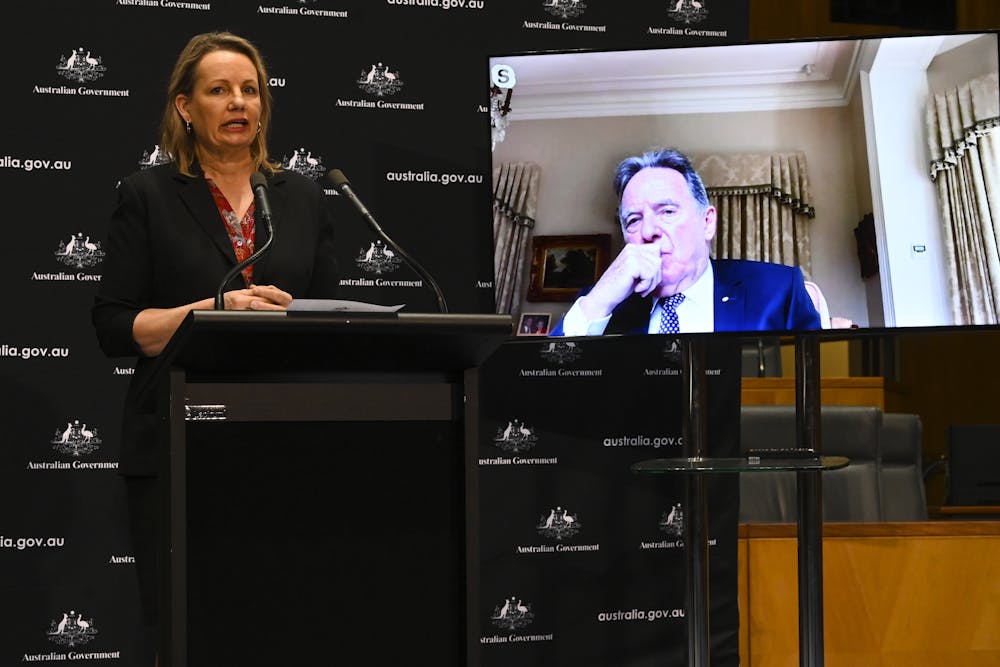
But federal Environment Minister Sussan Ley’s response to the outlook report suggested she saw no need to take dramatic action on emissions, when she declared: “it’s the best managed reef in the world”.
Major coral bleaching events in 2016 and 2017 have devastated the reef.
But rather than meaningfully tackle Australia’s contribution to climate change, the federal government has focused its efforts on fixing the damage wrought on the reef. For example as part of a A$444 million grant to the Great Barrier Reef Foundation, the government has allocated $100 million for reef restoration and adaptation projects over the next five years or so.
The second biggest impact on the Great Barrier Reef’s health is poor water quality, due to nutrient and sediment runoff into coastal habitats. Efforts to address that problem are also going badly.
The Great Barrier Reef attained world heritage status in the 1980s.AAP
It showed authorities have failed to reach water quality targets set under the Reef 2050 Plan – Australia’s long-term plan for improving the condition of the reef.
For example the plan sets a target that by 2025, 90% of sugarcane land in reef catchments should have adopted improved farming practices. However the report showed the adoption had occurred on just 9.8% of land, earning the sugarcane sector a grade of “E”.
So yes, the reef is definitely in danger
The 2019 outlook report and other submissions from Australia will be assessed next year when the UNESCO World Heritage Committee meets to determine if the Great Barrier Reef should be listed as “in danger” – an outcome the federal government will fight hard to avoid.
An in-danger listing would signal to the world that the reef was in peril, and put the federal government under greater pressure to urgently prevent further damage. Such a listing would be embarrassing for Australia, which presents itself as a world’s-best manager of its natural assets.
Environment activists engaged in a protest action to bring attention to the dangers facing the Great Barrier Reef.AAP
The outlook report maintains that the attributes of the Great Barrier Reef that led to its inscription as a world heritage area in 1981 are still intact, despite the loss of close to half of the corals in 2016 and 2017.
But by any rational assessment, the Great Barrier Reef is in danger. Most of the pressures on the reef are ongoing, and some are escalating – notably anthropogenic heating, also known as human-induced climate change.
And current efforts to protect the reef are demonstrably failing. For example despite an ongoing “control” program, outbreaks of the damaging crown-of-thorns starfish – triggered by poor water quality – have spread throughout the reef.
The federal government has recently argued that climate change should not form the basis for an in-danger listing, because rising emissions are not the responsibility of individual countries. The argument comes despite Australia having one of the highest per capita emissions rates in the world.
But as Australia’s greenhouse gas emissions continue to rise – an outcome supported by government policy – the continued downward trajectory of the Great Barrier Reef is inevitable.
Police-backed armed militias have killed three West Papuan students in Abepura district, Jayapura, reports the Guardian.
The students were reportedly killed in their dormitories as they tried to defend themselves from a pro-Jakarta group calling itself Masyarakat Nusantara (Archipelago Community).
In other parts of the city police intervened in an attack on West Papuans from a mob of violent Jayapura residents last week, resulting in one fatality reports Al Jazeera.
According to an eyewitness, residents in Jayapura’s administrative village of Argapura stopped a car carrying six Papuans from the highlands and attacked them with machetes before police arrived and evacuated them to a house.
– Partner –
Police secured the house but residents followed and began throwing rocks. Police responded by firing rubber bullets and one of the residents was hit and killed according to the witness.
An extra 6,000 security personnel have been deployed to Papua after protests began spreading across the region two weeks ago, reports RNZ.
While the protests were sparked in response to racism and prejudice levied at Papuans, they have since developed to incorporate the West Papuan cause for self-determination.
An ongoing internet blackout has been widely condemned as an impediment to accurate reporting of the situation in Papua and Indonesia.
Source: The Conversation (Au and NZ) – By Aidan Ricketts, Lecturer, School of Law and Justice, Southern Cross University, Southern Cross University
In the 30 years I worked as a protest police liaison, one memory in particular stands out. I once attended a protest where a group of women attempted to block a forestry road by lying together with linked arms and legs.
The ensuing melee as a group of male police attempted to pull apart the screaming women using pain compliance grips (moves to defeat the resistance of an arrestee, such as hyper-extending their wrist) was a chilling spectacle.
“Lock-on devices” – hardware like bicycle locks or handcuffs protesters use to secure themselves in their place of protest – would have provided a safer way of achieving the same result. And this was recently seen last week in Townsville.
Two elderly women locked themselves to the gates of a pipe supplier believed to have been contracted to supply the Adani mine project. Police took several hours to remove the arrestees, while the rest of the protest group was ordered to move across the road to continue the gathering.
The role of a police liaison includes walking police to lock-on installations and, if necessary, explaining the situation to them. What often follows is a negotiation about where the rest of the crowd can lawfully stand while police attend to the lock-on.
As a tool of non-violent civil-disobedience, using “lock-on” devices avoids risking group stand-offs with police, which can end up worse than rugby scrums. These devices certainly cause inconvenience, but it’s difficult to imagine how a person with one or both hands locked into a device could be anything but non-violent.
But the Queensland Premier Annastacia Palaszczuk recently proposed laws to outlaw the possession or use of protest lock-on devices.
A war of words has erupted, with Palaszczuk referring to the use of lock-ons as part of the “sinister tactics” of climate change protesters. On the other hand, environmentalists and civil liberties groups, and even some in the state Labor party, condemn the proposed anti-protest laws as an assault on democracy.
Part of Palaszczuk’s rationale is that there have been instances of some lock-on devices containing dangerous items, such as glass or gas canisters aimed at deterring police. However, protest groups say no evidence has yet been provided to show this happening.
In any case, the possible issue could be better dealt with under existing legislation, or new legislation specifically targeting traps, rather than being used to justify a complete ban on all lock-on devices.
So what are lock-on devices?
Climate change protests are on the rise in Queensland, with groups like Extinction Rebellion and Front Line Action on Coal regularly using lock-on devices as part of the campaign to halt work on the Adani coal mine.
They are favoured by activists – and clearly feared by some politicians – because they take significant time and expertise for police to remove protesters from the devices and to clear roads and blocked gateways.
Lock on devices range from readily available bicycle locking devices to home manufactured steel pipes.Author provided
And they have a long history as a tool of non-violent civil disobedience that goes back at least to the days of the suffragettes. More recently, they have been an important tool in blockades against old growth forest logging, coal seam gas and coal mine developments.
Three United Nations human rights experts have urged the State Parliament of Western Australia not to adopt new legislation which would result in criminalising lawful protests and silencing environmentalists and human rights defenders.
The laws were abandoned in Western Australia following a change of government in 2017.
New South Wales has a law allowing police to seize lock-on devices, but it’s not an offence to possess or use these devices.
Despite the recent political furore in Queensland, police and protesters alike generally respond to lock-on devices during protests in a calm and orderly fashion.
It’s important to understand the philosophy behind “locking-on”. By choosing to put their own bodies in a vulnerable situation, the protesters are appealing to the humanity of police or others to treat them with care and respect.
The presence of lock on devices, particularly at blockade style protests, actually helps to maintain a peaceful, almost theatrical atmosphere for police and protesters alike.
The arrestee is passive, the police can act without interference and the rest of the protesters attend lawfully.
Vegan protests in Melbourne earlier this year saw protesters dragged away by police. Lock-on devices on the other hand help to avoid the need for bodily contact.Ellen Smith/AAP
As a symbol of non-violence, the lock-on celebrates a shared social contract where there is implicit trust that neither police nor protesters will use personal violence, but rather the rule of law will prevail in an orderly manner.
In societies where the rule of law and respect for human life have broken down, it would be extremely dangerous to disable yourself in front of your opponents. The safe use of lock-ons as a tactic for civil disobedience is a sign human rights and the rule of law are being respected on all sides.
Imagine you need to go into hospital. First, you are likely to be seen in the emergency department, and then moved to a ward room for further treatment and recovery.
Unknown to you, the last patient in your room had an infection caused by a multi-drug resistant pathogen (bug) – meaning the standard antibiotics can’t fight it.
Unfortunately, research suggests if you are admitted to a room where the last patient had this kind of infection, you are significantly more likely to be infected by that same pathogen than if you were admitted to a room where the last patient wasn’t infected.
The consequences of a hospital infection can be serious, including a much longer stay in hospital and even death.
However, transferring the pathogen from patient to room to patient is less likely when the room is thoroughly cleaned.
Infections during a hospital stay affect one in ten patients. Hospital staff are aware of the dangers of infections, and reduce the risks by keeping their hands clean.
But staff and visitors can still transfer pathogens to patients, because these pathogens can remain dormant (but still alive) on surfaces for a long time. Some pathogens can survive in hospitals for days, or even months.
We can break the cycle of infection by creating cleaner hospitals with fewer dormant pathogens.
Hospital-grade cleaning products kill or remove common pathogens. But the product used is just one element of cleaning – the right technique is also important. Technique includes using the product according to the instructions, not contaminating already clean areas, using sufficient pressure to clean, and cleaning in the right spots.
Frequently touched surfaces such as light switches, emergency call-bells and bed rails are commonly contaminated with pathogens. These surfaces require extra cleaning.
How frequently cleaning needs to occur in hospitals and the best methods to use are disputed. Decisions are complicated because you can’t see the bugs with the naked eye.
In Australia, there is considerable variation in approaches to hospital cleaning including in the use of cleaning products, the type of auditing used to check cleaning, and the training cleaning staff receive.
A cleaning ‘bundle’
Our research team developed a “bundle” of hospital cleaning initiatives based on expert opinion and scientific evidence. This included the use of a fluorescent gel, training and feedback to cleaning staff.
The fluorescent gel is invisible to the naked eye, but visible under a UV light. The gel is applied to surfaces before cleaning, and auditors can use the UV light to determine whether a surface was thoroughly cleaned.
After cleaning, if it’s been done properly, the gel should no longer be visible. Research has shown this approach, when combined with constructive feedback to cleaning staff, can greatly improve cleaning.
Although a room may look clean, it doesn’t mean bugs aren’t lurking.From shutterstock.com
We applied our cleaning bundle in 11 Australian hospitals and examined cleaning performance and infection rates before and after the change to cleaning. Our approach reduced the risk of an important drug-resistant bacteria (vancomycin-resistant enterococci) by 37%.
We also saw an improvement in cleaning success, measured by how often the florescent gel was removed after cleaning. Effective cleaning of frequently touched surfaces in patients’ rooms improved from 64% at the start of the trial to 84% at the end.
Investing in cleaners and cleaning
Spending money on improvements to cleaning practice should be given the same consideration as expensive new machines or new drugs. Improving cleaning reduces the risk of infection, which in turn saves lives, means fewer longer stays in hospital and the intensive care unit, and saves money.
Of course, cleaning is not the only answer to dealing with hospital-acquired infections. Hand hygiene, identifying and isolating patients with certain infections, and correct insertion and maintenance of devices such as urinary catheters and drips are all important ways to reduce the spread of infections.
While the risk of infection for patients will never be zero, cleaning staff play an important role in patient safety. Yet they often go unrecognised.
Next time you visit a hospital, why not thank a member of the cleaning team for their role in reducing your risk of infection.
And patients should remember it’s more difficult to clean when tables, chairs and rooms are full of items. So reducing clutter will make it easier for cleaning staff to do their job.
Analysis by Dr Bryce Edwards – The Prime Minister currently gets paid $460K – about nine times the average wage. Other politicians receive less, but still magnitudes more than the average working citizen. So, are politicians paid too much, or do we need high pay to attract quality representation?
The debate about politician pay has been reignited by the decision of the Government this week, supported by Parliament, to lift the pay freeze on their salaries and adopt a new mechanism for deciding MP pay increases. And alongside this issue, are questions about how much politicians deserve to be paid, and whether it’s a problem that they’re in the top one per cent of income earners.
The freeze on MP pay increases was introduced a year ago to universal acclaim. Jacinda Ardern explained it was “the right thing to do”, citing the need to make New Zealand a more equitable nation. And it came after the Independent Remuneration Authority had recommended the politicians get a 3 per cent salary increase.
Not only were big pay increases embarrassing, at the time the pay freeze was announced the Government was in the midst of difficult negotiations with a number of public servants, and was trying to limit their pay claims. It was difficult for the politicians to call for restraint from lower paid workers when their own salaries seemed to be skyrocketing.
I covered the issue at the time – see: How much should we pay politicians? As well as explaining the various debates about politician pay, it pointed to arguments for retaining the MP pay freeze indefinitely, with some commentators cynical that the politicians’ decision was a temporary one to get them out of a tight spot with workers wanting higher pay themselves.
Essentially, new legislation will give full control over MP pay increases back to the Remuneration Authority, which the Government says is best placed to determine the pay of MPs. This reverses a decision made by the John Key Government in 2015, which apparently unsuccessfully sought to limit pay increases.
As the article explains, “The Government will now introduce a bill reverting the system back to its pre-2015 state, meaning the authority will make its decision in a similar way it does for other key public office holders.” The new system will also be less embarrassing for MPs because the decisions on pay will happen only once every three years instead of annually.
While National has agreed to support the change, the Greens and Act are less impressed. Green co-leader Marama Davidson said the new system was still too generous to politicians: “It’s not good enough for MPs’ salaries to get further and further way from what the rest of the country and our citizens are earning, so we’re going to be really loud about that” – see RNZ’s Iain Lees-Galloway thinks new MP pay setting will be more acceptable to public. According to this article, “Davidson said changes were made in 2015 for a reason – and the Greens wanted to see a dollar amount increase in line with the median wage.”
Rightwing blogger, David Farrar, seemed to agree that the new pay scheme would do the opposite of what was being claimed by Labour, and might actually deliver big pay increases – see: Government announces potential big pay rises for themselves!
Here’s Farrar’s main point: “This is wonderful double speak. It means that they may now get massive pay increases rather than ones restricted to the median wage movement. Under the law passed by National MPs would get a mere 2.1% pay rise in 2019 – as that is how much the median public sector wage has gone up. Under Jacinda’s law, they could get a lot more.”
He also points out how much the PM’s salary went up under Labour’s system when Helen Clark was in power: “It went from $222,400 to $393,000 – an increase of $170,600. That is a 76.7% increase over nine years. The median public sector increase was 45.6%. So the increase would have been around $70,000 less over nine years.”
Herald political journalist Claire Trevett has expressed some sympathy for the politicians, explaining the various changes over the years in MP pay setting, which were all meant to stop excessive increases: “While most workers want higher pay increases and battle to get them, politicians want lower pay increases but are finding the job of getting them to be a Sisiphyean task” – see: PM Jacinda Ardern’s crusade for smaller pay cheques (paywalled).
Trevett actually gives the best short summary of the what has been going on: “in 2009, Key legislated to require the Remuneration Authority to take economic conditions into account when setting the pay. That did not work to his liking, so in 2015 he ordered the authority to scrap the criteria it had always used and instead peg MPs’ pay to the average increase in the public sector. Alas, it transpired that the public sector got rather more generous pay increases than Key expected and as a result, so did MPs. Now Prime Minister Jacinda Ardern has decided to have a go as well – by returning to the system Key ditched because it was proving too generous. That leaves the Remuneration Authority to set the pay using the same criteria it had used before Key scrapped it.”
The problem is, Trevett says, “Ardern may well now find that the Remuneration Authority decides it has to give MPs a bigger-than-usual pay increase over the next year to make up for the 18-month pay freeze.”
Of course, the whole exercise shows the difficulty of finding the right mechanism for pay increases. University of Auckland employment law expert Bill Hodge explains: “It is a hard thing to do because there isn’t technically an employer who can do an annual performance review and give them an increase based on performance, achievement, number of Bills passed. That mechanism can’t exist, so it is in the too-hard basket” – see Jamie Ensor and Perry Wilton’s Difficult to fairly judge appropriate pay for MPs – employment law expert.
There are plenty of different economic statistics that can be used in determining each year how much to increase MP pay, and debate rages on about which one is best. It’s a question of what MPs’ salaries should be compared to – the rate of inflation, economic growth, or average wage increases?
The decision could have a big impact. For example, Claire Trevett explains: “NZ Herald data guru Chris Knox calculated that if the median wage criteria had been used since 2007, MPs would be getting $172,000 – which is $10,000 more than they get now. If overall wage growth was used, MPs would be earning slightly more than they do now. If inflation was used MPs would be on about $15,000 less than they are now on.”
You can see the various calculations in Boris Jancic and Chris Knox’s Fact check: Are politicians’ pay rises actually too big? (paywalled). They find that the Greens’ proposal would have been much more effective in limiting pay increases: “The Green Party says it wants MPs pay rises to only go up as much as the average worker’s, dollar-for-dollar. If that was the case going back to 2007, the average backbencher would today be earning about $16,500 – or 11 per cent – less than they are now.”
But in the same report, another politician gives very questionable logic for politician pay not being too high – National’s Gerry Brownlee said: “There’s a big group of people out there who think that MPs are overpaid, another group who think we shouldn’t be paid anything. You’ve just got to try and get something in the middle that’ll work”.
This all raises the question of whether the debate about the mechanism for determining MP pay increases is just tinkering around the edges, when a bigger debate is needed about how much politicians should be paid.
It’s useful to look back to a Dominion Post editorial on this topic from last year, which suggests that the debate on the annual increases misses the point, and that pay for politicians is already too high and actually needs to be reduced – see: Oh, to be an ordinary MP on average pay.
The newspaper uses the profession of teaching as a case study: “In the late 70s, a primary school teacher earned almost three-quarters of a backbench MP’s annual salary. Today, the top teacher is paid less than half the lowest-ranked MPs. This is not to suggest that teachers, nurses, police officers and others should be paid at the level of an MP. The jobs, responsibilities and burdens are very different, making too direct a comparison difficult. But pay freezes and reviews aside, our parliamentarians will have achieved little if they simply lock the yawning disparity in place, to continue indefinitely.”
The editorial calls for a focus on narrowing the income gap between MPs and their constituents: “Even if the rules governing the Remuneration Authority are changed, and MPs’ future pay increases are more modest, the damage has been done, the horse has bolted and they will continue to be rewarded at substantially above the average wage. That’s the bigger, more disturbing truth potentially obscured by the temporary glow of a pay-freeze publicity, no matter how well-intentioned: real wages for most average and ordinary Kiwis have gone backwards while those of a select few, including our MPs, have soared. Our parliamentarians now rank in the top 1 per cent of income earners.”
Also from that time, it’s worth looking at how New Zealand’s politician pay compares to other similar countries – see Stacey Kirk’s Politicians’ pay around the world: How our MPs’ salaries stack up. She notes, for example, that in the US, “Members of Congress haven’t had a pay rise since 2012.”
Three months on, there’s still no end in sight for the Hong Kong protest movement. What started as a demonstration against a bill to amend the city’s extradition laws has now morphed into a broader movement challenging the legitimacy of the government and seeking fundamental political reforms.
Every weekend, hundreds of thousands of protesters – sometimes more than a million – are still taking to the streets. The protests draw Hong Kongers from all walks of life: students, doctors, lawyers, journalists, teachers, civil servants, and, most recently, family members of police officers. The discussions on internet forums and encrypted messaging apps remain vibrant, with innovative ideas for new protest actions emerging frequently.
To better understand who the protesters are, as well as why and how they are protesting, I’ve conducted a series of large onsite surveys at 19 demonstrations since June 9, with the help of researchers from other universities. We have so far surveyed more than 8,000 protesters with a response rate of over 85%.
What the protesters are angry about
Our data show protesters tend to be young and highly educated. On average, half of our respondents are aged between 20 and 30. Around 77% said they had a tertiary (higher) education.
Few said they were unemployed, unlike protesters in other mass demonstrations around the world, like the Arab Spring uprisings and Spain’s Indignados movement.
Most respondents identified themselves as either democrats or localists. However, in the early stages of the protests, it is also notable that nearly 30% of respondents said that they were centrists or had no political affiliations. This dropped to around 15% by early August.
When asked why they were protesting, the vast majority of respondents (more than 90%) cited two main motivations: the complete withdrawal of the controversial extradition bill and an independent inquiry into excessive use of force by police against the protesters.
Interestingly, from July onwards, police violence has become a more pressing concern for respondents, with those who see it as “very important” rising from 85% to over 95%. Protesters have also increasingly said they are fighting for Hong Kong’s democracy, with those who see it as “very important” rising from 83% to 88%.
The resignation of Chief Executive Carrie Lam and other major officials was considered the least important reason for protesting. This suggests that a change in leadership is not viewed as a solution to the political crisis – unlike in 2003, when half a million people marched against changes to Hong Kong’s national security laws and demanded the resignation of then-leader C.H. Tung.
Instead, the protesters are seeking a fundamental reform of the entire political system.
For many of them, the extradition bill is just the surface of a rotting system. It merely exposes the underlying problems that have been swept under the carpet for many years: the lack of democratic representation in the policy-making and legislative process, the declining accountability of the government, the blatant domination by a small clique of business and pro-Beijing elites, the increasing unimportance of public opinion, and the steady encroachment on people’s political rights and civil liberties.
Most of the Hong Kong protesters are young, well-educated and employed.Roman Pilipey/EPA
Strong solidarity and acceptance of radical tactics
The majority of respondents see themselves as “in the same boat” (that is, sharing the same fate) with one another. More 80% believe the protests should go on if the government refuses to offer anything other than the suspension of the bill. Among them, more than half support escalating the protests.
This extraordinary level of solidarity is striking. Part of this is because people have learned from the mistakes of the Umbrella Movement. Instead of pointing fingers at each another, protesters are this time using the phrase “do not split, do not sever our ties” to deal with conflicts. Misdeeds and transgressions are not condemned, but are now dealt with through collective reflection and friendly reminders.
Fuelling protesters’ solidarity is their strong feeling of desperation. Our survey results show the majority of respondents do not expect any concessions from the government. This has remained steady from early on in the protests, and explains the emergence of slogans like “I want to perish together”.
We also found a high tolerance for the more radical and militant tactics of some of the younger protesters, even among those who consider themselves moderates.
Consistently, over 80% agree that peaceful assembly should combine with confrontational actions to maximize the impact of protests. In June, slightly less than 70% agreed that radical tactics were understandable when the government refuses to listen. That percentage rose to over 90% in the August 4 protests.
Where the protests are heading
No one knows what the “endgame” of the Hong Kong protests will be. The government is now hoping that mass arrests, coupled with the new start of the school year and the possible introduction of emergency regulations, may clear out the streets in the next few weeks, ideally before China’s National Day celebrations on October 1.
The strategy may work, but likely only in the short run. If the Hong Kong government continues to refuse to heed what people are legitimately asking for, the people will undoubtedly return to the streets.
As research from other social movement studies has taught us, protests take place in cycles. The current protest movement in Hong Kong may eventually quiet down after a while, but another one may be brewing on the horizon.
The other researchers in the team include Francis Lee from the Chinese University of Hong Kong, Gary Tang from Hang Seng University of Hong Kong, and Edmund Cheng from the City University of Hong Kong.
On one unremarkable day in April this year, just over a third of news stories were about issues likely to impact young people, such as policies to address climate change, school teacher training, the impact of automation on future employment and proposed social media regulation.
Our snapshot study analysed the television and newspaper news in Australia on April 1, 2019. And our aim was to critique how young Australians aged four to 18 were included and represented in these traditional news forms that remain influential and popular, despite the rise of social media.
In total, we analysed 276 news stories across eight national, state and regional newspapers and four national and state television news bulletins.
Of all the news stories we examined, only 11% included the views or experiences of young people. Usually, their inclusion was via adult mediators like parents, police and experts. Just 1% of news stories directly quoted a young person.
The topic of news stories where young people are the focus.Author provided
When young people were included in the news, we found it was most likely related to accidents and social welfare. They were absent from stories about the economy, politics, the environment and climate change.
Young people used as visual props
We also found young people were ten times more likely to be seen rather than heard in the news.
Of the news stories we analysed that day, 11% included a photograph or video footage of a young person or young people. Television news included images of young people almost twice as often as newspapers.
However, our analysis of these images finds young people are usually only peripherally included in the substance of the story, often acting as visual props to introduce colour or emotion, rather than being an integral part of the story itself.
In this way, young Australians are not being given opportunities to speak about themselves and their experiences, with journalists not consulting them or taking them seriously.
The Australian news media provide an important lens through which we see ourselves and our nation: they both reflect and influence public discourse and priorities. So young people should be meaningfully included in the news to ensure we are all better informed of their views and experiences.
A trust crisis affecting the future of news
We’ve been hearing a great deal about the future of news media in recent years. Usually these public conversations focus on how news organisations survive in the digital age; the role of whistleblowers and journalists in a global news environment; and the issue of so-called fake news and its impact on democracy.
These issues are all urgent and complex. Perhaps it’s no surprise, then, that they have been the focus of our efforts in Australia to address problems associated with news. This includes through two ongoing parliamentary enquiries: one by the ACCC focused on news and digital platforms, and a second focused on press freedom.
But surely the crisis in trust of the news media is just as urgent as these other issues.
The Australian 2019 Digital News report found just 44% of adults trusted Australian news. And our own 2017 survey of 1000 young Australians aged eight to 16 found just 23% have high levels of trust in news media organisations.
More representation of young people in the news will boost their trust in the media.Keenan Constance/Unsplash, CC BY-SA
This lack of trust is important to consider since many of the young people who responded to our national survey said they felt passionate about the role news played in their lives.
For instance, a boy in our study, aged 12 from Queensland, said:
Kids need to understand the world around us and not to just get scary news like murders and hurricanes [but] more news about jobs of the future and things that will be more helpful for our age group.
And a girl, 10, from Tasmania said:
[News] helps me understand the world and know what’s going on and how it might affect me and my family and friends.
The way forward
It’s likely young people’s lack of trust in news organisations is closely linked to their lack of representation.
One clear way for news organisations to begin building trust with young people is to start including them in news stories in meaningful ways.
It doesn’t have to be complicated. For example, in the many instances where young people are photographed, but not quoted, they could be asked to give their opinion or relay their experience.
News organisations could also direct resources to undertake research about stories involving young people. They could build connections with youth-focused organisations who are well connected to young people, familiar with their experiences and with current research.
And they could track who they include as sources, experts and witnesses (considering gender, age range, race and ethnicity) to support organisational reflection on representation and bias.
This will take time and resources, but it seems prudent at a time when news organisations are trying to rebuild the public’s confidence in news integrity and support their own future viability.
Most of us take paracetamol every now and again to reduce pain or fever. As far as medications go, it’s one we’re unlikely to associate with harm.
But in a study published today in the Medical Journal of Australia, my colleagues and I reveal a concerning increase in paracetamol poisonings, and resulting liver damage, in Australia over the last decade.
In fact, paracetamol is actually the number one pharmaceutical Australian poisons centres receive calls about.
Paracetamol is safe if used appropriately, at a maximum of four grams per day in adults (equivalent to eight 500mg tablets, or six 665mg modified release tablets). However when this dose is exceeded, there is a potential for harm. And the bigger the dose, the greater the risk.
It’s time to consider restrictions, including reducing pack sizes and changing the way paracetamol is sold.
We analysed data from national hospital admissions, poisons centre calls, and coroners’ records to examine poisonings, liver injuries, and deaths.
The annual number of cases of paracetamol poisoning increased by 44% from 2007-2008 to 2016-2017.
In that time, we recorded more than 95,000 paracetamol-related hospitalisations.
Liver injury from paracetamol has doubled over the same period. This is likely because people are taking more tablets when they overdose than in previous years, increasing the risk of liver failure.
More than 200 people died from paracetamol poisoning in Australia in the ten year period.
What a paracetamol overdose does to your body
Paracetamol itself is not toxic, but in large amounts it overwhelms the body’s ability to process it safely. This can lead to build up of a toxic metabolite (or break-down product), which binds to liver cells, causing these cells to die.
The quantity that constitutes a toxic dose depends on circumstances including the time period in which the paracetamol is taken, and the person’s weight. But any adult ingesting more than four grams in a day could be at risk.
In severe cases, liver failure means the person will need a liver transplant, or they won’t survive.
Paracetamol is the leading cause of acute liver failure in the Western world.
There is an antidote to paracetamol toxicity, called N-acetylcysteine (NAC), which is given as an intravenous infusion in hospital. Importantly, NAC works best when given early: it should be started before any symptoms appear. Symptoms of paracetamol poisoning – nausea, vomiting and abdominal pain – indicate damage has already started to occur.
Modified release paracetamol comes in a higher strength, designed to be released over a longer period, which can be confusing and result in overdose.
Accidental vs intentional overdosing
Overdoses can be either accidental or intentional, and our figures include both.
Paracetamol is not a drug people become addicted to, or dependent on, in the same way people do with opioids or other drugs.
Intentional poisonings occur when people knowingly take too much paracetamol as a form of self-harm. In our research, about three-quarters of cases were intentional.
Dosing mistakes can occur when parents are giving paracetamol to their children.From shutterstock.com
People might accidentally overdose because they are in pain, and believe because paracetamol is so widely available, it must be safe. They take more than the recommended dose, or take multiple different paracetamol-containing products together, resulting in harm.
Poisons centres also receive calls about children having too much paracetamol, usually due to dosing errors or a child finding and ingesting the medicine.
It’s important to be aware of the many brands of paracetamol-containing products, including cold and flu products, to avoid doubling up. People should also read the pack and ensure they follow the dosing instructions.
Parents should consider the following to avoid overdosing in children:
paracetamol should be stored out of reach (for example, don’t leave it on the bench or change table after use)
paracetamol can be dosed every four to six hours, but must not exceed four doses in a 24 hour period
keep track of doses given and when by writing them down
read the label carefully and ensure you understand how to use the syringe/dosing device correctly.
Changing the way paracetamol is sold
Paracetamol poisoning and resultant liver injury is preventable, and some simple public health measures could have a significant impact.
In Australia, paracetamol can be purchased outside of pharmacies (for example, in supermarkets) in packs of 20 tablets. In pharmacies, packs of 100 can be purchased without needing to speak to a pharmacist.
In both cases, there are no legal restrictions on the number of packs one person can purchase. This is out of step with many other countries, especially the UK and Europe.
The UK restricted packs to 32 tablets in pharmacies and 16 tablets outside of pharmacies in 1998, as a response to increasing deaths from paracetamol. This resulted in a long-term reduction in paracetamol poisonings, liver injury, and deaths.
Many European counties don’t allow non-pharmacy sales of paracetamol, and have small packs in pharmacies. Denmark has gone one step further, restricting paracetamol sales to those aged 18 and over.
Modified release paracetamol
In our study, modified release paracetamol overdoses increased by 38% each year, and were disproportionately involved in deaths.
Modified release paracetamol has been completely banned in Europe. This is due to documented harms, including increased risk of liver failure and death.
The Therapeutic Goods Administration recently announced modified release paracetamol would become Schedule 3 in 2020, meaning it will be behind the pharmacist’s counter.
This restriction is a step in the right direction, but ignores the fact regular paracetamol can be purchased in large quantities without consultation with a health-care professional.
Due to its widespread use, paracetamol is likely to remain a common source of poisoning. Our study shows it’s increasingly important we take measures to reduce harm from these events.
Restricting pack sizes and restricting availability of modified release paracetamol are crucial first steps. We also need increased public awareness of how to use paracetamol safely.
If this article has raised issues for you, or if you’re concerned about someone you know, call Lifeline on 13 11 14. For advice on suspected paracetamol overdose, call the Poisons Information Centre on 13 11 26.
Bushfires are predicted to be worse than normal across much of Australia this summer but research shows many people, especially those in high-risk areas, remain unprepared.
The latest Australian Seasonal Bushfire Outlook shows the 2019-20 fire season has the potential to be an active season across the country, following a very warm and dry start to the year.
The east coast of Queensland, New South Wales, Victoria and Tasmania, as well as parts of southern Western Australia and South Australia, face above-normal fire potential. It means communities in those areas, and across Australia, should start planning their emergency fire response.
The ingredients for a bad fire season
Above-normal bushfire potential refers to the ability of a large fire to take hold. It takes into account recent and predicted weather for a particular area, the dryness of the land and forests, and recent fire history.
The year to date has been unusually warm and dry for large parts of Australia. In fact it has been the fifth-driest start to the year on record, and the driest since 1970. Some areas, such as New South Wales into southeastern Queensland, are into their third year of dry conditions.
Vast areas of Australia, particularly the east coast, have an above-normal fire potential this season.BNHCRC
The warming trend means that above average temperatures now tend to occur in most years, and 2019 has followed this pattern. These high temperatures further dry the landscape and vegetation.
An early start to the fire season has been declared in many areas across eastern Australia. The dry landscape means that any warm and windy conditions are likely to see elevated fire risk. However in some drought-affected areas, poor growth of grass and annual plants means that vegetation loads are reduced, which may lower the fire risk.
The climate outlook for the next few months is also a crucial factor. Of particular interest are the future tendencies of Pacific sea surface temperature associated with the El Niño-Southern Oscillation, as well as the Indian Ocean Dipole, major climate drivers over Australia.
Climate change doesn’t create bushfires, but can make them worse
Heat, drought, flood and fire are not new phenomena for Australia. What is different now is that there is an underlying 1℃ increase in average temperatures since industrial times began – the result of climate change – which means that the variability of normal events sits on top of that. So climate change alone doesn’t create a bad fire season, but can make the weather conditions conducive to very large and destructive fires.
A bushfire threatened homes near Lake Macquarie in August this year.AAP/Darren Pateman
Weather records are routinely being broken and all indications are that temperatures will continue to increase.
We cannot be sure what this means for extreme hazards like bushfire. This is an area in critical need of further research into weather prediction, land planning, infrastructure development, population trends and community awareness.
Firefighting resources are finite
The distribution and readiness of firefighting resources are also considered when calculating fire potential.
In Victoria’s East Gippsland, for example, forests have been extremely dry for many years. If a fire were to start under bad conditions, there is a high likelihood it would grow too large for local resources, and they would need to call for extra support from elsewhere.
Fire seasons are lengthening and overlapping across states, and indeed across the globe. So we need to think of new ways of dealing with bushfires, floods, cyclones, and heatwaves. The old ways of sharing resources such as aerial firefighting equipment, and fire fighters between Australian states and other countries, may not always be possible. So we need to discover better ways to manage all our resources.
Overlapping fire seasons means the sharing of fire crews and equipment between states may not always be possible.AAP
Be prepared, and get your kids involved
Research has identified significant trends of vulnerability linked to demographic changes, such as a growing and ageing population. For example, the population of those aged over 85 is predicted to double in the next 25 years. The general population is also increasingly shifting into traditionally hazard-prone areas such as forested or coastal rural areas.
Our research is consistently showing that many Australians, especially those in high risk areas, are not sufficiently ready for fire and have not established fire plans well ahead of time. For example, people may underestimate the risks to life and property if the fire danger is not rated as “catastrophic”. The research showed many properties were under-insured and some people overestimated the response capacity of fire services.
Experts say all Australians, not just those in high-risk areas, should prepare for the bushfire season.AAP
So, make sure you’ve got a plan, talk about it with your family and ensure you have back up plans B, C and D. Include your children in planning to help them prepare, and don’t forgot about your pets and animals too.
Backed by the research, emergency warnings to people under the threat of a fire have been transformed in recent years. But do not wait for a warning, as it might be too late. Everyone should be aware of their surroundings.
The latest outlook report is the work of the Bureau of Meteorology and fire and land management agencies around the country, brought together by the Bushfire and Natural Hazards Cooperative Research Centre.
For more information on how to prepare and be ready for the fire season, consult your local fire service website.
Source: The Conversation (Au and NZ) – By John L Hopkins, Theme Leader (Future Urban Mobility), Smart Cities Research Institute, Swinburne University of Technology
One obvious solution to traffic congestion, caused mostly by workers commuting to jobs in the city centre during peak hours, might appear to be building more, or bigger, roads. But a less obvious answer, and potentially a more cost-effective one, might be to increase flexible working arrangements.
Our research has looked into ways to ease congestion by reducing the need for travel in congested areas in the first place. It shows city workers definitely have an appetite for flexible work hours and practices.
However, many (36%) still can’t or don’t work remotely. Those who do work remotely do so for a small fraction of the week – 1.1 days on average – even though a high percentage of their work tasks can be done anywhere.
More roads don’t solve the problem
Traditionally, congestion has simply been accepted as the starting point, with infrastructure being built to accommodate it. However, as a report on US research findings about so-called induced demand explains:
If you expand people’s ability to travel, they will do it more. […] Making driving easier means that people take more trips in the car than they otherwise would.
A 2019 report from Infrastructure Australia observes that the huge number of road and rail projects in Sydney and Melbourne, both current and planned, will not prevent crippling congestion by 2031.
This issue was the motivation for our study into alternative ways to ease congestion. It identified flexible working as one possible solution.
The term flexible working refers to arrangements that enable employees to adjust the number of hours they work, the pattern of those hours, or where they work. Flexible working has risen significantly in recent years, with many potential benefits for both employees and employers. Yet few studies have examined its potential to reduce traffic congestion.
For our study, we surveyed 263 city workers from ten of Melbourne’s biggest employers. We asked them about their commuting habits, existing flexible working arrangements, attitudes toward flexible working and the nature of their work tasks.
We found 64% of workers were already taking advantage of some sort of flexible working arrangements that allowed them to work from a remote location, usually at home, an average of 1.1 days a week. And 83% of them either “liked” or “loved” the ability to do this.
Only 2% said none of their work could be performed from an alternative location. A majority of participants, 58%, indicated they could do at least half their work duties out of the office. Some 30% of the workers indicated 80% or more of their work duties could be performed remotely.
Breakdown of participants in flexible working survey.Author’s research, Author provided
Technology enables these flexible working opportunities. Laptops, smartphones, high-speed internet and cloud access were highlighted as the must-haves for remote working.
Many of us no longer need to travel to a fixed location to work because the tools of our labour are located there. The tools of our labour are now in our back pockets or work satchels.
But access to flexible working is growing around the world too.
Finland, a pioneer of flexible working practices, recently adopted a new Working Hours Act. It will give a majority of full-time employees the right to decide when and where they work for at least half of their working hours.
A similar flexible working bill was introduced to the UK Parliament in July by Conservative MP Helen Whately. She said:
The 40-hour, five-day working week made sense in an era of single-earner households and stay-at-home mums, but it no longer reflects the reality of how many modern families want to live their lives.
Our evidence from Melbourne suggests the appetite for, and availability of, flexible working will continue to increase as more people do it and more millennials take up leadership roles.
A small reduction in peak-hour commuter numbers could make the difference between being able to squeeze onto a train or not.Runs With Scissors/Flickr, CC BY-NC-ND
If the 64% of workers who now work remotely 1.1 days a week increased this to five days a fortnight, this could cut the number of daily commuters to Melbourne from 572,000 to 440,500 a day. If the remaining 36% of workers were also able to work remotely 50% of the time, daily commuter numbers would fall further to around 337,500, a total reduction of 41%.
Even much smaller reductions in commuter numbers could have significant impacts on congestion. An NRMA submission that advocated flexible working hours and practices to a 2013 NSW parliamentary inquiry noted:
As a rule of thumb, when traffic on congested roads reduces by 5%, traffic speeds increase 50% (even if this only means going from 20 to 30km/h) […] A small reduction in the amount of passengers during peak hours can sometimes make the difference between being able to squeeze onto a bus or train, or not.
In this era of growing urban congestion, an increase in flexible working practices appears to have serious potential for easing the strain on our roads and transport networks. Isn’t it about time we asked ourselves if we could all be a bit more flexible?
In wealthy societies we’ve become increasingly picky about what we eat. The “wrong” fruits and vegetables, the “wrong” animal parts, and the “wrong” animals inspire varying degrees of “yuck”.
Our repugnance at fruit and vegetables that fail to meet unblemished ideals means up to half of all produce is thrown away. Our distaste at anything other than certain choice cuts from certain animals means the same thing with cows and other livestock slaughtered for food. As for eating things like insects – perfectly good in some cultures – forget about it.
Can anything be done about this? The fact that disgust varies between cultures and across ages implies it can. But how?
We set out to answer this by getting a better grip on how disgust works, focusing on disgust in everyday food choices, rather than aversions to the unknown or unfamiliar.
Our research suggests some disgust responses, once set early in childhood, are hard to shift. But responses involving culturally conditioned ideas of what is “natural” may be modified over time.
Cultural conditions: insects have long been on the menu in Thailand.Narong Sangnak/EPA
Don’t eat that!
Disgust likely began as a powerful “basic” emotional reaction that evolved to steer us away from (and literally eject) potential contaminants – food that smelled and tasted bad. You can think of it as originally being a “don’t eat that” emotion.
The disgust system tends to be “conservative” – rejecting valid sources of possible nutrition that have characteristics implying they might be risky, and guiding us towards food choices that are ostensibly safer. Research by University of British Columbia psychologist Mark Schaller and colleagues suggests people who live in areas with historically high rates of disease not only have stricter food preparation rules but more “conservative” cultural traditions generally.
Is is unclear exactly how or when individual templates for what is disgusting are set, but generally what is seen as “disgusting” is set relatively early in life. Culture, learning and development all help shape disgust.
It’s just not natural!
In our study, we showed 510 adults pairs of “normal” and “alternative” products via an online survey, and asked them how much they would be willing to pay for the alternatives. We also asked them to rate which product was tastier, healthier, more natural, visually appealing and nutritious. Product pairs included:
shiny and typically shaped fruits and vegetables vs knobbly, blotchy, gnarled and multi-limbed examples.
plant protein foods vs insect-based foods
standard drinks vs drinks with ingredients reclaimed from sewage
standard medicines vs medicines with ingredients extracted from sewage.
Out of shape: using common fruits and vegetables meant the study’s results were not muddied by responses affected by fear of the unknown.www.shutterstock.com
Our results show that, even after statistically adjusting for obvious factors like pro-environmental attitudes, those with a greater “disgust propensity” are less willing to consume atypical (weird-looking) products.
This may seem rather obvious but most prior studies have muddled a food’s “novelty” with its possible disgusting properties (by asking people, for example, whether they’d eat bugs). By asking about really common fruits and vegetables, our study shows just how far disgust may reach in influencing what we consume.
As importantly, our results suggest evaluations of a product’s perceived naturalness, taste, health risk, and visual appeal “explains” about half of the disgust effect.
In particular, lack of perceived “naturalness” was a frequently reason for unwillingness to pay for product alternatives. This result was in line with previous studies that have looked attitudes to eating insects or lab-grown meat. This is a promising area for social marketing.
Therapeutic responses
Given evidence about how much of what we consider disgusting is cultural and learned, marketing campaigns could help shift attitudes about what is “natural”. It has been done before. Consider this advertisement to naturalise sugar consumption.
Thinking differently about emotion-eliciting stimuli is termed “reappraisal”. Reappraisal has been shown to reduce disgust effects among those with obsessive compulsive disorder. Desensitisation (repeated exposures) seems less effective in reducing disgust (versus fear) among people with diagnosed phobias, but it may work better among the general population.
Of course, such speculations remain untested and their ultimate success remains unclear.
But it wasn’t so long ago that Western consumers turned their noses up at fermented foods, and the notion of “friendly bacteria” made as much sense as “friendly fire”. More than a decade ago the residents of a drought-stricken Australian town voted against recycling sewage for drinking water. Now the residents of an Australian city accept recycled sewage being pumped back into the city’s groundwater.
Given time, circumstance and a little nudging, a future meal at your favourite Thai restaurant may well involve ordering a plate of insects.
Source: The Conversation (Au and NZ) – By Mark Liu, Chancellors Postdoctoral Research Fellow, Fashion and Textiles Designer, University of Technology Sydney
Returning our old clothes to big fashion chains – rather than taking them to charity stores – could make fast fashion companies pay for their waste and fuel vital recycling research. Even better if we all do it at once.
Public protests, such as Extinction Rebellion’s colourful catwalk that blocked roads in central London in April, have raised awareness yet done little to motivate governments to address the environmental impact of the fast fashion industry.
“The government is out of step with the public who are shocked by the fact that we are sending 300,000 tonnes of clothes a year to incineration or landfill,” remarked British MP Mary Creagh in June this year, after that country’s parliament rejected a proposed garment tax on the fashion industry. “Urgent action must be taken to change the fast fashion business model which produces cheap clothes that cost the earth.”
At last week’s G7 summit, French president and host Emmanuel Macron announced a fashion industry pact with 150 brands promising to reduce environmental impact.
Changes are not happening fast enough. Residual fashion waste averages 2.25 million tonnes per year in Australia, with an estimated clothing value of $500 million. By 2030, it is predicted that the fashion industry will use two Earths’ worth of resources, with the demand for clothing increasing by 63%. But consumers can act now to influence corporations.
If you’re not part of the solution…
Even those who don’t purchase “fast fashion” – a term used to describe clothes that reproduce the latest catwalk designs at high speed and low cost – bear the consequences as garment waste enters landfill, contaminates air, soil and water.
Fast fashion companies take looks from the catwalk to the shopping centre as quickly as possible.www.shutterstock.com
While government and industry self-regulation have so far failed to make significant progress in this area, consumers have a role to play in protecting the environment.
Global Fashion Agenda’s Pulse 2019 report quotes research showing more than 50% of consumers would switch brands if offered an environmentally and socially friendly alternative. But that sustainability is a key purchasing criterion for just 7% of consumers, trailing high quality, looking successful and receiving good value for money.
There are already opportunities for consumers to engage with fast fashion companies on this issue. H&M and Zara have collection boxes instore to collect old clothing and recycle it into new garments. H&M will also donate 3c for every kilogram of clothing returning in this way to fund research into recycling technologies.
Investing in technology
Unfortunately, clothing recycling technology is in its infancy and the vast infrastructure to make recycling commercially viable does not exist. Many materials made from recycled material are blended with polyester or elastane to make materials that cannot be recycled again.
London’s Graduate Fashion Week this year featured garments made from recycled plastic.Rob Sheppard/Shutterstock
At the University of Technology Sydney we are developing new fabrics made from microalgae. This deep technology research requires significant investment, time, and expertise without a guaranteed outcome. Such research is not attractive to investors looking for an instant return. But this knowledge development is our only hope of building a truly circular fashion industry.
If Australians redirected fast fashion waste back to where it belongs, they could raise the equivalent of H&M’s Global Change Award, which funds sustainable fashion ideas to the tune of $1 million euro (A$1.6 million) within 64 days. Imagine the potential to raise money for research and infrastructure in this way given the 300,000 tonnes of waste dumped in the UK each year and the 16 million tonnes in the US.
Charity stores in Australia are flooded with fast fashion garments that they simply cannot use and then have to discard. According to the National Association of Charitable and Recycling Organisations, last year Australian charities paid $13 million a year to dispose of 60,000 tonnes of unusable donations.
Sending cheap cast-offs back to their producers would force big chains to pay for the afterlife of their garments, making mass overproduction less profitable.
Coordinating outfits and efforts
Returning clothing is a way of sending a clear signal to shareholders in a way that affects the profits of the company. It nudges employees within fast fashion companies to justify to their superiors and shareholders the need to move towards more sustainable practices.
Consumers could stage mass protests by organising to return used clothing to companies in a single day of action, burying the stores in their own waste and showing the scale of the problem.
A scene from the ABC’s War on Waste.ABC
A single change in behaviour has grand potential. Locally, 68% of those who watched the ABC’s War on Waste second series reported that they’d changed their habits. The series triggered Woolworths supermarket’s decision to remove 3.2 billion single-use plastic bags a year from its checkouts, inspired cafes and customers to adopt reusable cups, and led to hospitality businesses eliminating single-use plastic straws.
It is time to make corporations pay for their waste, fund research and change their business models. If they continue to disregard their environmental responsibilities, citizens have the power to bury their stores in their own waste.
We can return our old clothes to fast fashion companies and change the industry, one garment at a time.
On one of my first field trips as a young student, searching in sweltering September heat for banksia trees in the bush around Sydney, my eye was caught by a flash of remarkable crimson. Trudging over the red dust, we saw the beautiful waratah flower.
The cone-shaped flower sat upon a green leaf throne, sepals facing upward towards the heavens. The sun lit the red petals just right, and I felt a sense of awe for the flower emblem of New South Wales.
The rounded flower head and the green razored leaves are iconic. The long stem that can grow up to 4 metres tall allows it to stand above the other vegetation.
There are five species of waratah flowers, although the species chosen for NSW’s emblem, Telopea speciosissima, is simply known as the New South Wales waratah.
These grow across southeastern Australia along the central coast and up the mountains from the Gibraltar range north of Sydney to Conjola in the south.
Robert Brown named the genus Telopea in 1810, which derives from the Greek word for “seen from afar” – just as I was able to spot the striking red flowers in the bush. (There is even a botanical journal named Teleopea, after the flower.)
This flower thrives in the shrub understory of open forest and survives despite sandstone soils and volcanic rock. Delicate, the flowers need lots of rainfall. There is also a rare white morph called “Wirrimbira white.” This form was found in the Robertson, NSW near the Kangaloon water catchment.
Warratahs have a lignotuber in their root system that allows them to store energy and nutrients. They can regenerate within two years after a wildfire destroys the main flower.
It flowers from September to November, though flowering is highly variable and is sensitive to the environment. The flower is pollinated by birds that feed on its sweet nectar. The plant releases brown leathery pods with large, winged seeds, which germinate readily – making it a popular garden ornament.
The waratah flower is a cultural symbol, adorning Australiana ranging from stamps to the state flag of New South Wales. Because it was so common, it helped play a role in developing a colonial Australia’s cultural identity. In fact, it almost beat out the golden wattle as the national emblem back in the 1900s.
There was heated debate, but ultimately the waratah’s bias towards coastal habitat – which meant it was only found on the east coast of Australia and Tasmania – led to its loss. However, in 1962 the flower was proclaimed the official floral emblem of New South Wales.
There is a rich aboriginal history regarding the flower as well. Gulpilil’s Stories of the Dreamtime tells a story explaining how the white warratah became red. In the story, a female wonga pigeon flew above the tree canopy looking for her lost mate. She was caught by a hawk but broke free, tearing her breast. She landed on a white warratah and her flowing blood stained it red. As she flew from flower to flower, the blood from the wounds drenched all the flowers red.
If you stick your finger in the flower when it is in bloom you’ll see the “blood” of the pigeon on your finger. The red nectar is sweet, and a medicinal tonic can be made from the red blooms.
It also made a striking impression on European artists in the 18th and 19th centuries. The flower can be seen on collections ranging from vases to statues and stained-glass windows.
In 1915, Australian botanist R.T. Baker wrote, “The entire plant…lends itself to such a boldness of artistic ideas in all branches of Applied Art that it has few compeers amongst the representatives of the whole floral world.”
I first spotted the flower on one of my first experiences in the bush near Sydney, hunting banksia for a professor who studies the unique fire ecology of Australian plants in Royal National Park. It is one of my favourite Australian flowers, made even more special by the memory when I first encountered it on that sunny, September day.
Papuan demands for a referendum on self-determination have erupted more strongly amid fears of civilian casualties in the Melanesian provinces of Papua and West Papua.
A government-imposed internet blackout is in place following a two-week wave of protests triggered by racial abuse against Papuan students in East Java, reports The Jakarta Post.
Thousands have been taking part in rallies across the West Papuan region as well as in some Javanese cities with protesters setting several buildings ablaze in the Papuan port capital of Jayapura.
President Joko Widodo appealed for calm and West Papuan leaders, Benny Wenda, called for United Nations intervention to avoid a “bloodbath” by security forces, in reference to the 1991 Santa Cruz massacre in Timor-Leste when more than 250 mourners at a funeral were shot dead by Indonesian troops.
President Joko Widodo told news media he had ordered “firm action against anarchist and racist actions”, while pledging further development for the Papuans.
In a rare event, hundreds of emboldened Papuan students took to the streets in Jakarta on Wednesday, marching from the Army headquarters to the State Palace while carrying banned Bintang Kejora (Morning Star) flags, a symbol of the Papuan independence movement.
“The students and the people of Papua have agreed to call for a referendum,” protest coordinator Ambrosius said during the rally.
When they reached the front of the State Palace, protesters burned tyres and danced traditional Papuan dances while chanting.
The crowd dispersed peacefully at around 5:30 pm.
Demands spreading Johnny Fernando of The Jakarta Post reports that the demands by Papuans for a referendum on self-determination have been spreading, amid reports of civilian fatalities in Papua.
In addition to a referendum, the protesters have also called for the governors of Papua and West Papua to facilitate a return of Papuan students back to their provinces.
The students also demanded that the Information and Communications Ministry lift the government-imposed internet blackout that has been in place in the country’s easternmost provinces since last week.
The protests have come amid reports that civilians had been shot by security forces during an antiracism rally in Deiyai regency, Papua. Eyewitnesses said that six protesters were feared dead and at least three others were injured during the incident.
Authorities have confirmed that one soldier died and at least two policemen were injured in the incident, but have yet to confirm civilian casualties.
Pressure on Pacific leaders RNZ Pacific’s Jamie Tahana, who covered the recent Pacific Islands Forum in Tuvalu, reports that Pacific leaders have conceded that, to date, their stance on West Papua has achieved little.
“The last 10 days have seen some of the largest public mobilisations in Indonesia’s easternmost regions for years, with tens of thousands taking to the streets across Papua and West Papua provinces,” he reports.
Dozens have been arrested and there has been rioting in some areas, with the Parliament building in Manokwari razed.
More than 1000 police and military personnel have been deployed to bolster an already significant military presence in the region.
Buildings ablaze in the West Papuan capital of Jayapura during pro-independence protests. Image: WP citizen media
As Timor-Leste celebrates 20 years since the landmark vote that determined its independence from Indonesian rule, activists are urging the New Zealand government not to repeat mistakes from the past and back West Papuan independence until the last minute.
West Papua Action Auckland’s Maire Leadbeater said the New Zealand government largely ignored the “shocking violence” in Indonesian-ruled Timor-Leste in favour of fostering bilateral and military ties.
“The government sort of stuck with it’s very quiet do nothing say little approach,” she said.
Heavily involved in the Timor-Leste independence campaign, Leadbeater said it wasn’t until the violence and international pressure reached critical levels that the New Zealand government started to openly support the idea of an independence referendum.
The protests were sparked when an Indonesian militia attacked West Papuan students in Sarabuya, pelting them with stones and calling them “monkeys.”
Papuan deaths and injuries have already been reported after Indonesian authorities deployed military personal to quell the demonstrations. The internet has also been shut down to prevent pro-Papuan support from spreading, prompting condemnation from rights and media groups the world over.
While the New Zealand government has stayed relatively quiet on the issue, Leadbeater said now is the time for it to speak up and condemn human rights violations rather than wait until they get worse.
“They don’t want to be left again do they, not changing until the absolute [last minute] and allowing the awful things to occur?”
WPAA has written an open letter to Jacinda Ardern urging her to condemn the racism that started the protests and end the internet blackout which is preventing journalists from reporting covering the story.
The current protests are the latest developments in the West Papuan quest for independence, which has been fought since the 1960’s when Indonesia claimed the former Dutch colony as its province through a widely discredited referendum.
Activist and former Green Party MP Catherine Delahunty said that the protests are a critical development in the struggle for West Papuan self-determination.
“This is not a moment for neighbouring countries to be silent. This is a moment that neighbouring countries should urge Indonesia to stop human rights abuses.”
While the government could not change Indonesia’s internal policy, she said Ardern should at least encourage Indonesia to allow a visit from the UN Human Rights Commission.
This would ensure the bloody process by which Timor-Leste gained its independence would not be repeated in West Papua, she said.
“I hope that East Timor is not the future for West Papua in the sense that hundreds of thousand people were murdered in the process of East Timor getting its independence.
“There is still this unspoken and unrepentant history really in the sense that there has never been recognition of how bad it was.”
Indonesia invaded Timor-Leste on December 9, 1975, nine days after it declared independence from the outgoing Portuguese administration.
Known as Operasi Seroja, it was largest military operation ever carried out by Indonesia.
It resulted in a number of Timorese casualties, with reports of Indonesian military indiscriminately killing civilians in the occupied cities.
The soldiers involved in the invasion are celebrated as heroes in Indonesia. According to news site KBR, the special forces unit involved in the invasion of Dili, the nanggala team, was honoured at the presidential palace two weeks ago for its service during the operation.
Sydney Football Club sparked outrage this week when it advertised for someone to work three to four days a week for nine months, as a volunteer.
The unpaid job, to work as a strength and conditioning assistant, was specifically looking for someone with a degree in human movement, exercise or sports science.
But the job ad was pulled on Wednesday amid a barrage of criticism online.
Sydney FC soon clarified that the position was actually for “¾ students each working 1 day per week for 9 months in our High Performance Dept”.
It said the original ad was “incorrectly worded & badly phrased”, a response that was not received kindly by those who had been following the story.
But questions remain about how volunteer work should be regulated to ensure any unpaid position is mutually beneficial for both graduates and employers.
Offering unpaid positions that should be a paid position is against the law.
Fair Work Ombudsman Sandra Park has outlined very clearly the difference between an internship and what should be paid work:
Unpaid placements are lawful where they are part of a vocational placement related to a course of study. However, the law prohibits the exploitation of workers when they are fulfilling the role of an actual employee.
We’ve been here before
The issue raises again the problem of interns in the workplace, a matter the Fair Work Ombudsman investigated back in 2014.
The recommendation then was that unpaid internships and work experience should:
[…] not run for a long period of time, not be work that a normal employee would perform, not require the person to come to work or perform productive activities, and mostly benefit the person, not the business/organisation.
But what is a graduate to do when looking to gain entry to the workplace, especially something as competitive as the sporting industry?
Sport and volunteers
Sport has a long history of using volunteers to fill key gaps in the organisation and running of sporting events. The selling point for mega events such as the Commonwealth Games or the Olympics is that volunteers gain an invaluable, once-in-a-lifetime experience.
These volunteers are often used to guide athletes and sports fans around stadiums. Sport promoters also leverage the “glamour of being behind the scenes” of an international sporting tournament to drive volunteer numbers.
A volunteer directs spectators to the Olympic stadium in London, UK, ahead of a rehearsal for the opening ceremony in 2012.EPA/Michael Kappeler
A study done for the International Olympic Committee (IOC) on volunteers at the 2000 Sydney Olympics said their value at the time was at least A$109,756,925 for the 40,000 volunteers who provided assistance.
Now, 20 years later, Tokyo organisers will use twice that many volunteers. The 2020 Tokyo Olympics has put out a call for 80,000 volunteers, bringing debates about volunteering to the surface once more.
Internships get students in the door
Unpaid internships give students the opportunity to kick off their careers working in an industry they are passionate about. Our sports management students undertake a 120-hour internship as part of their degree, receiving vital experience and training within the sports industry.
Rowan Choi, a Western Sydney University sports management student.Western Sydney University
As Rowan Choi, a sports management student, put it:
These sorts of internships at big sports clubs are invaluable. They are a great opportunity for students to branch out and make connections with industry professionals, gaining experience you would not get anywhere else.
But while undergraduate students who undertake internships as part of their degree are under regulation by an academic supervisor, there is a growing concern that recent graduates may be left exposed, as the Sydney FC issue has highlighted.
Universities have work to do
If universities are to remain as stakeholders on the issue of internships, then that brings greater responsibility on them to prepare students for the world of work after they graduate.
From the day they start, students want to know what job they’ll get when they graduate and often use a range of metrics to determine their preferred choice of institution.
But are universities equipping our graduates well enough to know what a good opportunity looks like?
Recently it was found that 19% of students said they didn’t feel they had learnt enough to be job-ready.
Add to this the Australian government’s desire to link student outcomes to university funding, and this sets up a situation where higher education providers can no longer ignore the role they have in this matter.
What was once a case of offering internships and placements as an option is fast becoming an integral part of university study.
This is often easier said than done, considering students are generally adapting to the university environment and the pressures of study and not focusing on their career until their final year.
Research has found that by embedding work-readiness skills early, and then reinforcing these throughout the course, students are more likely to see the importance of including real-world experiences in their studies.
Thus, by the time they reach the point at which an internship is offered, they have had time to consider the benefits and weigh up what is the best placement for them.
Our advice for graduates:
keep connected with the university and other graduates, via alumni services, for advice on opportunities that can further your career
network as an undergraduate to source an industry mentor who can help with career guidance
network widely within the company you want to work for to broaden your level of engagement and ensure you have an alternative contact point for any further opportunities.
Let’s hope some lessons have been learned by the recent Sydney FC posting. The club’s CEO, Danny Townsend, has apologised for any misunderstanding over the ad, but goes on to praise the important role internships play in people getting paid positions.
The federal government released its draft Religious Discrimination Bill yesterday.
The idea behind the bill is sound: add the protected ground of “religious belief or activity” to existing federal discrimination protections for race, sex, disability and age.
Most would agree it’s wrong to discriminate against someone for the reason that they are of a certain faith – or, indeed, of no faith.
But this bill goes much further than other discrimination laws and weakens existing protections for LGBTIQ+ people, women, people with disabilities, and those from diverse racial and cultural backgrounds.
The month-long consultation process for the bill must be used to make key changes, or our discrimination laws will end up privileging people of faith above all others.
Special provisions for the ‘Folau case’
The Israel Folau case has clearly been front and centre in the drafting of the Religious Discrimination Bill.
If this bill had been law when Rugby Australia sacked Folau, he might have chosen to pursue a federal discrimination case.
Like all other discrimination laws, the bill prohibits indirect discrimination. This occurs where a condition or requirement is imposed in a general sense and this has the effect of disadvantaging people of a certain religious belief.
In all discrimination laws in Australia, a condition or requirement will not be discriminatory where it is “reasonable” in the circumstances. This is a general release valve that allows all sorts of everyday requirements to be imposed even where it might disadvantage certain group. One example is being required to work certain hours or at a specific location.
Under this provision, it would have been up to Folau to prove that Rugby Australia’s code of conduct disadvantaged people who held religious beliefs.
Rugby Australia would then have a defence if it could prove the requirement was “reasonable” in the circumstances.
This would be the same if a gay rugby player spoke out in support of marriage equality and was then sacked because Rugby Australia banned players from expressing views on marriage equality. The gay player would have to prove this ban disadvantaged gay players; Rugby Australia could then seek to prove it was reasonable as a defence.
However, the Religious Discrimination Bill goes well beyond this general indirect discrimination provision. It contains a separate specific provision dealing with “employer conduct rules” for employers with annual revenue over A$50 million.
This provides that a rule restricting or preventing an employee from making a religious “statement of belief” outside of work is not reasonable. This would mean such rules are likely to be unlawful discrimination.
The only way for an employer to escape this finding under the bill is if they can prove the rule was needed to avoid “unjustifiable financial hardship to the employer”. They can also escape liability if the statement the employee made was malicious or would harass, vilify or incite hatred towards a person or group.
Both of these are very high standards to meet. Rugby Australia may have struggled to meet the “unjustifiable financial hardship” test, even with the threat of key sponsors dropping out.
To harass, vilify or incite hatred are also high bars to meet – much higher than Australian vilification laws usually set.
No other discrimination law in Australia has this “employer conduct rule”.
This means an employer could sack you for expressing almost all views except those that are religious.
Overriding existing protections
The Religious Discrimination Bill also explicitly overrides existing discrimination protections for other groups.
The bill provides that a religious “statement of belief” made in good faith will not constitute discrimination under any Australian discrimination law.
It also provides that a statement of belief will not breach Tasmania’s strong anti-vilification protections. Tasmanian law prohibits people from offending, humiliating, intimidating, insulting or ridiculing others on the basis of attributes such as race, disability, sex, sexual orientation and gender identity.
This means a person in Tasmania could lawfully make a statement that humiliates, intimidates or ridicules people of a certain race, as long as they can prove there is some religious basis for that statement.
If someone was to make such a statement with no religious basis, it would remain unlawful.
This bill also appears to be the first and only example of a federal discrimination law explicitly overriding other discrimination laws.
Indeed, Australian discrimination law is largely premised on there being concurrent federal and state systems, neither of which overrides the other.
All other federal discrimination laws contain a specific provision noting that they are not intended to exclude or limit the operation of state laws that can operate concurrently.
In the Religious Discrimination Bill’s version of this clause, it explicitly draws attention to the override provisions for statements of religious belief. Those statements of belief retain priority over other discrimination laws.
No other groups protected by discrimination law are provided with this type of exclusion or override.
Broad exclusions for religious bodies
The bill also contains broad provisions on what is not religious discrimination.
One prominent example is found in section 10. Under this provision, where religious bodies act in good faith in conduct that “may reasonably be regarded” as being in accordance with their religious beliefs, these acts cannot be unlawful discrimination.
The definition of “religious body” includes religious schools, religious charities and any other body that is conducted in accordance with the teachings of a particular religion.
Some aspects of this provision are uncontroversial – for example, that a religious school should be allowed to prioritise entry for students of the same faith.
However, section 10 is drafted so widely that it could, on the face of it, allow religiously affiliated charities to refuse to assist people of a different faith or of no faith. A Catholic-affiliated soup kitchen could, in theory, refuse to provide food to a Muslim person.
This provision is, again, far broader than clauses found in other federal discrimination laws.
The Sex Discrimination Act, which also protects LGBTIQ+ people, contains a provision stating that some religious acts are not discrimination. However this provision requires that the religious body’s act must “conform to” the beliefs of the religion or be “necessary” to avoid injury to religious sensibilities.
That test is much harder to satisfy than the Religious Discrimination Bill’s test of whether conduct “may reasonably be regarded” as being in accordance with religious beliefs.
More expansive than other discrimination laws
The bill contains various other provisions that go far beyond the scope of existing discrimination laws.
Section 8 prohibits any rule imposed by an employer on a health practitioner that would require them to perform services to which they have a religious objection. This could allow doctors to refuse to perform abortions or to perform any services for LGBTIQ+ people.
No such provision is found in any other discrimination law. This means that, under discrimination law, a doctor could refuse to perform services on religious grounds but not on the basis of any other attributes.
Section 11 provides that any reasonable conduct that is intended to “meet a need arising out of a religious belief” or reduce disadvantage based on religious belief will not be unlawful discrimination.
Other discrimination laws also have provisions that allow for positive measures to be taken to further opportunities. For example, women-only gyms are allowed even though this discriminates against men.
However, the provision in the Religious Discrimination Bill is far wider than other discrimination laws and could capture any number of unforeseen situations.
This bill amends all federal discrimination laws so that each contains a new “objects” provision. This provision would require judges, in assessing discrimination claims, to take into account the importance of all human rights, not just non-discrimination rights.
The explanatory memorandum to this bill notes that this provision is intended to ensure freedom of religion is taken into account when assessing any discrimination claims. Other rights could also be taken into account, such as freedom of speech.
This would mean an increased role for religious freedom when discrimination claims are brought on the basis of sex, or race, or LGBTIQ+ status. Over time, this would likely water down protections for other groups.
Amendments urgently needed
Overall, the draft Religious Discrimination Bill goes too far in prioritising religious rights over all others.
The idea behind the bill is a good one: to prohibit discrimination on the basis of religious belief or non-belief.
But, in its current form, the bill provides too many broad and special protections to those of religious faith. The consultation period provides an appropriate, if short, window in which to make necessary changes.
The bill should be scaled back so it matches the model and scope of federal discrimination laws protecting race, sex, disability and age. It should also be made clear that it does not override any existing protections for other groups under state laws.
We should not have one model of special protection for religious faith and a lesser model of protection for all other people.
“To all the Dads in Australia,” Prime Minister Scott Morrison declared in his Father’s Day message last year, “keep up the good work, because the kids of our country need the best dads possible.”
What can a government do to encourage the best fathers possible? The single greatest gift might be functional parental leave policies that actually encourage men to take time off and be active early in family life.
Right now paternity leave in Australia isn’t working for fathers. Just one in four use the two weeks’ leave available to them as “partner pay” in the first year of a child’s life. The obvious reason is it is paid at the minimum wage, which means it doesn’t resolve the conflict that fathers face in choosing between financially supporting or spending time with their families.
We need to bridge the gap, because there’s increasing evidence that encouraging fathers to take paternity leave has positive, perhaps even surprising, results.
Increasing the daddy quota
Parental leave entitlements are a combination of government and workplace arrangements, so what’s available to dads can differ. The minimum entitlement in Australia, as mentioned, is the federal government-paid “Dad and Partner Pay” (DaPP). The government also provides 18 weeks’ pay at the minimum wage to the primary care giver, but fathers claim this in just 5% of cases.
The tendency is for mothers to also take the bulk of leave entitlements in “shared parental leave” systems, where leave is granted to the couple, who then decide how to split it. New Zealand and Canada have such systems, and the evidence is they do not encourage fathers to take leave.
Studies suggest increasing paternity leave is associated with both fathers and mothers being happier.www.shutterstock.com
The best example is probably Sweden, a pioneer of parental leave. It introduced generous entitlements in 1974, paying up to six months in shared leave. But just 10 days were reserved for dads. Just 6% of fathers took up any of the shared leave.
In 1995 Sweden upped the “daddy quota” to bring more balance to the scheme. Now the Swedish government mandates three months’ leave as the exclusive right of either parent, with a total of 480 days in shared parental leave.
Emerging evidence
There is increasing evidence of the benefits of ensuring a “daddy quota”.
A new study tracking the outcomes of paternity leave in South Korea since 2007 concludes that taking paternity leave is positively associated with life satisfaction for both fathers and mothers.
Iceland introduced four week’s dedicated paternity leave in 2001. A 2018 study of 600 families compared the relationship stability of couples who had children just after the reform with those who had children just before (and who were therefore ineligible). The researchers found fathers taking the leave was associated with significantly less relationship breakdown. Their divorce rate was 8.3% lower five years, and 3.4% 15 years later.
One probable reason for these surprising results is indicated in a 2014 Swedish study that suggests fathers’ taking more parental leave leads to greater later sharing of childcare and housework. The study, based on surveys of 235 women and 154 men, found there was subsequently more equal division of responsibilities when dads took more than a month’s paternity leave.
Improving the system
Given the opportunity, most fathers would like to take more family leave. In a 2014 survey of 1,000 new Australian dads who had taken DaPP leave, 75% said they wished they could have taken more leave. In more than half the cases, the reason was affordability. More than a quarter also reported experiencing discrimination when requesting or taking parental leave.
Given the emerging evidence of long-term positive benefits for families, we need to talk about ways to increase the daddy quota.
Designing parental leave systems isn’t easy. Getting the balance right is hard. There are significant equity debates. Who pays? Is it more equitable to pay a flat or minimum rate? Is it more effective to peg the rate to an individual’s salary? Should there be a deadline on when leave is taken? The Swedish system, for example, gives parent seven years, recognising that children’s needs don’t diminish once they can feed themselves.
But if we truly want the best dads possible, we should be discussing how to support them with more than words.
University of Canberra Deputy Vice-Chancellor Professor Geoff Crisp Michelle Grattan discuss China’s formal arrest of Australian-Chinese writer and democracy advocate Dr. Yang Hengjun, as well as NSW ALP’s troubles after it was revealed they accepted money illegally from a Chinese property developer. They also talk about Christian Porter’s release of the government’s draft religious discrimination legislation.
If you have a question you’d like an expert to answer, send it to curiouskids@theconversation.edu.au.
I would like to know how wounds heal. – Simon, age 7.
Thank you for this excellent question, Simon. To explain how the body heals a break in the skin, I first need to explain a bit about how skin works.
Did you know the skin is the largest organ in the body? It has three layers that protect us from germs and help our body keep the right temperature. For example, when our body gets too hot, we have sweat glands in the skin that release salty water to cool us down (it’s like air conditioning in our bodies). Our skin also has a lot of sensors so we can touch and feel hot and cold.
Once we get a wound, the first thing the body tries to do is stop the bleeding.
Within minutes or even seconds, tiny things in your blood called “blood cells” start to group together, protecting and plugging up the wound to stop any more bleeding. A scab will start to form.
The body tries to plug up the wound as quick as it can. It wants to stop germs getting in through broken skin and making you really sick. But even as this happens, the wound may let out a bit of clear fluid that helps to clean the wound.
Your doctor may also decide to close your wound with stitches, special glue or staples to keep the skin together until the body has built new skin to heal.
Under the skin, your body is hard at work cleaning and fixing.
The wound may be swollen, red and painful. Doctors call this “inflammation”. Swelling like this means the body is sending more fluid, oxygen and blood cells to the wound to get to work fixing it.
In your blood there are special “soldier” cells in charge of fighting germs. They are called white blood cells, and as soon as you get a cut, your body will send a lot of white blood cells to the wound to get to work. They eat any germs that may have come in when your skin was broken and they also guide the healing process.
The blood cells in the body then work to start building new skin, layer by layer. One thing they do is tell the body to start producing more of a chemical called “collagen” which helps the skin form new layers.
It usually takes a few days for a wound to heal fully, but it sometimes takes much longer. If you get a really big wound, you might get a scar. A scar is also made out of collagen. It is a mark on your skin. Sometimes they stay there forever, and sometimes they disappear or get lighter over time.
White blood cells will eat any germs that may have come in when your skin was broken.Shutterstock
How to help your body fix a wound
It is important to keep the wound clean, damp and covered to help it heal quicker. Wounds that are left uncovered are likely to dry out and are not protected from other injuries.
If your wound creates a scab, it might get really itchy. But try not to scratch! Your skin is busy healing underneath. Just let it fall off on its own. Band-aids are perfect to protect small wounds from further injury.
You should eat healthy food to help fuel your body while it fixes itself. Your body needs protein (like meat, milk and cheese), carbohydrates (like bread and pasta) and vitamins (like oranges, carrots and spinach).
These foods supply energy for healing your wound, and help your immune system fight germs.
The preliminary 2019 NAPLAN results released this week show a small “upturn” in performance on the writing task.
For each year level, the percentage of students at or above the national minimum standard increased slightly between the 2018 and 2019 NAPLAN writing task.
But once you scratch beneath the surface, you see a more important and concerning story is unfolding.
In 2019, nearly 97% of Year 3 students across Australia met or exceeded the national minimum standard, whereas this figure drops to 82.9% for Year 9 students.
Of course, the 2019 Year 3 and Year 9 student cohorts are entirely different and there is little meaningful comparison to be made between them. But the 2019 Year 9 cohort were the 2013 Year 3 cohort.
When these Year 9 students were in Year 3 in 2013, 95% met or exceeded the national minimum standard. That means 12% fewer students are meeting the benchmark by the time they get to Year 9.
The NAPLAN website explains that the national minimum standards are “a snapshot of typical achievement” and warns that students who do not achieve them “are at risk of being unable to progress satisfactorily at school”.
This raises the question of what happens between Year 3 and Year 9. Why do we see such a drastic reduction in the proportion of students meeting the national minimum standard for the writing task?
It’s not about the basics
One thing is clear. The problem is not about the basics of reading and writing, because these skills are taught and assessed during primary school. As such, the high proportion of students in Year 3 who meet the grade is unsurprising.
The problem is one of progress, as a substantial proportion of students get stuck during their schooling. Additionally, the pressure to perform is much higher for Year 9 students because the bar is raised for this group.
By the time they reach Year 9, high school students are expected to be analytical, critical and creative in their writing. The 2019 NAPLAN writing task required students to construct a cohesive written argument that was engaging and persuasive, including the use of a range of persuasive devices.
Much of our education debate is given to arguing whether phonics or balanced literacy is best for teaching children how to read. There is no doubt that the basics in literacy are important building blocks for reading and writing. But we need to do more to support the development of comprehension and composition skills in upper primary school and the early years of high school.
Drilling into the data
We have to wait for the full national report to be released to be able to disaggregate the 2019 data. But the full data from 2018 and earlier years can easily be accessed online and there are clear and persistent trends that emerge.
First is the persistent downward trend in the percentage of students meeting the minimum standard from Year 3 to Year 9. This has occurred since the implementation of NAPLAN.
Second is the slowdown in growth between Years 7 and 9, which is also represented across all years.
For example, in 2017, the Year 7 cohort (the 2019 Year 9 cohort) had 87.9% who achieved the standard, of which 69.9% were above. By 2019, those same students had 82.9% who met the standard, with only 60.6% above the minimum.
So what is happening?
There is a well-known slump in performance in the middle years of high school, which has been attributed to factors including disengagement and absenteeism.
But much bigger factors are also at play.
Postcode and parents are largest indicators of success
It’s no secret that where students live and their backgrounds correlate to performance on standardised testing. This correlation appears to strengthen over the years. While performance in Year 3 has limited impact from socioeconomic factors, this becomes extremely pronounced by Year 9.
For example, when the Year 9 2018 NAPLAN results for the writing task are compared to parental education levels, students with parents who had a bachelors degree or higher had a 91.5% rate at or above the standard, whereas students with parents who finished school in Year 11 had a 56.2% rate at or above the standard.
Similar results can be found in the NAPLAN reports when comparing results against parental income and employment. For example, in the 2016 NAPLAN writing task, 97.2% of Year 9 students whose parents were in professional occupations met or exceeded the standard, compared with 63.5% of students whose parents had been unemployed for at least 12 months.
Location also matters. For Year 9 students living in major cities during 2017, 84.9% met or exceeded the benchmark in the writing task, compared with only 30.5% of students living in very remote areas.
The MySchool website uses a measure called the Index of Community Socio-Educational Advantage (ICSEA), which provides schools with a relative score based on factors including parental education and employment, geolocation and indigeneity.
The 2017 ICSEA Technical Report says 80% of the variance between schools’ performance on NAPLAN is due to factors outside the school. In other words, your postcode and parents have much more of an impact on your NAPLAN success than your school and teachers.
What can teachers do?
Although most factors influencing students’ performance on NAPLAN occur outside the school gates, there is much that teachers can do.
Teachers can develop a curriculum that engages students in critical and creative thinking, and encourages their language comprehension and composition skills as they progress through school.
The emphasis on the basics is not enough. We need an emphasis on sophistication of language and providing students with multiple opportunities to compose and comprehend literary and non-fiction texts in the classroom on a daily basis.
While this is a core part of high school English curriculum in the country, it must go beyond the English class and become embedded in school-wide practices that engage young people in rich language, literature and literacy experiences.
Papuan demands for a referendum on self-determination have gained widespread momentum amid fears of civilian casualties in the Melanesian provinces of Papua and West Papua.
A government-imposed internet blackout is in place following a wave of protests triggered by racial abuse against Papuan students in East Java, reports The Jakarta Post.
Thousands have been taking part in rallies across the West Papuan region as well as in some Javanese cities.
In a rare event, hundreds of emboldened Papuan students took to the streets in Jakarta on Wednesday, marching from the Army headquarters to the State Palace while carrying banned Bintang Kejora (Morning Star) flags, a symbol of the Papuan independence movement.
“The students and the people of Papua have agreed to call for a referendum,” protest coordinator Ambrosius said during the rally.
– Partner –
When they reached the front of the State Palace, protesters burned tyres and danced traditional Papuan dances while chanting.
The crowd dispersed peacefully at around 5:30 pm.
Demands spreading Johnny Fernando of The Jakarta Post reports that the demands by Papuans for a referendum on self-determination have been spreading, amid reports of civilian fatalities in Papua.
In addition to a referendum, the protesters have also called for the governors of Papua and West Papua to facilitate a return of Papuan students back to their provinces.
The students also demanded that the Information and Communications Ministry lift the government-imposed internet blackout that has been in place in the country’s easternmost provinces since last week.
The protests have come amid reports that civilians had been shot by security forces during an antiracism rally in Deiyai regency, Papua. Eyewitnesses said that six protesters were feared dead and at least three others were injured during the incident.
Authorities have confirmed that one soldier died and at least two policemen were injured in the incident, but have yet to confirm civilian casualties.
Pressure on Pacific leaders RNZ Pacific’s Jamie Tahana, who covered the recent Pacific Islands Forum in Tuvalu, reports that Pacific leaders have conceded that, to date, their stance on West Papua has achieved little.
“The last 10 days have seen some of the largest public mobilisations in Indonesia’s easternmost regions for years, with tens of thousands taking to the streets across Papua and West Papua provinces,” he reports.
Dozens have been arrested and there has been rioting in some areas, with the Parliament building in Manokwari razed.
More than 1000 police and military personnel have been deployed to bolster an already significant military presence in the region.
It has long been clear that a person’s sexual preference – whether they prefer male or female sexual partners, or both – is influenced by his or her genetic makeup. The most straightforward evidence for this is that sexual preference is more likely to be the same in identical twin pairs, whose genetic makeup is identical, than in non-identical twin pairs, who share only around 50% of their genetic makeup.
What has been elusive is knowledge of what specific gene, or genes, are involved. A 1993 study found male sexual preference was influenced by a particular gene on the X chromosome, which the media naturally dubbed the “gay gene”. But a later study did not replicate this finding, and subsequent follow-ups yielded mixed results.
The problem was that these studies were too small to draw confident conclusions. There are millions of parts of our DNA that commonly differ between people. That means finding the genes associated with sexual preference is like finding a needle in a haystack.
So an international team of researchers, which I led, set out to tackle this problem. Our results are published today in Science.
Forceful approach
Our approach was simple: brute force. All else being equal, the larger a study, the more confident we can be in the results. So instead of sampling a few hundred or a few thousand individuals – as in previous genetic studies on sexual preference – we used a sample of nearly half a million.
To obtain such a large sample, we used data that had been collected as part of much broader projects. These included DNA data and responses to questionnaires from participants in the UK (as part of the UK Biobank study) and the US (as part of data collected from customers of the commercial ancestry firm 23andMe who consented to answering research questions about sexuality).
The downside of using these huge data sets was that the studies were not specifically designed to find genes for sexual preference, so we were limited by the questions participants happened to have been asked about their sexual behaviour. For both UK Biobank and 23andMe, participants reported whether they had ever had a same-sex sexual partner.
A person’s DNA essentially consists of millions of letters of code, and the letters differ among different individuals. So, to make a complicated story short, the next step was to test at every DNA location whether one letter was more common in participants who reported any same-sex partners than in those who reported only opposite-sex partners.
Not one gene but many
What we found is that there is no one “gay gene” – instead, there are many, many genes that influence a person’s likelihood of having had same-sex partners.
Individually, each of these genes has only a very small effect, but their combined effect is substantial. We could be statistically confident about five specific DNA locations; we could also tell with high confidence that there are hundreds or thousands of other locations that also play a role, although we couldn’t pinpoint where they all are.
Participants in the 23andMe data set answered questions not only about their sexual behaviour, but also attraction and identity. Taking all the genetic effects in combination, we showed that the same genes underlie variation in same-sex sexual behaviour, attraction, and identity.
Some of the genes that we could be sure about gave us clues about the biological underpinnings of sexual preference. One of those genes, as well as being associated with same-sex sexual behaviour in men, was also associated with male pattern balding. It is also near a gene involved in sexual differentiation – the process of masculinisation and feminisation of biological males and females, respectively. Sex hormones are involved in both baldness and sexual differentiation, so our finding implies that sex hormones may be involved in sexual preference too.
Other findings further reinforced the extreme complexity of the biology underlying sexual preference. First, genetic influences only partly overlapped in males and females, suggesting the biology of same-sex behaviour is different in males and females.
Second, we established that, on the genetic level, there is no single continuum from gay to straight. What’s more likely is that there are genes that predispose to same-sex attraction and genes that predispose to opposite-sex attraction, and these vary independently.
Because of the complexity of the genetic influences, we cannot meaningfully predict a person’s sexual preference from their DNA – nor was this our aim.
Possible misinterpretations
Scientific findings are often complex, and it is easy for them to be misrepresented in the media. Sexual preference has a long history of controversy and public misunderstanding, so it is especially important to convey a nuanced and accurate picture of our results.
But people tend to want black-and-white answers about complex issues. Accordingly, people may react to our findings by saying either: “No gay gene? I guess it’s not genetic after all!” or “Many genes? I suppose sexual preference is genetically fixed!” Both of these interpretations are wrong.
Sexual preference is influenced by genes but not determined by them. Even genetically identical twins often have completely different sexual preferences. We have little idea, though, what the non-genetic influences are, and our results say nothing about this.
To answer further questions the public might have about the study, we created a website with answers to frequently asked questions, and an explanatory video. In developing this website we drew on feedback from LGBTQ outreach and advocacy groups, dozens of LGBTQ rights advocates and community members, and workshops arranged by Sense about Science where representatives of the public, activists, and researchers discussed the results of the study.
Source: The Conversation (Au and NZ) – By John Gall, Clinical Associate Professor and Forensic Physician, Department of Paediatrics, University of Melbourne
Sexual assault is a traumatic event that affects people in different ways, both mentally and physically. So doctors and nurses know care immediately after an assault needs to be understanding, compassionate and sensitive.
This is particularly so during forensic examinations where the main purpose is to collect evidence as quickly as possible after, but within 72 hours, of the assault. This evidence may be vital to secure a conviction and may be lost or contaminated if there is a delay.
So, what happens during the forensic medical examination? And if you’ve been sexually assaulted, what can you expect?
People who have been sexually assaulted, be they adult or children, can expect slightly different procedures depending on their state or territory. The general principles, however, remain the same.
To support a conviction, evidence is required to connect the victim to the offender at a particular location. In most cases, specially trained doctors or nurses collect this evidence when you go to a hospital or clinic.
But first, they will ensure you don’t have an injury or condition needing urgent medical care as this needs to be treated beforehand. The forensic practitioner will then explain the process and seek your consent to proceed.
They will ask you for an account of the assault to know which evidence to collect. They will examine you, document injuries and collect the evidence.
What evidence will they collect and how?
The doctor or nurse uses what’s known as a “rape kit” to collect evidence. This kit contains the necessary material, including swabs, forceps, collection bags, labels and seals.
Evidence may consist of your clothing; swabs of your skin; swabs taken from the anus and genital region including the vagina; fingernail scrapings; and samples from any biological or other external material found.
The doctor or nurse may collect blood and urine samples if drugs or toxins are involved, for instance if there’s a chance you could have been drugged or poisoned. They will also take a swab from inside your mouth as a reference sample of your DNA.
DNA contamination is possible, in one instance it has resulted in an innocent man being sent to jail. Several measures are in place to minimise the chance of this happening. An unopened rape kit is certified DNA-free. And doctors and nurses will examine you in a “clean room” if available. These dedicated forensic rooms are carefully cleaned after each examination to reduce DNA contamination.
Once the doctor or nurse collects the evidence from you, they seal it to ensure it is not tampered with and if it is, this can be detected. They then hand over the evidence to a police officer, who delivers it to the forensic laboratory.
The process of transfer of evidence from the forensic practitioner to the laboratory is known as chain of custody. Should this documented chain be broken, the integrity of the evidence comes into question (could someone have tampered with it?) and it may not be admissible in court.
Doctors and nurses support you in other ways
Beyond collecting evidence, the forensic practitioner has other duties. They will ensure you receive any follow-up medical and mental health care.
That might include treating your injuries, giving you medicine (prophylaxis) to prevent sexually transmitted infections and giving you the morning-after-pill to prevent pregnancy.
The doctor or nurse will also ensure you have transport to get to a safe refuge after leaving the hospital or clinic.
Doctors and nurses will co-ordinate your medical care and make sure you have a safe place to go after leaving hospital.www.shutterstock.com
Their final task is to write a medico-legal report detailing what they found when they examined you and what evidence was collected. This report may be required in court and may contain an expert opinion if provided by a forensic doctor.
Depending upon the circumstances and protocols in place, the police may interview you briefly before the forensic examination and then again, but in more detail, afterwards. If you go to hospital late at night, this second interview may be delayed until the next day.
Doctors or nurses who perform sexual assault examinations need specialised knowledge of forensic and legal medicine. So, like other specialised areas of medicine, there are a limited number of facilities available in regional and remote areas to perform these examinations.
However, even if you live in an area without specialised forensic facilities, you can still be examined and evidence collected. In this case, forensic doctors can guide a local doctor or a nurse through the examination by providing advice over the phone. This can occur even without a rape kit by using pathology collection equipment present in all hospitals and clinics.
In these cases, the medico-legal reports don’t contain opinions about the case. They just contain the facts.
No adult or child who has been sexually assaulted should need to travel great distances or wait excessive times to receive appropriate forensic care.
And if this does happen in regional and remote areas, this is usually down to not having enough facilities rather than doctors and nurses refusing to perform the examinations.
Competent evidence collection may be undertaken in any hospital or clinic. This is vital. Without this evidence, convictions may fail and perpetrators may be set free. Although often tedious and at times uncomfortable and tiring, these examinations are essential to ensure justice.
If this article has raised issues for you or someone you know, contact https://www.1800respect.org.au or call 1800 737 732, the National Sexual Assault, Domestic and Family Violence Counselling Service.
Source: The Conversation (Au and NZ) – By Emma F Camp, DECRA & UTS Chancellor’s Research Fellow, Climate Change Cluster, Future Reefs Research Programe, University of Technology Sydney
Climate change is rapidly changing the oceans, driving coral reefs around the world to breaking point. Widely publicised marine heatwaves aren’t the only threat corals are facing: the seas are increasingly acidic, have less oxygen in them, and are gradually warming as a whole.
Each of these problems reduces coral growth and fitness, making it harder for reefs to recover from sudden events such as massive heatwaves.
Our research, published today in Marine Ecology Progress Series, investigates corals on the Great Barrier Reef that are surprisingly good at surviving in increasingly hostile waters. Finding out how these “super corals” can live in extreme environments may help us unlock the secret of coral resilience helping to save our iconic reefs.
Bleached coral in the Seychelles.Emma Camp, Author provided
Coral conservation under climate change
The central cause of these problems is climate change, so the central solution is reducing carbon emissions. Unfortunately, this is not happening rapidly enough to help coral reefs, so scientists also need to explore more immediate conservation options.
To that end, many researchers have been looking at coral that manages to grow in typically hostile conditions, such as around tide pools and intertidal reef zones, trying to unlock how they become so resilient.
These extreme coral habitats are not only natural laboratories, they house a stockpile of extremely tolerant “super corals”.
What exactly is a super coral?
“Super coral” generally refers to species that can survive both extreme conditions and rapid changes in their environment. But “super” is not a very precise term!
Our previous research quantified these traits so other ecologists can more easily use super coral in conservation. There are a few things that need to be established to determine whether a coral is “super”:
What hazard can the coral survive? For example, can it deal with high temperature, or acidic water?
How long did the hazard last? Was it a short heatwave, or a long-term stressor such as ocean warming?
Did the coral survive because of a quality such as genetic adaption, or was it tucked away in a particularly safe spot?
How much area does the coral cover? Is it a small pocket of resilience, or a whole reef?
Is the coral trading off other important qualities to survive in hazardous conditions?
Is the coral super enough to survive the changes coming down the line? Is it likely to cope with future climate change?
Some corals cope surprisingly well in different conditions.Emma Camp, Author provided
Mangroves are surprise reservoirs
We discovered mangrove lagoons near coral reefs can often house corals living in very extreme conditions – specifically, warm, more acidic and low oxygen seawater.
Previously we have reported corals living in extreme mangroves of the Seychelles, Indonesia, New Caledonia – and in our current study living on the Great Barrier Reef. We report diverse coral populations surviving in conditions more hostile than is predicted over the next 100 years of climate change.
Importantly, while some of these sites only have isolated populations, other areas have actively building reef frameworks.
Particularly significant were the two mangrove lagoons on the Great Barrier Reef. They housed 34 coral species, living in more acidic water with very little oxygen. Temperatures varied widely, over 7℃ in the period we studied – and included periods of very high temperatures that are known to cause stress in other corals.
Mangrove lagoons can contain coral that survives in extremely hostile environments, while nearby coral reefs bleach in marine heatwaves.Emma Camp, Author provided
While coral cover was often low and the rate at which they build their skeleton was reduced, there were established coral colonies capable of surviving in these conditions.
The success of these corals reflect their ability to adapt to daily or weekly conditions, and also their flexible relationship with various symbiotic micro-algae that provide the coral with essential resources.
While we are still in the early phases of understanding exactly how these corals can aid conservation, extreme mangrove coral populations hold a reservoir of stress-hardened corals. Notably the geographic size of these mangrove locations are small, but they have a disproportionately high conservation value for reef systems.
However, identification of these pockets of extremely tolerant corals also challenge our understanding of coral resilience, and of the rate and extent with which coral species can resist stress.
Over the past seven years more than 100 research projects at the Co-operative Research Centre for Low Carbon Living, in collaboration with industry across Australia, have pondered a very big question: How do we build future cities that are sustainable, liveable and affordable?
This is exactly what Australians want, as the recent Greater Sydney Commission report, The Pulse of Greater Sydney, revealed. People want cities in which they live close to jobs and have reasonable commuting times. They want access to parks and green space, and relief from ever-increasing urban heat.
The good news is we already know what it will take to deliver on much of this wish list. Since 2012, I have headed the A$100 million Low Carbon Living CRC, which has brought together Australian businesses, industries, communities and many of our brightest researchers to work out how to steer change.
Our Cooling Sydney Strategy, for instance, is the result of years of research into how to combat urban heatwaves. The burden of this heat is unevenly spread across our cities.
While the recent winter sun might feel welcome, the negative impacts of increasingly hot cities on our health, lifestyle and energy use greatly outweigh any winter comfort.
So what are the solutions?
Our researchers have already found how we can offset increasing heat. The strategies includes cool and permeable pavements, water features and evaporative cooling, shade structures, vertical gardens, street trees and other plants – even special heat refuge stations.
Keeping cool inside, without huge power bills, is possible too. During last summer’s heatwave, our pilot 10-star energy-efficient house in Perth remained a comfortable 24°C inside, without air conditioning, when it was over 40°C outside. The exceptional thermal performance of the house was down to its evidence-based design.
Josh Byrne explains how his house keeps temperatures comfortable year-round with low energy use and no net emissions.
This work is just one part of our wider remit. Our UNSW-based centre is on track to deliver independently verified cuts of 10 megatonnes of carbon emissions generated by Australia’s built environment by 2020. By integrating renewable energy systems, smart technologies, low-carbon materials and people-centred design into buildings and urban precincts, we have developed a sustainable, liveable and affordable urban blueprint for Australia. A PwC study (yet to be released) estimated cumulative economic benefits totalling A$684 million by 2027.
To put this another way, we have identified and verified evidence-based pathways to cut emissions equivalent to taking some 2.1 million cars off the road.
Some of the progress to date is not immediately obvious to the casual observer. Take an otherwise unremarkable stretch of road along the back way to Sydney Airport. Recently, a 30-metre section of concrete was installed, which looks more like an ad hoc road repair than an important scientific pilot study.
The geopolymer concrete developed through our research centre is a similarly high-performance product but its binder safely incorporates otherwise noxious industrial waste streams, such as fly ash from coal-fired power stations and slag from blast furnaces. Australia has stockpiled about 400 million cubic tonnes of waste from coal-fired power generation and steelmaking.
In Alexandria, in collaboration with the City of Sydney, we are testing this low-carbon concrete as a road surface that could help clean up industrial waste while slashing emissions. Working with NSW Ports, we’ve also shaped it into low-carbon bollards to form a breakwater to protect the coastline at Port Kembla from extreme weather.
Waste from coal-fired power stations has been used to make low-carbon bollards to protect the coastline at Port Kembla.
We now have the know-how to do better
There are many such success stories, but with 105 CRC Low Carbon Living projects the list is too long to detail. What’s more important, as our funding period comes to an end and Australia loses its only innovation hub committed to lowering carbon in the built environment, is to note how we got to where we are today.
The federal government’s Co-operative Research Centre program fosters co-operation and collaboration on a grand scale. Industries, businesses, government organisations and communities with a stake in solving big, complex challenges partner with researchers from a wide range of academic fields. This structure brings together sectors and people whose paths might otherwise rarely cross.
The cross-fertilisation of ideas, expertise and skills delivers innovative solutions. Research worldwide has consistently shown that collaboration drives innovation, and that innovation drives economic growth. Our experience confirms that as we partnered with organisations such as Multiplex, AECOM, BlueScope Steel, Sydney Water, ISCA, CSIRO and the United Nations Environment Program.
Cities are complex, exciting beasts, but we have the knowledge and expertise to live better, more comfortable urban lives in Australia while reducing demand for energy, water and materials. That is, we have the blueprint for low-carbon urban living. We must now choose to use it.
You know the economy is in trouble when a clever and successful Liberal Party treasurer resorts to doing an Elizabeth Warren impersonation in front of the Business Council of Australia in hopes of boosting investment.
Share buybacks and capital returns are becoming increasingly prominent and the default option for corporates. But is a buyback always the best option for the future growth of the company and therefore the economy?
Let’s set aside the fact that the recent uptick in buybacks was almost entirely due to a $15.4 billion capital return from BHP after selling off what was left of its ill-fated shale oil and gas investments in the United States.
Are buybacks bad?
A bunch of US Democratic presidential hopefuls sure think so. Self-proclaimed “Democratic Socialist” Bernie Sanders joined with the more centrist Senate Minority leader Chuck Schumer to propose legislation that would require companies spending money to buy back their own shares to raise the minimum wage of their workers $15 an hour and provide seven days of paid annual sick leave.
A number of other prominent Democrats have similar ideas, including Warren, and fellow Senators Kamala Harris and Cory Booker.
There is a myth that share buybacks are some kind of “sure thing” benefit to shareholders that is worth dispelling.
The myth goes like this.
A company buys back some number of its outstanding shares from willing sellers. That reduces the number of shares, but future profits haven’t changed. So, earnings per share go up, and so does the stock price.
That’s said to be is a win for the remaining shareholders, but the business won’t invest as much in capital expenditures and workers might miss out on pay rises.
This logic is tantalising, but wrong. What is overlooked in that the business used cash on hand to buy back its stock. So the value of the company to the shareholders who didn’t sell isn’t the same – it’s been reduced by the amount of the buyback.
The key question is whether that cash can be used more productively inside the company than paid out. US firms like Apple and Boeing have recently undertaken significant buybacks and seen their share price rise relative to the broader stock market. That’s the market telling us that the money is better used outside of Apple and Boeing than in.
The correct term for buybacks like that that increase value is “good corporate governance”, not “short-sighted capitalism” or “theft”.
How to get business to invest more
Having said that, Frydenberg was spot on in his analysis of what is needed to boost wages in Australia:
If we are going to create new jobs and enable people to earn more for what they do, we need businesses to increase their capital expenditure and to adopt new technologies and business practices that effectively integrates capital with labour.“
The question is how to do that.
One thing’s for sure, trying to bully companies into doing it isn’t the answer.
Business invest earnings in plants and equipment when the economic environment is attractive.
Bureau of Statistics figures released Thursday made clear that business have a negative view of that environment.
Capital expenditures were down a seasonally-adjusted 0.5% in the June quarter – worse than market expectations – and down 1% over the year.
The problem with an investment allowance
One idea the treasurer is reportedly considering is a so-called ”investment allowance“, much like the investment allowance the Rudd government introduced during the global financial crisis between December 2008 to December 2009.
It would give businesses an immediate tax deduction of, say, 10% on spending on equipment and plant and machinery, in additional to the normal annual deduction for depreciation.
The problem with such allowances is that they don’t provide certainty. The fact that they have been brought in and quickly ended makes it look as if they will be taken away. So businesses use them to bring forward investments rather than make long term plans.
And it is hard to limit them to “additional investment” as Frydenberg said he wanted to on Monday.
By contrast, cutting the company tax rate would signal a permanent shift in policy. It’s politically difficult, which perversely would make it a credible signal about future conditions.
Cutting the rate right away, to 25%, would help move us away from one of the highest corporate tax rates in the developed world, and would boost investment.
The best empirical evidence is that about half the benefit of company tax cuts goes to workers. And as I wrote early last year, that evidence suggests that young, low-skilled, and female workers benefit the most.
We also need major government investments in physical and social infrastructure to deal with flagging demand and create an environment in which companies will find it worthwhile to invest.
In the low-growth, low-inflation, secular stagnation world we are in budget surpluses are neither prudent nor evidence of sound economic management. They are a death sentence for jobs and growth.
The shaky video shows the crescent tail cutting through water as the black marlin swims through the creek, hunting bream and tailor.
As the phone camera pans around, the built structures of the Port Kembla steelworks in south eastern Australia come into view, heavy trucks rolling over a concrete bridge, smokestacks and factories crowding the landscape. The roofs, pipes and conveyors are rust-brown, soot and grime coat the surfaces, sulphuric smells drift across the space.
We know this because a steelworker happened that day to see this marlin in the steelworks and filmed it. I found his footage recently when searching Google for information on local creeks. It is highly likely that this sighting was not a one-off event, that large predatory fish like the marlin now periodically hunt in the steelworks unseen by human eyes, or if seen, unreported. The processes of rewilding leak across time and across tenures, the push of natural forces pulsing more strongly as the industrial force of the steelworks declines.
The black marlin is an apex predator of oceanic environments, a wide-ranging swimmer that can grow to 800 kilograms. Marlins have a long, pointed, spear-like bill and a rigid dorsal fin that makes a crest along their back. Regarded as the premier game fish amongst anglers, they epitomise the oceanic wild: fast, powerful and beautiful.
A close relative of the black marlin is the huge iconic fish at the centre of Hemingway’s The Old Man and the Sea. And the black marlin, like all animals, is part of a cosmos beyond and including humans, as American nature writer Henry Beston has argued:
In a world older and more complete than ours, they move finished and complete, gifted with the extension of senses we have lost or never attained, living by voices we shall never hear.
A symbol of new and ancient ways
The most polluted creek in the Illawarra region of New South Wales, Allens Creek flows through the steelworks, its banks lined with concrete and weeds, its channel littered with plastic, broken glass and rusting steel. Its waters and banks are a complex amalgam of industry, abandonment, toxicity, flourishing and decline.
Allens Creek: the most polluted creek in the Illawarra region.Michael Adams
The black marlin was not lost, as some fishers mused. It was in the steelworks with intent and agency, likely following a faint heat trace leaked from the warmed waste waters that support unique marine ecosystems in industrial estuaries.
These margins and ignored edges of industrial Illawarra — marine, freshwater and terrestrial — are home or refuge to a range of human and non-human presences, providing unique opportunities unavailable in the planned and managed land and seascapes surrounding them.
Five kilometres from and in sight of the towering flare stacks of the steelworks, a coastal rockshelf extends north from a local beach. This forgotten corner hosts an Aboriginal shell midden maybe 8,000 years old. Patrick Nunn’s remarkable book The Edge of Memory documents how, at the end of the last Ice Age in south east Australia, sea levels were rising rapidly, moving as much as 20 metres horizontally every year.
Yuin saltwater Aboriginal people observed and responded to these changes, watching their campsites and hunting grounds disappear underwater, seeing their fishing areas deepen and change. The descendants of those people continue to harvest from those waters today, still here because of their skill in responding to immense environmental and social change.
Shell material in the midden near the steelworks.Michael Adams
The presence and agency of the black marlin in the middle of the steelworks brings into focus debates about the place of nature in the 21st century. The giant ocean fish swims into the heart of industrial Port Kembla because the “dirty ecologies” of this human-transformed environment provide resources and shelter.
What if we take its presence, a few kilometres from the ancient, living midden, as a symbol of both new and ancient ways to learn? What does the water and its denizens have to teach us? How do we learn from these places on the margins?
Dirtying ecology
In 2012, the extraordinary film Beasts of the Southern Wild was released. Nominated for four Academy Awards, it is simultaneously speculative and deeply realistic.
The film’s imagined Louisiana community of the Bathtub, lost in the interstices and floodzones of the modern American juggernaut, reflecting class and racial neglect, endures a Katrina-esque storm.
But the Bathtub, like Allens Creek and Port Kembla, is not just an industrial wasteland: it is also full of life and energy. Both humans and non-humans living in these environments thrive or struggle with repurposed elements from previous and neighbouring ecologies. The toxic dirt and debris of the steelworks waterway are the hidden byproducts of the glistening steel towers in modern cities; the marginalised workers fishing in these waters are increasingly discarded by the processes of capital and automation.
Commenting on Beasts of the Southern Wild, the late feminist literary scholar Patricia Yaeger argued:
The film’s rags and wastelands — its killing fields — become powerful emblems of the Southland’s (and our nation’s) commitment to toxic inequality … The citizens of the Bathtub practice a dirty ecology, making do with what they can salvage from other waste-making classes.
The redundant maintenance workers of Port Kembla — which in 30 years has lost 17,000 jobs in the steelworks — have similarly taken their skills into an invisible underground economy of community repair and maintenance. Geographer Chantel Carr says, “They look at the world with the viewpoint that everything can be used for something else”. Her work and that of others suggest we need to “invert vulnerability”, to find there instead capacity, endurance and resolve.
In both popular and scientific discourse there is an increasingly insistent environmental story of damage, extinction and decline. Simultaneously, environmentalists and conservation scientists are arguing for increased use of the standard Western tools of conservation: protected areas or other conservation zones, threatened species recovery plans, and feral species management.
Increasingly, more and more species have less habitat available to them, and more native species approach extinction. At the same time, newly moved species are flourishing in environments all over the world.
The rockshelf near the midden.Michael Adams.
Western (modern) conservation attempts to reverse both processes: we kill more feral animals and we attempt to keep alive more declining species by declaring more protected areas and “recovering” those species. So there are two great trajectories of living and dying, and modern humans attempt to reverse them both, while actually also being the agents driving those trajectories.
Political ecologist Audra Mitchell describes this as a “managing life and death processes” that leaves the species which survive living “controlled existences in parks, reservations, zoos or petri dishes.”
Yaeger, arguing the urgent need for a new vision of our relationship with the natural world, asserts “we must dirty ecology, the science of whole environments, with myths, fictions, half-truths, dirty imagery”. Bringing together the mesh of what these differing ideas offer might help us.
Unguarded, unmanaged spaces
I want to argue then that all environments are still whole environments, that the whole is constantly reassembled, reorganised, from the available constituent parts and processes. And that the planet has been through these processes before, in fact, relatively recently.
In the 1960s, Buckminster Fuller argued “nature never ‘fails’.” But more relevantly for us in Australia and more broadly, as Indigenous Australian Waanyi writer Alexis Wright has written:
I am talking about time immemorial experience – how to grow roots like that. Not like scrap of paper made yesterday – a second ago, flimsy, impermanence, that type of thing saying you got the title over blackfella country, you are on top. That’s nothing. You are not owner. Scrap of paper only painful in the heart, only cover the surface with poison. It can’t get inside proper deep law in my head …
The spaces of Allens Creek — marine, aquatic and terrestrial — are constantly rewilding themselves. Country reasserts itself everywhere. These are the unguarded, unmanaged spaces where lives can flourish and decline unobserved by the auditing eyes of power. Where futures can be surprising, paradoxical and spontaneous. The black marlin can travel from the open ocean into the steelworks to find new resources for its life. The living midden archives millenia of data about climate change, extinctions, the presence of new species, the sustainability of ancient harvests, and human and non-human responses.
Port Kembla steelworks, outer harbour.Michael Adams
One of the local fishers commenting on the marlin video said, “yeah, but I wouldn’t want to eat it.” He refers to presumed levels of toxicity stored in the fish’s body from feeding in highly polluted environments.
Bioaccumulation of toxins is a well known issue with large predatory fish like marlin. But because industrially-produced heavy metals have been present in mining and manufacturing regions now for centuries, some species are evolving in response to this presence. A recent study in the Australian mining town of Broken Hill showed that an isolated population of introduced house sparrows there had evolved to avoid lead poisoning – they had developed a genetic adaptation to avoid the uptake of lead in their bodies.
While we don’t know about this in marine species, recent studies indicate surprising outcomes. Port Kembla in the past had internationally high levels of metal contamination, leading to scientific prediction that such places would be low in biodiversity and have simplified and impoverished ecosystems.
However a recent detailed survey of south east Australian estuaries, including Port Kembla, by a team of marine researchers concluded, “on the contrary, communities in modified estuaries had greater species cover and were comparable in diversity to those in unmodified estuaries”.
Still, like the midden, Allens Creek is also an archive of industrial debris. Heavy metals are often stored in bottom sediment, retaining their toxicity, unproblematic until they are disturbed.
Accepting an open future
Thinking about the effects of pollutants on our bodies and the bodies of those we eat can remind us of our animality. Our shared material bodies — humans, the black marlin, the ocean water itself — are composed of the same elements: each is a rearrangement of the other, and each will be rearranged again as they die and return to the matrix from which the next lives will grow.
A dead pelican on the beach near the Aboriginal midden.Michael Adams
The evolutionary processes that created the minds and bodies of Yuin Aboriginal people, the British colonisers, and the black marlin, are the same. Australian environmental philosopher Val Plumwood’s famous crocodile attack story, Being Prey, reminds us we can reenter the food chain in a different place. We can be both predators and prey: not just eaters of species we judge appropriate and killers of species we judge not appropriate.
Part of this opportunity for learning is to respect the knowledge of those vernacular in-between worlds. Another part is to trust our ancient ways of understanding that lie beneath the more recent cognitive processes and cultural conditioning.
Our Western preoccupation with planning, with certainty, is a recent and particular phenomenon. In The Great Derangement, Indian writer Amitav Ghosh argues that this is an outcome of colonialism, with the industrial and scientific revolutions paralleling the expansion of European nations, who initiated the practices of capitalist extractive practices in their colonies.
Ghosh argues for acknowledging the limits of human cognition in responding to unknown futures. Climate researcher Mike Hulme also reflects this position: “We know how the world works, but we no longer know what it means.”
But note that this is a particular “we”: Western, modern, maybe still largely white. That is me also, a beneficiary of the ongoing colonial and capitalist processes that are the cause of our planetary predicament. Which is why I think people like me need to commit to examining the insights from people, and other beings, not like me. We can take a lesson from many Indigenous cultures and understand that everything and everyone can be a teacher.
The black marlin, hatched in waters hundreds of kilometres away, could not predict the food resources in the steelworks. The saltwater people who made the midden watched the waters rise with no knowledge of if or when they would stop, just as they watched the tide of colonising invaders land inexorably on their shores.
‘Radical vulnerability’
Embracing humility, listening, slowness, might transform our practices of care, of life, through making space for others, helping others endure, moving our dominant human selves to the edges instead of the centre. Becoming less secure, more vulnerable. Finding attention, rather than fear. Geographer Natalie Osborne at Griffith University, recently tweeted:
I’m here for radical vulnerability, for attentiveness and care, slow, hard, messy, high stakes. We and our entanglements don’t always bounce back. Sometimes when we’re dropped, we break.
In Learning to Die in the Anthropocene, Iraq invasion veteran Roy Scranton argues that the challenges the Anthropocene pose are those with which philosophers have long engaged. “How do we make meaningful choices in the shadow of our inevitable end?”
He answers: “We can learn to see each day as the death of what came before, freeing ourselves to deal with what the present offers.”
In 2012, Aboriginal artist Jonathon Jones created an installation on Cockatoo Island in Sydney Harbour subtitled “oysters and teacups”.
untitled (oysters and tea cups), Jonathan Jones, installation at the 2012 Biennale of Sydney.Biennale of Sydney
The installation is an unruly cascade of hundreds of old teacups and oyster shells spilling out of an old building. The two material objects represent meetings: ceremonial and domestic gatherings of both Aboriginal people in saltwater locations and the colonisers, and the overlaps, connections and contradictions between them continuing into the present.
What Jones calls the ongoing “reign of terror” of colonisation, including its contemporary manifestations, was and is met with intelligence, strength and flexibility by those who were colonised.
Nets of connectedness
There are multiple millenia of experience with abundance and precarity on all Australian lands and waters, from both humans and non-humans. Let’s take that as background for thinking of what we might be able to learn from the black marlin and the 8,000 year-old living midden. These are not clear and concrete answers or solutions. They are indeterminate paths because we inevitably need a tentative itinerary to an obscure destination.
First, we need to recognise our inescapable precarity and indeterminacy, and begin to learn to embrace approaches that support life but recognise its ephemerality. I think we routinely forget our precarious animality, preferring instead our “resilient” humanity. We live and we die. And paradoxically, embracing this knowledge can let us visualise a future that is open and undetermined.
Morning near the midden.Michael Adams
Disengaging from our obsessively consumer-driven lifestyles might help us find new pathways. Steelworkers made redundant by changing demands and technologies, like other precarious and marginalised people, have no choice but to do this.
Second, we need to invert the human command-and-control approaches to present an impending planetary unravelling. Following from Native American scholars Soren Larsen and Jay Johnson’s wonderful book Being Together in Place, humans should properly be understood as the “junior sibling” in genealogical relationship to the “first-born” status of place.
This is true both empirically and within Indigenous ontological framing: place, oceanic and terrestrial, was first; humans entered very much later; and settler-colonists even later still.
Understanding this junior position requires humility and vulnerability. We can let place call us from that position. And consider the networks of relationships within which we live and die, both human and more-than-human.
And third, following from that, we live in a sentient world. We are surrounded by intentional ecologies. But the trajectories of our dominant belief systems, both religious and secular, mean that mostly we struggle to accept that we are not the only beings with a subject position. There are empirical ways to explore this, but I think it is important to go beyond the merely rational in our understanding. We need the facts, the empirical work, the politics – but they are not enough.
We need the creativity and mystery of the margins. We need to engage with the deep mystery and fact of our interconnectedness – what is effectively a sacred encounter.
We are biologically related to the possibly toxic body of the black marlin in Allens Creek as well as the shells and bones in the midden, and their archived record of millenia of extinction and proliferation, decline and abundance.
I think we need an embodied relationship with mystery, a way to viscerally as well as cognitively believe in the nets of connectedness that entangle us in the world.
A version of this essay was presented at the Wollongong Art Gallery public lecture series Entanglements: Humans, Animals, Environments on August 29, 2019.
It was a revealing line. Yang Hengjun, the Australian citizen arrested on suspicion of espionage, says an investigation officer from the Chinese Ministry of State Security told him that “Australia was dependent on China for its trade and economy, and Canberra wouldn’t help me, let alone rescue me”.
It was, one supposes, part of an attempt to break the prisoner. And of course it was completely untrue – in fact the Australian government is trying very hard and very visibly to secure Yang’s release.
But in a broader sense the official’s reference to the economic importance of China to Australia goes straight to the dilemma and the potential cost involved in what the Australian government is currently doing – and must do – in dealing with China.
The debate about China’s behaviour and influence has moved on even from earlier this month, when Trade Minister Simon Birmingham told backbenchers to keep in mind the “national interest” in what they said. That followed the blunt warning by Andrew Hastie, chair of the parliamentary committee on intelligence and security, that Australia needed to pay more attention to the threat posed by China’s rise.
Australia at the moment seems very explicit in its responses to concerns about China.
The willingness by the government to act is not new – in fact, the Turnbull government’s foreign interference legislation of 2018 may come to be seen as a turning point. But now Australia appears increasingly prepared to put aside when necessary the imperatives of diplomacy. Nor is it as reluctant as before to admit particular measures relate to China.
It has been particularly strong in its language on behalf of Yang. The choice in such a situation can be complicated – between being forthright publicly or deciding a low key approach could be more effective, to say nothing of better for keeping relations smooth. In this instance the government has loudly called out the Chinese authorities’ actions. It is yet to be seen how things will end.
On another front, the government this week announced a major move in its efforts to deal with Chinese influence in Australian universities. A University Foreign Interference Taskforce will have representatives from the university sector, government security agencies and the education department.
The group will target Chinese cyber security penetration, and seek to protect research and intellectual property.
This prompts the question: how serious is the problem of Chinese interference in the university sector?
There is a spectrum of issues, from the open and arguable, through to the clandestine and illegal, such as the cyber attacks on the Australian National University.
With Chinese students 38% (153,000) of foreign students in higher education, Australian universities potentially have a high revenue vulnerability, if China reduced the flow.
Clive Hamilton, professor of public ethics at Charles Sturt University and an expert on Chinese influence in Australia, was highly critical in a lecture on Wednesday of the university sector’s vice-chancellors.
“The corporatisation of the tertiary sector and the extraordinary dependence on revenue flows from China, coupled with a sustained and highly effective influence campaign directed at senior university executives, has meant that many have lost sight of the meaning of academic freedom,” Hamilton said.
Another issue, which has come into plain sight with the recent clashes particularly at the University of Queensland over events in Hong Kong, is the influence Chinese authorities exercise over many students here.
Then there is the murky area of collaborations with researchers and institutions.
A paper put out by the Australian Strategic Policy Institute late last year authored by Alex Joske, one of ASPI’s analysts, highlighted that “China’s People’s Liberation Army (PLA) is expanding its research collaboration with universities outside of China.
“This collaboration is highest in the Five Eyes countries, Germany and Singapore […]. Australia has been engaged in the highest level of PLA collaboration among Five Eyes countries per capita, at six times the level in the US.”
In the education field, it is not just the universities where China’s influence has become a growing worry. This month the NSW government announced it would end the Confucius Classroom program that has been running in 13 schools. The program, dealing with language and culture, has been funded by the Chinese government.
A review concluded: “The primary concern is the fact that the NSW Department of Education is the only government department in the world that hosts a Confucius Institute, and that this arrangement places Chinese government appointees inside a NSW government department.”
On a totally different front, hearings at the NSW Independent Commission Against Corruption this week produced a new episode in the long running saga of the activities of Chinese property developer Huang Xiangmo.
ICAC heard evidence that Huang allegedly gave $100,000 in cash to NSW Labor in 2015, despite donations from property developers being illegal. The ALP covered up the donation. As a result of the evidence, the general secretary of the NSW party Kaila Murnain has been suspended.
Leaving aside alleged egregious illegalities, the wider point is that large donations (and Huang donated to both sides) are made in the hope of buying political access and influence.
Huang, who late last year was stripped of his permanent residency and banned from re-entering Australia on ASIO advice because of concern over his links with the Chinese Communist Party, has achieved the bizarre distinction of having contributed to the political downfall of two senior Labor figures.
Former senator Sam Dastyari’s dealings with Huang were central to events leading Dastyari quitting parliament.
This was influence of a sort the billionaire businessman hadn’t quite intended.
Anyone identifying the challenges Scott Morrison will face this term would have to put managing the China relationship high on the list. It’s a complicated juggle, trying to keep bilateral relations on course while protecting Australia’s sovereignty, as well as advancing its strategic interests through policies such as the Pacific step up.
Although it’s sometimes interpreted as responding to US pressure, basically it is Australia’s own national interest currently driving its toughening position.
Much as we might wish the Australia-China relations could be kept on an even keel, and crucial as that might be for Australia’s economic well being, the indications suggest the ups and downs will continue and may get rougher.
Today, the people of Timor-Leste will commemorate the 20th anniversary of the popular consultation, through which the nation restored the independence it had prematurely declared in 1975.
An election was held, a new president elected, new legislative members put in place and a new government sworn in as the Democratic Republic of East Timor once again came into existence following the historic referendum of 1999.
Those ceremonial sequences marked an end to colonial rule (by Portugal for 450 years and Indonesia for 24 years) over East Timor.
A common historic feature of postcolonial countries in Africa, Asia and Latin America is that independence does not necessarily mean that a former colony is free from its former master. Timor-Leste is still heavily dependent on Indonesia in many ways, including trade.
However, an independent Timor-Leste has also become “a heaven” for Indonesian construction and banking industry players. State-owned lenders Bank Rakyat Indonesia and Bank Mandiri are operating in Timor-Leste.
– Partner –
In his courtesy visit to Jakarta in 2015, then-prime minister Rui Maria Araujo told Indonesian media that Indonesia had “contributed positively to East Timor’s economic development,” citing 400 private Indonesian companies that were present in the small country.
The looming large of the Indonesian corporations, however, has sparked allegations of collusive practices between Indonesian businessmen and local compradors, who include veterans of the war, government officials as well as members of Parliament.
Fuelled by incentives “Flight tickets to Bali, luxury hotels and deals behind the bar,” a researcher named the incentives fueling the alleged hanky-panky.
Ahead of the celebration, East Timor independence leader Xanana Gusmao gave the country another shock as he decided to name a new bridge at the heart of Dili after Indonesia’s third president BJ Habibie.
The decision aroused criticism mainly from civil society organiSations and survivors of Indonesia’s colonial rule. Worse, residents were evicted to pave the way for the bridge’s construction.
Just recently, a member of Parliament from the Alliance for Change and Progress (AMP) said the decision to name the bridge after the former Indonesian leader was to honour his contribution to East Timor’s independence.
Under Habibie, Indonesia signed an agreement with Portugal on May 5, 1999, that led to the popular consultation.
By putting Habibie center stage of the celebration, while ignoring the people’s resistance to colonial domination, the Timor-Leste freedom fighters and government are attempting to suck the national history into a black hole.
Jose Ramos-Horta, the diplomat, Nobel Peace Prize laureate and former president of Timor-Leste, described Habibie as Indonesia’s Charles de Gaulle for announcing the political options for East Timor in 1999.
Two sides of coin However, like two sides of the same coin, De Gaulle has become le mal aimé (the unloved one). Speaking in front of a large crowd in Algiers on June 4, 1958, a few days after his return to power, the French president exclaimed the brief phrase “Je vous ai compris!” (I have understood you).
Like De Gaulle, Habibie became the most unpopular figure in Indonesia after his historic announcement.
In an interview, Habibie vehemently said he had come under pressure by Australian Prime Minister John Howard to release the political options on East Timor’s future.
Twenty years have passed. Infrastructure development has moved fast as Timor-Leste tries to catch up with Southeast Asian neighbors and become a middle-income country by 2030.
Nevertheless, the momentum is not really on Timor-Leste’s side, as it still struggles to secure admission to ASEAN.
Unfortunately, in terms of human resources, about 46 percent of its children aged under 5 years suffer from chronic malnutrition – considered one of the highest rates in the world, and about 70 percent of the country’s children are illiterate.
Fresh graduates enter the labour market in rapidly increasing numbers every year, only to find government institutions and the public sector unable to absorb their talent. Productive industries like agriculture and tourism seem promising, but the government has allocated a large share of its budget to other sectors.
Urbanisation tensions Given that most of the government institutions are located in Dili, urbanisation in the capital city is difficult to check and has exacerbated social, political and economic tensions.
Basic infrastructure, such as highways and airports, built along the southern coast has failed to lure foreign investment. Most foreign investors only eye the “ambitious” plan to develop an oil processing plant, which is being negotiated with an Australian company.
One way or another, Timor-Leste remains unable to unchain itself from the colonial grip and its proxies. The country has a long history of colonialism, fought it relentlessly and won, but unfortunately has to encounter new forms of colonialism in the political and economic realms.
Apart from the historic moment, what achievement should the people of East Timor celebrate after 20 years of independence?
Ivo Mateus Goncalvesis a historian and research student at the Department of Political Affairs at the Australian National University, Canberra. This article was first published in The Jakarta Post.
The number of Māori and Pasifika students attending New Zealand universities has been increasing steadily, with 75,625 Māori and 32,465 Pasifika enrolled in 2018.
But for many of these students, they will not be taught by Māori or Pasifika throughout their degree. And depending on their discipline, they may not get to work with a Māori or Pasifika advisor during their postgraduate years either. This not only affects Māori and Pasifika but also reinforces to all of New Zealand that “experts” are not Māori and Pasifika but most likely Pākehā (New Zealanders of European descent).
In our research published this week, Why isn’t my professor Māori? and Why isn’t my Professor Pasifika?, we analysed the number of Māori and Pasifika faculty at New Zealand’s eight universities – and highlight that Māori and Pasifika scholars are severely under-represented, making up only 5% and 1.7% of the academic workforce, respectively. This is in contrast to 15% identifying as Māori and 7.4% as Pasifika in the 2013 census.
Universities are charged with being the conscience of society, creating new technologies, informing policy development and providing ways for us to understand the world we exist in. If all of these roles are carried out with little to no Māori and Pasifika input, then Pākehā views will go on to influence the wider New Zealand society.
Of further concern is that, despite the universties’ expressed values of diversity and equity, these percentages have remained unchanged for six years.
Certain universities are doing better than others. From 2012 to 2017, 9-10% of the University of Waikato’s academic staff were Māori, whereas only 2.5-5% of Lincoln University’s staff were Māori.
But many of the Māori and Pasifika academics employed by New Zealand universities are in short-term contracts. Very few are in senior leadership roles.
As you increase the level of academic seniority from tutorial assistant to professor, the numbers of Māori get fewer. Most Māori academics are employed as lecturers or tutors and senior lecturers. Very few Māori get promoted to the highest academic level of professor.
In 2012, about 25 of a total of 975 professors were Māori. This only increased to 35 out of 1045 in 2017. It is important for Māori and Pasifika students to see themselves represented by the people who teach them. Instead, Pākehā people are training the next generation of Māori and Pasifika doctors, teachers and lawyers, who would benefit by being taught by their own people.
The benefits would ripple through our communities and society. We argue, that the impact of having more Māori and Pasifika academics would result in a positive transformation for our own communities.
Pasifika academics are also centred in Auckland, which is to be expected given demographic trends. This puts pressure on Auckland-based universities to lead the way in recruitment, retention and promotion of Pasifika academics. A change in one of these universities can impact numbers nationally, as was the case for the University of Auckland which lost 40 Pasifika academics between 2015 and 2016. This represented a loss of 20% across New Zealand.
Most Pasifika academics are in temporary contracts (55 Pasifika out of 3005 academic staff and tutorial assistants across the country), with very few in professor and dean positions (five Pasifika out of 1045 professors and deans across the country). The same can be said for Māori. This is unsurprising and aligns with global experiences of diverse people engaging in work that is not valued by the university but is valued by their communities.
This can include attending a gathering to talk about community aspirations and how a Pasifika academic can leverage their position or social capital to help the community reach their goals. This may not be valued by the university unless it comes with research funding.
What to do about it
Not all of this is bad news. Some universities and organisations are beginning to address this. AUT’s Māori and Pasifika early-career academic programme shows promise. Cohort hiring ensures that new Māori and Pasifika academics have a collective which provides them with mentors to guide them through the promotions process.
The work of Ngā Pae o te Māramatanga, New Zealand’s Māori centre of research excellence, has significantly increased the number of Māori graduating with PhDs. But although Māori and Pasifika in the academy are working together to recruit and retain more Maori and Pasifika academics, this should not be their burden alone.
Significant structural change is needed in the recruitment, retention and promotion of Māori and Pasifika academics. Universities in New Zealand have made commitments to Māori and Pasifika communities and need to begin to address the inequities outlined in our research.
The data on Māori and Pasifika faculty show that in spite of work to recruit more Māori and Pasifika students, universities are falling short on delivering more Māori and Pasifika academics in leadership positions. This means we either need government intervention similar to those made for Māori and Pasifika students where institutions are resourced to provide better learning environments, or universities need to consider how their current structures continue to exclude Māori and Pasifika.
Traditionally, New Zealand has led the way in decolonising universities, with many of our Maori and Pasifika academics being sought-after international speakers. We should continue to lead in ensuring that our universities embrace all learners, esteem all modes of knowledge and serve all communities.
This may mean that instead of universities relying on international models of excellence, we design our own that reflect our unique place in the world.
Federal Attorney-General Christian Porter has released a draft package of religious freedom bills, including the much-anticipated Religious Discrimination Bill.
These bills respond to earlier inquiries into the protection of religious freedom under Australian law. They implement some of the recommendations of the Expert Panel on Religious Freedom (known as the Ruddock review).
The government has committed to considering any submissions received by October 2 2019 in its development of these bills. It plans to introduce final draft legislation to parliament later in October.
The government reportedly wishes to pass this legislation before Christmas.
What do these bills seek to achieve?
The Religious Discrimination Bill forms the crux of the legislative package.
This bill does not create a positive right to freedom of religion – often termed a “sword”.
Instead, it aims to provide a “shield” by prohibiting discrimination on the basis of religious belief or activity in the following areas of public life:
work
education
access to premises
goods, services and facilities
accommodation
land
sport and clubs.
The Australian Human Rights Commission would be empowered to inquire into and conciliate complaints of unlawful discrimination on the grounds of religious belief or activity.
Porter represents these proposed reforms as complementary and similar to existing federal laws that prohibit discrimination on the grounds of race, sex, disability and age.
In one sense, this is true. The bill prohibits discrimination largely in the same terms as existing discrimination laws, but adds the “religious belief or activity” ground.
This means that, for example, it would be unlawful to terminate a person’s employment on the basis of them being Catholic or Muslim or Jewish.
Such protection already exists in all state and territory laws except in South Australia and New South Wales.
“Religious belief or activity” is also defined symmetrically in the bill. It includes holding a religious belief or engaging in religious activity, as well as not holding a religious belief or not engaging in religious activity.
This is important because it provides equal protection to people of a religious faith and those of no religious faith. Your boss would also be prohibited from firing you on the basis that you are not religious.
What are the key differences?
The differences from other federal discrimination laws are mostly contained in section 8 of the bill.
This section prohibits indirect discrimination, which is standard practice in discrimination law. This is where the imposition of a condition or requirement disadvantages a certain group of people and is not reasonable.
For example, an employer could impose a rule that all employees must attend work from 9-11am on Sundays, because the employer happens to find this a productive time to work. This would disadvantage those who may wish to practise their faith at that time, and appears to have no reasonable basis.
However, the section goes on to focus on employer conduct rules, which are not mentioned in any other federal discrimination laws.
An employer conduct rule under this section is not reasonable if it would restrict or prevent an employee “from making a statement of belief at a time other than when the employee is performing work”, unless the statement is malicious or would harass, vilify or incite hatred against a person or group.
A code of conduct prohibiting employees from making offensive comments on social media outside of work could therefore be unlawful discrimination.
This provision only applies, though, to employers with annual revenue of at least A$50 million.
Second, there is a provision in section 8(5) allowing conscientious objections by health practitioners.
This means that where a health practitioner is required by their employer to provide a service to which they object on religious grounds, this requirement will likely be unreasonable – and therefore discriminatory.
This could allow individual doctors to refuse to perform a wide range of services on religious grounds, including abortion, assisted suicide and procedures for transgender patients. The Trump administration introduced a similar rule earlier this year.
Third, despite Porter previously stating that the Religious Discrimination Bill was not intended to override state laws, it does just that.
Section 17(1) of the Tasmanian Anti-Discrimination Act prohibits people from offending, humiliating, intimidating, insulting or ridiculing others on the basis of attributes such as disability, sex, sexual orientation and gender identity.
Section 41 of the Religious Discrimination Bill states that “a statement of belief does not contravene section 17(1)” of the Tasmanian Act unless it is malicious or is likely to harass, vilify or incite hatred or violence against a person or group of persons.
It also provides that a statement of belief does not constitute discrimination for the purposes of any discrimination law in Australia – whether at federal, state or territory level.
This is rare in discrimination law, where federal and state systems are usually seen to be separate and concurrent.
It would mean statements based on religious belief that offend, humiliate, insult or intimidate women, LGBTIQ+ people or persons with disabilities would be lawful, regardless of what state laws provide.
The only way such statements would be unlawful under any discrimination law is if they met the higher threshold of harassment, vilification or incitement of hatred.
Short consultation limits capacity for scrutiny
Prior to the bills’ release, the shadow attorney-general, Mark Dreyfus, accused the government of seeking to rush the bill through parliament without sufficient consultation. He said:
The Liberals have been arguing about religious discrimination for more than two years but appear to want to give the rest of the country just weeks to debate it.
The attorney-general notes that the proposed reforms reflect an election commitment.
Yet there will be just four weeks of community consultation, and just 16 parliamentary sitting days remain until the end of the year. This provides a short window in which to consider complex changes to Australian law.
In contrast, the Australian Law Reform Commission has been given 12 months to consider the question of religious organisations’ exemptions from discrimination law – which form just a handful of provisions. It won’t report until April 2020, including on matters that cut across some of the proposals in these bills.
One issue with the brief consultation period is that it limits scrutiny of how today’s proposals vary from the recommendations of the Ruddock review.
For example, the Religious Discrimination Bill establishes a position of Freedom of Religion Commissioner in the Australian Human Rights Commission. The commissioner would be responsible for strengthening community understanding of religious freedom, advocating for religious freedom issues, and promoting compliance with the anticipated Religious Freedom Act.
Yet the Ruddock report recommended that protection of religious freedom should occur within the existing commissioner model, not by spending an estimated A$1.25-1.5 million a year on a new commissioner.
Considering the unique aspects of the proposed Religious Discrimination Bill, a longer consultation period should be provided to ensure appropriate evaluation.
But, however long the consultation process, any drastic departures from existing discrimination law models should be carefully scrutinised to assess why and how religion should be given any special status.
Source: The Conversation (Au and NZ) – By Jessica Holloway, ARC DECRA Research Fellow, Research for Educational Impact (REDI), Deakin University
This year’s NAPLAN results left many questioning the value of the test, as once again there has been little change in numeracy and literacy scores across most age groups.
But Victorian Education Minister James Merlino has proposed a radical solution to make NAPLAN more relevant.
He suggests linking Year 9 NAPLAN results to a performance certificate that could be used by future employers. His idea is that higher stakes will mean higher effort from students.
A dangerous idea
This policy proposal is misguided and dangerous. Not only has the minister offered no evidence to support his proposal, but most research shows that solutions involving raised stakes are built on false premises.
First, NAPLAN was not designed to predict potential. It was designed to take the temperature of the Australian education system and for these data to drive improvements in student outcomes. Using the results in any other way is neither statistically sound nor ethical.
The test is simply a snapshot of a student’s literacy and numeracy skills at a given time. It is meant to be interpreted alongside multiple measures of performance to get a full picture of a student’s academic standing.
Under no circumstances do NAPLAN scores alone indicate a student’s full potential. Suggesting would-be employers could use scores in this way is entirely inappropriate.
This is made worse by assuming a Year 9’s performance on a single test at age 14 or 15 should follow them into adulthood. The potential negative consequences, such as reduced job opportunity, anxiety and the permanency of one bad test, far outweigh any possible benefit.
Another concern is the unintended consequences likely to come from attaching higher stakes to NAPLAN. We have decades of research, both here and internationally, that show increasing the stakes for standardised tests does not improve student performance.
In fact, higher stakes are much more likely to produce perverse effects, as students and teachers scramble to avoid possible impacts of missing the mark. These can range from teaching to the test and narrowing curricula to increased anxiety about the consequences of poor performance.
Pressure on students
The extreme measures Merlino proposed should be avoided at all cost. They do little to improve student and teacher performance, and also risk imposing additional, and entirely unproductive, pressures on student learning and teacher practice.
The education students receive at school is critical to laying the foundation for their future success and happiness. Teachers, schools and the broader community make an incredible contribution to this education.
But as NAPLAN results bedazzle us for yet another year, it is important to remember a student’s learning is not the same as their performance on a single standardised test.
The more we conflate learning with NAPLAN performance, the more we risk making misguided decisions on schooling policy and practice. The notion that threatening the future of Year 9 students will “encourage them to give their best efforts while sitting NAPLAN” is dangerous and detracts from the meaningful work occurring every day in classrooms.
Even the organisation responsible for designing and administering NAPLAN – the Australian Curriculum, Assessment and Reporting Authority (ACARA) – has reminded us that “NAPLAN tests are just one part” of the school program.
While it is natural for us to trust the supposed objectivity of numbers, it is critical that we understand the limits of such data. For these reasons, we strongly urge the minister to reconsider his proposal.
Winter still has a few days to run, but it’s highly likely to be one of Australia’s warmest and driest on record. While final numbers will be crunched once August ends, this winter will probably rank among the top ten warmest for daytime temperatures and the top ten driest for rainfall.
While it was drier than average across most of the country, it was especially dry across South Australia, New South Wales and southern Queensland. Small areas of South Australia and New South Wales are on track for their driest winter on record.
In contrast, parts of southern Victoria, western Tasmania and central Queensland were wetter than usual.
Preliminary winter 2019 rainfall deciles.Bureau of Meteorology
Thirsty ground
Soil moisture normally increases during winter (except in the tropics, where it’s the dry season), and while we saw that in parts of Victoria, for most of Queensland and New South Wales the soil moisture actually decreased.
Dry soils leading into winter have soaked up the rain that has fallen, resulting in limited runoff and inflows into the major water storages across the country.
A glass half empty
Sydney’s water storages dropping below 50% received considerable public attention, and unfortunately a number of other regional storages in New South Wales and the Murray Darling Basin are much lower than that.
The winter ‘filling’ season in the southern Murray Darling Basin has been drier than usual for the third year in a row, and storages in the northern Murray Darling basin are extremely low or empty with no meaningful inflows.
Some rain in the west
Some regions did receive enough rainfall to grow crops this cool season. However, northern New South Wales and southern Queensland didn’t see an improvement in their severe year-to-date rainfall deficiencies over winter.
In fact, the area of the country that is experiencing year-to-date rainfall in the lowest 5% of historical records expanded.
In better news, the severe year-to-date deficiencies across southwest Western Australia shrank during winter.
Indian Ocean Dipole the culprit
Sustained differences between sea surface temperatures in the tropical western and eastern Indian Ocean are known as the Indian Ocean Dipole (IOD). The IOD impacts Australian seasonal rainfall and temperature patterns, much like the more well known El Niño–Southern Oscillation.
Warm sea surface temperatures in the tropical western Indian Ocean and cool sea surface temperatures in the eastern Indian Ocean, along with changes in both cloud and wind patterns, have been consistent with a positive Indian Ocean Dipole since late May.
International climate models, some of which forecast the positive IOD as early as February, agree that it is likely to continue through spring.
Typically, this means below average rainfall and above average temperatures for much of central and southern Australia, which is consistent with the current rainfall and temperature outlook from the Bureau’s dynamical computer model. The positive IOD is likely to be the dominant climate driver for Australia during the next three months.
Comparison of international climate model forecasts of the IOD index for November 2019.Models from the Australian Bureau of Meteorology, Canadian Meteorological Centre, European Centre for Medium-Range Weather Forecasts, Meteo France, National Aeronautics and Space Administration (USA) and the Met Office (UK)
A dry end to 2019 likely
Chances are the remainder of 2019 will be drier than normal for most of Australia. The exceptions are western Tasmania, southern Victoria and western WA, where chances of a wetter or drier than average end to the year are roughly equal.
The spring 2019 outlook showing low chances of above average rainfall for most of the country.Bureau of Meteorology
Warmer than average days are very likely (chances above 80%) for most of the country except the far south of the mainland, and Tasmania.
Nights too are likely to be warmer than average for most of the country. However, much of Victoria and Tasmania, and southern parts of South Australia and New South Wales have close to an even chance for warmer than average minimum temperatures.
Due to the warm and dry start to the year, the east coast of Queensland, New South Wales, Victoria and Tasmania, as well as parts of southern Western Australia, face above normal fire potential this coming bushfire season.
More outlooks more often
The term weather describes conditions over shorter periods, such as from minutes to days, while the term climate describes the more slowly varying aspects of the atmosphere.
From today, the Bureau of Meteorology is closing the forecast gap between weather and climate information with the release of weekly and fortnightly climate outlooks.
For the first time, rainfall and temperature outlooks for the weeks directly after the 7-day forecast are available. One- and two-week outlooks have been added to complement the existing 1-month and 3-month outlooks.
The new outlook information for the weeks ahead also features how much above or below average temperatures are likely to be, and the likelihood of different rainfall totals.
The Bureau’s outlook videos explain the long-range forecast for the coming months.Bureau of Meteorology
You can find climate outlooks and summaries on the Bureau of Meteorology website here.