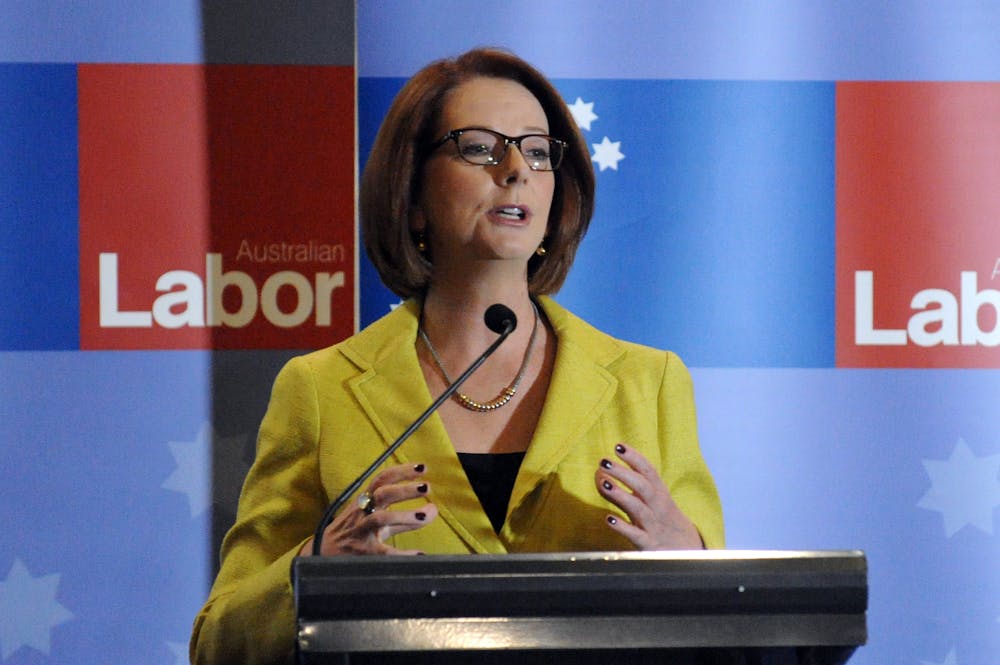
Tim Watts is Labor member for the Victorian seat of Gellibrand, one of the most diverse electorates in Australia. His own family is a microcosm of diversity – Watts comes from a long line of Australians with some ancestors deeply rooted in the old attitudes of “white Australia”, while his wife is from Hong Kong, and his children Eurasian-Australian.
In his new book, The Golden Country, Watts reconciles the past and present in his family, as well as examining immigration, race and national identity in modern Australia.
In this podcast with Michelle Grattan he also explores the “bamboo ceiling” in our politics, business and other areas, and talks about his efforts to encourage Asian-Australians to climb the ranks in Labor, which presently has ALP Senate leader Penny Wong as the only Asian-Australian face among its federal MPs.
New to podcasts?
Podcasts are often best enjoyed using a podcast app. All iPhones come with the Apple Podcasts app already installed, or you may want to listen and subscribe on another app such as Pocket Casts (click here to listen to Politics with Michelle Grattan on Pocket Casts).
You can also hear it on Stitcher, Spotify or any of the apps below. Just pick a service from one of those listed below and click on the icon to find Politics with Michelle Grattan.
Ranitidine is a medicine used for the short-term treatment of heartburn. Available in supermarkets and pharmacies, a prescription is only needed when a higher dose of the medicine is required over a longer period of time.
Ranitidine (sold under brand names Zantac, Rani 2, and Ausran) is currently in the news because regulators have found that most formulations are contaminated with a chemical called NDMA, which is as a probable carcinogen.
Peptic ulcer disease had been a significant health issue affecting millions of people around the world and at the time of ranitidine coming to market, approximately four million people in the United States had active peptic ulcers, which resulted in 6,000 deaths per year.
However, the drug is now off-patent (available in cheap generic formulations) and is included on the World Health Organisation’s (WHO) list of essential medicines as an anti-ucler medicine.
How and why is it used?
Antacids work by either neutralising acid or reducing the production of stomach acid.
Ranitidine reduces the amount of acid produced in the stomach and is part of a larger family of drugs called H2-histamine receptor antagonists.
It is a type of antihistamine, but not the type used for treating allergies. This is because the chemical histamine, although involved in allergic reactions, also stimulates the production of stomach acid. So blocking the effect of histamine also reduces the production of stomach acid.
Ranitidine is commonly used to relieve the symptoms of heartburn and indigestion but has also been used in the past to treat more serious conditions, such as peptic ulcers.
In recent times, longer lasting medications called proton pump inhibitors, that are more effective at reducing acid production, have largely replaced ranitidine for more serious conditions.
The most common formulations of ranitidine sold in pharmacies are oral tablets. For those patients who have difficulty swallowing, the medicine is also available as effervescent tablets (fast dissolving in a glass of water) and as a pre-prepared oral liquid.
What’s the link with cancer?
Ranitidine is currently in the news after the Australian Therapeutic Goods Administration (TGA) issued an alert stating many formulations of the drug were contaminated with a chemical called N-nitrosodimethylamine, abbreviated as NDMA. This should not be confused with the illegal party drug MDMA (ecstasy), which is a completely different chemical.
Contamination of ranitidine formulations is a problem because the World Health Organisation lists NDMA as a probable carcinogen, meaning it may cause cancer.
But it’s important to note most people are exposed to NDMA as part of their normal lives. NDMA can be found in cooked and smoked meats, from smoking cigarettes, beer, and even some toiletry and cosmetic products.
It’s not clear how the ranitidine formulations have become contaminated with NDMA. A similar chemical, dimethylamine, is used in the synthesis of ranitidine, and it may be possible some NDMA is created when the drug is made. Alternatively, ranitidine may be broken down, producing NDMA, during storage.
It will be important to determine the source of the contamination if new formulations are to be made free from NDMA.
The response in many countries has been the recall of ranitidine formulations. In the United States, the companies Sandoz and Apotex have voluntarily withdrawn their brands from sale. In Canada, the government has asked companies to stop distributing the medicine.
On September 17, Australia’s TGA said it anticipated a recall of ranitidine and until then would be working with international regulators and companies to investigate the problem. The TGA also announced it was doing batch testing of products to determine the extent of the contamination in Australia.
Since that announcement two products have been recalled, Apotex Ranitidine and Sandoz Ranitidine, but further recalls and shortages may occur.
What if you’re currently taking ranitidine?
If the medicine works for you and you wish to keep taking it, there is no immediate health risk. The only issue is from long-term use and could mean a possible increase in your risk of cancer later in life.
If you do wish to stop taking ranitidine, your pharmacist or general practitioner will be able to recommend other heartburn medicines that may be effective for you.
Last week the Association of Tennis Professionals (ATP) sentenced Australian tennis player Nick Kyrgios to a probationary period of six months that could lead to a suspension if certain conditions are not adhered to.
This probation follows a series of widely publicised controversial events and an “aggravated pattern of behaviours” on tour over the past few months.
Our research examines controversial athletes and how breaking the rules can have positive effects for sponsoring companies, even making an athlete more attractive. Sports celebrities often cultivate personal brands, not unlike traditional brands, to increase their marketability.
Despite his faults, Kyrgios is a draw card for a new generation of tennis fans. This makes him highly valuable for the sport and sponsors trying to expand their market.
With the strategic timing of the probation, immediately following the Laver Cup and just as Kyrgios announced he was pulling out of the current series of tournaments in Asia because of a collarbone injury, some have been led to believe important stakeholders don’t want Kyrgios out. In fact, many will likely be on the edge of their seats to see if he breaks the rules. Seems he is good for business.
Known as the bad boy of tennis, Kyrgios is no stranger to controversies on and off the tennis court. One of his first and most talked about episodes happened in 2015 in Montreal when he was fined for making an insulting remark to fellow player Stan Wawrinka about his then girlfriend, provoking a storm of criticism.
The past few months have been no exception. His Wimbledon tournament was punctuated with partying before an important clash with Rafael Nadal as well as a heated argument with the umpire and a volley shot aimed directly at Nadal. The North American hard court season was no better as Kyrgios was fined US$167,000 over a violent outburst at the Cincinnati Masters. These multiple incidents led to an investigation by the ATP, which resulted in the probationary period.
Polarising athlete
In one of the most formal sporting environments where even spectators have rules to follow, Kyrgios clearly clashes with the image of a traditional tennis player. Not only do his earrings, distinctive haircut and popped collar make his look stand out, his loud and opinionated personality is also a mismatch with the conventional world of tennis.
While his regular tantrums, antics and meltdowns make him the most controversial athlete in the current tennis era, Kyrgios is also perceived to be one of the most talented and entertaining players on the circuit. Indeed, his immense talent is undeniable. Often cited as one of the most physically gifted players, Kyrgios has an impressive range of shots with a rare combination of power, speed and finesse.
His ascension to one of the next generation of tennis players to watch was quick with a junior Australian Open title in 2013 and beating then-world champion Rafael Nadal at Wimbledon in 2014. He also has an impressive record against top-ten opponents in 2019 and is the only active player in tennis history to beat each of the “Big Three” – Roger Federer, Rafael Nadal and Novak Djokovic – in their first meetings.
While he is loved by many for his undeniable talent, being different and highly entertaining, he is also hated by others for his perceived disrespect to the game of tennis. Australia’s tennis “wild child” is the most polarising player in the tennis community.
Kyrgios is different from the rest and he consciously plays this card. He is colourful, authentic and fans can relate to him, and the way is he unapologetically himself is attractive especially for the younger generation.
Academic research has shown athletes are important social referents in terms of high standards of achievement to which consumers aspire. This is why they are frequently used in endorsements.
Celebrities’ influence has been widely linked to expertise and physical attractiveness, but more recent emphasis has been put on how accessible or relatable athletes are. Kyrgios is perceived as approachable when he agrees, for example, to hitting with a fan at practice in Montreal or asks fans in the stands where he should serve. On social media, he is one of the most followed male tennis players, fifth in line after Nadal, Federer, Djokovic and Murray.
In a sport that’s trying to appeal to a new fan base without alienating loyal traditional tennis fans, Kyrgios gets bums on seats. When fans come to watch Kyrgios play, one thing is certain: they will be entertained by his spectacular tweeners, tricky shots and fast serves, but his temper creates frequent opportunities for sensational tantrums.
All of these elements, the good, the bad, and the ugly make up his human brand, and companies are interested in endorsers with exciting personalities.
Recently, controversial athletes with a rebellious image have gained appeal to specific target markets. Smart brands are leveraging this opportunity. In the case of Kyrgios, his sense of fashion and passion for hip hop and basketball have led to partnership collaborations with Nike and NBA star Kyrie Irving, making him an asset for both the sport and sponsors.
When Kyrgios plays, we all watch, whether to see him succeed or fail. But it’s difficult to dispute his entertainment value. Kyrgios is arguably the greatest showman of modern day tennis.
Advertising agencies are full of confidence and self-belief, but only a few have the chutzpah to think they can take on the world. In the 1980s, Mojo was one such agency.
With the goal of becoming Australia’s first multinational agency, Mojo’s founders believed their success lay in their distinctive culture. While their unwavering faith in themselves and their approach would see Mojo briefly realise its goal, it also formed the basis of the agency’s demise.
The ABC’s recent documentary, How Australia Got Its Mojo, hosted by Gruen’s Russel Howcroft, presented a nostalgic account of the Mojo story. The real story is more complex – and offers a more fascinating insight into the world of advertising.
An Australian voice
In the 1960s, many Australian advertising creatives were tiring of the formulaic practices of the multinational agencies that dominated Australia’s industry. Hoping to create their own type of advertising, creatives such as Alan “Mo” Morris and Allan “Jo” Johnston took matters into their own hands.
Mo and Jo had worked for small creative agencies and large multinational agencies. Smaller agencies provided creative freedom but lower salaries; multinationals offered larger clients and generous salaries, but significantly less creative freedom. By establishing Mojo as their own creative consultancy, Mo and Jo hoped to get the best of both worlds.
The cornerstone of Mojo’s identity was its ordinariness. Their simple but catchy jingles sung in Jo’s unmistakably Aussie voice resonated with local audiences.
On the business side, ordinariness meant rejecting the multinationals’ structured approaches. Mojo’s outlook drew heavily on egalitarianism, unpretentiousness, and a blokey sense of mateship.
In 1979, billings of A$14 million gave Mo and Jo the confidence to convert Mojo into a full-service agency, embracing public relations alongside advertising. Client billings continued to climb, with Mojo producing some of the nation’s most memorable campaigns – including You Ought to be Congratulated for Meadow Lea, C’mon Aussie, C’mon for World Series Cricket, and Come and Say G’day for Tourism Australia.
By 1985, Mojo was the third largest Australian-owned advertising agency.
‘We might become big, but we’ll never be boring’
In July 1986, Mojo surprised the advertising world when it announced it would be merging with another local agency, Monahan Dayman Adams (MDA).
The two agencies had collaborated on the Commonwealth government’s bicentenary campaign. With few conflicting accounts and a shared commitment to creativity, the merger seemed a logical step. The new agency’s principals proudly proclaimed: “We might become big, but we’ll never be boring.”
MDA’s small network of international offices plunged Mo and Jo into the international market. Within months of the merger, Mojo-MDA opened offices in Malaysia, Taiwan and Thailand. However, the main game was the USA and the UK.
In November 1986, Mojo-MDA bought out a San Francisco agency, enabling it to link the Qantas and Australian Tourism accounts in the lucrative US market.
London operations started from scratch – agency principals believed Mojo’s Australianness was a major advantage as “advertising in the UK [was] crying out for a fresh approach.”
Perhaps the most audacious move was the opening of a new office on New York’s Madison Avenue: the home of advertising.
The honeymoon soon wore off. Differences between the agencies’ cultures began to affect everyday practices – from the sacking of staff to office locations. Mojo won the cultural war. Mojo was identified as the creative heart of the new agency, while MDA’s heritage was dismissed as the bland business side.
While Australian staff spread the Mojo ethos with missionary zeal, they struggled to convert local clients and audiences. Explaining the “way they wanted to sell themselves would have gone down in New Zealand like a ton of bricks”, a local staffer revealed Mojo’s Australian outlook was problematic.
In San Francisco, Amanda Moody, a creative assistant, recalled “the guys were a bit overconfident that they’d succeed here,” adding “what worked for advertisers in Australia just didn’t carry here.”
Leigh Clark, managing director of the Hong Kong branch echoed similar sentiments: “They just thought they could impose their culture and the same formula would work.”
By 1989, the Mojo-MDA network was under strain. With few international clients and an ethos that did not sit well with international audiences, it seized the opportunity to sell out to Chiat/Day, the West Coast American creative giant.
The Americans’ interest was the agency’s network of offices – not its unique culture. Chiat/Day staff were highly dismissive of Mojo’s creative output. Mo and Jo were soon sidelined and disillusionment set in.
Mo exited in 1991, Jo followed in 1994. While Mojo agency continued through to 2016, it was never the same.
Too rigid before the fall
Viewed some thirty years later, it’s difficult not to see hubris at the heart of Mojo’s rise and fall. Mojo’s unique culture saw Mo and Jo become national heroes. It also gave them the confidence to take on the world. But Mojo’s rigid adherence to its culture meant it lacked the flexibility to sustain a viable global operation.
While Mojo had hoped to emulate Paul Hogan’s spectacular international rise, the reality was their story was more Vegemite than Hogan – an easy product to package and export, but a difficult taste for foreign palates.
Australia’s ability to compete with other nations in a technology-enabled world is declining, according to a report recently released by the Committee for Economic Development of Australia (CEDA).
In 2019 Australia dropped to 14th on the global league table of digital competitiveness, down from 13th last year and ninth in 2015.
The results, from the World Digital Competitiveness rankings compiled by the Swiss-based International Institute for Management Development, show that Australia is becoming complacent in areas such as science education, information and communication infrastructure, and digital literacy.
What is digital competitiveness?
Digital competitiveness is a standardised measure of a country’s ability to develop cutting-edge digital technologies as well as its willingness to invest in research and development (R&D) and promote digital literacy training to create new knowledge, all of which are key drivers for economic development.
Proactive countries put money and effort into this process, regarding it as nation-building that hedges against future uncertainty. These countries score highly in the rankings. Countries further down the list tend to be reactive, sitting back and letting others go first.
In what areas are we behind?
The overall digital competitiveness score has three components: knowledge, technology, and future readiness.
Australia’s scores across these categories show we need to try much harder in future readiness. Our scores are also falling in the sub-categories of adaptive attitudes, business agility, and IT integration.
In a field of 63 countries, Australia comes 44th on current digital and technological skills and employers’ willingness to train their staff in these areas.
Which countries are doing it right?
The top ten countries in 2019 are the United States, Singapore, Sweden, Denmark, Switzerland, Netherlands, Finland, Hong Kong, Norway, and South Korea.
Looking at the strategic approach of the top five, all emphasise knowledge generation, but beyond that there are different approaches to digital competitiveness. The US and Sweden put equal emphasis on knowledge generation, creating a conducive environment for technology development, and fostering a willingness to innovate. Singapore, Denmark and Switzerland each place heavier emphasis on one or two of the factors.
More STEM graduates
At 53rd place, Australia ranks abysmally in the proportion of our university graduates in science and mathematics – the people who do research and development now and will continue to do it in the future. Our universities are among the best in the world, so that is not the problem. If jobs for these graduates existed, universities would be meeting the demand.
Australia’s information and communication technologies, including internet infrastructure, also score very poorly at 54th. This will not surprise the many Australian businesses and individuals who put up with slow, patchy internet connections. With more computing services and data moving into the cloud, fast internet is essential.
The news is not all bad though. Australia rates highly as a desirable destination for international students. It also scores well on digital access to government services, and ease of starting a business.
Why is Australia slipping?
Australia has grown complacent in certain areas, and we have been unwilling to invest sufficiently in building our digital capability in the areas mentioned. “Sufficient” is the key word. The fact that we are falling behind other countries means we cannot say we are investing enough.
The CEDA report indicates that one key reason for the investment shortfall is the disparity between the public’s and employers’ perspectives on how much it is needed. Industry sees a greater need than the general public does, but government policy tends to align with public sentiment for electoral reasons.
Funding is limited and there are many voices competing for a share of government spending. It is the squeaky wheel that gets the oil.
Building digital capability
Nation-building projects at scale need a coordinated approach across public and private sectors. Building the physical infrastructure to meet future needs is no different in principle to building the nation’s digital capabilities, which includes creating the communication technology, the means to develop new knowledge and ways of applying it to good effect. This is no less important than roads, power stations and hospitals for the nation’s future.
A national conversation
Australia needs to have a long conversation in national, state and local forums about the importance of investing in our digital future. We need to talk about all the ways R&D can benefit the Australian community, and why businesses need to embrace cutting-edge technology.
If we don’t get consensus on staying competitive we will fall further and further behind as more proactive countries accelerate their efforts. In time the economy will suffer, unemployment will rise and quality of life decline. It is no legacy to leave our children.
We are indeed a lucky country with our resources, but that will take us only so far in the 21st century. For the sake of future generations we have to make a new kind of luck and level up our digital game.
There is a revolution taking place in burger joints and supermarkets across Australia. Plant products that taste and behave like meat are increasingly making their way onto the plates of consumers as concern grows over the environmental impact of food production.
This week the CSIRO launched its plant-based meat venture, v2food. Over the next year we plan to develop a range of wholly Australian meat alternatives to be sold in supermarkets and restaurants across the country. The products include protein from legumes, fibre from plants, and oils from sunflower and coconut.
Hungry Jack’s will be the first major fast food chain to stock our product. Meat-free burger patties will soon be available in their stores. Our mince will also be available in grocery stores in the near future.
The venture is a partnership between CSIRO, Main Sequence Ventures (CSIRO’s investment fund) and food retailer Competitive Foods Australia.
The alternative protein market is already worth billions of dollars in the United States. A recent CSIRO analysis of emerging food trends in Australia estimated the revenue from domestic consumption and exports of plant-based protein products could be A$6.6 billion in 2030.
Hungry Jack’s will soon offer a plant-based burger patty alongside traditional meat options.Dave Hunt/AAP
There’s a science to getting a meaty taste from plants
v2food’s plant-based meat alternatives are not solely designed for vegans. Meat-eaters are a key target, particularly those who are concerned about the impact of food production on the environment.
Building a burger out of plants that will appeal to a meat-eater is no simple task. The product not only has to have the texture of meat but also the flavour, including that chargrilled taste, and should perhaps even “bleed” like meat cooked just right on the barbecue.
It took US companies Beyond Meat and Impossible Foods several years to bring a “beef” product onto the market. CSIRO’s specialists in food texture and flavour science achieved this in eight months.
v2food’s mini hotdogs and sliders. CSIRO food scientists and nutritionists helped develop the products.Tara Pereira
Known as sculptured food, the plant-based meat alternatives we’re working on comprise different ratios of plant proteins combined with carbohydrates from varying sources.
By studying the interactions of the ingredients at a molecular level and analysing the textures resulting from different processing techniques, it has been possible to develop products with the most appropriate texture, structure and bite – from soft to fibrous to cartilaginous.
Through formulation and processing, we coaxed proteins and carbohydrates to interact in different ways to form different textures.
We have also ensured the products are nutritious by introducing components such as pre-biotic fibres for a healthy gut, omega-3 plant-based or algal oils and micronutrients that provide extra vitamins and minerals.
More sustainable than meat
Meat production’s environmental impact has been the main driving force behind the development of plant-based protein alternatives. It contributes to climate change through the greenhouse gases emitted by livestock and deforestation to create grazing land.
As we developed the product we assessed the environmental impacts of different ingredients and made the most environmentally friendly choices.
We still have a way to go in reducing v2food’s environmental profile. For example, the processing technology required to make the meat alternatives doesn’t yet exist in Australia, so we sourced a soy protein from offshore and combined this with other natural ingredients rich in carbohydrates.
Within the next year, v2food will have the equipment to process local ingredients, which will go a long way towards providing a more sustainable alternative.
Meat on display at a Woolworths supermarket in Everton Park, Brisbane. The v2food venture is catering to meat eaters concerned about the environmental impact of food production.Dan Peled/AAP
Plant-based products we’re working on, such as the burger patty, have less fat than their meat counterparts sold in fast food chains – in particular less saturated fat. They contain similar amounts of protein and have the added bonus of fibre, which is not found in animal protein and is inadequate in the diet of most Australians.
There is still room for improvement and nutritionists and food technologists are working on ways to make v2food products healthier and more nutritious – for example, bringing down the salt content.
Animal protein sources including red meat, poultry and seafood remain important components of a healthy diet in Australia because they provide nutrients that contribute to a healthy diet, including high-quality protein, iron, zinc, vitamin B12 and healthy omega-3 fats.
In Australia, chicken and red meat comprise 70 per cent of both lean meats and their alternatives. So incorporating plant-based meat alternatives can increase the diversity of protein sources in our diet.
What does this mean for Australian agriculture?
For now, v2food is calling its product “meat made from plants”. There are calls – in Australia and abroad – to limit the use of terms such as meat, milk and seafood to animal-derived products. However, global protein demand is expected to grow to such an extent that all protein producers, whether they be cattle farmers or legume growers, will be called on to fill the gap.
Currant and mint kofta by v2food.Tara Pereira
In the US, demand for Canadian yellow peas – a main ingredient in plant-based protein products – is outstripping supply. We’re mapping out what the supply chain might look like for plant-based proteins in Australia and the opportunities for plant breeders, growers and producers. Once we have the required processing capability within Australia, this will open the door to higher value uses of legumes.
By harnessing innovation across science disciplines of food, agriculture, sustainability and nutrition, we can achieve a healthy, sustainable and locally grown and produced product.
There is a revolution taking place in burger joints and supermarkets across Australia. Foods made from plants that taste and behave like meat are increasingly making their way onto the plates of consumers as concern grows over the environmental impact of food production.
This week the CSIRO launched its plant-based meat venture, v2food. Over the next year we plan to develop a range of wholly Australian meat alternatives to be sold in supermarkets and restaurants across the country. The products include protein from legumes, fibre from plants, and oils from sunflower and coconut.
Hungry Jack’s will be the first major fast food chain to stock our product. Meat-free burger patties will soon be available in their stores. Our mince will also be available in grocery stores in the near future.
The venture is a partnership between CSIRO, Main Sequence Ventures (CSIRO’s investment fund) and food retailer Competitive Foods Australia.
The alternative protein market is already worth billions of dollars in the United States. A recent CSIRO analysis of emerging food trends in Australia estimated the revenue from domestic consumption and exports of plant-based protein products could be A$6.6 billion in 2030.
Hungry Jack’s will soon offer a plant-based burger patty alongside traditional meat options.Dave Hunt/AAP
There’s a science to getting a meaty taste from plants
v2food’s plant-based meat alternatives are not solely designed for vegans. Meat-eaters are a key target, particularly those who are concerned about the impact of food production on the environment.
Building a burger out of plants that will appeal to a meat-eater is no simple task. The product not only has to have the texture of meat but also the flavour, including that chargrilled taste, and should perhaps even “bleed” like meat cooked just right on the barbecue.
It took US companies Beyond Meat and Impossible Foods several years to bring a “beef” product onto the market. CSIRO’s specialists in food texture and flavour science achieved this in eight months.
v2food’s mini hotdogs and sliders. CSIRO food scientists and nutritionists helped develop the products.Tara Pereira
Known as sculptured food, the plant-based meat alternatives we’re working on comprise different ratios of plant proteins combined with carbohydrates from varying sources.
By studying the interactions of the ingredients at a molecular level and analysing the textures resulting from different processing techniques, it has been possible to develop products with the most appropriate texture, structure and bite – from soft to fibrous to cartilaginous.
Through formulation and processing, we coaxed proteins and carbohydrates to interact in different ways to form different textures.
We have also ensured the products are nutritious by introducing components such as pre-biotic fibres for a healthy gut, omega-3 plant-based or algal oils and micronutrients that provide extra vitamins and minerals.
How do you make it more sustainable than meat?
Meat production’s environmental impact has been the main driving force behind the development of plant-based protein alternatives. It contributes to climate change through the greenhouse gases emitted by livestock and deforestation to create grazing land.
As we developed the product we assessed the environmental impacts of different ingredients and made the most environmentally friendly choices.
We still have a way to go in reducing v2food’s environmental profile. For example, the processing technology required to make the meat alternatives doesn’t yet exist in Australia, so we sourced a soy protein from offshore and combined this with other natural ingredients rich in carbohydrates.
Within the next year, v2food will have the equipment to process local ingredients, which will go a long way towards providing a more sustainable alternative.
Meat on display at a Woolworths supermarket in Everton Park, Brisbane. The v2food venture is catering to meat eaters concerned about the environmental impact of food production.Dan Peled/AAP
Plant-based products we’re working on, such as the burger patty, have less fat than their meat counterparts sold in fast food chains – in particular less saturated fat. They contain similar amounts of protein and have the added bonus of fibre, which is not found in animal protein and is inadequate in the diet of most Australians.
There is still room for improvement and nutritionists and food technologists are working on ways to make v2food products healthier and more nutritious – for example, bringing down the salt content.
Animal protein sources including red meat, poultry and seafood remain important components of a healthy diet in Australia because they provide nutrients that contribute to a healthy diet, including high-quality protein, iron, zinc, vitamin B12 and healthy omega-3 fats.
In Australia, chicken and red meat comprise 70 per cent of both lean meats and their alternatives. So incorporating plant-based meat alternatives can increase the diversity of protein sources in our diet.
What does this mean for Australian agriculture?
For now, v2food is calling its product “meat made from plants”. There are calls – in Australia and abroad – to limit the use of terms such as meat, milk and seafood to animal-derived products. However, global protein demand is expected to grow to such an extent that all protein producers, whether they be cattle farmers or legume growers, will be called on to fill the gap.
Currant and mint kofta by v2food.Tara Pereira
In the US, demand for Canadian yellow peas – a main ingredient in plant-based protein products – is outstripping supply. We’re mapping out what the supply chain might look like for plant-based proteins in Australia and the opportunities for plant breeders, growers and producers. Once we have the required processing capability within Australia, this will open the door to higher value uses of legumes.
By harnessing innovation across science disciplines of food, agriculture, sustainability and nutrition, we can achieve a healthy, sustainable and locally grown and produced product.
Homosexuality has been a controversial topic across the legal and moral domains in China. Homosexual acts were officially decriminalised in 1997, but Chinese laws have yet to properly recognise or protect same-sex couples in the forms of marriage or de facto relationships.
However, a recent development has given hope to some that changes may be on the way.
On July 19, an article titled “Guardianship appointment: bridging love within the LGBT community” went viral in Chinese social media. It was first published on the WeChat subscription account of Nanjing Notary Public Office, and detailed how the legal guardianship system could “sufficiently protect LGBT rights”.
“Guardianship appointment (yiding jianhu)” is a mechanism that gives the freedom for someone to appoint their own guardian through a legal agreement.
Then, on August 5, Beijing Guoxin Notary Public Office announced the first notarisation of mutual guardianship agreement requested by “special people” in Beijing on their WeChat.
The development means same-sex couples were, for the first time, legally recognised for their relationship in China outside of a traditional marriage framework.
The screenshot of the non-deleted Nan Jing WeChat article.Sina Weibo
Both of these two WeChat articles were later deleted by the respective authors (there were no reasons given, but the government’s online policy may have played a role). Still, Chinese social media managed to preserve the original content of the articles, as well as discussions around LGBT rights, including supportive voices and homophobic discourses.
This sheds light on the Chinese government’s possible changing attitude and strategy in dealing with the Chinese LGBT community.
The government can exploit the ambiguous line between morality and law in Chinese traditions. Instead of punishing any LGBT related content or acts, the government tends to silence relevant discussions in the public arena.
What is ‘guardianship appointment’?
Initially, guardianship appointment was designed for elderly people to assign their legal guardianship for medical emergencies, and manage and assign the beneficiary for their commonly owned assets.
This right has been accessible to all Chinese adult citizens who are able to carry out duties in civil affairs (decisions on one’s assets, wealth and inheritance) according to the law since October 1, 2017.
Fo Ge (the pseudonym name of a Chinese lesbian) and her girlfriend were reportedly the first same-sex couple to successfully obtain such a legal right and recognition in China.
They had been together for ten years when they decided to conceive a baby with the help of IVF in 2017. But they realised they could not act as each other’s legal guardian in the case of medical emergency.
The couple then consulted their local notary public office, who later formalised their legal obligation to each other through the “guardianship appointment” mechanism. Many Chinese provincial-level regions also follow this act in approving same-sex guardianship.
But in most notarial documents, the couple’s relationship was stated as “friend” rather than “spouse”.
To understand the implications of this legal system on Chinese LGBT rights, we need to understand the state’s consistent framing of homosexuality from a social moral perspective rather than a legal perspective.
Being gay was considered ‘hooliganism’
First and foremost, homosexuality has been treated as a form of “hooliganism” (liu mang) – a reference to any acts contrary to social and public order.
Yet, it was never a law during Mao’s era. Hooliganism only became law in 1979 under Deng Xiaoping’s reform agenda, which pushed the need for spiritual reform to support social economic transformations.
The legal implication of “hooliganism” is two-fold. First, it’s considered a threat to society and so should be “treated” with “re-education” (gai zao).
And importantly, the legal provision here opens the door for the state to denounce homosexuality as an antisocial behaviour that requires attention.
So even though “hooliganism” has been removed from Chinese law since 1997, the moral conviction of homosexuality remains.
Nonetheless, the decriminalisation of homosexuality has given the oxygen LGBT+ communities needed to survive. Despite the lack of official recognition and the slow change of social attitudes, the gay scene is active and even vibrant in urban China.
Promotional movie of Shanghai Pride 2016.
LGBT+ activists have been openly challenging bureaucracy, legal uncertainty and entrenched social norms to assert their place in society in recent years.
The Chinese government backed UN recommendations of LGBT+ rights in March 2019, which further illustrated the gradual shift in the country’s legal system.
So while the government has yet to fully empower China’s gay community, homosexuality is no longer “hidden” or “shut down”.
China uses the ‘three no’s’
The Chinese government now has a policy of “Three No’s”: homosexuality receives “no approval, no disapproval, and no promotion”.
Indeed, there was no news coverage in China about the government’s backing of the UN Human Right’s Council’s LGBT+ recommendations.
This ambiguous policy provides great flexibility to the state’s regulating apparatus to deal with issues relating to the LGBT communities.
At the same time, policy ambiguity also leaves some flexibility for the formation of Chinese LGBT communities.
And we can read the notarisation of guardianship agreement within same-sex couples as a survival tactic for members of LGBT communities. What’s more, the agreement is a strategic policy implementation under the “Three Nos” principles.
In fact, the Commission of Legislative Affairs of the National People’s Congress (NPC) Standing Committee made it clear on August 21 that same-sex marriage is not on the horizon in China.
heterosexual monogamy aligns with Chinese contemporary and traditional cultural norms.
This statement highlights how the state consciously frames homosexuality against China’s moral tradition. They position it as the key rationale for eliminating any potential legal loopholes that will make governments offer official blessings to same-sex couples.
Allowing same-sex couples to have a guardianship arrangement is consistent with the state’s continuous strategy of neutralising LGBT-related topics.
The strategy allows the state great flexibility to exclude any open discussions about the topic in a public arena.
Yet, it also protects the state from being accused of using oppressive mechanisms to suppress or punish the marginalised voices in the society.
This is part of a new series looking at the national security challenges facing Australia, how our leaders are responding to them through legislation and how these measures are impacting society.
In August, the intelligence officer known as Witness K indicated he would plead guilty to a conspiracy charge under section 39 of the Intelligence Services Act. That section prohibits the disclosure of information acquired or prepared by the Australian Secret Intelligence Service (ASIS).
Concerns have been raised about the use of the National Security Information Act (NSIA) in the Collaery trial. Anthony Whealy, a former judge who presided over several of Australia’s recent terrorism trials, said
This could be one of the most secretive trials in Australian history.
Both cases will be back in court this month. A hearing is also scheduled to consider how national security information will be dealt with in the Collaery trial.
There has been significant media discussion around the ASIS bugging that Witness K and Bernard Collaery exposed, but less about the NSIA.
So what is the National Security Information Act? Why was it introduced and how could it lead to secretive trials?
Having its cake and eating it, too
The purpose of the NSIA is to protect national security information while allowing it to be used in Australian courtrooms. It applies in federal court proceedings, both civil and criminal.
Before the NSIA, prosecutors faced a difficult choice. They could prosecute someone for terrorism, national security or secrecy offences and risk having sensitive information disclosed publicly, or they could keep the information secret and possibly have the prosecution fail.
Now, the government can have its cake and eat it too: it no longer needs to choose between protecting sensitive information and prosecuting someone for disclosing it.
Australia’s defence, security, international relations or law enforcement interests.
There are two circumstances in which the NSIA procedures can be triggered. The first is when the parties know in advance they are likely to reveal national security information during the trial. The parties must notify the attorney-general of this, or face two years in prison.
The second set of circumstances relates to when a witness is being questioned on the stand and an answer has the potential to reveal national security information. If a lawyer or the defendant knows this could happen, he or she must stop the witness from answering and notify the court, or the same penalty applies.
In either of these circumstances, the attorney-general can issue a non-disclosure certificate that prohibits the information from being revealed or allows it to be revealed in summary or redacted form. The court then holds a closed hearing in which the judge will determine whether and how the information may be used.
In a closed hearing, not only are journalists and members of the public barred from attending, but also the jury. The judge may even exclude the defendant, the defendant’s lawyer or a court official if revealing the information to them would be likely to compromise national security.
Supporters of Bernard Collaery and Witness K protesting outside Supreme Court in Canberra in August.Lukas Coch/AAP
Withholding information from defendants
That the legislation permits closed hearings is not necessarily the main issue, though this certainly undermines the principles of open justice. However, closed hearings are an option in other sensitive cases, such as those involving child victims of sexual assault.
The main problem with the NSIA is that it creates a situation in which national security information can be used in a courtroom without the defendant, jury, media or general public knowing the details of that information.
Producing evidence in summary or redacted form means that the gist of the information is provided, but key details are kept secret. In fact, it is not even clear under Australian law that something approximating a gist needs to be given.
This undermines the defendant’s ability to argue their innocence. A core aspect of procedural fairness and the right to a fair trial is that defendants must know the case against them. This allows their lawyers to contest the veracity of the evidence through cross-examination.
Without knowing when or how the prosecution’s evidence was collected, or even the precise claims the evidence is making, lawyers cannot adequately defend their clients. They are fighting with one hand tied behind their backs.
Weighing national security vs a fair trial
Moreover, in deciding how potentially sensitive information can be used in court, judges must give greater weight to national security than the defendant’s right to receive a fair hearing.
In other words, the NSIA does not require a judge to balance national security and a fair trial equally. More weight must be given to the former under the law.
It may be that judges can still strike an appropriate balance so defendants receive a fair hearing in cases like these. But if a contest between national security and a fair trial needs to be decided, it is clear which one wins.
Using the NSIA in the Collaery trial is also significant because the accused is a whistleblowing lawyer and not someone accused of terrorism.
It is likely, given the sensitive nature of the ASIS bugging scandal, that information will be withheld from Collaery’s defence team for national security reasons. This is a significant test case for whether whistleblowers can receive a fair trial in the current climate of government secrecy.
Source: The Conversation (Au and NZ) – By Andrea Carson, Associate Professor at La Trobe University. Department of Politics, Media and Philosophy, La Trobe University
During the 2019 election, a news story about the Labor Party supporting a “death tax” – which turned out to be fake – gained traction on social media.
Now, Labor is urging a post-election committee to rule on whether digital platforms like Facebook are harming Australian democracy by allowing the spread of fake news.
While the joint standing committee on electoral matters (JSCEM) will not report until July next year, our latest research finds that politicians are key culprits turning the term “fake news” into a weapon.
Following the election of Donald Trump as president of the United States, we investigated if Australian politicians were using the terms “fake news”, “alternative facts” and “post-truth”, as popularised by Trump, to discredit opponents.
With colleagues Scott Wright, William Lukamto and Andrew Gibbons, we investigated if elite political use of this language had spread to Australia. For six months after Trump’s victory, we searched media reports, Australian parliamentary proceedings (Hansard), and politicians’ websites, press releases, Facebook and Twitter communications.
We discovered a US contagion effect. Australian politicians had “weaponsied” fake news language to attack their opponents, much in the way that Trump had when he first accused a CNN reporter of being “fake news”.
President-elect Donald Trump refused to take a question from CNN reporter Jim Acosta, calling him fake news in January 2017.
Significantly, these phrases were largely absent in Australian media and parliamentary archives before Trump’s venture into politics.
Our key findings were:
Conservative politicians are the most likely users of “fake news” language. This finding is consistent with international studies.
Political users were either fringe politicians who use the term to attract more media coverage, or powerful politicians who exploit the language to discredit the media first, and political opponents second.
The discourse of fake news peaks during parliamentary sitting times. However, often journalists introduce it at “doorstops” and press conferences, allowing politicians a free kick to attack them.
ABC journalists were the most likely targets of the offending label.
Concerningly, when the media were accused of being fake news, they report it but seldom contest this negative framing of themselves, giving people no reason to doubt its usage.
Here is one example of how journalists introduce the term, only to have it used against them.
Journalist: Today, we have seen a press conference by President Trump where he has discussed at length this issue as fake news. Prime Minister Turnbull do you believe there is such a thing as fake news?
Prime minister: A very great politician, Winston Churchill, once said that politicians complaining about the newspapers, is like a sailor complaining about the sea — there’s not much point. That is the media we live with.
This kind of sequence suggests journalists play a role in driving and reinforcing fake news discourse to the likely detriment of trust in media.
One Nation’s Malcolm Roberts provides the most extreme example of the weaponisation of fake news discourse against mainstream media:
Turns out the ABC, in-between spewing fake news about our party, ruined ANZAC day for diggers… . The ABC are a clear and present threat to democracy.
Roberts was not alone. Politicians from three conservative parties claimed the ABC produced fake news to satisfy so-called leftist agendas.
What we discovered is a dangerous trend: social media users copy the way in which their politicians turn “fake news” against media and spread it on the digital platforms.
Despite this, our findings, published in the International Journal of Communication, offer hope as well as lessons to protect Australian democracy from disinformation.
First, our study of politicians of the 45th Parliament in 2016 shows it was a small, but noisy minority that use fake news language (see table below). This suggests there is still time for our parliamentarians to reverse this negative communication behaviour and serve as public role models. Indeed, two Labor politicians, Bill Shorten and Stephen Jones, led by example in 2017 and rejected the framing of fake news language when asked about it by journalists.
figure 1: Total number of instances of fake news discourse use between 8 November 2016 to 8 May 2017 by politician. N = 22 MPs; N =152 events. *MPs who use fake news discourse to refute it rather than allege it.Authors
Second, we argue the media’s failure to refute fake news accusations has adverse consequences for public debate and trust in media. We recommend journalists rethink how they respond when politicians accuse them of being fake news or of spreading dis- and misinformation when its usage is untrue.
Third, academics such as Harvard’s Claire Wardle argue that to address the broader problem of information disorders on the web, we all should shun the term “fake news”. She says the phrase:
is being used globally by politicians to describe information that they don’t like, and increasingly, that’s working.
On the death tax fake news during the 2019 election, Carson’s research for a forthcoming book chapter found the spread of this false information was initiated by right-wing fringe politicians and political groups, beginning with One Nation’s Malcolm Roberts and Pauline Hanson.
One Nation misappropriated a real news story discussing inheritance tax from Channel Seven’s Sunrise program, which it then used against Labor on social media. Among the key perpetrators to give attention to this false story were the Nationals’ George Christensen and Matt Canavan. As with the findings in our study, social media users parroted this message, further spreading the false information.
While Labor is urging the JSCEM to admonish the digital platforms for allowing the false information about the “death tax” to spread, it might do well to reflect that the same digital platforms along with paid television ads enabled the campaigning success of its mischievous “Mediscare” campaign in 2016.
In a separate study, Carson with colleagues Shaun Ratcliff and Aaron Martin, found this negative campaign, while not responsible for an electoral win, did reverse a slump in Labor’s support to narrow its electoral defeat.
Perhaps the JSCEM should also consider the various ways in which our politicians employ “fake news” to the detriment of our democracy.
Many of those who’ve suffered from illness or disease would have received the advice to “stay positive”. Is this sage advice that can truly have a positive effect on health, or an added burden for someone who is already suffering – the need to also feel good about it?
We asked five experts in various fields whether a positive mindset can affect outcomes for those suffering from illness and disease.
Five out of five experts said yes
However, they had some important caveats. It depends on the disease – for example, one expert said studies in cancer have not found positive thinking affects disease progression or the likelihood of early death.
And while our mental health can have powerful effects on our physical health, the perceived need to “stay positive” can be an added burden during a difficult time. So it’s also important to remember grief is normal.
Here are the experts’ detailed responses:
If you have a “yes or no” health question you’d like posed to Five Experts, email your suggestion to: alexandra.hansen@theconversation.edu.au
Erica Sloan is a member of the Scientific Advisory Board of Cygnal Therapeutics. Jayashri Kulkarni receives funding from the NHMRC.
If that fact doesn’t ruffle you, consider this: worldwide, 7.8 billion passengers are expected to travel in 2036 – a near doubling of current numbers. If business as usual continues, one analysis says the aviation sector alone could emit one-quarter of the world’s remaining carbon budget – the amount of carbon dioxide emissions allowed if global temperature rise is to stay below 1.5℃.
The world urgently needs a transport system that allows people to travel around the planet without destroying it.
The Sail to the COP initiative follows Greta Thunberg’s high-profile sea voyage to attend last month’s United Nations climate summit in New York. The activists are not arguing global yacht travel is the new normal – in fact therein lies the problem. We need to find viable alternatives to fossil-fuelled air travel, and fast.
Greta Thunberg onboard the racing boat Malizia II in the Atlantic Ocean on her journey to New York last month.AAP
A study conducted for the European Parliament has warned that if action to reduce flight emissions is further postponed, international aviation may be responsible for 22% of global carbon emissions by 2050 – up from about 2.5% now. This increasing share would occur because aviation emissions are set to grow, while other sectors will emit less.
In Australia, aviation underpins many aspects of business, trade and tourism.
The below image from global flight tracking service Flightradar24 shows the number of planes over Australia at the time of writing.
A screen shot from Flightradar24 showing the flights over Australia at the time of writing.Flightradar24
Federal government figures show the civil aviation sector, domestic and international, contributed 22 million tonnes of carbon dioxide-equivalent emissions in 2016.
The number of passenger movements from all Australian airports is set to increase by 3.7% a year by 2030-31, to almost 280 million.
Emissions from international flights cannot easily be attributed to any single country, and no country wants to count them as their own. This means that international civil aviation is not regulated under the Paris Agreement. Instead, responsibility has been delegated to the International Civil Aviation Organisation (ICAO).
The Sail to the COP initiative is calling for several actions. First, they say jet fuel should be taxed. At present it isn’t – meaning airlines are not paying for their environmental damage. This also puts more sustainable transport alternatives, which do pay tax, at a disadvantage.
Research suggests a global carbon tax on jet fuel would be the most efficient way to achieve climate goals.
But instead, in 2016 ICAO established a global scheme for carbon offsetting in international aviation. Under the plan, airlines will have to pay for emissions reduction in other sectors to offset any increase in their own emissions after 2020.
Critics say the strategy will not have a significant impact – pointing out, for example, that the aviation industry is aiming to only stabilise its emissions, not reduce them.
Sail to the COP is also seeking to promote other sustainable ways of travelling such as train, boat, bus or bike. It says aviation taxes are key to this, because it would encourage growth in other transport modes and make it easier for people to to make a sustainable transport choice.
A growing number of people around the world are already making better choices. In Thunberg’s native Sweden for example, the term “flygskam” – or flight shame – is used to describe the the feeling of being ashamed to take a flight due to its environmental impact. The movement has reportedly led to a rising number of Swedes catching a train for domestic trips.
Can we sail beyond nostalgia?
Many will dismiss the prospect of a revival in sea travel as romantic but unrealistic. And to some extent they are right. Sailing vessels cannot meet current demand in terms of speed or capacity. But perhaps excessive travel consumption is part of the problem.
One is a shift to a low-carbon, and low-travel, society, in which we would “live smaller, live closer, and drive less”. Urry argues we may be less rich, but not necessarily less happy.
But one Sail to the COP organiser, Jeppe Bijker, thinks it’s an option worth exploring. He developed the Sailscanner tool where users can check if sailing ships are taking their desired route, or request one.
A trip from the Netherlands to Uruguay takes 69 days, at an average speed of 5km/hour.
Some ships might require you to help out with sailing. Other passengers may be required to work look-out shifts. Of course, some passengers may become seasick.
But the site also lists the advantages. You can travel to faraway places without creating a huge carbon footprint. You have time to relax. And out on the open water, you experience the magnitude of the Earth and seas.
Climate Explained is a collaboration between The Conversation, Stuff and the New Zealand Science Media Centre to answer your questions about climate change.
If you have a question you’d like an expert to answer, please send it to climate.change@stuff.co.nz
As an individual, what is the single, most important thing I can do in the face of climate change?
The most important individual climate action will depend on each person’s particular circumstances, but each of us can make some changes to reduce our own carbon footprint and to support others to do the same.
Generally, there are four lifestyle choices that can make a major difference: eat less or no meat, forego air travel, go electric or ditch your car, and have fewer children.
Best of all, this can be done right now, at whatever level you can manage, and there are many people taking this step.
One aspect that is often overlooked is that carnivorous pets (mainly dogs, cats) consume lots of meat, with all the associated impacts described above. A recent US study concluded that dog and cat ownership is responsible for nearly one third of the environmental impacts associated with animal production (land use, water, fossil fuels). So ideally, if you’re getting a new pet, go for something herbivorous.
Buy locally, eat seasonally
Buy local produce, whether it’s food grown locally or goods manufactured locally rather than imported from overseas. Goods that are transported around the world by sea account for 3.3% of global carbon dioxide emissions and 33% of all trade-related emissions from fossil fuel combustion, so reducing our dependence on imports makes a big difference to our overall carbon footprint.
Car use is a problem, because we all enjoy the personal mobility cars provide. But it comes with an excessively high carbon cost. Using public transport where possible is of course preferable, but for some the lack of personal freedom is a big disadvantage, as well as the sometimes less than perfect transit networks that exist in many parts of the country.
One alternative for many people looking to commute short distances might be an e-bike, but think of it as an alternative to your car rather than a replacement for your bike. For those looking to replace their car, buying a hybrid or full electric model would be the best thing from an emissions perspective, even if the production of the cars themselves isn’t entirely without environmental problems.
New Zealand’s network of electric vehicle (EV) chargers is growing rapidly, but generally speaking it is easiest to charge at home if you’re doing daily commutes. This becomes economical if you have an electricity supplier offering a special low rate for EV charging.
On the subject of electricity, an easy and quick way to reduce your carbon footprint is to switch to a supplier that generates electricity only from renewable sources. In New Zealand, we have an abundance of renewable options, from solar, wind and hydro.
Plant trees
Planting trees requires having some space, but if you have land available, planting trees is a great way to invest in longer-term carbon sequestration. There is a lot of variability between species, but as a rule of thumb, a tree that lives to 40 or 50 years will have taken up about a ton of carbon dioxide.
Air travel is, for many of us, an essential part of our work. There is some progress in the field of aviation emissions reductions, but it is still a long way off. In the short term we have to find alternatives, whether that is in the form of teleconferencing or, if travel is essential, carbon offsetting schemes (although this is far from a perfect solution unfortunately).
Vote for climate-aware politicians and council representatives. These are the people who have the power to implement changes beyond the scope of individual actions. Make your voice heard through voting, and by contributing to discussion and consultation processes.
Community initiatives such as tree planting or shared gardens, or just maintaining wild spaces are ideal for carbon sequestration. This isn’t just because of the plants these spaces accommodate, but also because of the soil. Globally, soil holds two to three times more carbon than the atmosphere, but the ability of soil to retain this depends on it being managed well. Generally speaking, the longer and more densely planted an area of soil is, the better it will sequester carbon.
How to cope
One of the frustrations is the realisation that climate change is not something that can be left to politicians to deal with on our behalf. The urgency is simply too great. The responsibility has been implicitly devolved to the individual, without any prior consent.
But individual actions are massively important in two ways. First, they have an immediate impact on our total carbon footprint, without any of the inertia of political machinations. Secondly, by adopting and advocating for low-carbon life choices, individuals are sending a clear message to political leaders that a growing proportion of the voting population will favour policies that are aligned with similar priorities.
It is of course hard to stand your ground and stick with new lifestyle choices when you feel surrounded by people who choose not to change, or worse, actively mock and criticise. This is normal human psychology. People subconsciously tend to feel attacked if they see someone else making a so-called ethical or moral choice, as if they themselves are being judged, or criticised.
In the context of climate change, the science is so overwhelmingly clear, and the current and future impacts so manifestly important, that not to acknowledge this in a meaningful manner either reflects a lack of understanding or awareness, or is simply selfish. Rather than taking issue with those members of society, a more positive approach that can help you cope with the feeling of marginalisation is to actively seek out like-minded people.
The UK’s Labour Party recently voted in a policy to effectively abolish private schools and integrate them into the state system.
This is a courageous move designed to redress social inequity – many of those working in the top levels of the UK government were educated in private schools. Two of Britain’s three most recent prime ministers went to the prestigious Eton College, which charges annual fees of more than £40,000.
But beyond that, Australia’s complex set of school governance structures would make such a move very unlikely to succeed.
Eight education systems
Under UK Labour’s proposal, if it took office, private schools would lose their charitable status and any other public subsidies or tax breaks. Their endowments, investments and properties would be “redistributed democratically and fairly across the country’s educational institutions”.
For Australia to do the same, at the outset, it would be a constitutional issue. The Australian Constitution empowers states and territories to provide school education, thus creating eight different education systems. For Australia to abolish private schools like that proposed in the UK, a choice from three possible processes would need to occur to get around this issue.
First, Australia could change the Constitution. Second, all states and territories could voluntarily cede their powers for schooling back to the Commonwealth. Or third, each state and territory government could agree to enact the policy in its own jurisdiction.
Only eight of the proposed 44 changes to the Australian Constitution have been agreed to since Federation. And given the political territorialism that exists between states and territories, it is hard to imagine any of these solutions being implemented.
Assuming one of the above could be enacted, taking over existing non-government schools would be further complicated by the diverse nature of school governance structures.
Australia’s different school governance structures would make it almost impossible to cede all private education to the Commonwealth.from shutterstock.com
In addition to being registered with their relevant state or territory government authority, more than 1,000 non-government primary and secondary schools are registered with the Australian Not-for-profit Charities Commission.
This means there are no “owners” who financially gain from operating the school. Financial surpluses are not distributed to shareholders but must be reinvested in the school.
For a government to take over a not-for-profit charity in such a way would cause extreme anxiety to the thousands of community organisations which also exist under this legal structure.
Another group of non-government schools are governed by church authorities. A school such as William Clarke College in Sydney’s north-west, for instance, is governed by an ordinance of the Anglican Diocese of Sydney whose own authority is derived from state legislation. A smaller number of schools, such as Newington College in NSW or the eight Queensland Grammar Schools, are governed directly through acts of parliament.
To absorb these schools into one government system would require a change to a range of legislation covering charitable and religious organisations. Given various state and territory governments can’t even agree on the age students should start school, achieving consistency in the legislative realm seems remote.
We should keep working to reduce inequality
Advocates of private schooling in the UK have hit back at Labour’s proposal, indicating lengthy, and costly, legal challenges. These could range from parents’ rights to make choices for their childrens’ development (enshrined in Article 18 of the UN Convention on the Rights of the Child) through to property and charitable trust laws.
Resistance to the proposed policy change from the UK Headmasters’ and Headmistresses’ Conference (that describes itself as an association of heads of “some of the world’s leading independent schools”) is already fierce and suggests the same would likely be the case in Australia.
One consequence of inaction is growing inequity. Successful education systems prioritise equity and quality. Analysis of social disadvantage by the OECD found more than 52% of Australian disadvantaged students are enrolled in disadvantaged schools. This is compared to the OECD average of 48% and 45% in the UK (world leaders are Nordic countries at an average of 43%).
Australian analysis also highlights a growing concentration of advantaged students are already in educationally advantaged schools.
Creating a socially and politically just education system is a worthy objective. But it’s not just a public-private issue.
Segmented schooling also exists in some Australian government schooling jurisdictions. For example, NSW has a highly stratified government education system which includes single-sex schools and various selective schools (academic, performing arts, sports and technology schools).
This creates enrolment interest from families living outside local communities, exacerbating infrastructure pressures in government schools. And some of NSW’s selective schools have concentrations of students who are far wealthier than in some private schools.
The debate over what our society wants from schooling is about equitable opportunities for everyone. The policy outlined by the UK’s Labour Party raises fundamental questions about the role and process of education in society. There seems value to ask the same for Australia.
If you watched China’s impressive military parade marking the 70th anniversary of Communist Party rule, you may be wondering how China now compares to the United States in terms of military might.
The answer: it’s a lot closer than commonly thought.
China’s annual military budget is estimated by the Stockholm International Peace Research Institute to be about 1.7 trillion yuan. This is about 1.9% of China’s GDP.
Using market exchange rates, China’s annual military spending converts to about US$228 billion. By comparison, the US military budget is US$649 billion – or 3.2% of US GDP.
Hence China’s military budget is usually thought of about 40% that of the US – which is often characterised as spending more on its military than the next 10 countries combined.
Such an approach, however, dramatically overstates US military capacity – and understates China’s. In real terms, China’s spending is worth abougt 75% that of the US.
Chinese tank crews in the military parade marking the 70th anniversary of the founding of the People’s Republic of China.Roman Pilipey/EPA
Purchasing power parity
The problem is that a simple currency conversion doesn’t reflect actual price differences across countries. An American or Australian visiting India or China, for example, finds things like street food, nannies and domestic help are all very cheap. The same principle applies to military spending.
The salary of a US soldier might be, say, $US60,000 a year. This could pay the salaries of several, if not many more, soldiers in the People’s Liberation Army.
To make a more accurate comparison of the real purchasing power of a country’s military spending, we need to factor in differences in labour and operational costs between countries.
An all-women contingent of the military parade marking the 70th anniversary of the founding of the People’s Republic of China.Wu Hong/EPA
I’ve computed the costs of defence services across countries, looking at personnel, operations and equipment costs.
For some components of military spending, such as the cost of buying a fighter plane or warship, it’s appropriate to use market exchange rates to compare across countries. For other components, particularly personnel expenditure, it’s better to compare wage costs for similarly trained personnel. These costs differences can then be used to construct “purchasing power parity” exchange rates specific to the defence sector.
Aerial surveillance crews in the military parade marking the 70th anniversary of the founding of the People’s Republic of China.Roman Pilipey/EPA
Using these rates allows us to see how much the spending in each country actually buys – allowing for price differences between countries as well as how defence planners might react to these different prices given their defence priorities.
Looking at these differences, my analysis suggests China’s military spending is equivalent to the US spending about $US455 billion.
This is nearly double what is suggested by the figure obtained using a straight currency conversion. It means, in real terms, China’s annual spending is about 74% of the US.
Global comparisons
Similar results hold for other countries where labour and services prices are comparatively low.
For example, official exchange rate estimates suggest military spending by Russia and India is just 10% of the US. But factoring in the lower prices facing their defence sectors suggests Russia’s military budget is equivalent to about 30% of the US budget; and India’s about 40%.
This analysis also changes the impression we have of countries like Indonesia, Ukraine and Colombia.
For example, Indonesia’s military budget in 2018 equates to a “mere” $US8 billion. But in terms of the actual resources it can purchase, a more accurate estimate is that its expenditure is worth about $US36 billion – substantially more than Australia’s military budget.
Of course, just because an army costs a lot, or has a lot of personnel, doesn’t mean it is good value. The numbers don’t tell us everything we might want to know about relative military power. But they do give a very different, and more accurate, picture of the global distribution of military muscle.
So you should have been impressed by the might of China’s military on parade. The US is still number one – but not by as much as you might think.
Australian Story recently featured a two-part look at Australia’s iconic film and television legend Paul Hogan, documenting Hogan’s rise and fall in Australian culture.
Self-described as a “one-hit wonder”, Hogan’s well-loved persona is attributed to his embodiment of the ordinary, Aussie bloke.
He is white, straight, able-bodied, and good for a laugh. He is practical and good in a crisis, but generally laid back. He rejects individualism in favour of loyalty to his mates. He is a larrikin and a hater of authority.
He is just your ordinary, average guy.
Hogan’s emergence as an international Australian icon is largely in part due to his embodiment of this idealised Aussie bloke.
The long ocker history
The outback ocker was embedded in white Australian culture through the late 1800s and early 1900s.
Poets such as Henry Lawson and Banjo Patterson, and literary magazines such as The Bulletin, romanticised ocker men and the hardships of bush life. White men who could survive in the rough Australian climate were valued for their mateship, perseverance, and push back against authority.
Shearing the Rams is a classic capturing of the rough Aussie bloke.NGV Collection
The significant losses of ANZACs during the first world war marked a shift from focusing on the bush as a site of masculinity, to life on the urban beach. Australia was desperate for heroes, and the image of a strong, white, and healthy male was nurtured.
Post WWI, the image of the Australian bloke moved from the bush to the beach.Ray Leighton/Trove
In the 60s and 70s, there was a cultural push in Australian society to instate a white, collective, homogeneous Australian identity occurring alongside the abolition of the White Australia policy. There was a push towards Australian national pride, encouraging consumption of local goods and entertainment, and the inclusion of white Australian history in the school curriculum.
Simultaneously, Aboriginal and Torres Strait Islander people fought (and continue to fight) for increased recognition for rights, histories, and social justice – standing in contrast to colonial ideas of Australian identity and heritage.
But the prevailing image of Hogan is as Mick Dundee, a character which also helped form a global reputation of Australia as a place that is easy-going and unconcerned with material lifestyles – despite Australia being quite the contrary, thanks to post-war prosperity.
Dundee has spurred parodies and a cameo on The Simpsons. Last year, Tourism Australia created a trailer for a fake new instalment of the Crocodile Dundee films to promote Australia tourism.
The success of this advertisement is attributed to the public push for such a film to be produced. But at the same time this posited return of Hogan was celebrated, it was clear that this image of the Aussie bloke has also lost its shine.
Characters like Crocodile Dundee are now critiqued for being sexist, racist, and homophobic, and performing masculinity is regarded as a major form of oppression for men.
The conversation has shifted. The stoicism of the Aussie Bloke can lead to poor mental health, as men are forced to embody a narrow definition of Australian masculinity. There needs to be a change in how men behave and enact masculinity in Australian culture.
Hogan’s performance of masculinity is one that is easy-going, ordinary, and down-to-earth. It is relatable because it is not extraordinary.
But after the height of Crocodile Dundee, Hogan experienced major downfalls. Divorce and tax evasion scandals went against the idealised image of the Aussie bloke; not helped by Australia’s Tall Poppy Syndrome.
Hogan’s representation of an everyday, ordinary bloke had been damaged by his accumulation of wealth and break down of his nuclear family structure. The performative masculinity of the Australian bloke is narrow and exacting, forever threatened.
The myth of the white Australian bloke can be damaging – but perhaps there is a way forward.Paramount
There is much damaging about this legend of the ordinary, Aussie bloke: its exclusion of those who don’t fit the white, able-bodied, hetero norm; its impact on men’s mental health; its ties with colonialism and the subjugation of women and Aboriginal and Torres Strait Islander peoples and cultures.
But in watching the recent Australian Story, there is something, too, we can all take to heart from the value of ordinariness in a world where we are increasingly asked to be extraordinary.
Maybe this is the new Australian myth we should all embrace.
Anyone who thought that with the Reserve Bank’s cash rate now close to zero, its run of interest rate cuts was over, needs only to read the last sentence of Governor Philip Lowe’s announcement after Tuesday’s cut:
The Board will continue to monitor developments, including in the labour market, and is prepared to ease monetary policy further if needed to support sustainable growth in the economy, full employment and the achievement of the inflation target over time.
For the longest time, the run of cuts was over.
Lowe’s immediate predecessor, Glenn Stevens, cut the cash rate to a record low of 1.5% in August 2016 as something of a “parting gift”, allowing Lowe to take over and keep it steady, unchanged for a record 34 months.
For most of those three years he made it clear the rate was unlikely to fall further. Six times he said the next move in rates was likely to be up, “rather than down”, pointing to rate increases overseas and progress on jobs and returning Australia’s unusually low inflation rate to his target band.
By February this year he was backtracking. Although it wasn’t apparent in the published figures, the unemployment rate was about to begin climbing. Wage growth had been far weaker than forecast, inflation showed no sign of returning to the centre of his target band, and forecasts for global growth were falling.
More importantly, consumer spending, which accounts for six in every ten dollars spent in Australia, was extraordinarily weak, growing at less than half the usual rate, as households “responded to this extended period of weaker income growth by progressively downgrading their spending plans”.
The probabilities of next move being up and down had become “more evenly balanced”.
Two weeks after the May election he cut the cash rate, then cut it again, taking it to a new record low of 1%, anticipated by only two of the 19 economists surveyed by The Conversation just six months earlier.
The extra cut announced on Tuesday is because the last two didn’t do enough.
House prices have begun to move up (as would be expected with lower rates) but borrowing is growing only slowly, and home building is weak. The Australian dollar is low (in part because of the lower rates), which should help make Australian businesses competitive, but they are not keen to borrow.
Since the last Reserve Bank board meeting we have learned that economic growth is shockingly low, just 1.4% over the past year, the weakest since the global financial crisis. Household spending is barely keeping pace with population growth.
How the cuts will help
The cash rate is the rate the Reserve Bank pays banks who deposit with it overnight. It drives almost every other rate, including the rates banks pay retail depositors, which help determine their cost of lending.
They don’t have to cut their mortgage and business rates in line with cuts in the Reserve Bank cash rate, but they usually do.
The average so-called standard variable mortgage rate is 5.2%, but few new borrowers pay it.
The typical discounted rate is 3.46%, and some discounted rates are much lower. HSBC Australia charges 3.17%. If it passes on Tuesday’s cut in full it will charge only 2.92%, offering the first mortgage rate beginning with the number “2” in Australia’s history.
There’s every reason to believe that it will help. Even if Australians don’t borrow more to buy houses, they will be able to use the historically cheap credit embodied in their house loans to buy other things, such as solar panels whose payoff period will have shortened dramatically.
Since June many mortgage-holders will have saved A$150 on monthly payments.
Sure, confidence and decent wage growth would help, but given how indebted many Australians are, low mortgage rates will do quite a bit on their own.
Why they’ll continue
Governor Lowe made it clear on Tuesday that they will have to stay low for “an extended period”. A signed agreement with the treasurer requires him to keep them low until unemployment falls and inflation and economic growth return to return to normal levels.
He would like the government to help by boosting spending. He often mentions spending on infrastructure. But his employment contract requires him to use the cards he has been dealt. If the economy is weak, he is required to boost it using the instruments he has.
That’s why he says he is prepared “to ease monetary policy further”.
If needed, he’ll do it as soon as next month, cutting the cash rate to 0.5%. If more is needed beyond that, he will get ready to use so-called unconventional measures of the kind being used overseas, buying government and corporate bonds in order to force even more money into Australian’s hands.
There’s no reason to believe that the tools he has won’t work, and every reason to believe he’ll keep using them.
The dramatic revelation by the New York Times that Donald Trump pressed Scott Morrison in an early September phone call for help in an exercise of overt presidential politicking does not indicate any Australian government wrongdoing.
But it shows how Morrison’s bromance with the president brings its political embarrassments along with all that glitz and warmth.
Last week the PM got himself caught up in a Trump-created political rally. Now he’s on the spot over this (typical) Trump call, which was about US Attorney-General William Barr’s seeking information for the justice department inquiry that the president hopes will discredit the Mueller probe into Russian interference in the 2016 election.
Australia, inadvertently, was central in the train of events leading to the Mueller inquiry, which has now reported (and found Russian activity).
In May 2016, Alexander Downer, then Australian High Commissioner in London, had drinks with Trump campaign adviser George Papadopoulos.
Papadopoulos said Russia had told the Trump campaign it had damaging information on Hillary Clinton and was prepared to release it close to the election.
Downer reported that back to the foreign affairs department, which shared it with the intelligence community. Subsequently, the Americans were alerted to it, and it got to the FBI, becoming a catalyst for the Mueller inquiry.
Downer acted properly. A diplomat’s job is to gather information and inform their government.
(Papadopoulos, who sees Downer as an agent of entrapment, has tweeted in the wake of the NYT article: “I have been right about Downer from the beginning. A wannabe spy and Clinton errand boy who is about to get exposed on the world stage”.)
The issue for the Australian government became more complicated when Trump, who paints himself as the victim of a conspiracy, launched the current investigation into the origins of the FBI’s inquiry. The president said at the time he hoped Barr “looks at the UK, and I hope he looks at Australia, and I hope he looks at Ukraine. I hope he looks at everything because there was a hoax that was perpetrated on our country”.
Australia immediately promised cooperation.
Did it have much alternative? On the downside, this was a highly charged Trumpian exercise. But the inquiry was under the auspices of a US government department. And wouldn’t refusal to co-operate suggest Australia had something to hide, when there is no reason to suppose it did?
Joe Hockey, Australia’s ambassador in Washington, wrote to Barr on May 28 saying: “The Australian government will use its best endeavours to support your efforts in this matter”. He said while Downer was no longer employed by the government, “we stand ready to provide you with all relevant information to support your inquiries.”
Presumably, the government has little to give beyond an account of the Downer discussion and the subsequently passing on of the contents of that conversation.
But Simon Jackman, CEO of the United States Studies Centre at the University of Sydney, poses the pertinent question: “If Hockey says, we’re here to help, what was the point of the September phone call?” He suggest it might have had to do with the declassification of documents.
The affair is now politically messy for Morrison on two levels.
The leak of the previously undisclosed telephone call comes immediately after the revelations about the president’s call to Ukrainian president Volodymyr Zelensky, in which he urged him to investigate Democrat presidential hopeful Joe Biden and his son. That has led to the impeachment inquiry.
There is no parallel between the conversations, but inevitably there will be a conflation.
Further, in the absence of a transcript, there will be questions (already being asked by the opposition) about the content and tone of the Trump-Morrison conversation, which came shortly before the PM’s US trip, on which he was so effusive about the president. Bill Shorten said:“Mr Morrison needs to clean up the perception that perhaps the special reception was returned for special favours done”.
It’s understood that Morrison and Trump didn’t discuss the specifics of the matter. The request was reportedly “polite”, asking for cooperation with Barr and for a point of contact. Trump was aware that the matter was before Morrison’s time, and didn’t expect him to know about the details.
The government insists it has nothing to fear if the transcript of the call becomes public through another leak. If that’s accurate, it should be hoping that leak will occur.
Anyone who thought that with the Reserve Bank’s cash rate now close to zero, its run of interest rate cuts was over, needs only to read the last sentence of Governor Philip Lowe’s announcement after Tuesday’s cut:
The Board will continue to monitor developments, including in the labour market, and is prepared to ease monetary policy further if needed to support sustainable growth in the economy, full employment and the achievement of the inflation target over time.
For the longest time, the run of cuts was over.
Lowe’s immediate predecessor, Glenn Stevens, cut the cash rate to a record low of 1.5% in August 2016 as something of a “parting gift”, allowing Lowe to take over and keep it steady, unchanged for a record 34 months.
For most of those three years he made it clear the rate was unlikely to fall further. Six times he said the next move in rates was likely to be up, “rather than down”, pointing to rate increases overseas and progress on jobs and returning Australia’s unusually low inflation rate to his target band.
By February this year he was backtracking. Although it wasn’t apparent in the published figures, the unemployment rate was about to begin climbing. Wage growth had been far weaker than forecast, inflation showed no sign of returning to the centre of his target band, and forecasts for global growth were falling.
More importantly, consumer spending, which accounts for six in every ten dollars spent in Australia, was extraordinarily weak, growing at less than half the usual rate, as households “responded to this extended period of weaker income growth by progressively downgrading their spending plans”.
The probabilities of next move being up and down had become “more evenly balanced”.
Two weeks after the May election he cut the cash rate, then cut it again, taking it to a new record low of 1%, anticipated by only two of the 19 economists surveyed by The Conversation just six months earlier.
The extra cut announced on Tuesday is because the last two didn’t do enough.
House prices have begun to move up (as would be expected with lower rates) but borrowing is growing only slowly, and home building is weak. The Australian dollar is low (in part because of the lower rates), which should help make Australian businesses competitive, but they are not keen to borrow.
Since the last Reserve Bank board meeting we have learned that economic growth is shockingly low, just 1.4% over the past year, the weakest since the global financial crisis. Household spending is barely keeping pace with population growth.
How the cuts will help
The cash rate is the rate the Reserve Bank pays banks who deposit with it overnight. It drives almost every other rate, including the rates banks pay retail depositors, which help determine their cost of lending.
They don’t have to cut their mortgage and business rates in line with cuts in the Reserve Bank cash rate, but they usually do.
The average so-called standard variable mortgage rate is 5.2%, but few new borrowers pay it.
The typical discounted rate is 3.46%, and some discounted rates are much lower. HSBC Australia charges 3.17%. If it passes on Tuesday’s cut in full it will charge only 2.92%, offering the first mortgage rate beginning with the number “2” in Australia’s history.
There’s every reason to believe that it will help. Even if Australians don’t borrow more to buy houses, they will be able to use the historically cheap credit embodied in their house loans to buy other things, such as solar panels whose payoff period will have shortened dramatically.
Since June many mortgage-holders will have saved A$150 on monthly payments.
Sure, confidence and decent wage growth would help, but given how indebted many Australians are, low mortgage rates will do quite a bit on their own.
Why they’ll continue
Governor Lowe made it clear on Tuesday that they will have to stay low for “an extended period”. A signed agreement with the treasurer requires him to keep them low until unemployment falls and inflation and economic growth return to return to normal levels.
He would like the government to help by boosting spending. He often mentions spending on infrastructure. But his employment contract requires him to use the cards he has been dealt. If the economy is weak, he is required to boost it using the instruments he has.
That’s why he says he is prepared “to ease monetary policy further”.
If needed, he’ll do it as soon as next month, cutting the cash rate to 0.5%. If more is needed beyond that, he will get ready to use so-called unconventional measures of the kind being used overseas, buying government and corporate bonds in order to force even more money into Australian’s hands.
There’s no reason to believe that the tools he has won’t work, and every reason to believe he’ll keep using them.
Silicon Valley may now be more popularly associated with software companies such as Google and Facebook but it takes its name from the material most used to make semiconductors.
Semiconductors – or computer chips – power everything from mobile phones to military systems. The semiconductor industry sits at the centre of the modern world.
This point is key to appreciating what’s going on in the US government’s battle with Chinese technology giant Huawei.
The US actions do more than just keep Chinese technology away from critical telecommunications infrastructure – something it has lobbied US allies to emulate.
They also choke off the global supply of semiconductors, and technology to make semiconductors, to Huawei, thereby limiting China’s rate of technological progress, economic development and ability to compete with the US.
Executive ban
In May US president Donald Trump signed an executive order blocking US technology companies dealing with Huawei. The order bans “any acquisition, importation, transfer, installation, dealing in, or use of any information and communications technology or service” without special approval.
Among the effects is that Google has stopped licensing its Android mobile operating system to Huawei, limiting the Chinese company’s ambitions in the global phone market.
But arguably the biggest consequence is blocking the sale of US semiconductors, and semiconductor-making equipment and services.
Huawei is not only the world’s third-largest buyer of semiconductors but, through its subsidiary HiSilicon, one of China’s biggest semiconductor makers. Being shut off from US suppliers impedes both the competitiveness of its products and the development of its own chip-making capacity.
A coherent strategy
The US Semiconductor Industry Association has urged the US government to approve exemptions because there are no “national security concerns” in selling semiconductors to Huawei for “non-sensitive” products such as phones. It argues the ban only benefits foreign rivals.
But my research, based on financial data from Bloomberg, points to a coherent strategy to preserve US dominance of the global semiconductor industry.
US corporations dominate the global semiconductor industry. The following chart shows the world’s top 20 manufacturers by company value.
Author provided
Despite all the hype about the rise of China, Chinese involvement in computer and electronics technologies is still typically restricted to lower-end activities such as making and assembling components. US companies take the lion’s share of profits through controlling the intellectual property in design, branding and marketing of electronic goods.
Apple Corporation, for example, subcontracts Taiwanese company Hon Hai Precision Industry to assemble its products. Hon Hai in turn employs up to a million Chinese workers through subsidiary Foxconn, which makes products for Apple along with other brands. In 2013 Hon Hai’s profit was US$2.6 billion. Apple made US$33 billion – almost 13 times more.
Chinese workers at Foxconn’s Lunghua plant in the Chinese city of Shenzhen, Guangdong province. Foxconn is the world’s largest manufacturer of electronic components.YM Yik/EPA
Based on everything Trump has said about China, this is the way he would like to keep things.
China wants to become a global semiconductor player but lags far behind US corporations in size and sophistication. It continues to rely heavily on semiconductor imports. It spends more on importing semiconductors than on oil.
HiSilicon, like other Chinese companies, lacks the manufacturing experience to produce advanced semiconductors at scale. For basic chip design it has relied on British semiconductor design company Arm (owned by Japan’s Softbank). Arm cut ties with Huawei in May to comply with US restrictions.
Finding a replacement for Arm won’t be easy. Most of the other big providers of equipment, software and services for designing and making semiconductors are American – such as Cadence Design Systems, Synopsys, Applied Materials and Lam Research.
Long-term prize
Blacklisting Huawei on national security grounds can therefore be seen as a way to hinder China’s semiconductor industry. It help keeps China in a subordinate position as an assembly area for US corporations.
Trump’s Huawei strategy looks more coherent than many other parts of his international agenda. The ban may also be hurting US companies, but the longer-term prize is maintaining the hegemony of US companies in a vital industry and keeping the American state in front of its geopolitical rival.
It appears we may be at the start of a new cold war that will play out across technology industries – from the global semiconductor industry to 5G networks, exascale computing, artificial intelligence, autonomous vehicles, robotics and gene editing.
These are battlefields on which the Trump administration has already signalled it wants its allies to join it.
This potentially complicates the desire of a country like Australia, which wants good relationships with both the US and China, its most significant trading partner. Decisions such as blocking Huawei from tendering for contracts for Australia’s 5G network could well be seen as evidence we are far from neutral, instead being a deeply and willingly integrated part of the US empire.
Most of us know somebody who tends to get over involved in certain behaviours, and the saying often goes that they must have an “addictive personality”. But is there such a thing?
The idea of an addictive personality is more pop-psychology than scientific.
What is personality?
To understand why the idea of an addictive personality is flawed, it’s important to first understand what psychologists mean when referring to personality.
Personality is comprised of broad, measurable, stable, individual traits that predict behaviour. So by definition, engaging in excessive behaviours cannot be considered a personality trait.
Though, there are personality traits that are associated with addiction.
Neuroticism is one of the “big five” personality dimensions. These are the five core traits that drive behaviour. They include openness to experience, conscientiousness, extraversion/introversion, agreeableness and neuroticism.
People who are highly neurotic might engage in excessive behaviours to help manage their emotions. Neuroticism has also been associated with a range of mental health conditions, which could lead one to wonder whether addiction is caused by mental illness.
There is evidence of this for some people. In these cases people’s addictive behaviour reduces negative emotions caused by the mental illness. Though it could also be that certain personality factors such as neuroticism predispose a person to both mental illness and addiction separately.
Nature versus nurture
There is some evidence that both personality and addictive behaviours have a genetic component.
One of these genes has also been associated with extroversion, another of the big five personality dimensions. Extroversion refers to the degree to which people “search for novel experiences and social connections that allow them to interact with other humans as much as possible”.
Extroverts seek out new ways to come into contact with other people.from www.shutterstock.com
These five genes reduce the functioning of the dopamine, or reward, system of the brain. The brains of people with variants of the genes associated with extroversion and addictive behaviours use dopamine less efficiently. It has been proposed that this leads them to seek out pleasure.
Dopamine is often misrepresented as the pleasure neurotransmitter. A more accurate description of dopamine is that it is the motivation neurotransmitter. It motivates people to engage in certain behaviours – particularly those behaviours needed for survival such as eating and sex.
It makes sense then that variants of these genes have been found to be associated with “sensation seeking”, another dimension of personality. Sensation seeking is a “trait defined by the seeking of novel sensations, and the willingness to take physical, social, legal and financial risks for the sake of such experiences”. People with addictive behaviours also score high on this personality dimension.
Though to say these are genes for an addictive personality is a bit like saying the genes for height are the basketball genes. While some people who are tall are good at basketball, not all tall people have the opportunity or desire to learn the game.
Similarly, not everybody with variants of the dopamine genes associated with excessive behaviours develops problems with substance dependence or other addictive behaviours. Environment is also important.
It’s likely that some people whose dopamine system is less efficient due to genetic variations get their dopamine fix through other activities such as car racing, snowboarding, surfing, sky diving and so on. And some people who develop a dependence on alcohol and other drugs do not have this genetic predisposition. They might develop problems due to a range of environmental influences such as trauma or social modelling of drug use.
So while there are common factors associated with personality that predict addiction, there is no personality type that will cause someone to partake in excessive behaviours. Addiction has multiple causes and just chalking it up to someone’s personality probably isn’t very helpful in dealing with it.
With the launch of Hannah Brontë’s music-driven The Sweet Suits last Tuesday, online cinematheque Prototype’s first season came to a close.
Every Tuesday, a new film was delivered to subscriber emails curated by Lauren Carroll Harris. The 12 films were personal explorations of the experimental form, with a manifesto about bridging the art and film worlds through a new digital terrain:
Prototype is a project of digital utopianism. It’s deeply weird that the internet has made cats and radio famous, but not video art. Digital art and video art are the least attended type of visual arts event with only 17% of [visual arts] attendees – or 7% of all Australians – going to these events a year. A year! And yet video culture is exploding, and the vessel for viewing – the smartphone – is right in our hands.
Prototype seeks to bring this work out of the gallery and film festival and straight to the viewer, with new work from some of Australia’s strongest emerging and established video artists and filmmakers. With Prototype, you can encounter art in your everyday life.
Video art has consistently adapted with changing technology. We are immersed in video now, constantly bombarded with streaming images on our phones. Following on from other sites such as the Whitney Museum’s Artport, Prototype cuts through the online algorithms that are a challenge for emerging video artists.
In Last Night, two women are on a date and ‘Biblical passages […] seem erotic.’Sarah Hadley/Prototype
Deeply personal, sometimes confronting
Like most experimental cinema, the work is deeply personal.
In Sarah Hadley’s Last Night, two women are on a date. Interspersed between shots of the women are scenes from a car wash and a desolate beach. As they watch Douglas Sirk melodramas, Biblical passages are appear on screen. Juxtaposed against the tension between the women, these passages seem erotic.
The curatorial notes themselves are also personal in nature:
I read Last Night as two women who seem awfully unhappy and inhibited, in search of lost time, reconciling their secret selves with their longing for one another. The filmmaker, Sarah Hadley, tells me that the bible verses quoted throughout are deeply seductive, alluring and rooted in a longing to know the unknown – which is precisely the feeling of being forgotten, forbidden and othered.
In New Masc, filmmaker Cloudy Rhodes invites her friends to pose in a male public bathroom, performing what masculinity meant to them.
The result is a challenge to traditional notions of portraiture. The queer subjects vary from being soft and hard: flexing like body builders, kissing their image in the mirror, glaring at the camera. The film quotes Freud as they pose: “unexpressed emotions will never die. They are buried alive and will come forth later in uglier ways”.
It continues: “Every man must find out for himself in what particular fashion he can be saved.”
Queer subjects challenge notions of portraiture in New Masc.Cloudy Rhodes/Prototype
I found Tiyan Baker’s Hard As You Can the most challenging work in the collection. An exploration into the impact of Brad Pitt’s portrayal of Tyler Durden in David Fincher’s Fight Club, the film is a frightening journey into Sydney’s real-life fight clubs.
From posts in reddit forums to footage from actual fight clubs, the documentary posits Fight Club influenced the growth of Men’s Rights Activists and other alt-right misogynistic collectives. There is an urgency to this film that demonstrates how the experimental form is not in any way frivolous.
Each of these films demonstrate how varied contemporary experimental cinema is.
Conor Bateman’s Run Time looks at the trope in horror movies of characters being slain in the theatre space. Jason Phu uses his mobile phone to capture his Dad’s stories while he cooks. Talia Smith shares stories of her grandmother, and the abuse she faced from her husband in a film that reminded me of being told the hardships of my own maternal grandmother.
James Nguyen explores how architecture is embedded in our national character. Gabriella Hirst juxtaposes traumatic recollections with tranquil imagery. In Tina Havelock Stevens’ Come Together, Right Now we watch others watching music.
Alena Lodkina explores an inner Melbourne malaise in Mercury.Alena Lodkina/Prototype
Alena Lodkina – whose debut feature Stranger Colours received critical acclaim on the global film festival circuit – gives us Mercury. The film draws on Euripides’ Medea and Argonautica by Apollonius of Rhodes. The Greek characters of Medea and Jason of the Argonauts are transposed into an inner Melbourne malaise, constantly flitting between spaces and moods.
Art we can hold
Prototype demonstrates a push to break away from conventional spaces where this work is exhibited. This is art we can access through our own portable devices.
While all the films break from a traditional narrative structure, each tells a story. They ask us to move beyond conventional storytelling devices and to think about how filmmaking techniques are pivotal in expressing emotion.
These are deeply personal films, as are Harris’ annotations, that are akin to poetic diary entries. They are open texts inviting our interpretations.
Hopefully, this season of Prototype is the first of many.
The research is based on data we gathered during an expedition on a small Norwegian research vessel, the Lance, that was left to drift in the Arctic sea ice for five months in 2015.
Time series of air temperature anomalies in the Arctic for the period 1981-2010: Temperatures in the Arctic in May and June 2019 period were the warmest in the satellite records.Zack Labe (@ZLabe)
The expedition was intense and felt more like going to the Moon than going on a typical research cruise. What took us by surprise were the many winter storms that battered the ice (and our ship and ice camp).
It has taken us years to collate these data but now we know the winter storms play a key role in the fate of Arctic sea ice, particularly in the Atlantic sector of the Arctic.
Norwegian research vessel ‘Lance’ frozen in the Arctic sea ice in February 2015 during the N-ICE2015 expedition.Paul Dodd (NPI)
On average, about 10 extreme storms will reach all the way to the North Pole each winter. While these winter storms are short (they last on average 6-48 hours), they can be incredibly intense.
During a storm in winter 2015 we saw the air temperature rise from -40℃ (-40℉) to 0℃ (32℉) in just a day, and then fall back to -30℃ (-22℉) the next day, when cold Arctic air returned after the storm.
These storms bring heat, moisture and strong winds into the Arctic, and next we look at how they impact sea ice and its surroundings.
Warming and weakening the ice
The heat from the storms warms up the air, snow and ice, slowing down the growth of the ice. Moisture from the storms falls as snow on the ice. After the storm, the blanket of snow insulates the ice from the cold air, further slowing the growth of the ice for the remainder of winter.
The strong winds during the storms push the ice around and break it into pieces, making it more fragile and deforming it, more like a boulder field.
The strong winds also stir the ocean below the ice, mixing up warmer water from deeper waters to the surface where it melts the ice from below. This melting of the ice in the middle of winter can happen for several days after the storms when the air is already back to well below freezing.
Processes related to Arctic winter storms. In the first storm phase, strong southerly winds compress the ice cover and transport warm air, moisture, and bring strong winds. In the second phase, northerly winds transport ice southwards. After the storm has passed, cold and calm conditions return, allowing new ice to grow in leads. When the next winter storm arrives, it further drives the ice cover into a relatively thin-ice, snow-covered mosaic of strongly deformed ice floes. These new conditions impact surrounding ecosystems by shaping habitats and light conditions.Graham et al., 2019 (Scientific Reports)
Thinner ice, shelter for life and accelerated melting
The breakup of the ice opens big passages of open water between ice floes, called leads. In winter these passages end up refreezing rapidly, generating new super-thin ice.
These thinner refrozen patches of ice let more light through in the following spring, allowing ocean plants (phytoplankton) to bloom earlier.
The rougher sea ice landscape becomes a shelter for many ice-associated Arctic organisms, including ice algae, becoming biological hot spots in the following spring.
The broken up and deformed ice drifts faster, reaching warmer waters where it melts sooner and faster.
So really, winter storms precondition the ice to a faster melt in the following spring with an impact that continues well into the following season.
Average September Arctic sea ice extent from 1979 to 2018. Black line shows monthly average for each year; blue line shows the trend.National Snow and Ice Data Center
The Arctic is particularly sensitive to human driven climate change. We know the decrease in sea ice is due to both the warming of the Arctic (air and ocean) and changing wind patterns that break up the ice cover.
But there are also amplifying mechanisms or “feedback” mechanisms, in which one natural process reinforces another. Their role in the decrease of sea ice is hard to predict. We now know winter storms in the Arctic contribute to these feedback mechanisms.
With the thinner Arctic sea ice cover and shallower warmer water in the Arctic Ocean, the mechanisms we observed during the winter storms will likely strengthen and the overall impact of winter storms on Arctic ice is likely to increase in the future.
Two weeks ago, the Arctic sea ice reached its minimum extent for 2019, after another winter of intense winter storms. The minimum ice extent was effectively tied for second lowest since modern record-keeping began in the late 1970s, along with 2007 and 2016, reinforcing the long-term downward trend in Arctic ice extent. Arctic sea ice has been declining for at least 40 years, and amplifying mechanisms such as the winter storms are accelerating this retreat.
Arctic sea ice extent just reached its annual minimum extent for 2019 on September 18. This season was a tie for the 2nd lowest on record, along with 2007 and 2016 and behind 2012, which holds the overall record minimum.Zack Labe (@ZLabe)
As highlighted in the recent IPCC Ocean and Cryopshere report, these changes in September sea ice are likely unprecedented for at least 1,000 years.
Remember also that changes in the Arctic don’t just affect the immediate region: Arctic warming has been linked to the polar vortex, and weather extremes across central Europe and north America.
If you have a question you’d like an expert to answer, send it to curiouskids@theconversation.edu.au.
How do scientists know that evolution is real? – Emily, age 11.
In science, we look at the evidence and try to find the theory that best explains it. And that’s what happened when it came to figuring out evolution.
We can see life evolving all around us. Plants, animals and even bacteria are adapting to different conditions (like climate change), to new predators and diseases.
This is a portrait of the young Charles Darwin by artist George Richmond.George Richmond/Wikimedia
A young man named Charles Darwin was one of the first to realise how this happens. He lived in England nearly 190 years ago and decided to sail around the world (because he didn’t really know what to do with his life).
Spot the difference
For two years people on the boat mapped the shore and explored South America and Australia. Darwin’s job was to check out the plants and animals they found. Sound fun? Not if you were seasick like poor Darwin.
He began to wonder why animals were so different to those back in England. He had the revolutionary idea that they weren’t always that way. Maybe these species had changed over time in response to their environment, he thought.
He noticed that little brown birds that they called finches, living on a group of islands called the Galápagos, looked similar to each other but had different-shaped beaks on different islands.
Darwin realised that the beaks were good for getting different kinds of food: big heavy beaks for crushing tough nuts that grew on one island; little beaks for eating fruit; sharp beaks for probing cactus; and long beaks for catching insects on other islands.
Darwin looked closely at the beaks of finches on the Galápagos Islands.Shutterstock
Darwin twigged that the birds all started off the same, but those on an island with nuts developed heavier beaks, whereas those on an island with cactus developed sharp beaks. How?
He suggested the beaks of individual ancestor birds were all a bit different, and the differences were passed down from parents to chicks. Birds with slightly heavier beaks did better on the island with nuts, and they laid more eggs and had more chicks than other birds. These chicks also had heavier beaks, and did better than other birds, and laid more eggs. He called this “natural selection”.
Darwin suggested animals or plants that survived in different environments would eventually become so different they couldn’t get together to have chicks. This is how one species splits into two.
The evidence piles up
During Darwin’s day, these ideas seemed shocking. Most people believed species of plants and animals had always been the way they were; that they were created that way. But soon, people began to find new evidence that fit Darwin’s theory, or reconsider old evidence in light of what he proposed.
People found dinosaur bones and realised these enormous creatures once roamed the Earth but were now extinct. Now we know, from comparing skeletons, they are related to birds, and we even have fossils of feathered dinosaurs.
One famous example of fossils that showed earlier “versions” of contemporary animals is the “walking whale” – fossils that indicated that earlier versions of whales had legs. People couldn’t believe that natural selection could turn a hippo-like land animal into a whale, that lost its legs as it became a better swimmer. But recently whale fossils with legs were discovered. (Even today, we can see that whale embryos develop four masses of cells called limb buds, but which don’t grow into legs.)
In Darwin’s day nobody knew the Earth’s crust changes dramatically; land under the ocean can buckle upward to form mountains. That’s why cockle shells can be found at the top of huge mountains. All this evidence supports the idea that environments change and animals adapt.
Splitting one species into two takes millions of years, but we can sometimes catch this happening. Little groups of wallabies that live in rocky outcrops in Queensland are a famous example because they show a lot of intermediates (meaning populations that are starting to get so different from each other that they don’t interbreed well and are close to becoming two new species).
A huge new source of evidence for evolution came with the discovery of DNA, which is shared by all life on Earth. DNA changes slowly as mutations accumulate. DNA is similar for species that are closely related (like Darwin’s finches, or like hippos and whales) and more different between species that are distant (like humans and whales, or humans and plants). This is a pretty big clue supporting Darwin’s idea that living things are related and have changed over time.
Scientists have looked at the huge piles of evidence and concluded that evolution is the best explanation we’ve heard so far on how life on Earth came to be as it is today.
More than one in three young adults aged 18 to 25 reported problematic levels of loneliness, according to a new report from Swinburne University and VicHealth.
We surveyed 1,520 Victorians aged 12 to 25, and examined their experience of loneliness. We also asked about their symptoms of depression and social anxiety.
Overall, one in four young people (aged 12 to 25) reported feeling lonely for three or more days within the last week.
Among 18 to 25 year olds, one in three (35%) reported feeling lonely three or more times a week. We also found that higher levels of loneliness increases a young adult’s risk of developing depression by 12% and social anxiety by 10%.
Adolescents aged 12 to 17 reported better outcomes, with one in seven (13%) feeling lonely three or more times a week. Participants in this age group were also less likely to report symptoms of depression and social anxiety than the 18 to 25 year olds.
Young adulthood can be a lonely time
Anyone can experience loneliness and at any point in life but it’s often triggered by significant life events – both positive (such as new parenthood or a new job) and negative (bereavement, separation or health problems).
Young adults are managing new challenges such as moving away from home and starting university, TAFE or work. Almost half (48%) of the young adults in our survey lived away from family and caregivers. Almost 77% were also engaged in some sort of work.
Young people at high school may be buffered from loneliness because they’re surrounded by peers, many of whom they have known for years. But once they leave the safety of these familiar environments, they are likely to have to put in extra effort to forge new ties. They may also feel more disconnected from the existing friends they have.
During this transition to independence, young adults may find themselves with evolving social networks, including interactions with colleagues and peers of different ages. Learning to navigate these different relationships requires adjustment, and a fair bit of trial and error.
Is social media use to blame?
Social media has its positives and negatives.freestocks.org
The reliance on social media to communicate is often thought to cause loneliness.
No studies I’m aware of have examined the cause-effect between loneliness and social media use.
There is some evidence that those who are lonely are more likely to use the internet for social interactions and spend less time in real life interactions. But it’s unclear whether social media use causes more loneliness.
While social media can be used to replace offline relationships with online ones, it can also be used to both enhance existing relationships and offer new social opportunities.
Further, a recent study found that the relationship between social media use and psychological distress was weak.
Is loneliness a cause or effect of mental ill health?
Loneliness is bad for our physical and mental health. Over a six-month period, people who are lonely are more likely to experience higher rates of depression, social anxiety and paranoia. Being socially anxious can also lead to more loneliness at a later time.
The solution isn’t as simple as joining a group or trying harder to make friends, especially if one also already feels anxious about being with people.
While lonely people are motivated to connect with others they are also more likely to experience social interactions as stressful. Brain imaging studies show lonely people are less rewarded by social interactions and are more attuned to distress of others than less lonely counterparts.
Making friends can be a stressful experience.Andrew Neel
When lonely people do socialise, they are more likely to engage in self-defeating actions, such as being less cooperative, and show more negative emotions and body language. This is done in an (often unconscious) attempt to disengage and protect themselves from rejection.
Lonely people are also more likely to find reasons people cannot be trusted or do not live up to particular social expectations, and to believe others evaluate them more negatively than they actually do.
What can we do about it?
One way to address these invisible forces is to help young people think in more helpful ways about friendship, and to understand how they can influence others through their emotions and behaviours.
Parents, educators and counsellors can play a role in educating children and young people about the dynamics of evolving friendships. This might involve helping the young person to evaluate their own behaviours and thought patterns, understand how they play an active role in building relationships, and to support them to interact differently.
helping young people identify their strengths and learn how they’re important in forging strong, meaningful relationships. If the young person identifies humour as a strength, for instance, this might involve discussing how they can use their humour to establish rapport with others.
Educational programs can do more to address the social health of young people and these discussions can be integrated into health education classes.
Additionally, because young people are already frequent and competent users of technology, carefully crafted digital tools could be developed to target loneliness.
These tools could help young people learn skills to develop and maintain meaningful relationships. And because lonely people are more likely to avoid others, digital tools could also be used as one way to help young people build social confidence and practise new skills within a safe space.
A cornerstone of any solution, however, is to normalise feelings of loneliness, so feeling lonely is seen not as a weakness but rather as an innate human need to connect. Loneliness is likely to negatively impact on health when it is ignored, or not properly addressed, allowing the distress to persist.
Identifying and normalising feelings of loneliness can help lonely people consider different avenues for action.
We don’t yet know the lifelong impact of loneliness on today’s young people, so it’s important we take action now, by increasing awareness and giving young people the tools to develop and maintain meaningful social relationships.
Source: The Conversation (Au and NZ) – By Joe Scutt Phillips, Senior Fisheries Scientists (Tuna Behavioural Ecology), Secretariat of the Pacific Community
Tropical tuna are one of the few wild animals we still hunt in large numbers, but finding them in the vast Pacific ocean can be tremendously difficult. However, fishers have long known that tuna are attracted to, and will aggregate around, floating objects such as logs.
In the past, people used bamboo rafts to attract tuna, fishing them while they were gathered underneath. Today, the modern equivalent – called fish aggregating devices, or FADs – usually contain high-tech equipment that tell fishers where they are and how many fish have accumulated nearby.
It’s estimated that between 30,000 and 65,000 man-made FADs are deployed annually and drift through the Western and Central Pacific Ocean to be fished on by industrial fishers. Pacific island countries are reporting a growing number of FADs washing up on their beaches, damaging coral reefs and potentially altering the distribution of tuna.
Our research in two papers, one of which was published today in Scientific Reports, looks for the first time at where ocean currents take these FADs and where they wash up on coastlines in the Pacific.
A yellowfin tuna caught by purse seine fishers. This individual is one of the largest that can be caught using FADs.Lauriane Escalle
Attracting fish and funds
We do not fully understand why some fish and other marine creatures aggregate around floating objects, but they are a source of attraction for many species. FADs are commonly made of a raft with 30-80m of old ropes or nets hanging below. Modern FADs are attached to high-tech buoys with solar-powered electronics.
The buoys record a FAD’s position as it drifts slowly across the Pacific, scanning the water below to measure tuna numbers with echo-sounders and transmitting this valuable information to fishing vessels by satellite.
Tuna hauled aboard the fishing vessel Dolores. The tuna trade in the Pacific Ocean is worth more than US$6 billion a year.Siosifa Fukofuka (SPC), Author provided
Throughout their lifetimes FADs may be exchanged between vessels, recovered and redeployed, or fished and simply left to drift with their buoy to further aggregate tuna. Fishers may then abandon them and remotely deactivate the buoys’ satellite transmission when the FAD leaves the fishing area.
Pacific Islanders with a FAD buoy that washed up on their reef.Joe Scutt Phillips, Author provided
Fishing licence fees can provide up to 98% of government revenue for some Pacific Island countries and territories. These countries balance the need to sustainably manage and harvest one of the only renewable resources they have, while often having a limited capacity to fish at an industrial scale themselves.
FADs help stabilise catch rates and make fishing fleets more profitable, which in turn generate revenue for these nations.
The abandonment or loss of FADs adds to the growing mass of marine debris floating in the ocean, and they increasingly damage coral as they are dragged and get caught on reefs.
Perhaps most importantly, we don’t know how the distribution of FADs affects fishing effort in the region. Given that each fleet and fishing company has their own strategy for using FADs, understanding how the total number of FADs drifting in one area increases the catch of tuna is crucial for sustainably managing these valuable species.
Where do FADs end up?
Our research, published in Environmental Research Communications and Scientific Reports, used a regional FAD tracking program and fishing data submitted by Pacific countries, in combination with numerical ocean models and simulations of virtual FADs, to work out how FADs travel on ocean currents during and after their use.
In general, FADs are first deployed by fishers in the eastern and central Pacific. They then drift west with the prevailing currents into the core industrial tropical tuna fishing zones along the equator.
We found equatorial countries such as Kiribati have a high number of FADs moving through their waters, with a significant amount washing up on their shores. Our research showed these high numbers are primarily due to the locations in which FADs are deployed by fishing companies.
In contrast, Tuvalu, which is situated on the edge of the equatorial current divergence zone, also sees a high density of FADs and beaching. But this appears to be an area that generally aggregates FADs regardless of where they are deployed.
Unsurprisingly, many FADs end up beaching in countries at the western edge of the core fishing grounds, having drifted from different areas of the Pacific as far away as Ecuador. This concentration in the west means reefs along the edge of the Solomon Islands and Papua New Guinea are particularly vulnerable, with currents apparently forcing FADs towards these coasts more than other countries in the region.
FAD found beached in Touho (New Caledonia) in 2019.A. Durbano, Association Hô-üt’, Author provided
Overall, our studies estimate that between 1,500 and 2,200 FADs drifting through the Western and Central Pacific Ocean wash up on beaches each year. This is likely to be an underestimate, as the tracking devices on many FADs are remotely deactivated as they leave fishing zones.
Using computer simulations, we also found that a significant number of FADs are deployed in the eastern Pacific Ocean, left to drift so they have time to aggregate tuna, and subsequently fished on in the Western and Central Pacific Ocean. This complicates matters as the eastern Pacific is managed by an entirely different fishery Commission with its own set of fisheries management strategies and programmes.
Growing human populations and climate change are increasing pressure on small island nations. FAD fishing is very important to their economic and food security, allowing access to the wealth of the ocean’s abundance.
We need to safeguard these resources, with effective management around the number and location of FAD deployments, more research on their impact on tuna and bycatch populations, the use of biodegradable FADs, or effective recovery programs to remove old FADs from the ocean at the end of their slow journeys across the Pacific.
Source: The Conversation (Au and NZ) – By Amanda Tattersall, Postdoc in Urban Geography and Research Lead at Sydney Policy Lab. Host of ChangeMakers Podcast., University of Sydney
Today is the 70th anniversary of the founding of the People’s Republic of China, and protesters in Hong Kong intend to upstage Beijing’s celebrations. They will build on the global solidarity protests from the past weekend, staged in 60 cities across the world, including in Australia.
On Sunday in Hong Kong, tens of thousands took to the streets even though no protest permits were granted by the police. Riot control weapons were deployed against the protesters and those near the protests were subject to random searches.
While it might look like these are the same kind of protests that have dominated global headlines for months, Hong Kong is changing. It is moving closer towards crisis. The local government’s previous strategy of “wait them out” is failing, and advised by mainland Chinese officials, the government is exploring legal tools – like the state of emergency provisions – as a response.
Over the past 100 days, the violence between police and students has escalated. Always an asymmetric war, students initially responded in self-defence – using umbrellas, helmets and masks to hold their position on the streets.
As the police’s weapons have become more excessive – tear gas fired in train stations, rubber bullets shot into faces, sponge grenades, water cannons – the students’ responses have become increasingly indignant. They have engaged in targeted actions like street fires, petrol bombs and vandalism to public infrastructure and government sites, like the city’s mass transit system.
Two weeks ago, police representatives argued that live ammunition was justified in response to Molotov cocktails. About the same time, the protesters collectively decided to fight back against police, and not just use self-defence.
The Hong Kong police have tried to turn off the tap of mass support to the young protesters, who are called the Braves. Initially they used images of property damage or acts of aggression on television and social media to try to sway public opinion against the younger members of the movement.
More recently, they’ve shut down the right to mass protest. The police have been increasingly denying permits to protest, limiting the space where people can protest, or revoking permission within hours of a march starting.
None of these tactics has worked. Most Hong Kongers continue to support the “five demands” and the protest movement, while disapproving of Chief Executive Carrie Lam’s handling of the situation. (Her approval rating now sits at just 24.9%).
Most older residents feel they have let the young generation down. They not only support the Braves, many are also part of growing support networks providing them with assistance. For example, drivers pick up stranded protesters around the city and volunteers set up makeshift underground hospitals for students afraid to use state-run services.
The perils of self-righteousness
But there is a problem. The rest of the world is turning away from the weekly battles. The thing that made the protests initially so captivating was their novelty and bravery. But what began as original is now predictable. And this brings danger.
The first danger is increasing violence. The need to hold the world’s attention brings the risk of spiralling into greater violence. There is also a dark recognition that if lethal violence was to occur during a protest – if a protester was shot by live ammunition, for instance, or a brick killed a police officer – it would utterly change the dynamics.
The second, less obvious danger lies in self-righteousness. For most protest movements, there is an inherent tension between the ideals and commitment to the ambitious goals that brought people to the streets en masse and the capacity to negotiate with the powerful to achieve them.
This tension is a universal frustration. Protesters are loathe to be considered “sell outs,” but not making a deal risks not winning anything.
The social movement led by Martin Luther King Jr. in the US, for instance, didn’t achieve civil rights in a single boycott. Waves of different movements over decades, using varied protest tactics, and the art of compromise, brought change incrementally. Push, negotiate, make a deal – repeated as a pattern for victory.
Every night, Hong Kong protesters shout their motto, “Five demands, not one less”, referring to the five concessions they are demanding from the government.
The five demands include universal suffrage and an inquiry into the heavy-handed police response to protesters.Jerome Favre/EPA
But this righteous ritual conceals a growing fear. Hong Kongers, including leaders I interviewed, worry that all they could win from this movement is the permanent withdrawal of the controversial extradition bill that sparked the unrest, which they’ve already achieved.
With the end of “one country, two systems” model in sight in 2047, the stakes are high. Locals are terrified they might not get closer to universal suffrage and that Beijing will continue to encroach on their political freedoms.
That said, this isn’t a simple battle – and winning a “deal” that doesn’t provide a pathway to democracy won’t be good enough. It’s all well and good for distant observers to casually comment that Hong Kongers need to do a deal, but the “five demands” are not an ambit. This was a “joint consensus.”
In contrast to the authoritarianism in China (not to mention elsewhere), Hong Kongers hope they can be a beacon for democracy and enlightenment. Taiwan, for one, is certainly seeing Hong Kong as a source of inspiration in their its battle against Beijing’s push for reunification.
The Braves see it as nothing short of a life or death battle for their identity, and unless they believe they are moving towards a more independent future, they plan to keep fighting.
Tens of thousands of people in Taiwan demonstrated in support of Hong Kongers on Sunday.Ritchie B. Tongo/EPA
What Hong Kongers can learn from the French Revolution
So how do you push and negotiate in this context?
Perhaps history can provide some inspiration. In the battle to win democracy in the French Revolution, for example, two important strategies were prosecuted simultaneously.
In Paris, the protesters fought street battles and built barricades, but the leaders also built for themselves the kind of state they envisioned living in. They constructed their own National Assembly, which advanced the idea of universal male suffrage.
This idea of crafting what is known as a “pre-figurative form” might be useful for Hong Kong. Imagine if Hong Kongers, crippled with an undemocratic Legislative Council, created their own Legislative Assembly – a model for their goal of a parliament elected by everyone. The idea has been tried in Hong Kong before; the Occupy Trio who helped lead the Umbrella movement held a people’s referendum calling for universal suffrage in 2014.
The natural inertia of any movement means that a continuation of street battles is likely, which ultimately leads to an escalation of violence. However, if the protesters can channel their energy in a more lasting, organised way, they may be able to achieve even more than the “five demands”.
As well as singing their protest anthem, “Do you hear the people sing?”, the protesters should borrow more ideas from successful democracy movements of the past. This may provide new energy to surprise Beijing and sustain the momentum of frustrated Hong Kongers.
Author Amanda Tattersall hosts the ChangeMakers podcast series which explores the long history of Hong Kong and its protests. The first episode is available here:
More than one in three young adults aged 18 to 25 reported problematic levels of loneliness, according to a new report from Swinburne University and VicHealth.
We surveyed 1,520 Victorians aged 12 to 25, and examined their experience of loneliness. We also asked about their symptoms of depression and social anxiety.
Overall, one in four young people (aged 12 to 25) reported feeling lonely for three or more days within the last week.
Among 18 to 25 year olds, one in three (35%) reported feeling lonely three or more times a week. We also found that higher levels of loneliness increases a young adult’s risk of developing depression by 12% and social anxiety by 10%.
Adolescents aged 12 to 17 reported better outcomes, with one in seven (13%) feeling lonely three or more times a week. Participants in this age group were also less likely to report symptoms of depression and social anxiety than the 18 to 25 year olds.
Young adulthood can be a lonely time
Anyone can experience loneliness and at any point in life but it’s often triggered by significant life events – both positive (such as new parenthood or a new job) and negative (bereavement, separation or health problems).
Young adults are managing new challenges such as moving away from home and starting university, TAFE or work. Almost half (48%) of the young adults in our survey lived away from family and caregivers. Almost 77% were also engaged in some sort of work.
Young people at high school may be buffered from loneliness because they’re surrounded by peers, many of whom they have known for years. But once they leave the safety of these familiar environments, they are likely to have to put in extra effort to forge new ties. They may also feel more disconnected from the existing friends they have.
During this transition to independence, young adults may find themselves with evolving social networks, including interactions with colleagues and peers of different ages. Learning to navigate these different relationships requires adjustment, and a fair bit of trial and error.
Is social media use to blame?
Social media has its positives and negatives.freestocks.org
The reliance on social media to communicate is often thought to cause loneliness.
No studies I’m aware of have examined the cause-effect between loneliness and social media use.
There is some evidence that those who are lonely are more likely to use the internet for social interactions and spend less time in real life interactions. But it’s unclear whether social media use causes more loneliness.
While social media can be used to replace offline relationships with online ones, it can also be used to both enhance existing relationships and offer new social opportunities.
Further, a recent study found that the relationship between social media use and psychological distress was weak.
Is loneliness a cause or effect of mental ill health?
Loneliness is bad for our physical and mental health. Over a six-month period, people who are lonely are more likely to experience higher rates of depression, social anxiety and paranoia. Being socially anxious can also lead to more loneliness at a later time.
The solution isn’t as simple as joining a group or trying harder to make friends, especially if one also already feels anxious about being with people.
While lonely people are motivated to connect with others they are also more likely to experience social interactions as stressful. Brain imaging studies show lonely people are less rewarded by social interactions and are more attuned to distress of others than less lonely counterparts.
Making friends can be a stressful experience.Andrew Neel
When lonely people do socialise, they are more likely to engage in self-defeating actions, such as being less cooperative, and show more negative emotions and body language. This is done in an (often unconscious) attempt to disengage and protect themselves from rejection.
Lonely people are also more likely to find reasons people cannot be trusted or do not live up to particular social expectations, and to believe others evaluate them more negatively than they actually do.
What can we do about it?
One way to address these invisible forces is to help young people think in more helpful ways about friendship, and to understand how they can influence others through their emotions and behaviours.
Parents, educators and counsellors can play a role in educating children and young people about the dynamics of evolving friendships. This might involve helping the young person to evaluate their own behaviours and thought patterns, understand how they play an active role in building relationships, and to support them to interact differently.
helping young people identify their strengths and learn how they’re important in forging strong, meaningful relationships. If the young person identifies humour as a strength, for instance, this might involve discussing how they can use their humour to establish rapport with others.
Educational programs can do more to address the social health of young people and these discussions can be integrated into health education classes.
Additionally, because young people are already frequent and competent users of technology, carefully crafted digital tools could be developed to target loneliness.
These tools could help young people learn skills to develop and maintain meaningful relationships. And because lonely people are more likely to avoid others, digital tools could also be used as one way to help young people build social confidence and practise new skills within a safe space.
A cornerstone of any solution, however, is to normalise feelings of loneliness, so feeling lonely is seen not as a weakness but rather as an innate human need to connect. Loneliness is likely to negatively impact on health when it is ignored, or not properly addressed, allowing the distress to persist.
Identifying and normalising feelings of loneliness can help lonely people consider different avenues for action.
We don’t yet know the lifelong impact of loneliness on today’s young people, so it’s important we take action now, by increasing awareness and giving young people the tools to develop and maintain meaningful social relationships.
The education debate in Australia becomes tangled when the same key concepts are used by various groups and individuals to mean very different things.
Take the concept of “personalised learning”. It can describe a flexible approach to learning which starts with each student’s individual strengths and capabilities, and encourages a wide range of learning activities. Or it can be used to justify a program of rigid and scripted individual learning progressions.
In the past few years the idea of “learning progressions” has garnered a lot of attention in curriculum debates and reviews. Invariably it is argued learning progressions promote “personalised learning”.
It is important therefore to subject this claim to some scrutiny and try to understand the version of “personalised learning” being promoted in policy circles.
From year levels to learning progressions
In 2017 the then Turnbull government appointed David Gonski to lead a review into how to improve Australian schools. The idea was that if the amount of Commonwealth money going to schools was to be increased – as recommended by the earlier Gonski review in 2011 – then we needed guidance as to what the money should be spent on.
A central proposal in the subsequent 2018 report, dubbed as Gonski 2.0, relates to “personalised learning”. Using the well-rehearsed argument that all students should be able to demonstrate a year’s learning growth every year, the report’s first recommendation is that schools move from a year-based curriculum to a curriculum expressed as learning progressions independent of year or age.
It claims this move will enable schools to better meet the individual learning needs of students than does the organisation of schools by year levels. The latter, the report says, is a remnant of the industrial era and must change if schools are to come into the 21st century.
Certainly, the idea of scrapping year levels potentially creates greater flexibility for students and teachers. Rather than aiming curriculum at the average of a cohort of students at a particular age, teachers can “personalise” the curriculum by making an individual student’s readiness for learning the key criterion for curriculum planning.
Of course, a number of schools already do this, and in many other schools where year levels are still used, teachers use adaptive or differentiated teaching to cater for individual interests.
There is always a danger removing year levels will result in a return to streaming if teachers group students according to perceived ability levels rather than age, but this is not an automatic outcome and can be guarded against.
However, the question of removing year-level structures can’t be separated from the issue of what is taught and how. And it is here that it seems the report has taken a progressive idea like personalisation and colonised it with an instrumental purpose.
Gonski’s version of personalised learning
There are different approaches to personalising learning. Some enable teachers and students to negotiate learning programs based on students’ interests and learning needs.
For instance, in the Big Picture schools in Australia and the US, students investigate topics or issues individually or in groups and report on their findings.The key to this kind of learning is skilled teachers helping students make connections across the curriculum, because key concepts are understood through negotiation and collaboration.
This approach prizes student agency and group as well as individual activities. It recognises learning is not a linear and scripted activity.
There are many approaches to personalised learning, some of which include indivudal and group activities.from shutterstock.com
But that is not the version of personalised learning proposed in the 2018 Gonski report. This report recommends an approach where content and skills across every area of the curriculum are atomised into bite-sized chunks of knowledge, and then sequenced into progression levels.
Students work on their own and, at regular points, use online assessment tools to test their readiness for the next chunk of knowledge. Once one level is mastered, they move onto the next.
The report recommends that, over the next five years, the recently developed and implemented Australian Curriculum should be rewritten so every learning area and general capability is written up as a number of progression levels.
It offers an example of “spelling” being broken into a 16-level progression, with students mastering each step before moving lock-step onto the next level.
The Gonski version of personalised learning bears an uncanny resemblance to the model of direct instruction developed in the US in the 1960s. This is a tightly scripted, step-by-step approach that follows a predetermined sequence through packaged resource materials.
Assessment follows each instruction phase with tests aligned to the behavioural goals of the program. The results are fed back to the teacher and student, and the stage is then set for the next phase.
Similarly, Gonski suggests students advance incrementally through progression levels. At regular intervals they should be assessed by an online assessment tool against the learning progressions that measure student attainment and growth in attainment levels over time.
The tool could also suggest, for consideration by the teacher, potential interventions to build further progress.
Although there is an apparent nod in the direction of teacher decision making, it is inevitable the tightly scripted nature of the process will result in a reliance on the use of online resources.
Online assessment tools make students automatons
The National Education Policy Centre in the United States recently reviewed a number of personalised learning programs in the country that have adopted similar characteristics to those Gonski prescribes. The report concludes that they reflect
[…] a hyper-rational approach to curriculum and pedagogy that limits students’ agency, narrows what they can learn in school, and limits schools’ ability to respond effectively to a diverse student body.
The manifestation of this model in the US has been a financial bonanza for private technology companies such as Summit, owned by Facebook founder Mark Zuckerberg. These companies have developed online tests and learning resources capable of tracking the progress of, and devising programs for, individual students.
With such programs, students become individual automatons moving through standardised progression levels. Creativity and critical thinking are stifled as students are steered down an already determined path. And teachers are increasingly excluded from the process, as planning and decision-making is done by algorithms.
The result is a narrow and highly individualised learning experience that is unlikely to prepare students adequately for the challenges of the 21st century.
The point is that “personalised learning” can take many forms. Some approaches will liberate learners, some will tightly constrain them. The model proposed by Gonski is more likely to do the latter. Far from moving schools away from an industrial model, Gonski’s model would entrench it.
Rather than immediately adopting a model such as “progression levels”, surely it would be better to clarify our understanding about personalised learning, including the theories and assumptions on which various versions are based.
Then, if personalised learning is the goal, why not evaluate a number of different models of personalised learning?
The version of personalised learning Australia promotes should be one that nurtures a love and a passion for learning, not one that reduces it to a checklist.
There’s a lack of new cemetery space in parts of Australia but we could solve that problem by burying the dead among newly planted vegetation belts near our towns and cities.
Burial Belt is a proposal we’ve been working on for reinventing the Australian cemetery landscape by creating near-limitless land for burial. Our idea is currently on exhibition at the Oslo Architecture Triennale, in Norway.
This new approach to burial would feature native trees rather than rows of headstones.
It would reforest cleared land and provide an alternative to high-emissions livestock grazing. It could even prevent suburban sprawl by safeguarding green space in perpetuity.
All it requires is a new way of thinking about what happens to our bodies when we die.
Traditional burial in a local cemetery was the norm for most Australians until late in the 20th century. Today an increasing proportion of Australians choose cremation.
Unlike burial, cremation seems clean, efficient and free of the emotional weight of a sombre headstone in a grid of other graves. Cremation doesn’t have to take up space and ashes can be stored in a special place or dispersed into a favourite landscape.
Each cremation releases on average about 50kg of CO2 and other toxins.
When you consider both the economic and environmental costs of cremation, the obvious solution is to provide more affordable burial space.
But with scarce land available for this purpose close to our city centres, any solution is contingent on persuading large numbers of people to not only return to burial, but to reconsider the entire cemetery experience.
A more natural burial
The Burial Belt proposal relies on a societal shift from traditional burial and cremation to natural burial. Natural burial does away with embalming, wooden coffins, concrete shafts and expanses of tarmac.
Bodies are placed in direct contact with the soil and buried within reach of microbes, where they can then truly return to the earth.
Where would this take place? That’s where the Burial Belt proposal comes in.
Our future burial parkland already exists, just beyond the outermost suburban lots that ring Australian cities. This border land is currently occupied by sheep and cattle pastures but is increasingly being rezoned and amalgamated into an ever-expanding urban footprint.
Converting this territory into burial parkland, rather than housing subdivision, would protect whatever wildlife and vegetation remains in this cleared and denuded landscape, while curtailing urban sprawl.
Preserved forever
The key element of this proposed transformation is that, while natural burial land quickly becomes indistinguishable from bushland, current legislation provides for preservation of cemetery spaces in perpetuity.
Incorporating burial within the forest establishes a covenant over the revegetated grazing land that cannot be reversed. No more urban sprawl.
Fields and allotments would be individually acquired by public or private entities and converted into burial forest. Adjoining sections of forest would be gradually amalgamated into a single Burial Belt, a linear green swathe that halts further development and protects agricultural land and remnant habitat on the other side.
View of a burial ring at the edge of a clearing in a proposed Burial Belt.Other Architects, Author provided
From an architectural point of view, there are many ways this general idea could be implemented to suit different site conditions and communities.
In the current proposal, large clearings are carved out of the immensity of the forest, with smaller hollows containing intimately-scaled burial spaces dispersed around the edges of these clearings.
Access could be provided via boardwalks and other temporary facilities similar to those found in national parks. The proposed forest cemetery requires little upkeep. Rather than returning periodically to sweep away leaves or lay flowers on a loved one’s traditional grave, visitors are free to let nature do its work.
There is no reason why the Burial Belt idea could not be widely implemented by local operators and councils as an effective method of funding habitat regeneration while providing for the community’s long term burial needs.
This article draws on UTS Master of Architecture design studios conducted by David Neustein and Grace Mortlock, and specific research contributions from UTS students Rowan Lear and Sora Graham.
Far away from Fiji’s golden beaches and turquoise seas lies what might appear to many people – visitors and Fijian alike – another reality. One that is hidden, almost forgotten, yet one that recent research is helping bring out from the shadows.
Fiji is not known for its hill forts, but it was not so long ago that they were almost ubiquitous. Consider the comment of colonial official Basil Thomson in 1908 who noted that “almost every important hilltop in western Viti Levu [the largest island in Fiji] is crowned with an entrenchment of some kind”.
The evidence for people having once occupied mountain tops in Fiji is plentiful yet today barely known and hardly studied. This evidence hits you the first time you see it. You are on a perspiring, muscle-aching uphill walk along one of the steep-sided volcanic ridge lines when suddenly the ground in front of you unexpectedly drops away.
There is a deep ditch artificially cut across the ridge, an impediment to your progress today but doubly so 400 years ago when its base would have been lined with sharpened sticks to impale unwanted visitors. On the upslope side of the ditch you find a stone platform – on which a guard house would have been built – and above, a series of cross-ridge stone walls.
In the case of the hill fort of Vatutaqiri on the Vatia Peninsula (northern Viti Levu), we mapped a series of five concentric stone walls built from hundreds of rocks that must have been rolled uphill from the base of the mountain. Like many such hill forts, the Vatutaqiri summit comprises an artificial mound, in this case some 12 metres high, with a flat top, likely to have been a symbolic refuge and/or a lookout post.
One of the five concentric stone walls on the flanks of Vatutaqiri hill fort, Vatia Peninsula, Fiji.Patrick Nunn
Researching and dating the hill forts
A three-year research project, just concluded, in collaboration with the Fiji Museum sought to understand the hill forts of Bua (northern Fiji). At the outset, we knew only that such places existed here because written accounts described them.
These include that of Commodore Wilkes of the US Navy who described in 1845 “a high and insulated peak […] which has a town perched on its very top.” We identified this peak as Seseleka, 420 metres above sea level, and mapped and excavated it as part of this project.
Maps of Seseleka hill fort, Bua, Fiji. Map A shows the approach to the summit of Seseleka along steep-sided ridge lines cut by artificial ditches and stone walls. Map B shows the summit of Seseleka with the main residential area to the west (with yavu or stone house platforms) and lookout mounds along its axis.Patrick Nunn
As shown in our map, the flat-topped summit of Seseleka comprises an ocean-facing terrace with the remains of residence platforms (yavu) slightly below a series of three artificial mounds used as lookouts.
Pot shards and edible shellfish remains are scattered around, the latter well suited to radiocarbon dating. There is also an artificial pool (toevu) on top of Seseleka from the mud in the bottom of which we extracted carbon samples for dating.
The results show that people were living on top of Seseleka as early as AD 1670, probably earlier, utilising earthenware for cooking and storage, periodically going down to the coast to collect shellfish that were brought back for less-mobile inhabitants to consume.
In total, we re-discovered 16 hill forts in Bua and, through a range of techniques from radiocarbon dating to the collection and analysis of oral traditions, have helped fill in some details of this poorly-known period of Fiji history.
A plausible explanation is that some 700 years ago, when sea levels in Fiji fell slightly, a food crisis resulted, which led to warfare and the abandonment of coastal sites for mountain-top ones.
A few weeks ago, we returned from a reconnaissance trip looking for hill forts in the high volcanic islands of the Kadavu group (southern Fiji). On the pristine stellate island of Ono, we visited and mapped five hill forts, including ones on the summits of Qilai and Uluisolo, the latter reputed to be the place where the god Tanovu who battled the recalcitrant god of distant Nabukelevu island once lived.
But the least expected find was on top of the mountain named Madre where numerous large rocks have been rolled up onto its summit and arranged, it seems, in ways consistent with megalithic structures elsewhere in the world.
In a first for Fiji, there seems to be the remains of a dolmen (a stone tomb) on the summit of Madre.
The dolmen on the hill fort at the summit of Madre, Ono Island, Fiji.Patrick Nunn
The Fijian word for village is “koro”, used today to refer to any nucleated settlement, mostly along the islands’ coasts. But up until about the 1830s, the word koro was used only to refer to a mountain-top village, thus the name Korolevu means “big village”, Korovatu means “rocky village” and Koronivalu means “war town”. The study of place names can help illuminate history in countries like Fiji where written history is incomplete.
On Ono Island in Kadavu, the researchers stayed in the villages of Vabea and Waisomo and made several ascents of the formidable mountain behind them. This mountain – and the impressive hill fort that sprawls across it – is named Korovou, meaning “new village”, in this sense a new hill fort built, presumably, after another was abandoned. Where its predecessor was, no one is sure … yet.
The author would like to acknowledge his co-researchers in the three-year study of Buan hill forts – Elia Nakoro and Niko Tokainavatu (Fiji Museum), Michelle McKeown (Landcare New Zealand), Paul Geraghty and Frank Thomas (University of the South Pacific), and Piérick Martin, Brandon Hourigan and Roselyn Kumar (University of the Sunshine Coast).
As the battle between the government and media organisations over press freedom continues, Attorney-General Christian Porter has ordered that any prosecution of a journalist for an offence relating to national security must have his approval.
He has issued a direction under the Commonwealth Director of Public Prosecutions Act that where the CDPP considers there is a public interest in prosecuting a journalist, “the consent of the attorney-general will also be required as a separate and additional safeguard”.
The media freedom issue burst into prominence with the police raids into the home of News Corp journalist Annika Smethurst (over a story about a proposal to change the remit of the Australian Signals Directorate) and the ABC (over alleged bad behaviour by Australian special forces in Afghanistan).
Both media organisations have launched legal challenges over the raids. The Australian Federal Police have not ruled out charging the journalists involved.
Porter did not refer to the current investigations, but his direction effectively indicates the journalists will be protected from prosecution. It also sends a message to the AFP (although it does not come under his ministerial authority) not to push for prosecutions.
He said it was appropriate to issue the direction “given the significance of a free press as a principle of democracy”.
The new provision “will allow the most detailed and cautious consideration of how an allegation of a serious offence should be balanced with our commitment to freedom of the press,” Porter said.
“I have previously said that I would be seriously disinclined to approve prosecutions of journalists except in the most exceptional circumstances and would pay particular attention to whether a journalist was simply operating according to the generally accepted principles of public interest journalism.
“If such a request came before me, I would, as first law officer consider the evidence, and it would be inappropriate to form a view before this time.”
The direction refers to specific sections of various relevant acts – the Australian Security Intelligence Organisation Act, the Crimes Act, the Criminal Code, and the Defence Act.
In August Home Affairs Minister Peter Dutton gave a direction to the AFP – which comes under his ministerial umbrella – to prevent repeats of the media raids when leaks are being investigated.
Dutton said his direction did not constrain police investigation of a leak. But “where consistent with operational imperatives, I expect the AFP to exhaust alternative investigative actions prior to considering whether involving a professional journalist or news media organisation is necessary.”
The Law Council of Australia was immediately critical of the Porter move, saying it would not improve press freedom.
Council president Arthur Moses said he had “grave concerns that this sort of direction undermines the independence of the CDPP by requiring her to obtain the consent of the attorney-general before prosecuting an offence.
“What will enhance press freedoms in this country is a proper review of our laws to ensure that the actions of journalists doing their job as a watchdog of government are not criminalised and put at risk of prosecution.”
Moses said the new requirement was not only inconsistent with principles of the separation of powers and press freedom but put both an attorney-general and the media in a very difficult position.
“It puts the attorney-general – a politician – in the position of authorising prosecutions of journalists in situations where they may have written stories critical of his government.
“It creates an apprehension on the part of journalists that they will need to curry favour with the government in order to avoid prosecution. The media must be able to lawfully report on matters of public interest without fear or favour.”
The Law Council has urged improved safeguards for warrants authorising investigative action and a Public Interest Advocate to provide greater transparency and accountability for search warrants relating to journalists.
Vanuatu leaders have taken the podium at the United Nations General Assembly to speak out against the military repression of anti-racism and independence demonstrations in West Papua, reports SBS news.
Addressing world leaders at the New York gathering – which has so far been a platform for powerful climate change activism – Vanuatu Prime Minister Charlot Salwai said his country “condemns, emphatically” the ongoing human rights abuses in West Papua.
He also lamented how some Pacific territories are yet to break the shackles of colonialism, citing France’s territories of New Caledonia and French Polynesia, as well as Indonesian-ruled West Papua, reports RNZ Pacific.
His colleague, Foreign Minister Ralph Regenvanu said the current situation in West Papua “fits the criteria for genocide” and implored world leaders to address it.
“History will judge us and we have to be on the right side of history.”
– Partner –
He targeted Australia specifically, saying that its status as a Pacific country meant that it had responsibilities in the region.
“Australia’s got to step up substantially on the issue of West Papua, particularly because it’s on the Human Rights Council, it is a member of the Pacific Islands Forum.”
Among the Vanuatu delegation to the UN was exiled West Papua Independence Leader Benny Wenda. Along with other Pacific leaders, he met with the UN Secretary-General António Guterres to stress the importance of a UN visit to West Papua.
“So I hope that Indonesian government and President Jokowi will allow the UN High Commissioner to visit West Papua because this is a human rights crisis happening right now in West Papua,” he said.
According to Antara, Wenda was not permitted entry into the UN Assembly Hall along with the Vanuatu delegation as the UN rules stipulate that diplomats must be nationals of the country they are representing.
Indonesian authorities have blamed Wenda for inclinting the West Papua unrest, including last week’s clashes which reportedly claimed the lives of at least 40 people.
According to The Guardian, testimonies of the clashes from eyewitnesses differ greatly from the official Indonesian account.
While authorities maintain that those killed were mostly non-Papuans who died as a result of the destruction caused by the Papuan demonstrators, one eye witness said that police directly opened fire on protestors killing “16 to 20” of them.
Another witness said that children were among the dead, reports The Guardian.
The unrest has prompted further tension throughout the Wamena community, with non-native residents allegedly arming themselves with machetes to protect their properties.
Others have fled en masse to military bases where they are awaiting evacuation to safer parts of the region, reports ABC.
A heart-warming ad kept playing on TV screens across Australia as Richmond kicked goal after goal against Greater Western Sydney on Saturday in the grand final of the Australian Football League’s men’s competition.
Kids awoke to find that they had been transformed into childhood versions of their footy heroes – Bachar Houli, Anthony McDonald-Tipungwuti, Richelle “Rocky” Cranston, Justin Westhoff and Tayla Harris.
It was a vision of the AFL as the league, and their corporate sponsors, would like to be seen. A celebration of difference and meritocracy. That footy gives everyone an equal chance to succeed and be adored.
But 2019 also showed how far the AFL has go before its deeds match the stories that it tells about itself.
Responding to the shameful treatment of Goodes
Much of the AFL(M) season was overshadowed by the shame of the recent past – the way one of the greatest Indigenous players of all time was booed out of the game in 2015. The very public vilification directed at Adam Goodes was the focus of two powerful documentaries released during the year: The Final Quarter, and The Australian Dream.
The Adam Goodes documentary has become essential viewing for AFL players.Stefan Postles/AAP
The players, leaders and key administrative staff at each AFL club attended screenings of the documentary. There was a Q&A session at the conclusion of each one, with those in attendance invited to ask questions that held the AFL to account.
Hopefully, this process will help the AFL – and those in the football industry more generally – understand the need to intervene when someone is made to feel unsafe in their workplace. And to realise that they need to be proactive rather than reactive when similar situations arise in the future.
To understand, in other words, that it is an unfair double-burden for the person being vilified to have to be in charge of managing the response to that vilification.
But consciousness-raising needs to lead to strong actions, not just words.
The AFL needs to begin redressing the structural barriers that Indigenous players and other minorities face in the football industry. The diversity reflected in the Mini Legends advert is sorely lacking in the upper echelons of the sport, from coaches, to recruiters, to those who commentate on the game, and of course the senior leadership of the AFL.
Some needed changes are symbolic, others more practical. Why does the AFL not at least have a version of the US National Football League’s (NFL) Rooney Rule, where a minimum of one minority person needs to be interviewed for every senior coaching and administrative vacancy?
The kick by Tayla Harris that led to a storm of online trolling.Michael Willson/Women Sport Australia
Any consciousness-raising also needs to also apply to women’s football. The biggest story of the 2019 AFLW story was the sexist trolling directed at Tayla Harris after a superb picture of her kicking was posted online.
The AFL and its media partners failed to keep Harris safe, with the initial response being to take the photo off the internet rather than to support and celebrate Harris and the image of her.
Like Goodes, Harris was vilified as part of ongoing cultural battles around the past, present and future of Australia. In order to protect Indigenous and female players, the AFL has to proactively enter battles. But will it?
AFLW players still struggling for equal treatment
The AFL had launched its 2018 season with another heartwarming ad, this one about a Muslim girl playing footy for a team in Sydney’s south-western suburbs.
In the preceding months, however, the AFL spent most of its time promoting its latest glittery object, AFLX – a version of Australian Rules football played on a rectangular ground that the league hoped might appeal more to those more familiar with football (soccer), American football and the rugby codes.
Conducted as part of the AFL(M) pre-season, AFLX games were scheduled at the same time as the second (2018) and third (2019) AFLW seasons. The AFL therefore managed to undermine its marquee female product with another competition of its own creation.
And in 2019, male players were paid more than triple to captain the four AFLX teams in a one-day tournament than what most AFLW players received for the whole season. (The captains received $50,000, whereas most AFLW players received just $13,400 for the season.)
Yet despite investing tens of millions of dollars in its AFLM expansion teams – Greater Western Sydney and Gold Coast – the AFL continues to pay AFLW players less than a living wage, and is resisting calls from AFLW players for a longer season.
When it comes to women’s Australian Rules football, the meritocracy of the Mini Legends advert remains aspirational at best. If the AFL wants to pay more than lip service to women’s footy, it needs to listen to its female players, make the AFLW a priority for the present and future, and invest financially like it has done with Greater Western Sydney and Gold Coast.
Meanwhile, the more toxic elements of the game’s masculine culture reemerged during the AFLM finals series, with controversy over repeated eye-gouging the biggest story line. (Unsurprisingly there was no “unsociable football” in the Mini Legends advert – no eye gouging, jumper punches or late hits to make opponents “earn it”.)
However, this season did show some encouraging signs of change for the AFL.
Despite the initial defensiveness of the league and its media partners, the Tayla Harris photo has already become an iconic image. AFLW sponsor NAB also capitalised on it, unveiling a statue of the image at Melbourne’s Federation Square.
Tayla Harris taking a selfie with fans at the unveiling of the statue in Melbourne.David Crosling/AAP
Another statue dedicated to an iconic photo – the moment in 1993 when Noongar footballer Nicky Winmar declared he was “black and proud” in the face of racist abuse – was also unveiled in Perth on Noongar land.
But these images highlight both the enduring legacy – and present reality – of racism and sexism that the AFL (and the nation) is yet to adequately redress.
If you have a question you’d like an expert to answer, send it to curiouskids@theconversation.edu.au.
Which is smarter: blue whales or orcas? – Prasaad, age 6.
There’s no simple answer. We don’t know for sure which one is smarter, because not everyone agrees on what “intelligence” means.
It’s true that blue whales and orcas (also called killer whales) are both smart. They both have very large brains. Orcas have particularly large brains compared to their overall body size.
But it’s not just about brain size. When it comes to measuring intelligence, we might also consider things like:
the number of nerve cells in the brain;
ability to navigate the deep, wide oceans;
solving difficult problems;
communicating;
working in teams.
Let’s look at which animal is good at which skill.
There’s no doubt a blue whale is a very intelligent animal.
Blue whales eat krill, which are very tiny prawn-shaped animals that gather in huge swarms that are often far away from where blue whales give birth to their children. Despite the distance, blue whales are masters of finding krill. They are very good at navigating along coasts and across the deep, wide oceans.
In fact, blue whales are so smart they can work out if a swarm of krill is worth chasing. Blue whales are very good at finding krill that are fat and in big swarms so they do not waste their energy catching smaller swarms. Blue whales catch krill by rolling on their side and opening their mouths. It is a lot of work and they have to use a lot of energy to do it.
Blue whales also have excellent systems for communicating with each other.
Blue whales are very good at navigating along coast and across the deep, wide oceans.Shutterstock
What can an orca do?
Orcas are a kind of large dolphin and they have different strengths.
They are very good at working together. They form groups and hunt together for fish or other sea mammals – including whales. This is why they are called “killer whales”.
They are also expert communicators and have their own language – even certain noises that are used by a particular group of orcas to show they are in the group.
Some scientists have wondered if you could measure intelligence by looking at how well animals teach their children how to behave – for example, how to find food, fight or stay safe.
Orcas are masters at teaching their children exactly what to do. This involves things like hunting in groups or sneaking up on a seal and grabbing it before sliding back into the water.
However, blue whales are also good at teaching their offspring skills such as long-distance navigation – in other words, finding their way around the vast oceans.
Both blue whales and killer whales have their own special behaviours and skills. We really can’t say which one is more intelligent because both are very intelligent in their own way.
The Shadow Whose Prey the Hunter Becomes, directed by Bruce Gladwin, Back to Back Theatre
In 2009 I wrote an email to the artistic director of Back to Back Theatre, Bruce Gladwin, gushing about what I could only describe as a painful form of spectatorship. Food Court – the theatrical work I had just experienced – was profoundly, spectacularly unsettling.
The work was sumptuously visual and sonically relentless. It re-coded the audience’s gaze by focusing on theatre’s role in the brutal subjugation of neuro-diverse people. It pummelled right into the sticky classification of disabilities and their other.
The Shadow Whose Prey the Hunter Becomes is the third of the company’s works to present at Sydney’s Carriageworks. A town hall meeting offers a sparse anti-aesthetic. It is decidedly unspectacular.
An unexplained gathering
At the centre of a cavernous space, five humble chairs are being set up. The performers are discussing masturbation. And the rules of public versus private touching. And the rules of being touched appropriately by another. Or not.
On the distant back wall, spoken dialogue is live captioned. Through the space sounds an alien whistling which evolves to become a lazy, rolling jazz. The audience lights remain on. We will not be relaxing in the comfort of anonymity this evening.
Why have we gathered in this form of assembly? Why have we been gathered as a public?
When theatre disguises itself as civic action, or when civic action disguises itself as theatre, spectators sit in the thorny tension of being – as Judith Butler described – either “the people” or “the people who are not ‘the people’.”
What kind of people are we?
Michael Chan, in a suit and thongs, enters to open the meeting. The beginning might have begun. Yet Chan’s Acknowledgement of Country is sharply upended by Scott Price who takes issue with his pronunciation and tells Michael to – as the surtitles render it – “far king step up.”
Simon Laherty slides off his chair to speak. He might be speaker to begin the beginning. But suddenly, he falters. The words have evacuated. He’s out.
Simon Laherty ‘falters’ as the play begins, or is delayed beginning. The audience cannot tell.Zan Wimberley/Back To Back Theatre
The drama of misfire is central to Back to Back’s work. With each apparent failure, spectators reckon with the theatrical frame: do we consider these failures more real than in other performances, because these actors have been traditionally perceived as nonprofessional?
Back to Back seamlessly, ruthlessly, challenge and unsettle the ways audiences read the veracity – or virtuosity – of the performers. These actors are seasoned at playing a version of themselves. Slippages between authenticity and fabrication are masterfully delivered. The performers work the text to precision timing. Beats are rarely missed – except when that is the point.
Who decides who we are?
The performers out themselves as activists whose mission is to give everyone a voice – but on whose terms? For one performer, “disability” is an offensive term, another finds it useful. One finds “neuro-diverse” an effort in language avoidance. Sarah Mainwaring finds the surtitles patronising, a point re-laboured as the screens flicker these very words in temporal catch up.
The dialogue ducks and weaves. The performers continuously upend each other and the audience from landing anywhere comfortable.
The design ‘is decidedly unspectacular.’Zan Wimberley/Back to Back Theatre
In front of Mark Deans, they debate the merits of “taking advantage of Mark.” He is “probably quite vague […] like he’s not in the room,” they say.
“Mark,” they ask, “are you following this?”
“No”, comes the rehearsed reply.
The play begins again.
A lectern is raised and Scott delivers a feverish account of the atrocities committed against people with perceived disabilities. Perhaps the audience has been summoned to witness this history, to learn from this past?
When we might feel the build of momentum, the list of atrocities is followed by a list of board games, descending the bleakly historical into farce. Apple’s Siri is called upon to verify facts and to receive confessions. The meeting spirals downhill.
The Shadow Whose Prey The Hunter Becomes Carriageworks Back to Back Theatre Image Zan Wimberley.Zan Wimberley/Back to Back Theatre
It is a frustrated call to arms. We are a failed audience. We are “not getting it,” our “comprehension is mild.”
What kind of people are we, sitting and watching the theatre being played before us? What is our role? What are the limits of our understanding?
We face a future, we are told, in which we will all be outstripped by AI. In this world where artificial intelligence leaves behind human intelligence, we will all have intellectual disabilities. So where will this leave us?
This is the purpose of the meeting: to consider what kind of public we ought to be.
Back to Back Theatre give us no answers. Just encounters with ourselves.
The Shadow Whose Prey the Hunter Becomes was reviewed at Carriageworks, Sydney. Season closed. Tour continues to Geelong Arts Centre, Oct 3-6; Melbourne International Arts Festival, Oct 9-20; and the USA in 2020.
There’s a difference between a road and a street. Roads take you from one place to another, but streets are more than functional channels. They are public spaces.
The streets of downtown Auckland, New Zealand’s largest city, are about to be transformed. A masterplan for the city centre was approved back in 2012, and now a proposed design is open for feedback.
The idea behind this masterplan is to design the central city as a cohesive public space rather than simply the sum of a thousand independent decisions.
The design will include further changes in support of walking, cycling and public transport, and less space for cars. Significantly, sections of Queen Street, which runs through the centre to the waterfront, may be closed to cars completely.
We can expect to see outraged responses from those wedded to their cars, those who see the project as an expensive beautification scheme, and those who resent the idea of Auckland’s population intensifying.
This is a good time to reflect on what we mean by “public space” and what we need it for.
Streets are some of our most important public spaces, but are often managed as if they were mainly pipes for cars (or, if we’re lucky, bicycles and pedestrians). Roadways, water pipes, optical fibres and pedestrian walkways are “bundled” together.
Because it is relatively easy to assign metrics to these flows, it is easy to think of streets as technological problems. The implicit ideal is for a city to be a “sleek, efficient machine” with a “rationalised circulatory network”, as architectural historian Spiro Kostof put it. The idea is at least as old as Baron Haussmann’s 19th century rebuilding of Paris.
Today’s smart cities are just the latest corporate version of the perfectly rationalised city. The automated city sounds great, but uncritical reliance on metrics locks in technological assumptions and biases. Airy promises and overhyped technological solutions divert from the more mundane but ultimately critical job of making public space.
How to define public space
Philosopher Hannah Arendt wrote of public space as a “space of appearance”, a place where we can become meaningfully visible to one another, and where we can present ourselves on our own terms, not as data points, customers, stereotypes or debating partners.
Arendt believed that democracy itself could be understood as a project for public space, the creation of a shared world. Māori, New Zealand’s first people, have also long thought of our shared world as a place of connections.
In other words, there is more at stake with the council’s plan than pleasant streetscapes or well-engineered infrastructure. To make Auckland’s streets good public space, I offer five suggestions:
1) Good public space is meaningful and enabling
It helps us make sense of our relationships, and supports our self-determination. It should be a platform on which we can all build, something like the old concept of the commons. Public space is filled with people pursuing various goals, individually and collectively, according to various value systems and ways of living. To imagine new kinds of public space is to imagine new ways to enable people.
2) Public space needs to accommodate informal uses
Streets, unlike roads, are not just spaces to move through, but places to do things. The famous American urban activist Jane Jacobs famously pointed to the significance of children playing in the street, and the importance of minor interactions like holding a neighbour’s mail, or leaving a key for someone at the corner store.
Similarly, the iconoclastic theorist of human-centred design Christopher Alexander even suggested that a marker of healthy public space is people feeling comfortable enough to take naps there. Informal uses of space like this should be maximised. Public space should be a bit of a mess, not a perfectly optimised machine.
Public spaces are stages where collective identities can be expressed. If we want places where people can appear authentically as themselves, we also need to recognise public space hosts difference, disagreement and potentially conflict.
4) Good public spaces requires joined-up, human-centred thinking
It might seem efficient to treat roads, plumbing, architecture, gardens, community events, public art, planning rules, maintenance, commerce and so on as separate domains best handled by experts in each area. Detailed expertise is essential, but to design good public space we need to join the dots. This isn’t easy.
In recent years, Auckland Transport, nominally a council-controlled organisation, has asserted its independence, proposing its own plans that are in conflict with the council’s aims. We need to dissolve silos, get more people around the table, and maintain a clear focus on who and what our public spaces are for.
5) Public space needs public involvement
Public space doesn’t just happen. Arendt told us to see it as an ongoing labour, something to achieve together, not something that exists by default. Auckland’s masterplan is a step in the right direction but good public space needs public involvement.
Public consultation can be a fraught process. Typically, only a few people respond, and they are disproportionately older, wealthier and white. The council has a duty to seek public input. We as the public have a responsibility to make ourselves heard.
Daylight saving will begin this weekend across most of Australia, signalling warmer weather, longer days and new opportunities for children to make the most of time outside.
It can also mark the start of a rough patch in the sleep department. Children’s body clocks can struggle to adjust as the hour shift forwards means they aren’t tired until later.
There are things parents can do to ease the transition to daylight saving and planning ahead is key. And if things get wobbly, there are also strategies to get them back on track.
But first, let’s look at where the problem starts.
The body clock – also known as our circadian rhythm – controls when we sleep and wake.
Several environmental cues affect our body clock, the most common of which is the light-dark cycle. When it’s dark, our bodies produce more of the hormone melatonin, which helps bring on sleep. And when it’s light, our bodies produce less, so we feel more awake.
When daylight saving begins, children’s bodies aren’t getting the usual environmental signals to sleep at their regular time.
But a later bedtime means getting less sleep overall, which can impact on their concentration, memory, behaviour and ability to learn.
So, how do you plan for the daylight saving switchover?
1. Take a sleep health check
This is a good opportunity to look at how your child is sleeping and whether they’re getting enough sleep overall. Individual needs will vary but as a guide, here’s what you should aim for:
Most children wake themselves in the morning, or wake easily with a gentle prompt, if they’re getting enough good-quality sleep.
As well as the light-dark cycle, children’s circadian rhythms are synchronised with other environmental cues, such as timing around bath and dinner. A positive routine in the hour before bed creates consistency the body recognises, helping children wind down in preparation for sleep.
Bedtime routines work best when the atmosphere is calm and positive. They include a bath, brushing teeth and quiet play – like reading with you – some quiet chat time, and relaxing music.
Reading stories before bed is calming and helps create a predicable routine.Shutterstock
Keeping quiet time consistent makes it easier to say goodnight and lights out. Doing a quick check on whether they’ve had a drink, been to the toilet and so on can help address things they might call out for later.
Gently reminding children what you expect and quiet praise for staying in bed helps too.
3. Keep regular sleep and wake times
Sticking to similar daily bedtimes and wake times keeps children’s circadian rhythms in a regular pattern.
It’s best to keep this routine during weekends and holidays – even though these are times when older children in particular are eager for later nights. This is worth remembering to avoid a double whammy of sleep disruption as daylight saving and the school holidays coincide.
If your child is not tiring until later, try making bedtime 15 minutes earlier each day until you reach your bedtime target.
4. Control the sleep environment
Darkening the room is an important cue to stimulate melatonin production. This can be challenging during daylight saving, depending on your home. Trying to block out light – say, with thicker curtains – is a good strategy. Keeping the amount of light in the room consistent will also make for better sleep.
Research suggests the blue light emitted by screens from digital devices might suppress melatonin and delay sleepiness. It’s advisable to turn screens off at least an hour before bed and to keep them out of the bedroom at night.
Temperature plays a role in priming children for sleep, as core body temperature decreases in sync with the body clock. So, check the room, bedding or clothing aren’t too hot. Between 18℃ and 21℃ is the ideal temperature range for a child’s bedroom.
5. Consider what happens during the day
Making sure your child gets plenty of natural daylight, especially in the morning, keeps them alert during the day and sleepy in the evening.
Daytime physical activity also makes children tired and ready for a good night’s sleep.
For children over five, keep naps early and short (20 minutes or less) because longer and later naps make night sleep harder.
For younger children, too little daytime sleep can make them overtired and therefore harder to settle into bed.
6. Focus on food and drink
Think about dinner timing because feeling hungry or full before bedtime can delay sleep by making children too alert or uncomfortable.
It’s also important to avoid caffeine in the late afternoon and evening. Caffeine is in chocolate, energy drinks, coffee, tea and cola.
In the morning, a healthy breakfast helps kick-start your child’s body clock at the right time.
Finally, worries, anxiety, and common illnesses can also cause sleep problems. If problems last beyond two to four weeks, or you’re worried, see your GP.