Three members of the United States Congress have introduced a resolution to recognise the legacy of US nuclear testing in the Marshall Islands.
Congresswoman Katie Porter along with Senators Mazie Hirono and Ed Markey brought in the resolution to coincide with Nuclear Victims Remembrance Day on March 1.
On 1 March 1954, the US exploded the biggest of its dozens of nuclear tests in the Marshall Islands, a country that is still measuring the impacts.
Congresswoman Porter, who is from California’s Orange County said it was “fortunate to be enriched by one of the oldest Marshallese American communities, but the reason the Marshallese came to the United States remains one of the darkest chapters in our history”.
She said: “Our government used the Marshallese as guinea pigs to study the effects of radiation and turned ancestral islands into dumping grounds for nuclear waste.
“By finally taking responsibility for the harm we caused, the United States can send a powerful signal in the region and around the world that we honor our responsibilities and are committed to the Indo-Pacific region,” Congresswoman Porter said.
The United States conducted 67 atmospheric nuclear weapons tests in the Marshall Islands from 1946 to 1958 while the US was responsible for the welfare of the Marshallese people.
Most powerful test These tests had an explosive yield equivalent to roughly 1.7 Hiroshima-sized bombs every day for 12 years.
The most powerful test took place on 1 March 1954, when the United States detonated a hydrogen bomb over Bikini Atoll. The damage and displacement from these tests in part drove Marshallese migration to the United States, including to Orange County.
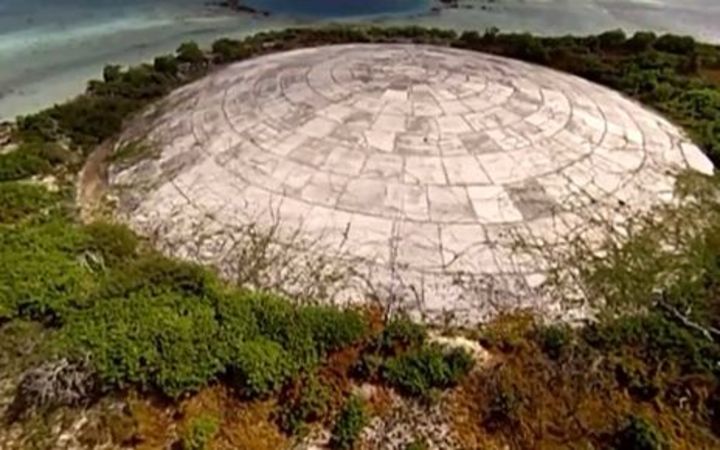
The Runit Dome was constructed on Enewetak Atoll in the Marshall Islands during 1979 to temporarily store radioactive waste produced from nuclear testing by the US military during the 1950s and 1960s. Image: RNZ
The United States is currently negotiating to extend its Compacts of Free Association with the Republic of the Marshall Islands, as well as the Republic of Palau and the Federated States of Micronesia.
These agreements give the United States control over an area of the Pacific Ocean the size of the continental United States, stretching from Hawaii to the Philippines, in exchange for modest economic assistance and access to certain federal programmes.
Senator Hirono from Hawai’i said: “The United States’ nuclear testing programme in the Pacific led to long-lasting harms to the people of the Marshall Islands.”
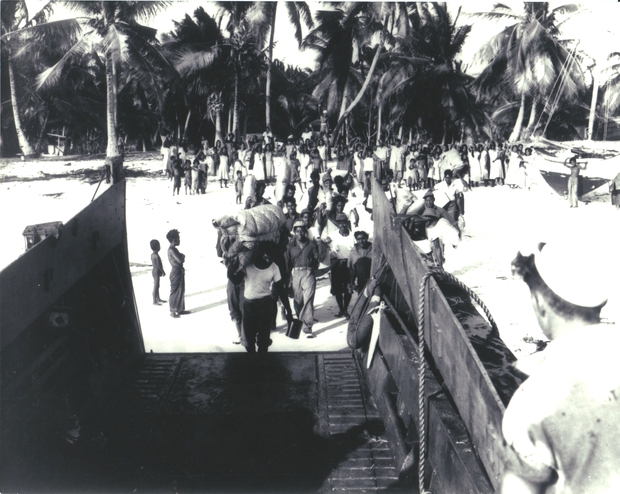
Bikinians in the Marshall Islands being evacuated from their home island after nuclear testing in the area by the United States. Image: US Navy/RNZ
Bikinians in the Marshall Islands being evacuated from their home island after nuclear testing in the area by the United States.Photo: US Navy
Senator Markey said “a formal apology is long overdue to the Republic of the Marshall Islands for the harmful legacy of U.S. nuclear testing.”
He said,”the resolution calls on the United States to prioritize nuclear justice in its negotiations with the Marshall Islands on an extended Compact of Free Association and to help Marshallese battle the existential threat of the climate crisis.”
This article is republished under a community partnership agreement with RNZ.
Opposition National MP Simon Bridges, a former party leader, and backbench Labour MP Anahila Kanongataá-Suisuiki have tested positive for covid-19 with a record 696 cases in hospital.
Bridges is National’s spokesperson for finance and infrastructure.
Kanongataá-Suisuiki said in a Facebook post that she had tested positive on a day 3 test of home isolation, after her daughter had contracted the coronavirus.
In a social media post, she said she had lost her sense of smell and taste, but was “feeling ok”.
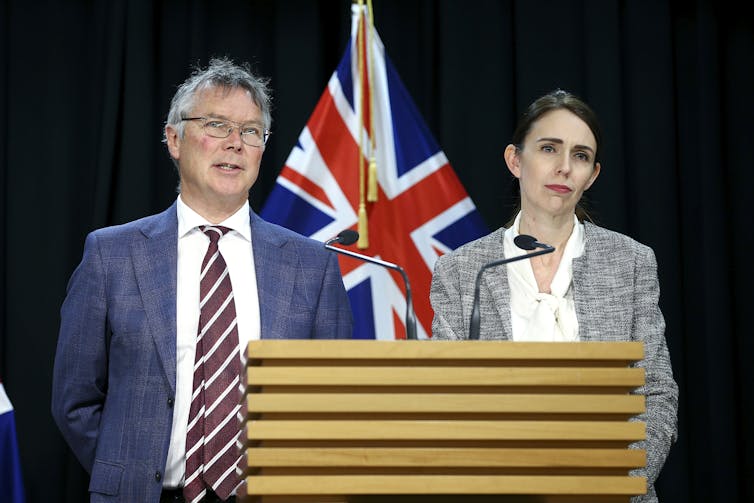
Last week, Environment Minister David Parker reported testing positive, and said he had minor symptoms and was “not feeling too bad”.
He had not been in the Beehive since the previous week, so was not with other MPs or staff while infectious, he said.
The seven-day rolling average of community cases is 17,921, up from 17,272 yesterday.
“Care needs to be taken when interpreting daily reported cases, which are expected to continue to fluctuate,” the ministry said.
“This means that the seven-day rolling average of cases gives a more reliable indicator of testing trends.”
More than 47,000 rapid antigen test (RAT) results were reported yesterday, including 16,625 positive results.
Unvaccinated four times over-represented There were 192,492 active cases confirmed in the last 10 days and not yet classified as recovered.
Of the 696 in hospital, 13 are in ICU. The average age of those in hospital is 57.
The ministry said: “While still early in the omicron outbreak, the figures show that, based on the data available, unvaccinated people are four times over-represented in the current hospitalisation data.
“Just 3 percent of eligible people aged 12 and over in New Zealand have had no doses of the vaccine. However, of the eligible people in Northland and Auckland hospitals with covid-19, 13 percent have had no doses of the vaccine.”
This article is republished under a community partnership agreement with RNZ.
The United Nations chief scientific agency on climate change released its latest report on Monday.
The IPCC Working Group II report on climate impacts, adaptation, and vulnerability says man-made climate change is causing unprecedented damage to the natural environment and the livelihoods of billions of people.
It also says global warming is set to rise beyond 1.5 deg C by 2040 unless the world commits to drastically reduce its carbon emissions from the use of fossil fuels.
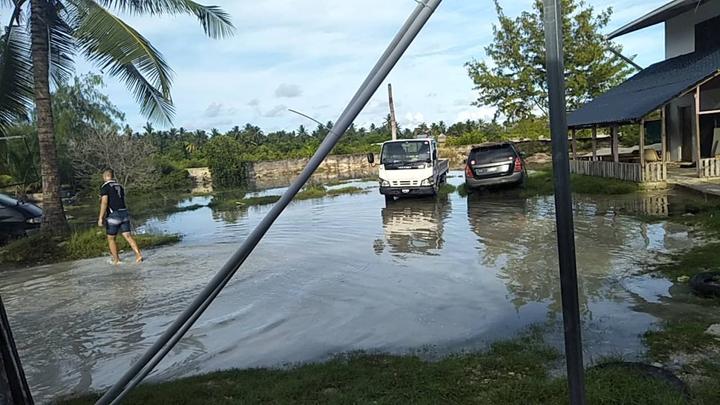
For nations on the frontlines in the Pacific the consequences will be disastrous with an increase in climate hazards such as sea-level rise, more frequent and severe extreme weather events including flooding, and droughts.
350 Pacific Climate Warriors council of elders member Brianna Fruean says the findings in the report are not new for the region.
Fruean is a prominent youth voice in international climate advocacy and spoke to RNZ Pacific’s regional correspondent Kelvin Anthony about what the report means for Pacific people.
This article is republished under a community partnership agreement with RNZ.
Source: The Conversation (Au and NZ) – By Hamid R. Jamali, Associate Professor and Associate Head, School of Information and Communication Studies, Charles Sturt University
Shutterstock
At least 140 Australian journals ceased publication in the past decade. While there are still more than 650 Australian journals, 75% of the discontinued ones served the arts, social sciences and humanities disciplines. The loss of journals has significant implications for local scholarship.
Journal discontinuation damages research. Scholarly communities and the discourse that develops around a journal might be lost or damaged. The content of journals that are the result of the hard work of researchers – publicly funded work in most cases – is jeopardised.
Our recently published research shows establishing and maintaining journals has become increasingly challenging. Australian journals need more support from the higher education and publishing sectors and better strategies for sustainable editorial and publishing practices.
Academics need suitable journals to publish in, especially as journal articles are the key output assessed in research evaluation exercises such as Excellence in Research for Australia. While large international commercial publishers publish plenty of journals in many fields, national or local journals are important.
Domestic journals better accommodate articles on local issues. This is not limited to social and cultural issues such as Indigenous matters. Australia is unique in many aspects, including ecology, economy, geology and so on.
Research communities and discourses form around these journals. Editors direct research in their field through their editorial practices.
Local journals also support the national education system. They inform practices, especially in fields such as medicine where practices differ from country to country.
Why do journals discontinue?
Our study of discontinued journals and a survey of their editors showed several key factors were at work. These include:
a lack of funding and support
unsustainable reliance on voluntary work for editorial processes
increasing workload pressures on academics who have less time to review and edit submitted articles
a metric-driven culture that puts pressure on authors to publish in highly ranked journals, at the expense of local journals.
As one editor of a discontinued journal said:
“Potential replacement editors were unwilling to take on the workload of editorship and management given the pressure to focus on Q1 publication [in journals ranked in the top 25%].”
Australian journal publishing is characterised by journals belonging to non-profit organisations (364, 55.9%) and universities (168, 25.8%). As these journals are mostly self-published by their owners, the issues we identified are very likely to adversely impact more journals as economic conditions worsen.
Of the discontinued journals, 54% belonged to educational institutions and 34% to non-profit organisations. They had been operating for an average of 19 years.
Moreover, while humanities and social sciences are well represented in the disciplinary focus of Australian journals, a large proportion of the discontinued journals were from these fields. Yet local journals might be more needed in many of these fields where research issues are more likely to be of local significance.
Journal publishing has become a challenging task. It’s complicated by many different business models and a competitive market. Small publishers are disappearing as large international publishers acquire them.
Sometimes institutions fund the cost of publishing. Without such funding, journals have to charge either their readers (a subscription fee), or their authors (an author processing charge, APC), or both (hybrid).
A subscription-based journal published by a small publisher might struggle to find subscribers; libraries are less likely to subscribe to individual journals due to their reliance on vendor and publisher-curated packages, or “big deals”.
To publish open access with an APC, a journal has to compete with many other such journals. Some of these competitors (such as those published by Frontiers or MDPI) are well-resourced. They benefit from state-of-the-art technology for managing editorial and publishing processes.
Journals can, of course, outsource their publishing side to a commercial publisher, as 162 Australian journals have already done. These journals are mostly published as hybrid journals.
But such a decision might come at a cost as the direction of the journal might not be aligned with that of the new publisher. For instance, the editor in chief of the Medical Journal of Australia (MJA) was sacked over his opposition to outsourcing the journal’s sub-editing and production functions to Elsevier. All 19 members of the journal’s editorial advisory committee subsequently resigned.
Some local journals operate in niche areas that cater to a very small reader audience. These journals are simply not attractive for commercial publishers.
Some local journals haven’t survived the pandemic. Shutterstock
What can be done?
It is natural and inevitable that some journals will cease publication as fields evolve. And about 100 journals were established in Australia over the past decade. However, the overall decline in journal numbers is concerning – especially as the global trend is one of growth.
Enthusiasm alone is not enough to sustain journal publishing. Every journal needs to have a robust business strategy and have undertaken proper contingency planning.
Research is needed to develop strategies for sustainable editorial and publishing operations. Research policymakers must be mindful of the impact of their policies on local journals.
Finally, higher education as a whole needs to be more supportive of journal publishing and the activities associated with it.
The authors do not work for, consult, own shares in or receive funding from any company or organisation that would benefit from this article, and have disclosed no relevant affiliations beyond their academic appointment.
The retrial of Jason Roberts, accused of killing two Melbourne policemen in 1998, is expected to begin this week in Melbourne.
The retrial marks a significant milestone in Victoria’s criminal justice system – it’s the first to occur since Victoria passed a new law in 2019 allowing defendants in criminal cases to seek an additional appeal in their cases under specific circumstances.
What is the Roberts case about?
In the early hours of August 16 1998, Victoria police officers Sergeant Gary Silk and Senior Constable Rodney Miller were fatally shot while engaged in a surveillance operation. They were part of a team investigating a series of armed robberies in Melbourne’s eastern and south-eastern suburbs.
Silk died almost immediately, while Miller was still conscious when the first responders arrived. Multiple officers gave evidence that Miller’s dying declaration mentioned two offenders – crucial to the criminal investigation and proceedings that followed — and a dark blue Hyundai hatchback.
Between 2016 and 2019, Roberts lodged three petitions for mercy with the attorney-general of Victoria. Each of these was accompanied by sworn statements in which he confessed to being involved in armed robberies with Debs, but denied any connection to the deaths of Silk and Miller.
The first petition for mercy was refused, while the second and third were overtaken by legal reforms which provided a new, albeit limited, possibility of appeal.
In 2015, allegations also arose about police misconduct in the investigation of the killings. This led the state’s Independent Broad-based Anti-corruption Commission (IBAC) to establish Operation Gloucester to look into these issues.
In 2017, the investigation uncovered a second statement by one of the first responders at the murder scene. Significantly, this newly discovered statement – made within four hours of the killings – was inconsistent with evidence given at trial that Miller had mentioned two offenders.
In 2020, IBAC published its special report on Operation Gloucester, which identified a pattern of improper practices employed by Victoria police while investigating Debs and Roberts. This related primarily to the manipulation and altering of witness statements by police and the failure to disclose this to Roberts’ defence team.
The Court of Appeal held that this serious misconduct tainted Roberts’ original trial and quashed his conviction in November 2020.
Police have reportedly contacted 400 witnesses as prosecutors have prepared for the retrial. The central issue in the retrial is likely to be whether the prosecution can establish beyond a reasonable doubt that Roberts was present at the scene on the night of the shootings.
Until recently, a person convicted of a crime in Victoria was only entitled to a single appeal. If that appeal failed, there was no further legal avenue available to challenge a conviction, even if fresh evidence was discovered. The only option was for the convicted person to lodge a petition for mercy with the attorney-general who, in turn, could refer the case to the Court of Appeal.
This fundamentally changed in November 2019, when legislation was passed allowing a convicted person, in very limited circumstances, to launch a further appeal before the Court of Appeal, effectively bypassing the more political petition process.
The new law seeks to strike a difficult balance between two competing imperatives.
On the one hand, the principle of finality recognises it is essential for criminal proceedings to be brought to a conclusion and that convictions are not perpetually challenged. Challenges like this can be devastating for the victims of crimes and their families.
On the other hand, it is also important there be a transparent judicial pathway to correct miscarriages of justice, regardless of when they might be uncovered.
The new appeal provisions in Victoria have a high threshold for review to guard against unmeritorious or frivolous appeals. To be granted leave to appeal, the applicant must demonstrate there is “fresh and compelling evidence” in the case. A new appeal will be denied if the evidence could have been found with a reasonable amount of diligence, or if it isn’t reliable or substantial enough.
Once another legal challenge is granted, the applicant must then satisfy the Court of Appeal that a substantial miscarriage has, in fact, occurred. This means there is very little prospect convictions will be quashed without basis or on minor legal technicalities.
The retrial of Roberts, more than 20 years after the killings, will no doubt cause anguish for the families of the victims. However, unless we are prepared to tolerate possible miscarriages of justice going uncorrected, we must allow cases to be reviewed under these very narrow circumstances.
The authors do not work for, consult, own shares in or receive funding from any company or organisation that would benefit from this article, and have disclosed no relevant affiliations beyond their academic appointment.
In response to the Russian cyber attacks that have accompanied its invasion of Ukraine, the Ukrainian government has begun recruiting what it calls an “IT army”.
Perhaps a more accurate term would be a “cyber militia”, given it will consist of civilian volunteers. In any case, it aims to repel Russian hackers’ attacks, and launching cyber counterstrikes of its own.
Ukrainian Vice Prime Minister Mykhailo Fedorov, who is also the country’s digital transformation minister, has called “digital talents” to join the resistance effort.
Reports suggest more than 275,000 volunteers from around the world have already answered the call, although verifying an exact figure is impossible at the moment.
A will to help – but are we allowed?
Russia’s war on Ukraine is half a world away from Australia. But many Australians recognise the importance of helping Ukraine, on both humanitarian grounds and because of the wider geopolitical ramifications.
While countries such as the United Kingdom, Canada and Denmark have opened the door for their citizens to enlist in Ukraine’s international territorial defence legion, the Canberra government has so far advised Australians not to do so.
But in an interconnected world, volunteers who are unwilling or unable to physically help Ukraine could potentially join its cyber militia.
However, there’s one snag as far as Australians are concerned: Australia’s criminal law makes it illegal to engage in many of the activities that might be required of members of a foreign-organised cyber militia. Put simply, “hacking” is a crime.
The Australian government has not publicly expressed a view on whether Australians should be barred outright from joining Ukraine’s cyber fight.
One way the government could address this would be to introduce specific legislation aimed at creating legal safeguards for genuine members of a foreign state-run cyber militia, within a narrowly defined set of circumstances.
Such people would need protection from being held to have violated the hacking-related provisions of Australia’s criminal law. And they would also need legal safeguards against civil liability and against being extradited.
This protection should apply unless the person has acted in violation of international law.
Of course, such legislation would need to be carefully designed, and its implications rigorously considered.
Policing the cyber army
One problem with cyber attacks is the issue of attribution. It can be hard to identify who is responsible for the attack with the level of confidence required under international law. This means cyber attackers often have a crucial advantage over those seeking to defend against them.
“Non-state actors” such as hacker groups might be willing to attack targets that are off-limits for state agents, such as hospitals or other civilian infrastructure. This can cause conflicts to escalate dangerously.
Consequently, it is vital that any proposed legal protection for cyber combatants would be conditional on governmental oversight. In my proposal, this is achieved by the involvement of both the Australian government and that of the foreign power in direct control over the cyber militia.
More specifically, this means the Australian government should have the discretion to designate that a specific country’s cyber militia (and not those of other countries) as being governed by the new rules.
I suggest the government should consider exercising that discretion where:
a foreign state has established the cyber militia;
that foreign state has invited foreigners to join its cyber militia; and
that foreign state is under armed attack by another state.
Only members of such a designated cyber militia would be protected. That ensures Australia can prescribe the situations in which it deems it acceptable for Australian citizens to engage in cyber warfare as part of a foreign cyber militia.
Further to this, participants should only enjoy legal safeguards where they have acted on specific orders issued by the foreign state in control of the militia. This is the second method of ensuring state control, and in the current situation, that control would be exercised by the Ukraine.
Another important question is how to strike a balance between offensive and defensive activities. To minimise the risk of Australia being seen to violate international law, I propose that only “defensive activities” – such as measures safeguarding vital computer systems in Ukraine – would be legalised for Australian members of a foreign cyber militia, and these “defensive activities” should be defined very carefully.
A necessary step, but not the only one
Clearly, this proposal is a response to the current invasion of Ukraine, and the Russian cyber aggression that has accompanied it. But given future wars are also likely to be fought in cyber space, this proposal will also be more broadly relevant.
Sooner or later, Australia will have to reckon with the prospect of significant numbers of citizens becoming involved in foreign cyber warfare. And there’s truly no time like the present.
A version of my proposal could usefully be adopted by any nation that wants to support the defence of Ukraine. But in the meantime, there are still things concerned Australians can do to help the Ukrainians.
Donations to carefully selected organisations is one option, but social media abounds with other possibilities too. One creative option is to counter Russian disinformation by posting verified information about the atrocities on any Russian site that allows user posts – such as restaurant reviews, for example. Such posts are very likely to be removed, but if posted in sufficient numbers they may reach some of the Russian people.
Dan Jerker B. Svantesson does not work for, consult, own shares in or receive funding from any company or organisation that would benefit from this article, and has disclosed no relevant affiliations beyond their academic appointment.
The world’s five leading tech companies – Google (now Alphabet), Apple, Facebook (now Meta), Amazon and Microsoft – have taken steps to impose significant and (mainly) voluntary sanctions on Russia, in response to its invasion of Ukraine.
But the decisions didn’t come unprompted. Ukraine has lobbied the major tech companies in the same way it sought assistance from the European Union, NATO and the US government.
Facing the largest military action in Europe since the second world war, Ukraine appealed directly to big tech companies as though they were nation states. It’s a reminder that in today’s world, these giants are major players on the geopolitical stage.
So what impact could the tech-related sanctions have?
The Big 5’s response
Google’s response to the crisis has come in two parts. The first has been finance-related. The company has limited the use of Google Pay in Russia for customers or merchants that use a sanctioned bank.
It has also stopped selling online advertising in Russia across its services, and has removed the ability for Russian state media outlets Russia Today (RT) and Sputnik to monetise content on YouTube (which is owned by Google). RT and Sputnik have also been blocked in Europe.
Foxtel has removed RT in Australia, but it’s still available on YouTube, with ads in the livestream. That means RT can earn direct revenue from advertising in Australia, but no advertising revenue from YouTube. Google Search and Maps both remain available in Russia.
Apple has gone several steps further than Google. The company has suspended all product sales in Russia, and Apple Pay and other services have been limited. It has also blocked RT and Sputnik from the Apple App Store everywhere outside of Russia.
Meta has removed access to RT and Sputnik on both Facebook and Instagram (which it owns), and has removed the option for state media to monetise content on any of its platforms. It is also demoting posts that contain links to Russian state-controlled media websites on Facebook.
Amazon has taken the path of supporting cybersecurity efforts in Ukraine and offering logistical support, as announced on Twitter by chief executive Andy Jassy. However, Amazon hasn’t yet taken any action to reduce the revenue it receives from Russia.
Microsoft has also helped on the cybersecurity front. It identified a potential Russian cyber attack in Ukraine on February 24, helping efforts to thwart it. In addition, it has banned all advertisements from RT and Sputnik across its ad network, and blocked access to both channels in the European Union.
(Almost) no chips for Russia
Two of the largest US semiconductor (microchip) manufacturers, Intel and AMD, have ceased supplies to Russia. Although the official US sanctions prohibit the export of “dual use” devices with both military and non-military purposes, Intel and AMD have gone a step further and halted all supplies at this stage.
Perhaps more importantly, the major Taiwanese supplier TMSC has stopped supplies. TMSC makes chips for Russian manufacturers such as the Russian Scientific and Technical Centre Module, Baikal Electronics and Marvel Computer Solutions. There are no alternative semiconductor fabrication plants in Russia.
Samsung Electronics, another major chip manufacturer, also announced on Saturday that it would suspend shipments. Samsung leads mobile phone supplies in Russia and, prior to the suspension on Saturday, would have stood to benefit from Apple’s decision to stop sales in the country.
But not all tech companies have given in to political pressure. South Korean chip fabricator SK Hynix has not yet decided to limit supplies (as of when this article was written).
It seems the South Korean government wants to continue supplying semiconductors to Russia, as it has sought exemptions from the US in respect to actions that could negatively impact its semiconductor industry.
Other consequences
Apart from the more directly imposed restrictions, Some Meta and Google services were also blocked after users subverted them for political messaging. For example, social media users across the globe began using Google reviews of restaurants in Moscow and St Petersburg to send information to Russian citizens.
As a result, new reviews in Russia and Ukraine have now been restricted by Google. That is, Google has acted to avoid delivering potential disinformation from either side.
And both Meta and Google have restricted some of their location-based services in Ukraine to limit potential military use.
What’s the immediate impact?
The actions of Meta and Google, and any loss of ad revenue they previously afforded, will have an immediate but relatively small impact on the Russian state – much smaller than the impact from direct financial sanctions.
And not being able to use Google Pay or Apple Pay is still not as inconvenient for Russian citizens as being unable to use ATMs – many of which have run out of notes.
On the other hand, the loss of access to Apple hardware could have a much more lasting impact on Russian consumers.
The overall effect of the various sanctions will be a slowing down of the Russian economy – especially the digital economy which is reliant on semiconductors. However, this too will have a small immediate impact.
There was no legal or regulatory obligation for chip manufacturers and tech companies to limit the export of goods and services to Russia. Instead, the move seems to have been prompted by two key incidents.
First was the very public and direct appeal by Ukrainian Deputy Prime Minister Mykhailo Fedorov to the tech companies, asking them to take action.
Second was the need to meet stakeholders’ expectations. This can be characterised as “corporate social responsibility”, or as social licence.
Both Apple and Google responded to calls for help from members of the Ukrainian government. Google’s philanthropic arm and its employees are directly contributing US$15 million to relief efforts in Ukraine.
While the US sanctions didn’t demand for the tech companies to stop trading with Russia entirely, the signalling from both the US government and Ukrainian officials provided a persuasive context.
It has raised the spectre of multinational tech companies deciding which “side” to support based on a stakeholder perspective, rather than a legislated one. It seems in the end, stakeholder views are still the chief driver of Big Tech’s response to ethical dilemmas.
Rob Nicholls is a member of the UNSW Allens Hub for Technology, Law and Innovation from which he receives research funding. He is also the faculty lead for the UNSW Institute for Cyber Security (IFCYBER), which provides support. UNSW has received an untied gift from Facebook, which is used to fund some of Rob’s research.
We are about to mark another International Women’s Day.
But amid the breakfasts and uplifting speeches about girl power, we will also be reminded of the appalling rates of violence against women, the stubborn gender pay gap and pervasive sexism that is seemingly entrenched in our society. An imbalance remains: women do the vast bulk of unpaid work at home while men make the bulk of the laws and policies that affect us all.
Nothing seems to change – or change fast enough. But there are concrete things we can do to fix it. New research offers practical ideas to fix gender inequality in Australia from those at the very centre of federal government policy-making.
Talking direct to experts
As part of her PhD research, Yolanda Vega interviewed past and present MPs, senior bureaucrats, diplomats and political and public service advisers during 2018 and 2019. They were asked what works and what we need to do to eliminate sex-based discrimination in Australia.
Australians have been taking to the streets to push political leaders to take more action against gender discrimination. Diego Sidele/AAP
In all, 25 interviews were conducted, and all were people who had direct experience of government policy-making and legislating around sex-based discrimination. Both sides of politics were involved and responses were kept anonymous so people could speak freely.
More women in power
Interviewees overwhelmingly believed we needed more women in the federal parliament to create a more equitable Australia (currently, 31% of lower house MPs and 52% of the Senate are women).
As one noted:
Australia has had an enviable track record of 27 years of economic growth, the best in the world, yet various cohorts of women have fared so badly, particularly over the last 20 years.
They pointed to other parliaments as evidence of the benefits of more women in power, such as Scandinavian parliaments with higher proportions of female MPs, where they have “very pro-women” policies.
As a way to address this, one interviewee suggested increasing the number of women in parliament using the “Irish model”, which uses financial incentives.
Every primary vote I received, at each election, returned to my party about A$3.00 per vote, paid from government revenue. In Ireland, which has the same system, a party can only access those payments if they have put up equal numbers of women. I think that is a great idea and would help drive change.
Others noted the importance of women being visible across the political spectrum – out proudly telling their stories.
People who go and talk about the importance of the rights of women [are] described by certain politicians as being ‘representatives of the green-left’ as if there is some political agenda involved in being in favour of women’s rights, which is really damaging.
More men prioritising equality
Interviewees also overwhelmingly wanted to see more male leaders within government prioritise gender equality. They said men needed to be encouraged to challenge the status quo and examine whether policy decisions (or a lack thereof) are based on prejudices and how these, in turn, affect women.
Interviewees lamented that the attitude of male leaders has not changed over time. One structured way to ensure gender equality is incorporated into policy-making is to make it part of every aspect of the federal budget (and not just as a separate “women’s budget statement”).
What is the best way of doing macroeconomic reform that does not disadvantage women? […] What do investment strategies look like that are positive for women?
Another interviewee put it simply: “every policy needs to look at how it affects women”. This approach should be reinforced with measurements of success. As one person noted, “transparency” was needed if new policies were going to have a positive impact on women.
Another interviewees agreed, adding key performance indicators “have to be put in the job description”.
you have to have someone say, ‘I am going to measure your performance […] on this topic, off you trot!‘
Keeping the pressure on
Interviewees also wanted to see Australia take a cold, hard look at some of the infrastructure “upholding” gender equality.
The 1984 Sex Discrimination Act was a watershed moment for Australian law and women’s equality (a reform that was not coincidentally, led by women).
A 1992 review added elements to stop employers using pregnancy as a means of discriminating against women – but that was 30 years ago. Or as one interviewee said, “those legislative frameworks served us well, but they are not finished yet”.
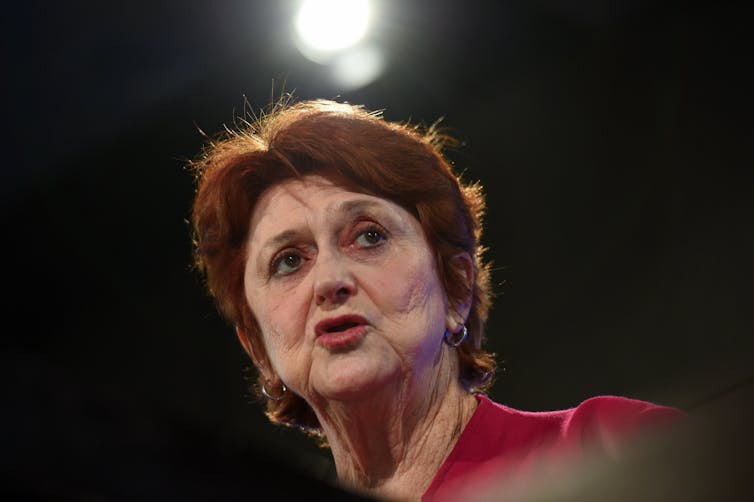
The late Susan Ryan – the first Labor woman to serve in cabinet – spearheaded the creation of the Sex Discrimination Act. Lukas Coch/AAP
As a starting point, it was noted there are no provisions for childcare in the Sex Discrimination Act. But interviewees also wanted to see other critical examinations of Australia’s legal and policy landscape.
Several interviewees said Australia’s award system further ingrained sex discrimination and as a legislative instrument, the Fair Work Act often functioned as a barrier. For example:
In my mind, that is where a lot of the economic disadvantage comes from – the award wage for a childcare worker versus a basic builder’s labourer are not equal. Some of them [awards] have been around and not amended for decades and decades and decades […].
Another interviewee said far more transparency when it came to pay negotiations – but this would be easy to fix if the federal government had the “political courage”.
A lot of it comes down to the fact that pay is negotiated behind closed doors and there is no visibility of what you are paid, and if you are not prepared to shine a light on it, then you are going to struggle to get there.
One expert had an even more striking idea, for a royal commission into the issue, or “what the hell is going on?”:
We will have an inquiry into our banks, but surely the bigger issue is what is happening every day in workplaces across Australia, where women are being paid differently, just because of their sex.
The benefits of equality
These are just some of the perspectives these experts at the heart of Australian government shared. Despite the serious nature of the discussions, the overriding theme was one of possibility and optimism with future governments. However, accountability, incentives and resources to include women in policy making are critical.
As a final thought, informants also spoke of the need to reframe the gender equality debate in more positive terms. And this needs to come not just from politicians, but the media and other community leaders, too:
I would turn the debate around. I would not be working for the elimination of discrimination against women in Australia or the elimination of barriers to equality, I would be celebrating the benefits of equality.
Vega received funding from the Victoria Women’s Trust (Fay Marles Equal Opportunity Sub-Fund grant) in September 2017. The grant covered the vast majority of the travel costs associated with executing the 25 interviews in Australia.
Vega is a member of the Reason Australia Party and is affiliated with Emily’s List Australia and various other women groups. Vega is the founder and former CEO of the Australian Women Chamber of Commerce & Industry. As CEO, Vega was appointed to several government boards and committees by Labor and Liberal federal governments.
Melissa Wheeler has engaged in paid and pro-bono consulting and research relating to issues of applied ethics and gender equality (e.g., Our Watch, Queen Victoria Women’s Centre, VicHealth). She has previously worked for research centres that receive funding from several partner organisations in the private and public sector, including from the Victorian Government.
Nearly every Australian uses some part of the health system every year, whether it be going to the GP, getting a prescription filled, or seeing a specialist.
Despite having a universal health-care system, we often still pay for these services out of our own pockets.
Sadly, these out-of-pocket payments are unaffordable for many Australians – so they skip the trip to the doctor, or defer going to the chemist.
This is bad for those individuals, but also bad for taxpayers and the economy. It makes people sicker, widens inequities, and puts further strain on the health system down the track.
In the Grattan Institute’s latest report, we identify what governments should do to make health care more affordable for more Australians.
Who is missing health care because of cost?
In 2020-21, more than half a million people deferred or did not fill a prescription because of cost. Nearly half a million decided not to see a specialist because of cost.
People with chronic conditions have much higher health-care costs, particularly if they have multiple chronic conditions; they spend between A$200-600 on average on health care each year.
But they are also less likely to be able to afford their ongoing care because their chronic condition can make it more difficult to keep or get a job.
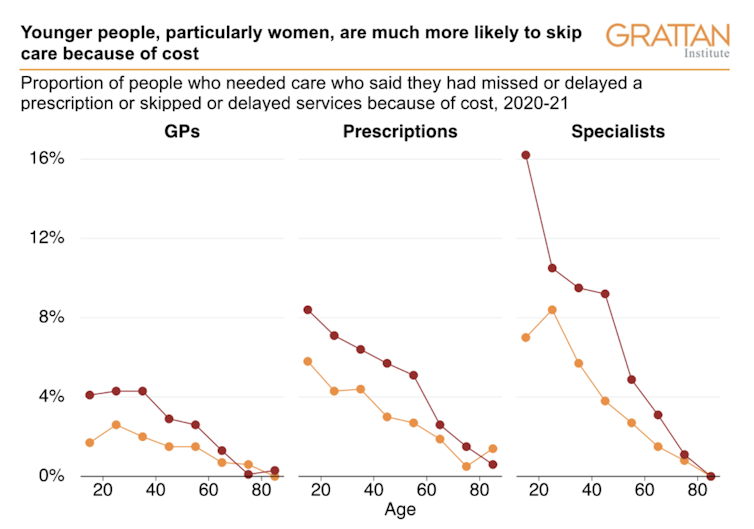
Many of these people who are forgoing health care due to cost are younger, particularly younger women:
Grattan analysis of ABS Patient Experiences Survey, 2020-21
Younger people tend to have fewer savings, and can therefore find it harder to afford care. And women are more likely to have chronic health conditions. About 55% of people with two chronic conditions are women, and 60% of people with three or more chronic conditions are women.
Chronic conditions are becoming more common, so more and more Australians will be facing higher health-care costs and are at risk of missing needed care.
The federal government can do much more to reduce out-of-pocket payments and avoid unnecessary costs down the line.
Cost of medicines
While Australia has a world-renowned Pharmaceutical Benefits Scheme (PBS) that helps keep many medications affordable, Australians are still spending nearly A$3 billion on PBS-listed prescriptions each year, including A$1.5 billion on mandatory co-payments and A$1.4 billion on PBS-listed prescriptions which cost less than the co-payment.
The federal government should lower the cost of prescriptions for people taking five or more medications for chronic conditions, after their GP conducts a medication review triggered by a computer-generated alert.
We estimate this could reduce inappropriate medication use for about 300,000 patients.
The government should also extend the duration of prescriptions for some medications to reduce the number of Pharmaceutical Benefits Scheme co-payments people have to make to pharmacies.
Tests and scans
The government should abolish the out-of-pocket burden from diagnostic services, such as blood tests and scans.
With these services now frequently provided by large corporations, the federal government should fund them directly through a commercial tender instead.
Patient enrolment
The government should expand the voluntary patient enrolment scheme to people with two or more chronic conditions.
Patient enrolment is where a patient can enrol in a GP practice and nominate a GP to be their “usual doctor”. It can help make care more affordable for people with chronic conditions by reducing their exposure to out-of-pocket payments.
Greater GP stewardship over a person’s care could reduce inefficiencies in areas such as routine repeat prescriptions and routine renewal of specialist referrals.
The government has already committed to this reform for people older than 70. If it was expanded to younger people, we estimate an additional 1.7 million people would be eligible for the program.
Bulk billing
The vast majority of health services people receive outside hospital are “bulk-billed” – meaning the patient pays nothing out of pocket. But bulk-billing rates for specialists and allied health are still far too low – at about 46% for specialists and 56% for allied health.
The federal and state governments should expand the number of health-care services provided free of charge, particularly in lower-income areas and areas where bulk-billing rates are especially low.
Our analysis shows that if state and federal governments invest an additional A$710 million a year on these reforms, they could save Australians about A$1 billion in out-of-pockets a year, and enable more people to get the care they need, when they need it. That’s a healthy return on investment.
Stephen Duckett is chair of the board of directors of the Eastern Melbourne Primary Health Network. Grattan Institute began with contributions to its endowment of $15 million from each of the Federal and Victorian Governments, $4 million from BHP Billiton, and $1 million from NAB. In order to safeguard its independence, Grattan Institute’s board controls this endowment. The funds are invested and contribute to funding Grattan Institute’s activities. Grattan Institute also receives funding from corporates, foundations, and individuals to support its general activities, as disclosed on its website.
Linda Lin is currently on secondment to the Grattan Institute from the Victorian Department of Health.
Anika Stobart does not work for, consult, own shares in or receive funding from any company or organisation that would benefit from this article, and has disclosed no relevant affiliations beyond their academic appointment.
Wellness is mainly marketed to women. We’re encouraged to eat clean, take personal responsibility for our well-being, happiness and life. These are the hallmarks of a strong, independent woman in 2022.
But on the eve of International Women’s Day, let’s look closer at this neoliberal feminist notion of wellness and personal responsibility – the idea women’s health and well-being depends on our individual choices.
We argue wellness is not concerned with actual well-being, whatever wellness “guru” and businesswoman Gwyneth Paltrow suggests, or influencers say on Instagram.
Wellness is an industry. It’s also a seductive distraction from what’s really impacting women’s lives. It glosses over the structural issues undermining women’s well-being. These issues cannot be fixed by drinking a turmeric latte or #livingyourbestlife.
Wellness is an unregulated US$4.4 trillion global industry due to reach almost $7 trillion by 2025. It promotes self-help, self-care, fitness, nutrition and spiritual practice. It encourages good choices, intentions and actions.
Wellness is alluring because it feels empowering. Women are left with a sense of control over their lives. It is particularly alluring in times of great uncertainty and limited personal control. These might be during a relationship break up, when facing financial instability, workplace discrimination or a global pandemic.
Wellness implies women are flawed and need to be fixed. It demands women resolve their psychological distress, improve their lives and bounce back from adversity, regardless of personal circumstances.
Self-responsibility, self-empowerment and self-optimisation underpin how women are expected to think and behave.
Wellness demands women focus on their body, with one’s body a measure of their commitment to the task of wellness. Yet this ignores how much these choices and actions cost.
Newsreader and journalist Tracey Spicer says she has spent more than A$100,000 over the past 35 years for her hair to “look acceptable” at work.
Wellness assumes women have equal access to time, energy and money to meet these ideals. If you don’t, “you’re just not trying hard enough”.
Wellness also implores women to be “adaptable and positive”.
If an individual’s #positivevibes and wellness are seen as morally good, then it becomes morally necessary for women to engage in behaviours framed as “investments” or “self-care”.
For those who do not achieve self-optimisation (hint: most of us) this is a personal, shameful failing.
When women believe they are to blame for their circumstances, it hides structural and cultural inequities. Rather than questioning the culture that marginalises women and produces feelings of doubt and inadequacy, wellness provides solutions in the form of superficial empowerment, confidence and resilience.
In their book Confidence Culture UK scholars Shani Orgad and Rosalind Gill argue hashtags such as #loveyourbody and #believeinyourself imply psychological blocks, rather than entrenched social injustices, are what hold women back.
What we should be doing instead
Wellness, with its self-help rhetoric, absolves the government of responsibility to provide transformative and effectual action that ensures women are safe, delivered justice, and treated with respect and dignity.
Structural inequity was not created by an individual, and it will not be solved by an individual.
So this International Women’s Day, try to resist the neoliberal requirement to take personal responsibility for your wellness. Lobby governments to address structural inequities instead.
Follow your anger, not your bliss, call out injustices when you can. And in the words of sexual assault survivor and advocate Grace Tame, “make some noise”.
The authors do not work for, consult, own shares in or receive funding from any company or organisation that would benefit from this article, and have disclosed no relevant affiliations beyond their academic appointment.
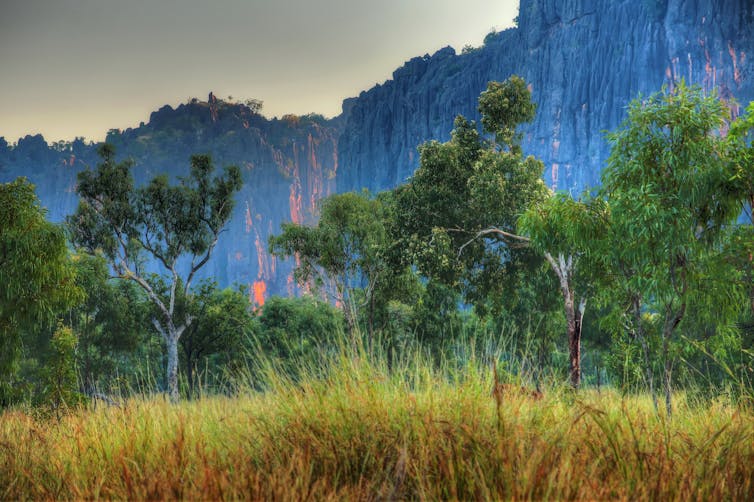
At the time Australia was colonised by Europeans, an estimated 180 mammal species lived in the continent’s northern savannas. The landscape teemed with animals, from microbats to rock-wallabies and northern quolls. Many of these mammals were found nowhere else on Earth.
An unidentified account from the Normanton district of Northwest Queensland, dating back to 1897, told of the abundance:
“There were thousands of millions of those rats (Rattus villosissimus), and as most Gulf identities may remember, after them came a plague of native cats (the Northern Quoll).
These extended from 18 miles west of the Flinders (River) to within 40 miles of Normanton, and they cleaned up all our tucker.”
But tragically, in the years since, many of these mammals have disappeared. Four species have become extinct and nine face the same fate in the next two decades.
And we know relatively little about this homegrown crisis. Monitoring of these species has been lacking for many decades – and as mammal numbers have declined, the knowledge gaps have become worse.
Northern Australia’s savanna regions once teemed with mammal life. Shutterstock
A precipitous decline
Northern Australia savanna comprises the top half of Queensland and the Northern Territory and the top quarter of Western Australia. It covers 1.9 million square kilometres, or 26% of the Australian landmass.
Species already extinct in Northern Australia are:
burrowing bettong
Victoria River district nabarlek (possibly extinct)
Black-footed tree rat, at risk of extinction. www.martinwillisphotographs.com
Capricornian rabbit-rat
Bramble Cay melomys.
The Northern Australia species identified at risk of becoming extinct within 20 years are:
northern hopping-mouse
Carpentarian rock-rat
black-footed tree rat (Kimberley and Top End)
Top End nabarlek
Kimberley brush-tailed phascogale
brush-tailed rabbit-rat (Kimberley and Top End)
northern brush-tailed phascogale
Tiwi Islands brush-tail rabbit-rat
northern bettong.
Many other mammal species have been added to the endangered list in recent years, including koalas, the northern spotted-tailed quoll and spectacled flying foxes.
So what’s driving the decline? For some animals, we don’t know the exact reasons. But for others they include global warming, pest species, changed fire regimes, grazing by introduced herbivores and diseases.
There’s no doubt some mammal species in Northern Australia are heading towards extinction. But information is limited because monitoring of these populations and their ecosystems is severely lacking.
Monitoring is crucial to species conservation. It enables scientists to protect an animal’s habitat, and understand the rate of decline and what processes are driving it.
Our research found most of Northern Australia lacks monitoring of species or ecosystems.
Monitoring mostly comprises long-term projects in three national parks in the Northern Territory. The trends for mammals across the region must be estimated from these few sites.
More recent monitoring sites have been established in Western Australia’s Kimberley. Very few fauna monitoring programs exist in Queensland savannas.
The lack of monitoring hampers conservation efforts. For example, researchers don’t know the status of the Queensland subspecies of black‐footed tree‐rat because the species is not monitored at all.
Research and monitoring efforts have declined significantly over the past couple of decades. Reasons for this include, but are not limited to:
a massive reduction in federal environment funding since 2013 and substantial reductions in some state and territory environment funding
reduced capacity of government-unded institutions devoted to ecosystem and species research
the existence of only two universities in northern Australia with an ecological research focus
a reliance on remote sensing and vegetation condition monitoring, which does not detect animal trends.
Monitoring helps conservationists better protect a threatened animal. AUSTRALIAN WILDLIFE CONSERVANCY
The lesson of the Bramble Cay Melomys
An avalanche of research shows increasing rates of decline in animal populations and extinctions. Australia has the worst mammal extinction rate of any country.
Yet governments in Australia have largely sat on their heels as the biodiversity crisis worsens.
A Senate committee was in 2018 charged with investigating Australia’s faunal extinctions. It has not yet produced its final report.
In September last year, the federal environment department announced 100 “priority species” would be selected to help focus recovery actions. But more than 1,800 species are listed as threatened in Australia. Prioritising just 100 is unlikely to help the rest.
The lack of threatened species monitoring in Australia creates a policy blindfold that prevents actions vital to preventing extinctions.
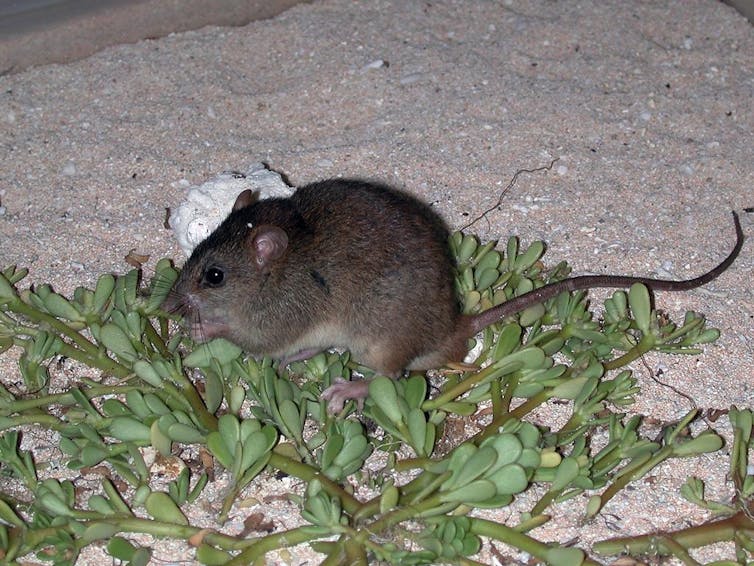
Nowhere is this more true than in the case of the Bramble Cay Melomys. The nocturnal rodent was confirmed extinct in 2016 due to flooding of its island home in the Torres Strait, caused by global warming.
The species had previously been acknowledged as one of the rarest mammals on Earth – yet a plan to recover its numbers was never properly implemented.
The Bramble Cay Melomys was declared extinct in 2016. Queensland Government
A crisis on our watch
Conservation scientists and recovery teams are working across Northern Australia to help species and ecosystems recover. But they need resources, policies and long-term commitment from governments.
Indigenous custodians who work on the land can provide significant skills and resources to save species. If Traditional Owners could combine forces with non‐Indigenous researchers and conservation managers – and with adequate support and incentives – we could make substantial ground.
Indigenous Protected Areas, national parks and private conservation areas provide some protection, but this network needs expansion.
We propose establishing a network of monitoring sites by prioritising particular bioregions – large, geographically distinct areas of land with common characteristics.
Building a network of monitoring sites would not just help prevent extinctions, it would also support livelihoods in remote Northern Australia.
Policies determining research and monitoring investment need to be reset, and new approaches implemented urgently. Crucially, funding must be adequate for the task.
Without these measures, more species will become extinct on our watch.
Noel D Preece received funding from The Nature Conservancy for work that led to this article. He is a member of the Spectacled Flying-fox Recovery Team. He has worked in northern Australia since the mid-1980s.
James Fitzsimons is affiliated with The Nature Conservancy Australia.
Russia’s invasion of Ukraine is dominating our screens and conversations. Children and young people are constantly being exposed to images and information about the devastation there.
This kind of exposure can lead to heightened stress and anxiety in both adults and young people. In such times, a classroom can provide a safe space for students to express their fears and concerns.
Teachers can inspire children and young people to feel hopeful and promote a sense of agency through thoughtful, honest discussion and developmentally appropriate activities.
What teachers need to think about
As with all difficult topics, educators should be keenly aware of the emotional impact these events have on students. Teachers should pay close attention to students who may have family members in the regions and who might be worried about how this crisis might impact them here.
Teachers should also be aware some of their students may have lived through war or have family in other active conflict zones. For children and young people with a trauma or refugee background, images and talk of war and violence can be triggering. Conversations about the conflict and constant media exposure can exacerbate this experience.
Previous experiences with major global crises such as the September 11 attacks in the United States and bushfires in Australia have provided insight into children’s possible reactions to an event such as this.
Students will come to teachers with concerns. Answering questions may be tricky but we can give them a safe place to discuss things.
The first you can do is acknowledge and validate the students’ concerns: wars are scary, and it’s OK to feel scared. Start by asking what they have heard and address any misinformation.
Explain why it is important to pay attention to other parts of the world. Research shows that including discussion of global issues increases empathy and helps students develop more of an understanding for people around them who may have different backgrounds and experiences.
Listen and don’t avoid difficult conversations. Be prepared to answer the questions the student may have, and answer with facts which will provide context to aid their understanding.
While it is important to be honest, the level of detail needed for an eight-year-old will be very different to that of a 12-year-old.
Primary school children
Primary school children have active imaginations and might not understand the situation as well as their older peers. But they will still sense the mood of the adults around them, which can impact their behaviour.
As a result they could experience an increase in stress and anxiety, distress at being separated from parents, or experience nightmares, sleep disturbances, or behavioural disruptions (“acting out”).
You can use picture and story books to help these children understand relevant concepts and to think about their treatment of others. For instance, “Paulie Pastrami Achieves World Peace” by Jaimes Proimos is about an a boy who plans to achieve world peace before his eighth birthday. He does this through acts of kindness such as reading to the trees and helping his little sister.
Books like this can help children understand altruism, and that even children can make the world better through kindness.
Use movies or cartoons to help children understand how they can make changes and improve their own community. Agency is a skill that can be taught from a young age, and can play a role in reducing feelings of helplessness, particularly during times of uncertainty.
Help students create artwork to express their feelings. We have seen even children in Ukraine doing this.
Instil hope. Show maps of locations and distances to help children understand their safety. You can remind children the war is very far away and they are safe here, while encouraging them to feel empathy for Ukrainian children.
Be prepared to answer student’s questions. If you do not know the answer, you should say so.
Children might ask you how you are feeling, such as “are you scared?” You should respond honestly, as this is an opportunity to encourage open and transparent conversations about tricky topics.
Secondary school children
Secondary school children have higher levels of emotional regulation than their primary school peers. While they may be more curious, they may also have visualisations of possible attacks, and concerns about the implications for their future – including being sent to war or being conscripted if the war in Ukraine becomes a larger conflict.
You can share stories of what regular people are doing and experiencing to humanise the event. Lead with a positive tone, offering stories of people persevering in Ukraine and people in Russia who are challenging their government’s actions. It is useful to point students to independent media in the Ukraine such as The Kyiv Independent and The New Voice of Ukraine. Radio Liberty in Russia is also a useful source of news.
Help older students build critical thinking skills and see the conflict in a wider historical and political context. The Netflix documentary “Winter on Fire” may be a useful discussion starter.
You could encourage students to start a fundraising project where funds will go directly to the Ukrainian community such as Ukranian Red Cross and Nova Ukraine.
You can encourage students to become global citizens and think about how they can start making changes in the world, both here and abroad. Provide information on how they can volunteer with local groups that focus on peace and community-building. Linking them to online platforms such as Global Citizen will help build feelings of solidarity with Ukraine.
Other ways to demonstrate solidarity would be to hold a vigil or an awareness-raising activity at school. You could also teach students how to write letters to a local MP.
Students want and need to talk about what they see, remember and are feeling now. They need the guidance and safety of adults in their schools to be able to navigate their own emotions and trauma in a healthy, safe and productive way.
Joel Anderson works for Australian Catholic University and the Australian Research Centre in Sex, Health and Society at La Trobe University. He has previously received funding from the National Centre for Student Equity in Higher Education. Joel is a member of the Refugee Education Special Interest Group (www.refugee-education.org)
Kelda Robinson does not work for, consult, own shares in or receive funding from any company or organisation that would benefit from this article, and has disclosed no relevant affiliations beyond their academic appointment.
Source: The Conversation (Au and NZ) – By Libby (Elizabeth) Sander, Assistant Professor of Organisational Behaviour, Bond Business School, Bond University
Shutterstock
The great enforced global experiment in working from home is coming to an end, as vaccines, the Omicron variant and new therapeutic drugs bring the COVID-19 crisis under control.
But a voluntary experiment has begun, as organisations navigate the new landscape of hybrid work, combining the best elements of remote work with time in the office.
Yes, there is some push for a “return to normal” and getting workers back into offices. But ideas such as food vouchers and parking discounts are mostly being proposed by city councils and CBD businesses keen to get their old customers back.
A wide range of surveys over the past 18 months show most employees and increasingly employers have no desire to return to commuting five days a week.
The seismic shift in employer attitudes is signalled by Google, long a fierce opponent of working from home.
Last week the company told employees they must return to the office from early April – but only for three days a week.
That’s still way more than tech companies such as Australia’s Atlassian, which expects workers to come into the office just four days a year, but it is a far cry from its pre-pandemic resistance to remote work.
Hybrid work is here to stay. Employers will either embrace the change or find themselves being left behind.
Gains in productivity
Google began – under pressure – to soften its opposition to remote work in 2020. In December of that year chief executive Sundar Pichai told employees:
We are testing a hypothesis that a flexible work model will lead to greater productivity, collaboration, and well-being.
Google’s corporate headquarters in Mountain View, northern California. It has softened its historical opposition to remote working by insisting workers must return to the office for three days a week.
Its chief concern has been protecting the social capital that springs from physical proximity – and also perhaps with keeping employers under surveillance.
But longstanding (and widespread) management concerns that employees working from home would lower productivity have proven unfounded.
Even before the pandemic there was good research showing no productivity penalty from remote working – the opposite, in fact.
Fro example, a 2014 randomised trial involving about 250 Shanghai call centre workers found working from home associated with 13% more productivity. This comprised a 9% gain from working more minutes per shift – due perhaps to fewer interruptions – and a 4% gain from making more calls per minute – attributed to a quieter, more comfortable working environment.
Research in the past two years supports these findings.
Harvard Business School professor Raj Choudury and colleagues published research in October 2020 that found allowing employees to work wherever they like led to a 4.4% increase in output.
In April 2021, Stanford University economist Nick Bloom and colleagues calculated a the shift to remote working resulted in a 5% productivity boost. Though their working paper, published by the National Bureau of Economic Research, was not peer reviewed, it was based on surveying 30,000 American workers, which is a decent sample size.
Our relationship with work has changed
There are good reasons most of us don’t want to go back to the old normal. It just wasn’t that great.
While working from home can brings challenges of other kinds, not least the ability to switch off and stop working when work is done, working in an office can increase stress, lower mood and reduce productivity.
My own research has measured the effects of typical open-plan office noises, finding a 25% increase in negative mood even after a short exposure time.
Then there’s the time spent commuting. Not having to go into the office every day frees up hours of time to do other things. Particularly in winter it’s nice to not have to leave and arrive home in the dark.
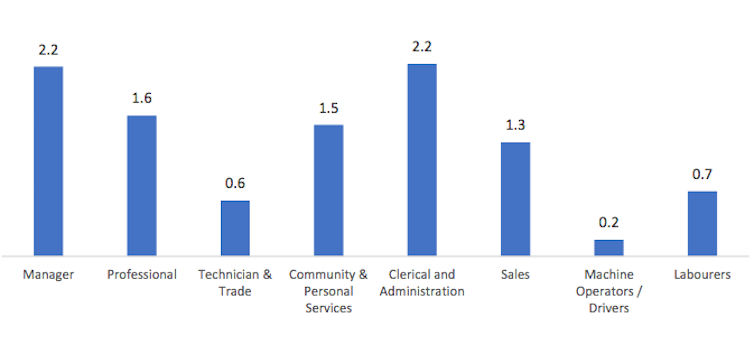
Preferred number of days working at home, by occupation
The importance of these things should not be underestimated.
In a June 2021 study by McKinsey of 245 employees who had returned to the office, one-third said they felt their mental health had been harmed.
The experience of the pandemic has lowered our tolerance for this old world of work.
Nothing exemplifies this better than the growth of the “lie-flat” trend, which began in China and is now a global phenomenon. Increasing numbers of people are rejecting the idea of pursuing a career at all costs.
They don’t want to spend their life being a cog in the wheel of capitalism and are choosing to work less – even not at all.
No one size fits all
Rather than a bastion of meaning and fulfilment, the structures around how we have conducted work has for many people meant an existence of quiet desperation. The pandemic has brought an unforeseen opportunity to change this narrative and rethink both the way we work and the role of work in our lives
For some, no job is better than a bad job. The rest of us will settle for the flexibility we’ve had over the past two years.
No one size fits all. The downsides of working from home include missing coworkers and losing the benefits of serendipitous conversations. The nuances of how much time we need to spend together in the office for outcomes like creativity, belonging, learning and relationship building varies between individuals, teams and job types.
But what is certain is we don’t need to be together five days a week to make these things happen. With a shrinking workforce and an increasing war for talent, employers who don’t provide flexibility will be the losers.
Libby (Elizabeth) Sander does not work for, consult, own shares in or receive funding from any company or organisation that would benefit from this article, and has disclosed no relevant affiliations beyond their academic appointment.
When it was released 50 years ago, The Godfather won a swag of Oscars and hailed director Francis Ford Coppola as the voice of a new auteur. But timing is, as they say, everything.
The story of an ageing Mafia Don and his family in New York City from 1945 to 1955, The Godfather is a sweeping saga of the trials and tribulations of running a criminal organisation.
There are two timelines that need to be looked at when watching The Godfather: when it was set, and when it was made. They are inextricably linked, yet polar opposites of the moral, cultural and social fabric of the United States.
Post-war optimism
Coming out of the devastating destruction and loss of life of the second world war, Americans had a newfound sense of optimism that the worst was behind them.
After years of uncertainty and stress, people yearned for a “normality” in the mundane in their suburban houses, family life and nine-to-five job. People believed in governments and traditional institutions to look after their interests and well-being.
New opportunities and an even distribution of wealth created through low post-war unemployment incentivised growth and created “an advanced consumer economy” which drew both legitimate and illegitimate businesses.
Michael (Al Pacino) has experienced life outside of the family, and is optimistic for a different future. Paramount Pictures
With easy money to be made, Mafia groups flourished. This is the world where we find the Corleone family: Italian immigrants who sought a distorted vision of the American Dream through theft, extortion and violence.
Vito Corleone (Marlon Brando) wants to continue with the old ways. He is suspicious of this new trade in drugs offered by the Tattaglia crime family. His son Michael (Al Pacino) has experienced life outside of the Mafia world and wants to change the whole structure of the organisation, vowing to make the family legitimate.
What happens next is as much a statement on the character arc of Michael as it is about a statement of when The Godfather was made.
By 1972, the social and cultural norms had shifted dramatically.
People, especially young people, had grown increasingly suspicious and disenchanted with both government and the institutions that had grown post war. While many saw the second world war as a “moral war”, they did not express the same feelings towards the Vietnam war. Many saw America as the immoral aggressor.
The 1960s had started out as a decade of hope, full of idealism. Young people were not happy with continuing the ways of the past and wanted change. They were leading the charge for the better.
The Godfather is as much a story of the lost ideals of the 60s as it is the Mafia families of the 50s. Paramount Pictures
But in the 1970s, it was dawning on the Woodstock generation the values they had fought for were not coming to fruition. The ongoing Vietnam War, the publishing of the Pentagon papers and the unravelling Watergate all added to the disillusionment.
Despite the cries of revolution, the old institutions kept a strong grasp on the mechanisms of society.
This all becomes a metaphor for The Godfather.
Growing into pragmatism
The Godfather argues the principles of a generation are often corrupted by the realities of the times.
As with the the lost ideals of the 1960s, Michael is confronted with the pragmatism of running a criminal organisation. The Corleone’s could never be legitimate: the institutions of the past are just too powerful.
Like a big Italian opera, the film sways between personal loyalties, betrayals and consequent ruthless murders.
At the end of it all, Michael – a man of morals who desperately wants to transform the world into something better – falls back down the rabbit hole of the past. He takes over the family “business” and is forced to be more cunning and ruthless than even his father was.
The one figure who stood for light turns out to be the darkest of them all. There will be no change from the past.
The film’s ending is powerful but pessimistic. Early in the film, Michael tells his then girlfriend Kay (Diane Keating) he is going to change the whole way the organisation operated.
Now, Michael tells his wife Kay “don’t ask me about my business”. He closes the door on her as he takes his father’s chair.
In a way, Coppola was predicting the path of the next generation, and perhaps every young generation.
They all start with good intentions but practicalities often change ideals. The 1980s started as the era of anti-apartheid and Live Aid, but soon changed to “greed is good”. The 1990s started with the fall of the Soviet Union and the confirmed belief in Western Democracy, but resulted in disillusioned grunge.
Will the youth movements of this era have any demonstrable impact in ten years time? Or, like Michael Corleone, will they have been turned by the power and authority of the traditional institutions?
Five decades later, The Godfather still remains an allegorical tale for the passing of power from one generation to the next. But perhaps the greatest lesson from the film is the old adage that unless you learn from the past you are doomed to repeat it. The past often makes an offer you can’t refuse.
Daryl Sparkes no recibe salario, ni ejerce labores de consultoría, ni posee acciones, ni recibe financiación de ninguna compañía u organización que pueda obtener beneficio de este artículo, y ha declarado carecer de vínculos relevantes más allá del cargo académico citado.
A West Papuan leader has praised the “bravery and spirit” of Ukrainians defending their country against the Russian invasion while condemning the hypocrisy of a self-styled “peaceful” Indonesia that attacks “innocent civilians” in Papua.
Responding to the global condemnation of the brutal war on Ukraine, now into its second week, United Liberation Movement for West Papua (ULMWP) interim president Benny Wenda highlighted a statement by United Nation experts that has condemned “shocking abuses” against Papuans, including “child killings, disappearances, torture and mass displacement of people”.
Wenda also stressed that the same day that Indonesia’s permanent representative to the UN said that the military attack on Ukraine was unacceptable and called for peace, reports emerged of seven young schoolboys being arrested, beaten and tortured so “horrifically” by the Indonesian military that one had died from his injuries.
“The eyes of the world are watching in horror [at] the invasion of Ukraine,” said Wenda in a statement.
“We feel their terror, we feel their pain and our solidarity is with these men, women and children. We see their suffering and we weep at the loss of innocent lives, the killing of children, the bombing of their homes, and for the trauma of refugees who are forced to flee their communities.”
Wenda said the world had spoken up to condemn the actions of President Vladimir Putin and his regime.
“The world also applauds the bravery and spirit of Ukrainians in their resistance as they defend their families, their homes, their communities, and their national identity.”
Russian attack unacceptable Wenda said Indonesia’s Permanent Representative to the UN, Arrmanatha Nasir, had stated that that Russian attack on Ukraine was unacceptable and called for peace. He had said innocent civilians “will ultimately bear the brunt of this ongoing situation”.
“But what about innocent civilians in West Papua? asked Wenda.
“At the UN, Indonesia speaks of itself as ‘a peaceful nation’ committed to a world ‘based on peace and social justice’.
“This, on the very same day that reports came in of seven young boys, elementary school children, being arrested, beaten and tortured so horrifically by the Indonesian military that one of the boys, Makilon Tabuni, died from his injuries.
“The other boys were taken to hospital, seriously wounded.”
“These are our children that [Indonesian forces are] torturing and killing, with impunity. Are they not ‘innocent civilians’, or are their lives just worth less?”
A leading West Papuan activist is comparing the plight of his region to that of the crisis in Ukraine. https://t.co/K3qsMtXXWI
Urgent humanitarian access Wenda said that this was during the same week that UN special rapporteurs had called for urgent humanitarian access and spoken of “shocking abuses against our people”, including “child killings, disappearances, torture and mass displacement of people”.
This was an acknowledgement from the UN that Papuan people had been “crying out for”.
Wenda said 60-100,00 people were currently displaced, without any support or aid. This was a humanitarian crisis.
“Women forced to give birth in the bush, without medical assistance. Children are malnourished and starving. And still, Indonesia does not allow international access,” he said.
“Our people have been suffering this, without the eyes of the world watching, for nearly 60 years.”
In response, the Indonesian Ambassador to the UN had continued with “total denial, with shameless lies and hypocrisy”.
“If there’s nothing to hide, then where is the access?”
International community ‘waking up’ Wenda said the international community was “waking up” and Indonesia could not continue to “hide your shameful secret any longer”.
“Like the Ukrainian people, you will not crush our spirit, you will not steal our hope and we will not give up our struggle for freedom,” Wenda said.
The ULMWP demanded that Indonesia:
Allow access for the UN High Commissioner for Human Rights, and for humanitarian aid to our displaced people and to international journalists;
The people of Ukraine are “European people with blue eyes and blonde hair being killed” while Palestinians are Arab and have darker complexion. Lesson one: Empathy and recognition of pain and suffering is colour coded and race still matters in 2022.
Palestine, like Afghanistan, Iraq, Somalia and Syria where violence is normal and death is “baked” into the culture while Ukraine is a “European city” that is modern and advanced and these things are not supposed to happen in this area. Lesson two: Western and European history is but a long series of erasures, amnesia and deeply held view of exceptionalism.
Volunteering to fight in defence of the Ukraine from outside is a heroic act, which indeed it is, but volunteering to resist settler colonialism and Apartheid is framed as “terrorism” by Western powers. Lesson three: Palestinians are demonised no matter what heroic acts they underake.
When an officer in the Ukraine blows himself and destroys a bridge to prevent the Russians from advancing then he is celebrated for this sacrifice. Lesson four: Palestinians are demonised for merely being Palestinians and any and all resistance are framed as terrorism.
Sport teams and famous sport figures can express solidarity and carry the Ukrainian flag, post messages on the electronic boards and demonstrate this on the play field, which are all very positive and players should have the right and ability to do it. However, Palestine is an exception when it comes to sport figures expressing any support for the Palestinians who are living under settler colonial occupation that structured with an embedded Apartheid system of racial-religious segregation. Lesson five: The sport administrative structure hands out fines and sanctions (red card) for anyone who expresses support for Palestine including on the occasion of fans hoisting Palestinian flags in the stands.
Calls for sending weapons to Ukraine so as to resist and fight Russian invasion and occupation is supported and expressed as a fundamental right for people facing such an enemy. Anyone who calls for supporting the Palestinians by sending military equipment or items to strengthen the resistance is criminalised and often imprisonment under the spacious law designation of material support. Lesson six: Palestinians don’t have the right to defend themselves but must accept to be occupied and the world community is committed to fund and extend all types of support to the settler colonial occupier.
For the Ukraine, international law advocates in Western world brought out the defence of the 4th Geneva Convention, brushed-up on definitions of war crimes and genocide but none of this applies to Palestine and Palestinians. One can add must of the Global South and the Muslim World suffer the same type of double standards when it comes to international law and 4th Geneva Convention. If you have a doubt for a moment then ask the Afghans, Iraqis and Syrians on this single point then we can have a large discussion. Lesson seven: Palestinians are made to live outside the scope of international law and the Western world delivers the weapons and instruments used by Israel to violate the 4th Geneva Convention and the Convention on Genocide. The Ukraine invasion made this very clear.
Media coverage rightly focused on the victims of the Russian invasion and the human stories with people taking weapons to defend their families, homes, and cities. Palestine always faces the media coverage that amplifies, humanises and centres the narrative of the settler colonial occupation, while erasing or often problematising Palestinian narrative in the often deployed euphemism of death during “clashes”, Israel having the right to defend itself or responding to rocket firing. Lesson eight: Palestinians are made to be the guilty party for wanting to live on their land and having the audacity to insist on it. Double standard and culpability of the Western world in furthering settler colonialism in Palestine.
Educational institutions across the Western World expressed solidarity with the Ukraine, again rightly so when a people face an invasion. Last April-May period, Israel launched a massive attack on the Palestinians on the holiest night of Ramadan, the 27th Night of Ramadan, then followed by a massive bombardment of Gaza. When faculty members, departments and students at universities expressed solidarity with Palestine and Palestinians, a steady stream of political figures, university presidents and media figures insisted that colleges and universities should not be politicised and to make sure that their internal policies prevent them from expressing such solidarity positions. Lesson nine: Palestine on college campuses always meets the administration, Zionist and settler colonial checkpoints that are structured to prevent solidarity with the Palestinians.
The push for boycott, divestment and sanctions on Russia are moving faster than the speed of light and often by the same set of characters that pushed for legislations to criminalise and punish the Palestinian BDS movement. Lesson ten: Palestine faces the constant double standard on the BDS front, free speech and constitutional rights. No clear evidence of double standard than to listen to the same individuals and groups who now are on the front line of seeking legislation to authorise BDS effort directed at Russia while on record opposing the Palestinian BDS Movement.
Professor Hatem Bazian is executive director of the Islamophobia Studies Center and a professor at Zaytuna College and lecturer in Middle Eastern Languages and Cultures and Asian American Studies, UC Berkeley.
Reporters Without Borders (RSF) has filed a complaint with the International Criminal Court’s chief prosecutor about Russian strikes on four radio and TV towers in Ukraine since March 1 that constitute a war crime.
The strikes have prevented Ukrainian media from broadcasting. At least 32 TV channels and several dozen radio stations have been affected, reports the Paris-based global media freedom watchdog.
Since Russia launched its invasion of Ukraine on February 24, it has deliberately targeted TV antennae throughout the country.
Under international law, antennae used for broadcasting radio and TV signals cannot be regarded as legitimate military targets unless they are used by the armed forces, or are temporarily assigned to military use, or are used for both civilian and military purposes at the same time.
RSF’s complaint demonstrates that the TV towers were civilian in nature, and that Russia deliberately targeted Ukrainian media installations because, Russia said, these installations were participating in “information attacks”.
The complaint filed by RSF emphasises the intentional nature of these attacks, and the fact that they are being carried out on a large scale, which shows that they are part of a deliberate plan.
“Deliberately bombarding many media installations such as television antennae constitutes a war crime and demonstrates the scale of the offensive launched by Putin against the right to news and information,” RSF secretary-general Christophe Deloire said.
Plea on crimes against media “These crimes are all the more serious for clearly being part of a plan, part of a policy, and for being carried out on a large scale. We call on the International Criminal Court’s prosecutor to put crimes against media and journalists at the heart of the investigation he opened on February 28.”
These referrals allow him to begin his investigations at once, without having to seek authorisation from the court’s judges first.
After Kyiv being fired on by the Russian armed forces for the previous week, the city’s TV tower was hit by a precision strike on March 1 that abruptly terminated broadcasting by 32 TV channels and several dozen national radio stations.
This deliberate strike had been announced in advance by the Russian Defence Ministry. Under the guise of protecting civilians, the Defence Ministry issued a signed confession to its crimes.
The Kyiv TV tower — which had an adjoining technical building that was destroyed by the bombardment — had no military use and was used only by civilian TV and radio stations, such as the public TV channel UA Pershiy, the privately-owned TV channel 1+1 and the TV news channel Ukraine 24.
Broadcasts were cut short The viewers and listeners of these media outlets, whose broadcasts were cut short by the Russian strike, had to switch to satellite operators or go online to access their programming until broadcasting was reinstated later in the day.
The Russian strike killed Evgeny Sakun, a cameraman working for the Kyiv Live local TV channel who was at the TV tower, and four other people.
Since that first major attack on an essential installation for accessing news and information, Russia has attacked other TV towers.
According to the information obtained by RSF and its local partner IMI, at least three other radio and TV towers, in Korosten, Lysychansk and Kharkiv, have been the targets of Russian strikes, and two radio antennae, in Melitopol and Kherson, stopped broadcasting after Russian soldiers took control of those cities.
Strikes targeted the TV tower in the city of Lysychansk (in the Luhansk region, whose independence Russia has recognised) late in the morning of March 2. The radio and TV tower in the northeastern city Kharkiv was targeted by two Russian missiles shortly before 1 pm, causing its broadcast to be suspended.
Later the same day, another strike destroyed the TV tower in the norther city of Korosten.
These strikes against telecommunications antennae show a clear intention by the Russian armed forces to prevent the dissemination of news and information. The warning issued shortly before the attacks makes it clear that Russian military want to end what they call “information attacks”.
This desire is confirmed by the fact that the Russian army has cut Ukrainian TV and radio signals in several cities after taking control of them. In the southern region that Russia has invaded from Crimea, the occupation forces have blocked Ukrainian TV and radio broadcasts from the telecommunication towers in the cities of Melitopol and Kherson.
Russian ‘fake news’ law cripples media The equipment on these towers has been changed and they are now broadcasting the pro-Kremlin propaganda channel Russia 24.
The satellite signal of UA Pershiy, a TV channel owned by the Ukrainian public broadcasting corporation Suspline, is meanwhile being subjected to jamming attempts by Russia, and its website was hacked on March 1.
It leaves little hope for the future of the country’s few remaining independent media outlets.
Many leading foreign media — including the BBC, CNN, Bloomberg News, ABC, CBS News and Canada’s CBC/Radio-Canada — have decided to temporarily suspend broadcasting or news gathering in Russia since the amendment, which applies to foreign as well as Russian citizens, was signed into law by President Vladimir Putin.
SPECIAL REPORT:By Giff Johnson, editor of the Marshall Islands Journal and RNZ Pacific correspondent
Micronitor News and Printing Company founder Joe Murphy moved the goal posts of freedom of press and freedom of expression in the Marshall Islands, a country that had virtually no tradition of either, by establishing an independent newspaper that today is the longest running weekly in the Micronesia region.
Murphy’s sharp intellect, fierce independence, vision for creating a community newspaper, bilingual language ability, and resilience in the face of adversity saw him navigate hurdles — including high tide waves that in 1979 washed printing presses out of the Micronitor building and into the street — to successfully establish a printing company and newspaper in the challenging business environment of 1970s Majuro.
Murphy, who died at age 79 in the United States last week, was the original sceptic, who revelled in the politically incorrect.
At 25, he arrived in the Marshall Islands capital Majuro in the mid-1960s and was dispatched by the Peace Corps to Ujelang, the atoll of the nuclear exiles from Enewetak bomb tests that was a textbook definition of the term “in the back of beyond.” A ship once a year, and no radio, TV, telephones or mail.
Still, Joe thrived as an elementary teacher, survived food shortages and hordes of rats, endearing him to a generation of Ujelang people as an honorary member of the exiled community.
After Ujelang, he wrapped up his two-year Peace Corps stint by taking over teaching an unruly urban centre public school class after the previous teacher walked out. He rewrote what he deemed boring curriculum and taught in military style, replete with chants in English.
These experiences in pre-1970s Marshall Islands fuelled his desire to return. After his Peace Corps tour, some time to travel the world, and a brief return to the US, Murphy headed back to Majuro.
No money, but a vision He had no money to speak of, but he had a vision and he set out to make it happen.
“He was determined to start a newspaper written in both the English and Marshallese languages,” recalls fellow Peace Corps Volunteer Mike Malone, the co-founder with Murphy of what was initially known as Micronitor.
Marshall Islands Journal founder and publisher Joe Murphy in the late 2010s … “Freedom of the press belongs to those who own one.” – “I own one.” Image: Giff Johnson/RNZ
In late 1969, they began constructing a small newspaper building, mixing concrete and laying the foundation block-by-block with the help of a few friends.
Before the building was completed, however, they launched the Micronitor in 1970, printing from Malone’s house.
The Micronitor would be renamed later to the Micronesian Independent for a bit before finding its identity as the Marshall Islands Journal.
Writing in the Journal in 1999, Murphy commented: “The 30th anniversary of this publication is an event most of us who remember the humble beginnings of the Journal are surprised to see.
“February 13, 1970 was a Friday, an unlucky day to begin an enterprise by most reckonings, and the two guys who were spearheading the operation were Irish-extract alcohol aficionados with very little or no newspaper experience.
A worthy undertaking “They also, between the two of them, had practically no money, and of course should never, had they any commonsense, even attempted such a worthy undertaking.
“But circumstances and time were on their side, and with all potential serious investors steering clear of such a dubious exercise they had the opportunity to make a great number of mistakes without an eager competitor ready and willing to capitalise on them.”
With Murphy at the helm, it wasn’t long before the Journal earned a reputation far beyond the shores of the tiny Pacific outpost of Majuro. Murphy encouraged local writers, and spiced the newspaper with pithy comment and attacks on US Trust Territory authorities and the Congress of Micronesia.
Joe Murphy in Majuro in the mid-1970s, a few years after launching the Marshall Islands Journal, which would go on to be the longest publishing weekly newspaper in the Micronesia area. Image: Giff Johnson/RNZ
In the late 1980s and 1990s Murphy built two bars and restaurants, local-style places that appealed to Majuro residents as well as visitors. He also built the Backpacker Hotel, a modest cost accommodation that turned into a popular outpost for fisheries observers awaiting their next assignment at sea, low-budget journalists, environmentalists and assorted consultants.
“The first thing that people think about when it comes to my father is that he is a very successful businessman here in the Marshall Islands,” said his eldest daughter Rose Murphy, who manages the company today.
“But we need to remember him as someone who wanted to give the Republic of the Marshall Islands a voice.”
“To say Joe was a unique person is a large understatement,” said Health Secretary and former Peace Corps Volunteer Jack Niedenthal.
An icon with impact “He was an icon and had a profound impact on our country because he fostered free speech and demanded that those in our government always be held publicly accountable for their actions.”
A plaque in his office defined his independent personality and his appreciation of the power of the press. It quoted the famous American journalist AJ Liebling: “Freedom of the press belongs to those who own one.” This was followed by a three-word comment: “I own one.” – Joe Murphy.
“He fought for freedom of speech and fought against discrimination,” said Rose Murphy. “Regardless of race, religion, and even status, he befriended people from all parts of the world and from all walks of life.”
In the mid-1990s, Joe Murphy created what became the justly famous motto of the Journal, the “world’s worst newspaper.” It was a reaction to the more politically correct mottos of other newspapers.
Those three words led to wide international media exposure. In 1994, the Boston Globe conducted a survey of the world’s worst newspapers, reviewing a batch of Journals Murphy mailed.
When the Globe reporter concluded that despite its claim, the Journal not only didn’t rank as the world’s worst newspaper it was “a first-class newspaper,” Murphy’s reaction was to say, “We must have sent you the wrong issues.”
The Marshall Islands Journal was the subject of scrutiny by the Boston Globe to determine if publisher Joe Murphy’s claim that the Journal was the “World’s Worst Newspaper” was accurate. Image: Giff Johnson/RNZ
Murphy knew the key to successful newspaper publishing was not how nicely or otherwise the newspaper was packaged, or if a photograph was in colour. The most important ingredient in any successful local newspaper is original content, intelligently and interestingly written.
‘Livened up’ the Journal He did more than his fair share to liven up the Journal, from the time of its launch until poor health after 2019 prevented his engagement in the newspaper.
“My father experienced extreme hardships on Ujelang along with his adopted Marshallese family, the exiled people of Enewetak Atoll, who were moved to Ujelang to make way for US nuclear tests in the late 1940s,” said daughter Rose.
“He shared these hardships with his children to give them the perspective of being grateful for any little thing we had. If we had a broken shoe or little food, he shared with us this story.
“Our father, to us, is a symbol of resilience and gratitude. Be resilient in tough situations.”
From growing up among eight children of Irish immigrant parents in the United States to the austerity of Ujelang Atoll to the early days of establishing what would become the longest publishing weekly newspaper in the Micronesia region, Murphy was indeed a symbol of resilience and independence, able to navigate tough situations with alacrity.
One of the first editions of the Majuro newspaper in 1970, then known as Micronitor. Image: Giff Johnson/RNZ
“Democracy was able to establish a toehold, and then a firm grip, in the Western Pacific in part because of a handful of journalism pioneers who believed in the power of truth, particularly Joe Murphy on Majuro,” said veteran Pacific island journalist Floyd K Takeuchi.
“He had the courage to challenge the powers that be, including those of the chiefly kind, to be better, and to do better.
“People forget that for many years, the long-term future of the Marshall Islands Journal wasn’t a sure thing. With every issue of the weekly newspaper, Joe’s legacy is made firmer in the islands he so loved.”
Murphy is survived by his wife Thelma, by children Rose, Catherine “Katty,” John, Suzanne, Margaret “Peggy,” Molly, Fintan, Sam, Charles “Kainoa,” Colleen “Naki,” Patrick “Jojo”, Sean, Sylvia Zedkaia and Deardre Korean, and by 32 grandchildren.
This article is republished under a community partnership agreement with RNZ.
Scott Morrison on Monday will unveil a plan for a new submarine base to be built on the east coast to support Australia’s nuclear-powered submarines.
Announcing the base in a speech to the Lowy Institute, the Prime Minister will declare that “Australia faces its most difficult and dangerous security environment in 80 years”.
The government has been elevating national security as an issue for the election, but Labor is taking bipartisan positions and can be expected to do so on the submarine base.
Three sites are being considered for the base – Brisbane, Newcastle and Port Kembla. The short list follows Defence examining 19 possible locations.
Morrison says that on early estimates more than $10 billion is needed to provide the facilities and infrastructure required for the transition from the present Collins-class submarines to the nuclear-powered ones.
The money will come from a new allocation within the existing defence budget.
In his speech, a draft of which was released ahead of delivery, Morrison stresses the new base will be extra capacity, not a relocation of existing or planned capacity for Fleet Base West, where the Collins submarines are based.
Given its strategic importance oo the Indian Ocean, that will remain home for present and future submarines, Morrison says.
“The decision to establish an east coast submarine base has been many years in the making as part of our transition from Collins,” he says.
“The government has now determined that, to support our decision to acquire nuclear-powered submarines, establishing a second submarine base on our east coast will enhance our strategic deterrent capability, with significant advantages in operational, training, personnel and industrial terms.
“An optimal east coast base would provide home-ported submarines with specialised wharfs, maintenance facilities, administrative and logistics support, personnel amenities, and suitable accommodation for submarine crews and support staff.
“It would also enable the regular visiting of US and UK nuclear-powered submarines.”
Defence Minister Peter Dutton on Sunday reiterated that Australia will get the nuclear-powered submarines “much sooner” than the originally-canvassed timeframe of around 2040.
Dutton told the ABC the government would have an announcement “within the next couple of months” on “what boat we are going with [and] what we can do in the interim”.
An evaluation process has been underway to determine whether Australia will acquire a British or an American design. Australia will have a gap in submarine capability before the arrival of the nuclear-powered submarines, which has led to speculation about the possibility of leasing.
Dutton said: “Both the US and the UK understand the timelines, they understand what is happening in the Indo-Pacific and they are very, very willing partners”.
Morrison says in his speech all three sites being considered for the new base meet many of the required criteria. These include
proximity to industrial infrastructure
closeness to large population centres to help recruit the substantially larger uniformed submarine workforce needed
reasonable proximity to maritime training and operational areas, as well as to deep water, and to weapons storage and loading facilities
strategic depth as far as possible from potential threats, and the ability to support the mounting and sustaining of operations.
Morrison says Defence will immediately engage with the NSW and Queensland governments and local authorities to validate the work to date and begin negotiations “on what will be an enormous undertaking”. This initial work would be due to be finished by the end of next year.
The new base would bring significant economic benefits, Morrison says.
On February 8 the Exchange of Naval Nuclear Propulsion Information Agreement with AUKUS partners the United States and the United Kingdom came into force.
“This landmark agreement is the first time since 1958 that the US has allowed access to this information. It gives Australia the training and the information sharing that we need to build a nuclear-powered submarine capability here,” Morrison says.
“It is a huge milestone and a reflection of the strategic trust that we’ve built with our partners.”
On Ukraine, Morrison says “everything points to a bloody and protracted conflict” there.
He and Ukraine president Volodymyr Zelenskyy spoke at the weekend, including discussing possible ways in which Australia and the international community could further assist. As well as humanitraina assistance, Australia has already provided $70 million in lethal aid.
Morrison says “a new arc of autocracy is instinctively aligning to challenge and reset the world order in their own image.
“We face the spectre of a transactional world, devoid of principle, accountability and transparency, where state sovereignty, territorial integrity and liberty are surrendered for respite from coercion and intimidation, or economic entrapment dressed up as economic reward.”
The crisis has been a “major wake up call” for Europe, in both strategic and economic terms, he says.
“The strategic, political, economic and social implications of this crisis will be deeply felt in Europe, but will inevitably stretch to the Indo-Pacific,” he says.
“This war of choice by Mr Putin is a reminder that, although Australia’s focus is the Indo-Pacific, events anywhere can affect our security.
“The Indo-Pacific remains at the centre of global geo-strategic competition,” he says.
“Threats in our region are proliferating from both state and non-state actors.
“Militarisation is expanding and evolving rapidly.
“The spectre from terrorism and all forms of violent extremism endures.
“The challenge from more surreptitious malign activities – espionage, disinformation, cyber-attacks, foreign interference, and economic coercion – is mounting daily.
“We’re seeing increasing resort in our region to ‘grey area’ tactics – where the boundary between legitimate and hostile activity is deliberately blurred.
“And the rise of so-called ‘hybrid warfare’, that has stripped away the old boundaries that once separated the realms of defence, foreign policy, trade and investment, communications and other areas reaching deep into our domestic society.”
“The challenges we face continue to mount. They require us to increase our resilience, expand our capabilities and harden our defences.”
Labor’s defence spokesman Brendan O’Connor told Sky on Sunday: “I think it’s fair to say we’ll see a further increase in investment in defence and Labor supports that approach.”
Michelle Grattan does not work for, consult, own shares in or receive funding from any company or organisation that would benefit from this article, and has disclosed no relevant affiliations beyond their academic appointment.
Source: The Conversation (Au and NZ) – By Chris Wallace, Associate Professor, 50/50 By 2030 Foundation, Faculty of Business Government & Law, University of Canberra
AAP/Jenny Evans
Pure box office, pure genius, was how former England cricket captain Nasser Hussain summed up the late, great Australian bowler Shane Warne, who died unexpectedly at just 52.
But limelight is illumination of the most unreliable kind, I noted at the beginning of The Private Don, my book on the inner life of Australia’s peerless batting genius Don Bradman.
Though Bradman and Warne had strikingly different attitudes to public attention, there was more to both their lives than the limelight revealed.
Warne used it like a nuclear reactor uses uranium: it fuelled him.
We gave him our attention. In exchange, he shared an exhilarating intensity and appetite for life that riveted us for years.
The combination of Warne’s libido and laser-like focus was compelling. The libido made him relatable. Only the unworldly could find no empathy for, and occasional vicarious pleasure in, Warne’s hedonism, in which misogyny was notably absent.
The laser-like focus gave us the most thrilling individual sporting performances we will see in our lifetimes. The excitement it generated was contagious among the cricket-indifferent and cricket-lovers alike.
Millions of conversations around the world between people swapping stories about Warne since his death included this with a cricket-indifferent corporate lawyer. She recounted being at a test match at the MCG one day as her cricket-buff husband’s “handbag”. Warne put on a star turn and, she said, “Melbourne exploded”. She did too. It was ecstatic.
This was quintessentially to do with Warne, not just his bowling. Australia’s current top spinner, Nathan Lyon, is an extraordinary third on the ladder of most wickets taken in Australian cricket, behind only Warne and Glenn McGrath. As good as Lyon is, the cricket-indifferent likely have never noticed him and never will.
And as much as people go on about Warne’s larrikinism, it was the mesmeric intensity with which he pursued his quarry that dominated as I thought about him over the weekend. He had a super-human stillness that demanded and commanded attention as he hauled the wickets in.
This was both his big cricket brain at work as well as a visceral understanding, shared by top politicians, that combining effective theatre with the substance of one’s performance maximises success.
This was central to Warne’s later career as an elite poker player, too, where the “poker face”, and well-timed and convincingly executed bluff, are essential tools.
Here is the paradox of Warne: that someone loved for his authenticity was so good at the mask, one he curated literally as well as figuratively. There was plenty of cosmetic “work” and hair loss treatment in his attempts to keep time at bay.
Warne’s nonchalant waving away of problems in public was put down to an ability to compartmentalise. But this is just another way of saying he could give himself over totally to, and deliver, the performance required in the moment.
Warne understood that part of his greatness was in the theatre he married to his cricketing gifts. AAP/Dean Lewins
On the eve of his death he shifted gear, letting the public into more of the complications of his large life, including in relation to his family and his body, via the documentary Shane.
This was presaged by an Australian Men’s Health magazine joint interview a few months earlier with Warne and his son Jackson.
“Now, people can take the mickey out of me,” he said. “They can do whatever they like. They can call me vain because it doesn’t worry me in the slightest. Because in my mind it’s always been look good, feel good.”
Superficially, the body preoccupation did not seem obsessive. “Not everyone should worry about their weight – they should worry about feeling good,” Warne sensibly said. “But, for me, mate, I look at a cheeseburger and put on three kilos, whereas I know other people can have five of them and nothing happens.”
But one didn’t have to read between the lines to work out the issue was more significant than this. “(If) I’m quite strict with my diet and I combine that with my fitness routine, I’ll be fine,” Warne said, vocalising the unbidden thought track in the heads of most Australian women as well as many men.
The unspoken question was, of course, whether the public adoration (and Tinder success) would continue if Warne’s weight blew out. For very sad reasons, this is a worry no more.
The most tender part of the interview concerned the impact of cricket as then played, with long months away from family, on him and them, along with the limelight’s particular effect on son Jackson, now 22. (Daughters Brooke, 24, and Summer, 20, are mentioned but presumed to have escaped the gendered impact of being a famous man’s child.)
This was a worry for Don Bradman, too, who was close to daughter Shirley but struggled to help his depressed son John. Bradman was devastated when John changed his name to “Bradsen” to escape the burden of others’ expectations.
Unlike Warne, who began to open up before his death, Bradman remained silent on this all his life, except in correspondence with close friend, Australian journalist Rohan Rivett. John’s depression was “the supreme tragedy of my life for I seem so powerless to help,” Bradman told Rivett.
Asked whether he felt his father’s “long shadow”, Jackson Warne commented that the “shadow is quite warm [… and] you can have a lot of fun in the shadow.” Australian Men’s Health magazine’s description of Jackson as “sensitive, self-contained and likeable” hints, however, at the weight of masculinist expectations on the young man’s shoulders, as does the list of sports he tried and failed to shine in before finally finding salvation in the gym.
Like Bradman, Warne’s star will shine on. Unlike Bradman, Warne had begun using the limelight to work through his life’s complications. We will understand him better over time than we ever really did The Don.
Chris Wallace has received funding from the Australian Research Council.
Source: The Conversation (Au and NZ) – By David Rowe, Emeritus Professor of Cultural Research, Institute for Culture and Society, Western Sydney University
AAP/AP/Rui Vieira
When the news broke it was tempting to conclude swiftly that Shane Warne died as he had lived. On holiday in Thailand, nudge nudge. The tabloids, especially in Britain where he lived much of his life, had luridly chronicled his life. Many may have speculated that he died living life to the fullest.
As it turned out, Warne, who was just 52, had declared he was on a serious health kick, trying to lose weight and get in condition. Previously, he had even managed to turn weight loss into a scandal, when he failed a drugs test at the 2003 Cricket World Cup in South Africa and was sent home. He was ridiculed for blaming his mother for recommending the banned diuretic.
To say Warne was no stranger to controversy is as banal as observing that he was a superlative cricketer. One of five Wisden Cricketers of the [20th] Century, cricket fans pore over his bowling record with the same forensic eye as the paparazzi tracked his carousing. It was Warne who delivered the “ball of the century” in 1993, perhaps the most famous dismissal in modern cricket, to a perplexed English captain, Mike Gatting. It was a piece of sporting sorcery that will never be forgotten.
These contrasting images lead us to ask who is Shane Warne, and why does he matter so much to so many?
Warnie: the soap opera
There are few sportspeople interesting enough to have an entire musical devoted to them, but Eddie Perfect found plenty of material for his 2008 production Shane Warne: The Musical. Its subject may be much admired by cricket followers around the world, but he is also well known to a much wider audience precisely because he has generated so much tabloid fare.
Warne was flawed but lovable, and utterly brilliant on the field. AAP/AP/M. Lakshman
Warne is often presented as the lovable larrikin, a masculine archetype long celebrated in Australia. This is a colonial-era image of young men who mocked the stuffy propriety of the British with cheeky, anti-authoritarian attitudes and behaviour.
Perfectly suited to play a key role in the “postcolonial pantomime” that is the Ashes cricket series, he was loud, untidy, disrespectful and, crucially, very good at beating the Poms at their own game.
Warne was radically different from other Australian cricket heroes like Sir Don Bradman and Richie Benaud. When the latter died in 2015, I reflected on his transition from on-field rebel to sober commentator.
Shane Warne also made the move to television commentary, but whereas Benaud offered dignified consideration, Warne was animated and opinionated. Restraint was never part of Warne’s armoury, although his successful career as a professional poker player and the subtlety of his bowling were evidence of a shrewd, calculating mind behind the brash exterior.
A tribute to Warne at the MCG includes, fittingly, a can of beer and a meat pie. AAP/Joel Carrett
But Warne was a different type of larrikin from older cricketers like Dennis Lillee and Rod Marsh, who died on the same day in a different time zone.
Lillee and Marsh were creatures of the cricket world, aggressive practitioners of the art of demolishing opposition teams.
Warne moved well beyond this sphere, as the emergent global sport star system fully embraced gossip-based entertainment.
He was both product and producer of the sporting celebrity that now moves effortlessly across the cultural landscape. He unblushingly endorsed hair loss treatment. Warne’s doomed engagement to British film star Liz Hurley was a classic case of a relationship conducted largely in the media spotlight.
The arrival of social media, and the pocket cameras always on hand to upload “evidence” of a transgression, was crucial in shaping the world’s knowledge of Warne the man when he was not performing astonishing feats on the cricket field.
He is, therefore, much closer to the postmodern cohort embodied by “bad as I wannabe” US basketballer Dennis Rodman than traditional Australian sporting larrikins.
More than just a cricketer
There is no need to persuade cricket fans to remember Shane Warne. His phenomenal record places him firmly in the cricket pantheon. But he is also important to sport in general and beyond the world of bat and ball.
Warne reminds us that sport is always much more than performance on the field. It is not just a question of what is done, but how. There is as much fascination with the back story as the big game.
An indifferent student from suburban Melbourne, Warne was socially mobile purely because of his sporting prowess. This everyman did extraordinary things with bravado, but was also a flawed personality. From his ill-advised early fraternisation with bookmakers to his feuding with past and current players, Warne became Warnie, almost a caricature of the sporty Aussie bloke loved by some and disdained by others.
Warne compulsively sought and attracted attention. Despite his expression of sadness about his family relationships in the documentary Shane, he insisted “I smoked, I drank, I bowled a bit. No regrets”.
Onlookers alternatively admire and criticise this life led on its own terms. It is in the conversational space between that Warne lives on.
David Rowe has received funding from the Australian Research Council for the Discovery Projects ‘A Nation of “Good Sports”? Cultural Citizenship and Sport in Contemporary Australia’ (DP130104502) and ‘Australian Cultural Fields: National and Transnational Dynamics’ (DP140101970).
Set in Germany in the 1930s, it starts with a schoolteacher giving an arithmetic lesson to a class of children.
The question posed was that the cost of caring for a disabled child was 12.00 marks, compared to 5.50 marks for a non-disabled child. What is the cost of that disability to the German people, the children were asked?
The Netflix series Charité at War, set in the renown Charité hospital in Berlin, addresses the same theme; the fate of disabled children.
The girl in question, Ruby, was born in New Zealand. The only reason that the family have had to leave New Zealand is Ruby’s disability. And the decision by Immigration New Zealand was justified on the grounds of ‘cost to the people of New Zealand’.
*******
Keith Rankin (keith at rankin dot nz), trained as an economic historian, is a retired lecturer in Economics and Statistics. He lives in Auckland, New Zealand.
A Papua New Guinean primary school teacher has been arrested for allegedly torturing a woman with a hot knife in sorcery-related violence in Southern Highlands’ Kagua Erave last year.
Southern Highlands commander Chief Inspector Daniel Yangen said the 35-year-old teacher, from Aiya’s Pawayamo village, was arrested on Monday.
He said the teacher was sighted in Mendi town by an informant who alerted the Mendi Criminal Investigation Department.
The teacher is charged with three counts of murder, two counts of attempted murder and five counts of kidnapping.
Chief Inspector Yangen said the three women who died from the sorcery-torture had been identified as Yondopame Kama, Nancy Gibson and Bale Mana. The two survivors are Magdah Michael and Maria Cedric.
He said the five women were accused of killing a man through sorcery and were held captive on December 4 in Pawayamo village.
Three died from injuries suffered in the ordeal and the two survivors are now under police protection.
Video went viral Chief Inspector Yangen said the teacher was believed to have pressed a hot knife onto the body of Mana who was crying in the middle of video a that went viral on social media. Mana died.
“The teacher was clearly identified in the last part of the video wearing a black round neck shirt, long trousers carrying a bilum bag,” Chief Inspector Yangen said.
“He is armed with a bush knife with his left hand which he used in the middle of the video with a piece of cloth as mask covering his face to protect his identity and [sunglasses] on his head.
“A well-educated man is supposed to educate and refrain people from humiliating innocent mothers and women in public. We will hunt down his accomplices,” Chief Inspector Yangen said.
“The first arrest in the murders was a ward councillor charged under the Summary Offences Act for obstruction of police duties. He is now out on K500 court bail.
“Our next target is the Usa ward councillor. He was the one who assured Deputy Commissioner (Operations) Anton Billie that he would work with the police to identify the suspects, but has gone into hiding.
‘More arrests soon’ “We will continue with investigations and more arrests will be made soon. We will not rest until the uncivilised perpetrators are arrested.”
He said police needed help from the local government presidents, councillors, village court magistrates, women leaders and church groups to provide information to arrest the suspects.
The video of the torture of the women posted on social media prompted urgent police investigations.
The Fijian Drua have made history, defeating the Melbourne Rebels 31-26 in Queensland for their first-ever Super Rugby win last night, and Moana Pasifika lost their debut match 33-12 against the Crusaders in Dunedin but still impressed.
The tournament newcomers Drua went into Friday night’s match as underdogs following heavy defeats to the Waratahs and Brumbies in the opening two rounds.
Following the game, the Drua head coach Mick Byrne said he was pleased the team stuck with their plan.
“I said it last week, and we have been training well, we have been training our game well, and I think just getting use to the fact that the physical nature of Super Rugby and as I’ve said, I’m pretty much repeating myself again, I’m proud about the boys went about their task,” Byrne said
“We’ve got two players who have Super Rugby experience, so we just have to keep building each week and getting use to turning up the next Monday and going again for the next week.”
Byrne said the team have been working extremely hard since the first day of training, and tonight, they got their just desserts.
Fijian Drua fought back from 14-nil down to take a lead they never relinquished, and notch a historic, first-ever Super Rugby victory.
Meli Derenalagi was captain on the night. He said the message to the boys before the game was just to go outside and enjoy it.
“Even though we went down for first the two games but we need to stand out and try to be competitive for this Super Rugby.”
Onisi Ratave, Vilive Miramira and Apisalome Vota all dotted down for Mick Byrne’s heroic team.
The Drua will next meet the Reds.
Moana Pasifika ‘would have made their families proud’ Moana Pasifika lost their debut Super Rugby match but they showed a lot of positive signs in Friday night’s 33-12 defeat to the Crusaders in Dunedin.
Moana Pasifika captain Sekope Kepu … “I was very proud of the lads, the way they fronted up.” Image: RNZ/Photosport
Moana Pasifika had their first two matches postponed after a covid outbreak within the squad.
The Moana Pasifika captain Sekope Kepu said his side played with passion and would have made their families proud in their Super Rugby debut.
“I was very proud of the lads, the way they fronted up,” hde said.
“The Crusaders are a team that can punish you but I thought we kept coming back and keep showing up for each other and spoke about it all week, being courageous as a group, and doing it for our families and our people and I thought we showed that.”
Moana Pasifika coach Aaron Mauger said he felt the Moana Pasifika forwards did outstanding work.
“Credit is has got to go to Filo and Puleasi for the work they have done with the guys and for the guys out there who are just fronting up and executing their roles, it was really impressive.
“When we got the ball, making sure we were really clinical with it. I think they had 28 percent for most of that first half, so it was actually hard to build pressure with our attack, we had some plans to do that but like you say…we spent most of the time defending.
“It’s certainly an area we want to focus on, it’s clearly the Crusader’s plan to try and gas us. They knew we had been locked up for 12 days, we’ve only had three intensity trainings since we come out and just try and manage our work loads and on the back of that.
“It was a pretty outstanding performance, and Sekope used that word courageous before, I thought it was really courageous.”
This article is republished under a community partnership agreement with RNZ.
Source: The Conversation (Au and NZ) – By Milton Speer, Visiting Fellow, School of Mathematical and Physical Sciences, University of Technology Sydney
It was Western Sydney’s turn for a drenching this week, as the region was hit by an east coast low – the infamous storm systems that periodically bring heavy rainfall to the New South Wales coast.
This east coast low was created by the same persistent band of low atmospheric pressure that generated a series of thunderstorms that soaked Brisbane and Lismore during the preceding days, delivering daily rainfall totals greater than 250 millimetres to Southeast Queensland and the NSW Northern Rivers.
The east coast low then formed on Tuesday, dumping more than 100mm of rain on western Sydney and the nearby ranges.
And this low pressure trough isn’t done yet. It’s forecast to create a second east coast low that will develop over the weekend and affect the NSW south coast, bringing rain that could once again extend to the greater Sydney area and also to to the Hunter region.
The remarkable persistence and geographical spread of these rain systems prompts several questions. Why did the first east coast low form, even after so much rain had already fallen on Brisbane and Lismore? Why is a second east coast low poised to form further to the south? And why are these systems, more commonly thought of as a winter phenomenon, happening at the tail end of summer?
How and when do east coast lows form?
East coast lows typically form one at a time. But it’s not that unusual for a particularly large area of low atmospheric pressure to spawn several of these storm systems, either one after another, or sometimes even simultaneously.
As we’ve already described, the precursor to the formation of an east coast low is typically a low pressure trough, similar to the one that has been positioned near Brisbane and northern NSW for more than a week.
A low pressure trough is an elongated region of low atmospheric pressure, and on Australia’s east they typically run alongside the coast. They are often an indicator of coming clouds, showers or, given enough atmospheric moisture, very heavy showers or thunderstorms.
Combined with the high moisture content in the atmosphere over coastal eastern Australia, due partly to the influence of La Niña this summer, the resulting flood rainfall was focused close to the trough. The fact that the trough has remained almost stationary for an extended period of time has meant continuous rainfall for Southeast Queensland and the NSW Northern Rivers.
Eventually, the low pressure trough moved east on Tuesday and a weak low pressure centre developed well to the east of Brisbane, over the Tasman Sea. As the low pressure centre developed and moved slowly towards the NSW coast on Wednesday, the moist, southeast winds on the southern side of the low concentrated the rain onto the eastern side of the Great Dividing Range, north of Sydney.
The low pressure centre finally weakened on Thursday. But a second east coast low is forecast to form during Sunday near the southern half of the New South Wales coast, resulting in more coastal rain spreading as far north as the Hunter region.
Forecast evolution of the second east coast low to hit the NSW in the space of a few days. BOM
Do they eventually move on?
These low pressure systems tend to dissipate in a matter of a day or two, unless other nearby atmospheric conditions prolong their survival. At this time of year, they need to be reinforced by cold fronts moving from west to east, immediately to Australia’s south.
Such frontal systems have been absent in recent months, enabling the very moist air to remain in place over most of eastern Australia.
A contrasting sequence of the persistent easterly airflow has been its impact on southwestern Australia. The easterly winds have shed their moisture during their passage over southern Australia. Hence, they reach southwestern Australia as a hot, dry air mass. It’s no coincidence that Perth has just smashed its record for the number of days above 40℃ in a summer.
Is this normal for this time of year?
East coast lows can form in any month of the year, although they tend to happen mostly in the cooler months of April to September. Some devastating east coast lows have formed during warmer months, including the one that hit the Sydney to Hobart Race in December 1998, claiming six lives and sinking five yachts.
It is hard to assess whether climate change has had an influence on the frequency of warm-season east coast lows. However, rising average sea surface temperatures could conceivably be a contributing factor to any change in their frequency.
For the more common cool-season east coast lows, however, we already know their development has shifted further south and east since the 1990s. This is consistent with the predictions of climate models that global warming will push mid-latitude westerly winds further towards the poles.
As this process continues, those east coast lows that develop in a westerly wind regime are likely to shift further poleward or become less frequent if conditions become less conducive to their formation, as suggested by recent research.
But these ferocious weather systems will nevertheless continue to be a threat to Australia’s east coast. Even if the rain doesn’t make landfall, east coast lows can generate large waves that disrupt otherwise benign sea conditions, such as in January 2021, when three people were tragically killed at Port Kembla.
The authors do not work for, consult, own shares in or receive funding from any company or organisation that would benefit from this article, and have disclosed no relevant affiliations beyond their academic appointment.
Source: The Conversation (Au and NZ) – By Tony Irwin, Visiting Lecturer, Nuclear Reactors and Nuclear Fuel Cycle, Australian National University
AP
It sounds like a nightmare come true. During a military offensive as part of Russia’s invasion of Ukraine, fire broke out at Europe’s largest nuclear power station, the Zaporizhzhia power plant in the southern city of Enerhodar.
From what we understand of the situation, Russian troops were shelling the area during a battle for control of the facility, which supplies 25% of Ukraine’s electricity.
The plant has six large 950-megawatt reactors, built between 1980 and 1986 – crucially to a different design to the notorious and now decommissioned Chernobyl power station.
The fire evidently broke out in a multi-storey training building but has since been reportedly extinguished.
Was there a real risk of nuclear contamination?
The incident understandably raised the spectre of the 1986 Chernobyl disaster. But it’s important to remember these are two different types of reactor. Chernobyl used RBMK-type reactors, a Soviet design from the 1970s that was never built in the West because of inherent safety flaws.
The Zaporizhzhia power station features Russian-designed VVER reactors, which use broadly the same design as the Pressurised Water Reactor (PWR), the most popular reactor design used worldwide and also the type used in nuclear-powered submarines.
A PWR has a self-contained primary cooling water system to transfer heat from the reactor core to a steam generator. This system is kept pressurised so the water doesn’t boil – hence its name. A second, separate water loop transfers the steam produced in the steam generator to the turbine that produces the electricity.
Another crucial contrast with Chernobyl is the fact that VVER and PWR reactors have a massive concrete containment around the reactor to stop any radioactive release. This completely surrounds the reactor and steam generators, ensuring any water that could potentially be radioactive is within the containment.
The containment is typically constructed from pre-stressed concrete with a steel liner. In contrast, the Chernobyl-type reactor was physically very large, meaning a similar containment to enclose that system would have been very expensive.
Besides the normal cooling systems, VVER reactors have emergency core cooling systems consisting of four “hydroaccumulators” – vessels pressurised with gas and filled with water that can be automatically released into the reactor to cool it. These are called “passive” systems because they rely only on gas pressure to inject the water, rather than pumps that would require electrical power.
They also have multiple systems that use pumps to inject water into the reactor to prevent a core meltdown if the normal cooling systems are not available, for instance as a result of a loss of electrical power.
If the connection to the grid is lost, standby diesel generators can provide electrical supplies to essential plant. This backup plant has several “trains” – identical and independent sets of plant that are physically separated and perform the same safety function. For example, this VVER has three trains of high-pressure water injection and three trains of low-pressure injection.
The four trains of passive hydroaccumulators do not need diesel supplies and will still provide the necessary cooling.
The Zaporizhzhia power station features multiple containment and cooling systems. AP
Previous disasters
In 1979, one of the PWRs at Three Mile Island in the US state of Pennsylvania suffered a core meltdown, but there was practically no radioactive release to the environment because of the concrete containment system.
After the 2011 Fukushima disaster in Japan, Ukraine’s nuclear regulator examined the capability of its nuclear power plants to withstand extreme events so all nuclear plants are better prepared to cope with these situations. This led to the installation of mobile diesel-driven pumps that can be connected to the reactor’s cooling system to provide water in an emergency.
The Zaporizhzhia plant supplies 25% of Ukraine’s electricity, and Russia presumably wanted to gain control of it so as to control the electricity supply. Despite the self-evident recklessness of fighting near a nuclear power plant, it would not be in Russia’s interest to cause a radioactive release because this would immediately affect its army personnel in the vicinity, and also potentially cause a radioactive cloud to spread over western Russia and particularly the annexed region of Crimea, just to the south of the plant.
Tony Irwin does not work for, consult, own shares in or receive funding from any company or organization that would benefit from this article, and has disclosed no relevant affiliations beyond their academic appointment.
Alan Tudge will not return to his post as education minister, although an independent inquiry concluded there was “insufficient evidence” to find he bullied or harassed a former staffer.
Vivienne Thom, who conducted the inquiry, said the evidence available to her was limited by the decision of the former staffer, Rachelle Miller, not to participate.
If Tudge had been returned to his ministerial duties the controversy would have been reignited, in an election where Morrison will be under fire over issues to do with women.
Tudge said in a statement: “Despite Dr Thom’s findings, given the impact of the allegations on my family and myself, I have requested not to be returned to the front bench before the election. In the meantime, I will focus on my health, my kids and my electorate.”
Morrison said in a statement he “supported” Tudge’s decision to not seek to return to the front bench. Employment minister Stuart Robert will continue in the role of Acting Minister for Education and Youth, Morrison said.
Tudge will obviously be hoping to revive his ministerial career if the government is returned.
Miller accused Tudge of emotional abuse and on one occasion physical abuse (when, she claimed, he threw her out of bed) during their 2017 affair. Tudge denied the allegations.
Miller was Tudge’s media adviser from about August 2016 to November 2017 when he was human services minister.
Late last year, after Miller’s second round of allegations – the first was to the ABC’s Four Corners in 2020 – Morrison had Tudge stand aside from his portfolio and appointed the Thom inquiry
In her report, Thom said there was conflicting evidence about the nature and timing of the relationship.
She said Tudge and Miller were intimate about four times between June and October 2017, in what Tudge considered consensual interactions.
“Mr Tudge considered that this was not an ongoing relationship. He believed that Ms Miller wanted a long-term relationship,” the Thom report said.
“Mr Tudge said that in his view Ms Miller was in love with him and wanted a long-term relationship, which was not reciprocated.”
According to Tudge, “she believed that both should leave their respective spouses and would be happy together. He said that he has not seen Ms Miller since she finished working in his office in 2017. He said that he told her at that time that he could not see her and that his objective was to try to rebuild his marriage.”
Tudge said they had never had sex.
Ms Miller had told at least three people in the office about the relationship at the time, the report said.
The report said Tudge had supported a request, likely after their relationship started, to upgrade Miller’s position, which was a reasonable one based on her competence and workload.
Thom concluded: “In respect of Ms Miller’s allegations and noting that the available evidence was limited by Ms Miller’s decision not to participate in the Inquiry, there is insufficient evidence to support a finding on the balance of probabilities that:
• Mr Tudge bullied or harassed Ms Miller.
• Ms Miller’s relationship with Mr Tudge was emotionally abusive.
• Mr Tudge was physically abusive to Ms Miller during a work trip to Kalgoorlie Western Australia.”
Thom also said the evidence considered in the inquiry did not provide a basis for a finding Tudge breached the ministerial standards.
But she pointed out the ministerial standards “do not specifically address broader integrity and conflict of interest issues that can be a consequence of relationships that do not amount to ongoing or family relationships”.
Tudge said this was the second inquiry created at Miller’s request “and the second time the allegations have been dismissed”.
He said he deeply regretted the 2017 consensual affair “when both of us were married with children and in our forties. It should never have happened”. He said it caused the end of his marriage that year.
Michelle Grattan does not work for, consult, own shares in or receive funding from any company or organisation that would benefit from this article, and has disclosed no relevant affiliations beyond their academic appointment.
International media has been facing scrutiny from indigenous groups in the Pacific for the way it has been covering the Russia-Ukraine war.
Some have highlighted “double standards” among journalists who have brought attention to the plight of Ukrainians, while long-standing conflicts like those in Indonesia’s provinces of West Papua and Papua are often ignored.
Vanuatu’s opposition leader and former Foreign Minister Ralph Regenvanu said a media clampdown in West Papua had made it difficult for media to report on the situation there.
“The media blackout is a big contributing factor,” he said.
“In Ukraine, at least, we have journalists from around the world, whereas in West Papua, they’re banned completely.”
It also urged the Indonesian government to conduct full and independent investigations into allegations of torture, extrajudicial killings and the displacement of thousands of West Papuans.
Independent observers refused But Regenvanu said Indonesia had refused to allow independent observers into the territories.
“Indonesia has just refused point blank to do it, and has actually stepped up escalated the occupation in the military, suppression of the people there,” he said.
A senior US policy advisor to Congress, Paul Massaro, drew heat from indigenous activists online after he tweeted: “I’m racking my brain for a historical parallel to the courage and fighting spirit of the Ukrainians and coming up empty. How many peoples have ever stood their ground against an aggressor like this? It’s legendary.”
I’m racking my brain for a historical parallel to the courage and fighting spirit of the Ukrainians and coming up empty. How many peoples have ever stood their ground against an aggressor like this? It’s legendary
Veronica Koman from Amnesty International said such commentaries about the situation in Ukraine ignored the many instances of indigenous resistance against colonisation.
“West Papuans have been fighting since the 1950s. First Nations in Australia have been fighting since more than 240 years ago,” Koman said.
“That’s how resilient the fights are … it’s just pointing out the the double standard.”
Koman said the West Papua and Papua provinces of Indonesia are currently experiencing some of the worst humanitarian crises.
“Sixty thousand to 100,000 people are being displaced right now in West Papua due to armed conflict, and these displaced people are mostly ignored,” she said.
“They are not getting assisted and all because mostly they are in forests. And they are afraid to return to their homes so are just running away from Indonesian forces.
“The situation is really bad and deserves our attention. And Ukraine war shows us that another world is possible, if only there’s no double standards and racism.”
Republished with author’s and ABC Pacific Beat’s permission.
A West Papuan advocacy group in Australia has appealed to Foreign Minister Marise Payne to take the cue from a new United Nations Rapporteurs statement this week condemning the “ongoing human rights abuses” in the Indonesian-ruled West Papuan region.
Joe Collins of the Australia West Papua Association (AWPA) said there was an urgent need for Australia to speak out against the Indonesian military abuses in the two Melanesian provinces of Papua and West Papua.
“We are urging the Australian government to join with the UN Rapporteurs in raising concerns about the situation in West Papua, publicly with Jakarta, condemning the ongoing human rights abuses in the territory,” Collins said in a statement.
“We know the government has said it raises concerns about the human rights situation in West Papua with the Indonesian government, but have not seen any public statements of concern on the issue unlike the governments concerns about abuses in China and the situation in the Ukraine.
“The issue of West Papua is not going away.”
In a letter to minister Payne, Collins raised the UN rapporteurs’ concerns about the deteriorating human rights situation in Papua and West Papua, “citing shocking abuses against indigenous Papuans, including child killings, disappearances, torture and mass displacement of people.”
The association said it would not go into “all the grave concerns” about human rights abuses in West Papua “as we have written many times on the issue”.
But Collins quoted the rapporteurs’ statement: “Between April and November 2021, we have received allegations indicating several instances of extrajudicial killings, including of young children, enforced disappearance, torture and inhuman treatment and the forced displacement of at least 5,000 indigenous Papuans by security forces.”
It is estimated that the overall number of displaced people in West Papua since the escalation of violence in December 2018 is more than 60,000.
Collins said that “Urgent action is needed to end ongoing human rights violations against indigenous Papuans.”
He also reminded the minister about AWPA’s letter on 12 August 2021 raising concerns about West Papuan activist Victor Yeimo, the international spokesperson for the West Papua National Committee (KNPB).
“He is being charged with treason. We look forward to your reply on this matter.”
Small groups of anti-mandate protesters are still lingering around Wellington after being cleared out of New Zealand’s Parliament precinct on Wednesday
The disparate collection of groups and individuals who took part in the protests are divided about what happens next.
Police say go home, and some protest groups like Voices for Freedom have told their followers the same thing.
However, about 30 to 50 vehicles were parked at Mahanga Bay on the Miramar Peninsula, and protesters there told RNZ reporters they planned to stay in Wellington “as long as it took”, though they were not sure what that might mean.
Several Wellingtonians told RNZ they were out this morning to keep an eye on the protest groups, and wanted them to leave.
Police say they will maintain a heavy presence at Parliament grounds, which is cordoned off and being treated as a crime scene.
About 20 minutes away from Parliament in eastern Lower Hutt about 100 protesters were in the suburb of Wainuiomata, gathered at a private property.
Attempt to gather at Wainuiōmata Marae They had initially tried to gather at Wainuiōmata Marae, but a group of locals organised by the iwi headed them off at the gate saying: kahore he ara — there is no way, and calling for them to move on and go home.
Manager Teresa Olsen runs a busy covid-19 vaccination centre at the Wainuiōmata Marae, and said some of the anti-vax protesters had tried to get onto the grounds and were abusive to the iwi group at the gate.
“We’ve had a lot of the protesters go by,” she said.
“Everybody has the right to decide what they will do, and we have decided to be vaccinated, and we want the protesters to respect our right to do that.”
She said a group of iwi supporters would stay at the marae overnight to protect it.
Wellington deputy mayor Sarah Free told RNZ First Up she had also seen groups camped on the Miramar Peninsula.
“There are a few smaller groups of what looked like protesters — although they’re not protesting, they’re just there.
“We’re … hoping they’re going home quite soon. They’ve made their point, they’ve caused a lot of upset and some damage and the best thing they can do now is pack up and go home. I think it’s time to move on.”
To those protestors who attempted a takeover of Wainuiomata Marae? Go home you backdoor bandits! #endtheprotest
Cost of protest damage not yet clear It is unclear what the council’s final bill will be as the clean up around Parliament continues.
The protesters occupied Parliament’s grounds and surrounding streets for 23 days and their rubbish and damage is now being cleaned up.
Deputy Mayor Free said the cost would be made public when the total was known.
Piles of rubbish and debris are removed from Parliament’s lawns the day after police ejected the protesters. Image: Nate McKinnon/RNZ
But while there was a list of things to get through like repairing the pavements, street furniture and lighting — there were other costs to consider such as business and consumer confidence in the area.
“I think Wellingtonians love their city … we’ve been blown away by the numbers of Wellingtonians who’ve actually wanted to help with the clean-up,” Free said.
“We are proud of our city, the work and the focus now is on restoring the damage, getting the mana of Parliament back and just keeping our city something we can all be proud of.
“But … there’s the damage done to businesses and to people’s confidence, and that’s what we’re really focused on restoring — we’re focused now on getting Wellington back to the place we know and love, and that can’t just be measured in dollars.”
This article is republished under a community partnership agreement with RNZ.
One striking feature of the “freedom convoy” protests in Ottawa, Wellington and elsewhere has been the intense antagonism towards “mainstream media” (MSM).
These antagonisms are expressed not only in now familiar descriptions of MSM journalists as sinister agents of a wider power elite, coupled with pity or scorn for the befuddled “sheeple” who believe everything they hear in the media.
They can also take an uglier, more menacing form. Witness the clip circulating on Twitter of protesters spitting on CTV journalists in Vancouver. Or earlier reports of New Zealand journalists being “punched and belted with umbrellas” or harassed in person and online.
These kinds of encounters are becoming more common. Increased violence against journalists, particularly women journalists, has been a feature of the global rise of far-right politics.
This anti-media rhetoric has a clear “us” versus “them” dynamic. People start to define their own identities in opposition to the “MSM”. The media are framed as enemies (one of a gallery of interchangeable enemies) in ways that destroy the distinctions between journalism and propaganda, journalism and ideology, journalism and politics.
This language is then normalised in far-right media channels, sometimes with considerable success that might leave one wondering about the precise location of the mainstream: a livestream broadcast from one Facebook channel linked to the Wellington protests apparently had more views than the videos broadcast on The New Zealand Herald’s website.
Distrust of corporate media The abuse and harassment of journalists trying to do their jobs are worrying. Journalists are right to suggest these attacks are an attack on democracy and the best democratic ideals of journalism.
At the same time, the cultural politics driving the antagonism to mainstream media and journalism are not as straightforward as is sometimes assumed.
In an official public sphere preoccupied with online disinformation and misinformation, one could be forgiven for thinking the problems could be fixed if people stopped feeding the social media algorithms and affirmed their trust in corporate news media instead.
It’s also not enough for journalists to insist (in good faith) they do nothing more than present balanced and objective news coverage — as if the vast academic literature documenting the problems with these professional rationalisations didn’t exist.
Distrust of authority … Wellington District Commander Corrie Parnell speaks to media during the protests at Parliament. Image: The Conversation/GettyImages
Defining ‘mainstream media’ The increasingly reactionary connotations of contemporary references to the “MSM” need historical context.
Like the “media” itself, the term “mainstream media” is a relatively recent invention. My research suggests academic scholars only started routinely referring to something called “mainstream media” from the 1980s onwards.
The term is nearly always taken for granted, as if it is perfectly obvious what the mainstream media is. But only 20 or 30 years ago, the term was associated primarily with left-wing critiques of capitalist media, and proposals for alternative media models.
We still hear those arguments today, and there are good reasons for critiquing mainstream media. The destructive impact of the market on contemporary journalism is more profound than it was in the 1980s and 1990s.
And there is an ironic dimension to the anti-media rhetoric of the convoy protesters, given that they benefit from the commercial appeal of “wall-to-wall mainstream media coverage”.
Into the rabbit hole However, the meaning of media critique can become confused in a political context where the people who seem most critical of media and journalism are aligned to the far right.
This, in turn, can alter perceptions of the alternative. The online “rabbit hole” becomes a potential site of empowerment and agency — an archive of resources for mocking the conventions of “left-wing”, “woke” media.
But just because the ideological connotations of “MSM” have shifted, it does not mean the differences between authoritarian and democratic media criticism dissolve.
On the contrary, making such distinctions is more important now than ever. Being able to thoughtfully analyse how various media construct or define the world we live in is vital for our democracy.
Our democracies would be in even more trouble than they already are if anyone voicing suspicion of mainstream media was dismissed as a conspiracy theorist. It would be a world where the far right has successfully monopolised the terms of media criticism.
Ideological confusion Nonetheless, the politically confused nature of media criticism today is a symptom of a general ideological confusion that has accelerated during the pandemic and found another expression in the “freedom” convoys.
Talking points that might have once sounded inherently progressive start to float in unpredictable and chaotic ways. (A case in point: listening to one livestream broadcast from inside the Wellington convoy, I heard what sounded like an attempt to link the rhetoric of the sovereign citizen movement to notions of Māori sovereignty and self-determination.)
Anyone committed to a culture of vibrant democracy needs to be alert to this ideological confusion. We need to minimise the chances of our own political and media critiques compounding the problem and be vigilant for reactionary rhetoric that loves to blur left-right boundaries.
Our defence of journalists against “aspirational fascists” should be unambiguous. But our democratic imaginations will be seriously impoverished if the public conversation is reduced to a Manichean alternative of wild, paranoid denunciations of the “MSM” versus unquestioning support of our present media systems.
University of Canberra Professorial Fellow Michelle Grattan and University of Canberra Vice-Chancellor Professor Paddy Nixon talk about this week in politics.
They canvass the war between Russia and Ukraine, as Western nations continue to ramp up tough sanctions against Russia and uncertainty hangs over the future.
Meanwhile the Quad (the US, Japan, India, Australia) met in the early hours of Friday (Australian time) when leaders reaffirmed “their commitment to a free and open Indo-Pacific”. This follows concern by some observers that the events in Eastern Europe could embolden the Chinese to move against Taiwan.
Paddy and Michelle also discuss the devastating floods in Queensland and NSW, as well as the possible disruption COVID could bring for electioneering.
Michelle Grattan does not work for, consult, own shares in or receive funding from any company or organisation that would benefit from this article, and has disclosed no relevant affiliations beyond their academic appointment.
The Intergovernmental Panel on Climate Change’s (IPCC) assessment reports have great influence over government decision-making on climate change. The latest report, launched this week, for the first time features Indigenous Knowledges alongside Western scientific research.
Previous IPCC reports have only included evidence on how climate change has affected Indigenous Peoples. It is an historic improvement in this report to include actual Indigenous Knowledges after many years of lobbying by IPCC lead authors and outside organisations.
But, like most other IPCC chapters, the Australasian chapter did not include Indigenous lead authors. Our inclusion could have contributed ways of thinking, knowing and understanding that would have strengthened and deepened the report and subsequent media coverage.
The five authors of this article recommended to the Australian government that the next IPCC assessment report (AR7) appropriately represent Indigenous voices in the lead author selection for the Australasian section.
Two authors (Lansbury and Pecl) are non-Indigenous lead authors on the current report. We invited three Indigenous scholars (Moggridge, Creamer and Mosby) to be contributing authors to specific sections of the draft report.
These contributing authors brought science and cultural understanding from their respective heritages and Countries of Kamilaroi (Moggridge) and Waanyi and Kalkadoon (Creamer), and the Meriam Nation in the Torres Strait (Mosby).
The invitation to be contributing authors relied on the lead authors’ goodwill, not on government selection. The contributing authors co-wrote sections on Indigenous Peoples and screened the draft of the Australasian chapter for appropriate and respectful portrayal of Indigenous Peoples.
However, as per IPCC’s strict protocols for any contributing authors, this was only a reviewing role. The lead authors had final say on the text. If the lead authors had not asked Indigenous authors to contribute, the Australasian chapter of the report may not have had Indigenous input at all.
We are the first to be impacted and the last to be heard
Australia has among the world’s highest greenhouse gas emissions per person. Indigenous Peoples in Australia contribute the least emissions, but are among those most affected by the consequences.
The current severe floods, recent droughts, fish-kills and bushfires of 2019-2020 show the climate has changed. The delay of urgent action means our People and Country are being forced to rapidly adapt.
One-fifth of the Indigenous Australian population lives in remote areas where climate change raises risks to our health and way of life.
This include a loss of access to traditional foods on Country. In some cases, communities have been forced to change their diet, which affects nutrition levels.
Some communities are also experiencing water insecurity, loss of land and cultural resources through land erosion and sea-level rise. Parts of the Torres Strait are seeing their ancestors’ burial sites exposed following saltwater intrusion and sea level rise.
High levels of poverty and underlying health conditions in some First Nations communities make many of our mob even more vulnerable to a warming climate.
Yet, recognition of our role in identifying solutions to problems caused by climate change are only slowly being recognised. This is despite the United Nations’ Declaration on the Rights of Indigenous Peoples supporting self-determination. This should include Indigenous Peoples as key stakeholders on climate change decisions.
Indigenous Peoples manage around 25% of the earth’s territory, containing 80% of the world’s remaining biodiversity. On average, trends of declining biodiversity have been less severe or avoided in areas managed by Indigenous Peoples and local communities.
Clearly, the global population of over 370 million Indigenous Peoples take seriously their responsibility to maintain the land and water for the future.
The Indigenous-led review of climate change impacts on the health and well-being of Indigenous Peoples in Australia, commissioned by the Lowitja Institute, documented our diverse leadership in maintaining the care of Country.
The review highlighted that Indigenous-led initiatives on both climate change adaptation and emissions reduction can strengthen well-being among Indigenous Peoples. It was launched at last year’s COP26 climate meeting in Glasgow.
Positive steps towards recoginising Indigenous Knowledges
The IPCC report is a reminder of how Indigenous Australians have been largely excluded from climate change decision-making. Indigenous Knowledges are often treated as inferior, or described as myth, legend or fable.
But in fact, our Knowledges provide evidence from thousands of years of observations and practices to keep Country healthy.
Aboriginal and Torres Strait Islander Peoples can enhance effective adaptation through the passing down of knowledge about climate change planning that promotes collective action and mutual support.
It then describes the value of Indigenous Knowledges regarding fire management, cultural flows, Indigenous protected areas and Indigenous ranger programs.
And the IPCC chapter on climate resilient development looks to Indigenous Knowledges in oral histories for improved understanding of ecosystem change over time.
But despite this progress, our Peoples still need better upfront inclusion and representation in climate change research, dialogue and decision-making.
Indigenous Peoples and local communities possess detailed knowledge on biodiversity and ecosystem trends. This knowledge is formed through their direct dependence on their local ecosystems, and observations and interpretations of change generated and passed down over many generations, and yet adapted and enriched over time.
The next iteration of the IPCC’s work will benefit from Indigenous representation and leadership as appointed by governments in their lead author teams.
We Indigenous People are here and ready. Come join us at our sacred fires to listen. We can answer the call for action on climate change, just as our thousands of past generations have done.
Associate Professor Bradley J. Moggridge is affiliated with Department of Agriculture, Water and the Environment’s Committee on Aboriginal Water Interests (CAWI), a member of the Wentworth Group of Concerned Scientists, a Governor with WWF Australia.
Gretta Pecl receives funding from the Australian Research Council, Department of Agriculture Water and the Environment, Department of Primary Industries NSW, Department of Premier and Cabinet (Tasmania), the Fisheries Research & Development Corporation, and received travel funding support from the Australian government for participation in the IPCC process.
Nina Lansbury received travel funding support from the Australian Government for participation in the IPCC process.
Sandra Creamer and Vinnitta Mosby do not work for, consult, own shares in or receive funding from any company or organisation that would benefit from this article, and have disclosed no relevant affiliations beyond their academic appointment.
The extreme rain and flooding bombarding Australia’s east coast has inflicted a heavy toll on lives and livelihoods. This, however, could’ve been minimised if weather warning systems had been clearly translated into on-the-ground, local impacts for communities.
Early and detailed impact warnings can give people sufficient time to act. This should include continually updated predictions showing the spatial extent of flooding, timing, and the levels of uncertainty. All this should be easily accessible via a central hub of information.
Access to this sort of information depends on the council. Residents in Brisbane, where half a year’s worth of rain fell in three days, had only a PDF of a map showing the flood extent. It didn’t show the water’s depth, just whether there was predicted water – and a house submerged from floor to ceiling is very different from having some water on your front lawn.
Improved warnings are unlikely to protect houses, as there’s an inevitable loss of infrastructure that goes along with large catastrophic floods. However, it means people can prepare for floods. Possessions can be moved, vulnerable loved ones can be reached, and people can be evacuated in a timely manner – not in the middle of the night.
Weather warning vs impact warning
The Bureau of Meteorology issues warnings about extreme rainfall, river heights and possible floods. These are usually communicated on social media and in the news.
Individual councils translate these weather warnings into possible impacts for their communities, such as how high the floodwaters may rise and what infrastructure may be damaged.
Early weather warnings are often broad in location and time due to large uncertainties in the predictions, even with the best weather models and mathematical and statistical methods behind them. As the event draws nearer, forecasters can make better predictions with more certainty, with greater detail about the location and timing of the event.
Impact warnings must evolve in the same way: broad at first, and becoming more targeted and specific with time. But the available warnings didn’t make the best use of information about the probability of flood water at different locations and times.
The map provided by the Brisbane City Council, for example, showed only one possible predicted scenario for the flood extent at the maximum river height. This doesn’t show people when their place will go under, and many homes were inundated before maximum river height was reached.
The map also didn’t show the predicted water depth at given locations, and didn’t show any uncertainties in its predicted extent. This makes it harder for people to make decisions about how and when to act.
While there are many ways this map could be improved upon, many other councils in flood-affected areas didn’t even have this.
Making good decisions
Broad flood estimates for catchments aren’t always useful for individual action. To make effective decisions for your family and home:
Location matters: to act, it’s important to know if you’ll be cut off by flood waters
time matters: knowing your property is at risk of flooding in three days time offers different mitigation options than “likely to flood” in seven hours
uncertainty matters: people will act differently based on a one in 100 risk than a one in ten risk, and interpret descriptions (such as “likely”) in different ways.
There’s also a much lower cost in taking action early. Of course, early warnings need to be balanced with false-alarms. Acting early is often done in the face of uncertainty, but waiting until the event is about to occur doesn’t give people enough time to act.
When events are low probability and high impact, it’s often better to err on the side of caution.
In Australia, different councils have different resources and funding for translating complex weather data into usable flood impact information. For most councils, this isn’t part of their day-to-day business, and they likely don’t have necessary expertise on-staff given how infrequent flood events of this magnitude are.
As climate change brings more frequent and intense natural disasters, improving weather impact warnings and the resources of councils is more urgent than ever.
Drawing from the warning systems in place for bushfires is a good place to start. Australia has a highly localised warning system for bushfires, which includes: Monitor Conditions,
Evacuate Now and Shelter in Place. Information about which roads are cut off are also widely communicated.
A similar tiered warning system linking weather and actions would have greatly helped residents make decisions. Low-lying areas with a moderate to high risk of flooding could then better understand how their flood or isolation risks were growing over time.
What’s more, information about where a flood can occur, its depth, when it will happen, and how likely at a given point in time and space needs to be visualised in an accessible way. This could include interactive, local maps showing the predictions and uncertainty in how the event will evolve.
Australia can also look to the United Kingdom Met Office, which focuses on impacts in their weather warnings.
It issues colour code warnings based on the impact and the likelihood of the event – for example, a code orange can be issued when an event either has a very high likelihood and a moderate impact, or a very high impact and a moderate likelihood.
Issuing timely, actionable warnings based on impacts isn’t easy. Spatial estimates of floods require advanced modelling techniques, especially when predicting in real time. Uncertainty is also a difficult concept to visualise and communicate, but there is ongoing research to address this problem.
These challenges can’t be tackled in an ad hoc manner in the midst of a natural disaster. Data science, better data, and technology all offer solutions for this challenge, and must be an ongoing focus in the lead-up to future, inevitable floods.
Kate R Saunders receives funding from The Harry Otten Prize for Innovation in Meteorology.
Kate Helmstedt receives funding from the Australian Research Council and the Queensland Department of Environment and Science.
Kirien receives funding from The Harry Otten Prize for Innovation in Meteorology.
Covid has a habit of biting us on the bum, just as key milestones seem to be behind us. A diverse range of countries are facing current setbacks: eg Chile, Colombia, Bulgaria (where one in a hundred people have died from Covid), Hong Kong, South Korea, Israel. In Ukraine, there have been 210,000 excess deaths in the time of Covid; that’s one in two hundred people having died from covid. In Russia it’s been even worse, much worse.
On 11 February, with a sense of optimism, I published these charts on Denmark and Israel. So far Denmark is keeping its deaths from covid this year in check (see end of this chart commentary), though it may be mainly through increased natural immunity arising from the late 2021 delta-covid outbreak.
Israel
Chart by Keith Rankin.Chart by Keith Rankin.
Israel has been a problem. Indeed, just after I published those Israel charts, the January 2022 weekly death tallies were revised upwards, substantially. Israel is of particular concern, especially to me; many of its older and other more vulnerable people received a fourth dose of the Pfizer vaccine. Because Israel did not participate in Europe’s huge November delta-covid outbreak, its population’s natural immunity had waned more than that of Denmark’s people. What may have happened in Israel, in addition to waning natural immunity, is a substantial amount of comorbidity arising from earlier covid waves; comorbidity that I have generally called ‘post-covid’ (distinct from long-covid, though there may be an overlap).
Israel had the biggest ever recorded peak of omicron-covid, with Denmark in second place. The charts above show excess deaths rising sharply in early January, ahead of the ‘official’ covid death toll, though after the rising case data. While excess deaths will peak lower than the official ‘deaths with covid’ toll, it is nevertheless substantial; indeed it is Israel’s highest excess-death episode in the whole covid pandemic.
Before we ascribe Israel’s current toll to omicron-covid, it is important to note that, in the last two weeks of December, forty percent of Israel’s sequenced covid-cases were the delta variant; and, in the first two weeks of January, seven percent of such cases were delta-covid. (Seven percent of cases was still a very large number, given that the denominator – total cases – was rising so quickly.) So, it’s entirely possible that Israel’s January covid-death-surge was principally – or even entirely – due to delta-covid rather than omicron-covid.
Chart by Keith Rankin.
In this final chart for Israel, we see the January seasonal death peak substantially exceeding the January 2021 peak, which in turn exceeded the January 2017 influenza (pandemic in all but WHO designation) seasonal mortality peak. (Next week I will try to get some information on the age profile of Israel’s latest covid victims.)
New Zealand
While we cannot translate the experience of one country directly onto another, these Israel data give me a distinctly uneasy feeling about what could happen in Aotearoa New Zealand this winter. It is important to note that New Zealand has been one of the world’s major delta hold-outs. Further, in Bulgaria where seasonal deaths are also surging, there are signs that delta-covid has been regaining the upper hand, over omicron.
Compared to Israel, which clearly has post-covid comorbidity, New Zealand’s vulnerability will be in the immunological naivety of the people who are currently taking all steps possible to avoid getting covid now. And, while I will certainly be a taker for another immunisation booster in June – and the government of New Zealand should be promising, now, that fourth doses will be available from May for certain segments of the population – we sense from Israel that vaccinations (especially Pfizer vaccinations) are reaching a point of diminishing returns.
Waning immunity has always been a known problem with respect to coronaviruses. Our community of experts has let us down by not telling us this (or, even worse, by not knowing this).
South Korea
Chart by Keith Rankin.Chart by Keith Rankin.
South Korea is presently having a nasty run of Covid19, and with its presidential election coming up next week. The Korean covid news has been obscured by the war in Ukraine. (It is important to note, however, that the scale of covid in Korea is still significantly less than the scale in Israel; look at the numbers on the left- and right-hand sides of the charts. The scale in Israel in turn is much less than in Eastern Europe. At the end of November, Bulgaria’s toll was ten times greater than Israel’s.)
South Korea is one of those countries which is frustratingly slow in releasing its ‘total deaths’ data. The Economist, which maintains a set of current and historical estimates for excess deaths for all countries, has had extreme trouble trying to read South Korea’s current situation. (Russia and Ukraine have been more cooperative in releasing their basic demographic data. And Bulgaria, Peru and Chile release their data almost in real time. There is no excuse for first world countries being so tardy in making known their aggregate death totals.)
What we do know is that actual covid deaths in South Korea in the latter part of 2022 were much higher than official covid death numbers; with the actual peak in early December earlier than the acknowledged peak in late December. The new February acknowledged death peak is as high as the acknowledged December peak, though we don’t know the extent to which the latest deaths are with covid but not of covid. Denmark – see chart below – has substantial numbers of deaths that are with covid but not of covid.)
Like Israel in December, Korea still had substantial numbers of delta-covid infections in January. So, as for Israel, the Korean experience may be mainly delta-covid masquerading as omicron-covid.
Denmark – chart only
Chart by Keith Rankin.
New Zealand again, and East Asia
East Asia is becoming the next major region of concern. It’s (with Southeast Asia and New Zealand) the major delta holdout. That includes Hong Kong, which is also experiencing a deadly covid wave. What is happening in Hong Kong and South Korea today will probably also happen in China and Taiwan this year. While we may expect China to release its covid-mandate-stranglehold this month, in acknowledgement of global reality, we may expect little admission of this from China when it happens.
Can New Zealand indefinitely keep its covid and post covid deaths down below the levels of all other countries bar China? Probably not. Rather than hiding such a reality, as China most likely will, we must expect a plethora of spinful excuses when a rising death toll from respiratory viruses eventually brings New Zealand into closer alignment with the rest of the human community.
Epidemiologist Michael Baker (Coronavirus: New Zealand’s response still one of the best worldwide – Michael Baker, Newshub, 28 Feb 2022) has tried to make much of New Zealand’s alleged increase in life expectancy. Sadly for us, the recent historical mortality data used to make this calculation cannot be used like this to make ‘expectancy’ predictions for deferred mortality.
Dr Baker reportedly said “the outbreak will peak over the next month before declining”. He also reportedly said “we have what is called peak immunity”. So, he believes that covid’s peak will coincide with the population’s peak immunity! Some of us in New Zealand are concerned that covid will be more prevalent in the winter when there is less immunity, and not in March when there is more immunity.
Some attention to overseas data suggests that a country’s covid experience in the first stages of a coronavirus pandemic may not be a good predictor of subsequent outcomes.
*******
Keith Rankin (keith at rankin dot nz), trained as an economic historian, is a retired lecturer in Economics and Statistics. He lives in Auckland, New Zealand.
There has been constant speculation for most of Russian President Vladimir Putin’s 22 years in power as to what it would take to bring about his departure. Authoritarian leaders tend to depart according to two scenarios (beyond natural causes): forced out by the elite or by the street.
In light of events in Ukraine, has the time finally come that either of those scenarios might come to pass?
Putin appears to be isolated from advisers
It was generally accepted among Russian political experts that the really big decisions in Russia, such as whether to annex Crimea or invade Ukraine, were made by a small circle of advisers from the security services. These are people who also have close personal ties to Putin going back many years.
There is also a technocratic elite in Russia that has kept the economy and social services going under his supervision. And there is a group of rich businesspeople (the oligarchs and others), who in return for obsequiousness, were allowed to keep making money.
The first sign of a potential crack in Putin’s small circle of security advisers came at the meeting of the Russian Security Council on February 21, at which Putin extracted an agreement for Russia to recognise the breakaway Ukrainian regions of Luhansk and Donetsk as independent states. It was this decision that led to parliamentary approval of the use of Russian troops to “protect” those republics from Ukrainian aggression, which brought on the invasion.
The meeting revealed that the security chiefs who were considered Putin’s closest cronies were not in the loop. And many appeared uncomfortable and expressed, very carefully, their reservations. It took humiliating bullying to get them all onside.
It is unclear where Putin gets his advice from today, but a process of elimination suggests it might be just the military and the minister of defence, Sergey Shoigu. Seasoned observers have suggested even Shoigu looked shocked when Putin ordered him to place Russia’s nuclear forces on alert.
Some oligarchs distancing themselves
However, there is no sign these worried and humiliated members of the security elite are so discontented as to take action against Putin. And the technocratic elite claims to be loyally taking on the task of preparing the nation for crippling sanctions.
That leaves the economic elite. And here, there are signs of discontent, particularly the Yeltsin-era oligarchs, such as Oleg Deripaska and Roman Abramovich, who do not totally owe their wealth to Putin.
Deripaska, a billionaire who has been sanctioned by the West, has broken ranks with the Kremlin and called for the war to end, as has Mikhail Fridman, one of Russia’s richest men.
Abramovich, meanwhile, is selling the Chelsea football club he owns and setting up a foundation for victims of the war (although he has yet to condemn the war outright).
Such public challenges by oligarchs have been rare in Russia since ex-oil tycoon Mikhail Khodorkovsky was targeted by the Kremlin and spent years in prison on charges his lawyers maintain were trumped up.
Even if it’s starting to hit home for some oligarch that their businesses and wealth are under serious threat, there is not enough here to suggest a palace coup. It doesn’t help that the Russian president is directly elected, and can only be removed through impeachment, a drawn-out process that cannot be organised conspiratorially.
Will street protests gather momentum?
Nervous elites might get braver if there is enough tumult on the streets. What are the chances of popular protests bringing about Putin’s downfall?
Putin has always enjoyed high levels of popularity. He brought a style of open bluntness to the presidency that could be charming or brutal, depending on the circumstances. He was lucky with oil prices, which with some judicious economic management allowed him to preside over a dramatic improvement in people’s living standards.
Putin’s once-restrained but constant insistence that Russia was by right a great power and must be recognised as such did his popularity no harm. The annexation of Crimea in 2014 drove his poll ratings through the roof in an outpouring of patriotic fervour (peaking at 89% in June 2015, according to an independent pollster).
There’s been a decline ever since, as the economy stagnated, opposition leader Alexei Navalny was poisoned, and elections were manipulated. His rating dipped to 59% in mid-2020 and has hovered in the 60-70% range since then.
There have been people on the streets countless timesover the years, but they have never been able to maintain momentum, fading away before policy brutality, arrests and imprisonment.
Thousands have already been arrested during street protests since the start of the Ukraine invasion.
Police detain a demonstrator during a protest against Russia’s attack on Ukraine in St. Petersburg. Dmitri Lovetsky/AP
The mass in the middle
In what direction will things go this time? There are anti-war petitions garnering millions of signatures, and people continuing to gather on the streets, despite the risks. But prior to the invasion, polls showed an improvement in Putin’s rating to 71%.
Anecdotal evidence suggests a mass in the middle who don’t know what’s happening in Ukraine or choose to avoid knowing. For a political scientist, the issue is how to account for the apathetic middle when judging the survivability of a regime. Which side will they take when things get serious, given the fact Western sanctions are bringing about serious economic pain?
Those in the middle will put off taking sides for as long as possible. For many, the measure of serious economic pain is the severe hardships of the 1990s, which led many Russians to reject the Western model.
There is no reason to believe a new plumbing of the depths will produce a different response.
Stephen Fortescue does not work for, consult, own shares in or receive funding from any company or organization that would benefit from this article, and has disclosed no relevant affiliations beyond their academic appointment.
But should we be concerned and how does Australia compare to other similar countries? Is crime in general increasing or is the rise in the homicide rate a standout?
How much has the homicide rate risen?
The AIC runs the National Homicide Monitoring Program, which is Australia’s only national collection of data on homicide incidents, victims and offenders. The report classifies homicides as being domestic, acquaintance, stranger or unknown. The latest report covers the period 2019-20.
It shows the homicide rate has risen in Australia over this period by 16%. The homicide rate in 2019–20 was 1.02 incidents per 100,000 people, the highest rate since 2012–13. Within these incidents the rate of domestic and stranger homicides increased, while the rate of acquaintance homicide decreased for 2019-20.
In this period there were 261 homicide incidents, up 35 from the previous period. This is the highest number of murders since 2005-06.
The biggest increase was in homicides in which the relationship between the victim and offender was unknown or not stated. These accounted for 51 incidents, up 64% for 2019-20. Stranger homicides, 46 incidents, rose 35%. Domestic homicides, 81 incidents, rose only 5%.
What do we know about the homicide incidents
Males accounted for 87% of homicide offenders in 2019-20. The rate of offending for males increased to 2.45 per 100,000. That’s almost seven times the rate of female offending, which increased slightly to 0.36 per 100,000.
There were 278 victims, an increase of 38 over the previous year. Of these victims, 65% were female and 35% were male.
The most common cause of death for homicide victims was a stab wound: this accounted for 37% of deaths. This was followed by blunt force (19%) and gunshot wounds (13%). Other causes of death included strangulation, shaking, burns and poisoning.
Domestic homicides include intimate partner, child, spouse or sibling, and other family incidents. In 2019-20, the number of intimate partner homicides decreased to 45 incidents, the lowest number since records began in 1989-90. However, killing of a child by parents increased, while other categories remained stable.
Residential settings accounted for 57% of homicide incidents, while 28% occurred in a public setting such as a park or street.
New South Wales had the most murders with 85, followed by Victoria with 66. The Northern Territory had the biggest increase of 60% compared to the previous period, although the number of incidents remained small at just eight. Of the other states, Victoria recorded the next biggest increase compared to 2018-19, with homicide incidents increasing 46%. Western Australia and South Australia both recorded declines.
How Australia compares
Provisional data from the United States show a dramatic increase in the US murder rate in 2020. It rose from six homicides per 100,000 in 2019 to 7.8 per 100,000.
In England and Wales, the homicide rate for 2019-20 was 1.1 per 100,000 a rate similar to the previous year.
United Nations homicide data indicate the global homicide rate in 2018 was estimated to be 5.8 per 100,000. To put this in perspective, generally homicide rates around the world have been in decline: between 1990 and 2015, the world homicide rate fell by 20%. Indeed, the current rate of homicide in Australia is almost half of the peak rate of 1.88, which was recorded in 1992-93.
What about other crime in Australia?
The Australian Bureau of Statistics (ABS) produces data on both reported crime to police and experiences of victims gathered through the Crime Victimisation Survey. This survey collects details about a range of personal and household crimes, such as assaults, breaking and entering, and theft. The victimisation survey may capture offences that were not reported to police.
For the 2019-20 period, the survey showed that those who experienced physical assaults, break and enters, sexual assaults, motor vehicle thefts and robberies had similar rates when compared to 2019-20.
The ABS data for reported crime in 2020 show substantial decreases in break and enters, motor vehicle thefts and robbery. However, there was an increase in sexual assault reported during this period.
So why did homocide rates rise?
Some insight can be gained by looking at the motives for the homicides. In 36% of the incidents, there was an argument or personal dispute prior to the homicide. Drugs and money were recorded as a motivation in only 5% of incidents. There was no apparent motive in 10% of incidents, and revenge or jealousy accounted for just 3% of murders.
Alcohol and drugs were often present. Victims had consumed alcohol in 25% of cases and drugs in 28%. Offenders were reported to have consumed alchol in 17% of incidents and drugs in 10%. It should be noted that the results for offenders rely on self-reporting or police observation, whereas toxicology reports are available for victims.
Data collection needs to be improved to identify why so many homicide incidents are not able to be classified. This would seem to be primarily due to no relationship being stated or known.
Having investigated more than 25 homicides as a police officer, it is hard to fathom how a relationship status remains unknown in so many cases where the offender is identified. Such information is crucial is terms of investigative strategies, risk mitigation and crime prevention responses. This knowledge gap needs to be addressed.
The homicide rate increase is out of step with trends for most other crimes in Australia for the 2019-20 period and Australia compares well to international counterparts.
While the number of incidents is low compared to historical levels, we should be concerned this increase does not continue. For obvious reasons, homicides inflict the most harm on society and we must be vigilant about keeping them as low as possible.
Terry Goldsworthy does not work for, consult, own shares in or receive funding from any company or organisation that would benefit from this article, and has disclosed no relevant affiliations beyond their academic appointment.
The flooding crisis that has engulfed much of Australia’s east coast is yet more evidence of the catastrophic impacts of climate change. While all people are forced to confront similar challenges such as forced evacuations, loss of property and damage to businesses, Aboriginal people are once again over-represented in the number of people impacted by disaster.
Northern NSW is home to many Aboriginal people living in large townships such as Lismore, Ballina, Casino and Kempsey. It is also home to a vast array of discrete Aboriginal communities such as Cabbage Tree Island, Box Ridge, Gundurimba, Wardell, Maclean (Hill Crest), and more.
A quick glance at the regions that have been officially declared a natural disaster zone in NSW reveals that approximately 36,509 Aboriginal and Torres Strait Islander people have been directly impacted by the floods in NSW, or 4.2% of those affected by floods.
Focusing on regional areas outside of Sydney, the proportion of Aboriginal and Torres Strait Islander people affected by the floods jumps to 6.2%. Compare this with the fact Aboriginal people make up 3.3% of the general population and it becomes clear Aboriginal and Torres Strait Islander people are once more disproportionately affected by disaster.
But these numbers are just one dimension. Aboriginal and Torres Strait Islander people are a youthful population, with more than half being under 24 years old. This means that of the Aboriginal and Torres Strait Islander people affected, most are children and young people.
With such widespread flooding, emergency services and disaster relief organisations have struggled to keep up, and in the midst of the chaos, Aboriginal communities have found themselves isolated and in some cases forgotten.
At Cabbage Tree Island outside of Ballina, the entire community has been inundated. In the midst of the evacuation, elders and families did not want to evacuate because they had nowhere to go. Bundjalung woman Delia Rhodes shared with ABC PM Radio:
You have Elders and families with children sitting around for hours waiting to get accommodation. It’s very frustrating.
Community members with access to boats took it upon themselves to drop food, baby supplies, and medicine to people who found themselves stranded.
Naomi Moran, General Manager of Indigenous newspaper The Koori Mail shared with NITV:
You know what Blackfullas are like, if it happens to one of us, it happens to all of us. The outpouring of offers to support our communities. You know, taking calls from Sydney mob, from Melbourne mob, saying “how can we help?”
In Dubbo, Bundjalung woman Noelle King is organising donations and relief for families in Lismore and surrounding communities, she said to me:
I have lots of family in Lismore who have lost everything but are so grateful they all made it out to safety in time. I have family in Corakai, on the mission who were isolated with no access to supplies and the same seeing Gundurimba and Cabbo going under […] So I’ve reached out to the community of Dubbo and donations have flowed in of clothes, household items, food and other supplies. We will be organising a truck next week and heading over to help where we can.
Sadly, these stories of Aboriginal communities being left behind with little support, or none at all, are all too common. I have written about similar experiences during the 2019-20 bushfires and the COVID-19 pandemic in Aboriginal communities.
There are also questions about when or even if communities can return to their home communities, as Dyonne Anderson, Principle of Cabbage Tree Island public school shared with The Guardian:
We may not return for many months.
These disasters have exposed the consequences of a lack of planning and preparation in and with Aboriginal communities. They have also shown how entrenched inequality produces further vulnerabilities in times of crisis. The same consequences are now being felt in northern NSW.
How can First Nations communities be better supported during climate change?
Disasters such as this have always been a common feature in Australia, but as more and more emissions are pumped into the atmosphere, the impacts of climate change mean the scale and severity of these disasters will continue to increase.
Aboriginal and Torres Strait Islander communities are already bearing the brunt of these disasters. A number of things need to happen now, before climate impacts worsen.
It’s vitally important Aboriginal people throughout flood impacted areas are provided with as much community and government support as they require to return home and recover what has been lost. Aboriginal community members have organised a number of crowdfunding campaigns to support Aboriginal people in flood-affected areas.
It is also time to look beyond individual disasters and develop an integrated response that is led by and centres Indigenous peoples. I suggest this can be done in two ways.
Firstly, we need a national Indigenous disaster resilience framework. My research has uncovered how Indigenous peoples have been made absent in national disaster resilience policies in the past. Without a framework that focuses on our communities, including the distinct impacts of disasters on our peoples, culture and heritage, and the unique legal and governing arrangements within our communities, future policies and responses will continue to fall short.
Second, there is an urgent need to develop and resource an Indigenous climate resilience and adaptation strategy. The recent report by the Intergovernmental Panel on Climate Change, Impacts, Adaptation and Vulnerability, recognises the specific challenges for Indigenous peoples in a changing climate. While closer to home Future Earth Australia, a peak expert group based at the Australian Academy of Science, is developing a National Strategy for Just Adaptation.
But even these strategies and reports are incapable of capturing and communicating our voices, experiences, and ambitions if they are not Indigenous-led and owned.
What these floods have shown, as the bushfires and COVID-19 have shown before, is the indomitable strength of Aboriginal people.
Perhaps it is fitting the national NAIDOC theme for 2022 is “Get Up! Stand Up! Show Up!” – because that is exactly what we continue to do for our people in times of disaster.
I thank Dr Francis Markham for his contributions in the development of this article.
The free trade agreement (FTA) signed between New Zealand and the United Kingdom this week demonstrates the intransigence of political leaders and their official advisers in the face of concerted demands to rethink the country’s trade policy paradigm.
Those demands reached a high point with the deeply unpopular Comprehensive and Progressive Agreement for Trans-Pacific Partnership (CPTPP), which was rescued from the even more unpopular Trans-Pacific Partnership Agreement (TPP) after the US had quit.
Opposition to the TPP/CPTPP was part of an international backlash that saw a series of high-profile negotiations abandoned or seriously stalled.
These included the EU’s mega-deal with the US for the Trans-Atlantic Trade and Investment Partnership (TTIP), the Trade in Services Agreement (TiSA) across 23 mainly rich parties, the Canada and EU Trade Agreement (CETA) and others.
As I wrote in The FIRE Economy in 2015, this backlash was part of a broader rejection of neoliberal globalisation and the massive private power accumulated by global capital, especially finance capital.
The global financial crisis had brought a human face to structural wealth and income inequality in Anglo-American countries (as Thomas Piketty documented in his book Capital in the 21st Century), and to its unequal gender and race impacts.
Then-trade minister David Parker and Prime Minister Jacinda Ardern announce the start of free trade negotiations with the UK in 2020. GettyImages
‘Inclusive trade’
Free trade agreements were powerful vehicles to advance and lock in that failed model. Multinationals could even sue host governments offshore through investor-state dispute settlement (ISDS) arbitration for moves that undermined their value or profits.
Equally, the secrecy under which trade pacts were negotiated, and the fetters they put on future governments’ policy options, were an affront to democracy and self-determination.
So Labour faced a quandary when it formed a government in October 2017. Having voted against the ratification of the TPPA, it scrambled to justify its U-turn to support the CPTPP as “progressive”.
In April 2018, the then trade minister, David Parker, announced “Trade for All”, a slogan borrowed from the EU, to develop a “progressive and inclusive” trade agenda. A year later he appointed the Trade for All Advisory Board, which delivered its moderate report and recommendations in November 2019.
The government took another seven months to respond. Meanwhile, New Zealand continued pursuing its usual agenda through the 16-country Regional Comprehensive Economic Partnership, in the World Trade Organisation, in negotiations with the EU – and in informal pre-Brexit talks with the UK.
The one significant change was Labour’s decision not to include ISDS provisions in future agreements.
Trade and the Treaty
Predictably, the government adopted the advisory board’s “soft” recommendations that could be accommodated within the existing trade policy paradigm, including new chapters on “inclusive trade”.
But the government rejected recommendations that could make a substantive difference. These included a moratorium on new commitments pending a comprehensive review of digital trade policy, and reviewing the widely criticised Te Tiriti o Waitangi/Treaty of Waitangi exception that allows “more favourable treatment” to Māori, subject to various conditions, but does not protect treaty compliance measures more generally.
Also rejected was a proposal that the “national interest analysis”, which accompanies any FTA text to parliament, be prepared independently rather than by the trade ministry that negotiated it.
Since then, the pandemic has fuelled calls to waive intellectual property rules in trade agreements that guarantee Big Pharma’s patents over medical supplies. The UK and EU oppose the waiver.
In December 2021 the Waitangi Tribunal found the CPTPP’s electronic commerce chapter, especially its rules on offshoring of data, which are now standard in many FTAs, breached the Crown’s Treaty of Waitangi obligations.
‘Clip-on’ agreements
That context explains what we see in the new UK FTA. Of its 33 chapters, two-thirds could be largely cut and pasted from the TPPA.
Those chapters constrain the future policy and regulatory options available to governments on (among other things) import tariffs, food labelling and standards, intellectual property rights, investment, financial services, state-owned enterprises and government procurement.
Many remaining chapters on trade and gender, Māori, development, and small and medium enterprises are clustered under an “inclusive trade sub-committee”. While these are new to New Zealand’s agreements, they mirror the “inclusive trade” agenda designed by the EU, Canada and others to defuse the backlash against these deals.
I describe these chapters as “clip-ons”. None is enforceable. Most promise to co-operate on sharing “best practice”, ensuring access to information, promoting exchanges and facilitating opportunities to take advantage of an agreement that works for big business more than ordinary consumers.
The preamble and the Māori trade chapter “note” the UK was the original signatory to Te Tiriti o Waitangi, but eschew any ongoing obligations. The UK rejects any inference that it recognises Māori genetic resources and traditional knowledge as forms of intellectual property, or that these affect the UK’s laws.
A footnote records that the UK has no legal or financial obligation to explore or undertake any of the proposed co-operation activities.
The labour and environment chapters reiterate existing international obligations. Each country promises to comply with its domestic laws and try not to dilute them to get a trade or investment advantage, and to promote voluntary corporate social responsibility. These chapters are enforceable through a tailored dispute process.
Did NZ try for a better deal?
Maybe New Zealand’s negotiators sought to do more that was genuinely progressive, but the secrecy surrounding the negotiations means we will never know.
The government must be judged on the deal it agreed to – which fails to confront the need for more fundamental reform, compounded by allowing a mere ten days for submissions on the 1,700-page text.
And for what? There are the usual grand headlines that the FTA is worth NZ$1 billion to exporters with a 50% increase in exports to the UK.
But the government’s own economic modelling projects a mere 0.3% increase on current GDP when the agreement comes into force fully – a rate of 0.02% per year over 15 years. Hardly a bonanza.
Jane Kelsey is a pro bono technical adviser for the Ngā Toki Whakarururanga on trade policy and negotiations.
Like the many similar movements against vaccine mandates and other pandemic restrictions around the world, New Zealand’s protests have expressed a unifying concern with personal freedoms.
One of the highest-profile groups at the occupation of parliament grounds in Wellington was “Voices for Freedom”. The occupation itself began with a “freedom convoy”, and many of the signs and placards around the makeshift camp made “freedom” their focus.
And while that particular protest ended in chaos, it seems likely the various movements behind it will continue to make “freedom” their rallying cry.
The extent to which personal freedoms are limited as part of living in a functioning society is ultimately a moral concern about the role of government. But this also requires a clear understanding of the nature of freedom in the first place, and what it means to be a free person in a free society.
At the heart of this lies the distinction between a narrow conception of freedom known as “negative liberty” and the wider concept of “positive liberty”. The former, seemingly preferred by the protesters, implies a freedom from imposed restrictions on people’s behaviour – such as lockdowns and vaccine passes or mandates.
The counter-argument is that reasonable restrictions, if justified to prevent significant harm from COVID-19, actually increase overall freedom. In that sense, the freedom to behave in certain ways becomes a “positive liberty”.
Negative liberty: a sign erected by protesters camped outside parliament buildings. GettyImages
Negative liberty, he said, means the absence of external obstacles or constraints, such as coercive interference by governments.
By contrast, positive liberty means the ability to do the things you want to do. It is associated with self-realisation or self-determination – being in control of one’s own destiny. The protest slogan “my body, my choice”, for instance, is an appeal to individual negative liberty – freedom from mandates and restrictions.
But it’s not possible to simultaneously maximise both negative and positive liberty. There are inevitably trade-offs. If the protesters had their way, New Zealanders would have more negative liberty but less positive liberty. Overall, we argue, people would be less free.
Nearly all laws restrict negative liberty, but their effect on positive liberty varies dramatically. For example, laws prohibiting theft restrict negative liberty — they restrict people’s freedom to steal with impunity.
But do such restrictions make you feel un-free? Quite the contrary, laws against theft increase positive liberty. They allow us to feel more secure, and because we don’t have to keep a constant eye on our property, we can do other things.
Positive and negative liberty: Isaiah Berlin (standing) at a music festival in Britain in 1959. GettyImages
Justified limits on liberty
Thinking of freedom only through a lens of negative liberty involves a critical problem – it ignores the fact that our actions affect other people: the freedom to drink and drive restricts other people’s ability to use the streets safely; the freedom to smoke in public places exposes others to the potential harms of secondhand fumes.
In general, the choices we make – even concerning our own bodies and what we choose to consume – have moral implications for how and where we can participate in society. Giving people freedom to visit certain places while unvaccinated against COVID-19 restricts other people’s ability to visit those places safely.
Vaccinated New Zealanders currently enjoy high levels of positive liberty. Life is nearly normal. Crucially, though, this freedom depends on policies designed to reduce the threat of the disease – high rates of vaccination, vaccine certificates and mandates for certain key roles, masks and temporary restrictions on large gatherings to reduce the spread.
Such policies constitute a slight loss of negative liberty. Without these policies, however, positive liberty would be much reduced. New Zealanders could not visit places like gyms, pools, restaurants and shops without fear of catching a potentially deadly disease.
New Zealand has enjoyed more freedom over the past two years than nearly anywhere else, but it has only been possible through restrictions on negative liberty to reduce the risk of COVID-19.
Restriction and risk
Isaiah Berlin was rightly concerned about the potential slippery slope towards totalitarian control inherent in appeals to positive freedom, as witnessed in the USSR where severe restrictions on speech, movement, assembly, literary expression and much else were imposed in the name of “freedom” (namely the freedom to be a good Soviet).
But slippery slopes can be resisted and the risk here seems slight. For COVID policies that restrict negative liberty to enhance overall freedom, they must be necessary to promote positive liberty, responsive to the evidence, and proportional to the threat.
One sign we are not on a slippery slope to totalitarianism: COVID restrictions change with, and are proportional to, the risk. Last year, when New Zealand had zero COVID-19 cases, lockdowns ended and restrictions were few; when the threat increased, restrictions did, proportionally.
Restrictions on negative liberty should be adopted with care and subject to continual review. All citizens, protesters included, are right to value freedom and to be wary of heavy-handed, top-down control.
But that is not the same as calling for an end to COVID-19 rules because such rules limit freedom. A clearer understanding of positive liberty allows us to see that restrictions designed to protect us from COVID-19 actually enhance our overall freedom.
The authors do not work for, consult, own shares in or receive funding from any company or organisation that would benefit from this article, and have disclosed no relevant affiliations beyond their academic appointment.