During World War I, the New Zealand government took a big area of land at Raglan from the local Tainui Awhiro people to build an airfield and bunker as part of local war preparations.
The airfield was never built and, instead of returning the land to the people, the government used the Public Works Act in 1928 to give legal justification for the Crown keeping the land.
In 1967, local iwi were evicted from the land and forced to rebuild nearby with the government then selling the land for the Raglan Golf Course.
In the early 1970s, Tainui Awhiro, led by Māori activist Eva Rickard, began the fight to have the land returned and after much protest, marches, petitions, lobbying, occupations and arrests on the golf links themselves they were finally successful in 1983.
The land was handed back — but not until they had fought off a government “offer” requiring them to buy their land back from the Crown.
It was my first experience of being part, in a very small way, of a Māori land protest. One of the important things I remember from Raglan, Bastion Pt and those early land protests were the messages of support and solidarity which came in from around the country and all over the world.
Typically, these would be read out at the start of a protest hui and local iwi and supporters took great heart from them. They lifted spirits and warmed hearts when things sometimes seemed bleak.
Long way to decolonisation We have a long way to go in decolonisation in Aotearoa New Zealand but we have come a significant way from the crude government behaviour at Raglan.
On the other side of the world, colonisation in Palestine is continuing apace since the mass expulsions of Palestinians from their land in 1948 (more than700,000 people evicted from their homes and land by Israeli militias from more than 500 villages with dozens of civilian massacres along the way).
Every day for the past 74 years, more Palestinians have been evicted from their land using all manner of spurious, creative justifications, backed by a court system run by the Israeli colonisers.
In the spotlight today are 12 Palestinian villages with more than 1000 people who face eviction from their land in an area of the South Hebron Hills called Masafer Yatta.
An Israeli court has given the Israeli army the go-ahead to evict the people and take over their land for a “live firing range”. The range isn’t needed. The Israeli army already has close to 18 per cent of the occupied West Bank set aside for firing zones — it’s just a commonly used pretext for land theft.
If the Israeli army is able to evict these people, it will be the largest eviction of Palestinians in more than 50 years.
Like the early colonists in New Zealand, Israel wants the land without the people.
Palestine’s Raglan struggle Masafer Yatta is Palestine’s Raglan Golf Course, albeit on a larger scale and as part of the longest-running military occupation in modern times.
The people of Masafer Yatta are fighting back with protests and vowing not to move despite five weeks of thuggish bullying by Israeli military with vehicles racing around the land in a massive show of force to intimidate and cower the people. Live bullets ripped through roofs of houses in the Khallat Al Dabea village during this “military training”.
The local Palestinian people are organising to defend their land and homes against Israel’s aggressive colonisation.
Young people are on the frontline. Co-founder of non-violent resistance group Youth of Samud (Sumud means “steadfastness”) Sami Hurraini was detained by the Israeli army in the hot sun for eight hours without food or water last week but is undaunted.
Despite receiving a demolition order for their centre in Masafer Yatta, Hurraini says, “Of course Israel won’t stop us! We will rebuild the centre every time they demolish it.”
The least we can do is add our voices of international support and solidarity to the people of Masafer Yatta. We need to let them know they are not alone — just as similar messages gave heart to Māori fighting land theft here.
And we have to let Israel know there are accountabilities for ethnic cleansing and the war crimes associated with colonisation of Palestinian land.
Palestinians are not looking for our sympathy — they are looking for practical solidarity. If enough voices are raised around the world Israel will be forced to back down.
The strongest voice we have is the government’s. We need to insist our government uses it on behalf of all of us.
Radio broadcaster Federico “Ding” Gempesaw has been shot and killed in broad daylight in front of his home in Carmen, Cagayan de Oro City, Mindanao, reports the International Federation of Journalists (IFJ).
The IFJ and its affiliate, the National Union of Journalists of the Philippines (NUJP), condemn the murder and urge the local authorities to immediately bring the perpetrators to justice.
Gempesaw was a political commentator and host of the daily block-time programme Bitayan Sa Kahanginan, which aired on the local community radio network Radyo Natin.
According to the police report, two masked gunmen shot at Gempesaw on June 29. One of the perpetrators shot him at close range after Gempesaw stepped down from his taxi, which he owned and drove.
Although he was wounded, Gempesaw wrestled with one assailant before a second bullet hit his head. He died at the scene.
According to witnesses, the murderers fled on a motorcycle without a licence plate.
Gempesaw is the third radio broadcaster to be killed in Mindanao this year. In January, Jaynard Angeles, a station manager of Radyo Natin, was shot dead in Carmen, Tacurong City, Sultan Kudarat, by unidentified suspects.
On April 24, Jhannah Villegas was killed in the town of Datu Anggal Midtimbang, in Maguindanao province. Like Gempesaw, Villegas was also a block-time broadcaster on Radyo Ukay in Kidapawan City, North Cotabato.
Latest blow The NUJP said Gempesaw’s murder is the latest blow to press freedom in the Philippines.
The NUJP said: “The brutal murder of Gempesaw has no place in a democratic society, and we demand that the police leave no stone unturned and bring the perpetrators, as well as the mastermind, to justice.”
IFJ general secretary, Anthony Bellanger, said: “The IFJ condemns the killing of Federico Gempesaw. The authorities must take immediate action to investigate the murder and bring those responsible to justice. We also urge the government of the Philippines to take the strongest efforts to create a free and safe environment for journalists and media workers.”
Angry voters in East Sepik and Hela have destroyed ballot boxes and set fire to ballot papers after finding that their names were not on the common roll in Papua New Guinea’s general election.
No reports were received of people or election officials being hurt in the violence.
Polling started on Monday and will run through to Friday in all 22 provinces.
Despite an assurance by the Electoral Commissioner Simon Sinai that more than five million eligible voters would cast the ballots, many voters have been turned away because their names are not on the common roll, while in other locations there are not enough ballot papers for the number of eligible voters.
In Hela, nine ballot boxes were destroyed in various polling stations by angry voters while in Morobe, 300 ballot papers went up in flames by disappointed eligible voters who could not cast their votes because they were not registered on the common roll.
When responding to rumours of hijacking of ballot boxes, Hela provincial police commander Senior Inspector Robin Bore confirmed that ballot boxes were burnt and destroyed by voters on Monday morning.
He said the boxes destroyed were in Komo (4), North Koroba (2), South Koroba (1), Hulia (1) and Tari Pori local level government (1) while polling continued in the other parts of the province.
Polling boycotted In Morobe, frustrated voters from Wampar urban local level government in Huon Gulf district boycotted polling on Monday and ordered the burning of about 300 ballot papers in the presence of police and Electoral Commission officials.
Huon Gulf returning officer Daniel Wasinak said eligible voters were frustrated that they were not registered on the common roll and they could not cast their votes.
He said about 700 ballot papers were designated for the ward, with two polling places identified.
First polling place is the Igam market just outside the PNG Defence Force Igam Barracks gate while another polling place was inside the army barracks for soldiers and their families.
In Wewak, East Sepik, polling at ward 12 Wewak Urban was suspended, again when names of eligible voters. This time PNG Defence Force soldiers from Moem Barracks could not find their names on the electoral roll.
Polling in Moem Barracks started at 11am with officers opening up the boxes but polling was halted for over two hours and cancelled at 2pm when soldiers argued that if their names were not on the roll, no one would vote, including their wives and children who were registered on the roll.
Polling was suspended indefinitely.
Voters devastated At another polling station, also in Wewak, hundreds of voters who turned up at the polling booths yesterday were left devastated that they could not vote because they were not registered on the electoral roll.
Many of these voters were not first-time voters as they had voted in previous elections.
Long time families and residents of Makun and Malasi, including the Sauns, Koskys, Bangus and Silings are among those who have not found their names on the electoral roll.
In Aitape-Lumi, West Sepik Province, polling will commence when fuel and candidate lists are made available to the election officials on the ground.
Aitape-Lumi returning officer John Awas said polling has been deferred to whenever polling materials and fuel were made available.
He further confirmed that polling teams were yet to be deployed to their respective polling areas in the district.
Polling deferred “Aitape-Lumi has deferred polling because payment for fuel to the local suppliers were not received and the suppliers would not give us fuel on credit either to enable us to move around and insert polling teams to their assigned location,” Awas said.
Meanwhile, candidates for several seats in Hela have warned that counting would not be allowed until they sorted out the disputed ballot boxes on record.
Candidate Francis Potape said there were two deaths from fighting at polling stations and six ballot boxes were allegedly hijacked at Takali.
He said yesterday that helicopters were still picking up people who were still polling in places only accessible by air.
Pacific Peoples Minister Aupito William Sio will attend the Pacific Islands Forum in Foreign Minister Nanaia Mahuta’s stead as she recovers from covid-19.
In a statement confirming the move this afternoon Aupito, who is also the Associate Foreign Minister, said he looked forward to the opportunity to talanoa with Pacific Island counterparts at the forum in Fiji next week.
“This will be the first in-person meeting of Forum Foreign Ministers since 2019,” he said.
“It has been challenging to bring all ministers together given the impact of the global pandemic and a number of national elections under way in the Pacific, but this talanoa is essential for our region.”
Mahuta said the forum was at the heart of New Zealand’s engagement with the Pacific, and this meeting came at a “critical time” considering the climate change challenge.
She confirmed over the weekend she had tested positive for covid-19, and would be unable to attend.
Aupito said the response to broader security challenges — including maritime surveillance and illegal fishing — economic resilience, and natural disaster response were also pressing issues that would be discussed.
The Forum will also be attended by heads of state, including Prime Minister Jacinda Ardern.
Leaders’ meetings will take place from Monday to Thursday next week, July 11-14.
This article is republished under a community partnership agreement with RNZ.
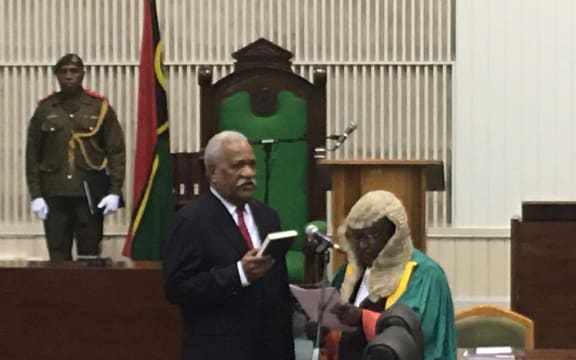
Nikenike Vurobaravu has been voted the 12th President of the Republic of Vanuatu.
It took eight rounds of voting by the 58-member Electoral College before he secured the required minimum number of 38 this afternoon.
In the end he got a resounding 47 votes, after the Prime Minister, Bob Loughman, reached a deal with the nine MPs of the coalition party led by former prime minister, Charlot Salwai.
Those nine MPs have been part of the government for the past year but had fallen out with Loughman over his plans for constitutional reform.
Nikenike Vurobaravu … most recently he was Vanuatu’s High Commissioner to Fiji. Image: Hilaire Bule/RNZ
The new president has had involvement with Vanuatu governments going back many years.
Most recently he has been the High Commissioner to Fiji.
Vurobaravu has promised to encourage unity around the country and to promote the issue of climate change.
This article is republished under a community partnership agreement with RNZ.
Congr’ns to newly elected ??President, H.E. Nikenike Vurobaravu. Among the 56 votes, Nikenike won 48 votes, more than 2/3. It was the 8th attempt by the college on the 3rd day to elect a new HoS. He succeeds Moses Obed Tallis, whose term of presidency ended on 6/07/2022. pic.twitter.com/ou8MKk6j0S
A shellshocked Climate Change Minister James Shaw has been ejected from the New Zealand Greens’ leadership by a minority of party delegates and has yet to decide whether he will fight to stay on.
Thirty-two out of 107 delegates voted at the party’s online annual general meeting today to vacate Shaw’s position, more than the 25 percent threshold necessary under the Greens’ rules.
The vote means any Green Party member can now put their name forward for the role over the next week before another vote within five weeks.
Speaking at Parliament this evening, Shaw said he was “inclined” to stand again, but would first seek feedback from his caucus colleagues and the wider membership.
“This is obviously a bit of a surprise. I’ve got to work through a few things,” Shaw said.
“I still got 70 percent of the delegates supporting me and I’ve had quite a lot of supportive messages in the very brief time that the news has been out. But I do want to take some soundings just to get a proper sense check.”
Shaw said he was still processing the outcome and would spend some time with his family tonight.
Fighting the climate crisis “It is hard when there is a group that’s organising against you. But… I have been so focused on my job as Minister for Climate Change, doing what we need to do to fight the climate crisis, that I really don’t have a lot of time for factional organising.”
Co-leader Marama Davidson — who was reconfirmed by delegates — said she was personally shocked by the action against Shaw.
“I certainly wasn’t expecting this,” Davidson said. “I feel saddened for my friend, as you would feel for anyone who loses their title and role at this time.”
Davidson, though, declined to give a full-throated endorsement of Shaw staying on, saying she would not pre-empt his decision or the party’s. She did say Shaw had “slogged his guts out” in the role.
“I’m simply here to support the work that James has done to date… we’ve been able to keep our support quite well above our election night support numbers.”
Shaw said he had spoken to Prime Minister Jacinda Ardern this afternoon and she had confirmed he would retain his position as Climate Change Minister regardless of the leadership decision.
“This is a temporary blip. It does not have any impact on the work that we’re doing as ministers or the work of our MPs,” Shaw said.
Party caucus meeting The party caucus would meet as usual on Tuesday morning with no current plans to meet before then.
The Green Party constitution was recently changed meaning Shaw’s position could be filled by a person of any gender.
Shaw was elected to the party’s leadership in 2015 after Russel Norman announced his retirement.
Anything concerning the Catholic Church is extremely sensitive in Timor-Leste, as Raimundos Oki, the editor of The Oekusi Post website can confirm, reports the Paris-based global media freedom watchdog Reporters Without Borders.
“The story that Raimundos Oki covered is so sensitive that the justice system cannot suddenly accuse him of violating judicial confidentiality without taking account of broader public interest concerns,” said Daniel Bastard, the head of RSF’s Asia-Pacific desk. “It is perfectly healthy in a mature democracy for a journalist to question how a judicial investigation is conducted. We therefore ask justice minister Tiago Amaral Sarmento to order the withdrawal of the charges against Raimundos Oki.”
The article that Oki published in The Oekusi Post in June 2021 revealed that 30 girls under the age of 18 had been detained on a prosecutor’s orders a year earlier in Oecusse, a western exclave of Timor-Leste, and had been subjected to forced vaginal examinations.
One of the girls subsequently died from a vaginal infection.
Sensitive case against priest The examinations were ordered with the aim of getting more evidence against Richard Daschbach, an American missionary priest who was finally convicted in December 2021 of raping at least four girls.
This now defrocked priest, who had run Topu Honis orphanage since its creation in 1991, was a long-standing supporter of Timor’s independence and had many high-level connections in both political and Catholic Church circles — connections that made the paedophilia case against him even more sensitive.
Oki’s story revealed that some of the girls were detained by the prosecutor and police and subjected to forced genital examinations although they had denied having been sexually assaulted by Daschbach.
Oki, who is himself from Oecusse, told RSF he had wanted to draw attention to the lasting and irreversible trauma that had been inflicted on the girls he interviewed.
“No journalist had talked to the victims of these virginity tests,” he said.
“If the priest is found guilty, let him go to prison. But it is my duty as a journalist to publish this public interest story.
“I refuse to allow these young girls, who have been the victims of sexual abuse, real human rights violations, to be forgotten.”
Two years ago, RSF criticised a proposed law in Timor-Leste under which anyone “offending the honour and prestige” of a representative of the state or church would face up to three years in prison.
Timor-Leste was ranked 17th out of 180 countries in the 2022 RSF World Press Freedom Index, and is now higher than any Pacific Island nation.
Pacific Media Watch collaborates with Reporters Without Borders.
A family has been under house arrest in Tokelau for almost a year after they refused to get vaccinated against covid-19.
The tunoa — house arrest — was imposed on the family of four by the Taupulega (council) on Nukunonu, one of the three atolls that make up Tokelau.
The New Zealand dependency with a population of about 1500 has had no cases of covid-19 since the global pandemic began in early 2020, according to the World Health Organisation.
However, there are strict protocols in place to prevent the spread of the virus.
The general manager for the office of the council of Nukunonu, Asi Pasilio, explained to RNZ Pacific why the council of 36 heads of extended families who serve the atoll’s community, decided to impose tunoa in August 2021.
Culturally complex “This is a village rule, this is the decision of the local council which runs the island and the community. We have the laws of Tokelau but we also have the local council which has the authority over their village.”
Pasilio said there were no jails in Tokelau, but when there is a serious offence the council can just ask people to stay at home. Tunoa takes the place of jail.
She said it was a culturally complex issue.
“It will take someone to come here and live our life here, to understand what we mean by house arrest and council authority and communal living.
“Yes, of course, you make your own decisions here, but doing things in a communal manner is very common.”
Family claims they have been left voiceless In a video posted on social media on July 3, the father, Mahelino Patelesio, said he has felt silenced.
He said he was a member of the council before the tunoa was imposed.
“Before we were placed under house arrest, I explained my stance and I wasn’t allowed to speak at that particular meeting, I actually went there to resign. I wasn’t allowed to do that so I was voiceless.
“From August 3 [2021] three of us adults above 16 years old were placed under house arrest, our daughter was placed under house arrest with us about four months later, towards Christmas,” Patelesio said.
RNZ Pacific has also contacted the family directly but has not received a response.
Asi Pasilio said that while the family is in tunoa they are being supported by the community.
“Their house is right beside the sea so they can go for a swim, they can move around their area but not outside their home boundary.
“They have family members who do their shopping for them.”
Pasilio said the family has been told they have another opportunity to get vaccinated this week following the arrival of more doses.
She said the family had not informed the council of their decision as of Tuesday but if they do choose to get a jab, the tunoa will be lifted.
If they do not, the council will meet again to review the situation.
Matter up to Tokelau, says NZ New Zealand’s Ministry of Foreign Affairs and Trade said the former Administrator Ross Ardern had no say in the implementation of tunoa, and that mandatory vaccination was a decision taken by Tokelau’s village leaders.
“Home-isolation has been authorised under the Tokelau customary practice of tunoa, a practice over which Aotearoa New Zealand has no direct authority,” its statement said.
“Aotearoa New Zealand officials have engaged extensively with Tokelau’s leaders to encourage them to strike a balance between the rights of the majority to remain safe from covid-19 in their villages and the rights of the individual.”
“Some 99 percent of Tokelau’s eligible population 12 and over is fully vaccinated (two doses of Pfizer for 12 to 17-year-olds, and three doses for those 18 and over).
“Both doses of paediatric vaccines have been completed, with 99 percent uptake. Boosters for 18+ were successfully administered in Q1 2022 with 99 percent uptake,” MFAT said.
Asi Pasilio said of the three atolls, Fakaofo is fully vaccinated, Atafu has had less than 10 unvaccinated people, and on Nukunonu just the family of four is unvaccinated.
This article is republished under a community partnership agreement with RNZ.
New Caledonia’s pro-independence Palika party has joined the Caledonian Union in rejecting talks in Paris announced by the French Interior Ministry.
The ministry called a meeting of the signatories to the 1998 Noumea Accord for September as France plans to draw up a new statute for New Caledonia after last December’s boycotted referendum saw a majority of voters opt to remain French.
Palika spokesperson Charles Washetine said the French state had abandoned any notion of “impartiality” and wants to impose such talks amid pressure from the political right.
The head of the Caledonian Union, Daniel Goa, said his side would not go to Paris, describing the proposed talks as a sham and adding that if any talks were to go ahead, they would have to be held in New Caledonia and about ways to give the territory its sovereignty.
He also said any talks would be bilateral ones between his side and Paris, meaning that they would not involve New Caledonia’s anti-independence parties.
Noumea trip cancelled The Interior Minister Gerald Darmanin had earlier announced a visit to Noumea before the end of next week, but the trip has reportedly been cancelled.
His ministry said he would visit New Caledonia after the Paris talks planned for September.
The anti-independence camp welcomed Darmanin’s proposed talks to conclude the process set out in the Noumea Accord.
New Caledonia has been on the UN Decolonisation List since 1986 and despite the referendum outcome, the Kanaks’ right to self-determination remains an inalienable international right.
This article is republished under a community partnership agreement with RNZ.
It took 20 years and just three votes to unshackle anti-corruption champion Dr Allan Marat’s grip on the Rabaul Open seat in East New Britain Province in Papua New Guinea’s general election.
His reign finally came to an end at 5pm yesterday when Rabaul Open Returning Officer Babel Umri announced Graham Piniau Rumet, son of legendary Mataungan leader late Daniel Rumet, was the new member-elect for Rabaul.
Dr Allan Marat calmly and graciously accepted his defeat and announced he would retire to his family home to take care of the family business.
It was a political race that went down to the wire and is the closest winning margin in the 47-year history of the PNG Parliament.
Dr Marat led the preliminary count all the way until box 20, which was the final box for the electorate, registering 4317 votes with Rumet at his heels on 2683 votes.
At the end of the preliminary count, none of the nine candidates met the absolute majority figure and the count went into the elimination round.
United Labour Party candidate Raymond Paulias was the kingmaker when the distribution of his second and third choice votes gave Rumet 5192 votes to Mara’s 5189.
Winning votes His winning votes came from the preferential votes of Paulias who was eliminated in the seventh round.
Dr Marat, who was regarded as one of the Gazelle Peninsula’s robust, transparent, anti-corruption voices, lost by a mere three votes.
Rumet, who was in Kokopo, had to rush to the Sir Ronald ToVue Hall at the Malaguna Technical Secondary School to be declared by Umri in the presence of the Provincial Administrator and Chairman of the Provincial Election Steering Committee Wilson Matava.
The Matupit man was hoisted high on the shoulders of jubilant supporters and was carried into the hall with chants of “Graham! Graham! Graham”!
In his maiden speech, Rumet said he would stand for change in the Rabaul district.
He acknowledged his loyal supporters and also the people of Rabaul for having the confidence in him to be their leader for the next five years.
Bringing change “We’ve prepared ourselves for 15 years for this victory today,” he said.
He assured the people of Rabaul that he would work closely with them to bring change to the district.
“I want to thank the previous member for being the captain of our vessel for the past 20 years,” he said.
Rumet’s declaration is the second for East New Britain Province with Pomio MP Elias Kapavore retaining his seat with an absolute majority win of 11,949 votes and 55 counts of ballot papers.
Kapavore is the first People’s National Congress (PNC) candidate in the country to win his seat.
Paul Bungtabu and Poreni Umauare PNG Post-Courier reporters. Republished with permission.
Fresh fighting among candidates’ supporters has left another two dead in Hela’s Margarima in Papua New Guinea’s general election.
This takes the death toll to nine in the province since fighting broke out on July 4 – and nationwide election-related deaths have topped 45.
Cars and trucks were set ablaze and houses razed in Lower Wage on Sunday.
Papua New Guinea Defence Force liaison officer Major Joshua Dorpar said fighting erupted again following the counting of election ballots for Margarima.
According to military sources in Margarima, the situation was still tense.
“Since the last fight two weeks ago, when the death toll was at seven, two more people have been killed, raising the death toll to nine. A couple of people are in hospital.
“Homes have been burnt down, vehicles destroyed, and we are working on restoring peace again, by talking to the of two groups that are fighting,” the sources said.
Lack of forces Police commander Robin Bore said the fight started during polling on July 4 between incumbent Komo-Margarima MP Mannaseh Makiba’s (Pangu Pati) supporters and Independent Dr Benson Wakinda’s supporters at the Yambraka polling centre.
Bore said he did not have enough security forces to deal with the situation.
“We don’t have enough police manpower on the ground, especially armed/response units to attend to other law and order issues in the province, including the fighting in Margarima,” he said.
“We have one platoon of soldiers and Mobile Squad 12 but they will be concentrating on the counting and providing security for ballot boxes.
“Moreover, 40 regular members of Hela are on the roll over team led by Tari police station commander to provide polling security in nearby Highlands provinces.
“So, after completion of elections in Hela, we will look into those areas that require police help,” he added.
While election-related deaths reached 45 — as compiled by the media — many others went unreported or were unaccounted for.
Rebecca Kukuis a National reporter. Republished with permission.
A shortage of resources and investment from major digital platforms has left the Pacific region battling a campaign of misinformation and under-moderation.
Word spreads fast through the “coconut wireless”, the informal gossip network across Pacific Islanders’ social media.
But when such rapid proliferation is spreading false or misleading news, it becomes a problem that requires resourcing and commitment to solve.
The Pacific is currently a global hotspot for misinformation.
The ability of Pacific island countries and territories to respond to “infodemic” risks online has been exposed by the covid-19 pandemic.
Misinformation about the pandemic has persisted online, despite efforts by Pacific governments, civil societies, citizens, media organisations, and institutions to counter it.
The Pacific presently has the smallest percentage of their population using the internet and social media compared with the rest of the world.
Internet difficult, costly Internet provision is made more difficult and costly in the Pacific due to the region’s unique geographic features. A lack of high-capacity cables and other technical infrastructure has also held back Pacific connectivity.
Health workers in Tonga offering to chat and answer questions about the covid-19 vaccine. Image: Tonga Ministry of Health
More access has rapidly changed how government officials communicate with the public and shifted perceptions of politics.
Both Kiribati and Vanuatu broadcast their national election results live on Facebook.
In Kiribati, the 9400-member Kiribati election 2020 group posted photos of handwritten vote totals. In Vanuatu, the national broadcaster streamed the entire ballot-counting process on Facebook Live.
Sparked by the rollout of mobile broadband across Papua New Guinea, hundreds of thousands of citizens now read the latest news and monitor happenings in Port Moresby through blogs and Facebook groups filled with lengthy discussions and heated calls to action.
Flipside over access The flipside to such access is that false online rumours and scams directly targeting Pacific people have spread rapidly through Facebook groups and closed messaging applications.
Local politicians in the Pacific are starting to recognise the potential of social media, but unethical online influence techniques can go undetected if proper transparency measures and safeguards are not implemented.
Facebook, for one, has implemented its transparency systems to curb hidden manipulation of its advertising features for partisan ends.
Journalists and investigators in dozens of larger markets use these tools to reveal voter manipulation, but most Pacific island nations are yet to adopt them.
The lack of transparency makes it very difficult for observers to track what political actors are saying online, especially as Facebook’s advertising system allows different messages to be targeted to different parts of the population.
Fake Facebook accounts Social media companies make little effort to reach out to Pacific leaders, which may explain why so few public figures in the region use the “verified” badges that are useful in helping distinguish official accounts from personal ones.
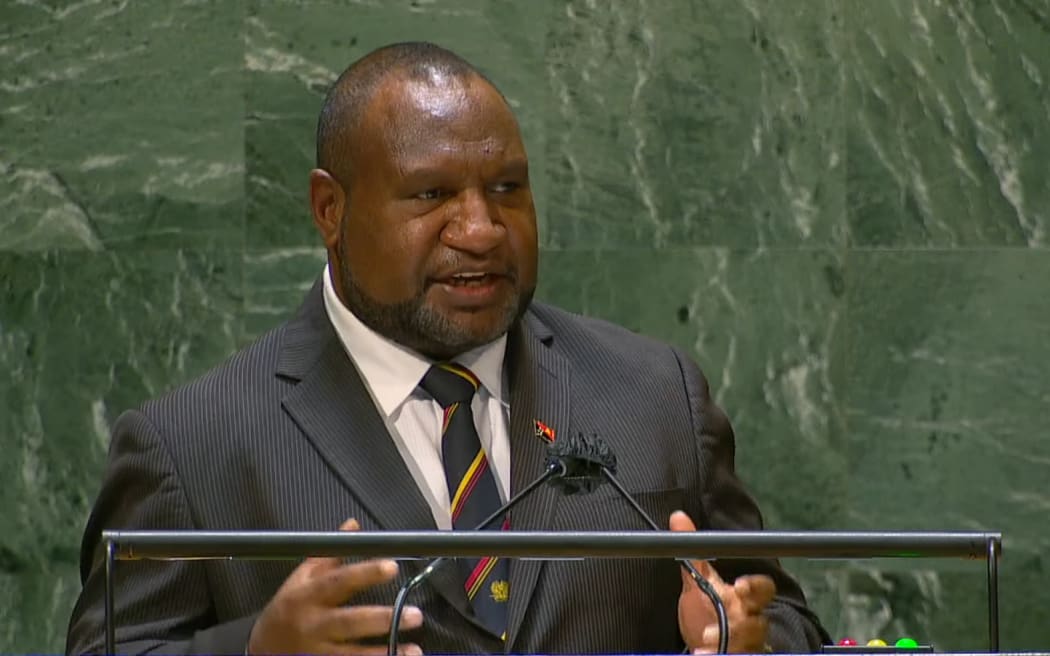
Papua New Guinea Prime Minister James Marape found that out the hard way — fake Facebook and Twitter accounts were created in his name, and his lack of verification made the real profile harder for users to distinguish.
Papua New Guinea Prime Minister James Marape told the 76th UN General Assembly more international efforts are needed to combat misinformation online. Image: UN
Nauru’s government blocked Facebook from 2015 to 2018, and Papua New Guinea and Samoa hinted at blocking the platform multiple times over the past few years.
The frequency with which such measures are proposed in the Pacific reflects a sobering reality: communities in the region often lack the protections that communities elsewhere in the world rely on to address harmful content and abuse on social media.
Rule-breaking content Current systems for moderating content on social media are not effective in the Pacific. These systems rely on algorithms that flag rule-breaking content in multiple languages, human reviewers who make determinations on flagged material, users who voluntarily report content violating the rules, and legal requests from law enforcement officials.
Social media platforms do not prioritise hiring from the Pacific region, where there are comparatively fewer people. They do not invest in developing language-specific algorithms for languages like Tongan, Bislama, or Chuukese, which have a smaller user base.
Despite the growing importance of third-party fact-checking partnerships, no Pacific Island country is home to a dedicated fact-checking team.
All claims in Australia and the Pacific islands are referred to the Australian Associated Press’s fact-checking unit. Pacific social media users are missing out on one of the few tools that global social media companies use to strengthen information ecosystems due to the lack of a robust local fact-checking organisation.
All signs point to an increase in the dangers posed by false and misleading information in the months and years ahead, as both state and non-state actors attempt to steer online discourse in service of their strategic goals.
Dangers posed External pressures and crises will amplify the dangers posed by these campaigns, as they did during the covid-19 pandemic when an excess of data and a lack of apparent credibility and fact checking allowed rumours to spread unchecked.
Rising tensions between the developed world and China add to the already complex political situation, and the narrative tug-of-war for influence among significant powers on Covid-19 is likely to continue.
There is a risk that online misinformation from foreign media will increase due to this competition for narrative dominance, leaving countries in the region vulnerable to influence operations that target online discourse, media, and communities.
More robust local capacity (outside of government) to identify problematic content and bad actors online is necessary for the region to recover from Covid-19 and respond to future crises.
This includes better coordination among regional institutions and governments, increased engagement between social media companies and Pacific leaders, and more thorough reporting of online problems.
Foreseeing and preparing for future potential threats to health and safety is something that leaders can do now.
Romitesh Kantis a Fiji PhD scholar at the Australian National University, and a research consultant with more than 10 years’ experience in the fields of governance, civic education and human rights. He is also a contributor to Pacific Journalism Review.This article was originally published on360info under Creative Commonsand RNZ Pacific. It has been republished with permission.
The Australia West Papua Association (AWPA) has condemned the absence of West Papua in last week’s Pacific Islands Forum (PIF) official communique, saying it was “greatly disappointed” that the human rights situation in the Indonesian-ruled Melanesian region had not been mentioned.
“It is understandable that the PIF has huge challenges in the region and in particular climate change. But for all the talk about inclusiveness it would appear West Papua is not a major concern for the Forum,” spokesperson Joe Collins said in a statement.
“The PIF could have shown solidarity with the Papuan people by a simple statement of concern about the human rights situation in West Papua (particularly as the situation continues to deteriorate).”
Collins called on the forum to continue to urge Jakarta to allow a fact-finding mission to the region.
“The leaders would have had the support of the people of the Pacific region in doing so,” he added.
It’s a wrap- From the Suva Agreement to the 2050 Strategy, get the last word on what’s next for regionalism in the Pacific Islands Forum Leaders Communique 2022 at https://t.co/VwQslLSmXkpic.twitter.com/MHTNd6rh9O
A prominent New Zealand epidemiologist is calling for much wider mask mandates, saying the roll-out of free masks, while positive, will make a “fairly small” difference to the covid-19 outbreak.
The government yesterday announced masks and rapid antigen tests would be made freely available while the country battled a resurgence of covid-19 and other winter illnesses.
University of Otago’s Professor Michael Baker told RNZ News much more was required to prevent the worst outcomes of a “really grim winter”.
“We are missing the fundamental measure to stop sharing this virus widely and that is universal mask use indoors.”
In a statement, the ministry said a child less than 10 years old had died, while five other people who died were in their 70s, nine were in their 80s and eight were aged over 90. Of these people, 11 were women and 12 were men.
All the deaths being reported occurred in the past seven days, the ministry said.
That takes the total number of publicly reported deaths with covid-19 to 1760 and the seven-day rolling average of reported deaths is 20.
Dr Baker said New Zealand needed to shift to becoming a “mask-using society”, which he believed could be achieved only through mandating their use in most indoor environments.
“The very ad hoc approach to requiring mask use is eroding the social licence for them,” Dr Baker said.
“You go to one social event, and everyone’s wearing a mask, and so you feel comfortable. Next day, you go to a different one, and no one’s wearing a mask, except you, and that feels a bit odd. We need to get rid of those inconsistencies.”
Fear of political backlash Dr Baker said he believed the government had opted for a greater focus on personal responsibility for fear of a potential political backlash.
“Unfortunately, we’ve politicised this issue too much and politics is starting to take over from the science.”
But, speaking to RNZ Checkpoint, Covid-19 Response Minister Ayesha Verrall said it was “not simple” to implement mask mandates.
“It impacts the running of many businesses and we need people to take a pragmatic approach to this.”
Dr Verrall said, however, she would encourage everyone to wear a mask while indoors as much as possible.
She rejected the suggestion the government’s approach to tackling rising covid-19 cases was based on politics over health.
Dr Verrall would not say if the predicted peak of 1200 hospitalisations a day would be a crisis, but said the government was doing everything it could to avoid the scenario playing out.
‘Real health pressures’ “I think it’s really important we respond to the very real pressures in our health system, and I’ve been in close contact with healthcare workers, as well as following the statistics we get to make sure we know what the facts are, and that we respond to them and fix the problems that exist,” she said.
“A lot of what we set out today is designed to do that.”
Green Party MP Teanau Tuiono said the development was “about time”, but he would have liked to see masks made mandatory in schools.
“We’re all over it, we’re all tired… but it’s just no excuse to drop the ball because here’s the thing: there are people still in hospital, people dying from covid,” he said.
“The numbers are going up and we are in the middle of winter, so what we need here is that leadership.”
This article is republished under a community partnership agreement with RNZ.
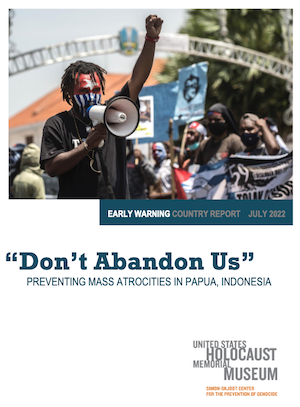
The US Holocaust Memorial Museum is warning in a new report that mass killings of civilians could occur in Indonesia’s troubled West Papua region in the next year to 18 months if current conditions deteriorate to a worst-case scenario.
The museum’s Simon-Skjodt Center for the Prevention of Genocide published the 45-page report this week authored by an Indonesian, Made Supriatma, who conducted field research in the region.
“Indonesia ranks 27th on the list of countries with risks of mass atrocities. This report should be considered as an early warning,” Supriatma said.
A combination of factors — increasing rebel attacks, better coordination and organisation of pro-independence civilian groups, and the ease of communication — makes it plausible that the unrest could reach a new level in the next 12-18 months, the report said.
“If political and social unrest persist, and if it were to spread across the region, it is possible that the Indonesian government could determine that the scale or persistence of the protests would justify a more severe response, which could lead to large-scale killing of civilians,” it said.
The risks are rooted in factors such as past mass atrocities in Indonesia, the exclusion of indigenous Papuans from political decision-making, Jakarta’s failure to address their grievances and conflicts over the exploitation of the region’s resources, according to the report.
Human rights abuses Other factors include Papuans’ resentment over Jakarta’s failure to hold accountable security personnel implicated in human rights abuses and conflict between indigenous Papuans and migrants from other parts of Indonesia over economic, political, religious, and ideological issues, it said.
Under one scenario that the report envisions, pro-Jakarta Papuan militia, backed by the military and police, commit mass atrocities against pro-independence Papuans.
But such a scenario depends on indigenous Papuan groups remaining divided into pro-Jakarta and pro-independence groups, it said. The other scenario involves Indonesian migrants and Indonesian security forces committing atrocities against indigenous Papuans, the study said.
The report recommends that the government improve freedom of information and monitoring atrocity risks, manage conflicts through nonviolent means, and address local grievances and drivers of conflict.
Supriatma said indigenous Papuans he spoke to as part of his research confirmed that real and perceived discrimination had fueled an “us-against-them” mentality between indigenous Papuans and Indonesians.
Papua, on the western side of New Guinea Island, has been the scene of a low-level pro-independence insurgency since the mainly Melanesian region was incorporated into Indonesia in a United Nations-administered ballot in the late 1960s.
In 1963, Indonesian forces invaded Papua — like Indonesia, a former Dutch colony — and annexed the region.
Only 1025 people voted in the UN-sponsored referendum in 1969 that locals and activists said was a sham, but the United Nations accepted the result, essentially endorsing Jakarta’s rule.
‘Not based on facts’ An expert at the Indonesian presidential staff office, Theofransus Litaay, questioned the study’s validity.
“There’s something wrong in the identification of research questions. The author extrapolated events in East Timor to his research,” he said, referring to violence by pro-Jakarta militias before and after East Timor’s vote for independence from Indonesia in 1999.
“It’s not based on the facts on the ground,” he said, without elaborating.
Gabriel Lele, a senior researcher with the Papuan Task Force at Gadjah Mada University in Yogyakarta, said the report was based on limited data.
“It is true that there has been an escalation of violence, but the main perpetrators are the OPM [Free Papua Movement] and the victims have been civilians, soldiers and police,” lele said.
He said rebels had also attacked indigenous Papuans who did not support the pro-independence movement.
Violence has intensified in Papua since 2018, when pro-independence rebels attacked workers who were building roads and bridges in Nduga regency, killing 20 people, including an Indonesian soldier.
Suspected rebels killed civilians In the latest violence, suspected rebels gunned down 10 civilians, mostly non-indigenous Papuans, and wounded two others on July 16.
A local rebel commander from the OPM’s armed wing, Egianus Kogoya, claimed responsibility.
“We suspect they were spies, so we shot them dead on the spot,” the Media Indonesia newspaper quoted him as saying on Monday.
The attack in Nduga regency came a little more than two weeks after legislators voted to create three new provinces in Papua amid opposition from indigenous people and rebel groups.
In March this year, insurgents killed eight workers who were repairing a telecommunications tower in Beoga, a district of Puncak regency.
No desire to address racism Reverend Dr Benny Giay, a member of the Papua Church Council, said Jakarta had not shown a desire to address racism against Papuans, who are ethnically Melanesian, and instead branded pro-independence groups terrorists.
“Authorities allow arms trade between armed groups and members of the TNI [military] and police, which perpetuates the violence and in the end can have fatal consequences for the indigenous people,” Dr Giay said.
The influx of migrants from other parts of Indonesia has created inter-communal tensions and conflicts over regional governance, analysts said.
Indigenous people are concerned that a massive project to build a trans-Papua highway, as part of President Joko “Jokowi” Widodo’s drive to boost infrastructure, could lead to economic domination by outsiders and the presence of more troops, said Cahyo Pamungkas, a researcher from the National Research and Innovation Agency (BRIN).
“The road will mainly benefit non-Papuans, and indigenous people will benefit little economically because they are not ready to be involved in the economic system that the government wants to build,” Cahyo said.
Republished from Benar News. Co-author Victor Mambor is editor-in-chief of the indigenous Papuan newspaper and website Jubi.
A district mayor says the Aotearoa New Zealand local government sector is ready to launch into a future that embraces more youthful members, Māori and climate change action.
Whanganui mayor Hamish McDouall said the Local Government New Zealand (LGNZ) annual conference underway in Palmerston North had “launched our heads into the future”.
McDouall, the vice-president of LGNZ, said yesterday the hot topics were the changing face of elected membership, partnership with Māori and climate change.
“The clear message is about the future. The future is going to change. It is about youth involvement and embracing hapū and iwi.
“With the next generations’ birth rates significantly higher for Māori than Pākehā, co-governance arrangements and those kind of things just have to be in place.
“The exciting thing about today is you can tell that local government is wanting change, ready for change.”
The sector could not ignore the climate change crisis, McDouall said.
Climate deniers ‘on wrong planet’ “If there’s any climate change denier out there, you’re on the wrong planet. Local government needs to get more active and make bold decisions.
“Any decision we make proactively now is going to make it less difficult to adapt in 10 years. We’ve just got to do things now.
“I have climate change sceptics on my council but anyone entering local government should understand this is the crisis for the rest of our lives.”
The third burning issue at the conference was rating, McDouall said.
“Rates don’t work as a funding tool alone – that’s why Three Waters is happening, because we simply can’t afford it.”
Thirty-five councils across the country will have Māori wards at this year’s local body elections, 32 of them for the first time.
Te Maruata collective ‘thrilled’ Bonita Bigham, chair of the sector’s Māori collective Te Maruata, said the network was thrilled to be welcoming more than 50 new Māori ward members into the sector in October.
Te Maruata spent a day together before the main conference began on Wednesday.
“We were thrilled — really thrilled — for the first time ever to have at least six Māori mayoral candidates in the room,” Bigham said.
But she said it was clear that the council environment does not support Māori elected members. The results of a survey of elected members released by LGNZ this week revealed that half the respondents have experienced racism, gender discrimination and other harmful behaviour.
“So [on Tuesday] we launched Te Āhuru Mōwai, a tuakana-teina initiative which will enable Māori members on any council to reach out into our collective strength and experience for guidance and support,” Bigham said.
In his president’s address, Stuart Crosby said local councils must build relationships and partnerships with all sectors of the community, including tangata whenua.
“It’s not about power and control anymore. It’s all about partnership. We cannot serve our communities and do our jobs justice if we don’t partner with mana whenua.”
Most diverse sector Far North District councillor Moko Tepania, co-chair of LGNZ’s Young Elected Member (YEM) network, told the conference that “YEMs” represent the most diverse sector of local government.
“That gives an indication of how different local government will look in the future compared to today and the past,” he said.
Tepania, 31, is running for the Far North mayoralty in October’s elections. If successful he’ll be the youngest ever Far North mayor. He was elected as a Kaikohe-Hokianga Ward councillor at the last local government election in 2019.
Ruapehu District’s youngest councillor Elijah Pue is also running for mayor. At 28, he, too, would be the youngest mayor ever elected in his district if successful. He was elected as a Waimarino-Waiouru Ward representative in 2019.
Pue said yesterday co-governance and partnership were being openly and frankly discussed.
“How do we embody the principles of Te Tiriti o Waitangi in a way that allows councils to focus on community wellbeing, and partnerships and relationships for the betterment of our mokopuna?
“We want meaningful change in our communities. Our outlook no longer needs to be for a 10-year long-term plan, it actually needs to be for a thousand-year generational outlook.
Future-focused leadership “We need future-focused leadership that doesn’t dwell on the past. We need younger, browner, more future-focused leadership that puts our grandchildren, born or unborn, at the forefront of our decisions.”
Fellow Ruapehu mayoralty contender, councillor Adie Doyle, said the clear thrust of the conference was that youth and Māori would have greater input into local government.
“It’s just the way the population statistics are going. The importance of partnerships and working together – some people call it co-governance – is a key takeaway.
“These conferences are designed to challenge your thinking. You come away with maybe a different perspective.
“I support the principle of partnerships, but they have to be fit for purpose, and not all partnerships need to be equal – it’s about working together for the benefit of both parties. It’s for problem solving.”
YEM co-chair Lan Pham – the highest polling candidate elected to Environment Canterbury Regional Council in 2016 – said the key imperative of the network of elected members aged 40 or younger was a transformational approach to environmental protection.
“Every major transformation didn’t just happen, they were designed. We think it’s time for this level of change to happen again.”
Decide on next steps Horizons Regional Council chair Rachel Keedwell told the conference it was crucial for local government to focus on the YEM vision and decide on the next steps urgently.
“We need to start putting those in place now and focus on the legacy that we’re leaving rather than whether we are going to get re-elected,” Keedwell said.
“We’re moving too slow for the size of the crises that are in front of us. I could get overwhelmed by the scale of the task in front of us: biodiversity, pollution, water quality – numerous crises at the same time.
“We’ve focused on economy rather than environment. That’s how we’ve ended up where we are. We’re living beyond the capacity of the earth. We’re living on credit and that credit is borrowed from the next generation.”
The four-day conference is being attended by a record more than 600 mayors, chairs, councillors, community board members and stakeholders who are hearing from the Prime Minister and other Ministers, the Opposition and sector leaders about policy areas and issues that impact councils and local communities.
The conference ends today.
Local Democracy Reporting is Public Interest Journalism funded through NZ on Air. Asia Pacific Report is an LDR partner.
Green Party co-leader, James Shaw. Image, Green Party New Zealand.
Political Roundup: Green Party divisions over their future
Green Party co-leader, James Shaw. Image, Green Party New Zealand.
Imagine being a Green Party activist at the moment. You joined the party because climate change is an existential threat and truly radical change needs to be undertaken immediately. You’re deeply upset by inequality. You think that conventional politicians are part of the problem.
However, you begin to realise that your own party is part of that problem. Your team has finally got hold of power, and has the ministerial responsibility for climate change and homelessness. Yet these, and other, problems are getting worse under your watch.
In fact, you start to suspect that your own politicians are as guilty of “greenwashing” as any government – pretending to be doing something about those big problems, but really just altering the status quo a little. As a Green Party activist you might suspect that by trying to get your own party elected you are now part of the status quo.
It’s no wonder divisions are opening up in the Green Party, and there are reports of dissent reaching such a level that a “no confidence” motion has been prepared against the leadership at this weekend’s Annual General Meeting. Members of the Youth wing of the Greens are said to be so angry with co-leader James Shaw that they want to roll him. Media reports even say that activists “hate” their leader. The knives are out.
Shaw continues to remain outwardly unruffled by internal dissent and manoeuvres against him. He said this week that he’d had that the whole time he’s been in the Greens, humorously stating “there has been a small group of people who have been wanting to see the back of me ever since they saw the front of me”.
What has Shaw done wrong?
James Shaw has long been seen as the more moderate, or even rightwing, faction leader in the Greens. Coming from the corporate world, and much more National-friendly than other Green MPs, he’s viewed suspiciously by some activists who believe he has pushed the party further into the middle of the political spectrum.
As a minister in the last parliamentary term, Shaw disappointed many on the left, culminating in the 2020 scandal over his allocation of government funding for a private school, contravening party policy.
But it’s in his role as Climate Change Minister that Shaw has really disappointed his own side, including leading environmental campaigners. Since taking up the role in 2020, Shaw has proved to be less focused on fulfilling the desires of environmentalists for radical change, and more on creating across-the-board buy-in from more conservative forces.
To him it’s a question of strategy, in which small steps are taken that endure and lay the path for bigger achievements in the future. But for his leftwing and environmental critics, it’s about selling out and compromising on the most crucial issue of our times.
The final straw for many Greens, and what is now causing a growing movement to sack Shaw, is Shaw’s recently announced Emissions Reduction Plan. The announcement was so business and farmer friendly that Matthew Hooton, who is a lobbyist, wrote at the time: “New Zealand farmers are the world’s best but their lobbyists are even better. While it’s not true today’s Green Party is a wholly owned subsidiary of Fonterra, it’s understandable some environmental activists are starting to think so.”
This was accurate in the sense that all the industry vested interests came out in support of Shaw’s plans, and all the leading environmentalists came out in outrage. For example, environmental academic Mike Joy proclaimed that Shaw’s plan shows that the Government has been “captured” by big business and agriculture. Former Green MPs also weighed in, horrified by the much-anticipated climate plan.
Will Chloe Swarbrick replace James Shaw?
Although Shaw isn’t likely to be rolled anytime soon, it’s become obvious that he’s on his way out, with speculation about when the co-leader will step down and what role he might then pursue.
Matthew Hooton has recently reported accounts from Green insiders, saying: “The growing pressure on Shaw is understood to be causing him to wonder if it is worth carrying on to the election.”
Furthermore, Hooton says life in the Greens is getting uncomfortable for Shaw: “he spends his days getting told by his party activists and most of its MPs that he is not green enough, too right wing, a sell out, insufficiently woke, the wrong sex, the wrong gender, the wrong colour, the wrong ethnicity, the wrong class… and so on.
With his climate-change work done, and unlikely to achieve anything more, who wouldn’t understand if he decided to throw in the towel”.
Although Hooton’s gossip can be dismissed as the ravings of a rightwing commentator, it’s worth noting that he’s very often been proven correct in his forecasts about Green internal politics. For example, when the Greens recently changed their constitution so that both co-leaders could be female, but there couldn’t be more than one male, it was Hooton who revealed in his Herald column that this was about to occur.
The Herald’s Thomas Coughlan also reports today that it’s not just dissidents who are thinking Shaw’s days are coming to an end: “Even members on the ‘James side’ of the party mused that it might be time for a co-leader who was more obviously onside with members, and more aggressive in challenging Labour’s gravitational centrism.”
So, when Shaw eventually goes, who’s being lined up to replace him?
The smart money is clearly on Auckland Central MP Chloe Swarbrick who is already significantly more popular than either Green co-leader. Some have speculated that the recent change of the party’s co-leadership identity rules was designed so that she could replace Shaw while keeping Marama Davidson in place.
Some believe Swarbrick is the pick of Shaw himself. In this regard, Hooton wrote recently that his replacement by Swarbrick “is also believed to be Shaw’s preference, either before or after the 2023 election.”
Who else could replace Shaw?
Swarbrick’s ascension is assured. One problem is that she is also viewed by many Green activists as being similarly centrist – although she occasionally uses radical language, at her core she’s more of a moderate than other options. And certainly Shaw’s endorsement of her would cement this impression.
There’s also another moderate option – former parliamentary Chief of Staff, Tory Whanau. Although she’s not currently an MP, there are no rules to stop her being elected as co-leader, just as in 2006 the party elected Russel Norman leader before he was an MP.
Whanau is currently running for the Wellington mayoralty, but this is widely seen as a manoeuvre to increase her national political profile in order to launch a political career rather than a serious bid to become mayor. For Green activists, a bonus of making Whanau the co-leader alongside Davidson is that they would then have a “double wahine Māori leadership” (or DWML). When the party changed their co-leadership rules recently, they also made it compulsory that one of the leaders be Māori. But obviously having two would be seen as even more progressive, as historically the party has been very white.
The more leftwing or radical options for co-leadership are MPs Teanau Tuiono and Elizabeth Kerekere. Electing the latter would also produce the desired DWML. Kerekere is also very well regarded in the party at the moment due to her successful leadership of their campaign to have gay conversion theory banned.
Interestingly, Kerekere has spoken out this week on the party’s internal leadership debates, telling 1News that Shaw was “on the more moderate side of our membership” while herself and Tuiono are “more on the activist side of the membership”.
While Kerekere was amplifying the internal factional divisions and clearly positioning herself in these for public view, co-leader Marama Davidson has been on a media spree in the last week, doing interviews to defend Shaw’s leadership and try to turn around the growing notion that the party hasn’t achieved much in government this term. She says they need to communicate more about how hard they work.
Today’s AGM has suddenly been moved online, due to Covid. But the fact that it was to be held in Christchurch had some suggesting this was a way for the leadership to regain control over activist dissent, and blunt any challenges to Shaw’s leadership.
Shaw has replied that any theories of this sort are “ridiculous”. But he would have been more convincing if the leadership hadn’t also now banned any media from observing the conference. As the Herald’s Audrey Young said yesterday, the party is now “running the least open AGM of any political party”, which is a problem for a party which used to present itself as a champion of political transparency.
Other divisions this weekend
Questions about future leadership aren’t the only issue troubling Green Party activists this weekend. There are a couple of remits that are also apparently causing division.
One relates to decisions over future government coalition agreements. In the past, the membership has had to very quickly make a call on whether to accept post-election coalition agreements, with a sense that they were expected to just rubberstamp what the leadership had agreed with the Labour Party. Supposedly in 2020 the membership only had fifteen minutes to read the coalition proposal before voting on it.
The party’s Green Left faction has put forward a remit that would insist on a ten-day period for the membership to consider a coalition arrangement. But James Shaw is leading the charge against this, apparently circulating a paper to the AGM explaining how difficult this would make coalition negotiations. He argues it would weaken the power of the Greens.
Thomas Coughlan reports today that a second contentious remit to be considered this weekend is over internal power in the party. The proposal would “adjust the way that party delegates, powerful members with voting rights on things like governing agreements, are allocated to party branches. This will tilt the delegate balance in favour of cities (the Wellington Central branch’s delegate count will double), which is where members are concentrated.”
In general, there might be broader discussions this weekend about the ideological direction of the party. In an interview today with the Herald’s Michael Neilson, Marama Davidson has spoken about her vision of making the Greens more about “social issues”, which she believes would make the party more popular.
The party is unlikely to make any significant headline-making decisions in their online meeting this weekend – certainly James Shaw isn’t about to be rolled – but some of these decisions and divisions about the party’s future could be extremely consequential. If the party shifts in the “wrong direction”, there’s always the chance that they will slip below the 5% threshold, and that would significantly reduce the chances of a Labour-led government being returned in 2023.
New Zealand Parliament Buildings, Wellington, New Zealand.
Political Roundup: If the NZ First Foundation accused are not guilty, then who is?
It’s shocking that the accused in the NZ First Foundation trial were declared “not guilty” in the High Court today. But it’s not actually surprising.
Political scientist, Dr Bryce Edwards.
There was always a strong chance that the Serious Fraud Office (SFO) was not going to get a conviction over the machinations used to keep large donations to the New Zealand First party secret. The revelation of this scandal in 2020, and the trial over the last month, may well have proven that the Electoral Act was breached, but it was far from certain that the accused were guilty of what the authorities were charging them with.
This is because the SFO chose not to lay charges against the defendants, or other party officials and politicians, under the Electoral Act, but under the Crimes Act instead. Rather than arguing that the Electoral Act’s requirements that larger donations be declared to the Electoral Commission (and therefore made public), the SFO essentially argued in court that the accused, who were running the NZ First Foundation, had stolen the money and were guilty of theft.
As the accused were able to argue in their defence, there was no one complaining of theft – certainly not the New Zealand First party, nor the donors. The money had been given to help the party in their electioneering, and that’s how the money genuinely appeared to be spent.
The Serious Fraud Office has some explaining to do
The SFO now need to front up and be accountable for failing to get a conviction for what appears to be a very clear breach of the Electoral Act.
As I noted in an earlier column that questioned the SFO’s strategy, there appeared to be two reasons why charges were laid under the Crimes Act: “It seems likely that the maximum penalties that can be imposed under this act are deemed too low, and so the SFO have used the Crimes Act instead. This raises the question of why the maximum penalties under the Electoral Act are so low. Alternatively, the SFO’s decision to use the Crimes Act might have been because it was too difficult to prove that the Electoral Act has been breached.”
The latter now looks to be the most likely explanation. The SFO may have had trouble using the Electoral Act due to its severe limitations, especially because the accused were not party officials. The Act places responsibility for party donations with the Party Secretary, who was apparently unaware of the donations arrangement. The Foundation had been set up, after all, to keep the donations away from the formal organisation.
In fact, it was the Party President in 2020, Lester Gray, who seems to have been the whistleblower, resigning from the party over the donations arrangements and bringing them to the attention of the media. The SFO likely was hesitant to prosecute them or other officials who had little knowledge of the behaviour at the time it was happening.
The SFO could have gone after other politicians in the New Zealand First party, including leader Winston Peters, who had played a role in fundraising. However, there appeared to be no evidence that he had authorised the way the Electoral Act had been circumvented. The defence made much of the SFO’s failure to call Peters as a witness and “victim” of the alleged crime. The judgement makes it clear that very large donations ended up being used for the purposes both the donors and the party intended. That meant the accused walked free, but it is a damning indictment on our politics.
The Electoral Act needs a significant overhaul
The trial outcome demonstrates that the Electoral Act is full of holes, and that the public cannot have confidence that some large donations to politicians are ever declared. Essentially this is a case study in how you can drive a bus through the Electoral Act.
There needs to be a proper overhaul of electoral laws. Unfortunately, the minor reforms that the Government are proposing won’t address any of this. Even the Independent Panel that was recently set up to look into electoral matters have been pointed to look in a different direction. The Government needs to change the remit of that panel, or else establish something more rigorous like a Royal Commission.
The current Electoral Act appears to operate on a “high trust model”, akin to the Wage Subsidy Scheme under Covid, in which business was trusted to be honest with the $20bn of handouts. Similarly, politicians and their parties are expected to follow the rules, despite knowing there is really no substantial monitoring and enforcement of those rules.
And in fact, revelations of the large donations and the violation of the disclosure requirements only really come about when whistleblowers and the media do some digging. There has to be a better way.
At the moment the Electoral Commission is toothless in this regard. But even when the high-powered SFO spent years on this case it could not get a conviction – despite there being open admissions that the very basic purpose of the Electoral Act’s donation disclosure regime had been seriously violated.
Max Rashbrooke, who is researching the role of money in politics at Victoria University of Wellington, tweeted the following in response to the “not guilty” verdict: “So, in New Zealand now, you can take $750,000 in donations intended for a political party, declare none of it, and get off. Donors can split donations to hide them, and get off. Urgent reform needed. I’ll be writing to the Minister of Justice accordingly.”
The failure to hold politicians, party officials, party fundraisers and donors to account really does bring the whole system of money and politics into disrepute in New Zealand.
If now isn’t the time to demand a proper clean-up of the rules, institutions, and behaviour of politicians and their wealthy backers, then when will be?
“It’s okay, we’ll just sit here and they can come kill us.”
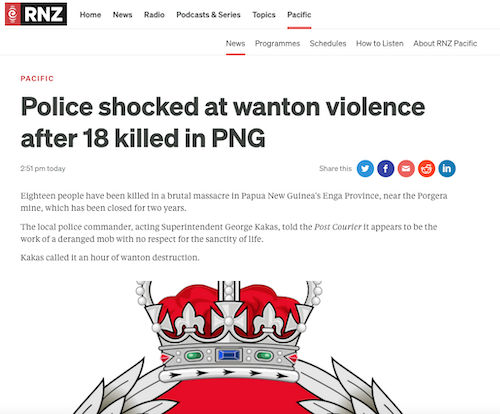
These chilling words are from a defenceless woman (name withheld) who has seen first-hand the continuous killings in Papua New Guinea’s Porgera Valley, Enga province and accepting what could be the ultimate fate for her and her family.
Women and children in villages in that part of the country literally have nowhere to run since the killing spree has continued unabated in the gold valley, now tainted bloody and with ashes.
Attacks on villages in more than a year between warring clans of Nomali and Aiyala — not election related — can happen anywhere between 2 and 3 in the morning, and even during broad daylight.
There is nowhere safe, not even churches.
Police are outnumbered as the self-acclaimed thugs walk freely into villages and start firing indiscriminately with military grade weapons killing men, women, and children.
The hired guns are said to be there to make the kill and move on to the next victims.
Scared for their lives The woman who spoke to the PNG Post-Courier said she and a large group of women and children were scared for their lives and the worry that it could be their last day to live.
“These warlords will walk into our villages destroying and burning down houses as early as 2am or 3am, even at dawn,” she said.
“We don’t sleep at night. All we do is pray to God for help. We don’t know where to go, we are helpless,” she said.
How the PNG Post-Courier reported the Wednesday massacre in yesterday’s front page report with photographs supplied by the Engan police. Image: Enga Police Command/PNG Post-Courier screenshot APR
“My people fled the village and ran away. This week we heard that men were coming to attack us in the night.
“I did not know what to do so I just walked out onto the road and met some youths from my village, who told me plainly that there is nowhere for us to run too.
“So I said, ‘it’s okay let’s just sit here and if they come and kill us so be it’.”
She said mothers with children would have to run for their lives at any moment during the night to find the nearest hiding place for a few hours until dawn so they could look for a new place to go to within the besieged area.
No help in sight This has been happening with no help in sight to address the tribal conflicts that have raged on long before this month’s general elections even surfaced.
With resources and concentration focused on the current polls taking place in the country, the self-proclaimed warlords have taken over the valley, raping women, killing people and burning down government and business properties.
Porgera has now turned into a killing field as public servants and those working in businesses in the valley have fled for their safety.
She said they had lost count of how many people had died.
“With the closure of Paiam Hospital, those who are injured very badly just sleep here under our watch, those in a critical condition will not make it,” she said.
“The roads out have been blocked, many have left with some more leaving but this does not stop the killing, every day we have a target on our backs,” she said.
Another community leader (name withheld) on the ground said the district needed a state of emergency declared.
21 killed by warlords “Just today [Wednesday, July 20], a total of 21 people have been killed by unknown warlords. The victims are from Porgera, Tari and Kandep.
“Eight people were killed at Kanamanda Church area just next to Kia Kona at Paiam and a further seven were ambushed at Upper Maipagi, located at upper parts of Porgera station while they were looking for firewood in the bush,” he said.
“A young girl was killed among that 21 and others are fighting for their lives.
“It’s no more tribal conflict but a sort of genocide. Warlords hunting innocent lives even if they are not their enemies.
“This should have been prevented if the Defence Force deployed last month were not withdrawn straight after polling at Porgera.
“This time the government has failed us,” he said, clearly wondering whether their cries were being heard at all.
Melisha Yafoiis a PNG Post-Courier reporter. Republished with permission.
Fiji’s Supervisor of Elections Mohammed Saneem has called on local media to upskill their overseas counterparts in the wake of an article by the public broadcaster Australian Broadcasting Corporation (ABC) that raised questions on whether Fiji’s upcoming elections would be free and fair.
He said the ABC had been absent from Fiji for two years because of covid “and now they are here, they will be using information that’s two years old”.
Saneem said the ABC reporter failed to take into account the Fijian Election Office’s response to their query — a video link for a press conference explaining the overseas registration drive and how information was being disseminated.
“And this is where the overseas media and the local media play a very different role,” he said.
“The overseas media will be quick to jump at these kinds of conclusions because it suits a narrative that [Fiji] basically can’t have free and fair elections, unfortunately.”
He said the information was accurately reported by the local media.
Pockets of Fijians Saneem said Australia was a vast country with pockets of Fijians living in very remote areas.
“When the FEO was planning this exercise, we did publish to say if you wanted teams to come to your locations, contact us and it was right here with the local media and we were live on Facebook,” he said.
“And when arrangements were being made, we contacted local communities in those areas through the contacts that we were able to garner and the arrangements were made.
“And for them to cast just a wide-ranging allegation that the election won’t be free and fair shows the level of interest they have when it comes to finding out the actual facts.”
He said the local media had an important role to play in the lead-up to the 2022 general election.
“And simply because the ABC reporter thinks Fiji won’t have a free and fair election doesn’t mean it becomes your headline because you are the ones directly in the field,” he said.
“You will get the information directly to you, I am in press conferences with you and I give you the information, no holds barred.
“So I urge the local journalists to please upskill those who are coming into the country.”
Wanshika Kumaris a Fiji Times journalist. Republished with permission. However, The Fiji Times carried no response from ABC.
A lively 43sec video clip surfaced during last week’s Pacific Islands Forum in the Fiji capital of Suva — the first live leaders’ forum in three years since Tuvalu, due to the covid pandemic.
Posted on Twitter by Guardian Australia’s Pacific Project editor Kate Lyons it showed the doorstopping of Solomon Islands Prime Minister Manasseh Sogavare by a melee of mainly Australian journalists.
A doorstop on security and China greets Solomon Islands Prime Minister Manasseh Sogavare (in blue shirt) at the Pacific islands Forum in Suva last week. Image: Twitter screenshot @MsKateLyons
But Lyons made a comment directed more at questioning journalists themselves about their newsgathering style:
“Australian media attempt to get a response from PM Sogavare, who has refused to answer questions from international media since the signing of the China security deal, on his way to a bilateral with PM Albanese. He stayed smilingly silent.”
Prominent Samoan journalist, columnist and member of the International Federation of Journalists (IFJ) gender council Lagipoiva Cherelle Jackson picked up the thread, saying: “Let’s talk western journalism vs Pacific doorstop approaches.”
Lagipoiva highlighted for her followers the fact that “the journos engaged in this approach are all white”. She continued:
‘A respect thing’ “We don’t really do this in the Pacific to PI leaders. it’s a respect thing. However there is merit to this approach.”
A “confrontational” approach isn’t generally practised in the Pacific – “in Samoa, doorstops are still respectful.”
A thread⤵️ Let’s talk western journalism vs. Pacific journalism doorstop approaches. You will see in this, that the journos engaged in this approach are all white. We don’t really do this in the Pacific to PI leaders. It’s a respect thing. However there is merit to this approach. https://t.co/GcsJVDICFb
But she admitted that Pacific journalists sometimes “leaned” on western journalists to ask the hard questions when PI leaders would “disregard local journalists”.
“Even though this approach is very jarring”, she added, “it is also a necessary tactic to hold Pacific island leaders accountable.”
So here is the rub. Where were the hard questions in Suva — whether “western or Pacific-style” — about West Papua and Indonesian human rights abuses against a Melanesian neighbour? Surely here was a prime case in favour of doorstopping with a fresh outbreak of violations by Indonesian security forces – an estimated 21,000 troops are now deployed in Papua and West Papua provinces — in the news coinciding with the Forum unfolding on July 11-14.
In her wrap about the Forum in The Guardian, Lyons wrote about how smiles and unity in Suva – “with the notable exception of Kiribati” – were masking the tough questions being shelved for another day.
“Take coal. This will inevitably be a sticking point between Pacific countries and Australia, but apparently did not come up at all in discussions,” she wrote.
“The other conversation that has been put off is China.
“Pacific leaders have demonstrated in recent months how important the Pacific Islands Forum bloc is when negotiating with the superpower.”
Forum ‘failed moral obligation’ In a column in DevPolicy Blog this week, Fiji opposition National Federation Party (NFP) leader and former University of the South Pacific economics professor Dr Biman Prasad criticised forum leaders — and particularly Australia and New Zealand — over the “deafening silence” about declining standards of democracy and governance.
While acknowledging that an emphasis on the climate crisis was necessary and welcome, he said: “Human rights – including freedom of speech – underpin all other rights, and it is unfortunate that that this Forum failed in its moral obligation to send out a strong message of its commitment to upholding these rights.”
Back to West Papua, arguably the most explosive security issue confronting the Pacific and yet inexplicably virtually ignored by the Australian and New Zealand governments and news media. The final PIF communiqué failed to mention West Papua.
Fiji Women’s Crisis Centre coordinator Shamima Ali and fellow activists at the Morning Star flag raising in solidarity with West Papua in Suva last week. Image: APR screenshot FV
In Suva, it was left to non-government organisations and advocacy groups such as the Australia West Papua Association (AWPA) and the Fiji Women’s Crisis Centre (FWCC) to carry the Morning Star banner of resistance — as West Papua’s banned flag is named.
The Fiji women’s advocacy group condemned their government and host Prime Minister Bainimarama for remaining silent over the human rights violations in West Papua, saying that women and girls were “suffering twofold” due to the increased militarisation of the two provinces of Papua and West Papuan by the “cruel Indonesian government”.
Spokesperson Joe Collins of the Sydney-based AWPA said the Fiji Forum was a “missed opportunity” to help people who were suffering at the hands of Jakarta actions.
“It’s very important that West Papua appears to be making progress,” he said, particularly in this Melanesian region which had the support of Pacific people.
Intensified violence in Papua The day after the Forum ended, Pacific Conference of Churches (PCC) general secretary Reverend James Bhagwan highlighted in an interview with FijiVillage how 100,000 people had been displaced due to intensified violence in the “land of Papua”.
Pacific Conference of Churches general secretary Reverend James Bhagwan … “significant displacement of the indigenous Papuans has been noted by United Nations experts.” Image: FijiVillage
He said the increasing number of casualties of West Papuans was hard to determine because no humanitarian agencies, NGOs or journalists were allowed to enter the region and report on the humanitarian crisis.
Reverend Bhagwan also stressed that covid-19 and climate change reminded Pacific people that there needed to be an “expanded concept of security” that included human security and humanitarian assistance.
In London, the Indonesian human rights advocacy group Tapol expressed “deep sorrow” over the recent events coinciding with the Forum, and condemned the escalating violence by Jakarta’s security forces and the retaliation by resistance groups.
Tapol cited “the destruction and repressive actions of the security forces at the Paniai Regent’s Office (Kantor Bupati Paniai) that caused the death of one person and the injury of others on July 5″.
“Acts of violence against civilians, when they lead to deaths — whoever is responsible — should be condemned,” Tapol said.
“We call on these two incidents to be investigated in an impartial, independent, appropriate and comprehensive manner by those who have the authority and competency to do so.”
Source: The Conversation (Au and NZ) – By David Lindenmayer, Professor, The Fenner School of Environment and Society, Australian National University
Shutterstock
Imagine this fictitious scenario. The federal environment minister announces government approval for a large-scale penguin farm near Alice Springs. It will produce 300,000 penguins each year for the high-end feather market in Europe.
Penguin feathers are also, in this make-believe world, proven superconductors that could provide an alternative to lithium for renewable energy batteries. The $40 million farming project promises to create jobs and growth in regional Australia.
To any informed reader, the idea of farming cold-ocean seabirds in the Australian desert is mind-numbingly silly. But this hypothetical idea helps us better understand how environmental governance in Australia has gone badly wrong.
The real-world problems were laid bare on Tuesday when the State of the Environment report was released. It showed a devastating loss of plants, animals and habitat on land and in oceans. And without dramatic action, the problem will only get worse.
So let’s look at the policies the federal government should fix to tackle this sorry state of affairs.
The report showed a devastating loss of plants, animals and habitat. WWF
Penguins R Us
First, let’s explore our make-believe penguin farm a little further.
The venture would use river water to create a new, cool aquatic environment for the penguins. It will be located near two other large farm projects that also draw water from the river. The proponent, Penguins R Us, will monitor environmental impacts at the site.
Environmental groups oppose the plan. But the fictitious environment minister said the department thoroughly reviewed the proposal and it represents “world’s best practice” penguin farming.
Environmental conditions attached to the project stipulate that water from only one river can be diverted to the project. Loss of habitat for the endangered orange-throated parrot – a fictitious species invented for the purposes of this example – will be offset by tree planting on a neighbouring pastoral station.
Penguins R Us is a generous donor to major political parties. The fictitious federal government of the day will provide 50% of the project’s initial finance.
No-one – yet – has proposed this silly farming idea. But all too often, a similar script plays out in real life. Here are five reasons why.
Environment Minister Tanya Plibersek this week signalled reform of Australia’s key environment law, the Environment Protection and Biodiversity Conservation Act. As an independent review in 2020 by Graeme Samuel showed, the law has done a woeful job of preventing actions that harm threatened species, such as land clearing.
As the State of the Environment report revealed, about 93% of terrestrial habitat used by threatened species, and cleared between 2000 and 2017, was not referred to the federal government for assessment under national laws.
Compounding the problem, the cumulative effects of developments across a landscape are largely ignored during the approvals process. This is the case with the hypothetical penguin farm, which is located alongside other developments that also disturb the landscape.
Orange-throated parrots are hypothetical threatened species. Protection of threatened species should take precedence over destructive developments – but this almost never occurs.
Environment Minister Tanya Plibersek this week signalled reform of Australia’s key environment law. Mick Tsikas/AAP
2. Gross underfunding
Proper conservation of the fictitious orange-throated parrot is likely to be hampered by inadequate funding for conservation actions.
Australia is a true laggard on environmental spending. Current expenditure is just 15% of what’s needed to avoid extinctions and recover threatened species.
Good science is needed to ensure funding is well-targeted and effective. The federally funded Threatened Species Recovery Hub once conducted targeted practical research on how to best and most effectively conserve threatened plants, animals and ecosystems. It partnered closely with land mangers, including Traditional Owners.
But the hub was axed last year by the Morrison government. With it went a huge amount of capacity to tackle Australia’s biodiversity crisis in many parts of the continent. This, and many other shortsighted funding decisions, must be reversed.
3. Poor offset process
Under our make-believe scenario, loss of habitat for the endangered orange-throated parrot will be compensated by planting trees elsewhere. This is known as “biodiversity offsetting”.
The body of evidence on poorly performing offsets is vast. They are supposed to prevent net loss of habitats or populations of a particular species. This almost never happens.
The Samuel review found environmental offsetting should be “immediately improved” to ensure, among other things,
it delivers genuine protection and restoration.
This reform is urgent. Offsets must be properly assessed, rigorously verified and robustly monitored to ensure they deliver.
Biodiversity offsetting is supposed to compensate for environmental damage. Shutterstock
4. Inadequate environmental monitoring
In this fictitious scenario, the proponent will monitor the impacts of the penguin farm. This often means a poorly designed and executed monitoring program.
What’s more, it will be almost impossible for governments and the general public to evaluate the proponents’ efforts to fix any environmental problems it causes. A string of reviews have shown Australia’s record on monitoring species recovery and environmental remediation is woeful.
Mandatory monitoring of projects should be conducted independently – and by people who know how to design and implement such programs.
Self-monitoring often fails to protect many of Australia’s most vulnerable species. Shutterstock
5. Problematic political donations
Penguins R Us is a major donor to the fictitious party in government. The government then invested in the penguin project to get it off the ground.
Australia’s political donations system lacks transparency. But from what we do know, the donations often buy companies access to politicians and influence over the political process, including environmental decisions on developments.
For example, research suggests powerful corporate interests have played a major role in the climate policy decisions and actions in Australia over the past 15 years.
So reform on campaign donations is essential to protecting Australia’s environment.
Doing better
Australia may not be farming penguins in one of the world’s hottest and driest environments. But this hypothetical scenario highlights serious deficiencies in species conservation, environmental management, project approvals, and monitoring of major development impacts.
Clearly, non-Indigenous Australians are failing in our custodial role to protect and properly manage the priceless natural assets of this continent. We can – and must – do far better.
However, the more we study the cosmos, the more we begin to realise planetary systems like our own might be more of an exception than a rule.
Imagine a system with one gaseous planet, a little larger than Saturn, skimming the surface of its host star on an extremely fast orbit. It’s hellishly hot and glows a dull red, baking in stellar radiation.
Then imagine another giant planet farther out, larger than Jupiter, moving on a distant and highly elongated orbit which makes it look more like a comet than a traditional planet.
It doesn’t sound much like home, does it? Yet that’s what we found.
Introducing the HD83443 planetary system
The story of the HD83443 system begins in the late 20th century, when astronomers began obsessively observing stars similar to the Sun. They were looking for evidence of those stars wobbling back and forth under the influence of unseen planetary companions.
But that’s where the similarities ended. HD83443b is a “hot Jupiter”: a giant gas planet skimming the surface of its host star (which is a little smaller and cooler than the Sun), and completing each lap in less than three Earth days!
For two decades since its discovery, we have continued to monitor the HD83443’s movements. In recent years, we’ve been conducting this work at the University of Southern Queensland’s Mt Kent Observatory.
By combining our observations with others, we discovered a strange new planet in the system, which we describe in a paper published last month.
This world, HD83443c, takes more than 22 years to orbit its host star, and is some 200 times more distant than its hellish sibling. Since HD83443c’s “year” is so long, we needed more than two decades of observations to confirm its existence – by tracking a single lap around its host star.
But what’s really unusual is the eccentricity of its orbit. While the planets in the Solar System follow near-circular orbits, HD83443c follows a much more elongated path reminiscent of comets in our Solar System.
If HD83443c was in the Solar System, it would approach the Sun almost to the orbit of Mars, then swing outwards, ending up between the orbits of Saturn and Uranus, before falling Sunward once again. Color code: purple = HD83443c, green = Earth, red = Mars, blue = Jupiter and yellow = Saturn.
The aftermath of a planetary tango
Planets such as the “hot Jupiter”, HD83443b, are particularly interesting to astronomers as they’re unlike anything close to home. Gas giants such as Jupiter begin their lives far from their host star where ices are abundant.
Those ices allow them to rapidly grow, gaining enough mass to shroud themselves in huge atmospheres.
Unlike the Solar System’s giant planets, as HD83443b grew to maturity, it must have migrated inwards to end up close to its host star. What caused this migration?
Well, over the years, astronomers have found many hot Jupiters. In trying to understand those weird planets, several mechanisms have been proposed to explain their migration – but in most cases, any evidence of the cause of the migration is lost in the distant past.
In the specific case of HD83443b, however, it seems our new discovery might have provided the evidence of the smoking gun. The newly-discovered world, HD83443c, might be the reason its sibling ended up on its current hellish orbit.
Imagine HD83443c and HD83443b first forming in the icy depths of the HD83443 system. They would have been buried in the massive disc of gas and dust surrounding the star, called a “protoplanetary disk”.
As the planets moved through the disc, they fed from it, growing ever more massive, and drifting slowly inward as they interact with the disc around them.
Eventually they came too close together. They didn’t quite collide, but as they swung past one another, their immense gravitational pulls acted like a slingshot, catapulting them both onto new orbits.
HD83443b, the hot Jupiter, was flung inwards onto an orbit that skims the star’s surface at its closest approach, before swinging back outwards towards the initial scene of near collision. The other planet, HD83443c, is flung outwards onto its current elongated path.
Over millennia, something remarkable happened. Every time HD83443b swung close to its host star, its presence raised tides on the star, and in turn the host star caused tides to rise on it. This would have essentially “applied the brakes” to HD83443b’s motion.
This means HD83443b lost a tiny bit of speed each time it swung past the host star. As it flew back outwards again, it failed to travel as far as before and its orbit was slowly circularised. It was dragged inwards until it reached its current tiny, circular orbit – on which it will spend the rest of its life.
HD83443c, however, experienced no such fate. After having been flung outwards during the initial encounter with HD83443c, it remained so distant from the central star that its orbit was never impacted.
Its very slow and elongated orbit is evidence of that initial planetary encounter from when the system was young.
Is there no place like home?
This story is a fascinating one – but the main goal of our ongoing search for alien worlds is to find places much more like home.
We’re using the same tools that led us to HD83443c to find planetary systems like our own – with giant planets on orbits far from their host stars. We may need to gaze out at distance stars for decades at a time, watching their graceful celestial waltz.
We will no doubt find many more surprising systems akin to HD83443, that reveal more about the true variety of planetary systems out there.
This video, by NASA, shows the story of the first 30 years of the Exoplanet Era, and the first 5,000 known exoplanets. Future research will hopefully reveal tens of thousands more – including systems like our Solar System.
Brad Carter receives funding from the Australian Research Council.
Jonti Horner received funding from the Australian Research Council in 2016 to help construct Minerva-Australis, the exoplanet detection array at the University of Southern Queensland that was used to detect HD83443 c.
Adriana Errico does not work for, consult, own shares in or receive funding from any company or organization that would benefit from this article, and has disclosed no relevant affiliations beyond their academic appointment.
On cold nights in July, Adelaide audiences are flocking to an extraordinary festival of light and sound.
The top bill of the Illuminate festival is Wisdom of AI Light, an immersive digital performance in which the audience experience art meshed with science at breakneck speed. Billed as a “digital renaissance”, it is much more than that.
Held in a large pop-up space, the creators are the Istanbul-based Ouchhh Studio who are exploring the limits of what machines can do.
Spurred on by Alan Turing’s Computing machinery and intelligence (1950), a host of digital artists have been exploring how machines replace the artist in thinking, making art and music.
Ouchhh Studio take the digital art revolution to a whole new level. Art history is a data set from which their artificial intelligence scientists, animators and designers create algorithms that produce stunning visual effects that dance over the walls and floor of the space.
Ouchhhh Studio, The Wisdom of AI Light, Tyr Liang/Xplorer Studio/Illuminate Adelaide
Every so often, Leonardo da Vinci’s enigmatic Mona Lisa (1503) or his Vitruvian Man (1490) appear, along with fragments from Michelangelo’s Sistine Chapel ceiling (1508-12) or Pieta (1498-99), only to dissolve into particles.
In the second part of the performance, the creators turn to the writings of Galileo, Einstein and other physicists. Snippets of their text and scientific symbols dance across the walls and floor, only to dissolve into computer language or abstract designs.
The partnership of the Ouchhh Studio with scientists at CERN and NASA is ground-breaking: their multi-sensory performance is a visual feast.
In the botanical gardens, the Montreal-based Moment Factory are presenting another after-dark spectacle, Light Cycles. The Moment Factory’s laboratory is the forest. Trees, plants and built structures become their canvas.
Moment Factory’s Light Cycles. Tyr Liang/Illuminate Adelaide
A curated pathway through the gardens takes audience members on a journey where light, music and video interact. The world of the everyday slips away and nature comes alive.
At one point, you move through a maze of intersecting laser lights. At another, lights dance up and down giant trees accompanied by thumping music that emulate the fantasy-laden tree-monsters of children’s stories.
Further on, a choreography of lights dance across a lake performing movements to rival contemporary dance. The finale is the changing light parade at the Palm House.
This deeply performative, immersive and experiential walk through light and sound is utterly stunning.
Rewriting history
Illuminate Adelaide is also lighting up buildings throughout the city after dark. The façade of the Art Gallery of South Australia is host to Vincent Namatjira’s Going Out Bush.
The gallery’s classical columns become gum trees in the Hermannsburg style of watercolour painting made famous by Albert Namatjira, while Vincent weaves in and out of Country in his great-grandfather’s signature green truck.
Illuminate Adelaide featuring Going Out Bush by Vincent Namatjira, Art Gallery of South Australia. Courtesy the artist and Iwantja Arts, photo: Saul Steed
The imagery is, at one level, jocular and folksy. At a deeper level it is rewriting colonial history. The scene is set in Indulkana, the artist’s home in the APY (Aṉangu Pitjantjatjara Yankunytjatjara) Lands, where the local football team plays and the camp dog roams.
Colonial power, symbolised by images of Captain Cook and the Queen, becomes First Nations power. The heads of Captain Cook and the Queen are replaced by Vincent Namatjira’s: a nighttime dream or more?
Within the walls of the Art Gallery of South Australia, Robert Wilson: Moving Portraits is on show. While not a part of Illuminate Adelaide, its focus is also light, sound and movement.
Wilson’s fascination is stillness – and the movement in stillness. His 23 video portraits are teasingly titled “moving portraits”.
Wilson is a major contemporary art world figure, best known for his collaboration with Philip Glass in Einstein on the Beach (1975), and most recently for his radical new interpretation of Handel’s Messiah (2020). In his highly innovative work across the performing and visual arts, the reductive forms of space and time are always at play.
Some of Wilson’s subjects for his highly staged, theatrical pieces in his Moving Portraits are actors because they are trained to hold a pose. The scenes created are frequently steeped in art history, cinema or literature as in Lady Gaga: Mademoiselle Caroline Riviere (2013).
Robert Wilson, born Waco, Texas, 1941, Lady Gaga: Mlle. Caroline Riviere, 2013, HD video, music by Michael Galasso. Courtesy of RW Work Ltd.
This video portrait, which draws on Jean Auguste-Dominique Ingres’s famous 1806 portrait, replicates its costume and pose perfectly, but for Wilson it is a study in melancholy. The youthful Caroline Riviere died a year after Ingres’s portrait commission.
In filming, Lady Gaga held the pose for seven hours. The video portrait, which runs on a loop over several minutes, is intensely still and subdued. A tear intermittently runs down Lady Gaga’s face. A snow goose occasionally flies above to allude to the brevity and beauty of life.
Each Wilson video portrait is paired with objects from the gallery’s collection, for this one it is a Roman balsarium (c.50-200 CE), a delicate glass tear-collecting receptacle a mere 13cm high.
Wilson sees his portraits as opening up a psychological window for the viewer, the balsarium is uncanny in completing the effect.
In another intense portrait of Chinese expatriate writer and Nobel Laureate for Literature, Gao Xingjian, Writer (2005), space is compressed. The portrait zones in on his cropped face. Every facial line and skin pore are visible.
Robert Wilson, born Waco, Texas, 1941, GAO XINGJIAN, Writer, 2005, HD video, music by Peter Cerone. Courtesy of RW Work Ltd.
With his eyes closed, apart from the slight flicker of the eyelids, the face becomes a record of struggle and success. Text in French from Jean Paul Sartre, edges slowly across his face reading, in English, “solitude is a necessary condition for liberty”.
The video portraits extend to animals, the human-animal nexus a particular fascination for Wilson. This includes the intriguing Ivory, Black Panther (2006) which Wilson and his technicians filmed for 23 long minutes in a domestic setting, the panther’s eyes directed at these intruders.
Robert Wilson, born Waco, Texas, 1941, IVORY, Black Panther, 2006, HD video, music by Jerry Leiber and Mike Stoller, text by Heiner Muelle, voice by Robert Wilson. Courtesy of RW Work Ltd.
The union between the humans and this potentially dangerous animal is palpable: the stillness is both unnerving and its drawcard.
Other moving portraits include a softer, more vulnerable Brad Pitt, Actor (2004), clad only in boxer shorts and socks, standing in the rain and holding a water pistol, a reference to Alfred Hitchcock.
Wilson works collaboratively. That starts with his subject, and extends to his creative team who, following the theatrically staged shoot, spend another two weeks editing and sound mixing. Each portrait comes with an accompanying soundtrack.
When looking at the Wilson video portraits, time slows down; the slight movement in the imagery, such as Winona Ryder’s feather on her hat swaying in her intriguing Winona Ryder Actress (2004), requires careful looking. Viewers in the exhibition space are being subtly inducted into Wilson’s mantra of “movement in stillness” in this deeply affective series which is poetry in motion.
A truly exquisite exhibition.
Illuminate Adelaide is at multiple venues until July 31. Robert Wilson: Moving Portraits is at the Art Gallery of South Australia until October 3.
Catherine Speck has received funding from the ARC to research Australian art exhibitions.
Boris Johnson has declared his time as United Kingdom prime minister was “mission largely accomplished”. How does that self-diagnosed legacy stack up?
Nothing is inevitable in politics, but Johnson’s political demise in July 2022 might be as close as we get to such inevitability. This was not so much because of the growing pressure to oust him once revelations of his wrongdoing occurred.
Rather, it was because of the well-known character flaws of chaotic self-management and flagrant disregard for responsibility that he brought to the job of prime minister.
Nevertheless, he has left a significant political legacy for whoever his successor turns out to be, and for the United Kingdom as a whole. This is not to say his legacy was part of a coherent ideology or governing strategy.
Contrast Johnson with Margaret Thatcher who, although reviled on the left of politics, was recognised as having a formed-up plan and effectively implementing it. Conversely, Tony Blair had an electoral strategy and was feared on the right for over a decade for winning the middle ground of politics from the Conservatives (although many Labour voters never really forgave Blair for hollowing out the party).
So what is Johnson’s legacy?
It is hard to see any order in Johnson’s chaos. Johnson was seen as a fixer, a prime minister who governed through and by crises. The list of his main legacies will run as follows.
Mission largely accomplished 1: Brexit and UK unity
Johnson will be best remembered for getting Brexit done. However, this is not quite right. Brexit is not done yet, certainly not in Northern Ireland. The statecraft required to get the UK out of the European Union was focused on political concerns in England and paid little regard to those parts of the UK that voted to remain.
The push for Scottish independence has entered a new phase, with the Scottish government sending its plans for a referendum on separation from the UK in 2023 to the UK’s High Court.
Brexit is not yet finished, and Scotland is planning another referendum on independence from the UK. Jane Barlow/AP/AAP
Mission largely accomplished 2: levelling-up
The flipside of Brexit was “levelling-up”. This was a plan to reinvest in those relatively deprived areas in the north and midlands of England that had voted to leave the EU.
There have been many plans to overcome the north-south divide in England; none have really achieved their stated aims. The cancellation of the Leeds branch of a high-speed rail project doesn’t look like a promising departure from the norm.
Mission largely accomplished 3: Pandemic response and the economy
Of course, it might be too early to tell just how successful Brexit has truly been. Its medium and long-term effects are yet to become apparent.
This is most obvious in regard to the economy, which was hit by the pandemic only weeks after the UK formally left the EU in January 2020. The anticipated “Brexit opportunities” have certainly not arrived for fisher people who were a key source of support for the “leave” campaign back in 2016.
Although Johnson is often seen as having got the big decisions on the pandemic response right, his record is chequered here even before we get to Partygate. His initial avoidance of emergency meetings spoke to his disregard for process and avoidance of responsibility.
Mission (actually) accomplished: lack of trust in politics
What Johnson may have fully accomplished is destroying trust in politics. His greatest legacy will take some time to become apparent. At the electoral level, Brexit was built on the support of those who had lost faith in the ability of politics and politicians to change their lives for the better (see above about Tony Blair).
Johnson has squandered the trust that those people put in him by his disregard for the responsibilities that go with the role of PM, and his lack of empathy for the situation of others he so obviously wished to rule.
Who are the candidates to replace him?
We have come down to the final two candidates who will face a vote of the party’s grassroots members in August: the former chancellor of the exchequer (treasurer), Rishi Sunak, and Foreign Secretary Liz Truss.
With his high-taxation policies, Sunak is what passes for a liberal among Conservatives. This may weaken his chances against Truss. Truss is presenting herself as the continuity candidate.
The next UK PM will be either Rishi Sunak (left) or Liz Truss. Jonathan Hordle/ITV handout/EPA/AAP
About 160,000 members of the Conservative Party will choose the UK’s new prime minister between now and early September.
This is where former prime minister David Cameron’s legacy, rather than Boris Johnson’s, has come to fruition. Back in 2010 the Conservatives were often described as stale, pale and male. Cameron selected female and ethnic minority candidates for safe seats (contrast this with the Australian Coalition’s difficulties over quotas). Those decision are now bearing fruit as the next prime minister will be either a woman or the UK’s first non-white PM.
Conservative fortunes
As Enoch Powell famously wrote, “All political lives, unless they are cut off in midstream at a happy juncture, end in failure.” Johnson’s political demise can hardly be describe as coming at a happy juncture.
Yet, for all his flaws, Johnson bequeaths his successor a healthy parliamentary majority; down from 80 in 2019, but still a very strong 73. Even with a huge swing away from the Conservatives, the Labour opposition – which has ruled out a coalition with the Scottish National Party – still has a proverbial mountain to climb. The Conservatives may be dining out on Brexit and Johnson’s single election win for some years to come.
Johnson signed off on his last prime minister’s questions in the House of Commons by quoting The Terminator: “Hasta la vista, baby.” His time as prime minister has come to an end; but for a natural-born grandstander like Johnson, we can be sure he’ll be back.
Ben Wellings does not work for, consult, own shares in or receive funding from any company or organisation that would benefit from this article, and has disclosed no relevant affiliations beyond their academic appointment.
People with disability and their family members from non-English speaking refugee backgrounds come up against language and communication barriers when they try to access services, including the National Disability Insurance Scheme (NDIS).
Some of these barriers are experienced by all migrants from non-English speaking backgrounds. But this group’s issues are further compounded by services that operate in isolation and don’t recognise diversity.
In one corner: adult migrant English programs that don’t routinely accommodate for disability. In the other: disability services that don’t necessarily recognise or address cultural and language barriers. This means many people with disability and family members from refugee backgrounds are excluded from, or not able to easily access, the support they need.
Across a number of projects over the past five years, we partnered with refugee and disability support services in Victoria and New South Wales, along with academics from UNSW Sydney. We’ve spoken with over 50 people with disability and family members from Syrian and Iraqi refugee backgrounds about their experiences of accessing services such as the NDIS.
A lack of English language skills was universally identified as a significant barrier.
People with disability and family members from refugee backgrounds, many of whom have been living in Australia for up to 10 years, may have little spoken or written English.
People with disability report adult migrant English programs are too fast-paced and sessions too short to accommodate their disability needs. “Girgis” (not his real name), is deaf and has an acquired brain injury. He arrived in Australia as a refugee from Syria five years ago. Girgis explained:
I don’t know English. English is too difficult for me. I had a fall [when I was young] and I injured my head at the back of my head, which means that I can’t learn much anymore and study would be too hard for me.
“Hana”, who cares for an adult son with an intellectual disability, also arrived from Syria five years ago. She told us:
My English is not good because I didn’t go to school [to learn English] because I’m stuck at home with [my son] all the time.
When limited English meets the system
Having limited English is compounded by a complex disability and health service system that doesn’t have enough interpreters. People with disabilities and family members are often confused about what the NDIS is and how they can access it. Research fellow and disability advocate, Mahmoud Murad noted:
We [people with disability from refugee backgrounds] need time to understand. It took me two or three years to understand what is the meaning of NDIS.
“Farid”, a man with a physical disability, who arrived in Australia four years ago described the ad hoc nature in which he learnt about the NDIS.
No one told me that I was supposed to register with the NDIS until after they made an artificial organ for me in the hospital, a doctor there told me ‘how you are not registered with the [NDIS]’?
People want clear and concise information about the system in their own language. They want to be supported by someone who speaks their language through the process of applying for and getting disability support.
Refugees from non-English speaking backgrounds are confused about the NDIS. Nasan Esber, Author provided
A major barrier people encounter when trying to get information about the NDIS and other services is that they can’t search websites using languages other than English.
Many organisations, including the NDIS, publish online information in Arabic (and other languages) but to find this information people need to be able to search using English words.
Disability service providers lack awareness of how to accommodate people with disability and family members who do not speak English.
And service providers are largely unaware of the often traumatic experiences of people from refugee backgrounds. In addition, they are uninformed about the cultural stigma around disability experienced by this group. Cultural disability stigma can mean people do not seek or use disability services.
“Ajmal” told us:
I mean, we left our country and were displaced and lost all our homes, and we will find some negligent [disability service provider] employees who do not feel your feelings.
Refugee support services are the first point of contact for people from refugee backgrounds.
This year marks ten years since the Australian government introduced a health waiver which exempted people applying for humanitarian visas from having the ongoing costs of health care assessed as part of their application.
The waiver meant people with disability could come to Australia as refugees for the first time. Some refugee support services responded by employing staff with disability expertise to work alongside bilingual workers.
Similarly, the disability sector could build a bilingual workforce and promote their services in languages other than English. To improve access to information, NDIS and disability service provider websites must include information in languages other than English and must facilitate site searches in multiple languages.
NDIS plans must be routinely translated into the person’s language, this often does not happen unless people know to ask for it.
These simple changes would make a huge difference for people with disability and family members from non-English speaking refugee and migrant backgrounds.
Angela Dew receives funding from the National Disability Research Partnership, Australian Research Council, Medical Research Futures Fund, Endeavour Foundation, Lowitja Institute.
Joanne Watson receives funding from the National Disability Research Partnership and the Medical Research Futures Fund.
Louisa Smith receives funding from National Disability Research Partnership and Dementia Australia Research Foundation.
Mahmoud Murad receives funding from the National Disability Research Partnership.
Source: The Conversation (Au and NZ) – By Joshua Black, PhD Candidate, School of History, National Centre of Biography, Australian National University
In the past fortnight, former prime minister Scott Morrison has reemerged as a subject of public discussion. First, there was rumour about his interest in securing work with the Australian Rugby League Commission, which he promptly dismissed as “pub talk”.
Second, Morrison made his debut on the international lecture circuit with an address to the Asian Leadership Conference in Seoul. He seized that opportunity to criticise China and defend his own government’s pandemic legacy, suggesting “history would treat his government more kindly” than contemporaries have done.
Then the former prime minister went to Perth to deliver a sermon at the Victory Life Centre, the Pentecostal Church led by conservative former tennis star Margaret Court. In his 50-minute address, he stressed that Australians should put their trust in God rather than in governments or the United Nations. He also warned that prevailing feelings of anxiety – about the ongoing pandemic, the climate crisis or the cost of living – were part of “Satan’s plan”.
With that performance, Morrison has signalled that he will likely depart from the established conventions of post-prime ministerial life in Australia.
The leadership instability of recent years in both major parties has generated a relatively high number of ex-PMs. Their behaviour, and the reactions they receive, tell us much about our political culture.
Australia has never had more than eight former prime ministers alive at one time, and in the mid-20th century, three of them died in office. Today there are seven of them still with us, all of whom have seen their reputations rise and fall.
Australia’s most successful former leaders have been those who deliberately try to embody generosity, magnanimity and a degree of bipartisanship. The first former prime minister, Edmund Barton, set that standard in 1903 when he resigned from the top job to continue his public service on the newly created High Court. His biographer Geoffrey Bolton suggested Barton enjoyed his transformation in public opinion from “Tosspot Toby” to that of a “well-regarded elder statesman”.
Several of Australia’s postwar leaders have emulated that model. Gough Whitlam and Malcolm Fraser left the bitter politics of the dismissal behind them and dedicated themselves to humanitarian causes. Whitlam was Australia’s ambassador to UNESCO in Brussels, while Fraser campaigned against apartheid in South Africa before joining humanitarian group CARE Australia. Both were highly critical of their successors.
Kevin Rudd has spent the past decade immersing himself in the challenge of US-China bilateral relations, and campaigning against the impact of News Corp on Australian politics. In 2016, he unsuccessfully sought Australia’s nomination for the post of secretary-general of the United Nations.
In the recent past, Julia Gillard has similarly committed herself to causes such as the promotion of girls’ education in Africa, chairing mental health support service Beyond Blue, and helming the Global Institute for Women’s Leadership at King’s College London. Her erstwhile critics at The Australian newspaper admitted that this was no “miserable ghost”.
Kevin Rudd, Julia Gillard and Paul Keating are three of the seven Australian ex-PMs still alive. AAP/Lukas Coch
Conservatives have enjoyed their political afterlives too, albeit often in distinctly partisan ways. Earlier prime ministers such as George Reid and Stanley Melbourne Bruce were sent to London as Australia’s High Commissioner, working the British establishment. The aged Robert Menzies used his 12 years of retirement to write reminiscences, defend the British Empire from its inexorable decline, and enjoy the cricket. John Howard has studiously emulated Menzies (to the point of writing a book about him), although he remains a vigorous partisan campaigner during elections.
Even a highly unpopular leader can be rehabilitated in public opinion. Paul Keating’s “big picture” vision for Australia, which voters rejected heavily in 1996, looked more attractive after a decade of cultural division under the Howard government. By the same token, despite having lost his own seat in the landslide of 2007, Howard seemed a “byword for stability” during the leadership turmoil of the 2010s, and there was much nostalgia about him.
Under Gillard, Labor sank to new lows in the polls, but in the years since her removal in June 2013 her reputation recovered significantly, judged by some scholars to be the best prime minister post-Howard.
Despite losing his seat at the 2007 election, John Howard became a byword for stability in his post-parliamentary life. AAP/Mick Tsikas
The public have had a little less tolerance for leaders who seem to be chasing money. John Gorton “raised a few eyebrows” with his whiskey advertisements, although Whitlam managed to get away with advertising spaghetti sauce because of his self-deprecating performance.
The popular Bob Hawke faced a fierce backlash in the 1990s following his explosive memoirs, his very public business investments, and his attempts to make money from short media appearances. It took time, some rewriting of history, and footage of beer consumption at the footy, to rekindle his love affair with the public.
Since Hawke, Australian politicians have followed their British and US counterparts by publishing memoirs in great volumes, but the lucrative international lecture circuit has been slightly less open to them.
It has been even more unseemly to be seen to act out of vengeance or bitterness. In the 1920s and 1930s, former prime minister Billy Hughes stayed in parliament and often caused significant headaches for his fellow non-Labor MPs, even voting to turf them out of office in 1929. Some felt him a “great statesman and patriot”, others a “renegade”.
Billy McMahon remained in parliament for ten years after his defeat in 1972, apparently with no aspiration to leadership. In the more recent past, Rudd and Tony Abbott both stayed in parliament after initially losing the confidence of their parties, yearning to retake the highest office.
Malcolm Turnbull left parliament immediately on being removed in August 2018, and as Aaron Patrick has recently argued, he was outwardly bitter at his removal and passionately critical of his successor at every turn. Bitterness is a public emotion that alienates former leaders from their supporters.
Malcolm Turnbull left parliament immediately after being deposed as leader, and has been highly critical of his predecessor since. AAP/Mick Tsikas
The job of a former prime minister is awkward, defined by the past rather than the future, and by the absence of formal power. It is a role without a script. The awkwardness is embodied in Shaun Micallef’s The Ex-PM, an ABC satire about a former prime minister who hires a writer to draft his memoirs, but finds he has no real story to tell.
But former leaders still have a meaningful role to play if they wish. They enjoy private offices, staff, and travel privileges subsidised by the public. They retain their extensive high-level contacts and enjoy an enormous public platform from which to speak. Parting shots at colleagues and embittered book tours reflect a fractious political culture, but can be forgiven if the offender makes peace, finds a new calling, or develops a stately persona above the partisan din. In time, if they appear magnanimous, generous and “above” daily politics, they can become a reassuring and encouraging presence within their partisan community.
By urging his audience not to trust in the institution of government itself, and by taking his Pentecostal rhetoric to such heights, Morrison is parting with former prime ministerial convention. The congregation may have approved, but his fellow Liberal MPs appeared less enthused.
Such indulgences are unlikely to re-cultivate the respect of the electorate.
Joshua Black does not work for, consult, own shares in or receive funding from any company or organization that would benefit from this article, and has disclosed no relevant affiliations beyond their academic appointment.
One of the conclusions of this week’s shocking State of the Environment report is that climate change is lengthening Australia’s bushfire seasons and raising the number of days with a fire danger rating of “very high” or above. In New South Wales, for example, the season now extends to almost eight months.
It has never been more important for institutional bushfire management programs to apply the principles and practices of Indigenous fire management, or “cultural burning”. As the report notes, cultural burning reduces the risk of bushfires, supports habitat and improves Indigenous wellbeing. And yet, the report finds:
with significant funding gaps, tenure impediments and policy barriers, Indigenous cultural burning remains underused – it is currently applied over less than 1% of the land area of Australia’s south‐eastern states and territory.
Our recent research in Scientific Reports specifically addressed the question: how do the environmental outcomes from cultural burning compare to mainstream bushfire management practices?
Using the stone country of the Arnhem Land Plateau as a case study, we reveal why institutional fire management is inferior to cultural burning.
The few remaining landscapes where Aboriginal people continue an unbroken tradition of caring for Country are of international importance. They should be nationally recognised, valued and resourced like other protected cultural and historical places.
Ancient fire management
The rugged terrain of the Arnhem Plateau in Northern Territory has an ancient human history, with archaeological evidence dated at 65,000 years.
Arnhem Land is an ideal place to explore the effects of different fire regimes because fire is such an essential feature of the natural and cultural environment.
Australia’s monsoon tropics are particularly fire prone given the sharply contrasting wet and dry seasons. The wet season sees prolific growth of grasses and other flammable plants, and dry season has reliable hot, dry, windy conditions.
Millennia of skilful fire management by Indigenous people in these landscapes have allowed plants and animals needing infrequently burnt habitat to thrive.
This involves shifting “mosaic” burning, where small areas are burned regularly to create a patchwork of habitats with different fire histories. This gives wildlife a diversity of resources and places to shelter in.
Conservation biologists suspect that the loss of such patchy fires since colonisation has contributed to the calamitous demise of wildlife species across northern Australia, such as northern quolls, northern brown bandicoots and grassland melomys.
Collapse of the cypress pine
Our study was undertaken over 25 years, and wouldn’t have been possible without the generous support and close involvement of the Traditional Owners over this time.
It compared an area under near continuous Indigenous management by the Kune people of Western Arnhem Land with ecologically similar and unoccupied areas within Kakadu National Park.
We found populations of the cypress pine (Callitris intratropica) remained healthy under continual Aboriginal fire management. By contrast, cypress pine populations had collapsed in ecologically similar areas in Kakadu due to the loss of Indigenous fire management, as they have across much of northern Australia.
The population of dead and living pines is like a barcode that records fire regime change. The species is so long lived that older trees were well established before colonisation.
The timber is extremely durable and termite resistant, so a tree killed by fire remains in the landscape for many decades. And mature trees, but not juveniles, can tolerate low intensity fires, but intense fires kill both.
Cypress pine timber can remain in the landscape decades after the tree died. Michael Hains/Atlas of Living Australia, CC BY-NC-SA
Since 2007, park rangers have attempted to emulate cultural burning outcomes. They’ve used aircraft to drop incendiaries to create a coarse patchwork of burned and unburned areas to improve biodiversity in the stone country within Kakadu.
Unfortunately, our research found Kakadu’s fire management interventions failed to restore landscapes to the healthier ecological condition under traditional Aboriginal fire management.
While the Kakadu aerial burning program increased the amount of unburnt vegetation, it didn’t reverse the population collapse of cypress pines. Searches of tens of kilometres failed to find a single seedling in Kakadu, whereas they were common in comparable areas under Aboriginal fire management.
Our study highlights that once the ecological benefits of cultural burning are lost, they cannot be simply restored with mainstream fire management approaches.
But that’s not to say the ecological impacts from the loss of Aboriginal fire management cannot be reversed. Rather, restoring fire regimes and ecosystem health will be slow, and require special care in where and how fires are set.
This requires teams on the ground with deep knowledge of the land, rather than simply spreading aerial incendiaries from helicopters.
Large-scale institutional fire management is based on concepts of efficiency and generality. It is controlled by bureaucracies, and achieved using machines and technologies.
Such an “industrial” approach cannot replace the placed-based knowledge, including close human relationships with Country, underpinning cultural burning.
Cultural burning and institutional fire management could be thought of as the differences between home cooking and fast food. Fast food is quick, cheap and produces the same product regardless of individual needs. Home cooking takes longer to prepare, can cater to individual needs, and can improve wellbeing.
But restoring sustainable fire regimes based on the wisdom and practices of Indigenous people cannot be achieved overnight. Reaping the benefits of cultural burning to landscapes where colonialism has disrupted ancient fire traditions take time, effort and resources.
It’s urgent remaining traditional fire practitioners are recognised for their invaluable knowledge and materially supported to continue caring for their Country. This includes:
actively supporting Indigenous people to reside on their Country
to pay them to undertake natural resource management including cultural burning
creating pathways enabling Indigenous people separated from their country by colonialism to re-engage with fire management.
Restoring landscapes with sustainable cultural burning traditions is a long-term project that will involve training and relearning ancient practices. There are extraordinary opportunities for Indigenous and non-Indigenous people alike to learn how to Care for Country.
The authors gratefully acknowledge the contribution of Victor Steffensen, the Lead Fire Practitioner at the Firesticks Alliance Indigenous Corporation, who reviewed this article.
David Bowman has received funding to study fire ecology and management from the Australian Research Council (ARC), the NSW Bushfire Risk Management Research Hub, Bushfire and Natural Hazard CRC, Australian Nuclear Science and Technology Organisation (ANSTO) and Natural Resources and Environment Tasmania.
Fay Johnston receives funding from the NHMRC, the Tasmanian and ACT Health Departments, Asthma Australia, and the Select Foundation of the Menzies Institute for Medical Research.
Christopher I. Roos does not work for, consult, own shares in or receive funding from any company or organisation that would benefit from this article, and has disclosed no relevant affiliations beyond their academic appointment.
Keith Rankin, trained as an economic historian, is a retired lecturer in Economics and Statistics. He lives in Auckland, New Zealand.
Analysis by Keith Rankin.
Keith Rankin, trained as an economic historian, is a retired lecturer in Economics and Statistics. He lives in Auckland, New Zealand.
All wars incur economic costs, and not only to the directly belligerent countries. The biggest costs arise when a war becomes a prolonged stalemate. The present war in Ukraine can be characterised, differently, as a Russian Civil War (that’s the Russian view), as ‘just another’ Eastern European conflict that will go away by Christmas, or as a World War.
Civil War?
The civil war characterisation reflects the medium-long-term history of the lands between the Ural mountains and the Scandinavia/Prussia/Hungary/Romania frontier that historically demarks cultural Russia from western Europe. (And we note that Russia undertook an eastward expansion of settlement in the same years that the United States pursued its westward expansion of settlement. There was a Wild East to match the Wild West. As a result, both Russia and USA have realms that extend to the Pacific Ocean.) This civil war characterisation, which highlights comparisons with the United States’ Civil War, is very useful to help us understand the likely duration, outcome, and cost of the present war.
While the US Civil War officially lasted for four years (1861-65), significant echoes remain today. There is a schism in the political geography of the United States, with the fracture line today very much the same line as in those years. Whatever happens in Ukraine this year or this decade, a similar fracture line is likely to remain into the 22nd century at least.
To understand how useful the US Civil War may be in helping us to assess the present war in Ukraine, we have to see it in the terms of the political and economic assumptions of each time; and also as a purely military event, taking out the ‘goodies versus baddies’ sentiment. The passion in 1860s’ America was on the side of the secessionist south, just as it is on the side of Ukraine today. There was not a passionate abolitionist (ie anti-slavery) mass movement in the north, though there was a passionate and politically significant movement. The question of what motivated the working and farming men of the north to fight was not unlike today’s question of what motivates Russian men to fight in Ukraine today.
Abraham Lincoln, like Vladimir Putin, was passionate about ‘the Union’; willing to pay a huge price to reforge their respective political and cultural Unions. Less passionate contemporaries, in both cases, saw regime change as a possible end-of-the-war scenario.
In the United States the war followed a ‘phony war’ stage that lasted through most of 1861, and then descended into a brutal stalemate which lasted until the second half of 1864. Lincoln, elected in November 1860, faced re-election in November 1864. For all money, he would suffer a landslide defeat in 1864; that is, until the military situation turned in his favour (especially the capture of Atlanta) just months before the 1864 election. Fortunes turned, and Lincoln won in a landslide. He was helped by the non-participation of the south in that election. Indeed it would take more than a century before Lincoln’s Republican Party would gain electoral traction in those southern states; and then only when – in the late 20th century – the two parties swapped places. (It was only recently that, in the US, the party of the south became the party of the north; and vice versa.)
Abraham Lincoln’s ’emancipation proclamation’ on 1 January 1863 was a wonderful piece of political theatre, that proved to be a masterstroke that both enabled the abolitionist cause to be fulfilled in the event of a Union victory, and formed an important part of the basis for Lincoln’s subsequent legacy. At the time it had as much impact as Putin would have if, later this year say, he were to declare an end to people-trafficking in Ukraine; Lincoln in 1863 had no practical jurisdiction over the people whom he notionally emancipated.
An important parallel to note is that it was the southern side in the US Civil War that was then most connected to the world economy, and thus it was the loss of the southern economy that incurred the greatest economic costs to the interested European powers. The (southern) Confederacy looked to the United Kingdom and France to provide military support. In the end the military support given to the south was vastly less than hoped for. There was no expectation, in America or Europe, that the European powers would provide assistance to Lincoln and his armies.
The analogy between the Ukraine War and the US Civil War suggests that the present war will most likely be, for years, a costly stalemate. Deutsch Welle, in its ‘To the Point’ (16 July) listing, said: “After capturing large parts of Donbas, will Putin have an appetite for more?” This western perspective makes Putin seem like a Viking raider who has a ‘bit of fun’ in the borderlands, and then withdraws for a short or long while. The idea that Putin, this year, might simply ‘pack up his toys and bring his boys home’ represents a substantial misreading of the motivation of Putin and the many influential Russians who will continue to promote this fight for Russian prestige and territory. Like Lincoln, I don’t see Putin as a quitter. And it’s not clear that, if something happened to Putin – like dying of covid – the war in Ukraine would necessarily fold.
The popular western perspective is that the war in Ukraine will somehow fizzle out after a few more months, and that the costs of the war to the rest of the world will be short-lasting and reversible. A similar view also existed in 1861, in the north of the United States.
World War?
Has World War Three already started? It’s not really a silly question. (Before putting in my two cents worth, I would like to note that I am inclined to agree with those historians who see WW1 and WW2 and a single event with a 21-year interregnum. In that case, that would be the GWW [or GWW1], Great World War, and what we shall call WW3 might prove to be the GWW2 (or GWW3 if we designate the Cold War as a Great World War, as I think we should). We should also note that the timing of the beginning of most wars is subjective. A good case can be made for dating the beginning of WW2 to 1937, with Japan’s invasion of China.)
There is a case that the Cold War should be classed as a ‘World War’. It was a war lasting from July 1945 (with the Soviet Union’s declaration of war against Japan) until the final demise of the Soviet Union in 1991. The hottest components of the Cold War – Korea, Vietnam, Afghanistan – continue to have repercussions today. So do many of the colder components of that war; especially the break-up of the Soviet Union.
(Under this GWW perspective, both GWW1 and GWW2 were nuclear wars. This is because the dropping of atomic bombs on Japan represent both the end of GWW1 and the start of GWW2.)
Like the other world wars, the Cold War split the world into three: indeed, we came to talk about the ‘first world’, the ‘second world’, and the ‘third world’. In some contexts, China was ‘third world’; in other contexts, it was a recalcitrant part of the ‘second [“communist”] world’. Like GWW1, there was an interregnum in the Cold War; the early 1970s, essentially the later years of Richard Nixon, and the short presidency of Gerald Ford. The Cold War – GWW2 – was reheated during the Jimmy Carter presidency, especially due to the influence of cold warrior Zbigniew Brzezinski. 1980 was a particularly belligerent year.
The dramatic economic events of the 1970s were a consequence of both the Cold War; and of a regional war that goes back to biblical times and will probably continue until the end of time, the Arab-Israeli War. The first episode of the ‘Great Inflation’ can be attributed to the Vietnam War, the quintessential hot war of the Cold War. The second ‘stagflationary’ episode of that inflation is usually attributed to the 1973 episode of the Arab-Israeli War, and its consequence for world oil prices; though the political response that pushed the Great Inflation well into the 1980s was as much a result of a form of capitalist ideology – monetarist neoliberalism – that had its origins in the earlier years of the Cold War.
The War in Ukraine has already divided the world into three. Aotearoa New Zealand has unambiguously taken sides as a western non-combatant belligerent. It’s not a simple proxy war between Russia and Greater NATO. Türkiye, a NATO member, has taken a much more ambiguous position than New Zealand has. Even though the fighting, so far, has only taken place on the territory of Ukraine, the costs of the war so far have been substantial. And global. And, as in the first months of World War 2 or the US Civil War, we may have only experienced the ‘phony’ part so far.
This war sets the scene for a new economic crisis that will most likely last until at least 2050. Much was already in place before this Russian war started in 2022 (though some would argue that this war started in 2008 or in 2014). The Covid19 pandemic has revealed how brittle the world economy is, and how easily knowledge gives way to narrative. In particular, the pandemic has revealed how brittle ‘first world’ labour markets are, and how dependent the privileged are on an exploited pool of global labour.
In addition, we have the global environmental crisis, which is about global emissions induced climate change; and much more. Indeed, in order to manage the new climate extremes, we have to burn more fossil fuels than ever; to run our air conditioners, our heaters to manage the cold, and to construct the infrastructure which we need to, among other things, keep out the floodwater. We are in a dangerous positive feedback loop, which means we have to aggravate the crisis in order to mitigate it.
Also, in the west in particular, there have been what might best be called the ‘culture wars’. The result is that, within the west, there are two large politicised groups of people who see their adversary as tantamount to ‘evil’; this wickedness of the other side becomes the corrupted lens which makes it close to impossible to define and discuss the very real crises that humanity both faces and imposes. The latest round of the culture war is the resurfacing of the abortion issue. In the United States today, the culture war does have significant overtones which date back to the Civil War.
The pandemic (presented as a war between man and microbe), the 21st century labour crisis with all its cruelties, the culture wars, and climate change all set the scene. The war in Ukraine – already GWW3 by my reckoning – is the spark that is escalating the present conflict. The latest symptom of escalating warfare is the ‘cost of living’ crisis.
Global Inflation?
We are clearly facing global cost crises; rises in real costs due to pandemic and the political measures taken to deal with it, due to environmental change and its costs (including substantial and largely ineffective bureaucratic costs), rising labour costs arising from the massive disruptions to the pre-2020 globalisation of labour, and now war shortages which so far mainly impact the prices (and availability) of staple foods and fossil fuels. A big part of the problem is that, in the west, there have been no serious attempts to cost the Ukraine War. Instead, there has been the pretence that it will just go away; the equivalent to the ‘over by Christmas’ assumptions made in 1861 and 1914 (and 2003 for that matter).
As well as properly assessing the costs of the war, and of the other crisis, a rational response must be to find reasonably equitable ways to share this cost burden. It would have been so much easier if principled income distribution mechanisms had already been in place prior to this crisis decade. We do expect that, in a war, the direct belligerents will face particularly high costs; but we also understand that, in a world war, all of humanity must bear some of the cost.
Yet, when we see countries’ consumers price indexes rising (so far by no more than an annual ten percent in most western countries), we disembody our minds from the real and rising costs ‘out there’; and we expect our politicians to roll out some kind of magic solution. We want them to magic away real costs; in practice that means we expect them to shift the cost burden to other people, especially people in countries or continents other than our own (such as Africa). We, en masse, still expect the very real and substantial crises of the world to be costless to us in our daily lives. Too many of us still see these crises as akin to dramas that we watch on television; as being like multi-season Netflix drama series.
An inflationary spiral takes place when non-powerless people seek compensation from real costs. (Cost crises are not the only inflationary situation. Macroeconomists tend to follow a one-size-fits-all analysis of inflation, based on ‘excess demand’ rather than on ‘increased cost’. So they, in the role of central bankers, rush to increase costs in the form of higher interest rates; whatever the underlying problem. And once one country does it, others are forced to follow in order to stop their currencies’ exchange rates from falling; depreciating currencies make their countries’ inflation rates higher than the global average.)
The first law of holes is ‘stop digging’. But it’s very hard to stop digging when you are in a ‘race to the bottom’.
*******
Keith Rankin (keith at rankin dot nz), trained as an economic historian, is a retired lecturer in Economics and Statistics. He lives in Auckland, New Zealand.
The recent assertion by Dmitry Medvedev, deputy head of Russia’s security council (and former president), that the invasion of Ukraine will “achieve all its goals” and that peace will be “on our terms” raises an obvious question: what are those terms?
History suggests the answer may be a hard one. Modern Russian wars have followed a pattern – victory is either total (Chechnya or Syria) or it involves the dismemberment of the other country (Georgia or Ukraine after the first Russian intervention in 2014).
Peace treaties are rare, and settlements – as Medvedev’s comments implied – have been Russia’s alone to approve. Opponents are expected to surrender, not negotiate.
And right now, Russian President Vladimir Putin may well believe he has the upper hand in Ukraine. Sanctions have hurt but not strangled the Russian economy. Western weapons and intelligence have slowed but not stopped the Russian advance, which grinds on with overwhelming and often indiscriminate use of force.
But with Russia now saying it will expand its war aims, and with the West continuing to pour arms into Ukraine, the risk of the invasion spilling into a larger conflict (by accident or design) slowly grows. Russian threats to European gas supplies during the coming winter suggest both sides are likely to escalate rather than accept defeat.
The only safe way out will be through negotiation. But given what we know about Russian strategies and expectations, how will that be achieved?
Russia’s terms: Vladimir Putin conferring with then-prime minister Dmitry Medvedev at a State Council meeting at the Kremlin in 2019. Getty Images
What are the bottom lines?
Clearly there is significant uncertainty about what terms Putin might agree to. Given he has denied the existence of Ukrainian statehood at all, he may believe Russia is entitled to it all. Or he may only demand international recognition of Russian claims to territory already conquered.
While Putin’s bottom lines remain unknown, the onus is now on Ukraine and its Western backers to set out their own terms for what is and isn’t negotiable. Although it may be Ukrainian President Volodymyr Zelenskyy’s country at war, ultimately peace will have to be settled by Putin and US President Joe Biden.
There appear to be four main questions that will determine what the bottom lines for peace would look like:
Should Russia be economically liable for the restoration of the damage caused by its invasion?
Should Ukraine’s territorial integrity be retained, or should the country be divided and parts ceded to Russia (as former US secretary of state Henry Kissinger has recommended)?
What would ongoing security guarantees for the region look like?
Similarly, the treaties that had previously kept the peace in Europe by slowly building good faith and trust – governing the size of conventional military forces, the prohibition of missile defence shields, the illegality of certain classes of nuclear weapons – are now largely void.
And so we may need to add a final question to that list, perhaps the most significant of all: even if an agreement can be hammered out over Ukraine, will the precedents and perverse incentives it creates be tolerable?
Avoiding something worse
None of this is easy. Compromise, co-operation and peace are, in the end, much harder than war. And there are certainly still many with hawkish views on why Putin must be stopped and his veiled nuclear threats ignored.
But beyond Russia now being considered a significant and direct threat to the security, peace and stability of NATO countries, the wider global context cannot be ignored, either.
In 2021, world military expenditure surpassed US$2 trillion for the first time – 12% more than in 2012. Nuclear arsenals are expanding and upgrading, as are emerging and largely unregulated military technologies in space, cyber capabilities, artificial intelligence and autonomous weapons systems.
Add to this the real threats to stability from climate change, a global food crisis, stretched supply chains and inflation, and the risk of Ukraine sparking or exacerbating something worse should be clear. Peace on the right terms must be the priority.
Alexander Gillespie does not work for, consult, own shares in or receive funding from any company or organisation that would benefit from this article, and has disclosed no relevant affiliations beyond their academic appointment.
Have you heard? Barry Crocker’s having a … well, Barry Crocker (“shocker”) of a time with those Reg Grundies (“undies”) people.
Karens everywhere can relate – they know it’s Jeffed up when your Danned name gets swept up in social parlance.
And sure, Crocker has a point. We’ve got to draw the line somewhere when these corporate Noahs (“sharks”, from “Noah’s Ark”) claim our names.
But we reckon having your name become part of the old Jack Lang (“slang”) – especially Aussie rhyming slang – is apples (“nice”, from “apples and spice”). So let’s take a Captain Cook (“look”) at what’s so special about rhyming slang.
Terces segaugnal: enter the world of secret languages
Over the years there have been many secret languages in English, and all of them distort words in some way, often with remarkable skill. Particularly impressive is the flip-flop of backslang, when words are said backwards — “secret languages” becomes “terces segaugnal” (yob “boy” is a rare survivor of Victorian-era backslang).
The disguise prevents bystanders or eavesdroppers from understanding what’s being said, but mainly it operates a bit like a “clique” or in-group recognition device. Being able to manipulate language in this way means you’re automatically part of the gang — it’s also a matter of identifying what’s become routine for those involved, much like slang and jargon generally.
There’s the fun of the game, too, and rhyming slang is a real lexical and etymological pass the parcel. Often we don’t even know we’re playing it. Sidney Baker gives a wonderful example: Melbourne (“back”) from Melbourne Grammar (“hammer”) from hammer and tack (“back”), which, it so happens, is also rhyming slang for zac (“sixpence”) — so Melbourne is also a “sixpence”!
The comic cuts (“guts”) of Aussie rhymin’ Jack Lang
There’s no sign of rhyming slang before the 1800s. Not a single example appears in the first edition of Captain Grose’s Dictionary of the Vulgar Tongue (from 1785). Dating early slang is tricky, especially if it’s a secret language, but if rhyming slang had been around then, it would be among Grose’s 4,000 colloquialisms and vulgarisms.
The earliest reference to it occurs in John Camden Hotten’s 1859 slang dictionary. Hotten suggests this kind of slang “was introduced about twelve or fifteen years ago”.
People assume it began life within criminal language, and certainly this was where it was first discovered. But most likely it was the lexical invention of Cockney and Irish navvies (labourers in civil engineering projects). It later made its way into the “flash language” of the Victorian underworld.
These beginnings explain the presence of rhyming slang in early Australian English. The first recorded example (1844) is Jimmy Grant or jimmygrant for “immigrant”. Whoever he was, Jimmy Grant went on to inspire the Pom/Pommy, short for pomegranate (Pommy Grant, also “immigrant”). The Australian National Dictionary has a lovely account of the word play around the jimmies and the pommies.
Other early examples date from the late 1800s (like rubbity dub “pub”), although most of today’s survivors are from the 1900s, including favourites like dead horse (“sauce”) and she’s apples.
“Australian” rhyming slang in the USA
Our seppo chinas (“mates” from “china plates”) haven’t taken up rhyming slang as much as we Aussies. In the US, rhyming slang has largely stayed in the criminal underworld – it’s been popular among prisoners and white supremacists.
But it may surprise you to learn that rhyming slang in the US underworld was called “Australian slang”. This may be linked to the arrival of Australian criminals, the Sydney Ducks, on the US goldfields in the mid-19th century. The Ducks later did a Harold Holt (“bolt”) and left the US — they also may have left a word or two, and the label “Australian slang”.
Regardless, the Australian-ness of US rhyming slang is certainly in doubt. When a US expert on slang and argots, David W. Maurer, sent a list of 352 rhyming slang terms to Sidney Baker, the latter found fewer than 3% of these terms were Australian — just like many of our so-called Americanisms aren’t in fact American English.
Jimmy, Herby and Oscar: the grocer’s cart (“heart”) of Aussie rhyming slang
Rhyming slang is still much loved if the amount of talk is anything to go by.
As part of a wider project on Aussie slang, we examined articles from The Australian and The Age from 1996-2020 and found that, respectively, 7.32% and 10.70% of references to “slang” were to “rhyming slang”. We can compare this to combined references to “Australian slang” or “Aussie slang”, which clocked in at 7.01% and 9.05%.
But what is it about the old Jack Lang – this Aussie rhyming slang?
We reckon rhyming slang hits that sweet spot of secret, taboo and irreverent humour. For instance, every good Aussie knows that a seppo is full of shit (Yank->septic tank->septic->seppo) – but a seppo doesn’t necessarily.
However, whether it’s Jimmy Dancer (“cancer”), Herby de Groote (“root”) or Oscar Ache (“cash”), rhyming slang also gives us a way to discuss things that make us squeamish – like disease, sex and money.
Is the rhyming Jack Lang in for some froth and bubble?
Barry Crocker might be getting his Reg Grundies in a knot over the ad, but if our recent survey is an indicator, rhyming slang is in for some froth and bubble (“trouble”).
We surveyed more than 2,300 Australians on their use of Australian words. Most rhyming slang examples came from participants who were 60 or older.
What’s happening? It’s hard to know for sure, but slangs are like this – they don’t age well. We can’t expect those billy lids (“kids”) to love the same words as us.
In fact, billy’s a great example of this process – it might be giving way to a new slang homonym billy, referring to a “bong” (likely a play on billabong). (For those not in the know, a billy is a special kind of cherry ripe “pipe”.)
And, in closing, it is worth noting our survey shows another glimmer of hope for rhyming slang. One grandmother in the survey said:
“I taught Reg Grundies to my granddaughter. She thinks it’s funny. She is 7.”
Sidney Baker long ago pointed out that Australian rhyming slang’s popularity comes and goes in waves of vogue. Perhaps there’s a new generation of rhyming slang users on the horizon. And right now, we’re pinning our hope on the under-10 set.
Howard Manns receives funding from the ARC Special Research Initiative SR200200350 Metaphors and Identities in the Australian Vernacular.
Kate Burridge receives funding from the ARC Special Research Initiative SR200200350 Metaphors and Identities in the Australian Vernacular.
Health-care systems across Australia are buckling in the wake of COVID waves and the flu season. Pictures of ambulances piling up outside hospitals have become commonplace in the media. Known as “ramping”, it’s the canary in the coalmine of a health system.
As a major symptom of a health system under stress, state governments across Australia are investing unprecedented amounts into ambulance services, emergency departments (EDs) and hospitals. South Australia has committed to an increased recruitment of 350 new paramedics. Likewise, New South Wales has committed to 1,850 extra paramedics.
Victoria, meanwhile, has committed an additional A$162 million for system-wide solutions to counter paramedic wait times, on top of the A$12 billion already committed to the wider health system. This could begin to alleviate the system pressures that lead to ambulance ramping.
But what happens when the paramedics return yet again to ED with another patient? Will they simply end up ramped again?
We also need to consider better care in the community – and paramedics could play a role in this too.
Smoother transfers and discharges
The Victorian government initiative is based on a similar model used in Leeds, in the United Kingdom, which has resulted in decreased ramping times. The Leeds model has seen only 4.9% of paramedic attendances to ED having ramping delays over 30 minutes, compared to the UK average of 21%.
The model focuses on transferring the patient from the paramedic to the ED staff, discharging patients from hospital and coordinating the patient’s care in the community.
The aim is to improve patient flow in and out of the hospital. For patients requiring a hospital bed, they are admitted. For those not requiring admission, they are discharged home in a timely manner. Discharge coordinators will assist this process, coordinating the care patients need after an ED or hospital stay out in the community and in their homes.
The discharge process is complex. Often a well-done discharge is the difference between a patient returning to the community healthily versus a re-presentation to the hospital due to actual or perceived worsening of their condition.
However, patients often feel rushed when discharged from hospital and ill prepared to return home. Staff feel pressure to get patients discharged and out of beds to allow the next patient in.
The adoption of the Leeds model in Victoria aims to increase the flow in and out of the hospital. While this will get patients off ambulance stretchers, it may further exacerbate the feelings of being rushed.
A good discharge reduces the likelihood of a patient returning to hospital. Shutterstock
Discharge and transitional care services, which aim to guide patients from their time in hospital to living back at home, tend to be disconnected and misunderstood by the wider health service. We must overcome these disconnections if the proposed model is going to have success.
Otherwise, new initiatives may decrease ramping at the ED, but this may come at a cost to the most vulnerable of patients in our community, if they feel they’re discharged too soon, are unable to cope and end up going back to hospital.
Paramedics can provide care in the community, too
Poor access to primary care services, such as being able to see a GP and a lack of community services, are problems across the globe. This has led to the use of paramedics in non-traditional roles in the UK, Canada, the United States, Finland and Ireland. Here, paramedics are used in emergency departments, in primary care practice and in outreach community services. Paramedics working in these non-traditional roles are collectively known as community paramedics.
In Australia, paramedics are university educated and professionally registered, which maintains a high workforce standard. Paramedics can work independently within the community and are well situated to supplement or complement community services and primary care. Yet 80% of paramedics in Australia work solely in ambulance services.
State governments should consider new models of care, such as the introduction of community paramedics to support primary care services and other sectors across the health care system.
With further training, paramedics in Australia could be used beyond ambulance services. This could include working alongside other health professionals in emergency departments, supporting GPs and in hospital discharge teams. With a surplus of paramedic students graduating, there is a ready-made workforce ready to assist the wider health care system.
Community paramedicine programs overseas have resulted in improved patient health outcomes and quality of life, and have been found to be economically beneficial.
A Canadian report found community paramedics saved the health-care system $29 million by keeping the 2,300 patients involved in the study healthy and avoiding hospital. Most importantly, patients had positive experiences of having their care delivered in their home.
However, not all patients wish to have their care delivered in their home or community. One report found 2.2% of patients refused to be treated by community paramedics.
Investment solely in the acute sector of our health system fails to recognise the inter-connectedness of all parts of the system. We must also invest in community services and primary care. Without system-wide investment, our health services will continue to fail.
Brendan Shannon received funding from the Pre-hospital Emergency Care Council to provide evidence to support the introduction of Community Paramedicine across Ireland.
Kelly-Ann Bowles received funding from the Pre-hospital Emergency Care Council to provide evidence to support the introduction of Community Paramedicine across Ireland.
Environment Minister Tanya Plibersek this week acknowledged the grave state of Australia’s environment and pledged new laws to go before parliament next year.
But talk is cheap. The long-delayed State of the Environment report was not a surprise. Experts have sounded the alarm for years about the worsening plight of species and ecosystems. Labor had nine years in opposition to prepare policies. Where is the immediate action?
The new government has a tough job ahead. It took office as Australia faces overlapping and worsening environmental crises, due to more than two centuries of damage to the atmosphere, oceans, rivers and lands. And it must reverse nine years of Coalition neglect on environment policy.
The previous government sat on the State of the Environment report for months, squandering precious time. So while Labor works on its longer-term environmental reforms, here are five easy ways it can get started now.
Giving farmers incentives to plant more trees offers quick wins. Shutterstock
1. Restore degraded farmland with native vegetation
More than half of Australia’s farmland is now considered degraded. Degraded land reduces the farm’s productivity and can cause significant soil erosion and aridity. The fix? Bringing back native plants tackles all these issues, as well as making farms more resilient to damage from insects and fires and less likely to damage the water table.
Restoring native vegetation doesn’t mean turning farms into forests. Strategic planting along fence lines, waterways, dams and around intact shade trees can often be enough to bring back wildlife.
Native plants boost biodiversity. More than 70% of our endangered species need targeted restoration to recover populations decimated through land clearing. Ecosystem restoration will also significantly boost natural carbon storage.
The easy win for the government? Offer tax incentives to plant diverse native trees. We already have ways to measure the carbon and biodiversity benefits of such restoration efforts, like those used by Queensland’s land restoration fund. Rewarding landholders for good land stewardship is an easy win.
2. Coordinate how we manage vegetation across all lands
The greatest threat to Australia’s biodiversity is native vegetation clearing. Our greatest carbon source, other than direct fossil fuel emissions and selling coal and gas, comes from land clearing. Australia is a global deforestation hotspot, with destruction and degradation rates hundreds of times greater than conservation rates.
Even habitat crucial to the long-term survival of threatened species doesn’t escape the bulldozers. An area the size of Tasmania of critical habitat has been cleared since legislation designed to stop this was introduced in 2000.
In short, these laws aren’t working. That was the conclusion of former consumer watchdog chief Graeme Samuel, who reviewed the Environment Protection and Biodiversity Conservation Act for the previous government.
The easy fix? Act on the most important recommendation put forward by Samuel and bring in a national Environment Protection Authority now – ahead of the full-scale legislative revamp Plibersek is promising for next year. This would give teeth to the laws as they stand.
Logging native forests no longer makes economic sense, given the enormous losses being run up by state forestry enterprises. There’s enough timber in plantations to provide the resources Australia needs.
The easy win? Phase out logging. Work with industry and set a clear time frame to exit native forest logging through revised and accelerated Regional Forest Agreements.
There are now enough plantations to end native logging operations like this in Victoria’s Wombat State Forest. Shutterstock
4. Properly fund our protected areas
Australia’s protected areas listed in the National Reserve System are vital to our efforts to stop extinctions and biodiversity loss. Up to half of all of our endangered species live in protected areas like national parks and other reserves.
A well-managed national system of protected areas brings major climate benefits, due to the large land area under conservation management and avoiding losses that would otherwise occur through degradation and land clearing.
Australia now has 81 Indigenous Protected Areas, which play a crucial role in our national reserve system. These matter greatly, given their proven benefits to biodiversity, conservation and cultural connection to Country.
Unfortunately, our national reserves have been critically underfunded for many years. The rot started under the previous Labor government and continued through the Coalition’s nine years. Most protected areas now do not get enough funding to undertake any meaningful conservation.
The easy win? Fund our national reserve system better. These areas should be Australia’s jewels in the crown. But neglect has seen many reserves become hugely degraded. We cannot let cattle keep degrading endangered channel-country habitats of Diamintina National Park or let wild pigs keep trashing the lowland rainforests of Kutini-Payamu National Park.
5. Urgently boost threatened species recovery efforts
Australia’s threatened species crisis is getting worse. More and more species are going from to threatened to critically endangered to extinct in the wild. Previous government efforts have simply not been enough.
At present, less than 40% of our 1,700-plus threatened species has a recovery plan of any sort. Only 100 of these species get specific attention through the latest national threatened species strategy. Essentially, we’ve been picking a few winners to try to save from extinction. It’s not good enough for the rest.
The easy win? Launch an emergency national response to fight species extinction. Use the knowledge and expertise we have developed through efforts like the Threatened Species Hub to map out where and how to recover these species in the most cost-effective way.
The environment can do with some quick wins
Of course, these wins are not the entire solution. What they offer is a fresh start to turn around years of neglect and start taking the environment as seriously as it needs to be.
To tackle our looming biodiversity and climate crises properly will take sustained effort. As these crises emerge from modelled futures into our lived reality, our leaders must – at long last – heed the dire warnings from scientists and economists.
James Watson has received funding from the Australian Research Council and National Environmental Science Program. He serves on scientific committees for Bush Heritage Australia, SUBAK Australia, BirdLife Australia and has a long-term scientific relationship with the Wildlife Conservation Society. He serves on the Queensland Government’s Land Restoration Fund’s Investment Panel.
Why don’t whales have teeth like we do? asked by Henry, 6 years old.
Great question, Henry. Your teeth are an important part of your body. They help you chew your food so you can eat and grow strong. But if you ever thought about inviting a whale for dinner, think again!
It’s true, some whales are toothless – but not all of them. Did you know the world’s biggest animal, the blue whale, doesn’t have any teeth at all? Whales with no teeth are called baleen whales. Along with blue whales, these also include humpback whales, right whales and more.
Some other types of whales do have teeth. These include sperm whales, beluga whales, and narwhals (which are like chunky unicorns of the sea).
Beluga whales are a type of whale with teeth. Shutterstock
So why don’t baleen whales have teeth?
It’s all based on their diet and how they capture their food. Unlike you and me, whales don’t eat veggies, which need lots of chewing. Their diet is mainly made up of small fish, prawn-like creatures called krill, and tiny creatures called plankton.
Krill from Antarctic waters. These are small, around 1-6 centimetres long. Vanessa Pirotta
Krill are only a few centimetres in size, and can be found in large swarms in the ocean. A blue whale can eat up to 6,000 kilograms, or a bus-load, of krill a day.
Luckily, most baleen whales have very wide mouths – as wide as a car. The best way to eat these tiny animals all at once is to scoop them up in one giant mouthful. Yum!
Baleen whales open their mouths really wide and expand their throats, which have grooves all the way down to their stomachs.
This lets the whale make their mouth super big, like an expanding slinky, and scoop up lots of krill and seawater at the same time. In fact, some whale mouths are so big an elephant could fit inside!
Humpback whale throat grooves (pleats) from a whale in Antarctica. These expand during feeding, capturing both food and water. Photo: Dr Vanessa Pirotta.
But what happens to all that water?
Baleen whales all have long strands hanging from the top of their mouth – imagine lots of straw broom bristles. These strands are made of the same material as your nails and hair, called keratin.
The whale uses these bristles to trap the krill in their mouths, and push sea water out. This is like a sieve separating spaghetti from pasta water.
Here you can see the strands (called ‘baleen’) hanging off the whale’s mouth to filter its food. Shutterstock
Some whales, like the humpback whale, are clever hunters, and may blow bubbles from their nose to
create nets around their food.
These bubbles pack fish into one area, letting the whale scoop them all up in one mouthful.
Can you see a circle of bubbles around these whales? These are ‘bubble nets’, and they trap whale food into a small area so whales can scoop them up all at once. Shutterstock
So, what would happen if a baleen whale came to dinner?
Well, first of all, the whale wouldn’t fit in the kitchen, so dinner would have to be outside.
Mum or dad would need lots of krill and fish. Forget about knives, forks or any table manners, tonight you’ll be eating with your mouth only.
But here’s the crazy part. Once dinner is served, your whale friend would open its mouth and expand its throat. This would be so wide, it would probably cover the entire kitchen table, including you and your family.
Talk about a very impolite, smelly and blubbery dinner guest!
Watch a blue whale lunge towards krill and scoop them into its giant mouth.
Vanessa Pirotta does not work for, consult, own shares in or receive funding from any company or organization that would benefit from this article, and has disclosed no relevant affiliations beyond their academic appointment.
Every few days there is another report about the teacher shortage across Australia. Last week, we learned one of Melbourne’s biggest schools is considering a return to home learning to cope with staff shortages.
But as we look at the causes and possible solutions, something we are not talking about is the risks around rushing student teachers into classrooms before they are fully trained and ready.
Our colleagues around Australia are regularly telling us about their students being recruited into paid teaching roles with special permissions to teach. This can be as early as their first, second or third year of study.
In New South Wales, university staff tell us between 20% and 30% of their final year (fourth-year) students are employed in teaching roles. Prior to the pandemic, this only occurred in exceptional circumstances.
In Victoria, as of July, the Victorian Institute of Teaching (the teaching regulator) has approved 782 “permission-to-teach” applications for final-year education students. This is a category specifically established at the beginning of 2022 to help support schools with COVID-related workforce shortages.
In Queensland, we are seeing students teaching in classrooms before they have graduated in the hundreds, rather than handfuls. Industry partners are telling us they predict more than 600 “permissions to teach” for student teachers in Queensland in 2022. This is up from 320 in the state in 2021.
All states and territories have schemes that can allow student teachers into classrooms. Dan Peled/AAP
Mixing work and study
All states and territories have schemes to allow student teachers into the classroom in a paid (non-studying) role. For example, in Tasmania, when a suitable registered teacher cannot be found, a school can apply to employ a student under a “limited authority to teach”. In the Northern Territory, a similar process allows schools to recruit people to teach in hard-to-fill or specialised teaching roles.
Western Australia has also opened up opportunities for final year students to work part-time in public high schools (with mentoring) and to register in the casual teacher pool.
The state also has uses an existing fast-track to put students into the classroom as paid teachers. The Teach for Australia program employs “associates” in a school after six-weeks of intensive training. From this point on, associates balance study in a master of teaching program with employment as a teacher, with support from mentor teachers and Teach for Australia.
WA currently has 175 full-time equivalent staff in public schools, who may be Teach for Australia associates, or working towards a teaching qualification. This is up from 112 in 2020. Taking into account casual and part-time workers, the actual number of students teaching in the system is likely to be higher.
A risky fix
Putting student teachers in the classroom to help deal with the teacher shortage seems logical. But it is a quick and risky fix.
This is on top of interruptions to their regular coursework, thanks to disruption the pandemic has caused within and beyond their studies.
Additionally, student teachers are entering a stressed and depleted workforce.
COVID has added to teachers’ already demanding workloads, made them sick (and therefore absent at times) and seen some reach the end of their tether and leave.
When more experienced staff are stretched, under-prepared teachers cannot be well-supported by those around them.
While all this is happening, it is becoming harder for student teachers to get supervised practical experience as part of their teacher training – there are less teachers to supervise them.
These factors mean student teachers are less prepared than in previous years and are entering workplaces that are demanding more of them.
Graduates will burn out
From an administrative perspective, this situation is placing a huge strain on teacher registration bodies around Australia, who are not structured to assess and process masses of “special authority” applications.
We are alarmed about the potential fallout here. Under-prepared and fast-tracked teachers cannot be well-supported. Nor can they be expected to perform as highly effective graduate teachers when they are drawing on disrupted university preparation and limited placements.
Students are taking on teaching roles in schools that will not be able to adquately support them. www.shutterstock.com
This leaves them vulnerable to burnout and leaving the profession prematurely.
Importantly, these factors are also likely to exacerbate the impact of COVID on children’s learning and development.
The increased needs of many children and young people have increased the complex demands of teaching them. The training of future teachers needs to prepare them for the new realities and requirements of teaching.
This will not improve ‘quality’
The current approach contradicts the federal government’s talk about improving teacher “quality” and we fear universities will be blamed for the outcomes of putting under-prepared graduates into schools.
We need to put our focus back on preparing high-quality teaching graduates – even if this takes more time and resources to get them into the classroom.
Alongside other strategies and responses, employers need to prioritise placements for student teachers. This will allow them to progress through to career entry under conducive conditions. Good preparation is essential for teacher effectiveness and retention.
What we are doing at the moment is equivalent to giving student teachers an umbrella to go out into a raging thunder storm. This is not sensible, justifiable or sustainable.
This approach also has the potential to worsen teacher shortages in the coming years and risks seeing teacher attrition levels like we have never seen before.
Chad Morrison is part of the Network of Academic Directors of Professional Experience, which is part of The Australian Council of Deans of Education. The Council aims to ensure Australia produces teacher graduates of the “highest quality”.
Brendan Bentley is part of the Network of Academic Directors of Professional Experience.
Jennifer Clifton is part of the Network of Academic Directors of Professional Experience.
Susan Ledger is part of the Network of Academic Directors of Professional Experience.
A fresco in Pompeii possibly depicting Demetrius I 50–40 BC.Wikimedia Commons
Alexander the Great was a successful conqueror, but a poor planner. He died without an acceptable heir to inherit the empire, just a soon-to-be-born baby son, and a half-brother not quite up to the task.
And as Game of Thrones fans will know, such circumstances can lead to quite the power struggle, with poisoning plots, dramatic marriages, incest and a whole lot of fighting. We find all this and more in the Hellenistic Age, which is what we call the time period 323 BCE-33 BCE, starting with Alexander’s death and ending with Cleopatra’s famous snake bite.
These circumstances began the career of Demetrius the Besieger, one of the more outrageous rulers of the time. Like many others who fought for a piece of Alexander the Great’s empire, Demetrius was never supposed to be king. But he and his father Antigonus the One-Eyed didn’t let a lack of royal blood get in the way of ambition. The two of them spent many years fighting, stealing territory, and eliminating rivals.
In 306 BCE, they both claimed the title King. They were trendsetters in this area, and soon self-made kings popped up all over the place, dividing Alexander’s empire into smaller kingdoms of their own. But even during this time of royally bad behaviour and a multitude of rival kings, Demetrius still managed to gain a standout reputation.
The Siege of Rhodes (305-304 BC), led by Demetrius. Painting by Edmund Ollier. Wikimedia Commons
Work hard, play harder
Demetrius’ biographer, the ancient author Plutarch, tells us Demetrius had a policy akin to work hard and play harder. He was famous for his ingenuity and extravagance when it came to siege equipment and his skill in this type of warfare earned him the name Besieger.
His repertoire included the use of a monstrosity called the Helepolis (city-taker), a type of mobile tower block estimated to be between 30-40 metres tall, with a base of 21 metres.
Model of a Helepolis siege tower, at the Thessaloniki Science Center and Technology Museum. Wikimedia Commons, CC BY
This terrifying creation was filled with soldiers, and would screech as it moved slowly towards its target city. This was such an amazing sight that, according to Plutarch, even those under siege had to admit they were impressed.
Coins and calendars
It can be difficult to tell fact from fiction in history, and the ancient writers certainly tell us some strange stories about Demetrius.
He put his own portrait on his coins, and was probably the first living person to do so in the western world. Before this audacious move, the heads side of the coin had normally been reserved for images of gods or honouring important (deceased) individuals.
The Athenians even ended up addressing Demetrius as a living god in a special hymn, calling him the son of Poseidon and Aphrodite.
Parties and polygamy
Demetrius’ partying earned him an even more notorious reputation.
He had a handful of wives (Demetrius was a polygamous king, and ended up marrying at least five women), but his favourite companion was the courtesan Lamia, whose name refers to a flesh devouring monster.
Demetrius is even accused of taxing the city 250 talents (about 6,000 kilos of silver or gold), only to turn it over to Lamia and his other mistresses so they could buy beauty products.
A Silver Coin (Tetradrachm) of Demetrius the Besieger.
Popularity and public relations
All this irreverent behaviour can only take you so far. Kingship, like many careers, requires a certain amount of admin work. Demetrius’ Macedonian subjects were dismayed by the disinterest of their king, but on one occasion they gained a little hope.
Demetrius actually took their petitions as though he intended to read them. They followed the king along on his walk in great excitement, only to watch in horror as Demetrius then dumped all of the petitions over a bridge, into the river below.
He was run out of Macedonia a little while later, ancient evidence of the importance of public relations. This sort of reversal of fortune was something Demetrius was well-versed in, having won and lost many times over throughout his career. So he simply went on with campaigning until he was deserted, broke, and fell into the hands of one of his enemies.
It was a sorry end for such a colourful character, but during his captivity Demetrius applied himself as vigorously to leisure and drinking as he once had to besieging and love affairs. He might not have kept his throne, but he certainly earned his place in history, an outrageous and fascinating individual, and truly a king.
Dr Charlotte Dunn is co-author (alongside Associate Professor Pat Wheatley, of the University of Otago, Dunedin, NZ) of ‘Demetrius the Besieger’, a historical biography published in 2020 by Oxford University Press.
If you’re outside staring in, you’d probably say the Albanese government is looking good. If you’re inside gazing out, you’d likely think its challenges appear little short of dire.
Next week the new parliament will commence with a fortnight’s sitting. There’ll be focus on the government-Green negotiations on the legislation for Labor’s 43% climate target. But it’s the economy and COVID that will actually be the more immediately worrying issues.
Treasurer Jim Chalmers, perhaps with an eye to the politics, has been using a megaphone to say he’ll have bad news when he gives a state-of-the-economy address to the House of Representatives on Thursday – a day after the release of the latest inflation figure, expected to be a shocker.
The revised economic projections will be affected by a range of factors, including to an extent the current, still-worsening, COVID wave, which governments are trying to manage without the imposition of restrictions people would no longer accept.
As we confront this wave, it would be desirable for the new parliament to have a repeat of the COVID Senate committee that did good work in the last term in questioning officials and extracting information.
Determined to show it is serious about its promises, the government released on Wednesday a list of the first pieces of legislation it will introduce.
These are bills for aged care reform, a new jobs and skills statutory body, domestic violence leave, and the climate change target. The integrity commission legislation will wait for the September sitting.
Bringing in the bills is the easy bit. Take aged care. The government says its legislation “will put nurses back into nursing homes, it will put a stop to high administration and management fees for home care [ .. ] and it will improve integrity and accountability for residential aged care homes”.
But finding all the needed nurses – to say nothing of the increased number of other staff vital for effective reform – will be enormously difficult.
Those who might have seen Labor’s win as an end to our national climate wars were prematurely optimistic. Ironically, the early days of the new parliament will see another stage in this battle.
Labor doesn’t need to legislate its new target, but wants to do so to underline its intentions and send strong signals to investors and the world in general. To get the legislation through will require the support in the Senate of the Greens and one more senator.
The Greens party room on Wednesday reiterated its view that Labor’s policy is not ambitious enough, but gave leader Adam Bandt authority to negotiate.
After the meeting the Greens said: “Areas of concern remain the adequacy of the target, the need for targets to be ratcheted up and for the bill to operate as a floor not a ceiling, the lack of enforcement mechanisms, and new coal and gas projects that would lift pollution.”
One Greens source says “we’re at the diplomacy table, not in the trenches”.
Labor has indicated it is open to tinkering with detail but won’t budge on core substance. There will be no change in the target, no ban on new mines.
The government can’t afford to make sizeable concessions to the Greens, not least because that would cast doubt on the reliability of its word. It is also anxious to signal it is not hostage to the Greens, despite its dependence on them in the upper house when legislation is contested.
Can the Greens afford to give in to the government and not oppose the bill? They would disappoint their hard-line supporters. They too, in political terms, need differentiation. But if they were to sink the legislation, they’d be accused of putting purist ideology ahead of supporting progressive policy. The Greens have quite a lot on the line in their decision.
All this will take some time to play out. The legislation could go to a Senate committee. The final vote could be a way off.
The Coalition’s “internals” on the climate legislation will be interesting. Peter Dutton has flagged his opposition. “I’m making it very clear to the Labor Party now that we aren’t supporting the legislation,” he told the ABC in June. The much-reduced Liberal moderates are not happy with that “captain’s call” ahead of the party-room discussion. There is speculation one or two might cross the floor.
And what about the teals? Their votes are irrelevant in the lower house, but crossbencher David Pocock’s vote might be needed in the Senate. The government will want to be polite to the teals, but in the end it’s the numbers that count.
The parliamentary fortnight will be closely observed for its tone, its “vibe”, as well as its substance.
While the teals and other crossbenchers won’t be determining outcomes in the House of Representatives, the crossbench there, now numbering 16, will have a significant presence, including a reasonable opportunity to quiz and critique ministers.
When parliament is sitting an opposition has a platform, but the Coalition will be struggling to make the most of it, at least in the foreseeable future.
Dutton has a ragtag bunch to manage, with senior people having trouble finding their feet in their straitened political circumstances. There are still major arguments to be had about how the opposition positions itself.
This is not uncharted ground. Labor faced the same situation after its 2019 defeat when it was even more shattered, because the loss was unexpected. The lesson for Dutton (though it would go against the grain) should be to stay low-key for a while until he’s listened and thought things through. It’s a long road to the next election.
Presently the opposition is speaking with conflicting voices on current issues – for example, it has been divided over whether the border to Bali should be closed to keep out foot and mouth disease.
The government will spruik its own plans in parliament but it will also keep reminding the public of criticisms of the Morrison government. This will complicate the opposition’s attempts to pursue ministers. For instance, it would be logical for the opposition to home in on Minister for Aged Care Anika Wells, given the COVID crisis in residential facilities. But Labor would quickly hark back to the record of former minister Richard Colbeck.
In various areas, the government will be arguing “we can’t turn around a decade of neglect immediately”. That’s true enough although this crutch will reach its use-by date with many voters fairly soon. And it’s not just neglect the Albanese government is grappling with – fresh problems are emerging all the time.
Once Albanese sits in the PM’s chair at the parliamentary dispatch box, the reality of “accepting responsibility” will take on a new intensity.
Michelle Grattan does not work for, consult, own shares in or receive funding from any company or organisation that would benefit from this article, and has disclosed no relevant affiliations beyond their academic appointment.
A brutal massacre in Porgera town yesterday afternoon in which 18 innocent people were killed has rocked Enga province and shocked Papua New Guinea.
Local police chief acting Superintendent George Kakas was shocked by the act of violence in the wake of the country’s national elections — he was left speechless when told by field officers about the killings.
Last night, caretaker Prime Minister James Marape said Porgera was now in a state of emergency.
“We have called out additional manpower from both the military and police, not just for Porgera but for other areas that need special assistance as well,” he said.
“We will beef up security as election requirements have diluted normal police work and the present killing is related to an ongoing tribal fight.”
In his policing career, Kakas has seen worse but yesterday’s act was one he thought was the work of a deranged mob who had no respect for the sanctity of life.
Of the 18 dead, 13 were men and 5 were women. They were going about their normal lives when men armed with machetes and axes hacked them to death.
Hour of wanton destruction It was an hour of wanton destruction in which no one in the path of the rampaging tribesmen was spared, Kakas said.
Pictures of the dead posted online showed a trail of destruction with murderous intent. It seemed none of the dead had any chance of escaping.
Local acting police commander Superintendent George Kakas … “We will beef up security as election requirements have diluted normal police work and the present killing is related to an ongoing tribal fight.” Image: RNZ
In one picture, a woman clad in a PNG meri blouse lay next to a young girl, probably her daughter.
In another, a man and a woman lie side by side, having fallen where they were attacked.
The woman is on her knees, cowering in a foetal position, probably having begged for mercy — a futile attempt to evade the inevitable.
Men examining the scene looking for relatives were shown carrying bush knives and axes.
In turbulent Enga these are normal weapons.
Disputed gold mine Porgera is the site of the disputed giant gold mine which has been closed for almost two years.
A violent tribal fight between the Aiyala and Nomali tribes has been raging, which has severely affected the elections in that part of the region.
The 18 deaths brings to 70 the number of people killed in Porgera in the past four months.
Although an emergency was declared in Porgera, the fighting between Aiyala and Nomali has continued, Superintendent Kakas said.
RNZ Pacific’s report today of the Porgera killings. Image: RNZ
Security forces are present in Porgera Town. Together with local police, there are about 150 police and army personnel, however they are outnumbered by the tribal warriors, who are heavily armed.
“The 13 men and 5 women were killed in Paiam and Upper Porgera on Wednesday afternoon,” Kakas said.
Of the 18, five people were killed in Upper Porgera Station and 13 people killed at Paiam.
“Out of the 18 deaths, 3 men from Porgera town area were killed by Kandeps. This killing related to the ongoing tribal fight at Paiam has now escalated to Pogera Town.”
Troops moving in “Police Commissioner David Manning said last night the PNG Defence Force (PNGDF) contribution troops for the task force were in the process of moving into Enga.
“There is no SOE declared, 120 soldiers from the 2nd PIR Bravo Company were sent in yesterday afternoon. They are based in Wabag and once all logistics are in place, they will further deploy to the electorates of Porgera, Laiagam, and Kompiam and join their RPNGC MS counterparts who are currently on the ground.”
Manning said the task force had 60 days to restore the rule of law in the electorates, secure the mine and provide protection for repairs to be done on damaged bridges –– especially on the Wabag-Kompiam road.
“We received reports of continuous killings in Porgera that began over the weekend. Priority deployment is to the Porgera valley, to quell the fighting between the local Porgereans and settlers from other parts of Enga Province,” he said.
“We have received urgent pleas to also evacuate non-Engans who currently work up there — for them to be escorted to safety.
“The 3 meter wide, 4-5 meter deep trench that was dug across the Surinki stretch of Wabag-Porgera road is still undergoing repairs. However, a temporary bypass has been constructed to allow traffic.”
Miriam Zarrigais a PNG Post-Courier reporter. Republished with permission.
The Pacific Islands Forum leaders’ meeting has ended and what is intriguing is the deafening silence on declining standards of democracy, governance, human rights, media freedom and freedom of speech issues, despite the serious and arguably worsening situation in some regional countries.
The emphasis on climate change is necessary and welcome. However, to deal effectively with climate adaptation and build climate-resilient infrastructure, countries have to mobilise large amounts of resources.
Whether these resources are effectively used will depend on standards of governance, transparency and accountability. Without these, efforts to deal with the climate change emergency will be fraught with difficulties and wastage of resources.
In any case, not everything can be reduced to climate change, which too often becomes a convenient way of avoiding other hard issues and diverting attention from domestic issues. And we do have other important pressing issues, such as media rights and freedom of expression, that deserve a hearing at the highest levels of this august body, but these were conveniently swept under the “sensitive topic” carpet, or so it seems.
Human rights — including freedom of speech — underpin all other rights, and it is unfortunate that this Forum failed in its moral obligation to send out a strong message of its commitment to upholding these rights.
Australia and New Zealand are regarded as the doyens of human rights and media freedom in the region, and their leaders’ presence at the Forum presented an opportunity to send a strong signal to member countries about the sanctity of these values — but the moment passed without any statement.
Anthony Albanese and Jacinda Ardern could have taken the initiative and spoken out about these issues of their own accord, but they didn’t, thus giving some credence to voices that claim that when it comes to the Forum, Australia and New Zealand are preoccupied with their own strategic interests first, and the interests of Pacific Island countries second.
Avoiding ‘unpalatable topics’ Towards this end, the two leaders from the Western world seemed at pains to avoid topics deemed unpalatable to their Pacific Island counterparts, seemingly over fears of pushing them further into the arms of China.
This includes an apparent fear of upsetting Fiji, which has had a draconian and punitive Media Act in place since 2010. There are also concerns in Fiji about the independence of important offices, such as the Electoral Commission, which are especially pressing in an election year.
The Fiji government is also denying the rights of thousands of tertiary students to access good quality education by withholding more than FJ$80 million (NZ$50 million) in grants to the University of the South Pacific.
Reportedly, during the meetings last week only the Prime Minister of Samoa, Fiamē Naomi Mata’afa, called on the Fiji government to release the grant.
Australia and New Zealand’s silence has given rise to criticism that they are practising the politics of convenience rather than principle and have lost moral ground in the Pacific region.
Appeasing autocratic leaders in our region as a strategy against China is not only unconscionable, it is also short-sighted and counterproductive.
A restrictive and undemocratic environment, where the media are suppressed and the people are denied a voice, is advantageous for China. It is thus in Australia and New Zealand’s best interests to fight against such trends by being vocal about them, instead of silent.
Appeasement not best strategy The sooner Australia and New Zealand realise that appeasement is not the best strategy, the better it will be for them and for the region. If we are vuvale (one family) as Australia says, then we should look at our collective interest, rather than individual interests only.
Unfortunately, the Forum Secretariat chose not to invite the parliamentary opposition leaders in Fiji to any of the meeting’s events, even though they represent a sizable proportion of the country’s population.
This was another missed opportunity to get a fuller picture of the situation in Fiji instead of the official version only. It leads to a partial and poor understanding of what is happening, which is hardly the basis for sound decision-making.
As leaders of democracies, Australia and New Zealand need to move away from a self-centred approach, and adopt a more conscientious, long-term outlook in the region.
As it stands, in their preoccupation with and fear of China they seem to be losing sight of the goal. Australia and New Zealand should never compromise on governance and human rights and freedom of speech, the building blocks of democracy in the region.
Dr Biman Prasad is an adjunct professor at James Cook University and Punjabi University, and is currently a Member of Parliament and leader of the National Federation Party in Fiji. He is a former professor of economics and dean of the Faculty of Business and Economics at the University of the South Pacific. This article was first published by DevPolicy Blog and is republished under a Creative Commons licence.
If you’re outside staring in, you’d probably say the Albanese government is looking good. If you’re inside gazing out, you’d likely think its challenges appear little short of dire.
Next week the new parliament will commence with a fortnight’s sitting. There’ll be focus on the government-Green negotiations on the legislation for Labor’s 43% climate target. But it’s the economy and COVID that will actually be the more immediately worrying issues.
Treasurer Jim Chalmers, perhaps with an eye to the politics, has been using a megaphone to say he’ll have bad news when he gives a state-of-the-economy address to the House of Representatives on Thursday – a day after the release of the latest inflation figure, expected to be a shocker.
The revised economic projections will be affected by a range of factors, including to an extent the current, still-worsening, COVID wave, which governments are trying to manage without the imposition of restrictions people would no longer accept.
As we confront this wave, it would be desirable for the new parliament to have a repeat of the COVID Senate committee that did good work in the last term in questioning officials and extracting information.
Determined to show it is serious about its promises, the government released on Wednesday a list of the first pieces of legislation it will introduce.
These are bills for aged care reform, a new jobs and skills statutory body, domestic violence leave, and the climate change target. The integrity commission legislation will wait for the September sitting.
Bringing in the bills is the easy bit. Take aged care. The government says its legislation “will put nurses back into nursing homes, it will put a stop to high administration and management fees for home care [ .. ] and it will improve integrity and accountability for residential aged care homes”.
But finding all the needed nurses – to say nothing of the increased number of other staff vital for effective reform – will be enormously difficult.
Those who might have seen Labor’s win as an end to our national climate wars were prematurely optimistic. Ironically, the early days of the new parliament will see another stage in this battle.
Labor doesn’t need to legislate its new target, but wants to do so to underline its intentions and send strong signals to investors and the world in general. To get the legislation through will require the support in the Senate of the Greens and one more senator.
The Greens party room on Wednesday reiterated its view that Labor’s policy is not ambitious enough, but gave leader Adam Bandt authority to negotiate.
After the meeting the Greens said: “Areas of concern remain the adequacy of the target, the need for targets to be ratcheted up and for the bill to operate as a floor not a ceiling, the lack of enforcement mechanisms, and new coal and gas projects that would lift pollution.”
One Greens source says “we’re at the diplomacy table, not in the trenches”.
Labor has indicated it is open to tinkering with detail but won’t budge on core substance. There will be no change in the target, no ban on new mines.
The government can’t afford to make sizeable concessions to the Greens, not least because that would cast doubt on the reliability of its word. It is also anxious to signal it is not hostage to the Greens, despite its dependence on them in the upper house when legislation is contested.
Can the Greens afford to give in to the government and not oppose the bill? They would disappoint their hard-line supporters. They too, in political terms, need differentiation. But if they were to sink the legislation, they’d be accused of putting purist ideology ahead of supporting progressive policy. The Greens have quite a lot on the line in their decision.
All this will take some time to play out. The legislation could go to a Senate committee. The final vote could be a way off.
The Coalition’s “internals” on the climate legislation will be interesting. Peter Dutton has flagged his opposition. “I’m making it very clear to the Labor Party now that we aren’t supporting the legislation,” he told the ABC in June. The much-reduced Liberal moderates are not happy with that “captain’s call” ahead of the party-room discussion. There is speculation one or two might cross the floor.
And what about the teals? Their votes are irrelevant in the lower house, but crossbencher David Pocock’s vote might be needed in the Senate. The government will want to be polite to the teals, but in the end it’s the numbers that count.
The parliamentary fortnight will be closely observed for its tone, its “vibe”, as well as its substance.
While the teals and other crossbenchers won’t be determining outcomes in the House of Representatives, the crossbench there, now numbering 16, will have a significant presence, including a reasonable opportunity to quiz and critique ministers.
When parliament is sitting an opposition has a platform, but the Coalition will be struggling to make the most of it, at least in the foreseeable future.
Dutton has a ragtag bunch to manage, with senior people having trouble finding their feet in their straitened political circumstances. There are still major arguments to be had about how the opposition positions itself.
This is not uncharted ground. Labor faced the same situation after its 2019 defeat when it was even more shattered, because the loss was unexpected. The lesson for Dutton (though it would go against the grain) should be to stay low-key for a while until he’s listened and thought things through. It’s a long road to the next election.
Presently the opposition is speaking with conflicting voices on current issues – for example, it has been divided over whether the border to Bali should be closed to keep out foot and mouth disease.
The government will spruik its own plans in parliament but it will also keep reminding the public of criticisms of the Morrison government. This will complicate the opposition’s attempts to pursue ministers. For instance, it would be logical for the opposition to home in on Minister for Aged Care Anika Wells, given the COVID crisis in residential facilities. But Labor would quickly hark back to the record of former minister Richard Colbeck.
In various areas, the government will be arguing “we can’t turn around a decade of neglect immediately”. That’s true enough although this crutch will reach its use-by date with many voters fairly soon. And it’s not just neglect the Albanese government is grappling with – fresh problems are emerging all the time.
Once Albanese sits in the PM’s chair at the parliamentary dispatch box, the reality of “accepting responsibility” will take on a new intensity.
Michelle Grattan does not work for, consult, own shares in or receive funding from any company or organisation that would benefit from this article, and has disclosed no relevant affiliations beyond their academic appointment.