Hay fever (also known as allergic rhinitis) is a catch-all term that covers a group of ailments that cause sneezing, a runny nose, and itchy and red eyes.
Hay fever affects millions of people in Australia. Ask your friends and colleagues about hay fever and chances are several will report they have it. However, they will probably describe different triggers, symptoms and seasons when it occurs.
Although it may seem like more of an annoyance than anything else, uncontrolled hay fever can have economic and further health effects.
Hay fever can reduce people’s ability to concentrate, for example when driving or at work or school. This is made worse with hay fever also leading to disturbed sleep, affecting mood.
Nasal inflammation from allergies also has a concerning impact on an individual’s defences against infection. The inflammation from hay fever and the need to mouth breathe has a direct impact on asthma, leading to worse symptom control and a greater risk of a flare-up that requires unscheduled health care.
To reduce these risks, a range of treatments are available. However, before considering treatment, we need to consider what’s going wrong and why.
In addition to genetic factors, environmental exposures such as airborne pollutants can dramatically predispose people to allergies.
Common causes
Causes of hay fever fall in three main groups:
seasonal: pollens and plant materials that give symptoms at certain times of the year. Calendar charts of the various pollens are available
perennial/symptoms year round: however clean your house is, you will be exposed to fungal spores and to faeces from dust mites feeding off your dead skin cells. That sounds unsettling enough, but they can both be potent allergens that can’t be effectively avoided
intermittent: most typically these are animals’ dead skin. It’s worth noting the culprits are molecules in saliva, sweat and urine, not hair.
Given these serious consequences, it’s reassuring to know there are effective treatments for hay fever. These range from common over-the-counter products to specialist medicines.
Antihistamines
Many people will immediately think of antihistamines for hay fever: by tablet, nasal spray or eye drops. Histamine is a key messenger chemical in the allergy process, but it isn’t the only one. Therefore, antihistamines alone are usually usually only sufficient to get on top of mild problems.
There are a large number of antihistamines available with a range of effectiveness. Although many are available without prescription, bear in mind some are sedating, and some are unsafe in pregnancy, or when you have certain cardiac conditions, and may clash with some other medicines.
Nasal treatments
Nasal sprays apply treatment directly to microscopic hairs in the nose, helpfully spreading the medicine around. Many people take over-the-counter nasal corticosteroid spray to dampen down inflammation.
As a physician I’ve found it’s common in clinic for people to say sprays “don’t work” for them but usually this is because they don’t take them properly. These treatments can take many days to work, and need to be taken regularly every day. The trick is: don’t sniff them (the medicine will end up in the back of your throat), or spray them onto the sensitive middle part of the nose, which can bleed.
Saline sinus rinses can be very helpful in clearing mucus, allergens and inflammatory material (snot, to you and me) before using other medicines. Always use sterile liquids for this or nasty sinus infections can occur.
Decongestants might seem like a good idea when you can’t breathe, but are associated with a rebound worsening of swelling when they wear off (this has the excellent name of rhinitis medicamentosa).
As for many chemicals, if you take them long enough the body switches off its own supply (negative feedback) so when the drug is removed, the body is worse off. Think about how someone feels if they haven’t had a coffee all day and normally drinks four or five cups. There is a rebound of blood vessel dilation and mucus production. Use them sparingly.
A lack of success of allergy treatments such as nasal sprays are often due to them not being used correctly. shutterstock
Prescribed therapies
If your hay fever is more severe, your doctor could consider a course of higher-strength nasal steroid drops, but these aren’t to be used for longer than a month as they can cause erosion of the nasal lining.
Adding a medicine that acts on other key messengers of inflammation (leukotrienes), such as montelukast, can sometimes be helpful. These tablets are usually well tolerated but can have side effects such as headache which lead to their discontinuation.
Validated scores that ask a standard set of questions about aspects of someone’s symptoms (such as “SNOT-22”) are helpful in assessing who needs extra prescription-based treatment for hay fever and their response to it.
Specialist treatments
For people with hay fever alongside asthma or other allergic disease, there are now effective medicines that block messengers of allergy in a highly specific manner, such as the monoclonal antibody Dupilumab, and more are coming soon. Although too costly to be prescribed in hay fever alone, they show our understanding of the relevant mechanisms has improved.
Giving people a regular small dose of something they are sensitised to can make their immune system more tolerant of it. This is often referred to as immunotherapy, and can be by regular tablet or injection.
This article does not constitute specific medical advice. Please do speak to your GP, specialist or pharmacist about using the medicines mentioned here. You may also wish to review the helpful information and videos from Asthma Australia
John Blakey and/or his employer has received funding for research or educational activities from companies that produce treatments for asthma, including Astra Zeneca, Boehringer Ingelheim, Chiesi, GSK, Novartis, Sanofi and Teva. He is affiliated with Asthma Australia and Asthma WA in a medical advisory capacity for which his organisation receives income. He is the WA branch president of the Thoracic Society of Australia and New Zealand. None of these entities had any input into or influence on this article.
Keith Rankin, trained as an economic historian, is a retired lecturer in Economics and Statistics. He lives in Auckland, New Zealand.
Analysis by Keith Rankin.
Keith Rankin, trained as an economic historian, is a retired lecturer in Economics and Statistics. He lives in Auckland, New Zealand.
The present cost-of-living crisis, and the present inflation, are global issues. It is just silly to discuss these, to address these, in predominantly nationalist terms. The next key point to note is that rises in the cost-of-living and inflation are not the same thing, yet public discussion largely treats them as if they are the same. Rising costs are real, and must be borne. Inflation is ‘nominal’; a fall in the purchasing value of money, if you like.
Real-cost Crises
Rises in the cost of living are events of real cost increases. These cost-events may be events which we can reasonably expect to come to an end (such as a pandemic), and most wars. Or they may be events which will not end in the foreseeable future, such as the climate crisis, the crisis of antibiotic resistance, the infrastructure deficit, or the housing crisis. (Three simultaneous real-cost events are commonly called a ‘perfect storm’, a frequent and hackneyed expression these days.)
When there is a cost-of-living crisis, the reasonable expectation is that prices will fallwhen that crisis resolves, when the real-cost event ends. In the case of cost events that cannot be foreseen to end, then the rate of crisis-associated priceincreases will eventually fall as populations adapt to higher costs. Real-costs are not a monetary issue. Reserve Banks should not become involved. Adaptation should be a process of market-led rationing, with governments attending to any arising market failures.
Real-cost crises represent a burden on the population, meaning that, at least for a while, standards of living become lower than they would have been in the absence of the crisis. There’s no escaping this.
The central role of government policy in this kind of situation is to manage the burden, protecting those with the least ability to ‘tighten their belts’, and ensuring that there is not a new group of incomeless people taking on a disproportionate share of the burden. Policies which seek to increase unemployment, or are otherwise known to cost people their livelihoods, are both unethical and ineffective.
Because these cost-of-living crises are typically global, the temptation of governments is to try to export their country’s share of the burden. An example of such ‘beggar-thy-neighbour’ policies is to pay subsidies on, for example, petrol. If petrol is more costly to supply than before, because there is a reduction in global supply, the economy needs to adjust by reducing the amount of petrol consumed. If a government acts to make it look to consumers that petrol has not become more expensive, then people in that country will consume as much petrol as before; that would mean consumers in other countries would be forced to bear the burden of reduced petrol supply.
We should also note that in our experience environmental costs are typically ‘externalised’, meaning the environment is suffering exploitation; that the total costs of exploitative practices are not reflected in the prices of the resulting goods, and therefore a portion of the costs are borne in the form of environmental harm (some of which may be exported to other countries). It is correct that governments should set taxes to ‘internalise’ these costs, meaning that the prices we pay reflect our just share of the burden. Such taxes do not in any sense constitute a cost problem; they are a cost solution. There will be a domestic cost crisis, though, if other countries export their real-costs to us.
An interesting case is when exploited workers find the power to resist that exploitation. Labour exploitation is like environmental exploitation. If workers remove their shackles, as happened to some extent in the covid pandemic, they may appear to be contributing to a cost-crisis; in fact, it means that the costs of exploitation come to be borne by consumers, as they should be, rather than by workers. Ending exploitation is a solution, not a problem; though such a solution may appear to be part of a wider ‘cost-of-living’ problem. Labour, like the environment, should be properly priced; ‘internalised’ as economists say.
The most important ways that governments can facilitate market-led rationing is to have in place a system of universal benefits and flat production taxes. (Properly understood, income taxes are production taxes.) Then when the rising costs occur – and I mean real costs such as those discussed so far – societies as a whole can bear those costs fairly, by raising both the tax rate and the level of benefit. This is a simple non-bureaucratic way through which the vulnerable can be insulated (not necessarily 100%) and those who can afford to bear more of the rising costs are required to do so.
It is commonly believed that a ‘universal basic income’ is a policy for times of high unemployment. While it is true that universal benefits and flat production taxes help in times of labour surplus, it is equally true that such a tax-benefit mechanism helps to keep the economy going – seamlessly – when costs including labour costs are high. A universal-benefit flat-tax mechanism ensures that labour supply is ‘elastic’.
Inflation Crises
Inflation occurs only when the price level increases for reasons other than rising real costs. And it only really matters when it becomes (or threatens to become) a process– sometimes characterised as a spiral process – that get out of control, like a runaway train.
The first thing to note here is that annual inflation of two-percent – that is, a small general level of price increases unrelated to costs of production, or (if you prefer) a small regular monetary debasement – works well to keep market economies lubricated. So, if a country has an annual increase in prices of seven percent during a cost-of-living crisis – as New Zealand does at present – then it should be taken as most likely there is a five-percent real-cost component and a two-percent inflation component.
However, it is possible that a cost-of-living crisis can trigger an inflation crisis; indeed that’s probably what’s happening in the world today. (Before continuing, it is necessary to note that this is not the only way an inflation crisis can begin; and we must remind ourselves that a real-cost crisis, which is not the same thing as an inflation crisis, can occur with inflation present; the two problems can get horribly confused with each other. In some cases inflation, as a form of market adjustment, may even be a part of the solution to a real-cost crisis.)
(It is also important to note that inflation can get going through a process that looks like a cost crisis but is not. This is when monopolies and cartels – and, in history, these monopolies may have been labour unions – raise their prices simply because they can; ie because of their market power, not because they are passing on real costs. This kind of process was part of the story of the early 1970s.)
Inflation generally happens when people try – and continue to try – to buy more goods and services than the world is currently offering to sell. This is a demand process, whereby a real-cost crisis is a supply event. And the process really only qualifies to be called inflation if this excess demand persists into some kind of ‘spiral’. In other words, an inflation process can get started if we experience a real-cost crisis in a state of denial, as is happening today. Too many consumers around the world today seem to think that governments rather than businesses supply goods, and set prices by edict; and that rising prices are misdeeds of governments failing to conjure up affordable goods and services, a problem that popular opinion believes can only be addressed by ‘dealing-to’ those wicked governments at the next election.
(There are two key exceptions to the generalisation of the above paragraph. First, prices may rise in a decelerating spiral as economies, coming out of a crisis, adjust to a new normal. This is good inflation, not bad inflation; it is not an out-of-control process. Second, individual countries may face spiralling inflation if they are undergoing a domestic currency crisis, as Türkiye is today; more dramatic was the German currency crisis that took place in 1923, giving Germany hyperinflation at a time when the world as a whole was not experiencing inflation.)
Before returning to the present crisis, we should note that the world was facing a looming inflation crisis before the Covid19 pandemic distracted us. It was a looming inflationary spiral that might not have become apparent until around 2025. This potential inflation was not a consequence of the successful low-interest-rate monetary policies that saved the world economy in the period between the 2008 global financial crisis and the 2020/22 covid crisis. Those policies did not trigger inflation, despite the claims of the monetary hawks that they would do so.
The inflationary time-bomb, brewing before the covid pandemic, was and still is the world’s private pension funds. As a substantially high proportion of the world’s people with retirement savings shift from accumulation mode to consumption mode, ever larger demands will be placed on an increasingly threadbare global supply chain; a chain for which the most crucial component will be personal services. It is the ‘funded’ retirement income schemes that are already starting to unleash their contribution to global inflation, not the pay-as-you-go public pensions which have been vilified by our class-elites. In Aotearoa New Zealand we see it in the substantially increased advertising for upper-middle-class retirement villages, while traditional residential care and nursing homes are being forced to close due to their inability to secure staff.
Going back to the present crisis, part of the problem – as I have already suggested – lies in the fact that governments, in order to give themselves a chance of re-election, are trying to export the present cost-of-living crisis. That’s a recipe for global ‘stagflation’, whereby an inflationary spiral coexists with a real-cost crisis.
Interest Rates
The second, aggravating and particularly worrying problem, is that the monetary authorities (the Reserve Banks) are reverting to shaman-like dogma. They are aggressively raising interest rates, substantially adding to the present cost-of-living crisis. They are trying to create a monetary deflation – by creating unemployment despite labour shortages – to offset rising prices associated with the increases in real costs. This way, they are protecting the ‘purchasing value of the dollar’ for our elites – including the elites with lots of ‘retirement savings’ stashed away in pension funds and other financial assets – ensuring that the burdens of the cost-crisis and the subsequent monetary deflation will fall directly upon the expanding poor and vulnerable classes.
The people who staff the Reserve Banks are not evil. They believe that they are doing the right thing. They have simply experienced an education that has been substantially biased in the service of the elites; an education that, in the context that the university system, is in practice the gateway to an elite lifestyle. In preserving their elite careers, they have no choice but to continue with their shamanistic (and unscientific) practices around money; practices which have been around, in one form or another, for centuries.
For economics, history is the only real laboratory. We have the events of the 1920s, the 1970s, the 1980s, and the late 2000s to testify the moral and academic bankruptcy of high interest rate policies; policies which create unemployment, and create servile small business and working classes.
In the 1980s’ revival of this policy programme – as the bankruptcy of crude monetarism was becoming more obvious – the academic leaders came to emphasise the role of ‘inflation expectations’ as the central driver of inflation. They started talking about ‘credible’ and ‘independent’ central banks which would have the power to torture the small business and working classes, and to do this independent of democratically elected governments. High interest rates were the whip. Once small businesses and workers had been beaten into submission, then ‘inflation expectations’ would have been seen to have been overcome.
(Re the return of that torturous policy, the following, from RNZ Checkpoint on 2 November 2022, were an interesting listen. Low unemployment figures get pessimistic response from economists; Housing downturn grim, but not another financial crisis – economist. Lisa Owen [3’40” in, second recording]: “So to be grim, Jarrod, do we need people to lose their jobs to even out the economy?” Jarrod Kerr: “That’s a very blunt way of putting what the Reserve Bank is trying to do, yes.” Although I cannot believe that Lisa Owen has only just come to realise that the intent of our monetary policy settings is to create unemployment, to undermine the livelihoods of a group of people.)
The financial elites were always uncomfortable with the low-interest-rate environments from 2008 to 2021. They claimed throughout that period that inflation was about to erupt; but it didn’t. In that period, it was deflation – negative inflation – that was always the more likely problem. In that period, asset inflation – quite distinct from consumer inflation – did take hold, as those elites bought and sold assets while governments fiddled and twiddled; while too many governments refused to invest in sustainable infrastructure and sustainable income accounting, letting the speculators play with the money instead.
Global Race to the Bottom
High interest rate policies have the perverse effect of drawing money from countries which don’t follow that monetary policy to countries which do follow the prescription. So reluctant countries become obliged to follow the leader countries, to defend their currencies. While undervalued currencies are seen as advantageous in a mercantilist world in which countries seek to run trade surpluses – or at least avoid trade deficits – the problem with falling currencies is that they generate inflation spirals in the concerned countries; this is especially true for small countries which are substantially inter-connected in the global economy.
Thus we see the terrible culpability in 2022 of the United States Federal Reserve Bank. Interestingly, Japan, the world’s third largest national economy, has a degree of self-sufficiency (and a track record since the 1990s) that enables it to resist this race-to-the bottom. Today Japan has a central-bank interest rate of minus 0.10%, and an inflation rate of just 3.0%, despite a falling currency. The United States, despite its purported anti-inflation policy (of aggressive interest rate ‘hikes’) and its rising currency, has a central bank interest rate of 4.0% and an annual inflation rate of 8.2%.
A race-to-the-bottom is initiated in a situation where an action is globally adverse, but is seen to be domestically favourable. In other words, it occurs where leaders in one country see a gain to their country by imposing a greater cost on the rest of the world. It means that the leaders in other countries become obliged to pursue the same policies, thereby further exporting the problem. When all countries pursue the ‘race-to-the-bottom’ policy, also known as ‘beggar-thy-neighbour’, then all countries become losers. It’s worse than that though, because those which pursue the policy most vigorously become the losers with the least losses; which in a perverse way makes them the ‘winners’. (Just as megadeath in the trenches of World War One came to be seen as ‘victory’ if the other side’s megadeath was even greater.)
Real interest rates
Real interest rates, a measure of the probable true costs of borrowing money (and the true yields from lending money), are defined as the current annual interest rate minus the expected rate of price increases for the coming year. (Because future prices are unknown, this ‘expected rate’ is an average of the probabilities; where those probabilities are assessed from current information, historical knowledge of similar situations, and generalised ‘knowledge’ derived from theory.)
Example: if the current interest rate is 6% and prices are expected to fall 2% because normality is expected to return over the next year, then the real interest rate is 8%.
In a cost-of-living crisis, real interest rates rise, because the expected rate of price increases falls; ie the significant price increases are understood to have already happened. This acts as a dampener on business borrowing, because loans will need to be serviced when the prices businesses receive are lower than are present prices. The appropriate monetary policy response to a rise in the real rate of interest, if any response is undertaken, is for the Reserve Banks to reduce their ‘official cash rates’ (or whatever they are called in other countries).
It is also important to note that, during a period of inflation – when expected inflation rates are positive, maybe substantially positive – that interest rate increases should follow inflationary price increases. The problem with monetary policy as we experience today is that the authorities seek to control what should be a market price, and they seek to use rising interest rates as a weapon against inflation rather than have them as a passive consequence of inflation.
What we saw in the 1980s was a ruthless attempt to turn a 1970s’ situation of negative real interest rates into a situation of positive real interest rates. Looking back, we clearly see this as having been a political coup on the part of the financial elite; the richest ‘ten percent’ and the financial industry which services them. When real interest rates are positive, incomes – entitlements to consume – flow from the poor to the rich; substantial positive real interest rates were the main drivers of growing inequality in the 1980s and the 1990s.
Conclusion
We are now seeing another political coup, as the richest decile – the ‘ten percenters’ – seek to escape from the clutches of an existential real-cost crisis of their own making. Popular denial of a real-cost crisis – for example, by calling it ‘inflation’ – just plays into the hands of the elite. Denial cannot resolve a crisis. In the end, if the ‘ship’ is sinking, all on board can expect to drown. There may be no life-boats. And, if there are life-boats, it might not be money that buys a person a ticket.
*******
Keith Rankin (keith at rankin dot nz), trained as an economic historian, is a retired lecturer in Economics and Statistics. He lives in Auckland, New Zealand.
Source: The Conversation (Au and NZ) – By Stephen Hickson, Economics Lecturer and Director Business Taught Masters Programme, University of Canterbury
Getty Images
It feels like a perfect storm is building. The rising cost of living and higher interest rates are putting household budgets under stress, and falling house prices could push some home owners into negative equity.
On the one hand, the drop in house prices is a good thing as it makes housing more affordable, particularly for young people – and we want that.
But every transaction has two sides. Dropping house prices are bad for those who need or want to sell their house, or who hold most of their wealth in their home. These people are now markedly poorer.
In September 2017, the average house in New Zealand cost NZ$666,518. By January 2022, prices had peaked at $1,063,765. But by September 2022, the average house price had slipped to $956,592. The downward trend may continue for a while yet.
Some 32% of New Zealand households have a mortgage on the primary residence, with the median property debt increasing to $260,000 in the year ended June 2021, up $56,000 over the past three years.
A looming threat
For most home owners, a small or even moderate fall in the value of their home won’t make any practical difference. Their house will still probably be worth more now than it was two years ago and it will still be worth more than their mortgage.
However, for those whose mortgage is a high fraction of the value of their home – those who bought property in 2021 when rates were low and house prices high, for example – the risk is that they will fall into negative equity.
A borrower enters negative equity if the value of their home drops below the value of their mortgage.
For around 2% of New Zealand mortgage holders, this threat has become a reality.
But is it time to panic? Well, probably not. As long as you don’t need to sell your house and you can sustain your mortgage payments, then negative equity doesn’t matter all that much. You can just wait it out.
That said, negative equity can become more of an issue when other economic issues – rising inflation, unemployment or interest rates – rear their heads.
Yes, interest rates are rising but they are still relatively low. The floating rate for a first mortgage is currently 6.8%. Prior to the 2008 global financial crisis (GFC), this interest rate tier hit a peak of 10.9%.
That said, interest rates fell over the course of the GFC, while rates are currently rising. Furthermore, the level of debt held by many households is now higher since people had to take on bigger mortgages as house prices rose. Bigger debt levels makes higher interest rates harder to cope with.
Unemployment will make negative equity a bigger issue. Currently, New Zealand’s unemployment rate is historically low, meaning most people with a mortgage can feel relatively secure in their job or job prospects.
But it won’t stay there.
The low unemployment makes it harder for the Reserve Bank of New Zealand (RBNZ) to rein in inflation, particularly if wages continue to rise. The RBNZ has been clear that New Zealand needs to get ready for a rise in unemployment, with some economists saying 50,000 New Zealanders would need to lose their jobs to bring inflation under control.
Rises in both unemployment and interest rates at the same time will increase the chance that some highly-leveraged mortgage holders get into problems.
Reserve Bank Governor Adrian Orr has warned that inflation must come down – and this could mean difficulty for some borrowers. Getty Images
Did we learn from the GFC?
Negative equity was a big problem during the 2008 GFC as house prices fell and banks accumulated bad loans. This issue hit the United States and parts of Europe particularly hard.
But that doesn’t mean we are heading to the same place now.
Following the 2008 crisis, New Zealand’s lending rules changed, requiring banks to be more cautious when lending. In 2021, these rules were refined even further. The number of low-equity loans that banks could make was reduced and banks had to look more closely at a borrower’s ability to repay debt.
Some of these requirements have certainly made it harder for first home buyers, perhaps overly so, but it has reduced the risk in our financial system.
This time around there will be fewer borrowers with mortgages that are a high fraction of the value of their house and fewer who can’t manage higher mortgage repayments.
Banks also have no incentive to push people into a default on their mortgage. This is especially true when there is negative equity. The bank doesn’t win if they force the sale of a home and get back less than they were owed. And the headline “Bank evicts mum with two toddlers” never plays well.
So expect banks to work hard with any struggling mortgage holders to help them keep paying the mortgage.
The immediate future is not going to be pleasant for many borrowers. The RBNZ must get inflation down. Doing that will not be easy and homeowners should prepare for higher interest rates.
But negative equity is not a problem providing you don’t need to sell your house and you can afford to pay your mortgage.
Even if unemployment rises to 7%, which is just above the post GFC peak, that would still mean a 93% employment rate. Most people will be in work, living in their house and paying their mortgage – even those with negative equity.
Stephen Hickson does not work for, consult, own shares in or receive funding from any company or organisation that would benefit from this article, and has disclosed no relevant affiliations beyond their academic appointment.
When the ancestors of Māori made landfall in Aotearoa some 750 years ago, it marked the final stop of the greatest expansion of human migration in prehistory.
Much of their story – exactly when they arrived and where they initially settled, how quickly the population grew, and how they sustained themselves and adapted during rapidly changing climate conditions – has remained elusive until now.
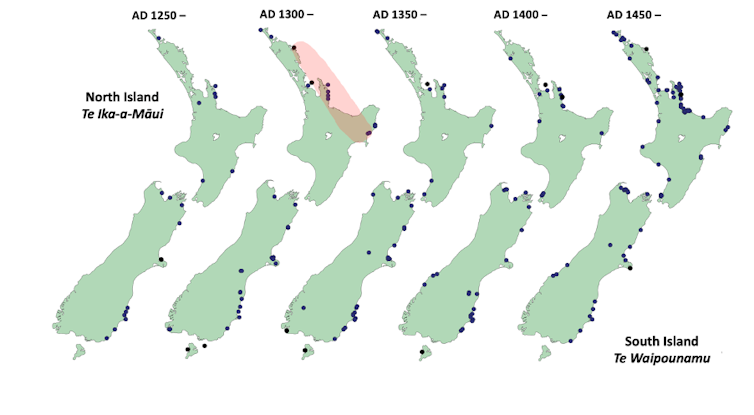
Our research traces the first 250 years of settlement, including changes in resource availability and population growth. It provides a more precise timeline for arrival and settlement, beginning as early as 1250-1270.
We also demonstrate for the first time a difference in the age of settlements in the North and South islands. The research shows that Māori adapted quickly to their new environment and again during later periods when temperature and rainfall changed significantly.
The changing distribution of archaeological sites across Aotearoa. The red ellipse marks the distribution of the volcanic deposits from the Kaharoa eruption around 1314. Authors provided, CC BY-ND
Researchers have long debated the exact timing of their first settlement, with estimates varying between the 12th and 14th centuries, depending on the material selected for radiocarbon dating.
We show that early settlers reached the North Island first, between 1250 and 1270, a decade before the South Island became more popular.
At the time of settlement, the south had colonies of the large flightless moa. The early settlers rapidly adapted to this temperate climate, living on a diet of moa, seafood and vegetables grown in their garden plots.
Wairau Bar in Marlborough is thought to be one of the earliest sites of settlement in the South Island. Fiona Petchey, CC BY-SA
But then the Little Ice Age interfered with this lifestyle. After 1350, conditions became significantly colder in the south. By around 1400-1420, moa hunting became uneconomic and put these fledgling communities under immense pressure. Once again, people had to adapt quickly.
Models developed from radiocarbon dates and the distribution of archaeological sites indicate the population shifted back to the north and grew between 1350 and 1450. In the north, soils were ideal for agriculture and temperatures were warmer.
Estimates of arrival and settlement in earlier studies and models vary depending on the material they used. For example, radiocarbon dates of the Pacific rat (Rattus exulans or kiore) tell a story about the spread of rats following the introduction by Māori ancestors. This study documents an explosion in the rat population but not information on the earliest human settlement date.
Likewise, radiocarbon dates on moa eggshell and bone tell us about the timing of moa-hunting activities but little about activities elsewhere.
This piecemeal approach has blurred the settlement chronology and contributed to the notion of a “mass migration” event. These studies also ignored dates on marine materials, one of the most commonly dated sample types.
In a previous study, we demonstrated that dates of midden shells could increase the accuracy of models if we had a better understanding of how radiocarbon in the ocean changed over time.
The development of a regional marine calibration curve that mapped this change allowed us to include more than 800 shell radiocarbon dates in the current study. This curve doubled the number of dates available for analysis.
Toitoi (Cookia sulcata) shell from an early archaeological site. Fiona Petchey, CC BY-SA
It was also necessary to develop a new approach to modelling that combined terrestrial and marine radiocarbon data sets. The increased precision and accuracy of these new models enabled us to draw links between the number and distribution of archaeological sites, climate, resources and deforestation trends.
Why our results are more precise
We scoured journal papers and books to assemble more than 2,250 dates, the largest radiocarbon data set from any island context. We carefully evaluated the archaeological context and scientific reliability of each date and removed almost 700 problematic dates before modelling began.
Differences between the terrestrial and marine calibration curves used to convert radiocarbon measurements into calendar ages enabled us to refine “wiggles” that result in multiple ranges for some early settlement events.
This research goes only a small way to providing a time baseline for understanding the complexity of ancestral Māori society. Future work aims to achieve the precision needed to establish more links between people, climate and time.
We would like to acknowledge the contribution to this research by Simon Bickler, director of Bickler Consultants.
Dr. Magdalena Bunbury receives funding from Australian Research Council (ARC) and previously from Deutsche Forschungsgemeinschaft (DFG, German Research Foundation)
Fiona Petchey’s work is supported by a University of Waikato Marsden Support Grant
Source: The Conversation (Au and NZ) – By Jessica Orchard, Research Fellow, Centenary Institute; and Adjunct Senior Lecturer, School of Public Health, University of Sydney
Dragana Gordic / Shutterstock
Wearable devices that can record your pulse can be handy for tracking your fitness – but can you really use them to monitor for an irregular heartbeat?
The short answer is maybe, and it depends on who you are. These devices are great, but there are some things you need to know.
Several large studies have been carried out to examine how well wearables can check for signs of a common heart rhythm problem called “atrial fibrillation”, which can lead to strokes.
Atrial fibrillation becomes more common with increasing age, and it can substantially increase the risk of stroke. Patients at high risk of atrial fibrillation-related stroke, due to age and/or other risk factors such as hypertension and diabetes, are generally prescribed blood-thinning medication.
More and more devices for recording heart rhythm are available to consumers. These include handheld electrocardiogram (ECG) and pulse-based technology in smartwatches, other wearables and portable consumer devices. These are often marketed as “health and wellness” products.
For people aged 65 and over, Australian and other international guidelinesrecommend occasional screening for atrial fibrillation.
However, new technologies (including wearables) allow consumers to record their own heart rhythms whenever they wish, and continuously monitor the regularity of their pulse. This technology can empower consumers and provide important information, but it does have limitations.
How accurate are wearables and other consumer devices?
The short answer is that, for identifying atrial fibrillation, wearables are probably quite accurate (often over 95%). However, the information is often based on studies of small numbers of people.
Some devices include an algorithm that automatically says whether your heart rhythm is regular (a “normal sinus rhythm”) or irregular (which may indicate atrial fibrillation). These algorithms generally require regulatory approval (such as from the Therapeutic Goods Administration (TGA) in Australia).
However, device companies often don’t publish many details about the accuracy and performance of their devices. Wearables that simply track heart rate or activity without making claims about serious conditions are not regulated by the TGA.
It’s important that manufacturers of health devices:
are accurate in their health claims
don’t advertise unproven benefits
report the accuracy and performance of their devices in different populations.
While the Fitbit, Apple and Huawei studies were very large, the calculations used to determine accuracy of the device may be based on small numbers because not many people in the study had atrial fibrillation.
For example, the Apple Heart study had 419,000 participants overall – which is a lot of people! However, the accuracy was calculated by comparing simultaneous recordings of atrial fibrillation on the smartwatch pulse irregularity detector and an ECG patch in only 86 people.
Who are they good for?
If you have symptoms, or are aged over 65, wearables can be very useful for detecting atrial fibrillation.
Wearables are great as an “event recorder” for anyone with a symptom (such as heart palpitations) that could be an arrhythmia. Devices with ECG capability such as Apple Watch Series 4 or later, Withings Scanwatch and KardiaMobile are particularly good as they provide more information. Once you have an ECG recording during a symptom, you can give it to your doctor, which can help guide further follow-up.
Wearable devices give us more heart rhythm data than ever before – but it’s not always clear how to interpret it. Unsplash
Wearables are also good for helping people to get an early diagnosis of atrial fibrillation. Ideally, this needs to be supported by integrated care, including risk factor reduction and lifestyle changes to reduce progression and complications (especially relevant for young people who may need no specific therapy).
We also know wearables can be used to screen enormous numbers of people: 457,000 in the Fitbit study, 419,000 in the Apple Heart study and 188,000 in the Huawei study. However, the yield of new atrial fibrillation detected was low (less than 1%) in these studies, mainly because the study participants were very young (the average age in all three studies was 41 years or less).
What are the problems then?
More data isn’t always better. If your GP checks your pulse at an appointment, finds it irregular and an ECG confirms it is atrial fibrillation, it’s likely you are experiencing atrial fibrillation quite a lot of the time (or all the time).
The risks of atrial fibrillation are similar for people with symptoms and those without, and we know how to treat the condition.
However, wearables are able to monitor people’s heart rhythm far more frequently and for much longer. The more you look, the more atrial fibrillation you find, but we are not yet sure we should.
So, while wearables increase detection of atrial fibrillation, we don’t know whether this will also prevent strokes.
Many people who buy wearables are younger and at lower risk. We aren’t yet sure about what it means when a young person with few or no risk factors has short episodes of atrial fibrillation.
More evidence is needed, ideally from good-quality, independent, randomised studies.
Drawbacks and data
Even highly accurate devices can and do sometimes give false positives, more frequently in younger people who have a lower risk of having atrial fibrillation. Additional tests may be needed, which increase cost, and may lead to unnecessary testing that could cause problems and potentially anxiety.
What should I do if my wearable tells me I have atrial fibrillation?
If your device says you may have atrial fibrillation, save a copy of the reading and talk to your doctor about the result. You may need further testing or treatment. However, don’t panic!
We need to remember one size doesn’t fit all. Either way, wearables are here to stay. We have to make sure we understand their benefits and limitations.
Dr Jessica Orchard is a Research Fellow at the Centenary Institute and Adjunct Senior Lecturer, School of Public Health, the University of Sydney. She is supported by a Heart Foundation fellowship and some of her research has been supported by Pfizer-BMS (investigator-initiated research grants) and Alivecor (provided devices for study purposes).
Ben Freedman receives current competitive grant funding from the Medical Research Future Fund, the NSW Dept of Health, and from the European Research Council (ERC) under the European Union’s Horizon 2020 research and innovation programme under the grant agreement no. 648131, the European Union’s Horizon 2020 research and innovation programme under the grant agreement no. 847770 (AFFECT-EU). In the past 5 years, B.F. has received speaker fees and travel support for speaking at sessions or official satellites of large international or continental society meetings from Bayer, Bristol-Myers Squibb–
Pfizer Alliance, Daiichi Sankyo and Omron; and investigator-initiated research grants to the institution from Bristol-Myers Squibb–Pfizer Alliance.
Last week, police seized about 80 illegal firearms across Victoria. These included eight homemade firearms, four of which were “military-style weapons”, as well as two 3D printers.
This is the latest in a series of seizures of 3D-printed weapons in Australia:
in September 2021, New South Wales counter-terrorism police arrested a right-wing extremist for possession of a digital design file that could be used to print a 3D gun
Despite media reports of seizures of 3D-printed guns, very little is known about the demand and availability of these firearms within Australia. The available research, including our own, draws heavily from media reports.
What are 3D-printed firearms and why are they such a threat?
3D printing is used to create a three-dimensional object by layering materials following instructions contained in Computer Aided Design (CAD) files. These files can be downloaded on dark web forums, for example, and shared via online networks.
3D-printed firearms can include handguns, rifles and machineguns. There are also modular or hybrid guns made from interchangeable firearm components (3D-printed or otherwise). This allows for customisation and cloaking of a firearm’s history.
3D-printed firearms do not currently work as well as traditional guns. However, there have been rapid improvements in the reliability of 3D-printed firearms and they are becoming less prone to malfunction.
3D-printed guns pose a significant threat to community safety. 3D printing has evolved to become relatively cheap and easily accessible. Significantly, it allows the manufacture of operational weapons within an otherwise heavily regulated firearms context.
Such guns are untraceable as they don’t have serial numbers nor do they leave ballistic evidence in the same way as conventional firearms. This can undermine police investigations and information systems such as the Australian Ballistics Information Network and the National Firearm Trace Program.
These weapons are potentially available to people who aren’t licensed to own a firearm, and those under Firearms Prohibition Orders. This includes those who could not hold a firearms licence due to their age, mental health, or criminal histories.
What’s more, these weapons are made mostly from plastics, which means they aren’t detectable with metal detectors. Such firearms can bypass traditional security screening measures, presenting serious risks in aviation, public events and locations where security screening is in place (for example mega events, or secure government buildings such as Parliament House). 3D-printed guns are also easier to dismantle and destroy than more durable metal-based firearms.
Police have revealed some organised criminal groups and extremists have had 3D printers and 3D-printed firearms in their possession.
Recent Australian research in which one of the authors, David Bright, was involved, found criminally connected individuals, including members of organised criminal groups, can easily access a range of firearms through social networks. We interviewed 75 people imprisoned for gun crimes and found some had manufactured firearms or firearm parts. However, some interviewees were suspicious of accessing digital design files for fear of leaving online traces that law enforcement could intercept.
Members of extremist groups are less likely to have the contacts required to access the Australian black market for firearms. For them, 3D-printed firearms may be an attractive and low-risk option.
It’s important to note Australia has one of the strictest gun control regimes in the world. Any home manufacture of any firearms is criminalised under existing laws.
Legislative responses to 3D firearms have varied internationally, and across Australian jurisdictions, and are evolving given the dynamic nature of the problem. International responses to 3D-printed guns include:
criminalising the manufacture of 3D-printed firearms
licensing or registration schemes for 3D-printed firearms
introducing new offences for possession of digital design files for 3D-printed firearms.
While Australian states have uniform legislation on the restriction of firearms, different states have enacted different laws for 3D-printed firearms and their design files. NSW is the only Australian state to criminalise possession of digital design files for 3D guns.
There are some alternative legal and policy responses. “Hash values” might be used to eradicate digital design files from the internet. Hash values are codes associated with images and files, sometimes referred to as “photo DNA”.
Police and technology companies already use these to detect and remove child exploitation material. This could be used to restrict access to 3D weapon digital design files. However, unlike child exploitation material, design files for 3D printed guns are not universally illegal.
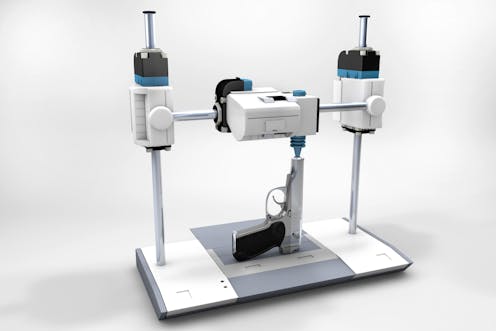
One option might be to have 3D printers recognise design files for guns, and prevent them from being printed. Shutterstock
One innovative approach would be to require 3D printers sold in Australia to recognise digital design files for 3D-printed firearms. This is turn could prevent printing in such cases.
Online censorship, content moderation and website blocking are other possible options. However, these are complicated by the fact the possession or dissemination of design files for 3D-printed firearms isn’t currently illegal (unless you’re in NSW). There are also a range of issues with online censorship, such as free speech, the cross-jurisdictional nature of the internet, and the availability of design files on the dark web.
Another possibility for restricting access to digital design files would involve the development of industry online safety codes. These are codes that regulate access to harmful online conduct, similar to the Online Safety Act.
There’s perhaps a greater role for the e-Safety Commissioner to direct platforms or websites accessible in Australia to remove harmful content such as design files for 3D-printed firearms, or restrict access to those over 18. Again, though, there are a range of issues with online age verification systems.
There is a pressing need for more research on 3D-printed firearms in Australia. Given the relative safety we enjoy in Australia by virtue of our tough gun laws, there are serious concerns about the ease of availability of digital design files for printing firearms. Restricting the capacity to manufacture firearms is our best defence to ensure our safety.
David Bright receives funding from the Australian Research Council and the Australian Institute of Criminology.
While employed at the Australian Institute of Criminology, Dr Monique Mann worked on the evaluation of the Australian Ballistics Information Network (ABIN). Dr Mann is Vice Chair of the Australian Privacy Foundation.
A heated debate about autism was reignited after the recent publication of an article advocating for use of the term “profound autism”.
This term is not an official part of the autism diagnosis. But the 2021 Lancet Commission on autism – part the journal’s program to gather expertise on pressing global health and science issues – argued the term should refer to people with a diagnosis of autism who have very high support needs, such as 24-hour care for basic needs and safety. The Lancet Commission estimated that around 20% of autistic people meet criteria for “profound autism”.
Now debate centres on whether this term is an appropriate way to highlight the high support needs of a subgroup of autistic people – or whether the term may be a step backwards for community understanding and acceptance.
The autism spectrum
Our understanding of autism has changed dramatically over the past 30 years.
The term “autism” was first introduced into the diagnostic manual in 1980. To receive this diagnosis, children demonstrated significant development difficulties, such as “gross deficits in language development” and “a pervasive lack of responsiveness to other people”.
These difficulties meant people with a diagnosis of autism in the 1980s and 1990s tended to have high support needs – likely 24-hour care.
The 2000s and 2010s saw a major reconceptualisation of autism. Autistic behaviours became understood as present in people who do not have intellectual or significant language difficulties.
This new understanding of autism led to people with a much more diverse range of abilities receiving a diagnosis of autism. The “autism spectrum” was born.
Advocacy and representation
The rethinking of autism to a “spectrum” emerged out of a large body of high-quality research.
Another important catalyst was the extraordinary work of autistic people themselves, who through important advocacy, championed the rights and needs of all autistic people. This advocacy reshaped community views about autism, in particular, that not all autistic people have intellectual disability.
Media portrayals of autism accelerated the shift in community views about autism. TV shows focused on stereotypes of men (it was almost always men) who were intellectually gifted, but had social difficulties. Shaun Murphy in The Good Doctor and Sheldon Cooper from The Big Bang Theory are two examples.
The greater community visibility of autism has been overwhelmingly positive. It has fostered greater acceptance of difference and increased support for a broader range of people. However, like all important societal changes, there have been challenges too.
A key source of debate has been whether broadening the diagnosis of autism has made the diagnostic label no longer entirely fit-for-purpose.
The purpose of a diagnosis is to help define and identify a health condition or disability. Diagnoses provide understanding about what a condition is, and what it may mean for the person diagnosed. In many cases, a diagnosis can also provide information about the most appropriate clinical management.
A current criticism of the autism diagnosis (officially, “autism spectrum disorder”) is that it is too broadly defined. How can a single diagnostic label that incorporates television’s Dr Cooper as well as people who require around-the-clock care, serve all autistic people?
This was part of the argument the Lancet Commission made when proposing the term “profound autism”. The experts involved claimed that, because people with very high support needs are unable to advocate for themselves, they “are at risk of being marginalised by a focus on more able individuals”.
spur both the clinical and research global communities to prioritise the needs of this vulnerable and underserved group of autistic people.
Strong counter points have been made against the use of the term “profound autism”. These include advocating for alternative ways to describe the different needs of autistic people. For example, using brief descriptions such as “autistic person with intellectual disability”.
A key criticism is that, after the significant gains of the past few decades in recognising the broad spectrum of autistic people, dividing autistic people into two groups using relatively arbitrary criteria would represent a retrograde step.
It is clear there is a large group of people who do not feel well served by the broad nature of the current autism diagnosis. There is a clinical and moral responsibility to acknowledge and value this perspective, and explore it further.
To do so would be entirely consistent with the history of our changing understanding of autism over time.
Whether or not “profound autism” is eventually seen as an appropriate diagnostic term, it is important to acknowledge that this debate touches on deeply personal issues of identity and understanding.
The voice of autistic people must be central in this discussion. The voices of families who care for autistic people must also be valued.
A chocolate treefrog that looks like a Freddo. Burrowing frogs which live in trees. Long-nosed frogs named after Pinocchio. Frogs which go straight from egg to froglet without stopping at tadpole. And large treefrogs which can glide from tree to tree.
All these and many more are found only in Melanesia. This tiny region in the South Pacific is a global hotspot of cultural and biological diversity. And we still don’t know the full extent of its extreme biological riches.
Centred on the world’s largest tropical island, New Guinea, Melanesia is home to 534 types of frog. As our new research shows, that’s 7% of all the world’s frog species living on just 0.7% of the world’s land. And there are more to come. Almost 40% of these frogs have only been scientifically described in the last two decades.
Hundreds more species will likely be added to the tally, as we know of at least 190 species not yet formally described. The final tally will be over 700, with frogs colonising every possible niche. But their sheer evolutionary inventiveness also puts them at risk, with many species restricted to tiny ranges.
Litoria pinnochio is just one of over 200 species of Melanesian frog first documented in the last 20 years. Males of this species have an erectile spike at the tip of their snout. Tim Laman
Winged fingers, erectile noses and tiny males
Melanesia’s wealth of frog species easily surpasses other tropical island regions, including famed hotspots such as Madagascar (around 370 species), Borneo and the Caribbean (both around 200).
On these islands live more than double Australia’s tally of around 248 species).
Species diversity goes hand-in-hand with weird and wonderful evolutionary twists.
Take the narrow-mouthed frogs, which skip the tadpole stage and hatch directly from egg to frog. In this family, Microhylidae, is the likely ancestor of most of the region’s frog species after migrating from Asia around 20 million years ago. These frogs were spectacularly successful, calving off an estimated 400 species.
Their tally include some of the world’s smallest creatures with a backbone, as well as many burrowing frogs which abandoned the ground to live in trees, and others with complex parental care, such as the father frog guarding his eggs and tadpoles, or carrying babies on his back.
In New Guinea multiple lineage of frogs have independently evolved very tiny size. Pictured is Choerophryne gracilirostris, described in 2015. Stephen Richards
The treefrogs are numerous too, with an estimated 200 species. Large green treefrog species have evolved finger webbing so they can glide to a lower branch. Other treefrogs have odd nose spikes. And of course, the recently described chocolate treefrog has drawn worldwide attention (and amusement) for its resemblance to a certain confectionery.
Litoria mira bears a strong resemblance to a popular kid’s sweet, hence the common name Chocolate Treefrog. Stephen Richards
Other islands have their own unique frogs. On the Papua New Guinean (PNG) island of New Britain lives Boulenger’s wrinkled ground frog (Cornufer boulengeri), a species whose males are 40 times lighter than females. For many years, scientists didn’t realise the males and females were the same species.
Melanesia’s many islands have fertile soil and often have extraordinarily varied landscapes. New Guinea, for instance, goes from sea level to highlands and mountains almost five kilometres high, with a few peaks still holding their last ice.
This is a key reason for frog diversity. Why? Because populations can easily become isolated, which speeds up the development of new species. New Guinea, for instance, is one of the world’s megadiverse hotspots, containing an estimated 7% of the world’s species on a fraction of the land area.
Complex landscapes increases the chance populations will become isolated and ultimately evolve into separate species. Stephen Richards
We also suspect the arrival of the direct-developing frog family have further supercharged species diversity in Melanesian frogs.
These frogs don’t have free-living tadpoles able to be dispersed by floods or along streams. This stay-at-home disposition may increase their chances of becoming isolated and evolving into distinct species.
Our research found direct-developing frogs in Melanesia have narrower ranges than their more conventional relatives.
Frogs without a free-living tapdole stage tend to have restricted ranges. Shown here is Oreophryne oviprotector, described in 2012. Stephen Richards
In fact, the easternmost tip of New Guinea and nearby islands have the most extreme concentration of vertebrates with small ranges anywhere in the world, with more than 160 species jammed into an area less than a quarter of the size of Tasmania.
Melanesia is a good place to be a frog – but threats are arriving
The world’s frogs are in trouble. Hundreds of species have gone extinct in recent decades.
But Melanesia, for now, is a good news story. We know of no frog extinction events and only 6% of species are threatened, compared to a global average of over 30%).
This could change if a lethal fungus takes hold. So far, Melanesia has stayed clear of it. Biosecurity measures are essential to conserve this bounty of frogs.
Because so many of Melanesia’s frogs have tiny ranges, they are particularly vulnerable to changes, such as logging a small area of forest. Climate change will pose an existential threat, particularly to frogs dependent on cold climates in the mountains.
PNG’s eastern biodiversity hotspot around Milne Bay is most at risk. Six species are threatened here by logging, while plans for oil palm plantations threaten many frog species.
Logging forests around Mt Simpson near Milne Bay threatens at least six recently described frog species. Fred Kraus
We hope documenting Melanesia’s wealth of frogs and other species will help conservation efforts. This region is special. Let’s keep it that way.
When we talk about Indigenous education in Australia, it almost always includes three words: “close the gap”. The federal government’s Indigenous education priorities highlight school attendance, literacy and numeracy and year 12 attainment. This frames students and their families as a “problem” to “fix”.
In other areas of education, the word “excellence” is frequently used to frame policy. But a simple Google search of “excellence” and “Indigenous education” comes up with very few meaningful results. Why aren’t starting from the same point in Indigenous education?
Our project started as a pilot study with three secondary schools from an urban, regional and remote setting in Queensland.
We yarned with 31 Indigenous and non-Indigenous educators, principals and teachers about their perspectives on excellence in Indigenous education.
Educators spoke of the importance of building relationships with students. Author supplied
Here we share the perspectives of 12 Indigenous educators. We do this deliberately because it is critical we elevate Indigenous voices in any re-imagining of policy that affects us.
We explored the question: “How is excellence in Indigenous education defined by Indigenous peoples?”
Three themes emerged: the young person, school culture and relationships.
‘Build young people up’
The most distinct theme to emerge was the need to nurture and affirm culture and identity in students and in doing so, “build young people up”.
Indigenous interviewees talked about identity as a protective factor in the face of navigating issues such as racism at school. As school community liaison officer Uncle Frank* explained:
In our school, once students knew their identity, they excelled. Nurturing identity and culture is very important – growing young people in an environment where being Indigenous was negative but turning that into a positive is re-imagining the story for all Indigenous students.
Aboriginal teacher, Brooke, also explained:
our white kids know where they fit in society. Many of our kids don’t, sometimes they’re not accepted in different communities. Kids who are fair like me don’t fit with white or Black. Identity is important for all kids – we are social creatures”.
From a practical perspective, community education counsellor Aunty Millie said schools could provide dedicated physical spaces to enhance their identity work with students.
culture and identity play an important role in students believing in themselves and striving to be the best version of themselves […] students have to know that they [are] included and recognised as Aboriginal and Torres Strait Islander people […] space to call their own is important. They like to be there.
Building up young people is more than just affirming their identity. As Uncle Frank explained, it is also:
letting our senior students take a lead role [and] encouraging Indigenous students to give feedback to teachers. Empower them to have a say.
School culture and leadership
Research already tells us the leadership of a school plays a critical role in its culture.
Our research also shows it is vital for excellence in Indigenous education.
Community liaison Katelyn told us how she was empowered by strong leadership at her school, who are open to new ideas and approaches based on Indigenous knowledge and perspectives.
We have a very great leader here […] I’m able to look outside the box […] the restraints aren’t there.
Brooke talked about the notion of “curriculum leadership” and the importance of “making sure everyone is reflected in curriculum and pedagogy [the way students are taught]”.
Relationships with students
Previous research also recognises how positive relationships with students are connected to positive outcomes for students.
Aboriginal school support worker Missy talked about the quality of relationships being a priority for schools.
It really does come down to building a relationship with the students [and] with the families and showing them [they are] not just another number.
Uncle Frank pointed out Indigenous people bring a wealth of knowledge in relationships with schools.
[…] we know what’s best for our kids – include us in the conversation. If you’ve got a degree that’s good but I’ve got a degree in life – being Aboriginal.
We need new ways to talk about Indigenous education
In all our conversations with educators and support staff in school, one other thing stood out. When asked to think about “excellence” in Indigenous education, many of these experts struggled to conceptualise what it is or should be.
We believe this is due to the dominance of “closing the gap”. Those three words have been so influential in shaping the minds of educators and support staff in schools.
This highlights the power and importance of language. We need new ways to speak aspirationally about Indigenous education and move on from the old deficit vocabulary.
This is a small data set from a pilot study, but it already provides some important insights about how we work towards excellence in Indigenous education.
It shows how there must be opportunities for Indigenous peoples to shape all aspects of schooling and educational policy. It is vital we include the aspirations, experiences and stories of Indigenous people working in Indigenous education.
*names have been changed.
Marnee Shay receives funding from the Australian Research Council and Edmund Rice Education Australia.
Danielle Armour receives funding from Edmund Rice Education Australia.
Jodie Miller receives funding from Edmund Rice Education Australia.
Suraiya Abdul Hameed receives funding from Edmund Rice Education Australia
The Adelaide Film Festival is well timed in the festival calendar, as it lands between many films premiering at the Venice Film Festival and their Australian theatrical release.
This year’s program balanced big films like My Policeman, TÁR and Banshees of Inisherin with smaller, edgier films.
Over the week, I saw a respectable 15 films. Here are my top five highlights.
Survival of Kindness
Rolf De Heer’s Survival of Kindness, supported by the festival’s investment fund, opens with BlackWoman (Mwajemi Hussein) abandoned in a desert, locked in a cage, left alone to die. As the film starts, we see her struggle to break free. Achieving this freedom, we follow her journey to the city, where she is challenged by several characters along the way.
The film’s gradual world building and use of genre continually subverts expectations. Is this a road movie? Is it a western? Is it perhaps science fiction? The film’s portrayal of Australia is equal parts strange and familiar.
De Heer depicts Australia as a dystopian landscape, where non-white folk are hunted down and exterminated by those in gas masks. The continuous subversion of expectations as the narrative unfolds makes this a compelling and confronting watch.
Triangle of Sadness
Ruben Östlund is fantastic at socially conscious comedies and he is at his best in the Palme d’Or winning Triangle of Sadness. The film is in two parts.
First, we are aboard a $250 million luxury yacht for the exceedingly wealthy, where jars of Nutella are helicoptered in and the staff are at the behest of the passengers. The staff must always say yes and never no.
Passengers include Carl (Harris Dickinson) and Yaya (the late Charlbi Dean), two influencers whose beauty is paying for the trip. We also meet the ship’s drunk captain (Woody Harrelson) who gets into a heated political debate with Russian businessman Dimitry (the brilliant Zlatko Buric).
“While you’re swimming in abundance, the rest of the world is drowning in misery,” the captain drunkenly rants over the ship’s PA system.
The film obscures its standout player, cleaner Abigail (Dolly de Leon), until the second act, when her character arc is revealed to be pivotal to the film’s objective.
The film’s social commentary loses any subtlety when the passengers all sit down to the captain’s dinner during a particularly rough storm. What precedes is a raucous, stomach-churning onslaught of physical humour. The humour is utterly carnivalesque.
Some critics have reviewed the film as being too on the nose, which is the absolute point of this film. This havoc leads into the film’s second act, which deftly sees these class structures challenged and subverted. The tone of the film dramatically changes as well, with the laugh-out-loud comedy making way for a fallout of the social dynamics constructed in the first half.
Triangle of Sadness will be in Australian cinemas from December 22.
Senses of Cinema
Understandably, John Hughes and Tom Zubrycki’s Senses of Cinema was also a standout film in Adrian Dank’s highlights for The Conversation from this year’s Melbourne International Film Festival.
The film examines the history of Sydney and Melbourne film co-operatives told by those at the forefront of independent filmmaking in Australia.
Those interviewed include important figures such as Martha Ansara, Jan Chapman, Albie Thoms and Phillip Noyce.
Key to this film is that there has always been an audience for these films and – regardless of the hurdles faced – artists will always persist.
The extensive use of films from the archives is wonderful, making this an important inclusion to any course on Australian cinema. The documentary also doesn’t shy away from political differences that formed during the collectives’ history, such as the surging feminist movement’s critique of the sexist representation of women in some early films or the role of class with a lot of the early filmmakers being products of private schooling.
Fascinating moments included early filmmaking with and, more importantly, by First Nations’ communities, such as the work by Essie Coffey. I was pleased to see Digby Duncan’s documentary Witches & Faggots, Dykes & Poofters discussed as these co-operatives were significant to the development of queer Australian filmmaking.
This year’s festival had a strong queer presence, which is important as there is no dedicated stand-alone queer film festival in Adelaide.
Paul Struthers, previously the director of Queer Screen in Sydney and of San Francisco’s Frameline International LGBTQ Film Festival, was a guest programmer. Struthers’ talent for queer programming is indicative in the offerings in this year’s program. There were the big events with Bros and My Policeman, starring Harry Styles. There were also many smaller queer films that one would expect from a queer film festival, such as Will-O-The-Wisp and Uyra: The Rising Forest.
My highlight from the queer slate was Phantom Project, a small Chilean film dubbed as an urban gay ghost story.
The film opens with Pedro’s roommate moving out, owing him two months rent and leaving behind a cardigan.
Unbeknown to Pedro, this cardigan is possessed by a ghost, who begins to haunt him and his dog Susan during the night.
The film is a light-hearted take on the ghost genre, with crude animated squiggles representing the presence of the ghost, making it a silent character for the film.
Pablo is surrounded by young creatives, YouTubers, musicians, and actors, and yet, Pablo is at a creative block in his life that leaves him unfilled. Being haunted becomes an allegory for this fear of leading an unfulfilled life.
While the film does lose cohesion in the closing act, it is nonetheless fun and simple. This type of film, the small, independent production, is just as important for the film to support than the major titles coming out of Venice or Cannes.
Banshees of Inisherin
Martin McDonagh reunites with Colin Farrell and Brendan Gleeson from In Bruges to deliver another tragic comedy.
In 1923 on the small idyllic farming island Inisherin, Colm Doherty (Gleeson) tells Pádraic Súilleabháin (Colin Farrell) their friendship is over, and they are never to talk again.
In the small community of Inisherin, however, where the shopkeepers open your mail and the only place to go in the evening is the local pub for a singalong, it’s not easy for Pádraic to easily avoid Colm.
Ignoring the pleas from his sister Siobhan (a superb Kerry Condon), Pádraic continues to pester Colm, who declares that if Pádraic doesn’t heed his warnings, he will cut off his own fingers, one by one, for each time that Pádraic ignores the warning. For a man who lives to play his violin and yearns to leave a legacy in his music, this is a grim ultimatum.
In the background of this breakdown, the Irish civil war sounds off on the mainland, a constant reminder of the potential for destruction.
Both Farrell and Gleeson offer fantastic performances. With the slightest change in facial expression, both men can change the tone from humour to sadness. Pádraic is a gentle and ever-so slightly dull man whose deeply good nature is tested with this sudden change of character in Colm. He is very much like his pet mini-donkey, Jenny, with his humbleness and loyalty.
If there was one symbol of the Adelaide Film Festival this year, it would be the donkey. Given this film, EO and Triangle of Sadness, these humble, hardworking beasts appeared in many films in the program.
Much like the everyday men fighting over on the mainland, Pádraic and Colm are also driven down violent and destructive paths. While the wit of the dialogue is sharp, this is a deeply sad exploration of the love and fear that drive us.
Banshees of Inisherin will be in Australian cinemas from December 26.
The best of the rest
As always, there were a slew of other films I saw worth a mention.
Hirokazu Kore-Eda’s Broker is another strong offering from the director whose skill at presenting heartbreaking tales of family are like none other.
While I didn’t love TÁR as much as some other critics have, the experience of seeing the film in a sold-out session at the historic Capri cinema with Cate Blanchett in attendance was electrifying.
The closing night Adelaide-made Talk to Me is a smart horror film that will be popular in the months and years ahead.
There were also many films which I didn’t see due to programming clashes I now have to chase down, such as Monolith, EO and Hamlet Syndrome. The Adelaide Film Festival has been a huge success this year, firming its position as an important player in the Australian screen industry.
Stuart Richards does not work for, consult, own shares in or receive funding from any company or organisation that would benefit from this article, and has disclosed no relevant affiliations beyond their academic appointment.
However, tobacco companies, rehearsing their well-worn arguments, have claimed this measure will deprive young people of important freedoms. Having spent decades refining tobacco products to enhance their addictiveness, these companies appear to believe that protecting young people from addiction would deprive them of personal autonomy.
While it is predictable that health researchers would support effective measures and tobacco companies would oppose them, we know much less about how young people, those targeted by the policy, view these measures.
We explored this question through in-depth interviews with 20 young people aged 17 or 18, and probed in detail how they viewed the smokefree generation policy.
Five of our participants reported currently smoking, one had formerly smoked and 14 did not smoke. Most supported the policy and believed introducing a smokefree generation would protect their freedoms.
Several had seen addiction within their whānau (extended family) and knew the health inequities smoking causes. Some struggled with addiction personally and thought the smokefree generation policy would address and protect young people’s right to healthy futures.
Their life experiences led these participants to favour longer-term outcomes and societal wellbeing over choices they viewed as illusory. They felt protecting young people from smoking uptake and addiction was crucial, and saw a society that protected young people from these pressures as more important than the so-called freedom to choose.
The right to protection trumps absolute freedom
Participants who supported the smokefree generation policy held a nuanced view of freedom and did not see it as absolute; instead, they recognised regulation could enhance positive freedoms and well-being.
They rejected the negative view of freedom tobacco companies propose, which presents regulation as limiting or removing choices. Many outlined a positive view of freedom that prioritised protection from addiction and the negative health consequences that follow, and endorsed the smokefree generation policy.
For these participants, it followed that the government had a responsibility to protect them, including limiting access to harmful products. As one young women observed:
The government essentially is supposed to keep you safe, and they’re not supposed to […] make things readily available that are gonna actively harm you.
Addiction not a choice
Participants did not see smoking as an “informed choice” they were entitled to make. Most young people who reported smoking supported the smokefree generation policy because it might have protected them from losing the freedoms addiction had taken from them.
One participant presented the options bluntly:
Whether it’s the government taking the choice or you being addicted to smokes, you’ve got no choice either way. If you’re addicted to smoking it’s not like you are choosing to go buy smokes. You’re going, ‘Oh, I needed a packet of smokes this week’.
A small minority did not support the smokefree generation measure, either because they felt less restrictive measures could prevent smoking uptake (such as raising age restrictions) or because they disagreed philosophically and believed people should not “be protected from yourself”.
In contrast to the societal perspective that supporters of the policy had adopted, these participants took an individualistic approach and felt people could and should make informed personal choices.
Most young people we interviewed did not share the tobacco companies’ view that the policy will reduce their autonomy or limit their freedoms. Their deep reflections suggest a sharp divide between industry “transformation” rhetoric and young people’s values.
Our findings add to earlier research documenting wide support for the smokefree generation policy. Such evidence indicates its acceptance and likely effectiveness.
Introducing a smokefree generation policy will promote freedom from lifelong addiction and the harms smoking causes, and safeguard the wellbeing of future generations.
Janet Hoek is a co-director of ASPIRE 2025, a University of Otago Research Centre whose members undertake research to inform the Government’s Smokefree 2025 goal. She has received or currently receives funding from the Royal Society Marsden Fund, the Health Research Council of New Zealand and the Cancer Society of New Zealand.
Richard Edwards receives funding from various Government- and NGO-funded research funders such as the Health Research Council of New Zealand, National Institute for Health (USA) and the Cancer Society of New Zealand. He is a member of several expert advisory groups including for Hāpai te hauora – Māori Public Health, The New Zealand Cancer Society, Health Coalition Aotearoa and the Public Health Communication Centre.
Elizabeth Fenton, Jude Ball, and Lani Teddy do not work for, consult, own shares in or receive funding from any company or organization that would benefit from this article, and have disclosed no relevant affiliations beyond their academic appointment.
As well as her interviews with politicians and experts, Politics with Michelle Grattan includes “Word from The Hill”, where she discusses the news with members of The Conversation politics team.
The clock is fast running down on the parliamentary year, but the government still has lots to do before Christmas.
In this podcast Michelle and Amanda Dunn, the Conversation’s politics editor, discuss Labor’s struggle to hasten through its industrial relations bill. It is proffering multiple amendments to accommodate business objections, but also to persuade key Senate crossbencher David Pocock, who would like the controversial bill split, something the government won’t do.
Michelle & Amanda also canvass the COP27 conference under way in Egypt, which Anthony Albanese is not attending, and the release this week of election spending returns, which showed big cash splashes by successful Teals.
Michelle Grattan does not work for, consult, own shares in or receive funding from any company or organisation that would benefit from this article, and has disclosed no relevant affiliations beyond their academic appointment.
Medibank is still refusing to pay a ransom of an undisclosed amount to cybercriminals, despite the hackers now allegedly threatening to release the stolen data on the dark web.
It’s reported the data of about 9.7 million current and former Medibank customers were compromised in a breach first confirmed by Medibank on October 13.
The data are said to include customers’ names, dates of birth, addresses, phone numbers and email addresses – as well as some 500,000 health claims with information such as patients’ service provider details, where they received medical services and the types of treatments they claimed.
Medibank’s chief executive has said the company won’t be paying up – a decision endorsed by Home Affairs Minister Clare O’Neil. But what does the evidence say?
How were the data stolen?
According to variousreports, it all started when a hacker compromised the credentials of a Medibank employee who had access to a number of the company’s data repositories. It’s unclear whether the employee would have needed multifactor authentication to access these data – and, if so, whether this was also compromised.
It’s believed this hacker then sold the employee’s credentials to notorious cybercriminal group REvil via an online Russian language forum. Around midnight, REvil posted on the dark web threatening it would release the data in the next 24 hours should the ransom not be paid.
While there’s no evidence REvil does indeed have access to the stolen data, historically the REvil group has not been found to bluff. There’s no reason to believe this time is different.
Medibank first identified unusual activity on its network on October 12. It then launched a follow-up investigation that confirmed the breach. We don’t know how long the cybercriminals may have had access to its systems before then.
It’s reported they stole some 200GB of data in total. This is quite a large amount, and it would be unusual not to notice the exportation of this much sensitive data.
In this case, however, it seems the criminals used some sort of compression algorithm to minimise the data file size. This may have allowed the data extraction to be less obvious, perhaps also through splitting the data into smaller data packages.
To pay or not to pay?
Medibank chief executive David Koczkar has said the ransom request would not be paid, and “making any payment would increase the risk of extortion for our customers, and put more Australians at risk”. He said the decision is consistent with advice from cybersecurity experts and the Australian government.
This is, in fact, a smart decision. Even if the ransom is paid, it does not guarantee the cybercriminals will not use the stolen data for other malicious purposes, or won’t undertake further attacks against Medibank.
Law enforcement agencies across the world are against paying ransoms. However, there are life-threatening situations in a healthcare context, such as during remote surgery, when there may be no choice.
Cybercriminals take advantage of vulnerabilities in healthcare IT infrastructure – largely because there’s a higher chance of getting a ransom paid in healthcare than in any other sector.
Often, organisations targeted will have to pay a ransom to get back access to data and continue providing healthcare services. According to one recent report the majority of ransomware attack victims in healthcare end up paying the ransom.
As to why Medibank hasn’t disclosed the specific ransom amount, this is because this information could encourage other cybercriminals to aim for similar targets in future ransom events.
If the ransom were disclosed, and later had to be paid, Medibank’s reputation as an insurance provider would hit rock bottom. When Colonial Pipeline’s fuel pipeline infrastructure in the US was hit by a ransomware attack, the hefty ransom payment of US$4.4 million left a permanent scar on the operator’s reputation.
The risks as the situation unfolds
The risks for victims of the Medicare data breach must not be underestimated. This sensitive information could be used in various types of fraud. For example, hackers may call victims of the data breach pretending to be Medibank, and ask for a service charge to have their data safeguarded. Healthcare data can also be used for blackmail and fraudulent billing.
What’s more, hackers can identify the most vulnerable individuals among the list of victims and create customised attack vectors. For example, individuals with implanted devices (such as pacemakers) can be targeted with blackmail and threats to their life.
Beyond this, cybercriminals could also use victims’ personal information to conduct a number of other scams unrelated to Medibank or healthcare. After all, if you have someone’s details it’s much easier to pretend to be any organisation or company with authority.
For those potentially affected by the Medicare data breach, the most important thing now is to remain vigilant about all types of online activity. You can start by replacing your passwords with more secure passphrases. You should also consider running a credit check to see if any suspicious activity has been conducted in your name.
The authors do not work for, consult, own shares in or receive funding from any company or organisation that would benefit from this article, and have disclosed no relevant affiliations beyond their academic appointment.
Source: The Conversation (Au and NZ) – By Penelope Crossley, Associate Professor of Law, The University of Sydney Law School, University of Sydney
Prudence Upton/Sydney Theatre Company
Review: RBG: Of Many, One, directed by Priscilla Jackman, Sydney Theatre Company
Writing a play about the life and legacy of American Supreme Court Justice Ruth Bader Ginsburg was always going to be an ambitious task for playwright Suzie Miller.
Ginsburg (or “RBG” to her many fans) was only the second female judge to be appointed onto the bench of the court in its more than 200-year history, when elevated to the court in 1993, aged 60.
Throughout her life, she was much admired for her trailblazing legal career, her work advocating for gender equality and her considered dissenting judgements against the often-conservative majority decision.
At the same time, both during her life and after her death, RBG was attacked for openly criticising former US president Donald Trump during the presidential race and for not resigning from the court during Obama’s presidency, despite her advanced age and cancer diagnosis.
When RBG ultimately died during the Trump presidency, she was not able to be replaced by another Democratic appointee, leading to the court becoming even more conservative.
Miller’s new play is beautifully crafted, written from the perspective of RBG. She discusses her most famous cases throughout her life and her conversations with three of the presidents who served during her 27-year term on the bench. Over this journey, the play takes the audience through a roller-coaster of emotions.
RBG: Of Many, One, follows RBG’s time as one of the few women at Harvard Law School, along with her work challenging gender-based discrimination including the ability of women to serve on juries and the cancer that repeatedly afflicted her family.
Miller seamlessly weaves quotes from RBG’s most famous cases and judgements into the script, so we hear her authentic voice. The play demonstrates a complex understanding of the legal cases, but Miller doesn’t assume familiarity with RBG: this play is equally accessible for the non-lawyer who knows little of RBG’s history.
Heather Mitchell gives a virtuosic performance. Prudence Upton/Sydney Theatre Company
Miller doesn’t skate over the criticisms of RBG. She humanises the decisions she made and her later reflections on those decisions. In particular, the audience gets to see, upon reflection, how deeply troubled RBG was by her decision to criticise Donald Trump during the Trump/Clinton presidential election.
RBG: Of Many, One’s ultimate success or failure turns on the strength of the acting. Heather Mitchell is a virtuoso, giving the performance of her life.
She shows us Bader Ginsburg from a young girl through to her physical frailty in old age, poignantly characterising the emotional depth of her character.
The inner strength, the anxieties, the love, and the fears are all expertly conveyed to the audience. At times I have to remind myself that she is indeed playing RBG.
The play takes us from RBG’s childhood to her old age. Prudence Upton/Sydney Theatre Company
David Fleischer’s set design is stripped back to a beautiful simplicity. For most of the play the main prop is a solitary armchair, sitting isolated on the big stage.
David Fleischer’s set gives room for Heather Mitchell to shine. Prudence Upton/Sydney Theatre Company
Paul Charlier’s composition and sound design is another strength. He juxtaposes some of the operas that RBG so loved with the music of the rapper the Notorious B.I.G. (from whom the nickname the Notorious RBG is derived). This deftly highlights the complexity of RBG’s character.
These simple design choices allow Mitchell to shine. This play will long be one that Miller and Mitchell will be remembered for.
RBG: Of Many, One is at Wharf 1 Theatre until December 23.
Penelope Crossley received complimentary tickets for the purpose of reviewing this performance.
Reserve Bank Governor Philip Lowe is getting terrible press, most of it undeserved.
“Lowe Blow” and “Take a Hike” were two of the headlines on the front page of one of our newspapers. “We’ve had our Phil” was on the front page of another.
His critics – the ones complaining about continual increases in interest rates – seemed happy enough when he was keeping them low.
Daily Telegraph, August 2, 2022
Lowe and his board are pushing up rates at almost the fastest pace on record, for the same reason they cut them to the lowest level on record – to try to get the economy back into some sort of balance.
It’s tough. But it has been done before, and it worked.
In fact, the man who pushed rates down then up even more aggressively than we’re seeing now, former RBA Governor Bernie Fraser, told me this week he approves of the way Lowe is doing his job – with just one exception.
How Lowe’s low rates saved jobs
When COVID hit in 2020, at a time when the Reserve Bank’s cash rate was already a then-record low of 0.75%, the bank cut to what Lowe described as the “effective lower bound” of 0.25%, before cutting again to 0.1%, and offering banks near-free loans at 0.1%.
Lowe’s promise to buy as many government bonds as were needed to push the three-year bond rate down to 0.1% drove three-year fixed-rate mortgages below 2%. Variable-rate mortgages slid to 2.5%.
In concert with the Morrison government, which spent massively in response to COVID, Lowe cut rates to try to keep alive an economy that was shutting down.
The best measure of unemployment is the one that counts as unemployed the Australians working zero hours. It climbed to 15% in April 2020 – the worst since the Great Depression.
The stimulus programs, the arrival of vaccines and the end of lockdowns worked magic, as did the Reserve Bank’s determination to ensure that almost anyone who wanted to borrow could borrow for next to nothing. Spending bounced back, and by July this year unemployment had fallen to a five-decade low of 3.4%.
Then this year inflation – which had remained close to the Reserve Bank’s target of 2-3% for a record 30 years – broke free and climbed; at first to 5%, then to 6% and now 7.3%, all in the space of a few months.
Despite earlier hopes (those who were hopeful in the US and the UK, where this has also happened, called themselves “team transitory”) inflation hasn’t come back down, and shows little sign of returning to 2-3% of its own accord.
Inflation reawakened
Seven per cent inflation matters because an increase in prices of 2-3% per year is very different from an increase of 5-7%. It makes inflation, in the words of former Governor Bernie Fraser, “a subject you don’t discuss at barbecues”.
At 2-3%, people adopt a mental model of fairly steady prices in which, when they agree to provide a service for a certain price, they know what they are getting into.
It’s not so much that high inflation creates winners and losers; the problem is that it becomes almost impossible to tell who those winners and losers will be. It’s the arbitrariness of who does well from timing price increases, and who gets hurt by them, which makes businesses difficult to run and spending difficult to plan.
The RBA’s clear instructions
The Reserve Bank has a written riding instruction from the treasurer to aim to get “inflation between two and three per cent, on average, over time”.
It is certainly true that much of what set off the latest sudden burst of inflation won’t be restrained by high interest rates. Diesel and petrol prices are set internationally, and soared after Russia invaded Ukraine.
But a lot of what set off and is sustaining the resurgence of inflation most certainly can be tamed by high interest rates.
The rising cost of almost everything
Home building is expensive because of an (internationally-driven) shortage of building materials, and a shortage of workers not laid low by COVID. It is true that more materials and healthier workers would bring down prices, but so too would less demand for building work. Higher interest rates help restrain the demand.
Even the global price of oil can be restrained by high interest rates – not by high interest rate here, but by high rates in the US, which is a big enough nation for consumers tightening their belts to make a difference.
In any event, Australia’s inflation is now incredibly widespread, encompassing almost everything sold here, including most of the things made here.
Ten years ago, 32 of the 87 items priced by the Bureau of Statistics were falling in price, while most of the others climbed. In the latest consumer price update, I counted only six falling in price.
The verdict from a former RBA governor
This week, I rang up the person who’s arguably best qualified to assess the job Lowe’s doing as RBA governor now – someone who was in his shoes three decades ago.
Bernie Fraser was the Reserve Bank’s governor between 1989 and 1996. He pushed down the cash rate 15 times in three years to speed the recovery from the early 1990s recession. Then in 1994, at the first sign of renewed inflation, he pushed them up faster and more aggressively than Lowe has so far this year.
Fraser told me he had wanted to “shock people – let them know that you’re there, that you are concerned about inflation and you want to head it off”.
Fraser stopped pushing up rates only when he had got inflation down to where it has stayed for most of the past three decades. As it happened, he was able to do it without much pushing up unemployment.
Fraser said he approves of the way Lowe has been doing his job – though he said Lowe was wrong to give the imply during COVID that rates would stay low for three years.
But he also noted setting rates is more art than science.
Fraser thinks that in due course shortages will ease and inflationary pressure will abate. In the meantime, it’s essential to let people know that the bank will do what’s needed to bring inflation down, right up until the point of (but not necessarily including) increasing unemployment.
Fraser thinks there’s a good chance Lowe can bring inflation back down to 2-3%. He should know – he did it before.
Peter Martin does not work for, consult, own shares in or receive funding from any company or organisation that would benefit from this article, and has disclosed no relevant affiliations beyond their academic appointment.
Source: The Conversation (Au and NZ) – By Jongkil Jay Jeong, CyberCRC Senior Research Fellow, Centre for Cyber Security Research and Innovation (CSRI), Deakin University
Shutterstock
In the past financial year, the Australian Cyber Security Centre received 76,000 cyber-crime reports – on average, one every seven minutes. The year before, it was a report every eight minutes. The year before that, every ten minutes.
The growth of cyber crime means it is now arguably the top risk facing any business with an online presence. One successful cyber attack is all it takes to ruin an organisation’s reputation and bottom line. The estimated cost to the Australian economy in 2021 was $42 billion.
To protect itself (and its customers), a business has three main options. It can limit the amount of sensitive data it stores. It can take greater care to protect the data it does store. And it can insure itself against the consequences of a cyber attack.
Cyber-insurance is a broad term for insurance policies that address losses as a result of a computer-based attack or malfunction of a firm’s information technology systems. This can include costs associated with business interruptions, responding to the incident and paying relevant fines and penalties.
The global cyber-insurance market is now worth an estimated US$9 billion (A$13.9 billion). It is tipped to grow to US$22 billion by 2025.
But a big part of this growth reflects escalating premium costs – in Australia they increased more than 80% in 2021 – rather than more business taking up insurance.
So coverage rates are growing slowly, with about 75% of all businesses in Australia having no cyber-insurance, according to 2021 figures from the Insurance Council of Australia.
Challenges in pricing cyber-insurance
With cyber-insurance still in its infancy, insurers face significant complexities in quantifying cyber risk pricing premiums accordingly – high enough for the insurers not to lose money, but as competitive as possible to encourage greater uptake.
A 2018 assessment of the cyber-insurance market by the US Cybersecurity and Infrastructure Security Agency identified three major challenges: lack of data, methodological limitations, and lack of information sharing.
Lack of historical loss data means insurers are hampered in accurately predicting risks and costs.
Because of the relative newness of cyber crime, many insurers use risk-assessment methodologies derived from more established insurance markets such as for car, house and contents. These markets, however, are not analogous to cyber crime.
Companies may be hesitant to disclose information about cyber incidents, unless required to do so. Insurance carriers are reluctant to share data pertaining to damage and claims.
This makes it hard to create effective risk models that can calculate and predict the likelihood and cost of future incidents.
So what needs to be done?
Deakin University’s Centre for Cyber Security Research and Innovation has been working with insurance companies to understand what must be done to improve premium and risks models pertaining to cyber insurance.
Here is what we have found so far.
First, greater transparency is needed around cyber-related incidents and insurance to help remedy the lack of data and information sharing.
The federal government has taken two steps in the right direction on this.
One is the Consumer Data Right, which provides guidelines on how service providers must share data about customers. This came into effect in mid-2021.
The other is the government’s proposal to amend privacy legislation to increase penalties for breaches and give the Privacy Commissioner new powers.
Second, insurers must find better ways to measure the financial value and worth of the data that organisations hold.
The primary asset covered by cyber insurance is the data itself. But there is no concrete measure of how that data is worth.
The recent Optus and Medibank Private data breaches provide clear examples. The Optus event affected millions more people than the Medibank Private hack, but the Medibank Private data includes sensitive medical data that, in principle, is worth far more than data regarding just your personal identity.
Without an accurate way to measure the financial value of data, it is difficult to determine the appropriate premium costs and coverage.
Cyber insurance is a new, specialised market with significant uncertainty.
Given the ever-increasing risks to individuals, organisations and society, it is imperative that insurers develop robust and reliable risk-based models as soon as possible.
This will require a consolidated effort between cyber-security experts, accountants and actuaries, insurance professionals and policy makers.
The work has been supported by the Cyber Security Cooperative Research Centre Limited whose activities are partially funded by the Australian Government’s Cooperative Research Centres Programme.
Robin Doss does not work for, consult, own shares in or receive funding from any company or organisation that would benefit from this article, and has disclosed no relevant affiliations beyond their academic appointment.
There are times when medical care can’t wait until 9am or first thing Monday. Perhaps your COVID has worsened and you’re becoming short of breath. Or your baby has a fever that’s worrying you. Or your elderly parent’s pain can’t be relieved with over-the-counter medications.
When last asked in 2020, two-thirds of Australians had accessed after-hours health services in the previous five years. But how do you access health care on weekends and after 5pm in 2022?
Many GP Super Clinics continue to operate beyond business hours, accept walk-ins and provide access to onsite pharmacy services. You can find their locations here, though opening hours and costs vary between clinics.
Search engines such as HotDoc and Healthdirect can help you find local health services such as GPs, COVID testing clinics, emergency departments, and allied health services. You can filter search results by “open now”, bulk-billing and accessibility requirements such as building access ramps.
The COVID pandemic accelerated investment in virtual care for non-life-threatening emergencies, which can be less stressful for patients and families than attending an emergency department.
Here are some options for in-person and virtual after-hours care.
Nurse helplines
If you’re not sure whether you need medical care, or if you need basic information or advice, a useful starting point is to call a free nursing helpline such as Nurse-on-Call in Victoria, 13HEALTH in Queensland, or Healthdirect in other states.
In some cases, nurses may offer a call-back from a GP using phone or video consultation.
The National Home Doctor service, which can be booked using telephone (13 74 25) or its mobile app, provides bulk-billed doctor home visits.
Telehealth consultations can also be booked through this service, though they may incur a fee.
Video consultation with a GP
A range of companies offer GP telehealth consultation after hours, for a fee. It doesn’t have to be an emergency, and can be used for things like last-minute repeat prescriptions.
Search engines HotDoc and Healthdirect can direct you to these services through the “accepts telehealth” or “telehealth capable” options.
Virtual emergency departments
Virtual emergency departments in Victoria, Queensland and Western Australia allow people in these states to virtually connect with emergency doctors and nurse practitioners for treatment and advice on non-life-threatening emergencies.
In Victoria, the establishment of the virtual ED program has decreased wait times, with an easy-to-use platform, triage and waiting room. After the consultation, instructions can be emailed, or e-scripts sent to your local pharmacy. This service is currently covered by Medicare with no out-of-pocket costs, though that may change in the future.
My Emergency Doctor is a private service with a hotline and web-based consultations with expert emergency doctors, for patients across Australia. Typically consultations cost A$250-$280, however people living in certain Primary Health Networks can receive free after-hours telehealth consultations through this platform.
Children’s health services
In South Australia, free paediatric emergency services are available through the Women’s and Children’s Hospital’s Child and Adolescent Virtual Urgent Care Service, though similar services aren’t available across the country.
However, on-demand services such as KidsDocOnCall and Cub Care provide telehealth paediatric services after-hours to people in all states and territories, for a fee.
Paediatric telehealth is available after-hours for a fee. Baby Abbas/Unsplash
In Victoria, Supercare Pharmacies are also open 24/7, with nurses available from 6pm to 10pm.
Under the Pharmaceutical Benefits Scheme Continued Dispensing Arrangements, approved pharmacists may supply eligible medicines to a person in time of immediate need, when the prescribing doctor can not be contacted, once in a 12-month period.
Medical chests in remote areas
The Royal Flying Doctor service runs a Medical Chest program, to provide emergency and non-emergency, pharmaceutical and non-pharmaceutical treatments for people in remote areas, such as antibiotics, pain relief and first-aid.
Medical chests are provided for communities which are located more than 80 kilometres from professional medical services and maintained by a designated local medical chest custodian.
Hospital emergency departments can be hectic places. Shutterstock
Indigenous health and wellbeing
Yarning SafeNStrong is a free, confidential, culturally suitable counselling service for Aboriginal and Torres Strait Islander people. This service offers support with social and emotional wellbeing, financial wellbeing, medical support including COVID testing, drug and alcohol counselling and rehabilitation services.
Access to after-hours care is often dependent on people’s ability to communicate over a phone.
The National Relay Service can assist hearing- or speech-impaired people with changing voice to text or English to AUSLAN.
Non-English speaking people can access interpreter assistance for telehealth via the National Translating and Interpreting Service. This service is typically free of charge, covers 150 languages, and can be accessed after-hours.
Life-threatening emergencies
Of course, none of the options above should replace the Triple Zero (000) service for life-threatening emergencies such as difficulty breathing, unconsciousness and severe bleeding.
This handy infographic shows some of your options for after-hours care. Click on the hand icon on top right to activate interactive elements. Then press the + button to learn more:
We would like to acknowledge the following people for their input to this article: Dr Loren Sher (Director of Victorian Virtual ED at the Northern Hospital), A/Prof Michael Ben-Meir (Director of Emergency Department, Austin Health), Ms Karen Bryant (Senior Aboriginal Liaison Officer, Northern Health) and Dr Kim Hansen (Director of Emergency, St Andrew’s War Memorial Hospital).
The authors do not work for, consult, own shares in or receive funding from any company or organization that would benefit from this article, and have disclosed no relevant affiliations beyond their academic appointment.
Almost three years into the COVID pandemic, it clearly isn’t over.
New offshoots of the Omicron variant of SARS-CoV-2 continue to proliferate worldwide. The virus is mutating extensively and convergently (meaning the same mutations are popping up along different family trees) and, as a result, we now have what is increasingly being called a “variant soup”.
The current range of immunity-evading descendants of the Omicron variant is unprecedented in its diversity, which makes it harder to predict coming waves.
Although some may feel infection has now become inevitable, we must not forget that vaccination substantially lowers the risk of infection (including Omicron), hospitalisation and death, and staying free of infection means not having to face the risk of long COVID.
Vaccine protection is even better after receiving at least one booster, compared with just having the primary series. This is why Aotearoa New Zealand needs to embark on another round of boosters to better protect the population.
At present, just over 90% of the population aged 12 years or older have completed the primary course. More than 70% aged 18 or older have received the first booster, but only just over 40% of those over 50 have received the second booster. We look like an increasingly vulnerable population.
What we also need now, but do not yet have, is a sterilising vaccine of the sort we have for measles. This kind of vaccine eliminates the pathogen before it can replicate. The vaccinated person does not get ill, nor can they pass it on to others. Research is underway, including in New Zealand, but we are not there yet.
The variant soup and waning immunity
The growing prevalence of the variant soup in the US is clear from the latest data.
We don’t yet have a clear idea of the differences in transmissibility and severity among the new variants, although there are hints from France that the dominant new variant, BQ.1.1, and its sub-variants do not cause as much severe disease as we have seen earlier.
Author provided
We do know that immune responsiveness and vaccine effectiveness against Omicron sub-variants fade rapidly. The later variants have been better able to evade immunity than earlier ones.
The new variants have the same collection of mutations, which shows they are being selected for by the host (human) immune response, which in turn is influenced by our collective vaccination and infection history. The most immunity-evasive variants are BQ.1.1 (the most rapidly increasing variant in the US), XBB and BA.2.75.2.
As immunity wanes and as the virus mutates, we should take our guidance from how we handle these issues with other infectious diseases. Because tetanus immunity wanes, we get a booster every ten years. Because influenza viruses both mutate and re-emerge regularly as different variants, we get a yearly influenza vaccination as our best, albeit imperfect, protection against severe illness.
However, one study, which used a more appropriate way of assaying (live virus rather than pseudo-virus), showed robustly higher neutralising antibody responses to recent variants, compared to monovalent boosters.
The fact that boosters raise protection overall, and that the bivalent version may do so even against recent variants, means making them available is crucial to us as individuals and as a community.
The strongest immunity seems to arise as a result of vaccination and a breakthrough infection. This finding has resulted in a tendency towards advising that the best strategy is to be vaccinated and to become infected.
Such a hope-based strategy might obviate – after some ill-defined number of vaccinations and an ill-defined passage of time – the need for a further booster. Eventually, if we follow this line of reasoning, vaccination and other public-health measures might no longer be needed.
This is a strategy that fits our desperate need to no longer have to deal with this pandemic: many of us are in deep denial about the pandemic’s ongoing threat.
Even more, we are in denial about the pandemic eventually morphing into a new influenza-like endemic disease with recurring waves, probably with a higher risk of long COVID.
We’ll probably see a permanent new entity in our biological environment. But given our multi-generational experience of specific infectious diseases disappearing entirely or largely from our environment, definitely in the developed world and in some cases in the whole world, our denial means we are really not ready to “welcome” a new one in.
This denial is futile. The virus is neither sentient nor capable of responding to our wishes. Even if we were all willing to pursue the vaccination-plus-infection strategy, there is a price to pay for individuals and whānau – and for the healthcare system. That price is a growing burden of long COVID syndromes, which we don’t yet understand well – and certainly don’t manage well.
As the proportion of reinfections is going up (currently at 17% of daily cases) and the variant soup looms, we need to provide another round of boosters supported by clear reasons: to protect the most vulnerable; to reduce the risk of severe disease, hospitalisation, intensive care and death; to reduce the likelihood of long COVID; and to ensure our already stressed healthcare system is not overwhelmed.
We also need to strengthen our commitment to public-health measures: masks, distance and better ventilation. These have, to date, protected us quite well in Aotearoa and even better in countries like Japan that learned these lessons a century ago and have embedded them deeply in the social structure.
John Donne Potter does not work for, consult, own shares in or receive funding from any company or organisation that would benefit from this article, and has disclosed no relevant affiliations beyond their academic appointment.
A water war is brewing in the Northern Territory – and the battle centres around a line on a map.
Where the line is drawn determines how much groundwater is available for irrigation, mining and gas extraction. The line currently runs through the middle of the resource-rich Beetaloo Basin.
There are recent indications that the NT government will effectively move the line, potentially allowing for substantially more water to be extracted by gas and other industries.
This could cause long-term and irreversible damage to springs, wetlands and rivers upon which people and ecosystems depend.
The battle centres around a line on a map separating two climatic zones: arid and top end.
A region rich in nature – and gas
The Beetaloo Basin lies around 500 kilometres southeast of Darwin. It’s in a region home to the abundant plant and animal life of the Roper River, Elsey National Park, Mataranka Springs and Red Lily Lagoon, among other culturally and ecologically significant sites.
These ecosystems are fed by water stored beneath the surface in large aquifers, which are recharged by rainfall and seepage from rivers and lakes. Below these aquifers lie vast reserves of gas.
Under NT law, “water allocation plans” must calculate how much water can be extracted sustainably. However, such plans are only in place for 5% of the NT.
Elsewhere – where there is often great uncertainty about the impacts of groundwater extraction – water is licensed according to “contingent rules”. These rules divide the NT into two zones: the top end and the arid zone.
The top end zone allows groundwater extraction of up to 20% of the water that replenishes the aquifer each year. The northern part of the Beetaloo Basin is in this zone.
The arid zone permits much higher rates of extraction: 80% of the aquifer’s total groundwater storage capacity can be extracted over a century, as long as dependent ecosystems are not harmed. The southern part of the Beetaloo Basin sits in this zone.
In arid zones, not much water flows into aquifers due to limited rainfall and high evaporation rates. Extracting a large proportion of water from these aquifers will inevitably reduce outflows to rivers and springs. Arid zones therefore need a much more cautious approach to water licensing.
There are now strong indications that the NT government intends to use arid zone rules in the top end zone – effectively moving the line between the two zones. Alarmingly, this would increase the amount of water that industry could extract from aquifers, including those sitting on top of Beetaloo gas reserves.
Above-ground ecosystems are fed by water stored beneath the surface in large aquifers. Shutterstock
Enlarging the arid zone
A company called Territory Sands plans to mine 110 million tonnes of sand near the small NT town of Larrimah. The sand would be sold to gas companies operating in the Beetaloo Basin, for use in the fracking process.
The sand would have to be washed. To do this, Territory Sands wants to take up to 1.2 billion litres of water each year from the Mataranka Tindall Limestone Aquifer.
The aquifer is currently classified as being in the top end zone. But the NT Department of Environment, Parks and Water Security says the aquifer could be considered as being in the arid zone.
Asked by The Conversation’s editorial team why this was the case, the department said extraction rules were “based on the behaviour and characteristics of the aquifer [a project] is drawing from” in accordance with a technical classification report.
Territory Sands has used the arid zone rule to calculate how much water it should be allowed to take. The Conversation attempted to contact the company for comment, but had not received a response at the time of publication.
Official documents show the NT government is considering using the arid zone rule for future water extraction in the same area.
Fracking in the NT is controversial among First Nations communities. Dean Lewins/AAP
One of the NT’s most popular tourist attractions, the Mataranka thermal pools, depends on the Mataranka Tindall Limestone Aquifer. It also provides water for the Roper River, along which are many sites significant to Traditional Owners.
The NT government has in the past tried to apply arid zone rules in the top end zone. In 2020, it used the same rule to grant a licence to extract 10 billion litres of groundwater from the same aquifer.
This is despite a senior NT water bureaucrat warning it would threaten permanent flows to the Roper River.
The NT government withdrew the licence after an independent panel found using aquifer storage as a basis for assessing licences was not precautionary or sustainable.
In a statement provided to The Conversation’s editorial team, the department said there were a number of aquifers and management zones in the Mataranka and Larrimah area – some arid and most top end.
“The specific characteristics of these resources as well as the required environmental and cultural protections, determine how they are managed under a plan,” the statement said.
The department said springs, rivers and wetlands were features of a top end system, so arid zone rules would not apply to them.
The arid zone rule would threaten the Roper River during dry times. Shutterstock
Shifting the burden of harm
The arid zone rules are deeply problematic. In recognition of this, the 2017-18 Pepper Scientific Inquiry into Fracking cautioned against using the rules in the Beetaloo, finding it would be “ecologically unsustainable”.
Using water storage volumes to calculate sustainable yield is out of step with sustainable management practices in other Australian jurisdictions and many parts of the world.
In arid zones, it’s not possible to avoid harm to groundwater-dependent ecosystems if most water stored in an aquifer is extracted. Doing so inevitably reduces, or stops entirely, groundwater flows to the surface environment.
And aquifers take time to adjust to changes. So the 100-year time frame that applies under the arid zone rule shifts the burden of harm into the future. If new permits are issues to projects that deplete the aquifer, long-term damage is locked in.
Water extraction in the Northern Territory must be scientifically defensible. Otherwise, future generations and the ecosystems that depend on the water will suffer – and the damage may be irreversible.
Sue Jackson receives research funding from the Australian Research Council and from consultancies conducted for the Murray Darling Basin Authority, the Northern Land Council, and the Environment Centre NT.
Matthew Currell is currently being engaged by the Environment Centre NT for a consultancy to examine the hydrogeology of NT aquifers and make recommendations regarding sustainable groundwater management.
Source: The Conversation (Au and NZ) – By Penelope Crossley, Associate Professor of Law, The University of Sydney Law School, University of Sydney
Prudence Upton/Sydney Theatre Company
Review: RBG: Of Many, One, directed by Priscilla Jackman, Sydney Theatre Company
Writing a play about the life and legacy of American Supreme Court Justice Ruth Bader Ginsberg was always going to be an ambitious task for playwright Suzie Miller.
Ginsberg (or “RBG” to her many fans) was only the second female judge to be appointed onto the bench of the court in its more than 200-year history, when elevated to the court in 1993, aged 60.
Throughout her life, she was much admired for her trailblazing legal career, her work advocating for gender equality and her considered dissenting judgements against the often-conservative majority decision.
At the same time, both during her life and after her death, RBG was attacked for openly criticising former US president Donald Trump during the presidential race and for not resigning from the court during Obama’s presidency, despite her advanced age and cancer diagnosis.
When RBG ultimately died during the Trump presidency, she was not able to be replaced by another Democratic appointee, leading to the court becoming even more conservative.
Miller’s new play is beautifully crafted, written from the perspective of RBG. She discusses her most famous cases throughout her life and her conversations with three of the presidents who served during her 27-year term on the bench. Over this journey, the play takes the audience through a roller-coaster of emotions.
RBG: Of Many, One, follows RBG’s time as one of the few women at Harvard Law School, along with her work challenging gender-based discrimination including the ability of women to serve on juries and the cancer that repeatedly afflicted her family.
Miller seamlessly weaves quotes from RBG’s most famous cases and judgements into the script, so we hear her authentic voice. The play demonstrates a complex understanding of the legal cases, but Miller doesn’t assume familiarity with RBG: this play is equally accessible for the non-lawyer who knows little of RBG’s history.
Heather Mitchell gives a virtuosic performance. Prudence Upton/Sydney Theatre Company
Miller doesn’t skate over the criticisms of RBG. She humanises the decisions she made and her later reflections on those decisions. In particular, the audience gets to see, upon reflection, how deeply troubled RBG was by her decision to criticise Donald Trump during the Trump/Clinton presidential election.
RBG: Of Many, One’s ultimate success or failure turns on the strength of the acting. Heather Mitchell is a virtuoso, giving the performance of her life.
She shows us Bader Ginsberg from a young girl through to her physical frailty in old age, poignantly characterising the emotional depth of her character.
The inner strength, the anxieties, the love, and the fears are all expertly conveyed to the audience. At times I have to remind myself that she is indeed playing RBG.
The play takes us from RBG’s childhood to her old age. Prudence Upton/Sydney Theatre Company
David Fleischer’s set design is stripped back to a beautiful simplicity. For most of the play the main prop is a solitary armchair, sitting isolated on the big stage.
David Fleischer’s set gives room for Heather Mitchell to shine. Prudence Upton/Sydney Theatre Company
Paul Charlier’s composition and sound design is another strength. He juxtaposes some of the operas that RBG so loved with the music of the rapper the Notorious B.I.G. (from whom the nickname the Notorious RBG is derived). This deftly highlights the complexity of RBG’s character.
These simple design choices allow Mitchell to shine. This play will long be one that Miller and Mitchell will be remembered for.
RBG: Of Many, One is at Wharf 1 Theatre until December 23.
Penelope Crossley received complimentary tickets for the purpose of reviewing this performance.
Hashtags #TwitterMigration and #TwitterExodus are gaining popularity, and the most common name found in conjunction with it is Mastodon – the new home for fleeing tweeters.
Now, it’s on the upswing again – more than 70,000 users joined the network the day after Musk’s Twitter deal was announced. At the time of writing, Mastodon has reached more than a million active users, with almost half a million new users since October 27.
Meanwhile, Twitter was losing its most active users from its 238-million-strong user base even before Musk acquired the platform.
Registering on the network takes a few minutes, just like any other social media app. However, Mastodon is not a Twitter clone – you need to choose a server to join.
Screenshot of the Mastodon server selection page. Mastodon
Servers are grouped by topic and location, and are supposed to bring users together by common interest. The server is also where your account lives, so your account name will be nickname@server-name (more on this later).
There are currently just over 4,000 servers to choose from. Some are closed for registration as they have reached capacity or simply prefer to keep their communities smaller. For example, Mastodon’s flagship server mastodon.social is not currently accepting new members.
After you register by joining your chosen server, the interface looks somewhat similar to Twitter, with short posts (up to 500 characters by default) called “toots” instead of “tweets”. Given the recent spike in popularity, the app can be slow to respond, as some servers are experiencing heavy loads.
For those looking for a relatively seamless transition without losing their online community, there is a Twitter migration toolkit for finding your followers and follows on Mastodon.
There is also a tool that allows you to cross-post between the two.
Okay, so why does Mastodon have servers?
Mastodon isn’t a platform, but a decentralised network of servers. This means no central authority owns and governs the entire communications platform (that is, the opposite of Musk owning Twitter and changing his mind about how the platform operates at any moment).
When you join a server, what you post is visible within that particular server. To an extent, your content can also be seen across the Mastodon network, depending on other servers’ policies being compatible with the one you joined.
This is in stark contrast to Twitter, where everything you tweet is available to all Twitter users, unless your account is protected for followers only.
The point of selecting a server on Mastodon is to let you communicate in an environment with policies you prefer and a community you like. Each server can have its own code of conduct and moderation policies. Individual server admins can also ban users and other servers from accessing their content and posting.
Furthermore, all servers form part of an interconnected network called the fediverse. The fediverse can comprise any social media app that uses the same decentralised principles as Mastodon. That means users within the fediverse could potentially follow each other across servers.
Is Mastodon safe? What about moderation?
In principle, decentralisation can ensure greater freedom of speech, one of the main concerns users have about Twitter’s future.
Twitter provides content through opaque AI-based algorithms that select what you see on your feed. Mastodon shows posts in chronological order without curation.
You might be worried that if there is no central authority, it will be complete chaos, with people posting dangerous and offensive content.
However, thanks to community moderation, most servers hold users to a high standard, and can easily ban or filter hate speech, illegal content, racism, discrimination against marginalised groups, and more. In 2017, Vice journalist Sarah Jeong even called it “Twitter without Nazis”.
Community moderation has shown its force in practice: when the far-right platform Gab moved to Mastodon in 2019, many servers across the network banned it without any central direction. While it might still be using Mastodon code, Gab doesn’t appear to be part of the fediverse any more.
Is Mastodon the new Twitter?
All in all, Mastodon is neither a replacement for Twitter nor a decentralised replica of it – the presence of individual servers makes it fundamentally different to any social media platform.
As an open-source, decentralised network, Mastodon appeals to young, tech-savvy users, and it will not come as a surprise if many of them find Mastodon to be a welcome upgrade to Twitter.
Additionally, freedom-of-speech seekers worried about central authority censorship could be another group finding a new home there. For now, it’s too soon to tell which user groups will become the most active, and how large Mastodon will become.
Nataliya Ilyushina receives funding from the ARC Centre of Excellence.
There’s a lot at stake over the next fortnight as nations gather at the COP27 climate conference in Egypt. But the stakes are perhaps highest for the Pacific islands and their people.
A report by the Intergovernmental Panel on Climate Change last year said global warming above 1.5℃ would be “catastrophic” for Pacific island nations. Sea-level rise could lead to the loss of entire Pacific countries this century.
Such damage is a fundamental threat to the human rights of Pacific populations who, as one research paper reminds us, are not merely “victims” of climate change, but “real people with dignity and dreams for the future”.
We have been conducting research for the Vanuatu government into how climate change is affecting the human rights of the nation’s highly exposed population. We’ve heard stories of loss and resilience from those whose lives and traditions are being ripped apart by this global catastrophe.
Climate change is a fundamental threat to the human rights of people in Vanuatu. Shutterstock
Facing climate change on an island nation
Vanuatu has a population of about 315,000 people, who live across 13 principal and many smaller islands.
Like other Pacific island nations, Vanuatu is highly exposed to climate change effects such as sea-level rise, coral bleaching and extreme tropical cyclones. In fact, the sea level around Vanuatu has risen by around 6mm per year since 1993, a rate nearly twice the global average
Vanuatu is seeking an “advisory opinion” from the International Court of Justice (ICJ) to clarify the rights and obligations of states under international law in relation to harms from climate change. A majority of UN member states must agree to this opinion being provided. If Vanuatu succeeds, it could have extensive legal implications at a global, regional and national level.
We undertook research for the Vanuatu government as part of this legal push. It involved a nation-wide survey to explore how locals in Vanuatu experience climate change and how it impinges on their human rights.
A boy and his dog survey the chaos after Cyclone Pam hit Vanuatu in 2015. The island nation is in line for more extreme weather under climate change. World Animal Protection/NICKY KAUATONGA
‘This is a cultural right’
The study involved an online survey administered in Vanuatu’s national language, Bislama, as well as English and French. Some 118 people completed the survey between June and October this year. The results have been finalised and submitted to the Vanuatu government for use at COP27.
Participants ranged in age from 18 to 76. They told of witnessing general climate change impacts such as intense cyclones, droughts, flooding and coastal inundation.
They also told of decimation and loss of Indigenous knowledge around weather, seasons and medicines, as well as physical damage to traditional crops.
Many Vanuatu traditions centre around the yam harvest. Shutterstock
One crop of particular concern was the yam – a starchy, edible root central to the identity of many people native to Vanuatu.
Locals mark the yam harvest with rituals and ceremonies. However, climate change is disrupting these cultural rhythms. As one participant told us, altered weather patterns had led to failed germination, a higher prevalence of disease and root rot, and lower yields:
The cultural ways of planting are not adaptive to these fast changes caused by the climate which is now leading to a loss of cultural practices and knowledge. This is a cultural right that can never be recovered and re-built if we lose it due to climate change.
No financial means can recover those non-economic losses, which are our heritage and dignity. And climate change is taking these rights away from us.
Traditional medicines are similarly being lost at an alarming rate and are impinging on the health and wellbeing of local people.
One participant told how children learnt from an early age to be self-sufficient – growing their own food, fishing on the reef and collecting crabs after school. The participant went on:
Nowadays because the coral reefs are dying, the fish have gone […] Our crops are producing less yield because of weather changes. Root crops are rotting before they become ready to harvest because of the unusually large amounts of rain that we experience.
We have had to spend more money on food now than we ever did in the past. In the future I do not expect for there to be anything left in the waters or in the bush.
The participant expressed fears that knowledge passed on by grandparents to younger generations about natural resource management would “die with my generation”:
I am concerned about the impacts of climate change on our environment and on our culture.
[…] the love and respect we had towards nature will fade away into nothing and the deep cultural ties to our waters will be lost when we will have to start teaching our children their heritage from books and not from taking them out to sea on a canoe and pointing out fish like it was done for us.
Traditional knowledge in Vanuatu is handed down between generations. Margaret Scheikowski/AAP
What this means for COP27
The stories we gathered during our research make one thing clear: climate change is real, it’s impinging on the human rights of people in Vanuatu, and will continue to do so in future.
Among the big issues to be discussed at this year’s COP27 conference is “loss and damage” compensation. This refers to the money that richer nations should pay to developing nations for the economic, socio-cultural, environmental and physical costs brought by climate change.
As our research shows, those costs are already being borne. Developed nations have a moral obligation to make sure people in developing countries, who’ve contributed so little to climate change, do not continue to suffer in a warming world. That includes providing access to appropriate remedies and ways to adapt.
The authors would like to acknowledge and thank Stephanie Stephens, George Koran and Willy Missack from the Vanuatu Climate Action Network for their support and collaboration on this research.
Karen E McNamara receives funding from the Australian Research Council. The research upon which this article was based was funded by the Vanuatu government.
Rachel works for the ‘International Centre for Environmental Management’.
Ross is affiliated with the Greens Party. Ross Westoby is in a relationship with Karen E McNamara.
Australia’s mainstream media has long viewed refugees, migrants and Indigenous communities through a “deficit lens”. That’s where these populations – in all their glorious complexity – are framed simply as a “problem” that needs to be “fixed”. Never achieving enough. Never grateful enough. Just never quite deserving enough to be seen as legitimate Australians.
This deficit discourse is created, in part, by a mainstream media and screen culture that is overwhelmingly white and doesn’t reflect the cultural diversity of its population. Media Diversity Australia reports that 75% of presenters, commentators and reporters have an Anglo-Celtic background, while only 6% have an Indigenous or non-European background. This is despite Census data indicating nearly half of all Australians had at least one parent born overseas.
Fixing this under-representation in the media workforce is only a starting point. As I describe in my new book, second-generation migrant content-creators are taking matters into their own hands.
Moving beyond the deficit lens is essential for racialised peoples to claim belonging, and have agency in their own stories. Here are some examples of how they’re doing it.
When I see writer Hani Abdile perform her poetry, I also witness my research participants – many of whom are migrants or their children – nod their heads in collective validation.
Abdile is a Somali-Australian civil war refugee who credits poetry as having saved her.
My book chapter looks at how Abdile’s work avoids the lens of “precarity” usually applied to the work of refugees. “Precarity” is part of deficit discourse. It’s where a refugee is framed as having to be in real need or distress to be accepted here; to have a refugee story “good enough” to justify their presence in Australia.
Abdile’s poem “I will live, survive and be asked” recounts the story of leaving her country of birth and boarding a boat. She wrote it while in a refugee detention centre.
This poem is peppered with questions you can imagine Abdile has faced again and again. Being asked to recount the details of her escape story and perform for us the “right” emotions. To prove she has a “good enough” plan for her future. This poem analyses questions mainstream Australia and its legal system ask of refugees to justify their presence and account for future plans.
On the surface, this poem might sound like any other precarious story expected of a refugee or ex-refugee subject. On closer examination, a subtext of defiance is revealed.
When asked, “what do you want to be in the future?” she replies she wants to be a journalist, thereby defying the expectations of a grateful refugee who does not question the establishment.
This is a poet critiquing and moving beyond the deficit lens and firmly in control of her own story.
Change is underway
My previous research has looked at the lack of representation in TV and film of Australians who aren’t white and middle class.
And it’s not just my research participants saying this. Ayesha Madon, a young Australian actor of South Asian origin who plays the feisty Amerie Wadia on Netflix’s Heartbreak High, has also noted she never saw people like her on Australian media when she was growing up.
Heartbreak High | Official Trailer | Netflix.
But change is underway. The arrival of online streaming platforms, the popularity of “ethnic” comedy, and the relatability of social media accounts of young politicians of colour means the tide is slowly shifting.
Second and further-generation migrants like Que Minh-Luu (Netflix head of content for Australia and New Zealand) are now in decision-making roles. That helps.
Change is also occurring because people of colour are finding platforms to self-represent.
Take for example, Indian-American Hasan Minhaj. In his Netflix series, Patriot Act, Minhaj uses political satire to draw in an international audience of racialised millennial youth.
Newsy bits are interspersed with ethnic and generational in-jokes, covering everything from US-Saudi relations, the role of Amazon, social media content moderation and free speech, to Asian Americans in politics.
For many brown Americans […] he’s the kid from the block that people within our communities take a look at and think: “I could do that, too.”
In other words, Minhaj appeals to both ethnic and mainstream cultural spheres – and he does so by laying claim to both cultures. When South Asian-Americans are critiqued, such as in relation to attitudes to racial justice issues in the US, the approach is educative rather than one of otherness or deficit.
Telling your own story
There’s also a lesson to be learned in the social media profiles of young politicians of colour, like Alexandria Ocasio-Cortez (AOC) in the US and Jagmeet Singh in Canada. They’re using social media to build digital intimacy and collective aspiration for their followers.
Alexandria Ocasio-Cortez, for instance, uses Instagram and Twitter strategically and creatively to build an engaging, personalised, and professional persona. On Instagram, she is talking policy details one minute and cooking an Instant Pot mac and cheese the next. She is in firm control of the way her story, in all its nuance, is told.
Over on Canadian politician Jagmeet Singh’s Instagram, serious policy discussion is mixed in with family Halloween pics as well as mentions of Diwali and the Sikh celebration Bandi Chhor Divas.
More to be done
We can celebrate the strides made by the children of migrants and refugees who have access to education and the mobility it enables. But it’s also important to underscore that many newly-arrived refugees have to strive harder to feel a sense of belonging.
For these communities, it is vital the mainstream media disavow the deficit lens, take ethical obligations seriously, and create space for racialised peoples to tell their own stories.
Sukhmani Khorana has received funding from the Australia Research Council as well as several internal grants from the University of Wollongong and Western Sydney University for the research cited in this article. This article is part of The Conversation’s Breaking the Cycle series, which is supported by a philanthropic grant from the Paul Ramsay Foundation.
New Zealand Parliament Buildings, Wellington, New Zealand.
New Zealand Politics Daily is a collation of the most prominent issues being discussed in New Zealand. It is edited by Dr Bryce Edwards of The Democracy Project.
Source: The Conversation (Au and NZ) – By Stephan Lewandowsky, Chair of Cognitive Psychology, University of Bristol, and Honorary Professor of Psychology, The University of Western Australia
Here are two common ways of thinking about democracy in the online era. First, the internet is a liberation technology and will usher in an era of global democracy. Second, you can have social media or democracy, but not both.
Which is more correct? There is no doubt democracy is in retreat around the globe. Even supposedly stable democracies have recently seen events incompatible with democracy and the rule of law, such as the violent assault on the US Capitol in 2021.
To understand the role of social media in this process, we carried out a systematic review of the evidence linking social media to ten indicators of democratic wellbeing: political participation, knowledge, trust, news exposure, political expression, hate, polarisation, populism, network structure, and misinformation.
We reviewed almost 500 studies across different platforms in countries around the globe, and saw some broad patterns emerge. Social media use is linked to an increase in political engagement, but also increases in polarisation, populism, and distrust in institutions.
Different kinds of evidence
In our review, we put greater weight on research establishing causal links between social media and indicators of democratic wellbeing, rather than just correlations.
Correlations can be interesting, but they cannot prove any outcome is caused by social media use. For example, suppose we find a link between social media use and hate speech. It might arise because people who produce hate speech use social media more, rather than because using social media triggers hate speech.
Causal links can be established in a number of ways, for example through large-scale field experiments. Participants may be asked to reduce Facebook usage to 20 minutes per day or turn off Facebook altogether for a month. (Both interventions led to an increase in wellbeing, and abstaining from Facebook altogether also significantly reduced political polarisation.)
More engagement, more polarisation
Across the 496 articles we considered, most correlational rather than causal, we found a mix of positive and negative effects. As often happens in science, the pattern is complicated but can still be interpreted.
On the positive side, we found digital media use relates to higher political engagement and greater diversity of news exposure. For example, a study in Taiwan found information-oriented social media use increased political participation. However, this was only true if the user believed an individual can influence politics through online actions.
On the negative side, we found considerable evidence for effects such as fostering polarisation and populism, and reducing trust in institutions. The effects on trust in institutions and media were particularly pronounced. During the pandemic, digital media use has been shown to be associated with COVID-19 vaccine hesitancy.
Another negative outcome of social media use, in a range of political contexts and on various platforms, appears to be increased political polarisation.
We found increased polarisation was also linked to exposure to opposing viewpoints in one’s social media feeds. In other words, being exposed to the words of political opponents did not bridge the political divide. Rather it seemed to amplify it.
Links to violence
We also found a strong and pervasive association between social media use and populism. More social media use translates into a greater vote share for populist parties.
Studies in Austria, Sweden and Australia have found evidence for an association between increased social media use and online right-wing radicalisation. Studies in Germany and Russia have provided causal evidence that digital media can increase the incidence of ethnic hate crimes.
For example, the German study found local outages of Facebook (due to technical faults or internet interruptions, for example) decreased violence in those locations. The authors of the study estimated that 50% less anti-refugee sentiment on social media would reduce violent incidents by 12.6%.
The distribution of effects around the world was also striking. Positive effects on political participation and information consumption were most pronounced in emerging democracies in South America, Africa and Asia. Negative effects were more evident in established democracies in Europe and the United States.
No simple answers
So, to return to where we began: is the internet a liberation technology? Or are social media incompatible with democracy?
There are no simple yes or no answers. There is, however, evidence that digital media impact political behaviour globally. This evidence warrants concern about the adverse impacts of social media on democracy.
Facebook, Twitter and other social media are not per se incompatible with democracy. Democratic welfare, however, requires that scientists carefully study the social effects of social media. Those effects must be evaluated and regulated by voters and elected policymakers, not a small clique of super-rich individuals.
Stephan Lewandowsky receives funding from financial support from the European Research Council
(ERC Advanced Grant 101020961 PRODEMINFO), the Humboldt Foundation through a research award, the
Volkswagen Foundation, the John Templeton Foundation (through the Honesty program awarded to Wake Forest University),
and the European Commission (Horizon 2020 grant 964728 JITSUVAX). He also receives funding from Jigsaw (a technology incubator created by Google) and from UK Research and Innovation (through the Centre of Excellence, REPHRAIN). He frequently collaborates with researchers in the Joint Research Centre of the European Commission.
Lisa Oswald receives funding from the German Academic Scholarship Foundation.
Philipp Lorenz-Spreen receives funding from the Volkswagen Foundation. He is a member of the board of the non-profit Prosocial Design Network. He has collaborated with researchers in the Joint Research Centre of the European Commission.
Ralph Hertwig receives funding from the Volkswagen Foundation and the European Commission (HORIZON 2022 grant GA 101094752). He has collaborated with researchers in the Joint Research Centre of the European Commission.
The recent sudden end to the Bruce Lehrmann trial last month raises again whether the jury is fit for purpose in a 21st century hyper-connected world.
That jury’s service in the Lehrmann case ended peremptorily after it was revealed to the judge that material downloaded from the internet (which was highly relevant to the case and not introduced as evidence) had been found in the jury room. A retrial has been set for late February. Lehrmann had been accused of raping former Liberal Party staffer Brittany Higgins, to which he pleaded not guilty.
The costs so far (to both parties and the court) could well exceed a million dollars.
With easy access to the internet available to any juror who owns a mobile phone, is it conceivable that all jurors will abide by the strict instructions of a judge admonishing them to pay attention only to the evidence adduced in the trial?
Are instructions to jurors to avoid media sources meaningless given the accessibility of the internet?
These aren’t new questions. In 2005, a report prepared for the NSW Parliamentary Library Research Service observed:
Prominent cases in recent years […] have illustrated the legal problems that can occur when jurors, despite judicial instructions to confine their deliberations to the evidence before them, undertake their own research, discuss the case with non-jurors, or visit a place connected with the offence. The increasing amount of legal information available on the internet is a cause for particular concern. The Jury Amendment Act 2004 […] prohibits jurors from making inquiries about the accused or issues in the trial, except in the proper exercise of juror functions.
But for all the warnings and threats of consequences, a juror may still stray down the path of private sleuth. It’s easy to do and Australians have a voracious appetite for social media. In 2018 a survey reported 62% of Australian adults use social media sites every day, and 34% use them more than five times a day.
This becomes particularly problematic when the eyes of the world are fixed on cases such as these.
The sudden and unexpected end to the Lehrmann trial prompts a more fundamental question: should we continue to persist with juries at all?
Two sides
There are two sides to the argument regarding retention of the jury.
On the one hand, juries have stood the test of time. The idea of being tried by one’s peers was entrenched by the Magna Carta of 1215. Even though the jury as we know it didn’t crystallise until about 350 years ago and has been through a number of permutations since then, there would be few people who could argue against its symbolic legitimacy given its staying power.
On the other hand, there are doubts about their efficiency. Juries took a hit after the High Court decision in the George Pell appeal where the judges, in allowing the appeal, ruled that no jury, properly instructed, could have reached a guilty verdict in his trial.
What’s more, it’s overstated to say that trial by jury is a fundamental bulwark of fairness in the criminal justice system. Indeed, 92% of criminal matters in Australia are dealt with in the magistrates courts, where there are no juries. Of the remaining 8% referred to the “superior” criminal courts (Supreme, District and County), more and more defendants are choosing “judge alone” trials (in jurisdictions where that option is available). For example, in NSW, up to a quarter of accused persons are now electing to be tried without a jury.
Other studies have highlighted how jurors overrate DNA evidence despite judicial directions, which may lead to far more jury convictions than are warranted, and how jurors’ perceptions of guilt and innocence can be affected by the positioning of defendants in the courtroom. Another study found that although jurors report they understand directions, they often don’t appear to use those directions in arriving at a decision.
And finally, as the Lehrmann trial has illustrated, it’s not unusual for jurors to ignore or misunderstand the instructions that have been given to them.
But, what about the ability of juries to apply some of their own “commonsense” justice? True, there are examples of juries wielding their own commonsense stick. For example, a verdict that occurred in 1981 when a South Australian jury returned a verdict of not guilty for a woman who had been charged with the murder of her husband. The jury decided that the defence of provocation (only available to reduce murder to manslaughter) exonerated her, figuring that, in the time before the victim’s death, his severe and persistent abuse of his family had pushed his wife to breaking point.
There is, however, a contrary argument. Research has revealed that “commonsense” comes with coded biases, such that telling jurors to use their commonsense is futile, given it’s difficult (if not impossible) to erode such biases.
One alternative to the jury is mixed judiciaries used in some European countries, where one may find a panel of judges or a combination of judges and lay people. But the common law world has never looked like following that lead.
Another alternative in use in Australia is a judge alone trial, although that option isn’t always available, and by virtue of Section 80 of the Constitution isn’t available in a trial of a serious federal offence. Indeed, there’s no guarantee that judges themselves are immune from social media influences. While there’s a widespread belief that judges are more capable than juries of putting to one side their own prejudices, the rules regarding sub judice contempt (discussing publicly a matter that is before a court in a manner that may influence the outcome) applies equally to judge alone and jury trials.
Adding to the policy confusion, there’s some evidence trials by judge alone do make a difference to the outcome. The NSW Bureau of Crime Statistics examined NSW trials between 1993 and 2011 and found defendants were acquitted 55.4% of the time in a judge alone trial, compared to 29% in a jury trial.
Another reform idea is to allow jurors to raise questions with the judge during breaks in the trial, including asking about things they may have “accidentally” come across on social media. A judge could send the jury out while the lawyers present to the judge how they think the questions should be handled and answered. However, this idea has yet to excite policymakers.
In the end, we must accept there are flaws in jury process. But finding acceptable alternatives has proved difficult, hence the reluctance of governments to abandon the status quo. Judges will continue to warn against private sleuthing, but one suspects that it will, from time to time, continue regardless.
One can only hope the disaster that befell the Lehrmann trial sends a salutary lesson to prospective jurors henceforth: listen to what the judge tells you, and during the course of the trial leave your favourite search engine alone.
For the one in 13 people who suffer from phobias, the mere mention of spiders, heights, enclosed spaces or other triggers can cause distress.
Fortunately, phobias are highly treatable with a psychological therapy called “exposure therapy”. This type of treatment involves interacting with the phobic triggers in a safe environment.
Our recent review showed a single, longer session of exposure therapy is the most time-efficient treatment format for phobias, leading to large reductions in symptoms in as little as a few hours. Unfortunately, an arbitrary rule in the Medicare rebate scheme financially discourages treatment delivered this way.
We all fear certain objects or situations. For some people it is snakes or spiders, for others it’s public speaking, driving over bridges or crowds. Fear becomes problematic, and may warrant a diagnosis of specific phobia, when it is excessive in relation to the actual threat posed, persistent and causes significant impairment or disruption to daily life.
Phobias are among the most common mental health conditions worldwide. People with phobias go to great lengths to avoid the things that trigger their fear, often with negative consequences. For example, people with blood-injection-injury phobia may refuse routine medical care, or vaccines, endangering their health.
The good news is exposure therapy is a highly effective treatment for phobias. Exposure therapy helps people gradually confront their fears without escaping them. This could involve handling nonvenomous spiders (in the case of spider phobia), or entering an enclosed space (in the case of claustrophobia).
Exposure therapy changes beliefs about how dangerous a feared object or situation actually is, which makes the person less anxious the next time they encounter it.
Exposure therapy can be delivered in a single, long session lasting several hours. Alternatively, it can be delivered in lots of shorter sessions. But which treatment format should a psychologist – or person with a phobia – choose?
A longer single session may be more attractive to the client because it’s easier and cheaper to arrange work or school absences, childcare and transport.
To make an informed choice, we need to compare the effectiveness of the two treatment formats – in other words, how well and how quickly they work.
Our meta-analysis, to be published in the December edition of Behaviour Research and Therapy, combined the outcomes of 67 separate studies examining 1,758 adults and children treated for phobia using single-session or multi-session exposure therapy.
We found both treatment formats brought about large reductions in fear and avoidance. However, single-session exposure therapy took an average of 2 hours and 40 minutes to complete. Multi-session exposure therapy took an average of 5 hours to complete – almost double the time.
Our results show that while both treatment formats are highly effective, single-session is the more time-efficient option. Psychologists could embrace this new evidence as one means of tackling rising patient waitlists. However, in Australia, single-session treatments have a hidden cost – and this is due to how Medicare rebates are structured.
The Better Access initiative was launched in 2006 to improve access to mental health care in Australia. Medicare rebates are available for ten separate sessions of psychological treatment per year by an eligible health provider (extended to 20 sessions until December 2022 due to COVID).
The maximum rebate is currently A$131.65 for a session of 50 minutes or longer with a clinical psychologist.
But rebates must be distributed over 10 separate sessions. If people seeking treatment for a phobia were to opt to receive several hours of exposure therapy in a single session, their maximum rebate will be $131.65. Yet psychologists typically charge by the time spent. That means the treatment is more expensive on a per hour basis, and the upfront cost of single-session treatment is substantially greater than for multi-session treatment.
Imagine Mary and Sally, two people with spider phobia, receive exposure therapy from Helen, a clinical psychologist. Helen charges an hourly rate of $280, as recommended by the Australian Psychological Society.
Sally’s total cost for one three-hour session would be $840 with a rebate of $131.65 ($708.35 out-of-pocket, to be paid immediately). Mary’s total cost for five hour-long sessions would be $1,400 with a rebate of $658.25 ($741.75 out-of-pocket, to be paid over five weeks or more).
So the out-of-pocket costs are similar under the current rules. However, Mary receives almost twice the amount of treatment time and payments are spread out over many weeks. Having to pay out more for one long session, makes the upfront cost more prohibitive for Sally.
If rebates were calculated by the hour, then Sally’s out-of-pocket costs could be reduced to $445.05. And she would have fewer sessions to arrange or miss work for.
Medicare rebates for mental health services are paid by the session not by the hour. Pexels, CC BY
Removing barriers to accessing evidence-based psychological treatments is a major priority. A simple change to the Better Access policy would remove the financial barrier to single-session exposure therapy, at no additional cost to the government. This could be achieved by granting a rebate based on time, not the number of exposure therapy sessions. Ten rebates could be made available in a calendar year, irrespective of whether they are used in a single session or spaced out over different sessions.
Other studies have investigated the feasibility of intensive treatment formats for other mental health conditions beyond phobias, panic disorder, with promising results.
If this article has raised issues for you, or if you’re concerned about someone you know, call Lifeline on 13 11 14.
The authors wish to acknowledge the research contribution of Katarzyna Odgers who is lead author on the meta-analysis cited.
Bronwyn Graham receives funding from the Australian Research Council.
Sophie H Li does not work for, consult, own shares in or receive funding from any company or organisation that would benefit from this article, and has disclosed no relevant affiliations beyond their academic appointment.
Chauffeur mums are a well-known Australian phenomenon. A lack of convenient transport options coupled with gendered roles has made many suburban women (and their children) car-dependent, whether they like it or not. And, more often than not, the demands of household chores and child rearing fall more heavily on women.
The car is the default option because public transport services are a poor fit for the complex travel patterns of working mothers. Schools and childcare are often not conveniently located close to either home or the workplace. Managing drop-offs in peak hour while trying to get to work on time can be a nightmare.
So many of the issues women face are a result of urban planning that hasn’t properly considered their needs. As one planner explained to researchers:
“The way that we learn and do planning in Australia is a derived Victorian model. The reasons why development is regulated and the way that planning is regulated and the language we use is hugely around those very white male concepts.”
These gendered impacts need to be placed at the heart of all stages of urban planning, an approach known as gender mainstreaming. Until this happens, our cities won’t be woman-friendly.
The federal government’s recent Women’s Budget Statement recognises that “gender inequality is holding Australia back”. It commits the government to “advancing gender equality as a national priority and closing the gender gaps in our community”.
The government promises significant investments to support structural changes in favour of women. Key topics include women’s economic equality, safety, health and wellbeing. Better financial access – to housing, child care, health care and so on – is a recurring theme of the statement.
This is all highly desirable. What the federal budget fails to explicitly recognise is that poor urban planning causes, or makes worse, so many of the difficulties facing Australian women.
How is urban planning to blame?
The budget statement highlights, for example, the housing affordability crisis and a lack of shelters for homeless, battered women. But these issues are also part and parcel of urban planning.
Physical access to work is mentioned in relation to disability, but it affects able-bodied women as well. Part of the problem lies with the layout of our cities and the design of our public transport systems.
Inflexible trunk lines link suburbs to central business districts and run on rigid schedules. They do not cater well for trips that are not a simple commute, but which instead might involve various destinations across the suburbs.
On-demand services, such as those provided by ride-hailing companies, may better suit many women. So may micromobility services, such as bike-sharing, provided that dedicated, safe infrastructure is in place. Yet, unlike conventional public transport, those services are not subsidised in Australia.
Women generally drive less than men. But mothers who choose to shun cars can be stigmatised as immature or irresponsible. One study of car-free lifestyles notes:
“Here, parents are expected to ensure that their children have access to a range of after-school activities, even where these are located quite far apart. The onus is on the parents to drive their children any distance lest they miss out on opportunities for enrichment.”
These gendered practices are costly – and environmentally unfriendly – but the way we plan our cities forces women to adopt them.
The budget report contains a section on “climate change and gender” but does not elaborate on how the two may be related.
Another issue is physical access to childcare. The budget talks about “cheaper childcare”, which is obviously crucial. But where it’s located matters too.
If kindergartens are not integrated with people’s workplaces or placed near people’s homes, the extra travel to get to them lengthens and complicates women’s work days. A helpful intervention would be to require all large employers to provide childcare on site.
Finally, the budget statement treats gender-based violence as something that only occurs behind closed doors. But women lack safety in many public spaces too, even on public transport, leading to inequitable use.
According to an OECD report, only 61% of Australian women feel safe when walking alone at night in their suburb, compared to 77% of men. As a professional planner observed:
“I don’t think men realise that women travel through the city differently. […] I had the experience of walking along the bike path the other evening and a jogger came up behind me, and instinctively I thought, ‘Is this OK? Is it a safe situation?’ But men don’t have those moments, even if they’re fleeting moments. I understand that statistically young men are much more likely to be victims of violent street crime than women. But women are more fearful, and that perception changes behaviour.”
In future, the women’s budget might benefit from being structured around the concept of gender mainstreaming. In urban planning, it means gender issues are considered in all stages and aspects of the process: research, advocacy, dialogue, legislation, resourcing, implementation and evaluation.
In Australia, city planning rarely applies comprehensive gender mainstreaming techniques. Yet a number of generic toolkits and guidelines are available.
The United Kingdom’s Royal Town Planning Institute produced one of the first of these resources in 2003. This year, the global consultancy Arup, together with the United Nations Development Programme and the University of Liverpool, released a gender mainstreaming guide, which contains a wealth of best practice examples from around the world.
It is time for Australia to follow suit, based on the premise that women-friendly cities work better for all. But a note of caution: generic gender-mainstreaming solutions will need to be tailored to work in the Australian context. Cookie-cutter policies and targets are not the way to go.
Dorina Pojani has received funding from the Australian Research Council (ARC) and the Australian Urban Research Infrastructure Network (AURIN)
My research highlights how some parents are not necessarily choosing to homeschool for religious reasons or because they want to hothouse their kids. Nor are they doing it as their first choice.
Rather some are doing it because their children are being bullied and going to school is no longer a safe option.
How many Australians homeschool?
As of 2021, there were about 26,000 young people in home education in Australia – this includes both homeschooling and those who do distance education.
We saw numbers increase due to COVID disruptions and know they have grown since then.
There are more than 26,000 young people who are educated at home in Australia. Annie Spratt/Unsplash
These include the “religious fanatics” who don’t want their child learning about evolution, or being exposed to liberal attitudes on sex and gender.
There are also “off-grid hippies” who feel they want to keep institutions out of their lives. This group are also likely to be anti-vaxxers.
Some homeschoolers are also thought of as “hot-housers” who believe their child is too gifted and special to be in a mainstream classroom.
People also associate homeschooling with socially isolated children who refuse to leave their room and play with other kids.
My research: the impact of bullying
In new research colleagues and I examined how bullying had affected families who had chosen to homeschool their children.
We interviewed six parents all of whom identified bullying as their number one reason for homeschooling. All participants were from New South Wales and Queensland.
In our forthcoming paper, these families identified a number of serious incidents. One mother talked about how son (who is allergic to nuts) was tormented by a group of children with a peanut butter sandwich. They reportedly wanted to see if he would die from exposure to the allergen.
The last thing before I pulled him out [school] was being chased through the school by kids who’d bought a peanut butter sandwich. And [my son] was in fear, he was in fear of his life.
Another mother told of her child who was constantly beaten up in the toilets because of his issues with bladder control. She said his teacher had not helped, even belittling him in front of other children, saying “babies need help to go the toilet”.
Another interviewee’s daughter, who was on the autism spectrum, was spending every day hiding behind the classroom door to protect herself from classroom bullies. She said her daughter would grab the day’s work and spend the rest of the time behind the door.
She had actually decorated the door, she was there so often she […] put up a sign that said, ‘I am here because I need help’.
It is clear from these stories, and those in other studies, that bullying is a significant factor in some parents choosing to homeschool.
Significantly, the relationship between bullying and homeschooling has also been seen in other countries, including the United States, Canada and the United Kingdom.
Yes, this is complex, but the consequences are severe
We also know some of these young people have complex needs, such as physical issues with bladder control, serious nut allergies and autism.
These needs were not being met or managed by their schools and made the child more vulnerable. As one of our participant parents noted, by being different, they were a target.
All our participants reported they had tried to work with the school. But the issues had either continued or the child had been so traumatised by their experience, they refused to go to back to school. Some participants had tried multiple schools.
The parents all noted how much schools were struggling, because they have to manage everyone’s needs and can’t be everywhere. But when schools do fail to manage the bullying, it can push families into homeschooling.
The families in our study told us they now had to carefully plan their journeys passing the school or their child would have panic attacks and meltdowns.
Some days if we drive the wrong way to the supermarket […] and it’s not even the same school that he was at […] there’s that real negative association with schools and classrooms.
What happens now?
Growth in homeschooling numbers suggests families who keep their children at home are going to be an increasingly significant educational force.
Until serious steps are undertaken to work with parents, and understand their decision to keep their children at home, it’s likely the numbers will continue to rise.
There is also a risk governments will lose contact with these families if they continue to choose not to register as homeschoolers with authorities.
Rebecca English does not work for, consult, own shares in or receive funding from any company or organisation that would benefit from this article, and has disclosed no relevant affiliations beyond their academic appointment.
Australia’s top economists have overwhelmingly endorsed intervention to restrain gas and electricity prices, with only three of the 47 leading economists surveyed believing the best thing the government can do is to leave things to the market.
The 47 economists surveyed are members of a panel selected by a committee of the Economic Society of Australia for its expertise in fields including public policy and economic modelling. Among its members are former Reserve Bank, Treasury and OECD officials, and a former member of the Reserve Bank board.
Previously unpalatable options
Told that Treasurer Jim Chalmers is examining options that until recently would have “not have seemed palatable” in the wake of forecast retail electricity and gas price increases of 56% and 44% over the next two years, the panel was presented with a list of options and asked to choose the most valuable.
Only two ticked the option titled “government should not intervene”.
Two-thirds of those surveyed picked options that would cap domestic gas prices, use an extra tax on the profits of gas exporters to subsidise energy prices, or reserve gas that would otherwise be exported for domestic use.
Gas prices feed into electricity prices because gas generators are usually the last to be turned on after cheaper options have been exhausted, meaning they determine the price for which extra wholesale electricity is sold.
Tax excess profits
The measure that attracted the most support (13 out of the 47 economists) was increasing the tax of the “resource rents” enjoyed by gas producers, and using proceeds to cut electricity and gas prices.
Resource rents are the excess profits earned from the sale of resources that flow from the sellers’ exclusive access to the resource.
Australian gas producers already face a special resource rent tax, but weaknesses in its design mean that, even at the present unprecedentedly-high gas prices, it is expected to bring in just A$2.6 billion in 2022-23, falling to $2 billion by 2025-26.
Innovation expert Beth Webster from Swinburne said the windfall gains to gas exporters flowing from Russia’s invasion of Ukraine should not go to shareholders, many of whom were foreign, but to national priorities such as price relief for Australians on low incomes.
Independent economist Rana Roy said while energy prices had traditionally been too low to cover the society-wide costs of producing the energy, at the moment prices were, in many instances, “well above” the social cost.
Help low earners first
Six of the 13 economists who backed an increased resource rent tax wanted the proceeds directed to assisting lower-income energy consumers before others.
Another six wanted targeted subsidies for low-income consumers even if they weren’t funded by increased resource rent taxes.
Offered the option of picking a measure not on the list, two of the 47 picked “unrestricted cash transfers”. They made the point that lower retail prices would have the unhelpful side effect of encouraging the continued use of gas, whereas cash payments would enable consumers to cut their use of gas while banking the cash.
Reserve gas for locals
Eleven of those surveyed wanted the government to reserve gas equivalent to 15% of each eastern state liquefied natural gas (LNG) export project for use in Australia, as happens in Western Australia.
Former senior Organization for Economic Co-operation and Development official Adrian Blundell-Wignall said the requirement seemed to be “tried and tested” and was the best of a list of uncomfortable choices.
Curtin University economist Harry Bloch said while reserving 15% of the output of LNG projects would change the conditions under which they were licensed, the operators applied for the licences at a time when expected prices were lower.
Ken Clements of the University of Western Australia strongly disagreed, saying Western Australia’s 15% reservation policy should be scrapped. It operated as an export tax and shielded West Australians from the high prices needed to encourage conservation and look after the environment.
Curtin University’s Margaret Nowak said it was “too late” to hit the the eastern state exporters with licence restrictions after the licences had been granted.
The best that could be done was to ask the eastern state exporters to supply more gas to Australians, as the government has done, and to impose a price cap on those sales that was closer to the pre-invasion price than to the present international price.
Cap prices for agreed supply
Six of the 47 economists supported a cap on the price at which producers can sell what they have already agreed to supply domestically, even though several would normally “be hesitant to promote this type of intervention”.
Grattan Institute chief executive Danielle Wood said the magnitude of the internationally-driven price hikes constituted an exceptional circumstance that justified a time-limited fix.
So long as regulators picked a reasonable benchmark for the price cap, such as the pre-invasion price, producers would continue to earn healthy returns.
Boost supply longer term
Two of the economists surveyed nominated an item not on the list – encouraging the development of gas fields to boost supply – that would be unlikely to have an immediate impact on prices.
Of the three who picked “government should not intervene” one (Gigi Foster) said measures to restrain prices would get in the way of “basic economics”, which required consumers to cut back on their use of energy as prices rose.
Another (John Freebairn) said he nevertheless supported a higher resource rent tax to increase the government’s share of the above-normal profits generated by corporations granted licences to mine Australian-owned deposits.
Treasurer Chalmers said on Thursday he expected to produce a costed plan for restraining energy prices by Christmas.
Detailed responses:
Peter Martin does not work for, consult, own shares in or receive funding from any company or organisation that would benefit from this article, and has disclosed no relevant affiliations beyond their academic appointment.
Following Elon Musk’s acquisition of Twitter on October 27, the world’s richest man proposed a range of controversial changes to the platform. With mounting evidence that he is making it up as he goes along, these proposals are tweeted out in a stream-of-consciousness manner from Musk’s Twitter account.
Primarily to raise revenue, one of the ideas was to charge US$8 a month to obtain a verified status – that is, the coveted blue tick badge next to the account handle.
Within the space of a few days, the paid verification change has already been rolled out in several countries, including Australia, under the Twitter Blue subscription service.
More than just verification
According to Twitter, the blue tick lets people know an account of interest is authentic. Currently, there are seven categories of “public interest accounts”, such as government office accounts, news organisations and journalists, and influencers.
Yet this seemingly innocuous little blue icon is far from a simple verification tool in Twitter’s fight against impersonation and fraud.
In the public view, a verified status signifies social importance. It is a coveted status symbol to which users aspire, in large part because Twitter’s approval process has made it difficult to obtain.
There’s a fundamental mismatch between what Twitter wants the blue tick to mean versus how the public perceives it, something the Twitter Safety team itself acknowledged in 2017.
But they didn’t resolve it. When Twitter resumed verifying accounts systematically in 2021, it wasn’t long until the process began to fail again, with blue ticks being handed out to bots and fake accounts.
Moreover, the public is still confused about what the blue tick signifies, and views it as a status symbol.
Lords and peasants
Musk’s stream-of-consciousness policy proposals may reflect his own preference for interacting with verified accounts. Despite his repeated claims of “power to the people” and breaking the “lords and peasants” system of verified versus non-verified accounts, I ran a data analysis of 1,493 of Musk’s tweets during 2022, and found that more than half (57%) of his interactions were with verified accounts.
Evidently, having a verified status makes one worthy of his attention. Thus, Musk himself arguably views the blue tick as a status symbol, like everyone else (except Twitter).
However, Musk’s US$8 blue tick proposal is not only misguided but, ironically, likely to produce even more inauthenticity and harm on the platform.
A fatal flaw stems from the fact that “payment verification” is not, in fact, verification.
Fact from fraud
Although Twitter’s verification system is by no means perfect and is far from transparent, it did at least aspire to the kinds of verification practices journalists and researchers use to distinguish fact from fiction, and authenticity from fraud. It takes time and effort. You can’t just buy it.
Despite its flaws, the verification process largely succeeded in rooting out a sizable chunk of illegitimate activity on the platform, and highlighted notable accounts in the public interest. In contrast, Musk’s payment verification only verifies that a person has US$8.
Payment verification can’t guarantee the system won’t be exploited for social harm. For example, we already saw that conspiracy theory influencers such as “QAnon John” are at risk of becoming legitimised through the purchase of a blue tick.
Opening the floodgates for bots
The problem is even worse at larger scales. It is hard enough to detect and prevent bot and troll networks from poisoning the information landscape with disinformation and spam.
Now, for the low cost of US$800, foreign adversaries can launch a network of 100 verified bot accounts. The more you can pay, the more legitimacy you can purchase in the public sphere.
To make matters worse, Musk publicly stated that verified accounts who pay US$8 will be granted more visibility on the platform, while non-verified accounts will be suppressed algorithmically.
He believes this will solve hate speech and fake accounts by prioritising verified accounts in search, replies and mentions. If anything, it will have the opposite effect: those with enough money will dominate the public sphere. Think Russian bots and cryptocurrency spammers.
Worse yet, connecting social media profiles to payment verification could cause real harm if a person’s account is compromised and the attacker learns their identity through their payment records.
A cascade of consequences
Musk’s ideas are already causing a cascading series of unintended consequences on the platform. Accounts with blue ticks began changing their profile handle to “Elon Musk” and profile picture to parody him. In response, Musk tweeted a new policy proposal that Twitter handles engaging in impersonation would be suspended unless they specify being a “parody”.
Musk’s vision for user verification does not square up with that of Twitter or the internet research community.
While the existing system is flawed, at least it was systematic, somewhat transparent, and with the trappings of accountability. It was also revisable in the face of public criticism.
On the other hand, Musk’s policy approach is tyrannical and opaque. Having abolished the board of directors, the “Chief Twit” has all the power and almost no accountability.
We are left with a harrowing vision of a fragile and flawed online public square: in a world where everyone is verified, no one is verified.
Timothy Graham receives funding from the Australian Research Council for his Discovery Early Career Researcher Award (DE220101435), ‘Combatting Coordinated Inauthentic Behaviour on Social Media’. He also receives funding from the Australian Government Department of Defence.
Keith Rankin, trained as an economic historian, is a retired lecturer in Economics and Statistics. He lives in Auckland, New Zealand.
Analysis by Keith Rankin.
Keith Rankin, trained as an economic historian, is a retired lecturer in Economics and Statistics. He lives in Auckland, New Zealand.
In the last three months, Elizabeth (Liz) Truss and Kwasi Kwarteng performed an amazing political boom and bust routine. They captured the British Conservative Party at a time that such a capture meant a direct route to power in the United Kingdom. (More commonly, at least in New Zealand, political party leaders change when their parties are not leading the government.) A few weeks later, their fall – first Kwarteng, the Truss – was even quicker, as their mantra was politically discredited. But what about the economic rationale for their tone-deaf programme; a self-serving agenda which captured the hearts of a few privileged Englishmen, while appearing foolish to everyone else.
There was a clear-cut economic rationale, which was not properly explained in the media; the British and other media were generally looking for political angles to their stories.
Truss and Kwarteng, in reality, were supplying a dose of 1980s-style ‘supply-side economics’; commonly called ‘trickle-down’, though the concept of ‘trickle-down’ has been politicised to the point of becoming academically meaningless and politically vacuous.
Supply-side economics formed the ideological basis for ‘Reaganomics’ in the early 1980s, and was linked in particular to the economic analysis of Arthur Laffer and the advocacy of economist Robert Mundell. So, formal ‘supply-side economics’ may be called the ‘Laffer/Mundell theory of economic growth’.
The policy is one of ‘unfunded tax cuts’ which reduce the tax liability mainly of those in the top income decile. Technically, ‘unfunded’ means that they are financed by borrowed money. However, the critical component of the supply-side theory is that tax reductions would in themselves cause the economy – real gross domestic product (GDP), ‘the taxable pie’ – to grow sufficiently more than it otherwise would; so that the tax cuts would be funded, albeit with a lag, not by borrowing but instead by increased revenue arising from that presumed increase in the size of the GDP pie.
The Truss/Kwarteng project was particularly tone-deaf because of its advocacy of accelerated economic growth in a time that traditional growth is destroying the planet as we know it. And it was tone-deaf because it was advocating more inequality in a nation, indeed in the world, in which there was clearly too much inequality.
But what were the assumptions which led Truss and Kwarteng to believe that Laffer/Mundell supply-side economics was good economic or good political policy? First, I’ll note the political assumptions. To get into power, Truss and Kwarteng had to play to a privileged minority who liked the sound of policies; a political audience with ‘low political intelligence’ who liked the sound of policies that would augment their own entrenched privilege.
That political marketing then became a liability, as Truss and Kwarteng then had to perform for very different and much larger audiences; audiences with more political nous, though not necessarily with the intellectual tools to debunk supply-side economics.
‘Unfunded’ fiscal policy
Unfunded fiscal policy – whether increased government spending or subsidies unmatched by tax increases, or decreased revenue unmatched by spending cuts – is appropriate in many situations. This is despite the widespread belief, pushed in New Zealand by both big political parties, that economic health for a country depends on ‘balanced budgets’ for its government sector.
The most obvious of these contexts is that, as formally described by Keynes in the 1930s, increased government or consumer spending becomes necessary to spark a recovery from economic depression. This was an argument for a temporary deviation from balanced budget fiscal policy; and, as with supply-side economics, it looked to higher future GDP as the means to restore fiscal balance. But this was ‘demand-side economics’, with the emphasis on a mix of government projects and belated consumer spending as drivers of growth.
Keynesian economics almost always succeeded in this aim when pursued in this context, although there were international constraints; balance of payments difficulties would emerge in those countries which pursued the ‘get-out-of-depression’ policy most vigorously. And, in today’s world of floating exchange rates, currency depreciation would likely lead to higher inflation in such countries. (Though, today, Japan has lower inflation with a falling currency, and the United States has higher inflation with a rising currency!)
The world economy since the 1990s has faced additional structural issues, which may make sluggish economies more resistant to Keynesian-style demand stimulus. The most important of these issues relate to the physical environment, with carbon-dioxide-led global warming being pre-eminent among these issues. In today’s world, growth is increasingly seen as the problem, not the solution.
Nevertheless, the Japan model, which arose after its crisis in the early 1990s, has shown that unfunded government spending need not be the mistake that most bureaucrats and commentators assume such policy to be. This successful approach by Japan became known as Abenomics; although, when under the auspices of Shinzo Abe, it should probably have been called Japanomics 2.0. Abenomics actually preceded Abe.
Now, this month, we have seen the effective commencement of Japanomics 2.1. (Refer ‘Counting the Cost’ – Al Jazeera, 5 Nov 2022 – for the relaunch of Japan’s successful heterodox approach; a stimulus rather than a depressant.) Abenomics is about running structural fiscal deficits as a way of offsetting both a domestic resistance to higher taxes and a domestic predilection for investment in public infrastructure. It shows. Japan has arguably the highest living standard in the world, low inequality, and easily the world’s highest public debt as a percent of GDP. High Japanese public debt is not perceived as a constraint on government investment.
Today, Japan has the world’s lowest interest rates and just about the world’s lowest inflation. Further, it is not pushing for economic growth as such, as the way forward. Rather, Japan seeks to counter the negative growth that both its demographics and its consumer conservatism would otherwise bring about. An important and exportable variation of Japannomics would be to stimulate ‘sustainability’ rather than overt ‘growth’.
In 2022, Japan is to macroeconomics what Sweden is to covid. Successful, so ignored lest the word gets out that there are alternative policies to deal with the West’s apparently intractable public health, labour, and cost of living problems.
The supply-side version of unfunded fiscal policy is quite different to either Keynesonomics or Abenomics, in that Laffer and Mundell emphasised tax cuts over increased government outlays, and that they looked to business and entrepreneurs – rather than consumers or bureaucrats – to lead the growth charge.
An appraisal of the Laffer/Mundell theory
First, we note the present questioning of the belief that perpetual economic growth is not only good but also necessary. Concern about the ‘economic growth is always good’ assumption was already starting to be questioned in the early 1970s. (The questioning in the late-1960s of the sustainability of rapid population growth came from a different but overlapping political constituency. In the 1960s the concern emerged that population growth, as was occurring then, would erode the otherwise beneficial increases in material living standards.) In the 1980s, however, economic growth – understood as the imperative to ‘make money’, the more the better – was back in vogue.
Second, an underlying assumption of supply-side economics is that people – especially people who already have high incomes – are somewhat lazy, unmotivated to ‘produce more’ in the absence of ‘sweeteners’. The particular sweeteners emphasised here are the ‘marginal tax rate’ and the company tax rate. (A key part of the ideology here is the liberal idea that ‘tax is theft’; and, per se, a discouragement to produce [especially a discouragement to capitalists]. Also is the mercantilist idea of growth as the accumulation of capital/money; where value to society lies in the money made, not necessarily in the mass-consumption of consumables.) The flipside to the view that capitalists need sweeteners is the view that labourers need discipline. If after-tax wages become too high, then labourers would respond by working less, not more. (Hence, increased national incomes should only trickle down to workers, giving them time to raise their material aspirations.)
In essence, the Laffer/Mundell assumptions are that growth is the essence of goodness. And that national economies have substantial spare capacity; we may call this the postulate of ‘latent surge capacity’. Laffer and Mundell emphasised entrepreneurial surge as the central benefit of supply-side economics.
We are now just coming to appreciate that the capacities of our economies are indeed critically important; contrast that with our former (pre-covid) general assumption that it was money – rather than labour and the environment – which constrained our capacity to progress.
A particular ‘technical’ feature of the supply-side theory was called the ‘Laffer Curve’. This was an inverted u-shape graph which pointed out that tax revenue is zero if the tax rate is 0%, and also zero if the tax rate is 100%. (If the tax rate was 100%, in a free economy nobody would work at all; no money made would mean no tax could be collected.) Therefore, Laffer argued, some tax rate between 0% and 100% maximises tax revenue. While finding what that ‘optimal’ tax rate is might be difficult, Laffer’s emphasis suggested that a ‘marginal rate’ of around 30% might be the magic number. Supply-siders favoured a flat rate – or flattish-rate – tax structure, so that moving onto a higher marginal tax rate would not be available as a disincentive to the undertaking of additional production. Keynesian economists rubbished the idea that switching from a top marginal rate of 45% to one of say 33% could ever actually increase the tax take.
The central concept, little discussed in economics’ education, is called ‘supply elasticity’. It’s essentially ‘surge capacity’. Jacinda Ardern had a good understanding of the concept, when discussing the difficulties faced by the New Zealand economy in meeting the challenges of the Covid19 pandemic.
The principal economic lesson we should have been learning from the pandemic is that economies with surge capacity are healthier than economies which are ‘maxed out’. Supply-elastic economies do not necessarily grow more slowly than maxed-out economies, though at any point in time a supply-elastic economy has a lower GDP than an economy with the same resources that is maxed out. While supply-elastic economies have ‘work-life balance’ in normal times, they have the capacity to surge during emergencies (ie to strike a different balance); such surges represent temporary changes to normal work-life balance. Even if, post-emergency, a new normal is established, any normal (by definition) should have work-life balance with ample spare capacity. It is work-life balance in normal times that gives an economy that reserve capacity to respond to the special needs associated with special circumstances.
Supply-side economics represents a particular – and peculiar – take on the reasons why humans might not produce as much as they could be producing; that is, on why human productivity is less than it could be. From their perspective, having disabled capacity is the central problem; and their ‘growth’ solution is really to ‘max out’ the economy, to use the spare capacity of economies in normal times, and therefore to create a ‘normal’ with no spare capacity to respond in the event of an emergency.
Supply-side economists argue – possibly correctly – that in total more money is made over a century under their policy prescription than under other policy settings, essentially because they believe that a well-functioning economy is permanently maxed-out. (That doesn’t mean they favour an unemployment target of zero percent. Supply-siders believe that an unemployment rate of at least four percent is necessary to have a disciplined workforce, and that a disciplined workforce always produces more than a workforce with workers who have options to work less.)
We should also note that the huge ‘success’ of supply-side economics in the late twentieth century – ie success in the terms of its advocates – was fulfilled through the much greater exploitation of female labour in 2000 compared to 1975. In World Wars One and Two, much of the surge capacities of our economies was made possible through the ‘manpowering’ (as it was called) of women. Economies grew through the utilisation of more labour; this contrasts with the 1950s, the 1920s, and with the later nineteenth century, when economies grew despite a substantial and disproportionate expansion of the non-workforce.
The situation in Aotearoa New Zealand
The Labour Party in New Zealand is very actively trying to connect the Luxon/Willis National Party with the British Conservatives under Truss and Kwarteng. It doesn’t really work. National in New Zealand – while probably stuck in 1990s’ orthodoxy – is essentially pragmatic in intent. Luxon does not seek ‘growth’ in the way that Liz Truss did.
In wanting to price-index income tax thresholds, National are actually seeking to maintain the status quo. This contrasts with Labour (Ardern/Robertson) who are using the retention of nominal income tax thresholds as a means to increase tax revenue relative to GDP, and as a means to suppress working-class demand for goods and services.
We should also note that Truss and Kwarteng wanted to remove a long-standing top income-tax rate set at 45%. That would have left 40% as the top marginal rate (although Truss and Kwarteng also wanted to lower the ‘basic’ tax rate – equivalent to New Zealand’s 17½% rate – from 20% to 19%.) In New Zealand in 2017, the top income tax rate was 33%. The following year an additional tax step was introduced, recreating (from the 2000 to 2009) a 39% tax rate which few people pay (in part because many high-income-recipients are able to avoid it). The 39% rate has minimal economic significance in New Zealand, but was set in 2017 by Grant Robertson as a political trip-wire. Thus, in 2023, National will be forever accused of pursuing ‘Trussonomics’, meaning to grant tax cuts to the wealthy.
Conclusion
Beware the ‘forward to the 1980s’ political designs of those who seek to flatten their country’s income tax scale without also introducing a benefit in the form of a genuinely universal income. While such a project was the intent of the ‘come and gone’ leaders of the United Kingdom Conservative Party government, it is not the intent of His Majesty’s New Zealand Opposition (aka the National Party).
‘Supply-side economics’ is a trope whose time has passed. However, we do need a ‘new supply-side economics’ which emphasises both work-life balance in normal times – a balance which incentivises more sustainable ways of living – and stresses the need for economies to have space capacity to meet the special needs of unusual times. Spare capacity should not be taken to mean spare money! It means having workers and employers who are capable of becoming more productive – and differently productive – over short periods of time. (People who can ‘pivot’! Temporarily.)
*******
Keith Rankin (keith at rankin dot nz), trained as an economic historian, is a retired lecturer in Economics and Statistics. He lives in Auckland, New Zealand.
You may have seen the news: in its attempts to tackle inflation, the Reserve Bank is going to increase unemployment. The idea can even seem to come right from the mouths of experts, including the bank’s governor, Adrian Orr. Speaking recently to an industry conference, he said:
Returning to low inflation will, in the near term, constrain employment growth and lead to a rise in unemployment.
But is it as simple as it might appear? What is the relationship between inflation and unemployment, and is it inevitable that reducing one will lead to an increase in the other?
Historic highs and lows
Like other developed countries, New Zealand has been going through a period of historically high inflation. The latest figures, for the September quarter of 2022, show an annual rise of 7.2%, only slightly lower than the 7.3% recorded for the June quarter.
Inflation is the highest it has been since 1990. The story is similar across the OECD, where inflation averages 10.3%, including 8.8% in the UK and 8.2% in the US.
At the same time, New Zealand is experiencing a period of very low unemployment, with a rate of just 3.3% for September 2022, following 3.2% in the June quarter. These are near-record lows, and the rate has not been below 4% since mid-2008.
So, right now New Zealand is in a period of historically low unemployment and historically high inflation. At first glance, that might suggest that in order to return to low inflation, we may inevitably experience higher unemployment.
The Phillips Curve
The idea that inflation and unemployment have a negative relationship (when one increases, the other decreases, and vice versa) dates back to work by New Zealand’s most celebrated economist, A.W. (Bill) Phillips.
While working at the London School of Economics in the 1950s, Phillips wrote a famous paper that used UK data from 1861 to 1957 and showed a negative relationship between unemployment and wage increases.
Subsequent work by economics Nobel Prize winners Paul Samuelson and Robert Solow extended Phillips’ work to show a negative relationship between price inflation and unemployment. We now refer to this relationship as the “Phillips Curve”.
However, even though this relationship between inflation and unemployment has been demonstrated with various data sources, and for various time periods for different countries, it is not a causal relationship.
Lower inflation doesn’t by itself cause higher unemployment, even though they are related. To see why, it’s worth thinking about the mechanism that leads to the observed relationship.
Collateral damage
If the Reserve Bank raises the official cash rate, commercial banks follow by raising their interest rates. That makes borrowing more expensive. Higher interest rates mean banks will lend less money. With less money chasing goods and services in the economy, inflation will start to fall.
Of course, this is what the Reserve Bank wants when it raises the cash rate. Its Policy Targets Agreement with the government states that inflation must be kept between 1% and 3%. So when inflation is predicted to be higher, the bank acts to lower it.
At the same time, higher interest rates increase mortgage payments, leaving households and consumers with less discretionary income, and so consumer spending falls. Along with reduced business spending, this reduces the amount of economic activity. Businesses therefore need fewer workers, and so employment falls.
So, while the Reserve Bank raises interest rates to combat inflation, those higher interest rates also slow down the economy and increase unemployment. Higher unemployment is essentially collateral damage arising from reducing inflation.
Great expectations
That’s not the end of the story, though. After its 1960s heyday, the Phillips Curve was criticised by economists on theoretical grounds, and for its inability to explain the “stagflation” (high unemployment and high inflation) experienced in the 1970s.
For example, Milton Friedman argued there is actually no trade-off between inflation and unemployment, because workers and businesses take inflation into account when negotiating employment contracts.
Workers’ and employers’ expectations about future inflation is key. Friedman argued that, because inflation is expected, workers will have already built it into their wage demands, and businesses won’t change the amount of workers they employ.
Friedman’s argument would suggest that, aside from some short-term deviations, the economy will typically snap back to a “natural” rate of unemployment, with an inflation rate that only reflects workers’ and businesses’ expectations.
Can we rely on this mechanism to avoid higher unemployment as the Reserve Bank increases interest rates to combat inflation?
It seems unlikely. Workers would first have to expect the Reserve Bank’s actions will lower inflation, and respond by asking for smaller wage increases. Right now, however, consumer inflation expectations remain high and wage growth is at record levels.
So, we can probably expect unemployment to move upwards as the Reserve Bank’s inflation battle continues. Not because lower inflation causes higher unemployment, but because worker and consumer expectations take time to reflect the likelihood of lower future inflation due to the Reserve Bank’s actions.
And since workers negotiate only infrequently with employers, there is an inevitable lag between inflation expectations changing and this being reflected in wages. Alas, for ordinary households, there is no quick and easy way out of this situation.
Michael P. Cameron does not work for, consult, own shares in or receive funding from any company or organisation that would benefit from this article, and has disclosed no relevant affiliations beyond their academic appointment.
Source: The Conversation (Au and NZ) – By Benjamin Habib, Lecturer in International Relations, Department of Politics and Philosophy, La Trobe University
Ahn Young-joon/AP/AAP
The sustained frequency and intensity of North Korea’s missile launches in recent weeks has refocused attention on the Korean Peninsula at a time when the danger of great power war seems more immediate.
Yet the basic strategic balance on the Korean Peninsula remains as it has for decades: mutual deterrence based on overwhelming US military superiority and its nuclear umbrella on the one hand; North Korea’s ability to inflict unacceptably significant damage to Seoul on the other. Even in the context of North Korea’s nuclear weapons proliferation, this strategic balance has remained remarkably stable since the Korean War.
There are several possible reasons North Korea is testing a range of ballistic missiles at this time. If we step back from the immediate detail of the tit-for-tat escalations and rhetorical machismo, there are familiar patterns in its behaviour and in the reactions of the US and South Korea.
Demonstration of deterrence
Missile launches are a demonstration of North Korea’s deterrent capability. They show enemy states the country has the ability to strike the enemy targets it claims. Testing also helps North Korea ascertain how its adversaries might respond to those capabilities in the event of hot conflict.
North Korea’s diverse range of missile systems are the backbone of its deterrence posture and its nuclear weapons capability. Its missile systems need to be able to attack a variety of different targets at different distances, defeat the missile defence systems of its adversaries, and have mobile launch capabilities so an enemy attack cannot destroy them all at once.
For this deterrent to be credible, North Korea needs to demonstrate to its enemies that these systems work. Hence the tests.
North Korean leader Kim Jong-Un inspects a missile test at an undisclosed location in North Korea. AP/AAP/Photo released by North Korean government
Technological development and training
Missile launches test the technology itself. Once the technical aspects of each missile system are mastered, further testing helps personnel train command and control and launch protocols.
In January 2021, Kim Jong-Un announced a five-year weapons development plan to bolster and modernise the weapons inventory of the Korean People’s Army. This plan included a number of new missile systems such as submarine-launched missiles, intermediate-range missiles for targeting South Korea and Japan, and intercontinental ballistic missiles capable of targeting the continental United States.
An argument can be made that some of the recent missile activity is related to technological mastery and command and control training.
North Korea has used missile tests for strategic signalling. This might include communicating displeasure to its adversaries, testing the resolve of an incoming president in Washington or Seoul, or as a pinprick escalation for coercive diplomatic bargaining.
In this context, North Korea’s behaviour through the past month represents a pendular swing back toward escalation, with an incoming conservative government in Seoul.
Newly elected South Korean President Yoon Suk-yeol came to office promising a more muscular North Korea policy in response to the breakdown of Moon Jae-in’s summit engagement with the DPRK. Yoon’s “audacious” plan for massive economic assistance to North Korea is conditional on its denuclearisation.
Yoon has also promised more assertive responses to North Korean provocations, essentially repackaging the policies of his right-leaning predecessors Park Geun Hye and Lee Myung Bak. As it did during these previous periods of conservative rule in Seoul, North Korea in 2022 has responded to this retreat from engagement with escalation.
New South Korean President Yoon Suk-yeol has promised a more muscular approach to North Korea, which may explain some of the North’s missile activity. Yonhap/EPA/AAP
North Korea’s reaction to joint US-South Korea military exercises has also been predictable. This month’s Vigilant Storm airforce exercises were the largest mobilisation ever for this event. It comes on the back of South Korea’s Hoguk military exercises and the large-scale joint US-South Korea Ulchi Freedom Shield exercises, the first joint field training in nearly five years.
While usually held annually, the Moon Jae-in administration wound back joint US-South Korea military exercises as a confidence-building measure in its inter-Korean summit diplomacy. The exercises were then further curtailed due to the COVID pandemic. After a five-year hiatus, this year’s resumption of joint exercises rekindles what was an annual source of tension.
Internal signalling
North Korea has used missile tests for internal signalling to domestic audiences, as a nod to important constituencies in the military establishment, as a demonstration of strength and technological prowess to its public, and as a distraction during times of internal crisis.
Such a demonstration makes sense in the context of the even greater hardship experienced by the North Korean people over the past three years. The convergence of the COVID pandemic with successive disaster impacts from typhoons, floods and drought has presented the nation with its most significant systemic challenge since the Arduous March period of the 1990s.
The sustained pace of missile launches may serve as a distraction to focus the North Korean people’s gaze on the external enemy rather than their own distress and the government’s role in it.
In North Korea’s current flurry of missile launches we see the repetition of old patterns of escalation and response. While there is still risk associated with any escalation of tension on the Korean Peninsula, this is far from uncharted territory.
Benjamin Habib does not work for, consult, own shares in or receive funding from any company or organization that would benefit from this article, and has disclosed no relevant affiliations beyond their academic appointment.
Induction of labour for women having their first baby has risen in Australia from 26% in 2010 to 46% in 2020, according to the latest data from the Australian Institute of Health and Welfare (AIHW). This compares to a rise from 21% to 34% over roughly the same period in the UK (for all births, not just first-time mothers).
South Australia was the highest state with 48.8% induction rates for first time mothers, and Queensland the lowest with 40.5%.
Why are rates so high in Australia, and why are they increasing?
First, why do we induce labours?
Doctors or midwives might recommend induction when they believe allowing the pregnancy to continue could pose a risk to the mother or baby.
This can be for multiple reasons, including prolonged pregnancy (being overdue), diabetes, bleeding, medical complications, ruptured membranes, high blood pressure, twin pregnancy, infection, large babies or foetal death.
There are many reasons labour might be induced, including being overdue. jimmy conover/unsplash, CC BY
If the woman or birthing parent decides to proceed with induction, this can occur in several ways. A popular method for inducing labour involves the midwife or doctor inserting a small catheter through the woman’s cervix (the neck of the womb) and inflating a balloon on the other side, or sometimes on both sides.
This mechanical pressure can stimulate the production of prostaglandin (a natural hormone that helps prepare for labour) and encourage a slight opening of the woman’s cervix. This allows the doctor or midwife to break the membranes (releasing the amniotic fluid) around the baby with a special plastic hook. At this point, a hormone called oxytocin can be used to stimulate contractions and labour.
Other methods for inducing labour include applying hormones directly to the cervix, or rupturing the membranes of the amniotic sac.
Australian women are giving birth at the average age of 30.8 years, which has been slowly increasing over the past decade. Pregnancy risks and medical complications increase with advanced age or with very young women. Many of these complications can increase the likelihood of a recommendation of induction.
Obesity adds another layer of complexity when considering pregnancy and birth. The AIHW 2018 report found 47% of women giving birth in Australia were either obese or overweight at their first antenatal visit. We know women who are overweight or obese have significant increased risks in pregnancy and birth and these risks extend to their babies.
The UK’s Care of Women with Obesity in Pregnancy Guideline and Best Practice Statement from the Royal College of Australian and New Zealand College of Obstetricians and Gynaecologists highlights the risks for overweight pregnant women and these include hypertension, pre-eclampsia, haemorrhage, depression, diabetes, venous thromboembolism, infection, failed induction and death.
They also highlight additional risks for the baby if the mother is overweight or obese in pregnancy and these can include stillbirth, large baby, shoulder dystocia (where the baby gets stuck during birth), prematurity, admission to the nursery and undiagnosed congenital abnormalities.
Some inductions occur at the request of the woman and in the absence of risks that might necessitate induction. It is these cases where a reduction in rates should be targeted. Women can mistakenly believe induction is a risk-free procedure when we know it is better for mother and child a woman establishes in labour without interventions where possible. This is because each intervention in the birthing process is more likely to lead to further interventions.
Does it matter rates are increasing?
A recent review of studies found in places where labour is induced once a woman reaches 40 weeks or shortly thereafter, there are fewer stillbirths and perinatal deaths (deaths shortly after birth).
However when labour is induced the baby must be monitored, which involves strapping equipment to the woman’s abdomen or directly to the baby’s head. This can restrict movement for some women, and women frequently use movement to help them manage contractions.
Moving around helps women manage contractions, and foetal monitoring equipment makes that difficult. alexander grey/unsplash, CC BY
Sometimes despite using the methods described above the induction may not be successful. In these cases, a different method may be attempted, or the doctor or midwife may try again in a few days. Sometimes a caesarean may be recommended.
Another potential side effect is from the hormone used to stimulate contractions – occasionally these hormones cause over-stimulation of the uterus, and this can stress the baby. The hormone can be stopped but sometimes because of the impact on the baby’s wellbeing a caesarean might be recommended.
Induction rates are higher in Australia than like countries and without detailed data about all reasons for induction it is difficult to comment on the cause of these increases. The demographics as described above may be one factor.
Ultimately women should talk with their midwife or doctor about any concerns they may have, and make the best decision that is informed by their individual pregnancy.
Angela Brown does not work for, consult, own shares in or receive funding from any company or organisation that would benefit from this article, and has disclosed no relevant affiliations beyond their academic appointment.
The United States Capitol building west wing seen in August 6th 2021. WikiCommons.
Source: The Conversation (Au and NZ) – By Adrian Beaumont, Election Analyst (Psephologist) at The Conversation; and Honorary Associate, School of Mathematics and Statistics, The University of Melbourne
Shutterstock
The United States midterm elections will be held Tuesday. Owing to time differences, polls will not start closing until late Wednesday morning AEDT.
All 435 House of Representatives seats are up for election, as well as 35 of the 100 senators. Democrats won the House by 222-213 in 2020, and hold the Senate on a 50-50 tie with Vice President Kamala Harris’ casting vote.
The FiveThirtyEight forecasts now give Republicans an 83% chance to win the House and a 54% chance to win the Senate. There’s a 53% chance of Republicans winning both chambers, a 30% chance of Democrats holding the Senate while Republicans win the House, and a 16% chance of Democrats holding both chambers.
Since my October 20 article on the US midterm elections, Republicans have taken the lead in the Senate forecast after Democrats had a 61% chance to hold previously; this is Republicans’ first lead since July. Republican chances are also up in the House, from 75% to 83%.
Of the 35 Senate seats up for election, 21 are held by Republicans and 14 by Democrats. As Republicans are defending more seats, forecasts give Democrats a better chance to hold the Senate than the House.
The closest Senate races in the FiveThirtyEight averages are currently Georgia (tied), Pennsylvania (tied) and Nevada (Republicans up one). If Republicans won all three and there were no other upsets, they would win the Senate by 52-48. If Democrats won all three, they would win by 51-49.
Other Senate races within five points are Arizona (Democrats up two), New Hampshire (D+2), Wisconsin (R+3), North Carolina (R+4) and Ohio (R+4).
Polling of the national House popular vote now favours Republicans by 1.1% (46.6-45.5) after Democrats led by 0.3% in my October 20 article. Republicans recently regained the lead on this measure for the first time since early August.
President Joe Biden’s ratings have been steady since my last article; he’s currently at 53.1% disapprove, 42.3% approve (net -10.8). In polls of likely or registered voters, his ratings improve slightly to 53.1% disapprove, 43.5% approve (net -9.6).
In my last article on the US midterms, Democrats were already dropping in the FiveThirtyEight forecasts and poll aggregates, and this drop has continued. Republicans have made gains across the board, with Senate races that once looked safe for Democrats now close. Worries about inflation are a key reason for Republican gains.
In a Quinnipiac University national poll, conducted October 26-30 from a sample of 2,203, 36% of voters said inflation was the most urgent issue (up nine since August), with abortion well behind on 10%. By 61-34, voters disapproved of Biden’s handling of the economy, worse than his overall 53-36 disapproval rating in this poll.
At both the 2016 and 2020 elections, polls understated Donald Trump’s support. If polls are understating Republicans at these midterms, the results will be ugly for Democrats.
Poll closing times
I will focus here on the close Senate races that are within five points in the FiveThirtyEight poll aggregates. All times are Wednesday AEDT. The first US polls close at 10am in the eastern time zones of Kentucky and Indiana; Republicans will win both states easily.
Georgia will be the first state with a close Senate race to close its polls at 11am, then North Carolina and Ohio both close at 11:30am. New Hampshire and Pennsylvania will both close at 12pm. Polls in Wisconsin and Arizona will close at 1pm, with Nevada closing at 2pm. Polls in the Pacific coast states close at 3pm, with the final polls closing at 5pm in Alaska’s western time zone.
Poll closing times are derived from The Green Papers’ list, with 11 hours added to UTC/GMT.
Counting will usually take at least several hours after polls close, and in close contests we may have to wait days or even weeks for an outcome. Exit polls will be released once all polls in a state are closed, but are unreliable.
In Georgia’s Senate contest, there will be a December 6 runoff if neither major party candidate clears 50% on Tuesday. There is a third party Libertarian candidate who could prevent this.
In some states, early counting is likely to skew Republican, as Election Day votes are counted first. In other states, Democratic-leaning mail will be counted first, so their early counts will skew to Democrats.
Economic data: GDP and jobs
US GDP increased at a 2.6% annualised pace in the September quarter, after contracting in both the March and June quarters, according to the October 27 report. In Australia’s quarter on quarter terms, that’s a 0.65% increase in GDP.
The US jobs report for October was released Friday. There were 261,000 jobs created, but the unemployment rate rose 0.2% to 3.7%. The employment population ratio – the percentage of eligible Americans that are employed – dropped 0.1% to 60.0%, and is 1.2% below where it was in February 2020, before the COVID pandemic began.
Overall, this late economic data is good news for the economy, and should assist Democrats. But voters are more concerned with high inflation.
Adrian Beaumont does not work for, consult, own shares in or receive funding from any company or organisation that would benefit from this article, and has disclosed no relevant affiliations beyond their academic appointment.
Source: The Conversation (Au and NZ) – By Tanya Hill, Honorary Fellow of the University of Melbourne and Senior Curator (Astronomy), The University of Melbourne
Shutterstock
Tomorrow evening people across Australia and New Zealand will be treated to a total lunar eclipse, weather permitting. It’s an opportunity to not be missed, as the next one won’t be visible from our region until 2025.
A lunar eclipse happens when the Moon travels through Earth’s shadow. If the Moon only partly makes it into the shadow, that’s a partial eclipse. In a total eclipse, the Moon becomes fully immersed and takes on a reddish/orange glow.
In tomorrow’s eclipse the period of totality – when the Moon is fully immersed in shadow – will last a leisurely 85 minutes.
A total lunar eclipse happens when the shadow cast by Earth completely covers the Moon. The deepest part of the shadow is called the ‘umbra’. Shutterstock
The only light reaching the Moon’s surface will first pass through Earth’s atmosphere, which is why the Moon will take on a red hue. Just how red it appears will depend on how dusty Earth’s atmosphere is at the time.
It will be a wonderful experience to share with family and friends, especially as you won’t need any equipment to see it. It’s also safe to look at – unlike solar eclipses, where special care must be taken when viewing the Sun.
Everyone on the night side of the Earth will experience the lunar eclipse simultaneously. But what time that is for you will depend on your timezone.
In New Zealand the eclipse will happen late in the evening, and the eclipse maximum will be just before midnight. The Moon will be high in the northern sky.
Across Australia, the eclipse will happen around moonrise. So the Moon will be much lower in the sky and battling against the twilight glow during the eclipse’s early stages.
Eastern Australia will see the eclipse shortly after the full Moon rises. The further north you are, the longer you’ll need to wait before the eclipse begins. For Brisbane it will start more than an hour after moonrise, so the Moon will be higher in the sky. In Hobart the eclipse begins just 15 minutes after moonrise.
For the rest of Australia, the eclipse will begin before the Moon rises. Throughout central Australia it will start only a few minutes before moonrise, while in Western Australia it will be well and truly under way by moonrise.
Those up north will see some of the partial eclipse before totality sets in, but Perth can expect to see a fully eclipsed Moon deep in shadow at moonrise.
Big Moon rising
If you see the eclipse soon after Moon rises, expect it to look amazing. That’s because something called the “Moon illusion” will come into play. This is where your brain is tricked and the Moon looks much bigger when it’s low on the horizon, compared to when it’s high up in the sky.
The Moon will rise in the east-northeast for all of Australia, so a high location or a clear view of the horizon will help with seeing the early parts of the eclipse. As the Moon gets higher, and the sky darker, the later part of the eclipse should be easy to see for everyone.
But it’s not just the Moon you should be looking out for. On the night of the eclipse, the ice giant Uranus will appear near the Moon as seen from Earth. So if you have a pair of binoculars, you can try spotting Uranus during totality, when the Moon’s light won’t interfere.
Binoculars will provide enough magnification and a wide field of view so the Moon can be used to locate planet Uranus. Museums Victoria/Stellarium
Uranus will reach opposition the day after the eclipse, on November 9, which means it will be – like the full Moon – in the opposite part of the sky to the Sun. This is when the planet is at its closest and brightest.
However, at a distance of 2.8 billion kilometres, Uranus is so far away that even through binoculars it will appear star-like. Only a large telescope will reveal it as a small blue-green dot.
One among the planets
But even without binoculars there are some lovely stars and planets to see. Bright Jupiter and Saturn will be easy to spot high overhead, above the eclipsed Moon.
Later in the evening, all viewers will be able to spot the constellation of Taurus rising in the north-east – with the lovely star cluster Pleiades and the red giant star Aldebaran – along with Orion and its red supergiant Betelgeuse.
The eclipse occurs in a rich part of the sky, with the constellations of Taurus and Orion visible. Museums Victoria/Stellarium
The red planet Mars will also make an appearance. People in New Zealand and Queensland will be well-placed to see four red objects in the sky together: the eclipsed Moon, Aldebaran, Betelgeuse and Mars low to the horizon.
Lunar eclipses are reminder that we live on a planet that’s moving through space. When I stare up at the Moon in shadow, I like to imagine what it would be like to stand on it, and see the Sun blocked out by the Earth.
Perhaps you’ll have your own moment of wonder and awe – of how astronomy can sometimes leave us feeling a little small, yet also connected to something much grander.
Tanya Hill does not work for, consult, own shares in or receive funding from any company or organisation that would benefit from this article, and has disclosed no relevant affiliations beyond their academic appointment.
The glutes are the large, powerful muscles in your bum that help support the pelvis, stabilise the hip joint and allow the hip to move.
Countless social media posts extol the virtues of building strong glutes through exercises such as squats. However, most of what you hear from such “gymfluencers” is about how the bum muscles look.
Forget about how they look; what about what they do? Why is having big, strong glutes important for your body to function well?
In fact, having strong bum muscles is crucial to good musculoskeletal health.
Strong glutes are important for overall health. Shutterstock
Bum muscles hold your body up and protect the hip joint
The gluteal muscles are a group of three separate muscles, each with unique anatomical structure and function.
The deepest and smallest muscle is called the gluteus minimus, which is very close to the hip joint itself.
Overlaying gluteus minimus is the gluteus medius. This one is relatively large and spans the whole outer surface of the pelvis.
The gluteus maximus is the largest of the three gluteal muscles and overlays both gluteus medius and minimus. This muscle is what gives the the bum its distinctive bum-like shape, but it plays a very important role in the way your body functions.
The gluteal muscles are a group of separate muscles that work together. Shutterstock
In combination, the gluteus maximus, medius and minimus gives rise to many hip movements, and provide shock absorption when you’re walking or running.
These muscles work together with your brain to generate a lot of power to hold your body up as gravity tries to pull it down. They also protect the hip joint from impact and from shearing forces that might cause long term damage.
Some of ourwork has identified some people with hip pain also have impairments in the gluteal muscles.
These impairments could reduce the bum muscles’ ability to protect the joint against long term damage and potentially affect a person’s ability to bear weight (for example, when standing on one leg or climbing stairs).
Don’t skip the glutes. Shutterstock
A reduction in muscle size and an increase in non-active tissue such as fat has been reported in hip conditions such as greater trochanteric pain syndrome (a common type of hip pain, also known as gluteal tendinopathy).
The same is also true for hip osteoarthritis, which affects the whole joint.
The rates of osteoarthritis in Australia are increasing, with one in every seven hip joint replacements conducted in people under the age of 55. However, it’s worth noting just because you have signs of arthritis on hip x-ray or MRI, it doesn’t mean you will have pain or developpain.
Research suggests the way a person moves may contribute to the risk of hip osteoarthritis in young people.
If you do have hip pain, bum muscle strengthening is recommended as the first line treatment.
But strong glutes have also been shown to improve your day-to-day function, especially in those with hip osteoarthritis.
In particular, people with hip osteoarthritis who have stronger glutes walk faster and longer distances and climb stairs faster than those with weaker glutes.
Should I do my bum exercises?
Ultimately, better bum muscle function is likely to be helpful and is often recommended by doctors, physiotherapists and other health-care practitioners.
They may prescribe certain exercises to strengthen your glutes and target problems around the hip area.
greater trochanteric pain syndrome (the common type of hip pain we mentioned earlier, also known as gluteal tendinopathy).
Your physio might prescribe glute exercises. Shutterstock
Glute strength may even have a role to play in keeping your pelvic floor in good shape (although further research is required).
That’s not to say doing your bum exercises will automatically cure all these ailments; each case is unique and involves a range of factors. But having strong glutes is, in general, very important for hip and pelvis stability and function.
No matter if you are a gymfluencer, a professional sports person, or just a regular bum-owner, having strong glutes will keep you in good stride.
Charlotte Ganderton receives funding from Arthritis Australia, Physiotherapy Research Foundation, Swinburne University of Technology, National Institute of Circus Arts and La Trobe University.
Charlotte Ganderton is a member of the Australian Physiotherapy Association and Sports Medicine Australia.
Adam Semciw is affiliated with Northern Health.
Matthew King receives funding from the Physiotherapy Research Foundation, Australian Physiotherapy Association, La Trobe University and the Transport Accident Commission . He is affiliated with the Australian Physiotherapy Association, Sports Medicine Australia and the International Hip-related Pain Research Network..
As world leaders assemble for the United Nations climate change conference (COP27) in Egypt, it’s hard to be optimistic the talks will generate any radical departure from the inexorable rise in global carbon emissions over the past two centuries.
After all, before last year’s Glasgow talks, experts warned the summit was the world’s last chance to limit global warming to 1.5℃ this century. And yet, a UN report last week found even if all nations meet their climate goals this decade, the planet would still heat to a catastrophic 2.5℃.
There were hopes the global pandemic might have shifted the world’s economies from their fossil fuel dependence as lockdowns reduced energy consumption, and progressive politicians proposed alternative policy agendas.
But after borders reopened, our fossil fuel addiction returned with a vengeance. In fact, the International Energy Agency projects net income for oil and gas producers will double in 2022 to an alarming US$4 trillion.
As social scientists, this is both horrifying and fascinating to observe. How is it that a technologically advanced society could choose to destroy itself by failing to act to avert a climate catastrophe?
Our inaction is condemning today’s children to life on a hostile planet. David Cliff/AP
We’ve had decades to act
Like watching a slow-motion train crash, the world’s leading climate scientists have for decades warned of the dangers of ever-increasing greenhouse gas emissions.
Political and corporate leaders knew of the threat more than a decade before it was key public knowledge. Back in 1977, United States President Jimmy Carter was briefed on the possibility of catastrophic climate change. That same year, internal memos at one of the world’s largest oil companies made it clear that continued burning of fossil fuels would dramatically heat the planet.
So why, in the 45 years since, has there been so little action in response? Why do we condemn today’s children and future generations to live on a dangerous and hostile planet?
We’ve have sought to answer this question in our research into business and climate change over the years, including our latest book.
The answer, we argue, rests on a prevailing assumption organised by corporate and political elites: that endless economic growth fuelled by fossil energy is so fundamental and commonsensical it cannot be questioned.
We term this all-consuming ideology the “fossil fuel hegemony”. It asserts that corporate capitalism based on fossil energy is a natural state of being, one that’s beyond challenge.
The concept of “hegemony” was developed by the Italian intellectual Antonio Gramsci. In the 1920s, Gramsci sought to explain how dominant classes maintained their power beyond the use of force and coercion.
He argued hegemony involved a continuous process of winning the consent of key actors in society such as industrialists, the media, and religious and educational institutions, to form a ruling bloc. Civil society would thus accept the prevailing order, dampening any threat of revolution.
Gramsci’s ideas help us understand the lack of action in response to the climate crisis. In particular, it helps explain the business sector’s inordinate influence on climate policy across the world.
Fossil fuel hegemony asserts that corporate capitalism based on fossil energy is a natural state of being. Shutterstock
For instance, a range of recent studies have explored the “fossil fuel hegemony” in countries such as Australia, Canada and the US. These studies argue such hegemony comprises a coalition of corporate and political actors with interests aligned around carbon-dependent economic growth. This leads to limited progress on legislation to reduce carbon emissions.
The hegemony has also extended to corporate-political activity seeding doubt about climate science, lobbying against emissions reduction and renewable energy, and the capture of political parties by interests aligned with fossil fuels.
This helps explain why environmentalists advocating to keep fossil fuels in the ground are attacked by conservative politicians and right-wing media.
They are presented not only as a threat to “our way of life”, but as deluded and dangerous radicals, or even terrorists.
There is another way
Of course, there are alternatives to the fossil fuel hegemony. It involves immediate and dramatic decarbonisation of the global economy, as COP27 in Egypt aspires to achieve.
But it also requires alternative economic models of “degrowth”. Degrowth involves a planned and equitable contraction of rich economies, until it operates steadily and within the capacity of the planet’s resources.
How long can fossil fuel hegemony continue as weather events become more extreme? Marcus Kauffman/Unsplash, CC BY
This includes carbon trading systems with a rapidly lowering cap, fossil fuel extraction limits, worker autonomy and shorter working hours, and job guarantees with living wages.
These types of policies rest on tax reforms to limit resource use and reduce carbon emissions, while promoting work sharing and limiting production and consumption.
This also requires far more democratic politics than the current hegemony allows – one that challenges the illusion that economic growth can continue even as Earth’s life-support systems begin to fail.
But the true test of the fossil fuel hegemony will be how long this image can persist as the weather becomes more extreme and climate activism grows.
Because as more people acknowledge the reality of the climate crisis, those seeking to maintain the fossil fuel hegemony will need to work harder to maintain their grip on climate politics.
Christopher Wright receives funding from the Australian Research Council.
Daniel Nyberg receives funding from the Australian Research Council.
Vanessa Bowden receives funding from the Australian Research Council.
The global 30×30 target aims to protect 30% of the planet by 2030 to secure its biodiversity. This involves legal protection for land and sea areas designated as national parks and nature reserves. Australia has joined more than 100 countries in this bold initiative.
However, if we are to adequately protect all species, we must acknowledge we never start with a blank slate. As a major academic review of fragmented ecosystems observed:
“Conservation managers must work with the remnants and virtually never have the opportunity to design a reserve network before an area is fragmented.”
The areas we choose to protect must include ecosystems where biodiversity is under pressure from human land uses. Australia’s urban areas still have a surprisingly high level of biodiversity.
These urban areas also include threatened ecological communities such as the banksia woodlands of the Swan coastal plain in Perth and blue gum high forest of the Sydney region.
So, what does the 30×30 target mean for our cities and how we protect their biodiversity?
The distinctive red-crowned toadlet is found only in the Sydney Basin bioregion. Wikimedia Commons, CC BY
The latest data suggest that simply achieving 30% protection for all these areas will be difficult.
As the maps below show (dark green areas have 30% or more protection), Australia meets this target in only 29 of its 89 bioregions, and 96 of 421 subregions. Is this is an improvement from a decade ago when a modest target of 10% protected area had been achieved in only 57 of 89 ecoregions?
Even the 30% target may not be adequate. And yet achieving it will be difficult in the face of worldwide challenges such as climate change, invasive species and the issues of resourcing and managing an ever-expanding network.
Adequately protecting biodiversity in the cities and towns where most Australians live will be especially difficult.
For example, a cursory look at protected area data for Sydney, situated across one bioregion, Sydney Basin, suggests good progress, with 40.99% of its area protected.
However, at the level of its subregions, the picture is different. Pittwater (31.62%), Yengo (58.55%) and Woollemi (71.81%) have high levels of protection. But look at how little land is protected in the subregions that sit entirely within Sydney proper – only 3.13% for Cumberland.
The most urbanised subregions of the Sydney Basin bioregion have minimal protected areas. Map by Simon Kilbane using Commonwealth data
The picture is similar across all of Australia’s urban areas. To achieve comprehensive, adequate and representative protection of our biodiversity, we are going to have to think differently. How can we better plan our urban landscapes, or perhaps retrofit these areas, to provide habitat for our imperilled species?
Here are five approaches drawn from practice around Australia and the world that could help.
1. A philosophical reframing
Biodiversity protection should not just occur in remote regions. It’s an issue closer to home. Urban and commercial development directly threatens 56 of Australia’s 255 flora and fauna species on the IUCN Red List of Threatened Species.
2. Green infrastructure
Green infrastructure can create a network of urban forest, foreshores and creek lines, parks and open spaces. In this way, we can reconnect fragmented habitat patches. This interconnected network has both ecological and human-related benefits.
Bolstered by a healthy groundswell of public and policy support – who wouldn’t want more green space? – there’s a growing momentum to reshape our cities. Notable initiatives include the Perth Biodiversity Project, the Sydney Green Grid and Melbourne’s Urban Forest Strategy.
Finding conservation candidates in urban areas requires imagination and creativity. Why not consider disused industrial lands, cemeteries, poorly frequented golf courses, our roof tops and the ubiquitous suburban nature strips?
If we radically reconfigured or “rewilded” our streets and gardens we could create more urban habitat. More diverse and local plantings and “backyards for wildlife”-type schemes seem a safe bet.
The above options are the lowest-hanging fruit. What would happen if we radically rethought our profit-driven development model of suburbanisation? We could create a better balance between the habitats of humans and all the other species we share our cities with – as a matter of ecological justice.
We might need to use collaborative tools and scenario planning to visualise possible impacts and benefits. This will help us better combine thinking about people, place and ecology.
5. Fostering ecological literacy
Starting with learning from how Australia’s lands have been managed through traditional ecological knowledge, we need to foster a deeper appreciation of the nature that exists under our noses. Incorporating ecological knowledge into education from as early as possible will build ecological literacy
This might then temper our desire for exotic plantings. We might even have
second thoughts about cat or dog ownership given their impacts: Australia’s 3.8 million pet cats kill up to 390 million animals every year.
It will take a monumental effort to rethink our country and our cities to preserve their biodiversity. Australia has just begun a worthwhile but difficult journey.
Simon Kilbane is a member of the Australian Institute of Landscape Architects, the IUCN World Commission on Protected Areas and the Government Architect of New South Wale’s NSW State Design Review Panel