Blue-light glasses are said to reduce eye strain when using computers, improve your sleep and protect your eye health. You can buy them yourself or your optometrist can prescribe them.
Blue-light glasses, blue light-filtering lenses or blue-blocking lenses are different terms used to describe lenses that reduce the amount of short-wavelength visible (blue) light reaching the eyes.
Most of these lenses prescribed by an optometrist decrease blue light transmission by 10-25%. Standard (clear) lenses do not filter blue light.
A wide variety of lens products are available. A filter can be added to prescription or non-prescription lenses. They are widely marketed and are becoming increasingly popular.
There’s often an added cost, which depends on the specific product. So, is the extra expense worth it?
Outdoors, sunlight is the main source of blue light. Indoors, light sources – such as light-emitting diodes (LEDs) and the screens of digital devices – emit varying degrees of blue light.
The amount of blue light emitted from artificial light sources is much lower than from the Sun. Nevertheless, artificial light sources are all around us, at home and at work, and we can spend a lot of our time inside.
Screens emit blue light. The lenses are designed to reduce the amount of blue light that reaches the eye. Shutterstock
Our research team at the University of Melbourne, along with collaborators from Monash University and City, University London, sought to see if the best available evidence supports using blue light-filtering glasses, or if they could do you any harm. So we conducted a systematic review to bring together and evaluate all the relevant studies.
We included all randomised controlled trials (clinical studies designed to test the effects of interventions) that evaluated blue light-filtering lenses in adults. We identified 17 eligible trials from six countries, involving a total of 619 adults.
We found no benefit of using blue light-filtering lenses, over standard (clear) lenses, to reduce eye strain with computer use.
This conclusion was based on consistent findings from three studies that evaluated effects on eye strain over time periods ranging from two hours to five days.
Possible effects on sleep were uncertain. Six studies evaluated whether wearing blue-light filtering lenses before bedtime could improve sleep quality, and the findings were mixed.
These studies involved people with a diverse range of medical conditions, including insomnia and bipolar disorder. Healthy adults were not included in the studies. So we do not yet know whether these lenses affect sleep quality in the general population.
We did not find any clinical evidence to support using blue-light filtering lenses to protect the macula (the region of the retina that controls high-detailed, central vision).
We could not draw clear conclusions on whether there might be harms from wearing blue light-filtering lenses, compared with standard (non blue-light filtering) lenses.
Some studies described how study participants had headaches, lowered mood and discomfort from wearing the glasses. However, people using glasses with standard lenses reported similar effects.
There are some important general considerations when interpreting our findings.
First, most of the studies were for a relatively short period of time, which limited our ability to consider longer-term effects on vision, sleep quality and eye health.
Second, the review evaluated effects in adults. We don’t yet know if the effects are different for children.
Finally, we could not draw conclusions about the possible effects of blue light-filtering lenses on many vision and eye health measures, including colour vision, as the studies did not evaluate these.
Overall, based on relatively limited published clinical data, our review does not support using blue-light filtering lenses to reduce eye strain with digital device use. It is unclear whether these lenses affect vision quality or sleep, and no conclusions can be drawn about any potential effects on the health of the retina.
High-quality research is needed to answer these questions, as well as whether the effectiveness and safety of these lenses varies in people of different ages and health status.
If you have eye strain, or other eye or vision concerns, discuss this with your optometrist. They can perform a thorough examination of your eye health and vision, and discuss any relevant treatment options.
In the past three years, Laura Downie’s research laboratory at the University of Melbourne has received funding from Alcon Laboratories, Azura Ophthalmics, CooperVision and Novartis for clinical research studies unrelated to this article. She is affiliated with the Tear Film and Ocular Surface Society, as a global ambassador.
The 2023 general election campaign must be the most hollow in living memory. There really isn’t much that is positive or attractive about the electoral options on offer. This is an election without inspiration.
There is a definite gloominess among the public right now — with a perception that not only is the country broken in many ways, but the political system is too.
We see this most strongly in surveys that ask if the country is on the right track or not.
Political scientist Dr Bryce Edwards. Image: Evening Report
Generally, New Zealand has flipped in a few short years from having about two-thirds of the public saying the country is headed in the right direction, to now having two-thirds saying we’re going the wrong way.
Journalists and politicians report that out on the campaign trail they are discovering that the public is angrier than ever.
Mark Blackham reported last week that “MPs are encountering angry people — a general anger about the state of affairs and paucity of political choices.”
Stuff journalist Julie Jacobson summed up the political mood in the weekend as “Disillusioned, demoralised, disenchanted, disgruntled”. And she argues this has only increased during the campaign: “What was a low hum has become a sustained grumble.”
‘Out of love’ Jacobson reports that across the political spectrum people are “out of love with what’s currently on offer.”
Certainly, much of what the politicians are offering is extremely grim. For example, both Labour and National are promising to slash billions of dollars from public services.
This promised austerity drive reflects a reality that the government’s books are empty, with no room for additional new spending. Hence Prime Minister Chris Hipkins has openly said that this election can’t be one for big spending policies.
Hipkins has gone from promising “bread and butter” reforms to, as leftwing political commentator Chris Trotter points out, being committed “to less butter and thinner bread for at least the next three years.”
Trotter says, in general, there’s not much for the public to positively vote for, and instead people will vote negatively – choosing whoever they regard as the best of a bad bunch.
Hence, “This is not going to be a happy election.”
For traditional leftwing voters, Labour’s austerity programme is a major disappointment, as it goes hand in hand with opposition to any real tax reform that might collect more revenue for public services and infrastructure.
Strong suspicion Likewise, on the right, there is a strong suspicion that National’s tax cuts are simply unaffordable. The policy is being called out by the likes of rightwing political commentator Matthew Hooton as being unprincipled and incompetent, and by the Taxpayers Union as foolhardy.
There is also growing scepticism that some of the bigger policy promises are electoral bribes that can’t be delivered. Hooton says that a “cynical electorate” sees many of these policies as empty promises — especially because voters have got used to being lied to or misled by politicians who don’t deliver their promises once in power.
He suggests that voters are right to be cynical because New Zealand has had “15 years of people hearing promises from politicians which are platitudes on the face of it and they haven’t even been delivered to that extent”.
Similarly, Stuff journalist Andrea Vance argued in the weekend that “Voters know when they are being used”, suggesting that the “bribes” being offered don’t compute for voters. Vance says politicians are promising to slash “public services and spending — in the name of savings and efficiencies — when they are already stretched and degraded.”
Voters shouldn’t have confidence, she suggests, that the next government will be able to meet the existing needs of public services, let alone start fixing the severe deficits in infrastructure and services. Fundamentally there is a credibility gap between politician promises to cut spending but to properly maintain all “front-line” services.
Politicians aren’t up to challenge Voters are aware that we’re in something of a “polycrisis”, and the status quo is unsustainable.
Political pollster Peter Stahel wrote last week that there is “an unmistakable mood for change” based on a “strong undercurrent of dissatisfaction, driven by personal financial hardships and an uncertain economic outlook”.
His company’s polling show “only 29 percent of voters say the current options for prime minister appeal, with nearly half (46 percent) saying they don’t.”
There’s a cost of living crisis, failing public health and education systems, a housing crisis, a climate crisis — the list goes on. As Newstalk’s Mike Hosking says, “There is no shortage of serious, worryingly serious, issues to discuss this campaign”, but the politicians are largely missing in action.
Because the politicians haven’t risen to the challenge, the contrast between what is desperately needed and what is on offer has never been so great. The public is right to be disenchanted — parties are mostly just offering sniping and petty criticisms of their opponents.
As political commentator Josie Pagani has put it, “This is an election of parties wrestling on the ground, when we crave a new Jerusalem.”
Pagani says “We have gone from ‘Hope and Change’ to ‘Perhaps Just a Biscuit’.” Whereas in previous elections, parties ran on a programme of grand causes, this time around, issues like child poverty and the housing crisis are being ignored by politicians.
Former Labour leader David Cunliffe appears to agree — he went on Breakfast TV on Thursday to say that “voters are grumpy. They don’t think that either party is really hitting the nail on the head in terms of what’s worrying them.”
Similarly, business commentator Bruce Cotterill wrote in the Herald last week that the campaign has been highly disappointing so far because it’s more about attack ads and petty sniping than about illuminating the big issues and the policies that the parties have for fixing them.
He laments the lack of debate about the crises in the health and education systems, and says problems like housing waiting lists and child poverty have been virtually ignored.
Hooton also says this avoidance of the big issues is a tragedy, especially since we are now in what he argues is the worst economic crisis in decades.
An uninspiring election campaign In lieu of being focused on the things that matter, the politicians are becoming more aggressive, threatening to turn this year’s campaign into the most negative in living memory.
Press gallery journalist Glenn McConnell reports that as we go into the last month of the campaign its “becoming more feral”. He says the politicians are largely to blame: “Nobody is running a wholesome forward-looking, solutions focused campaign. They are frothing to attack, attack, attack.”
The lacklustre nature of the parties is reflected in their campaign slogans according to Jacinda Ardern’s former chief of staff Mike Munro. He says none of them are original, because “every variation of wording around concepts like change, hope, aspiration, unity and the future have been previously used on party billboards”.
And he argues that the parties are incredibly risk-adverse this election, being determined to stage-manage every element of the campaign and the candidates, reducing any chance of life in the election.
Is this therefore the most uninspiring election ever? Writing on Sunday, journalist Andrea Vance asks: “Has there been a duller election campaign in recent memory?” She labels it “the election of The Great Uninterested” because people seem to be turning away in boredom or disgust.
Vance says: “It’s not just that voters are bored. They’ve stopped listening.”
Political commentator and former Cabinet Minister Peter Dunne is also amazed at the lacklustre performances of the politicians so far – especially Hipkins and Luxon who are in the fight for their political careers.
He says, given the big issues at stake, “Neither Hipkins nor Luxon has so far shown sufficient passion or boldness to convince New Zealanders they have what it takes to be an effective prime minister in the difficult years ahead.”
Election fatigue and low voter turnout Do you wish the election was over already? You are probably in good company. This year there is no apparent enthusiasm for the campaign. You’ll notice that there aren’t many pictures or videos of politicians being swamped on the campaign trail, signing autographs or having mass selfies with fans — as occurred in recent elections.
Young people, in particular, seem unimpressed this time around. According to political scientist Richard Shaw, the students he teaches are losing faith in the New Zealand political system.
He says that they are part of a growing cohort who are now “over” politics. Shaw is also picking that voter turnout is going to be low this election.
So, could the most popular choice at the coming election be “none of the above”? Certainly, the number of eligible voters who choose not to vote in the upcoming election could surpass a million, effectively making it the most popular option in 2023.
Voter turnout has generally been trending down in recent decades, and it hit a low of only 69.6 percent at the 2011 election. That low turnout was generally because none of the parties were offering much that was inspiring, and no one expected the result to be close. Hence, one third of the electorate turned away in that election in disgust, apathy, or whatever.
The fact that the politicians and debate have become more aggressive and divisive puts people off. Other commentators are also now picking a decline too.
David Cunliffe says: “Expect a record low turnout, and expect a record low vote share for Labour and National combined, and the highest ever share for the [minor] parties on both sides of politics.”
Leftwing columnist Verity Johnson has also written recently about the political despair among the public, predicting an extremely low voter turnout: “I’ve lost count of the people I’ve spoken to this week (smart, articulate and historically politically engaged people) who aren’t planning on voting in October. What’s the point, they shrug, there’s no one to vote for.”
Johnson says that the rising fury in New Zealand society is very tangible: “if you go into the suburbs and listen closely, you can hear an ominous hiss of fury rising up like a gas leak.”
She suggests that this disenchantment is rational, and that there’s now little hope that politics can fix the problems of New Zealand: “Whatever happens on October 14, it feels like there’s just gonna be another 3 years of muddling, myopic, middle management politics where we have our head up our ass and our ecosystem on fire.”
Is politics in New Zealand broken? Given the declining trust and participation in politics and the electoral process, this might signal that something is wrong in New Zealand’s democracy.
Of course, this is a problem all over the world at the moment, with rising dissatisfaction and a sense that elites and vested interests dominate. There is a huge mood of change everywhere.
Chris Trotter says that most politicians haven’t caught up with the new Zeitgeist. He reports on a new book exploring the decline of politics, written by former British Tory Cabinet Minister Rory Stewart, which reflects on how the political system has hollowed out.
Here’s the key quote that Trotter cites from the book, suggesting it could well come from a minister in the current New Zealand government: “I had discovered how grotesquely unqualified so many of us, including myself, were for the offices we were given… It was a culture that prized campaigning over careful governing, opinion polls over detailed policy debates, announcements over implementation.”
Similarly, writing about how dire the current election campaign is, Matthew Hooton says New Zealand’s political system is effectively broken because the parties simply aren’t serious vehicles for political change anymore.
He argues that they have been captured by careerists, consultants and lobbyists seeking power: “That is, they are not concerned with achieving power to make anything better. They are focussed merely on achieving office, to enjoy the status and perks.
“This is why they feel no need to do real work between elections, before which they release pseudo-policies, written the night before, often by external lobbyists or consultants, that they can’t and won’t deliver — and which they don’t care whether or not are delivered anyway.”
Dr Bryce Edwards is a political scientist and an independent analyst with The Democracy Project. He writes a regular column titled Political Roundup in Evening Report.
Source: The Conversation (Au and NZ) – By Adrian Beaumont, Election Analyst (Psephologist) at The Conversation; and Honorary Associate, School of Mathematics and Statistics, The University of Melbourne
A national Newspoll, conducted September 18–22 from a sample of 1,239, gave Labor a 54–46 lead, a one-point gain for Labor since the previous Newspoll, three weeks ago. Primary votes were 36% Labor (up one), 36% Coalition (down one), 11% Greens (down two), 6% One Nation (down one) and 11% for all Others (up three).
While Labor’s primary vote improved at the Coalition’s expense, the drop for the Greens should have cost Labor preferences. Rounding appears to have contributed to Labor’s gain after preferences.
Prime Minister Anthony Albanese’s ratings were 47% satisfied (up one) and 44% dissatisfied (down three), for a net approval of +3, up four points. He returns to net positive approval after falling into net negative for the first time this term in the previous Newspoll.
Here is a graph of Albanese’s net approval in Newspoll.
Liberal leader Peter Dutton’s net approval fell nine points to -20. This is his worst net approval, beating a -19 net approval in April. Albanese led as better PM by 50–30 (50–31 three weeks ago).
While Labor and Albanese improved and Dutton fell, the Voice’s slump continued, with “no” now ahead by 56–36, out from a 53–38 “no” lead in early September. Newspoll figures are from The Poll Bludger.
This Newspoll is the second to be conducted by Pyxis after it was previously conducted by YouGov.
The referendum on the Indigenous Voice to parliament will be held on October 14. I have updated the 2023 Voice polls graph with Newspoll and Redbridge (see below).
Since June, every pollster has released worse results for “yes” in their most recent poll than in their prior poll. The history of Labor-initiated referendums shows they have been defeated heavily when held as standalone referendums, with closer losses when held with a general election.
It’s clear from the polling that it was a blunder to hold this referendum as a standalone vote rather than with a general election.
Voting in the referendum is compulsory, but not everyone will vote. A question on likelihood to vote in The Australian’s report found 91% of “yes” supporters and 90% of “no” supporters would either definitely or very likely vote.
There is a large gap in “yes” support by educational attainment, with university-educated people voting “yes” by 54–40, while those with TAFE/college are voting “no” by 59–34 and those without tertiary education are “no” by 66–25.
Dutton’s negativity on the Voice may be affecting his ratings, and Labor may be benefiting from better perceptions on the economy. Morgan’s consumer confidence index has been below 80 for a record 29 successive weeks or almost seven months, but it was barely below 80 at 79.8 last week.
In last fortnight’s federal Resolve poll, the Liberals extended their lead over Labor on economic management from 33–32 in August to 36–30. For the first time this term, the Liberals led on keeping the cost of living low, by 28–27, reversing a Labor lead of 30–26 in August.
Referendum court case, Morgan and Redbridge polls
United Australia Party Senator Ralph Babet challenged the Australian Electoral Commission’s decision, based on longstanding legal advice, to count ticks as formal “yes” votes but crosses as informal. The federal court last Wednesday ruled in the AEC’s favour. With “no” so far ahead in the national Voice polls, it’s very unlikely this issue will affect the result.
A national Morgan poll, conducted September 11–17 from a sample of 1,234, gave Labor a 54–46 lead, a 1.5-point gain for Labor since the previous week. Primary votes have not been provided.
The Daily Telegraph reported Sunday that a Redbridge national Voice poll, taken “last week”, gave “no” a 62–38 lead, a slight widening from a 61–39 “no” lead in early September.
Victorian Redbridge poll: Labor far ahead
A Victorian state Redbridge poll, conducted August 31 to September 14 from a large sample of 3,001, gave Labor a 56.5–43.5 lead, from primary votes of 37% Labor, 34% Coalition, 13% Greens and 16% for all Others. There are detailed breakdowns by gender, age, region, education level, household income and home ownership status.
This is the first Victorian Redbridge poll. The last Victorian Resolve poll, conducted in July and August, also gave Labor a large lead.
Adrian Beaumont does not work for, consult, own shares in or receive funding from any company or organisation that would benefit from this article, and has disclosed no relevant affiliations beyond their academic appointment.
Source: The Conversation (Au and NZ) – By Evangeline Mantzioris, Program Director of Nutrition and Food Sciences, Accredited Practising Dietitian, University of South Australia
Fish oil, which contains omega-3 fatty acids, is promoted for a number of health benefits – from boosting our heart health, protecting our brain from dementia, and easing the symptoms of rheumatoid arthritis.
But what exactly are omega-3 fats and what does the evidence say about their benefits for keeping us healthy?
And if they are good for us, does eating fish provide the same benefit as supplements?
What are omega-3 fats?
Omega-3 fatty acids are a type of polyunsaturated fatty acid. They are essential to consume in our diet because we can’t make them in our body.
Three main types of omega-3 fats are important in our diet:
alpha-linoloneic acid (ALA), which is found in plant foods such as green leafy vegetables, walnuts, flaxseed and chia seeds
eicosapentanoic acid (EPA), which is only found in seafood, eggs (higher in free-range rather than cage eggs) and breast milk
docosahexaenoic acid (DHA) is also only found in seafood, eggs (again, higher in free-range eggs) and breast milk.
Omega 3s are key to the structure of our cells, and help keep our heart, lungs, blood vessels, and immune system working.
So are the “active ingredients” from supplements – the EPA and DHA – absorbed into our body in the same way as fish?
An intervention study (where one group was given fish and one group fish oil supplements) found the levels of EPA and DHA in your body increase in a similar way when you consume equal amounts of them from either fish or fish oil.
Eating fish might have other benefits that supplements can’t give. Unsplash/CA Creative
But this assumes it is just the omega-3 fats that provide health benefits. There are other components of fish, such as protein, vitamins A and D, iodine, and selenium that could be wholly or jointly responsible for the health benefits.
The health benefits seen may also be partially due to the absence of certain nutrients that would have otherwise been consumed from other types of meat (red meat and processed meat) such as saturated fats and salt.
So what are the benefits of omega 3 fats? And does the source matter?
Let’s consider the evidence for heart disease, arthritis and dementia.
Heart disease
For cardiovascular disease (heart attacks and stroke), a meta-analysis, which provides the highest quality evidence, has shown fish oil supplementation probably makes little or no difference.
Another meta-analysis found for every 20 grams per day of fish consumed it reduced the risk of coronary heart disease by 4%.
The National Heart Foundation recommends, based on the scientific evidence, eating fish rich in omega-3 fats for optimal heart health. Fish vary in their omega-3 levels and generally the fishier they taste the more omega-3 fats they have – such as tuna, salmon, deep sea perch, trevally, mackeral and snook.
The foundation says fish oil may be beneficial for people with heart failure or high triglycerides, a type of fat that circulates in the blood that increases the risk of heart disease and stroke. But it doesn’t recommend fish oil for reducing the risk of cardiovascular diseases (heart attack and stroke).
For rheumatoid arthritis, studies have shown fish oil supplements do provide benefits in reducing the severity and the progression of the disease.
Eating fish also leads to these improvements, but as the level of EPA and DHA needed is high, often it’s difficult and expensive to consume that amount from fish alone.
Arthritis Australia recommends, based on the evidence, about 2.7 grams of EPA and DHA a day to reduce joint inflammation. Most supplements contain about 300-400mg of omega-3 fats.
So depending on how much EPA and DHA is in each capsule, you may need nine to 14 capsules (or five to seven capsules of fish oil concentrate) a day. This is about 130g-140g of grilled salmon or mackeral, or 350g of canned tuna in brine (almost four small tins).
Eating fish also leads to improvements in arthritis, but you’d need to eat large quantities. Shutterstock
Dementia
Epidemiological studies have shown a positive link between an increased DHA intake (from diet) and a lower risk of developing Alzheimer’s disease, a type of dementia.
Animal studies have shown DHA can alter markers that are used to assess brain function (such as accumulation of amyloid – a protein thought to be linked to dementia, and damage to tau protein, which helps stabilise nerve cells in the brain). But this hasn’t been shown in humans yet.
A systematic review of multiple studies in people has shown different results for omega-3 fats from supplements.
In the two studies that gave omega-3 fats as supplements to people with dementia, there was no improvement. But when given to people with mild cognitive impairment, a condition associated with increased risk of progressing to dementia, there was an improvement.
Another meta-anlayses (a study of studies) showed a higher intake of fish was linked to lower risk of Alzheimers, but this relationship was not observed with total dietary intake of omega-3 fats. This indicates there may be other protective benefits derived from eating fish.
In line with the evidence, the Alzheimer’s Society recommends eating fish over taking fish oil supplements.
The more people stick to a healthy, plant-based diet with fish and minimal intakes of ultra-processed foods, the better their health will be.
At the moment, the evidence suggests fish oil is beneficial for rheumatoid arthritis, particularly if people find it difficult to eat large amounts of fish.
For dementia and heart disease, it’s best to try to eat your omega-3 fats from your diet. While plant foods contain ALA, this will not be as efficient as increasing EPA and DHA levels in your body by eating seafood.
Like any product that sits on the shop shelves, check the use-by date of the fish oil and make sure you will be able to consume it all by then. The chemical structure of EPA and DHA makes it susceptible to degradation, which affects its nutritional value. Store it in cold conditions, preferably in the fridge, away from light.
Fish oil can have some annoying side effects, such as fishy burps, but generally there are minimal serious side effects. However, it’s important to discuss taking fish oil with all your treating doctors, particularly if you’re on other medication.
Evangeline Mantzioris is affiliated with Alliance for Research in Nutrition, Exercise and Activity (ARENA) at the University of South Australia. Evangeline Mantzioris has received funding from the National Health and Medical Research Council, and has been appointed to the National Health and Medical Research Council Dietary Guideline Expert Committee.
Source: The Conversation (Au and NZ) – By Paul Formosa, Professor and Head of the Department of Philosophy, and Co-Director of the Macquire University Ethics & Agency Research Centre, Macquarie University
Australians will soon be asked to vote on whether we should “alter the Constitution to recognise the First Peoples of Australia by establishing an Aboriginal and Torres Strait Islander Voice”.
Two philosophical concerns have been raised about this proposal.
First, is it appropriate for members of one group to decide what rights members of another group get? Why should non-Indigenous Australians get to decide if the First Peoples of Australia are granted an institutional Voice?
Second, is it appropriate to give members of one group rights that members of another group lack? Isn’t our system of government based on the idea we are all equal and therefore we should all have the same rights?
I’ll explore the ethical and philosophical basis of each question here.
1. Should one group get to decide for another group?
An analogy is often made between the same-sex marriage plebiscite and the Voice referendum. Given evidence about the harm the debate surrounding the same-sex marriage plebiscite had on the LGBTQIA+ community, it’s reasonable to ask whether that plebiscite should have occurred, given parliament could have legislated same-sex marriage without the plebiscite.
But despite the fact there are already reports of mental harm to First Nations people, considerations of whether or not we need this public vote do not apply to the Voice. The Voice, as a form of constitutional recognition that many (but not all) Indigenous people are seeking, can only occur via a referendum.
And there is actually nothing unusual about citizens and their elected representatives making decisions about what rights and entitlements others have. This is the very nature of democracies.
But this raises a more fundamental tension within our liberal-democratic political system. The tension lies between the “liberal” element, which seeks to secure the rights and liberties of all individuals, and the “democratic” element, which seeks to enact self-rule by the people.
This tension generates a problem known as the “tyranny of the majority”. This is where a democratic majority is able to violate the rights of a smaller minority.
In both the same-sex marriage and Voice votes, there is a large majority with the power to decide the rights of a minority.
Democracies typically guard against a majority mistreating a minority, in part, by enshrining foundational rights and liberties in a constitution that is difficult to change democratically.
This puts an imperfect, but practical, check on the exercise of that tyranny. The rights and entitlements set out in a constitution stipulate the fundamental terms of cooperation within a political community.
For example, the Australian constitution sets out that our political community is based around a Commonwealth with legislative, executive and judicial branches, as well as granting several explicit rights (such as the right to vote and the right to trial by jury) and implied rights (such as the freedom of political communication).
Enacting a constitutional change serves both a symbolic function, by expressing that something is part of the foundational framework of our political community, and a practical function of partially insulating it from changing democratic whims.
2. Should one group get something others don’t get?
This leads to the second issue, whether there is something undemocratic about members of one group having different rights to members of other groups.
But this is not necessarily problematic (although it can be).
Members who belong to one group, such as the citizens of Queensland, have rights that members of other groups, such as the citizens of New South Wales, do not have, such as being entitled to elect representatives to the Queensland parliament.
Something similar would apply to the Voice, with First Nations people having the right to elect members to the Voice that members of other groups would not have.
But surely not every group should have its own constitutionally enshrined Voice? On what basis should we grant the First Peoples of Australia such a right?
There are at least two obvious bases.
First, as a rectification of past injustices. For example, if someone steals a painting from you, then you are entitled to have your property back or to receive restitution. This can apply cross-generationally.
If the Nazis stole your great grandfather’s painting, then you are entitled to have it returned to you or receive compensation if the painting emerges many years later, even if your great grandfather is long deceased.
First Nations people of Australia have suffered specific and significant injustices that other groups have not, such as the loss of sovereignty over their traditional lands, and they are therefore entitled to redress, which could (in part) take the form of a Voice.
The second basis is to rectify a specific disadvantage. As Canadian political philosopher Will Kymlicka puts it:
we match the rights to the kinds of disadvantage being compensated for.
For example, Australians with a disability are entitled to certain rights, such as disability support, that members of other groups are not.
On a range of measures, from health to education and wealth, Australia’s First Nations people face significant disadvantages, and it’s therefore reasonable members of that group receive specific rights to counteract the specific forms of disadvantage they experience.
In democracies, majorities are asked to vote on what rights a minority has and members of different groups can have different rights.
Rather than focus on whether a Voice would “divide us by race”, we should focus (among other things) on the substantive issues of whether the proposed changes will be effective in helping to rectify past injustices or to counteract specific disadvantages, and whether any such changes should be embedded in our Constitution.
Inclusion in the Constitution would serve as an enduring expression of their foundational role in our political community, and would partially insulate them from democratic meddling.
Paul Formosa does not work for, consult, own shares in or receive funding from any company or organisation that would benefit from this article, and has disclosed no relevant affiliations beyond their academic appointment.
The US Congress has had no shortage of viral moments in recent months. Senator Dianne Feinstein seemingly became confused over how to vote. Senate Minority Leader Mitch McConnell experienced two extended “freeze episodes” during press conferences. And several members of Congress mistook TikTok for the name of a breath mint (Tic Tac).
The world’s oldest democracy currently has its oldest-ever Congress. President Joe Biden (80 years old) is also the oldest US president in history. His leading rival in the 2024 presidential race, former President Donald Trump, is not far behind at 77.
Biden and Trump are both older than 96% of the US population. Unsurprisingly, they are both facing widespread questions about their ages and cognitive abilities.
How did we get to this ‘senior moment’?
America’s increasingly geriatric political leadership is not a surprising phenomenon. As the authors of the book, Youth Without Representation, pointed out earlier this year, the average age of US members of Congress has consistently risen over the past 40 years.
Some of this shift can be attributed to actuarial realities: much like the ageing US electorate, American politicians are living longer and fuller lives in old age than they did before, particularly compared to the time of America’s “founding fathers” (many of whom were under the age of 40 when the Declaration of Independence was signed in 1776).
Some of this may also be attributed to older Americans being far more likely to vote than their younger counterparts. In 2016, for instance, nearly three-quarters of eligible voters over the age of 65 reported they had voted, compared to less than half of those aged under 30. And those older Americans may prefer electing politicians closer to their age range.
Yet lifespans have increased around the world and the ageing of US politicians still stands out compared to other developed nations. The average age of government leaders in the Organisation for Economic Co-operation and Development (OECD) has actually decreased since 1950 – and today is nearly 25 years younger than Biden.
Florida governor and Republican presidential hopeful Ron DeSantis said the country’s founding fathers would “probably” implement maximum age limits on elected officials if they “could look at this again”. But this raises the question of why they didn’t do it the first time.
What did the founding fathers think about term limits?
The founding fathers fiercely debated term limits for both presidents and members of Congress and even included them for members of the Continental Congress in the first Articles of Confederation. However, they ended up not being written into the Constitution.
As much as Americans cherish the idea of the nation being founded on a constitution and laws instead of traditions and monarchy, the founding fathers ultimately did not legislate any term limits. Instead, they largely assumed custom, tradition and democratic elections would dictate the terms of office.
In fact, the first president, George Washington, helped begin the custom of a president not seeking longer than two terms in office.
Mirroring Cincinnatus, a Roman leader who became legendary for being given dictatorial control over Rome during a crisis but then voluntarily relinquishing control once the crisis was over, Washington left the presidency after two four-year terms.
For more than a century after that, US presidents adhered to Washington’s convention (which historians contend that Thomas Jefferson, America’s third president, in reality ended up setting) and did not serve a third term in office.
The first to break that tradition was Franklin Delano Roosevelt, who won four terms in office, including a third just before the second world war. After he died in office at the age of 63, Congress ratified the 22nd Amendment to the Constitution that limited presidents to two four-year terms.
While US presidents have faced term limits for most of the past century, members of Congress continue to serve as long as they like. (There are currently 20 members over the age of 80. Feinstein, the oldest at 90, has served six terms as a senator from California.)
Part of the reason for this omission may be that the founding fathers and early American leaders did not expect members of Congress to stay in office as long as they now do. In the years after the Constitution was ratified, members of Congress simply did not seek re-election as frequently.
For example, the average length of service for US senators has more than doubled from about 4.8 years back then to 11.2 years today.
The price of elected office and who can afford it
Beyond demographics and changing habits of US politicians, one underestimated contributor to America’s increasingly elderly political leadership is that running for political office in America is more expensive than ever.
The 2020 election was not only contentious, but it was also the most expensive in US history. It cost more than US$14.4 billion (A$22.5 billion) for the presidential and congressional races – more than double what was spent in the 2016 elections.
The 2022 elections also broke a record for spending in a midterm election at US$8.9 billion (A$13.9 billion).
On an individual level, the average winner of a House of Representatives race in 1990 spent around US$400,000. By 2022 that had risen to US$2.79 million. The average winner of a Senate race in 1990 spent nearly US$3.9 million, compared to US$26.5 million in 2022.
It should come as no surprise that the ten most expensive House and Senate races in US history took place in the past five years.
Those with the resources necessary to afford such expensive campaigns are more likely to be older than not. Whether it be independently wealthy business owners or well-established politicians with extensive fundraising networks, the high cost of admission for political office undeniably favours the old.
In an era of extensive polarisation, it can often seem like Americans cannot agree on much. One area of agreement, however, is that their politicians are simply too old.
Yet while a majority of Americans may tell pollsters that, most still consistently end up voting for a candidate who is considerably older than them. That will very likely be the case again in the 2024 presidential election. At least one of those probable candidates (Trump or Biden), though, will be barred by term limits from being on the ballot again in 2028.
Jared Mondschein does not work for, consult, own shares in or receive funding from any company or organization that would benefit from this article, and has disclosed no relevant affiliations beyond their academic appointment.
Australians are bracing for a hot spring and summer. The Bureau of Meteorology has finally declared El Niño is underway, making warmer and drier conditions more likely for large parts of the country. And we’ve just watched the Northern Hemisphere swelter through their summer, making July 2023 Earth’s hottest month on record.
We studied the effects of extreme heat on urban trees in Western Sydney during Australia’s record-breaking summer of 2019–20. So we hold grave concerns for the survival of both native Australian and exotic species in our urban forest. These stands of trees and shrubs – along streets and in parks, gardens, and yards – play vital roles in our cities. Trees improve people’s mental health and wellbeing, lower energy use, and reduce temperatures through shading and evaporative cooling.
Much like sweating in humans, trees lose water to keep cool. If there’s not enough water, dieback or tree death occurs. This means access to water will be crucial for the survival of our urban forests during the hot summer ahead.
London plane trees in western Sydney lost leaves during the hot, dry 2019-20 summer. Renee Prokopavicius
We found some species had low heat tolerance. Those most vulnerable to heatwaves included both native Australian and exotic species. Some trees died, including red maple (Acer rubrum), tulip poplar (Liriodendron tulipifera), coast banksia (Banksia integrifolia) and water gum (Tristaniopsis laurina). Others did not die but suffered to such an extent they were later removed.
In contrast, Chinese elm (Ulmus parvifolia) and ash (Fraxinus excelsior) avoided excessive dieback or death, as did the native weeping bottlebrush (Callistemon viminalis) and kurrajong (Brachychiton populneus).
Large, thin maple leaves are particularly vulnerable to damage from heat. Renee Prokopavicius
Some species are inherently less heat and drought tolerant. For example, species with large, thin leaves are particularly vulnerable. Large leaves have thicker insulating boundary layers and so release heat more slowly. Thin leaves are less able to buffer against overheating on hot, sunny days when the wind lulls.
But it can be hard to predict how individual trees will respond to heat stress. That’s because access to water is important, but changes over time.
Trees with enough water can usually tolerate high temperatures. Microscopic pores in the leaves called stomata open up, allowing water vapour to pass through. This cools the plant down.
In drought, trees conserve water by closing these pores. This causes tree leaves to heat up. When hot days occur during drought, tree leaves can reach lethal temperatures above 45℃.
Our research found most urban tree species –- even those under drought stress –- opened their pores to cool leaves on hot summer days. This results in rapid water loss but may help prevent tree leaves from scorching.
Renee Prokopavicius uses a thermal camera to measure leaf temperature. Laura Dillon
Why is water so important during heatwaves?
As part of the latest research, we grew seedlings in a glasshouse to test how access to water affected heat tolerance. We kept half the plants well watered and exposed the rest to drought conditions.
For well-watered trees and shrubs, water loss was 23% higher than predicted. This kept leaves nearly 1℃ cooler than the air temperature.
Thirsty plant leaves were more than 1℃ hotter than the air temperature.
In urban trees, leaves reached lethal temperatures of 49–50℃ for species with the lowest rates of water loss. But when species with low rates of water loss had access to water, there was little heat damage or scorched leaves. For trees that lost foliage due to overheating, their recovery took multiple years after the end of drought and return of average temperatures.
Western Sydney University student Nicholas Spurr collecting leaf temperature data on a hot day in Penrith. Renee Prokopavicius
Preserving our natural air conditioners
Our research shows access to water is crucial for the survival of urban trees during heatwaves.
That means urban greening programs need to find ways to provide trees with enough water when rainfall is unreliable.
It’s worth exploring new techniques such as passive irrigation storage pits and raingardens. Passive irrigation pits capture and store stormwater in underground trenches. This both decreases runoff during storms and provides water for trees. Raingardens also naturally reduce stormwater runoff and use plants to filter pollutants from rainfall.
Providing trees with the water they need to keep cool on hot summer days will not only improve their chances of survival, but also protect people. Cities need trees now more than ever, as these natural air conditioners take the edge off the extremes.
Renée M Prokopavicius receives funding from the Australian Research Council, the New South Wales Government, and Hort Innovation.
Belinda Medlyn receives funding from the Australian Research Council, the NSW Government, the Victorian Country Fire Authority, Bush Heritage Australia, Arid Recovery, and the Australian Citizen Science Association. She is a member of the Scientific Advisory Panel for Land Life Company.
David S Ellsworth receives funding from the Australian Research Council, the New South Wales Government, Hort Innovation, and the Herman Slade Foundation.
Mark G Tjoelker receives funding from the Australian Research Council, the New South Wales Government, Hort Innovation, the Herman Slade Foundation and the Australian Citizen Science Association. He is affiliated with Standards Australia.
Around Australia, Year 12 students are heading into the final stretch of study before exams start in early term 4. This is typically seen as a very intense period of preparation. But, as our research shows, it is also important to rest during this time if you want to maximise your performance.
Intuitively, we understand breaks are important. We can take rest breaks across different times in our lives. They include sabbaticals, gap years and holidays, weekends and nightly sleep.
But rest breaks can be beneficial on even shorter time frames, during study sessions and even during exams themselves.
Use an old-school alarm clock, so you are not tempted to mindlessly scroll through TikTok before sleep. Oladimeji Ajegbile/ Pexels
Students may be tempted to stay up late, trying to cram for an exam the following day. The big risk here is that lack of sleep can do more harm than good.
Sleep plays an important role in a range of brain functions, including maintaining attention and consolidating memories. So getting a poor night of sleep before an exam may mean the topics you’ve tried to cram aren’t well-formed in your long-term memory. Even if they were, the brain fog from lack of sleep means you may not recall what you’ve learned under the pressure of exam conditions.
In the lead-up to your exams, here are some specific things to consider:
try and keep all screens out of the bedroom: people often struggle with sleep because they’re tempted to check their phone at bedtime.
screens also emit blue light: this can interfere with your body’s circadian rhythms. Blue light during the day enhances attention, but too much of it in the evening can interfere with sleep quality.
so don’t use a smartphone as an alarm: get an old-fashioned alarm clock instead.
For more information about sleep, the Sleep Health Foundation has specific advice for high school students.
You need study breaks
When we study, we’re using our working memory (processing of small amounts of information, needed for things like comprehension and problem-solving). This builds our understanding of a topic. We then want to encode that understanding into long-term memory for use later, such as in an exam.
Without breaks, over time, these working memory resources become depleted and we notice it’s harder and harder to concentrate.
In our 2023 study, we found that a short (five minute) break following a period of difficult cognitive work (solving mental arithmetic problems) made a substantial difference to how much students learned during a lesson on a mental mathematics strategy.
Students who took a “do nothing” break performed 40% better than the no-break students on a subsequent test. Students who watched a first-person perspective video of a walk in an Australian rainforest for five minutes also performed better (57%) than the no-break students.
This suggests building in short rest breaks during study can help you learn.
How do you build in breaks?
Here are some specific strategies to help you get the rests you need:
when you plan your study schedule build in short breaks: drawing on the Pomodoro time management technique, we recommend using a timer (but not one on a smartphone). Aim to take a five-minute break after 25 minutes of study.
again, don’t use a smartphone: many of the features of a phone are purpose-built to capture and keep your attention, which you need for studying! These short breaks could take many forms: getting a cup of tea, playing with a pet, getting some sun outside, doing some star jumps to wake yourself up, or some breathing exercises (I explain these below).
longer breaks are important too: following the Pomodoro technique, aim to take a longer break (15-30 minutes) after four rounds of 25 minutes study/five minutes rest. Use at least some of these longer breaks for your physical and mental health away from your desk (and screens) – such as exercise, meditation, or a 20-30-minute nap.
It’s reasonable to think we should be using every minute of an exam for answering questions. But just as rest breaks during study can help restore attention, breaks during exams themselves may also be helpful.
Breaks are a common part of exams for students with disability provisions, but with some planning, all students might benefit from breaks.
A common strategy you can use to prepare for Year 12 exams is to complete past exam papers. When you do this, use the same “short break” study strategy described above. When it seems like a good break point (for example, in between finishing one section of the paper and starting another), stop for a few minutes and practise taking a short break.
Under exam conditions, you’re more limited in what type of break you can take. But simple controlled breathing routines such as “box breathing” or the “4-7-8 method” can help you refocus.
Box breathing.
These routines can also activate the “relaxation response” – the opposite of the “flight-or-flight” response we experience under stressful conditions (including exams).
An even shorter form of breathwork to reduce stress in the moment is the physiological sigh – two inhales, followed by an exhale.
When it comes to the actual exam, you’ll be using the reading time to plan how you’ll complete the various sections. Take this time to also think carefully about when you’ll take some short breaks. When the exam begins, you might even write “take a two-minute break now” at suitable points in the exam booklet.
There is so much to think about in the lead-up to and during exams. If you schedule in and practise taking breaks, you will get better at doing it and give yourself and your brain a really important rest.
Paul Ginns does not work for, consult, own shares in or receive funding from any company or organization that would benefit from this article, and has disclosed no relevant affiliations beyond their academic appointment.
Source: The Conversation (Au and NZ) – By Olympia Nelson, PhD Candidate in Modern Greek & Byzantine Studies specialising in Byzantine art and literature, University of Sydney
Mary of Egypt, The Pantanassa Monastery, Mystras, Peloponnese, Greece Olympia Nelson, CC BY-ND
Mary of Egypt, a fourth-century saint with a large medieval following, had a thriving and active sex life. But we only find out about Mary’s past from her repudiation of it.
She lived in poverty, earning a living by begging and spinning flax. For over 17 years, she enjoyed erotic liaisons with as many men as she liked: according to her male biographer, Sophronios, her life was all about libidinous pleasure.
Sophronios takes over her voice in an outpouring of shame. In his account, Mary says she is “ashamed even to think about how I corrupted my virginity” and reflects on “how recklessly and immodestly I lived with my passion for sexual intercourse”.
She admits to having had “an insatiable and unrestrained desire for passionate love”. She “was drawn to wallow in filth”.
Even today, Mary’s salacious past is understood by the church as reprehensible, something to atone for and repent over.
Why should we talk about Mary of Egypt today? I was drawn to her multifaceted identity as a woman desert saint, an ascetic, a highly sexual individual navigating her own redemption. Is there something edifying about Mary’s story – or does it go into the feminist shame file?
Mary’s rejection of her previous life came when she was unable to enter a church.
One day, she encountered a group of young sailors bound for a pilgrimage to Jerusalem to venerate the Holy Cross. She went along for the ride, seducing the young men entirely for the fun and excitement of it.
Mary of Egypt, Monastery of the Virgin Mary of Arakas, Lagoudera, Cyprus. Olympia Nelson, CC BY-ND
Upon attempting to enter the Church of the Holy Sepulchre, an invisible barrier prevented her from crossing the threshold. In that moment she experienced an epiphany. Her life of pleasure was redefined as a life of sin. She looked up and saw an icon of the Virgin Mary above her. She vowed to forsake all her worldly desires and follow wherever the Virgin would guide her.
In Sophronios’ biography, Mary then embraced the life of solitude and asceticism in the desert that would make her famous – and a saint.
Physically and psychologically, she became the antithesis of seductress. She endured harsh conditions without clothing, becoming sunburnt and only eating meagre portions of bread for over 40 years.
In Byzantine frescoes, Mary is depicted as old and gaunt, emaciated and with unkempt grey hair. You’ll never see Mary enjoying her own beauty and sexuality as a young woman; rather, she embodies virtue as a wraith who forswears her former happiness.
When she was canonised as a saint, it was because she fulfilled the Christian ideal of repentance to an extreme degree.
Over the centuries, Mary’s narrative has been preserved and shared through various mediums, including literature, art and at least one hammed-up film.
Repentance and redemption
Sophronius indicates her promiscuity had a corrupting influence on men. But her past is understood as reprehensible within Mary herself: the relish she obtained from sexual pleasure is described as wantonness (ἀσελγεία) and debauchery (πορνεία).
Because these qualities are within you and your joy, they are the opposite of devotion and sacrifice expected by God. They therefore must be spurned.
But with the focus on repentance and redemption in Mary’s story, two strange qualities emerge.
First, Mary’s repentance is proportional to her suffering in the desert. The more abject her physical condition, the greater her new devotion.
Second – and this is the lurid paradox – Mary’s repentance is proportional to the extent of her previous lust. The lustier she was, the greater is her holiness now, because she has rejected it.
In the Judeo-Christian tradition, contrition is especially meaningful when someone has done something especially wayward in the past. To understand the holiness of our repentant saint, we have to have a live picture of their previous transgressions.
This tells us a lot about society. For a woman, the saint can never altogether transcend her past. It stays with her, haunting her right down to the symbolic nakedness: once a vehicle for her pleasure; now a monument to her shame.
Since the sixth century, Mary’s story has served as a means of control over women’s behaviour and sexuality.
Shame over erotic behaviour is not unique to Mary. Other women saints, such as Pelagia of Antioch, who was a reformed harlot, and St Thaïs of Egypt, who underwent a profound conversion, similarly had their narratives framed in terms of wrongfulness atoned for.
Thanks to contemporary feminist discourse, we can start to approach Mary’s story through a new lens: is the way we talk about Mary simply a form of slut-shaming?
Saints Zosima and Mary of Egypt in Odessa, Ukraine. Shutterstock
Mary’s story reflects the belief a woman’s worth and virtue were intrinsically tied to an ideal of sexual purity. It reinforces long-held expectations of women as chaste, obedient and pious individuals. Women were either seen as temptresses, associated with sin and debauchery, or as virtuous saints, embodying purity and piety.
Paradoxically, to go from one to the other can make you a saint.
Mary’s story no longer holds the sway in the church it once did. The desert saints have not travelled well because it is harder to see what they should be ashamed of.
Yet it is possible to find Mary’s story touching in its own terms: the pathetic frail figure of the saint in Byzantine art captures the pathos of a person wrestling with the burden of piety.
Olympia Nelson does not work for, consult, own shares in or receive funding from any company or organization that would benefit from this article, and has disclosed no relevant affiliations beyond their academic appointment.
The government will commit $41 million for technical and further education and “higher apprenticeships” when it releases its white paper on employment on Monday.
Of this, $31 million will be for new TAFE “centres of excellence” and $10 million will be to develop higher and degree apprenticeships in the priority areas of care, net zero emissions, and digitisation.
Treasurer Jim Chalmers said on Sunday the white paper will sketch out 31 future reform directions and contain nine new policies. Its emphasis would be on action.
The extra funding will fast track up to six new centres of excellence under the five-year national skills agreement presently being negotiated. The new centres will be upgrades of existing TAFEs and will establish a co-ordinated national network of institutions that help address the economic challenges facing Australia in the transformation to cleaner energy, the care economy and digitisation.
“The intention is to create new degree apprenticeship qualifications and enable TAFEs to deliver new bachelor equivalent higher apprenticeships independent of universities, giving them capacity to provide students with opportunities to gain the advanced skills needed by industries,” Chalmers and education and skills ministers Jason Clare and Brendan O’Connor said in a statement.
“The government is aiming to double higher apprenticeship commencements in the priority areas identified in the white paper over five years.
“These reforms will mean that apprentices can get degree-level qualifications and university students can more easily get practical training and skills.”
Chalmers said the expansion of TAFE offerings would produce
more graduates with more of the skills they’ll need to make the most of the big shifts that are shaping our economy into the future – whether it’s the net zero transformation, growth in the care economy or adapting and adopting new technology.
The white paper, prepared by Treasury, will set out five objectives:
delivering sustained and inclusive full employment
promoting job security and strong, sustainable wage growth
reigniting productivity growth
filling skills needs and building the future workforce
overcoming barriers to employment and broadening opportunities.
Its initiatives will cover ten areas: strengthening economic foundations; modernising industry and regional policy; planning for the future workforce; broadening access to foundation skills; investing in skills, tertiary education and lifelong learning; reforming the migration system; building capabilities through employment services; reducing barriers to work; partnering with communities; and promoting inclusive, dynamic workplaces.
Centrally, the paper will outline the government’s definition of full employment. It has avoided putting a number on it, instead saying it will be achieved when “everyone who wants a job should be able to find one without searching for too long”.
The paper will say discussions of full employment have often too narrowly centred around statistical estimates of the non-accelerating inflation rate of unemployment or NAIRU
which do not capture the full extent of spare capacity in our economy or the full potential of our workforce. The NAIRU should not be confused with, nor constrain, longer-term policy objectives.
The government has “broader and bolder aspirations for full employment, aimed at increasing the maximum level of employment we can sustain over time, by reducing structural underutilisation”.
Chalmers on Sunday played down suggested differences between the white paper’s definition of full employment and the Reserve Bank’s calculation of NAIRU, saying it was important not to try to find differences where they did not exist.
The targets in the white paper should be seen as complementary to, but “not in conflict with” the Reserve Bank’s targets.
The paper will say there are at present 2.8 million people wanting work they don’t have or hours they don’t have – equivalent to one fifth of the current workforce.
Michelle Grattan does not work for, consult, own shares in or receive funding from any company or organisation that would benefit from this article, and has disclosed no relevant affiliations beyond their academic appointment.
The government will commit $41 million for technical and further education and “higher apprenticeships” when it releases its white paper on employment on Monday.
Of this, $31 million will be for new TAFE “centres of excellence” and $10 million will be to develop higher and degree apprenticeships in the priority areas of care, net zero emissions, and digitisation.
Treasurer Jim Chalmers said on Sunday the white paper will sketch out 31 future reform directions and contain nine new policies. Its emphasis would be on action.
The extra funding will fast track up to six new centres of excellence under the five-year national skills agreement presently being negotiated. The new centres will be upgrades of existing TAFEs and will establish a co-ordinated national network of institutions that help address the economic challenges facing Australia in the transformation to cleaner energy, the care economy and digitisation.
“The intention is to create new degree apprenticeship qualifications and enable TAFEs to deliver new bachelor equivalent higher apprenticeships independent of universities, giving them capacity to provide students with opportunities to gain the advanced skills needed by industries,” Chalmers and education and skills ministers Jason Clare and Brendan O’Connor said in a statement.
“The government is aiming to double higher apprenticeship commencements in the priority areas identified in the white paper over five years.
“These reforms will mean that apprentices can get degree-level qualifications and university students can more easily get practical training and skills.”
Chalmers said the expansion of TAFE offerings would produce
more graduates with more of the skills they’ll need to make the most of the big shifts that are shaping our economy into the future – whether it’s the net zero transformation, growth in the care economy or adapting and adopting new technology.
The white paper, prepared by Treasury, will set out five objectives:
delivering sustained and inclusive full employment
promoting job security and strong, sustainable wage growth
reigniting productivity growth
filling skills needs and building the future workforce
overcoming barriers to employment and broadening opportunities.
Its initiatives will cover ten areas: strengthening economic foundations; modernising industry and regional policy; planning for the future workforce; broadening access to foundation skills; investing in skills, tertiary education and lifelong learning; reforming the migration system; building capabilities through employment services; reducing barriers to work; partnering with communities; and promoting inclusive, dynamic workplaces.
Centrally, the paper will outline the government’s definition of full employment. It has avoided putting a number on it, instead saying it will be achieved when “everyone who wants a job should be able to find one without searching for too long”.
The paper will say discussions of full employment have often too narrowly centred around statistical estimates of the non-accelerating inflation rate of unemployment or NAIRU
which do not capture the full extent of spare capacity in our economy or the full potential of our workforce. The NAIRU should not be confused with, nor constrain, longer-term policy objectives.
The government has “broader and bolder aspirations for full employment, aimed at increasing the maximum level of employment we can sustain over time, by reducing structural underutilisation”.
Chalmers on Sunday played down suggested differences between the white paper’s definition of full employment and the Reserve Bank’s calculation of NAIRU, saying it was important not to try to find differences where they did not exist.
The targets in the white paper should be seen as complementary to, but “not in conflict with” the Reserve Bank’s targets.
The paper will say there are at present 2.8 million people wanting work they don’t have or hours they don’t have – equivalent to one fifth of the current workforce.
Michelle Grattan does not work for, consult, own shares in or receive funding from any company or organisation that would benefit from this article, and has disclosed no relevant affiliations beyond their academic appointment.
Prominent West Papuan independence activist Victor Yeimo was yesterday released from prison in Jayapura, Indonesia’s occupied capital of West Papua, sparking a massive celebration among thousands of Papuans.
His release has ignited a spirit of unity among Papuans in their fight against what they refer to as racism, colonialism, and imperialism.
His jailing was widely condemned by global human rights groups and legal networks as flawed and politically motivated by Indonesian authorities.
“Racism is a disease. Racism is a virus. Racism is first propagated by people who feel superior,” Yeimo told thousands of supporters.
He described racism as an illness and “even patients find it difficult to detect pain caused by racism”.
Victor Yeimo’s speech:
“Racism is a disease. Racism is a virus. Racism is first propagated by people who feel superior. The belief that other races are inferior. The feeling that another race is more primitive and backward than others.
“Remember the Papuan people, my fellow students, because racism is an illness, and even patients find it difficult to detect pain caused by racism.
“Racism has been historically upheld by some scientists, beginning in Europe and later in America. These scientists have claimed that white people are inherently more intelligent and respectful than black people based on biological differences.
“This flawed reasoning has been used to justify colonialism and imperialism in Africa, Asia, and the Pacific, with researchers misguidedly asserting genetic and ecological superiority over other races.
“Therefore, there is a prejudice against other nations and races, with the belief that they are backward, primitive people, belonging to the lower or second class, who must be subdued, colonised, dominated, developed, exploited, and enslaved.
“Racism functions like a pervasive virus, infecting and spreading within societies. Colonialism introduced racism to Africa, Asia, and the Pacific, profoundly influencing the perspectives and beliefs of Asians, Indonesians, and archipelago communities.
“It’s crucial to acknowledge that the enduring impact of over 350 years of racist ideology from the Dutch East Indies has deeply ingrained in generations, shaping their worldview in these regions due to the lasting effects of colonialism.
“Because racism is a virus, it is transmitted from the perpetrator to the victim. Colonised people are the victims.
“After Indonesia became independent, it succeeded in driving out colonialism, but failed to eliminate the racism engendered by European cultures against archipelago communities.
“Currently, racism has evolved into a deeply ingrained cultural phenomenon among the Indonesian population, leaving them with a sense of inferiority as a result of their history of colonisation.
“Brothers and sisters, I must tell you that it was racism that influenced Sukarno [the first President of Indonesia] to say other races and nations, including the Papuans, were puppet nations without political rights.
“It is racist prejudice.
The release of Victor Yeimo from prison in Jayapura yesterday . . . as reported by Tabloid Jubi. Image: Jubi News screenshot APR
“There is a perception among people from other nations, such as Javanese and Malays, that Papuans have not advanced, that they are still primitives who must be subdued, arranged, and constructed.
“In 1961, the Papuans were building a nation and a state, but it was considered an impostor state with prejudice against the Papuans. It is important for fellow students to learn this.
“It is imperative that the Papuan people learn that the annexation of this region is based on racist prejudice.
“The 1962 New York Agreement, the 1967 agreement between Indonesia and the United States regarding Freeport’s work contract, and the Act of Free Choice in 1969 excluded the participation of any Papuans.
“This exclusion was rooted in the belief that Papuans were viewed as primitive and not deserving of the right to determine their own political fate. The decision-making process was structured to allow unilateral decisions by parties who considered themselves superior, such as the United States, the Netherlands, and Indonesia.
“In this arrangement, the rightful owners of the nation and homeland, the Papuan people, were denied the opportunity to determine their own political destiny. This unequal and biased treatment exemplified racism.”
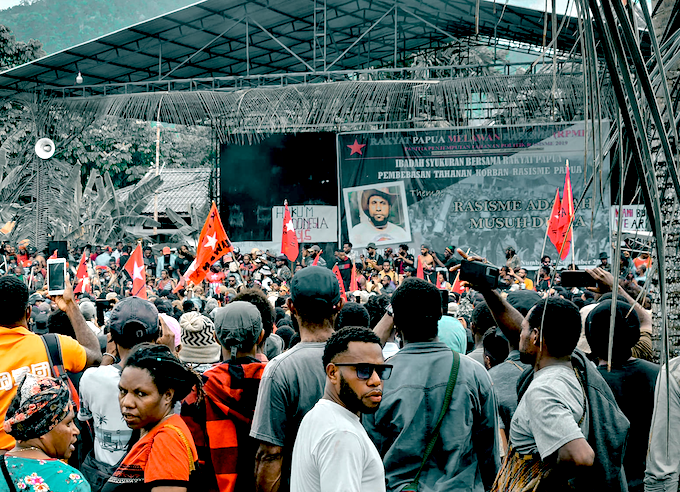
A massive crowd welcoming Victor Yeimo after his release from prison. Image: YK
Victor Yeimo’s imprisonment According to Jubi, a local West Papua media outlet, Victor Yeimo, international spokesperson of the West Papua Committee National (KNPB), was unjustly convicted of treason because he was deemed to have been involved in a demonstration protesting against a racism incident that occurred at the Kamasan III Papua student dormitory in Surabaya, East Java, on 16 August 2019.
He was accused of being a mastermind behind riots that shook West Papua sparked by the Surabaya incident, which led to his arrest and subsequent charge of treason on 21 February 2022.
However, on 5 May 2023, a panel of judges from the Jayapura District Court ruled that Victor Yeimo was not guilty of treason.
Nevertheless, the Jayapura Court of Judges found Yeimo guilty of violating Article 155, Paragraph (1) of the Criminal Code.
The verdict was controversial because Article 155, Paragraph (1) of the Criminal Code was never the charge against Victor Yeimo.
The article used to sentence Victor Yeimo to eight months in prison had even been revoked by the Constitutional Court.
On 12 May 2023, the Public Prosecutor and the Law Enforcement and Human Rights Coalition for Papua, acting as Victor Yeimo’s legal representatives, filed appeals against the Jayapura District Court ruling.
On 5 July 2023, a panel of judges of the Jayapura High Court, led by Paluko Hutagalung SH MH, together with member judges, Adrianus Agung Putrantono SH and Sigit Pangudianto SH MH, overturned the Jayapura District Court verdict, stating that Yeimo was proven to have committed treason, and sentenced him to one year in imprisonment.
Jubi.com stated that the sentence ended, and at exactly 11:17 WP, he was released by the Abepura Prerequisite Board.
The Jayapura crowd waiting to hear Victor Yeimo’s “freedom” speech on racism. Image: YK
International response Global organisations, such as Amnesty International and Human Rights Watch have condemned the Indonesian government’s treatment of Papuans and called for immediate action to address the issue of racism.
They have issued statements, conducted investigations, and raised awareness about the plight of Papuans, urging the international community to stand in solidarity with them.
Yeimo’s release brings new hope and strengthens their fight for independence.
His release has not only brought about a sense of relief and joy for his people and loved ones but has also reignited the flames of resistance against the Indonesian occupation.
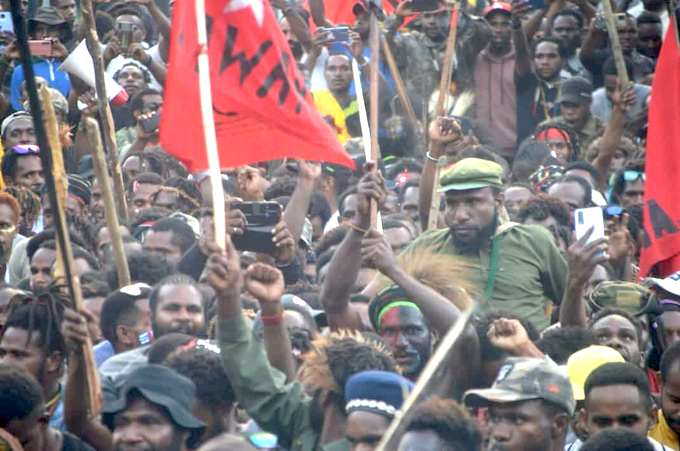
At the Waena Expo Arena in Jayapura City yesterday, Yeimo was greeted by thousands of people who performed traditional dances and chanted “free West Papua”, displaying the region’s symbol of resistance and independence — the Morning Star flag.
Thousands of Papuans have united, standing in solidarity, singing, dancing, and rallying to advocate for an end to the crimes against humanity inflicted upon them.
Victor Yeimo’s bravery, determination and triumph in the face of adversity have made him a symbol of hope for many. He has inspired them to continue fighting for justice and West Papua’s state sovereignty.
Papuan communities, including various branches of KNPB offices represented by Victor Yeimo as a spokesperson, as well as activists, families, and friends from seven customary regions of West Papua, are joyfully celebrating his return.
Many warmly welcome him, addressing him as the “father of the Papuan nation”, comrade, and brother, while others express gratitude to God for his release.
Yamin Kogoya is a West Papuan academic who has a Master of Applied Anthropology and Participatory Development from the Australian National University and who contributes to Asia Pacific Report. From the Lani tribe in the Papuan Highlands, he is currently living in Brisbane, Queensland, Australia.
West Papuan Morning Star flags flying to wecome Victor Yeimo. Image: YK
On Thursday, the whole world celebrated the International Day of Peace. Although the UN day is not as famous as others, like World Press Freedom Day, International Women’s Day or World Teacher’s Day, it is important nevertheless.
The UN General Assembly has set aside the special day to help strengthen the ideals of peace, by observing 24 hours of nonviolence and ceasefire. Why? Because never has our world needed peace more.
Just look around us. The Ukraine-Russia war seems like a never-ending fight. Despite efforts made globally to end it, the armed conflict continues to rage on in Europe.
In the continent of Africa, clashes continue in the war-torn Sudan.
According to the UN reports, Sudan is now home to the highest number of internally displaced anywhere in the world, with at least 7.1 million uprooted.
More than six million Sudanese are one step away from famine and experts are warning that inaction could cause a spill over effect in the volatile region. In the Middle East, strife can be heard and seen in the mainstream media every second day.
The scourge of hunger, HIV/ AIDS, strange diseases, famine, climate change and natural disasters continues, without any end in sight. On the other hand, for many people living in stable, well-educated and prosperous communities, every day is an invaluable gift to wake up to.
Peace seems invisible Peace in these places seems invisible because people’s hearts are filled with contents and happiness. People enjoy living in good homes, going to good schools, walking on safe streets and lawbreaking is unusual.
However, this environment and type of living is absent or different in some parts of the world around us.
In some countries, every year wars kill hundreds of lives, including women and children, poverty puts millions more through a life of struggle and low levels of education makes people unemployed and in need of the many offerings of life.
With military conflicts, humanity takes a significant step backwards, as many things have to be recovered instead of going forward. Just look at the past two world wars to understand this.
Both wars caused the loss of human lives, property loss, economic collapse, poverty, hunger and infrastructural destruction. But among the trail of destruction the wars left behind emerged humans’ insatiable desire for peace.
The absence of comfort and the overriding feeling of anxiety and fear brought about by conflicts, created spaces in the human heart that allowed humans to, once again, yearn for goodwill, friendship and unity.
That is why the celebration of the International Day of Peace, which is aimed at conveying the danger of war, is very important.
Actions for Peace This year’s IDP theme was Actions for Peace: Our Ambition for the #GlobalGoals, a call to action that recognises individual and collective responsibility to foster peace.
On the day, UN Secretary-General António Guterres said, “Peace is needed today more than ever.”
“War and conflict are unleashing devastation, poverty, hunger, and driving tens of millions of people from their homes. Climate chaos is all around. And even peaceful countries are gripped by gaping inequalities and political polarisation.”
Defined loosely, peace simply means being in a place, where no hatred and no conflict exists and where hatred and conflict are replaced by love, care and respect. We are now in the year 2023.
We find that fostering peace is becoming impossible without justice and fairness, without the values of respect and understanding, without love and unity, and without equality and equity.
Crime continues to escalate, our women and children continue to get raped, there is a lot of hatred and rancour, our streets are not safe at night and our homes are not secure.
People don’t respect people’s space, people’s human rights and people’s property. The internet and social media have revolutionised the world, the way we do things and the way we live our lives.
But some of these are extinguishing peace instead of disharmony. Despite efforts to use the internet to prevent conflict, social media is fueling hatred, radicalisation, suspicion, rallying people to disturb the peace, spreading untruths and creating disunity.
Defences of peace The Preamble to the Constitution of UNESCO declares that “since wars begin in the minds of men, it is in the minds of men that the defences of peace must be constructed”.
Therefore, for us in Fiji, every day and every opportunity must be exploited to support people to understand each other, work together to build lasting peace and make a safer world for diversity and unity.
Because we are all anticipating Fiji’s upcoming games in the Rugby World Cup 2023, we should think seriously about how we can use sports as instruments of peace.
Our Flying Fijians are doing this superbly every time they erupt in singing, give a handshake or a smile, and lift their hands and eyes to the skies in prayerful meditation. There are no wars in Fiji yet we are still struggling to instill peace in our hearts, mind and lives.
We still need peace in our families and communities. Peace is more than the absence of war.
It is about living together with our imperfections and differences — of sex, race, language, religion or culture. At the same time, it is about striving to advance universal respect for justice and human rights on which peaceful co-existence is grounded.
Peace is more than just ending strife and violence, in the home, community, nation and the world.
It is about living it everyday. UNESCO says peace is a way of life “deep-rooted commitment to the principles of liberty, justice, equality and solidarity among all human beings”.
Have a peaceful week with a quote from the Bible (Matthew 5:9) “Blessed Are the Peacemakers, for They Will Be Called Children of God”.
Until we meet on this same page, same time next week, stay blessed, stay healthy and stay safe.
John Mitchell is a Fiji Times journalist and writes the weekly “Behind The News” column. Republished from The Sunday Times with permission.
The International Press Institute (IPI) has condemned the arrest and interrogation of French journalist Ariane Lavrilleux and demanded her immediate release. She was released after 39 hours in custody.
IPI has also called on French law enforcement authorities to ensure full respect for international media freedom standards on source protection.
Lavrilleux, a journalist with French non-profit investigative platform Disclose was taken into custody last Tuesday, September 19, after a dawn raid on her home by officers from France’s domestic intelligence agency, the DGSI, said an IPI statement.
Her apartment was searched and her computer was confiscated, in the presence of a judge, according to news media reports.
Lavrilleux was taken to the DGSI headquarters in Marseille and questioned for several hours in the presence of her lawyer as part of an investigation into the publication of highly confidential documents in the investigative series, the “Egypt Papers”. She remained in custody overnight and into Wednesday, September 20.
In November 2021, Lavrilleux had co-authored and published the Egypt Papers, about the Sirli operation, an investigative series based on hundreds of leaked documents which revealed how information gathered by French counter-intelligence bodies was abused by the Egyptian military to carry out a campaign of bombings and arbitrary killings of alleged smugglers and innocent civilians.
French state’s potential complicity At the time, Disclose had issued a statement justifying its decision to publish the confidential information, citing the evidence of the French state’s potential complicity in serious human rights abuses committed by a foreign regime, and the public’s right to know about such matters of public interest.
In July 2022, prosecutors in Paris opened an investigation that was later handed over to the DGSI. They alleged the publication had compromised national defence secrets and revealed information that could lead to the identification of a protected agent.
It is unclear whether any intelligence official was compromised.
The Egypt Papers . . . an investigation based on hundreds of leaked documents which revealed how information gathered by French counter-intelligence bodies was abused by the Egyptian military to carry out a campaign of bombings and arbitrary killings of alleged smugglers and innocent civilians. Image: Disclose screenshot APR
“IPI is highly alarmed by the continued detention and interrogation of Ariane Lavrilleux and urges the General Directorate for Internal Security to proceed with extreme caution and full respect for French law and international legal standards regarding journalistic source protection”, IPI executive director Frane Maroevic said.
“Any charges against Lavrilleux must be dropped immediately and all pressure on Disclose and its journalists related to their investigative work must cease.
“The arrest of an investigative journalist is extremely serious, as it has major ramifications for press freedom”, he added.
“Journalists’ right to protect their sources is enshrined in national and international law as it essential for journalists to expose wrongdoing and hold power to account. The public interest defence of revealing the information published in Disclose’s investigative reporting on the Egyptian military is clear.
“IPI and our global network stand behind Lavrilleux and her colleagues at Disclose and will continue to monitor the situation closely.”
First home search since 2007 The arrest of Lavrilleux is believed to be the first time since 2007 that the home of a French journalist had been searched by police.
In a statement released immediately after the arrest, Disclose said: “The aim of this latest episode of unacceptable intimidation of Disclose journalists is clear: to identify our sources that revealed the Sirli military operation in Egypt.
“In November 2021, Disclose revealed an alleged campaign of arbitrary executions orchestrated by the Egyptian dictatorship of President Abdel Fatah al-Sisi, with the complicity of the French state, based on several hundred documents marked ‘defence – confidential”.
IPI’s Maroevic added that the institute had been in contact with staff at Disclose after the arrest and has offered to help provide legal support through the Media Freedom Rapid Response (MFRR), a European consortium which offers legal aid.
He noted that the arrest was the latest in a number of worrying incidents involving the interrogation of journalists from Disclose in relation to their reporting on the Egyptian government, and its sources for those stories.
This statement by IPI is part of the Media Freedom Rapid Response (MFRR), a Europe-wide mechanism which tracks, monitors and responds to violations of press and media freedom in EU Member States, Candidate Countries, and Ukraine. The project is co-funded by the European Commission.
A recent investigation by The Fiji Times has found that former attorney-general and FijiFirst party (FF) general-secretary Aiyaz Sayed-Khaiyum did not declare the value of shares he owns in two companies, as per the asset declarations filed with the Fijian Elections Office since 2017.
Section 24 of the Political Parties (Regulation, Conduct, Funding and Disclosures) Act requires political party officials to disclose to the Registrar of Political Parties their “total assets”, together with the total assets of their spouses and dependent children.
Between 2016 and 2022, Sayed-Khaiyum’s asset declarations stated he and his wife Ela were shareholders in two companies, Midlife Investments Pte Ltd and Abide Pte Ltd.
In his declarations for the years 2016 through to 2022, Sayed-Khaiyum declared monetary values for his home in Vunakece Rd, Suva, his bank accounts and a motor vehicle.
He also declared that he and his wife held shares in the two companies.
However, for the shares listed, the column “value declared” was left blank in each of the declarations.
Sayed-Khaiyum has not responded to questions emailed to him by The Fiji Times.
Meri Radinibaraviis a Fiji Times reporter. Republished with permission.
Reconstruction and renovation work for dormitories, laboratories, mess and tutorial rooms is currently underway at the University of Papua New Guinea’s School of Medicine and Health Sciences.
This is following a sit-in protest a week ago by students led by Student’s Representative Council (SRC) representative Elizah Sap demanding the university’s vice-chancellor and medical schoool dean give them answers about their legacy issues.
During a visit to the school on Thursday, Sap gave an update on the status of renovation work.
He said there were short and long-term plans outlined in the petition.
“Short term plans include students to use the mess and eat a decent meal, have access to electricity and see renovation taking place to many of the buildings that are at a deteriorating state,” he said.
“Long term plans include scoping in terms having wi-fi access to all dormitories, staff houses and others.
“We have been neglected for so long and therefore, we have decided to arrange for a sit-in-protest and we want to thank the UPNG vice-chancellor Professor Frank Griffin for the immediate response after receiving our petition.
Broken doors, windows … “There are broken doors, windows, no furniture in most of the rooms and there are always electrical faults experienced.
“The mess [dining room] has been closed for almost four years due to the unsanitary practices relating to mass hygiene, until four days ago. It was reopened after a new food warmer was installed with proper power supply and equipment,” Sap said.
The school’s mess needs to be renovated.
Sap said that for the last four years, students’ meals were prepared at the UPNG Waigani campus and delivered to the school. However, many times the food was cold and not fresh to eat when it was delivered and some students fell ill from food poisoning.
“We have also been facing continuous blackouts due to PNG Power’s fluctuation and there is no standby genset as it is no longer working.
“We have received confirmation that by next week Tuesday, two new gensets will be delivered,” he said.
Sit-in protest Sap said the sit in protest was the reason why work had commenced and the students acknowledged vice-chancellor Griffin for the immediate intervention.
The school has 712 registered students from different study disciplines.
The school was established during the 1960s and was previously known as the Papua Medical College.
Since then, most of the facilities in the school had not been renovated or replaced.
Sap said that the only renovation done to some of the dormitories was between 2021 and 2022.
Grace Salmang is a PNG Post-Courier reporter. Republished with permission.
Argentinian winger Emiliano Boffelli scored all his team’s points as they defeated Manu Samoa 19-10 at the Stade Geoffroy-Guichard in Saint-Étienne, France, yesterday in a Rugby World Cup pool D match.
That gave the Pumas their first win at the tournament and keeps their hopes alive of claiming a quarterfinal berth, with two matches against Chile and Japan on the line.
Manu Samoa head coach Vaovasamanaia Seilala Mapusua said he regretted the way they lost the match, after having had their own fair share of opportunities and not executing their chances well.
Rain fell as the game started and the slippery ball became a challenge to control.
Missed opportunities gave Manu Samoa away in the first half as Argentina led 13-3 at halftime.
Christian Leali’ifano, trusted for his goal-kicking accuracy, missed two kickable penalties which could have secured the Samoans six extra points in the half.
Then after having put the Pumas scrum under pressure, halfback Jonathan Tumataene knocked on metres from the Pumas’ tryline in what could have turned the momentum their way, close to halftime.
Pumas feed off Samoan mistakes Argentina fed off the Samoans’ mistakes and Boffelli had scored all his team’s 13 points in the first half — a try, conversion and a penalty.
Vaovasamanaia said they missed their chance of getting the win, but the Pumas adapted well to the atmosphere.
“We made too many mistakes and we didn’t adapt to the conditions, particularly at the start of the game,” he said.
“I thought Argentina executed their gameplan really well and we weren’t able to adapt. We knew that with [Emiliano] Boffelli in their team that they could slot them from anywhere and getting that yellow card early on didn’t help us.”
Fans of Argentina’s Pumas at the Stade Geoffroy-Guichard in Saint-Étienne for the match against Manu Samoa for the Rugby World Cup pool match. Image: RNZ/Iliesa Tora
Vaovasamanaia said the momentum towards the end of the game was exciting but they ran out of time.
“There’s always a possibility when there’s time on the clock, unfortunately for us we ran out of time. We weren’t able to get our game going, but I’m really proud of the boys’ efforts.”
A few opportunities He added the team created a few opportunities but did not finish that off.
“If we had finished off some of those moves, it would have become a very different game.”
Captain for the day, Chris Vui, said it was a tough clash, but they also had their chances which they did not use to their advantage.
“In this sort of game, you need to execute and take the opportunities, and for us, we probably did not take it,” he said.
“Extremely proud of the boys today. That was an awesome game. I thought both teams played that flair rugby that rugby’s missing at the moment.
“There was huge collisions. Personally, I really enjoyed it.”
He said they missed the opportunity to swing the game their way towards the first half.
A huge opportunity “That opportunity was huge for us. That could have changed the momentum of the game,” he said.
“We probably needed to change that momentum back to us and we didn’t execute. Games like these, you only ever get one or two chances, and that was one of them.
“Next week, we’re going to look at it, and we’re going to be better for it.”
Fans of Manu Samoa at the Stade Geoffroy-Guichard in Saint-Étienne for the match against Argentina’s Pumas for the Rugby World Cup pool match. Image: RNZ/Iliesa Tora
Samoa will focus on Japan, who they play next weekend.
One of the key areas they will have to work on is keeping the ball in hand, which Vaovasamanaia said is something they have been working on, even after their win over Chile two weekends ago.
“It is something we addressed last week and we will need to address that again, nailing those core roles in crucial moments. The more time we spend being put under those types of pressure will help us improve,” he added.
Samoa pressured early Samoa was under pressure early in the game after fullback Duncan Paia’aua was yellow-carded for what referee Nic Berry of Australia was a dangerous tackle after the Pumas fullback Juan Martin Gonzales had jumped high to take the ball and landed with his head towards the ground.
Berry claimed that Paia’aua had interfered with Gonzales, thus the penalty.
The Pumas made use of the opportunity as Samoa was one man down and Boffelli stepped back in to score a try. He kicked the conversion for his team to lead 7-0.
Manu Samoa won a penalty inside the Pumas half minutes later but Leali’ifano swung the ball wide.
Boffelli extended his team’s lead to 10-0 with another successful attempt before Leali’ifano raised the flags with his attempt that went off the crossbar, reducing the scoreline to 10-3.
Then Boffelli added another penalty as the Pumas led 13-3 at the breather.
Showing good cohesion in the lineouts, the Pumas started dominating with their driving mauls as the second spell resumed.
Boffelli added another penalty before the Samoans turned the fire on.
With time ticking away and a possible bonus points on offer the Samoans went on attack again.
Flanker Fritz Lee knocked on as they countered and a possible try went begging.
Replacement Sama Malolo then dived over in a forward rush after a tap penalty five metres from the Aregentinian tryline.
Alai D’Angelo Leuila converted and the Samoans were back in the game at 16-10.
Boffelli then stepped up to have the last say of the game when he fielded another successful penalty to give the Pumas the 19-10 victory.
Game statistics Argentina enjoyed the possession and territory more on attack.
They had 62 percent of possession in the game and 59 percent of the territory.
The Pumas also carried the ball more, covering 602 metres compared to Samoa’s 239.
In the set-pieces, Argentina dominated too winning 94 rucks and mauls against Manu Samoa’s tally of 49.
In defence, Samoa managed to make 141 tackles, which meant they were under pressure more while the Pumas were only required to make 77 tackles.
Samoa lost three lineout throws but managed to match the Pumas in the scrums.
Both teams had high penalty counts, with Samoa giving away 13 and Argentina 11.
This article is republished under a community partnership agreement with RNZ.
arly a year ago, a privately financed inquiry, led by Peter Shergold, a former head of the prime minister’s department, undertook an inquiry into Australia’s handling of the COVID pandemic.
The report, Fault Lines, was a solid piece of work, delving into the commendable and poor aspects of the response to what was such a massive health and economic crisis.
Among its findings were that lockdowns and border closures should have been used less and schools in the main should have been kept open. Both internal borders and schools were state responsibilities.
Australia always needed a federal government-commissioned inquiry into the management of the pandemic. Anthony Albanese recognised this and before the election he indicated Labor would have one. But he was vague about its form.
Now we have seen that form, and it’s clearly inadequate.
The terms of reference, issued on Thursday, say the inquiry will take a “whole-of-government” view. A whole of Commonwealth government, that is.
They are very detailed. But Albanese and Health Minister Mark Butler summed up the inquiry’s remit when they said in a statement it would consider Commonwealth responses, including “the provision of vaccinations, treatments and key medical supplies to Australians, mental health support for those impacted by COVID-19 and lockdowns, financial support for individuals and business, and assistance for Australians abroad”.
While looking at these areas will inevitably lead the inquiry into the various interfaces with the states, the terms of reference specifically say it will not extend to “actions taken unilaterally by state and territory governments”.
The inquiry will be done by a three-member panel, comprising Robyn Kruk, who has formerly headed departments at state and federal level; Catherine Bennett, an eminent epidemiologist, and Angela Jackson, a health economist.
There was immediate criticism that the inquiry is not a royal commission. Albanese dismissed this line of attack, suggesting royal commissions took a long time, and judges weren’t necessarily the best people for this job. These arguments sounded somewhat strange, however the fact it isn’t a royal commission is not the central problem here.
That problem is its failure to include the decisions of the states and territories – and notably that line emphasising their specific exclusion.
The COVID response was as much at state as federal level – in fact, on many aspects the states were the drivers. For example the Morrison government did not favour schools being closed, but state governments took a different view and did it.
So why exclude the states’ decisions? There is no logic about that, but it looked like some obvious politics was at play.
Facing criticism that he was protecting Labor states, Albanese pointed to the political mix of these governments at the time, when half them were non-Labor. He also said there had been some changes of government and leadership in some states.
One, more credible, reason for excluding state decisions is to avoid giving ammunition for a possible future change of government. The Palaszczuk government goes to an election in late October next year. That government came under much criticism over its uncompromising border closure during COVID, with damaging publicity about a lack of compassionate. It is already facing an uphill fight to hang onto power. The last thing it would want would be an inquiry – which reports by September 30 next year – revisiting earlier decisions.
(Victoria’s Dan Andrews, who ran the harshest lockdowns, has his election behind him, but likely wouldn’t appreciate any potentially tough findings either.)
After what the government must have found an unexpectedly fierce attack over its inquiry, Butler on Friday argued it could get into state matters.
It would examine the health response – which included the public health and social measures. And they covered “distancing, contact tracing, border closures, lockdowns, all of those things are in scope. They’re utterly in scope of the inquiry. It would be extraordinary for them not to be,” he told the ABC.
That leaves the whole thing as clear as mud. On Butler’s words, it would seem up to the panel how far it wants to push the probing of state areas.
But broadly, it appears the Morrison government will have the blow torch applied, while the state administrations of the time will at most only get some indirect heat.
Albanese says the inquiry is aimed at looking forward to how we can be better prepared for the future.
But without a forensic eye on what was good and bad in the decisions taken by all governments, we will only receive advice on how to put Australia in the best position to deal with another such crisis. And by limiting the inquiry, the government has invited a cynical response from the public, who got to know quite a lot about how various governments performed in those hard times.
Michelle Grattan does not work for, consult, own shares in or receive funding from any company or organisation that would benefit from this article, and has disclosed no relevant affiliations beyond their academic appointment.
In his maiden speech to Parliament in 2020, Te Pāti Māori co-leader Rawiri Waititi told his fellow MPs:
You know what it feels like to have a pebble in your shoe? That will be my job here. A constant, annoying to those holding onto the colonial ways, a reminder and change agent for the recognition of our kahu Māori.
Three years later, most would agree that he and fellow co-leader Debbie Ngarewa-Packer have been just that — visible, critical, combative, prepared to be controversial.
The question in 2023, however, is how does the party build on its current platform, grow its base, and become more than a pebble in the shoe of mainstream politics?
Recent polls suggest Te Pāti Māori could win four seats in Parliament in October. But its future doesn’t necessarily lie in formally joining either a government coalition or opposition bloc, even if this were an option.
The National Party has already ruled out working with the party in government. And Te Pāti Māori has indicated partnership with either major party is not a priority.
Such are the challenges for a political party based on kaupapa Māori (incorporating the knowledge, skills, attitudes and values of Māori society) in a Westminster-style parliamentary system.
Focusing on Māori values These tensions have existed since 2004, when then-Labour MP Tariana Turia and co-leader Pita Sharples established Te Pāti Māori in protest against Labour’s Foreshore and Seabed Act.
Under that law, overturned in 2011, the Crown was made owner of much of New Zealand’s coastline. Turia and others argued the government was confiscating land and ignoring Māori customary ownership rights.
Te Pāti Māori co-leader wahine Debbie Ngarewa-Packer . . . running a close race against Labour candidate Soraya Peke-Mason for the Te Tai Hauāuru electorate – a Labour stronghold. Image: Te Pati Māori website
As a kaupapa Māori party, Te Pāti Māori bases its policies and constitution on tikanga (Māori values), while advocating for mana motuhake and tino rangatiratanga. That is, Māori self-determination and sovereignty, as defined by the Māori version of te Tiriti o Waitangi/Treaty of Waitangi.
A tikanga-based constitution has helped shape policies advocating for Māori rights. But it has also, at times, sat at odds with the rules of Parliament.
Between left and right Over the years, the party’s Māori-centred policies have enabled its leaders to move between left and right wing alliances.
Under the original leadership of Turia and Sharples, Te Pāti Māori joined with the centre-right National Party to form governments in 2008, 2011 and 2014. This was a change from traditional Māori voting patterns that had long favoured Labour.
During it’s time in coalition with National, Te Pāti Māori helped influence a number of important decisions. This included finally signing the United Nations Declaration on the Rights of Indigenous Peoples, the development of Whanau Ora (a Māori health initiative emphasising family and community as decision makers), and repealing the Foreshore and Seabed Act.
However, internal fighting over the decision to align with National led to the resignation of the Te Tai Tokerau MP at the time, Hone Harawira. Harawira later formed the Mana Party.
The relationship with National proved unsustainable when Labour won back all the Māori electorates at the 2017 election. Notably, Labour’s Tāmati Coffey beat te Pāti Māori co-leader Te Ururoa Flavell in the Waiariki electorate.
Rebuilding Te Pāti Māori Waiariki was front and centre again in the 2020 election, where despite Labour’s general dominance across the Māori electorates, new Te Pāti Māori co-leader Rawiri Waititi reclaimed the seat. The party also managed to win enough of the party vote to bring co-leader Ngarewa-Packer into Parliament with him.
Sitting in opposition this time, the current party leaders have been vocal across a range of issues. The party has called for the banning of seabed mining, removing taxes for low-income earners, higher taxes on wealth, and lowering the superannuation age for Māori.
It hasn’t all been smooth sailing. Some policies, such as 2020’s “Whānau Build” have caused discomfort. Aimed largely at addressing the housing crisis, Whānau Build identified immigration as the root of Māori homelessness.
It was a sentiment more often associated with the extreme right, and the party has since apologised for that part of the policy.
Contesting more seats in 2023 Those bumps and missteps notwithstanding, recent polls show just how competitive Te Pāti Māori has become in the Māori electorates.
Ex-Labour MP Meka Whaitiri — an experienced politician who has held the Ikaroa-Rāwhiti electorate since 2013 but left to join Te Pāti Māori this year — is in a tight race to regain her seat against new Labour candidate Cushla Tangaere-Manuel.
Co-leader Ngarewa-Packer is also running a close race against Labour candidate Soraya Peke-Mason for the Te Tai Hauāuru electorate — a Labour stronghold.
But Te Pāti Māori has also shifted from its previous focus on the Māori electorates, with Merepeka Raukawa-Tait standing in the Rotorua general electorate.
The Māori Electoral Option legislation, which came into effect this year, now allows Māori voters to change more easily between electoral rolls. In future, Te Pāti Māori may find it can best to serve Māori by standing candidates in general electorates.
Broader social change across Aotearoa New Zealand has also likely been an important contributor to the success of Te Pāti Māori, with greater understanding of Te Tiriti o Waitangi, tikanga and te reo Māori among voters.
Indeed, the current party vision of an “Aotearoa Hou” (New Aotearoa), includes reference to tangata tiriti, a phrase being popularised to refer to non-Māori who seek to honour partnerships based on Te Tiriti o Waitangi.
According to the most recent polling, Te Pāti Māori may not be the deciding factor in who gets to form the next government come October.
But the party’s resilience and growth after it’s electoral disappointments in 2017 and 2020 show an ability to rebuild. In doing so, it is carving out it’s place in New Zealand’s political landscape.
And if Te Pāti Māori is not the kingmaker in 2023, it is still on the path to influence — and potentially decide — elections in the not-too-distant future.
The Victorian government, like many governments around the world, has announced new regulations on short-stay accommodation. The government says Victoria has more than 36,000 short-stay places, which are reducing the number of homes available for long-term rental.
Other states have capped the number of nights a dwelling can be used for short-stay accommodation. The Victorian response has been to introduce a levy set at 7.5% of the short-stay platform’s revenue.
The rationale appears simple – adding a charge to discourage landlords from converting properties from long-term rentals to tourist accommodation.
The government estimates the levy will raise about A$70 million a year. State agency Homes Victoria will use this money to provide social and affordable housing, potentially compensating for losses to the short-stay sector.
Details of how the levy will be collected are not yet available. However, it appears the government will charge the platforms – such as Airbnb, Stayz and Booking.com – 7.5% of their total revenue. The platforms will bill the hosts.
The levy will begin in 2025. The state government says its levy will replace any local government charges on short-stay accommodation such as the one Bass Coast collects.
The platforms have voiced concern at the size of the levy and at hotels escaping the charge. The government’s response is that hotels are not removing long-term rental housing from the market.
Some commentators from the Victorian tourism sector predict the levy will lead to sharp reductions in tourism. This will depend on how many owners of second homes in tourism destinations opt to shift their properties into the long-term rental market.
Marginal operators might decide this extra cost makes the hassle of running a short-term rental business too high. Some might move to long-term rentals.
The levy might also encourage some potential short-term rental investors to focus their activities in other states that don’t charge a levy. However, it’s possible other states whose budgets are under pressure will copy the Victorian model, reducing this effect.
Indeed, the size of the Victoria government’s levy and its own budget projections imply the intention is more to raise revenue than to eliminate the state’s short-stay sector.
Short stays have boomed under a ‘light touch’ approach
We have previously described Australian approaches to regulating the short-term rental sector as very light touch.
Under this regime, the Australian short-term rental market has been growing strongly. The sector has increased by about 23% over the past year, according to a new report by the Real Estate Institute of Australia.
COVID-19 provided an excellent natural experiment to test this view. As state and national borders closed, short-term rentals returned to the long-term market. In many Australian housing markets where this happened, rents fell sharply.
In contrast to the relative lack of state government action, local governments across Australia have long sought to manage impacts of short-term rental accommodation in their municipalities.
These local responses include permit and registration systems, which allow local councils to monitor any problems. Some have imposed higher rates. This can deter conversion of long-term rental stock to short-stay accommodation but also provides important local revenue for localities with many seasonal visitors.
Ironically, the introduction of state frameworks can override local responses. Byron Council in NSW has been trying to reduce the number of nights hosts can let their properties from the default NSW total of 180 nights. Ultimately, the state’s Independent Planning Commission supported a 60-day cap. The council must now navigate a complex process to get this limit in place.
Regulations are tougher overseas
The Victorian government move mirrors an international trend of increasing regulation of short-term accommodation. These rules seek to prevent loss of permanent rental supply and to manage the amenity impacts of short-term tourism on neighours and local communities.
In Scotland, Airbnb hosts now have to register with the government. Those listing whole properties must apply for planning permission.
Cities such as New Orleans have created special zones where holiday homes can be rented. It’s another way to balance the demand for visitor accommodation with the need to preserve homes for local residents.
Many European and North American cities have blanket restrictions on short-term rentals, including caps of 30 to 90 days for unhosted properties. These time periods allow local residents to gain income by renting out their homes when they are themselves on holiday.
However, enforcing these rules can be tricky. New York City recently introduced regulations that require hosts to be present while accommodating guests – effectively banning the short-term rental of whole homes.
It will take more than a levy to fix the rental crisis
Across Australia, people have called for increased housing supply to improve rental markets. However, given the long lead times in financing and building apartment buildings, new rental supply will take a long time to deliver for tenants.
In contrast, policy changes that redirected short-term rental stock to the long-term market would have an immediate benefit. This is vital in central city locations, where new apartment supply is at risk of diversion to the short-term sector, and in regional markets, where increased population growth has coincided with increased short-term stay activity.
More widely, protecting tenants from unfair eviction and sudden excessive rental increases can help limit the impacts of short-stay platforms. Adequately subsidising low-income renters so they can afford decent housing would also help.
Generating extra revenue for Homes Victoria is a positive step, but a tourist tax won’t go far. Renters would gain more in the short term from other regulations that do more to reduce the short-stay sector’s size and growth.
Peter Phibbs receives funding from Shelter Tasmania to undertake research on short-term rentals in Tasmania. He also receives funding from AHURI. He is a pro bono board member of a not-for-profit housing data company, the Housing Justice Data Lab.
Nicole Gurran receives funding from the Australian Coastal Councils Association, the Australian Housing & Urban Research Institute and the Australian Research Council, and has provided advice to non-profit Inside Airbnb.com.
While attention is focused on economists finding a $500 million-a-year hole in National’s tax plans, a similar-sized hole in climate costings is hiding in plain sight — and it applies to Labour, too.
Asked how they would pay this week, politicians gave unclear answers. But the obligation was still very real.
Both Labour and National have said they are committed to meeting the country’s international climate target, known as an NDC (Nationally Determined Contributions).
Under the Paris Agreement, which covers almost every nation on the planet, New Zealand has promised to cut emissions by 41 percent off 2005 levels by 2030. Exporters and carbon market experts say failing to meet that pledge could jeopardise international trade — nevermind the fact that following the Paris Agreement is humanity’s best hope for avoiding more expensive and deadly heating.
New Zealand plans to meet its target in two ways. First, it will do as much as it can inside the country by meeting a set of “emissions budgets”.
No way to meet target But when the Climate Change Commission ran the numbers, it concluded there was no way to meet the whole target with action at home. Because New Zealand started slow at tackling emissions, cutting transport, industry, farming and electricity emissions that quickly would cause too much economic pain, it concluded.
The Pre-election Economic and Fiscal Update (PREFU) ignored the cost of meeting New Zealand’s Paris Agreement obligations. Image: RNZ/Angus Dreaver
So there is also a second part to the target: buying carbon credits from overseas. Typically, economists assume this is cheaper than making cuts in emissions at home, though it depends on the project.
While no purchases will be made until after the election, the kinds of things that could qualify include retiring coal boilers in developing countries, or planting forests.
This is where the gap in the books comes in. Treasury had previously put the cost of buying these credits from overseas — and an estimated 100 million tonnes of them will be needed, at last count — at between $3.3 billion and more than $23 billion between now and 2030.
Even at the lower end of projections, it could work out at around $500 million a year.
Whichever way the government decides to do it, PREFU said the costs would be “significant” and will start biting “within the current fiscal forecast period”.
As things stand, according to Climate Change Minister James Shaw, one or possibly two rounds of purchases could be made in the next four years, with a third and final “washup” at the end of the decade.
Election may change timing The election could change the timing, but whoever is in government will be expected to start showing progress towards meeting their Paris target well before the end of the decade, said carbon market expert Christina Hood from Compass Climate.
Green Party’s James Shaw . . . one or possibly two rounds of purchases could be made in the next four years. Image: RNZ/Samuel Rillstone
“There’s this common misconception that whoever the finance minister is in 2032 is going to have to get their chequebook out and square up by however much we missed by. It doesn’t work that way at all.
“Every emission (saving) we count has to actually occur during those years (before 2030), so we need to get on with funding that.”
Yet despite starting to fall due within the next four years, the costs did not appear as a liability on the government’s books. Nor do the major parties seem to be clear on how much to budget for them.
Bold claims, few details This week, neither National nor Labour answered clearly how much they had planned to set aside for these costs nor how they intended to pay them. They instead focused their answers on wanting to cut planet-heating emissions more deeply inside New Zealand’s borders.
At times, politicians seemed to confuse domestic emissions budgets with the $3 billion-plus added cost of buying offsets to meet the Paris target, or they made heroic statements about how much they could do onshore, without supplying the figures behind them.
A quick reminder: the 100-odd million tonnes in overseas offsets that it was estimated we would need were on top of meeting New Zealand’s domestic emissions budgets, not instead of it. Only a truly incredible effort could meet the entire amount inside the country, requiring deep and fast climate action on a scale neither party has hinted at.
Currently, New Zealand is not even on track to meet its domestic emissions budgets, as Climate Change Commission chief executive Jo Hendy told a business and climate conference in Auckland this week.
“Latest projections show we are not on track in every single sector, so we are going to have to do more,” she said. “We are particularly reliant on pushing the dial in transport and in process heat.”
Yet when RNZ asked about the $3 billion-plus cost on the campaign trail, politicians appeared to be planning to overperform on those budgets, sometimes by impressive amounts. Their answers suggested they may not need to worry too much about that $3 billion-plus.
Here’s what Labour leader Chris Hipkins said, when asked if he had costed for meeting Paris: “We still have a way to go before we have to make a final decision on how best to meet our commitments there. We’re on track to meet our first emissions budget.
Working harder “We’ve still got the second and third emissions reduction budgets to go. If we don’t meet our targets there is a period of time when we can figure out how best to remedy that, and that includes working harder in the second period to compensate for that.
“But we’re confident that with the stuff we’ve got in place at the moment, we’re on track to meet our first target.”
Hipkins did not address paying for offshore credits, which were required even if the country met all three domestic budgets. As prime minister, he rolled back a biofuel policy and, like National, has focused his transport promises mainly on building new roads rather than a strong shift to lower-emissions modes.
He has also promised help for home insulation and solar, but it was not clear if his new promises compensated for the cuts.
Climate Change Commission chair Rod Carr and chief executive Jo Hendy . . . currently, New Zealand is not even on track to meet its domestic emissions budgets. Image: Twitter/Climate Change Commission/RNZ News
Asked the same question, National leader Christopher Luxon took aim at the government for undermining the Emission Trading Scheme (ETS), saying the scheme should do more of the “heavy lifting”.
He, too, skirted the question of paying for offsets.
For context, the ETS made polluters pay for around half the country’s domestic climate pollution (the other half was from agriculture) and was already factored into projections of needing 100 million-odd tonnes of extra ‘top up’ help from overseas.
The scheme could do more, particularly if carbon prices went higher (taking petrol prices with them), or if farming was included, or if there were no limits on planting land in cheap pine trees, but Luxon did not detail how National would navigate these kinds of changes.
Cutting domestic emissions Meanwhile, other party spokespeople talked-up cutting domestic emissions.
Labour environment spokesperson David Parker told the conference in Auckland he wanted to look at claims that native afforestation could meet the entire Paris target (without overseas help).
National’s Simon Watts . . . National believes it could meet 70-75 percent of the 2030 target inside these shores. Photo: RNZ/Samuel Rillstone
National’s climate spokesperson Simon Watts told the same gathering — the annual Climate Change and Business Conference — that National believed it could meet 70-75 percent of the 2030 target inside these shores, a figure considerably higher than previous estimates by the Climate Change Commission.
Watts did not supply details on how that would be achieved, though he discussed lightening regulation on wind and solar energy.
His party has said it would scrap Labour’s Clean Car Discount and major grants to companies to switch off coal boilers, and it would also delay pricing farming emissions a further five years, until 2030. There were questions about how it would meet even the current domestic emissions budgets.
The cost of waiting Hood had a spot of good news on the cost front. She told RNZ that based on recent purchases by Switzerland, the cost of overseas carbon offsets was likely to be towards the lower end of Treasury’s range.
Even if the government winded up buying 100 million tonnes of savings offshore, that was still only around half the quantity the John Key-led government expected it might have to stump up for when it made its first Paris Agreement pledge, despite the first pledge being weaker on climate than the current one, she noted.
But getting offsets at the lower end of the cost range relies on the government getting moving on lining them up and buying them, she says.
Shaw told RNZ that environmental integrity would be a bottom line after New Zealand was burned for buying valueless “hot air” credits from Russia and Ukraine in the early years of carbon trading.
As well as Switzerland, Singapore and others had already started striking deals to buy the offsets they needed.
While the New Zealand Government has been scoping out prospective sellers overseas, it has refused to reveal who it is talking to, citing commercial sensitivity.
The ministries for Foreign Affairs and the Environment were working on advice to Cabinet on how to make these purchases and ensure the carbon saved was real. But that advice will not land until after the election.
Most expensive time to buy One thing is clear. 2030 will be the most expensive time to buy, Hood said, because many countries will be panic-buying from overseas projects to meet their missed domestic commitments. Shaw agreed.
“A whole bunch of countries will be going, ‘Oh crap, I’ve missed my target,’ and scrambling around trying to find ways to fill the gap.”
Shaw wanted Paris costs to go into PREFU, making it clear to the government that any money spent on domestic action on climate change was also a cost saving in terms of buying fewer offshore credits.
“This is one of the things that worries me about what some of the other parties are saying, is that they aren’t really accounting for [Paris] in their fiscal plans.”
Shaw called the huge variance in Treasury ‘s $3 billion-23 billion estimate “unhelpful”.
“It’s such a wide variance it’s hard to trust it. At the moment… people are putting their fingers in their ears and saying ‘lalalala”.”
But asked how much the Green Party had costed for meeting New Zealand’s offshore climate commitments, Shaw would not be drawn on naming a more accurate number.
Treasury estimate best “The best estimate I’ve got is the Treasury estimate. The Ministry for the Environment and MFAT (Ministry for Foreign Affairs and Trade) are doing a lot of work on this at the moment, but they’re not going to have a report back until just before Christmas. If I was to give you a number I would be pulling it out of thin air.”
As for how to pay for it, Shaw said ETS proceeds from polluters could do a lot of it.
“In a good year that’s a billion dollars, so if there’s seven years for us to do that it’s $7 billion.”
But Shaw also acknowledged there were a lot of other calls on that money — including for adapting to climate change, paying for domestic carbon savings, and helping low-income families weather the costs of higher emissions prices, which boost fuel and electricity costs.
National has said it would use ETS proceeds to help fund its tax cuts, meaning it will need to pay for the Paris target (both the offshore and onshore parts) some other way.
This article is republished under a community partnership agreement with RNZ.
Our recent research in Sydney, for instance, shows how the planning system already overlooks what is needed to make the city equitable and liveable. Planning decisions contradict or ignore guidelines and checklists that are meant to help ensure communities are healthy and sustainable.
The rush to build new housing risks creating even more inequitable cities.
Poorly regulated housing development often means services and infrastructure such as public transport or schools are added later. This ends up costing both governments and households. And it costs us more than dollars to fix the long-term problems that come with inequity.
Only housing “done well” – quality, affordable and accessible housing – will truly solve the housing crisis.
While that sounds like good policy, this approach extends decades of short-sightedness that overlooks what matters most for cities: its people.
The NSW government wants to “loosen the screws” on planning regulations so developers can build more housing. Worryingly, it admits wrongdoers may take advantage. The Victorian government unveiled plans on Wednesday to fast-track big housing developments.
Such short-sighted policies risk poorly planned neighbourhoods and poorly built housing.
There’s plenty of evidence for the need to reform the NSW land-use planning system. Simply freeing up housing supply is not enough. Planning systems need to do the job of ensuring new housing supports the city and the wellbeing of all residents.
We compared these policies against the NSW government’s own Healthy Built Environment Checklist on how to do it well. We found this checklist to be one of the best guides in the world for how cities can enhance human health and wellbeing.
The checklist sets out 11 principles covering topics that the planning system should use to guide development. We added a 12th best-practice theme to highlight the growing importance of safeguarding mental health.
We counted the number of clauses within each policy and plan that corresponded to each of the 12 themes. We used a traffic-light system (shown below) to highlight whether and how these clauses considered, mentioned and/or addressed issues relating to equity.
Because SEPPs are (generally) applicable to the whole state, we found their focus was more thematic and focused on broader issues such as “resilience”. Most only corresponded to a small number of the best-practice themes as show below.
The proposed but-never-adopted Design and Place SEPP was the most likely to have provided any equity guidance.
In contrast, LEPs are by design more focused on specific local government areas and need to more comprehensively guide local land use. Most included clauses that aligned with the healthy planning themes.
Nevertheless, as the mostly red coding shows, few of these land-use planning mechanisms considered the known ways to promote equity in any notable ways.
At the local level, only two of the eight LEPs we looked at really paid equity any attention.
Short-term fixes for the housing crisis create a big risk of even worse outcomes for communities.
“Unleashing” housing supply in cities like Sydney and Melbourne, without reforming narrowly focused planning mechanisms, will increase inequities between the haves and have-nots. The result is likely to be more spending in future — by governments and affected households — to deal with the consequences.
We know how to create great suburbs and cities. Indeed, the NSW government should heed its own policy advice when changing the planning system if cities like Sydney are to remain quality places to live.
Councils in south-western Sydney, for instance, are partnering local health districts to develop innovative health-focused planning and urban design. Similarly, the Western Sydney Health Alliance is supporting innovation, including our research, to place public health at the centre of delivering infrastructure for the region.
Boosting housing supply by targeting local councils’ roles and responsibilities, as both NSW and Victoria are doing, risks worse, not better, outcomes.
Planning systems need to regulate and be responsive locally for housing to be “done well” and avoid the costs of inequity that come with a blinkered focus on housing supply.
Patrick Harris receives funding from the Australian National Health and Medical Research Council and Australian Research Council. The research discussed in this article was funded by the Western Sydney Health Alliance, a collective working to create healthy communities across the Western Parkland City.
Edgar Liu receives funding from the Sydney Partnership for Health, Education, Research and Enterprise, the Australian Housing and Urban Research Institute Ltd, the social housing sector, the ACT and NSW governments, and the City of Sydney. He previously received funding from the Australian Research Council, the South Australian government, the Australian Council of Social Service, Shelter NSW and the Cooperative Research Centre for Low Carbon Living. The research discussed in this article was funded by the Western Sydney Health Alliance, a collective working to create healthy communities across the Western Parkland City.
The Fiji government has warned the public “don’t panic” as news of an alleged firebombing incident at Totogo Police Station in the heart of Suva sent shockwaves around the community.
The incident yesterday also spurred questions about the safety of citizens in the country as such activities were reportedly occurring brazenly, out in the open and during daylight.
Home Affairs Minister Pio Tikoduadua also acknowledged that this was an alleged attempt to attack a key security facility and represented a direct threat to Fiji’s security forces and the peace and security of the nation.
The Totogo Police Station firebombing incident yesterday. Image: Fivivillage News screenshot APR
“The public should remain calm and confident in our commitment to maintaining peace and security,” he said at a media conference.
He also confirmed that the 33-year-old suspect was admitted at Colonial War Memorial Hospital after suffering burns, where he remained under police guard.
The man is expected to be taken back into custody once he has recovered.
Fijivillage News reports that Tikoduadua said the man threw a lit bottle filled with flammable liquid into the charge room, and in his attempt to throw another bottle he was apprehended.
Meri Radinibaraviis a Fiji Times reporter. Republished with permission.
Manu Samoa have made only three changes to their starting lineup to maintain consistency and ensure game flow against Argentina in a must-win Pool D clash in Saint-Étienne on Saturday morning (NZ time).
Head coach Vaovasamanaia Seilala Mapusua has named Paul-Alo Emile in the front row, Paul Ala’nu’uese at lock and Ben Lam on the wing in the Rugby World Cup battle.
Lock Chris Vui gets to lead the team out with his co-captain and prop Michael Ala’alatoa on the bench.
Samoa needs to win the clash to give them an advantage over the Pumas, who lost their first game to England a fortnight ago.
England has two wins and leads on the points table.
Samoa are second but need the win to give them a better chance of qualifying for the quarterfinals.
Mapusua said they are focused on stopping the South Americans, but they will need to execute correctly.
‘Under no illusion’ “We are going to have to stop Argentina from doing what they do by doing what we do and committing to how we want to play,” he told media at the team naming in Saint-Étienne.
“We are under no illusion to the threat Argentina pose and we believe that if we stick to how we want to play and play the Samoa way, I am confident we will be able to stop Argentina.”
He said the three players who had been given starting roles were being brought in against the Pumas because of their strengths.
“Brian (Alainu’u’ese, second row) has been training really well and this was a game we thought his strengths would be utilised, especially around the set-piece,” he said.
“Ben Lam has just become available after sustaining an injury a few weeks ago. He is now fit and ready to go.
“We were worried when he sustained his injury. He’s a lot on the edge for us, he’s a very big man who can move quickly . . . he brings a lot to the wider channels, his pure power and the way he plays the game. We are looking forward to finally getting him on the field this weekend.”
Sopoaga ruled out But he will not have former All Black Lima Sopoaga, who came off the bench against Chile last weekend.
“With Lima Sopoaga’s omission [from the match-day squad], I think it’s been circulated, he sustained a (calf) injury last week against Chile,” the coach revealed.
“He was ruled out this week, we ruled him out as a precautionary. Also, because of the nature of his injury he wasn’t ready to play this week. We will reassess at the weekend towards next week’s game.”
Mapusua said his team understood how important it was for them to start well, remain consistent and finish strong, unlike their first half performance against Chile.
“The boys have realised we are in the tournament, we’ve arrived at the party. There are no second chances so this week the whole squad, there has been a real lift and energy. We know we have got a huge game coming up,” he said.
“We won’t be short of motivation.
‘Confidence in what we are doing’ Fiji’s 22-15 win over Australia last weekend is motivation also for the side as they go into the battle with what Vaovasamanaia calls an “injured Los Pumas”.
“We had confidence before the game, confidence that Fiji were going to get over and also confidence in what we are doing. That’s awesome to see our Pacific brothers doing really well and we are always going to be behind them until we have to play each other.
“We are proud of them and of course we are going to take inspiration and confidence from that. But I’d be more inclined to take confidence from the work and preparation this group of men have done over the past few months.”
Flyhalf Christian Leali’ifano will man the pivotal playmaker role and said he was excited to meet Argentina, coached by his former Wallaby headman Michael Cheika.
Cheika was Wallabies coach at the 2019 Rugby World Cup where Leali’ifano was a key player for the side.
“Excited for the challenge ahead,” Leali’ifano said.
“Not only a former coach there in Michael Cheika but just the challenge that lays ahead for this team, this group to play a tier-one nation that historically did really well at a World Cup.”
The Samoa – Argentina clash kicks off at the Stade Geoffroy Guichard, Saint Étienne at 3.45am (NZ Time) or 4.45am in Samoa on Saturday.
This article is republished under a community partnership agreement with RNZ.
Samoa team: 1 James Lay, 2 Seilala Lam, 3 Paul Alo-Emile, 4 Brian Alainu’u’ese,5 Chris Vui (c), 6 Theo McFarland, 7 Fritz Lee, 8 Steven Luatua, 9 Jonathan Taumateine, 10 Christian Leali’ifano, 11 Ben Lam, 12 Tumua Manu, 13 Ulupano Junior Seuteni, 14 Nigel Ah-Wong, 15 Duncan Paia’aua. Reserves: 16 Sama Malolo, 17 Charlie Faumuina, 18 Michael Alaalatoa, 19 Taleni Junior Agaese Seu, 20 Sa Jordan Taufua, 21 Melani Matavao, 22 Alai D’Angelo Leuila, 23 Danny Toala.
Our recent research in Sydney, for instance, shows how the planning system already overlooks what is needed to make the city equitable and liveable. Planning decisions contradict or ignore guidelines and checklists that are meant to help ensure communities are healthy and sustainable.
The rush to build new housing risks creating even more inequitable cities.
Poorly regulated housing development often means services and infrastructure such as public transport or schools are added later. This ends up costing both governments and households. And it costs us more than dollars to fix the long-term problems that come with inequity.
Only housing “done well” – quality, affordable and accessible housing – will truly solve the housing crisis.
While that sounds like good policy, this approach extends decades of short-sightedness that overlooks what matters most for cities: its people.
The NSW government wants to “loosen the screws” on planning regulations so developers can build more housing. Worryingly, it admits wrongdoers may take advantage. The Victorian government unveiled plans on Wednesday to fast-track big housing developments.
Such short-sighted policies risk poorly planned neighbourhoods and poorly built housing.
There’s plenty of evidence for the need to reform the NSW land-use planning system. Simply freeing up housing supply is not enough. Planning systems need to do the job of ensuring new housing supports the city and the wellbeing of all residents.
We compared these policies against the NSW government’s own Healthy Built Environment Checklist on how to do it well. We found this checklist to be one of the best guides in the world for how cities can enhance human health and wellbeing.
The checklist sets out 11 principles covering topics that the planning system should use to guide development. We added a 12th best-practice theme to highlight the growing importance of safeguarding mental health.
We counted the number of clauses within each policy and plan that corresponded to each of the 12 themes. We used a traffic-light system (shown below) to highlight whether and how these clauses considered, mentioned and/or addressed issues relating to equity.
Because SEPPs are (generally) applicable to the whole state, we found their focus was more thematic and focused on broader issues such as “resilience”. Most only corresponded to a small number of the best-practice themes as show below.
The proposed but-never-adopted Design and Place SEPP was the most likely to have provided any equity guidance.
In contrast, LEPs are by design more focused on specific local government areas and need to more comprehensively guide local land use. Most included clauses that aligned with the healthy planning themes.
Nevertheless, as the mostly red coding shows, few of these land-use planning mechanisms considered the known ways to promote equity in any notable ways.
At the local level, only two of the eight LEPs we looked at really paid equity any attention.
Short-term fixes for the housing crisis create a big risk of even worse outcomes for communities.
“Unleashing” housing supply in cities like Sydney and Melbourne, without reforming narrowly focused planning mechanisms, will increase inequities between the haves and have-nots. The result is likely to be more spending in future — by governments and affected households — to deal with the consequences.
We know how to create great suburbs and cities. Indeed, the NSW government should heed its own policy advice when changing the planning system if cities like Sydney are to remain quality places to live.
Councils in south-western Sydney, for instance, are partnering local health districts to develop innovative health-focused planning and urban design. Similarly, the Western Sydney Health Alliance is supporting innovation, including our research, to place public health at the centre of delivering infrastructure for the region.
Boosting housing supply by targeting local councils’ roles and responsibilities, as both NSW and Victoria are doing, risks worse, not better, outcomes.
Planning systems need to regulate and be responsive locally for housing to be “done well” and avoid the costs of inequity that come with a blinkered focus on housing supply.
Patrick Harris receives funding from the Australian National Health and Medical Research Council and Australian Research Council. The research discussed in this article was funded by the Western Sydney Health Alliance, a collective working to create healthy communities across the Western Parkland City.
Edgar Liu receives funding from the Sydney Partnership for Health, Education, Research and Enterprise, the Australian Housing and Urban Research Institute Ltd, the social housing sector, the ACT and NSW governments, and the City of Sydney. He previously received funding from the Australian Research Council, the South Australian government, the Australian Council of Social Service, Shelter NSW and the Cooperative Research Centre for Low Carbon Living. The research discussed in this article was funded by the Western Sydney Health Alliance, a collective working to create healthy communities across the Western Parkland City.
Source: The Conversation (Au and NZ) – By Jamal Abarashi, Lecturer, International Business, Strategy and Entrepreneurship Department, Auckland University of Technology
As part of our ongoing research project, we analysed popular cleaning and decluttering videos on YouTube as well thousands of the comments below them. We also conducted 18 in-depth interviews. The goal is to better understand how people create order in their homes – and how they keep it that way.
As our research shows, sustaining tidiness is about being both systematic and adaptable.
We’ve always wanted that really amazing organised home but we could just never really get it that way and we would feel really discouraged when we tried and then just a few days later it would just go right back to messy.
Some interviewees described feeling like prisoners of their possessions.
Another young couple with two kids explained:
As more children arrived and our income increased, more stuff made its way into our home. We have never been hoarders, but at some point I looked around and realised that we were spending our time and resources on acquiring stuff, cleaning and maintaining stuff, storing stuff, moving stuff out of the way to get to other stuff.
One professional woman we spoke with described establishing a system where every piece of clothing had a designated spot in their wardrobe based on colour, type and season. Ultimately, this became too difficult to maintain, undermining the whole approach.
So what can be done to maintain a tidy home?
4 strategies for keeping your home tidy
Our research so far has helped us identify four key strategies to achieve long-term tidiness.
1: Simplify
To achieve lasting tidiness, you need to simplify the way you organise your home.
This can be done by eliminating spaces or areas in your home that encourage further organisation and classification of possessions – like extra dressers or storage units.
We had this dresser […] that was basically always inviting more and more stuff to be put in it. So, it was always pretty hard to have the space we always wanted. Well then we got rid of the dresser […] and once we did that we really saw the space open up and it became really nice and clear.
Fewer dedicated spaces mean fewer opportunities for clutter to accumulate, ultimately making it easier to maintain a tidy living environment.
2: Create groups
Another effective strategy for long-term tidiness is to simplify how you categorise and group things in your home.
Replacing several small decor items with one larger one creates fewer distinct categories of things around the house, for example.
One mother of two kids we spoke with switched out several small teddy bears in her lounge for one big one.
A married couple we interviewed grouped smaller knickknacks onto a tray, making it easier to keep track of things and to maintain order. Having all of their knickknacks in one place also made it easier to clean.
3: Manage numbers
To sustain long-term tidiness, it’s also essential to control the total number of possessions in your home.
This can be achieved through various methods, such as encouraging sharing among family members and friends or following the “one in, one out” rule – for every new item you bring into the house, you get rid of an old item.
Instead of buying rarely used items, like a camping tent, you could rent it when needed.
Another married couple we spoke with described a cluttered kitchen with multiple pots for different cooking jobs. Looking to reduce the clutter, they switched to using a multipurpose cast iron skillet – one item that can do many jobs.
A family with two kids spoke about sharing hair products to reduce the clutter in the bathroom.
We used to buy a bunch of different things but now we use the same thing for our hair so the product [my husband] uses, I use. We use the same shampoo. We actually used to buy different shampoo. So basically, we just simplified our product […] this brought the products down to half and now we have so much more peace of mind and the bathroom is so much easier to maintain.
4: Adapt and evolve
Maintaining a tidy home requires flexibility and a willingness to re-evaluate and adjust your routines in response to the ever-changing circumstances of your life.
A retired couple we interviewed spoke about the process of moving to a smaller place. This required getting rid of a lot of things and changing the way they lived to maximise the use of what remained.
In the end, tidiness and decluttering are ongoing processes that require dedication and flexibility.
By embracing these strategies for long-term tidiness, a person can create and maintain organised spaces that enhance their lives, fostering not only physical order but also mental clarity and peace.
The authors do not work for, consult, own shares in or receive funding from any company or organisation that would benefit from this article, and have disclosed no relevant affiliations beyond their academic appointment.
Source: The Conversation (Au and NZ) – By Lisa Mitchell, Geriatrician working in clinical practice. PhD Candidate at The University of Melbourne studying ethics and ageism in health care. Affiliate lecturer, Deakin University
Children are also dressing up as 100-year-olds to mark their first “100 days of school”, an idea gaining popularityin Australia.
Is this all just harmless fun?
How stereotypes take hold
When I look at the older people in my life, or the patients I see as a geriatrician, I cannot imagine how to suck out the individual to formulate a “look”.
But Google “older person dress-ups” and you will find Pinterests and Wikihow pages doing just that.
This depiction of how older people look and behave is a stereotype. And if dressing up as an older person is an example, such stereotypes are all around us.
What do older people really look like? I can’t see a walking stick or shawl. Can you? Shutterstock
There is some debate about whether stereotyping is intrinsically wrong, and if it is, why. But there is plenty of research about the harms of age stereotypes or ageism. That’s harm to current older people and harm to future older people.
When it comes to health, the impact of negative stereotypes and beliefs about ageing may be even more harmful than the discrimination itself.
In laboratory studies, older people perform worse than expected on tasks such as memory or thinking after being shown negative stereotypes about ageing. This may be due to a “stereotype threat”. This is when a person’s performance is impaired because they are worried about confirming a negative stereotype about the group they belong to. In other words, they perform less well because they’re worried about acting “old”.
Older people perform less well on some tasks after seeing negative stereotypes of ageing. Shutterstock
Another theory is “stereotype embodiment”. This is where people absorb negative stereotypes throughout their life and come to believe decline is an inevitable consequence of ageing. This leads to biological, psychological and physiological changes that create a self-fulfilling prophecy.
I have seen this in my clinic with people who do well, until they realise they’re an older person – a birthday, a fall, a revelation when they look in the mirror. Then, they stop going out, stop exercising, stop seeing their friends.
Evidence for “stereotype embodiment” comes from studies that show people with more negative views about ageing are more likely to have higher levels of stress hormones (such as cortisol and C-reactive protein) and are less likely to engage in health behaviours, such as exercising and eating healthy foods.
Younger adults with negative views about ageing are more likely to have a heart attack up to about 40 years later. People with the most negative attitudes towards ageing have a lower life expectancy by as much as 7.5 years.
Children are particularly susceptible to absorbing stereotypes, a process that starts in early childhood.
You don’t see many children dressing up like this older person. There’s a reason for that. Shutterstock
One in two people have ageist views, so tackling ageism is complicated given it is socially acceptable and normalised.
Think of all the birthday cards and jokes about ageing or phrases like “geezer” and “old duck”. Assuming a person (including yourself) is “too old” for something. Older people say it is harder to find work and they face discrimination in health care.
We can reduce ageism through laws, policies and education. But we can also reduce it via intergenerational contact, where older people and younger people come together. This helps break down the segregation that allows stereotypes to fester. Think of the TV series Old People’s Home for 4 Year Olds or the follow-up Old People’s Home for Teenagers. More simply, children can hang out with their older relatives, neighbours and friends.
We can also challenge a negative view of ageing. What if we allowed kids to imagine their lives as grandparents and 100-year-olds as freely as they view their current selves? What would be the harm in that?
Lisa Mitchell is affiliated with the Australian Labor Party.
Opinions are my own and do not represent the views of my affilitated universities or health care employer.
Source: The Conversation (Au and NZ) – By Renee McKibbin, Professor of Economics, Crawford School of Public Policy, Australian National University
Misinformation is circulating about recommendations concerning the Reserve Bank board made by the RBA Review, of which I was a member.
Among the claims are that the new monetary policy board we have proposed would “weaken” incoming governor Michele Bullock’s power over interest rates, and that giving part-time appointees majority control over important decisions would be a “dangerous mistake”.
The review consulted 137 people, including 27 current or past board members, conducted 224 meetings, surveyed 1,100 people, received 117 submissions, and met with 31 community, labour, business and industry groups and 14 former and current politicians.
We recommended that interest rate and other monetary policy decisions by the Reserve Bank be undertaken by an expert board with diverse perspectives and knowledge.
This board would be responsible only for monetary policy decisions and oversight of the bank’s contribution to financial system stability. Governance would be taken care of by a separate corporate governance board.
Our recommendations would not involve handing power to outsiders, as some commentators have claimed. In fact, the changes don’t deviate too much from what is already in the legislation. Here’s why.
Board composition
The Reserve Bank board consists of nine members: the Reserve Bank governor, deputy governor, secretary to the Treasury, and six external members who serve part-time.
Our recommended monetary policy board would have exactly the same composition.
Former Reserve Bank governor Ian Macfarlane told the Australian Financial Review the existing board has traditionally acted more like an “advisory” committee and less like a voting board, allowing the governor and bank insiders to retain control of monetary policy.
Yet just-departed governor Philip Lowe said earlier this month that the proposed model is “exactly” the same as the model the Reserve Bank has had for 60 years.
As Lowe put it:
it has never been the case that the governor just comes with a recommendation and just forces it through, the decisions are genuinely taken by nine people together, and we discuss issues from every angle.
Both views were what we heard in our consultations.
Voting is specified by the Reserve Bank Act. It requires that questions arising at board meetings be “decided by a majority of the votes of the members present and voting”.
Our recommendations don’t change that. What they do is better enable the external members to deliver responsible monetary policy, by ensuring they have expertise in things such as macroeconomics, the financial system and labour markets.
Board members would have a mix of skills. Shutterstock
We believe this mix of skills will be necessary amid the challenges and uncertainty Australia is likely to face in the future.
We expect more economic disruption from events such as the war in Ukraine, pandemics and climate events. Meanwhile, the rise of factors such as gig work and artificial intelligence will bring changes in the labour market.
We recommended that each external member of the monetary policy board be given direct access to Reserve Bank staff. These staff could provide extra analysis or briefings on the costs, benefits and risks of various possible strategies.
The existing members are doubtless outstanding leaders in their fields. But our review could not identify the criteria used to determine who is added to the register.
We recommended a transparent and strategic appointment process.
Advertisements would be posted asking for expressions of interest, pointing to a set of required skills and experience. A panel comprising the treasury secretary, the governor and a third party would then prepare a shortlist for the treasurer.
Advertisements would call for expressions of interest. Shutterstock
We recommended the external members be appointed for a term of five years with a potential one-year extension. End dates would be staggered, ensuring the entire board could not be replaced within a single term of government.
A board of academics?
Despite claims that our review “envisages a committee of academic economists”, the review defined expertise broadly. It said that although the change would “very likely mean more academic expertise” on the board, other experts were likely to include business leaders and professional economists.
Michele Bullock can hold her own. Shutterstock
Governor outnumbered?
Macfarlane expressed concern that our recommendations would leave the governor “outnumbered” by six part-timers, meaning she would have to defend decisions she disagreed with.
Notwithstanding the fact the board’s composition wouldn’t change from its current makeup, we don’t have to worry about the governor.
I am confident Michele Bullock has what it takes to navigate a tough board and the associated public commentary, as does any strong leader.
Australians need to be sure the very best decisions are being made. Our future depends on it.
Renee Fry-McKibbin has received funding from the Australian Research Council for research on the Australian macroeconomy and a per diem for her work on the Review.
Source: The Conversation (Au and NZ) – By Jamal Abarashi, Lecturer, International Business, Strategy and Entrepreneurship Department, Auckland University of Technology
As part of our ongoing research project, we analysed popular cleaning and decluttering videos on YouTube as well thousands of the comments below them. We also conducted 18 in-depth interviews. The goal is to better understand how people create order in their homes – and how they keep it that way.
As our research shows, sustaining tidiness is about being both systematic and adaptable.
We’ve always wanted that really amazing organised home but we could just never really get it that way and we would feel really discouraged when we tried and then just a few days later it would just go right back to messy.
Some interviewees described feeling like prisoners of their possessions.
Another young couple with two kids explained:
As more children arrived and our income increased, more stuff made its way into our home. We have never been hoarders, but at some point I looked around and realised that we were spending our time and resources on acquiring stuff, cleaning and maintaining stuff, storing stuff, moving stuff out of the way to get to other stuff.
One professional woman we spoke with described establishing a system where every piece of clothing had a designated spot in their wardrobe based on colour, type and season. Ultimately, this became too difficult to maintain, undermining the whole approach.
So what can be done to maintain a tidy home?
4 strategies for keeping your home tidy
Our research so far has helped us identify four key strategies to achieve long-term tidiness.
1: Simplify
To achieve lasting tidiness, you need to simplify the way you organise your home.
This can be done by eliminating spaces or areas in your home that encourage further organisation and classification of possessions – like extra dressers or storage units.
We had this dresser […] that was basically always inviting more and more stuff to be put in it. So, it was always pretty hard to have the space we always wanted. Well then we got rid of the dresser […] and once we did that we really saw the space open up and it became really nice and clear.
Fewer dedicated spaces mean fewer opportunities for clutter to accumulate, ultimately making it easier to maintain a tidy living environment.
2: Create groups
Another effective strategy for long-term tidiness is to simplify how you categorise and group things in your home.
Replacing several small decor items with one larger one creates fewer distinct categories of things around the house, for example.
One mother of two kids we spoke with switched out several small teddy bears in her lounge for one big one.
A married couple we interviewed grouped smaller knickknacks onto a tray, making it easier to keep track of things and to maintain order. Having all of their knickknacks in one place also made it easier to clean.
3: Manage numbers
To sustain long-term tidiness, it’s also essential to control the total number of possessions in your home.
This can be achieved through various methods, such as encouraging sharing among family members and friends or following the “one in, one out” rule – for every new item you bring into the house, you get rid of an old item.
Instead of buying rarely used items, like a camping tent, you could rent it when needed.
Another married couple we spoke with described a cluttered kitchen with multiple pots for different cooking jobs. Looking to reduce the clutter, they switched to using a multipurpose cast iron skillet – one item that can do many jobs.
A family with two kids spoke about sharing hair products to reduce the clutter in the bathroom.
We used to buy a bunch of different things but now we use the same thing for our hair so the product [my husband] uses, I use. We use the same shampoo. We actually used to buy different shampoo. So basically, we just simplified our product […] this brought the products down to half and now we have so much more peace of mind and the bathroom is so much easier to maintain.
4: Adapt and evolve
Maintaining a tidy home requires flexibility and a willingness to re-evaluate and adjust your routines in response to the ever-changing circumstances of your life.
A retired couple we interviewed spoke about the process of moving to a smaller place. This required getting rid of a lot of things and changing the way they lived to maximise the use of what remained.
In the end, tidiness and decluttering are ongoing processes that require dedication and flexibility.
By embracing these strategies for long-term tidiness, a person can create and maintain organised spaces that enhance their lives, fostering not only physical order but also mental clarity and peace.
The authors do not work for, consult, own shares in or receive funding from any company or organisation that would benefit from this article, and have disclosed no relevant affiliations beyond their academic appointment.
New Zealand Parliament Buildings, Wellington, New Zealand.
New Zealand Politics Daily is a collation of the most prominent issues being discussed in New Zealand. It is edited by Dr Bryce Edwards of The Democracy Project.
The internet is growing old. While the roots of the internet date back to the 1960s, the popular internet – the one that 99% of Australians now use – is a child of the 1990s.
In the space of a decade, the internet moved from a tool used by a handful of researchers to something most Australians used – to talk to friends and family, find out tomorrow’s weather, follow a game, organise a protest, or read the news.
The popular internet grows up
This year marks 30 years since the release of Mosaic, the first browser that integrated text and graphics, helping to popularise the web: the global information network we know today.
But a local milestone passed with little fanfare: 30 years ago, the first Australian websites started to appear.
The web made the internet intelligible to people without specialist technical knowledge. Hyperlinks made it easy to navigate from page to page and site to site, while the underlying HTML code was relatively easy for newcomers to learn.
Australia gets connected
In late 1992, the first Australian web server was installed. The Bioinformatics Hypermedia Server was set up by David Green at the Australian National University in Canberra, who launched his LIFE website that October. LIFE later claimed to be “Australia’s first information service on the World Wide Web”.
Not that many Australians would have seen it at the time. In the early 1990s, the Australian internet was a university-led research network.
The Australian Academic and Research Network (AARNet) connected to the rest of the world in 1989, through a connection between the University of Hawaii and the University of Melbourne. Within a year, most Australian universities and many research facilities were connected.
The World Wide Web was invented by English computer scientist Tim Berners-Lee and launched in 1991. At the time, it was just one of many communication protocols for creating, sharing and accessing information.
Researchers connected to AARNet were experimenting with tools like Gopher and Internet Relay Chat alongside the web.
Even as a research network, the internet was deeply social. Robert Elz, one of the computer scientists who connected Australia to the internet in 1989, became well-known for his online commentaries on cricket matches. Science fiction fans set up mailing lists.
These uses hinted at what was to come, as everyday Australians got online.
The birth of the public internet
Throughout 1994, AARNet enabled private companies to buy network capacity and connect users outside research contexts. Ownership of the Australian internet was transferred to Telstra in 1995, as private consumers and small businesses began to move online.
With the release of web browsers like Mosaic and Netscape, and the increase in dial-up connections, the number of Australian websites grew rapidly.
At the start of 1995, there were a couple of hundred. When the Australian internet went public just six months later, they numbered in the thousands. By the end of the decade there were hundreds of thousands.
Everyday Australians get connected
As everyday Australians went online, students, activists, artists and fans began to create a diverse array of sites that took advantage of the web’s possibilities.
The “cyberfeminist zine” geekgirl, created by Rosie X. Cross from her home in inner-west Sydney, combined a “Do It Yourself” punk ethos with the global distribution the web made possible. It was part of a diverse and flourishing feminist culture online.
Art students presented poetry as animated gifs, labelling them “cyberpoetry”. Aspiring science fiction writers published multimedia stories on the web.
The Australian internet goes mainstream
Political parties, government and media also moved online.
The Age Online was the first major newspaper website in Australia. Launched in February 1995, the site beat Australia’s own national broadcaster by six months and the New York Times by a year.
Though The Age was first, ABC Online and ninemsn – linked to the Hotmail email service – were the most popular.
During the 1998 federal election, ABC Online saw over two million hits per week. Political parties, candidates and interest groups were quick to establish a web presence, kicking off the era of online political campaigning.
Looking back on the decade the popular internet was born
The public, open, commercial internet is now a few decades old. Given current concerns about the state of the internet – from the power of large digital platforms to the proliferation of disinformation – it might be tempting to look at the 1990s as a “golden age” for the internet.
However, we must resist looking back with rose-coloured glasses. What is needed is critical scrutiny of the conditions that underpinned internet use and attention to how a diversity of people incorporated technology in their lives and helped transformed it in the process. This will help us understand how we got the internet we have and how we might achieve the internet we want.
Understanding online history can be particularly difficult because many sites have long-since disappeared. However, archiving efforts like those of the Internet Archive and the National Library of Australia make it possible to look back and see how much things have changed, what concerns are familiar, and remember the everyday people who helped transform the internet from a niche academic network to a mass medium.
Kieran Hegarty receives funding from the Australian Research Council and the Austrian Federal Ministry for Climate Action, Environment, Energy, Mobility, Innovation and Technology through a Digital Humanism Junior Visiting Fellowship at the Institute for Human Sciences.
At age 92, media mogul Rupert Murdoch is stepping down as chairman of Fox Corporation and News Corp but will stay on in the role of chairman emeritus, presumably to help guide his eldest son Lachlan as the new head of the firm.
In many ways, the news was inevitable. The company is clearly planning its succession and how it manages Rupert’s decline. It has one eye on the market and one on ensuring the company maintains its direction.
But why now, and where to from here for the company? And what will Rupert Murdoch be remembered for?
Rupert’s departure was always going to come in one of two ways: either Rupert dropping off the perch or him leaving on this own terms. He has opted for the latter.
This means the company has chosen to manage the transition in a market-favourable way.
The transition to Lachlan looks, for the moment, to be well and truly secure. This gives him the chance under the leadership of Rupert to guide the company in the direction he – or Rupert – wants.
Rupert says he is in robust health but he was keen to hang on as long as possible. So, perhaps today’s news suggests his health is declining. We can only speculate but the man is, after all, 92.
Would the recent lawsuits have played a role?
Fox has been subject to several very expensive lawsuits in recent years, which caused a lot of turmoil internally. At the cost of US$787.5 million, Fox settled a defamation lawsuit brought by Dominion Voting Systems over baseless claims made about its voting machines in the 2020 US presidential election. A different voting technology company, Smartmatic, is also suing.
But I doubt this played a huge role in Rupert stepping down because, in the end, a billion in lawsuits is nothing to a company that a few years ago made $70 billion by selling just some of its assets to Disney.
This is the price the company pays for its take-no-prisoners approach. It is proud of its uncompromising editorial stance, which is designed to pander to its right-wing audience. And there is no indication Lachlan will take it in a different direction.
What next for Lachlan, with Rupert as chairman emeritus?
In a sense, Rupert is not really stepping down. His new papal-like title of chairman emeritus recognises he will struggle to let go. But the new role is also about calming the market and saying, “Don’t worry, I haven’t gone away; I am still here and I have my hand on Lachlan’s shoulder.”
The best indication of Lachlan’s future stewardship of News Corp is his recent behaviour. He was at the helm of Fox News during Donald Trump’s presidential years and the immediate aftermath, when Fox News did enormous damage in its reporting on the 2020 election result. He was at the helm when Fox was making those baseless claims about Dominion Voting Systems. He had ample opportunity to guide the company in a different direction, but he didn’t.
So I think we can expect News Corp will continue to be the zealous right-wing media company it currently is.
How might this affect the 2024 US election?
News Corp has finally seen what millions of US voters saw at the 2020 election, which was that Trump was ultimately destructive as a leader. Now, outlets like Fox News are umming and ahhing about whether to back him. Some at Fox are clearly reluctant to let go of their adoration of Trump while others are disappointed Florida Governor Ron DeSantis isn’t emerging as a viable challenger.
If Trump continues to be the most popular Republican candidate, Fox will probably fall into line and support him, albeit with less enthusiasm than last time.
There is a sense of confusion within Fox about whom to back and where to stand, which reflects the chaos in US politics more broadly.
It comes down to a ledger. Has this man done more harm or good in his life in the media?
On the good side, he has been a champion of newspapers. He has employed thousands of journalists and his outlets have often practised good public-interest journalism.
But I am afraid I believe the good is outweighed by all the harm done on Rupert’s watch.
His news media empire is fundamentally antisocial in the way it operates. I believe it’s caused so much harm to so many people along the way, and that cannot go unacknowledged. From the UK phone hacking scandal and beat ups to climate denial and the demonisation of minorities, News Corp can be counted on to dumb down complexity, make issues binary and turn one side against the other.
He has damaged democracy and civil discourse and journalism itself. The behaviour of News Corp has on occasions been reprehensible, for which I think Rupert must take the blame.
Andrew Dodd is on the Public Interest Journalism Initiative’s academic research advisory group. He is also a former media writer for The Australian, Crikey and the ABC.
Source: The Conversation (Au and NZ) – By Lisa Mitchell, Geriatrician working in clinical practice. PhD Candidate at The University of Melbourne studying ethics and ageism in health care. Affiliate lecturer, Deakin University
Children are also dressing up as 100-year-olds to mark their first “100 days of school”, an idea gaining popularityin Australia.
Is this all just harmless fun?
How stereotypes take hold
When I look at the older people in my life, or the patients I see as a geriatrician, I cannot imagine how to suck out the individual to formulate a “look”.
But Google “older person dress-ups” and you will find Pinterests and Wikihow pages doing just that.
This depiction of how older people look and behave is a stereotype. And if dressing up as an older person is an example, such stereotypes are all around us.
What do older people really look like? I can’t see a walking stick or shawl. Can you? Shutterstock
There is some debate about whether stereotyping is intrinsically wrong, and if it is, why. But there is plenty of research about the harms of age stereotypes or ageism. That’s harm to current older people and harm to future older people.
When it comes to health, the impact of negative stereotypes and beliefs about ageing may be even more harmful than the discrimination itself.
In laboratory studies, older people perform worse than expected on tasks such as memory or thinking after being shown negative stereotypes about ageing. This may be due to a “stereotype threat”. This is when a person’s performance is impaired because they are worried about confirming a negative stereotype about the group they belong to. In other words, they perform less well because they’re worried about acting “old”.
Older people perform less well on some tasks after seeing negative stereotypes of ageing. Shutterstock
Another theory is “stereotype embodiment”. This is where people absorb negative stereotypes throughout their life and come to believe decline is an inevitable consequence of ageing. This leads to biological, psychological and physiological changes that create a self-fulfilling prophecy.
I have seen this in my clinic with people who do well, until they realise they’re an older person – a birthday, a fall, a revelation when they look in the mirror. Then, they stop going out, stop exercising, stop seeing their friends.
Evidence for “stereotype embodiment” comes from studies that show people with more negative views about ageing are more likely to have higher levels of stress hormones (such as cortisol and C-reactive protein) and are less likely to engage in health behaviours, such as exercising and eating healthy foods.
Younger adults with negative views about ageing are more likely to have a heart attack up to about 40 years later. People with the most negative attitudes towards ageing have a lower life expectancy by as much as 7.5 years.
Children are particularly susceptible to absorbing stereotypes, a process that starts in early childhood.
You don’t see many children dressing up like this older person. There’s a reason for that. Shutterstock
One in two people have ageist views, so tackling ageism is complicated given it is socially acceptable and normalised.
Think of all the birthday cards and jokes about ageing or phrases like “geezer” and “old duck”. Assuming a person (including yourself) is “too old” for something. Older people say it is harder to find work and they face discrimination in health care.
We can reduce ageism through laws, policies and education. But we can also reduce it via intergenerational contact, where older people and younger people come together. This helps break down the segregation that allows stereotypes to fester. Think of the TV series Old People’s Home for 4 Year Olds or the follow-up Old People’s Home for Teenagers. More simply, children can hang out with their older relatives, neighbours and friends.
We can also challenge a negative view of ageing. What if we allowed kids to imagine their lives as grandparents and 100-year-olds as freely as they view their current selves? What would be the harm in that?
Lisa Mitchell is affiliated with the Australian Labor Party.
Opinions are my own and do not represent the views of my affilitated universities or health care employer.
Less discussed by the world media is the continuing rise in atmospheric greenhouse gases driving these changes. Carbon dioxide (CO₂) is at a level not seen since the hothouse world of the Pliocene, 3 million years ago. On top of that, an El Niño event is now likely, so widespread extreme events may intensify in coming months.
Despite the changes we are seeing, global efforts to cut emissions fall well short of what’s needed to keep heating to less than 2℃, let alone the more ambitious Paris Agreement target of 1.5℃. This creates an urgent need for the purposeful removal of atmospheric CO₂ as well as cuts in emissions.
In a recent article in Nature, we argue for a different approach to pricing carbon. It should take into account how it is removed from the atmosphere, for how long, and with what confidence. This will help fund the most promising technologies for reaching net-zero carbon emissions by 2050.
The United Nations hosted a “no-nonsense” Climate Ambition Summit in New York this week with the aim of accelerating the global transition away from carbon. This must be done to avoid breaching 2℃ of global heating relative to the pre-industrial era.
Two strategies are being pursued:
carbon emission reductions
carbon dioxide removal (CDR), also called “negative emissions”.
At COP26 in 2021, global resolutions on cutting emissions drove the push for “net zero” across nations, cities and sectors. However, some worldwide activities, including aviation and heavy industry, face challenges eliminating emissions. Carbon credits have become the main way to offset their remaining emissions.
The dilemma lies in the nature of carbon credits. Most are allocated for so-called “avoidance” measures. A prime example is not clearing forest, which has come under intense scrutiny.
And these measures do nothing about the existing excess carbon dioxide.
A big change in our thinking is needed. The emphasis must shift from emission “avoidance” to “removal” offsets that actively pull carbon from the atmosphere. So how do we tackle the monumental challenge of reducing atmospheric CO₂?
What’s needed is a shift from avoidance to verifiable carbon dioxide removal. Almost all current removal efforts come from traditional land management. Less than 1% comes from innovative removal technologies.
Removal technologies include:
biochar – where carbon from plant material is sequestered as charcoal and stored in soil
A major advance at COP26 was to work out the projected demand and market trajectory for carbon offsets. Offset credits play a vital role in advancing CO₂ removal technologies and developing carbon markets.
Another key goal was to formulate a carbon trading rulebook. The resulting Taskforce on Scaling Voluntary Carbon Markets predicts demand for carbon offsets will grow tenfold by 2030 and 50-fold by 2050.
We identify a potential bottleneck. Developing, testing and scaling up CO₂ removal technologies takes time. This means a lag in supply could stymie the rapidly growing demand for carbon dioxide removal.
Another problem is that the current carbon offset market offers a flat rate, no matter the quality or effectiveness of the CO₂ removal method. There is an urgent need for a tiered market that values high-quality, proven CO₂ removal methods. This will provide an incentive to fast-track their use.
The carbon offset market’s pricing mechanism is a stumbling block. The price for offsetting a tonne of CO₂ is in the range US$10–100. Cheaper avoidance strategies, such as not clearing forests, heavily influence this price.
The existing pricing falls short when we consider the costs of CO₂ removal technologies, which can exceed US$200 per tonne removed.
The prevailing metric, simplifying everything to “one tonne of carbon”, doesn’t consider the complexities of CO₂ removal. Each method has its own specifics about how long it can store carbon, how reliably it can be verified and the potential risks or side effects. Shoehorning such a varied field into a single metric stifles innovation in CO₂ removal.
Understanding the market’s resistance to intricate metrics, we propose a more nuanced yet approachable two-step solution:
Shift in metrics: change the standard from a “carbon tonne” to a “carbon tonne year”. This recognises the longevity of CO₂ removal methods and rewards those that store carbon longer. Such a metric connects directly with efforts to cut emissions.
A mandatory warranty: each “carbon tonne year” requires a warranty from the seller to vouch for the method’s reliability (verification) and its overall safety (assessing risks and side effects).
These changes will foster a system that appropriately values CO₂ removal methods that are long-lasting, reliable and safe. It creates an incentive to develop and use these methods.
In our Nature article, we advocate a structured ten-year plan. This timeframe is crucial for maturing the markets, establishing effective regulatory frameworks and fine-tuning verification.
It’s essential to prepare for the evolution and scaling up of carbon dioxide removal. A decade provides a realistic window to develop the processes needed to reach net zero.
The New York summit has set the stage for the COP28 meeting in Dubai later this year. An ambitious long-term global strategy can still provide a sustainable future within the heating limits set in the 2015 Paris Agreement.
It’s time to get real about carbon.
Chris Turney receives funding from the Australian Research Council. He is a scientific adviser and holds shares in cleantech biographite company, CarbonScape (https://www.carbonscape.com). Chris is affiliated with the virtual Climate Recovery Institute (https://climaterecoveryinstitute.com.au).
Lennart Bach receives funding from the Australian Research Council and the Carbon to Sea Initiative. He is a scientific adviser of Submarine (https://www.submarine.earth/), which develops tools for monitoring, reporting and verification of marine CO₂ removal. Lennart is affiliated with the virtual Climate Recovery Institute (https://climaterecoveryinstitute.com.au).
Philip Boyd receives funding from the Australian Research Council and he is affiliated with the virtual Climate Recovery Institute.
On September 22 2003, Adelaide hip-hop group the Hilltop Hoods released The Calling.
They had been making music for over ten years, but this, their third full-length album, would be their first to have mainstream success.
They hoped to sell 3,000 records. Those expectations were quickly eclipsed.
The album was launched with a sold-out show at Planet nightclub. Two tracks (The Nosebleed Section and Dumb Enough) gained significant radio play. The Hoods used this publicity to grow their fanbase through touring.
They became the first Australian hip-hop artists to reach gold status, selling 35,000 copies. By 2006, it was platinum: 70,000 copies sold. Since 2003, all of the Hoods’ albums have reached platinum or higher.
Twenty years since its release, The Calling is still a mainstay on “best of” Australian hip-hop lists.
Rapper Briggs describes the album as “the icebreaker”:
This opened the door for the possibilities. It wasn’t a piss-take, it wasn’t anything but real hip-hop music.
Today, the Hoods are one of the most successful music acts in Australia.
In 2022, they were the third-most-streamed Australian artist on Spotify behind The Kid Laroi and the Wiggles. This year, they have toured Australia, the UK and Europe with many shows selling out – as have all their upcoming shows in Aotearoa New Zealand. In January, they had their 23rd entry into the Triple J Hottest 100 – taking the mantle for most entries ever from Powderfinger and the Foo Fighters.
Rewind to the 1990s. The Hoods were performing at parties and small venues as part of Adelaide’s underground hip-hop scene. Hip-hop was decidedly unpopular. Australians (especially white Australians) who produced or consumed it were often the target of jokes both from peers and in the media.
Hip-Hop was created by people of colour in New York in the 1970s. The genre had a short boom in Australia in the early 1980s, when young people learnt about it through American media, travel and migration.
Australians were introduced to hip-hop culture as a package made up of the “four elements”: MCing (or rapping), DJing, breaking and graffiti. Breaking and graffiti were immediately taken up in Australia, but it took more time for young people to start recording music.
Still, the culture was often defined by the media as a novelty and dismissed as “too American”.
Def Wish Cast from western Sydney was established in 1989. They were one of Australia’s first major hip-hop groups and their pioneering music inspired others – including the Hilltop Hoods when they formed in suburban Adelaide in 1996.
Forging a path
By the early 2000s, there were signs the cultural cringe connected to Australian hip-hop was lessening. The first ARIA awards for hip-hop music went to 1200 Techniques’ Karma in 2002, two years before the ceremony had a category for Best Urban Album.
But hip-hop music still struggled for support from major record companies, radio producers and the general public. Artists had to hustle to promote themselves. Hip-hop practitioners took on roles as managers, journalists and record label owners to create their own opportunities.
The Calling was the Hoods’ first release through independent label Obese Records. It ranges from politically conscious to party anthems. The title track compares hip-hop to a religious vocation: the lyrics suggest the Hoods have been called to be hip-hop artists in the same way that other people are called by their faith.
Other tracks on the album are more light-hearted. The battle-rap-inspired Dumb Enough calls out anyone “stupid” enough to challenge the Hoods; The Certificate is a rowdy posse track involving the Hoods and other members of Adelaide collective Certified Wise.
The Hoods’ breakout song was The Nosebleed Section, which came ninth in Triple J’s Hottest 100 in 2003 and 17th in the Hottest 100 of All Time in 2009.
Producer and DJ Rob Shaker said the song “changed the landscape of hip-hop in this country”. Mark Pollard, founder of Australian hip-hop magazine Stealth, told me the Hoods were “national icons” who “helped turn an amateur industry into a cottage industry into a professional industry”.
As well as paving the way for future artists, the song and the album were an entry point for new fans, who then learnt about other local artists, such as Muph & Plutonic, Bliss n Eso, Layla, Drapht and Downsyde.
Following the calling
The success of The Calling meant the Hoods could quit their day jobs and concentrate on music full-time. In turn, other artists were able to imagine a future where hip-hop was their career.
But the band wasn’t without controversy. For some commentators, their success signalled how hip-hop was being connected to a white patriotic Aussie identity. Radio host and record producer Hau Latukefu says this new wave of hip-hop fans did not “understand – and respect – that hip-hop is a Black art form”.
Australia’s hip-hop industry has also been called out for racism within the scene. It is only now that hip-hop artists from diverse backgrounds – who have always played a key role in Australia’s hip-hop community – are achieving more mainstream success.
The industry is changing in other ways. Journalists and artists themselves are now having open conversations about the historical marginalisation of women, non-binary and trans artists.
Members of the scene are looking back on the past and thinking about what the future of hip-hop in Australia might be. The Hoods themselves continue to release new music, including songs like Show Business that reflect on their experiences in the industry. Hip-Hop culture in Australia continues to thrive as new generations are answering the calling.
One of the claims advanced by the “no” campaign in the upcoming referendum on the Voice to Parliament is that “there is no comparable constitutional body like this anywhere in the world”.
Yet across the globe there are many political institutions that seek to guarantee Indigenous peoples are heard.
Broadly speaking, they fall into four different categories:
reserved parliamentary seats
devolved self-governance
traditional authority councils and
Indigenous advisory bodies (the proposed Voice fits in this category).
Surprisingly, the current debate on the Voice to Parliament seems to have to missed the fact Torres Strait Islanders have effectively had an elected voice to both federal and state governments for almost 30 years.
Besides being a form of devolved self-governance, the Torres Strait Regional Authority is empowered to “advise the federal minister for Indigenous affairs on matters relating to Torres Strait Islanders”.
In fact, the proposed Voice to Parliament is one of the more modest proposals for Indigenous governance systems around the world.
Several countries have reserved seats for Indigenous peoples, as a voice within the parliament itself. This is different to the Voice, which proposes an external advisory body to the Australian parliament.
In New Zealand, Māori currently have seven reserved seats in their parliament of 120. Māori voters can choose to enrol to vote for reserved seats, or the general roll. Māori MPs can also be elected on the general roll.
The Treaty of Waitangi is considered a key part of New Zealand’s unwritten constitution.
Because of this, Māori representation is guaranteed – although the questions of whether reserved seats are politically or constitutionally guaranteed is a vexed and technical one.
In Asia, Taiwan provides a clear example of constitutionally enshrined Indigenous representation. Taiwan is a settler colonial society, with a Han Chinese majority, and numerous Austronesian language-speaking First Nations people, with a similar population proportion to Australia, at 3%. Taiwan has had reserved seats for Indigenous peoples since the 1970s. The current allocation of six seats was entrenched in the most recent round of constitutional amendments in 2005.
In Latin America, Bolivia has reserved seven of its 130 parliamentary seats for Indigenous peoples. The US state of Maine has had First Nations representation of two members since the 19th century. These members are able to contribute to debates, albeit without voting rights.
Devolved self-governance involves the delegation of certain government powers to Indigenous communities themselves.
Notably, Australia’s own Torres Start Regional Authority falls in this category. Its 20 representatives, elected every four years, are tasked to “formulate, coordinate and implement programs for Torres Strait Islander and Aboriginal people living within the region”.
Established in 1994, this authority survived the abolition of ATSIC in the Howard era in 2005. It has produced a regional economic development strategy, fisheries and environmental management policies, and advocated for better regional infrastructure.
Another key example of delegated self-government is Canada’s Nunavut Parliament of the Inuit people. This parliament has powers covering the administration of justice, education and local taxation. A number of First Nations in Canada have some transferred powers of self-governance.
The Sámi parliaments in Scandinavia are often cited as examples of Indigenous self-governance. These are the arguably the closest to Australia’s proposed Voice, as they have largely consultative roles. They advise national governments on issues of cultural maintenance, language and native land title. For example, the Sámi parliament of Norway is the “prime dialogue partner” for the Norwegian government in relation to Indigenous policy.
Both the reserved seats model and Indigenous self-governance model offer more substantial powers than those proposed for Australia’s Voice to Parliament.
The proposed Voice would not create a devolved decision-making body, nor a voice directly inside parliament. It would simply be an advisory body to the Australian parliament and key departments.
The model of devolved self-governance is more practicable where there are concentrated regional majorities of Indigenous peoples. Creating Indigenous representation is more challenging when minority populations geographically spread out.
This helps explain why the particular model of the Voice was proposed by the Uluru statement.
The third model is exemplified by several Pacific nations. Since independence, several Melanesian states have created Voice-style institutions to give traditional or customary authorities a voice to the government.
Examples include the Great Council of Chiefs in Fiji, which was temporarily abolished under former Prime Minister Frank Bainimarama, but has now been restored. This institution appointed the president of Fiji, and several senators.
Vanuatu’s Malvatumauri is a body without formal powers in the parliamentary system, but which must be consulted about issues that affect traditional governance, including land title issues.
In New Caledonia, which has a large European settler population, the Customary Senate must be consulted on any bill concerning Indigenous Kanak identity or customary lands.
All these traditional authority councils advise the modern state on traditional affairs, but do not represent a particularly strong parallel with the Voice, and were developed for majority Indigenous societies.
Closer parallels to the Voice lie in other First Nations institutions in Canada and Taiwan. Taiwan’s Council of Indigenous Peoples has existed since 1996, and has its own minister in the government, effectively institutionalising a voice within the executive. It has played a key role in attempts to revitalise Indigenous languages.
Canada also has an Indigenous Advisory Committee to advise government on policy, with representatives from the three Indigenous groupings: First Nations, Inuit and Métis.
The Waitangi tribunal is also parallel, representing a “permanent commission of inquiry” on issues relating to potential breaches of the treaty, though without a veto power. The proposed Voice would strongly parallel these international examples.
One question that follows, is why Aboriginal people from the mainland should not enjoy the same rights as Torres Strait Islander people, who have had a form of voice to government via elected representatives for nearly 30 years. The Torres Start Regional Authority itself strongly supports the current Voice proposal, not least because of the large number of Torres Strait islanders who live on the mainland.
How, then, should we evaluate the “no” campaign’s claim there are no other constitutional bodies like this anywhere in the world? The statement lacks the clarity of information that would inform Australians in voting.
If the claim is that there is no institution exactly like the proposed Voice, then this is technically true. But this is primarily because the Voice is a modest proposal compared with most international examples. Even so, similar institutions can be found in our region and beyond, including those established through constitutional amendment.
If the claim is that there is no comparable form of Indigenous representation anywhere else in the world, the “no” campaign’s claim is clearly inaccurate.
The key point is that all these countries have bodies to ensure Indigenous voices are heard, and Australia currently does not.
The Voice has parallels in many countries with Indigenous populations, and Australia’s proposal is a very modest one by comparison.
Michael Leach has previously received funding from the Australia Research Council.
Sudden popularity can be reason for caution. After all, we’ve seen well-intended ideas become cover for greenwashing before. And without strong guardrails, we risk nature positive being used as a distraction from continued failures.
Our new research points to three ways to make sure nature positive is truly positive for nature.
halt and reverse nature loss measured from a baseline of 2020, through increasing the health, abundance, diversity and resilience of species, populations and ecosystems so that by 2030 nature is visibly and measurably on the path of recovery
So, nature positive means seriously scaling back negative impacts on nature – through tackling land clearing, invasive species, and climate change – while also investing in positive impacts like ecosystem restoration and rewilding.
The goal is hugely ambitious. But it’s also essential.
The natural world is humanity’s life-support system. But we have now seriously compromised the biosphere’s ability to support us.
Australia’s environment minister, Tanya Plibersek, has backed the idea, announcing plans for a nature positive summit next year. The goal: “drive private sector investment to protect and repair our environment”.
You can also see the influence of nature positive in Plibersek’s plans for a nature repair market. And just this month, the New South Wales review of biodiversity laws recommended nature positive become “mandatory.”
The risk of big-picture plans is that they can be used for PR purposes – serving to make companies or governments look good on the environment rather than actually improving nature’s lot.
Already, the term nature positive is being used too freely to refer to any vaguely green action.
This new focus on nature positive mustn’t distract from the need to fully address ongoing negative impacts.
Under the plan, ‘conservation payments’ could be made by developers when destruction of threatened biodiversity is permitted, but suitable environmental offsets cannot be found.
These conservation payments would then be invested by government into conservation projects – but they would not necessarily benefit the same biodiversity destroyed by the development.
The plan states this approach will deliver “better overall environmental outcomes”. In reality it could make it possible to destroy habitat of our most threatened species and replace it with other, easier-to-replace biodiversity – as long as there is more “nature” overall.
Positive for nature: the fundamentals
For “nature positive” to actually be positive for nature, it must do what it says on the tin. We cannot let this vitally important movement be used to justify further loss of valuable ecosystems or species, or to exaggerate the benefits of action.
Our research suggests three ways to make sure claims about nature positive are not misleading.
First, we have to make sure any proposal that might damage nature follows the “mitigation hierarchy”. In short: can biodiversity losses be avoided entirely? If not, can they be kept to a bare minimum? Any remaining impacts must be fully compensated with gains of the same type and amount elsewhere.
Unfortunately, this is rarely achieved. In practice, developers often do poorly on avoiding or minimising damage. Instead, they rely heavily on the final, most risky step – offsets.
Yes, offsets can work – in very limited situations. They cannot replace the irreplaceable. And much of nature is irreplaceable.
Old-growth forests cannot be replaced. The same goes for tree hollows – these take hundreds of years to form, and artificial nesting boxes often don’t work.
How do you offset the loss of an old-growth forest? Hint: you can’t. Shutterstock
So, the move towards nature positive must not replace rigorous adherence to the mitigation hierarchy with more general environmental action which doesn’t fully address damage.
Second, organisations must consider not just their direct impact on biodiversity, but the footprint of their whole operation and its resource use.
It’s not easy to account for, reduce and compensate for your company or organisation’s unavoidable impacts on nature. But it can be done. It will require improvements in knowledge and traceability of supply chains, reducing consumption, and investing in nature restoration to make up for the leftover harms unable to be eliminated.
And third, organisations signing up to nature positive must contribute to active ecological restoration. That’s on top of any compensation for their own direct and indirect impacts. The huge scale of historical damage to the environment means that even if organisations completely address all of their current and future biodiversity impacts, nature positive will still not be achieved.
But wherever there are credits, there’s risk. It’s entirely possible companies could simply buy these credits without avoiding and minimising biodiversity losses in the first place – the exact same problem plaguing carbon offsets.
Nature positive is welcome – now let’s see it in action
For decades, conservationists have tried to protect what’s left of the natural world through lobbying for protected areas and better environmental laws. But nature’s decline has only accelerated. Economic growth and profit have always taken precedence.
Moving to a truly nature positive world, one fit to provide future generations with all that we enjoy from nature, means a serious societal shift. For this reason, nature positive is welcome.
It’s not enough to slow the decline – it’s time to reverse it.
But we must not underestimate the task ahead.
Only if nature positive commitments are translated into action with rigour can they help reduce the damage we do, alongside spurring on ecological restoration and rewilding. But if nature positive is used as a tactic for positive publicity, it won’t change a thing.
Martine Maron has received funding from various sources including the Australian Research Council, the Queensland Department of Environment and Science, Bush Heritage Australia, and the Australian Government’s National Environmental Science Program. She is a member of the Wentworth Group of Concerned Scientists, a councillor with the Biodiversity Council, a member of the board of the Australian Wildlife Conservancy and BirdLife Australia, and a governor of WWF-Australia, and chairs the IUCN’s Impact Mitigation and Ecological Compensation Thematic Group.
Megan C Evans has received funding from various sources, including the Australian Research Council through a Discovery Early Career Research Award (2020-2023), the Australian Conservation Foundation, the Department of Agriculture, Water and the Environment, WWF Australia, and the National Environmental Science Program’s Threatened Species Recovery Hub.
Sophus zu Ermgassen does not work for, consult, own shares in or receive funding from any company or organization that would benefit from this article, and has disclosed no relevant affiliations beyond their academic appointment.
Parents can often find themselves staring in bewilderment at the little human they helped to create.
Sometimes this bewilderment is centred around awe and amazement. Sometimes it is firmly entrenched in shock and embarrassment about a specific behaviour they have just witnessed.
When a child swears it can be the latter that engulfs us.
Children learn to swear early
It is important to understand children will hear swear words – parents cannot control this. Alimurat Üral/Pexels
There is little evidence to suggest children’s swearing, or swearing in general, has become more frequent. But in 2013 a US study found by the time children start school “they have the rudiments of adult swearing” (about 42 taboo words).
Parental reactions to children’s swearing are generally cultural, embedded in context, and dependent on who else witnesses the behaviour and how the swearing makes them feel at that moment.
Sometimes parents might look at children’s swearing as a “bad” behaviour that needs to be dealt with. At other times they might perceive swearing as no big deal. In some situations they may even see it as funny.
These reactions are also entangled in emotion and mood and are not typically consistent. This can be confusing for children.
Unspoken rules
In English-speaking cultures there are unspoken social rules on who can say what to whom and in what situation. Research suggests men are more likely to swear in public than women and are less likely to be judged negatively if they do so.
Stand-up comedians swear a lot in their performances – and this is seen as funny and acceptable. But if an MP swore in parliament there would likely be a national outcry.
Similarly, while many adults swear, it is not seen as appropriate for children. This is tied to historical perceptions of the child as “innocent” and “good”. As well as the idea childhood is a special time in human development and parents are responsible for shaping and protecting their offspring.
Swear words are a way to communicate
But swear words are part of our language. Just like other words, they are expressions of our feelings, thoughts and intentions.
In this sense, when we think about children swearing, it is a developmental learning process that involves experimenting with different ways to express themselves and communicate.
When younger children swear, it is likely to come from overhearing the world and experimenting with their own language learning.
When older children swear, it is more likely to be related to their social and emotional development as they learn to manage their emotions and develop their identity.
Children tend to model adults. so if they are exposed to swearing in the home there is a good chance they will imitate the language they hear.
But if they haven’t picked it up from their parents (or older siblings), by the time they go to school they will hear these words from other children in the playground. Children are also increasingly surrounded by screens and different types of media. So exposure to swearing is almost impossible for parents to monitor and control.
What’s the difference between a reaction and a response?
What parents can do is minimise the impact of this exposure on children’s behaviour. They can do this by responding rather than reacting to their children’s swearing.
Human reactions are instantaneous and impulsive. They are about a need for immediate action, rather than a long-term goal or plan.
On the other hand, human responses are slower and provide a more considered and controlled approach to a situation.
In relation to children’s swearing, it is important to try and respond so there is consistent messaging and they can learn about what is appropriate (and what is not).
How to respond
Responding starts by understanding children will be exposed to swearing and parents cannot control every aspect of their kids’ lives.
Responding also recognises swearing is a developmental process for children and parents’ role is to help them understand what they are saying and how it may be received. For example, you could say something like this:
Why did you choose that word? Is there a better word to use in that sentence?
Or this:
I think you might be angry or upset. If I was trying to tell someone about my feelings I would say ‘I am really frustrated right now’.
Responses eliminate the need to ignore children’s swearing, which can also send mixed messages. When adults respond they are taking control of their own behaviour and as a result, the situation.
You can also work on prevention
Responding also means putting some preventative strategies in place.
For example, parents might have conversations with their children around the language used in movies, TV shows and in music. This could involve reminding children how these often create imaginary worlds and “things are different in real life.”
Parents might talk about how language has different functions and purposes. For example:
Swearing at someone can hurt them so it is never OK to do this.
They might also talk about how the situation or context matters. Such as:
Singing a swear word in a song might be OK at home but you wouldn’t sing that word at school.
Ultimately, we are all human (and many of us swear from time to time). But we can teach children to be critical users of language, so they learn where, when and how to use different words.
The authors do not work for, consult, own shares in or receive funding from any company or organization that would benefit from this article, and have disclosed no relevant affiliations beyond their academic appointment.
For most things we buy, the price we are quoted is the price we pay.
That’s supposed to be the case even where taxes and fees are involved. Australian law requires anyone selling anything to display a total price that includes all “taxes, duties and all unavoidable or pre-selected extra fees”.
But our investigations, which compare the interest rate quoted on our mortgages with the fine print in our own mortgage documents, shows this is hardly ever the case for home loans.
Even though we are both trained as accountants, until recently we hadn’t bothered to check – even as interest rates climbed. We assumed the rates we were being told we were being charged (say 5% per year) were the rates we were actually paying.
This would be easy enough, and in our view the right thing, for banks to do.
The price quoted usually isn’t the price paid
Mortgage interest is usually charged monthly, but the rates are yearly. This means that each time interest is charged, the outstanding amount compounds as interest is applied to interest.
That sounds bad enough. But this isn’t our main complaint.
It’s that there are two possible ways to calculate the amount of interest. Banks calcualte interest on a daily basis.
The most reasonable would be to calculate the daily amount in a way that adds up to an annual amount that matches what was quoted. That way, a 5% rate would really be 5%.
Although there’s a bit of calculation involved, it’s easy enough for banks to do.
How banks calculate mortgage interest
The other, arguably less reasonable, way is what’s called the “simple” method. Our investigations show that this technique is used by all the big four banks, and probably many others too.
It’s called the simple method because it involves simply dividing the annual rate (say 5%) by 365 to determine the daily rate.
This seems to not be important, but because of compounding it means the amount charged over a year is more than the rate quoted.
Say you borrow $100,000 for one year at an annual rate of 5%, repaying the whole amount at the end of the year.
You might expect to pay back $105,000. Instead, the banks’ method of calculating interest results in a total repayment of $105,116.
This is because the daily interest rate (5% divided by 365) is applied to the outstanding balance each day and added to your balance once a month. These regular increases mean your interest compounds costing you more.
In July 2023, the average size of a new mortgage in New South Wales was about A$750,000, with an average interest rate of about 5.95%.
$27,000 over the life of a 30-year loan. Shutterstock
The method of calculation used by the banks and in the fine print of their mortgage contracts requires a monthly payment of $4,473 including the repayment of the amount originally borrowed over the life of a 30-year loan.
But if 5.95% were actually charged each year, the monthly payment would be $4,398 – a difference of $900 per year.
In this typical example, the difference over the life of the loan amounts to about $27,000. It means these borrowers will end up paying an effective interest rate of 6.11%.
We had to read the fine print
We checked the terms and conditions of each of the big four banks – Westpac, the Commonwealth, the National Australia Bank and the ANZ – as well as their biggest subsidiaries which include St George, The Bank of Melbourne, Bank SA and Bankwest.
They all charge interest using the “simple” method.
Mutual banks – the old credit unions and building societies owned by their members – have different reporting requirements, and we were unable to check the terms and conditions used by each one. But where we could, we found they used the same method as the big four.
You can find this small print yourself, usually in the middle of your mortgage document. It’s a formula, accompanied by a paragraph of explanation.
But you have to look carefully. Or you could call customer service, as we did, and ask the bank to explain the calculation.
You shouldn’t have to.
The price quoted ought to be the price paid
We think the price quoted for a product should be the price that’s actually charged, as the law generally requires for products other than mortgages.
This means if you are told you’ll be charged 5.95% interest per year, you should pay 5.95% per year – not 6.11% because of a quirk in the formula.
Mortgages are a larger financial commitment than most purchases. This means that honesty and clear communication are even more important.
It’s worth knowing what you are letting yourself in for when signing up for a mortgage. That way, when the bank or broker explains it to you and it’s not what was advertised, you can ask for a discount.
I currently have a mortgage that is impacted by the elements covered in this story (as do all mortgage holders in Australia).
Fire fear is gripping many Australians, with extremely high temperatures for September.
One day this week some 20 schools on the New South Wales south coast were closed, amid rising weather risk. Sydney national parks were shut. Multiple fires broke out in the eastern states.
The nation is bracing. The memory of that horrendous 2019-20 summer is embedded in our psyche.
The Bureau of Meteorology this week formally declared an El Niño event, looking to a hot dry summer. That will put pressure on ageing coal-fired power stations and thus the power system.
Apart from for a small minority, the argument about global warming is over. But the debate still rages about dealing with climate change and, close to home, Australia’s energy transition, which is under way but accompanied by increasing pain and problems.
Labor scored well politically when it issued its pre-election plan for the transition to renewables. It came with an election promise of an average $275 saving on household electricity bills by 2025. The promise will be unattainable, and in the meantime households face sky-high power bills, with only some benefiting from the government’s relief package.
Most people accept our energy system must move from fossil fuels, especially coal, to renewables as soon as practicable. But there are serious obstacles on the ground – literally.
The government uses the “not in my backyard” scare when the opposition proposes nuclear should be added to the energy mix. Now it is confronted by “not in our backyard” resistance from farmers and local communities to the big transmission cables needed to carry the renewable power. As well, there’s a backlash in some areas to wind turbines.
In 2014, then-Treasurer Joe Hockey was ridiculed when he described wind turbines around Lake George (near Canberra) as “a blight on the landscape”. The then opposition environment spokesman, Mark Butler, said Hockey was making “an utterly ridiculous contribution”. Labor can’t afford to laugh anymore.
Climate Change and Energy Minister Chris Bowen was in the NSW Hunter region this week to try to calm anger about the government’s declaration of a zone off the coast for future wind projects. Among their objections, locals have raised the harm to birds, sea life and the view.
The South Australian government has argued the proposed Southern Ocean zone for wind farms, off the coast of Victoria and SA, should stop at the Victorian border.
The rows breaking out over power cables and wind turbines are classic examples of major developments clashing with other priorities, whether commercial (tourism, fishing, agriculture), environmental or aesthetic. We’ve seen these battles for decades with mining projects. They’ve now moved into the age of renewables.
Australia is not alone on this issue, which is rearing its head in Britain and elsewhere. The Albanese government’s difficulty is there will be so many breakouts. It remains to be seen whether citizen discontent will translate into voter backlash in particular seats.
Infrastructure Minister Catherine King has felt the heat in her electorate of Ballarat. In a submission earlier this year, made as the local MP, to an Australian Energy Market Operator’s report on the proposed Victoria-New South Wales Interconnector (VNI) West transmission link, she repeated her long-held concerns about the consultative process.
“As Australia continues its transition to net zero, there will be increasing need for new projects,” she wrote. “In rolling out these projects, it will be important to engage thoroughly and honestly with impacted communities all throughout the process – from project conception, to construction and beyond.”
In July, Bowen announced a “community engagement review” to improve engagement on renewable energy infrastructure upgrades and new developments, to report
by year’s end.
The process is tortuous and often fractious. And, as the Grattan Institute’s energy expert, Tony Wood, has pointed out, investment in renewables is stalled because of the slowness in getting the transmission grid in place.
The implications are substantial. The government is committed to having renewables generating 82% of our electricity by 2030. The present level is 35%. Wood says: “We are nowhere near where we need to be. We are way behind in time and way over in cost.”
The transition problems are making the opposition bolder in pushing its case to have nuclear power on the agenda. It argues if nuclear could replace some of the retiring coal-fired power stations, the existing grid could be used, reducing the disruption by new cables. But it has produced nothing specific on how nuclear will feature in its policy. Nor is it clear how politically risky raising the nuclear option is for the Coalition.
In an attempted political hit, Bowen this week issued an estimate that replacing coal-fired stations with nuclear would cost $387 billion. Given all the uncertainties, numbers mean little, although most experts maintain the nuclear path would not be economically viable any time soon. Even so, the government suddenly sounds defensive when rejecting even lifting the present ban on nuclear.
Pushed on Monday on the ABC’s Q+A about the ban, Bowen said that would be “a massive distraction. It would take a lot of our public debate”. This seems an odd argument. Whether nuclear power should be considered surely rests on two basic questions: whether the the conversation
market believes it viable and whether the public considers it acceptable.
At least the government this week had some good news on the gas front: the latest estimates by the Australian Competition and Consumer Commission indicate the country will go into early next year with an adequate supply for the domestic market. Treasurer Jim Chalmers was quick to declare the opposition’s “fearmongering” about the government’s imposition of pricing caps had been unjustified.
On the other hand, gas is coming under mounting attack from climate activists, as the government defends it as a transition fuel.
In political terms, the energy transition will put pressure on Labor on several fronts between now and the next election.
The first, and most obvious, is high power bills, feeding into the cost-of-living crisis.
Second, the localised arguments about the infrastructure will continue.
Third, investors will need more reassurance.
Fourth, the efficiency of the energy system must be maintained through difficult times.
And fifth, the government will need to hold the line against the Greens and the more militant parts of the climate movement that will attack it for not going fast enough to meet the climate challenge.
Those are the knowns. One unknown is whether we’ll get a really bad fire season and the implications that would have.
Michelle Grattan does not work for, consult, own shares in or receive funding from any company or organisation that would benefit from this article, and has disclosed no relevant affiliations beyond their academic appointment.