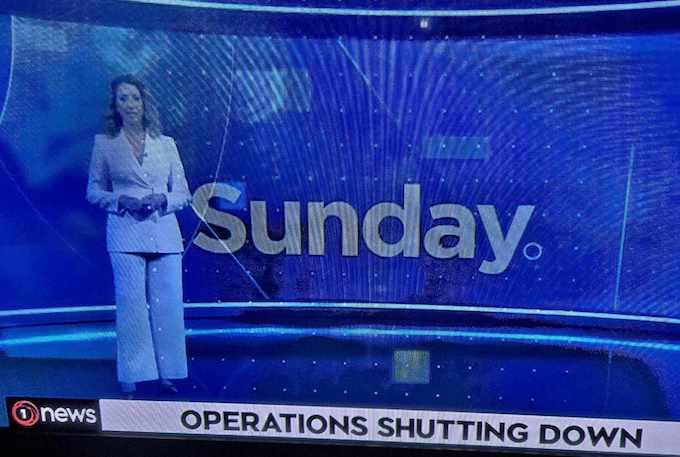
A grim 48 hours for news media has resulted in many jobs being lost in the sector — as TV3 confirmed the closure of Newshub, and TVNZ announced it was going ahead with axing its current affairs flagship Sunday, consumer affairs Fair Go and two news bulletins.
About 250 jobs are being lost in the shutdown of Three’s national news service, which will close in July.
How the country’s largest daily newspaper, The New Zealand Herald, reported the news and current affairs closure plans today. NZH screenshot APR
He was among seven senior Newshub journalists who pushed back against the company’s proposal and put forward their own plan.
The proposal, led by his colleague Michael Morrah, was “radical”, “aggressive” and would have pared the news operation back to the bone, he said.
It centred on the 6pm bulletin which brought in a lot of advertising revenue, retain the website and would later build up the digital operation.
“Basically it was a cutdown radical proposal to hang on to the 6pm bulletin and find digital solutions out into the future.”
While management gave them access to figures and helped them in other ways they ultimately decided not to go ahead.
Newshub journalist Paddy Gower . . . “It’s gonna be a dark time for news in this country.” Image: RNZ/Nick Monro
He said when the closure was confirmed, there was a feeling of “the weight of history” at the loss of a taonga which Kiwis would miss when it disappeared.
“It’s gonna be a dark time for news in this country,” he said.
Gower said Warner Bros Discovery would have “a helluva time” keeping viewers without Newshub providing news and current affairs.
“We tried. That’s the Kiwi way. That’s the Newshub way.”
He said another media company, such as Stuff or NZME, could now come in and further their own news brand and their reputation by saving part of a significant news operation.
They would oversee the making of a 6pm news bulletin that would be sold to Warner Bros Discovery and in the process be working with one of the world’s leading media companies.
“That has to be a possibility . . . They would be seen to be saving news in New Zealand and that’s a big ups for them . . .
“The company that is able to get that deal done …. is going to get some incredible journalists on board to help them do it,” Gower said.
It would probably save about 40 to 50 jobs, he said.
Warner Brothers Discovery declined to be interviewed by Morning Report.
NZ’s Media and Communications Minister Melissa Lee . . . accused of “having no vision at all” for media. Image: RNZ/Angus Dreaver
Broadcasting Minister accused of lack of vision Former head of news at TV3 Mark Jennings believed Broadcasting Minister Melissa Lee was “all at sea” as the country veered towards a media crisis.
He found her response to the Newshub closure confusing and did not believe the cabinet paper she has been working on would provide anything beneficial.
“I think you’re likely to have three parties, New Zealand First, ACT and National, all with different points of view and I can’t see them agreeing on any forward course of action, particularly not with Melissa Lee who appears to have no vision here at all.”
Jennings said he was notsurprised the Morrah-Gower plan did not succeed, because employers had considered other options and then made up their minds before the consultation period began.
If an offer from an outside organisation did get the go-ahead, it would be a “basic product” and would be “news-light”, he said.
It might be shot on i-Phones and edited by journalists and would not resemble Newshub’s current flagship bulletin.
While both the pandemic and social media had lowered the quality threshold of what viewers might accept, it would still be compared to what TVNZ was screening.
“The challenge will be for them to hold on to their ratings and more importantly, their share. Their share has been decreasing over time and if it gets too much lower, they’ll find themselves back at square one really.”
Minister Lee was unwilling to be interviewed by Morning Report.
She said she was focused on ensuring New Zealand’s media industry was sustainable and modernised, and she was looking at reviewing the Broadcasting Act.
Lee said she had talked to international companies on how they could support and increase New Zealand screen production, but it would not include a quota.
She said it would not have helped the situation at Newshub.
Not much scope for NZ on Air New Zealand on Air chief executive Cam Harland said the agency had a limited ability to intervene because its remit was to provide funding for a large number of audiences across a range of genres.
He heads the agency responsible for distributing public funds but its budget isn’t nearly enough to address shortfalls.
Daily television news was expensive to produce, so he considered it unlikely NZ on Air would help much, he told Morning Report.
The loss of jobs and talent was “monumental” and NZ on Air bosses intended to meet with TVNZ and Newshub as well as senior journalists, such as Jennings, to get more information before making any decisions.
“We absolutely want to help . . . so I guess our view now is: Can we be more innovative with what we’re funding, can we get more bang for the buck?”
The organisation was also faced with reviewing its spending in line with the government’s requirements for the public sector.
Union files claim against TVNZ
Michael Wood . . . “It’s an urgent matter now . . .” Image: RNZ/Angus Dreaver
The union representing journalists has filed a claim against TVNZ alleging the company breached its own consultation requirements in its job cuts process.
E Tu’s negotiation specialist, Michael Wood, said the broadcaster should have involved its employees before the proposal was presented.
Talks were continuing with the Employment Relations Authority to see if a legal case could be heard as quickly as possible.
“It’s an urgent matter now . . . We’ll be trying to get an outcome there as soon as possible and we want to see an outcome that respects the process.”
He said mediation between the parties might be a part of the process.
While the union and employees had a small victory with a handful of jobs being saved, there was still “a massive loss of capacity” with the axing of several programmes.
This article is republished under a community partnership agreement with RNZ.
Analysis and Opinion by Tim Beal. This article was first published on Pearls and Irritations (ref. https://johnmenadue.com/new-zealand-nearly-sanctions-the-united-nations/ )
The Bank of New Zealand blocks a donation to UNRWA, then thinks again. Like many people I have been horrified by Israel’s genocidal war against the Palestinians. I have made modest donations to UNICEF, partly to help but also, I must admit, to appease my conscience. I was particularly inflamed by the Israeli government’s attempt to close down the United Nations Relief and Works Agency for Palestine Refugees in the Near East (UNRWA).This is the major agency providing relief for the Palestinians, and so a natural target for the Israeli government.
I attempted to make a donation. This would both help the Palestinians but also be a protest against Israeli repression. The easiest way seemed to be to make a direct transfer from my account with the Bank of New Zealand (BNZ) to an UNRWA bank account, of which there are eight. The most suitable seemed to be Bank Austria in Vienna. I filled in the required details, pressed the button, and the money flew from my account.
But it didn’t end up at its destination.
A day or so later, I got this message from the BNZ:
Payment held SSA – CPIT27136644
Good afternoon, There is a payment of EUR100 currently held by BNZ Sanctions/Compliance department. We understand and sympathise with the current situation in Palestine, however for our compliance and your security, as this is a new payee based in or near a conflict area we have some further questions which we require to be provided before we can release this payment.
1. Detailed purpose of payment and copy of invoice (if applicable) 2. Please advise of any underlying parties or beneficiary of funds. Please include full name, physical address and website of the underlying party/beneficiary of funds 3. Please advise if the payment (including all parties involved) has any direct or indirect relation to ‘the government of Gaza’ 4. Please advise if the payment has any direct or indirect relation to Iran, North Korea, Russia, Syria, Venezuela, Cuba, Crimea, Donetsk or Luhansk regions. If yes, please explain
The ‘usual suspects’ and none with relevance to New Zealand. And as for Cuba, the UN General Assembly has repeatedly called for sanctions to be lifted; last year 187 countries (including NZ and Australia) voted in favour with only two opposing – United States and Israel.
Then followed some computer gobbledygook and ended with:
For more on why we are asking for this information, please refer to our bnz website here.
Quite a list of unanswerable or meaningless questions, but the key phrase was the reference in Q3 to ‘the government of Gaza.’ That is, the victim of genocidal oppression, not the perpetrator. But then banks and morality make uncomfortable bedfellows. No objection to sending money to Israel – don’t suppose my €100 would buy many bullets, but probably enough to kill a family of five.
The links to the web pages on sanctions are informative, and damning. We are told that:
We follow sanctions laws from New Zealand as well as those from relevant overseas sanctions authorities.
One might ask, what overseas sanctions authorities should the BNZ follow except the United Nations Security Council (UNSC)? That’s what the pundits on international law tell us. But no. Firstly, the Bank of New Zealand, despite its name, is owned by the National Australia Bank (NAB). The list of sanctions authorities obeyed by BNZ, who’s in, who’s out (no sign of China or India), and its order, is instructive:
New Zealand Ministry of Foreign Affairs and Trade
Australian Department of Foreign Affairs and Trade
U.S. Office of Foreign Asset Control
U.K. Office of Financial Sanctions Implementation
Monetary Authority of Singapore
European Union
United Nations Security Council.
DFAT is there, at number 2, but it is the next one – US Office of Foreign Asset Control (OFAC) -which is in fact the kingpin. It runs not merely the US sanctions regime but that of ‘The West’ in general, and with unbridled enthusiasm. It is a financial Weapon of Mass Destruction, inflicting pain, immiseration and often death around the world. Sanctions, after all, are essentially a weapon of war, so destruction is to be expected. And at the bottom of the list of authorities is the UNSC
The BNZ, of course, puts a rather different gloss on things:
Sanctions are restrictions on trade and financial transactions. They aim to cut off resources to stop aggressive and harmful activity, for example, terrorism, nuclear proliferation, military conflicts, or human rights abuse.
No mention of genocide there. That’s a relief. Similarly nuclear proliferation rather than nuclear weapons as such; that’s good news for the Pentagon’s plans to modernise its huge nuclear arsenal. Military conflict? Surely not the US?
I’ve written a bit on sanctions, and I am familiar with the New Zealand government’s blocking of aid to the Red Cross in North Korea, but this case was somewhat different. BNZ, obeying ‘sanctions authorities’, was imposing sanctions on an agency of the United Nations itself.
I sent a polite reply to BNZ:
Good afternoon XXXXX
Thanks for your email.
I’m rather bemused. Since this is a donation to an agency of the United Nations – the United Nations Relief and Works Agency for Palestine Refugees in the Near East (UNRWA) – I presume you are not suggesting that it contravenes UN sanctions.
So this is a matter of New Zealand Government sanctions?
If so, is there a specific regulation I should be aware of?
Tim
Easter intervened (is there a message there?) and then came a reply from BNZ:
Thank you for the below information.
We have now released the payment.
Why the change of heart, I don’t know.
Perhaps the amount of money was so small that the administrative hassle wasn’t worth it? Perhaps someone in authority realised that taking action against a UN relief organisation, especially in the current circumstances, could lead to damaging publicity? Perhaps the good people at BNZ were embarrassed at blocking aid to the victims in Gaza?
And I have no reason to suppose that these weren’t good people. And that leads to thoughts of the Eichmann case and Hannah Arendt’s phrase ‘the banality of evil.’ Good people – or at least ordinary people who are not consciously sadistic or unfeeling – doing evil things. People in bureaucracies not concerning themselves with the consequences of their actions. People thinking, with little scrutiny, they are doing good but in fact causing harm.
Sanctions are, in general, weapons employed by the strong against the weak, an instrument to coerce them into yielding sovereignty and resources, and to sacrifice their interests to the benefit of the aggressor. Israel, backed by the US, against the Palestinians with sanctions as one weapon in the armoury. It is Israel that should be sanctioned, but instead it is provided with weapons with which to kill tens of thousands of women, men and children in Gaza. And the BNZ instinctively started to sanction the victims.
The Banality of Evil meets the Theatre of the Absurd.
*******
EDITOR’S NOTE: The New Zealand Ministry of Foreign Affairs and Trade details the New Zealand Government’s policy on sanctions here. ( ref. https://www.mfat.govt.nz/en/peace-rights-and-security/un-sanctions/ )
Tim Beal raises a significant issue where foreign owned banks operating in New Zealand, such as the BNZ, may be obeying sanctions authorities issued by governments of other countries including; Australia, the United States of America, United Kingdom, and the European Union.
By the 1870s, photography was a ubiquitous presence in the colonial life of Aotearoa New Zealand. For Māori, however, it was also a colonising tool – part of the colonial practices of land alienation, war and propaganda that affected them so deeply.
A collaboration between Tāmaki Paenga Hira–Auckland War Memorial Museum, the Alexander Turnbull Library and Hocken Collections Uare Taoka o Hākena, the exhibition and associated book from Auckland University Press showcase the photographic riches of three nationally significant collecting institutions.
Starting with the arrival of photography in Aotearoa in the 1840s, the book and exhibition chart technological developments and cover a wide range of photographic genres, from studio portrait to amateur photography.
These photographic beginnings were deeply embedded in the making of the settler state. Its invention coincided precisely with the signing of Te Tiriti o Waitangi/Treaty of Waitangi in 1840, which ushered in formal British colonisation.
And it was also in the region where Te Tiriti was signed that Captain Lucas of the French barque Justine is believed to have experimented with making daguerreotypes in 1840-41.
Because of these links, photography’s technological development and its different uses can’t be understood without reference to the political, cultural and economic contexts of colonisation.
The settler lens
Photographs are complicit in colonialism because they were used to document the impacts of migration, settlement and land transformation. For example, they illustrate the advance of settlement and the subjugation of Māori after the Waikato War (1863-64).
Imperial officers such as William Temple, who was active in military campaigns to advance European settlement, photographed two icons of colonisation: roads and military camps.
An Irish-born soldier, Temple followed the Great South Road on foot and with his camera as the route advanced towards the border of Kiingitanga territory. One of his photographs (above) demonstrates the impacts of the Great South Road on the local environment.
Photography’s commercial interests also aligned with colonial propaganda, especially as landscape photography grew in popularity from the 1870s. Historian Jarrod Hore has demonstrated how landscape photographers helped shape settler attitudes to the environment, but also documented colonial progress.
Photographs were used to illustrate engineering successes and the advancing tide of settlement. For instance, John McGregor’s 1875 photograph (below) depicts the clearing of Bell Hill in Dunedin. In the background, the church embodies the possibilities of colonial advancement enabled by environmental transformation.
Our early photographers were, in Hore’s words, engaged in “settler colonial work” because they “mobilised and visually reorganised local environments in the service of broader settler colonial imperatives”.
The photograph as taonga
Indigenous peoples were a particular focus of early photography in other settler colonial societies. New Zealand followed this pattern and Māori feature prominently in our colonial photographic record.
As soon as photography arrived in the colony, Māori were captured by the camera. Itinerant daguerreotype photographers travelled the new colony in the 1840s and 1850s to exploit the commercial opportunities available in new colonies such as New Zealand.
Reproduction of colonial tropes became common in commercial photography, reflecting the collectability of Māori as photographic subjects. The carte-de-visite, popular from the 1860s and of a size that could easily be posted, meant images of Māori found their way into albums all around the world.
Such images became an important part of the business for studio photographers in the colonial period.
At different times, and depending on the context, Māori embraced or rejected photography. Because of its colonial implications, Māori whānau and communities have a complicated relationship with the camera. But, as scholars Ngarino Ellis and Natalie Robertson argue, there is evidence it was regarded as friend as much as foe.
Māori have long integrated visual likenesses into customary practices, such as tangihanga (funerals), while portraits adorn the walls of wharenui across the country.
Colonial photographs are culturally dynamic. Their integration into Māori life means they do not just depict relationships but are imbued with them. As such, photographs are taonga (treasures) and connect people across time and space.
Māori also took up the camera. Canon Hākaraia Pāhewa, for instance, was a skilled photographer who took his camera on his pastoral rounds, during which he recorded scenes of daily life.
He depicted people at work and documented transformations of landscapes, important cultural events, religious service and domestic routines. These photographs bring to light the diversity and richness of Māori life in the early 20th century.
Māori whānau already valued and used photographs in a variety of ways in the 19th century. Photographs were memory containers, mementos of family, markers of personal transformation, and generators of social connection.
Designed to be shared and displayed, photographs were prompts for discussion and storytelling. They are visual records of whakapapa, identity and notions of belonging. They also mark Indigenous presence and survival in the face of settler colonialism.
At the same time, though, photography’s role in advancing colonialism meant Māori were cautious about the reproduction of images. There was an awareness of what could happen to photographs once they were out of the subject’s control.
In 1907, Te Whiti, the Māori prophet and leader of the pacifist settlement at Parihaka, died. Established in 1869, Parihaka attracted thousands of Māori during the 1870s. Many of them were dispossessed by the wars of the 1860s and 1870s. In 1881, over 1,500 armed constabulary invaded the community, whose residents met them with passive resistance.
Te Whiti had always refused to have his photograph taken, as did his co-leader Tohu Kākahi. Ironically, their settlement was richly documented by photographers when the two men were alive, and has inspired many artists ever since.
The writer William Bauckeclaimed Te Whiti “detested with horror photographs and prints in which the protruding tongue and inverted eyeball are depicted as symbolic of the Maori”.
Baucke certainly embellished this description, but Te Whiti did fear that a photographic likeness, if taken, would undermine his ability to control his self-image. He didn’t always succeed in controlling the camera, as James McDonald’s painting (below), based on a photograph, shows.
Visual sovereignty
In refusing to be photographed, Te Whiti was engaging in what Tuscarora scholar, artist and curator Joelene Rickard characterises as Indigenous visual sovereignty.
Rickard has used this concept to describe how Indigenous photographers today are making “assertions of spiritual and political sovereignty”. But she is also highlighting long traditions of Indigenous art-making as sources of empowerment and assertions of sovereignty.
Te Whiti’s refusal to be captured by the camera was an act of visual sovereignty because he recognised the qualities that made a photograph so exciting also made it dangerous: it was portable, collectable, and it was a business.
Right now in Aotearoa New Zealand, when the political climate is hostile to Te Tiriti, te reo Māori and tino rangatiratanga, it is important to be reminded that Māori resistance and resurgence have long histories.
They appear in our photographic record in numerous forms – in Hākaraia Pāhewa’s record of the vitality, dynamism and energy of Māori life in the early 20th century, and in Te Whiti’s refusal to engage with photography, which undermined its power as a settler colonial technique.
Te Whiti’s rejection of the camera is suggestive for historians of photography, too. Rather than seeing Māori refusal to engage with photography as embodying a fear of a new technology, perhaps it was a denial of the settler colonialism the camera embodied – a claim to visual sovereignty and the ability to control one’s self-image.
A Different Light – First Photographs of Aotearoa: Auckland War Memorial Museum, April–September; Adam Art Gallery, Wellington, December 2024–June 2025; Hocken Collections, Dunedin, August 2025–January 2026.
Angela Wanhalla does not work for, consult, own shares in or receive funding from any company or organisation that would benefit from this article, and has disclosed no relevant affiliations beyond their academic appointment.
One of Brazil’s top scientists, Eneas Salati, once said, “The best thing you could do for the Amazon rainforest is to blow up all the roads.” He wasn’t joking. And he had a point.
In an article published today in Nature, my colleagues and I show that illicit, often out-of-control road building is imperilling forests in Indonesia, Malaysia and Papua New Guinea. The roads we’re studying do not appear on legitimate maps. We call them “ghost roads”.
What’s so bad about a road? A road means access. Once roads are bulldozed into rainforests, illegal loggers, miners, poachers and landgrabbers arrive. Once they get access, they can destroy forests, harm native ecosystems and even drive out or kill indigenous peoples. This looting of the natural world robs cash-strapped nations of valuable natural resources. Indonesia, for instance, loses around A$1.5 billion each year solely to timber theft.
All nations have some unmapped or unofficial roads, but the situation is especially bad in biodiversity-rich developing nations, where roads are proliferating at the fastest pace in human history.
Mapping ghost roads
For this study, my PhD student Jayden Engert and I worked with Australian and Indonesian colleagues to recruit and train more than 200 volunteers.
This workforce then spent some 7,000 hours hand-mapping roads, using fine-scale satellite images from Google Earth. Our team of volunteers mapped roads across more than 1.4 million square kilometres of the Asia-Pacific region.
As the results rolled in, we realised we had found something remarkable. For starters, unmapped ghost roads seemed to be nearly everywhere. In fact, when comparing our findings to two leading road databases, OpenStreetMap and the Global Roads Inventory Project, we found ghost roads in these regions to be 3 to 6.6 times longer than all mapped roads put together.
Mapped roads in northeastern Borneo using a leading road database, OpenStreetMap (left), and with the ghost roads identified in this study added (right). Author provided, CC BY-NC-ND
When ghost roads appear, local deforestation soars – usually immediately after the roads are built. We found the density of roads was by far the most important predictor of forest loss, outstripping 38 other variables. No matter how one assesses them, roads are forest killers.
What makes this situation uniquely dangerous for conservation is that the roads are growing fast while remaining hidden and outside government control.
But safeguarding parks does have an effect. In protected areas, we found only one-third as many roads compared with nearby unprotected lands.
The bad news is that when people do build roads inside protected areas, it leads to about the same level of forest destruction compared to roads outside them.
Our findings suggest it is essential to limit roads and associated destruction inside protected areas. If we can find these roads using satellite images, authorities can too. Once an illegal road is found, it can be destroyed or at least mapped and managed as a proper legal road.
Keeping existing protected areas intact is especially urgent, given more than 3,000 protected areas have already been downsized or degraded globally for new roads, mines and local land-use pressures.
Illicit roads cause destruction worldwide, from carbon emissions from the burning of Amazonian forest for cattle pasture (A), to road building and forest destruction in central Africa (B), to poaching of rare animals such as this forest elephant killed by poachers near a Congo Basin road (C). M. Andreae (A) and W. Laurance (B,C), CC BY-NC-ND
Hidden roads and the human footprint
The impact we have on the planet differs from place to place. To gauge how much impact we’re having, researchers use the human footprint index, which brings together data on human activities such as roads and other infrastructure, land-uses, illumination at night from electrified settlements and so on. You can use the index to make heat-maps showing where human impacts are most or least pronounced.
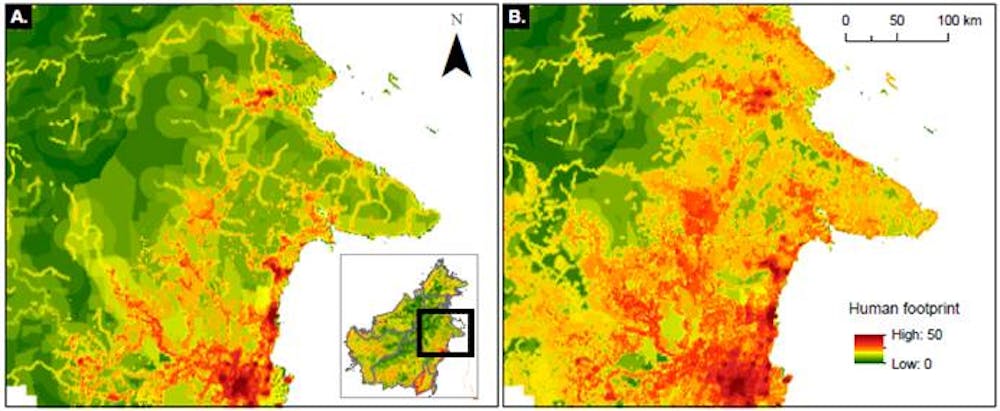
We fed our ghost road discoveries into the index and compared two versions for eastern Borneo, one without ghost road information and one with it. The differences are striking.
When ghost roads are included in mapping the human impact on eastern Borneo, areas with “very high” human disturbance double in size, while the areas of “low” disturbance are halved.
This is what the human footprint heatmap for east-central Borneo looks like, first without ghost roads (A) and second with ghost roads included (B). Author provided, CC BY-NC-ND
Artificial intelligence
Researchers investigating other biodiversity-rich developing regions such as Amazonia and the Congo Basin have found many illegal unmapped roads in those locales too.
Ghost roads, it seems, are an epidemic. Worse, these roads can be actively encouraged by aggressive infrastructure-expansion schemes — most notably China’s Belt and Road Initiative, now active in more than 150 nations.
For now, mapping ghost roads is very labour-intensive. You might think AI could do this better, but that’s not yet true – human eyes can still outperform image-recognition AI software for mapping roads.
At our current rate of work, visually mapping all roads – legal and illicit – across Earth’s land surface just once would require around 640,000 person-hours (or 73 person-years) to complete.
Given these challenges, our group and other researchers are now testing AI methods, hoping to provide accurate, global-scale mapping of ghost roads in close to real time. Nothing else can keep pace with the contemporary avalanche of proliferating roads.
We urgently need to be able to map the world’s roads accurately and often. Once we have this information, we can make it public that so authorities, NGOs and researchers involved in forest protection can see what’s happening.
Without this vital information, we’re flying blind. Knowing what’s happening in the rainforest is the first step to stopping the destruction.
Distinguished Professor Bill Laurance receives funding from the Australian Research Council and other scientific and philanthropic bodies. He is a former Australian Laureate and director of the Centre for Tropical Environmental and Sustainability Science at James Cook University.
Over the last year, our oceans have been hotter than any time ever recorded. Our instrumental record covers the last 150 years. But based on proxy observations, we can say our oceans are now hotter than well before the rise of human civilisation, very likely for at least 100,000 years.
This isn’t wholly unexpected. Ocean temperatures have been steadily rising due to human-caused global warming, which in turn means record hottest years have become increasingly common. The last time ocean temperature records were broken was 2016 and before that it was 2015. The last year we experienced a record cold year was way back at the start of the 20th century.
But what is remarkable about the past year is the huge ongoing spike in global ocean temperature which began in April last year. Last year was hotter than the previous record year by a whopping 0.25°C. In contrast the margins of other previous record years were all less than 0.1°C.
Why? Global warming is the main reason. But it doesn’t explain why the heat spike has been so large. Climate drivers such as El Niño likely play a role, as do the random alignment of certain weather events and possibly the reduction in sulfur emissions from shipping. Researchers around the world are trying to understand what’s going on.
Averaged ocean surface temperatures between 60 degrees south and 60 degrees north of the equator, inspired by ClimateReanalyzer.org. Each coloured line represents the temperature of a single year. Author provided, CC BY
The trend is clear to see. Earlier years (in blue) are typically cooler than later years (in red), reflecting the relentless march of global warming. But even with this trend, there are outliers. In 2023 and 2024, you can see a huge jump above previous years.
These record temperatures have been widespread, with the oceans of the southern hemisphere, northern hemisphere and the tropics all reaching record temperatures.
What’s behind the surge?
We don’t yet have a complete explanation for this record burst of warming. But it’s likely several factors are involved.
First, and most obvious, is global warming. Year on year the ocean is gaining heat through the enhanced greenhouse effect – indeed over 90% of the heat associated with human-caused global warming has gone into the oceans.
The extra heat pouring into the oceans results in a gradual rise in temperature, with the trend possibly accelerating. But this alone doesn’t explain why we have experienced such a big jump in the last year.
Then there are the natural drivers. The El Niño event developing in June last year has certainly played a substantial role.
El Niño and its partner, La Niña, are opposite ends of a natural oscillation, the El Niño Southern Oscillation, which plays out in the tropical Pacific ocean. This cycle moves heat vertically between the ocean’s deeper waters and the surface. When El Niño arrives, warmer water comes up to the surface. During La Niña, the opposite occurs.
You can see the impact of an El Niño on short term temperature spikes clearly, even against a backdrop of strong long-term warming.
But even climate change and El Niño combined aren’t enough to explain it.
Other natural heat-transferring oscillations, such as the Indian Ocean Dipole or the North Atlantic Oscillation, may play a role.
It may also be that our successful efforts to cut aerosol pollution from the dirty fuel shipping relies on has had an unwanted side effect: more warming. With less reflective aerosols in the atmosphere, more of the Sun’s energy can reach the surface.
But there’s probably also a level of random chance. Chaotic weather systems over the ocean can reduce cloud cover, which can let in more solar radiation. Or these weather systems could weaken winds, reducing cooling evaporation.
To us, a warmer ocean might feel pleasant. But the extra heat manifests underwater as an unprecedented series of major marine heatwaves. The ocean’s organisms are picky about their preferred temperature range. If the heat spikes too much and for too long, they have to move or die.
Marine heatwaves can lead to mass death or mass migration for marine mammals, seabirds, fish and invertebrates. They can cause vital kelp forests and seagrass meadows to die, leaving the animals depending on them without shelter or food. And they can disrupt species important for fisheries and tourism.
This year’s heat stress has caused widespread coral bleaching around the world. Bleaching has been seen on reefs in the Caribbean, Florida, Egypt, and the Great Barrier Reef.
In the cooler waters of Tasmania, extraordinary conservation efforts have been put in place to try and protect endangered fish species such as the red handfish from the heat, while in the Canary Islands, small scale commercial fisheries have popped up for species not normally found there.
Last year, Peru’s anchovy fishery – the country’s largest – was closed for long periods, leading to export losses estimated at A$2.1 billion.
Given the record temperatures stem from a combination of human-induced climate change and natural sources, it’s very likely ocean temperatures will drop back to more “normal” temperatures. Normal now is, of course, much warmer than in previous decades.
If this eventuates, we might see slightly cooler temperatures than the new normal, but it’s still too early to know for sure.
One thing is certain though. As we struggle to rein in greenhouse gas emissions, the steady march of global warming will keep adding more heat to the oceans. And another spike in global ocean warming won’t be too far away.
Alex Sen Gupta receives funding from receives funding from the Australian Research Council.
Matthew England receives funding from the Australian Research Council.
Neil Holbrook receives funding from the Australian Research Council and Australia’s National Environmental Science Program.
Thomas Wernberg receives funding from The Australian Research Council, The Norwegian Research Council, The Schmidt Marine Technology Partners and Canopy Blue. Thomas is also affiliated with the Institute of Marine Research, Norway and Rosklide University, Denmark.
Zhi Li receives funding from the Australian Research Council (ARC) Centre for Excellence in Antarctic Studies (ACEAS).
Kathryn Smith does not work for, consult, own shares in or receive funding from any company or organisation that would benefit from this article, and has disclosed no relevant affiliations beyond their academic appointment.
Source: The Conversation (Au and NZ) – By Mandy Hughes, Senior Lecturer in Sociology and Social Science Course Co-ordinator, Southern Cross University
The pursuit of the dream of classical music is not an equal playing field.
My recent study looked at the inequalities rural and regional young classical musicians face, which are unknown to their city-based counterparts.
There are systemic music inequalities in Australia based on where you live and where you go to school. Inner-city, private school kids are often the most likely to access music education. Kids living in rural areas are the least likely to have music opportunities.
Music inequality also exists between states. Queensland has had a long tradition of offering accessible instrumental music lessons and ensembles, but most other states fall short. Many children cannot access instrumental music education.
Rural and regional kids face multiple layers of disadvantage. These include the lack of specialist teachers, resources and opportunities, and the time and expense of travelling long distances for music camps and auditions.
These challenges compound and these students may be less likely to go on to tertiary education and careers in classical music.
To support young people’s musical aspirations, we need to understand how location and disadvantage can create music inequalities.
In my research I spoke with nine classical musicians from regional areas aged 14–21 to better understand the particular challenges they face.
One person I interviewed described the difference between city and rural music journeys:
To compare my journey to some of my peers who’ve grown up in the city, some of them learned from a teacher who had reached an elite level, a professional level, on the instrument […] right from square one. So, they were set up with amazing technique and they had the opportunity to go to schools that had an amazing music program.
My study participants often struggled to find a sense of belonging in communities where classical music was not visible or popular.
One musician reflected on their feelings of isolation and lack of understanding from their non-music peers:
I am really into classical music. I just love the music. I love all of it so much. I go so deep into it. I don’t think I know anyone who’s really like that.
The absence of like-minded peers can be an obstacle to young people’s musical advancement and potential careers. One person told me:
The key way to advance your skills is to make music with people your age, and also people your age who are a lot better than you are […] it really pushes you to be more like them.
‘My first experience with a real orchestra’
Successful initiatives to reduce institutional inequality must recognise the particular experiences and needs of young non-metropolitan classical musicians. They must be tailored to develop skills, foster a sense of connectedness and create a bridge to what might otherwise be an inaccessible network of other musicians – both fellow students and professionals.
Small towns may not have the capacity to attract large-scale professional orchestras, but increasingly new education initiatives are being developed to fill this gap and break down location-based barriers. And regional chamber music tours have become the norm for some organisations.
One initiative to address music inequality is the Regional Youth Orchestra NSW, created by regional conservatoriums. The NSW regional conservatoriums are located in diverse communities and aim to address disadvantage by offering inclusive music opportunities.
The youth orchestra program brings together young musicians from across rural and regional NSW several times a year for intensive residential music camps.
Youth orchestras support musical development and increase confidence, social connections and wellbeing. Increasingly in Australia and internationally, youth orchestra programs aim to address inequality and make classical experiences available to a wider population by responding to local contexts and connecting students to music networks.
Regional Youth Orchestra NSW links talented young musicians with professional classical musicians to perform at iconic venues. As one participant told me:
You go from not even having a theatre in your hometown to all of a sudden you’re playing in the [Sydney] Opera House.
In my research, I found Regional Youth Orchestra NSW had the benefit of connecting young musicians who shared a regional perspective and so faced many similar challenges. They were supported to play challenging repertoire not available to them in their region and were mentored by world-class classical musicians. This fuelled their passion to pursue musical futures.
One study participant commented that they were the only young violinist in their town. Despite being an advanced player, they had little experience of playing music with others:
It was actually my first experience with a real orchestra […] I’m very fortunate for that, and I’m really glad I got to do that […] I’d never really even met an oboist before.
Another participant said:
Some of the opportunities we got were quite amazing […] I don’t think any of my city peers have ever gotten to work with Australian World Orchestra or Staatskapelle Berlin […] I would go so far as to say that [Regional Youth Orchestra NSW] changed my life.
‘It doesn’t matter where you come from’
Participating in Regional Youth Orchestra lit the fire for these young musicians and prepared them to follow their music dreams.
The five Regional Youth Orchestra alums who participated in my research are studying music at city-based tertiary conservatoriums, and all mentioned how this orchestra shaped their future music pathway. As one told me:
I’m determined to prove that it doesn’t matter where you come from. Music is
something everyone can do. Being in a regional area shouldn’t make a difference.
Mandy Hughes does not work for, consult, own shares in or receive funding from any company or organisation that would benefit from this article, and has disclosed no relevant affiliations beyond their academic appointment.
New Zealand’s youth mental healthcare continues to experience a rolling crisis with long waiting times for services. There have been calls to expand the mental health workforce and to diversify the range of available services.
But improving the quality of mental healthcare is also an important priority. As our research shows, it can help to shorten bulging waiting lists and retain staff in the workforce.
Better implementation of proven therapies is a key component of delivering quality care – effective, safe, people-centred, culturally responsive and equity enhancing care that leads to improved outcomes for patients.
This obviously has direct benefits, but there are indirect benefits, too. Quality care can result in people spending less time in treatment and services having greater capacity and shorter wait times. It can also increase clinician satisfaction, and mitigate burnout and workforce attrition.
Training is necessary, but not sufficient
Most clinicians working in mental health are trained in evidence-based therapies. These are often talking therapies that have been proven effective for most people through research studies such as clinical trials.
But internationally there is often a gap between what clinicians are trained to do and what they actually do at the bedside or in the therapy room.
Large studies of treatments in general healthcare across multiple conditions and age ranges have shown only about 60% of healthcare is currently aligned with evidence-based guidelines. According to this research, 30% is “waste, duplication or of low value” and 10% is actually harmful.
In Aotearoa, there are countless examples of this “know-do” gap. Many mental health services deliver therapies based on dialectical behaviour therapy to help young people and adults improve their emotional regulation. But few deliver these in the way they were designed.
As clinicians working within mental health services, we have seen that good people are trying to do good things for those in need. Thanks to many decades of research, there’s substantial knowledge about what works for improving mental health.
There will always be a need to develop and adapt therapies, but a central challenge is better implementation of those we already have.
Better implementation of therapies that have been shown to work could mean people spend less time in treatment. Getty Images
Better implementation of proven therapies
Implementation science is a relatively new field. It studies methods to enhance the adoption, implementation and sustained delivery of evidence-based practices to improve the quality of routine care.
Rather than asking tired clinicians to do more, implementation science can identify the influences on clinician behaviour and target supports accordingly. Implementation science teaches us that providing guidelines or training in evidence-based therapy is necessary, but often not enough to achieve quality care.
Complex factors such as a clinician’s belief in their own capability, attitudes, intentions and emotions can have a powerful influence on how well they implement therapies. So can team or service-related factors such as leadership, wider organisational culture and climate, policy, priorities and resourcing.
To improve implementation of evidence-based therapies, it’s essential to first understand and prioritise the enablers and barriers clinicians experience in their daily work. Next, it’s important to carefully choose implementation supports or strategies to address these barriers.
In our research, clinicians trained in Parent-Child Interaction Therapy often lacked necessary equipment.
International examples of implementation support come from a large project that provides more than 70 strategies to improve care. These include identifying local opinion leaders or quality champions, auditing care delivery, providing supervision and feedback to clinicians, and creating professional learning collaborations.
Quality in action
In Aotearoa New Zealand, we see encouraging examples of better implementation already underway. Health New Zealand-Te Whatu Ora is rolling out national clinical networks, including one dedicated to mental health. Their aim is to promote national standards for care quality in partnership with whānau, consumers and local communities.
Beyond mental health, apparently simple solutions such as surgical checklists have been shown to substantially improve quality, even in resource-limited settings.
Exciting initiatives in neighbouring health fields can also inform implementation in mental health. A new equity-focused implementation framework based on Te Tiriti o Waitangi but designed to support mainstream services provides guidance for implementation planning, monitoring and evaluation.
People deserve access to effective mental healthcare. Unless we urgently prioritise its quality, we are at risk of developing an ill-equipped workforce that turns over rapidly, or creating a situation where fully-staffed teams deliver low-value care.
Given we’re living in resource-constrained times, we must ensure care is the best it can be. Service leaders, funders and policymakers must urgently consider how we can best equip existing and new staff to deliver quality care, based on insights from implementation science.
It cannot be postponed until services are fully staffed and waitlists have disappeared.
Melanie Woodfield works as a clinical psychologist for Te Whatu Ora (Health New Zealand). She receives funding from the Health Research Council of New Zealand.
Hiran Thabrew does not work for, consult, own shares in or receive funding from any company or organisation that would benefit from this article, and has disclosed no relevant affiliations beyond their academic appointment.
Hundreds of thousands of people worldwide are taking drugs like Ozempic to lose weight. But what do we actually know about them? This month, The Conversation’s experts explore their rise, impact and potential consequences.
Obesity medication that is effective has been a long time coming. Enter semaglutide (sold as Ozempic and Wegovy), which is helping people improve weight-related health, including lowering the risk of a having a heart attack or stroke, while also silencing “food noise”.
As demand for semaglutide increases, so are claims that taking it is “cheating” at weight loss or the “easy way out”.
We don’t tell people who need statin medication to treat high cholesterol or drugs to manage high blood pressure they’re cheating or taking the easy way out.
Nor should we shame people taking semaglutide. It’s a drug used to treat diabetes and obesity which needs to be taken long term and comes with risks and side effects, as well as benefits. When prescribed for obesity, it’s given alongside advice about diet and exercise.
Semaglutide is a glucagon-like peptide-1 receptor agonist (GLP-1RA). This means it makes your body’s own glucagon-like peptide-1 hormone, called GLP-1 for short, work better.
GLP-1 gets secreted by cells in your gut when it detects increased nutrient levels after eating. This stimulates insulin production, which lowers blood sugars.
GLP-1 also slows gastric emptying, which makes you feel full, and reduces hunger and feelings of reward after eating.
GLP-1 receptor agonist (GLP-1RA) medications like Ozempic help the body’s own GLP-1 work better by mimicking and extending its action.
Some studies have found less GLP-1 gets released after meals in adults with obesity or type 2 diabetes mellitus compared to adults with normal glucose tolerance. So having less GLP-1 circulating in your blood means you don’t feel as full after eating and get hungry again sooner compared to people who produce more.
GLP-1 has a very short half-life of about two minutes. So GLP-1RA medications were designed to have a very long half-life of about seven days. That’s why semaglutide is given as a weekly injection.
What can users expect? What does the research say?
Higher doses of semaglutide are prescribed to treat obesity compared to type 2 diabetes management (up to 2.4mg versus 2.0mg weekly).
A large group of randomised controlled trials, called STEP trials, all tested weekly 2.4mg semaglutide injections versus different interventions or placebo drugs.
Trials lasting 1.3–2 years consistently found weekly 2.4 mg semaglutide injections led to 6–12% greater weight loss compared to placebo or alternative interventions. The average weight change depended on how long medication treatment lasted and length of follow-up.
Higher doses of semaglutide are prescribed for obesity than for type 2 diabetes. fcm82/Shutterstock
Another recent trial in adults with pre-existing heart disease and obesity, but without type 2 diabetes, found adults receiving weekly 2.4mg semaglutide injections had a 20% lower risk of specific cardiovascular events, including having a non-fatal heart attack, a stroke or dying from cardiovascular disease, after three years follow-up.
Who is eligible for semaglutide?
Australia’s regulator, the Therapeutic Goods Administration (TGA), has approved semaglutide, sold as Ozempic, for treating type 2 diabetes.
However, due to shortages, the TGA had advised doctors not to start new Ozempic prescriptions for “off-label use” such as obesity treatment and the Pharmaceutical Benefits Scheme doesn’t currently subsidise off-label use.
When it’s available, doctors will be able to prescribe semaglutide to treat obesity in conjunction with lifestyle interventions (including diet, physical activity and psychological support) in adults with obesity (a BMI of 30 or above) or those with a BMI of 27 or above who also have weight-related medical complications.
What else do you need to do during Ozempic treatment?
Checking details of the STEP trial intervention components, it’s clear participants invested a lot of time and effort. In addition to taking medication, people had brief lifestyle counselling sessions with dietitians or other health professionals every four weeks as a minimum in most trials.
Support sessions were designed to help people stick with consuming 2,000 kilojoules (500 calories) less daily compared to their energy needs, and performing 150 minutes of moderate-to-vigorous physical activity, like brisk walking, dancing and gardening each week.
STEP trials varied in other components, with follow-up time periods varying from 68 to 104 weeks. The aim of these trials was to show the effect of adding the medication on top of other lifestyle counselling.
A review of obesity medication trials found people reported they needed less cognitive behaviour training to help them stick with the reduced energy intake. This is one aspect where drug treatment may make adherence a little easier. Not feeling as hungry and having environmental food cues “switched off” may mean less support is required for goal-setting, self-monitoring food intake and avoiding things that trigger eating.
But what are the side effects?
Semaglutide’s side-effects include nausea, diarrhoea, vomiting, constipation, indigestion and abdominal pain.
In on study these led to discontinuation of medication in 6% of people, but interestingly also in 3% of people taking placebos.
More severe side-effects included gallbladder disease, acute pancreatitis, hypoglycaemia, acute kidney disease and injection site reactions.
To reduce risk or severity of side-effects, medication doses are increased very slowly over months. Once the full dose and response are achieved, research indicates you need to take it long term.
Given this long-term commitment, and associated high out-of-pocket cost of medication, when it comes to taking semaglutide to treat obesity, there is no way it can be considered “cheating”.
Read the other articles in The Conversation’s Ozempic series here.
Clare Collins AO is a Laureate Professor in Nutrition and Dietetics at the University of Newcastle, NSW and a Hunter Medical Research Institute (HMRI) affiliated researcher. She is a National Health and Medical Research Council (NHMRC) Leadership Fellow and has received research grants from NHMRC, ARC, MRFF, HMRI, Diabetes Australia, Heart Foundation, Bill and Melinda Gates Foundation, nib foundation, Rijk Zwaan Australia, WA Dept. Health, Meat and Livestock Australia, and Greater Charitable Foundation. She has consulted to SHINE Australia, Novo Nordisk, Quality Bakers, the Sax Institute, Dietitians Australia and the ABC. She was a team member conducting systematic reviews to inform the 2013 Australian Dietary Guidelines update, the Heart Foundation evidence reviews on meat and dietary patterns and current Co-Chair of the Guidelines Development Advisory Committee for Clinical Practice Guidelines for Treatment of Obesity.
The winter sports season is about to begin. This means parents will soon find themselves on cold weekends, watching their kids on the sidelines of soccer, netball and footy matches.
As they stamp their feet to stay warm, they may find themselves wanting to offer encouragement or guidance. They may also find themselves expressing views about a controversial referee decision or becoming emotional about how their child or their child’s team is performing.
What impact does this have on your kids? How can you spectate in a helpful way?
Parents behaviour matters
A 2024 Australian pilot study surveyed 67 teenagers who play team sports and have parents watching from the sidelines.
It found if the parents were positive on the sidelines (cheering, encouraging athletes, helping if someone was hurt), young players were more likely to behave better towards their teammates and opponents.
The reverse was also true. Negative sideline behaviours (such as, yelling, swearing, put-downs, getting annoyed, reacting badly to a loss/foul) meant children were more likely to behave similarly on the field.
Parents behaviour can also influence how much a child enjoys a sport and whether they want to quit. As a 2016 US study noted:
if children perceive parents to engage in pressuring behaviors, such as excessive expectations, criticising play, or withdrawing love after competition it can lead to negative sporting experiences.
Research suggests parents behaviour on the sidelines has an impact on their kids’ behaviour on the field. Shutterstock
Bad behaviour leads to bans
Sports codes and clubs have clear guidelines around expected behaviour on and off the field. Parents, teams and coaches can be banned or penalised if they are abusive or violent. It is not OK to swear, make threats, or be aggressive towards coaches, umpires or players.
As an extreme example, in February, an under 16 basketball game descended into a brawl involving parents in Melbourne’s Reservoir. Both teams were banned for the rest of the season.
But it’s about more than brawling
But there are other ways parental behaviour can be negative for their children playing sport.
Common comments like “c’mon shoot”, “watch the ball” or “kick it harder” may seem helpful and supportive but they can also be controlling. They are not trusting children to simply play the game the best they can (and for that to be enough).
You could ask yourself: would I like these comments or find them helpful if I was playing?
These sorts of comments also very easily tip into more belittling remarks if children don’t respond or make a mistake. For example, “you’re playing too slowly, hurry up!”, “they’re all over you” or “that’s pathetic”. Criticising a child’s abilities either privately or in front of others undermines their confidence and self esteem.
Also avoid giving different instructions from the team’s coach. This can cause confusion and embarrassment for players.
Meanwhile, all this pressure from parents suggests winning is the most important thing. It means sport is less about fun, playing with friends and developing skills. It may simply lead to a child wanting to quit.
Any parent who has watched their child play will also know it is very hard to stay absolutely quiet. So if you do want to yell out, you could say something supportive, such as “that’s the way, good work!” or “keep going!”
Other ways to make children feel supported include:
reminding them how proud you are they are having a go, either before or after a match
supporting and encouraging all players on the team and acknowledging goals or success of the other team
letting the coach do the coaching
honouring the umpire’s decision (even if you do not agree with it).
Children look to their parents as role models. This is why staying calm and positive and just being there at half-time with a drink are much more valuable than offering non-stop commentary during play.
Elise Waghorn does not work for, consult, own shares in or receive funding from any company or organisation that would benefit from this article, and has disclosed no relevant affiliations beyond their academic appointment.
Evidence that support for the Liberal Party is softening in its affluent inner-city homelands continues to accrue, while its hopes of capturing disgruntled voters in Labor seats in the suburbs and regions presume a historic shift in voting patterns.
When Peter Dutton took the Coalition reins in 2022 after a humiliating loss of office, his first priority was unity.
A punchy and well-schooled parliamentarian, Dutton knew that if ever he was to contest the prime ministership, his primary challenge was to make it to the next election.
In car racing, the saying goes “to finish first, first you must finish”. For opposition leaders, the rule is that to finish first, first you must neutralise the only threat to you between elections – your party-room colleagues.
In political circles, this inward focus is known as throwing red meat to the base. It usually entails belligerent oppositionism, taking the rhetorical fight up to the new government, and sometimes the adoption of core policy ideas deeply held by the true believers. Dutton’s soon-to-be-unveiled nuclear energy policy is shaping as an example of the latter.
The alienation this policy creates among mainstream urban voters could more than offset its popularity in the joint party room (particularly within the anti-renewables Nationals).
Adding to the degree of difficulty in his “base first” approach is the fact that in 2022 it had been the Liberal Party’s well-heeled base itself that cracked and shifted most consequentially.
Scott Morrison’s prime ministership ended in a sharp withdrawal of public confidence. This was most pronounced among professional women voters. Many of them live in higher-income urban and inner-city electorates.
In all the mainland capitals, the very foundations of the Liberal Party’s conservative dominance over decades fractured as six of its wealthy blue-ribbon jewels fell to well-organised community independents.
In Sydney, Melbourne and Perth, safe Liberal seats fell to just these kind of female independents – often called “teals” – in Curtin (WA), Goldstein (Vic), Kooyong (Vic), Mackellar (NSW), North Sydney (NSW) and Wentworth (NSW). They joined Warringah (NSW) on Sydney’s North Shore, lost spectacularly in 2019 to the original “teal”, Zali Steggall.
In Brisbane and Adelaide, seats regarded as good Liberal territory fell to the Greens (Ryan and Brisbane) and Labor (Boothby). Even in Labor-friendly Canberra, the Liberal Party lost its long-standing federal representative when the arch-conservative Zed Seselja was unable to reach a quota against a progressive independent challenger, David Pocock, in the territory’s Senate race.
The scale and particular character of the Liberal carnage was widely overlooked amid talk of Labor’s pallid primary vote of just 32.6% – a record low for a winning party.
The Liberals clung on to just ten of the 51 metropolitan federal seats in Melbourne and Sydney.
Amazingly, it would get worse.
A year later, in a byelection in the “safe” Liberal seat of Aston (Victoria) Dutton’s party suffered another historic rejection. It was the first federal opposition in 102 years to lose one of its existing seats to a government mid-term.
The bad news has kept on coming. Last month, albeit at a state level, the Liberal Party in South Australia surrendered another key seat at a byelection – the first time it had occurred there in 116 years. Well-to-do citizens in the state seat of Dunstan – a seat within the now-ultra-marginal Liberal-held federal seat of Sturt (0.5%) – preferred to increase Labor’s parliamentary majority between elections rather than re-elect a Liberal.
While not attributable to Dutton’s federal leadership per se, both byelections signal a wider brand malaise for the Liberal Party. Its identity and appeal are dissipating as affluent centre-right voters break free in search of more active solutions on issues such as gender equality and social inclusion, climate protection, health and education funding, and political transparency.
This is Dutton’s real task. The Morrison government went into the 2022 election with 77 seats in the 151-member House of Representatives, and came out as a Dutton-led opposition with just 58.
So the problem of how Dutton gets to 76 (a majority) without recovering most or all of the teal seats is a serious one. In the absence of a major crisis for the Albanese Labor government, it may not be possible at all.
Two former Liberal ministers told columnist Niki Savva in April that the current strategy of taking the party further to the right is arithmetically flawed.
Noting that fewer than 30% of women voted Liberal at the 2022 election, Linda Reynolds said female candidates had displaced Liberals in all but four of the 18 seats surrendered in the election.
“Until the party understands and harnesses the electoral power of women, mathematically it appears impossible for Peter Dutton to become our next prime minister,” Reynolds told Savva.
Another ex-minister, Karen Andrews, says playing up to the party’s base only works if the base constitutes a majority, otherwise it is a losing strategy.
Faced with these challenges, an obvious response would be to entice dejected ex-Liberal voters back with a mix of policies aimed at assuaging their concerns.
However, Dutton’s strategy, outlined at his first press conference as leader and reinforced through words and practice since, emphasises a further hardening towards the populist right.
Far from leaning into the centre to chase the café and wine bar set, as Scott Morrison once derisively categorised urban professionals – surely his “basket of deplorables” moment – Dutton’s focus instead favours leveraging suburban resentment among traditional Labor voters over high energy prices, interest rates, the rising cost of living and, most crucially, immigration.
This means speaking to fears about high immigration levels and irregular boat arrivals and their perceived effects on housing shortages, traffic snarls and hospital wait-times.
As with his effective destruction of the Voice, Dutton’s message is, at heart, a divisive one. It sets the cosmopolitan preoccupations of Labor, Greens and teals – which his supporters lambast as “woke” – against a nostalgic idyll of the Australian way of life in the suburbs. It is a view also imbued with an old-fashioned Australian masculinity.
So it is both gendered and geographical. Here, Dutton’s Queensland and suburban sensibilities inform his approach. He speaks to the frustrations of ordinary suburban voters who sense that the further one gets from the CBD, the less cultural, economic and political clout they wield.
“Our policies will be firmly aimed at the forgotten Australians in the suburbs, across regional Australia,” he had said at that first press conference.
It is a kind of resentment politics, or as one of his own hard-line senators Alex Antic recently labelled “the gender card”, it is a “grievance narrative”. Antic’s acerbic comments, by the way, came after he controversially displaced Dutton’s own moderate frontbencher, Anne Ruston, in the most winnable number one spot on the South Australian Liberal senate ticket.
That needless act, and the brash language justifying it, brought no interjection from Dutton.
It was an example of just the kind of braggadocio that could see even more Liberal women heading for the exits.
Mark Kenny does not work for, consult, own shares in or receive funding from any company or organisation that would benefit from this article, and has disclosed no relevant affiliations beyond their academic appointment.
Source: The Conversation (Au and NZ) – By Weihuan Zhou, Associate Professor, Co-Director of China International Business and Economic Law (CIBEL) Centre, Faculty of Law and Justice, UNSW Sydney, UNSW Sydney
China’s Ministry of Commerce has finally ended its tariffs on Australian wine, which had been imposed for more than three years at rates as high as 218.4%.
The measures have had a catastrophic impact on Australia’s wine exports.
In 2019, Australia sold A$1.24 billion worth of wine to China, surpassing France to capture a market share close to 40%. But by last year, this had collapsed to less than A$1 million.
Dreams to diversify to new markets in the interim mostly fizzled. Last year, US imports of Australian wine actually fell by about 20%, the UK held flat, and sales to India remain trivial. A stubborn wine glut has plagued Australian producers as a result.
The removal of tariffs has stirred industry hopes for some relief. But while we’ve been away, things have changed in the Chinese wine market, and challenges lie ahead.
Since we’ve been gone
The departure of Australian wine from the Chinese market created a gap that was quickly filled by other suppliers.
France has since regained first place with a market share of 49%, followed by Chile at 17%.
But the size of China’s imported wine market has also more than halved over this period, falling from A$3.3 billion in 2019 to A$1.5 billion last year.
On re-entry, Australian wine producers are set to face stiff competition in a significantly smaller market.
This tariff had been reduced to zero for Australian wine, in contrast to a generic tariff of 14% applicable to many other foreign suppliers.
Secondly, the fact that China’s market for imported wine has shrunk doesn’t mean it will stay that way forever. Back between 2014 and 2019, wine imports to China grew by A$1.25 billion, and Australian producers met nearly 70% of this increase.
The hope for Australian growers is that brand loyalty among Chinese consumers and savvy marketing will be enough to restore Australia’s share of a once again growing pie.
Major Australian producers like Treasury Wine Estates have maintained sizeable staff headcounts in China, expecting the Chinese market to return to prominence in their business.
Lessons for Australia – could it happen again?
Crushing tariffs on Australian wine may be gone for now, but that doesn’t mean our producers are safe forever. Given China’s track record of using retaliatory anti-dumping measures, it would be wise for Australian exporters to stay alert, particularly if Australia’s own anti-dumping action continues to target China.
However, two key factors could encourage Beijing to maintain this decision longer term.
1. A need to maintain credibility
China has a vested interest in maintaining credibility at the World Trade Organization (WTO), because it uses the organisation to settle its own disputes.
Conversely, Australia used the WTO to challenge Chinese tariffs on barley and wine. Although both cases took almost three years, they imposed pressure on China and arguably accelerated the removal of these tariffs.
In contrast, Beijing has ignored decisions against it in cases brought by the US. This does not risk Beijing’s reputation in the same way, because Washington has repeatedly done the same in cases brought by China and other WTO members.
To maintain the WTO’s effectiveness, Australia and China have a shared interest in restoring its appellate mechanism, the Appellate Body. The US has blocked the appointment of new judges to this body since 2019, paralysing its ability to uphold, modify or reverse findings of WTO panels.
2. It was always diplomacy in the first place, hardly protectionism
Some commentators have suggested that protecting Chinese producers was an important consideration behind Beijing’s decision to first impose the tariffs, and that the country’s local industry lobby groups were well-placed to campaign to keep them in place.
Yet, despite more than three years of tariffs on imported Australian wine, the proportion of domestic production in China’s total wine supply still fell – from 61% in 2020 to 55% in 2022.
The risk of a return to tariffs for protectionist purposes shouldn’t be overstated, as the most plausible explanation of the disruption in 2020 was always Australia’s sharply deteriorating political relationship with China.
It was not surprising that the removal of the tariffs coincided with both sides now agreeing, in the words of Chinese Foreign Minister Wang Yi when in Canberra recently, to “manage and rise above” their differences.
Australia’s relationship with China may be warming, but further development will require sustained commitments by both sides to cooperate in areas of common interest and manage disagreements constructively based on mutual respect and engagement.
It’s hard to imagine the removal of duties will see the Chinese market soon delivering the same fortunes to Australian winemakers it did prior to 2020. But it will provide some much-needed relief.
It also offers broader lessons for Australia and is another data point confirming a positive trajectory in the overall bilateral relationship.
The authors do not work for, consult, own shares in or receive funding from any company or organisation that would benefit from this article, and have disclosed no relevant affiliations beyond their academic appointment.
Warner Bros Discovery has confirmed its plans to shut down Newshub in Aotearoa New Zealand, including its website and all TV news shows by July 5 — 294 staff will lose their jobs.
The company says no deal is in place yet with any third party to supply daily news.
Newshub staff learned of the company’s decision at a meeting fronted by Warner Bros Discovery’s Australia and New Zealand chief Glenn Kyne and its Asia-Pacific president James Gibbons today.
In a statement, Gibbons said there was “nothing anyone in our New Zealand networks business could have done better” to avoid the closure.
“It was a combination of very strong economic headwinds both in New Zealand and the global market,” he said.
“The downturn has been severe, and the bounce-back has not materialised as expected.”
Warner Bros Discovery first revealed its proposal to close Newshub on February 28. Newshub Michael Morrah told RNZ’s Midday Report many staff saw today’s decision as inevitable.
‘Many resigned themselves’ “The confirmation was still very upsetting and disappointing, but nothing like the shock of six weeks ago. Many had resigned themselves to the closure,” he said.
“I have worked here for 18 years. We believe in what we do. And know it is important to the people who watch — 900,000 every week. What happens to those people who relied on us to present key news and current affairs?
“And to the investigations that are being worked on?”
Gibbons said $74 million disappeared from broadcast TV advertising in New Zealand in 2023 alone. That was the single largest year-on-year drop over the last three decades outside of the Global Financial Crisis in 2007-8.
“Every business in its own market has to be financially sustainable, and we simply could not continue in our current form.”
Fresh annual figures released yesterday showed total TV advertising revenue in New Zealand TV fell from $517 million in 2022 to $443 million last year. Digital advertising revenue is increasing but the vast bulk of that goes to offshore tech companies Google and Facebook.
Kyne said free-to-air and news operations were too expensive to run as they were. He was concerned that the move would leave TVNZ as the only service running free-to-air broadcast news, but said there was no other choice.
TVNZ’s Sunday also for the chop . . . “We are deeply aware of the effect this is likely to have on the plurality of media voices in New Zealand. Having just one TV news operation in New Zealand — that is state-owned — will be an ongoing issue until it is solved,” says Warner Bros Discovery’s NZ chief Glenn Kyne. Image: TVNZ screenshot APR
Impact on plurality “We are deeply aware of the effect this is likely to have on the plurality of media voices in New Zealand. Having just one TV news operation in New Zealand — that is state-owned — will be an ongoing issue until it is solved.
“But as we noted on the day, it is simply impossible to continue operating in our current form.”
The final day for staff who have been made redundant will be on July 5, and that will also be the final day for the Newshub bulletin, the statement said.
“Myself and six colleagues suggested a stripped back Newshub live at 6 and retention of the Newshub (website) to transition from linear TV to a fully-digital model. We thought we had a profitable way forward.
‘We were told the option would be problematic for WBD and produce a downward trajectory for the business,“ Newshub’s investigations editor Michael Morrah told RNZ’s Midday Report.
Other alternative proposals to replace or continue Newshub were also considered amid heavy secrecy, bolstered by the use of non-disclosure agreements.
Considering proposals In recent days media reports have indicated WBD has been considering proposals from other media companies to create a news service for the company’s channels.
New Zealand Herald media commentator Shayne Currie yesterday reported that Stuff was a leading contender for taking on the organisation’s 6pm news. Some have speculated that NZME, which owns the Herald and Newstalk ZB, could also have an interest.
WBD said today no arrangement with any third party was in place but Mediawatch understands the company has already rebuffed several and is only pursuing projects with one or two players.
Stuff reported yesterday that Stuff was “understood to be a likely contender” but a spokesperson for Stuff declined to comment on whether it had been in talks with Warner Bros Discovery.
“The main thing is Newshub needs a lifeline. These people deserve a lifeline. Those people who are looking to do these deals, get on and get them done and save some of these people and save some news for Kiwis,” Newshub presenter Patrick Gower told reporters after today’s announcement.
Kyne said the company’s “door has been open to listening to all internal and external feedback and ideas, and we will continue to do so”.
“However, as of now, no deal regarding news output has been made.”
Warner Bros Discovery is also looking to work with Nga Taonga to preserve its 30-year news archives. Image: TVNZ screenshot APR
News archives Kyne said the company was also looking to work with Nga Taonga to preserve its 30-year news archives.
Mediawatch understands that several staff made submissions calling on the company to preserve those archives, with fears that years of work — and New Zealand history — could be lost if they were deleted.
Newshub’s shutdown is the biggest and most far-reaching news closure in the post-covid era.
“Every time we think we’ve landed on stable footing, something comes along and makes it unstable again, forcing us to look at ways of further reducing costs,” Kyne said in a statement when the closure was first proposed.
“We’ve now reached a stage where any further reduction in costs means . . . proposing to shut down the newsroom and the Newshub website.”
“Everyone can see that the media sector, here in New Zealand, and around the world is facing some very tough circumstances. While Warner Bros Discovery is a large global media company, each business is managed on its ability to sustain itself within the market it operates in.
“Subsidising losses for ongoing years indefinitely is not sustainable,” said Gibbons.
At the time, Warner Bros Discovery said its proposal was is to make the ThreeNow online app “the core of the model, supported by free-to-air linear channels” such as Three, Bravo, Eden, Rush and HGTV.
This article is republished under a community partnership agreement with RNZ.
Anthony Albanese will outline on Thursday a strongly interventionist role for government to make Australia competitive in a world requiring us to “break with old orthodoxies”.
In a major pre-budget address that puts industry policy at the heart of this agenda, the Prime Minister will declare his government “will not be an observer or a spectator – we will be a participant, a partner, an investor and enabler”.
“We have to think differently about what government can – and must – do to work alongside the private sector to grow the economy, boost productivity, improve competition and secure our future prosperity,” he says in the speech, released ahead of delivery.
To anchor the government’s reform program it will this year introduce a “Future Made in Australia Act”.
Although detail is thin, the Act would provide an overarching framework to coordinate government support for industries.
“We will bring together in a comprehensive and co-ordinated way a whole package of new and existing initiatives to boost investment, create jobs and seize the opportunities of a future made in Australia,” Albanese says.
“We want to look at everything that will make a positive difference,” he says, including “investing in new industries – and ensuring that workers and communities will share in the dividend”.
While his speech is not specific about the budget, “future made in Australia” will be a central theme, as will incentives – albeit limited by fiscal constraints snd inflationary pressures.
To underpin the case for the government’s direction, Albanese highlights comparable countries that are investing in their industrial base, manufacturing capability and economic sovereignty.
‘Not old-fashioned protectionism’
“This is not old-fashioned protectionism or isolationism – it is the new competition,” he says.
Australia continued to champion global markets, but “equally, we must recognise that the partners we seek are moving to the beat of a new economic reality”.
“We must recognise there is a new and widespread willingness to make economic interventions on the basis of national interest and national sovereignty.”
Albanese points to the US Inflation Reduction Act which will direct nearly US$400 billion (A$605 billion) in federal funding to support clean energy and the US CHIPS Act which will direct $280 billion (A$422 billion) in new funding to boost research and manufacturing of semiconductors.
The Prime Minister says the European Union has introduced an Economic Security Strategy, Japan has introduced an Economic Security Promotion Act, the Republic of Korea is re-framing its economic policy around national security, and Canada has tightened foreign direct investment in critical minerals.
“All these countries are investing in their industrial base, their manufacturing capability and their economic sovereignty. And – critically – none of this is merely being left to market forces or trusted to the invisible hand.
“The heavy lifting of economic transition and industrial transformation is not being done by individuals, companies or communities on their own.
“It is being facilitated, enabled and empowered by national Governments from every point on the political spectrum. Because this is not about ideology, it’s about opportunity – and urgency.
“Australia can’t afford to sit on the sidelines”.
Last month two thirds of the leading economists surveyed by the Economic Society of Australia and The Conversation backed “more grants to innovative firms across the entire economy” as a response to the Inflation Reduction Act. Another quarter backed support specifically tied to renewable energy projects.
Only four of the 42 surveyed counselled against extra support for industry.
Albanese is delivering the speech in Queensland, which he talks up as having “a pivotal role” in realising and building a future made in Australia.
Queensland, in which federal seats are overwhelmingly in Coalition hands, is where Labor needs to make some inroads at next year’s election. At a state level, the Labor government is on the back foot ahead of this year’s election.
Albanese says Australia needs “a new wave of economic reform” “to drive growth, improve competitiveness, lift productivity and create the next generation of prosperity and opportunity”.
In its role as a participant, partner, investor and enabler, the government would be guided by three principles.
“First, we need to act and invest at scale. Moving beyond a ‘spray and pray’ approach where the priority has been minimising government risk, rather than seeking to maximise national reward.
“Second, we need to be more assertive in capitalising on our comparative advantages and building sovereign capability in areas of national interest.
“Our government will be proactive when it comes to backing Australia’s comparative advantages and delivering on our national interests,” he says, pointing to investments made in solar manufacturing, the Hydrogen Headstart program and the Critical Minerals Facility.
“Thirdly, we will continue to strengthen and invest in the foundations of economic success,” ranging from improving the skills base to ensuring a positive regulatory environment.
“We recognise that for Australians to share fully in the rewards, government needs to be prepared to use its size and strength and strategic capacity to absorb some of the risk.
“Only government has the resources to do that, only government can draw together the threads from across the economy and around our nation”.
Albanese says the government is “open to all good ideas” – from business, unions, state and local governments, and across the parliament.
While Australia could not match dollar for dollar the US Inflation Reduction Act, “Australia can absolutely compete for international investment when it comes to our capacity to produce outcomes, the quality of our policies and the power of our incentives”.
Ramping up a rhetoric of urgency, Albanese says: “We need to be clear-eyed about the economic realities of this decade. Recognising that the game has changed – and the role of government needs to evolve.
“Government needs to be more strategic, more sophisticated and a more constructive contributor.
“We need sharper elbows when it comes to marking out our national interest.
“And we need to be willing to break with old orthodoxies and pull new levers to advance the national interest.”
There must be a combination of the private sector and government action to grow the economy.
“Combining market tools, with government action to create wealth and create opportunity.”
Michelle Grattan does not work for, consult, own shares in or receive funding from any company or organisation that would benefit from this article, and has disclosed no relevant affiliations beyond their academic appointment.
Anthony Albanese will outline on Thursday a strongly interventionist role for government to make Australia competitive in a world requiring us to “break with old orthodoxies”.
In a major pre-budget address that puts industry policy at the heart of this agenda, the Prime Minister will declare his government “will not be an observer or a spectator – we will be a participant, a partner, an investor and enabler”.
“We have to think differently about what government can – and must – do to work alongside the private sector to grow the economy, boost productivity, improve competition and secure our future prosperity,” he says in the speech, released ahead of delivery.
To anchor the government’s reform program it will this year introduce a “Future Made in Australia Act”.
Although detail is thin, the Act would provide an overarching framework to coordinate government support for industries.
“We will bring together in a comprehensive and co-ordinated way a whole package of new and existing initiatives to boost investment, create jobs and seize the opportunities of a future made in Australia,” Albanese says.
“We want to look at everything that will make a positive difference,” he says, including “investing in new industries – and ensuring that workers and communities will share in the dividend”.
While his speech is not specific about the budget, “future made in Australia” will be a central theme, as will incentives – albeit limited by fiscal constraints snd inflationary pressures.
To underpin the case for the government’s direction, Albanese highlights comparable countries that are investing in their industrial base, manufacturing capability and economic sovereignty.
‘Not old-fashioned protectionism’
“This is not old-fashioned protectionism or isolationism – it is the new competition,” he says.
Australia continued to champion global markets, but “equally, we must recognise that the partners we seek are moving to the beat of a new economic reality”.
“We must recognise there is a new and widespread willingness to make economic interventions on the basis of national interest and national sovereignty.”
Albanese points to the US Inflation Reduction Act which will direct nearly US$400 billion (A$605 billion) in federal funding to support clean energy and the US CHIPS Act which will direct $280 billion (A$422 billion) in new funding to boost research and manufacturing of semiconductors.
The Prime Minister says the European Union has introduced an Economic Security Strategy, Japan has introduced an Economic Security Promotion Act, the Republic of Korea is re-framing its economic policy around national security, and Canada has tightened foreign direct investment in critical minerals.
“All these countries are investing in their industrial base, their manufacturing capability and their economic sovereignty. And – critically – none of this is merely being left to market forces or trusted to the invisible hand.
“The heavy lifting of economic transition and industrial transformation is not being done by individuals, companies or communities on their own.
“It is being facilitated, enabled and empowered by national Governments from every point on the political spectrum. Because this is not about ideology, it’s about opportunity – and urgency.
“Australia can’t afford to sit on the sidelines”.
Last month two thirds of the leading economists surveyed by the Economic Society of Australia and The Conversation backed “more grants to innovative firms across the entire economy” as a response to the Inflation Reduction Act. Another quarter backed support specifically tied to renewable energy projects.
Only four of the 42 surveyed counselled against extra support for industry.
Albanese is delivering the speech in Queensland, which he talks up as having “a pivotal role” in realising and building a future made in Australia.
Queensland, in which federal seats are overwhelmingly in Coalition hands, is where Labor needs to make some inroads at next year’s election. At a state level, the Labor government is on the back foot ahead of this year’s election.
Albanese says Australia needs “a new wave of economic reform” “to drive growth, improve competitiveness, lift productivity and create the next generation of prosperity and opportunity”.
In its role as a participant, partner, investor and enabler, the government would be guided by three principles.
“First, we need to act and invest at scale. Moving beyond a ‘spray and pray’ approach where the priority has been minimising government risk, rather than seeking to maximise national reward.
“Second, we need to be more assertive in capitalising on our comparative advantages and building sovereign capability in areas of national interest.
“Our government will be proactive when it comes to backing Australia’s comparative advantages and delivering on our national interests,” he says, pointing to investments made in solar manufacturing, the Hydrogen Headstart program and the Critical Minerals Facility.
“Thirdly, we will continue to strengthen and invest in the foundations of economic success,” ranging from improving the skills base to ensuring a positive regulatory environment.
“We recognise that for Australians to share fully in the rewards, government needs to be prepared to use its size and strength and strategic capacity to absorb some of the risk.
“Only government has the resources to do that, only government can draw together the threads from across the economy and around our nation”.
Albanese says the government is “open to all good ideas” – from business, unions, state and local governments, and across the parliament.
While Australia could not match dollar for dollar the US Inflation Reduction Act, “Australia can absolutely compete for international investment when it comes to our capacity to produce outcomes, the quality of our policies and the power of our incentives”.
Ramping up a rhetoric of urgency, Albanese says: “We need to be clear-eyed about the economic realities of this decade. Recognising that the game has changed – and the role of government needs to evolve.
“Government needs to be more strategic, more sophisticated and a more constructive contributor.
“We need sharper elbows when it comes to marking out our national interest.
“And we need to be willing to break with old orthodoxies and pull new levers to advance the national interest.”
There must be a combination of the private sector and government action to grow the economy.
“Combining market tools, with government action to create wealth and create opportunity.”
Michelle Grattan does not work for, consult, own shares in or receive funding from any company or organisation that would benefit from this article, and has disclosed no relevant affiliations beyond their academic appointment.
Opposition leader Peter Dutton has accused Foreign minister Penny Wong of “irreparably” damaging Australia’s relations with Israel “for a crass domestic political win.”
In a swingeing attack on Wong, Dutton on Wednesday said her implying the Albanese government was preparing to recognise a Palestinian state had weakened Australia’s international standing.
“It is the most reckless act of a Foreign Minister I have seen in my 22 years in the Parliament,” the Opposition Leader said.
In a Tuesday speech, Wong took Australian policy a small step towards embracing recognition of a Palestine state ahead of a two-state solution, as a pathway to a lasting Middle East peace.
She said the international community was “was now considering the question of Palestinian statehood as a way of building momentum towards a two-state solution”.
On Wednesday, when asked if Australia was willing to recognise Palestine as a state, Wong said the government had made “no such decision”.
“The discussion I want to have is to look at what is happening in the international community where there is the very important debate about how it is we secure long-lasting peace in a region which has known so much conflict,” she told the ABC.
She stressed what needed to happen immediately was for Hamas to release the hostages and for a humanitarian ceasefire.
Wong’s comments on Palestinian recognition have further widened the partisan split over the Israel-Hamas conflict.
Amid a strong reaction from sections of the Jewish community against the Foreign Minister’s comments,
Dutton said the government’s policy positions “have exposed a clear prejudice towards Israel”.
“The Albanese Government has failed to provide the moral clarity which distinguishes the lawful from the lawless, which differentiates civilisation from barbarism, and which discerns the good from the evil,” Dutton said, delivering the Tom Hughes Oration.
In a hard-line speech, Dutton accused Anthony Albanese of failing to grasp the gravity of the rise of antisemitism in Australia.
He said while no one was killed during the October 9 pro-Palestine protests, the “events at the Sydney Opera House were akin to a Port Arthur moment in terms of their social significance”.
Albanese could not see the danger that antisemitism posed to Australia’s social cohesion and way of life, Dutton said.
“The Prime Minister and members of his government have downplayed the unprecedented level of antisemitism afflicting our country by dishonestly treating it as analogous with other forms of prejudice.”.
Dutton said what should have been a clear-cut condemnation of antisemitic incidents from Labor had been clouded by moral equivalence.
“What remains is a national moral fog which has made antisemitism permissible. Penny Wong made that moral fog denser last night.”
Dutton said a future coalition government would bring “the full force of the law” down on Australians who incited or chose violence.
“Non-citizens who incite or choose violence should have their visas cancelled and be deported.
“We will have a zero-tolerance approach for the intolerable behaviours of the few who threaten the Australian achievement for the many.”
Dutton also warned against the danger of “a new generation of Israel haters and anti-Semites” arising, pointing to hundreds of students skipping school to attend pro-Palestinian rallies in November
He said that in classrooms and lecture theatres, young people were “being increasingly taught ‘what to think’, not ‘how to think’”.
“The anti-Israel hate which is being force-fed to young Australians doesn’t only increase incidents of antisemitism – as reprehensible as that is.
“It conditions young minds to reject the liberal democratic values which underpin the Australian achievement.
“Nothing short of a societal-wide effort is required – from parents in homes, educators in schools and universities, and political leaders across governments – to reject the forces of indoctrination and to bring about a renaissance of education.
“That starts with a renewed focus on teaching the basics.
“A Coalition government is committed to seeing a prioritisation on reading, writing and maths, including through explicit instruction teaching.
“We also need to ensure our students have a better grasp of the horrors of the Holocaust as well as the age-old, enduring and shape-shifting nature of antisemitism.”
Dutton said Australians “have had a gutful of the politics of division and the preoccupation with difference”.
“A Coalition Government under my leadership will rebuild our national confidence and camaraderie by focusing on the things which unite us”.
Michelle Grattan does not work for, consult, own shares in or receive funding from any company or organisation that would benefit from this article, and has disclosed no relevant affiliations beyond their academic appointment.
Source: The Conversation (Au and NZ) – By Rod Sims, Professor in the practice of public policy and antitrust, Crawford School of Public Policy, Australian National University
Treasurer Jim Chalmers’ proposed changes to Australia’s merger laws represent important public policy reform.
This is because a market economy, based on companies and individuals pursuing their own interests, only works if those companies and individuals face sufficient competition.
Increasingly over the last 20 or so years in Australia this has not been the case. Our weak merger laws have contributed to this situation.
Announcing the reforms on Wednesday, Chalmers said in recent decades the mark-ups Australian businesses apply to goods and services have grown by more than two percentage points.
He also cited recent analysis by Treasury and the Reserve Bank that found even merely returning competition to the levels Australia experienced 20 years ago would lift GDP between 1% and 3%.
These findings are in line with numerous overseas studies. If Treasury and the Reserve Bank are now doing analysis, this indicates they clearly understand Australia’s competition problem.
Consumers and most businesses will benefit from these reforms: consumers through lower prices, and most businesses by not having to deal with companies that have too much market power.
The increased competition that will result will drive better performance and so productivity. Those calling for measures to drive productivity may have got their wish.
What’s in the reforms?
The federal government is proposing four key changes.
First, mergers that meet a certain threshold, which is yet to be determined, will now need to notify the Australian Competition and Consumer Commission (ACCC) of their proposed transaction and not proceed with it until ACCC approval is given.
The key change is that this will allow the ACCC to be the decision-maker, not the courts.
These reforms put the experts in charge. Imagine new drugs coming onto the market and the Therapeutics Goods Administration (TGA) having to go to court to prevent this if it felt the drugs were not appropriate; the TGA is the decision-maker, as it should be.
And the ACCC should decide if a merger will substantially lessen competition. These are economic judgements that are poorly suited to first instance decision making by a court.
In the courtroom we have a legal contest over whether the law has been breached. With these reforms the ACCC will decide, after detailed analysis, whether competition is damaged. This change brings Australia’s laws into line with most other developed economies.
Second, the ACCC’s decision can be challenged, but only in the Australian Competition Tribunal, and it will be dealt with by judges that should have competition experience, and who are supported by an experienced competition economist and an experienced businessperson.
Third, and also hugely important, the reforms mean a merger cannot proceed if it creates, strengthens or entrenches substantial market power. Many would think that in these circumstances there would be a substantial lessening of competition anyway, and so the merger would be prevented without the need for this change.
The courts have, however, struggled with the consequences of firms having substantial market power. They have wanted proof it will be used in ways that reflect inadequate competition, even though the merger has not happened yet.
Under the government’s reforms mergers will not be able to proceed if they create or entrench market power. insta_photos/Shutterstock
This change introduces an element of commercial common sense into the merger laws. It recognises that substantial market power should be prevented, and certainly not strengthened or entrenched.
Fourth, the cumulative effect on competition of all mergers within the previous three years by the merger parties may be considered as part of the assessment of the notified merger, whether or not those mergers were themselves individually notifiable.
The latest merger that triggered the investigation can be stopped, as presumably will be others that may have followed. This is a clever way to deal with so called “creeping acquisitions”.
What’s not yet in the reforms?
There is important detail to be settled such as the thresholds for compulsory notification. The reforms only work if these are set appropriately.
The treasurer has, however, indicated the thresholds will be set to capture the number of merger assessments the ACCC does now. That is a problem as many more will be caught because they hit the threshold, rather than think they should notify the ACCC as they do under the existing regime.
The ACCC’s approach to this was to be able to “call in” problematic mergers below the thresholds, but the treasurer has rejected this idea. This suggests the thresholds should be set at a lower level than seems to be envisaged.
The treasurer has, however, suggested the thresholds will also focus on share-of-supply or market-share thresholds to ensure mergers below the monetary thresholds but which otherwise present risks to competition, will be notified to the ACCC.
This could work depending on how they are set. Further, a treasury minister will be given the power to introduce additional targeted notification obligations in response to evidence-based concerns regarding certain high-risk mergers. One would imagine this applying to, for example, certain segments of the retail sector.
The government should be applauded for these reforms. They reflect a healthy approach to increased competition in our economy which will benefit consumers, most businesses, and the wider economy.
Professor Rod Sims is an expert adviser to the Commonwealth Treasury’s Competition Task Force. He was Chair of the ACCC from 2011-2022.
Fresh clashes in New Caledonia have erupted in the suburbs of Nouméa between security forces and pro-independence protesters who oppose a nickel pact offering French assistance to salvage the industry.
The clashes, involving firearms, teargas and stone-throwing, went on for most of yesterday, blocking access roads to the capital Nouméa, as well as the nearby townships of Saint-Louis and Mont-Dore.
Traffic on the Route Provinciale 1 (RP1) was opened and closed several times, including when a squadron of French gendarmes intervened to secure the area by firing long-range teargas.
The day began with tyres being burnt on the road and then degenerated into violence from some balaclava-clad members of the protest group, who started throwing stones and sometimes using firearms and Molotov cocktails, authorities alleged.
Security forces said one of their motorbike officers, a woman, was assaulted and her vehicle was stolen.
Two of the protesters were reported to have been arrested for throwing stones.
Banners were deployed, some reading “Kanaky not for sale”, others demanding that New Caledonia’s President Louis Mapou (pro-independence) resign.
Northern mining sites also targeted Other incidents took place in the northern town of La Foa, in the small mining village of Fonwhary, near a nickel extraction site, where Société Le Nickel trucks were not allowed to use the road.
Pro-independence protesters banners demand territorial President Louis Mapou resign. Image: 1ère TV
Mont-Dore Mayor Eddy Lecourieux told local Radio Rythme Bleu they had the right to demonstrate, “but they could have done that peacefully”.
“Instead, there’s always someone who starts throwing stones.”
At dusk, the Saint-Louis and Mont-Dore areas were described as under control, but security forces, including armoured vehicles, were kept in place.
“On top of that, there are more marches scheduled for this weekend,” Lecourieux said.
Pro-independent parties, however, strongly oppose the project, saying this would be tantamount to making indigenous Kanaks a minority at local polls, and would open the door to a “recolonisation” of New Caledonia through demographics.
A similar high-risk configuration of two marches took place on March 28 in downtown Nouméa, with more than 500 French security forces deployed to keep both groups away from each other.
French authorities are understood to be holding meeting after meeting to fine-tune the security setup ahead of the weekend.
Florent Perrin, the president of Mont-Dore’s “Citizens’ Association”, told media local residents were being “taken hostage” and the unrest “must cease”.
He urged political authorities to “make decisions on all political and economic issues” New Caledonia currently faces.
Perrin called on the local population to remain calm, but invited them to “individually lodge complaints” based on “breach of freedom of circulation”.
“On our side too, tensions are beginning to run high, so we have to remain calm and not respond to those acts of provocation,” he said.
In return, France is asking that New Caledonia’s whole nickel industry should undergo a far-reaching slate of reforms in order to make nickel less expensive and therefore more attractive on the world market.
The pact aims to salvage New Caledonia’s embattled nickel industry and its three factories — one in the north of the main island, Koniambo (KNS), and two in the south, Société le Nickel (SLN), a subsidiary of French giant Eramet, and Prony Resources.
KNS’ nickel-processing operations were put in “sleep”, non-productive mode in February after its major financier, Anglo-Swiss Glencore, said it could no longer sustain losses totalling 14 billion euros (NZ$25 billion) over the past 10 years, and that it was now seeking an entity to buy its 49 percent shares.
The other two companies, SLN and Prony, are also facing huge debts and a severe risk of bankruptcy due to the new nickel conditions on the world market, now dominated by new players such as Indonesia, which produces a much cheaper and abundant metal.
New ultimatum from Northern Province On Tuesday, Northern province President Paul Néaoutyine added further pressure by threatening to suspend all permits for mining activities in his province’s nine sites, where southern nickel companies are also extracting.
In a release, Néaoutyine made references to payment guarantees deadlines on April 10 that had not been honoured by SLN.
It is understood SLN’s owner, Eramet, was scheduled to meet in a general meeting in Paris later on Tuesday.
The French pact — France is also a stakeholder in Eramet — would also help SLN provide longer-term guarantees.
Southern province President and Les Loyalists (pro-France) party leader Sonia Backès alleged on Tuesday that Néaoutyine wants to do everything he can to shut down SLN and block the nickel pact
“Now things are very clear — before it was all undercover; now it’s out in the open,” she said.
“Now we will do everything to maintain SLN, because this means 3000 jobs at stake.”
Congress dragging its feet Yesterday, New Caledonia’s Congress was holding a meeting behind closed doors to again discuss the French pact.
The Congress decided to postpone its decision and, instead, suggested setting up a “special committee” to further examine the pact and the condition it is tied to, and more generally, “the nickel industry’s current challenges”.
Opponents to the agreement mainly argue that it would pose a risk of “loss of sovereignty” for New Caledonia on its precious metal resource.
They also consider the nickel industry stake-holding companies are not committing enough and that, instead, New Caledonia’s government is asked to raise up to US$80 million (NZ$132 million), mainly by way of new taxes imposed on taxpayers.
Last week, a group of Congressmen, mostly from pro-independence Union Calédonienne, one of the four components of the pro-independence FLNKS, with the backing of one pro-France party, Avenir Ensemble, had a motion adopted to postpone one more time the signing of the pact.
President Mapou defies pro-independence MPs President Louis Mapou, himself from the pro-independence side, urged the supporters of the motion to “let [him] sign” last week during a Congress public sitting.
“Let’s do it . . . Authorise us to go at it . . . What are you afraid of?” he said.
“Are we afraid of our militants?”
Mapou said if there was no swift Congress response and support to sign the pact, for which he himself had asked the Congress for endorsement, he would “take [his] responsibility” and go ahead anyway.
“I will honour the commitment I made to the French State.”
He said if they wanted to to sanction him with a motion of no confidence to go ahead. He was not afraid of this.
Mapou also told the pro-independence side in Congress that he believed they khad ept postponing any Congress decision “because you want to engage in negotiations as part of [New Caledonia’s] political agreements”.
Last week, Backès, who expressed open support for Mapou’s “courage”, told Radio Rythme Bleu she and Mapou had both received death threats.
This article is republished under a community partnership agreement with RNZ.
In an episode of ABC’s Four Corners this week, the use of spinal cord stimulators for chronic back pain was brought into question.
Spinal cord stimulators are devices implanted surgically which deliver electric impulses directly to the spinal cord. They’ve been used to treat people with chronic pain since the 1960s.
Their design has changed significantly over time. Early models required an external generator and invasive surgery to implant them. Current devices are fully implantable, rechargeable and can deliver a variety of electrical signals.
However, despite their long history, rigorous experimental research to test the effectiveness of spinal cord stimulators has only been conducted this century. The findings don’t support their use for treating chronic pain. In fact, data points to a significant risk of harm.
What does the evidence say?
One of the first studies used to support the effectiveness of spinal cord stimulators was published in 2005. This study looked at patients who didn’t get relief from initial spinal surgery and compared implantation of a spinal cord stimulator to a repeat of the spinal surgery.
Although it found spinal cord stimulation was the more effective intervention for chronic back pain, the fact this study compared the device to something that had already failed once is an obvious limitation.
Later studies provided more useful evidence. They compared spinal cord stimulation to non-surgical treatments or placebo devices (for example, deactivated spinal cord stimulators).
A 2023 Cochrane review of the published comparative studies found nearly all studies were restricted to short-term outcomes (weeks). And while some studies appeared to show better pain relief with active spinal cord stimulation, the benefits were small, and the evidence was uncertain.
Only one high-quality study compared spinal cord stimulation to placebo up to six months, and it showed no benefit. The review concluded the data doesn’t support the use of spinal cord stimulation for people with back pain.
What about the harms?
The experimental studies often had small numbers of participants, making any estimate of the harms of spinal cord stimulation difficult. So we need to look to other sources.
A review of adverse events reported to Australia’s Therapeutic Goods Administration found the harms can be serious. Of the 520 events reported between 2012 and 2019, 79% were considered “severe” and 13% were “life threatening”.
We don’t know exactly how many spinal cord stimulators were implanted during this period, however this surgery is done reasonably widely in Australia, particularly in the private and workers compensation sectors. In 2023, health insurance data showed more than 1,300 spinal cord stimulator procedures were carried out around the country.
In the review, around half the reported harms were due to a malfunction of the device itself (for example, fracture of the electrical lead, or the lead moved to the wrong spot in the body). The other half involved declines in people’s health such as unexplained increased pain, infection, and tears in the lining around the spinal cord.
More than 80% of the harms required at least one surgery to correct the problem. The same study reported four out of every ten spinal cord stimulators implanted were being removed.
The cost here is considerable, with the devices alone costing tens of thousands of dollars. Adding associated hospital and medical costs, the total cost for a single procedure averages more than $A50,000. With many patients undergoing multiple repeat procedures, it’s not unusual for costs to be measured in hundreds of thousands of dollars.
Rebates from Medicare, private health funds and other insurance schemes may go towards this total, along with out-of-pocket contributions.
Insurers are uncertain of the effectiveness of spinal cord stimulators, but because their implantation is listed on the Medicare Benefits Schedule and the devices are approved for reimbursement by the government, insurers are forced to fund their use.
Industry influence
If the evidence suggests no sustained benefit over placebo, the harms are significant and the cost is high, why are spinal cord stimulators being used so commonly in Australia? In New Zealand, for example, the devices are rarely used.
Doctors who implant spinal cord stimulators in Australia are well remunerated and funding arrangements are different in New Zealand. But the main reason behind the lack of use in New Zealand is because pain specialists there are not convinced of their effectiveness.
In Australia and elsewhere, the use of spinal cord stimulators is heavily promoted by the pain specialists who implant them, and the device manufacturers, often in unison. The tactics used by the spinal cord stimulator device industry to protect profits have been compared to tactics used by the tobacco industry.
A 2023 paper describes these tactics which include flooding the scientific literature with industry-funded research, undermining unfavourable independent research, and attacking the credibility of those who raise concerns about the devices.
Many who suffer from chronic pain may feel disillusioned after watching the Four Corners report. But it’s not all bad news. Australia happens to be home to some of the world’s top back pain researchers who are working on safe, effective therapies.
New approaches such as sensorimotor retraining, which includes reassurance and encouragement to increase patients’ activity levels, cognitive functional therapy, which targets unhelpful pain-related thinking and behaviour, and old approaches such as exercise, have recently shown benefits in robust clinical research.
If we were to remove funding for expensive, harmful and ineffective treatments, more funding could be directed towards effective ones.
Ian Harris receives funding from research organisations unrelated to spinal cord stimulators. He was interviewed for the Four Corners episode referred to.
Adrian C Traeger receives research funding from the National Health and Medical Research Council.
Caitlin Jones has received funding from Arthritis Australia, Wiser Healthcare, and the Australia/New Zealand Clinical Trials Network (ANZMUSC) in the form of research seeding grants.
Large areas of concrete and asphalt absorb and radiate heat, creating an “urban heat island effect”. It puts cities at risk of overheating as they are several degrees warmer than surrounding areas.
Most of the damage happens on private land. Usually it’s a result of large blocks being subdivided or undeveloped land being opened up for more homes.
Cutting down trees for urban development is well within the law. But tree-protection laws are weaker in some parts of Australia than in others. To ensure our cities remain liveable, some laws will have to change.
Many housing subdivisions, such as this new estate in Tyabb, Victoria, leave little room for trees. Drone Alone/Shutterstock
Beyond just providing shade, trees reflect heat into the atmosphere. They also cool the air by releasing water through pores in their leaves, acting like evaporative air conditioners.
Other cities have some work to do to meet the benchmark. Recent aerial image analysis shows Perth sitting at 22% cover.
The NSW Department of Planning reported Sydney’s canopy cover
as 21.7% in 2022. The Victorian Department of Transport and Planning reported 15.3% canopy cover across metropolitan Melbourne in 2018.
While it can be tempting to compare canopy results, this needs to be approached with caution. The two main techniques for estimating tree canopy, airborne LiDAR (using laser sensing) and analysis of aerial photographs, can produce different results. Even LiDAR data from the same location but analysed at different resolutions can be quite different.
Local councils have been planting several thousand trees each year, but are running out of places to plant them. Requirements for clear space on road verges and around powerlines pose major limitations.
If we want greener cities, we also need to take a critical look at the laws on tree removal.
Our team at the University of Adelaide produced a 2022 report on tree-protection laws across Australia. The state government commissioned us to verify a claim that South Australia’s tree-protection laws were the weakest in the nation. We compared state and local council regulations, and the claim turned out to be true.
What’s wrong with the SA laws?
One consideration is the size thresholds used to define trees as “regulated” or “significant”. Of the 101 metropolitan councils outside SA that we investigated, 78% considered trees with trunk circumferences of more 50cm deserving of legal protection. And 95% applied protection when circumferences exceeded a metre. In South Australia, only trees with twice that trunk size get any legal protection.
Just over half of surveyed capital city councils outside South Australia protected trees based on circumference. Of those, 95% used a circumference of 1m or less and 78% a circumference of 50cm or less. Source: Urban Tree Protection in Australia 2022
Another issue is distance exemptions. In South Australia, large trees that would otherwise be protected may be removed if they are within 10 metres of a house or pool. This rule is regularly used to clear entire residential blocks – after all, nearly all trees on suburban blocks are within 10m of a house or pool.
A majority of the interstate councils had no distance exemptions to speak of.
Of the 101 local councils surveyed outside South Australia, only 16 allowed protected trees to be removed if they were within 2-3m of a house. Source: Urban Tree Protection in Australia
Our findings were among the drivers of a South Australian parliamentary inquiry. An interim report was released last October. It includes sensible, straightforward recommendations to improve the state legislation.
The report suggests reducing the circumference at which trees qualify for protection. It recommends adding crown spread as another criterion. It wisely recommends deleting the distance exemption.
The report also weighs in on fees and fines – the “bottom line” deterrents and punishments for doing the wrong thing. It recommends increasing the fee for legally removing “regulated” trees from $489 to $4,000, for example. However, the value that large trees provide to the community is regularly estimated at hundreds to thousands of dollars per year.
Similarly, a recommendation to introduce a $40,000 fine for illegally removing a “significant” tree pales in comparison to laws interstate. In NSW, illegally removing protected trees can incur fines of over $1 million. To deter big developers, fines must be larger than what they might regard as a reasonable “cost of doing business”.
The report’s recommendation to pay fines and fees into an Urban Forest Fund to grow canopy near areas of tree removal is a good one. Planting trees on the other side of town doesn’t help residents (or biodiversity) when trees are removed locally.
Adelaide’s climate is shifting from a temperate Mediterranean climate to a semi-arid one. Semi-arid climates are less able to grow many temperate plant species and tend to have less vegetation overall. To create an extensive and healthy tree canopy for future generations, we need to act fast and think critically about what we’re planting (and protecting).
We hope the South Australian government will follow the inquiry recommendations, so the state’s tree laws are on par with those of other states and cities.
Cities like Melbourne, which are also becoming warmer and drier, can look toward Adelaide as a future climate analogue. Urban planning is often about learning from other cities and adapting their strategies to local contexts.
To cope with the twin challenges of climate change and rapid urban growth, Australian cities need to work together to actively develop greening strategies. If we don’t, our cities will become hot, dry and barren.
Stefan Caddy-Retalic and Kate Delaporte have received funding from the South Australian Government, University of Adelaide and SA Power Networks to analyse urban forest data across Adelaide.
Kate Delaporte is employed by the University of Adelaide and receives funding from University of Adelaide and the Environment Institute. She is affiliated with TREENET Inc., the Friends of Waite Arboretum and the Friends of the Waite Conservation Reserve, and is a board member of the Playford Trust Inc.
Kiri Marker is affiliated with the University of Adelaide and has previously received funding from the Environment Institute.
Australia’s big supermarkets have been put on notice.
A Treasury-commissioned review recommends making the existing voluntary food and grocery code of conduct mandatory.
The voluntary code sets standards for wholesalers, retailers and suppliers to try and ensure fair negotiations over prices for products. While prescribed under federal legislation, signing up is optional and there are no penalties for breaches.
The review recommends a complaints mechanism, action to deal with retribution against suppliers, obligations for supermarkets to act in good faith and penalties of up to A$10 million for non-compliance.
But will this be enough to change the way supermarkets operate in Australia?
There have been other inquiries into Australia’s big supermarkets. But these have not led to effective change, because previous governments have stuck with voluntary forms of regulation.
We should not be surprised voluntary self-regulation has failed. There is little evidence this approach is effective, especially without a credible threat of enforcement.
Do the recommendations go far enough?
This latest review was commissioned by the federal government and led by former Labor trade minister Craig Emerson. This week, the interim report was released, with a final report due at the end of June.
The recommendations are a step in the right direction but will not deal with the central issue of market dominance.
The review has not recommended forced divestiture laws, despite the Greens calling for them.
Divestiture is the partial or full disposal of part of a business, not considered central to a company’s core operations, through sale, exchange, closure, or bankruptcy.
However, the interim report’s call for a mandatory code is a positive step, although we need to be careful about how it is implemented.
Making the code mandatory would mean the Australian Competition and Consumer Commission (ACCC) can fine supermarkets for breaches. Giving the commission powers to issue substantial penalties goes some way to responding to criticisms it is toothless.
But fines might not be enough when supermarkets may be “too big to care”. A $10 million fine for Coles in 2014 did not appear to result in corporate behaviour change.
The interim report also proposes allowing suppliers to request independent mediation if, for example, they believe they are not receiving fair payment for their goods, and, if agreed by both parties, arbitration.
On paper this recommendation seeks to ensure “quick, low-cost dispute-resolution pathways for suppliers”. However, greater clarity is needed on how mediators would be independent.
While the report notes a “list of independent mediators and arbitrators would be maintained by the code supervisor”, elsewhere it is noted mediators “would be engaged by the supermarkets” and an “advantage of these code mediators is they would be very familiar with the supermarkets that engaged them”.
Without having a truly independent process, the fear of retribution will remain a significant weakness of the code.
How do we punish those who don’t comply?
If Australia is going to have a mandatory code, we need think about how less obvious retribution will be handled. This could involve instances where a complaint results in supermarkets avoiding certain suppliers but not stating why.
The code allows for confidential complaints, but how investigations will be able to maintain anonymity is unclear.
Added to this, the notion of “good faith”, which underpins the recommendations in the interim report, is highly subjective, and assumes supermarkets can stop their buying teams from acting against suppliers.
It will also be important to ensure the code is unambiguous, to stop supermarkets from using loopholes to exercise market power in other ways. For example, by buying only part of a previously agreed upon order.
What next?
Government regulation of supermarket power is long overdue, following years assuming markets will self-regulate. These recommendations should be seen as a win in theory, however the ACCC will need proper resourcing to effectively regulate a sector used to a free rein.
It is yet to be seen whether these reforms will mean consumers could ultimately be paying less for their food groceries without driving down prices for growers.
The recommendations at this interim stage focus mainly on supply chains and fairer trading. Market share and the dominance of the two major supermarkets is not being addressed which may ultimately mean business as usual for pricing, for now.
With market concentration and anti-competitive behaviour now being scrutinised, it is likely other sectors will seek similar reforms.
Carol Richards receives funding from the Australian Research Council, the End Food Waste CRC, Meat and Livestock Australia.
Bree Hurst receives funding from End Food Waste Australia CRC.
Hope Johnson receives funding from the Australian Research Council (ARC) and End Food Waste Australia CRC.
Rudolf Messner receives funding from the Australian Research Council, the End Food Waste CRC, Meat and Livestock Australia and the QUT Centre for Agriculture and the Bioeconomy.
South Africa’s genocide case against Israel at the International Court of Justice (ICJ) has been described as involving two competing narratives: one, about a displaced Palestinian people denied their right to self-determination, and the other, about the Jewish people who, having established an independent state in their historical homeland after generations of persecution in exile, have been under threat from hostile neighbours ever since.
When Fiji joined the United States as the only two countries to support Israel’s occupation of the Palestinian territory at the ICJ in February, it was seen as walking head-on into one of longest running conflicts in history, leaving Fijians, as well as the international community struggling to figure out which narrative that position fit into.
Following Hamas’ unprecedented attack on Israel in October, Israel’s retaliatory campaign against Gaza has provoked international consternation and has seen a humanitarian crisis unfolding, resulting in the motions against Israel in the ICJ.
And since then other cases such as Nicaragua this month against Germany alleging the enabling by the European country of the alleged genocide by Israel as the second-largest arms supplier.
Fiji’s pro-Israel position was on another matter — the United Nations General Assembly (UNGA) had requested the ICJ’s advisory opinion into Israel’s policies in the occupied territories.
Addressing the ICJ, Fiji’s Permanent Representative to the United Nations, retired Colonel Filipo Tarakinikini said the ICJ should not render an advisory opinion on the questions posed by the General Assembly. He said the court had been presented “with a distinctly one-sided narrative. This fails to take account of the complexity of this dispute, and misrepresents the legal, historical, and political context.”
The UNGA request was “a legal manoeuvre that circumvents the existing internationally sanctioned and legally binding framework for resolution of the Israel-Palestine dispute,” said Tarakinikini.
“And if the ICJ is to consider the legal consequences of the alleged Israeli refusal to withdraw from territory, it must also look at what Palestine must do to ensure Israel’s security,” he said.
On the right of the Palestinian people to self-determination, “Fiji notes that the right to self-determination is a relative right.
“In the context of Israel/Palestine, this means the Court would need to ascertain whether the Palestinians’ exercise of their right to self-determination has infringed the territorial integrity, political inviolability or legitimate security needs of the State of Israel,” he added.
Crossing the line Long-standing Fijian diplomats such as Kaliopate Tavola and Robin Nair said Fiji had crossed the line by breaking with its historically established foreign policy of friends-to-all -and-enemies-to-none.
Nair, Fiji’s first ambassador to the Middle East, said Fiji had always chosen to be an international peacekeeper, trusted by both sides to any argument or conflict that requires its services.
“The question being asked is, how is it in the national interest of Fiji to buy into the Israeli-Palestine dispute, particularly when it has been a well-respected international peacekeeper in the region?
“Fiji has either absented itself or abstained from voting on any decisions at the United Nations concerning the Israeli-Palestinian issues, particularly since 1978 when Fiji began taking part in the UN-sponsored peacekeeping operations in the Middle East,” Nair told Islands Business.
Nair said it was worth noting that in keeping with its traditionally neutral position on Israeli-Palestinian issues, Fiji had initially abstained on the UN General Assembly resolution asking the ICJ for an advisory opinion.
Former Ambassador Kaliopate Tavola asks why that position has changed. “Fiji’s rationale for showing interest now is not so much about the real issue on the ground — the genocide taking place, but the niceties of legal processes. Coming from Fiji with its history of coups, it is a bit over-pretentious, one may say”.
Fiji’s stance over Israel . . . implications for the safety and security of Fijian peacekeeping troops deployed in the Middle East. Image: Republic of Fiji Military Forces/Islands Business
At odds with past conduct Former Deputy Commander of the Republic of Fiji Military Forces, now professor in law at the University of Fiji, Aziz Mohammed, says the change of position does not reconcile with Fiji’s past endorsement of international instruments and conventions, including the International Criminal Court (ICC) statute on war crimes at play in the current proceedings at the ICJ.
“That endorsement happened by the government that was in power at the time of the current Prime Minister (Sitiveni Rabuka’s administration in the 1990s),” says Mohammed.
“We became the fifth country to endorse it. So, it was very early that we planted a flag to say, ‘we’re going to honour this international obligation’. And that happened. But subsequently, we brought the war crimes (section from the ICC statute) into our Crimes Act. Not only that, but we also adopted the international humanitarian laws into our laws — three Geneva Conventions, and three protocols. So, in terms of laws, most countries only have adopted two, but we have adopted all the international instruments. But then we’re not adhering to it.”
Fiji was among six Pacific Island countries — including Papua New Guinea, Tonga, Nauru, Marshall Islands, and the Federated States of Micronesia — that voted against a UN resolution in October calling for a humanitarian truce in Gaza.
That vote caused significant political ruptures. One of Rabuka’s two coalition partners, the National Federation Party (NFP), said Fiji should have voted for the resolution. “It was a motion that called for peace and access to humanitarian aid, and as a country, we should have supported that,” said NFP Leader, Professor Biman Prasad, who is Deputy Prime Minister and Finance Minister.
Prasad’s fellow party member and former NFP Leader, Home Affairs Minister, Pio Tikoduadua, served in the Fiji peacekeeping forces deployed to Lebanon in the 1990s, and recounted the horrors of war he had seen in the region.
“I can still vividly remember the blood, the carnage and the mothers weeping for their children and the children finding out that they no longer had parents,” he said. “In any war, no matter how justified your cause may be, it is always the innocent that suffer and pay the price. Those images, those memories are seared into my memory forever . . . that is why NFP has taken the position of supporting a ceasefire in Gaza contrary to Fiji’s position at the UN.”
Commander of the Republic of Fiji Military Forces, Major-General Jone Kalouniwai said the “decision has significant implications for the safety and security of RFMF troops currently deployed in the Middle East” and called on the government to reevaluate its stance on the Israel-Hamas issue.
“Their safety and security should remain a top priority, and it is crucial that their contribution to international peacekeeping efforts are fully supported and respected,” an RFMF statement said.
Interesting cocktail Writing in the Asia-Pacific current affairs publication, The Diplomat, Melbourne-based Australia and the Pacific political analyst, Grant Wyeth said Pacific islanders’ faith and foreign policy make an “interesting cocktail” that drives their UN votes in favour of Israel. He knocks any theories about the United States having bought off these island nations.
“Rather than power, faith may be the key to understanding the Pacific Islands’ approach,” writes Wyeth. “Much of the Pacific is highly observant in their Christianity, and they have an eschatological understanding of humanity.”
He notes that various denominations of Protestantism see the creation of Israel in 1948 as the fulfillment of a Biblical prophecy in which the Jewish people — “God’s chosen” — return to the Holy Land.
“Support for Israel is, therefore, a deeply held spiritual belief, one that sits alongside Pacific Islands’ other considerations of interests and opportunities when forming their foreign policies.”
In September, Papua New Guinea moved its embassy from Tel Aviv to Jerusalem. Prime Minister James Marape was quoted as saying at the time: “For us to call ourselves Christian, paying respect to God will not be complete without recognising that Jerusalem is the universal capital of the people and the nation of Israel.”
“I am ashamed of my own government” protester placards at a demonstration by Fijians outside the Fiji Women’s Crisis Centre (FWCC) . . . commentators draw a distinction between the matter of political recognition/state identity and the humanitarian issues at stake. Image: FWCC
Political vs humanitarian The commentators draw the distinction between the matter of political recognition/state identity and the humanitarian issues at stake.
Says Mohammed: “This is not about recognising the state of Israel. This is about a conflict where people wanted to protect the unprotected. All they were saying is, ‘let’s’ support a ceasefire so [that] women, children, elderly … could get out [and] food supplies, medical supplies could get in …’ and it wasn’t [going to be] an indefinite ceasefire, which we [Fiji] agreed to later.”
Fiji eventually did vote for the ceasefire when it came before the UN General Assembly again in December, following a major outcry against its position at home. The key concern going forward is the impact on the future of Fiji’s decades-long peacekeeping involvement in the Middle East.
Fiji-born political sociologist, Professor Steven Ratuva, is director of the Macmillan Brown Centre for Pacific Studies and professor in the Department of Anthropology and Sociology at the University of Canterbury.
“The security of Fijian soldiers overseas will be threatened, as well as Fijian citizens themselves,” says Ratuva. “There are already groups campaigning underground for a tourist boycott of Fiji. I’ve personally received angry emails about ‘your bloody dumb country.’”
Nair says when 45 peacekeeping Fijian soldiers were taken hostage by the al Qaeda-linked Syrian rebel group al-Nusra Front in the Golan Heights in 2014, when all else — including the UN — had failed to secure their release, Fiji’s only bargaining power was the value of its peacekeeping neutrality.
“No international power stepped up to help Fiji in its most traumatic time in international relations in its entire history. Fiji had to fall back on itself, to use its own humble credentials. I successfully used our peace-keeping credentials in the Middle East and over many decades, including the shedding of Fijian blood, to ensure peace in the Middle East, to free our captured soldiers.”
Punishing the RFMF? Mohammed agrees with the concern about the implications of Fiji’s compromised neutrality.
“I think what’s on everybody’s mind is whether we’re going to continue peacekeeping or suddenly, somebody is going to say, ‘enough of Fiji, they have compromised their neutrality, their impartiality, and as such, we are withdrawing consent and we want them to go back,’” he says.
Fiji’s Home Affairs Minister, Pio Tikoduadua has been dismissive of such concerns, saying Fiji’s position on Israel at the ICJ did not diminish the capability of its peacekeepers because Fiji had “very professional people serving in peacekeeping roles”.
Mohammed, with an almost 40-year military career and having held the rank of Deputy Commander and once a significant figure on Fiji’s military council, asks whether Fiji’s position on Israel is a strategic manoeuvre by the government to reign in the military.
“Do they really want Fijian peacekeepers out there? Or are they going to indirectly punish the RFMF [Republic of Fiji Military Forces]?” he said in an interview with Islands Business.
He floats this theory on the basis that Fiji’s position on Israel came from two men acutely aware of what is at stake for the Fijian military — Prime Minister Rabuka and Tarakinikini, both seasoned army officers with extensive experience in matters of the Middle East.
“We all know that in recent times, the RFMF has been vocal (in national affairs). And they have stood firm on their role under Article 131 (of Fiji’s 2013 Constitution which states that it is the military’s overall responsibility to ensure at all times the security, defence and well-being of Fiji and all Fijians).
“And they have pressured the government into positions, so much so, the government has had difficulty. And they (government) say, ‘the RFMF are stepping out of position. Now, how do we control the RFMF? How do we cut them into place? One, we can basically give them everything and keep them quiet, or two, we take away the very thing that put them in the limelight. How do we do that? We take a position, knowing very well that the host countries will withdraw their consent, and the Fijians will be asked to leave’.
“Fiji will no longer have peacekeepers. No peacekeeping engagements, the numbers of the RFMF will have to be reduced. So, all they will do is be confined to domestic roles.
“People are questioning this,” says Mohammed. “Military strategists are raising this issue because the government knows they can’t openly tell the Fijian public that we are withdrawing from peacekeeping. There’ll be an outcry because every second household in Fiji has some member who has served in peacekeeping.
“So, strategically, we [government] take a position. It may not be perceived that way. But the outcome is happening in that direction.”
Richard Naidu is currently editor of Islands Business. This article was published in the March edition of the magazine and is republished here with permission.
One in seven people worldwide are neurodivergent. They may have a diagnosis of a neurodevelopmental condition such as attention deficit hyperactivity disorder or autism – or traits that mean their thinking style differs from neurotypical patterns.
Research shows neurodivergent people benefit emotionally and socially from exposure to nature. “Biophilic design” incorporates natural elements into the built environment, which can benefit neurodiverse users.
The term “biophilia” combines two ancient Greek words which mean life (bio) and love (philia). The biophilia hypothesis is the idea humans have an innate need, desire or tendency to connect with life and living things.
The aim of biophilic design is to create buildings that continue human-nature connection in an urbanised world.
Biophilic design can take three forms, each of which can improve quality of life for neurodivergent people.
Curved lines can mimic those found in nature. Author provided, CC BY-NC-SA
1. Natural experiences
Direct experiences of nature can happen through sensory connections: things we see, hear, touch, smell or taste. Natural building elements such as water, plants or animals, natural lighting, and thermal and airflow variability can foster these experiences.
Neurodivergent people often experience sensory overload and feel overwhelmed by sound or other elements around them. But research shows nature can help children with autism tolerate and process information.
Neurodivergent people can have adaptive functioning difficulties, meaning they might struggle with the dynamic social, intellectual and practical demands of everyday life. But research shows the adaptive functioning of children with autism increases in the presence of animals compared to toys.
Natural lighting makes it possible to rely less on intense artificial lighting, which can create challenges for people with sensory differences. Research recommends high-level windows for natural light, with placement that avoids glare and silhouetting.
Changi terminal in Singapore uses natural lighting with placement that avoids glare. Author provided, CC BY-NC-SA
Human-nature connection is not limited to being present in nature. Symbolic and metaphorical references to nature can be created through mimicking natural patterns, material, forms and elements in built environments.
Natural patterns can minimise visual discomfort for people who are hypersensitive. In contrast, the tessellated forms, bars, stripes and perforated materials usually found in the modern artificial world can cause visual stress to people with autism. These repetitive patterns can appear to move or shimmer when viewed.
Bars with organic forms contrast with repetitive artificial patterns. Author provided, CC BY-NC-SA
Visual clutter can be distracting to autistic people. Natural materials such as wood, stone and natural fabrics are preferred for an autism-friendly design as they tend to have lower visual clutter. The same rule extends to colour choice, with natural and earth tones (such as browns, greens and blues) preferred.
3. Natural spaces
Built environments can be designed to create experiences similar to those found in nature. This means reflecting the potential for active play, transitional spaces, refuge and spatial organisation encountered in nature.
Some children with autism prefer more active play with varied sensory elements including jumping, running, swinging, sliding and climbing. Outdoor space typically provides the ability to move or fidget freely when the mood strikes. The unstructured nature of outdoor spaces, with fewer social expectations, allows children to release energy and tension.
People with autism need opportunities to regulate their movements between spaces that have different sensory experiences. Transitional spaces such as foyers or anterooms may help avoid sensory overload and support the processing and integration of sensory information.
Outdoor spaces mean children can expel excess energy and connect with nature. Author provided, CC BY-NC-SA
The use of organic and flowing forms and curved walls or corners help improve transition from one place to another. Soft corners also allow for a preview of the approaching area. This can help reduce anxiety around entering an unfamiliar place or unexpectedly coming face-to-face with others.
Finally, neurodivergent people benefit from retreat spaces. Small spaces, corners, small terraces and calm rooms next to main spaces can help autistic children feel more calm and relaxed.
Co-designing buildings with neurodivergent people
We still have a lot to learn about creating built environments more suited to neurodivergent visitors.
Such designs will benefit from the involvement of people with neurodiverse sensitivities in the design process. All people have a human right to environments they can use and function well in.
Ilan Katz receives funding from Australian Research Council, National Health and Medical Research Council.
Jennifer Skattebol receives funding from the Australian Research Council.
Fatemeh Aminpour does not work for, consult, own shares in or receive funding from any company or organisation that would benefit from this article, and has disclosed no relevant affiliations beyond their academic appointment.
All of Newshub operations — part of New Zealand’s second largest television news network channel Three — are to be shut down and 250 people will lose their jobs. The shutdown includes the company’s website, Warner Bros Discovery announced today.
The last 6pm news bulletin will air on July 5.
Warner Bros Discovery said talks were ongoing with third parties to provide a pared-back news service — such as a 6pm bulletin for the Three channel. However, no deals have been reached yet.
Head of networks Glen Kyne said Warner Bros Discovery had been clear it would listen to all feedback both internal and external over the five-week consultation period.
“Our door has been open and some conversations have taken place. They’re continuing to take place in confidence but there is no deal,” he said.
He promised to let staff know immediately if any new deals could be finalised.
The shutdown news as reported on Newshub’s website today. Image” Newshub screenshot APR
He thanked staff for their feedback.
Definite shutdown The announcement of the definite shutdown came at an all-staff meeting at a hall close to Newshub’s office in Auckland’s Eden Terrace this morning.
The newsroom was losing too much money, staff were told.
Here is all the full information – devastated for my pals, colleagues and everyone who gives 110% there, NZ is a worse off place today with this news. https://t.co/q8HurxwV5g
Source: The Conversation (Au and NZ) – By Sean Ulm, Director, ARC Centre of Excellence for Indigenous and Environmental Histories and Futures, James Cook University
Blue Lagoon at Jiigurru (Lizard Island Group) where the first pieces of pottery were found.Sean Ulm
Pottery was largely unknown in Australia before the recent past, despite well-known pottery traditions in nearby Papua New Guinea and the islands of the western Pacific. The absence of ancient Indigenous pottery in Australia has long puzzled researchers.
Over the past 400 years, pottery from southeast Asia appeared across northern Australia, associated with the activities of Makassan people from Sulawesi (this activity was mainly trepanging, or collecting sea cucumbers). Older pottery in Australia is only known from the Torres Strait adjacent to the Papua New Guinea coast, where a few dozen pottery fragments have been reported, mostly dating to around 1700 years ago.
Why has no evidence been found of early pottery use by Aboriginal people? Various explanations have been proposed, including suggesting that archaeologists simply weren’t looking hard enough. Well now, we’ve found some.
In new research, we report the oldest securely dated ceramics found in Australia from archaeological excavations on Jiigurru (in the Lizard Island group) on the northern Great Barrier Reef located 600km south of Torres Strait. Our analysis shows the pottery was made locally more than 1800 years ago.
Finding pottery at Jiigurru raised some big questions. How old was it? Was it made by local Aboriginal communities? Or was it traded in from elsewhere? If so, where did it come from? Was it from a European shipwreck? Or was it made by the famous Lapita people who colonised the islands of the southwest Pacific?
Preliminary analyses showed most of the pottery was made from local materials. However, despite a lot of work, our efforts to determine the age of this pottery were inconclusive and we were no closer to working out how old it is, or who made it.
In 2013 we went back to Jiigurru to excavate a shell midden on a headland near where the Blue Lagoon pottery was found. A shell midden represents a place where people lived, containing food remains (shells, bones), charcoal from campfires, and stone tools left behind.
Radiocarbon dating showed people started camping at this place some 4,000 years ago, making it the oldest site then known at Jiigurru. But no pottery was found.
A broader search
By 2016 the team had reached a dead end in investigating the few pieces of pottery we had. Instead, working in partnership with Traditional Owners, we turned the research program to the extraordinary Indigenous history of the whole of Jiigurru and began surveying all the islands.
The excavation in progress. Sean Ulm
In 2017 we began excavating a large shell midden at Jiigurru located during the surveys.
To our amazement, around 40cm below the surface we began to find pieces of pottery among the shells in the excavation. We knew this was a big deal. We carefully bagged each piece of pottery and mapped where each sherd came from, and kept digging.
The pottery stopped at about 80cm depth, with 82 pieces of pottery in total. Most are very small, with an average length of just 18 millimetres. The pottery assemblage includes rim and neck pieces and some of the pottery is decorated with pigment and incised lines.
Some of the pottery pieces excavated at Jiigurru. Steve Morton
The oldest pottery
But we had another surprise waiting for us.
The deepest cultural material was found nearly two metres below the surface, in levels we radiocarbon dated to around 6,500 years ago. This is the earliest evidence for offshore island use on the northern Great Barrier Reef.
The reef shells eaten and discarded in these lowest levels had been buried so quickly that they still have colour on their surfaces. Archaeological sites of this depth and age are uncommon anywhere around the Australian coast.
Radiocarbon dating of charcoal and shells found close to the pottery shows that it is between 2,950 and 1,815 years old, making it the earliest securely dated pottery ever found in Australia. Analysis of the clays and tempers shows that all of the pottery was likely made on Jiigurru.
We lowered a laser scanner into the completed excavation pit to document the dense collection of shells found in the walls. Ian J McNiven
What does it tell us that we didn’t already know?
The findings are clear evidence that Aboriginal people made and used pottery thousands of years ago.
The archaeological evidence does not point to outsiders bringing pottery directly to Jiigurru. Instead, the evidence shows that Cape York First Nations communities were intimately engaged in ancient maritime networks, connecting them with peoples, knowledges and technologies across the Coral Sea region, including the knowledge of how to make pottery.
Cultural interactions were common around the Coral Sea. Ian J McNiven
They were not isolated or geographically constrained, as once conceived.
The results also demonstrate that Aboriginal communities had sophisticated watercraft and navigational skills in using their Sea Country estates more than 6,000 years ago.
The Jiigurru pottery gives us new insight into Australia’s history and the international reach of First Nations communities thousands of years before British invasion in 1788.
Very little research has been conducted anywhere on eastern Cape York Peninsula. We think it is very unlikely that Jiigurru holds the only secrets to our country’s peopled past. What other cultural and historical surprises await to be found?
Source: The Conversation (Au and NZ) – By Vaughan Cruickshank, Program Director – Health and Physical Education, Maths/Science, Faculty of Education, University of Tasmania
Many Australians have in recent years been impacted by the cost-of-living crisis, but what about sport participation?
While many Australians, and their children, enjoy participating in sports, it can be a costly passion, hitting the hip pocket with costs such as equipment, registration, coaching and accident insurance.
The activities with the highest participation by Australians of different age groups are shown in the table below.
These findings show some obvious differences between age groups – school-aged students participate in more team-based activities that require speed and agility, whereas Australians aged 55 and over prefer to participate in less intense aerobic activities.
Many of these sports are popular across genders and have been for decades. Examples of activities more popular with women and girls include netball and yoga, whereas cycling and Australian football are more popular with men and boys.
The popularity of online/virtual-based physical activities such as Zwift or Nintendo Wii have increased dramatically in the past decade, with nearly 1.5 million Australians estimated to have participated in 2023.
Studies from countries such as Australia, Japan and the United States have also reported sports participation can improve academic performance and educational outcomes.
What does it cost to play sport in Australia?
The Australian Sports Commission estimates Australians spent A$18.7 billion on sport and physical pursuits in the 2022-2023 financial year, up from $10.7 billion five years earlier.
While the population of Australia has increased by nearly two million during this time, this spending raises questions about the rising cost of participation.
So, what does it cost to participate in sport in Australia?
Many sports can be played for free but the majority of children engage in organised sport, which incurs costs. A number of sports that require expensive equipment (such as golf, surfing or sailing) or are undertaken indoors (such as swimming, gymnastics, dancing) are already too costly for some lower income families to engage with.
Injuries can also involve substantial rehabilitation and treatment funds.
The Australian Sports Commission estimates Australian adults spend an average of $1,304 annually for their sporting endeavours, up from the $796 five years ago.
They are also responsible for the costs incurred by their children’s sport participation – an average cost of $1,369 per child, nearly doubling from the average cost five years ago.
These figures don’t include indirect costs such as new training outfits and footwear, transportation and parking fees.
A similar report of 696 Australians found they were paying an average of around $1,500 to play a sport each season, with major costs including transport, uniforms, footwear, coaching, lessons and equipment. More than one-third of respondents in this study said they had larger credit card debts because of sporting fees.
The table below indicates expenditure on some popular activities in Australia.
Have cost-of-living pressures impacted participation rates?
The cost-of-living pressures in recent years have contributed to the increasing cost of sports participation and the ability of families to pay them.
A recent report by UNICEF Australia stated that more than half of Australian families are making sacrifices in their household budget to pay for children’s sport, or having to take their children out of sports due to rising costs.
A similar report from the United Kingdom stated that while overall activity levels remained relatively stable after lockdown restrictions eased, the majority of people had adapted their behaviour by substituting paid activities with free alternatives, such as walking or cycling instead of driving, and cancelling gym and sports memberships and doing home-based activities instead.
The report stated people from lower socioeconomic backgrounds were most likely to have to change to lower-cost behaviours.
It’s not just individuals and families who are struggling, either. Recent “Your Sport Your Say” research shows one in four small Australian sporting clubs were on the brink of collapse from cost-of-living impacts such as declining registrations, increased operating costs (such as power bills) and reduced volunteer numbers.
Some clubs described participation plummeting to almost zero during the pandemic, and now the rising cost of living has made it even more difficult to recover.
There are concerns that community sporting club closures, and families having to prioritise sports based on affordability, could have a big impact on Australia’s talent pool ahead of the Brisbane 2032 Olympic and Paralympic Games.
Has the cost-of-living crunch impacted children’s sport?
What can be done to help?
As we approach these home Olympics, the demand for sporting facilities and opportunities is likely to surge.
Governments need to find sustainable solutions to ensure all Australians can continue to participate in the sports they love, regardless of financial barriers.
Subsidising sport-related costs such as coaching sessions and equipment through increased funding of grassroots clubs, resourcing of informal sport (self-organised, outside of formal participation structures), tax benefits, and vouchers have been suggested as potential strategies for reducing inequities concerning sporting opportunities.
The expansion of grant schemes such as Sporting Schools may also help schools increase sports participation among their students and connect them with local community sport clubs.
The authors do not work for, consult, own shares in or receive funding from any company or organisation that would benefit from this article, and have disclosed no relevant affiliations beyond their academic appointment.
Source: The Conversation (Au and NZ) – By Emma Beckett, Adjunct Senior Lecturer, Nutrition, Dietetics & Food Innovation – School of Health Sciences, UNSW Sydney
Hundreds of thousands of people worldwide are taking drugs like Ozempic to lose weight. But what do we actually know about them? This month, The Conversation’s experts explore their rise, impact and potential consequences.
Many have declared drugs like Ozempic could “end obesity” by reducing the appetite and waistlines of millions of people around the world.
When we look past the hype, this isn’t just untrue – it can also be harmful. The focus on weight, as opposed to health, is a feature of diet culture. This frames the pursuit of thinness as more important than other aspects of physical and cultural wellbeing.
This isn’t the first time we have heard that weight-loss drugs will change the world. Ozempic and its family of GLP-1-mimicking drugs are the latest in a long line of weight loss drugs. Each looked promising at the time. But none have lived up to the hype in the long term. Some have even been withdrawn from sale due to severe side effects.
Science does improve incrementally, but diet culture also keeps us on a cycle of hope for the next miracle cure. So drugs like Ozempic might not deliver the results individuals expect, continuing the cycle of hope and shame.
Ozempic doesn’t work the same for everyone
When we talk about the results of studies using Ozempic, we often focus on the average (also known as the mean) results or the maximum (or peak) results. So, studies might show those using the drug lost an average of 10.9% of their body weight, but some lost more than 20% and others less than 5%
What we don’t talk about as much is that responses are variable. Some people are “non-responders”. This means not everyone loses as much weight as the average, and some don’t lose weight at all. For some people, the side-effects will outweigh the benefits.
When people are on drugs like Ozempic, their blood sugar is better controlled by enhancing the release of insulin and reducing the levels of another hormone called glucagon.
But there is greater variability in the amount of weight lost than the variability in blood sugar control. It isn’t clear why, but is likely due to differences in genetics and lifestyles, and weight being more complex to regulate.
Treatment needs to be ongoing. What will this mean?
When weight-loss drugs do work, they are only effective while they’re being taken. This means that to keep the weight off people need to keep taking them long term. One study found an average weight loss of more than 17% after a year on Ozempic became an average net weight loss of 5.6% more than two years after stopping treatment.
Short-term side effects of drugs like Ozempic include dizziness, nausea, vomiting and other gastrointestinal upsets. But because these are new drugs, we simply don’t have data to tell us if side effects will increase as people take them for longer periods.
Nor do we know if effectiveness will be reduced in the long term. This is called drug tolerance and is documented for other long-term treatments such as antidepressants and chemotherapies.
Biology is only part of the story
For some people, using GLP-1-mimicking drugs like Ozempic will be validating and empowering. They will feel like their biology has been “normalised” in the same way that blood pressure or cholesterol medication can return people to the “normal” range of measures.
Overall, obesity is complex and multifaceted. Obesity isn’t just driven by personal biology and choice; it has social, cultural, political, environmental and economic determinants.
A weight-centred approach misses the rest of the story
Even when it is well-intentioned, the rhetoric around the joy of “ending the obesity epidemic” can harm people. Obesity doesn’t occur in isolation. It is people who are obese. And the celebration and hype of these weight-loss drugs can reinforce harmful fat stigma.
The framing of these drugs as a “cure” exacerbates the binary view of thin versus fat, and healthy versus unhealthy. These are not binary outcomes that are good or bad. Weight and health exist on a spectrum.
The creation of these drugs is a start, but they remain expensive, and the hype has been followed by shortages. Ultimately, complex challenges aren’t addressed with simple solutions. This is particularly true when people are involved, and even more so when there isn’t even an agreement on what the challenge is.
Many organisations and individuals see obesity is a disease and believe this framing helps people to seek treatment.
Others think it’s unnecessary to attach medical labels to body types and argue it confuses risk factors (things that are linked to increased risk of illness) with illness itself.
Regardless, two things will always remain true. Drugs can only ever be tools, and those tools need to be applied in a context. To use these tools ethically, we need to remain mindful of who this application harms along the way.
Read the other articles in The Conversation’s Ozempic series here.
Emma Beckett has received funding for research or consulting from Mars Foods, Nutrition Research Australia, NHMRC, ARC, AMP Foundation, Kellogg, and the University of Newcastle. She works for FOODiQ Global and is a fat woman. She is a member of committees/working groups related to nutrition or the Australian Academy of Science, the National Health and Medical Research Council and the Nutrition Society of Australia.
In 1897, the former whaling ship RV Belgica left Antwerp in Belgium and set sail due south. It was the first voyage of what would become known as the Heroic Age of Antarctic exploration. It did not go to plan.
After a six-month voyage, they begin encountering sea ice. Several times the ship is caught in the ice for a day or two. A crew member falls overboard and is lost to the icy waters. But the crew presses on, making measurements as they go. Expedition leader Adrien de Gerlache records the process:
At noon we made a deep sea sounding, with a long series of temperatures at various depths. We lowered five hundred and sixty metres of wire, and brought up a cup of blue clay. The temperature at the surface was at the freezing point, and at the bottom slightly warmer.
Their discovery of deep warmer water was important. It’s since been named Circumpolar Deep Water. In our time, this water is getting warmer and warmer, as oceans absorb nearly all the extra heat trapped by burning fossil fuels. Antartica’s seemingly impregnable ice is now melting from beneath.
But in 1898, the ice is strong. On March 4, the crew find themselves unable to move. As the southern winter looms, the ice thickens on the surface of the Bellingshausen Sea, to the west of the Antarctic Peninsula. The RV Belgica is trapped.
The crew were about to become the first people to spend a winter south of the Antarctic Circle, enduring months of constant night. The expedition was largely unprepared for the bitter cold and darkness. But the first mate, a 25-year-old Norwegian named Roald Amundsen, felt differently. He had joined the expedition in search of adventure. He was not disappointed. “We must no doubt spend the winter here, and that is fine with me,” he wrote in his journal. Five days in, he writes:
One starts to get familiar with the idea of wintering. The cold has begun sharply. The ice is firm around us and without ridges. This is starting to get interesting.
As time drags on, the crew suffer from scurvy. The expedition leader and his second in command both become so ill they write their wills and retire to bed. Amundsen and the American surgeon Frederick Cook take over leadership.
we jog along day after day, through the unbroken sameness […] the darkness grows daily a little deeper, and the night soaks hourly a little more colour from our blood
When pale sunlight returns in spring, it’s not enough to free the ship. By January 1899, the crew become desperate. Facing a second winter on the ice, they cut a channel through the sea ice and use explosives to widen it. After a month’s brutal labour, they free the ship and sail for home.
They had been in the ice for just over a year, and had drifted more than 2,000 kilometres as the sea ice moved with the currents.
A little over a decade later, an expedition led by Amundsen would be the first to reach the South Pole.
And the RV Belgica? The ship spent its later years transporting coal, as demand for fossil fuels grew and grew.
What could assail the ice continent?
The scientists and explorers aboard the Belgica did not waste their time. They meticulously recorded their location, the thickness of the sea ice and the weather.
In our time, the data gathered by the scientists and crew of the Belgica is proving invaluable.
Working with the team from the Australian Earth System Simulator, we used data from the Belgica’s crew and satellite imagery to recreate the ship’s path and compare it to what’s happening now.
The voyage of the RV Belgica produced invaluable data.
If the RV Belgica had been in the same location in the Bellingshausen Sea off the Antarctic Peninsula in 2023, rather than 1897, the story would have been very different.
In the intervening 126 years, we set about changing the Earth’s climate in earnest. Fossil fuels gave us vastly more energy. But they came with a sting in the tail – burning them released long-buried carbon dioxide and other gases into the atmosphere, where they magnify the natural greenhouse effect which keeps the Earth from icing over. Almost all of the heat trapped by our activities has gone into the oceans.
In the north, the Arctic sea ice began to disappear from the 1970s onwards, shrinking by about 12% per decade.
Antarctica’s sea ice has held out for longer. A ship like the Belgica could have been stuck in sea ice as late as 2015.
No longer. The heat is on. In the last eight years, Antarctic sea ice has begun to melt in earnest. In the last three years, the melt has accelerated. Now, new research suggests Antarctic sea ice has undergone an “abrupt transition”.
In March 2023, the RV Belgica would have sailed through open waters where pack ice once groaned and cracked. There was almost no sea ice in the Bellinghausen Sea from February to April.
At the beginning of 2024, Australia’s marine research vessel, RV Investigator travelled 12,000km from Hobart down to the Antarctic coastline and back to Fremantle. What was shocking was how easy it was.
When sea ice is at its thickest, even modern vessels can struggle to navigate it. But on this voyage, scientists aboard collected vast amounts of data from dark oceans that should have been covered by thick sea ice.
The years of melting
In the ice continent, climate change is beginning to cause long-feared changes.
The Antarctic Peninsula – the long, trailing tail closest to South America where most tourist ships land – is starting to green. Algae is carpeting more snow, while the two native species of flowering plant, Antarctic pearlwort and Antarctic hair grass, are expanding their range on islands near the peninsula.
Snow algae is expanding on the Antarctic peninsula and nearby islands. Nature, CC BY-NC-ND
In the 19th century, going to Antarctica was a perilous journey, pushing the limits of human endurance. But as the sea ice retreats, it becomes easier and easier for tourist cruise ships to make the journey from ports in Argentina and Chile. Tourist numbers have increased tenfold since the 1990s, rising especially fast in the last two years.
The ice continent has long been defended by the fast, cold water currents in its oceans. But now the heat is getting in – through the water, not the air. The Antarctic Circumpolar Current is speeding up and warmer water is getting into these icy seas. Antarctica’s sea ice is being eaten from below.
That means the so-called Doomsday Glacier is now at risk. The Thwaites Glacier is the size of Great Britain, and holds enough water to singlehandedly raise sea levels 60 centimetres. But the real threat is what’s behind Thwaites. The glacier is a plug, blocking much larger ice rivers from reaching the ocean. If it goes, sea level rise will accelerate.
Antarctica was once a place where humans found their limits. Enduring endless cold and dark and drifting helplessly in the ice, the crew of the Belgica found theirs. As Frederick Cook wrote, the Antarctic night had:
a naked fierceness in the scenes, a boisterous wildness in the storms, a sublimity and silence in the still, cold dayless nights, which were too impressive to be entirely overshadowed by the soul-despairing depression.
A little over a century later, we are finding the ice, too, has limits.
Edward Doddridge receives funding from the Australian Research Council.
Stuart Corney has received funding from the Australian government through the Antarctic Climate and Ecosystems Co-operative Research Centre
Annie Foppert does not work for, consult, own shares in or receive funding from any company or organisation that would benefit from this article, and has disclosed no relevant affiliations beyond their academic appointment.
But what if we looked at this data in a different way?
We have developed a new way of analysing NAPLAN data. This compares Indigenous students with other Indigenous students. And in doing so, we get more nuanced information about what is working and where.
This represents a significant shift from the focus on “closing the gap”, which repeatedly highlights deficits in Indigenous students’ progress.
Our new quantitative method is called “within-cohort, peer matching”. Unlike the traditional method of comparing Indigenous students’ academic performance with non-Indigenous students, this approach compares Indigenous students with their Indigenous peers from the same grade and type of geographical location across the country.
In our study, we analysed ten years of NAPLAN data (2009–2019) on Indigenous students. This included information on a student’s grade, the state or territory where they live, and whether they live in a major city, regional, remote or very remote area.
Our study uncovered patterns that would not have been obvious if we focused solely on the disparity between Indigenous and non-Indigenous students’ performance. These include:
the impact of remoteness: previous analysis has shown the more a remote a student is, the less likely they are to succeed at school. This is largely due to the difficulty of attracting teachers and a lack of adequate resources. But by diving into more detail, our analysis shows there are considerable differences when comparing states and territories within the same remoteness category.
different subjects have different results: maths results appear to be less impacted by a students’ remoteness, compared to reading and writing. We don’t yet know why this is the case. But now we can focus research efforts on better understanding this finding.
Where are performances high?
We looked at how well Indigenous students did in NAPLAN across different states and territories within matching remoteness categories, relative to their Indigenous peers in the same grade.
An example of this was comparing Year 3 students in major cities across New South Wales, Victoria, Queensland, Western Australia, South Australia and the Australian Capital Territory. This helped us find out where students are doing better or worse.
Some examples where students are performing well relative to their matched peers include:
in major cities: primary students in New South Wales and primary and secondary students in Victoria
in regional areas: Year 3 in New South Wales, primary and secondary schools in Victoria and primary and secondary schools in Tasmania.
in remote areas: primary schools in New South Wales, primary and secondary schools in South Australia.
in very remote areas: primary and secondary schools in New South Wales, primary and secondary schools in Queensland.
Where are performances low?
Our analysis also showed there are some groups of Indigenous students who are doing relatively poorly compared to their Indigenous peers. This includes:
in major cities: Year 9 in Queensland, primary and secondary schools in Western Australia and primary and secondary schools in South Australia.
in regional areas: Year 7 in Western Australia, primary and secondary schools in the Northern Territory and primary schools in South Australia.
in remote areas: primary schools in Western Australia, primary and secondary schools in the Northern Territory.
in very remote areas: primary and secondary schools in the Northern Territory and primary schools in South Australia.
The findings of our research challenge the traditional framing of Indigenous students as progressing poorly compared to their non-Indigenous peers. They also provide opportunities for more nuanced policy interventions and more targeted research. Using this approach, we can study the school-level factors that impact performance within the cohort of Indigenous students.
For example, we can perhaps look at what is working for Year 3 students in regional NSW and apply that elsewhere. Or we can look at what is not working for Year 9s in major cities in Queensland.
We can also look more closely at why numeracy performance seems to be less impacted by the degree of remoteness.
Ultimately, it highlights the need for alternative measures of Indigenous success, beyond merely “closing the gap”.
Peter Anderson has received funding from Australian Research Council.
Zane M. Diamond has received funding from the Australian Research Council.
Kerrie Mengersen and Owen Forbes do not work for, consult, own shares in or receive funding from any company or organisation that would benefit from this article, and have disclosed no relevant affiliations beyond their academic appointment.
The new documentary Quiet on Set investigates children’s television station Nickelodeon from the late 1990s to the early 2000s.
The five-part series highlights the abuse many child actors faced while working for the station. The child stars on these shows – now adults in their 30s – share their experiences working on the Nickelodeon sets.
The series raises questions about the protections in place for child stars, both in and out of the film industry.
There are clear parallels between the lack of protection for working actors and the exploitation of children who are the faces of popular YouTube, Instagram and TikTok accounts. These children face no clear working hours, massive opportunities for financial abuse, and insufficient protection from sexual predators.
Quiet on Set
In Quiet on Set, stories are recounted of child actors and their parents feeling uncomfortable on set, the use of inappropriate humour for children’s television, and the difficulties women had in and out of the writer’s room.
More seriously, the series also spotlights three men who became convicted sex offenders while working on Nickelodeon shows: Brian Peck, Jason Handy and Ezel Channel.
Peck, convicted of sexually abusing child star Drake Bell, is at the centre of much of the series. Episode four highlights the many people in the industry who wrote letters of support for Peck while he was in court.
The series explored how these men were put in positions of power and were able to exploit the young people who were often in their care.
What laws protect child stars?
The majority of events in Quiet On Set took place in California. There is no single consistent law in the United States that protects the safety of minors in the entertainment industry. Each state has a different standard of protection. Laws vary for standards around breaks, education, and parental or guardian involvement on set.
The most famous protection for child stars is the Coogan Law, which protects the money a child star earns.
The Coogan Law was enacted in the mid-1930s after child star Jackie Coogan successfully sued his family for spending the money he earned. Under the current iteration of the law, 15% of the child’s income must be placed in a fund which cannot be accessed by the parents, to be made available to the child once they turn 18. This law is only in effect in California.
Quiet On Set highlights how other laws – specifically child labour laws – were violated on the Nickelodeon shows. And, worse, how the industry failed to protect the children from predators. After his conviction, Peck was hired at the Disney Channel to work on another children’s television show.
Unfortunately, the enforcement of laws around children working in entertainment varies between countries, production companies and individuals.
There are current laws in the United States and Australia that protect children’s working rights, but it is clear these are not consistently enforced. Alyson Stoner, a former child star, has spoken about how the unsafe working conditions she endured left her malnourished and chronically stressed. Labour laws were in place at this time.
Child stars online
Now, child stars are not limited to those who appear on television shows or in movies. Many children rise to fame online, with arguably larger potential audiences and different risks for exploitation.
Current research shows children do not like their images or activities being shared online without their consent. Likewise, we are becoming increasingly aware of the dangers of sharing footage of children online when it comes to sexual predators.
The now adult children of family channels have begun speaking out about the exploitation they received at the hands of their parents when the intimate details of their lives were shared without their consent. One child reflected in an interview in Teen Vogue on the immense pressure she was under when she realised her family’s income relied on her performance on YouTube.
The eldest daughter of the 8 Passengers YouTube family, Shari Franke, has spoken about her abusive home life since her mother’s arrest late last year. The 8 Passengers Family is one extreme example of the exploitation that can run rampant for children online.
Many popular channels are now removing their children’s faces from their public profiles. These are often influencers who share their children, rather than family channels with content that revolves entirely around their children’s lives. Popular creator Maia Knight has said now her children are toddlers she has “decided not to show them anymore […] I’m making a choice for my daughters to protect them.”
As is clear from the reporting in Quiet on Set, and the stories of children who grew up on social media, the existing laws protecting child stars need to be more tightly enforced. These laws should also be expanded to more comprehensively protect the health, finances and safety of children of online influencers.
For all working children, there needs to be clear and hard limits on working hours, education and finances. Currently, hundreds of thousands of children are publicly shared online by parents and receive no formal protection.
If we agree as a society it is acceptable to have children working in these online spaces, we need to have safeguards in place to protect them, and education for parents about the real risks they are subjecting their children to.
Edith Jennifer Hill does not work for, consult, own shares in or receive funding from any company or organisation that would benefit from this article, and has disclosed no relevant affiliations beyond their academic appointment.
Thirty years ago, frustrated with wild swings of the policy pendulum and the arrogance of successive Labour and National governments, New Zealanders changed the electoral rules.
The old first-past-the-post (FPP) electoral system was replaced with the mixed member proportional system (MMP). At the time, it was thought this would bring the curtain down on an era of executive overreach.
It was hoped multiparty and minority governments would not be able to throw their weight around in the way single-party majority governments can – and often did.
In a nation lacking the constitutional guardrails found elsewhere – including a formally codified constitution, a second parliamentary chamber with powers of legislative oversight, or a top court able to rule on the probity of executive action – electoral law reform looked like a recipe for policy moderation.
Supporters of the new system also anticipated it would encourage a more cooperative style of politics, one that eschewed the combative, winner-takes-all approach practised by successive FPP governments.
Right now, that optimism can look naive. Following three years under a Labour administration that behaved like a minority government despite commanding an outright parliamentary majority, New Zealanders find themselves governed by a three-party coalition more than willing to use its numerical advantage.
Urgency and executive power
The National-led coalition has passed more legislation under parliamentary urgency during its first 100 days in office than any other MMP government.
Some will see the parliamentary process being truncated in this way as an indication of efficiency. But it’s equally fair to say there can be a price to pay for avoiding public scrutiny.
Legislation that is not fully stress-tested in select committees can be flawed. And questions can reasonably be raised about the legitimacy of a process that denies public input in this way.
Other initiatives, too, are tipping the balance of power towards the political executive. The government’s fast-track consenting legislation places significant powers in the hands of just three ministers who will have the discretion to overrule judicial decisions.
In effect, they can personally consent to big developments, potentially including roading, mining or tunnelling projects which critics fear might be fast-tracked regardless of their environmental impact.
Also telling was the response to outrage over inadequately communicated changes to disability funding. Future decisions on operational matters affecting Whaikaha-Ministry of Disabled People will now be signed off directly by cabinet.
Aside from what it says about the political future of disability issues minister Penny Simmonds, this represents an unusual degree of direct ministerial involvement in the activities of a government department.
There are other signs all is not well between ministers and officials. Most obviously, significant numbers of public service jobs are being lost.
The fast-track consenting legislation was prepared without a comprehensive analysis of the possible impact on fisheries and the conservation estate. And ministers are making selective use of regulatory impact statements.
In short, the capacity of the public service to speak truth to executive power is being diminished.
Beyond these and other instances of executive muscle flexing, the government’s perceived lack of compassion and rhetorical style have also drawn attention.
Some of this will pass. But there are reasons to be wary of the return of combative executive politics.
Balancing government and the governed
Left to their own devices, ministers do not always make good decisions. Parliamentary democracy is essentially government by amateurs. Ministers are professional politicians but are rarely experts in their portfolios. They learn on the job and need help doing so.
Much of this assistance comes from officials. The point of a professional public service is to provide expert advice to those with the democratic mandate to take decisions.
Ministers are free not to act on official advice. But deciding on a course of action without at least listening to and considering that advice undermines well-informed decision-making.
There is a reason to keep some distance between politics and administration, too. When politicians make decisions about the operations of government departments and ministries, there is the danger that partisanship wins out over considerations of fairness and justice. Removing that gap risks politicising public administration.
Finally, perhaps the biggest threat of the centralisation of executive power is to the integrity of democratic norms and institutions.
In politics there is always a trade-off between decision-making efficiency and democratic effectiveness. New Zealand’s democratic institutions are not the preserve of ministers – they belong to everyone. And they need to endure long after an administration has left the executive stage.
MMP was designed to strike a better equilibrium between government and the governed. Losing that balance would contribute to the kinds of democratic erosion being seen elsewhere in the world.
Richard Shaw does not work for, consult, own shares in or receive funding from any company or organisation that would benefit from this article, and has disclosed no relevant affiliations beyond their academic appointment.
Treasurer Jim Chalmers has unveiled new rules governing company mergers that will bring more of them under scrutiny to ensure they don’t worsen competition.
Chalmers says the changes – to be formally announced on Wednesday in a speech released ahead of time – are the most substantial in nearly half a century.
A mandatory notification system will be brought in and the Australian Competition and Consumer Commission will be the single decision-maker on all mergers.
At the moment, notifications are voluntary, with the ACCC having the right to object after they have gone ahead.
Mergers above a yet-to-be-determined threshold and mergers which could significantly change market concentration will have to be notified and approved before going ahead.
Under the new plan, which will apply from January 1 2026, mergers will be approved within 30 working days unless the ACCC raises concerns.
Firms will also have the option of “fast track” ruling within 15 working days.
Fees for service and a public register
Chalmers says the new system will be simpler, because there will be a single, streamlined path to approval, removing duplication and standardising notification requirements.
“It will be more targeted, because mergers that create, strengthen or entrench substantial market power will be identified and stopped while those consistent with our national economic interest will be fast tracked,” the Treasurer says.
For the first time, firms wanting to merge will be charged cost recovery fees, scaled to reflect the complexity and risk of the merger. The Treasury expects them to be in the range of $50,000 to $100,000, with additional fees for a review by the Competition Tribunal. The fees will not apply to small businesses.
Commonwealth Treasury
All mergers considered by the ACCC will be listed on a public register, with brief information including the names of the merger parties, a short description of the transaction and affected products and/or services, and the review timeline.
Merger parties will be able to engage in confidential pre-notification discussions as to the information to be provided to the ACCC but will no longer be able to receive an “informal view” ahead of formally applying.
The ACCC looked at an average of 330 mergers annually over the past decade – only about a quarter of the total. Chalmers expected the workload to remain at about 330, but said it was more likely to be “the right 330” those with the greatest potential to cause harm.
The Treasurer hasn’t gone as far as the Competition and Consumer Commission wanted. The ACCC wanted merger parties to have to satisfy it that a merger was not likely to substantially lessen competition in order to get approval.
Several firms objected that this “reversed the onus of proof”, effectively introducing a presumptive ban on mergers.
The changes are part of the Albanese government’s general shakeup of competition rules which also includes a review of the food and grocery code governing supermarkets undertaken by former government minister Craig Emerson and proposals to loosen “non-compete” clauses governing workers who change jobs.
“Australia’s competitiveness has been declining since the 2000s,” Chalmerssays. “We see this in increasing market concentration.”
“Australia is one of only three OECD countries that doesn’t require compulsory notification of mergers.”
The Treasurer is also appointing merger specialist Philip Williams to the ACCC and updating the ACCC’s statement of expectations.
Williams is a former Professor of Law and Economics at the University of Melbourne.
Michelle Grattan does not work for, consult, own shares in or receive funding from any company or organisation that would benefit from this article, and has disclosed no relevant affiliations beyond their academic appointment.
Foreign Minister Penny Wong has taken Australian policy a modest step towards embracing recognition of a Palestine state ahead of a two-state solution, as a pathway to a lasting Middle East peace.
In a Tuesday speech to an Australian National University national security conference dinner, Wong said the international community was “now considering the question of Palestinian statehood as a way of building momentum towards a two-state solution”.
She quoted British Foreign Secretary David Cameron saying the United Kingdom “will look at the issue of recognising a Palestinian state, including at the United Nations”. Cameron said this could make a two-state solution irreversible.
“There are always those who claim recognition is rewarding an enemy,” Wong said. But she said this was wrong on two counts.
“First, because Israel’s own security depends on a two-state solution.
“There is no long-term security for Israel unless it is recognised by the countries of its region.
“But the normalisation agenda that was being pursued before [the] October 7 [Hamas attacks] cannot proceed without progress on Palestinian statehood,” she said.
“Second, because there is no role for Hamas in a future Palestinian state. Hamas is a terrorist organisation which has the explicit intent of the destruction of the state of Israel and the Jewish people.”
Wong said recognising a Palestinian state, which could only exist beside a secure Israel, did not just offer the Palestinians “an opportunity to realise their aspirations”, but also “strengthens the forces for peace, and undermines extremism”. The extremists included Hamas, Iran and Iran’s other proxies in the region.
“A two-state solution is the only hope to break the endless cycle of violence,” she said.
The Albanese government’s policy has been for a two-state solution, but it has not embraced recognising a Palestinian state ahead of that. The Labor Party’s 2023 national platform goes further. It says Labor:
supports the recognition and right of Israel and Palestine to exist as two states within secure and recognised borders
calls on the Australian government to recognise Palestine as a state.
In her speech Wong said Israel “must make major and immediate changes” to its military operations, in order to protect civilians, journalists and aid workers.
Earlier this week, the government appointed a former chief of the Australian Defence Force, Mark Binskin, to probe Israel’s investigation of its attack on a World Central Kitchen’s aid convoy in Gaza. Seven people, including Australian Zomi Frankcom, were killed.
Wong said Israel “must comply with the binding orders of the International Court of Justice, including to enable the provision of basic services and humanitarian assistance at scale”.
The foreign minister also expressed dismay at the local divisions the conflict is causing.
“It is disheartening to witness the number of Australians that increasingly struggle to discuss this conflict without condemning their fellow citizens. This imperils our democracy. We have to keep listening to each other; respecting each other.
“But I have heard language demonstrating that people are losing respect for each other’s humanity. Blatant antisemitism and Islamophobia.”
She condemned politicians who were “manipulating legitimate and heartfelt community concern for their own ends.
“The Greens political party is willing to purposely amplify disinformation, exploiting distress in a blatant and cynical play for votes. With no regard for the social disharmony they are fuelling. This is not some game. There are consequences.
“At the same time, [Opposition Leader Peter] Dutton reflexively dismisses concern for Palestinians as ‘Hamas sympathising’. On this, and in his approach to the world, Mr Dutton needs to decide if he wants to be a leader in difficult times – or if he wants to continue being a wrecking ball, making those times even more difficult.”
Michelle Grattan does not work for, consult, own shares in or receive funding from any company or organisation that would benefit from this article, and has disclosed no relevant affiliations beyond their academic appointment.
Among last year’s winners were said to be single parents, renters and first home buyers. Among the losers were said to be vapers, truckies and consultants.
It’s also how we talk about tax: winners and losers.
On budget night when the changes to the Stage 3 tax cuts are re-announced, we will be told they will make Australians earning less than A$146,000 better off than they would have been, and Australians earning more than that worse off.
It’s terribly predictable, but it’s also worse than that.
It’s part of a way of thinking and reporting that makes changes that could actually help us all but impossible.
Making that point passionately in Canberra last week (and apologising for his own role in it) was Ken Henry, the government’s chief economic advisor as head of the treasury between 2001 and 2011, and the head of the 2009 Henry Tax Review.
Confessions of a gun for hire
Here’s Henry’s confession. Shortly after he joined the treasury as a tax expert in the lead up to the 1985 tax summit convened by Treasurer Paul Keating and Prime Minister Bob Hawke, he was taken aside by his treasury bosses and told that arguments about making Australia better weren’t going to fly.
His bosses told him:
all anybody would want to know is what was in it for them, how many dollars they were going to get – and that’s also all the newspapers would want to know, that’s what they would be printing on their front pages.
What would matter would be the immediate “overnight” estimates of who would win and who would lose. Beyond not costing the government money, nothing else would matter – not how the changes would affect society by funnelling people into doing some things and not others, and not what they would do over time to the people who won or lost on the night.
So, presumably with a heavy heart, Henry developed a computer model that spat out nothing more than immediate winners and losers and ignored what the changes would do to Australia over the longer term.
Winners and losers are (almost) beside the point
Henry says looking back it is easy to understand “why we did what we did”.
“But I can’t escape the sense that, in developing the tools that facilitated squabbles over the distribution of gains and losses among the households of Australia in 1985, we were participating in a conspiracy against future Australian households.”
Henry did it again in 1991, helping build a much more precise version of the model whose exaggerated precision was used by Keating as prime minister to kill off Opposition Leader John Hewson’s plan for a raft of tax changes including a 15% goods and services tax and to end Hewson’s political career.
But it worried Henry. He says Hewson’s package was a genuine attempt to break out of the winners and losers mindset and argue for changes on the basis they would benefit society.
Then in the late 1990s Henry dusted off the model again and used it in the opposite way – to help the Howard government get its 10% GST over the line.
‘A conspiracy against future Australians’
Henry’s confessions tell us about more than the flexibility needed to serve the government of the day. They tell us the thing that matters most, making Australia work better, can’t really be spoken about.
And the more it is not spoken about – the more people are merely told what’s in it for them – the harder that is to change.
Here’s what Henry says really matters, and what he says he tried to address in his 2009 tax review.
The things we ought not to celebrate, and ought to tax heavily, are plunder, dumb luck, and a “finders keepers” approach to resources, including mineral resources.
The things we ought to avoid taxing are income from work, the normal rates of return for businesses, and transactions. They are the things we need more of to build our living standards.
We need less tax on wages and ordinary profits, and more on unreasonably large profits, windfall capital gains, wealth and the use of land and natural resources.
By lightly taxing the things that take from the rest of us (such as the superprofits earned by companies with some sort of monopoly) and heavily taxing the things that give to the rest of us (such as the effort put in by workers and businesses) we are bequeathing to our children a weaker Australia.
What’s winning matters as much as who’s winning
As Henry puts it, Australia’s young people are being screwed – not necessarily by what the tax system is doing to them today (although what negative gearing and capital gains tax breaks are doing to home prices can’t be helping) but by the way we are choking attempts to build the economy they’ll inherit.
He says we’ve got to level with them and level with ourselves, which is also the argument of Mixed Fortunes, the book detailing the history of tax reform in Australia by former treasury official Paul Tilley that Henry launched.
It’s an argument the journalists in the audience (I am one) and the lone politician in the audience (Assistant Treasury Minister Andrew Leigh) should take to heart. I’ll still report on winners and losers next month, but I’ll also aim to go deeper – to report on what’s winning as well as who.
The leader of a New Zealand solidarity group of Palestinian self-determination supporters has accused the country’s Foreign Minister Winston Peters of making a “bluff and bluster” speech at the United Nations that was misleading about inaction at home.
National chair John Minto of the Palestine Solidarity Network Aotearoa (PSNA) said in a statement today the Peters speech at the UN General Assembly yesterday was “bluff and bluster . . . [and] a classic case of doing one thing at home and saying another for overseas audiences”.
He said the speech “fooled nobody” in New Zealand.
In his UNGA speech, Peters described Israel’s war on Gaza as an “utter catastrophe” and labelled the besieged enclave a “wasteland”.
He went on to say Israel could “not be under any misconceptions as to its legal obligations”.
Peters also condemned the use of the veto in the UN Security Council five times to block ceasefire resolutions, and Israel’s continued building of illegal settlements on Palestinian land, saying the “misguided notion” and forced displacement of Palestinians “imperil the two-state solution”.
Minto admitted that “these were strong words” but he added that they were “meaningless in the context of what the government has failed to do at home”.
The PSNA chair said Peters had not told his international audience that the New Zealand government had:
Refused to stop New Zealand military exports which support Israel’s war on Gaza;
Refused (and still refuses) to condemn Israel for any of its war crimes such as collective punishment, the mass slaughter of over 33,000 Palestinians — mostly women and children — the targeting of aid workers and deliberate starvation of Gaza’s Palestinian population;
Refused (and still refuses) to call for an immediate permanent ceasefire in Gaza;
Refused (and still refuses) to reinstate funding for UNRWA (let alone doubling its funding and bringing forward payments which the government has been urged to do);
Refused (and still refuses) to withdraw from the US war to target Yemen which is acting to oppose Israel’s genocide of Palestinians;
Refused (and still refuses) to support or join South Africa’s genocide case against Israel at the International Court of Justice;
Refused (and still refuses) to shut down the Israeli Embassy; and
Refused (and still refuses) to grant humanitarian visas for Palestinians with family in New Zealand
“Winston Peters stands with the US/Israel on Gaza in every important respect but has tried to give a different impression to the United Nations,” Minto said.
“There was nothing in his speech which holds Israel to account for its war crimes — not even a single punctuation mark.
“It was a Janus-faced performance at the United Nations.”
UN considers Palestine membership bid Meanwhile, Palestine’s ambassador at the United Nations, speaking earlier than Peters, was optimistic about the occupied territory’s bid for full membership at the UN. The bid has been referred to a Security Council committee.
“This is a historic moment again,” said Ambassador Riyad Mansour.
The committee is expected to make a decision about Palestine’s status later this month, said Vanessa Frazier, Malta’s UN ambassador.
Australian Prime Minister Anthony Albanese has downplayed the suggestion, indicating this is not something that will happen soon. He added any cooperation would, for now, be on a project-by-project basis.
What role could Japan possibly play in the alliance? And what are the potential complications?
Partner on the ‘Pillar II’ level
Japan has grown increasingly uncomfortable at China’s assertiveness in the Indo-Pacific region, including its “wolf warrior” diplomacy, frequent cyber attacks and harassment of other countries’ ships and aircraft. China also has an ongoing dispute with Japan over islands in the East China Sea.
It’s not surprising, then, that Japan has doubled down on its alliance with the US and security ties with other like-minded nations. It was an early supporter of AUKUS, viewing the alliance as a positive step for regional security that would counterbalance China’s heavy-handed influence.
For some time now, Japan was talked about as a potential fourth partner in the agreement. While the US, UK and Australia have all said they are interested in working with Japan, however, a formal invitation to become a so-called “Pillar I” partner is not likely anytime soon.
The Pillar I level of the partnership involves the US transferring nuclear submarine propulsion technology to Australia. In the meantime, the US will operate a rotational submarine force in Western Australia, until Australia is supplied with refurbished, second-hand US Navy Virgina Class submarines, expected in the mid-2030s.
However, as Rahm Emanuel, the US ambassador to Japan, wrote last week, Japan is about to become the alliance’s first “Pillar II” partner. This level focuses on the sharing of technology related to artificial intelligence, autonomous systems, hypersonic missiles and precision guided munitions.
Japan has advanced technological capabilities that are very much in demand in AUKUS – not just in the Pillar II space, but also within Pillar I.
This includes nuclear research and technology, which could prove useful as the AUKUS partners look to accelerate the quantity, scale and speed of production of nuclear-propulsion submarines. Japan’s expertise does not necessarily extend to weapons-grade nuclear technology, but its civil nuclear energy capability places it at the forefront of potential candidates for engagement on this front.
Japan, however, has its own robust diesel-electric and air-independent propulsion submarine production lines, which does not make participation in AUKUS Pillar I that important for the country. With a much shorter coastline to traverse, its submarines can remain submerged and undetected for the majority of their potential missions – unlike Australia with its long transits between coastal ports.
Nonetheless, Japan has strong capabilities and critical skills in the areas covered by the Pillar II level of cooperation. And Japan has a keen interest in making sure those skills and capabilities are honed and world class. This makes participation in Pillar II key to its national interests.
There is a complicating factor, though. AUKUS is still a very new partnership. As such, it is struggling to translate good will and its high level of political support in all three countries into practical benefits. This includes ensuring the drafting and implementation of procedural mechanisms to allow technology transfers to take place between the members.
That is difficult enough to organise between three countries that speak the same language and are culturally very close. Japan, while increasingly seen as a trusted member of western partnerships, remains a country that is culturally very distinct and comes with a deeply ingrained historical reticence toward militarisation.
In addition, Japan has acquired a reputation as being relatively vulnerable to cyber attacks and espionage. More than 70 years of leaning on the US as its defence guarantor has generated what could perhaps be described as a cavalier approach toward security, secrecy and maintaining trusted and watertight networks.
While the AUKUS countries have had their own fair share of domestic security challenges and leaks, they see themselves as having learned from past mistakes in a way that Japan has not yet mastered.
My latest book Revealing Secrets (co-authored with Clare Birgin) also points to the trusted inter-generational top secret collaboration that binds Australia with the US and UK as part of the Five Eyes arrangements (along with New Zealand and Canada).
This has not been replicated with any other international partners to quite the same level, extent or duration. This intimate, familial collaboration is not widely understood by outsiders, but cannot be easily replicated and is handled with delicacy and esteem by these countries. No one inside AUKUS wants to mess with the dynamics that have enabled such close and trusted ties.
In addition, there is a reluctance to go beyond three core members of AUKUS until the envisioned technology sharing is proven to work. It remains a fragile endeavour, in part because all three members are rambunctious democracies that are going to have multiple elections in the lifetime of the project.
And the next couple of elections – if not, most importantly, the next one in the US in November – is going to consolidate the direction of the alliance.
So, it is a delicate balancing act to encourage Japanese engagement in external security arrangements, while being mindful the country still has a constitution that binds it to a strictly defensive and relatively benign military posture. (It is, however, more willing now to acquire offensive military capabilities.)
No doubt, such initiatives will be frowned upon by China. But this isn’t happening in a vacuum. Indeed, the AUKUS alliance would not be politically possible were it not for the dramatic upsurge in Chinese defence spending and its relentless cyber attacks and “grey zone” operations in the region.
On balance, it appears Japan’s inclusion in a number of discreet components of AUKUS looks like the next natural step in response to these rising challenges.
John Blaxland is director of the ANU’s North America Liaison Office, based in Washington DC, and has been attending the US Navy’s Sea Air Space Conference in National Harbor, Maryland.
Source: The Conversation (Au and NZ) – By Rachael Jefferson, Lecturer in Human Movement Studies (Health and PE) and Creative Arts, Charles Sturt University
Recent changes in New Zealand sporting dress codes have led to a collective sigh of relief in women’s gymnastics. No longer will competitive gymnasts be penalised for accidentally revealing their underwear while performing.
Indeed, Gymnastics New Zealand (GNZ) has finally modernised its uniform rules, allowing girls and women to wear shorts or leggings over their leotards – just like their male counterparts.
This decision was made following a survey of 200+ female competitive gymnasts, with GNZ concluding every gymnast should feel “comfortable and safe” when performing. Prior to this, female gymnasts could have points deducted from their final score for unintentional dress code violations while in action.
This timely rule change builds on the past few years of global advocacy in which some sportswomen have voiced concerns about how their outfits impede their movements and their confidence. It’s hardly surprising to hear this, since women’s sport uniforms have traditionally been tailored for men, making some athletes uncomfortable.
Dress code pushbacks from female athletes led to worldwide outrage in July 2021, when Norway’s beach handball team was fined €1,500 (A$2,407) for wearing shorts instead of regulation bikini bottoms at a European Championship match.
Some female athletes have been pushing for more choice when it comes to sports uniforms.
A few months later in October, the IHF quietly modified its beach handball regulations, advising “female athletes must wear short tight pants with a close fit”. Meanwhile, men’s shorts must be “not too baggy” and they can be longer than the women’s shorts as long as they “remain 10 centimetres above the kneecap”.
In 2021, there were also dress code protests by female performers at the European Artistic Gymnastics Championships in Switzerland. German gymnasts donned full-body suits, in response to the ongoing objectification and sexualisation of women in sport.
It was no coincidence that the German gymnasts’ decision to cover up followed one of the biggest sexual abuse scandals in sports history – in the United States, 156 women gave testimonies at the 2018 sentence hearing for the former USA Gymnastics team doctor, Larry Nassar, who was jailed for up to 175 years. A Netflix documentary called “Athlete A” proceeded in June 2020, detailing sexual abuse within USA Gymnastics and the failure of the sport to address this.
Other gymnasts were prompted to speak out across the world.
In New Zealand, former Blenheim Gymnastics Club coach Gregory Pask pleaded guilty in March 2024 to more than 60 sexual offence charges against girls under his tutelage.
Recent research involving more than 3,000 girls across eight countries confirmed sports uniforms are an important influence on girls’ engagement in physical activity. If girls experience flexible uniform policies, it is possible to keep them active for longer.
When young girls see women being objectified by the media due to what they wear in sport, this often tells them women are valued for their bodies, rather than their athletic abilities.
None of this is a female issue – it’s a systemic issue.
Sex offenders in women’s gymnastics coaching circles, and archaic inappropriate dress codes for female athletes, confirm the patriarchy is alive and well in the institution of sport.
It’s all connected – girls and women participate in a male-dominated system that has pervasive and enduring gender inequities.
A culture of fear and silence has persisted for too long in women’s sport. But when predators are punished, and uniform policies are reformed, this indicates changes are afoot.
The ripple effect may become a tidal wave if female athletes are listened to, and systemic change will surely follow.
Yes, there’s a long and winding road ahead, but every little knicker and bra strap policy amendment paves the way for improved gender equity in the old boys’ club.
Rachael Jefferson does not work for, consult, own shares in or receive funding from any company or organisation that would benefit from this article, and has disclosed no relevant affiliations beyond their academic appointment.
Broadband satellite service provider Starlink is now being used in the Pacific but not always legally, for now.
In Vanuatu, border workers are confiscating equipment.
Telecom regulator Brian Winji said people using the service had signed up overseas — likely in Australia and New Zealand — and have brought the equipment into the country.
“They smuggle it into Vanuatu without customs knowing,” Winiji said.
“[Starlink] is not allowed to operate inside Vanuatu without getting a proper licence.”
Starlink was given a temporary restricted licence to operate after severe back-to-back cyclones battered the country. But this was only 20 units given to the National Disaster Management Office and it lapses by the end of April.
Anyone else using Starlink is breaking the rules.
Winji said Starlink had not fully applied to operate in Vanuatu and he does not know when they will be operational.
‘Future competitive environment’ Cook Islands telecommunications regulator chair Bernard Hill said regulators who were banning the use of Starlink might have an “overinflated view” of their importance.
“They feel slightly offended by the fact that this happens without their, ‘oh, you’re allowed to do that’. In deregulated markets, like Cook Islands, like New Zealand, the rule is we let you do it until there’s a good reason to say no,” he said.
“They approached me about a licence 18 months ago, they still haven’t resolved on their local structure but unlike the other regulators, I have authorised the roaming of devices purchased in New Zealand and Australia.”
Hill said he did not know the exact number of people using the service, but it has been enough to have a competitive influence on Vodafone Cook Islands — the nation’s biggest broadband provider.
“I can’t say Vodafone is happy about it but they are at least realistic about this being part of the future competitive environment and I believe they’re doing the best to cope with the challenge that presents them.”
In Fiji, Starlink has already been given a licence to operate but it has not yet set up the service locally.
The Telecommunications Authority chairperson David Eyre said it could be operational by the middle of this month.
He said people who had already brought Starlink equipment into the country would need to switch over to the local service when it was running.
“Starlink is in the process of finalising the operational procedures, processes and what not in preparation for launch, we are encouraged that they’re probably going to launch soon and when I say soon, probably early quarter two,” Eyre said.
A Starlink satellite dish, an internet constellation operated by SpaceX, is installed on the wall of an apartment building. Image: RNZ/123rf
Delivering high-speed internet The company, owned by tech billionaire Elon Musk, promises to deliver high-speed internet to the remotest regions by using thousands of satellites orbiting close to the planet.
Hill said Starlink and other low earth orbit satellite companies should be a good fit for the Cook Islands Pa Enua (outer islands) that struggle with poor communications infrastructure.
Eyre said remote connectivity in Fiji was a consideration for giving the licence.
“Coverage in those areas is probably one of the main reasons why we have licensed Starlink here in Fiji, to serve the remotest of the remote.”
In other Pacific nations, Starlink has become or is becoming available.
Papua New Guinea gave the service an operation licence at the beginning of this year and last month Samoa’s cabinet did the same.
Hill said he did not think Starlink and similar companies would make other forms of receiving internet irrelevant.
He said countries needed back up options in case something goes wrong — like the Hunga-Tonga-Hunga-Haa’pai volcano eruption that destroyed Tonga’s internet cable.
Hill said as more Pacific economies rely on internet services, being cut off could be disastrous.
“From the point of view of redundancy and resilience having access to services from overhead as well as undersea is pretty important.”
This article is republished under a community partnership agreement with RNZ.
People form the foundation of society, determining all manner of things from housing needs to economic wellbeing. And population characteristics can tell us much about how the inhabitants of a place have changed over time and where the population might be headed in the future.
Australia’s population now numbers around 27 million. On its own, however, this figure says little about our demography. Unpacking Australia’s population composition reveals the challenges and opportunities that lay ahead.
Living longer and with fewer children
Australians can expect to live into their eighties. Our increased longevity, alongside below-replacement fertility, means Australia’s population is structurally ageing. The challenges of an ageing population include greater aged care needs, amid a relative shrinking workforce.
In other words, populations like Australia need to work out how to fund more with fewer financial resources or risk declining living standards.
The chart below is a unique way to visualise population projections. It shows the size of Australia’s population for males and females, broken down by age. Over time, some ages balloon out, like the 50–80 year olds. Some ages barely move, like the 0–10 year olds. Hover your mouse over each line to see the full population pyramid and additional information.
With Australia on track to become a nation of predominantly middle-aged people (and older) by 2065, a healthy and robust workforce is crucial to economic sustainability.
The shape of population age distribution matters more than ever, especially with evidence indicating children in Australia will be outnumbered by people aged 65 and over in the coming ten years.
Increasing women’s participation in paid work has been one response to Australia’s ageing workforce. But focusing on women’s economic participation fails to consider the gender bias in unpaid caring, placing enormous pressure on women to do it all.
And growing intergenerational inequality threatens the future prospects of young people. Job insecurity, housing affordability, gender inequality and climate change are all placing enormous strain on younger people, contributing to their deep uncertainty about the future. Young people just aren’t getting a go.
High short-term growth, potential for population decline
Australia’s population has grown at a historically high rate since the reopening of international borders during COVID-19. Most of Australia’s population growth is from overseas migration, as has been the case since 2005 (except during COVID border closures).
While net overseas migration has increased in the short term, this is projected to decline in the coming years. However, immigration will still contribute the most to population increase.
Natural population increase – the number of births versus deaths – also contributes to Australia’s rising population. However, this rate is also on the decline. By 2054, official projections anticipate deaths will outnumber births, meaning in the absence of overseas immigration the nation’s population would start declining.
Migration helps offset the adverse consequences of an ageing population. Without immigration, Australia’s population would start shrinking decades earlier than expected. The national budget would be adversely impacted and the societal contributions that migrants make would be lost.
More diverse than ever
Half the world has below-replacement fertility, and the average number of births per woman is set to decline even further. Australia is competing with the likes of Germany, Canada, the United States, New Zealand and the United Kingdom to attract suitable people to migrate.
Australia can no longer rely on migration from countries like the UK to sustain its workforce. From a Blak country to a European colonial settlement, Australia now relies heavily on people migrating from India and China.
Not all populations in Australia have the same demography. First Nations people, for example, have a much younger age profile and higher growth rate than the non-Indigenous people. They also have a lower life expectancy and higher infant mortality, reflecting the enduring discrimination First Nations people face in Australian society.
City living
Australia’s population is also highly urbanised, with a high concentration of people living along the southeastern coastline from southeast Queensland to Victoria.
Cities in Australia continue to reign supreme, growing faster than regional areas overall. Vital infrastructure – transportation, housing, education, health care and employment – are a major draw card. Despite numerous attempts throughout Australia’s history, population decentralisation is unlikely.
Cities offer the largest opportunities for education and employment, attracting the bulk of international movers. Sydney and Melbourne draw in more than half the nation’s overseas migration intake.
By 2036, Melbourne is projected to be Australia’s largest capital city, not surprising give Sydney has a considerable surplus of people moving to live in other places in Australia. And, no, Melbourne hasn’t already overtaken Sydney – this is just some fancy accounting using unconventional definitions.
Households are changing, too. More people are living alone, and the number of people in each household on average is declining. A close examination of Australia’s demography helps contextualise the country’s housing mismatch.
Australia’s demography shows a country with great opportunity, so long as the challenges are addressed. Population data enables policymakers to take an evidence-based approach to help shape our country’s future.
Liz Allen does not work for, consult, own shares in or receive funding from any company or organisation that would benefit from this article, and has disclosed no relevant affiliations beyond their academic appointment.
An artwork made by a young person receiving mental health care in hospital during an art therapy session.Author provided
Creating art for healing purposes dates back tens of thousands of years, to the practices of First Nations people around the world. Art therapy uses creative processes, primarily visual art such as painting, drawing or sculpture, with a view to improving physical health and emotional wellbeing.
When people face significant physical or mental ill-health, it can be challenging to put their experiences into words. Art therapists support people to explore and process overwhelming thoughts, feelings and experiences through a reflective art-making process. This is distinct from art classes, which often focus on technical aspects of the artwork, or the aesthetics of the final product.
Art therapy can be used to support treatment for a wide range of physical and mental health conditions. It has been linked to benefits including improved self-awareness, social connection and emotional regulation, while lowering levels of distress, anxiety and even pain scores.
In a study published this week in the Journal of Mental Health, we found art therapy was associated with positive outcomes for children and adolescents in a hospital-based mental health unit.
An option for those who can’t find the words
While a person’s engagement in talk therapies may sometimes be affected by the nature of their illness, verbal reflection is optional in art therapy.
Where possible, after finishing an artwork, a person can explore the meaning of their work with the art therapist, translating unspoken symbolic material into verbal reflection.
However, as the talking component is less central to the therapeutic process, art therapy is an accessible option for people who may not be able to find the words to describe their experiences.
Art therapy has also been linked to improved outcomes for people with a range of physical health conditions. These include lower levels of anxiety, depression and fatigue among people with cancer, enhanced psychological stability for patients with heart disease, and improved social connection among people who have experienced a traumatic brain injury.
Art therapy has been associated with improved mood and anxiety levels for patients in hospital, and lower pain, tiredness and depression among palliative care patients.
Studies suggest art therapy could support people with a range of health conditions. mojo cp/Shutterstock
Our research
Mental ill-health, including among children and young people, presents a major challenge for our society. While most care takes place in the community, a small proportion of young people require care in hospital to ensure their safety.
In this environment, practices that place even greater restriction, such as seclusion or physical restraint, may be used briefly as a last resort to ensure immediate physical safety. However, these “restrictive practices” are associated with negative effects such as post-traumatic stress for patients and health professionals.
Worryingly, staff report a lack of alternatives to keep patients safe. However, the elimination of restrictive practices is a major aim of mental health services in Australia and internationally.
Our research looked at more than six years of data from a child and adolescent mental health hospital ward in Australia. We sought to determine whether there was a reduction in restrictive practices during the periods when art therapy was offered on the unit, compared to times when it was absent.
We found a clear association between the provision of art therapy and reduced frequency of seclusion, physical restraint and injection of sedatives on the unit.
We don’t know the precise reason for this. However, art therapy may have lessened levels of severe distress among patients, thereby reducing the risk they would harm themselves or others, and the likelihood of staff using restrictive practices to prevent this.
This artwork was described by the young person who made it as a dead tree with new growth, representing a sense of hope emerging as they started to move towards their recovery. Author provided
That said, hospital admission involves multiple therapeutic interventions including talk-based therapies and medications. Confirming the effect of a therapeutic intervention requires controlled clinical trials where people are randomly assigned one treatment or another.
Although ours was an observational study, randomised controlled trials support the benefits of art therapy in youth mental health services. For instance, a 2011 hospital-based study showed reduced symptoms of post-traumatic stress disorder among adolescents randomised to trauma-focussed art therapy compared to a “control” arts and crafts group.
Artwork made by a young person during an art therapy session in an in-patient mental health unit. Author provided
What do young people think?
In previous research we found art therapy was considered by adolescents in hospital-based mental health care to be the most helpful group therapy intervention compared to other talk-based therapy groups and creative activities.
In research not yet published, we’re speaking with young people to better understand their experiences of art therapy, and why it might reduce distress. One young person accessing art therapy in an acute mental health service shared:
[Art therapy] is a way of sort of letting out your emotions in a way that doesn’t involve being judged […] It let me release a lot of stuff that was bottling up and stuff that I couldn’t explain through words.
There are opportunities to expand art therapy services in a range of health-care settings. Doing so would enable greater access to art therapy for people with a variety of physical and mental health conditions.
Sarah Versitano is a PhD Candidate at Western Sydney University and works for the Sydney Children’s Hospitals Network, which is part of NSW Health. She has received funding from the Health Education and Training Institute (HETI) for the Mental Health Research Award. She is a Registered Art Therapist with the Australia, New Zealand and Asian Creative Arts Therapies Association (ANZACATA) and Registered Clinical Counsellor with the Psychotherapists and Counsellors Federation of Australia (PACFA). She has delivered art therapy and psychotherapy in public and private hospital settings.
Iain Perkes works for the University of New South Wales and the Sydney Children’s Hospitals Network which is part of NSW Health. He has previously worked for numerous health services throughout NSW Health. He has received funding or awards from the Australian National Health and Medical Research Council (NHMRC), the International Association of Child and Adolescent and Allied Professions, (IACAPAP), the World Psychiatric Association (WPA), the Tourette’s Association of America (TAA), Tourette Syndrome Association (TSA), the NSW Institute of Psychiatry, The University of Sydney, and the Sydney Partnership for Health, Education, Research and Enterprise (SPHERE). He is affiliated with Neuroscience Research Australia (NeuRA) and the Health Education and Training Institute (HETI, NSW Health).
Source: The Conversation (Au and NZ) – By Milton Speer, Visiting Fellow, School of Mathematical and Physical Sciences, University of Technology Sydney
Flash droughts strike suddenly and intensify rapidly. Often the affected areas are in drought after just weeks or a couple of months of well-below-average rainfall. They happen worldwide and are becoming more common, including in Australia, due to global warming.
Flash droughts can occur anywhere and at any time of the year. Last year, a flash drought hit the Upper Hunter region of New South Wales, roughly 300 kilometres north-west of Sydney.
These sudden droughts can have devastating economic, social and environmental impacts. The damage is particularly severe for agricultural regions heavily dependent on reliable rain in river catchments. One such region is the Upper Hunter Valley, the subject of our new research.
We identified two climate drivers – the El Niño Southern Oscillation and Indian Ocean Dipole) – that became influential during this drought. In addition, the waning influence of a third climate driver, the Southern Annular Mode), would typically bring rain to the east coast. However, this rain did not reach the Upper Hunter.
Flash droughts are set to get more common as the world heats up. This year, a flash drought developed over western and central Victoria over just two months. While heavy rain this month in Melbourne ended the drought there, it continues in the west.
What makes a flash drought different?
Flash droughts differ from more slowly developing droughts. The latter result from extended drops in rainfall, such as the drought affecting parts of southwest Western Australia due to the much shortened winter wet season last year.
Flash droughts develop when sudden large drops in rainfall coincide with above-average temperatures. They mostly occur in summer and autumn, as was the case for Asia and Europe in 2022. That year saw flash droughts appear across the northern hemisphere, such as the megadrought affecting China’s Yangtze river basin and Spain.
The flash drought devastating the Upper Hunter from May to October 2023 developed despite the region being drought-free just one month earlier. At that stage, almost nowhere in NSW showed any sign of an impending drought.
NSW Department of Primary Industries’ combined drought indicator in April 2023 (a) and combined drought indicator for May–October 2023 (b) show how rapidly a flash drought developed in the Upper Hunter region. Milton Speer et al 2024, using NSW Department of Primary Industries’ data
The flash drought greatly affected agricultural production in the Upper Hunter region, due to the region’s reliance on water from rivers. Low rainfall in river catchments means less water for crops and pasture. It also dries up drinking water supplies.
Flash droughts are characterised by abrupt periods of low rainfall leading to rapid drought onset, particularly when accompanied by above-average temperatures. Higher temperatures increase both the evaporation of water from the soil and transpiration from plants (evapotranspiration). This causes soil moisture to drop rapidly.
Flash droughts will be more common in the future. That’s because higher temperatures will more often coincide with dry conditions, as relative humidity falls across many parts of Australia and globally.
Climate change is linked to shorter, heavier bursts of rain followed by longer periods of little rainfall.
Intense drought conditions continued in the Upper Hunter in December 2023. Milton Speer et al 2024 The sharp drop in rainfall coincided with the Upper Hunter’s highest average maximum temperatures on record for May–October 2023. Milton Speer et al 2024
In south-east and south-west Australia, flash droughts can also occur in winter.
In May 2023 rainfall over south-east Australia dropped abruptly. The much lower rainfall continued until November in the Upper Hunter. Over this same period, mean maximum temperatures in the region were the highest on record, increasing the loss of moisture through evapotranspiration. The result was a flash drought. While flash droughts occurred in other parts of south-east Australia, we focused on the Upper Hunter as it remained in drought the longest.
We used machine-learning techniques to identify the key climate drivers of the drought.
We found the dominant driver of the flash drought was global warming, modulated by the phases of the three major climate drivers in our region, the El Niño Southern Oscillation, Indian Ocean Dipole and the Southern Annular Mode.
From 2020 to 2022, the first two drivers became favourable for rain in the Upper Hunter in late winter through spring, before changing phase to one supporting drought over south-east Australia. Meanwhile, the Southern Annular Mode remained mostly positive, meaning rain-bearing westerly winds and weather fronts had moved to middle and higher latitudes of the southern hemisphere, away from Australia’s south-east coast.
Combined, the impact of global warming with the three climate drivers made rainfall much more variable. The net result was an atmospheric environment highly conducive to a flash drought appearing anywhere in south-east Australia.
Intense drought conditions continued in the Upper Hunter in December 2023. Milton Speer et al 2024
Victoria, too, fits the global warming pattern
As for the flash drought that developed in early 2024 over western and central Victoria, including Melbourne, it continues in parts of western Victoria. The flash drought followed very high January rainfall (top 5% of records) dropping rapidly to very low rainfall (bottom 5%) in February and March.
At the beginning of April, a storm front brought heavy rainfall over an 18-hour period to central Victoria, including Melbourne.
The rains ended the flash drought in these areas, but it continues in parts of western Victoria, which missed out on the rain.
The pattern of the 2024 flash drought in Victoria typifies the increasing trend under global warming of long dry periods, interspersed by short, heavy rainfall events.
The authors do not work for, consult, own shares in or receive funding from any company or organisation that would benefit from this article, and have disclosed no relevant affiliations beyond their academic appointment.