Across the Ditch with Selwyn Manning and Australia radio FiveAA’s David Bruce. For ITEM ONE this week we discuss the official referendum result is in on whether New Zealand should change its flag. The votes were cast as follows:
Votes
Number of Votes Received
Percentage of Total Valid Votes
Option A: Silver Fern Flag
921,876
43.2%
Option B: Current New Zealand Flag
1,208,702
56.6%
Informal Votes
5,044
0.2%
Total Valid Votes
2,135,622
100%
The total votes received were 2,140,895, which includes 5,044 informal votes (0.24%) and 5,273 invalid votes (0.25%).
Voter turnout is 67.78%. Turnout is calculated by taking the total votes received as a percentage of the total number of voters enrolled as at 3 March 2016 (3,158,576).
New Zealand Police have been conducting a social experiment to see how caring Kiwis really are – it’s all part of a Police recruitment drive.
Last night, Police released the second video in its series.
In the video, a man is seemingly in pain and lying down on the pavement as people walk past. The video is designed to challenge people’s perceptions – the man could be someone who has maybe had too much to drink, or he could be passed out due to a medical condition.
As can be seen in the video, most people walk on by. One dog, wants to stop and see if the man is ok. Then a man with dreds stops and helps the collapsed man.
Police say the only actor in the video was the collapsed man.
At the end of the video a caption pops up asking: “Do you care enough to be a cop?”
Today’s edition of NewsRoom_Digest features 2 resourceful links of the day and the politics pulse from Wednesday 30th of March. It is best viewed on a desktop screen.
NEWSROOM_MONITOR
Noteworthy stories in the current news cycle include: new research revealing that New Zealand has overtaken Australia with the highest rates of the skin cancer melanoma in the world; Housing NZ saying people who contaminate state houses by using methamphetamine will be caught by a new testing regime and held liable for the cost of damages; and New Zealand giving Fiji a further $NZ10 million to help repair public infrastructure damaged by Cyclone Winston last month.
POLITICS PULSE
Government: Strong growth in building spreads; Income premiums for study options revealed; Record number of entries for education awards;Increasing one-on-one care for patients; $10 million for Fiji cyclone rebuild;PM to meet economic and trade leaders in Washington;Goldsmith to attend Trans-Tasman Consumer Forum; Bill to strengthen DOC powers passes first reading; Canadian New Zealand Defence Ministers’ meet
ACT Party: Earthquake-prone buildings rules will hurt more than they will help
Greens: Govt must stop eroding family payments; Minister must intervene in river silt disaster; Drug law reform a health issue; Govt has no idea how much tax multinationals are avoiding
Labour: Govt must fund early access scheme; Nick Smith tries to muddy the waters – fails; Amendment to protect Hagley Park wins support; Dairy slump sees regional business confidence plummeting; Government fails to tackle corporate tax dodgers despite OECD breach
New Zealand First: NZ Leading Melanoma Rates, Still No Medicine Funded; Low-Skilled Migrants Used To Keep Lid On Wages; Army Job Training Gives At Risk Youth A Chance
LINKS OF THE DAY
DWELLING CONSENTS: The number of new dwellings consented rose strongly in February after falling in the previous month, Statistics New Zealand said today. Read more: http://bit.ly/1RGJVtF
Indonesia’s Coordinating Minister for Political Affairs, Law and Security Luhut Binsar Padjaitan says the government has resolved to settle human rights cases “in not too long time”.
“We are studying ways to settle all human rights cases in Indonesia. In Papua there are 16 cases. President Joko Widodo has passed order to settle the cases as soon as possible,” Luhut said in Jakarta.
The government will reopen all cases and ask all, including the Human Rights Commission and Papua community leaders, to contribute to finding a solution to the problem openly, he said.
“If possible this year. Settlement of human rights cases must be transparent mainly through peaceful approaches,” he said.
He said the government was trying to work out a plan to provide scholarship for Papua students to study various technologies abroad.
The regional administrations would be asked for their role in the development Papua to prevent making a similar mistake when granting Freeport the contract with Papua not given enough share of the benefit from their land.
Freeport has a large gold and copper mining concession in Papua.
Luhut said the government welcomes plan of the regional administration of Papua to build an industrial estate in Memberamo.
Former PNG politician Dame Carol Kidu, who features in Media Stockade’s feature documentary The Opposition, is seeking an injunction to stop the filmmakers from screening and distributing any visual or audio recording of her.
Produced by Rebecca Barry and Madeleine Hetherton and directed by Hollie Fifer, The Opposition, has been selected to screen at Hot Docs in Toronto in early May.
Media Stockade has agreed not to screen or distribute any visual or audio recording of Kidu until April 4 2016.
The documentary follows Joe Moses, community leader of a four-generation strong settlement in Port Moresby, battling eviction against an international five-star hotel and marina being developed by the Paga Hill Development Company.
In response to an article on Kidu’s position published in The Australian, Media Stockade issued the following statement:
‘Positive dialogue’ “The Opposition has been thoroughly researched, considered and checked both legally and journalistically by professionals with extensive experience in Papua New Guinean culture and politics. Media Stockade has conducted a piece of legitimate investigative reporting in the public interest following appropriate codes of practice.
“Dame Carol Kidu has been aware of the evolving nature of the storylines since the first shoot in May 2012. She continued to allow filming to take place including an interview in July 2014 when she directly addressed the issue of the forced eviction of the Paga Hill community and her new role as a paid consultant with the Paga Hill Development Company after retiring from politics.
“Media Stockade has conducted a thorough process and shown willingness to engage Dame Carol Kidu in meaningful consultation and maintain a positive dialogue throughout the making of the film.
“Media Stockade has arranged for Dame Kidu to view and comment upon the film at both rough and fine cut stages.
“To represent the high level of consultation with Dame Carol Kidu, Media Stockade specifically addressed concerns that were raised by Dame Kidu at these two screenings and amendments were made based on her feedback.
“Media Stockade’s willingness to engage Dame Kidu in meaningful consultation also included addressing her issues and conducting an interview to clarify her perspective (July 2014 interview mentioned above)”.
The Sydney company is currently attempting to negotiate a text card at the end of the film which will clarify Kidu’s position.
The Opposition received funding from Screen Australia and Screen NSW and was then selected for the inaugural Good Pitch Australia 2014 event.
I had asked for an explanation about the slash to our health services by the government and could the Minister explain exactly how much and what programmes exactly.
Minister Michael Malabag confirmed that the government had cut K50 million but only to the Church-run programmes and only the wages component.
But the most remote areas in Papua New Guinea where most of our people live are only serviced by Churches! Why did the government lie and declare that no cuts would be made to education and health last year and then do this?
Furthermore I asked when the Transit Medical Storage Facility in Oro (Northern province) was to be completed since work had commenced in 2013 had not been finished.
This was to be built to ensure timely delivery of drugs to our aidposts and hospitals and thus ensure we are best equipped to save lives. But the contract was never completed and yet K600,000 was paid to a contractor!
Now this contractor was dubiously given to a company namely Gini Construction owned by a male nurse who had zero experience and knowledge in building such infrastructure and had been illegally on the the Health payroll for 5 years until I took him off after I found out earlier this year.
Substandard, unfinished The work is substandard and remains unfinished! Drugs are not delivered in a timely manner and patients have to travel hours to Popondetta to get treatment.
The Minister acknowledged that the contractor was paid and the job was incomplete. The Minister confirmed that CSTB awarded the contract! No surprise! The Minister confirmed the that the NDOH was now looking for money to complete the contract.
Why was this contractor illegally engaged? Why was he paid when he had not completed his job? Why hasn’t he been arrested and locked up, including the CSTB and NDOH official whose corrupt actions have resulted in medical risks and possible deaths of our people?
I will find out these public servants’ names and have them arrested.
I also asked if the NDOH had built a lab to verify drugs imported and distributed by the controversial Malaysian company, Borneo Pacific, as the government had promised to do since the company they were importing from China Pharmaceutical was cited for peddling counterfeit drugs by the WHO and NDOH had intentionally removed ISO certification as a criteria to allow them to select Bormeo Pharmaceutical at an extra K20 million more.
Minister admitted they had failed since to build such a lab.
Most MPs in government giggled and laughed as the Health Minister joked about the matter in Parliament during a supplementary question by Member for Lae Loujaya Kouja.
No laughing matter Our people’s health is no laughing matter. Especially when many in remote areas are struggling to come into towns to find help and wait hours and even days before treatment. Many vulnerable people such as babies and elderly are dying from treatable medical matters.
Saving lives is any government’s fundamental role … but this government finds the deplorable health situation in our country and our people’s misery as a laughing matter.
Gary Juffa is an opposition MP in Papua New Guinea’s Parliament and governor of Northern province. This article was first published on his blog Juffa#TakeBackPNG and is republished with permission.
[caption id="attachment_4808" align="alignleft" width="150"] Dr Bryce Edwards.[/caption]
The flag change referendum has been a bewildering process that seems to have satisfied few. To help make sense of what happened, here are twenty very good items on the process and result.
1. The ambivalence surrounding the flag referendum is captured best in Toby Morris’ Flag failure – Where did it go wrong? Morris feels the result is the right one, but adds “So why do I feel so rotten?” He wonders whether an improved process with a better alternative design may still have failed because, at the heart of it all, no one really knew why we were changing the flag.
2. Things began well, says Chris Keall. Sure there was no majority for change, but there was an openness to the debate that later disappeared. However, openness was also one of Keall’s Five reasons the flag-change campaign failed: “there was just too much democracy with the crowdsourcing phase. No design was too stupid or piss-taking for the Flag Panel’s site. As the more way-out designs were featured on Mashable and Buzzfeed and late-night talk shows in the US, the whole referendum process lost mana and momentum.”
3. Audrey Young says Key is correct in surmising he has enough political capital to gamble some on this issue. She argues the result will not hurt him electorally and the way the referendum was run is largely defendable. However, she notes that Key’s referendum loss is a rare mistake in which he has neither distance nor deniability: “The loss in the flag vote is Key’s to own and explain because it was his idea” – see: John Key a loser on flag referendum but not a failure.
4. There are important Lessons to learn from flag vote. Young says, in an interesting follow up column. She points out that the “call for reform is a constant feature of the political landscape and you never know when the next opportunity will present itself.” Young analyses New Zealand’s reluctant relationship with constitutional change to date and lays out a potential scenario whereby New Zealand could incrementally and painlessly become a republic. She says it is in this context we will see a change in our flag.
5. Patrick Gower and Lloyd Burr agree that the Flag fail won’t break ‘Brand Key’. Yes, they say, it will tarnish Key’s reputation but it won’t affect him at the ballot box, and as a “transactional politician” that’s what the PM really cares about. The defendably close result shields Key from the worst of the fallout and “Getting out of town is all part of John Key’s PR plan. He will chuck the Kyle Lockwood pin in his bedside drawer and wake up tomorrow and console himself with a Creme Egg. John Key has already moved on.”
6. Despite his claims to the contrary, Tracy Watkins is convinced Key must regret wasting political capital on the failed campaign. She considers a loss of mana amongst his MPs and unnecessarily adding a niggling, negative footnote to his legacy as two more of John Key’s top five regrets on the flag.
7. Legacy? Key doesn’t have one, argues Duncan Garner – see: The flagging fortunes of a leader chasing a legacy: “Key has enjoyed a tonne of political capital and the disappointing thing is that he hasn’t used it for any meaningful, lasting project.” Garner says of course losing is anathema to Key, but he has already absented himself from the worst of the fallout by cunningly timing the result for the Easter news dead zone and “shooting through.”
8. In the Guardian Toby Manhire points out the result was not an endorsement of the union jack: “It was altogether more muddled than that.” By the time the final ballot came, Manhire says it was as if “our choice amounted to something much more than pitting this flag against that flag – and at the same time much less” – see: In New Zealand, the flag remains the same. And so does everything else.
9. Danyl Mclauchlan says he’s Probably overthinking the flag debate, as he retrospectively tracks his changing thought processes over the course of the campaign. It’s a thoughtful reflection from someone who wants to change the flag, disliked the alternative, but began to wonder over time whether the left – including himself – really did hate the Lockwood flag or just hated Key.
11. Lewis Holden was one of the leaders of the campaign for change and he seems genuinely upbeat as he looks to the future – see: The flag debate – it’s only just begun. Holden argues that, despite the result, the referendum created momentum rather than killed it, and the factors driving change will only grow. Lessons learned from this experience – particularly around the process and the fundamental need for bi-partisan support – means the writing is on the wall for the current flag: “while I predict the current flag will survive for another decade or so, it is now damaged goods.”
12. Keith Locke also says the substantial increase in support for changing the flag means it’s Not a bad result for opponents of the colonial flag: “I don’t think the referendum result was a defeat for those who supported change (including John Key). If anything if was a defeat for those political leaders on the left who were either abstentionist or said they were voting for the colonial flag.”
13. Interestingly the flag change defeat has not taken the subject of republicanism off the table for politicians. Mohamed Hassan reports that Andrew Little believes the end of Queen Elizabeth’s reign would be an appropriate time to have the “conversation.” United Future’s Peter Dunne is leading the charge, saying that “newly appointed Governor-General, Dame Patsy Reddy, should be the last, and New Zealand should have its first president by 2021 – at the end of her term” – see: Time to say goodbye to the monarchy.
14. When he announced the referendum result to a crowded pub, Chris Trotter says there were Whoops and cheers for democracy’s flag, even from many who must have voted for change. Trotter believes they were “cheering the personal discomfiture and political humiliation of the prime minister.” He says most New Zealander’s resented “being asked to participate in some sort of weird affirmation ritual”, and that resentment only increased as the flag-changing process unfolded and the “choices” on offer suspiciously matched the PMs personal preference. Trotter concludes that the current flag came to represent the “right of the people – and not a single individual – to determine their nation’s destiny.”
15. Rob Hosking has an interesting postmortem in Flag change fail: the aftermath (paywalled). He marvels at the disingenuous claims from almost all sides, and analyses what the process taught us, “or perhaps reminded us, about ourselves.” In terms of the political aftermath, Hosking believes any annoyance directed at Key “will soon flutter away.”
16. The Flag ‘debate’ always lacked substance according to Finlay Macdonald who takes issue with the oft-heard lament that the flag debate was politicised: “If anything, the process was not nearly political enough.” Macdonald argues “The resounding rejection of the alternative flag cannot be construed as a simple rejection of Mr Key – more likely, a large number of his supporters simply haven’t drunk as much of the Kool-Aid as the bulk of his parliamentary colleagues, and were still capable of independent thought.”
17. David Farrar penned his thoughts on Why the flag vote was for the status quo before the final result was announced. It’s a thorough examination of all aspects of the process and what the result means for any future attempts at change.
18. Writing before the end of the referendum Karl du Fresne says what Key “surely couldn’t have imagined was that the flag referendum would lift the lid on a seething, boiling, often contradictory mess of emotions, some of which are only tenuously connected with the flag” – see: I barely recognise my fellow New Zealanders.
19. Voting in the seven Maori electorates is covered by Audrey Young, who says the electorates were “among the 10 with the lowest turn-out – and those who voted had a much higher preference for the current flag than the general result” – see: Maori flag attitudes a puzzler. Panel member Malcolm Mulholland is reported as saying even in hindsight he is at a loss to know how they could have better engaged Maori over the process. He said the 1834 independence flag and tino rangatiratanga flag were not included at the request of Maori.
20. Finally, Steve Braunias gives us a peek inside the Secret Diary of John Key. It reveals Key’s futile attempt to convince himself the referendum result doesn’t matter: “at the end of the day I’m pretty casual about whether or not my preferred option for the New Zealand flag is taken up by the public, who are a bunch of idiots.”
NewsroomPlus.com
Today’s edition of NewsRoom_Digest features 5 resourceful links of the day and the politics pulse from Tuesday 29th of March. It is best viewed on a desktop screen.NEWSROOM_MONITOR
Noteworthy stories in the current news cycle include: Corrections Minister Judith Collins saying her department is working on an electronic monitoring device that can’t be removed; state-owned company, New Zealand Post announcing it will cut about 500 jobs by July; and Labour Party leader Andrew Little saying he believes the rejection of an alternate flag will mean New Zealand will have the debate about becoming a republic sooner rather than later.
POLITICS PULSEGovernment:New Zealanders have chosen their flag;Council amalgamations possible under reforms; McCully to Cook Islands for Ministerial Forum;Jobs forecast to grow 148k over next three years
Greens: Flag result a failure for PM and lost opportunity for NZ; MPs to receive 10,000 droplets of water & petition
Labour: Government’s record on fresh water appalling; Badge of shame – NZ house prices the worst; New Zealanders reject John Key’s flag project; Govt must do more to prepare for future of workers at NZ Post; Māori TV should be celebrating 12th birthday;Growth per person lower than UK, US, Japan
New Zealand First: The people have spoken; Farmers have had enough of Fonterra management; Frank Torley
LINKS OF THE DAYCOST OF HOUSING: New research shows the cost of housing in New Zealand rises and falls in a way similar to that in Australia. A study from Motu Economic and Public Policy Research Trust looked at real house prices (official house prices adjusted by a consumer price index) in sixteen cities in Australia and New Zealand; and found that all sixteen cities share a price trend and are influenced by the same long-term factors. Read more: http://motu.nz/about-us/news/two-countries-16-cities-5000km-but-only-one-housing-market/FLAG PRELIMINARY RESULTS: The Electoral Commission has released the preliminary result for the second referendum on the New Zealand Flag.The preliminary result is available from www.electionresults.govt.nz. This includes a breakdown of votes by electorate.
JOBS FORECAST: The latest employment forecast from the Ministry of Business Innovation and Employment predicts the number of jobs in New Zealand will grow by another 148,300 over the next three years.The Short-Term Employment Forecasts: 2016-19 is available at: http://www.mbie.govt.nz/info-services/employment-skills/labour-market-reports/forecasting/short-term-employment-forecastsLIFE SATISFACTION: People with a large number of family and friends tend to have much better overall life satisfaction, according to new research from Statistics New Zealand. More details at: http://bit.ly/1pWbTZpUNIVERSAL BASIC INCOME: The report, Money for all: the winners and losers from a Universal Basic Income, by economist Jim Rose, examines the Labour Party’s “Future of Work” proposal for a UBI and the more modest proposal by the Morgan Foundation. Read more: http://www.taxpayers.org.nz/money_for_all
And that’s our sampling of “news you can use” for Tuesday, 29th March.
–]]>
Palau President Tommy Remengesau Jr. has declared a state of emergency due to the worsening drought in the country as a result of El Niño.
Remengesau is the third leader in the North Pacific to declare a state of emergency after feeling the effects of El Niño through declining water levels in its reservoirs. This has resulted in the implementation of water rationing throughout the country.
The Federated States of Micronesia and the Republic of the Marshall Islands are also experiencing extreme drought.
In Palau, the extreme drought is adversely affecting several government services such as power utilities, schools, the hospital and the prison.
“The declining water levels caused by this drought seriously threaten the availability and quality of potable water,” stated Executive Order No. 389, which was issued by Remengesau.
The executive order declared a state of emergency due to extreme drought.
The water shortage in Palau was induced by El Niño which, according to the president, “will exist and will continue to exist for all islands and atolls of Palau, with below average rainfall projected for the next two to three months.”
Disease fears Several states in Palau including its two populous areas, Koror and Airai, are only getting at the most six hours of water daily.
Remengesau said there are also fears that the quality of water will be affected by the drought causing food and water-borne illnesses.
The Olbiil Era Kelulau (OEK) immediately adopted a resolution backing the president’s declaration.
The president will now have the power to identify and allocate funds to courses of actions chosen to tackle the crisis.
In earlier statements, Remengesau said Palau was looking into the procurement of desalination units and trucks to find alternative sources of water supply on the island.
The trucks would also help bring the water to the areas in Palau which have the lowest water supply.
According to weather reports, “cumulative rainfall for Koror over the past four months was the lowest recorded since 1951, with rainfall likely to continue to be below normal for the next months”.
The Fiji Council of Churches and the Ecumenical Centre of Research for Education and Advocacy brought together people from different Christian faiths for a combined Resurrection Easter Sunday event at Ratu Sukuna Park in Suva yesterday.
The theme of the event was “Rise with Christ: A Vision of Hope for the Future” and it was attended by church leaders of different Christian denominations including United Church Program co-ordinator for Pacific Reverend Dr Cliff Bird, Catholic Church Archbishop Peter Loy-Chong and Church of God Pastor Sikeli Vadei as well as many others.
In his address, general secretary for the Fiji Council of Churches Rev Simione Tugi, said Easter marked not only the death of Christ but most of all his Resurrection when he conquered death and rose to life.
“Easter is one of the most important events in the Christian calendar for it is the beginning of a new hope to every Christian that not even death can stop rising to new life with Christ,” Rev Tugi said.
“Tropical Cyclone Winston has taken and threatened many lives in Fiji and reports have highlighted that the many affected have taken their own initiatives and collectively rebuilt their lives.
“This act of hope and faith signifies their convictions and zeal in the Lord portrayed in their ability to rise.
“The Easter celebration of Christ’s victory over death is a significant reminder of hope as we rise together as brothers and sisters in Christ despite this trying time.
“Our rising together as one in Christ to build a new Fiji is the test of this moment,” he said.
A unique photographic exhibition in Amsterdam shows what the Dutch state tried to hide from its people about the grueling war it fought against Indonesia, its former colony.
An Indonesian girl playing a tiny banjo sits among smiling Dutch soldiers on a military vehicle, surrounded by locals. This jovial image belies the fact that the streets of Surakarta, Central Java, on December 21, 1948 the day the photo was shot were deserted as the Dutch had just renewed its military offensive on Java.
“The official image of the war on Java and Sumatra aimed at manipulating public opinion,” said the opening text of the exhibition “Colonial War 1945–1949: Desired and Undesired Images” at Amsterdam’s Dutch Resistance Museum.
“Without images of violence there seemed to be no war.”
During World War II, the Netherlands was occupied by Germany on their home soil and by Japan in their colony of the Dutch East Indies. The Dutch barely had time to savour their freedom after Germany’s surrender in May 1945 when it was jolted by its colony’s independence proclamation on August 17, 1945.
In the next four years, close to 100,000 Dutch soldiers out of a population of just under 10 million were sent off to Indonesia in what the exhibition calls “the biggest war the Dutch had ever fought”. Most of the soldiers were drafted. Almost 6,000 Dutch soldiers lost their lives, while 150,000 Indonesians military and civilian died during the clashes.
The Dutch government, however, did its best to hide the intensity of that war, calling it a politionele actie, police action.
Images published in De Spiegel magazine, with the title “When freedom arrives”, June 15, 1946. Image: Dutch Resistance Museum
‘Serving the people’ “The government wanted to present the image that their soldiers were serving the people in the colony,” said historian Erik Somers of the Institute for War, Holocaust and Genocide Studies NIOD, one of the exhibition’s initiators.
During that war the Dutch military information service DLC, the exhibition explains, “basically decided what could be reported”.
“There were barely any Dutch journalists and photographers in the country [Indonesia] at the time and many areas were extremely dangerous […] people in the Netherlands saw very little pictorial evidence of the violence.”
The exhibition lets the images tell the story: it chronologically goes through the four years of war, with “desired” and “undesired” images put side by side.
One corner, for example, shows photos of Dutch soldiers distributing food to villagers, while the next panel shows unpublished photos of terrified Indonesian prisoners. Or corpses in a ditch.
The censorship went as far as staging pictures, said exhibition co-initiator Louis Zweers.
“There is one photo of a supposedly jubilant local crowd welcoming Dutch soldiers in Malang [East Java]. If you look closely, however, you can see a soldier on the sidelines directing the crowd,” historian Zweers said during a seminar in January at Amsterdam’s Royal Netherlands Academy of Arts and Sciences KNAW.
Photos that did not pass the censor include one from August 1946, which still had the original caption written by photographer H. Wilmar: “An extremist who fired on our marines from a ditch tried to escape, but was captured by a marine. The marines would possibly take the man as a prisoner to extract information about the enemy”.
“I’d be surprised if this man made it out alive,” commented a visitor at the exhibition, Klaas Westrene, as he scrutinised the photograph. “It’s good that this exhibition sheds some light on this episode.”
Also on display are illustrated magazines, such as Panorama and De Spiegel,which “showed little of the military operations”, and instead presented “soldiers on patrol, distributing clothes and providing medical care to the native population”.
An image not shown in the Netherlands: soldiers of the Royal Dutch East-Indies Army KNIL next to wounded and dead Indonesian soldiers captured in Malang, East Java, in late July 1947. Indonesian soldiers, in contrast, were portrayed by the magazines as “roaming gangs”. Image: Unidentified military photographer, DLC, National Archives, The Hague.
Somers points out that “there was hardly any reporting in the Dutch press on the euphoric mood among Indonesians regarding their independence [in August 1945]”.
The most stirring part comes at the end of the exposition, where ageing photo albums belonging to soldiers are displayed.
One yellowed page shows small black-and-white photos: first of Indonesian prisoners marching, while the next are of their corpses. The neat hand-written captions read: “There were prisoners being held, but when we’re being fired upon things get nasty, and then some people die”.
Linawati Sidarto is a Jakarta Post contributor in Amsterdam.
As Easter is celebrated by Christians across the world this weekend, Arun Kundnani reflects on the “global war on terror”, the Brussels outrage, the West’s “double standard” on terrorism and religious intolerance.
The “war on terror” was supposed to contain violence, but the whole world is a battlefield now.
The promise of the “global war on terror” was that “it was better to fight them there than here.” That promise brought mass violence to Iraq, Afghanistan, Pakistan, Palestine, Yemen and Somalia — in the name of peace in the West.
That formula has clearly failed. Tuesday’s bombings in Brussels come on the heels of similar incidents in Grand-Bassam, Ivory Coast; Maiduguri, Nigeria; Istanbul; Beirut; Paris; and Bamako, Mali, all in the last six months. Rather than containing violence, the war on terror turned the whole world into a battlefield.
We should not be surprised. Violence inflicted abroad always comes home in some form. Last year, the U.S. military dropped 22,110 bombs on Iraq and Syria. The Pentagon says these bombs “likely” killed only six civilians, along with “at least” 25,000 Islamic State fighters.
The true number of civilian deaths, though, is likely to be in the thousands as well.
War on terror kills more civilians Indeed, we know that the war on terror kills more civilians than terrorism does. But we tolerate this because it is “their” civilians being killed in places we imagine to be too far away to matter. There is no social media hashtag to commemorate these deaths; no news channel tells their stories.
Because we pay little attention to the effects of our violence in the places we bomb, it appears that terrorism comes out of the blue. When it does happen, then, the only way we can make sense of it is by laying the blame on Islamic culture.
When opinion polls find that most Muslims think Westerners are selfish, immoral and violent, we have no idea of the real causes. And so we assume such opinions must be an expression of their culture rather than our politics.
Donald Trump and Ted Cruz have exploited these reactions with their appeals to Islamophobia. But most liberals also assume that religious extremism is the root cause of terrorism.
President Obama, for example, has spoken of “a violent, radical, fanatical, nihilistic interpretation of Islam by a faction — a tiny faction — within the Muslim community that is our enemy, and that has to be defeated.”
Based on this assumption, think-tanks, intelligence agencies and academic departments linked to the national security apparatus have spent millions of dollars since 9/11 conducting research on radicalisation. They hoped to find a correlation between having extremist religious ideas, however defined, and involvement in terrorism.
In fact, no such correlation exists, as empirical evidence demonstrates — witness the European Islamic State volunteers who arrive in Syria with copies of “Islam for Dummies” or the alleged leader of the November 2015 Paris attacks, Abdelhamid Abaaoud, who was reported to have drunk whisky and smoked cannabis.
‘Radicalisation’ models But this has not stopped national security agencies, such as the FBI, from using radicalisation models that assume devout religious beliefs are an indicator of potential terrorism.
The process of radicalication is easily understood if we imagine how we would respond to a foreign government dropping 22,000 bombs on us. Large numbers of patriots would be volunteering to fight the perpetrators. And nationalist and religious ideologies would compete with each other to lead that movement and give its adherents a sense of purpose.
Similarly, the Islamic State does not primarily recruit through theological arguments but through a militarised identity politics. It says there is a global war between the West and Islam, a heroic struggle, with truth and justice on one side and lies, depravity and corruption on the other. It shows images of innocents victimised and battles gloriously waged.
In other words, it recruits in the same way that any other armed group recruits, including the US military.
That means that when we also deploy our own militarised identity politics to narrate our response to terrorism, we inadvertently reinforce the Islamic State’s message to its potential recruits. When British Prime Minister David Cameron talks about a “generational struggle” between Western values and Islamic extremism, he is assisting the militants’ own propaganda.
Utopian and apocalyptic vision What is distinctive about the Islamic State’s message is that it also offers a utopian and apocalyptic vision of an alternative society in the making. The reality of that alternative is, of course, oppression of women, enslavement of minorities and hatred of freedom.
But the message works, to some extent, because it claims to be an answer to real problems of poverty, authoritarian regimes and Western aggression. Significantly, it thrives in environments where other radical alternatives to a discredited status quo have been suppressed by government repression.
What’s corrupting the Islamic State’s volunteers is not ideology but by the end of ideology: they have grown up in an era with no alternatives to capitalist globalisation. The organisation has gained support, in part, because the Arab revolutions of 2011 were defeated, in many cases by regimes allied with and funded by the US.
War creates terrorism After 14 years of the “war on terror,” we are no closer to achieving peace. The fault does not lie with any one administration but with the assumption that war can defeat terrorism. The lesson of the Islamic State is that war creates terrorism.
After all, the organisation was born in the chaos and carnage that followed the 2003 invasion of Iraq. Russia and Iran have also played their role, propping up Syrian President Bashar al-Assad’s regime — responsible for far more civilian deaths than the Islamic State — and prolonging the war in Syria that enables the militant group to thrive.
Meanwhile, the alliances that we consider crucial to the war on terror have worked in the Islamic State’s favor. The group’s sectarianism and funding have come from the Saudi and Gulf ruling elites, the West’s closest regional allies after Israel.
And the groups that have been most effective in fighting the Islamic State — the Kurdish militia — are designated as terrorists by Western governments because they are considered threats to our ally Turkey.
The incoherence of our response to the Islamic State stems from our Islamophobia. Because we believe religious extremism is the underlying problem, we prop up Arab dictatorships that we think can help us contain this danger.
Paradoxically, we support the very regimes that have enabled the Islamic State’s rise, such as the Saudis, the most reactionary influence in the region.
With our airstrikes, we continue the cycle of violence and reinforce the militants’ narrative of a war by the West against Islam. Then, to top it all off, we turn away the refugees, whom we should be empowering to help transform the region.
If we want to avoid another 14 years of failure, we need to try something else — and first, we need to radically rethink what we’ve been doing.
Arun Kundnani writes about race, Islamophobia, political violence, and surveillance. His latest book The Muslims are Coming! Islamophobia, extremism, and the domestic War on Terror was published by Verso Books in March 2014. Born and bred in London, he moved to New York in 2010 on a fellowship with the Open Society Foundations and now lives in Harlem. He is the author of The End of Tolerance: racism in 21st century Britain, which was selected as a New Statesman book of the year in 2007. A former editor of the journal Race & Class, he was miseducated at Cambridge University, holds a PhD from London Metropolitan University, and teaches at New York University.This article first appeared on the Washington Post website.
A feedback message by TJ Aumua after her PCF internship in Fiji last year.
By TJ Aumua
New Zealand-based Pacific Cooperation Foundation has launched its annual appeal for student applications for the 2016 media programme.
Now in its second year, the two-week media exchange programme provides an opportunity for aspiring graduate journalists to intern in New Zealand and regional Pacific media organisations.
PCF project manager Michelle Curran said the programme was unique because it offered practical media experience in a foreign setting.
“During the internship, recipients will learn how the newsroom operates and they will be asked to go out on jobs and contribute news pieces,” she told Pacific Media Watch.
“The students will gain a real sense of what it is like to work in the industry. Perhaps most importantly, they will learn the skill and importance of networking – they will have a chance to meet journalists and senior management of organisations and learn from their personal experiences.”
Last year’s recipients included three university students from Samoa, Papua New Guinea and Fiji who travelled to New Zealand and worked in Auckland-based newsrooms. Two Auckland University of Technology students were also chosen to intern to Samoa and Fiji.
The media programme is a part of PCF’s Pacific engagement strategy, which Curran said was “in line with our aim to capture the hearts and minds of Pacific youth”.
“It is focused on improving the level and quality of media exposure in the Pacific and on creating a greater awareness and better understanding of regional issues across a wide audience.”
Curran said successful applications would showcase potential of what was needed to make a great journalist and work in the media industry.
“This includes having a passion for news and a good sense of what makes a great story, strong and clear communication skills, an interest in the Pacific, and knowledge about issues affecting the region and a desire to learn from all the contacts they will be exposed to through this programme.”
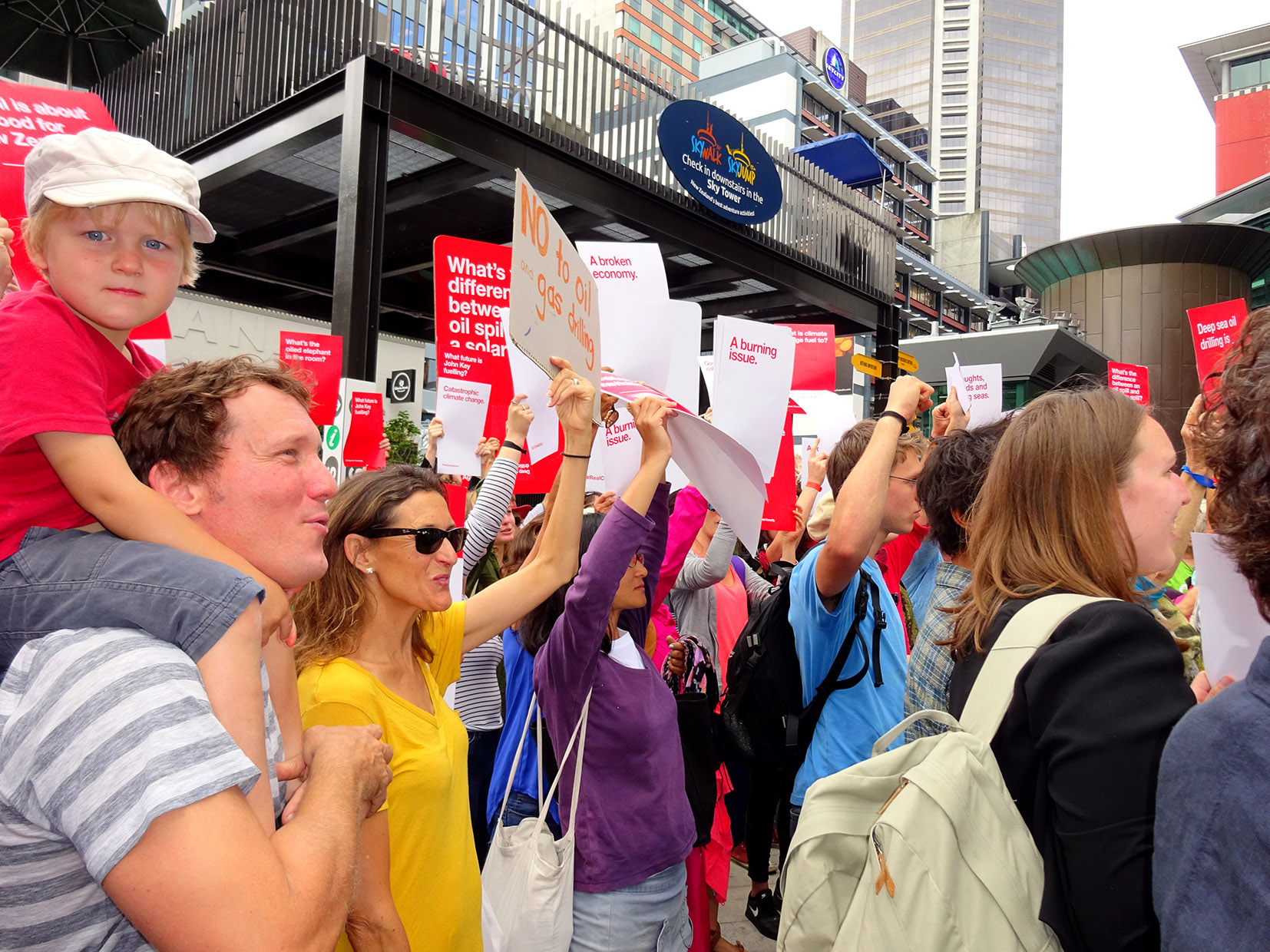
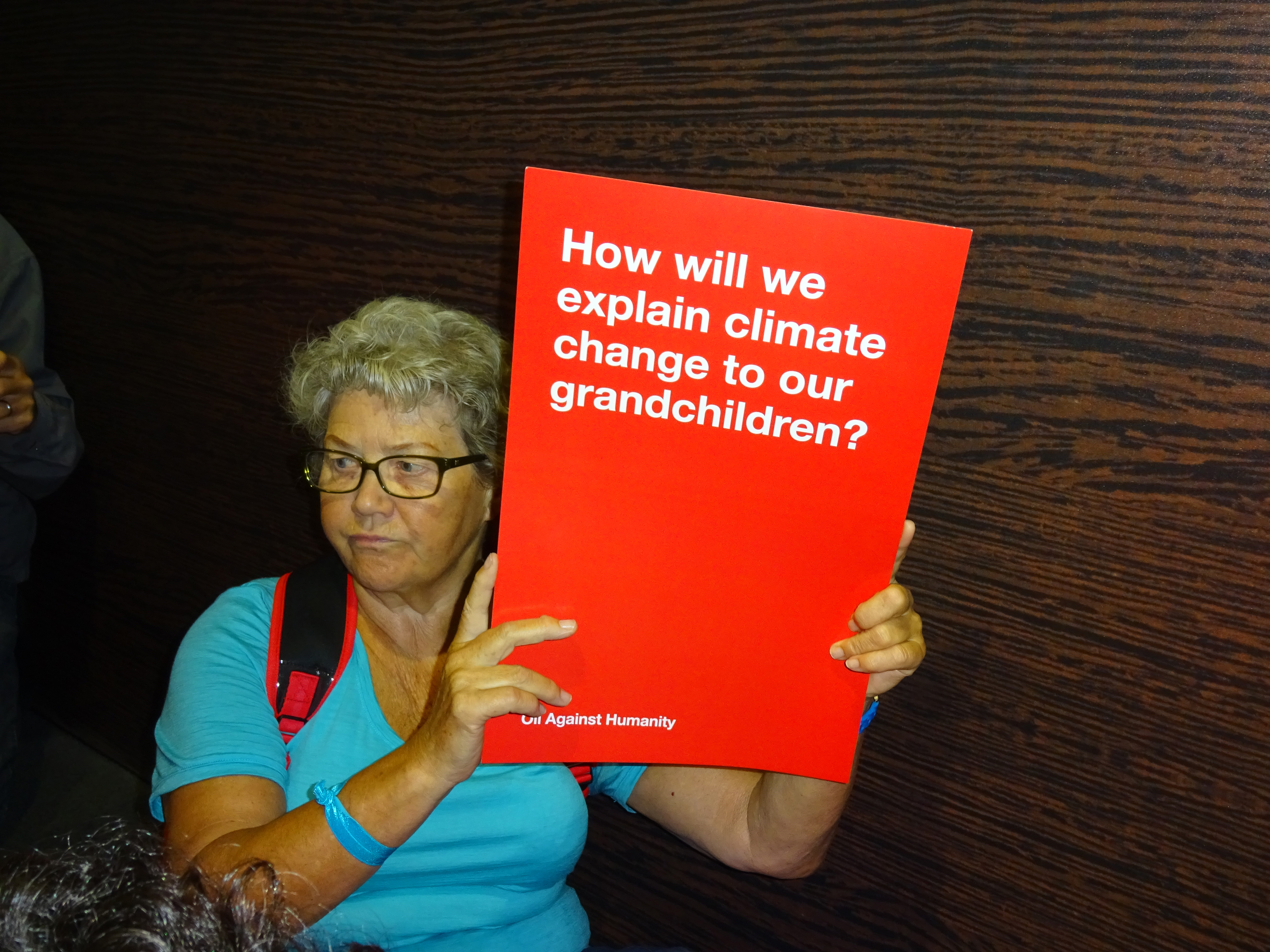
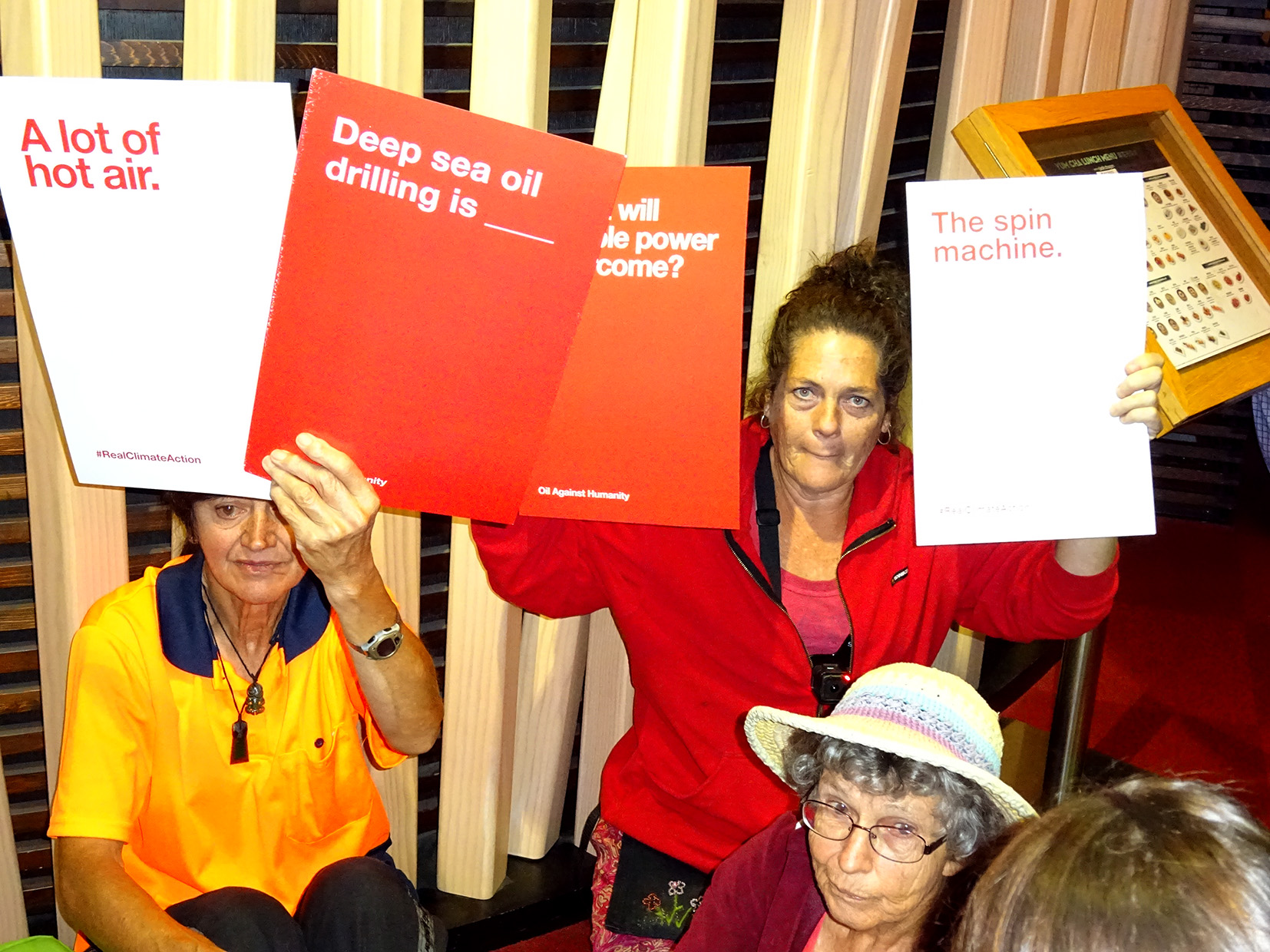
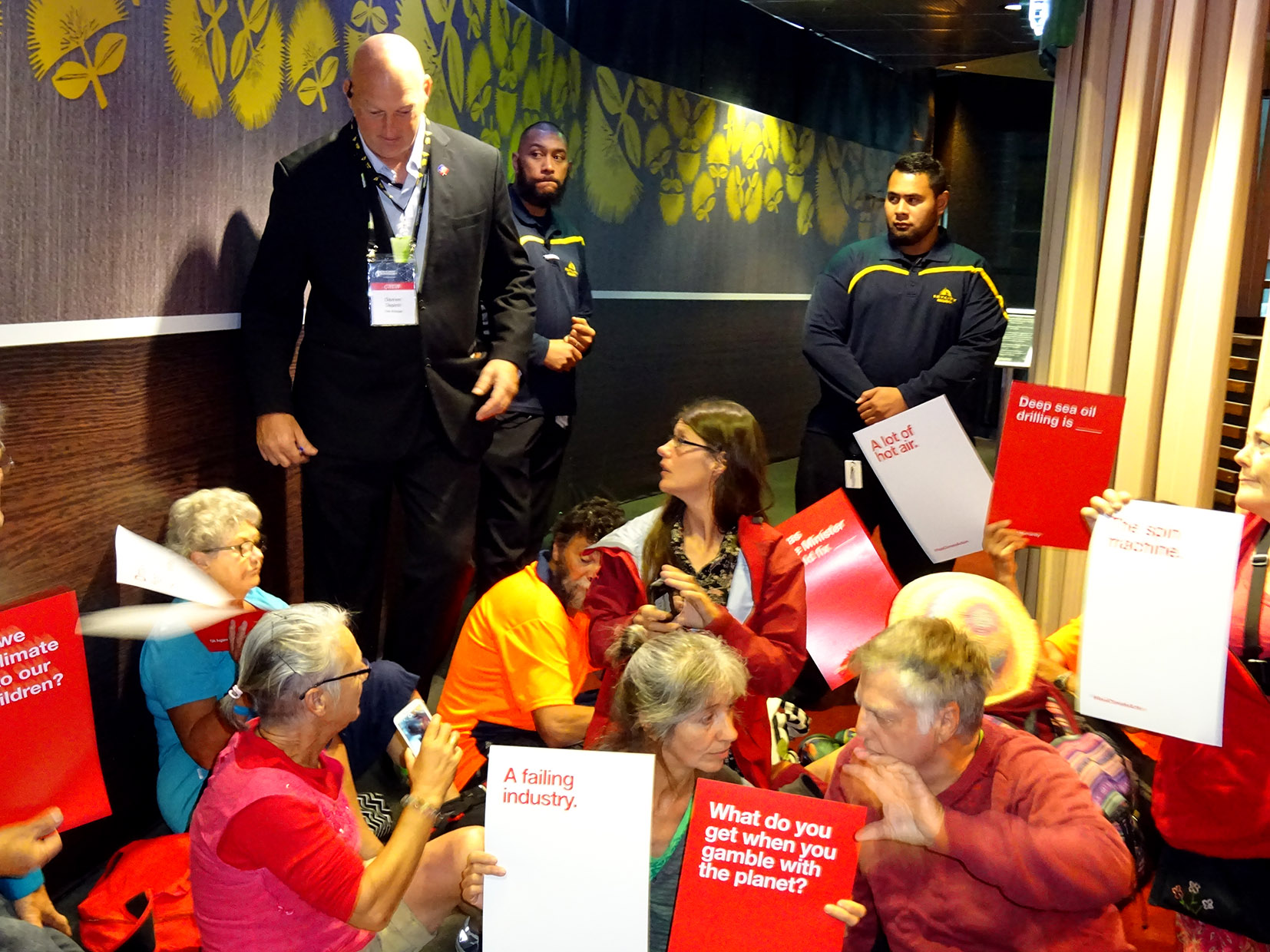
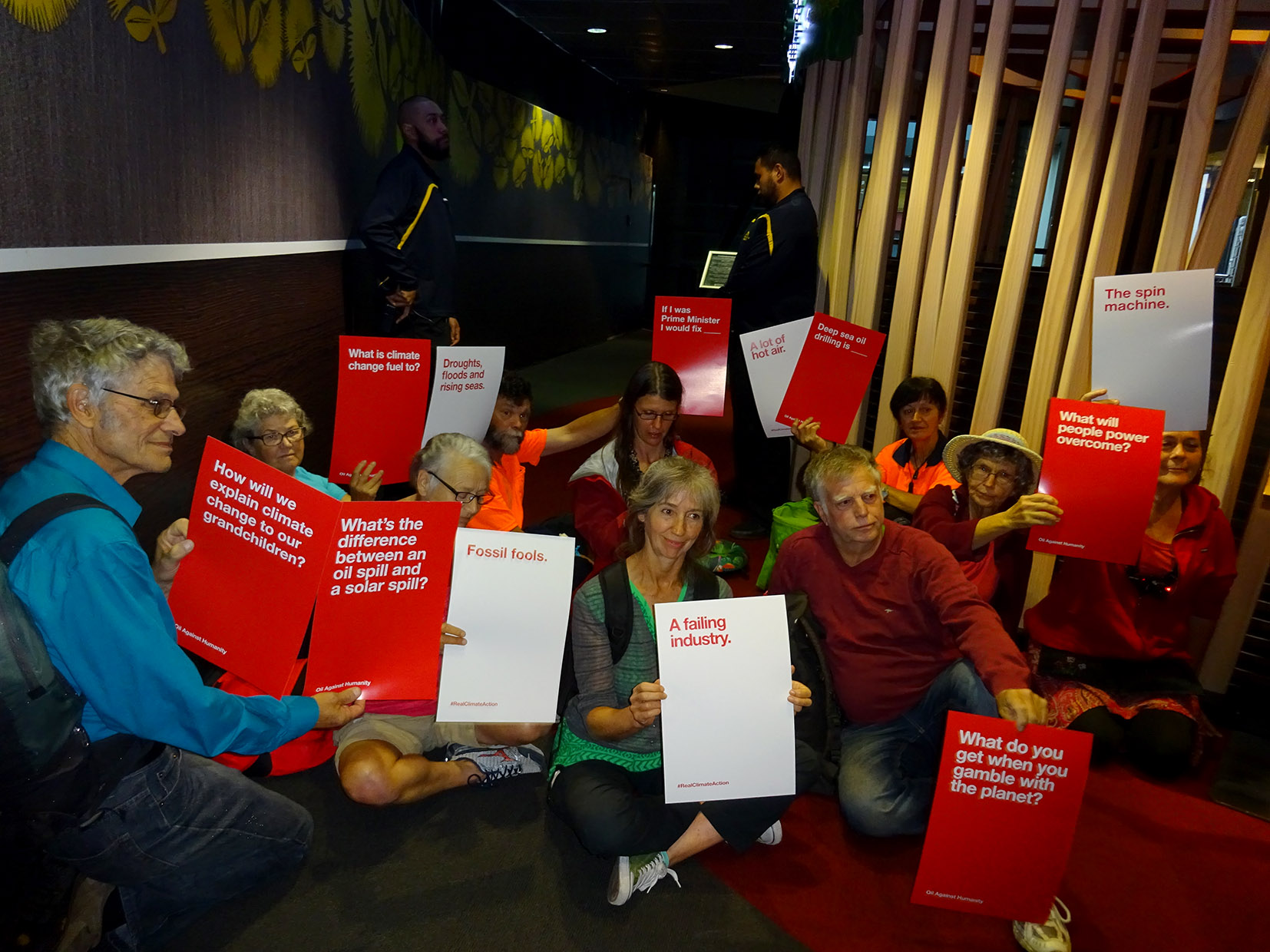
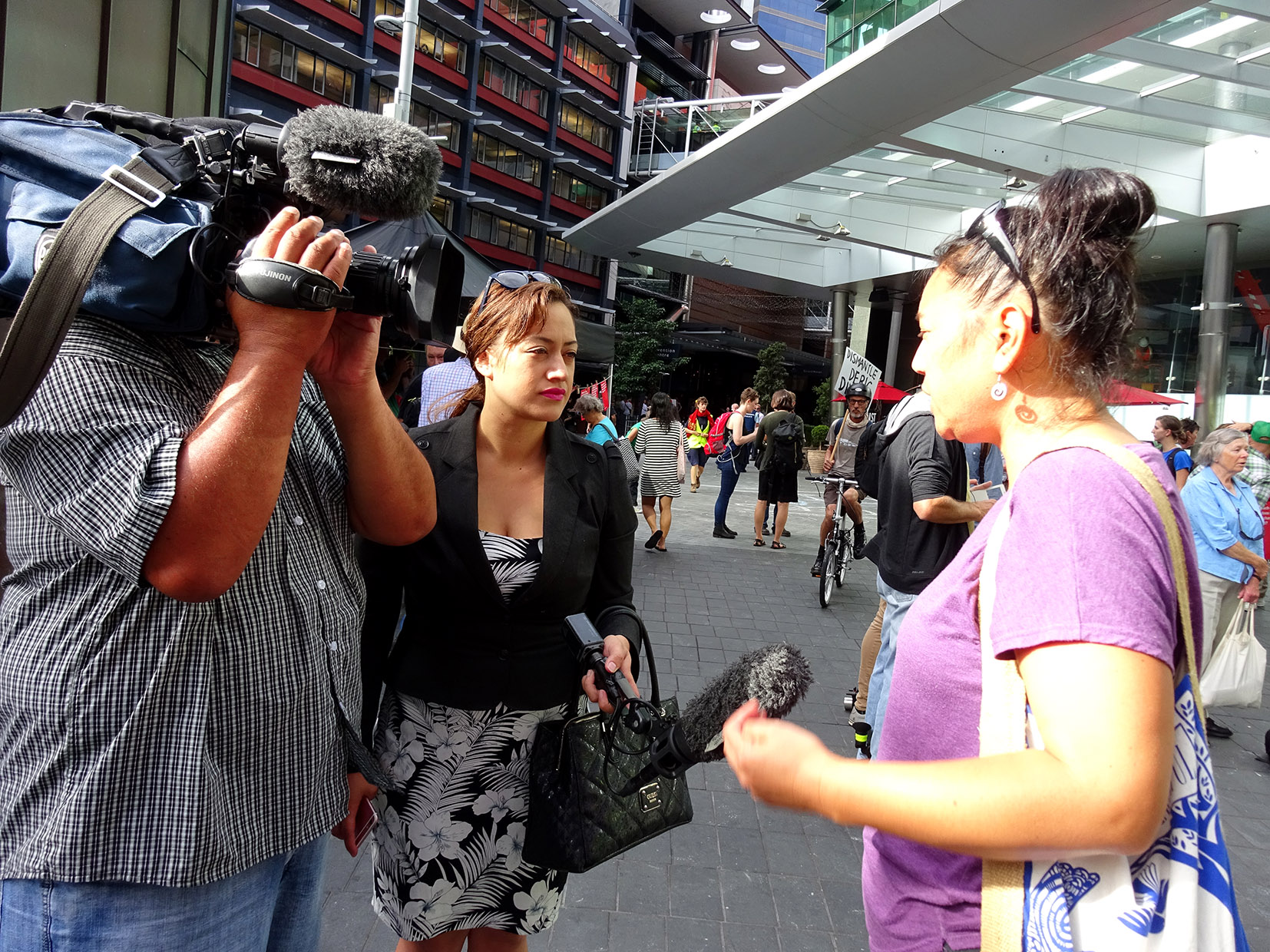
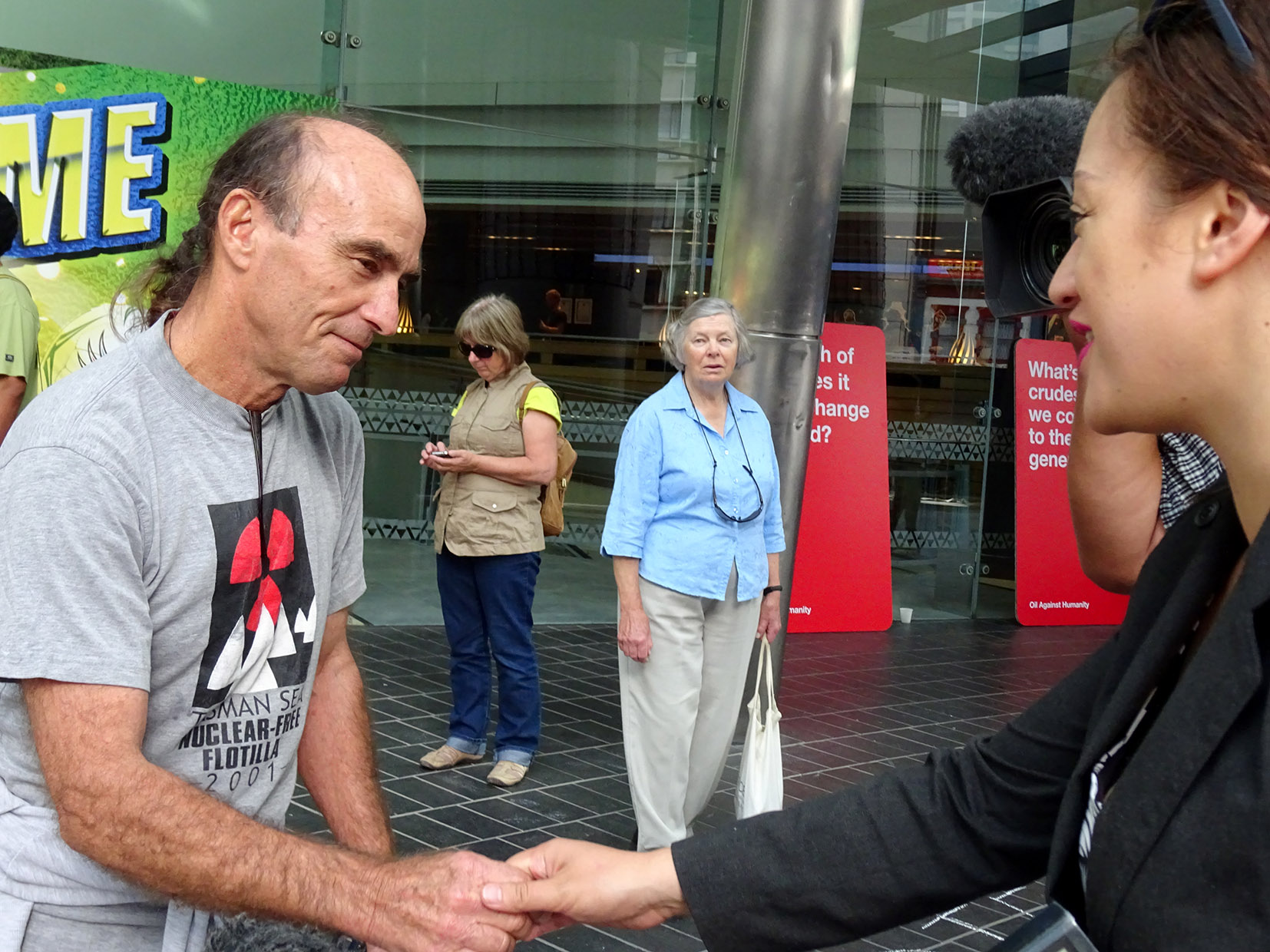
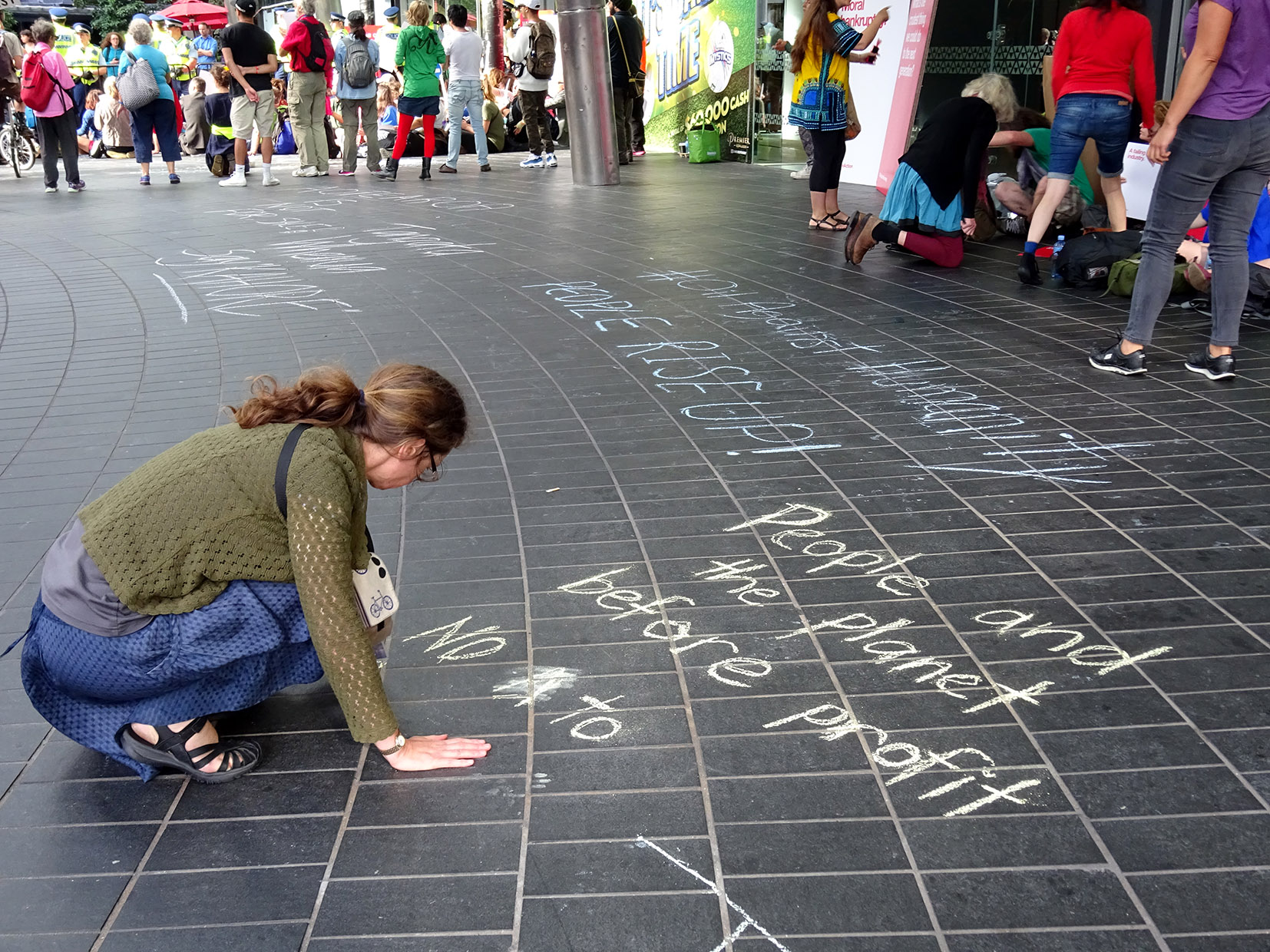
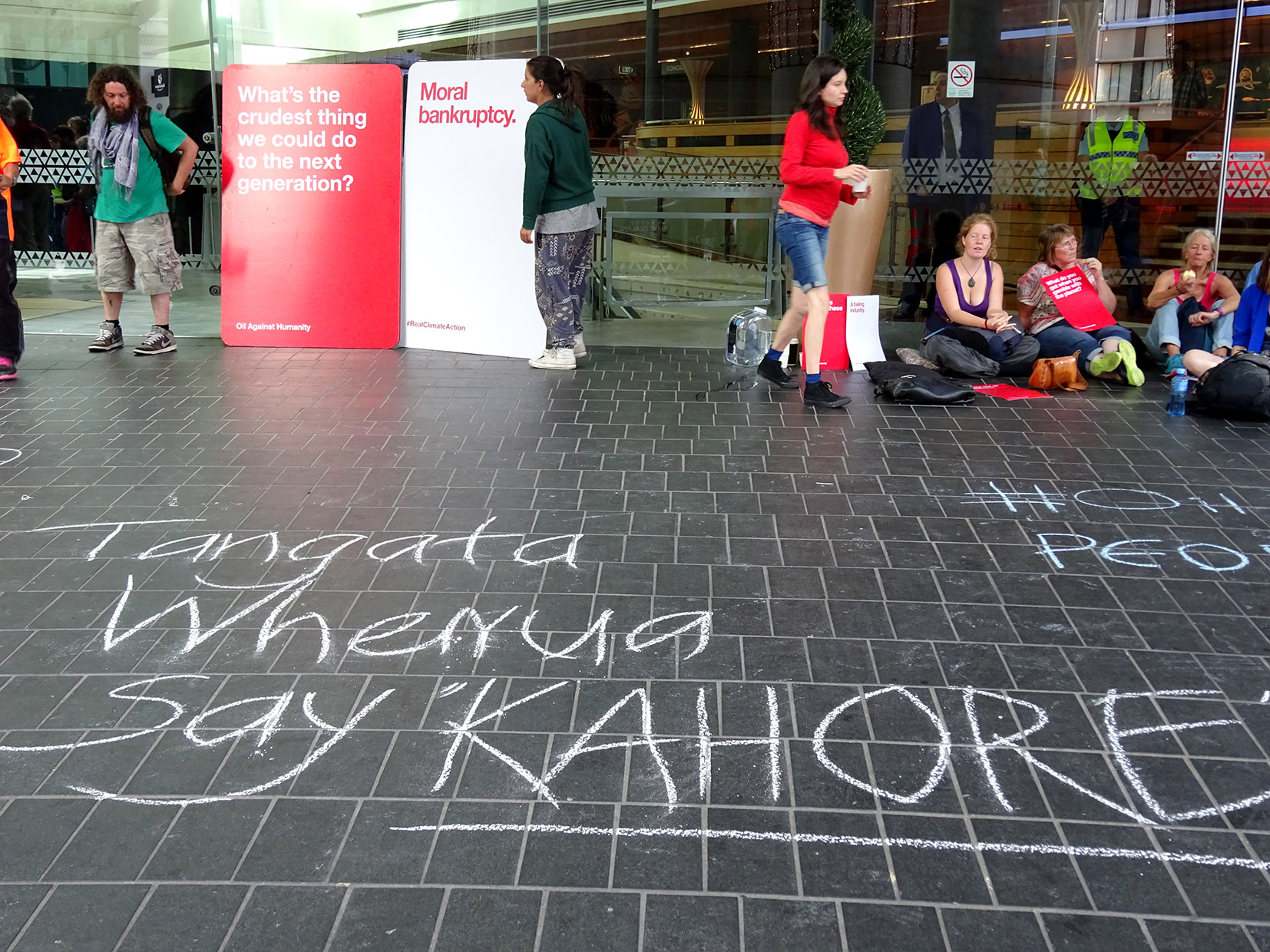
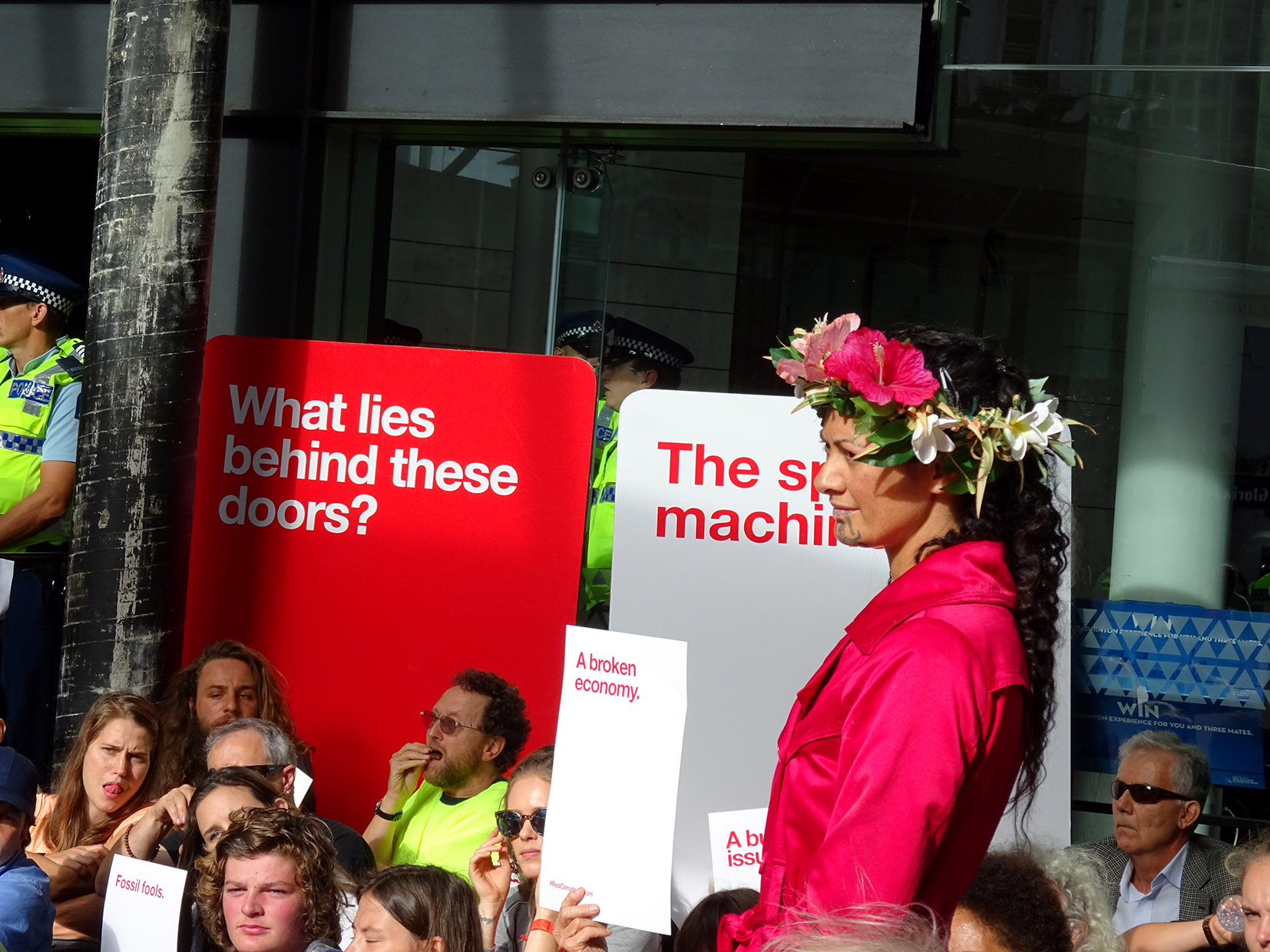
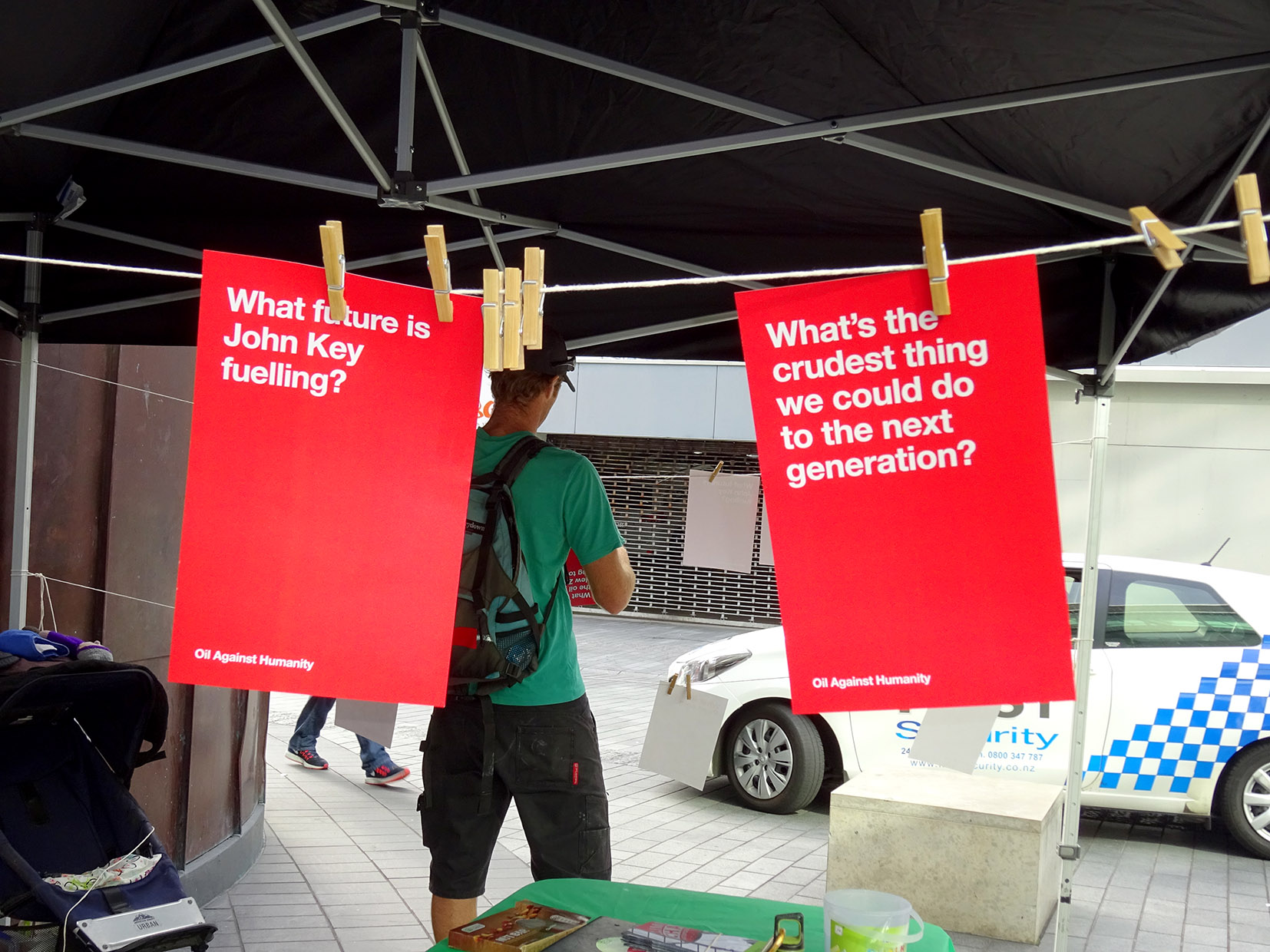
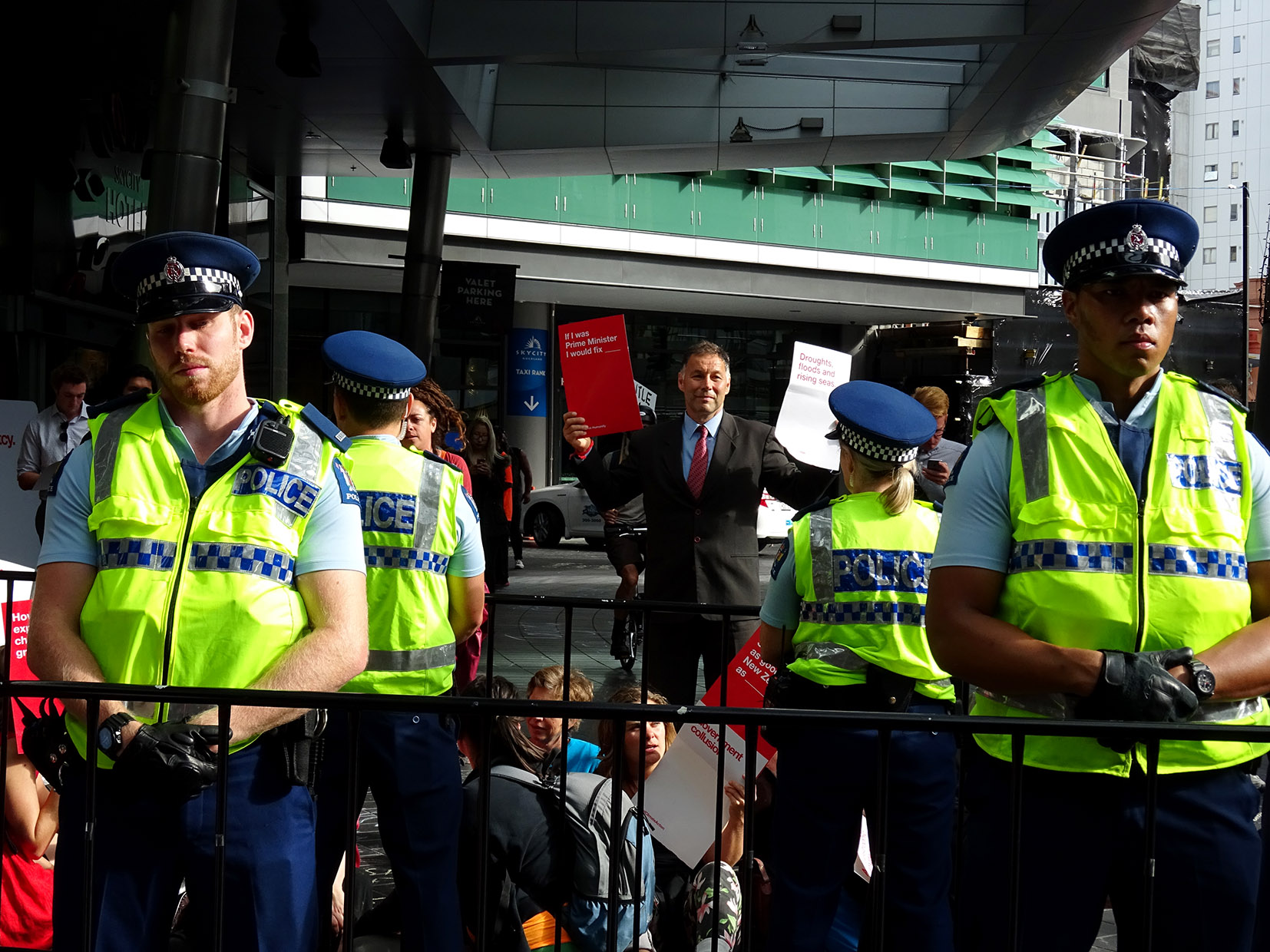
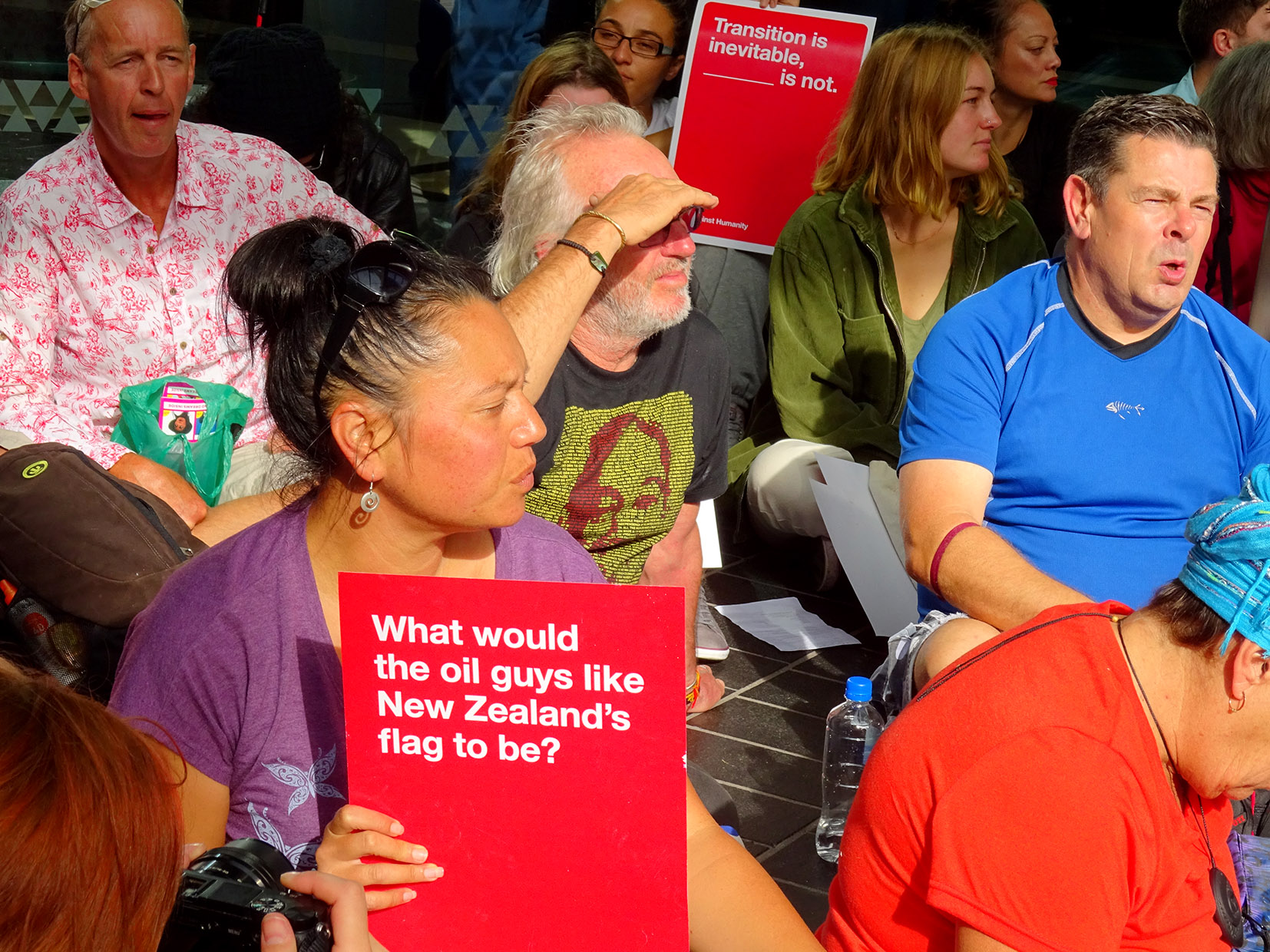
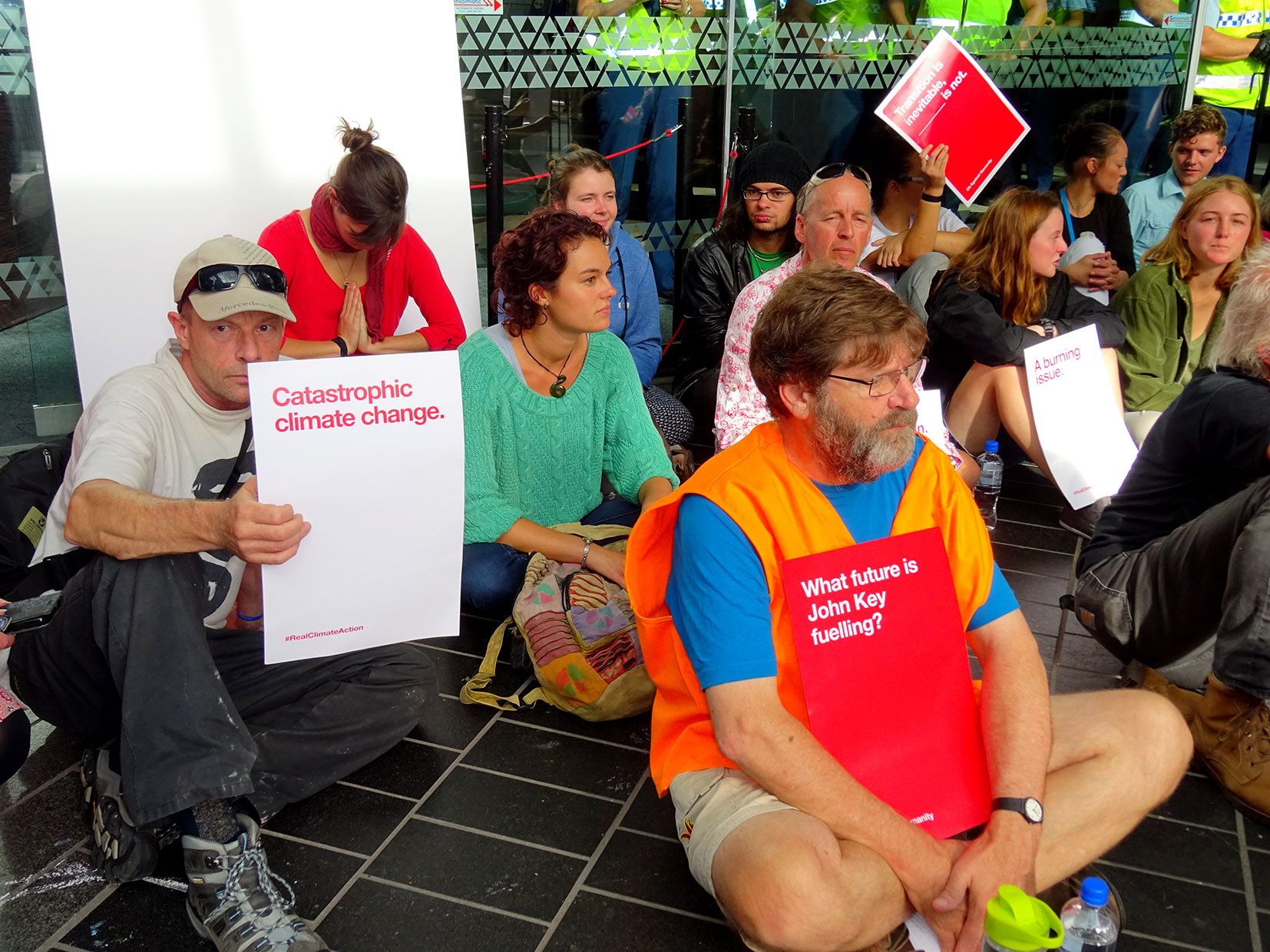
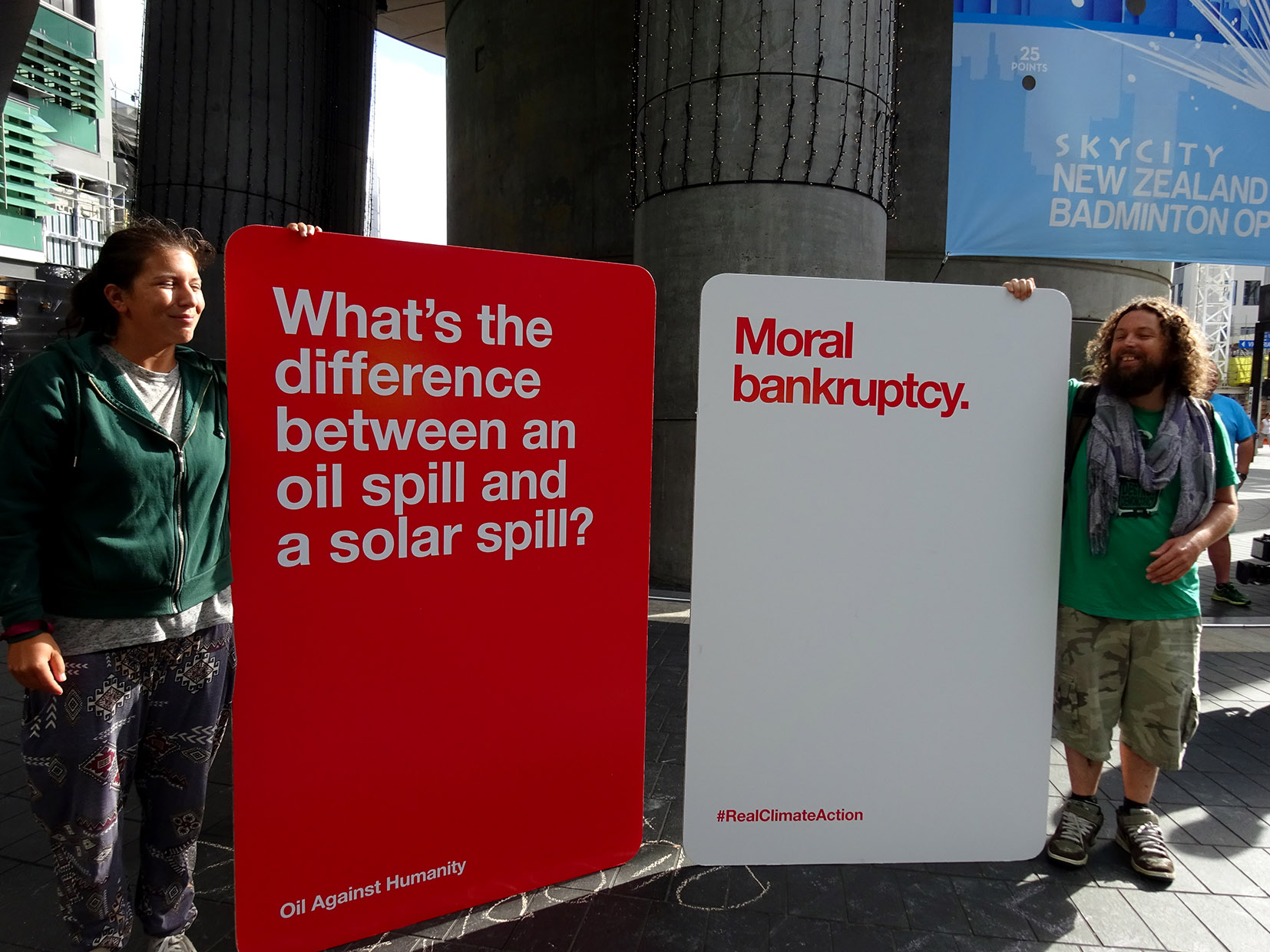
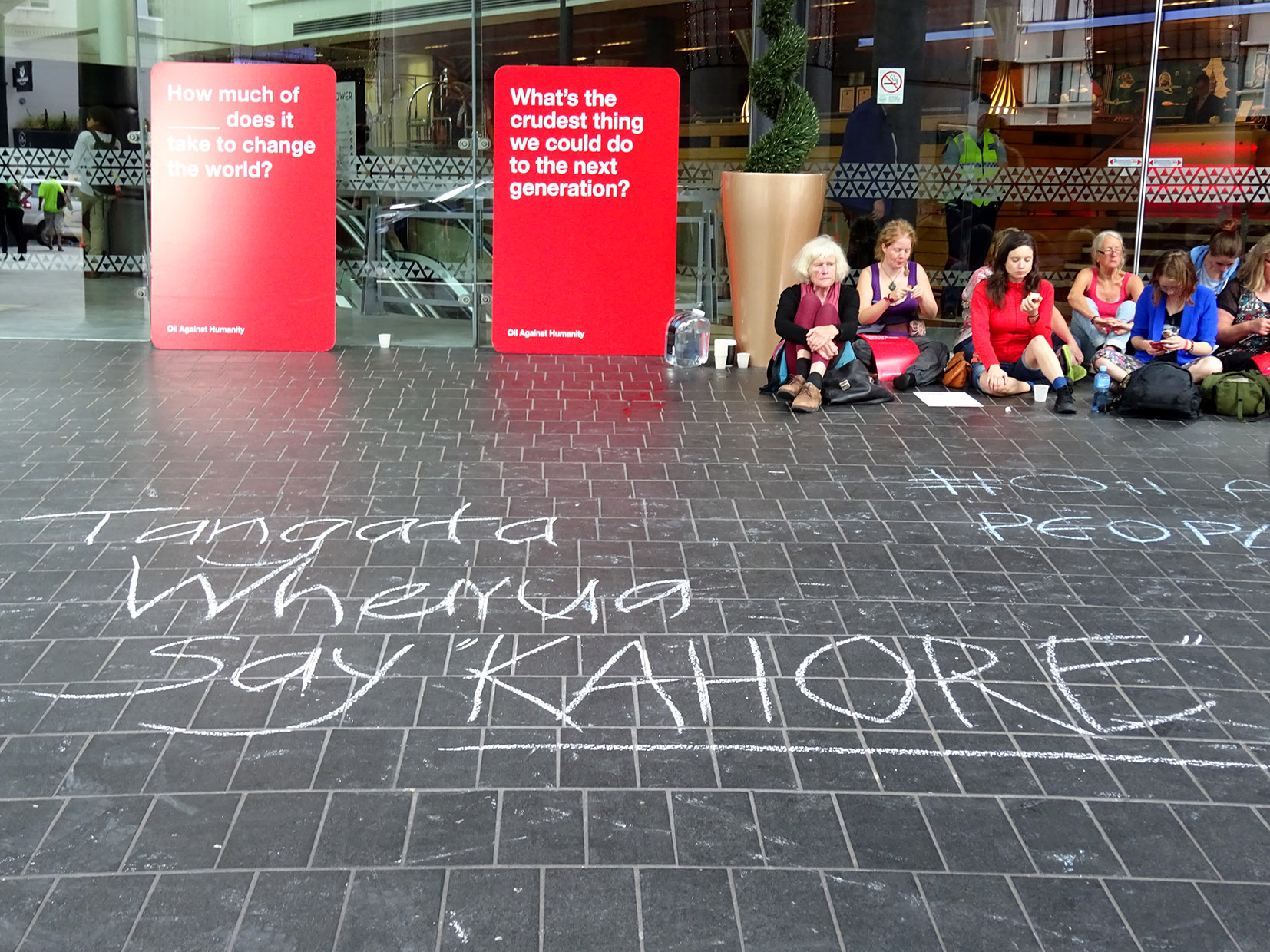
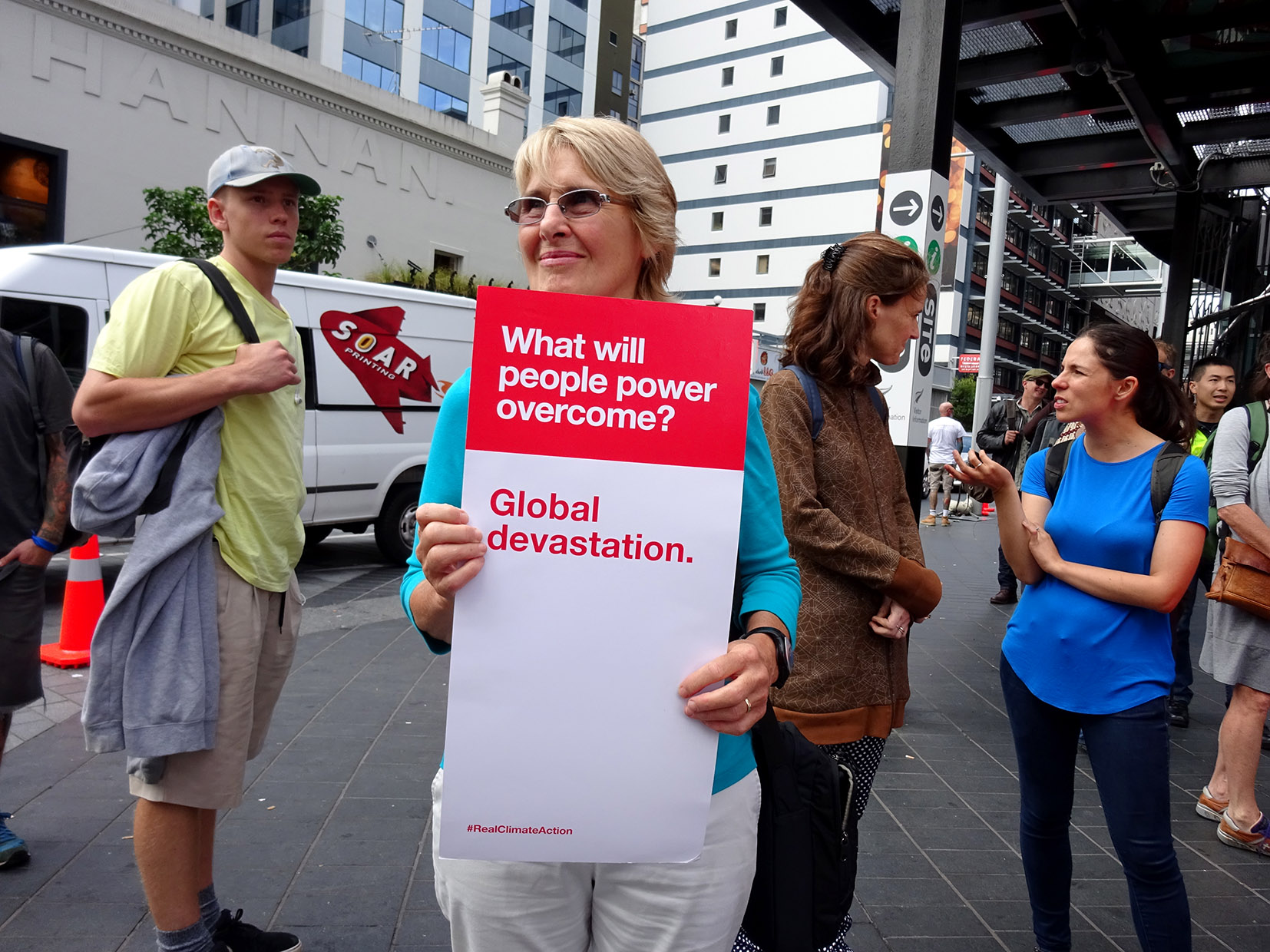
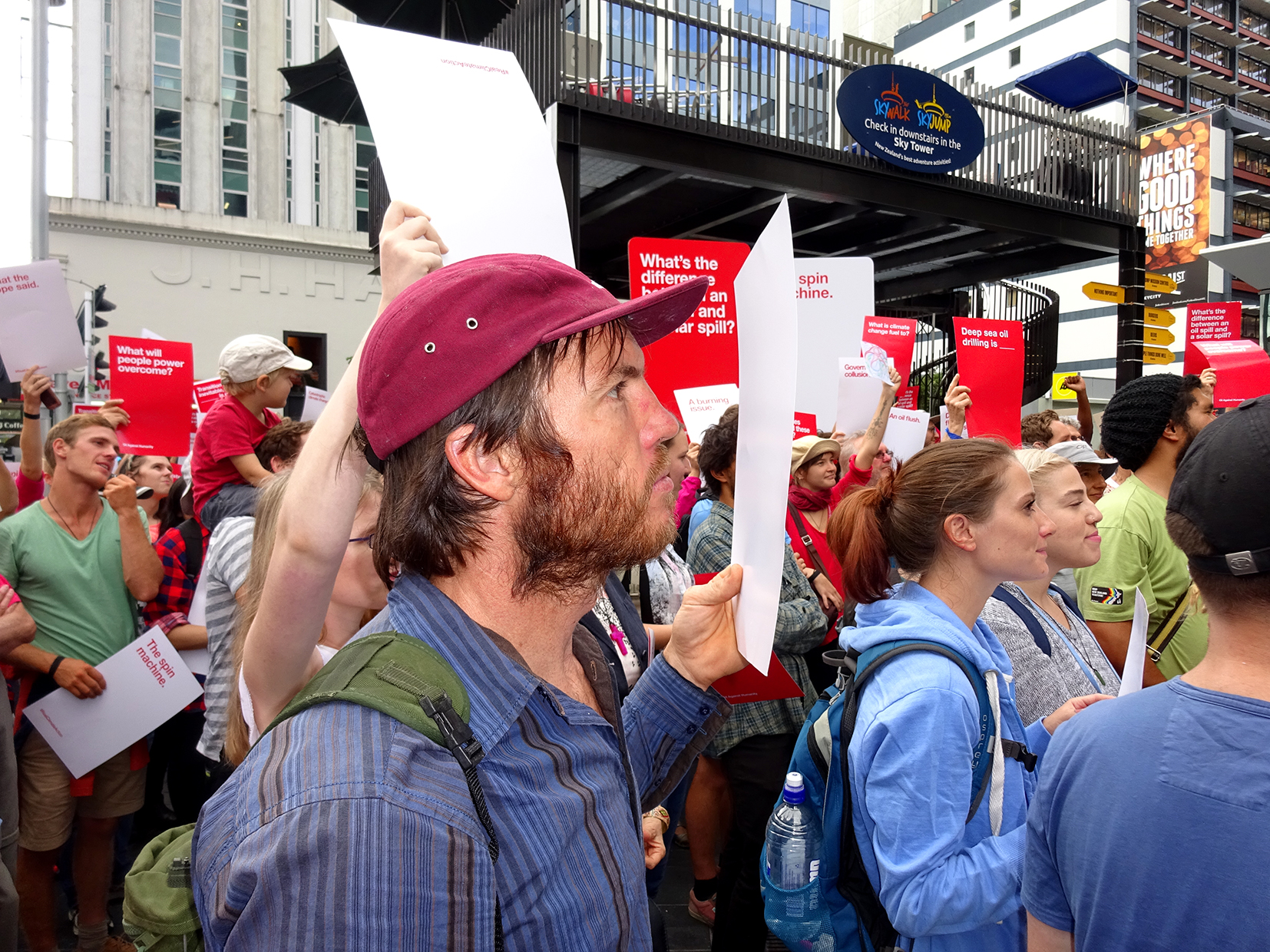
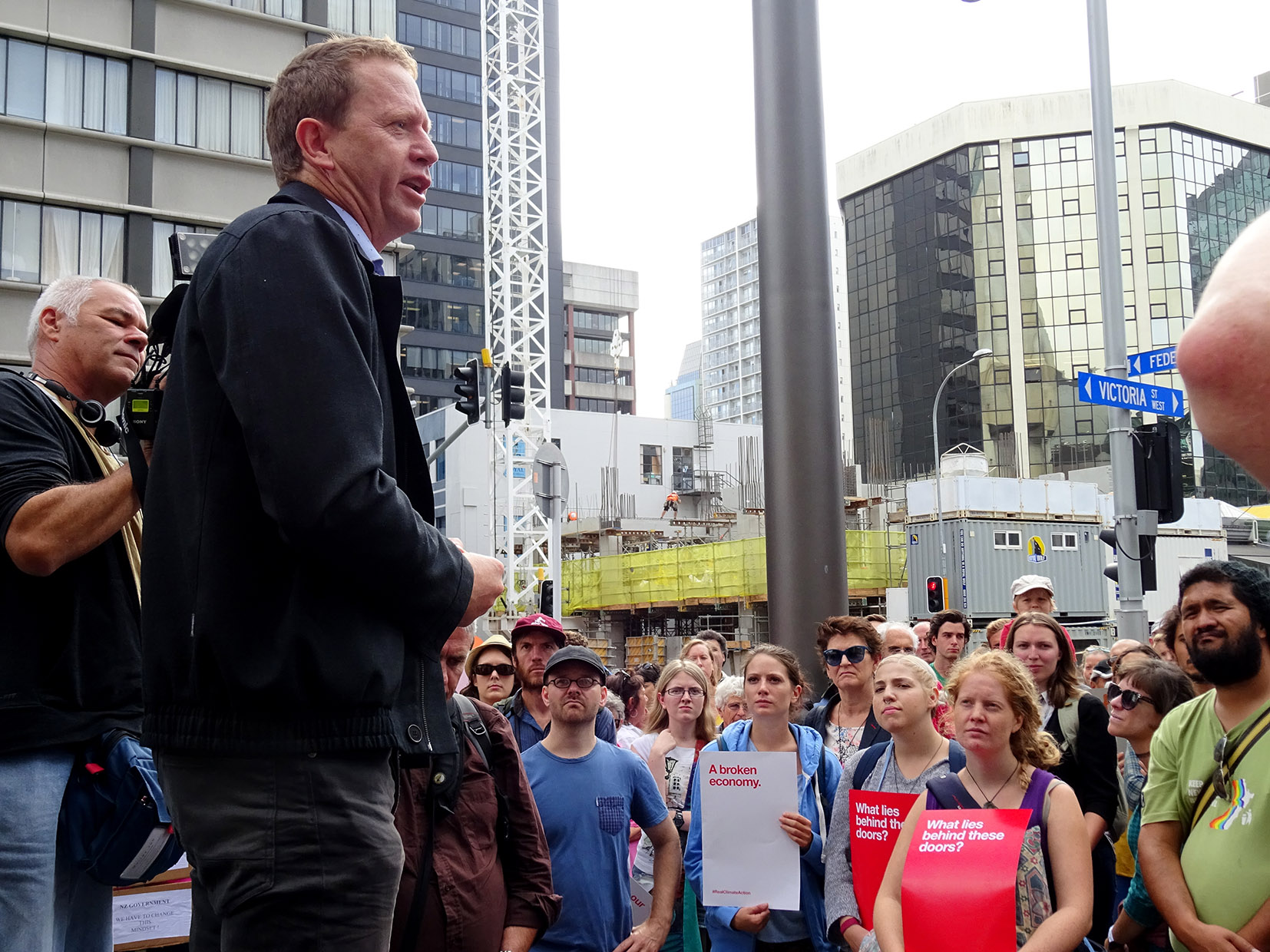
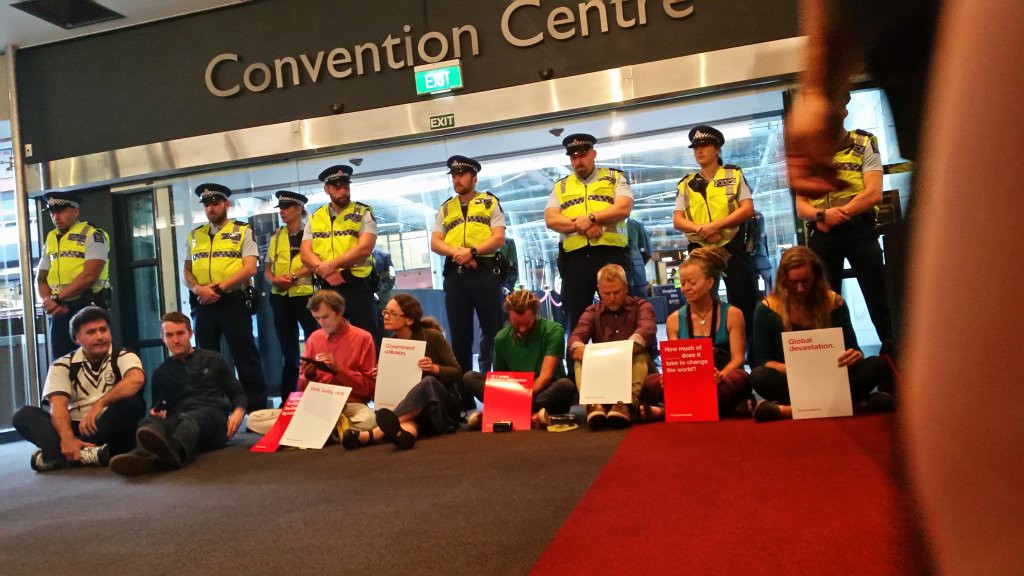
More than 200 people gathered in Auckland this week to protest against the country’s largest oil industry conference, warning that increased attempts at oil exploration will be harmful to both New Zealand and the Pacific. Jihee Junn of Asia-Pacific Journalism reports.
Greenpeace has long experience at non-violent direct action. But this week’s demonstration against policy failure on climate change was the first time in New Zealand the general public have been invited by Greenpeace to take part in civil disobedience en masse.
Environmental activist and main organiser of the event Steve Abel says they were demonstrating as part of a global movement.
Civil disobedience was chosen as a protest method at Auckland’s SkyCity convention centre on Monday in order to convey the seriousness of climate change.
“I think when you still have this intransigence on the part of the government and industry to act on this all-important issue, then you need to up the ante,” says Abel.
“We operate in that proud tradition of peaceful civil disobedience. For us, the peaceful nature is really important. We’re really about non-violence and peaceful action. Hopefully it has some effect in disrupting the oil conference.”
The protesters demonstrated against an oil conference organised by the Petroleum Explorers and Production Association of New Zealand (PEPANZ), convening leaders in the oil and petroleum industry for the three-day event.
The protestors were part of a Greenpeace-led act of civil disobedience titled #RealClimateAction. Delegates were disrupted from entering the convention centre, some of whom were delayed by more than an hour.
No oil found “We’ve been protesting the deep sea and off-shore oil drilling for many years now. They so far haven’t found any oil (in New Zealand). It’s been a very successful protest to date,” says Abel.
“But what we’ve got here is a government that’s still hell-bent on drilling for more oil, and it’s the exact oil that we need to leave in the ground if we want to avoid catastrophic climate change.”
Protesters holding Oil Against Humanity placards in front of SkyCity convention centre. Image: Jihee Junn/APJS
At an early morning briefing hours before the demonstration, protestors were told about the day’s plans.
Organisers split protesters into five groups to block all five entranceways into the conference center.
Two more groups were located inside SkyCity.
The protesters were also briefed on police procedures, discouraging protesters from resisting arrest. They were told that faced with any legal proceedings, Greenpeace would be willing to cover the financial costs, providing the protest protocols were followed.
Protester Perry Wilton believes that if the government is going to engage in deep sea oil drilling, then raising environmental awareness is important.
“I think that this (protest) does that. I think this says that people care and with this stopping people from getting in, it will definitely come up in any discussion that goes on in there.”
Police carry off a protester as officers attempt to clear an entranceway at SkyCity. Image: Jihee Junn/APJS
Hottest month The protests come in the wake of new findings which showed February was the warmest month in recorded history. Scientists are already predicting 2016 to trump last year’s temperatures in being the hottest on record.
The report cited the dangers that climate change was already posing to countries around the world.
In the Pacific, a prolonged and damaging drought in the Marshall Islands has forced the government to declare a state of emergency.
In Indonesia, forest fires have ravaged farmlands, blanketing both the country and its neighbours in a dense screen of smoke and haze.
Professor Richard Betts, head of climate impact research at Exeter University, cites in the report that soaring temperatures caused by rising carbon emissions have caused Indonesia to be turned into a “tinder-box”.
Part of Monday’s action was former Green Party co-leader Jeanette Fitzsimmons. She insists that the climate impacts of deep sea oil drilling would be profound.
“Pacific nations are at the frontline of experiencing the effects of carbon emissions, which are rising sea levels and increasing tropical storms. We know what just happened in Fiji. There’ll be more and more of that and it’ll get worse and worse,” she says.
Going underwater “Islands like Kiribati and Tuvalu will go underwater and we’re here to tell the petroleum industry: ‘enough’.
“I think New Zealand should be putting all its weight behind alternatives to fossil fuels and assisting Pacific Island nations to develop plans to cope with climate change that’s already underway. We have to be prepared to accept refugees from the Pacific when they have no where else to go.”
Indigenous rights activist Catherine Murupaenga-Ikenn echoes Fitzsimmons’ sentiments.
Having worked with many Pacific human rights advocates, she says that both New Zealand and Australia will have to deal with the impacts of rising sea levels in the region.
“How are we going to accommodate the mass mobilisation — forced mobilisation — of Pacific peoples and others who won’t have any homelands? That’s major. People need to think beyond themselves in terms of wider society.”
Regional leadership
Catherine Murupaenga-Ikenn chalks a message on the pavement as police watch. Image: Jihee Junn/APJS
Former executive director of Oxfam NZ Barry Coates also says that New Zealand must do more for the Pacific region.
“New Zealand often draws a distinction between New Zealand and Australia in the sense that Australia visits the Pacific while New Zealand is part of the Pacific. But I don’t think that’s true when that comes to climate change.
“New Zealand relied on the help of Pacific Island countries in order to, for example, get appointed to the UN Security Council. But then it turned its back on the Pacific when it comes to taking on a strong role with regards to emissions reductions, which are obviously important for the future of the Pacific Islands.”
In Paris last year, more than 190 countries signed an agreement to reduce carbon output and keep global warming well below two degrees Celsius. But New Zealand is being accused of skirting many of its international obligations.
“NZ has used climate finance to help some Pacific countries, but the climate finance that is used is really recycled aid,” says Coates.
“Whereas the Copenhagen agreement talked about ‘new and additional’ climate finance which would not be part of aid budgets, what they’ve done is they’ve taken items from their aid budget and called them ‘climate finance’.
“What we’ve seen New Zealand do is to not abide by either the spirit or even the letter of the agreements on climate change that have been made.” As a protester, Wilton believes that this week’s conference shows the “hypocritical” nature of the New Zealand government despite signing the Paris agreement. He also believes that hosting such conferences for the petroleum industry will only serve to damage the country’s environmentally friendly image.
“New Zealand is expected to lead the global environmental movement. I think people see us as being a 100 percent pure country. I think that it might not only compromise our image but suggest that that isn’t the reality.”
By a Vanuatu Daily Digest correspondent in Port Vila
In an outpouring of popular protest, several hundred women, men and children marched in Port Vila and Luganville yesterday to demand an end to violence against women in Vanuatu.
The march was organised in response to an attack earlier this month on tourism industry worker Florence Lengkon, who was kidnapped and assaulted by seven men after she complained on social media about the aggressive behaviour of some bus and taxi drivers at Port Vila’s wharf.
In Port Vila, the protesters marched from the seafront to Parliament House, currently in session, where they met by MPs from government and the Opposition.
At Parliament, Florence Lengkon presented a petition demanding stronger action against gender-based violence to Justice Minister Ronald Warsal.
Tourism worker Florence Lengkon presents the protesters’ petition to the Justice Minister. Image: Transparency International Vanuatu
The protesters in Vila included members of the general public, representatives from NGOs, womens’ groups, government departments and staff from numerous local businesses who were given time off work to attend the march.
Law students from the University of the South Pacific’s Emalus campus also joined in along with local Pacific communities.
The Tongan community’s group was led by a royal visitor, the Hon Alematea, son of Princess Fusipalo.
Late yesterday, Vanuatu’s Parliament passed a motion to adopt Commonwealth parliamentary procedure and allow the petition to be presented.
This is a first for the country – the petition was read out inside Parliament.
Does the controversial Trans-Pacific Partnership “free trade” agreement between Pacific Rim nations fail to address “the most important issue of our time”? Dominic Pink reports for Asia-Pacific Journalism.
Advocacy groups are criticising what they see as the harmful impact the Trans-Pacific Partnership Agreement could have on the environment.
Several critics have also highlighted fears for Pacific Island nations on the climate change frontline and a lack of environmental coverage from mainstream media.
A recent “expert” paper by Simon Terry, executive director of the Sustainability Council of New Zealand, found that “the environment is a significant casualty under the TPPA”.
Governments can be sued by corporations — under the Investor-State Dispute Settlement (ISDS) provisions — over environmental regulations such as changes to the Emissions Trading Scheme (ETS) and restrictions on the mining of fossil fuels.
One of the deal’s strongest critics is Barry Coates, spokesperson for the It’s Our Future campaign. He outlines two ways the TPPA would negatively impact on the environment if it comes into force.
“One is that action on climate change would be undermined by the ISDS mechanism in particular – if we look at cases that have been taken under ISDS around the world … calculations by public citizens show that around 85 percent of those are related to environmental regulation of some sort,” he says.
‘Chilling effect’ The other is a “chilling effect” that the threat of lawsuits would have on a government’s willingness to enact environmental reform.
Laura O’Connell-Rapira, campaigns director for ActionStation, points to recent ISDS examples in North America as evidence of the difficulties that governments are already facing when addressing climate change, such as a US$15 billion lawsuit filed by TransCanada against the Obama administration for rejecting their proposed Keystone XL pipeline.
She is “deeply concerned” about the environmental ramifications.
“In the 21st century, should we be allowing arguably antiquated trade rules to trump climate agreement?” she asks.
Environmental organisations such as the Sierra Club and Greenpeace have pointed out that threats to endangered species would increase under the TPPA, as the unrestricted reduction of tariffs and taxes on imports would include trade in shark fins, palm oil and ivory.
TPPA protests around New Zealand “have been incredibly effective” at raising awareness, according to Niamh O’Flynn. Image: Dominic Pink/APJ
The controversial free trade deal was signed in Auckland last month amid peaceful demonstrations by a crowd of more than 20,000 people, say some reports.
The march was organised by It’s Our Future in collaboration with ActionStation and Real Choice. Several groups of protesters managed to gridlock the city by blocking major arterial routes.
Coates acknowledges that the TPPA is a “complex” issue to grasp, but he believes that the public “understand the big principles behind it … I think there are a lot of people worried that big businesses have too much power”.
Concerns such as secrecy surrounding negotiations, insufficient public discourse, and the perceived threat to New Zealand’s sovereignty as well as Māori rights under the Treaty of Waitangi have been major points of contention among critics since details of the TPPA were first released in November.
‘Liberalising’ trade aims The TPPA aims to liberalise trade and investment between the12 member nations — Australia, Brunei, Canada, Chile, Japan, Malaysia, Mexico, New Zealand, Peru, Singapore, United States and Vietnam — which represent approximately 36 percent of the world’s GDP (or about US$28 trillion).
In an official statement, Trade Minister Tim Groser described the TPPA as “a very positive agreement for New Zealand,” breaking new ground as the country’s first Free Trade Agreement (FTA) with the United States, the world’s largest consumer market.
Climate change is increasingly becoming an existential threat to Pacific Island nations, with small states such as Kiribati and Tuvalu facing a bleak future if rising sea levels persist.
Dr Pala Molisa addressed the urgency at the Pacific Climate Change Conference at Victoria University last month, saying, “we’re going to lose islands – we’re going to lose whole countries – because of rising sea levels …
“The Pacific is one of the most vulnerable areas to these super storms and extreme weather events.”
On TPPA, Dr Molisa said it “undermines our ability to respond effectively to these climate crises”.
Biggest issue for Pacific Economist Dr Biman Prasad, opposition leader of Fiji’s National Federation Party, says “the whole issue for Pacific Island countries right now is climate change adaptation and mitigation”.
He says the touted benefits of a free trade agreement like the TPPA are not key concerns for many Pacific Islands nations, which are “talking about non-tariff barriers, non-trade issues,” including labour mobility and quarantine issues.
Prasad also worries that Pacific nations may find “to their dismay” that the deal impacts on their ability to access funding for climate change adaptation.
350 Aotearoa national director Niamh O’Flynn also expressed concern for Pacific Island nations on the climate change frontline, calling attention to New Zealand and Australia’s “duty of care” to their smaller neighbours.
“If we are unable to carry out that duty it’s a big problem for the Pacific”.
New Minister for Climate Change Paula Bennett has said she wants New Zealand to be a global leader in transitioning to a low-carbon economy. However, she remarked at the Pacific climate conference that “support for climate action has to support sustainable economic development”.
O’Flynn suggests that “actions speak louder than words” and the government has “certainly not shown any action” on Bennett’s recent climate change rhetoric.
“Coming back from Paris [2015 Climate Conference] and instantly opening up more parts of New Zealand’s coastline to be bid for oil shows that the National government is seriously uncommitted to taking any kind of action on climate change”.
The media “hasn’t picked up on the TPPA’s threats to the environment and climate change”, says Barry Coates. Image: Dominic Pink/APJ
‘Lazy’ media coverage Coates has been “pretty disappointed” by much of the TPPA coverage in New Zealand, claiming “a lot of the media have been lazy and unquestioning of the government’s spin”.
O’Connell-Rapira and O’Flynn echoed these thoughts, criticising a lack of serious reportage on climate change, “the most important issue of our time”.
Coates emphasised that “New Zealanders care deeply about their environment, they care about climate change” and would like to see the media focusing on some of the threats to the environment and climate change.
When asked whether we can expect future anti-TPPA actions, Coates promised “lots”.
“In the meantime [Prime Minister] John Key tends to get confronted in every place that he goes … and I think the government’s very much on the back foot around the TPPA”.
Shortly before going to press, Climate Change Minister Paula Bennett responded to questions for this article, rejecting claims about the environment chapter of the TPPA draft as “simply not true”.
“The environment chapter is the most comprehensive and ambitious outcome that New Zealand has achieved in any free trade agreement and includes a specific article on the transition to a low emissions economy,” she said in a statement to Asia Pacific Report.
Dominic Pink is an Auckland-based student journalist reporting on the Asia-Pacific Journalism course.
Dancers of the Ura Tabu group treated guests with a performance of “Yellow Bird” at the launch of the NZ Institute of Pacific Research at Auckland University’s Fale Pasifika last night.
Foreign Minister Murray McCully launched the think-tank, saying it was aimed at supporting sustainable development in the region. Photographs by Del Abcede of the Pacific Media Centre.
Ura Tabu dancers perform the Calypso medley song “Yellow Bird” at the launch of the New Zealand Institute of Pacific Research last night. Video clip: Del Abcede/PMC
Foreign Minister Murray McCully has welcomed the launch of a New Zealand-based Pacific think-tank aimed at supporting sustainable development in the region.
“We have identified the need for more targeted research on the Pacific, to underpin development initiatives and support Pacific decision makers,” said McCully, who launched the new institute at Auckland University’s Fale Pasifika last night.
Foreign Minister Murray McCully last night … “supporting Pacific decision makers.” Image: Del Abcede/PMC
“The New Zealand Institute for Pacific Research will work in support of Pacific governments and regional agencies, and will focus on producing the kind of hard-headed analysis that can support sustainable economic development.
“Our aim is for the NZPIR to become a centre of excellence for research on Pacific development, governance, public policy, and security issues.
“The government has provided a cornerstone investment of $7.5 million over five years to establish the Institute and develop an initial programme of research,” McCully said.
The NZPIR will be based at the University of Auckland.
The research programme will be delivered by a consortium led by the University of Auckland, and including Auckland University of Technology and Otago University.
Samoa’s Rugby Union is encouraging more of its country’s women to participate in rugby. Sport administrators and gender equality advocates are seeing greater participation in the sport as a step toward women’s equality and bettering the overall gender balance in Samoa, Anuja Nadkarni reports for Asia-Pacific Journalism.
The Pacific nation’s leading rugby organisation, Samoa’s Rugby Union, has hosted its first Samoa Women’s Rugby Conference and has announced it will be making this an annual event.
The conference was held earlier this month to commemorate International Women’s Day on March 8 in the capital Apia. It highlighted the importance of supporting and encouraging the country’s women in rugby.
The “Rugby for all” conference celebrating International Women’s Day in Samoa. Image: Samoa Observer
The SRU’s women’s development officer Toluiva Keneti says the event’s main focus was to address the issue of gender imbalance prevalent in the sport.
“We are looking at using rugby as a tool to break barriers and stereotyping in the community, especially for women playing rugby,” she said.
Senior programme officer for the Ministry of Women Community and Social Development Robert Wong Sin says there are numerous cultural barriers that contribute to the impediment of women’s participation in rugby but he believes things are changing.
“The idea that ‘rugby’s a man’s sport’ or those stereotypes that women are too fragile… those barriers are slowly starting to break down.
“Families are embracing the idea of having their girls participate in more physical sports,” he says.
Room for improvement Wong Sin says although things are getting better, “there’s still a lot of room for improvement and definitely lots more room for participation”.
The SRU Women’s Rugby Conference took place over the course of two days and brought in 15 female secondary school teachers to partake in workshops to become coaches, referees and sports administrators in their schools.
According to SRU there are currently just over 500 registered female rugby players in Samoa but Keneti says the union lacks female coaches and referees and believes conferences like these will increase female contribution to the sport.
Samoan National Rugby League (NRL) game development manager Gabrielle Apelu is the country’s last remaining pioneer of Samoan women’s rugby and says she understands the challenges of sportswomen best because of her background in rugby but believes Samoa is given a bad rap from New Zealand on issues of gender equality, especially in sport.
“Most Western philosophies that categorise women and barriers to sport never take into consideration cultural values and standards and quantify results in Western terms which are very often misleading and badly interpreted.
“In this day and age there is no stigma. What changes are women’s priorities,” Apelu says.
Chairwoman of the Samoa Women in Sports organisation Nynette Sass says as Samoan women grow up their domestic responsibilities influence their decisions and their focus shifts to their family.
Sports active when young “Girls are usually active in sports when young, but progress to refrain from sports as they get up to the university level to focus more on studies. By the time they are in the workforce, they’re required to work and prioritise their families and all other obligations ahead of themselves, hence there is no time to do what is deemed at times as frivolous activities.”
United Nations Samoa representative Mele Maualaivao says financial challenges are also a contributing factor to sports lacking female involvement.
“If women’s sports were able to be the great income earner that they are for men, many more young women would be encouraged to play professionally,” Maualaivao says.
Nynette Sass says encouraging women to play rugby also has health benefits for the nation.
“Samoa is waking up to the realisation of the bad effects of a sedentary lifestyle and unhealthy eating of processed food with increasing numbers of people falling prey to Non Communicable Diseases (NCD). Lately the message has really hit home with the increase in cancer deaths.”
GameChangers director Kylie Bates, one of the conference resource people. Image: Samoa Observer
According to the World Health Organisation half of all adults in Samoa are at high risk of developing NCDs such as cancer, diabetes and obesity. A report by the Samoan government last year showed that cases of high blood pressure and obesity have almost doubled in the past 10 years.
Domestic violence Keneti, Maualaivao and Wong Sin are taking their gender balance message beyond rugby and sport. They are also encouraging women to take a stand against domestic violence through their initiatives.
A study carried out by the WHO last year found that from the 1640 women aged between 15 and 49 years surveyed 65 per cent of respondents reported violence that was either physical, emotional or sexual.
According to Wong Sin, initiatives through sport are the most efficient and effective way to strive toward addressing issues like gender equality.
“In sport there should be no discrimination. Sport encourages team building and character development and develops leadership. So we feel having this forum sustained over the next few years will encourage women to take essential positions not only on the field but also in the background and contributing to sports development overall.”
Keneti says initiatives like the SRU conference are educating women to stand up to violence and encouraging women to play alongside men.
This, she says, nurtures a sense of equality, which can build confidence to face any environment and to “never go silent”.
“This is not just about rugby itself, it’s not about a rugby ball, not about how famous rugby can become in Samoa: it is about educating women that it is a game for all,” she says.
Maualaivao believes “it is an exciting time to be a woman in Samoa,” and says she is optimistic about bringing change in attitudes toward women’s issues in Samoa.
“Any time a woman is asked to think of herself as a woman first, it can bring enlightenment to her situation and to her understanding of the challenges she may face.
“Empowerment of women is key to all other aspects of gender equality being addressed.”
Anuja Nadkarni is a journalism graduate from AUT and is completing her Honours degree in Communication Studies. She is currently on the Asia-Pacific Journalism course.
[caption id="attachment_3709" align="alignleft" width="150"] Tony Alexander, BNZ economist.[/caption]
Welcome to this week’s Overview sent one day early because of Easter.
This week I take a look at the migration numbers in the context of some people calling for restrictions on the number of people coming here. When we look at the 66,000 jump in net annual inflows in the past three years we find 28,000 of the rise is fewer people leaving, 9,000 is Kiwis and Aussies coming in, 14,000 is more fee paying/goods buying foreign students, leaving a true foreigner migration rise from early-2013 of only 15,000 which is almost entirely people on work visas – probably helping rebuild Christchurch, working on dairy farms, and staffing our health system. Scope to stem the record net migration inflow by slamming immigration is limited. Though there is one answer at the end of my article.
I also look run through nine key points regarding prospects for Auckland’s housing market discussed at a large function in Auckland last night.
Happy Easter
To read the full analysis, continue reading below or click on this link: Download documentpdf 356kb
Migration Nation
There was a lot of commentary this week following release of the monthly International Travel and Migration data by Statistics NZ. The data show that in the year to February there was a net migration gain of 67,400 people or 1.4% of the population compared with a 1,100 gain three years ago and 20 year average of 10,000. The impression given was that this surge in the net migration gain is due to lots more foreigners coming into the country and that they are taking our jobs and pushing up house prices.
Firstly, there are more people happy about house prices rising than there are unhappy. Second, lets have a look at what has caused the 66,000 turnaround in the net flow since early-2013. The gross inflow back then was 86,000 now it is 124,000. Thus 38,000 or 58% of the change is due to more people coming in. The other 42% or 28,000 is fewer people leaving New Zealand.
Of the extra 38,000 people coming in 9,000 are Kiwis and Aussies exercising their legal right to hop between our two countries. Another 14,000 are extra students coming to study here and contribute to the $3bn+ in exports we gain annually from the export education sector. That leaves a true foreigner migration increase from levels of three years ago of just 15,000. Of that 13,000 extra people have come in on work visas to undertake tasks such as rebuilding Christchurch and to supply skills which we are lacking sufficient depth of in New Zealand. Their presence has occurred over a time when the unemployment rate has fallen from 6.3% to 5.3% and 174,000 net extra jobs have been created.
If the government responded to calls for the net inflow to be slashed, perhaps back to the long-term average of 10,000, then in the past year a net flow of 56,000 people would have had to be stopped. The government can do nothing about the people choosing to leave, some 57,000 this past year, so they would have to stop 56,000 of the 124,000 people coming in. Since 36,000 of these are Kiwis and Aussies that means taking 56,000 out of the 88,000 foreigners.
So who do you tell to bugger off from this list of visa categories?
14,000 Residence
28,000 Students
39,000 Work
6,000 Visitors
1,000 Other
Refuse the students and you reduce export earnings. Refuse the workers and you deny businesses the ability to grow, function, and perhaps remain in New Zealand. Deny the visitors and again you hit export earnings. Deny people coming as residents, family linkages, and you renege on rules which were in place when earlier migrants were accepted saying they could bring family members with them such as a spouse and one’s children.
In a nutshell, the surge in net migration inflows from three years ago to 67,000 from 1,100 has been driven by 28,000 fewer people leaving, an extra 9,000 Kiwis and Aussies leaving a weakened Aussie economy, and 14,000 higher student numbers. Only 15,000 of the 66,000 three year net inflow surge is true foreigners coming to live here.
That is hardly an unsustainable boom in the context of a gross annual flow of people in and out of 181,000 (57,000 out plus 124,000 in). What should the government do if society truly decided the net flow is excessive and causing angst? Pay people to leave. Maybe people without the skills we are short of. Maybe shout them some funding to get tattoos so they can feel right at home amongst Kiwis on the Gold Coast. Assisted passage westward.
Housing
I gave a talk on the Auckland property market to some 700 people at Ellerslie Event Centre last night and here are the nine key points which I spoke to in terms of whether they represented a threat to the strength in Auckland’s market. The answer for all was no. Hence, as written since 2009, Auckland prices rise.
NZ economic growth. Is the growth outlook bad meaning the outlook for jobs and incomes is bad meaning people will find themselves unwilling and in more and more cases unable to buy a house?
No. While dairying is weak there is a lot of strength in tourism, export education, wine, pipfruit, kiwifruit, honey, manufacturing even, and construction.
Auckland growth Has the surge been a flash in the pan and will we go back to the old world of Auckland being just a bigger version of Wanganui?
No. Auckland is New Zealand’s agglomeration delivering growth from the fast interaction of talented young people from diversified backgrounds. Auckland was 21% of NZ’s population in 1961 and now it is over 34% heading to 40%.
Migration Is the migration boom about to bust?
No. Migration busts when we head across the ditch to make money during an Australian minerals boom and our economy is in or close to recession. But our economy is not forecast to enter recession soon and Australia’s mining boom has been and gone and won’t come back for a generation. Net migration is likely to remain strong for a number of years and 60% of the net flow goes to Auckland.
Construction Is Auckland house supply about to boom?
No. There is a shortage of builders, shortage of developable land, shortage of land not simply being landbanked, development costs to finance infrastructure can be huge. Supply will rise but the shortage is still getting worse.
Interest rates Are they about to rise strongly?
No. The RBNZ is still easing monetary policy and the bigger global problem is low inflation rather than any inflation threat. Interest rates look like staying low for a great number of years/decades.
Regional investing Are investors flocking to the regions for yield and low mortgages going to keep doing this at the expense of investing in Auckland for the next few years?
No. Investors, having soaked up cheap stock which has sat on the market a long time in the regions will soon start to ask themselves whether population growth will justify growth in supply they see in some locations. In certain locations like Hamilton and Wellington prices are likely to rise with logical economic and population growth support for a number of years. But in many locations elsewhere population growth is likely to be less than some people are thinking and investors questioning growth assumptions will eventually wonder whether they can liquidate their asset quickly should times and rentability again get tough in the less popular places.
Aging population Are baby boomers going to sell their housing investments soon to fund their retirements?
No. They need yield over a greater number of years (rising life expectancy) than people were thinking just a few years ago. The boomers will hold their housing assets for the income they yield.
Chinese buyers Have they disappeared for good?
No. They are returning in force going by the anecdotes over the past four weeks with more to come when eventually the Chinese implement their Qualified Domestic Individual Investor 2 regime in six large cities. There is no timing on when this will happen and it probably won’t until the capital outflow from China seen this past year eases off.
Backlog Have potential buyers given up all hope?
No There is no shortage of people bemoaning their decision to hold off buying since 2007. They want to buy and eventually will raise the deposit to do so.
There are other factors but these main ones sum up the situation. Pressure on Auckland prices is upward though it is not only doubtful that we will see prices rise at the same average speed as in recent years, we had better not else the Reserve Bank will impose stronger lending controls. Should the regions produce widespread rises near 20% per annum then the 30% minimum deposit requirement for purchase of investment properties in Auckland will be applied to the rest of the country.
NZ Dollar
The only reasonable change in the NZ dollar between last Thursday and this afternoon has been some extra weakness against the Aussie dollar. We now sit at a six month low near 88.5 cents courtesy of the Aussie dollar attracting some more buyers on the back of hopes of higher infrastructure spending in China and therefore higher demand for coal and iron ore. In addition the Aussie economy seems to be doing okay and for now the threat of an early election (but only by a few months) is not having much impact.
If I Were A Borrower What Would I Do?
Slap myself to be sure I was awake. Having paid 18.5% for my first mortgage in 1987 the current level of rates is amazing. Of course what has happened since then is that the benefit to borrowers of low borrowing costs has been offset by having to borrow a lot more because prices are a lot higher. Prices would not have skyrocketed if interest rates had not fallen so far. The lower borrowing costs have been factored into house prices to different degrees around the country.
So when young people moan about how we older generations paid so little for our houses, remember that we paid interest rates which you can’t relate to – though which are still lower than what you probably pay on your credit card should you take the time to think about what that quick source of credit is costing you. First move in building a house deposit? Get rid of your credit cards, then your coffees, then nights out drinking, then annual trips overseas, fags of course, and your growing number of television service subscriptions. Just as you may have invested in your career by sacrificing wages to spend some years studying at university, now you need to invest in your house purchase (if that is your goal) by sacrificing consumption.
Then when you make your purchase in a suburb more distant from your workplace than you wanted (like most first home buyers through history) you switch back to investing in your career through longer commute times with the aim of getting up your relevant ladder and eventually being able to shift closer to your workplace.
Or you can bypass this investment oriented life cycle development process by living in a small town – and being vulnerable to the local big employer closing down. What sounds optimal? Living in a small town with occasional trips to a big city whilst pursuing a net-based career.
Were I borrowing at the moment I would look to fix most of my mortgage in the 2 – 3 year area. Investors should always seek slightly longer timeframes as an extra hedge against interest rate risk.
If I Were An Investor … I’d see a BNZ Private Banker
The text at this link explains why I do not include a section discussing what I would do if I were an investor. http://tonyalexander.co.nz/regular-publications/bnz-weekly-overview/if-i-were-an-investor/For Noting
The Weekly Overview is written by Tony Alexander, Chief Economist at the Bank of New Zealand. The views expressed are my own and do not purport to represent the views of the BNZ. To receive the Weekly Overview each Thursday night please sign up at www.tonyalexander.co.nz To change your address or unsubscribe please click the link at the bottom of your email. Tony.alexander@bnz.co.nz
Analysis by Keith Rankin.
[caption id="attachment_1450" align="alignleft" width="150"] Keith Rankin.[/caption]
I am worried that too much of the recent talk around the introduction of a universal basic income has been unhelpful. The concept – defined in 1991 – is still not understood by the politicians and journalists who represent the public’s main source of information about policy options.
In 1991 I introduced the subject thus: “a universal tax credit available to every adult – the universal basic income (UBI) – and a moderately high flat tax rate”, in my University of Auckland Policy Discussion Paper. Through this approach, the basic income can be understood as an alternative form of progressivity of the income tax system, as distinct from the traditional stepwise graduations of income tax rates that we are familiar with.
In the newer ‘public equity’ approach which I have emphasised since 2008, the basic income represents an alternative to income-tax progression rather than a form of progression. It adopts sound equity principles that render the need for tax progressivity redundant. While in monetary terms the result is the same, the public equity concept has the greater capacity to bring about the reconceptualisation of income that twenty-first century economies desperately require.
Here I will outline a simple four-step approach to the implementation of the requisite reforms. Any critique of ‘universal basic income’ needs to address these four steps. I am confident that this implementation programme is immune from any substantial criticism on the usual grounds of affordability and work incentives. It is intellectually dishonest for politicians and journalists to confine their critiques to proposals that are easy targets; proposals that are extreme, unimplementable, or not thought through.
The steps can be implemented within either a short-term or medium-term timeframe.
Step 1: Reconceptualisation of Income Tax
In New Zealand this involves re-interpreting the present income tax regime as a 33% flat tax and a ‘Public Equity Benefit’ of upto $175 per week. (In Australia it would involve re-interpreting the present income tax regime as a 37% flat tax and a public equity benefit of upto $A232 per week.) And for people receiving income in the form of Family Tax Credits, Work and Income Benefits, or Student Allowances, upto $175 of these weekly payments would be reconceived as public equity benefits; any remainder (over and above $175) would continue to be regarded as ‘transfer payments’, to use economist language.
This step has zero cost, except for minor administrative detail. Payslips and benefit notifications would be itemised differently. Company tax at 28% would be understood as incorporating a 5% subsidy (33%‑28%=5%).
The government’s ‘consolidated fund’ could – for conceptual clarity – be renamed the public equity fund.
Step 2: Creation of a Public Equity Dividend
Convert the Public Equity Benefit into a ‘Public Equity Dividend’. (This is the universal basic income component of our income tax reconceptualisation.) For some people this will mean a few more dollars of disposable income. More significantly than its cost, as a rights-based payment, it becomes unconditional.
The immediate beneficiaries will include people grossing less than $70,000 per year who receive total benefits – including public equity benefits – of less than $175 per week. Their benefits would be topped-up to ensure they receive the full $175 dividend. These will also include a number of caregivers – especially mothers – in middle-income households. And they will include working-age recipients of private care who do not currently receive a benefit. All people turning 18 will qualify for their $175 weekly dividend, regardless of work or educational status.
The IRD would pay the PED directly where necessary, including to students and people only in casual employment. Otherwise it would continue to represent an itemisation on workers’ payslips.
Step 3: Indexation
Index the Public Equity Dividend to an appropriate economic variable (such as the Consumers Price Index, or Gross National Income per capita). Set guidelines for appropriate raising of lowering of the tax rate, or adjusting the dividend. It would be expected that political parties – in election campaigns – would offer policies involving making such adjustments.
Move to a collection regime incorporating full income taxation ‘at source’. This would represent the completion of the process that began with the introduction of PAYE in 1958. From this point, workers would be paid net wages from company income that has already been taxed (eg at 33%) and the whole concept of ‘gross wages’ would be consigned to the history books.
Step 4: Reform the Transfer System
The transfer system represents all the benefits payable in excess of the $175 public equity dividend. At present they are abated independently; for example, present Job-Seeker Benefits, Accommodation Supplements, and Family Tax Credits all have their own abatement rates that create high ‘effective marginal tax rates’ (otherwise known as the ‘poverty trap’ or ‘income trap’).
The obvious reforms here are: to rationalise supplementary transfers (raising them where appropriate); to introduce a single abatement rate – say 25% – which would mean that people with the greatest particular needs will experience lesser benefit reductions as their private incomes rise; and, in line with full taxation at source (Step 3), would have their after-tax incomes (rather than their before-tax earnings) assessed for means-testing purposes.
Overall
Once each policy step is implemented, the next steps become obvious. It is the first step that is by far the hardest, and is the most important.
Only steps 2 and 4 involve any actual cost. And a reduction and rationalisation of transfer payments substantially reduces the bureaucratic costs of administering these. Likewise, tax administration and compliance is a much simpler process when there is a single rate of income tax.
To journalists and other media pundits: please understand what is actually being proposed before unleashing your criticisms. And make it clear which specific policies or philosophies you are criticising. Too many quite diverse proposals have been lumped together (by both proponents and critics) under the ‘universal basic income’ rubric. Be clear to your readers, listeners or viewers that by criticising any one such proposal that you are not necessarily applying the same critique to different proposals. Finally, while cynicism may provide saleable copy, appreciate that we do have some very real problems around income distribution; problems that, if not addressed, can undermine our liberal mixed-market capitalist system, ushering alternative forms much less appealing to freedom-loving democrats.
Today’s edition of NewsRoom_Digest features 4 resourceful links of the day and the politics pulse from Tuesday 22nd of March. It is best viewed on a desktop screen.
NEWSROOM_MONITOR
Noteworthy stories in the current news cycle include: the number of New Zealand soldiers who served in the Gallipoli campaign in World War I doubling what was previously estimated; a steel certification body saying New Zealand is at risk of becoming a dumping ground for inferior steel; and that New Zealand’s next Governor-General will be businesswoman Dame Patsy Reddy, succeeding Sir Jerry Mateparae.
POLITICS PULSE
Government: Counties Manukau Children’s Team largest yet; PM welcomes Dame Patsy Reddy as the next Governor-General;100% Camera coverage achieved on Snapper 1 fleet; Minister to visit NZDF aid operation in Fiji; Smarter land purchasing for future school needs;New Chief of Air Force announced; $895,000 in funding for Marlborough irrigation scheme; NZ Pacific Research Institute launched; Court appearances continue to fall; S&P rating confirms economic programme working
Greens: DOC needs more money, or we’ll lose more tracks; Time to change Governor General appointment process; Rules show PM not allowed to use public money for settlements
Labour: Andrew Little congratulates new Governor-General;Traffic jams caused by scattergun transport approach; Taxpayers paying for more spin; Imported steel must be tested to meet NZ standards; Minister out of his depth on marine sanctuary
New Zealand First: Serious Constitutional Appointment – Sullied By PM’s Media Manipulation;Key Won’t Slow Immigration, He’s Addicted
RETAIL TRADE: Christchurch city’s retail and hospitality spending continues to outpace that at the national level, according to Statistics New Zealand.Click here for more: http://bit.ly/1RbT0f3
TRAFFIC REPORT: TomTom (TOM2) today released the results of the TomTom Traffic Index 2016, the annual report detailing the cities around the world with the most traffic congestion. People can find out more about the TomTom Traffic Index, and discover where their home city ranks at: http://www.tomtom.com/trafficindex
And that’s our sampling of “news you can use” for Tuesday 22nd March.
Women in Vanuatu’s capital have banned together to call for an end to violence against women.
The Vanuatu Daily Post reported that a “Stop violence against women” parade planned for Port Vila today brought together women from microfinance businesses, NGOs, the formal employment sector, church and women in the informal employment sector.
Together they were presenting petitions to the Minister of Internal Affairs, Alfred Maoh, and the Minister of Justice and Social Welfare, Ronald Warsal, at Vanuatu’s Parliamentary Complex.
The peaceful protest comes after the recent abduction and abuse of local female tourism manager, Florence Lengkon and coincides with the first sitting of the country’s new Parliament.
It was organised by a committee led by the Deputy Lord Mayor, Leimara Malachai and the President of the Women Against Crime and Corruption, Jenny Viregagaru Ligo.
In a statement published by the Daily Post, the commitee said: “We must lift our voices and ask that men listen to our petition and stop violence in Vanuatu. We women have human rights also. We are also born as human beings and we plead that you give us due honour and respect when dealing with us.
“We call on the Vanuatu government to deal with the perpetrators of Florence Leingkone. We also ask the Vanuatu government to investigate the killings at the Tebakor/Seven Star Dark Corner.”
The Stop Violence against Women Organising Committee is concerned with the constant cases of domestic and physical violence against women in Vanuatu.
In spite of the passing of the Family Protection Act 28 of 2008, the brutal killing of innocent victims and the battering of women, spouses and girls in Vanuatu has continued.
According to the Daily Post, Vanuatu acceded to the United Nations’ Convention on the Elimination of All Forms of Discrimination against Women (UNCEDAW) in 1995, but the Pacific nation continues to discover serious cases of domestic and physical violence.
The committee’s petition is asking for the support of international and local audiences.
The launch of the New Zealand Institute of Pacific Research (NZIPR) at the University of Auckland last night has been hailed as a milestone for advancing student learning on Pacific issues.
The new institute has been established by the Ministry of Foreign Affairs in partnership with the University of Auckland, Auckland University of Technology and Otago University as a consortium for Pacific research and engagement.
Newly appointed director of the NZIPR, Associate Professor Damon Salesa, said it was the first time the NZ government had funded a national centre of excellence in Pacific research.
“It is a remarkable opportunity not only to research but to deliver opportunities to learn and to grow our students and research, especially our Pacific students, which our consortium has counted are in the thousands.”
Salesa said the institute also created opportunities for solo researchers to engage in conversations for purposeful and transformative Pacific relationships and resolutions.
Foreign Minister Murray McCully launched the institute, saying the think-tank’s objective was to support sustainable development in the Pacific region.
A pro vice-chancellor of Otago University, Tony Ballantyne, said the intellectual programme of the NZIPR would connect students with “cutting edge” research on the Pacific region.
The NZIPR will also offer students supervision in specific Pacific postgraduate research, postgraduate scholarships and student internships and placements.
The Head of Pacific Advancement at AUT, Walter Fraser, said the move for a nationally recognised Pacific institute had been desired for a long time.
Informed position He said the NZIPR was a result of two years of discussions but its launch finally gave an opportunity for institutions to advise governance with an informed position on Pacific issues.
Professor Jenny Dixon, deputy vice-chancellor of strategic engagement at the University of Auckland and chair of the new institute, said the challenges of the consortium had concerned how the three institutions would achieve a strategy and operations consensus for the new institute.
“I think we have to remember the institute will be present at a number of places, events are going to take pace at the other universities and also overseas, so it is very much a collective effort.”
“AUT, like Otago, has a large representation of Pacific students, Pacific staff. AUT has the Pacific Media Centre — these were assets the collective bid offered.”
A launch statement noted:
• The three universities in collaboration educate 75 percent of all Pacific Island university students in New Zealand, and produce 60 percent of Pacific PhDs. They also employ 90 percent of the 175 Pacific academics working in universities across New Zealand.
• The ministry is contributing $7.5 million over five-years to the NZIPR.
• Research of the NZIPR is agenda-driven by the ministry. The first five research cases of interest for the institute are: Mapping donor contributions in the Pacific, labour markets for sustainable and economic development in the Pacific, commercial potential of land in the Pacific, private-sector investment in the Pacific and the role of sovereign trust funds.
Forum Fisheries Agency director-general James Movick says the report’s findings enable them to identify where key illegal fishing risks are, and in turn, enable them to strengthen their monitoring (MCS) framework.
“It will help us to target our MCS activities in the future much more appropriately.”
Duncan Souter, chief executive of M-RAG Asia Pacific, an independent fisheries and aquatic resource consulting company, which authored the report, says it enables effective tracking of investment.
“What it [the report] does allow for Pacific Island countries is that it allows them to prioritise where they should be putting their MCS resources and it allows us to track the effectiveness of those investments over time.”
However, this does not mean that MCS efforts in the past have been unsuccessful, officials warned.
Technology key Pita Elisala, chairman of the Forum Fisheries Committee, addressing media at a press conference last week acknowledged the “astonishing” achievements in MCS to date, such as the addition of the first centralised regional satellite-based vessel monitoring system (VMS).
A snapshot of vessel monitoring in the world’s largest tuna fishery. Image: Lisa Williams-Lahari/FFA
“There should be no doubt in anyone’s mind that without that historical and ongoing effort, we would be looking at a much different report today.”
Officials point out that such “astonishing” achievements could not have been made without the high presence of technology.
Hugh Walton, former team leader and policy specialist for the EU-funded DevFish II project, says technology is increasingly important, particularly for MCS efforts.
“The collective of technology for real time reporting and data entry at source means MCS administrations can focus more directly on analysis and follow up on anomalies.”
Delivering a presentation at the 19th Monitoring, Control and Surveillance Meeting in Auckland last week on electronic reporting and electronic monitoring, Walton noted that these technologies play an “evolving role” in MCS.
Potential benefits of adopting both systems in the purse seine and longline fisheries include, among others, enhancing coverage in existing human observer programs, along with eliminating costly, time-consuming shore-based data entry.
Ensuring the future Movick has also acknowledged the big role technology plays in managing the region’s fisheries and says it is something FFA member countries need to continually take advantage of as it evolves.
“The continual search for new technology is always there and it’s very fundamental to ensuring the future.”
FFA Director-General James Movick (centre) and M-RAG Asia Pacific’s Duncan Souter, together with Forum Fisheries Committee chairman Pita Elisala address media. Image: Kendall Hutt/Asia Pacific Journalism
A lack of data in the longline sector (tropical longline and southern longline) however, both M-RAG Asia Pacific and the FFA agree, needs addressing.
The report argues stronger catch monitoring arrangements are required, singling out the fishery in both its main messages and measures to further deter illegal, unreported and unregulated fishing (IUU).
The lack of these arrangements are seen as a rather gaping weakness in the current MCS regime.
Longline fishing does not currently meet the Western and Central Pacific Fisheries Commission’s five percent benchmark for observer coverage, a policy directive which has not escaped the notice of officials.
Souter says the five percent benchmark is currently being met by few fleets and says meeting this would “certainly be a very good first step”.
Bolstering the network Movick agrees and says reporting in the longline sector needs the most work, and will be a central focus in bolstering the current MCS network.
“We will be continuing the trials and moving beyond trials to the implementation of electronic monitoring surveillance, moving, where we can, to reduce fishing on the high seas, and to banning, where we can, transhipment.”
Reporting and post-harvest offences accounted for around 58 percent of the total ex-vessel value (market value) of IUU activity.
But the bad news for the longline sector does not end there.
The FFA and Secretariat of the Pacific Community’s Regional Roadmap for Sustainable Pacific Fisheries acknowledges its regional longline fisheries are “barely economic”, while its Tuna Fishery Report Card 2015 highlights that “clear challenges and opportunities” remain in increasing returns from this fishery.
Longline fishing currently represents a small proportion in value for the FFA’s Exclusive Economic Zones (EEZs), both in terms of catch value and value access.
Purse seine dominates both arenas, increasingly doing so since 1997, climbing to a catch value of over US$4 million.
Though longline fishing may be seen as a blight on the report’s landmark implications, the blow is lessened by the report effectively debunking several misconceptions about IUU in the Pacific.
Illegal fishing culprits The report has revealed that the source of illegal fishing in the Pacific is closer to home.
The most prevalent and costly form of IUU in the region is in fact from misreporting and underreporting by licenced vessels, and not rogue, pirate vessels as some may believe.
“Assuming catch transhipped illegally is taken by licenced vessels, IUU fishing by the licenced fleet accounts for over 95 percent of the total volume and value of IUU activity,” the report says.
This is a stark contrast to the five percent of unlicensed vessels, and it is something officials have taken comfort in.
Movick acknowledges that although such illegal fishing is an affront to the Pacific’s sovereignty, there has been marked improvement.
“We can take comfort that this is a big change from years gone by, where patrol vessels and aerial surveillance would routinely detect vessels in fishing areas that they were not licenced to be in.”
However, it does not mean that Pacific nations have escaped unscathed.
Although the report has been able to place a more accurate dollar figure on the proportion of illegal catch — an estimated US$616 million — Movick says the actual loss is better reflected in looking at lost fishing access revenues.
“Using economic rent calculations this report estimates that the actual loss to Pacific Island countries from lost fishing access revenues is around $152 million.”
Figures “bandied about in the past” have seen the loss estimated at between US$750 million to $1.5 billion.
Despite this, Elisala and officials agree, the report serves as an incentive for the Pacific to continue its fight against illegal fishing.
“It’s a hard fight…but it is a fight that we have made significant ground on, and one that we will continue to challenge.”
Kendall Hutt is a graduate journalist from AUT University, currently completing her Honours year in Communication Studies. She is reporting on the Asia-Pacific Journalism course.
Both the FFA and M-RAG Asia Pacific believe monitoring, control and surveillance in the longline sector needs the most work. Image: Lisa Williams-Lahari/FFA
Article by AsiaPacificReport.nz – Feature report by Ami Dhabuwala is a postgraduate student journalist at AUT University.Women have been facing health and security issues since last month’s disaster, reports Ami Dhabuwala of Asia-Pacific Journalism.
—
While the world was busy celebrating Women’s Day on March 8, in Fiji many women from different communities were struggling for their basic needs.
“In my community, I want to see improved infrastructure including proper crossings and bus shelter,” says a woman from Lautoka, Alecy Amua, who is worried about children’s safety.
“I want young people to access the training and support they need,” says Amacy Antonio of Suva, who is concerned about the violence and bullying in the communities that encourages suicide.
The irony is that the voices of these women are unheard and this leads to major issues that women are facing in Fiji.
“Women in Fiji have been recently facing issues related to food security, market economy, health, infrastructural problems — which are long standing — and access to the water,” says Sian Rolls from the advocacy and support group FemLINKPACIFIC.
“Women from significant communities are apathetic to the issues because they haven’t had the opportunity to access to the leadership or communication training or to speak for their family, for the community or for themselves.
“They cannot find a way to reach out to the local government agency.”
Lengthy, tiresome communications
The process of informing the government about the problems is not only lengthy but also tiresome.
For people living in a settlement, they have to take their issues through the advisory council.
[caption id="attachment_11543" align="alignleft" width="300"] Women meeting in Suva as part of Femlink’s first National Women’s Human Security Consultation. Image: Jeff Tan/Action Aid[/caption]
Information is then taken to the district level and finally feedback is sent back to the community.
For those living in a village, they need to work through the provincial council.
Both systems still prefer men for communicating about issues.
This means major gender discrimination and ultimately women are excluded from the decision-making process.
However, the Fiji government has shown improvements in some areas.
Women in Parliament
Fiji has the highest number of women in Parliament in the Pacific – 16 percent.
There are also four women in the Fiji cabinet.
But local areas are underprivileged and women from these communities need government attention.
In 2014, the national gender policy was adopted. But such information is not making its way down to the advisory council level or provincial council level — or even to the villages.
Lack of education about the policy at local level means officials need to be reminded to include women in development planning.
In fact, women are facing problems about articulating their issues and fighting against gender discrimination.
FemLINKPACIFIC is an advocacy agency that also has a media strategy working for women in the Fiji.
Community radio
To give a voice to Fiji women, it launched its own community radio in 2004.
The purpose of the radio was to bridge the gap between young and older women. Young women are keen to learn new technology whereas older women have not been able to present their issues.
The radio is a platform where women can raise their voice together and solve community issues.
FemLINKPACIFIC media advocacy officer Sian Rolls believes that the more women are invested in, the better off their community is. With the objective of making women self-sufficient, they are willing to create an environment for their voice to be heard.
“As a leader I want to see myself, first to be a reliable person and well educated. I must work out my time between my family commitments and socialisation,” says Luisa Yalobula.
She is the leader of Bulileka Women’s Group and thinks that tradition, education, sometimes husband, source of income and communications are the barriers for the leadership.
“It is not only about changing the stories, but it is about bringing their voices to the society. Because when a woman shares her story, experiences on a multimedia platform, it makes a lot of difference in people’s mind,” says Rolls.
After Cyclone Winston
Fiji women used to consider themselves secondary to their husband and children. Because of that they are compromising their own health to make sure that their children’s requirements are taken care of, say advocates.
This includes pure water and hygiene issues. Usually dignity packs do not come with the immediate relief supplies, which accelerates women’s hygiene issues.
In Vatani Kaba village, Tailevu, for example, women need to travel a lot to access basic healthcare. Women have to spend almost $200 to get to the nearest main medical centre.
They have to catch a bus to a jetty and then they have to catch a bus for a nearby town and if they have to go to the capital, Suva, then again catch another bus to reach to centre.
Also, women from this village are facing major issues related to pure water. They have one pool in the middle of the village and it is the only source for them to get pure water.
In 2014, the women got vaginal infections for not getting the pure water.
Now far worse
It took 8 months for their recovery but again a dry spell and Cyclone Winston have made things worse for this village.
FemLINKPACIFIC broadcaster Frances Tawake says: “Many families have moved to the mainland because of the poor access to water in Vatani. If this problem is not solved now, no one will be left at the village.”
The government has not taken this issue seriously even though women have been talking about it in their district meetings.
“We will continue to voice our issues about water until it gets fixed. We will not lose hope. Our grandmothers, our mothers have gone through this and now it’s our turn. This water problem should not continue,” says Merewairita Nasiri, 39, from Vatani Kaba, who is determined to solve this issue for her village.
Apart from this, many of the women have lost their homes and now they are facing problems in terms of their shelter.
“Internal displacement is becoming a major issue for the women. Women are forced to move to the urban centre which may lead to the possibility of sexual exploitation. We do have some sexual harassment cases from the evacuation centres.”
Menka Goundan, a research officer from the Fiji Women’s Rights Movement, gave some insights about the women’s condition after Winston cyclone.
“In some cases, because of the economic insecurity, women are forced to provide one meal a day to their families. Also, some of the families are less likely to send their girl child to school,” says Goundan.
Cyclone Winston first struck western Fiji early last month before double backing and devastating the country on February 20 with a death toll of 44. It has been more than a month now since for these women to try to rebuild normal lives again.
Ami Dhabuwala is a postgraduate student journalist at AUT University.
Today’s edition of NewsRoom_Digest features 4 resourceful links of the day and the politics pulse from Tuesday 22nd of March. It is best viewed on a desktop screen.
NEWSROOM_MONITOR
Noteworthy stories in the current news cycle include: the number of New Zealand soldiers who served in the Gallipoli campaign in World War I doubling what was previously estimated; a steel certification body saying New Zealand is at risk of becoming a dumping ground for inferior steel; and that New Zealand’s next Governor-General will be businesswoman Dame Patsy Reddy, succeeding Sir Jerry Mateparae.
POLITICS PULSE
Government: Counties Manukau Children’s Team largest yet; PM welcomes Dame Patsy Reddy as the next Governor-General;100% Camera coverage achieved on Snapper 1 fleet; Minister to visit NZDF aid operation in Fiji; Smarter land purchasing for future school needs;New Chief of Air Force announced; $895,000 in funding for Marlborough irrigation scheme; NZ Pacific Research Institute launched; Court appearances continue to fall; S&P rating confirms economic programme working
Greens: DOC needs more money, or we’ll lose more tracks; Time to change Governor General appointment process; Rules show PM not allowed to use public money for settlements
Labour: Andrew Little congratulates new Governor-General;Traffic jams caused by scattergun transport approach; Taxpayers paying for more spin; Imported steel must be tested to meet NZ standards; Minister out of his depth on marine sanctuary
New Zealand First: Serious Constitutional Appointment – Sullied By PM’s Media Manipulation;Key Won’t Slow Immigration, He’s Addicted
RETAIL TRADE: Christchurch city’s retail and hospitality spending continues to outpace that at the national level, according to Statistics New Zealand.Click here for more: http://bit.ly/1RbT0f3
TRAFFIC REPORT: TomTom (TOM2) today released the results of the TomTom Traffic Index 2016, the annual report detailing the cities around the world with the most traffic congestion. People can find out more about the TomTom Traffic Index, and discover where their home city ranks at: http://www.tomtom.com/trafficindex
And that’s our sampling of “news you can use” for Tuesday 22nd March.
Research into the challenges and opportunities facing the Pacific Islands and their communities will flourish thanks to the uniting of the resources and expertise of three New Zealand universities.
The University of Auckland, Auckland University of Technology and the University of Otago have collaborated to form the New Zealand Institute for Pacific Research (NZIPR).
The institute is funded by the Ministry of Foreign Affairs and Trade to deliver a world-class research programme focused on Pacific development, investment and foreign-policy issues.
Drawing on further support from a range of international partners across the Pacific region, the NZIPR will advance New Zealand’s thinking on Pacific research.
The Ministry is contributing $7.5 million over five years to the NZIPR, which will be launched at the University of Auckland’s Fale Pasifika tonight by Foreign Affairs Minister Murray McCully.
By joining forces, the three universities have created a consortium that brings together their multi-disciplinary expertise. The NZIPR will be hosted at the lead institution, the University of Auckland.
The University of Auckland’s Vice-Chancellor, Stuart McCutcheon says that the NZIPR marks a milestone both in Pacific research and New Zealand’s relationship with its Pacific neighbours.
“The New Zealand Institute for Pacific Research will be a national and global focal point for research in the Pacific region, a chance to highlight and develop innovative research and engagement,” he says.
“This is an exciting opportunity to collaborate with our New Zealand partners, and with researchers in the Pacific region and beyond, in order to offer thought leadership on Pacific research.”
Founding director The University of Auckland’s head of Pacific studies, Associate Professor Damon Salesa, has been appointed as the NZIPR director.
“The University of Auckland is honoured to be hosting the NZIPR, an innovative collaboration with AUT and the University of Otago, which also includes researchers from the Pacific and the US.
“The NZIPR is a groundbreaking initiative to develop research and understanding about the Pacific and its opportunities and challenges.
“The collaborative model of the NZIPR means it is committed to research that is anchored in the relationships that come from New Zealand’s unique position as a Pacific nation itself, a country with a rich Pacific heritage.”
AUT Head of Pacific Advancement Walter Fraser says the formation of the NZIPR consortium is a significant step in enhancing New Zealand’s Pacific research capacity.
“AUT is proud to be a key partner in producing world-class multi-disciplinary research on the Pacific,” Fraser says.
“Together, we look forward to advancing a much deeper understanding of the issues and challenges that face the communities in the entire Pacific region, so that we can collectively provide tangible, sustainable and durable solutions and recommendations for the region.
“AUT students and researchers already conduct world-leading research in and on the Pacific – across the areas of health, nutrition, media, tourism, culture, environment, and more. Our strengths in Pacific research, together with University of Auckland and University of Otago, will help ensure national policy in the Pacific is informed and effective.”
Long tradition Professor Tony Ballantyne, pro-vice-chancellor of humanities at the University of Otago, says the university is keen to be involved in this initiative because of its long tradition of research on the Pacific.
“The creation of the NZIPR means that Otago researchers have the opportunity to bring their expertise into much more direct engagement with the complex processes that frame government policy and aid strategies.
“The institute will enable our researchers and students to build new research connections, to undertake more fieldwork in the Pacific, and to participate in a research consortium that will regularly bring leading international and national experts on the Pacific to Otago.”
The three universities educate 75 percent of all Pacific Island university students in New Zealand, and produce 60 percent of Pacific PhDs.
They also employ 90 percent of the 175 Pacific academics working in universities across New Zealand.
The consortium will work to make the NZIPR a focal point for the sharing of knowledge in the Pacific region to governments, businesses, community groups and other stakeholders.
The aim is to produce research that charts the changing shape of Pacific Island societies, the challenges they face and the opportunities for their future development.
Five-year programme Over the next five years the three universities will deliver a five-year programme of world-class research on Pacific development.
Research projects set to start in 2016 include mapping donor contributions in the Pacific and their impact on the region, an analysis of labour markets and the skills needed to underpin economic development, and a study of the drivers and barriers to private sector investment in the region.
The three universities will also work with associated universities and organisations including the University of Hawai’i, University of the South Pacific, Australian National University and Peking University.
Visit the New Zealand Institute for Pacific Research here, and follow them on Twitter.
Asia Pacific Report photographer Del Abcede captures some colourful and poignant moments at today’s SkyCity climate change protest against the New Zealand Petroleum Conference.
1. Anti-TPPA advocate Barry Coates and former Greenpeace NZ executive director Bunny McDiarmid doing their bit at SkyCity today.
2. Barry Coates and Bunny McDiarmid at SkyCity today.
3. All the way from Cape Reinga for the climate change protest.
4. Protesting outside SkyCity.
5. A family outside SkyCity.
6. Another family at SkyCity.
7. Protesting inside SkyCity.
8. Protesting inside SkyCity.
9. Protesting inside Sky City.
10. One of the two sit-ins inside SkyCity.
11. Sit-in inside SkyCity.
12. Amnesty International’s Margaret Jones and another climate change protester.
13. A Maori Television crew getting footage.
14. A Maori Television crew getting their interviews.
15. Unitec’s A/Professor Evangelia Papoutsaki among the climate change advocates.
16. Pavement graffiti – “the planet before profit”.
17. Message from the tangata whenua.
18. A colourful protest headdress.
19. A sit-in outside SkyCity.
20. A message from the wash line – “What future is John Key fuelling?”.
21. Police marshalling their reinforcements.
22. A sit-in outside SkyCity.
23. Another angle on the sit-in.
24. What’s the difference between an oil spill and a solar spoil? Answer: Moral bankruptcy.
25. Another pavement message for the oil kings – “Say ‘kahore'”.
26. What next for the boys – and girls – in blue?
27. What next?: Global devastation.
28. Climate change protesters at SkyCity.
29. Greenepeace NZ’s Russel Norman speaks to the climate change committed.
Most news media took pictures of the climate change “civil disobedience” protest today at vantage points outside the SkyCity Auckland Convention Centre.
But Asia Pacific Report had a photographer on the inside – with the protesters blockading the lifts to the New Zealand Petroleum Conference.
Asia Pacific’s Del Abcede captured these images of police dragging away the protesters.
The non-violent civil disobedience action was organised by Greenpeace.
“I hear the voice of my granddaughter saying climate action now,” sing protesters at the main entrance to the SkyCity convention centre. Image: Del Abcede/Cafe Pacific/PMC
By Mackenzie Smith
Climate change activists formed a singing blockade around the SkyCity Auckland Convention Centre today in an effort to disrupt the Petroleum New Zealand Conference.
The protesters dispersed peacefully around 10:30am after a dawn start and were confident that the action was a success.
Chris Hay, an actions coordinator for Greenpeace NZ, said that the conference was effectively shut down for 2.5 hours and that was “a really great achievement”.
“More than 200 people committed to, if necessary, being arrested in order to tell the oil industry that it’s no longer business as usual,” he said.
He believes that the “radical” image normally associated with protests is beginning to change due to increased awareness from the public regarding issues such as climate change.
“The men and suits that we saw today… those guys, for too long, have been determining our future,” he said.
“This is democracy in action. Democracy doesn’t happen every three years, it happens every day.”
Hottest month Last month — February — was reported to be the hottest month in recorded history, something that Greenpeace NZ, which organised the protest, wanted everyone to remember.
The organisers have drawn comparisons between today’s “peaceful civil disobedience” and civil rights movements such as the 1981 Springbok Tour protests and Rosa Parks’ effort to end segregation in America.
“The climate justice movement has in front of it a job which is as big as the civil rights movements had in front of it,” said Greenpeace NZ executive director Russel Norman.
He said that although the historical movements had their differences to what was achieved today, the tactics used in order to achieve a civil rights victory were extremely relevant — and that with that history came a certain validity.
Organisers felt that while getting their message across was the main focus, it was important to preserve the kaupapa, which Hay explains as being “the spirit of things”.
Greenpeace NZ officials made it clear to protesters that today’s protest was to be non-violent and would involve no shouting, chanting, loudhailers, or active resistance of arrest.
Any protesters who did not conform to this definition of non-violence would not be provided with the customary legal support.
Greenpeace NZ chose not to apply their brand to this protest in a move that Norman describes as being “quite experimental”.
They hope that this will bring the strength and diverse representation of a people’s movement rather than that of a singular body.
Norman believes there is a “balance to be struck” between the building of broad social movements and providing support to the institutions that support them.
Indonesian police recently banned the Turn Left Festival in Jakarta. The Jakarta Post’s Margareth S. Aritonang and Pandaya analyse the incident, which has raised fears concerning the return of authoritarianism and put young leftist movements in the spotlight.
It all started with Yayak Yatmaka writing Militarism for Beginners, an Indonesian picture book intended for younger audiences that he wrote years ago when he lived in Germany.
Then, last year a member of a discussion group, consisting mostly of young idealist intellectuals, students, artists and activists like Yayak, became born-again after reading a book about the history of communism in Indonesia.
To make a long story short, the artist stumbled upon a historical fact that it was the Indonesian Communist Party’s (PKI) anti-colonialist and nationalist spirit in the early 1920s that fired up our founding fathers’ struggle for independence.
The reading gave the artist a whole new perspective that was never available to him at school — the PKI was in fact a significant movement in laying down the foundations of Indonesia but its contribution is nowhere to be found in history books.
“The only communism the youth know comes from the propaganda created by the New Order [regime], which stigmatised the PKI as a frightening party worthy of nothing but loathing,” says sculptor-cum-activist Dolorosa Sinaga, referring to Suharto’s authoritarian military-backed regime that controlled Indonesia between 1965 and 1998.
Dolorosa was the lead organiser of the Turn Left Festival that was disrupted by a bunch of intolerant thugs with the apparent backing of the police, with the latter then forcibly dispersing attendees when the event was just about to begin at Taman Ismail Marzuki, a government-owned cultural center in Jakarta on February 27.
Scores of people from an alliance of Islamic and nationalist groups chanted slogans, intimidated the organisers and accused them of being sympathetic to the PKI.
No official permit The police argued that the gathering should be banned because “some groups” had raised objections and the organisers had failed to obtain the official permit.
The ban, which forced the organisers to relocate the festival to the premises of the nearby Indonesian Legal Aid Foundation, was only the latest incident in a string of banned events that include seminars, film screenings and publications containing anything that smacks of “leftist” activism (see “Left out in the cold”).
Instead of cowering, the festival organisers have vowed to extend the festival — that features discussions, leftist books sales and art shows — every weekend “until the nation has transformed for the better”.
They will be marching on with the battle cry of “resist Suharto’s propaganda”.
The more than 32 activists that spearheaded the festival have a noble purpose of making a better Indonesia that is free from fear, which has been deeply rooted due to the corrupt culture built by the Suharto regime, since he seized power on the heels of the 1965 deadly aborted coup, blamed on the PKI.
“Until today, we all see the continuing reproduction of the New Order [regime’s] culture and values,” Dolorosa says.
“With the Turn Left Festival, we want to resist the whole legacy of the New Order that managed to cling to power for so long thanks to their effective propaganda.
Suffering now “Intolerance as we [festival organisers] are suffering now is an example of the New Order political culture I’m talking about.”
The main event was the launch of a provocatively titled book History of Indonesian Leftist Movements for Beginners and discussions about leftist movements that “few young people know about”.
“The festival aims to inspire the young and make them aware of the need to learn history that hasn’t been twisted, [in order] to build a better Indonesia. I’m wondering why the government is so afraid of the festival,” Dolorosa said.
It is not that the activists want to promote the “isms” as some government officials may suspect.
In fact, they believe that communism, Marxism and Leninism are dead and irrelevant. They seek to rewrite history, which they say has been distorted.
The Turn Left Festival is a major collective project mostly by and for younger activists who strive for greater freedom of speech. With the preparatory work having begun a year ago, the canceled event was hosted by 40 volunteers aged between 18 and 40 from major cities across Indonesia in addition to the 32 authors of the 527-page History of Indonesian Leftist Movements.
Among familiar names that co-authored the book are Ayumail, Harry Waluyo, Iwan Gunawan, Kuncoro Adibroto, Tsoe Tjen Marching, Usman Hamid and Yayak Yatmaka, just to name a few.
‘Education city’ Dhyta Caturani, one of the organising committee members, said Turn Left was only one of many similar events initiated by young people.
In Yogyakarta, an “education city” where activism has always been vibrant, the city held a discussion on the 1965 tragedy.
In Salatiga, Satya Wacana University students published Lentera despite a ban on its August 2015 edition on 1965.
The young want the state to allow them greater room to exercise their freedom of speech and have a say in policymaking.
“Our aim is to encourage young people to exercise critical thinking. We are targeting the young […] many of them quench their curiosity about what actually happens to their rights through the internet.”
The Indonesian Military (TNI), which officially quit politics after Suharto’s downfall but still wields clout in the government, retains its strong stance against communism as it believes the ideology still poses a threat to the state ideology, Pancasila.
A week after the festival was banned, Defence Minister Ryamizard Ryacudu told a media gathering that communism was one of the four main ideologies in the world that the military closely watched, with the other three being radicalism, socialism and Leninism.
Adopted liberalism “It’s not that they are bad but it’s just because they are not suitable for Indonesia. The US may not be as strong as it is now had it not adopted liberalism. Communism is good in China. In Indonesia, radicalism began only after the Bali bombing [in 2002].”
Sharing Ryamizard’s concern, the Home Ministry’s director-general for political affairs and general administration, Sudarmo, warned that the danger of leftist movements were that they “lurk in the dark and wait for the right time to come into the open”.
Leftist ideologies, Sudarmo said, provoke civil organisations — especially the Islamic ones — to come forward and oppose activities they see as adverse to Pancasila.
Sudarmo, who also formerly worked at National Intelligence Agency (BIN), acknowledged most of the various hard-line groups that helped disperse the Turn Left Festival were registered with the Home Ministry and that the police did not use them to intimidate organizers as many suspected.
“Supporters of the festival may hold a grudge against the New Order but remember that everyone living in the country must follow the rules.”
More than 200 protesters converged on New Zealand’s largest oil industry conference at dawn today, blockading its entrances as part of a Greenpeace-organised demonstration of peaceful civil disobedience.
It is the first time in New Zealand that Greenpeace has invited the general public to take civil disobedience action en masse.
Climate campaigner Steve Abel said today that despite years of public opposition and a failure to find any deep sea oil, Prime Minister John Key’s government had continued to invest in the drilling that threatened New Zealand communities, coastlines and climate.
The protest comes just days after the announcement that February 2016 was the hottest month in history.
“We have a government and an oil industry hell-bent on drilling for the very oil that must stay in the ground if we’re going to avoid climate change causing human catastrophe,” said Abel.
Hundreds of people planned to sit outside the main entrances of SkyCity in Auckland, where the 2016 Petroleum New Zealand Conference is being held.
Tuvaluan protesters Protesters are expected to include Anglican ministers, nurses, teachers and members of the Tuvaluan community, whose Islands are on the frontline of sea-level rise.
Inside the conference, Minister of Energy and Resources Simon Bridges is expected to announce the 2016 “Block Offers” – the areas of New Zealand’s ocean that will be on the market for oil exploration this year.
Last year, almost 430,000 sq km were opened up for potential drilling.
On Monday, March 21, Greenpeace will be at the oil industry conference in Auckland – and so will masses of other people.
Through non-violent peaceful civil disobedience, Greenpeace pledges to “send the strongest message we can that New Zealand must join the global fight to quit oil and meet the greatest challenge of our time – climate change”.
Democracy has died and been reborn several times in different countries in the region, writes Mong Palatino.
On March 2, 1962, General Ne Win led a coup in Myanmar (then known as Burma) and established a military dictatorship which lasted until 2010.
Slightly more than a decade later, on September 21, 1972, Philippine President Ferdinand Marcos declared martial law which allowed him to remain in power until 1986.
And just a few years before that, on September 30, 1965, a mutiny led to the killing of some generals which provoked the Indonesian military to retaliate by arresting and killing communists and suspected sympathisers of communist groups across the country.
In Myanmar, the Philippines, and Indonesia, these were historic events which made a lasting political impact. For local scholars and activists, these were the days when democracy died in their countries.
The 1962 coup in Burma gave the military absolute power to rule over the whole country. While it didn’t end the ethnic civil wars which are still raging up to this day, it made the junta the most powerful political force in the country.
A student uprising in 1988 challenged the junta but it was violently suppressed. Elections were held in 1990 but the junta ignored the results and arrested leaders of the winning party, the National League for Democracy (NLD).
It was only in 2010 when significant political reforms were instituted which led to the release of political prisoners, the lifting of media censorship, and the holding of an and open and free election.
Major defeat The military is still influential in the bureaucracy but its party experienced a major defeat in last year’s election, which saw the NLD win a supermajority. Some observers noted that after 54 years, democracy was restored in Myanmar when the NLD assumed control of the government.
While there are various reasons why Myanmar remained an underdeveloped nation in the past half century, many are blaming the “death of democracy” in 1962 as the crucial turning point in the country’s history.
Historian Thant Myint-U, who is also executive director of Yangon Heritage Trust, wrote a Facebook post which quickly became popular about the significance of the 1962 coup. The historian wrote:
“Burma was then one of the better off countries in the region, with a per capita income three times greater than Indonesia, twice that of Thailand and nearly equal to South Korea. Over the coming decades, the Burmese people would receive little in return for having to surrender their basic freedoms.”
This argument is also invoked by pro-democracy forces when they accuse the junta of subverting not only Myanmar’s democracy but also the country’s development.
Interestingly, Filipinos also attribute the country’s lack of development to the brutal reign of a military-backed government. Marcos placed the country under military administration in 1972, purportedly to thwart a communist takeover.
But his political rivals believed it was only a ruse to extend his term which was supposed to end in 1973. During martial law, opposition leaders were detained, media censorship was enforced, and the people’s civil liberties were taken away.
‘Sick man of Asia’ When Marcos was ousted by a peaceful uprising in 1986, the Philippines was already known as the “sick man of Asia” because of widespread poverty in the country. Marcos and his cronies were accused of plundering the nation’s coffers while the majority of Filipinos lived a life of penury.
Marcos declared September 21 as National Thanksgiving Day. But for most Filipinos, it was the day when democracy died in the Philippines. A presidential and legislative election is due this year on May 9.
The events that led to the communist purge in Indonesia are not widely known and discussed because the government is unwilling to determine what really happened during those critical months when almost a million people died across the country. What is clear is that it led to the rise of General Suharto, who went on to rule Indonesia until 1998 when he was ousted.
Suharto is often compared to Marcos because both relied on the military for political support, both were accused of taking part in unprecedented corruption and committing human rights abuses during their term; both were unseated by a mass uprising.
It was only after Suharto’s fall from power when survivors and other witnesses were able to testify about the 1965 mass killings. Indonesia’s democracy suffered during the reign of Suharto and the collapse began during the failed coup attempt on September 30, 1965.
Remembering the day when democracy died proved useful in mobilizing the people to take action in order to expel or challenge the anti-democratic elements in society. It is also an effective information campaign to keep the democratic struggle relevant.
In the case of Myanmar, it sustains the narrative to push the country’s transition to modern democracy. In the Philippines, it is once more a potent political issue because the son of Marcos is running for vice president in the May 2016 elections. In Indonesia, survivors and relatives of the 1965 anti-communist hysteria continue to seek justice and apology from the state.
Ruling parties accused Elsewhere in the region, civil society groups are accusing the incumbent ruling parties of killing democracy as part of a campaign to build a strong political movement. Thai activists are calling for the restoration of civilian rule after the army grabbed power in May 2014.
In Malaysia, various groups formed a coalition to demand the resignation of Prime Minister Najib Razak who is battling corruption charges. Najib is also accused of stifling the people’s right to free speech.
Democracy has died several times in Southeast Asia and its death has often inspired many people to join forces in order to bring it back to life. At times, it has taken many years and decades before democracy has been restored. But what is important is that the democratic ideal has become the true, unifying goal in the region.
The Philippines faces presidential and legislative elections on May 9.
Mong Palatino is a regular blogger and Global Voices regional editor for Southeast Asia and Oceania. This article was first published in The Diplomat and is republished here with permission.
In April 2014, the Republic of the Marshall Islands, a tiny island country part of Micronesia, filed groundbreaking lawsuits to the International Court of Justice (ICJ) against the world’s nine nuclear-armed countries.
Now, almost two years later, the ICJ has heard preliminary oral arguments in three of the cases.
Between 1946 and 1958, 67 nuclear tests were conducted by the US in the Marshalls, making it one of the most contaminated places in the world. With a population of less than 70,000, the Islanders suffered greatly from the impact of radiation; the land and sea poisoned as well.
In 1985, the Greenpeace ship Rainbow Warrior helped to relocate the residents of one of the most severely impacted islands, Rongelap, after it became clear that high levels of radioactive contamination made most of the island unfit for habitation.
Between 7-16 March 2016, the ICJ’s panel of 16 judges heard oral arguments by the Marshall Islands and three respondent nations – the United Kingdom, India and Pakistan.
Tony de Brum, Co-Agent of the Marshall Islands and former Foreign Minister, reminded the court why the Marshall Islands, a small nation with limited resources that is seriously threatened by climate change, would bring these lawsuits against some of the world’s most militarily powerful nations.
During the second day of the hearings, he recalled one occasion in 1954 of the testing of a thermonuclear bomb that was 1,000 times the strength of the Hiroshima bomb. When the explosion occurred, it began to rain radioactive fallout at Rongelap.
Within hours, the atoll was covered with a fine, white, powder-like substance.
Radioactive fallout “No one knew it was radioactive fallout,” said de Brum. “The children thought it was snow. And the children played in the snow. And they ate it.”
The other six nuclear-armed nations – the United States, Russia, France, China, Israel and North Korea – do not accept the compulsory jurisdiction of the ICJ and therefore, would not appear before the Court.
The Marshall Islands contends that the UK, India and Pakistan are in breach of existing international law, which requires good faith negotiations for an end to the nuclear arms race and nuclear disarmament.
The court is expected to deliver its decision in approximately six months from now. Greenpeace will continue to stand with the people of the Marshall Islands in their fight to rid the world of nuclear weapons.
To read more about the hearings just concluded at the ICJ, advocates at the Nuclear Age Peace Foundation have been writing daily summaries here. Asia Pacific readers can also access to all relevant court documents at the ICJ website for the cases against the UK, India and Pakistan.
Investigative journalist Adele Ferguson has accepted the Graham Perkin journalist of the year award at the state of Victoria’s Quills, using her speech to rally against job cuts at Fairfax Media, reports ABC News.
The Quills are awarded for excellence in Victorian journalism and “acknowledge outstanding work produced by journalists, photographers, camera people, cartoonists, illustrators and editors”.
Ferguson told the audience gathered in Melbourne that the cuts would make her job and others’ much more difficult.
‘Heavy heart’ “Given the past 24 hours at Fairfax, it’s with a heavy heart I’m here tonight,” she said.
“If there are job cuts it’s going to be harder.
“I hope we’re not going to go on cutting, cutting, cutting until there’s nothing left.”
The Media Entertainment and Arts Alliance (MEAA) believes the cuts amount to one-quarter of the editorial workforce.
The mood at the awards has been a sombre one, with journalists wearing “Fairgo Fairfax” T-shirts in support of the diminishing editorial workforce at the company.
A number of media professionals have tweeted in support of Ferguson and other Fairfax staff for their commitment to quality journalism.
The Veiqia Project Exhibition is now open at Auckland University of Technology’s St Pauls St Gallery Three as a result of the journey of seven women reconnecting with a “sleeping” cultural practice.
The exhibition boasts the artwork of five contemporary artists from Australia and New Zealand that were developed from 12 months of research and museum visits, in the hope of further understanding “Veiqia” – the practice of female tattooing in Fiji.
“The project is about reawakening ourselves as Fijian woman,” says curator Tarisi Sorovi-Vunidilo.
“The exhibition highlights a process each artist took to learn more about Veiqia, an ancient practice that is part of the rite of passage for young girls before they become a woman,” says Sorovi-Vunidilo.
“It reminds us of our role in Fijian society and reaffirms our place in our family.”
Artist Donita Hulmes says she only heard the word Veiqia a year ago.
“What came to me was the question – why don’t we know about this? This project now gives me hope that we can put the practice back into light and give the names back to our great-grandmothers.”
Artist Joana Monolagi says this is not the end for the Project.
“This has opened up a lot of our personal life as a Fijian women and who knows where this will take us.” The artists: Donita Hulmes, Dulcie Stewart, Margaret Aull, Luisa Tora and Joana Monolagi.
The artists: Donita Hulmes, Dulcie Stewart, Margaret Aull, Luisa Tora and Joana Monolagi. Image: AUT
The Veiqia Project is supported by AUT’s Office of Pacific Advancement.
“Pacific communities across the world have a wealth of Pacific artistic talent,” says Head of Pacific Advancement Walter Fraser. “We are pleased to be a part of helping showcase this diverse talent.”
The exhibition is at the St Paul Street Gallery Three from March 16-26, and is aligned with the Pacific Arts Association XII International Symposium.
Julian Ligo recently published an online piece purporting to tell the “real” story down at the wharf, in which Port Vila Efate Land Transport Association (PVELTA) executive member Ronny Noal claims that “the media is to be blamed for this mess”. He claims, “at no time did any of the drivers throw a rock at the Adventures in Paradise bus.”
The Vanuatu Daily Post has seen more than half a dozen individual statements that chunks of wood and rocks were thrown at the vehicles, that bystanders—presumably other drivers—were shouting “stonem olgeta!” (“Stone them!”) and laughing as the tour vehicles full of bewildered tourists ran a gauntlet of angry drivers.
Mr Noal seems to have forgotten that the buses were blocked by a PVELTA official, who tried to stop the stoning, but waved the buses on when he realised the situation was out of control.
Our staff have received reports from bus drivers present at the scene who state that stones were thrown at the vehicles.
We called Adventures In Paradise and they confirmed that stones were thrown, vehicles were damaged and that criminal complaints have been submitted.
Julian Ligo’s so-called journalism, on the other hand, seems to consist of a single conversation he had with one single person whose motives or memory are questionable, to say the least. He tries to paper over the fact that other vehicles were stoned and damaged as well at the wharf that morning, and for this too we have incontrovertible evidence.
His claim that we made no attempt to contact the PVELTA is false. We were already working on a story about problems at the wharf, and had been trying—unsuccessfully—to reach them for some time. Immediately after the news broke, we tried once again to call, SMS and email, but with no success.
Correct the record The PVELTA has had numerous opportunities to correct the record. Until this dubious tale was told to Julian Ligo, not a single word was said.
The association was copied into the official correspondence that followed the incident at the wharf. To our knowledge, they never objected to the way the events were described.
I met with the president of the PVELTA on the same morning this scurrilous tale was being compiled. Massing said nothing to me to about our version of the events. I sat with him again just yesterday, and still he did nothing to deny that stones were thrown that morning.
Julian also claims that the Daily Post has not presented “both” sides of the wharf story. He clearly hasn’t read our paper. In every news item and editorial, we clearly contextualised the outbursts and underlined the difficulties that local transport drivers have been facing for some time.
A woman was kidnapped, threatened and beaten. This is the story that Ronny Noal and Julian Ligo are trying to distract us from.
The Daily Post didn’t stone anyone’s vehicle. The Daily Post didn’t abduct and beat a helpless woman. The Daily Post wasn’t involved in thuggery. The Daily Post is the one that shone a bright light on these shameful events.
For months now, there have been a series of violent incidents, disturbances, assaults and intimidation on the wharf, all of them attributed to bus and taxi drivers. Mr Noal knows better than to dispute that.
The Acting Harbour Master has stated that members of his security staff were assaulted several times. We have received reports of citizens being assaulted and their vehicles stoned on other occasions as well.
Today, PVELTA president Donald Massing has done the right thing and apologised to the public for the shameful actions of a few out-of-control individuals.
Mr Noal and Mr Ligo need to apologise too. They need to apologise for doing the very thing they blame the Daily Post for: Inciting anger and intolerance against others.
But more than anything, they need to apologise to Florence Lengkon for trying to imply that the responsibility for violence against women lies with anyone but the perpetrators themselves. They should be ashamed. Ms Lengkon—and the people of Vanuatu—deserve better.
[caption id="attachment_3709" align="alignleft" width="150"] Tony Alexander, BNZ economist.[/caption]
In this week’s Overview I start by taking a look at reasons why not all banks have passed on all the 0.25% cut in the Reserve Bank’s official cash rate. It comes down to changes in the OCR not being the best measure of changes in overall bank funding costs since the global financial crisis – something well known by the Reserve Bank and a message delivered by all of us since 2008. If the Reserve Bank wants all floating rates to drop at least 0.25% given that the credit spread for us borrowing funds offshore has increased sharply recently, all they have to do is cut the cash rate again. Simple.
I also take a three page look at the dairy sector with a graph on page 2 which visually explains why the sector went ballistic post-GFC and which allows you to generate your own “assumption” about what the payout for the next five years will average if we strip out the boom period and look at the underlying price trend from 1990 to 2007. You’ll need a ruler. Instructions at the bottom of page 4 for those who have never extrapolated a trend before.
I also take a quick updated look at the Auckland housing market noting the strength seen in February’s numbers, rumours of Chinese buyers returning, ever-increasing migration, and how dwelling consent numbers are running at about half the level needed to start reducing the shortage. The price implications are obvious – especially with the recent (small) cuts in mortgage rates with it seems more to come.
Probably worth a few minutes to have a read this week.
For the full analysis, continue reading below or Download documentpdf 367kb.
Interest Rates and Dairying
You will have noticed that not all banks have passed on last week’s 0.25% cut in the official cash rate and of those that have not all have passed it on completely. Why is this? There are two reasons. The first is that banks on average in New Zealand get about 25% – 30% of the money they lend and have already lent out to Kiwi businesses and households from foreign savers. This is because we Kiwis prefer to spend now rather than later, we save little, and as a result we live off the willingness of people overseas to continue to fund our overspending.
That willingness has declined recently amidst a wave of investor withdrawal from holding bank assets associated with worries about European bank exposure to the retrenching energy sector. We have been caught in the backwash of this wave of concern and as the 25%+ portion of money we have lent out comes up for renewal it is costing us near a 2% margin above the equivalent NZ rate as opposed to a 1% margin a year or so ago. During the depths of the GFC this credit spread as we call it was about 3% and before the GFC it was only 0.2%. Consider that change from 0.2% credit spread pre-GFC to 1% – 2% after and you will see why the old relationship between things like the official cash rate, bank bill yields, swap rates, and eventual retail lending rates has changed substantially since 2008.
Because our funding costs have been rising there have recently been increases in bank retail lending rates facing householders and businesses in Australia and New Zealand without an increase in the official cash rates. In fact the Reserve Bank specifically referred to the rising credit spreads as one of the reasons they surprised 80% of the market and cut their cash rate last week to 2.25%. They were seeking to offset the impact of rate rises already underway.
Not all banks have the same proportion of their funding derived from offshore. Some small banks with small lending books but large local depositor bases don’t fund offshore at all. Thus for them funding costs have not risen as much as for those that do. They are in a position to cut their floating rates 0.25% with minimal margin impact.
The other reason for banks not all passing on all the 0.25% cash rate decrease is simple competition. Mortgages are fairly vanilla products but competition comes in more than the form of price. Distribution channels are important and some banks will be investing in such areas rather than trying to win more business from their same structure by just cutting rates.
What about the calls in some quarters for banks to be forced to pass on the rate cuts because we are not doing what some interpret as the Reserve Bank’s wishes with a threat of violence to achieve that aim? No need for such dictatorial practices loved by former Prime Minister Rob Muldoon or Jake the mus. If the RBNZ truly wants floating interest rates to fall 0.25% and that is not happening then they can simply cut the cash rate again.
Prior to the 2007 crash we saw this the other way around. The Reserve Bank were trying to slow growth in the economy and reduce inflation by raising the cash rate. But fixed rates remained low so the expected impact on inflation of raising floating mortgage rates was not working. Therefore they did the only thing they could do and raised the cash rate even more. The rate eventually hit 8.25% in 2007 and helped push the NZ economy into recession before we took a hit from the GFC which doubled the length of that recession.
Dairying
On another issue, media are scouring the countryside seeking dairy farmers upset at their banks during this time of stress. Memories run deep of the farming sector rout in the 1980s when farmers were hit by the combined effects of a high exchange rate, high interest rates, and removal of subsidies which had encouraged over-investment and over-production.
But the memories of those times and other periods run deep amongst bankers as well and since then practices related to handling businesses in trouble across all sectors, not just farming, have vastly changed. The monitoring by banks of client accounts and financial positions is far deeper and more frequent than ever before as most borrowers and accountants could attest, with one aim being to allow the early identification of problems and to work with the borrower to develop plans for handling issues as soon as possible. There is no desire simply to let the rot set in then force a sale of the business somewhere down the track.
Will there be forced ownership changes of dairy farms? Yes there will and there even was when the payout was $8.40. But it is often not the financier doing any forcing but rather mates, accountants, farm advisors, equity partners and family members reaching the unfortunate conclusion that the extent to which outflows exceed inflows cannot be offset through attracting new capital. Same as in every other sector. In fact the even more unfortunate realisation eventually arrives that the operation’s growth in recent years should probably have been funded with capital rather than bank debt and the decision to use debt rather than get others to share the profits was not optimal. This scenario of decline through choosing to use debt rather than extra capital or choosing to self-fund growth at a slower pace is the same as in every other industry such as house building, forestry contracting, computer servicing, electronics retailing, women’s clothing retailing and so on.
The dairy sector has been seen by many here and overseas to be a highly profitable one with huge growth potential based around rising demand from Asian countries. No-one probably ever seriously tried to convince anyone that their crystal ball made them certain about what prices would be in coming years, and some of us well over a decade ago proved we cannot forecast the payout. But now we have proof not a single person can predict dairy prices – and the same goes for oil, coal, iron ore and so on.
To get a feel for why the dairy sector boomed recently consider the impact on people’s willingness to gear up and expand based upon what happened with prices. In the graph below we show the five year average Fonterra payout from 1990. Note the steady rise over time which accelerated after the global financial crisis assisted by rising demand from China. The latest projected payout of $3.90 is just two-thirds exactly of the five year average.
Assumptions always have to be made about what revenue from a business will be thus payouts have to be assumed and as it turns out those assumptions were too high. Why? Only partly because demand has surprised on the weak side from China since just under a year ago. Mainly it is because of the factor we have highlighted increasingly in recent years.
All of us can take a reasoned and probably reasonable view on where the demand for a commodity will go. But we seem all equally appalling at picking what will happen with supply. We have a tendency to assume few other people have seen the demand growth fundamentals we have. And when industry participants start to realise that their supply growth assumptions are proving too low, that is when a rapid price change can occur and that is what has mainly happened in the oil and dairying sector.
Three years ago most of us simply under-estimated by how much production would rise in the likes of the European Union and United States. Now the altered supply assumptions have been factored in and price expectations have been slashed. This is hitting our previously rapidly expanding dairy sector hard for a number of reasons.
First, the pace of expansion has naturally meant higher dairy farm expansion and set-up costs than would be the case if recent production system growth had been spread over a longer period of time. Debt levels have grown rapidly to fund this accelerated burst of growth. That is what debt does – it allows an acceleration in growth. But it comes at a cost of heightened exposure to shocks.
Second, related to this, farmers have been reluctant to fund their growth with capital even though all operators would know someone who in the past had to sell their farm to another farmer because they could not service their debt. Kiwi businesspeople suffer from an unwillingness to use outside capital to fund their growth because it leads to some loss of control over all decisions and sharing of the gains. There has been a preference in farming for rapid growth to be funded by debt rather than equity.
Third, any expanding agricultural sector naturally moves into less productive land so marginal production costs tend to be higher than for existing operators.
Fourth, there appears to be a problem for the dairy industry understanding the difference between marginal cost and average cost and this has led to the adoption of production-boosting supplementary feedout systems which either reduce profits or fail to boost them for 90% of operators according to a study released last year. Every extra pint of milk produced these past few years has gone into the production of low value milk powder sold in big bags to bulk buyers. No extra milk has been needed to produce more value-added products. This is a key failing of the cooperative system.
Fifth, dairy farmers want maximum payout and do not support retention of capital by their cooperative to move rapidly up the value-added chain to get to where the best dairy sector returns lie – off the farm. In fact milk suppliers have made it clear they also won’t accept moving up the chain if funded by outside capital. Their growth focus is almost solely physically on the farm which surrounds them and that focus remains today the same as it has always been – maximising production. This is like a factory contracting out consultants to sell their toasters but reinvesting all earnings in producing more and more of the same toasters from more and more factories rather than investing in high priced heavily branded toasters which give nutritional advice, display updates on bread shape and colour as toasting occurs, and can untoast bread should one leave it in too long.
Land prices are falling as a result of the dairy downturn and they will keep falling for the coming year, but getting data on the extent of changes in farmland prices is notoriously difficult as no two pieces of ground are the same. But prices start from high levels and as we have highlighted for a few years now, the world is awash with money looking for a home. That money is increasingly willing to accept low yields, and that money is increasingly looking further afield and in the case of many Asian investors is seeking exposure to the agribusiness sector to benefit from rising food consumption sophistication in Asia. Thus falls in land prices are likely to be limited this time around as there are many willing buyers and that will help mitigate the pace of farm ownership changes.
In fact, while all the media attention is on farmers who have overexpanded in recent years and raised their production costs, there are plenty of old hands who have taken on board the message that debt is dangerous and constrained their growth. Some of them, now sitting on good cash reserves, will be willing purchasers of some of the farms which will come on the market. But only if the land is good. The properties which have been developed on marginal land in recent years may find very few buyers and they will suffer the greatest price declines as they revert to running sheep and beef or manuka for honey production. Golden gold, as opposed to white gold or the original black gold.
Does the dairy downturn need addressing with government legislation preventing banks from foreclosing in extremis? No, and were that to happen the long-term impact on the farming sector would be quite radical. Deprived of the backstop of protecting bank capital through having the ability to force a change in farm ownership to bring in extra capital banks would not be able to lend as much into the sector as has been the case and where lending would occur the cost would be higher to reflect the loss of that protective backstop. The farming sector would end up less indebted which would probably be a good thing, but immediate growth would cease as credit would have to be actively reduced across all dairy and non-dairy sectors to reflect the change in riskiness of farm lending.
Does the weakness in dairying justify a debt-funded infrastructure spending boom to boost economic growth as some commentators have suggested? No. The construction sector is already booming and does not have capacity to handle a swathe of new Think Big projects, and most non-dairy exporters are doing well – especially tourism operators and education providers. Plus any spending surge means more debt and as so many countries have shown us there are high dangers for governments in running high debt levels – absence of ability to insulate an economy when true big shocks come along, and diversion of revenue toward debt servicing rather than other projects. Plus, as we have been at pains to point out for so long now, while dairying may be weak other sectors are going gangbusters and it is factually incorrect to claim as some commentators are that everyone is suffering in New Zealand.
Even as it cut the cash rate last week the Reserve Bank predicted growth in each of the coming two years of over 3%. That is hardly an environment requiring a new splurge in government debt and probably dubious rushed construction projects.
Will there be dairy sector pain for many in the coming two or three years? Yes there will and that includes the non-dairying farms which have traditionally produced feed for dairy farms and are now switching to running their own stock, and companies which service and supply the sector, whether or not their payment terms are being stretched out to a three months.
But when can we expect prices to improve? Given that no-one has displayed an ability to accurately forecast prices for dairy products, oil, coal, and interest rates even there is no basis for believing any forecast of prices rising back to average levels in any given time period. Just look at Tuesday night’s Global Dairy Trade auction which produced a 2.9% fall in the average indicator whereas all expectations ahead of the auction had been for a small price rise. Forget forecasting the next five years. We can’t forecast ahead 12 hours.
But if you really do need a forecast then I suggest this exercise. You will need to do it yourself as I have not made a payout forecast since getting one wrong many years ago and won’t restart now. Go to the graph on page 2 showing the five year average payout from 1990. Pick up a ruler and draw a trend line through the tops of the bars running from 1990 to 2007. See where that ruler hits the scale at the far right. That is what the trend suggests is a reasonable expectation for the current average payout, and if you extend the time scale a tad to the right you can generate an estimate of the average payout for the coming five years ending in 2021. (Hint, draw a vertical line down from where the text ends on the far right in the line just above the graph to get a 2021 vertical end point.) Looks only just above the current much-cited average break-even payout doesn’t it?
Housing
Lets get right to the basics of the Auckland housing market.
1. There are signs that Chinese buyers are returning. If true then extra demand lies ahead, one day to be added to by buyers from India.
2. Interest rates have just been cut, further cuts lie ahead, the pool of savers needing to boost yield through assets other than bank deposits has grown again and will grow further.
3. There remains a big stack of young people wanting to buy property, some catching up on buying they have delayed since 2007.
4. Ney migration inflows are not only high and expected to stay high, they are still growing and 60% of the net flow goes to Auckland.
5. The number of dwelling consents being issued in Auckland is running at about half the number needed just to stabilise the shortage at current levels.
The Auckland housing market has been in pause mode since about October last year. We can see this in the Days to Sell measure which went from 3.5 days faster than average in September, 4.2 days in August and 5.1 days in July to only 0.9 days in October, 0.4 days slower than average in November, 0.4 days faster in December and only 0.1 days faster than average in January. I’ll tell you February’s outcome further along.
The stratified median dwelling sales price rose 2.6% in August and 3.3% in September, then fell 4% in October, was flat in November, then fell 2.3% in December and again in January. I will tell you February’s result below.
The Auckland market has paused since October and that was when the requirement for all buyers to have an IRD number came into play along with the two year bright line test for capital gains tax. And from November 1 all investors needed at least a 30% deposit.
But now look at the February numbers. The Days to Sell measure in Auckland for February was 3.7 days faster than average. Back at September’s level. The median stratified dwelling sales price jumped 5.5%.
The upshot? There are growing signs that after pausing for four months the Auckland market is sparking back into life with new assistance now from the latest easing of monetary policy and indications of more to come. Will the return of Auckland strength be at the expense of the rest of the country’s surge? No. Its a nationwide phenomena now.
NZ Dollar
The Kiwi dollar was edging lower this week until the Federal Reserve adopted a more dovish than expected tone last night whilst leaving their funds rate target unchanged. We end against the USD just over 67 cents compared with just under last week. Nothing interesting to note in other words. More interesting is the NZD’s continuing weakness against the Aussie dollar. The AUD was lifted a couple of weeks ago by anticipation of some further improvement in minerals prices stemming from China’s stepped up efforts to boost growth focussing on infrastructure. The NZD is near where it was last Thursday against the AUD at about 89 cents. Personally speaking it feels like a good level to shift some funds back to NZ from Australia.
You will find current spot rates here. http://www.xe.com/currency/nzd-new-zealand-dollarIf I Were A Borrower What Would I Do?
The surprise move by the Reserve Bank last week to cut the OCR to 2.25% provides us with an opportunity to remind everyone of a key point we have been making with regard to interest rates for six years now. You are foolish to make your interest rate risk management decisions highly dependent upon a particular set of interest rate forecasts proving accurate. As noted here so many times before, our ability to forecast interest rates has gone out the window post-GFC because apart from correctly picking the 1% rise in the cash rate over 2014 we and everyone else have gotten essentially nothing right – since late-2007 in fact.
We cannot pick the low point in interest rates this cycle. There is in fact no identifiable cycle in place. Monetary policies globally are in uncharted territory, inflation forecasts are repeatedly too high yet the world is awash with printed money looking for a home which pre-GFC would have sparked a massive inflation surge. Post-GFC households and businesses are reluctant to boost their debt levels – dairy farmers being the exception.
Were I borrowing at the moment maybe to buy another disused bar in Auckland (see The Listener, February 29) I would have one-third floating to allow repayment flexibility and offsetting against credit funds, and the rest fixed for two years at 4.39%.
If I Were An Investor …I’d see a BNZ Private Banker
The text at this link explains why I do not include a section discussing what I would do if I were an investor. http://tonyalexander.co.nz/regular-publications/bnz-weekly-overview/if-i-were-an-investor/For Noting
Current account deficit at just 3.1% of GDP = very low and one reason for NZD strength.
Probable Trump candidacy for Republicans in the US. Impact on NZ. No-one knows. Not even him.
Brexit? Increasingly probable. Source of weakness for both the British pound and Euro, upside for other currencies, huge uncertainties and deeper questions about the future of the European Union.
Wellington house prices – lots more upside to come. Big catch-up with Auckland.
GDP up 0.9% in the December quarter after 0.9% in the September quarter bringing calendar year growth of 2.5% forecast to rise above 3% soon. The economy is in a strong state with many sectors offsetting weakness in dairying – just as we have been saying for all the past year and will do so for all this year.
The Weekly Overview is written by Tony Alexander, Chief Economist at the Bank of New Zealand. The views expressed are my own and do not purport to represent the views of the BNZ. To receive the Weekly Overview each Thursday night please sign up at www.tonyalexander.co.nz To change your address or unsubscribe please click the link at the bottom of your email. Tony.alexander@bnz.co.nz
Auckland University of Technology culinary graduates will be working side-by-side with some of New Zealand’s top chefs this weekend to help raise money for Fiji in the wake of Cyclone Winston.
The four plate menu for Flavours of Fiji has been created by Robert Oliver and leading Auckland chefs Ben Bayly (The Grove & Baduzzi), Gareth Stewart (Nourish Group), Mark Southon (O’Connell St Bistro), Michael Meredith (Meredith’s & Eat My Lunch initiative) and Sid Sahrawat (SIDART and Cassia).
The prep work for this weekend’s Flavours of Fiji fundraiser will take place in AUT’s production kitchen where the culinary graduates will work alongside the chefs to prepare the ingredients for 5000 meals to be served at The Cloud in Auckland this Sunday. The AUT team will also work at The Cloud.
AUT executive chef Warwick Brown, who has helped develop the event with industry colleagues, says in the wake of last month’s cyclone the people of Fiji are desperately in need of money to help get back on their feet and he is pleased AUT can play a part in helping them.
“We have a diverse community of staff and students at AUT and many links to the Pacific, and we wanted to do our bit to help with Fiji’s recovery.”
Emmil Matic and Alec Yac, both graduates of AUT’s Diploma in Culinary Arts, say it’s a great chance to give their time to a good cause and to showcase their culinary skills.
Yac says he’s looking forward to working with the Pacific ingredients and flavours.
“Food is a great way to share culture and in a previous event where we focused on Pasifika dishes I could see the crossover with my Philippine culture, flavours and cooking traditions,” says Brown.
“Our production kitchen will be an exciting place on Saturday as we prep those meals and I really hope everyone comes down to The Cloud on Sunday to enjoy some incredible food and get behind the cause.”






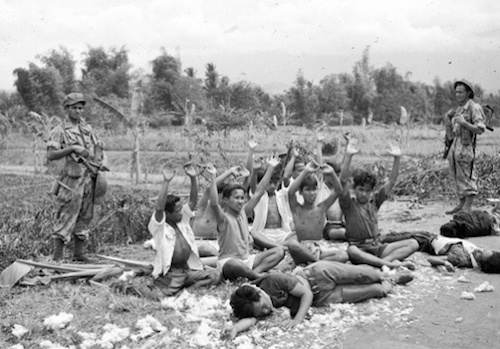
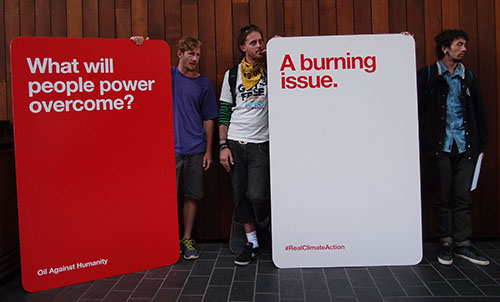
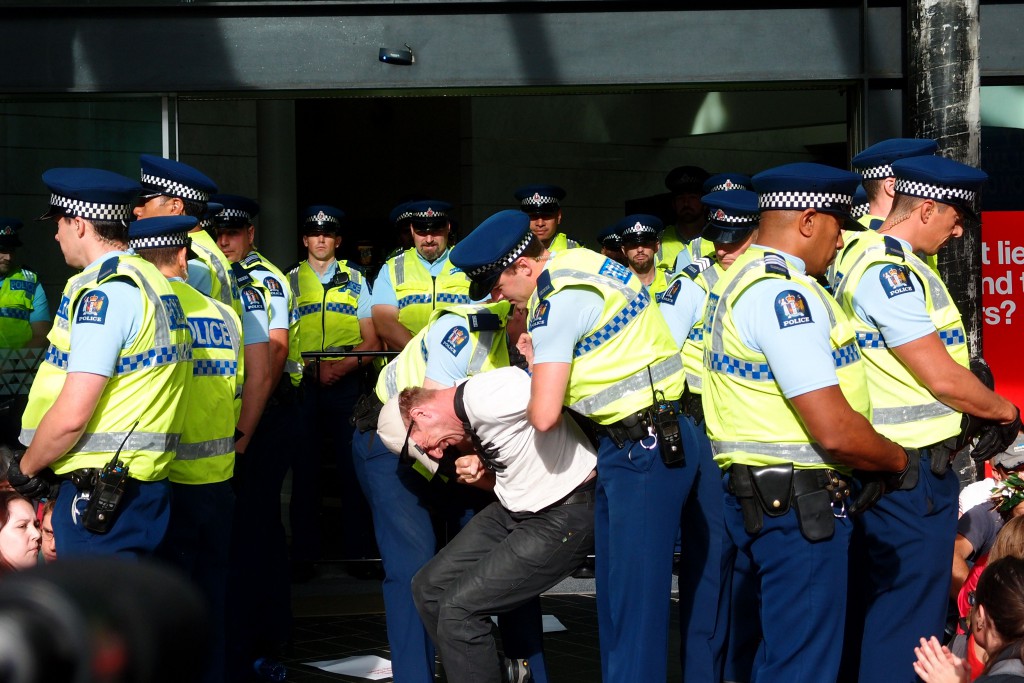
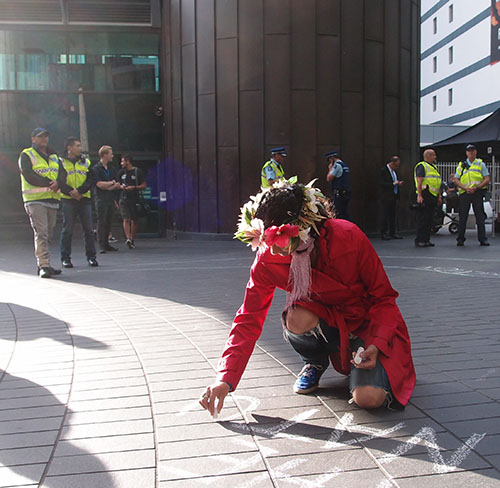

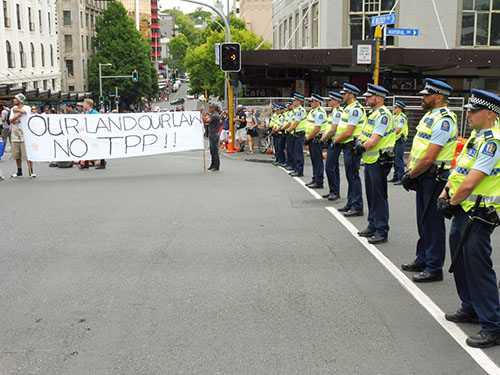
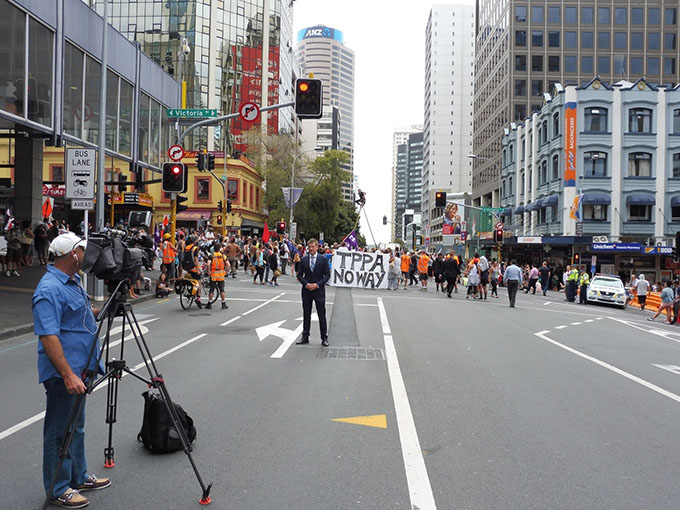
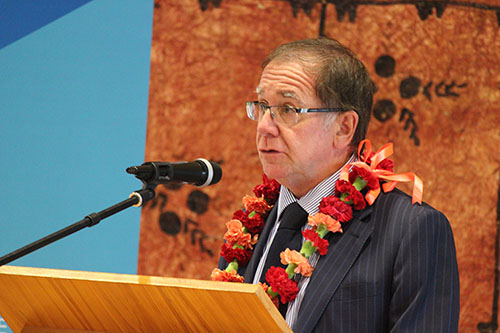
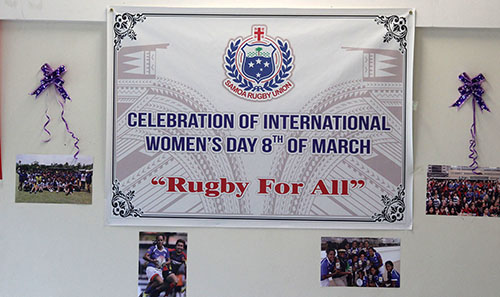



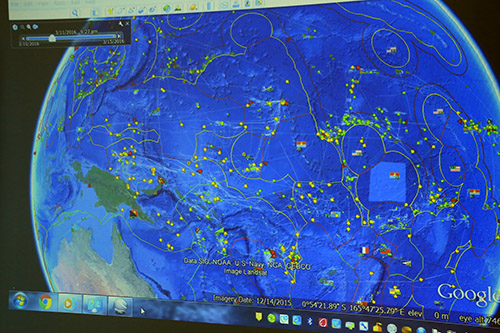
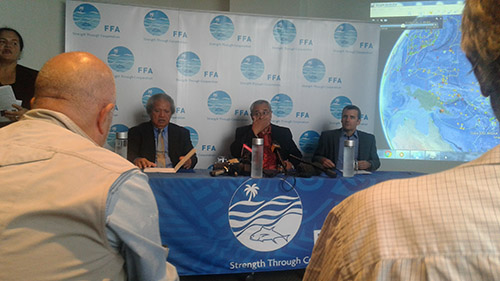
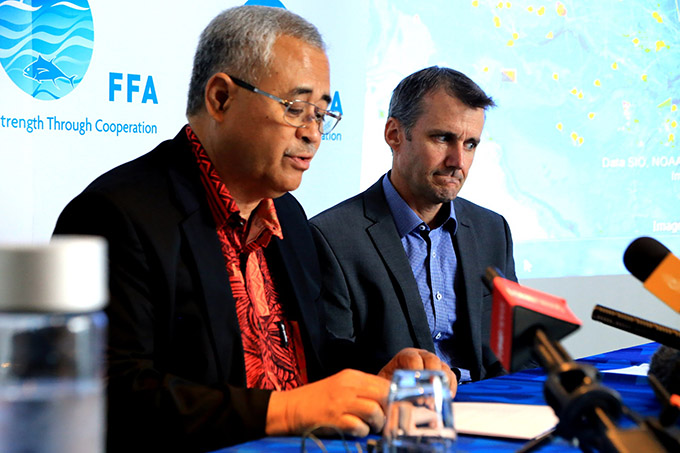

 Women meeting in Suva as part of Femlink’s first National Women’s Human Security Consultation. Image: Jeff Tan/Action Aid[/caption]
Information is then taken to the district level and finally feedback is sent back to the community.
Women meeting in Suva as part of Femlink’s first National Women’s Human Security Consultation. Image: Jeff Tan/Action Aid[/caption]
Information is then taken to the district level and finally feedback is sent back to the community.