Dr Hilda Heine, President of the Republic of the Marshall Islands, signing the Paris Agreement at the UN in New York. Image: SPREP
The Pacific Islands, among the most vulnerable nations to the impacts of climate change, have displayed global leadership last weekend when the Paris Agreement opened for signing on April 22.
Fiji, Nauru, Palau, Republic of the Marshall Islands, Samoa and Tuvalu were six of the 15 overall countries that submitted their ratification during the special signing ceremony at the United Nations Headquarters in New York.
“We congratulate and commend our member countries for their leadership in not only signing but also taking that extra crucial step to ratify the Agreement, helping to ensure it will come into force,” said Kosi Latu, Director-General of the Secretariat of the Pacific Regional Environment Programme (SPREP).
“We are committed to work with CROP [Council of Regional Organisations in the Pacific] agencies, our member countries and partners to help our region address climate change, the biggest threat to island survival.”
The Paris Agreement has far exceeded the historical record for first-day signatures to an international agreement.
Overall, there were 175 parties that signed the Paris Agreement, for which 12 out of 14 Pacific Island nations put pen to paper in signing the agreement signifying commitment.
“The signing of this agreement comes at a critical time for Pacific nations, and the Pacific Community will maintain unerring commitment to work with other CROP agencies and the region’s countries and territories to maintain the momentum for collective action,” the Pacific Community Director-General, Dr Colin Tukuitonga, said.
‘Working together’ The Federated States of Micronesia, Fiji, Kiribati, Nauru, Palau, Papua New Guinea, Republic of the Marshall Islands, Samoa, Solomon Islands, The Kingdom of Tonga, Tuvalu, and Vanuatu were the Pacific islands that signed once it was open for signature in New York.
“Only by working together can we address the most serious issues brought upon us by the effects of climate change. The CROP agencies will continue to work together, The Pacific will continue to work together, and the World must continue to work together, to save our vulnerable brothers and sisters, and future generations,” said Dame Meg Taylor, Secretary-General of the Pacific Islands Forum Secretariat.
The Pacific Islands contribute to less than 0.03 percent of the world’s total greenhouse gas emissions but are among the most vulnerable to its effects.
The island region is also among the first to feel the impacts of climate change.
The Paris Agreement endorsed during the 21st Conference of the Parties to the United Nations Framework Convention on Climate Change (COP21) in Paris, France, marked a watershed moment in taking action on climate change.
After years of negotiation, countries agreed to limit global temperature rise to well below 2 degrees Celsius, while pursuing efforts to keep temperature rise to 1.5 degrees.
Even as the agreement was adopted, countries recognised that present pledges to reduce emissions were still insufficient to reach these goals.
Mandated meetings The Paris Agreement mandates regular meetings every five years, starting in 2018, to review progress, and to consider whether it is necessary to increase the target.
Vice-chancellor and president of the University of the South Pacific (USP), Professor Rajesh Chandra, lauded the efforts of USP member countries for their “wise and timely engagement in such a crucial matter” that concerned the future of Pacific island nations.
“In our resolve to stablise the future of our island nations, we stand firm with our CROP partners in ensuring that this Agreement comes into force. This could not have come at a better time especially when the Pacific region is constantly faced with natural disasters,” he said.
He added that a concerted effort such as this will go a long way in paving the way forward for Pacific island nations.
The Paris Agreement can enter into force 30 days after 55 Parties accounting for 55 percent of global emissions deposit their instruments of ratification.
A five-man bench of the court ruled the detention breached the right to personal liberty under the PNG Constitution.
“The undisputed facts clearly reveal that asylum seekers had no intention of entering and remaining in PNG. Their destination was and continues to be Australia. They did not enter PNG and do not remain in PNG of their own accord,” the judgment said.
As part of the judgment, the Supreme Court has ordered the PNG and Australian governments to immediately take steps to end the detention of asylum seekers in PNG.
It is understood that there are 850 men currently in the detention centre on Manus Island.
Not for Profit aid agency Save the Children chief executive Paul Ronalds said the decision by the Supreme Court in Papua New Guinea provided an opportunity for Australia to rethink its refugee policy.
‘Always unsustainable’ “The offshore processing centre on Manus Island was always unsustainable,” Ronalds said.
“The offshore detention facility on Manus Island has undermined our relationship with Papua New Guinea. We’ve lost any leverage to push for improvements in the way our significant aid investment is spent, or to push for improvements to governance and the rule of law.
“Now is the opportunity to engage in genuine discussions with our regional neighbours, particularly Indonesia and Malaysia as well as Papua New Guinea, and to develop a truly region solution to the global refugee crisis.
“The price of the offshore detention on Manus is lost influence with the PNG Government, lost influence globally and now complicity in a scheme that the Supreme Court has ruled is illegal.”
Human rights lawyer Julian Burnside said he had had the PNG court decision confirmed by a number of sources.
He said his initial response was that it was “absolutely right” and he would be making further comment later.
Australian policy unchanged A statement released by Immigration Minister Peter Dutton said Australia was not a party to the legal proceedings in the Supreme Court of Papua New Guinea.
“It does not alter Australia’s border protection policies – they remain unchanged. No one who attempts to travel to Australia illegally by boat will settle in Australia,” Dutton said.
“The government will not allow a return to the chaos of the years of the Rudd-Gillard Labor governments when regional processing was initiated to deal with the overwhelming illegal arrivals of more than 50,000 people.
“The agreement with Papua New Guinea to establish the Manus Island RPC was negotiated by the Labor government.
“Those in the Manus Island Regional Processing Centre found to be refugees are able to resettle in Papua New Guinea.Those found not to be refugees should return to their country of origin.”
The PNG Supreme Court … landmark ruling against Australian and PNG governments. Image: PNG Today
Research expeditions can involve newly discovered species. This video shows a pale-winged creature dubbed “the ghost fish”. It was discovered by the Schmidt Ocean Institute (SOI) in 2014 while on an expedition to the Mariana Trench, the deepest part of the world’s oceans, in the Pacific to the east of the Mariana Islands.
By TJ Aumua in Suva
Hydrothermal vents have been compared as the ocean equivalent of the earth’s volcanoes. They are a treasure trove of precious minerals and home to unique ocean life.
The rich ecosystems in the vents have scientists eager to gain more knowledge about them, as they face threats of disruption from deep-sea mining interests.
Hydrothermal vents are formed when the movement of the Earth’s plates split open, releasing chemically enriched water, forcing emerged peaks in the ocean’s surface.
Marine species that are developed to live in each vent’s specific ecosystem also face the danger of industrial mining.
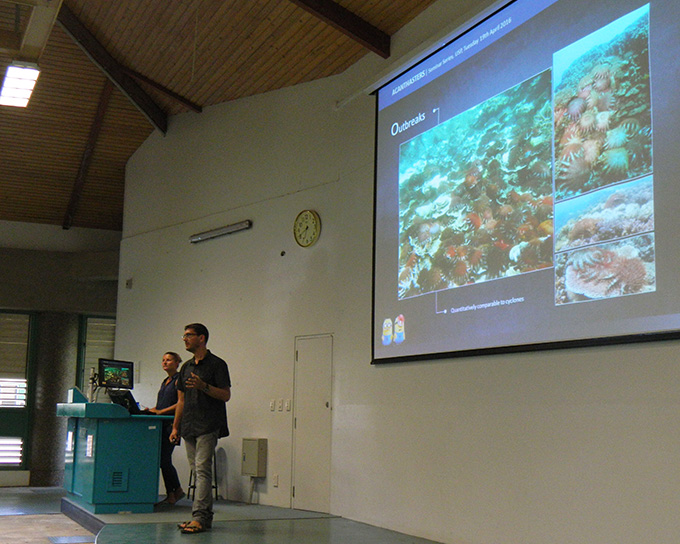
Marine researcher and Schmidt Ocean Institute communications manager Carlie Wiener spoke to Asia-Pacific Report in Suva where she was a guest speaker as part of a series of seminars hosted by the Pacific Centre for Environment and Sustainable Development (PaCE-SD) at the University of the South Pacific.
She says hydrothermal vent communities are still largely unexplored.
“Because the deep ocean is so dark, the species use hydrogen-sulfide and the process of chemosynthesis to produce energy,” Wiener says. “This is unlike land animals where they use sunlight and photosynthesis to produce energy.”
The remote operated vessel (ROV) ROPOS is launched from the aft deck of the R/V Falkor into the Pacific. Image: Cherisse Du Preez/SOI
The Schmidt Ocean Institute (SOI) is currently on a 28-day expedition researching hydrothermal vent sites between Fiji and Tonga.
The SOI team will use a remotely operated vehicle (ROV) that is able to travel up to 3000m to the seafloor to photograph species and take environmental measurements of the vents.
Scientists are hoping the research will provide new insights into volcanic and tectonic activity in the Pacific basin, the ecology of hydrothermal vent species, and data on the impact of deep-sea mining to establish policies and protocols for the future.
Weiner said there is need for more research to happen in the Pacific with the institute receiving many proposals addressing oceanography exploration in the region.
The vent dominant snail Alvinichoncha has been discovered to actually be three different closely related species. These species exhibited associations with different types of microbes depending on where they were found in the region. Image: Charles Fisher/Woods Hole Oceanographic Institute.
Earlier this year, SOI researchers studied the effect of greenhouse emissions and its link with low oxygen zones in the Pacific Ocean.
Communities in the region are encouraged to get involved in the explorations.
Students and researchers can send in proposals for future expeditions to the SOI website.
“Our diving explorations are also livestreamed,” says Weiner.
“So someone here in Fiji who will never get to see 2000m below the surface, can watch it – it’s right in their backyard, happening in real time.”
A “flying” crab, mussels, and snails can be seen on structures formed by hydrothermal fluid mixing with cooler ocean water, causing minerals to settle out of solution, forming chimney-like structures. Image: ROV ROPOS/SOIThe ROPOS Remotely Operated Vehicle gathers samples (water and biological) from deep beneath the Pacific Ocean. Image: ROV ROPOS/SOI
Al Jazeera’s Jamela Alindogan reports on the Philippine army defending its operations against the armed Abu Sayyaf group in the south of the country in fierce fighting earlier this month. At least 18 soldiers died and more than 50 were wounded in the fighting. Government forces said they had killed 13 Abu Sayyaf fighters.
Police and military forces in the Philippines today vowed to “bring the criminals to justice”, following the beheading yesterday of one of two Canadians kidnapped by the Abu Sayyaf last September, reports Rappler.
The Abu Sayyaf militants “cold-blooded murder” has sparked fears for more than 20 other captives they are holding on remote islands.
“The DFA strongly condemns this cruel and inhuman act perpetrated by the Abu Sayyaf group, and reiterates its strong resolve to oppose terrorism in all of its forms,” the statement said.
The two Canadians and a Norwegian captured by Abu Sayyaf rebels last September. John Ridsdel, a former journalist, is in the middle with Robert Hall (left) and Kjartan Sekkingstad. Images: Vice News
The man’s head was found yesterday dumped outside city hall on Jolo, a mountainous and jungle-clad island in the far south of the Philippines that is a stronghold of the Abu Sayyaf jihadist group.
Canadian Prime Minister Justin Trudeau and Filipino authorities identified the victim as John Ridsdel, a retiree in his late 60s who was kidnapped 7 months ago from on board a yacht, along with another Canadian man, a Norwegian and a Filipina woman, reported Rappler.
“This was an act of cold-blooded murder and responsibility rests with the terrorist group who took him hostage,” Trudeau said in Ottawa.
The 4 were abducted at a marina near the Mindanao capital of Davao, more than 500 km from Jolo, as part of a wave of abductions by the Abu Sayyaf, a loose network of militants who for more than two decades have run a lucrative kidnapping-for-ransom business.
The other three were fellow Canadian Robert Hall, Hall’s partner Marites Flor, and Norwegian resort manager Kjartan Sekkingstad.
Six weeks after the abduction, gunmen released a video of their hostages held in a jungle setting, demanding the equivalent of $21 million each for the safe release of the 3 foreigners, reports Rappler.
Abu Sayyaf militants on Jolo island believed to be the captors. Image: Philippine Star
The men were forced to beg for their lives on camera, and similar videos posted over several months showed the hostages looking increasingly frail.
In the most recent video, Ridsdel said his captors would kill him on April 25 if a lower ransom of $6.4 million was not paid.
Hours after the deadline passed, police in the Philippines said two people on a motorbike dropped the head near city hall on Jolo, which is about 1000 km from Manila.
The beheading happened on the day President Benigno Aquino III ordered military troops to intensify their operations against the kidnappers in Sulu.
Ridsdel, a former journalist, oil executive and sailing enthusiast, had moved to the Philippines to manage a gold mine prior to retiring.
Hunt for militants Trudeau said Canada was working with the Philippines to pursue and prosecute the killers, and that efforts were under way to obtain the release of the other hostages.
In the Philippines, security forces said they were setting up checkpoints across Jolo in an effort to block the movements of the gunmen.
In a press conference on Tuesday, Philippine National Police (PNP) chief Director General Ricardo Marquez said authorities would be using the full force of the law “to bring these criminals to justice.”
“The developments on the ground are very dynamic, very tactical, but the strategic guidance was to go neutralize them [and] make sure the lives of the remaining hostages are not put in danger,” he added.
In a joint statement, the PNP and the Armed Forces of the Philippines vowed: “There will be no let up in the determined efforts of the joint task group’s intensive military and law enforcement operations to neutralize these lawless elements.”
However, Philippine security forces have made similar statements many times against the Abu Sayyaf and often failed to achieve their objectives.
Most recently, 18 Filipino soldiers were killed on April 9 as they waged a day-long battle against Abu Sayyaf gunmen on Basilan, an island neighbouring Jolo that is also one of the group’s strongholds.
The Abu Sayyaf is a radical offshoot of a Muslim separatist insurgency in the south of the mainly Catholic Philippines that has claimed more than 100,000 lives since the 1970s.
These include 18 Indonesian and Malaysian sailors who were abducted from tugboats near the southern Philippines over the past month.
The Abu Sayyaf is also believed to be holding a Dutch bird-watcher kidnapped in 2012, while it recently released a retired Italian priest after six months in captivity.
One of the Abu Sayyaf’s biggest recent windfalls is believed to have come in 2014 when it claimed to have been paid more than $5 million for the release of a German couple who were abducted from aboard their yacht in the southwest Philippines.
The Abu Sayyaf’s leaders have recently declared allegiance to the Islamic State group that is causing carnage in the Middle East and has carried out deadly attacks in Europe.
However, analysts say the Abu Sayyaf is mainly focused on getting money through its kidnappings, rather than waging an ideological war.
The United States deployed special forces advisers to provide training and intelligence to Filipino troops from 2002 to 2014, which led to the killing or arrest of many Abu Sayyaf leaders.
However the Abu Sayyaf, which is believed to have hundreds of armed followers, has since re-emerged as a major threat.
Two Pacific Media Centre journalists are in Fiji working on a collaborative project between the PMC and the University of the South Pacific in Fiji.
TJ Aumua and Ami Dhabuwala arrived in Suva last week to participate with students, staff and researchers on a “bearing witness” project that aims to report on the effects of climate change in the island state.
USP’s head of journalism Shailendra Singh says climate change has been chosen as the focus for this project because it is a major public interest issue that needs to be at the forefront on a constant basis.
He says the project is part of a long-standing partnership between Auckland University of Technology, where the PMC is based, and the USP journalism department as an initiative to broaden student learning.
However, students also have the advantage of covering these issues because they are reporting for independent media.
“They are not tied down so much by the priorities and considerations that mainstream media are beholden to, such as ratings and profits. In many respects, they are more free to report than mainstream media,” he says.
“They are future journalists.”
Exciting challenges Ami Dhabuwala, a postgraduate journalist studying Asia-Pacific journalism at AUT, and Pacific Media Watch contributing editor TJ Aumua were selected to go to Suva on the project.
Dhabuwala, who previously worked as a journalist in India, says she is excited and eager to take up the challenges she is facing while reporting on this issue in Fiji.
She says climate change is no longer just an environmental issue – it has become a global human rights issue.
“As a journalist, I have always tried to be a voice for the unknown people. I would like to discover the untold stories of the Fijian people and their suffering because of climate change. I am interested in the issues of the people and possible solutions.”
Pacific Media Watch’s TJ Aumua, who graduated last year with an honours degree including a research dissertation on Fiji media, says this project is an opportunity to share the Pacific’s perspective on climate change with those who live outside the region.
“Living in New Zealand we are so sheltered and unaware of the direct affects of climate change. But for people living in island nations they see and have to live with the effects of climate change every day.
“The bouts of extreme weather and tropical cyclones that have caused destruction in Fiji recently are an example of this. I’m hoping the reportage from this project will be a wake a call for people who still believe climate change is a myth.”
PCF exchange Aumua is also in Fiji last year on a Pacific Cooperation Foundation exchange.
Professor David Robie, director of the PMC, says he is delighted that AUT has been able to send journalists to Fiji in another collaborative project.
“We had two student journalists in Fiji for the 2014 general election and then another couple a year later last September for the Pacific Islands Development Forum and other activities. They did tremendously well to face many challenges.”
He has praised the AUT Research Office for providing a climate change grant that helped fund the journalists on their mission.
The project articles and multimedia reports are being published on the PMC’s new current affairs website Asia Pacific Reportand on the PMC Storify channel.
Pacific Community’s Valerie Tuia … breadfruit trees are an economical crop for being a staple food source in the Pacific. Image: TJ Aumua/PMC
By TJ Aumua in Suva
Severe weather patterns and cyclonic activity have become increasingly hyperactive in the South Pacific with climate change the key contributor.
Communities are faced with the destruction of food crops and are left suffering from food scarcity and malnutrition.
The Pacific Media Centre team in Fiji was granted access to propagation projects at the Pacific Community (SPC) and its Centre for Pacific Crops and Trees in Suva (CePaCT).
Here the issue of climate effects on food sources are being addressed by researchers developing strategies for rapid plant growth and climate resistant crops.
Packaged banana seedlings on the lab benches ready for shipment to Tuvalu. Image: TJ Aumua/PMC
When we arrived at the centre, busy white-coated lab assistants were counting and double-checking more than 1000 banana, sweet potato and swamp taro seedlings which lay in rows across the counters, packed delicately in plastic pockets.
With the assistance of the UN Food and Agriculture Organisation (FAO) these seedlings are one of three batches to be sent to Tuvalu, where the island agriculture is still recovering from the devastation caused by cyclone Pam in 2014.
A total of 6000 seeds will be sent as part of this project.
Fiji itself was hit by category five, tropical cyclone Winston two months ago and as a result the lab has been experiencing frequent power shortages because of damaged infrastructure.
The continued production of seedlings amid these difficulties shows the importance of collaboration between Pacific countries to address crop resilience and food security in the region.
Logotonu Meleisea Maqainabete shows the Asia Pacific Report team around the CePaCT labs. Image: TJ Aumua/PMC
Tissue-culture propagation Centre Curator Logotonu Meleisea Maqainabete says the seedlings are grown using tissue culture material, a method used for growing mass shrub vegetation.
The tissue culture propagation process is carried out in strict sterile conditions, from the materials used to grow the seeds to the air currents in the packaging labs to ensure viral and disease free plants.
We were present during one of the labs power outages, which disrupt the workflow each time it happens.
Curator Maqainabete told other lab assistants to re-start the packaging process of the seedlings.
“Each time we have a power cut and the power is out for long time we have to start again because the air becomes unsterile. We’ve had about 10 or 11 power cuts this week.”
Stem-cutting research
Unlike tissue culture cultivation used for shrub-like vegetables, the stem cutting technique is being used to encourage growth of tree species.
The process involves cutting branches from a mother-plant and rerooting the cutting in soil.
Plants grown from stem cuttings are more likely to mature faster. But although the method sounds easy, the practical application is far from simple.
The environment of the plants is continuously tested to find what temperature and humidity levels encourage the best growth.
Breadfruit trees species grown from stem cutting propagation method. Image: TJ Aumua/PMC
SPC Genetic Resources Coordinator Valerie Tuia, told Asia Pacific Report breadfruit trees, an economical crop for being a staple food source in the Pacific, is the main focus for stem-cutting research in the centre.
Other economical crops being tested are coffee, mango, cocoa and mango.
“Some of these crops flower or produce seeds once a year, and sometimes we get requests for planting material right throughout the year,” says Tuia.
“The idea is, once you work out a system where you are producing material using stem cuttings then you can continue planting and supplying materials right throughout the year.”
Drought resistant crops The effects of longer periods of drought and frequent bouts of severe weather forces have made it difficult for farmers in the region to grow seasonal produce.
Tuia explains the findings so far, suggesting crops with a combination of plant species have a better chance of surviving drought conditions.
According to the SPC website, assistance from DFAT (Australian Aid) and the International Climate Change Adaptation Initiative (ICCAI), has allowed the Centre for Pacific Crops and Trees to research “climate ready crops”.
These consist of plant species that are able to tolerate drought, salt, high temperature, and waterlogging.
“So we are looking at different approaches on how you can integrate short term crops like leafy vegetables, medium term crops like cassava and taro, and then tree crops like breadfruit or lemon trees,” says Tuia.
“With that approach, models of these crops can be practiced by small scale farmers.”
Elevated cultivation After cyclonic weather and floods, rubbish and waste products add to the already difficult task of cleaning streets and coastlines.
“Waste materials like bottles and containers are a nuisance,” says Tuia. “So we are looking at ways of using low technology, and recycling these materials to grow vegetables.”
“What you can do is cut the bottom of the plastic bottle to plant any vegetables inside. Sterile the plastic first with hot water and sun dry the soil to kill all the microbes.
“You can then make small hooks and make an apparatus where you can then hang the individual plant containers—this is what we call elevated cultivation.”
The simple but economical strategy means it can be easily adopted, with rural and marginalised communities being able to adapt to it without needing expensive materials.
These mobile plants can be moved in doors so farmers can avoid replanting and starting their crops again in the threat of a cyclone or forced climate relocation.
“Destruction of crops also affects nutrition,” says Tuia. “The price of fresh vegetables and fruit increases after a natural disaster, so this method allows continuous harvesting of crops for anyone.”
Ami Dhabuwala and Pacific Media Watch contributing editor TJ Aumua are in Fiji on a two-week “Bearing Witness” climate change journalism project with the University of the South Pacific.
[caption id="attachment_4808" align="alignleft" width="150"] Dr Bryce Edwards.[/caption]
The Search for New Zealand’s Trump: The current US presidential primaries are compulsive viewing for politics aficionados. Pundits have mulled over the factors contributing to the rise of outsider candidates like Bernie Sanders and Donald Trump, and debated what it all means for the established political order. Closer to home, there have been debates over what the various outcomes could mean for this country, and comparisons with New Zealand’s political scene.
New Zealanders are repelled by Republican hopeful Donald Trump. That’s just one of the interesting poll results reported by UMR Research’s Stephen Mills – see: If only Kiwis could vote for president. Here’s the main survey result: “Given a hypothetical vote in the US presidential election in a UMR survey in early April, 82 per cent would go for Hillary Clinton and only 9 per cent for Donald Trump. Even among National voters, 82 per cent plumped for Clinton and 11 per cent for Trump”.
The poll had some surprising results: “If the choice was between Donald Trump and Bernie Sanders, New Zealanders would decisively elect the socialist senator from Vermont. He wins by 77 per cent to 8 per cent and even National voters prefer the avowed socialist by 76 per cent to 13 per cent.” Mills reports that New Zealanders are no fans of Ted Cruz either, with even National voters preferring Sanders to Cruz. In the Democratic race Clinton outpolled Sanders with New Zealanders, with 55 per cent to 25 per cent.
Mills questions whether the preconditions exist in New Zealand for the rise of a candidate such as Trump. He concludes that – while there are some similarities (income inequality, lack of economic mobility and a history of surges from smaller political parties) – it’s unlikely. He says New Zealanders haven’t been hit as hard by the global financial crisis, largely approve of Key’s economic management, are less frightened by terrorism and less agitated by immigration. Mills argues that MMP acts as a “political safety valve” and Trumps bombastic, self-aggrandising style wouldn’t go down well here.
But yesterday Geoffrey Miller and Mark Blackham asked: Is New Zealand ready for its own Donald Trump? They argue that New Zealand’s political elites are becoming increasingly estranged from ordinary voters, which is the scenario in which populists like Trump thrive.
Of course some argue New Zealand already has Trumpesque politicians and, in any case, few can resist a game of “Who is New Zealand’s Donald Trump?” Canterbury University sociologist Jarrod Gilbert (@JarrodGilbertNZ) tweeted “Hey political pundits, it would be great to see where you think the US presidential candidates sit on a Left/Right spectrum in NZ terms.” David Heffernan (@kiwipollguy) was quick to respond with “Cruz = Graham Capill, Trump = Colin Craig, Clinton = Judith Collins, Sanders = Laila Harré.”
Is Winston Peters NZ’s Donald Trump?
Indeed, while the rest of the world gravely ponders the implications of a Trump presidency, Claire Trevett reports that New Zealand MPs have been preoccupied with a different question: Is Winston Peters NZ’s Donald Trump? “Muldoonist” has been a popular insult recently, but being compared to Trump is now the “insult du jour” amongst MPs, reports Trevett. It’s also “multipartisan” and has been leveled at MPs on both sides of the House, though Peters has been the most frequent recipient.
Rodney Hide says you need to combine Peters with another outsider who “spanked the establishment. Think Winston Peters. Think Sir Bob Jones. Put those two together and imagine the result. That’s Trump” – see: NZ’s very own Donald Trump.
Hide makes his case: “Peters has fashioned a lifelong career on the fear of foreigners taking over. The more he is attacked, the more he appears the martyr and the more the establishment looks to be trying to hide that it has let us down and sold us out. His rhetoric is neither coherent nor consistent but he weaves a compelling spell.”
He acknowledges differences – most obviously Peters has spent decades in politics while Trump is a political novice: “Peters’ life is politics. It’s all he knows and all he does.” And Hide says that while the “crass and brash” Bob Jones shares certain qualities with Trump, Jones “ran as a spoiler and influencer. He would have been horrified to have won high office. Trump expects to win.”
Is Bob Jones NZ’s Donald Trump?
Satirist Ben Ufindell also nominates Bob Jones as New Zealand’s Trump, pointing to his New Zealand Party electoral intervention in 1984, which won an impressive 12 per cent of the vote. Ufindell says the parallels are striking: Jones “put his own money into a political campaign that many initially wrote off as irrelevant and fleeting. Despite having no political experience he was able to turn this movement into one that would shatter the existing political order and change the face of New Zealand politics.“
Ufindell tracks down the wealthy property investor with a ”penchant for shocking, offending and bluntly speaking his mind” and in a very entertaining eight-minute video interview puts it to Jones whether he’s NZ’s Donald Trump?
Of course, as Hide points out, in a sense Jones was the anti-Trump. The superficial comparisons are there but, unlike Trump, Jones passionately believed in the policies he was pushing, and clearly didn’t do it for the pursuit of power. Jones immediately disassociated himself from his movement once he realised David Lange’s Labour Government was implementing his free-market policies.
Bob Jones himself considers Peters “the local Trump parallel” as he ponders “How to explain the Trump insanity?” – see his opinion piece, On Trump and his Kiwi counterpart. Jones says “People generally disinterested in public affairs would view Winston Peters as attractively anti-establishment, just as plainly motivates the Trump-ites. Winston/Donald will sort things out is the faith”.
The Rise of Trump
John Armstrong writes that “Anyone who was living in New Zealand in the mid-1990s will have noted a marked similarity between Trump’s campaign themes and those stressed by one Winston Peters – see: Winston Trump or Donald Peters? To forge his NZ First vehicle after his split from National, Armstrong says “Peters banged the same drum as now being used by Trump – anti-foreigner, anti-migrant, anti-establishment and anti-free trade” albeit less blatantly than Trump.
His blogpost is an interesting examination of why Trump resonates strongly with many Americans. Armstrong argues “What voters are doing is using Trump to deliver a message in the strongest possible terms to the political and economic elites that something has to change in terms of the rich getting richer while not only the poor are getting poorer. This is also why Bernie Sanders is causing headaches for Clinton on the other side of the political spectrum.”
Although New Zealand may not be as far down the track in terms of the public losing faith with politicians and corporations, Brian Gaynor argues that there are some faint signs that we are headed down the same path, and voters are beginning to react in the same way – see: ‘Free market’ failings fuel the Trump movement.
Gaynor recommends Robert Reich’s book Saving Capitalism as “an excellent read for those wanting a better understanding of the Donald Trump phenomenon”, arguing it shows “why New Zealand could also have a “Trump experience.”
He says “Reich, who was Secretary of Labor in the Clinton Administration, is a strong supporter of capitalism but he believes that its rules are strongly skewed in favour of a number of elites and against the majority of ordinary citizens. Reich believes that when individuals consider that neither they nor their children have a fair go, they will find ways to protest against the unfairness of the capitalist system.” Gaynor concludes “The clear message is that the “free market” needs rules and regulations that give everyone a fair chance to participate and prosper.”
Martyn van Beynen also believes “The question that we should… be asking ourselves is whether the Trump recipe would work in NZ” – see: Time is ripe for NZ’s Donald Trump.
He writes eloquently of the experiences of an economically precarious and “uneasy part of the population” that has been left behind: “But their place in the economy is one thing. Their place in a rapidly transforming society is another. They are increasingly feeling they don’t fit and are not sure why. They are made to feel bad about some of their not particularly well thought out or even strongly held views. Their discomfort at the influx of migrants and trends like foreigners buying up the country is made to seem backward and unjustified. They are told they are racist, sexist, intolerant and stupid. These are Trump’s people and they are a big slice of the population. He is making them feel a little more powerful and understood.”
Van Beynen says that population exists in New Zealand too and it is also looking for “a leader and for a voice… They are looking for a home. Come forward NZ’s answer to Donald Trump. Now is your time.”
Comparing Trump’s appeal with that of the “lazar kiwi” flag, van Beynen believes while it can be satisfying to flirt with the idea of sticking it to the establishment, sanity will prevail when an actual choice must be made: “America is many things but collectively it does not want a complete loose cannon in charge.”
Gordon Campbell concurs, arguing while Trump is likely to be the nominee, it is highly unlikely he will overcome the huge negatives he brings as a presidential candidate – see: On whether Donald Trump has peaked.
Trump strikes a chord with disgruntled middle America because of “the emotional intent of what he says, not the literal meaning” points out Mark Blackham – see: The Trump Thing: emotion.
He elaborates: ”All the intellectual smartiepants mock Trump because he says he’ll build walls and stop Islamic people coming into America. They mock the sort of people who like him as being stupid to agree with these things. Yes, the illiteracy of the words, the phrasing and the concepts is unusual for a modern candidate… Few voters seriously think a wall is viable. Few voters seriously think to ban religions. Few think Trump can magic-up ‘millions’ of jobs. They want these things, and know they can’t get them. But at the very least, they want a President who also them. They believe they are more likely to get those issues that matter to them dealt with under that sort of President. It may not be a wall – but it will be an attitude and set of rules that amount to a metaphorical wall”.
Blackham accuses the elite, intellectuals and the left of having “an ego-concept of themselves as smart, thinking people. They believe their opinions are based on logic, reason and altruistic intentions” and so they are “appalled at the Trump appeal to base emotions.” And yet, he points out, “how easily they themselves followed the base emotion of hope when they cheered on Obama’s empty and nonsensical “change” rhetoric during his first campaign. Where is that “change” and wonderful world that Obama promised?”
In Yes, He Can: Why so many Americans are voting for Donald Trump? Chris Trotter voices similar sentiments: “They are not looking for someone who understands the system. They hate the system. They’re not in the market for a constructive candidate, they want a President who’s ready to go after the system with a wrecking ball!”
The two main parties only have themselves to blame according to Trotter: “For three decades they have either crudely inflamed, or, loftily dismissed, the people they call ‘Trailer-Trash’ and ‘Rednecks’: the very same people who are now turning out in their tens-of-thousands for the man who openly proclaims that he ‘loves’ the ‘poorly educated’. The Donald loves you guys – and he wants your votes. Why? Because your votes, and the votes of those assholes up at the Country Club carry exactly the same weight. That’s right: exactly the same. And you know something else, fellas? There are way more of us than there are of them!”
Trump appeals because “he’s so rich he doesn’t need to go cap-in-hand to the Koch brothers (like ‘Little Marco’ Rubio).” And, like them, he “knows what it means to be ridiculed, excluded and hated – and isn’t afraid to say so out loud. The man who wears the scorn of the Establishment as a badge of honour, and who revels in its all-too-obvious fear.”
“The barbarian is no longer at the gate” writes Paul Thomas, “He’s inside the castle and heading for the throne room.” Thomas believes Trumps extreme rhetoric gives him ownership of issues and “shows he’s not just another politician trotting out talking points. Many pundits viewed his blistering attacks on George W. Bush and the Iraq war as damagingly disloyal and a strategic blunder. In fact… Trump sent a clear message that he’s uncompromised by any sense of obligation to an unloved party hierarchy.”
He says his previous assessment of Trump didn’t go far enough and he now sees that Trump not just an outsider but a renegade outlaw: “Trump’s vulgarity and the undercurrent of violence in his rhetoric – this week he declared he wanted to punch a protester in the face – locate him in popular culture rather than politics. American popular culture is full of outlaw figures whose appeal derives from their ability to get things done via decisive, often violent, action while the system pussyfoots around.”
In Thoughts on Trump’s messaging, Danyl Mclauchlan argues that political insiders are so busy geeking out and imagining themselves among the pantheon of great political orators when they communicate, they lose sight of the fact normal people do not talk in that way. In contrast, “Trump, famously, doesn’t talk like a politician. He talks like a reality TV show star which is what he is.” Master of the “killer line”, Mclauchlan says no doubt much of what Trump says is scripted but “at a time of tremendous anger towards the political elite he happens to be a master of communicating in a way that is the total opposite of that hated elite.”
Bob Jones says the message from Trump supporters is clear: “In his brazen way, Trump alone was shouting out loud about the deep-felt concerns everyone was expressing in private and promising wham-bang (albeit ludicrous) ways of dealing with them… In short, in an uninspiring Republican line-up, Trump alone is upfront about the major concerns on people’s minds.”
Jones argues “We have a parallel political situation in New Zealand with legislated favouritism toward Maori, which is both an indisputable fact and a huge source of bitterness, constantly expressed privately.” He says that Winston Peters’ and Don Brash’s positive polling after “coming out punching” on the issue exposed a deep vein of discontent and believes that begging is another issue “which, due to race sensitivity, people feel strongly about but only discuss in private” – see his Trumpesque What Wellington and Auckland mayoral candidates could learn from Donald Trump.
David Farrar recently wrote a thoughtful blogpost attempting to explain The appeal of Trump. Farrar says there are multiple factors in operation, including the unhappiness of Americans with the direction of their country, Trump’s promise to make America great again, a backlash against political correctness, free media coverage, Trump being free from traditional political relationships, and the lack of an effective Republican establishment leadership.
Trump’s lone visit to New Zealand
Kurt Bayer has the story of Trump’s single day in New Zealand in 1993, when he made a failed attempt to lobby to build a new casino on the site of Auckland Railway Station – see: When Donald Trump visited New Zealand.
“But what might he make of our great and our good were he to pop over today?” asks Toby Manhire. “In the cause of further futility, let us pause to ask: what advice might he have for prominent New Zealanders?” – see: Donald Trump’s top tips for Kiwis.
Matt Heath says although “logic suggests we should hate him”, there is just “something about the guy” – see: Why I’m in love with Donald Trump. Sure, Heath admits, Trump “will kill us all if he gets his finger on the button”, but until then “It’s craziness. Very entertaining craziness.”
Finally, Scott Yorke has Ten reasons why a Trump presidency might not be so bad, and Mike Wesley-Smith wonders whether New Zealanders have been too hasty in their mockery of Trump, and says “Mr Trump has had a few ideas we could borrow – namely the wall he wants to build between the US and Mexico. Wesley-Smith asks “Do we need a new divide – between those who live off the lattes and those who live off the land” – watch: Taking a leaf from Trump: Building the Bombay barricades.
Professor Bill McKibben speaking in Fiji … climate change is a systemic structural problem and “we have only a few years to solve it.”
By Ami Dhabuwala in Suva
The people of the Pacific have been handed a big challenge over the weekend – mobilise for urgent climate change action and “save the world” through their example.
Bill McKibben, founder of the global grassroots climate campaign 350.org, challenged Pacific islanders to fight for the climate change movement at a conference at the University of the South Pacific.
It is ideal for Pacific people to use solar power, fuel efficient cars, ride bicycles, he argues.
But in the end it would not make any difference to the final outcome for the fight for climate change as there are small populations in the Pacific.
“The Pacific is probably going to play a crucial role in helping to build the movement that changes the politics around the climate change,” he said.
“You can make big countries like China, United States and Australia to act fast on it. You have a particular job to build this movement.”
The seminar, organised by USP’s environmental studies programme PACE-SD, focused on climate change action.
“We started the 350.org operation almost 8 years ago to build the movement for climate change around the world,” said McKibben.
‘We need a fight’ McKibben has written several books on the environment, including The End of Nature, The Age of Missing Information, Hope, Human and Wild, Oil and Honey.
“I thought long ago that writing books, discussions, and talks could solve this issue, but I was wrong at that time. We need a fight. We have to fight against the fossil fuel industries and against their money and power.”
To fight against the power of these industries, he explained the necessity of a movement.
“It is a systemic structural problem and we have only a few years to solve it. We require a huge political change. We need to find some source of power other than money to fight against [the fossil fuel industry] and the only other source is to build the movement.”
McKibben said this could be an opportunity for the Pacific people to save the world.
“It is a great burden to be in the Pacific right now. You didn’t ask for climate change and you didn’t cause it – yet it’s happening to you.
“But you can turn this burden into a privilege. You can fight together to save the world from this crisis.”
‘Deep emergency’ He talked about how it was known 25 years ago that the world would face the effects of climate change because of the fossil fuel and other industries, but “we didn’t know how fast it would be”.
“We are in the deep climate change emergency. It is much deeper than we thought,” he said.
McKibben believes that it is not a matter of decades – it is only a matter of years now. The world needs to act fast with the fight over climate change.
“Since the Pacific faces the quickest danger than any part of the world, you have more right, more credibility to stand up and push this movement on the fast track.
“We have to make the world understand about the crisis, which is the most difficult job. We have got to figure out the way to make them understand.”
Professor McKibben has already covered many countries, including Afghanistan, Australia, Bangladesh, China, Ethiopia, India, Pakistan, Russia, United Arab Emirates (UAR) and the US, with the 350.org campaign.
New Zealand approach This campaign comes up with creative ideas in different countries.
For New Zealand, they took help from the bike mechanics. They went to the people’s garages and helped them to repair their bikes – so they could not find an excuse not to ride their bicycles.
Koreti Tiumalu has worked for the New Zealand government for 10 years. But 4 years ago she quit her job and now is now working with 350.org as the Pacific region coordinator.
“I have heard stories that sometimes I wish I wouldn’t have. It’s not an easy fight. But I can’t just sit there and do nothing.”
Tiumalu believes that young people love their culture and with the help of concerts, music and smart phones, they can become a huge part of this movement.
“We need to get into their music, their sports.”
350.org plans to launch a “Break Free” campaign to target the world’s dangerous fossil fuel projects during May 4-15.
Private Hohepa at rehearsals for the Gallipoli Dawn Service on Anzac Day tomorrow. Image: NZ Defence Force
By Sara Stavropoulos
Ruatoria-born soldier Private Christian Hohepa has now travelled a long way since joining the New Zealand Army in 2013.
On his first-ever trip out of New Zealand, the 21-year-old Ngata Memorial College ex-pupil is a member of the Maori Cultural Group, which is part of the New Zealand Defence Force’s contingent to Gallipoli for Anzac Day tomorrow.
The 33-strong contingent has entered the final stages of rehearsing the various roles they will play at the two Anzac Day services to be held on the Gallipoli peninsula in Turkey – the Dawn Service at the Anzac Commemorative Site at North Beach, and the New Zealand Service at Chunuk Bair.
PTE Hohepa is currently an apprentice armourer in the Army, learning to fix and maintain weapons. Outside the workshop, he’s into physical training and enjoys a variety of sports.
“Joining the Army was a childhood dream,” he said.
“Then when I got a bit older I could see it was a path to expanding my knowledge and potential, and also a way that I would be able to help people, which is really important to me.”
Although PTE Hohepa is interested in most sports, right now his focus is on work and his involvement with the MCG. He has also taken on the study of mau rakau (traditional weapons skills) through the NZDF.
PTE Hohepa says he was “overwhelmed” at selection for the Gallipoli contingent.
“I was really surprised, and so humbled. There was a lot of talent at the selection wananga and to be chosen was a very proud moment for me, not just for myself but for the fact that I get the privilege of walking the same grounds as the brave soldiers who died here to protect our future.”
PTE Hohepa isn’t the first of his family to serve in the Army – his grandfather, John Grace, was a member of the famous Maori Battalion in World War 2. The Maori Contingent which served at Gallipoli was the forerunner of the Battalion.
“The NZDF is a solid career,” he says.
“There’s just so much opportunity, especially for rural people who might not have the range of experiences you get in the cities. You have experiences and learn in ways that you never would anywhere else.”
PNG’s Prime Minister Peter O’Neill … counter-attack on Sir Michael Somare and Sir Mekere Morauta. Image: Fiji TV
Papua New Guinea Prime Minister Peter O’Neill says recent calls by former prime minister and the country’s founding leader Sir Michael Somare to leave office are “self-serving” from a person who has been “hell-bent” on removing his government since Somare lost power in 2011.
“While these matters [corruption allegations] are before the courts, he has to respect that no person is guilty until proven so in a court of law based on compelling evidence,” he said.
“I have always stated – show evidence of me benefiting financially or otherwise and I will resign.
“I would never do so because Somare or [another former PM, Sir Mekere] Morauta think I should, their motive is simply sour grapes.”
If they think they have the support, they should both combine and face us at the elections. But from recent memory when the people voted, Morauta lost badly in 2002 and Somare lost badly in 2012.
Looking at the issues he has raised, it is a fact that I did not receive money in my bank account like Somare has.
He needs to explain why PNG government money from the community college fund ended up in his personal account number in Singapore.
Personal benefits His son and him had benefited directly while PNG was left with incomplete community colleges and with millions of US dollars in loans taken out for this project, while Somare got millions of dollars in his pocket, alleged O’Neill.
This matter was being pursued by the Singapore public prosecutor with Somare’s Singapore partners.
If anyone should resign, Somare should resign and he should be charged, said O’Neill.
“It is all very well to point fingers, but people must only do so with clean hands,” he said.
“The same goes for Sir Mekere Morauta.
“While our people in Western Province are dying, he continues to keep their funds parked in the SDP fund in Singapore.
“It is the people’s money that pays exorbitant fees to Morauta and his consultants, and for them to travel first class around the world.
“This is money that belongs to the people of Western Province and should be given to them to use for their own community benefit, but while Morauta splurges their money they continue to suffer.
“This is a fact that was confirmed by courts in Singapore recently.
“What a load of first-class hypocrisy we see from Somare and Morauta, they should hide their heads in shame,” O’Neill added.
FLASHBACK … to Martial Law in the Philippines in 1972 under President Ferdinand Marcos. Image: Rappler Montage
I give my column space today to my favorite communication man, Professor Crispin C. Maslog. A former journalist with Agence France-Presse, Cris was director of the Silliman School of Journalism and Communication when Martial Law was proclaimed in the Philippines 1972. He is now senior consultant, Asian Institute of Journalism and Communication, and chair of the board, Asian Media Information and Communication Center (AMIC) based in Manila.
While I was grappling with the horrible impositions of Martial Law when I was editor-in-chief of Philippine Panorama, I had to run to some safe, soul-restorative place on weekends outside the city. It was at the home of Cris and his wife scientist, Flor, on the University of the Philippines Los Baños (UPLB) campus that I found comfort and assurance that all will be well, that the tyrant Ferdinand Marcos and his family will be driven away from the land, and that democracy will be restored.
His article should remind us that Martial Law should never happen again – and the
perpetrators not be returned to seats of power. – Domini M. Torrevillas, The Philippine Star
By CRISPIN C. MASLOG in Manila
Somehow, today’s university student generation is not to blame for its Martial Law amnesia. These people were not yet born at the time Martial Law was proclaimed 44 years ago!
We, the older folks, are to blame. We did not teach them history properly – and I mean by we, mainly the Philippine government and the mass media who suffered the most under the Martial Law regime of Ferdinand Marcos.
Now that the surviving members of the Marcos family are active in politics again and pushing a revisionist version of Martial Law history, we are worried, to say the least.
So when I told students at Silliman’s College of Mass Communication recently about the abuses during Martial Law proclaimed by Marcos in 1972, they were aghast at what they heard. I told the group that before Martial Law was proclaimed in 1972, the Philippines went through hard times under Marcos’ two four-year terms from 1965 to 1973 – the years of discontent.
There was a dramatic increase in poverty during Marcos’ two elective terms, resulting in social unrest.
Yet Marcos wanted to extend his term, which he could not do legally because he was limited by the Constitution to two presidential terms ending in 1972. So he decided to suspend the Constitution and declare Martial Law on Sept. 21, 1972.
The first few years under Martial Law were peaceful and orderly. The average person liked that people were disciplined. But people were disciplined because they were afraid.
More corrupt And soon after 1972, Marcos and his family became more corrupt because no one, especially the mass media, was free to criticise them. Power corrupts and absolute power corrupts absolutely. The next 14 years witnessed corruption unparalleled in Philippine history.
Instead of improving, the Philippine economy took a nosedive during the 14 years of Martial Law because of cronyism and economic plunder. Cronyism was an “economic system” where every major economic activity was controlled by the First Family, their relatives, or cronies.
Answering criticisms about relatives who became millionaires overnight during Martial Law, Madame Imelda is quoted to have replied: “My dear, there are always people who are just a little faster, more brilliant, more aggressive.”
The Manapat book is based on 11 years of research and writing and is the authoritative source of information on the economic plunder of the Philippines under Marcos. The title of the book is based on a famous quote from Madame Imelda.
The major cronies, as documented in Manapat’s book, were: Roberto Benedicto who controlled the sugar industry, Danding Cojuangco who monopolised the coconut industry, Antonio Floirendo who cornered the banana industry, and Hans Menzi who lorded over the mining and paper industries.
Cronyism meant giving loans to friends that had little or no collateral, whose corporations were undercapitalised. Marcos, family and his cronies used the national coffers, the resources of private banks, and even international loans from multinational banks for their business. Aid money from the US and Japan were placed at the disposal of Marcos’ money-making network.
Squandered loans Until today we are still paying for these loans squandered by the Marcos regime.
The corruption reached such a massive scale that it took its toll on the Philippine economy and the lives of the average Filipino. By 1986, just before People Power I, the number of Filipinos living below the poverty line doubled from 18 million in 1965 to 35 million.
The history of this economic plunder is one of the blind spots in the minds of the Filipino millenials today. It worries me and my generation no end, that the son of Ferdinand Marcos is running for vice-president of the land, and be just a heartbeat away from the presidency.
If that happens, philosopher George Santayana may again be proven right when he said long ago that a people who do not remember their past are condemned to repeat it.
Domini M. Torrevillas is a columnist on The Philippine Star. One of her From The Stands columns this month was devoted to this article by Professor Maslog and is republished here with the permission of the author. The Philippines presidential election is due on Monday, May 9.
Led by Fiji, at least nine island states are formally presenting their ratification of the agreement to the UN, moving quickly to the next stage in a bid to bind countries to their commitments to tackle global warming.
The Paris agreement will come into force as soon as 55 countries responsible for 55 percent of the world’s greenhouse gases have ratified the accord.
“We wanted to be the first to ratify it,” said Fiji’s Prime Minister Voreqe Bainimarama, whose cabinet quickly endorsed the deal in February.
That same month, Tropical Cyclone Winston that killed 44 people, destroyed 40,000 homes and caused more than US$1 billion in damage hit the Pacific nation.
“A single climatic event can wipe out all the gains we have made and set back our development,” the prime minister told a news conference.
Other early ratifying countries of the deal are Tuvalu, Kiribati and the Maldives – low-lying islands that face oblivion from rising sea levels – as well as Belize, Barbados, Nauru, Saint Lucia and Samoa.
Greenhouse gas giants China and the US, the world’s top two greenhouse gas emitters, are pushing for quick ratification so that the Paris deal can come into force, possibly as early as 2016 or 2017.
More than 150 governments, including some 50 heads of state and government, signed the historic accord during the ceremony on Earth Day yesterday.
It was the largest signing of an international agreement since the Convention on the Law of the Sea in 1982.
French President Francois Hollande was the first to sign the accord, but the ceremony would also see island leaders take the podium to appeal for urgent action to ratify the Paris accord.
“What was achieved in Paris was a positive first step, but it is not nearly enough to avert catastrophe,” the Fijian prime minister said.
Fighting for 1.5 Fiji and other island states want to keep global warming within 1.5 degrees above pre-industrial levels, instead of 2 degrees as outlined in the Paris accord.
A study this week explained a 2 degrees jump in the global temperature would double the severity of crop failures, water shortages and heat waves in many regions compared to a rise of 1.5 degrees.
An extra 0.5 degrees would also add 10cm to the average ocean waterline, further imperilling dozens of small island nations and densely populated, low-lying deltas, a team of researchers reported.
Island governments want to unlock international financing so that they can better prepare their economies and infrastructure to withstand the impact of climate change.
Tropical Cyclone Winston, the strongest ever to hit the South Pacific, affected some 250,000 people, or 40 percent of the regional population.
“After Winston, we’ve had three tropical depressions that have brought continued flooding,” said Bainimarama.
“We’ve received some 1000 earthquake tremors, so we are fairly worried about earthquakes and tsunamis,” he said.
Pacific Media Centre’s Professor David Robie and Tongan publisher, broadcaster and communications adviser Kalafi Moala at the human rights forum in Nadi, Fiji. Image: Jilda Shem/RRRT
FROM HUMAN RIGHTS ABUSES REPORTS TO DEFENDING FREEDOM OF SPEECH TO
RIGHTS-BASED JOURNALISM
SOME of you perhaps may be mystified or puzzled about why I have included the
term ‘mindful’ journalism in the title of this presentation. I’ll explain later
on as we get into this keynote talk. But for the moment, let’s call it part of
a global attempt to reintroduce “ethics” and “compassion” into journalism, and
why this is important in a human rights context.
Human rights has taken a battering in recent times across the world,
and perhaps in the West nowhere as seriously as in France on two occasions last
year and Brussels last month. After the earlier massacre of some 12 people in
the attack on the satirical magazine Charlie Hebdo in January, there was a massive wave of rallies in defiance and in
defence of freedom of speech symbolised by the hashtag #JeSuisCharlie – I am
Charlie.
Investigators in both Belgium and France worked on the links between
the two series of attacks and have made a breakthrough in arresting two key
figures alleged to be at the heart of the conspiracy, Salah Abdeslam and
Mohamed Abrini, a 31-year-old Belgian-Morrocan suspected to be the “man in the
hat” responsible for the bomb that didn’t go off at Brussels airport.
It ought to be noted that Charlie’s
cartoons were not just anti-Muslim, or rather critical of jihadist extremism,
they have been equally offensive about all religious, mocking Christian
extremists and the establishment with just as much fervour. Barely had the
French nation come to terms over this terrible and senseless massacre in
January, which killed the chief cartoonist editor, known as Charb, and most of
the cartooning team in one foul swoop, when an even more horrendous event
happened 10 months later with a series of simultaneous attacks by masked ISIS
gunmen across several locations in Paris, killing 135 people.
In the West, there was a rise of gratuitous insults and hostile
anti-Muslim feelings, which was precisely one of the objectives of the ISIS
gunmen. (“Islamic State” should be called Daesh – it is not a country). The whole
point of terrorism is to strike terror in the hearts of your opponents.
But few stopped to think about the origins of terror, or the traditions
of torture and state terrorism in the West that stretch back to the Inquisition
in 1234 and the massacre of whole communities, such as the famous rugby playing
town Béziers in southern France.An army
of crusaders under orders from then Pope Innocent III attacked the city on 22
July 1209 and slaughtered some 20,000 people, many of them inside churches.
They were regarded as Cathar heretics.
Moving on a few centuries to colonial Algeria, France fought a bitter
war against the Muslim rebels (1954-1962), reaching fever pitch in the Battle
of Algiers when a Second World War resistance hero led brutal and illegal
counter-terrorism methods to crush the resistance in the Casbah. The battle for
the city was won, but ultimately France lost the independence war.
Gillo Pontecorvo’s 1966 film Battle of Algiers, widely regarded
as one of the greatest movies of all time, was banned in France for five years.
Lieutenant-Colonel Mathieu is a composite character based on Colonel Jacques
Massu, the paratrooper commander. It shows how the West developed illegal
torture and terrorist methods against the Algerians. This is at the root of the
US “terrorism against terrorism” military methods today.
Shades of this repression were echoed barely 20 years later in the
South Pacific with French military suppression of Kanak agitation for
independence and with the bombing of the Rainbow Warrior in 1985. A
cartoon by celebrated Le Monde cartoonist Plantu shows up the paranoia,
hypocrisy and violation of human rights at the time. More about that later.
Terrorism and violation of human rights today impacts on many
communities across the world, including throughout the Middle East.
Is there massive change in the air? The Arab Spring optimism in 2011 led
to disillusionment and gross violations of human rights in Egypt, Libya, Syria
and in Tunisia where the pro-democracy movement began.
But then back to France where there has been the growing Nuit Debout – “Up
all Night” — movement that launched in Paris on March 31 and then spread across
60 cities in Europe last weekend. Protesters with one rally up to
120,000-strong demonstrated in all-night vigils against austerity,
globalisation, increasing inequality, privatisation and the continent’s harsh
anti-migrant policies. An uprising against neoliberalism.
Let us step back for the moment and view human rights at a distance
from some of the world’s trouble spots. I want to jump across to our own
Pacific backyard and take you to Australia and show you a little cameo from the
“Climate Angels”. Five of the demonstrators, all women aged in their 50s and
70s, were arrested a few weeks ago over a sit-in protest at a Santos coal seam
gas development near Narrabri, northern New South Wales.
June Norman, a feisty 75-year-old, who took part in a protest walk
across East Timor in 2013 to the town of Balibo, site of the massacre of five
journalists, was forcibly dragged away first. This video was taken by a citizen
journalist “bearing witness”.
Right in the heart of the capital of Panama is the office of a law firm
that is at the centre of the biggest leak of confidential financial data in the
history of journalism: Mossack Fonseca.
The so-called Panama Papers have exposed
a global web of 214,000 offshore shell companies, involving heads of state,
athletes, financial institutions and criminals.
The point is that human rights can be violated anywhere in the world,
and too often there are no witnesses or visual evidence to tell the true story.
On the other hand, social media has dramatically exposed some of the murkier human
rights episodes of today.
So now to Human Rights in the Pacific: In the short time that I have
available today, I am going to give a sweeping snapshot of some of the issues
that I think are important in the region. I have six topic headings:
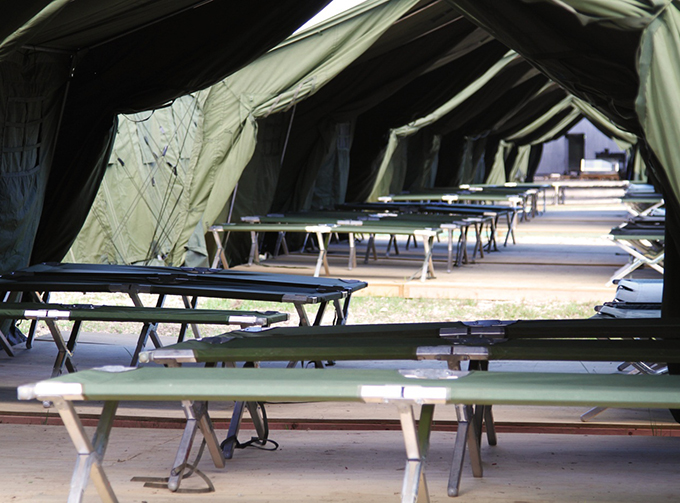
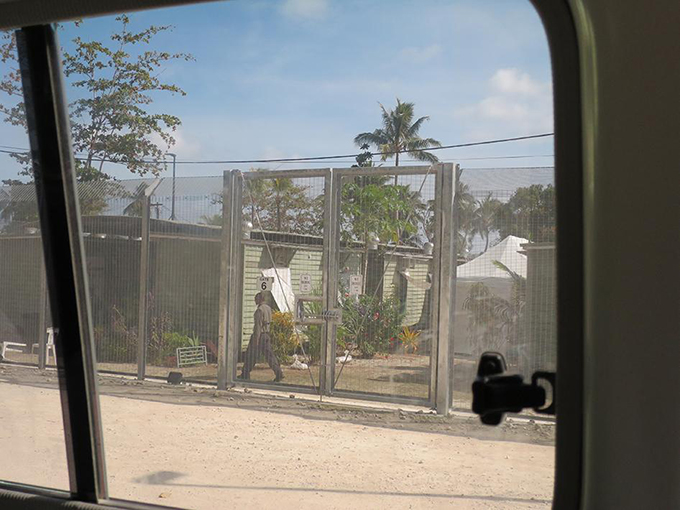
1.Asylum seekers, refugees – “outsourcing” by Australia to Nauru and
Manus Island, PNG
6.So-called “Climate refugees” – a very real situation, and international
law is lagging behind
And I’ll talk about strategies for addressing these issues, such as “mindful”
or deliberative journalism.
1. ASYLUM SEEKERS
Asylum seekers, the first human rights concern for the Pacific. Phil Robertson,
Asia director for Human Rights Watch, recently summed this up rather well in The Guardian, when he argued that Australia, which fancies itself as the “policeman
of the Pacific”, has been too often part of the problem these days.
Politicians trapped in the refugee policy dialogue in Canberra frequently fail
to recognise that Australia’s boat push-back policies, and offshoring asylum
seekers into abusive conditions of detention in Nauru and on Manus Island, are
seen as a green-light by Asian governments to do the same: send asylum seekers
and refugees back into harm’s way or lock them up in indefinite detention.
For example, during the south-east Asia boat people crisis in May 2015,
the Thai, Malaysian and Indonesian navies played a cruel game of “human
ping-pong” by pushing away boats of
starving and sick Rohingya.
Normal
0
false
false
false
EN-NZ
X-NONE
X-NONE
/* Style Definitions */
table.MsoNormalTable
{mso-style-name:”Table Normal”;
mso-tstyle-rowband-size:0;
mso-tstyle-colband-size:0;
mso-style-noshow:yes;
mso-style-priority:99;
mso-style-parent:””;
mso-padding-alt:0cm 5.4pt 0cm 5.4pt;
mso-para-margin:0cm;
mso-para-margin-bottom:.0001pt;
mso-pagination:widow-orphan;
font-size:11.0pt;
font-family:”Calibri”,sans-serif;
mso-ascii-font-family:Calibri;
mso-ascii-theme-font:minor-latin;
mso-hansi-font-family:Calibri;
mso-hansi-theme-font:minor-latin;
mso-fareast-language:EN-US;}
Normal
0
false
false
false
EN-NZ
X-NONE
X-NONE
In contrast to the impression that most mainstream media
conveys, Australia has the least influx problem and yet the most inhumane way
of dealing with it.
With the recent High Court ruling,
Australia now faces the return of 267 asylum seekers to Nauru and Manus Island,
where they face possible renewed physical and sexual assault, and life in
limbo.
Australia’s international reputation has suffered enough
– it’s time to do the right thing by accepting its responsibilities, not only
as a party to the UN Refugee Convention but also as a responsible neighbour and
member of the international community, and provide this group with fair and
timely refugee status determination in Australia.
The Australian asylum seekers policy is to cynically
“outsource” its problems to Nauru and Manus Island. For two decades, successive
Australian governments have adopted policies to deter asylum seekers arriving
by boat. A UN Special Rapporteur found in 2015 Australian policies violated the
Convention against Torture with “cruel, inhuman or degrading” treatment.
2. GENDER VIOLENCE
In the 2014 book Crying Meri, Russian photojournalist
Vlad Sokhin documented the treatment of women in Papua New Guinea with a human
rights lens. Violence against women and girls, and children generally, is a
critical human rights problem across the Pacific. The rape, brutal beating and
burning alive of women accused of sorcery is agonising in its brutality.
The compelling photographs in Sokhin’s book have, as
Christina Saunders wrote in the foreword, “a rare depth and humanity that
resonate deeply and speak immediately to the viewer” and
3. CONFLICTS/COUPS/WAR
Photojournalist Ben Bohane, more recently director of
communications with the Pacific Institute of Public Policy in Vanuatu,
chronicled the Bougainville war and many conflicts in the western Pacific over
two decades. He also researched the role of culture in political developments
and media representations in the mid-2000s.
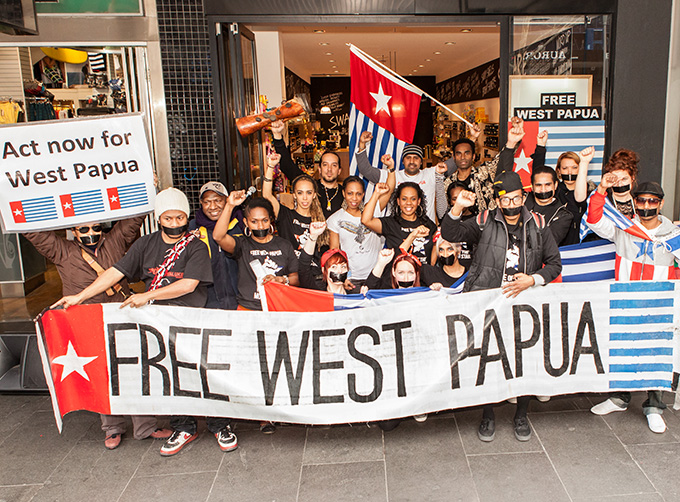
4. WEST PAPUA
Before the West Papuan conflict emerged at the front of
Pacific consciousness, the 24-year illegal occupation of Timor-Leste, or East
Timor, was a cause célèbre ignored by the region’s media – at least until the
massacre of 270 people at the Santa Cruz cemetery in 1991.
East Timor is the scene of the worst human rights
violations against journalists in the Pacific, the Balibó massacre, where 5
Australian-based journalists (including 2 Britons and a New Zealander) were
murdered in cold blood on 16 October 1975. They were trying to “bear witness”
to the impending Indonesian invasion.
Seven weeks later, Roger East, an Australian journalist
who travelled to Dili to find out the truth was executed by invading Indonesian
soldiers. There has been no justice to this day for any of the six victims of human
rights atrocities.
And now we are facing a similar situation with West Papua
where Indonesian authorities and security forces carry out crimes and violate
human rights with impunity. Although the United Liberation Movement for West Papua
(ULMWP) representatives have now been accepted into the Melanesian Spearhead Group as
observers, this feat almost became a disaster. The West Papuans now have a
platform in the Pacific political arena. A recent new book by civil rights advocate and academic Jason MacLeod outlines the peaceful struggle by West Papuans in a devastating way.
Adrian Stevanon of Maori Television’s Native Affairs
investigative programme was the first TV journalist from New Zealand to go to
West Papua in 50 years last September. He went with photojournalist and
researcher Karen Abplanalp and Radio NZ International’s Johnny Blades followed
a couple of months later.
5. FREEDOM OF SPEECH
Freedom of speech is a fundamental human right for
everybody worldwide. All people have the right to hold their own opinions, and
the right to seek, receive and share information and ideas. For journalists,
this right is essential to seeking out the truth. Without this freedom, we
cannot interview citizens or seek information from public officials.
The right to freedom of speech is very broad – it covers
many freedoms essential to work as journalists, such as:
• Freedom of issuing and distributing newspapers
• Independence of broadcast licensing and regulation
• Prohibition of all censorship
• Freedom of accessing and distributing information
ARTICLE 19 OF THE UNIVERSAL DECLARATION OF HUMAN RIGHTS
But it ought to be remembered that this universal
declaration is for everybody not just a privileged status for media
organisations or journalists. Freedoms do not exist in isolation:
All rights are interrelated, interdependent and
indivisible:
1. Freedom of expression linked to right of peaceful
assembly and association (A20)
2. Also linked to the freedom of thought, conscience and
religion (A18)
3. State treaties – dualist v. monetist systems
4. Regional treaties
5. UN Special Rapporteurs on free expression
Press systems and ethical frameworks are on the agenda in
all societies, and we are challenged to accommodate free expression and its
close relative press freedom within new technological and cultural contexts.
Journalism professor Mark Pearson, of Griffith University, and a until recently
a Reporters Without Borders researcher, spoke on “peace journalism” models as
applied to the reporting of the South Pacific in his inaugural UNESCO World
Press Freedom speech at Auckland in 2013.
He used this to introduce another
recent trend in journalism theory to apply basic “principles of mindfulness and
compassion” to a media context, a process which he dubbed “mindful journalism”.
Since then he has contributed as co-editor to a book called Mindful Journalism and News Ethics in the Digital Era: A Buddhist approach. In a simple
explanation, he describes first what “Mindful journalism” is not:
• An attempt to convert you into “Buddhism”|
• An attempt to impose yet another code of practice on
journalists
• A bid for the new approach to theory and ethics. (It is
complementary to deliberative/public/peace/civic/citizen/inclusive journalisms).
He then outlines what Mindful Journalism is:
• A lens (or even theory) offering a set of tools for the
analysis of journalism
• A moral framework to underpin ethical decision-making
in journalism
• A possible tool of resilience for journalists (work in
progress)
In contrast to human rights journalism, mainstream/legacy
media “generally sides with official rhetoric and policy”
• Human rights news is usually reported as individual
actions
• No reporting of “the system”
• “Predominant war journalism” of West dominates global
news flow
A critical role of citizen journalism to keep mainstream
media under scrutiny. While the media is watching other sectors in a community,
who is watching the media? Especially on human rights issues.
Citizen journalist and independent media networks often
played an important role. This happened in securing the release of Taimi ‘o
Tonga publisher Kalafi Moala and his two fellow prisoners, jailed for 30 days
for contempt of Parliament in 1996 for publishing leaked documents that needed
to be in the public domain. This was arguably the most important Pacific media
freedom crisis of contemporary times, yet he wasn’t given the mainstream media
support that he needed and deserved. Human rights intervention by a civil
rights lawyer secured the release of the prisoners early.
Global and Pacific media freedom organisations have played and
continue to play an important role in human rights campaigns for imprisoned and
gagged journalists. One of the biggest human rights violations ever to happen
in New Zealand – and the Pacific – was the bombing of a peaceful environmental
ship, Rainbow Warrior, by French secret agents under orders in Auckland Harbour
on 10 July 1985, killing photojournalist Fernando Pereira. This happened
parallel to repressive measures against Kanaks seeking independence.
Amy Goodman of Democracy Now! In the US sums up the
Rainbow Warrior saga 20 years later with the revelations that then PresidentMitterrand personally sanctioned the sabotage.
Investigative journalist Edwy Plenel, publisher of the
independent Mediapart website in France, carried out key inquiries into the
Rainbow Warrior. One of the two French bombers (out of a 13-strong team),
ex-colonel Jean-Luc Kister, publicly admitted his role in the sabotage and
apologised 30 years after the bombing.
Amy Goodman of Democracy Now! gave another overview 10
years after her earlier one about Mitterrand, this time with Rainbow Warrior captain Peter Willcox.
6. ‘CLIMATE REFUGEES’
Images of “nuclear refugees at Bikini Atoll, Marshall
Islands, conjures up images of “climate refugees”…. The 2015 case of
38-year-old i-Kiribati man Ioane Teitoata, who lost his appeal case against New
Zealand Immigration to have him and his family defined as “climate refugees”.
But the case exposed how flawed the law and New Zealand’s policies were about
climate change.
In 1946, the Bikini Atoll islanders were the first
nuclear refugees in Pacific – “relocated” for the US nuclear tests. In 1985,
Rongelap islanders were evacuation by the Rainbow Warrior and then in 2011 we
had the Fukushima nuclear refugees after the Tohuku tsunami.
“Climate refugees” currently have no legal definition or
status. However, there needs to be:
A climate refugee is a person displaced by climatically
induced environmental disasters. Such disasters result fromincremental and rapid ecological change,
resulting in increased droughts, desertification, sea level rise, and the more
frequent occurrence of extreme weather events such as hurricanes, cyclones,
fires, mass flooding and tornadoes. All this is causing mass global migration
and border conflicts.
In 2000, 2700 Carteret Islanders left their atoll
homeland in Papua New Guinea and became an iconic and tragic symbol. In 2013,
came the Pacific Islands Forum Majuro Declaration for “climate leadership”, yet
two years later a i-Kiribati man, Ioane Teitiota, failed in legal bid for
“climate refugee” status.
Last year, we had some 40 students (and about 60 people
altogether) involved in a journalism and television “bearing witness” project
to prepare oral histories and current affairs items on a Rainbow Warriormicrosite as a public resource.Students
working on this project were thrilled by the experience and won a group award
for innovative journalism.
Finally, to wrap up, the problems of war or mainstream
journalism are largely blamed for under reporting and/or misrepresentation of
political and structural forms of violence – the greater human rights
violations. Human Rights Journalism and “bearing witness’ complement the four major orientations of
the peace journalism model:
Solution rather than victory
Truth rather than propaganda
People rather than elite
Win-win rather than win-lose
Also human rights oriented journalism needs to have a
global (and local) perspective instead of selective reporting and ignoring
major issues (such as West Papua), any “bias” ought to be in favour of
vulnerable voices, be proactive and attachment to victims and survivors,
instead of the political elites.
The IFJ, SEAJU, CPJ and Freedom House sent a letter to Timor-Leste Prime Minister Dr Rui Maria de Araújo relating to the criminal defamation case brought before Timor Post journalist Oki Raimundos, former editor Lourenco Vicente Martins and the Timor Post.
The case against Oki and the Timor Post is based on a published report from 10 November 2015, which contained a factual error on a government tendering process. In accordance with Timor-Leste’s own Press Law, the outlet subsequently published a correction and right of reply from the Prime Minister’s office in relation to the story.
“In spite of this, you have filed a criminal defamation lawsuit that carries potential prison sentences against Oki, Vincente and Timor Post,” the letter said.
Oki and Martins were summoned to attend the office of the Prosecutor-General on Monday, April 11. Appearing with their lawyers, each faced separate 30 minute interviews.
Both men relied on their right to silence, and each was given a “letter” stating that neither could change his address nor travel overseas without giving the prosecutor 15 days’ notice. The prosecutor will now decide whether to file an indictment or drop the charges.
The time permitted for the prosecutor to gather evidence and to make a decision about remains unclear.
IFJ lawyer in Dili Australian barrister and IFJ legal representative Jim Nolan was in Timor Leste on April 11 to support Oki and Martins.
During his trip he met with various figures in the Timor-Leste media.
In a piece authored by Nolan, he said that the prosecution must establish four conditions. Firstly, the publication of the ‘accusation’. Secondly, at the time of publication; the journalist must be “aware of the falsity of the accusation,” thirdly, the accusation must concern the “commission of a crime”; and fourthly, the publication must be made “with the intent of having criminal proceedings initiated against the person.”
In the letter, IFJ, SEAJU, CPJ and Freedom House highlighted the implications for the case for Timor Leste’s press freedom, noting that such actions will weaken the view of the country’s media freedom in the eyes of the international community.
The IFJ said: “We continue to support our local affiliates as well as Oki and Martins as they continue with this battle.
“The support of the international community highlights the importance of this case and the need to end criminal defamation as a tool to silence critics. We again, call on the Prime Minister to withdraw the case against Oki and Martins.”
NewsroomPlus.com
Today’s edition of NewsRoom_Digest features 1 resourceful link of the day and the politics pulse from Friday 22nd of April. It is best viewed on a desktop screen.
NEWSROOM_MONITOR
Noteworthy stories in the current news cycle include: Primary Industries Minister Nathan Guy saying new access for chilled meat in China is an opportunity for exporters to get their high-end products into the top end of the Chinese market; Transport Minister Simon Bridges assuring passengers they will be safe in cabs after changes are made to the way taxi services are run; and findings from a report on the state of bluefin tuna fisheries in the Pacific Ocean, show that without drastic measures, there is a less than 1 percent chance of the population returning to healthy levels by 2024.
POLITICS PULSEGovernment: Speech – Canterbury Men’s Centre Male Survivors of Sexual Abuse Trust; Bottled water concerns misplaced;Acting District Court Judges appointed; Successful bid gives economy $50 million boost; PM welcomes visit by French PM; Number on Social Housing Register declines; English releases RB Board letter of expectations; Indian President to visit New Zealand;Facility upgraded by offenders helps kakapo; Successful end to the yachting season; $520m funding injection for key Tauranga route
ACT Party: Funding policy to blame for Corelli school liquidation
Greens: Tree planting for the climate – a game-changer
Labour: Social Development stats don’t add up; Fewer cops on the beat as police cuts bite; Big jump in benefit numbers in Christchurch as rebuild slows; Thousands of invalid votes likely after National refuses to change rules
New Zealand First: “In The Shadow Of The Super City” – Speech At Whangaparaoa Rt Hon Winston Peters; Speech By Rt Hon Winston Peters To Warkworth Public Meeting; Out-Of-Work Young Kiwis On The Rise
LINKS OF THE DAYSOCIAL HOUSING REGISTER: The number of people on the Social Housing Register has again declined. Figures for the March 2016 quarter show there were 4585 people on the register, down 223 or 4.6 per cent on the same time last year. Of those on the register in March 2016, 1036 are already housed and are awaiting a transfer to a more suitable property. The March 2016 register can be found at: http://www.housing.msd.govt.nz/information-for-housing-providers/register/index.html
And that’s our sampling of “news you can use” for Friday 22nd April.
By ER Insider. See also: EveningReport.nz’s Editorial on this issue.
AN INSIDER’S OPINION: Political anxiety, tribalism, stale and stagnant ‘part solutions’ have been brought to the fore as Auckland Council attempts to save face over this menacing and dangerous dog crisis.
Auckland politicians have for years ignored menacing dogs that roam, bark, charge and intimidate innocent residents and family pets throughout south Auckland.
The cynical would say ‘when politicians get cosy they lose touch’. The reality is: it’s easy to ignore unregistered dogs in Otara and Takanini when you enjoy the privilege and view from your 27th floor office at 135 Albert Street in Auckland City.
POLITICAL ANXIETY: [caption id="attachment_9920" align="alignleft" width="300"] Darnell Minarapa-Brown, 7-years old.[/caption]When violence against a child compels communities to demand action, and that call sounds from all over Auckland City – it becomes harder for Auckland’s politicians to ignore the plight of 7-year old Darnell Minarapa-Brown who spent six hours in surgery at Kidz First Hospital because a dangerous dog ripped his face apart.
In the real world, south Auckland’s people want real action. For a moment it seemed the politicians had listened. There was a glimmer of hope after south Auckland Councillor Callum Penrose announced a high-powered group of politicians would front the media with their solution.
But by the time Thursday’s highly publicised photo-opportunity concluded, hope was lost.
People in the communities soon realised, Auckland Council’s call for an amnesty, on the owners of unregistered dog owners, was a cop-out and more a solution for political anxiety than for those who live in this city’s urban communities.
Fronting the photo-op was Auckland’s Mayor, Len Brown, and Councillor Penrose.
They boldly raised how Auckland Council will initiate an amnesty so the owners of Auckland’s unregistered dogs will be able to come forward, pay their fees without fear, or fine, or prosecution.
Was this it? Was this all they had in their ‘fix-it’ box of tricks? Sadly, it appears so.
Brown and Penrose’s amnesty exposes them both to failure, and for Penrose, failure to deliver for the community he is supposed to represent is an anathema as he considers campaigning for his job at this year’s Auckland Council elections.
The people of Manurewa, Takanini, and Papakura demand hard and real solutions to this crisis. They are not stupid and this amnesty will fail to make south Auckland’s streets safer. It will also fail to inspire voters at this year’s local government elections.
The amnesty ignores the inconvenient truth. Auckland Council has wide powers under the Dog Control Act to tackle menacing dogs and prosecute dog owners. Auckland, like any council, has the ability to classify dangerous dogs. It has the ability to enforce its bylaw, and it has the ability to keep communities safe.
Therein lies the problem, Auckland Council has the power but it has failed to use it.
Why not? Because nine times out of ten the aggressive behaviour of roaming dogs, that threaten the safety of people and domestic animals in south Auckland, isn’t a hot enough topic for distracted councillors.
Defining the American Pit Bull in the Dog Control Act as proposed by Penrose and others is a useless gesture. Most of the dogs who roam suburban streets are not purebred creatures. Many are mutts of unknown parentage, born of chained bitches on unfenced properties. Few, if any, of the dogs that bite children in south Auckland are registered, let alone subject to dog obedience classes.
Auckland Council’s credibility is undermined by its unwillingness to:
resource its animal management functions
go door to door to assess and impound menacing dogs.
There are plenty of neglected, angry and unhealthy dogs in streets and neighbourhoods all over Auckland. It doesn’t take a media conference to commit to action to tackle those animals and hold their owners to account.
TRIBALISM: Disappointingly, political tribalism won on Thursday. Auckland Council side-lined the one politician with real credibility on animal management: Cathy Casey.
[caption id="attachment_9929" align="alignleft" width="300"] Auckland Councillor, Cathy Casey is a specialist when it comes to dog control and ownership issues.[/caption]If Auckland Council was truly compelled to deliver a real solution to this dangerous dog crisis, then it would have listened to Councillor Casey who is recognised as a specialist on dog control and ownership.
It would have invited her to lead the debate on how Auckland Council will make Auckland’s urban streets safer from menacing and dangerous dogs, and, irresponsible owners and gangs.
It chose politics and tribalism instead.
POLITICAL ESTRANGEMENT: Councillor Casey fell out of favour with Mayor Len Brown and Callum Penrose after she opposed massive rate increases and the denial of property owner’s rights on land rezoning.
This week, it was payback time for Cathy Casey, as the Mayor and Councillor Penrose excluded her from the Council’s amnesty announcement.
Was this also because Cathy Casey is credible, knowledgeable, and has the ability to hold Auckland Council to account for its failure to police and enforce its own dog control bylaw – credentials that will likely sideline Mayor Brown and Councillor Penrose’s amnesty? Casey has a heart and a nose for public sentiment and has demonstrated her resistance to Council-driven team-thinking.
Unfortunately, politics got in the way, and while a photo-opportunity with media was planned, the stage was set, their amnesty idea given the spit, spin and polish, it was always destined to fail. The media, and the people of south Auckland, are not fools, and the ‘media-opportunity’ fizzed.
CALLING FOR REAL SOLUTIONS: Election year is supposed to bring new ideas, new solutions to the fore, not stale, failed, unconvincing ideas peddled by councillors that politically need the exposure of a Council-sponsored event to profile their credentials.
Politically, Auckland Council has used the illusion of action to buy itself time. But the response lies not with Parliament. The response lies with Auckland Council itself, starting with addressing the dearth of animal management contractors in neighbourhoods across Auckland.
This week, Auckland Council chose an illusion and a distraction in an attempt to halt the continual slide in public regard prior to polling day.
That slide has plagued the mayoralty throughout this term. The Mayor has endured being booed at… at Eden Park, at Victoria Park when the World Cup champion All Blacks returned to New Zealand, ignored at Chinese New Year functions, and scoffed-at in public.
Len Brown chose retirement from politics over certain electoral defeat. Political anxiety and tribalism has infected some of his strongest supporters who also fear the indignity of defeat at this October’s elections.
Sadly, this ridiculousness will not make Auckland’s streets safer for people like Takanini’s Darnell Minarapa-Brown. It has only caused people to become more fed-up with politicians past their use-by-date, and caused more people to call for a real solution to this menacing and dangerous dog crisis.
–]]>
“You’re never alone if you’re near a phone” is the theme in this Fiji Helpline counselling session at school for young children. Image: Child Helpline FB page
Fiji is still facing a major challenge to deal with suicide cases, especially of young children, reports Ami Dhabuwala of Asia-Pacific Journalism from Suva.
Fiji is already struggling to cope with the aftermath from the recent tropical cyclone Winston, other storms and the impact of climate change, but suicide among youth is also becoming a major concern for parents and communities.
Suicide became a national issue in Fiji last year when fresh statistics showed worrying trends. Prime Minister Voreqe Bainimarama showed his concern for the increasing rate of suicide cases, especially among youth.
Bainimarama said that counselling services and initiatives already existed in Fiji, but he would ask every branch of government to improve its response to youth suicide.
Last year, there were 89 cases of suicide from January to September, which had 10 cases of children aged under 16. Also, there were more than 20 people aged between 17 and 25 years who had committed suicide during the same time.
However, this issue has some deeper roots back into the 1990s.
Peter M. Forster (UK), Selina C. Kuruleca (Fiji) and C. R. Auxier (USA) published a report named A Note on Recent Trends in Suicide in Fiji in 2007 in the Journal of Pacific Rim Psychology. They collected suicide data from Adinkrah who reported in 1995 and from Booth who reported in the years 1997 and 1999.
They had cited that the “standardised” annual rate of suicide for the year 2002 at 15 per 100,000 population for male and 11 for females.
Current scenario Government has launched National Child Helpline since last January in partnership with the Medical Services Pacific (MSP).
People in need for counselling are provided a toll free number 1325 to talk with trained counsellors. It is a 24-hour helpline.
“We have got almost 7000 calls since last September,” says Peci Baladrokadroka, a senior counsellor in MSP.
Police media liaison officer Naina Ragigia … concerned over many calls received. Image: Fiji Television
Naina Ragigia, a Fiji Police Force spokesperson, shows her concern because the force receives many calls related to suicide cases as well.
“The Fiji Police Force receives an average of 5 reports of suicide in a month. Most reports of suicide cases received are only attempted suicide, which is much higher than the suicide cases.”
People from different age groups, starting from 5 to 70 are attempting suicide.
“We have noticed young people around the age of 12-23 years are mostly victims of suicide cases,” says Ragigia.
Reasons for suicide There are so many reasons ranging from child neglect to poverty which are leading people to commit suicide in Fiji.
“In young people, child neglect, sexual abuse and physical abuse are one of the major reasons,” says Peci Baladrokadroka.
Ragigia says that in some cases children are disappointed by his or her own parents.
“A 10-year-old boy was playing outside his home. His mother scolded him to come home and study. But that boy took this in a different way; he locked himself in his room and eventually hanged himself.
“Children from the young ages of 12 years are now committing this offence which is indeed a sad thing,” she said.
Entertainment programmes on television and radio are also contributing.
“Last year we had a case of 12-year-old girl. She was trying to mimic a scene [of a suicide] from the movie, but ended up dead instead,” says Ragigia.
Breaking points For the young students career and good grade are also one of the major breaking points.
Matthew Galuvakadua works as a volunteer at Youth Champs for Mental Health.
“Family expectations put extreme pressure on young children, especially when exams are a concern,” he says.
Galuvakadua has been working with this organisation for the past four years. The group mainly focuses on suicide prevention for young people in Fiji and tries to reduce the stigma associated with it, especially people living with mental illness.
Apart from this, relationships and family issues are also among major reasons for suicide. Peci says that drugs, alcohol, educational needs and poverty also contribute.
The issue is becoming more serious each year and the government, with the help of local organisations and NGOs, is trying to deal with the suicide cases, but results are disappointing.
Reluctant over information “When Asia Pacific Report tried to contact different organisations for statistical data and information, they were reluctant to give any details.
Ragigia says suicide is a very sensitive issue and how foreign media might present the scenario is difficult to judge.
“Organisations seem to be reluctant over this particular issue because they don’t want Fiji to be represented in a wrong way.”
Peci says the government is running many awareness programmes with different organisations.
The Fiji police also conducts various awareness programmes for the general community.
They have a fine relationship with the local health authorities.
Frequent check-ups “The Fiji police is fortunate to have services of our local health authorities for offering a frequent medical check-up for the victims and there are also counselling services offered from local NGOs that we are able to refer to the victims for counselling purposes,” says Ragigia.
However, Galuvakadua thinks that the government should be more involved with mental health organisations.
“Government should work and form better relationships with existing mental health service providers in the community,” he says.
Galuvakadua also shows his concern about lack of rehabilitation centres in Fiji.
“The Community Recovery Outreach Programme is the only functioning rehabilitation programme that refers people at-risk from suicide to people living with mental illness, sending them to St Giles Hospital in Fiji.”
He hopes to see an improvement in the months ahead.
Ami Dhabuwala is a postgraduate student journalist at AUT University. She is reporting on the Asia-Pacific Journalism course and is currently in Fiji.
Tonga’s suspended state broadcasting news head Viola Ulakai … too questioning. Image: Kalafi Moala
By Kalafi Moala in Nuku’alofa
The man who was once jailed for his stand for press freedom in the kingdom of Tonga has now breached the same freedom by ordering a government journalist to be suspended “for asking hard questions”.
Samuela ‘Akilisi Pohiva was a member of Parliament who leaked information to the media in 1996 resulting in a contempt of Parliament case, in which he was jailed together with the two journalists who published the information.
But as Tonga’s Prime Minister 20 years later, elected on a platform of democratic “transparency”, Pohiva issued an order on Wednesday to his Minister of Public Enterprises, Poasi Tei, to suspend veteran journalist Viola Ulakai “until further investigation”.
The Prime Minister has accused Ulakai of being too insistent with her questions, particularly with issues regarding reform that he as Minister of Education is bringing about in the Ministry of Education.
The fallout and a mess in the Ministry after the 2015 exam results has been a confusing issue at the centre of much public discussion.
Ulakai has been a journalist with the Government Broadcasting for 26 years. She is now the head of news at Tonga’s largest news organisation.
Press conference In the past few weeks, Ulakai has been trying unsuccessfully to set up a press conference between the media and the Prime Minister to answer questions regarding education.
Meanwhile, a press release was issued last week by the Prime Minister’s Office accusing Ulakai of trying to set up the press conference as something endorsed by the Tonga Media Council, while it was allegedly only a personal arrangement of her own.
The Tonga Media Council chair, Lady Luseane Luani, responded in support of the Prime Minister’s Office, saying Ulakai was “not doing it for the Media Council”, a statement that has been widely regarded by other journalists as a betrayal of Ulakai.
Ulakai is on the board of directors of the Tonga Media Council, and she herself has been the one that set up previous press conferences on behalf of the council.
Other directors of the Media Council, like Filo ‘Akau’ola, owner of the Talaki newspaper, has come out in support of Ulakai, stating that there was an understanding Ulakai would organise the press conferences.
Pohiva, since the beginning of his administration in January of 2015, has consistently been aloof and selective over the media he would talk to, and who would interview him.
Because Ulakai was the head of news at the Government Radio and Television, she usually did the interviews with the leaders of government. But the Prime Minister took exception to her hard questioning.
Another angle He claimed that Ulakai usually takes another angle to ask the same question when he had already provided the answer.
The Prime Minister’s Office offered the notion that Ulakai was opposed to the Prime Minister, and that she was backed by opponents to his reform programme at the Ministry of Education.
Ulakai shared publicly her frustration at not being given the opportunity to ask questions that have not been answered or even spun to support a perspective in question.
“I am only trying to do my job,” she told reporters in Nuku’alofa.
Ulakai did not break any laws, neither did she breach any work ethics in accordance with her contract at the Tonga Broadcasting Commission.
She is being persecuted for doing her job. And a man who promised press freedom to Tongans is driving that persecution.
As this report goes out, Viola Ulakai has been officially suspended from the Tonga Broadcasting Commission, from yesterday, on order from the Prime Minister.
Tonga is due to commemorate World Media Freedom Day on May 3. In the 2016 Reporters Without Borders World Press Freedom Index released this week, Tonga had improved its global ranking seven places to 37th out of 180 countries surveyed.
The author, Kalafi Moala, is publisher and editor of the Taimi ‘o Tonga, Tonga’s first independent newspaper. He and his then deputy editor were jailed for contempt along with ‘Akilisi Pohiva in 1996.
There is still a way to go before the vision from Paris is achieved. Image: Gonzalo Fuentes/The Conversation/Reuters
By Damon Jones and Bill Hare
The world took a collective sigh of relief in the last days of 2015, when countries came together to adopt the historic Paris agreement on climate change.
The international treaty was a much-needed victory for multilateralism, and surprised many with its more-ambitious-than-expected agreement to pursue efforts to limit global warming to 1.5°C.
The next step in bringing the COP21 agreement into effect happens in New York today, with leaders and dignitaries from more than 150 countries attending a high-level ceremony at the United Nations to officially sign it.
The New York event will be an important barometer of political momentum leading into the implementation phase – one that requires domestic climate policies to be drawn up, as well as further international negotiations.
It comes a week after scientists took a significant step to assist with the process. On April 13 in Nairobi, the Intergovernmental Panel on Climate Change agreed to prepare a special report on the impacts of global warming of 1.5°C above pre-industrial levels. This will provide scientific guidance on the level of ambition and action needed to implement the Paris agreement.
Why the ceremony? The signing ceremony in New York sets in motion the formal, legal processes required for the Paris Agreement to “enter into force”, so that it can become legally binding under international law.
Although the agreement was adopted on December 12 2015 in Paris, it has not yet entered into force. This will happen automatically 30 days after it has both been ratified by at least 55 countries, and by countries representing at least 55% of global greenhouse gas emissions. Both conditions of this threshold have to be met before the agreement is legally binding.
So, contrary to some concerns after Paris, the world does not have to wait until 2020 for the agreement to enter into force. It could happen as early as this year.
Signing vs ratification When a country signs the agreement, it is obliged to refrain from acts that would defeat its object and purpose. The next step, ratification, signifies intent to be legally bound by the terms of the treaty.
The decision on timing for ratification by each country will largely be determined by domestic political circumstances and legislative requirements for international agreements.
Those countries that have already completed their domestic processes for international agreements can choose to sign and ratify on the same day in New York.
Who is going to sign and ratify in New York? It is perhaps no surprise that the countries which are particularly vulnerable to the impacts of climate change and who championed the need for high ambition in Paris will be first out of the gate to ratify in New York.
Thirteen Small Island Developing States (SIDS) from the Caribbean, Indian Ocean and Pacific have signalled their intent to sign and ratify in New York: Barbados, Belize, Fiji, Grenada, Maldives, Marshall Islands, Nauru, Palau, Samoa, Saint Lucia, St Vincent and the Grenadines, the Seychelles and Tuvalu.
While these countries make up about a quarter of the 55 countries needed, they only account for 0.02% of the emissions that count towards the required 55 percent global emissions total.
Bringing the big emitters on board China and the United States have recently jointly announced their intentions to sign in New York and to take the necessary domestic steps to formally join the agreement by ratifying it later this year. Given that they make up nearly 40 percent of the agreed set of global emissions for entry into force, that will go a significant way to meeting the 55 percent threshold.
We can expect more announcements of intended ratification schedules today. Canada (1.95 percent) has signalled its intent to ratify this year and there are early signs for many others. Unfortunately the European Union, long a leader on climate change, seems unlikely to be among the first movers due to internal political difficulties, including the intransigence of the Polish government.
The double threshold means that even if all of the SIDS and Least Developed Countries (LDCs) ratified, accounting for more than 75 countries but only around 4 percent of global emissions, the agreement would not enter into force until countries with a further 51 percent of global emissions also ratified.
Consequently, many more of the large emitters will need to ratify to ensure that the Paris agreement enters into force. This was a key design feature – it means a small number of major emitters cannot force a binding agreement on the rest of the world, and a large number of smaller countries cannot force a binding agreement on the major emitters.
The 55 percent threshold was set in order to ensure that it would be hard for a blocking coalition to form – a group of countries whose failure to ratify could ensure that an emissions threshold could not be met in practice. A number much above 60 percent of global emissions could indeed have led to such a situation.
The countries that appear likely to ratify this year, including China, the USA, Canada, many SIDS and LDCs, members of the Climate Vulnerable Forum along with several Latin American and African countries – around 90 in all – still fall about 5-6 percent short of the 55 percent emissions threshold.
It will take one more large emitter, such as the Russian Federation (7.53 percent), or two such as India (4.10 percent) and Japan (3.79 percent) to get the agreement over the line. The intent of these countries is not yet known.
Why is early action important? The Paris agreement may be ambitious, but it will only be as good as its implementation. That will depend on the political momentum gained in Paris being maintained. Early entry into force for the treaty would be a powerful signal in this direction.
We know from the Climate Action Tracker analyses that the present commitments are far from adequate. If all countries fully implement the national emission reduction targets brought to the climate negotiations last year, we are still on track for temperature increases of around 2.7°C. Worse, we also know that current policies adopted by countries are insufficient to meet these targets and are heading to around 3.6°C of global warming.
With average global annual temperature increase tipping over 1°C above pre-industrial levels for the first time last year, it is clear that action to reduce emissions has never been more urgent.
Early entry into force will unlock the legally binding rights and obligations for parties to the agreement. These go beyond just obligations aimed at delivering emissions reductions through countries’ Nationally Determined Contributions to the critical issues of, for example, adaptation, climate finance, loss and damage, and transparency in reporting on and reviewing action and support.
The events in New York this week symbolise the collective realisation that rapid, transformative action is required to decarbonise the global economy by 2050.
Climate science tells us that action must increase significantly within the next decade if we are to reign in the devastating impacts of climate change, which the most vulnerable countries are already acutely experiencing.
Damon Jones is a lecturer at Cologne University, Germany, and Bill Hare is visiting scientist at the Potsdam Institute for Climate Impact Research. This article was first published by The Conversation and is republished here under a Creative Commons licence. For an up-to-date picture of which countries have ratified the Paris Agreement, see The Conversation’s Ratification Tracker.
Dark history … Major General Suharto briefs members of the Indonesian Army’s Special Forces (RPKAD, now Kopassus) prior to the removing the bodies of the Army generals who were murdered during an alleged coup attempt on 30 September 1965. Image: Tahun Indonesia Merdeka
After more than half a century without clarity on the identity of perpetrators or those who orchestrated the event, some survivors and victims of Indonesia’s 1965 purge hope that the government will rehabilitate their names as they have been stigmatised in the past as enemies of the state.
The stigma does not end with themselves, but also extends to their children and grandchildren. The number of the people affected by the 1965 tragedy, whether murdered, tortured, raped or detained without trial, could reach into the hundreds of thousands.
“I hope the government will rehabilitate all survivors and annul all discriminative laws against the 1965 victims,” said Kusnendar, an 83-year-old survivor, during a two-day symposium on 1965 in Jakarta this week.
He also expressed his concern that there were still state documents that discriminated against them. Presidential Decree No. 28/1975, for example, prevents members or sympathisers of the Indonesian Communist Party (PKI) who worked as civil servants from receiving their pensions.
Meanwhile, Presidential Decree No. 16/1990 prevents former PKI members from working as civil servants or joining the Indonesian Military.
The kidnapping and murder of six Army generals on Sept. 30, 1965, led to a purge of communists and alleged communist sympathisers by the military under the leadership of Soeharto.
In the purge, countless thousands were murdered, tortured and arrested without trial. It is estimated that between 500,000 to 1 million people were killed during the “cleansing” of people with any leftist connections, regardless of their age or level of connection.
Generals murder “I was beaten up when I arrived at the Budi Kemuliaan penitentiary as I was accused of being involved in the murder of the generals,” said Kusnendar, adding that he was arrested on October 10, 1965, in Jakarta, because he was involved in a labor union allegedly affiliated with the PKI.
He was also accused of harboring sympathies with the PKI’s youth arm, Pemuda Rakyat. Kusnendar moved from one prison to another, including the Cipinang and Salemba penitentiaries in Jakarta, the Nusakambangan prison island in Central Java and Buru Island in Maluku, often remembered as the “Island of Exiles”, in 1969.
Yohanes Winaryo, a 72-year-old survivor, was arrested on Nov. 2, 1965, because of his involvement in the Indonesian Youth and Students Association (IPPI), allegedly affiliated with the PKI.
“We had no affiliation with the PKI as the IPPI just held study-group sessions or sporting events. We even helped the government eradicate illiteracy going door-to-door to the people’s houses,” he said.
However, Yohanes was forced to work without pay as a stonemason in Central Java until he was released in 1970. Since then, he has been “marked” as a former political prisoner.
“Our main demand is rehabilitation. The government should bring back our good name in society. It’s more important than compensation,” he said.
Because of the stigma attached to them, the 1965 victims had to live hard life. Kusnendar was released in 1978 and reunited with his family in Jakarta.
However, he said his wife was forced to divorce him as a prerequisite to working in the Jakarta Education Agency because of his status as a former political prisoner.
Kusnendar earned a living working as an insurance salesman, a scavenger and a thesis typist in a printing shop.
Timor-Leste resistance veterans in Aileu at a briefing by the Maritime Boundary Office last December to explain the history of the Timor Sea agreements with Australia from 1972 until 2006. Image: TL govt
Twenty-nine veterans of Timor-Leste’s struggle for national liberation will be visiting Australia next week to meet with members of the local veteran community and to participate in events commemorating ANZAC Day on April 25 – next Tuesday.
Delegations will be based in Perth, Sydney, Brisbane and Canberra with a small delegation travelling between key cities.
Minister of Planning and Strategic Investment, and Chief Negotiator for Maritime Boundaries, Kay Rala Xanana Gusmão will lead the visit and is accompanied by the Vice-Minister for Social Solidarity.
Miguel Marques Manetelu; Francisco Guterres, former President of the National Parliament and president of FRETILIN; and Colonel Falur Rate Laek, representing the Defence Forces of Timor-Leste [F-FDTL], will also participate.
Inês de Almeida, Liaison Officer for Veterans Affairs, Office of the Prime Minister of Timor-Leste, is the visit coordinator and spokesperson.
This trip will further strengthen the close friendship between the veterans of Timor-Leste and the veteran community of Australia, the Timor-Leste government said in a statement.
Interactions with Australia’s Returned Services League (RSL) and the War Widows Guild of Australia have been ongoing since 2014 and have included several visits by Australian veterans to Dili.
Telling the story During this time, Timor-Leste has developed its own National Council of Combatants of National Liberation and veterans have used their meetings to consider how to tell the story of the struggle for future generations, how to honor the fallen ones and how to best serve those remaining.
In each location Timor-Leste’s veterans will visit facilities that have been developed in Australia to support ex-service personnel, participate in ANZAC Day commemorations and meet with members of the Timorese Community.
This year a group led by Colonel Laek are investigating walking treks in two national parks to assist in planning the development of similar treks in the mountains of Timor-Leste.
This group will be assessing the tourism potential of this idea and the opportunities it can provide for veterans to share the story of the Resistance.
The state president of the NSW Branch of the RSL, Rod White, said it had been a privilege for their organisation to work with the veterans of Timor-Leste and emphasised that the strengthened bonds of friendship between the two veterans communities were part of what would be “an enduring relationship”.
Timor-Leste veteran Jorge Alves said of the upcoming trip: “The veterans of the country were invited to take part in the Australian Veterans Day.
“It is part of the Timorese veterans solidarity to the Australian veterans as we have very strong and unforgettable history.”
‘Warm friendship’ Government spokesman, Minister of State Agio Pereira, said: “The relationship between the veteran communities of Australia and Timor-Leste is characterised by warm friendship, mutual respect and genuine goodwill.
“The government commends this ‘enduring relationship’ and salutes the Timorese veteran delegation as they proudly represent the nation, develop plans to honor and care for the veterans of Timor-Leste and participate in the commemorations of ANZAC Day.”
TJ Aumua’s video report on youth’s fears over their homelands. PMC on Demand
By TJ Aumua
The effects of climate change on Pacific island nations like Samoa are leaving young people faced with uncertainty about being forced to leave their homelands and migrating to other countries.
The chair for Ōtara-Papatoetoe local board in Auckland, Fa’anānā Efeso Collins is also a former broadcaster and recently returned from Samoa.
He “feels” for Pacific youth who are unsure about the existence of their homeland in the future.
“There is a lot of fear about whether or not they will be able to have their own children, their own families and grow up safety in Samoa over the next few decades,” he told Asia Pacific Report.
“We know that in countries like Kiribati, Nauru and Tuvalu, there’s been more international travel – so they’ve migrated more in the last 10 years than any other period in their history. I think Samoan young people are starting to think about the same thing.”
This is ironic for Pacific Islanders living in New Zealand, with hopes of many eventually to return back home.
But Fa’anānā says that with the increasing impact of climate change there may not be a home to go back to.
“I know for New Zealand-born Samoans like myself, we often talk about wanting to go back, or our parents retiring back to Samoa because the land is special to our parents generation – and it’s special to us.
“We are going to lose that sense of ‘specialness’ if we are thinking whether we are safer long-term in New Zealand.”
Health impacts Unknown to many outside the region, climate change also has major health impacts and is contributing to the level of illnesses in the Pacific.
Fa’anānā says the health ministries in Samoa are focusing on infections like malaria, typhoid and dengue fever, which are all, transmitted by mosquitos.
‘You pick illnesses up a whole lot easier because of cyclonic activity,’ he said. ‘So the ministry is looking at how to dry up large areas of waste water where mosquitos breed’.
“And in Samoa they don’t have the western, first-world facilities to be able to deal on mass with those issues.”
Fa’anānā says the World Health Organisation (WHO) is working with the health ministry in Samoa to address diseases enhanced by climate change.
“When you are living with those sorts of things in the back the your mind, of course you are going to think about moving countries, for long term investment.”
Fa’anānā says New Zealand’s response to Pacific climate change is slow and both Pacific and mainstream media outlets need to bring this issue to the forefront.
“New Zealand can do it,” he says.
“We are a good community, we can care enough about each other, and now it’s just about us being relaxed enough to say, ‘yeah lets join together and support what’s going on in the Pacific’.”
The Pacific Community’s Suva-based team leader for human rights training, Nicol Cave, says the forum gave journalists a framework for writing human rights stories in the Pacific, a region with varying degrees of media freedom.
NICOL CAVE: “And also during the forum some journalists raised the risks. If you get on the wrong side if you report the wrong story there maybe risks and consequences for the media house or for the journalist. But I think there has been an increase in reporting around issues of corruption and reporting the gravest human rights violation in the Pacific [which] is very high levels of violence against women.”
The executive director of the Fiji Women’s Rights Movement, Tara Chetty, told the forum that women need greater representation in the media beyond the reporting of gender-based violence.
TARA CHETTY: “It’s great that it is getting good strong coverage, however, what we’re seeing is women are most often presented as victims of violence and there’s very little opportunity for them to be portrayed in any other way. So we ended the session with some very practical tips about having a more gender aware approach to your journalism. Things like developing a list of experts in various fields who are also women.”
The forum’s keynote speaker was the director of the Pacific Media Centre at the Auckland University of Technology, Professor David Robie. He says social media has an important role to play in exposing human rights abuses as it has done in West Papua.
DAVID ROBIE: “Social media has really just about brought a revolution in terms of world exposure by journalists, by activists in West Papua, able to get good video footage out, for example, showing what has really been happening. It’s forced the Indonesian government to actually be a little bit more proactive and they brought in this policy last year enabling journalists to go to West Papua on a more official basis rather than undercover as they’ve tended to in the past.”
The forum also brought together journalists and government communications officials which Nicol Cave says helped them work through the frustrations they cause each other.
NICOL CAVE: “So governments’ sense of, you only right negative stories, and journalists’ sense of, we’re unable to reach you, we’re unable to right the good stories. So each of the regions, Polynesia, Melanesia, came up with a plan of how they would link and work better. Because the media also needs to be telling the good news stories because progress is being made and the media needs to reflect that.”
But a Fiji political commentator, Professor Wadan Narsey, says he doubts Fiji’s journalists at the forum aired their dissatisfaction with state communicators. He says the media in Fiji self-censor criticism of the government.
WADAN NARSEY: “We don’t know what was really discussed over there, however, the chances are that there wouldn’t have been very many critical issues discussed, simply because people are afraid of talking. So there’s a silent censorship taking place right throughout the Fiji media that is not visible because there are no censors in the newsrooms, there’s nobody physically telling them don’t do it, but everybody there they are all self-censoring.”
Wadan Narsey says the Fiji media won’t expose human rights abuses by the government for fear of reprisal.
Flashback: Then Major-General Suharto (right) led an operation to recover the bodies of five military generals who were killed and dumped into a well at the G30S coup headquarters called “Lubang Buaya” in the 1965 massacres. Image: Tempo Archive
By Elly Burhaini Faizal in Jakarta
A high school Indonesian history teacher in Batam, Riau Islands, has brought alternative narratives of the 1965 to 1966 communist purge into class as a way to reveal the truth behind the mass killings done during those years.
“In school, the lesson materials of our history must reveal the truth about the state’s failure in the past because history itself should represent the country,” says Diah Wahyuningsih, a 42-year-old history teacher at state senior high school SMAN 4 Batam.
“Don’t deceive the people any more. The young generation is not as stupid as they might think because they now could find everything on the internet,” she said.
Diah said she had held discussions about the 1965 tragedy and its impacts on society in her classes.
She even asked her students to together watch Joshua Oppenheimer’s documentary film The Look of Silence, which was released in December 2014.
Diah claimed her grandfather had been a spokesperson for former president Sukarno’s Indonesian National Party (PNI). However, she said, her grandfather was murdered in West Sumatra during the 1965 tragedy.
The kidnapping and killing of six Indonesian Army generals on September 30, 1965, which was suspected to have been orchestrated by the now defunct Indonesian Communist Party (PKI), led to an attacks against the PKI by the military under the leadership of Soeharto.
Following the attacks, scores were arrested, tortured and murdered. It is estimated that between 500,000 to 1 million people were killed during the “cleansing” of people suspected of having leftist connections, regardless of their age or level of “connection”.
Survivors and relatives of the victims have also been stigmatised and face discrimination to this day. Moreover, the perpetrators of the mass killings have never been revealed.
The National Commission on Human Rights (Komnas HAM) and the Presidential Advisory Board (Wantimpres) held a two-day symposium in Jakarta this week to discuss and bring recommendations on the 1965 to 1966 mass killings.
The symposium involved academics, human rights activists, 1965 victims, politicians and representatives of several government bodies.
“Mainstream journalism has failed to communicate not only peace, but also human rights in ways that have the potentual of illuminating the important nexus between them.”
– Media agenda-setting researcher and journalist Ibrahim Seaga Shaw
Naturally, having taken Robie’s Asia-Pacific Journalism paper a few years ago at AUT University, I had some understanding of the ongoing independence struggles in Timor-Leste and troubled West Papua provinces. I knew snippets of the Fijian coups and post-colonial struggles in French Polynesia, but these were snapshots at best that had filtered through from the mainstream media.
First published in 2014 by Little Island Press, Don’t Spoil My Beautiful Face: Media, Mayhem and Human Rights in the Pacific (with a second edition out a few months ago with Rainbow Warrior tags on the cover) is journalist and media educator Robie’s tenth book and one of several written on the region’s political and media landscape spanning the 35 years he has worked as an independent journalist covering the Asia-Pacific region.
A strong advocate for media, environmental and human rights in the Pacific, Robie takes the reader through a number of serious and historical conflicts witnessed firsthand and shares abridged versions of articles written and published by both mainstream and independent publications including the New Zealand Listener, the now defunct Auckland Star and Pacific Journalism Review.
“The reader is immediately aware of the prickly political and colonial minefield that is the Pacific and the importance of a free press when it comes to ensuring basic human rights are upheld in the face of cultural unrest.”
Beginning with a preface by Tongan journalist and publisher Kalafi Moala, Pasifika Media Association deputy chair and former Amnesty International prisoner of conscience Kalafi Moala, the reader is immediately aware of the prickly political and colonial minefield that is the Pacific and the importance of a free press when it comes to ensuring basic human rights are upheld in the face of cultural unrest.
Often violent and always uneasy, we follow Robie chronologically beginning with his time as a young journalist working in South Africa for a daily newspaper championing human rights during the Apartheid era to his developing interest in France’s neocolonial and nuclear policies in the South Pacific, which leads him to the seriously under-reported colonial legacy conflicts in French Polynesia and the countdown towards the first of the notoriously politically unstable Fiji’s many coups during the 1980s.
Coverage of the 1984 Hienghene massacre in New Caledonia and the 1992 Santa Cruz massacre in Timor-Leste are just two of many sobering accounts contributing to the stain on the Pacific’s human rights record.
Why are these abuses and this political unrest within the Pacific still ongoing and what do we need to do as a neighboring nation to combat it? Robie believes one aspect of the solution lies with cultivating good quality local journalists, giving them the platform to tell their stories without fear of being censored, punished, beaten and even locked up for not towing the political line by speaking the truth.
“The reality is that we are living in a country where respected investigative journalists face public defamation and unlawful police searches for reaching further and exposing the truth.”
But is the treatment of journalists here in New Zealand really that far from the way our neighbours treat theirs? The reality is that we are living in a country where respected investigative journalists face public defamation and unlawful police searches for reaching further and exposing the truth.
If you take anything away from Robie’s book, it’s the importance of having a free and unbiased media. We need to look past the mainstream and support the tireless and often dangerous work of “development journalists” like Robie, Stevenson and Hager.
Everyone has the right to seek, receive and impart information and ideas without fear or interference. Without an independent media there is no transparency and without transparency, there is no freedom.
Having experienced imprisonment in his native Tonga for his role as a journalist, Kalafi Moala recommends this book to aspiring journalists in his preface. I would go one step further than that and say if you have any passion for human rights and a desire to educate yourself on the history of human rights struggles in our own part of the pond, please read this book. It will be 361 pages well-read.
Erica George is supporter relations coordinator of Amnesty International New Zealand. She is an AUT University graduate and was on Professor Robie’s Asia-Pacific Journalism course in 2010. This article was first published on the Amnesty International New Zealand website and has been republished with permission.
TJ Aumua’s video report “Scientists take on Pacific crown of thorns starfish threat”.
By TJ Aumua in Suva
The crown-of-thorns phenomenon may sound like something from a Hollywood movie storyline. Instead it’s the name given to the rapid mass reproduction of the crown of thorns (COT) starfish – the biggest threat to the Pacific’s coral reefs.
Named for its long poisonous spines on its exterior, the starfish are the primary cause for the extinction of live coral in the South Pacific.
Dr Pascal Dumas, a researcher at the Institute for Regional Development (IRD), has been working on the phenomenon in the Pacific for almost a decade.
Although this has always been a natural marine cycle for the starfish, climate change such as warming sea temperatures and nutrient run off from floods and drains into the sea are possible factors for the starfish’s population explosion.
Standing on or being scratched by a COT spine can cause serious illness and infection.
This makes fishing for those who live on the Pacific coastlines a dangerous chore.
Dumas, together with IRD colleague and information technology engineer, Sylvie Fiat, developed OREANET, an online COT monitoring system.
Research Institute of Development researcher Dr Pascal Dumas (left), IT engineer and OREANET creator Sylvie Fiat and USP marine biologist Dr Antoine de Ramon N’Yeurt at the USP Institute of Marine Resources in Suva. Image: TJ Aumua/PMC
This was previously launched in Vanuatu and New Caledonia to keep track of where COT clusters were present or growing around the coast.The project is planned to begin in Fiji this year.
OREANET relies on “citizen science” by encouraging locals to report on COT observations and submitting this via an online form.
Those involved in ORENET will be working with community leaders and NGO’s to help rural communities gain access to the project.
The University of South Pacific’s Pacific Centre for Environment & Sustainable Development (PaCE-SD) is hosting a weekly seminar for students during their semester. This week, they invited Dr Pascal Dumas and Sylvie Fiat from Vanuatu to inform the students about their project.
Ami Dhabuwala and Pacific Media Watch contributing editor TJ Aumua are in Fiji on a two-week “Bearing Witness” climate change journalism project with the University of the South Pacific.
ACROSS THE DITCH: Australia radio FiveAA’s Peter Godfrey and EveningReport.nz’s Selwyn Manning deliver their weekly bulletin, Across The Ditch. This week: Controversy Surrounds NZ PM’s China Trade Tour + All Blacks Win World Team of the year – Recorded live on 21/04/16
ITEM ONE:
New Zealand PM John Key is currently in China leading a trade and business visit, and negotiating the terms of an update to the China NZ free trade agreement.
The visit has attracted significant controversy, including an editorial published in the People’s Republic of China media outlet Xinhua which warned John Key that he should not raise the issue of South China Sea territorial disputes. If he did so, the editorial writer suggested, such talk would jeopardise the progressive trade relationship.
In recent months, the Key Government has been pitching a stronger position over the disputed waters, a view which has been interpreted as being closer to the U.S. position than China’s.
Prior to arriving in China, Key told New Zealand media that he would raise the territorial dispute with the PRC’s leader President Xi Jinping. However, it appears Key took heed of the fore-warning and avoided the topic.
The FTA has been progressing above expectations, and two way trade is expected to further develop New Zealand’s economic dependency.
At the meeting, President Xi Jinping and John Key agreed to upgrade the trade agreement with further Tarif cuts, and increased agriculture cooperation. Key’s plan to give some upward lift to agriculture exports is designed to dilute Australia’s opportunity in this sector, and to accentuate New Zealand’s ‘first mover’ position as the primary dairy exporter to China.
However Key also agreed to set in train a plan to establish an extradition treaty with China. This is an issue which Zi Jinping raised when he last visited New Zealand, and is part of China’s move to clamp down on Chinese organised crime abroad and corrupt officials.
Key’s willingness to advance the extradition treaty will place him at odds with public sentiment in New Zealand, sentiment that is sensitive to this country sending people back to China, where if found guilty, could face the death penalty.
ITEM TWO:The All Blacks have been awarded the World’s best team of the year award at the Laureus Awards in Berlin.
The All Blacks were recognised for their winning performances leading up to the Rugby World Cup and taking out the tournament’s Webb Ellis Trophy in 2015.
To win the Laureus team of the year award, the All Blacks saw off the USA’s NBA defending-champion team, and FC Barcelona – winners of four trophies in 2015.
They also saw off All Blacks Britain’s Davis Cup-winning squad, the Formula 1 team Mercedes AMG Petronas, and the World Cup-winning United States women’s football side.
World Cup winning captain, Richie McCaw said the win was a sign that rugby is now more recognised in world sport.
McCaw: “People say rugby’s a big sport for us but no so big on a global scale, but it’s obviously big enough where the exploits of what the All Blacks do are recognised,” he said. “The success rate we have is pretty hard to compare to other teams around the world and I think that’s something that’s been recognised and something that we hold pretty strong.”
The All Blacks were the third rugby side to claim the Laureus team of the year award, with England (2004) and South Africa (2008) both honoured after winning their respective World Cups.
In the year since the law on the protection of specially designated secrets took effect in Japan (72nd, down 11) in December 2014, many media outlets, including state-owned ones, succumbed to self-censorship, especially vis-à-vis the prime minister, and surrendered their independence.
In South Korea (70th, down 10), relations between the media and government have become much more fraught under President Park Geun-hye.
In Hong Kong (69th), where Chinese businessmen are increasingly interested in acquiring media outlets, media independence continued to be the main challenge for freedom of information.
In China (176th), the Communist Party took repression to new heights. Journalists were spared nothing, not even abductions, televised forced confessions and threats to relatives.
In a recent tour of the country’s leading news organisations, President Xi Jinping said the media “must love the Party, protect the Party, and closely align themselves with the Party leadership in thought, politics and action.”
He could not have made his totalitarian view of the media’s role any clearer.
After improving last year, Burma (143rd) and Philippines (138th) saw their scores decline in the 2016 index, revealing the limits of the reforms and measures taken to improve media freedom and safety.
Singapore (154th) suffered the region’s second biggest decline, after the Sultanate of Brunei (155th, down 34), where the gradual introduction of the Sharia and threats of blasphemy charges fuelled self-censorship.
The governments of India (133rd) and Bangladesh (144th) took little action in response to violence against media personnel and were sometimes directly involved in violations of their freedom.
Sri Lanka (141st, up 24 places) is the Asian country that rose most in the 2016 index. Its journalists no longer had to fear telephone threats or enforced disappearances encouraged by the Rajapaksa family, especially the former president’s brother, former Defence Secretary Gotabaya Rajapaksa.
Its news media also fortunately recovered their former readiness to speak out even if they obviously still lag far behind the dynamism and combativeness of the media in Samoa (29th, up 11), where the Media Council law adopted in early 2015 decriminalised defamation, strengthened pluralism and gave the media more leeway to criticise.
In Tonga (37th, up 7), the independent media have progressively assumed their watchdog role since the first democratic elections in 2010.
In Fiji (80th, up 13), despite the threats that the constitution and legislation pose to journalists, the media have asserted their independence, improved the public debate and succumbed less and less to self-censorship.
The US Trade Representative Michael Froman has revealed his office is sending teams of officials to the other the Trans-Pacific Partnership Agreement (TPPA) countries, including New Zealand, to vet their implementation of the intellectual property chapter and other parts of the agreement.[1]
‘ “Implementation” is code for the US making sure it gets what it wants, backed by its power to veto the TPPA’s entry into force if it doesn’t’, said Auckland University law professor Jane Kelsey.
‘This is an outrageous assault on the sovereign right of nations to decide their own laws without interference from other states.’
‘The US is notorious for rewriting the script after negotiations are ‘concluded’ to secure their version of the text when other countries insist they have done what is required.[2]
‘This will come in two stages’, Professor Kelsey explained. ‘The first we are seeing now. The US says “we can’t possibly get this to the floor of Congress without these changes to what you are doing”.’
‘If Congress votes in favour of its implementing legislation – which at present can’t be assumed – the US comes back again and says “we won’t certify you have complied with your obligations until you do these additional things”.’ The TPPA can’t come into force without US certification.
The USTR is currently trying to ‘fix’ problems that mean the TPPA doesn’t have support in Congress. Froman cites intellectual property as a major point of discussion with other governments, making particular mention of New Zealand’s proposed legislation on patent term extensions.
Ominously, Republican chair of the Senate Finance Committee Orrin Hatch, who decides if and when implementing legislation proceeds, has hardened his stance on monopoly rights for biologics medicines. He announced today that 8 years’ is not enough. He requires 12.[3] But the New Zealand government says the TPPA lets us keep our current 5 years plus some process delays.
Professor Kelsey asked ‘how will we know what pressure the US is bringing to bear on our government and whether it will stand up against US threats when that could sink the deal for New Zealand?’
‘I strongly suspect these fixes will involve administrative measures, not legislation, so there will be no public process even after the fact,’ Professor Kelsey said.
She noted the select committee process was over, based on the existing text. ‘The government must be up front about what the US officials will be doing here and release full documentation of their demands and the government’s response for analysis and debate before any further commitments are made.’
[1] ‘Froman: U.S. Sending Out TPP Implementation Teams, Undecided on Fixes’, Inside US Trade, 18 April 2016
Dr Pascal Dumas at the University of the South Pacific yesterday … “we need students to help with this crown of thorns starfish project.” Image: Ami Dhabuwala/PMC
By Ami Dhabuwala in Suva
Fiji is gearing up to launch a monitor-and-clean-up project over the predator crown of thorns starfish.
The crown of thorns starfish (COTS), or Acanthaster, is responsible for distrubing coral reef ecosystems in the Indo-Pacific coastal area.
The creature is also having a bad impact on local communities which relying on the coral reefs for their livelihood.
In 2013, rural communities of southeast Santo in Vanuatu reported severe outbreaks of the COTS in the water.
After a few years of research and requests from local people, the Vanuatu Fisheries Department launched an initiative called the Oceania Regional Acanthaster Network (OREANET) to control the outbreak of COTS in Vanuatu and New Caledonia.
Dr Pascal Dumas, a research scientist with the Vanuatu Fisheries Department, said: “With the help of more than 10 years of reports, we have found that many Pacific islands are affected by the crown of thorns starfish.
“But as we don’t have exact quantitative data, it is a high time to start a small scale monitoring initiative.”
Lethal injection
The project focuses on different methods to eradicate COTS, including lethal injection, electric/physical barrier and asphyxiation.
“We have reports of the COTS outbreak in Fiji from our colleagues in the University of the South Pacific. They were observing outbreaks in some areas of Fiji,” said Dr Dumas.
He said there was some evidence linking the COTS outbreak to climate change.
“Increasing temperature of sea water and enrichment of coastal water are two major effects of climate change that leads to the outbreak of COTS in the water,” he said.
The project is based on the support of local communities.
Dr Dumas is looking for people in Fiji who are willing to go into the water and send reports about COTS “hotspots” in different areas which immediately need to be cleaned up.
“We need students from USP as well to work on this project. The students will be responsible to communicate with local NGOs, communities, dive operators and resort owners.”
Early warning
This project includes a website as an early warning system.
Sylvie Fiat, a data manager and IT engineer from IRD (Institut de recherche pour le développement), has developed a website and a mobile app (for Android and Windows phone) to reach out to the local people.
“Local people have to fill up a simple observation report form about their name, place and the amount of COTS they have observed in the specific region. With this request, a trained team will start the clean-up process of COTS,” said Fiat.
They have launched a website for the Fiji project as well. The website will help them monitor the COTS in different regions and also to develop an effective risk management strategy to save coral reefs.
However, people without internet access may take some help from the key people of the local community or region.
“We had some issues with the internet in New Caledonia. As a solution we appointed a few key persons in the community who can have access to the internet and with their help, people could easily submit the request form on our website or mobile application.”
The team is planning to launch awareness campaigns in Fiji in the upcoming weeks. They will give some information and training about COTS to the local communities.
“COTS have strong and poisonous thorns. So people are not supposed to touch them directly. Last year two men in Vanuatu died because of the poison,” said Dr Dumas.
He is interested in expanding this project to other Pacific Islands as well.
“We have some request from Kiribati and Tuvalu. So hopefully we will launch this project in these countries soon.”
Ami Dhabuwala and Pacific Media Watch contributing editor TJ Aumua are in Fiji on a two-week “Bearing Witness” climate change journalism project with the University of the South Pacific.
–]]>
An Australian demonstration for West Papuan self-determination in Melbourne, 2012. Image: Wikipedia
While abroad for a study exchange year in Melbourne, Connor Woodman discovered that Indonesia’s effort to thwart the independence movement of its troubled Papuan provinces spreads all the way to Australia’s urban heartlands.
Occupied by Indonesia since 1963, the western half of the island of New Guinea – known to advocates of independence as West Papua – has been the subject of extensive military and intelligence operations for decades.
Since the Dutch left what was then called Western New Guinea in 1962, both peaceful and armed advocates of independence have been targeted for imprisonment, extrajudicial assassination and harassment by the Indonesian police and army.
According to Papuans Behind Bars, a monitoring group, 38 West Papuan political prisoners remain in custody today.
One recent study described torture as a “mode of governance” in the provinces, and despite efforts by the Indonesian government to limit reporting, stories of killings of demonstrators still emerge.
But these abuses do not stop at Indonesia’s borders. So seriously does Indonesia take what it perceives as a threat to its territorial integrity, that its spies and diplomats target West Papuans and Australian citizens residing in Melbourne in a concerted attempt to undermine the overseas independence campaign.
“You can feel the presence of Indonesian intelligence,” says 24-year-old Ian Okoka, an indigenous West Papuan who now lives in Melbourne.
Indonesian photographers “Every time we hold a rally, there’s always an Indonesian, usually a student, that comes and take pictures of us.”
Exactly that happened on April 29 last year at a rally outside the State Library of Victoria calling for international media to be allowed to enter West Papua. Two Indonesian men photographed the rally organisers until plain-clothed Victorian police officers told them to leave, according to the organisers.
Ronny Kareni, one of the organisers of the April 29 rally, received anonymous text messages last December threatening his then-pregnant wife. The messages warned him his wife would “pay” for his “activities”.
He has since decreased his general profile within the Free West Papua movement. Victoria police, Kareni says, have been investigating the texts, although they refused my request for comment.
Professor Damien Kingsbury of Deakin University has published on Indonesia for years, and was involved in the peace negotiations that ended an insurgency in the Aceh region of the country in 2005.
His Indonesian students confide in him that they are often “required to report to the consulate” in Melbourne about West Papuan activities.
“They report on activities, what individuals say publically or privately, their interpretation of the perspective of particular individuals in relation to Indonesia, whether they’re friendly or perceived to be hostile,” Kingsbury told me.
Controlling dissent One tool used to control West Papuan dissent is financial. Some students come to Australia on a scholarship funded by the central Indonesian state or the provincial Papuan authorities, and the threat of cancellation of the scholarship can be used to keep them in line.
Ian Okoka studied at Deakin University on a scholarship from the nominally autonomous Papuan government, which in reality is heavily under the influence of Jakarta.
After he became involved in the independence movement in 2010, he noticed he was being followed by an Indonesian man when travelling on public transport in Melbourne.
“I had to change trams a couple of times to get away from him,” he recalls.
Following this event, funding for his studies was abruptly stopped.
“Because of my involvement with the Free West Papua campaign, they just cut my scholarship,” explains Okoka. He was informed via email that his return flight had been booked, and was offered no official explanation.
The latent threat of financial retribution appears to be gaining success in silencing those West Papuan students in Melbourne who support independence for their homeland.
Requested anonymity I interviewed three other West Papuan students studying in Melbourne for this story, all of whom requested anonymity for fear of Indonesian retribution. All three students confirmed that they have tempered their activism around the question of independence, fearful of payback from the Indonesian authorities.
Two are on scholarships from the Indonesian government, and both voiced concern that their scholarships would be cut if they became involved in campaigning for a free West Papua.
A more sinister consequence of these operations is how they impact on those living in West Papua itself.
“Living in Australia at least we have freedom to express ourselves,” says Okoka. “Once you get your picture taken they’re not targeting you. What they do is they go to West Papua and target your family; by that method they shut you down.”
His father, who lives with the rest of the family in Jayapura, the provincial capital of Papua, received calls from the Indonesian government after Okoka’s scholarship was cut.
“When they cut my scholarship… my father had to take my family to live in a remote village to escape.” His family hid in rural West Papua for six months until they felt the threat had receded.
Another target of the Indonesian operations is Jacob Rumbiak, a native West Papuan and naturalised Australian citizen. He works in Melbourne at the office of the Department for Foreign Affairs, Immigration and Trade of the Federal Republic of West Papua.
The Federal Republic of West Papua operates as a “government-in-waiting” in the event of West Papuan independence, and Jacob Rumbiak is the Foreign Minister-in-waiting.
“When I use the telephone […] Jakarta knows in advance what I’m doing,” says Rumbiak. “Every time when I fly overseas, they’ve already put intelligence to follow me: Holland, Canada, Japan.”
Academic institutions targeted Outspoken academics and educational institutions across Australia have been targeted by Indonesia. Professor Kingsbury himself has been on the receivingend of such attention.
When he asked the Indonesian consulate in Melbourne why his request for a visa to Indonesia had been constantly rebuffed, the consulate made it clear that the problem resided with his academic work and political views.
“I’ve been banned from Indonesia for over ten years”
“The consulate did say that if I was prepared to be more sympathetic to Indonesia, to write more sympathetic articles and so on, that they would look at having the ban lifted.”
Confidential internal documents leaked from the Indonesian army list overseas figures and intellectuals that the army perceives to be supporters of West Papuan independence.
These documents have been made available by the West Papua Project, part of the Centre for Peace and Conflict Studies at the University of Sydney.
One PowerPoint illustrating the army’s analysis, “Anatomy of Papuan Separatists”, has an entire slide dedicated to a profile of Jacob Rumbiak – clear evidence that the Indonesian authorities are monitoring him. The powerpoint also puts University of Sydney researcher Peter King at the top of a list of Australian “FOREIGN NGO NETWORKS/FOREIGN LEADERS IN SUPPORT OF FREE PAPUA”.
‘Top of hate list’ “I got to the top of their hate list,” Dr King explains.
He is co-convener of the West Papua Project and co-author of a number of papers on Indonesia’s rule in West Papua.
Camellia Webb-Gannon, coordinator of the West Papua Project, confirms that Indonesia similarly monitors West Papua protests in Sydney.
“Whenever the West Papua Project put on a public event then [Indonesia] send along someone from the embassy or consulate,” she says.
Pressuring academic institutions is not a new tactic for Indonesia.
In 2003, the Globalism Institute at RMIT University in Melbourne received “significant pressure” from the Indonesian embassy in the run up to a forum on West Papua, hosted by the institute, according to Professor Paul James, who was head of the institute at the time.
Indonesia pressured Canberra to refuse visas to forum speakers coming from overseas, and the Indonesian Charge d’Affaires at the time, Imron Cotan, made personal representations to RMIT regarding the forum, says Professor James. RMIT eventually requested the forum be moved from University premises.
Australian government complicity It’s not just critical academics that irk Indonesia – any moves by the Australian government to protect West Papuans are met with a vocal response.
In January 2006, the Australian government granted 42 West Papuans protection visas as they fled Indonesian persecution in the territory. The refugees were settled in Melbourne, which Jakarta considered a challenge to its sovereignty over West Papua.
Hoping to rebuild bilateral relations, in November 2006 Canberra and Jakarta signed the Lombok Treaty, an agreement between the two nations on security cooperation.
Article 2, section 3 of the treaty states that each party:
Shall not in any manner support or participate in activities by any person or entity which constitutes a threat to the stability, sovereignty or territorial integrity of the other Party, including by those who seek to use its territory for encouraging or committing such activities, including separatism, in the territory of the other Party.
Concerns have been raised that this clause could infringe on the right of activists to peacefully express their desire for West Papuan independence, given that such advocacy could be construed by Indonesia as “separatism”.
“The Lombok Treaty has given great access to Indonesian intelligence to operate here and to monitor any activism or what they call ‘separatist’ movements,” explains Kareni, the West Papuan activist who helped organise the April 29 rally.
“This is what they use to pressure Canberra.”
Harassment increased He says instances of harassment and surveillance by Indonesia increased after the signing of the treaty.
Human rights groups such as the Melbourne-based Human Rights Law Centre have also sounded the alarm over the Lombok Treaty. Their warnings now seem prescient.
In a Joint Press Statement during a 2013 visit to Jakarta, then-Prime Minister Tony Abbott said that, “the government of Australia takes a very dim view, a very dim view indeed, of anyone seeking to use our country as a platform for grand standing against Indonesia. We will do everything that we possibly can to discourage this and to prevent this.”
Echoing the language of the Lombok Treaty, he pledged to the then-President of Indonesia, Susilo Bambang Yudhoyono, “Australia’s total respect for Indonesia’s sovereignty, total respect for Indonesia’s territorial integrity”.
This was widely regarded as signalling support for Indonesia’s claims over West Papua.
Abbott was quoted in The Australian that same year as claiming that the “situation in West Papua is getting better not worse”.
Dozens of cases in which police, military, intelligence officers, and prison guards have used unnecessary or excessive force when dealing with Papuans exercising their rights to peaceful assembly and association. The government also frequently arrests and prosecutes Papuan protesters for peacefully advocating independence or other political change.
Since leaving office, Abbott has boasted how he “had West Papuan activists, who’d arrived in the Torres Strait claiming asylum, quietly returned to Papua New Guinea” during his premiership.
Economic interests, intimidation and resistance Ultimately, Indonesia fears it will lose control over its West Papuan provinces, haunted by memories of the role played by the Australian movement for a free East Timor in ending the genocidal Indonesian occupation there at the turn of the millennium.
The Indonesian army reaps great economic rewards from its iron grip over Papua, and Western capitals are reluctant to pressure Jakarta on the issue. The largest open-pit gold mine in the world, Grasberg, operates in the territory.
The Australian-British company Rio Tinto will have a 40 percent stake in the mine by 2021.
“The whole reason for all this is that Indonesia is becoming quite concerned at the international focus that is being put on West Papua,” says Joe Collins of the West Papua Association in Sydney, which assists West Papuans campaigning for self-determination.
“That’s the main reason; they’ve begun to realise that the activists overseas are actually beginning to make headway in bringing attention to the human rights abuses so they are becoming quite concerned.”
The reason why Indonesia spends so much time intimidating campaigners is clear: putting pressure and keeping tabs on overseas activists keeps them afraid, and deters others from joining their efforts.
“There’s an implied threat, or a sense of threat, when people who are behaving lawfully within this country are being spied on by people from another country because of their activities here,” says Professor Kingsbury.
“If you were a pro-democracy Russian activist here in Australia […] you would be obviously concerned if you felt you were being spied on by people acting on behalf of the Russian Embassy. It’s much the same.”
Jacob Rumbiak is undeterred. After a life that has taken him from a guerrilla army in West Papua through several Indonesian prisons to his current role as Foreign Minister-in-exile, he will continue to fight for his homeland’s freedom despite Indonesia’s best efforts.
“Intelligence operations outside can’t solve the problem, but will create new problems […] They [Indonesians] show that they are colonial. They follow someone they should not follow. We do not create problems in Indonesian territory, we struggle in our own home.”
The Indonesian Embassy in London, the consulate in Melbourne, and the Embassy in Canberra were all contacted but failed to reply to a request for comment.
Connor Woodman is finishing a BA in politics, philosophy and economics at the University of Warwick, during which he did a year of study at Monash University in Melbourne, and is about to begin an MA in modern history. He is editor-in-chief of the Warwick Globalist and campaigns on environmental and higher education issues. This article was first published in Lacuna Magazine.
This was the statistics shared by Fiji Women’s Rights Movement executive director Tara Chetty during a human rights reporting workshop for senior journalists and government media officers in Nadi last week.
She added reporters needed to be gender sensitive and aware when reporting on issues relating to women and girls or on issues of national interest.
“Gender aware journalism matters because it promotes freedom of speech, good governance, reveals hidden stories, redefines news value and, most importantly, upholds human rights,” she said.
Chetty quoted an analysis conducted by FWRM communications officer Shazia Usman of media articles in the last ten days leading up to the 1999 and 2006 elections as an example of how disproportionate media reports are.
“Out of the total 471 items analysed, female election candidates were quoted only 10 per cent of the time. While female election candidates were only quoted a small per cent of the times, the data collected shows that the percentage was even worse when taking into account all females.”
Chetty added women were rendered “invisible” by the media’s omission of women and girls’ voices and images on matters of interest.
Men in media majority “If we read, listen to, and watch those who are speaking in the media — those who are quoted in stories on events of the day — the majority are men, although women and men live in the societies reported on, and both have views on the events and issues.
“Certain categories of women receive even less attention in the media, such as elderly women, women with disability and women with different sexual orientations or gender identities.”
The Enhancing a Human Rights-based Approach to News Reporting Forum was organised by the Secretariat for the Pacific Community’s Regional Rights Resource Team in partnership with the Pacific Media Assistance Scheme, the Pacific Islands News Association and the University of the South Pacific’s Journalism Program.
The workshop, held at the Tanoa Skylodge Hotel, was supported by the Australian Government and the European Union.
Dr Wadan Narsey … “open and silent censorship”. Image: Narsey On Fiji
OPINION: By Professor Wadan Narsey
Just living in Australia for a few months and watching television, makes you see clearly, how the Fiji public is so badly denied by the poverty of Fiji media offerings and silent censorship
There are wonderful Australian media programmes such as Q and A, Insiders, Catalyst, Landline, Insights, Foreign Correspondent, Four Corners, to name just a few, not even mentioning the many specials every week on ABC and SBS.
Just in the past two months alone, Landline explored how an Australian sugarcane farmer, successfully intercropped rice to pander to his Vietnamese wife. Another intercropped with sunflowers for the seeds and oil, and mung beans (which Fiji farmers have also tried on a very small scale).But what really stands out are the many robust public policy debating programs with sharp neutrality such as Q and A (Tony Jones) or Insider (Barry Cassidy) or Insights, where Opposition MPs or politically neutral commentators are given equal weight to that of government voices.
Often, intelligent studio audiences are allowed to comment or give their verdict on particular utterances with applause or sceptical silence,
Of course, we all remember that once upon a time, Fiji Television also had very robust programmes, such as Close Up, but sadly, no more.
Despite the ending of open censorship by the Fiji government, an invidious silent self-censorship is denying the public access to “alternative voices”.
My personal individual experience of censorship by the premier university – University of the South Pacific, by the Fiji media and by the Fiji Bureau of Statistics is only the tip of the iceberg of a much wider “silent censorship of many”.
The one rare exception is The Fiji Times whose survival must be defended, or the public won’t know what they have got, until it is gone.
Open and silent censorship In the past, media censorship was quite easy to prove. Censors were physically in the newsroom, expatriate newspaper publishers were being expelled, large fines or jail terms were being handed down by courts, and warnings were given to certain media organisations.
Today’s censorship is not obvious simply because no journalist, media organisation or educational institution will publicly own up to “self-censorship”. But it is abundantly clear that there is an absence of dissenting voices from forums such as Close Up, 4 The Record, Talk Business, and the many talkback shows on TV and radio.
My personal absence from these programmes is obvious to many, given my obvious prominence in previous years. Also absent are other “dissenting” voices like Opposition Members of Parliament or critical NGO leaders, while voices sympathetic to government are given maximum exposure.
What is missing in government circles is any adherence to the dictum attributed to Voltaire (or Evelyn Beatrice Hall): “I disagree with your views but I will defend to the death your right to express them.”
The one bright media light in Fiji, is The Fiji Times which continues to serve the public as a channel for alternative views and as a proper watchdog on the government of the day, despite operating financially on a less than level playing field.
It saddens me that the Fiji public continues to show total apathy to the censorship of individuals such as me, or blatant unfairness with taxpayers’ advertising funds shown to The Fiji Times, the proven most popular print media in Fiji.
Censorship from USP This individual has been a senior USP economist, former parliamentarian and well-known media commentator, yet there is no public comment on his continued censorship by not just that university but also the mainstream media and a supposedly neutral government department like the Fiji Bureau of Statistics.
Despite my decades of service from 1973, USP asked me to resign in 2012, alleging financial pressure from the government.
This prominent economist has been excluded from several panel discussions in his area of expertise, organised by USP departments, while expatriate professors have been welcomed.
One Economics Department panel discussion on the Fiji government’s re-issue of a F$500 million (NZ$ 345 million) bonds (to which I had been invited) was cancelled.
USP’s censorship is not confined to me. It is on record, that one senior member of the university management was strongly warned not to associate socially with a particular Member of Parliament (and former USP academic) or even with one of his friends, also a senior academic at USP.
Other senior USP academics, not perceived favourably by the management are deprived of acting headships, despite their proven experience.
The USP Staff Association fails to defend members’ rights and privileges, while USP students have been actively discouraged from responsible political activity.
The once robust intellectual life at USP of both academics and students, has been severely eroded without any show of concern by the University Council or the public.
Censorship by FBS It is public knowledge that my FBS Report on the 2010-11 Employment and Unemployment Survey (Fiji Women and Men at Work and Leisure) completed in 2013 has still not been published. This denies the Fiji public essential and fascinating statistical results on gender gaps in employment, incomes, unpaid household work, sports and leisure activities like sports, kava drinking, watching television, and religious gatherings.
It is understandable that the FBS management cannot protest publicly for fear of loss of their employment. But sadly, neither has there been any public protest from university academics, or NGOs (like FWRM, WCC, CCF, Transparency International) or professional organisations such as the Fiji Institute of Accountants or Fiji Law Society, or social leaders, who all should be interested in the statistical findings being censored.
The public will not know that while the FBS has completed a 2013-14 Household Income and Expenditure Survey, this data is being processed now with World Bank assistance, while a local academic who did this work with them for the past seven years, has been completely shut out, undermining the self-reliance that has been built up these past 10 years.
Yet objective and freely disseminated statistics from FBS is vital for public policy decisions.
Media censorship of one After the 2009 abrogation of the 1997 Constitution, not just my articles but also many letters to the editor were not accepted for publication by both Fiji Sun and The Fiji Times even when copied to the Media Industry Development Authority (MIDA) chairman.
Media programmes such as Close Up, 4 The Record and Talk Business and the many radio talkback shows declined to invite this economist, who used to be ever-present on their programmes before 2009. On a rare positive note, just prior to the September 2014 Election, The Fiji Times began to publish and continues to publish my opinion pieces, sometimes only after vetting by its lawyers.
The Fiji public needs to appreciate the courage of The Fiji Times owners (Motibhai Patel family), FT publisher (Hank Arts) and editor (Fred Wesley) for their moral courage in producing a newspaper which remains the sole source of independent information in Fiji, and whose relative superiority has been independently verified by the Tebbutt Poll.
Lest we forget, in recent years, newspapers have been fined heavily, some expatriate publishers have been expelled, while editors have been given jail sentences.
A recent decision by government denying The Fiji Times fair access to taxpayers’ advertising funds, also drew no public comment from MIDA, the Commerce Commission, the Fiji Chambers of Commerce, or professional organisations such as the Fiji Institute of Accountants and Fiji Law Society, or NGOs (like FWRM, WCC, CCF, Transparency International) or social leaders, who all should be interested in ensuring that there is a robust competitive media environment.
If the Fiji public do not rise out of their apathy to defend the legitimate rights of The Fiji Times, then sadly, “the Fiji public won’t know what it has got, until it is gone”.
One day, they will also remember bitterly the words of Jawaharlal Nehru: “Evil unchecked grows and evil tolerated poisons the whole system.”
Oppressed people do leave As occurred after the 1987 and 2000 military coups, there is also today an emigration of many educated and skilled people.
Sadly, that category now includes me, even though no comfortable refuge abroad will ever be the “home” that Fiji has been and will always be in my heart.
This will be my last article for The Fiji Times as I pursue professional work in Australia.
I thank the publisher, editor and other staff members of this newspaper who have facilitated my media contributions over the years.
I also thank its readers who have expressed appreciation for my articles.
Professor Wadan Narsey is adjunct professor at James Cook and Swinburne universities in Melbourne, Australia. This article was first published by The Fiji Times and is republished with the permission of the author.
And that is how journalists in Fiji and the Pacific should approach the ongoing human rights violations happening in West Papua.
This was the key message highlighted by Professor David Robie, journalist, author and director of the Auckland University of Technology’s Pacific Media Centre, as he gave The Fiji Times a sweeping snapshot of issues he thought were important for journalists in the region.
“From a journalist’s point of view, it is a human rights issue,” he said.
He said as far as he was concerned, journalists had a responsibility to cover widely, and as often as they could, West Papua’s call for self-determination — a 50-year plus struggle for liberation from Indonesian occupation.
“They are Pacific. They should never be lost sight of. That is one reason the media in the Pacific should latch on to the significance of this struggle and how important it is to the Pacific.
“For me, the biggest and most staggering human rights issue in the Pacific is West Papua. This has to be a global story.”
‘Untold story’ He said the absence or lack of coverage of this “untold story” had much to do with journalists and editors being unaware and indifferent to a struggle that had persisted for so long.
“The trouble is this all comes back to journalism and telling the truth. If the truth is not being told, how do people respond?
“For some reason many media are also indifferent, they don’t actually realise this is a big story.”
Dr Robie was chief guest at the Human Rights and Media Forum attended last week by senior journalists and government communication officers from 13 Pacific countries.
Supported by the Australian Government and European Union, the forum reaffirmed the vital role of the media in highlighting human rights issues and the importance of news reporting with a human rights-based approach.
Dr Robie said over the past two years there had been a dramatic change to awareness of the plight of West Papua and attributed this to social media, a platform that had allowed the West Papuans to tell their stories themselves, despite the restrictions placed on foreign journalists.
Human rights agencies vary in their estimates of the number of indigenous Papuans who have died since Indonesia first invaded the region – then a Dutch colony – in 1962 and wresting control through the UN-organised “Act of Free Choice” in 1969 widely regarded as a sham. However, a Sydney University academic’s report alleging “secret genocide” estimated 100,000 deaths.
Atrocities evidence “The West Papuans have been able to get evidence of human rights atrocities in a way that other NGOs and media can pick up and so now through social media the story can be told more widely.”
He said he hoped the Australia and New Zealand media would commit themselves to providing more coverage on the issue.
West Papua is the western half of the island of New Guinea, just 200 km north of Australia.
Over time, Dr Robie said, the West Papua issue could also become a major source of instability in the Pacific as it would have implications across the border with refugees.
He said in countries such as Vanuatu and Papua New Guinea — where citizens were sympathetic — there were West Papua communities already established and exiles were travelling around the region telling their stories.
“So for journalists there are many people there for journalists to interview, to keep the stories alive and tell the truth, any opportunity you get, write the story.”
Dr Robie said it was encouraging that West Papua had achieved observer status in the Melanesian Spearhead Group. With the support of the Solomon Islands, and social media’s ability to push information and supporters to the forefront, he said the region should be ready for some significant changes in media coverage.
Learn from history Political leaders, he said, should also learn from history.
“East Timor’s invasion was treated like a lost cause. The media saw it largely as a non-issue because governments recognised the sovereignty of the Indonesian government, even though it was invaded illegally.
“People used to say East Timor would never be independent but 24 years later it did, at a terrible cost.
“It’s a lesson for us. Somehow we don’t learn from history. Because if it happened in East Timor then hope should not be lost for West Papua.
“Unfortunately political leaders are a long way behind the reality of what is happening.
“It’s a real important story for Pacific journalists. Human rights is beyond trade. Human rights should actually override trade. Many countries in the world turned their backs on a major human rights violation. Human rights violations is the main issue that the story should be told from.
“Ultimately, history will move on and the leaders that don’t recognise this now will be exposed in time. West Papua coverage is in the context of human rights issues and the accountability processes, there is no accountability in a whole range of areas. Through social media more people are asking questions and there is more debate and discussions about the situation in West Papua.”
Dr Robie said as credible sources, churches were critically important to discussions on West Papua.
He said fortunately, through the commitment of leaders and researchers, the churches had been generally able to publicise reports in a systematic way.
The forum was organised by the Regional Rights Resource Team (RRRT) of the Pacific Community (SPC) in partnership with the Pacific Media Assistance Scheme (PACMAS), the Pacific Islands News Association (PINA) and the University of the South Pacific (USP) Journalism Programme.
Labour is suffering in the polls. So what advice should they follow in order to turn things around?
[caption id="attachment_4808" align="alignleft" width="150"] Dr Bryce Edwards.[/caption]
The advice has been flowing freely to the Labour Party in the wake of last week’s awful TVNZ Colmar Brunton poll, which showed a drop in its support to 28 per cent. As always the advice for Andrew Little has been contradictory: move left, move to the right, be more like Jeremy Corbyn and Bernie Sanders, be more like John Key, focus on positive issues rather than just criticising, and go harder against the Government.
Labour’s identity crisis
Audrey Young has a more positive account than most of Labour’s reaction to the poll, saying the party leadership was “disappointed” but “not spooked” at the result – see: Labour’s new focus is all about the leader. As Young tells it, Little accepted responsibility for the poor result, but looking at the longer-term polling problem, “so did other members of the caucus collectively, as they should. Their mix of personal ambition, factional behaviour and short-termism led to the steady turnover of leaders and a sense that the party puts its own interests first. It was that that did the damage, not the individual leaders.” This acceptance of wider responsibility and Little’s skill in managing factions means there is “no doubt” in Young’s mind that Little is safe as leader until after the election. Should he then fail, “it will be Grant Robertson and Jacinda Ardern’s turn.”
The Labour leader certainly exacerbated his party’s “long-running identity crisis” with recent scattershot policy pronouncements, says Young. Labour has apparently now come up with a solution: “The quickest way to deal with Labour’s identity problems over policy is to forget the policy and make it about the leader. So… he was mandated by colleagues to rely on his own judgment more, to be bolder and make an impact, instead of trying to achieve consensus within the party.” Young explains part of this is a Key clobbering strategy, which may not always be rooted in fact and could easily backfire. Although deeply risky, with 18 months on the clock, she says Little is willing to take that chance.
Of course none of that addresses what Heather du Plessis-Allan says is Labour’s central problem: it is a party fundamentally unsure of what it stands for – see: Labour needs a hero and a cause. She says, like leftwing parties around the world, Labour finds itself adrift, struggling for legitimacy now that it has “mostly succeeded” in its historic mission of addressing unjust working conditions.
“So what does a political party do when its mission is accomplished?” asks du Plessis-Allan. She suggests they figure out what they’re about, pronto, and try some honesty while they’re at it. The public can sense that Labour has been acting opportunistically rather than authentically, as the party’s recent rhetoric is not anchored in genuine and deeply held belief. In contrast, du Plessis-Allan points to Jeremy Corbyn’s healthy polling in the UK and says while in many ways he is the most unlikely of heroes, he appeals to voters because “he’s authentic. He says what he means and will do it.”
Symptomatic of the contradictory advice dished out to Labour, a recent Herald editorial held up the likes of Corbyn as a warning of the “dangers” when a “major party slips below 30 per cent” and turns to “extreme” or “fringe” politicians and policies. Instead, the editorial emphasises New Zealand’s recent “stability” and says “The aim of every successful government is to take up so much of the middle of the road that, as David Lange once put it, their opponents have to ‘drive in the gutter’. That is Labour’s problem, as it was for National when Helen Clark ruled the road.” The paper concludes Labour will just have to stick it out, and its time will eventually come.
But, the ongoing theme from many commentators is that such success will be evasive – and instead, many distracting controversies will occur – as long as Labour fails to articulate a strong story about what it stands for. See, for example, Chris Trotter’s interview with Paul Henry about the “foreign chefs” debacle: Little’s comments show Labour’s struggle with identity – commentator.
Therefore, Labour and Little need more coherence. Unleashing righteous anger on popular issues is not enough if it isn’t underpinned by a unified and consistent message – see Tracy Watkins’ Is Andrew Little getting angry about all the wrong things?
And this is a point nicely illustrated by Toby Manhire in his column, Ghost of Muldoonism comes back to haunt Labour. In this he concludes that “they just look a bit lost. For the time being, Labour still come across as the party barking at every passing car, making it up as they go along.”
The Tyranny of the centre
In his blog post, Colmar Brunton Polls, Danyl Mclauchlan argues that for the Labour Party, this cyclical theory of politics is a “comfortable thing to think, because if true it ends with them being swept to power again sooner or later. And part of National’s rebirth involved a move to the far right under Don Brash. Shore up the base and then attack from a position of strength! So they keep trying the inverse of that.”
But Mclauchlan believes Labour has now moved too far to the left, perhaps in a misguided attempt to emulate the likes of Corbyn and Bernie Sanders in the US. Mclauchlan argues that Labour needs to understand that “those guys are operating in polities totally different to anything like the conditions in New Zealand.” The problem with Labour’s move left, he says, is “there don’t seem to be many voters available to them there, and plenty of voters available in ‘the centre’.”
But does the tyranny of the centre still exist in 2016? Actually, writes Colin James, “eruptive populist forces feeding on anger, frustration and distrust have eroded, and in some countries ended, the dominance in liberal democracies of the big, old parties spanning what used to be the ‘centre’.” And far from workers’ rights being a redundant cause, “fragmentation and uncertainty of work is compounded by the separation of the richest 1% and their elitist hangers-on from the rest who depend on that undependable, often poorly paid, work — a division highlighted by last week’s Panama tax haven revelations” – see: Deep social change’s reform challenge to Labour.
James also believes that the “deep social change these factors reflect will in the next decade or two require deep reform” and that is the challenge confronting Labour. As part of this, the party has to figure out how to attract support for reforms from fluid and “politically porous” social groupings because its “quasi-tribal” support base of old no longer exists.
Labour’s red-sky thinking on UBI
Of course, Labour has been responding to the increasingly radical times with some radical thinking of its own. In fostering debate about, and giving serious consideration to, introducing a universal basic income (UBI) it has been carrying out some “blue sky thinking” of a fairly ideologically red hue.
The radical UBI thinking received plaudits from newspaper editorials. For example the Dominion Post declared “Labour deserves some credit for starting a useful debate”, and “It is also a sign that the Opposition is not all grim poll numbers and populist witterings, but that it is looking to produce bold ideas” – see: Labour’s ‘universal basic income’ idea deserves consideration.
The Press saw the UBI debate as a sign that Labour is shifting into issues of greater substance: “It is pleasing to see some long-term, future-based thinking in New Zealand politics. It is sometimes said that Labour has spent too much of the past decade mired in identity politics and relative trivia, playing games of reactive ‘gotcha!’ politics rather than tackling big issues that will actually change lives” – see: It is time to think about the future of work.
Former editor-in-chief of the New Zealand Herald, Tim Murphy reported on Labour’s Future of Work conference and was impressed – see: The Future of Work, and of Labour. He suggested that Labour should be proud of pushing new ideas in an era when political parties tend to be vacuous and pragmatic: “It is too rare for oppositions to come up with entirely new approaches to major policy challenges. Before 2008, the National opposition seemed happy to throw previously unpopular policies overboard and to coat-tail into power by adopting successful Clark government measures. While the future of work does go to the heart of Labour’s purpose, that is the very reason it should be the political force trying to find a new way to support those now facing change.”
But ultimately Labour didn’t seem up to the task, and backpeddled furiously when the UBI started to get public attention. For an explanation of Labour’s flawed political process with the UBI, see Joel McManus’ Universal Basic Income: Labour Attempts Blatant Pr Stunt, F***s It Up.
And unfortunately for Labour, the party wasn’t able or willing to robustly defend the policy in public. Once the UBI exploration paper was published, commentators and opponents – quite reasonably – attempted to argue and debate the potential. At one extreme, John Key used the figure of $38 billion to cost the policy – see Isaac Davidson’s John Key: Labour’s universal income idea ‘barking mad‘.
David Farrar labelled it Labour’s $38 billion bribe!. But it wasn’t just the political right – Danyl Mclauchlan costed the UBI at “about $20 billion dollars a year. To put that into perspective, last year the healthcare system and education system combined cost $27 billion” – see: Labour’s UBI.
But some Labour figures argued there would be virtually no cost. For example Rob Salmond disputed Farrar’s figures, and argued: “Once you also factor in tax change… the cost can be near zero, with many wage-earning taxpayers coming out ahead, only a few coming out behind” – see: Home-spun non-truths.
Labour’s continuing ideological evolution
Clayton Cosgrove announced last week that he would not stand at next year’s election, and Isaac Davison chalked it up as another loss for Labour’s right wing faction – see: Labour MP Cosgrove won’t stand again. Good riddance to Clayton Cosgrove was the response from blogger No Right Turn as he listed some of Cosgrove’s political transgressions.
However Joe Stockman sees Cosgrove’s departure very differently saying while it was minor news compared to the Colmar Brunton result, it is “more indicative of the state of the Labour Party” than a poll result. Stockman argues that Cosgrove’s announcement shows “Labour’s battle with identity politics claims another scalp” – see: Et tu Clayton?
The departure of Cosgrove is, according to the NBR’s Rob Hosking, just the latest in a long line of losses for Labour of those with a strength in economic matters, which leaves Little’s caucus with a “worryingly shallow” talent pool – see his paywalled column, Little choice for Labour leader in economic area.
Hosking cites the departure of other key economic-focused MPs such as Shane Jones and Phil Goff, together with the sidelining of David Parker. He thinks that David Clark has “unfulfilled potential” but “is inclined to involve himself in the kind of sledging antics and political silly beggars that do not distinguish him from his colleagues”. Meanwhile Hosking has some praise for Grant Robertson’s abilities, but suggests he’s still not cut out for being the finance spokesperson. Such inexperience and ignorance of economic matters is leading Labour to make too many simple errors.
Today’s edition of NewsRoom_Digest features resourceful links of the day and the politics pulse from Tuesday 19th of April. It is best viewed on a desktop screen.
NEWSROOM_MONITOR
Noteworthy stories in the current news cycle include: online voting at this year’s local government elections being put on the backburner because of security concerns; Finance Minister Bill English saying the Government is aiming to set up a data supermarket for agencies and social groups to improve outcomes for the people with whom they work; and Prime Minister John Key saying the government is considering setting up a formal extradition treaty with China.
POLITICS PULSE
Government: Minister joins kids to honour wartime heroes; New halal and agricultural agreements with China signed; Minister opens Ashburton Community Corrections site; New measures to make travel to NZ easier; New border initiatives make trade with China easier; Kiwis encouraged to serve New Zealand this Anzac Day; Thirty-fourth refurbished house leaves Rolleston Prison Construction Yard; Bennett travels to United States; PM meets China Premier Li Keqiang; $4m upgrade for Bayswater School, Auckland;Further work before online voting proceeds; Licensing review opens for consultation; New insulation and smoke alarm requirements finalised.
Greens: Climate change reality check for National Government; English refuses to allow Treasury to cost Greens policy
Labour: New Zealand must act now;NZ’s film reputation at risk after visa decision; Kris Faafoi promoted to Shadow Cabinet
New Zealand First: Silver Fern Farms Sales Sees New Zealand First Lodge Complaint; Housing NZ Breaches Tenancy And Health Laws
LINKS OF THE DAY
LICENSING REVIEW: The Driver Licensing Review discussion document, released by the Ministry of Transport today, proposes moving the driver licence renewal process online and streamlining heavy vehicle and specialist driving endorsements. Submissions close 2 June 2016. The discussion document and submission form are available at:http://www.transport.govt.nz/dlr
And that’s our sampling of “news you can use” for Tuesday 19th April.
[caption id="attachment_9873" align="aligncenter" width="640"] Beggar-thy-Neighbour: Ireland GDP share. Graph by Keith Rankin.[/caption]
The unauthorised release of the Mossack Fonseca papers has focussed our minds on the tax-avoidance of the privileged to an unprecedented extent.
An important part of the problem is corporate tax-avoidance. When this happens, trans-national companies account for disproportionate portions of their global incomes as having been earned in a small number of countries which just happen to have low corporate tax rates. This means that the contributions to global GDP of corporate tax havens will be substantially overstated (assuming these countries do not produce massaged statistics). The best known such country that has adopted a strategy of economic growth through what amounts to huge corporate subsidies (in the form of discounted company tax) is Ireland.
The chart shows Ireland’s gross domestic product (GDP), as reported by the International Monetary Fund, from 1980 to 2011. (2011 is the latest year for actual data for countries’ GDP as a percentage of gross world product.) The decade from which Ireland adopted this policy was the 1990s.
The chart shows an astonishing 57 percent increase in Ireland’s share of the world economy in the nine years from 1993 to 2002. Given world growth at this time, this represents a measured doubling of economic output per person in Ireland in a single decade. I’m pretty sure inflation-corrected wages in Ireland did not double!
Most of this extraordinary ‘economic growth’ (which averaged ten percent per year from 1995 to 2000) was substantially an accounting artefact; trans-national companies understating their costs in Ireland, and overstating their revenues. (The unemployment rate in New Zealand was the same as that in Ireland in both 1998 and 2003, yet New Zealand showed growth rates from 1993 to 2002 very much lower than did Ireland. Yes, Ireland did have lower unemployment between 1998 and 2003, reflecting the service sector stimulus in Ireland arising from so much money sloshing around.)
Ireland’s party’s is not over yet. The latest annual economic growth statistic for Ireland is a whopping 9.2 percent. Contrast India’s ‘miracle’ growth of 7.3 percent, China’s 6.7 percent, and 1.6 percent in the Euro area which Ireland is a part of (refer tradingeconomics.com).
It’s as obvious as night follows day what is happening in Ireland. No need to leak; it’s all in the national accounts. It’s cheating on their public obligations by tax-avoiding (and largely money-hoarding) corporations. Ireland is facilitating this by pursuing a ‘beggar-thy-neighbour’ fiscal policy, characteristic of tax havens everywhere.
Source: Professor Jane Kelsey.
The Government has given the Waitangi Tribunal just three weeks to produce its report on a claim brought by prominent Maori that the Trans Pacific Partnership Agreement violates the Crown’s obligations under the Treaty of Waitangi.
Law professor at the University of Auckland, Jane Kelsey, says the Government suddenly announced it is fast-tracking the report date for the select committee that is compelled to consider the Trans-Pacific Partnership Agreement (TPPA).
The Government has brought that date forward from the end of May to May 4. Professor Kelsey says the move is designed to “stymie” the Waitangi Tribunal’s TPPA report.
“Why the government suddenly announced it is fast-tracking the report date for the select committee considering the Trans-Pacific Partnership Agreement (TPPA) from the end of May to 4 May is now clear.
“It gives the Waitangi Tribunal three rather than seven weeks to produce its urgent report on the claim brought by prominent Maori that the Agreement violates the Crown’s obligations under the Treaty of Waitangi,” Professor Jane Kelsey says.
The claim was:
lodged in July last year
urgency was granted in November
the hearing was held in mid-March
final submissions were presented last Wednesday.
The Tribunal focused on two questions in the urgency hearing: the Crown’s engagement with Maori over the TPPA and the adequacy of the Treaty of Waitangi Exception to protect Maori interests.
The Crown has raised the issue of ‘comity’, effectively arguing the Waitangi Tribunal cannot intrude on Parliament’s legislative process.
Last week the Crown told the Tribunal that the select committee will now report on May 4 and legislation will not be introduced before May 9, which moves the previous deadline of the end of May forward by three weeks.
The TPPA claim is complex with many thousands of pages of documents and very technical legal argument from three legal experts.
Professor Kelsey says: “The government is squeezing the Tribunal’s capacity and confidence to deliver under these conditions, with implied threats to judicially review the report hovering in the background.”
According to the Professor, there is no other reason to expedite the process: “The earliest the US Congress will consider implementing legislation is during the lame duck period after the presidential election in November.
“The government needs to stop this gaming of the process, and revert to the original time line,” Professor Kelsey says.
–]]>
Living arrangements in Nauru’s detention centre … under constant criticism. Image: Department of Immigration & Border Protection
As tensions in Nauru continue to simmer, asylum seekers in Australia’s other immigration centre on Manus Island have been told they would either be resettled or deported. Jihee Junn reviews the status of the two offshore processing centres for Asia Pacific Report.
Tensions have mounted in both Papua New Guinea’s Manus Island and Nauru as the controversial Australian offshore processing detention centres have once again come under fire.
In Nauru, allegations have surfaced from a group of detainees that they were assaulted by guards following a protest.
The Department of Immigration confirmed that a “disturbance” had occurred at the site, with chairs, tables, and other objects being thrown at service provider staff.
But detainees are accusing the guards of violent behaviour, claiming that they had punched children and thrown rocks and chairs. Two detainees are currently receiving medical treatment.
Addressing these claims, the department denies that any children or women were assaulted during the incident, stating that the event had quickly “de-escalated”.
As tensions in Nauru simmer, asylum seekers in Australia’s other immigration centre on Manus Island were told they would either be resettled or deported.
After more than three years since the camp was re-opened, Papua New Guinea officials announced that 400 out of the 850 men on the island had been found to be legitimate refugees.
60 men refused claims At least 60 men were reported to have refused to submit their claims, instead asking PNG authorities to transfer them to the United Nations.
Those who failed to file their claims or received “negative” assessments will face deportation.
Those with “positive” assessments will be resettled in Papa New Guinea as part of Australia’s Regional Resettlement Arrangement, otherwise known as the “PNG solution”.
Shrouded with reports of rape and abuse, conditions on both Nauru and Manus Island have long been heavily criticised.
Columnist and founder of refugee awareness initiative Wage Peace NZ Tracey Barnett insists that Australia is failing its human rights obligations.
“I would argue these centres are illegal and I would also argue they are terribly inhumane. Unfortuantely, Australia has seen fit to essentially sell their human rights obligations to poorer countries who need the cash.”
“I would argue that they are in essence trading human lives in the people trading business themselves. Although Australia has tried to stop the boats in Operation Sovereign Borders, the irony is that they’ve become people traffickers themselves.”
‘Justifiable’ Australian view But University of Auckland’s foreign policy analyst Professor Steven Hoadley says that from Australia’s point-of-view, it’s off-shore detention centres are justifiable.
“The Australian government doesn’t think they’re doing anything wrong. They assert that the asylum seekers are being treated in a humane fashion and they can go back to where they came from at any time.
“The Australian government will actually pay their airfare and put $5000 in their pocket and send them off with a friendly smile. So they’re not actually incarcerated.”
Late last year, the government of Nauru banned all media from reporting from the island state, prompting plenty of concern from rights groups.
Barnett called the ban “a terrible shame” while also criticising Australia’s Border Force Act which severely restricts the freedom of those working in detention centres.
Passed by the Australian Federal Parliament in 2015 with bipartisan support, the Act means that government-contracted staff can face up to two years in prison for speaking to media about conditions in facilities.
In February, the Australian High Court upheld the country’s right to detain asylum seekers off-shore. But for Refugee Action Coalition (RAC) spokesperson Ian Rintoul, detention centres in Nauru and Manus Island breach international law.
“According to Australian law, the off-shore processing arrangements are legal. But it’s very clear that it violates both the spirit and the letter of the refugee convention.”
“We think the situation should go back prior to 1992 when mandatory detention was introduced. We want to see an end to off-shore processing regimes.”
The asylum seeker detention center at Lombrum naval base, Manus Island, Papua New Guinea. Image: Human Rights Watch
Cambodian programme ‘failure’ Controversy has also surrounded Australia’s resettlement policies for legitimate refugees.
In 2013, then Prime Minister Kevin Rudd announced that no asylum seekers arriving by boat would be resettled as refugees within Australia. Instead, they would be resettled in Cambodia or PNG.
However, it was recently revealed that of the five refugees that had been voluntarily resettled in Cambodia in 2015, only two now remained in the country with the Cambodian government deeming the programme “a failure”.
With millions of dollars spent on the programme, Barnett is among the many critics of the so-called “Cambodia solution”.
“They offered I believe $55 million to resettle any of the refugees whose cases had been decided in Nauru, and what Cambodia did was it put one proviso on that deal, and the proviso was that the refugee had to want to come to Cambodia.”
“So far, only four or five have taken up that offer. So if you divide that by $55 million, that’s a very expensive price tag indeed for what is essentially a failed policy.”
However, a spokesperson for the International Organisation for Migration (IOM), Joe Lowry, whose organisation has been involved in the resettlement programme, says that regardless of the number of those who resettle, some costs are fixed while others are not.
“There are certain costs that have to be paid out whether or not one person comes from Nauru or a thousand come. Things like accommodation, language lessons, teachers, and utilities.”
Vulnerable migrants He says that despite criticism, the IOM’s decision to involve themselves in the programme was not taken lightly.
“We took the decision that it was best for vulnerable migrants to get off Nauru if they wanted to leave and be in Cambodia. It took us as an organisation about six months to come to that decision. It wasn’t something we did lightly. “
With the general election likely to be held in Australia by mid-year, focus has shifted to the two major political parties.
Professor Hoadley believes little will change following the upcoming election, and says there is broad agreement among politicians about the country’s approach to dealing with asylum seekers.
“There’s definitely a consensus in Canberra among the political elite. When Labour was in office, they reinstituted the Pacific solution, while the current Coalition government is perhaps slightly more robust.
“They created a special Navy task force with a general in charge of it, which is a little bit higher profile, but it’s something that the Navy had been doing for over a decade under both political parties as they alternated in power.”
Rintoul takes a different view, and says that visible differences have started to emerge.
“I think there’s growing disquiet between the Labour party and the Coalition. Labour has been willing to make more critical comments about the slowness of processing.
“Those kinds of issues have similarly become issues inside the Coalition which is an increasing indication that there are serious differences of opinion inside the Coalition as to what policies can be implemented.”
Jihee Junn is a postgraduate journalism student at Auckland University of Technology and is on the Pacific Media Centre’s 2016 Asia-Pacific Journalism Studies course.
Climate change and extreme weather causing damage to life beneath Fiji’s Vatu-i-ra seascape with coral and fish bearing the brunt of weather patterns like El Niño. Image: Sangeeta Mangubhai/PMC
Almost two months following the most devastating cyclone to have ever hit Fiji, the country’s people and biodiversity are still on struggling towards recovery,Anuja Nadkarnifiles for Asia Pacific Report.
Recurring climate change patterns have not only impacted on the communities and landscapes of Fiji but also caused significant damage to the seascape of one of the nation’s pristine wild places – Vatu-i-ra Island.
The director of the Fiji Programme for Wildlife Conservation Society, Dr Sangeeta Mangubhai, has been studying the coral reefs in the Vatu-i-ra seascape, located between Fiji’s two large islands, Viti Levu and Vanua Levu.
Dr Mangubhai’s report on the impact of cyclone Winston on Vatu-i-ra revealed that the strong winds and waves affected coral reefs up to 30m below the surface of the sea.
The Vatu-i-ra seascape between Viti Levu and Vanua Levu islands in Fiji. Map: Seascapes.com
“Vatu-i-ra Island has a regionally significant seabed population and there is just no vegetation on the leaves so we’re not sure what it is going to do to the seabed population because they need shade and shelter to live there.”
Coral regeneration is a slow process and the report shows that frequent extreme weather events combined with other effects of climate change could take the reefs decades to recover.
“It’s hard because these reefs are already suffering from issues like overfishing… but now they’ve received stress to their physiology, coral loss, coral damage, stress of sea surface temperatures – that combination has led to corals probably aborting their reproduction this year,” Dr Mangubhai says.
Oxfam New Zealand’s senior campaigns and communications specialist Jason Garman says climate changed has caused rising sea temperatures and an increase in pH levels known as ocean acidification. As Garman explains, this phenomenon has led to developments such as coral bleaching.
‘Garden of Eden’ “Coral reefs are the Garden of Eden of life in the sea…this is where the vast majority of the biodiversity will be, so when the coral reefs die then all of those fish no longer have the food source they need and the fish die out or move to another area where they can live.
“Climate change is driving ocean acidification, shellfish are no longer able to create their shells because the water is so acidic that it disintegrates the shell this is also what is driving coral bleaching,” Garman says.
Dr Mangubhai’s research has also identified coral bleaching in the Vatu-i-ra seascape, with some areas experiencing up to 20 percent of bleaching as a result of increased ocean temperatures from the El Niño cycle.
Garman says the trends of El Niño are increasing in severity as a result of climate change and says scientists expect this phenomenon to get worse.
“El Niño has been going on for eons and the problem is that El Niño is caused by a rise in the surface temperature of the oceans in the southern Pacific and the higher the temperature the stronger the weather event is.
“In the past we had very strong cyclones perhaps every 50 years to 100 years but what we’re seeing right now is that those once in a lifetime storms are becoming nearly an annual event.”
Increasing storms UNICEF Suva’s communication specialist Alice Clements says an increased prevalence of storms is something that involves climate adaptation.
“Since 1970 there have been 11 category five cyclones and two of those have been in the span of 12 months with cyclone Pam in Vanuatu and cyclone Winston in Fiji so we know that things are changed. Fiji has done a phenomenal response to this emergency, they’ve been incredibly organised and they’ve done it quickly.
“In the past something like this would’ve been a shock or something out of the blue but these days they can anticipate that there might be a strong storm coming at some point in their life.”
Climate change adviser for the Secretariat of the Samoa based Pacific Regional Environment Programme (SPREP) Herman Timmermans says communities and the ecosystems they depend on for everyday goods and services and livelihoods will be more severely impacted on by more intense cyclones and recovery times will be longer.
Timmermans says that the socio-economic and environmental benefits derived are also much greater.
Although Dr Mangubhai’s report did not cover a visual census of the coral reef fish populations, it revealed that semi-pelagic fish and sharks seemed largely unaffected.
Also based on data collected on how the Australian Great Barrier Reef’s recovery from previous cyclone damage, Dr Mangubhai expects the productivity of fisheries to decrease.
Fisheries damage “The fisheries in the area are valued at more than F$24 million (NZ$16.7 million) – there will obviously be a decline from that, but we don’t know by how much until we understand fully the scale of damage to fisheries in the region.
“Fish need time for the corals to come back to provide that habitat for them to move around and find new homes.”
She says although cyclone Zena — which hit Fiji earlier this month — was a relatively milder category two, it was expected to move the rubble around and cause more abrasions to the corals.
Dr Mangubhai says while rehabilitation of coral reefs is expected to be very expensive, the best option to minimise further impact to the region’s sea life is reduce fishing pressure on the reefs. But she says that is a difficult proposition considering fish is the staple diet of local populations.
“There’s a real challenge between communities now – they need to continue to fish for food security and some of them are going to be under more pressure to fish out their resources for money.
“Then it’s also got a bleaching event sitting on top of a cyclone event so it’s even more than they normally experience and they’re going to need space to recover and it’s really going to depend on how much we can reduce that pressure for the next couple of years, give those corals a chance to come back before we can come back to the same level to be explored again.”
Anuja Nadkarni is a journalism graduate from AUT and is currently completing her Honours degree in Communication Studies. She is on the Asia-Pacific Journalism Studies course.


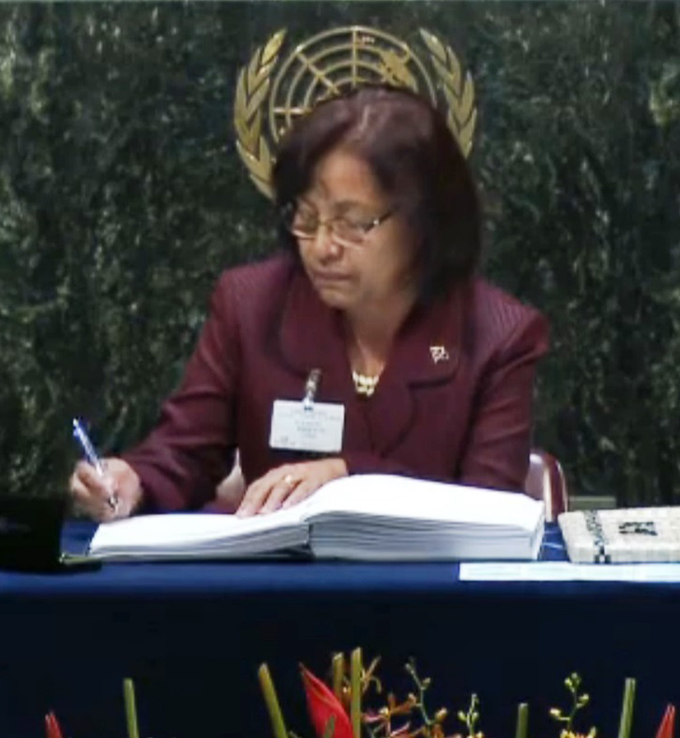
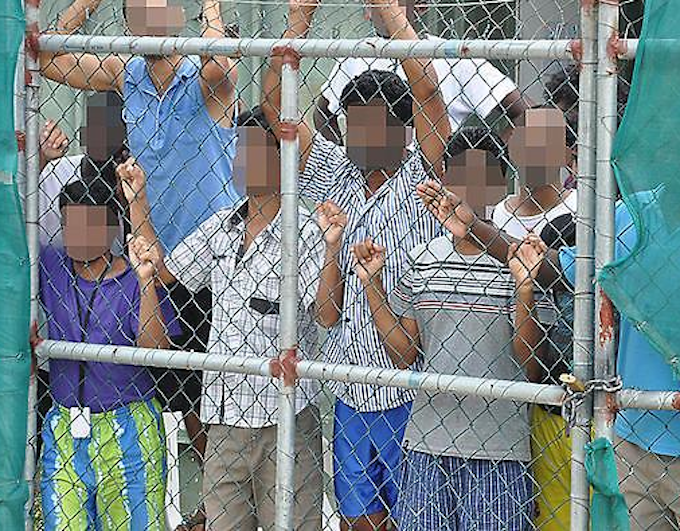
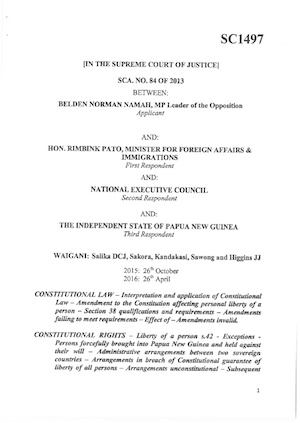



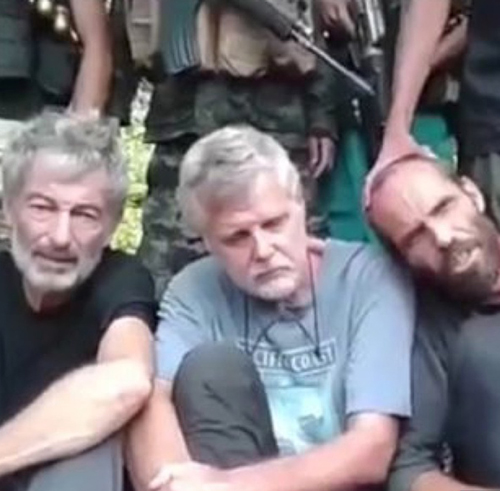


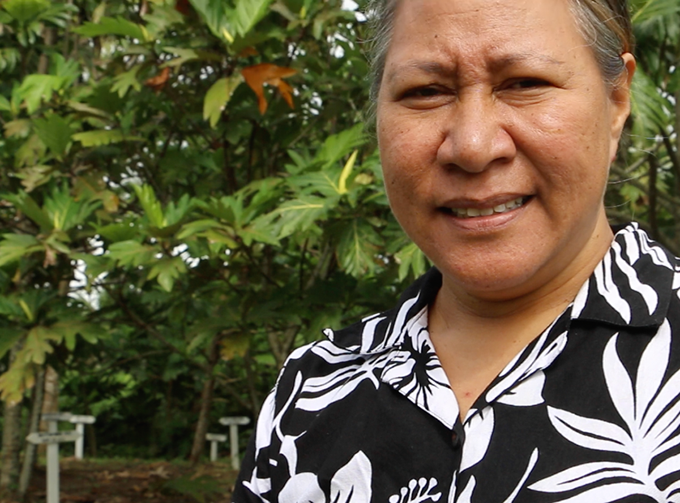
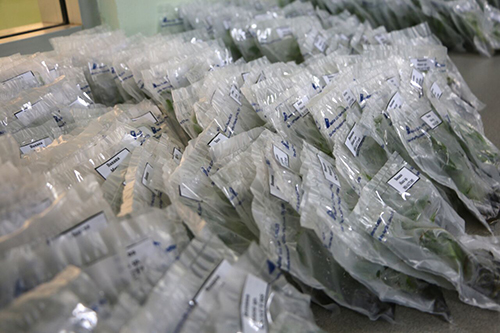
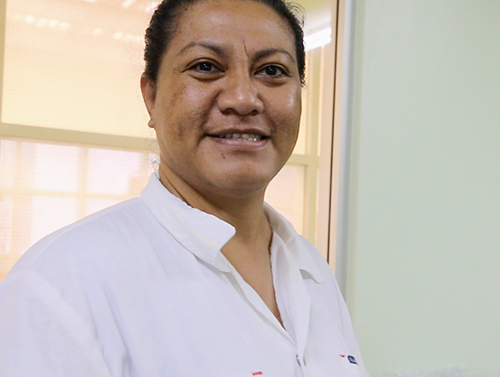
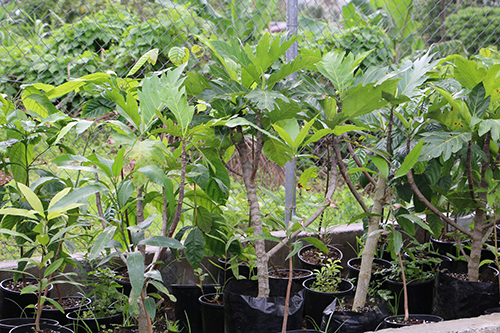


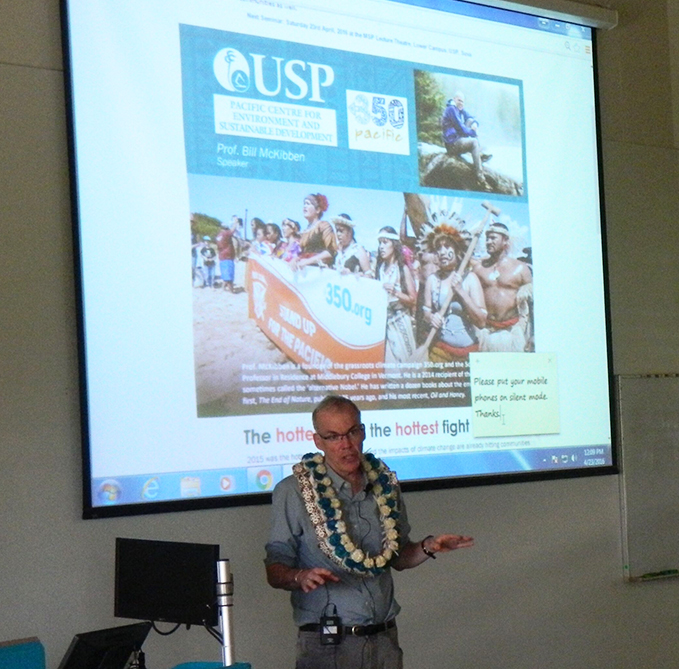


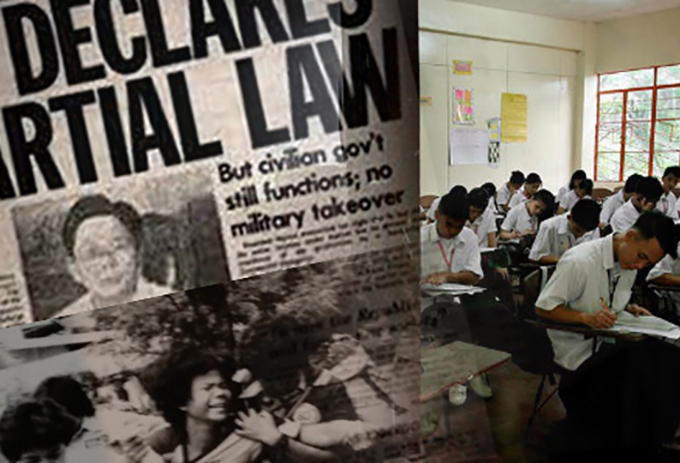
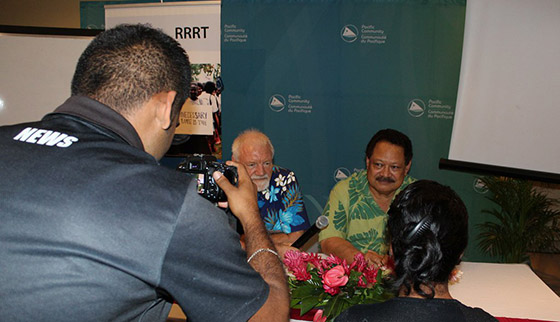


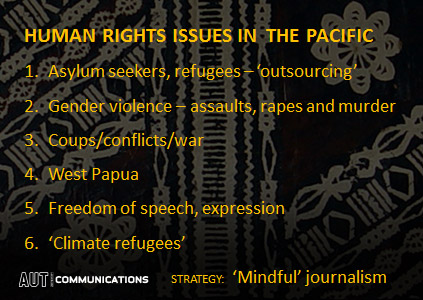

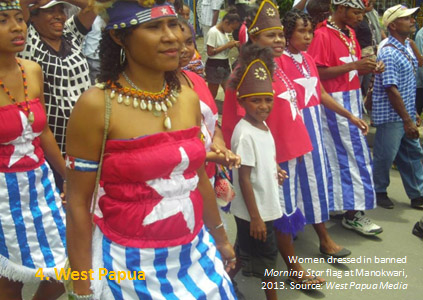

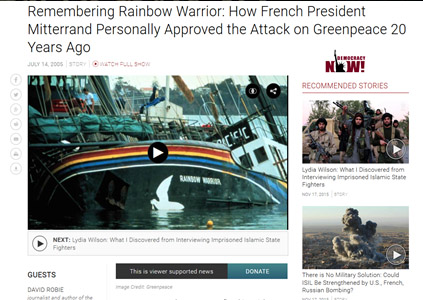

 Today’s edition of NewsRoom_Digest features 1 resourceful link of the day and the politics pulse from Friday 22nd of April. It is best viewed on a desktop screen.
NEWSROOM_MONITOR
Noteworthy stories in the current news cycle include: Primary Industries Minister Nathan Guy saying new access for chilled meat in China is an opportunity for exporters to get their high-end products into the top end of the Chinese market; Transport Minister Simon Bridges assuring passengers they will be safe in cabs after changes are made to the way taxi services are run; and findings from a report on the state of bluefin tuna fisheries in the Pacific Ocean, show that without drastic measures, there is a less than 1 percent chance of the population returning to healthy levels by 2024.
POLITICS PULSE
Government: Speech – Canterbury Men’s Centre Male Survivors of Sexual Abuse Trust; Bottled water concerns misplaced;Acting District Court Judges appointed; Successful bid gives economy $50 million boost; PM welcomes visit by French PM; Number on Social Housing Register declines; English releases RB Board letter of expectations; Indian President to visit New Zealand;Facility upgraded by offenders helps kakapo; Successful end to the yachting season; $520m funding injection for key Tauranga route
ACT Party: Funding policy to blame for Corelli school liquidation
Greens: Tree planting for the climate – a game-changer
Labour: Social Development stats don’t add up; Fewer cops on the beat as police cuts bite; Big jump in benefit numbers in Christchurch as rebuild slows; Thousands of invalid votes likely after National refuses to change rules
New Zealand First: “In The Shadow Of The Super City” – Speech At Whangaparaoa Rt Hon Winston Peters; Speech By Rt Hon Winston Peters To Warkworth Public Meeting; Out-Of-Work Young Kiwis On The Rise
LINKS OF THE DAY
SOCIAL HOUSING REGISTER: The number of people on the Social Housing Register has again declined. Figures for the March 2016 quarter show there were 4585 people on the register, down 223 or 4.6 per cent on the same time last year. Of those on the register in March 2016, 1036 are already housed and are awaiting a transfer to a more suitable property. The March 2016 register can be found at:
Today’s edition of NewsRoom_Digest features 1 resourceful link of the day and the politics pulse from Friday 22nd of April. It is best viewed on a desktop screen.
NEWSROOM_MONITOR
Noteworthy stories in the current news cycle include: Primary Industries Minister Nathan Guy saying new access for chilled meat in China is an opportunity for exporters to get their high-end products into the top end of the Chinese market; Transport Minister Simon Bridges assuring passengers they will be safe in cabs after changes are made to the way taxi services are run; and findings from a report on the state of bluefin tuna fisheries in the Pacific Ocean, show that without drastic measures, there is a less than 1 percent chance of the population returning to healthy levels by 2024.
POLITICS PULSE
Government: Speech – Canterbury Men’s Centre Male Survivors of Sexual Abuse Trust; Bottled water concerns misplaced;Acting District Court Judges appointed; Successful bid gives economy $50 million boost; PM welcomes visit by French PM; Number on Social Housing Register declines; English releases RB Board letter of expectations; Indian President to visit New Zealand;Facility upgraded by offenders helps kakapo; Successful end to the yachting season; $520m funding injection for key Tauranga route
ACT Party: Funding policy to blame for Corelli school liquidation
Greens: Tree planting for the climate – a game-changer
Labour: Social Development stats don’t add up; Fewer cops on the beat as police cuts bite; Big jump in benefit numbers in Christchurch as rebuild slows; Thousands of invalid votes likely after National refuses to change rules
New Zealand First: “In The Shadow Of The Super City” – Speech At Whangaparaoa Rt Hon Winston Peters; Speech By Rt Hon Winston Peters To Warkworth Public Meeting; Out-Of-Work Young Kiwis On The Rise
LINKS OF THE DAY
SOCIAL HOUSING REGISTER: The number of people on the Social Housing Register has again declined. Figures for the March 2016 quarter show there were 4585 people on the register, down 223 or 4.6 per cent on the same time last year. Of those on the register in March 2016, 1036 are already housed and are awaiting a transfer to a more suitable property. The March 2016 register can be found at: