A documentary exploring why New Zealand Sign Language (NZSL) isn’t a language option in secondary schools, despite being one of New Zealand’s official languages, has seen AUT University first-year student Lisa Thompson win the “NZSL in the Media” Award.
The annual NZSL Awards were held in Wellington last weekend – during NZSL Week – and Thompson won the award category for an individual or media organisation that demonstrates a commitment to promoting NZSL and Deaf awareness.
Her short six-minute documentary The Future is in Your Hands was also entered in last year’s Outlook for Someday film challenge and was one of the 20 winning films selected out of 156 entries that came from all over New Zealand and involved 550 young people.
Languages lecturer Lynette Pivac says the message of the video is so important.
“I absolutely support this goal: from when a child starts school until they finish – sign language should be an option. It would make school life so easy for any Deaf child who came to the school if other students could sign, or likewise for a hearing child with Deaf parents or grandparents who might come to the school,” she says.
“They would feel more like part of the community. Sign language wouldn’t be a strange thing but just a normal part of everyday life in the community.”
“We’re so proud of Lisa winning the award, it’s fantastic. It’s amazing that she is taking the initiative to advocate like this and she is only a young person herself.”
In this week’s Across the Ditch bulletin Australian radio FiveAA.com.au’s Josh Sampson and EveningReport.nz’s Selwyn Manning discuss how the soaring costs of housing in New Zealand has driven prices beyond the reach of most Kiwis, and rents well beyond what is affordable for thousands of people. PLUS: The song that was released a month before the 2014 New Zealand election, and then immediately banned by the Electoral Commission, has had its creators back in court, this time the Government’s Electoral Commission has sought to justify it banning the song in the 2014 General Election – this after the High Court decided the song did not fall foul of New Zealand’s electoral law.
ITEM ONE:
The soaring costs of housing in New Zealand has driven prices beyond the reach of most Kiwis and rents well beyond what is affordable for thousands of people.
The problem is at its worst in the cities, particularly Auckland where the average home sale price is almost $1million. The demand for rental accommodation has seen landlords renting out tin garages for around $400 per week, and a 28 square metre chicken-coop apartment will cost you $330.00 per week.
Last year, we reported on FiveAA’s breakfast programme that the imbalance in the New Zealand economy, led by a hot property market in Auckland, had worsened and had been in evidence for over a year. We also reported that the Reserve Bank had warned in 2015 that the housing market had ballooned out and posed a significant risk to the entire New Zealand economy.
This year, on May 11, the New Zealand Reserve Bank issued another warning, suggesting that if the housing bubble bursts, the impact on the New Zealand economy will be dire: “The Bank remains concerned that a future sharp slowdown could challenge financial stability given the large exposure of the banking system to the Auckland housing market. Further efforts to reduce the imbalance between housing demand and supply in Auckland remain essential.” (ref. http://foreignaffairs.co.nz/2016/05/11/housing-and-dairy-risks-to-financial-stability)
Beyond the wider domestic economy, the impact on every day life for thousands of Kiwis is already dire. For weeks now the news has been filled with real life examples of people living beneath the breadline. The state broadcaster, Radio New Zealand, has been leading almost continuously with reports about families living in cars, in tents, in garages, shacks, caravans, sleeping rough. Many of these people are women with children, and many have jobs but simply cannot afford a roof over their heads and have been squeezed out. (ref. http://www.radionz.co.nz/news/national/304179/where-do-homeless-go-when-help-runs-out)
Early this week the Prime Minister John Key said people who are sleeping in their cars should contact Work and Income New Zealand – the state social provider that is tasked with assisting families in dire economic circumstances and getting people back into work.
But the Minister in charge of Social Housing, Paula Bennett, admitted on Radio New Zealand this week that in Auckland there simply is not enough accommodation available to house those who have nowhere to sleep.
She did say her department would be able to put people into motels as a short term fix. However, this week it was revealed, every person placed into a motel by WINZ is then charged at the market motel rate per night.
The people who cannot afford rent, are placed into this form of the government’s temporary accommodation find themselves thousands of dollars in debt to the Government. Debt the Government charges interest on. (ref. http://www.radionz.co.nz/news/national/304122/homeless-borrow-thousands-for-motels)ITEM TWO:
https://youtu.be/p8_B6CqCLb4
Meanwhile, a song that was released a month before the 2014 New Zealand election, and then immediately banned by the Electoral Commission has had its creators back in court.
The song is a parody of the Prime Minister’s comments, a vision of his ideal New Zealand. John Key said: “I do not know so much about Planet Key, but my expectations are that it would be a lovely place to live, it would be beautifully governed. Golf courses would be plentiful, people would have plenty of holidays to enjoy their time. And what a wonderful place it would be.”
Kiwi musician Darren Watson and video maker Jeremy Jones released their song in the early stages of the 2014 General Election. Immediately, there was an outcry by those passionate who were that John Key should not be the subject of satire during an election campaign.
Then the Electoral Commission moved swiftly to ban the song and initiate legal proceedings against Darren Watson and Jeremy Jones. The two creators decided to take the song off the internet rather than risk facing a $40,000.00 fine.
Since then, in the High Court, they have defended their right to create and release such a song, even should it be satire, should it focus on the Prime Minister, and even if the song should be released during a political campaign.
The Electoral Commission argued before the High Court that it considered, under New Zealand law, that the song was an election advert (even though no politician or party paid for it to be created or released).
But the High Court judge ruled that the song was ok, and did not come under New Zealand’s electoral act, and as such, should not have been banned.
While the Government’s Electoral Commission is fighting that judgement in the Court of Appeal, it has conceded that it now does not want to hold the two creators of the song to account, but just wants the courts to clarify the law before the 2017 election year begins.
The Court of Appeal will now consider the two arguments.
In the meantime, Kiwis can enjoy the parody of John Key’s vision for New Zealand.
Former Chief Ombudsman and Police Commissioner Illa Geno in the EMTV News video.
By Serah Aupong in Port Moresby
Former Chief Ombudsman and Police Commissioner Illa Geno says investigations into allegations against the Prime Minister should continue without interference.
Speaking to EMTV News earlier this week, Geno, who is also an individual member of the Community Coalition Against Corruption, supports the call by the coalition for other constitutional offices such as the Ombudsman Commission to assure the public that they are addressing the serious allegations that have been made against public office holders.
Through his time in public office, Geno has been the police commissioner, chair of the public service commission and the chief ombudsman. He said the integrity of an individual and the integrity of the constitution must be upheld at all costs.
“Rule of law must be upheld without fear or favour. Everyone in this country is subject to the constitution. We are very fortunate that we have a constitutional democracy and in my view, democracy will not work on its own,” he said.
“We must have a very strong rule of law, which is the constitution to make it work. The challenge is that those officers who are manning, who are at the helm leading those institutions they must work otherwise we have lost the plot.”
Speaking about the events surrounding the questioning of the Prime Minister, and allegations of his involvement in the Paul Paraka issue, Geno said the investigations needed to be completed.
“The allegations of criminal offences and when the police officer authorised by the constitution (under section 196, 197 and 198), under reasonable suspicion believe offence has been committed, they have to act without referral to anybody, no,” Geno said.
Moral integrity
Former Chief Justice Sir Arnold Amet said in a separate interview from Madang that the moral integrity of the Prime Minister’s office needs to be protected and the Prime Minister O’Neill needed to go in for questioning.
“All that he needs to do is simply volunteer to go in and answer the questions from the fraud squad officers. Then the warrant of arrest will be rendered unnecessary and the calls to step aside. Although not required under any law at the present, it’s a moral issue,” he said.
Geno added that he believed there was cause for concern in regard to the issue of vetting investigations by higher-ranking officials.
“Any member outside of the police force to be involved in the vetting process, that is unconstitutional and also arguably may tantamount or impeach on the role of the judiciary,” Sir Arnold said.
He also said its time the Ombudsman Commission should state clearly if they are investigating a serious allegation of the breach of the leadership code.
“The ball is in the court of the Ombudsman Commission whether they are going to do anything about it or not. That is their call, but as a former Chief Ombudsman I can see that from observation multiple leadership breaches have already been committed,” he said.
So far the Prime Minister has maintained, through media statements and in Parliament, that unless evidence of his involvement is produced he will not go in for questioning.
“I’ve always stated this and will say this again, very clearly. If there is one evidence that I receive one financial benefit I will resign tomorrow,” the PM said.
Serah Aupong is an EMTV News journalist in Papua New Guinea.
The mainstream media’s allegiance in Papua New Guinea to the rich and powerful are once again obvious, writes Post Office Box: Letters to the PNG PM. Former Chief Justice and Madang Governor, Sir Arnold Amet, has revealed on Facebook that The National newspaper has refused to publish a statement he sent two weeks ago.
ASIAN LOGGERS’ NEWSPAPER REFUSES TO PUBLISH SIR AMET’S VIEWS
OPINION from Sir Arnold:
“THIS is a statement I forwarded to The National two weeks ago but, as you can see, it is provocative and it was not published.”
ANO PALA MUST RESIGN
The Hon Ano Pala should resign as Minister for Justice and Attorney-General because he has been arrested and charged with serious criminal of fences of conspiracy and attempting to pervert the cause of justice.
As a lawyer, Minister for Justice and Attorney-General and the principal legal adviser to government he has an obligation to preserve and protect the integrity of these high offices.
This is an ethical and moral duty and obligation to protect the integrity of these two high offices of a minister and attorney-general. This has nothing to do with his right to presumption of innocence.
To continue to contend that he will only resign if he is found guilty misses the point. He cannot continue to discharge the duties of this office while he has this cloud hanging over his integrity. He will have conflicts of interest in many instances.
In fact,by insisting on holding on to these offices, he is “demeaning the integrity of the high offices of a Minister and Attorney General and his personal integrity as a leader”, under the leadership code as well.
The allegations are serious and the fact that he has been charged is also sufficient grounds for the Prime Minister to decommission him as a Minister.
For the Prime Minister to say that Mr Pala is entitled to continue in office as a Minister and Attorney-General until a court finds him guilty is wrong. The Prime Minister has a duty to preserve and protect the integrity of these offices by decommissioning Mr Pala. These are also basic conventional practices of integrity and good governance.
To continue to insist on hanging onto office in these circumstances is tantamount to corrupt practice.
PRIME MINISTER SHOULD STEP DOWN
Prime Minister Peter O’Neill also should step down from office and voluntarily submit to the due process of the rule of law by being interviewed by fraud squad offices.
He and the office of Prime Minister is not above the law. He cannot continue to contend that the evidence to support the issue of the warrant of arrest is not credible and that fraud squad investigators are rogues and therefore he is not prepared to demean the integrity of the high office of prime minister.
All of these are mischievous and miss the point and are designed to mislead the people of PNG and the wider public at large. He must know that he is not fooling the international development partners by this “circus” of trying to frustrate the due process of the rule of law.
Whether the evidence is credible is a matter for the court of law. One court at least considered it to be credible “prima facie” to have issued a warrant of arrest, so it is not to the point for the Prime Minister to keep misleading the public.
The office of Prime Minister is not above the law. He must simply submit to the due process of law and allow the system of justice to determine if in fact he is guilty or innocent.
In fact by continuing to use the court system and other senior institutions of the state to frustrate and avoid submitting to the basic due process of the rule of law that every other citizen of this country, including senior judges and ministers and lawyers the Prime Minister is “demeaning the integrity of the office of Prime Minister and his personal integrity as a leader” under the Leadership Code.
Again, I join other senior leaders and statesmen such as Grand Chief Rt Hon Sir Michael Somare, Rt Hon Sir Mekere Morauta and other ordinary citizens of this country and call on and urge the Prime Minister to respect the people of this country, the institutions that uphold the rule of law and submit to the due process of the rule of law. Senior leaders must be the first to submit to the rule of law and lead by example.
Also to continue to insist on holding onto office in these circumstances is tantamount to corruption.
GARI BAKI SHOULD SEEK LEGAL ADVICE AND FOLLOW THE RULE OF LAW
The Commissioner of Police, Gari Baki, should refrain from purporting to exercise powers of the office of the commissioner for police until the courts of law determine the serious charges that the offices of the fraud squad officers have laid against senior leaders.
He should get good competent legal advice and not kneejerk react because he runs the risk of being charged with contempt and perverting the cause of justice. Two former commissioners of police have already been so found guilty of contempt by the courts.
It all seems so obvious to reasonable Papua New Guineans that the police commissioner Gari Baki is determined to ensure that the fraud squad officers do not continue to investigate, charge and prosecute senior leaders in government.
Again, it is worth repeating that no individual is above the law, whatever public office one may hold, whether it be Prime Minister, Minister for Justice and Attorney General, Senior Judge or Police Commissioner or a senior private lawyer.
I believe the public at large would like to see the offices of the law enforcement agencies and institutions doing their job faithfully and diligently without fear or favor and bring to justice all implicated in breaches and violation of the rule of law. They should not be interfered with for corrupt and ulterior motives in the guise of administrative processes
Granting of full membership status to the United Liberation Movement of West Papua in the Melanesian Spearhead Group is justifiable as Indonesia had sought membership of the regional bloc to only protect its own interest, says Prime Minister Manasseh Sogavare of the Solomon Islands.
Indonesia has no desire to engage in dialogue about the serious human rights issues in West Papua.
Sogavare reaffirmed these views at a media conference in Honiara after returning from Vanuatu where he had the opportunity to meet with his Vanuatu counterpart, Prime Minister Charlot Salwai, and a delegation of leaders from the United Liberation Front for West Papua (ULMWP) at the sidelines of the 2023 Pacific Games bid presentation.
One of the issues discussed in the meeting between the two Melanesian prime ministers was a motion to be tabled by Prime Minister Salwai at the upcoming MSG Leaders’ summit in Port Moresby, Papua New Guinea, for granting of full MSG membership to ULMWP.
Prime Minister Sogavare registered his full support for this West Papua initiative.
In the meeting between Sogavare and the ULMWP delegation, the West Papuans presented a two-point petition for consideration by the MSG chair for discussion at the upcoming leaders’ summit.
The issues are the elevation of ULMWP’s membership of the MSG and a request to the United Nations for intervention in West Papua to neutralise the ever increasing rate of genocide there.
Sogavare told the media conference that Indonesia’s apparent rejection of the resolution reached by the Pacific Islands Forum leaders in Port Moresby in 2015 for the deployment of a fact-finding mission in West Papua as well as the Indonesian president’s refusal to meet with him in his capacity as the MSG chair to explain the position of the MSG on the issue of West Papua are strong grounds for elevating the status of ULMP to full membership.
‘No alternatives’
“Indonesia leaves the MSG no alternatives on bringing the West Papuan issues on the table for discussion, except to elevate the status of West Papua from observer status to full membership, so that the MSG Leaders can discuss the West Papuan issues more strategically,” he said.
Prime Minister Sogavare is adamant that Indonesia would continue to downplay West Papua human rights issues until a possible United Nations resolution on West Papua is achieved in the future.
He said as chair, the MSG would take on board such matters as priority issues to address.
The prime minister said fresh accounts of ongoing human rights violations in West Papua are continuing to emerge.
However, the Indonesian President’s refusal to meet him in Jakarta to convey the MSG’s position on West Papua is a clear indication that Indonesia has other reasons for joining MSG other than discussing West Papua human rights issues.
He said the Indonesian president’s noncommittal attitude warrants the MSG to take the matter up to the next notch – the United Nations for intervention.
Prime Minister Sogavare said he was aware that said since the ULMWP was granted an observer status of the MSG in 2015, the situation in West Papua had became more tense.
This was leaving the indigenous people now at the brink of extinction.
Last week, while in Port Vila, Prime Minister Sogavare said Indonesia had refused his request for dialogue gave him all the reason to take this matter back to the MSG, adding that Indonesia had crossed the line so we need to take some tough steps.
National Capital District Metropolitan Superintendent Benjamin Turi says police visibility at the University of Papua New Guinea campus is for the safety of students and public property.
At the request of the university council, Turi said officers entered the Waigani campus around 4am yesterday to ensure that students and properties were safe, and students were free to move about without being intimidated by others.
“We will be here as long as it takes, according to the wishes of the [university] senate. We are doing our duty to protect lives and property,” Turi said.
He said police used no force to enter the campus.
But a student leader said police presence at the campus was intimidating.
Mamose region students’ representative Stanley Warren said they respected what the police were doing but they would continue with their boycott of classes until they achieved what they were fighting for.
“We’ve been right behind our SRC (student representative council) in this fight for the past two weeks,” Warren said.
“Given the current situation of police in the campus, it will be a little intimidating and a threat to our students especially the first-year (students) and girls. But we managed to talk to them and calmed them.”
No to ‘awareness’ protest
The students asked Turi if they would stage a peaceful awareness protest but he said it would be illegal.
For more than two weeks, the students have been boycotting classes and calling on Prime Minister Peter O’Neill to stand down and face police investigation of corruption allegations.
Michael Guba is a journalist with The National daily newspaper.
Papua New Guinea’s Chief Secretary to government Isaac Lupari has warned people attempting to commit illegal acts as part of attempts to hijack student protests that they will face the full force of the law.
The Chief Secretary said some activists involved with the latest attempt to cause civil disturbance were not students but “agitators” who had no interest in student issues.
“These agitators devote their lives to stirring the public up for the highest bidder, and now they are trying to hijack student protests,” the Chief Secretary said.
Chief Secretary to government Isaac Lupari …”There is big money involved in manufacturing protest for people of dubious intent.” PNG Gov
Such people were subject to the laws of Papua New Guinea and if they were found to be inciting people to commit acts that were illegal, they would be arrested and prosecuted by law.
Students at the University of Papua New Guinea have been demanding that Prime Minister Peter O’Neill stand down and face a police investigation of corruption allegations.
They are in the third week of boycotts of classes and protests and have wide support from students at other universities in the country, especially Unitech in Lae.
Police seized control of the Waigani campus before dawn yesterday after being called in by the UPNG management to “secure safety”, but students continued with a sit-in protest and boycott of classes.
Social media posts
Lupari said: “I have seen the messages circulating around social media, and I ask everyone who might forward these messages that they should try to know who is behind the message.
“There is big money involved in manufacturing protest for people of dubious intent, and members of the public might be fooled into taking part not knowing it is part of broader political campaign.”
Chief Secretary Lupari said there were processes involved in staging any lawful protest.
“People behind any protest must know there are clear and proper processes and these must be followed because this is the law,” he said.
“The nonsense that is appearing in some of the [social media] posts is simply foolish, but some comments do cross into breaking the law.
“People who are sending these posts around must be aware of this.”
The Chief Secretary said the calls for anarchy by the agitators were entirely separate from student protests, and due to the serious nature of threats of violence, the National Security Advisory Committee would now convene to discuss the issue.
‘Sinister purposes’
“Make no mistake, the agitators behind proposed protest are not students, but have much more sinister purposes,” Lupari said.
“The NSCA is the principal adviser to the government on security matters and will consider certain powers that can be used against this behaviour.
“The extreme action they are trying to stimulate is uncalled for and will not be accepted.
“I appeal to our students not to be misled by the agitators and to make your own judgments.
“The action promoted by the activists is not the Melanesian way where we resolve issues as a community, but is an aggressive foreign-style of intimidation and grand-standing.
“The matters they are promoting are also before the court so cannot be properly discussed until they have run their course.”
Ministers from the 12 countries that negotiated the Trans-Pacific Partnership Agreement (TPPA) have just met in Arequipa, Peru.
[caption id="attachment_6181" align="alignleft" width="150"] Professor Jane Kelsey.[/caption]‘The four paragraph ministerial declaration (so far only available in Spanish) is as bland and uninformative as their previous statements, reiterating how great they say the deal is and how eager other countries are to join’, according to University of Auckland law professor Jane Kelsey.
‘What they don’t tell us about their meeting is what really matters’, she said.
‘The fate of the TPPA is captive of US politics. President Obama will have stressed the need to provide assurances to gatekeepers in the US Congress who want stronger protections for new generation biologics medicines, oppose the protection of tobacco control measures from investors’ rights to sue, and to stop governments from requiring that financial data is held inside the country’.
‘This is make or break time for Obama, whose “legacy” deal is in jeopardy if he can’t get the TPPA through Congress during the “lame duck” period between administrations’, Kelsey said.
‘In reality, the timeline under the Fast Track law makes a vote during the lame duck period virtually impossible. Then the supposedly final text will be subject at least to renegotiation on those key points, if not blocked altogether, under a new administration.’
‘There are high risks of countries agreeing to more concessions now, especially a side letter setting out a strong interpretation of the vague compromise wording on biologics, and facing new demands for more concessions, whichever party wins the presidential race and/or control of the Congress.’
Professor Kelsey called on new trade minister Todd McClay not to sell New Zealand further down the road for a deal that imposes unacceptably high costs for New Zealanders for very little return.]]>
Occupation: Masters student, University of the South Pacific
Passion: Pacific diplomacy and climate change
Country: Fiji
Jenny Jiva, a master’s student from the University of the South Pacific in Suva, is giving Pacific climate change a voice on the world stage.
Her master’s research concerns the loss and damage impacts related to climate change, as an issue, which can include the loss of livelihood, territory and property.
Jiva’s research focuses on the Pacific’s role in getting loss and damage issues on the negotiating table, and successfully into the United Nations Framework Convention on Climate Change (UNFCCC) outcomes and documents.
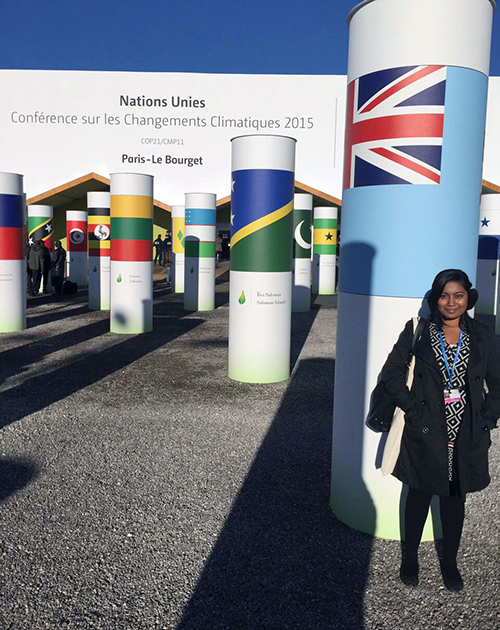
In 2015, the 23-year-old was selected as a country delegate to represent Fiji at the COP21 climate change conference in Paris, a global meeting where world leaders reached a legally binding agreement to address climate change.
Fiji’s Jenny Jiva in Paris for COP21. Image: USP
“I went to the meetings and the negotiations about loss and damage,” she says.
“My main role was to take notes and do briefings for our main negotiator so that’s what really consolidated my research question.”
A goal for Jiva is to attend COP22 in November this year, which will be held in Marrakech, Morocco.
She told Asia Pacific Report that this year the conference would be reviewing the Warsaw International Mechanism for Loss and Damage, a policy that aims to address climate-related loss and damage in developing countries vulnerable to extreme effects of climate change.
In 2013, in Warsaw, the Pacific fought strongly for this mechanism, she says.
The young activist is also a member of Pacific Islands Climate Action Network (PICAN), an organisation that brings together Pacific NGOs and civil society actors who advocate for climate change.
“Climate change is a very real thing, we now know that it is happening, it’s not debatable anymore,” she says.
Some members of the University of Papua New Guinea’s Uniforce Security unit have alleged that the police entered the campus early today using heavy-handed tactics, reports LoopPNG
“A police officer put a gun to my head when I hesitated to let them in,” said a guard, who did not want to be named.
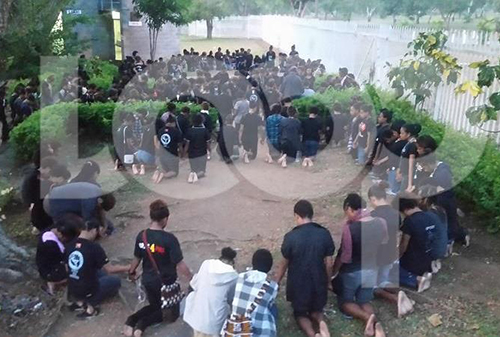
Students, mostly dressed in their protest black representing mourning over alleged breaches of the constitution by the government, were in sit-in huddles around the campus.
Students pray on campus today while most have been staging sit-in protests in groups. Image: LoopPNG
They want Prime Minister Peter O’Neill to stand down and face a corruption investigation.
Students manning the main barricade leading to the campus claimed the convoy of 50 vehicles rammed the blockade about 4.45am.
However, some police officers said they were acting under orders.
They said they woke up as early as 3am to organise themselves.
They feel for the students but they have no choice, said LoopPNG.
“We will stay as long as our bosses want us to,” one officer said.
‘Unsafe on campus’
A couple of UPNG staff told Loop PNG that they now felt “unsafe on campus”, especially with the heavy police presence.
“We are afraid that something is going to happen so we’re going home,” a staff member said.
Police Commissioner Gari Baki said police had been on the ground since 3am. He would not disclose the exact number of law enforcers deployed, PNGLoop reported.
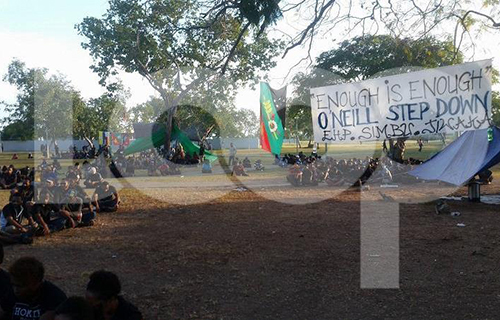
“Enought is enough” proclaim students in a banner with their sit-in protest at Waigani campus today. Image: LoopPNG
“Let them [police] come in and attend classes,” a student leader said.
Another student asked: “If they’re all here then who’s on the streets?”
UPNG media unit director Jim Robins said the police were on campus to maintain the safety of students and staff.
“Those students who want to attend classes can now do so without fear, as well as academic staff.
‘Open arms’
“The students welcomed them with open arms.”
A final-year journalism student said: “We are willing to sacrifice our education for a corrupt–free future.”
“We have decided not to go to class.They said they are here to protect us but no one is under threat here,” said another student.
“The way they came in the morning, fully-armed, some even climbing over the fence, with all these 10-seaters, are intimidating,” another student told Loop PNG.
“We want vice-chancellor Professor Albert Mellam to come to us and explain this heavy police presence on campus.
“We refer to him as our ‘father’. He even calls us his ‘children’, so why go to this extent? Are we state criminals?”
The number of drug convicts keeps rising despite the implementation of the death penalty in Indonesia, showing that capital punishment is not that effective in fighting drug-related crime, activists have said.
At least 16 NGOs grouped in the Anti-Death Penalty Civil Society Coalition told a press conference that the death penalty was not the solution to addressing crime in Indonesia, especially crime related to drugs.
The coalition’s statement comes ahead of the third round of executions of drug convicts, which many expect to be conducted very soon.
Indonesian Drug Victim Advocacy Brotherhood ( PKNI ) head Totok Yulianto said there had been a rise in the number of drug convicts despite the executions carried out in 2015.
Under the administration of President Joko “Jokowi” Widodo, the government has conducted two rounds of executions.
Six death row inmates were executed on January 18 last year, followed by eight more in the second round on April 29, 2015
Totok said there were 65,566 drug convicts recorded in January 2015, adding that that number had rose to 67,808 people by May 2015.
“Even though the government had carried out executions in January and April. This shows that the death penalty does not create a deterrent effect. This is data from the directorate general of corrections,” Totok said, as quoted by Kompas.com on Wednesday.
Correcting behaviour
Impartial director Al Araf said punishment in the modern era no longer followed the principle of retaliation; rather, it was aimed at correcting the behavior of someone who has broken the law.
“We do not support criminal acts at all. We reject the death penalty and instead lean more toward life sentencing, because the death penalty clearly violates human rights principles,” he said.
Given the nation’s fragile justice system, procedural violations in the implementation of the death penalty were still common, Araf added.
Citing the example of Zainal Abidin’s case, whose appeal was rejected almost immediately, Araf suggested this was because the convict, found guilty of possessing 58.7 kilograms of marijuana in 2000, had already been listed in the second round of executions.
“Just imagine, the legal process hadn’t yet finished, and when he lodged his appeal it was rejected within four days. This is clearly outside of the principles of justice,” he added.
Meanwhile, police have said the third round of executions was ready to be carried out in May 2016. The firing squad has been prepared for the execution of 15 drug convicts.
The Central Java police, in charge of Nusakambangan prison island where the convicts will be executed, said it was awaiting instructions from Attorney-General Muhammad Prasetyo.
So far, the Attorney-General’s Office has not disclosed the execution date or the identities of the convicts.
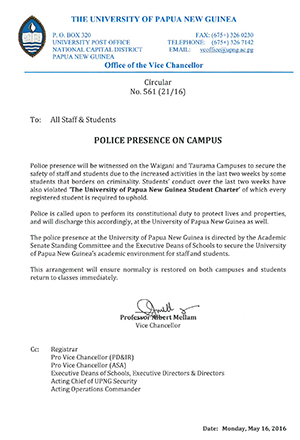
The University of Papua New Guinea has called in police to “secure the safety of staff and students” in the ongoing anti-government unrest at the nation’s universities.
According to a circular sent to everybody on campus yesterday, the Vice-Chancellor, Professor Albert Mellam, has accused some protesting students of activities “bordering on criminality” in the past two weeks.
The UPNG circular about a police presence on campus. Image: UPNG
“Police [have been] called upon to perform its constitutional duty to protect lives and properties, and will discharge this accordingly at the University of Papua New Guinea as well,” he said.
Professor Mellam said the police presence on the campus – a highly unusual step by authorities – was directed by the academic senate standing committee and executive deans.
He said this would “ensure normalcy”.
The National reported that protesting students had been given a last chance to attend classes yesterday.
However, road blocks and student protest gatherings were very much in evidence, say campus sources.
“Teaching was still off and students were still in their regional groups,” said one source.
Road blocks
Campus road blocks that had been taken down on Sunday were put back yesterday.
Acting chancellor of UPNG, Dr Banare Bunn, was reported to have said the constitutional issues “students are aggrieved about” were before the courts and the university council could do nothing about this.
The students have been demanding that Prime Minister Peter O’Neill stand down and face an investigation of corruption allegations.
Dr Bunn said that if students continued to stay away from classes, the university senate would reassess the situation to see if the semester was “viable”.
“Is semester one viable or not? That is the big issue,” Dr Bunn said.
He said the senate had met last week and given the students a time-frame.
“The academic calendar that the university council has approved, they have followed. And if there is any lapse in the academic programme, then the senate will decide how it will address that,” he said.
Academic responsibility
“The council’s responsibility is the academic pursuit of the students while studying at UPNG.
“The council has monitored and provided an environment for the safety of the public and students themselves, university staff and property.”
Dr Bunn said the issues raised by the students were not related to the university but were national issues being addressed by the courts.
“The matters are before the court the council has taken a very serious stand on that,” Dr Bunn said.
“We are not qualified to discuss anything that’s before the courts. Students have been told that on many of the discussions we’ve had.”
He said UPNG could not issue a threat, that was not the best way to handle the situation.
The NBC News report on Belden Namah’s appeal to the nation, presented by Jerry Tave.
By Raymond Ginio in Port Moresby
Papua New Guinea’s former opposition leader, who launched a successful legal challenge against the Manus Island asylum seeker detention centre, has called for the ousting of Prime Minister Peter O’Neill.
Speaking on NBC News last night, Belden Namah said: “Papua New Guineans must now take action. Take back your country – save your country.”
He said if the people did not do it now, they would never do it.
The member for Vanimo/Green MP called on both the Papua New Guinean and Australian governments to immediately shut down the Manus Island Regional Processing Centre for asylum seekers.
He gave a 3 month ultimatum before taking other action.
Namah said it had now been more than two weeks since the Supreme Court ruling that the centre was unconstitutional and illegal, and he had seen “no sign” of moves toward closing it.
He said the centre did not serve the interests of the people of Papua New Guinea.
Australian responsibility
Namah said that when the Somare government a signed memorandum of understanding with Australia it was to establish a refugee processing centre only on Manus Island.
“No refugee was supposed to be resettled in Papua New Guinea,” he said.
“Resettlement of refugees was supposed to be the responsibility of the Australian government.”
Namah said he had given both governments 3 months to close the facility.
“Failing that, I will pursue other possibilities.”
Namah also supported the students at the University of PNG in their protest against the government.
He appealed to all Papua New Guineans to support the students while they asked Prime Minister O’Neill to stand down and face the rule of law over corruption allegations.
“The whole country needs to rally behind the students,” he said, adding: “The whole country needs to rally behind the police Task Force on Corruption.”
Raymond Ginio is a reporter with NBC Television News.
Prime Minister Peter O’Neill has called on Papua New Guinea’s university students to “think before you act” and not to allow others to use or influence them.
This was his message as students from four other tertiary institutions across the country pledged support for the student leadership at the University of Papua New Guinea.
The back-to-class order from the UPNG administration yesterday. Image: Citizen Journalist
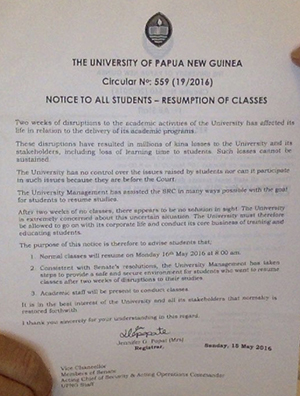
Registrar Jennifer Popat ordered students and staff back to classes today but while students were on campus in numbers, they were reportedly staying out of the classroom.
PNG Today reported O’Neill as saying: “They [others] will not be there for you when you are in trouble,” he said.
“Take it from me. I was a victim of outside influence when I was a student at the UPNG.
“I was involved in student protests and strike because people told us that we, students, were the protector of the rule of law and representative of the silent majority.
“When I was in trouble, no one came to rescue me. All the friends and people who influenced me were never there when I needed them.
‘They disappeared’
“They simply disappeared. I was left to fend for myself. From then onwards, I vowed not to engage in student’s strikes and protests,” O’Neill said.
He appealed to students to go back to class and resume normalcy in the campus.
“Your education is priority. Do not risk it.
“The matters which you raised are in in the courts. Respect me and the rights of others.”
Meanwhile, students at other universities around the country have pledged their support to the UPNG Students Representative Council (SRC) leaders and students on their stand.
The Divine Word University in Madang, Unitech in Lae, University of Goroka in Goroka, and the University of Natural Resources and Environment in Kokopo have joined UPNG students in demanding Prime Minister O’Neill to step aside and surrender to Police for questioning.
Staff ‘threatened’
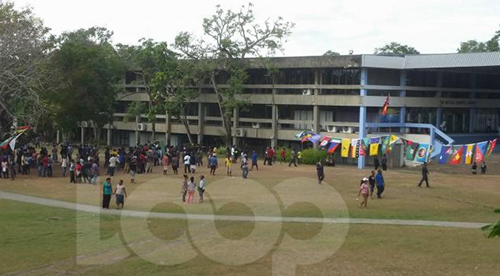
The UPNG campus today … “threats against staff”. Image: LoopPNG
Loop PNG reported that even though UPNG staff were on campus today – as instructed by the registrar’s circular yesterday – lecture rooms were still empty.
The director of UPNG’s media unit, James Robins, said that staff had been threatened by rebel students.
“Some students also want to attend classes but they have been intimidated,” he said.
Some had now resorted to emailing their assignments to their lecturers.
“All we need is normalcy to come back so everyone can be productive,” Robins said.
“Lecturers and tutors are being paid but they haven’t been productive for the past two weeks. They’ve been here but students haven’t been.
“This is non-productive money down the drain.”
Robins was explaining registrar Jennifer Popat’s statement on Sunday.
The registrar had said the disruptions had resulted in millions of kina losses to the university and its stakeholders, including loss of learning time to students.
The partial relocation of villagers of Solosolo to higher ground should not be simply placed under a headline of Climate Change although that has been the catalyst for many of the villagers to move.
And the Climate Change label, if you belong to one school of thought encompasses so much more, including natural disasters such as tsunamis as well as global warming caused by increased levels of atmospheric carbon dioxide produced by the use of fossil fuels, and of course the associated rising sea levels.
But for many years while Samoa has joined in the worldwide clamour about big countries harming the smaller vulnerable countries such as ourselves, our own citizens have been contributing to the problems with our actions.
As well as featuring news stories on the subject, this newspaper has commented a number of times about the huge trucks on the east coast road seen thundering towards Apia with their loads of beautiful, white sand mined from our beaches.
In fact in 2011, the former Cabinet Minister of Works Transport and Infrastructure, Manualesagalala Enokati Posala, denied allegations that a brick-making company run by his wife was mining sand illegally from Lotofaga, Safata.
Manualesagalala said there was nothing illegal about the operations and his company had a permit from the Ministry of Natural Resource and Environment that allowed him to mine the sand.
However, villagers disagreed and said that the sandmining had seriously eroded the village’s natural beauty and landscape and caused the evacuation of families who lived close to the shoreline.
One villager stood on the coastline and pointed to about 20 metres out to sea saying the village used to be there and there were homes built there.
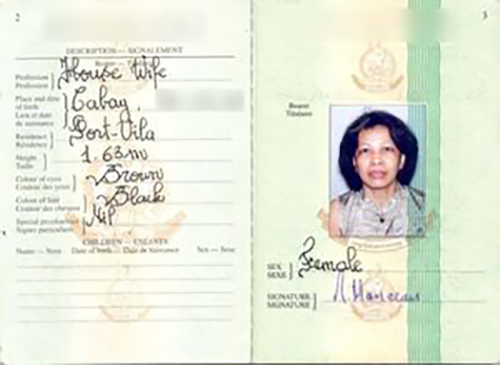
In her passport, Nesita Manceau lists her occupation as “housewife.” But she does oh-so-much more. On paper at least, she’s a corporate titan. And she’s been tangled in an arms-running scandal involving North Korea and Iran.
Manceau is what could be called a “zombie director” of shell companies. She’s been on the boards of scores of them. Lawyers in Florida, Oregon and Nevada have clients who call on her services.
The 55-year-old Filipina, who until recently was living in Vanuatu, exercises what is required of an offshore corporate director: She simply signs her name. Time and time again.
Nesita Manceau, a Filipina shown in this passport photo, is listed here as a “housewife” but also in registries as a corporate director for scores of tax haven companies around the world. Image: Vanuatu Daily Post/ICIJ
Practically the sole function of an offshore corporate director is to cloak the identity of the real owner of a company or trust.
The director serves as a legal shield, of sorts.
The documents known as the Panama Papers teem with these zombie directors who sign corporate papers at the bidding of unidentified owners.
Such directors can oversee, at least on paper, hundreds – and sometimes thousands – of corporations.
Crucial cog
They are a crucial cog in the machinery of foreign law firms and registration agents who churn out phantom corporations, stock them with proxy directors, slap a soothing name on them, and register them on atolls or far-away nations. It is a volume business.
True owners of the shell companies often want passive directors with no control over, or even knowledge of, actual operations. Secretaries, Burger King cooks and housewives will do.
Corporate registration agents like Mossack Fonseca, the Panama law firm whose 11.5 million leaked documents comprise the Panama Papers archive, earn extra fees when they stock the boards of offshore entities with nominees who usually have no clue as to the identity of the true owners.
“The fact is, if you waterboarded them, they wouldn’t come up with the name of the beneficial owner because they don’t know,” said Jack Blum, a Washington lawyer who has spent decades investigating money laundering and the use of offshore corporations.
But when government investigators come around trying to figure out who owns an offshore corporation, Mossack Fonseca offers up their names as if they had an actual financial stake and knowledge of operations.
That happened in 2011, when the director of the Financial Investigation Agency of the British Virgin Islands, Errol George, wrote to Mossack Fonseca inquiring about Fincom Trade Ltd. A company officer quickly responded.
“The Beneficial Owner of the company is Ms. Nesita Manceau whose address is: 1st Floor, Pacific Building, Port Vila, Vanuatu,” wrote J. Elizabeth Maduro.
‘See-no-evil’ directors
See-no-evil nominee directors are the mirror opposite of directors in the real corporate world, who usually have firsthand business experience that they use to hire and fire chief executives, oversee corporate decisions and protect shareholder interests.
The massive leak from the Mossack Fonseca law firm, shared with the International Consortium of Investigative Journalists (ICIJ) and its partners, including McClatchy Newspapers, includes emails, copies of passports and financial records, which all cast light on the structures used in offshore companies, including the functionaries like Manceau.
Manceau was born in a remote Philippine hamlet called Cabay in Eastern Samar province. Her former husband said she once served as a housekeeper after moving to Vanuatu.
Opposition Leader Sam Basil speaking out in support of the University of Papua New Guinea students on EMTV.
By Theckla Gunga in Port Moresby
Papua New Guinea’s Opposition has challenged why a protest referendum requested by University of PNG students has not been carried out by the Electoral Commission.
Students across the country have been calling for the resignation of Prime Minister Peter O’Neill until allegations of corruption against his administration have been fully investigated.
Students at UPNG made a petition calling for O’Neill to stand aside but did not hand this to a government delegation two weeks ago, saying they wanted to present it to the prime minister personally.
Opposition Leader Sam Basil said on EMTV that while the Metropolitan Police Superintendent for Morobe, Anthony Wagambie Jnr, had successfully overseen an “awareness” protest by the students at the University of Technology on Wednesday, the same opportunity should be given for UPNG students.
“I commend the Lae Metropolitan Superintendent, Anthony Wagambie Jnr, and Unitech students for conducting a successful campaign in Lae,” Basil said.
Basil added, however, that for UPNG a referendum could not be conducted because of the absence of the Chief Electoral Commissioner.
Goilala MP William Samb also made comments stating that the while Unitech’s senate had allowed their students to conduct a referendum, the UPNG senate should do the same.
“I challenge the UPNG senate to write a letter to the Electoral Commission to conduct a referendum,” Samb said.
The protest is to petition O’Neill, to step down following a series of allegations labelled against him.
Today marked more than four weeks of unrest and class boycotts at both UPNG’s Waigani and Taurama (medical school) campuses.
Theckla Gunga is an EMTV journalist in Port Moresby.
Thirteen Papua New Guinea Defence Force soldiers who were charged with mutiny have begun testifying.
On Tuesday, they submitted to the Bomana National Court that they did not have a case to answer to and that their conduct was not a mutiny but mere insubordination, reports the PNG Post-Courier.
Justice Panuel Mogish dismissed their submissions and ruled that there was “ample evidence” for all 13 soldiers to have a case to answer to.
Front page of the The National coverage of the start of the court martial. Image: The National
The platoon headed by Major Edimani Benjamin was tasked to maintain the Exxon Mobile camp in Komo after Exxon Mobil gave it to PNG government to use as a PNGDF base.
Then PNGDF headquarters ordered the platoon to withdraw from Komo in August 2015 and return to the national capital of Port Moresby but they did not comply.
News reports at the time said the soldiers had refused to return to the capital at the time because of outstanding pay owed to the troops.
In December 2015 they lost two soldiers in a tribal fight.
The soldiers charged under Major Edimani Benjamin are Warrant Officers Miugle Ludwig, Melerot Robin, Kaule Scotty, Sergeants Agiru Alex, Kaupa Amos, Mairi Mairi, YupangaJoel, Guria Urban; Corporals Waimi Walter, Worihun Henry, Peter Perari and Private Philip Kiak.
Students have threatened a mass withdrawal from the University of Papua New Guinea if the administration does not agree to its demands as anti-government tension grows on tertiary campuses across the nation after a two-week-old standoff.
The students want Prime Minister Peter O’Neill to stand down and allow corruption allegations to be investigated.
In Lae, the University of Technology’s Student Representative Council (SRC) president David Kelma called on political leaders to respect the Constitution.
The National reported that Kelma had said leaders who continued to break the laws had no respect for the Constitution.
“Our leaders must respect the system, they must respect our laws. When our leaders continually break our laws, there is no justice,” he said.
“If there is no justice, there is no democracy in society.”
Kelma said leaders implicated in any wrong-doing must respect the Constitution and the office they uphold and step down from office.
Dangerous precedent
Manipulating the government systems and laws to stay in power was a dangerous precedent that could have detrimental effects on the future of the country, Kelma added.
In Port Moresby, UPNG’s SRC leadership set two demands on Thursday for the administration to act on within 24 hours.
Student leaders asked the administration to prepare forms for a mass withdrawal of students, and that it refund all tuition fees for the students for the remaining semesters.
Professor Mellam … faced with student demands. Image: UPNG
One student leader told NBC News the SRC had passed on their demands to the Vice-Chancellor, Professor Albert Mellam, at the Waigani campus forum.
Angry students demanded the school administration explain why it had failed to bring in the PNG Electoral Commission to conduct the referendum to decide on continuing the classes boycott this week.
Professor Mellam addressed the students, telling them that was not possible to bring in the commission because the commissioner was not in the country.
Commission staff said they would not conduct a referendum at the SRC’s request alone and were awaiting a formal request from the administration.
Frustrated students
This has frustrated the UPNG students, prompting the threat of a mass withdrawal. The students and are also demanding that the administration facilitate a cash refund of their fees.
A student road block at UPNG’s main gate. Image: Citizen Journalist
Meanwhile, the entire Solomon Islands student population attending UPNG have reportedly packed their bags and vacated the Waigani campus.
Up to 60 students sought refuge at the Solomon Islands Chancery at Waigani, fearful that the student unrest might “get out of hand”.
A source at the diplomatic office at Waigani told NBC News the students had fed the campus with their entire belongings.
The source said the country’s Education Attache was housing the students at a hotel in Port Moresby, but did not say if they would be flown out of the country.
Solomon Islands students are co-sponsored by the PNG government to study in the country.
‘Leave politics’
In an editorial earlier in the week, the The National condemned the students for their actions in an editorial headed “Leave politics to the politicians”.
The newspaper noted that the leader who had been at “the forefront of free education” in Papua New Guinea was the Enga Governor. Sir Peter Ipatas, the so-called “action governor”, had initiated the concept 18 years earlier when he was first elected to Parliament.
“[He] has been responsible for the education of thousands of Engans, many of whom now hold high and influential positions in government and the private sector,” The National said.
“All university students, including those from Enga, who value their education, should take heed of the governor’s call.
“We agree with Ipatas that it is in their long-term interests that students concentrate on their studies and leave politics to the leaders who have been mandated by the people.”
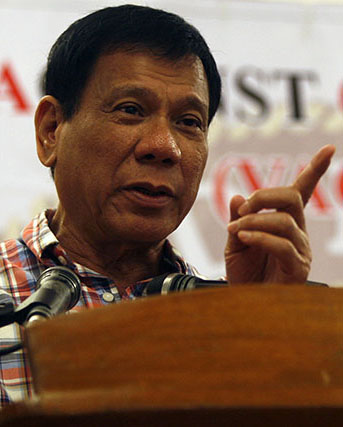
As candidates concede to presidential frontrunner Rodrigo Duterte, the International Coalition for Human Rights in the Philippines has joined the Filipino people in calling on the next chief executive to end rights violations and give justice to victims.
Duterte captured the support of the Filipino electorate clamouring for change – a clear repudiation of the Aquino government’s failure to bring about real development for the impoverished people.
“We have seen this overwhelming support take shape in the lively campaigns organised by different migrant groups in our respective countries, in spite of the criticisms against him for his alleged responsibility for the Davao ‘death squads’ and summary executions of alleged criminals,” said Reverend Canon Barry Naylor, chairperson of the global council of the coalition ICHRP.
Presidential frontrunner Rodrigo Duterte … controversy over Davao “death squads” and summary execution allegations. Image: duterte.com
With this, the ICHRP hopes Rodrigo Duterte will prove himself worthy of the votes he has garnered, as it joins the Filipino people in immediately calling to:
Stop all extrajudicial killings (EJKs), including the killing of Lumad people [in Duterte’s home island of Mindanao], attacks on communities and indigenous schools, among other human rights violations;
Stop vilification and harassment of human rights defenders;
Release all political prisoners; and
Resume formal peace negotiations with the National Democratic Front of the Philippines
“The first 100 days of the incoming president is enough time to give him fair warning on rights violations and for him to ensure justice to those victims of violations committed by the outgoing Aquino administration (as well as previous administrations),” Naylor said.
“He should sincerely address the roots of the armed conflict and disallow another National Internal Security Plan, such as the failed Oplan Bayanihan, in bringing about genuine change in the land,” Canon Naylor said in response to Duterte’s call for national reconciliation and healing.
The conference will commemorate 40 years of the Algiers Declaration of 1976, the Universal Declaration of the Rights of Peoples.
International solidarity missions will visit several areas in the Philippines from July 16 to 20 before the conference, and follow up on the findings of the 2015 International People’s Tribunal held in Washington, DC.
Solomon Islands Prime Minister and chairman of the Melanesian Spearhead Group, Manasseh Sogavare, has revealed that the Solomon Islands will support Vanuatu’s stand for full MSG membership for West Papua.
“You have my full support, Prime Minister,” Sogavare told the head of the Vanuatu government, Prime Minister Charlot Salwai, yesterday.
He said it was time for West Papua to be “elevated” and become a member of the MSG.
The Vanuatu government led by Prime Minister Salwai wants to see the United Liberation Movement for West Papua (ULMWP), which currently holds observer status, admitted as a full member into the MSG.
The Council of Ministers endorsed the decision to instruct the government to include the ULMWP’s full MSG membership status as part of the agenda in the MSG Leaders Summit scheduled to take place this month but then postponed to a date yet to be confirmed.
“We will support what you have discussed,” the Solomon Islands Prime Minister told PM Salwai.
He said the MSG was a strong group and its member countries rise over all problems and face them in true Melanesian spirit.
Solidarity exemplified
PM Sogavare said the solidarity of the Melanesian countries was exemplified this week in Port Vila when the five Melanesian countries supported Solomon Islands’ bid to host the next Pacific Games.
Prime Minister Salwai congratulated PM Sogavare on Solomon Islands’ successful bid.
He said despite the political crisis the country had been thrown into, the current government was committed to ensuring the Pacific Mini Games would take place as planned in Port Vila in 2017.
The Vanuatu PM thanked PM Sogavare, the government and people of Solomon Islands for their decision to support the Vanuatu government on its stand for West Papua to gain full membership into the MSG in the next Leaders’ Summit in Papua New Guinea after the African, Caribbean and Pacific countries meeting.
Prime Minister Salwai revealed that he would be travelling to New Caledonia next week, where he would make time to talk to Front de Libération Nationale Kanak et Socialiste (FLNKS) leader Victor Tutugoro. He would convey the Solomon Islands’ decision to support Vanuatu on full MSG Membership for West Papua.
“I wish to reiterate that we are cousins, brothers and we will work together for our common interests,” he told PM Sogavare.
He said while there were outside influences, apparently referring to the high profile Indonesian diplomatic campaign into trying to woo Fiji and Papua New Guinea, in particular, the MSG belonged to “us”.
Custom and tradition
Custom, culture and tradition must be revisited, Salwai said, adding that Melanesia represented a large mass of the people and land in the Pacific region.
Salwai said the issue of the new MSG director-general was a small issue and the member countries would cooperate because they were “one”.
He dismissed allegations that Vanuatu had stopped the new MSG director-general, Fijian diplomat Amena Yauvoli from coming to Port Vila.
“The Vanuatu government merely raised the issue of the process of the appointment but did not stop the new director-general from coming over,” Prime Minister Salwai said.
He commended the prime minister and people of Solomon Islands for their understanding about the border between the two countries – Solomon Islands and Vanuatu – indicating a visit in the near future.
PM Salwai said Vanuatu would continue to support Solomon Islands PM Sogavare as chairman of the MSG.
Jane Joshua is a reporter on the Vanuatu Daily Post.
The Papua New Guinea Electoral Commission has nullified the referendum conducted at the University of Technology by Lae Election Office last Friday – almost a week later in another twist to the student unrest.
Students at the two leading universities in Papua New Guinea – the national University of PNG in the capital Port Moresby and Unitech in the second city of Lae – have been protesting and boycotting classes for two weeks.
They are demanding that Prime Minister Peter O’Neill stand down and allow investigations into allegations of corruption proceed without hindrance.
According tothe Electoral Office’s media officer, Alphonse Muapi, the Lae Election Office did not see seek head office approval before conducting a vote over the boycott of classes at Unitech.
Muapi said the Electoral Office could not conduct a referendum because its regulations did not recognise the university Students’ Representative Council (SRC).
“Due to this referendum conducted at Unitech, it has left the Electoral Commission in a very awkward position as we are not sure how to address the referendum which should have taken place before a boycott can commence,” Muapi said.
Protesting Students from the University of Papua New Guinea and the University of Technology have continued boycotting classes today, with further threats of a mass withdrawal.
The Electoral Office had rejected a similar request for a ballot by the University of PNG SRC.
They say they will withdraw from studies but have given 24 hours to the administration for the reimbursement of their semester 2 school fees and return tickets back to their province.
This followed another call from the Vice-Chancellor yesterday at 4pm for the students to return to class today.
The Invisible Picture Show, an animation made by End Child Detention on Vimeo.
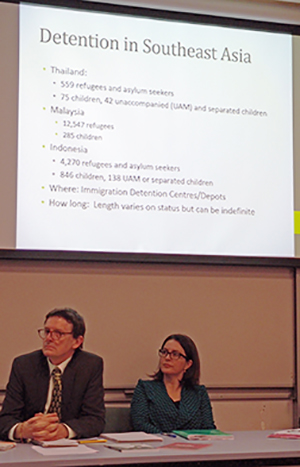
Basic rights for refugee children is an issue troubling some South-East Asian nations. In Indonesia, more than 800 asylum seekers have been identified as children, while in Malaysia, close to 300 children out of the country’s 12,000 asylum seekers are seeking refuge. Jihee Junn looks into the issue for Asia Pacific Report.
With hundreds of children currently in detention in the Asia-Pacific region, a panel of experts has said that ending child detention could be the starting point to help the refugee crisis.
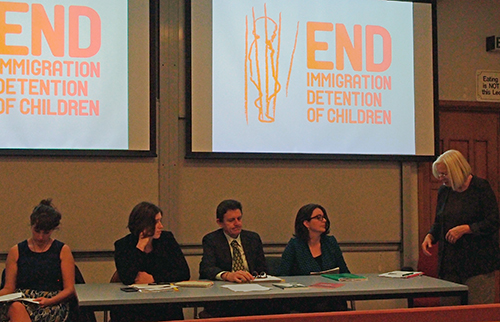
In a discussion hosted by the Asia Pacific Refugee Rights Network (APRRN) in Auckland this week, the global campaign to help end child detention was introduced, as well as alternatives to current detention practices in the region.
The End Immigration Detention of Children campaign advocates for support in New Zealand, calling for all refugee, asylum seeker, and irregular migrant children to have basic rights such as the right to be looked after and to be with their parents.
The issue is most prevalent in South-East Asian nations. In Indonesia, more than 800 asylum seekers have been identified as children, while in Malaysia, close to 300 children out of the country’s 12,000 asylum seekers are seeking refuge.
“If you look at the numbers, they’re not massive so we do feel it’s something that is manageable and it could really be a first positive step in advancing refugee protection in South-East Asia,” says Julia Mayerhof, executive officer of the refugee rights network.
The “ending child detention in Asia-Pacific” panel. Image: Jihee Junn/APJS
Speaking in the context of New Zealand’s potential role in the issue, the chair of APRRN’s Australia, New Zealand and the Pacific Working Group, Paul Power, says that the country could use its unique regional position to help with funding or expertise.
“Child detention in the region is a really strategic way to start that conversation [about resettlement]. No one thinks children should be detained and it’s a great starting point for these complex issues.”
Appalling conditions Speaking from Melbourne where he is now resettled, 26-year old Habib from Afghanistan recalls his experiences in an Indonesian detention centre where he shared the same facilities as many families and children also seeking asylum.
“I think detention of children in Indonesia is not the right thing. It was very overcrowded and it was not actually the right place for them to be.
“We had to bear all kinds of arguments and conflicts because people were sitting together having discussions … I was feeling very sorry for families. For me, I could tolerate some of the arguments, but for the families I think it was very difficult.”
Julia Mayerhof, executive officer of Asia Pacific Refugee Rights Network (APRRN), speaking to the panel’s audience. Image: Jihee Junn/APJS
Julia Mayerhof says that such circumstances for children are not unusual. Children are often faced with poor sanitation, insufficient food, and health issues such as skin diseases and tuberculosis.
“People are sometimes allowed to go outside, while in some detention centres there’s no way to go outside at all so they would never see the daylight,” says Mayerhof.
“No sports, no access to education, so everything that a normal child should have to grow up in a normal way, it doesn’t happen in a detention centre. This is bad for adults but for children it’s even worse.”
Unaccompanied minors Unaccompanied minors — those travelling without a parent or adult — would often face similar circumstances to what Habib witnessed, although there are exceptions.
“There are a lot of countries where they’d be detained in the same environment as adults,” says Dr Robyn Sampson, senior adviser and research coordinator at the International Detention Coalition (IDC).
“But there are some great examples of countries that do not detain unaccompanied minors because they would be so vulnerable, and the Philippines is a good example. They actually place these children in the mainstream child protection system that they have set up for their own children who don’t have parents or adults to look after them.
“In my opinion, one of the ideal outcomes for these young people is to go into the mainstream protection system that might involve foster care,” says Dr Sampson.
Paul Power and Dr Robyn Sampson on the “Ending child detention in Asia-Pacific” panel. Image: Jihee Junn/APJS
“Another example is when they go into shelters, and that can be good because they are with other young people who have had the same kinds of experiences and may even speak the same language.”
But despite these alternatives, lack of capacity has become a recurring issue, which Dr Sampson cites as one of the main problems with the case management programme in Malaysia.
“This programme is helping to keep these children from being placed in detention in the first place and it’s something that could be expanded in the future.”
“But at this stage, the resources are too low. So although they’re managing to keep children out of detention, they’re not managing to get children who are in detention to be released because they don’t have the capacity.”
Seeking alternatives In addition to the global number of designated refugees passing the 20 million mark, there are also around 2 million asylum seekers and more than 40 million internally displaced people.
Paul Power says that because of the issue’s scale and complexity, there is simply no single set of solutions. Instead, national, regional, and subregional answers should be sought on particular issues.
“A big problem that the world faces is the tradition of durable solutions for refugees. Voluntary safe return after a conflict has ended and integration in a country of asylum and resettlement are in such short supply,” he says.
“Around 100,000 out of 20 million refugees were resettled. So if you’re waiting on resettlement as the answer to your displacement, you’re going to be waiting two centuries at the back of the mythical queue that many Australian politicians believe.”
Asia and the Middle East stand out as the two regions in the world where most countries have not signed the refugee convention, and with 76 percent of refugees living outside of camps in Asia, the international community must look beyond simply ending detention.
“The situation of refugees in camps is of critical importance and lack of support for people living in these camps is a major factor in the misery of people who’ve sought refuge” says Power.
“But that’s not where most refugees around the world are at. They’re trying to survive in urban settings and most of the international support does not actually take account of that.”
Jihee Junn is a postgraduate student journalist at Auckland University of Technology and is on the Pacific Media Centre’s 2016 Asia-Pacific Journalism Studies course.
In the wake of the worst ever cyclone to have hit Fiji, the tourist destination is gearing to overcome a new challenge – combating the spread of the zika virus. Anuja Nadkarni files for Asia Pacific Report.
The mosquito-borne disease zika has spread to Fiji, but the island nation is taking charge.
Seventeen confirmed cases of zika have so far been recorded in Fiji, according to Sunil Chandra, spokesman of the Fijian Ministry of Health.
Chandra says the ministry, along with other government agencies and not-for-profit organisations, will be a holding a national clean-up campaign to “destroy the mosquito breeding places to prevent the spread of the virus”.
“This will be a month long campaign and it is anticipated that the people and the municipality will work closely to address the issue.”
A senior lecturer of physiology at the University of Fiji, Dr Abhijit Gogoi, says since tourism is vital to Fiji’s economy it has been a concern for the island nation since natural disasters and fears of infectious diseases can potentially affect numbers of inbound tourists. But he adds that the country is resilient.
“Tourism is a concern whenever there is a panic. First HIV, then SARS, then chickungunya and now zika … Every time there is a disaster or an epidemic, the country that depends so much on tourism for the economy does get affected by the sudden decrease in tourist inflow.
“But until now the tourism industry has not been affected here because of zika virus.”
Likewise, a report released from the Fiji Bureau of Statistics shows no effect on tourism as of March 2016 despite news reports of zika in Fiji. The number of visitors for March increased by nearly 10 percent compared to a year earlier. The report also showed that some 74 percent of all visitors were tourists.
Widespread mosquito carrier A study of the zika virus in the South Pacific by Jose Derraik and David Slaney published last year suggests that the Aedes aegypti species of mosquito is the primary carrier of the virus and is widespread in the South Pacific.
The virus was first isolated from a monkey in the Zika Forest in Uganda in 1947, the study says.
Auckland University infectious disease specialist Siouxsie Wiles says that because the mosquito is widespread in the region, which has humid environmental conditions where these mosquitos can thrive, it was a matter of time before Fiji would be affected.
“It’s just the perfect storm of getting it to the right place at the right time with an abundance of mosquitoes and an abundance of people.”
Similarly, Auckland University’s Liggins Institute senior research fellow Dr José Derraik says although it is possible that the global spread of the zika virus has been caused by a mutation since its discovery in 1947, it is more likely that the more people travelling to places that have been struck by the zika virus has caused the epidemic to grow faster.
“The rapid movement of people across the world also means that zika virus has been introduced by infected travellers into new areas, where local populations had never been exposed to it. Consequently, as they had no associated immunity, zika virus was able to spread quickly,” Dr Derraik says.
He says, the fact that most people are asymptomatic is also a reason why the virus has been able to spread, as “infected travellers without any symptoms can freely travel from one country to another”, he says.
Dr Wiles explains that the mosquitoes that carry the virus are pregnant females that lay more than one batch of eggs.
Unaware of infection Dr Derraik says some estimates suggest that 80 percent of the people infected with zika virus are unaware that they have been infected.
The study by Derraik and Slaney shows that the clinical presentation of the disease includes illnesses similar to influenza but in some extreme cases it can also cause cardiac complications and death.
Dr Wiles says evidence is building to show that the zika virus can also cause the Guillan-Barre syndrome, which is well known to happen following infection from a range of viruses.
“It’s a syndrome that can give people muscle weakness, affect people’s breathing and kill them but all of the people that have had the syndrome actually recover quite well.”
She says researchers are also studying whether the disease can be passed on from mother to child as there have been numerous cases in Brazil of children born with microcephaly, a congenital condition associated with stunted brain development, since the outbreak last year.
Dr Gogoi says there is also the probability that this virus could be transmitted sexually.
“As of now there are 8 cases of zika virus reported to be transmitted sexually in Brazil and Haiti.”
Dr Wiles says treatment for the virus has not been found yet because of a lack of resources for research until very recently.
“It’s not something people have been researching to find a cure because it wasn’t thought to be that devastating.”
Methods of control Dr Wiles says, “the only way to get rid of it [zika] is to get rid of the mosquito.” And she says the most effective way of doing this would be to release genetically modified sterile male mosquitos.
“When they are released and breed with the females the young can’t survive. These genetically modified mosquitoes are released in large numbers so they outcompete the normal males so that when the females breed with the wrong males they don’t get any viable offspring.”
Dr Derraik suggests if measures to prevent getting bitten are taken then travellers need not avoid countries affected by the virus. However, he says the situation is different for pregnant women in light of the association with microcephaly in the foetus.
Dr Gogoi says employing measures of hygiene, using mosquito repellents and nets and ensuring no storage of water in any open rubbish containers or coconut shells, can help contain the spread of the virus.
Anuja Nadkarni is a journalism graduate from AUT University and is currently completing her Honours degree in Communication Studies. She is on the Asia-Pacific Journalism Studies course at the Pacific Media Centre.
A video report on Pasifika TV by former Pacific Media Watch contributing editor Alistar Kata. Video: PMC On Demand
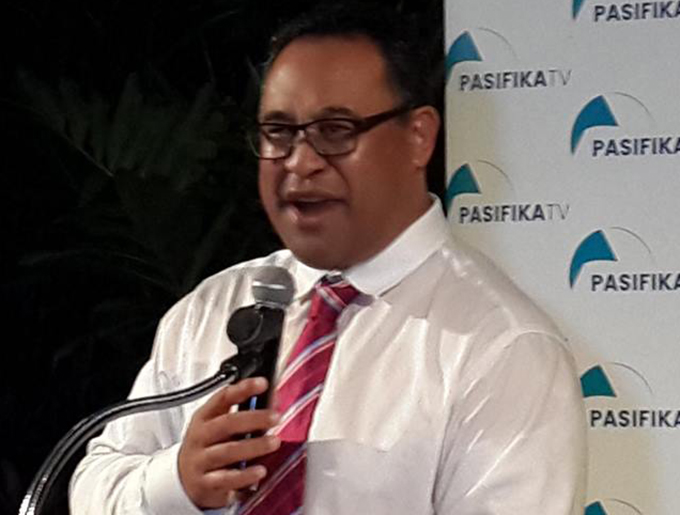
Papua New Guineans will continue to enjoy the many interesting television programmes from New Zealand on the new channel Pasifika TV made possible through the Pacific Broadcasting Initiative.
New Zealand High Commissioner to Papua New Guinea Tony Fautua said at the launch in Port Moresby this week the initiative had brought Pacific content to the people in the region with the aim to inform and educate and entertain, apart from sports, news and current affairs.
The initiative was announced by NZ Prime Minister John Key late last year and since then it has continued to improve programme content for viewers.
“The New Zealand government is proud to support this initiative and we are grateful to the New Zealand and international content providers for their generosity in providing the content at no cost to the Pacific,” Fautua said.
Also as part of this initiative, there will be a training programme for local technicians such as camera operators, vision switchers and studio technicians to help them build skills across the region.
Pasifika TV content is available on Papua New Guinea’s local free-to-air TV stations, NBC, EM TV, TVWAN and Click TV.
The project is on collaboration with the Auckland-based Pacific Cooperation Foundation.
What I want to write about is what many University of Papua New Guinea students seem to be thinking at the moment about “Justice for PNG”.
Those of us who completed their university studies years ago are much wiser today than when we were doing our studies. We were very idealistic and optimistic. You might also say that at that age our lack of experience also made us very naïve.
I remembered that today when a friend told me that UPNG students seriously believe that if they push again and again, the Prime Minister Peter O’Neill will finally give in and accept their petition in person.
These conscientious, caring young people also think that the PM will think about the petition and, as the boycott continues, will decide to honour the student demand and step down.
What naïve thoughts! The students optimism is wonderful to see but once they see for themselves that their optimism is in error, they might well go the opposite direction, feeling like giving up and being depressed when they see that the government doesn’t plan to budget.
The rest of us as citizens of this great country, must not allow the students to lose their energy.
Right now, the students are wasting time with false hopes. They quickly need to bring in some wisdom to help them understand that the PM is not going to accept their petition or honour their demand.
PM holds the power
The PM will back down only when he sees that student power far exceeds his power as PM, armed with police support. At the moment, the PM easily holds most of the power.
This can change but only if the students stop wasting time worrying about petitions that will be ignored anyway.
The only thing will change the balance of power in the student’s favour is people power.
Adding large numbers of supportive citizens to the numbers of boycotting students is the only ammunition guaranteed to defeat the PM.
This is roughly how much people power you need to force prime ministers to step down elsewhere in the world:
Precious planning time
The students should be using this precious time to plan how to carry out awareness in ways that the government cannot detect.
They need to know enough about the issues facing our country to explain it to the public. I was very pleased to see the resource book that PNG Blogs made available for us to download.
I urge all students in PNG to immediately get a copy of this resource book and read about the issues. Then go out and spread the word. Spread your energy to people on the streets.
Don’t waste any more time thinking about petitions or the power of boycotts. The greatest value of the boycott is to give you the time to do awareness and build up a people power movement.
I pray that the students will acquire the wisdom to see that they have a lot yet to do before they can defeat the PM.
The only way to win is to create a people power movement.
More than 3000 students from the University of Technology and the National Polytechnic Institute in Papua New Guinea’s second largest city of Lae travelled in busloads to the Eriku Oval yesterday for a “public awareness” meeting.
Authorisation for the gathering was given after lengthy dialogue between the Lae Metropolitan Superintendent, Anthony Wagambie Jnr, and student leaders.
Like the University of Papua New Guinea in the nation’s capital of Port Moresby, the majority of students wore black signifying their protest over what they see as an assault on Papua New Guinea’s constitutional offices.
Each element of this awareness meeting was carefully chosen – the flags for diversity and unity and the female students also were the forefront of this relatively quiet protest.
“My intention in joining this awareness is to take the message to out parents, our uncles and our brothers and sisters so that they will know what we are fighting for,” said Tanya Sawa, one of many young women who voted for a boycott just days ago.
The students were barred from carrying anything defamatory or contemptuous in nature, including placards or slogans that could trigger court proceedings against them.
They were also barred from walking from the Taraka campus to Eriku for fear that it could trigger a riot.
Police escort
Instead, the Students’ Representative Council (SRC) organised buses to take the students from the university to Eriku with a police escort.
This is the first time since the unrest began that Unitech has reached out to the public.
Student leaders have said this was not a protest but instead an “awareness meeting” to educate the public on national issues affecting the country, and why their call for the prime minister to step aside still stands.
“I wouldn’t say that we’re heading towards an authoritarian state, but I would say what’s happening will affect us for years into the future,” said the president of the Simbu Students’ Association, Lucas Kiak.
The awareness meeting was approved after two weeks of meetings between student leaders and Metropolitan Superintendent Wagambie, who has been personally facilitating discussions to ensure the tensions do not escalate and spill over into violence.
The manner in which the meeting was controlled has also triggered positive reactions in the Lae community, as well as on social media, where Lae police have been praised for their professionalism and restraint.
A number of recent developments in Papua, Indonesia, and in the Pacific, have led me to a profound realisation that over the past five decades, we, Papuan people, have not moved from our position in relations with Indonesia.
Our journey to get out of domination and oppressive violence towards our own future with dignity remains confronted with challenges and constraints, as seen in the events that we are recently witnessing.
One of the human rights focus group meetings in Jayapura headed by General Pandjaitan. Image: Tabloidjubi.com
First, as a reactionary response to the demands of the people of Papua as well as the decision (and possibly pressure) from the Melanesian Spearhead Group (MSG) to send a fact-finding-mission through the Pacific Islands Forum, the Indonesian government has held two focus group discussions (FGD) at a luxury hotel in Jayapura for the so-called “settlement of human rights issues”.
The FGDs were sponsored by Indonesia’s coordinating Minister of Economy, Politics, Law and Human Rights Luhut Binsar Pandjaitan, who once made a humiliating remark to the Papuans by saying: “Just go to Melanesia. No need to stay in Indonesia anymore.”
The statement by a former Kopassus (Indonesian special forces) general was aimed at the United Liberation Movement for West Papua (ULMWP), an organisation that represents our struggle and aspiration.
His tone reminds us of the statement of General Ali Murtopo in 1969: “If the Papuans want independence, ask Americans to find an island in the moon for them to live there.”
A second development that coincided with the FGD is a series of peaceful demonstrations held by the Papuans in West Papua and Indonesia to support ULMWP’s bid for a full membership at the MSG.
2000 detained
Around 2000 activists were detained in a peacefull rally facilitated by the National Committee of West Papua (Komite Nasional Papua Barat, KNPB) on 2 May 2016. This wsas the largest arrest in our history and proves that the Indonesian authorities continue using old tactics of repression: arrests, beatings, and terror against the demonstrators.
Thirdly, the Indonesian government is aggressively lobbying countries and political leaders in the Pacific following the increasing concern and solidarity from the Pacific region and support from the MSG for a resolution of West Papua’s problem.
General Pandjaitan has repeatedly claimed that he has secured Fiji and Papua New Guinea’s support for Indonesia. On the other hand, Pandjaitan contended that foreigners should not interfere in the affairs of human rights in West Papua.
Fourth, without listening to criticism of hazardous development in West Papua, Jakarta, intensifies a development model that puts Papuans simply as objects, without allowing us to become subjects of our own future.
What does all of this mean for Papuan people?
We, the nation of West Papua might be unlucky. The sun has so far stopped shining in the land of our fathers. Since the early 1960s, our land has been made a site of systemic oppression.
But we do not stay silent. We make ourselves subjects of our own history, maintain our dignity and keep fighting. We use a variety of tactics: through a guerrilla struggle (OPM, the Free Papuan Movement), a messianic movement, human rights discourses and NGOs, media, Arnold Ap and his cultural movement, mass urban-based movements such as of KNPB, churches with their critical voices, and so forth.
Many have fled
Apart from the struggles in our own land, some of us have to flee. In the 1960s, a wave of refugees fled to the Netherlands.
Melanesian countries in the Pacific have also became destinations of West Papuan refugees from the 1960s until the 1990s.
Political activists seek political protection in Papua New Guinea, Vanuatu, Australia, Europe, and so forth. In 1969 alone, about 3000 Papuans fled to PNG. Osborne (2001) and Smith (1988) estimate that between 1500-3000 Papuans crossed into PNG and other countries in 1977-1978.
Our history can be written as a history of a fleeing nation. A nation that is oppressed and expelled from our own country, a nation that is walking toward a promised land.
Our journey is stained by stories of those who died and drowned on the way to reach Vanimo, stories of those who walked day and night to reach the land of freedom.
We would like to thank our Melanesian brothers and sisters in the Pacific who are never tired of showing us their unwavering support and solidarity. We thank church leaders, including the Catholic Bishop of Vanimo, Vanuatu, and the Solomon Islands and civil societies in these countries.
The Catholic Bishop of Vanimo granted his land to accommodate members of our congregation because in our own land churches have failed to defend the scattering God’s flocks.
Thanks to Vanuatu, Solomon Islands
We express our thanks to the Vanuatu government that has been trying to unite our leadership from different factions within the struggle. We thank the Prime Minister of the Solomon Islands who offered to mediate an authentic dialogue between ULMWP and the Indonesian government.
We are grateful to the leadership of MSG who has been accepting us in the Melanesian brotherhood.
But we also apologise. We apologise for the inconvenience caused by the presence of our people in the Pacific. We apologise for our helplessness that forced our brothers and sisters in the Pacific to carry our burden and stand in solidarity with us.
We apologise that the burden of our struggle has become a burden of our Melanesian brothers and sisters. We apologise that our struggle changes the political dynamics of Melanesian nations, forcing Melanesian nations to confront each other.
I believe that all of this is not an accident of history. Indeed, West Papua is a product of history that is blind to our suffering and God who remains silent on the fate of Papuans.
We tip our hats and thank chiefs, church leaders, media, political and government leaders, civil society, and intellectuals, each of ordinary people in the Pacific, and the international solidarity of West Papua in Africa, Australia, Europe, the United States and Indonesia who have been showing true solidarity in the course of the journey of our nation.
Rev Dr Benny Giay is the head of Synod of Kingmi Church in West Papua.
Students of the University of Papua New Guinea gathered early yesterday morning at the forum square on the Waigani campus to vote for a referendum said to be conducted by the Electoral Commission.
However, the vote never happened.
The protesting students have a petition calling on Prime Minister Peter O’Neill to step down and face an alleged corruption investigation. But they refused to hand over the petition to government officials last week when they visited campus without the prime minister.
The Electoral Commission told PNGFM News when contacted that the commission did not recognise the UPNG Students’ Representative Council (SRC) body and they would not conduct any ballot that day.
According to the Electoral Commission’s legal team, the SRC body has no powers to request for referendum to be conducted.
The commission would only respond to a request from the UPNG administration.
The director of UPNG’s public relations, Jim Robins, clarified the administration’s stand that it would not have any say in the referendum or how it would be conducted.
“The university administration cannot request the Electoral Commission to conduct the referendum as we would be in contempt of court if we do that,” he said.
Robins also stressed the statement by the Minister for Higher Education, Research, Science and Technology, Malakai Tabar, saying students should return to class before tomorrow to avoid exclusion from their courses.
‘Threat to democracy’ Earlier this week, the general secretary of the Trade Union Congress, John Paska, claimed current student boycott of classes threatened the country’s democracy.
He urged students to return to class until all legal processes had been exhausted.
Paska has called on workers throughout the country not to join the protest, saying any demonstration is legally baseless.
Last month’s AJ+ video about ExxonMobile’s tactics in casting doubt on climate change science.
Do changes to climate change reporting need to happen? Does the media itself need structural change to face the new challenge? Kendall Hutt seeks some answers to the debate in this article for Asia Pacific Report.
A worldwide call has gone out by academics and journalists for news media to change its approach on reporting climate change.
Current coverage of climate change leaves the public ill-informed on the issue and largely cynical, say some academics.
Also of concern is a tendency for media to frame climate change as an international rather than local issue, which leads it to be defined as a problem for others and not one of national sovereignty.
The need for improvement was highlighted at a public talk delivered at Auckland University of Technology last month, in which Professor Robert Hackett of Simon Fraser University discussed whether certain “touchstones” of journalism, such as objectivity and the public sphere, apply in covering what he dubbed a “climate crisis”.
Professor Bob Hackett … proposes alternative reporting models. Image: Kendall Hutt/PMC
The topic of a forthcoming book with several colleagues titled Journalisms for Climate Crisis, Hackett proposes several alternative reporting models that could potentially allow greater, more in-depth coverage of the climate change issue.
However, Dr Hackett concluded his talk by stating structured media reform was needed for climate crisis journalism to flourish. He stressed that the industry needs space to discuss such reform in order to foster change in defiance of a lack of political will.
Speaking with Asia Pacific Report, Dr Hackett has expanded on this conclusion, saying such structural media reform would “encourage and expand better journalism practices and coverage to the scale that is needed in a situation of global crisis”.
He added media reform would also reduce commercial pressures on journalists to generate clickbait and reduce concentrated corporate ownership.
But this is not a view shared by others.
Oxfam New Zealand’s senior campaigns and communications specialist Jason Garman rejects the idea of media reform.
“I think passing the buck that media should be solving this problem by doing better is not the way to go,” he says.
I think everyone needs to come to the reality that climate change is affecting all of us and we all should be playing a constructive part in making sure we have a world that’s liveable for everyone.”
Garman believes improvements to the way climate change is reported needs to come from – and return to – journalism’s fundamental role in educating and informing the public.
This is a view shared by science communication specialist and former journalist, Dr Jan Sinclair.
Dr Sinclair says it is mainly the media’s responsibility to inform the public of the extent and reality of the risks of climate change.
“It’s the journalist’s responsibility to tell people whether their lives or property are at risk.”
Like Garman, Dr Sinclair rejects Dr Hackett’s idea of media reform being the way for media to improve its climate change coverage moving forward.
Dr Jan Sinclair … wary of media reform due to the vested interests of fossil fuel industries and “sceptical lobby” which have plagued coverage of climate change. Image: Del Abcede/PMC
Dr Sinclair is wary of reform due to the vested interests of fossil fuel industries and “sceptical lobby” which have plagued, and continue to plague, coverage of climate change.
She says such well-funded and powerful lobbying has promoted a culture of climate change being framed as “uncertain”, both within the media and social world.
Evidence of such lobbying can be seen by looking at ExxonMobil, one of the leading opponents of climate change science, which also once happened to be one of its leading proponents.
A video by AJ+ recently revealed that ExxonMobil spent US$61 million between 1998 and 2005 challenging scientific consensus surrounding climate change.
ExxonMobil has also been largely responsible for creating the uncertainty Dr Sinclair describes, with the oil company spending US$30 million on a network of think tanks and researchers who have challenged climate change science.
Dr Sinclair says any improvements to current reportage are a question of ethics and should be seen as a matter of integrity for journalists.
Question of ethics
“If journalists could perhaps have a discussion on which ethics are important, and then link speaking truth to power to the problem of interpreting scientific results… I think that might be beneficial.”
The journalistic adage of “speak truth to power” does not do climate change reporting any favours, she adds, as this “political” focus is detrimental.
This is something Dr Sinclair has also noted in her research into comparisons of what information the Intergovernmental Panel on Climate Change (IPCC) reported and what The New York Times reported across a 17-year period from 1990 to 2007.
Dr Sinclair noted: “Journalists are encouraged to privilege political discourses over scientific advice”, in direct correlation with the adage.
In contrast, Taberannang Korauaba, a doctoral candidate with the Pacific Media Centre and editor of the Kiribati Independent, believes stories on climate change need to focus more on the positive and calls attention to the Pacific.
Positivity needed “The same message is repeated, sea is rising, people will be displaced, sea encroaching land, temperature is getting hotter these days on the islands.”
Doctoral climate change researcher Taberannang Korauaba … stories should focus on adaptation and media attention shift to investigate the distribution of adaptation funding. Image: AUT Pacific
Yes, Pacific people are victims of climate change, he says, but stories should focus on adaptation and media attention shift to investigate the distribution of adaptation funding.
“What is happening now on the ground, I think the focus should be there. How much money given to these islands to help build their resilience, how it is spent, who is getting what?”
Korauaba says the media needs to adopt strategies to better report climate change and one of those is deliberative journalism, journalism that is acknowledged as empowering local people and leading to greater, popular decision-making.
In his research, he regards deliberative journalism – what he terms in the i-Kiribati-language as Te Karoronga – as allowing the community to be part of climate change adaptation and raising understanding and awareness of actions, so the people themselves can take action to help save their islands.
Despite such varied calls for the media to reframe its coverage of climate change, such as by Pacific Journalism Review in a special edition in 2014 on “failed states” and the environment, not all coverage is, or has been, inherently bad, Garman and Hackett stress.
Not inherently bad Professor Hackett says some media organisations have been doing “remarkably good work” and “exercising a sense of agency”.
One such organisation is the Desert Sun, he adds, Palm Spring’s daily in southern California due to the host of feature articles it has produced.
Garman, however, highlights the media’s growth and acknowledgement in framing climate change as a human rights issue.
“If you’d asked me that question [growth] ten years ago I would have said, ‘No, absolutely, people see climate change as an environmental issue only, something that’s happening to polar bears and may affect humans at a long-off point in the future’.
“Whereas now I do think people understand that climate change is happening now, it’s affecting people now, it’s a human rights issue.”
Although no consensus exists as to what form reframing should take, Korauaba has noted it will take time for any changes to come into effect.
“The world can’t change overnight, at least we do something, and keep doing it regularly in our coverage.”
Kendall Hutt is a graduate journalist from AUT University, currently completing her Honours year in Communication Studies. She is on the Pacific Media Centre’s Asia Pacific Journalism course.
Across the Ditch – Australian radio FiveAA.com.au‘s Peter Godfrey and EveningReport.nz‘s Selwyn Manning deliver their weekly bulletin, Across the Ditch. This week: The Prime Minister John Key was chucked out of Parliament yesterday (Wednesday) after a series of questions probing into what his government is going to do about New Zealand’s foreign trust/tax haven debacle.
BACKGROUND:
[caption id="attachment_10203" align="alignleft" width="300"] Panama Papers: Mossack Fonseca and the tax haven graphic.[/caption]New Zealand was named in the Panama Papers leak as a tax haven alongside 20 other countries, including the Cook Islands, Niue, Samoa, Singapore and Hong Kong.
This week, a joint investigation between Television New Zealand, Radio New Zealand and internationally regarded investigative journalist Nicky Hager revealed New Zealand was referenced more than 61,000 times in the latest release of documents – information leaked from the Panamanian company Mossack Fonseca.
Mossack Fonseca specialises in foreign trusts and taxation services. In the last two years, the company has actively promoted New Zealand to its clients, particularly those from Latin America, as a place to park their money.
Since then, there has been a spike in money flowing into foreign trusts and look through companies set up in New Zealand.
When John Key became Prime Minister back in 2008, and on numerous occasions since, he openly spoke about a desire to see New Zealand become the Switzerland of the South Pacific, the Singapore of Australasia – in essence, a place where foreign currencies, wealth, goods, services, transactions, could be traded or transacted freely, with first-world security, and when it came to foreign trusts… with a minimum of public disclosure… and a high degree of confidentiality.
PUBLIC OPINION:
Since the Panama Papers were released, John Key has found himself on the wrong side of public opinion.
Two weeks ago, a UMR poll found 57% of those polled were concerned NZ foreign trusts were being used by people overseas for tax evasion purposes. (ref. Scoop.co.nz)
Only 21% thought John Key’s Government was handling the tax haven problem well.
52% believed a full independent enquiry was needed.
Women in particular are upset, with 63% of those polled being concerned about New Zealand being used as a tax haven.
POLITICAL SENSITIVITY:
Since the poll, the news has been all bad for John Key as, initially, he attempted to play down the problem.
Last week, Kiwis found out that when Inland Revenue sought to review the laws surrounding foreign trusts in New Zealand, it quickly became a sensitive political issue. John Key’s personal lawyer, who operates a trust for the Prime Minister, quizzed John Key about whether the Government was going to crack down on the secretive industry.
John Key said he didn’t think so, and told him to ‘go talk to Todd McLay’ (the then revenue minister). Then, the Prime Minister’s lawyer and a host of other accountants and lawyers who specialise in foreign trusts got a meeting the very next day and in an email the lawyer told McLay that the Prime Minister John Key had told him he didn’t want changes made to foreign trusts compliances.
A short time after the meeting, the Revenue Minister told Inland Revenue not to pursue a review of foreign trusts.
Then in April, while under pressure to act, the Prime Minister agreed to a review of how Inland Revenue Department handles foreign trusts, and whether New Zealand complies with the OECD guidelines on foreign trusts.
However, the Prime Minister has refused to initiate an independent inquiry into the matter, something that would essentially reveal whether the perception is justified… that New Zealand has become a tax haven.
HOW IT WORKS:
According to information sourced from the Panama Papers, the word around Mexico, Columbia and latin America in general, is that New Zealand is seen as a ‘respectable’ jurisdiction, a perfect place to park your wealth, hide it from the wife or your colleagues. New Zealand has become a prized place that ultimately provides enough secrecy as to be an attractive jurisdiction where money obtained from dodgy and/or criminal deals can be laundered.
And if you are looking to avoid paying your proper share of tax, then New Zealand’s trust set up is literally gold.
Since John Key’s National-led Government was elected in 2008, it has brought in a law where foreign trusts in New Zealand are taxed at zero percent, as long as the money held within the trust was not earned in New Zealand.
Once here, the wealth can then be declared to the country of origin that the money has been taxed in New Zealand. The administrators then get a tax waiver from the country of origin, and the money can then be cabled back home.
This zero-tax loophole permits the owner of the wealth to avoid paying any tax.
Additional to this zero tax loophole, unless the entities or principles whose wealth is held within a New Zealand foreign trust live in Australia or New Zealand, a high degree of secrecy can be applied, in essence people and entities of good or dodgy character, can stash their loot in a secret, safe, and fairly respectable place right here in New Zealand… And, the question is, does the Prime Minister think that is ok?
WHERE TO FROM HERE:
By the weekend, the Prime Minister began to insist, that no New Zealander has avoided paying tax. But that comment diverts attention away from the real problem, that the system John Key’s Government has in part created:
* allows people and companies from other countries to avoid paying millions, potentially billions, of dollars in tax
* and due to the degree of secrecy that the law provides to foreign trusts, John Key’s Government has built a system that is attractive to those who have accrued wealth through corrupt practice, drug dealing, arms trading, and possibly terrorist activity (revelations justifying this comment are now emerging through questions under privilege in Parliament).
And all this brings me back to the opening line in this bulletin. This week (Wednesday) the Prime Minister was chucked out of Parliament by the Speaker after he continued to shout down the opposition, continued over the top of the Speaker as he stood there attempting to bring the Prime Minister’s exchange and Parliament back into order. The Finance Minister Bill English was left to limp on answering on the Prime Minister’s behalf.
What’s clear this week is, Kiwis do not like their country being used as a ticket clicker for dodgy deals and tax avoiders. And, for some, the Prime Minister is seen as part of the problem rather than the initiator of a solution.
By Eric Haurupma in Port Moresby
Anti-corruption activist Bryan Kramer says he and his supporters in Papua New Guinea will continue to pursue their call for Prime Minister Peter O’Neill to step down from office amid allegations over corruption.
Anti-corruption advocate Bryan Kramer … determined to press on. Image: LoopPNG
Police on Monday stopped a peaceful protest planned by University of Papua New Guinea (UPNG) students and civil society campaigners over a range of ongoing political issues.
Kramer said all avenues had not been exhausted, while civil society campaigners and university students from UPNG are planning to obtain another permit from the District Court to stage a protest in the nation’s capital.
Prime Minister O’Neill, in a two-page article published in the Post-Courier on Monday, responded to various allegations by students.
He said he respected the student’s constitutional rights, but the issues they had raised are currently before the courts.
O’Neill highlighted these key facts in relation to proceeds of crime linked to the Paul Paraka saga, attached with an article he claimed had been forged.
The Prime Minister also questioned in his newspaper article why the National Fraud and Anti-Corruption Directorate and Task Force Sweep were both targeting him alone.
‘Respect’ the media
The Post-Courier reported today that Bire Kimisopa, Goroka MP and Chairman of the Special Parliamentary Committee on Public Sector Reform and Service Delivery, had called for the Papua New Guinea public to respect the work of the media.
According to PNG Today, Solomon Islands students studying at UPNG being affected by a move to boycott classes that was being extended for another week.
The UPNG Students’ Reprehensive Council (SRC) was seeking a mandated supervised by the Elections Commission ballot to legitimise the boycott.
Students at UPNG and other tertiary institutions last week demanded that Prime Minister O’Neill step down and face the fraud squad.
A petition was signed by the UPNG students, with the help of the SRC, demanding that the prime minster go to Waigani campus and collect it from the SRC and students at the UPNG Forum Square – a demand he refused.
Eric Haurupma is a reporter with EMTV News.
Report by David Robie. This article was first published on Café Pacific
The arrests of more than 1600 protesters in West Papua earlier this week are part of a
broader systematic oppression of Papuans by the Indonesian government. Pictured are many detained protesters in the Mobile Brigade compound at Kotaraja, Jayapura. Photo: Tabloid Jubi
OPINION: By Rev Benny Giay
LAST MONDAY, Indonesian police arrested more than 1600 people
in Jayapura, Papua. They were
The Philippines will need to wait for nearly all of the ballots to be transmitted to see whether former dictator Marcos’s son Ferdinand “Bongbong” Marcos Jr is going to snatch a tight vice-presidential race and pull off a remarkable political comeback for his family.
At the moment, he is trailing with less than 200,000 votes – 1 percent of the vote – separating him from establishment reformist Leni Robredo, who seized his early lead with a late surge of votes in rural areas.
Anti-establishment firebrand Rodrigo Duterte is set to have secured a huge presidential win after an incendiary campaign dominated by his profanity-laced vows to kill criminals.
Duterte, 71, the longtime mayor of the southern city of Davao, hypnotised millions with his vows of brutal but quick solutions to the nation’s twin plagues of crime and poverty.
Many believed the outgoing Aquino administration had failed to tackle these issues in spite off strong economic growth in recent years.
Duterte had a commanding lead over his five rivals with more than 38 percent of the vote.
He vowed that he would be a “dictator” against evil and that he would step down in six months if he failed to stamp out corruption.
“I will be strict. I will be a dictator, no doubt it. But only against forces of evil — criminality, drugs and corruption in government,” Duterte said in his hometown of Davao.
The unofficial tally late yesterday, was showing less than 93 percent of the total votes cast with Robredo, leading Senator Marcos by less than 200,000 votes
“It could easily shift… It’s less than one percentage point, which means we need 99-point-something [to see who is going to win],” Pulse Asia reasearch director Ana Tabunda said in an interview on Rappler.
Tight race It’s higher than Tabunda’s earlier projection that a 97 percent transmission rate of the voting results will already show a winner in the tight race. Marcos previously led Robredo by 3 percentage points.
The camp of Marcos has warned of electoral cheating, noting that Robredo’s numbers rose late Monday night when people were supposedly not watching the results. They want the transmission of the results suspended, claiming that it is misleading people into thinking that Robredo is winning the race.
But Tabunda said she expected the late rise of Robredo’s numbers because of the demographics of her supporters.
Surveys showed that Marcos was stronger in urban areas, which were the first ones to transmit their results. Results from rural areas, where Robredo has more supporters, came in later because of slower internet connections.
Two lawyers from Australia have been taken on board the defence team representing 11 of the jailed Vanuatu politicians facing charges of conspiracy to defeat the course of justice.
The defendants charged in this case are: Marcellino Pipite, Paul Telukluk, Silas Yatan, Tony Nari, John Amos, Arnold Prasad, Tony Wright, Sebastien Harry, Thomas Laken, Jean Yves Chabot, and Jonas James.
The Vanuatu Supreme Court Registry Office confirmed that the two lawyers, Michael Pearce and Rose Cameron, are practitioners from Australia.
Pearce and Cameron have reportedly complied with all the required procedures and will be assisting a local lawyer, George Boar, during tthe trial next month, which is expected to last a month.
During the first conference in February, Boar made an application to the court to bring in assistance from abroad.
The application was granted and the case management was adjourned until this week.
The two Australian lawyers are already in the country and were given temporary admission by the Chief Justice Monday this week to act on this particular case.
Temporary admission According to the Supreme Court Registry, the pair have been given the right to assist Boar to defend the jailed politicians only in this case.
Section 13 of the Legal Practitioners Act gives the Chief Justice power to grant temporary admission for lawyers outside Vanuatu to practise on a temporary basis.
They were believed to be part of the meetings leading to Pipite pardoning himself and his other convicted politicians in his capacity as Acting President.
The pardon was later withdrawn by the President Baldwin Lonsdale and was also declared null and void by both the Supreme and Appeal Courts last year.
Initially three of their lawyers were also arrested but were understood to have been given immunity as state witnesses.
Protesting students of Papua New Guinea’s University of Technology in Lae are boycotting their classes this week.
They are calling on Prime Minister Peter O’Neill to step down from office and face allegations of corruption. In the Taraka campus ballot last Friday, 2059 students voted in favor of the boycott.
Only 296 students voted against the boycott, in a poll supervised by the Electoral Commission.
Vice-Chancellor Dr Albert Schram said the university did not have a position on the national constitutional issues. It was concerned only about completing the academic year successfully.
Dr Schram said that interest was shared between the university and its students.
In Port Moresby, a planned referendum for students at the University of Papua New Guinea to boycott classes is now expected to be held today.
The referendum did not eventuate yesterday after the UPNG administration failed to arrange for the Electoral Commission to facilitate the process.
This vote will decide whether the students continue their boycott or return to classes.
Boycott decision
The administration will only allow students who are internally registered to present their current registration and ID cards to take part in the vote.
Malakai Tabar … condemned UPNG students for failing to hand over petition. Image: PNG Today
The Minister for Higher Education, Research, Science and Technology, Malakai Tabar has slammed the UPNG students’ actions for refusing to hand their petition calling on Prime Minister O’Neill to stand down.
According to a statement posted on the ministry website, Tabar said: “The action of the Students Representative Council (SRC) president … on Wednesday, 4 May 2016, to conveniently withhold the petition of the student body of the UPNG from being handed over to me as the minister responsible is to be condemned by all peace-loving citizens and parents who have children studying at this institution.
“Such behavior is unbecoming of our future intellectuals and leaders of this country.”
“UPNG SRC is on record stating clearly that the Prime Minister, or his nominee, will receive the petition from the students.
“Receiving a petition means commencement of a process so that the petitioner can receive a timely response. Up to now government is not aware of the contents of the petition,” he said.
Rising sea levels are a major threat to coastal villages in the Pacific.
Daku village in the Rewa delta area in Tailevu, Fiji, is one village that faces the challenge every day.
Biu Naitasi, Daku’s headman, says that despite the village receiving a floodgate funded by USAid to help drain water, the sea level is still rising and the strength of waves is increasing.
Naitasi told Asia Pacific Report that sea water flooding in their village can reach up to their ankles, forcing some children in the village to relocate to another school.
The salt water has damaged their food plantations and eroded the wooden and concrete support beams on their homes.
While they wait for another floodgate to stop seawater flowing into their crops, they continue to be proactive, using people power to build higher seawalls and filling the flooded land with soil.
Thanks to the people of Daku village and the University of the South Pacific’s Pacific Centre for the Environment and Sustainable Development (PaCE-SD), USAid and the Pacific Community in Fiji for support in making this video.
National Capital District Governor Powes Parkop has appealed to the University of Papua New Guinea student leaders to deliver their petition to the Prime Minister themselves.
The petition is believed to call on Prime Minister Peter O’Neill to stand aside while implicated in corruption allegations and investigations.
This was the way forward that the students had agreed to, said Parkop.
“An opportunity was given to them last week and they turned it down. It was consistent too with their demand that the Prime Minister or ‘his representative’ receive their petition,” he said.
“By reneging on their own position, the students have shown [a] lack of sincerity in their cause. I encourage them to allow the petition to be received on behalf of the Prime Minister or be delivered by a committee of the students and allow the Prime Minister time to consider and reply.”
Parkop pointed out that since independence, no prime minister has gone to UPNG or elsewhere to receive any petition, especially in the current environment of boycotts or protests.
All prime ministers in the past had maintained a stand to protect the integrity of the Office of the Prime Minister of Papua New Guinea so that a precedent was not set where the incumbent PM had to succumb to threats and or demands, Parkop said.
‘Keyboard warriors’ condemned “At the same time, I condemn other members of society, or keyboard warriors, who took advantage of the situation to create fear and anxiety by distributing in social media and other means, a warning to businesses, schools and the public in the city of an impending civil unrest. Such actions are unacceptable,” the governor said.
“Those who seek to pursue a campaign by protest must show leadership and responsibility in their decisions and actions. In particular, they must seek to ensure minimal disturbance, [so that] neither fear nor anxiety is created in our country.”
Parkop said that inciting fear, threatening violence or looting and destruction was completely irresponsible and it would not be tolerated.
It also did not set a positive precedent to children and future generation.
“We are doing all we can, especially in the city, to prepare for international events, to build a city that is safe and peaceful for all, so I call on the student body at UPNG to support good in the country and to disassociate themselves from these agitators as they are a liability and will bring a bad name to the student body,” he said.
“I encourage the students to partake in actions and activities that will yield positive results and portray themselves as better future leaders in the country.”
Governor Parkop also appealed to residents of the city to remain calm and go about their business as usual.
The UPNG administration earlier today warned in a statement that the planned student boycott ballot could be bordering on contempt.
Management of the University of Papua New Guinea today appealed to protesting students to resume classes with seminar exams only three weeks away, warning that a ballot over a classes boycott borders on contempt of court.
A statement from UPNG said senior management at the university had made every attempt to resolve the current student impasse and urged students to return to classes.
The management has held several meetings with Student Representative Council (SRC) leaders and students, explaining its role in enabling the student body to exercise democratic rights within UPNG’s SRC constitution and governing rules and procedures.
The University Senate has made several resolutions about the semester 1 academic programmes, while “taking into account the rights of students” to continue their education and return to classes, and also the rights of staff members.
“The academic issues of the University are presided over by the school boards, the University Senate, and the University Council,” Vice-Chancellor Albert Mellam said.
“The management is tasked to carry out the directives of those latter two bodies.”
The SRC has approached the Electoral Commission to conduct a referendum to determine whether the majority of students wish to resume classes and those who wish to continue the boycott, the UPNG statement said.
Contempt of court The Vice-Chancellor had already made it clear to all parties that for the university’s management to facilitate such a ballot would border on contempt of court, the statement said.
“Should the Office of the Electoral Commissioner agree to the SRC’s request for a referendum, it can, at best, do so only on the issue of return to classes. In such a case, only registered students would be allowed to vote, as vetted by the Registrar, with the outcome to be decided by a two-thirds majority, as set down in the SRC Constitution,” the UPNG statement said.
The university’s management would have no direct involvement in such a referendum, other than to monitor the registered students.
The Minister for Higher Education, Malakai Tabar, had already made it clear to the student body that semester 1 examinations were only three weeks away and that the deadline for the withdrawal from studies had now lapsed, the statement said.
“This means that those students who consciously choose to boycott classes will fail the courses for which they have enrolled. Failing four to five courses automatically amounts to exclusion for more than two Semesters,” the minister said.
Acting on the resolutions of the University Senate, the minister’s request for students to resume classes, the UPNG management has requested the student body to “work collaboratively” with it to bring normalcy to the university.
Reporters Without Borders (RSF) has called on Indonesia’s authorities to stop violating the rights of journalists in West Papua, where the Jayapura police prevented reporters from covering a peaceful demonstration in support of the United Liberation Movement for West Papua on May 2- the eve of World Press Freedom Day.
The authorities must respect the rights of journalists to freely report events in West Papua (the western half of the island of New Guinea) even when journalists are covering protests by the Papuan population, RSF said in a statement.
After hundreds of protesters were arrested in various parts of the city, they were assembled in a compound in front of the police mobile brigade headquarters in Kotaraja, Jayapura, from which reporters who wanted to cover their arrest were driven back by about 20 policemen wielding wooden batons.
One of them said Police Commissioner Mathius Fakhiri had given them specific instructions to prevent reporters from covering how the police were treating the detainees, who were ordered to remove their clothes and shoes while standing in the square.
Ardi Bayage, a journalist working for the Suarapapua.com news website, was arrested at the same time as other protesters although he showed his press card to the police. They authorities, who accused him of lying, broke his mobile phone and took him to the mobile brigade’s headquarters, where he was held for several hours.
Benjamin Ismaïl, the head of RSF’s Asia-Pacific desk, said:
“We condemn this violence and censorship of local journalists, whose coverage of these demonstrations was in the public interest.
“President Joko Widodo’s promises now sound emptier that ever. After the recent banning of a French journalist who had been reporting in West Papua in a completely legal manner, we now have yet further evidence that the authorities continue to censor and control media coverage arbitrarily.”
The West Papuan authorities are still censoring all reporters covering Papuan self-determination movements, and carrying out discrimination and human rights violations.
The authorities also target local journalists and fixers working for foreign journalists and those who act as their sources.
Abeth You, a journalist working for the Tabloidjubi.com website, was attacked by police on 8 October 2015 while covering a demonstration in Jayapura by a group called Solidarity for Victims of Human Rights Violations in Papua. Police arrested and questioned two fixers working for a French journalist.
Indonesia is ranked 130th out of 180 countries in RSF’s 2016 World Press Freedom Index after its performance score fell by nearly a point from 2015.




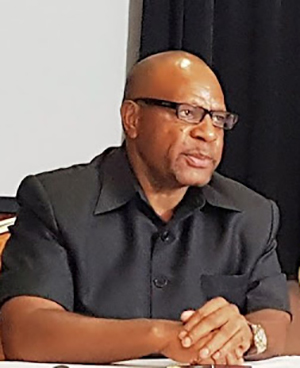


 Name: Jenny Jiva
 In 2015, the 23-year-old was selected as a country delegate to represent Fiji at the COP21 climate change conference in Paris, a global meeting where world leaders reached a legally binding agreement to address climate change.