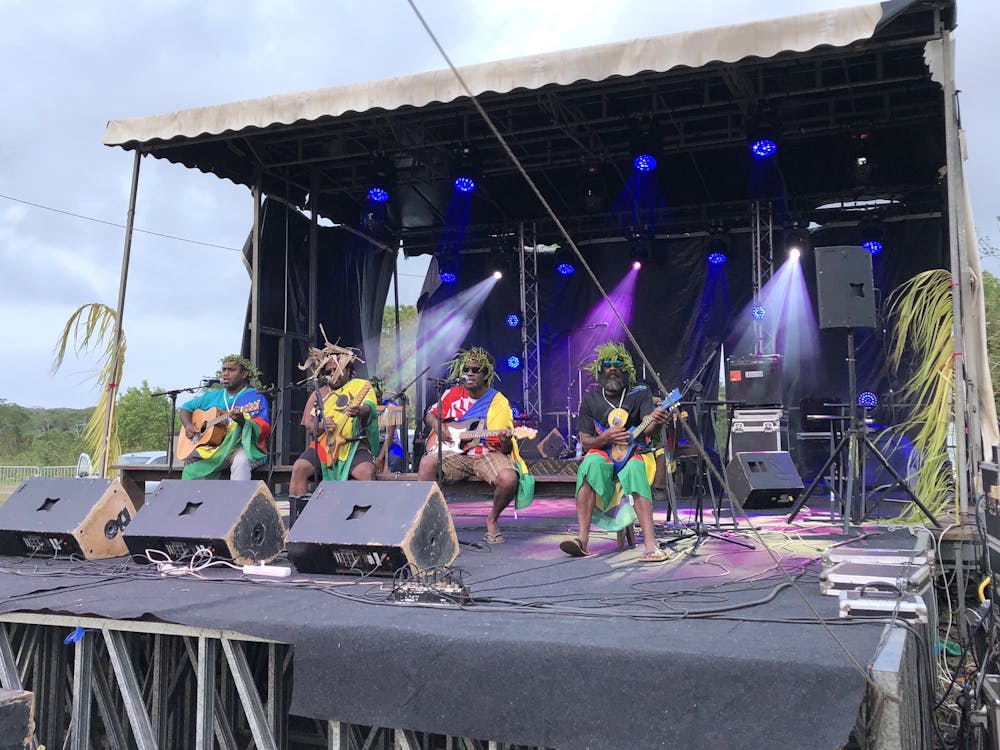
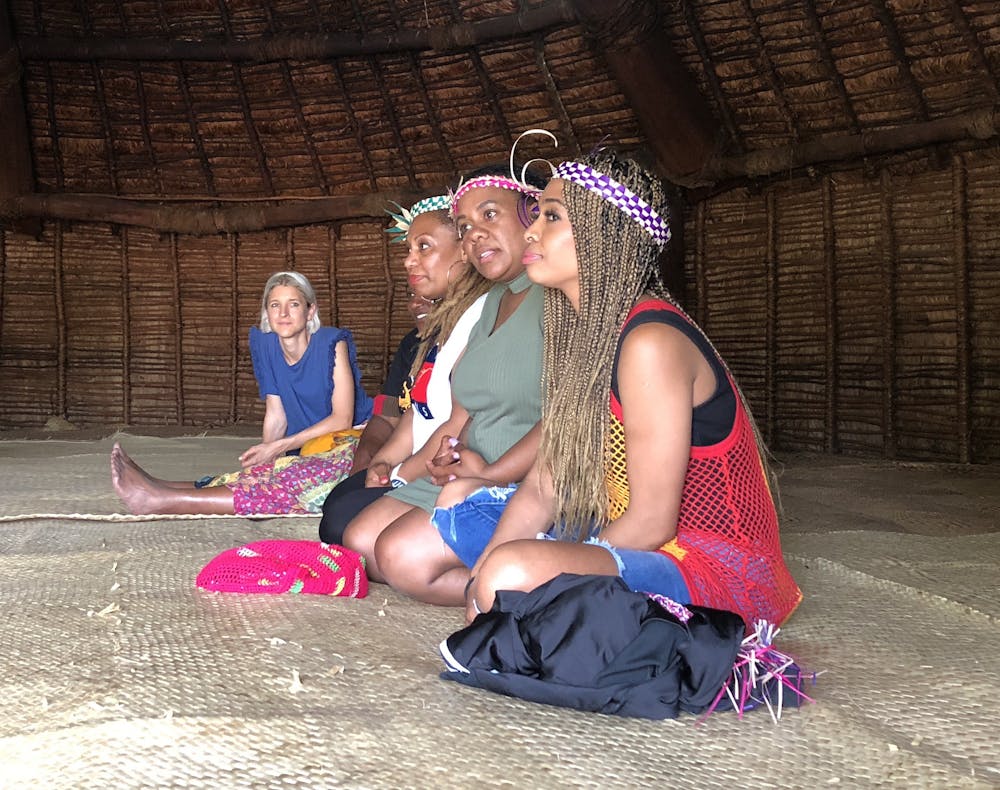
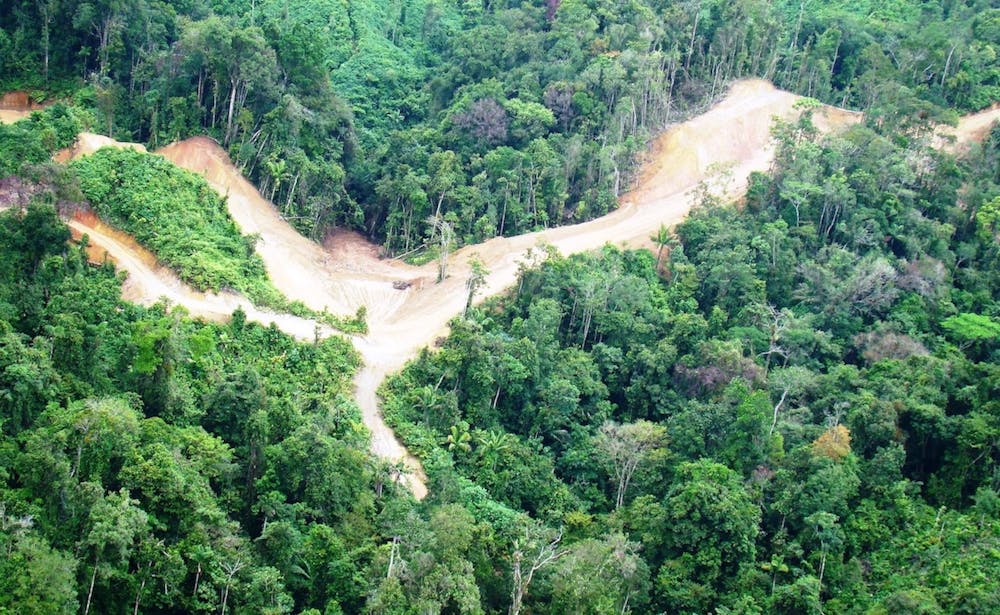
 The New Caledonia referendum will determine whether it will remain a French territory or become independent. Image: SBS video screenshot
New Caledonia on brink of fateful decision – new nation or status quo?

By Stefan Armbruster in Noumea
New Caledonia, a group of picturesque islands in Melanesia that are the closest neighbour to Australia and New Zealand, have been French-owned since 1853. But this may change at the weekend.
On Sunday, November 4, those eligible among its 270,000 residents will go to the polls to answer “yes” or “no” to one question: “Do you want New Caledonia to accede to full sovereignty and become independent?”
Settlers first arrived in New Caledonia about 3000 years ago, but it was given its current name by Captain James Cook on a brief visit in 1774. He said it reminded him of Scotland.
SBS VIDEO: A new Pacific neighbour – view on Facebook
 NEW CALEDONIA OR KANAKY?: THE INDEPENDENCE VOTE
The remainder are a mix of French, Polynesians, and people from other former French colonies, including descendants of Algerians sent to the penal colony in the late 1800s after an uprising.
READ MORE: Flashback to the 1980s – ‘Blood on their banner’
New Caledonia’s economy relies heavily on subsidies from France, has about a quarter of the world’s nickel resources and a thriving tourism industry based on the country’s rich Kanak culture and many natural wonders, including the second largest barrier reef in the world.
Why a referendum?
Relations between Kanaks and non-indigenous people have been defined by uprisings in 1878 and 1917 during which hundreds were killed, creating lasting distrust between the traditional landowners and the colonists.
Ethnic tensions erupted into violence again in the 1980s and a hostage-taking crisis in 1988 ended in bloodshed, leaving 19 Kanaks and six French security personnel dead.
The French government and New Caledonian representatives signed the Noumea Accord in 1998 that established a framework for the transfer of more autonomy to the territory and allow up to three referendums on independence, of which this is the first.
Charles Wea, the Kanak and Socialist National Liberation Front (FLNKS) spokesman in Australia, told SBS News: “We want to build a new society and new country and set up effectively a new relationship with France because we can no longer accept French colonialism in New Caledonia.”
But many New Caledonians fear what will happen if there is a yes vote.
Among them is Louise Vignols, who is studying in Sydney. She said: “France support us a lot with everything and if they’re not here anymore then we are just going to drop, it would be like Vanuatu, and we would be poor.”
 The New Caledonian referendum voting paper. Image: French Republic
How will it affect Australia and New Zealand?
New Caledonia holds a strategic position as a French territory with military headquarters in the Pacific, meaning Australia currently shares a maritime boundary with a nuclear-armed, permanent member of the UN Security Council.
In May, French President Emmanuel Macron visited Australia before heading to New Caledonia as part of the referendum preparations. He proposed an axis between France, India and Australia in the Indo-Pacific in which New Caledonia would play a key role.
Denise Fisher, a visiting fellow at the Australian National University (ANU) and former consul-general to New Caledonia, said: “Any Australian strategic analyst would see the benefit of having a Western ally, a global leader, in the South Pacific to share the strategic burden, especially as we face geo-strategic change with China coming into the region.”
What is the expected outcome?
A special and controversial electoral roll has been created on which all Kanaks and only long-term New Caledonian residents can register. It is separate from registers for French and local government elections.
If there is a yes result, New Caledonia will enter a phase of transition to an independent sovereign nation.
If it is “no”, under the agreements signed by the French government 30 years ago, there can be another referendum in 2020, which if negative again can be followed by a third in 2023.
“There have been a number of polls. Indications would suggest, for this first vote at least, the answer is likely to be a ‘no’ to independence,” Fisher said.
French Prime Minister Édouard Philippe recently announced a surprise visit to New Caledonia. He is due to arrive in the capital Noumea the day after the referendum for talks with all parties.
FLNKS spokesman Wea said: “We took almost 30 years to prepare. Kanak people, we are ready to get independence in terms of economic, in terms of social, in terms of cultural.”
This SBS News report by Stefan Armbruster is republished with permission.

Article by AsiaPacificReport.nz
]]>Flashback to Kanaky in the 1980s – ‘Blood on their banner’

About 175,000 New Caledonians will vote on the future of their Pacific territory this Sunday—a status quo French-ruled New Caledonia, or an independent Kanaky New Caledonia. What will be their choice? David Robie backgrounds the issues that led to the vote.
With New Caledonia facing the first of possibly three referendums on independence on Sunday—given the widely expected defeat this time around, it is timely to reflect on the turbulent 1980s.
An upheaval known locally by the euphemism of “les evenements” led to the 1988 Matignon and 1998 Nouméa accords as a compromise solution for indigenous Kanak demands for independence back then and the power sharing that has evolved for the past three decades.
The climax is with this Sunday’s vote, but if the status quo remains the accords provide for a further two referendums in 2020 and 2023.(1)
READ MORE: Asia Pacific Report coverage of the referendum
NEW CALEDONIA OR KANAKY?: THE INDEPENDENCE VOTE
When the Pacific was still in the grip of Cold War geopolitics, France claimed that it wished to retain its South Pacific presence for similar reasons to the United States—a concern about communism and the old Soviet Union, the desire for stability and the maintenance of the “balance of power”.
But there were other, more sinister, factors behind the publicly stated reasons. French colonialism in both New Caledonia and Tahiti in the 19th century was largely motivated by the wish to prevent the South Pacific becoming a “British lake”. (2)
New Caledonia became the most critical factor in this political equation. When Vanuatu became independent from Britain and France in 1980, France’s then State Secretary for Overseas Territories, Paul Dijoud, pledged that “battle must be done to keep New Caledonia French”.
New Caledonia was at that time the last “domino” before French Polynesia where the vital nuclear tests for the force de frappe were still being carried out until they ended in 1996.
Revolt, assassinations
It is in this context that the 1984 Kanaks revolted against French rule, which eventually cost 32 lives—most of them Melanesian, with the Hienghène massacre the most devastating early clash and culminating in the assassinations of independence leaders Jean-Marie Tjibaou and Yéiwene Yéiwene on 4 May 1989.
Within eight weeks of the start of the rebellion, militant Kanak leader Éloï Machiro, who had bloodlessly captured the mining town of Thio, was dead—shot by French police marksmen. From then on nationalist tensions in New Caledonia rapidly became convulsions, spreading throughout the South Pacific and culminated in the Ouvéa cave massacre on 5 May 1988 with the brutal death of 19 young militants and two French security forces. (3)
The New Caledonian events led to my 1989 book Blood On Their Banner: Nationalist Struggles in the South Pacific (4) and the shocking story of the Ouvéa hostage-taking saga and its savage climax was told graphically in Mathieu Kassovitz’s 2011 film Rebellion (l’Ordre et la morale).(5)
A report by CIGN hostage negotiator Captain Philippine Legorjus, who had tried valiantly to achieve a peaceful end to the crisis, said: “Some acts of barbarity have been committed by the French military in contradiction with their military duty.”
His report later became the basis of the controversial feature film’s script.
The following 1984 article, “Blood on their Banner”, one of my first while covering New Caledonia as an independent journalist through the 1980s, was published in the New Zealand Listener and later included in my 2014 book Don’t Spoil My Beautiful face: Media, Mayhem and Human Rights in the Pacific.(6)
***
 A masked Kanak militant near Thio, New Caledonia, 1985, on the cover of the Swedish edition of David Robie’s 1989 book Blood on their Banner. Image: David Robie/PMC
BLOOD ON THEIR BANNER
New Zealand Listener
27 October 1984
Leaders of New Caledonia’s independence movement say that time is running out. Their blood has already been spilt and they fear more bloodshed lies ahead.(7)
A new flag flutters defiantly from makeshift flagpoles in a handful of villages in New Caledonia. It is blue, red, and green-striped—symbolising the sky, blood and earth. A golden orb represents the rising sun.
This premature banner of independence was first hoisted in Lifou Island during an official ceremony recently marking the 44th anniversary of General de Gaulle’s call for a Free France.
 Two flags … French tricolour and the Kanak ensign symbolising independence. Image: David Robie/PMC
Mayor Edward Wapae, of the ruling Independence Front, recalled that de Gaulle’s speech in 1940 showed a determination to “liberate France soil from the Nazi occupiers and to reconquer French independence, the principles of which had made her the home of the rights of man and liberties”.
In the next breath, Wapae said that the children and the grandchildren of the Kanaks (the largest single ethnic group in New Caledonia), who had fought for France then, were fed up with vain promises. He made a “last chance” plea for France to honour “her declarations condemning colonisation and defending the right of each people to decide their own future”.
The flags are just one manifestation of a growing mood of impatience and disillusionment among Kanaks demanding independence in the French-ruled South Pacific territory—New Zealand’s closest major Pacific Island neighbour. Another is the talk in villages of the “sacrifices” made by peasants during the Algerian war of independence.
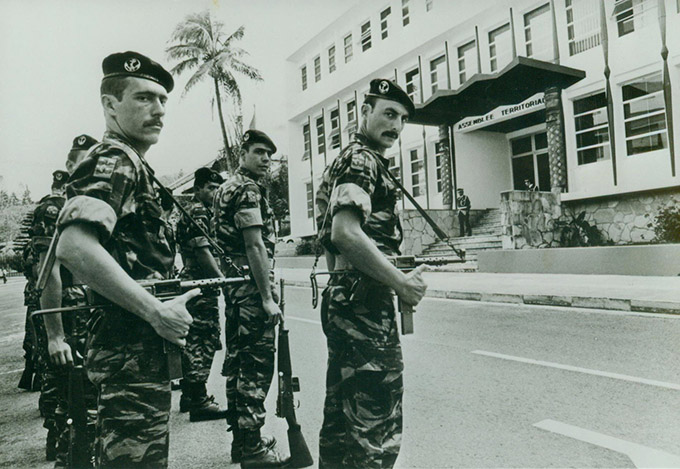 French Pacific Regiment troops on ceremonial parade outside New Caledonia’s Territorial Assembly in Nouméa. Image: David Robie/PMC
South Pacific Forum leaders, meeting in Tuvalu during August [1984], again caution against putting too much pressure on France while urging that Paris speed up the colonisation process.
Take-it-easy attitude
Yet for the Kanaks, and neighbouring Vanuatu, this take-it-easy attitude is rather bewildering. “The Forum sees things the same way as the French socialists and our position—their Pacific brother—isn’t seriously considered,” complains Jean-Marie Tjibaou, who as Vice-President of the Government Council holds the territory’s highest elected post.
He has been particularly disillusioned with Australia and New Zealand, at least until Prime Minister David Lange’s sudden “reconnaissance mission” to Nouméa in early October.
Vanuatu’s Prime Minister, Father Walter Lini, also disappointed at the Forum’s lukewarm support, plans to press the New Caledonian case at the United Nations and try to get it reinstated on the so-called Decolonisation Committee’s list. He blames the Forum if violence erupts in the territory and fears “foreign opportunists may exploit the instability”.
The Independence Front, now renamed the Kanak Socialist National Liberation Front (FLNKS), recently decided to boycott and obstruct fresh elections due in the territory next month in protest against a new statute of autonomy.
Instead, the FLNKS has called its own parliamentary elections for November 11, planning to form a provisional government by December and renamed the country Kanaky.
Although the statute calls for a referendum on independence in 1989, the Forum believes this should be advanced to 1986—while the FLNKS wants independence next year.
Lini criticises the view, often expressed by Australia and New Zealand, that Paris has been doing all it could and should be given time to decolonise. “The history of French decolonisation frequently has not been peaceful … and no other South Pacific nation, apart from Vanuatu, has suffered it.”
Vanuatu’s ruling Vanua’aku Pati has made a revolution that opens the door for the FLNKS to form a government-in-exile in Port Vila. But Vanuatu’s government ministers are reluctant to discuss this and it is believed they would prefer a “people’s government to be with the people” in New Caledonia.
Hectic trip
In Tuvalu, Lange won support for establishing a five-nation Forum ministerial delegation—including New Zealand and Vanuatu—to visit Nouméa for talks with French authorities and the indépèndantistes.
After briefly flying to Nouméa and Port Vila at the end of his hectic trip, he stressed it was clear all New Caledonian political groups apart from the right-wingers wanted independence. He hoped to bring the factions together before the elections but his peaceful initiative may already be too late.
 A Kanak girl in Nouméa’s Place des Cocotiers during a pro-independence rally in 1984. Image: David Robie/Tu Galala
Why are the indépèndantistes taking this more militant stance when they are at present in the driver’s seat as the senior coalition partner in the government? “With the present colonial electoral system and past immigration policies, Melanesians are a minority in their homeland,” explains Vice-President Tjibaou, a 48-year old sociologist. “We cannot accept that logic. Now we’re putting a halt to it.
“We need a statute that will accept our logic—the logic of Kanak sovereignty.”
The bitter reality for New Caledonians, both brown and white, is that the French government has pushed through an autonomy statute that nobody wants. The Territorial Assembly in Noumea unanimously rejected the bill earlier this year. Justin Guillemard, leader of the extreme right-wing Caledonian Front, describes the law as an “administrative monstrosity” and “racist” in favour of Melanesians.
President Francois Mitterrand’s government, so keen to foster a strong middle ground, now seems further away than ever from any consensus among New Caledonians. And the Caldoche (settlers) are alarmed at the FLNKS’s determination to seek foreign help.
Wealthy businessman Jacques Lafleur, a deputy in the French national Assembly and leader of the Republican Congress Party which held local power until two years ago, denounced as “provocative” a visit by Tjibaou to Port Moresby in August when he lobbied an Asian-Pacific leaders’ regional summit. Lafleur also condemned a recent visit to Libya by two other Independence Front leaders.
Great admirer
The 51-year old Lafleur is a fifth-generation Caldoche and a great admirer of former Prime Minister Sir Robert Muldoon— “the only South Pacific leader who understands us”.
With an air of cynicism, he says: “Maybe there could be independence in 20 years or so, but it depends on what sort … I would never be a Kanak citizen. We are French people and the Kanaks are French too… One bad move and there will be blood in the streets.”
But for the Kanaks, blood has already been flowing in the streets and they fear more being spilt. French authorities have been quietly building up the strength of military forces in the territory to maintain order, if necessary. It is believed more than 4000 paramilitary and regular troops are now garrisoned there.
 A French Pacific Regiment marine in a Nouméa military parade in the 1980s. Image: David Robie/PMC
One MP, Yann-Celene Uregei, has a photograph in his office of his face battered and bleeding from the blows of a policeman’s truncheon at a protest rally during a previous French Government’s rule. Two years ago a group of extremist white thugs burst into the Territorial Assembly chamber and attacked pro-independence MPs. They received light sentences. There have also been sporadic riots.
On the night of 19 September 1981, French-born Pierre Declercq, 43, secretary-general of the Union Calédonienne and a leading strategist of the Independence Front, was shot with a riot gun through the study window on his Mt Dore home. It was the first assassination of a South Pacific political leader. Now, three years later, nobody has yet been put in the dock for the murder.
During August more than 600 people marched on the Noumea courthouse demanding that a trial be held over the killing of “white martyr” Declercq, whose party was the key member of the FLNKS. Similar protest rallies were held in Poindimie, Pouebo, Voh and on Lifou Island in the Loyalty group.
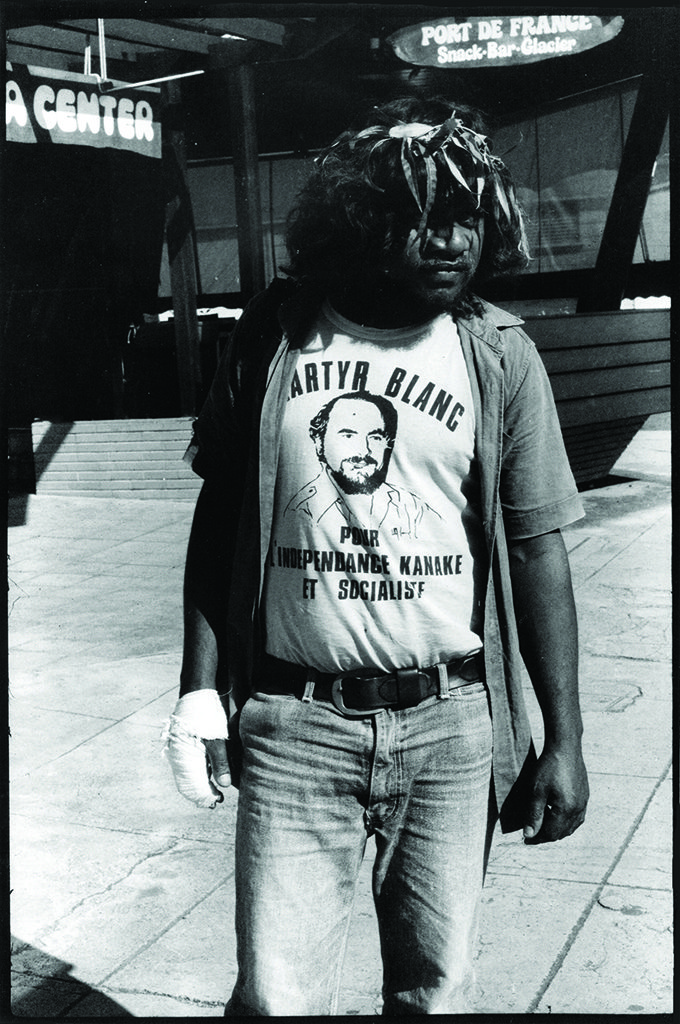 Kanak wearing a “white martyr” tee-shirt honouring an assassinated early FLNKS leader Pierre Declercq. Image: David Robie/PMC
A young motorcycle mechanic, Dominic Canon, was arrested and charged four days after the murder. Another man, Vanuatu-born barman Martin Barthelemy, was arrested a year later. But both suspects have been freed on bail.
Judicial delay scandalous
Marguitte Declercq accuses justice officials and gendarmes of obstructing inquiries into her husband’s killing; League of Human Rights secretary-general Jean-Jacques Bourdinat has called the judicial delay scandalous.
When I spoke to the cherubic-faced Canon, now 22, in his workshop on the outskirts of Noumea just after his release on $5000 bail from the notorious Camp Est prison, he insisted: “I’m innocent. They put me in jail for nothing.”
New Caledonia’s problem stem from its complex racial mix. Kanaks number only 60,000 out of a population of 140,000. About 50,000 Europeans form the next largest group, and the rest are potpourri of Vietnamese, Indonesians, Tahitians and Wallisians.
New Caledonia was annexed by France in 1853, mainly for the use as a penal colony. In three decades after 1860 more than 40,000 prisoners—including leaders of the 1871 Paris commune insurrection and other political exiles—were deported to the colony.
 “Colonial assassins” graffiti denouncing French colonial rule in the Place des Cocotiers, Noumea, 1984. Image: David Robie/PMC
For almost a century the Kanaks were deprived of political and civil rights But after they finally won the vote in 1951, they begun to wrest a limited share of their own country’s development—which was later fuelled by a nickel boom.
According to Vice-President Tjibaou, the New Caledonian territorial government has less power now than during the controversial loi cadre years between 1956 and 1959, when the territory was almost self-governing. Later conservative French governments favoured policies which meant New Caledonia was governed as an integral part of France until the Mitterrand administration embarked on reforms in 1981—after the assassination of Declercq.
The indépèndantistes argue that the current French reforms, far from being progressive, have in fact only been restoring some of the progress made in the 1950s. And they fear that if the Socialists lose office in the French general election due in 1986 they will be faced with another stalemate. Hence their urgency for independence next year.
Unique style
They claim President Mitterrand betrayed a commitment to independence made before being elected, and again at a roundtable conference at Nainville-les-Roches last year.
The controversial statute will increase the Territorial Assembly from 36 seats to 42 (slightly favouring the indépèndantistes): create a unique style of upper house comprising custom chiefs and representatives of elected town councils; introduce six regional (Kanaks prefer the word pays, or cultural community) administrations; and establish a special commission to prepare the way for a referendum on self-determination in 1989.
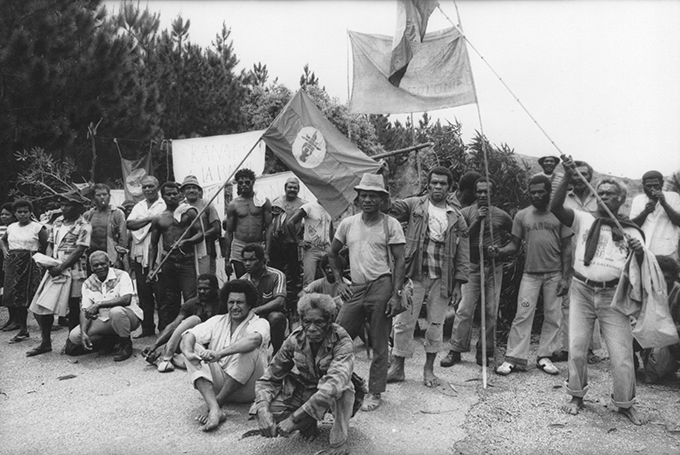 Kanak villagers guard a barricade near Bourail, New Caledonia, 1985. The Kanak flag bears a red band representing the blood sacrificed in their struggle. Image: David Robie/London Sunday Times
“We haven’t any choice but to oppose the application of the statute,” says Tjibaou. “We must impose an ‘active’ boycott, because if we accept these elections under the statute of autonomy, we accept the colonial logic behind them.”
Tjibaou believes the election result would be insignificant and unrepresentative of the territory. Many FLNKS leaders consider that the French government couldn’t allow an unrepresentative local government, so they would annul the elections and be forced into making quicker concessions for electoral reforms.
French officials concede there could be a case for a qualified franchise, such as Fiji’s nine-year residential clause, but consider the FLNKS demand that voters should be only Kanaks or people with at least one parent born in New Caledonia to be “unconstitutional”. Fearful of eventual independence, white Caledonians are applying in droves for immigration permits to Australia. Wealthy New Caledonians are also buying lands in New Zealand’s South Island, California, Hawai’i, Queensland and the French Riviera.
Most Kanaks support the Independence Front, a coalition of five parties until the Kanak Socialist Liberation, led by charismatic Nidoishe Naisseline, split away recently over the election boycott decision. Naisseline, a Sorbonne-educated grand chief, says Kanaks “shouldn’t try to copy nationalist movements in Africa and Indo-China”.
The majority of Europeans back Lafleur’s Republican Congress Party which used to advocate continued integration with France. Now it is outflanked on the right by the Caledonian Front while the centrist Caledonian New Society Federation (FNSC), also mainly European, has been supporting the Independence Forum for the last two years.
New Caledonian politics is highly complex, and feelings are potentially explosive.
While the rest of the South Pacific—apart from Vanuatu, which was forced to cope with an abortive secession—peacefully gained independence, New Caledonia seems fated to break that pattern. Little wonder the indépèndantistes have included symbolic blood on their banner.
***
Ongoing conflict
Over the next seven years, I closely reported the ongoing conflict in Kanaky for Pacific and global media.
Multimillionaire mining and property mogul Jacques Lafleur, one of the richest men in France and the biggest thorn for Kanak independence, even though he eventually reluctantly signed the two critical accords paving the way for possible independence, died in 2010 aged 78.
He dominated New Caledonian politics for more than three decades, including 29 as a member of the French National Assembly.
Along with Jean-Marie Tjibaou—one of the great visionary Pacific leaders until he was assassinated in 1989 (7), Lafleur signed the 1988 Matignon accord and then the Noumea accord in 1998, and honoured a pledge to Tjibaou to open the way for a Kanak stake in the nickel mining industry.
Lafleur agreed to sell his controlling stake in Societe Miniere du Sud Pacific (SMSP) to the Kanak-dominated Northern Province government in 1990.
New Caledonian nickel is shipped to many Asian countries where it is processed to manufacture steel, electronics and consumer goods. The nickel industry has made many Caldoche wealthy, with minerals for 90 percent of the territory’s export revenue.
Criticism of the industry is highly unpopular with the establishment.
The Pacific Media Centre’s Professor David Robie is author of Blood on their Banner: Nationalist Struggles in the South Pacific and Don’t Spoil My Beautiful Face.
References
1. Haut-Commissariat de la Republique en Nouvelle-Caledonie (2018). Consultation sur l’accession a la plein souverainete de la Nouvelle Caledonie.
2. David Robie (1989). Introduction. In Blood On Their Banner: Nationalist Struggles in the South Pacific. London: Zed Books, p. 17.
3. Max Uechtritz (2018, May 7). Blood in the Pacific: 30 years on from the Ouvéa Island cave massacre. Asia Pacific Report.
4. David Robie (1989). Och världen blundar… kampen för frihet i Stilla havet [And the world closed its eyes – campaign for a free South Pacific]. Swedish trans. Margareta Eklof]. Hoganas, Sweden: Wiken Books; David Robie (1989). Blood On Their Banner: Nationalist Struggles in the South Pacific. London: Zed Books.
5. David Robie (2012). Gossana cave siege tragic tale of betrayal. Pacific Journalism Review: Te Koakoa, 18(2), 212-216.
6. David Robie (2014). Don’t Spoil My Beautiful face: Media, Mayhem and Human Rights in the Pacific. Auckland: Little Island Press./
7. David Robie (1984, October 27). Blood on their banner. New Zealand Listener, pp. 14-15
8. Sarah Walls (2009). Jean-Marie Tjibaou: Statesman without a state: a reporter’s perspective. The Journal of Pacific History. 44(2), 165-178.
Article by AsiaPacificReport.nz
]]>Attention economy: Facebook delivers traffic but no money for news media

Source: The Conversation (Au and NZ) – By Merja Myllylahti, Research Fellow, Auckland University of Technology
Facebook and quality journalism are uneasy companions. Recent headlines suggest the platform’s “lies” about video metrics “smashed” journalism and the platform “crashed and burned” news companies’ referral traffic after it changed its algorithm in January.
The Australian Competition and Consumer Commission is currently holding a digital platform inquiry to investigate what kind of impact social media platforms, search engines and other content aggregators have on the local media market. In the United Kingdom, the Cairncross review is assessing similar issues, looking for ways of sustaining high-quality journalism in a changing market.
My research suggests these enquiries should pay attention to the impact of Facebook and the lessons we’ve already learned about the social platform.
Read more: Class action against Facebook over facial recognition could pave the way for further lawsuits
Lesson one: overstated metrics
You should not trust all the metrics platform companies offer.
A recent article in The Atlantic revealed that a lawsuit has been filed against Facebook, because it allegedly overstated its video statistics for years, “exaggerating the time spent watching them by as much as 900% percent.”
The article asserts that “hundreds of journalists” lost their job after Facebook lured news companies to invest in video. However, Facebook has denied these claims.
The Spinoff, a digital native media company in New Zealand, recently posted a story with a similar analysis of the platform’s impact, saying that Facebook’s fake video statistics “smashed New Zealand journalism” because when it encouraged news companies to invest in online video production, they followed.
New Zealand media were collateral damage in Facebook’s obsessive desire to grow at all costs.
Read more: How to stop haemorrhaging data on Facebook
Lesson two: traffic dependency
You should not rely on Facebook traffic.
A recent report by the Tow Center for Digital Journalism shows that in the United States, news companies have a substantial presence on Facebook. The report found that roughly 80% of the local news outlets are using the social platform.
Additionally, two recent studies demonstrates how news companies rely on Facebook to drive their traffic. My own research of four New Zealand news companies shows that 24% of their traffic came from social media, and most of that came from Facebook. Together social and search drove 47% of New Zealand news sites’ traffic.
A larger study of 12 newspapers and broadcasters in Europe, conducted by Reuters Institute for the Study of Journalism, notes:
… news organisations are making major investments in social media and report receiving significant amounts of traffic” from social media.
These studies confirm news companies’ Facebook dependency in terms of traffic, although the level of dependency differs between media outlets. The Reuters study found that Facebook’s algorithm changes in January had a severe impact on some of the news companies’ traffic. However, the severity of impact differed between media outlets. For example, Le Monde saw its interactions drop by almost a third, but for The Times these grew.
In New Zealand, The Spinoff suffered a substantial drop in its traffic after Facebook’s algorithm tweaks: its traffic from the platform dropped from 50% to 30%. We have seen similar drops in other markets, too.
The Nieman Lab, which reports on digital media innovation, found that following Facebook’s algorithm change, the drop in referral traffic was not universal. Some not-for-profit media organisations benefited.
Bottom line: The decline in referrals to publishers from Facebook is not universal, and in the face of those declines, other sources of traffic are more important than ever.
Indeed, it would be wise for all news outlets to grow their direct traffic which delivers better user engagement and monetisation.
Lesson three: don’t do it for the money
You don’t make much money on Facebook.
My research suggests if news companies abandoned Facebook, they would hardly lose any money. For the companies studied, social media traffic made up 0.03%–0.14% of their total revenue, and social shares 0.009%–0.2% of total revenue. These figures don’t take into account advertising income from platforms or subscription conversion.
The reason news companies continue to distribute their content on social media platforms is because they gain attention. News companies believe they can turn this attention into money, but so far with little success.
However, some news publishers have reported that they have gained digital subscriptions from the platforms. The Reuters study notes Facebook delivers news companies audience engagement that is “considered more cost effective at driving digital subscription sales.”
The bottom line is there is no data yet to verify how well news publishers manage to convert social media attention to digital subscriptions. Google, Facebook, Amazon and Apple are all offering, or are in the process of offering, digital subscription services to news publishers, but how well these will work for news companies remains to be seen.
– ref. Attention economy: Facebook delivers traffic but no money for news media – http://theconversation.com/attention-economy-facebook-delivers-traffic-but-no-money-for-news-media-105725]]>Bryce Edwards’ Political Roundup: What’s wrong with our politicians?
Bryce Edwards’ Political Roundup: What’s wrong with our politicians?
[caption id="attachment_13635" align="alignleft" width="150"] Dr Bryce Edwards.[/caption]
Parliament increasingly looks like a tawdry and dirty place in the wake of the Jami-Lee Ross mega-scandal.
There will certainly be many in the public who have less trust and respect for MPs and political parties as a result. The quality and ethical standards of our politicians might now come under greater scrutiny.
Jami-Lee Ross has come across as a narcissistic and ruthless game-player rather than any sort of ideal-driven altruistic representative of the people. It could be argued that he is an aberration amongst an otherwise healthy political system of upstanding politicians. However, given some of the other behaviour that has come to light, and numerous other scandals in recent years – which also show MPs just looking after themselves – the public would be right to be sceptical.
[caption id="attachment_3483" align="aligncenter" width="710"]
Dr Bryce Edwards.[/caption]
Parliament increasingly looks like a tawdry and dirty place in the wake of the Jami-Lee Ross mega-scandal.
There will certainly be many in the public who have less trust and respect for MPs and political parties as a result. The quality and ethical standards of our politicians might now come under greater scrutiny.
Jami-Lee Ross has come across as a narcissistic and ruthless game-player rather than any sort of ideal-driven altruistic representative of the people. It could be argued that he is an aberration amongst an otherwise healthy political system of upstanding politicians. However, given some of the other behaviour that has come to light, and numerous other scandals in recent years – which also show MPs just looking after themselves – the public would be right to be sceptical.
[caption id="attachment_3483" align="aligncenter" width="710"] New Zealand Parliament.[/caption]
A new “political class”?
So why might our politicians have become more self-serving or less trustworthy? One answer is that MPs appear to have evolved in recent decades into a more cohesive and self-interested “class” of professionals. Rather than being amateurs who come into office to carry out public service after years of experience in other regular occupations, our current crop of representatives are increasingly “career politicians” with backgrounds only in the sphere of politics.
This is borne out by research on the backgrounds of the current Parliament carried out by BlacklandPR’s Mark Blackham and political scientist Geoffrey Miller. They’ve gone through and categorised what the main occupations of all the MPs were prior to them becoming MPs, and the results are quite striking. Blackham has published this today on his company website – see: MP careers: NZ’s 52nd Parliament.
The results show that a growing proportion of the Parliament has no discernible career prior to be elected. Typically, according to Blackham, “they had effectively been running a political career simultaneously with their employment. They were involved in party politics at university, and continued as party volunteers, campaigners and officials in early adulthood. They gained party nominations and employment as party researchers their 20s or 30s, and then eventually entered Parliament during these years.”
The other major growth area in pre-parliamentary careers is political work in government agencies: “20% of MPs in the current Parliament have previously worked in government jobs. Labour’s experience in government employment increased from 16% in 2015 to 26% in this Parliament. This jump was fuelled by the intake of new Labour MPs, where 21% of work experience was in government. National’s experience in government work increased by 1% point to 19%.”
Overall, these are the main occupational backgrounds of the current Parliament, categorised by party: National: Business (25% of all jobs held by all party MPs) and Government (19%); Labour: Government (26%) and Business (14%); New Zealand First: Business (27%), Education (18%) and Police/Military (18%); Greens: Union and Activism (43%) and Business (29%)”.
The results were covered recently by Rob Mitchell in his feature article, A breed apart? MPs are now birds of a different feather. He reports that these results have “some political commentators and experts worried. About a growing threat to democracy, a building distrust of politicians, and a widening divide between our representatives and those they are meant to represent.”
Blackham is quoted, explaining how career politicians don’t have the life experience that enables genuine empathy and connection with the public: “I’d argue that direct experience of the lives, difficulties and expectations and priorities of ordinary people is something that is hard to forget and will better enable you to understand the impact of the decision you are making”.
Furthermore, “If your experience is rarefied or significantly different to the majority of people who voted for you then your decisions are going to be different to what they might expect, and in a representative democracy I think that’s a bad thing.”
I’m quoted in his article, saying that there is also an important issue of diversity at stake in the way that Parliament increasingly only involves professionals. On the one hand Parliament is becoming more representative “of gender and ethnicity… browner and more female, and younger”, but “economically it’s become much more narrow, in terms of social backgrounds; you might call it class background or socio-economic background, or occupational background.”
Plus, I point out that once in Parliament, MPs become incredibly wealthy relative to their constituency – with base incomes (before you consider all the perks) ranging from a minimum of $160,000, up to nearly half a million dollars for the prime minister. This has democratic ramifications, because it “means they are quarantined from the everyday lives of everyone else”.
This lack of life experience has also been pinpointed by Matt McCarten as a “deep explanation” for some of what we’ve seen in the Jami-Lee Ross saga. Discussing the issue on TVNZ’s Marae programme, McCarten explained it like this: “Here’s Jami – he came in without any background into politics. At 18 he was on the city council in Auckland. He’s always been a politician. I always say that ‘you’ve got to have a life… before going into Parliament’. And then you can have your feet on the ground. When you go in as a kid, you receive this salary, you get told ‘you are special; you are wonderful’… If you’re 18 and have got no life experience. This is the kid that then goes to Parliament, and everyone keeps telling him ‘You Jami, you’re The One’. He was the bagman. He was ‘a player’.”
McCarten’s point is that the lack of real world experience, together with the quick elevation of MPs into the unreal world of politics, can easily change the outlook of individuals, essentially making the role all about themselves rather than political service.
According to political commentator Matthew Hooton, this new breed of politician has a very different connection to politics, which goes some way to explaining why we are seeing more MPs like Jami-Lee Ross. His recent Herald column on this issue is a must-read – see: Jami-Lee Ross fiasco a symptom of wider disease.
He points out that the youth moving up through the ranks of today’s rather hollow political parties don’t seem to have strong ideologies or beliefs, but are driven more by their careers and ambition. In this way, he suggests their “role models are, at best, The West Wing’s Josh Lyman and CJ Cregg. More usually they are The Thick of It’s Malcolm Tucker or, worse, House of Cards’ Frank and Claire Underwood.”
Hooton is worth quoting at length for his assessment of what this new “political class” of politicians means: “Politics has become less about policy proposals to make New Zealand and even the world a better place. It is about celebrity culture. It is just another opportunity to advance a personal brand through an elaborate game, with the bonus of being well remunerated by the taxpayer. This attitude has led to the rise of a self-perpetuating class that moves seamlessly from being activists in their party’s youth wings to jobs as parliamentary staffers or the bureaucracy. They use those connections to become MPs without becoming connected with a real community. A few months as a Government relations adviser for an NGO or multinational is enough to claim private-sector experience. Jacinda Ardern and Grant Robertson are classic examples but Jami-Lee Ross is surely the most extreme.”
Hooton believes that this is now the norm rather than any sort of aberration: “Ross is far from alone in apparently being empty of genuine political ideas. Both main parties are now infested with MPs who have never worked a day outside politics. Some of these people are, of course, perfectly capable individually. Collectively, though, they risk Parliament and Government becoming ever-more out of touch, not just from business but from any other part of the wider world. This comes with consequences.”
For politics to regain its soul, Hooton says it needs to shift away from the professionalised path and back to more activism: “It is an argument to try to rebuild the big parties as genuinely democratic, mass-membership organisations that are inherently in touch with the general public and constantly evolving ideologically. They would become structures within which ordinary members argued policy and ideas rather than being mere vehicles for careerists.”
The Declining health of political parties
This argument has been taken up by another political commentator, Liam Hehir, who wrote yesterday about “the hollowing out of our political parties”, and how this is leading to them be dominated by ambitious “strivers who want to be elected to Parliament” – see: Political parties benefit from having a broad base of members.
According to Hehir, who has declared previous involvement in the Alliance and National parties, the current parties are becoming highly un-representative of society: “politics is about power and the people most interested in power are often those who covet it for themselves. So it’s no surprise that the ambitious are among those most attracted to party membership. As the older group gets older, they are not generally being replaced. With every passing year, therefore, the membership becomes smaller, more ideological and more grasping. They become less and less like the rest of the country. Given that our system of electing members of parliament now revolves around political parties, this is not ideal.”
This week, veteran political commentator Richard Harman has also argued that “politics has a purpose beyond simply gaining power” and in the wake of the Jami-Lee Ross scandal, some MPs “are asking questions about their parties and whether there is a need for them to put more emphasis on policy; in other words to attract people in who want more than a seat in Parliament or proximity to Ministers” – see: Saving Labour from itself.
Harman interviews senior Labour MP Ruth Dyson about her experience as Labour’s party president in the 1980s when “people went to a [party] conference because they had something to say on an issue they felt really strongly about” and there were days of debates about policy. Dyson now worries about today’s party conferences going “to the other extreme where we have sterile debate or hardly any debate at all”. But she also reports a revival of recent youth activism in her party.
RNZ’s Tim Watkin has also noticed that something is amiss with our politicians, given behaviour and standards displayed on all sides of Parliament this year: “there’s something that ties together the woes both major parties have suffered this year. This tricky thing called ‘culture’. Something in Wellington is broken. It has two prongs, to my mind. One is the behaviour of MPs and the workplace culture they’ve created. The other is the level of transparency being offered” – see: Don’t give me culture – change it.
And, it badly needs fixing according to Watkin: “maybe it’s time for us to demand better of the people paid to represent us and our interests. Indeed, I think voters are heartily sick of the power games, brutal ambition and blind partisanship. From Brexit and Trump, to Ardern and these current US mid-terms, that fed-upedness unites them all.”
However, Watkin detects that neither National nor Labour really wants to fix the problems, being keener to just sweep any mess under the carpet. He complains: “We deserve better. This is not a moment for ‘business as usual’. This is a chance to clean house. Scrubbing out the dirty corners of our political life and preserving its decency in troubled times for democracy globally should be a much higher priority for our leaders right now. And if, as they insist, they’re not hearing that from voters, then I don’t think they’re really listening.”
Finally, it’s worth asking if we should impose term-limits on our MPs to prevent the development of career politicians. Andrea Vance makes the case for this, saying that long-serving MPs are part of the problem: “The more comfortable they become in their Beehive offices, with staff, perks and tax-payer funded travel – the more distant they become from those they represent. They come bursting into Parliament with big ideas and naive ideology but are eventually worn down by the grind and disappointment of real politik. Most get jaded, cynical, and too involved in playing the game… Term limits would allow MPs to spend less time worrying about re-election or scrabbling up the caucus ranks. More policy-making, less plotting” – see: Stamp MPs with a best-before date.]]>
New Zealand Parliament.[/caption]
A new “political class”?
So why might our politicians have become more self-serving or less trustworthy? One answer is that MPs appear to have evolved in recent decades into a more cohesive and self-interested “class” of professionals. Rather than being amateurs who come into office to carry out public service after years of experience in other regular occupations, our current crop of representatives are increasingly “career politicians” with backgrounds only in the sphere of politics.
This is borne out by research on the backgrounds of the current Parliament carried out by BlacklandPR’s Mark Blackham and political scientist Geoffrey Miller. They’ve gone through and categorised what the main occupations of all the MPs were prior to them becoming MPs, and the results are quite striking. Blackham has published this today on his company website – see: MP careers: NZ’s 52nd Parliament.
The results show that a growing proportion of the Parliament has no discernible career prior to be elected. Typically, according to Blackham, “they had effectively been running a political career simultaneously with their employment. They were involved in party politics at university, and continued as party volunteers, campaigners and officials in early adulthood. They gained party nominations and employment as party researchers their 20s or 30s, and then eventually entered Parliament during these years.”
The other major growth area in pre-parliamentary careers is political work in government agencies: “20% of MPs in the current Parliament have previously worked in government jobs. Labour’s experience in government employment increased from 16% in 2015 to 26% in this Parliament. This jump was fuelled by the intake of new Labour MPs, where 21% of work experience was in government. National’s experience in government work increased by 1% point to 19%.”
Overall, these are the main occupational backgrounds of the current Parliament, categorised by party: National: Business (25% of all jobs held by all party MPs) and Government (19%); Labour: Government (26%) and Business (14%); New Zealand First: Business (27%), Education (18%) and Police/Military (18%); Greens: Union and Activism (43%) and Business (29%)”.
The results were covered recently by Rob Mitchell in his feature article, A breed apart? MPs are now birds of a different feather. He reports that these results have “some political commentators and experts worried. About a growing threat to democracy, a building distrust of politicians, and a widening divide between our representatives and those they are meant to represent.”
Blackham is quoted, explaining how career politicians don’t have the life experience that enables genuine empathy and connection with the public: “I’d argue that direct experience of the lives, difficulties and expectations and priorities of ordinary people is something that is hard to forget and will better enable you to understand the impact of the decision you are making”.
Furthermore, “If your experience is rarefied or significantly different to the majority of people who voted for you then your decisions are going to be different to what they might expect, and in a representative democracy I think that’s a bad thing.”
I’m quoted in his article, saying that there is also an important issue of diversity at stake in the way that Parliament increasingly only involves professionals. On the one hand Parliament is becoming more representative “of gender and ethnicity… browner and more female, and younger”, but “economically it’s become much more narrow, in terms of social backgrounds; you might call it class background or socio-economic background, or occupational background.”
Plus, I point out that once in Parliament, MPs become incredibly wealthy relative to their constituency – with base incomes (before you consider all the perks) ranging from a minimum of $160,000, up to nearly half a million dollars for the prime minister. This has democratic ramifications, because it “means they are quarantined from the everyday lives of everyone else”.
This lack of life experience has also been pinpointed by Matt McCarten as a “deep explanation” for some of what we’ve seen in the Jami-Lee Ross saga. Discussing the issue on TVNZ’s Marae programme, McCarten explained it like this: “Here’s Jami – he came in without any background into politics. At 18 he was on the city council in Auckland. He’s always been a politician. I always say that ‘you’ve got to have a life… before going into Parliament’. And then you can have your feet on the ground. When you go in as a kid, you receive this salary, you get told ‘you are special; you are wonderful’… If you’re 18 and have got no life experience. This is the kid that then goes to Parliament, and everyone keeps telling him ‘You Jami, you’re The One’. He was the bagman. He was ‘a player’.”
McCarten’s point is that the lack of real world experience, together with the quick elevation of MPs into the unreal world of politics, can easily change the outlook of individuals, essentially making the role all about themselves rather than political service.
According to political commentator Matthew Hooton, this new breed of politician has a very different connection to politics, which goes some way to explaining why we are seeing more MPs like Jami-Lee Ross. His recent Herald column on this issue is a must-read – see: Jami-Lee Ross fiasco a symptom of wider disease.
He points out that the youth moving up through the ranks of today’s rather hollow political parties don’t seem to have strong ideologies or beliefs, but are driven more by their careers and ambition. In this way, he suggests their “role models are, at best, The West Wing’s Josh Lyman and CJ Cregg. More usually they are The Thick of It’s Malcolm Tucker or, worse, House of Cards’ Frank and Claire Underwood.”
Hooton is worth quoting at length for his assessment of what this new “political class” of politicians means: “Politics has become less about policy proposals to make New Zealand and even the world a better place. It is about celebrity culture. It is just another opportunity to advance a personal brand through an elaborate game, with the bonus of being well remunerated by the taxpayer. This attitude has led to the rise of a self-perpetuating class that moves seamlessly from being activists in their party’s youth wings to jobs as parliamentary staffers or the bureaucracy. They use those connections to become MPs without becoming connected with a real community. A few months as a Government relations adviser for an NGO or multinational is enough to claim private-sector experience. Jacinda Ardern and Grant Robertson are classic examples but Jami-Lee Ross is surely the most extreme.”
Hooton believes that this is now the norm rather than any sort of aberration: “Ross is far from alone in apparently being empty of genuine political ideas. Both main parties are now infested with MPs who have never worked a day outside politics. Some of these people are, of course, perfectly capable individually. Collectively, though, they risk Parliament and Government becoming ever-more out of touch, not just from business but from any other part of the wider world. This comes with consequences.”
For politics to regain its soul, Hooton says it needs to shift away from the professionalised path and back to more activism: “It is an argument to try to rebuild the big parties as genuinely democratic, mass-membership organisations that are inherently in touch with the general public and constantly evolving ideologically. They would become structures within which ordinary members argued policy and ideas rather than being mere vehicles for careerists.”
The Declining health of political parties
This argument has been taken up by another political commentator, Liam Hehir, who wrote yesterday about “the hollowing out of our political parties”, and how this is leading to them be dominated by ambitious “strivers who want to be elected to Parliament” – see: Political parties benefit from having a broad base of members.
According to Hehir, who has declared previous involvement in the Alliance and National parties, the current parties are becoming highly un-representative of society: “politics is about power and the people most interested in power are often those who covet it for themselves. So it’s no surprise that the ambitious are among those most attracted to party membership. As the older group gets older, they are not generally being replaced. With every passing year, therefore, the membership becomes smaller, more ideological and more grasping. They become less and less like the rest of the country. Given that our system of electing members of parliament now revolves around political parties, this is not ideal.”
This week, veteran political commentator Richard Harman has also argued that “politics has a purpose beyond simply gaining power” and in the wake of the Jami-Lee Ross scandal, some MPs “are asking questions about their parties and whether there is a need for them to put more emphasis on policy; in other words to attract people in who want more than a seat in Parliament or proximity to Ministers” – see: Saving Labour from itself.
Harman interviews senior Labour MP Ruth Dyson about her experience as Labour’s party president in the 1980s when “people went to a [party] conference because they had something to say on an issue they felt really strongly about” and there were days of debates about policy. Dyson now worries about today’s party conferences going “to the other extreme where we have sterile debate or hardly any debate at all”. But she also reports a revival of recent youth activism in her party.
RNZ’s Tim Watkin has also noticed that something is amiss with our politicians, given behaviour and standards displayed on all sides of Parliament this year: “there’s something that ties together the woes both major parties have suffered this year. This tricky thing called ‘culture’. Something in Wellington is broken. It has two prongs, to my mind. One is the behaviour of MPs and the workplace culture they’ve created. The other is the level of transparency being offered” – see: Don’t give me culture – change it.
And, it badly needs fixing according to Watkin: “maybe it’s time for us to demand better of the people paid to represent us and our interests. Indeed, I think voters are heartily sick of the power games, brutal ambition and blind partisanship. From Brexit and Trump, to Ardern and these current US mid-terms, that fed-upedness unites them all.”
However, Watkin detects that neither National nor Labour really wants to fix the problems, being keener to just sweep any mess under the carpet. He complains: “We deserve better. This is not a moment for ‘business as usual’. This is a chance to clean house. Scrubbing out the dirty corners of our political life and preserving its decency in troubled times for democracy globally should be a much higher priority for our leaders right now. And if, as they insist, they’re not hearing that from voters, then I don’t think they’re really listening.”
Finally, it’s worth asking if we should impose term-limits on our MPs to prevent the development of career politicians. Andrea Vance makes the case for this, saying that long-serving MPs are part of the problem: “The more comfortable they become in their Beehive offices, with staff, perks and tax-payer funded travel – the more distant they become from those they represent. They come bursting into Parliament with big ideas and naive ideology but are eventually worn down by the grind and disappointment of real politik. Most get jaded, cynical, and too involved in playing the game… Term limits would allow MPs to spend less time worrying about re-election or scrabbling up the caucus ranks. More policy-making, less plotting” – see: Stamp MPs with a best-before date.]]>
Newsletter: New Zealand Politics Daily – October 31 2018
Newsletter: New Zealand Politics Daily – October 31 2018
Editor’s Note: Here below is a list of the main issues currently under discussion in New Zealand and links to media coverage.
[caption id="attachment_297" align="aligncenter" width="640"] The Beehive and Parliament Buildings.[/caption]
Karel Sroubek residency decision, immigration
Gordon Campbell: On why deportation decisions should be transparent
Mike Hosking (Newstalk ZB): Karel Sroubek case will haunt the Government
Barry Soper (Newstalk ZB): Government needs to explain why it’s being soft on hardened criminal Karel Sroubek
Beith Atkinson (Integrity Talking Points): Czechmate
Martyn Bradbury (Daily Blog): Do we really have to spell it out about Karel Sroubek gaining residency? Really?
Dominion Post Editorial: Reading between the lines, you are wrong
Zane Small (Newshub):‘We look like suckers’: Duncan Garner calls for justification of Sroubek’s visa
Jared Savage (Herald): ‘I believe him’ – Judge who gave Karel Sroubek AKA Jan Antolik a second chance stands by ruling
Zane Small (Newshub): ‘Privacy is critical’ in Sroubek’s residency case – Winston Peters
Derek Cheng (Herald): Residence decision for convicted drug-smuggler ‘responsible’ – Winston Peters
Jo Moir (RNZ): Minister stands by Czech drug smuggler decision
Collette Devlin (Stuff): Immigration Minister Iain Lees-Galloway stands by his decision to grant convicted drug smuggler Karel Sroubek residency
Derek Cheng (Herald): Public safety chief concern in granting residency to drug smuggler – minister
Michael Morrah (Newshub): ‘It’s disgusting’: Napier electrician fumes at Czech drug lord Karel Sroubek’s NZ residency
Harrison Christian (Stuff): Split families slam Immigration Minister over Karel Sroubek decision
Emma Hatton (RNZ): Masters graduate mystified by ruling to leave country: ‘I was so confident’
Housing
Alice Webb-Liddall (Newshub): Duncan Garner: $650,000 KiwiBuild housing leaving out the lower class
Martyn Bradbury: Surprise, surprise – Kiwibuild is for the children of the white middle classes
Don Rowe (Spinoff): First homes and fake news
Zane Small (Newshub): Tova O’Brien calls Judith Collins’ cyberbullying ‘appalling’
Susan Edmunds (Stuff): Five myths about KiwiBuild – and who it’s meant to help
Susan Edmunds (Stuff): KiwiBuild is not buyers’ only affordable housing option
David Farrar: It’s about the policy, not the people
Pete George: Politics and Kiwibuild
Jenée Tibshraeny (Interest): Collins slates KiwiBuild for not serving those most in need, but is comfortable with nearly 10% of residential property purchases in central Auckland being made by foreigners
RNZ: Judith Collins says housing minister ‘verging on hysteria’
RNZ: Phil Twyford: KiwiBuild owners ‘a slice of middle New Zealand’
Anne Gibson (Herald): Twyford vs Collins: Twitterstorm raises questions about who should qualify for Kiwibuild
Jenna Lynch (Newshub): Judith Collins accused of bullying KiwiBuild first-home buyers
Derek Cheng (Herald): Twyford, Collins, blame each other as cyber-bullies target KiwiBuild couple
Derek Cheng (Herald): Twyford and Collins in war of words over KiwiBuild bullying
Susan Edmunds (Stuff): Judith Collins ‘bullying’ KiwiBuild first-home buyers, housing minister claims
Thomas Coughlan (Newsroom): Cyberbullying spat in Parliament
Newshub: Judith Collins accused of bullying KiwiBuild first-home buyers
RNZ: Checkpoint: Housing Minister’s numbers in contrast to HNZ figures
RNZ: Meth evictions: Prime Minister Jacinda Ardern says tenants won’t be penalised twice
Rob Stock (Stuff): Incomes rise, housing costs rise faster, Stats NZ says
Interest: Stats NZ: Average annual housing costs rose faster than average annual household income over the past decade
Education and training
Simon Collins (Herald): Unicef ranks NZ education among world’s most unequal for boys and girls
Stuff: NZ’s education gap among the worst in the developed world
Jessica Long (Stuff): Poverty is stretching the divide within NZ’s education system, UNICEF says
RNZ: NZ among worst ranked for inequality in education – report
Laura Walters (Newsroom): NZ’s unequal education system
James Bentley (Herald): Schools have more urgent needs than all these reviews
Simon Collins (Herald): Fewer schools will sit NCEA online this year
Rukuwai Tipene-Allen (Māori TV): Hapū says MOE sells land without Māori consultation
Liz Garton (RNZ): Voices: Kicking NZ’s ‘cut and paste’ school curriculum to touch
Conan Young (RNZ):Pre-school at risk of closure puts community under pressure
RNZ: Plea to boost funding in work-based training to ease labour shortage
MItchell Alexander (Newshub): The number of university students needing counselling revealed
John Lewis (ODT): $310m boost for South from international education
Point of Order: VUW science teachers are encouraged to learn about mauri and other Māori belief concepts
Health and disability
MIchael Neilson (Herald): Poverty, discrimination behind health inequities facing young Māori – study
Nicholas Jones (Herald): Revealed: Hundreds declined specialist care for painful skin conditions
David Clark (ODT): Government is delivering on promises
Jesse King (Whanganui Chronicle): Mike King returning to Whanganui to visit schools with mental health message
Max Towle (RNZ): Beyond the Beehive: What the govt should do about mental health
Anusha Bradley (RNZ): Pasifika community in Hawke’s Bay urged to get bowel checks
Māori TV: Call for “Māori positive ageing”
Felix Desmarais (Stuff): After 8 years being locked up Ashley Peacock is ‘immensely happy’ in his new digs
National Party
Jane Clifton (Listener): Why you should never say ‘now I’ve seen everything’ in politics
Lucy Bennett (Herald): Ousted MP Jami-Lee Ross writes to National Party offering his vote
Tova O”Brien (Newshub): Jami-Lee Ross gears up for return to Parliament
Stacey Kirk (Stuff): Disgraced MP Jami-Lee Ross still voting alongside National
Jenée Tibshraeny (Interest): Jami-Lee Ross puts National on the spot
1News: Jami-Lee Ross remains on leave, gives National his proxy vote
Lucy Bennett (Herald): Jami-Lee Ross moved out of National’s offices in his absence
Newstalk ZB: Jami-Lee Ross breaks his social media silence
Parliament
Simon Chapple (The Conversation): New Zealand politics: how political donations could be reformed to reduce potential influence
Jack Vowles (Newsroom): A little creative accounting to fund politics
Tim Watkin (Pundit): Don’t give me culture – the question of character
1News: Watch: The moment Parliament is evacuated after 6.2 magnitude earthquake strikes Wellington
Gia Garrick (RNZ): Quake disruption stirs up strange reactions in Parliament
Jason Walls (Herald): Close to 1000 gather at Parliament in bid to get Jesus added back into parliamentary prayer
Collette Devlin and Thomas Manch (Stuff): Parliamentary prayer rally calls for speaker to reinstate references to Jesus
RNZ: Protesters want reference to Jesus put back in parliamentary prayer
Zane Small (Newshub): Christians protest Parliament’s removal of Jesus from prayer
Inequality
Alex Towle (RNZ): Beyond the Beehive: ‘Life for them is a day-by-day survival’
Isaac Davison (Herald): The ‘kinder’ Winz: All 126 service centres to get family-friendly makeover
Rail
Zane Small (Newshub): Government scraps National’s plan for KiwiRail diesel trains
RNZ: Govt to keep electric locomotives running
Abortion
Jo Moir (RNZ): MPs tread cautiously around abortion legislation
Talisa Kupenga (Māori tV): Māori MPs give their take on abortion law reforms
Regan Paranihi (Māori TV): Abortion survey: 66% support women’s right to choose
Foreign affairs
RNZ: Four NZ MPs among Fiji election observers
RNZ: NZ law firm says Tokelauans denied legal access, human rights
Lorna Thornber (Stuff): New Zealanders granted right to fast-track at UK airports
MIchael Reddell: Is that the best you can do Prime Minister?
Oil and gas exploration ban
Hamish Rutherford (Stuff): Prime Minister’s once dramatic voice on oil has gone remarkably quiet
Jason Walls (Herald)): Energy Minister Megan Woods says people had enough time to submit on the oil and gas ban bill
Chris Bramwell (RNZ): Govt slammed over ‘poor process’ of rushed offshore exploration bill
Justice, corrections
Roger Brooking (Pundit): Its not the justice system that’s broken – its the political system
Matt Stewart (Stuff): GPS ‘blind spot’ prevents residents of child sex offender village from being tracked
Georgia May (Hawkes Bay Today): Once ‘NZ’s most wanted criminal’, Adrian Pritchard can’t get a job
Media
Tom Pullar-Strecker (Stuff): Media giants agree it’s ‘time to talk’ about sustaining journalism
Tom Pullar-Strecker (Stuff): RNZ and TVNZ look set to stay ‘just good friends’
Environment and conservation
Adrian Blomfield (Daily Telegraph): WWF warns of cataclysmic decline in global wildlife
Rachel Stewart (Herald): ‘Trump of tropics’ latest psycho in club
Newshub: Friends, family farewell Scott Theobald, man killed in Wanaka helicopter crash
David Williams (Newsroom): The cull before the crash
Leighton Keith (Stuff): Conservation minister invites public to talk about whitebait
Lindy Laird (Northern Advocate): It’s official – it’s a chick in Pukenui Forest, says Whangārei trust
RNZ: New $235k bore to help address Gore water shortage
Primary industries
Esther Taunton (Stuff): Farmers urged to have their say on changes to animal tracing system
Eric Frykberg (RNZ): Massey study to look at farming effects on soil
RNZ: Plant-based mince product fills niche market
Employment
Catherine Harris (Stuff): Massive gender survey shows where women dip out of leadership
Liam Dann (Herald): Largest workplace gender survey shows huge gap at the top
Joanne Carroll (Stuff): West Coast farmer shames ex-employer into action over unpaid wages
Weapons Expo
Kirsty Lawrence (Stuff): Protesters plan to ‘stop the weapons expo’
Regan Paranihi (Māori TV): Peace action groups bind together to oppose Weapons Expo
Local government
Melanie Earley (Stuff): Council looks to remove the word ‘begging’ from public safety bylaw
RNZ: Eden Park rejected offer to find cheaper turf: Goff
Bernard Orsman (Herald): Eden Park ramping up its case for $1.5m of ratepayer money for new turf
Tim Miller (ODT): Drinking rules now cover city but weakened during process
RNZ: Calls for flexibility in alcohol restrictions amid policy reform
Tom Rowland (Herald): City council looking towards a 100-year plan for Greater Hamilton
Donna-Lee Biddle (Stuff): Council votes to change city’s ‘woeful’ extinction rate of native environment
Matthew Littlewood (Stuff): Grey Power raises concerns about CBD development, calls for greater transparency
Jess Cartwright (1News): Stewart Island locals fear proposed visitor levy hike will deter tourists
Sport
Dana Johannsen (Stuff): Sport New Zealand seeks public views on sport integrity issues
Susan Hornsby-Geluk (Stuff): Sport culture needs a reset
Other
ODT Editorial: Auckland stadium a national matter
1News: Government to receive final Pike River re-entry plan today
Herald: Minister Andrew Little to receive Pike River re-entry plan tomorrow
Alice Webb-Liddall (Newshub): Public ban on fireworks not currently in plans, says PM
Newstalk ZB: PM standing behind embattled Deputy Kelvin Davis
Tony Wall (Stuff): An early warning system for eruptions on Mt Ruapehu is under threat over funding
Megan Sutherland (Newshub): Avalanche on Mt Cook: Gareth Morgan’s wife Jo ‘safe’
Laura Dooney (RNZ): Te Papa review panel not made aware of restructure plan
Brian Rudman (Herald): Lest we forget ravages of our own un-civil war
RNZ: Diaries of Gallipoli war veterans return home after a century
RNZ: Firms seek $30m to set up cannabis operations
Kayne Ngātokowhā Peters (Māori TV): Ngāti Paoa removes Treaty mandate from trust board
1News: NZ Post releases stamp collection celebrating Duke and Duchess trip
Herald: NZ third most generous country, global index finds]]>
The Beehive and Parliament Buildings.[/caption]
Karel Sroubek residency decision, immigration
Gordon Campbell: On why deportation decisions should be transparent
Mike Hosking (Newstalk ZB): Karel Sroubek case will haunt the Government
Barry Soper (Newstalk ZB): Government needs to explain why it’s being soft on hardened criminal Karel Sroubek
Beith Atkinson (Integrity Talking Points): Czechmate
Martyn Bradbury (Daily Blog): Do we really have to spell it out about Karel Sroubek gaining residency? Really?
Dominion Post Editorial: Reading between the lines, you are wrong
Zane Small (Newshub):‘We look like suckers’: Duncan Garner calls for justification of Sroubek’s visa
Jared Savage (Herald): ‘I believe him’ – Judge who gave Karel Sroubek AKA Jan Antolik a second chance stands by ruling
Zane Small (Newshub): ‘Privacy is critical’ in Sroubek’s residency case – Winston Peters
Derek Cheng (Herald): Residence decision for convicted drug-smuggler ‘responsible’ – Winston Peters
Jo Moir (RNZ): Minister stands by Czech drug smuggler decision
Collette Devlin (Stuff): Immigration Minister Iain Lees-Galloway stands by his decision to grant convicted drug smuggler Karel Sroubek residency
Derek Cheng (Herald): Public safety chief concern in granting residency to drug smuggler – minister
Michael Morrah (Newshub): ‘It’s disgusting’: Napier electrician fumes at Czech drug lord Karel Sroubek’s NZ residency
Harrison Christian (Stuff): Split families slam Immigration Minister over Karel Sroubek decision
Emma Hatton (RNZ): Masters graduate mystified by ruling to leave country: ‘I was so confident’
Housing
Alice Webb-Liddall (Newshub): Duncan Garner: $650,000 KiwiBuild housing leaving out the lower class
Martyn Bradbury: Surprise, surprise – Kiwibuild is for the children of the white middle classes
Don Rowe (Spinoff): First homes and fake news
Zane Small (Newshub): Tova O’Brien calls Judith Collins’ cyberbullying ‘appalling’
Susan Edmunds (Stuff): Five myths about KiwiBuild – and who it’s meant to help
Susan Edmunds (Stuff): KiwiBuild is not buyers’ only affordable housing option
David Farrar: It’s about the policy, not the people
Pete George: Politics and Kiwibuild
Jenée Tibshraeny (Interest): Collins slates KiwiBuild for not serving those most in need, but is comfortable with nearly 10% of residential property purchases in central Auckland being made by foreigners
RNZ: Judith Collins says housing minister ‘verging on hysteria’
RNZ: Phil Twyford: KiwiBuild owners ‘a slice of middle New Zealand’
Anne Gibson (Herald): Twyford vs Collins: Twitterstorm raises questions about who should qualify for Kiwibuild
Jenna Lynch (Newshub): Judith Collins accused of bullying KiwiBuild first-home buyers
Derek Cheng (Herald): Twyford, Collins, blame each other as cyber-bullies target KiwiBuild couple
Derek Cheng (Herald): Twyford and Collins in war of words over KiwiBuild bullying
Susan Edmunds (Stuff): Judith Collins ‘bullying’ KiwiBuild first-home buyers, housing minister claims
Thomas Coughlan (Newsroom): Cyberbullying spat in Parliament
Newshub: Judith Collins accused of bullying KiwiBuild first-home buyers
RNZ: Checkpoint: Housing Minister’s numbers in contrast to HNZ figures
RNZ: Meth evictions: Prime Minister Jacinda Ardern says tenants won’t be penalised twice
Rob Stock (Stuff): Incomes rise, housing costs rise faster, Stats NZ says
Interest: Stats NZ: Average annual housing costs rose faster than average annual household income over the past decade
Education and training
Simon Collins (Herald): Unicef ranks NZ education among world’s most unequal for boys and girls
Stuff: NZ’s education gap among the worst in the developed world
Jessica Long (Stuff): Poverty is stretching the divide within NZ’s education system, UNICEF says
RNZ: NZ among worst ranked for inequality in education – report
Laura Walters (Newsroom): NZ’s unequal education system
James Bentley (Herald): Schools have more urgent needs than all these reviews
Simon Collins (Herald): Fewer schools will sit NCEA online this year
Rukuwai Tipene-Allen (Māori TV): Hapū says MOE sells land without Māori consultation
Liz Garton (RNZ): Voices: Kicking NZ’s ‘cut and paste’ school curriculum to touch
Conan Young (RNZ):Pre-school at risk of closure puts community under pressure
RNZ: Plea to boost funding in work-based training to ease labour shortage
MItchell Alexander (Newshub): The number of university students needing counselling revealed
John Lewis (ODT): $310m boost for South from international education
Point of Order: VUW science teachers are encouraged to learn about mauri and other Māori belief concepts
Health and disability
MIchael Neilson (Herald): Poverty, discrimination behind health inequities facing young Māori – study
Nicholas Jones (Herald): Revealed: Hundreds declined specialist care for painful skin conditions
David Clark (ODT): Government is delivering on promises
Jesse King (Whanganui Chronicle): Mike King returning to Whanganui to visit schools with mental health message
Max Towle (RNZ): Beyond the Beehive: What the govt should do about mental health
Anusha Bradley (RNZ): Pasifika community in Hawke’s Bay urged to get bowel checks
Māori TV: Call for “Māori positive ageing”
Felix Desmarais (Stuff): After 8 years being locked up Ashley Peacock is ‘immensely happy’ in his new digs
National Party
Jane Clifton (Listener): Why you should never say ‘now I’ve seen everything’ in politics
Lucy Bennett (Herald): Ousted MP Jami-Lee Ross writes to National Party offering his vote
Tova O”Brien (Newshub): Jami-Lee Ross gears up for return to Parliament
Stacey Kirk (Stuff): Disgraced MP Jami-Lee Ross still voting alongside National
Jenée Tibshraeny (Interest): Jami-Lee Ross puts National on the spot
1News: Jami-Lee Ross remains on leave, gives National his proxy vote
Lucy Bennett (Herald): Jami-Lee Ross moved out of National’s offices in his absence
Newstalk ZB: Jami-Lee Ross breaks his social media silence
Parliament
Simon Chapple (The Conversation): New Zealand politics: how political donations could be reformed to reduce potential influence
Jack Vowles (Newsroom): A little creative accounting to fund politics
Tim Watkin (Pundit): Don’t give me culture – the question of character
1News: Watch: The moment Parliament is evacuated after 6.2 magnitude earthquake strikes Wellington
Gia Garrick (RNZ): Quake disruption stirs up strange reactions in Parliament
Jason Walls (Herald): Close to 1000 gather at Parliament in bid to get Jesus added back into parliamentary prayer
Collette Devlin and Thomas Manch (Stuff): Parliamentary prayer rally calls for speaker to reinstate references to Jesus
RNZ: Protesters want reference to Jesus put back in parliamentary prayer
Zane Small (Newshub): Christians protest Parliament’s removal of Jesus from prayer
Inequality
Alex Towle (RNZ): Beyond the Beehive: ‘Life for them is a day-by-day survival’
Isaac Davison (Herald): The ‘kinder’ Winz: All 126 service centres to get family-friendly makeover
Rail
Zane Small (Newshub): Government scraps National’s plan for KiwiRail diesel trains
RNZ: Govt to keep electric locomotives running
Abortion
Jo Moir (RNZ): MPs tread cautiously around abortion legislation
Talisa Kupenga (Māori tV): Māori MPs give their take on abortion law reforms
Regan Paranihi (Māori TV): Abortion survey: 66% support women’s right to choose
Foreign affairs
RNZ: Four NZ MPs among Fiji election observers
RNZ: NZ law firm says Tokelauans denied legal access, human rights
Lorna Thornber (Stuff): New Zealanders granted right to fast-track at UK airports
MIchael Reddell: Is that the best you can do Prime Minister?
Oil and gas exploration ban
Hamish Rutherford (Stuff): Prime Minister’s once dramatic voice on oil has gone remarkably quiet
Jason Walls (Herald)): Energy Minister Megan Woods says people had enough time to submit on the oil and gas ban bill
Chris Bramwell (RNZ): Govt slammed over ‘poor process’ of rushed offshore exploration bill
Justice, corrections
Roger Brooking (Pundit): Its not the justice system that’s broken – its the political system
Matt Stewart (Stuff): GPS ‘blind spot’ prevents residents of child sex offender village from being tracked
Georgia May (Hawkes Bay Today): Once ‘NZ’s most wanted criminal’, Adrian Pritchard can’t get a job
Media
Tom Pullar-Strecker (Stuff): Media giants agree it’s ‘time to talk’ about sustaining journalism
Tom Pullar-Strecker (Stuff): RNZ and TVNZ look set to stay ‘just good friends’
Environment and conservation
Adrian Blomfield (Daily Telegraph): WWF warns of cataclysmic decline in global wildlife
Rachel Stewart (Herald): ‘Trump of tropics’ latest psycho in club
Newshub: Friends, family farewell Scott Theobald, man killed in Wanaka helicopter crash
David Williams (Newsroom): The cull before the crash
Leighton Keith (Stuff): Conservation minister invites public to talk about whitebait
Lindy Laird (Northern Advocate): It’s official – it’s a chick in Pukenui Forest, says Whangārei trust
RNZ: New $235k bore to help address Gore water shortage
Primary industries
Esther Taunton (Stuff): Farmers urged to have their say on changes to animal tracing system
Eric Frykberg (RNZ): Massey study to look at farming effects on soil
RNZ: Plant-based mince product fills niche market
Employment
Catherine Harris (Stuff): Massive gender survey shows where women dip out of leadership
Liam Dann (Herald): Largest workplace gender survey shows huge gap at the top
Joanne Carroll (Stuff): West Coast farmer shames ex-employer into action over unpaid wages
Weapons Expo
Kirsty Lawrence (Stuff): Protesters plan to ‘stop the weapons expo’
Regan Paranihi (Māori TV): Peace action groups bind together to oppose Weapons Expo
Local government
Melanie Earley (Stuff): Council looks to remove the word ‘begging’ from public safety bylaw
RNZ: Eden Park rejected offer to find cheaper turf: Goff
Bernard Orsman (Herald): Eden Park ramping up its case for $1.5m of ratepayer money for new turf
Tim Miller (ODT): Drinking rules now cover city but weakened during process
RNZ: Calls for flexibility in alcohol restrictions amid policy reform
Tom Rowland (Herald): City council looking towards a 100-year plan for Greater Hamilton
Donna-Lee Biddle (Stuff): Council votes to change city’s ‘woeful’ extinction rate of native environment
Matthew Littlewood (Stuff): Grey Power raises concerns about CBD development, calls for greater transparency
Jess Cartwright (1News): Stewart Island locals fear proposed visitor levy hike will deter tourists
Sport
Dana Johannsen (Stuff): Sport New Zealand seeks public views on sport integrity issues
Susan Hornsby-Geluk (Stuff): Sport culture needs a reset
Other
ODT Editorial: Auckland stadium a national matter
1News: Government to receive final Pike River re-entry plan today
Herald: Minister Andrew Little to receive Pike River re-entry plan tomorrow
Alice Webb-Liddall (Newshub): Public ban on fireworks not currently in plans, says PM
Newstalk ZB: PM standing behind embattled Deputy Kelvin Davis
Tony Wall (Stuff): An early warning system for eruptions on Mt Ruapehu is under threat over funding
Megan Sutherland (Newshub): Avalanche on Mt Cook: Gareth Morgan’s wife Jo ‘safe’
Laura Dooney (RNZ): Te Papa review panel not made aware of restructure plan
Brian Rudman (Herald): Lest we forget ravages of our own un-civil war
RNZ: Diaries of Gallipoli war veterans return home after a century
RNZ: Firms seek $30m to set up cannabis operations
Kayne Ngātokowhā Peters (Māori TV): Ngāti Paoa removes Treaty mandate from trust board
1News: NZ Post releases stamp collection celebrating Duke and Duchess trip
Herald: NZ third most generous country, global index finds]]>
While I Was Waiting captures the tragedy of the Syrian civil war in Damascus
Source: The Conversation (Au and NZ) – By William Peterson, Senior Lecturer in Drama, Flinders University
Review: While I Was Waiting, OzAsia Festival.
Unrest breaks out in a proud and ancient city, its inhabitants are divided against one another, local big shots control neighbourhoods, war rages outside the city gates, and many inhabitants scatter to all corners of the earth. This is not ancient Troy, rather Damascus today.
The tragedy of Syria, which since 2011 has been broadcast into our homes via television, computers, and hand-held devices, is perhaps amplified because the place once looked so familiar to us. This is true especially of pre-2011 Damascus, with its cosmopolitan, well-dressed people enjoying middle-class lives in a beautiful city with attractive, tree-lined streets.
Given what has happened in Syria, that a piece of theatre could be made about the intersecting lives of six people living in Damascus in 2015 is itself the real miracle of this Arabic language production of While I Was Waiting. It was created in Marseilles, France, where a group of diasporic Syrian actors came together with a few remaining in their home country to create this hard-hitting play, crafted by playwright Mohammad Al Attar and under the direction of Omar Abusaada.
Since that time, the play, which received its Australian premiere at Adelaide’s OzAsia Festival, has toured extensively to Europe, the US and Japan. It is easy to understand the play’s international appeal. It is written and presented by very people who themselves are, in the words of Abusaada, “living in that in-between space.” This space, between “staying and going”, is presented in a mode between “documentary and drama,” integrating clips of dynamic and deeply affecting videos taken surreptitiously on the streets of Damascus by Reem Alghazi.
Mohammad Alrefai (not in OzAsia production) and Mustafa Kur. Masashi HiraoThe play’s action, which unfolds between spring and winter 2015, revolves around each character’s relationship to a young man, Taim (Kinan Hmidan), who, we soon learn, was found comatose in the back seat of a car. Like his friends and family who gather to attend to him, we want to know more, who did this to him and why, but these questions are left unanswered, as they are for those who love him.
At the start of the play, Taim lies immobile on a hospital bed as his mother recites verses. The actor rises from the bed and it soon becomes apparent that for the rest of the play it will be his spectral presence that moves in and around those who gather at his bedside.
In addition to his mother, we are soon introduced to his elder sister Nada (Nanda Mohammad), who had fled to Beirut to build an independent life, his girlfriend Salma (Reham Kassar) and an older friend, Ousama (Mohamad Alrashi) who gets through the day self-medicating with hashish.
At times, the drama was overloaded with unnecessary and cumbersome dramatic questions, with conflicts quickly flaring in predictable ways between mother and daughter, mother and girlfriend, the daughter and the hash-smoking brother’s friend. There is perhaps too much drama over the long-dead father, the making of Taim’s film, which connects the story of the family with the city, and unanswered phone calls on the night of his death.
Mohamad Alrashi and Nanda Mohammad and . Stavros HabakisBut it is in the quiet, confessional moments where this play is most affecting. In one such sequence, Nada shows her comatose brother a series of photos that connect the personal with the mad world outside. We see the little girl, safe and protected, the time when “the family was the limits of my world.”
When we later see the sadness in her adult eyes, it hurts. She recalls “the last time I’ll ever see your name come up on my mobile.”
At such moments, of which there are many in this production, there is no acting, no artifice, only the pain borne of real, incalculable loss.
A dramatic and emotional counterpoint is created by another young man, an aspiring DJ whose life was cut short years earlier. He occupies a kind of DJ’s booth onstage, activating the urban soundscape that weaves in and out of the play’s action from a position that floats above the city. His hovering world, the world of “the unburied dead,” becomes the Damascus that we want to see restored.
And it is on high above the city that the play’s emotional arc comes full circle for the audience. Here we see Taim on the roof of his building, just before the “accident,” looking out at a sea of lights. As he lingers to connect one last time with the city he loves and has decided to leave, we too are there with him, enveloped by the sounds of a broken city.
While I Was Waiting is being staged as part of the OzAsia Festival in Adelaide until October 31.
– ref. While I Was Waiting captures the tragedy of the Syrian civil war in Damascus – http://theconversation.com/while-i-was-waiting-captures-the-tragedy-of-the-syrian-civil-war-in-damascus-106075]]>Rebel music: the protest songs of New Caledonia’s independence referendum
Source: The Conversation (Au and NZ) – By Michael Webb, Lecturer in music education and ethnomusicology, University of Sydney
On November 4, New Caledonians will go to the polls to vote for either continued French governance, or independence.
Many Australians, who might holiday there to taste French culture in the Pacific, are unaware of the continuing struggle for sovereignty of the Kanak people (Indigenous New Caldeonians) since the catastrophe of their colonisation by France in 1853. This struggle has often been told through music.
Our research looks at the role of music in political struggles in Melanesia, particularly in West Papua and New Caledonia. Across Melanesia, music is not only evidence of ancient and living cultures, it is also a celebration of Indigenous resistance, agency and resilience.
Songs of resistance
Just now in the street I saw my children
Advancing, shouting “Freedom!”
The high school was empty, where are the youth?
In the streets the city was in protest
Written in 1985, these opening lines, from pioneer Kanak protest singer Jean-Pierre Swan’s song Liberté, refer to les évènements, “the Events”. These were a bloody civil war in New Caledonia in the 1980s that culminated in the massacre of 19 Kanaks by French commandos in 1988, and the assassination in 1989 of the great Melanesian pacifist independence campaigner, Jean-Marie Tjibaou.
Resistance to French rule has ebbed and flowed since French annexation but was re-energised in 1969 with the formation of the Foulards Rouges (the Red Scarves), a group that combined anti-colonial leftism and Pacific cultural nationalism.
The Red Scarves were led by Nidoish Naisseline, heir to a high chief, whose arrest and imprisonment in September 1969 sparked a riot and ultimately, the Kanak Awakening, a period of intense Indigenous resistance to overseas occupation.
This movement was immortalised in the song, Jamulo Ataï, with lyrics penned by Naisseline himself. Jamulo, in the title, was Naisseline’s nickname and Ataï was the 19th century Kanak resistance leader. By pairing his name with Ataï’s, Naisseline was equating himself to the great leader.
One verse of the song mentions the quest for self-rule:
In September ’69
The crown of Jamulo remains
And we will support it forever
Leave the natives their independence
Almost a century before, in 1878, Ataï had led an uprising in which 1,200 Melanesians were slaughtered. Ataï was assassinated and his head sent to France as a trophy.
In the mid 1980s, Kanak musician and intellectual Théo Menango’s funk-rock band, Yata (Ataï in reverse), looked to the past for inspiration, memorialising the slain hero in a song that provocatively compared him with Christ:
Ataï the pure, the steadfast, the great saint
Like Christ your blood was shed
Ataï your name must last
Like Christ your work is immortal
Ataï, oh, you’re revealing to me the path to take
In your footsteps is freedom!
Past traumas
The relentless drive to dismantle Kanak culture and shut down anti-colonial protest gave birth in the 1980s to the kaneka music genre, which combined musical elements and the Black pride and rights stance of Jamaican reggae with the “tchap” rhythm and sound of Indigenous percussion instruments.
There was an outpouring of kaneka songs marking past and present traumatic events and injustices. Here is a selection:
Ouvanu by the kaneka band Waan, remembers the guillotining on the orders of the colonial governor in 1868 of 10 Kanak men at Ouvanu in Puébo, in the north of Grand Terre (the large island of New Caledonia).
The lament Loulou by the kaneka band Bwanjep, refers to the night ambush by settlers at Wan’yaat in 1984 of several cars containing prominent Kanaks.
Ten people were shot, including two brothers of the visionary Kanak leader Jean-Marie Tjibaou. One of them was nicknamed Loulou.
Homage a Eloi Machoro by the kaneka band JDVK, celebrates Eloi Machoro, the Kanak militant who became known as a destroyer of ballot boxes.
He was shot dead in 1985 by police a few kilometres from where Chief Atai had fallen 110 years earlier.
Gossanah Iaai by the kaneka band Nodeak documents the massacre by French Special Forces of 19 Kanaks in the Gossanah caves on Ouvéa in the Loyalty Islands in 1988.
A music festival
A year ago, we flew to Lifou in the Loyalty Islands for Fest Mela, a weekend music event at the town of Hapetra organised by the kaneka superstar, Edou Wamai, who lives locally.
Fest Mela was headlined by the Melbourne-based West Papuan group, Black Sistaz, who are daughters of the renowned West Papuan independence activist band of the 1980s, the Black Brothers.
Members of Kool Groove at Fest Mela, draped in the Kanak flag. Michael WebbThe roster of local bands included Kool Groove who played a local style of guitar-based folk music. Draped in the Kanak flag, members expressed pride in their local language, culture and future nation.
On Lifou, we were received by the Chief of Hapetra, who requested that the Black Sistaz sing for him. They responded with a moving a cappella song from the island of Biak in West Papua.
Black Sistaz singing for the Chief at Hapetra. Michael WebbAs Melanesian nations still under colonial rule, West Papuans and Kanaks consider their fate to be intertwined — each believes the other can assist in achieving sovereignty over their own soil. Kanak musicians have also composed songs advocating for an independent West Papua, such as Free West Papua by the acoustic kaneka band, Lyric Kanak Gong.
In Melanesia, at crucial moments when the destiny of Pacific First Peoples is being decided, such as in this week’s referendum, songs can remind of past sacrifices and help to imagine possible futures.
Our thanks to Rosie Makalu, Eric Gawe and Nina Soler in Kanaky (New Caledonia).
– ref. Rebel music: the protest songs of New Caledonia’s independence referendum – http://theconversation.com/rebel-music-the-protest-songs-of-new-caledonias-independence-referendum-105580]]>Explainer: what any country can and can’t do in Antarctica, in the name of science

Source: The Conversation (Au and NZ) – By Julia Jabour, Leader, Ocean and Antarctic Governance Research Program, University of Tasmania
Antarctica is owned by no one, but there are plenty of countries interested in this frozen island continent at the bottom of the Earth.
While there are some regulations on who can do what there, scientific research has no definition in Antarctic law. So any research by a country conducted in or about Antarctica can be interpreted as legitimate Antarctic science.
Read more: How a near-perfect rectangular iceberg formed
There are 30 countries – including Australia – operating bases and ships, and flying aircraft to and from runways across the continent.
Russia and China have increased their presence in Antarctica over the past decade, with China now reportedly interested in building its first permanent airfield.
It is not surprising there is significant interest in who is doing what, where – especially if countries ramp up their investment in Antarctic infrastructure with new stations, ships or runways.
Their actions might raise eyebrows and fuel speculation. But the freedom of countries to behave autonomously is guided by the laws that apply to this sovereign-neutral continent.
Treaties and signatories
There are 12 original signatories to the 1959 Antarctic Treaty, including Australia, and they do not have to prove their commitment to the treaty since they wrote the rules.
Another 41 countries have signed on since 1959, and they do need to prove commitment.
Non-signatory countries, such as Iran or Indonesia, are freed from many of these legal obligations.
Until such time as the Antarctic Treaty has been designated customary international law applicable to all states by a high authority (such as the International Court of Justice), non-signatories can essentially do what they like in Antarctica.
The appliance of science
Autonomous freedom of activity by signatory countries is legitimised through the fact that science is the currency of credibility in Antarctica. This is important for two reasons:
- scientific research has legal priority
- new signatories can become decision-makers when they do science.
The “freedom of scientific investigation” is preserved in Article II of the Antarctic Treaty. It directs that signatories to the treaty can conduct scientific research of any kind anywhere in the Antarctic, without anybody else’s permission.
The Scientific Committee on Antarctic Research (SCAR) coordinates Antarctic research, but being a member is not a prerequisite for doing Antarctic science.
Further, the treaty outlines the process for new signatories (that is, other than the original 12) to achieve Consultative Party (decision-making) status.
Decisions are made by consensus (that is, everyone agrees or there is no formal objection). So every country’s “vote” counts and new countries aspire to gain a seat at the table to further their national agendas.
They become Consultative Parties by conducting “substantial scientific research activity” (Article IX.2) and when this has been accomplished to the satisfaction of the other decision-makers, they will be accepted.
Piggy backing
Demonstrating interest in Antarctic science was initially interpreted as building a base or dispatching an expedition (Article IX.2). But after the adoption of the environmental protocol to the treaty in 1991, this was re-interpreted.
Parties were encouraged (but not legally bound) to consider piggy-backing on existing national scientific expeditions of other countries, and to share stations and other resources such as ships and aircraft where possible.
Currently there is only one jointly operated scientific base – Concordia, occupied by both France and Italy. The Novolazarevskaya airfield is a joint operation coordinated by Russia.
This encouragement was designed to reduce the potential for expansion of the footprint of human activities.
In 2017 the Consultative Parties adopted revised guidelines for how to become a decision maker. These outline new rules on a concept that has never been articulated publicly in an Antarctic forum before – evaluating the quality of scientific research.
This could put the brakes on the rapid addition of new signatories to the table.
There are limits
Although there is freedom to conduct science anywhere in Antarctica, what any country cannot do is lay claim to territory on the basis of its research efforts.
The treaty expressly excludes new claims or the extension of existing claims. Signatories that conduct research, and support those endeavours by building a base and infrastructure such as an airstrip, cannot use those actions as a basis of a claim while the treaty is in force.
Seven countries claim Antarctic territory: Argentina, Australia, Chile, France, New Zealand, Norway and the United Kingdom. Two others – the United States and the Russian Federation – have reserved their rights to claim any or all of Antarctica in the future.
These paper claims are acknowledged by Article IV of the treaty. But its artful craftsmanship prevents conflict over the claims and reservations during the life of the Treaty – which incidentally has neither an expiry nor a future review date.
Because the Article II freedoms permit research to be undertaken anywhere on the continent, the borders delineating claims become irrelevant to all but the claimant.
A party has an option of recognising a claim, or not, and does not need anyone’s permission to build a station or send an expedition. This means that the claimants have very limited capacity to exercise sovereignty in their territory. This effectively reduces their power to that of jurisdiction only over their own nationals.
Read more: How a trip to Antarctica became a real-life experiment in decision-making
The sting in the tail is that conducting substantial scientific research activity in Antarctica – including the building of support infrastructure – is the pathway new states must take to achieve decision-making status.
This is only constrained by the legal requirement to undertake an environmental impact assessment of any activity prior to its commencement.
Irrespective of whether the activity’s proponent complies with best practice environmental evaluation, under the rules, no other party can veto that activity.
Essentially, any country – whether a party to the treaty or not – can do whatever they like in Antarctica.
– ref. Explainer: what any country can and can’t do in Antarctica, in the name of science – http://theconversation.com/explainer-what-any-country-can-and-cant-do-in-antarctica-in-the-name-of-science-105858]]>Traditional culture may help Indigenous households manage money better

Source: The Conversation (Au and NZ) – By Robert Breunig, Professor of Economics and Director, Tax and Transfer Policy Institute, Crawford School of Public Policy, Australian National University
Few areas of public policy are as hotly debated as how to close the income gap between Indigenous and non-Indigenous Australians. There are some uncontroversial goals, such as improving job opportunities and reducing the high rate of Indigenous unemployment. But other ideas to better target welfare are bitterly divisive.
The cashless credit card, for example, has been described as a vital response to the problem of welfare policies that systemically enable illicit drug use, alcohol abuse and gambling. It has also been called the epitome of neocolonial and punitive policy implemented for some imagined political gain at the expense of vulnerable people.
Both assessments may be valid, given the context. One of the problems with Indigenous welfare policy is an oversupply of assumptions and a lack of detailed information about the realities of lived experience.
Read more: How to get a better bang for the taxpayers’ buck in all sectors, not only Indigenous programs
It is generally assumed, for example, that the patterns of why people in Australia are poor, and how they manage the money they have, are largely the same for Indigenous and non-Indigenous. But this might be incorrect.
We decided to dig into the statistics and compare the experience of financial stress in Indigenous and non-Indigenous households.
Our findings surprised us.
While financial stress is much more common in Indigenous households, we found evidence of substantial capacity to manage scarce resources. Indigenous households in remote areas seem to manage better than those in urban areas. Large Indigenous households do better than non-Indigenous ones.
We are hesitant to draw any grand policy conclusions, except to underline a clear truth: those in the field of Indigenous policy need to base their decisions on accurate information, lest they undermine the capabilities and strengths that people already possess.
Defining financial stress
Financial stress is a relative experience. It’s not just about income level, but how individuals or households cope. The degree of stress can be different for two people on the exact same income, depending on the choices they make.
The Australian Bureau of Statistics defines a range of indicators to determine financial stress. Spending more than your income is one. Being unable to pay power and phone bills is another. Going without meals and not having money to heat your home are two others.
We split financial stress into “cashflow” (inability to pay housing costs or utilities or borrowing from friends) and “hardship” (missing meals, pawning something, not being able to pay to heat the home or applying for welfare) problems. These two types of problems are fundamentally different. Hardship problems are rarer and more likely to be associated with severe disadvantage.
We then devised a method to better compare the experience of these two forms of financial stress in Indigenous and non-Indigenous households. For this we use two large surveys covering more than 12,000 households: the Household Income and Labour Dynamics in Australia (HILDA) and the 2014-15 National Aboriginal and Torres Strait Islander Social Survey (NATSISS).
Cashflow stress
Indigenous households experience more cashflow problems than comparable non-Indigenous households, even when we control for income and other household characteristics.
That is, an Indigenous household with the same income as an average non-Indigenous household is more likely to experience cashflow problems – in some cases substantially so.
There is evidence this financial stress is exacerbated by the widespread demand-sharing custom known as “humbugging”. An Indigenous person is more likely, for example, to let someone else use their ATM card.
Hardship
Yet when it comes to the more extreme form of financial stress, Indigenous households are at least as effective as non-Indigenous households at avoiding hardship.
That is, while Indigenous households experience more financial stress – because they have, on average, much lower incomes – our model indicates an Indigenous household with the same income as the average non-indigenous household has the same or smaller probability of experiencing financial hardship.
Remote households
Our modelling also shows Indigenous households in remote and very remote areas appear to do better at avoiding financial stress than counterparts in non-remote areas.
The ABS uses five classes of remoteness based on relative access to services. ABS
Again, while remote households have, on average, much lower incomes – and therefore more financial stress – our method is able to show that a remote household is less likely to experience financial stress than a non-remote household with the same income.
This suggests there is value in traditional practices for Indigenous households.
Large households
Finally, large Indigenous households seem to manage better than large non-Indigenous households. As household size grows, Indigenous households need less extra income to have the same probability of experiencing financial stress.
This is significant because it suggests policies that encourage better sharing of resources among large extended family groups could be a highly efficient social insurance mechanism.
Interestingly, the presence of multiple families in a household has no significant effect on the probability of experiencing financial stress. This contradicts the policy assumption that multiple families in a house makes things worse.
Read more: FactCheck Q&A: is $30 billion spent every year on 500,000 Indigenous people in Australia?
Overall our research suggests Indigenous people, particularly those in remote areas, have substantial capacity to manage scarce financial resources. Policy makers need to leverage these capabilities through implementing policies that support and enhance them.
– ref. Traditional culture may help Indigenous households manage money better – http://theconversation.com/traditional-culture-may-help-indigenous-households-manage-money-better-104060]]>Trust Me, I’m An Expert: Food fraud, the centuries-old problem that won’t go away
Source: The Conversation (Au and NZ) – By Sunanda Creagh, Head of Digital Storytelling
What have you eaten today? And how much do you know about how it was produced, what was added to it along the way, and how it made its way to your plate?
Even as most of us grow increasingly removed from actual food production, many consumers still take food fraud and perceptions of food purity incredibly seriously.
Scandals around “meat glue” or milk and honey contamination, and the skyrocketing global interest in organic foods, underscore the fact that many of us still care quite deeply about the foods we eat and how they’re produced – and that’s affecting food labelling, regulation and consumer behaviour.
One person who’s studied that terrain closely is Dr Andrew Ventimiglia, a Research Fellow at The University of Queensland, who researches food fraud and how it relates to science, culture, trademark law and food regulation.
Read more: Trust Me, I’m An Expert: Cyclone season approacheth, but this year there’s a twist
He sat down with The Conversation’s deputy politics and society editor Justin Bergman to talk about the weird history of food adulteration and certification – everything from 19th century dairy farmers adding sheep brains to skim milk to make it look frothier, to centuries-old oil and wine adulteration scandals.
Dr Ventimiglia said types of food fraud laws have been recorded as early as the 13th century, but the issue really came into focus in the 1800s.
Adulterated milk was one of the first issues that got national attention, and this was roughly in the mid 1800s to late 1800s, both particularly in the UK and the US. And the earliest form of adulterated milk that was really concerning to regulators was actually simply skim milk.
Producers who were making skim milk were adding flour or starch, sometimes carrots for sweetness, but they were also adding things that did pose a public health risk.
So, for instance, chalk was added to increase the whiteness of milk, as well as often sheep or calf brains to froth the milk […] those posed really legitimate health risks that were recognised by early analytic chemists and that really initiated some early food regulations.
And while food scandals persist today, food standards are increasingly more concerned with fraudulent claims on packaging and innovations in food production. For instance, is yoghurt made with coconut milk still considered yoghurt? What to do about foods that claim to be “all natural?”
Special thanks to our multimedia intern, Dilpreet Kaur Taggar, for editing this segment together.
From food adulteration to food poisoning
We also hear from Associate Professor Shauna Murray from the UTS Plant Functional Biology and Climate Change Cluster, about her research into ciguatera fish poisoning. It’s a non-bacterial illness associated with fish consumption and symptoms in humans may include gastrointestinal, neurological and even sometimes cardiovascular problems.
Editorial intern Jordan Fermanis spoke to Dr Murray about why this tropical disease is showing up further south, and how recreational fishermen are helping researchers unlock the mysteries of ciguatera.
Trust Me, I’m An Expert is a podcast where we ask academics to surprise, delight and inform us with their research. You can download previous episodes here.
And please, do check out other podcasts from The Conversation – including The Conversation US’ Heat and Light, about 1968 in the US, and The Anthill from The Conversation UK, as well as Media Files, a brand new podcast all about the media. You can find all our podcasts over here.
Additional audio and credits
Additional editing by Dilpreet Kaur Taggar
Kindergarten by Unkle Ho, from Elefant Traks
Free Music Archive: Podington Bear, Clouds, Rain, Sun
Demand increases for organic produce, 23 ABC News.
Is your honey real honey or just “sugar syrup”? ABC News Australia.
Fake honey: Study finds disturbing results, ABC News Australia.
Meat glue secret, Today Tonight.
Chinese milk report, CNN.
Missouri Wine History, MissouriWine.
Pure. Fresh. Milk. 1991 Promo.
Australian milk ad.
Sad Marimba Planet by Lee Rosevere from Free Music Archive
– ref. Trust Me, I’m An Expert: Food fraud, the centuries-old problem that won’t go away – http://theconversation.com/trust-me-im-an-expert-food-fraud-the-centuries-old-problem-that-wont-go-away-105576]]>I have an exam tomorrow but don’t feel prepared – what should I do?
Source: The Conversation (Au and NZ) – By Claire Brown, Associate Director, The Victoria Institute; National Director, AVID Australia, Victoria University
You have an exam tomorrow and you’re not feeling prepared. With only a few waking hours to go, how is it best you spend your time?
To pass tomorrow’s exam, cramming might help you write more on the paper than you would have without doing any form of study, depending on how stressed out you are. But it certainly won’t help you learn the information deeply. You will have forgotten most of what you crammed within a week.
Cramming doesn’t work for retaining information
Research shows we overestimate our ability to remember information and underestimate the importance of actively learning information. Students will often say they don’t need to take notes because they have great memories. But this research suggests we assume we’ll remember things forever as well as we do now (we won’t). We underestimate our need to learn and relearn information to be able to recall it when we need it.
As an article in The New York Times put it, cramming is like jam-packing your brain:
But hurriedly jam-packing a brain is akin to speed-packing a cheap suitcase, as most students quickly learn — it holds its new load for a while, then most everything falls out.
So if your exam is tomorrow then cramming might help, but research shows when students see the same material again at a later date, it’s like they have never seen it before.
Cramming and stress
If you’re feeling anxious, it might be better to put the books down and not attempt to cram. Cramming can clog working memory and that can result in cognitive overload, making you feel overwhelmed.
Going to bed late because of a cramming session, overstimulated from too many energy drinks, then tossing and turning with an overloaded brain, could be worse for you than just giving up now and going to bed.
Information is more likely to be retained by your brain if you put it in there slowly over time. from www.shutterstock.comFour study strategies that are better than cramming
It’s never too late to adopt good study habits that will improve your exam success and relieve your exam anxiety.
1. Get organised
A major reason for cramming is poor organisation of time. Time-poor students should use a planner to identify the times available for study and block out those times in the planner. Then actually be disciplined and use that time to study.
Get a study binder – electronic or hard copy – and keep it organised. Use it regularly to store and review your study notes and materials.
Being organised with your study materials helps you to be organised in your thinking, too, as you can easily access the materials you need to help you study in the time you have prioritised to study.
2. Take, make, interact with and reflect on notes
Taking notes is important. An active note-taking process is important to help you transfer new information from short-term memory and then recall it more easily after it is stored in the long-term memory.
Read more: What’s the best, most effective way to take notes?
Read more: What’s the best way to take notes on your laptop or tablet?
3. Keep interacting with the content
Research has found the rate you forget information is minimised if you interact with (reread/discuss/write) new information within 24 hours of first receiving it. A second, shorter repetition within 24 hours brings recall back up to 100%. A third repetition within a week for an even shorter time brings recall back to 100%.
Going back to the suitcase analogy:
When the neural suitcase is packed carefully and gradually, it holds its contents for far, far longer. An hour of study tonight, an hour on the weekend, another session a week from now: such so-called spacing improves later recall, without requiring students to put in more overall study effort or pay more attention, dozens of studies have found.
When cramming, students often concentrate on one thing intensively for a long period of time. That doesn’t work either. Research shows learning is more effective if the type of material being studied is mixed and study periods are spaced out over time.
That’s why athletes, musicians and students should mix up their training/rehearsal/study sessions by practising different skills over different time periods, rather than focusing on just one thing for an extended time.
Read more: Why block subjects might not be best for university student learning
4. Self-testing
So once you have a good set of notes, what is the best way to interact with them? Self-testing is a powerful way to study and learn.
Other tools you can use to help you self-test are to use mnemonics and flash cards. Mnemonics are memory devices that help you to recall information. An example of a well-known mnemonic is “In 1492, Columbus sailed the ocean blue”.
Flash cards are a great way to self-test. Good organisation of where you store your flash cards and effective use of them are essential to maximise their study potential. It’s good to mix up sets of flash cards and study them in short bursts.
For tomorrow…
If all you want to do is retain the information until after your exam tomorrow, a bit of cramming now might help. But if you’re feeling highly anxious your brain might not retain new information anyway. It might be a better idea to eat a nutritious dinner, go to bed early and get a good night’s sleep.
When you wake up, take a few deep breaths and remind yourself you can only do as well as you can do, and it will all be over in a few hours anyway.
But next time save yourself the stress and take the time to engage with the content frequently. Only this will ensure it’s locked up tight in your brain for a long time. And, finally, good luck!
Read more: HSC exam guide: maximising study and minimising stress
– ref. I have an exam tomorrow but don’t feel prepared – what should I do? – http://theconversation.com/i-have-an-exam-tomorrow-but-dont-feel-prepared-what-should-i-do-105849]]>
National interest test for research grants could further erode pure research
Source: The Conversation (Au and NZ) – By Gavin Moodie, Adjunct professor, RMIT University
A few days have now passed since we learnt that in 2017 the former Minister for Education and Training, Simon Birmingham, secretly rejected 11 grants recommended by the Australian Research Council.
Naturally enough the research community reacted with outrage, and since then criticism has snowballed. Andrew Norton, The Grattan Institute’s Higher Education Program director weighed in while others lined up to express their dismay.
Read more: Simon Birmingham’s intervention in research funding is not unprecedented, but dangerous
‘National interest’ test
Now the new minister for education Dan Tehan has announced what a “new national interest test” for research grants. He also announced that the Coalition government will follow Labor’s lead and reveal when an application recommended by the ARC is rejected by the minister:
As Minister for Education, I can guarantee the sector that I will be transparent in reporting ARC grant funding decisions. I have asked the ARC to add an additional category to the grant outcomes so applicants are notified of instances where a project is ‘recommended to but not funded by the Minister’.
Because of the secrecy of the minister’s rejections, the only previous known rejection of ARC recommendations was in 2005 by the then Coalition minister for education Brendan Nelson.
But the idea of a national interest test for ARC grants isn’t exactly new.
What’s going to change?
The ARC’s current funding rules, signed by Birmingham on 22 August 2017, include these selection criteria:
d. Benefit
- Will the completed Project produce significant new knowledge and/or innovative economic, commercial, environmental, social and/or cultural benefit to the Australian and international community?
- Will the proposed research be cost-effective and value for money?
What is likely to be new is a narrower restriction of grants to the government’s science and research priorities adopted after a consultation process led by the former Chief Scientist Ian Chubb.
The minister has asked the ARC Chief Executive Officer Sue Thomas and a panel of experts to update these priorities for the ARC and to align the ARC’s “financial structure” to the priorities.
This is a long way from the traditional understanding of peer research grants that should only have one criterion: how much the proposed research would extend knowledge.
It also could be narrower than the view common in the 1990s, and partly expressed in the government’s science and research priorities, that since it’s impossible to be strong in everything, the government should concentrate research in selected areas and institutions. That, at least, accepted the principle that Australia should aspire to contribute to the world’s stock of fundamental knowledge.
Read more: Some questions for Simon Birmingham, from two researchers whose ARC grant he quashed
What do we want from research?
A focus on “national interest” could easily restrict research grants to those projects with obvious utilitarian benefits, and would accentuate the erosion of pure basic research from 40% of all higher education research in 1992 to 23% in 2016.
While this may assuage critics of “useless” university research, it gets close to introducing a “pub test” for ARC grants, as observed by highly respected Orientalist Roger Benjamin, whose was behind one of the grants rejected by Birmingham.
It’s also ironic that at least some of the grants rejected by Birmingham would have supported research into Western civilisation, something right wing members of the government are keen to have funded by the Ramsay Centre.
– ref. National interest test for research grants could further erode pure research – http://theconversation.com/national-interest-test-for-research-grants-could-further-erode-pure-research-106061]]>Trails on trial: which human uses are OK for protected areas?
Source: The Conversation (Au and NZ) – By Bill Laurance, Distinguished Research Professor and Australian Laureate, James Cook University
There’s no question about it: parks and protected areas are the absolute cornerstone of our efforts to protect nature. In the long term, we can’t save wildlife and ecosystems without them.
But people want to use parks too, and in rapidly growing numbers. Around the world, parks are destinations for recreational activities like hiking, bird-watching and camping, as well as noisier affairs such as mountain-biking, snowmobiling and four-wheel-driving.
Where do we draw the line?
Road risks
Let’s start by looking at the roads that take us into and through parks. They can be a double-edged sword.
Roads are needed to allow tourists to access parks, but we have to be very careful where and how we build them.
Road for an industrial gold mine slicing through Panamanian rainforest. Susan LauranceIn regions where law enforcement is weak, roads can rip apart a forest — sharply increasing illegal activities such as poaching, deforestation and mining.
According to my (Bill’s) research, new roads – often driven by foreign mining or timber investors from nations such as China – could damage up to a third of all the protected areas in sub-Saharan Africa.
Read more: The global road-building explosion is shattering nature
In Nouabale Ndoke Park in the Congo Basin, poaching wasn’t a big problem until a new road was built along the edge of the park.
Suddenly the fatal rak-rak-rak of AK-47 rifles – often aimed at elephants by ivory poachers – was being heard all too often.
Bill Laurance examines a forest elephant slaughtered by poachers in the Congo. The elephant’s face had been hacked off to extract its valuable ivory tusks. Mahmoud MahmoudTrails on trial
Roads are one thing, but what about a simple bike trail or walking track? They let in people too. But they are harmless, right?
Not always. A 2010 Canadian study found that mountain biking causes a range of environmental impacts, including tyres chewing up the soil, causing compaction and erosion. This is a significant problem for fragile alpine vegetation in mountainous areas where many bikers like to explore.
Rapidly moving cyclists can also scare wildlife. In North America and Europe, many wild species, such as bears, wolves, caribou and bobcats, have been shown to flee or avoid areas frequented by hikers or bikers.
In Indonesia, even trails used by ecotourists and birdwatchers scared away some sensitive wildlife species or caused them to shift to being active only at night.
The red panda, an endangered species. Some wildlife avoid areas with even limited human use. PixabayEvery type of human activity – be it hiking or biking or horse riding — has its own signature impact on nature. We simply don’t know the overall effect of human recreation on parks and protected areas globally.
However, a study earlier this year found that roughly one-third of all terrestrial protected areas worldwide – a staggering 6 million square kilometres, an area bigger than Kenya – is already under “intense” human pressure.
Read more: One-third of the world’s nature reserves are under threat from humans
Roads, mines, industrial logging, farms, townships and cities all threaten these supposedly protected places. And on top of that are the impacts – probably lesser but still unquantified – of more benign human activities aimed at enjoying nature.
Keep people out?
Is the answer to stop people from visiting parks?
Not really. Visitors in many parts of the world help to fund the operation of national parks, and provide vital income for local people.
Exposure to nature is also one of the best ways to enhance human health, build support for environmental protection, and generate political momentum for the establishment of new protected areas.
A hiker in the Leuser Ecosystem, Indonesia. William LauranceWhat’s more, locking people out of land is a very unpopular thing to do. Governments that block people from accessing nature reserves often face an electoral backlash.
How to manage humanity
If we accept that people must be able to use parks, what’s the best way to limit their impacts on ecosystems and wildlife? One way is to encourage them to stay on designated trails and tourist routes.
A recent study (using geotagged data from photos) showed that half of all photos by park visitors were taken in less than 1% of each park.
In other words, most visitors use only a small, highly trafficked part of each park. That’s good news for nature.
If people tend to limit their activities to the vicinity of pretty waterfalls, spectacular vistas, and designated hiking areas, that leaves much of the park available for sensitive animals and ecosystems.
Forest elephants in Central Africa. In the past decade, two-thirds of all forest elephants have been wiped out by poachers and expanding roads. Thomas Breuer/ Wikipedia, CC BY-SAThere are many opportunities for practical science and management. We want to help design protected areas in a way that lets people enjoy them – but which also focuses their activities in particular areas while retaining large intact areas where wildlife can roam free with little human disturbance.
And while we’re designing our parks, we want to use every opportunity, and every visit, to educate and empower tourists. We need people using parks to understand, appreciate, and stand up for nature, rather than thinking of parks as simply playgrounds.
– ref. Trails on trial: which human uses are OK for protected areas? – http://theconversation.com/trails-on-trial-which-human-uses-are-ok-for-protected-areas-105742]]>To make housing more affordable this is what state governments need to do
Source: The Conversation (Au and NZ) – By John Daley, Chief Executive Officer, Grattan Institute
This week we’re exploring the state of nine different policy areas across Australia’s states, as detailed in Grattan Institute’s State Orange Book 2018. Read the other articles in the series here.
House prices might now be falling, but Australians’ anxiety over housing affordability is not. Price falls of a few percentage points in Sydney and Melbourne are cold comfort to first home buyers. They are still paying 50% more than they would have five years ago.
Further price falls are likely, but even then housing will still be less affordable than it was two decades ago.
Read more: Three charts on: poorer Australians bearing the brunt of rising housing costs
Home ownership rates are declining across Australia, especially among the young and the poor. An increasing proportion of low-income earners are in rental stress in all states except Queensland and Tasmania.
STATE HOUSING SCORECARD
Grattan Institute State Orange Book 2018, Table 5.1The required policy response remains the same. As Grattan Institute’s State Orange Book 2018 shows, state governments need to ensure a lot more housing is built.
What has happened to housing?
Australia’s population is growing rapidly. Our cities have not kept up, so there is less housing per person. The primary obstacle appears to be planning rules that delay or prevent development.
All states except Tasmania have less housing per person than a decade ago
Grattan Institute State Orange Book 2018, Figure 5.1The New South Wales, Victorian and Queensland governments have all changed planning rules and processes over the past five years or so. This has resulted in new building finally catching up with population growth, even if a significant backlog remains.
The extra supply has already contributed to flattening rents and falling apartment prices in Brisbane. It will help push rents and prices lower in Sydney and Melbourne as well.
But today’s record level of housing construction is the bare minimum needed to match rapid population growth largely driven by immigration.
Read more: How migration affects housing affordability
And yet authorities in NSW and Queensland are responding to NIMBY pressures by making it harder to increase density. In the Victorian election campaign, Opposition Leader Matthew Guy is promising to do the same.
Record housing construction will need to be maintained to meet city plan housing targets
Grattan Institute State Orange Book 2018, Figure 5.2What should governments do?
Resisting higher-density development is the wrong response. To enable more homes to be built in inner and middle-ring suburbs of our largest cities, state governments should:
-
Introduce a new small redevelopment housing code. It would protect neighbours, reduce planning uncertainty and improve the quality of new developments. The code would include the things that worry neighbours the most, such as privacy, height and overshadowing.
-
Allow taller developments of four to eight storeys “as of right” on major transport corridors and around train stations.
-
Set housing targets for each local council. The targets should be linked to plans for the growth of the city as a whole. Where councils fail to meet planning targets, independent planning panels should step in.
The best evidence is that building an extra 50,000 homes a year for a decade could leave Australian house prices 5-20% lower than what they would have been otherwise, stem rising public anxiety about housing affordability, and increase economic growth.
Reform tenancy rules
As well as boosting supply, state governments should make renting more attractive by changing residential tenancy laws to increase the security of renters and help renters make their property feel like their home. The Victorian government recently tipped the balance more towards tenants. Other state governments should follow suit.
Read more: An open letter on rental housing reform
Of course, changes in tenancy laws in favour of renters could reduce the supply of rental housing and increase rents, but any such effects are likely to be vanishingly small. More likely some investors will sell their properties to first home buyers, which means one less rental property and one less renter.
Boost the public housing supply
The housing affordability crisis has made life particularly hard for low-income earners. There is a powerful case for extra public support for the most vulnerable Australians. But not all policies will be equally effective.
Boosting social housing will be expensive. Increasing the stock by 100,000 dwellings – broadly sufficient to return social housing to its historical share of the total housing stock – would require extra public funding of around A$900 million a year, or an upfront capital cost of between A$10 billion and A$15 billion.
Even then social housing would house only one-third of the poorest 20% of Australians. Most low-income Australians would remain in the private rental market.
The big problem is that there is not enough “flow” of social housing available for people whose lives take a big turn for the worse. Tenants generally take a long time to leave social housing; most have stayed more than five years
To overcome these issues, governments should build more social housing, and tightly target it to people most at risk of becoming homeless for the long term. Extra support for the housing costs of low-income earners should otherwise be delivered primarily by boosting Commonwealth Rent Assistance.
Read more: Super. If Labor really wanted to help women in retirement, it would do something else
Stop offering false hope
State governments also need to stop offering false hope. Even though policies such as first home owners’ grants have proved ineffective time after time, they were the centrepieces of the housing plans of NSW and Victoria announced last year. Inevitably these are really second home sellers’ incentives: the biggest winners are people who own homes already, and property developers with new homes ready to sell.
Similarly, state governments shouldn’t claim that housing and business incentives and regional transport projects will divert a lot of population growth to the regions. Such policies haven’t made much difference in the past. And they provide excuses not to make the tough calls on planning.
Read more: Australia’s dangerous fantasy: diverting population growth to the regions
None of the policies recommended in our State Orange Book 2018 are easy politically. But Australians need to face up to a harsh truth: either people accept greater density in their suburb, or their children will not be able to buy a home.
– ref. To make housing more affordable this is what state governments need to do – http://theconversation.com/to-make-housing-more-affordable-this-is-what-state-governments-need-to-do-105050]]>Curious Kids: If a star explodes, will it destroy Earth?
Source: The Conversation (Au and NZ) – By Samuel Hinton, PhD, The University of Queensland
This is an article from Curious Kids, a series for children. The Conversation is asking kids to send in questions they’d like an expert to answer. All questions are welcome: find out how to enter at the bottom. You might also like the podcast Imagine This, a co-production between ABC KIDS listen and The Conversation, based on Curious Kids.
If a star explodes, will it destroy the Earth? – Sascha, age 8, Hurstbridge Victoria.
What a great question. Thank you, Sascha. The answer is a resounding “I hope not!”
Luckily for us, not all stars explode and then die. When stars age, they change from a dwarf star (our Sun is actually currently a dwarf star) into a giant star. If a star is big enough it can then explode in what we call a “core-collapse supernova”. But it would need to be around ten times more massive than our Sun for that to happen.
Crab Nebula – the remnant of an exploding star. WikipediaSo, we’re safe from the Sun exploding. But that doesn’t mean we’re safe in general, because giant stars are big!
In several billion years, the Sun will run out of hydrogen (that’s a gas it burns for fuel) and as it shifts to sticking different atoms together it will expand outwards. First, it will swallow Mercury. Then Venus. And then it will swallow Earth.
This is not great for Earth.
The good news is we have billions of years to prepare for this and leave the planet, if humans are even still around by then.
This animation shows the supernova event which created the Crab Nebula. Credit: ESA/Hubble (M. Kornmesser & L. L. Christensen)Read more: Curious Kids: Why do stars twinkle?
But you asked about exploding stars. So are there stars other than the Sun, which might explode soon close to us?
Yes, there are! As long as by “soon” we mean within a million years.
The Orion nebula and Betelgeuse. WikipediaIf you find the constellation Orion in the sky, there is a bright red star at one end – this is Betelgeuse. It is a red supergiant star – so big that if we swapped its position with the Sun, Betelgeuse would swallow Mars, and the asteroid belt. It might also swallow Jupiter as well.
And within the next million years Betelgeuse is expected to explode. Luckily for us, it is around 600 light years away, far enough that when it explodes Earth is safe.
When Betelgeuse explodes it will be so bright that it will outshine the full moon for over a month. We’ll be able to see it in the day time and walk around at night, able to see solely from Betelgeuse’s light.
But it won’t destroy the Earth.
The good thing about space is that – even though it has lots of dangerous stuff floating in it – it’s so big and empty that it almost doesn’t matter.
The Andromeda galaxy – currently heading straight towards us! WikipediaTwo galaxies smashing together and merging into one sounds catastrophic. But space is so empty that even with the hundreds of billions of stars from the Andromeda galaxy shooting towards us, we don’t expect any collisions between stars at all. There’s just too much space between them. That’s not just with our Sun, but with any of the billions of stars in the Milky Way.
It’s crazy how big space is!
Read more: Curious Kids: Why is the Earth round?
Hello, curious kids! Have you got a question you’d like an expert to answer? Ask an adult to send your question to us. You can:
* Email your question to curiouskids@theconversation.edu.au
* Tell us on Twitter by tagging @ConversationEDU with the hashtag #curiouskids, or
* Tell us on Facebook
Please tell us your name, age and which city you live in. You can send an audio recording of your question too, if you want. Send as many questions as you like! We won’t be able to answer every question but we will do our best.
– ref. Curious Kids: If a star explodes, will it destroy Earth? – http://theconversation.com/curious-kids-if-a-star-explodes-will-it-destroy-earth-105127]]>We need better jury directions to ensure justice is done

Source: The Conversation (Au and NZ) – By John Gibbons, Adjunct Professor in Linguistics, Monash University
In a trial involving a jury, the judge gives the jury instructions on various issues including the relevant laws, trial process and evidence. In Victoria, these instructions are know as jury directions.
Jury directions are necessary to ensure a fair trial. Juries need to understand the directions to reduce the likelihood of a miscarriage of justice, which may result in an innocent person going to prison, or even dying in systems where there is a death penalty. Equally, it could lead to a guilty person being released to commit more offences. Miscarriage of justice is by definition unjust, damaging for the participants, and reflects poorly on the justice system.
However, jury directions can be complex and difficult to understand, and can therefore may not fulfil their main purpose of instructing the jury. To avoid miscarriages of justice, we need a jury direction process that leads to maximum juror understanding.
Read more: Eight cases from across history which still shape the law today
What are the issues with jury directions?
The main purpose of jury directions is to communicate with the jury about the issues mentioned above. But judges have a second hidden audience – appeal court judges – and a secondary motive, which is to avoid retrials on the grounds that the directions were not given correctly.
In order to ensure their jury directions are legally watertight and avoid successful appeals, judges will use language and procedures that a court or jurisdiction has previously approved. This has led to judges using legalistic processes and wordy, complex language that may be poorly understood by jurors. In practice, this second motive has come to dominate the process and undermine the primary purpose of communicating with the jury.
Some factors on the jury’s part may also impede communication. Jurors may have limited understanding of the legal system and legal language. They may be overwhelmed by the complexity of jury directions, making it difficult to process and retain the information. Limits on jurors’ attention spans can also be an issue, as jury directions often take several hours, during which jurors can be affected by stress, fatigue and boredom. Judges have said that jurors’ attention is often lost during this.
The archaic dress, strange procedures, extreme formality, and hierarchy of the courtroom can confuse and intimidate jurors.
Read more: Language puts ordinary people at a disadvantage in the criminal justice system
Then there is the method of communication between judge and jurors, which is overwhelmingly spoken and one-way: from the judge to the jury. The process for the jury to communicate to the judge can be onerous. In Victoria, the jury communicates with the judge by writing down their message and pass it to the tipstaff, the judge’s assistant, who then passes it to the judge. This places a barrier on verbal interaction and decreases communication.
What can be done to improve jury directions?
To judge whether jury directions have been successfully communicated, we need to ask whether the demands made by the procedures and language of the jury directions matched the capacity of the target audience.
Advocates for clearer legal language, known as the plain legal language movement, believe that communication is enhanced if it is brief, orderly and clear (particularly not unnecessarily complex).
For example, take a relatively standard jury direction, given at the start of a trial, which is instructing them to make their decision solely on the evidence presented in the trial. The direction is 202 words long, plus an additional example, and most of the sentences are long and complex. Furthermore, it is disorganised and redundant.
Here is a suggested revision, made with the lawyerly help of Matthew Weatherson of the Judicial College of Victoria:
What is evidence?
There are two kinds of evidence.
First – what the witnesses say or agree to. It is not what the lawyers suggest.
Second – exhibits. These are things that we will show you. I will tell you when there is an exhibit, and we will give it a reference letter or number.
It is around one quarter the length of the original. The complexity of the language has been considerably reduced. The information has been logically re-organised. It is more orderly, briefer and clearer, and therefore more likely to be understood.
Read more: If small print ‘terms and conditions’ require a PhD to read, should they be legally binding?
Some other possible procedural changes are:
- questioning jurors about the meaning of the directions to ensure they understand them
- having more direct interactive communication between the judge and jurors
- providing written forms of the directions as well as spoken
- making the written directions available during the trial.
Currently, jury directions inadequately instruct jurors because the need to address a secondary audience, the appeal court, has overridden the needs of the primary audience, juries.
Perfect communication is unachievable. However, improving communication is certainly possible, and it is important to do so when so much is at stake.
– ref. We need better jury directions to ensure justice is done – http://theconversation.com/we-need-better-jury-directions-to-ensure-justice-is-done-104417]]>How Mirka and Georges Mora fled the Holocaust and created bohemia across the world
Source: The Conversation (Au and NZ) – By Sabine Cotte, Honorary fellow of the Grimwade Centre for Cultural Materials Conservation, University of Melbourne
Book Review: Mirka & Georges, A Culinary Affair (MUP).
Launched in the year of Mirka Mora’s 90th birthday – and sadly, her death – Mirka & Georges, A Culinary Affair is a lovely book about two very influential figures in Melbourne’s artistic and food history.
Holocaust survivors, Mirka and Georges Mora arrived in Australia from Paris in 1951, ready to live a new life and inject their European culture and bohemian joie de vivre into a sedate and dull Melbourne. The couple opened cafes and restaurants that became the rendez-vous of the city’s art world, as well as the place to enjoy fine French dining.
Georges and Mirka at Mirka Café 1954. Photographer unknown Heide Museum of Modern Art Archive, MelbourneThey were close friends of the art patrons John and Sunday Reed, and Georges was instrumental in the establishment of Heide, the Reeds’ property, as a Museum of Modern Art in 1981. Later, they went their separate ways to become an influential art dealer (Georges) and a renowned artist (Mirka).
Written by Lesley Harding and Kendrah Morgan, senior curators at Heide, the book mixes a history of the Moras and their restaurants until their separation in 1970, with recipes retrieved from Mirka’s papers and family photos. The recipes are illustrated with photos of Mirka’s artworks, which I found slightly too staged compared to the joyous, organic clutter of her real life studio.
Read more: Diaries, petticoats and copious research: a rare glimpse into Mirka Mora’s artistic process
Mirka and her mother c. 1929. Photographer unknown Mirka Mora papers, private collection, Melbourne
In the first chapter, La jeunesse (Youth), we see gorgeous images of Mirka’s happy years before the war, with her antiques dealer father, inventive seamstress mother, two sisters and a family friend who frequently took her on holidays in Normandy. They were followed by the sombre years of German occupation and the arrest of Mirka, her sisters and her mother in Paris in July 1942, and their subsequent deportation to a camp in the city’s outskirts.
Mirka in Nouzette’s garden c. 1933. Photographer unknown Mirka Mora papers, private collection, MelbourneIn Paris’ Winter Velodrome, where they were detained for a few days, we get a glimpse of Mirka’s mother in the face of adversity: although hungry, she directed her girls to throw the hot potatoes they were eventually given to eat at the policemen below them in the stands, much to their enjoyment and “laughter amidst the tears”. No wonder her daughter grew into a sparkling woman, prone to food flicking and anything mischievous and atmosphere-lifting.
The family’s miraculous liberation from the Pithiviers camp, the years in hiding in a small village in Bourgogne, although they have been recounted several times by Mirka, remind us how life can change at a minute’s notice.
Günter [Georges] in his French Foreign Legion uniform c. 1940. Photographer unknown Mora Family Archive, Los Angeles, courtesy Phillipe MoraGeorges’ youth, much less known until recently, is equally well documented. It his helped by his son Philippe’s recent research into his father’s past, told in the movie Monsieur Mayonnaise (2016), and interviews with his second wife Caroline Williams Mora.
We follow him from his youth in Leipzig where he was born Günter Morawski, into a wealthy family of art collectors, to the university years in Berlin and his flight from the Nazis to Paris in 1933. Reborn as a patent agent for inventors, he briefly joined the French foreign legion before starting to work for a Jewish orphanage, smuggling many children out of France. It was there that he met the 19-year-old Mirka, working as a junior supervisor.
The couple’s arrival in Melbourne in 1951 was a great contrast to Paris. Far from being defeated, they embraced their new life. They developed strong friendships with local artists and their studio in Collins Street became a focal point for meetings, exhibitions and parties.
Mirka Mora, Family Gathering in the Dream Park, 2008, Oil on canvas, 65 x 182 cm. Courtesy William Mora Galleries, Melbourne
This naturally led to opening Mirka café, where the couple’s legendary hospitality and vivacious conversation were accompanied with hearty French food, including Georges’ favourite dish Langouste à la Parisienne. The children’s memories pepper the chapters with funny cameos (such as artist Francis Bacon being transfixed by Philippe’s painting of the nanny in the shower).
One can only imagine the Balzac restaurant – with Charles Blackman as the cook, its walls decorated by Mirka, displaying sculptures by John Perceval – in full flight during the Melbourne 1956 Olympics.
Mirka’s studio 1967. Photographer unknown Mirka Mora papers, private collection, MelbourneStill from Gertie Anschel’s home movies, showing the Mirka Café street sign. Title no. 525755. National Film and Sound Archive, courtesy Phillipe Mora
The ups and downs of family life, the couple’s bohemian circle and running restaurants make for a string of stories featuring international and local celebrities. This continued with the Tolarno hotel and restaurant from 1964 to the early 1970s, when the marriage ended, heralding new lives for Georges and Mirka.
An easy book to flick through, this will please cooking enthusiasts as well as lovers of anecdotes. However it is worth poring over the text, which gives a glimpse of the intensity of a time when the pair contributed so much to Melbourne.
As Philippe Mora notes in the foreword:
Baillieu Myer famously said our father ‘made Melbourne a city’ … In an absurdly misogynist society, Mirka cut a swathe for all women —artists and writers in particular. Her humour, ghastly to us at the time, was a sword that cut hypocrisy deep.
Mirka Mora Pas de Deux — Drawing and dolls is showing at Heide until 24 March 2019.
– ref. How Mirka and Georges Mora fled the Holocaust and created bohemia across the world – http://theconversation.com/how-mirka-and-georges-mora-fled-the-holocaust-and-created-bohemia-across-the-world-105029]]>We’re not your real parents

Barbara Sumner –
There’s a cartoon doing the Internet rounds. A mum and a dad look down at their little girl: “Sarah, I’m afraid we’re not your real parents. You were made with sperm from Germany and an egg from Denmark from an Italian man and a Swedish woman, born to an English surrogate, rejected because you were a girl, adopted by Californian lesbians, looked after by a Cuban nanny and found by Derek here in a skip when you were three”.
Little Sarah looks bewildered. She’s in good company. Assisted reproductive technologies (ART) have created thousands of people.
It’s a genomic revolution.
But like stranger adoption, there has been next to no public conversation on the outcomes.
Back then they framed stranger adoption within the historical shame of illegitimacy. This was a failed experiment in social engineering. But our collective amnesia ensures we never talk about it.
Now, within that silence, a new generation of disinherited people is being born.
The genomic revolution is replete with social, scientific and human complexity. But the ramifications are hardly touched on.
Instead of engaging with this we stick to the idea of a couple struggling with infertility. Our couple visits a specialist to have their gametes extracted. They create an embryo that is then implanted in the intending mother. It’s a private medical issue, only a few steps removed from natural conception.
There’s nothing wrong with this picture. Except, like the myth of successful stranger adoption it doesn’t match reality.
Inside the ART industry, there’s little distinction between the two types of children. One, conceived with medical help from its parent’s gametes is born to its natural mother. The other curated, from an anonymous gamete lookbook, a surrogate and its parent’s bank account.
Rather than make those distinctions we look to Hollywood to define the issues for us. In the movie, The Switch Jennifer Aniston’s character is looking for a sperm donor. Her friend played by Jason Bateman’s asks: “What sort of qualities would you be shopping for? It’s a throwaway line in a rom-com with a twist. In The Kids are Alright the sperm daddy enters the lives of a lesbian couple and their twins. They make a mess of the consequences, tune it for bittersweet comedy, and ignore the real issues.
Films like these reveal how normal it has become to acquire a family in these ways.
In Los Angeles, so many are ART conceived. There, teenage cryokids check their donor numbers to make sure they’re not ‘hooking up with a syb.’
Many of us are unaware of how far science has advanced and how unprepared New Zealand is.
Currently, in New Zealand, we are looking to loosen regulation to allow the creation of a market to import and export gametes and embryos. England is assessing bio-prospecting and has allowed three-biological-parent IVF. Germany has debated pre-implantation genetic diagnosis (PGD) and the spectre of eugenics. In India, they colonise the wombs of the poor and reproductive tourism is a hot-button issue. In Spain, a shortage of donor eggs has given rise to research into the creation of children from eggs gathered from aborted fetuses. In the US where anything goes if you can afford it, the production of twiblings is on the rise. While saviour siblings are no longer rare. Clinics author traits such as hair, eye colour, height, muscle strength and skin colour. In Australia, a leading fertility clinic is listed on the stock exchange. They run a chain of cut-price clinics. Another Australian clinic sidesteps local laws on PGD by owning a clinic in Thailand. While also in Thailand an illegal surrogacy slave ring was recently uncovered.
In New Zealand, the Advisory Committee on Assisted Reproductive Technology (ACART) assesses these technologies. It was set up to plan policy and advice specific to New Zealand and is open to public submissions.
But in reality, since the disbanding of The Bioethics Council in 2008, we do not have a public forum. (one of the National Party’s first actions on coming into power.) So very little public discourse takes place on any of these issues.
Instead, we have the fertility industry working as an active advisor to the ministry. They insist they are trust-worthy to lead all fertility regulation and decision-making.
Just as the church did back in the 50’s as they helped frame up adoption legislation.
Then it was the Anglican and Catholic churches and the Salvation Army. They played up the sin of illegitimacy and the sanctity of marriage. They created the fantasy of mothers happily giving up their babies to save them from shame.
In the end, it does not matter if you use science or morality to seperate people from their heritage. The result will always be the same – disenfranchised people, turned into commodities to satisfy a religious, social or financial agenda. Try being fully human when that is your legacy.
– ref. We’re not your real parents – https://www.sadiesumnerbooks.com/blog/2018/10/30/were-not-your-real-parents
Speaking with: ‘Everybody Lies’ author Seth Stephens-Davidowitz on why we tell the (sometimes disturbing) truth online
Source: The Conversation (Au and NZ) – By Michael Lund, Deputy Editor: Science + Technology, The Conversation
How much do you really know about your friends? Your co-workers? Your community and your country?
The fact is that much of what we think we know about the people around us is likely to be skewed, because people tend to lie. We lie in conversation, on social media, and in surveys. But there exists an online trove of data that allows us to paint a much more accurate picture of who we really are.
That’s the argument of US data scientist Seth Stephens-Davidowitz, author of the book Everybody Lies and our guest on today’s episode of Speaking with.
Stephens-Davidowitz says he uses data from the internet – what he calls “the traces of information that billions of people leave on Google, social media, dating, and even pornography sites” to tell us the surprising and sometimes disturbing truth about who we really are.
Seth Stephens-Davidowitz spoke with David Tuffley, a senior lecturer in applied ethics and sociotechnical studies at Griffith University, to talk about what he learned.
Edited by Dilpreet Kaur.
Recorded by Michael Lund.
Seth Stephens-Davidowitz is in Australia to speak at the Festival of Dangerous Ideas in Sydney on this Sunday, November 4.
Subscribe to The Conversation’s Speaking with podcast on Apple Podcasts, or follow on Tunein Radio.
You can find more podcast episodes from The Conversation here.
Music
– ref. Speaking with: ‘Everybody Lies’ author Seth Stephens-Davidowitz on why we tell the (sometimes disturbing) truth online – http://theconversation.com/speaking-with-everybody-lies-author-seth-stephens-davidowitz-on-why-we-tell-the-sometimes-disturbing-truth-online-105570]]>Scrap workers deal with Saudi Arabia following execution, says Jakarta NGO

 Migrant Care activists hold a rally in protest against the execution of an Indonesian migrant worker in front of the Saudi Arabia Embassy in Jakarta on March 20, 2018. Image: Seto Wardhana/Jakarta Post
By Dian Septiari in Jakarta
The Migrant CARE advocacy group has called on Indonesia’s Manpower Ministry to cancel a recent agreement with Saudi Arabia to send Indonesian migrant workers to the kingdom in limited numbers, following the execution of Indonesian worker Tuti Tursilawati on Monday.
Migrant CARE executive director Wahyu Susilo strongly condemned the execution of Tuti by Saudi authorities and urged President Joko “Jokowi” Widodo to take significant diplomatic measures in protest against Riyadh, such as scrapping a pilot project to send a limited number of migrant workers to Saudi Arabia.
“President Jokowi must cancel the agreement between Indonesia and Saudi Arabia on the One Channel System [because the execution is] proof that Saudi Arabia does not fulfill the terms and conditions pertaining to the protection of the rights of migrant domestic workers,” Wahyu said in a statement.
READ MORE: The Saudi state-sponsored murder of Khashoggi updates
The assured protection of migrant workers’ rights was an explicit requirement in documents signed by Manpower Minister Hanif Dhakiri and his Saudi counterpart Ahmed Sulaiman Al Rajhi on October 11, the rights activist said.
The One Channel System was a scheme agreed upon by the labour ministers that would allow Indonesia to send a certain number of workers to the Middle Eastern kingdom, bypassing a 2015 moratorium.
Tuti was sentenced to death in 2011 for beating her employer to death with a stick in self-defence against attempted rape.
She ran away but was raped instead by nine Saudi men before the police brought her into custody, tribunnews.com reported.
She was executed on Monday without prior notification to her family and Indonesian officials.
During a recent joint commission meeting between Indonesia and Saudi Arabia, Foreign Minister Retno Marsudi requested the cooperation of Riyadh to provide consular notifications in accordance with the 1963 Vienna Convention on consular relations.
President Jokowi also asked Saudi Foreign Minister Adel bin Ahmed Al Jubeir for assurances that Indonesian migrant workers’ rights be protected.
“Jokowi must be truly serious in responding to a situation like this. When he met with the Saudi foreign minister, the President asked Saudi Arabia to provide protection for Indonesian migrant workers and work to resolve the [murder of journalist Jamal] Khashoggi in earnest,” Wahyu said.
“It turns out the request was simply ignored.”
Dian Septiari is a Jakarta Post journalist.
Article by AsiaPacificReport.nz
]]>Protecting the ‘right to be forgotten’ in the age of blockchain
Source: The Conversation (Au and NZ) – By Raja Jurdak, Research Group Leader, Distributed Sensing Systems @ Data61, CSIRO
There’s been a lot of hype about blockchain over the past year. Although best known as the technology that underpins Bitcoin, blockchain is starting to disrupt other industries, from supply chains to energy trading.
One of the key selling points of blockchain is that once data is added to the chain, it can’t be changed or removed. This makes blockchain trustworthy.
But this same immutability makes blockchain problematic in a world where privacy laws require companies to delete your data from databases once it has served its purpose. This is known in some jurisdictions as the “right to be forgotten”.
We have designed a blockchain in which users can remove their data from the database without violating blockchain’s consistency.
Read more: Blockchain is useful for a lot more than just Bitcoin
There is currently a growing market of Internet of Things devices, from smart homes and self-driving cars to voice assistants and smart energy meters. These devices continuously collect digital biographies of our lives. As this data is increasingly being stored on blockchains, the tension between blockchain and the right to be forgotten will only increase. Our tool could help.
How blockchain works
At its core, blockchain is a database that is jointly managed by a distributed set of participants. Whenever new data is added to the database, all the participants must agree to verify it. In this way, blockchain removes the need for a third-party, such as a bank, to verify transactions.
The blockchain ledger is organised into blocks, where each block is linked to the previous block through cryptographic hash functions. These functions create a short code based on the content of the previous block, and it is not possible to guess this code without trying all possible codes. Chaining the blocks in this manner ensures that the data stored in them cannot be altered, as any changes made would break the blockchain consistency.
This makes blockchains immutable. It also makes blockchain data easy to trace and audit, particularly for large networks like the Internet of Things. These features are highly attractive for organisations operating across organisational boundaries, and in environments where participants may not fully trust each other.
Regulatory challenges
The European Union’s recent General Data Protection Regulation (GDPR) is a significant piece of legislation that is at odds with a digital economy underpinned by blockchain.
The GDPR requires companies that hold people’s data to erase that data once the original purpose they needed it for is complete. That means that people must be able to remove their data from third party databases after a certain period of time.
Blockchain – being unchangeable – presents an obstacle to exercising that right.
Read more: What Wikipedia can teach us about blockchain technology
Risks to privacy
Let’s say you live in smart home that uses sensor data to monitor your home security. You have a home insurance policy and, in order to receive lower premiums, you allow your smoke alarm and security sensor data to be recorded on a blockchain.
The blockchain data can be accessed by the police, the fire department and the insurance company so they can audit any smoke alarm or security events. Once your insurance period has ended, you should be able to remove your security data from the blockchain to enhance your privacy.
If you left your data on the blockchain indefinitely, that would increase the risk of your data being identified as yours, and your activities being tracked by any entity with access to the blockchain.
A blockchain participant typically uses one or more public keys as its identities. The transactions in blockchain are stored anonymously, as there is no direct link between the public keys and the real participant identity. But a breach in identity in any of the transactions, for instance by linking the transaction content to other known data about the user, leads to all interactions of the users’s devices, stored in blockchain, to be tracked by all blockchain participants.
Removing data without breaking the chain
So being able to the remove data from the blockchain without “breaking the chain” would be beneficial for user privacy. It would also be beneficial to save storage space on the servers that store blockchain ledgers.
But currently, removing data from a blockchain is not possible without breaking the blockchain’s consistency.
We have come up with a solution that makes it possible to remove your detailed transaction data from a blockchain database, without removing the auditable trace that the transaction took place.
As described in our peer-reviewed publication this month, Memory Optimised Flexible Blockchain allows you to temporarily store, summarise, or completely remove your transactions from blockchain, while maintaining the blockchain’s consistency.
The remaining trace of the data (its hash) on the blockchain can still be used in the future, in case disputes over what happened arise. For instance, if a home owner wanted to verify that a break-in took place at their house under a previous insurance policy, they could provide a private copy of the data with its associated hash. A legal authority could then compare the hash of the person’s data with the hash that is still stored on the shared blockchain and thereby validate the authenticity of the person’s claim.
This approach provides you with full administrative control of your blockchain-stored data. It makes it possible for you to remove or summarise this data, without sacrificing the ability to audit the data in the future.
Read more: Using blockchain to secure the ‘internet of things’
Reclaiming privacy and control
It is important to note that our published approach can run atop any existing blockchain solution, and does not affect the blockchain consistency. The links among blocks through hash functions are preserved, even as specific blocks are removed or summarised from the chain. In other words, the link of any blockchain entry remains, but the bag containing some data can be cut loose.
In fact, as long as the removed content is stored privately outside of the blockchain, the data’s authenticity can be independently verified at a later time by comparing it against the hash in the blockchain. In this way, you can reclaim control of any previously shared data and exercise your right to be forgotten in the age of blockchain.
– ref. Protecting the ‘right to be forgotten’ in the age of blockchain – http://theconversation.com/protecting-the-right-to-be-forgotten-in-the-age-of-blockchain-104847]]>Russia is a rising military power in the Asia-Pacific, and Australia needs to take it seriously
Source: The Conversation (Au and NZ) – By Alexey D Muraviev, Associate Professor of National Security and Strategic Studies, Curtin University
Many analysts have seen China’s rapidly growing naval power as a sign that Australia needs to rethink its defence strategy in the Asia-Pacific region. Indeed, China has made remarkable strides in building up its defence capability. But it is worth noting that another military power is increasingly making its presence felt in our region – Russia.
The Coalition government does not give Russia much consideration at all in its current strategic planning. None of the recent Australian defence white papers, including the 2016 paper, considered Russia a significant military power. This perception stems from post-Cold War assumptions that Moscow has little political influence due to its reduced military power and limited economic engagement with our region.
Perhaps these assumptions were true in the 1990s or even ten years ago. However, current strategic realities are very different.
Putin’s game plan for military prowess
In the 2000s, Russia’s military began to gradually rebuild its combat potential. Under President Vladimir Putin’s leadership, the once cash-strapped military force received a massive financial boost and, more importantly, full political support.
After years of decline and neglect, Russian military power in the Asia-Pacific region is making a major leap forward. According to my research, Russian air force units deployed to East Asia received some 300 new upgraded aircraft from 2013-18. This is about equal to the total strength of the current Royal Australian Air Force.
By 2019, the Russian Eastern Military District (the military arm responsible for operations across the Pacific) is expected to receive more than 6,240 pieces of new and upgraded military equipment. This will include battle tanks, missiles and heavy artillery, aircraft, electronic warfare systems and more.
Read more: Australia’s naval upgrade may not be enough to keep pace in a fast-changing region
The Russian Pacific Fleet, the main means for Russia to exert power in the region, is expected to receive some 70 new warships by 2026. This will include 11 nuclear-powered and diesel-electric submarines, and 19 new surface warships – nearly the same number Australia is planning to add over the coming decade.
Russia is also increasingly showcasing this new-found military power in the region.
From late August to mid-September, the Russian military carried out the largest single show of its military power in 37 years, the Vostok 2018 war games. According to the Russian Ministry of Defence, the war games involved 297,000 personnel, more than 1,000 aircraft and 80 warships. A sequence of large-scale exercises was held across eastern Siberia, the Russian Far East and parts of the Arctic. The maritime component was staged in the Okhotsk and Bering seas on Russia’s Pacific coast.
The Vostok 2018 strategic manoeuvres in Siberia and along the Pacific coast.Condemned by NATO as a rehearsal for “large scale conflict”, the war games signalled that Russia’s military is prepared for possible confrontation in the Asia-Pacific region. This reinforces what many analysts believe is Putin’s intention – to reassert Russia’s status as a global power.
Read more: Russia not so much a (re)rising superpower as a skilled strategic spoiler
Russia’s ‘soft’ military power on the rise
Russia also continues to be a key provider of advanced military technology in the Asia-Pacific region. Last year, Russia supplied 52 countries globally with US$45 billion worth of arms – making it the world’s second-biggest arms supplier, behind the US. Over 60% of Russian arms exports go to Asian countries, with Southeast Asia accounting for most of that total.
Putin meeting Indian Prime Minster Narendra Modi this month. Harish Tyagi/EPAThe Russian military is making its presence felt. This month alone, the Russian army staged joint exercises with Pakistan, while Russian warships were operating in the Indian and Pacific oceans.
Through these arms sales and joint activities, Russia is increasingly bringing Asian countries into its orbit and altering the balance of power in the region by increasing their military capabilities.
Putin visiting China’s Xi Jinping in June. Michael Klimentyev/EAPIn addition to existing security and defence relationships with China, India and more recently Pakistan, Russia has been actively seeking to build ties with other countries on Australia’s doorstep – Indonesia, Malaysia, Myanmar, the Philippines, Thailand and Fiji.
Australia should closely follow Moscow’s growing strategic intimacy with Beijing. In contrast with Western countries, Russia has been willing to share its military expertise with China. And China has taken up the offer. The PLA, for instance, took part in the Vostok 2018 war games under Russia’s command.
Russian activities in and around Australia
Finally, we should not be ignorant of Russia’s activities in Australia and near our shores, which have intensified in recent years.
In 2009, Australian intelligence reported a sharp increase in Russian intelligence-gathering activities in Australia. Russia continues to have an interest in Australia’s national intelligence, especially highly sensitive information shared by the US and its NATO allies.
In November 2014, a Russian naval task group staged operations near Australia’s north at the same time Putin attended the G-20 summmit in Brisbane. This triggered a brief media storm, and was seen by some as a projection of Russia’s naval power.
Last December, Russian strategic bombers conducted exercises out of an Indonesian airfield close to Australia, forcing Australian Defence personnel in Darwin into a state of “increased readiness”. There were concerns the exercises may have been aimed at information gathering.
Then in March, two “undeclared intelligence officers” were expelled from the Russian embassy in Canberra, raising more questions about Russian covert activities in Australia. Two months later, a Russian training warship visited Papua New Guinea – the first visit of its kind for the Russian navy.
Australia-Russia relations at a low point
Russia is making its presence felt in the region for the benefit of its regional allies and clients, and as a form of deterrent to its geopolitical rivals.
Australia’s strategic alliance with the US is clearly on Moscow’s radar. Russia has a keen interest in our joint defence facilities and intelligence sharing, as well as our latest defence technology and operations.
Read more: Russia’s grand strategy: how Putin is using Syria conflict to turn Turkey into Moscow’s proxy
Australia’s hard stance on issues related to Russia, such as Moscow’s annexation of Crimea, the downing of Malaysia Airlines flight MH17, Russia’s involvement in the Syrian conflict and the attempted assassination of former double agent Sergei Skripal in the UK, further complicates our relations with Moscow.
In October, Canberra also joined London in condemning the Russian military for its ongoing cyber-operations against the West, including Australia.
Australia’s relations with Moscow are at their lowest point in decades. And while Australia is by no means a priority for Russia, the country is still being viewed as a geopolitical and security rival. The time has come for us to appreciate a power north of the Great Wall, as well.
– ref. Russia is a rising military power in the Asia-Pacific, and Australia needs to take it seriously – http://theconversation.com/russia-is-a-rising-military-power-in-the-asia-pacific-and-australia-needs-to-take-it-seriously-105390]]>Forget bouncing back, balance is the healthiest way to manage weight post-pregnancy
Source: The Conversation (Au and NZ) – By Clare Collins, Professor in Nutrition and Dietetics, University of Newcastle
When you have a newborn baby, your waistline may be the last thing on your mind. Yet women often feel pressured to lose their “baby weight” as quickly as they can after pregnancy.
It’s completely normal to have some weight left over at the end of pregnancy. This is due to the change in body composition to support the pregnancy.
Read more: Dieting after birth can make mum’s self esteem worse
Bouncing back to your pre-pregnancy weight immediately after giving birth is neither realistic nor recommended. Instead, taking a balanced approach to weight loss over several months will optimise a woman’s future health outcomes. Achieving a healthy weight after having a baby is also important if you’re planning on another in the future.
How quickly should I lose my pregnancy weight?
There are no set recommendations for how quickly you should return to your pre-pregnancy weight after having a baby. But it is important to lose your pregnancy weight at some point post pregnancy, so it is not carried through to your next pregnancy, or into later life.
Each woman’s weight loss experience will be slightly different. Most studies show women retain about 1-5.5 kilograms at 6-12 months after pregnancy. In our study we found three out of every four women retained some of their pregnancy weight six months after the birth, and one in three retained more than 5 kgs.
Very low energy diets or fad diets are not recommended during pregnancy nor immediately following birth. Trying to lose weight too fast can mean your food choices are less likely to provide a good balance of nutrients, which are needed while your body gets back to a non-pregnant state and for breastfeeding.
Read more: What is a balanced diet anyway?
Sign up for the newsletter
Sign up to Thrive, a weekly dose of evidence to help you live well.
Health benefits of losing the baby weight
Weight gained in pregnancy is due to the growth of the baby, placenta, amniotic fluid, the uterus and changes in body tissues including the breast and fat stores – especially in the hips, back and thighs.
A few weeks after having your baby, this will generally include some extra fat tissue and breast tissue. Having some stored fat tissue at the end of pregnancy is nature’s way of making sure mothers have enough stored energy to support breastfeeding.
Losing this extra store of body fat in the first year following childbirth will help improve a woman’s future health trajectory.
It may be tricky with a newborn, but prioritising healthy eating is likely to help with weight loss. From shutterstock.comOne review looked at change in body weight between pregnancies and the relationship with health outcomes in the second pregnancy. Across 11 studies of 925,000 women, a major increase in body weight between pregnancies (equivalent to three extra units of BMI or 9kg) was associated with an 85% increased risk of having a large-for-gestational-age baby and a 50% greater risk of having a baby weighing more than 4 kgs.
Mothers who had gained this level of weight were three times more likely to develop gestational diabetes and 70% more likely to have a caesarean section.
In the same review, reducing weight between pregnancies was associated with a reduced risk of developing gestational diabetes and having an large-for-gestational-age baby. But there was also an increased risk of having a baby born small for gestational age.
Reducing weight 3-12 months after birth is also associated with lower heart disease risk factors. Weight gain during that time is associated with increased risk of high blood pressure, type 2 diabetes and heart disease.
Top tips for returning to your pre-pregnancy weight
Try to gain pregnancy weight within your recommended weight-gain target. One of the biggest predictors of not returning to your pre-pregnancy weight is gaining too much weight during pregnancy. There are different ways you can check your recommended weight gain target for pregnancy.
Be active. Exercise can help improve both mental and physical health after pregnancy. It can improve sleep, help reduce fatigue, improve your fitness and help you return to your pre-pregnancy weight. Aim for 150 minutes of moderate intensity aerobic exercise per week. Begin by building up ten minute bursts of activity at a time. Start with slow, short and gentle exercise after childbirth, like walking, and gradually increase your duration, speed and intensity. It’s important to discuss returning to exercise after pregnancy with your doctor.
Focus on healthy eating. Women who improve both their eating and exercise habits are more likely to return to their pre-pregnancy weight. The Eat-for-Health Calculator can give you an idea of what you should be eating after pregnancy.
Keeping active is important for both physical and mental health after having a baby. From shutterstock.comTrack your progress. After pregnancy, women who self-monitor their eating and exercise habits lose up to three times more weight. You can record your daily food and exercise levels in a diary, wear a pedometer to track your daily steps or use a heart rate monitor to track exercise intensity. You could also try mobile phone apps or other physical activity trackers.
Breastfeeding may help. When your body produces breast milk, it uses energy (around 2,620 kJ per day), which can come from the fat tissue stored during pregnancy, as well as the energy from food and drink you consume. Breastfeeding may help with weight loss, although it’s normal to feel more hungry when you’re breastfeeding. The key is to mostly eat healthy foods so your body then has to draw on its energy stores. Breastfeeding has lots of other benefits for you and your baby, so getting the support you need is important.
Read more: Breastmilk alone is best for the first six months – here’s what to do next
Start a conversation with your doctor. They can provide you with advice and support around weight loss, mental health and overall well-being in the period following your baby’s birth. They can also refer you to a dietitian or exercise specialist for individual nutrition and exercise support.
– ref. Forget bouncing back, balance is the healthiest way to manage weight post-pregnancy – http://theconversation.com/forget-bouncing-back-balance-is-the-healthiest-way-to-manage-weight-post-pregnancy-98306]]>India unveils the world’s tallest statue, celebrating development at the cost of the environment
Source: The Conversation (Au and NZ) – By Ruth Gamble, David Myers Research Fellow, La Trobe University
India’s Prime Minister Narendra Modi will today inaugurate the world’s largest statue, the Statue of Unity in Gujarat. At 182m tall (240m including the base), it is twice the height of the Statue of Liberty, and depicts India’s first deputy Prime Minister, Sardar Vallabhbhai Patel.
The statue overlooks the Sardar Sarovar Dam on the Narmada River. Patel is often thought of as the inspiration for the dam, which came to international attention when the World Bank withdraw its support from the project in 1993 after a decade of environmental and humanitarian protests. It wasn’t until 2013 that the World Bank funded another large dam project.
Like the dam, the statue has been condemned for its lack of environmental oversight, and its displacement of local Adivasi or indigenous people. The land on which the statue was built is an Adivasi sacred site that was taken forcibly from them.
Read more: India’s development debate must move beyond Modi
The Statue of Unity is part of a broader push by Modi’s Bharatiya Janata Party (BJP) to promote Patel as a symbol of Indian nationalism and free-market development. The statue’s website praises him for bringing the princely states into the Union of India and for being an early advocate of Indian free enterprise.
The BJP’s promotion of Patel also serves to overshadow the legacy of his boss, India’s first prime minister, Jawaharlal Nehru. Nehru’s descendants head India’s most influential opposition party, the Indian National Congress.
The statue was supposed to be built with both private and public money, but it attracted little private investment. In the end, the government of Gujarat paid for much of the statue’s US$416.67 million price tag.
The statue under construction, January 2019. Alexander DavisThe Gujarat government claims its investment in the statue will promote tourism, and that tourism is “sustainable development”. The United Nations says that sustainable tourism increases environmental outcomes and promotes local cultures. But given the statue’s lack of environmental checks and its displacement of local populations, it is hard to see how this project fulfils these goals.
The structure itself is not exactly a model of sustainable design. Some 5,000 tonnes of iron, 75,000 cubic metres of concrete, 5,700 tonnes of steel, and 22,500 tonnes of bronze sheets were used in its construction.
Critics of the statue note that this emblem of Indian nationalism was designed by a Chinese architect, and the bronze sheeting was put in place by Chinese labour.
The statue’s position next to the controversial Sardar Sarovar Dam is also telling. While chief minister of Gujarat from 2001 to 2014, Modi pushed for the dam’s construction despite the World Bank’s condemnation. He praised the dam’s completion in 2017 as a monument to India’s progress.
Both the completion of the dam and the statue that celebrates it suggest that the BJP government is backing economic development over human rights and environmental protections.
Both the statue and its setting are examples of unsustainable development. Divyakant Solanki/AAP ImageThe statue’s inauguration comes only a month after the country closed the first nature reserve in India since 1972. Modi’s government has also come under sustained criticism for a series of pro-industry policies that have eroded conservation, forest, coastal and air pollution protections, and weakened minority land rights.
India was recently ranked 177 out of 180 countries in the world for its environmental protection efforts.
Despite this record, the United Nations’ Environmental Programme (UNEP) recently awarded Modi its highest environmental award. It made him a Champion of the Earth for his work on solar energy development and plastic reduction.
The decision prompted a backlash in India, where many commentators are concerned by the BJP’s environmental record.
Read more: Bridges and roads in north-east India may drive small tribes away from development
Visitors to the statue will access it via a 5km boat ride. At the statue’s base, they can buy souvenirs and fast food, before taking a high-speed elevator to the observation deck.
The observation deck will be situated in Patel’s head. From it, tourists will look out over the Sardar Sarovar Dam, as the accompanying commentary praises “united” India’s national development successes.
But let’s not forget the environmental and minority protections that have been sacrificed to achieve these goals.
– ref. India unveils the world’s tallest statue, celebrating development at the cost of the environment – http://theconversation.com/india-unveils-the-worlds-tallest-statue-celebrating-development-at-the-cost-of-the-environment-105731]]>No state has all the answers in school education
Source: The Conversation (Au and NZ) – By Peter Goss, School Education Program Director, Grattan Institute
This week we’re exploring the state of nine different policy areas across Australia’s states, as detailed in Grattan Institute’s State Orange Book 2018. Read the other articles in the series here.
School education in Australia is generally good, but it should be better.
The federal government provides about one-third of total funding for school education, but it’s state and territory governments that run schools. State government policy is therefore a key lever for lifting student outcomes.
The Grattan Institute’s State Orange Book 2018 shows how state and territory governments are performing on the issues that matter to Australians, and what they should do to improve.
Where we are
No set of metrics can cover everything that matters in schooling. For this report, we chose four metrics that provide a high-level snapshot and highlight some important differences among states:
-
student progress (learning growth) in primary school, taking account of differences in school advantage
-
the proportion of students achieving at high levels in Year 9 NAPLAN reading and numeracy
-
the proportion of students at or below the national minimum standard in Year 9 NAPLAN reading and numeracy
-
government funding to state government schools as a proportion of their funding target.
Student progress and achievement are two sides of the same coin. Progress is the best way to understand how much schools contribute to learning. Achievement in Year 9 reflects what students can do as they get closer to leaving school.
The picture that emerges from these metrics is nuanced.
Queensland was the star performer in primary school progress, but its Year 9 achievement was some way below the highest-performing states.
New South Wales and Western Australia were good at supporting high-achieving students in secondary school. They also reduced the proportion of Year 9 students who were at or below minimum standards. But the rate at which their students learn in primary school was middle-of-the-pack.
The ACT performed well in Year 9 NAPLAN, largely due to its relatively advantaged population. But on a like-for-like basis, ACT students made two to three months less progress than the national average in primary school. Our recent Measuring Student Progress report showed the same is true in secondary school.
In 2017, Victoria spent the least on its government schools. Does this mean Victoria is more efficient than other states? That’s a hard argument to make when it didn’t out-perform in the other three metrics.
South Australia needs to lift its game; it performed below average on the outcome and equity metrics, whether or not socioeconomic advantage was taken into account.
Tasmania and the Northern Territory both performed better than expected in primary school, once their socioeconomic disadvantage was taken into account. But they still have the highest proportion of students at or below the Year 9 national minimum standard, perpetuating intergenerational disadvantage.
As well as content knowledge, we need to improve skills such as resilience and collaboration. Dan Peled/AAPRead more: Will sorting classrooms by ability improve marks? It depends on the mix
Where we should be
School education in Australia needs to improve in three distinct ways.
First, we need to improve the teaching of core academic skills. Content still matters, even in the era of Google. Mastering content helps underpin more advanced abilities such as the ability to appraise and apply knowledge.
Second, we must go beyond traditional academic skills and content.
Skills such as critical thinking, collaboration, resilience and initiative are important in preparing young Australians for their lives after school. We need to figure out how best to measure and teach these skills.
Third, we need to reduce the gaps between the educational haves and have-nots.
Looking beneath the headline metrics, the students making the slowest progress in every state are those in the most disadvantaged schools. And, as we showed in our 2016 report Widening Gaps, the students who miss out most are bright children in disadvantaged schools.
Read more: Want to improve NAPLAN scores? Teach children philosophy
How to get there
There are pockets of great teaching practice across Australia, but also pockets where teaching needs to be more effective. We should build on what is working best, as well as learning lessons from overseas.
To lift teaching effectiveness, state governments need to create adaptive education systems that enable continuous improvement by design, not by chance. This means getting much better at selecting and spreading what works best.
The goal is not for all teachers to teach the same material in the same way, but for all teachers to use practices that have been shown to work, and to adapt them to meet the needs of their students.
To work this way, teachers need better data on the learning progress of each of their students, as well as their achievement. State governments can help by making it easier for teachers to identify high-quality classroom assessment tools and resources.
State governments should also create explicit jobs for top teachers, to use their subject expertise to spread effective practice within and across schools. Simply reading about what works is not enough to improve teaching; teachers need to see good practice in action, try new ways of working, and get specific feedback.
Most states have tried coaching programs, but they often chop and change, and coaches are not always subject experts. We need a much more systematic approach.
At the same time as investing in supporting front-line teachers, states should work on strengthening the evidence base about what works well in the classroom. This includes randomised controlled trials and quasi-experimental approaches that confirm whether a promising teaching approach really delivers the goods. It also includes better information about what practices are being used in classrooms today.
State education departments need to develop new ways to work – neither centrally controlled nor fully devolved – if they’re to become truly adaptive. Adaptive improvement is happening in schools all over Australia. But too often it is disconnected and led by individuals who may move on, rather than being part of the normal way of working.
At the moment, no state or territory has all the answers. Each should learn from the others and do better, in pursuit of a national imperative: providing the best education for all children.
Read more: Why poor kids continue to do poorly in the education game
– ref. No state has all the answers in school education – http://theconversation.com/no-state-has-all-the-answers-in-school-education-105213]]>
How to watch a scary movie with your child
Source: The Conversation (Au and NZ) – By Carol Newall, Senior Lecturer in Early Childhood, Macquarie University
On Halloween, the cinemas and TV channels are filled with horror movies. But what should you do if you have a young child who wants to watch too?
Many of us have a childhood memory of a movie that gave us nightmares and took us to a new level of fear. Maybe this happened by accident. Or maybe it happened because an adult guardian didn’t choose the right movie for your age.
For me it was The Exorcist. It was also the movie that frightened my mum when she was a youngster. She had warned me not to watch it. But I did. I then slept outside my parents’ room for months for fear of demonic possession.
Read more: Trick or treat? The psychology of fright and Halloween horrors
Parents often ask about the right age for “scary” movies. A useful resource is The Australian Council of Children and the Media, which provides colour-coded age guides for movies rated by child development professionals.
Let’s suppose, though, that you have made the decision to view a scary movie with your child. What are some good rules of thumb in managing this milestone in your child’s life?
The Exorcist, 1973, may not be the best first scary movie for a child. IMDBWatch with a parent or a friend
Research into indirect experiences can help us understand what happens when a child watches a scary movie. Indirect fear experiences can involve watching someone else look afraid or hurt in a situation or verbal threats (such as “the bogeyman with sharp teeth will come at midnight for children and eat them”).
Children depend very much on indirect experiences for information about danger in the world. Scary movies are the perfect example of these experiences. Fortunately, research also shows that indirectly acquired fears can be reduced by two very powerful sources of information: parents and peers.
In one of our recent studies, we showed that when we paired happy adult faces with a scary situation, children showed greater fear reduction than if they experienced that situation on their own. This suggests that by modelling calm and unfazed behaviour, or potentially even expressing enjoyment about being scared during a movie (notice how people burst into laughter after a jump scare at theatres?), parents may help children be less fearful.
There is also some evidence that discussions with friends can help reduce fear. That said, it’s important to remember that children tend to become more similar to each other in threat evaluation after discussing a scary or ambiguous event with a close friend. So it might be helpful to discuss a scary movie with a good friend who enjoys such movies and can help the child discuss their worries in a positive manner.
Bill Skarsgård in It, 2017. IMDBGet the facts
How a parent discusses the movie with their child is also important. Children do not have enough experience to understand the statistical probability of dangerous events occurring in the world depicted on screen. For example, after watching Jaws, a child might assume that shark attacks are frequent and occur on every beach.
Children need help to contextualise the things they see in movies. One way of discussing shark fears after viewing Jaws might be to help your child investigate the statistics around shark attacks (the risk of being attacked is around 1 in 3.7 million) and to acquire facts about shark behaviours (such as that they generally do not hunt humans).
Read more: The great movie scenes: Steven Spielberg’s Jaws
These techniques are the basis of cognitive restructuring, which encourages fact-finding rather than catastrophic thoughts to inform our fears. It is also an evidence-based technique for managing excessive anxiety in children and adults.
Exposure therapy
If your child is distressed by a movie, a natural reaction is to prevent them watching it again. I had this unfortunate experience when my seven-year-old daughter accidentally viewed Miss Peregrine’s Home for Peculiar Children, which featured a monster with knives for limbs who ate children’s eyeballs for recreation.
My first instinct was to prevent my daughter watching the movie again. However, one of the most effective ways of reducing excessive and unrealistic fear is to confront it again and again until that fear diminishes into boredom. This is called exposure therapy.
To that end, we subjected her and ourselves to the same movie repeatedly while modelling calm and some hilarity – until she was bored. We muted the sound and did silly voice-overs and fart noises for the monster. We drew pictures of him with a moustache and in a pair of undies. Thankfully, she no longer identifies this movie as one that traumatised her.
This strategy is difficult to execute because it requires tolerating your child’s distress. In fact, it is a technique that is the least used by mental health professionals because of this.
However, when done well and with adequate support (you may need an experienced psychologist if you are not confident), it is one of the most effective techniques for reducing fear following a scary event like an accidental horror movie.
Fear is normal
Did I ever overcome my fear of The Exorcist? It took my mother checking my bed, laughing with me about the movie, and re-affirming that being scared is okay and normal for me to do so (well done mum!)
Fear is a normal and adaptive human response. Some people, including children, love being scared. There is evidence that volunteering to be scared can lead to a heightened sense of accomplishment for some of us, because it provides us with a cognitive break from our daily stress and worries.
Hopefully, you can help ensure that your child’s first scary movie experience is a memorable, enjoyable one.
– ref. How to watch a scary movie with your child – http://theconversation.com/how-to-watch-a-scary-movie-with-your-child-105973]]>From the jarnpa of central Australia to trolls: the many meanings of monsters
Source: The Conversation (Au and NZ) – By Yasmine Musharbash, Senior Lecturer of Anthropology, University of Sydney
The word “monster” was coined from two Latin verbs “monere” (to warn) and “demonstrare” (to reveal). In tandem, they create a sense of warning, or a portent. The figure of the monster signals what threatens society.
Monster Anthropology combines the interdisciplinary field of Monster Studies, which explores the meanings of monsters, with anthropology, which is concerned with understanding how different peoples see and experience the world in their own specific ways. Less focused on fictional monsters in literature and popular culture, (such as ghosts, zombies, vampires, aliens, dragons, and elves) it considers the monsters who haunt the people anthropologists work with.
These monsters are more than characters in myths, songs, and stories from around the fire. They are “out there” on the prowl, lurking in the shadows, lying in wait, going about their monstrous business in the real world. They appear in all kinds of shapes, and for all kinds of reasons. Some are cheeky and mischievous, some are mysterious, others are downright evil.
But all monsters make their mark on the communities they haunt.
Fears come to life
In central Australia, for example, many Aboriginal people are terrified of jarnpa. These monsters may look like humans, but they possess superhuman powers. They can fly as fast as a bullet and make themselves invisible. They love to kill and do so with ease, using either sorcery or brute force.
Jarnpa have existed in the Tanami Desert since time immemorial. In the past, when local people moved across the desert in their seasonal rhythms, jarnpa were held responsible for otherwise inexplicable deaths. A person and a jarnpa must have crossed paths, and the jarnpa did what jarnpa do: it killed.
Nowadays, Aboriginal people live in permanent communities dotted across the desert. It is believed these small towns have become magnets for jarnpa, who flock to them to kill. Interestingly, they kill only Aboriginal residents, while non-Indigenous locals are not even afraid of them.
We can interpret jarnpa as providing insights into prevailing inequalities between Indigenous and non-Indigenous people – in particular the fact that Indigenous Australians have a life expectancy of around 10 years less than those who are non-Indigenous.
A statue of an Anito. WikimediaAnother compelling example of monsters who exert a distinct influence over the people they haunt are the Anito, spirits of the Indigenous Tao people on Lanyu Island, Taiwan. Their presence on the island and in the Tao’s lives is all-encompassing.
As the Anito take great joy in spoiling people’s plans, the Tao will not discuss their intentions out loud. For the same reason, the Tao are taught to keep their emotions hidden.
Anger, for example, is said to draw the Anito in, enabling them to detach the soul from one’s body. To ward off this danger, children are taught to suppress anger from an early age. Through these and more examples, anthropologist Leberecht Funk illustrates how the Anito shape every aspect of Tao life.
Dangerous allies
Other monsters are less intrusive, but this does not mean they are any less potent of meaning. Take the Latharr-ghun, for example. This is a big, black, scaly dragon said to live in caverns and underground tunnels in and around Litchfield National Park in the Northern Territory.
The traditional custodians of the land under which the Latharr-ghun roams, the Mak Mak Marrangu people, told anthropologist Joanne Thurman how it can pop up through soft soil and pull you down with it.
In Litchfield National Park, the Latharr-gun lives in caverns and underground tunnels. ShutterstockThe Mak Mak Marrangu know how to recognise the “th-d-th-d-th-d” sound signalling its approach. They say they learned how to calm the Latharr-gun from “the old people”. It’s imperative to stand very still, while announcing in the local language that one belongs to the land. Slinging some sweat in the direction of the Latharr-gun also helps, as that way it can smell that one is “from here”.
Put differently, the danger the Latharr-gun poses can be mediated by custodians only. In the context of a contested land, over which Aboriginal, mining, pastoral, and National Park interests clash, the Latharr-gun becomes a strong if dangerous ally.
Read more: The ancient origins of werewolves
Icelandic anthropologist Helena Onnudottir describes another monstrous ally: the Tröll. Human-like in appearance but larger and bit uncouth and rough, they live in caves and crevasses across Iceland and make their presence felt in a number of ways.
Like other Icelandic monsters, they are the idiom through which Icelanders know their land – and themselves. Further, as Onnudottir describes, in a situation of danger she “called on her Tröll … and the Tröll headed her call,” ensuring her safe passage.
The Princess and the Trolls, John Bauer, 1913. WikimediaSuch ambiguity in nature, being both threatening and familiar at once, is characteristic of all monsters.
Taking monsters seriously
Monsters always take on specific cultural meanings wherever they are found. Consider ghosts, for example. They are one of the most prolific monsters, existing everywhere across time and space. And yet, they do so differently.
Ghosts in Fiji are recognisably related to other local supernatural beings and take on the same responsibilities as ancestral spirits. According to anthropologist Geir Henning Presterudstuen, they reinforce central cultural beliefs about Fijian cosmology, joining in with ancestors protecting the wellbeing of land and people. As they haunt people they also reflect the same concerns about ethnic and social relations that preoccupy the locals, such as sexual morality and maintaining racial borders.
Read more: Friday essay: why YA gothic fiction is booming – and girl monsters are on the rise
Meanwhile ghosts in North Maluku, Indonesia, as anthropologist Nils Ole Bubandt reports, are part of the current political climate. For instance, a series of unnerving events was understood to be caused by the ghost of a woman whose husband had been killed in a conflict.
The woman had joined in herself, only to be raped, killed, and dumped in the forest. Her haunting the living echoed her own trauma and that of the conflict more widely.
The study of monsters can be a shortcut towards understanding different fears and how they manifest culturally. This is why taking other people’s monsters seriously becomes ever more urgent in these apocalyptic times of climate change, wars, inequality, terrorism, deforestation, extinction, floods, fires, and droughts.
– ref. From the jarnpa of central Australia to trolls: the many meanings of monsters – http://theconversation.com/from-the-jarnpa-of-central-australia-to-trolls-the-many-meanings-of-monsters-100755]]>France under fire for ‘manipulated’ ousting of Temaru from Assembly

 Former French Polynesian President Oscar Temaru joins Daniel Goa, president of Union Caledonienne (UC) and FLNKS spokesperson at a festival for independence at Ponerihouen, New Caledonia, earlier this month. Image: Nic Maclellan
By RNZ Pacific
French Polynesia’s pro-independence opposition has continued to attack the French government and judiciary for removing its leader Oscar Temaru from the Territorial Assembly.
After last week’s French court ruling that he had breached election campaign rules, Temaru was today absent from the Assembly debate for the first time in 32 years.
The Tavini Huiraatira party’s Antony Geros accused the judiciary of being manipulated by the government in Paris which he said acted to punish Temaru for taking all living French presidents to the International Criminal Court (ICC).
READ MORE: French Polynesian party lashes out at France over court ruling
NEW CALEDONIA OR KANAKY? THE INDEPENDENCE VOTE
The legal action alleges that by ordering nuclear weapons tests in the South Pacific, the presidents committed a crime against humanity.
Geros also raised last week’s decision of the Court of Cassation, France’s highest court, which quashed the 1959 conviction of the pro-independence leader Pouvanaa a Oopa who had been jailed for eight years.
Geros said only an independent judiciary could help the families hit by the consequences of the nuclear tests.
A total of 193 nuclear tests were detonated at the French Polynesian atolls of Moruroa and Fangataufa over three decades between 1966 and 1996.
Temaru also visited New Caledonia earlier this month advocating support for the Kanak campaign for independence.
Temaru’s seat has now gone to the Tavini’s Cecile Mercier.
New Caledonia faces a vote on independence this Sunday under the provisions of the 1988 Matignon and 1998 Noumea accords after unrest and demands for independence in the 1980s.
Article by AsiaPacificReport.nz
]]>View from The Hill: When you’re not PM but behave like you are
Source: The Conversation (Au and NZ) – By Michelle Grattan, Professorial Fellow, University of Canberra
Malcolm Turnbull was correct, in policy terms, when this week he called out Scott Morrison’s ill-judged plan for Australia to consider moving its embassy from Tel Aviv to Jerusalem.
The inevitable political consequence, however, is that the ex-prime minister has highlighted that his successor is expedient and a foreign affairs amateur.
Morrison sent Turnbull to Indonesia as head of Australia’s delegation to a conference about ocean sustainability. The trip was in the former PM’s diary when he was deposed; at the time Morrison decided to stick by the arrangement, the “Jerusalem” issue hadn’t arisen.
That announcement only came in the final week of the Wentworth byelection, with Morrison desperately trying to shore up the Jewish vote for the Liberals.
As Turnbull is personally close to President Joko Widodo, when the announcement ruffled Indonesian feathers, it was apparently hoped that Turnbull could do some smoothing.
If this were the thinking it was naïve, to the extent it ignored the inevitable consequences of putting Turnbull centre stage.
The trip might have been unremarkable if Turnbull’s activities had been confined to the oceans conference. But it looks very strange to have a recently-sacked PM conducting top-level talks with the Indonesian government about a highly controversial Australian initiative – with which he personally disagrees.
An observer – or the Indonesians – might ask: would the real prime minister please stand up?
After his Monday meeting with the President, Turnbull made it clear how off-the-cuff the Morrison announcement looked – in contrast to his own administration’s policy.
He said the conclusion he and his government had taken “after very careful and considered advice was that a policy that is well over 40 years old, 50 years old, should remain exactly the same as it is”.
Turnbull said Widodo had told him, as he had Morrison, of the very serious concern held in Indonesia about the prospect of the embassy being moved.
“There is no question, were that move to occur, it would be met with a very negative reaction”, in the heavily Muslim Indonesia, Turnbull said.
The hasty nature of Morrison’s announcement had already been exposed. At Senate estimates last week it was revealed that Foreign Minister Marise Payne had been informed only on the Sunday before the Tuesday announcement. The secretary of her department, Frances Adamson wasn’t told until the Monday, the same day officials of the Prime Minister’s department and the Defence department also learned of it.
There’d been no proper public service process sitting behind such a consequential proposal.
Morrison early on tried to fudge the immediate Indonesian blowback, although it was obvious via leaking. Turnbull has not just reiterated that criticism directly from the Indonesian President, but backed it up with his own support for making no change.
Forced to respond on Tuesday to Turnbull’s remarks, Morrison said a decision has not yet been taken, and “we will follow a proper process” – which seems rather late in the piece. He also stressed that “Australia decides what our foreign policy is and only Australia”.
Morrison is in an awkward situation. An outcome has been promised by year’s end. If the government opts against moving the embassy, it will disappoint Israel, which welcomed the rethink, as well as making even more obvious what a sham the original announcement was.
If it endorses the move, there will be a fresh reaction from Indonesia and others. And Turnbull’s critique will be already on the record.
The rightwingers inside the Liberal Party and among the commentariat opposed Turnbull being sent to the oceans conference, and they will feel vindicated following his remarks about the embassy.
Turnbull must know his comments are damaging to his successor. But like his refusal to help with a robo call or a letter in Wentworth, he’s going to do things his way now. Whether this will mean further interventions before the election remains to be seen. He has declared himself “retired” from politics but he’s also said “I’ll continue to have things to say about important matters of public interest”.
From another ex-prime ministerial corner Tony Abbott, without a blush, has started calling for party unity, an appeal that’s hard to take seriously given the disunity he’s caused.
Writing in Monday’s Australian Abbott argued: “Scott Morrison won’t have the problems that I had as PM because no one is stalking him for his job.
“He won’t have the problems Turnbull had as PM because he is a much more tribal Liberal, and because he’s done the best he could, under the circumstances, to acknowledge the two biggest personalities on his backbench”. (A rather immodest reference to himself and Barnaby Joyce, and their “envoy” jobs.)
Now that Abbott has seen the fall of the man who brought him down, he is apparently willing to behave better, despite Morrison declining to meet the hard right’s agenda on such matters as quitting the Paris climate agreement.
As he talks togetherness, some believe Abbott has his eye on post-election opposition leadership. More immediately, possibly he’s looking to his seat, where his wrecker image could be a liability if he faces a credible independent.
Whatever the motive, many Liberals will be cynical about the unity pitch, though the Prime Minister might be relieved. Given Abbott’s bitterness about Morrison after the 2015 coup, relations between the two are always delicate.
The continuing federal government shenanigans can only be causing despair in the Liberals’ Victorian division, as the state campaign begins, with the Coalition opposition trailing 46-54% in the latest Newspoll.
Although people do distinguish between state and federal when they vote, there is also overlap and the dumping of Turnbull was unhelpful for the Victorian Liberals. In the Newspoll, three in ten people said the federal leadership change had made them less likely to vote for the state Liberals.
If the state Liberals are trounced, some of the blame is likely to be tossed Canberra’s way, adding to Morrison’s pre-Christmas woes.
– ref. View from The Hill: When you’re not PM but behave like you are – http://theconversation.com/view-from-the-hill-when-youre-not-pm-but-behave-like-you-are-105996]]>The new electric vehicle highway is a welcome gear shift, but other countries are still streets ahead
Source: The Conversation (Au and NZ) – By Iftekhar Ahmad, Associate Professor, Edith Cowan University
Perhaps buoyed by a 67% increase in the sale of electric cars in Australia last year – albeit coming off a low base – the federal government this month announced a A$6 million funding injection for a network of ultra-fast electric vehicle recharging stations.
Eighteen stations will be located no more than 200km apart on the main highway linking Brisbane, Sydney, Canberra, Melbourne and Adelaide. A further three stations will be built near Perth. All will be powered by renewable energy.
The network will address the issue of “range anxiety” – the fear that your car will run out of puff before reaching its destination – that particularly concerns motorists in a country as big as Australia. If your electric vehicle needs charging every 200km or so, that’s a lot of stopping between Sydney and Melbourne – and what if you can’t find a charging station?
The newest electric vehicles can cover up to 594km on a single charge. That improvement, together with the new charging network, will do much to address range anxiety. But as is often the case, the devil may be in the detail.
Read more: Australia’s ‘electric car revolution’ won’t happen automatically
We don’t yet know how many fast-charging ports will be available at each station, but the number of ports is often limited due to high infrastructure costs. Even a fast charge takes about 15 minutes, so queues are likely. If a 10-minute wait at your local petrol station irritates you, imagine waiting an hour or more at an electric recharge station.
But the new network is undoubtedly a step forward, and such progress is necessary to keep electric-curious prospective motorists in the game. Of that 67% increase in electric vehicles sales mentioned earlier, the vast majority are business fleet vehicles. Private car buyers are still slow to take the plunge.
Australia is in the midst of a classic chicken-and-egg situation when it comes to growing the electric vehicle market, with the result that we’re well behind where we should be. Buyers want to see more infrastructure and perhaps some government-funded incentives (just look what a A$2,000 subsidy scheme did for the LPG market). But governments need to be confident that people will definitely buy electric cars before taking the plunge.
The power you’re supplying… it’s electrifying
Now that there’s some movement afoot from both parties, there’s a third player to consider: the electricity utilities.
If most electric vehicle owners plug in their vehicle when they get home from work of an evening – just as many of us let our phone run down during the day and then throw it on the kitchen-bench charger when we walk in the door – this could pose significant problems for the electricity grid.
According to one British estimate, as few as six cars charging at the same time on a street at peak times could lead to local brownouts (a drop in voltage supply). That might sound extreme, but it’s fair to say that daily electric car charging collectively shortens the life of electricity infrastructure such as transformers.
For this reason, my colleagues and I have researched smart charging strategies aimed at preventing the peak load period for electric car charging from overlapping with the residential peak.
The issue is even more acute when using domestic renewable energy, because of the “duck curve” – which shows the timing imbalance between peak demand and peak renewable energy production. As the name suggests, the graph is shaped like a duck.
Read more: Slash Australians’ power bills by beheading a duck at night
The duck curve can be smoothed out with the help of power storage technologies such as batteries, and by behavioural change on the part of consumers (such as temporal load shifting).
The right network
Our model can also help electric vehicle owners find a nearby charging station with the least estimated waiting time and cost, in real time. This also opens up a new avenue for the electric utilities, which can work with charging service providers to adjust the prices at different charging locations so as to to distribute the load evenly across the charging network, and reduce waiting times into the bargain.
Unfortunately the utility companies don’t seem particularly interested yet, perhaps because it’s not an immediate problem. But it soon will be if the take-up of electric vehicles continues on its current trajectory.
Read more: Negative charge: why is Australia so slow at adopting electric cars?
It’s unfortunate that Australia is lagging behind other developed countries when it comes to electric vehicle adoption. But this can work in our favour if we learn from other countries and take a more systematic approach. A lot can be achieved through proper planning.
In Australia we’ll need to see continued and better marketing of both the advantages of reducing emissions (electric vehicles are essential for the long-term decarbonisation of the electricity and transport sectors), as well as clearer cost-benefit analysis of the economic savings that can be made through personal and government investment in electric vehicles.
– ref. The new electric vehicle highway is a welcome gear shift, but other countries are still streets ahead – http://theconversation.com/the-new-electric-vehicle-highway-is-a-welcome-gear-shift-but-other-countries-are-still-streets-ahead-105509]]>Politics with Michelle Grattan: Satirist Jonathan Biggins on sending up the pollies
Source: The Conversation (Au and NZ) – By Michelle Grattan, Professorial Fellow, University of Canberra
Jonathan Biggins, who has been sending up politicians as part of The Wharf Revue for almost two decades, has some sharp words about social media – “the enemy of democracy, not its ally” – and a warning on political correctness.
“We are entering an age of a new puritanism that is actually not only driven by the censorious right but by the equally censorious left who are saying this is no longer acceptable,” he tells The Conversation.
“We’ve always had a free rein at the wharf but I can see shadows looming at the door”.
– ref. Politics with Michelle Grattan: Satirist Jonathan Biggins on sending up the pollies – http://theconversation.com/politics-with-michelle-grattan-satirist-jonathan-biggins-on-sending-up-the-pollies-105982]]>Labor is making big promises for a Pacific development bank, but questions remain

Source: The Conversation (Au and NZ) – By Matthew Dornan, Research Fellow, Australian National University
This week, Opposition leader Bill Shorten used a major foreign policy speech at the Lowy Institute to announce that, if elected, a future Labor government would establish an infrastructure investment bank for the Pacific islands.
The announcement comes at a time of increased public scrutiny of Australian aid to the Pacific, driven by concerns over China’s heightened presence in the region. Many have argued that Australia’s “benign neglect” of the region has led Pacific governments to seek more assistance from China.
Read more: Soft power goes hard: China’s economic interest in the Pacific comes with strings attached
Nowhere is this more evident than in infrastructure. China is believed to have a comparative advantage over Australia in infrastructure lending in the region, given its own rapid development in recent years. Infrastructure lending is also at the heart of the new China-led Asian Infrastructure Investment Bank, or AIIB.
Australian aid, by comparison, has been criticised for focusing too heavily on governance projects instead of infrastructure investments. The Vanuatu government, for instance, has justified the construction of a China-funded wharf and roads by saying:
No donor was willing [to] help provide assistance on these projects although the economic benefits [are] huge.
A shift in Labor policy
Though not entirely a surprise, Shorten’s announcement does represent a change in Labor’s approach to aid. In February, Shadow Foreign Minister Penny Wong gave a speech outlining Labor’s future aid policy that focused on health, education, gender and climate change, but made no mention of infrastructure. Then, in July, she shifted tone, calling for greater emphasis on infrastructure in the Pacific.
The Coalition has also responded to rising Chinese influence in the region, committing to the construction of underseas internet cables to the Solomon Islands and Papua New Guinea to head off earlier bids by Chinese companies.
A dilapidated road in Vanua Levu, Fiji. Matthew Dornan, Author providedAustralia has for many years effectively delegated infrastructure lending to multinational development banks: the World Bank and Asian Development Bank (ADB). Shorten is now flagging that under a Labor government, Australia will itself provide concessional loans for projects like this on a bilateral basis.
None of this is to suggest that Australia has been completely absent from the infrastructure sector in the past, though its focus has traditionally been stronger in other areas, such as education and disability projects.
Australia has also invested heavily in “soft” infrastructure in the Pacific, or the technical and managerial expertise and institutions needed to manage new infrastructure projects, such as bridges, roads and ports.
Such support is important, even if outcomes are difficult to measure. Without managerial or technical expertise, as well as appropriate institutions, infrastructure projects often fall into disrepair. A stark example is the tragic account of the decline of a village in Papua New Guinea following the deterioration of its airstrip.
A new reliance on concessional loans
Australian aid has been used on occasion for infrastructure projects in the Pacific, mainly through grants to complement World Bank and ADB loans. But Australia has not been in the business of providing its own loans for infrastructure development. That much is clear. And in this respect, Shorten’s announcement is significant.
If Australia is determined to move more firmly into the infrastructure game to counter Chinese lending in the region, it makes sense to fund such projects with loans.
Grants are ill-suited for infrastructure projects for which there is a strong commercial case (such as the Solomon Islands internet cable). They distort market incentives and divert scarce aid resources away from other priorities.
Read more: Pacific nations aren’t cash-hungry, minister, they just want action on climate change
There are clearly potential benefits for the region from a new infrastructure bank. The Pacific suffers from an enormous infrastructure deficit, particularly in remote rural areas. There is also considerable evidence that points to the importance of infrastructure for economic development and poverty alleviation.
China Exim Bank loans, though concessional, are generally not great value for money, with higher interest rates and shorter repayment periods than those offered by other lenders, including presumably any new Australian infrastructure bank.
A large number of unanswered questions
Having said that, we should put the hubris in Shorten’s speech to one side. It makes no sense to aspire, as he said, for Australia to become the Pacific’s “partner of choice” for infrastructure projects. We can only finance a small fraction of the region’s needs, and Pacific nations will have good reason to look to other infrastructure providers, such as China. We’re not that special.
Turning from rhetoric to policy, more detail is needed before we can determine conclusively whether such a bank would be positive for the region. Shorten’s speech only indicated that Labor would:
…actively facilitate concessional loans and financing for investment in these vital, nation-building projects through a government-backed infrastructure investment bank.
That leaves a lot of questions unanswered.
Should the new bank lend to governments or the private sector, or both? To what extent will projects be selected on the basis of rigorous benefit cost analysis? How will “bankable” projects be identified? Will loans be available to all Pacific island countries, including those currently in debt distress? Will concessional loans come at the expense of existing aid priorities, including Australian funding for “soft” infrastructure?
The answers to such questions are important. After all, it is Australia’s overall approach towards infrastructure that will ultimately drive long-term impacts.
– ref. Labor is making big promises for a Pacific development bank, but questions remain – http://theconversation.com/labor-is-making-big-promises-for-a-pacific-development-bank-but-questions-remain-105853]]>Mr Darcy as vampire: a literary hero with bite

Source: The Conversation (Au and NZ) – By Eric Parisot, Lecturer in English, Flinders University
Ever since Colin “Wet-Shirt” Firth got hearts racing across the globe in Andrew Davies’ BBC adaptation of Jane Austen’s Pride and Prejudice (1995), the cult of Mr Darcy has been in full swing. To many Austen fans, he is a dreamboat — brooding, handsome, not to mention filthy rich.
For others, as heard recently at the Cheltenham Literature Festival, Darcy’s behaviour is ghastly, bullish, and emotionally manipulative, while his mythic romantic status has had an “insidious effect on dating culture”. But these two responses aren’t mutually exclusive, especially given the recent literary incarnation of Mr Darcy as a blood-sucking vampire.
This post-Twilight merging of two of the most popular literary cults helps to focus on what modern readers value in both Austen and the vampire tradition: undying love. Together, they promise an eternal love of a different sort, not one that persists beyond death and into an incorporeal afterlife, but one that can be enjoyed physically forever.
Read more: Friday essay: the revolutionary vision of Jane Austen
Riding on the wild success of Seth Grahame-Smith’s Pride and Prejudice and Zombies (2009), fan fiction writers have rewritten Emma Woodhouse (from Austen’s Emma) as a proto-Buffy vampire slayer, and even transformed Austen herself into a vampire. But in modern, vampiric depictions of Darcy we have a new idealisation of the romantic lover, staking a claim (bad pun intended) alongside Lord Byron, Dracula and Edward Cullen as literature’s sexiest monster— but a monster, nevertheless.
In Susan Krinard’s novella Blood and Prejudice (published in the 2010 collection Bespelling Jane Austen), Darcy is a business executive who flies into modern-day Manhattan to investigate a potential new acquisition, Bennet Laboratories. But when Darcy meets Lizzy, he becomes less interested in a corporate takeover and more interested in a corporeal one.
When Lizzy notices Darcy “staring at me with his piercing indigo eyes as if we were the only two people in the room and he was about to eat me for lunch,” the simultaneous vampiric pun and sexual innuendo of being “eaten” by Darcy becomes obvious.
The vampire’s bloody, penetrative bite has long been associated with coitus, and it is no different here — much to Lizzie’s tortured delight. But after resisting vampire Wickham’s predatory advances, and warding off an indecent proposal from a vampiric Mr Collins — let’s face it, he would suck the life out of anyone, so why not make him a vampire? — Lizzy is finally convinced that she is not being enthralled by Darcy’s preternatural charms, but is indeed falling in love.
The association of feeding with sex suggests that while this might be an undying love, it is one that Lizzy will have to physically share with others, or risk being consumed to death. “It’s all right, Darcy. I know you can’t live on me alone. I won’t be jealous… Well, maybe just a little.” The solution? Lizzie’s conversion into a vampire, and a polyamorous marriage; after all, Lizzie doesn’t want to have Darcy for “a lifetime,” but “for an eternity.”
Read more: Older than Dracula: in search of the English vampire
Saucier and saucier
Colette L. Saucier’s Darcy, in Pulse and Prejudice (2015), is a post-Twilight vampire set in Regency England. Excruciatingly honourable throughout, he is a rather tortured Byronic being, unable to conceal his growing desire for Elizabeth. As measure of his integrity he almost exclusively sustains himself on the blood of animals—served in fine chalices, of course. And as he falls for Elizabeth, he works hard to separate Darcy the man from Darcy the monster.
But Colette is Saucier by name, and saucier by nature. In a finale detailing the pre-marital beginnings of Darcy’s and Elizabeth’s sex life, Darcy takes Elizabeth’s virginity. The “sweet metallic taste of blood, her blood, on both their lips” becomes an “exquisitely erotic” one for Elizabeth.
Here, she resembles the young Anastasia of E. L. James’s Fifty Shades of Grey — itself a rewriting of Twilight — who also tastes “the faint metallic taste” of her own hymeneal blood during her first sexual encounter. It would appear that Lizzie’s desires can only be satisfied by a combination of Darcy the man and monster, the upstanding gentleman of society, and the demon in the sack.
Marrying a hyper-masculine monster, however, carries great risk, as the image of Lizzie with swollen and bloodied lips might suggest; in a different context, this might just as well be an image of domestic violence. Darcy also horrifyingly admits that all sexual restraint had been washed away, to the point that “had she not invited him in, he would’ve taken her still.”
While the novel presents vampire Darcy as a romantic ideal, a perfect combination of integrity, restraint and libidinous passion, the malevolent and deep-seated literary roots of the vampire, as a sexual fiend, cannot be entirely repressed.
Amanda Grange offers instead a sequel to Pride and Prejudice in Mr Darcy, Vampyre (2009), a Continental honeymoon adventure that is part Dracula, part Twilight, part Da Vinci Code and part Indiana Jones. This Darcy even transforms into a bat at one point, loitering outside Elizabeth’s bedroom window.
But Elizabeth, puzzled as to why they have not yet consummated their marriage, cannot see her husband for what he truly is until an ancient vampire comes to claim his right to primae noctis. Protecting Elizabeth with all his super-human strength from this brute, Darcy also reveals that his abstinence comes from a place of love, fearing he too might hurt her. A conversion, it would appear, is needed before he consummates their marriage.
This time, it is Darcy who wishes to be converted back into a human, by way of the only force that can effect his transformation: true love. (Awww!) The vampire is extinguished, and the mortal man restored, as they set their course towards Pemberley, England. This Elizabeth’s wildest desires are met by normality — a physically mortal, but spiritually eternal, love, enjoyed in a comfortable, domestic setting.
So while the fantasy of Mr Darcy as a vampire — handsome, protective, virile, noble, affluent, and most notably, immortal — might be a titillating one, these incarnations serve to remind us that as hard as we might try, the monster always lurks within.
(Mr Darcy Halloween costume, anyone?)
– ref. Mr Darcy as vampire: a literary hero with bite – http://theconversation.com/mr-darcy-as-vampire-a-literary-hero-with-bite-105649]]>Waiting for better care: why Australia’s hospitals and health care is failing
Source: The Conversation (Au and NZ) – By Stephen Duckett, Director, Health Program, Grattan Institute
This week we’re exploring nine different policy areas across Australia’s states, as detailed in Grattan Institute’s State Orange Book 2018. Read the other articles in the series here.
Australia has a good health system by international standards, but it has to get better. Half of all patients across Australia wait more than a month for an elective hospital procedure, such as a hip replacement. This is in addition to waiting for an outpatient visit so they can be added to the elective procedure wait list.
“Elective” here doesn’t mean the patient can do without the procedure – they may be in pain or having trouble moving around while waiting. Elective simply means it doesn’t have to be done immediately and can be scheduled.
Read more: To keep patients safe in hospitals, the accreditation system needs an overhaul
About 9% of people in New South Wales and about 25% in South Australia wait more than a year for public dental services, such as fillings, extractions and root canals.
Physicians report nearly one-third of patients with an acute mental illness wait more than eight hours in hospital emergency departments.
The Grattan Institute’s State Orange Book 2018 charts the performance, maps a route to improvement, and recommends penalties for states that fail to meet waiting list targets.
Why hospitals are always key state election issues
Health is the largest single component of state government expenditure in every state of Australia, and has been growing rapidly. About two-thirds of state government health spending – excluding transfers from the Commonwealth – is on public hospitals.
Just over half the population does not have health insurance and so relies on public hospitals for all their care. Even for people with private insurance, public hospitals are their principal source of emergency care.
Even Australians with private health insurance use public emergency departments. Annette Shaff/ShutterstockState governments are responsible for public hospitals, so hospital care is always a key issue in state elections. It is therefore no surprise state governments love to tell us how much they are doing for public hospitals, and election campaigns are often jam-packed with promises of new or expanded hospitals.
The politicians, at least in states with growing populations, are right that more beds are needed. What matters for the public, though, is not how many beds there are, but whether there are enough. One way of measuring that is waiting times, and here the picture isn’t as rosy as campaigning politicians would like us to believe.
Waiting for elective hospital procedures
It’s bad enough half of all patients across Australia wait more than a month for an elective procedure from the time they were booked. What’s worse is that about 10% wait more than six months.
In our smallest state, Tasmania, 10% of patients wait about a year. In the biggest state, NSW, the situation is almost as bad.
This graph shows the waiting time (days) for elective procedures, 2012-13 to 2016-17, for the 10% of patients who wait longest (orange) and the median (maroon):
Grattan Institute/Australian Institute of Health and WelfarePublicly reported data focus on elective procedure or elective surgery waiting times, but there is another important wait: from the time a patient is referred to the hospital to the time they are seen in an outpatient clinic. This is sometimes called the “hidden waiting list”.
Read more: Getting an initial specialists’ appointment is the hidden waitlist
For the patient, the wait for an appointment with an outpatient clinic matters – it delays diagnosis and treatment. Yet these waits are not publicly reported in NSW, Western Australia, the Australian Capital Territory or the Northern Territory. And the states that do report outpatient clinic wait times do not use consistent measures.
Our state and territory governments should strengthen hospital accountability to reduce combined outpatient and inpatient waiting times. There should be clear consequences and penalties for failure to meet targets.
First you have to wait to get on the waiting list. Then you get booked in for your procedure. Shutterstock/cvmWaiting for public dental care
The COAG Health Council (made up of Commonwealth, state and territory health officials) says current funding for public dental services allows for treatment of only about 20% of the eligible population.
The remaining 80% have to wait for long periods, pay for relatively expensive care in the private sector, or go without care entirely.
Waiting times vary significantly among states. And in several states, notably Vic and SA, waiting times have got longer in recent years.
Boosting public dental services will improve people’s health and reduce the strain on hospitals.
In 2015-16, there were 67,266 hospital admissions for potentially preventable dental conditions – more than one-fifth of all hospital admissions for potentially preventable acute conditions.
Read more: Poor and elderly Australians let down by ailing primary health system
Unforgivably, our state governments have not delivered on a 2012 commitment to monitor waiting times for public dental care through a National Healthcare Agreement performance indicator. Data inconsistencies mean it is not possible to reliably compare public dental waiting lists across states and territories.
NSW does not provide data on public dental waiting lists at all, citing concerns about the potential for misleading comparisons. The only comparable data we have is from an Australian Bureau of Statistics sample survey, which shows more than 10% of patients across the country wait more than a year for public dental care.
This graph shows the proportion of people who waited more than a year for public dental services:
Notes: The figures in smaller states should be regarded as approximate; the percentages are of those who have been seen, and do not include those still waiting at the time of the survey. Grattan Institute/Australian Bureau of StatisticsWaiting for mental health care
Campaigners say Australia has reached a “tipping point” on access to mental health care. Physicians report nearly one-third of patients with an acute mental illness wait more than eight hours in emergency departments.
We know this does damage: long waits for access to community mental health services can result in poorer outcomes for patients, as a condition may be harder to control the longer it persists. Long waits may also place additional pressure on families or friends who face the consequences of their friend or family member’s behaviour.
Yet there is no information about the adequacy of community mental health services in Australia. The 2017 National Mental Health and Suicide Prevention Plan only tracks the use of services, not their adequacy.
Read more: More Australians can stay healthier and out of hospital – here’s how
In contrast, Canadian governments have agreed that a wide range of mental health and addictions indicators will be collected and reported from 2019.
Australian voters should demand their state governments do the same thing. We should wait no longer for a better health system.
– ref. Waiting for better care: why Australia’s hospitals and health care is failing – http://theconversation.com/waiting-for-better-care-why-australias-hospitals-and-health-care-is-failing-104862]]>The search for the source of a mysterious fast radio burst comes relatively close to home
Source: The Conversation (Au and NZ) – By Elizabeth Mahony, Research Scientist, CSIRO
Fast radio bursts (FRBs) are just that – enormous blasts of radio waves from space that only last for a fraction of a second. This makes pinpointing their source a huge challenge.
Our team recently discovered 20 new FRBs using CSIRO’s Australian Square Kilometre Array Pathfinder in the Western Australian outback, almost doubling the known number of FRBs.
In follow-up research, published today in The Astrophysical Journal Letters, we have taken one of these new detections – known as FRB 171020 (the day the radio waves arrived at Earth: October 20, 2017) – and narrowed down the location to a galaxy close to our own.
Read more: More ‘bright’ fast radio bursts revealed, but where do they all come from?
This is the closest FRB detected (so far) but we still don’t know what causes these mysterious radio bursts that can contain more energy than our Sun produces in decades.
Waves in space
As radio waves travel through the universe they pass through other galaxies and our own Milky Way before arriving at our telescopes.
The longer radio wavelengths are slowed down more than the shorter wavelengths, meaning that there is a slight delay in the arrival time of longer wavelengths.
This difference in arrival times is called the dispersion measure and indicates the amount of matter the radio emission has travelled through.
An FRB’s journey to Earth.FRB 171020 has the lowest dispersion measure of any FRB detected to date, meaning that it hasn’t travelled from half way across the universe like most of the other FRBs detected so far. That means it originated from relatively nearby (by astronomical standards).
By using models of the distribution of matter in the universe we can put a hard limit on how far the radio signal has travelled. For this particular FRB, we estimate that it could not have originated from further than a billion light years away, and likely occurred much closer. (Our Milky Way galaxy is about 100,000 light years across.)
This distance limit, combined with the sky area we know the FRB came from (an area half a square degree – or roughly two full Moons across) enormously narrows down the search volume to look for the host galaxy.
Closing in
A region of the sky this size typically contains hundreds of galaxies. We used giant optical telescopes in Chile – including the appropriately named Very Large Telescope and Gemini South – to derive distances to these galaxies by either measuring their redshifts directly, or by using their optical colours to estimate their distance.
This allowed us to drastically reduce the number of possible galaxies within the distance limit to just 16.
By far the closest, and we believe most likely to host the FRB, is a nearby spiral galaxy called ESO 601-G036. This is 120 million light years away – making this FRB host almost our next door neighbour.
Optical image of the search area from the Digitized Sky Survey (DSS). The circles mark possible host galaxies for FRB 171020, but these are all much further away than the most likely galaxy ESO 601-G036, shown in the lower left as a three-colour image from the VLT Survey Telescope (VST) ATLAS survey. ESO, Digitized Sky Survey and VST-ATLAS, Author providedWhat is particularly striking about this galaxy is that it shares many similar features to the only galaxy known to produce FRBs: FRB 121102.
This FRB is also known as the repeating FRB due to its – so far unique – property of producing multiple bursts. This helped astronomers locate it to a small galaxy about more than 3 billion light years away.
ESO 601-G036 is similar in size, and forming new stars at about the same rate, as the host galaxy of the repeating FRB.
But there is one intriguing feature of the repeating FRB that we don’t see in ESO 601-G036.
Other emissions
In addition to repeat bursts of radio emission, the repeating FRB emits lower energy radio emission continuously.
Using CSIRO’s Australia Telescope Compact Array (ATCA) in Narrabri, NSW, we have searched for this persistent radio emission in ESO 601-G036. If it was anything like the repeater’s galaxy, it should have a boomingly bright radio source in it. We saw nothing.
The Australia Telescope Compact Array (ATCA) used in the follow-up observations. CSIRO, Author providedNot only did we find that ESO 601-G036 doesn’t have any persistent radio emission, but there are no other galaxies in our search volume that show similar properties to that seen in the repeating FRB.
This points to the possibility that there are different types of fast radio bursts that may even have different origins.
Finding the galaxies that FRBs originate from is a big step towards solving the mystery of what produces these extreme bursts. Most FRBs travel much further distances so finding one so close to Earth allows us to study the environments of FRBs in unprecedented detail.
The hunt for more
Unfortunately, we can’t say with absolute certainty that ESO 601-G036 is the galaxy that FRB 171020 came from.
Read more: A Goblin could guide us to a mystery planet thought to exist in the Solar system
The next big hurdle in understanding what causes FRBs is to pinpoint more of them. If we can do that we’ll be able to work out not only exactly which galaxy an FRB occurred in, but even where within the galaxy it occurred.
If FRBs occur within the central nuclei of galaxies, this could perhaps point to black holes as their source. Or do they prefer the outskirts of galaxies? Or regions where a lot of new stars have recently formed? There are still so many unknowns about FRBs.
Several radio telescopes around the world are commissioning systems to pinpoint bursts. Our study has shown that by combining observations from radio and optical telescopes we’ll be able to paint a complete picture of FRB host galaxies, and be able to finally determine what causes these FRBs.
– ref. The search for the source of a mysterious fast radio burst comes relatively close to home – http://theconversation.com/the-search-for-the-source-of-a-mysterious-fast-radio-burst-comes-relatively-close-to-home-105735]]>Keith Rankin’s Chart for this Month: Allocation of New Zealand’s GDP under Economic Capitalism
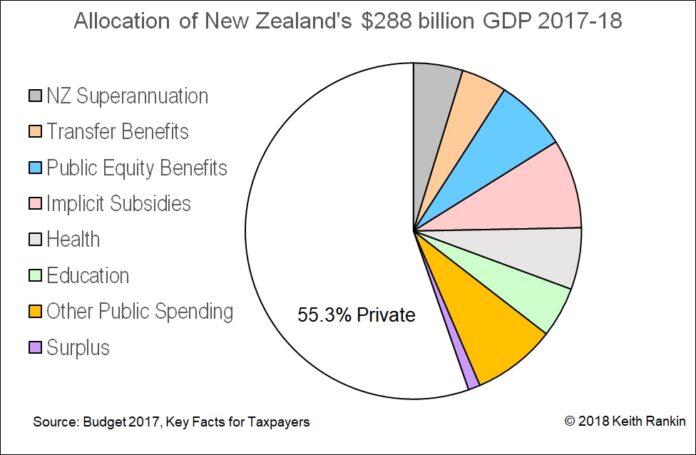
Chart analysis by Keith Rankin.
This month’s chart looks at New Zealand’s 2017-18 GDP (of $288 billion). The chart uses official data, with appropriate re-accounting, as presented to this year’s New Zealand Association of Economists’ Conference (also here, and see slides here); and taking note of our need to move from “primitive capitalism” to “economic capitalism” (see article here).
In the chart, the figures for ‘NZ Superannuation’, ‘Transfer Benefits’, ‘Health’, ‘Education’, ‘Other Spending’, and ‘Surplus’ are exactly as in the May 2017 Budget Statement. (I avoided using the 2018 Budget, because the presentation of information for public consumption this year was far too opaque. In previous years, Key Facts for Taxpayers gave a succinct summary of public revenue and expenses, albeit using our time-worn outdated public accounting conventions.)
My innovations have been to redefine Gross Public Revenue – giving a more accurate and intuitive measure of the size of the public hemisphere (refer to my Liberal Mercantilism and Economic Capitalism) – and then to reclassify income tax concessions as ‘Public Equity Benefits’ (refer to my Policy Observatory Report, Public Equity and Tax-Benefit Reform) and to expose the large remaining share of public income as ‘Implicit Subsidies’.
In the pie-chart, the coloured slices together (44.7%) represent the public hemisphere of the 2017-18 New Zealand economy. By subtraction, the remaining 55.3% represents the ‘private hemisphere’. The public hemisphere is calculated as 33% of GDP (gross domestic product, the total economic ‘pie’), plus indirect taxes, plus government income from sources other than taxation. (The true public hemisphere would be closer to 50% of GDP if we added local government rates. In the interests of simplicity, local government has been left out of my picture. I have also excluded Accident Compensation levies.)
Public Equity Benefits represent the accumulation of implicit cash benefits arising from the 10.5%, 17.5% and 30% concessionary rates of personal income tax. These benefits are regressive, and unconditional, presently maxing at $9,080 per year ($175 per week) for individuals in receipt of $70,000 (or more) before tax. Persons receiving $48,000 before tax presently receive an annual Public Equity Benefit of $8,420. (These figures have been – and will be – valid for the entire 2010s’ decade.)
Wearing my accountant’s hat, I am not advocating what benefits people should get; simply I am describing what people do receive, unconditionally, from public revenue. (Most of us receive income from private and public sources.) Like democracy, however (and changing my hat), universal public benefits must be good; the problem is that higher earners get more than their share, just as before 1890 (in democracy’s early years) men of property had more general election votes than other men (and women got no votes at all).
Implicit Subsidies are largely received by organisations and land-owners; many can be classed as corporate welfare. They include the five cents in the dollar discount on company taxation (the statutory company tax rate is 28%, in contrast with the personal tax rate of 33%). They include all other corporate tax concessions. They include the proceeds of tax avoidance and evasion. They also include tax concessions to charities. And they include tax not paid on rent attributable to owner-occupied properties.
Implicit Subsidies are more regressive than are Public Equity Benefits. Though some of them are justifiable, nevertheless we require public accounting standards that make all subsidies explicit.
Good public accounting standards inform good policy. Good capitalism acknowledges both economic hemispheres, private and public. Bad capitalist accounting disguises (even to intelligent people) how underprivileged people receive less than their democratic share of publicly-sourced income. Transparent public hemisphere accounting is the necessary sunlight that disinfects primitive capitalism.
Public Equity Benefits and Implicit Subsidies belong in the public hemisphere, not the private hemisphere.
Australian cricket’s wake-up call on a culture that has cost it dearly

Source: The Conversation (Au and NZ) – By Steve Georgakis, Senior Lecturer of Pedagogy and Sports Studies, University of Sydney
On the face of it, there is much to celebrate about Australian cricket right now. The sport has money to burn thanks to recent large pay-TV deals, the Big Bash has strong TV ratings; the women’s cricket team is one of the most successful and highly regarded Australian sporting teams. There has been a surge in junior participation, and many Australians still regard it as our national sport – it is certainly the dominant sport of the summer.
By contrast, cricket in the media is lurching from one crisis to another, with the fallout from the now-infamous ball-tampering episode still reverberating. Yesterday, the sport was dealt another blow.
An independent review of Cricket Australia’s culture was released, concluding that “winning without counting the costs” was largely responsible for the recent ball-tampering scandal and sledging – the on-field verbal abuse and taunting – that has been an entrenched habit of the Australian team for decades.
Read more: Just not cricket: why ball tampering is cheating
The review found the sport was riddled with cultural problems that exerted so much exerted pressure to win that it manifested in cheating and sledging, covertly sanctioned by the administrators. With 42 recommendations, it is clear Cricket Australia needs to change.
The biggest cultural issue for the sport at the moment is sledging, and one of the recommendations calls for cricket’s anti-harrassment code to address abusive behaviour.
While niggling a player might have been an acceptable part of the game, sledging has reached a point where a strict code of ethics needs to be drawn up and adhered to. While this may take away some of the unique nature of the sport, in the long run it will bring the focus back to the play.
Sledging matters because it is a type of cheating. The rise in cheating, whether it be via match-fixing or sledging, is linked to the rise in commercialisation and gambling in sport.
Australian cricket has formed commercial relationships with major sport betting agencies and an official partnership with Bet365. There have been numerous accusations regarding international match-fixers. And the ball-tampering scandal has confirmed that Australians no longer hold the moral high ground.
The relentless pressure to win has infected the sport at all levels. Sledging is but one of the symptoms.
Why does this matter so much to Australians? A clue may lie in what else is going on: a recent bank inquiry, fears related to immigration, contempt for politicians, growing distrust of public institutions, poor performance and declines in international educational testing, wage stagnation and declines (despite a world record run on economic growth), concern over high house prices and power bills. In 2018, Australians have much to be anxious and angry about.
Read more: Can the cricketers banned for ball tampering ever regain their hero status? It’s happened before
Cricket has always been held above everyday concerns, and has been a source of national pride and a salve in times of fear. Throughout the history of colonial Australia, cricket has been a source of inspiration, an institution that has provided strong links to our communities (school, geographical district, state and territories) and helped define Australian identity.
Modern Australians’ first organised sport in both schools and the community setting was cricket. Our first sporting wins against the “home country” – England – were in cricket Test matches. Cricket was responsible for giving us legitimacy.
Our best cricketers became heroes. Generations looked upon Don Bradman, Dennis Lillee, Steve Waugh and Mark Taylor as role models. It was the hegemonic sport and the cricketers best represented what Australian masculinity was about. If you played the sport, you played in a tough way (even though it is not a contact sport) within the highly revered rules; cricket could help you learn that gracious defeat is as admirable as victory.
Also, especially from about 1990 onwards, the Australian men’s team was outstanding. They won Test series and one-dayers with continued all-round brilliance, producing some of the greatest players the game has ever seen.
But, in the past few years, Australian cricket’s legitimacy has waned. Many of us who love the sport and all it represents have felt disillusioned by recent events at the elite level. This was confirmed to us yesterday with the report – which, thankfully, did not sugar-coat the diagnosis.
So what is the cure? A revised, strict and well-policed ethical code for staff and players will not be enough. Cricket needs to work with commercial partners, or abandon them if they can’t meet high ethical standards too.
Commercial and betting agendas create pressures to cheat, yet Sport 2030, our national plan for sport, under the banner “strengthening the sector’s integrity” suggests:
organisations… adopt a more efficient, model of governance which can best position sports to be able to drive greater commercial outcomes, reduce reliance on funding, increase autonomy and support innovation.
And there is the dilemma.
– ref. Australian cricket’s wake-up call on a culture that has cost it dearly – http://theconversation.com/australian-crickets-wake-up-call-on-a-culture-that-has-cost-it-dearly-105855]]>Five questions (and answers) about casual employment
Source: The Conversation (Au and NZ) – By Jeff Borland, Professor of Economics, University of Melbourne
Right now, it seems as if everyone’s talking about casual work.
Claims about what is (or is not) happening to casual employment are at the fore in debates about working conditions. Claims about what should (or should not) be the entitlements of casual workers have become the focus of a major Federal Court case in which the government has decided to intervene.
In the midst of these debates, it’s useful to take a step back and ask what is really happening to casual work and what we know about the consequences of casual work.
1. What is casual employment?
It may come as a surprise that there is no standard definition of a casual employee. The Fair Work Act 2009 (Cwth), for example, doesn’t include a definition.
Nevertheless, there is general agreement that a worker is a casual employee if their employer doesn’t make any advance commitment to ongoing employment or the amount or timing of work they will be asked to do.
Read more: FactCheck: has the level of casual employment in Australia stayed steady for the past 18 years?
An extra dimension comes from awards. Employees classified as casual in awards do not have a legal entitlement to many types of paid leave (mainly annual leave and sick leave) and other benefits such as severance pay. Instead, they get a 25% premium on their hourly wage.
Ambiguity about the definition has caused ambiguity in the data. The most commonly cited statistics on casual work, from the Australian Bureau of Statistics, classify workers as casual if they report not having entitlements to paid leave.
The main alternative approach is for casual workers to self-identify. With each approach there is some doubt about whether what is being measured corresponds to what most people think of as casual work.
2. Why are there competing claims about trends?
Is the proportion of the workforce in casual employment increasing, as trade unions and some workplace commentators would have you believe, or is it unchanging, as the government claims?
The answer is both, depending on the time period you look at.
In the graph below I have used ABS data to show the proportions of male and female employees in casual work (more precisely, work without paid leave entitlements) from the early 1980s onwards.
For about 20 years, from the early 1980s to early 2000s, casual employment was on the rise for both men and women.
Then from the early 2000s to the present, there was little change, for both men and women.
So the time period matters. If you begin in the early 1980s and compare it to the present, the incidence of casual work has certainly increased.
But if you start in the early 2000s, there’s no evident long-run increase.
There is, however, an interesting pattern within the period from the early 2000s to the present.
Until the early 2010s the proportion of casual employees was actually in decline, falling from about 25.5% to 23.5%.
In the past few years the proportion has climbed back to its previous level of about 25.5%. It’s too early to tell whether this is the start of a new trend.
3. Who is working casually?
We know quite a bit about who works casually. Women are more likely to be in casual jobs than men, although the gap is narrowing. More than half of all part-time employees are in casual jobs, but only about 10% of full-time employees.
Workers on regular daytime shifts are less likely to be in casual jobs than those who work in the evening or at night.
Read more: Precarious employment is rising rapidly among men: new research
Casual employment being concentrated in part-time jobs means it accounts for a larger share of the number of people employed than it does of hours worked.
For example, in August 2018 more than one-quarter of employees were in casual jobs, but only 17% of the hours worked were in casual jobs.
As can be seen from the graphs below (each from the most recent year for which figures are available) casual employment is highest among the youngest workers and those in the least skilled occupations.
4. What comes after casual work?
Uncertainty over job security and hours of work and the absence of entitlements in casual jobs mean that some casual workers would prefer to be in permanent jobs.
Certainly, a variety of studies using data from the Melbourne Institute’s Household Income and Labour Dynamics (HILDA) Survey find that casual employees report lower levels of job satisfaction than comparable employees in other types of jobs.
As a result, a concern that is often expressed is that workers might get trapped in casual jobs.
To see if this is the case, I have summarised the findings of a recent study by Inga Lass and Mark Wooden.
They use HILDA Survey data from 2001 to 2015 to determine how workers move between types of employment over time.
It is apparent that workers in casual jobs do move on to permanent jobs, but it can take time.
From one year to the next about half of all casual workers remain in casual employment, with 30% moving to other types of work and 15% no longer working.
Pushing the time horizon out to five years shows more mobility. More than half move to other types of employment, although around one-quarter still remain casual.
Read more: Eviction from the middle class: how tenuous jobs penalise women
A potential counter to concerns about being trapped in casual work is that casual employment can be an important entry point to paid work.
The same study by Lass and Wooden shows that of people who a year ago had been unemployed or out of the labour force, and who 12 months later had been able to move into work, almost half had taken casual jobs.
5. Does ‘casual’ tell us what we need to know?
In recent public commentary, the word “casual” has come to be a catch-all term – used to encapsulate everything we need to know about work conditions.
That’s unfortunate for several reasons.
First, while casual employment might create the scope for workers to be more easily terminated or to have less stable hours of work or earnings, for many casual workers that doesn’t happen.
It’s more useful to study the outcomes we care about, such as job security and earnings stability.
Read more: Self-employment and casual work aren’t increasing but so many jobs are insecure – what’s going on?
Second, casual employment doesn’t tell us how many workers are in other – less stable – forms of employment where there might be concerns about conditions, such as independent contracting or the gig economy.
Third, we can’t be entirely sure what types of jobs are captured by existing measures of casual employment.
A Productivity Commission study in the late 1990s found that about one-third of all employees identified as casual by the criterion of not having paid leave entitlements were in fact owner-managers or permanent employees.
“Casual” means less than we might think.
– ref. Five questions (and answers) about casual employment – http://theconversation.com/five-questions-and-answers-about-casual-employment-105745]]>Newsletter: New Zealand Politics Daily – October 30 2018
Newsletter: New Zealand Politics Daily – October 30 2018
Editor’s Note: Here below is a list of the main issues currently under discussion in New Zealand and links to media coverage.
[caption id="attachment_297" align="aligncenter" width="640"] The Beehive and Parliament Buildings.[/caption]
Immigration, Karel Sroubek residency decision
Dileepa Fonseka and Steve Kilgallon (Stuff): Immigration NZ fields more tip offs about scams than it can manage
1News: Jacinda Ardern defends decision not to deport Czech drug smuggler – ‘There’s other information, obviously’
Derek Cheng (Herald): Prime Minister Jacinda Ardern backs her minister over not deporting Czech drug smuggler Karel Sroubek
Zane Small (Newshub): ‘This is now a decision for him’: Jacinda Ardern defends drug lord’s residency
Barry Soper (Newstalk ZB): Public deserve an explanation of Karel Sroubek decision
Derek Cheng (Herald): PM Jacinda Ardern says Karel Sroubek decision was difficult for Immigration Minister Iain Lees-Galloway
Scott Palmer and Anna Bracewell-Worrall (Newshub): ‘Not an easy one’: Jacinda Ardern defends decision to grant drug lord Karel Sroubek residency
RNZ: Czech smuggler previously had residency – under a false identity
Derek Cheng (Herald): Immigration Minister releases letter setting out residency conditions for Karel Sroubek
Collette Devlin (Stuff): Drug smuggler Karel Sroubek’s ‘strict conditions’ to remain in New Zealand
1News: Czech drug smuggler granted NZ residency under strict conditions, Immigration Minister says
Dan Satherley (Newshub): Immigration Minister Iain Lees-Galloway reveals Karel Sroubek’s residency conditions
Derek Cheng (Herald): National MP to travel to Czech Republic if Govt fails to give immigration answers
Northland Age: MP protest after drug smuggler granted residency, Switzer care worker deported
Dan Satherley (Newshub): Immigrant drug lord Karel Sroubek should be ‘gone by lunchtime’ – Simon Bridges
RNZ: Minister criticised over drug smuggler’s residency
Harrison Christian (Stuff): Couple struggling to remain in NZ disgusted drug dealer Karel Sroubek was granted residency
David Farrar: What the Parole Board said
David Farrar: The full background of the guy given residency by Labour
Health and disability
Hannah Martin (Stuff): Regulating junk food, alcohol, tobacco marketing could assist cancer prevention – experts
Newshub: Junk food marketing needs to be changed to reduce risk of obesity induced cancers
Karen Brown (RNZ): One Year On: The cost of accessible healthcare
Ananish Chaudhuri (Herald) Racial bias unlikely in resuscitation attempts for premature births
Oliver Lewis (Stuff): Health cuts feared as boards ordered to reduce deficits
Libby Wilson (Stuff): Waikato DHB launches crackdown on expected $56m deficit
RNZ: Sunday Morning: Dr Nick Wright: eating a plant-based diet
Elena McPhee (ODT): Benefits to higher excise tax: research
1News: ‘Alarming’ new study shows 33 per cent of Kiwis are drinking hazardously their entire adult lives
Dennis Maga (Stuff): Ambulance workers deserve better pay
Karen Brown (RNZ): World shortage of HPV vaccine disrupts immunisation in NZ
Annette Lambly (Stuff): Whangarei council votes for more outdoor spaces smokefree by 2020
Mike Houlahan (ODT): War kept killing after 1918: study
Herald: New study finds WWI cast a long shadow over New Zealanders’ health
Aine Kelly-Costello and Mitch McCann (Newshub): Blind Foundation members break down barriers in the newsroom
Newshub: The amazing story of June Hieatt
Phil Pennington (RNZ): Porirua community demands help after six suicides: ‘It’s just too many’
Housing
Herald: Criticism over new KiwiBuild buyers’ suitability, housing minister says homes not for low-income families
Susan Edmunds (Stuff): KiwiBuild not for low-income families, says housing minister
Scott Palmer (Newshub): KiwiBuild ‘not aimed at low-income families’ – Phil Twyford
David Farrar: Yes it is like winning Lotto
Eva Corlett (RNZ): Barrier to compensation over flawed meth testing leaves bitter taste
Derek Cheng (Herald): PM hopes compensation for flawed meth tests by Xmas
Michelle Cooke and LIsa Owen (RNZ): Checkpoint: Law change ‘likely’ before meth compensation can be paid out
Deena Coster (Stuff): $750K grant breathes life into kaumātua housing initiative
Susan Edmunds (Stuff): Aussie property market slowdown might (and might not) be contagious
Government
Colin James (RNZ): Polls show coalition well-placed in second year of govt
ODT Editorial: Labour’s satisfactory first year
David Cormack (Herald): The politics of doing jack-all
Bryce Edwards (Herald): Political Roundup: Verdicts on the Government’s first year
Jenée Tibshraeny (Interest): Are criticisms that the Labour Party is the ‘tax party’ are well-founded?
Whena Owen (1News): Shane Jones’ tari: ‘Welcome to the lair’
Online voting, party membership, parliament
Liam Hehir (Stuff): Political parties benefit from having a broad base of members
Josie Pagani (Stuff): The politics of ‘tribal’ membership
Janine Rankin (Manawatū Standard): Online voting no cure for apathy, says academic
David Farrar:Huge increase in overseas votes because of e-voting
Katie Fitzgerald (Newshub): Christians return to Parliament to protest removal of Jesus from prayer
Jason Walls (Herald): Speaker Trevor Mallard ‘has no plans’ to reintroduce Jesus into Parliamentary prayer
Abortion
Liz Beddoe (Newsroom): Abortion law change at last in sight
RNZ: Simon Bridges: Abortion law change a ‘conscience issue’ for MPs
1News: Should abortion be a health issue, rather than in the Crimes Act? Q+A debate
Bob McCoskrie : The Q+A abortion debate
Foreign affairs
Jo Moir (RNZ): ‘The days of treating you as pests are over’
Derek Cheng (Herald): Winston Peters flags $70m for nurturing Pacific NGOs
1News: The Story with John Campbell: Trapped on Nauru
Thomas Coughlan (Newsroom): Ardern softly raises concern over Uighurs
Primary industries, animal welfare
Pat Deavoll (Stuff): The light and the dark sides of the pork industry
Gerard Hutching (Stuff): Countdown sells Kiwi free farmed fresh pork only
Ewan Sargent (Stuff): Lamb hunter: ‘They have a good life, then bang’
Tamsyn Parker (Herald): Kiwi firm Craft Meat Company launches meat-free mince
Farah Hancock (Newsroom): Taking animals out of the lab
Jamie Gray (Herald): NZ dairy farm prices drop 18 pct as environmental, foreign investment concerns bite
Stuff: Walker raises concerns about new farming rules
Heather Chalmers (Stuff): Ngāi Tahu Farming replaces forestry with 14,000 cows at Eyrewell
Environment and conservation
Rachael Kelly (Southland times): Salmon company wants exclusive use of Stewart Island coastal area
Alexander Robertson (Herald): Local Focus: Multi-kill traps deployed to save our rarest duck, the whistling whio
Zane Small (Newshub): Tauranga Mayor calls for restrictions on so-called ‘flushable’ wet wipes
Oil and gas exploration ban
Mike Joy (Newsroom): Energy makes the economy go round
Richard Harman (Politik): Ardern has to defend high speed legislative process
Hamish Rutherford (Stuff): Prime Minister says offshore oil permit ban legislation offers ‘complete certainty’ to industry
Jenée Tibshraeny (Interest): Ardern defends short consultation period on oil/gas exploration ban
Education
Peter Lyons (ODT): Bid to bring in teachers shows up sad status of profession
Luke Kirkeby (Stuff): Foreign teachers bridging New Zealand’s shortage
Laura Walters (Newsroom): Teachers want long-term solutions
Adele Redmond and Josephine Franks (Stuff): One third of early childhood centres struggling to fill vacancies, sector survey says
Jessie Chiang (RNZ): ‘We’re known to be nurses, social workers – you name it’
Dave Armstrong (Stuff): Science shouldn’t be a ‘nice to have’ in schools
Joanna Kidman and Vincent O’Malley (Briefing Papers): The New Zealand Wars and the School Curriculum
Josh Williams (Herald): Apprenticeships and training a tertiary education success story
Local government
Liz McDonald (Stuff): Mayor sticks to short showers as council urges water restraint
Bernard Orsman (Herald): $1.5m needed to fix deteriorating turf at Eden Park to guarantee continuation of All Black tests and T20 cricket matches
Robin Martin (RNZ): Rubbish offer forces councils to reconsider $42m landfill plan
Deena Coster (Stuff): Waitara residents upset by MP’s no show at leaseholders’ meeting
Transport
Todd Niall (Stuff):It’s time to ensure scootering stays fun for everyone
Press Editorial: Teething problems no reason to simply abandon trial
Newshub: No changes needed for Lime electric scooters – Gerry Brownlee
Nita Blake-Persen (RNZ): Number of e-scooter ACC claims rises to 38
Alice Webb-Liddall and Ella Prendergast (Newshub): The substantial number of Lime scooter ACC injury claims in NZ already
Mike Yardley (Stuff): Footpaths should be a no-no for scooters
Debrin Foxcroft (Stuff): ACC numbers reveal a 27-fold increase in e-bike related accidents in last five years
Damian George (Stuff): At least 30 Wellington bus routes need fixing as network continues to struggle
RNZ: Wellington bus strike called off
Zane Small (Newshub): Car battery callouts spike in wake of rising fuel prices
Colin Williscroft (Stuff): Speed limits as low as 60kmh proposed for parts of SH1 near Kaikoura
Kawe Roes (Māori TV): New railway line to Marsden Point being investigated by KiwiRail
Employment
Gerard Hutching (Stuff): Construction and agriculture serious injuries on the rise
Rob Stock (Stuff): Multi-national corporation breaches New Zealand bargaining law
Herald: Bidfood found to have breached employment laws
Newshub: Bidfood New Zealand found to have breached employment laws
Business
Nona Pelletier (RNZ): SME confidence collapses as revenue falls sharply
Catherine Harris (Stuff): Influencers lay out plan to get more women on boards
Royal visit
Laura O’Connell Rapira (Spinoff): At Government House with the royals, 183 years after we declared our independence
Herald Editorial: Harry and Meghan royalty with a difference
Jason Walls (Herald): PM Jacinda Ardern gifts Prince Harry a Shapeshifter CD and Meghan a pair of Boh Runga earrings
Stuff: Prime Minister gifts music album and earrings to Prince Harry and Meghan
Peter de Graaf (Northern Advocate): ‘Star-struck’ Northland MP Willow-Jean Prime talks period poverty with Duchess
Eleanor Ainge Roy (Guardian): Meghan Markle praised for speaking Māori in New Zealand suffrage speech
Other
John Armstrong (1News): The sad truth for Simon Bridges is that the vast proportion of the public simply don’t like him
Cate Broughton (Stuff): EQC’s disaster fund to get $50m Government top up, months earlier than forecast
Tom Pullar-Strecker (Stuff): NZ experts cautious about following UK with new tax on digital giants
Simeon Brown (Spinoff): A middle ground on drug laws: Simeon Brown responds to Chlöe Swarbrick
Gia Garrick (RNZ): Whistleblower protection: firms and charities may face tougher reporting
Mike Dinsdale (Northern Advocate): Twenty-one kids in state care commit crimes in Tai Tokerau in a year
Gareth Vaughan (Interest): Five things to look for in the Financial Markets Authority and Reserve Bank report on New Zealand banks’ conduct and culture
Paul McBeth (BusinessDesk): RBNZ’s Orr ‘off-the-record’ speech
Ian Taylor (ODT): Govt must be shown how region is behind project
Amber-Leigh Woolf (Stuff): Te Papa lacking enough internal staff to look after entire collection, experts say
1News: Police investigate ‘date rape’ complaint at Auckland K Road bar amid calls for better reporting
RNZ: Samoa to tighten adoption laws to counter slave labour
Pam Jones (ODT): Freedom camping rules push
Jessica Tyson (Māori TV): Documentary series on Ihumātao land protest wins top award
Greg Moyle (Herald): A museum at Le Quesnoy will remember our war contribution
Conor Twyford (Spinoff): We asked a trans woman to speak on our #metoo panel. Then the abuse began.
Stuff: John Campbell launches podcast, looks at trains during first six weeks at TVNZ]]>
New Zealand politics: how political donations could be reformed to reduce potential influence
Source: The Conversation (Au and NZ) – By Simon Chapple, Director, Institute for Governance and Policy Studies, Victoria University of Wellington
In the aftermath of the controversy surrounding former MP Jami-Lee Ross and opposition National party leader Simon Bridges, discussions have focused on possible reforms of political donations in New Zealand.
My colleagues Bryce Edwards and Michael Macaulay have raised the issue of taxpayer funding of political parties. So too has Minister of Justice Andrew Little.
Green Party MP Marama Davidson has suggested the donation threshold for the disclosure of a donor’s name and address be lowered from NZ$15,000 to NZ$1,000. She has also proposed banning foreign donations outright and capping individual donations at NZ$35,000.
Several of these proposals warrant further discussion and contextualisation.
Read more: New Zealand politics: foreign donations and political influence
Donations and foreign money
Foreign interference in domestic politics is an increasing phenomenon worldwide.
Currently in New Zealand foreign donations to a party of up to NZ$1,500 are permissible. Moreover, foreign donations below this amount are not individually or collectively disclosed.
It would be easy for a foreign state or corporate body seeking political influence to channel a large number of donations into the system just under the threshold via numerous proxies. Whether such interference has been happening is unclear, since New Zealanders do not know how much money currently comes in to political parties via foreign actors.
Even if foreign donations are not a problem now, one could rapidly develop. A strong argument can be made that foreign money has no place in democracy, including New Zealand’s.
New Zealand would not be going out on an international limb by banning foreign donations. Foreign donations to political parties are not permissible in the [United Kingdom, Ireland and the United States. They are also banned in Canada but unfortunately a significant loophole exists. Australia is currently in the process of banning foreign donations.
Lowering threshold for anonymous donations
As noted, the threshold below which political donations can be anonymous could be lowered. A lower threshold would make it more difficult to evade name disclosure rules by splitting donations and attributing each part to a different donor.
Splitting may be what happened to the alleged NZ$100,000 Yikun Zhang donation. The NZ$1,000 threshold proposed by the Greens would be a huge improvement on the status quo. A donor of NZ$100,000 seeking to evade legislation and to remain anonymous would have to coordinate 100 individual donors, rather than seven.
But New Zealand could go lower still, to NZ$200, without being radical. Giving NZ$200 to a political party is huge for an ordinary New Zealander, and the reality is only a very small minority would need to disclose their names under such a law.
There is international precedent for setting much lower thresholds for anonymity than the Greens propose. For example, in Canada, the maximum amount of an anonymous donation was set at C$200 in 2015, while in Ireland it is currently €100.
Donor privacy versus transparency
One concern with non-anonymity is that it delivers public transparency at the cost of private donor privacy. Currently the Electoral Act 1993 contains a mechanism for anyone wanting to donate to a political party and not wanting their identity disclosed to either the public or to the party receiving the donation. To obtain such anonymity, the donation needs to be more than NZ$1,500.
The Electoral Commission aggregates all such donations. It passes them on to parties at regular intervals. It does not identify the dollar amount of individual donations, or the number or names of donors.
Not many donors use this protected disclosure avenue. For example, between September 2015 and June 2018, the commission passed on only NZ$150,000 in anonymised money to parties via this channel. At the same time amounts well in excess of NZ$10 million were passed on by donors identifiable to political parties (but not necessarily to the public).
A preference for identifiable channels suggests current donors get value from non-anonymity. It implies most donors feel they are buying something. The fact that donors feel they are buying something should be cause for concern.
Capping donations and individualising donors
The Greens have suggested NZ$35,000 as a maximum cap on donations. Again, New Zealand could go much lower without being out of step with other countries. For example, in Canada donations to each political party are capped at C$1500 a year. Like Canada, Ireland has a maximum annual cap of €2500.
However, Geoff Simmons, leader of the Opportunities Party, has argued that a cap would make it difficult for small parties to get started. Simmons’ party was kick-started by large donations from multi-millionaire Gareth Morgan, who was also the party’s first leader.
Another possibility for the reform agenda is the Canadian approach of only permitting donations from individual people. Corporate and trade union donations are banned. However this proposal is unlikely to be popular with neither National, which receives considerable corporate donations, nor Labour, which traditionally gets significant trade union funding.
All these proposals, inevitably, have pros and cons and possible unintended consequences. They are deserving of wide public debate. One hopes that the current government can provide the public with a credible forum for such discussions, and a clear pathway to sensible future reform.
– ref. New Zealand politics: how political donations could be reformed to reduce potential influence – http://theconversation.com/new-zealand-politics-how-political-donations-could-be-reformed-to-reduce-potential-influence-105805]]>