In this series, we look at under-acknowledged women through the ages.
The world’s first known author is widely considered to be Enheduanna, a woman who lived in the 23rd century BCE in ancient Mesopotamia (approximately 2285 – 2250 BCE). Enheduanna is a remarkable figure: an ancient “triple threat”, she was a princess and a priestess as well as a writer and poet.
The third millennium BCE was a time of upheaval in Mesopotamia. The conquest of Sargon the Great saw the development of the world’s first great empire. The city of Akkad become one of the largest in the world, and northern and southern Mesopotamia were united for the first time in history.
In this extraordinary historical setting, we find the fascinating character of Enheduanna, Sargon’s daughter. She worked as the high priestess of the moon deity Nanna-Suen at his temple in Ur (in modern-day Southern Iraq). The celestial nature of her occupation is reflected in her name, meaning “Ornament of Heaven”.
Enheduanna composed several works of literature, including two hymns to the Mesopotamian love goddess Inanna (Semitic Ishtar). She wrote the myth of Inanna and Ebih, and a collection of 42 temple hymns. Scribal traditions in the ancient world are often considered an area of male authority, but Enheduanna’s works form an important part of Mesopotamia’s rich literary history.
Ancient Akkadian cylindrical seal depicting Mesopotamian love goddess Inanna.Wikimedia Commons
Enheduanna’s status as a named poet is significant given the anonymity surrounding works of even earlier authors. Yet she is almost entirely unknown in the modern day, and her achievements have been largely overlooked (a notable exception is the work of Jungian analyst Betty De Shong Meador). Her written works are deeply personal in subject, containing numerous biographical features.
Enheduanna’s cycle of temple hymns concludes with an assertion of the work’s originality and its authorship:
The compiler of the tablets was En-hedu-ana. My king, something has been created that no one has created before.
While clearly asserting ownership over the creative property of her work, Enheduanna also comments on the difficulties of the creative process — apparently, writer’s block was a problem even in ancient Mesopotamia.
Long hours labouring by night
In her hymns, Enheduanna comments on the challenge of encapsulating divine wonders through the written word. She describes spending long hours labouring over her compositions by night, for them then to be performed in the day. The fruits of her work are dedicated to the goddess of love.
Enheduanna’s poetry has a reflective quality that emphasises the superlative qualities of its divine muse, while also highlighting the artistic skill required for written compositions.
Enheduanna’s works were written in cuneiform, an ancient form of writing using clay tablets but have only survived in the form of much later copies from around 1800 BCE, from the Old Babylonian period and later. The lack of earlier sources has raised doubts for some over Enheduanna’s identification as the author of myths and hymns and her status as a religious official of high rank. However, the historical record clearly identifies Enheduanna as the composer of ancient literary works, and this is undoubtedly an important aspect of the traditions surrounding her.
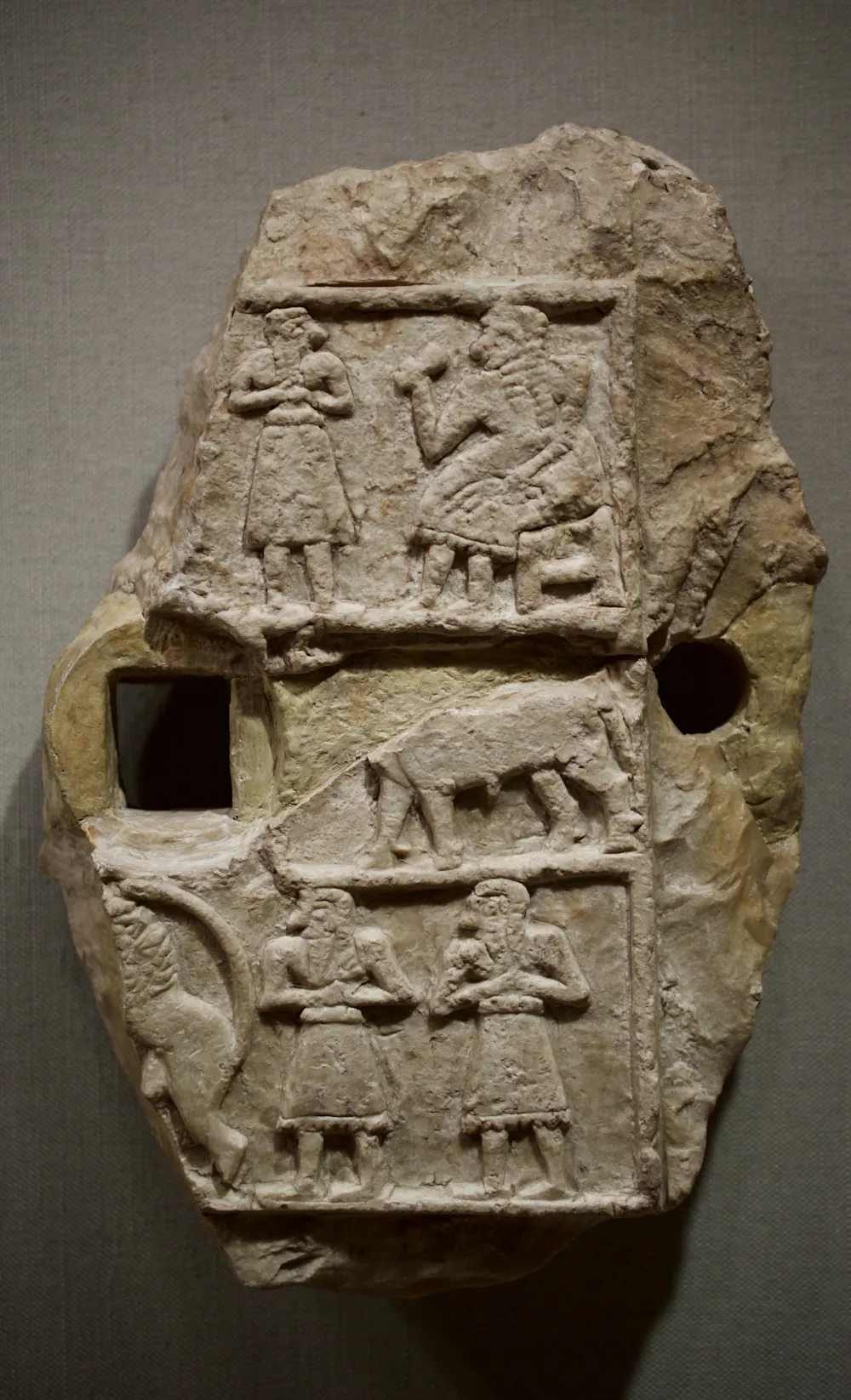
Aside from poetry, other sources for Enheduanna’s life have been discovered by archaeologists. These include cylinder seals belonging to her servants, and an alabaster relief inscribed with her dedication. The Disk of Enheduanna was discovered by British archaeologist Sir Charles Leonard Woolley and his team of excavators in 1927.
The Disk was discarded and apparently defaced in antiquity, but the pieces were recovered through excavations and the scene featuring the writer successfully restored. The scene depicts the priestess at work: along with three male attendants, she observes a libation offering being poured from a jug.
Enheduanna is situated in the centre of the image, with her gaze focused on the religious offering, and her hand raised in a gesture of piety. The image on the Disk emphasises the religious and social status of the priestess, who is wearing a cap and flounced garment.
Art imitates life
Enheduanna’s poetry contains what are thought to be autobiographical elements, such as descriptions of her struggle against a usurper, Lugalanne. In her composition The Exaltation of Inanna, Enheduanna describes Lugalanne’s attempts to force her from her role at the temple.
Enheduanna’s pleas to the moon god were apparently met with silence. She then turned to Inanna, who is praised for restoring her to office.
The challenge to Enheduanna’s authority, and her praise of her divine helper, are echoed in her other work, such as in the myth known as Inanna and Ebih.
In this narrative, the goddess Inanna comes into conflict with a haughty mountain, Ebih. The mountain offends the deity by standing tall and refusing to bow low to her. Inanna seeks help from her father, the deity Anu. He (understandably) advises her against going to war with the fearsome mountain range.
Inanna, in typically bold form, ignores this instruction and annihilates the mountain, before praising the god Enlil for his assistance. The myth contains intriguing parallels with the conflict described in Enheduanna’s poetry.
In the figure of Enheduanna, we see a powerful figure of great creativity, whose passionate praise of the goddess of love continues to echo through time, 4000 years after first being carved into a clay tablet.
Note: Translations of the Temple Hymns are taken from Black, J.A., Cunningham, G., Fluckiger-Hawker, E, Robson, E., and Zólyomi, G., The Electronic Text Corpus of Sumerian Literature, Oxford 1998.
Veterinarians have a professional and moral obligation to reduce or prevent any negative health impacts of disorders in animals. But what if animals are bred with known disorders? And what if those disorders are a big part of what makes them cute?
In a paper, published earlier this year in Animals, we argue that veterinarians must do more to discourage the breeding of animals with conditions known to seriously compromise their welfare.
This is the case with extreme brachycephalic or short-skulled dogs, including French bulldogs, pugs, British bulldogs, Boston terriers, and Cavalier King Charles spaniels.
The trend towards shorter skulls seems to have taken hold since the 1870s and the development of breed standards that inadvertently encouraged extreme “conformation” (shape, size and anatomical proportions).
Extreme brachycephaly is associated with a range of disorders, most notably Brachycephalic Obstructive Airway Syndrome (BOAS). BOAS occurs in shorter-skulled dogs because the nose, tongue, soft palate and teeth are crammed into a relatively small space, reducing the size of the airway.
Clinical signs of BOAS include increased respiratory noise, effort and difficulty in breathing, an intolerance to exercise, gagging, blue gums (in the mouth), overheating and fainting.
The hotter the temperature, the harder these dogs have to work to cool down by panting. As a result, the tissues of the upper airway swell, further reducing airflow and eventually causing airway obstruction, which causes them to get hotter . It’s a life-threatening vicious cycle.
This reduced capacity to cope with heat explains why Qantas no longer permits the transport of affected breeds on flights longer than five hours, or those with more than two sectors per journey.
Affected dogs also change the way they sleep to avoid airway obstruction, sometimes by adopting a sitting position. They also raise their chins or sleep with a toy between their teeth to keep their airways open. Indeed, 10% can sleep only with an open mouth.
Extremely short skulls are associated with excess carbon dioxide concentrations (that shift the acid-base balance of the blood), neurological deficits, skin disease, eye disease and certain behavioural disorders.
Brachycephalic dogs also have an increased anaesthetic risk – and yet increasingly need surgery to treat these problems.
This is not new information. For example, in 2008, the documentary Pedigree Dogs Exposed revealed the impact of extreme brachycephaly on dogs.
But they’re popular dogs
Despite accumulating evidence about the health and welfare impacts of brachycephaly, affected breeds are becoming more popular.
In the last decade, registrations of French bulldogs have increased by around 3,000%. This prompted kennel clubs to warn prospective owners about the real possibility of bad breeders trying to cash in on the trend.
Extreme brachycephalic dogs aren’t the only ones bearing the costs of inherited health and welfare problems.
Figures from overseas and Australian pet insurance providers confirm that the financial costs of owning extreme brachycephalic dogs are high. This is due to the many conditions they suffer from including, but not limited to, BOAS.
Analysis of more than 1.27 million Australian pet insurance claims over a nine-year period (2007-2015) confirms this.
Dysphagia (problems swallowing), vomiting, regurgitation and flatulence are other common clinical signs in brachycephalic breeds.
There is also the emotional cost of owning dogs that may require extensive treatment, and live, on average, shorter lives than their longer-nosed canine counterparts.
What more can vets do?
The brachycephalic dog patient may place veterinarians in ethically challenging situations when they are approached to help in treatment and breeding of affected animals.
In discussing breed-associated disorders, veterinarians may appear to be critical of the very features that clients find most endearing about their companion animals and some have preferred to speak up only anonymously. Or veterinarians may have a conflict of interest if they draw an income from treating the typical disorders.
But unless veterinarians and breed organisations speak up, the demand for extreme brachycephalic breeds will continue. The enormity of the welfare problem is increasing with the increased demand for affected dogs.
The Australian Veterinary Association (AVA) and the RSPCA Australia joined forces back in 2016 to promote awareness of these health and welfare problems in their Love is Blind campaign.
“They’re lovely dogs …” but!
Breeder organisations are exploring ways to moderate extreme shapes in the show-ring. For example, a survey published last year of 15 national kennel clubs, identified exaggerated morphological features and inherited disorders as their chief concerns.
Companies can also play a role. Last year New Zealand’s online marketplace Trade Me banned the sale of pugs, French bulldogs and British bulldogs on animal welfare grounds.
Every veterinarian must provide every individual patient with the best possible care they can. But given what we know, we’re also morally obliged to discourage breeding of dogs with extreme brachycephaly so that we can turn off the tap on this suffering.
It’s also something potential dog-owners should be more aware of. They might think they look cute, but those extreme brachycephalic dogs could be costly, both financially and emotionally.
Words are powerful, and a rich vocabulary can provide young people with significant advantages. Successful vocabulary development is associated with better vocational, academic and health outcomes.
When parents read books aloud to their children from an early age, this offers notable advantages for children’s vocabulary development. This gives them a broader range of possible word choices.
Research also suggests children who don’t have the opportunity for shared reading are comparatively disadvantaged. If we want our children to be able to draw on a rich vocabulary to express themselves clearly, we need to read to them. Developing a child’s vocabulary is a valuable investment in their future.
Benefits of reading aloud
In the very early years, spoken vocabularies have been associated with higher achievement in reading and maths, and better ability to regulate behaviour. Vocabulary is also linked to success in reading comprehension and related word recognition skills.
Much of a child’s vocabulary is acquired through daily conversations. Shared reading aloud can provide a valuable additional source of new words children can use to power their expression. Research suggests the text of picture books offers access to more diverse vocabulary than child-directed conversations.
At some point, most of us have experienced the frustration of searching for an elusive word that is essential to clearly communicate an idea or a need. When children speak or write, they draw on their vocabulary to make word selections that will optimise the clarity and accuracy of their expression.
Reading can make for valuable parent-child bonding time.from www.shutterstock.com
Beyond vocabulary, reading aloud offers numerous additional benefits for children. Reading aloud may support students to develop sustained attention, strong listening skills, and enhanced cognitive development.
Recent research also suggests children who are read to from an early age may be less likely to experience hyperactivity. Children who are at risk of reading difficulties may particularly benefit from being read to. Children who are learning English as an additional language may experience better reading comprehension when they are read to in English.
Reading aloud with your child is also valuable parent-child time. It can strengthen the parent-child relationship and foster reading engagement, which is essential if we want our children to enjoy the benefits of being a life-long reader.
How can I optimise vocabulary growth for my child?
Vocabulary development can be improved through explicit teaching techniques such as providing definitions for new words. For example, while reading to your child, when you encounter a new word you may pause and ask the child what they think it means.
If they’re unsure, you can then read a little further along so the word is encountered in a context that can give valuable clues about meaning. If the meaning is still unclear, you can provide a definition for your child so you can move on.
A recent study found approaches that involve pointing, providing definitions, and asking some questions as you read together can be good for vocabulary building.
Recent research found nearly identical gains in vocabulary where children were read to either using explicit techniques (such as pointing and giving definitions) or a more engaging storytelling approach. In the storytelling approach, the adult reading to the child added contextual information, which made the child more interested and engaged in the story.
Children will also benefit from hearing the same story a number of times. It’s also a good idea to use some of the new language in subsequent conversation if possible. This can increase exposure and strengthen retention of new words.
We may not always have a book at hand. In these cases, you can draw on your creativity and tell a story, which can also benefit vocabulary.
While there is limited research in this area, one study compared telling a child a story or reading them a story with a child reading silently to themselves. The study found all three groups of children learned new words. But telling a story and reading a story to a child offered superior gains in vocabulary.
Beating the barriers
Research suggests that children may be aware of the benefits of listening to books read aloud. This awareness can be a source of regret for the child when reading aloud at home ends, but they still enjoy shared reading. Children may continue to enjoy and benefit from being read to beyond the early years. You should keep reading with your children as long as they let you.
Children get more benefit out of shared reading than reading alone.from www.shutterstock.com
By far, the biggest barrier raised by parents to reading aloud to their children was the formidable barrier of time. If reading aloud becomes a routine part of family life, like dinner and bedtime, this barrier may be overcome as the practice becomes an everyday event.
Due to diverse issues faced in homes and families, not all parents will be able to read their child a book, or tell them a story. This is why it’s still so important for schools to provide opportunities for students to regularly listen to engaging and culturally diverse books.
But reading aloud is not a typical daily classroom practice. We should increase the number of opportunities children have to hear stories both at home and in schools so children can experience the many benefits of a rich and varied vocabulary.
This is the second of two articles looking at the increasing reliance of Australian cities on desalination plants to supply drinking water, with less emphasis on the alternatives of water recycling and demand management. So what is the best way forward to achieve urban water security?
An important lesson from the Millennium Drought in Australia was the power of individuals to curb their own water use. This was achieved through public education campaigns and water restrictions. It was a popular topic in the media and in daily conversations before the focus turned to desalination for water security.
Water authorities were also expanding the use of treated wastewater – often a polite term for sewage – for “non-potable” uses. These included flushing toilets, watering gardens, and washing cars and laundry.
Australia has several highly successful water recycling projects.
Sydney introduced the Rouse Hill recycled water scheme in 2001. Highly treated wastewater is piped into 32,000 suburban properties in distinct purple pipes. Each property also has the normal “potable” drinking water supply.
Recycled water can play an important role in agricultural schemes. There are successful examples in South Australia (Virginia Irrigation Scheme), Victoria (Werribee) and New South Wales (Picton).
This “groundwater replenishment” adds to the groundwater that contributes about half of the city’s water supply. The Water Corporation of Perth has a long-term aim to recycle 30% of its wastewater.
Southeast Queensland, too, has developed an extensive recycled water system. The Western Corridor Recycled Water Scheme also uses reverse osmosis and can supplement drinking water supplies during droughts.
Past campaigns to get people to reduce water use achieved significant results.
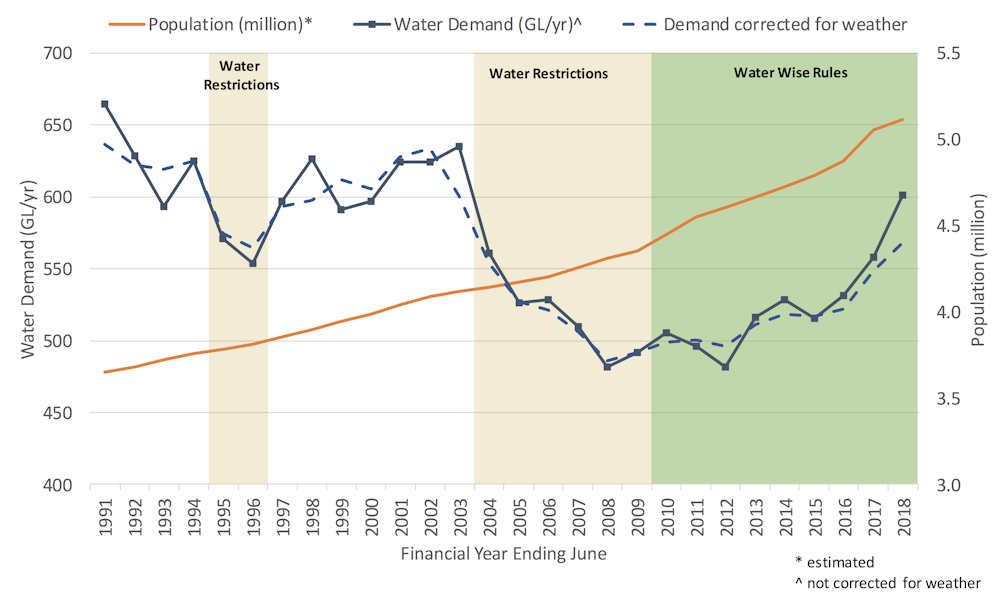
In Sydney, water use fell steeply under water restrictions (2003-2009). Since the restrictions have ended, consumption has increased under the softer “water wise rules”. Regional centres including (Tamworth) outside of Sydney are under significant water restrictions currently with limited relief in sight.
In a comparison of mainland capitals Melbourne used the least water per residential property, 25% less than the average. Southeast Queensland residents had the second-lowest use, followed by Adelaide. Sydney, Perth and Darwin had the highest use.
Although Melbourne water prices are among the highest of the major cities, lower annual water use meant the city’s households had the lowest water bills in 2016-17, analysis by the Australian Bureau of Meteorology found.
Clearly, water pricing can be an effective tool to get people to reduce demand. This could partly explain why water use is lower in some cities.
Water bills have several components. Domestic customers pay a service fee to be connected. They then pay for the volume of water they use, plus wastewater charges on top of that. Depending on where you live, you might be charged a flat rate, or a rate that increases as you use more water.
The chart below shows the pricing range in our major cities.
Flat charges for water per kilolitre (where a kL equals 1,000 litres) apply in Sydney ($2.08/kL)), Darwin ($1.95/kL) and Hobart ($1.06/kL.
However, most water authorities charge low water users a cheaper rate, and increased prices apply for higher consumption. The most expensive water in Australia is for Canberra residents – $4.88 for each kL customers use over 50kL per quarter. The cheapest water is Hobart ($1.06/kL).
Higher fees for higher residential consumption are charged in Canberra, Perth, Southeast Queensland, across South Australia and in Melbourne. In effect, most major water providers penalise high-water-using customers. This creates an incentive to use less.
For example, Yarra Valley Water customers in Melbourne using less than 440 litres a day pay $2.64/kL. From 441-880L/day they are charged $3.11/kL. For more than 881L/day they pay $4.62/kL – 75% more than the lowest rate.
Is recycled water getting priced out of business?
Recycling water may not be viable for Sydney Water. It can cost over $5 per 1kL to produce, but the state pricing regulator, IPART, sets the cost of recycled water to Sydney customers at just under $2 per kL. That’s probably well below the cost of production.
Recycled water, where available, is a little bit more expensive ($2.12/kL) in South Australia.
Subsidies are probably essential for future large recycling schemes. This was the case for a 2017 plan to expand the Virginia Irrigation Scheme. South Australia sought 30% of the capital funding from the Commonwealth.
Where to from here?
Much of southern Australia is facing increasing water stress and capital city water supplies are falling. Expensive desalination plants are gearing up to supply more water. Will they insulate urban residents from the disruption many others are feeling in drought-affected inland and regional locations? Should we be increasing the capacity of our desalination plants?
We recommend that urban Australia should make further use of recycled water. This will also reduce the environmental impact of disposing wastewater in our rivers, estuaries and ocean. All new developments should have recycled water made available, saving our precious potable water for human consumption.
Water conservation should be given the highest priority. Pricing of water that encourages recycling and water conservation should be a national priority.
A teenager’s first job can be deeply rewarding, a step towards independence and building skills. But that job may also involve an early taste of exploitative workplace behaviours, including abuse, bullying and harassment.
There are numerous cases of exploitation in workplaces that offer jobs to young people. Think of the systematic underpayment of 7-Eleven workers, for instance, or of Domino’s workers.
Young people working in hospitality – covering restaurants, cafes, bars and pubs – are particularly at risk of exploitative practices, according to the Fair Work Ombudsman.
We wanted to get a more complete picture of the different types of exploitative behaviours that young workers might encounter. To do so we surveyed 330 undergraduate university students about their experiences in the workplace.
Overall, almost three-quarters (74.2%) of respondents reported experiencing some form of exploitative, abusive or harassing behaviour in their first job.
Our convenience sample of university students that anonymously volunteered to participate were surveyed about their workplace experiences while aged under 18 years old. While the results may not be representative of all young peoples’ work experiences, they provide a good indication of the pattern and relative frequency of different forms of exploitative behaviour.
Importantly for prevention, the study also indicates who is most likely to be a perpetrator and who is most at risk. The results of this exploratory study show that workplace exploitation is common enough to warrant future research on a national level to understand the extent and consequences.
In our study we defined exploitation as the following behaviours:
economic exploitation, such as not receiving the correct pay, superannuation, breaks, holidays, or being unfairly dismissed
exposure to unsafe work conditions, including not being properly trained or supervised, or being required to carry out tasks breaching workplace health and safety rules
bullying, involving repeated behaviour that humiliates and intimidates the victim
sexual harassment, involving all unwelcomed sexual behaviour such as touching, as well as jokes or unwanted communication
verbal harassment, such as being sworn at, insulted and berated
physical violence, including threats of a physical attack.
What we found
The age at which our respondents were first employed in Queensland ranged as low as 11 years old to 17 years old. The majority of respondents (84.0%) were first employed in retail or hospitality.
Just over half (51.5%) of our participants reported some kind of economic exploitation in their first job, including incorrect pay and not being allowed proper breaks.
Verbal harassment was also a common experience (49.1%), followed by exposure to unsafe work conditions (32.1%), sexual harassment (14.5%), and violence (6.4%) in their first job.
Nearly a third (29.4%) experienced ongoing incidents of workplace bullying in their first job.
About a quarter (25.8%) of respondents reported no form of workplace exploitation in their first job.
Victims and perpetrators
Our results indicate there is a statistically significant association between (1) the age respondents are first employed and exploitation and (2) gender and exploitation.
Those who started their first job when aged under 16 were significantly more likely to report verbal harassment (55.3%) and bullying (35.2%) than older respondents aged 16-17 (39.7% and 20.6%, respectively).
This is consistent with other research showing younger teenagers are more vulnerable to being exploited, because they may not understand workplace agreements and laws, and be more frightened to report incorrect pay or incidents.
Females were significantly more likely to report economic exploitation (49.1%) and sexual harassment (16.6%) compared to their male counterparts (34.5% and 5.2%, respectively).
Co-workers, supervisors and employers were largely responsible for bullying and exposing teenagers to unsafe work conditions.
Customers were largely responsible for harassment and physical abuse.
Respondents also reported many instances where other workers or managers (including owners) witnessed exploitative behaviour but failed to intervene.
Reducing workplace exploitation
Our analysis of survey data indicates workplaces can do much more to protect young people from victimisation.
Low management supervision in retail and hospitality settings, for example, puts females under 16 at high risk of harassment and economic exploitation.
To improve the situation, governments and workplace regulators should more actively monitor, investigate and enforce the laws and regulations. Specifically those surrounding child employment, fair work, pay and superannuation, and workplace health and safety.
Governments and industry groups also need to more effectively engage with employers to make them more aware of their legal obligations.
There is also a role for technology that can help young people monitor their working conditions. The Fair Work Ombudsman’s “Record My Hours” smartphone app, for example.
Apps like this can help young staff track their hours and pay. They could also be modified to enable the reporting of incidents of abuse or incorrect pay.
In recent years we have lurched from one worker underpayment and exploitation scandal to another. Our research indicates this problem may be more grave and pervasive than we have imagined. If that is the case, we must do better.
An extraordinary amount of hype and some confected hysteria preceded Tuesday’s vote on the medical transfer legislation.
The government threw everything at trying to avoid a defeat. In a last stand, it fell back on a constitutional argument – backed by Solicitor-General advice – that carried no practical weight and was simply circumvented by the majority that passed the bill in the House of Representatives.
While the government frantically attempted to thwart Labor and the crossbench, Scott Morrison also ran the line that he wasn’t that fussed. Afterwards he told a news conference: “Votes will come and votes will go, they do not trouble me.” That claim wouldn’t pass a fact check.
This was a big vote, and everyone knew it. Morrison operates a minority government and Tuesday’s loss underscored that he can’t automatically get his way. (Ironically, in the last days of Turnbull’s majority government, the threat of losing a House vote came from internal dissidents.)
The next test for Morrison will be on whether the House agrees to extra sitting days to discuss the measures from the banking royal commission. For procedural reasons, this needs 76 votes, one more than the 75 required on the medical transfer bill. The government has been leaning heavily on Bob Katter, the crossbencher who will be the key.
While the government looked rattled as the votes on the medical transfer bill proceeded, Labor was calm and steely.
For all the talk about Labor’s misjudgement on the issue, this week it has moved cautiously and methodically.
Originally pushed by the crossbench into taking a stand on humanitarian grounds – the bill is based on a proposal from independent Kerryn Phelps – Labor has sought to display compassion but contain the political risk.
Bill Shorten, knowing the danger, decided the version of the bill coming from the Senate (which Labor had supported there) left the ALP too exposed. He flagged last week he’d like a “middle” course.
So the opposition came up with amendments to give the minister wider discretion and more time in making decisions, and to limit the application of the legislation to those on Nauru and Manus now. The latter change was to minimise the “pull” factor – the extent to which the new arrangement would encourage the people smugglers.
Then it was a matter of persuading the required six crossbenchers. They accepted in the negotiations that a modified bill was better than nothing (though there was some Greens cavilling).
In the House, the ALP troops were kept carefully in check; the emotion was turned down; the speeches from the bill’s supporters were few and brief. Labor just wanted one thing in the chamber – a win. This wasn’t the time to grandstand.
The government, wounded and worried, is seeing this as one (albeit major) battle in the long war to the election. Its spruikers will say that in defeat it has had a victory – that Labor has given the Coalition ammunition for the campaign.
It’s true the bill has breathed new life into the border security debate, but whether this will be enough to do Labor serious harm is an open question. `
The ALP is always vulnerable on boats. On the other hand, boats are lower in voters’ minds than they used to be.
The government will turn up the dial by announcing “contingency plans” against fresh arrivals. Morrison, having accused Shorten of undermining offshore processing, is already moving on to the claim that he couldn’t be trusted to be strong on turnbacks.
Goodness knows how the politics would play out if a boat appeared on the horizon in the next few weeks. You can be sure, however, that the government would be quick to tell us about it, and point the finger at Shorten.
In all this, the bill itself (which has to go back to the Senate for a tick off on the amendments) should be kept in perspective.
The minister has a veto on “security” grounds, including being able to exclude anyone who has committed a major crime. The composition of the medical panel which would have the final say on other transfers is broad and balanced.
Probably, over a period, there would be a lot of transfers out of the 1000 people offshore. But there have already been nearly 900 (some after legal action). These transfers have amounted to a backdoor route into Australia.
If the legislation in the longer term opens that door a little wider, it will also be a way of “settling” people in Australia without acknowledging that is being done.
More of the same? Or a radical change? It depends how you look at it.
The Morrison government has been defeated in the House of Representatives by the passage of a government bill containing amendments made against its wishes that allow for the medical evacuation of asylum-seekers from Manus Island and Nauru.
At the last minute, the Speaker tabled, against the wishes of the government, advice from the Solicitor-General raising a constitutional problem with the Senate amendments. In short, those amendments provided for an “Independent Health Advice Panel”, of which six members would have to be paid. Their remuneration would come automatically under an existing appropriation in the Remuneration Tribunal Act 1973 for the payment of persons who hold public offices. The effect of the amendments in the Bill would therefore have increased the amount payable under that existing appropriation.
This is important, because section 53 of the Constitution says that the “Senate may not amend any proposed law so as to increase any proposed charge or burden on the people”. The argument was that even though the Senate amendments to the bill did not contain an appropriation, they would increase a burden on the people by increasing the amount automatically appropriated under the Remuneration Tribunal Act.
Whether this is enough to trigger section 53 is a matter of dispute between the Houses. Understandably, the House of Representatives has long considered that Senate amendments of that kind do breach section 53, while the Senate takes a different view.
The issue cannot be decided by a court, because the courts have held that section 53 is an internal matter for the houses, and not one to be determined judicially. This was made clear in the recent case on the same-sex marriage postal survey. So even if the houses chose to ignore section 53 and pass a bill that breached its terms, and the validity of the law was challenged, a court would not find it to be invalid.
The consequence was that this was a battlefield for the two houses. In the absence of any judicial precedents, all we have to guide us is parliamentary practice and the competing views of parliamentary committees. These do not provide clear answers. While the houses are under a moral and political obligation to obey the Constitution, this is difficult when the Constitution itself is unclear and its interpretation is disputed.
The government’s action in seeking to declare the bill to be a money bill also raised the political stakes. In order to govern, a government must retain control over government finance. Defeat on a money bill in the House of Representatives is regarded as a loss of confidence, which by convention requires the government to resign or seek an election. For example, the Fadden Government resigned in 1941 when its budget was reduced by the nominal sum of £1. So if the bill was treated as a money bill by the government, its passage against the wishes of the government would have raised a serious issue of whether it could continue governing.
However, the Labor Party moved an amendment to remove any right to payment of officers of the panel. This should mean that it is not a money bill, with the consequence that the constitutional issues about s53 should go away (although there would still be a precedent of the House of Representatives dealing with the Senate amendments, rather than rejecting their validity outright).
The bill still has to pass the Senate. If it does so, it will then be presented to the governor-general for royal assent. I have previously discussed why it would not be wise for the government to advise the governor-general to refuse royal assent. Assuming that royal assent is given, then the medivac amendments will take effect the day after the bill receives royal assent.
Can the Morrison government continue to govern after its defeat on this bill? Yes. As the bill is no longer a money bill and is not one that the government has declared to be a matter of confidence, the government can continue to govern.
If the House of Representatives has truly lost confidence in the government, it can always move a vote of no confidence to make this clear. Unless that happens, the Morrison government can continue governing until the election is held.
On a humid night with strong easterlies blowing across the river, the opening night audience for dance-theatre performance Sunset was ushered towards the Sunset Heritage Precinct, on the banks of the Swan River in Dalkeith.
The precinct is currently undergoing refurbishment as a community space and arts centre after many years of disuse. It seems fitting that a piece invoking, in the director’s words, “loss, memory, space and silence”, should be chosen as the initial performance for the venue. It was constructed as a home for destitute men and later became a hospital, with resonances of an asylum (the men’s home had two padded cells).
The performance, to some degree paradoxically, takes place in the hospital’s former cinema, although this cinema space is more a dance hall cum theatre auditorium. A Perth Festival Co-commission, it is a collaboration between UK-based freelance director and choreographer Maxine Doyle and her associates Conor Doyle and Paul Zivkovich, and Western Australia’s STRUT Dance in association with Tura New Music.
Sunset explores love, love and memory.Simon Pynt
Once inside the precinct, the Sunset audience moved past rooms with piles of dirt and spindly plants, evocative of a deserted building in the outback where “nature” overcomes civilisation. But, this was also a reference to the myth of Demeter, the Goddess of Grain, seeking her daughter Persephone. As the director indicates in the program, the myth had a significant influence on Sunset’s narrative.
More time spent in these rooms to reflect on the institutional architecture and ablution blocks reminiscent of a prison, or asylum, would have helped set the tone for what followed. However, perhaps the number of patrons precluded that, even though 100 is the maximum allowable for any one performance.
From there patrons moved into the “cinema”, a cavernous hall with peeling-paint walls, a small stage at one end, and a servery at the other. Chairs were scattered throughout, allowing spectators the opportunity to stand or sit, or wander at will – though few took up this opportunity.
Thematically, the performance focused on those “universal” themes of love, loss and memory, tied in with the myth of Demeter and Persephone. That spectators may infer something different from what is intended is very much part of the “dreamlike” experience.
While the former home housed, among others, Great War veterans and Depression era homeless, what was evoked for me was the displacement of diaspora. This was in part expressed in the character of Alfred Ganz, a fictional poet performed by Humphrey Bower, complete with an Eastern European accent and with a nod to T.S. Eliot in his poetry titles.
Humphrey Bower as Alfred Ganz in Sunset.Simon Pynt
This European influence was evident when the stage was used early in the performance in a conventional manner, inviting the audience to be unidirectional in their focus. This was to witness the performance of a quasi-Expressionist playlet “The Lost Girl”, complete with Ernst Toller-like skeletons wooing the girl.
The stage was not used again in a major way until the long closing dance sequences, where the Tura New Music quartet played so wonderfully as accompaniment to the dancers.
In what no doubt signified a celebration of rebirth, in tune with the Demeter and Persephone myth, the performers danced a mixture of folk-style dances with touches of the tarantella and a Scottish cèilidh. Earlier, performers had moved individually among the audience, either hugging the walls or breaking into brief intermittent dances. When dancing as a group, the varying levels of experience and expertise of the performers were made more obvious.
Sunset is performed in a former men’s home and hospital.Toni Wilkinson
Some of the dancers were excellent, particularly Natalie Allen as Demeter. But it is difficult to identify who in the performance were dancers and who were actors. The program is devoted to words and pictures on the Sunset precinct, notes from the directors, a poem from the character Alfred Ganz and pictures and bios of the major production and technical crew. The 12 performers get just their names — four lines in total.
That said, there are many fine things about this performance, such as evidence of some hard thinking on the best use of the space and how best to incorporate certain stories and omit others.
An effectively varied soundscape, and excellent use of lighting, helped draw out the sometimes nightmarish qualities of the experience – for the cast, as seeming inmates of this asylum cum hospital cum prison space, and for the audience, where at any moment a bystander might break into a performance. The voice of composer and soundscape designer Rachel Dease was beautifully utilised and added yet another layer of a dreamlike quality.
Many spectators appeared to have enjoyed it, notwithstanding the sauna-like conditions. And although there are workers in the world who must undergo far more blistering and extended working hours in extreme conditions, congratulations should be extended to the performers for their energy and commitment in spite of the oppressive heat.
Sunset is playing as part of the Perth Festival until February 17.
Political Roundup: Will National burn its Bridges?
by Dr Bryce Edwards
Current National Party Leader, Simon Bridges.
There’s no doubt about it. The latest political poll is terrible news for the National Party and Simon Bridges. The only question is whether it signals the end of Bridges’ leadership of the party.
The Newshub Reid Research poll was described last night by Newshub political editor Tova O’Brien as being a “massive hit” for National and “a dark day for Simon Bridges”. The poll showed Labour to be up 4.9 percentage points to a record 47.5 per cent, and National down 3.5 points, putting them on only 41.6 per cent, which was apparently a record low for the Newshub/Reid poll. You can see all the detail in Tova O’Brien’s story, National plunges to worst result in over a decade – Newshub poll.
According to O’Brien, the poll results are “a game-changer, and for Simon Bridges it could be ‘game over’.”
This was reinforced by a second factor – the fact that Bridges was now in third place as “preferred prime minister”, down 3.9 points to just 5 per cent. In contrast, Jacinda Ardern was now on 41.8 per cent. The real problem for Bridges, is that Judith Collins was slightly ahead of him in this poll – leapfrogging him by going up 2.5 points to 6.2 per cent. You can see these details in O’Brien’s item, NZ prefers Judith Collins to Simon Bridges as Prime Minister – Newshub poll.
A third factor making this bad news for Bridges was that the poll also showed voters deemed his performance to be very poor. O’Brien reports: “Just 21.9 percent of people think Simon Bridges is performing well – more than twice as many think he’s performing poorly (50.8 percent). The rest don’t know. By way of context 68.3 percent of voters think Jacinda Ardern’s performing well, while just 16.8 percent think she’s performing poorly” – see: Simon Bridges’ trifecta from hell.
To illustrate how bad this is for Bridges, O’Brien compares this to previous Labour leaders: “To find a Leader of the Opposition doing this badly, you have to track back through our poll archives to 2010. Only Phil Goff did as badly as Bridges, with his abysmal Preferred PM rating of 5.1 percent. That means even the disastrous duo of Davids – David Shearer and David Cunliffe – were given a greater vote of confidence than Bridges. That’s really saying something.”
The Newshub political editor therefore predicts that Bridges’ time as National leader is nearly up, saying “His ousting is starting to look like a case of when, not if.” She says that the only factor keeping him in the position is his colleagues’ fear of making things worse by starting a process of leadership changes: “The Nats are very conscious that leadership changes can be extremely damaging for a party, and things can spiral out of control very quickly (see the Labour Party circa 2008-2017).”
The Case for Bridges being in trouble
Talking on The AM Show this morning, Newshub’s Duncan Garner also said that this fear of “a Labour-style leader-go-round” would be a stabilising factor for Bridges, but the polls are heading closer to a “trigger point” whereby he will be gone: “Three more polls with Collins ahead of Bridges, and if National’s support dips into the 30s, Simon will be gone” – see: Polls can change a leader.
Garner says that although the Newshub poll wasn’t putting National into “crisis”, “last night’s poll was an earthquake moment, and that’s because the earth has moved.” He says: “It’s a damn awful position for Bridges. It’s just dreadful for him. Polls actually mean diddly-squat this far out from the election, except polls can change the leader. Hands of National MPs are hovering over the red button – but they’re yet to push eject. Until now there has been no mood to ditch Bridges.”
Soper doesn’t see the National caucus waiting for another poll before moving against Bridges: “They had an opinion poll, that was their internal polling, at their caucus last week. That apparently was still in the 40s, but Simon Bridges’ own polling was not shown to his caucus”. According to this article, “Soper says that is rare, as the leader’s polls is usually shown to the caucus. He says this also happened at the final caucus meeting last year.”
Stuff political editor, Tracy Watkins, is also pessimistic about Bridges’ fortunes, saying although National’s internal polling is supposedly higher, public “polls have a way of becoming self-fulfilling prophecies. And that is what Bridges will fear most” – see: Poll hit for National Party and leader Simon Bridges.
Watkins says that although National being on 41 per cent “might not look like much of a crisis”, having Bridges’ own polling sinking so badly will threaten to take the party down with him. What’s more, with Judith Collins surpassing him, “there is now someone voters see as a more credible leader than him.” And she reports that “momentum has been quietly building behind Collins within the caucus.”
Watkins also points to a morale problem amongst National MPs, given that they might have expected many of their campaigns against the Government to be producing better public support: “That is what will hit National hardest. There is nothing more demoralising to Opposition MPs than seeing their bullets hit without making an impact.”
The Case against National panicking
Not everyone agrees with such negative readings of the latest poll. Herald political editor Audrey Young has pooh-poohed all the talk of a crisis in National: “The latest Newshub Reid Research poll was more dramatic in its presentation than in its results. It may cause a murmur in National but is not the sort of result that will throw the party into crisis or into a coup mentality” – see: Polls will have to be a lot worse for a lot longer before knives are sharpened against Simon Bridges.
Here’s her main reasoning: “There is too much variation in the results to be sure of a trend, although it makes sense that a party led by a popular leader doing a great job for New Zealand in Europe at the time the poll was taken would receive a decent lift. But polling 41.6 per cent for National is not crisis territory. Judith Collins being ahead of Bridges as preferred Prime Minister by 1.2 points is not surprising seeing as it has been predicted for the past year. But this is not the sort of result that triggers talk of resignations or coups. National’s party vote polling would have to get a lot worse for a lot longer before the knives are sharpened for Bridges.”
Appearing on The AM Show, rightwing pundit Trish Sherson declared: “I think if you were in the National Party, you’d be an absolute moron to be panicking around this”. In agreement, leftwing commentator Chris Trotter said, “If they don’t learn from the Labour party experience, they are fools, because a revolving door approach to leadership is just going to drive you down.” He also questioned whether Collins has the ability to capture the necessary centre ground of politics.
Similarly, Tim Watkin cautions against reading too much into Collins’ six per cent support in the latest poll: “What is Collins’ ceiling? It’s all very well to get six, 12, even 18 percent of New Zealanders excited. But can you imagine her on 41.8 percent, as Ardern is today? Or the 40+ percent Key so consistently achieved? Can she generate the popularity of a John Key or win over a coalition partner? There’s the rub” – see: Newshub poll: If this is the winter of Bridge’s discontent, he can’t be too discontented. And on the six per cent polling, he adds, “It’s hardly a momentous number in itself and not a number from which you’d launch a coup.”
Watkin also puts forward some strong arguments for why we shouldn’t be surprised that National has gone down in the polls at this stage, making the case that politics is “seasonal” and National is currently in its Autumn or perhaps Winter. Therefore, all the sudden “talk of knives, fretful meetings and calamity” is premature.
Manhire says Bridges could have expected a better poll result, but his colleagues might be best to wait it out: “It’s all the rougher because he’s actually had a decent last few months. After the whiplash of the Jami-Lee Ross saga he seemed to emerge stronger, or at maybe just somehow liberated. Tax was obviously a sensible focus for his first major initiative of the year. He might not have won much media attention at Waitangi, but his speech at the powhiri was impressive. He can reasonably point out that 42% is hardly a nosedive – under MMP that remains a healthy result. And we’ve barely begun the second act of the term. As everyone agrees, 2019 is the year that Labour must deliver on its promises, with or despite its oxygen-hungry government partners. Bridges will be urging his colleagues to let him get stuck in.”
Optical illusions are cleverly designed to distort reality, but did you know that the same distortions occur frequently in everyday life?
Our ability to see involves the brain moulding raw sensory data into a refined form. Some of the refinements are deliberate – they’re designed to help us survive.
But the process also requires a surprising amount of guess work. And while our brains have evolved to guess right most of the time, certain patterns regularly trip it up. That’s when we might see an optical illusion.
These patterns can have the same illusive effect whether encountered in a book of optical illusions, or on your way to the train station.
Left: Richard L Gregory. Right: Jim Mullhaupt.Jim Mullhaupt/flickr
A bunch of random blotches can sometimes be interpreted as complicated visual objects, as shown in the classic illusion on the left. (Don’t see it? Keep looking! You might see a Dalmatian sniffing the ground).
In day to day life, the ability to distinguish objects helps us work out what is around us when parts of the scene are covered or lighting is poor.
But, visual patterns that occur by chance can also trigger the system, causing us to see familiar objects in very strange places – such as the appearance of a face in a cloud (right image).
Distorted dimensions
Left: Ponzo Illusion. Right LivioAndronico (2013)wikimedia commons
The two horizontal lines in the Ponzo Illusion (left image) are actually the same length, but to most people, the lower line seems shorter. The illusion works by using converging lines to mimic the appearance of parallel lines extending into the distance (train tracks often give this appearance).
Because the brain interprets the top line as being further away, it judges that the line must be bigger than it actually is, and inflates the appearance of the line accordingly.
Size and distance are difficult for the brain to work out at the same time – a large ball that is seen from a long way away casts exactly the same raw image as a small ball seen up close. The brain relies on many different cues to work this out, and usually does a pretty good job. But it can make errors when the context is misleading.
This principle has been exploited by designers for centuries now, as seen in this classic example of roman architecture (right image). Here, the ancient designers put a pint-sized statue (60cm tall) at the end of the corridor (9m long) in the Palazzo Spada.
Because we are used to seeing life-size human forms, viewers assume that the statue must be human-sized and a long way away, giving the impression that the hallway is much longer than it actually is.
Slimming stripes
Kim Ransley (2019)
Scientists have long known that objects bearing stripes may appear wider or taller than they really are, though scientists are yet to fully explain why the brain produces this particular distortion.
The Helmholtz illusion (left image) shows this with two squares. Many people report that a square with vertical stripes appears too wide, and a square with horizontal stripes appears too tall.
The effect may work for clothing, too, with a few studies now showing that tops or dresses with horizontal stripes can make the wearer appear slimmer than the same item with vertical stripes (right image).
Unfortunately, a recent study suggests that this effect may rely on the wearer being slim to begin with. The bigger the wearer, the less likely the illusion is to work.
As we can see, our experience can differ from reality in many ways. What’s more, it’s likely that the visual distortions we don’t notice far outnumber those that we do.
Understanding the processes used by our brains can allow us to better predict sensory experiences, and use this to build objects with functional advantages and intriguing forms.
Dr Kim Ransley will present these and other illusions as part of the Sydney Design Festival on 8 March 2019
But a global review of insect research has found another casualty: 40% of insect species are declining and a third are endangered. It confirms what many have been suspecting: in Australia and around the world, arthropods – which include insects, spiders, centipedes and the like — appear to be in trouble.
The global review comes hard on the heels of research published in the Proceedings of the National Academy of Sciences USA that suggests a potent link between intensifying heat waves and stunning declines in the abundance of arthropods.
If that study’s findings are broadly valid – something still far from certain – it has chilling implications for global biodiversity.
Our natural world depends on arthropods.Steve Raubenstine/Pixabay
Arthropod Armageddon
In the mid-1970s, researchers on the Caribbean island of Puerto Rico conducted a large-scale study to measure the total biomass (living mass) of insects and other arthropods in the island’s intact rainforests, using sweep nets and sticky-traps.
Four decades later, another research team returned to the island and repeated the study using identical methods and the same locations. To their surprise, they found that arthropod biomass was just one-eighth to one-sixtieth of that in the 1970s – a shocking collapse overall.
And the carnage didn’t end there. The team found that a bevy of arthropod-eating lizards, birds and frogs had fallen sharply in abundance as well.
Insects are crucial in food webs for species such as this hummingbird.Pixabay
In the minds of many ecologists, a widespread collapse of arthropods could be downright apocalyptic. Arthropods pollinate some of our most important food crops and thousands of wild plant species, disperse seeds, recycle nutrients and form key links in food chains that sustain entire webs of life.
This ecological ubiquity arises because arthropods are so abundant and diverse, comprising at least two-thirds of all known species on Earth. In the 1940s, evolutionary biologist J. B. S. Haldane quipped that “God has an inordinate fondness for beetles.” Humans might think we rule the world, but the planet really belongs to arthropods.
Killer heat waves
The researchers who documented the arthropod collapse in Puerto Rico considered a variety of possible causes, including pesticides and habitat disruption. But the evidence kept pointing to another driver: rising temperatures.
Weather stations in Puerto Rico indicate that temperatures there have risen progressively in the past several decades – by 2℃ on average.
But the researchers are far less worried about a gradual increase in temperature than the intensification of heat waves—which have risen markedly in Puerto Rico. This is because nearly all living species have thresholds of temperature tolerance.
For example, research in Australia has shown that at 41℃, flying foxes become badly heat-stressed, struggling to find shade and flapping their wings desperately to stay cool.
But nudge the thermometer up just one more degree, to 42℃, and the bats suddenly die.
In November, heat waves that peaked above 42℃ in north Queensland killed off almost a third of the region’s Spectacled Flying Foxes. The ground beneath bat colonies was littered with tens of thousands of dead animals. Dedicated animal carers could only save a small fraction of the dying bats.
Bats die en-masse during a recent heatwave.
The El Niño connection
El Niño events – fluctuations in Pacific sea-surface temperatures that drive multi-year variations in weather across large swaths of the planet – are also part of this story. New research appears to be resolving longstanding uncertainties about El Niños and global warming.
Recent studies published in Nature and Geophysical Research Letters suggest global warming will in fact intensify El Niños – causing affected areas to suffer even more intensively from droughts and heat waves.
And this ties back to Puerto Rico, because the researchers there believe a series of unusually intense El Niño heatwaves were the cause the arthropod Armageddon. If they’re right then global warming was the gun, but El Niño pulled the trigger.
Beyond heat waves
Puerto Rico is certainly not the only place on Earth that has suffered severe declines in arthropods. Robust studies in Europe, North America, Australia and other locales have revealed big arthropod declines as well.
Monarch butterflies are declining in the USA and Mexico, probably from habitat disruption.Pixabay
So, at a planetary scale, arthropods are suffering from a wide variety of environmental insults. There’s no single reason why their populations are collapsing.
The bottom line is: we’re changing our world in many different ways at once. And the myriad little creatures that play so many critical roles in the fabric of life are struggling to survive the onslaught.
Samoan anti-government blogger Malele Paulo has been arrested, reports RNZ Pacific.
Malele, who uses the pseudonym “King Faipopo”, is being held in police custody.
RNZ reported Malele had been charged with making threatening social media statements towards the Prime Minister, Tuilaepa Sailele Malielegaoi, under a new criminal libel law.
Malele, who is based in Australia, was arrested in Apia after he returned to Samoa for his mother’s funeral.
In August, Tuilaepa said he was filing a lawsuit against Malele over accusations he had posted on his blog.
At the time, Malele as “King Faipopo” had challenged the prime minister to “come and get me”, according to the Samoa Observer.
-Partners-
Responding to a statement issued then by the Office of the Prime Minister for the authorities to begin the process to bring him back to Samoa, Malele said he was not afraid of the actions taken by the prime minister.
‘I ain’t scared’ “I ain’t scared of anyone on this earth, Tuilaepa Sailele. Don’t try and scare me because I am not afraid of you and I have said it so many times. I am only scared of God.
“I have apologised to the country but you did not reply to my apology. I apologise to the country, not you, and you did not respond.
“You said the police will come and arrest King Faipopo. So come and get me I am waiting,” he said in the video sent to the Samoa Observer.
Malele said he at the time he was also ready to face the prime minister in court.
In December 2017, Samoa Observer editor Mata’afa Keni Lesa criticised the country’s Parliament for unanimously enacting the new criminal libel law after it had been repealed four years earlier, according to RNZ Pacific.
Mata’afa said the law threatened media freedom in Samoa. While it would be ineffective against “faceless” bloggers it would “cripple” the maintream media, he said.
A Canadian film about climate change in Kiribati and the Pacific has won the top prize at the 16th Pacific Documentary Film Festival in French Polynesia.
The film, Anote’s Ark by Matthieu Rytz, looked at the plight of Kiribati and former President Anote Tong who championed the Pacific human rights struggle over climate change.
Tong was president of his country between 2003 and 2016.
The special prize of the jury went to Island of the Hungry Ghosts from Austrian director Gabrielle Brady.
-Partners-
The prize of the public went to a local production Patutiki, the art of tattooing of the Marquesas Islands by Heretu Tetahiotupa and Christophe Cordier.
About 30,000 people attended the week-long event in the Tahitian capital of Pape’ete.
It’s increasingly common to see sports academies advertising “talent identification days” for children as young as five years old.
It seems logical – if a child starts young, surely they enjoy a head start and have the best chance to succeed. But in reality, talent is much more complex than accumulating practice time as per the so-called 10,000-hour rule (which says 10,000 hours of practice are required to become world-class).
In fact, rather than “first in, best dressed”, research suggests “early in = early out”. In one study around 75% of young athletes (average recruitment age = 15) recruited into talent programs lasted two years or less, and those who made it to the highest levels were first recruited at a much later age (around 19 years).
2. It’s not a level playing field
In sports like rugby, Australian rules football (AFL) and netball it pays to be big or tall. For this reason sports academies are biased towards recruiting more physically mature children.
But young athletes grow at different rates. So this physical advantage at the youth level may not last, with later maturing athletes catching up during the adolescent years.
Due to the bias towards selecting more mature young athletes, it also pays to be born earlier in the year. The typical age group cut-off system means children born almost a full year apart compete against each other.
In AFL (among other sports), being born in the first half of the year drastically increases your chances of being selected for an U12 academy, and even receiving Brownlow Medal votes.
So how do we give younger or less mature kids a fighting chance? Sports academies can use some simple measurements (standing and sitting height) to mathematically estimate maturity.
This, along with date of birth, should then be factored into selection decisions so youth athletes can be evaluated based on their developmental age and ability, not just their chronological age.
3. David beat Goliath
Although we can estimate maturity, it is almost impossible to predict success in sport. After all, no one predicted that tiny David would triumph over the giant Goliath in the well-known biblical story.
But success in sport is multidimensional, so a lack of size and strength can be compensated with superior skill, savvy and confidence.
Parents and sporting organisations should emphasise holistic development of young athletes, rather than focusing on obvious traits like physical fitness and skill.
Two often overlooked factors that substantially contribute to long-term success are psychosocial characteristics (such as parental support and motivation) and non-sport-specific motor competence (the ability to execute a wide range of motor skills).
Acknowledging the multidimensional nature of talent and the “uneven playing field” described above allows talent developers to make decisions based on future potential, not just current performance.
Good support and motivation are often overlooked elements in children’s sport.from www.shutterstock.com
4. Let them play
To improve performance in any domain, you need to practice. But practice can come in many forms.
The well-known 10,000-hour rule is based on the concept of “deliberate practice”: highly-structured, coach-led practice with a strict focus on improvement.
Although experts complete plenty of this practice over their careers, some research suggests that accumulating hours in “play” (less-structured, informal games; focus on fun) is equally or more important.
While you encourage your children to “play”, make sure you recommend sampling multiple sports. Additional research shows that sampling multiple sports in childhood, and specialising in a single sport at a later age (around 15) are linked to greater success, longer careers, and lower injury rates.
The emphasis in youth sport programs should be on developing as many athletes as possible, not winning with a few of the “best”.
Too often we praise youth coaches and athletes because they win competitions, but how often do we credit them with developing lifelong participants in a sport? And when was the last time we gave a youth athlete credit for sticking with his or her sport?
High participation is a sign of a healthy sport ecosystem. By encouraging many to participate we can accomplish two goals at the same time:
increasing the pool of participants from which to recruit and develop
creating youth athletes with a lifelong affinity with sport that may well extend far into adulthood or even old age.
So as you and your children decide what sporting program to choose, consider these five points, and your children will have the best chance to both enjoy and succeed in sport.
The immigration department doesn’t keep a record of how many people apply for asylum at Australian airports, and how many are turned away. Documents released under Freedom of Information show a lack of accountability and oversight by Australian immigration officials with regard to people who request asylum at airports.
This means the ultimate decision to admit or deny an asylum seeker entry into Australia rests with the Border Force official who interviews them. Without oversight, an asylum seeker could be turned away and sent back to a country where they may be at harm, after being interviewed behind closed doors and without access to lawyers.
Last week, ABC’s Four Corners reported that two Saudi women were turned back at Sydney Airport after letting customs officers know they intended to apply for asylum. This has led to concerns Australian Border Force officers may be deliberately targeting and blocking Saudi Arabian women, who they suspect may apply for asylum, from entering the country.
Until 2014, a person could apply for a permanent protection visa before being cleared at customs, also known as immigration clearance. However, amendments passed in 2014 mean those stopped before being cleared can only apply for a three-year temporary protection visa or a five-year safe haven visa.
Had the two women not disclosed their intention to seek asylum at the airport, they would generally have been cleared at customs and allowed to enter Australia. They would be able to apply for a permanent protection visa after leaving the airport.
But by making an asylum claim at the airport, they were subsequently detained and then deported from Australia without a chance to apply for protection, or access to lawyers, in violation of Migration Act.
The ABC report suggested at least 80 Saudi women have sought asylum in Australia in recent years, many of them fleeing Saudi Arabia’s male guardianship laws, which allow their husbands, fathers, brothers, uncles and sons to control their lives.
A response from the Department of Home Affairs to a Freedom of Information request for the number of individuals who have made protection claims before, or at, immigration clearance at airports since 2008, said:
the location of the applicant in Australia at the time of lodgement … is not relevant to the assessment of the applicant’s asylum claims, and therefore is not recorded in the Department’s database. As such, the Department does not hold existing documents as falling in the scope of the request.
But this can’t be correct given the disparity between the safeguards available before and after an asylum seeker clears customs.
Asylum seekers who have passed through customs can appeal their application for protection if it is rejected in the first instance.from shutterstock.com
Australia has non-refoulement obligations under the 1951 Refugee Convention, various human rights treaties and customary international law. These prohibit the return of asylum seekers to places where they would face certain types of persecution or harm.
This extends to returning asylum seekers to transit countries where they may fear harm, or be at risk of being returned to their home country where they fear harm.
As part of the non-refoulement obligation, Australia must fairly and efficiently assess the claims of any person who applies for asylum under its territory or jurisdiction. Australia may not remove, or refuse admission at the border to, an asylum-seeker while considering that individual’s claim.
The demarcation of immigration clearance zones, or international zones has no consequence to Australia’s obligations under international law.
The Department of Home Affairs sets out the procedures to follow when an asylum claim is made at immigration clearance. The policies – which cannot be accessed publicly, but we have provided screenshots here – require that “if the person raises protection related claims, the interviewing officer should interview the person for a second time and explore the protection claims”.
If the person “makes a prima facie protection claim that is not considered to be ‘far-fetched and fanciful’, they are considered to be a person who potentially engages Australia’s non‑refoulement obligations” and must be permitted to enter Australia.
We do not know whether the department followed its own policies in the case of the two Saudi women. The interviews took place behind closed doors, and the minister has not made a comment on the cases. Even if the policy was followed, it still leaves much discretion to the interviewing officer.
There are no clear standards that must be followed when determining whether a claim meets the threshold of not being “far-fetched and fanciful”. The words are not found in the Migration Act, or the Migration Regulations, which govern migration determinations.
If Australia returned these women without a proper consideration of their asylum claims, it will be in breach of its international obligations. The failure to keep or share these statistics compounds the lack of accountability.
As Townsville residents continue the clean-up following January’s flooding, microscopic fungi, commonly called mould, will be a concern for many.
Homes and buildings affected by the floods will likely remain inaccessible for a period of time, and with relatively high ambient temperatures and lots of water with nowhere to go, mould will in many cases begin to take hold.
If your home has been affected by water, there are measures you can take to prevent mould from developing. And if the fungi has already started to grow, it’s important to thoroughly remove it – as the presence of mould can affect our health.
Mould growth begins with water damage. You can generally resolve the problem by fixing the leak, drying the water and installing a fan. These steps should be taken as quickly as possible.
Left unchecked, spores from common fungi such as Penicillium and Aspergillus can germinate within 16 hours, and can grow millimetres a day. Within a few weeks, wet materials can be heavily colonised.
Fungi are more attracted to materials which, at least in their original form, would have been found in the environment. So mould will readily consume many materials in our homes which used to be plants, such as timber and cardboard. But many fungi aren’t fussy and will happily degrade paints and glue, and grow in dust and dirt found in carpets and insulation.
Often a musty smell is noticeable before we see the signs of brown, green and black discolouration. Most of the time by this point simply wiping the surfaces clean is unlikely to solve the problem.
In terms of mould growth, flood water can be more problematic than clean water, as it will have picked up dirt, sewage and other nutrient-rich materials along the way. This will not only increase the amount of spores splashed onto surfaces, but also provide a food source for fungi as they begin to multiply. This can make clean-up efforts significantly more difficult.
Getting rid of it
Non-porous materials like ceramics, glass, metal and plastics can be relatively easily cleaned using household detergents, because the mould can’t penetrate and multiply within.
Clothes, curtains and fabric items can usually be laundered or dry cleaned, but items like couches and pillows are frequently impossible to adequately clean once fungi have colonised.
Unfortunately papers and books, plasterboard, insulation, and some wooden items will just need to be replaced.
You might be able to clean up some mould yourself. In other cases it may be better to seek professional help.From shutterstock.com
Wiping mould growth off a ceiling or wall using household cleaning products may be effective on small areas not impacted by flood waters. However for areas larger than a square metre with heavy growth or impacted by dirty water, regular cleaning will simply remove the spores from the surface, leaving the material colonised by mould underneath.
There’s no easy fix in these cases, particularly if buildings have been left closed up and wet for several weeks. It’s frequently more time and cost efficient to replace the damaged areas than attempt to scrub, bleach, vacuum and repaint an entire home.
Health concerns
Aside from the cosmetic aspect of mould, there are health concerns which may arise from fungi-contaminated buildings.
Fungal spores and cells often act as allergens. When inhaled, they can cause shortness of breath and cold and flu-like symptoms as well as itchy eyes and skin.
Fortunately, inhaled spores rarely cause genuine infection, with most healthy individuals being at very low risk of developing further illness.
Another area we’re beginning to understand more is mycotoxins – the toxic compounds produced by some fungi as they grow. Imported food products are tested for mycotoxins frequently, but it’s more difficult to test their risk in indoor air.
Not all fungi produce these toxic metabolites, and there’s no simple test or mould colour that can tell you if you’ve got one of the bad ones growing in your home. It generally requires experts to sample the spores and determine what species of fungi is present.
We also don’t know much about the behaviour of mycotoxins in buildings – how many accumulate in different materials – or have any simple ways to remove them once they turn up.
For most people with low level mould problems, mycotoxins will not be an issue. But after large scale water damage events like flooding, explosive mould growth may produce concentrations of toxins high enough to pose a risk of severe respiratory distress, bleeding from the lungs, inflammation, cognitive impairment, or cancer.
Protecting yourself
Although this may sound frightening, if you’re able to fix the moisture first, mould shouldn’t be an issue. But it’s important to be thorough. Wall cavities, roof spaces and insulation will hold onto water.
If mould does develop, small amounts can be conquered – particularly on hard surfaces or items that can be thrown away. Wear gloves, a dust mask or respirator, and long sleeved clothes when tackling a clean-up.
Seek expert advice early to deal with large scale growth (more than one square metre), or to determine how best to proceed when drying your home to make sure it stays fungi free.
As the planet warms, subtropical regions of the Southern Hemisphere, including parts of southern Australia and southern Africa, are drying. These trends include major drought events such as Cape Town’s “Day Zero” in 2018.
Climate projections suggest this subtropical drying will continue throughout the 21st century. Further drying in these regions will place great stress on ecosystems, agriculture and urban water supplies.
Our new study, published today in Nature Climate Change, suggests the subtropical Southern Hemisphere drying trend may reverse, if global temperatures stabilise in a future world with zero net greenhouse gas emissions.
Dry places get drier, wet places get wetter
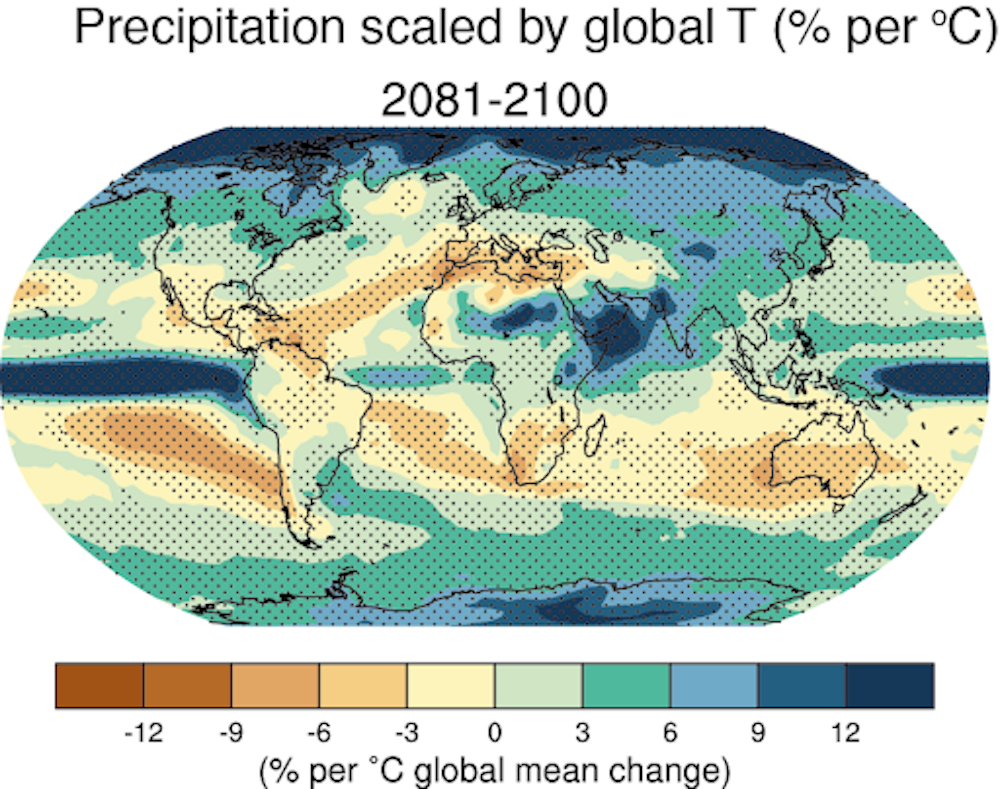
As global temperatures increase, some regions get wetter while others get drier. Climate models indicate that many parts of the tropics, where it is already very wet, will become wetter. The subtropics, which sit between the wet tropics and the wet mid-latitudes, are expected to get drier.
Spatial plot of global rainfall projections for 2100 from IPCC AR5, showing percent change in annual rainfall for each °C of global warming, for the last two decades of the 21st century relative to 1986-2005. Subtropical regions, like the Mediterranean and southern Australia are projected to dry.Modified from IPCC AR5 Ch. 12 Fig 12.10
Over southern Australia, rainfall is expected to decline, particularly in the cool season (which is currently the rainy time of year). This has already happened in Perth and the surrounding southwest of Western Australia.
The drying trend in South-west Western Australia over the last century is significant.BoM
What will happen when warming slows or stops?
Climate models are typically used to explore future climate under transient or rising temperatures, at least until the end of the 21st century. International efforts to reduce greenhouse gas emissions are aimed at slowing and eventually stopping temperature rises so that the climate is stabilised. For example, the Paris Agreement aims to stabilise global warming within 1.5℃ or 2℃ above pre-industrial levels.
But if temperatures stop rising, how will rainfall patterns respond? To investigate, we used pre-existing climate model runs created by the international scientific community to project different conditions extending from the present to the year 2300.
The chart below shows two different scenarios: one in which greenhouse gases and temperatures level off around 2100 (this referred to as Extended Representative Concentration Pathway 4.5), and the one next to it (Extended Representative Concentration Pathway 8.5) in which greenhouse gases don’t level off until around 2250, creating a much warmer climate.
Smoothed global temperature and subtropical (25°S-35°S) winter (June through August) rainfall in Extended Representative Concentration Pathway (ECP) 4.5 and ECP8.5, from 2006 to 2300.Author provided
We found that rainfall in the Southern Hemisphere subtropics decreases while temperatures are rising rapidly, with most of the rainfall reduction occurring in the winter months. When temperatures begin to stabilise, subtropical rainfall starts to recover.
How rainfall reversal works
The subtropics are relatively dry right now because they are the region where dry air descends from the upper atmosphere to the surface, suppressing rainfall. Studies have shown that the subtropics may be expanding or shifting southward in the Southern Hemisphere as the global climate warms.
Our study found a link between the trend in Southern Hemisphere subtropical rainfall and the temperature gradient between the tropics and subtropical regions. This temperature gradient gets steeper during periods of rapid warming because the tropics warm faster. Once warming stops, the regions further from the Equator catch up and the temperature gradient gets weaker.
The pattern of temperature warming drives the shifts in rainfall: when the tropics are warming faster, the subtropics become drier as more moisture is exported to the tropics.
Our results suggest that stabilising global temperatures may lead to a reversal in the drying trend in the subtropics.
The path to stabilising global temperatures will be a long journey from the current trajectory of rising emissions, but this research is potentially good news for the future generations who will live in subtropical regions.
The authors would like to acknowledge Nathan P. Gillett, Katarzyna B. Tokarska, Katja Lorbacher, John Hellstrom, Russell N. Drysdale and Malte Meinshausen, who contributed to this study.
Just So You Know is an ongoing series for teens in search of reliable, confidential advice about life’s tricky questions. If you’re aged 12 to 18, send us your questions about sex, drugs, health and relationships, and we’ll ask an expert to answer it for you.
My friend is using ice and smoking dope. He says it makes him feel good like his medication doesn’t. His parents know but don’t know what to do. I am worried, as he has stopped being chatty and is not going out or doing anything. He is changing, but worse.
– Anonymous
Working out what to do when you are worried about a friend who is using drugs can be tricky. Just asking the question shows what a supportive friend you are and that’s a very good start.
There’s not one right way to approach it. There are many ways to help and support your friend.
Remember, they might not see their drug use as a problem (from what you have said it sounds like they view it as a solution rather than a problem).
You can’t force your friend to do anything they don’t want to do. In the end, it needs to be their decision to change, but there’s lots you can do to support and encourage them.
How do you know if it’s a problem?
One thing to remember is that most people who use drugs only use occasionally for a short time in their lives and won’t develop a serious issue.
People take drugs for lots of different reasons, including because it is fun or it makes them feel good, to “escape” from problems, and to make physical (like pain) or emotional (like anxiety) problems go away (sometimes referred to as “self-medicating”).
If your friend is using drugs regularly it’s more likely they’ll be having negative effects. Signs that drug use is becoming a problem include:
using weekly or more
giving up activities they used to enjoy to use or recover from drugs
missing school or work or becoming unreliable
needing to use more and more to get the same effect.
Raising the issue
One of the best pieces of advice anyone has given me came from a person who was supporting a family member who was using drugs. She said, “think about what you would do if drugs weren’t involved”. How would you approach your friend if they were doing anything else that worried you?
Also think about what you would like your friends to do or say if you were doing something they were worried about.
Find a time to talk when you’re both clear headed, you’re somewhere private and you have plenty of time. You don’t need to make it formal, just make sure the setting is good for a sensitive chat when you raise the issue.
Just raising the issue and listening is helpful.from www.shutterstock.com
Think about what you want to say beforehand so you are prepared.
It doesn’t usually help to plead, persuade, preach, bribe, guilt-trip or threaten (for example, “if you keep using, I will…”). Try not to speak in a judgemental or critical tone of voice, it usually just creates resistance.
Give them time to talk and don’t cut them off. A rule of thumb I use is they should be talking half the time or more. Ask questions that show your concern rather than telling them what to do. You might say something like:
You don’t seem to want to go out much anymore. We really miss hanging out with you. Is everything ok?
Or more direct:
I know drugs make you feel better when your medication doesn’t but I’m really worried about you and want to make sure you are OK.
If your friend doesn’t want to talk about it, it doesn’t help to take it personally or to argue the point with them. It can be a hard thing for people to talk about and they may need some time.
Let them know that you’re there to listen and support if they need it. If they know you’re open, they’re more likely to talk later. Just raising the issue and listening without judgement is helpful.
Other things you can do
How and how much you help is up to you. You might try to help your friend in practical ways, you might decide to just provide support and listen, or you might decide to step back and have less contact with them.
It’s OK if helping them becomes too much for you. You also need to look after yourself. It can be very hard seeing someone you love with problems. At times you might feel frustrated and helpless, like it’s impossible to get through to them. You might need to be patient because it can be hard to give up drugs once they have become a habit.
If you choose to provide a lot of help and support, you might want to talk to someone, such as a psychologist or counsellor, yourself.
Encourage your friend to participate in drug and alcohol-free activities.from www.shutterstock.com
Encourage them to engage in activities with you and your other friends that don’t involve alcohol or other drugs. Staying connected with friends who don’t use drugs can help prevent the problem from getting worse.
Try to keep them as safe as possible. Don’t leave them alone in a potentially dangerous situation (like walking home late at night or at a party) because you’re frustrated or angry at them for using drugs. Call an adult you trust to help if you need to, or an ambulance if they look unwell.
If things are getting worse it’s OK to suggest professional help. If they’re open to getting help, ask them what they want to do. You could say something like, “what do you think would be most helpful to you?”, or “would it help to speak to a trusted adult/school counsellor/doctor?” You could offer to go with them for support.
You could also see if the parents need some professional advice, and give them some of the numbers below. It might be helpful for your friend or their parents to talk to the doctor who prescribed their medication – the dose and effects might need to be reviewed.
Where to get help
There are many options for both you or your friend to talk to someone about your worries. Here are some of the main ones:
CounsellingOnline is a free online chat for concerns about alcohol and other drug. Anyone can use it – people using drugs and people wanting to help friends or family using drugs.
headspace and eheadspace provide face to face and online/telephone support for mental health issues for people aged 12-25.
Kids helpline is a free telephone counselling service on any issue for children and young adults aged between 5 and 25. They can be reached at 1800 55 1800.
YSAS (Youth Support and Advocacy Service) is a youth alcohol and other drugs support organisation in Victoria. They have face to face and telephone services and a good info on their website. Their number is 1800 458 685.
Directline is a free telephone counselling services similar to CounselingOnline, but on the phone. They can be reached at 1800 888 236.
Family helplines are telephone counselling services for friends and families of people who use drugs. Alcohol, prescription and other drug family support (APOD) can be reached at (03) 9723 8000, Family Drug Support Australia at 1300 368 186, and Family Drug Help at 1300 660 068.
If you’re a teenager and have a question you’d like answered by an expert, you can email us at jsyk@theconversation.edu.au, submit your question anonymously through Incogneato or DM us on Instagram.
Please tell us your name (you can use a fake name if you don’t want to be identified), age and which city you live in. Send as many questions as you like! We won’t be able to answer every question, but we will do our best.
This is the first of two articles looking at the increasing reliance of Australian cities on desalination to supply drinking water, with less emphasis on alternatives such as recycling and demand management. So what is the best way forward to achieve urban water security?
Removing salts and other impurities from water is really difficult. For thousands of years people, including Aristotle, tried to make fresh water from sea water. In the 21st century, advances in desalination technology mean water authorities in Australia and worldwide can supply bountiful fresh water at the flick of a switch.
Achieving water security using desalination is now a priority for the majority of Australia’s capital cities, all but one of which are on the coast. Using the abundance of sea water as a source, this approach seeks to “climate proof” our cities’ water supplies.
It’s hard to believe now that as recently as 2004 all Australian capital city water authorities relied on surface water storage dams or groundwater for drinking water supplies. Since Perth’s first desalination plant was completed in 2006, Australian capital cities have embraced massive seawater desalination “water factories” as a way to increase water security.
Perth and Adelaide have relied most on desalination to date. Canberra, Hobart and Darwin are the only capitals without desalination.
The drought that changed everything
From the late 1990s to 2009 southeastern Australia suffered through the Millennium Drought. This was a time of widespread water stress. It changed the Australian water industry for ever.
All major water authorities saw their water storages plummet. Melbourne storages fell to as low as 25% in 2009. The Gosford-Wyong water storage, supplying a fast-growing area of more than 300,000 people on the New South Wales Central Coast, dropped to 10% capacity in 2007.
The Queensland Labor caucus applauded a protester advocating the alternatives in 2007, but by 2009 the Gold Coast desalination plant was ready to supply up to a quarter of southeast Queensland’s needs.Dave Hunt/AAP
Modern industrial-scale desalination uses reverse osmosis to remove salt and other impurities from sea water. Water is forced under high pressure through a series of membranes through which salt and other impurities cannot pass.
Design, construction and maintenance costs of these industrial plants are high. They also use massive amounts of electricity, which increases greenhouse gas emissions unless renewable energy sources are used.
Just as many of the massive new desalination factories were completed, and proudly opened by smiling politicians, it started raining. The desalination plants were switched off as storages filled. However, water consumers still had to pay for the dormant plants to be maintained – hundreds of millions of dollars a year in the case of the Melbourne and Sydney plants.
The Adelaide desalination plant can produce up to 100 gigalitres a year – about half of Adelaide’s annual water needs.Sam Mooy/AAP
After a dry winter, Melbourne Water has advised the Victorian government to make the largest orders for desalinated water since its plant, able to produce 150GL a year, was completed in December 2012. Mothballed for more than four years, it supplied its first water to reservoirs in March 2017. The recommended annual order of 100GL from April this year is almost one-quarter of Melbourne’s annual demand. Plant capacity is capable of being expanded to 200GL a year.
When bushfires recently threatened Victoria’s largest water storage, the Thomson dam, the government said desalinated water could be used to replace the 150GL a year taken from the dam.
Being close to the sea is essential for a desalination plant the size of Sydney’s, which can supply 91GL a year – around 15% of the city’s needs – and is designed to double that in future.Sydney Water/AAP
Perth, Adelaide, Melbourne, Brisbane and the Gold Coast already have the capacity to supply larger proportions of their populations with desalinised water as required.
What about inland and regional settlements across Australia? Large-scale desalination plants may not viable for Canberra and other inland centres. These regions would require sufficient groundwater resources and extraction may not be environmentally sound.
In fact, water costs in general vary enormously, depending on location and how much is used. The pricing structures are about as complex as mobile phone plans or health insurance policies.
The highest price is in Canberra where residents pay $4.88/kL for each kL they use over 50kL per quarter. The cheapest rate is Hobart’s $1.06/kL.
The issue of water pricing leads on to the question of what happened to the alternative strategies – recycling and demand management – that cities pursued before desalination became the favoured approach? And how do these compare to the expensive, energy-hungry process of desalination? We will consider these questions in our second article.
Dillon Wu died alone inside a metal tank. It is believed he was asphyxiated by argon gas, used in arc-welding steel.
He is the youngest employee to die in a recent run of deaths in confined spaces. Aged just 20, he was in the second week of his apprenticeship. He should not have been alone or unsupervised, particularly in a confined space.
All such deaths raise questions about workplace safety. But Wu’s death, at a factory in Melbourne’s western suburbs on October 4 last year, also raises particular questions about responsibility in workplaces where traditional definitions of employment and employer obligations have been unwound.
Wu’s apprenticeship was with Australian Industry Group (Ai Group or AiG) but he died at the Melbourne factory of “host employer” Marshall Lethlean Industries.
Both federal and state workplace health and safety laws say responsibility for a worker’s death lies with an employer. Four months on from Wu’s death no one has accepted that responsibility.
Prior safety concerns
The Australian Industry Group (AiG) is an employer organisation representing more than 60,000 businesses employing more than a million workers. It runs a major training and apprenticeship scheme (called the AiGTS) for its member organisations. It recruits, trains and pays apprentices, who learn their trades working at “host” companies.
One of those is Marshall Lethlean Industries, which builds and repairs road tankers to transport milk, oil, gases and the like.
AiG says the health and safety of apprentices and trainees “is our highest priority at all times”. But Wu’s death raises questions about the effectiveness of this commitment in practice.
Even before he died, AiG had reason to be concerned about safety at the Marshall Lethlean factory. The ABC Investigations unit obtained a copy of a safety audit conducted by AiG at the factory about a month before Wu began working there. That audit identified 11 high-priority safety hazards, including the lack of procedures for staff working in confined spaces.
The type of tank Dillon Wu was left alone in to weld at Marshall Lethlean.AMWU, CC BY-NC-SA
AiG’s chief executive, Innes Willox, has downplayed any organisational culpability in sending Wu to work at a site with known dangers. The safety hazards identified by the audit, he said, would be common in most workplaces: “All our indications were and continue to be that it was a safe place of work, but what occurred was a terrible tragedy, the details of which we don’t know.”
Wu’s death is being investigated by Worksafe Victoria. The agency is not well resourced and its investigations are routinely very slow. So its report could take months or even years.
Until then, it is unlikely either AiG or Marshall Lethlean will take responsibility. AiG, despite being Wu’s direct employer, has so far said it cannot be responsible for answering any questions. AiG had “very limited information relating to the circumstances of Dillon’s passing,” it said in a statement. “We have sought this information from Marshall Lethlean Industries, however it has not been forthcoming.”
Marshall Lethlean, meanwhile, has made no public statements.
Agreement, but only in principle
The issue of workplace deaths was investigated by a recent Senate committee inquiry, which issued its report less than two weeks after Dillon’s death.
One problem the report highlights is the need for more clarity and consistency in work health and safety laws.
Workplace health and safety regulation in Australia is a hotch-potch. Constitutionally the power to make such laws rests with the states and territories. Each has developed its own standards.
Governments, state regulatory agencies, employer organisations and unions all agree, at least in principle, on the need for greater consistency – a process known as harmonisation. In practice, however, there is disagreement on what the benchmark standards should be.
An example is what penalties should be imposed on negligent employers.
Queensland has the most severe penalties as a result of its “industrial manslaughter” law. The new law was passed in 2017, following some grievous workplace deaths. It makes employing organisations and individual senior officers of those organisations liable for workplace deaths through omission or fault. Penalties include fines up to A$10 million or even prison.
In most states, employer failure is dealt with under criminal legislation where penalties are lower (maximum A$3 million) and legal processes less onerous for employers
The Senate committee inquiry has recommended the Queensland legislation become the national benchmark. Employer groups including the AiG strongly opposed this. So too did the four Coalition members of the Senate inquiry. In a dissenting report they expressed concern that such laws “would expose employers and managers to the risk of lengthy prison terms even where they are unjustly accused of being responsible for incidents in the workplace”.
Who is responsible must be clear
But what penalties should apply is moot if laws provide no clarity on who can be held accountable as the employer.
There is a pressing need to define employer responsibility when there is a “triangulated” employment relationship – such as between a worker, labour hire organisation and a host employer.
This is an area where unions have rightly been calling for greater clarity and specificity.
Current legislation appears to give both shared and non-delegable responsibility. But the lack of clarity about who is responsible for what has created the very real danger that either will leave it to the other to take full responsibility in ensuring workers are kept safe.
We don’t need the conclusions of the Worksafe Victoria investigation into Dillon Wu’s death to tell us that.
The grief of his family, left without answers or acknowledgement of an employer’s responsibility, makes that point clear enough.
Source: The Conversation (Au and NZ) – By Anna-Sophie Jürgens, Postdoctoral Fellow in Comparative Literature, Popular Entertainment Studies and Science in Fiction Studies, Australian National University
Australian scientists have led many crucial scientific breakthroughs – from the manufacturing and processing of penicillin, to the first in-vitro fertilisation pregnancy. Yet there is still a need for science to be more widely appreciated in our broader culture.
One way of doing this is through storytelling. Novels with scientist protagonists can bring science to life and capture our imagination. They can personalise scholarly research and the drive for knowledge, and also make us think differently about the ethical dilemmas that emerge from scientific advances. Even stereotypical depictions of cold, obsessive “mad scientists” can get us thinking about the right and wrong way to do science, and about the role of science in culture.
Here, then, are eight stories set in Australia, presenting a variety of fictional scientists.
Peter Goldsworthy’s Wish reinterprets both Frankenstein and Pygmalion, exploring the ethical dilemmas of a group of scientists who push the limits of biotechnology to create Eliza, a charmingly human ape.
The central scientist characters – Dr Clive Kinnear and his associates – also teach sign language to the gorilla.
When Eliza’s language teacher falls in love with her, we are forced to re-evaluate our assumptions about the boundaries between animal and human, and about advances in genetic engineering.
The novel draws on actual research into ape-language acquisition carried out in the US in the 1960s and 70s. Goldsworthy also acknowledges Peter Singer, the noted Australian philosopher of animal welfare and rights, as an influence on the book.
Professor Koenig, Charades
Charades by Janette Turner Hospital (1987).Goodreads
Janette Turner Hospital’s novel Charades features a MIT physicist and candidate for the Nobel Prize, Professor Koenig, who has an affair with a provincial Australian girl in search of her lost father.
It is a wildly imaginative novel blending a personal story with nuclear physics and Heisenberg’s uncertainty principle (which articulates that the position and velocity of an object cannot be measured exactly).
The novel playfully revolves around Koenig’s academic writing and Heisenberg-inspired ideas such as the line: “a sense of the solidity of matter, is one of our most persistent illusions.”
According to academic Roslynn Haynes, who studies stereotypes of scientists in pop culture, many stories depict scientists as maniacal and obsessed with their research to the point of madness and moral compromise.
Dr John Parker in Blanche d’Alpuget’s 1993 novel White Eye is an Australian example of the fictional ruthless, megalomaniac scientist.
A coldblooded researcher, he uses unethical methods to produce and test a vaccine against a virus that he more or less invented. This virus makes humans infertile as a side effect.
Parker wants to use this highly infectious and extremely virulent creation as a weapon against overpopulation – and he commits atrocious crimes to achieve his goal.
Della Gilmore, the protagonist in Toni Jordan’s 2010 novel Fall Girl is an equally glorious caricature of scientist stereotypes.
Della’s father and grandfather travel the country in a buggy selling ‘Ol’ Doc Grayson’s “Magical Elixir good for bursitis, thrombitis, arthritis and anything that ails you at county fairs”. No wonder, Della becomes a con-artist herself.
In this novel she impersonates an evolutionary biologist and invents a fantastic research project (to trap a Tasmanian Tiger in Wilsons Promontory National Park). Her potential sponsor turns out to be a con-artist himself – one who humbugs the humbugger.
Jordan has previously worked as a molecular biologist. And this is a funny novel that invites us to think about the power of scientific jargon. Here, science is truly fiction.
William Caldwell, Love and The Platypus
Love and the Platypus by Nicholas Drayson (2007).Goodreads
To equally pursue “knowledge per se”, to unlock “the secrets of the organism” and to act as an explorer “not of untrodden lands, perhaps, but of the mysteries of nature”.
These are the reasons why the naturalist William Caldwell travels to Australia in Nicholas Drayson’s 2007 novel Love and The Platypus.
Caldwell’s research is “purely platypusical”: he aims to determine whether the platypus really does lay eggs.
But the “spirit of discovery – that was why he was here, was it not?”
Despite the obsessive nature of his scientific enquiry, Caldwell finds much more in Australia than just extraordinary animals.
Daniel Rooke, Kate Grenville’s protagonist in The Lieutenant, is not a scientist, strictly speaking.
However, he is erudite and eager for knowledge – a “man of science” as he is called in the book.
Rooke moves from Europe to the newly founded colony of New South Wales, where he builds an observatory.
He hopes to add to the world’s sum of knowledge as dramatically as a Galileo or a Kepler, contemplating the universe and scanning the heavens in search for a particular comet.
But what he finally studies is human nature: of convicts, settlers, fellow officers and the Indigenous people he meets.
British novelist Jem Poster’s 2006 novel Rifling Paradise is the story of Charles Redbourne, a 19th-century English landowner who travels to Australia to pursue his passion as an amateur naturalist.
As he plunges deeper into the wilderness, Redbourne cultivates a flexibility of mind and comes to understand that his practice of science – and the expectations he had of his journey – were sophisticated modes of ignorance.
He understands that his “approach to the natural world is imaginative rather than analytical” and his expectations concerning his scientific journey here “had been tinged with fantasy”.
Crucially challenged by an artist he meets, he changes from a believer in science and a confident taxidermist into a vegan who realises that a marvellous order – and the sublime – can also be found in the world of thought and art.
Clayton Hercules Emmet, a character in David Ireland’s 1972 novel The Flesheaters, both invokes and destroys the scientist stereotype.
Clayton, or Clay, is a “science person” whose “days were spent at the university killing small animals and waiting for a research grant in medical engineering”. His “constant effort to add to the sum of human knowledge has something of fever in it”. Indeed, Clay lives in a lunatic asylum.
One day, while trying to talk about science at a “worker-student-intellectual happening”, he fails to advocate the value of science as a means for social progress – its “saving truth”. Clay is a 20th-century caricature of a scientist who embodies the challenges of communicating the discipline to a broad audience.
One of New Zealand’s most notorious sexual misconduct cases re-emerged recently when a ringleader of the Roast Busters, a group of teenagers who were investigated five years ago for alleged sexual offences against underage girls, gave a television interview.
Back in 2013, the police investigated the case for 18 months but didn’t lay charges due to a lack of evidence. I argue that prosecution decisions and societal responses to sexual offending may not be any more enlightened today, partly because of the way the law treats the issue of consent and classifies sexual crimes.
Rape discourse
One of the common tropes in rape discourse is the idea that genuine victims would complain immediately. If they don’t, the argument goes, the complaint is fabricated. Another myth is that such “false” complaints are motivated by some personal gain, be it financial or political.
It is therefore deeply ironic that Joseph Parker, the leader of the Roast Busters, issued public statements about his role in the incidents five years later. But unless the police decide to lay charges after all, the alleged sexual offenders are irrelevant.
What is relevant, is to consider what the response would be to a similar case if it arose in 2019. On the one hand, the publicity indicates a great deal of support for the complainants and concern about exacerbating their trauma. But in 2013, I participated in a Radio New Zealand panel discussion about the case, in which one of the biggest issues discussed was the conduct of the complainants – in other words, what they were doing in the company of the alleged offenders, why and how much were they drinking, and what they were wearing.
At the time, two commercial radio hosts, John Tamihere and Willy Jackson, grilled a friend of one of the Roast Busters complainants, asking her “how free and easy are you kids these days?”. They also described as “mischief” the conduct of the alleged offenders in bragging about their sexual conduct with drunk and underage complainants on social media. Both broadcasters were censured in 2013, but it is worth noting that Jackson is now a member of parliament, and Tamihere is running for mayor in Auckland.
The real issue
All these questions about the complainants divert attention from the behaviour of offenders. Some believe they are entitled to treat people in this way and society, and in some contexts the law, have implicitly given them permission to.
We must look at every case in its own individual context, but at the heart of the issue in most cases is consent. This has two elements: first, did the complainant actually consent and, second, if not, did the defendant believe, on reasonable grounds, that there was consent.
In the Roast Busters case, it would be hard to argue that the alleged offenders did have reasonable grounds for believing in consent if they did in fact set out to have sex with the complainants while they were drunk or unconscious.
Disparity in how the law treats women
Under section 128A of the Crimes Act 1961 a person does not consent to sexual activity if the activity occurs while he or she is so affected by alcohol that they cannot consent or refuse to consent. Also, a person does not consent to sexual activity if the activity occurs while he or she is asleep or unconscious.
Yet, these provisions of the Crimes Act are subject to interpretation by judges and juries. How, and on what basis, do they decide whether a complainant is “so affected” by alcohol that they are unable to consent?
Further evidence of the law’s differential treatment of sexual complainants is in the way in which sexual offences are characterised in the Act itself. Sexual crimes are classified as “crimes against religion, morality and public welfare” as opposed to murder, manslaughter and non-sexual assaults which are labelled “crimes against the person”.
This disparity in language confirms a real inequity in the way in which the law treats women (who make up the large proportion of complainants in sexual cases). It is a relic of the days when women were chattels owned by men and a sexual offence was a property offence committed against the property owner.
This choice of statutory language is not confined to New Zealand’s legislation. In both the Northern Territory and Queensland, sexual offences against children are classified as offences against morality, but against adults they fall within the “assault” category. On the other hand, in Victoria’s Crimes Act, sexual offences against adults and children are sub-categories of a general “offences” category.
I would like to think that things would be different if Roast Busters happened now. Unfortunately, I do not have that optimism. Instead, I see the character assassination of Dr Christine Blasey Ford during Brett Kavanaugh’s appointment to the US Supreme Court, the Irish case where a defence lawyer was permitted to tell a jury to look at the way the complainant was dressed, and that the fact she was wearing a G-string was evidence of her consent. I also see the #notallmen and #mentoo hashtags.
I would like to see an end to the offence taken every time a news story references the victimisation of women or an advert for a razor calls out toxic masculinity. We know not all men do bad things, but all women are subject to (at the very least the risk of) sexual violence and harassment. Denial of that reality is a real barrier to change.
On Friday, Chief Judge Brian Preston of the New South Wales Land and Environment Court handed down a landmark judgement confirming a decision to refuse a new open-cut coal mine near Gloucester in the Hunter Valley. The proposed Rocky Hill mine’s contribution to climate change was one of the key reasons cited for refusing the application.
Defeating a mining proposal on climate grounds involves clearing several high hurdles. Generally speaking, the court must be convinced not only that the proposed mine would contribute to climate change, but also that this issue is relevant under the applicable law.
To do this, a litigant needs to convince a court of a few key things, which include that:
the proponent is responsible for the ultimate burning of the coal, even if it is burned by a third party, and
this will result in increased greenhouse emissions, which in turn contributes to climate change.
In his judgement, Preston took a broad view and readily connected these causal dots, ruling that:
The Project’s cumulative greenhouse gas emissions will contribute to the global total of GHG concentrations in the atmosphere. The global total of GHG concentrations will affect the climate system and cause climate change impacts. The Project’s cumulative GHG emissions are therefore likely to contribute to the future changes to the climate system and the impacts of climate change.
Other courts (such as in Queensland, where the proposed Adani coalmine has successfully cleared various legal hurdles) have tended to take a narrower approach to statutory interpretation, with climate change just one of numerous relevant factors under consideration. In contrast, Preston found climate change to be one of the more important factors to consider under NSW legislation.
To rule against a coalmine on climate grounds, the court also needs to resist the “market substitution” argument – the suggestion that if the proponent does not mine and sell coal, someone else will. This argument has become a common “defence” in climate litigation, and indeed was advanced by Gloucester Resources in the Rocky Hill case.
Preston rejected the argument, describing it as “flawed”. He noted that there is no certainty that overseas mines will substitute for the Rocky Hill coalmine. Given increasing global momentum to tackle climate change, he noted that other countries may well follow this lead in rejecting future coalmine proposals.
He also stated that:
…an environmental impact does not become acceptable because a hypothetical and uncertain alternative development might also cause the same unacceptable environmental impact.
What does the future now hold?
There should be no doubt that this is a hugely significant ruling. However, there are several caveats to bear in mind.
First, there are avenues of appeal. In the absence of a robust legislative framework prohibiting mining operations, it is ultimately up to a court to interpret legislation and weigh up the relevant factors and evidence. The NSW Land and Environment Court has a strong history of progressive judgements, and it is not certain that this example will be followed more widely in other jurisdictions. That said, Preston’s reasoning is firmly grounded in an analysis of the relevant scientific and international context, and should be a highly persuasive precedent.
Second, it is also important to remember that this judgement arose from an initial government decision to refuse the mine, whereas many other legal challenges have arisen from a mining approval.
Finally, climate change was not the only ground on which the mine was rejected. The proposed mine would have been close to a town, with serious impacts on the community.
Nevertheless, this decision potentially opens up new chapter in Australia’s climate litigation history. Preston’s ruling nimbly vaults over hurdles that have confounded Australian courts in the past – most notably, the application of the market substitution defence.
It is hard to predict whether his decision will indeed have wider ramifications. Certainly the tide is turning internationally – coal use is declining, many nations have set ambitious climate goals under the Paris Agreement, and high-level overseas courts are making bold decisions in climate cases. As Preston concluded:
…an open cut coal mine in this part of the Gloucester valley would be in the wrong place at the wrong time… the GHG emissions of the coal mine and its coal product will increase global total concentrations of GHGs at a time when what is now urgently needed, in order to meet generally agreed climate targets, is a rapid and deep decrease in GHG emissions.
Indeed, it is high time for a progressive approach to climate cases too. Hopefully this landmark judgement will signal the turning of the tides in Australian courts as well.
Iran’s ruling clergy are celebrating the 40th anniversary of the 1979 revolution, during which Shi’ite Islamists, led by religious leader Ayatollah Khomeini, toppled Mohammad Reza Shah’s secular monarchy.
The linchpin of the Islamic Republic’s political system is Ayatollah Khomeini’s doctrine of Wilayat-i Faqih, or guardianship of the jurist, which makes a Shia religious jurist the head of state. The jurist’s legitimacy to hold the most powerful position in the state is claimed to be based on divine sovereignty.
As its name suggests, the Islamic Republic of Iran’s current system combines theocratic and republican elements. The president and parliament are democratically elected, while the members of powerful institutions such as the Guardian Council and the judiciary are appointed by the Supreme Leader (Walī-yi Faqīh).
The Guardian Council oversees elections and the final approval of legislation. According to the Constitution of the Islamic Republic, all legislation, policies and programs must be consistent with the observance of Islamic principles. The Guardian Council has a duty to monitor all legislative decisions and determine whether their implementation would cause a violation.
This unprecedented political system brought in four decades of internal conflict. The established Islamic Republic of Iran also ceased being a US ally and instead became an enemy. International sanctions, along with the clergy’s mismanagement and endemic corruption, have resulted in a dire economic situation. There is a strong fear the high unemployment and inflation rate will continue to rise.
Under these circumstances, there are now doubts the Islamic Republic can survive. And some wonder whether we may soon see another revolution. So, what is the situation in Iran 40 years after the Shah was overthrown and who is agitating for change?
Decades of unrest
After Ayatollah Khomeini died in 1989, a more conservative Supreme Leader, Ayatollah Khamenei, came to power and strengthened the theocracy.
The reformist movement emerged in the mid-1990s to counter the newly established conservative regime. They had little chance of gaining power through theocratic institutions, so they focused on the electoral side. They campaigned for women’s rights, democratic rule and a civil-military divide.
Hassan Rouhani swept into power on promises of modernising Iran.ABEDIN TAHERKENAREH/AAP
Reformists gained power twice: from 1997 to 2005 and from 2013 – with the election of the relatively moderate president, Hassan Rouhani – until now. In these years, reformists controlled electoral institutions such as the presidency and the parliament.
For decades, reformers have struggled to limit the power of theocratic institutions – while still broadly complying by the laws of the clergy, and the principles set in place by Khomeini – and expand the power of republican institutions. However, they were no match for the Khamenei-led resistance, and theocratic institutions are more powerful today than they were in the mid-1990s.
Iran has also continually had tense relations with the international community. In addition to eight years of war with Iraq, Iran has been under sanctions for almost all of the past four decades. These have been imposed by the US, the EU, and the United Nations over claims Iran breached its nuclear obligations.
Today, the Donald Trump-led US government is pursuing an extremely hostile approach to Iran. Crucially, the US has withdrawn from a nuclear deal negotiated with the Obama administration – under which Iran agreed to limit its nuclear program. The US has reapplied previous sanctions (which were lifted under the deal) and imposed new ones. Iranians are also the most affected of the Muslim majority countries included in Trump’s travel ban.
Reformists have made some progress towards easing economic hardship, loosening social control, and initiating a temporary easing of tensions with the outside community. But the parlous nature of the political structure empowers the theocrats to manipulate the system and stymie any reform effort that promises a path to democratisation.
Reformists or pro-regime opposition
The protests that swept Iran between December 2017 and January 2018 showed that many Iranians don’t consider the reformists capable of bringing about meaningful change. Protestors expressed their anger over increasing economic hardship, as well as Iran’s support and funding for foreign conflicts, namely the civil wars in Yemen and Syria. They also chanted slogans calling for an end to the rule of clerics.
Rampant corruption, the failure of Rouhani to fulfil his promises – such as boosting the economy, extending individual and political freedoms, ensuring equality for women and men, and easing access to the internet – and the return of sanctions have combined to shatter hope of reform. This has been expressed in global protests by the Iranian diaspora calling for a change to the government.
Iranians all over the world, such as these in France, are calling for a change of government.ETIENNE LAURENT/AAP
It seems unlikely the reformists will be able to maintain their positions in the country’s electoral institutions. The sad reality is that even if they have another chance, the result will only compound their failures.
These circumstances have led to another stream of opposition – one agitating for a toppling of the Islamic Republic and regime change – gaining currency. Most members of this group are in exile, including Iran’s ex-prince and son of the Shah overthrown by the revolution, Reza Pahlavi.
But there is profound disagreement between the opposition groups in exile. Although they share a similar goal, they have consistently proven unable to agree on an overarching framework. The profound divisions among the groups has drained both their resources and intellectual capacity, which has rendered them incapable of contesting the country’s ruling clergy.
Those advocating for regime change have also been incapable of articulating a viable alternative to the Islamic Republic. All opposition groups overuse the abstract notion of “secular democracy” without clearly explaining what exactly they have in mind.
Pahlavi’s desire is reportedly not to put himself back on the throne, but to let the people decide what the political system would look like. He has said:
It’s not the form that matters, it’s the content; I believe Iran must be a secular, parliamentary democracy. The final form has to be decided by the people.
While this is a legitimate statement, figures like Pahlavi ought to offer viable alternatives that would help bring opposition groups together. Potential alternatives should also be structured to appeal to the masses, a considerable segment of whom have expressed disillusionment with the ideal of an Islamic state.
Opposition groups are absorbed in delegitimising the Islamic Republic, questioning the way the clergy run the country. In doing so, they forget the the people who have already expressed widespread dissatisfaction with the clergy.
The opposition needs to skilfully craft an alternative to the Islamic Republic and a comprehensive plan for the transition to democracy. Until an alternative political system is formulated and popularised, the opposition will remain impotent and unable to initiate a transformation in the country.
Of course, change is not impossible. A military confrontation with Israel or the US, the departure of 79-year-old Ayatollah Khamenei, or a spontaneous mass uprising could prove a game changer.
Political Roundup: Fixing Treaty ignorance in politics and schools
by Dr Bryce Edwards
2019’s Waitangi commemorations will be mostly remembered for two debates – whether the Prime Minister should be able to recite the detail of the Treaty of Waitangi, and whether the teaching of the Treaty and colonial history in New Zealand should be compulsory.
New Zealand Prime Minister, Jacinda Ardern.
PM’s unawareness of the Treaty Articles
Jacinda Ardern’s awkward answers about the Treaty of Waitangi were uncomfortable watching, not just for supporters of the Government and a more Treaty-driven politics, but also for anyone wary of being put on the spot about contentious issues. You can watch the encounter here, where TVNZ’s Maiki Sherman asks the PM what the articles of the Treaty say – see: Jacinda Ardern fumbles over what Treaty of Waitangi articles say – ‘Article One? On the spot?’
So, was the PM’s ignorance of the Treaty something she should be criticised for? Definitely, according to Heather du Plessis-Allan. She says, “the country’s leaders have headed up to Waitangi to try to look woke around race relations. But, if you are aiming to look woke, you better be woke” – see: Jacinda Ardern should have been able to recite the Treaty.
Du Plessis-Allan expresses sympathy for Ardern but explains why we should take her failure seriously: “She is the country’s leader after all. She is the one who celebrated the launch of the Crown-Māori Relations Portfolio by saying, ‘My vision is that we as a country realise the promise of the Treaty.’ How can you deliver on the promise of the Treaty if you don’t know the promise of the Treaty? And she’s also the one using Waitangi Day as a PR opportunity.”
The unfortunate incident, in which “the PM’s lack of knowledge was exposed” also raises bigger questions for du Plessis-Allan about Ardern’s abilities: “It’s also a substance problem. This is a recurring theme with the Prime Minister. There’s a lot of style, especially on the international stage, but questions remain over substance back home.”
Similarly, former Act MP Rodney Hide writes today that the episode brings into focus the contrast between Ardern’s strengths and weaknesses: “She is wonderful wowing the people at Waitangi. She is great on the world stage. She exudes compassion. She makes a great celebrity. She would be tremendous addition to the Royal Family. But she’s Prime Minister. She’s responsible for the entire apparatus of government. She also needs to show depth. Her failure to know Article One reinforces a sense of shallowness that goes hand-in-hand with celebrity status” – see: Jacinda Ardern’s failure to recite Article One ‘inexcusable’.
For Hide, not all “gotcha questions” merit being taken seriously, but anything about the Treaty says a lot about an MP, because the “Treaty is a big deal politically, legally, constitutionally, and historically. It has a big impact” on government. He says that it’s “a basic expectation of being an MP” to be able “to rattle off the three Articles”. And he adds, “Don Brash could rattle it off in his sleep. Bill English could do so in Maori.”
Newstalk ZB political editor Barry Soper also argues that the Treaty question put to the PM was fair: “The question was asked for a reason, as the leader of the nation, attending what she’s turned into a personal five day event for her, she should have known the articles of the Treaty – there are only three of them. Forget the te reo version that she parroted, the English would have done. She was there after all, to commemorate the signing of the Treaty and should have been fully across its contents” – see: Our future generations need to understand the content of the Treaty of Waitangi.
Soper does, however, add a guess at how John Key would have dealt with the question: “his face would have broken into a wide smile but he more than likely wouldn’t have even attempted to answer.”
Some Māori leaders took Ardern to task for her inadequate response. Sonny Tau of Ngāpuhi chose to say the following in his Waitangi Day speech in front of Ardern: “Only one thing I’ve got to say this morning and that is: If we’re going to lead a country, we need to learn the articles of the Treaty of Waitangi… There are some of us, leaders, who have slipped up on that, and all I ask is by this time next year that we all know the articles of the Treaty of Waitangi” – see Zane Small and Jamie Ensor’s Ngāpuhi’s Sonny Tau takes jab at Jacinda Ardern’s Treaty knowledge in Waitangi speech.
Yesterday, Hinemoa Elder raised the bar even further, saying that it’s not “sufficient” to be able to just recite the words of the Treaty, but it’s important to also have a relatively sophisticated analysis of them. She puts forward this challenge: “How many can recall these in Te Reo Māori, and English, and talk about the differences in interpretation and the inherent cultural clashes?” – see: We should all be familiar with the Treaty of Waitangi, here’s a 101.
Teaching the Treaty in schools
In her column, Elder concludes: “If we learnt them at school wouldn’t that make things easier? What a radical idea! Then from a young age we can debate the very ideas that underpin our national sense of who we are. Is that really so hard to put into practice?”
Many other commentators have made a similar connection between Ardern’s lack of knowledge and the need to have much more colonial history taught in New Zealand schools.
Hehir, who has a strong understanding of colonial history from his Palmerston North schooling, says he asked around amongst friends and family and found a similar level of unawareness of Treaty details: “I did not expect this. What was also unexpected was the fact that relative wokeness seemed to have little bearing on knowledge or ignorance about what is, whether you like it or not, the foundational basis for the existence of the country. I had expected those who make a point of being sensitive to the Treaty to have a working knowledge of what was actually in it. If that sounds like a snarky point, it’s not supposed to. It genuinely surprised me.”
According to this, the New Zealand History Teachers’ Association wants to see the “coherent teaching” of colonial history, with chairperson Graeme Ball being reported as saying “New Zealand’s colonial history was taught in an ‘ad hoc’ fashion, and students were ‘lucky’ if they learned about Parihaka, the New Zealand Land Wars, or the Waitangi Tribunal.”
Bell says “New Zealand was experiencing a ‘zeitgeist moment’, with more Kiwis willing to engage with te reo and New Zealand’s colonial history”, and the Government should therefore seize the chance to introduce compulsory courses.
The response has been generally positive. The New Zealand Herald responded with an editorial pointing out that an understanding of New Zealand’s history is vital, and because the phase of Treaty settlements is nearing an end, “it ought now to be possible to find a balanced history for teaching in schools” – see: Our history is contentious, that is all the more reason to teach it.
The Dominion Post has shown even more enthusiasm, saying the government has an opportunity it must seize: “History is often considered boring because of the tyranny of distance and time. Imagine history delivered at a very local level, as an engaging, exciting introduction to a wider context; how issues and incidents in your town, on your street, played a role in the bigger story; one that culminated in a historic day 179 years ago. It just needs a little imagination and some effort” – see: Let’s go back to the future.
Politicians respond to calls for colonial history in schools
Politicians are always fearful of being on “the wrong side of history”, but initially the Government poured cold water on the idea of compulsory courses in colonial history.
Kelvin Davis, who is Labour’s Deputy leader, associate minister of education, minister of Crown Māori relations, and a former teacher, was reported as rejecting the idea, saying: “In terms of the teaching of Te Tiriti in schools, remember that schools are self-governing, self-managing. It’s inappropriate for governments to come along and dictate specifics of what’s taught in schools” – see John Gerritsen’s History teachers decry ‘shameful’ ignorance of colonial, Māori history.
The Prime Minister is also reported as deflecting questions about proposal for schools to teach colonial history. She said: “My first question would be how many aren’t? I would be surprised if it wasn’t being taught universally.”
The same article also reports that “New Zealand First MP Shane Jones said it was up to schools to decide what they taught but he expected most, if not all, would teach students about the Treaty of Waitangi.”
But it wasn’t long before the Government warmed up to the idea, especially because opposition politicians were embracing the proposal. Audrey Young reported that: “There seems to be a consensus across the political spectrum about the need for schools to actively teach the Treaty of Waitangi in the context of New Zealand history, but with caveats. Prime Minister Jacinda Ardern, National leader Simon Bridges and Hobson’s Pledge spokesman Don Brash all supported education on the Treaty of Waitangi for New Zealand children” – see: Broad political agreement to teach NZ history and Treaty of Waitangi in schools, with caveats.
On Māori TV, some further details of what politicians thought were covered in Talisa Kupenga’s item, MPs at Waitangi talk colonial history in schools. For instance, Kelvin Davis says, “It’s right to give the Māori version and other versions [of colonial history] but I am of the opinion that the Māori version is the correct version.” And Youth Minister Peeni Henare asserts: “I want a unified standard. It is ad-hoc when it comes to how and what is taught in each area but we are all wanting the same thing; to teach children our history.”
Difficult questions about teaching political history
There is no doubt that any moves to establish greater teaching of New Zealand history would raise big questions about ideological and political impacts. After all, such compulsory lessons would amount to a version of “civics education” being introduced by proxy.
This is the concern of economics blogger Michael Reddell who says he is highly supportive of the principle of teaching New Zealand colonial history in schools but also highly sceptical about what it might mean in practice – see: Yes, but…. In this, Reddell argues that the prospect of political indoctrination is always a factor when government seek to introduce civics lessons.
Reddell explains that despite his enthusiasm for the study of New Zealand history, “what leaves me rather more ambivalent (‘yes, but….’) is the sort of people who would be teaching our history, and/or designing any curriculum. Few of them seem to see New Zealand history as something to celebrate (I’m going to be fascinated to see how our Prime Minister treats the 250th anniversary of Captain Cook’s first visit), and there is a strong theme of shame – the ‘black armband’ approach to history – combined with some agenda for how these people think society should be organised now or what role (say) the Treaty of Waitangi should play.”
Similarly, talkback radio host Sean Plunket believes there’s “a lot of BS in history”, and he “says it’s the version we learn that is important” – see Scott Palmer’s ‘Propaganda’: Sean Plunket slams ‘biased’ compulsory Māori history calls . He argues for a greater diversity of subject matter in the teaching of history.
Coming from a very different perspective, columnist Tom O’Connor says that a current lack of history in schools is leading to bigotry: “It is no wonder we hear such ill-informed and ignorant commentary every time the details of a Waitangi Tribunal hearing are announced. How can anyone be expected to understand the complexities of the issue if the underlying history is not known? In a vacuum of reliable and fact-based knowledge, mis-information and bigotry grow like mushrooms in a dark place” – see: Unacceptable not to teach children ‘complete’ NZ history.
O’Connor argues that New Zealand students learn their history too late, and contrasts this with other English-speaking countries: “American school kids begin learning their history from day one as do children in English and Irish schools. Some of us were taught selected parts of English history only, which had little if any relevance to us, but nothing of our own.”
In his opinion piece, Liam Hehir warns that it would be mistake to just replace English history with New Zealand history: “What happened in the United Kingdom – particularly during the period of the English Civil War – is also important for anybody who wants to understand the nature of our institutions and how they work. Anybody who has a good grasp of events of 17th century England and 19th century New Zealand will have a working knowledge of who we are and how we got here.”
As to the question of compulsion, University of Auckland history lecturer and Waitangi Tribunal member Aroha Harris takes on such questions, saying that compulsion is only necessary because a voluntary approach has failed – see: Don’t get me started on compulsion.
Harris lists other “compulsions” that she says Maori have had to put up with: “compulsory taking of Māori land, compulsory denial of te reo, compulsory restrictions on whāngai practices, on hapū fisheries, on customary resource management systems. Really. Just don’t get me started.”
And on the issue of what in the current school curriculum might be replaced by compulsory colonial lessons, Harris says: “(a) it doesn’t have to be a zero-sum game, and (b), shall we reflect a little on what we’ve already lost by remaining ignorant of our past and acting like it doesn’t matter?”
Finally, for his take on what is wrong with the supposed “conservative” version of New Zealand colonial history, see David Slack’s liberal parody: A brief impartial history of New Zealand.
An international non-government organisation, The Global Witness, has reported that 48 individuals were killed in the country last year, a majority related to agribusiness. Image: Philstar
By KEN E. CAGULA in Davao City
The massive human rights violations committed against indigenous peoples or Lumads and peasants are designed to silence the opposition to the continuing operations of large-scale mining and plantations in Northern Mindanao and the rest of Caraga Region.
This was the assessment made by the environmental group Kalikasan People’s Network for the Environment or Kalikasan PNE.
“The military is trying to flush out the opposition to mining and plantation interests in Northern Mindanao and Caraga region,” said Kalikasan PNE coordinator Leon Dulce.
Dulce points out that these Lumad and peasant leaders are the environmental defenders that continue to stand and oppose the large-scale mining and plantation operations in areas of Mindanao.
At present, these environmental defenders are protecting around 243,163 ha of forest and agricultural lands within their ancestral domains and farmlands against the encroachment of these extractive and destructive projects in Northern Mindanao and Caraga Region, he said.
-Partners-
Hundreds of Lumad residents from Sitio Manluy-a, Panukmoan, and Decoy in Barangay Diatagon, Lianga town in Surigao del Sur fled from their homes after the Armed Forces of the Philippines (AFP) conducted a series of artillery bombardment and harassments last month.
On January 24, two Manobo farmers identified as Randel Gallego and Emel Tejero, all residents of Km. 16, Brgy. Diatagon went missing after they were allegedly fired upon by soldiers while hauling abaca products.
Dead farmers The families of the two farmers found their dead bodies at a military detachment six days after they were reported missing.
The 401st Infantry Brigade of the Philippine Army claimed that Gallego and Tejero were killed in a clash between soldiers and the New People’s Army (NPA) rebels.
But human rights advocates belied the military’s claim, saying that the two were unarmed civilians.
“The Lumad communities in Lianga are standing firmly against the coal and gold mining exploration and development projects attempting to grab lands and resources from their ancestral lands ensconced within the Andap River Valley Complex. For this, they are constantly being attacked by the military,” Dulce said.
These areas in Surigao del Sur are one of the largely militarised areas in Caraga region, prompting the exodus of IPs out from their lands due to the continuing presence of soldiers and paramilitary groups in their communities.
Kalikasan PNE also slammed the “illegal arrest” of Datu Jomorito Goaynon, chairperson of the Kalumbay Regional Lumad Organisation and Ireneo Udarbe, chair of Kilusang Magbubukid ng Pilipinas in Northern Mindanao Region on January 28.
The police named the two leaders as “top NPA leaders” which Kalikasan PNE said is a “repeated accusation” to justify the illegal arrest.
“Goaynon and Udarbe are stalwarts of the struggles of indigenous people and peasants against agri-industrial plantations in Northern Mindanao. They have also effectively exposed military-affiliated indigenous paramilitary groups such as the New Indigenous People’s Army Reform who have been attacking Lumad lands to pave the way for mining deals,” Dulce said.
Martial law With the continued declaration of martial rule, Kalikasan PNE said that attacks against environmental defenders continue to worsen.
At least 28 cases of environmental-related killings in Mindanao were recorded by the group since it was first declared by President Rodrigo Duterte in May 23, 2017.
They noted the “growing trend” of killed defenders vilified as members or supporters of the NPA
“The Duterte government is trying to depict our fellow environmental defenders as rebels or terrorists to justify the militarization of their bastions of natural wealth. We demand that Goaynon and Udarbe be freed and that military troops wreaking havoc in Lianga be withdrawn as soon as possible.
“Justice for the murdered defenders must be delivered and the bloody reign of Duterte’s martial law over Mindanao must be lifted immediately,” Dulce said.
Following the great success of Barry Jenkins’ 2016 film Moonlight is no easy feat. The movie was exquisite: every shot added meaning, the heartbreak was visceral and Nicholas Britell’s score was divine. The film won the Academy Award for Best Picture, as well as Best Actor in a Supporting Role (Mahershala Ali) and Best Adapted Screenplay (Barry Jenkins and Tarell Alvin McCraney).
Thankfully, If Beale St Could Talk is a wonderful accompaniment to Jenkins’ Moonlight. The film’s premiere at the Toronto International Film Festival in 2018 was met with critical acclaim, and it has earned nominations for Best Adapted Screenplay, Best Original Music Score, and Best Supporting Actress (Regina King) in this year’s Academy Awards.
Based on James Baldwin’s novel of the same name, the title is a nod to a 1917 W. C. Handy blues song Beale Street Blues, which refers to the epicentre of African American music in Memphis, Tennessee.
The film opens with a quote from Baldwin’s text:
Every black person born in America was born on Beale Street, born in the black neighbourhood of some American city, whether in Jackson, Mississippi, or in Harlem, New York. Beale Street is our legacy.
Jenkins’ film sees a young woman, Tish (Kiki Layne in a breakthrough performance) go through pregnancy as her fiancé, Fonny (Stephan James), is convicted of rape and sent to prison; a crime he did not commit.
Tish and her family, her parents Sharon and Joseph Rivers (Regina King and Colman Domingo) and quick-fired sister Ernestine (Teyonah Parris), fight to prove Fonny’s innocence and secure his release. Importantly, Fonny’s accuser, a Puerto Rican woman named Victoria Rogers (Emily Rios) is never portrayed as an antagonist, but as another victim of circumstance. The other women in the film never question whether or not she was raped. Her pain in the film is acknowledged.
Performances are consistently strong in this ensemble. Regina King, who is fantastic in Southland, The Leftovers and American Crime, has received a noteworthy amount of critical acclaim for her performance and is favourite to win the Academy Award for Best Actress in a Supporting Role.
Regina King in If Beale St Could Talk.Entertainment One
One standout scene sees Sharon preparing to meet Fonny’s accuser, Victoria Rogers, and contemplating how to present herself. Does she wear a wig or her natural hair? Without any dialogue, King’s performance is a proud affirmation of blackness.
The film’s plot is non-linear as it cuts between Fonny’s incarceration and earlier moments depicting the blossoming of Tish and Fonny’s deep love for each other. The narrative uses ellipses to create a series of moments in their relationship that bounce from sorrow to hope.
Tish’s voiceover is melancholic in some parts – “I hope that nobody has ever had to look at anybody they love through glass” – and angry in others, as the film breaks into a documentary-style detailing of systematic racism of America.
These documentary-like moments are directly inspired by Balwdin’s rhetoric, which evokes recent documentary based on his work I Am Not Your Negro. In fact, every scene in the book was apparently filmed, but not all made the film’s final cut. Most notably, there are omissions from the film’s ending, which creates a focus solely on Tish and Fonny.
If Beale Street Could Talk is the story of Tish (Kiki Layne) and Fonny (Stephan James), who are separated by Fonny’s wrongful incarceration.Entertainment One
As with Moonlight, Jenkins’ aesthetic continues to be lush. He is fond of shooting his actors front on, which was an aspect of Moonlight that I loved. This engagement with character is something he spoke of at length in an interview with The Atlantic’s David Sims:
If I can feel that the actor’s in a place where the thinking has receded and they’re in a meditative state, then we pull that shot out. It’s important for the audience to have a direct connection to the character, and when an actor’s performing, there’s always some degree of distance. If the performance goes away, and there’s this perfect fusion between actor and character, then I want the audience to look right into that person’s eyes.
In this film, these moments predominantly feature Tish and Fonny as they lovingly look into each other’s eyes. In turn, however, they look directly at us demanding validation. I found a similar motif used in Sebastián Lelio’s recent films A Fantastic Woman and Disobedience. There is one scene in A Fantastic Woman in particular, where Daniela Vega’s character literally grabs the camera and forces us to look at her. In Beale Street, though, I did find that these moments became repetitive, which diminished their impact.
Barry Jenkins’ visual style has been influenced by several directors, most notably Spike Lee and Wong Kar-wai. In particular, Beale Street is most reminiscent of the vibrant colours and minimal dialogue of Wong Kar-wai’s In the Mood for Love.
Regina King, Teyonah Parris, and Kiki Layne in If Beale St Could Talk.Entertainment One
Finally, Nicholas Brittel’s score is an important component of the film’s beauty. His work with Jenkins on both Beale Street and Moonlight is where he demonstrates his strength as a composer. The score is also punctuated with jazz greats, such as Miles Davis, John Coltrane and Nina Simone. The music evokes heartbreak, falling in love and trepidation for what the future could hold.
Interestingly, Brittel says that emotions are his first inspiration for his scores, before seeing any footage.
Brittel’s score swells during iconic shots of the actors looking directly into the camera. Flurries of brass and horns – trumpets, flügelhorns, cornets and French horns – emphasise the excitement of Tish and Fonny’s world.
The strings symbolise the various forms of love the characters have for each other, but this pleasant soundscape is broken when Fonny’s friend Daniel shares his experience in prison. The dominant score makes way for a sinister, uneasy sound, which Brittel describes as “a horrific doppelgänger of the music of love”.
If Beale Street Could Talk is a sumptuous film that explores the emotions of joy, fear, anger and, above all, love. Jenkins’ sights and sounds are a wonderful follow up to his brilliant Moonlight.
This week’s Newspoll, conducted February 7-10 from a sample of 1,570, gave Labor a 53-47 lead, unchanged from last fortnight. Primary votes were 39% Labor (up one), 37% Coalition (steady), 9% Greens (steady) and 5% One Nation (down one) – One Nation’s lowest Newspoll vote since February 2018.
43% were satisfied with Scott Morrison (up three), and 45% were dissatisfied (down two), for a net approval of -2, up five points. Bill Shorten’s net approval was down two points to -15. Morrison led Shorten by 44-35 as better PM (43-36 last fortnight).
There has been much debate in the last fortnight about Labor’s proposal to abolish franking credit cash refunds. Voters were opposed by 44-35, but this is down from 48-30 opposition in December. Opposition was strongest among those aged over 65 (59-28 opposed).
Voters supported reducing investor tax breaks, such as negative gearing and capital gains tax deductions, by a 51-32 margin (47-33 in November).
It has been over five months since Morrison replaced Malcolm Turnbull as PM in late August 2018. In nine Newspolls, his net approval has been in the single digits, positive or negative.
The last three Newspolls of 2018 were all 55-45 to Labor, while the first two of 2019 have been 53-47. I believe the Coalition has been assisted by Morrison’s relative popularity and a greater distance from the events of last August.
In Turnbull’s last four Newspolls as PM, the Coalition trailed by just 51-49, but Turnbull’s ratings were weaker than Morrison’s, with a peak net approval of -6. However, Turnbull’s ratings would have been better if not for the hard right’s hatred of him; it is plausible that 10% of the electorate disliked him from the right. Morrison has no problem with his right flank.
The Coalition is perceived as too close to big business (see Essential below), and Greg Jericho wrote in The Guardian that the latest data are not good for the Australian economy. A key question is whether Morrison’s ratings eventually fall due to the unpopularity of most Coalition policies. Economic credibility is likely to be important if the economy slows.
Essential poll: 52-48 to Labor
Last week’s Essential poll, conducted January 23-31 from a sample of 1,650, gave Labor a 52-48 lead, a one-point gain for the Coalition since Essential’s mid-January poll. Primary votes were 38% Coalition (steady), 36% Labor (down two), 10% Greens (steady) and 7% One Nation (steady).
The fieldwork period and the sample size were both larger than usual for Essential – normally Essential is conducted over four days with a sample a bit over 1,000.
By 47-41, voters agreed that one of the reasons why there are relatively few female MPs is that women choose not to get involved with politics. By 46-39, they disagreed with the proposition that voters preferred to elect men, rather than women. By 72-20, they disagreed with women being less capable politicians. Gender quotas were supported 46-40, but Coalition voters were opposed 50-37.
37% supported a separate national day to recognise Indigenous Australians alongside Australia Day, 15% thought Australia Day should be replaced, and 40% did not support a separate day.
At least 50% thought that private health insurance companies, big banks, mining companies and big business wanted the Coalition to win the next election. Labor had a lead on this question with pensioners and people with a disability, and at least 50% with families with young children and the unemployed.
Seat polls of Warringah, Stirling and Pearce
A ReachTEL poll of the NSW seat of Warringah for GetUp, from a sample of 622, gave independent Zali Steggall a 54-46 lead over incumbent Tony Abbott. Primary votes and fieldwork dates were not included in the media report. In 2016, Abbott won Warringah by 61.6-38.4 against the Greens, and 61.1-38.9 against Labor.
60% thought Abbott’s performance as a local member poor, and 60% said they were more likely to vote for a candidate who would tackle climate change – 78% among those who had defected from Abbott.
A Labor internal poll of the WA seat of Stirling, conducted after Michael Keenan announced his retirement from a sample of 950, gave Labor a 1.5% lead after preferences. In 2016, Keenan won Stirling by a 6.1% margin. Labor and the Liberals were tied at 36% each on primary votes with 6.8% undecided.
A GetUp ReachTEL poll of the WA seat of Pearce, conducted January 16 from a sample of 674, gave the Liberals a 52-48 lead over Labor (53.6-46.4 at the 2016 election).
Seat polls are very unreliable, but Stirling and Warringah are inner metropolitan seats, while Pearce is outer metropolitan. I believe the Coalition will struggle most in better-educated inner metropolitan seats.
The three seat polls were commissioned by left-aligned groups. However, ReachTEL asks for voting intentions first. Media-commissioned polls are superior to polls from political interest groups, but seat polls are unreliable in any case.
SA byelections and NSW pill testing Newspoll
Byelections occurred on Saturday in the South Australian state seats of Cheltenham and Enfield, following the resignations of Labor’s Jay Weatherill and John Rau respectively. Labor retained both seats easily, with primary vote swings to Labor of 6.6% in both Cheltenham and Enfield since the March 2018 election. The Liberals did not contest either seat.
In an additional question conducted with last fortnight’s NSW Newspoll that had a 50-50 tie, voters were in favour of the NSW government providing a pill testing service at music festivals by a 56-35 margin. Over 70% of Labor and Greens voters supported pill testing, while Coalition voters were narrowly opposed 49-45.
On January 25, the US government shutdown ended when President Donald Trump accepted a bill that would reopen the government until February 15 without funding for the southern border wall he had demanded. The 35-day shutdown was the longest, beating the previous record of 21 days from 1995-96. Trump has suggested declaring a national emergency if Congress cannot agree to fund the wall by February 15.
In the FiveThirtyEight poll aggregate, Trump’s ratings fell to 39.3% approve, 56.0% disapprove on January 26. Since then, his ratings have recovered to 40.2% approve, 55.1% disapprove. However, Trump’s ratings among Republicans are well over 80% approve.
A second shutdown could occur after talks between Democratic and Republican members of Congress broke down. To avert a shutdown, new funding must be passed by Friday (Saturday Melbourne time).
Given strong opposition to Trump in the polls, he needs the US economy to stay strong to have a reasonable chance of re-election in 2020. Despite the January shutdown, the economy added 304,000 jobs in that month.
We’ve all experienced the unpleasant sensation of being itchy. For many years, scientists suspected that pain and itch were the same thing, only differentiated by their intensity: itch was just light pain, and pain was strong itch.
But we now know these two sensations are perceived very differently. Recent research found itch is sensed through its own dedicated nerves, independent of the pain pathway.
Acute itch (medically known as pruritus) is usually caused by something harmful, such as biting insects or allergic chemicals on the skin, as a warning signal to protect us from potential threat.
After detecting this stimuli, cells in the skin (called keratinocytes) communicate with immune cells between the layers of the skin. In order to clear away any potential invading pathogens, the immune cells release chemicals such as histamine, serotonin, and proteases. These then activate sensory fibers which initiate the transmission of a warning message.
Several different molecules and cells in the nerves and brain of animal models have been shown to mediate the transmission of the itch signal from skin to brain through the spinal cord.
Traditionally, itch is separated into two pathways, depending on whether they respond to anti-histamine medicine or not (this is the medicine you take to prevent hay fever). Histamine activates its own sensors, while the other type (non-histaminergic pruritogens) use other receptors to fire the itch-detecting cells.
Pain and itch are clearly distinct sensations that provoke different responses. When your hand senses a fire, you will definitely withdraw your hand immediately; by contrast, when you get bitten by a mosquito, you’ll scratch to get rid of the irritation without hesitation. This tells us something about the threat level involved with each sensation.
Although itch has its own messengers, the sensation does also share some sensors with the sensations of pain and touch. This is why pain can counterbalance the sensation of itch – like when you apply frozen peas to an itchy skin condition such as eczema. And why a light touch can provoke itch (tickling).
Why scratching both quenches and enhances itch
Usually when we feel an itch, we scratch it. But sometimes the more we scratch, the itchier we feel. This vicious itch-scratch cycle becomes a serious problem for patients with dry skin and dermatological conditions such as atopic dermatitis and psoriasis.
This is because excessive scratching damages your skin or causes a secondary infection (such as a fungal infection), which worsen the itching.
Scratching might be the most convenient and effective way to remove irritants when you feel itchy from an insect bite or poisonous plant. But for strong itch stemming from other factors such as dry skin (xerosis), eczema, liver disease or kidney failure, you may have to seek medical treatment.
Your doctor will prescribe a medicated cream to apply to the site of the itch. This might be an anti-fungal cream to kill the fungus that has developed.
Using cool water, menthol or anti-itch creams can help numb the itch sensory fibers and reduce the itch intensity. Antihistamine drugs such as loratadine (brand name Claratyne) and fexofenadine (brand name Telfast) can help relieve the unrelenting itchiness caused by allergies or insect biting.
For the chronic itch associated with skin conditions, internal diseases, neurological diseases or other emotional problems, unfortunately, there is currently no effective treatment for itch as we’re not entirely sure what’s happening in the brain to cause itch in these circumstances. If itching persists or worsens, stop scratching and go see a doctor.
Source: The Conversation (Au and NZ) – By Richard Matthews, Lecturer Entrepreneurship, Commercialisation and Innovation Centre | PhD Candidate in Image Forensics and Cyber | Councillor, University of Adelaide
Every day, often multiple times a day, you are invited to click on links sent to you by brands, politicians, friends and strangers. You download apps on your devices. Maybe you use QR codes.
Most of these activities are secure because they come from sources that can be trusted. But sometimes criminals impersonate trustworthy sources to get you to click on a link (or download an app) that contains malware.
At its core, a link is just a mechanism for data to be delivered to your device. Code can be built into a website which redirects you to another site and downloads malware to your device en route to your actual destination.
When you click on unverified links or download suspicious apps you increase the risk of exposure to malware. Here’s what could happen if you do – and how you can minimise your risk.
will have adverse impact on the confidentiality, integrity, or availability of an information system.
In the past, malware described malicious code that took the form of viruses, worms or Trojan horses.
Viruses embedded themselves in genuine programs and relied on these programs to propagate. Worms were generally stand alone programs that could install themselves using a network, USB or email program to infect other computers.
Trojan horses took their name from the gift to the Greeks during the Trojan war in Homer’s Odyssey. Much like the wooden horse, a Trojan Horse looks like a normal file until some predetermined action causes the code to execute.
These so-called “blended attacks” rely heavily on social engineering – the ability to manipulate someone to doing something they wouldn’t normally do – and are often categorised by what they ultimately will do to your systems.
What does malware do?
Today’s malware comes in easy to use, customised toolkits distributed on the dark web or by well meaning security researchers attempting to fix problems.
With a click of a button, attackers can use these toolkits to send phishing emails and spam SMS messages to eploy various types of malware. Here are some of them.
a remote administration tool (RAT) can be used to access a computer’s camera, microphone and install other types of malware
keyloggers can be used to monitor for passwords, credit card details and email addresses
ransomware is used to encrypt private files and then demand payment in return for the password
botnets are used for distributed denial of service (DDoS) attacks and other illegal activities. DDoS attacks can flood a website with so much virtual traffic that it shuts down, much like a shop being filled with so many customers you are unable to move.
crytptominers will use your computer hardware to mine cryptocurrency, which will slow your computer down
According to insurance claim data of businesses based in the UK, over 66% of cyber incidents are caused by employee error. Although the data attributes only 3% of these attacks to social engineering, our experience suggests the majority of these attacks would have started this way.
For example, by employees not following dedicated IT and information security policies, not being informed of how much of their digital footprint has been exposed online, or simply being taken advantage of. Merely posting what you are having for dinner on social media can open you up to attack from a well trained social engineer.
QR codes are equally as risky if users open the link the QR codes point to without first validating where it was heading, as indicated by this 2012 study.
Even opening an image in a web browser and running a mouse over it can lead to malware being installed. This is quite a useful delivery tool considering the advertising material you see on popular websites.
Fake apps have also been discovered on both the Apple and Google Play stores. Many of these attempt to steal login credentials by mimicking well known banking applications.
Sometimes malware is placed on your device by someone who wants to track you. In 2010, the Lower Merion School District settled two lawsuits brought against them for violating students’ privacy and secretly recording using the web camera of loaned school laptops.
What can you do to avoid it?
In the case of the the Lower Merion School District, students and teachers suspected they were being monitored because they “saw the green light next to the webcam on their laptops turn on momentarily.”
While this is a great indicator, many hacker tools will ensure webcam lights are turned off to avoid raising suspicion. On-screen cues can give you a false sense of security, especially if you don’t realise that the microphone is always being accessed for verbal cues or other forms of tracking.
Facebook CEO Mark Zuckerberg covers the webcam of his computer. It’s commonplace to see information security professionals do the same.iphonedigital/flickr
Basic awareness of the risks in cyberspace will go a long the way to mitigating them. This is called cyber hygiene.
Using good, up to date virus and malware scanning software is crucial. However, the most important tip is to update your device to ensure it has the latest security updates.
Hover over links in an email to see where you are really going. Avoid shortened links, such as bit.ly and QR codes, unless you can check where the link is going by using a URL expander.
What to do if you already clicked?
If you suspect you have malware on your system, there are simple steps you can take.
Open your webcam application. If you can’t access the device because it is already in use this is a telltale sign that you might be infected. Higher than normal battery usage or a machine running hotter than usual are also good indicators that something isn’t quite right.
Make sure you have good anti-virus and anti-malware software installed. Estonian start-ups, such as Malware Bytes and Seguru, can be installed on your phone as well as your desktop to provide real time protection. If you are running a website, make sure you have good security installed. Wordfence works well for WordPress blogs.
More importantly though, make sure you know how much data about you has already been exposed. Google yourself – including a Google image search against your profile picture – to see what is online.
Check all your email addresses on the website haveibeenpwned.com to see whether your passwords have been exposed. Then make sure you never use any passwords again on other services. Basically, treat them as compromised.
Cyber security has technical aspects, but remember: any attack that doesn’t affect a person or an organisation is just a technical hitch. Cyber attacks are a human problem.
The more you know about your own digital presence, the better prepared you will be. All of our individual efforts better secure our organisations, our schools, and our family and friends.
Curious Kids is a series for children. Send your question to curiouskids@theconversation.edu.au. You might also like the podcast Imagine This, a co-production between ABC KIDS listen and The Conversation, based on Curious Kids.
Is it more dangerous for police to pursue a suspect than to call off the pursuit? – Hugo, age 12, Melbourne.
There is no simple answer to your question. Police officers do a difficult job – every day they are faced with dangerous situations. One of the most difficult situations a police officer can face is being involved in a pursuit.
I was a police officer in Queensland for 28 years and spent some years in the traffic branch as a motorcyclist, before I later became a detective. When I was in the traffic branch, I was involved in many pursuits. I also had to do accident investigation duties where I had to investigate serious and even fatal accidents.
Police are allowed to break certain traffic laws – such as going over the speed limit and going through red lights – if they are pursuing a suspect. But there are conditions. For instance, most police services require the police vehicle to come to a stop before going through the red light, even when they have their lights and siren on.
Generally, though, the police are not allowed to drive dangerously when pursuing a suspect. In fact, it is a criminal offence. So if the pursuit becomes dangerous, the police are supposed to stop chasing the suspect. Unfortunately that doesn’t always happen, and people can die as a result of a police pursuit.
Police are trained to drive fast in case they need to pursue a suspect. But initiating a pursuit is a very serious thing. It’s a difficult decision to make, and often has to happen very quickly and under a lot of pressure.
Who decides if the police pursuit continues?
Once a pursuit is initiated, police need to radio their operations centre and advise that they are in pursuit of a suspect. They will describe the actions of the suspect, speeds, location, and any dangerous acts committed by the suspect.
Once the police officers in the car call in the pursuit, a more senior officer at the operations centre will make a decision on when to allow the pursuit to continue and when to stop it.
The senior officer will consider many factors, including:
danger to the public
the seriousness of the offence that led to the pursuit being started
whether the police know the identity of the suspect
the type of police vehicle involved
the time of day
weather conditions.
If the senior officer says to end the pursuit, all the police pursuing the suspect must stop chasing them. Most police services have policies that guide police officers on how to conduct pursuits.
How common are police pursuits?
In Australia each year there are more than 3,000 police pursuits. Fewer than 1% of those pursuits result in a fatal accident. Most pursuits start as the result of minor offences.
in 2011 there were 4,175 pursuits across Australia.
The study concluded that:
…males under the age of 25 accounted for a large proportion of individuals who died as a result of a police pursuit and it was found that almost nine in every 10 alleged offenders who died driving the vehicle being pursued had consumed alcohol, drugs or both prior to the incident. Findings also highlighted that pursuit fatalities were more likely to have occurred late at night and in urban areas. While the average speeds of vehicles involved in fatal pursuits have increased slightly, the average duration of fatal pursuits has declined considerably.
The study found that between 2000 and 2011 there were 218 deaths in 185 crashes. Of those killed, 38% were bystanders, while the other 62% of deaths involved the driver or passenger of the pursued vehicle.
Traffic matters and stolen motor vehicles were the most common offences that led to a fatal pursuit.
The same study concluded:
Finally, this study revealed that police agencies are very aware of the risks associated with pursuits and restrictive reforms to pursuit policies have been introduced in some jurisdictions.
These restrictions mean police are generally only supposed to pursue suspects for more serious offences and only if there is no danger to the police or public.
This is because police have been criticised for pursuits that have ended with people – including innocent bystanders – being killed.
Hello, curious kids! Have you got a question you’d like an expert to answer? Ask an adult to send your question to us. You can:
* Email your question to curiouskids@theconversation.edu.au * Tell us on Twitter by tagging @ConversationEDU with the hashtag #curiouskids, or * Tell us on Facebook
Please tell us your name, age and which city you live in. You can send an audio recording of your question too, if you want. Send as many questions as you like! We won’t be able to answer every question but we will do our best.
One of the most important lessons to come out of last week’s banking royal commission is one of the least likely to grab attention, certainly not in the way the resignation of NAB chair Ken Henry did.
It’s that, in the view of Royal Commissioner Kenneth Hayne, when all is said and done the complex patchwork of rules that regulate financial institutions can be boiled down to six simple requirements:
obey the law
do not mislead or deceive
act fairly
provide services that are fit for purpose
deliver services with reasonable care and skill, and
when acting for another, act in their best interests
Yet, under our current law, these six principles are expressed in different terms in multiple pieces of legislation that run to thousands of pages and even more regulations, at both state and federal levels.
The labyrinth is arguably unnavigable for even sophisticated parties with access to good legal advice.
It wholly fails as a way of communicating the law to ordinary people, the businesses and citizens who are bank customers. It also provides an endless supply of “stall and evade” opportunities for wrongdoers who can clog up the courts with technical and strategic debates over how to interpret the labyrinth.
Legislative porridge
Even the best-intentioned plaintiff or prosecutor can end up pleading every possible permutation of the law to try and cover all bases.
Take the core prohibition of “misleading or deceptive” conduct.
Research conducted at Melbourne Law School finds the same prohibition in slightly different forms, with different requirements, different defences, and different remedies and penalties in more than 30 pieces of state and federal legislation.
The result has been described by another Federal Court judge as a “legislative porridge”.
For many Australians it makes the use of the courts to resolve financial disputes with banks and insurance companies simply not possible.
As a result, we have developed a parallel “soft law”, that doesn’t work badly.
It raises the question of why the law needs to be so complex when the alternative to it doesn’t need to be.
Simplification has to start somewhere
Hayne wants to simplify the law, but he says the overall task is wider.
It will require examination of how the existing law fits together and identification of the policies given effect by the law’s various provisions. Only once this detailed work is done can decisions be made about how those policies can be given better and simpler legislative effect.
Our Australian Research Council Discovery project on Rationalising the Law of Misleading Conduct is undertaking precisely this task for the rules about misleading conduct, trying to track how the various laws and regulations overlap and interact with the ancient, evolving and equally complex general laws governing contracts, torts and equitable principles.
This initial “mapping” task requires sustained and expert attention, so much that it might seem beyond governments’ usual attention-spans.
But, faced with the enormity of the task, Commissioner Hayne doesn’t engage in a counsel of despair. Instead, he picks two easier steps that could be done quickly in order to make a real difference.
First, get rid of exceptions, carve-outs and qualifications. An example he uses is the special treatment given to grandfathered commissions, but carve-outs are everywhere.
Reducing their number and their area of operation is itself a large step towards simplification. Not only that, it leaves less room for “gaming” the system by forcing events or transactions into exceptional boxes not intended to contain them.
We should be clear about what is at stake. The rule of law demands that like cases must be treated alike. It follows that exceptions need to be strongly justified. And they haven’t been. Instead, exceptions and carve-outs reflect the lobbying of powerful industry groups concerned to preserve their own self-interest. And in some cases a failure on the part of the drafters to understand how the regime as a whole fits together and works.
The second step is to draw explicit connections in the legislation between the particular rules that are made and the fundamental principles to which they are intended to give effect.
Drawing that connection will have three consequences. It will explain to the regulated community (and the regulator) why the rule is there and, at the same time, reinforce the importance of the relevant fundamental norm of conduct. Not only that, drawing this explicit connection will put beyond doubt the purpose that the relevant rule is intended to achieve.
But a serious concern remains: how to do it without complicating the law further.
It might be time to take the leap and go back to basics: to reduce the legislation to the core principles and leave the detailed explanation of how they work in practice to “soft law” guidelines.
Facebook announced last week that it had taken down hundreds of pages, groups and accounts with ties to Saracen, an online syndicate believed to have been involved in creating hoaxes for money. Image: Panchenko Vladimir/Jakarta Post/Shutterstock
By Marguerite Afra Sapiie in Jakarta
Indonesian social media activist Permadi Arya has threatened to file a Rp 1 trillion (NZ$107 million) lawsuit against Facebook after the tech giant shut down his account in a crackdown on fake news in Indonesia.
Permadi, also known as Abu Janda, said Facebook had made serious allegations by accusing him of being part of fake news group Saracen and shutting down his Facebook pages and accounts.
In a video posted to his Twitter account @permadiaktivis, the activist said his lawyers had sent a legal notice to Facebook demanding that the company clear his name and restore all his pages and accounts.
“Otherwise we will take this to the court and sue Facebook for Rp 1 trillion for immaterial damages,” said Permadi, who chairs an organisation called Cyber Indonesia.
Permadi is known as a supporter of President Joko “Jokowi” Widodo, while the Saracen group is believed to have produced fake news and hate speech that attacked the sitting president.
“I am a well-known antiterrorism activist at the forefront of battling fake news. I am not a part of fake news. So obviously Facebook has made a great mistake,” he said, adding that his reputation was tarnished and freedom threatened.
-Partners-
Facebook announced last week that it had taken down hundreds of pages, groups and accounts with ties to Saracen, an online syndicate believed to have been involved in creating hoaxes for money, systematically engaging in “deceptive behaviour” and manipulating public debate within the platform.
The tech giant removed a total of 207 Facebook pages, 800 accounts, 546 groups and 208 Instagram accounts believed to be linked to Saracen, one of which was Permadi Arya’s Facebook page.
According to Facebook, the Saracen-linked networks worked together to manage fake accounts and mislead others about “who they are and what they are doing”. The company also removed all ways of accessing accounts related to the network.
Permadi also threatened to report Facebook to the police for allegedly violating the Electronic Information and Transactions Law.
A new report has warned that even if global warming is held at 1.5℃, we will still lose a third of the glaciers in the Hindu Kush-Himalaya (HKH) region. What does that mean for rivers that flow down these mountains, and the people who depend on them?
The HKH region is home to the tallest mountains on Earth, and also to the source of rivers that sustain close to 2 billion people. These rivers supply agriculture with water and with sediments that fertilise soils in valleys and the floodplain.
Some of these rivers are hugely culturally significant. The Ganges (or Ganga), for instance, which flows for more than 2,525km from the western Himalayas into the Bay of Bengal, is personified in Hinduism as the goddess Gaṅgā.
The Ganga River at Rishikesh, as it exits the Himalayas.Anthony Dosseto
Before we get to the effect of melting glaciers on Himalayan rivers, we need to understand where they get their water.
For much of Himalayas, rain falls mostly during the monsoon active between June and September. The monsoon brings heavy rain and often causes devastating floods, such as in northern India in 2013, which forced the evacuation of more than 110,000 people.
2013 floods in Uttarakhand, India.
But the summer monsoon is not the only culprit for devastating floods. Landslides can dam the river, and when this dam bursts it can cause dramatic, unpredictable flooding. Some of those events have been linked to folk stories of floods in many cultures around the world. In the Himalayas, a study tracking the 1,000-year history of large floods showed that heavy rainfall and landslide-dam burst are the main causes.
When they melt, glaciers can also create natural dams, which can then burst and send floods down the valley. In this way, the newly forecast melting poses an acute threat.
The potential problem is worsened still further by the Intergovernmental Panel on Climate Change’s prediction that the frequency of extreme rainfall events will also increase.
Come hell or high water
What will happen to Himalayan rivers when the taps are turned to high in this way? To answer this, we need to look into the past.
For tens of thousands of years, rivers have polished rocks and laid down sediments in the lower valleys of the mountain range. These sediments and rocks tell us the story of how the river behaves when the tap opens or closes.
Rock surfaces tell us where the river was carving into its bed.Anthony Dosseto
Some experts propose that intense rain tends to trigger landslides, choking the river with sediments which are then dumped in the valleys. Others suggest that the supply of sediments to the river generally doesn’t change much even in extreme rainfall events, and that the main effect of the extra flow is that the river erodes further into its bed.
The most recent work supports the latter theory. It found that 25,000-35,000 years ago, when the monsoon was much weaker than today, sediments were filling up Himalayan valleys. But more recently (3,000-6,000 years ago), rock surfaces were exposed during a period of strong monsoon, illustrating how the river carved into its bed in response to higher rainfall.
Sediments laid down in Himalayan valleys support agriculture, but also tell us the ancient story of rivers that carried them.Anthony Dosseto
So what does the past tell us about the future of Himalayan rivers? More frequent extreme rainfall events mean more floods, of course. But a stronger monsoon also means rivers will cut deeper into their beds, instead of fertilising Himalayan valleys and the Indo-Gangetic plain with sediments.
What about glaciers melting? For as long as there are glaciers, this will increase the amount of meltwater in the rivers each spring (until 2060, according the report, after which there won’t be any meltwater to talk about). So this too will contribute to rivers carving into their beds instead of distributing sediments. It will also increase the risk of flooding from outburst of glacial lake dams.
So what is at stake? The melting glaciers? No. Given thousands or millions of years, it seems likely that they will one day return. But on a more meaningful human timescale, what is really at stake is us – our own survival. Global warming is reducing our resources, and making life more perilous along the way. The rivers of the Himalayas are just one more example.
Newspapers need to economise on words. Television and radio reporters need to economise on seconds. So they use shorthand: words like “dividend imputation”, “franking credits”, and yes, “retiree tax”
Which is fine if you already know what they mean, and pretty fine if you don’t, because you probably don’t need to. They speed things along.
Until now. Suddenly, because of their prominence in the upcoming election campaign, we are going to have to know what they mean. We are even going to have to know that one of them doesn’t mean what it seems to mean. The election might depend on it.
So here goes:
Taxable profits
If a company’s income exceeds its expenses, it has made a profit, which in ordinary circumstances is taxed at the leglislated rate, which for big companies such as Telstra and the big banks is 30 cents in the dollar.
Dividends
After the tax is taken out, companies can pay some of what’s left to shareholders as a dividend, one for each share.
Last September Telstra paid shareholders a dividend of 15.5 cents per share. The previous March it was 11 cents.
Income tax
Australians pay tax on what they earn, unless the income is classified as not taxable or is below the A$18,200 tax-free threshold. The marginal rate (the rate on extra income) climbs with income, so that anyone earning more than A$180,000 (the top threshold) pays 45 cents on each extra dollar earned.
Dividends are taxable and so are taxed along with other income.
Dividend imputation
In 1987 in what he hailed as a world first, Labor treasurer Paul Keating introduced a rebate for each each tax-paying dividend recipient.
Taken off their tax would be the company tax the company had paid on the part of the profit that had been handed to them as a dividend.
It “would greatly reduce the existing bias in the tax system which taxed interest income once, but dividend income twice”.
Here’s how it was to work at today’s tax rates.
Jill owns 1,000 Telstra shares
Over the period of a year she gets dividends of A$265
To provide them, Telstra made a profit of A$379 on which it paid A$114 tax
Jill pays tax on the full $379 but gets a credit of A$114 that can be taken off any other tax she owes that year
As with other tax credits, it can be used to cut Jill’s tax bill as far as zero, but not to turn it negative. It can’t be handed to her in cash.
As Keating put it, the tax paid at the company level would be imputed, or allocated to shareholders by means of imputation credits.
But not to all of them. Non-resident (overseas) shareholders couldn’t get them, and nor could shareholders whose dividends hadn’t been franked.
Franking credits
As Keating explained, the tax credit only applied to the extent to which full Australian company tax had been paid; to the extent to which the dividends had been franked (stamped) to indicate that tax had been paid.
Not every company pays the full 30 cents in the dollar in every year. Often it is carrying forward previous losses. Only dividends from profits on which full tax had actually been paid were to be marked “fully franked”. Dividends on which tax had been partly paid were to be marked “partly franked”.
Fully franked dividends became sought after, because they brought with them the biggest franking credits. In a useful side effect, dividend imputation encouraged companies that wanted to look after their shareholders to pay full tax.
Refunds to non taxpayers
Although the particular Australian design arguably was a world first, dividend imputation or something similar is not unusual. Many countries have systems in place that to a greater or lesser degree ensure company profits are taxed only once – among them Canada, New Zealand, Chile, Mexico, Malaysia and Singapore, whose system is called “one-tier” tax.
Many that did adopt it later moved away from it, using the money saved to cut headline tax rates; among them Britain, Ireland Germany and France.
What is unusual is what Australia did next. In 2001 after more than a decade of dividend imputation, the Howard government supercharged it, paying out franking credits in cash to shareholders who didn’t have any or enough tax to offset.
From the point of the view of these non-taxpayers, dividend imputation became a negative income tax: instead of them paying the government money, the government paid them money.
As far as is known, it is an enhancement that has not been copied anywhere.
On one hand, it makes sense because it treats non-taxpayers the same as taxpayers by refunding them the same amount of company tax.
On the other hand, it does not make sense because it means that instead of being taxed once (at either the company or the personal level) as was the original intention, company profits can escape tax altogether.
Untaxed super
From 2007 the change mattered to many more retirees.
The Howard governments “Simplified Superannuation” package made super benefits paid from a taxed source (that’s most super benefits outside of the public service) tax free when paid to people aged 60 and over.
A quirk in the wording of the Act went further. Not only did super withdrawals become tax free, they also became no longer included in “taxable income” and so didn’t need to be declared on tax forms.
This meant that many retirees on reasonable super incomes were no longer taxed at reasonable rates on their other income, including income from shares which could be untaxed if it fell below the tax free threshold.
And because of the 2001 decision to send dividend imputation cheques to shareholders who were untaxed, these retirees who suddenly found themselves untaxed also got imputation cheques mailed to them from the government.
Self-managed super funds, whose income is tax exempt in the retirement phase, also got imputation cheques.
In July 2017 the Turnbull government wound back tax free super by placing a limiting it to accounts with less than A$1.6 million. The restriction was to hit 1% of super-fund members.
Labor’s proposal
Treasury’s 2015 tax discussion paper prepared for the Abbott government referred to “revenue concerns” about dividend imputation cheques.
They cost the budget just A$550 million in the year the Howard government introduced them, but A$5 billion per year by 2018 and were on track to cost A$8 billion.
Labor’s proposal, announced in mid March 2018, was to return the divided imputation system to where it had been before Howard changed it in 2001, and to where it still is elsewhere. Tax credits could be used to eliminate a tax payment but not to turn it negative.
Labor allowed exceptions for tax exempt bodies such as charities and universities who would continue to receive imputation cheques alongside dividends.
Pensioner guarantee
Two weeks later, in late March, Labor amended its policy by adding a “pensioner guarantee”. Pension and allowance recipients, even part pensioners, would be exempt from the changes and would continue to receive cash payments.
Also exempt would be self-managed super funds with at least one member who was receiving a pension or part-pension at the date of Labor’s announcement, 28 March 2018.
The change cost relatively little (the budget saving over the next four years fell to A$10.7 billion from A$11.4 billion) because most of the imputation cheques go to Australians with too much wealth to get even a part pension.
Self Managed Super Funds
Retail and industry super funds pool their members contributions, and so almost always have tax to reduce, meaning most are would be unaffected by the withdrawal of cash credits.
Self Managed funds usually represent just one person, or a couple; their funds aren’t pooled with anyone else’s. This means that in the retirement phase, where fund earnings are untaxed, most do to have enough tax to reduce. So they get imputation cheques, which they would no longer get when Labor’s policy was implemented.
There is no such thing. The phrase is shorthand for Labor’s proposal to withdraw dividend imputation cheques from dividend recipients who are outside the tax system.
People climbing up walls and jumping off buildings in films such as Brick Mansions, Assassin’s Creed, and Casino Royal aren’t tricks of cinema.
The athletes that perform these stunts are part of a global community that practise parkour – a gymnastics-like activity that developed from military obstacle courses. The objective of parkour is to move rapidly and effectively through a complex physical environment.
Our research shows that science can help you practise better parkour – through running up walls more efficiently, and expanding your landing options.
Even if you don’t plan to take up the sport, it’s an incredible thing to watch.
This is parkour.
Traceurs and traceuses
Although parkour has been recognised as an official sport in some countries, it’s impossible to determine how many people are involved worldwide. It’s an activity that is generally unorganised, which may be part of its sub-culture appeal.
To a casual observer, parkour athletes may appear reckless – but most train very hard, practising a broad set of individual skills that they use as they run through the environment. Men and women in the sport are referred to as “traceurs” and “traceuses” respectively.
Some of the individual movements in parkour parallel those of other sports, such as gymnastics, athletics, and trail running.
But much less research has been done on parkour than on more mainstream sports. This is unfortunate because they shared fundamental principles of generating and redirecting momentum. A better understanding of these can benefit all of these activities.
A woman who does parkour is called a traceuse.
Running up walls
One impressive feat that catches the eye of many parkour observers is the way traceurs run up high walls to get onto buildings.
To climb high structures, parkour athletes run toward the wall and then kick off it with one (or more) contacts. This technique allows them to reach much higher than using a standing vertical jump, and also allows them to keep moving efficiently through the urban environment.
We watched how the athletes redirected their body by using a consistent transition strategy that depended on specific actions of the legs on the floor and wall.
Although some parkour guides recommend athletes straddle the floor and wall simultaneously, we did not observe this – the traceurs always left the floor before they contacted the wall.
Testing the launching capability of a traceur performing parkour.James Croft, Author provided
Redirecting momentum
We wanted to better understand the most efficient foot placement on the ground and the wall, and the effect of different approach speeds. So we built a computer simulation that could optimise each.
The model corresponded well with what we observed – an intermediate run-up speed is best – and allowed us to understand why.
During the run up you create horizontal momentum (the product of speed and body weight). Some of this horizontal momentum can be redirected into vertical momentum at take-off by keeping the leg on the ground rigid – a bit like a pole vault with a rigid pole.
If the approach run is slow there is less horizontal momentum to transfer to vertical momentum. Then the take-off leg has to create vertical momentum by using the leg muscles – which is less efficient.
With a very fast run-up, the take-off leg must act as a shock absorber, which wastes energy and wipes out the benefits of a faster approach.
So, traceurs naturally select an intermediate run-up speed, allowing them to use the least amount of energy to scale the wall.
To scale higher walls a faster approach may be required, but this also requires an ability to generate sufficient leg force. Greater speed does provide greater momentum but it also reduces the time available for the leg to generate the impulse (the product of force and time) necessary to scale the wall.
Our research on jumping off walls shows that the type of landing that traceurs choose is influenced by their height, body mass, and leg power.
Landing safely involves managing a number of different forces. Imagine you step or jump off an object – your body accelerates due to gravity. Upon landing, your body has a certain momentum that is determined by your weight and your speed. And the higher the object you jump off, the faster your landing speed and vertical momentum prior to landing.
The main task in landing is to dissipate your momentum in a way in which the load and speed (making up the accumulated energy level) do not exceed biological limits (leading to a muscle tear or tendon rupture).
The impact of momentum on the landing can be reduced by increasing the time over which landing forces apply.
For instance, allowing the supporting joints to flex (that is, bend) over a greater range can gradually decrease momentum.
Alternatively, it is possible to redirect the force by converting momentum into rotational momentum with a roll. This means that force becomes oriented in a direction that does least harm.
The strategies that are available to an individual vary based on their body characteristics (such as height, weight, bone, joint and muscle strength, flexibility, and coordination). If the chosen strategy is insufficient to manage the momentum, injury to muscles or bones will result.
Roll into it
Unsurprisingly, through our research we found individuals were more likely to roll when landing from higher drops. Our study subjects (nine men and two women) ranged in height from 1.58-1.87 metres, and in weight from 54–92 kg.
At some heights a two-footed landing is not feasible. But in this study the maximum drop height was only 2.4 m and some traceurs chose not to roll even at this height.
People with long legs can apply a smaller force over a longer time as they gradually flex their legs to absorb the momentum, and we found evidence that shorter traceurs rolled at lower heights.
People who weigh a lot have more momentum when dropping from the same height as lighter people. We found this influenced the likelihood of rolling – heavier athletes were more likely to choose a roll landing when dropping from a lower height.
Athletes with greater leg power appeared capable of managing impulse absorption through their legs up to a greater drop height. And those with less explosive leg power were more likely to transition to a roll landing at a lower height.
While you can’t do much about your height, you can change your body mass and leg power through training. In practice, this gives more flexibility because you can select a landing strategy based on the situation rather than having to roll to dissipate momentum.
Strangely enough, there’s a link between “Kevin07” as an electoral phenomenon and the recent successes of independents such as Kerryn Phelps (Wentworth), Cathy McGowan (Indi), and Rebekha Sharkie (Mayo). All three now hold once safe Coalition seats.
And the link is one that may prove influential in 2019, particularly for Zali Steggall, who is challenging Tony Abbott in Warringah.
As in the case of Kevin07, the formerly Coalition-friendly independents, which is also how Steggall positions herself, found a way of giving life-long centre-right voters permission to break ranks without feeling like they were being disloyal.
The trick is to present as essentially similar to the incumbent conservative, but better. Modernised. Updated.
The implicit message to voters was that it was their party that had left them, not the other way around.
Such a sentiment may be ripe for expression in Warringah which, while economically conservative, has emerged as demonstrably more progressive than its long-time MP, Abbott. The blue-ribbon jewel was among the most pro-equality electorates in the country in the 2017 postal survey.
Beaten only by Wentworth, the two inner-Sydney electorates were the leading Liberal-held “yes” seats in NSW.
And it is to these voters that new and fresh quasi-independent candidates like Steggall seek to speak – voters whose Liberal loyalties have been tested by Abbott’s blunt antipathy for social reform and particularly his denial of tough Australian action against global warming.
The trick is to be close but not the same and it has a record of working in conservative minded electorates.
Underpinning Kevin Rudd’s defeat of John Howard in 2007 was a carefully calibrated reassurance that Howard’s Australia – in which political correctness had been demonised and social reform moved at a glacial pace – would continue even with a change to a Labor government.
Labor’s plan was to strip the election of the usual contrast between parties, reducing the choice before voters to John Howard or a kind of John Howard 2.0.
Howard lost in 2007, in part because Rudd positioned himself as a safe alternative.DEAN LEWINS/AAP
In a number of ways, Rudd presented as a prime ministerial simulacrum, updated but only where required to: prioritise “working families”, take faster action on climate change, and offer an exciting public investment bridge to the digital future (the NBN).
So successful was this unusual proposition, it tended to minimise other policy differences between the parties and neutralise the usual fear of change itself among cautious voters.
From a marketing perspective, it was daring given Rudd was in fact the leader of the opposing Labor Party.
Crucially, it sought simultaneously to share in the government’s credit for economic stewardship – moderate inflation, strong employment, and a healthy budget surplus again – while outflanking Howard on his right.
Of course there was more to the 2007 changeover than mere campaigning, not least being Howard’s odious industrial relations laws (WorkChoices), an inconvenient mid-campaign cash rate hike (to 6.75%), and simple fatigue after a dozen years of Coalition rule.
Even so, there’s no denying that with his lay-preacher persona, non-union background, and claim to be fiscally conservative, Rudd deftly positioned himself as the safe choice for those voters considering change but still concerned with budget discipline and creeping permissiveness.
Similar to Labor’s 2007 strategy, Phelps, McGowan and Sharkie have offered the tribally conservative voter a reduced-risk alternative to the status quo. Or, as some have coined it, “continuity through change”.
But there are also key differences. While Rudd promised measured economic modernisation in a socially-conservative manifesto – opposing same-sex marriage, for example – the new breed of once-were-Liberals flip that around.
They tend to emphasise the low tax, pro-business instincts of conservatives, but are more left-leaning on social policy and the environment. This turns out to reflect much of the electorate also – including many Liberal voters.
Can Steggall do the same in Warringah?
It’s a formular with a particular piquancy now given that 2019 marks ten years since Tony Abbott rolled Malcolm Turnbull for the Liberal leadership over emissions trading.
An acrimonious decade on, and with no government climate or energy policy to speak of, voters’ patience has been strained to breaking point. The endless point-scoring and division has nudged moderately inclined Liberals within the grasp of new independents.
Barrister and former world champion skier Zali Steggall may be Tony Abbott’s downfall.LUKE COSTIN/AAP
Fittingly, these events are coming to a head most threateningly for the government in Abbott’s own stronghold of Warringah.
Abbott’s vulnerability turns on three things: the standing of the Morrison government come polling day (which may or may not have improved), the campaign prowess of the Steggall operation (unknown), and the extent of declining loyalty by once solid supporters in his electorate. All are in flux.
Steggall’s threshold objective must be to drive Abbott’s primary vote south of 45%. That will not be easy. In 2016, his primary vote tanked by some 9% but he still managed to hold the seat without need for second preferences at 51.65.
Still, if the zeitgeist is any guide, Steggall’s presentation as “the Liberal for the future against the Liberal for the past” will be appealing to those voters peeved at Abbott’s undermining of Turnbull and specifically the right-wing insurgency against the government’s National Energy Guarantee.
It could also resonate strongly with Liberal backers who were appalled at Abbott’s starring, if roundly ineffective, campaign against marriage equality.
Despite its unwavering support for Abbott through nine elections, Warringah voted “yes” to legalising same-sex marriage at the rate of 75% compared to the national rate of 62%. It even exceeded support in the most progressive jurisdiction – the ACT.
Steggall’s backers believe Abbott’s famous resistance to a reform his constituents found uncontroversial proves it is his failure to move with the times that has forced them to move their votes.
Source: The Conversation (Au and NZ) – By Joseph Ibrahim, Professor, Health Law and Ageing Research Unit, Department of Forensic Medicine, Monash University
It’s an uncomfortable image to consider: an elderly person – perhaps somebody you know – physically restrained. Maybe an aged care resident deemed likely to fall has been bound to his chair using wrist restraints; or someone with dementia acting aggressively has been confined to her bed by straps and rails. These scenarios remain a reality in Australia.
The Australian government has recently moved to regulate the use of physical and chemical restraints in aged care facilities. This comes ahead of the Royal Commission into Aged Care Quality and Safety.
Certainly this is a step in the right direction – but banning physical restraint is unlikely to remove it from practice. If we want to achieve a restraint free approach we need to educate the sector about viable alternatives, which aren’t always pharmacological.
The rate of physical restraint in Australia is difficult to ascertain. One study across five countries examining the care of residents over one week reported between 6% (Switzerland) and 31% (Canada) of residents had been physically restrained.
These figures suggest a substantial, ingrained issue with multiple contributing factors. Issues might include inadequate staff knowledge and skills, insufficient resources, and difficulty accessing specialist services.
While injuries caused directly by physical restraint could include falls and nerve injury, the impacts go beyond this. A significant consequence of restraint is its immobilising effects which can lead to incontinence, cognitive decline and a general deterioration in a person’s physical condition.
In physically restraining residents, staff are failing to employ other evidence‐based interventions. Behavioural and psychological symptoms of dementia can be managed by strategies such as improving sleep, controlling pain, music therapy, orientation therapy, and, if required, one-to-one care.
Preventing falls requires a multi-pronged approach including strengthening, balance training, medication review and co-ordination of care between doctors, nurses and therapists.
Physical restraint breaches a person’s human rights and dehumanises older members of our community.
Restraints don’t work
Our recent review of studies into the practice identified 174 deaths of nursing home residents due to physical restraint. The eight studies reviewed came from the US and Europe between 1986 and 2010.
This research reaffirmed the view that restrained individuals still experience falls, which the restraints often seek to prevent. But perhaps most compelling were the findings that physically restraining patients with dementia increases agitation, worsens behavioural and psychological symptoms, and hastens their cognitive decline.
Care staff need to be better equipped to look after patients without resorting to physical restraint.From shutterstock.com
We’ve also undertaken a detailed analysis of resident deaths in Australian nursing homes reported to the coroner between 2000 and 2013. This uncovered only five deaths due to physical restraint. All residents had impaired mobility and the physical restraints had been applied to prevent falls. The residents died from neck compression and entrapment caused by the restraints.
Current processes
Most would expect the use of physical restraints would be closely monitored, with any harm reported to a regulatory or professional body. This is not necessarily the case in Australia.
Reporting often lags due to an unclear understanding about what constitutes physical restraint, and perhaps because little is forthcoming in the way of alternatives to address these residents’ care needs.
The only systematic voluntary scrutiny that could apply exists in principle, though not largely in practice, via the National Aged Care Quality Indicator Program. Fewer than 10% of aged care providers around the country participate in the quality indicator program, and the results of these audits are yet to be released publicly.
It’s only when a death occurs that a report to an independent authority – the Coroner’s Court – is made.
Similar laws introduced in other countries to ban physical restraint haven’t worked. In the US, there was an initial decrease in use of restraint and then a gradual return to previous levels.
Abolishing the use of physical restraints on nursing home residents remains challenging because of the widespread but incorrect perception that physical restraints improve resident safety. Nursing staff report using physical restraints to guarantee residents’ safety; to control resident behaviour while fulfilling other tasks; or to protect themselves and others from perceived harm or risk of liability.
Changing laws does not change attitudes. Education and training is required to dispel the myths and inform that better options than physical restraint already exist. Otherwise staff, family and the general public will continue with a mistaken belief it is safer to restrain a person than allow them to move freely, or that restraint is necessary to protect other residents or staff.
Our team convened an expert panel to develop recommendations for addressing the issue. We considered three of our 15 recommendations to prevent the use of physical restraint among nursing home residents the most important.
The first is establishing and mandating a single, standard, nationwide definition for describing “physical restraint”. A universal definition of what constitutes physical restraint enables consistent reporting and comparability in nursing homes.
Secondly, when there are no viable alternatives to physical restraint, any use should trigger mandatory referral to a specialist aged care team. This team should review the resident’s care plan and identify strategies that eliminate the use of physical restraint. This requires improved access to health professionals with expertise in dementia and mental health when a nursing home calls for help.
Thirdly, nursing home staff competencies should be appropriate to meet the complex needs of residents, particularly those with dementia. This is the long term solution to eradicate the need to apply physical restraint and is achievable with national education and training programs.
The harm from physical restraint is well documented, as are the potential solutions. Changing the legislation is a necessary step, but will not change practice on its own. Addressing as many of the underlying contributing factors as possible should commence alongside the government’s call for tougher regulations.







 The special prize of the jury went to Island of the Hungry Ghosts from Austrian director Gabrielle Brady.


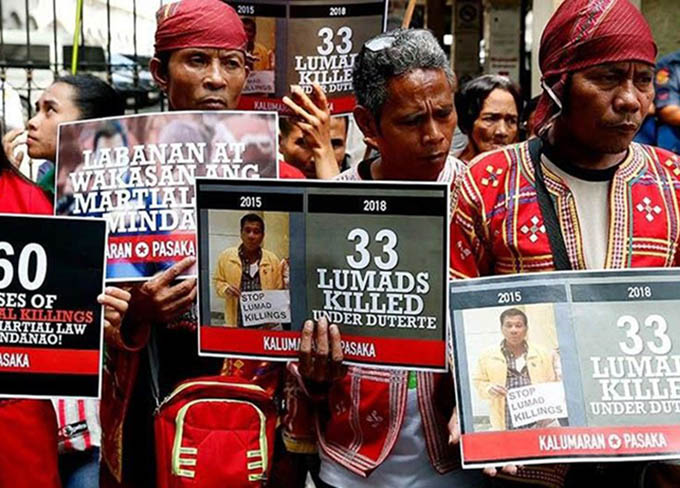








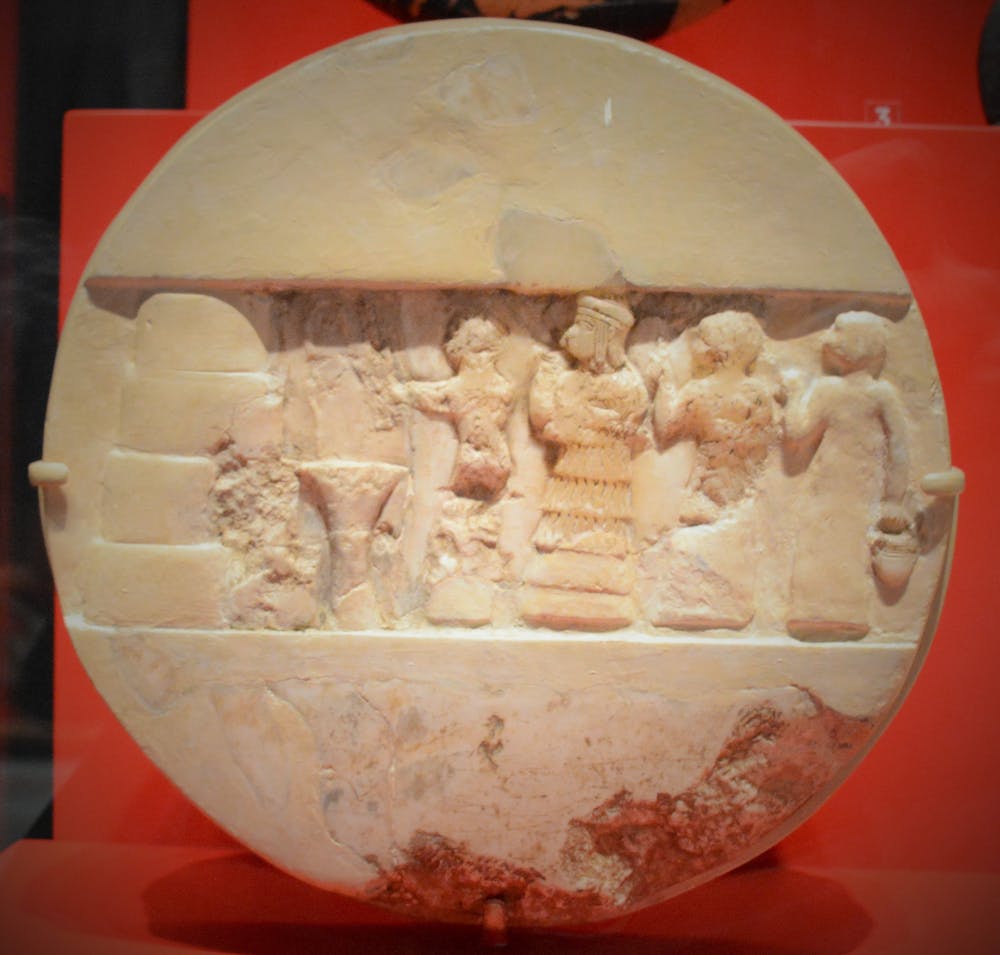
.jpg)