Page 1121

How to take care of your mental health after the Christchurch attacks

]]>

Source: The Conversation (Au and NZ) – By Richard Bryant, Professor & Director of Traumatic Stress Clinic, UNSW

The world was saddened and distressed to learn of the shocking Christchurch mosque attacks on Friday, which claimed the lives of 50 people and injured nearly as many. Since then we’ve heard heartbreaking stories of the victims and their families as we try to piece together how this could have happened.

For those at the scene or who were directly affected, such an attack is likely to have enduring physiological impacts. This may include anxiety, disturbed sleep, nightmares, unwanted memories of the event repeatedly popping into their minds, and fear of future attacks.

For people in the community who hear about such events or witness them on television, the news may be distressing but these feelings will typically abate in the following days and weeks. However, some people who watch these events unfold may be more affected because they trigger memories of past traumatic experiences in their own lives.


Read more: The psychology of fear and hate, and what each of us can do to stop it


Does it matter if you watch?

The Christchurch gunman livestreamed his attack on Facebook. The feed, and subsequent videos, showed him moving through the mosque and shooting at victims indiscriminately. The videos were then shared and broadcast, despite calls from police, researchers, journalists and other commentators not to do so.

The mental health effects of broadcasting graphic images of terrorist attacks are often debated after terrorists attacks. Research from the September 11, 2001 terrorist attacks in New York suggests that the more people watch television footage of these events, particularly children, the more likely they are to experience psychological distress.

Seeing the events unfold from the assailant’s perspective, and particularly in real time, is more akin to being present at the scene as a witness than watching a secondhand account on a news report. This level of exposure increases the risk of viewers (such as drone operators) experiencing marked distress.

The more you watch, the greater the distress. Steinar Engeland

The Christchurch attacks may cause more psychological harm to particular populations, such as refugees from conflict zones. Exposure to war, persecution, detention and other traumatic events increases the risk of psychological difficulties. This leaves refugees more vulnerable to lasting effects of subsequent stressors, such as the Christchurch attacks.


Read more: Why news outlets should think twice about republishing the New Zealand mosque shooter’s livestream


What are the risks for witness and victims?

Of course, the people who are most likely to be affected in the long term are the immediate victims of the attacks, their family members and friends, worshippers at the mosques, and also the emergency service personnel who responded to the incidents.

Post-traumatic stress disorder (PTSD) is a form of anxiety that comprises of intrusive memories of the traumatic event that are more like reliving the experience than thinking back to it. These memories are accompanied by extreme distress, which motivates people to avoid reminders of the event (such as news reports) or memories of the trauma.

People with PTSD also often experience general anxiety, such as poor sleep, anger outbursts, and poor concentration.


Read more: Acting out the nightmares of post-traumatic stress disorder


The risk of developing PTSD is greater when the trauma is interpersonal – in other words, when it’s caused by a person or group of people perpetrating violence or abuse against others. A hate crime such as the Christchurch attack is likely to have a particularly toxic psychological effect on the victims.

Despite this, prior studies of terrorist attacks suggest most people will adapt over time and resume good mental health. Around 10-20% of those affected are likely to develop PTSD.

Survivors and victims’ family and friends are also at risk of a newly recognised condition called prolonged grief disorder. This may be diagnosed when a person’s reaction to their grief, in the long term, impedes their ability to function. Of course it’s normal to experience acute grief, but this diagnosis would be applied if the grief doesn’t ease after around six months.

The likelihood of developing prolonged grief disorder is heightened by losing a loved one in traumatic circumstances. Likewise, experiencing grief can compound PTSD reactions.

How do you work through the trauma?

Past experience and research tells us the best way to deal with immediate distress is to turn to your own social support network and talk to people you trust about how you’re coping.

In the case of the recent attacks, mosques provide a natural social support network in which worshippers can meet, share and support each other.

First talk to your own social support networks. Jono Searle/AAP

If the distress doesn’t abate and persists for months, it’s time to seek professional help. For people with persistent stress or grief reactions, it may be beneficial to see a clinical psychologist who specialises in trauma-focused cognitive behaviour therapy (CBT).


Read more: Social supports build resilience and reduce distress after trauma


Clinical mental health guidelines recommend trauma-focused CBT for people with persistent stress reactions after trauma and also for prolonged grief. These interventions are usually relatively brief, requiring around ten sessions with a therapist.

But many people don’t receive adequate mental health care after traumatic events. This may be due to stigma about seeking help for mental health issues, not knowing how to get assistance, or being treated by people who don’t use evidence-based methods.

New Zealand’s prime minister, Jacinda Ardern, has announced additional support and funding for mental health services in Christchurch. Hopefully this will remove some of the barriers for survivors, family and friends to access quality mental health care.

ref. How to take care of your mental health after the Christchurch attacks – http://theconversation.com/how-to-take-care-of-your-mental-health-after-the-christchurch-attacks-113733

What parents need to know about the signs of child sexual abuse

]]>

Source: The Conversation (Au and NZ) – By Larissa Christensen, Lecturer in Criminology & Justice | Co-leader of the Sexual Violence and Research Prevention Unit (SVRPU), University of the Sunshine Coast

Recent events, including the conviction and sentencing of George Pell for sexually abusing two children in the 1990s and the documentary airing allegations about Michael Jackson’s abuse of two young boys, have made prominent the topic of child sexual abuse. Many parents may be concerned about the safety of their child, and whether they are missing signs the child may be being groomed, or sexually abused.

Child sexual abuse is a global problem. Victimisation rates are estimated at 18% for girls and almost 8% for boys. But these rates don’t show the full picture as they only reflect cases that have been reported. Most cases of child sexual abuse are perpetrated by someone known to the child or related to the child.

Findings from the Royal Commission into child sexual abuse show victims can take up to 26 years to disclose sexual abuse. So, if the child isn’t disclosing their experience, what can a parent do? Here are some signs to look for to protect your child, as well as what to do if you suspect they are experiencing sexual abuse or are at risk of being abused.

Encourage open conversation

The best weapon any caregiver has for protecting their child is to proactively engage in open communication about personal safety with their child from a young age. Helping a child build their knowledge of personal safety is a form of primary prevention of child sexual abuse.

This might include parents teaching their children the correct names for their genitalia, creating a shared language around warning signs, and basic rules regarding personal safety. Having these open conversations early on will build the child’s knowledge and may encourage the child to be more open about uncomfortable experiences they may have.

Why children may not tell

There are many reasons why children might not disclose abuse immediately. These include feelings of self-blame, embarrassment, shame, powerlessness or fear of the perpetrator.

Some children may simply not know how to talk about the abuse. The likelihood of non-disclosure may be magnified when the perpetrator is a family member or known to the family. Here, the child might feel conflicted, as they want the abuse to stop but are concerned about the perpetrator’s well-being if they disclose, or fear the consequences of disclosure such as family separation or distress.


Read more: Incest: why is ‘worst of the worst’ abuse so often ignored?


Grooming dynamics also shed light on why children may not disclose. Grooming is where a perpetrator manipulates a child using psychological pressure, tangible incentives (such as toys and money) and attention.

Once abuse occurs, the child’s silence may be maintained by the perpetrator suggesting the child will not be believed about the abuse, using threats and blame (“you will ruin the family if you tell anyone”) and distorting the abuse (such as suggesting it is part of a “game”).

Research suggests children are more likely to disclose sexual abuse if they feel they have at least one trusted adult they can turn to, who will listen and believe them.

Male victims are less likely to disclose than female victims. This may be due to it seeming un-masculine to seek help, being viewed as homosexual (if the perpetrator is male), and confusion about the experience due to the visible physiological responses they may have – such as an erection.

The severity of the abuse has also been linked to disclosure. Research has found the more severe the abuse, the more likely the child is to disclose it. Researchers have suggested in these instances, the child’s fear of being abused again may override any perceived negative consequences associated with disclosing the abuse.

What are some of the warning signs of sexual abuse?

While children may not disclose sexual abuse, they may show possible indicators. This might include one or more of the following:

  • significant changes in behaviour (such as reverting to soiling or bed wetting, a decline in school performance)
  • sexual behaviour or knowledge about sex that is beyond the child’s age
  • sudden fears or fear of being with a specific person
  • unexplained change in emotional state
  • becoming unusually secretive
  • pain in the genital or anal area.

But be alert not alarmed – these are possible indicators, not tell-tale signs. Just because an older child wets the bed does not mean they are (or have been) the victim of sexual abuse.

While children show curiosity and a range of behaviours while growing up, the take home message is to be alert to changes in emotions and behaviour that seem out of the ordinary for your child.

What do I do if I suspect my child is being sexually abused?

If you are concerned about a child, you can ask questions such as: “is anything worrying you?”, “are you OK?” and “is there anything you would like me to do to support you?”.

A child’s disclosure of sexual abuse may be intentional or non-intentional, complete or incomplete, verbal or non-verbal. The child may draw a picture or use toys to re-enact the situation. Importantly, how you respond to the child can impact on their recovery from such trauma.

If a child discloses to you that they are being sexually abused, give the child your undivided attention. Believing the child is critical to the child’s psychological well-being. Allow the child to use their own words and to take their time. Assure the child that they have done the right thing by telling you.

Avoid quizzing the child as this may add unnecessary pressure, and could interfere with legal proceedings (which may be considered as directing the child’s disclosure). The important thing at this stage is to be a supportive listener and ensure the child is safe.

You can report the incident to police or child protection. These individuals are specifically trained professionals in questioning children. Even without a disclosure, you can report your concerns.


Read more: Programs to prevent child sexual abuse increase knowledge and skills but do they reduce risks?


ref. What parents need to know about the signs of child sexual abuse – http://theconversation.com/what-parents-need-to-know-about-the-signs-of-child-sexual-abuse-113559

Autonomous transport will shape our cities’ future – best get on the right path early

]]>

Source: The Conversation (Au and NZ) – By Peter Newman, Professor of Sustainability, Curtin University

A unique opportunity exists for infrastructure investment in Australia as transport as we know it faces disruption from autonomous vehicles.

Disruption is not a dirty word. Traditional transport models are being transformed for the better by savvy young upstarts: the taxi industry by Uber, for instance, and even bus services by on-demand provider Bridj in parts of Sydney.


Read more: Disruption ahead: personal mobility is breaking down old transport divides


How do we manage this rapidly evolving technology, and what is the role of local government?

Autonomous vehicles will soon be a familiar sight in bush and city landscapes. In New South Wales the transport minister, Andrew Constance, predicted in 2017 that public transport might not be needed in future, certainly with no drivers, because autonomous cars will handle everything.

Singapore’s driverless taxi, nuTonomy, in 2016. EPA/AAP

I don’t think this will happen. The car is a good servant, but a bad master in shaping our city, even autonomous ones.

What will a city of autonomous cars look like?

A fully car-based approach to autonomous vehicles would involve cars driving around suburbs day and night, searching for people to pick up on demand. These vehicles would move into corridors, main roads and freeways, travelling at high speeds with just a metre or so between them.


Read more: The winners and losers in the race for driverless cars


Increased road capacity, safety and the very real prospect of solar-powered cars are undeniable benefits.

But what kind of city would we have? We would see more urban sprawl, possibly worse congestion and a departure from walkable cities.

We would lose an opportunity to reclaim pleasing city grids and urban centres. These spaces, which our city planners intended for pedestrians, have often been devoured by cars but are now returning to their rightful place as meeting spaces.


Read more: Smart cities: does this mean more transport disruptions?


The case for trackless trams

Autonomous transit vehicles with a collective benefit to society offer us a chance to continue to reclaim these spaces by providing rapid shared mobility where it doesn’t exist today. This is why I like the trackless tram: it has the high quality of autonomous transport like light rail, but at a tenth of the cost.

Trackless trams give us the capacity to not only catch up on years of under-investment in transport infrastructure, but also fund ambitious urban regeneration projects that will shape our future cities. This is what is driving trackless tram studies in Townsville, Sydney’s inner west, Wyndham in Melbourne and Perth.


Read more: Why trackless trams are ready to replace light rail


It’s also possible to use trackless trams to create new opportunities on the edges of our cities, like the Western Sydney Aerotropolis. There, Liverpool City Council wants to maximise the benefits of the new airport through transport connectivity back to the city’s CBD. Dr Tim Williams, Australasia cities leader at ARUP, declared Liverpool to be the surprise star of Australia’s future city planning for this reason.

Liverpool’s CBD is less than 18km away from the new airport site now under construction, but it might as well be a world away given the narrow roads and rural lands that currently separate the two.

NSW Opposition Leader Michael Daley has committed A$10 million towards preliminary work on a rapid transit link between the airport and Liverpool should he become premier after the March 23 election.

And Liverpool Council is investing significant resources to find out what these upgrades should be. This is an opportunity to embrace autonomous vehicles like trackless trams to create a strong link between the new airport and aerotropolis.


Read more: Western Sydney Aerotropolis won’t build itself – a lot is riding on what governments do


The role of city councils

Historically, councils have often been the passive recipients of state and federal investments. But councils like Liverpool are recognising their role in championing infrastructure investment that will support high-quality future growth.

Adelaide’s driverless electric shuttle for the Tonsley Innovation District is part of a five-year trial of autonomous vehicle tech. David Mariuz/AAP

Councils are also identifying that they can control many of the mechanisms, particularly planning controls, that could be useful to minimise value leakage and maximise value capture for the common good.


Read more: Paying for infrastructure means using ‘land value capture’, but does it also mean more tax?


Developers are telling us that if we can give them up-front certainty on quality and timing of infrastructure and associated land development opportunities, then they can be willing partners in co-funding new transport connections like a trackless tram.

The challenge is to create partnerships with all levels of government, developers and the community, to focus the opportunities from current levels of infrastructure investment and enable bold rather than risk-averse approaches to the future.

New technology brings new challenges, but also new opportunities. For the sake of future generations, we need to get in before the window closes.


Read more: Utopia or nightmare? The answer lies in how we embrace self-driving, electric and shared vehicles


ref. Autonomous transport will shape our cities’ future – best get on the right path early – http://theconversation.com/autonomous-transport-will-shape-our-cities-future-best-get-on-the-right-path-early-113023

Super power: why the future of Australian capitalism is now in Greg Combet’s hands

]]>

Source: The Conversation (Au and NZ) – By Danny Davis, Executive Director, Australian Institute of Performance Sciences, and researcher at, La Trobe University

Right now Greg Combet is arguably the most powerful man in Australia.

Earlier this month the former trade unionist and federal politician declared his intention to transform Australian business. His radical idea: to promote the concept of “long-term value”.

Combet is chairman of Industry Super Australia, which represents 16 of Australia’s biggest industry funds and thus the vast bulk of the A$630 billion saved by more than 11 million Australians.

These super funds would use their massive clout as investors to transform corporate culture, Combet told the Australian Financial Review. He wants business to focus on long-term sustainability, not be “hostage to the short-term share price or six-monthly profit announcements”.


Read more: With a billion reasons not to trust super trustees, we need regulators to act in the public interest


“The energy sector is an example of where long-term thinking is needed,” he said. “We have to start making a significant transition from old coal-fired power plants to renewable energy generation and distribution.”

But his ambition is much broader than this one controversial issue.

Not that revolutionary

Not everyone is happy about the idea of industry super funds, which have strong links to trade unions, pushing companies to focus on environmental, social and governance performance.

This week the Australian Prudential Regulatory Authority, responding to Treasurer Josh Frydenberg’s “urgent” request for guidance on “aggressive union behaviour”, warned super funds to keep away from financial activism.

Heather Ridout, a former head of the Australian Industry Group who now chairs the AustralianSuper fund, has told Frydenberg to stop politicising super.

Combet says his agenda has nothing to do with “activism”.

He’s right. His ideas really aren’t that revolutionary. In other parts of the world they would simply be regarded as responsible investor behaviour.

Greg Combet at the launch of his political memoir, The Fights of My Life, in July 2014. Paul Miller/AAP

Australian super funds have a legal obligation to manage their members’ funds for the long term.

Representing “retirement timeframe” interests means super funds want companies to think about how to sustain value over decades.

Up to now this has not necessarily translated into funds directly and consistently communicating their long-term interests to company boards. Combet’s declaration signals this is going to change.

There is plenty of research to suggest this will be a good thing.

Companies focused on the long term are more successful. They prioritise ethical behaviour, customer service, community value, environmental stewardship and other non-financial outcomes. Over the longer term they also have stronger share price growth.

Investors who help companies focus on the long term thus help themselves. It is a virtuous circle.

But revolutionary enough

According to the ASX Corporate Governance Council, not known for revolutionary subversion, the issues that effective boards must now take into account include “culture, conduct risk, digital disruption, cyber-security, sustainability and climate change”. There are others coming.

In the wake of the revelations of the banking royal commission, it would be irresponsible for the heads of superannuation funds to sit by as passive observers and not direct boards to these issues.

Globally, institutional investors, governments and companies are working together to move beyond solving specific issues such as corporate social responsibility, sustainability reporting and ethical investment.


Read more: What is corporate social responsibility – and does it work?


In fact, the United Nations Principles of Responsible Investment initiative, boasting more than 7,000 corporate and investor signatories, exhorts investors to go beyond “strictly financial benefits” and engage with companies on environmental, social and governance factors. Integrated approaches are at the forefront of practice.

Australia has been lagging behind. So for Combet to spell out a clear ambition to harness the power of the superannuation sector for long-term thinking is significant.

Perhaps he senses the opportunity to lead changes to the Australian economy, and society, that were out of reach during his 19 months as federal industry minister.

He wields immense power in a sector with even greater latent power. Superannuation assets now total A$2.7 trillion, and funds own about half of Australian shares. If Combet can leverage Industry Super Australia’s fund bloc to get the ball rolling, the momentum could be truly ground-breaking.

We will now see which of Australia’s economic elite join his mission and collaborate in building global momentum. Those who want to resist, or who cannot organise themselves to participate, should know the clock is now ticking.

ref. Super power: why the future of Australian capitalism is now in Greg Combet’s hands – http://theconversation.com/super-power-why-the-future-of-australian-capitalism-is-now-in-greg-combets-hands-113648

‘He is a terrorist – and nameless’, PM Jacinda Ardern declares to nation

]]>

NZ Prime Minister Jacinda Ardern has vowed she will never mention the name of the man accused of killing at least 50 people in the Christchurch mosques terror attack on March 15. Video: Newsweek/NZ Parliament

Pacific Media Centre Newsdesk

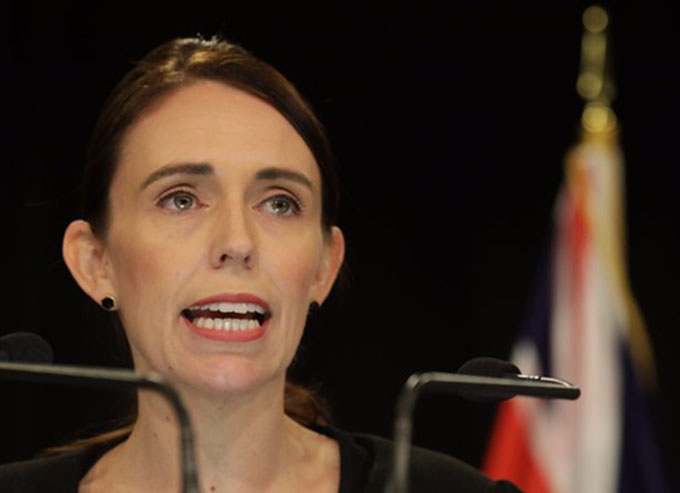
Paying tribute to the victims of the Christchurch terror attacks in Parliament today, New Zealand Prime Minister Jacinda Ardern declared the accused gunman would remain “nameless”.

She vowed that would not name the Australian man and told others in New Zealand to do the same.

READ MORE: RNZ’s tribute to the lost – ‘They are us’

“He may have sought notoriety, but we in New Zealand will give him nothing, not even his name,” she said.

“He is a terrorist. He is a criminal. He is an extremist. But he will, when I speak, be nameless.”

-Partners-

While saying that while a quiet Friday afternoon had become “our darkest of days”, immediate measures had been put in place to ensure the safety of New Zealand’s Muslim community and everyone following Friday’s massacre of 50 people praying at two mosques in Christchurch.

She also pledged justice for the families.

The man is due to reappear in the High Court in Christchurch on April 5 charged with one count of murder, but expected to face other charges.

Her full statement to Parliament on the Christchurch terror attack:

Mr Speaker,

Al salam Alaikum

Peace be upon you. And peace be upon all of us.

Mr Speaker the 15th of March will now forever be a day etched in our collective memories. On a quiet Friday afternoon a man stormed into a place of peaceful worship and took away the lives of 50 people.

That quiet Friday afternoon has become our darkest of days.

But for the families, it was more than that. It was the day that the simple act of prayer – of practising their Muslim faith and religion – led to the loss of their loved ones lives.

Those loved ones, were brothers, daughters, fathers and children.

They were New Zealanders. They are us.

And because they are us, we, as a nation, we mourn them.

We feel a huge duty of care to them. And Mr Speaker, we have so much we feel the need to say and to do.

One of the roles I never anticipated having, and hoped never to have, is to voice the grief of a nation.

At this time, it has been second only to securing the care of those affected, and the safety of everyone.

And in this role, I wanted to speak directly to the families. We cannot know your grief, but we can walk with you at every stage. We can. And we will, surround you with aroha, manaakitanga and all that makes us, us. Our hearts are heavy but our spirit is strong.

Mr Speaker, 6 minutes after a 111 call was placed alerting the police to the shootings at Al-Noor mosque, police were on the scene.

The arrest itself was nothing short of an act of bravery. Two country police officers rammed the vehicle from which the offender was still shooting. They pulled open his car door, when there were explosives inside, and pulled him out.

I know we all wish to acknowledge that their acts put the safety of New Zealanders above their own, and we thank them.

But they were not the only ones who showed extraordinary courage.

Naeem Rashid, originally from Pakistan, died after rushing at the terrorist and trying to wrestle the gun from him. He lost his life trying to save those who were worshipping alongside him.

Abdul Aziz, originally from Afghanistan, confronted and faced down the armed terrorist after grabbing the nearest thing to hand – a simple eftpos machine. He risked his life and no doubt saved many with his selfless bravery.

There will be countless stories, some of which we may never know, but to each, we acknowledge you in this place, in this House.

For many of us the first sign of the scale of this terrorist attack was the images of ambulance staff transporting victims to Christchurch hospital.

To the first responders, the ambulance staff and the health professionals who have assisted – and who continue to assist those who have been injured.

Please accept the heartfelt thanks of us all. I saw first-hand your care and your professionalism in the face of extraordinary challenges. We are proud of your work, and incredibly grateful for it.

Mr Speaker, if you’ll allow, I’d like to talk about some of the immediate measures currently in place especially to ensure the safety of our Muslim community, and more broadly the safety of everyone.

As a nation, we do remain on high alert. While there isn’t a specific threat at present, we are maintaining vigilance.

Unfortunately, we have seen in countries that know the horrors of terrorism more than us, there is a pattern of increased tension and actions over the weeks that follow that means we do need to ensure that vigilance is maintained.

There is an additional and ongoing security presence in Christchurch, and as the police have indicated, there will continue to be a police presence at mosques around the country while their doors are open. When they are closed, police will be in the vicinity.

There is a huge focus on ensuring the needs of families are met. That has to be our priority. A community welfare centre has been set up near the hospital in Christchurch to make sure people know how to access support.

Visas for family members overseas are being prioritised so that they can attend funerals. Funeral costs are covered, and we have moved quickly to ensure that this includes repatriation costs for any family members who would like to move their loved ones away from New Zealand.

We are working to provide mental health and social support. The 1737 number yesterday received roughly 600 texts or phonecalls. They are on average lasting around 40 minutes, and I encourage anyone in need to reach out and use these services. They are there for you.

Our language service has also provided support from more than 5000 contacts, ensuring whether you are ACC or MSD, you are able to pass on the support that is needed, in the language that is needed. To all those working within this service, we say thank you.

Our security and intelligence services are receiving a range of additional information. As has been the case in the past, these are being taken extremely seriously, and they are being followed up.

I know though Mr Speaker, that there have rightly been questions around how this could have happened here. In a place that prides itself on being open, peaceful, diverse.

And there is anger that it has happened here.

There are many questions that need to be answered, and the assurance that I give you is that they will be.

Yesterday Cabinet agreed that an inquiry, one that looks into the events that led up to the attack on 15 March, will occur. We will examine what we did know, could have known, or should have known. We cannot allow this to happen again.

Part of ensuring the safety of New Zealanders must include a frank examination of our gun laws.

As I have already said Mr Speaker, our gun laws will change. Cabinet met yesterday and made in-principle decisions, 72 hours after the attack.

Before we meet again next Monday, these decisions will be announced.

Mr Speaker, there is one person at the centre of this act of terror against our Muslim community in New Zealand.

A 28-year-old man – an Australian citizen – has been charged with one count of murder. Other charges will follow. He will face the full force of the law in New Zealand. The families of the fallen will have justice.

He sought many things from his act of terror, but one was notoriety.

And that is why you will never hear me mention his name.

He is a terrorist. He is a criminal. He is an extremist.

But he will, when I speak, be nameless.

And to others I implore you: speak the names of those who were lost, rather than name of the man who took them.

He may have sought notoriety, but we in New Zealand will give him nothing. Not even his name.

Mr Speaker, we will also look at the role social media played and what steps we can take, including on the international stage, and in unison with our partners.

There is no question that ideas and language of division and hate have existed for decades, but their form of distribution, the tools of organisation, they are new.

We cannot simply sit back and accept that these platforms just exist and that what is said on them is not the responsibility of the place where they are published. They are the publisher. Not just the postman. There cannot be a case of all profit no responsibility. This of course doesn’t take away the responsibility we too must show as a nation, to confront racism, violence and extremism. I don’t have all of the answers now, but we must collectively find them. And we must act.

Mr Speaker, we are deeply grateful for all messages of sympathy, support and solidarity that we are receiving from our friends all around the world. And we are grateful to the global Muslim community who have stood with us, and we stand with them.

Mr Speaker, I acknowledge that we too also stand with Christchurch, in a devastating blow that this has been to their recovery. I acknowledge every member of this House that has stood alongside their Muslim community but especially those in Canterbury as we acknowledge this double grief

As I conclude I acknowledge there are many stories that will have struck all of us since the 15th of March.

One I wish to mention, is that of Hati Mohemmed Daoud Nabi.

He was the 71-year-old man who opened the door at the Al-Noor mosque and uttered the words ‘Hello brother, welcome’. His final words.

Of course he had no idea of the hate that sat behind the door, but his welcome tells us so much – that he was a member of a faith that welcomed all its members, that showed openness, and care.

I have said many times Mr Speaker, we are a nation of 200 ethnicities, 160 languages. We open our doors to others and say welcome. And the only thing that must change after the events of Friday, is that this same door must close on all of those who espouse hate and fear.

Yes the person who committed these acts was not from here. He was not raised here. He did not find his ideology here, but that is not to say that those very same views do not live here.

I know that as a nation, we wish to provide every comfort we can to our Muslim community in this darkest of times. And we are. The mountain of flowers around the country that lie at the doors of mosques, the spontaneous song outside the gates. These are ways of expressing an outpouring of love and empathy. But we wish to do more.

We wish for every member of our communities to also feel safe.

Safety means being free from the fear of violence.

But it also means being free from the fear of those sentiments of racism and hate, that create a place where violence can flourish.

And every single one of us has the power to change that.

Mr Speaker on Friday it will be a week since the attack.

Members of the Muslim community will gather for worship on that day.

Let us acknowledge their grief as they do.

Let’s support them as they gather again for worship.

We are one, they are us.

Print Friendly, PDF & Email

Article by AsiaPacificReport.nz

Anxieties over livestreams can help us design better Facebook and YouTube content moderation

]]>

Source: The Conversation (Au and NZ) – By Andrew Quodling, PhD candidate researching governance of social media platforms, Queensland University of Technology

As families in Christchurch bury their loved ones following Friday’s terrorist attack, global attention now turns to preventing such a thing ever happening again.

In particular, the role social media played in broadcasting live footage and amplifying its reach is under the microscope. Facebook and YouTube face intense scrutiny.


Read more: Social media create a spectacle society that makes it easier for terrorists to achieve notoriety


New Zealand’s Prime Minister Jacinta Ardern has reportedly been in contact with Facebook executives to press the case that the footage should not available for viewing. Australian Prime Minister Scott Morrison has called for a moratorium on amateur livestreaming services.

But beyond these immediate responses, this terrible incident presents an opportunity for longer term reform. It’s time for social media platforms to be more open about how livestreaming works, how it is moderated, and what should happen if or when the rules break down.

Increasing scrutiny

With the alleged perpetrator apparently flying under the radar prior to this incident in Christchurch, our collective focus is now turned to the online radicalisation of young men.

As part of that, online platforms face increased scrutiny and Facebook and Youtube have drawn criticism.

After dissemination of the original livestream occurred on Facebook, YouTube became a venue for the re-upload and propagation of the recorded footage.

Both platforms have made public statements about their efforts at moderation.

YouTube noted the challenges of dealing with an “unprecedented volume” of uploads.

Although it’s been reported less than 4000 people saw the initial stream on Facebook, Facebook said:

In the first 24 hours we removed 1.5 million videos of the attack globally, of which over 1.2 million were blocked at upload […]

Focusing chiefly on live-streaming is somewhat reductive. Although the shooter initially streamed his own footage, the greater challenge of controlling the video largely relates to two issues:

  1. the length of time it was available on Facebook’s platform before it was removed
  2. the moderation of “mirror” video publication by people who had chosen to download, edit, and re-upload the video for their own purposes.

These issues illustrate the weaknesses of existing content moderation policies and practices.

Not an easy task

Content moderation is a complex and unenviable responsibility. Platforms like Facebook and YouTube are expected to balance the virtues of free expression and newsworthiness with socio-cultural norms and personal desires, as well as the local regulatory regimes of the countries they operate in.

When platforms perform this responsibility poorly (or, utterly abdicate it) they pass on the task to others — like the New Zealand Internet Service Providers that blocked access to websites that were re-distributing the shooter’s footage.

People might reasonably expect platforms like Facebook and YouTube to have thorough controls over what is uploaded on their sites. However, the companies’ huge user bases mean they often must balance the application of automated, algorithmic systems for content moderation (like Microsoft’s PhotoDNA, and YouTube’s ContentID) with teams of human moderators.


Read more: A guide for parents and teachers: what to do if your teenager watches violent footage


We know from investigative reporting that the moderation teams at platforms like Facebook and YouTube are tasked with particularly challenging work. They seem to have a relatively high turnover of staff who are quickly burnt-out by severe workloads while moderating the worst content on the internet. They are supported with only meagre wages, and what could be viewed as inadequate mental healthcare.

And while some algorithmic systems can be effective at scale, they can also be subverted by competent users who understand aspects of their methodology. If you’ve ever found a video on YouTube where the colours are distorted, the audio playback is slightly out of sync, or the image is heavily zoomed and cropped, you’ve likely seen someone’s attempt to get around ContentID algorithms.

For online platforms, the response to terror attacks is further complicated by the difficult balance they must strike between their desire to protect users from gratuitous or appalling footage with their commitment to inform people seeking news through their platform.

We must also acknowledge the other ways livestreaming features in modern life. Livestreaming is a lucrative niche entertainment industry, with thousands of innocent users broadcasting hobbies with friends from board games to mukbang (social eating), to video games. Livestreaming is important for activists in authoritarian countries, allowing them to share eyewitness footage of crimes, and shift power relationships. A ban on livestreaming would prevent a lot of this activity.

We need a new approach

Facebook and YouTube’s challenges in addressing the issue of livestreamed hate crimes tells us something important. We need a more open, transparent approach to moderation. Platforms must talk openly about how this work is done, and be prepared to incorporate feedback from our governments and society more broadly.


Read more: Christchurch attacks are a stark warning of toxic political environment that allows hate to flourish


A good place to start is the Santa Clara principles, generated initially from a content moderation conference held in February 2018 and updated in May 2018. These offer a solid foundation for reform, stating:

  1. companies should publish the numbers of posts removed and accounts permanently or temporarily suspended due to violations of their content guidelines
  2. companies should provide notice to each user whose content is taken down or account is suspended about the reason for the removal or suspension
  3. companies should provide a meaningful opportunity for timely appeal of any content removal or account suspension.

A more socially responsible approach to platforms’ roles as moderators of public discourse necessitates a move away from the black-box secrecy platforms are accustomed to — and a move towards more thorough public discussions about content moderation.

In the end, greater transparency may facilitate a less reactive policy landscape, where both public policy and opinion have a greater understanding around the complexities of managing new and innovative communications technologies.

ref. Anxieties over livestreams can help us design better Facebook and YouTube content moderation – http://theconversation.com/anxieties-over-livestreams-can-help-us-design-better-facebook-and-youtube-content-moderation-113750

We did a breakthrough ‘speed test’ in quantum tunnelling, and here’s why that’s exciting

]]>

Source: The Conversation (Au and NZ) – By U. Satya Sainadh, Postdoctoral researcher, Technion – Israel Institute of Technology

When you deal with things at the quantum scale, where things are very small, the world is quite fuzzy and bizarre in comparison to our everyday experiences.

For example, we can’t ordinarily walk through solid walls. But at the quantum scale, when a particle encounters a seemingly insurmountable barrier, it can sometimes pass through to the other side – a process known as quantum tunnelling.

But how fast a particle could tunnel through a barrier was always a puzzle.


Read more: What do we mean by meaning? Science can help with that


In work published today in Nature we’ve solved part of the problem.

Why is that important? It’s a breakthrough that could have an impact on future technologies we see in our homes, at work or elsewhere.

Many of today’s technologies – such as semiconductors, the LED screen on your smart phone, or lasers – are based on our understanding of how things work in the quantum world.

So the more we can learn, the more we can develop.

Back to the tunnelling

For quantum particles, such as electrons, when we say they can tunnel through barriers, we don’t refer to a physical obstacles, but barriers of energy.

Things behave differently in the quantum world. Shutterstock/VectorMine

Tunnelling is possible due to the wave nature of the electron. Quantum mechanics assigns wave nature to every particle, and hence there is always a finite probability for the wave to propagate through barriers, just as sound travels through walls.

It may sound counterintuitive, but this is what is exploited in technologies such as scanning tunnelling microscopes, which allow scientists to create images with atomic resolution. This is also naturally observed in nuclear fusion, and in biological processes such as photosynthesis.

Although the phenomenon of quantum tunnelling is well studied and utilised, physicists still lacked a complete understanding of it, especially with regards to its dynamics.

If we could exploit the dynamics of tunnelling – for example, use it to carry more information – it could possibly give us a new handle on future quantum technologies.

A tunnel speed test

The first step towards this goal is to measure the speed of the tunnelling process. This is no simple feat, as the time scales involved in the measurement are extremely small.

For energy barriers the size of few billionths of a metre, as in our experiment, some physicists had calculated the tunnelling process would take around a hundred attoseconds (1 attosecond is a billionth of a billionth of a second).

To put things in perspective, if an attosecond is stretched to a second, then a second equals the age of the universe.

The estimated times are so extremely small that they were previously treated as practically instantaneous. Hence for our experiment we needed a clock that can time these events with enormous accuracy and precision.

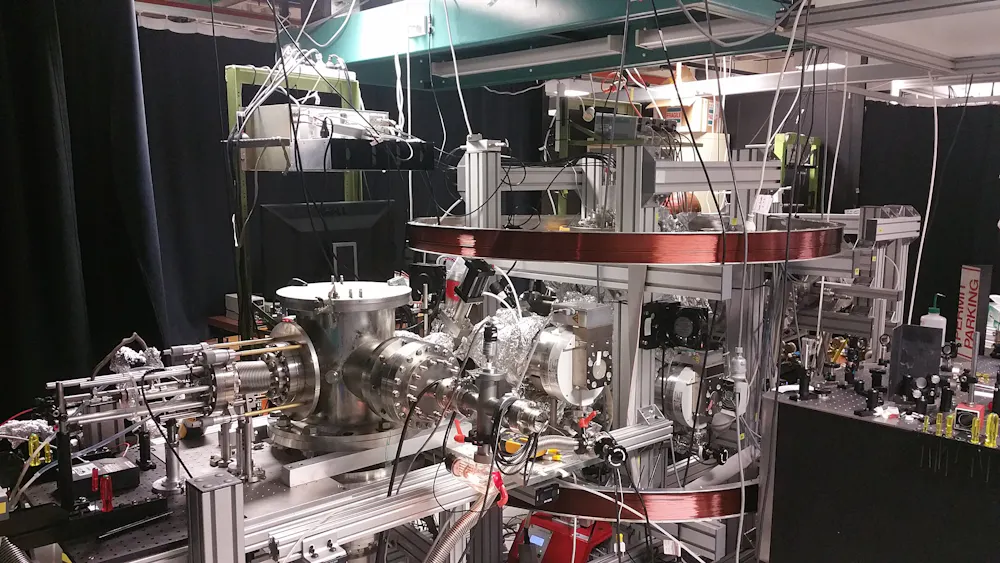
The technological advancements in ultrafast laser systems enabled us to implement such a clock at the Australian Attosecond Science Facility, Centre for Quantum Dynamics, at Griffith University.

Part of the experiment set up at the Griffith University lab. U. Satya Sainadh, Author provided

The clock in the experiment is not mechanical or electrical – rather it is the rotating electric field vector of an ultrafast laser pulse.

Light is just electromagnetic radiation made of electric and magnetic fields varying at a rapid rate. We used this rapidly changing field to induce tunnelling in atomic hydrogen and also as a stopwatch to measure when it ends.

How fast?

The choice of using atomic hydrogen (which is simply a bound pair of one electron and one proton) avoids the complications that arise from other atoms, making it easier to compare and interpret the results unambiguously.

The tunnelling time we measured was found to be no more than 1.8 attoseconds, much smaller than some theories had predicted. This measurement calls for a serious reconsideration of our understanding of tunnelling dynamics.

Various theories estimated a range of tunnelling times – from zero to hundreds of attoseconds – and there was no consensus among physicists on which single theoretical estimate was correct.

A basic reason for the disagreements lies in the very concept of time in quantum mechanics. Because of quantum uncertainties, there can be no absolute certainty in the time at which a particle enters into or emerges from the barrier.

But experiments like ours, using precise measurements on simple systems, could guide us in refining our understanding of such times

The next technologies

Quantum leaps in the technological world are often rooted in the quest for fundamental science.

Future quantum technologies that incorporates many of the quantum features – such as superposition and entanglement – will lead to what technologists call the “second quantum revolution”.


Read more: We’ve designed a ‘flux capacitor’, but it won’t take us Back to the Future


By fully understanding the quantum dynamics of the simplest possible atomic tunnelling event – with a single proton and a single electron – we have shown that certain types of theories can be relied on to give the right answer, where other types of theories fail.

This gives us confidence about what theories to apply to other, more complicated systems.

Measurements at the attosecond scale not only add an extra dimension for the future quantum technologies but also can fundamentally help in understanding the elephant of the quantum room: what is time?


You might also like: In Trust Me, I’m An Expert: The explainer episode, Andrew White, a professor in physics at the University of Queensland, tells us how far quantum mechanics has come, why the research hit a wall, and what exciting breakthroughs might be just around the corner.

ref. We did a breakthrough ‘speed test’ in quantum tunnelling, and here’s why that’s exciting – http://theconversation.com/we-did-a-breakthrough-speed-test-in-quantum-tunnelling-and-heres-why-thats-exciting-113761

Births, deaths and rituals: a revamped Ten Days on the Island explores Tasmania’s past and present

]]>

Source: The Conversation (Au and NZ) – By Asher Warren, Lecturer, University of Tasmania

This year marks the tenth biennial Tasmanian Arts festival Ten Days on the Island, and the first under new artistic director, Lindy Hume. Since it began in 2001, the festival has always been ambitious: seeking to showcase Tasmanian art, bring international works to the island, and at the same time be a festival for the whole of the state, rather than just the hub of Hobart.

Its challenge has only increased with Tasmania’s now burgeoning festival scene, which includes The Unconformity, Dark MOFO, and the Festival of Voices to name just a few.

It should come as no surprise then, that this year’s Ten Days adopted a new approach, moving from ten consecutive days to programming split up over three distinct weekends. The first two weekends took place in the state’s north west and north east respectively, with the festival due to conclude this weekend in the south.


Read more: The Unconformity festival embraces the power and peculiarity of Tasmania’s wild west


This distribution of work across the state makes it a challenge for all but the most intrepid to see everything. With this in mind, I have focused on the festival’s first two weekends, but to summarise even these two weeks is a challenging task.

The diversity of work reflects the different regions of Tasmania – often proud of their isolation. While this creates a challenge in finding coherence, the work of these two weeks was notable for a number of key themes: belonging, life, death, and Tasmania’s colonial history.

Stories of the island

Ten Days officially began at dawn on March 8, on the beachfront at the Devonport surf life-saving club in the state’s north west, with Mapali – Dawn Gathering.

Narrated by the commanding voice of Dave mangenner Gough, the ceremony began with a Welcome to Country that celebrated the local Aboriginal (palawa) communities, with the sweeping and smoking of the beach, the gathering of kelp to make water carriers, and the unbroken practice of crafting intricate shell necklaces.

This year’s Ten Days on the Island festival is spread across three weekends and three parts of Tasmania.

A short time later, Jessie Pangas and Anne Morrison’s Here She Is opened at Devonport’s Stewart St Gallery. There could have been no more fitting work to celebrate International Women’s Day.

A collaged, stitched and woven collection of stories and connections between women of the north west coast, Here She Is was built from audio recordings, participant submissions, archival materials and artistic responses to these materials.

Here She Is was the perfect work for International Women’s Day. Provided by Ten Days on the Island

It is a dense work, constantly drawing you closer to make out handwriting and listen to stories. Yet evocative spaces open up between the fragments, pictures, and conversations, where just as much is left unsaid. This induces viewers to participate in the work through the addition of their own recollections, stories and mementos of the women in their lives.

Another hour’s drive along the north coast brought us just near the picturesque coastal township of Boat Harbour, for Big hArt’s Acoustic Life of Sheds, a series of intimate concerts held in sheds throughout the region.

It was a rather genteel and romantic affair, as we travelled from an industrial potato shed, to woodworker’s sanctuaries, a derelict grain silo, and a shearing shed.

In the shearing shed, a collaborative suite of songs written and performed by Lucky Oceans and Heath Cullen closed the tour. The songs were written from the perspective of nonhuman things: from the shed we were sitting in, to an artificial intelligence in the not too distant future. A delightful and masterful set, these voices were used to interrogate the more problematic foundations of our “shed-romanticism”: their footprints on the landscape and the consumption behind the junk that fills them.

But as an audience member, I longed for a little more breathing space. The pace left little time to engage with fellow patrons, the sheds, their owners and their histories.

Audiences for Acoustic Life of Sheds visited locations including an industrial potato shed, a derelict grain silo, and a shearing shed. Beth Sometimes

The second weekend took place in the state’s north east. Tamar Island, just a short drive from Launceston, was the site for youth dance company Stompin’s ambitious new work, Nowhere. The work explores this island on an island, its colonial and pre-colonial history, and most poignantly, its future.

The young troupe built toward a mesmerising sequence that evoked the interplay of natural plant formations and wind patterns, leading to a penultimate gesture equal parts touching and devastating. As they broke away and wandered in single file from the island and into the sunset, Nowhere asked us what, and even who, will be left to applaud when our environment disappears?

Later that week, forty minutes west of Launceston, I was ushered by a stage manager in blue scrubs to an upstairs room of Deloraine’s Empire Hotel, to see Robert Jarman’s new work The Protecting Veil.

Delivered by Jarman in a matching set of blue scrubs, The Protecting Veil uses Nicolas Poussin’s second series of sacrament paintings as its structure – a structure also utilised by British writer, director and performer Neil Bartlett in his 1997 work, The Seven Sacraments of Nicolas Poussin .

Drawing on the rituals and figures depicted in these seven images, Jarman delivers an art history lecture of sorts, weaving in personal experience and contemporary politics, and reflecting on the ways that rituals structure our lives, from birth to death.

Guitarist David Malone shares the stage throughout. His musical interludes help build a certain feeling in the work, heightened by the room’s arrangement and the scrubs: the feeling of waiting in a hospital or funeral parlour.

The titular “protecting veil”, we learn, refers not just to the curtains that force viewers to contemplate Poussin’s seven paintings one at a time, but the curtains that surround patients, and the curtains which cover the glass in funeral viewing parlours.

The show warms up, literally and figuratively, as we reach the sacrament of communion (taken as a joyful tea break with jam rolls) before moving on toward death. When this moment arrives, the intimate audience dutifully obeys the request not to applaud, but our reverence – the ritual – seems a little forced.

Perhaps this is because of a scene I had witnessed just before the show began. Somewhat serendipitously, while waiting downstairs at the public bar of the hotel, I saw the Deloraine social club raise their glasses (and I mine) to a recently deceased member of the community. The collection of downstairs rituals were profoundly ordinary, but touching in their camaraderie – from the raffle held in her honour, to a ribald rendition of the folk song Old Grey Mare.


Read more: Hail MONA! But what about the rest of Tasmanian art?


Finally, I visited Crime Scene, a forensic-style installation in the Longford Town Hall by Anna Gibbs, Elizabeth Day, Julie Gough and Noelene Lucas.

Four video works are projected from inside onto each of the four walls. Each piece takes an instance of violence researched through colonial records, and attempts to present the evidence though an aesthetic lens. These pieces seek to draw our attention back to the deep scars of Tasmania’s history, not only between invading colonists and the Indigenous peoples, but also among the settlers.

Crime Scene is an installation exploring colonial violence. Courtesy the artists

The simplicity of these works allows the researched accounts of this violence to cut through. In fact, they quite relentlessly confront the wounds that haunt Tasmania – wounds that Greg Lehman notes must be properly addressed before they can begin to heal.

In moving their base of operations to Burnie, and embracing a more distributed Ten Days, the festival has broken away from the old. This new generation model offers a valuable example of how arts and culture might be curated for and by Tasmania’s diverse population, giving great voice to the north of the state.

Change is always difficult, but it is necessary as Tasmania becomes more and more globally connected. Ten Days on the Island serves a vital role in developing a diverse cultural sector (which is in many ways dominated by MONA and its festivals) and supporting the next generation of Tasmanian artists to speak not only to the island, but also to a national and international audience.


Ten Days on the Island concludes March 24.

ref. Births, deaths and rituals: a revamped Ten Days on the Island explores Tasmania’s past and present – http://theconversation.com/births-deaths-and-rituals-a-revamped-ten-days-on-the-island-explores-tasmanias-past-and-present-113745

A guide for parents and teachers: what to do if your teenager watches violent footage

]]>

Source: The Conversation (Au and NZ) – By Rachael Sharman, Senior Lecturer in Psychology, University of the Sunshine Coast

The world is reeling in the aftermath of the horrific shootings in Christchurch. The attack has also raised a number of side issues, including the ethics of broadcasting the live stream of the attack, which was later shared on other platforms.

As social media is fast becoming the favoured news source among young people, concerns have been raised about the potential impact such footage may have on those exposed to it.

Adolescents are particularly affected by violent imagery. As their brains are still developing, they may have trouble processing the information. This basically means the bits of information teens will pay attention to, what they highlight in their memory, and how they organise, conceptualise or contextualise information is still a work in progress. In adults, this is more or less set.

The use of social media as conduits for extreme violence is a relatively new issue and a fast moving beast. So research has struggled to keep up with potential emerging impacts.

But there are some things we do know about the impact of violent imagery on the adolescent brain, and ways in which adults can help teenagers process such information.


Read more: Why news outlets should think twice about republishing the New Zealand mosque shooter’s livestream


Violence and the developing brain

Concerns regarding the impact of violent imagery on the developing brain are nothing new. They were first raised after images of the second world war appeared in some of the first television broadcasts from the late 40s. By the early 70s, the US Surgeon General acknowledged the potential for harm of such footage on younger members of the community.

Fast forward to today and a raft of different research methods continue to demonstrate links between exposure to media violence and increased aggression or fear in adolescents. The primary concern for older male adolescents appears to centre around its impact on aggressive tendencies. But younger adolescents may also exhibit heightened fear responses.

A couple of primary issues appear to be at play. Exposure to violence can lead to desensitisation, which contributes to later acts of violence in adolescence. The psychologiccal mechanism by which this occurs suggests desensitisation from habitual media violence reduces fear and promotes aggression enhancing thoughts. This increases the likelihood of proactively committing an aggressive act.

Peer norms remain a strong benchmark for most teenage behaviour, and these too appear to influence aggression (either increasing or decreasing), suggesting a role for social context.

It may then be fair to speculate that peers sharing violent content via social media could provide a perfect storm of desensitisation and tacit peer approval of, or at the very least encouraging interest in, acts of extreme violence.

The American Academy of Pediatrics has signalled their concerns regarding the potential harmful impact of media violence on teens, and suggested parents and schools need to be vigilant in responding to the influence of social media.

And a number of studies have recommended limiting exposure to social media, or monitoring its use, as well more action by social media sites to prevent streaming of violence. How such recommendations can be practically achieved with today’s ubiquitous use of social media is a trickier question.


Read more: How to talk to children about terrorism


So what can parents and teachers actually do?

Research into possible ways of ameliorating the effect of media violence in influencing adolescent aggression or fear has arrived at some helpful pointers for both parents and teachers:

  • discuss what you are seeing on television (or Facebook) with the teenager. Remaining silent during the broadcasting of violent imagery can be perceived by your teen as tacit endorsement of the depicted acts

  • engage your teenager with questions and improve their empathy by looking at the impact of the violence from several points of view. For instance, what about both the victim’s and perpetrator’s family – how must they be feeling now? This appears to be a more effective approach with teenagers and young adults than simply stating your own point of view

  • parents and schools can take an active role in directly teaching adolescents about media manipulation methods and falsehoods spread to serve a particular agenda. This includes how to spot fake news, hoaxes and propaganda

  • help the teenager develop critical thinking and a healthy level of cynicism. This can be done by encouraging them to take a step back and think about the motivations of those who report or broadcast especially violent or confronting imagery.


Read more: How to help kids navigate fake news and misinformation online


If you notice a substantial change in a teenager’s behaviour following a highly publicised violent act – such as being frightened to take public transport, checking locks at night, keeping weaponry on them or nearby, or suddenly more being aggressive and/or anxious in general – it may be time to seek help from your school counsellor or GP.

ref. A guide for parents and teachers: what to do if your teenager watches violent footage – http://theconversation.com/a-guide-for-parents-and-teachers-what-to-do-if-your-teenager-watches-violent-footage-113753

Christchurch terrorism attacks: NZ’s darkest hour – Friday, March 15, 2019

]]>

Selwyn Manning, editor of Evening Report, profiles the Christchurch atrocity that has outraged and shaken a peaceful South Pacific nation.

Out of the blue:
It was 1:39pm, Friday March 15. As was usual for a Friday, hundreds of people had turned up to pray at the Al Noor Mosque in Riccarton, Christchurch. All was peaceful, women, children, men, people of all ages young and old, both Sunni and Shia, were in contemplative repose free of worry.

It was a mild, late summer, 20 degrees Celsius day. Earlier, the touring Bangladesh cricket team had briefly visited the mosque, but left early to attend a press conference. By 1:39pm, they had returned and were outside exiting a bus, intending to continue with their prayers inside the mosque.

At 1:40pm, ahead of the team, a man entered the mosque walking quickly up the front steps. He was carrying an assault rifle and dressed in combat uniform. He immediately began shooting people who were kneeling in prayer.

The shots rang out and the Bangladesh team members realising they were witnesses to an attack, retreated, and fled on foot to nearby Hagley Park.

Back inside the Al Noor Mosque, scores of worshippers were being gunned down, some killed instantly, others bleeding to death. The victims included little Mucaad Ibrahim who was three years of age. Mucaad was known by his loved ones as a wise “old soul” and possessed an “intelligence beyond his years”.

Eye witnesses said that once the killer began shooting people, little Mucaad became separated from his family. In the chaos, his family could not find him. The next day police confirmed he too had been shot dead by the killer.

-Partners-

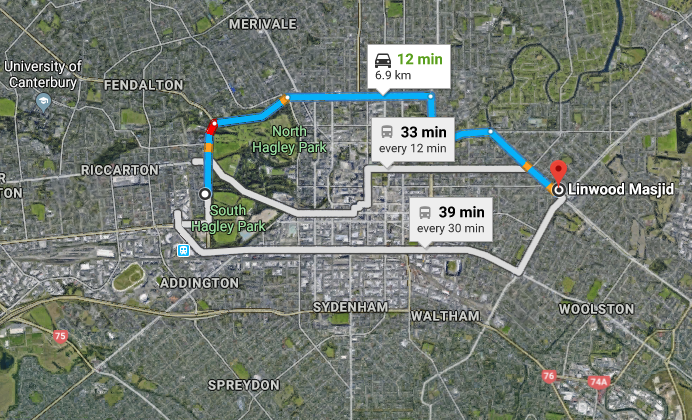
The murders continued at the Al Noor Mosque until the killer’s firearms ran out of bullets. Then, he simply walked out of the mosque, got in his car, and drove six kilometres to the Linwood Mosque. There too were people who had gathered for their regular Friday afternoon prayers.
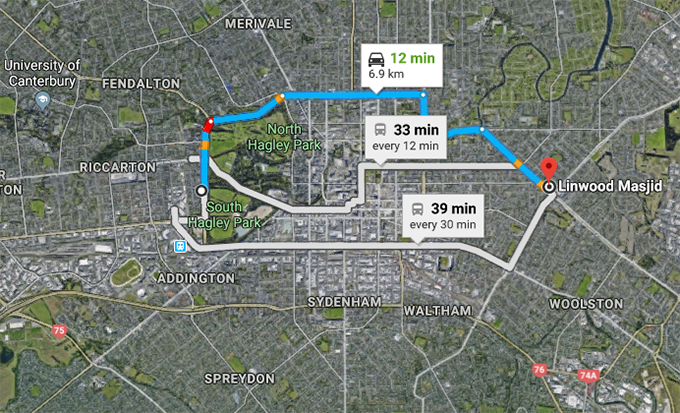
Al Noor Mosque to Linwood Mosque – EveningReportNZ/Google Maps.

Inside Linwood Mosque was Abdul Aziz, a man who had gathered with his Muslim brothers. He had just begun his second pray when he heard gunshots outside. At first he thought it was someone playing with firecrackers (fireworks). But then, within seconds, he heard people screaming.

Aziz picked up an EFTPOS (electronic funds transaction) machine from a table inside the mosque. He ran outside.

He saw a man he describes as looking like a soldier. He said to the man: “Who are you”. Mr Aziz then saw three people lying on the ground dead from shotgun blasts. He realised the man was the killer. He approached the attacker, threw the EFTPOS machine hitting the killer, who in turn took from his vehicle a second firearm (a military style semi-automatic assault rifle) and fired four to five shots at Abdul Aziz, missing him. Then, in an attempt to lure the killer away from other people, Aziz shouted at the killer from behind a car: “Come, I’m here. Come I’m here!”

Aziz said he didn’t want the killer to go inside the mosque and kill more people. But the killer remained focussed. He walked directly to the entrance, once inside the mosque he continued his killing spree. Survivors speak of the killer wearing “army clothes”, dressed in “SWAT combat clothing”, helmeted, wearing a vest and a balaclava.

Inside the Linwood Mosque, another witness, Shoaib Gani, was kneeling in prayer. He heard a noise like fireworks but he and others weren’t too concerned and continued with their prayers. Then, as he and his fellow worshipers were kneeling speaking verses from the Koran, the man next to him fell forward with blood pouring from his head. He had been shot and killed instantly, Gani said. Then others too began falling to the floor dead.

Gani crawled under a table. He saw the killer and his firearm. “Written on the rifle were the words, ‘Welcome to hell’,” he said.

Victims, who were wounded and bleeding, were pleading with Gani to help them. But he was frozen to a spot under a table knowing that the killer was walking around the mosque killing as many people as he could. Gani believed he too would also soon be dead, so he reached for his cellphone, he called his parent’s back home in India. But no one answered. He tried to call his father’s number, but the phone kept ringing. He saw people around him bleeding to death. Others with fatal head-wounds: “Their brains were hanging out. I just couldn’t do anything. I didn’t know what to do.” Gani phoned 111 (the New Zealand emergency number) and told the authorities people were dead and injured: “The lady on the phone asked me to stay on the line as long as I could.”

Outside, Abdul Aziz picked up one of the killer’s discarded shotguns. Inside the mosque, the killer’s assault rifle ran out of bullets. The killer then “dropped his firearm” and ran back to his vehicle. He got in the driver’s seat. Aziz then ran toward the car. He threw a discarded shotgun at the killer’s vehicle: “I threw it like an arrow. It shattered his window.” Aziz thinks the killer thought someone had shot at him with a loaded gun. The killer turned. He swore at Aziz. When the window burst it covered the inside of the car with glass. Aziz said the killer “then took off” driving in his car. He then turned right away from the mosque driving through a red traffic light and out into Christchurch suburban streets.

Some minutes later, police and ambulance officers arrived at Linwood Mosque. Anti-terrorist armed police entered the mosque. Inside, Gani said the survivors were ordered to put their hands up above their heads. The mass murder scene was covered in blood. The police then secured the area. Some victims survived because they were under the bodies of the dead. Police told survivors to gather near a grassed area outside. There, people began weeping for their husbands, wives, parents, children, friends.
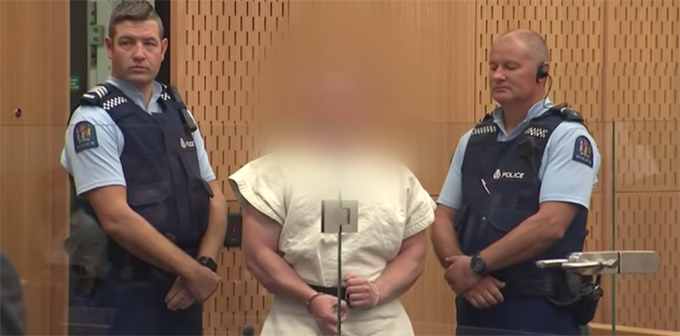
Alleged killer Brenton Harrison Tarrant appeared in court on March 16, 2019, charged with one count of murder. Further charges will be laid. While before the court, he smiled at onlookers and signalled a white supremacist sign with his fingers – EveningReportNZ/Screengrab of TVNZ coverage.

The arrest:
Seventeen minutes later, two police officers identified the killer, apparently driving his car. They drove the police car into the killer’s vehicle, ramming it against a curb. Immediately, they disarmed the killer, cuffed him, and noticed home made bombs in the vehicle – IEDs (improvised explosive devices). They arrested the man and secured the scene.

The rest of Christchurch was in lockdown, children were kept safe inside their classrooms, hospitals began to prepare for casualties, the city’s streets became eerily quiet, people were locked in to libraries, shops, their homes. Police and armed forces helicopters networked the skies. No one knew if the terrorist attacks were committed by a group of people or a lone gunman.

But back inside and at the entrances to the two mosques, 50 people were dead – one of the dead was discovered the next day by police; the body was laying beneath others who had been killed. Scores of others were in hospital fighting for their lives, at least another 10 were in a critical condition in intensive care. Pathologists from all over New Zealand and Australia were heading to Christchurch to help with documenting the method of murder of the dead.

Within hours of the killings, Australian media named the alleged killer as an Australian-born citizen named Brenton Tarrant, 28 years of age. On Saturday morning The Australian newspaper’s front page read “Australia’s evil export”.

Other media in New Zealand followed with details of the man’s background. Brenton Harrison Tarrant appeared in court the next day charged with one single count of murder. Other charges will follow. His duty lawyer did not seek name suppression nor bail, the lawyer told the judge: “I’m simply seeking remand and a High Court next-available-hearing date.” Tarrant stood cuffed, smiling at those in the courtroom, at one point signaling with his fingers a “white supremacist” sign. He will next appear in the Christchurch High Court on April 5.

The aftermath:
New Zealand Prime Minister Jacinda Ardern later told media: “It was absolutely his [the offender’s) intention to continue with his attack.” PM Ardern said: “Police are working to build a picture of this tragic event. A complex and comprehensive investigation is (now) underway.” To balance the requirement of investigation with the customs of Muslim burials, PM Ardern said liaison officers were with the victims’ loved ones to help “in a way that is consistent with Muslim faith while taking into account these unprecedented circumstances and the obligations to the coroner”.

PM Ardern said survivors of the massacre had indicated that this attack was not “of the New Zealand that they know”.

One day later, survivor Shoaib Gani (mentioned above) told media he still could not sleep or eat. The sounds and sights were still vivid in his head: “I still can feel myself lying on the floor waiting for the bullets to hit me.” He said, he will travel back to India to visit family, but he will return to Christchurch: “It’s just a few people, you know. You can’t blame the whole of New Zealand for this… It’s a good country, people are peaceful. Everybody has helped me here. One right wing (person) doesn’t mean everyone is bad. So I can come back here and live and hope nothing like this happens in the future.”

In the hours after the attacks, all around New Zealand, in the cities and in small country areas, police were stationed and were ready in case others were involved and were preparing further crimes.
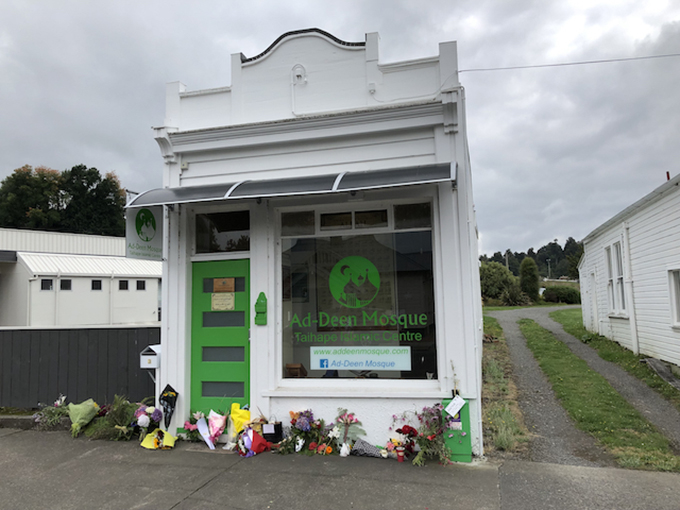
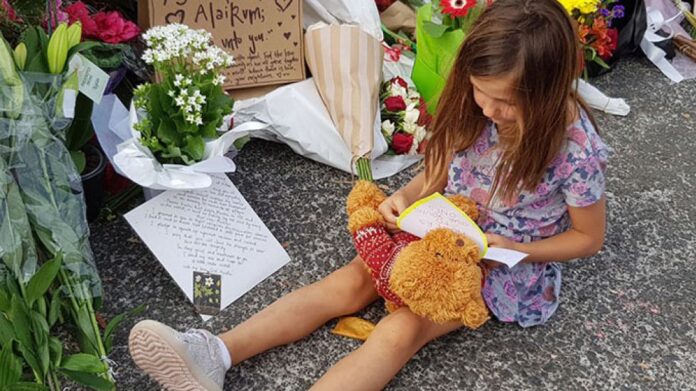
In the hours after the attacks, all around New Zealand, in the cities and in small country areas, like here at Taihape’s Ad-Deen Mosque, people lay flowers as a sign of support and aroha. Image, Selwyn Manning/EveningReport.nz taken Saturday March 16, 2019.

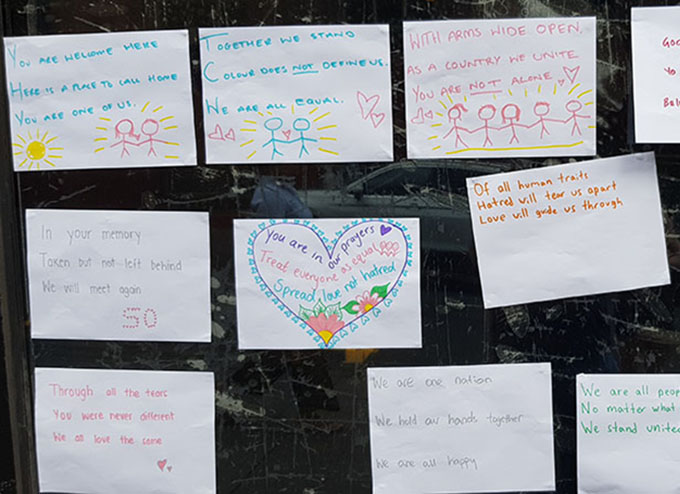
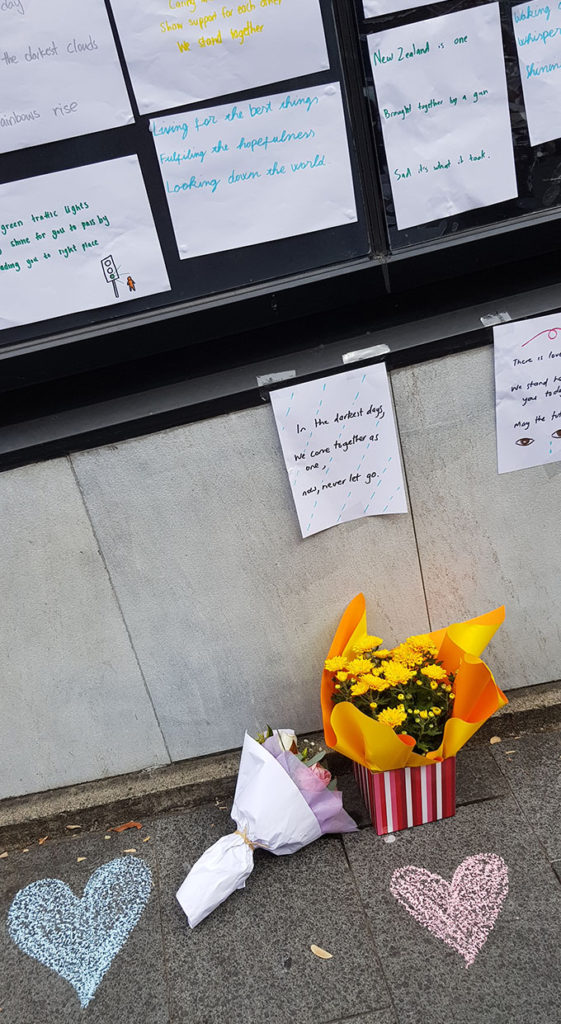
Beside the police officers, people, of all races and religions, began laying flowers at the steps to their local mosques. Messages included read: “Salam Alaikum, Peace be unto you”, and, “Aroha nui”, “Peace and love”, “You are one of us”. The outpouring of grief swept the South Pacific nation, and as this article was written, a mood of support, comfort, reassurance and solidarity with those of Muslim faith was in evidence.

In Australia, Sydney’s landmark Opera House was like a beacon in the night; coloured blue, red, and white – the colours of the New Zealand flag embossed with the silver fern (ponga) an emblem of Aotearoa New Zealand. Australia’s peoples, like in New Zealand, began laying flowers at the steps of its mosques in a gesture of inclusiveness.

In the aftermath, New Zealand’s Prime Minister Jacinda Ardern has committed to ongoing financial assistance to dependents of those who have died or are injured, and assistance, she said, would be ongoing.

Questions are being leveled as to how a person with hate can enter, live, and purchase weapons in New Zealand while expressing hate toward other cultures and harbouring an intent to kill others.

PM Ardern said: “The guns used in this case appear to have been modified. That is a challenge police have been facing, and that is a challenge that we will look to address in changing our laws… We need to include the fact that modification of guns which can lead them to become essentially the kinds of weapons we have seen used in this terrorist act.”

When asked how she was coping personally with the tragedy, she said: “I am feeling the exact same emotions that every New Zealander is facing. Yes, I have the additional responsibility and weight of expressing the grief of all New Zealanders and I certainly feel that.”

That responsibility includes ensuring New Zealand’s police, the nation’s intelligence and security services and “the process around watch-lists, including whether or not our border protections are currently in a status that they should be, and, including our gun laws.”

The backstory:
Indeed, New Zealand is part of the so-called “Five Eyes” intelligence network that includes the USA, United Kingdom, Canada, Australia and New Zealand. Global surveillance is coordinated and prioritised among the Five Eyes member states. While significant resource, technology and sophistication is committed to the Five Eyes intelligence agencies, New Zealanders fear that those who find themselves as targets, or within the scope of intelligence officers, are predominantly of the Muslim faith.

In contrast, the accused killer who allegedly committed the horrific Christchurch mosque attacks, has been active both on social media and the dark web expressing, with an intensifying degree, his ideology of hate and intolerance. It does appear of the highest public interest, certainly from an open source intelligence point of view, to ask questions of why New Zealand’s (and indeed the Five Eyes intelligence network’s) surveillance experts did not detect the expressed evil that had radicalised the heart and mind of the perpetrator of this massacre.

It is also fact that New Zealand is a comparatively safe and peaceful nation. But within its midst are people and groups fermenting on racially-based hate ideas. Whether it be in isolation or among organised groupings, the threat of racially driven terror crimes exists.

The alleged killer, Brenton Tarrant, has lived among those of New Zealand’s southern city Dunedin for at least two years. It appears he was radicalised around 2010 after his father died and he toured Europe. He wrote about becoming “increasingly disgusted” at immigrant communities. In early 2018, Tarrant joined a Dunedin gun club and began practising his shooting skills and allegedly planned his attacks.

Regarding Christchurch, while it has a history of overt white racist gangs, at this juncture, it does not appear they were directly involved in this series of crimes.

But this leads to many unanswered questions, including:

  • Was the killer a lone mass murderer, a sleeper in a cell of one?
  • Were those with whom he communicated and engaged with on the web in extreme white racist ideologies aware of his plans?
  • Was Christchurch chosen by the killer for logistical reasons?
  • Was it because the city is easier to drive around than Dunedin, Wellington or Auckland?
  • Was it because Christchurch has at least two mosques within easy driving distance?
  • Were the Bangladesh Cricket team in his scope of attacks?
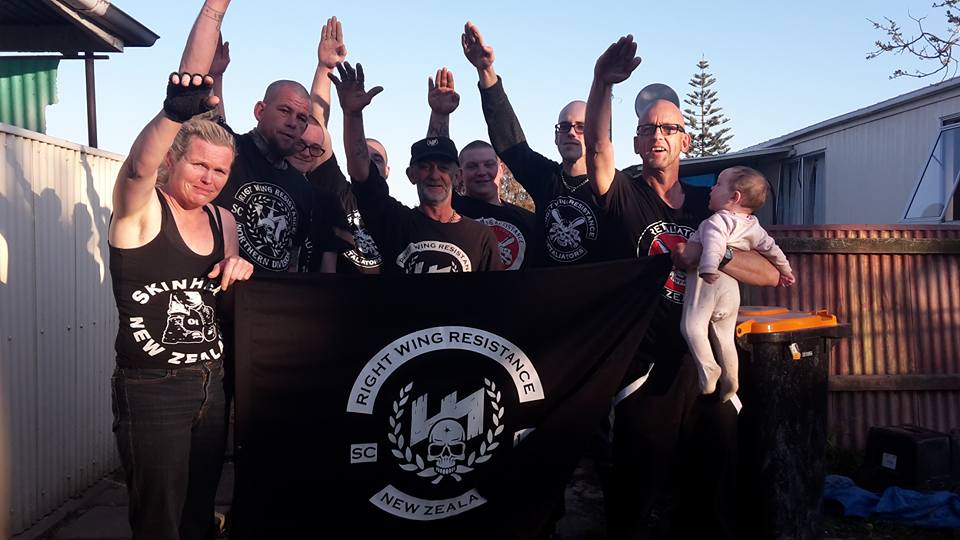
  • Was the killer attempting to incite a violent response from Christchurch’s burgeoning Muslim community, or, expecting a response from the Alt-Right, from white racist groups such as the Right Wing Resistance (RWR), the Fourth Reich, and Christchurch’s skinhead community?
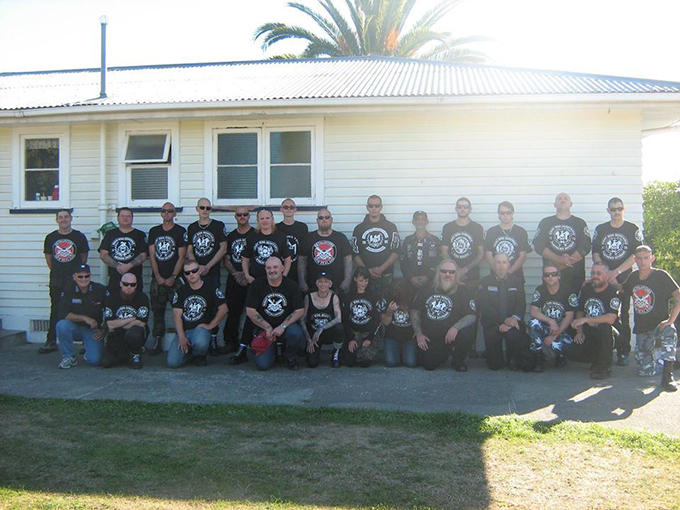
New Zealand has in its midst white supremacist neo-nazi groups like this Right Wing Resistance gang. Was the killer of those at the two Christchurch mosques attempting to ignite retaliation and violence? Image: Evening Report

The future:
Survivors of Friday 15th’s terrorist attack say they have complained of an increase in racism and expressed hate in recent times. They say, their concerns have not been taken seriously. These are the concerns that Prime Minister Jacinda Ardern has committed to listen to, has committed to represent, and, as the prime advocate for her country’s peoples, to act on to ensure cracks in New Zealand’s border, security and intelligence apparatus are corrected.

And, what of New Zealand’s social culture? How will it be affected? That will be determined by the actions of each individual person, each community, town and city and how as a nation New Zealand redefines “The Kiwi Way”.

Members of New Zealand’s media will also need to act responsibly. It is fair to say some have a reputation for argument that verges on alt-right intolerance, for example, on Twitter only two days after the mass murders, a prominent radio journalist, who is employed by one of New Zealand’s largest networks, tweeted: “28 years on an [sic] we still haven’t stopped madmen getting guns. #ChChMosque… [Replying to @Politikwebsite] And the neo nationalist right are the result of the virtue signaling exclusionary left.”

Perhaps such examples are out of step with New Zealand’s population. But such attitudes do create a dialogue of justification for those who harbour intolerance. However, if the outpouring of love and compassion continues to bind rather than divide, then perhaps New Zealand has received, as they say, “a wake-up call”, where racial intolerance and extreme ideologies have no place among peoples of all kinds, Maori and Pakeha, of all religions, political persuasions and creeds.
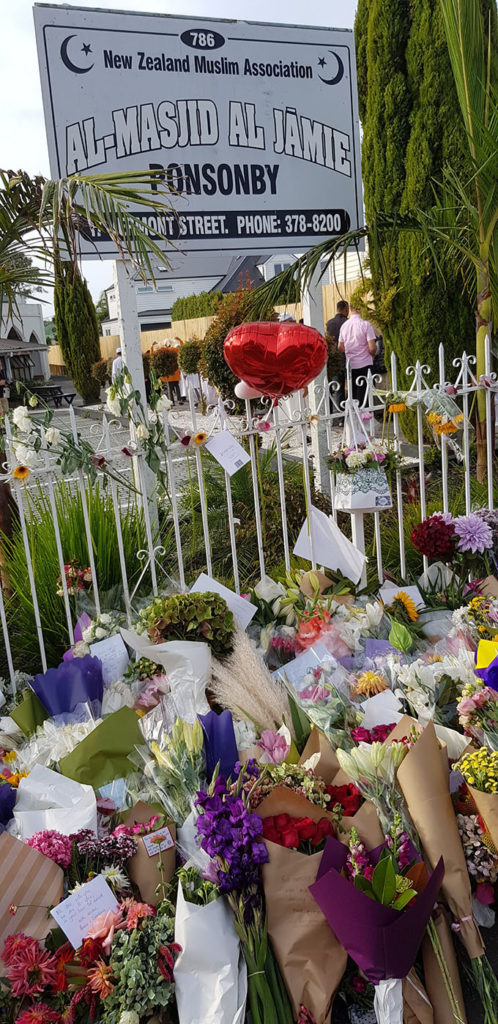
Flowers at Ponsonby mosque, Auckland, NZ. 17 March 2019. Image David Robie/PMC

One thing is certain; to stamp out the evil of hate extremism, New Zealanders will pay a price that will be charged against the Kiwi lifestyle. Personal liberties of freedom, of expression and privacy will certainly be eroded further as this nation of the South Pacific grapples with how to keep its people safe. The means of how to achieve relative safety will be hotly debated, but it is a necessary juncture in this nation’s history, a moment when we all must confront and challenge ourselves so that people of innocence, people like little three-year-old Mucaad Ibrahim, can go about their days in trust, in peace, in joyful purpose and achieve their deserved potential. Anything less is a second killing for the victims of Friday, 15th, New Zealand’s darkest hour.

Rongotea School symbol of unity since 1881 – image, Selwyn Manning, EveningReportNZ taken Friday 15, 2019.

Selwyn Manning is editor and publisher of Evening Report, a companion publication with Asia Pacific Report. He is also a former chair of the Pacific Media Centre Advisory Board. This article was originally published by the German magazine Cicero.de under the title: Attentat in Christchurch – Willkommen in der Hölle. It is republished here with permission.

Print Friendly, PDF & Email

Article by AsiaPacificReport.nz

As home care packages become big business, older people are not getting the personalised support they need

]]>

Source: The Conversation (Au and NZ) – By Lyn Phillipson, NHMRC-ARC Dementia Development Fellow, University of Wollongong

The Royal Commission into Aged Care has unleashed a spate of claims of system failure within the residential aged care sector.

Now, as the commission shifts its focus to care in the community, we’re also seeing claims of failure within the home care packages program.

This scheme aims to support older people with complex support needs to stay at home. But what we’ve got is a market-based system where the processes involved in accessing support and managing services are making it difficult for vulnerable older Australians to receive the care they want.

If this system is to be workable, older people need better information and more personalised supports to enable choice and control – especially those with complex needs.


Read more: Would you like to grow old at home? Why we’re struggling to meet demand for subsidised home care


Consumer directed care

A growing number of older Australians are receiving home care subsidised by the government. During the 2017-18 financial year, 116,843 people accessed home care packages.


From July 1 2015, all home care packages have been delivered on what’s called a Consumer Directed Care basis.

This means that, theoretically, home care providers must work with consumers to design and deliver services that meet their goals and care needs, as determined by an Aged Care Assessment Team.

However, in reviewing the active steps outlined in the government pathway to access a package, we must consider the person who is navigating this path.

They are frail older people with complex support needs, often seeking help at times of crisis. These include the growing number of older Australians living with multiple medical conditions and complex age-related syndromes such as dementia.


Read more: Explainer: what is a home care package and who is eligible?


After a person has been assessed, they will receive a letter informing them they are eligible. However, due to long waiting lists, this does not provide them with immediate access to care; most wait many months before they are actually assigned a package by My Aged Care.

When they eventually receive a letter confirming their package, the consumer will be approached by various service providers. They will need to sign a complex contract with their chosen provider.

If the consumer is feeling frustrated and confused during these early stages, this is only the beginning. The recent marketisation of home care means managing their own care requires going through impersonal, centralised provider systems.


The Conversation, CC BY-ND


People need clear information to choose a provider

The first thing people assigned a home care package need to do is choose a care provider.

There are now close to 900 different providers offering home care packages. This includes not-for-profits, as well as a growing number of for-profit providers competing for new business.


In reality, however, few older people research different providers. Once they’re assigned a home care package, their name is placed on a centralised database accessible by all registered service providers.

The person then receives unsolicited phone calls from the sales teams of different providers, offering their services and trying to make appointments to come and visit. For consumers, this represents a shift from a familiar government model of care provision to a market model.

Research shows consumers often don’t understand consumer directed care, and this can leave them vulnerable to the forceful marketing tactics employed by some providers. It can also make negotiating a complex contract with legal, financial and personal implications very difficult.

Older people granted a home care package will be approached by different providers wanting their business. From shutterstock.com

To make informed choices between providers, people need accessible information. There is currently insufficient information for older people and their families to compare services on indicators of quality (such as the number of complaints agencies receive, the training of staff, the types of specialist services they offer, and so on).

To address this gap, the government must commit to collecting and publishing data on home care quality. This would drive service improvement and increase people’s ability to make informed choices between different providers.

Service and administrative fees

To make informed choices, people also need to be able to compare services on the basis of price.

The average profit per client for home care package providers was A$2,832 in 2016-17, but there’s significant variability between providers’ fees.

For example, the use of people’s individual care budgets to cover administration or case management fees ranges between 10-45% of their total package.

High fees and administrative costs may reveal the profit-driven motives of a few unscrupulous providers.


Read more: What is ‘quality’ in aged care? Here’s what studies (and our readers) say


Because of administrative fees, many people are spending a high portion of their individual budgets on case management to support their care.

While there’s evidence case management can provide clinical benefits for older people, in the context of the current home care funding model, it may also leave people with less money for direct care services than they need.

People need support to manage their packages

We’re currently looking at the experiences of people with dementia using home care packages. Unsurprisingly, we’re finding that while they are grateful for the services they’re receiving, they are having a difficult time managing their care. For some this may be due to their limited decision-making capacity, but for many, their choice and control is being limited as much by the service model.

For example, to enable providers to compete in the open market, many have adopted central 1800 numbers to support people to manage their services. This means if consumers want to change something, they are funnelled through this system.

Think about your own experience of service helplines, such as with telephone or energy companies. Now consider a woman with dementia who needs to call a 1800 number to change the time of her shower so she can see her doctor.

Rather than communicating with a local and known case manager, she now needs to speak to someone she doesn’t know and who is not familiar with her care needs.

Instead of facilitating choice and control, this demand on the consumer to constantly articulate their needs to unfamiliar people means many are frustrated, and some are even opting out of services.

How can we improve things?

The three words the government associates with consumer directed home care are choice, control and markets.

But the system doesn’t foster control. Although consumers technically have choices, the marketised and bureaucratic approaches of service providers make it difficult for consumers to articulate and receive support for their personal choices.

The processes, information and supports available to assist older people and their families are inadequate to facilitate the type of choices and control one might associate with “consumer directed” care.


Read more: Seven steps to help you choose the right home care provider


There’s an urgent need to improve the processes for accessing timely home care packages, particularly for those with complex support needs. This includes the quality and accessibility of information, resources and decision-making tools.

There’s also a significant need for training, advocacy and impartial support for choice, particularly for people with limited decision-making capacity, such as those living with dementia.

Research and practice in aged care and disability in other settings provide extensive resources for person-centred planning and decision making which could be adapted for use in our home care system.

ref. As home care packages become big business, older people are not getting the personalised support they need – http://theconversation.com/as-home-care-packages-become-big-business-older-people-are-not-getting-the-personalised-support-they-need-113183

Two ways to fund NSW election promises as property prices crash

]]>

Source: The Conversation (Au and NZ) – By Gareth Bryant, Lecturer in Political Economy, University of Sydney

State elections are always about spending promises, but this time not much is being said about how they will be funded.

Last minute costings on individual announcements tend to rely on the general presumption that the state economy will keep growing and somehow produce the needed revenue.

This is evident in the costings released by the NSW Parliamentary Budget Office, which show that new spending promises from both major parties exceed new revenue promises.

The Labor Party has managed to find some new revenue through increased taxes on luxury cars, boats and vacant properties, while the Coalition has unveiled no new revenue initiatives at all.

While the property market has been climbing this needn’t have mattered that much. But for the past 20 months Sydney prices have been falling. Projected stamp duty revenues are being repeatedly revised downwards. The latest wipes A$9.5 billion off what was expected at the time of the 2017 budget.


NSW state revenue by type, A$ billion

University of Sydney Policy Lab


Austerity, or an alternative?

It’s looking as if the incoming NSW government will need to moderate spending including spending on essential services and infrastructure, but there might be a way out.

Today, we published a new report for the Sydney Policy Lab outlining two ways in which the NSW government can ready its budget for a post-housing boom economy.

Politicians of all parties tell us that fiscal rules create binding constraints for state governments and they are right.

But there are imaginative ways to strengthen state finances and to interpret those constraints.

Alternative 1: taxing residential land

Although land used for holiday homes and rental properties faces land tax, land used for owner-occupied housing is exempt in NSW, meaning as much as A$1 trillion of land is exempt.

It is a source of wealth – one of the few covered by state tax powers – that the budget can no longer afford to ignore.

Extending NSW land tax to owner-occupied residences with safeguards could fund much of the state’s needed service and infrastructure spending and wind back the outsized reliance on stamp duty.

With so many people locked out of home ownership altogether, it would make the tax system fairer.

Alternative 2: redefining ‘investment’

Under NSW budget rules spending on services is defined as cost that needs to be matched by immediate revenue. Spending on infrastructure, often on infrastructure which will later be privatised, is defined as an investment, meaning it doens’t have to be matched by immediate revenue.

It is why there is talk about a squeeze on services in the midst of record spending on infrastructure.

There’s room to change those definitions.

While there are good macroeconomic and budgetary reasons to differentiate day to day spending from investments, much of what is defined as day to day spending is in fact an investment.

There’s no reason why the state’s power to borrow to invest in infrastructure couldn’t also be used to invest in public services like health and education. With a change of rules, governments could borrow to invest in nurses and teachers at interest rates currently reserved for toll roads.

First steps

A practical starting point would be to connect spending on public services to the savings they create in other parts of the state budget, and account for this as the return on the investment.

As an example, “justice reinvestment” could fund programs aimed at reducing Indigenous incarceration out of the savings those programs would eventually deliver in other areas.

The redefinition would remove the present bias towards programs that build only physical infrastructure that has to be paid for later with tolls or privatisations.

Both ideas could help whichever party or parties form government after Saturday’s election, and help NSW. Without them, budgeting will become more difficult.


Read more: NSW election likely to be close, and Mark Latham will win an upper house seat


ref. Two ways to fund NSW election promises as property prices crash – http://theconversation.com/two-ways-to-fund-nsw-election-promises-as-property-prices-crash-113835

‘Rape Day’: A new video game glorifying sexual assault raises questions about regulation

]]>

Source: The Conversation (Au and NZ) – By Dr Marika Guggisberg, Research and Teaching Academic in Domestic and Family Violence, CQUniversity Australia

A graphic new video game called Rape Day, set to launch in April, triggered a swift and widespread public outcry.

Created by an independent developer, Rape Day is a set in a zombie apocalypse, where the player controls a protagonist described as a “menacing serial killer rapist”.

Rape Day is a “visual novel” – players choose from a variety of sequences of still images that contain written dialogue options and prewritten story choices.

And the rape of women is encouraged to progress the plot.

Crossing the line

But why do we consider depictions of rape in video games to cross the line, but not other forms of violence?

‘Rape Day’ sparked huge public outcry leading to the game being pulled from Steam. Desk Plant

Sexual violence is connected to a complex interplay of societal attitudes and inequality.

For too long, society’s reaction to sexual violence was to ignore the issue. It is a well-established fact that most incidences of sexual assault remain undetected, whereas homicides are commonly uncovered and perpetrators brought to the attention of the authorities.

Violent video games where sexual assault is the explicit goal should never be allowed.


Read more: Violence towards women in the video game Red Dead Redemption 2 evokes toxic masculinity


And some studies found playing video games with sexually violent content was associated with rape myth acceptance: “she asked for it” and “no means yes”.

It is important, however, not to fall into the trap of assuming a definitive cause-effect relationship. Video games like Rape Day contribute to rape culture, but it joins a raft of other cultural influences.

But we’re seeing a global, cultural shift.

The global #MeToo movement resulted in many victims of sexual harassment and violence coming forward. They used a collective voice to speak out against gendered violence, sharing their experiences of unacceptable masculine sexual domination, and continues to be empowering.

Sexual violence has also led to national strategies to influence societal and individual attitudes, including engaging men in the process of changing gender norms and assumptions.

And we see this cultural shift reflected in the widespread public outrage against Rape Day.

Public reaction

The game went online on March 6, 2019, sparking a petition on change.org, which garnered almost 8,000 signatures. It is likely to have contributed to the decision to pull Rape Day from the gaming distribution service Steam Direct.

Steam, owned by a US private company Valve, released a statement on their decision to not distribute Rape Day, saying:

“Much of our policy around what we distribute is, and must be, reactionary – we simply have to wait and see what comes to us via Steam Direct. We then have to make a judgement call about any risk it puts to Valve, our developer partners, or our customers. After significant fact-finding and discussion, we think ‘Rape Day’ poses unknown costs and risks and therefore won’t be on Steam.”

This ban elicited positive comments on the Steam website among gamers. One comment noted:

“Rape is one of the most serious problems in our society and it needs to stop. We cannot normalize gender violence or rape.”

Comments such as these acknowledge the difference between making a game from sexual violence that objectifies women and reinforces sexism, and other violent content commonly present in video games.


Read more: Violent video games and real violence: there’s a link but it’s not so simple


There were strong reactions around the world. Not only was Rape Day banned in European countries such as Germany, but politicians in Austria and the UK became involved, calling for more restrictive legislation.

For example, Hannah Bardell, a British member of parliament, described the video game as “utterly perverted”.

Censorship and regulation

When it comes to regulation, Australia uses the Guidelines for the Classification of Computer Games. It indicates that games depicting “actual sexual violence” or where “incentives and rewards” are associated with sexual violence will be restricted.

Given Rape Day’s content, we can anticipate the game will be banned from sale in Australia if the developer submits an application. Consumers can also make complaints to the Classification Review Board about video game ratings or other decisions about games under the National Classification Code.

Censorship is typically not valued among gamers, and according to Kotaku editor Alex Walker, Australia is “famous” for banning games.

Japanese game Omega Labyrinth Z, for instance, is situated within a school setting where players can control a number of young girls battling evil forces. The Classification Board banned the game because of the gratuitous, exploitative depictions of sexual activity with characters appearing under 18 years of age, violating classification rules.


Read more: Curious Kids: Why do adults think video games are bad?


When Rape Day was pulled from Steam, the developer, Desk Plant, acknowledged that the game could be seen as problematic.

“I might agree with Steam that my game is not the right fit for a distribution site that is marketed at the general masses and children… My next move is to sell the game on my own site. Maybe that would have been a better move for me from the start.”

But still, the game will be available to any player choosing to purchase it in some countries around the world, even though restrictions are currently being discussed.

Navigating this space requires sensitive decision-making, not only among overseeing bodies but also video game players. And the widespread statements approving Valve’s decision to distance the company from the game, the petitions, and the global reactions shows us that cultural change around sexual assault can, and does, happen.

ref. ‘Rape Day’: A new video game glorifying sexual assault raises questions about regulation – http://theconversation.com/rape-day-a-new-video-game-glorifying-sexual-assault-raises-questions-about-regulation-113178

Christchurch terror attacks: NZ advertisers to pull social media ads

]]>
“Massacre shame of Facebook” banner headline in the London Daily Mail at the weekend. Image: PMC screenshot

By RNZ

More than 50 New Zealand companies are considering pulling ads from Facebook because it allowed a livestream of the Christchurch massacre last Friday.

Some firms have already stopped advertising and the Association of New Zealand Advertisers predicts dozens of others are likely to follow suit.

A semiautomatic gun for destruction hand-in slip. Image: RNZ

To show more support after the attacks, some gun owners have been handing over semi-automatic rifles for destruction in protest.

“Until today, I was one of the New Zealanders who owned a semiautomatic rifle. On the farm they are a useful tool in some circumstances, but my convenience doesn’t outweigh the risk of misuse,” wrote farmer John Hart on Twitter.

“We don’t need these in our country.

“We have [to] make sure it’s #NeverAgain.”

-Partners-

READ MORE:
RNZ’s live news feed – Day 5
What you need to know
A list of the confirmed victims
Find out about vigils around the country

Meanwhile, another terror attack in the Netherlands has overshadowed efforts in New Zealand to reject individual hatreds and come together to support those affected in Christchurch.

This article is republished under the Pacific Media Centre’s content partnership with Radio New Zealand.

Print Friendly, PDF & Email

Article by AsiaPacificReport.nz

Curious Kids: why do we have two kidneys when we can live with only one?

]]>

Source: The Conversation (Au and NZ) – By Brooke Huuskes, Lecturer in Human Anatomy, Physiology Anatomy & Microbiology, La Trobe University

Curious Kids is a series for children. If you have a question you’d like an expert to answer, send it to curiouskids@theconversation.edu.au You might also like the podcast Imagine This, a co-production between ABC KIDS listen and The Conversation, based on Curious Kids.

Why do we have two kidneys when we can live with only one? – Question from the students of Ms Morris’ Grade 5 class, Ringwood North Primary School, Victoria.

This is a really great question. The answer is scientists are not completely sure but we do have some theories. That is often the case with science.

Most of the animals you see above ground on Earth today, including humans, are the same on both sides. We have two eyes, two ears, and even two nostrils. Scientists gave this a fancy name called “bilateral symmetry.”

If you look in the mirror and draw an imaginary line down the middle of your reflection you will see that you have an arm and a leg on each side. If you had goggles that let you see your insides, you would see that you also have a kidney and a lung on each side too.

But it wasn’t always like this. And some animals still only have one kidney.

Around 500 million years ago, our long-lost relatives that were living in the ocean (some of whom probably only had one kidney) decided to leave the water to walk and live on land.

This was a very important moment in our history because on land, animals could change to grow a very complicated body with all of the important organs that are inside you, including two kidneys.


Read more: Curious Kids: how does my tummy turn food into poo?


Two kidneys better than one?

Right now, your kidneys are getting rid of all things your body does not need. They do this by “cleaning” your blood.

All of this waste will exit your body when you go to the toilet to pee. But your kidneys do a lot more than just clean your blood. They help your bones stay healthy, tell your body when to make new blood cells, and even help you stay upright when you’re walking around all day by taking care of your blood pressure.

With all those important functions, scientist think having two kidneys must be important for our survival.

Kidneys ‘clean’ your blood and send waste to your bladder, so you can pee it out. Shutterstock

Growing up with one kidney

It is true, you can live with only one kidney. Some people are born with only one because the other one did not grow properly. Other times, the two kidneys touch each other when they are first growing and join together, making one kidney shaped like a horseshoe. People with these types of kidneys have to be very careful because they might get sick more easily than someone who has two kidneys.

Needing an extra kidney

Sometimes our kidneys stop working. When this happens our blood cannot be cleaned and we can get very sick. The only way to stay alive is to be attached to a big machine that cleans your blood for you, or have a kidney transplant.

This happened to me when my kidneys stopped working properly. My dad gave me one of his kidneys. Thanks, Dad.

There are two people involved in a kidney transplant: a donor who is going to give their kidney, and a recipient who will receive the kidney.

After the new kidney is put into the recipient, both the donor and recipient only have one kidney that works properly. Both the donor and the recipient can live long happy lives with only one kidney. They just have to take extra care that they eat healthily and exercise to stay fit. One person living in Australia has been using a transplanted kidney for 45 years!

So, while your body works best when all of your organs are inside you and working properly, scientists still don’t exactly know why we have two kidneys. However, it is good to know that we have a few spare parts that we can live without.

And if you’re an adult reading this, it’s good to make sure you are registered as an organ donor and also chat to your family so they know you want to donate. You may one day save a life.


Read more: Curious Kids: why are burps so loud?


Hello, curious kids! Have you got a question you’d like an expert to answer? Ask an adult to send your question to curiouskids@theconversation.edu.au

CC BY-ND

Please tell us your name, age and which city you live in. We won’t be able to answer every question but we will do our best.

ref. Curious Kids: why do we have two kidneys when we can live with only one? – http://theconversation.com/curious-kids-why-do-we-have-two-kidneys-when-we-can-live-with-only-one-113201

Would you like to grow old at home? Why we’re struggling to meet demand for subsidised home care

]]>

Source: The Conversation (Au and NZ) – By Michael Woods, Professor of Health Economics, University of Technology Sydney

The Royal Commission into Aged Care Quality and Safety is this week turning its focus to aged care in the home.

So far it has heard evidence of long waiting times to access home care services and a complicated system of fees. It’s only a matter of time before it questions the reasons behind those wait lists and fees.

Unlike aged care, access to many health care services is unlimited. Anyone can seek an appointment with their GP or turn up to a hospital emergency department, in most cases for free.

But the number of home care packages available to older Australians is capped, and the frail elderly are asked to foot some of the bill.

While some may argue to uncap the number of home care places, and replicate parts of the health system by providing free care for all, it’s not that simple. Governments will keep increasing the number of subsidised home care services in response to needs, but costs will also keep rising.

The challenge is to find the right funding balance between individuals and taxpayers, and for the system as a whole to remain sustainable.


Read more: Aged care failures show how little we value older people – and those who care for them


Why are many health services free?

Australia has a high standard of health care, which supports people to live to a longer, and generally healthier, old age.

Our Medicare system of funding is based on the principle of universal public health insurance which is paid for by the government (that is, the taxpayers). Public patients receive free care in public hospitals. Medical services by GPs and specialists are subsidised, as are many blood tests, X-rays and other imaging, allied health services (such as optometry), and most medicines.

In the year to September 2018, 86% of all GP attendances were “bulk billed” (provided at no cost to the patient).

These benefits, however, come at a cost. About 10% of Australia’s economic output (gross domestic product) is spent on health care and two-thirds of this is funded by governments.

And, of course, not all health services are free for most people. Visits to dentists, physiotherapists and others are regular reminders of this. A more equitable way of funding dental care is one of the emerging issues for the upcoming federal election.


Read more: Two million Aussies delay or don’t go to the dentist – here’s how we can fix that


What is home care?

Aged care plays a different role to health care in supporting people to stay at home. There are two forms of home care.

First, the Commonwealth Home Support Program assists with daily activities such as meals, transport and personal care (showering, dressing, and so on) and some allied health services such as physiotherapy and podiatry (foot care).

In 2016-17, around 723,000 people received one or more of these services.

Second, Home Care Packages provide expanded support, with daily activities as well as more complex health care from nurses and allied health workers.

At September 2018, there were over 90,000 people receiving one of the government’s subsidised Home Care Packages.

Why are many elderly asked to help pay for home care?

Australia’s population is ageing. In 2017 3.8 million Australians were aged 65 and over. In the next 40 years this will probably grow to 8.8 million. The costs of funding aged care will continue to increase.

In 2011, when one of us (Michael Woods) was the presiding commissioner on the Productivity Commission’s inquiry into aged care, we put forward three principles to help governments create a sustainable funding models for aged care:

  • accommodation and everyday living expenses should be the responsibility of individuals, with a safety net for those of limited means

  • health care services provided through aged care (such as nursing and allied health care) should be subject to charging arrangements consistent with those in the health care system

  • individuals should contribute to the cost of their personal care according to their capacity to pay, but should not be exposed to catastrophic costs of care.

The current fee arrangements broadly reflect the intent of these principles.

The government aims to keep fees for the basic Commonwealth Home Support Program at very affordable levels and has produced fee guidelines for providers. There are no formal income tests and while some providers do no more than seek a voluntary contribution for some services, others may recover around 10% of the cost of some services as direct fees or membership subscriptions.

Many older people prefer to receive care at home rather than going into residential aged care. From shutterstock.com

For the more complex and higher cost home care packages, providers can charge consumers a basic daily fee of 17.5% of the basic rate of the single age pension.

There is also an income-tested care fee, which recognises many older people have a greater capacity to contribute to the costs of their everyday living expenses. As a safety net for all, however, there are annual and lifetime caps on these fees.


Read more: Explainer: what is a home care package and who is eligible?


The home care system has many issues to address, but it is not in crisis

Despite the growing number of government-subsidised home care packages, the latest aged care statistics show that at December 2018 there were over 127,000 people on a national priority list for services that met their needs.

The wait time for some, sadly, is too long. However, some subsidised help is available for nearly all people on the list. Over 96% of people on the list had been offered, and were generally accepting, a lower level of subsidised support while they waited for a higher level of service.

There are also questions about how this queue is created and the assessment process itself that the royal commission may want to follow up.

For example, not all assessments and referrals to services are necessarily based on current needs. At December 2018, 96,000 people who were waiting for their approved level of home care package also had an approval for a permanent place in residential aged care. This suggests the assessment process may contain an element of anticipating future needs, rather than reflecting current needs.

Another concern with the current assessment process is a lack of focus by some assessors on helping older people to regain a level of independence through short-term “reablement” programs rather than adding them to the queue for ongoing services. As the Department of Health notes, a wellness and reablement approach in assessment and service delivery is not being consistently and effectively applied across the regions.


Read more: There is extra funding for aged care in the budget, but not enough to meet demand


For the foreseeable future we can expect the government to keep increasing the number of subsidised home care services, but it will also keep a careful eye on the balance between public and private funding, and seek to keep the overall cost to the elderly and to the budget within sustainable limits.

ref. Would you like to grow old at home? Why we’re struggling to meet demand for subsidised home care – http://theconversation.com/would-you-like-to-grow-old-at-home-why-were-struggling-to-meet-demand-for-subsidised-home-care-112963

We need a legally binding treaty to make plastic pollution history

]]>

Source: The Conversation (Au and NZ) – By Trisia Farrelly, Senior Lecturer, Massey University

A powerful marriage between the fossil fuel and plastic industries threatens to exacerbate the global plastic pollution crisis. The Center for International Environmental Law (CIEL) estimates the next five years will see a 33-36% surge in global plastics production.

This will undermine all current efforts to manage plastic waste. It is time to stop trying (and failing) to bail out the bathtub. Instead, we need to turn off the tap.


Read more: The major source of ocean plastic pollution you’ve probably never heard of


The United Nations Environment Assembly (UNEA) has recognised plastic pollution as a “rapidly increasing serious issue of global concern that needs an urgent global response”. An expert group formed last year proposed an international treaty on plastic pollution as the most effective response.

Together with Giulia Carlini, at CIEL, I was part of a 30-strong group of non-governmental organisations within this expert group attending the UNEA summit this week to discuss how we can start making plastic pollution history.

Unfortunately, despite strong statements from developing countries, including the Pacific Island states, a small group of countries stalled negotiations. This effectively turns back the clock on ambitious global action, and leaves us more desperate than ever for a real solution to our plastic problem.

Why we need a treaty

The first step is to reject the many false solutions that pop up in our news feeds.

Recycling is one of those false solutions. The scale of plastic production is too big for recycling alone. Of all the plastics produced between 1950 and 2015, only 9% have been recycled. This figure is set to plummet as China and a growing number of developing countries are rejecting plastic waste from Australia, New Zealand and the rest of the world.

China had been a major destination for Australia and New Zealand’s recyclable waste. China’s shutdown meant Australia lost the market for a third of its plastic waste. It also left New Zealand with 400 tonnes of stockpiled plastic waste last year.

With limited domestic recycling facilities, Australia and New Zealand are seeking new markets. Last year, New Zealand sent about 250,000 tonnes of plastic to landfill, and a further 6,300 tonnes to Malaysia for recycling. But now Malaysia is also rejecting other countries’ hazardous plastic waste.

Sending our platic to Asia is not a solution. EPA/Diego Azubel, CC BY-SA

Even if we manage to find new plastic recycling markets, there is another problem. Recycling is not as safe as you might think. Flame retardants and other toxins are added to many plastics, and these compounds find a second life when plastics are recycled into new products, including children’s toys.

Plastic-to-energy is a false solution

What about burning plastic waste to generate energy? Think again. Incineration is expensive, can take decades for investors to break even. It is the opposite of a “zero waste” approach and locks countries into a perpetual cycle of producing and importing waste to “feed the beast”. And incineration leaves a legacy of contaminated air, soil, and water.

Producing lower-grade materials from plastic waste (such as roads, fenceposts and park benches) is not the solution either. No matter where we put it, plastic doesn’t go away. It just breaks into ever smaller pieces with a greater potential for harm in air, water, soil and marine and freshwater ecosystems.

This is why researchers are paying more attention to the less visible hazards posed when micro (less than 5mm long) and nano (less than 100 nanometres long) sized plastics carry pathogens, invasive species and persistent organic pollutants. They have found that plastics can emit methane contributing to greenhouse gas emissions.

Tyres wear down into microplastics which find their way into the ocean. When plastics break down to nanoparticles, they are small enough to pass through cell walls. Our clothes release plastic microfibres into water from washing machines.

Plastic is truly global

Plastic pollution moves readily around the globe. It travels through trade, on winds, river and tidal flows, and in the guts of migrating birds and mammals. We don’t always know which toxic chemicals are in them, nor their recycled content. Plastic pollution can end up thousands of kilometres from the source.

This makes plastic pollution a matter of international concern. It cannot be solved solely within national borders or regions. A global, legally binding treaty with clear targets and standards is the real game-changer we urgently need.

The NGO component of UNEA’s expert group recognised an international treaty as the most effective response. The proposed treaty has the potential to capture the full life cycle of plastics by focusing on prevention, right at the top of the waste hierarchy.

The Zero Waste hierarchy. Zero Waste Europe

These solutions could include restricting the volume of new or “virgin” plastics in products, banning avoidable plastics (such as single-use plastic bags and straws), and curbing the use of toxic additives.


Read more: We can’t recycle our way to ‘zero waste’


More than 90 civil society organisations around the world and a growing number of countries have indicated early support for a treaty. Australia and New Zealand have not.

ref. We need a legally binding treaty to make plastic pollution history – http://theconversation.com/we-need-a-legally-binding-treaty-to-make-plastic-pollution-history-113351

Don’t fall for it: a parent’s guide to protecting your kids from online hoaxes

]]>

Source: The Conversation (Au and NZ) – By Joanne Orlando, Researcher: Technology and Learning, Western Sydney University

It’s a parent’s responsibility to protect their children from harm, no matter where that threat of harm comes from. But what if the threat is a hoax?

We’ve seen recently a rollercoaster of panic from parents trying to protect their kids from a supposed online threat known as the Momo challenge, that has for months been debunked as a hoax.

Yet the panic from parents continued, as did reports in the media and even warnings from celebrites – all of which could have been avoided if parents had done a few simple checks before raising the alarm.

So how can you as a parent protect your children (and yourself) from falling for these hoaxes if you don’t even know whether something is not a genuine threat in the first place?

Before I give some help and advice on that, let’s look at this latest hoax: the Momo challenge.

The Momo challenge

Momo is a ghoulish character who is said to use social media and other online tools to encourage youngsters to complete dangerous tasks involving self-harm.

But the whole Momo challenge is a manufactured myth.

The creepy image was copied from a sculpture by Japanese special-effects company Link Factory. Its use in the hoax was condemned by its original artist several months ago.

Even this revelation did not stop the spread – of both the hoax and the warnings about it – continuing for several months afterwards.

The Momo challenge is just the latest in a series of manufactured online hoaxes designed to generate paranoia among adults.

Other online hoaxes

We’ve had the “blue whale challenge”, allegedly linked to numerous teen deaths around the world. The trend later turned out to be a fake.

We were told the deadly TidePod challenge was encouraging kids to be filmed while eating poisonous laundry detergent pods (they weren’t).

There was also a challenge that linked kids choking to death to snorting condoms for more YouTube likes (no deaths have been reported).

These hoaxes are carefully designed to grab your attention and incite shock and panic, so you share the information with everyone you know. The designers of the hoax callously tap directly into parents’ Achilles heel: their fears regarding their children’s safety.

Posting the hoax online fits the designer’s aim perfectly because it can travel far and wide online very quickly. This is of course a win from the perpetrators’ perspective, whose very aim is to go viral! The more attention they get, the more profit or fame.

What parents should do to help protect your kids from such hoaxes

Hoaxes that threaten your kids one day, and turn out to be fake the next, are mentally and emotionally exhausting for kids and adults. Parents can feel an increasing lack of control.

But this doesn’t need to be the case. There are tools and tricks you can apply to help you spot a hoax.

1. Investigate: see if it’s real

Information about any so-called challenge is often shared on social media, where fake news and misleading information is rife.

If you are concerned about a hoax it’s important to investigate, by using a reputable news website or a reliable fact-checking site such as Snopes or FullFact.

Both are good fact-checking resources that gives readers evidence-based analysis (Snopes and FullFact have both published content on Momo).

Even a simple web search of the name of any supposed threat can help you. Add the words “hoax” or “scam” to your search queries and you will very quickly see if there is any real evidence to support the claims of harm you may be hearing about.

2. Help your child investigate authenticity

Use the opportunity to educate your child about these online challenges. When you hear about one, go online with your child and investigate.

This is the perfect opening to help your child understand fake content online. Explain why someone would want to start a hoax to scare people (for example, to achieve fame).

3. Explore alternatives for viewing

You may be concerned about your child using online video streaming services such as YouTube or Facebook, where they could be exposed to any hoax video.

As an alternative, look for other ways for your children to view their favoured content.

Many of the popular shows that kids watch online also have their own apps with pre-screened videos: for example PBS kids videos and Disney Channel app.

4. Avoid causing unnecessary alarm

It’s important to be careful about sharing news articles that perpetuate a hoax or myth with other adults.

Before sharing potentially wrong information, do some internet research of your own to check out the accuracy of any threat.

5. Be a critical, alert consumer

We live our lives on the internet, and there is a mass of misleading online information designed to manipulate our thinking.

It’s important to read and stay up to date about how the online world operates, and to be critical of what you view and read online.

Ask yourself some basic questions such as:

  • who is going to benefit from this online post/article?

  • what is the underlying purpose of it?

  • is the author/creator trying to sway my thinking, and why?

6. What if you think a threat is genuine?

Facebook, YouTube and other social media platforms have options to report anything you think may be a serious threat. If you’re still worried, call your local police.

The online space is always changing. Keeping you and your kids safe online involves being aware of emerging and new safety issues, and committing to a bit of research before you panic.

ref. Don’t fall for it: a parent’s guide to protecting your kids from online hoaxes – http://theconversation.com/dont-fall-for-it-a-parents-guide-to-protecting-your-kids-from-online-hoaxes-113179

Australia’s performance on gender equality – are we fair dinkum?

]]>

Source: The Conversation (Au and NZ) – By Fiona McGaughey, Lecturer, Law School, University of Western Australia

On International Women’s Day this year, Australia hit the headlines for all the wrong reasons. Not only did we fail to support a United Nations (UN) motion that called for greater accountability for human rights violations against women and girls, but comments made by our prime minister provoked international outrage.

The UN resolution proposed “policies and legislation that respect women and girls’ right to bodily autonomy”. Perhaps Australia refused to support this motion because some of its domestic laws effectively maintain sex discrimination against women.

Abortion is still restricted and even criminalised in some circumstances, in some Australian states, which impinges on women’s capacity to access safe reproductive healthcare.


Read more: Crowd-mapping gender equality – a powerful tool for shaping a better city launches in Melbourne


Meanwhile, Prime Minister Scott Morrison, at an International Women’s Day event, generated controversy by saying:

We’re not about setting Australians against each other, trying to push some down and lift others up. We want to see women rise but we don’t want to see women rise only on the basis of others doing worse.

In contrast, UN Secretary General Antonio Gutteres, a “proud feminist” stated:

When we exclude women, everyone pays the price. When we include women, the whole world wins.

Following international media coverage, Morrison sought to clarify his earlier remarks:

What I was saying yesterday is I don’t want to see this agenda pursued by setting women against men. No. Australian against Australian. No. I want to bring all Australians together to focus on this. That’s what I’m fair dinkum about.

How Australia measures up

Fair dinkum though, these developments are disappointing. Australia was one of 47 states elected to a seat on the UN Human Rights Council (HRC) for a 2018-2020 term. It currently has real potential to contribute to global progress on women’s rights.

Indeed, one of the five “pillars” of Australia’s bid for a HRC seat was gender equality. Foreign Minister Marise Payne recently reiterated Australia’s commitment to these pillars in her speech to the HRC.

We can measure whether Australia has demonstrated its commitment to its voluntary pledges as a member of the HRC in a number of ways. We can assess whether Australia’s public statements at the council address its objectives.

In 2018, gender equality was the most consistent theme of Australia’s statements before the council. Australia promoted gender equality through statements on violence against women, female genital mutilation, discrimination against women and women’s rights.

On this measure, then, Australia performed well.


Read more: Backlash and gender fatigue. Why progress on gender equality has slowed


In recent years, Australia has at times reacted with hostility to constructive critique from the UN human rights bodies.

But in June 2018, in response to a report from the UN Special Rapporteur on violence against women, then Foreign Minister Julie Bishop struck a more diplomatic tone. Bishop thanked the special rapporteur for her report and commented:

Independent scrutiny, transparency and accountability are critical to upholding the human rights of all people and Australia welcomes such scrutiny. Australia is carefully considering the Special Rapporteur’s recommendations and appreciates the opportunity to make a preliminary response today.

In this area, then, Australia also appears to be doing better.

A poor record in Indigenous communities

But in the same statement, Australia acknowledged the following:

The Special Rapporteur noted particular concerns regarding the experiences of Aboriginal and Torres Strait Islander women. We acknowledge and regret that Aboriginal and Torres Strait Islander women experience violence at higher levels than non-Indigenous Australian women. We must do better.

Indeed, the special rapporteur called on the Australian government to make policy in this area with – rather than for – Aboriginal and Torres Strait Islander communities. She noted that current policy settings are insufficient to address the “institutional, systemic, multiple, intersecting forms of discrimination” experienced by Indigenous women and girls.

On top of that, Australia is falling down on its commitments in terms of how it responds to the human rights performance of other countries. The Universal Periodic Review process, administered by the HRC, scrutinises each UN state’s behaviour on cycles of four and a half years. According to a public database of recommendations, only 4% of Australia’s recommendations to other states related to gender equality.

Far fewer of Australia’s recommendations – 0.6% – related to its commitment “pillar” of Indigenous rights.


Read more: Parents can promote gender equality and help prevent violence against women. Here’s how


Plenty of room for improvement

Gender equality is one of many areas in which Australia’s public discourse is poorly served by a lack of comprehensive human rights protection in our domestic law.

From the prime minister’s public comments to Australia’s diplomatic behaviour, there is considerable room for improvement if we are to be “fair dinkum” about gender equality.

Having secured a place on the HRC as a defender of gender equality, Australia ought to be beyond immature statements that depict women’s equality as necessarily diminishing men’s capacity or rights in society.

ref. Australia’s performance on gender equality – are we fair dinkum? – http://theconversation.com/australias-performance-on-gender-equality-are-we-fair-dinkum-113657

Rebel teens can quickly make friends, but in the end, it’s the nice ones who have the most

]]>

Source: The Conversation (Au and NZ) – By Joseph Ciarrochi, Professor of Psychology, Australian Catholic University

Simply being nice wins more friends in high school than being a rebel, our study published in the journal Frontiers in Psychology has found.

We looked at what sorts of social strategies help teens win close friends of the same and opposite sex. We asked whether aggressiveness and breaking rules – what we will call being a rebel – sometimes make teens well liked by their peers.

We found that empathetic children who also show some rebellious and antisocial behaviours have more opposite-sex friends in the early years of high school than those who were merely empathetic and followed the rules. But in the latter years empathetic children who keep to the rules beat their more aggressive peers and had more opposite-sex friends.

Past research shows being empathetic helps young people communicate, resolve conflict and engage in social behaviours, all of which helps build close friendships. Others have argued being a giver rather than a taker helps a person succeed socially.

But we wanted to find out why some people who display antisocial behaviour are socially successful. We also wanted to know if this behaviour was equally effective in opposite and same-sex relationships. Perhaps aggression and rule-breaking is attractive to the opposite sex but repellent to the same sex?

Measuring empathy and aggression

We addressed this question in a large, longitudinal study of friendship development in high school. The study assessed 2,803 students in 16 different schools across two different Australian states and five different time points between Years 8 and 12. We used both self-reports and peer-rated measures.

We measured empathy and antisocial behaviour (aggression and rule breaking) using self-reports. Empathy is the capacity to understand others’ emotions. Students were asked to rate statements such as: “When someone is feeling down I can usually understand how they feel,” and “I can often understand how people are feeling even before they tell me.”


Read more: Understanding others’ feelings: what is empathy and why do we need it?


Aggression and rule breaking also involved scoring statements of students engaging in arguing, fighting with other children, destroying things and bullying others. The scales in our study have been widely used and validated in former research.

We measured friendships using peer nominations of who youth felt where their close friends.

Our research identified four types of young people:

  • nice youth (around 36% of all participants, with 70% being female and 30% male) – these young people are high in empathy and avoid hurting others
  • rebels (around 11% of participants, 31% female and 69% male) – these young people hurt others, break the rules and have little empathy
  • nice rebels (around 18% of participants, 67% female and 33% male) – they have the ability to be both empathetic and hurt others
  • nonplayers (around 36% participants, with 28% being female and 72% male) – they use neither empathy nor aggressive strategies.

The nice rebels were the most interesting group. Theory suggests people who exhibit these qualities have an advantage over others because they can use empathy to build social alliances and aggression to become dominant in those alliances.

Being a bully will lose you friends. from shutterstock.com

Nice people win

In Years 8-10 (around 13-15 years old) the nice rebels had more opposite-sex friends than the nice youth. The plain rebels tended to attract fewer opposite-sex friends than both the nice youth and the nice rebels, but these rebels still did better than the nonplayers, who were relatively invisible to the opposite sex.

However, the nonplayers did about as well as both types of rebels in same-sex relationships.

But in Years 11-12 (around 16-17 years old), the nice rebels lost opposite-sex friends and became less popular with the opposite sex than nice youth. The plain rebels also lost friends and became similar to the nonplayers in opposite-sex friendships.


Read more: Nice guys finish first: empathetic boys attract more close female friends


The story gets even better (if you like nice youth). Throughout all of high school, the nice youth had more same-sex friendships than all other groups and higher well-being than both the nice rebels and the rebels.

At first, young people might have seen the nice rebels as charming, fun and powerful. However, over time, they experienced the rebel acting aggressively and, eventually, this disrupted the friendship.

What about mental health?

We also used self-reports to assess children’s well-being. We found the nice rebels and rebels consistently reported lower levels of self-esteem and worse mental health then the nice youth and nonplayers.

We also found important differences between males and females. Females paid a higher price for being in one of the rebellious groups, experiencing worse mental health and self-esteem than their male counterparts. We speculate society may be more rejecting of rebellious females who are aggressive and break the rules.

The study had its limitations. Research is needed to determine what motivates young people to rebel. We also need to better understand why rebels experience lower self-esteem and worse mental health than the nice youth and nonplayers.

But what our research does show is that being nice is not only the ethically right strategy, it is also the most effective. Nice strategies such as taking perspective and giving can help young people build strong social alliances.

ref. Rebel teens can quickly make friends, but in the end, it’s the nice ones who have the most – http://theconversation.com/rebel-teens-can-quickly-make-friends-but-in-the-end-its-the-nice-ones-who-have-the-most-113550

Married at First Sight’s closer to reality than you’d think, demographically speaking at least

]]>

Source: The Conversation (Au and NZ) – By Thomas Sigler, Senior Lecturer in Human Geography, The University of Queensland

Now in its sixth season, the Nine Network’s wildly successful Married At First Sight chronicles the adventures of 12 couples as they navigate the highs and lows of married life. The premise of the show is relatively simple: each contestant (MAFS reportedly received 10,000 applications) is evaluated by “relationship experts” and matched with a partner. Each pair ties the knot without ever having met and – poof! — they’re married at first sight!

The show shoehorns a lifetime of matrimonial issues into a few dozen episodes. Over the course of the season, viewers witness the daily ups-and-downs of marriage and cohabitation, and ultimately we learn the difficulty of matchmaking. MAFS’s couples fight, they cheat and – spoiler alert – most separate (divorce?) within a matter of weeks.


Read more: Married at first sight: latest reality TV show poses as ‘social experiment’


But if MAFS is merely reality TV, then why is it so popular? Could we be addicted to gratuitous programming? In part yes — reality TV has ruled the roost since 2001, when Big Brother arrived on our shores and averaged 1.4 million viewers each night. But could it also be that MAFS is reality? In a world of Tinder dates and lunchtime botox, maybe MAFS is more of a reality check than a social experiment.

Five demographic realities

Below are five reasons that Married at First Sight reflects the demographic realities of modern Australia.

1) Australians increasingly cohabit prior to marriage. One of MAFS’s more earnest attributes is the awkwardness of sharing a bed with someone you barely know. Research by the Australian Institute of Family Studies shows that 81% of Australians co-habit prior to marriage, up from 16% in 1975. The proportion aged 15 years and over living in de facto relationships has doubled in the past 20 years, from 5% in 1996 to 10% in 2016.


Read more: Explainer: what legal benefits do married couples have that de facto couples do not?


The Australian Study of Sex and Relationships found that Australian men and women reported having had an average of 18 and 8 sexual partners, respectively. From the first episode of MAFS onward, contestant Matthew Bennett is teased by his male co-stars about his lack of (any) sexual experience, suggesting this is far from the norm among the cohort.

2) Marriage has been delayed. A common refrain uttered by MAFS contestants is that they have sacrificed love for a career. For Cameron, that was professional cricket; for Jules, that was running a successful hair and beauty business.

The contestants range from 25 (Susie) to 43 (Mike), averaging 29.5 for the show’s females and 32.5 for its males. This reflects national averages for marriages of 30.1 for females and 32.0 for males. In 1997 these numbers were 27.5 for females and 29.7 for males respectively.

3) Despite this, marriage remains a strong institution. The 1911 Australian Census revealed that 46.0% of the population aged 15 and over was married. Divorce was virtually non-existent and was made more difficult by archaic laws. The proportions increased steadily until the marriage boom of the mid-20th century.

Today’s figure of 48.1% is remarkably close to what it was a century ago, but down from 53.2% at the 1996 census. The 2017 referendum on same-sex marriage demonstrates that a majority of Australians (61.6%) now support a broad and inclusive definition of marriage.

Notwithstanding, the national marriage rate is declining — from 9.3 marriages per 1,000 Australian residents in 1970 to 4.6 marriages per 1,000 in 2017. So is the divorce rate, though. It has fallen from a peak of 4.6 per 1,000 in 1976 (tied to the introduction of no-fault divorce) to 2.0 per 1,000 in 2017, with a median length of marriage to separation of 8.2 years, and to divorce of 12.

4) Modern Australia is urban. Despite the “Outback” image presented to the rest of world, Australia is approximately 90% urbanised (depending on how we define a “city”). Consistent with national figures, the MAFS crew are overwhelmingly urban.

Eight contestants (33%) live in Sydney and eight more in Brisbane, Melbourne or Perth. Regional contestants from Gympie, Newcastle and Townsville are almost perfectly aligned with national data showing that Australia’s urban populations are divided between major cities (72%) and “inner regional” (18%) parts of the country.

5) Modern Australians are multicultural. In addition to their geographic distribution, MAFS contestants have a range of ethnic and national backgrounds. Of this season’s contestants, nine (38%) self-report a discernible non-Australian identity (either them or their parents).

This reflects the waves of migrants that have rendered Australian cities some of the most ethnically diverse on Earth. Ines fled civil war in Bosnia, while Filipino, Greek, Italian, Thai and other national identities are proudly represented by respective contestants.

Thus, in contrast to many of the previous reality shows depicting the Ocker Australian (e.g. Farmer Wants a Wife), the diversity of MAFS is significantly more true to life. According to the most recent census data, 49% of Australians were born overseas or have at least one parent that was.

So, as we have shown, reality TV may not be too far from reality after all – at least in terms of demography.


Read more: Census 2016 puts on display the increasing diversity in Australians’ relationships


ref. Married at First Sight’s closer to reality than you’d think, demographically speaking at least – http://theconversation.com/married-at-first-sights-closer-to-reality-than-youd-think-demographically-speaking-at-least-112226

Introducing shadow equity: a fresh idea to escape the low wage trap

]]>

Source: The Conversation (Au and NZ) – By Rosalind Dixon, Professor of Law, UNSW

This is the second in a three-part mini-symposium on Wages, Unemployment and Underemployment presented by The Conversation and the Academy of the Social Sciences in Australia. Read the other pieces in the series here.


For the past half-decade Australian wages have barely moved after adjusting for inflation.

In the United States the picture is far bleaker — the real wages of average workers have changed little in 40 years.

Not so for US chief executives.

In 1965 the heads of America’s 350 biggest companies earned 20 times what the average worker did. By 2017 they earned 312 times as much.

As is often the case, things aren’t quite as extreme in Australia, but the pattern is similar. In 2017 the heads of the 100 biggest ASX-listed companies earned an average of A$4.75 million – roughly 78 times as much as the average worker.

They get the bulk of their income not from their salaries, but from stock options or payments tied to the share price of the companies they run.

It at least raises the possibility than one way to get pay to rise for average workers is to structure their pay a little more like that of chief executives.

There are upsides to paying workers in shares…

Paying workers in the stock of the company would not affect the day-to-day profitability of the company. It would just mean the shareholders owned a bit less of the company.

That might not sound like an important distinction, but the everyday costs —- of which wages and salaries can be a big part -— help determine how competitive a firm is compared to its rivals. Paying workers in stock could give firms a strategic advantage.

It could also better align their interests with those of senior management and shareholders. It could reduce intra-firm conflict about wages, benefits and employment terms.

One manifestation occurs when executives receive large payouts from stock options while “ordinary workers” are facing redundancies or pay cuts.

Giving workers a slice of the same type —- if not the same level -— of compensation could help reduce this conflict.

…and downsides

If the idea was perfect, we would go to the extreme and pay workers exclusively in stock.

We wouldn’t, in part because equity-based compensation imposes risk on workers, as workers employed by firms whose share price is falling know well.

A basic principle of contract theory – the field that gave rise to the 2016 Nobel Prize in Economic Sciences for its creators Oliver Hart and Bengt Holmstrom – is that if a compensation contract imposes more risk on an employee than wages, it’ll need to be larger than wages on average to make up for the additional risk. It would cost the firm more.

And it would encourage workers to put most of their investment eggs in one basket (the same basket that employs them), which is always a bad idea.

Despite appearances, for many or even most, it woudln’t link their efforts to their compensation. Stock price movements often have little to do with the efforts of paper-shufflers or cleaners. Another key principle of contract theory is that it is suboptimal to reward workers for luck.

Shadow equity might be better

New developments in blockchain technology offer a way to link the efforts of employees to an equity-like security —- or what one might call “shadow equity”.

Initial Coin Offerings are used in the US as an alternative to venture capital. They involve creating a digital currency that is linked to performance but not to share price.

They can be used to invest in or bet on specific components of a company. Take the pharmaceutical giant Pfizer. It has a whole portfolio of drugs. Buying stock in Pfizer is a bet on its entire portfolio. But suppose Pfizer issues, say, 1 million Xtandi tokens to help it develop the colon cancer drug Xtandi. Suppose it also agrees that all future purchases of Xtandi will have to be done with those tokens. That would link the aggregate value of those tokens to the value of revenue from the drug.

An investor who bought those tokens would be betting on a specific part of Pfizer’s portfolio.

The idea could be extended to traded securities tied to a granular level of performance within an organisation. It wouldn’t mean it was possible to have securities in the impact of single worker (expect perhaps for superstars such as actors or recording artists) – but it would be conceivable to have such securities for divisions of companies, or even teams within divisions.

How could it work?

It will take time for these technological developments to play out, but there are steps we could take to hasten it. One would be increased tax deductibility for equity-based compensation.

We are not suggesting workers’ pay be cut to allow equity-based compensation, or that it not rise to keep up with the cost of living. But as extra pay rises happen from time to time, they could be offered in the form of shadow equity.

It would mean workers would be paid, at least in part the same way as executives. And it might start to reverse the trend of rising executive to worker pay ratios.


The Academy of the Social Sciences in Australia is one of Australia’s four learned academies. The ASSA coordinates the promotion of research, teaching and advice in the social sciences, promotes scholarly cooperation across disciplines, comments on national needs and priorities in the social sciences, and provides advice to government on issues of national importance.

ref. Introducing shadow equity: a fresh idea to escape the low wage trap – http://theconversation.com/introducing-shadow-equity-a-fresh-idea-to-escape-the-low-wage-trap-113362

Hidden women of history: Antoinette de Saint-Étienne, the First Nations nun who sang for a queen

]]>

Source: The Conversation (Au and NZ) – By Susan Broomhall, Professor of History, University of Western Australia

In this series, we look at under-acknowledged women through the ages.

In an archive in regional France, the story of a Canadian First Nations woman emerges from an old manuscript written by nuns documenting the history of their convent.

Antoinette de Saint-Étienne was of the Mi’kmaw people, whose land spanned northeastern areas of what is now Canada and the US. In the early 17th century, the fates of this First Nations woman and the nuns in a provincial French convent became unexpectedly intertwined.

Antoinette was born in Acadia, a fledgling French settlement in Canada, but she would one day sing for a queen in Paris and become a source of pride for the nuns of the Benedictine Abbey of Beaumont-lès-Tours, as an unusual convert to the Catholic faith.

An ‘exotic child’

Mi’kmaw petroglyph [n.d.; after 1500] In situ: Kejimkujik National Park, Nova Scotia. Nova Scotia Museum, Halifax, P179/ 59.60.2/ N-19,345. Nova Scotia Museum – not for commercial use

Antoinette was born in the 1620s, a time when the French sought to explore the rich resources of fur in the region and Christianise the local people.

Her parents were a Mi’kmaw woman, who is not named in the nuns’ chronicle, and a French Protestant man, Charles de Saint-Étienne de la Tour. He had arrived in Acadia as an adolescent and quickly learned to live among the local people. In 1631, he was appointed governor.

The Mi’kmaw traditionally moved seasonally across their lands, their lifestyle strongly oriented around the maritime coasts. Their territories were among the first with which Europeans made contact in the region. Although Antoinette had been baptised by Capuchin missionaries in Acadia, the nuns’ chronicle referred to the young girl as a “little savage”.

By 1632, it seems Antoinette’s mother had died, for Saint-Étienne travelled to France with two of their three daughters. The girls were left in the care of nobleman Charles de Razilly, whose brother Saint-Étienne knew from Acadia.

Antoinette, then about five or six, was initially given to a Protestant woman named Madame de Saint-Hilaire, but Razilly had written about his young charges to his sister Louise, a nun at Beaumont. The nuns noted that Antoinette’s carer was “very zealous about her religion”.

This mattered. Protestants and Catholics were no longer at war by the 17th century, but the spiritual affiliation of children had become a new battleground between Christian denominations. The nuns wanted this exotic child to be raised a Catholic.

Portrait of Marie de l’Incarnation, attributed to Hugues Pommier, 1672. Archives of the Ursulines of Quebec. Wikimedia Commons

Louise de Razilly’s campaign to have the child moved to the convent’s care succeeded. In 1636, Antoinette was placed at Beaumont, “to render her capable of religious life, if it were possible”.

Having Antoinette at Beaumont was a double victory for the nuns. Her sister had been taken into the Ursulines convent in Tours, a relatively new order established in 1622.

At about the same time, so too was a novice who is best known today as Saint Marie de l’Incarnation, who went on to lead other Ursuline sisters to teach among the Indigenous people of Quebec. The Ursulines looked like the dynamic face of a Catholic Church in renewal, attracting novices from many sectors of society.

By contrast, the long-established Benedictine Abbey of Beaumont had been taking in women from the region’s most elite families since the 11th century. Having Antoinette gave traditional Beaumont a claim to the remarkable.

Antoinette’s voice

At the age of about 16, Antoinette asked to be formally admitted to Beaumont as a novice. The community voted its approval, and from this point on, she was no longer referred to as a “savage”. Instead, Antoinette became the “Canadian novice”.

Some years later, a passing father of the Cordeliers order attended a service at Beaumont and heard Antoinette sing. As the chronicle tells it, he found this girl’s voice “flawlessly good”, returning several more times to confirm his discovery. Upon his return to Paris, he went to inform the French queen and regent, Anne of Austria.

The queen announced that she wished to hear the voice for herself, and Antoinette was duly brought up to Paris. There, she was installed in the Benedictine Royal Abbey of Val-de-Grâce, then being built by the queen. In June 1644, Anne attended a service in order to hear Antoinette sing.

The queen declared that Antoinette’s voice was indeed beautiful “but without training” and arranged for a tutor. Antoinette was expected to remain in Val-de-Grâce and take vows as a professed nun there.

Former abbey of Val-de-Grâce, Paris, France: view on the cloister and its French formal garden. Myrabella/Wikimedia Commons, CC BY-SA

However, after eight months, she requested a transfer. According to the chronicle, she found the austerity of Val-de-Grâce too much to bear and received the queen’s consent to return to the more moderate regime of Beaumont in February 1645.

This represents one of few moments of autonomy for Antoinette in the chronicle’s account — one that reflected well on the abbey. The severity of Val-de-Grâce’s lifestyle was renowned and attracted many women. Here, though, Beaumont’s adoption of a less extreme path attracted Antoinette back to them, and in 1646, she took her vows there.

The journey of a First Nations woman

Antoinette de Saint-Étienne went on a number of journeys in her lifetime – geographical and spiritual as well as textual.

She featured in the chronicle’s narrative because it was a story of triumph for the community. In their eyes, they had saved her from a life of savagery, from Protestantism, and from the fashionable but excessive religious regime at Val-de-Grâce.

Antoinette only appears in one other place in the chronicle, in a list of nuns participating in a procession. But this makes sense from the community’s perspective. As she became a fully professed member of the community, Antoinette slips away from view.

She had become one of them, and as such, was no longer a point of exception to be documented in the chronicle. Alongside her enclosed sisters, the Mi’kmaw woman with the remarkable voice faded into the silences of history.

ref. Hidden women of history: Antoinette de Saint-Étienne, the First Nations nun who sang for a queen – http://theconversation.com/hidden-women-of-history-antoinette-de-saint-etienne-the-first-nations-nun-who-sang-for-a-queen-110183

NZ ‘chose us to come here … to die here’, says grieving Syrian mother

]]>
Zaed Mustafa’s father and brother were killed during the Christchurch terror attacks. Image: Diego Opatowski/RNZ

By Katy Gosset of RNZ

A Syrian-born woman whose husband and son were killed in Friday’s terror attacks says her family was told New Zealand was the safest country in the world.

For Salwa Mustafa, a slim woman in a pale silver hijab, said New Zealand promised a new life for her three children.

“When we were asking about New Zealand … they said, ‘Oh, it is the most safest country in the world, the most wonderful country that you can go.’ You will start a very wonderful life there but it wasn’t.”

On Friday her husband, Khalid, and 16-year-old son, Hamza, were shot while worshipping at Al Noor Mosque on Deans Ave. Her second son Zaid, 13, remains in Christchurch Hospital recovering from his own gunshot wounds.

Sitting on a bed at the hospital where she has been keeping a vigil, she did not want her face shown but she recalled how she first heard of Friday’s horrific attacks when she took a call from Hamza.

“He said, ‘Mum, there is someone in the mosque shooting us and my brother is [shot] in the leg,’” she said.

-Partners-

She heard running and shooting but kept speaking to him.

Complete quiet …
“‘Hamza, Hamza, tell me what’s happening, Hamza?’ And there was complete quiet. I couldn’t hear anything.”

She stayed on the line for 22 minutes until someone else picked up his phone.

“And he told me, ‘Sorry, your son can’t breathe. I think he’s dead.’ ”

She and friends waited outside the mosque for an hour until a friend took her to the hospital where she found her husband with gunshot wounds to his head, neck leg and arm.

“They took me to the room and he was laying there [shot], taking his last breaths.”

“I sat beside him, maybe half an hour, maybe more, I can’t remember, watching him dying.”

It wasn’t what the family expected when they first considered travelling to New Zealand

Her husband had been a farrier in their native Syria, “a very good farrier, a famous farrier” and “a good man”.

Trained horses
He also trained horses and it was these skills that contributed to the family move to New Zealand. After five years as refugees in Jordan, authorities offered the prospect of a new life.

“They said, ‘Would you like to go to travel to New Zealand as refugees there? New Zealand chose us to come here…to die here.”

Her son, Hamza, was also a talented horse rider, a polite, well-loved young man who celebrated his 16th birthday just two days before the attacks.

A piece of his birthday cake was still in her fridge, Salwa Mustafa said.

Now, with an injured son, another dependent child and no relatives in New Zealand, she needs help.

“Maybe if the government [will] allow my family to visit me to support me in these circumstances because I’m alone here.”

Like many others, she also wanted answers as to how someone could acquire so many guns and harm so many.

“How he owned so many guns and entered the mosque without anyone [being suspicious of him]. How [did] he did this thing. . . how is that?”

This article is republished under the Pacific Media Centre’s content partnership with Radio New Zealand.

Print Friendly, PDF & Email

Article by AsiaPacificReport.nz

With Grand Finale, audiences bear witness to a world on the edge

]]>

Source: The Conversation (Au and NZ) – By William Peterson, Associate Professor, Flinders University

Review: Grand Finale, Adelaide Festival March 15


When we take our seats in Adelaide’s Festival Theatre the air is already thick with haze. Its density suggests something ominous, a kind of collapse. A single, melancholic musical line pierces through the darkness as a body in motion comes into focus.

Soon the stage is filled with the full company of ten dancers, casually attired in khaki and beige, none standing out from the crowd. We see bodies in constant motion, like cells dividing and reconfiguring endlessly when looked at through a microscope.

Grand Finale employs the movement vocabulary that audiences have come to associate with Israeli-born, London-based contemporary dance choreographer Hofesh Shechter. Dancers swirl, whirl, jump in place and move like human percussion machines across all dance styles. When the dancers are in motion, all is fluid and there is no rest. Everything and anything could happen. Nothing can be predicted.

While the work’s title might suggest something rousing and operatic with a clear narrative and heroic resolution, this is anything but that. It’s as if we’re witnessing something big, but don’t know what. We are silent spectators to something terrible unfolding, a global catastrophe, possibly a literal “grand finale” for the species.

Grand Finale draws upon movements typical of Hofesh Shechter’s works. Rahi Rezvani

Dancers respond to forces that seem to register on their bodies but are unseen to us. They move alone and in groups, countering those provocations with different tactical moves.

Bodies become objects, human sacks of flesh that are dragged and pulled around the stage, arranged and posed, held, cradled, then reconfigured. We feel the weight of these human bodies that have been drained of life. It is poignant, difficult, even painful.

At other times dancers are pulled from heaps of bodies and become human wreckage, mute, mouths agape, unable to speak, as if they have been atomised, burned alive in an atomic blast.

Designer Tom Scutt’s enormous but remarkably mobile panels, which can look like giant concrete walls, are manipulated by dancers from behind, creating the spaces that shape and contain movement. They are co-actors in the unfolding drama, back drops, places of refuge and of no escape, prehistoric monoliths used for unknown rituals, even monstrous, menacing grave markers.

Mobile panels designed by Tom Scutt play an essential role in the unfolding drama. Rahi Rezvani

Like other works by Shechter, notably Political Mother and In Your Rooms, Grand Finale is highly percussive, with beats activating human movement, which at times becomes frantic, even painfully frenetic. In this work he adds an onstage string quartet with two cellos, a violin, and an acoustic guitar. The musicians seem to disappear and reappear in different areas of the stage, thanks to Tom Visser’s magical lighting.

The sometimes mellifluous, often melancholic musical line is contrasted with a soundscape of industrial noise: the sounds of static, metal scraping, crashes and booms, buildings falling down or a ship – the Titanic perhaps – hitting an iceberg.

These two sonic worlds constantly compete, with one dominating the other but never for long, as the other line is eventually born from the sonic chaos. The dancers similarly emerge from and move through a world that is unstable, chaotic, ever-changing.

Because of the way sound, light, movement, and percussion come together, Shechter’s choreography can be almost trance-inducing in its intensity and relentlessness. It can seem to invoke the ecstatic, as if dancers were seeking to connect with some higher power, springing up and down, arms splayed out, their hands reaching for something beyond the reach of mere mortals.

When the dancers advance downstage toward us, executing martial arts moves that sometimes resemble a Māori haka, freezing to briefly hold stances of power and strength, they can almost make our hair stand on end.

In the second half of Grand Finale, the dancers seem to inhabit a new world order. Rahi Rezvani

When they reappear from the darkness in the second half of the work, they seem to inhabit not a world falling apart, but instead a brutal, new world order. The giant mobile panels now increasingly resemble the walls that cut through Jerusalem, angry, impossible to scale, closing in on the dancers and separating them from one another.

The dancers break apart, lonely and isolated, and the walls scatter. A feeling of urban warfare prevails, with rapid tempo shifts forcing the dancers together and driving them apart.

It’s as if they’re dancing in and around a ruined world. Suddenly all stop to stare at a couple kissing against a slice of the wall, an unexpected and unprecedented act of intimacy.

As the work draws to a crescendo, with their backs to us the dancers fall into a line running upstage, swaying out of sync with one another, delicate, broken, but still moving. Suddenly they stop, and find themselves enclosed in a sarcophagus-like structure. It opens and the dancers move into the breach, into the light, and fade from view.

This is a Grand Finale for which there is no known ending, only the certainty that those who survive will step into different world than the one they left behind.

ref. With Grand Finale, audiences bear witness to a world on the edge – http://theconversation.com/with-grand-finale-audiences-bear-witness-to-a-world-on-the-edge-113730

Pandanomics is a grey area, but to us the value of giant pandas is black and white

]]>

Source: The Conversation (Au and NZ) – By Jillian Ryan, Post-doctoral Research Fellow, CSIRO

Wang Wang and Funi came to Australia from China a decade ago. Their relationship is best described as complicated. Despite considerable medical assistance, they have never managed to produce offspring. It has put a big question mark over whether they will be permitted to remain in Australia.

The fate of the two giant pandas may now depend on the outcome of the federal election. Keeping the couple at Adelaide Zoo includes paying about A$1 million a year to the Chinese government. The federal Labor Party has promised it will pay that bill for another five years. The Coalition’s position remains unclear.

It’s just another chapter in the story of an iconic species where politics, economics and international diplomacy often eclipse conservation considerations.

Captive breeding program

China currently has pandas on loan (or hire) to 26 zoos in 18 countries. The most recent zoo to join the select list was Ähtäri, Finland, which welcomed two pandas on a 15-year loan in 2018. Denmark’s Copenhagen Zoo is eagerly awaiting two pandas due to arrive in April.


Officially it’s all part of a captive breeding program to help save the species from extinction. Though their conservation status is no longer “endangered” (improving to “vulnerable” in 2016), there are still just 500 to 1,000 adult pandas left in the wild, in six isolated mountain ranges in south-central China.

The overseas placements augment China’s own 67 reserves dedicated to panda conservation. Any cubs born overseas are the property of China and typically return to China to continue the captive breeding program.

But the number of zoo births has been quite low. As the Smithsonian Institution’s “panda guy” Bill McShea has pointed out, pandas in the wild have fewer problems mating or breeding: “In the wild, aggregations of male pandas form along ridge tops in the spring, and a stream of visiting females in heat keeps the mating activity intense.”

Zoos can’t mimic these conditions. Since giant pandas are solitary animals, they are housed separately except for the few days of the year when the female is ready to mate. Because there is no mate choice in captivity, natural mating is rare. Most captive births are the result of IVF treatments.

In 2015 panda fans got to watch Mei Xiang at the Smithsonian’s National Zoo give birth via panda cam. Mei Xiang was aged 17 years at the time. She had been artificially inseminated with sperm from two male pandas, and gave birth to two cubs.

Trade considerations

This is not to say overseas zoo placements have no conservation value. But other strategic aims, such as improving China’s public image and consolidating trade relationships, loom large.

For example, the new panda enclosure at Berlin’s Tierpark zoo was opened just ahead of the 2017 G20 summit in Hamburg. The opening was attended by German chancellor Angela Merkel and Chinese president Xi Jingping. The event was intrepreted as a signal of China’s endorsement of Germany as a competitor to the United States for leadership of the western world.

German chancellor Angela Merkel and Chinese president Xi Jinping at the opening of the new panda bear enclosure at Berlin’s Tierpark zoo in July 2017. Axel Schmidt/Reuters/DPA

China’s 2012 announcement that it would send four pandas to Canada’s Toronto and Calgary zoos was linked to successful trade talks, particularly over a Foreign Investment Protection Agreement after almost 20 years of negotiation.

Edinburgh Zoo’s receipt of two pandas in 2011 was linked to trade deals worth billions of dollars.

As for the panda loan to Adelaide Zoo, it was announced by Chinese president Hu Jintao at the Asia Pacific Economic Cooperation (APEC) summit in Sydney in 2007. On the same day Australian prime minister John Howard and President Hu also announced plans for a yearly “security dialogue”.

Panda diplomacy

Panda diplomacy is believed to date back to the 7th century, when the Empress Wu Zeitan sent a pair as a gift to Japan. In the 20th century Mao Zedong embraced the strategy, gifting pandas to fellow-travelling communist nations. When Richard Nixon went to China in 1972, Deng Xiaoping presented him with two pandas.

Cub Xiang Xiang and mother Shin Shin eat bamboo at Tokyo’s Ueno Zoo in November 2018. Xiang Xiang was born in June 2017. Jiji Press/EPA

Since then the recipients have been well and truly weighted towards wealthy capitalist nations. There are two reasons for this.

First, China uses the pandas to improve its image and deepen relationships with nations able to supply it with valuable resources and technology. This has been aptly described as an exercise in “soft cuddly power”.

Second, since the devastating 2008 Sichuan earthquake, China has used panda loans to pay for local conservation efforts, mend damaged panda conservation facilities and conduct giant panda research.

Financial strings attached

For recipient zoos keeping pandas is an expensive business.

Consider Adelaide Zoo’s costs even with the federal government covering the pandas’ A$1 million annual rental fee. From the outset, the zoo went heavily into debt to build a specialist panda enclosure (at a cost of about A$8 million).

Wang Wang in his enclosure at Adelaide Zoo in 2009. He and companion Funi have largely lived separate lives over the past decade. Bryan Charlton/Zoos South Australia

Looking after each panda also costs many hundreds of thousands of dollars a year. Pandas are the most expensive animal to keep in a zoo, costing about five times as much as an elephant.

Food alone is a logistical headache. Giant pandas are not biologically herbivores but for some reason they developed a taste for bamboo about 6,000 years ago and stopped eating a varied diet, including meat. Bamboo, however, is low in nutrients and difficult to digest, which means pandas have to eat a lot and then rest. Each day an adult panda can munch through about 12 kilograms of fresh bamboo – and because they’re fussy eaters, they need to be given more than double that amount.

All of this means a panda must be treated like a business proposition. Will there be a return on investment? Will their cost be justified by the extra visitors they draw to the zoo?

Adelaide Zoo had high expectations that were quickly dashed. Like other zoos, there was a large initial spike in zoo visits, but by 2010 visitor numbers had returned to pre-panda levels. It was clear Funi and Wang Wang would not add A$600 million to the South Australian economy over a decade as predicted. In their honeymoon year, research suggests, they brought in just A$28 million. Adding a baby panda would improve their attraction value considerably.

Four-month-old baby panda Yuan Meng, born in France’s ZooParc de Beauval in August 2017. Thibault Camus/EPA

Beyond financial value

It’s therefore easy to see why some some call pandas white elephants.

But let’s not overlook the important contribution the panda diaspora has made to pandas moving off the “endangered” list. Part of this is due to the loan fees paid to China. The money has funded panda conservation research and projects at Bifengxia and Wolong, in China’s Sichuan province.

There is also value in Australian zoo keepers, veterinarians and scientists being part of a global knowledge network.

We still know so little about panda behaviour and the environmental effects that endanger them. We have made a small contribution with our own research into strategies to reduce stress in captive giant pandas. If Funi and Wang Wang remain in Adelaide, the zoo has the potential to provide for further valuable insights.

As scientists who care about animals and animal welfare, we believe it is important to also remember Funi and Wang Wang have helped connect hundreds of thousands of children and adults alike to nature.

These two giant pandas have their own personalities and close bonds with people who care for them everyday. Nature is not just an economic commodity but vital for our survival. If you have not yet visited Funi and Wang Wang, take the opportunity while you can.

ref. Pandanomics is a grey area, but to us the value of giant pandas is black and white – http://theconversation.com/pandanomics-is-a-grey-area-but-to-us-the-value-of-giant-pandas-is-black-and-white-112956

Social media creates a spectacle society that makes it easier for terrorists to achieve notoriety

]]>

Source: The Conversation (Au and NZ) – By Stuart M Bender, Early Career Research Fellow (Digital aesthetics of violence), Curtin University

The shocking mass-shooting in Christchurch on Friday is notable for using livestreaming video technology to broadcast horrific first-person footage of the shooting on social media.

In the highly disturbing video, the gunman drives to the Masjid Al Noor mosque, walks inside and shoots multiple people before leaving the scene in his car.

The use of social media technology and livestreaming marks the attack as different from many other terrorist incidents. It is a form of violent “performance crime”. That is, the video streaming is a central component of the violence itself, it’s not somehow incidental to the crime, or a disgusting trophy for the perpetrator to re-watch later.

In the past, terrorism functioned according to what has been called the “theatre of terror”, which required the media to report on the spectacle of violence created by the group. Nowadays, it’s much easier for someone to both create the spectacle of horrific violence and distribute it widely by themselves.

In an era of social media, which is driven in large part by spectacle, we all have a role to play in ensuring that terrorists aren’t rewarded for their crimes with our clicks.


Read more: Why news outlets should think twice about republishing the New Zealand mosque shooter’s livestream


Performance crime is about notoriety

There is a tragic and recent history of performance crime videos that use livestreaming and social media video services as part of their tactics.

In 2017, for example, the sickening murder video of an elderly man in Ohio was uploaded to Facebook, and the torture of a man with disabilities in Chicago was livestreamed. In 2015, the murder of two journalists was simultaneously broadcast on-air, and livestreamed.

American journalist Gideon Lichfield wrote of the 2015 incident, that the killer:

didn’t just want to commit murder – he wanted the reward of attention, for having done it.

Performance crimes can be distinguished from the way traditional terror attacks and propaganda work, such as the hyper-violent videos spread by ISIS in 2014.

Typical propaganda media that features violence uses a dramatic spectacle to raise attention and communicate the group’s message. But the perpetrators of performance crimes often don’t have a clear ideological message to convey.

Steve Stephens, for example, linked his murder of a random elderly victim to retribution for his own failed relationship. He shot the stranger point-blank on video. Vester Flanagan’s appalling murder of two journalists seems to have been motivated by his anger at being fired from the same network.

The Christchurch attack was a brutal, planned mass murder of Muslims in New Zealand, but we don’t yet know whether it was about communicating the ideology of a specific group.

Even though it’s easy to identify explicit references to white supremacist ideas, the document is also strewn with confusing and inexplicable internet meme references and red herrings. These could be regarded as trolling attempts to bait the public into interrogating his claims, and magnifying the attention paid to the perpetrator and his gruesome killings.


Read more: Christchurch attacks are a stark warning of toxic political environment that allows hate to flourish


How we should respond

While many questions remain about the attack itself, we need to consider how best to respond to performance crime videos. Since 2012, many academics and journalists have argued that media coverage of mass violence should be limited to prevent the reward of attention from potentially driving further attacks.

That debate has continued following the tragic events in New Zealand. Journalism lecturer Glynn Greensmith argued that our responsibility may well be to limit the distribution of the Christchurch shooting video and manifesto as much as possible.

It seems that, in this case, social media and news platforms have been more mindful about removing the footage, and refusing to rebroadcast it. The video was taken down within 20 minutes by Facebook, which said that in the first 24 hours it removed 1.5 million videos of the attack globally.

Telecommunication service Vodafone moved quickly to block New Zealand users from access to sites that would be likely to distribute the video.

The video is likely to be declared objectionable material, according to New Zealand’s Department of Internal Affairs, which means it is illegal to possess. Many are calling on the public not to share it online.

Simply watching the video can cause trauma

Yet the video still exists, dispersed throughout the internet. It may be removed from official sites, but its online presence is maintained via re-uploads and file-sharing sites. Screenshots of the videos, which frequently appear in news reports, also inherit symbolic and traumatic significance when they serve as visual reminders of the distressing event.

Watching images like these has the potential to provoke vicarious trauma in viewers. Studies since the September 11 attacks suggest that “distant trauma” can be linked to multiple viewings of distressing media images.

While the savage violence of the event is distressing in its own right, this additional potential to traumatise people who simply watch the video is something that also plays into the aims of those committing performance crimes in the name of terror.

Rewarding the spectacle

Platforms like Facebook, Instagram and YouTube are powered by a framework that encourages, rewards and creates performance. People who post cat videos cater to this appetite for entertainment, but so do criminals.

According to British criminologist Majid Yar, the new media environment has created different genres of performance crime. The performances have increased in intensity, and criminality – from so-called “happy slapping” videos circulated among adolescents, to violent sexual assault videos. The recent attack is a terrifying continuation of this trend, which is predicated on a kind of exhibitionism and desire to be identified as the performer of the violence.

Researcher Jane O’Dea, who has studied the role played by the media environment in school shootings, claims that we exist in:

a society of the spectacle that regularly transforms ordinary people into “stars” of reality television or of websites like Facebook or YouTube.

Perpetrators of performance crime are inspired by the attention that will inevitably result from the online archive they create leading up to, and during, the event.


Read more: View from The Hill: A truly inclusive society requires political restraint


We all have a role to play

I have previously argued that this media environment seems to produce violent acts that otherwise may not have occurred. Of course, I don’t mean that the perpetrators are not responsible or accountable for their actions. Rather, performance crime represents a different type of activity specific to the technology and social phenomenon of social media – the accidental dark side of livestreaming services.

Would the alleged perpetrator of this terrorist act in Christchurch still have committed it without the capacity to livestream? We don’t know.

But as Majid Yar suggests, rather than concerning ourselves with old arguments about whether media violence can cause criminal behaviour, we should focus on how the techniques and reward systems we use to represent ourselves to online audiences are in fact a central component of these attacks.

We may hope that social media companies will get better at filtering out violent content, but until they do we should reflect on our own behaviour online. As we like and share content of all kinds on social platforms, let’s consider how our activities could contribute to an overall spectacle society that inspires future perpetrator-produced videos of performance crime – and act accordingly.

ref. Social media creates a spectacle society that makes it easier for terrorists to achieve notoriety – http://theconversation.com/social-media-creates-a-spectacle-society-that-makes-it-easier-for-terrorists-to-achieve-notoriety-113715

Why you shouldn’t bury your pet in the backyard

]]>

Source: The Conversation (Au and NZ) – By Rachel Allavena, Associate Professor, The University of Queensland

Companion animals are part of our families, but inevitably the time comes for us to say goodbye to them due to old age or disease.

Many pet lovers opt to bury their pets in the backyard. However, there are some hidden risks to this, and there are other options that will help other pets, and even the owners who love them.

Donating their body to science, for research and veterinary training, can potentially help hundreds of pets.


Read more: Raw meat pet food may not be good for your dog, or your own health


Why the backyard isn’t best

Backyard burial may seem like the easiest way to respectfully take care of your pet’s remains. Unfortunately, it can be dangerous for other pets and wildlife. Most pets are put to sleep with an extremely concentrated anaesthetic agent, which results in a very peaceful death (hence the term euthanasia, which means “good death”). However this drug, pentobarbital, persists in the buried body of the pet for up to a year. Any animal scavenging on the remains will be poisoned by the euthanasia solution.

I have seen two cases in my career where this has happened, with serious consequences. In one case a family had their pet mouse put down and buried it in the backyard. The family’s terrier dug up and ate the mouse, and was comatose in intensive care for nearly a week. In another case, two farm dogs scavenged some bones from a cow which had been euthanased on a farm months before. One dog died and the other was seriously ill for several days.

If your pet dies of a disease which could be spread to other animals or even people, their body might also pose a risk. While vaccination has reduced the amount of dangerous pet diseases in the community, some diseases like parvovirus still occur in outbreaks and are very hardy and spread readily between dogs.


Read more: Vaccinate your puppies – a new strain of parvo has been found in Australia


This virus causes severe and sometimes fatal gastrointestinal disease in puppies and young dogs. Thankfully there are not many diseases we can catch from our pets, but some – such as salmonellosis and toxoplasmosis – can make sensitive people very ill.

What do to instead

One option is pet crematoriums and cemeteries, which are are available in most large cities and regional centres in Australia. The services are very professional and cover a variety of options and price ranges that suit most pet owners. Costs may vary with the size of the pet.

Professional burial or cremation avoids the risks of environmental contamination or disease that might occur with backyard burial. For my own pets which have passed away, I chose cremation which typically costs A$200-300, and then buried their ashes under a memorial tree in my garden.

If you do chose backyard burial, make sure you enclose your pet’s body first. Shutterstock

However, there is another path. As a veterinary pathologist, my job is to conduct autopsies on animals to determine their cause of death. We also use the knowledge and samples we get from the autopsies to conduct research to improve our understanding of diseases and treatments in both animals and people.

Our pets make excellent “models” of diseases in both pets and people, allowing scientists to study the development and progression of a disease and develop new treatments.


Read more: Australians love their pets, so why don’t more public places welcome them?


Cancer is the most common cause of death for pet dogs. Many popular breeds get the same cancer at high rates, providing ample valuable research material. These dog cancers are similar in appearance, behaviour, treatments and genetic causes to many human cancers.

What’s more, because dogs share our home environments, but age faster and show more rapid cancer progression than humans, studying dogs provides faster research results. In the United States, dog cancer trials are already informing trials on new human treatments.

Another area where dogs valuable scientific allies is in the study of rare genetic and developmental diseases in children. As we have bred dogs for specific appearances, from squishy-faced French bulldogs to lanky greyhounds, we have unwittingly created genetic abnormalities. Some of these are close counterparts of rare genetic disorders in children. Thus, dogs can be used to help identify the genetic mutations behind the disease, and how the faulty gene affects human children.

Universities have rigorous ethical reviews for this type of research. However, it is vital that we have the opportunity to take samples of both common and rare pet diseases to form tissue banks. Most of this sampling happens during an autopsy after the pet has died or been put to sleep. These tissue samples are used to research better treatments.

How to donate

If you are interested in donating your pet’s body, your veterinarian can direct you to potential local options. In most large cities this will be the veterinary school at the local university. Alternatively, you can contact the veterinary science school directly through their website or general enquiries telephone number.

Most schools are interested in all species for teaching. My institution takes everything from mice to horses, and exotic pets like snakes and lizards. All these species provide opportunities to learn about their anatomy and diseases.

Beyond helping us research human diseases, veterinary schools need pet body donors to help teach anatomy, surgery and pathology. At its most ethical this training is done on the bodies of animals that have died from natural causes.

Donated pets provide my students with a valuable understanding of how disease affects the body. Further, we report the autopsy findings back to the pet’s veterinarian. This information is crucial to vets who want to confirm diagnoses, and for giving grieving owners some closure.

If you do opt to bury your euthanased pet, please consider enclosing their remains in a container that would prevent other animals accessing the body. Many local councils also have restrictions on pet burial, and it is worth looking at your local area’s guidelines.


Read more: When pets are family, the benefits extend into society


Ultimately though, I would urge you to donate your pet’s body to science. The loss of a pet can be heartbreaking, but there are many ways to create a meaningful legacy from that loss which helps both pets and people.

ref. Why you shouldn’t bury your pet in the backyard – http://theconversation.com/why-you-shouldnt-bury-your-pet-in-the-backyard-113375

Fiji community shaken with loss of three in Christchurch mosque attacks

]]>
“You are in our prayers” … spontaneous messages pasted on the wall of the AUT Masjid at Auckland University of Technology today. Image: David Robie/PMC

By Johnny Blades of RNZ Pacific

New Zealand’s Fijian community is reeling after three people from Fiji were killed in Friday’s mosque attacks in Christchurch.

The terrorist attacks, which killed at least 50 people and injured 50 more, have also been deeply felt in Fiji itself.

Among those killed in the attacks were Hafiz Musa Patel, an imam from Lautoka, and Ashraf Ali, who had moved to New Zealand from Fiji several years ago.

Imam Hafiz Musa Patel … an imam from Lautoka, Fiji, among the victims. Image: FBC

Another man who died, Ashraf Ali Razat, was in New Zealand on holiday, staying with relatives in Christchurch.

A long time member of Christchurch’s Fijian community, Ravi Prasad, said with the attack so fresh in their minds, people were deeply traumatised.

“People are troubled. Even at homes [they worry] something might happen. So the fear is there,” he said.

-Partners-

“Especially now, we don’t know, when we’re going to worship, you know how we feel about going to churches or mosques or the temples. It wouldn’t be the same as what we were before. Fear will be there.”

Mass outpouring
He said his community appreciated the mass outpouring of support from other New Zealanders.

“A lot of New Zealand, our prime minister [Jacinda Ardern] was just excellent. And they’re all behind us. So at least we can lay down and think we are one, and we do carry… everyone.

“It took just one guy to spoil the whole thing but we are in New Zealand, we are lucky to be in New Zealand, and I think we still believe New Zealand is the best country.”

In Fiji, Prime Minister Voreqe Bainimarama spoke of the need to openly confront hate.

Saying the attacks felt close to home, Bainimarama expressed love and support for the victims and the wider Muslim community.

He called for people to be aware that acts of extreme violence often begin with hateful words and divisive ways of thinking.

“That is why I call on all Fijians across all backgrounds and faiths to join me in making this pledge. And the pledge is: where ever you encounter someone who says something racist and hateful, whether it is online or in person, say something.

‘Have courage’
“Do something, have the courage to call them out, and counter their hatred with vision. Be the voice of love. Be the voice of change.”

Echoing this message of tolerance was New Zealand’s High Commissioner in Fiji Jonathan Curr who attended prayers at Toorak Jame mosque in Suva the previous day.

“In leading our prayers, the Imam spoke words of true grace. He urged us all to be people of peace, regardless of the anger, sorrow, shock and devastation that we feel, we must not open the gates to hatred.”

Meanwhile, the Fiji High Commission in New Zealand has visited families of the three people killed, and is providing consular assistance to the affected community.

A spokesman from the commission summed it up when he said the Fiji community in Christchurch is shaken but resilient, and is taking the opportunity to come together, across all religious and ethnic lines.

The Fiji community in Christchurch will hold a vigil tomorrow at 7pm.

This article is republished under the Pacific Media Centre’s content partnership with Radio New Zealand.

Flowers and messages from the AUT student community on the “aroha” wall at the university’s masjid today. Image: David Robie/PMC

Print Friendly, PDF & Email

Article by AsiaPacificReport.nz

NSW election likely to be close, and Mark Latham will win an upper house seat

]]>

Source: The Conversation (Au and NZ) – By Adrian Beaumont, Honorary Associate, School of Mathematics and Statistics, University of Melbourne

The New South Wales election will be held on March 23. Last week, a Newspoll had a 50-50 tie, while a ReachTEL poll gave Labor a 51-49 lead. At the 2015 election, the Coalition won 54 of the 93 seats, Labor 34, the Greens three and independents two. The Coalition won the two party vote by a 54.3-45.7 margin.


Read more: Poll wrap: Labor gains in Newspoll after weak economic report; Labor barely ahead in NSW


Since the 2015 election, the Coalition has lost Orange, to the Shooters, Fishers and Farmers, and Wagga Wagga, to an independent at byelections. The Coalition enters this election with 52 seats, and would need to lose six seats to lose its majority. Labor needs to gain 13 seats for an outright majority. If Labor gains ten seats and the Greens hold their three seats, a Labor/Greens government could be formed.

On the pendulum, the Coalition holds six seats by 3.2% or less. The current poll swing is about 4.8% to Labor, so Labor would be expected to win these six seats, depriving the Coalition of a majority unless they gain a seat held by a crossbencher.

Labor’s difficulty is that the Coalition has no seats held between a 3.2% and a 6.2% margin. On the pendulum, Labor would need a 6.7% swing to gain the ten seats needed for a Labor/Greens majority. This suggests Labor needs to win the two party vote by a 52.4-47.6 margin.

The pendulum is a useful tool, but swings are never completely uniform. Owing to random variation in the size of swings, analyst Kevin Bonham expects a seat outcome of about 44 Coalition, 41 Labor, three Greens and five Others on the current polls. One side or the other could get lucky and win more seats than expected.

The last NSW statewide polls are a week old now. A key question is whether the final two weeks make a difference. The unpopularity of the federal government could assist state Labor.

The Poll Bludger has details of Daily Telegraph YouGov Galaxy seat polls of Goulbourn and Penrith, presumably conducted last week from samples of 530-550. In Goulbourn, there was a 50-50 tie (56.6-43.4 to Liberal in 2015). Primary votes were 38% Liberal, 37% Labor, 8% Shooters, 6% One Nation and 4% Greens. Gladys Berejiklian led Michael Daley as better Premier by 43-30.

In Penrith, the Liberals led by 51-49 (56.2-43.8 to Liberal in 2015). Primary votes were 42% Liberal, 38% Labor, 9% One Nation and 6% Greens. Berejiklian led Daley by 51-30 as better Premier. Seat polls have been very unreliable at past elections.

One Nation’s Mark Latham will win an upper house seat

The NSW upper house has 42 members, with half up for election every four years. The 21 members are elected using statewide proportional representation. The quota for election is low: just 1/22 of the vote, or 4.55%.

NSW uses optional preferential voting for its upper house. A single “1” above the line will only apply to that party’s candidates. Voters may put “2”, “3”, etc above the line for preferences to other parties after their most preferred party is eliminated. To vote below the line, voters must number at least 15 boxes for a formal vote. There is no group ticket voting in NSW.

In the current upper house, the Coalition holds 20 of 42 seats, Labor 12, the Greens four, the Shooters and Christian Democrats two each, Animal Justice one and former Green Jeremy Buckingham has the last seat.

The seats to be elected in 2019 were last up at the massive Coalition landslide of 2011. Eleven Coalition, five Labor, two Greens and one each for the Christian Democrats, Shooters and Buckingham are up for re-election. As the Coalition will not do as well as in 2011, they are certain to lose seats, and Labor is certain to gain.

According to the ABC’s Antony Green, 83% of ballot papers in 2015 were single “1” votes above the line. Owing to the high rate of exhausted preferences, parties with primary votes about 2% win seats. In the four elections since the current system was introduced in 2003, the lowest primary vote to win was Animal Justice in 2015 with just 1.8%, and the highest primary vote to lose was Pauline Hanson in 2011 with 2.4%.

As a result of the low quota for election, One Nation’s lead candidate, former federal Labor leader Mark Lathem, is certain of election. The Shooters are also certain to win at least one seat; they are assisted by drawing the left-most column on the ballot paper. Various left and right-wing micro parties could be fighting it out for the last seats.

SA Galaxy: 52-48 to state Liberals

A year after the March 2018 South Australian election, we have our first SA state poll. In this YouGov Galaxy poll for The Sunday Mail, conducted March 12-14 from a sample of 844, the Liberals led by 52-48 (51.9-48.1 at the election).

On primary votes, both major parties are up at the expense of SA Best. Primary votes were 42% Liberals (38.0% at the election), 37% Labor (32.8%), 7% SA Best (14.1%) and 7% Greens (6.7%). Incumbent Steven Marshall had a 46-26 lead over Opposition Leader Peter Malinauskas as better Premier.

Additional national Essential questions

The full report from last week’s national Essential poll is now available. 51% (down two since December and down five since October) thought Australia is not doing enough to address climate change), 27% (up three and up four) thought we are doing enough and 11% (up two and up four) thought we are doing too much. The biggest decline in not doing enough since October was with Coalition voters (down 11 to 34%).

In a question on trust in institutions, there were 5-7 point improvements since September in trust in state parliament, federal parliament, trade unions and political parties. There were 3-4 point declines in trust in federal police, the High Court and the ABC. Police were on top with 66% trust, with the ABC trusted by 51%. Despite a seven-point improvement, political parties are still last on 22%.

Electoral system not at fault for Fraser Anning

In the wake of the far-right terrorist atrocity in Christchurch, there has been much condemnation of independent senator Fraser Anning’s anti-Muslim comments. Anning won just 19 personal votes below the line, so how was he fairly elected?

The whole One Nation ticket had over 250,000 votes or 1.19 quotas in Queensland at the 2016 federal election. Pauline Hanson was immediately elected, and her surplus was passed on to One Nation’s second candidate, Malcolm Roberts, who had just 77 below the line votes. Roberts was then elected on strong preference flows from other populist right parties. When Roberts was disqualified by the High Court in October 2017 over Section 44 issues, his seat went to Anning, One Nation’s third candidate.


Read more: Final Senate results: 30 Coalition, 26 Labor, 9 Greens, 4 One Nation, 3 NXT, 4 Others


Last week’s Brexit votes

From March 12-14, there were several key Brexit votes in the UK House of Commons. I reviewed these votes for The Poll Bludger. PM Theresa May is threatening hard Leavers with a long Brexit delay if they don’t vote for her deal.

The last paragraph of the linked article about polling is out of date. A Survation poll for The Daily Mail taken March 15 – after the Commons votes – gave Labour a 39-35 lead over the Conservatives. This poll is currently out of alignment with other polls.

ref. NSW election likely to be close, and Mark Latham will win an upper house seat – http://theconversation.com/nsw-election-likely-to-be-close-and-mark-latham-will-win-an-upper-house-seat-113549

Four lessons we must take away from the Christchurch terror attack

]]>

Source: The Conversation (Au and NZ) – By Joe Burton, Senior Lecturer, New Zealand Institute for Security and Crime Science, University of Waikato

In the aftermath of the tragic loss of life in Christchurch on Friday, the focus needs to be on supporting those who have lost their loved ones and on fostering a sense of national unity in the face of an heinous act of terrorism.

At this early stage we know the perpetrator of the most devastating terrorist attack in New Zealand’s history was a white supremacist. We know he accessed and stockpiled firearms over a long period of time, and that his racist beliefs motivated his actions.

But there are other lessons and important points to make about the attack. These should shape the longer-term response by the New Zealand government.


Read more: Christchurch attacks are a stark warning of toxic political environment that allows hate to flourish


Muslims biggest victims of terror across the globe

The first is a more sustained governmental and societal focus on right-wing extremism. It may turn out that the extremist who committed this attack acted alone, but the ideology that motivated him has spread around the globe and is infecting our politics and discourse.

We know right-wing radicals have committed atrocities before. The most notable perhaps was an extremist who killed 77 people in Norway in 2011. But this is part of a long history of extremist violence on the right.

According to research by the Anti-Defamation League, over the last decade, 73.3% of all extremist-related fatalities in the US could be linked to domestic right-wing extremists, while 23.4% were attributable to Islamist extremists. We should pay attention to these statistics in New Zealand. The fear that jihadist terrorism will occur sometime in New Zealand is real, but we haven’t adequately recognised the threat from neofascist ideology.

It is a tragic footnote to this story that globally Muslims have been by far the most victimised group by terrorism in the post-9/11 era. In a 2011 report, the US government’s National Counter-Terrorism Center (NCTC), said:

In cases where the religious affiliation of terrorism casualties could be determined, Muslims suffered between 82% and 97% of terrorism-related fatalities over the past five years.

Clearly, we need to do more to protect Muslim communities from acts of violence and to focus more tightly on the ideology of fascism, which underpins both right-wing groups and those who commit violence in the name of Islam.

In cities across New Zealand and the world, people have gathered at prayer services and vigils to honour victims of the Christchurch mosque terror attack. (AAP/Jono Searle, CC BY-SA

Extremists share a lot in common

A second lesson relates to the process of radicalisation. We need to better understand why people who commit mass murder fall into a set of hateful beliefs. This is clearly a serious social problem caused by many variables, including demographic change, inequality, poverty and lack of education.

The latest research on radicalisation suggests many of those responsible for “lone wolf” acts are socially illiterate and have fallen out of the mainstream of society. They often indicate these beliefs via social media, suggesting we could do more to report these viewpoints to authorities.

Radicals also tend to share a set of psychological or cognitive traits that underpin their actions. According to recent reports by the European Institute for Peace these include grievances that are galvanised by a unifying ideology, a process of cognitive “de-pluralisation”, in which they tend to focus on a very limited set of ideas to interpret the world, and confirmation bias, where events are re-packaged into existing beliefs and assumptions.

Other research shows radicals climb a “staircase” to violent acts involving a series of incremental steps over a period of years. This suggests earlier intervention will be the key to having people back away from violence.

The social and cognitive alienation of young people in contemporary society is a growing problem. Radicalisation expert Scott Atran says:

Violent extremism represents not the resurgence of traditional cultures, but their collapse, as young people unmoored from millennial traditions flail about in search of a social identity that gives personal significance and glory. This is the dark side of globalisation.

The dark web is a breeding ground for hatred

A third lesson is that global communications technology is providing a breeding ground for extremism and hatred. In this sense “lone wolves” aren’t acting alone. They are connected to a structured and well-financed global neo-Nazi ideology that uses the internet to propagate its beliefs.


Read more: Why news outlets should think twice about republishing the New Zealand mosque shooter’s livestream


According to a recent report by the Data & Society Research Institute, far-right actors are regularly spreading white supremacist thought, Islamophobia and misogyny on the internet through sites such as 4chan and 8chan.

Right-wing groups have regularly circulated propaganda within social media channels and have sown racial and ethnically charged divisions within society through memes and disinformation. This was a tactic of the far right in the US elections in 2016, and has been used regularly since, including in the Brexit debates.

These websites aren’t easy to take down. As recent efforts by Google show, neo-Nazi sites that are blocked or banned “go dark” behind encrypted platforms that are out of reach of tech companies and security services.

Timothy Snyder, a renowned holocaust historian, notes this form of “mass manipulation” is based on appealing to emotions rather than reason. The spread of fake news and propaganda on the internet creates a perfect platform to increase fear, anger and anxiety. These are the psychological conditions from which acts of violence are committed.

New Zealand does have a right-wing problem

The final lesson is a wider, political one for New Zealand. There has undoubtedly been a tendency in some quarters of New Zealand politics to assume we are living in a largely benign international environment. This is part of a troubling isolationist tendency in New Zealand politics that contributes to us not taking security seriously and investing in it accordingly. The Christchurch attacks have shattered these illusions.

The right-wing problem in New Zealand has historical roots. White pride marches have taken place in Christchurch on numerous occasions. A far-right candidate who was convicted of firebombing a marae (Māori meeting place) stood for mayor three times in recent years, most recently in 2013 when he received a small but significant number of votes.


Read more: Christchurch mosque shootings must end New Zealand’s innocence about right-wing terrorism


On the international stage we need to stand up against the beliefs that underpin right-wing extremism. Jacinda Ardern’s call to Donald Trump to be compassionate to Muslims was a good start and reminds us racism at the top of society can create a permissive environment for extremism.

We also need to reorient our foreign and security policy towards de-radicalisation processes both domestically and internationally. The UK’s Prevent programme, which has seen a big increase in efforts to prevent right-wing extremism, may be a good model to follow.

New Zealanders now know the fear and chaos that follows terrorism. But the goal of terrorism is to use that fear to undermine our democracy and way of life. So we need to channel our response in a way that protects our values.

We must be aware of the perils of over-reacting, but nevertheless need to redouble our efforts to create multi-level, evidence-led strategies to target radicalism, recognising global and local drivers of extremism.

ref. Four lessons we must take away from the Christchurch terror attack – http://theconversation.com/four-lessons-we-must-take-away-from-the-christchurch-terror-attack-113716

Christchurch attacks a stark warning of toxic politics that enables hate

]]>

ANALYSIS: By Professor Greg Barton

When lives are tragically cut short, it is generally easier to explain the “how” than the “why”. This dark reality is all the more felt when tragedy comes at the hands of murderous intent. Explaining how 50 people came to be killed, and almost as many badly wounded, in Christchurch’s double massacre of Muslims at prayer is heartbreaking but relatively straightforward.

As with so many mass murders in recent years, the use of an assault rifle, the ubiquitous AR15, oxymoronically referred to as “the civilian M-16”, explains how one cowardly killer could be so lethal.

It was much the same in the Pulse nightclub in Orlando three years ago, when one gunman shot dead 49 people in a crowded space and, though the motive appears very different, the same sort of military instrument of death lies behind the 58 deaths in Las Vegas a year later.

READ MORE: Christchurch mosque shootings must end New Zealand’s innocence about right-wing terrorism

An AR15 was used to shoot dead 11 worshippers in Pittsburgh’s Tree of Life Synagogue last October and a similar weapon was used to kill six people in a Quebec City mosque in January 2017.

It is a credit to the peaceful nature of New Zealand society that, despite the open availability of weapons like the AR15, the last time there was a mass shooting was in 1997. Prime Minister Jacinda Ardern rightly identified reform of gun laws as one of the immediate outcomes required in response to this tragedy.

Prime Minister Jacinda Ardern … “rightly identified reform of gun laws as one of the immediate outcomes required in response to this tragedy”. Image: Rebekah Parsons-King/RNZ

-Partners-

But lax gun laws are arguably the only area in which blame can be laid in New Zealand. Ardern, together with Australian Prime Minister Scott Morrison, was also right to refer to this barbaric act of cold-blooded murder of people in prayer as right wing extremist terrorism driven by Islamophobic hatred.

State and federal police in Australia have long warned that, next to the immediate threat posed by Salafi jihadi terrorism, they are most concerned about the steady rise of right-wing extremism.

Some comfort
There has been some comfort in the recognition that the most active right wing extremist groups, and there are many, are disorganised, poorly led, and attract but small crowds.

On the face of it, then, right wing extremism in Australia is nowhere near as serious as the neo-Nazi movements of Europe or the various permutations of white supremacy and toxic nationalism that bedevil American politics. In America, it is conservatively estimated that there were 50 deaths due to terrorist attacks in 2018, almost all linked to right-wing extremism.

In 2017, it is calculated that there were 950 attacks on Muslims and mosques in Germany alone. Many of last year’s attacks in America involved a common right wing extremist hatred of Islam, and a targeting of Muslims, joining a long-standing enmity towards Jews.

Almost all recent terrorist attacks have been lone-actor attacks. They are notoriously difficult to predict. Whether inspired by Salafi jihadi Islamist extremism or right wing extremism, lone-actor attacks commonly feature individuals fixated on the deluded dream of going from “zero to hero”.

One of the main reasons authorities struggle with identifying right wing extremist “nobodies” who post online, before they turn to violence, is that it’s difficult to pick up a clear signal in the noise of a national discourse increasingly dominated by exactly the same narrative elements of mistrust, anxiety, and a blaming of the other.

In Australia, as in Europe and America, mainstream politicians and mainstream media commentators have increasingly toyed with extremist ideas in the pursuit of popularity. Many have openly brandished outrageous ideas that in previous years would have been unsayable in mainstream political discourse or commentary.

Donald Trump can be deservedly singled out for making the unspeakable the new normal in mainstream right wing politics, but he is hardly alone in this. And sadly, for all of the relative civility and stability of Australian politics, we too have now come to normalise the toxic politics of fear.

Not a shocking surprise
No-one put it better than The Project host Waleed Aly in saying that Friday’s terrorist attacks, although profoundly disturbing, did not come as a shocking surprise.

Anyone who has been paying attention and who really cares about the well-being and security of Australian society has observed the steady growth of right wing extremist and right supremacist ideas in general, and Islamophobia particular.

They have seen the numerous attacks on Muslims and Jews at prayer and worried about the day when the murderous violence that has plagued the northern hemisphere will visit the southern hemisphere. But more than that, they have worried about the singling-out of migrants, and in particular asylum seekers, African youth and Muslims as pawns to be played with in the cynical politics of fear.

Scott Morrison is right to say these problems have been with us for many years. But he would do better to point out that our downward trajectory sharply accelerated after John Howard’s “dark victory” of 2001.

The unwinnable election was won on the back of the arrival of asylum seekers on the MV Tampa in August followed by the September 11 attacks, and at the price of John Howard and the Liberal party embracing the white supremacist extremist politics of Pauline Hanson.

Both major parties, it must be said, succumbed to the lure of giving focus groups and pollsters the tough language and inhumane policies the public appeared to demand and reward.

The true price
We are now beginning to see the true price that we have paid with the demonising of those arriving by boat seeking asylum, or looking too dark-skinned, or appearing too religious.

The result has been such a cacophony of hateful rhetoric that it has been hard for those tasked with spotting the emergence of violent extremism to separate it from all the background noise of extremism.

There are, of course lessons to be learned. Authorities need to do better. We can begin with a national database of hate crimes, with standard definitions and robust data collection. Clearly, we need to pay attention to hateful extremism if we are to prevent violent extremism.

But ultimately, we need to address the permissive political environment that allows such hateful extremism to be promulgated so openly. The onus is on commentators and political leaders alike. They cannot change the past, but they will determine the future.

Professor Greg Barton is chair in Global Islamic Politic at the Alfred Deakin Institute for Citizenship and Globalisation, Deakin University. He is engaged in a range of projects working to understand and counter violent extremism in Australia and in Southeast Asia that are funded by the Australian government. This article was first published by The Conversation and is republished here under a Creative Commons licence.

Print Friendly, PDF & Email

Article by AsiaPacificReport.nz

Keith Locke: How to combat Islamophobia, white supremacy

]]>
“Heartwarming to be part of such a big and diverse crowd in Auckland’s Aotea Square on Saturday standing in solidarity with the Islamic community after the terrible massacre in Christchurch.” Image: David Robie/PMC

OPINION: By Keith Locke

It was heartwarming to be part of such a big and diverse crowd in Auckland’s Aotea Square on Saturday standing in solidarity with the Islamic community after the terrible massacre in Christchurch. There were many passionate speeches highlighting the need to come together to fight racism and Islamophobia.

Many New Zealanders have picked up Jacinda Ardern’s theme “this is not us” but unfortunately this message is only partly true. Islamophobia is deeply embedded in our society.

Former Race Relations commissioner Susan Devoy says that “every single Muslim woman I know has faced racist abuse of some kind right here in our towns, on Facebook, in the media”.

In order to deal with this we have to understand where New Zealand’s Islamophobia comes from, and what sustains it. It goes a long way back.

Settlers in colonial New Zealand were deeply Islamophobic and white supremacist. Our white settlers saw themselves as superior to the “dark” people in the Muslim world and they treated Christianity as the only true religion.

New Zealand supported Britain’s wars in the Middle East and south Asia in the 19th and 20th centuries. These wars continue up until today, but with Britain now playing a subordinate role to the United States.

-Partners-

The white supremacist and Islamophobic message presented today is that Islam is a violent religion, or at least has the capacity to take a violent form, and this has to be combated by the intervention of Western powers.

Western excuse
This is the excuse given for Western military action in several Islamic nations including Libya, Somalia, the Yemen, Iraq, and Afghanistan.

Of course, there have been violent and extreme political currents in some of these Islamic countries, often generating a public flowing from their opposition to corrupt (Western-backed) governments, or their opposition to foreign military intervention.

Now we are in a vicious circle of foreign intervention begetting jihadism, and jihadism begetting foreign intervention, and so it goes on.

And that has set off another vicious circle with the Islamophobia in Western nations upsetting the local Muslim community, motivating a few extreme elements to commit violent acts, which results in more Islamophobia, and so it goes around.

Whether consciously or not, successive New Zealand governments have helped foster this modern Islamophobia by participating in the American-led wars in Iraq and Afghanistan and not speaking out against Western military action in places like the Yemen, Libya and Somalia. The Western propaganda around those wars has fostered prejudice towards Muslims living in New Zealand.

If we really want to combat Islamophobia and white nationalism we should withdraw our remaining soldiers from Iraq and Afghanistan and not participate further in America’s wars in Islamic countries.

We should also withdraw from the Five Eyes, and intelligence network based on the white supremacist premise that five “anglo” nations (the US, the UK, Canada, Australia and New Zealand) have the right to spy on every other nation.

Five Eyes interests
The Five Eyes operates mainly in the interests of Donald Trump’s America helping him, for example, to implement his Islamophobic ban on the citizens of several Islamic nations entering the United States.

It should be noted that the killer in Christchurch, Brenton Tarrant, called Trump “a symbol of renewed white identity” in his manifesto justifying the massacre.

Given the Islamophobic ethos of Western intelligence agencies, led by the United States, we should be against strengthening our anti-terrorist laws or allowing more intrusive state surveillance. Such an approach won’t help the Muslim community.

The reality is that the longstanding Crimes Act, which has been used to charge the current offender, covers all cases of murder, kidnapping, bombing and membership of a criminal group. Separate anti-terrorism legislation is clearly unnecessary.

The only (failed) attempt to use the existing Terrorism Suppression Act has been against local dissenters, in the Operation 8 case.

One takeaway from the Christchurch massacre seems to be that a violent act by a “lone wolf” is very hard to detect. Rather than move towards a surveillance society, our resources would be better devoted to promoting community tolerance and the understanding of diverse cultures.

Reducing the prevalence of Islamophobia in our society is the best path to take.

Keith Locke is a former Green MP and foreign affairs spokesperson, being first elected to the NZ Parliament in 1999 and retiring at the 2011 election. This article was first published by The Daily Blog and is republished here with permission.

Print Friendly, PDF & Email

Article by AsiaPacificReport.nz

Women can build positive body image by controlling what they view on social media

]]>

Source: The Conversation (Au and NZ) – By Rachel Cohen, Clinical Psychologist and PhD Candidate, University of Technology Sydney

Social media use is often described as being problematic for mental health and body image. But is all social media use bad?

Our new research shows that viewing body positive Instagram content may actually improve women’s body image, at least in the short term.


Read more: The ideal female body type is getting even harder to attain


With more awareness, social media users might be able to curate a social media environment that promotes positive body image by unfollowing or blocking idealised accounts, and following more body positive accounts – possibly including more Celeste Barbour – on Instagram.

Celeste Barbour runs an account on Instagram where she parodies the images celebrities post on their own social media. Celeste Barbour (screen shot taken March 13 2019)

Chasing ‘the ideal’

Body image concerns are common among young women and can have serious negative consequences. Most young women use social media daily, and research suggests that viewing idealised appearance-focused content is associated with poorer body image.

That is, following accounts like the Kardashians/Jenners, fitspiration, or influencers and friends posting glamorous bikini shots, is associated with women being more preoccupied with their appearance and less satisfied with their own bodies. As a result, women may engage in unhealthy dieting or exercise strategies to try and achieve “the ideal” they see in their social media feeds.


Read more: How did the Kardashian Jenner family become so successful? A psychologist explains


The rise of BoPo

Recently, a new trend has emerged on social media called “body positivity” (or “BoPo”).

Body positivity aims to challenge narrow beauty ideals and encourage acceptance and appreciation of bodies of all shapes, sizes, and appearances. BoPo accounts such as @bodyposipanda (with over 1 million followers), have become particularly popular on Instagram.

A search for the hashtag #bodypositive returns almost 9 million posts, and #effyourbeautystandards (popularised by body positive activist Tess Holiday) generates almost 4 million posts.

A recent content analysis of body positive content on Instagram shows that these posts do indeed depict a broad range of body sizes and appearances. Content includes:

  • selfies of women proudly displaying their belly rolls and cellulite

  • before and after photos of “real” vs “edited” bodies, encouraging awareness of the common use of Photoshop on Instagram

  • self-compassion quotes

  • images focusing on body functionality (what the body can do rather than what it looks like).

Bodyposipanda is a BoPo Instagram account with over one million followers. Megan Jayne Crabb on Instagram

But do women feel better?

Although body positive content is intended to make women feel better about their appearance, there had been no research confirming whether this was actually the case.

In our new study, 195 young women (18-30 years old) viewed either body positive content, idealised content with thin women, or appearance-neutral content taken from Instagram.

Before and after viewing this content we asked women to rate their mood, body satisfaction, and the extent to which they focused on their appearance (known as self-objectification).

We found that brief exposure to body positive Instagram posts resulted in improved body image and mood in young women, compared to idealised and appearance-neutral posts.

Not many of us will ever look like this in a bikini. G A B R I E L L E on Instagram

Women who viewed body positive posts felt more satisfied with their bodies, were more appreciative of the unique functions and health of their bodies, and had more positive mood. In contrast, those who viewed idealised Instagram posts had poorer body image and mood.

Although this study found positive results for body image, it also showed that body positive content can make women more focused on their physical appearance over other aspects of themselves.

This has been a criticism of body positive accounts in the past, with some suggesting that it may be better to focus on aspects of the self that are unrelated to physical appearance in order to improve well-being.

We need more research to determine the effects of body positive content over time and to explore what types of posts are more helpful than others.

Curate your own environment

Given the popularity of social media among young women, we need to understand the type of use that may be helpful or harmful for body image. Unlike traditional media formats (like magazines and televison), social media users are active content creators and have agency in what they post and view.


Read more: How body ideals shape the health of gay men


Interestingly, another recent study found that showing women humorous, parody Instagram content (@celestebarber) resulted in improved body image and positive mood, compared to viewing traditional thin celebrity posts.

So, maybe social media is not necessarily all bad? Rather, we need to be more mindful of the content we are consuming. Considered choices about who we follow, and the messages they promote, might actually help us feel better.

ref. Women can build positive body image by controlling what they view on social media – http://theconversation.com/women-can-build-positive-body-image-by-controlling-what-they-view-on-social-media-113041

Two million Aussies delay or don’t go to the dentist – here’s how we can fix that

]]>

Source: The Conversation (Au and NZ) – By Stephen Duckett, Director, Health Program, Grattan Institute

Dental care in Australia is a policy anomaly; for some reason, the mouth is treated very differently to other parts of the body. About 58% of dental costs are met directly from patients’ pockets, compared to 11% for medical primary care, and 12% for prescriptions.

As a result of these large out-of-pocket costs, two million Australians each year defer visits to a dentist or miss out on dental care. Poorer people are more likely to miss out.

Source: ABS Patient Experiences in Australia 2016-17

Every few years the Commonwealth government introduces a new dental scheme to fill the dental gap in our health system, and then a few years later the scheme is abolished with a change of government.

This start-stop nature of dental policy has to change. What’s required is a long-term vision to reunite the mouth with the rest of the body.


Read more: Child tooth decay is on the rise, but few are brushing their teeth enough or seeing the dentist


The architecture of a universal scheme

Medicare is widely embraced as the central pillar of Australia’s health system. There is no logical reason why this coverage should not be extended to oral health.

But we should learn from the Medicare experience. The expansion of dental access should be based on a new, better model. Here’s how this can be done.

1. Like Medicare, a universal dental scheme should be based on a mix of public and private services.

State public dental services are struggling valiantly to meet demand, with waiting times of more than a year in most states.

Investing money into these schemes – as the Commonwealth has done for the past few years – has made almost no dent in the waiting lists. And the risk remains that extra investment will be discontinued with changes of government, as has happened in the past.

Even if Commonwealth funding increased to adequate levels, it’s unlikely the state schemes could be expanded sufficiently to provide the amount of care needed.

Nor would a monolithic public-only scheme, with no choice of provider, be consistent with the way the rest of health care is provided.

A mixed public-private scheme could harness the existing investments by private dental practices, as has been done in the existing Commonwealth Child Dental Benefits Scheme.

Over time, a universal dental scheme would encourage all Australians to prevent dental problems and seek treatment early. Daniel Frank

2. A universal scheme should be ‘opt-in’: it should be based on dental practices agreeing to be part of the scheme.

Practices would be allowed to participate only if they agreed to certain conditions, most notably that they will bulk-bill all patients – thereby removing the financial barriers to dental care.

Participating practices would also be required to provide information on the results of their care, and to participate in approved programs to improve the quality of their care.

3. Quality care should be rewarded.

Although the universal scheme would initially make fee-for-service payments to participating practices, in a similar way to Medicare paying GP clinics when you visit a doctor, the payment system should become more sophisticated over time.

This could include rewarding dentists and practices that get the best results for their patients, by supplementing fee-for-service payments with performance-related payments based on following evidence-based practice and achieving better dental outcomes.


Read more: We need more than a website to stop Australians paying exorbitant out-of-pocket health costs


4. Not all aspects of oral health care should be covered under the universal scheme.

The priority should be to ensure the scheme funds primary dental care and treatments that are aimed at preventing problems and disease from developing. This includes check ups, treatment for tooth decay – which now may not involve drilling – and dentures.

5. The funding arrangements for the universal scheme should be designed to encourage reform and expansion of the dental workforce.

A universal dental scheme will require a bigger dental workforce. All oral health professionals should be encouraged to work to the top of their expertise and qualifications.

Under the new scheme, for example, oral health therapists would be able to perform many of the services now performed by dentists.

How much will it cost?

A universal dental scheme would cost about an extra A$5.6 billion a year. That sort of money could not be found overnight. Nor could the number of professionals required to staff such a scheme.

Instead, the federal government should announce that Australia will move to a universal dental scheme over the next decade – and it should produce a roadmap to get there.


Read more: Waiting for better care: why Australia’s hospitals and health care are failing


The first step should be for the Commonwealth government to assume funding responsibility for oral health care for pensioners and health care card-holders – the group covered by existing state public dental schemes.

The Commonwealth funding should be on the basis of the mixed public-private model described above.

This initiative would cost an extra A$1 billion a year. That is a more affordable price tag – and sufficient dental professionals are already available to meet the anticipated extra demand.

Waiting times for state dental services are often a year or longer. Jacob Lund/Shutterstock

Offsets against this extra funding could come from savings elsewhere in the health system. Previous Grattan Institute reports have identified opportunities in both hospitals and pharmaceuticals, or from the introduction of a tax on sugar-sweetened drinks, as recommended in another Grattan report.

An A$1 billion a year investment in expanding access to dental care for pensioners and health care card-holders would eliminate the waiting lists for existing public dental services, address a key inequity in health care, and set the stage for the big reform: a universal dental scheme for Australia.

ref. Two million Aussies delay or don’t go to the dentist – here’s how we can fix that – http://theconversation.com/two-million-aussies-delay-or-dont-go-to-the-dentist-heres-how-we-can-fix-that-113376

Curious Kids: why bats sleep upside down, and other stories of animal adaptation

]]>

Source: The Conversation (Au and NZ) – By Amy Edwards, Post Doctoral Researcher, La Trobe University

Curious Kids is a series for children. If you have a question you’d like an expert to answer, send it to curiouskids@theconversation.edu.au You might also like the podcast Imagine This, a co-production between ABC KIDS listen and The Conversation, based on Curious Kids.


Why do bats sleep upside down? – Questions from Year 5 at Brandon Park Primary School, Victoria. The class has been studying animal adaptation.


Evolution allows animals to adapt to their environments by favouring those who have an advantage that helps them survive. If they survive long enough to have babies they pass that advantage onto their children through their genes. That process is what we call adaptation.

Animals have adapted to live in different environments and eat different foods, so they don’t have to compete with each other.

Around 530 million years ago, all animals lived in the ocean. They were rapidly evolving and adapting to live in different places to minimise competition.

Some animals have evolved to live at great depths, like the anglerfish. It has a bioluminescent light it uses to attract prey in the dark water. Other sea creatures evolved amazing camouflage skills, which helps them stay safe from predators.

Eventually, sea animals developed adaptations that allowed them to live on land. More adaptations occurred over millions of years, leading to the amazing and complex range of animals we have today.

Sometimes, two different animals will evolve to have a similar adaptation, even when they are not closely related. Flight is an excellent example.

Here’s a video where two researchers explain some of the key differences between bird flight and bat flight.


Read more: Curious Kids: Do sharks sneeze?


The four flights

Flight has evolved four times: in insects, bats, birds and pterosaurs (the flying creatures from the time of dinosaurs).

These four groups don’t have a common ancestor who could fly. In fact, they all evolved to fly from ancestors who could not. This is what we call “convergent evolution”.

However, birds and bats have some major differences. Bats still have the five digits, or fingers, that their mammalian ancestors had (mammalian means they are mammals, which are animals who have a mammary gland, that produces milk to feed their babies; they also typically have hair or fur).

Birds, however, have lost the digits that their ancestors had. The bones in a bird wing have fused.

Bats still have the five digits, or fingers, that their mammalian ancestors had. Birds, however, have lost the digits that their ancestors possessed. The bones in a bird wing have fused. Shutterstock

Hunt, but don’t be hunted

The bat ancestor (or pre-bat) lived in trees, hunting small insects as they moved along the bark. Since it’s much harder to run up a tree chasing an insect, the pre-bat would wait, facing downwards for prey to come up the tree trunk. That way they could easily run downwards if they saw something tasty.

They used their hands and mouth to grab the prey and hung from their back legs. This led to an adaptation in their claws which allowed their tendons to lock into place when they hang. That’s why bats can hang upside down without using muscles, and barely any energy. Gravity does all of the work for them.

Since it uses the least amount of energy, it’s the best way for a bat to sleep. But on the trunk of a tree, they are visible to predators who hunt during the day while bats are sleeping. Some bats moved to sleep under the horizontal branches, which provided protection.

As with all evolution, the adaptations that help a species to survive is the one that will persist. Most bats now sleep in protected areas and only a few species still sleep on tree trunks.

Make light work

To save energy while flying, you want to make yourself as light as possible. Birds have hollow processes in their bones but bats do not. One way in which bats evolved to save weight was to make their back leg bones shorter and thinner.

However, this means that the bats can no longer stand on their back legs. The pressure is too much for the small bones. As a result, they have lost the ability to run on their back legs as well.

The drop and fly theory

When you watch a bird take off from the ground, you will notice they need a run-up. In order to get off the ground, flying animals needs to achieve what scientists call “lift” to overcome gravity. Many big birds, and bats, do not have strong enough wing muscles to generate the lift required to take off from a standing position (like a helicopter can).

Bats cannot run so it would be almost impossible for them to take off from the ground. A major advantage to hanging upside down is that bats do not need to generate lift to begin flight. They just drop out of their bed, open their wings and off they go.

A BBC Earth Unplugged video explaining why bats like to hang out upside down.

Did you know there are seven species of bats that do not sleep upside down? They sleep in curled-up leaves! Six of these species live in Central and South America, while the other one lives only in Madagascar.


Read more: Curious Kids: Why do humans not have fur like chimpanzees and gorillas?


Hello, curious kids! Have you got a question you’d like an expert to answer? Ask an adult to send your question to curiouskids@theconversation.edu.au

ref. Curious Kids: why bats sleep upside down, and other stories of animal adaptation – http://theconversation.com/curious-kids-why-bats-sleep-upside-down-and-other-stories-of-animal-adaptation-112518