Page 1099

FactCheck: do 99% of Newstart recipients also receive other benefits?

Source: The Conversation (Au and NZ) – By Ben Phillips, Associate Professor, Centre for Social Research and Methods, Director, Centre for Economic Policy Research (CEPR), Australian National University

99% of people on Newstart are actually on another type of benefit.

–Treasurer Josh Frydenberg during the treasurers’ debate at the National Press Club, May 6, 2019.

During a debate with shadow treasurer Chris Bowen, Frydenberg was asked why the Coalition has not offered to consider raising the Newstart Allowance for jobseekers.

He replied that 99% of those receiving Newstart also receive other benefit payments, such as “parental allowance or another form of support”.

Verdict

It is true that Newstart Allowance recipients almost always receive additional payments. But given the small nature of many of the additional payments to a large number of recipients, it is disingenuous to infer that the Newstart Allowance is considerably more generous than the headline figure suggests.

Checking the source

In response to a request for a source on which the claim was based, a Treasury spokesperson provided a link to the Department of Social Services (DSS) payment demographic data, and told The Conversation:

Ninety-nine per cent of Newstart Allowance recipients receive supplementary payments and allowances, including Commonwealth Energy Supplement, Pharmaceutical Allowance, Commonwealth Rent Assistance, Family Tax Benefit and Telephone Allowance. This has been calculated from DSS admin data.

How many people are on Newstart, and how much do they receive?

The Newstart Allowance is the main income support payment for unemployed people in Australia.

The current payment maximum rate for Newstart is A$555.70 per fortnight for a single person. Couples receive less, whereas older people and those with dependents receive a modestly higher payment.

According to PolicyMod, ANU’s model of Australian tax and social security payments, the average Newstart recipient receives A$490.60 per fortnight (A$12,755 per year) for their Newstart payment alone, bearing in mind that not all receipients receive the maximum Newstart payment.

According to the DSS data (which can be downloaded here), 722,923 people in Australia were receiving the Newstart payment in December 2018.

What are the other eligible benefits?

Some recipients who rent are eligible for Rent Assistance of up to A$137.20 per fortnight. All recipients are eligible for the Energy Supplement of A$8.80 per fortnight.

Newstart recipients with children are likely to receive family payments. These are complicated payments that vary by the age of the child, and are paid either on a per-child basis (Family Tax Benefit Part A) or as a per family payment (Family Tax Benefit Part B) to help single-parent or single-income families.

Not all Newstart recipients receive the full payment, as they may have other income either from small amounts of paid work or from other sources such as bank interest. The payment tapers away sharply as private income increases, with recipients losing 50 cents in the dollar for every dollar of private income above A$104 per fortnight, and 60 cents in the dollar above A$254 per fortnight. Recipients therefore tend to have only minimal other income from private sources.

Modelling the benefits

ANU’s microsimulation model, PolicyMod, can do a distributional analysis of most social security payments and personal income taxation in Australia. This means we can model the impact of the payment for detailed social and economic groupings.

The model is based on very detailed data for actual persons and families in the Australian Bureau of Statistics’ Survey of Income and Housing, but uses a range of additional government data to improve our estimates of tax and social security payments. It is also capable of modelling detailed policy change.

While the government does provide some useful administration data on Newstart recipients and other payments, for this analysis we require the more detailed data available in PolicyMod.

We analysed the share of Newstart Allowance recipients who also receive other payments such as Family Tax Benefits, Rent Assistance and the Energy Supplement.

Our analysis shows that 19% of Newstart recipients receive family payments, with those families receiving an average of A$527.80 per fortnight (A$13,722 per year) in addition to their Newstart payments.

We also found that 32% of Newstart recipients recieve Rent Assistance, at an average of A$115.30 per fortnight (A$2,997 per year) on top of Newstart.

Source: PolicyMod,2019.

All Newstart recipients are eligible for the Energy Supplement. In particular circumstances, Newstart recipients are also eligible for the Telephone Allowance of up to A$43.80 per year, and the Pharmaceutical Allowance, which pays A$6.20 a fortnight (and is halved for couples).

This means everyone on Newstart Allowance is eligible for some additional benefit. However, with the exception of Family Tax Benefits and Rent Assistance, these payments are generally very modest. A Newstart recipient who is single, of working age, and has no children receives an energy supplement of A$8.80 per fortnight.

On average, across all Newstart recipients, their average income from all sources of social security is A$637 per fortnight. This consists of A$101 from family payments, A$9 from the Energy Supplement, A$36 from Rent Assistance, and A$491 from their base Newstart payment. About 57% of all Newstart recipients rely on the base Newstart payment and the Energy Supplement alone.

So while it is true that almost all Newstart recipients receive at least one additional payment, in many cases these payments are comparatively small. It should also be noted that family payments are designed to cover the basic costs of children and therefore, at least in theory, are not directly intended for the Newstart recipient. – Ben Phillips and Cukkoo Joseph

Blind review

This, to my mind, is an accurate review of Josh Frydenberg’s statement. It is entirely believable that the majority of Newstart Allowance recipients receive at least some additional income support payment such as the Pharmaceutical Allowance or the Energy Supplement. However, the key point, as the article suggests, is that most of these additional payments are small.

More substantial payments in dollar terms, such as Rent Assistance or Family Tax Benefit, arguably do not cover the expense of renting a home or raising children. The adequacy of Rent Assistance in particular is called into question by Anglicare’s Rental Affordability Snapshot 2018 – Greater Sydney and the Illawarra, which states (p32):

Of the 18,446 properties advertised in Greater Sydney and the Illawarra on the weekend of 24-25 March 2018, only 57 were affordable and appropriate for households on income support payments without placing them into rental stress.

As the authors of this FactCheck point out, family payments are designed to meet the costs of children, not the living expenses of Newstart Allowance recipients. – Gerry Redmond


The Conversation FactCheck is accredited by the International Fact-Checking Network.

The Conversation’s FactCheck unit was the first fact-checking team in Australia and one of the first worldwide to be accredited by the International Fact-Checking Network, an alliance of fact-checkers hosted at the Poynter Institute in the US. Read more here.

Have you seen a “fact” worth checking? The Conversation’s FactCheck asks academic experts to test claims and see how true they are. We then ask a second academic to review an anonymous copy of the article. You can request a check at checkit@theconversation.edu.au. Please include the statement you would like us to check, the date it was made, and a link if possible.

ref. FactCheck: do 99% of Newstart recipients also receive other benefits? – http://theconversation.com/factcheck-do-99-of-newstart-recipients-also-receive-other-benefits-116667

Will the discovery of another plastic-trashed island finally spark meaningful change?

Source: The Conversation (Au and NZ) – By Jennifer Lavers, Research Scientist, University of Tasmania

Today we learnt of yet another remote and formerly pristine location on our planet that’s become “trashed” by plastic debris.

Research published today in Scientific Reports shows some 238 tonnes of plastic have washed up on Australia’s remote Cocos (Keeling) Island.

It’s not the first time the world has been confronted with an island drowning under debris. Perhaps it’s time to take stock of where we’re at, what we’ve learnt about plastic and figure out whether we can be bothered, or care enough, to do something meaningful.


Read more: This South Pacific island of rubbish shows why we need to quit our plastic habit


Taking stock

In 2017, the world was introduced to Henderson Island, an exceptionally remote uninhabited island in the South Pacific. It has the dubious honour of being home to the beach with the highest ever recorded density of plastic debris (more than 4,400 pieces per metre squared).

What’s more, a single photo taken in 1992 showed Henderson Island had gone from pristine to trashed in only 23-years.

Now, the Cocos (Keeling) Islands off the coast of Australia are set to challenge that record, despite being sparsely populated and recognised for having one of Australia’s most beautiful beaches.

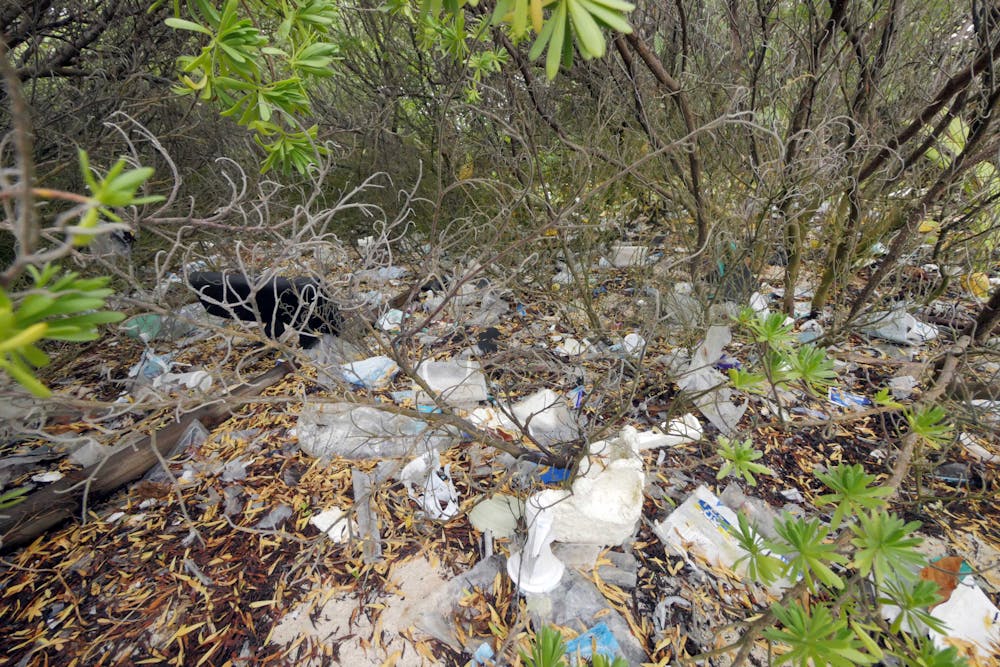
A recent, comprehensive survey of the Cocos (Keeling) Islands revealed mountains of plastic trash washed up on the beaches.


Read more: Plastic warms the planet twice as much as aviation – here’s how to make it climate-friendly


While the density of debris on Cocos (a maximum of 2,506 items per square metre) was found to be less than that on Henderson Island, the total amount of debris Cocos must contend with is staggering: an estimated 414 million debris items weighing 238 tonnes.

A quarter of the identifiable items were found to be “single-use”, or disposable plastics, including straws, bags, bottles, and an estimated 373,000 toothbrushes.

Plastic debris ‘trapped’ in vegetation by the beach on Home Island. Jennifer Lavers 2017, Author provided (No reuse)

At only 14 kilometres squared, the entire Cocos (Keeling) Island group is a little more than twice the size of the Melbourne CBD. So it’s hard to envision 414 million debris items in such a small area.

Lessons learned

Islands “filter” debris from the ocean. Items flow past and accumulate on beaches, providing valuable information about the quantity of plastic in the oceans.

So, what have these two studies of remote islands taught us?

South Island. A quarter of the identifiable items were found to be disposable plastics. Cara Ratajczak, Author provided

On Cocos, the overwhelming quantity of debris you can see on the surface accounts for just 7% of the total debris present on the islands. The remaining 93% (approximately 383 million items) is buried below the sediment. Much like the proverbial iceberg, we’re only seeing the very tip of the problem.

Henderson Island, on the other hand, highlighted the terrifying pace of change, from pristine, tropical oasis to being inundated with 38 million plastic items in just two decades.

In the past 12 months alone, scientists have made other, ground-breaking discoveries that have emphasised how little we understand about the behaviour of plastic in the environment and the myriad consequences for species and habitats – including ourselves.


Read more: Eight million tonnes of plastic are going into the ocean each year


Here are a few of the shocking discoveries:

  • microplastics were reported in bottled water, salt and beer

  • chemicals from degrading plastic in the ocean were found to disrupt photosynthesis in marine bacteria that are important to the carbon cycle, including producing the oxygen for approximately every tenth breath we take

  • degrading plastic exposed to UV sunlight (such as those on beaches) was reported to produce greenhouse gas emissions, including methane. This is predicted to increase significantly over the next 20 years in line with plastic production trends

  • microplastic particles are ingested by krill at the base of the marine food web, then fragmented into nano-sized particles

  • plastic items recovered from the ocean were found to be reservoirs and potential vectors for microbial communities with antibiotic resistant genes

  • tiny nanoplastics are transported via wind in the atmosphere and deposited in cities and even remote areas, including mountain tops

Meaningful action

Clean-ups on near-shore islands and coastal areas around cities are fantastic.

The educational component is invaluable and they provide an important sense of community. They also prevent large items, like bottles, from breaking up into hundreds or thousands of bite-sized microplastics.

Microplastics (defined as items between one and five millimetres) on the beaches of South Island. Cara Ratajczak, Author provided (No reuse)

But large-scale clean-ups of the Cocos (Keeling) Islands, and most other remote islands, are challenging for a variety of reasons. Getting to these locations is expensive, as would be shipping the plastic off for recycling or disposal.

There are also serious biosecurity issues relating to moving plastic debris off islands. Even if we did somehow manage to clean these remote islands, it would not be long before the beaches are trashed again, as it was estimated on Henderson Island that more than 3,500 new pieces of plastic wash up every single day.

As Heidi Taylor from Tangaroa Blue, an Australian initiative tackling marine debris, puts so aptly:

if all we ever do is clean up, that is all we will ever do.

For our clean-up efforts to be effective, they must be paired with individual behaviour change, underpinned by legislation that mandates producers to take responsibility for the entire lifecycle of their products.

Single-use items, such as razors, cutlery, scoops for coffee or laundry powder and toothbrushes were very common on the beaches of Cocos. Clearly this is an area where extended product stewardship laws (following the principles of a circular economy), coupled with informed consumer choices can lead to better decisions about the types of products we use and how and when we dispose of them.


Read more: There’s no ‘garbage patch’ in the Southern Indian Ocean, so where does all the rubbish go?


The global plastic crisis requires immediate and wide-ranging actions that drastically reduce our plastic consumption. And large corporations and government need to adopt a leadership role.

In the EU, for instance, governments voted in March 2019 to implement a ban on the ten most prolific single-use plastic items by 2021. The rest of the world urgently needs to follow suit. Let’s stop arguing about how to clean up the mess, and start implementing meaningful preventative actions.

ref. Will the discovery of another plastic-trashed island finally spark meaningful change? – http://theconversation.com/will-the-discovery-of-another-plastic-trashed-island-finally-spark-meaningful-change-117260

Australians disagree on how important climate change is: poll

Source: The Conversation (Au and NZ) – By Michelle Baddeley, Director, Research Professor Institute for Choice, University of South Australia

Climate change, the environment and energy policy are all key issues in this election campaign, fuelled by compelling evidence of our accelerating impact on the environment and climate. While voters agree more than you might think, there’s still a serious split on the importance of acting on climate change and preventing harm to the environment.

Australia’s major political parties fall into two broad camps on these issues. The Labor party is spruiking policies that control emissions and move towards renewables, consistent with its rhetoric about taking on the “top end of town” – including the mining industry.


Read more: Australia’s major parties’ climate policies side-by-side


In the Liberal-National view, concerns about energy and the environment are attacks on the businesses that deliver Australia’s prosperity. Moving away from coal towards renewables is typical of an opposition that has neither the ability nor inclination to support a thriving economy and control government finances: all symptomatic of the “Bill Australia can’t afford”.

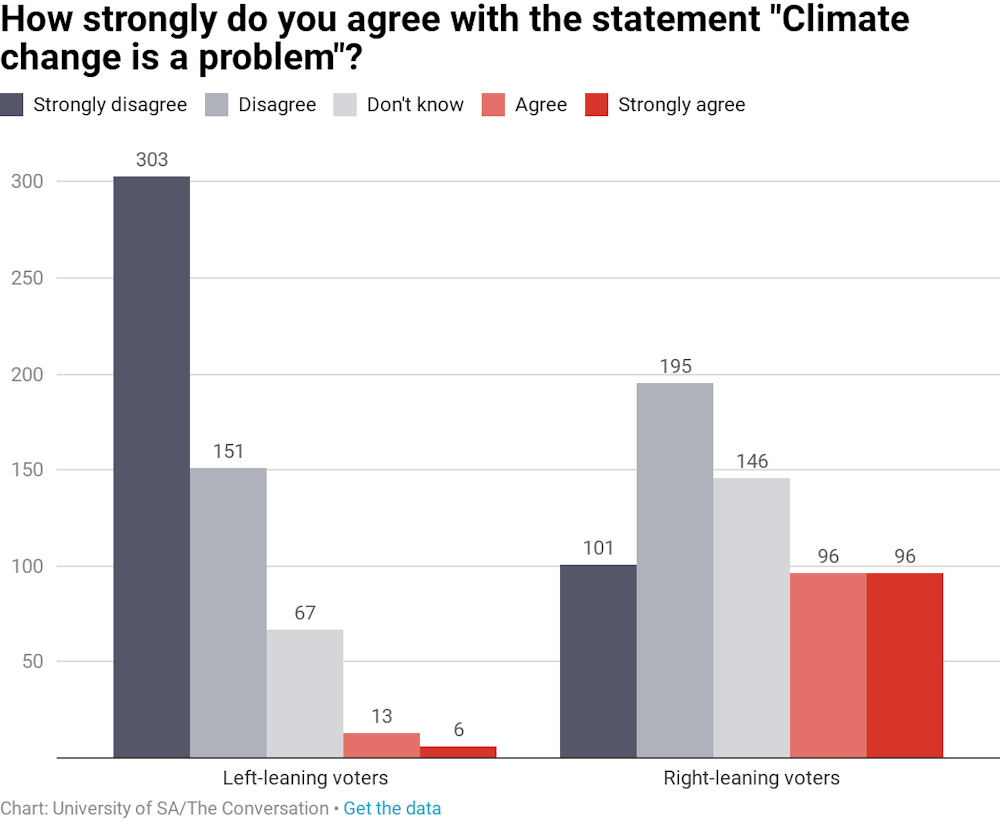
But are Australians really that divided? Between April 29 and May 3, 2019, we asked 1,170 people about their attitudes and behaviours, including questions about voting intentions for those respondents eligible to vote in the upcoming election.

Energy and environment attitudes

We wanted to know how our respondents intended to vote. How did that correlate with their attitudes towards climate change, and policies around energy and the environment?

We asked respondents to rate various statements about their behaviour and attitudes on a Likert five-point scale, where 1 means “strongly agree” and 5 means “strongly disagree”.

These statements included eight questions about attitudes towards climate change, and five questions on various policies (a tax on carbon, an emissions trading scheme, business incentives for carbon-neutral production, and regulation of mining and plastic use).

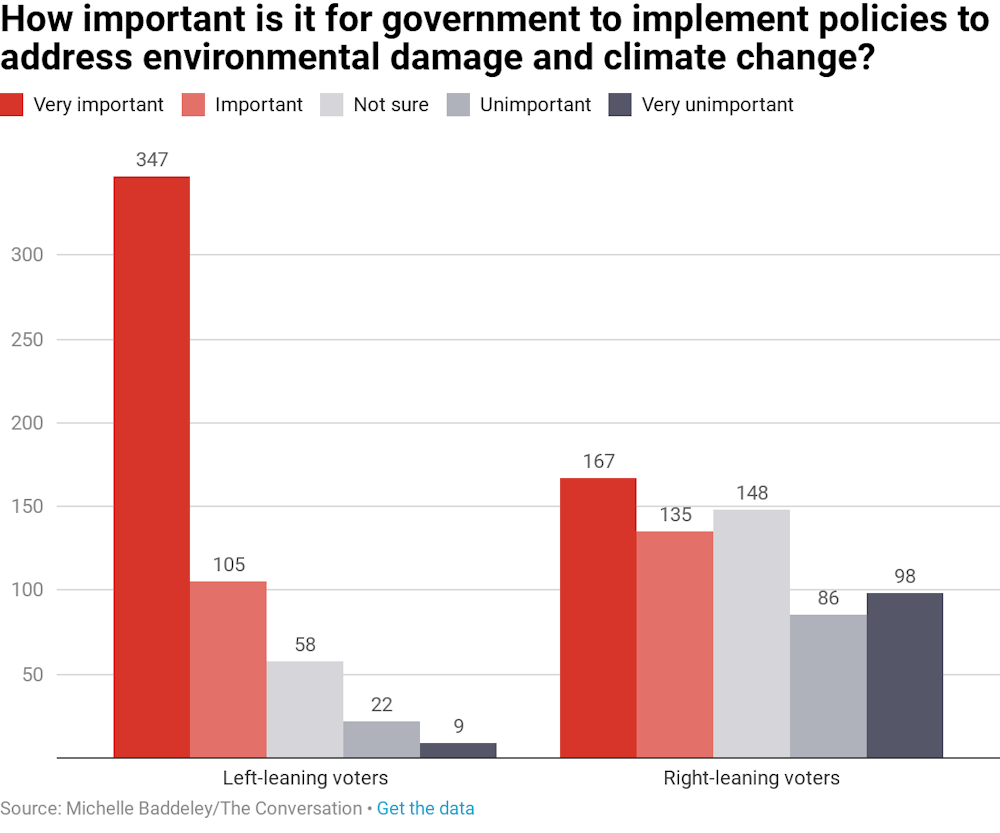
We also asked respondents to rate the importance of the broad statement: “How important is it for the government to implement policies to address environmental damage and climate change?”

(Note: the main purpose of the survey was to explore people’s likely choices about smart meters. In common with any survey, there may be many sources of sampling bias. Our survey was not designed to be a representative sample of political constituencies, and so is not an attempt to predict the election outcome.)

Then we divided the responses roughly into the two “camps” – Liberal-affiliated and Labour-affiliated – excluding the 14 responses for people intending to vote for the Centre Alliance. This gave us 635 right-leaning voters and 541 left-leaning voters.

Perhaps surprisingly, we discovered a lot of agreement across the right- and left-leaning camps. On average, our respondents agreed about their commitment to recycling and also with the statement “I think it’s important that households do their bit for the environment”.

In terms of their attitudes towards conserving energy, both camps agreed that conserving energy was important because they want to control their energy bills. The left-leaning camp had no strong opinions about conserving energy to help limit climate change; the right-leaning camp disagreed that they would conserve energy because of climate change.


Read more: Carry-over credits and carbon offsets are hot topics this election – but what do they actually mean?


This suggests that – for the broadest impact – demand-side management policies should focus on how households can save money by conserving energy – and smart meters could be a key ingredient in this strategy. Behavioural tools are likely to be important too and smart meters have capabilities to combine economic incentives and behavioural motivators, as we’ve explored in previous research into behavioural insights for encouraging energy savings.

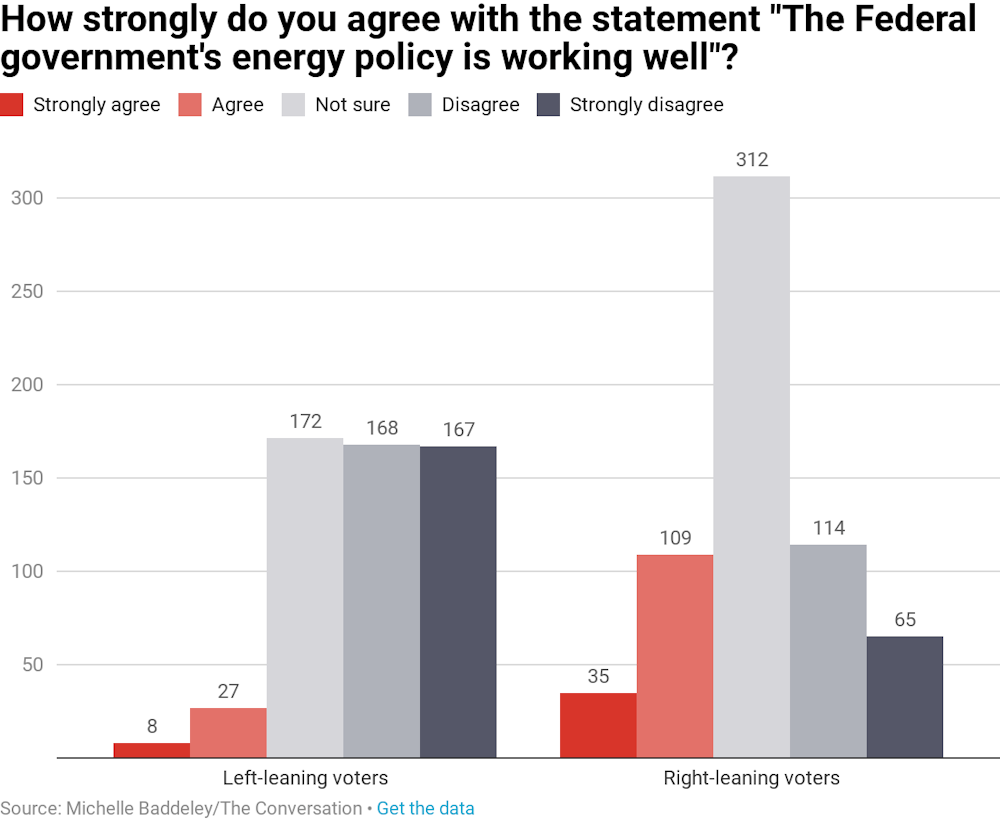
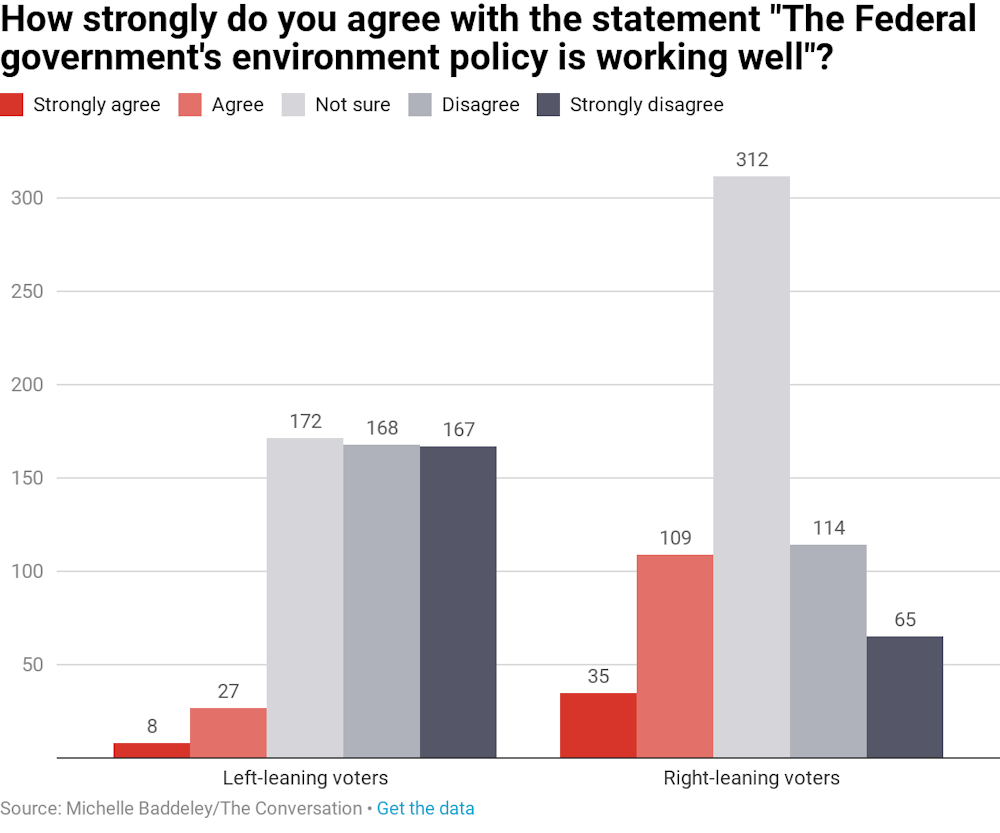
Both camps agreed that businesses should be given incentives towards carbon-neutral production. They disagreed that current government policies were good policies. So there is a strong appetite for policy change.

Neither camp had strong opinions about carbon tax or emissions trading policies. Perhaps this is because debates around these policies are old news from the Gillard-Rudd-Abbott era, or perhaps most people just aren’t sure what these policies would mean for them personally.

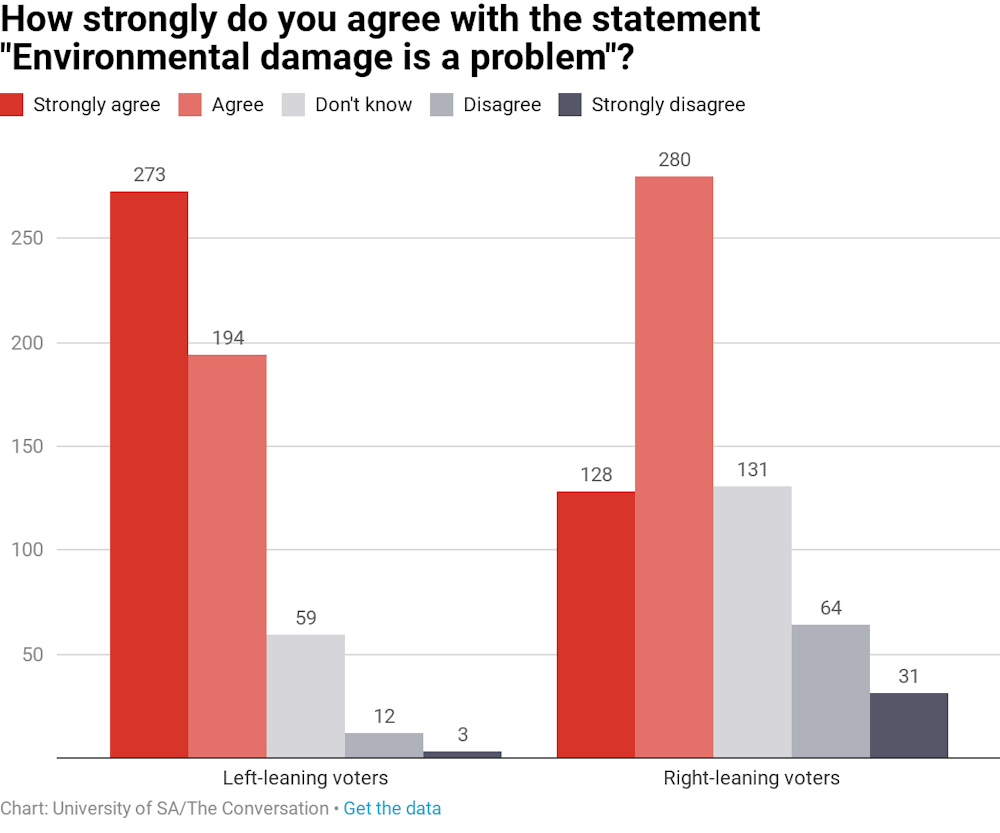
There were still areas of disagreement. The left-leaning camp had generally stronger opinions about climate change, agreeing that environmental damage and climate change are problems. The right-leaning camp on average neither agrees nor disagrees that these are problems.

The left-leaning camp tends to agree that the government should introduce policies to regulate plastics and mining – unsurprising given that this camp includes a substantial number of people intending to vote Green. The right-leaning camp was neutral on these issues.


Read more: Compare the pair: key policy offerings from Labor and the Coalition in the 2019 federal election


Overall, this survey suggests more consensus across Australian voters than politicians might like us to believe. Once the election is over, and there is no more political mileage to be had from the mud-slinging that has characterised this campaign, then perhaps we can hope our political leaders will start expending some energy on judiciously analysing and assessing the policy challenges ahead.

This will be essential if we are to come up with policies to mitigate climate change and environmental damage, whilst also ensuring Australia’s jobs, wages and prosperity.

ref. Australians disagree on how important climate change is: poll – http://theconversation.com/australians-disagree-on-how-important-climate-change-is-poll-117171

Of all the problems our cities need to fix, lack of car parking isn’t one of them

Source: The Conversation (Au and NZ) – By Elizabeth Taylor, Senior Lecturer in Urban Planning & Design, Monash University

Parking is a fiery issue in Australian cities. That’s because cars dominate our cities, supported by decades of unbalanced planning decisions favouring space for cars over other land uses or forms of transport. Parking is even an issue in the federal election, with both the Coalition and Labor promising to fund more spaces for commuters.

The issue of parking flared up again recently in Melbourne’s inner north. Moreland City Council wants to scrap minimum parking requirements for new apartments around its increasingly dense activity centres.


Read more: Crowded trains? Planning focus on cars misses new apartment impacts


Victoria’s planning minister, Richard Wynne, gets the final say on this plan – and it might be a “no”. He said last month the practicalities need more thought and that Moreland must “strike a balance”.

Wynne is right, but not in the way he implies.

Australian cities are generous to cars

Minimum parking requirements were introduced across Australia alongside the rise of cars in the 1950s. These set rigid ratios for parking spaces in different types of new developments.

For example, the Western Australia State Planning Policy requires at least at least 0.75–1 parking bay for every one-bedroom dwelling in an apartment building, plus at least one visitor parking space per four dwellings. A review of parking policy in Western Australia found these requirements are largely based on small, outdated surveys in the United States and do not reflect actual demand for parking in Australia.

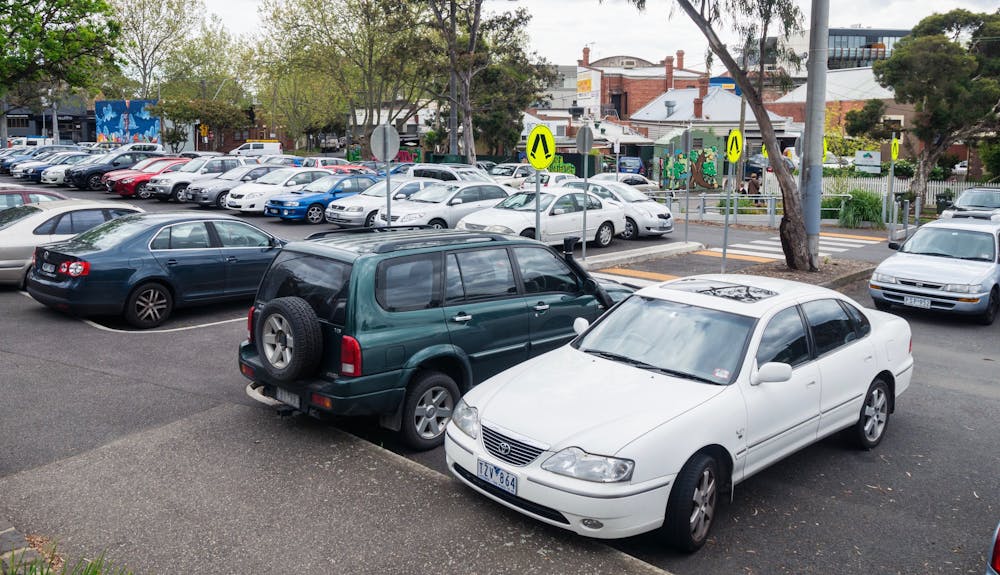
A result of these policies is a glut of parking in Australian cities. The local council area of the City of Melbourne has over 215,000 parking spaces. However, 40-60% of households in the area do not own a car and around a third of apartment parking spaces are not used.

Removing minimum requirements is an effort by local governments to allow the varying needs of local communities to determine parking outcomes.


Read more: The elephant in the planning scheme: how cities still work around the dominance of parking space


But what about tradies, emergency workers, the disabled?

Often proposed changes to parking are criticised for being unfair to people who may rely on cars. It is great that these questions of equity are raised (including by the planning minister), but some of the common concerns are misplaced.

Firstly, developers are sensitive to market demands and will continue to provide apartments with parking for those who need it. When London removed minimum parking requirements in 2004, new developments still provided car parks – just at half the previous required rate.

Closer to home, the inner-city councils of Sydney and Melbourne have already removed some minimum parking requirements – and many new apartments still provide parking spaces.

Secondly, while apartment dwellers with insufficient off-street parking are often blamed for clogging up on-street parking in residential areas, they are rarely to blame. A recent study in Melbourne found residents of detached houses use 77-84% of on-street parking. Many of them have garages, but choose to use them for storage or living space.

Apartment dwellers were less likely to use on-street parking and more likely to have unused spaces. And more parking in apartment blocks isn’t helping people access our cities, even by car.


Read more: Empty car parks everywhere, but nowhere to park. How cities can do better


Finally, providing more housing options without rigidly attached parking spaces will encourage people who don’t actually need to drive to choose to drive less or switch to other forms of transport.

Removing minimum parking requirements will not mean that people who need to drive for work, medical or other reasons can’t find homes with parking spaces. Indeed, if we make it easier for those who don’t need to drive to get around in other ways, congestion could be eased for those workers who do need a car.

Election promises to increase parking at train stations show the car is still seen as the default option for getting to the station. Nils Versemann/Shutterstock

Pro-car planning policies are unfair to those who can’t drive

Policies that encourage dependence on cars marginalise people who can’t or don’t drive. These groups are often disadvantaged in other ways. For example, people with disabilities tend to rely on public transport, not cars, to participate in society.

In Australia, households in the most disadvantaged areas are the most likely not to have a car. Older Australians are also less likely to drive. Rates of driver licence ownership decrease from around the age of 60.

Providing quality public transport and walkable streets – not an oversupply of car parking – is critical to ensure children, young and older people and those with disabilities can get around independently.

Minimum parking requirements prioritise cars as the default transport option. The results include increased congestion, urban sprawl and air pollution.

Parking requirements also make apartments less affordable. Land construction costs per parking space average between A$50,000 and $80,000, as well as using valuable space at an average of 21 square metres. A parking space is bigger than a bedroom – and nearly half the size of a typical new Melbourne apartment!.

Design cities around people, not cars

Australian planning policy has favoured cars over other forms of transport for too long. This needs to change if we want our cities to be healthy, liveable and easy to get around for everyone.

Moreland’s plan to scrap minimum parking requirements may sound extreme, but it isn’t going to take existing parking spaces away, or mean all new developments will have zero parking.


Read more: Move away from a car-dominated city looks radical but it’s a sensible plan for a liveable future


The practicalities of on-street parking policy are important, but mandating the supply of more off-street parking isn’t even the best way to meet parking demand.

If we continue to plan our urban areas as if everyone needs a car (or multiple cars) to get around, we will rapidly run out of space. And the space we have left will be unpleasant to spend time in. This means more time spent in traffic for drivers and ugly, hazardous and polluted streets for locals.

Sidestepping this difficult issue in the name of “balance” isn’t fair or practical. Improving public transport in these corridors is in the state’s power and would be a much more constructive response.

ref. Of all the problems our cities need to fix, lack of car parking isn’t one of them – http://theconversation.com/of-all-the-problems-our-cities-need-to-fix-lack-of-car-parking-isnt-one-of-them-116179

Mineral wealth, Clive Palmer, and the corruption of Australian politics

Source: The Conversation (Au and NZ) – By Warwick Smith, Research economist, University of Melbourne

Clive Palmer is reportedly spending A$70 million of his own money on his party’s campaign.

How is it possible for one individual to command so much wealth and where did it come from? The sad and strange reality is that Australian governments gave him most of it by letting him dig up and sell natural resources that, by rights, belong to us not him.

We’ve a history of handing vast wealth to resource and mining magnates and companies and then watching them use that wealth to undermine our democracy in order to continue to get access to that wealth. Palmer is small fry compared to Gina Rinehart and Andrew Forrest or the corporate power of BHP, Rio Tinto and others.

So, what do state and federal governments charge for our mineral wealth? You would hope that they use state-of-the-art methods to get the best possible prices. You’d be wrong, of course.

We barely charge for resources

The federal government relies primarily on company tax and then on extra tax from employment and consumer spending and other things that are boosted as an indirect result of mining.

But many of the big mining and resource companies use the holes in our tax system to avoid paying company tax. In addition, mining is being increasingly automated, with self-driving trucks and trains becoming the norm, and ever-larger machinery meaning that fewer workers are needed for each tonne extracted and refined. These days billions can be spent with relatively few jobs created.

State and territory governments collect royalties from land-based mining companies, which are charged per unit of product. It means that when the prices of our mineral resources go up during a commodity boom the royalties do not rise with them – the mining companies benefit, but not the people who own the resources.

How much we collect in taxes is just the beginning of the story.

We also spend vast amounts of taxpayer cash on building the infrastructure needed for resource extraction; things such as roads, railways and ports. We also often end up footing the bill to clean up after mines close and the big companies sell depleted mines and their clean-up obligations to shell companies that then file for bankruptcy.

We could (and should) seek more

We could fix the system to get a fairer price.

We already have a more effective tax system for offshore oil and gas. It is, in effect, what the Rudd government tried to do in 2010 when it proposed a mining super profits tax. Foolishly, the tax was announced more than a year before it was to come into effect, giving the mining interests plenty of time to campaign against it.

They spent more than A$22 million just on advertising. Rudd abandoned the original proposal and was removed from office.

The Gillard government consulted the miners and adopted a watered-down version – the Mineral Resource Rent Tax – that was so toothless it collected almost nothing. Even though it was worthless, the mining industry still saw it as enough of a threat to pressure Tony Abbott to kill it off when he took government, which he did with Clive Palmer’s vote in parliament.

But miners have muscle

A more radical idea would be to put out tenders for the extraction and refinement of natural resources and then have the government or an independent authority owned by the government allocate them. Such a “single desk” would have considerable market power – it could demand good payments.

The truth is that all of this has been public knowledge for a long time and the solutions are well known. The problem is politics, not knowledge. The mining industry is so powerful that our leaders rarely attempt to take it on.

Given that Palmer set the record for most absent politician in two out of the three years he was in the parliament last time, why is he so keen to go back? There’s no evidence that he’s a conviction politician, trying to make the country better based on some strongly held principles; quite the opposite given how regularly he has changed his positions.


Read more: Now for the $55 million question: what does Clive Palmer actually want?


Could it be that what he really wants is political power in order to defend and increase the extent to which him and his mates rake in the cash at our expense?

In 2016 the government used it’s position as a creditor to seek the appointment of a special liquidator to look at the collapse of Palmer’s Queensland Nickel company and the actions of Palmer’s actions personally. The government’s Michaelia Cash said at that time it would use every power as it’s disposal to hold company officers to account.

On Thursday at the National Press Club Prime Minister Scott Morrison was asked how he intended to manage the conflict between pursuing Palmer in the courts and courting his vote in the Senate.

He replied that he would be able to.

We will continue to pursue that measure through the courts with full vigor – we are very confident in our ability to pursue that as we absolutely should

It is obvious that we need political donation reform to keep the influence of money out of politics but we need to go one step further and reform how we, the Australian people, sell our mineral resource wealth so that we don’t create mining giants like Palmer in the first place. He is just the tip of the iceberg.

ref. Mineral wealth, Clive Palmer, and the corruption of Australian politics – http://theconversation.com/mineral-wealth-clive-palmer-and-the-corruption-of-australian-politics-117248

Friday essay: is this the Endgame – and did we win or did we lose?

Source: The Conversation (Au and NZ) – By Danielle Clode, Senior Research Fellow in Creative Writing, Flinders University

I had a momentary brain-fade when I went to the movies this week.

“Three tickets to … what’s it called again?” I asked.

“Endgame”, the ticket seller replied firmly, “What other movie is there?”

At over three hours long, it certainly is a movie for the fans, packed full of emotionally satisfying vignettes and snappy interactions for the cast of thousands that has become the Avengers trademark. I don’t think I’ve ever watched a faster three-hour movie.

Avengers: Endgame, the concluding half of Avengers: Infinity War, has quickly become one of the biggest grossing movies of all time. By pure numbers these are important and influential movies. So what are they are telling us?

Let me say at the outset that this is not a critique of the movie itself. I’m not going to document plot holes, flaws in logic or whether or not the science is correct. I’m happy to suspend a bit of disbelief for the sake of a good story. But I am interested in the function that stories like these play and what they reveal about our broader hopes and fears.

Jeremy Renner and Ava Russo in Avengers: Endgame. Marvel Studios/IMDB

Although not pitched as one, Endgame is an environmental movie – and an apt one for our times. Its predecessor, Infinity War, saw the world under threat from powerful villain Thanos, whose home world had been destroyed by overpopulation and resource exploitation. His grief sets him on a quest (involving, naturally, a gauntlet studded with variously magical and powerful stones) to halve the population of the universe.

Despite being cast as the antagonist, it is Thanos’s character who undertakes the “hero’s journey” in this movie. By the end of Infinity War, Thanos manages to achieve his goal across the universe, without violence – painlessly and humanely, with a click of the fingers – wiping out exactly 50% of the population at random, all at once.

It’s a little unclear in Infinity War what Thanos intends to reduce: half the human population or half of all sentient life. His track record had focussed on people, killing “people planet by planet, massacre by massacre”. In Endgame the goal is broadened. Not just all humans or even all sentient life forms, not just the resource exploiters and over-users, but half of all life forms. It’s a telling ecological misstep.

Clearly, it’s the people that matter and humans in particular. Despite having the breadth of the universe as a stage, even the alien Avengers are strikingly Earth-centric, with the exception of Captain Marvel/Carol Danvers, who is the only one, aside from Thanos, who cares that the same thing is happening across thousands of planets.

Various critics have discussed whether Thanos’s population reduction strategy would work – at least in terms of halving the human population of Earth. And they generally conclude that it wouldn’t.

But this is an over-simplification of the movie’s message. The specific population reduction strategy Thanos employs can also be read as a broader environmental goal – to “restore” ecological balance. Climate change, pollution, species extinctions, overpopulation, resource use and distribution are all connected parts of the broader issue of environmental sustainability. The question is not, is population reduction a viable strategy? (Probably not.) Nor even, would a reduced human population be good for the planet? (Perhaps, if it were sustainable.)

The question Endgame poses for us is, are we willing to make personal sacrifices to save our own futures? To which the answer is a categorical no.

Environmental activists from Greenpeace protest against climate change in Berlin in May 2019. Felipe Trueba/EPA/AAP

Our greatest fears

Eco-catastrophe fiction is often castigated for not being scientifically accurate, and for failing to promote action on any of the various threats that face our planet – overpopulation, pollution, extinction, nuclear fallout, climate change. But when my colleague and I looked at climate change fiction across the centuries, we found that such stories are not about providing answers to our problems, but articulating our greatest fears. These stories – in book or movie form – are reflections of how society imagines the world of the future.

Eco-catastrophe stories have been a part of our culture from the earliest mythological stories of floods, fires, eruptions and storms. These stories of punishment and redemption form the foundation for much of our literature, not least that of superheroes with god-like or even godly powers.


Read more: When the Bullin shrieked: Aboriginal memories of volcanic eruptions thousands of years ago


The emergence of both the novel (and modern science) in the 17th and 18th centuries saw a growing awareness of environmental change reflected in fiction. Early Romantic literature may have seen climate change as a metaphor for social progress and human advancement into a Utopia, but that rapidly shifted into the dystopian fears that dominate environmental fictional literature today.

From the mid-19th century onwards, fiction, and particularly science fiction, closely tracked developments in science. Our deeper understanding of past ice-ages and the influence of solar variation, geological instability and the oscillations of the earth on climate, emerged in stories like Gabriel De Tarde’s Underground Man, S Fowler Wright’s Deluge and William Wallace Cook’s Tales of Twenty Hundred.

Goodreads

Extra-terrestrial influences (comets rather than aliens) provided the catalyst for eco-catastrophe fiction in the 19th and 20th centuries. This phase was a phenomenon undoubtedly inspired by the first-hand experience of the “little Ice Age” which caused widespread famine, crop failures, and food riots across the Northern Hemisphere. Astronomer Camille Flammarion’s Omega: The Last Days of the World (1893-4) was perhaps one of the most influential of the comet-inspired fictions and marked the continuing dominance of dystopian over utopian visions for the future.

This pattern continued into the 20th and 21st centuries and, as the climate change debate expanded from a restricted scientific focus to a broader social and political dimension, the literature expanded from science fiction to a broader range of literary forms. Eco-catastrophe has emerged in every genre from thrillers to literary fiction and particularly young adult fiction. And of course, in the visual forms of storytelling – superhero, science fiction and apocalypse movies.

A sense of inevitability and hopelessness pervades much of the modern literature on climate change, irrespective of sub-genre. Rarely is climate change depicted as being solved by human agency. For many, the damage of climate change can only be overcome with the assistance of either supernatural or extra-terrestrial powers. We can see the same patterns in movies where the future of humanity is so often saved by superior intelligence rather than our own, either aliens, angels, or, as in Interstellar, our unrecognisably advanced selves.

Anne Hathaway and Wes Bentley in Interstellar, a film where only our unrecognisably advanced selves can save humanity. Warner Bros/Paramount Pictures/IMDB

Read more: Friday essay: how speculative fiction gained literary respectability


Distrust of scientists

The history of eco-castastrophic stories reveals that, far from being agents of resolution and improvement, scientists are mostly depicted as untrustworthy or even responsible for the crisis. Environmentalists are even less trustworthy than the scientists; they are frequently depicted as extremist and violent loonies.

This distrust is reflected throughout the Avengers franchise. The original 2012 Avengers film saw Tony Stark’s (aka Iron Man) sustainable power source, the Arc Reactor, co-opted to create a wormhole entry point for alien invasion. The shadowy law enforcement agency, SHIELD, subverts research into the environmental potential of the Tesseract, an alien object with infinite energy, for weapons development. The same theme recurs – green technology is dangerous and scientists cannot be trusted.

Robert Downey Jr as Tony Stark (aka Iron Man) in The Avengers (2012). Marvel Studios/IMDB

And nor can “environmentalists” like Thanos. On his home planet, his environmental crusade earns him the title “The Mad Titan”. By the end of Infinity War, however, he has completed his quest, accepted the sacrifice his choices entail, and his hero’s journey is at an end. Both he and the world have been transformed into a new order. Thanos sits in the countryside and watches the sunset.

Except that it’s not a happy ending. Endgame opens with a powerful scene that illustrates the central problem. Clint Barton (or to use his “made-up name”, Hawkeye) is picnicking with his family in the country – having given up his action persona – and is teaching his daughter to shoot arrows. As he turns away for a moment, his daughter, wife and two sons all suddenly disappear – victims of the 50% erasure. Hawkeye’s loss is both excessive and insurmountable. He loses everything.

Versions of this continuing loss permeate the movie. Hawkeye retreats into his vengeful violent superhero persona. Thor drinks himself, comically, into oblivion. Captain America runs group counselling sessions helping people to move on.

The differing manifestations of grief are represented in different characters – denial, anger, depression, bargaining, even acceptance. But these are not stages that characters work through. Ultimately all the characters are grief-stricken and unable to move forwards, except for Tony Stark, who has moved on but decides that, in a hastily explained piece of time-travel sleight of hand, he can fix the most of the problems without losing the future he has created for himself.


Read more: Avengers: Endgame exploits time travel and quantum mechanics as it tries to restore the universe


Nonetheless, the future in which our environmental problems are resolved is infused with melancholy. While Thanos’s rural retreat is a pastoral idyll, the rest of the world is empty, seemingly devoid of life. When Captain America mentions the environmental restoration, he is flippantly dismissed by Black Widow:

You know, if you’re about to tell me to look on the bright side – I’m about to hit you in the head with a peanut butter sandwich.

In traditional superhero stories, the hero(ine) must sacrifice the thing they love most for the betterment of the world. But in Infinity War and Endgame, the heroes sacrifice the betterment of the world to save (or at least reconcile with) the things they love best. Individual interests win out over social or environmental restoration. Rather than securing the future we need, they save the world of the past. With superheroes like this, my sympathies lie with the villains (and not just because of Tom Hiddleston).

Tom Hiddleston in Avengers: Infinity War. With superheroes like the Marvel team, who needs villains? Marvel Studios/IMDB

So, is Endgame a paean to conservative values, a retreat to an idealised version of the past, a failure to meet the genuine challenges that face the Earth and its ever expanding human population?

Nathaniel Rich, author of Odds Against Tomorrow (2013) once argued: “I don’t think that the novelist necessarily has the responsibility to write about global warming … but I do feel novelists should write about what these things do to the human heart.” This is true of movies too.

What Endgame reveals is that in our hearts we are afraid that the price of environmental salvation is too high, that the losses will be too great, that we will not be able to cope with the scale of the personal sacrifice required.

An insight into the cultural zeitgeist

There is no point in complaining that there are no great climate change movies, or books, with real solutions, or which inspire real action. This is not their purpose. Movies and books don’t help us to overcome our fears, they simply express them. But surely they also reinforce them. Cliched fears about the risks of environmental change, scientists and technology may not be intentionally promoted but they risk promulgating pervasive subconscious biases that both perpetuate and delay vital cultural change.

The real risks of environmental inaction, of course, massively outweigh the risks of any environmental action. But that message does not yet seem to be permeating the popular psyche.

It may well be true, too, that the worst environmental costs will not be borne by the relatively well-off viewers of Avengers movies, but disproportionately by poorer and more vulnerable communities (something that only heightens the irony of fictional East African nation Wakanda’s role in the Avengers franchise).

A 2017 climate march in Washington DC. Nicole S Glass/ Shutterstock

Effective environmental action does not demand the destruction of half the human population. But it does require the vastly more efficient use and distribution of resources. The sacrifice is not that of the individual, but the vested interests in old-world resources and technology who would prefer not to incur the costs of change. Responding to environmental change does not threaten our comforts, but failing to act will.

Endgame isn’t the endgame: it’s an insight into the cultural zeitgeist. Neither threats nor solutions come from purple aliens, gods or superheroes. They come from us – politicians, scientists, environmentalists, industry and the general public.

Markets, technology and industries can and will adapt rapidly to changing circumstances, in milliseconds, months or even decades. Economies recover, but species do not. The environment takes millennia to adapt and what is lost never comes back. We need to face our fears and find solutions to these problems, rather than just perpetuating the fantasy of regressing into the past.

As Peter Parker says: “You can’t be a friendly neighbourhood Spider-Man, if there’s no neighbourhood.”

ref. Friday essay: is this the Endgame – and did we win or did we lose? – http://theconversation.com/friday-essay-is-this-the-endgame-and-did-we-win-or-did-we-lose-117172

To build social cohesion, our screens need to show the same diversity of faces we see on the street

Source: The Conversation (Au and NZ) – By Arezou Zalipour, Associate Professor in Screen Production and Cultural Studies, Auckland University of Technology

Migration plays an important role in shaping Aotearoa New Zealand society. New Zealand’s biggest city, Auckland, is now “more diverse than London”, and one in four New Zealanders have come from elsewhere.

The large number of arrivals from across the Pacific region has given Auckland the largest Pacific Islander population of any city in the world. Almost one-quarter of Auckland’s population is now classified as Asian. This itself is a catch-all term for a wide range of peoples and cultures covering half of humanity.

But while diversity in New Zealand is greater than ever, there is a gap between the society we see around us and what is reflected on screen.


Read more: Three ways Screen Australia can actually improve diversity in the industry


On New Zealand screens

In 2011, when I started my research, there were a few films made by and about migrant ethnic peoples in New Zealand. There was Leon Narbey’s beautifully shot Illustrious Energy (1988) about Chinese miners in the South Island, and Sima Urale and Shuchi Kothari’s Apron Strings (2008), a double story about an Indian and a Pākehā (of European descent) family in South Auckland.

There were also several short films with scarce publicity, and I came across television programmes such as Asia Downunder (1994-2011) and An Immigrant Nation — Footprints of the Dragon (1994).

In recent years, there have been more screen productions by New Zealanders of migrant ethnic descent that attempt to represent a wider range of social and cultural experiences among the contemporary population. But overall it is evident that New Zealand’s national cinema and television has so far included Pākehā and Māori films and, to a lesser degree, Pasifika films.

This includes movies of international acclaim, such as Whale Rider, The Piano and Taika Waititi’s The Hunt for the Wilderpeople, but we do not see faces, images, voices and stories of all diverse communities on New Zealand screens.

Diversity and inclusion through screens

Considering the long migrant ethnic history in New Zealand’s demographic make-up, could New Zealand screens reflect better the actual diversity of contemporary society? Could New Zealand screens include all New Zealanders?

Representation of diverse communities on screens means recognising a wider range of social and cultural experiences in contemporary society. It also means acknowledging that New Zealand audiences are more diverse than ever. Screens and media are the platforms that can increase the visibility of migrant ethnic communities in New Zealand society.

Following the Christchurch mosque attacks, New Zealanders engaged with the Muslim community, regardless of their own ethnicity, faith, gender, and all other identity markers. We have observed a sudden shift in coverage of migrant ethnic peoples in New Zealand media. This reminds us of the ways in which screen and media play a significant role in creating a sense of inclusion and construction of identities for migrant ethnic groups in New Zealand.

For young and old New Zealanders, seeing the faces they see around them reflected on screen builds a sense of social and cultural connectedness, a sense of belonging to a land they (may) want to call home.


Read more: The problem with Apu: why we need better portrayals of people of colour on television


Making communities visible

In 2017, I curated and directed the (In)Visibile New Zealand Film Festival, mainly in collaboration with the Hamilton Film Society in the Waikato region. It was a first of its kind and aimed to explore and showcase New Zealand’s diverse onscreen landscape. The discussions after films pointed at the lack of socio-cultural and ethnic exposure and awareness among New Zealand audiences. The common theme that emerged from audience responses was the feeling of confrontation.

For a long time, New Zealanders’ imaginations, beliefs and assumptions have remained largely unchallenged. The Christchurch attacks have stirred the awareness of many New Zealanders. Among them are migrant ethnic groups in New Zealand who might prefer to be more visible. It is possible to create a sense of solidarity and inclusion, but only if we do not let absence, (convenient) unawareness and assumptions cloud our horizons.

The way forward is to create more exposure and carve out more spaces for images and stories of peoples from all backgrounds who live in New Zealand. This will help develop new perceptions as well as cultural consciousness for the generations to come.

We have heard many times that creating social cohesion is the answer to the challenges that arise from diversity. To create social cohesion, we need to create the space where our stories are told, where our voices are heard, where we create new memories and histories together. The migrants’ children in this land will tell stories that will reflect their lives in contemporary diverse New Zealand life.

As more people from different backgrounds commit to a future in New Zealand, some feel the need to reflect publicly on their experience of inclusion or exclusion. The desire to shape their related experiences and perspectives into various films will help make New Zealand screens more inclusive. Not having a representative presence on New Zealand screens means peoples from different origins have not yet claimed their public space.

ref. To build social cohesion, our screens need to show the same diversity of faces we see on the street – http://theconversation.com/to-build-social-cohesion-our-screens-need-to-show-the-same-diversity-of-faces-we-see-on-the-street-116416

Grattan on Friday: Bill channels Gough as he hopes that his time is coming

Source: The Conversation (Au and NZ) – By Michelle Grattan, Professorial Fellow, University of Canberra

At the end of what’s been for him a testing campaign, Bill Shorten chose to go to Blacktown, to the hall where Gough Whitlam nearly half a century ago delivered his famous “It’s Time” election speech.

For Shorten, on his last big occasion of the five weeks, to tap so conspicuously into the Whitlam spirit was a significant decision. For years Whitlam was an icon that Labor aspirants treated with caution, because his story, which started with such promise, went awry. There was no way Bob Hawke, seeking office in 1983, wanted voters to be thinking back to Gough.

But now the Whitlam government’s falling apart has faded into history and the hope he represented can be resurrected. Or that was Shorten’s gamble (some worry a hubristic one) as he gave Gough’s famous “men and women of Australia” speech-opening the contemporary twist of “women and men”.

Like Whitlam, Shorten is selling a huge bag of promises (including in those familiar Whitlam areas of health, education, environment and infrastructure – climate change is a central addition).

It was perhaps easier to persuade people of the case for change in the late 1960s and early 1970s, when voters weren’t so sour and cynical. But on the other hand, angry voters may now be more inclined to deliver punishment to incumbents.

In 1972, Whitlam was claiming his big spending could all be done without increasing tax. Shorten’s program comes with its own rigorous payment plan, a much more realistic and responsible approach, but with greater challenges too.

There’s another big difference for Labor between then and now. While Shorten plays well to a crowd of the faithful, he is no Gough Whitlam, who captured the public’s imagination with genuine charisma. If Labor wins Shorten will deserve massive credit, but no one will put victory down to his personal appeal.

Addressing the more staid setting of a National Press Club audience on Thursday, Scott Morrison observed that the consensus is Saturday’s election will be close, which wasn’t what people had been writing a few months ago.

Whether the consensus will become the reality we’ll know soon enough. But certainly in the run up to the campaign, Labor appeared to be unassailably in the box seat. Now there is more confusion, and a degree of nail biting in Labor circles. Electorates are expected to change hands in both directions.

Morrison has been a much better campaigner than anticipated. This is especially notable because he is offering relatively little – some immediate tax cuts (more than matched by Labor), with further tax relief far down the track.

Morrison’s campaign has been all about the negatives, why this is “not the time for change”, conjuring up fears about what Labor’s tax agenda would bring. It’s been focused on caution, the need for people to avoid the unknown in uncertain times.

The Prime Minister is also pitching the ultimate “trust me” message, sometimes wrapped in language smacking of the pulpit or the song circuit.

After dodging most questions at the National Press Club, Morrison ended by saying if Australians voted for him, they could be “absolutely assured that I will burn for you every day, every single day, so you can achieve your ambitions, your aspirations, your desires”. Just how he would “burn” is, however, something to be revealed in the event of victory.

As a campaigner Morrison has been a natural, partly because he’s a “whatever it takes” man and, as the underdog, he figured he’d have nothing to lose.

Shorten exceeded expectations in the 2016 campaign when he was under less pressure. This time he has been competent but patchy.

He’s had high spots, especially the set pieces, and his response to the Daily Telegraph’s story about his mother. But there were a couple of glitches, and a bit of tension between the travelling team and campaign head office. And Shorten has been on edge, fearing some strike that might derail his run when the prize is so close.

Nevertheless, Labor’s campaign has been well planned and delivered. The initiatives on cancer funding, child care, and the pensioner dental scheme are appealing. The costings have been credible. The fiscal bottom line is convincing economically and savvy politically. But Labor’s proposed curbs on negative gearing and franking credits will cost it some votes.

Shorten went into the race the favourite but like the favourite in the racetrack, he is carrying a lot of weight.

The latest polls, published Thursday, are tight but (as with all the polls for literally years) have Labor ahead. In Essential, the government trailed 48.5-51.5%.

In Nine’s Ipsos, it was behind 49-51%. The Ipsos poll had the Coalition on 39% primary vote, and also found that of those who have already voted (more than half of whom were aged over 55), the Coalition was supported 53-47% on a two-party basis.

In both polls, voters expected Labor to win.

If Labor is the victor with a narrow majority, Shorten will be anxious to proceed quickly with his ambitious and detailed program. But he would need to maintain the tight discipline Labor has shown so admirably in opposition, and that would not necessarily be easy. And favours would start to be called in from the unions and others.

The Senate would likely be a challenge to some of the ALP’s tax measures, which would have implications for the expenditure side.

If Shorten wins he would be going into office with the most ambitious Labor program since Whitlam. Would it be too ambitious? That’s impossible to anticipate.

But – unlike the Whitlam ministry which took over after 23 years of conservative rule – many on the Shorten frontbench would be steeped in previous ministerial experience. And this would be a very important safety catch.

If Saturday’s result is a hung parliament (Labor or Coalition) the voters can only blame themselves for delivering a political outcome that would make policy outcomes more difficult to bring about.

A re-elected Morrison majority government would be a big question mark. There is not a comprehensive blueprint on the record, just a hungry PM on display. “I’m just getting started,” he tells us. “The hunger for Australia and achieving the aspirations of Australia, it is burning deep within me.”

ref. Grattan on Friday: Bill channels Gough as he hopes that his time is coming – http://theconversation.com/grattan-on-friday-bill-channels-gough-as-he-hopes-that-his-time-is-coming-117273

Vale Bob Hawke, a giant of Australian political and industrial history

Source: The Conversation (Au and NZ) – By Frank Bongiorno, Professor of History, ANU College of Arts and Social Sciences, Australian National University

If Bob Hawke had never become prime minister, he would still be recalled as a major figure in Australian political and industrial history. As president of the Australian Council of Trade Unions (ACTU), Hawke was as instantly recognisable as any pop star. But it is as prime minister of Australia (1983-1991) that he made his greatest mark.

Robert James Lee Hawke was born in Bordertown, South Australia, on December 9 1929, the younger of two sons of Clem Hawke, a Congregationalist minister, and his wife Ellie. The family – minus Neil, who was at boarding school in Adelaide – moved to South Australia’s Yorke Peninsula in 1935. Clem had always doted on Bob, regarding him as “special”. But following Neil’s tragic death from meningitis, Ellie’s passionate love and missionary purpose focused with a new intensity on her remaining son.

The family moved to Perth in 1939. Hawke was educated at the selective Perth Modern School and, from 1947, the University of Western Australia, where he completed degrees in arts and law. He also threw himself into student politics, eventually being elected president of the Guild of Undergraduates.

Clem’s younger brother Albert, a Labor member of the Western Australian parliament and premier from 1953 until 1959, was in these matters his nephew’s mentor and guide.

Bob’s survival of a near-death experience in a motorcycle accident confirmed his parents’ conviction that God had spared their son for a high public purpose. Hawke would abandon Christianity after witnessing poverty in India, but never lost the zeal that dictated he must fully use his talents to make a better world.

Bob and Hazel Hawke on their wedding day in 1956. John Curtin Prime Ministerial Library

While Hawke was at university he met the attractive and intelligent Hazel Masterson, to whom he became engaged in 1950. The following year, Hawke failed to win the Rhodes Scholarship, but was determined to make another bid. Hazel then became pregnant: if they had married – as was usual for a courting couple in such straits – Bob would have been ineligible. Instead, Hazel underwent a traumatic abortion, the first major sacrifice in a marriage that would demand much of her.

Awarded the Rhodes Scholarship in 1952, Hawke travelled to Oxford, where he completed a Bachelor of Letters thesis on Australian wage determination, learned to fly, and broke a world beer-drinking record. Hazel joined him in England.

Bob Hawke soon after he was elected ACTU president in 1969. Uwe Kuessner/ Wikicommons

They married in Perth in 1956 and moved to Canberra, where Hawke had a scholarship to research a doctorate in law at the Australian National University. In 1958, the offer of a position as ACTU research officer led him to abandon his studies and the Hawkes – including Susan, the first of their three children – moved to Melbourne. He proved a pugnacious, knowledgeable and persuasive advocate, becoming a hero in union circles after some notable successes in the Arbitration Commission. In 1963, he narrowly missed winning the federal seat of Corio.

In 1969, Hawke was elected ACTU president, receiving the left’s support in what turned out to be a closely fought contest. During the 1970s, he became a towering figure in national political and industrial life.

Hawke was peculiarly popular at a time when unions were not, perhaps partly on account of his reputation for having the magic touch in the resolution of industrial conflict. His arched eyebrows and dark wavy hair gave him a striking, handsome appearance seemingly made for television. His educated yet unmistakably Australian speech resonated with the era’s more assertive national identity.

The relationship between Bob Hawke and Gough Whitlam was fraught. TV Tonight

Hawke was also ALP president from 1973 until 1978, and he served as a governor of the Reserve Bank from 1973 until 1980. His relationship with Gough Whitlam was fraught – there was hardly room on the national stage for two egos on this scale – but Hawke was a calming influence after the dismissal, resisting calls for a general strike.

To many, Hawke’s rise to the prime ministership appeared inexorable, yet by the late 1970s there were in place some formidable personal barriers. Hawke was a champion womaniser and boozer. He was an unpleasant drunk. And his widely admired charm and charisma came with a volcanic temper, sometimes on display in his television appearances.

Some flamboyantly boorish behaviour at the 1979 ALP National Conference in Adelaide – involving intemperate criticism of party leader Bill Hayden in the presence of journalists – briefly imperilled his career. But having decided to enter parliament, he gave up the grog. A 1982 biography written by his former lover and future wife, Blanche d’Alpuget, made a clean breast of his personal excesses and family failings. By this time Hawke was the federal member for Wills and shadow minister for industrial relations, having entered parliament at the 1980 election.

Hawke’s pursuit of the federal Labor leadership showed that he was prepared to be ruthless in dealing with an opponent when they stood in the way of what he saw as his destiny. Piece by piece, he and his allies undermined Hayden’s confidence and standing. An unsuccessful bid for the party leadership in mid-1982 was followed by elevation to the leadership in February 1983 after key party powerbrokers lost confidence in Hayden’s prospects, virtually forcing his resignation. Hawke led his party to a comfortable victory on March 5.

In government, he was fortunate to have inherited the Prices and Incomes Accord, finally agreed by the federal ALP and ACTU after Hawke assumed the leadership. The accord committed unions to wage restraint in return for benefits such as Medicare.

Hawke was also endowed with a talented frontbench. But he proved himself a skilled cabinet chair, with a flair for getting the best out of people. His popularity was a valuable asset; Hawke’s approval rating soared, giving weight to his conviction that he had a special relationship with the Australian people.

Hawke was also lucky. The drought ended. The worst of the recession would soon be over. And Australia II’s victory in the America’s Cup seemed as much Hawke’s victory as that of the successful syndicate, after a jubilant prime minister announced that any boss who sacked a worker for not turning up that day was a “bum”.

An emboldened government floated the dollar – in essence, the joint decision of a highly productive partnership with his treasurer, Paul Keating. The government, helped by a High Court decision, prevented the damming of the Franklin River in Tasmania, while Hawke steered the country through a divisive debate about Asian immigration. But in the face of opposition from some states and the mining sector, the government abandoned national Aboriginal land rights legislation, and Hawke’s later commitment to a treaty, similarly abandoned, further damaged the government’s reputation in Aboriginal affairs.

In 1984, Hawke shed public tears over the heroin addiction of his daughter, Rosslyn. He was not at his best in the subsequent election campaign. Hawke won, but had lost some of his shininess.

A balance-of-payments crisis and plunge in the dollar in the mid-1980s provided the backdrop for greater financial stringency and further free-market reform. Welfare carefully targeted those most in need, university fees were reintroduced, and tariffs were lowered. Some public assets were sold.

Critics complained of the abandonment of Labor tradition and criticised Hawke’s closeness to his “rich mates”, along with his alleged subservience to the United States. Electorally, though, Hawke remained a winner, enjoying further victories in 1987 and 1990. No federal Labor leader had won three elections, let alone four.

Hawke’s prime ministership came to grief over his rivalry with Keating and the deterioration of Australia’s economy, culminating in the worst recession since the 1930s. After an unsuccessful tilt at the leadership in mid-1991, Keating defeated Hawke in a ballot shortly before Christmas. Hawke resigned from parliament.

Bob Hawke and Blanche d’Alpuget at the Labor campaign launch in 2016. AAP/Mick Tsiakis

His memoirs, published in 1994, attracted considerable interest not least for his continuing hostility to Keating who was still then prime minister. In 1995, following a divorce from Hazel, he married d’Alpuget. Hawke subsequently worked in the media, pursued a business career and served as chairman of the committee of experts of Education International, a global voice of the teaching profession.

In a 2010 survey of historians and political scientists, Hawke came second, just behind his hero, John Curtin. Hawke’s historical reputation has risen as his record has been viewed in light of the more modest achievements of every one of his successors.

He is survived by his second wife, Blanche d’Alpuget, his children by his first marriage, Susan, Stephen and Rosslyn, six grandchildren, as well as great-grandchildren.

ref. Vale Bob Hawke, a giant of Australian political and industrial history – http://theconversation.com/vale-bob-hawke-a-giant-of-australian-political-and-industrial-history-93719

Election surprise. Negative gearing isn’t a rort — but something else is

Source: The Conversation (Au and NZ) – By Steven Hamilton, Visiting Scholar, Tax and Transfer Policy Institute, Crawford School of Public Policy, Australian National University

Perhaps the most woefully misunderstood economic issue of the election campaign has been negative gearing.

I’ve been baffled by the number of times I’ve read commentary by otherwise thoughtful people describing negative gearing as a distortion to the property market – as a rort we need to crack down on.

But as someone who knows a bit about the economics of taxation, I can say that simply isn’t true.

Negative gearing is a natural, orthodox and proper feature of any market for investment. And allowing negative gearing to be tax deductible is an essential component of an efficient tax system.

Negative gearing isn’t an account in the Caiman Islands

Negative gearing is a funny term. If you search online, you won’t find the term used in most parts of the world. Not because it’s not allowed, but because the term makes it sound grander than it is. In reality, negative gearing is nothing special – it’s boring and conventional.

If it didn’t have a fancy name, perhaps so many column inches wouldn’t have been wasted writing about it. And maybe we wouldn’t have cast it as a villain that must be slain.

When you buy an asset (such as a home), you bear costs (such as interest) in exchange for two types of return: cash (such as rent) and a rise in value (called a capital gain).

To tax the entire return, we should add up the rent and capital gain over the life of the asset and deduct the interest, maintenance and depreciation expenses.

The capital gain might not be achieved for years – not until the asset is sold, so the total might come out negative for some years while the interest and other expenses exceed the rent received (that’s all “negative gearing” is).

Ordinary people do it

This needn’t mean you’re a wild speculator. With a 20% deposit, 4% interest rate and 3% annual rental yields seen in Sydney recently, you’d be running a loss until you sold.

Investors should be able to deduct this loss from their other income, or carry it forward to future years if they don’t have income that year.

This is completely orthodox economics. It ensures tax applies equally to the upside and downside of an investment (or it would, if the eventual capital gain wasn’t only half taxed – more on that later).

Restricting this will depress investment. Fewer investors will buy investment properties and those without the ability to negatively gear will spend less on maintenance and the like.

Fewer buyers of homes will mean lower prices for homes. How much lower is a matter of debate.

Removing it could push prices down, and up

On the other hand, in order to support the building of new homes, Labor will allow investors in new homes to continue to benefit from negative gearing, outlawing it only for new investors in existing homes. That’ll push up the price of new homes, and encourage the building of more new homes than are needed.

Some have blamed negative gearing for house prices that are far higher than they should be. While there’s no good evidence on that, it’s surely true that prices are higher with negative gearing than without it.

But rather than being the root cause of the housing affordability crisis – of prices that are higher than they should be – negative gearing is really more of a catalyst.

It’s an enabler rather than a problem

The real culprit is the generous 50% discount on the taxation of capital gains. It means that while losses can be written off at the full tax rate, the eventual gain is taxed at only half the full rate.

Winding back the capital gains tax concession was recommended by the Henry Tax Review, was hinted at in the Treasury tax discussion paper commissioned by Coalition Treasurer Joe Hockey, and has been adopted by Labor.

The focus of taxation when it comes to housing should be on neutrality – that decisions of whether to invest in housing are just as they would be if there were no taxes. A lower capital gains tax discount would come closer to doing that. Then negative gearing could stay.

The goal of tax policy should be neither to support nor depress house prices, but rather to let the market evolve on its own. Negative gearing can be part of that.


Read more: Confirmation from NSW Treasury. Labor’s negative gearing policy would barely move house prices


ref. Election surprise. Negative gearing isn’t a rort — but something else is – http://theconversation.com/election-surprise-negative-gearing-isnt-a-rort-but-something-else-is-117247

The ‘Christchurch Call’ is just a start. Now we need to push for systemic change

Source: The Conversation (Au and NZ) – By Kevin Veale, Lecturer in Media Studies, Massey University

The “Christchurch Call” summit has made specific progress, with tech companies and world leaders signing an agreement to eliminate terrorist and violent extremist content online. The question now is how we collectively follow up on its promise.

The summit in Paris began with the statement that the white supremacist terrorist attack in Christchurch two months ago was “unprecedented”. But one of the benefits of this conversation happening in such a prominent fashion is that it draws attention to the fact that this was not the first time social media platforms have been implicated in terrorism.

It was merely the first time that a terrorist attack in a western country was broadcast via the internet. Facebook played a significant role in the genocide of Rohingya Muslims in Myanmar, as covered in the Frontline documentary “The Facebook Dilemma”. And this study demonstrated a link between Facebook use and violence against refugees in Germany.


Read more: It’s vital we clamp down on online terrorism. But is Ardern’s ‘Christchurch Call’ the answer?


Better than expected outcome

I hope attention now turns to the fact that social media platforms profit from both an indifference to harassment and from harassment itself. It falls within the realms of corporate responsibility to deal with these problems, but they have done nothing to remedy their contributions to harassment campaigns in the past.

Online communities whose primary purpose is to terrorise the people they target have existed for many years, and social media companies have ignored them. Anita Sarkeesian was targeted by a harassment campaign in 2012 after drawing attention to the problems of how women are represented in videogames. She chronicled the amount of abuse she received on Twitter in just one week during 2015 (content warning, this includes threats of murder and rape). Twitter did nothing.

When the summit began, I hoped that pressure from governments and the threat of regulation would prompt some movement from social media companies, but I wasn’t optimistic. I expected that social media companies would claim that technological solutions based on algorithms would magically fix everything without human oversight, despite the fact that they can be and are gamed by bad actors.

I also thought the discussion might turn to removing anonymity from social media services or the internet, despite the evidence that many people involved in online abuse are comfortable doing so under their own names. Mainly, I thought that there would be some general, positive-sounding statements from tech companies about how seriously they were taking the summit, without many concrete details to their plans.

I’m pleased to be wrong. The discussion has already raised specific and vital elements. The New Zealand Herald reports that:

… tech companies have pledged to review their business models and take action to stop users being funnelled into extremist online rabbit holes that could lead to radicalisation. That includes sharing the effects of their commercially sensitive algorithms to develop effective ways to redirect users away from dark, single narratives.

Algorithms for profit

The underlying business model of social media platforms has been part of the problem with abuse and harassment on their services. A great deal of evidence suggests that algorithms designed in pursuit of profit are also fuelling radicalisation towards white supremacy. Rebecca Lewis highlights that YouTube’s business model is fundamental to the ways the platform pushes people towards more extreme content.

I never expected the discussions to get so specific that tech companies would explicitly put their business models on the table. That is promising, but the issue will be what happens next. Super Fund chief executive Matt Whineray has said that an international investor group of 55 funds, worth a US$3.3 trillion will put their financial muscle to the task of following up these initiatives and ensuring accountability. My question is how solutions and progress are going to be defined.

Social media companies have committed to greater public transparency about their setting of community standards, particularly around how people uploading terrorist content will be handled. But this commitment in the Christchurch Call agreement doesn’t carry through to discussions of algorithms and business models.

Are social media companies going to make their recommendation algorithms open source and allow scrutiny of their behaviour? That seems very unlikely, given how fundamental they are to their individual business models. They are likely to be seen as vital corporate property. Without that kind of openness it’s not clear how the investor group will judge whether any progress towards accountability is being made.


Read more: As responsible digital citizens, here’s how we can all reduce racism online


While the Christchurch Call has made concrete progress, it is important to make sure that we collectively keep up the pressure. We need to make sure this rare opportunity for important systemic changes doesn’t fall by the wayside. That means pursuing transparent accountability through whatever means we can, and not losing sight of fundamental problems like the underlying business model of social media companies.

One example of a specific step would be more widespread adoption of best ethical practice for covering extremist content in the news. There is evidence that not naming the perpetrator makes a difference, and the guidelines New Zealand media adopted for the coverage of the trial are another step in the right direction. A recent article from authors investigating the impact of digital media on democracy in New Zealand also points out concrete steps.

The Christchurch Call has made excellent progress as a first step to change, but we need to take this opportunity to push for systemic change in what has been a serious, long-term problem.

ref. The ‘Christchurch Call’ is just a start. Now we need to push for systemic change – http://theconversation.com/the-christchurch-call-is-just-a-start-now-we-need-to-push-for-systemic-change-117259

An innovative way to counter domestic violence: provide housing for abusers

Source: The Conversation (Au and NZ) – By Sarah Wendt, Professor of Social Work, Flinders University

Domestic and family violence has devastating impacts on the physical, social, material and psychological well-being of women and children.

But the ramifications of abuse go beyond this – research has also established that domestic violence is a leading cause of homelessness among women and children, as victims fleeing abusive situations often have nowhere to go. Women’s crisis accommodation services are nearly always full. And many victims can’t rely on their social networks, as they’ve been eroded over time due to domestic violence.


Read more: After a deadly month for domestic violence, the message doesn’t appear to be getting through


Now, the South Australia government is trying a new approach. The government recently announced funding to trial a new program that will provide accommodation, support services, and behaviour and attitudinal change interventions for the perpetrators of domestic and family violence – enabling women and children to remain in the family home.

Already, A$4 million has been allocated for shelter accommodation in South Australia for women and children, with a small proportion to be set aside for perpetrators. It is not clear yet how men will enter these shelters (mandated or voluntarily), but once there, the plan is to connect them with the support needed to properly address their abusive behaviour.

This is a rare approach to the complicated issue of how best to respond to domestic and family violence.

Why women and children leave their homes

The National Plan to Reduce Violence against Women and their Children (2010-2022) emphasises the need to hold perpetrators accountable for their actions through laws and policing, as well as interventions to force them to confront their use of violence in intimate partner relationships.

In practical terms, responses to domestic and family violence have tended to focus on victims. Government support services, for instance, typically include providing emergency and short-term accommodation for victims and safety planning (helping victims learn to be safe while living with violence).

As a result, ensuring the well-being of victims has largely focused on removing women and children from abusive situations in their family homes. This is problematic, though: it disrupts their lives and routines at a time when stability is most needed.

However, a few programs, including the trial in SA, are attempting to flip this response, asking the perpetrators – not victims – to leave the family home.

Most jurisdictions in Australia have implemented the Safe at Home program, which is a first step in this direction. This supports victims of domestic and family violence to stay at home by using legal means – exclusion clauses and protection orders – to keep perpetrators out.

But this program does not factor in the perpetrators’ accommodation needs or offer support to help them rehabilitate or change their violent behaviours. The only option available to perpetrators is a referral to a 12-week “behaviour change program”, which vary greatly in terms of success rates.

A new approach, but questions remain

Where the SA trial is different is that it seeks to remove perpetrators from the family home by offering them accommodation, as well as therapy and support services.

There are a very small number of similar programs in Australia, including Communicare Breathing Space in Western Australia and Room 4 Change in the ACT. These programs offer accommodation, individual counselling and group programs. Research on the efficacy of these programs is still needed, however.


Read more: How domestic violence affects women’s mental health


The details of the SA trial have yet to be released. Nonetheless, early indications suggest it will provide both accommodation and intensive support for perpetrators, which is why it shows such promise. However, the devil really is in the detail. Paying close attention to the following elements will be critical to the success of this initiative.

  • Prioritising women and children’s safety is non-negotiable. Removing a perpetrator from a home does not guarantee an end to violence. On-going safety planning, risk assessments and protection orders must be implemented to minimise the threat of further violence.

  • Women’s and children’s needs for support and counselling must be met. Domestic violence creates financial, physical and psychological issues that continue after the immediate threat of violence has ended. The already-limited funding for services must not be eroded.

  • Accommodation must connect men to case management and therapeutic intervention programs. Case management is vital to address complex issues such as alcohol and drug use and mental and physical health, which can contribute to domestic and family violence. The accessibility of long-term therapy that is grounded in a gendered analysis of power is also necessary to drive behavioural and attitudinal change.

  • Rigorous evaluation must also be built into the design of the trial. We are still developing the evidence base for what works to stop domestic and family violence. Change will not come through one program, or a single type of support.

Turning attention to perpetrators of domestic violence is a welcome political and policy initiative. However, the need to balance protection and accountability requires an integrated and well-funded approach. Housing is a first, not last step in achieving this change.

ref. An innovative way to counter domestic violence: provide housing for abusers – http://theconversation.com/an-innovative-way-to-counter-domestic-violence-provide-housing-for-abusers-116597

It’s the only way to save Australia from a deep hole, but innovation policy is missing in action

Source: The Conversation (Au and NZ) – By Roy Green, Emeritus Professor & UTS innovation adviser, University of Technology Sydney

Three years ago, then prime minister Malcolm Turnbull went to an election spruiking the wonders of innovation. “There has never been a more exciting time to be an Australian,” government advertising had enthused in the months before.

But the public wasn’t enthused, and Turnbull’s government barely scraped back into office.

Since then innovation policy has spooked the political class. They see it as a vote loser, and a threat to jobs – mostly their own.

Consequently, innovation and industry policy has received the least attention just when the decline of investment in research and development may matter most to our economic future.


The red bars show the average intensity of the member states of the OECD and the European Union. Data for Argentina, Australia, New Zealand, Poland, Switzerland, Turkey, and South Africa is from 2015; data for Singapore is from 2014. OECD Main Science and Technology Indicators Database

Here’s how we got to where we are.

A deafening, blinding boom

After the terms of trade downturn of the 1980s and the economic reforms of the 1990s, Australia enjoyed the biggest, unanticipated mining boom in our history, thanks to the rise of China. John Howard wanted us to be “relaxed and comfortable” and we were, at least while it lasted.

Increased commodity prices boosted our terms of trade, without any extra effort on our part. By contrast with Norway, which prepared for its post-oil future with a 76% resource rent tax and sovereign wealth fund, Australians enjoyed tax cuts and a spending splurge.

However, the underlying structural problem of our economy had not gone away. Measured by the research intensity of our exports, Australia’s “economic complexity” ranks at 59, between Kazakhstan and Lebanon.

This index compiled by MIT’s Observatory of Economic Complexity is topped by Japan, Switzerland and Germany. Our position in global innovation rankings is no less dismal, especially when it comes to turning ideas into products.

While recent domestic growth has been driven by services, retail and construction, our future living standards will depend on how we pay our way in the world. This means identifying new, more sustainable sources of export income.

Of course, resources will still have a part to play, but not as unprocessed raw materials. For example, we have everything we need for renewable energy production, battery manufacture and hydrogen exports. And how could anyone contemplate continuation of the barbaric live animal trade?

The graphic below shows Australia’s export profile in 2017. Of US$244 billion in total exports, US$131 billion were mineral products.


This rebalancing won’t happen automatically through the market. It will require active intervention to manage the post-mining boom transition to an inclusive and dynamic knowledge-based economy. And to reverse the slowdown in productivity growth associated with current wage stagnation.

Too obvious to ignore

During the boom, high prices for coal and iron ore masked Australia’s deteriorating productivity performance. Now mining no longer contributes to growth, the impact on our national income has become all too obvious.

That’s why it was so important to Malcolm Turnbull to reinvigorate the national innovation and science agenda with a focus on startups and business-university collaboration, after Tony Abbott’s $3 billion cuts to Labor’s programs.

And why it was then so disappointing he could not build on his agenda for an “ideas boom” to replace the mining boom.

Prime Minister Malcolm Turnbull launches the National Innovation and Science Agenda in December 2015.

The Coalition government has cycled through three prime ministers and six industry ministers. It continues to cut science and innovation programs. Its latest budget “savings” included $4 billion from the Research and Development Tax Incentive scheme, $3.8 billion from the Education Investment Fund and $2.2 billion from higher education.

As a result, Australia’s total spending on research and development is now just 1.88% of GDP, from 2.11% five years ago. The government contribution (0.57%) is where it was in the 1980s. Meanwhile Japan and Sweden are committing more than 3%, and Korea and Israel more than 4%.


Read more: Profiting from the innovation of others? Why governments must manage the spoils of new ideas


Small target strategies

For any mention of innovation and industry policy in the current election campaign, you have to look hard.

The Coalition has confined itself to some low-key announcements on a new space agency, defence innovation, genomics, food, marine science and manufacturing.

It has rejected or parked the recommendations of its own Innovation and Science Australia 2030 strategy, including using any savings from winding back the R&D Tax Incentive to promote high-growth export opportunities.

Labor has committed to a “collaboration premium” to encourage business engagement with universities and the CSIRO as part of a restructured R&D Tax Incentive (another key recommendation of the 2030 strategy).

However, it will also “bank” the Coalition’s savings to achieve its budget surplus. In this context, it will be all the more challenging for a new Labor government to achieve its R&D target of 3% of GDP, given that this will require additional investment of at least $20 billion.

In addition, Labor has announced an “off-budget” $1 billion Manufacturing Future Fund and a series of initiatives on renewable technologies, biofabrication, food and fibre, artificial intelligence, blockchain, space, hydrogen, electric vehicles and “digital skills hubs”. In an important symbolic gesture, it has also promised to rescue CSIRO climate science.

These initiatives are clearly worthwhile, but do not restore the funding that has been lost, let alone increase it.

If new policy must be paid for, why not cut expenditure that actually impedes economic transition? The diesel fuel tax rebate, for example. This $6 billion scheme, whereby taxpayers subsidise fuel costs for the resources sector, is equivalent to almost half the entire annual budget outlay for research and innovation.

Weighing the costs

Most successful economies around the world use “knowledge foresights” to identify national priorities in areas of existing or potential competitive advantage. They have long-term, coherent policy frameworks for pursuing these priorities.


Read more: Five things about innovation Australia can learn from other countries


Australia’s next government will have a chance to devise such a framework, in cooperation with business, unions and research organisations. Of course, it will require substantial public as well as private investment. But we can no longer afford a “do nothing” approach.

ref. It’s the only way to save Australia from a deep hole, but innovation policy is missing in action – http://theconversation.com/its-the-only-way-to-save-australia-from-a-deep-hole-but-innovation-policy-is-missing-in-action-116966

How should I vote if I care about preventing the extinction of nature?

Source: The Conversation (Au and NZ) – By Sarah Bekessy, Professor, RMIT University

Some voters heading to the polls this weekend may be casting their ballot with biodiversity in mind, after a major UN report released last week highlighted the global extinction crisis facing more than a million species.

Australia is an extinction hotspot: we are second only to Indonesia when it comes to biodiversity loss and we have had far more mammal species go extinct than any other country over the past 200 years. Conservation spending for threatened species recovery in Australia is woefully inadequate.


Read more: Australia’s major parties’ climate policies side-by-side


However a recent survey commissioned by WWF Australia found 89% of Australians agree we should invest in restoring wildlife habitats and natural places, and 68% of Australians believe a healthy environment and a prosperous economy go hand-in-hand.

So how should you cast your vote if you’re one of the many Australians who care about biodiveristy loss?

We’ve analysed policies, new investments, new initiatives and reforms from the Coalition, the Australian Labor Party, the Greens, One Nation, the United Australia Party, the Animal Justice Party and the Shooters, Fishers and Farmers Party.

We took these figures from party websites and policy statements, and where possible contacted party representatives directly to confirm

Click to enlarge. RMIT

The Coalition

The Coalition, if returned to government, has proposed a budget of A$1.19 billion over the next four years, which includes A$100 million for new biodiversity programming. Their proposed budget for agriculture includes an additional A$30 million for a pilot biodiversity agricultural stewardship program.


Read more: South Australia’s experience contradicts Coalition emissions scare campaign


Despite highlighting new funding for watershed restoration, the Coalition does not explicitly call for funding directed at the Murray-Darling restoration.


Australian Labor Party

The Australian Labor Party has committed to invest $600 million in new environmental programs over the next four years, and will reallocate the $400 million currently committed to the Great Barrier Reef fund to public agencies dedicated to reef protection.

New initiatives include a native species protection fund, a program to restore urban rivers and corridors, doubling the number of Indigenous Rangers, reforming current environmental laws, and funding of a new independent, federal Environmental Protection Agency.


Read more: Fixing the gap between Labor’s greenhouse gas goals and their policies


One Nation

Pauline Hanson’s One Nation advocates a departure from the Paris Agreement, and contends that the Great Barrier Reef will adapt to a warmer climate – pointing instead to Crown-of-Thorns Starfish and Tropical Cyclones as key issues.

Perhaps most significantly for the diverse ecosystems of the Top End, the party advocates constructing dams in monsoonal regions of North Queensland to provide water to farmers in the Murray-Darling region. They also propose to eradicate cane toads. Costings are not provided.


United Australia Party

The United Australia Party has no formal policies regarding biodiversity conservation, but advocates for several economic policies which have likely negative biodiversity implications.

Despite its commitment to meeting the Kyoto Protocol targets via investment in renewable fuels and advocacy for an emissions trading scheme, the party supports continuing exploitation of mineral resources (mining) in Queensland and Western Australia, including supporting the controversial Adani mine and construction of a new Alpha North Coal Mine in the Galilee Basin. No costings for these policies were indicated.


Read more: Why Adani’s finch plan was rejected, and what comes next


The Greens

The Greens have committed to a A$2 billion (per annum) Nature Fund to protect and restore biodiversity across Australia. This plan aims to recover every threatened species through the creation of new havens, invasive species control and fire management.

Their initiates include doubling protected areas, increasing the number of Indigenous Rangers, and incentivising private land conservation. In addition, the Greens have committed to reform our current nature laws.


Animal Justice Party

The Animal Justice Party has many broad policies directly related to biodiversity and wildlife, and are pushing for clean energy infrastructure.


Read more: We must rip up our environmental laws to address the extinction crisis


Policies include land acquisition and habitat restoration and protection, strict penalties for harm to wildlife and an active stance against lethal control on invasive species. They will also encourage wildlife ecotourism, wildlife-sensitive education and investing in technology to reduce wildlife-human conflicts. They specify no costs for any of their policies.


Shooters, Fishers and Farmers

The Shooters Fishers and Farmers party promotes sustainable land use for farming and recreation, rather than “locking it away” for conservation. They express support for individual, community, and farm-based conservation programs if they do not impact recreational use.

However, their proposed expansions of recreational use of public conservation land (such as expanding park tracks, private game reserves and fishing) could negatively impact biodiversity. There are no expenditure details specified for these policies.


Investment in biodiversity conservation

The figure below summarises the total budget spend across the four-year electoral cycle proposed by each of the parties.

RMIT

What about Adani?

As the biodiversity issue that has received the most attention this election campaign, readers may be interested on where the parties stand on the Adani development.


Read more: Interactive: Everything you need to know about Adani – from cost, environmental impact and jobs to its possible future


While the Shooters, Fishers and Farmers party have not commented specifically on the issue, the Coalition actively supports the development of the mine, as does One Nation and the United Australia Party (Clive Palmer is keen to open another big mine next to Adani).

Labor has committed to not reviewing the approval, which amounts to tacit support. The Greens and the Animal Justice Party are the only parties actively opposing the mine.


If we want to improve our depressing record of species extinctions in Australia, urgent action is needed. There appear to be substantial differences between initiatives, reforms and investment proposed by all of the parties you could vote for on Saturday.

While the details of initiatives and reforms can be difficult to interpret, international research has shown investment has a direct impact on biodiversity. In other words, the more we spend, the fewer extinctions. On this measure, the Greens are easily in front.

And don’t forget that with preferential voting, you are able to vote for your first preference without wasting your vote.


The authors would like to acknowledge the contribution of Thami Croeser and Matt Hardy to this article.

ref. How should I vote if I care about preventing the extinction of nature? – http://theconversation.com/how-should-i-vote-if-i-care-about-preventing-the-extinction-of-nature-117197

US ban on Huawei likely following Trump cybersecurity crackdown – and Australia is on board

Source: The Conversation (Au and NZ) – By Greg Austin, Professor UNSW Canberra Cyber, UNSW

US President Donald Trump has raised the stakes in his country’s cyberspace confrontation with China and Russia. On May 15 he signed a new executive order that identifies sabotage (not espionage) as the main threat from foreign states, and declared a national emergency.

The executive order includes provisions for the US administration to label foreign countries as adversaries, a move sure to anger the great power competitors.

I’m not surprised at this news – US cybersecurity policy has been building to this point since at least 2015. It’s also clear Australia is firmly committed to the emerging, robust posture of the US to protect national assets from risks of sabotage in cyberspace from countries such as China.


Read more: Australia is vulnerable to a catastrophic cyber attack, but the Coalition has a poor cyber security track record


Concerns about sabotage

Sabotage in this context refers to the fear that in a political crisis or war, an adversary will have its finger on the switch of our critical infrastructure – including the internet and communications capability – and be able to turn it off.

The freshly signed US executive order calls out two threats:

  • “risk of sabotage to or subversion of the design, integrity, manufacturing, production, distribution, installation, operation, or maintenance” of information and communications technology (ICT) equipment and services in the United States

  • “undue risk of catastrophic effects on the security or resiliency of United States critical infrastructure or the digital economy of the United States”.

The reference to the digital economy alludes to the theft of intellectual property.

The order is not out of the blue, having been foreshadowed by strategies and policies previously issued by the White House.

Focus on Russia and China

The executive order places a complete ban on US companies or individuals conducting future business of any kind with foreign ICT corporations from a country the US administration has formally declared to be an adversary.

The order also makes it clear that banned products and services will be any that are “supplied by persons owned by, controlled by, or subject to the jurisdiction or direction of foreign adversaries”.

The United States has already been explicit that China and Russia are undertaking cyber activities that threaten US national security (though sabotage has rarely been mentioned). The US position has also been that China and Russia both maintain political influence over corporations headquartered in their countries.

So it seems inevitable that the US will soon declare China and Russia as adversary countries under the terms of the order.

Evolution of policy since Obama

This is not a Trump administration innovation, but rather the natural – some would say slow – evolution of policy under the Obama administration. A national cyberspace emergency was declared in both April 2015 and December 2016.

Trump’s move follows the introduction in 2018 of new policies designed to punish countries undertaking malicious activities in cyber space. These are contained in the Defense Department Cyber Strategy and the National Cyber Strategy issued by the White House.

Just this month, comments from head of US Cyber Command General Nakasone imply America is already launching attacks in cyber space and taking other measures to punish China and Russia for their malicious actions in cyberspace.

The Cyber Deterrence Initiative was announced as part of the National Cyber Strategy of September 2018. It involves coalition-building with like-minded states, a group that is now 27 members strong, and includes the Five Eyes countries like Australia.

Referring to “consequences of […] malicious cyber behavior” and “malign actors”, it’s now clear this initiative set the stage for Trump’s new executive order.


Read more: Explainer: how the Australian intelligence community works


Australia is involved

The actions of our government indicate Australia supports US policies on persistent engagement and cyber deterrence.

In October 2018, Prime Minister Scott Morrison and Foreign Minister Marise Payne joined other countries in linking Russia with malicious cyber activity over the previous four years.

In December 2018, Payne and Home Affairs Minister Peter Dutton joined like-minded countries in attributing a continuing campaign of intellectual property theft in cyberspace to China’s Ministry of State Security.

It is difficult to gauge how far Australia or other allies will go in supporting the US in imposing more severe costs other than simply naming and shaming.

Australia, like the US, has compiled a range of consequences it will consider imposing on foreign countries for cyber attacks. This will mean responses can be much swifter in the future. They will depend on early and close international coordination, and finding the right strategies to pinpoint responsibility.

We can be certain from US policy statements in 2018 that the American list of consequences includes retaliatory cyber attacks for Chinese and Russian incursions, as well as other severe non-cyber penalties. These include trade bans on Chinese firms, and the trade war now being waged with China.

The Australian list is probably somewhat more muted. But just how far this country is prepared to go to punish China is not likely ever to be put on the public record.


Read more: Is Trump’s trade war saving American jobs – or killing them?


No Huawei

Australia’s position on the risk of sabotage was implicit in the statement by the government in August 2018 effectively banning Huawei from 5G. The statement mentions potential impacts on critical infrastructure, including their availability and integrity. It does not refer to espionage as a concern.

Huawei’s recent commitment to enter “no spy” agreements with host countries will not address the sabotage concerns.

According to strategic studies expert Hugh White, the Australian government already sees China in adversarial terms. In a recent debate on Australia’s China policy, he said war with China over Taiwan or the South China Sea is now “the de facto basis of Australian defence policy”, adding:

Australia is building a force whose primary function is to support the United States in a war with China.

While White saw such a war as still a possibility rather than a certainty – and therefore China as only a potential adversary – the Trump administration’s escalation of policies around cyber sabotage threats from China will present new policy challenges for Australia’s next government.

ref. US ban on Huawei likely following Trump cybersecurity crackdown – and Australia is on board – http://theconversation.com/us-ban-on-huawei-likely-following-trump-cybersecurity-crackdown-and-australia-is-on-board-117250

Employer incentives may not be the most cost-effective or fair way of boosting apprenticeship numbers

Source: The Conversation (Au and NZ) – By Gerald Burke, Adjunct Professor, Education, Monash University

The Coalition has promised to create 80,000 new apprenticeships in areas of skills shortages if it wins the election. Most skilled trades (such as motor mechanics, panel beaters, carpenters, automotive electricians, plumbers, hairdressers) have recently been in shortage.

The Coalition aims to reduce the shortages through doubling employer incentive payments, making cash payments to apprentices and creating training hubs in regional areas and other areas of need.

Labor said it would pay upfront fees for 100,000 TAFE places. Labor has also said it would provide incentives for employers and apprentices for an additional 150,000 apprentices.

It’s clear trade apprentices and associated skills shortages are a central concern of both parties. But it’s not clear providing incentives is the best way to handle the issue, as history shows government incentives to employers have made little difference to the (mostly male) trade apprenticeship numbers.

Difference between apprentice and trainee

In considering the policies of both parties, it’s important to understand the differences between longer-term trade apprenticeships and shorter-term traineeships.

An apprentice, in the narrow use of the word, is contracted in a trade such as that of an electrician, carpenter, chef or hairdresser. An apprenticeship can take up to four years to complete. Trade apprentices make up a small proportion of the vocational education and training sector – around 14% of all government funded vocational students.

Many of the main trades frequently appear on the skills shortage list. Shortages are seen to inhibit productivity in industries and the broader economy.


Read more: Don’t be too quick to dismiss ‘dying trades’, those skills are still in demand


Traineeships were established in the late 1980s to provide apprentice-type training for young people in non-trade occupations such as sales and clerical, and many of the care occupations including disability and aged care.

The aim was to provide options, particularly for early school leavers, which combine work experience and learning on the job. It was hoped this would enhance early school leavers’ job prospects and add to the stock of skills in the economy.

Traineeships usually take one to two years to complete, much shorter than trade apprenticeships.

History of incentives

From the 1970s, the federal government had been providing financial incentives to employers of trade apprentices. The states also provided assistance. From the mid-1990s the federal government extended incentives to trainees, existing workers and to part-time and older workers.

Together with the introduction of a low training wage for trainees, the incentives led to a rapid expansion in the numbers of trainees in the late 1990s and to new training modes including fully on-the-job training. There was a sharp increase in the number of training organisations as employers were allowed to choose a private or public provider for off-the-job training (often one day a week).

Traineeships are different from apprenticeships, and are usually in non-trades such as clerical occupations. from shutterstock.com

A 1999 review into the system found some firms were using traineeships as a source of wage subsidies and, in many instances, provided little training to the trainees. For some, the skills acquired were not valued by employers over general work experience obtained during the traineeship. And the issue continued into the next decade.

In 2011, an expert panel noted Australia was the only country that paid government incentives, on a large scale, to employers of apprentices and trainees. The panel reported research that showed incentives paid to employers for the shorter traineeships represented a significant part of the wage costs (in some cases about 20%) and contributed to the large increase in trainee numbers.

For the longer, and more costly, training of trade apprentices, government payments to employers represented a much smaller proportion of the wage and training costs. And so, the incentives had only a marginal effect on the numbers of trade apprentices employed.


Read more: There is no apprenticeships ‘crisis’ in Australia


The expert panel suggested the government would be better to confine its payments to programs that added value to the economy, such as those in community services, health and information technology.

The panel also recommended the government not give funds directly as incentives to employers. Instead, both employers and government would pay into an employer contribution scheme. Employers who met benchmarks such as a strong induction process and effective mentoring would have their contribution rebated, either in part or in full.

These recommendations were particularly aimed at the non-completion rates of apprentices – on average less than half complete their apprenticeships with their first employer. The most common reason given is dissatisfaction with the employment experience including difficulties with employers or colleagues.

Drop in trainee numbers

The government at the time didn’t take up the recommendation of an employer contribution scheme. It retained incentives for apprenticeships in trades on the national skills needs list such as construction and telecommunications, and for traineeships in priority occupations in aged care, childcare, disability care and nursing.

It abolished incentives for existing workers in other traineeships. Together with cuts in state subsidies to the providers of off-the-job training in some courses, these changes led to a large fall in traineeship numbers.

For example, by 2018, traineeships in clerical and sales had fallen by more than 70% from 2012. Older and female workers were most affected.


Read more: The vocational education sector needs a plan and action, not more talk


But the numbers of starting apprenticeships in trades in the last ten years in the largest three groups – construction trades, automotive and engineering, and electrotechnology and telecommunications – is virtually unchanged. And a fall in automotive was offset by increases in the others.

These results were largely in keeping with intentions of the expert panel in 2011.

A male dominated industry

Trade apprenticeships are male dominated. In 2018, 65,000 males started trade apprenticeships compared to 9,000 females. And females bore the larger share of the reduction in traineeships since 2012. It seems unlikely many of the women who missed out on traineeships are among the entrants to higher education where women form the majority of undergraduates.

The available research shows electrotechnology and telecommunications trades and construction trades graduates are relatively well paid, while hairdressers are the worst paid.

Trade apprentices are already the best-supported VET students during training. They can access trade support loans of up to $20,000 over four years – with a 20% discount of the debt on completion. Apprentices can receive allowances for living away from home, and the government provides support for adult apprentices as well as rural and regional skills shortage incentives.

Employment of apprentices and their mentoring is assisted by the Australian Apprenticeship Support Network, at an annual cost of nearly A$200 million.

State governments also provide additional support for employers and apprentices. For instance, Queensland has a program including schemes aimed at the unemployed. Western Australia has announced the provision of employer incentives in its 2019 budget. NSW has abolished tuition fees for apprenticeships.

Extra government incentives to improve apprenticeship numbers do not seem to be the most effective, or equitable, policy. The next government must undertake a comprehensive review of incentives and all other forms of apprenticeship assistance.

The review should revisit the advice of the 2011 expert panel and ideally, should be conducted in the context of a review all tertiary funding (similar to what Labor is proposing).


Read more: VET needs support to rebuild its role in getting disadvantaged groups into education and work


ref. Employer incentives may not be the most cost-effective or fair way of boosting apprenticeship numbers – http://theconversation.com/employer-incentives-may-not-be-the-most-cost-effective-or-fair-way-of-boosting-apprenticeship-numbers-114986

Guterres praises Fiji over leadership in global battle against climate change

By RNZ Pacific

The UN Secretary General António Guterres has praised Fiji as a strong committed partner in peacekeeping and for taking a leading role in the battle against climate change.

Guterres was speaking after formal talks with Fijian Prime Minister Voreqe Bainimarama today.

Guterres said it needec to be recognised the battle was not being won for the commitments made in Paris to be respected and there needed to be much stronger political will to rescue the planet.

READ MORE: UN Secretary-General tells youth ‘be noisy as possible’ on climate change

There was nowhere better than the Pacific to feel the moral duty to rally the international community, he said.

“The prime minister was telling me in the meeting we just had, that climate change corresponds to the battle of our lives from the point of view of Fiji and the Pacific.

-Partners-

“As secretary-general of the United Nations, I have many battles but I have no doubt to say that as a grandfather this is also the battle of my life.”

Guterres side-stepped a reporter’s question on whether human rights issues were discussed with the Fijian prime minister, saying Fiji’s progress is being discussed during the Universal Periodic Review process at the UN Human Rights Council.

Running out of time
Earlier, Pacific Island leaders asked the UN Secretary-General to tell the world their region was running out of time.

At a meeting yesterday in Fiji, leaders from countries in the Pacific Islands Forum said climate change was the single greatest threat to their region.

In a statement, the leaders welcomed Guterres to witness the everyday reality of climate change and to drive momentum in the lead up to his Climate Action Summit in September.

“After meeting today, we will return to our island homes. Some of us will find our villages inundated by waves and our homes and public infrastructure wrecked by cyclones. Our coral reefs are dying, our food is disappearing, and we fear for the safety of our loved ones, who are being injured and even killed by some of the most ferocious of cyclones and other extreme weather events ever witnessed in our region,” the statement said.

“Let us together seize the opportunity of the UNSG’s Climate Action Summit to make the changes we need to reverse climate change.”

They said all countries attending the summit must agree to reduce global emissions, and to mitigation and adaption support for countries that needed it.

Without agreement, the leaders said people of the Pacific would continue to lose their homes, their ways of life and their livelihoods.

Message to polluters
“To the major polluters – our today in the Pacific is undoubtedly your tomorrow.

“Sea level rise in Tuvalu is sea level rise in New York, though one might go under before the other.”

António Guterres acknowledged the message from Pacific leaders, saying he stood with them in calling for climate action.

“The Pacific has a unique moral authority to speak out. It is time for the world to listen,” he said.

This article is published under the Pacific Media Centre’s content partnership with Radio New Zealand.

Print Friendly, PDF & Email

Article by AsiaPacificReport.nz

Young Australians don’t trust politicians. Here’s one reason why

Source: The Conversation (Au and NZ) – By Jacqueline Laughland-Booy, Research Fellow in Sociology, Australian Catholic University

With the election campaign racing to its conclusion, there’s been a lot of talk about the impact younger voters will have on the result.

Some political leaders might view the potential voting power of young people with disdain. But it might be wise for them to listen more closely to the views of young people about why their trust of politicians is so low, and what needs to be done in order to gain the respect of younger constituents.

Since 2006, we have been conducting longitudinal research with a single-aged cohort of 2,000 young people. When the study commenced, our participants were aged 12-13 years old. They are now in their mid-20s. The information they have given us over the years offers some interesting insights into the attitudes and behaviours of young Australians.


Read more: Trust in politicians and government is at an all-time low. The next government must work to fix that


Why trust is important

Trust in government is critical for the effective operation of a democracy. The Organisation for Economic Co-operation and Development (OECD), for example, identified trust as “one of the most important foundations upon which the legitimacy and sustainability of political systems are built” (original emphasis).

Our study found that participants’ trust in politicians has dramatically declined. In 2006, 29% of the cohort told us that they trusted politicians, but by 2017, that number dropped to 9%.

With maturity, many young people will develop a healthy degree of scepticism towards those in positions of power. But the instability of federal leadership over the past decade has left many young people disillusioned with politics and disappointed in the conduct of many politicians.

Revolving door of prime ministers is a problem

We conducted in-depth interviews with many of our research participants to understand the stories behind the statistics. The fact that four prime ministers have been deposed by their own party since 2010 has left an indelible mark on how participants view Australian politics.

In 2013, the participants were first-time voters, and we interviewed some about their political views. At that time, Kevin Rudd had just been returned as prime minister, and the Labor government leadership spills of 2010 and 2013 were playing strongly on the minds of our interviewees. They were unhappy with what they saw as being disloyal behaviour demonstrated by the actors involved in these events.

Six years later, our participants are again telling us they are disappointed with leadership change becoming a common feature of Australian politics. They are disheartened that there have been so many prime ministers and, although these young people are interested in many political issues, they are not interested in the levels of party infighting and bickering that have characterised Australian politics over recent years.


Read more: After six years as opposition leader, history beckons Bill Shorten. Will the ‘drover’s dog’ have its day?


Qualities of a good political leader

With the quality of political leadership playing heavily on the minds of our participants, we asked what they want from the next prime minister.

The most common responses were stability and integrity. In terms of stability, they simply do not want to see prime ministers coming and going, as has been the case since 2010. They believe the next governing party must support their leader for the duration of the term that they are in government.

Integrity is also important. They would like the prime minster to act in the interests of all Australians and not just those who voted for them. They believe that a good leader has clearly identifiable values and advances policies that serve the broader public good.

Honesty is also important. They want a prime minister who will do what they say they are going to do. They are also looking for a leader capable of admitting when they are wrong, instead of making excuses and blaming others.


Read more: Against the odds, Scott Morrison wants to be returned as prime minister. But who the bloody hell is he?


Looking after the national interest

Somewhat unexpectedly, a recent poll found that New Zealand Prime Minister Jacinda Ardern is Australians’ most trusted politician. Her attributes are seen to include integrity, commitment, and relevance.

Interestingly, when we asked our participants if they could think of an Australian prime minister who had demonstrated any admirable attributes, the most common response was John Howard. This was irrespective of the party the young person supported. Although they might not have agreed with his policies, they appreciated that John Howard represented a level of stability that has not been seen since.

The Howard government’s reforms to national gun laws drew significant praise by our participants, possibly due to recent events in Christchurch. The fact that the Howard government was able to bring about significant reforms to firearms policy was admirable, especially in face of vehement opposition from its own constituency.

This may just be the key for national leaders after the election. While debates about policy are to be expected, young voters are ultimately willing to support leaders who are transparent, honest, and who will advance the national interest rather than the interests of their own faction or party.

ref. Young Australians don’t trust politicians. Here’s one reason why – http://theconversation.com/young-australians-dont-trust-politicians-heres-one-reason-why-116259

Are independents part of a ‘green-left’ conspiracy? New research finds they are more the ‘sensible centre’

Source: The Conversation (Au and NZ) – By Feo Snagovsky, PhD Candidate in Political Science, Australian National University

Australia’s major political parties are not popular institutions. Minor parties and independent candidates have been chipping away at their primary vote for decades. While less than 10% of voters cast a ballot for them in the 1950s and 1960s, almost one in four voters turned away from mainstream parties in 2016.

According to the latest Newspoll, it seems unlikely this trend will change at this election. The major parties are understandably rattled and after a group of independents released a coordinated campaign ad last week, some pundits have been quick to portray them as a new “green-left force” determined to bring Labor into power.

So, is this new wave of independents really part of a coordinated and cohesive left-wing conspiracy, akin to a new political party? Probably not.

First off, the claim is at odds with the intention of some of the very same independents to support a Coalition minority government if the election returns a hung parliament.

What’s more, data from smartvote Australia, a voting advice application developed by the Australian National University (ANU), shows most independents actually take policy positions somewhere between Labor and the Liberals. There is also considerable variance in the positions they take.

Comparison of independent candidates with Labor, Liberal and Green positions in 2-dimensional ideological space.

In contrast to party-centric projects that are based on expert coding, smartvote asks voters and their local candidates to fill out the same 35-question survey. It then matches voters with the local candidates who align the closest with their views (and, if you are curious, you can see how you compare to candidates and parties running in your electorate here).

Smartvote invited all candidates and parties running for parliament in the 2019 election to participate. One week out from the election, it contained information from about 70% of the 50-plus parties that are fielding candidates. In addition, smartvote includes the answers of 40% of all independents running for the election – some of whom are incumbents or have a good chance of winning on May 18.


Read more: How much influence will independents and minor parties have this election? Please explain


Using smartvote, we can take the ideological positions of each candidate and plot them in two-dimensional space. So, what do the data tell us? The figure above shows the ideological positions of 56 independent candidates compared to the positions of the two main parties and the Greens.

Most independents who participated in smartvote find themselves somewhere between Labor and the Liberals (what some of them call the “sensible centre”). And while some are more progressive than Labor on the social dimension, none is to the left of Labor on the economic dimension.

Most frequent words used in 56 independent candidates’ personal statements.

We also analysed the personal statements each independent candidate provided to smartvote to explain why they are running for office. Independent candidates overwhelmingly stressed their ties to their local community, the need to do politics differently, and the importance of climate change.

These statements echo the main arguments they are taking into the 2019 campaign – that political parties have failed Australians. They also echo the arguments in the Independents Day video. For example, Kerryn Phelps (Wentworth) starts by saying she “ran as an independent because [she’s] sick of the two major parties”, while Zali Steggall (Warringah) goes further, claiming “the time for political parties is moving on”.

To find out what else they have in common, we examined another of smartvote’s graphical tools, the “smartspider”. This tool allows voters to compare their positions with candidates and parties on six dimensions. In the animation below, we look at the profiles of eight of the “Independents Day” candidates first and then compare them with the two large parties.

Almost all the independents in our sample have a more environmentally-friendly position than the two major parties – the very message they tried to articulate in their ad. Although this differentiates them the most from the two major parties, they hardly outflank the Greens, who get the highest score on the environment. Most independents also remain far from the Greens’ positions on the economic and social dimensions.

Eight independent candidates’ smartspiders compared to Labor and Liberals’

All data are subject to limitations, and this project is no different. Our sample of 56 independent candidates matches the proportion of women in the population of independent candidates (almost one in four). House of Representative candidates are slightly overrepresented, even though this group accounts for two-thirds of all independent candidates standing for parliament. It also includes candidates from all states and territories except the Northern Territory.


Read more: Discontent with Nationals in regional areas could spell trouble for Coalition at federal election


The percentages of candidates from New South Wales and Queensland is very similar to their percentages in the general population. However, candidates from Victoria and South Australia are overrepresented, while Tasmania and the territories are underrepresented.

That said, smartvote is unique in Australia as the only voting advice application to include independents and minor parties.

While independents did not have much success in getting elected to the lower house in 2016, more than a third of Australians voted for minor parties and independents in the Senate.

The result was a record 20 crossbenchers following the last election. With only half the Senate up for election, minor parties and independent candidates will have a harder time at this election.

We do not have to wait long to see whether more independents find themselves sitting in the House after May 18.

ref. Are independents part of a ‘green-left’ conspiracy? New research finds they are more the ‘sensible centre’ – http://theconversation.com/are-independents-part-of-a-green-left-conspiracy-new-research-finds-they-are-more-the-sensible-centre-117094

Shock. More investment isn’t necessarily better. Those instant asset write-offs are bad tax policy

Source: The Conversation (Au and NZ) – By Steven Hamilton, Visiting Scholar, Tax and Transfer Policy Institute, Crawford School of Public Policy, Australian National University

This is the final in a three-part series on the budget tax measures that began with an analysis of the government’s plan to flatten the tax schedule and continued with an analysis of its plan to target tax relief at low and middle earners via an expanded tax offset.


The third leg of the government’s budget (and election) tax package is an expansion of the instant asset write-off which will allow businesses to immediately write off expenses worth up to A$30,000. The key takeaway of this piece is that the plan will likely increase investment, but we ought to think carefully about whether that’s really what we want.

If more investment increases the productive capacity of the economy, then terrific. But if it’s just spending on things businesses don’t really need, then it’s nothing but taxpayer-subsidised waste.

The instant asset write-off was introduced by the Rudd government in its 2010 budget with the stated goal of boosting business investment.

The policy allows businesses to claim capital investments as expenses upfront rather than having to spread these expenses out over the lives of the assets. They get all the tax benefits of investment instantly without having to wait.

Originally, it covered expenses up to A$5,000. In 2015 the Abbott government lifted that to A$20,000 and this year the Morrison government lifted it to A$30,000.

A primer on business taxation

In principle, business taxes are levied on profits – revenues less expenses – and for good reason. By allowing firms to deduct their expenses from their revenues to determine the tax they owe, taxes affect both spending on and returns from investments equally. Indeed, if you could figure out a way to allow businesses to deduct all of their true costs –- in the broadest possible sense –- then taxes wouldn’t affect business decisions at all.

When a business only has variable inputs (such as flour for a bakery), the story is pretty straightforward because expenses are incurred at more or less the same time as the revenues are received. In practice, however, businesses have many so-called fixed inputs (like an oven for a bakery) where an expense is incurred immediately but its benefits are spread out over years.


Read more: It’s the budget cash splash that reaches back in time


If the business borrowed to pay for the asset, then there are in theory two basic ways these kinds of expenses could be recognised at tax time.

The first is if the business is able to claim as annual expenses on its tax return the interest on the loan plus the value of the asset’s lost productive capacity in that year (we call this economic depreciation).

The second is if the business is not able to claim the interest expenses but is instead allowed to claim the entire value of the asset as a single expense in the first year.

These two methods each have pros and cons for the business. The second lets you claim more now, which lowers your tax bill today, but then you lose the ability to claim your interest expenses in future years, which raises your tax bills in the future. In an ideal world, businesses should be indifferent between method one and method two.

The problem with the first method is that it’s impossible for the Tax Office to determine for every single asset held by every single business the true rate of economic depreciation. In practice, it formulates standardised depreciation schedules for different circumstances (for example, straight-line depreciation that allows a fixed portion of the asset to be written off each year). But this is necessarily imperfect, so businesses inevitably will either be under or overcompensated so they’ll either under or over invest.

What the instant asset write-off does is to allow businesses to claim the entire value of the asset as an expense upfront, as with the second method, but it also allows them to continue to claim their interest expenses in future years.

It gives them the upside of both methods and none of the downsides. For an asset with, say, a ten-year lifespan, this over-compensation could represent a significant financial benefit. So in theory it should encourage firms to investment more.

Will the instant asset write-off encourage investment?

Mostly because of limited data availability, we have little Australian evidence of the effect of taxes on businesses. This is a shame, because there’s a long history of policy changes in this area offering ample opportunity for us to assess how well tax policies have worked in practice. This is improving with initiatives like the Tax Office’s ALife database covering personal taxation, but governments of both stripes could do a lot more to support the development of a strong local evidence base to guide tax policy.

Evidence from the US (here, here and here) and the United Kingdom (here), where the business tax systems are somewhat different, suggest these kinds of policies can significantly boost business investment. But it doesn’t tell us much about the quality of the investment. You often see commentators talk about business investment like it’s a commodity – a homogeneous thing, like wheat or water, about which only the quantity matters. The more of it the better, never mind the details.

But that couldn’t be further from the truth. Businesses face complex choices along countless dimensions. Not all investments are created equal. In the absence of taxes, there are a whole range of investments that businesses would deem unworthy. Replacing your perfectly functional, if a bit tired, delivery van with a brand new one, is an example. Without a tax incentive, you mightn’t do it, but if offered one, you might be nudged into doing it.

Investment would go up. So would Australia’s gross domestic product. Mission accomplished.

Tax policy shouldn’t push or pull, but get out of the way

Not so fast.

Tax policy can absolutely be used to manipulate behaviour.

But in its most basic form, it’s about collecting the money we need to fund schools, hospitals and pensions.

In doing so, tax architects follow their version of the Hippocratic oath: first, do as little harm as possible. We assume that in the absence of tax, people will do what’s best for them. We try to design taxes that will change that as little as possible.

When it comes to businesses, that means we want businesses to innovate, and to invest, as they would have in the absence of tax. That means we want bakers to buy new ovens, but only if they would see it as prudent in a world without taxes.

You hear a lot of politicians (and sadly, some economists) talk about how more investment is necessarily better. But that’s wrong. Investment is only good when it raises the productivity capacity of the economy and in a way that more than pays for itself. Otherwise, it’s not really investment, it’s waste. If you assert that businesses aren’t investing enough as it is, then you’d better be able to explain what you mean, what you think enough is, and how you could possibly know.

If you’ve ever heard a business owner say he or she only bought something because it was a tax write-off, then you know the tax architect has failed.

And that’s really the concern with this policy. It will almost certainly encourage businesses to invest more. Business owners will buy new utes and mixers and fridges and all sorts of things – partly at taxpayers’ expense. But we really have no idea whether these will be good investments or whether tax policy will have induced all these businesses to buy things they probably shouldn’t have.


Read more: The budget’s dirty secret is the hikes in tax rates you’re not meant to know about


The Labor opposition has proposed a significant expansion of the policy. Businesses would be able to claim 20% of most investments worth more than A$20,000 upfront.

It too would overcompensate businesses for the investments they make so, it too should lead to more business investment, but on a grander scale. All of the arguments against the Coalition’s scheme apply to Labor’s scheme, only more so.

What I’d much prefer to see is a focus on business tax reform with the fundamental concept of neutrality built into its core. A business tax policy that neither discouraged nor encouraged business decisions, but just got out of its way.

That would be no write-off.

ref. Shock. More investment isn’t necessarily better. Those instant asset write-offs are bad tax policy – http://theconversation.com/shock-more-investment-isnt-necessarily-better-those-instant-asset-write-offs-are-bad-tax-policy-116509

Curious Kids: what’s the tallest skyscraper it’s possible to build?

Source: The Conversation (Au and NZ) – By Philip Oldfield, Associate Professor in Architecture, UNSW

Curious Kids is a series for children. If you have a question you’d like an expert to answer, send it to curiouskids@theconversation.edu.au You might also like the podcast Imagine This, a co-production between ABC KIDS listen and The Conversation, based on Curious Kids.


What’s the tallest skyscraper it’s possible to build? – Sophie, aged 7, Perth.


Great question! The world’s current tallest skyscraper is the Burj Khalifa in Dubai. It’s 828 metres tall, which is over two-and-a-half times as tall as any skyscraper in Australia.

However, there is a skyscraper being built in Jeddah, Saudi Arabia, that will be over 1,000 metres tall when it’s finished. This will be the first building to ever rise over a kilometre high. It will also have 167 floors on top of each other!

So, how tall could we build a skyscraper? It would be difficult, but we could probably build a tower over 2,000 metres tall, which would be like ten normal skyscrapers on top of each other!

This is probably not a very good idea though. Building such a mega-tall skyscraper would use a huge amount of concrete and steel. Using lots of these materials when we don’t need to can be bad for the environment. It’s usually much better for the environment if we build smaller skyscrapers, maybe up to 300 metres tall.

In fact, there are lots of challenges when you design and build a mega-tall skyscraper.

Stopping the wind

The biggest difficulty is the wind. It blows on a skyscraper and tries to push it over, so you need to design a structure that keeps the building stable. The wind can also make a tower sway from side to side, so that people at the very top can even feel seasick.

Architects and engineers have lots of technologies to help stop this. Some of the tallest skyscrapers in the world have a giant pendulum at the top, inside the building, called a “tuned mass damper”.

Here’s the tuned mass damper inside a very tall building in Taiwan called the Taipei 101 building. Flickr/riNux, CC BY

Imagine a ball of steel the size of a house hanging from ropes inside a skyscraper. When the wind blows, the pendulum swings back and forth, absorbing the energy of the wind, to stop the building swaying.

Other buildings have pools of water at the top. When the wind blows it makes the water slosh around. Giant paddles in the pool absorb the water’s movement, which stops the building from swaying.

Another way to stop the wind is to use a clever skyscraper shape. When the wind blows on a skyscraper it creates swirls of air called vortices – like whirlpools in the sky.

The Burj Khalifa building in Dubai is thin at the top and wide at the bottom, with giant steps down the side. Flickr/Adam, CC BY

If these happen regularly, it can make the building sway back and forth. The Burj Khalifa building in Dubai is thin at the top and wide at the bottom, with giant steps down the side. The steps make the vortices happen at different heights to help stop the building from swaying in the wind.

Getting to the top

Another big challenge is how do you get to the top of a building that is one kilometre tall? Walking up the stairs isn’t an option as there would be more than 3,000 steps!

Taking the lift would be a good idea, but you’d need a very fast lift. Otherwise it would take ages to get up or down the building.

Some of theses lifts can travel at 70km/h, the speed of cars on a highway. At that speed you would go past five floors every second and soon be at the top.

You would also need lots of lifts in a kilometre-high skyscraper. The Jeddah Tower will have 59 of them! They will have super-strong carbon fibre ropes to carry the lift, as normal ropes just aren’t strong enough.


Read more: Curious Kids: is water blue or is it just reflecting off the sky?


Hello, curious kids! Have you got a question you’d like an expert to answer? Ask an adult to send your question to curiouskids@theconversation.edu.au

CC BY-ND

Please tell us your name, age and which city you live in. We won’t be able to answer every question but we will do our best.

ref. Curious Kids: what’s the tallest skyscraper it’s possible to build? – http://theconversation.com/curious-kids-whats-the-tallest-skyscraper-its-possible-to-build-116817

The secret history of News Corp: a media empire built on spreading propaganda

Source: The Conversation (Au and NZ) – By Sally Young, Professor, University of Melbourne

News Corp must have been startled to find itself becoming one of the major issues in this election campaign. But this is just another sign that, in recent years, the company’s ability to read the public mood has gone wildly off-kilter.

From attacking the decision of the jury in the sexual assault trial of Cardinal George Pell to last week’s Daily Telegraph attack on Bill Shorten using his deceased mother as ammunition, there are mounting signs of panic and folly at one of Australia’s largest media companies.

With the media and political landscape shifting rapidly around the company, there is a feeling akin to the last days of the Roman Empire.

Rupert Murdoch is winding back after six decades building up an Australian, and then global, media empire. The Murdoch family has retreated from buying up assets and instead become a seller, offloading, for instance, 21st Century Fox to Disney last year.


Read more: Mounting evidence the tide is turning on News Corp, and its owner


If the next generation of Murdochs starts looking to sell unprofitable assets, the Australian newspapers have reason to be concerned. Because they are no longer financially valuable to the newly slimmed down company, the Australian papers seem to be trying to prove their worth by being politically useful while they still can.

Since 2013, the News Corp papers have become more politically aggressive, with some adopting the shrill, cartoonish and openly-partisan approach of British “red top” tabloids. During the 2019 election, News Corp journalists – past and present – have spoken out against the company’s determined barracking for the return of the Coalition government.

Academic Denis Muller recently called News Corp a “propaganda operation masquerading as a news service”. Remarkably, this statement neatly encapsulates how News Corp actually began.

Chance meeting on a train?

As I explain in my book Paper Emperors: The Rise of Australia’s Newspaper Empires, News Corp began its corporate life in 1922 as News Limited. It was a company that was secretly established by a mining company owned by the most powerful industrialists of the day, and it was created for the express purpose of disseminating “propaganda”.

This was not what I expected to find when I began researching its origins.

The story that News Limited/News Corp has long told was that it was founded by James Edward Davidson, a brilliant journalist and former editor of the Melbourne Herald. After Davidson was pushed out of the Herald in 1918 for asserting his editorial independence, he purchased two provincial newspapers – one in Broken Hill (the Barrier Miner) and one in Port Pirie, South Australia (the Recorder).

According to corporate legend, Davidson was travelling on the Melbourne-Adelaide steam train two years later when he sat next to an old friend, a “miner” named Gerald Mussen. On that journey in 1921, Davidson and Mussen hatched a plan for a new afternoon paper, the Adelaide News, to be owned by a company called News Limited. From those humble beginnings grew one of the world’s most important media companies.

But this corporate tale intrigued me immediately. There was something awry about it.

I knew that Australia’s most powerful industrialist at the time, William Lawrence Baillieu, was one of the directors and owners of the Herald, the outlet Davidson had modernised into a powerful force before his untimely exit. Baillieu was also head of a huge industrial complex dubbed “Collins House”, which dominated the mining and manufacturing industry and was involved in many other businesses. It developed some of Australia’s most famous brands, including the Herald and Weekly Times (HWT), Consolidated Zinc (now Rio Tinto), Carlton and United Breweries (CUB), Dunlop Rubber, and Dulux.

William Baillieu with his daughters on board a ship in NSW around 1930. National Library of Australia

Collins House’s immense wealth and power originally came out of the mines of Broken Hill. It also formed the Broken Hill Associated Smelters (BHAS) in 1915 and took over the lead smelter at Port Pirie, turning it into the world’s largest lead smelting works.

It seemed beyond coincidence that the two papers Davidson had chosen to buy in 1918-19 just happened to be at the two ends of Collins House’s supply chain – Broken Hill and Port Pirie.


Read more: FactCheck: does Murdoch own 70% of newspapers in Australia?


But I also knew that Mussen, Davidson’s train companion, was no mere miner, as the company story goes. He was Collins House’s industrial consultant. A former journalist, Mussen had become a PR man and fixer, a soother of industrial conflict, who had already worked for Baillieu for more than a decade.

Private letters in the BHAS archive at the University of Melbourne provided the next clues about what – and who – were really behind the founding of News Limited.

A tool for combating union influence

In mid-1918, BHAS executives were increasingly concerned about the union-owned newspaper in Broken Hill, the Barrier Truth. In a letter held in the BHAS archive, the general manager of Collins House’s Broken Hill South mine reported that the Barrier Truth was inciting “class warfare” and industrial unrest. He wanted “some means of keeping it within bounds”.

The Barrier Truth newspaper building in Broken Hill in 1905. National Library of Australia

BHAS’ managing director, Colin Fraser, began searching for a way to combat the union paper with pro-mining company publicity. In late-1918, he wrote to Collins House’s WS Robinson and suggested that BHAS buy the Barrier Truth’s local rival, the Barrier Miner newspaper. But the astute Robinson, a former Age journalist, knew it would be a bad look for a mining company to own a newspaper.

Fraser came up with another idea. His letter explaining this idea to Robinson is missing from the BHAS archive. But Robinson’s reply to Fraser is still there, thankfully, for this letter is significant.

Robinson wrote to Fraser in December 1918:

I am glad to note that you are going to shake the Port Pirie Recorder up. There is great room for propaganda in Broken Hill and Port Pirie … Let us try and educate our men, and the public too.

Nineteen days later, a new company was registered in Melbourne for the purpose of taking over the Recorder. Davidson was the key shareholder. Obviously, he was the means of “shaking up” the Recorder and disseminating “propaganda”.

Davidson purchased not only the Port Pirie Recorder, but the Barrier Miner, too.

Under Davidson, the Barrier Miner became known locally as the “bosses’ paper” for its pro-company line. Only a month after Davidson took it over, Fraser wrote to Robinson in March 1919 and said how pleased he was with it.

A 1939 photograph of News Limited’s building in Adelaide – the beginnings of the News Corp media empire. State Library of South Australia

Consolidation under Murdoch

Union activists at Broken Hill suspected the Collins House mining companies had funded Davidson’s purchase of the paper, but they could never prove it.

But proof lies in the letters in the BHAS archives, as well as in the original company documents for News Limited (now held in the State Records of South Australia and the Public Record Office Victoria). When Davidson’s first newspaper company was registered, the only other two shareholders were both Collins House accountants. When it was rolled into News Limited, the company’s first shareholder list was a roll call of key Collins House figures.

Tellingly, Davidson was never made the chairman of News Limited’s board and never increased his shares in the company. By 1929, he was being pushed out of it. A chronic alcoholic, he died while on an overseas trip in 1930, just as Baillieu’s other protégé, Keith Murdoch, was proving a deft hand at interstate takeovers of newspapers.


Read more: After Rupert – welcome to the game of thrones at News Corp


After Davidson’s death, News Limited quickly ended up in Murdoch’s hands. He initially oversaw the company for Collins House’s HWT but, in 1949, he convinced HWT executives to let him acquire a stake in it.

Murdoch built up that stake to such an extent that, when he died in 1952, he was able to leave News Limited to his son Rupert, who then used it as a springboard for the creation of his media empire.

Veneer of ‘impartiality’ no longer needed

When it was founded in 1923, News Limited concealed its mining company connections at the same time it promised the public that its news would be “independent” and “impartial”.

Lip service or not, notions of balance and the public interest were important then. This was because News Limited’s founders knew that respect was an important precondition for influence, and that newspapers had to be responsive to the communities they served in order to attract a wide audience and prosper.

News Corp’s recent behaviour suggests it now sees such notions as quaint. ​

ref. The secret history of News Corp: a media empire built on spreading propaganda – http://theconversation.com/the-secret-history-of-news-corp-a-media-empire-built-on-spreading-propaganda-116992

So you’re thinking of going into a nursing home? Here’s what you’ll have to pay for

Source: The Conversation (Au and NZ) – By Laura Davy, Research Fellow, Public Service Research Group, UNSW

This week at the aged care royal commission hearings, the CEOs of three aged care providers called for a change in the way residential aged care is funded to improve the quality of care.

This followed a plea from Aged Care Services Australia for the government and opposition to address what it called a “crisis in residential aged care funding”.

But while most residential aged care funding comes from government, residents also have to contribute. So how does this complicated payment system work?


Read more: Nearly 2 out of 3 nursing homes are understaffed. These 10 charts explain why aged care is in crisis


Who is eligible for subsided care?

In July 2014, the government introduced several changes to the residential aged care accommodation and care fees rules. These were part of wider reforms to the aged care system initiated under the Aged Care (Living Longer Living Better) Act 2013.

One of the biggest changes was the introduction of means testing. Many residents of aged care facilities are now expected to pay a portion of their care and accommodation costs themselves, but whether and how much they contribute is determined by an assessment of their personal financial circumstances.

A person who receives a full age pension and has just a small amount saved in a bank account, for example, will likely have their accommodation and care costs fully subsidised by the government – aside from a daily care fee, which is a proportion of the pension.

Someone who receives a higher income and owns significant shares and investments may need to pay some or all of their accommodation and care costs.


Read more: Don’t wait for a crisis – start planning your aged care now


Costs of aged care

There are four main costs associated with residential aged care:

1) Daily care fee

This fee covers living costs such as meals, cleaning, heating and power. All residents of an aged care facility pay this fee, which is fixed at 85% of the age pension.

2) Daily means tested care fee

Some residents also need to pay an additional contribution towards the cost of their care. The Department of Human Services conducts an income and assets assessment to work out whether people need to pay this fee, and if so, how much it is.

All residents pay a base fee for care, but depending on your ability to pay, you may have to contribute more. Sasirin Pamai/Shutterstock

3) Accommodation costs

This includes the cost of the room and other physical amenities provided by the aged care facility. Some residents have their accommodation paid for fully or partly by the government, while others need to pay accommodation costs privately.

4) Additional services fees

Some facilities offer extra services such as newspaper delivery, hairdressing and cable TV. Fees for these additional services only apply if the resident agrees to pay them.

Accommodation costs get really complicated

Out of these costs, accommodation costs are often the highest as well as the most confusing.

Those who need to pay all or some of their accommodation costs have a couple of different payment methods to choose from:

Refundable accommodation deposit (RAD) or refundable accommodation contribution (RAC)

RADs and RACs are lump sum payments for a resident’s accommodation. They work like an interest free loan paid to the aged care provider, who is then able to invest this amount, for example in improvements to the facility and services, and earn interest on it.

The lump sum amount is refunded to the resident or their estate if they move or pass away, and is guaranteed by the government even if the provider goes bankrupt.

Daily accommodation payment (DAP) or daily accommodation contribution (DAC)

DAPs and DACs work like a rental payment. Residents pay the aged care provider the daily rate of lost interest on what the lump sum amount would be for their room. The interest rate is set by the government and is currently 5.96%.

You can also pay through any combination of these methods, such as 60% RAD and 40% DAP. For example:

Linda agrees on a RAD price of A$320,000 for her room, and wants to pay this amount in a lump sum. When she leaves the facility, the RAD amount will be refunded to her or her estate.

Gary also chooses aged care accommodation with a RAD price of A$320,000, but he wants to pay the daily amount rather than make the full payment upfront. Gary’s DAP is calculated from the RAD amount for his accommodation, and comes to about A$52 per day.

Maria wants to pay some of her accommodation costs as a lump sum RAD and the rest via a DAP. If her accommodation is also priced at A$320,000 and she pays A$192,000 as a part RAD, her DAP for the remaining amount is about A$21 per day.

Is the accommodation payment system fair?

The answer depends on where you stand on broader issues around fiscal responsibility and intergenerational equity.

Governments have argued the reforms implemented since 2013 are necessary to sustain the aged care system into the future, particularly given a rapidly ageing population and growing budget deficit.


Read more: Would you like to grow old at home? Why we’re struggling to meet demand for subsidised home care


In terms of the payment options themselves, there are some significant advantages to paying an accommodation lump sum if you are in a financial position to do so. It can help preserve your estate and age pension eligibility, as the RAD or RAC amount is refunded and is exempt from the pension income and asset tests.

Daily payments aren’t refundable and add up over time. iofoto/Shutterstock

The DAP and DAC payments are not refundable.

But given that the average value of RADs and RACs held by providers in 2017 was A$283,499, a rental-style payment may be the only option for many people.

There are annual and lifetime caps to the means-tested care fee, but not for accommodation payments, so this daily cost will stack up over time.

Keep in mind, however, that the average length of stay in permanent residential aged care was just under three years in 2017, and many people pass away or leave the facility after a stay of just three, six or 12 months.

Some recent reforms aim to make the system easier to navigate and more transparent, such as the introduction of the My Aged Care gateway and the requirement for aged care providers to make their accommodation pricing public.

But the system is still highly complex, and the onus is on government and care providers to provide accessible information.

A consumer-led system will only work if consumers are informed. This requires investment in education and awareness campaigns to promote greater knowledge of aged care policy, fee structures and options, as well as affordable sources of financial and legal advice.


Read more: Australia’s residential aged care facilities are getting bigger and less home-like


ref. So you’re thinking of going into a nursing home? Here’s what you’ll have to pay for – http://theconversation.com/so-youre-thinking-of-going-into-a-nursing-home-heres-what-youll-have-to-pay-for-114295

Interactive: Everything you need to know about Adani – from cost, environmental impact and jobs to its possible future

Source: The Conversation (Au and NZ) – By Michael Hopkin, Acting Editor, FactCheck, The Conversation

The Adani Carmichael coal mine has been an election issue across state and federal politics since 2016.

Despite bipartisan support, it defined the November 2017 Queensland election, has shaped federal by-elections since and prompted protests in almost every Australian state and territory – including a convoy that has made its way up to the neighbouring town of Clermont all the way from Tasmania.

So given it’s gone through several revisions thanks to issues with funding and environmental approvals, what does the proposed mine look like now?

This is a heavily revised version of the graphic originally created for the 2017 Queensland state election.

It will be updated as new information becomes available.


ref. Interactive: Everything you need to know about Adani – from cost, environmental impact and jobs to its possible future – http://theconversation.com/interactive-everything-you-need-to-know-about-adani-from-cost-environmental-impact-and-jobs-to-its-possible-future-116901

Real estate agents targeting tenants is the lowest of the low blows during election 2019

Source: The Conversation (Au and NZ) – By Danielle Wood, Program Director, Budget Policy and Institutional Reform, Grattan Institute

The lowest blow of this election campaign may have come from a firm of real estate agents that abused its position of trust to scare renters about Labor’s proposed negative gearing changes.

If you are one of those renters, relax. You have nothing to fear from the changes. You might even benefit from them. The only interests the real estate firm is protecting is its own.

Letter from Raine & Horne principal Graham Cockerill. Samantha Maiden, Twitter

Late last week Raine & Horne principal Graham Cockerill wrote to tenants saying Labor’s changes would be “devastating” and including material from the Real Estate Institue of Australia warning of what might happen if “the planned changes to negative gearing do go ahead”.

“The fall in property prices will decrease the value of 18 million Australian’s retirement nest eggs,” and “rents will rise” the material warns. “Further, government savings will be less than estimated, unemployment will rise and our whole economy will be in jeopardy.”

Other renters have received official looking material apparently sent by the Liberal Party reading “Final Notice: Rent Increase”.

Apotheosical, Reddit, Tuesday May 14

It’s a jumped-up scare campaign. But some renters may give it more credibility than it’s worth because some of it comes from the people who normally notify you when your rent is going up.

Here are some facts.

Labor’s policy will not raise rents.

Real estate agents don’t decide rents, landlords do.

The Labor policy won’t fundamentally change the balance of supply and demand in the rental market.

Yes, if there are fewer cashed-up investors that might mean fewer rental properties. But those properties won’t disappear – home buyers will move in, so there will be fewer renters.

And the policy shouldn’t reduce the supply of new homes, because most investment lending goes to existing rather than new homes. Labor’s policy actually leaves in place the tax breaks for people who invest in new homes.

Some of the renters targeted by Raine & Horne might be saving to buy a home. If you are one of them, here are some more facts.

Labor’s policy will help renters buy houses

You stand to benefit from the Labor policy. If there are fewer taxpayer dollars in the hands of property investors, that will boost your prospects of being able to buy a home yourself.

If there is reduced demand from investors, house prices will fall. The fall will be modest – we at Grattan Institute calculate it will be in the range of 1% to 2%. The Commonwealth and NSW Treasuries estimate similar modest price falls.

So what about the headlines you might have seen about 10% or 20% price falls?

All those estimates were prepared by – or paid for by – the property industry. If you detect a pattern you are right. Well-resourced property groups that stand to lose from capital gains tax and negative gearing changes have been muddying the water for a long time now.

The industry talks its own book

Here are a few facts that real estate agents aren’t rushing to tell you. Negative gearing and the capital gains tax discount work together to create a very generous tax regime for the property industry. Investors write off their losses after interest costs in full against the taxes on their wages. But when they sell, they only pay tax on half their gain. Given strong growth in property prices and low inflation, some wage earners end up paying less tax than if they had not invested at all, despite the profits on the investments.

And like most tax concessions, people with higher incomes benefit the most. That’s why the share of anaesthetists negatively gearing is almost triple that for nurses, and the average tax benefits they receive are around 11 times higher.

The end result is that the government has been subsidising investors to buy their second, third or tenth property while at the same time crying crocodile tears about the fact that lots of young people trying to buy their first home are locked out of the market.


Read more: The Game of Homes: how the vested interests lie about negative gearing


The industry claims of rising unemployment and putting the economy “in jeopardy” show a similar disregard for facts. The Labor policies will collect on average an extra A$3 billion to A$4 billion a year in revenue for the government over the first decade, less than a 1% increase in the total tax take. Much of that money will go back into the economy through reductions in other taxes or increases in spending. Any negative overall effects from the higher levels of tax will be imperceptibly small across a A$1.8 trillion economy.

There is, however, one industry that might go backwards.

Real estate agents take healthy commissions from housing investors. Investors, particularly negatively geared ones, also turn over properties faster than homeowners. So real estate agents benefit when there are more properties in the hands of investors and fewer in the hands of homeowners.

Don’t be scared by the real estate agents’ campaign. Labor’s negative gearing policy won’t raise your rent. And if you’re trying to buy your first home, it just might boost your chances.


Read more: Confirmation from NSW Treasury. Labor’s negative gearing policy would barely move house prices


ref. Real estate agents targeting tenants is the lowest of the low blows during election 2019 – http://theconversation.com/real-estate-agents-targeting-tenants-is-the-lowest-of-the-low-blows-during-election-2019-117188

Danger. Election 2016 delivered us Robodebt. Promises can have consequences

Source: The Conversation (Au and NZ) – By Terry Carney, Emeritus Professor of Law, University of Sydney

Campaign promises can seem like so much noise and distraction; this morning’s announcement replaced by another by the afternoon and forgotten before bedtime. But as the “robo-debt” saga showed, such announcements can have devastating consequences if not properly scrutinised, once the election rush has passed.

In December 2015 in the lead up to the mid-2016 election the Coalition announced a “crack-down” on welfare overpayments, to be brought about by matching taxation data with Centrelink records.

In the leadup to the election Scott Morrision, then social security minister, spoke of it as a “more bespoke way of dealing with people’s arrangements”. It would “cut red tape, and ensure that mistakes are minimised”.

It began as a promise

Data matching had long been used, but only to identify possible overpayments. Centrelink staff then verified and properly calculated any such debts, using its powers to compel banks or employers to provide precise fortnightly earnings records if the person hadn’t kept them.

The new scheme “automated” that key stage.

Instead of finding out what a person actually earned each fortnight so their rate of social security could accurately be worked out, it robotically apportioned to each fortnight the annual employment income reported to the tax office. Each fortnight the person receiving benefits was said to have earned form employment one 26th of what they had earned over the year, making it look as if they had been working all year even if they had not.

Debts were asserted and put in the hands of debt collectors unless the person could produce pay-slips or other fortnightly earnings records, often from as far back as 2010. The Centrelink website had only advised people to keep records dating back six months.

Government oversight was weak

The scheme was to begin on July 1, 2016, which as it happens was the day before the election. The election victory was narrow, and for a while uncertain, meaning the bureaucracy was left with more responsibility than usual for making sure it was delivered as promised.

And as events transpired, it proved to be unable to design a scheme that completely met the tests of being lawful (it reversed the onus of proof on the esistance of debts), accurate (the bulk of its assessments were either totally false or grossly inflated ), meeting the integrity standards expected of government (hiding from public scrutiny details about appeals that overturned its decisions), or meeting the pub test of morality.

It frankly beggars belief that standards of government implementation could fall so far and so low.

And Centrelink staff must have known it

It cannot possibly have been unknown within government that it was legally impossible to reverse the onus of proof of establishing a debt. The legislative provision was crystal clear that debts can be raised “if and only if” the law creates it as a debt.

Even the lowest-level employee within Centrelink knew that most people on benefits had several different jobs, of varying durations and hours with erratic and fluctuating earnings and that the law required the person’s rate to be determined every fortnight, not on the basis of some extrapolated “average” over a year.

Hardly anyone could not know that basic maths tells us that an “average” never speaks to its constituent parts unless a person has a single job at an unchanged pay rate.


Read more: What 1,100 Australians told us about the experience of living with debt they can’t repay


And every senior bureaucrat ought to have understood their obligation to behave as a “model litigant”, which includes not continuing to raise debts that regularly overturned as illegal on appeal, and not to “hide” those decisions by never once challenging them by appealing to the next level where decisions would become public, or reportedly seek to “settle” a Federal Court challenge to the process rather than have it come to a public hearing.

All of these things were part and parcel of this botched implementation.

Bull-headedly, government continued with it 18 months after it became clear several things were wrong.

Promises have consequences

The economic cost to citizens of a program which effectively uses the might of the state to frighten them into paying up what the Ombudsman’s report found to mainly be non-existent or highly inflated “debts”, is now estimated as A$3.7 billion over the budget estimates.

The cost to the government’s reputation for integrity is incalculable, because the irony is that automation is the way of the future, and competently designed and implemented it can benefit social security clients and the public.

Elections are a time when not only the promises but also the professionalism and integrity of their implementation are on public display. If you don’t take note, you might end up getting something that looks appealing (such as a “crackdown” on welfare fraud) but ends up targeting you in a way that is illegal or immoral. You might even have voted for it.

ref. Danger. Election 2016 delivered us Robodebt. Promises can have consequences – http://theconversation.com/danger-election-2016-delivered-us-robodebt-promises-can-have-consequences-117191

Cutting penalty rates was supposed to create jobs. It hasn’t, and here’s why not

Source: The Conversation (Au and NZ) – By Martin O’Brien, Lecturer in Economics, University of Wollongong

After three years of submissions, hearings and deliberations, Australia’s workplace relations umpire, the Fair Work Commission, decided in 2017 to decrease the penalty rates paid to retail and hospitality workers on the safety-net award for working on Sundays and public holidays.

For years employer groups had argued that high penalty rates (up to double standard pay) were an unaffordable anachronism in the modern economy, and the commission essentially agreed.

In particular, it concluded the evidence was that cutting penalty rates (by between a quarter and a half) would lead to more trading hours and services on offer on Sundays and public holidays, “and an increase in overall hours worked”.


Read more: Labor wants to restore penalty rates within 100 days. But what about the independent umpire?


In other words, reducing penalty rates would create more jobs.

Two years on, with cuts to public holiday penalty rates fully implemented and Sundays partially implemented (being introduced over three to four years) how many extra jobs have been created?

Our research suggests basically none.

What the data tells us

The publicly available data from the Australian Bureau of Statistics doesn’t really help determine the effect of the penalty rate cut. The following graph shows ABS employment date covering the retail and hospitality sectors since 2015.


CC BY

The key dates are when penalty rate cuts occurred, on July 1, 2017 (full reduction in the public holiday rate and part reduction of the Sunday rate) and July 1, 2018 (further reduction of the Sunday rate).

There is no obvious increase in employment after those two dates, but this doesn’t really tell us the full story. Because the ABS doesn’t collect employment data for Sundays and public holidays specifically. Also the group affected (those on modern award pay and conditions) comprise about a third of employees in these sectors, and they are buried in the stats alongside those on enterprise agreements and individual contracts, whose wages were unaffected by the commission’s decision.

In short, one needs to collect some custom data to do a proper study.

Which is what my colleague Ray Markey at Macquarie University and I did.

In late 2018 we commissioned a survey using a third-party data collection agency. We surveyed more than 1,800 employees and 200 owner-managers in retail and hospitality. We collected data on Sunday, public holiday and weekly employment patterns for modern award employees, as well as those covered by enterprise agreements and individual contracts.

Using a variety of statistical analyses, we were unable to establish any evidence of a relative increase in the prevalence of Sunday, public holiday or weekly employment for modern award employees or employers. Nor could we establish a decrease to the number of hours that owner-managers worked Sunday and public holidays, something else the Fair Work Commission also predicted.

In fact, some of the analysis suggested the Sunday and public holiday employment outcomes were worse for those affected by the penalty cuts compared to those on enterprise agreements and individual contracts.

Flawed evidence

So, why the dud result?

The inescapable conclusion is that the evidence presented to the commission was flawed.

What came from employer groups, trade unions, the Productivity Commission, and expert witnesses (including myself) was indirect and tangential at best, and biased at worst.

No reliable statistical evidence of the effect of penalty rates on employment was presented, either by employers or unions, because no such data had ever been collected.

Of the 151 academic papers the commission referred to in its decision, not one contained sound empirical analysis of the employment impact of penalty rates. It was instead mostly inferred from minimum wage cases.

The evidence in support of penalty rate cuts consisted of employer intentions surveys. One such survey, by an employer group, indicated more than half of its members would employ extra staff if they could cut penalty rates.


Read more: Are Sunday penalty rates a job killer? A real-world experiment refutes employers’ claim


One high-profile professor of economics often consulted by employers calculated that reducing penalty rates by 1% would increase employment by 3%. This relied on sources including an unpublished conference paper from 1971 using Danish consumer data and a US study from 1966.

Ultimately, the Fair Work Commission decision was swayed by the Productivity Commission and blind faith in high-school economics – that if the price of labour goes down, the quantity of labour demanded will go up.

But by how much? Don’t ask the Productivity Commission, which admitted it was “difficult to quantify the precise effect”.

Increased minimum wage

At least two factors may have undone the Fair Work Commission’s prediction.

First, some of the savings employers might have made from the penalty rate cuts were nullified by increases in base minimum wage rates.

For example, a retail worker on the General Retail Modern Awardpaid A$50.55 an hour on a public holiday in 2016-17 would get only A$46.98 in 2017-18. But they would have gained 3.3% minimum wage increase. So a full-time employee would be earning A$793.60 a week compared with A$768.20 the previous year.

The Australian Chamber of Commerce and Industry has argued it will take time to see a positive employment impact due to the gradual, phased reduction in Sunday rate cuts. However, the public holiday penalty-rate cut was implemented in full in 2017 and there has been no significant change to public holiday employment.

Yet low-wage growth across the economy

Second, despite relatively generous increases in minimum wages, there has been record low income growth across the economy, while costs associated with housing, energy and food have risen at a rapid rate.


The wage price index covering all employees across the Australian economy. Author provided (No reuse)

The above graph shows the wage price index, which measures the annual percentage growth of wages across the economy (CPI for the labour market).

The retail and hospitality sectors depend upon discretionary household spending. It is likely the expected employment stimulus has been affected by a lack of demand and spending in these sectors. Less spare cash after paying important bills means less spending on extra goodies like restaurant meals, holidays, recreational goods – all the things that retail and hospitality rely on.

It doesn’t matter how much you try and reduce business costs via penalty rate cuts, if people aren’t spending money then employers are not going to put extra people on for Sundays and public holidays.

In fact, decreasing the Sunday and public holiday pay for a decent chunk of the labour force may be adding to this lack of consumer demand and confidence.

ref. Cutting penalty rates was supposed to create jobs. It hasn’t, and here’s why not – http://theconversation.com/cutting-penalty-rates-was-supposed-to-create-jobs-it-hasnt-and-heres-why-not-117178

The Murujuga Mermaid: how rock art in WA sheds light on historic encounters of Australian exploration

Source: The Conversation (Au and NZ) – By Alistair Paterson, ARC Future Fellow, University of Western Australia

It is understandable that Captain Cook is a trigger for debates about our national identity and history. However, we often risk being blinded by the legacy of Cook. Around the continent, early encounters with outsiders occurred on other days, and in other years before 1788. Across northern Australia these did not involve Europeans, but rather Southeast Asian trepangers.

The earliest documented European landfall was at Cape Keerweer, Cape York, in 1606 with the landing of the crew of the Dufyken. For coastal Aboriginal communities around Australia each moment of encounter was unique, significant and – in many instances – cataclysmic.

Image of ‘Boon-ga-ree’ by Phillip Parker King. Phillip Parker King, album of drawings and engravings, 1802–1902, PXC 767, Mitchell Library, State Library of New South Wales.

The history of the exploration of Australia’s coast became a media story with Prime Minister Scott Morrison’s announcement that a A$6.7 million replica of Cook’s Endeavour would be built to circumnavigate Australia. Of course, James Cook never circumnavigated Australia. This was done by Abel Tasman in 1642 (albeit at a great distance) and most effectively accomplished in 1803 by Matthew Flinders.

Flinders was accompanied by Boongaree, an Aboriginal man from Port Jackson, now remembered as an iconic Aboriginal go-between for his ability to move between the Indigenous and settler worlds.

Remarkably, Boongaree would circumnavigate Australia a second time in 1817-18, accompanying Phillip Parker King, a consummate explorer. King would captain four expeditions circumnavigating Australia and filled in many details on the map. He and his crew remain unsung heroes of exploration compared to Cook.

Phillip Parker King c.1817, by unknown artist. ML 1318, Mitchell Library, State Library of New South Wales.

During archaeological field recording in the Dampier Archipelago (Murujuga), Western Australia, our team working with Murujuga Land and Sea Unit Rangers encountered an engraved depiction of a single-masted sailing ship. This image is on an elevated rock panel in an extensive Aboriginal engraving (petroglyph) site complex near a rocky water hole at the south-western end of Enderby Island.

We argue in a new paper that this image depicts His Majesty’s Cutter (HMC) Mermaid, the main vessel of the historically significant British Admiralty survey captained by King.

‘View of Mermaid Strait from Enderby Island (Rocky Head) Feb 25 [1818]’, in Phillip Parker King – album of drawings and engravings, 1802-1902. Mitchell Library, PXC767. Mitchell Library, PXC767.

The Mermaid visited the Dampier Archipelago in 1818. It was not the first European vessel to visit – that was William Dampier in the HMS Roebuck in 1699. But King and his crew recorded encounters with Yaburara people. They observed fresh tracks and fires on the outer islands, and described how Yaburara people voyaged between islands on pegged log rafts.

Phillip Parker King, Native of Dampier’s Archipelago, on his floating log not dated, pen, ink and wash and scratching out on card, 7.9 x 11.5 cm (sheet). Transferred from the State Library Board of Western Australia, 2000. Reproduced with permission of the Art Gallery of Western Australia

Murujuga is globally renowned as one of the world’s largest rock art estates. Our work has documented the tens of thousands of years of human occupation, the extraordinary production of rock art and the historical presence of American whalers.

The depiction of the boat on Enderby Island overlooks the bay where the Mermaid anchored two centuries ago. When they went ashore the crew observed Aboriginal camps, and the formidable rocky landscape. Boongaree went fishing, while the expedition’s botanical collector Allan Cunningham planted a peach pip near a fig tree. While there, it appears someone scratched the image of the Mermaid.

The Enderby Island ship image showing view across Mermaid Strait to the Intercourse Islands. Courtesy: Murujuga Dynamics of the Dreaming ARC Project.

A scratched technique

There are various surviving documents from the Mermaid expedition, such as log books, day books, journals, watercolours, and coastal views. Interestingly, in their writings, King, midshipman John Septimus Roe and Cunningham all neglect to mention the engravings, and they did not mention making this image of their ship. We are confident the ship was not made by Yaburara people, as the scratched technique used is very different to the surrounding Yaburara engravings.

A) line drawing (by Ken Mulvaney), b) The ship engraving, Enderby Island, c) King’s detailed section of the Mermaid (Phillip Parker King, ‘Album of drawings and engravings’, Mitchell Library, PXC767) Courtesy: Murujuga Dynamics of the Dreaming ARC Project.

While our investigation suggests that a metal tool was not used to make the image, the imagery – which demonstrates detailed knowledge of the ship’s rigging and proportions, and the inclusions of water in this “sketch” of the craft, leads us to the conclusion that this ship was sketched on the day that the crew of the Mermaid visited this area.

So, who made the image? We really don’t know (but do have some ideas).

The artist clearly knew the ship in great detail. The similarities to the Mermaid are profound, allowing us to rule out other possible vessels to visit the islands in later years such as two-masted whaling barques and pearling ships.

Both King and Roe made many images in their records of the Mermaid – was this one of theirs? Perhaps another unnamed crew member got involved. Perhaps Boongaree was impressed by the extensive rock art legacy that he encountered. Being from Sydney with a similarly rich rock art heritage – which includes the depiction of post-contact sailing ships – perhaps he depicted what was by then utterly familiar to him – a tiny sailing ship on a voyage across the unknown seas.

Whoever’s hand, if this is the Mermaid, as we argue, this new finding is of nautical and historical significance to Australia and Britain as well as being significant to the Aboriginal people of the west Pilbara.

Significant timing

The timing of King’s visit is significant. He was there for eight days in February and March, a time when monsoonal rainfall rejuvenates the rock pools on the outer islands and when turtles were hatching: a seasonal pulse in Yaburara island life.

During that week the crew of the Mermaid described their contact with family groups that were camped on several of the inner islands, as well as the widespread evidence for outer island use. Their encounters with people included the observations of their unique water craft, camps and a range of subsistence activities. One Yaburara man was kidnapped from his mangrove raft, and taken on board the Mermaid where Boongaree tried to reassure him by removing his own shirt to reveal his body marking and black skin. The visitors offered the Yaburara man glass beads, which he rejected.

King’s voyages of discovery left behind other marks along the West Australian coastline. At Careening Bay in the Kimberley in 1820, King had the name of the Mermaid carved into a boab tree, where it can still be found today. At Shark Bay, King had a post erected with “KING” spelt out in iron nails – today this is in the WA Museum.

Mermaid Tree, Careening Bay Courtesy: Kevin Kenneally

Collections from the Archipelago included plants and stone artefacts still held in the British Natural History Museum. King’s daily journal helped him create his official account, published as two volumes in 1826 titled Narrative of a Survey of the intertropical and western coasts of Australia.

There was no marked national commemoration in 2017 of the 200-year anniversary of the start of King’s voyages. However, as Murujuga’s nomination to the World Heritage Tentative Listing proceeds, this new evidence adds further significance to the Mermaid’s brief encounters with the Yaburara.

It provides new insight to King’s Expedition around this continent’s seascape as well as adding to the deep-time record of Murujuga’s Aboriginal history – and place-making inscribed on this landscape.

ref. The Murujuga Mermaid: how rock art in WA sheds light on historic encounters of Australian exploration – http://theconversation.com/the-murujuga-mermaid-how-rock-art-in-wa-sheds-light-on-historic-encounters-of-australian-exploration-116815

Angry Nationals play payback in NSW Senate row

Source: The Conversation (Au and NZ) – By Michelle Grattan, Professorial Fellow, University of Canberra

Nationals federal president Larry Anthony has added his weight to a call by the NSW party for supporters to vote below the line” in the Senate, in retaliation against the campaign by maverick Liberal senator Jim Molan to get voters to buck the Coalition’s joint ticket.

Molan, a rightwinger who was relegated to an unwinnable fourth place on the ticket, is canvassing for votes to go to him personally rather than to the ticket.

He has no prospect of being elected but the votes he takes from above the line harm the Natioonals’ chances of getting their candidate Perin Davey elected.

Votes “above the line” are for a party or group; “below the line” is where candidates are listed individually.

A furious NSW Nationals organisation accused Molan’s backers of breaking the Coalition agreement for the joint ticket and asked its party members to tell people to vote below the line to maximise Davey’s prospects.

Davey has third place on the joint ticket, behind the two Liberal candidates, making her chances already very precarious.

Anthony said on Wednesday night: “We had an agreement with the Liberal Party and Perin Davey is a very good candidate. If there is a group of people suggesting a vote below the line then we will reciprocate. It will have an impact [on the Nationals vote] and we’re responding accordingly”.

In an email to party members, the Nationals’ NSW chairman Bede Burke and director Ross Cadell said: “Supporters of Liberal senator Jim Molan have taken it upon themselves to campaign for a ‘below the line’ vote, which in our view, breaks the Coalition Agreement and seriously harms the chances of a Nationals Senator being elected.

“That is why we are asking you to vote below the line on the Senate ballot paper, for The Nationals’ Perin Davey and Sam Farraway”.

Unless Davey is elected there will be no NSW Nationals senator. John “Wacka” Williams, from NSW, is retiring at the election.

“We must continue to have a strong, regional voice in the Senate fighting for our communities,” Burke and Cadell said.

They said they had “no choice” but to follow suit after Molan’s action and “actively encourage everyone to vote below the line” for the Nationals’ candidates. “This is the only way to guarantee our communities have a voice in the Senate,” they said.

“We are not taking this extraordinary step lightly. The Coalition Agreement is something that is fundamental to our ability as Nationals to deliver for our regions.”

Asking people to vote below the line “is not something we want to do”, but the party needed every one its members to do so “and to encourage everyone they know to do the same”.

Molan said he did not want to comment, beyond saying that on Wednesday he had been handing in the seat of Whitlam for the Nationals candidate and would be handing out for Andrew Gee, the Nationals MP in Calare on Thursday.

But the Nationals are concerned about the potential erosion of votes for the Senate ticket in these regional areas.

The Prime Minister’s Office said the issue was a matter for the party headquarters. HQ referred to comments by the deputy leader of the Liberal party Josh Frydenberg – who had dodged the question, telling a news conference “matters for New South Wales are matters for the organisation”.

Labor’s campaign spokesman Jim Chalmers said the NSW fight “is the final proof that the Liberals and Nationals are a dumpster fire of disunity and dysfunction”.

ref. Angry Nationals play payback in NSW Senate row – http://theconversation.com/angry-nationals-play-payback-in-nsw-senate-row-117208

PNG politicians, journalists condemn O’Neill social media ‘crackdown’ plan

Pacific Media Watch Newsdesk

The Papua New Guinea Prime Minister’s call to “crack down” on social media has created immediate controversy, with politicians and journalists calling it unconstitutional.

Peter O’Neill made the announcement on Monday following a cabinet reshuffle, saying that social media spreads false and misleading information, reports the PNG Post-Courier.

Governor of Oro province Gary Juffa said the Prime Minister’s call “threatens to destroy the very fabric of the freedom of the people which is enabled by the constitution,” Papua New Guinea Today reports.

READ MORE: Marape accuses PNG government of ‘sabotage ploy’ to delay vote

“The constitution provides for the people to have the right to be free, they also have the freedom to express, their opinions, beliefs, religion, ideas and information.

“Even the US President is subject to false news and does not attempt use that as a reason to control social media in the USA.”

-Partners-

Consolidating support
The announcement comes at a time when O’Neill is consolidating support in an attempt to defeat an impending vote of no confidence against him.

Papua New Guinea Today also reported O’Neill justifying the announcement:

“Fake news is destroying our country. Recently we had a young person killed in Boroko. So this must be put to an end.”

In a blog written on Monday, PNG columnist Sylvester Gawi defended social media, writing that the person killed in Boroko “was a result of undertrained and under resourced police force that continually discharged firearms without any accountability”.

He also claimed that the proposed crackdown on social media was “adopted from Communist China” and undermined the role of democracy.

He wrote that the prime minister had delayed tabling an Independent Commission Against Corruption Bill.

“Be a leader. Table it Mr Prime Minister,” he wrote.

“If you really wanna (sic) listen to people of Papua New Guinea than you will start by having faith in our people. Stop relying on foreign advisors who control your cabinet to court house and in public space.

“We know who you are, you are a real neo-colonialist preying on our people. It’s time for change, we are taking back PNG from your Chinese and Australian friends.”

O’Neill said the cabinet would review social media platforms when it convenes tomorrow.

Print Friendly, PDF & Email

Article by AsiaPacificReport.nz

A ‘Council for the Future’ could break Australia’s climate paralysis

Source: The Conversation (Au and NZ) – By Helen Camakaris, Visitor in the School of Biosciences, University of Melbourne

How little things have changed in the last six years. Back in 2013 I wrote an article for The Conversation called “Wanted: political leader with a vision for a sustainable future”.

Like most people, I hoped climate policy would improve, but years of infighting and adversarial politics have resulted in a dearth of climate action, where cooperation might well have yielded positive results.

One solution to this frustrating deadlock is to place the responsibility for climate policy at arm’s length from political actors. We need a Council for the Future, tasked with the long-term thinking that eludes so many of our elected representatives.


Read more: The too hard basket: a short history of Australia’s aborted climate policies


Experience has shown that the Coalition government has difficulty speaking with one voice on leadership and policy, let alone promoting collaboration with the opposition or minor parties. Labor also has had its problems in the past.

We are still waiting for a good leader and indeed a system that is up to the challenge. Climate change is now generally recognised as a serious threat to civilisation, not least because we have had years of worsening climate catastrophes.

Global movements for change, including (but not limited to) School Strike 4 Climate and Extinction Rebellion, have also brought climate change to the forefront of our collective consciousness. For this Australian election, climate change is deservedly a major issue.

However, even during this election campaign many politicians have continued to fiddle around the edges, fudge the figures, scaremonger and hedge their bets by appealing to the hip-pocket nerve.


Read more: Australia’s major parties’ climate policies side-by-side


Power may be intoxicating, but we are being sold short when leaders and politicians see retaining their positions as more important than finding a safe and equitable future for the people they represent. Leaders must moderate self-interest, and search for answers, even if subsequent compromise within government might become necessary.

And when we, the voters, mark our ballot papers, the integrity and vision of the candidates and leaders must be foremost in our minds.

It is time to ask ourselves why our democracy is stumbling in the face of such important issues.

Part of the answer lies in the fact that governments are rarely representative since most voters support an ideology that lies in the middle of the political spectrum, and yet in Australia we generally choose between two almost equally popular parties: a conservative coalition, the LNP, which extreme conservatives have dragged to the right, and Labor, which is ostensibly left-wing but not radically so, capturing much of the middle ground. The result in our winner-takes-all system is nasty, adversarial politics and rotating governments.

Long-term, global problems are also problematic because many of us feel conflicted when long-term, rather abstract interests seem incompatible with short-term self-interest. Our ability to think rationally about the future is limited by human nature, as most of our judgments are made instinctively, using a form of cognition that is rapid but emotional and subject to a broad range of biases.


Read more: Don’t trust your Stone Age brain: it’s unsustainable


However, consensus on intractable problems is still possible. It’s time to create a Council for the Future, made up of experts on climate change, sustainability, economics and psychology, together with representatives of the various parties.

Such a council should have responsibility for policy, much as the Reserve Bank determines financial policy, independent of government. Right now is the time for a major party to commit to such a policy, and I believe such a model would win support in the electorate. This body would ensure continuity of policy and set long-term targets, sorely needed by business.

Our incoming government, perhaps with the assistance of such a Council for the Future, could break free from the paralysis that currently besets our democracy.

It could make bold financial commitments to policy that will help keep warming under the Paris guardrail. And, at the same time, it could promote industries in solar energy, wind energy, pumped hydro, electric vehicles, irrigation and farming, together with associated processing industries, thereby also easing unemployment.


Read more: Wanted: political leader with a vision for a sustainable future


It could explore models for rapid transition to renewable energy, using incentives and disincentives to satisfy our desire for fairness. Gradually introducing surcharges that incorporate social and environmental costs would decrease consumption and moderate growth, and are fairer than an across-the-board increase in GST.

Other ways to moderate growth might include reduced working hours as an optional alternative to increased salaries, and reducing the salary “arms race”, particularly in the corporate sector.

Our leaders have a unique responsibility because only governments can implement the major changes we need and also create incentives that encourage citizens to act in humanity’s best interests.

ref. A ‘Council for the Future’ could break Australia’s climate paralysis – http://theconversation.com/a-council-for-the-future-could-break-australias-climate-paralysis-117185

WhatsApp hacked and bugs in Intel chips: what you need to know to protect yourself

Source: The Conversation (Au and NZ) – By Robert Merkel, Lecturer in Software Engineering, Monash University

It’s been a day of high-profile security incidents.

First there was news the popular WhatsApp messenger app was hacked. Updated versions of WhatsApp have been released, which you should install if you’re one of the more than one billion people who use the app.

There was also news of several security flaws in the majority of Intel processors, found in many of the world’s desktop, laptop and server computers.

Software patches to prevent exploitation of these hardware flaws have been released by several vendors, including Microsoft. You should install security updates from vendors promptly, including these.

WhatsApp hack revealed

The WhatsApp news was revealed first by the Financial Times, which says the bug was used in an attempt to access content on the phone of a UK-based human rights lawyer.


Read more: Becoming more like WhatsApp won’t solve Facebook’s woes – here’s why


The lawyer reported unusual activity on his phone to the Citizen Lab, an academic research centre that focuses on digital espionage. The centre then contacted WhatsApp, which had independently noted signs of some kind of hack and put in place preliminary preventative measures in its network infrastructure.

When asked by the Financial Times how many users were attacked using this vulnerability, a WhatsApp spokesperson said “a number in the dozens would not be inaccurate”.

Facebook, the corporate parent of WhatsApp, has issued a technical notice about the vulnerability, saying versions of WhatsApp for iOS, Android, Windows Phone (and the lesser-known Tizen platform used in Samsung smart watches) were affected.

Evading end-to-end encryption

Messages and calls on WhatsApp are end-to-end encrypted, which means they are practically invulnerable to being read while in transit.

The only way an attacker can gain access to the contents of WhatsApp messages and calls is at either end, on the sending or receiving device.

Unfortunately, in this case, by modifying the sequence of data sent to a phone to initiate a call, an attacker could take over the WhatsApp application running on the device.

This would cause it to do whatever the attacker wishes, which could include sending the unscrambled WhatsApp messages directly to the attacker.

While on its own the vulnerability does not appear to give the attackers full access to everything on a target phone, it could well be used in combination with other vulnerabilities to gain full access and control.

Suspicions fall on NSO Group

Unlike the Intel processor flaws, which were discovered by academic and commercial researchers and are not known to have been used for hacking to date, the WhatsApp security bug was discovered because of hacking activity.

The Financial Times attributes the hacking attempts using the bug to software developed by the NSO Group.

Facebook, while not naming NSO, told the Financial Times:

[…] the attack has all the hallmarks of a private company known to work with governments to deliver spyware that reportedly takes over the functions of mobile phone operating systems.

NSO Group is an Israel-based company that sells intelligence-gathering software – essentially, mobile phone spyware – to governments around the world.

Software sold by NSO Group has previously been implicated in attempts to spy on an Emirati human rights activist, Mexican journalists, and other civil society targets.

The UK human rights lawyer targeted using the WhatsApp bug was representing the Mexican journalists previously allegedly targeted using NSO Group software.

We’re not likely targets

While this particular bug is no longer a problem if you’ve updated WhatsApp, in general there is relatively little an average citizen targeted by this kind of spyware can do about it.

Make sure you WhatsApp app is up-to-date. WhatsApp Android app/Screenshot

This genre of bug-exploiting spyware is highly unlikely to be used by anyone other than governments, and then only to target a relatively small number of people. But the lawyer in this latest case says he does not know who is behind his WhatsApp hack.

Sooner or later, the use of spyware is inevitably detected, and the bug used to install it is found and fixed. The more phones are attacked, the quicker this will occur.

In the Australian context, software bugs are not the only means available to law enforcement to access encrypted messaging.


Read more: Why we need to fix encryption laws the tech sector says threaten Australian jobs


The controversial Access and Assistance legislation, approved late last year, contains provisions that can require software and hardware developers to provide assistance to law enforcement and intelligence agencies to access communications, including those secured with end-to-end encryption.

The use of this kind of spyware – sold to countries with dubious human rights credentials, and used to target activists, journalists and lawyers – is disturbing.

I have previously argued that the international trade in such powerful tools should be curtailed. But fortunately, as insidious as they are, their reach is limited and likely to remain so.

ref. WhatsApp hacked and bugs in Intel chips: what you need to know to protect yourself – http://theconversation.com/whatsapp-hacked-and-bugs-in-intel-chips-what-you-need-to-know-to-protect-yourself-117173

The UK has a national climate change act – why don’t we?

Source: The Conversation (Au and NZ) – By Anna Skarbek, CEO at ClimateWorks Australia, Monash University

No matter who wins the upcoming federal election, both the ALP and LNP are committed to remaining in the Paris Climate Agreement.

This means every five years Australia is expected to submit progressively stronger targets to reduce greenhouse gas emissions, and report on progress. And by 2020, Australia is expected to submit a long-term emissions reduction strategy showing how to get to net zero emissions.


Read more: UK becomes first country to declare a ‘climate emergency’


Regardless of what policy mix is chosen to achieve this, the process of hitting the Paris targets is now a permanent feature of economy-wide decision-making, one that will need credible ongoing support from government and businesses. Policy uncertainty, and a lack of national framework, has reduced investment confidence.

The UK has shown how national climate change legislation can guide institutional action, and not only dramatically cut emissions, but also promote economic growth.

Victoria rolled out similar legislation in 2017, one of the first pieces of legislation in the world to be modelled on the Paris Agreement.

But Australia lacks a national version of Victoria’s or UK’s legislation.

We have national targets, but not yet ongoing systems embedded in departments. These systems would include measures to ensure continuous target-setting every five years (as used in other jurisdictions) with guidelines and progress reporting obligations. A lack of national legislation means the community and businesses lack transparency about Australia’s long-term direction, pace and progress.

How national climate change legislation would work

A national Climate Change Act would reduce recognise climate change was not taken into account when many current laws were developed, and reduce policy instability around Australian meeting our Paris obligations by:

  • providing a role for governments and courts to flesh out and stabilise the low carbon transition

  • guiding an emissions reductions path that looks ten years ahead, across all sectors of the economy, and that can be ratcheted up if policies fail to meet their targets

  • ensuring transparent reporting of emissions and progress towards meeting interim Paris Agreement targets

  • allocating responsibilities across government for reporting and climate-conscious planning

  • signalling to business, communities and government agencies about emerging opportunities in a low carbon economy.

How Victoria did it

In 2017, the Victorian Labor government rolled out state-wide climate legislation, the Victorian Climate Change Act.

This legislation recognises how addressing climate change needs a whole-of-government approach, extending obligations to each state government portfolio.

And it has already catalysed climate change reporting and planning activity across government. An independent committee has been tasked with advising on the first ten years of emissions budgets.

Government departments are preparing adaptation plans for each sector, reviewing operational guidelines and establishing regular reporting of emissions in sectors and their future plans.


Read more: Australia’s major parties’ climate policies side-by-side


The UK’s success story

The UK passed its Climate Change Act in 2008 with a near unanimous vote. It has guided government decisions on national energy and industrial policy ever since.

The Act contains a process for setting economy-wide, multi-year targets, generating a clear, but flexible path towards its long-term objective – an 80% reduction in national greenhouse gas emissions by 2050. It’s not explicit about how targets are to be met and successive governments have been free to choose their own mitigation policies.

What has resulted is a clear shift away from the politics of the past where climate change action was traded off against other government goals.

Ever since the Act passed, subsequent UK parliaments have created management and efficiency initiatives, a minimum price on carbon (called carbon price floors), renewable energy targets, competitive reverse auction schemes and capacity markets.

The UK’s national climate change act has dramatically reduced their carbon emissions to below 1860s levels. Shutterstock

Combined, these policies promote a competitive, sustainable, low carbon energy supply, along with economic growth and increased national energy security.

And the results have been extraordinary: emissions in the UK have fallen dramatically since 2008, with the UK’s carbon dioxide emissions now below 1860s levels.

National transparency would improve the market

With a clear legislative process with interim targets every five years, a Climate Change Act for Australia would provide businesses and the public with a certainty around the pace of climate change action that reaches beyond the political cycles.

Governments would still have the freedom to choose interim targets and how to deliver them, but the legislation would create transparency around our obligations.

It would also ensure that a transition to a low-carbon future does not risk financial stability.

Regulatory bodies, such as the Australian Prudential Regulation Authority, the Bank of England, and the Financial Stability Board, recognise the necessity for climate change legislation to create confidence in markets. They are already applying pressure to local and international financial markets to improve disclosure of climate risk.

Finally, national legislation would ensure the market and the public are kept up-to-date about progress and future pathways, and how they can be involved in the process along the way. This includes investing in Australia’s potential as a new lower-carbon powerhouse.


Read more: Cutting cities’ emissions does have economic benefits – and these ultimately outweigh the costs


Let’s agree what is agreed, and move on

Australian politicians don’t often agree on climate change action, but the major parties do agree on Australia staying in the Paris Agreement.

A national Climate Change Act for Australia would embody this commitment, aligning us with the international process in a policy-flexible framework. Agreement on such an Act would show the Australian public that each party is serious about tackling climate change, providing a stable platform for the next parliament.

ref. The UK has a national climate change act – why don’t we? – http://theconversation.com/the-uk-has-a-national-climate-change-act-why-dont-we-115230

The Coalition’s $10 million for Year 1 phonics checks would be wasted money

Source: The Conversation (Au and NZ) – By Beryl Exley, Professor, Deputy Head of School, Learning and Teaching, Griffith University

The Coalition says, if re-elected, it will invest A$10.8 million for “a Year 1 voluntary phonics health check for parents and teachers to ensure their children are not falling behind”. The aim of this is to lift Australia’s literacy standards.

But data about Australian children’s literacy rates tells a different story to the one pushed by the Coalition. Before the Coalition’s announcement, a story in The Australian newspaper drew attention to Australia’s performance in the Progress in International Reading Literacy Study (PIRLS) – which helps inform policymakers where Australian children stand on international benchmarks.

The report shows one in five Australian children fail to reach the proficiency level in reading. But such findings are only part of the story. The (PIRLS) report also found 16% of Australian students reached the advanced benchmark, while 35% performed at the high benchmark and a further 30% reached the intermediate benchmark.

Phonics is already taught to children. What these data highlight is that literacy in Australia is both high quality, but low equity. The government would be better investing its millions in initiatives that support an approach to teaching that targets inequality, as well as supporting students at the intermediate benchmark to develop the skills to rise to the high benchmark.


Read more: Explainer: what is phonics and why is it important?


Phonics, again!

Teaching phonics, in the broad sense, is teaching children the sounds made by individual letters or letter groups (for example, the letter “c” makes a k sound), and teaching children how to blend sounds together to make a word (for example, blending the sounds k, a, t makes CAT).

The proposal for a phonics test has been around for some time. The 2016 federal budget allocated money for Australia to adopt a similar phonics screening check that’s been used in the United Kingdom from 2012. The UK test asks children to read a list of 20 real words (such as baker, thrill and plastic) and 20 nonsense words (such as roopt, jound and scrope) to see if children can match sounds to letters.

The proposal to fund a voluntary online open-access phonics “health check” that can be administered by parents assumes teachers aren’t assessing children’s early reading knowledge and skills. This is wrong. Early years teachers implement a range of ongoing checks, including phonics checks.

They are trained to implement and monitor assessment and use their expert knowledge of each child to make decisions about what they will assess, and when they will do so. Each state and territory already produces a detailed range of early assessment indicators and monitoring maps.

The Coalition’s proposal also assumes a phonics check will add value to early years teachers’ monitoring and assessment. But an independent inquiry into the UK phonics screening check found 94% of participating teachers said that the phonics check did not provide any information on individual children which they did not already know.


Read more: A new phonics test is pointless – we shouldn’t waste precious money buying it from England


Interpreting the data

The literacy benchmarks in the PIRLS report need to be understood in relation to other reported measures. For example, the PIRLS data also include a number of scales about children’s experiences in Australian schools, which are correlated with their literacy benchmark scores .

For instance, students who highly felt they “belonged” at school scored 37% higher than those “with little sense of belonging”. Students who indicated they “very much like reading” also scored significantly higher in reading, on average, than students who said they “somewhat like reading”, who in turn scored higher on average than students who “do not like reading”.

The test also reveals strong correlations between high achieving students and social factors. For instance, students attending more affluent schools scored 61 points higher, on average, than students attending more disadvantaged schools. Of concern, but not a surprising finding, was that students who reported arriving at school hungry every day scored 41 points lower, on average, than students who never arrived at school hungry.


Read more: What happens when kids don’t eat breakfast?


Teaching phonics to teachers

The story in The Australian that drew attention to Australian children’s low rating in PIRLS pointed the blame at early years teachers who apparently were not teaching phonics, and university-based literacy teacher educators who weren’t teaching the teachers to teach phonics.

A re-elected Coalition government has promised to

ensure phonics is included in university teaching courses so that new teachers can teach phonics in their classrooms.

This initiative is already in place. Australian teacher educators must abide by the Australian Institute for Teaching and School Leadership (AITSL) Program Standards, which states all literacy teacher educators teaching in accredited initial teacher education programs are required to teach the Australian Curriculum: English.

The Australian Curriculum: English devotes a whole substrand – phonics and word knowledge – to teaching phonics. This substrand includes phonological and phonemic awareness (the ability to identify discrete sounds in spoken language, and to reproduce and manipulate discrete sounds in oral language) and alphabet and phonic knowledge (the relationship between sounds and letters and how letters are combined to make sounds).

Pre-service teachers, then, are required to meet these professional standards. Not teaching pre-service teachers how to teach phonics is not an option.

Politicians would be much wiser to spend their money on policies that allow teachers to teach in ways that nurture children’s sense of belonging in school, and making sure children are not hungry when they are trying to learn.

ref. The Coalition’s $10 million for Year 1 phonics checks would be wasted money – http://theconversation.com/the-coalitions-10-million-for-year-1-phonics-checks-would-be-wasted-money-116997

Labor’s idea of an Evaluator General could dramatically cut wasteful spending

Source: The Conversation (Au and NZ) – By Peter Siminski, Associate Professor of Economics, University of Technology Sydney

The Australian federal government plans to spend A$500 billion this year. With 188 federal agencies and departments, it funds everything from preschool to pensions, from the army to the arts.

This is before getting into state/territory and local governments with their own world of policies and programs, such as public transport and local parks.

Looking behind the curtain, it is striking how poorly Australian government programs are evaluated. There is little oversight into whether these programs are successful, waste money, or even do us harm.

Tucked away in a largely overlooked press release may be a solution. In November last year, the shadow assistant treasurer, Andrew Leigh, announced Labor would establish an Evaluator General if they won the upcoming election.

Shadow Treasurer Andrew Leigh’s proposed Evaluator General is a good start, but we have to get the details right. Joel Carrett/AAP

The Evaluator General’s office will oversee high-quality evaluations of government programs in collaboration with other agencies.

As academics with long track records in evaluating government programs, we think this is a small, but good, step towards improving the evaluation culture in government. So long as we get the details right.

Poor evidence, poor performance

Government policy at all levels is poorly evaluated.

Consider education. Federal and state/territory governments’ spending per student increased from A$13,904 in 2008 to A$15,739 in 2016, adjusted for inflation.


Since 2000, though, Australia’s international rankings in reading, mathematics and science have dropped considerably, according to a government review into Australian schools.

The Productivity Commission has identified how the problem of evaluation has contributed to this. Schools collect data about student scores and the like, but this information is not used to evaluate whether programs are working. Because we don’t know what is or isn’t working, we can’t ensure the best programs are rolled out Australia-wide. It puts our kids at a disadvantage on the global stage.


Read more: Three things Australia’s next education minister must prioritise to improve schools


The same is true for other government priorities, including Indigenous policy.

More than a decade ago, federal and state governments committed to “Closing the Gap” between Indigenous and non-Indigenous Australians on a host of health, education and employment measures. In 2017 governments spent about A$33.4 billion on Indigenous-specific programs, according to the Productivity Commission. Yet the most recent Closing the Gap report has found little or no progress on a majority of goals, including child mortality, student attendance and life expectancy.

The lack of evidence is almost certainly getting in the way of closing the gap. In 2016, there were 1,082 Indigenous-focused programs from government and non-government agencies, 92% of which had never been evaluated. The few evaluations conducted were not high-quality for the most part.


Read more: How to get a better bang for the taxpayers’ buck in all sectors, not only Indigenous programs


A new hope

An Evaluator General could fix this. With a A$5 million annual budget, the office would work with departments to evaluate the effectiveness of government programs.

The research would be widely available and that, in theory, should empower policy makers to implement evidence-based programs.

The proposed Evaluator General’s office would lie within the Treasury. There is a strong case for greater independence, but pure independence is a myth since government controls the purse strings.

Perhaps the Treasury is the best option at the moment. It is comforting that there is precedence. Chile, for example, has had its evaluation unit firmly in the Ministry of Finance for more than two decades.

All that glitters is not gold

It would be a little ironic if we did not evaluate the Evaluator General. So let’s dig deeper.

While the policy seems commonsense on the surface, it is the details that could trip Labor up. Jens Johnsson/Unsplash

Labor says the Evaluator General will use randomised controlled trials (RCTs) to evaluate programs. Such trials are generally seen as the gold standard in evaluation. They involve individuals being randomly assigned to one of two groups. One group receives the treatment being trialled. The other group – the control group – does not. We then compare outcomes between the two groups.

Consider a job training program. With a randomised controlled trial, one group of people is randomly assigned training, while another is not. Everything else about the trainees and non-trainees are the same. So we would then compare unemployment rates for the two groups to see if the training worked.

Without question, Australia should invest more in randomised controlled trials to learn about the impact of economic and social policies.

But they are also expensive. Randomised controlled trials usually need new data to be collected, which makes them quite expensive.

The Evaluator Generals $5 million budget will not go far if evaluation is based exclusively on the use randomised controlled trials. There are, however, “second-best” tools the Evaluator General should be able to use.

Natural (quasi) experiments can be powerful in telling us if policies are effective. Natural experiments mimic RCTs, except that assignment to treatment is usually not completely random, and they more readily draw on existing survey and administrative data.

For example, a policy maker may decide on a new training program for young people aged less than 20. Unemployed people aged 19 years and 11 months are essentially the same as those who have just turned 20. So we can compare the outcomes of these two groups to find out the effect of the program. There is no need to design a whole new experiment. This means natural experiments are usually cheaper and quicker to conduct than RCTs.

Our own work with quasi-experimental evaluations of welfare quarantining, military conscription and the legal drinking age shows they can be effective.

The data is on our side

Ultimately, any evaluation relies on data. Garbage data in, garbage results out.

Even with an Evaluator General, we will still be a long way off from having a strong evaluation culture. Too often governments hope, pray, and shoot policy into the wind. Anything besides evaluating.

But Labor’s proposal would be a small step in the right direction. It represents an increased focus on quality evaluation.

Equipped with the right tools, and with help from experts in evaluation, we could increasingly have policy that we know actually works.

ref. Labor’s idea of an Evaluator General could dramatically cut wasteful spending – http://theconversation.com/labors-idea-of-an-evaluator-general-could-dramatically-cut-wasteful-spending-115840

It’s vital we clamp down on online terrorism. But is Ardern’s ‘Christchurch Call’ the answer?

Source: The Conversation (Au and NZ) – By Dan Jerker B. Svantesson, Co-Director Centre for Commercial Law, Bond University

It’s now two months since the Christchurch terror attacks.

Social media live streaming and distribution of footage from this event sparked rapid activity aimed at restricting spread of hateful and violent content online.

Moving forward, it’s vital we create truly effective approaches in tackling this issue, and in ways that are legally enforceable and do not unnecessarily impinge on freedom of speech.


Read more: Why new laws are vital to help us control violence and extremism online


Is New Zealand Prime Minister Jacinda Ardern’s “Christchurch Call” capable of driving such change? This meeting will take place later today as a satellite event attached to the G7 summit in Paris, and include state leaders and representatives from digital media companies such as Facebook. (Today Facebook announced some new control mechanisms for online content in advance of the meeting).

The leaders would do well to pay attention to key aspects of regulation already identified by international policy experts working to target digital operations across the world. Effective legal regulation of the internet must be clear, proportional (balanced for all involved), accountable (able to be monitored and checked) and offer procedural guarantees (open to appeals).

Here come the reactive politicians

Being seen to lead is clearly an important political aspect of managing online content.

Jacinda Ardern will run the Christchurch Call event together with French President Emmanuel Macron – who is already “leading” work on this matter.

Back in March, Australia’s Prime Minister Scott Morrison was seen to be taking the “lead” to place social media governance on the agenda for the June summit of the G20 in Japan.

With so much political capital to be gained, perhaps we will now see political action creating real change. That is of course good.

But one may wonder why these leaders did not pursue this issue at this level before the horrible attack in Christchurch.

Why does it take a tragedy like this to spark political action? Civil society groups, academics, industry, media and pretty much the rest of society have been discussing these concerns for years.

The risk of hasty, excessive and uncoordinated responses

The fact that livestreaming and video of the terrorist attack in Christchurch spread to the degree it did is obviously a problem. And it is a problem that needs to be addressed as a matter of urgency.

But as part of this we must avoid hasty “solutions” that will only mask the issues in the long term, and potentially cause other problems such as excessive blocking of internet content.

To be effective, laws must be drafted in a way that makes compliance realistic.

We must also remember this is an international problem, in the sense that most of internet platforms are based outside Australia. It requires international coordination and collaboration.


Read more: Livestreaming terror is abhorrent – but is more rushed legislation the answer?


Perfection is not an option

Anyone thinking of designing a framework to address the online distribution of terrorist content and other forms of hate speech must realise that we will not reach perfection. The mechanisms available to us are not perfect.

Experts such as Queensland University of Technology’s Nicolas Suzor point out that we currently do not have technologies that can reliably distinguish between illegal terrorist content such as the Christchurch livestream on the one hand, and lawful news reporting on the other.

And frankly, whatever legal formulations we adopt to delineate legal versus illegal content, we will always end up with grey zones. Legal definition simply cannot be so precise as to avoid this.

Technology is ineffective at identifying hate, and laws are necessarily imprecise; these issues place social media platforms in an uncomfortable position. They need to devote considerable human resources to monitoring content. As only the biggest companies can afford to do so, smaller companies simply cannot compete.

Given the enormous amount of content uploaded every second, it also means these companies need to decide instantly whether content is legal or illegal. These sorts of decisions may take many months for courts to make.

We may also question the degree to which we want to entrust social media companies to determine what is accessible online.


Read more: How big tech designs its own rules of ethics to avoid scrutiny and accountability


What a regulatory framework needs to include

The leading multi-stakeholder discussion regarding online content restrictions is carried out by the Internet and Jurisdiction Policy Network based in Paris.

For the past couple of years, it has worked with industry, academia, civil society, international organisations and various countries on devising operational principles for online content restrictions.

While several countries, such as United Kingdom, Canada, Switzerland and Germany, have been represented in the discussions, neither New Zealand nor Australia has actively participated in this work.

At the end of April 2019, the Secretariat of the Internet and Jurisdiction Policy Network released an important report. That document provides a blueprint intended to help public and private decision-makers take into account the full range of relevant issues when developing and implementing responsible frameworks, rules and practices to address abuses in full respect of international human rights principles.

Four important issues

The Internet and Jurisdiction Policy Network report emphasises the need for:

  1. framework clarity – clearly worded rules that are understood in the same way by all concerned parties outlining rights and responsibilities
  2. proportionality – decisions must take into account and aim to reconcile, or at least balance, the potentially competing rights of all relevant people or groups
  3. procedural guarantees – the need for accessible, speedy, clearly documented and publicly available appeal mechanisms
  4. accountability – the need for ongoing monitoring enabling appropriate oversight of content restrictions to increase trust in the process.

It remains to be seen how well Ardern’s Christchurch Call incorporates these important considerations.

If it does successfully navigate the difficulties involved, Arden and Macron’s meeting has the potential to spark further international collaborative initiatives helping ensure a better online environment for us all.

ref. It’s vital we clamp down on online terrorism. But is Ardern’s ‘Christchurch Call’ the answer? – http://theconversation.com/its-vital-we-clamp-down-on-online-terrorism-but-is-arderns-christchurch-call-the-answer-117169

In Black Swan’s Water, three vignettes explore the politics of immigration, drought and family dynamics

Source: The Conversation (Au and NZ) – By Stephen Chinna, Senior Honorary Research Fellow, University of Western Australia

Review: Water, Black Swan, Perth.

Water, written by Jane Bodie and directed by Emily McLean, was commissioned by Clare Watson, artistic director of Black Swan, as “a family drama for now, that spoke to the moral questions and dilemmas of our time”. Both the playwright and artistic director share an admiration for the plays of Arthur Miller, and Water echoes Miller’s techniques, where family politics and political issues clash in an enclosed space.

It is a production tailor made for a Black Swan audience, dealing with topical issues – principally “illegal” immigration and an environmental crisis – and family dynamics. It is performed naturalistically with a cleverly designed adaptable set.

The play is set in three different narrative contexts: an Australia of the “not too distant future”, the US immigration station on Ellis Island in 1921, and Queensland in 1905.

The first narrative takes place on an island in a river, with its watery surroundings standing for an Australia similarly surrounded by sea. Peter (Igor Sas), a former immigration minister, is seemingly retired but in disgrace – a virtual prisoner on the island.

With his wife Beth (Glenda Linscott), he awaits the arrival of his daughters for his birthday. When they arrive, an “unwanted guest” is introduced by the errant older daughter. A family drama unfolds against the pressing issues of water shortages, the operation of a costly new desalination plant, and the disappearance of native bird life. However, there is little excitement when it finally rains towards the end of this narrative, and these now seemingly superfluous environmental issues are dispensed with in favour of the immigration theme.

Glenda Linscott, Emily Rose Brennan, and Richard Maganga in Water. Daniel J Grant

Following an interval, the latter two narratives consist of vignettes. The first takes place at the immigration station on Ellis Island in the United States in 1921 where a retired white Australian farming couple (played again by Sas and Linscott), financially ruined by drought, seek to enter the country.

While seeming incongruously placed, this reflects actual events when immigration quotas were imposed, specifically to limit the numbers of Mediterranean immigrants into America.


Read more: When the US locked up white Australian immigrants like Australia does to asylum seekers


The sense of humiliation the couple feel is sensitively performed by Linscott and Sas, and the vignette effectively conveys how it might feel to be on the receiving end of this treatment, usually meted out to people of a different ethnicity.

The second vignette, concerning the doomed friendship between a South Sea Islander labourer and a cane grower’s daughter, takes place on the Queensland cane fields in 1905. It is set against the history of the employment of low-paid Pacific Islander indentured workers. From the 1860s onwards some 60,000 indentured labourers were brought to Australia. As part of an embryonic White Australia Policy, a 1901 Bill sought the expulsion of about 10,000 labourers, with deportations commencing in 1906.

Richard Maganga and Igor Sas in Water. Daniel J Grant

The play is ably directed by Emily McLean. Pace and rhythm are generally spot on and the space is intelligently utilised. Sound and lighting are effectively executed and the set, with its various doors and easily adapted furniture, suits the various times and settings of the three narratives.

The acting is uniformly sound. Linscott shines as Beth, the beleaguered wife of Peter, as she drinks her wine and manically rides the family politics and the arrival of that unwanted guest, played by Richard Maganga. Maganga delivers strong performances here as Yize, the “illegal” refugee, and later as a clerk on Ellis Island and Andrew, the Islander indentured labourer.

Amy Mathews and Emily Rose Brennan deliver strong performances as sisters in Water. Daniel J Grant

Peter and Beth’s daughters are played by Amy Mathews (Gemma) and Emily Rose Brennan (Joey), the latter having brought Yize to the island house. Both perform strongly as the very different sisters and display adept shifts in style in their respective later characters – Mathews as a Nurse at Ellis Island, and Brennan as Josephine, the daughter of Andrew’s employer/owner.

Sas exhibits nuanced performances as Peter, the disgraced former government minister for immigration, and as Robert, the elderly farmer on Ellis Island. Sas gives both characters some dignity, notwithstanding their differing circumstances, and the sometimes-clichéd dialogue in the characterisations of older Australian males.

Water provides the audience with a competently delivered night at the theatre but there are times, especially early on, when it displays some of the same problems periodically present in Miller’s plays, such as occasional banal dialogue exchanges and clumsy exposition. Nonetheless, some lame repetitive jokes early on concerning politically correct language were greeted with appreciative laughter from the audience.

The opening night audience expressed their appreciation with frequent laughter, sometimes rapt attention, and enthusiastic applause at the curtain. Like Andrew Bovell’s When the Rain Stops Falling, produced by Black Swan in 2011, it deals intelligently with some important topical issues – and all of the characters have become sadder and wiser persons by the conclusion.


Water is on at Black Swan State Theatre Company in Perth until May 26.

ref. In Black Swan’s Water, three vignettes explore the politics of immigration, drought and family dynamics – http://theconversation.com/in-black-swans-water-three-vignettes-explore-the-politics-of-immigration-drought-and-family-dynamics-117003