Page 1074

Training my dog taught me that it’s people who really need training

Source: The Conversation (Au and NZ) – By Ann Morrison, Honorary Associate Professor, School of Mechanical and Electrical Engineering, University of Southern Queensland

As I watched my hunting dog standing off the lead and lined up with all the other Kleiner Münsterländers, awaiting her turn to swim out and bring back the dead duck (an important training item) thrown into the deep water, I felt a sense of pride.

It dawned on me that people may not always be the best teachers for dogs. Her desire to fit in was evident as she echoed the behaviour of the dogs around her. Unfortunately, that echoing had also become evident on daily walks with a crew of less well-trained dogs.

Retrieving.

Let me be clear: I am not a hunter. While living in Denmark, under advice from locals and looking for a dog that was smart and a little challenging, I stumbled upon the Kleiner Münsterländer breed, originally bred in Münster in western Germany as a medium-sized hunting and family dog.


Read more: Is your dog happy? Ten common misconceptions about dog behaviour


They are smart and fast, and the one I ended up with, Clara, was described as “hard-headed” and a natural leader. But that somewhat euphemistic description left me completely unprepared for the challenges ahead.

It’s easy to learn bad behaviours; note the dog on left about to jump onto a table. @anmore

This dog was not like the loyal, steadfast, obedient Labradors I knew. This one was wilful, always looking to take the reins, always challenging me to think up new ways to interact, new games to play, new things to learn, new ways to do things. For example, I gave her a reward so she would drop the rubbish she had picked up. Her response was then to deliberately retrieve more rubbish to get more rewards.

Meanwhile, my research involved designing a set of vibrating and tactile vests that people could wear to help them relax, and that inactive people could use to become energised. The vests were part of a larger European Union-funded project, CultAR, involving various technologies designed to help tourists to navigate around cultural sites in Padua, Italy. As such the vests signalled when and which way to turn, and when to stop on arrival.

Testing a vibrotactile vest for directions and stopping.

I wondered whether similar research could be used to help dogs who were ageing, deaf or blind to continue exercising, but still be safe. Or even my dog, who understood Danish commands but not English ones when we were about to move to an English-speaking country. We set up a series of experiments to see whether dogs would easily receive and process commands if they were presented as vibrations, rather than as verbal commands.

We tried testing “vibrotactile” commands on dogs, but the already trained ones has little use for yet another system of commands, and my dog was too sensitive to bear the vibrating sensations.

Tough training

The Kleiner Münsterländer hunters were far tougher when training their dogs than I wanted to be with mine. At the extreme end, they used archaic methods such as shock collars or isolating their dogs in cold rooms. In dog training, as in parenting, I believe punitive measures to enforce obedience should give way to more modern ideas about ensuring well-being and creating a bond of affection and enjoyment with the handler, owner or trainer.

In addition, as a researcher, I was just as interested in what my dog could teach me. She was undeniably smart and I could learn a lot from her navigation skills alone. So I began looking at how to incorporate her intelligence into her learning and training program in a way that would enrich both of our qualities of life.

We tried a socialisation school. With it came a whole new set of leads, commands and ceremonies. Clara adjusted, although I could see she loved to be with her own breed. Kleiner Münsterländers are all a variation of each other; they become slightly mesmerised in each other’s company.

Kleiner Münsterländers together.

At a family Christmas in New Zealand, I bumped into Mark Vette, who trains animals for film and television, has worked with the celebrated animal behaviour researcher Marc Bekoff and even ran a program to teach rescue dogs to drive – yes, really. I was inspired to find other ways.

We moved to Australia in early 2017, and there was a lot to adjust to. Summers were far hotter than Denmark; indoors in winter was much colder. There was new language, new smells, different dogs to meet, and different landscapes to explore – no more dog parks in forests!

Walking in the forest in Denmark – in the regions, the dog parks are usually large forested areas. @anmore

Again, too, our training involved a new set of leads, commands and ceremonies. This time we were in a pack with leaders (both canine and human) where the dogs (and the main trainer) were perceived as alphas, or leaders (wolves). Some methods involved negative reinforcement: giving the dogs an unpleasant experience to prevent them repeating that behaviour.

By now we had tried three different methods of dog training, each with their own failings. For example, my dog would be bored easily with repetitive acts, or we did activities that were not particularly useful or relevant in our daily lives, or she simply complied out of fear, but this was not the relationship I wanted to foster. Something began to dawn on me: the failings were ours, not the dogs’.

We might get frustrated with our dogs for not following our commands, but we are just as likely to let them down by getting distracted or being inconsistent in our reactions to particular behaviours. The dog is only trying to make sense of what we communicate, so if we give them mixed messages – perhaps by only responding to their barks if we’re not in the middle of something else more pressing – then confusion and stress ensue.


Read more: Are you walking your dog enough?


If consistency is the key, and the failure to be consistent is ours, what can we do to be more consistent and help our animals to live a stress-free life? Perhaps it is us who need a wearable vibrating device to remind us to stay on cue.

A small buzz on the wrist could “train” us to be more vigilant and attentive to our dogs, in situations where they are trying desperately to tell us something. (“There’s someone coming towards the house – I’d better keep warning my owner, more loudly this time, as I don’t think she’s heard me yet…”)

Wearables could also help alert us to the small but telltale signs of stress in our dogs: ears pinned back, hard focus of eyes, stiffening of body, and so on.

We already have a plethora of devices to help stave off boredom and loneliness for animals who are left at home alone for long hours. Maybe there’s a market for devices that ease our dogs’ stress when we’re hanging out with them too.

ref. Training my dog taught me that it’s people who really need training – http://theconversation.com/training-my-dog-taught-me-that-its-people-who-really-need-training-99443

Media watchdog’s report into Christchurch shootings goes soft on showing violent footage

Source: The Conversation (Au and NZ) – By Denis Muller, Senior Research Fellow in the Centre for Advancing Journalism, University of Melbourne

Coverage of the Christchurch terrorism by Australia’s television channels raised “serious questions” about whether they had breached the television codes of practice, according to the broadcasting regulator, the Australian Communication and Media Authority (ACMA).

However, it has declined to make specific findings that the codes were in fact breached.

Instead, it proposes to discuss with the television industry whether the codes are adequately framed to deal with the kind of material generated by the atrocity, especially the footage from the terrorist’s bodycam.


Read more: Why news outlets should think twice about republishing the New Zealand mosque shooter’s livestream


The ACMA launched its inquiry into the coverage in the immediate aftermath of the March 15 attacks, reviewing 200 hours of coverage spanning March 15, 16 and 17.

It found that no material had been broadcast explicitly showing a person being shot, injured or killed.

However, footage had been shown of

  • a person being shot at

  • a victim who had already been shot

  • the scene inside the Al Noor mosque, where most of the victims were killed.

The report is open to the interpretation that the threshold for violence acceptable for broadcast in these circumstances is footage that does not show someone actually being shot.

That is likely to be a central point of discussion between the ACMA and the television industry in the discussions that the report says will now take place.

The most relevant clause in the existing Free TV Australia code of practice says a broadcaster cannot show material that is likely to seriously distress or seriously offend a substantial number of viewers unless there is a public interest in doing so.

Of course there was a very strong public interest case here. However, ethically speaking, a test of necessity is also required: how much and what level of violence is it necessary to show in order to convey to the audience a comprehensive account of what has happened?

The various Australian television channels answered this question differently.

Sky News, Seven and Nine all showed footage of someone being shot at.

Ten showed footage of gunfire more generally.

All four – Seven, Nine, Ten and Sky – used moving footage from the terrorist’s bodycam.

The ABC was the most cautious. It used stills from the bodycam.

SBS showed largely unedited footage from overseas in which the smoke from the gunfire was the only thing obscuring the view of people who had been shot.

A further issue that caused the ACMA concern was what it called the high degree of repetition of certain high-impact depictions within a short space of time. It stated that “excessive and gratuitous repetition may not be proportionate to the public interest and may have the effect of heightening distress or offence to the audience”.

These high-impact depictions included actions that killed a person, strongly implied that a person would be killed, or a person who had just been killed.

The ACMA also questioned whether the broadcasting of the bodycam footage from inside the Al Noor mosque, some of which included the sound of injured people, could be “properly justified”.

In this context, it suggests that in reviewing its code of practice, the television industry take account of the provisions of the new laws against the online streaming of abhorrent violent material, passed by federal parliament in the immediate aftermath of the Christchurch terrorism.

The ACMA drew an important distinction between footage from inside the mosque taken from the terrorist’s bodycam and the footage from a survivor that was also shown.

The distinction was that while the bodycam footage was propaganda, the survivor’s footage was not seeking to glorify the violence but to show the horror being experienced by the victims.

The overall effect is of a report that is nuanced but very tame.

It takes a particularly narrow reading of the relevant clause in the code of practice to avoid saying it was breached.

A breach of the code should be based on a broad reading because the codes are designed to provide broad guidance to journalists making big decisions in a hurry. They are not designed to be parsed for legal niceties, but too often this is exactly what the ACMA does.


Read more: Christchurch attacks provide a new ethics lesson for professional media


At the very least, the stations should be told that the mistakes identified in the report — even if they are called “questions” – will attract a penalty if repeated in the future.

Of course this was a difficult story to cover and mistakes were made.

But the ACMA is wrong to say that it was uniquely difficult.

The genuinely unique feature of it was the use of the bodycam by the terrorist to propagandise his atrocity.

There have been many propaganda videos made by terrorists, although not from a bodycam.

When a British soldier, Lee Rigby, was run over and stabbed to death in London in 2013, there was a long propaganda video showing one of the assassins holding a bloodied knife and making a propagandising speech.

To minimise the propaganda effect, many channels cut off most of the sound and did a voice-over. Many also pixillated the bloodied knife.

And there have been many cases where footage has been taken from inside a scene of carnage, notably the Paris Bataclan dance hall terror attack in 2015.

ref. Media watchdog’s report into Christchurch shootings goes soft on showing violent footage – http://theconversation.com/media-watchdogs-report-into-christchurch-shootings-goes-soft-on-showing-violent-footage-120577

We asked five experts: is whitening bad for teeth?

Source: The Conversation (Au and NZ) – By Alexandra Hansen, Chief of Staff, The Conversation

If you’re anything like me, celebrity smiles and Colgate ads make you feel guilty about your regular consumption of coffee, red wine, tea, and all the other fun things we’re told will stain our teeth.

And the solution seems so easy – a box of whitening strips from the supermarket shelf tells us so. But does whitening teeth also remove some of what keeps them healthy? And might they be more easily stained afterwards?

We asked five experts if whitening is bad for teeth.

Five out of five experts said no…

But they all had a pretty big caveat. It’s safe provided it’s done by a dentist. So for this you’re looking at upwards of a few hundred dollars, rather than just a trip to the supermarket.

Here are their detailed responses:


If you have a “yes or no” health question you’d like posed to Five Experts, email your suggestion to: alexandra.hansen@theconversation.edu.au


Disclosures: Alexander is a Federal Councillor for the Australian Dental Association Inc. and occasionally works clinically within private dental practice. Kelly is employed by CQUniversity to teach in the Bachelor of Oral Health program. Under the supervision of registered dental professionals, students deliver professional tooth whitening procedures at the university clinic. Madhan is a NHMRC Sidney Sax Research Fellow in Public Health and Health Services at the University of Sydney and Kings College London. He is a full time oral health researcher, and is not currently involved in any clinical practice. Rebecca works in paediatric practice that does not offer whitening procedures.

ref. We asked five experts: is whitening bad for teeth? – http://theconversation.com/we-asked-five-experts-is-whitening-bad-for-teeth-120828

2,000 years of records show it’s getting hotter, faster

Source: The Conversation (Au and NZ) – By Ben Henley, Research Fellow in Climate and Water Resources, University of Melbourne

New reconstructions of Earth’s temperature over the past 2,000 years, published today in Nature Geoscience, highlight the astonishing rate of the recent widespread warming of our planet.

We also now have a clearer picture of decade-to-decade temperature variations, and what drove those fluctuations before the industrial revolution took hold.

Contrary to previous theories that pre-industrial temperature changes in the last 2,000 years were due to variations in the Sun, our research found volcanoes were largely responsible. However, these effects are now dwarfed by modern, human-driven climate change.


Read more: 40 years ago, scientists predicted climate change. And hey, they were right


Reading the tree rings

Without networks of thermometers, ocean buoys and satellites to record temperature, we need other methods to reconstruct past climates. Luckily, nature has written the answers down for us. We just have to learn how to read them.

Corals, ice cores, tree rings, lake sediments, and ocean sediment cores provide a wealth of information about past conditions – this is called “proxy” data – and can be brought together to tell us about the global climate in the past.

Tree rings, corals and ice cores all provide ‘proxy data’ – information about changing temperatures over the centuries. Simon Stankowski/Unsplash, CC BY

Teams of scientists around the world have spent many thousands of hours of field and laboratory work to collect and analyse samples, and ultimately publish and make available their data so other scientists can undertake further analysis.

Previously, our team, along with many other proxy experts, meticulously analysed and collated temperature-sensitive proxy data covering the last 2,000 years from around the world, creating the largest database of temperature-sensitive proxy data yet assembled. We then made all of the data publicly available in one place.

Astonishing consistency between reconstruction methods

With this unique dataset in hand, our team set about reconstructing past global temperature.

We scientists are notoriously sceptical of our own analysis. But what makes us more confident about our findings is when different methods applied to the same data yield the same result.

In this paper we applied seven different methods to reconstruct global temperature from our proxy network. We were astounded to find that the methods all gave remarkably similar results for multidecadal fluctuations – a very precise result considering the breadth of the methods used.

This gave us the confidence to delve further into what drove global temperature fluctuations on decadal timescales before the industrial revolution really took hold.

What happened before human-induced climate change?

Our study produces the clearest picture yet of Earth’s average temperature over the past two millennia. We also found that climate models performed very well in comparison, and they succeed in capturing the amount of natural variability in the climate system – the natural ups and downs in temperature from year-to-year and decade-to-decade.

Using climate models and reconstructions of external climate forcing, such as from volcanic eruptions and solar variability, we deduced that before the industrial revolution, global temperature fluctuations from decade to decade in the past 2,000 years were mainly controlled by aerosol forcing from major volcanic eruptions, not variations in the Sun’s output. Volcanic aerosols have a temporary cooling effect on the global climate. Following these temporary cooling periods our reconstructions show there is an increased probability of a temporary warming period due to the recovery from volcanic cooling.

Earlier this year One Nation leader Pauline Hanson suggested that volcanic eruptions may be responsible for the recent rise in atmospheric carbon dioxide levels.

Recent warming is far beyond natural variability

There are, of course, natural changes in Earth’s temperature from decade to decade, from century to century, and also on much longer timescales. With our new reconstructions were also able to quantify the rate of warming and cooling over the past 2,000 years. Comparing our reconstructions to recent worldwide instrumental data, we found that at no time in the last 2,000 years has the rate of warming been so high.

In statistical terms, rates of warming during all 51-year periods from the 1950s onwards exceed the 99th percentile of reconstructed pre-industrial 51 yr trends. If we look at timescales longer than 20 years, the probability that the largest warming trend occurred after 1850 greatly exceeds the values expected from chance alone. And, for trend lengths over 50 years, that probability swiftly approaches 100%. So what do all these stats mean? The strength of the recent warming is extraordinary. It is yet more evidence of human-induced warming of the planet.

But hasn’t there been natural climate change in the past?

Our understanding of past temperature variations of the Earth contributes to understanding such fundamental things as how life evolved, where our species came from, how our planet works and, now that humans have fundamentally altered it, how modern climate change will unfold.

We know that over millions of years, the movement of tectonic plates and interactions between the solid earth, the atmosphere and the ocean, have a slow effect on global temperature. On shorter (but still very long) timescales of tens to hundreds of thousands of years, our planet’s climate is gradually influenced by small variations in the geometry of the Earth and the Sun, for example, small wobbles and variations in the Earth’s tilt and orbit.

From the Last Glacial Maximum, about 26,000 years ago, when huge ice sheets covered large parts of the Northern Hemisphere landmass, Earth transitioned to a 12,000-year warm period, called the Holocene.


Read more: Two centuries of continuous volcanic eruption may have triggered the end of the ice age


This was a time of relative stability in global temperature, apart from the temporary cooling effect of the odd volcano. With the development of human agriculture, our prosperity and population grew. Before the industrial revolution, Earth had not seen carbon dioxide concentrations above current levels for at least 2 million years.

Following the industrial revolution, warming commenced due to human activity. With a clearer picture of temperature variations over the past two millennia we now have a better understanding of the extraordinary nature of recent warming.

It is up to all of us to decide whether this is the kind of experiment we want to run on our planet.


I would like to gratefully acknowledge the leader of this study, Raphael Neukom, and my fellow co-authors from the PAGES 2k Consortium. We also owe the teams of proxy experts much gratitude. It is their generous contribution to science and to human knowledge that has allowed for this, and other palaeoclimate compilation and synthesis studies.

ref. 2,000 years of records show it’s getting hotter, faster – http://theconversation.com/2-000-years-of-records-show-its-getting-hotter-faster-120882

Thrash not trash ?: why heavy metal is a valid and vital PhD subject

Source: The Conversation (Au and NZ) – By Simon Springer, Professor of Human Geography, University of Newcastle

At first glance, heavy metal music and academia seem like odd bedfellows. The former is often looked on with a sense of derision for its assumed lack of refinement; the latter is seen as sophisticated.

Not long after I posted a callout for applications for a PhD scholarship to examine various aspects of social geography – including homelessness, veganism and heavy metal – news about the latter went viral.

Music publication Tone Deaf ran the headline:

You can now get a PhD in heavy metal thanks to an Australian uni

Similar headlines appeared in well-known publications around the world, including SBS, NME, Newsweek and Kerrang.

I never anticipated this level of interest in a simple call for PhD applicants. But in retrospect it is somewhat unsurprising. For most, the idea of academia and heavy metal coming together under a single roof represents a paradox; it’s a misplaced assumption built on ingrained ideas about these two particular cultural forms.

Heavy metal bands, like Swedish melodic death metal band Amon Amarth, are often misunderstood and sometimes even feared. Stefan Bollmann/Wikimedia Commons, CC BY

Academia is often seen as an expression of high culture. Heavy metal is frequently misunderstood, typically considered lowbrow, even feared.

But for heavy metal fans the idea of a PhD scholarship focusing on their favourite genre of music suddenly made academia more accessible. People often question the relevance of academic inquiry to their own lives, considering it opaque and distant.

This opportunity reveals how scholarly work can be rooted in everyday experience.

It’s not rubbish

Many academics, including geographers, study a range of cultural forms, including literature, poetry, film, art and various forms of music. Some contend studying heavy metal is “bullshit”, but there isn’t much difference to what I have proposed for this scholarship and what many human geographers are interested in.

Human geography is the branch of geography that studies the organisation of human cultures, social practices, economies and political systems across space (hence the geography). This includes the interconnections of human activities with the physical environment.


Read more: Why I offer a university course on Beyonce – one of the world’s most powerful people


Some cultural forms that are now revered for their influence and eloquence began their lives under the same shadow of ridicule that heavy metal often receives. Shakespeare wrote for the masses and was considered rubbish in his day.

What is interesting is how so-called low culture can be transformed into high culture over space and time, and, equally so, how that transformation often does not occur.

What initiates or prevents such changes in our aesthetic understanding? These are ideal questions for social scientists to consider.

Who Invented Heavy Metal?

The level of misunderstanding of what my call for PhD students involves reflects a general lack of knowledge of the workings of academia. A PhD program is not a course of study. It is a higher degree achieved through independent and original research.

While it might make for a quirky story to envision me as a more advanced version of Jack Black in the School of Rock, you can’t rock your way to a PhD in heavy metal.

The degree is actually in geography and the successful applicant will already have a minimum of a bachelor’s degree with honours in human geography or a closely aligned field.

I anticipate it will be an enjoyable project to work on, but any doctoral program is a rigorous process involving many years of dedicated study.

Why study heavy metal?

The amount of interest in the PhD scholarship I am offering, in part, provides an answer to why we should study heavy metal. People are genuinely interested in heavy metal as a particular cultural form.

It is a global phenomenon, representing a major social and cultural trend for the past five decades – one that has diffused to every corner of the globe.

While the bulk of heavy metal bands originated in the northern hemisphere, particularly in northern Europe and the United States, we have witnessed the innovative melding of heavy metal into local cultures in places as diverse as Indonesia, Lebanon, Botswana and Mongolia.


Read more: Explainer: the politics of heavy metal


Although remote from the geographical heart of heavy metal culture, Australia has developed its own unique and passionate approach. This interest has resulted in a number of high-profile bands such as Psycroptic, Mortification, Thy Art Is Murder and Deströyer 666 coming out of some of the major cities.

And we’ve also seen a surprising amalgamation of heavy metal culture and Indigenous traditions in remote locations like Wadeye in the Northern Territory.

It is precisely the widespread geographical diffusion of heavy metal in the face of ongoing misunderstanding that makes it worthy of academic inquiry. My proposed area of study is not alone. The distinctiveness of Australian heavy metal in terms of its experimental nature has meant it has already begun to attract serious academic attention.

Polish blackened death metal band Behemoth shows how heavy metal has diffused to all corners of the globe. Markus Felix/Wikimedia Commons, CC BY

There have been a number of exciting developments in recent years, including the University of Helsinki offering a summer school program on Heavy Metal Music in Contemporary History and Society, and the International Society for Metal Music Studies organising a number of conferences that have drawn participants from universities all around the world.

These events have been about bringing people with shared interests together, which is the single most important implication of heavy metal’s lasting legacy: the ability to connect people.

ref. Thrash not trash ?: why heavy metal is a valid and vital PhD subject – http://theconversation.com/thrash-not-trash-why-heavy-metal-is-a-valid-and-vital-phd-subject-120096

A patchwork of City Deals or a national settlement strategy: what’s best for our growing cities?

Source: The Conversation (Au and NZ) – By Paul Burton, Professor of Urban Management and Planning & Director, Cities Research Institute, Griffith University

Australia has no enduring tradition of having a national urban policy, unlike the UK, from where we sometimes import policies. The Commonwealth government has a long history of intervening in cities, from addressing housing shortages to funding urban infrastructure, but has shied away from a formal national settlement strategy.

Sometimes the Commonwealth claims to have no constitutional case for involvement in city planning. Yet we’re comfortable with spatial planning at the local, metropolitan and regional scale, so planning at the national level makes sense too.

We also seem comfortable with the federal government doing investment deals with individual cities and regions – so-called City Deals. Why not use this fiscal clout to drive a more systematic program of reform? Reform priorities include how our metropolitan areas are governed and how they finance much-needed investment in infrastructure.


Read more: Spills and City Deals: what Turnbull’s urban policy has achieved, and where we go from here


To date, nine City Deals have been announced. These cover Townsville, Launceston, Western Sydney, Darwin, Hobart, Geelong, Adelaide, Perth and Southeast Queensland. Could this seemingly ad hoc collection of City Deals become part of a more coherent and effective national settlement strategy? And are we up to the enduring challenge of translating these plans and strategies into action?

Are we alone in this?

In the UK, urban policy was for many years based on the principle of “bending main programs” to focus on areas judged most in need of government assistance. This was sometimes used to justify having little or no new money allocated to urban policy initiatives. However, it also reflected the reality that the main spending programs of national government are often altogether bigger with much more fiscal clout on the ground.

We also need to recognise that there is more to growth and development than investing in hard infrastructure like roads and railways. Schools, hospitals, parks and cultural facilities play a vital role in creating liveable communities at any spatial scale.

When these facilities lag behind the rapid construction of homes, our towns and cities are poorer places to live in. Nor are they places of resilience where we are better able to cope with the environmental changes and technological disruptions of the 21st century.

Why a national strategy?

The UN Sustainable Development Goals, and in particular SDG 11, recognise that having a national urban policy is an important foundation for achieving sustainable urban development. But in Australia we have not established long-term federal funding agreements for the sustainable development of major cities. Nor are there incentives to reform how we govern and deliver public services and infrastructure at the metropolitan scale.

A strategy of establishing metropolitan governance and financial reforms would assist Australian cities to compete and be successful in a 21st-century, globally connected world. At the same time, it would still enable decisions to be based on local preferences and capabilities. This reform could be the central feature of a national approach to partnership with cities.

This national cities partnership could provide a much better framework in which individual City Deals become more effective. An agreement could include national performance outcomes and help drive reforms to metropolitan governance and financing. It could also provide a platform for a national settlement strategy that finally gets to grips with where our growing population might live and live well.

By focusing on the metropolitan scale, we will also be better placed to answer difficult questions like “who should serve as Australia’s metropolitan leaders?” and “who represents metropolitan communities and works with them to make hard decisions about their future?”.


Read more: All the signs point to our big cities’ need for democratic, metro-scale governance


Currently, we have States and their agencies working at the metropolitan level. We have local governments that, understandably, focus on their local issues. Only occasionally do local councils build cooperative structures at a regional or metropolitan scale. Local government amalgamation is not a solution to this issue, as there remains an important role for local as well as metropolitan-scale institutions.

What would a national cities partnership look like?

Australia has five metropolitan areas with populations over 1 million people. When regional cities with populations over 100,000 are also considered, there are 17 major cities and metropolitan areas that could join in developing a national cities partnership agreement.


Read more: Cities policy goes regional


The core principles for this partnership could be:

  • collaboration between different levels of government at scales that make economic sense and are socially meaningful – e.g. metropolitan regions for big cities, and perhaps major regional cities and their hinterlands in rural and regional areas

  • reforms to allow for the emergence of city and metropolitan leaders, who can talk on behalf of major urban communities and work with stakeholders such as business and non-government actors

  • working hard to engage the public as well as peak bodies in thinking about the future of their region

  • translating plans into action, through ongoing community support and concerted and coherent Commonwealth investment programs.

Commonwealth needs to take the lead

Disengagement at this time by the Commonwealth government would be disastrous, so we wish Minister Alan Tudge well in keeping cities on the government’s policy agenda.

A business-as-usual approach to federal intervention may not make things worse, but it won’t set up the reforms Australian cities need to thrive and grow sustainably.

A strategy to establish a national-city partnership agreement offers a way forward. It would provide a framework to make City Deals more effective. The partnership could enable the emergence of a new breed of metropolitan and city leaders to help elevate public dialogue about the future of our cities and drive financial reforms that would allow them to deliver and be responsible to their communities.

All of this should appeal to those in government who want to see policy evolve and develop and our cities grow into more prosperous, liveable and resilient places.


This article draws on separate presentations made by the authors at the 2019 National Congress of the Planning Institute of Australia.

ref. A patchwork of City Deals or a national settlement strategy: what’s best for our growing cities? – http://theconversation.com/a-patchwork-of-city-deals-or-a-national-settlement-strategy-whats-best-for-our-growing-cities-117839

From Star Wars to Apocalypse Now, director’s cuts are all the rage. But do they make the films any better?

Source: The Conversation (Au and NZ) – By Ben McCann, Associate Professor of French Studies, University of Adelaide

Ridley Scott and James Cameron did it, and George Lucas never stops. Directors ceaselessly return to their work to tweak, tinker, chop and change.

Extended Cut, Definitive Version, Special Edition: the list goes on.

Apocalypse Now: Final Cut, Francis Ford Coppola’s supposedly definitive version of his 1979 epic Vietnam war film, will be released in Australia today. But are these new versions just an excuse for obsessive tinkering and self-indulgence?

The director’s cut refers to a version of the film that remains closest to the director’s original vision, rather than the theatrical version officially released by the studio. In an era of DVD and streaming services, these alternative cuts are becoming increasingly attractive to studio boss, director and movie lover alike.

These “new” films, often only fractionally altered, throw the commerce versus art equation that has underpinned Hollywood for more than a century into sharp relief. The studio gets another chance to market a beloved film, the fans can endlessly debate the differences between the old and new version, while the director can once more return to the editing studio, elusively seeking perfection. In that sense, everyone wins.

With director’s cuts, the romantic myth of the brilliant (usually male) director battling against numbers-obsessed Hollywood is also reinforced.


Read more: Apocalypse Now turns 40: rediscovering the genesis of a film classic


The good and the bad

Director’s cuts often seek to rectify an injustice. Studio executives will often demand last-minute edits or reshoots if test screenings go badly. Directors who bitterly complained about how studios altered their vision can now go back and showcase the film as it was meant to be seen.

For example, director David Ayer recently acknowledged his original cut of the dark superhero film Suicide Squad was radically different to the studio-sanctioned release. The studio requested significant reshoots to lighten the tone and inject more comedy – but the “Ayer cut” only can be accessed on DVD and Blu-ray.

Other director’s cuts improve on the original version by bolstering visual scope, narrative continuity and emotional engagement. For example, the 17 minutes of deleted footage from James Cameron’s Aliens (1986), since restored to the 1990 Special Edition, are a masterclass in building tension and deepening character.

Ridley Scott’s endless reworking of the science-fiction/neo-noir Blade Runner remains the gold standard. First released in 1982, Scott oversaw a new version ten years on, and then the so-called Final Cut in 2007 (re-released on Blu-ray in 2017). He removed the ponderous voice-over from Deckard (Harrison Ford), axed the happy ending and inserted opaque dream sequences that continue to nourish the film’s philosophical ambiguities.

But some directors just do not know when to stop. To coincide with the 20 year anniversary of Star Wars in 1997, George Lucas created a digitally remastered Special Edition (spruced up versions of The Empire Strikes Back (1980) and Return of the Jedi (1983) followed a few weeks later). Lucas stuffed the trilogy with reinstated scenes, polished up degraded images and sound and reaped extraordinary success (US$472 million at the global box office was mightily impressive for a trilogy nearly two decades old).

There was only one problem – the Special Editions were castigated by fans. Many resented the retrofitted visuals and jarring CGI enhancements; for others, the most egregious alteration – having bounty hunter Greedo now shoot Han Solo first in a Mos Eisley cantina – compromised Han’s character arc from rogue to hero across the trilogy.

Lucas’s incessant meddling (he returned to the trilogy again in 2004 and 2011) has been seen as a way of perpetually monetising the much-beloved originals. All along, his response to such criticism has been consistent – he was waiting for technology to catch up to his original vision.

Mark Hamill, Carrie Fisher and Harrison Ford in Star Wars. Director George Lucas has tinkered endlessly with his work. Lucasfilm/IMDB

As for Coppola, he has been here before. In 2001, he presented Apocalypse Now: Redux to ecstatic reviews during the Cannes Film Festival. Nearly an hour of footage cut from the 1979 version was reinserted, including the famously woozy “French plantation” scene. This new version was hailed as extraordinary – “redux” means “a work of art presented in a new way”.

Francis Ford Coppola at the TCL Chinese Theatre in Hollywood in 2016. Mike Nelson/EPA/AAP

But Coppola clearly was not done. Apocalypse Now: Final Cut premiered in New York back in April, 19 minutes shorter than Redux. In Final Cut, Coppola has finessed the colour balance and sound design, no doubt hoping to add to the film’s hallucinogenic qualities.

Despite the important contributions of writer John Milius, cinematographer Vittorio Storaro and sound designer and editor Walter Murch, this latest version reinforces the romantic idea of the director as the sole auteur.

Coppola’s fingerprints are all over Final Cut. Here is a powerful director who, like Spielberg, Lucas and Scott, has been given endless opportunities to refine his vision. This tells us a lot about Hollywood’s commodification of the auteur and the ongoing importance of the director’s name in selling a product.

“A work of art is never completed, only abandoned”, noted the French poet Paul Valéry. Apocalypse Now: Final Cut is the latest exhibit to suggest films are never really finished – the artistic process is endlessly reworkable.

ref. From Star Wars to Apocalypse Now, director’s cuts are all the rage. But do they make the films any better? – http://theconversation.com/from-star-wars-to-apocalypse-now-directors-cuts-are-all-the-rage-but-do-they-make-the-films-any-better-120755

Protestors arrested and dogs pepper-sprayed at ‘sacred’ South Auckland site

Pacific Media Centre Newsdesk

Police have pepper-sprayed two dogs and arrested three more people at the site of controversial land dispute in South Auckland, reports RNZ.

The site at Ihumātao near Auckland Airport is zoned for housing development but has been the subject of a bitter dispute between local wi and private construction company Fletcher Building.

Yesterday three people were arrested after Police and Kaumatua [elders] arrived on site to deliver eviction notices to the demonstrators, some of whom had been occupying the land for months.

READ MORE: Explainer: Why Ihumātao is being occupied by ‘protectors’

While protestors remained overnight, peacefully singing waiata and sitting around a campfire, tensions again erupted when Fletcher trucks began entering the site at 8am this morning.

A spokesperson for the protesters group SOUL, Pania Newton, said that was despite an agreement with police that no more vehicles would go through.

– Partner –

Police breach trust
“The police have breached our trust. We no longer have any confidence in the New Zealand police.”

According to RNZ, Police said protesters attempted to obstruct a truck from gaining access through the cordon and two were arrested.

One woman will face charges of obstruction and being unlawfully on a vehicle. A second person will be given a pre-charge warning for obstruction before being released.

Police said the dogs were pepper-sprayed because they were “uncontrolled and aggressive.”

Sacred land
Ihumātao is part of land considered wāhi tapu (sacred) by local hapū and iwi as it sits next to Ōtuataua Stonefields Historic Reserve, home to New Zealand’s earliest market gardens and a 600 hundred-year-old archaeological and burial site.

Protestors remained overnight, peacefully singing waiata and sitting around a campfire. Image: RNZ

While 32 hectares of the land is owned by Fletchers Building, protestors have been occupying the site in a gesture of resistance against the planned housing development.

During yesterday’s confrontation, the Spinoff reported one protestor criticising police for their participation in evicting kaitiaki [guardians] on behalf of the foreign-owned Fletchers.

“Complicit in colonisation”
“You’re complicit in colonisation. The armed constabulary at Parihaka were just doing their job. Apartheid police in South Africa were just doing their job,” she said.

Videos on the SOUL Facebook page shows more demonstrators arriving at the site, singing songs and performing haka before a growing police presence.

Meanwhile, 300 protestors descended on parliament in Wellington today in a show of solidarity with the people of Ihumātao, reported RNZ.

Protest organiser Tamatha Paul was urging the police force to stand down and all parties to get together to resolve the issue according to tikanga Māori.

In an RNZ report yesterday, Green Party co-leader Marama Davidson spoke in support of the occupants saying they were on the right side of history and her heart went out to them.

“Unjust land confiscation”
“I wanted the government to come to a better solution and negotiate directly with mana whenua, so I’m really sad that it has come to this, which is a continuation of unjust land confiscation,” she said.

Stuff.co.nz has been criticised on social media for referring to the demonstrations as an “illegal occupation” despite the fact that the Crown confiscated the whenua [land] from Māori during the invasion of the Waikato in 1863.

300 protestors descended on parliament in Wellington today in a show of solidarity with the people of Ihumātao. Image RNZ
Print Friendly, PDF & Email

Article by AsiaPacificReport.nz

Vale Margaret Fulton: a role model for generations of Australian food writers

Source: The Conversation (Au and NZ) – By Donna Lee Brien, Professor, Creative Industries, CQUniversity Australia

Legendary Australian food writer Margaret Fulton has died aged 94. At the news of her death, many are noting her long career and her influence on cookery and eating habits in Australia. With a professional life spanning well over 60 years, she successfully managed that career and her image in the media over this long period, providing a role model for generations of Australian food writers.

With 1.5 million copies of her eponymous cookbook sold, Fulton achieved significant public recognition for her work. In 1983, she was awarded the Medal of the Order of Australia. In 1997, she was inducted into the World Food Media Awards Hall of Fame and named as one of the National Trust’s original 100 Living Australian National Treasures.

Even more than that, though, she was trusted. Margaret Fulton, indeed, built her career on the provision of sound, trustworthy cookery advice. And she knew it.

Goodreads

In 1980, reflecting on her career, she recognised that her brand was built on reliability rather than novelty or extravagance, stating: “I believe my reputation is built on the fact that people can rely on me. Unlike other cookery people, I believe I’m doing the right thing by not being flamboyant. I know that’s the success of my business.”

According to her memoir, she originally dreamt of being a showgirl, but Fulton began her career during the Second World War on a public stage of a different kind – as a cookery demonstrator with the Australian Gas Light Company.

She gained valuable experience in retail – selling pressure cookers, and running the kitchen and homewares section of David Jones – before joining then-popular Woman magazine as a food writer in 1954.

At this time, she was also completing a professional cookery course at the East Sydney Technical College. Largely based on classical French cookery, she learnt recipes and techniques which stood her in good stead throughout her later career.

In 1955, Fulton joined the J. Walter Thompson advertising agency, managing a number of food accounts and, when television broadcasting started in 1956, began working on television commercials for such major food brands as Kelloggs and Kraft.

Fulton (right) with Dur’e Dara, Melbourne restauranteur in 2003. Greenpeace/AAP

Fulton learnt much from this advertising experience. Although she was to appear in major television campaigns for ingredients and appliances, and publicise named products in cookbooks such as The Margaret Fulton Crock-pot Cookbook (1976), she was able to maintain her credibility.

In 1960, Margaret Fulton commenced a 20 year association with Woman’s Day as first a writer, and then its cookery editor. It was in this role that she was especially influential in exposing her readers to both new trends in ingredients and food preparation, as well as to reliable methods of reproducing traditional dishes. Fulton was able to translate and popularise the dishes of post-war and other migrants to Australia, featuring Italian, Greek, Yugoslavian and other cuisines in her food pages.

Her life’s work

The Margaret Fulton Cookbook was published in 1968. Unexpectedly selling out its then record first print run of 100,000 copies, it went to a second printing the next year, and many more after that. This book features step-by-step illustrated guides to not only how to cook the so-called “Continental” and “Oriental” dishes that have now become our nightly fare, but also how to eat them. There were, for instance, photographs of how to twirl spaghetti on a fork and illustrations of how use chopsticks.

In the late 1970s, Fulton joined New Idea magazine as its cookery writer. At this time, while writing and promoting realistic and reliable recipes, techniques and products, she was also consolidating her own reputation in appearances in television commercials.

This mixture of reliability and creativity took her far from the food pages of women’s magazines. In 1980, for example, Fulton acted as the culinary consultant for Ansett Airlines, designing then-revolutionary snack boxes of sandwiches and fresh fruit for short flights.

Goodreads

By late 1982, a feature article in the Weekend Australian judged her to have had “more impact on the Australian kitchen than anything or person since the refrigerator”. Just a few months later, in 1983, Margaret Fulton’s Encyclopedia of Food and Cookery was published, cementing her place as the arbiter of Australian domestic cooking. When, over 20 years later, a revised and updated version of this volume was released in 2005, Fulton referred to it as her “life’s work”.

It was not until 1999, at the height of the personal memoir’s popularity, that Fulton published her memoir, I Sang for My Supper: Memories of a Food Writer. This was a brave act, for as well as cataloguing her achievements, this text revealed her to have met many professional, personal and financial challenges.

Long after reaching the age at which many others would have retired, her writing continued to be in demand. In 2001, Fulton co-authored Cooking for Dummies with Barbara Beckett. This book was published at the peak of the high profile series’ success.

Fulton had a long history of assisting the causes she believed in, including grassroots organisations. In 2003, she launched the second edition of a non-genetically modified ingredients True Food Guide for Greenpeace.

But it is her cookery writing that so many will not only remember, but continue to reach for. This writing truly came from her heart and although the purpose of her recipes was largely practical and educational, the results were intended to delight and nurture. On the first page of The Margaret Fulton Cookbook, she wrote, “I have always believed that good food and good cooking are part of all that is best in life, all that is warm, friendly and rewarding”.

ref. Vale Margaret Fulton: a role model for generations of Australian food writers – http://theconversation.com/vale-margaret-fulton-a-role-model-for-generations-of-australian-food-writers-120897

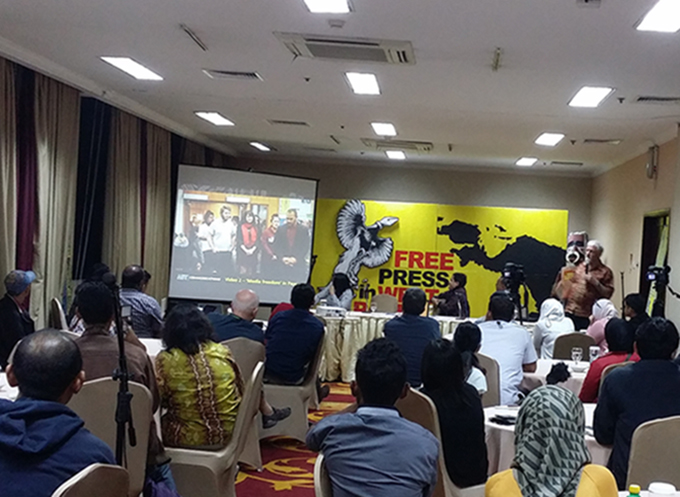
British Lords call for strong stand on press freedom in West Papua

By RNZ Pacific

Eight members of Britain’s House of Lords want to see their government take a strong stand on press freedom in West Papua.

In an open letter, the members claimed Indonesia was trying to restrict information from West Papua amid allegations of widespread human rights abuses.

In the letter published this week, the eight MPs say that since Indonesia’s takeover in 1963, nearly all foreign media, NGOs and humanitarian agencies have been barred from West Papua.

READ MORE: Indonesia’s cover up of media freedom violations exposed

In January, Indonesia agreed in principle to allow the UN human rights commissioner into Papua, but a visit has not yet eventuated.

The letter says Papuan journalists working locally face even more severe threats with several killed in the last decade and others arrested, beaten or tortured.

– Partner –

The call comes as the British Foreign and Commonwealth Office makes press freedom a pillar of its agenda for the year.

  • This article is published under the Pacific Media Centre’s content partnership with Radio New Zealand.
Print Friendly, PDF & Email

Article by AsiaPacificReport.nz

No, Peter Dutton. Most deported Kiwis aren’t paedophiles and you’re hurting our relationship with NZ

Source: The Conversation (Au and NZ) – By Patrick Keyzer, Professor and Head of the La Trobe Law School, La Trobe University

When the New Zealand Prime Minister Jacinda Ardern met with Scott Morrison in Melbourne last Friday, Australia’s policy of deporting New Zealand citizens on character grounds was at the top of the agenda.

Under this policy, Australia forcibly deported more than 1,000 people from 2016 to 2018, many who were Australian citizens. In 2014, when Morrison was minister for immigration, the policy was expanded to include mandatory deportation for non-citizens sentenced to 12 months or more in prison.


Read more: Why New Zealanders are feeling the hard edge of Australia’s deportation policy


Ardern has always argued that deportations should not take place when a person has spent ten years living in a country.

She said the issue was having a “corrosive” effect on Australia’s relationship with her country, and that Australia should not take the closeness of the relationship for granted.

Moreover, people who stay in Australia to appeal their deportation are placed in immigration detention, which is, in effect, double punishment. And people who are deported are faced with essentially a life sentence of being deprived of access to family members.

A pattern of repeated representations from senior NZ politicians to their Australian counterparts about this issue is emerging.

Deportations a growing source of tension

The Australian and New Zealand governments have been at odds over this issue since the legislation changes were introduced in 2014.

In 2015, then NZ Prime Minister John Key said the deportation of New Zealand citizens went against the “Anzac bond and Anzac spirit”.

Other NZ ministers have been outspoken about the legislation, including Justice Minister Andrew Little, who condemned the action of the Australian government, saying the issue was “straining the relationship between the two countries”.


Read more: The long, bipartisan history of dealing with immigrants harshly


But this harsh deportation policy isn’t the only issue creating strain in the relationship. New Zealand’s offer to resettle refugees imprisoned in Australian offshore detention centres has been refused a number of times, most recently last week.

Morrison’s apparent lack of willingness to take Ardern’s concerns about deporting New Zealand offenders more seriously confirms a noticeable hardening in Australia’s approach.

After Key first raised the issue in 2015, then Prime Minister Malcolm Turnbull promised a “more compassionate” approach, saying he would do what he could to speed up appeals, and that he was “alert” to the issue and “empathetic”.

But after Turnbull won the 2016 election, his approach shifted to a harder line. In March 2018, he described Australia’s approach as “fair”, “just” and “moral”.

Who are the offenders?

Home Affairs Minister Peter Dutton, who is responsible for making decisions about individual deportees, also confirmed on Friday that the policy would not change. Doubling down on Morrison’s rejection of any policy change, Dutton told Channel Nine:

If you come as a New Zealand citizen, or a Brit, wherever you come from, your country of origin is where you go back to if you have committed a crime. […] Where we’ve got Australian citizens who are falling victim in certain circumstances where people are sexually offending against children, for example, we’ve had a big push to try to deport those paedophiles.

Fair enough, most Australians may think.

But Dutton’s remarks are highly misleading. The overwhelming majority of the people being deported are not paedophiles.

In fact, many people being deported from Australia under the “character test” have extensive family ties in Australia and have spent very little time in New Zealand, having arrived in Australia as children.

Losing contact with family

Deportees we’ve interviewed for as-yet unpublished research had experienced significant trauma because of this process, and a common theme in our research is grief from the loss of contact with children and other loved ones.

Stories of families being torn apart and children being raised by only one parent were particularly distressing for them to recount.

In one case, a person who has been deported to New Zealand came to Australia at three years old, and grew up in poverty.


Read more: Sri Lankan asylum seekers are being deported from Australia despite fears of torture


He became a thief because there was no food in the house, leading to him being arrested and eventually becoming a ward of the state. After he was arrested for low-level property offences, he was incarcerated in juvenile detention due to his limited ties in the community. He was repeatedly physically abused and sexually assaulted in Australian institutions. He became a heroin user and then a serial offender to feed his habit.

He spent over a decade in and out of prison and under the 2014 regime, he was deported to New Zealand. He has no family and no connections in New Zealand, but has three Australian-born children he rarely gets to see.

This man’s offending behaviour cannot be excused. But his case raises legitimate concerns about Australia’s degree of culpability in creating the environment that helped make him who he became.

It is this fact, and the importance of our friendship with New Zealand, which should make us re-think this policy, and give Ardern’s “ten years” approach serious consideration.

ref. No, Peter Dutton. Most deported Kiwis aren’t paedophiles and you’re hurting our relationship with NZ – http://theconversation.com/no-peter-dutton-most-deported-kiwis-arent-paedophiles-and-youre-hurting-our-relationship-with-nz-120655

Dissociative disorders are nearly as common as depression. So why haven’t we heard about them?

Source: The Conversation (Au and NZ) – By Mary-Anne Kate, Adjunct Associate Lecturer, University of New England

Dissociative disorders are often said to be rare. But our soon-to-be published analysis of international studies suggest they affect 10-11% of the population at some point in their lives. This makes them nearly as common as mood disorders (such as clinical depression).

So what are dissociative disorders, why is diagnosis controversial and how can people be treated?


Read more: Mood and personality disorders are often misconceived: here’s what you need to know


What is dissociation?

Dissociation occurs when a person experiences being disconnected from themselves, including their memories, feelings, actions, thoughts, body and even their identity.

People with dissociative disorders have one or more of the following symptoms:

  • amnesia and other memory problems
  • a sense of detachment or disconnection from their self, familiar people or surroundings
  • an inner struggle about their sense of self and identity
  • acting like a different person (identity alteration).

For some people, symptoms can last days or weeks, but for others they can persist for months, years, or a lifetime.

Dissociation allows the person to compartmentalise and disconnect from aspects of traumatic and challenging experiences that could otherwise overwhelm their capacity to cope.

A person whose spouse has died may become emotionally numb, allowing them to focus on arranging the funeral; a man who has separated from his wife and lost his job soon afterwards may become so disconnected from his identity that he no longer recognises himself in the mirror and feels his life is happening to someone else; and a young woman who is sexually assaulted may remember her attacker moving too quickly towards her, recalls being safely back in her family home, but cannot remember the assault.


Read more: How childhood trauma changes our hormones, and thus our mental health, into adulthood


If the traumatic and overwhelming experiences happen repeatedly over a long period of time, the person’s personality may become fragmented. The traumatised part of the personality that contains the emotions, thoughts, sensations and experiences relating to the trauma becomes separated from the part of the personality that is trying to get on with daily life.

This allows young children to be with frightening and abusive caregivers they can neither fight nor flee from as they are dependent on them.


Read more: Dissociative identity disorder exists and is the result of childhood trauma


The person may have no (or only some) conscious awareness of the compartmentalised memories, thoughts, feelings and experiences.

These may, however, intrude into the person’s awareness. For example, the person may be aware of thoughts, feelings and internal voices that don’t “belong” to them, or may speak or act in ways that are completely out of character.

The most extreme form of structural dissociation is dissociative identity disorder, once known as multiple personality disorder. This is where the person has at least two separate personalities that exist independently of one another and that emerge at different times.

Australian actor Toni Collette plays Tara, who has dissociative identity disorder, in the US comedy The United States of Tara. But most dissociative disorders are far less extreme.

These personality differences are not just psychological. Neuroimaging confirms structural differences in the brains of people with dissociative identity disorder.

A controversial diagnosis

There are two competing theories about what causes dissociation: trauma and fantasy.

With the trauma model, dissociative symptoms arise from physical, sexual and emotional abuse; neglect, particularly in childhood; attachment problems if a child fears the caregiver or the caregiver is not adequately attuned to the child’s emotional or safety needs; and other severe stress or trauma, such as experiencing or witnessing domestic violence.

This trauma model is reflected in the World Health Organisation and American Psychiatric Association past and present diagnostic criteria.


Read more: A soldier and a sex worker walk into a therapist’s office. Who’s more likely to have PTSD?


However, the fantasy model is based on the idea that dissociative disorders are not “real”. Instead, they are the delusion of people who are troubled (and often traumatised), suggestible, fantasy-prone and sleep-deprived.

Fantasy model theorist Joel Paris describes dissociative disorders as a North American “fad” that has nearly died out.


Read more: ‘Going it alone’ adds to tertiary students’ high mental health risk


Yet my analysis of 98 studies found rates are not declining. In fact, I found dissociation is an international phenomenon far more common in countries that are comparatively unsafe. This is supported by other research which finds dissociation more common in people that have experienced trauma, such as refugees.

All up, the evidence indicates dissociative disorders are real (not imagined) and caused by trauma (not fantasy).

Dissociative disorders are under-diagnosed and misdiagnosed

Even though there are accurate ways of diagnosing dissociative disorders, most people will never be diagnosed. This is due to the lack of health professional education and training about dissociation, the symptoms being less obvious to observers, and scepticism that the disorder even exists.

The person also may not realise they have dissociative symptoms. Even if they do, they may not reveal them due to fear or embarrassment, or may find them difficult to put into words.

Misdiagnosis is common, as symptoms can overlap with ones commonly linked to other mental health issues. from www.shutterstock.com

At least three-quarters of people with a dissociative disorder will also have one or more other mental disorders. They may be diagnosed with and treated for other mental health difficulties, such as post-traumatic stress disorder, mood disorders, anxiety disorders, sleep disorders, borderline personality disorder, or psychosis. They may also be treated for addictions, self-harm, and/or suicidal thoughts (2% of those diagnosed complete suicide).

They may also be misdiagnosed with schizophrenia because hearing voices is common to both.

But their dissociative disorder usually remains undiagnosed. However, treatment for other mental health issues is not likely to be effective unless the underlying dissociation is addressed.

How to treat? What does the evidence say works?

The mental health and quality of life of people with a dissociative disorder improves significantly with psychotherapy (a type of talk therapy) that recognises the impact of trauma is physiological (affecting the brain and body) as well as psychological.

In therapy consistent with international treatment guidelines, people can learn skills to cope with unbearable emotions, thoughts and physical sensations. Once people are stable and have constructive coping strategies, therapists can then help people process traumatic and dissociated memories. Dissociative, post-traumatic, and depressive symptoms improve. And hospitalisations, self-harm, drug use, and physical pain declines.

There is no medication that specifically treats dissociation.

Where to get help

Dissociative disorders are one of the most common, yet most unrecognised, mental disorders. Symptoms are often debilitating, but significant improvements are possible if the dissociation is diagnosed and treated correctly.

If you are concerned, you can speak to your GP and ask for a referral to a therapist knowledgeable about trauma and dissociation. A list of therapists with this expertise in Australia is available from the Blue Knot Foundation and worldwide from the International Society for the Study of Trauma and Dissociation.


If this article has raised issues for you, or you’re concerned about someone you know, call Lifeline on 13 11 14 or the Blue Knot Helpline on 1300 657 380.

ref. Dissociative disorders are nearly as common as depression. So why haven’t we heard about them? – http://theconversation.com/dissociative-disorders-are-nearly-as-common-as-depression-so-why-havent-we-heard-about-them-116731

Migrants who adapt to Australian culture say they’re happier than those who don’t

Source: The Conversation (Au and NZ) – By Asanka Gunasekara, Lecturer in Management, Swinburne University of Technology

In a multicultural country like Australia, it’s easy for migrants to keep their heritage culture alive. But our recent research that surveyed more than 300 migrants found those who adapt to Australian society, called “Australian acculturation”, have greater personal well-being than those who don’t.

Personal well-being refers to a person’s quality of life, measured at two levels. The first: how satisfied they are with their life overall. And the second: how satisfied they are with specific life domains, such as achievements, relationships, health, safety, community connectedness and security.


Read more: How do we measure well-being?


We looked at the relationships between time in the host country, acculturation and personal well-being among non-Western skilled migrants in Australia. We found that migrants who reported having a higher personal well-being also had:

  • acculturated more to the Australian culture than to their heritage culture

  • higher English language competency and

  • an Australian identity

And we found that more time spent in Australia doesn’t necessarily lead to more personal well-being if skilled migrants don’t adapt to Australian culture.

Social connectedness

We measured personal well-being using the Australian Unity Personal Well-being Index (PWI), which measures the level of a person’s satisfaction using a points system from 0 to 100.

A chart from our study comparing the well-being of our sample of skilled migrants with the general population of Australia.

The average PWI of the Australian general population ranges from 74.2 to 76.8 out of 100, whereas the average PWI of our skilled migrant sample is higher, at 77.27.

Given the present study involved skilled migrants, it’s possible that their higher education, skills and salaries may have contributed to higher levels of personal well-being, compared to the Australian population as a whole.


Read more: Migrants are healthier than the average Australian, so they can’t be a burden on the health system


Skilled migrants recorded the lowest score for the “community connectedness” domain, along with the rest of the Australian population. Community connectedness refers to the number and strength of connections a person has with others in their community.

Community connectedness may be lower because:

  • skilled migrants maintain close contact with ethnic and extended families

  • there are few opportunities for them to be involved in the wider Australian community or

  • they feel excluded from the wider community.

Biculturalism

Rather than acculturation, some skilled migrants will maintain their own culture, and add layers of cultural practices from their host country. For them, “biculturalism” – or being able to switch between host and heritage cultures – is more realistic.


Read more: Settling migrants in regional areas will need more than a visa to succeed


For example, an Indian family who moved to Melbourne will keep their culture alive through food, language and friendship circles, but might also go to the footy and support an AFL team.

Full acculturation, on the other hand, is when migrants abandon their heritage cultural practices and values when they adapt to the host culture.

For a first generation non-Western migrant, adapting to the Australian culture is even harder. Research has shown that acculturation into a Western country is unlikely for these people.

This is for a number of reasons, such as pride in their heritage culture, maintaining strong connections with relatives and friends, and the societies they move to allow them to maintain heritage cultural practices through multicultural policies.

Poor Australian acculturation can lead to social isolation

Most people migrate when they’re young, so they’re able to contribute to the socioeconomic well-being of the host country by bringing in much needed skills, knowledge, technology and investment to Australia.

But in any case, migrants grow old in a culture that’s not heritage to them, so Australian acculturation is important to help combat social isolation in their old age.

In fact, a 2015 study found older people from culturally and linguistically diverse backgrounds are at a greater risk of depression than Anglo-Australians.

So if our skilled migrant sample, with the average age of 38, are low-scoring in the “community connectedness” domain, they could fall into a social isolation trap as they age.


Read more: How cities help immigrants feel at home: 4 charts


Australia should make ageing in a new culture a more comfortable experience, and organisations – such as Australian Multicultural Community Services and Australian Multicultural Foundation – and the government should take more responsibility for their Australian acculturation, and encourage social participation.

ref. Migrants who adapt to Australian culture say they’re happier than those who don’t – http://theconversation.com/migrants-who-adapt-to-australian-culture-say-theyre-happier-than-those-who-dont-117264

Despite China’s defences, its treatment of the Uyghurs should be called what it is: cultural genocide

Source: The Conversation (Au and NZ) – By James Leibold, Associate Professor of Politics and Asian Studies, La Trobe University

As China grows more powerful and influential, our New Superpower series looks at what this means for the world – how China maintains its power, how it wields its power and how its power might be threatened. Read the rest of the series here.


In China’s far western region of Xinjiang, Chinese Communist Party officials are persecuting one of the worst human rights abuses of our time, what I labelled an act of cultural genocide in last week’s ABC Four Corners report.

Pressure is mounting on the Australian government to go beyond statements of concern and challenge China over its treatment of the Uyghur minority, particularly those Australian citizens and permanent residents being held in the vast network of “re-education camps” in Xinjiang.

Two Australian Uyghur men are meeting federal politicians in Canberra today to push for the government’s assistance in helping family members trapped in China.

Australia was one of 22 countries to sign a recent letter to the UN High Commissioner for Human Rights expressing concern about the “arbitrary detention” of Uyghurs, but otherwise, its response has been muted.

In recent days, the Chinese government has defended its actions with a dubious propaganda report claiming that Uyghurs were historically forced to become Muslims and have been an integral part of China for thousands of years.

China repeatedly makes false and anachronistic claims like this about the ancient unity of the “Chinese people,” which includes ethnic minorities like the Uyghurs. Its aim is to project modern notions of sovereignty, nationhood and fixed borders back through history.

In reality, the 11 million or so Uyghurs are an indigenous Turkic-speaking people who have inhabited what they call “East Turkestan” for over a millennium. Along with the Tibetans, the Uyghurs have born the brunt of China’s settler colonial project, which seeks to assert its control over remote regions that are closer to Moscow and Tehran than Beijing.

Since March 2017, the Chinese government has interned over a million Uyghurs and other Muslim minorities in massive, prison-like camps (including possibly 17 Australian residents), where they are subjected to coercive ideological remoulding.

Detainees are forced to denounce their religion, forbidden to speak their language, and taught how to adopt the norms of China’s Han ethnic majority, while praising President Xi Jinping and the Communist Party for salvation.

In their own words, party officials are “washing brains” and “cleansing hearts” in order to “cure” those bewitched by extremist thoughts. In Xinjiang today, non-Han thoughts and behaviour are pathologised as deviant and thus in need of urgent transformation.

What is genocide?

A litany of words and phrases have been used to describe this process. The Chinese government calls the camps free “vocational education and training centres” where Uyghurs willingly learn Chinese language and employment skills in order to assist with their “rehabilitation and reintegration”.

Scholars, journalists and rights defenders have spoken about cultural and religious “persecution” in Xinjiang, arguing the party-state’s policies amount to mass ethnic cleansing, cultural re-engineering, forced assimilation, brainwashing, or even ethnocide.

In August 2018, Gay McDougall, the vice chair of UN Committee on the Elimination of Racial Discrimination, referred to Xinjiang as a “no-rights zone”.

Yet, I believe the scale, sophistication and intent of China’s policies in Xinjiang merits a stronger description.


Read more: The world has a hard time trusting China. But does it really care?


The term genocide was coined by lawyer Rafael Lemkin in 1944 in reaction to Nazi Germany’s coordinated strategy to annihilate the Jews, gypsies and other non-Aryan peoples. Four years later, the UN General Assembly adopted the Convention on the Prevention and Punishment of the Crime of Genocide, with Australia one of the first counties to ratify it. The People’s Republic of China ratified it in 1983.

The convention defines genocide as

acts committed with intent to destroy, in whole or in part, a national, ethnical, racial or religious group

It also obligates signatories to punish those who engage in genocidal acts through a “competent” domestic or international penal tribunal.

Whether genocide includes only physical acts or can extend to attacks on cultural heritage has elicited intense debate, but for Lemkin, the term includes

drastic methods aimed at the rapid and complete disappearance of the culture, moral and religious life of a group of human beings.

Genocide also requires specific intent. In the words of political scientists Kenneth J. Campbell, genocide is a

premeditated, calculated, systematic, malicious crime authorised by the state’s political leaders.

This is exactly what Communist Party officials did when they authorised and then legalised the mass internment of Uyghurs and other Muslim minorities in “concentrated transformation-through-education centres,” ripping more than 10% of the population away from their communities so they could be deliberately re-programmed.

Various methods for erasing culture

Yet, facts arguably matter more than words when it comes to China’s policies in Xinjiang.

We now have ample evidence (including internal party documents) of the deliberate efforts to destroy Uyghur culture and identity. Everyday actions like avoiding pork, speaking Uyghur, wearing a headscarf or praying quietly are now labelled “manifestations of religious extremism,” or what party officials call “malignant tumors” requiring urgent excising in a radical form of cultural surgery.

In the city of Kashgar, for example, a party document highlights the need to sever the lineages, roots and cultural connections of Uyghurs in order to eliminate the fountainhead of potential extremism.

German researcher Adrian Zenz has uncovered evidence of the party’s efforts to separate Uyghur children from their parents in state institutions, where they can be assimilated and indoctrinated by officials. In these institutions, cultural, religious, and linguistic knowledge is intentionally ruptured.


Read more: Explainer: who are the Uyghurs and why is the Chinese government detaining them?


In some parts of Xinjiang, mosques and shrines are being bulldozed, while others are transformed into empty sites guarded by facial recognition cameras and imams on the party payroll.

In the name of strengthening “bilingual education”, Chinese is now the language of instruction across Xinjiang, from preschool to university. The use of Uyghur language, script, signs and pictures prohibited. Speaking Uyghur is now considered unpatriotic and can get one sent off for re-education.

Perhaps most disturbing, inter-ethnic marriages are being actively promoted to slowly breed out Uyghurness, with cash and other material inducements offered to Han men who take a Uyghur bride.

One can find numerous videos and messages promoting Han-Uyghur inter-marriage on Chinese social media, asserting Xinjiang is now safe and home to many beautiful and eligible Uyghur women who would appreciate a doting Han husband.

Finally, the Chinese government has intensified its family planning regime in Xinjiang to slow the growth of the Uyghur population and eliminate what party officials call “low quality births”.

Beginning in 2017, the region adopted a uniform two children policy that nullified preferential rules allowing rural Uyghur women to have additional births. In the past, Uyghur women were given 3,000 RMB (roughtly A$620) to forgo a third birth and agree to some sort of “long-term contraceptive measure.”

The Communist Party’s calculated war on Uyghur identity is quite literally tearing families and communities apart, while the rich tradition of diversity and tolerance in China is left in tatters.

The resilient nature of culture and memory means that attempts at genocide, thankfully, are rarely successful. Yet the pain they inflict is real.

ref. Despite China’s defences, its treatment of the Uyghurs should be called what it is: cultural genocide – http://theconversation.com/despite-chinas-defences-its-treatment-of-the-uyghurs-should-be-called-what-it-is-cultural-genocide-120654

Hidden women of history: Flos Greig, Australia’s first female lawyer and early innovator

Source: The Conversation (Au and NZ) – By Renee Knake, RMIT Fulbright Distinguished Chair in Entrepreneurship and Innovation; Professor of Law at the University of Houston, RMIT University

In this series, we look at under-acknowledged women through the ages.

When Grata Flos Matilda Greig walked into her first law school class at the University of Melbourne in 1897, it was illegal for women to become lawyers. But though the legal system did not even recognise her as a person, she won the right to practice and helped thousands of other women access justice. In defying the law, Greig literally changed its face.

That she did so is a story worthy of history books. And how she achieved this offers key insights for women a century later as they navigate leadership roles in the legal profession and beyond.

Flos, as she was known, grew up in a household full of possibilities unlimited by gender boundaries. Born in Scotland, as a nine-year-old she spent three months sailing to Australia with her family to settle in Melbourne in 1889. Her father founded a textile manufacturing company. Both parents believed that Flos and her siblings – four sisters and three brothers – should be university educated at a time when women rarely were.

She grew up firm in the knowledge that women could thrive in professional life, and witnessed that reality unfold as older sisters Janet and Jean trained to become doctors. Another sister, Clara, would go on to found a tutoring school for university students. The fourth sister, Stella, followed Flos to study law.

Women could not vote or hold legislative office, let alone be lawyers, when 16-year-old Flos began to study law. Yet she did not let this deter her. As she approached graduation she focused on, “the many obstacles in the path of my full success. I resolved to remove them”.

Other feminine aspirants, she noted, had previously wished to enter the profession, “but the impediments in the way were so great, that they concluded, after consideration, it was not worthwhile”.

Flos felt otherwise. She declared, even in 1903 when women were largely excluded from public life: “Women are men’s equals in every way and they are quite competent to hold their own in all spheres of life.”

‘The Flos Greig Enabling Bill’

Six years after entering the University of Melbourne, Flos witnessed the Victorian Legislative Assembly’s passing of the Women’s Disabilities Removal Bill, also known as the Flos Greig Enabling Bill. Suddenly, women could enter the practice of law. How had she made this happen?

While childhood had provided Flos with role models from both sexes, she did have to rely upon a series of men to navigate her entry into the exclusively male club of the legal profession. Her male classmates had initially questioned the capabilities of a woman lawyer and resisted her presence, but she soon persuaded them otherwise.

Not only did Flos graduate second in her class, but the men took a vote to declare – affirmatively – that women should be allowed to practice law. Their support undoubtedly fuelled her ambitions.

Next, Flos turned to one of her lecturers, John Mackey, who happened to also be a member of the Victorian Legislative Assembly. Together they worked with other supporters to craft the legislative change. Mackey argued that by passing the law, Parliament could ease the concerns of women who believed they could not get justice from a legislative body made up only of men.

Still, Flos needed to complete a period of supervised training known as “articling” before she could be sworn into the bar. No Australian woman had ever engaged in the “articles of clerkship” before. A Melbourne commercial law solicitor Frank Cornwall employed her, and she was officially admitted to the practice of law on August 1, 1905.

Supreme Court of Victoria circa 1905 when Flos was admitted to practice. State Library of Victoria.

At her swearing-in ceremony, Chief Justice John Madden described Flos as “the graceful incoming of a revolution”. He also expressed some scepticism about her future success:

Women are more sympathetic than judicial, more emotional than logical. In the legal profession knowledge of the world is almost if not quite as essential as knowledge of the law, and knowledge of the world, women, even if they possess it, would lie loth to assert.

Flos would prove him wrong about her knowledge of the world, both in law and in her other passion, travel.

‘What did I wear? Don’t ask me!’

At the ceremony, her name was the third called – in alphabetical order – before what was reportedly an “unusually large gathering of lawyers, laymen, and ladies … seldom seen in halls of justice”. Attendees noticed smiles that “flickered over the faces of the judges as they entered the crowded chamber” at the sight of Flos among her “somberly-clad male” counterparts.

News accounts focused more on the physical attributes of the first lady lawyer than her qualifications. When questioned by a reporter about her clothing choice for the occasion, Flos blushed, “What did I wear? Don’t ask me!” But then confessed, “Well, if you insist! I wore grey, with a greenish tinted hat, trimmed with violets!”

Another news reporter critiqued the flower-adorned hat as “a most unlegal costume”. As if there was any basis for making such an assessment – until that moment the nation had never seen the “costume” of a female lawyer. The media’s fixation with female lawyers’ appearance endures more than a century later.

Flos soon established a solo practice in Melbourne focusing on women and children. Among other endeavours, she represented the Women’s Christian Temperance Union in lobbying to establish the Children’s Court of Victoria.

A news clipping about Greig and her work. Creative Commons, Courtesy of Australian Women’s Register.

Media fascination with Flos’s attire did not diminish once admitted to practice. She delivered a speech in 1905 to the third annual National Congress of Women of Victoria on a paper she wrote titled, “Some Points of the Law Relating to Women and Children”.

The reporter noted that Flos “treated her subject in a masterly manner, and gave an immense amount of useful and, at times, startling information”. But Flos’s “stylish, yet simple, gown of grey voile, with cream lace vest” was equally newsworthy as were “her pretty black hat and white gloves”. The fashion choices of other (male) speakers went unmentioned.

Flos also helped open the legal profession to other women. She founded The Catalysts’ Society in 1910. Two years later it became the prestigious Lyceum Club in Melbourne, devoted to advancing the careers of women and offering networking opportunities.

After the launch of the Women’s Law Society of Victoria in 1914, Flos was elected its first president. She cared deeply about the right of all women to vote, arguing in a 1905 debate that if “politics were not fit” for women, “the sooner they were made so the better.” (In 1908 Victorian women won the right the vote.)

Law was not Flos’s only pursuit. She travelled extensively. Two decades after graduating from law school, she took a lengthy trip through Asia, spending time in Singapore, China, Bali, Java, Malaysia and two weeks in the Burma jungle. She stayed in local homes and on her return, spoke to audiences about the experience, delighting them with tales of “leopards, tigers, wild pigs, peacocks, … and wild jungle fowl”. She lectured publicly and on radio stations about the geography, religion and race.

The end of her career took Flos to Wangaratta in Northern Victoria. She practised at a law firm headed by Paul McSwiney, and was known to explore the countryside in a “Baby Austin” tourer. She remained an activist, supporting higher education for women and the Douglas Credit Party, a political party that aimed to remedy the economic hardships of the 1930s depression.

Flos died in 1958. While she did not live to see other female firsts, such as the appointment of the first female Chief Justice of the Supreme Court of Victoria in 2003, Flos’ capacity to envision women as equals under the law places her among the profession’s greatest innovators.

Renee Newman Knake’s book Shortlisted: Women, Diversity, the Supreme Court & Beyond will be published by New York University Press in 2020.

ref. Hidden women of history: Flos Greig, Australia’s first female lawyer and early innovator – http://theconversation.com/hidden-women-of-history-flos-greig-australias-first-female-lawyer-and-early-innovator-119990

Phil Fitzpatrick: PNG’s Kramer ‘crucial’ law and order change maker

COMMENTARY: By Phil Fitzpatrick in Tumby Bay

The recent horrific events in Hela Province have brought the role of the police force in Papua New Guinea into sharp focus.

Prime Minister James Marape is currently in Australia and has apparently discussed the issue with Prime Minister Scott Morrison.

We can only hope that Morrison, if he responds positively, will take considered advice on the matter and not charge off on some ill-advised scheme involving direct Australian intervention.

READ MORE: PNG ‘merciless’ payback killings have changed everything, says Bryan Kramer

Probably the worst thing that Morrison can do is dither and fund some sort of too hard basket investigative consultancy, although I understand this has already been canvassed.

The situation in Hela and the way the police respond is essentially up to the Papua New Guinean government. What it needs from Australia right now is solid practical support in terms of funding and resources.
– Partner –

Police in “sorry state”
Papua New Guinea is well-aware that its police force is in a very sorry state and needs to be both considerably expanded and resourced.

James Marape may have various plans to change Papua New Guinea for the better but the most crucial change maker in his government is Police Minister Bryan Kramer.

As the minister responsible for law and order, he sits at the pivot point of any meaningful change process. If he performs well, and is supported by the Prime Minister, Papua New Guinea has a bright future.

Having a law abiding citizenry is an essential precursor for so many aspects of life in any nation.

Lawless society
Conversely, having a lawless society destroys national life and the opportunities available to it.

If Papua New Guinea was a law abiding nation it would have a vibrant and profitable tourism industry employing thousands of people.

If Papua New Guinea was a law abiding nation, violence against women and children would be considerably reduced.

At the moment most women and children have no recourse to justice if they are beaten and assaulted simply because the police resources are not there to deal with it.

Without fear of being brought to account Papua New Guinean men are free to exercise their most vile impulses.

If Papua New Guinea was a law abiding nation corruption could be brought down to manageable levels.

No fear of punishment
At the moment politicians, public servants and others engage in corrupt activities because they have no fear of being caught.

Citizens of a law abiding nation are much more inclined to report corrupt behaviour when they see it because they are much less likely to be the victims of reprisals.

If Papua New Guinea was a law abiding nation people would feel much safer in their day to day activities. They would be free to safely travel on the roads and venture out at night. Without the prospect of being robbed they would engage with each other freely in commerce.

If Papua New Guinea was a law abiding nation economic activity would flourish. More people would have jobs, especially those youths who are responsible for most of the petty crime. Drug and alcohol consumption would decline if people were gainfully employed.

How do we know all of these things?

Law abiding history
Because Papua New Guinea was once a law abiding nation.

If you don’t believe this, find an old grey lapun and ask them. They will tell you what it was like to leave their house unlocked, walk safely to the trade store, buy their goods and walk home without looking over their shoulder for potential thieves or assailants.

Bryan Kramer’s task is enormous. He will need more than the remainder of the government’s term in office to make sustainable inroads.

Not only has he got to rescue and rehabilitate a demoralised police force but he has to bring about cultural change.

He has to change the dog-eat-dog attitudes that currently exist and replace them with ones that respect not only the laws of the land but citizens respect for each other.

He can’t do it by himself and will need a lot of help. But he will be the pivot where change occurs.

I can’t think of anyone better to be that pivot.

  • This article is republished by Asia Pacific Report with permission from Keith Jackson’s blog PNG Attitude. 

Print Friendly, PDF & Email

Article by AsiaPacificReport.nz

Politics with Michelle Grattan: Paul Oosting responds to GetUp’s critics

Source: The Conversation (Au and NZ) – By Michelle Grattan, Professorial Fellow, University of Canberra

After a bruising election outcome, GetUp is regrouping around a batch of issues – with press freedom the big ticket item. The activist group’s national director Paul Oosting, who has been in Canberra for the parliamentary week, says this is “deeply, deeply important to our members right now. It’s absolutely the number one issue that they care about”.

We’re absolutely in this campaign for the long haul. How we protect press freedoms, as of today – [it] isn’t entirely clear how we get there from a parliamentary and political point of view, but we’ve absolutely got to find a way because press freedom is central to our democracy.

Post-election, GetUp has faced strong critics, most recently the Liberal member for the South Australian seat of Boothby, Nicole Flint, who has accused it and unions of “creating an environment where abuse, harassment, intimidation, shouting people down and even stalking became the new normal”.

Oosting says these claims “aren’t true” – they are “very much self-serving from the Coalition in an attempt to to muddy our brand”.

He admits GetUp made some mistakes – in a “calling script” in one electorate, and a wrong “tone” in some advertising, notably depicting a Tony Abbott figure refusing to help a drowning person.

In terms of our internal processes and how we think more broadly around those things[…][we]absolutely will carry those lessons through to future campaigns.

But in Boothby, Oosting says, “Nicole Flint doesn’t really have a high profile. So our campaign wasn’t centred on her, it was centred on issues like climate change”.

New to podcasts?

Podcasts are often best enjoyed using a podcast app. All iPhones come with the Apple Podcasts app already installed, or you may want to listen and subscribe on another app such as Pocket Casts (click here to listen to Politics with Michelle Grattan on Pocket Casts).

You can also hear it on Stitcher, Spotify or any of the apps below. Just pick a service from one of those listed below and click on the icon to find Politics with Michelle Grattan.

Additional audio

A List of Ways to Die, Lee Rosevere, from Free Music Archive.

Image:

AAP/ Joel Carrett

ref. Politics with Michelle Grattan: Paul Oosting responds to GetUp’s critics – http://theconversation.com/politics-with-michelle-grattan-paul-oosting-responds-to-getups-critics-120886

New demand-response energy rules sound good, but the devil is in the (hugely complicated) details

Source: The Conversation (Au and NZ) – By Bruce Mountain, Director, Victoria Energy Policy Centre, Victoria University

Last week the body that governs Australia’s energy market released a draft proposal to introduce a demand response mechanism to the wholesale electricity market.

It argues the proposal will unearth some electricity users’ “latent flexibility” to prices in the extremely volatile wholesale market, and that this will potentially promote more efficient use of electricity, more secure power systems, and lower prices.

The move comes after nearly two decades of sustained campaigning, which prompts the question: why doesn’t such a useful-sounding mechanism already exist?


Read more: Managing demand can save two power stations’ worth of energy at peak times


It’s a good question. If this demand-response mechanism does what it is claimed to do, it could be a significant development for the electricity markets in southern and eastern Australia. But the actual proposal is eye-wateringly complex and there is reason to be circumspect.

What is proposed and how does it work?

The Australian Energy Market Commission’s determination is that new market participants, to be known as “Demand Response Service Providers” (DRSPs), will be allowed to offer hypothetical demand reductions into the wholesale market at prices they determine. If the price they offer for such reductions is less than the price at which the market clears, the DRSPs will be paid the market price, as if they were a generator, for these hypothetical reductions.

One obvious difficulty here is the fact that the reductions are hypothetical. They are the difference between the customers’ demand if they did not respond to an enticement to reduce demand – the “baseline” – and their actual demand. Customers (and DRSPs) have an incentive to overstate the baseline, as this increases the volume of the reductions they offer and, if accepted, get paid for.

DRSPs profit from the demand reductions they sell, and so they have an incentive to seek out customers who are willing to reduce demand relative to the baseline.

Retailers that sell electricity to DRSPs’ customers will buy (from the wholesale market) the actual volume of electricity consumed and also the hypothetical demand reduction, and pay the wholesale price for both. The retailer charges the customer for the actual demand and charges the DRSR for the demand reduction at a regulated price equal to the 12-month average wholesale price.


Read more: Baffled by baseload? Dumbfounded by dispatchables? Here’s a glossary of the energy debate


This will typically leave the retailer out of pocket by an amount equal to the difference between the average wholesale price at which they have “bought” the demand reductions, and the 12-month average wholesale price (which will almost certainly be lower, because demand reductions will occur when wholesale prices are higher than average).

Retailers will seek to recover the shortfall from the DRSRs’ customers or, more likely, from all their customers. To the extent that they are unable to recover the shortfall, retailers are likely to try to offload those of their customers that are paid to reduce demand.

This is a simplified description of the arrangement. The complexity of the actual data and money flows between customers, DRSPs, retailers, the energy market operator, network service providers and regulators is enough to provoke a nose-bleed from the most seasoned corporate lawyers.

By now, I am sure you are wondering why all the bother with baselines and hypothetical reductions. Why not simply pay customers for actual load reductions? The answer, in short, is that the pool of possible directly contracted customers is small.

If demand response is to be extended to thousands of customers – as this proposal seeks to do – setting baselines and hence hypothetical demand reductions, with all their unwelcome consequences, is unavoidable.

Will it work?

I am not sure. It is certainly punishingly complex. The energy market operator and regulator will have their hands full ensuring that baselines are not set at a level that prints money for DRSRs and their customers, at the expense of retailers and other electricity users. If the market operator and regulator achieve this without imposing undue cost and administrative burden, this demand-response proposal has promise.


Read more: South Australia’s experience contradicts Coalition emissions scare campaign


It will be fascinating to see whether DRSRs can indeed flush out the “latent flexibility” in a manner that is advantageous to themselves, the latently flexible, and the rest of us. Like many others, I will be watching with interest.

ref. New demand-response energy rules sound good, but the devil is in the (hugely complicated) details – http://theconversation.com/new-demand-response-energy-rules-sound-good-but-the-devil-is-in-the-hugely-complicated-details-120676

Curious Kids: does the Sun spin as well as the planets?

Source: The Conversation (Au and NZ) – By Belinda Nicholson, Lecturer, University of Southern Queensland

Curious Kids is a series for children. If you have a question you’d like an expert to answer, send it to curiouskids@theconversation.edu.au You might also like the podcast Imagine This, a co-production between ABC KIDS listen and The Conversation, based on Curious Kids.


Does the Sun spin as well as the planets? – Max, Ebony, Calissa, Daniel, Mason, Jewels, Ever, Ludah, Tyler, Finbar, Enda, Riley, ages 5 – 8, Australia.


Yes, the Sun absolutely spins.

In fact, everything in the universe spins. Some things spin faster than the Sun, some are slower than the Sun, and some things spin “backwards”.

How did the Sun start to spin? Well, when the Sun was born, it formed from a big cloud of swirling gas. This gas fell inwards and began to tighten into a ball shape to form the star. The small swirling motion turned into a lot of swirling motion and gave the Sun its spin.

And here’s another interesting Sun spin fact: the middle part of the Sun – its equator – spins more quickly than the top and bottom parts, which are called the Sun’s poles. It can do that because the Sun isn’t solid, it’s a ball of gas.


Read more: Curious Kids: how is the Sun burning?


When it was young, the Sun spun fast – very fast. It would do one rotation in a just a few Earth days.

But as it got older, the Sun slowed down. Now it spins once every 25 days at the equator and once every 35 days at the poles. That means we have to wait for nearly a month to go by here on Earth before most of the Sun finishes one complete spin.

The reason it slowed down is hard to explain, but it’s got to do with its magnetic fields. When it was young and hyperactive, Sun spun fast and had a super strong magnetic field. This big magnetic field dragged through space, acting like a brake and slowing the Sun down. The slower spin then made the magnetic field much smaller too, so today the Sun is slowing down by only a very little bit.

Some things in space spin really fast

Have you ever heard of a pulsar? That’s what’s left when a huge star dies. They spin super fast. In fact, they can do one whole rotation in a fraction of a second.

How do we know that? Well, pulsars shoot out a big beam of energy and we can pick up a flash of that beam as it goes past, rotating like this lighthouse light, only faster.

The flashes of energy from the pulsar go past very fast and very often, so we know it is spinning incredibly fast.

So as you can see, lots of things in space are spinning. Our galaxy, the Milky Way, is also spinning.

With all of this spinning, why don’t we get dizzy? Humans have evolved here so we are used to the spinning, but if everything stopped spinning (which is not likely to happen) we would really feel it!


Read more: Curious Kids: What’s going to happen to the Sun in the future? Will it explode?


Hello, curious kids! Have you got a question you’d like an expert to answer? Ask an adult to send your question to curiouskids@theconversation.edu.au Please tell us your name, age and which city you live in. We won’t be able to answer every question but we will do our best.

ref. Curious Kids: does the Sun spin as well as the planets? – http://theconversation.com/curious-kids-does-the-sun-spin-as-well-as-the-planets-119877

Fall-out from Setka affair could give Coalition easier passage of union bill

Source: The Conversation (Au and NZ) – By Ray Markey, Emeritus Professor, Macquarie University

One of the Coalition government’s first priorities in the new parliament is the passage of its Ensuring Integrity Bill, aimed at tightening regulations on unions and union officials.

Similar legislation was introduced in 2017, but rejected in the Senate. This time around, the government is more optimistic of its chances, given the current makeup of the Senate after the May election and the recent controversy over John Setka, the Victorian state secretary of the Construction, Forestry, Mining, Maritime and Energy Union (CFMMEU).

The bill would give the minister for industrial relations, as well as the Registered Organisations Commission and any party deemed to have “sufficient interest”, the power to apply to the Federal Court to deregister a union. Union officials are particularly concerned about the extension of this power to anyone with “sufficient interest,” as this could conceivably include employers.


Read more: Politics podcast: Brendan O’Connor on Labor’s industrial relations agenda


The disqualification of union officials would also be automatic for anyone who has committed serious criminal offences punishable by five or more years of jail time. In addition, the Federal Court could disqualify officials for breaking industrial laws or failing to stop their organisation from breaking the law, or otherwise not being a “fit and proper person.”

A public interest test would also be introduced to prevent future union mergers, such as the “super union” merger last year of the Construction, Forestry, Mining and Energy Union (CFMEU), the Maritime Union of Australia (MUA) and the Textile, Clothing and Footwear Union of Australia (TCFUA).

In introducing the bill, Christian Porter, the attorney-general and industrial relations minister, made clear that the newly named CFMMEU was one of the bill’s main targets.

He noted that the union had been levied with penalties over A$16 million for more than 2,000 contraventions of industrial law in recent years.

This repeated lawbreaking, particularly in our vital building and construction sector, hampers the delivery of goods and services and increases the cost of vital infrastructure projects like roads, schools and hospitals.

Ammunition provided by Setka

Setka was recently convicted after pleading guilty to harassment of his then-estranged wife. Earlier, he was accused of saying at a CFMMEU executive meeting that Rosie Batty’s campaigning against domestic violence had led to a reduction in men’s rights. However, this account has been contested by Setka and others present at the meeting.

Following the report detailing Setka’s comments about Batty, Labor leader Anthony Albanese moved quickly to suspend Setka’s ALP membership. He said Setka

undermines the credibility of the trade union movement through the position he holds and the public views he’s expressed.

Sally McManus, the Australian Council of Trade Unions secretary, also urged Setka to consider the harm he was doing the union movement and resign.

There is no place for perpetrators of domestic violence in leadership positions in our movement.

Setka has often attracted negative media attention. He famously threatened to expose all Australian Building and Construction Commission (ABCC) inspectors and make their children “ashamed of who their parents are.” On social media, he posted a picture of his children holding a placard saying “go get fu#ked” in reference to the ABCC.

Setka is a major contributor to the CFMMEU’s numerous breaches of industrial law. He has numerous convictions for theft, assault and criminal damage, mainly associated with industrial disputes.

Former Prime Minister Bob Hawke is reported to have previously counselled Labor leader Bill Shorten to sever the ALP’s ties with the CFMMEU.

ACTU secretary Sally McManus has faced calls to resign over her handling of the Setka controversy. Daniel Pockett/AAP

Labor’s fears may be realised

The government is relishing the difficulties this situation has created for Albanese and Labor.

Government members have previously highlighted that the CFMMEU is Labor’s biggest electoral donor. And Porter has challenged Albanese to back the Ensuring Integrity Bill after his condemnation of Setka:

Now is the time for Mr. Albanese and Labor to prove they’re not all talk and back their words with action.

Albanese’s swift call for Setka’s expulsion from the ALP was designed to limit damage to the party. However, Setka’s court challenge prevented a quick expulsion, and now it appears it could be blocked altogether.


Read more: Setka furore opens division within the labour movement – and there is no easy solution


McManus’s worst fears of increased union regulation following the Setka controversy also are being fulfilled.

In addition to the Ensuring Integrity Bill, the government has reintroduced a bill that would impose tighter regulatory controls on workers’ entitlement funds.

According to the bill’s language, it would prevent the “coercion” of employers to pay into particular funds for their employees’ superannuation, training or insurance. This bill also would require registered organisations (unions and employer bodies) to maintain financial management plans, keep credit card records and disclose their loans and grants to individuals or other entities.

Senate crossbenchers remain the key

The Ensuring Integrity Bill has been referred to a Senate committee, which is due to report in October.

The bill should have an easier time passing in the new Senate. Independent Senator Tim Storer, who strongly opposed the 2017 bill, is no longer in the Senate. Of the crossbench, Cory Bernardi and the two One Nation senators are likely to support it. That leaves only one more vote required from either of the Centre Alliance senators or Jacqui Lambie.

Jacqui Lambie has emerged as a key crossbench vote on taxes, unions and other bills in the new Senate. Sam Mooy

The bill has been somewhat watered down from its 2017 version to make it amenable to the crossbench and test Labor’s opposition to it.

It also more closely follows the provisions of the Corporations Act. However, questions remain as to whether membership-based organisations like unions should be expected to operate like corporations, or if unions breaching industrial laws should be treated similarly to corporations or individuals breaking criminal laws.


Read more: Where to now for unions and ‘change the rules’?


The ACTU is lobbying Senate crossbenchers to oppose the bill.

The UK-based International Centre for Trade Union Rights has also come out against the bill, arguing it is “incompatible” with Australia’s commitments under two key conventions of the International Labour Organisation. The ICTUR says it interferes with workers’ rights to establish their own organisations, set their own rules and elect officials, saying it found

no precedent for the degree of state interference in the functioning and establishment of trade unions in comparable industrialised liberal democracies.

It also compared the bill to oppressive legislation in Turkey and under the military dictatorship in Brazil in the 1940s.

ref. Fall-out from Setka affair could give Coalition easier passage of union bill – http://theconversation.com/fall-out-from-setka-affair-could-give-coalition-easier-passage-of-union-bill-120586

Sexually objectifying women leads women to objectify themselves, and harms emotional well-being

Source: The Conversation (Au and NZ) – By Peter Koval, Academic, Melbourne School of Psychological Sciences, University of Melbourne

How does a woman feel when a man wolf-whistles at her from across the street? Or when a male coworker gives her body a fleeting once-over before looking her in the eye?

These examples may seem relatively innocent to some, but our research has found they can have negative consequences for women’s emotional well-being.

We asked women to record any incidents of sexual objectification on a smartphone app, alongside rating their feelings several times each day for a week.

When women experienced sexual objectification, in many cases it led them to scrutinise their physical appearance, which negatively impacted their emotional well-being.


Read more: Hey, sexy: objectifying catcalls occur more frequently than you might think


A cycle of objectification

The process by which sexual objectification is psychologically harmful to women was first described by psychologists Barbara Fredrickson and Tomi-Ann Roberts in the mid-1990s.

According to this theory, when women are treated as objects, they momentarily view their own bodies from the perspective of the person objectifying them. In turn, they become preoccupied with their physical appearance and sexual value to others.

This process of “self-objectification” leads women to experience unpleasant feelings such as shame and anxiety. If repeated, it can eventually lead to long-term psychological harm.

Despite hundreds of studies on the psychology of sexual objectification, convincing evidence of the process described by Fredrickson and Roberts has been lacking until now.


Read more: Explainer: what does the ‘male gaze’ mean, and what about a female gaze?


We believe our research, conducted with colleagues in the United States, is the first to demonstrate that when women are exposed to sexually objectifying events in their everyday lives, they become more preoccupied with their physical appearance.

This, in turn, leads to increased negative emotions like anxiety, anger, embarrassment and shame.

Our research

We asked 268 women aged 18 to 46 in Melbourne and St Louis (in the US) to install an app on their smartphones.

Several times each day, the app prompted them to rate their emotions, how preoccupied they were with their physical appearance (a measure of self-objectification), and whether they had recently been targeted by sexually objectifying behaviour – or had witnessed such treatment of other women.

Using smartphones to track women’s everyday experiences of sexual objectification has several advantages over other approaches used in most previous objectification research.

We asked women to document any incidents of sexual objectification in a smartphone app over a week. From shutterstock.com

First, we can be sure we captured “real world” examples of sexual objectification rather than artificial scenarios that may not represent life outside the lab.

Second, instead of relying on potentially unreliable memories of past events and feelings recorded in surveys or journals, by using frequent smartphone surveys we could gather more accurate “real time” reports of sexual objectification.

Finally, repeatedly sampling women’s daily experiences enabled us to observe the psychological processes triggered by sexual objectification.


Read more: Rape, sexual assault and sexual harassment: what’s the difference?


What we found

More than 65% of women in our study were personally targeted by sexually objectifying behaviour at least once during the monitoring period. This might have included being ogled, catcalled or whistled at.

Our findings were consistent with Fredrickson and Roberts’s theory: women reported being preoccupied with their physical appearance roughly 40% more when they had recently been targeted by sexually objectifying behaviours, compared to when they had not.

Importantly, these momentary spikes in self-objectification predicted subsequent increases in women’s negative emotions, particularly feelings of shame and embarrassment.

Although these increases were small, they were reliable, and appear to be indirectly caused by exposure to sexually objectifying behaviours.

Women in our study were affected by witnessing incidents of sexual harassment, as well as experiencing it them themselves. From shutterstock.com

Women may think about their appearance independent of experiencing sexual objectification. Interestingly, we found when women self-objectified, they sometimes reported feeling slightly happier and more confident.

So when women think about themselves in an objectified manner, they can feel both positive and negative emotions. But self-objectification that arises as a result of being objectified by someone else appears to have an exclusively negative impact on emotions.


Read more: Women can build positive body image by controlling what they view on social media


It’s important to note that in our results, experiencing sexual objectification on its own didn’t directly lead to increases in women’s negative feelings. Rather, the harmful effects of sexual objectification occurred when it resulted in women objectifying themselves.

Seeing other women objectified

Our participants reported witnessing the objectification of other women on average four times during the week-long study period.

Witnessing the objectification of other women was also followed by reliable (albeit weaker) increases in self-objectification, with similar negative downstream consequences for emotional well-being.

Just as passive smoking is harmful to non-smokers, second-hand exposure to sexual objectification may reduce the emotional well-being of women, even if they are rarely or never objectified themselves.


Read more: Universities unveil plan to reduce sexual harassment and sexual assault on campus


Overall, our study confirms previous research showing sexual objectification of women remains relatively common.

But importantly, we’ve shown these everyday objectifying experiences are not as innocuous as they may seem. Though subtle, the indirect emotional effects of objectifying treatment may accumulate over time into more serious psychological harm for women.

This article is a co-publication with Pursuit.

ref. Sexually objectifying women leads women to objectify themselves, and harms emotional well-being – http://theconversation.com/sexually-objectifying-women-leads-women-to-objectify-themselves-and-harms-emotional-well-being-120762

Three charts on: how much Australia spends on all levels of education

Source: The Conversation (Au and NZ) – By Daniel Edwards, Research Director, Australian Council for Educational Research

Australia spent A$111.8 billion on education in 2015, the most recent year for which the full dataset for all levels of education spending is available. A report from the Australian Council for Educational Research (ACER) released today shows this was an increase of nearly 80% from 2000 spending.

The federal government contributed A$47.2 billion (42%) of the overall funding. State, territory and local governments spent A$39.1 billion (35%). A further A$25.5 billion (23%) came from private sources.

The ACER report is the first to capture data on education spending at all levels of education – from early childhood to higher education – from all funding sources.

The analysis separates funding into three sources: federal government; state, territory and local governments; and private sources (the latter includes contributions by students in the form of fees, as well as contributions by private businesses and non-profit organisations).

The report also organises spending by education sector and levels, as defined in Australia.

Spending by education level

Education funding goes through a range of transfers between the three sources. At different points in the funding cycle, the contributions by government sources are transferred to other funding sources.


Read more: Explaining Australia’s school funding debate: what’s at stake


For instance, the federal government transferred A$14 billion of its initial education funding to private sources in 2015, mainly in the form of student loans. It transferred a further A$17.7 billion to state, territory and local governments which then fund schools and other areas of education.


The final distribution of national education spending, after the transfers, was A$15.5 billion (14%) from the federal government, A$55.4 billion (49%) from state, territory and local governments and A$40.9 billion (37%) from private sources.

The bulk of Australia’s education spending is directed to three levels of education: primary schools (27%), secondary schools (28%) and higher education (26%).

The remaining 19% is spread between early childhood education, preschool, vocational education and training (VET) certificates, diplomas and advanced diplomas.

Spending as a percentage of GDP

In 2015, Australia spent A$102.4 billion on primary school and above. In real terms this spending has grown substantially since the beginning of the century and faster than student numbers.

While spending on education increased by 79% between 2000 and 2015, the number of students in the Australian education system increased by only 22%. As a result, education spending per student (primary and above) increased by 46% over this period.


Read more: Yes, education funding has increased – but not everyone benefits


Australia’s spending on education as a proportion of GDP has also increased, from 5.1% in 2000 to 5.9% in 2015.

This increase has largely been driven by private sources of funding, rather than government funds, indicating an increasing willingness by people to invest in their own (or their children’s) education.


The share of private spending on education (primary and above) after transfers increased from 26% of total education spending in 2000 to 34% in 2015.

The fastest period of growth in private spending has been since 2012. This coincided with the introduction of the higher education sector’s demand-driven funding arrangements (where universities didn’t have a cap on the number of bachelor degree students they could take).

But it’s important to remember the government allocates a significant amount of its initial funding (before transfers) to student loans.

Spending as a percentage of total government spending

Government spending on education before transfers increased by 67% in real terms between 2000 and 2015. At the same time, total government spending rose by 65%.

So, government spending on education before transfers, as a percentage of total government spending, was 1% higher in 2015 than in 2000. It peaked in 2010 due to the global financial crisis stimulus spending and fell in the interim.


Australia’s government spends a relatively large proportion of its budget on education compared to other OECD countries. In total, government spending on education is 13.5%, which ranks Australia ninth of the 39 countries in the OECD reporting.

But Australia’s total government spending for all services (including health, education, social protection, defence, public order and safety) is relatively low.


Read more: FactCheck: is Australia below the international average when it comes to school funding?


ACER’s analysis is drawn from annual expenditure data the Australian Government Department of Education submits for the joint UNESCO Institute for Statistics, OECD and Eurostat (UOE) data collection on education statistics – which the OECD releases as the Education at a Glance publication.

The Education at a Glance reports are good for obtaining a snapshot of Australian education spending in relation to other OECD countries. But until now the data have not been organised in a useful way for further examining the Australian context.

To fully appreciate the nuances of the data, we need increased expertise in the economics of education in Australia. More emphasis on this would enable long-term forecasting of the policy implications of Australia’s investment in education and would offer an additional objective voice at the education policy table.

ref. Three charts on: how much Australia spends on all levels of education – http://theconversation.com/three-charts-on-how-much-australia-spends-on-all-levels-of-education-120076

What can our cities do about sprawl, congestion and pollution? Tip: scrap car parking

Source: The Conversation (Au and NZ) – By Neil Sipe, Professor of Urban and Regional Planning, The University of Queensland

While car parking was a non-negotiable amenity for baby boomers, it is an eyesore to millennials and the up-and-coming iGen. Newer generations want more city and fewer cars. Globally, scrapping car parking is the latest trend in urban planning.


Read more: Freeing up the huge areas set aside for parking can transform our cities


Between 2010 and 2015, Philadelphia removed 3,000 off-street parking spaces from its city centre. Copenhagen is following the same path. Zurich has implemented a city-wide cap to llimit parking spaces to 1990s levels.

Amsterdam has announced it will remove parking spaces at a rate of 1,500 a year. The city’s 2025 goal is to eliminate more than 11,000 parking spaces from its streets to make space for cycling.

San Francisco and New York have adopted the concept of “parklets”. These are mini parks or outdoor café seating areas that temporarily replace a few parking spots during low-demand periods.


Read more: A day for turning parking spaces into pop-up parks


The theory is that as the amount of parking decreases, the appeal of driving gives way to more environmentally friendly transport modes such as walking, cycling, ride-hailing, car pooling and public transport.

Some evidence suggests reducing or capping parking pays off. In cities that have implemented these measures, driving has declined and public transport use has increased.

What’s happening in Australia?

Among the largest Australian cities, Brisbane seems to be going backwards. The Courier Mail recently published a story stating that:

Suburban streets in two Brisbane suburbs have become all-day car parks as the new residents of apartments are forced to resort to on-street parking.

Some on-street parking in Brisbane suburbs is occupied much of the day. Neil Sipe, Author provided

In response to such sentiments, Brisbane City Council proposes to increase the number of parking spaces required for future apartment buildings across the middle and outer suburbs. Parking increases have been framed as adding to the quality of life and safety of Brisbane suburbs.

Unfortunately, Brisbane does not track the existing supply of residential parking. This lack of clarity has created an imbalance of parking supply and provides opportunities for a sharing economy of parking. Operators such as Parkhound and KERB enable residents to lease their unused parking while their neighbours exhaust the public supply of on-street parking.

Meanwhile, Sydney has officially declared a “climate emergency”, following the lead of global cities including New York, London (and then all of the UK), Auckland and Vancouver (followed by Canada). While applauded by environmentalists, this declaration does not come with a firm commitment to reduce driving or parking.


Read more: UK becomes first country to declare a ‘climate emergency’

Read more: Cognitive dissonance: Canada declares a national climate emergency and approves a pipeline


Many city residents believe they have a right to street parking outside their homes. Shuang Li/Shutterstock

Similarly, in Melbourne, outside the CBD – where there are plans to reduce parking – there is plenty of free, and largely unmanaged, on-street parking. Residents typically believe they are entitled to this parking space.

Clearly, Australian cities are stuck in the old-fashioned “predict and provide” model of parking supply. This model relies on the idea that there will always be enough parking if every site provides spaces for all residents, staff, customers and visitors during peak demand periods.

While this approach might have been suitable in the postwar period, it is unworkable for today’s growing, congested and warming cities. The challenge for planners is how to accommodate increasing numbers of urban residents within a reasonable distance from work and amenities. Cities are running out of space for cars – be they moving or parked.


Read more: Move away from a car-dominated city looks radical but it’s a sensible plan for a liveable future


Is there a better way?

Certainly. Some cities have begun to set maximum parking standards. In other words, the cities put an upper limit on how many car parks can be provided for a given project. Sometimes these complement minimum parking requirements; in other cases the latter are eliminated.

Selling parking spaces separately from housing units, referred to as “unbundling”, is another policy that’s becoming popular. It ensures the true cost of car storage is transparent rather than hidden. And it means car-free or one-car households don’t have to pay for parking they don’t need.

Some developers are providing car-sharing spaces in new construction, instead of individual car parks.

Some employers offer a parking “cash out” option – employees receive a payment in lieu of a parking space. Those employers that continue to offer parking charge fees daily rather than monthly to avoid the “sunk cost fallacy” – having paid for parking, employees want to get their money’s worth.

Other useful (but hardly new) planning concepts include the “30-minute city” and “transit-oriented development”. These approaches help reduce the need for driving and parking by concentrating people and land uses around public transport stops and corridors.


Read more: ‘The 30-minute city’: how do we put the political rhetoric into practice?


Will reducing spaces lead to parking shortages?

People are often concerned that if parking is reduced or capped, this will create a parking shortage. This can be avoided if parking is treated as a key component of the urban transport system and managed in coordination with other elements.

Australian cities need to prepare comprehensive parking strategies at the metropolitan level. These strategies must be integrated with general transport and land use plans. Unfortunately, this is often difficult to achieve because state governments are typically responsible for planning and building the transport system while local governments are responsible for parking.

The impacts of parking reductions on urban citizens need to be offset by providing a higher quality and quantity of public and active transport. This requires substantial investments in public and active transport.


Read more: Cycling and walking are short-changed when it comes to transport funding in Australia


Finally, no parking should be free. Revenues from parking fees should be returned to local communities in the form of improved public amenities.

ref. What can our cities do about sprawl, congestion and pollution? Tip: scrap car parking – http://theconversation.com/what-can-our-cities-do-about-sprawl-congestion-and-pollution-tip-scrap-car-parking-118393

Are most people on the Newstart unemployment benefit for a short or long time?

Source: The Conversation (Au and NZ) – By Peter Whiteford, Professor, Crawford School of Public Policy, Australian National University

Since parliament has resumed three Liberal members – Dean Smith, Russell Broadbent and Andrew Wallace – have joined a group of Nationals calling for an increase in the A$40 per day Newstart unemployment allowance.

Labor has already committed itself to both an inquiry and an increase, although it won’t specify the size of the increase. The Greens have introduced a bill that would increase Newstart by A$75 a week.

Defending the current level of Newstart on Monday, Finance Minister Mathias Cormann told the ABC’s Sabra Lane that the payment was “transitional”.

Most Australians were on it for only a “very short period

LANE: Could you live on 40 bucks a day?

CORMANN: The Newstart allowance which is I guess, what you are now raising is a transitional payment for…

LANE: It is, and you’ve diverted straight away. Could you live on 40 bucks a day?

CORMANN: Newstart allowance is a transitional payment. It is a payment that is increased twice a year. It is indexed twice a year. Most Australians who are on Newstart allowance are on that payment for a very short period.

Greens senator Rachel Siewert actually did try to live on Newstart for a week in 2012.

She introduced the bill that would lift it (and the similarly-sized youth allowance, sickness allowance, special benefit, widow allowance, crisis payment and Austudy) by A$75 a week.

On Monday she asked the Senate to “not believe what the government says

This is not a transition payment anymore. The employment situation in this country has changed from when the unemployment benefits first came in, and it’s certainly changed since 1994. People have to survive on this payment long-term.“

Liberal Wendy Askew responded:

These allowances are not designed as a long-term payment for people, and this is shown by the fact that around two-thirds of job seekers who are granted Newstart exit income support within 12 months.

So what’s the truth? Are most Australians who go onto Newstart on it for only a short time, or are most of those who are on Newstart on it for a long time?

Short term, or long term?

As it happens, both claims are sourced from the same Department of Social Services publication, DSS Payment Trends and Profile Reports.

It says 257,494 Australians went on to Newstart between June 2015 and June 2016. Most of them (191,6800) hadn’t previously been receiving income support.

In the same 12 month period, 274,113 Australians left Newstart, 212,320 of them out of the income support system altogether.

If most of those who went on it in that year also went off it in that year then the government would be correct in saying that “two-thirds of job seekers who are granted Newstart exit income support within 12 months”.


Read more: FactCheck Q&A: is a week’s worth of Newstart equal to what a politician can claim for one night in Canberra?


But it would leave most of the rest of the 732,100 Australians on Newstart on it for an increasingly long time.

The table below shows that in June 2016, 73% of Newstart recipients were classified as long-term (one year or more), up from 71% the previous June.

Duration refers to duration on any income support payment and for some will be longer than their current duration on Newstart. Source: DSS

Graphically, it is possible to see that in June 2016, there were both

  • fewer Australians on Newstart than in the previous year (more had left Newstart than taken it up), and

  • a greater proportion of them on it for more than a year


Number of Newstart recipients by duration on income support, ‘000

Source: Department of Social Services

The apparent contradiction between most of the people who enter Newstart quickly leaving it and most people who are on Newstart being on it for a long time appears to reflect a confusion between flows and stocks.

The International Encyclopedia of the Social Sciences illustrates the difference using a bathtub.

The level of water in the bathtub is a stock, the water coming from the faucet is an inflow, and the draining of the water through the drain is an outflow. If we plug the drain and turn on the faucet, the net inflow will be positive, and the stock of water in the bathtub will be rising. If, instead, we close the faucet and open the drain, the net inflow of water will be negative, and the stock of water in the bathtub will fall.

Between 2015 and 2016 about 260,000 people flowed in to and out of Newstart, and as it happened more flowed out than flowed in.

But those who remained were increasingly likely to have been on Newstart for a long time, probably due to the so-called “scarring” effect that makes people less job-ready (and less attractive to employers) the longer they have been out of work.

Most current Newstart recipients are long-term

The proportion of Newstart recipients on payments for more than a year has climbed from 69% in 2014 to 73% in 2016, and according to the latest Department of Social Services figures, to 76.5% in 2018.

Senator Siewert’s observation that most Newstart recipients have to survive on it long-term is correct.

At any one time the overwhelming majority of the people on the $40 per day have been on it for more than a year.


Read more: FactCheck: do 99% of Newstart recipients also receive other benefits?


What’s more, it appears that the decline in the total number of people on Newstart has not been because more of the people on Newstart have been able to get a job, but because the flow into Newstart has slowed.

That is probably a positive development, although there is also the possibility that it is happening because of the onerous compliance burdens of job search, together with the increasing inadequacy of Newstart.

ref. Are most people on the Newstart unemployment benefit for a short or long time? – http://theconversation.com/are-most-people-on-the-newstart-unemployment-benefit-for-a-short-or-long-time-120826

Hidden women of history: Flos Grieg, Australia’s first female lawyer and early innovator

Source: The Conversation (Au and NZ) – By Renee Knake, RMIT Fulbright Distinguished Chair in Entrepreneurship and Innovation; Professor of Law at the University of Houston, RMIT University

In this series, we look at under-acknowledged women through the ages.

When Grata Flos Matilda Greig walked into her first law school class at the University of Melbourne in 1897, it was illegal for women to become lawyers. But though the legal system did not even recognise her as a person, she won the right to practice and helped thousands of other women access justice. In defying the law, Greig literally changed its face.

That she did so is a story worthy of history books. And how she achieved this offers key insights for women a century later as they navigate leadership roles in the legal profession and beyond.

Flos, as she was known, grew up in a household full of possibilities unlimited by gender boundaries. Born in Scotland, as a nine-year-old she spent three months sailing to Australia with her family to settle in Melbourne in 1889. Her father founded a textile manufacturing company. Both parents believed that Flos and her siblings – four sisters and three brothers – should be university educated at a time when women rarely were.

She grew up firm in the knowledge that women could thrive in professional life, and witnessed that reality unfold as older sisters Janet and Jean trained to become doctors. Another sister, Clara, would go on to found a tutoring school for university students. The fourth sister, Stella, followed Flos to study law.

Women could not vote or hold legislative office, let alone be lawyers, when 16-year-old Flos began to study law. Yet she did not let this deter her. As she approached graduation she focused on, “the many obstacles in the path of my full success. I resolved to remove them”.

Other feminine aspirants, she noted, had previously wished to enter the profession, “but the impediments in the way were so great, that they concluded, after consideration, it was not worthwhile”.

Flos felt otherwise. She declared, even in 1903 when women were largely excluded from public life: “Women are men’s equals in every way and they are quite competent to hold their own in all spheres of life.”

‘The Flos Greig Enabling Bill’

Six years after entering the University of Melbourne, Flos witnessed the Victorian Legislative Assembly’s passing of the Women’s Disabilities Removal Bill, also known as the Flos Greig Enabling Bill. Suddenly, women could enter the practice of law. How had she made this happen?

While childhood had provided Flos with role models from both sexes, she did have to rely upon a series of men to navigate her entry into the exclusively male club of the legal profession. Her male classmates had initially questioned the capabilities of a woman lawyer and resisted her presence, but she soon persuaded them otherwise.

Not only did Flos graduate second in her class, but the men took a vote to declare – affirmatively – that women should be allowed to practice law. Their support undoubtedly fuelled her ambitions.

Next, Flos turned to one of her lecturers, John Mackey, who happened to also be a member of the Victorian Legislative Assembly. Together they worked with other supporters to craft the legislative change. Mackey argued that by passing the law, Parliament could ease the concerns of women who believed they could not get justice from a legislative body made up only of men.

Still, Flos needed to complete a period of supervised training known as “articling” before she could be sworn into the bar. No Australian woman had ever engaged in the “articles of clerkship” before. A Melbourne commercial law solicitor Frank Cornwall employed her, and she was officially admitted to the practice of law on August 1, 1905.

Supreme Court of Victoria circa 1905 when Flos was admitted to practice. State Library of Victoria.

At her swearing-in ceremony, Chief Justice John Madden described Flos as “the graceful incoming of a revolution”. He also expressed some scepticism about her future success:

Women are more sympathetic than judicial, more emotional than logical. In the legal profession knowledge of the world is almost if not quite as essential as knowledge of the law, and knowledge of the world, women, even if they possess it, would lie loth to assert.

Flos would prove him wrong about her knowledge of the world, both in law and in her other passion, travel.

‘What did I wear? Don’t ask me!’

At the ceremony, her name was the third called – in alphabetical order – before what was reportedly an “unusually large gathering of lawyers, laymen, and ladies … seldom seen in halls of justice”. Attendees noticed smiles that “flickered over the faces of the judges as they entered the crowded chamber” at the sight of Flos among her “somberly-clad male” counterparts.

News accounts focused more on the physical attributes of the first lady lawyer than her qualifications. When questioned by a reporter about her clothing choice for the occasion, Flos blushed, “What did I wear? Don’t ask me!” But then confessed, “Well, if you insist! I wore grey, with a greenish tinted hat, trimmed with violets!”

Another news reporter critiqued the flower-adorned hat as “a most unlegal costume”. As if there was any basis for making such an assessment – until that moment the nation had never seen the “costume” of a female lawyer. The media’s fixation with female lawyers’ appearance endures more than a century later.

Flos soon established a solo practice in Melbourne focusing on women and children. Among other endeavours, she represented the Women’s Christian Temperance Union in lobbying to establish the Children’s Court of Victoria.

A news clipping about Greig and her work. Creative Commons, Courtesy of Australian Women’s Register.

Media fascination with Flos’s attire did not diminish once admitted to practice. She delivered a speech in 1905 to the third annual National Congress of Women of Victoria on a paper she wrote titled, “Some Points of the Law Relating to Women and Children”.

The reporter noted that Flos “treated her subject in a masterly manner, and gave an immense amount of useful and, at times, startling information”. But Flos’s “stylish, yet simple, gown of grey voile, with cream lace vest” was equally newsworthy as were “her pretty black hat and white gloves”. The fashion choices of other (male) speakers went unmentioned.

Flos also helped open the legal profession to other women. She founded The Catalysts’ Society in 1910. Two years later it became the prestigious Lyceum Club in Melbourne, devoted to advancing the careers of women and offering networking opportunities.

After the launch of the Women’s Law Society of Victoria in 1914, Flos was elected its first president. She cared deeply about the right of all women to vote, arguing in a 1905 debate that if “politics were not fit” for women, “the sooner they were made so the better.” (In 1908 Victorian women won the right the vote.)

Law was not Flos’s only pursuit. She travelled extensively. Two decades after graduating from law school, she took a lengthy trip through Asia, spending time in Singapore, China, Bali, Java, Malaysia and two weeks in the Burma jungle. She stayed in local homes and on her return, spoke to audiences about the experience, delighting them with tales of “leopards, tigers, wild pigs, peacocks, … and wild jungle fowl”. She lectured publicly and on radio stations about the geography, religion and race.

The end of her career took Flos to Wangaratta in Northern Victoria. She practised at a law firm headed by Paul McSwiney, and was known to explore the countryside in a “Baby Austin” tourer. She remained an activist, supporting higher education for women and the Douglas Credit Party, a political party that aimed to remedy the economic hardships of the 1930s depression.

Flos died in 1958. While she did not live to see other female firsts, such as the appointment of the first female Chief Justice of the Supreme Court of Victoria in 2003, Flos’ capacity to envision women as equals under the law places her among the profession’s greatest innovators.

Renee Newman Knake’s book Shortlisted: Women, Diversity, the Supreme Court & Beyond will be published by New York University Press in 2020.

ref. Hidden women of history: Flos Grieg, Australia’s first female lawyer and early innovator – http://theconversation.com/hidden-women-of-history-flos-grieg-australias-first-female-lawyer-and-early-innovator-119990

NZ considers changes to copyright law as part of promise to help end global ‘book famine’

Source: The Conversation (Au and NZ) – By Lida Ayoubi, Lecturer, Auckland University of Technology

The New Zealand parliament seems closer to adopting a bill to amend copyright legislation to make it easier for visually impaired people to access published works.

An estimated 90% of all written works published worldwide are not available in formats accessible to people with a print disability. This barrier affects an estimated 168,000 New Zealanders.

The 2013 Marrakesh Treaty, which New Zealand joined in 2017, would help end the “global book famine” by allowing access to more written works in formats such as Braille, large print or audio. Bringing the treaty into effect in New Zealand requires changes to the Copyright Act 1994, and the amendment bill is due to go through its final reading this week.


Read more: Australia’s copyright reform could bring millions of books and other reads to the blind


Copyright law and the right to read

Currently, creating accessible formats from existing works is only possible with the permission of the copyright owner or if there are exceptions limiting the copyright owner’s rights. Combined with a lack of infrastructure and the high cost of producing accessible works, this has created a global “book famine” for visually impaired people.

This affects not only those who read for leisure but also students and researchers, especially in developing and least developed countries. This lack of access to books and other copyright material is a hurdle to the realisation of several human rights, including the right to education, access to information, the right to participate in culture and to enjoy scientific progress, as well as the rights to health and employment. This is reflected in the Marrakesh Treaty’s focus on human rights and equality for the visually impaired.

The treaty’s provisions are designed to address problems such as long waits for authorisation or accessible format copies from a copyright owner, unreasonable restrictions imposed on accessible formats, and barriers to cross-border exchange of available accessible works that often result in duplication of production efforts.

Access to copyright works and higher education

Australian research found that when universities provided their visually impaired students with access to essential or prescribed texts, students generally obtained readings late. For instance, only 50% of print disabled first-year students had access to prescribed textbooks before the semester started.

Some universities reported far more substantial delays. In such cases, students would receive their essential readings only very late in the semester or after the semester is over. The reasons for delays vary, with some students not notifying the university that they require assistance. Additionally, reading lists are often not finalised until the first week of semester and publishers fail to respond to requests to provide accessible texts in a timely manner.

Publishers generally require students to buy a print copy of the work before they will provide access to an electronic version. Some are willing to provide download links, while others, particularly in the United States, often prefer to mail disc copies. Sometimes works are only available as preprint versions, which require a considerable amount of editing before they can be provided to students. This is a drain on university resources.

Consequently, not all students who would benefit from accessible formats currently obtain them. This means their chances of demonstrating their full potential are often compromised.


Read more: It’s designers who can make gaming more accessible for people living with disabilities


New Zealand’s Marrakesh Treaty implementation bill

The bill is part of a broader review of New Zealand’s copyright legislation to ensure “the copyright regime keeps pace with technological and market developments” since its last significant amendment in 2008. It expands the reach of section 69 of the Copyright Act 1994 that addresses the reproduction and distribution of accessible works.

One of the main changes is to broaden the scope of current exceptions and improve access for visually impaired New Zealanders. The bill also introduces measures to facilitate international sharing of accessible works. These changes help realise visually impaired people’s “right to read”.

A contentious issue for the implementation of the treaty in New Zealand and elsewhere is the so called “commercial availability test”. The test is currently a requirement in New Zealand for an “authorised entity” to make reasonable efforts to obtain an accessible copy at an ordinary commercial price. By far the cheapest, fastest and most convenient means of obtaining accessible format works is if they are available for sale through the normal channels.

But in the absence of easily available accessible copies, the test creates uncertainty and imposes an administrative burden on institutions that provide the visually impaired with accessible copies. This is why after hearing submissions on the bill, a select committee recommended the removal of the test.

The proposed changes to copyright legislation would allow people with a print disability to make accessible format copies or to receive those made by an authorised entity in New Zealand or elsewhere, without infringing copyright. While broadening the scope of the current exceptions, the bill has checks and balances in place that protect reproduced accessible formats, contrary to a misconception of allowing free-riding on copyright works.

This is of significance to university students as some may self-declare disabilities while others are reluctant to disclose an impairment. Universities emphasise that they provide a safe place for disclosure, but speedy provision of services remains an issue.

The increase in the availability of electronic texts has helped to meet needs, but it is not keeping pace with student demand and expectation. As part of an increasingly technology savvy student population, students with impairments now request electronic versions of texts and use technology to adapt them to their needs. Students no longer want enlarged or scanned material as this is much harder to manipulate. The amendments in the bill would enable them to create their own accessible formats, or source them without having to identify as print disabled.

Overall, the proposed law change is a positive step towards improving access to copyright works for visually impaired New Zealanders. It also helps New Zealand maintain its good global citizen status by allowing an exchange of accessible works with other Marrakesh Treaty members.

ref. NZ considers changes to copyright law as part of promise to help end global ‘book famine’ – http://theconversation.com/nz-considers-changes-to-copyright-law-as-part-of-promise-to-help-end-global-book-famine-117891

There’s a simple way to drought-proof a town – build more water storage

Source: The Conversation (Au and NZ) – By Michael Roderick, Professor, Research School of Earth Sciences and Chief Investigator in the ARC Centre of Excellence for Climate Extremes, Australian National University

The federal parliament has voted to funnel A$200 million to drought-stricken areas. What exactly this money will be spent on is still under consideration, but the majority will go to rural, inland communities.

But once there, what can the money usefully be spent on? Especially if there’s been a permanent decline in rainfall, as seen in Perth. How can we help inland communities?


Read more: Recent Australian droughts may be the worst in 800 years


Let’s look at the small inland town of Guyra, NSW, which is close to running dry. Unlike our coastal cities, Guyra cannot simply build a billion-dollar desalination plant to supply its water. Towns like Guyra must look elsewhere for its solutions.

Running dry isn’t just about rainfall

“Running dry” means there is no water when the tap is turned on. It seems to make sense to blame the drought for Guyra’s lack of water. But the available water supply is not only determined by rainfall. It also depends on amount of water flowing into water storage (called streamflow), and the capacity and security of that storage.

While Perth has had a distinct downturn in its rainfall since the 1970s and has built desalination plants to respond to this challenge, no such downturn is evident at Guyra. Indeed, to date, the driest consecutive two years on record for Guyra were 100 years ago (1918 and 1919).

Long-term rainfall records for Perth (left) and Guyra (right). Dashed red line shows the trend and the full yellow line shows 600 mm annual rainfall. Bureau of Meteorology

Despite the differences, there are some similarities between Perth and Guyra. As a rule of thumb, in Australia, significant streamflow into water storages does not occur until annual rainfall reaches around 600mm. This occurs as streamflow is generally supplied from “wet patches” when water can no longer soak into the soil. Thus, if annual rainfall is around 600mm or below, we generally anticipate very little streamflow.

While Guyra has seen some rain in 2019, it is not enough to prompt this crucial flow of water into the local water storage. The same is true for Perth, with annual rainfall in the past few decades now hovering close to the 600mm threshold.

Importantly, rainfall and streamflow do not have a linear relationship. Annual rainfall in Perth has declined by around 20%, but Perth’s streamflow has fallen by more than 90%.

With little streamflow filling its dams, Perth had little choice but to find other ways of increasing its water supply. They built desalination plants to make up the difference.

Let’s return to Guyra in NSW and the current drought. The rainfall records do not indicate there is a long-term downward trend in rainfall. But even without a rainfall trend, there are still dry years when there is little streamflow. Indeed, in Guyra, the rainfall record shows that, on average, the rainfall will be 600mm or less roughly one year out of every ten years.

Build more storage

So how do the residents of Guyra ensure a reliable water supply, given that they cannot build themselves a desalination plant?

Well, in this case, you can simply get water from somewhere else if it is available. A pipeline is currently under construction to supply Guyra from the nearby Malpas Dam, and is expected to be in operation very soon.

But that’s not always an option. A made-in-Guyra water solution means one thing: expanding storage capacity.

Guyra can generally store around 8 months of their normal water demand (although of course demand varies with the seasons, droughts, water restrictions and price per litre).

To give a point of comparison, Sydney can store up to five years of its normal water demand, and has a desalination plant besides. Despite these advantages, Sydney residents are now under stage one water restrictions which happens when its storages are only 50% full. Yet, even when Sydney’s glass is only half-full, that city still has at least another two years of water left to meet the expected water demand even without using desalination.

By comparison, when water storages in Guyra are 50% full, they have less than six months normal water supply.

It is astonishingly difficult to find accurate data on small-town water supplies but in my experience Guyra is not unique among rural towns. There is a big divide between the water security of those living in Australia’s big cities compared to smaller inland towns. Many rural communities simply do not have sufficient water storage to withstand multi-year droughts, and in some cases, cannot even withstand one year of drought.


Read more: Droughts, extreme weather and empowered consumers mean tough choices for farmers


Nature, drought and climate change cannot be blamed for all of our water problems. In rural inland towns, inadequate planning and funding for household water can sometimes be the real culprit. Whether Australians live in rural communities or big cities, they should be treated fairly in terms of both the availability and the quality of the water they use.

ref. There’s a simple way to drought-proof a town – build more water storage – http://theconversation.com/theres-a-simple-way-to-drought-proof-a-town-build-more-water-storage-120504

View from The Hill: Morrison cracks the whip

Source: The Conversation (Au and NZ) – By Michelle Grattan, Professorial Fellow, University of Canberra

Scott Morrison on Tuesday had a firm message for his troops in the Coalition party room. Don’t go freelancing in public.

Discipline is important in politics and Morrison is intent on trying to impose it – it’s not the first time since the election he’s made the point.

After he became PM in August the proximity of the poll put its own constraints on Coalition MPs (even if they were quite frequently breached). But now the rules have to be reset, and Morrison wants to whip the backbench into line early.

He told the party room everyone needed to be “mindful of what we took to the election and what we didn’t take”. Members shouldn’t run off on other matters, especially not publicly.

Backbenchers should use internal processes if they wanted to push issues – committees, approaches to ministers, the party room.

Going outside these processes was showing “disrespect to colleagues”, he said (a convenient high-minded pitch that probably carries little weight in the competitive environment of attention-seeking backbenchers clawing their way towards the front).

Morrison threw in a few examples where using these processes had led to positive results for advocates on issues, such as eating disorders and suicide.

Apparently he didn’t give instances of where people had been kicking over the traces.

He could have been thinking of Monday’s front page in The Australian where a number of Liberals MPs were urging the government to stop the legislated increase in the superannuation guarantee. One was Andrew Hastie, a prominent MP out to make a name for himself as a leader among the conservatives.

Then there were comments from Western Australian Liberal senator Dean Smith, who shot to prominence in the 2017 same-sex marriage debate. Smith told the Senate on Monday he thought Newstart should be increased. Liberals, he said, “should pay very, very close attention to the comments of former leader John Howard on this matter”.


Read more: Politics with Michelle Grattan: Centre Alliance’s Stirling Griff on Newstart


Howard is on record favouring a rise. The government’s talking points, in sharp contrast, are full of arguments (mostly spurious) against an increase.

With his authority as high as it will ever be in the foreseeable future, it’s not surprising Morrison, a disciple of discipline and control, is laying down markers. The question is the extent to which they’ll be heeded.

There are some incorrigibles, such as Barnaby Joyce, the frustrated former Nationals leader who’s never likely to take any notice of Morrison.

Beyond that, the siren call of opportunity for self-promotion presented by voracious news channels can be strong for backbenchers, regardless of counselling against it.

And then there are issues that go to ideology. The degree to which Morrison can restrain backbenchers as the religious freedom debate heats up will be a significant test.

As he moves to corral his own team, Morrison’s tactic against Labor has been hyper-aggressive. The kill Bill strategy has morphed into axe Albo. A nod to bipartisanship gives way to demands this week, whatever the issue, for Labor to say “whose side they are on”.

This kicking the ALP when it’s down – despite the exhausted voters looking for less conflict – is partly driven by Morrison believing in the need to keep your foot on your opponent’s neck from the start. He told the Coalition party room not to underestimate Labor.


Read more: Bills, banks and promises: here’s what you can expect as ‘government business’ starts again


There may have been a lot of talk about how Morrison is well set up for the next election, but he’s equally aware how quickly an opposition can come back.

At the moment the ALP can’t avoid looking rather discombobulated, with its policies in limbo and juggling what to support and what to oppose in parliament. It inevitably appears conflicted when it criticises legislation and then says it will back it, even though that might be the best course in the circumstances.

In caucus on Tuesday, Albanese called Morrison a “negative, nasty politician, where it’s all about tactics”.

But Albanese also highlighted his own tactics, on display in parliament on Tuesday, which have changed markedly from those of Bill Shorten. Pointed, short, no frills questions have contrasted with the more discursive, rhetorical approach under the former leader.

Energy minister Angus Taylor was the target, with questioning on rising emissions, nuclear power, and a controversy involving the clearing of endangered grasslands on a property in which he holds shares through his family investment company. Taylor, not a strong performer in the House, floundered.

It’s an effective question time approach, particularly where there are several fronts on which to attack a minister. Even when the questions are spread, the more specific they are, the greater the effort required from the government. Ministers will need to be better prepared. This is especially the case as Speaker Tony Smith is showing he is intent on being an enforcer of relevance.


Read more: The Morrison government’s biggest economic problem? Climate change denial


The opposition’s sharper tactic has the potential to improve question time, and even extract some government accountability during it.

Having had to sit through the pummelling of his minister, Morrison said at the end, “I would invite the opposition to ask me a question tomorrow. You didn’t do that today. Maybe tomorrow”.

A remark that suggested a little concern about his soft ministerial targets.

ref. View from The Hill: Morrison cracks the whip – http://theconversation.com/view-from-the-hill-morrison-cracks-the-whip-120846

Boris Johnson, ‘political Vegemite’, becomes the UK prime minister. Let the games begin

Source: The Conversation (Au and NZ) – By Simon Tormey, Professor of Politics, University of Sydney

To no-one’s great surprise, Boris Johnson has been elected by the members of the Conservative Party to be the new leader, and by extension prime minister of the United Kingdom, taking over from Theresa May.

Such a turn of events seemed highly improbable a few months ago. Johnson is a polarising figure not just for the country at large but for his own party. An instantly recognisable figure with his unruly blonde mop, rotund Billy Bunteresque figure and fruity Etonian accent, Johnson is political Vegemite. He delights those who look for “authenticity” in their political leaders, often code for plain speaking, unscripted rudeness and lack of civility. He appals those who expect politicians to abide by some basic principles, uphold integrity in public life and seek to defend the common interest through negotiation and compromise.

Those who detect similar qualities in Johnson to those characterising Donald Trump would not be wrong. Both are noted for improbable haircuts, but beyond that they share a penchant for seeing politics in simplistic and antagonistic terms. Politics is a zero-sum game.


Read more: Tory leadership race: it’s Jeremy Hunt (who?) vs Boris Johnson (yes, really), with the future of the UK at stake


For some to win, others must lose, and those others invariably include every shade of minority identity, whether it be Muslims, homosexuals, immigrants or otherwise feckless folk who need to try harder, do more, speak better English or in some other way accommodate themselves to the dominant majority.

For all of her faults (and there were many), Theresa May at least stood for a certain even-handedness, a recognition of the need for a centre-right party to build a coalition across disadvantage as well as advantage, and to respect differences. That accommodating rhetoric is likely to disappear with the end of her premiership.

But Johnson will succeed or fail on the back of the single dominant issue that dominates British politics: Brexit. How will his approach differ from that of his immediate predecessor?

Johnson has promised throughout his campaign to be leader of the Conservative Party that he will bring Britain out of the European Union by October 31, “do or die”. No going back to the withdrawal agreement. No compromise with the Northern Ireland backstop or with many other elements that so irritate the “hard Brexit” wing of the party.

So much for the rhetoric. The reality is that the EU is not going to change the withdrawal agreement. Nor will the House of Commons permit a no-deal Brexit. Only last week an amendment was passed that effectively demonstrated the strength of the anti-no deal majority in parliament.

This leaves very little room to manoeuvre. If Johnson remains true to the no deal rhetoric then we can expect a vote of no-confidence quite quickly in parliament, leading to elections perhaps as soon as November.

If, as seems more likely, Johnson manages to get the EU to change some words in the political declaration, such as the non-binding part of the withdrawal agreement, then he may seek to re-present what in essence was May’s deal back to the house in the hope that enough Labour MPs can be persuaded to join with the bulk of the Conservative Party (though not the hard-core European Research Group wing) to get it over the line. But this also seems improbable, likely leading again to an election.

A third possibility is that he recognises the intractability of the situation, and also the perils of calling an election as far as the prospects for his own party and premiership are concerned, and seeks a further period of negotiation with the EU. This might be for six months, a year or even more. Given Johnson’s well-documented desire to exercise power, such a scenario should not be ruled out.

But there is also fourth possibility, and this is the one that is exercising the greater speculation among the chattering classes in the UK. This is that recognising the lack of a majority for a no-deal Brexit in parliament, Johnson decides to “prorogue” parliament, a fancy term for suspending parliament in order to ram through an agreement on an executive basis.


Read more: Why Boris Johnson would be a mistake to succeed Theresa May


In effect, this is using the idea of “the will of the people” to overturn parliamentary democracy. The last time it was used in the UK was in the 1940s in order to undertake much-needed constitutional change to the status of the House of Lords.

The worry here, of course, is that this looks much more like the kind of “putsch”-style politics we are accustomed to seeing in banana republics than in one of the oldest democracies in the world.

So what many are wondering is whether behind the carefully confected image of a bumbling, playful figure so beloved of a certain wing of the conservative electorate, lies a neo-fascist figure willing and perhaps able to sacrifice democracy on the altar of English, as opposed to British, nationalism.

Let the games begin.

ref. Boris Johnson, ‘political Vegemite’, becomes the UK prime minister. Let the games begin – http://theconversation.com/boris-johnson-political-vegemite-becomes-the-uk-prime-minister-let-the-games-begin-119467

How a robot called Pink helped teach school children an Aboriginal language

Source: The Conversation (Au and NZ) – By Therese Keane, Associate Professor, Deputy Chair Department of Education, Swinburne University of Technology

A cute human-like robot taught students in a small, rural school how to code while also helping them learn their local Aboriginal language.

The Maitland Lutheran School is an independent, co-educational primary and middle school in the farming district of Maitland, Yorke Peninsula, in South Australia. It is located on the traditional lands of the Narungga people.

The school has around 240 students from Kindergarten to Year 9, and 16% of them are Aboriginal or Torres Strait Islander. Many of these students have Narungga heritage.

The school wanted to support its students to connect with the heritage of the Narungga people, in partnership with the local Aboriginal community.

Past research has shown digital technologies can help rediscover lost Indigenous languages. Technologies with culturally responsive ways of teaching have also been shown to improve engagement and learning among Indigenous students in STEM subjects.


Read more: Reviving Indigenous languages – not as easy as it seems


So, the school’s principal, David Field, decided to employ a small robot named Pink to help students understand their local culture and language. And it worked.

By learning to program a humanoid robot, students developed 21st-century skills while also engaging with an Indigenous culture and language. The project also strengthened the connection between school, home and Country.

Why did Pink work so well?

The Maitland Lutheran School had long wanted to connected its students with Narungga culture and language. About eight years earlier, the school bought paper dictionaries of Narungga, but children had shown little interest in them.

The principal engaged the only fluent speaker of Narungga to work with the school’s teachers and students. The aim was to engage the school’s Aboriginal and non-Aboriginal students in learning about both innovative technologies and Narungga culture.

Humanoid robots look like humans and have movements that are human-like. So students are drawn to them and want to make them function like a human, by making them talk, move their arms and walk.

Some research has shown school students feel more comfortable – less anxious and self-conscious – learning a new language when they can practise on a robot compared to a human.

Apart from the cuteness factor, students believe the robot is not judgmental when they make mistakes.


Read more: Why more schools need to teach bilingual education to Indigenous children


How it panned out

It didn’t take long for Pink to captivate the students. Students formed a relationship with the robot and became attached to it. One of the teachers said her students treated the robot like “they would a younger child”.

Another teacher said the students:

… humanised the robot within seconds, came and touched Pink’s hand to shake it and waved goodbye on leaving the room. All students wanted to be the first to talk, touch and engage with Pink.

As the students’ enthusiasm and confidence using the robot increased, they wanted Pink to have more functionality, so they started learning how to program her.

They wanted Pink to speak Narungga. But they discovered Pink could not pronounce the Narungga words when they typed the words correctly into the programming language.

So, using their problem-solving skills, students trialled the phonetic spelling of the words until they achieved the correct Narungga pronunciation.

A Year 1 and 2 teacher said:

Deep learning occurred in terms of cultural awareness and language acquisition. Most of the students knew very little, if any, Narungga words. (Some did not even know the word Narungga!) In terms of information technologies the students have truly grown from not understanding that Pink was programmable to programming her to do a variety of things.

So, the students at Maitland Lutheran School learnt not only the Narungga language but also how to use a programming language to control a humanoid robot. It was a steep learning curve to learn and understand two different ways of communicating, one old and one new.

The work with the robot turned into community engagement as students’ enthusiasm involved many teachers and the wider school community. Teachers observed students saying “Hello” in Narungga to other staff members.

The principal said the school community was starting to express pride in the traditional culture of the area, which was not evident before. The principal said:

This has not only engaged our students; it has engaged our staff as well. It has given them encouragement in what they have seen from the students to keep progressing with the [Narungga] language as well as the digital side of things.

It hasn’t just been for our Narungga students, it’s been across the board with all of our students. It’s been a great way of getting them to network together […] to work on something that has an Indigenous perspective but means a lot to everybody.

Emerging technologies can play a role in engaging young people with the languages and cultures of Australia’s First Peoples.


Read more: Robots likely to be used in classrooms as learning tools, not teachers


The educators in this school recognised the importance of coding and robotics for their students’ future and the far-reaching opportunities to integrate this technology in ways that build respect and understanding between cultures.

This project was part of a larger three-year study investigating the impact of humanoid robots on students’ learning and engagement.


This article was co-authored with Monica Williams, Educational Consultant at the Association of Independent Schools of South Australia.

ref. How a robot called Pink helped teach school children an Aboriginal language – http://theconversation.com/how-a-robot-called-pink-helped-teach-school-children-an-aboriginal-language-119810

Politics with Michelle Grattan: Centre Alliance’s Stirling Griff on Newstart

Source: The Conversation (Au and NZ) – By Michelle Grattan, Professorial Fellow, University of Canberra

The two Centre Alliance senators, Stirling Griff and Rex Patrick will often be pivotal to the fate of government legislation. The smaller non-Green Senate crossbench this term means that if the government can muster Centre Alliance support, it only needs one other crossbencher to pass bills, as was the case with the government’s tax package.

In this podcast Michelle Grattan talks with Stirling Griff about the party’s position on a range of issues – including the widespread pressure for an increase in Newstart.

Griff says Centre Alliance is willing to use its bargaining muscle to try to get the government to raise the payment.

We’ll exert as much pressure as we possibly can to, at the very least, have a minor increase from where [Newstart] is now.

Centre Alliance has struck up a consultative relationship with Tasmanian independent Jacqui Lambie. “Ahead of a sitting week, or a sitting fortnight, we share our thoughts on which way each of us intends to vote and if we can arrive at a common position we will do so.”

Meanwhile, Senate leader Mathias Cormann remains apparently well-placed to wrangle the cross-bench. “[Cormann] is held in very high regard by pretty much everyone in the chamber. Certainly, we have a very good relationship with him.”

New to podcasts?

Podcasts are often best enjoyed using a podcast app. All iPhones come with the Apple Podcasts app already installed, or you may want to listen and subscribe on another app such as Pocket Casts (click here to listen to Politics with Michelle Grattan on Pocket Casts).

You can also hear it on Stitcher, Spotify or any of the apps below. Just pick a service from one of those listed below and click on the icon to find Politics with Michelle Grattan.

Additional audio

A List of Ways to Die, Lee Rosevere, from Free Music Archive.

Image:

AAP/ Sam Mooy

ref. Politics with Michelle Grattan: Centre Alliance’s Stirling Griff on Newstart – http://theconversation.com/politics-with-michelle-grattan-centre-alliances-stirling-griff-on-newstart-120830

Why ‘Democracy peddler’ Yang Hengjun has been detained in China and why he must be released

Source: The Conversation (Au and NZ) – By Chongyi Feng, Associate Professor in China Studies, University of Technology Sydney

Australian authorities have been told to stop interfering in the case of the Chinese-Australian writer Dr Yang Hengjun who has been detained by China since January.

Amid reports last week that Yang was to be charged with endangering state security, Foreign Affairs Marise Paynee said he was being detained for his political views and should be released.

Yang is a member of the Australian media union, the MEAA, which backed calls for his release.


Read more: Australian writer Yang Hengjun is set to be charged in China at an awkward time for Australia-China relations


I’ve known Yang for many years – he is a former PhD student of mine – and I also believe he should be released.

I’ve seen reports sent to his wife, Yuan Xiaoliang, from Australian consul visits to Yang.

The reports say Yang is sealed off from the outside world without access to legal counsel or visits by relatives, and he has been subjected to interrogations twice a day.

A novel critic

So what has Yang done that has led to his detention for so long? In a nutshell, Yang is a political dissident no longer tolerated by the Chinese communist regime. He is paying a heavy price as a long-standing critic of the Chinese Communist Party (CCP).

Yang, aged 54, abandoned his career as a communist cadre to embrace freedom and democracy in his middle age.

He earned his first degree in politics from Fudan University in China in 1987 and was assigned to work in the Ministry of Foreign Affairs with connection to the Chinese secret police. He was eventually alienated by his job and developed a strong interest in literature.

He resigned from his post and moved to Australia with his wife and two sons in 1999 to pursue his dream of becoming a writer. In 2002-2005, he published a trilogy of spy novels, Fatal Weakness, Fatal Weapon and Fatal Assassination, in print and online.

These novels used his own experiences and those of his colleagues to tell the soul-stirring stories of a China-US double agent who ultimately serves the agenda for neither side but works for his own inspiration and conviction to serve the real interests of the people.

But the novels did not bring him the fame and wealth he expected, because they were published in Taiwan and banned in mainland China. An attempt to turn them into movies in Hong Kong also failed.

The rise of the blogger

At the end of 2005, Yang enrolled in a PhD in China Studies at the University of Technology Sydney under my supervision, starting his journey as a liberal scholar. By that time, I’d become a major contributor to the emergence of the Chinese liberal camp and Chinese liberal intellectuals.

Yang got his PhD in 2009 with a thesis titled The Internet and China: the Impacts of Netizen Reporters and Bloggers on Democratisation in China. The thesis was a timely, in-depth analysis of the complicated information warfare between the internet and the CCP regime.

As part of an experiment for his PhD thesis, Yang started his own blog (available now only on archive.org) and wrote commentaries on current affairs as a “citizen journalist”.

Yang is that rare combination of a scholar well trained in both China and the West, with a firm belief in the universal values of human rights, democracy and the rule of law.

He chose to devote his talent and passion to online journalism in Chinese, hoping to accelerate China’s transformation toward constitutional democracy. He has published more than ten million words of online articles on this theme, earning the nickname “democracy pedlar” with tremendous following in the Chinese speaking world.

Several collections of his online articles have been published to wide audience, such as Family, State and the World (2010), Seeing the World with Black Eyes: The World in the Eyes of a Democracy Pedlar (2011), Talking about China (2014), and Keeping You Company in Your Life Journey (2014).

Yang is extremely good at explaining the profound in simple terms, using moving examples in everyday life to expose the social ills of communist autocracy and promote democratic values and institutions.

In particular, he provides timely analysis on all sorts of events around the world reported in the news, revealing the stark contrast between the harsh reality and the official rhetoric of the CCP.

Yang rarely engages in social activism, although he has maintained extensive connections with some Chinese human rights and democracy activists.

Detained before

Yang has long been targeted by the Chinese security apparatus, which detained him in March 2011, taking him as one of the opinion leaders who has the capacity to mobilise nationwide social protests.

He was quickly released back to Australia due to the international media campaign and the diplomatic pressure of then Prime Minister Julia Gillard’s visit to China.

Why did he not learn his lesson? Well, he did tone down his voice after 2011. Since Xi Jinping’s rise to general secretary of the CCP in 2012, Yang adopted a soft strategy of packaging his advocacy for human rights and democracy as publicising “socialist core values” promoted by the CCP.

Yang was so successful with this new strategy that thousands of his followers organised support groups via the social media app WeChat in more than 50 cities around China. These include Beijing, Shanghai and Guangzhou in 2015, when human rights and democracy activists had met with brutal repression.

In 2016, when the political environment turned from bad to worse and Yang’s blogs were shut down one by one, he closed down all of the WeChat groups and substantially scaled down his online writing.

Moved to the US

He moved to New York as a visiting scholar at Columbia University in 2017. He was able to travel to China several times and Chinese authorities lifted the ban on several of his blogs in China towards the end of 2018. This gave him the impression it was safe for him to visit China.

But during his visit this January he was detained upon his arrival.

Thousands of Yang’s supporters have been in despair, engaging in heated debates about his ordeal and its implications for political development in China.


Read more: Avoiding the China trap: how Australia and the US can remain close despite the threat


Instead of following the international norm of presumption of innocence, the CCP regime continues Yang’s criminal detention despite the lack of evidence he’s done anything wrong.

This behaviour of political persecution and hostage diplomacy clearly demonstrates the contempt China has for human rights and international moral standards.

The Australian government and public are obligated to challenge the laws and practice of the CCP regime in safeguarding basic human rights of innocent citizens. The international community are also obligated to support this endeavour for human dignity, and thus the immediate release of Yang.

ref. Why ‘Democracy peddler’ Yang Hengjun has been detained in China and why he must be released – http://theconversation.com/why-democracy-peddler-yang-hengjun-has-been-detained-in-china-and-why-he-must-be-released-120751

Everything but China is on the table during PNG prime minister’s visit

Source: The Conversation (Au and NZ) – By Tess Newton Cain, Adjunct Associate Professor, School of Political Science & International Studies, The University of Queensland

Papua New Guinea Prime Minister James Marape is visiting Australia this week, his first overseas trip since he was elevated to that office in June this year. And it’s the first time Scott Morrison has hosted an international leader in Australia since he was re-elected as prime minister in May.

This week’s visit has been positioned as the first of what will be an annual meeting between the leaders. It indicates a stepped up relationship, one that adds to Morrison’s growing focus on building personal relationships throughout the region: in Vanuatu, Fiji and Solomon Islands.


Read more: Yes, Morrison ‘showed up’ in the Pacific, but what did he actually achieve?


There are many things the two leaders have to discuss, from a naval base development to asylum seekers on Manus Island. But on arrival, Marape was clear that he did not plan to discuss his country’s relationship with China.

Marape restated PNG’s overall position on foreign policy: that of being “friends to all and enemies to none”. But that didn’t prevent the Australian media asking Marape questions about China during a joint press conference on Monday.

One journalist asked if Marape was concerned about potential governance problems associated with increased Chinese investment in his country. His response could not have been more straightforward:

Every businessman and woman is welcome in our country, and the Chinese investors will not receive any special treatment and preference, just like Australian investors will not receive any special favour or treatment.

Many in the Australian media and policy community would like to know much more about the relationship between PNG and China, as they wonder how it will affect Australia’s influence with their nearest neighbour.

Belt and Road Initiative

As we have seen elsewhere in the region, the relationship between PNG and China has become more developed in recent years.

Under the previous PNG prime minister, Peter O’Neill, PNG became the second Pacific Islands nation to sign on to the Belt and Road Initiative in June 2018.

O’Neill participated in the Belt and Road Initiate Forum earlier this year, and indicated that he foresaw PNG becoming even more involved in projects for the global infrastructure and trade strategy.

O’Neill resigned in May, and it’s yet to be seen whether Marape will participate in projects for Belt and Road Initiative.


Read more: Crisis? What crisis? A new prime minister in PNG might not signal meaningful change for its citizens


In any case, one thing Marape has made very clear during this visit to Australia is that he’s looking for opportunities to diversify the PNG economy beyond the resources sector. He is particularly focused on growing the agricultural sector, which will require additional investment in infrastructure to supply domestic and export markets adequately.

It’s not always easy to determine the extent of Chinese aid, investment and loans to countries like PNG. But Sarah O’Dowd, an Australian National University researcher, has calculated that at the end of 2018, PNG owed approximate A$588 million in external debt to China. This represented 23.7% of the total external debt.


Read more: For Pacific Island nations, rising sea levels are a bigger security concern than rising Chinese influence


Australia provides the largest amount of aid and investment into PNG in the world. But the perception in Canberra remains that Australia’s influence in its nearest neighbour is being diluted, and that this needs to be addressed for strategic purposes.

Asylum seekers and a naval base on Manus Island

Given the nature and importance of the relationship between Australia and PNG, it’s not surprising this bilateral meeting has been prioritised ahead of next month’s Pacific Islands Forum meeting in Tuvalu. Their meeting allows for Morrison and Marape spend some time getting to know each other before they meet with a larger group of Pacific leaders.

Prime Minister James Marape is on a six day official visit to Australia, his first international meeting since he took office. AAP Image/AFP Pool, Sean Davey

Of the various announcements made on Monday, not much was new. There was a dollar commitment (A$250,000) to last year’s joint announcement by PNG, Australia, New Zealand, the USA and Japan to bring electricity to 70% of Papua New Guinean people by 2030.

There was a passing reference to the joint redevelopment of the Lombrum naval base on Manus island by PNG, Australia and the USA, also announced last year at the APEC meeting held in Port Moresby.


Read more: Morrison’s Vanuatu trip shows the government’s continued focus on militarising the Pacific


It’s significant that the PNG delegation includes Charlie Benjamin, who is governor of the Manus province. He has already expressed strong reservations about this proposed redevelopment of the naval base. And he is not alone, with other commentators noting that such a development doesn’t necessarily sit well with PNG’s non-aligned status.

The development also provoked criticism from Beijing, which had apparently been seeking an agreement from the PNG government to develop the site.

Benjamin has a powerful voice, and he made good use of it during his own impromptu press conference on Monday.

He used the opportunity to hammer home what has been the biggest thrust of the PNG message to Australia during the visit so far: the ongoing presence of asylum seekers and refugees on Manus and elsewhere in PNG.

Benjamin has made it clear that the time has come for Australia to “step up” and resettle the refugees in his province to another country.

While Marape may feel he has secured some sort of commitment from Morrison to establish a timetable for bringing this bit of the “Pacific Solution” to an end, the lack of detail about what that timetable is may prove a tricky sell back home.

ref. Everything but China is on the table during PNG prime minister’s visit – http://theconversation.com/everything-but-china-is-on-the-table-during-png-prime-ministers-visit-120754

Curious Kids: why do some people worry more than others?

Source: The Conversation (Au and NZ) – By Christine Grové, Educational Psychologist and Lecturer, Monash University

Curious Kids is a series for children. If you have a question you’d like an expert to answer, send it to curiouskids@theconversation.edu.au You might also like the podcast Imagine This, a co-production between ABC KIDS listen and The Conversation, based on Curious Kids.


Why do some people worry more than others? – Shifra, age 5, Melbourne.


You might think there are some people who never worry. But that’s not true. We all worry but at different times and about different things. A bit of worrying is normal and healthy.

It’s your brain telling you something helpful. It might be telling you there’s something you need to think more about. We couldn’t get rid of worries even if we really wanted to!


Read more: Curious Kids: why can’t we do whatever we want?


Why people worry

Some people worry more than others because they’re born that way. Some experts say your genes or personality can make a person more likely to be a worrier. Worries can run in families – maybe mum, dad, your sibling or grandparents could be worriers too.

Worrying is quite common – some people worry more than others because it can be something they’re born with. DeniseMCal/pixabay, CC BY

Worries are actually really common. In your class, there’s a good chance that three or four other kids would know about worries because they’ve got them too. Maybe they’re thinking about a few worries right now.

Worrying has nothing to do with being brave, strong or your character.

Big worries and small worries

Worries can be helpful. There is a part of the brain called the amygdala. It’s not very big and it’s shaped like an almond. It switches on really quickly when it thinks you’re in danger. It’s there to protect you. Its job is to get you ready to run away from any danger.

But worries become a problem when they show up at unexpected times. Sometimes you can’t forget the worry. The worry stays on your mind, and maybe you feel sick in your tummy or have a headache. These worries can turn your brain’s amygdala on, and make it feel like you need to run even when there is no danger around.

The orange section of the brain is the amygdala. Its job is to protect you – by getting you ready to run away from any danger. Blamb/shuttershock, CC BY

Sometimes people can worry a lot because something in their life is hard.

If you are having a hard time in your life – like an illness, family or school issues, or problems with friends – that can make you feel worried. We could call these big worries.

Big worries can feel scary and confusing. Sometimes a little worry can feel like a big one, too.

Avoiding worries big or small doesn’t help. It can make them worse. But we can ease our big worries into smaller ones so they’re not on our mind all the time.

That way they don’t stop us from doing things or make us feel like we need to run away from danger when there is none there.

What can help with worrying too much?

If you feel like you worry too much, the most important thing you can do is make yourself the boss of your worries. Whether they are big or small, you can try:

  • Hot Cocoa Breathing: Pretend you have a mug of hot cocoa in your hands. Smell the warm chocolatey smell for three seconds, hold it for one, blow it cool for three, hold it for one. Repeat three or four times;

  • Grounding: Distract yourself from the worry by looking and finding:

  • five things you can see
  • four things you can touch
  • three things you can hear
  • two things you can smell
  • one thing you can taste
  • Talk to an adult you trust like a teacher, neighbour or parent.

Read more: Curious Kids: Why do tears come out of our eyes when we cry?


Hello, curious kids! Have you got a question you’d like an expert to answer? Ask an adult to send your question to curiouskids@theconversation.edu.au Please tell us your name, age and which city you live in. We won’t be able to answer every question but we will do our best.

ref. Curious Kids: why do some people worry more than others? – http://theconversation.com/curious-kids-why-do-some-people-worry-more-than-others-119874

RSF demands Australian police drop charges against French TV crew

Pacific Media Watch Newsdesk

Reporters Without Borders (RSF) has called on the Australian authorities to drop all charges against four French TV journalists who – in what RSF called an “unacceptable attack on investigative journalism” – were arrested yesterday while filming environmentalists protesting at a coal terminal near the Great Barrier Reef in northeastern Australia.

The four journalists, who work for the French public TV channel France 2, were held for seven hours after being arrested about 7am while filming two women protesters who had chained themselves to the rail line leading to the Abbot Point deep-water coal port in north Queensland.

The journalists – reporter Hugo Clément, producer Guillaume Durand and cameramen Clément Brelet and Victor Peressentchensky – some of whom were handcuffed at the time of their arrest, were charged with “trespassing” on the rail line although, unlike the protesters themselves, they were not on the line.

READ MORE: Earlier Pacific Media Watch report

“The France 2 journalists were doing their job in a completely legal manner in a public space, so their arrest on this spurious charge was the kind of arbitrary procedure more typical of an authoritarian regime,” said Daniel Bastard, head of RSF’s Asia-Pacific desk.

“We call on the Queensland authorities to immediately drop these absurd charges against the four journalists. Recent repeated press freedom violations in Australia raise questions about respect for the rule of law.

– Partner –

“If nothing changes, Australia has every chance of falling several places in RSF’s next Press Freedom Index.”

Reporting ban
The France 2 journalists were released on bail at around 2pm pending a hearing scheduled for September 3.

The release order specifies that they are banned from being within 100m of any property owned by the Adani Group, the Indian transnational that owns the rail line and coal terminal, and within 20 km of the Adani Group’s Carmichael coal mine, 500km south of Abbot Point.

“The link between our arrest and this ban is the Adani Group, which runs the mine,” Clément told RSF.

“The police went straight for us this morning. They clearly didn’t want us filming the protest. And now we are banned from covering this story, which says a lot about the influence that big private-sector corporations wield.”

Adani launched the Carmichael mine in 2014 with the support of the federal and Queensland governments with the aim of turning it into the world’s biggest coal mine.

It would take a heavy environmental toll because it includes the construction of a channel leading to Abbot Point that would destroy part of the Great Barrier Reef.

The French crew was covering the story for “Sur le Front”, a France 2 series on environmental issues.

Major violations
Press freedom in Australian has been badly undermined in recent years by the concentration of private media ownership in ever fewer hands, impacting pluralism.

It was dealt two major blows last month in the form of federal police raids on the home of a political journalist in Canberra and on the Australian Broadcasting Corporation’s headquarters in Sydney, in unrelated cases.

And it was reported earlier this month that the federal police had demanded that the Australian airline Qantas surrender its records of an ABC journalist’s travel arrangements as part of its investigation into a leak.

Australia is ranked 21st out of 180 countries in RSF’s 2019 World Press Freedom Index, two places lower than in 2018.

Queensland coal protest
An earlier protest at Abbot Point, Queensland, on May 1 to draw attention to the threat that the Adani Group’s coal mining project poses to the Great Barrier Reef. Image: Peter Parks/AFP/RSF
Print Friendly, PDF & Email

Article by AsiaPacificReport.nz