What a week it has been in the Apple core. In recent days the tech giant has released a litany of products, including new phones, watches, tablets, and more.
The big-ticket items are clearly the new iPhone 11 range. These hint at some interesting technology directions, which will most likely spread across the mobile sector.
Of course, it’s hardly radical to create a phone that is also a camera, web browser, computer, and gaming device. That idea is as old as smart phones themselves.
But Apple’s continued progression down this road raises the question of whether this trend can be sustained indefinitely, or whether there is in fact a limit to what the market will bear in terms of functionality, aesthetics, and cost. The new iPhones are priced from A$1,199 for the basic model up to A$2,499 for a top-spec iPhone 11 Pro Max.
Cameras, computing and competition
In keeping with its rivals, Apple has clearly made the camera system the focus (pardon the pun) of its new iPhones. Aesthetically minded users might find the cluster of camera lenses jarring – more function than form – and doubly distressing if you’re unlucky enough to suffer trypophobia, the fear of irregularly clustered bumps or holes.
The back of the 11 Pro sports three cameras with different focal lengths. Despite still being only 12 megapixels each, in this era of filters and digital enhancements, pixel-count is no longer the crucial metric.
Each camera, including the front-facing one, can be used simultaneously. It’s now conceivable to film an entire feature-length movie on a phone (should you ever actually want to). This requires a significant amount of internal coordination to ensure that colour grading and exposure blend seamlessly between these cameras, which in turn brings us to the question of computing power.
The new iPhones are equipped to handle not just complex computational photography but also advanced augmented reality and fast-learning artificial intelligence.
This level of highly integrated computing is one of the clearest direction changes in the iPhone lineup. It makes perfect sense from Apple’s point of view, not just because it helps to enhance performance, but because Apple controls its entire research, development and production line anyway.
But all of this integration comes with a couple of obvious downsides for the user. One is that it’s increasingly difficult to service your own phone. The other is that for all their “multitasking” claims, it’s still only possible to do one thing at a time. One of the reasons I sound sceptical about filming feature-length movies on an iPhone is the question of what happens if you receive a phone call halfway through shooting a big scene.
What are ‘pro’ phones really for?
Despite the “Pro” moniker, and the suggestion that they can be used to produce commercial-standard creative work, even top-end iPhones are still inherently personal devices. Of course, Apple isn’t really pitching its phones as essential kit for film directors. The actual use case is somewhat more prosaic.
The top-end price tag of A$2,499 looks remarkably like laptop pricing. For professionals who do most of their work on their phone, Apple clearly thinks even this hefty price tag will represent a sensible investment for a versatile piece of kit.
Remember that mobile phones in the early 1990s were comparatively just as astounding in price, yet they sold to professionals who were busy and affluent enough to require one (or at least wanted to look as if they were).
That said, flagship phone pricing is creating a digital divide between those who insist on the latest phone and those happy to make do with an older model. As a result, the budget and mid-range phone market has become as competitive as it is varied, with fantastic handsets available for less than A$400 outright, as well as a booming secondhand market.
I always consider repairability when buying technology. I maintain my phone by replacing screens and batteries, which anyone can do with the right guidance. But many manufacturers work hard to thwart these home repair efforts.
Many phone components, including batteries, are now often “authenticated” with the phone’s central processing unit, so that should an unofficial repair occur the device may refuse to work as intended. Sadly, users have little control over this.
If you buy a device, you should have the right to repair it. When buying a flagship phone, remember you will almost undoubtedly one day drop it on the floor, so it pays to think about how you’ll get it fixed, and whether you’re happy to play by the manufacturer’s rules.
It is clear that modern mobile devices are trying to be the “everything” device, balancing functionality with aesthetics, and even trying to take a bite out the laptop market (with a price tag to match). Premium pricing structures have been tested and appear set to say. It seems that expensive phones bristling with high-performance cameras have become the new norm.
Source: The Conversation (Au and NZ) – By David Smith, Senior Lecturer in American Politics and Foreign Policy, Academic Director of the US Studies Centre, University of Sydney
Prime Minister Scott Morrison’s official visit to Washington this week carries some prestige. It is just the second “official visit” (including a state dinner) by a foreign leader during the Trump presidency, and the first by an Australian since John Howard in 2006. Despite a rocky start, relations between Australia and the US have been uniquely smooth in the Trump era.
Many traditional allies have learned to endure constant insults from the president. Trump complains bitterly about allies taking advantage of the United States in trade deals and defence alliances. France, Germany, South Korea, Japan, Denmark, Canada, Mexico and the whole of NATO have all been on the receiving end of Trump’s scorn.
In contrast, the leaders of a select group of Middle Eastern allies – Saudi Arabia, Israel, the UAE, and Egypt – have enjoyed extravagant backing from Trump, born of a mutual hostility to Iran and Barack Obama.
Australia seems to be in its own category as a long-standing ally that rarely attracts the attention of the president. In the absence of either tantrums or patronage, business as usual has quietly continued.
Australia’s unique position may be largely because we have a trade deficit with the United States, rather than the other way around. This is an issue of core importance to Trump, and the US gets its fifth-largest trade surplus from Australia at US$7.8 billion.
Morrison also understands the usefulness of a close personal relationship with the president and has steadilyworked on this. It helps that Trump believes he has some political affinity with him.
But the relationship between the Australian and American governments is much broader than the one between president and prime minister. It is conducted behind the scenes every day by public servants on both sides and reflects decades of cooperation. Earlier this year, pro-Australian forces in the US government successfully defused Trump’s irritation at the volume of Australian aluminium exports to the US. Australia remains the only country with a complete exemption from American steel and aluminium tariffs.
This very stability may limit the scope of what Trump and Morrison can talk about. Most issues are relatively settled. However, the US-China trade war, and Australia’s role in it, will almost certainly be a topic of conversation.
Given the risks to Australia from a trade war, some had hoped Morrison could influence Trump to de-escalate tensions. In June, Morrison warned against the development of a “zero-sum mindset” on trade. He told a London audience that the World Trade Organisation, then under attack from the US, needed support as the US-China trade conflict put prosperity and living standards at risk.
Australia has long shared American concerns that China flouts the rules to the extent that it undermines the whole system. Indeed, Australians have sometimes worried that Trump’s obsession with trade deficits is actually a distraction from this deeper issue.
In February, Hockey warned Trumpagainst making a deal with China that would reduce the deficit while leaving structural issues unaddressed. But none of this means Morrison would accept an invitation from Trump to join the US in the trade war.
Morrison has already committed Australian support to the US effort to guard oil shipments from Iranian seizures in the Strait of Hormuz. This is the kind of invitation Australia rarely refuses. A frigate, surveillance and patrol aircraft and some personnel will go to the Persian Gulf, though it is unclear when.
Other US allies, some of whom are signatories to the Iran nuclear deal, have declined to make even modest contributions such as these. They see the current crisis, correctly, as Trump’s fault and they fear provoking further conflict with Iran.
Even after Trump unilaterally withdrew the US from the Iran nuclear deal, reimposing sanctions that led to increased hostilities, the Morrison government opted to continue support for the deal, subject to Iranian compliance (which is now evaporating).
Both major parties are framing Australia’s support for the US in terms of our commitment to freedom of navigation and a rules-based international order.
In fairness to Trump, polls conducted in 2008 and 2012 found even smaller numbers of Australians wanted John McCain (16%) or Mitt Romney (5%) to win those presidential elections. The Republican Party this century has been well to the right of nearly every other mainstream conservative party in the world, including the Liberal Party.
Trump isn’t the first deeply unpopular president Australia has seen and he won’t be the last. In the 2019 Lowy Institute Poll, 64% of respondents say Australia “should remain close to the United States under President Donald Trump”.
There is no danger of that changing under Morrison.
On the way home, you wander into the supermarket for a loaf of bread. But before you reach the bread aisle, you drop in your prescription at the supermarket pharmacy. Shopping done, you pick up your pills on the way out.
Across the US, UK and mainland Europe, supermarket pharmacies are becoming the norm. But in Australia, they’re banned.
The Commonwealth government is negotiating the seventh Community Pharmacy Agreement with pharmacists, which outlines how community pharmacy is delivered over the next five years, who delivers it and where.
So could pharmacies in supermarkets be an option for Australia?
Canada’s largest supermarket Loblaw announced plans in 2010 to expand more aggressively into the pharmacy business. It later bought pharmacy chain Shoppers Drug Mart.
Arguments against
The Pharmacy Guild of Australia argues pharmacies in supermarkets means community pharmacies would be unable to compete, supermarkets would put shareholders’ interests ahead of patients, and consumer protection would be lost. Such critics argue supermarkets would push smaller players out of the market, limiting consumer choice and access.
The Guild also suggests it would be hypocritical for supermarkets to run pharmacies when they rely on cigarette and alcohol sales.
Overseas, there is public support for small, independently run community pharmacies over supermarket-owned ones.
For instance, in 2013 almost 2,000 people petitioned against supermarket giant Tesco, fearing an existing pharmacy across the road would be “bulldozed” out of business.
For instance, Walmart employs more than 10,000 pharmacists across 3,000 retail pharmacies throughout the US and launched a 24 hour pharmacy service over a decade ago. Then it began dispensing generic medications for as little as US$4.
Supermarkets also seem committed to supporting pharmacies in store, despite tough times. In 2019, Tesco, which runs 300 in-store pharmacies, reported no pharmacy staff positions would be lost when 9,000 store positions became redundant.
There are also claims of hypocrisy. Why does existing Australian legislation prevent a supermarket from owning a pharmacy, but not a pharmacy from owning a supermarket?
What might work in Australia?
If Australia follows international trends, we might consider two models:
straight-out ownership, where a supermarket owns a chain of pharmacies and employs pharmacists to run them, or
a strategic alliance, where a pharmacy chain, like Chemist Warehouse, has smaller versions of its stores inside a supermarket.
In-store pharmacies might be convenient, but is that enough to convince policy makers they’re right for Australia?from www.shutterstock.com
Examples of straight-out ownership include Sainsbury’s in the UK and Walmart in the US. This arrangement allows them to sell these assets at a later stage.
This is what happened with Sainsbury’s, which sold its 281-store pharmacy business to Celesio, the owner of the Lloyds Pharmacy chain, for £125m in 2015. Sainsbury’s indicated the move would enable further growth, while extending their pharmacy services to customers.
Boots supplied health care, pharmaceutical products and services, like flu jabs and medical check-ups to Waitrose, and Waitrose supplied food to Boots. Pharmacies in 13 Waitrose stores were also re-branded “Boots Pharmacy”.
However, existing legislation prevents either option in Australia unless changes are made in the new Community Pharmacy Agreement. This is because current pharmacy ownership rules prevent supermarkets or anyone (other than a pharmacist) from owning a pharmacy.
If ownership rules were lifted, but location rules remained, supermarkets would be prevented from operating pharmacies opening within 1.5km of one another.
This means if Coles had an in-store pharmacy, then Woolworths across the road, could not operate one, and vice versa. And if there was already a pharmacy in the neighbourhood, neither could open one, even if ownership rules were relaxed.
Are we set for regulation or liberalisation?
The Pharmacy Guild of Australia, which represents owners of community pharmacies, and the Pharmaceutical Society of Australia, which represents individual pharmacists, both support current ownership rules — strong regulation over ownership and location.
However, pharmacy giant Chemist Warehouse and Ramsay Health Care (which owns pharmacies as well as private hospitals), say ownership rules are redundant and ineffective. And they’re not alone.
Critics of the current Community Pharmacy Agreement argue over-regulation of pharmacies, particularly surrounding ownership and location, limits competition and growth.
And in 2015 the Harper Report into competition policy recommended:
[…] pharmacy ownership and location rules should be removed in the long-term interests of consumers. They should be replaced with regulations to ensure access to medicines and quality of advice regarding their use that do not unduly restrict competition.
European countries seem to be moving towards deregulation. In 2017 Italy passed legislation to allow corporate entities to own a pharmacy business, and also increased the number of pharmacies a proprietor may own.
In the US, in-store pharmacies in supermarkets are common, convenient and can offer cheaper products. But current Australian pharmacy ownership rules ban them.from www.shutterstock.com
So what are the impacts of deregulation? If we look at evidence from Europe, when the UK relaxed ownership and location rules, pharmacies operated more efficiently. Pharmacies also had more freedom to set prices for over-the-counter products and offered a wider range of services.
Yet, the same research also found where there was stronger regulation, such as in Spain, consumer access to pharmacy improved, as new pharmacies were opened based on geographic, demographic or needs-based criteria. Simply, if there was already one pharmacy servicing a neighbourhood, they didn’t need another.
Is Australia likely to see supermarket pharmacies?
Whether Australia is likely to see supermarket pharmacies any time soon is open to debate.
In a speech to the Pharmacy Guild’s national conference in 2019, federal health minister Greg Hunt said there would be no change to the ban on locating pharmacies within supermarkets.
However, other powerful groups are calling for change. These include the Australian Medical Association, which wants the regulations changed to allow broader ownership of pharmacy businesses.
If supermarkets were to guarantee sufficient controls — such as to ensure the safe use of medicines, staff were properly trained and there were safeguards to ensure equitable access for elderly patients, Aboriginal and Torres Strait Islander people, particularly people living in rural and remote areas — it would be hard to argue for existing rules about pharmacy ownership and location.
Source: The Conversation (Au and NZ) – By Frank Jotzo, Director, Centre for Climate and Energy Policy, Crawford School of Public Policy, Australian National University
This story is part of Covering Climate Now, a global collaboration of more than 250 news outlets to strengthen coverage of the climate story.
Climate action will be on the world stage again at a meeting of world leaders in New York on September 23. The United Nations has convened the event and urged countries to “come with a plan” for ambitious emissions reduction.
UN Secretary-General António Guterres called the meeting because he says global efforts to tackle climate change are running off-track. He wants leaders to present concrete, realistic pathways to strengthen their existing national emissions pledges and move towards net zero emissions by 2050.
Australia is not expected to propose any significant new actions or goals. Prime Minister Scott Morrison – in the US at the time to visit President Donald Trump – will not attend the summit. Foreign Minister Marise Payne will attend, and is likely to have to fend off heavy criticism over Australia’s slow progress on climate action.
For many afar, it is difficult to understand the policy vacuum in a country so vulnerable to climate change.
In turn, the federal government points out that Australia is one of the few countries that has fully met its emissions reductions targets under the Kyoto protocol period to 2020, and says that it expects to meet the 2030 Paris emissions targets.
An island in the low-lying Pacific nation of Tuvalu, which is threatened by inundation from rising seas.Mick Tsikas/AAP
Come with a plan, and make it good
The landmark Paris agreement includes a global goal to hold average temperature increase to well below 2°C and pursue efforts to keep warming below 1.5°C above pre-industrial levels.
Australia set a target to reduce emissions by 26-28% below 2005 levels by 2030. Under the Paris treaty, the national pledges should be reviewed and strengthened every five years.
The UN convened the summit to ensure countries are developing concrete, realistic pathways to enhance their NDCs. The new pledges should be in line with a 45% cut to global greenhouse gas emissions over the next decade, and net-zero emissions by 2050.
Australia’s annual greenhouse gas emissions are about 12% lower than in 2005, the base year for the Paris target. But since 2013 they have steadily risen, and are continuing to rise.
Australia’s greenhouse gas emissions, past and projected. Data drawn from Department of the Environment and Energy report titled ‘Australia’s emissions projections 2018’Department of the Environment and Energy
Nevertheless, the Australian government is loudly confident of reaching the Paris target – including by using a large amount of accumulated credits from the Kyoto Protocol period. On average, Australia stayed below the Kyoto emissions budgets from 2008 to 2020, and the plan is to count this “carry-over” against an expected overshoot in the period to 2030.
This may be compatible with the Paris Agreement rule book. But it would receive scorn from countries that care about climate commitments. The Kyoto targets were not in line with the ambition now spelled out in the Paris agreement, and Australia’s Kyoto targets are seen by many countries as lax.
With meaningful policy effort, Australia could meet the Paris target without resorting to Kyoto credits, and possibly meet a much more ambitious target. This would set us up better for deeper cuts down the road.
Rapid and large emissions reductions could be made in the electricity sector – especially if the investment boom in renewables of the last two years were to continue. However the latest indications are that renewables investment is tailing off.
The transition to renewables is transforming the electricity sector. Pictured: a high voltage electricity transmission tower in central Brisbane.Darren England/AAP
Large improvements can readily be made in transport by shifting to electric vehicles and improving the rather dismal fuel efficiency of conventional cars still sold in Australia. Gas and coal use in industry can be cut by improving efficiency and shifting to electricity, and by phasing out some old energy-hungry and often uneconomic plants like aluminium smelters.
The gas industry can do better through improved management of leaks and reduced venting of methane; we can also improve agricultural practices and land management.
The transition in the energy sector will definitely happen, based on the cost advantage of renewables, unless governments actively stand in the way. The question is how quickly and smoothly it will happen.
The advantages of the renewables transition extend beyond our shores. Solar and wind energy could be converted to carbon-free hydrogen and other zero-emissions fuels at massive scale and then exported. Electricity could also be sent through undersea cables to Asia.
This is shaping up as a real possibility, depending on technology costs and whether the world kicks the fossil fuel habit.
Outside electricity generation, policy measures are needed to achieve, or at least encourage, these changes. A price on carbon like many countries now have, would do a very good job, combined with the right regulation and public investment.
Cattle stir up dust on a property outside Condobolin in NSW’s central west. Most of the nation is currently gripped by drought.Dean Lewins/AAP
Limiting the risk of catastrophic climate change demands that global emissions fall rapidly in coming decades. Keeping temperature rise to 2°C or less means reducing emissions to net-zero.
Australia will be expected to table strategies to get to net-zero by 2050 next year, at the UN’s climate COP, or “conference of the parties”.. That process should be a chance for Australian governments, industry and civil society to put heads together about how this could work.
The year 2050 is beyond the horizon of most corporate interests vested in existing assets, and it allows greater emphasis on long term opportunities than on short term adjustments. This should encourage a more open discussion than the often acrimonious debates about 2030 emissions targets and short-term policies.
Australia should show the world it can imagine a zero-emissions future, and hatch the beginnings of a plan for it. It would help position the nation’s resources industries for the future and help with our international reputation.
Source: The Conversation (Au and NZ) – By Vaughan Cruickshank, Program Director – Health and Physical Education, Maths/Science, Faculty of Education, University of Tasmania
Physical education is one of the most popular subjects for children in their early school years. Yet by secondary school less favourable attitudes towards what’s known in the Australian school curriculum as Health and Physical Education (HPE) can start to creep in.
By adulthood, the mention of HPE brings on both pleasant (for those who enjoyed HPE at school or completed HPE activities well) and unpleasant memories (those who suffered embarrassment, bullying or injuries).
These attitudes towards HPE are important as early life experiences can be linked to our health later on. Adults with positive memories of HPE are more likely to be physically active throughout their lives.
That’s why we need to get students hooked on a range of activities they don’t give up on and can enjoy doing for many years after they leave school.
Exercise for our health
One of the major focuses of any HPE program in schools is to develop movement skills and physical activity in young people. The United Nations Educational, Scientific and Cultural Organisation (UNESCO) says physical activity is vital to improve mental, social and physical health, as well as preventing diseases such as obesity, cancer, diabetes and heart disease.
Lifestyle diseases are likely to be an increasing problem in Australia due to the projected increase in the percentage of the population aged 65 years and over.
For this reason, a high-quality HPE program early on at school that provides opportunities for students to experience a range of activities they can engage in later in life is important.
This can prepare students for the skills needed for lifelong engagement in physical activity and to lead active and healthy lives.
Our activities change as we age
The activities with the highest participation by Australians of different age groups are shown in the table below. These findings show some obvious differences between age groups.
School-aged students participate in more team-based activities. Often these involve physical contact and/or require speed and agility. Participation rates in these activities decrease substantially after the age of 35.
Playing soccer is popular among the 5 to 11 age group, but participation falls as people get older.Flickr/, CC BY-NC-ND
Australians aged 65 and over mainly participate in less intense aerobic activities. Seven of the top 10 (walking, golf, cycling, bowls, yoga, bush walking and pilates) activities for the 65-plus age group do not even make the top 10 for school-aged Australians.
Giving students increased access to these activities might assist schools in meeting UNESCO’s challenge to help young people develop lifelong participation in physical activity.
Teach them healthy habits when they’re young
Some school HPE and outdoor education programs are likely to include a few of these activities listed for the adult age groups.
But the crowded curriculum and specific HPE time allocations can be a problem. Teachers often don’t have time to cover these activities in enough detail to really hook students in. That means students don’t get to the point where they want to make these activities a permanent part of their movement tool kit.
Busy schools should consider integrating aerobic activities into other subject areas. For example, an excursion to a local park or reserve for bushwalking or orienteering could be linked with geography and science. It could also help inspire writing tasks in English or measurement tasks in maths.
Teachers could be encouraged to use class breaks for short yoga sessions. Yoga and pilates could be offered at lunchtime, either with a teacher, posters and signs, or via an app projected on a screen.
Doing a web search for your location and activities (for example, “golf/bowls/bushwalking clubs near me”) will help schools find nearby clubs to connect students with. Schools could invite club staff or volunteers to come to talk to the students and run practical sessions.
Being aware of local recreational clubs and organisations and the opportunities they provide (such as barefoot bowls nights), as well as websites where they can get more information (bushwalking trails), will make it easier for students to engage with these activities.
Barefoot bowls appeals to many different age groups.Flickr/Josh McGuiness, CC BY-NC-ND
Engaged students are active and healthy for life
So we need to make sure students are provided with enough choice in activities.
Improved choice for students within HPE programs allows them to discover activities that provide appropriate levels of challenge for them to be able to overcome and achieve for overall enjoyment.
Evidence suggests that providing such a mastery climate in school HPE and junior sport can help students feel high levels of competence in their physical abilities. This then assists with students’ individual motivations to be physically active.
Teach children to enjoy yoga at an early age and it will stay with them as they age.Flickr/Mike Bull, CC BY-NC
This story is part of Covering Climate Now, a global collaboration of more than 250 news outlets to strengthen coverage of the climate story.
Climate change increasingly threatens communities all over the world. News of fires, floods and coastal erosion devastating lives and livelihoods seems almost constant. The latest fires in Queensland and New South Wales mark the start of the earliest bushfire season the states have ever seen.
What happens when climate change causes extreme events to become chronic, potentially rendering some communities unviable? This question is fuelling a new strand of global research focused on “climigration”. Climigration is the planned relocation of entire communities to new locations further from harm. And it has already begun.
The Isle de Jean Charles community is the first to receive US government funding to relocate because of climate change.
It takes a lot to convince a community to move. But extreme events disrupt communities socially, economically and physically. Buildings and infrastructure are damaged, as are community cohesion and morale. Lives may be lost; many others are changed forever.
When extreme events disrupt communities, responses usually occur in one of two ways. We can try to repair damage and continue as before, which is known as resilience. Or we try to repair and fortify against future damage in a process of adaptation. Climigration is an extreme form of climate change adaptation,
This article draws on our recently published research, which investigated how land-use and strategic planning frameworks can prepare for climigration.
From imagination to reality
Climigration is no longer a concern for the future; it is a challenge today. The notion of strategically relocating entire communities has quickly moved from imagination to reality.
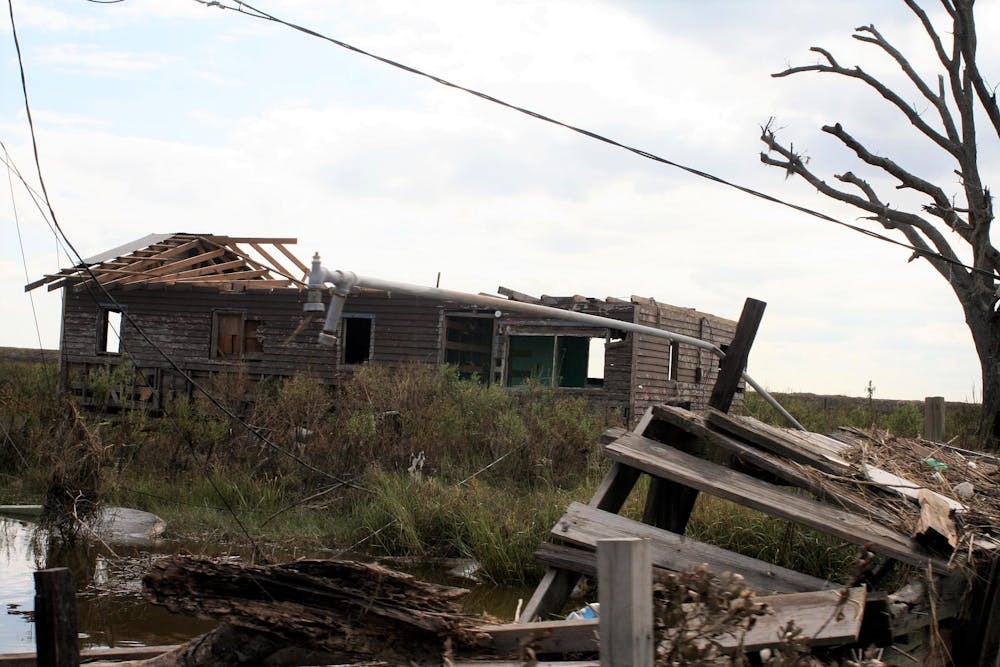
Property damaged by extreme weather and later abandoned on Isle De Jean Charles.Maitri/Flickr, CC BY-NC-SA
Climigration options were previously considered in Alaska. Climate-induced coastal erosion has threatened the viability of the village of Newtok for many years. Its residents voted in 2003 to relocate to higher ground but the relocation looks unlikely to be completed before 2023.
Climigration is, of course, not a phenomenon restricted to the US and Australia. It is a growing concern for many countries.
Our research sought to establish a framework for effective climigration planning. We systematically reviewed international case studies of community relocations undertaken because of environmental hazards. As part of this we developed a hierarchy of influencing factors in planning for climigration.
We found that the degree to which a community agrees on the need to relocate is a crucial influence. Consensus generates social capital, which supports action and improves the prospects of successful outcomes.
Perception of the timing and severity of risks is another critical factor. Immediate, obvious risks are more likely to motivate action. Motivation can be low if risks are seen as a problem for the distant future, even if impacts may eventually be devastating.
Political, economic and logistical support from government moderately influences the success of community relocation. Relocation may still occur without government support, but this is not preferable and the chances of success are lower.
Strong local leadership can improve the capacity of communities to face the reality of relocation and then to resettle. Strategic leadership from outside agencies is a complement to local leadership, not a substitute.
How to plan successfully for climigration
Strategic and land-use planning systems will be central public agencies in many climigration cases.
Planners already have relevant skills and training. These include community consultation, mediation and stakeholder engagement. Planners can coordinate land acquisition and development applications. They can provide temporary housing, infrastructure and transportation.
Planning for climigration also requires other professional input, including disaster management, social psychology and engineering.
Strategic planning for climigration should begin as early as possible. Vulnerable communities can be identified using risk mapping.
Residents of bushfire-prone areas that become impossible to defend might have to consider moving.Dean Lewins/AAP
Alternative sites can then be shortlisted and potential logistical demands identified.
Securing land for relocation may place planners in the middle of competing forces. They need to be careful and deliberative to balance the expectations of residents, government, and the market.
Consultation is vital to secure community consensus in the event of climigration. It is a key tool for planners to explain risks and engage residents in crucial decisions.
Specific policy frameworks for climigration are preferable but not essential. When used, they can improve coordination and reduce the risk of negative outcomes.
A confronting concept
While climigration is not yet a common planning issue, it is likely to become an increasingly urgent agenda. Climigration events like those in Louisiana, Alaska and Queensland are just the first wave.
There are limits to the feasibility of climigration. It might only be viable for small towns and villages. Undoubtedly there will be cases where climigration is rejected as too much of challenge.
Accepting the notion of climigration may be the biggest challenge for planners. The idea that the only viable future for a community is to be relocated elsewhere is unusual and confronting. Managing climigration through planning practice may prove more straightforward than adjusting to the idea in the first place.
Source: The Conversation (Au and NZ) – By Hugh Breakey, Senior Research Fellow, Moral philosophy, Institute for Ethics, Governance & Law, Law Futures Centre, Griffith University
Argument is everywhere. From the kitchen table to the boardroom to the highest echelons of power, we all use argument to persuade, investigate new ideas, and make collective decisions.
Unfortunately, we often fail to consider the ethics of arguing. This makes it perilously easy to mistreat others — a critical concern in personal relationships, workplace decision-making and political deliberation.
Logic and commonsense dictate that, when deliberating with others, we should be open to their views. We should listen carefully and try to understand their reasoning. And while we can’t all be Socrates, we should do our best to respond to their thoughts with clear, rational and relevant arguments.
Since the time of Plato, these norms have been defended on what philosophers call “epistemic” grounds. This means the norms are valuable because they promote knowledge, insight and self-understanding.
What “critical thinking” is to internal thought processes, these “norms of argument” are to interpersonal discussion and deliberation.
In a recent article, I contend that these norms of argument are also morally important.
Sometimes this is obvious. For example, norms of argument can overlap with commonsense ethical principles, like honesty. Deliberately misrepresenting a person’s view is wrong because it involves knowingly saying something false.
More importantly, but less obviously, being reasonable and open-minded ensures we treat our partners in argument in a consensual and reciprocal way. During arguments, people open themselves up to attaining worthwhile benefits, like understanding and truth. If we don’t “play by the rules”, we can frustrate this pursuit.
Worse, if we change their minds by misleading or bamboozling them, this can amount to the serious wrongs of manipulation or intimidation.
Instead, obeying the norms of argument shows respect for our partners in argument as intelligent, rational individuals. It acknowledges they can change their minds based on reason.
Obeying the norms of argument also has good effects on our character. Staying open-minded and genuinely considering contrary views helps us learn more about our own beliefs.
He who knows only his own side of the case knows little of that.
This open-mindedness helps us combat the moral perils of bias and groupthink.
What’s more, the norms of argument aren’t just good for individuals, they are also good for groups. They allow conflicts and collective decisions to be approached in a respectful, inclusive way, rather than forcing an agreement or escalating the conflict.
Indeed, arguments can make collectives. Two arguers, over time, can collectively achieve a shared intellectual creation. As partners in argument, they define terms, acknowledge areas of shared agreement, and mutually explore each other’s reasons. They do something together.
All this accords with everyday experience. Many of us have enjoyed the sense of respect when our views have been welcomed, heard and seriously considered. And all of us know what it feels like to have our ideas dismissed, misrepresented or caricatured.
Why we have trouble arguing calmly
Unfortunately, being logical, reasonable and open-minded is easier said than done. When we argue with others, their arguments will inevitably call into question our beliefs, values, experience and competence.
These challenges are not easy to face calmly, especially if the topic is one we care about. This is because we like to think of ourselves as effective and capable, rather than mistaken or misguided. We also care about our social standing and like to project confidence.
In addition, we suffer from confirmation bias, so we actively avoid evidence that we are wrong.
Finally, we may have material stakes riding on the argument’s outcome. After all, one of the main reasons we engage in argument is to get our way. We want to convince others to do what we want and follow our lead.
All this means that when someone challenges our convictions, we are psychologically predisposed to hit back hard.
Worse still, our capacity to evaluate whether our opponents are obeying the norms of argument is poor. All the psychological processes mentioned above don’t just make it hard to argue calmly and reasonably. They also trick us into mistakenly thinking our opponents are being illogical, making us feel as if it’s them, and not us, who’s failing to argue properly.
How should we navigate the moral complexity of arguing?
Arguing morally isn’t easy, but here are five tips to help:
Avoid thinking that when someone starts up an argument, they are mounting an attack. To adapt a saying by Oscar Wilde, there is only one thing in the world worse than being argued with, and that is not being argued with. Reasoned argument acknowledges a person’s rationality, and that their opinion matters.
There is always more going on in any argument than who wins and who loses. In particular, the relationship between the two arguers can be at stake. Often, the real prize is demonstrating respect, even as we disagree.
Don’t be too quick to judge your opponent’s standards of argument. There’s a good chance you’ll succumb to “defensive reasoning”, where you’ll use all your intelligence to find fault with their views, instead of genuinely reflecting on what they are saying. Instead, try and work with them to clarify their reasoning.
Never assume that others aren’t open to intelligent argument. History is littered with examples of people genuinely changing their minds, even in the most high stakes environments imaginable.
It’s possible for both sides to “lose” an argument. The recently announced inquiry into question time in parliament provides a telling example. Even as the government and opposition strive to “win” during this daily show of political theatre, the net effect of their appalling standards is that everyone’s reputation suffers.
The upshot
There is a saying in applied ethics that the worst ethical decisions you’ll ever make are the ones you don’t recognise as ethical decisions.
So, when you find yourself in the thick of argument, do your best to remember what’s morally at stake.
Otherwise, there’s a risk you might lose a lot more than you win.
Source: The Conversation (Au and NZ) – By Alastair Blanshard, Paul Eliadis Chair of Classics and Ancient History Deputy Head of School, The University of Queensland
Comedy often succeeds where tragedy fails. Fangirls, the pop musical which premiered on Thursday night in Brisbane, is not the first drama to explore our fascination with the wild, uncontrollable power of young female passion and girls’ infatuation with their boy-loves. Yet its catchy tunes, witty dialogue, and hilarious, occasionally absurdist, comic scenes set it apart.
Over 2,500 years ago, Euripides’ play The Bacchae featured a chorus of maenads, followers of Dionysus and the world’s first fangirls, who ecstatically tore cattle apart with their bare hands. Any unfortunate male who crossed their path was similarly rendered limb from limb. Fear of uninhibited female obsession runs deep.
Stephen King’s Misery, starring the psychotic uber-fan Annie Wilkes (Kathy Bates), struck a chord in our collective psyche. The delusional female fan has long been a character to be feared and shunned. At best a figure of derision, at worst a figure in need of strong medical and psychiatric intervention.
It is against this background that Fangirls seems so refreshing. This musical doesn’t stigmatise the world of the fangirl and her pop-star fixations, it revels in it. It emerges from a genuine desire to understand and celebrate its subject. Driven by such compassion, the laughs – and there are many – are never cheap.
The musical teaches us that the boundless creativity of young girls needs to run free, not be stifled by convention or ideas of proper behaviour. Armed with unbreakable determination and a few instructional YouTube clips these girls can achieve anything. The bouncy, upbeat music and dynamic video-walls that dominate the stage capture well the frenzied energy unleashed by the fangirl. Whatever it is, idol worship is not idle worship.
Talented Fangirls creator and star Yve Blake.Photo: Stephen Henry
The story and music were written by the abundantly talented Yve Blake who plays the lead role of young 14-year-old Edna. The plot of the musical concerns Edna and her fixation on Harry (Aydan), the lead singer of the world’s biggest boy-band True Direction. With smouldering eyes and perfect hair, Harry’s effect on his teenage fanbase is visceral.
In an early musical number, Harry’s fans writhe around in half-agony, half-ecstasy clutching their pillowcases as they remember the first time that they witnessed him take the stage. As a former star of the hit talent show The Voice, Aydan is perfectly suited to the role.
Edna’s devotion to Harry and her unshakeable conviction that only she truly understands him is a source of tension between Edna, her school friends and her mother (Sharon Millerchip). Edna escapes from her increasingly fraught home life through the internet and the chatrooms full of True Direction fans.
Together with her online BFF Saltypringl, brilliantly played by James Majoos, Edna writes fan fiction in which she and Saltypringl imagine scenarios where they each team up with Harry to fight against their common enemies. The opponents become increasingly outrageous, but the trajectory of the stories remain the same. With the opposition out of the way, Edna and Saltypringl can each enjoy time alone with Harry as they giddily tousle those begging-to-be-played-with locks. Gradually the line between fiction and reality becomes blurred with literally riotous results.
A musical first crush with all the feels, Fangirls is bright and joyous.
In the hands of another dramatist, Edna could be a figure to be pitied. In Fangirls, you constantly cheer her on, no matter how ridiculous her plans. Her friends may treat her badly, but you forgive them as well. They possess such vitality and spunk that most crimes can be forgiven.
Edna’s frenemy Jules (Chika Ikogwe) is so fabulous in her narcissism that you forget all of the terrible things she says and does. In all her naked unrestrained power she is a joy to behold.
This musical neatly exposes the gender double standard that lies at the heart of our treatment of fangirls. We mock them for their exuberance, but if a boy showed similar passion for a footballer or cricketer, we wouldn’t hesitate to applaud such devotion.
It equally reveals the cynicism of the commercial music industry that seeks to atomise its fanbase. The songs of boy bands claim to speaking to you alone. Anyone else who thinks otherwise is delusional. It is an irresponsible strategy that promotes intense rivalries, online trolling, and fights between fans. Boy bands cause division as much as they unite.
The scenes of teenage life are painfully well observed and many parents will wince in recognition of how Edna speaks to her mother. Yet it is the warmth of the drama that shines through. This musical is a celebration of love in all its forms. It is a reminder that it is love that makes us better people, repairs shattered friendships, and teaches us to appreciate life. It is love, not some pop star – no matter how perfect the hair – that makes us whole.
Fangirls runs until 5 October at Brisbane’s Bille Brown Theatre and will open at Sydney’s Belvoir Theatre from October 12.
Autosomal-dominant polycystic kidney disease (ADPKD) is the most common genetic kidney disorder, and the fourth most common cause of kidney failure in Australian adults. It affects about one in 1,000 Australians.
In people with ADPKD, a mutation in one or two genes leads to the development and progressive growth of cysts in the kidneys, causing a decline in kidney function.
Labor senator Malarndirri McCarthy, a Yanyuwa woman, recently spoke publicly about having ADPKD after she became unwell with a kidney infection and had to leave the Senate.
But a newly available treatment for ADPKD shows promise for people with the disease.
If one parent has ADPKD, the children have a 50% chance of inheriting the gene (though up to 10% of patients don’t have a family history).
Where it is inherited, the age of diagnosis and rate of progression to kidney failure in the parent gives some indication of how the disease will develop in affected children.
The cysts are like balloons filled with water, which start small in childhood and increase in size over time.
Typically, the cysts don’t start to cause problems until later in life. The average age at diagnosis is 27 years.
As the cysts grow, normal working tissue in the kidney is replaced with enlarging cysts. So with time, the kidneys don’t work as well.
For about half of people with ADPKD, their condition will eventually progress to kidney failure, which may be treated with dialysis or a transplant.
Cysts grow on the kidneys of a person with polycystic kidney disease, often impacting kidney function.From shutterstock.com
While the loss of kidney function is paramount, the cysts may cause other symptoms and complications too.
Symptoms can include high blood pressure and chronic pain or heaviness in the back, sides and abdomen. The growth of cysts means the kidneys can grow to as large as 5-6kg in size.
Blood in the urine, urinary tract infections, kidney stones and infections in the cysts are not uncommon in people with ADKPD, and can all impact quality of life.
Other organs may also be affected. People with ADPKD can develop cysts in the liver, pancreas and bowel, and about 10% will experience balloon dilations of the blood vessels in the brain, called aneurysms.
Treatment
Until recently, treatment of ADPKD was directed towards early detection, control of blood pressure, lifestyle measures such as quitting smoking, weight control and diet, antibiotics for infections, analgesics for pain and the management of progressive kidney dysfunction via dialysis and transplantation. None of these therapies however directly slowed the growth of cysts.
But on January 1, 2019, tolvaptan was listed on the Pharmaceutical Benefits Scheme. Australia now joins the United States, the European Union, and several other countries where this drug was already available.
Tolvaptan, which is taken in tablet form, slows the growth of cysts by blocking a hormone called vasopressin. Vasopressin is critical in triggering the formation of cysts. In this way, tolvaptan prolongs the time to kidney failure.
In one study, three years of treatment with tolvaptan reduced the rate of cyst growth by around 50% in comparison to a placebo treatment. The authors suggested tolvaptan may delay dialysis or the need for a transplant for six to nine years for patients with ADPKD, particularly if started early.
People who took tolvaptan in this study also had lower incidence of ADPKD-related complications including urinary tract infections and kidney pain.
Kidney disease and Indigenous Australians
ADPKD is not actually more common in Aboriginal and Torres Strait Islander communities, as other causes of chronic kidney disease are. This may be because ADPKD is inherited.
The majority of chronic kidney disease develops as a complication of diabetes, which affects Aboriginal and Torres Strait Islander populations more commonly and typically at a younger age than the overall Australian population.
Kidney disease, whatever the cause, remains a significant issue for Aboriginal and Torres Strait Islander communities. People in remote Indigenous communities in particular face challenges around accessing treatments in large urban centres, and have poorer access to organ transplants.
There are several nationally targeted activities and proposals aimed at reducing the burden of chronic kidney disease in Indigenous Australians.
The Renal Health RoadMap is designed to support health systems in early detection and management of diabetes and chronic kidney disease. It also seeks to address the social determinants of poor health in Indigenous communities, including housing quality and availability, and health infrastructure.
In 2018, Minister for Indigenous Australians Ken Wyatt commissioned a report detailing how access to and outcomes of kidney transplants could be improved among Indigenous Australians. He also established a National Indigenous Kidney Transplantation Taskforce to implement the recommendations from this report.
Some key recommendations include improving the communication between health-care teams, patients and their families, addressing cultural bias in the delivery of health care, and improving the quality of data around transplant access and outcomes.
Addressing transplant and treatment inequities will benefit Indigenous Australians with kidney failure sustained from ADPKD and chronic kidney disease more broadly.
British health-care conglomerate Bupa runs more nursing homes in Australia than anyone else. We now know its record in meeting basic standards of care is also worse than any other provider.
This is more than a now familiar story of a corporation putting shareholders before customers. It is also about another abysmal design failure in regulation.
Health care is meant to be one of our most regulated sectors. In this case, Bupa’s facilities were inspected and certified by the Aged Care Quality and Safety Commission.
The regulator’s inspectors found 45 of Bupa’s 72 nursing homes failed health and safety standards. In 22 homes the health and safety of residents was deemed at “serious risk”. Thirteen homes were “sanctioned” – with government funding being withheld and the homes banned from taking new residents.
Yet none of this appears to have spurred Bupa’s management into action, according to media reports. Flurries of inspection reports and written warnings over months and years only underlined that the regulatory tiger, even if it had teeth, had a very soft bite.
Responsive regulation
We have seen examples of equally insipid regulation in other areas. In the building sector, for example, a range of regulatory flaws including outsourced building certification have led to shoddily built and dangerous apartment construction.
In the financial sector, the banking royal commission castigated the industry regulators – the Australian Securities and Investments Commission and the Australian Prudential Regulatory Authority – for their unwillingness to enforce rules.
“The conduct regulator, ASIC, rarely went to court to seek public denunciation of and punishment for misconduct,” noted royal commissioner Ken Hayne. “The prudential regulator, APRA, never went to court.”
This failure is due to more than individual agency shortcomings. It’s an unintended consequence of the design of “responsive regulation” – the system that has superseded command-and-control regulation over the past three decades.
Responsive regulation was popularised by Australian sociologist John Braithwaite and American law professor Ian Ayres in the early 1990s. It was intended to overcome the pitfalls of the command-and-control model, which involved regulators employing large numbers of inspectors to look for non-compliance.
From about the 1970s it had become increasingly evident this model wasn’t working. It was also very expensive. Consider, for example, the cost of having fire and health and safety inspectors visit every single building site, particularly when most builders were doing the right thing. The cost and intrusiveness of the system fuelled calls to do away with regulation .
Too big to fail
Ayers and Braithwaite saw their model as a way forward. “Responsive regulation is not a clearly defined program or a set of prescriptions concerning the best way to regulate,” they explained. “On the contrary, the best strategy is shown to depend on context, regulatory culture and history.”
Responsive regulation assumes that in most cases the enterprises being regulated are interested in compliance and will respond to light-touch directives. It assumes that often compliance failures are due to ignorance or inadequate procedures. Its approach is to give parties a chance to amend their ways.
But there’s a potentially huge flaw in the responsive regulation model. What happens when an organisation is so large it is deemed too big to fail, or deems itself so?
This seems to have been the case with a number of financial companies whose misdeeds were exposed by the banking royal commission. It seems it might have been the case with Bupa.
In such cases, because of the timidity of the regulator or the confidence of the enterprise, the warnings might just go on and on. The company continues to book its profits – which may well eclipse any penalty it might have to pay if crunch time does ever come.
Markets have their limits
This design flaw highlights a more fundamental problem with governments positioning themselves as rule makers and leaving the rest to the “market”.
Markets are designed to facilitate exchange on the basis of profits. The profit motive means market participants look for the lowest-cost option. In aged care this means paying the lowest possible wages, possibly to unqualified staff, and cutting corners to cut costs.
Markets are very useful for increasing individual choices and efficiently allocating resources, but they are not suited to every task. They fail when factors other than profit ought to be considered.
We therefore need to think about the design of regulatory systems more holistically, as part of a broader social process.
The pioneers of responsive regulation certainly understood this. They emphasised flexibility, taking into account context, culture and history.
What those three things now tell us, given widespread regulatory failure across industries, is that government should not resist stepping in to provide important public services where the private sector cannot or will not do so at an acceptable level. Nor should it be afraid to act through empowered regulators, with ressources and powers to fulfil their mandates.
Source: The Conversation (Au and NZ) – By Hugh Breakey, Senior Research Fellow, Moral philosophy, Institute for Ethics, Governance & Law, Law Futures Centre, Griffith University
Argument is everywhere. From the kitchen table to the boardroom to the highest echelons of power, we all use argument to persuade, investigate new ideas, and make collective decisions.
Unfortunately, we often fail to consider the ethics of arguing. This makes it perilously easy to mistreat others — a critical concern in personal relationships, workplace decision-making and political deliberation.
Logic and commonsense dictate that, when deliberating with others, we should be open to their views. We should listen carefully and try to understand their reasoning. And while we can’t all be Socrates, we should do our best to respond to their thoughts with clear, rational and relevant arguments.
Since the time of Plato, these norms have been defended on what philosophers call “epistemic” grounds. This means the norms are valuable because they promote knowledge, insight and self-understanding.
What “critical thinking” is to internal thought processes, these “norms of argument” are to interpersonal discussion and deliberation.
In a recent article, I contend that these norms of argument are also morally important.
Sometimes this is obvious. For example, norms of argument can overlap with commonsense ethical principles, like honesty. Deliberately misrepresenting a person’s view is wrong because it involves knowingly saying something false.
More importantly, but less obviously, being reasonable and open-minded ensures we treat our partners in argument in a consensual and reciprocal way. During arguments, people open themselves up to attaining worthwhile benefits, like understanding and truth. If we don’t “play by the rules”, we can frustrate this pursuit.
Worse, if we change their minds by misleading or bamboozling them, this can amount to the serious wrongs of manipulation or intimidation.
Instead, obeying the norms of argument shows respect for our partners in argument as intelligent, rational individuals. It acknowledges they can change their minds based on reason.
Obeying the norms of argument also has good effects on our character. Staying open-minded and genuinely considering contrary views helps us learn more about our own beliefs.
He who knows only his own side of the case knows little of that.
This open-mindedness helps us combat the moral perils of bias and groupthink.
What’s more, the norms of argument aren’t just good for individuals, they are also good for groups. They allow conflicts and collective decisions to be approached in a respectful, inclusive way, rather than forcing an agreement or escalating the conflict.
Indeed, arguments can make collectives. Two arguers, over time, can collectively achieve a shared intellectual creation. As partners in argument, they define terms, acknowledge areas of shared agreement, and mutually explore each other’s reasons. They do something together.
All this accords with everyday experience. Many of us have enjoyed the sense of respect when our views have been welcomed, heard and seriously considered. And all of us know what it feels like to have our ideas dismissed, misrepresented or caricatured.
Why we have trouble arguing calmly
Unfortunately, being logical, reasonable and open-minded is easier said than done. When we argue with others, their arguments will inevitably call into question our beliefs, values, experience and competence.
These challenges are not easy to face calmly, especially if the topic is one we care about. This is because we like to think of ourselves as effective and capable, rather than mistaken or misguided. We also care about our social standing and like to project confidence.
In addition, we suffer from confirmation bias, so we actively avoid evidence that we are wrong.
Finally, we may have material stakes riding on the argument’s outcome. After all, one of the main reasons we engage in argument is to get our way. We want to convince others to do what we want and follow our lead.
All this means that when someone challenges our convictions, we are psychologically predisposed to hit back hard.
Worse still, our capacity to evaluate whether our opponents are obeying the norms of argument is poor. All the psychological processes mentioned above don’t just make it hard to argue calmly and reasonably. They also trick us into mistakenly thinking our opponents are being illogical, making us feel as if it’s them, and not us, who’s failing to argue properly.
How should we navigate the moral complexity of arguing?
Arguing morally isn’t easy, but here are five tips to help:
Avoid thinking that when someone starts up an argument, they are mounting an attack. To adapt a saying by Oscar Wilde, there is only one thing in the world worse than being argued with, and that is not being argued with. Reasoned argument acknowledges a person’s rationality, and that their opinion matters.
There is always more going on in any argument than who wins and who loses. In particular, the relationship between the two arguers can be at stake. Often, the real prize is demonstrating respect, even as we disagree.
Don’t be too quick to judge your opponent’s standards of argument. There’s a good chance you’ll succumb to “defensive reasoning”, where you’ll use all your intelligence to find fault with their views, instead of genuinely reflecting on what they are saying. Instead, try and work with them to clarify their reasoning.
Never assume that others aren’t open to intelligent argument. History is littered with examples of people genuinely changing their minds, even in the most high stakes environments imaginable.
It’s possible for both sides to “lose” an argument. The recently announced inquiry into question time in parliament provides a telling example. Even as the government and opposition strive to “win” during this daily show of political theatre, the net effect of their appalling standards is that everyone’s reputation suffers.
The upshot
There is a saying in applied ethics that the worst ethical decisions you’ll ever make are the ones you don’t recognise as ethical decisions.
So, when you find yourself in the thick of argument, do your best to remember what’s morally at stake.
Otherwise, there’s a risk you might lose a lot more than you win.
The creation of all-male or all-female groups of animals, known as monosex populations, has become a potentially useful approach in aquaculture and livestock rearing.
Researchers and those in the produce industries are interested in how we can take advantage of the natural traits exhibited by a certain gender in a species.
In the poultry industry, the production of all-female groups for eggs and the production of all-male groups for meat would be desirable. This is also true for milk and beef production in cows and bulls, respectively. However, these animals’ sexual development process means we are currently unable to produce monosex populations of them.
On the other hand, monosex culturing is already common practice for some aquatic species. In fish species such as tilapia and catfish, males grow faster, whereas in other species such as grass carp and salmon, females do. Creating monosex populations of the faster-growing gender increases production rate.
As the science develops, I and my colleagues in this field continue to find ways in which monosex animal populations can benefit humans.
Superfood, but not as you know it
During my PhD at Ben-Gurion University I developed the molecular tools required for commercial-scale production of monosex populations in the giant freshwater prawn, Macrobrachium rosenbergii. This technology is now marketed and distributed by several companies across the globe.
Enzootic is one of the companies using this technology on a commercial scale.
Besides being a commercially important species, the giant freshwater prawn has a fascinating social hierarchy. Males compete for reproductive success using different growth strategies and develop into either small or large subordinate males, or large dominant males.
While some of the dominant males grow much larger than females, they suppress the overall growth and survival of the entire population. It’s therefore advantageous to produce only females.
All-female groups use feed more efficiently, have a greater survival rate (even at a much higher stocking density), and are more uniform because there’s no unwanted breeding; the genetic breeding program is highly controlled.
When unplanned breeding occurs it results in crowding and leads to wasted energy due to sexual activity at the expense of growth. In controlled breeding, the mating is done only in specified breeding tanks, whereas prawns in the other tanks invest only in growth.
Combating disease
These monosex prawn populations were recently trialled in western African countries as a potential biological control of schistomiasis.
This deadly disease is caused by parasitic flatworms in freshwater snails. The snails are a delicacy to giant freshwater prawns, meaning the prawns can break the deadly parasite’s life cycle.
Introducing monosex populations of these prawns to areas where they are not native is also ecologically safe. They will not reproduce unchecked and can’t establish the next generation of prawns. Even if leakage should occur into natural waterways, it wouldn’t be viable for more than one generation.
The fact that they’re a prized food commodity also means they can help sustain villages wanting to produce and sell them.
Making monosex populations
Production of all-female populations in the giant freshwater prawn relies on induced sex change.
This is done using a male-specific organ called the androgenic gland. When cells of this gland are inserted into females at an early stage (when they are about the size of a rice grain), they develop into males.
Using the genetic sex markers I developed, researchers have established these altered “males” carry a female sex chromosome, making them neo-males. When neo-males are mated with females, they produce a population of about 25% “super-females”.
These super-females can then be turned into super neo-males. When super neo-males are bred with super-females, they produce only super-females, by virtue of eliminating the male sex chromosomes from the population.
The way ahead
The challenge with monosex populations of the giant freshwater prawn and other species is that it results in the genetic narrowing of population diversity. Diversity is crucial to combating disease in cultured populations and is a huge concern for aquaculture species.
To circumvent this issue, researchers are developing breeding programs to reinvigorate the genetic lines treated with this technology.
In other species of crustaceans we are yet to figure out how to manipulate gender the same way it can be done in M. rosenbergii. The crustacean research community, myself included, is working diligently to develop similar technologies for other species such as crabs and lobsters.
The great paradox of sex determination and making monosex populations is that while the outcome is the same across animals (separate sexes), the way these are produced varies greatly, even between closely related species. This makes it a complicated task to unravel the underlying machinery for different species.
Predictably, both major political parties are resisting calls this week for a parliamentary conscience vote to declare a climate emergency in Australia.
A majority of Australians accept that climate change is happening, although, like the minister for natural disasters, David Littleproud, a surprising number don’t necessarily believe it is caused by humans. Moreover, when climate change is made an economic issue, many voters are less likely to support tougher action if they perceive this is going to impact on their cost of living.
Despite the fact he lost his own seat in the recent federal election, former PM Tony Abbott said the Coalition’s overall victory made this point abundantly clear.
Where climate change is a moral issue, we Liberals do it tough. But where climate change is an economic issue […] tonight shows we do very, very well.
There is no better illustration of Abbott’s zealous observation than in Queensland during the 2019 election.
Former Greens leader Bob Brown, believing he could turn the controversial Adani coal mine into another Franklin River dam, led a convoy of climate activists through Queensland towns. But pushing climate change as a moral issue became an insult to the coal communities there.
Bob Brown’s anti-Adani protests didn’t play well in some Queensland communities.Rohan Thomson/AAP
Labor also talked tough on climate change, with former leader Bill Shorten declaring in the final week of the May campaign:
It is not the Australian way to avoid and duck the hard fights. We will take this [climate change] emergency seriously.
At the same time, Labor vacillated over Adani. The party’s prevarication over climate led to much confusion, and when the votes were counted, it did not win a seat north of metro Brisbane.
Fast-forward to today, and the painful loss of the election has ensured that Labor isn’t taking any chances on coal.
In fact, shadow Foreign Minister Penny Wong didn’t hesitate last month when she said,
coal remains an important industry for Australia and it remains part of the global energy mix.
And Labor may now be preparing to walk away from its ambitious climate target of cutting emissions by 45% by 2030, in favour of a focus on a net-zero pollution target for 2050.
Greens leader Richard Di Natale accused Labor of “caving in to the coal, oil and gas lobby” if it abandons its 2030 emissions reduction target, and added,
Labor will have lost whatever remaining credibility it has on the climate crisis.
The politics of a national emergency
In many city councils and certain electorates across Australia, declaring a climate emergency has been a clever strategy both for political consumption and to mobilise behavioural change on a local scale.
But on a national scale, where climate change is so heavily politicised, the declaration of a climate change emergency would be an unmitigated disaster for the major parties, and for the cause of effectively communicating climate change.
This is not to say that climate change isn’t anything short of an emergency. It absolutely is.
The monstrous amounts of energy going into the oceans right now guarantees continued global warming that is fast heading towards the equivalent of the climatic violence of the Eemian period of 118,000 years ago.
And among the countless tipping points we are seeing unfold before us, the shock of a premature fire season in NSW and Queensland, with winter barely over, is just one way in which climate change is having an impact at a local level.
In some ways, there is no better time to raise awareness of climate change than during extreme weather events, as people are looking for explanations as to why they are occurring and how they can be so severe.
But to declare a national climate emergency, pushed so strongly by the Greens and independents, is not only politically difficult in Australia at the moment, it is also a hopeless communications strategy.
Communicating a climate emergency
Here are six reasons why declaring a climate emergency is so deeply problematic.
1) Without bipartisan support, which is likely to be the case, it will further entrench the politicisation of climate change in Australia. Australians are already divided on anthropogenic climate change, and are increasingly afflicted by issue fatigue. This is precisely because climate change is thrashed about as a political issue (which turns on opinion) rather than a matter of physics (which turns on facts).
2) If such a conscience vote fails in parliament, it will marginalise any well-intentioned instigators as a partisan minority.
3) If ever such a conscience vote succeeded, it would merely come to serve as a symbolic cover for inaction in the face of steadily rising emissions.
4) Without meaningful decarbonisation policies, such a declaration would become a twisted apologia for such inaction, as long as political parties are able to spin national accounting carbon emissions figures.
5) Recent research by the Monash Climate Change Communication Research Hub found that the term “climate emergency” didn’t resonate with Australians as much as other phrases, such as climate change, global warming, extreme weather, climate crisis, and complex weather. Only 6.93% of Brisbane respondents and 4.03% of Melbourne respondents preferred “climate emergency” to the other terms.
6) By far the most overwhelming problem with such a declaration is that politicians are the least trusted sources of information on climate change.
To regain trust on climate change, politicians need to lead with genuinely effective policies and decisions, rather than the foil of a hollow sentiment that has no legal or economic status.
In the meantime, there needs to be better public understanding of the science behind climate change, delivered by trusted sources, that allows people to come to terms with the true urgency of the crisis.
That’s because health practitioners with an objection to performing the procedure on religious grounds may have stronger legal protection and may not be compelled to refer women to an alternative provider.
This may lead women to consult multiple services, if available, before finding a doctor willing to perform the procedure.
In the new bill, the term “health practitioner” has a broad meaning. It includes doctors, nurses, midwives and pharmacists. If the bill passes into law, it would apply to health practitioners around Australia. This means it has the potential to override current state and territory laws protecting women seeking abortions.
At the moment, in states such as Victoria and NSW, health professionals may conscientiously object to performing abortions but must refer women to another service.
However, this new bill may override state laws by allowing health professionals with a conscientious objection to refuse to refer them.
The bill may also restrict the ability of private hospitals or private clinics to enforce a workplace policy that requires health practitioners to refer patients to other health practitioners if they object to abortion themselves.
If the new bill becomes law, the only situations where the health professional would be compelled to provide an abortion is if his or her employer would suffer “unjustifiable adverse impact” or if the patient would suffer “unjustifiable adverse impact”.
It is unclear how the courts will interpret these rules.
The bill may also exacerbate problems some women already face in accessing an abortion.
For instance, in Tasmania, somewomenare forced to travel to Victoria due to the difficulty of accessing medical practitioners to perform the procedure in their home state.
In 2018, a Cricket Australia employee Angela Williamson spoke out after being forced to travel from Hobart to Melbourne for this reason. After speaking out on Twitter about the poor access to abortion services in Tasmania, she lost her job.
Conscientious objection is already a problem
Not all doctors act legally under existing legislation. A recent study focusing on Victorian providers found doctors had:
broken the existing law by not referring women to another provider if they objected to perform an abortion
attempted to make women feel guilty about requesting an abortion
attempted to delay women’s access to abortion services, or
claimed an objection for reasons other than conscience.
The study also showed how government phone staff authorising abortion pills, pharmacists, institutions like private hospitals and political groups all used or misused conscientious objection. They either delayed or blocked access to existing services or contributed to the actual lack of abortion providers and services, via lobbying the public or government.
The study found misuse occurred partly because people do not have to justify or register their conscientious objection. So there is no way of knowing if someone’s conscientious objection is a genuine or deeply, consistently held religious position.
The new bill will likely make these types of situations more common.
Right to religious freedom vs right to health care
The bill is controversial because it elevates the protection of religious freedom above other rights, such as the right to health care for women seeking an abortion.
Hugh de Kretser, executive director of the Human Right Law Centre, says:
Australia needs stronger protections from discrimination for people of faith, but the current bill introduces unjustified carve-outs for people to express discriminatory views and to override state and territory protections which ensure fair treatment, particularly for women accessing abortion services.
Adrianne Walters, senior sawyer at the Human Rights Law Centre, says:
The bill will undermine women’s reproductive health. In some jurisdictions, like South Australia and Western Australia, it will allow doctors to abandon their patients. The bill unjustifiably prioritises a doctor’s personal religious beliefs over the right of women to access the healthcare they need.
In 2018, an International Women’s Health Coalition study found a failure to provide abortions to women has terrible impacts by placing “patients at risk of discrimination, physical and emotional harm, and financial stress”. Those possible harms included death.
What we’d like to see
The Religious Discrimination Bill should be amended to strike a better balance between religious rights and women’s right to access abortion. It is important to require conscientious objectors to refer the patients seeking abortion to other providers.
There should also be provisions in the bill to ensure conscientious objectors genuinely have deeply and consistently held religious positions, perhaps through a registration scheme.
Looking at the state of policy on energy and climate change in Australia, it’s tempting to give in to despair. At the national level, following the abandonment of the National Energy Guarantee last year, we have no coherent energy policy and no serious policy to address climate change.
In this context, the announcement of two separate inquiries into the feasibility of nuclear power (by the New South Wales and federal parliaments) could reasonably give rise to cynicism. The only possible case for considering nuclear power, in my view, is that it might provide a way to decarbonise our electricity supply industry.
Activists dressed as nuclear waste barrels protesting at the Lucas Heights nuclear reactor in 2001. Nuclear technology in Australia has long raised concern among environmentalists.Laura Frriezer/AAP
Yet in a situation which all responsible people view as a climate emergency, we can’t afford the luxury of despair. For this reason, rather than dismissing these inquiries as political stunts, I made a submission to the federal inquiry setting out the conditions required to allow for any possibility of nuclear power in Australia.
The submission was picked up by the national media, which largely focused on my proposal to lift the state ban on nuclear power and implement a carbon price.
The reception from commentators on the right, who want the ban lifted, and from renewables advocates, who want a price on carbon, suggests a middle ground on nuclear power may be achievable.
The three big problems with nuclear power
Three fundamental problems arise immediately when considering the prospect of nuclear power in Australia. First, the technology is expensive: more expensive than new fossil-fuelled power stations, and far too expensive to compete with existing fossil fuel generators under current market conditions.
Second, given the time lags involved, any substantial contribution from nuclear power in Australia won’t be available until well beyond 2030.
Third, given the strong public opposition to nuclear power, particularly from the environmental movement, any attempt to promote nuclear power at the expense of renewables would never get broad support. In these circumstances, any investor in nuclear power would face the prospect of losing their money the moment the balance of political power shifted.
A technician uses a hot cell which shields radioactive material at the Opal nuclear research reactor at Lucas Heights in Sydney.Tracey Nearmy/AAP
On the first point, we have some evidence from the contract agreed by the UK government in for the construction of the Hinkley C nuclear power plant. This was the first new nuclear construction project to be approved in an OECD country for a number of years.
The agreement to construct Hinkley was based on a guaranteed “strike price” of £92.50/ megawatt hours (MWh), in 2012 prices, to be adjusted in line with the consumer price index during the construction period and over the subsequent 35-year tariff period. At current exchange rates, this price corresponds to approximately A$165.
Prices in Australia’s National Electricity Market have generally averaged around A$90/MWh. This implies that, if new nuclear power is to compete with existing fossil fuel generators, a carbon price must impose a cost of A$75/MWh on fossil fuel generation.
Assuming emission rates of 1.3 tonnes/MWh for brown coal, 1 tonne/MWh for black and 0.5 tonnes for gas, the implied carbon price ranges from A$50/tonne (to displace brown coal) to $150/tonne (to displace gas). On the basis that nuclear power is most plausible as a competitor for baseload generation from brown coal, I considered a price of A$50/tonne.
A blueprint for reform
The central recommendations of my submission were as follows:
Nuclear power, while costly, could dramatically reduce Australia’s electricity sector emissions.AAP
Recommendation 1: A carbon price of A$25/tonne should be introduced immediately, and increased at a real rate of 5% a year, reaching A$50/tonne by 2035.
Recommendation 2: The government should immediately adopt the recommendations of its own Climate Change Authority for a 40% to 60% reduction in emissions by 2030, relative to 2000 levels, and match other leading OECD countries in committing to complete decarbonisation of the economy by 2050.
Recommendation 3: The parliament should pass a motion:
affirming its confidence in mainstream climate science and its acceptance of the key conclusions of the United Nations’ Intergovernmental Panel on Climate Change;
legislating a commitment to emissions reductions;
removing the existing ban on nuclear power.
Let’s all meet in the middle
Rather to my surprise, this proposal received a favourable reception from a number of centre-right commentators.
Reaction from renewables proponents, on social media at least, was cautious. But it did not indicate the reflexive hostility that might be expected, given the polarised nature of the debate.
There are immediate political implications of my proposal at both the state and federal level. It will be more difficult for the Coalition-dominated committees running the two inquiries to bring down a report favourable to nuclear power without addressing the necessary conditions – including a carbon price. If the government’s hostility to carbon pricing is such that a serious proposal for nuclear power cannot be considered, it will at least be clear that this option can be abandoned for good.
Former Nationals leader and now backbencher Barnaby Joyce is a strong advocate for nuclear power.Lukas Coch/AAP
In the admittedly unlikely event that the Coalition government shows itself open to new thinking, the focus turns to Labor and the Greens.
Given the urgency of addressing climate change – a task that is best addressed through a carbon price – it makes no sense to reject action now on the basis that it opens up the possibility of nuclear power sometime in the 2030s. And, if renewables and storage perform as well as most environmentalists expect, nuclear power will be unable to compete even then.
Political hardheads will doubtless say that this is all impossible, and they may be right. But in a world where Donald Trump can win a US presidential election, and major investment banks support UK Labour leader Jeremy Corbyn over Prime Minister Boris Johnson, “impossible” is a big claim
In the absence of any prospect of progress on either energy or climate, the grand bargain I’ve proposed is at least worth a try.
Source: The Conversation (Au and NZ) – By Jihyun Lee, Associate Professor of Educational Assessment and Measurement at the School of Education, UNSW
Australia’s education system takes almost one in ten of all international students from countries that are members of the Organisation for Economic Co-operation and Development (OECD).
The OECD report says Australia’s higher education sector is heavily reliant on international students. They represent about 48% of those enrolled in masters and 32% in doctoral programs.
This is partly due to a lack of interest among Australians in pursuing higher-degree study compared to other countries, about 10% in Australia versus 15% across OECD countries.
International students make up 40% of doctoral graduates in Australia, compared to 25% across OECD countries. That’s higher than the US (27%) and Germany (18%), the other two popular destinations for international students.
Australian students are not choosing some STEM (science, technology, engineering and mathematics) subjects as much as those in other OECD countries. For example, only 17% of adults (aged 25 to 64) with a tertiary degree had studied engineering, manufacturing and construction.
This trend appears to be getting worse because the proportion of new students entering STEM-related bachelor degree programs is lower in Australia (21%), compared to 27% across OECD and partner countries.
While the government here provides for up to four years of post-higher-degree stay for international students, it is inevitable that Australia faces a drain of foreign-born specialists who were educated in Australia.
We need to provide better incentives for those who complete a higher-degree program, especially in the STEM areas, to stay on in Australia.
The OECD’s report says people who studied information and communication technologies (ICT) and engineering as well as construction and manufacturing will continue to benefit greatly from strong labour-market opportunities everywhere in the world.
Australia can do better in attracting younger generations to be trained in the STEM area at higher-degree levels. We then need to try to retain more of the foreign-born higher-degree holders rather than sending them back home.
Being afraid of an influx of Chinese or Indian students who will contribute to development of innovation and technological changes in this country should become a thing of the past.
Good news for Australia’s education
The Education at a Glance program aims to give an annual snapshot of the effectiveness of educational systems – from early childhood to doctoral level – across all OECD and partner countries.
At almost 500 pages, the 2019 report does contain some good news for Australia.
The Australian education system strongly promotes compulsory education. Our 11 years of compulsory education is the longest among OECD countries. That means each student gets 3,410 more hours over the period of compulsory education.
When it comes to people going on to further studies, the proportion of tertiary-educated Australians has increased over the past ten years. It is now 51%, compared to the OECD average of 44%.
On graduation, the average debt for Australian students is US$10,479 (A$15,243), one of the lowest among OECD countries. It’s about half that of New Zealand US$24,117 (A$35,080), which has similar tuition fees and financial support systems.
Although earning power is still greater for those with a higher level of educational attainment, the financial return from more schooling is far smaller in Australia.
Compared to those with upper secondary education, full-time tertiary-educated Australian workers earn 31% more, compared to 57% more on average across OECD countries. Adults with a master’s or doctoral degree earn 52% more, compared to 91% more on average across OECD countries.
The OECD attributes this trend partially to good labour-market opportunities for those with upper secondary vocational qualifications.
The OECD also notes that the average employment rate for Australian tertiary-educated adults is 85%, only two percentage points higher than the 83% for those with a vocational upper secondary or post-secondary non-tertiary qualification.
This is one of the smallest differences across OECD countries.
Public submissions opened this week for a major overhaul of the waterfront and centre of New Zealand’s biggest city, Auckland (Tāmaki Makaurau).
The Auckland Council’s upgrade plans highlight the importance of local Māori communities as a key part of the process, but my research shows that mana whenua (the Māori groups that hold authority over tribal land) have been displaced and marginalised.
To make more than a token gesture, the council’s plans will need to address issues affecting Auckland’s indigenous communities.
Despite Treaty of Waitangi promises to protect Māori land, forests and fisheries, British control, reinforced by an imperial ethos of global expansion, has influenced education, land use and business practices in New Zealand over the past 150 years. This has physically displaced Māori from their ancestral lands and contributed to widespread ecological degradation.
To provide more economically lucrative pasture for sheep and dairy farms, settlers made “improvements” by burning large swathes of indigenous forests. In 1888, initially under the Kauri Timber Trading Company and from 1919 under the New Zealand Forest Service, thousands of ancient tōtara, kauri, rimu and awa trees were extracted until the supply ran out.
The combination of timber extraction and forest burn-offs for farmland contributed to ecological degradation, the extinction of native birds and marginalisation of indigenous flora and fauna. Dairy and sheep farms continue this ecological degradation through the loss of biodiversity, methane emissions and pollution of rivers and shorelines.
These activities have affected ecosystems and the well-being of indigenous communities. Although #GoodMorningWorldNZ ad campaigns promote New Zealand as “pure”, our prosperity and wealth are reliant on industries that are toxic to all things indigenous.
Colonisation has displaced Māori from their ancestral lands, which has impacted on their economic, cultural and spiritual well-being. Our land use practices have degraded local ecosystems, leading to the extinction of many species.
Assessing the wider impact
The adverse impact of our wealth-generating activities is evident in data published in Environment Aotearoa 2019, which notes that two-thirds of New Zealand’s rare ecosystems face extinction.
Coupled with this, Aotearoa has a serious issue with homelessness. The prevalence of homelessness has grown by 15% since the 2006 census. In 2013, at least 41,000 people were homeless, or about one in every 100 New Zealanders. And, if you walk down Auckland’s Queen Street, it is obvious Māori are over-represented in the homeless population.
Māori now own around 5% of land in Aotearoa. More than 95% of Māori are displaced from their ancestral lands or unable to build on their land. Obstructive legislation limits options for building Māori-centred developments within urban areas or on Māori-owned land in rural regions. The spatial marginalisation of Māori communities, particularly from maintaining tribal ownership of land in urban or economically productive areas, has generated ongoing intergenerational trauma and poverty.
Colonisation is not something that happened in the past. It continues to adversely affect Indigenous communities and local ecologies in countries with a colonial history.
A range of unique initiatives and developments will provide all Aucklanders and visitors with a deeper understanding of mana whenua histories, associations and aspirations within the city centre and waterfront. Collaboration, innovation, creativity and the direct involvement of mana whenua will develop and deliver a thriving Māori culture and identity for the area, from which Aucklanders and visitors will benefit.
While the council promises to develop projects that enable the public to have a deeper understanding of mana whenua histories, it is important to consider how this will address the real economic and spatial injustices associated with the ongoing displacement and marginalisation of indigenous communities.
The council needs to consider how it will tackle homelessness, not only of mana whenua but also of mata waka (Māori who have been displaced due to land loss). As internal refugees, as people who have been displaced from their ancestral lands, poverty lies at the heart of most of the issues our communities face.
The impact of this loss is intergenerational. Telling stories about our histories won’t guarantee that Māori have the same access as other citizens to well-paying jobs, good schools, medical care and an ability to accumulate intergenerational wealth through property ownership. To arrive at more than a token inclusion of Tāmaki Makaurau’s mana whenua, the discussion needs to address these inequalities.
If you’ve seen the movie The Big Short you will remember Christian Bale’s quirky character Michael Burry – the manager of the Scion Capital hedge fund who realises the US mortgage-backed security market is a massive bubble. He goes on to make a fortune by betting on its crash.
Given Burry’s track record, he’s hard to ignore. Last week in an extended (email) interview with Bloomberg News he claimed to have identified the latest bubble: passive investing.
Whereas active investment is about choosing particular stocks based on their potential to outperform the market, passive investing is all matching the market. It’s generally done through index funds, which spread their investments across the stock market.
An index fund might, for example, be based on the S&P500 index, making weighted investments in the top 500 listed companies in the US. An Australian fund might be based on investing in the Australian Securities Exchange’s ASX 200 index. If a given company represents 3% of the index, a passive investor will put 3% of their money into that stock.
Passive investing has become hugely popular for a couple of reasons. One is that passive funds generally charge very low fees, like 0.2% a year. Sometimes even lower. Another is that that passive funds typically provide higher returns than all but the best active fund managers.
Lower cost, higher returns. What’s not to like?
Passive endorsements
Perhaps that’s why legendary investor Warren Buffett’s general investing advice is to buy an S&P 500 low-cost index fund: “I think it’s the thing that makes the most sense practically all of the time.”
Eugene Fama, a Nobel Prize winner in economics and the father of the “efficient markets hypothesis”, gives the same advice: “The default option in a government-mandated program should be low-fee passive funds.”
Fellow Nobel Laureate Richard Thaler (and colleague of Fama at the University of Chicago) concurs. Interestingly, Thaler’s Nobel award was for documenting how people make irrational decisions, while Fama’s was for the opposite. Even with such different perspectives, they agree passive investing is the way to go.
Why then, does Burry think he’s spotted another bubble?
For one thing, passive investment has become a huge part of the market – perhaps partly due to the recommendations of the likes of Buffett, Fama and Thaler. According to Bank of America Merrill Lynch, passive investing now represents 45% of the overall stock market, up from 25% a decade ago.
Burry thinks all that money automatically flowing into stock indices means nobody is doing fundamental analysis of what stocks are good. As he put it in his Bloomberg interview:
This is very much like the bubble in synthetic asset-backed CDOs before the Great Financial Crisis in that price-setting in that market was not done by fundamental security-level analysis, but by massive capital flows based on Nobel-approved models of risk that proved to be untrue.
To Burry, not looking at individual stocks is like not looking at the individual loans that investment banks packaged up into the mortgaged-backed securities. Without that stock-by-stock analysis, he thinks prices aren’t reflecting their “true” value by being bought and sold on their own merits. Economists call this form of price determination through analysis and then buying and selling “price discovery”.
According to Burry:
And now passive investing has removed price discovery from the equity markets. The simple theses and the models that get people into sectors, factors, indexes, or ETFs [exchange-traded funds] and mutual funds mimicking those strategies – these do not require the security-level analysis that is required for true price discovery.
Small discoveries go a long way
If passive funds were 100% of the market, Burry’s argument would have real force. In that case nobody would be looking at fundamentals, and there would be no reason to believe a large market capitalisation stock deserved to be so. There would be all herding and no price discovery.
But the crucial point is that even a small amount of price discovery can go a long way in getting market prices to reflect underlying value.
Burry ought to know this. It was in no small part due to his own analysis and price discovery that led to the correction (crash) in prices of supremely overvalued mortgage-backed-securities in 2008.
Moreover, those markets were extremely opaque. Burry’s strategy to “short” them required using credit default swaps (a type of derivative) in non-exchange or “over the counter” markets (basically just contracts with investment banks). This allowed mispricing to persist for even longer than it should have.
Markets for equity securities, on the other hand, are incredibly large and incredibly liquid. Anybody who spots mispricing can easily profit from that information through buying and selling stocks. That is what drives stock prices toward their “true” value.
Burry is right about there having been a huge increase in passive investing. But that’s a good thing. It’s helping individual investors get higher returns at lower cost. But at 45% of the market, there is no danger of passive investing creating a bubble.
Source: The Conversation (Au and NZ) – By Darius Sepehri, Doctoral Candidate, Comparative Literature, Religion and History of Philosophy, University of Sydney
Weaving through the rooms of my Brisbane childhood home, carried on the languid, humid, sub-tropical air, was the sound of an Iranian tenor singing 800-year old Persian poems of love. I was in primary school, playing cricket in the streets, riding a BMX with the other boys, stuck at home reading during the heavy rains typical of Queensland.
I had an active, exterior life that was lived on Australian terms, suburban, grounded in English, and easy-going. At the same time, thanks to my mother’s listening habits, courtesy of the tapes and CDs she bought back from trips to Iran, my interior life was being invisibly nourished by something radically other, by a soundscape invoking a world beyond the mundane, and an aesthetic dimension rooted in a sense of transcendence and spiritual longing for the Divine.
I was listening to traditional Persian music (museghi-ye sonnati). This music is the indigenous music of Iran, although it is also performed and maintained in Persian-speaking countries such as Afghanistan and Tajikistan. It has ancient connections to traditional Indian music, as well as more recent ones to Arabic and Turkish modal music.
It is a world-class art that incorporates not only performance but also the science and theory of music and sound. It is, therefore, a body of knowledge, encoding a way of knowing the world and being. The following track is something of what I might have heard in my childhood:
Playing kamancheh, a bowed spike-fiddle, is Kayhān Kalhor, while the singer is the undisputed master of vocals in Persian music, ostād (meaning “maestro”) Mohammad Reza Shajarian. He is singing in the classical vocal style, āvāz, that is the heart of this music.
A non-metric style placing great creative demands on singers, āvāz is improvised along set melodic lines memorised by heart. Without a fixed beat, the vocalist sings with rhythms resembling speech, but speech heightened to an intensified state. This style bears great similarity to the sean-nos style of Ireland, which is also ornamented and non-rhythmic, although sean-nos is totally unaccompanied, unlike Persian āvāz in which the singer is often accompanied by a single stringed instrument.
A somewhat more unorthodox example of āvāz is the following, sung by Alireza Ghorbāni with a synthesised sound underneath his voice rather than any Persian instrument. It creates a hypnotic effect.
Even listeners unfamiliar with Persian music should be able to hear the intensity in the voices of Ghorbāni and Shajarian. Passion is paramount, but passion refined and sublimated so that longing and desire break through ordinary habituated consciousness to point to something unlimited, such as an overwhelming sense of the beyond.
Beyond media contrived images
The traditional poetry and music of Iran aim to create a threshold space, a zone of mystery; a psycho-emotional terrain of suffering, melancholy, death and loss, but also of authentic joy, ecstasy, and hope.
A Persian woman playing the Daf, a frame drum, from a painting on the walls of Chehel-sotoon palace, Isfahan, 17th century.Wikimedia Commons
Traditional Persian music matters in this context of escalating aggression because it is a rich, creative artform, still living and cherished. It binds Iranians in a shared culture that constitutes the authentic life of the people and the country, as opposed to the contrived image of Iran presented in Western media that begins and ends with politics.
This is a thoroughly soulful music, akin not in form but in soulfulness with artists such as John Coltrane or Van Morrison. In the Persian tradition, music is not only for pleasure, but has a transformative purpose. Sound is meant to effect a change in the listener’s consciousness, to bring them into a spiritual state (hāl).
Like other ancient systems, in the Persian tradition the perfection of the formal structures of beautiful music is believed to come from God, as in the Pythagorean phrase, the “music of the spheres.”
Because traditional Persian music has been heavily influenced by Sufism, the mystical aspect of Islam, many rhythmic performances (tasnif, as opposed to āvāz) can (distantly) recall the sounds of Sufi musical ceremonies (sama), with forceful, trance-inducing rhythms. (For instance in this Rumi performance by Alireza Eftekhari).
Even when slow, traditional Persian music is still passionate and ardent in mood, such as this performance of Rumi by Homayoun Shajarian, son of Mohammad-Reza:
Another link with traditional Celtic music is the grief that runs through Persian music, as can be heard in this instrumental by Kalhor.
Grief and sorrow always work in tandem with joy and ecstasy to create soundscapes that evoke longing and mystery.
Connections with classical poetry
The work of classical poets such as Rumi, Hāfez, Sa’di, Attār, and Omar Khayyām forms the lyrical basis of compositions in traditional Persian music. The rhythmic structure of the music is based on the prosodic system that poetry uses (aruz), a cycle of short and long syllables.
Singers must therefore be masters not only at singing but know Persian poetry and its metrical aspects intimately. Skilled vocalists must be able to interpret poems. Lines or phrases can be extended or repeated, or enhanced with vocal ornaments.
Thus, even for a Persian speaker who knows the poems being sung, Persian music can still reveal new interpretations. Here, for example (from 10:00 to 25:00 mins) is another example of Rumi by M.R. Shajarian:
This is a charity concert from 2003 in Bam, Iran, after a horrendous earthquake destroyed the town. Rumi’s poem is renowned among Persian speakers, but here Mohammad-Reza Shajarian sings it with such passion and emotional intensity that it sounds fresh and revelatory.
“Without everyone else it’s possible,” Rumi says, “Without you life is not liveable.”
While such lines are originally drawn from the tradition of non-religious love poems, in Rumi’s poems the address to the beloved becomes mystical, otherworldly. After a tragedy such as the earthquake, these lyrics can take on special urgency in the present.
When people listen to traditional music, they, like the singers, remain still. Audiences are transfixed and transported.
According to Sufi cosmology, all melodious sounds erupt forth from a world of silence. In Sufism, silence is the condition of the innermost chambers of the human heart, its core (fuad), which is likened to a throne from which the Divine Presence radiates.
Because of this connection with the intelligence and awareness of the heart, many performers of traditional Persian music understand that it must be played through self-forgetting, as beautifully explained here by master Amir Koushkani:
Persian music has roughly twelve modal systems, each known as a dastgah. Each dastgah collects melodic models that are skeletal frameworks upon which performers improvise in the moment. The spiritual aspect of Persian music is made most manifest in this improvisation.
Shajarian has said that the core of traditional music is concentration (tamarkoz), by which he means not only the mind but the whole human awareness. It is a mystical and contemplative music.
The highly melodic nature of Persian music also facilitates expressiveness. Unlike Western classical music, there is very sparing use of harmony. This, and the fact that like other world musical traditions it includes microtonal intervals, may make traditional Persian music odd at first listen for Western audiences.
Solo performances are important to traditional Persian music. In a concert, soloists may be accompanied by another instrument with a series of call-and-response type echoes and recapitulations of melodic phrases.
Similarly, here playing the barbat, a Persian variant of the oud, maestro Hossein Behrooznia shows how percussion and plucked string instruments can forge interwoven melodic structures that create hypnotic soundscapes:
Ancient roots
The roots of traditional Persian music go back to ancient pre-Islamic Persian civilisation, with archaeological evidence of arched harps (a harp in the shape of a bow with a sound box at the lower end), having been used in rituals in Iran as early as 3100BC.
Under the pre-Islamic Parthian (247BC-224AD) and Sasanian (224-651AD) kingdoms, in addition to musical performances on Zoroastrian holy days, music was elevated to an aristocratic art at royal courts.
Centuries after the Sasanians, after the Arab invasion of Iran, Sufi metaphysics brought a new spiritual intelligence to Persian music. Spiritual substance is transmitted through rhythm, metaphors and symbolism, melodies, vocal delivery, instrumentation, composition, and even the etiquette and co-ordination of performances.
A six-string fretted lute, known as a tār.Wikimedia Commons
The main instruments used today go back to ancient Iran. Among others, there is the tār, the six-stringed fretted lute; ney, the vertical reed flute that is important to Rumi’s poetry as a symbol of the human soul crying out in joy or grief; daf, a frame drum important in Sufi ritual; and the setār, a wooden four-stringed lute.
The tār, made of mulberry wood and stretch lambskin, is used to create vibrations that affect the heart and the body’s energies and a central instrument for composition. It is played here by master Hossein Alizadeh and here by master Dariush Talai.
Music, gardens, and beauty
Traditional Persian music not only cross-pollinates with poetry, but with other arts and crafts. At its simplest, this means performing with traditional dress and carpets on stage. In a more symphonic mode of production, an overflow of beauty can be created, such as in this popular and enchanting performance by the group Mahbanu:
They perform in a garden: of course. Iranians love gardens, which have a deeply symbolic and spiritual meaning as a sign or manifestation of Divine splendour. Our word paradise, in fact, comes from the Ancient Persian word, para-daiza, meaning “walled garden”. The walled garden, tended and irrigated, represents in Persian tradition the cultivation of the soul, an inner garden or inner paradise.
The traditional costumes of the band (as with much folk dress around the world) are elegant, colourful, resplendent, yet also modest. The lyrics are tinged with Sufi thought, the poet-lover lamenting the distance of the beloved but proclaiming the sufficiency of staying in unconsumed desire.
As a young boy, I grasped the otherness of Persian music intuitively. I found its timeless spiritual beauty and interiority had no discernible connection with my quotidian, material Australian existence.
Persian music and arts, like other traditional systems, gives a kind of “food” for the soul and spirit that has been destroyed in the West by the dominance of rationalism and capitalism. For 20 years since my boyhood, traditional Persian culture has anchored my identity, healed and replenished my wounded heart, matured my soul, and allowed me to avoid the sense of being without roots in which so many unfortunately find themselves today.
It constitutes a world of beauty and wisdom that is a rich gift to the whole world, standing alongside Irano-Islamic architecture and Iranian garden design.
The problem is the difficulty of sharing this richness with the world. In an age of hypercommunication, why is the beauty of Persian music (or the beauty of traditional arts of many other cultures for that matter) so rarely disseminated? Much of the fault lies with corporate media.
Brilliant women
Mahbanu, who can also be heard here performing a well-known Rumi poem, are mostly female. But readers will very likely not have heard about them, or any of the other rising female musicians and singers of Persian music. According to master-teachers such as Shajarian, there are now often as many female students as male in traditional music schools such as his.
Almost everyone has seen however, through corporate media, the same cliched images of an angry mob of Iranians chanting, soldiers goose-stepping, missile launches, or leaders in rhetorical flight denouncing something. Ordinary Iranian people themselves are almost never heard from directly, and their creativity rarely shown.
The lead singer of the Mahbanu group, Sahar Mohammadi, is a phenomenally talented singer of the āvāz style, as heard here, when she performs in the mournful abu ata mode. She may, indeed, be the best contemporary female vocalist. Yet she is unheard of outside of Iran and small circles of connoisseurs mainly in Europe.
A list of outstanding modern Iranian women poets and musicians requires its own article. Here I will list some of the outstanding singers, very briefly. From an older generation we may mention the master Parisa (discussed below), and Afsaneh Rasaei. Current singers of great talent include, among others, Mahdieh Mohammadkhani, Homa Niknam, Mahileh Moradi, and the mesmerising Sepideh Raissadat.
Finally, one of my favourites is the marvelous Haleh Seifizadeh, whose enchanting singing in a Moscow church suits the space perfectly.
The beloved Shajarian
Tenor Mohammad-Reza Shajarian is by far the most beloved and renowned voice of traditional Persian music. To truly understand his prowess, we can listen to him performing a lyric of the 13th century poet Sa’di:
As heard here, traditional Persian music is at once heavy and serious in its intent, yet expansive and tranquil in its effect. Shajarian begins by singing the word Yār, meaning “beloved”, with an ornamental trill. These trills, called tahrir, are made by rapidly closing the glottis, effectively breaking the notes (the effect is reminiscent of Swiss yodeling).
By singing rapidly and high in the vocal range, a virtuoso display of vocal prowess is created imitating a nightingale, the symbol with whom the poet and singer are most compared in Persian traditional music and poetry. Nightingales symbolise the besotted, suffering, and faithful lover. (For those interested, Homayoun Shajarian, explains the technique in this video).
As with many singers, the great Parisa, heard here in a wonderful concert from pre-revolutionary Iran, learned her command of tahrir partly from Shajarian. With her voice in particular, the similarity to a nightingale’s trilling is clear.
Nourishing hearts and souls
The majority of Iran’s 80 million population are under 30 years of age. Not all are involved in traditional culture. Some prefer to make hip-hop or heavy-metal, or theatre or cinema. Still, there are many young Iranians expressing themselves through poetry (the country’s most important artform) and traditional music.
National and cultural identity for Iranians is marked by a sense of having a tradition, of being rooted in ancient origins, and of carrying something of great cultural significance from past generations, to be preserved for the future as repository of knowledge and wisdom. This precious thing that is handed down persists while political systems change.
Iran’s traditional music carries messages of beauty, joy, sorrow and love from the heart of the Iranian people to the world. These messages are not simply of a national character, but universally human, albeit inflected by Iranian history and mentality.
This is why traditional Persian music should be known to the world. Ever since its melodies first pierced my room in Brisbane, ever since it began to transport me to places of the spirit years ago, I’ve wondered if it could also perhaps nourish the hearts and souls of some of my fellow Australians, across the gulf of language, history, and time.
Members of the Pacific media have paid tribute to the late Tongan Prime Minster ‘Akilisi Pohiva, who died in New Zealand earlier this week.
An enduring symbol of democracy in Tonga and the Pacific, Pohiva died at Auckland hospital after a long struggle with various health problems.
“He fought for many years for real change in the Pacific’s only kingdom against at many times daunting odds from the establishment,” said Pacific Media Centre director Professor David Robie.
“But he persevered and eventually opened the door to fundamental changes a decade ago.
Dr Robie said the late leader faced a new set of challenges as Prime Minister.
– Partner –
“While he found being in office as Prime Minister more complex and conflicted, he had an impassioned vision for such critical and existential Pacific issues such as climate change and self-determination for West Papua.”
Pohiva spoke passionately on both topics at the last Pacific Islands Forum in Tuvalu, delivering unprecedented emotional pleas to his fellow Pacific leaders to act on climate change and condemn Indonesia for its treatment of West Papua.
Friend and former editor of Taimi ‘o TongaKalafi Moala said his death would not have surprised many Tongans due to the long deterioration of Pohiva’s health in recent years.
“He was not a healthy man. In recent years, prostate problems, and more recently diagnosed with liver cancer.”
Nevertheless, Moala said he was saddened by the loss of a friend despite the political differences between the two over their three-decade relationship.
“[He was] very intense, and treated most things, especially political issues as ‘life and death’.”
“Because of his focused and intensive nature, he tended to be feisty at times. He liked being viewed that he was leading a revolution.”
Pohiva and Moala along with Filokalafi Akau’ola were jailed for contempt of parliament in 1996, after Moala published in Taimi ‘o Tonga details of parliamentary proceedings that Pohiva had leaked.
Their 26-day incarceration prompted Dr Robie and journalist Peter Cronau to cover the story intensely in order to raise awareness and have the “Tongan three” released from prison.
After his release, Pohiva continued campaigning for democracy, clashing with the government and monarchy before becoming the first democratically-elected Prime Minister in the country’s second democratically-elected parliament.
Moala said that despite Pohiva’s later years as Prime Minister, when he was unable to produce the things he had promised in his campaigns, his years of fighting the monarchy for the rights of Tongan people will stand out.
“People will remember him as the best opposition leader ever in Tonga, and he helped shape Tongan politics, and helped bring about the 2010 [constitutional] reforms, in partnership with King George V,” he said.
What’s the betting that when Scott Morrison and Donald Trump are exchanging views on China in Washington in a week or so, the President might be curious about Gladys Liu?
If he is, the Prime Minister will no doubt have some flattering words about the first Chinese-born federal parliamentarian, who is now Liberal MP for the marginal Melbourne seat of Chisholm.
He might be more reluctant to admit that Liu’s past has thrown up complex questions of identifying if and when, in relation to specific individuals, China’s interference in Australian politics is potentially present and a risk.
On a benign view, Liu’s story may be as simple as Morrison wants to paint it: a woman from Hong Kong who has overcome obstacles to get where she is. The ultimate have-a-go-to-get-a-go narrative.
In the political furore now surrounding her, Liu might be a victim of the growing worry about China’s influence and interference in this country.
But legitimate and important questions have been raised about Liu. These revolve around two issues: firstly, her past connections to associations with direct or indirect links with the Chinese Communist Party (the company one keeps is always relevant), and secondly, the large amounts of money she has been able to raise for the Liberal party. While it has not been officially confirmed, it is known security authorities expressed concern about some of the people she assembled.
As a staffer (dealing with the Chinese media) of then Victorian premier Ted Baillieu, Liu was much valued as a fund raiser. Indeed, when she wasn’t included in the travelling party accompanying his successor, Denis Napthine, to China, Baillieu made representations on her behalf, and she was added. It was said she needed to keep face with the local Chinese in Australia.
Liu has obviously been a highly effective networker. Those with concerns ask: did she, wittingly or unwittingly, get assistance from the Chinese authorities to facilitate that networking?
John Garnaut, a China expert who advised Malcolm Turnbull in the run up to the 2018 foreign interference legislation, has outlined China’s approach to exerting influence, in evidence he gave to a US congressional committee last year. “The modus operandi is to offer privileged access, build personal rapport and reward those who deliver”.
Outgoing head of ASIO Duncan Lewis warned of the broad danger in a speech at the Sydney Institute last week. “The current scale and scope of foreign intelligence activity against Australian interests is unprecedented,” he said. (Liu, incidentally, is due to address the Sydney Institute later this month.)
It was Liu’s disastrous interview with Sky’s Andrew Bolt on Tuesday, following an ABC story earlier that day about her previous associations, that turbo charged this week’s debate about her. Liu claimed memory lapses when pressed on her past links, and was all over the place when probed on her attitude to China’s policy and the regime.
By the next day, the Prime Minister’s office had ensured her previous associations and current views had been gathered into a neat statement, which she issued rather than delivered in parliament (the PM tabled it on Thursday). But the interview had opened the floodgates for Labor and other critics.
Forced into a full scale defence of her, the government wheeled out the arguments that this was just a case of a “clumsy” interview, understandable given she was new to parliament, and that Labor, in pursuing her, was being “xenophobic” and “grubby”.
The issues around Liu are about her connections, not a stuffed-up interview.
As for the government playing the race card, this was both wrong and foolish.
Liu wiped away tears as Prime Minister Scott Morrison defended her.Lukas Coch/AAP
Concern about China’s interference in Australian politics relates to the behaviour of an expansionist power. It’s not based on race. It is like the concern in the United States about Russian interference in American politics.
And in terms of tactics: has the government overlooked that one of Labor’s attack dogs on the Liu issue is the ALP Senate leader Penny Wong, whose father is a Malaysian of Chinese origin? Wong would be unlikely to join the front line of a race-based exercise.
While the Liu affair has had people reaching back to the case of former Labor senator Sam Dastyari, who quit parliament in the wake of a scandal over his Chinese connections, that’s not a parallel.
Dastyari got money to cover expenses, made comments about China’s activity in the South China sea at odds with his party’s policy, and tipped off billionaire donor Huang Xiangmo that his phone was likely being tapped by security agencies.
In short, Dastyari was beyond doubt compromised. With Liu, it’s a matter of questions to answer.
One new question is why, as reported by the ABC on Thursday, she did not include the key Chinese associations under scrutiny on her preselection nomination form, which asks candidates to list organisations “of which you are or have been a member”.
In choosing Lui to run in Chisholm the Liberals had someone they judged would do well in a seat with a high Chinese vote. Labor also ran a candidate with a Chinese background (born in Taiwan). Chisholm was particularly vulnerable for the Liberals – its previous incumbent, Julia Banks, had defected from the government to the crossbench after Malcolm Turnbull’s removal.
Having a candidate with a vast network brings political benefits but, as the Liberals are finding, the person can come with undesirable connections.
The Liu affair is the latest example of the need for parties to use more stringent vetting of candidates. This point was obvious when the constitution’s citizenship provision cut a swathe through the last parliament. It was reinforced in the run up to the election, when some candidates were disendorsed after discovery of their past unacceptable social media posts.
Liu’s parliamentary position is quite safe, on all we know at the moment. She was the pick and Morrison will stick. But if China had aspired to use Liu, MP, as an agent of influence, any such hope will have evaporated under the glare of the publicity she is now receiving.
Source: The Conversation (Au and NZ) – By Tim Chambers, Research Associate in the Centre of Health Economics and Policy Innovation, Imperial College London
Unhealthy products – including junk food, alcohol and gambling – are leading causes of cancer, obesity, diabetes, mental illness and many social harms. In New Zealand, alcohol alone contributes to an estimated 800 deaths and costs the economy approximately NZ$7.85 billion each year.
The lack of government action in the face of a broken regulatory system is a major concern, particularly given children’s unprecedented exposure to and normalisation of advertising of unhealthy products.
In most countries, including New Zealand, marketing for individual unhealthy products is self-regulated by the industry (with the notable exception of tobacco). The industry sets, monitors and enforces their own marketing codes.
Such systems are hopelessly ineffective, particularly at protecting children. Our recent research showed New Zealand children were exposed to an average of 46 ads for unhealthy products every day (27 junk food, 12 alcohol, and seven gambling ads). Exposure was measured by 168 children wearing automated cameras that captured images every seven seconds every waking hour for four days.
Children were frequently exposed to unhealthy marketing near schools and in supermarkets, and at times were they should be protected under the self-regulatory codes. Sports sponsorship was a key mechanism used by unhealthy product companies, which undermined their own self-regulatory codes and was a major contributor to children’s overall exposure.
Of course, adults can consume alcohol, junk food and gamble at low-risk levels. But there is always potential for misuse of unhealthy products because they are inherently addictive, with proven links to adverse outcomes. For example, New Zealand is the third most obese nation in the OECD, with poor diets as the leading causal factor. These products are a risk to health and the government has an obligation to ensure citizens’ rights to good health.
How are governments dealing with this? In short, they aren’t. One might think that regulating unhealthy products marketing might be fairly complex, but the policy recommendations for dealing with a wide range of products are remarkably similar and straightforward.
For example, there are common recommendations on banning sports sponsorship of unhealthy products. This has the support of some athletes, including AFL star Easton Wood who said he would take a pay cut to rid the AFL of gambling sponsors.
Why the reluctance on regulating unhealthy products? Companies selling unhealthy products have acquired a critical mass of expertise in challenging meaningful health regulation.
Collaborative industries
Research has shown how individual unhealthy product companies adopt the same tactics to disrupt, distort and deflect meaningful regulation.
For example, tobacco and alcohol companies have produced public relation campaigns that stress the importance of individual accountability and education. But how many consumers are aware that drinking a bottle of wine a week has the same cancer risk as smoking ten cigarettes for women and five for men? Or even how many calories are in their drink? This situation stacks the odds heavily against policymakers and consumers attempting to live healthier lives.
Another problem is that policymakers and government departments often work on different unhealthy products, which fractures the collective effort for better health. For example, alcohol is managed by the ministry of justice, gambling by the ministry of internal affairs and tobacco and diet by the ministry of health.
A solution may lie in the government’s recently announced Public Services Act, which will see the creation of interdepartmental executive boards tasked with specific jobs like reducing child poverty or improving mental health. An executive board on unhealthy products could streamline the policymaking process and, most importantly, reduce and prevent the social and health costs of unhealthy products.
And this has proven to be a mistake – Indigenous policymaking is now in “a perpetual state of crisis”, according to Ian Anderson, respected Indigenous academic and government official.
Concerns that Indigenous programs are failing to help communities have now led to a new Productivity Commission inquiry. But any new strategy will fail unless it addresses the power imbalances and racism that characterises the current approach to Indigenous policymaking as a whole.
How Indigenous policymaking has changed
Indigenous community-controlled organisations, such as our research partner Inala Wangarra and Aboriginal health organisations, emerged in the 1970s and 1980s in response to the failures of mainstream services to improve outcomes for Indigenous communities. They were a core part of the self-determination approach – official policy from the Gough Whitlam to John Howard governments.
But in the decades since, these organisations have been de-funded, heavily scrutinised and marginalised from policy decision-making.
In 2014, the Indigenous Advancement Strategy was created to “simplify” complex funding models and centralise decision-making with the prime minister and cabinet.
Those that have survived in the current hostile environment are not only being ignored by government, they are assumed to be rife with dysfunction.
Yet, these Indigenous organisations are the most functional part of the policy system. They are accountable to communities, provide services well beyond their funding and hold a wealth of knowledge about how to improve policy.
Ironically, when non-Indigenous organisations fail to bring about the positive social change they are funded to achieve, it’s almost always blamed on Indigenous peoples and communities. It is never seen as a failure of the government’s fundamental approach to Indigenous policy.
Indeed, racist assumptions about Indigenous people as incapable, unruly and in need of management by white institutions continue to inform most government policies.
But government institutions are the ones that have been shown to be dysfunctional in the past. Recent reports from the Senate and Australian National Audit Office, for example, were incredibly critical of the way IAS handled A$4.8 billion in government funding.
The ANAO report also condemned the government’s failure to properly evaluate itself or its programs.
it is inconceivable any Australian government would be so politically inept as to inflict this approach to program reform on mainstream services in, for example, education, community services or health.
A chance for greater accountability?
The current Productivity Commission evaluation is an opportunity for change. Evaluation is a central part of the policy cycle. When done well, it allows policymakers to reflect on their initiatives and draw on knowledge from those on the ground implementing their programs.
This knowledge can then be fed back to decision-makers to inform both the way social problems are understood and how they can be solved.
The evaluation strategy can therefore be a pathway for the expertise of Indigenous community organisations, and the voices of Indigenous peoples, to bring real, positive change to the current system of chaotic and hierarchical decision-making.
However, unless the evaluation process examines the government’s shortcomings, as well as the ingrained, racially driven assumptions about the inability of Indigenous peoples to manage their own affairs, it will fail to bring any necessary improvements to Indigenous policymaking.
Support, rather than undermine, Indigenous community-controlled policy and service organisations, and challenge the racialised assumptions that Indigenous organisations are deficient.
Change the current evaluation approach the government uses to assess the effectiveness of Indigenous policies and programs. Indigenous community organisations should be the primary evaluators of these programs – not government agencies – given their knowledge, legitimacy and decision-making capacity.
Provide a mechanism that allows the Indigenous-led sector to draw on its connection to Indigenous communities to evaluate policies in a comprehensive way and provide advice to government on best strategies and solutions.
If the Productivity Commission is serious about its commitment to valuing Aboriginal and Torres Strait Islander knowledge, priorities and values, it should begin by bringing together Indigenous organisations and policymakers to develop a strategy based on their own needs.
Governments are here to serve citizens. Indigenous communities should be evaluating bureaucracies, rather than the other way around.
Analysis by Dr Bryce Edwards – Its increasingly looking as if the Beehive has been involved in some sort of “cover-up” of sexual assault allegations in the Labour Party. For that reason, it’s almost inevitable that further heads will roll – it’s just a question of whose.
Dr Bryce Edwards
The Prime Minister herself is under immense pressure and scrutiny over any role she might have played in an attempted cover-up. The consensus amongst political journalists and commentators seems to be that her statements about what happened are no longer credible, and her honesty and “MeToo credentials” are now being openly questioned.
One international news outlet says this is “the most serious scandal Ardern has faced” since taking office. According to the above article, “International media are describing Labour’s sexual assault scandal as an ’embarrassment’ and a black mark on Jacinda Ardern’s shining reputation.”
Former MP and minister Peter Dunne discusses these issues in a blog post, in which he tries to understand how how such cover-up could have occurred, and concludes that it’s going to end badly for Ardern – see: This is the end of Ardern’s Golden Weather as Prime Minister.
He’s unsure whether it’s Ardern or her staffers who have been less than open about what has happened: “Either the Prime Minister has known the full picture for some time but, out of a weird sense of misguided loyalty to her staff member, has attempted to keep the matter within the Party rather than have it referred to the Police, where the whole story might come out. Or, everyone around her has deliberately conspired to keep her out of the loop so that the less she knows the better, which betrays a shocking lack of trust and confidence in her by those closest to her that all of us should be concerned about.”
Andrea Vance has probably covered the story more than anyone else, and she takes a hard-hitting stance on Ardern’s role in the scandal today, complaining that the PM is not yet fronting up properly on the serious situation – see her must-read piece, Labour Party president Nigel Haworth has resigned – but it’s not over.
Vance calls on the PM and Labour to step up and be more transparent, “so that the public can be sure that senior figures did not shield this staffer.” And she outlines how a culture of secrecy in Labour has enabled abuse to occur.
Vance also suggests hypocrisy on the PM’s part: “Just under a year ago Prime Minister Jacinda Ardern stood in front of the UN General Assembly and declared the #MeToo movement must become We Too. It won her glowing international commentary. ‘We are all in this together,’ was the message she took to New York, but it was not the words her young flock heard back in New Zealand when they reached out for help. They got brushed off with ‘see you’, not We too. As the party’s figurehead, Ardern bears ultimate responsibility for their betrayed faith.”
Ardern is about to head back to the UN General Assembly, but according to Barry Soper, although she might expect some relief in New York and “an adoring international media who clamour for an interview”, “There’ll certainly be no repeat of her slogan from the UN podium a year ago of how Me Too must become We Too” – see: If political capital was cash, Labour would be bankrupt.
Soper also raised the prospect yesterday of Ardern having to resign over the scandal. And today Mike Hosking says “If it is proven she knew before Monday, and her startling revelation that she allegedly didn’t, she has to resign. She would’ve misled us” – see: Labour sex scandal far from over.
Hosking points out that he actually put the sexual assault allegations to Ardern in an interview a month ago and says “She is donkey deep in this, her stories are wildly inconsistent”. He also questions the sincerity of her apology yesterday, saying “her deep concern now looks superficial, and that’s putting it mildly.” If Ardern survives, Hosking believes her reputation amongst her own supporters is badly damaged: “a good number of supporters, people who believed the EQ part of her personality, are now deeply suspicious, if not disappointed, if not feeling duped.”
Garner also doesn’t think Ardern’s statements are credible: “I find it a massive stretch and I am struggling to believe she didn’t know. To believe she didn’t know means we have to think she walked around with earmuffs on and never read any emails and didn’t talk to any of her staff and ignored Robertson at all times.” He also points to political parties having a “no-surprises policy” in which the leader must always know about any potential bad news story coming up for the party, and suggests if Ardern didn’t know about the allegations then “everyone at every level” must have ignored the policy.
And it’s not only the usual government critics expressing disbelief at Ardern’s claims. Today leftwing journalist Gordon Campbell says that, he too, has trouble believing the PM on this: “The gossip about this scandal had been around the parliamentary precinct for months. The PM cannot credibly claim to have only realised that an alleged sexual assault – and not bullying – was at stake when she read about it on the Spinoff site. She’s a busy person – but someone surely, should have told her about it long beforehand. After all, the alleged perpetrator was not toiling away in some far-flung electorate office. He’d been in and out of the PM’s office for months beforehand” – see: On Labour’s mishandling of the alleged sexual assault.
This is a real problem for the Government, Campbell says: “As things stand, the scandal is doing damage to the government’s prize political asset – Jacinda Ardern’s reputation and popularity – on the Me Too grounds that should constitute one of her strongest and safest areas of operation.”
According to this, “Bennett claimed in Parliament on Wednesday that three of Ardern’s senior staff and Finance Minister Grant Robertson had known the seriousness of the allegations. She claimed that the complainants told her Ardern’s former chief of staff Mike Munro, chief press secretary Andrew Campbell and director of her leader’s office, Rob Salmond, knew about the allegations. Bennett said she had been told by two alleged victims who worked in Parliament that they went to Salmond around ‘Christmas time’ and made the complaint about the alleged perpetrator.”
Furthermore, “Bennett said the alleged perpetrator had deep alliances to Central Wellington MP Grant Robertson and was involved in his campaign for the Labour Party leadership”, and that press secretary “Campbell had embarked on a ‘witch hunt’ to find out who in the Beehive was talking to the media”.
According to RNZ, Grant Robertson is refusing to answer questions about the issue, saying: “I’m going to respect the privacy of the young people who are involved in this situation. There is a process to go through with the QC, it’s important the voices of these people are heard and I’m not going to say anything more about that” – see: Labour assault complaints: Paula Bennett says alleged victims ‘wanted the truth out there’.
In her article, Andrea Vance deals with the various alliances at play: “There are other connections – which cannot be detailed for legal reasons – but mean he held more sway than an average volunteer or apparatchik. It is one of the reasons why the complainants were so reluctant to come forward with their stories in the first place. One of them told Stuff: ‘Abuse only happens in a vacuum, it thrives in silence. And that’s the case here. For years he was able to bully and intimidate women and have relationships with women where he was abusive… That was reasonably well known and yet he was still given opportunities within the party. Despite his reputation, he kept on going up the ladder.'”
It’s the alleged offender’s relationship with key figures in Labour that Vance says is crucial: “The complainants say they flagged it with a number of senior figures going back as far as 2017 (one woman counted that she had raised concerns on eight separate occasions). The branch that he was involved with is one of the party’s more influential, and its members certainly hold more access and sway with MPs and officials than others.”
The fact that key Beehive staff supposedly knew about the allegations, is enough for some to prove that the PM must have known. For example, leftwing blogger No Right Turn says: “So, in order to believe the Prime Minister’s claims of ignorance, we’re required to believe that none of her key staff – whose job is literally to keep her informed of political risks like e.g. a case of sexual assault by a well-connected member of her party on a young volunteer – told her. Despite her supposed clear instructions in the wake of the last Labour sexual assault case that she was to be informed” – see: Implausible ignorance.
The blogger concludes: “to be honest, I simply find that implausible. But if it is the case, then pretty obviously every single one of those named senior staff members has violated the Prime Minister’s trust and failed in their jobs. So if it’s actually true, I’d expect them all to be being fired about now. And if they’re not, then we can assume the PM’s claims of ignorance are just another shoddy lie by just another lying politician.”
Similarly, Andrea Vance can’t see how the PM’s trusted staffers couldn’t have been aware of the allegations, and also questions if they can stay in their jobs: “Politics is a hotbed of gossip, and there are no secrets at Parliament. Staffers, politicians and reporters trade information as a currency. It’s possible Ardern and her staff were oblivious to the stories, but unlikely. And if it really is true, she should be asking questions about the efficacy of her key advisors.”
Others in the Labour Party might also be scrutinised. For example, Peter Dunne says that surely Trevor Mallard would have known the details but must have chosen not to tell his leader: “Speaker Trevor Mallard, who was only too keen to get involved in the Jamie-Lee Ross scandal to embarrass the National Party, and is a well-known sponge for political gossip. He seems so keen to protect the Prime Minister in the House, it is hard to believe he was in the dark on this issue involving a member of the Parliamentary staff, and did not pass on what he knew.”
For a very different perspective on the whole issue – one that hardly exonerates Jacinda Ardern or the Labour Party but says “the system” dealing with sexual assault allegations doesn’t work, see Danyl Mclauchlan’s A chance for this Labour-led government to begin to redeem itself.
Finally, to get a sense of how the cartoonists are covering the scandal, see my blog post, Cartoons about #MeTooLabour.
Last week, the US Federal Trade Commission imposed a historic fine of US$170 million (A$247 million) on YouTube for allegedly tracking children’s viewing without parental consent in order to deliver targeted advertising. This practice of tracking children’s viewing history violates the US Children’s Online Privacy Protection Act.
As commission chairman Joe Simons explained, “YouTube touted its popularity with children to prospective corporate clients” while simultaneously refusing to acknowledge “that portions of its platform were clearly directed to kids”.
The commission presented evidence that YouTube has been soliciting brand partnerships and advertising based on its popularity with children. Its report cites a presentation to Mattel where YouTube marketed its platform as “today’s leader in reaching children age 6-11 against top TV channels” and a 2016 presentation to Hasbro where they called themselves “The new ‘Saturday Morning Cartoons’.”
However YouTube’s official position has long been that the platform is not designed for users under 13, circumventing children’s privacy and media regulations.
The commission report cites YouTube’s communication with an advertiser:
We don’t have users that are below 13 on YouTube and platform/site is general audience, so there is no channel/content that is child-directed and no COPPA compliance is needed.
The Federal Trade Commission begged to differ and YouTube’s attempts to discipline its children’s content since then has global implications.
The current relevant legislation is the Children’s Television Standards 2009. This bans all advertising during shows for preschool children, and bans some types of advertising including that featuring “popular characters” for older children. Content cannot be “unduly frightening” or “unduly distessing”, and cannot encourage children to engage in dangerous activities.
The standards include criteria for the quality of programming. It must be “entertaining”, “well produced”, appropriate for Australian children, and “[enhance] the understanding and experience of children”.
But the user-generated nature of YouTube content has meant that a complex ecology of new types of children’s content has evolved outside of these quality frameworks.
More video content is watched by children online than on TV.from www.shutterstock.com
Disturbing children’s genres
The issues with children’s YouTube go deeper than the recent fine.
On YouTube, genres have formed over time through an enigmatic combination of human and technical factors. Content creators have been incentivised to exploit the algorithm so their videos appear at the top of search results and in auto-play queues.
Public controversies about some of these genres have led to the termination of lucrative YouTube channels. One such channel, Toy Freaks had 8.53 million subscribers and documented a father’s pranks on his children.
YouTube has also attempted to demonetise controversial genres by removing ads. Sadistic “prank” content led to criminal sentences of child neglect for parents Michael and Heather Martin of the DaddyOFive channel.
The platform still sat outside of Australian and international children’s content frameworks, although the Australian Association of National Advertisers urged advertisers on YouTube Kids to adhere to their children’s advertising codes. These codes however are self-regulated.
While YouTube Kids previously grouped together all viewers under 12, the new platform allows parents to select Preschool (under 4), Younger (5-7), or Older (8-12) categories.
These age-based categories will largely be managed by YouTube’s automated filtering and categorisation systems, but will rely on parental reporting of inappropriate videos that slip through filters. While the children’s TV standards and classification frameworks regulate for age appropriate, quality children’s programming on television, such regulation does not extend to online content.
Creators will now be required to tell YouTube if their content targets children, and the platform will stop serving personalised ads with children’s content. YouTube has committed to using machine learning to more precisely identify child-oriented content.
But does this take into account child-oriented genres native to YouTube, like Elsa and Spider-Man romantic mash-ups and bad baby videos, or popular imagery in YouTube children’s content, like syringes and head swapping?
YouTube has transformed the themes, narrative structures, and aesthetics of children’s genres in ways that even the company now struggles to understand.
For these new measures to work, technological solutions need to be grounded in new understandings of children’s screen genres.
Our cultural and policy definitions of children’s content need to catch up with this new frontier.
People with fetishes have a sexual attraction to inanimate, non-living objects or non-genital body parts. Any body part can become a fetish, including feet, hair, and noses.
Most object fetishes tend to be clothing items, such as stockings, latex gloves, and raincoats.
Although fetishism was once thought to be rare, this has been challenged by recent research. A survey of 1,040 Canadians found 26% of participants had engaged in some form of fetish activity at least once.
As a fetish researcher, I’m often asked if fetishism can ever be healthy. The simple answer is yes. While fetishism was once perceived as a mental illness, this is no longer the case.
According to the current diagnostic and statistical manual used to classify mental health disorders (DSM-5), a fetish is only considered a disorder in the rare instances when the fetish causes “significant distress or impairment in social, occupational, or other important areas of functioning”. This means the majority of people with a fetish don’t have a mental illness.
Despite fetishism no longer being perceived as an illness, my research has found people often describe those with fetishes as “unhealthy”, “sick” or “crazy”. This false belief is problematic for those with fetishes, as it can result in stigma and discrimination.
So if fetishism is not unhealthy, why do so many people think it is? The answer to this may lie in the myths that surround fetishism.
Myth #1: people with fetishes are dangerous
As part of my PhD research, I asked 230 people to describe fictional characters with fetishes, based on manufactured scenarios. The participants frequently described the characters as “dangerous”, “creepy”, or “perverted”.
But the DSM-5 states that among sexual offenders with a paraphilia (that is, a non-conventional sexual interest), fetishism is relatively uncommon. A paraphilia that would be more common among sex offenders is voyeurism involving observing an unsuspecting and non-consenting person.
Because of the stigma associated with fetishism, most people who have a fetish hide it. These people, for whom fetishes constitute part of a healthy sexual relationship, don’t come to public attention.
What does come to people’s attention are the extreme cases of fetishism that involve criminal behaviour. For example, the serial killer Jerry Brudos, who had a shoe and foot fetish, killed four women between 1968-1969. Brudos’ case was well-documented in the media and he became known as “The Shoe Fetish Slayer”. His story has recently been depicted in the Netflix series, Mindhunter.
Although rare, these cases foster the myth that those with fetishes are dangerous sexual predators.
Myth #2: people with fetishes need their fetish to have sex
It has often been thought that those with fetishes have a disorder because they cannot perform sexually when their fetish is absent. But my research suggests most people with fetishes do routinely engage in sexual acts without their fetish, and enjoy conventional intercourse.
However, we found people with fetishes often preferred sex involving it:
I can enjoy sex very much without the involvement of rubber household gloves […] 40–50% of our sexual activity involves no clothing/items/toys at all.
[Satin] material enhances the activity. So without the [satin] material sexual activities score an eight, with the material it scores an 11 out of ten.
Myth #3: people with fetishes don’t want or need relationships
In 1912, the prominent sex researcher Havelock Ellis suggested those with fetishes “are predisposed to isolation from the outset, for it would seem to be on a basis of excessive shyness and timidity that the manifestations of erotic symbolism [fetishism] are most likely to develop”.
In other words, he believed people develop fetishes because they’re extremely shy and don’t know how to relate to other people. But this idea is based on the assumption that people with fetishes don’t have relationships and fetish sex is largely focused on solitary masturbation.
One study found 26% of people had engaged in fetish activity at least once.From shutterstock.com
In one study of people with fetishes, we found over half of participants were in intimate partner relationships. Further, over three-quarters preferred fetish sex involving their partner or another person.
i [sic] personally love to wear latex but if my partner does as well even better!!!
If I’m with a girlfriend, I like to see her dressed in a satin chemise […] I love the way the smooth slinkiness of satin accentuates te [sic] curves and shape of the body, and the shiny reflective element makes satin a turn on visually.
Myth #4: fetishism seems strange, so it must be sick
The main reason fetishism is often considered to be a mental illness is because at one stage, all sexual interests considered to be “strange” were believed to be unhealthy. In 1968, according to the DSM-2, a sexual interest was a mental illness if the sex was “bizarre”.
Because of this definition of healthy sexuality, any form of sexuality that was not considered “normal” was seen as a mental disorder until 1994 (even homosexuality was considered to be a mental illness until 1973).
In recent years, what is seen as unhealthy sex has changed drastically. There has been a recognition that just because a sexual interest is not appealing to everyone, this doesn’t make it a mental disorder, and does not mean the individual is sick. There are many different types and ways of expressing sexuality.
As long as the sex is consensual, and does not cause harm to oneself or others, there’s no reason to suspect it’s unhealthy.
In the main, Australia produces high-quality research that is rigorous and reproducible, and makes a significant contribution towards scientific progress. But that doesn’t mean we can’t do it better.
In the case of the research sector here and abroad, we need to acknowledge that as good as the research system is, there is a problem.
There are a significant number of papers that are of poor quality, and should never have made it through to publication. In considering why this might be the case, I have found myself reflecting on the role of incentives in the research system.
Because incentives matter, as we have seen through the findings of the Royal Commission into the banking sector led by Kenneth Hayne.
The commission shone a light on how the sector incentivises its employees. And there are some incentives in the research community that, in my view, need to be looked at.
We may be inadvertently encouraging poor behaviour. And to ensure research remains high-quality and trustworthy, we need to get the incentives right.
Lessons from the banking Royal Commission
Parallels can be drawn between inappropriate incentives in both the banking and research sectors, Dr Finkel says.AAP
The commission showed that over the past decade or two, the banking sector moved from salary-based to bonus-based remuneration. But those bonuses have been mapping to the wrong values: to sales and profit instead of compliance with the law and net benefit to customers.
Similarly in the research sector, we can’t ignore that there are many incentives pushing some to cut corners and lower their standards.
The competition for funding is fierce and is increasing every day. The temptation to judge a researcher’s performance through simple metrics, such as the number of published research papers, is strong. These metrics are incentives that drive behaviour – not all of it good.
We all know of instances of poor research practice. Selective publication of results to support a hypothesis. HARKing: hypothesising after results are known. Manipulating data and research methods to achieve statistical significance.
If we can focus on improving the quality of research in general, we can achieve broad and long-lasting benefits. And I think the best way to do this is to look at the incentives.
Quality should trump quantity
Publication is a principal criterion for career advancement in the research sector. And I don’t want to change that. However, the institutionalisation of performance metrics has created incentives for researchers to publish as many papers as possible.
There shouldn’t be an incentive for a researcher to salami-slice their results into three or four separate publications, rather than one meaningful publication. If the purpose of publication is to share your results in a way that can be built on by other researchers, this kind of practice completely defeats that purpose.
Perverse incentives can encourage the manipulation of research results, Dr Finkel says.AAP
One model that places the focus on quality over quantity is the “Rule of Five”. With this rule, a researcher’s performance for grant funding or promotion is judged on their best five publications over a five year period, accompanied by a description of its impact and the researcher’s individual contribution.
The exact number of publications or years isn’t important, as long as it is less than ten.
Of course, there are disciplinary differences that may need to be taken into account. But what matters is the emphasis on the significance of the research.
Researchers must undergo integrity training
Unlike other professions, there are no national competencies and no national recognition of education and training in research integrity. While many institutions in Australia do provide training programs for their PhD students, these programs vary in quality, content and reach.
And, to the best of my knowledge, no Australian institutions have a training requirement for their existing research workforce.
I strongly believe the overall quality of research in Australia would be strengthened by research integrity training for all researchers.
Training puts a spotlight on expectations for the whole community and encourages consistent behaviour. It also removes that old chestnut of plausible deniability: “Honest, officer, I didn’t know it was wrong!”
The training must be accredited, and must be high quality. It should not be a “tick the box” exercise. And if we circle back to incentives, the best way to encourage researchers to undertake the training is to make proof of training a requirement for obtaining a grant.
To those naysayers who say it will never happen, let me tell you that it already has. The Irish Health Research Board has recently implemented such a scheme.
Finkel: research integrity training should be mandatory for all researchers, and tied to grant funding.AAP
‘Predatory, evil’ scholarly journals
Finally, I am concerned that the incentives in the research system are not just driving bad behaviour for researchers, but are also creating a market for criminals to enter scholarly publishing.
What is motivating the crooks is the pay-per-page system that has come with the introduction of open access publishing.
Now, open access publishing has many benefits and I support the move towards it. But I remain concerned that it has opened the door for predatory, evil, crooked journals.
It is just too easy to set up a journal and a website with a highfalutin title, and appropriate the biographies of leading researchers for the editorial board – without their knowledge or permission. Before you know it, huge numbers of papers are being published without any rigour.
And there are researchers who are knowingly paying to publish in journals that have no peer review, even though they claim to. Journals that have no ethics. Not even an editorial team to consider the submitted paper.
These researchers might just be naïve, but we have to acknowledge that the current incentives reward this behaviour.
While this is not a major problem in Australia, emerging research nations are really struggling with this.
Finkel: a new publishing standard should be introduced to weed out unscrupulous research journals.AAP
In my conversations with senior research leaders around the world, they are looking for ways to improve performance metrics in a way that does not drive their researchers to these journals.
I propose a rigorous quality assurance system, designed to inform stakeholders that a particular journal’s processes for assessing a paper meets agreed publishing standards. I like to call it Publication Process Quality Assurance, or PPQA.
Compliance with PPQA would indicate to researchers, research institutions, libraries and granting agencies that the journal follows internationally accepted guidelines for the publication process.
Granting agencies are best placed to provide the incentive for researchers to only publish in PPQA-compliant journals by enforcing it through their grant application process.
Follow the money
You might have picked up by now a common thread; that in each of my three recommendations, I am looking to take the responsibility back to the granting agencies. It’s a concept referred to by others as “follow the money”.
If the granting agencies put in place these measures, they will ripple through into the research institutions and mitigate the ongoing risks of poor quality research.
It will change the culture and ensure that last century’s academic rigour continues for the 21st century research workforce and beyond.
This is an edited version of a speech Dr Finkel will deliver in Melbourne on September 12 at the Peter Doherty Institute for Infection and Immunity, to mark its fifth anniversary.
A giant kangaroo that roamed Australia during the Ice Age had a far mightier bite than its modern-day cousins, according to new research which suggests this species could eat a tough, woody diet similar to that of a giant panda.
The extinct short-faced kangaroos, known as sthenurines, were very different to kangaroos of today. They had thick-set bodies, long muscular arms, often only a single large toe on each foot, and box-shaped heads rather like a koala’s.
Some of these species had massive skulls, with enormous cheek bones and wide foreheads. All this bone would have taken a lot of energy to produce and maintain, and it likely wouldn’t have evolved unless it was needed to accommodate very strong biting forces. This in turn suggests these kangaroos probably included very hard food as part of their diet, just as bamboo-chomping pandas do today.
To find out just how well these kangaroos could bite, I analysed a skull from one particular sthenurine kangaroo species, Simosthenurus occidentalis, for which we have good-quality fossils.
S. occidentalis was huge, weighing around 120kg, and went extinct an estimated 42,000 years ago.
I used computed-tomography (CT) scans of its skull to create a three-dimensional computer model. This then allowed me to simulate various bites and estimate the strength and distribution of forces across its skull during such actions.
Mean machine
According to my measurements, this kangaroo had a very mechanically efficient bite. This means more muscle force could be translated into bite force, allowing it to achieve harder bites with less effort.
Short-faced kangaroos could put a lot of force through their teeth without stressing their skull.D. Rex Mitchell/PLOS, Author provided
For crushing hard foods, this was largely achieved with the help of broad rows of large molars that extended far back along the jaw. But I also found there was a risk of jaw dislocation when biting at the rear teeth, because they are very close to the jaw joints.
However, I found evidence of an enlarged muscle positioned inside the kangaroo’s immense cheek bones. My simulations demonstrated this would reduce the risk of jaw dislocation, thus allowing this kangaroo to bite very hard with greater confidence.
It’s perhaps no coincidence this muscle is also enlarged in the giant panda, which feeds on tough bamboo and therefore also needs a powerful bite.
I also found the skull of S. occidentalis was very resistant to twisting when biting hard on one side of the mouth. This suggests this kangaroo may have crushed very thick vegetation by putting it directly into its premolars, rather than biting at the front. Watch a giant panda eating bamboo and you’ll see it does exactly the same thing.
Side dish: giant pandas bite with their back teeth.Author provided
Modern kangaroos have grazing diets based mainly on grasses. Other marsupial herbivores, such as tree-kangaroos and koalas, have browsing-based diets featuring small twigs and leaves from trees and shrubs. But no browsing marsupials today have the jaw power to eat whole branches.
My findings suggest short-faced kangaroos were therefore able to feed on parts of trees and shrubs that other herbivores of the time couldn’t eat. This would have given these powerful kangaroos a competitive edge during drought or other times of stress.
Given S. occidentalis was living in Australia until relatively recently in evolutionary terms, both climate-induced and human-induced factors potentially played roles in the eventual extinction of this species. But one thing is for sure: regardless of how they died off in the end, they were crushing it while they lived.
The proposal to drug test welfare recipients keeps on bouncing back. The most recent attempt, announced last week, is now the third proposal since 2017.
But the tenacity with which the government is pursuing this agenda reflects, not necessarily a fixed policy position, but rather a moral stance. And this moral stance conflicts with that of the proposals’ critics.
Are we doomed to countless repeats of the same policy proposal? Or, as the Australian Social Policy Conference heard in Sydney this week, can we use philosophical arguments to help break the deadlock?
Why are we seeing a similar policy proposal again, the third in recent years?.
What’s proposed?
These proposals are examples of welfare conditionality. In other words, welfare participants need to meet certain conditions or behave in certain ways to receive their payments.
Drug testing welfare recipients was originally proposed in 2017, failed to get support, then proposed again in 2018 and stalled in the Senate.
This third attempt has only very minor changes from the original two versions: additional testing for heroin and cocaine, and the removal of the requirement for welfare recipients to pay for positive test results.
These changes are part of the proposal to randomly drug test 5,000 new recipients of Newstart and Youth Allowance at three sites in NSW, Qld and WA. A positive drug test would lead to 24 months of income management.
Another positive test would lead to a medical assessment, and where indicated, rehabilitation, counselling or ongoing drug tests.
Three moral positions sit behind the proposal to drug test welfare recipients: contractualism, paternalism and communitarianism.
Contractualism says the relationship between citizens and the state should be based on reciprocal agreement, with mutual obligations. In other words, people who receive income support should be subject to conditions.
Paternalism enables those conditions to be ones where someone is protected from the consequences of their own poor decision-making (such as taking an illicit drug).
And this is morally justifiable in the communitarian sense of the importance of community solidarity and social cohesion. In other words, the collective good — however this may be defined but in this particular case the integrity of the social security system — is greater than any individual freedoms or rights to privacy, such as drug-taking. This communitarianism position does seem at odds with the government’s approach to individualism and freedoms in other areas.
This typical example, from the National Party’s Mark Coulton in 2018, reflects policy debate using paternalism, mutual obligation and communitarianism:
The community has the right to expect that taxpayer funded welfare payments are not being used to fund drug addiction.
Combining these three positions appears to give the proposal to drug test welfare recipients an unassailable moral foundation.
What do the critics say?
Critics of the proposals have outlined their concerns about drug testing welfare recipients in Senate submissions, and in the media.
While proponents of drug testing welfare recipients argue from the moral positions of contractualism, paternalism and communitarianism, critics come from a different philosophical standpoint.
Their arguments are largely focused on using evidence to argue the potential harms to testing outweigh the benefits. Philosophically speaking, this would be a consequentialist, utilitarian moral position.
Opponents also argue (for example, see submission 28) the proposal infringes human rights, which all Australians have a right to receive. This includes the right to social security, privacy, an adequate standard of living, and the right to equality and non-discrimination.
There is no evidence drug testing of welfare recipients either improves employment outcomes or reduces harms associated with drug taking.
How could we shift the debate?
The proponents and the opponents effectively slide past each other given these fundamentally different moral positions. For example, no matter how much empirical data shows the harms outweigh the benefits (utilitarianism), the contractualism view does not see this as relevant.
It seems proposals to drug test welfare recipients may be here to stay unless there is a shift in the moral frames.
This may mean the critics need to mount effective arguments against paternalism, contractualism and communitarianism.
For example, for paternalism to be ethical, we need to show it can be justified and can actually help someone. This is highly questionable with the drug testing proposal.
We can also argue whether the conditions for contractualism are met. Contractualism is built on the premise of fair reciprocity by both parties (both parties are entering into the “mutual obligation” contract as equals). Given the structural inequality experienced by people with drug problems (such as unequal access to education or health services) the conditions for fair reciprocity may not be met.
If critics are willing to tackle the moral underpinnings of the recent proposals, we may be able to speak to policy makers in a language (and philosophy) they understand. This is essential if we are to block this unjust and discriminatory policy.
Source: The Conversation (Au and NZ) – By Jon C. Day, PSM, Post-career PhD candidate, ARC Centre of Excellence for Coral Reef Studies, James Cook University
When the managers of the Great Barrier Reef recently rated its outlook as very poor, a few well known threats dominated the headlines. But delve deeper into report and you’ll find that this global icon is threatened by a whopping 45 risks.
However, many of the 45 threats are not well known or understood. All but two are happening now – and most are steadily getting worse. Collectively, it means the Great Barrier Reef is heading for a “death by a thousand cuts”.
Flood plume extending 60 kilometres offshore from the Burdekin River to Old Reef after an extreme monsoon weather event, February 2019.Matt Curnock
The last prognosis was bad. Now it’s worse
The Great Barrier Reef Marine Park Authority produced the 2019 Outlook Report, required by law every five years. It shows the total number of threats has increased from 41 in 2014 to 45 now. Click here for the authority’s list of all 45 threats.
All of these threaten the Great Barrier Reef’s World Heritage values – the factors that make it globally outstanding. Of the 45 threats, 42 threaten its remarkable ecosystem.
The new threats include the loss of cultural knowledge, especially by the Indigenous traditional owners, and the potential negative impacts of genetic modification which are not well understood but could occur when modified organisms are released into the wild.
The table below shows the most alarming 21 risks to the Great Barrier Reef ecosystem. It is becoming clear that many of the risks are serious, and the situation is getting worse.
The likelihood and consequences of many lesser known threats are increasing.
The ten threats leading to “very high” risks are of greatest concern, especially as all are considered “almost certain” to occur. They include:
• The modification of coastal habitats from continued urban and industrial development. Vegetation clearing damages important ecosystem services for many marine species.
• Illegal fishing and poaching elsewhere are impacting global fish stocks. This will increase the incentive for such activity on the Great Barrier Reef, with major consequences for some species and habitats.
• Altered weather patterns are predicted as climate change accelerates, including more frequent and/or intense cyclones, floods and heatwaves. These weather events are natural processes in tropical regions, but when severe can prolong recovery times of coral ecosystems by up to 20 years.
At least six of the 11 “high” risks are worsening, including:
• Disease outbreaks in corals, turtles and coral trout were of “minor” consequence in 2009 but “major” consequence in 2019.
• The likelihood of altered ocean currents and their flow-on effects has been revised from “unlikely” in 2014 to “almost certain” in 2019. An increase in speed and the southern extent of the East Australian Current has already been observed. Such changes could irreversibly affect how eggs, larvae and juvenile organisms are naturally distributed.
Cyclone Yasi wrought havoc along the Queensland coast, including Port Hinchinbrook (pictured) in 2011. Severe events are expected to become more frequent, potentially damaging the Great Barrier Reef and communities.AAP
• The likelihood of problems from artificial light emitted from shipping and coastal development has increased from “likely” in 2014 to “almost certain” in 2019. This is known to affect turtle hatchlings and may be detrimental to seabirds and fish behaviour.
Many of the threats to the reef ecosystem occur simultaneously, and can act together to exacerbate the impacts. These cumulative effects are not all well understood and have not been adequately addressed in the Outlook Report, so this is further cause for concern.
Don’t forget the main threats – with catastrophic consequences
We cannot forget the problems that loom largest for the Great Barrier Reef: climate change and poor water quality.
The report rates the potential consequences of climate change-related sea temperature increase and ocean acidification as catastrophic.
A photo depicting two threats to the Great Barrier Reef: coal ships anchored near Abbot Point and a flood plume from the Burdekin River (February 2019); such plumes can carry pollutants and debris to the Great Barrier Reef.Matt Curnock
• Sea temperature increase is certain to continue, leading to further bleaching and possible death of corals and other organisms that will damage the entire reef ecosystem.
• Ocean acidification (decreasing ocean pH levels) is reducing the capacity of corals and other calcifying organisms to build skeletons and shells, which reduces their capacity to create habitat.
The federal government is failing to meaningfully address Australia’s contribution to climate change, especially as the scale of the problem is much greater than the scale of interventions to date.
Runoff containing sediment, nutrients and pesticides, mainly from agriculture, is causing poor water quality which can stifle the growth of coral and seagrass, and encourage outbreaks of the damaging crown-of-thorns starfish.
Despite substantial investment of human and financial resources to address the problem, the Queensland Government’s latest water quality report card this month gave the reef a rating of “D” overall and warned that high sediment loads “will continue to be transported to, and remain in, the region”.
So where to now?
It is clear that despite management efforts at local, regional and national levels, a significant number of threats to the reef are getting worse. The evidence leading to the ‘derived trend’ arrows on the right-hand side of the above table indicates ongoing concerns.
Adani’s Abbot Point coal terminal, and the Caley Valley wetlands. Critics say the coastal development is damaging the surrounding environment.Gary Farr
Much more effort is required to effectively address complex threats such as climate change. But to ensure that the Great Barrier Reef survives as a healthy, resilient ecosystem, we must also ensure the lesser known risks are addressed.
This requires greater efforts by the community, industries, traditional owners and non-government organisations together with strong leadership from governments and their agencies. Unless this happens, the prognosis for the Great Barrier Reef is worse than “very poor” – and the ecological, social, economic and cultural impacts of that will be devastating.
Support for the aerial images by Matt Curnock was provided by TropWATER JCU, the Marine Monitoring Program – Inshore Water Quality through the Great Barrier Reef Marine Park Authority, the Queensland Government, the Landholders Driving Change project led by NQ Dry Tropics, CSIRO and the National Environmental Science Program Tropical Water Quality Hub.
Our traditional education system is built largely on examination that marks down students for their mistakes in any assessed work. Students don’t often get a chance to have those mistakes highlighted early on so they can correct them before any final assessment.
But in research published this month we show how we used the mistakes information technology students make to help them learn and improve their marks in assessment, if they were keen to do so.
In our curriculum design, we should shift the focus from penalising the mistakes students make, to how well they can learn from and improve upon their mistakes.
In our study we experimented by formally embracing mistakes made by IT students at University of Technology Sydney. We turned their mistakes into an educational resource to help them improve their communication and interpersonal skills.
There is a lack of resources for teachers of IT to show students how to effectively conduct interviews with clients or potential business customers.
Our research aim was to help these students develop those skills.
We used a corrective feedback learning approach, which advocates using failures or mistakes as learning opportunities. We designed an activity the students would repeat and at each stage we provided feedback and asked them to reflect on their mistakes.
We would then observe – but not mark – the progress of the students in each iteration. It’s important students are given a chance to improve upon their mistakes after each feedback.
Designing activity tasks to ‘learn from mistakes’.
Role-play interviews
Our study was conducted over two semesters with a total of 348 students enrolled in the Master of Information Technology’s unit of Enterprise Business Requirements at UTS.
One of the tasks for students was a role-playing activity. They were required to play a business analyst and interview a client about their technology and software needs.
We’ve seen in the past that students in this unit struggled with the social aspects of the interviewing task. So we designed the task by providing students with the opportunity to interview the client three times.
They received feedback on their mistakes at the end of every round and were given an opportunity to improve for the next round.
In the first semester, we observed the students and developed a list of 34 mistakes they made while interviewing a client, such as mistakes in communication skills, analyst behaviour, interaction with customer, and teamwork and planning.
In the second semester, we used that list of mistakes to monitor the progress the students made in all three iterations of the role-play interview activity.
After three interviews with the client, the students submitted a report for final assessment. It was on that report alone that they were marked.
For those students who scored low (below 50%) or average (50% and 60%) on their final assessment, they showed little motivation to improve their mark in all three rounds of feedback.
But those who scored 90% or more in their final assessment showed they were motivated to improve their mark. They made fewer mistakes in the second and third iterations of the interview, in comparison to their first interview.
These students improved upon their mistakes in communication, teamwork, planning and personal skills.
But the top-scoring students still struggled with the customer interaction part even by the third interview. When asked, the students reflected later that they needed more practice to improve that part of interviewing skills.
We can all learn from mistakes
The experiment found we need to include more preparation for students to develop and practise their skills.
Some university courses may already be doing this kind of feedback in assessment, but that wasn’t the case in our IT unit.
By providing a safe and simulated environment for our students to practise self-reflection and try to improve, our hope is that it offers a chance to build resilience and prepare mentally for the real world outside the classroom.
Many Australians have longed to live outside the city. The treechange and seachange movements – migration from urban areas to rural and coastal towns – have been responsible for much of the population growth outside urban areas in recent years.
Now a newer migration trend is under way: e-change. E-changers are people who move away from the large capital cities to nearby regional and coastal “lifestyle” towns, where they use broadband internet connections to perform work remotely.
A limiting factor for moving to regional areas has always been the lack of high-skill job opportunities. But remote work allows people to have more flexibility in where they live – they can work from anywhere.
Information and communication technology is making this possible for more and more people whose work primarily requires digital connectivity rather than constant physical presence. Email, video conferencing, online project management software and even telepresence robots are all tools that people can use to work remotely outside an office.
Getting away from the rat race
Our large capital cities like Sydney and Melbourne are experiencing significant challenges. As they expand outward and increase in density, traffic congestion is intensifying. Despite significant investment in road construction and public transport, Infrastructure Australia this year reported:
Road congestion is expected to increase in all Australian cities between 2016 and 2031.
Commuting in the city is also a public health hazard. This is because the time spent on transport reduces the time we have for other activities. And activities like exercising, socialising or spending time with our families are important for our well-being.
E-changers seek the best of both worlds: doing skilled work that has traditionally been available only in the city, while avoiding the congestion and high cost of city living.
Who are e-changers?
Obviously, not everyone can work away from their place of employment. Some jobs require people to be physically present all or most of the time.
But for many professional or creative workers in today’s digital economy, being productive doesn’t have to mean being in an office in the city every day.
One of Australia’s most successful new companies – software developer Atlassian – is in the midst of a remote working revolution. The tech company Stripe is also forgoing the traditional office by opening a new employment hub that is entirely remote. These companies recognise that valuable employees shouldn’t need to live in Sydney or Melbourne if they can perform their role while living elsewhere.
However, remote workers need not be completely absent from a workplace. Instead of commuting every day, an employee might come into an office once or twice for face-to-face meetings. They can then work the rest of the week remotely at or near their home.
Flexible work arrangements like this mean a higher quality of life for employees. Cities will also benefit from reduced commuting congestion.
Remote workers don’t always work from home. Many people find it difficult to mix work and home life in the same physical space. That’s why remote workers often frequent cafes, libraries, satellite offices, or co-working spaces.
Co-working spaces are a multibillion-dollar industry globally and are becoming popular in Australia. While mostly still located in cities, co-working spaces are increasingly appearing in smaller coastal and regional towns. This trend indicates a demand from e-changers to work outside the home.
In the US, towns and small cities outside the large metropolitan areas are encouraging people to move to their area. They are offering remote workers subsidised housing, free access to co-working spaces and even paying them thousands of dollars in cash as an incentive.
Co-working spaces are booming overseas – this one is in Turin, Italy – with some towns and small cities offering free access to attract remote workers.MikeDotta/Shutterstock
Reducing the need for people to commute to their place of work every day could be an effective way to ease pressure on our congested city roads and public transport systems.
Remote work allows people to live outside our largest cities, where they’re more likely to be able to buy a home.
As more people adopt an e-change lifestyle, it might help to reinvigorate the economies and civic life of regional and coastal towns.
Making remote work more widely available might also increase workforce participation among groups that aren’t able to commute to an office every day. They include people with caring responsibilities, people with disabilities and those already living in regional areas.
If you think your organisation would benefit from understanding e-change and remote work, the authors would like to hear from you.
The attention being given to possible covert influence being exercised by China in Australia shouldn’t distract us from recognising that very overt foreign influence now occurs through investment.
Right now US corporations eclipse everyone else in their ability to influence our politics, through their investments in Australian stocks.
Using company ownership data from Bloomberg, I analysed the ownership of Australia’s 20 biggest companies a few days after the 2019 federal election in May. Of those 20, 15 were majority-owned by US-based investors. Three more were at least 25% US-owned.
https://datawrapper.dwcdn.net/x0ODc/2/
According to my analysis, all four of our big banks are majority-owned by American investors. The Commonwealth Bank of Australia, the nation’s biggest company, is more than 60% owned by American-based investors.
So too are Woolworths and Rio Tinto. BHP, once known as “the Big Australian”, is 73% owned by American-based investors.
In the 1980s BHP advertised itself as ‘The Big Australian’. Now that’s all history.
The ASX’s top 20 companies make up close to half of the market capitalisation of the Australian Securities Exchange.
Such a concentration of foreign ownership should be a concern regardless of how much we see the US as an ally committed to liberal-democratic values, and appreciate that US corporate interests are not necessarily monolithic or necessarily exercised in accordance with a government agenda.
Nonetheless, under so-called investor-state dispute settlement (ISDS) clauses, which the US government has systematically pushed in its trade deals with other nations, US corporate investors are getting unprecedented rights in foreign markets.
ISDS provisions mean a foreign investor can sue a government for compensation in an international tribunal if the government makes any change in law or policy that “harms” an investment. This is something no Australian citizen can do.
Philip Morris’ smoking gun
Since I did my analysis, the composition of the ASX top 20 has changed. The bottom four companies – Unibail-Rodamco-Westfield, Fortescue Metals Group, ResMed and Newcrest Mining – have made way for Insurance Australia, Suncorp, Amcor and South32.
This, however, has not signficantly altered the dominance of US investor interests.
It should also be noted that US investment firms also manage the wealth of foreign clients. But data from CapGemini and Merrill Lynch suggest the majority of assets the firms manage are American-owned, even if the precise number cannot be determined.
There are arguably good grounds to include ISDS clauses in free-trade agreements, but the potential downside is exemplified by the case of tobacco giant Philip Morris, which challenged Australia’s plain-packaging laws for cigarette packs.
The US company did so by moving ownership of its Australian operations to Hong Kong and then using the ISDS clause embedded in an investment treaty between Australia and Hong Kong. It used the clause to argue the Australian government’s law amounted to unjust confiscation of trademarks and intellectual property.
The ISDS clause gave Philip Morris privileges no Australian company or individual had. Even though it lost, having its case thrown out on the grounds it was an abuse of process, it only had to pay half of Australia’s costs, which added up to almost A$24 million.
Jonathan Bonnitcha and his co-authors argue in their book The Political Economy of the Investment Treaty Regime that when states take legal action against each other, they have an incentive not to advance legal arguments that may backfire on them down the track. They have defensive interests.
Under ISDS clauses, though, private investors don’t have defensive interests. States cannot commence proceedings against them. They can attack with adventurous legal arguments, and not worry about defending themselves from those same arguments down the road.
Unlike courts, ISDS arbitrations lack standardised rules of procedure. Predictability of outcomes is much lower. Proceedings are private, not public. Only the final outcome is routinely available, and only if the parties agree.
Transparency matters
Under foreign influence transparency laws that came into effect in March, “foreign principals” must declare their role in influencing governmental and political decision-making. Foreign principals include governments, organisations, individuals and “entities”.
A company falls within the definition of a “foreign government-related entity” if its directors are accustomed or under an obligation to being influenced by a foreign government or political organisation, or if these governments and organisations hold more than 15% of the company’s shares or voting power, or can appoint at least 20% of the company’s board of directors; or otherwise exercise substantial control.
All well and good. Australian democracy benefits when foreign efforts to influence policies are conducted in an open and transparent manner.
But should not there be equal accountability and transparency over who owns our most powerful companies, the privileges they have under ISDS provisions, and what happens in any dispute proceedings?
In this series, we look at under-acknowledged women through the ages.
From Tongan Princes to the daughters of Sāmoan political leaders, elite Australian schools have long been considered desirable locations for the children of high-ranking Pacific families. One such student was a young Tahitian named Joanna Marau Ta‘aroa who attended Sydney Ladies’ College from 1869 to 1873.
While easily “mistaken for a Spaniard” on the streets of downtown Sydney, the young Marau was in fact the second youngest daughter of an aristocratic Tahitian mother, Ari‘i Taimai, and a wealthy Englishman of Jewish descent, Alexander Salmon. (The pair, who had married in 1833, had nine children, all of whom enjoyed a cosmopolitan upbringing, speaking English and being educated overseas.)
Although little is known about her time in Sydney, other than an abiding memory of ice-cold baths and unpleasant Australian mutton, Marau’s Australian education was cut short at the age of 14 when she was summoned home to marry Prince Ari‘i-aue. Her marriage to the alcoholic future king, who was some 22 years her senior, saw her written into the history books as “the last Queen of Tahiti”.
An unhappy match
By all accounts, Marau’s royal wedding was a spectacular affair, with a fusion of Polynesian and European style festivities continuing across Papeete, the Tahitian capital, for two days. However, unlike that of her parents, her marriage was far from a love match.
It was a strategic alliance between the Pōmare family – who had always struggled to gain legitimacy in the eyes of the Tahitian public – and her mother’s Teva dynasty, who were more readily recognised as the true holders of chiefly power and prestige.
But in Marau’s words, her husband’s behaviour “quickly became impossible to tolerate”. Allegedly suffering from syphilis, tuberculosis and occasionally pneumonia, the prince’s predilection for rum before noon was legendary.
Despite the kindness shown to her by his mother Queen Pōmare IV, palace life was far from happy for Marau. She found herself spending more and more time at her mother’s home in Papara, where she occupied herself reading, learning Tahitian embroidery and unravelling the secrets of her family’s land.
After the death of the Queen, she was briefly encouraged to return to her prince’s side to ascend the throne in September 1877. However, less than two years later, the now-Queen Marau accepted a royal pension of 300 francs per month and moved out permanently.
Queen Marau, 1879, photographer unknown.Collection du Musée de Tahiti et des îles – Te Fare Manaha
Children shut out
While the pair did not officially divorce until January 1888, from 1879 onward they would appear together only at official ceremonies where neither would talk to the other. However, Marau would not let these personal circumstances get in the way of living a life befitting of royalty.
In 1884 she took to Europe – without the King’s blessing – where she was “received and celebrated all over”, often finding herself in homes and palaces of elite Parisian families. Wearing old-style Tahitian dresses, Marau would attend the theatre most nights, where she revelled in the limelight as any 25-year-old guest of honour would do.
Queen Marau, 1889 by Sophia Hoare.Collection du Musée de Tahiti et des îles – Te Fare Manaha, Author provided (No reuse)
Meanwhile, back in Tahiti, her husband felt that press reports of his wife’s reception by the French political class “offended our dignity and insulted us as people”. This was perhaps a little rich coming from somebody who just four years earlier had ceded sovereignty over Tahiti and its dependencies to the French for a sizeable pension in return. (Famed American historian Henry Adams would write that he “now gets drunk on the proceeds, $12,000 a year”.)
For Queen Marau, the tip of the iceberg was the King’s refusal to recognise her two daughters, Teri‘i (born in 1879) and Takau (born in 1887), as his own.
Though they eventually took the Pōmare name – the third, Ernest, who arrived several months after the divorce proceedings, was never officially recognised – all three children were shut out of the royal inheritance. After Pōmare V’s refusal to recognise the third child, Marau famously snapped back that none of them belonged to him anyway.
‘True old-goldishness’
In the months preceding the death of Pomare V in June 1891, Queen Marau played host to Henry Adams and his artist-friend John La Farge. Bored and growing increasingly critical of colonial Papeete, the pair’s fortunes changed upon meeting Marau and her brother Tati Salmon at Papara. Of Marau, Adams wrote:
If she was once handsome, certainly her beauty is not what attracts men now. What she has is a face strongly marked and decidedly intelligent, with a sub-expression of recklessness, or true old-goldishness … One feels the hundred generations of chiefs who are in her, without one commoner except the late Salmon, her deceased parent.
Finding her “still showy, very intelligent, musical, deep in native legends and history, and quite energetic”, Marau became the perfect conduit between Adams and her ageing mother. In turn, this enabled the pair to work on the production of the Memoirs of Arii Tamai (1901). A history of pre-colonial Tahiti from the perspective of the Teva family, it is now regarded as a canonical text in Tahitian ethnography.
A dominant public figure
With most scholars tending to lose interest in Marau’s life at this point, it would be tempting to end our story here with the Queen living out the rest of her years “hard-up” on a measly government pension.
But the reality was that she remained a dominant public figure until her death in February 1935.
When massive phosphate deposits were discovered on the nearby island of Makatea in 1907, Marau frustrated the progress of an Anglo-French consortium by using her influence to sign contracts with local landowners, despite knowing she lacked the means to exploit the mineral herself.
While the intervention netted her a tidy payment of 75,000 francs and an ongoing royalty of 37 and a half centimes per ton of phosphate extracted, victory was even sweeter as the man behind the phosphate operation was her ex-husband’s lawyer, Auguste Goupil, chief architect of the plan to write her children out of their royal inheritance.
Finally, just as the stories of Ari‘i Taimai were collected and written down by a younger, energetic Marau, her own daughter Takau did the same for her mother in her dotage (eventually published in 1971 as Memoires de Marau Taaroa). As modern and tumultuous as her life may have been, the Memoires also portrays someone who never lost her grounding in ancient Tahitian culture.
Nothing reflects this better than Marau’s grand tomb at Uranie cemetery just outside of Papeete. Her tomb, taking the form of the grand Teva-family marae, Mahaiatea, it is a tribute to one of Tahiti’s greatest cultural and spiritual monuments.
Tomb of Queen Marau, Uranie Cemetery, Tahiti.Photo by Nicholas Hoare, 2018
This monument to the Tahitian god ‘Oro, consecrated by the famous Tupaia between 1766-8, had been destroyed in 1865 by a European planter in order to construct a bridge. The bridge itself was soon washed away by flood.
Analysis by Dr Bryce Edwards – The integrity of Jacinda Ardern and the Labour Party is currently under question, following revelations about how allegations of sexual assault in Labour have been handled by the party. Party president, Nigel Haworth, has now resigned over the matter, but this is unlikely to resolve unanswered questions.
Critics allege some sort of cover-up has taken place to protect one of Ardern’s staff members from some very serious allegations. Although the party president has resigned, pressure on the Prime Minister remains. She will continue to be asked to clarify her role in what has gone on, and justify not being more active in dealing with the allegations.
The allegations of harassment and sexual assault have been around for months, but they have only been covered in a minor way by the news media. This changed on Monday when online news site The Spinoff published an account of some of the allegations and the story turned into a full-blown scandal. You can read Alex Casey’s harrowing report here: A Labour volunteer alleged a violent sexual assault by a Labour staffer. This is her story.
This story followed on from one the day before by Andrea Vance and Alison Mau, which revealed that staff working for the Labour Party who had made complaints about the alleged offender working for Ardern, had been instructed to keep away from certain parts of the parliamentary workplace – see: Young Labour abuse victims barred from Parliament offices.
The article details more complaints about how they were treated at work, and how a number of key Labour Party staff and officials had been kept in the loop about some of the allegations: “senior Labour figures were already aware of the allegations. These included: Prime Minister Jacinda Ardern, and her chief of staff Mike Munro, deputy chief of staff Raj Nahna, and chief press secretary Andrew Campbell. Finance Minister Grant Robertson and MPs Kiritapu Allen and Paul Eagle were also in the loop, as well as union official and party Council member Paul Tolich and Wellington city councillor Fleur Fitzsimons, also on the Council.”
Another complainant, a male, appeared on RNZ’s Checkpoint programme last night with a further account of how badly the whole situation has been handled by the Labour Party – see RNZ’s Labour assault investigation retraumatised victims – witness.
The complainant explained his experience of appearing before the party’s investigation into the allegations: “It was horrific. The whole thing felt like it was orchestrated to protect [the Labour staffer] and his image. And the power imbalance was huge. It was clear that the party had no idea what it was doing.”
Related to this, RNZ’s Craig McCulloch reports that “The complainant said he had previously confronted the Labour staffer about his behaviour and the man had tried to hit him” – see: Labour complainants say party president let them down.
This article also reports on a statement made by complainants to RNZ: “The statement was also critical of Prime Minister Jacinda Ardern and suggested she should have followed up with more questions when sexual assault claims were reported five weeks ago. The complainants said several of them got their start in the party volunteering for Ms Ardern’s campaign to win the Mount Albert electorate and it was time for her to return the help.”
Amongst other revelations, Trevett says that various media outlets were informed of the allegations on 12 July, receiving an email from the complainants. This arose from anger at the outcome of an internal Labour Party investigation which recommended that no further action be taken.
Of course, the investigations have been going on for a while now, and also relate to the events at the Labour Youth summer camp, with the official review of that also unsatisfactory for the complainants – see Andrea Vance and Alison Mau’s Labour took six months to investigate serious sexual assault complaint.
For more on how the details came out, see Toby Manhire’s Timeline: Everything we know about the Labour staffer inquiry. He says that two main question arise out of the scandal: Is the party’s claim of ignorance about the allegations really tenable? And, is the party’s failed process defensible?
Leftwing blogger, No Right Turn has suggested that the whole episode points to either incompetence or a cover-up, and he calls for “the whole lot of them” to go – see: Disgust.
Here’s his main point: “Charitably, we’re expected to believe that the people Labour appointed to investigate a complaint of sexual assault are so incompetent that they had no idea that that was what the complaint was about, despite being told repeatedly and at length… Uncharitably, it just looks like an institution trying to protect itself and one of its insiders by the usual tactics of minimising the complaint and trying to shuffle the whole thing under the carpet.”
A challenge to the integrity of Jacinda Ardern
Given that the alleged offender works in the Labour Leader’s Office in Parliament, Jacinda Ardern has been questioned this week about how much she knew about the allegations and her role in dealing with them. She has given some contradictory answers. On the one hand, she has suggested that she went to the Labour Party organisation some weeks ago to tell them that they were not well equipped to deal with allegations of sexual assault, but on the other hand she has said that she wasn’t aware of the allegations of sexual assault until she read the story on Monday in the Spinoff.
Some of the contradictions in Ardern’s account are exposed by Newstalk ZB’s Heather du Plessis-Allan in her column last night: We must question PM’s honesty over Labour sexual assault allegations. She provides examples of the media reporting on the sexual assault allegations in the past, and even an example of when Ardern has discussed it in the media herself.
Du Plessis-Allan suggests that Ardern’s claim of ignorance is therefore not credible: “That is very hard to believe. This has been reported in the media for the last five weeks. If you believe that yesterday was the first the Prime Minister heard of this, then you must believe that the Prime Minister of this country does not watch, read or listen to the news reported in this country. That she for the last five weeks has missed every bulletin, newspaper and programme that mentioned the fact this guy is alleged to have committed a sexual crime.”
The issue of whether there has been an attempted coverup is also raised: “Did she fail in her duty of care to staffers and volunteers? Was this supposed to be covered up? But mostly it’s important because this is now about her integrity. It’s becoming increasingly hard to believe her version of events, and possibly this is the first time that we’ve had reason to question Jacinda Ardern’s honesty.”
Similarly, Barry Soper is disbelieving: “It beggars belief that the leadership of the Labour Party didn’t know something about the allegations of sexual abuse levelled at a Labour staffer. This man was after all sent packing from Parliament five weeks ago and is apparently now working from home” – see: Labour Party’s handling of sex attack claims beggars belief.
Soper even raises the question of whether Ardern might be willing to resign if found to have mishandled the situation: “If Haworth’s found wanting, Ardern says she expects him to do the decent thing and resign. But what if she’s found wanting? I can’t see her doing the same thing.”
Another Newstalk ZB broadcaster – Mike Hosking – outlines what he sees as a lack of leadership on Ardern’s part, which has contributed to the mess: “One, she didn’t own it. Two, she let it drag. Three, she didn’t seem to want to know. Four, she showed no real direct concern for the alleged victims. Five, she seemed to think she and the Labour Party are two different things. Six, her strength is empathy – and that’s been found wanting. Seven, when she finally got to it she hired someone to sort it, the QC” – see: Labour sex abuse scandal – where’s Jacinda Ardern’s famous empathy now?
For Hosking, this scandal is “a major blow to her credibility”, as well as her reputation for empathy: “The image she has increasingly earned, and is looking like she is now stuck with, is a hands-off operator, a person for the press release and photo shoot, not for the detail. There isn’t an issue that a report, working group, chinwag, or minister can’t deal with. And what makes this egregious, is this is her area of so-called expertise: empathy. Having won attention, and praise post-March 15, on a matter of a deeply personal and emotive nature within her own party, she seems to have completely missed the memo.”
Today’s Dominion Post editorial makes some similar arguments, suggesting that Ardern’s empathetic reputation is at risk: “Ardern’s empathy and sensitivity are her strongest political assets. The public responds to her warmth and personal sincerity. But further allegations of sexual assault, this time by a Labour staffer, are starting to test even the most loyal supporters” – see: A second Labour scandal looks like carelessness.
The newspaper foresaw the resignation of party president Nigel Haworth, and suggests that one sacrificial lamb shouldn’t be enough to satisfy the complainants. And to underline the point, they quote Ardern herself, from 2016, making this same point about another scandal: “These conversations stop the moment there’s a resignation… It’s the PR quick fix – usher the source of the controversy away. But that solves nothing. After all, apologies followed by silence changes nothing, and change is what we need.”
The Liberal member for Chisholm, Gladys Liu, has strongly proclaimed her loyalty to Australia and her support for the government’s policy on China, amid a row over her record of past associations with organisations with links to the Chinese Communist party.
Liu issued a statement following a politically disastrous interview with Sky on Tuesday night in which she repeatedly floundered when pressed on her connections to Chinese organisations – claiming a lack of memory – and her views in relation to China, including its activities in the South China Sea.
In the statement – in which the hand of the Prime Minister’s office was evident – Liu confirmed she had previously been
honorary president of the United Chinese Commerce Association of Australia. “My involvement was done for no other reason than to support the promotion of trade between Australia and Hong Kong, and to encourage individuals in the Australia-Hong Kong community to undertake community work.”
honorary president of the Australian Jiangmen General Commercial Association Inc in 2016
honorary role in Guangdong Overseas Exchange Association in 2011.
She said she no longer had an association with any of these organisations.
These organisations have indirect or direct links to the CCP’s United Front Work Department, which co-opts and organises Chinese in other countries to act in the interests of the CCP.
Liu said some Chinese associations “appoint people to honorary positions without their knowledge or permission.
“I do not wish my name to be used in any of these associations and I ask them to stop using my name.
“I have resigned from many organisations and I am in the process of auditing any organisations who may have added me as a member without my knowledge or consent.”
Liu, who won the Victorian marginal seat of Chisholm at the May election, said she was “a proud Australian, passionately committed to serving the people of Chisholm, and any suggestion contrary to this is deeply offensive”.
Noting she was a new MP, she said she had not been clear in the Sky interview and “should have chosen my words better”. She stressed she was in accord with government policy on issues relating to China.
“Australia’s longstanding position on the South China Sea is consistent and clear.
“We do not take sides on competing territorial claims but we call on all claimants to resolve disputes peacefully and in accordance with international law.
“Our relationship with China is one of mutual benefit and underpinned by our Comprehensive Strategic Partnership. China is not a democracy and is run under an authoritarian system. We have always been and will continue to be clear-eyed about our political differences, but do so based on mutual respect, as two sovereign nations, ” Liu said.
“As a proud Hong Kong-born Australian I do not underestimate the enormity of being the first Chinese-born member of parliament.
“I know some people will see everything I do through the lens of my birthplace, but I hope that they will see more than just the first Chinese woman elected to parliament. I hope they will see me as a strong advocate for everyone in Chisholm.”
Earlier, Labor’s foreign affairs spokeswoman Penny Wong challenged Scott Morrison to assure the parliament and the public “that Gladys Liu is a fit and proper person to be in the Australian parliament”.
“I can recall the Liberal Party making Sam Dastyari a test of Bill Shorten’s leadership – well this is Scott Morrison’s test,” Wong said. Dastyari eventually resigned from the Senate after a scandal involving in particular his links with Chinese political donor Huang Xiangmo.
Labor tried to probe the Liu situation in the House, but was mostly thwarted by the questions being ruled out of order. In the Senate, Foreign Minister Marise Payne defended Liu’s fitness.
Helen Haines, MP for the Victorian regional seat Indi, made history at the election as the first federal independent to succeed another independent.
She was backed by grassroots campaigners, Voices for Indi, who had earlier helped her predecessor, Cathy McGowan, into parliament. But while McGowan towards the end of her time in the House of Representatives shared real legislative power after the Coalition fell into minority government, the same power does not lie with the lower house crossbench today.
Still, Haines believes she has what she calls “soft power” as she has focused on relationship building during the first few months into her term.
Building relationships is key to getting things done and it’s key to establishing an environment that is less an environment of conflict and less an environment of bringing people down.
On current legislation, Haines is in favour of the government’s push to stop animal-rights activists from publishing farmers’ personal information.
Many people have contacted my office deeply concerned about this and I’m very supportive of bringing their views to the house on this.
But she’s a trenchant critic of the government proposal for trials to drug test people going onto Newstart and Youth Allowance. She says “the evidence is not there to support” the move.
In Indi, she points to mental health and aged care as frontline issues, which she will seek to work with the government on.
New to podcasts?
Podcasts are often best enjoyed using a podcast app. All iPhones come with the Apple Podcasts app already installed, or you may want to listen and subscribe on another app such as Pocket Casts (click here to listen to Politics with Michelle Grattan on Pocket Casts).
You can also hear it on Stitcher, Spotify or any of the apps below. Just pick a service from one of those listed below and click on the icon to find Politics with Michelle Grattan.
Helen Haines, MP for the Victorian regional seat Indi, made history at the election as the first federal independent to succeed another independent.
She was backed by grassroots campaigners, Voices for Indi, who had earlier helped her predecessor, Cathy McGowan, into parliament. But while McGowan towards the end of her time in the House of Representatives shared real legislative power after the Coalition fell into minority government, the same power does not lie with the lower house crossbench today.
Still, Haines believes she has what she calls “soft power” as she has focused on relationship building during the first few months into her term.
Building relationships is key to getting things done and it’s key to establishing an environment that is less an environment of conflict and less an environment of bringing people down.
On current legislation, Haines is in favour of the government’s push to stop animal-rights activists from publishing farmers’ personal information.
Many people have contacted my office deeply concerned about this and I’m very supportive of bringing their views to the house on this.
But she’s a trenchant critic of the government proposal for trials to drug test people going onto Newstart and Youth Allowance. She says “the evidence is not there to support” the move.
In Indi, she points to mental health and aged care as frontline issues, which she will seek to work with the government on.
New to podcasts?
Podcasts are often best enjoyed using a podcast app. All iPhones come with the Apple Podcasts app already installed, or you may want to listen and subscribe on another app such as Pocket Casts (click here to listen to Politics with Michelle Grattan on Pocket Casts).
You can also hear it on Stitcher, Spotify or any of the apps below. Just pick a service from one of those listed below and click on the icon to find Politics with Michelle Grattan.