Page 938

How bushfires and rain turned our waterways into ‘cake mix’, and what we can do about it

Source: The Conversation (Au and NZ) – By Paul McInerney, Research scientist, CSIRO

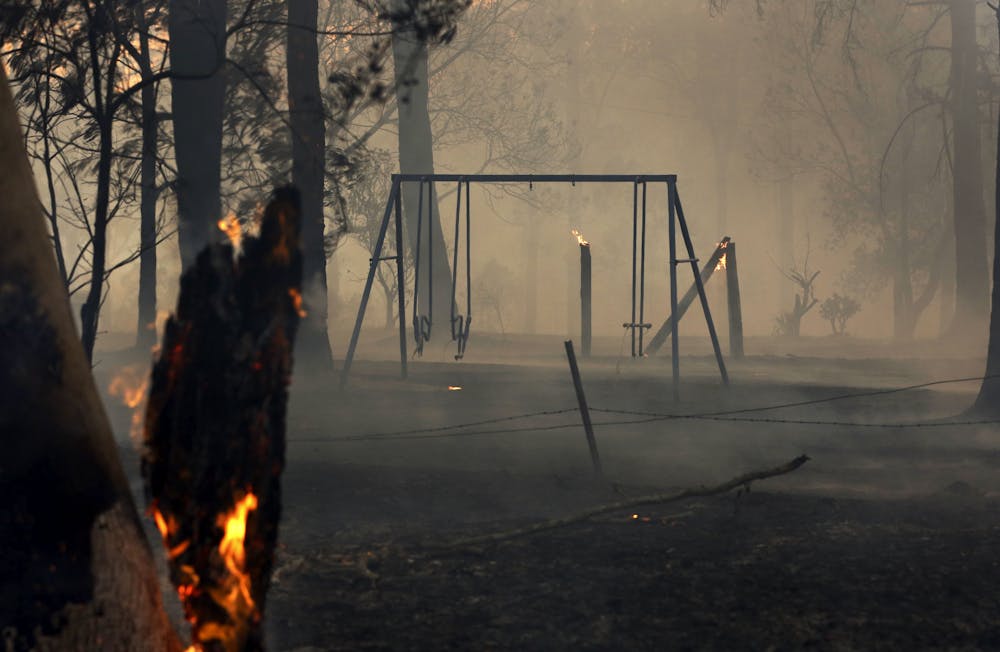
As the world watched the Black Summer bushfires in horror, we warned that when it did finally rain, our aquatic ecosystems would be devastated.

Following bushfires, rainfall can wash huge volumes of ash and debris from burnt vegetation and exposed soil into rivers. Fires can also lead to soil “hydrophobia”, where soil refuses to absorb water, which can generate more runoff at higher intensity. Ash and contaminants from the fire, including toxic metals, carbon and fire retardants, can also threaten biodiversity in streams.


Read more: The sweet relief of rain after bushfires threatens disaster for our rivers


As expected, when heavy rains eventually extinguished many fires, it turned high quality water in our rivers to sludge with the consistency of cake mix.

In the weeks following the first rains, we sampled from these rivers. This is what we saw.

Sampling the upper Murray River

Of particular concern was the upper Murray River on the border between Victoria and NSW, which is critical for water supply. There, the bushfires were particularly intense.
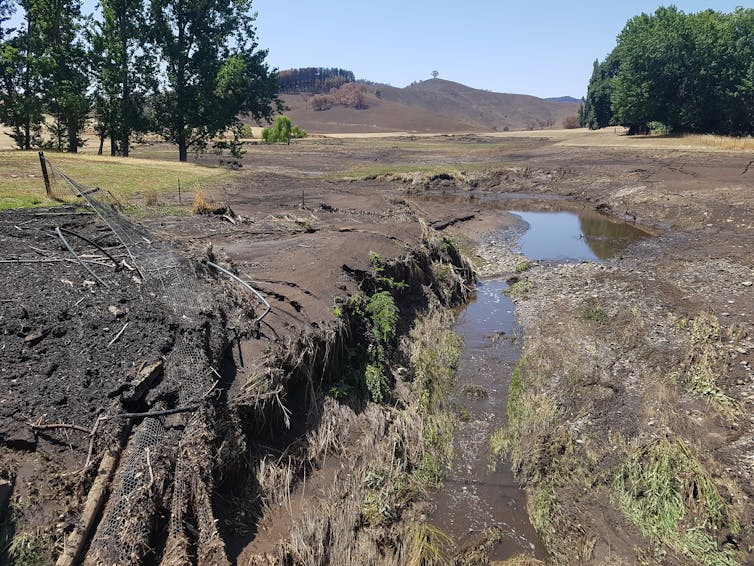
Sludge in Horse Creek near Jingellic following storm activity after the fire. Paul McInerney/Author Provided

When long-awaited rain eventually came to the upper Murray River catchment, it was in the form of large localised storms. Tonnes of ash, sediment and debris were washed into creeks and the Murray River. Steep terrain within burnt regions of the upper Murray catchment generated a large volume of fast flowing runoff that carried with it sediment and pollutants.

We collected water samples in the upper Murray River in January and February 2020 to assess impacts to riverine plants and animals.

Our water samples were up to 30 times more turbid (cloudy) than normal, with total suspended solids as high as 765 milligrams per litre. Heavy metals such as zinc, arsenic, chromium, nickel, copper and lead were recorded in concentrations well above guideline values for healthy waterways.
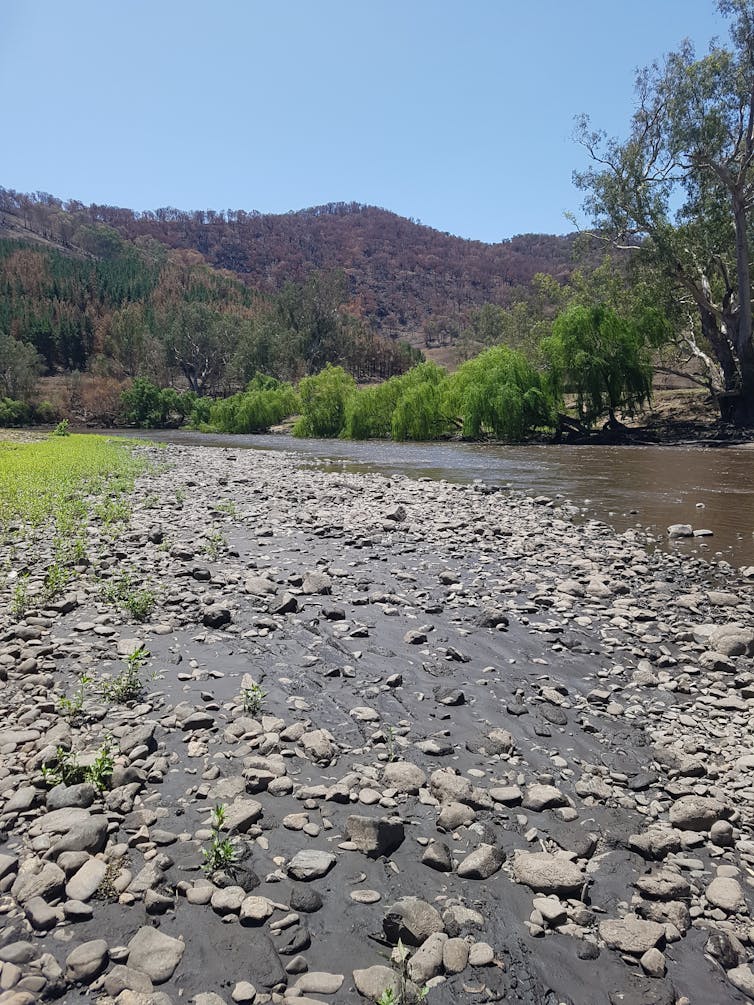
Ash and sediment blanketing cobbles in the Murray River. Paul McInerney/Author Provided

We took the water collected from the Murray River to the laboratory, where we conducted a number of toxicological experiments on duckweed (a floating water plant), water fleas (small aquatic invertebrates) and juvenile freshwater snails.

What we found

During a seven-day exposure to the bushfire affected river water, the growth rate of duckweed was reduced by 30-60%.

The water fleas ingested large amounts of suspended sediments when they were exposed to the affected water for 48 hours. Following the exposure, water flea reproduction was significantly impaired.

And freshwater snail egg sacs were smothered. The ash resulted in complete deaths of snail larvae after 14 days.


Read more: Before and after: see how bushfire and rain turned the Macquarie perch’s home to sludge


These sad impacts to growth, reproduction and death rates were primarily a result of the combined effects of the ash and contaminants, according to our preliminary investigations.

But they can have longer-term knock-on effects to larger animals like birds and fish that rely on biota like snail eggs, water fleas and duckweed for food.

What happened to the fish?

Immediately following the first pulse of sediment, dead fish (mostly introduced European carp and native Murray Cod) were observed on the bank of River Murray at Burrowye Reserve, Victoria. But what, exactly, was their cause of death?
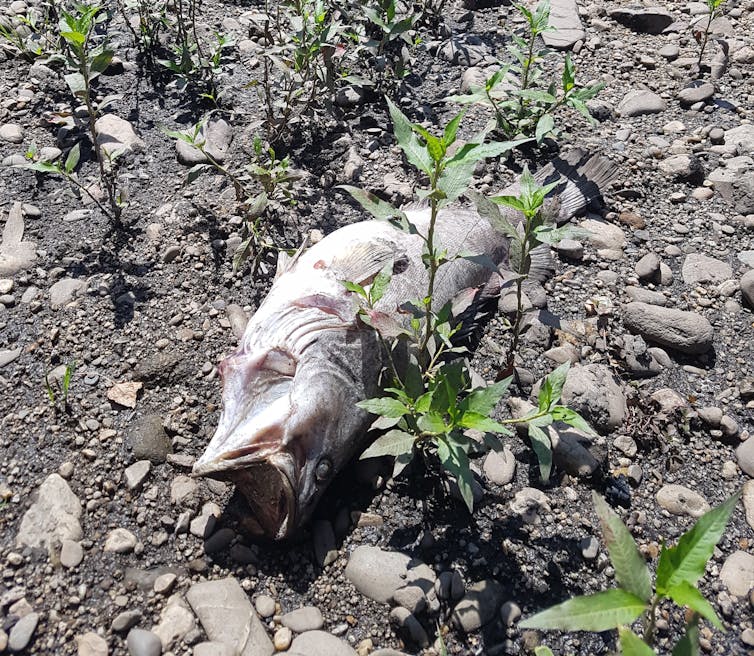
A dead Murray Cod found on the banks of the Murray River following storms after the bushfires. Paul McInerney/Author Provided

Our first assumption was that they died from a lack of oxygen in the water. This is because ash and nutrients combined with high summer water temperatures can trigger increased activity of microbes, such as bacteria.

This, in turn can deplete the dissolved oxygen concentration in the water (also known as hypoxia) as the microbes consume oxygen. And wide-spread hypoxia can lead to large scale fish kills.


Read more: Click through the tragic stories of 119 species still struggling after Black Summer in this interactive (and how to help)


But to our surprise, although dissolved oxygen in the Murray River was lower than usual, we did not record it at levels low enough for hypoxia. Instead, we saw the dead fish had large quantities of sediment trapped in their gills. The fish deaths were also quite localised.

In this case, we think fish death was simply caused by the extremely high sediment and ash load in the river that physically clogged their gills, not a lack of dissolved oxygen in the water.

These findings are not unusual, and following the 2003 bushfires in Victoria fish kills were attributed to a combination of low dissolved oxygen and high turbidity.

So how can we prepare for future bushfires?

Preventing sediment being washed into rivers following fires is difficult. Installing sediment barriers and other erosion control measures can protect specific areas. However, at the catchment scale, a more holistic approach is required.


Read more: The NSW bushfire inquiry found property loss is ‘inevitable’. We must stop building homes in such fire-prone areas


One way is to increase efforts to re-vegetate stream banks (called riparian zones) to help buffer the runoff. A step further is to consider re-vegetating these zones with native plants that don’t burn easily, such as Blackwood (Acacia melanoxylin).

Streams known to host rare or endangered aquatic species should form the focus of any fire preparation activities. Some species exist only in highly localised areas, such as the endangered native barred galaxias (Galaxias fuscus) in central Victoria. This means an extreme fire event there can lead to the extinction of the whole species.
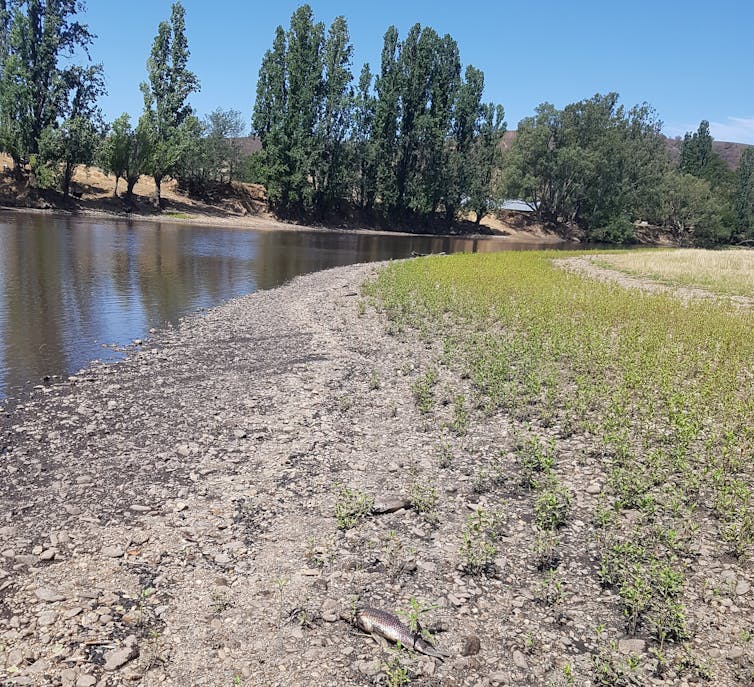
Ash and dead fish on the banks of the Murray River near Jingellic following Black Summer fires. Paul McInerney/Author Provided

That’s why reintroducing endangered species to their former ranges in multiple catchments to broaden their distribution is important.

Increasing the connectivity within our streams would also allow animals like fish to evade poor water quality — dams and weirs can prevent this. The removal of such barriers, or installing “fish-ways” may be important to protecting fish populations from bushfire impacts.

However, dams can also be used to benefit animal and plant life (biota). When sediment is washed into large rivers, as we saw in the Murray River after the Black Summer fires, the release of good quality water from dams can be used to dilute poor quality water washed in from fire affected tributaries.


Read more: California is on fire. From across the Pacific, Australians watch on and buckle up


Citizen scientists can help, too. It can be difficult for researchers to monitor aquatic ecosystems during and immediately following bushfires and unmanned monitoring stations are often damaged or destroyed.

CSIRO is working closely with state authorities and the public to improve citizen science apps such as EyeOnWater to collect water quality data. With more eyes in more areas, these data can improve our understanding of aquatic ecosystem responses to fire and to inform strategic planning for future fires.

These are some simple first steps that can be taken now.

Recent investment in bushfire research has largely centred on how the previous fires have influenced species’ distribution and health. But if we want to avoid wildlife catastrophes, we must also look forward to the mitigation of future bushfire impacts.

ref. How bushfires and rain turned our waterways into ‘cake mix’, and what we can do about it – https://theconversation.com/how-bushfires-and-rain-turned-our-waterways-into-cake-mix-and-what-we-can-do-about-it-144504


Carmen Parahi: The Fourth Estate needs to be aware of how it supports inequity

COMMENTARY: By Carmen Parahi

Since 2001, I’ve worked in both mainstream news and Māori media. I love journalism but it’s a hard slog being a Māori reporter.

In the mainstream news, Māori reporters are a minority, Māori stories and voices aren’t given a similar priority to other stories unless it’s adversarial.

This is problematic because it creates inequity for Māori.

READ MORE: Te Wiki o te Reo Māori – Māori language week

Te Wiki o te Reo Māori

We don’t provide a counter-balance to the adversarial stories because we don’t report enough on other aspects of Māori society. This distorts the narrative about Māori by portraying them negatively and as being outside the perspective of the news media.

The example for Māori can be used for any minority culture in Aotearoa New Zealand.

The news media system, its organisations and personnel are supposed to represent everyone. They don’t and never have historically.

The first papers appeared in the mid-1800s. They were instruments of the Crown and represented settlers’ perspectives on issues related to settlement including land disputes with Māori.

News media set up to favour Western ideologies
Like so many other colonial systems such as education, the news media was set up to support and favour Western European ideologies and practices.

For Māori to be included in any of those structures they have to adopt English and Pākehā cultural norms. If they don’t, then they are excluded.

The public voices and perspectives of Māori were marginalised by the news media then and although it has improved over time, Māori are still not well represented now.

Mainstream newsrooms across the country are mainly filled with Pākehā. This is neither good nor bad, it is a fact. What this means is, if we’re not aware of it, the lens being used to generate the news and influence our communities is monocultural.

As journalists, we are held to account by public opinion, a set of industry principles, defamation laws and newsroom codes of conduct. We are supposed to be independent, without bias or favour.

This is difficult to achieve when the news system and newsrooms aren’t being constantly monitored to ensure it isn’t biased or favours Pākehā perspectives.


Hard for younger minority journalists

In my early reporter years, I dropped aspects of my Māoritanga to fit in. This isn’t the case for me now because I’m a senior reporter but it can be for younger minority journalists.

My independence, important to journalism, is often questioned by other reporters and the public. I’m seen to be biased because I’m Māori and focus on Māori perspectives.

I have a file full of emailed complaints, some of them racist, about the stories I write.

For example, one guy called me a “f….. b…. and said: “The reason there is racism in this country is because you are a racist against New Zealand Europeans opening your racist gob and spreading your racist words.”

It can get a bit lonely being the lone Māori voice in a newsroom. I have a Stuff whānau who supports me. I could stop focusing on Māori but who else will do it?

It is my way of supporting the community even though I’ve been left in tears by Māori questioning how Māori I am and why I’m reporting on them.

When I backed Stuff’s campaign to make Matariki a public holiday, a Māori reader called me a kūare, an insulting term.

A purpose to the query
I like it when colleagues ask me for advice on all things Māori, I don’t mind because there is a purpose to the query. But sometimes, cultural differences can cause conflict in the newsroom.

I recall years ago printing off a report and my workmate said, ‘could you hurry up with printing that Māori s…’. Another colleague around that time asked me to stop pronouncing Māori place names correctly because no one knew where I was talking about.

I nearly got into a physical fight with a reporter who called my cultural practices, politically correct bulls….

Obviously I wouldn’t still be in the industry if I didn’t think there is some good in it, including all the people I’ve worked with over the years, despite our differences. Newsrooms are trying to be more inclusive in everything they do. We’ve come a long way from our news forefathers of yesteryear.

At Stuff, we no longer pluralise Māori words, only an apostrophe ‘s’ on possessive nouns. In 2017, Stuff introduced macrons during te wiki o te reo Māori, the Māori Language week.

This weekend, we kicked off plans to reclaim te reo Māori and culture in support of Māori language week. All of our mastheads will carry reo Māori names supported by local iwi.

Uplifting the voices of Māori
We’ve been purposefully creating projects and stories to uplift the voices of Māori and all cultures of Aotearoa New Zealand such as Nā Niu Tīreni and our new series, Aotearoa in 20.

I believe the news system can be better and more inclusive. Our younger generation of reporters tend to be less monocultural in their views and thinking.

But if we don’t change our representation of all cultures now, they may carry the same marginalisation practices of the past into the future.

The older ones, like myself, know it’s time to do more if we are to truly represent the bicultural foundations of Aotearoa New Zealand and its multicultural society.

Carmen Parahi (Ngāti Kahungunu, Ngāti Hine, Rongowhakaata) is national correspondent for Stuff. The Pacific Media Centre/Te Amokura is republishing her articles with permission.

Print Friendly, PDF & Email

Article by AsiaPacificReport.nz

Harnessing power of trendy teens ‘a key for language revitalisation’

By AUT News

Teenage trendsetters are one of the keys to sustainable language revitalisation and points to an unlikely source of inspiration – the Korean wave, says Dr Rachael Ka’ai-Mahuta of Auckland University of Technology’s Te Ipukarea Research Institute.

Korean popular culture is driving interest in Korean language and culture, and has had a large impact on wider popular culture, to the extent that the Korean Wave is subverting the English language as the language of popular culture.

Dr Ka’ai-Mahuta said that pop culture impacted on the language choices teens made, and points to the lack of te reo material aimed at teens/young adults.

READ MORE: Te Wiki o te Reo Māori – Māori language week

Te Wiki o te Reo Māori

“Language and culture go hand in hand. They inform each other, and learning a language provides insights into culture that otherwise might pass us by,” said Dr Ka’ai-Mahuta.

“There’s an amazing wealth of te reo Māori resources available now, but they’re mostly targeted at younger kids, particularly preschoolers.

“We need more Māori language content like novels, TV shows, music and games aimed at teens.

“Teens have a role as trendsetters and fandom-builders. They have the power to adopt and normalise te reo Māori and make it part of their everyday lives.

Te Ipukarea Research Institute at AUT is currently leading a research project, funded by Ngā Pae o te Māramatanga, looking at how the Māori language can be better supported in the lives of adolescents, based on the idea that the Māori language of adolescence forms the building blocks of non-formal adult language, or the language of friendship, humour, relationships, emotions, and mental health.

The preliminary findings of show the strategic importance of the teenage age group for Māori language revitalisation, noting that teenagers are trendsetters and can have an impact on and be influenced by the perceived value of the Māori language and therefore, its status.

“I like to imagine a near future where we have equivalents of KPop group BTS or movies in te reo Māori that garner the widespread admiration of award-winning movies like Parasite,” said Dr Ka’ai-Mahuta.

Print Friendly, PDF & Email

Article by AsiaPacificReport.nz

Behind the new Samsung Fold: how the quest to maximise screen size is driving major innovation

Source: The Conversation (Au and NZ) – By Andrew Maxwell, Senior Lecturer, University of Southern Queensland

To enlarge a phone, or not to enlarge a phone? That is the question. In the world of flagship smartphones, there seems to be one clear trend: bigger is better.

Manufacturers are trying to strip away anything that might stand in the way of the largest possible slab of screen. There is also growing demand for thinner phones with diminishing bezels (the area surrounding a screen).

This trend has now culminated in the latest innovation in smartphone design, the foldable screen phone. These devices sport thin OLED self illuminating screens that can be folded in half.

The newest release is the Samsung Galaxy Z fold 2 – a device that is almost three-quarters screen and has extravagant overtones rivalled only by a hefty A$2,999 price tag.

But to prevent the phones themselves from growing to unwieldy size, manufacturers are having to find ways to balance size with usability and durability. This presents some interesting engineering challenges, as well as some innovative solutions.

A giant, old-style phone
Why do we love large phones? Pixabay, CC BY-NC-ND

Internal design complexities of folding phones

Modern phones still typically use a thin LCD or plastic OLED display covered by an outer glass panel.

Folding displays are a new category that exploit the flexibility of OLED display panels. Instead of simply fixing these panels to a rigid glass panel, they carefully engineer the panel so that it bends – but never quite tightly enough to snap or crack.

Internal structural support is needed to make sure the panel doesn’t crease, or isn’t stressed to the point of creating damage, discolouration or visible surface ripples.

Since this is a mechanical, moving system, reliability issues need to be considered. For instance, how long will the hinge last? How many times can it be folded and unfolded before it malfunctions? Will dirt or dust make its way into the assembly during daily use and affect the screen?

Such devices need an added layer of reliability over traditional slab-like phones, which have no moving parts.


Read more: The new iPhone SE is the cheapest yet: smart move, or a premium tech brand losing its way?


Large screen, thin phone: a recipe for disaster?

Each generation of smartphones becomes thinner and with smaller bezels, which improves the viewing experience but can make the phone harder to handle.

In such designs, the area of the device you can grip without touching the display screen is small. This leads to a higher chance of dropping the device – a blunder even the best of us have made.

There’s an ongoing tussle between consumers and manufacturers. Consumers want a large, viewable surface as well as an easily portable and rugged device. But from an engineering point of view, these are usually competing requirements.

You’ll often see people in smartphone ads holding the device with two hands. In real life, however, most people use their phone with one hand.

Thus, the shift towards larger, thinner phones has also given rise to a boom in demand for assistive tools attached to the back, such as pop-out grips and phone rings.

In trying to maximise screen size, smartphone developers also have to account for interruptions in the display, such as the placement of cameras, laser scanners (for face or object identification), proximity sensors and speakers. All are placed to minimise visual intrusion.

Now you see it, now you don’t

In the engineering world, to measure the physical world you need either cameras or sensors, such as in a fingerprint scanner.

With the race to increase the real estate space on screens, typically these cameras and scanners are placed somewhere around the screen. But they take up valuable space.

This is why we’ve recently seen tricks to carve out more space for them, such as pop up cameras and punch-hole cameras, in which the camera sits in a cutout hole allowing the display to extend to the corners.

Front view of Samsun Galaxy Note 10.
The Samsun Galaxy Note 10 has a centered punch hole front-facing camera. Samsung

But another fantastic place for sensors is right in front of us: the screen. Or more specifically, under the screen.

Samsung is one company that has suggested placing selfie-cameras and fingerprint readers behind the screen. But how do you capture a photo or a face image through a layer of screen?

Up until recently, this has been put in the “too hard basket”. But that is changing: Xiaomi, Huawei and Samsung all have patents for under-display cameras.

There are a range of ways to do this, from allowing a camera to see through the screen, to using microlenses and camera pixels distributed throughout the display itself – similar to an insect’s compound eye.

In either case, the general engineering challenge is to implement the feature in a way that doesn’t impact screen image quality, nor majorly affect camera resolution or colour accuracy.

Close up of an insect's compound eyes
Insects have compound eyes. These are made up of repeating units called the ommatidia, sometimes with thousands in each eye. Each ommatidia is a separate visual receptor. Shutterstock

Laptops in our pockets

With up to 3.8 billion smartphone users expected by 2021, mobile computing is a primary consumer technology area seeing significant growth and investment.

One driver for this is the professional market, where larger mobile devices allow more efficient on-the-go business transactions. The second market is individuals who who only have a mobile device and no laptop or desktop computer.

It’s all about choice, but also functionality. Whatever you choose has to get the job done, support a positive user experience, but also survive the rigours of the real world.


Read more: Apple’s iPhone 11 Pro wants to take your laptop’s job (and price tag)


ref. Behind the new Samsung Fold: how the quest to maximise screen size is driving major innovation – https://theconversation.com/behind-the-new-samsung-fold-how-the-quest-to-maximise-screen-size-is-driving-major-innovation-145700

Paid parental leave needs an overhaul if governments want us to have ‘one for the country’

Source: The Conversation (Au and NZ) – By Sarah Duffy, Lecturer, School of Business, Western Sydney University

As Australia and New Zealand face the realities of slow growth, or even a decline in population, it’s time to ask if their governments are doing enough. Especially if they want to encourage people to have more babies.

New Zealand’s fertility rate has hit an all-time low of 1.71 children per woman. The opposition National Party wants to entice parents with a NZ$3,000 “baby bonus” to be spent on family services.

Australia’s population growth rate is forecast to be 0.6% in 2021, its lowest since 1916.

Federal Treasurer Josh Frydenburg urged Australians to have more children, reminding many of then treasurer Peter Costello’s encouragement to those who can to have “one for mum, one for dad and one for the country”.

But if governments want people to procreate for their nation, they must be prepared to help them, and that includes increases in paid parental leave.

The current system

New Zealand introduced paid parental leave in 1999, first as a tax credit then as a cash payment. Over time, the length was increased from 12 to 26 weeks, currently paid to a maximum of NZ$606.46 a week.

There is no paid parental leave offered to dads or partners (although they are legally entitled to two weeks’ unpaid leave). But mums may transfer a portion of the 26 weeks to the dad or partner.


Read more: Reforming ‘dad leave’ is a baby step towards greater gender equality


Ten years ago, Australia was one of the last countries in the developed world to adopt government-funded maternity leave.

It offers the primary carer (99.5% of the time, the mum) 18 weeks of paid leave at the minimum wage (currently A$753.80). Only two weeks at the minimum wage is provided for the secondary carer.

When you compare the payment rates of parental leave to average salaries in each country (table below), Australia’s 18 weeks drops to an equivalent of 7.9 weeks annual average salary and New Zealand from 26 weeks to 15.5 weeks.

These low leave payments appear even less generous when compared to the OECD average of 54.1 weeks of paid parental leave for mums and eight weeks for dads or partners.

While employers often top up state-paid parental leave entitlements, this is not always the case. For example, Australia’s Workplace Gender Equality Agency found more than 70% of financial services companies offered paid parental leave, but more than 80% of retail businesses did not.

Earning or caring

Given that dads or partners on both sides of the ditch face either no income for two weeks or less then half of the average income, it’s no wonder they choose to keep working to support their families financially.

We know from an Australian Human Rights Commission study in 2014 that 85% of dads and partners surveyed took up to four weeks’ leave, and more than half said they would have liked to take more to spend time with mum and newborn. There are substantial benefits including an increase in the mental health and well‐being of fathers and their children as well as greater harmony for the couple.

Motherhood penalises women, contributing to significantly lower lifetime earnings. Not to mention the “second shift” of domestic duties they do if they are balancing work and family.

If dads and partners spend more time with their families earlier on in their children’s lives, this increases the likelihood that household chores and caring responsibilities will be more evenly distributed.

A mum, dad and a baby.
Happier families if proper paid leave helps both parents to be involved in early baby care. Shutterstock/Dragon Images

Womens’ employment has also been hit harder by the COVID-19 pandemic. This includes receiving less government assistance.

The move to roll back free child care in Australia was called a “betrayal of Australian families” and “an anti-women move” by Greens Senator Mehreen Faruqi.

In addition to the “second shift”, women bear the brunt of a “third shift” – known as the mental load. The business of running the family is characteristically undervalued and unpaid emotional labour, which is mostly taken care of by women.

For many dual-income families, lockdown has changed the allocation of household chores and caring responsibilities. Research shows the gap between men and women has narrowed.

More women in the workplace

In the upcoming New Zealand election, it will be interesting to see how the different parties deal with supporting families, the gender pay gap and female workforce participation.

If ever an example was needed to show how satisfying a non-traditional care arrangement can be for both parents, consider stay-at-home dad Clarke Gayford, who supports Jacinda Ardern to be New Zealand’s prime minister.

Our previous research found government policy alone does not increase the uptake of dads or partners taking parental leave. Changing workplace norms to support them is a key factor in creating flexible work arrangements and increasing parental leave uptake.


Read more: Father’s days: increasing the ‘daddy quota’ in parental leave makes everyone happier


Working from home has made fatherhood more visible and increased the time some Australian dads spend caring for their children.

In a post-pandemic world, care responsibilities can no longer be labelled a private matter. New Zealand and Australia both have parental leave policies that fail to offer families real choices about care arrangements.

Dads and partners need their own leave entitlements and greater acceptance of their caring responsibilities in the workplace. These changes will challenge caring as women’s work, ease the burden on women and may even boost the fertility rate.

ref. Paid parental leave needs an overhaul if governments want us to have ‘one for the country’ – https://theconversation.com/paid-parental-leave-needs-an-overhaul-if-governments-want-us-to-have-one-for-the-country-145627

The Sydney Olympics: How did the ‘best games ever’ change Australia?

Source: The Conversation (Au and NZ) – By David Rowe, Emeritus Professor of Cultural Research, Institute for Culture and Society, Western Sydney University

On Tuesday, it will be 20 years since the Olympic opening ceremony in Sydney, kicking off the “best games ever”.

Our newspapers and TV screens are now awash with nostalgia about great sporting moments and the spectacle and ceremony of the Olympics.


Read more: Freeman review: documentary relives the time Cathy Freeman flew, carrying the weight of the nation


It was certainly a very big party. But with the hindsight of 20 years, other than creating a lot of classic sporting memories, did the Olympics change us?

An ambivalent legacy

There is considerable ambivalence regarding Sydney 2000.

The economics of mega sports events are notoriously slippery and difficult to work out.

In 1993, KPMG estimated there would a more than $7 billion benefit to the national economy. But subsequent analyses produced other figures. A 1998 estimate by University of Tasmania and NSW Treasury economists suggested there would be only a 0.11% effect on GDP over the 12-year Olympic phase.

On other measures, the impact is also difficult to see.

The Olympics did not generate a sustained increase in sport participation in Australia. And its legacy as a “Green Games” is debatable.

The main Olympic site did create usable space and parklands on what was a huge, derelict industrial site in Sydney’s west. The athlete’s village also became a solar-powered suburb. But two decades on, Sydney Olympic Park is still searching for a soul during the working week.

A global Australia

So, where did Sydney 2000 leave its biggest mark on 21st century Australia?

Australia had held the Olympics before Sydney, but Melbourne in 1956 was a very different affair. There were fewer than 100,000 television sets in the country and no live international satellite transmission.

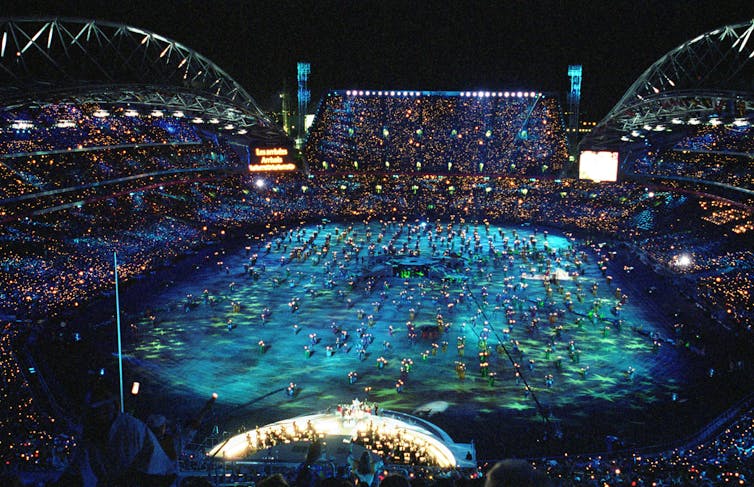
Sydney 2000 provided a striking opportunity for Australia to project a global image as a sophisticated, multicultural nation.

Aerial shot of Sydney Olympic opening ceremony
Sydney 2000 put Australian on the world stage. Julian Smith/AAP

Although Olympic tourism promotion relied heavily on Australia’s natural environment, its strategy made room for showing Australia as a highly urbanised, culturally diverse society.

Most importantly, Australia avoided the huge reputational hit of getting the games “wrong”. Only four years earlier, the 1996 Atlanta Olympics were widely criticised for being poorly organised and over-commercialised. It also had to contend with a domestic terrorist bombing.

The Sydney games, supported by an army of volunteers, generally went off without a hitch and received plenty of plaudits. It generated goodwill on which the city and country could trade, literally, in ensuing decades.

Indigenous Australia

In the lead up to the games, I was interviewed by a number of foreign journalists doing background stories. One topic dominated all others – the state of Indigenous relations in Australia.

Journalists were all too aware Aboriginal and Torres Strait Islanders had mooted a boycott of the games, perhaps supported by some African nations, due to Australia’s maltreatment of its Indigenous peoples.

A considerable effort was made by the Sydney Olympic organising committee to involve First Australians. As a result, one of the most powerful and enduring themes of the games was Indigenous Australia.

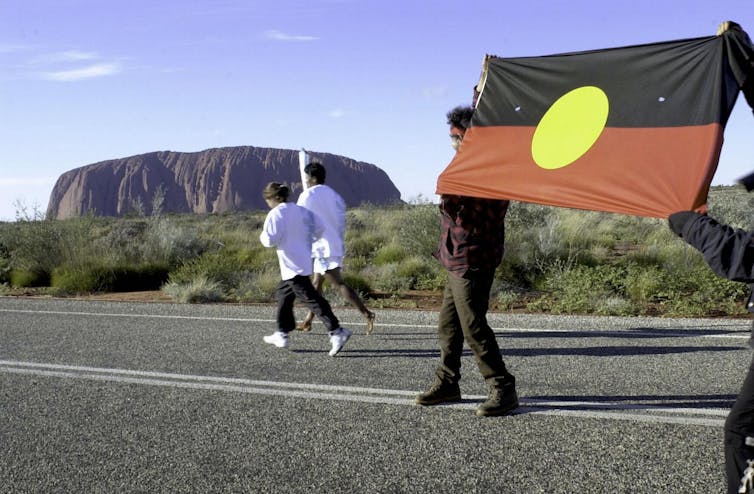
It ran through the Cultural Olympiad’s Festival of the Dreaming, the Olympic Park’s Aboriginal cultural pavilion and the arrival of the Olympic torch at Uluru.

The Olympic torch is carried past Uluru
The Olympic torch arrived at Uluru in June 2000. Steve Holland/AP

The opening ceremony featured multiple Indigenous-themed segments, while the closing ceremony showcased Christine Anu’s performance of “My Island Home”. In their performances, Midnight Oil and Savage Garden also wore “Sorry” and Indigenous flag clothing.

And most memorably, Cathy Freeman lit the Olympic cauldron and won the women’s 400 metres, bearing the sky high expectations of the nation as she ran.

In the era of Black Lives Matter, nobody could claim that Sydney 2000 had a transformative impact on Indigenous peoples’ futures.


Read more: Why the Black Lives Matter protests must continue: an urgent appeal by Marcia Langton


But its legacy – that any representation of Australia must always have a deep, serious Indigenous presence – should not be underestimated.

Sporting Australia

As the largest sporting event ever held in Australia, the Sydney games had a ripple effect across the entire sport landscape in the country.

Its success signalled that Australia was capable of hosting mega sport events with efficiency and flair.

Sydney 2000 set the standard for several Australia-hosted major sport events to follow — the 2003 Rugby World Cup, 2006 and 2018 Commonwealth Games, 2015 AFC Cup, 2015 Cricket World Cup and 2020 Women’s T20 Cricket World Cup.

A victory parade for the Australian team after the 2018 Commonwealth Games
Australia has gone on to host a swathe of successful international sporting events post 2000. David Peled/AAP

It also gave confidence for the (albeit unsuccessful) bid for the 2022 FIFA Men’s World Cup and the successful bid for the 2023 FIFA Women’s World Cup.

The Olympics paved the way for successive Australian sports diplomacy strategies. These include promoting Australia’s expertise in helping other countries host major events, not least their opening and closing ceremonies.

Importantly, Sydney also provided a very substantial boost to the Paralympic Games, a legacy of which the nation can be justly proud.


Read more: A brief history of the Paralympic Games: from post-WWII rehabilitation to mega sport event


Australia was already a renowned sporting nation before Sydney 2000. Afterwards, it could claim to be an influential player in global sport.

The lucky games

The Sydney games were fortunate the 9/11 bombers did not make their move in New York precisely one year earlier, which would have meant disruption and possible cancellation.

Sail boats in front of the Sydney Harbour Bridge.
The Sydney Games were lucky to have two weeks of good weather. And no catastrophes. Dean Lewins/AAP

Unlike the postponed Tokyo 2020 (and possibly cancelled) Tokyo 2021 Games, Sydney was also lucky not to coincide with a global pandemic.

Sydney 2000 shows that legacy is, finally, dependent as much on luck as good planning. But those 17 days in September linger as a significant moment in Australia’s sporting and social history, when the country was at the heart of the global village.

ref. The Sydney Olympics: How did the ‘best games ever’ change Australia? – https://theconversation.com/the-sydney-olympics-how-did-the-best-games-ever-change-australia-145926

Now everyone’s a statistician. Here’s what armchair COVID experts are getting wrong

Source: The Conversation (Au and NZ) – By Jacques Raubenheimer, Senior Research Fellow, Biostatistics, University of Sydney

If we don’t analyse statistics for a living, it’s easy to be taken in by misinformation about COVID-19 statistics on social media, especially if we don’t have the right context.

For instance, we may cherry pick statistics supporting our viewpoint and ignore statistics showing we are wrong. We also still need to correctly interpret these statistics.

It’s easy for us to share this misinformation. Many of these statistics are also interrelated, so misunderstandings can quickly multiply.

Here’s how we can avoid five common errors, and impress friends and family by getting the statistics right.

1. It’s the infection rate that’s scary, not the death rate

Social media posts comparing COVID-19 to other causes of death, such as the flu, imply COVID-19 isn’t really that deadly.

But these posts miss COVID-19’s infectiousness. For that, we need to look at the infection fatality rate (IFR) — the number of COVID-19 deaths divided by all those infected (a number we can only estimate at this stage, see also point 3 below).

While the jury is still out, COVID-19 has a higher IFR than the flu. Posts implying a low IFR for COVID-19 most certainly underestimate it. They also miss two other points.

First, if we compare the typical flu IFR of 0.1% with the most optimistic COVID-19 estimate of 0.25%, then COVID-19 remains more than twice as deadly as the flu.

Second, and more importantly, we need to look at the basic reproduction number (R₀) for each virus. This is the number of extra people one infected person is estimated to infect.

Flu’s R₀ is about 1.3. Although COVID-19 estimates vary, its R₀ sits around a median of 2.8. Because of the way infections grow exponentially (see below), the jump from 1.3 to 2.8 means COVID-19 is vastly more infectious than flu.

When you combine all these statistics, you can see the motivation behind our public health measures to “limit the spread”. It’s not only that COVID-19 is so deadly, it’s deadly and highly infectious.


Read more: How deadly is the coronavirus? The true fatality rate is tricky to find, but researchers are getting closer


2. Exponential growth and misleading graphs

A simple graph might plot the number of new COVID cases over time. But as new cases might be reported erratically, statisticians are more interested in the rate of growth of total cases over time. The steeper the upwards slope on the graph, the more we should be worried.


Read more: Coronavirus is growing exponentially – here’s what that really means


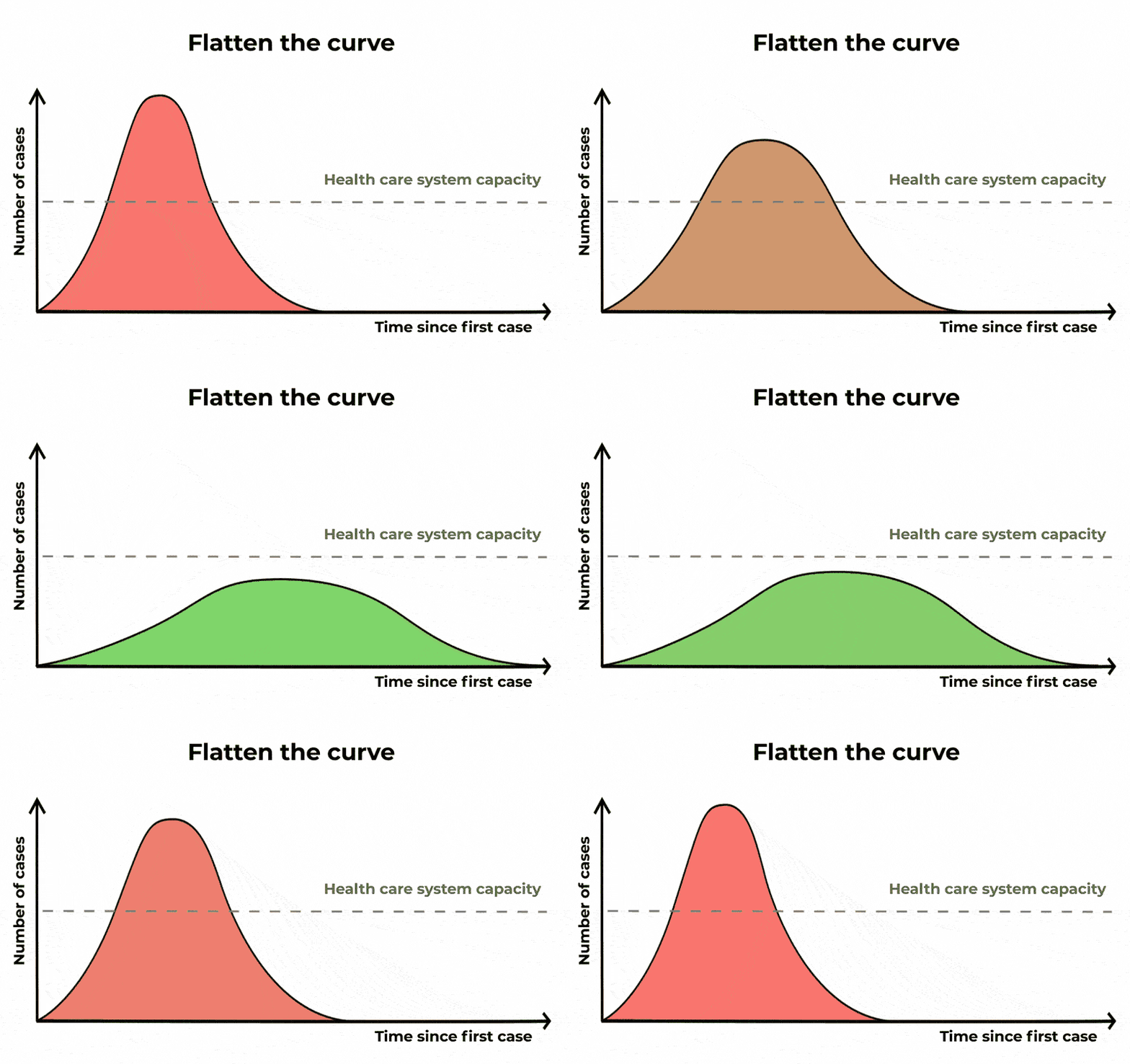
For COVID-19, statisticians look to track exponential growth in cases. Put simply, unrestrained COVID cases can lead to a continuously growing number of more cases. This gives us a graph that tracks slowly at the start, but then sharply curves upwards with time. This is the curve we want to flatten, as shown below.

“Flattening the curve” is another way of saying “slowing the spread”. The epidemic is lengthened, but we reduce the number of severe cases, causing less burden on public health systems. The Conversation/CC BY ND

However, social media posts routinely compare COVID-19 figures with those of other causes of death that show:

Even when researchers talk of exponential growth, they can still mislead.

An Israeli professor’s widely-shared analysis claimed COVID-19’s exponential growth “fades after eight weeks”. Well, he was clearly wrong. But why?

His model assumed COVID-19 cases grow exponentially over a number of days, instead of over a succession of transmissions, each of which may take several days. This led him to plot only the erratic growth of the outbreak’s early phase.

Better visualisations truncate those erratic first cases, for instance by starting from the 100th case. Or they use estimates of the number of days it takes for the number of cases to double (about six to seven days).


Read more: The bar necessities: 5 ways to understand coronavirus graphs


3. Not all infections are cases

Then there’s the confusion about COVID-19 infections versus cases. In epidemiological terms, a “case” is a person who is diagnosed with COVID-19, mostly by a positive test result.

But there are many more infections than cases. Some infections don’t show symptoms, some symptoms are so minor people think it’s just a cold, testing is not always available to everyone who needs it, and testing does not pick up all infections.

Infections “cause” cases, testing discovers cases. US President Donald Trump was close to the truth when he said the number of cases in the US was high because of the high rate of testing. But he and others still got it totally wrong.

More testing does not result in more cases, it allows for a more accurate estimate of the true number of cases.

The best strategy, epidemiologically, is not to test less, but to test as widely as possible, minimising the discrepancy between cases and overall infections.

4. We can’t compare deaths with cases from the same date

Estimates vary, but the time between infection and death could be as much as a month. And the variation in time to recovery is even greater. Some people get really ill and take a long time to recover, some show no symptoms.

So deaths recorded on a given date reflect deaths from cases recorded several weeks prior, when the case count may have been less than half the number of current cases.

The rapid case-doubling time and protracted recovery time also create a large discrepancy between counts of active and recovered cases. We’ll only know the true numbers in retrospect.

5. Yes, the data are messy, incomplete and may change

Some social media users get angry when the statistics are adjusted, fuelling conspiracy theories.

But few realise how mammoth, chaotic and complex the task is of tracking statistics on a disease like this.

Countries and even states may count cases and deaths differently. It also takes time to gather the data, meaning retrospective adjustments are made.

We’ll only know the true figures for this pandemic in retrospect. Equally so, early models were not necessarily wrong because the modellers were deceitful, but because they had insufficient data to work from.

Welcome to the world of data management, data cleaning and data modelling, which many armchair statisticians don’t always appreciate. Until now.


Read more: When a virus goes viral: pros and cons to the coronavirus spread on social media


ref. Now everyone’s a statistician. Here’s what armchair COVID experts are getting wrong – https://theconversation.com/now-everyones-a-statistician-heres-what-armchair-covid-experts-are-getting-wrong-144494

New learning economy challenges unis to be part of reshaping lifelong education

Source: The Conversation (Au and NZ) – By Martin Betts, Emeritus Professor, Griffith University

The new learning economy is creating opportunities for universities to move on from the current focus on cutting costs, downsizing and job losses. Many universities appear stuck in a downward spiral, but now may be the time to offset this with new initiatives. Growth in the need for ongoing learning creates these opportunities.

Current education providers, as well as new entrants, have the chance to replicate the business models and innovative practices of Spotify, YouTube, Uber, Airbnb and other disruptors of other sectors. For example, we can envisage a platform provider brokering crowd-sourced production of education content. The resourcing of expertise from the higher education sector would provide access to new, scaleable and more widely available forms of academic content.

Significant disruption is imminent. We believe those with ambition will thrive in the emerging new learning economy. They will not only disrupt, but also generate new forms of demand and supply for education.


Read more: Massive online open courses see exponential growth during COVID-19 pandemic


Old assumptions overturned

The education market has been stable for generations. This stability has relied on three assumptions.

First, knowledge gained through upfront education equips people to master the immediate and ongoing needs of work. As a basis of lifelong competence, the knowledge gained by novice professionals is expected to be sufficient for career entry and beyond.

Second, as we gain experience in our career, we only occasionally require new learning. Experience builds incrementally and continuously on upfront knowledge over time, leading to ever-increasing competence.

Third, there is no need for learning consciousness. In other words, the individual does not need to know how much they know, what else to learn, or how to unlearn.

These assumptions have driven government policy, student demand, employer practices and university business models. With changes to the future of work and digital disruption, these assumptions can now be seen as creating three systemic learning disorders:

  1. the rate of innovation and knowledge development has accelerated, so our knowledge is out of date sooner

  2. experience gained through repetitive work and professional practice is of less value in a world of changing practices and new requirements

  3. our competence is something about which we have less consciousness or literacy – we increasingly don’t know what we don’t know, and not knowing how to learn and unlearn matters even more.

The 3 learning disorders explained

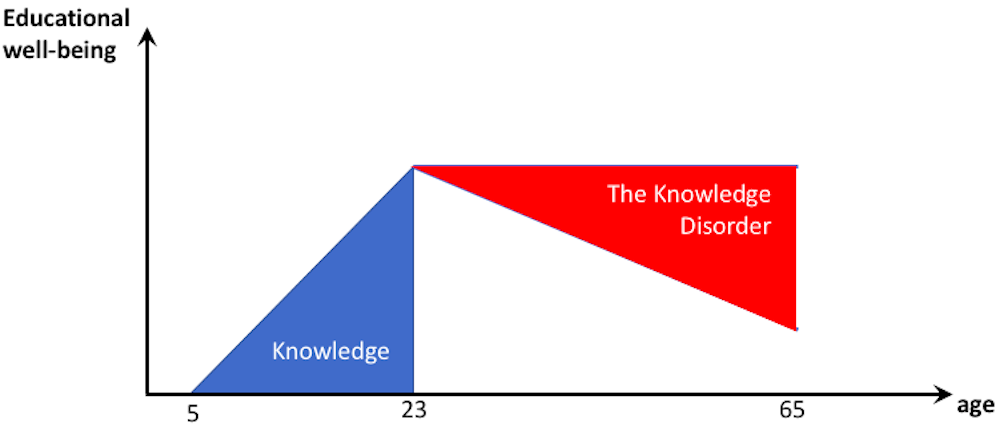
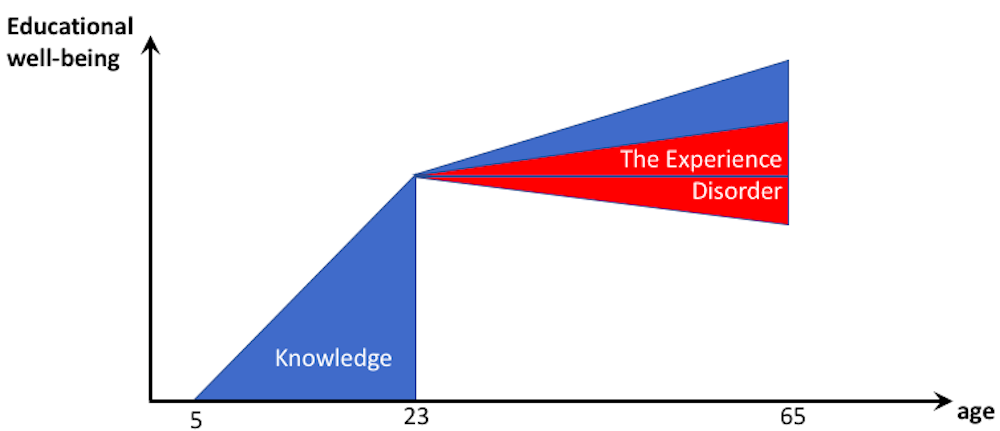
We illustrate these disorders in the three charts below. These plot the way knowledge, experience and competence develop over lifetimes, and the impacts of the emerging learning disorders.

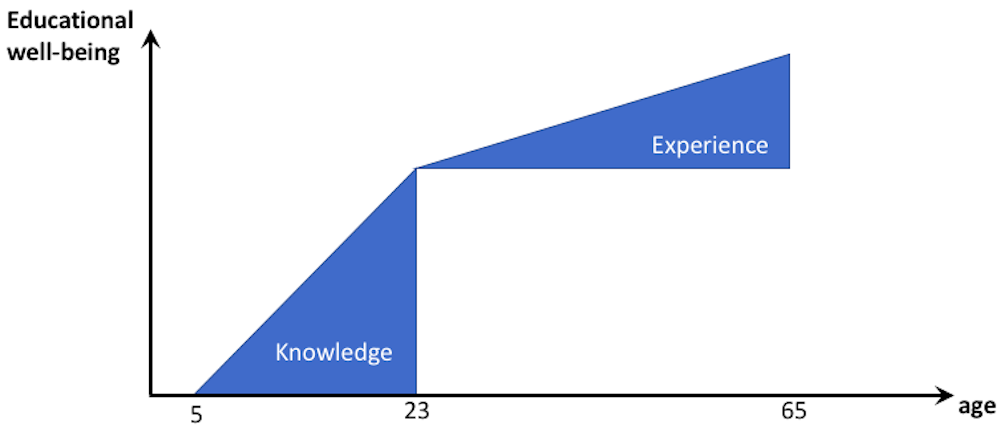
The first chart uses a simplistic model of learning development consistent with the seminal work on self-efficacy in education of Caprara et al. The underlying idea is that competence is a combination of knowledge gained from learning and experience gained from working.

The traditional model of learning: knowledge and experience combine to form competence. Author provided

However, competence is not sufficient. Similar to our understanding of physical well-being (for example, is my blood pressure OK?) or financial well-being (will I have enough super?), we need consciousness about our competence. We suggest this is the basis of educational well-being. The pursuit of this goal gives rise to the new learning economy.

The first disorder, the knowledge disorder, shown in the chart below, captures the fact that the knowledge gained from formalised learning now decays more quickly. This happens due to faster rates of innovation and knowledge development within the periods that learning had been designed to serve.

The knowledge disorder: knowledge is decaying more quickly. Author provided

The rate at which knowledge grows and develops has overtaken our intention to create novice professionals with knowledge lasting a lifetime. One-off degrees that testify to a certain qualification at a certain point in time are no longer sufficient. The world requires educational well-being as much as it requires a healthy and prosperous population.

The third chart shows how the value of experiences we gain in the workplace has changed. No longer does cumulative experience lead to increasing competence. Experiences of old ways of doing things are becoming hindrances to ongoing competence in disrupted environments.

The experience disorder: experience can become unhelpful. Author provided

As a result, experience might matter less. Even worse, it could become counter-productive when unlearning established practices becomes increasingly difficult. In some situations, current knowledge has become more important than past knowledge with added experience.

We can see the impacts of this experience disorder in recent years. Large organisations have let “experienced” staff go, then hired new graduates with contemporary knowledge. NAB was criticised for doing this.

How should education respond to these changes?

We predict we will see on-demand, tailored and customised learning on new platforms. These may be ubiquitous and scaleable programs of what are being called micro-credentials. Google’s “career certificates” are one recent example.

We foresee a need to support continuously improving workplace experience through partnerships between educational well-being providers, maybe universities, and providers and receivers of workplace experiences, employers and employees. We see opportunities for new, platform-based, lifelong experience-management services.


Read more: Coronavirus: universities are shifting classes online – but it’s not as easy as it sounds


The consciousness disorder arises from us being unaware of how change undermines competence. As US secretary of state, Donald Rumsfeld famously coined the term “unknown unknowns” in highlighting the danger in dealing with complex, fast-changing situations. In such a world, competence becomes more fragile, but we are not aware of it, which makes us vulnerable to disruption.

When Donald Rumsfeld spoke about ‘unknown unknowns’ he wasn’t talking about education, but the concept has emerged as a key issue for the sector.

We can foresee new services to help identify unconscious incompetence. Maybe automated online “health checks” of educational well-being will be made available to alumni. This service could be aligned with personalised access to new knowledge to address gaps.

We believe that responding to these three disorders, in these sorts of ways, provides a blueprint for a new learning economy. This learning economy is global and will scale up to satisfy the demands of citizens who are no longer served by our current model of education.

This evolution of education will not only present new directions for established education providers, but also attract new competitors. They might range from ed-tech start-ups with niche services, to others that see the global learning economy as a high-growth opportunity. Google is unlikely to be the last new challenger to the traditional university model.

ref. New learning economy challenges unis to be part of reshaping lifelong education – https://theconversation.com/new-learning-economy-challenges-unis-to-be-part-of-reshaping-lifelong-education-144800

What lies beneath: tunnels for trafficking, or just a subterranean service? Time to rescue these spaces from the conspiracists

Source: The Conversation (Au and NZ) – By Victoria Kolankiewicz, Research Assistant, Australian Centre for Architectural History, Urban and Cultural Heritage, University of Melbourne

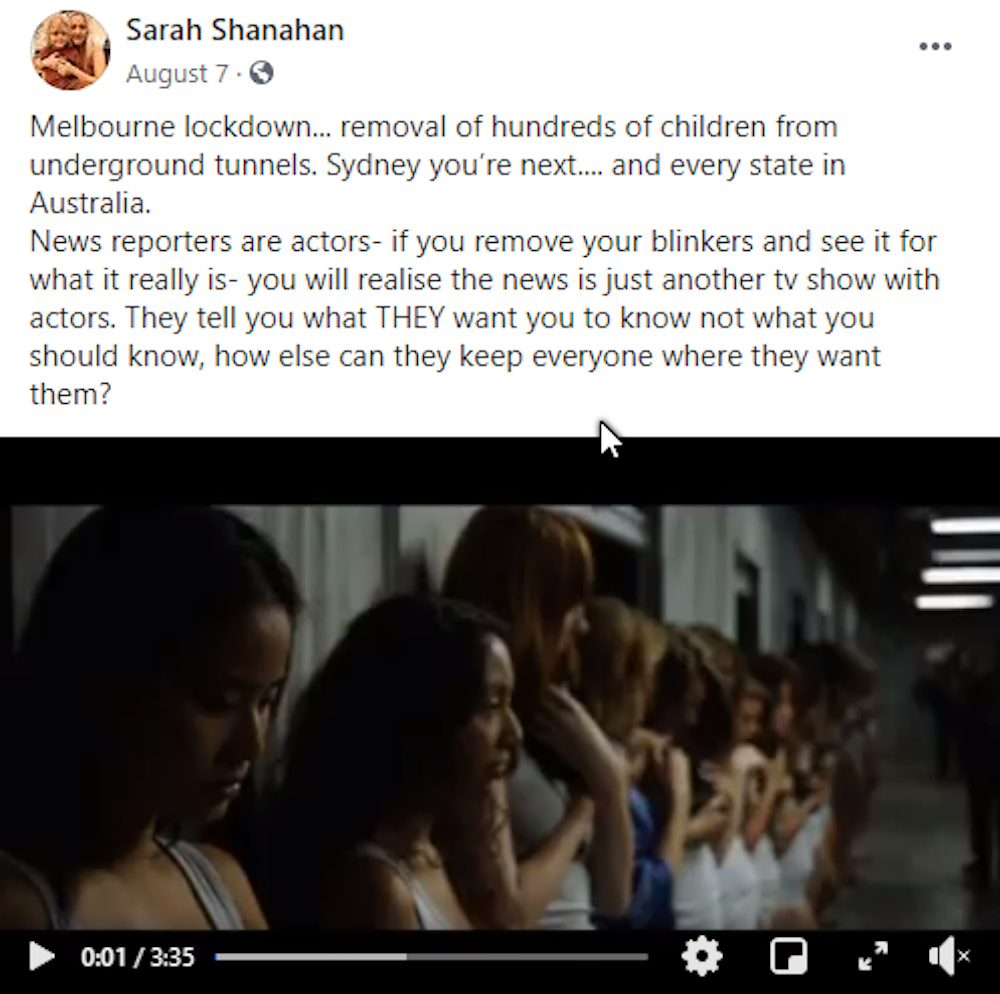
Digital communications have spread conspiracy theories more widely than ever before, particularly in this uncertain and tumultuous year. QAnon, for example, is a movement that seeks to identify a “deep state” or “global elite” complicit in human trafficking, “Pizzagate” and the orchestration of a global pandemic. One conspiracy theory “going viral” is that extensive operations are taking place to rescue children held in secret underground locales beneath densely populated cities.


Read more: How conspiracy theories spread online – it’s not just down to algorithms


Tunnel networks beneath major Australian cities such as Melbourne and Sydney have received similar treatment. Misconceptions of their form and purpose are communicated via social media. The stuff of urban legends, once circulated among acquaintances, is now online.

The misunderstandings of these spaces reveal a more glaring oversight: of wartime histories, transportation follies, essential services and the unique geologies and climates that require drainage infrastructure. These tunnels are hidden by necessity. But they are close enough to the surface to be easily accessible, preventing their use for any large-scale conspiracy.

A Facebook post of conspiracy theory linking Melbourne lockdown to children held captive in underground tunnels
A Facebook post linking the Melbourne COVID-19 lockdown to children held captive in underground tunnels. Facebook

Why the fixation with tunnels?

Abandoned or atypical urban spaces have long piqued the public imagination. Sites of abandonment are also associated with notions of freedom and excitement. Urban exploration has increased significantly within the past decade, amplified by social media sharing of imagery and aesthetics.

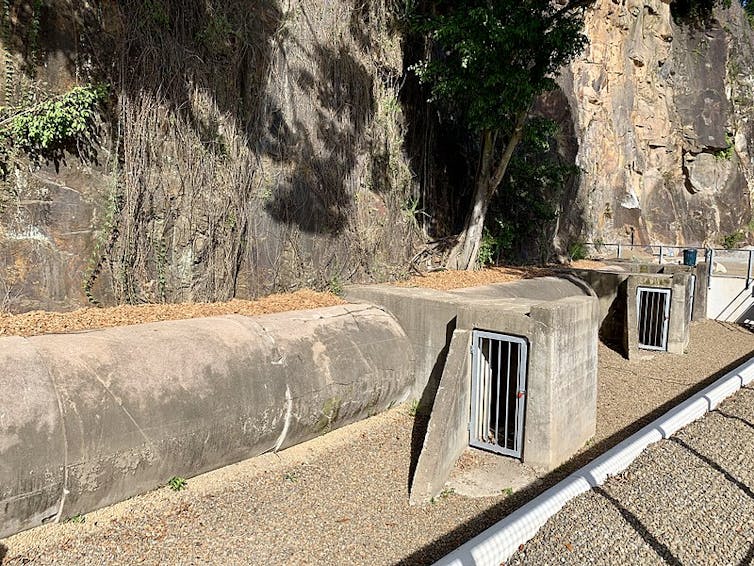
Rumours abound of complex tunnel networks in major Australian cities, created in the wake of the second world war. Larger air raid shelters were often located close to urban settlement, but escaped use. They remained in public memory as mythology: bunkers can be located across Australia, from Dover Heights in Sydney, to Prospect and Glenelg in Adelaide. Over 20 air raid shelters exist in Brisbane alone.

Entrances to air raid shelter at Howard Smith Wharves, Brisbane
The entrances to an air raid shelter at Howard Smith Wharves, Brisbane. Kgbo/Wikimedia Commons, CC BY-SA

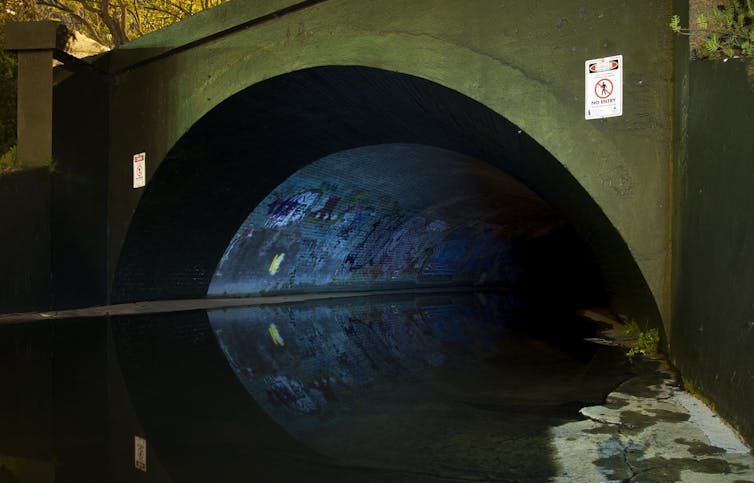
The fabled “Northcote Tunnel” in Melbourne was the subject of decades of rumour. It was eventually found to be the result of a search for an underground stream, not the large-scale 1940s American construction it was said to be.

Tunnels beneath Sydney served similar purposes, either by design or as the result of a failed transport infrastructure project. The St James tunnels are a prime example. This “hidden” space is about to be converted to a tourism precinct.

Beneath the streets of Melbourne, Sydney and beyond, mail and precious cargo were often transported about the city in underground tunnels from nearby railway stations or ports to parliament or the General Post Office.

So what are these spaces used for today?

Today, urban tunnels carry telecommunications, gas, electricity, water and sewerage infrastructure.

Exact locations remain secret for security and operational reasons. Access is allowed in rare cases. In the case of the Royal Melbourne Hospital steam tunnels, members of the public can book a place on once-yearly tours.

Partially constructed tunnels and unused platforms at St James railway station, Sydney.
Partially constructed tunnels and unused platforms at St James railway station, Sydney. Beau Giles/Wikimedia Commons, CC BY

Stormwater drains are most abundant in urban areas; perhaps this is why they feature so heavily in conspiracies. Where depressions, undulations or linear tracts of open space exist in the landscape, a stormwater drain is likely lurking beneath the surface. These drains are needed to divert rainwater from areas where hard surfaces would otherwise lead to flooding.

In Melbourne, the Melbourne and Metropolitan Board of Works started building these drains in the early 20th century. I have explored many of these complex networks, over 1,400 kilometres of drains that span almost all of metropolitan Melbourne and its fringes. These drains are literally beneath the feet of city dwellers: many would be surprised to find that a drain runs beneath the major thoroughfare of Elizabeth Street, historically Williams Creek.

The Metropolitan Water Sewerage and Drainage Board built similar infrastructure in Sydney. Open and closed conduits were built in concrete and brick — as well as bluestone in Melbourne, and limestone in Sydney — throughout the past century. Sydney’s stormwater network totals 454 kilometres of drains and spans 73 water catchments. These drains ultimately carry 500 billion litres into Sydney Harbour or Botany Bay.


Read more: Our legacy of liveable cities won’t last without a visionary response to growth


A drain on the Yarra River in South Yarra
A tidal drain at South Yarra, Melbourne, in 2008. The installation of litter-trapping equipment now prevents access. Photo: Victoria Kolankiewicz

Dangerous, yes, but for more mundane reasons

These hidden spaces can be controversial or dangerous, but not for the reasons put forth by QAnon and its ilk.


Read more: The Church of QAnon: Will conspiracy theories form the basis of a new religious movement?


Social groups have emerged around drain exploration, with the Melbourne-based Cave Clan the best-known example. They have clear rules to ensure the safety of their members. “No drains when it rains” is one such rule: sudden rain can catch out explorers as water levels rise quickly inside drains.

Drownings have been reported in both Sydney and Melbourne. The unpredictability of sudden torrential flows means these spaces are fundamentally unsuited to the purposes suggested in conspiracy theories.

Frequent visits by urban explorers would also quickly identify any secretive mis-uses of drainage infrastructure. This would equally apply to other underground spaces such as steam and service tunnels – maintenance staff would soon spot anything amiss.

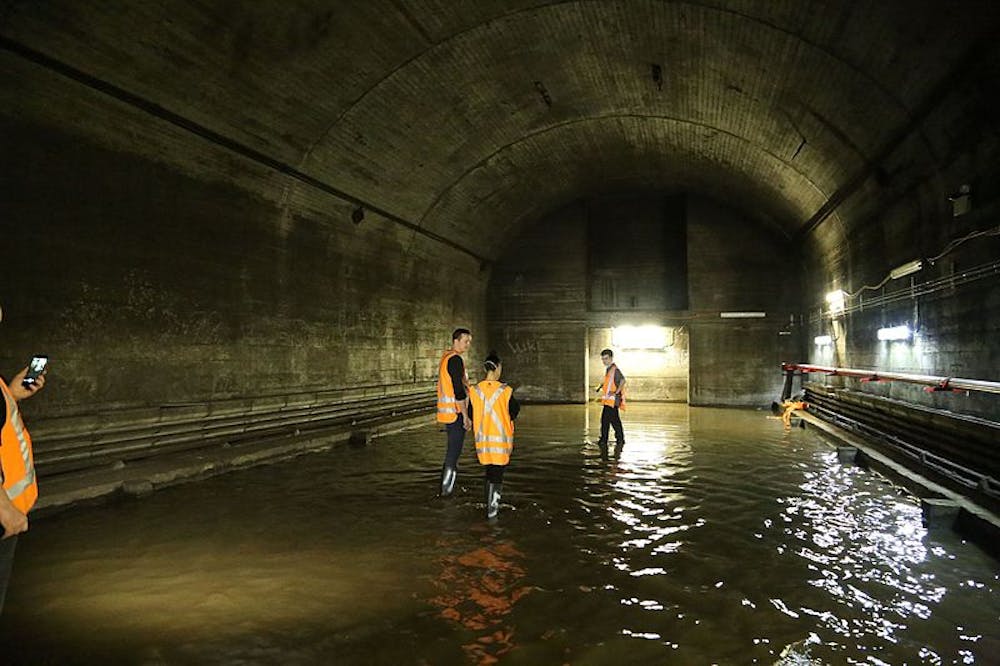
More crucial, however, is that the design of these drains means they could not play any part in supposed trafficking networks. Some of these drains are large enough for adults to explore. The vast majority, though, are too small to be accessed, with diameters as narrow as 300mm.

Even the most cavernous drains would not be suitable for storage. Larger drains are designed to hold larger flows, often at a confluence of catchment areas. While they these drains could host human beings, they would be at risk of drowning whenever it rained. Tidal flows or litter traps can also prevent access.


Read more: If the tide is high, our sewerage systems won’t hold on


Child trafficking is a very relevant issue, but it is certainly not taking place under cities across the nation. Rather than abandoning subterranean spaces to conspiratorial narratives or urban mythology, these spaces are important for other reasons. These point to the need to build a common understanding not only of their form and function, but also of the ethos underlying their existence, a concern for the common good.

That something as impressive and as everyday as our civic infrastructure inspires such fascination and fear is indeed curious. Ultimately, these spaces are too utilitarian to serve the purpose claimed by viral social media posts.

ref. What lies beneath: tunnels for trafficking, or just a subterranean service? Time to rescue these spaces from the conspiracists – https://theconversation.com/what-lies-beneath-tunnels-for-trafficking-or-just-a-subterranean-service-time-to-rescue-these-spaces-from-the-conspiracists-144276

In gold we trust: why bullion is still a safe haven in times of crisis

Source: The Conversation (Au and NZ) – By Dirk Baur, Professor of Finance, University of Western Australia

“Gold” said famed investor Warren Buffett in 1998, “gets dug out of the ground in Africa or someplace, then we melt it down, dig another hole, bury it again and pay people to stand around guarding it. It has no utility. Anyone watching from Mars would be scratching their head.”

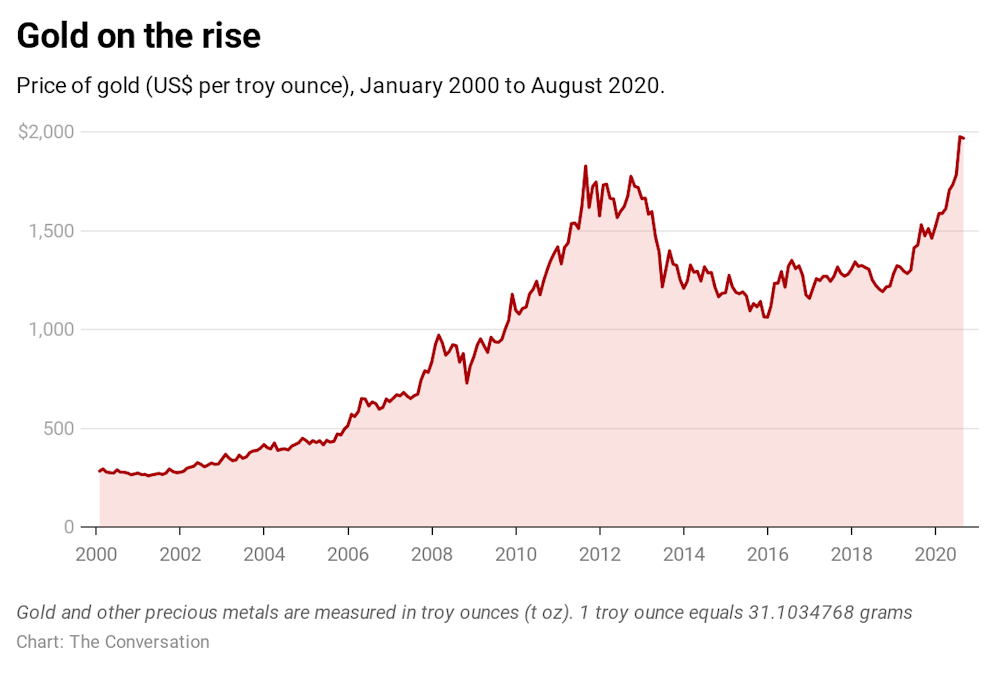
Yet for all that, we remain in love with gold – especially in times of uncertainty. With the COVID-19 crisis, interest in gold has soared, driving its price to historic highs (eclipsing its past record set back in August 2011).

Even Buffett seems to have softened his longstanding antipathy, with his company Berkshire Hathaway acquiring a US$565 million stake in the world’s second-largest gold miner, Canada’s Barrick Gold Corporation.

Owning shares in a gold-mining company, though, is not the same thing as owning actual gold. Since gold shares are linked both to gold prices and to the broader share market, they tend to move with the market when it falls sharply. That deprives gold shares of a key feature of gold bullion – its safe haven property.

What is a safe haven?

A safe haven is an asset that holds its value in extreme, unexpected events.

It is different from a “safe asset” that provides a guaranteed return, such as government bonds. In buying such a bond you effectively lend money to the government in return for a promise it will repay that money (with interest) in the future.

Safe assets, in other words, are “fixed income” assets, and their prices are relatively stable.

The price of a safe haven asset, on the other hand, will fluctuate, rising in periods of heightened uncertainty, when other investments suffer extreme losses, but may also fall when the uncertainty reverts to more normal levels.

We can see this in the price of gold over the past two decades, both in the wake of the Global Financial Crisis beginning in 2008 and now with the COVID-19 crisis.


CC BY-SA

The only deviation from gold’s traditional role as a safe haven asset was a price fall over March, as global stock markets crashed. This deviation underlines the uncertainty that gripped investors that month, with some gold owners presumably selling bullion to cover losses or to increase cash holdings.


Read more: The S&P 500 nears its all-time high. Here’s why stock markets are defying economic reality


Why is gold a safe haven?

The simple answer is that it has worked in the past. Based on past experience in a crisis, people believe in the safe haven feature of gold and it works because they believe in it.

Gold has been used since ancient times as a store of value. Helping it achieve this status is its aesthetic appeal, malleability (with a relatively low melting point making it easy to produce coins or jewellery), virtual indestructibility (almost all the gold that has ever been found or mined is still around) and, most importantly, rarity. Though hundreds of thousands have dug and panned for it over history, the amount of gold mined has never been enough to devalue it.


Read more: From medicine to nanotechnology: how gold quietly shapes our world


Because of these features, gold became the basis for money and played a formal monetary role during the gold standard, which required nations to hold gold reserves as a backing of their currency.

Central banks still hold huge gold reserves. Of 197,576 tonnes of gold mined throughout history, the World Gold Council says 17.2% is held (as bullion or coins) by governments and central banks, 21.6% by private investors, about 47% as jewellery, and 14.2% has gone to other uses (such as in electronics).

Woman shops for gold jewellery in Mumbai.
Shopping for gold jewellery in Mumbai. India is normally the world’s biggest market for gold jewellery, but domestic demand fell 74% in the second quarter of 2020, according to the the World Gold Council. EPA/DIVYAKANT SOLANKI. Divyakant Solanki/EPA

So while gold, silver, palladium and platinum are all “precious metals” the latter three are not commonly accepted safe havens because they played a different monetary and investment role in the past.

‘Nobody understands gold prices’

Gold may also be a safe haven because it is simple and well-known, the first thing that comes to mind when investors are faced with extreme uncertainty.

This apparent simplicity, paradoxically, does not mean easy-to-understand gold prices.

Some factors influencing its price are tangible, such as physical supply and demand.


Read more: How the coronavirus pandemic has disrupted the global mining industry


But many factors influencing gold’s price are less tangible, such as changing perceptions, preferences and market sentiment.

As then US Federal Reserve chairman Ben Bernanke said in 2013: “”Nobody understands gold prices, and I do not pretend to understand it either.”

ref. In gold we trust: why bullion is still a safe haven in times of crisis – https://theconversation.com/in-gold-we-trust-why-bullion-is-still-a-safe-haven-in-times-of-crisis-144567

New coins celebrate Indigenous astronomy, the stars, and the dark spaces between them

Source: The Conversation (Au and NZ) – By Duane W. Hamacher, Associate Professor, University of Melbourne

Two new coins have been released by the Royal Australian Mint to celebrate the astronomical knowledge and traditions of Aboriginal and Torres Strait Islander people. They feature artworks from Wiradjuri (NSW) and Yamaji (WA) artists that represent two of the most famous features in Aboriginal astronomy: the great Emu in the Sky and the Seven Sisters.

Both celestial features are found in the astronomical traditions of many Aboriginal cultures across Australia. They are seen in similar ways and have similar meanings between cultures on opposite sides of the continent and are observed to note the changing seasons and the behaviours of plants and animals and inform Law.

The project has been three years in the making, with the third and final coin in the series to be released in mid-2021.


Read more: Kindred skies: ancient Greeks and Aboriginal Australians saw constellations in common


Gugurmin – The Emu in the Sky

The Wiradjuri of central New South Wales are the largest Aboriginal language group in the state and one of the largest in the country. Wiradjuri astronomical knowledge is rich and complex, linking the land and people to the cosmos (Wantanggangura). Traditional star knowledge features bright constellations of stars, as well as constellations comprising the spaces between the stars.

One of the many “dark constellations” is that of the celestial emu, called Gugurmin. The emu is a silhouette of the dark spaces stretching from the Southern Cross to Sagittarius in the backdrop of the Milky Way. The galaxy itself is a river called Gular (or Gilaa), which is also the Wiradjuri name of the Lachlan River.

Two decorative coins with Indigenous designs.
Two new uncirculated silver $1 coins commemorate Indigenous astronomy. Royal Australian Mint

Read more: Stories from the sky: astronomy in Indigenous knowledge


Wiradjuri watch when Gugurmin rises in the sky after sunset as a signal marking the emu’s behaviour patterns and changing seasons. When it rises at dusk in April and May, it signals the start of the emu breeding season, when the birds begin mating and nesting. By June and July, the male emus are sitting in the nest, incubating the eggs. In August and September, the chicks begin hatching.

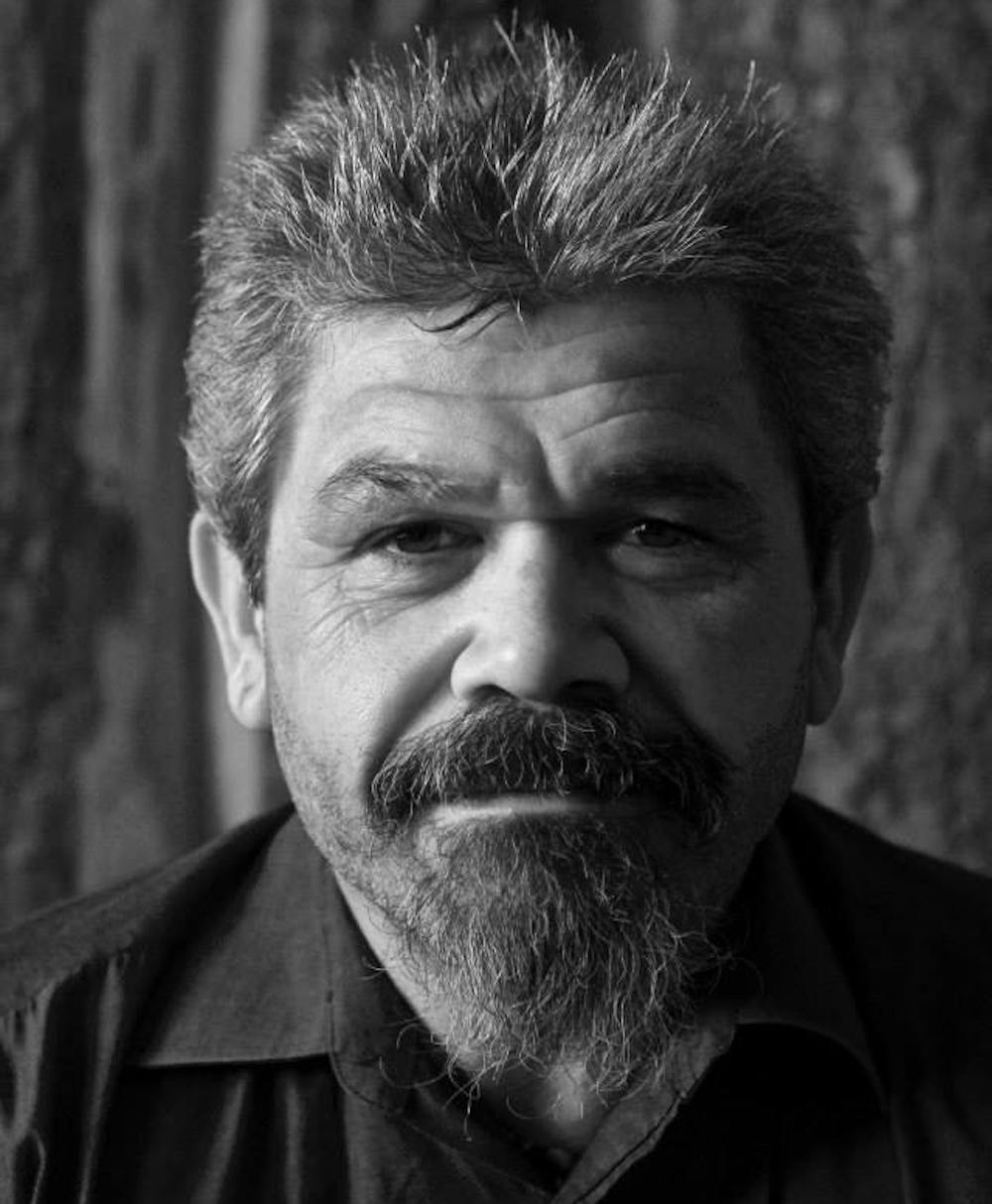
The Emu in the Sky coin features the work of Wiradjuri artist Scott “Sauce” Towney from Peak Hill, NSW. Sauce specialises in drawing and pyrography (wood burning) and was a finalist in the NSW Premier’s Indigenous Art Awards. The edge of the coin shows a male emu sitting on the eggs during the months of June and July when his celestial counterpart is stretched across the sky. It also shows men dancing in a ceremony, which takes place in August and September.

Black and white portrait of man with beard.
Artist Scott ‘Sauce’ Towney. Royal Australian Mint, Author provided (No reuse)

Gugurmin was one of the artworks Sauce created for a project entitled Wiradjuri Murriyang (“Wiradjuri Sky World”). This featured 13 traditional constellations for use in local school education programs, as well as public outreach. His art was incorporated into the Stellarium planetarium software, enabling users around the world to see the movements of the stars from a Wiradjuri perspective.

Sauce’s work was incorporated into the Australian National Curriculum for the Year 7/8 module on digital technology and managing Indigenous astronomical knowledge.


Read more: The stories behind Aboriginal star names now recognised by the world’s astronomical body


Nyarluwarri – The Seven Sisters

The artwork featured on the Seven Sisters coin is from Wajarri-Noongar artist Christine “Jugarnu” Collard of Yamaji Art. Christine was born and raised in Mullewa, Western Australia and paints under the name Jugarnu meaning “old woman” in the Wajarri language. The name was given to Christine by her now deceased Grandfather.

The Yamaji people of the Murchison region in Western Australia refer to the Pleiades star cluster as Nyarluwarri in the Wajarri language, representing seven sisters. When Nyarluwarri sits low on the horizon at sunset in April, the people know that emu eggs are ready for harvesting.

Seven Sisters painting by Christine Jugarnu Collard and the Pleiades star cluster. Christine Collard, Yamaji Art

The story of the Seven Sisters tells of them fleeing to the sky to escape the advances of a man who wants to take one of the sisters as his wife. The man chases the sisters as they move from east to west each night, which appear to the northeast at dusk in November and set by April.

At the same time Nyarluwarri sets after the Sun in the west, the celestial emu (which is also featured in Yamaji traditions) rises in the southeast. Both serve as important seasonal markers.

The Seven Sisters and the Emu in the Sky were major themes in the Ilgarijiri – Things Belonging to the Sky art exhibition. This project saw radio astronomers and Yamaji artists come together to share knowledge under the stars at the site of the new Square Kilometre Array (SKA) telescope.


Read more: Indigenous culture and astrophysics: a path to reconciliation


ref. New coins celebrate Indigenous astronomy, the stars, and the dark spaces between them – https://theconversation.com/new-coins-celebrate-indigenous-astronomy-the-stars-and-the-dark-spaces-between-them-145923

Former BRA commander again leading in Bougainville presidential contest

By RNZ Pacific

Former Bougainville Revolutionary Army commander, Ishmael Toroama, is starting to build a substantial lead after count 206 in the presidential vote.

With counting of the northern votes happening through the weekend, Toroama has established a buffer of more than 2200 votes over second placed Father Simon Dumarinu.

A number of other candidates continue to pick up significant numbers of votes, with Thomas Raivet in third but nearly 10,000 votes back, the former head of the Papua New Guinea Sports Foundation, Peter Tsiamalili, making up considerable ground to be fourth, Toroama’s BRA colleague Sam Kauona coming into the picture.

But as James Tanis, who is slipping down the leaderboard, has previously pointed out, the critical factor will be how the preference votes end up being allocated.

And with 25 candidates in the race there are many thousands of those.

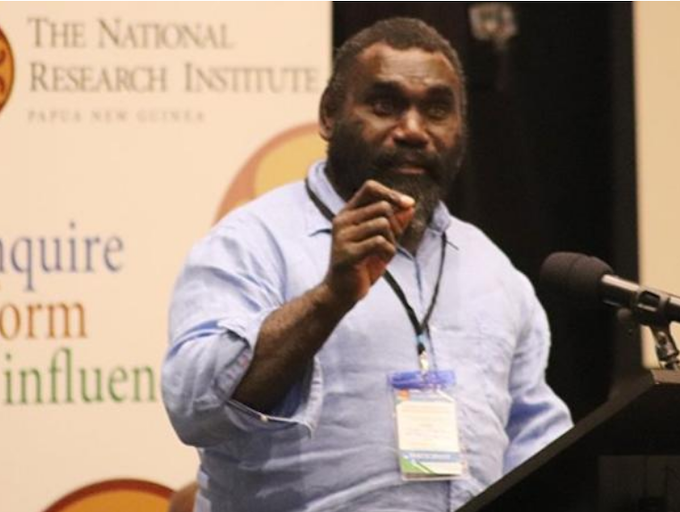
Ishmael Toroama
Former Bougainville Revolutionary Army commander Ishmael Toroama … back in the lead in the Bougainville presidential vote. Image: NRI/RNZ

Count toss up
There was an unusual event near the end of the count in the southern region seat, Makis, on Saturday.

The Bougainville Electoral Commission reports that the two leading candidates were tied with one elimination stage to go, so a coin toss was used to decide which of them would go forward before the last of those preference votes could be shared.

So one candidate was duly eliminated but the eventual winner was Junior Tumare, who had been lying in third spot before the toss.

Confirmed returns
Several incumbents have been returned, including long time Bougainville MP, Ezekiel Masatt, in Tonsu, John Tabinaman in Mahari and Chris Kakapetai in Teua.

Kakapetai’s success came as no surprise to one of his competitors, Chris Siriosi.

He finished third after the 8th elimination and said Kakapetai got a large number of votes from one part of the constituency.

Siriosi said, in addition, he lacked the funds others had going into the poll.

He is a former acting secretary for the government and said he will now focus on getting a job.

“I have got to get back to the government on employment. That kind of arrangement, either with the Ombudsman Commission – my interest lies with the Ombudsman Commission, or with the administration. My services are needed there anyway, ” Siriosi said.

Peace focus
One newcomer to the Bougainville Parliament is hoping to continue his work in peace building.

Emmanuel-Carl Kataevara won the Baba constituency in South Bougainville.

He said it was his second attempt to get into Parliament and he came more prepared this time round.

Kataevara, who has worked with the Bougainville government and the United Nations as a peace builder, is hoping he can still be involved in that process.

He said he hoped for a cabinet role and his focus remained on Bougainville achieving its independence goal.

“We shouldn’t lose focus, we shouldn’t lose sight of the objective and the whole reason for the conflict on Bougainville, and as much as possible ensure that the process works towards achieving that objective,” he said.

This article is republished by the Pacific Media Centre under a partnership agreement with RNZ.

Print Friendly, PDF & Email

Article by AsiaPacificReport.nz

Morrison government to invest $211 million in fuel security to protect against risk and price pressures

Source: The Conversation (Au and NZ) – By Michelle Grattan, Professorial Fellow, University of Canberra

The Morrison government is acting to protect Australia’s fuel security as the international outlook becomes more uncertain and prices will be under increasing pressure.

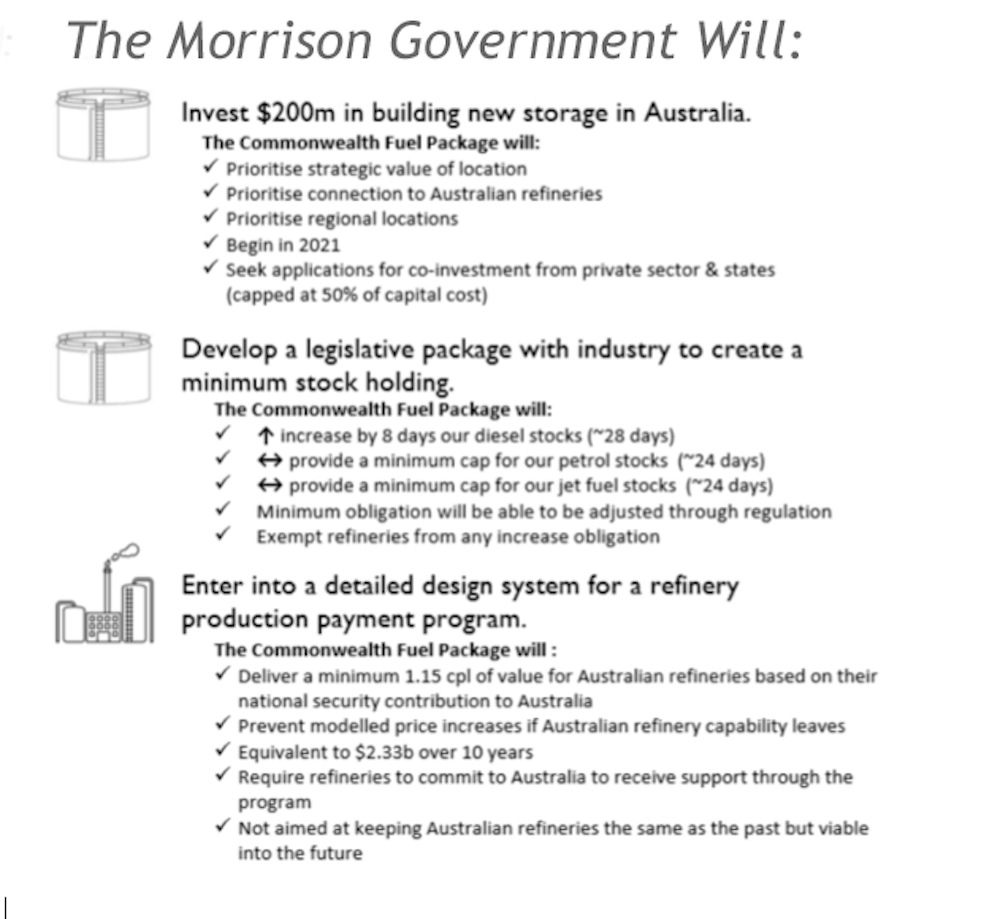
Under the plan, operating through market and regulatory measures, the government will invest $211 million in new domestic diesel storage facilities, changes to create a minimum onshore stockholding, and support for local refineries.

Treasury

Announcing the program with Energy Minister Angus Taylor, Scott Morrison said the changes “will ensure Australian families and businesses can access the fuel they need, when they need it, for the lowest possible price”.

Australia’s fuel supplies are always potentially vulnerable to international instability, something that the pandemic – with its disruption to supply chains – has just reinforced. Local refineries are also under economic pressures, with potential consequences for prices.

The measures are:

  • a $200 million investment in a competitive grants program to build an extra 780 megalitres of onshore diesel storage with industry

  • creation of a minimum stockholding obligation for key transport fuels, and

  • working with refiners on a market design process for a refining production payment.

The government is seeking to have the $200 million grants for new storage matched by state governments or industry. Its focus will be on projects in strategic regional locations, connected to refineries and with connections to existing fuel infrastructure.

Morrison said fuel security was essential for Australia’s national security and the country was fortunate there hadn’t been a significant supply shock in more than 40 years. Fuel security underpinned the entire economy, and the industry itself supported thousands of workers, he said. “This plan is also about helping keep them in work.”

Taylor acknowledged the pressure refineries are under.

The government says modelling indicates a domestic refining capability is worth some $4.9 billion over a decade to Australian consumers is terms of price suppression.

The construction of diesel storage will support up to 950 jobs, with 75 new ongoing jobs, many in the regions, the government says.

“A minimum stockholding obligation will act as a safety net for petrol and jet fuel stocks and increased diesel stockholdings by 40%,” Morrison and Taylor said in their statement.

They stressed the government’s commitment to onshore refining capacity. The industry’s viability is under threat.

The planned production payment scheme is to protect from an estimated 1 cent per litre rise that, according to modelling, would hit fuel if all refineries onshore were to close. Refineries receiving the support will have to commit to stay operating locally.

Under the minimum stockholding requirements, petrol and jet fuel stocks would be kept no lower than current commercial levels, which are about 24 consumption days.

Diesel stocks would increase by 40%, to be at 28 consumption cover days. This would add about 10 days to Australia’s International Energy Agency compliance total.

In July Australia had 84 IEA days including stocks on water. Implementing a minimum stock holding obligation would bring Australia into line with most IEA members which regulate their fuel industries to meet their security needs. Under the IEA treaty member countries are required to have 90 days of stocks.

(IEA days and consumption cover days are different.)

Refineries will be exempt from the obligations to hold additional stocks.

The production payments will ensure a minimum value of 1.15 cents per litre to refineries. A competitive process will determine the location of new storage facilities.

The government says it recognises “the future refining sector in Australia will not look like the past. However, this framework will ensure the market is viable for both our future needs and can support Australia during a severe fuel disruption.”

ref. Morrison government to invest $211 million in fuel security to protect against risk and price pressures – https://theconversation.com/morrison-government-to-invest-211-million-in-fuel-security-to-protect-against-risk-and-price-pressures-146084

Sogavare reassures Solomon Islands on health of 6 covid positive students

By Robert Iroga in Honiara

Solomon Islands Prime Minister Manasseh Sogavare today has reassured the nation and parents of six students who have tested positive for covid-19 in the Philippines that the government is taking care of their welfare.

He said the government was working closely with authorities in Manila to take care of their welfare during this difficult time.

The six out of a total of 130 students who were tested for covid-19 on Friday were positive. They are currently being quarantined at their homes in the Philippines while authorities are conducting contact tracing.

These students have been informed of their test results by the Philippine Red Cross in accordance with Philippines law.

The Philippines has been classified as an extremely high-risk country for covid-19. This means, each student must have 3 consecutive negative covid-19 tests in the 14 days before their flight date before they can board their home-bound aircraft.

The Solomon Islands has a total of 373 students and 12 children below 2 years old living in the Philippines – a total of 385 people altogether.

The Philippines Red Cross had agreed to coordinate and do all the tests on the Solomon Islands students.

Emergency meeting
Following the release of results from the Philippines, the Oversight Committee convened an emergency meeting yesterday afternoon and late last night to discuss the implications and actions in response.

Last night, a subgroup of the Oversight Committee, comprising the Ministry of Health and Medical Service and the Ministry of Education and Human Resources, managed to establish contact with the six students.

This was an important undertaking before the committee can speak with their parents.

Based on Philippine law, all 130 students have been informed of their first test results. The Philippine law now requires that all students who test positive, and their contacts to be quarantined at home, unless they are sick from the virus, in which case they are admitted to hospitals.

The Philippines Department of Health will undertake contact tracing for the 6 students with positive tests and contacts.

Prime Minister Sogavare has confirmed that the 6 students are asymptomatic. They are not sick with the virus infection at this stage.

“We have spoken with some parents. We will continue our efforts to contact and speak with the other parents. Some students have already informed their parents,” Sogavare said.

“It is important for the parents to know that their son or daughter are currently not showing signs of being sick with the infection, and that they are being cared for.”

Working closely with Philippine Red Cross
The government, through the Ministry of Health and Medical Service, is working closely with the Philippine Red Cross to establish a formal arrangement that includes the care of the Solomon Islands students. The government will meet the costs in the first instance.

While the government is faced with this latest development, it also has a responsibility to protect the Solomon Islands and people from covid-19.

“This simply means only students that meet our ‘3-negative tests requirement’ will board our repatriation flights,” Sogavare said.

“While this does not give a 100 percent guarantee we will not import covid-19, it guarantees we minimise the risk of importation of covid-19 into the count.”

The government is confident that even those who have tested positive will recover to travel home on the 3rd flight scheduled for October 24.

“Fellow Solomon Islanders be assured that your government is committed to bringing all our students home safely. We are also committed to ensure we do not unduly import the virus into the country,” Sogavare said.

Robert Iroga is editor of Solomons Business Magazine Online. SBM Online articles are republished by the Pacific Media Centre with permission.

Print Friendly, PDF & Email

Article by AsiaPacificReport.nz

Media freedom watchdogs condemn Indonesian assaults on journalists

Pacific Media Watch Newsdesk

The International Federation of Journalists and the Alliance of Independent Journalists have expressed concern over reports that several local journalists have been harassed and attacked across Indonesia, reports IFJ Asia-Pacific.

A series of assaults against local journalists has occurred in different cities in the country, ranging from verbal attacks to physical assault.

The International Federation of Journalists (IFJ) has joined its affiliate, the Alliance of Independent Journalists Indonesia (AJI), to condemn the attacks and urge the authorities to bring the perpetrators to justice.

A journalist for Radar Mandalika, Muhamed Arif, was physically assaulted and intimidated by the Public Order Agency (Satpol PP) for covering protests in front of the Governor’s office in Matara, West Nusa Tenggara on August 24.

Despite declaring that he was a journalist, the officers continued their assault and prevented him from taking photos.

On the same day, chief editor of Metro Aceh Bahrul Walidin was reported for alleged defamation by a businesswoman who is also a local politician following his coverage on fraud allegations against her.

She also filed a complaint to the Press Council.

Tempo journalist’s phone seized
On September 2, a state prosecutor confiscated Tempo journalist Kukuh S. Wibowo’s phone while he was covering the hearing between the State Prosecutor Office and the Commission III of House of Representatives and Directorate General of Customs and Excise at the State Prosecutor Office Building in East Java.

The forum was held to discuss an investigative report published by Tempo on the 17 containers of illegal textile imports from China. The state prosecutor held Kukuh’s phone for approximately three hours. When Kukuh’s phone was returned, application settings had been changed.

AJI said: “The AJI urges all sides, from government officials to the private sector to respect journalists’ rights and press freedom.

“All the incidents have shown that threats against journalists in Indonesia are still high. AJI also calls on the authorities to investigate and bring all the perpetrators to justice.”

The IFJ said: “Indonesia is a challenging place to work for journalists, and ongoing harassment and attacks on journalists makes the situation all the more precarious.

“The IFJ calls on the authorities to ensure the safety of journalists in Indonesia and to reinforce to all sides of Indonesia’s political spectrum and private sector that journalism is not a crime.”

Print Friendly, PDF & Email

Article by AsiaPacificReport.nz

View from The Hill: Barilaro keeps Nationals in the tent; koalas stay in limbo

Source: The Conversation (Au and NZ) – By Michelle Grattan, Professorial Fellow, University of Canberra

Several premiers presently find themselves at war with the federal government. NSW Premier Gladys Berejiklian, by contrast, suddenly found herself locked in battle with her deputy premier, John Barilaro, and his bolshie band of Nationals.

The junior partner in the NSW coalition chose this week to pull on a stoush over a new regime the state government launched months ago to protect koalas, which have been devastated and displaced by fires and drought.

That a row over koalas could shake the Berejiklian government to its core during a pandemic is startling, at the least. The Nationals justify this by saying they’d long been told their concerns would be considered, and they hadn’t been.

They insist they’re not anti-koala — they’d like to see the population doubled, they say — but claim the new regime is too burdensome, including by extending the definition of core koala habitat and increasing the number of koala tree species.


Read more: The NSW koala wars showed one thing: the Nationals appear ill-equipped to help rural Australia


The Nationals are under pressure from farmers and, at a political level, from the Shooters, Fishers and Farmers party, which is always nipping at their heels.

Within the Nationals, pressure built with first one, then two, and several more MPs in revolt — and quickly the whole party. Efforts to get a special meeting to deal with the koala issue were unsuccessful – the premier had other things on her plate.

By Thursday, the Nationals had resolved that until the koala row was addressed they’d no longer attend joint party room or parliamentary leadership meetings and would abstain from voting on government bills. (They reserved the right to support bills and motions important to regional areas.)

“This effectively puts the entire party on the crossbench,” the party said in a statement.

Barilaro insisted the Nationals could take this stand while their ministers remained in cabinet.

This would have made them sort of “virtual” crossbenchers – a very strange notion indeed under the Westminster system.

A frustrated Berejiklian issued an ultimatum. “It is not possible to be the deputy premier or a minister of the Crown and sit on the crossbench,” she said in a statement.

She said she’d told Barilaro that he and his Nationals cabinet colleagues had until 9am Friday “to indicate to me whether they wish to remain in my Cabinet or else sit on the crossbench”.

By Friday morning, Barilaro had stepped his party back from the brink. After a meeting with Berejiklian, the two leaders said in the briefest of statements the coalition remained “in place”, as did “cabinet conventions and processes”.


Read more: Nationals have long valued stable leadership and being strong Coalition partners – this shouldn’t change now


Meanwhile, koalas were to be dealt with at a coming cabinet meeting. The extraordinary upheaval may be over for now, but it leaves scars, questions, uncertainty and tension.

Most obviously, the substantive issue is still unresolved. If the Nationals don’t get their way on changes to the koala regime, there could easily be another explosion. If they do, many Liberals will be angry.

The Nationals’ constituency will be behind the party’s stand. But for numerous Liberal supporters, compromise on as emotive an issue as koalas will be an electoral no-no.

This week’s events have again brought into question Barilaro’s judgement.

He was caught between the strong feelings within his party and the need to maintain the coalition. He laid himself open to criticism of firstly overreaching and then failing to carry through his threat.

This is against the background of his behaviour before the Eden-Monaro byelection, when he as good as said he would run for the seat and then said he wouldn’t.


Read more: Eden-Monaro opens wounds in Nationals, with Barilaro attack on McCormack


Even some Nationals shake their heads, while the Liberals resent what Berejiklian has to put up with.

At one stage on Thursday, Barilaro asked his parliamentary party if they thought someone else would be better to lead them. The idea was dismissed. Nevertheless, the past few days have fanned doubts about his style of leadership.

Most serious in the immediate term, the trust between Berejiklian and Barilaro has been further eroded, after taking a knock from his conduct over Eden-Monaro. The NSW coalition remains intact, but no one can miss the crack that has been repaired by superglue. It is not as robust as it once was.

And Berejiklian has less patience with her volatile partner than she used to have.

ref. View from The Hill: Barilaro keeps Nationals in the tent; koalas stay in limbo – https://theconversation.com/view-from-the-hill-barilaro-keeps-nationals-in-the-tent-koalas-stay-in-limbo-146036

Are your devices spying on you? Australia’s very small step to make the Internet of Things safer

Source: The Conversation (Au and NZ) – By Kayleen Manwaring, Senior Lecturer, School of Taxation & Business Law, UNSW

From internet-connected televisions, toys, fridges, ovens, security cameras, door locks, fitness trackers and lights, the so-called “Internet of Things” (IoT) promises to revolutionise our homes.

But it also threatens to increase our vulnerability to malicious acts. Security flaws in IoT devices are common. Hackers can exploit those vulnerabilities to take control of devices, steal or change data, and spy on us.

In recognition of these risks, the Australian government has introduced a new code of practice to encourage manufacturers to make IoT devices more secure. The code provides guidance on secure passwords, the need for security patches, the protection and deletion of consumers’ personal data and the reporting of vulnerabilities, among other things.

The problem is the code is voluntary. Experiences elsewhere, such as the United Kingdom, suggest a voluntary code will be insufficient to deliver the protections consumers need.

Indeed it might even increase risks, by lulling consumers into a false sense of security about the safety of the devices they buy.


Read more: Explainer: the Internet of Things


Many IoT devices are insecure

IoT devices designed for consumers are generally less secure than conventional computers.

In 2017 the Australian Communications Consumer Action Network commissioned researchers from the University of New South Wales to test the security of 20 household appliances capable of being connected and controlled via wi-fi.

These included a smart TV, portable speaker, voice assistant, printer, sleep monitor, digital photo frame, bathroom scales, light bulb, power switch, smoke alarm and Hello Barbie talking doll.

Devices tested by UNSW researchers for the Australian Communications Consumer Action Network. Inside Job: Security and privacy threats for smart-home IoT devices, 2017, CC BY-NC

While some devices (including the Barbie) were found to be relatively secure in terms of confidentiality, all had some form of security flaw. Many “allowed potentially serious safety and security breaches”.

What this could potentially mean is that someone could, for example, hack into a household’s wi-fi network and collect data from IoT devices. It might be as simple as knowing when lights are switched on to determine when a home can be burgled. Someone with more malicious intent could turn on your oven while shutting down smoke alarms and other sensors.

Risks to consumers, and society

Factors leading to poor security in IoT devices include manufacturers’ desires to minimise componentry and keep costs down. Many makers of consumer goods also have little experience with cyber-security issues.

Allied with the fact many consumers aren’t technologically savvy enough to appreciate the risks and protect themselves, this creates the prospect of IoT devices being exploited.


Read more: The privacy paradox: we claim we care about our data, so why don’t our actions match?


On a personal level, you could be spied on and harassed. Personal pictures or information could be exposed to the world, or used to extort you.

On a societal level, IoT devices can be hijacked and used collectively to shut down services and networks. Even compromising one device may enable connected infrastructure to be hacked. This is a rising concern as more people connect to workplace networks from home.

Woman using a smarthome app on her phone.
Many consumers don’t fully appreciate the security risks from IoT devices. Shutterstock

Voluntary codes of practice

In recognition of these threats, IoT security “good practice” guidelines have been proposed by standards bodies such as the US National Institute of Standards and Technology, the European Telecommunications Standards Institute and the Internet Engineering Task Force. But these guidelines are based on voluntary action by manufacturers.

The UK government has already concluded the voluntary code of conduct it established in 2018 isn’t working.

Britain’s Minister for Digital Infrastructure, Matt Warman, said in July:

Despite widespread adoption of the guidelines in the Code of Practice for Consumer Internet of Things Security, both in the UK and overseas, change has not been swift enough, with poor security still commonplace.

The UK is now moving to impose a mandatory code, with laws requiring manufacturers to deliver reasonable security features in any device that can connect to the internet.

A case for co-regulation

There is little reason to believe Australia’s voluntary code of practice will prove any more effective than in the UK.

A better option would have been a “co-regulatory” approach. Co-regulation mixes aspects of industry self-regulation with both government regulation and strong community input. It includes laws that create incentives for compliance (and disincentives against non-compliance) and regulatory oversight by an independent (and well-resourced) watchdog.

The Australia government has, at least, described its new code of practice as “a first step” to improving the security of IoT devices.

Let’s hope so. If the UK experience is anything to go by, its next steps will include dumping a voluntary code for something with a greater chance of delivering the safety and security consumers – and society – need.

ref. Are your devices spying on you? Australia’s very small step to make the Internet of Things safer – https://theconversation.com/are-your-devices-spying-on-you-australias-very-small-step-to-make-the-internet-of-things-safer-145554

The sackings at Rio look like a victory for shareholders, but…

Source: The Conversation (Au and NZ) – By Andrew Linden, Sessional Lecturer, PhD (Management) Candidate, School of Management, RMIT University

In the coming days thousands of (digital) column inches are going to be devoted to the idea that institutional shareholders acted decisively to force the resignation of Rio Tinto chief executive Jean-Sebastien Jacques and two others responsible for the destruction of the Juukan Gorge caves.

However the resignations mask a deeper failure of institutional investors to take action over governance problems. Rio Tinto (and its predecessor companies CRA and Comalco) has a chequered history in indigenous relations, labour relations, foreign bribery and interference in politics. It was even blacklisted by Norway’s sovereign wealth fund for a decade over its environmental record.

Despite these problems, and a long record of aggressive political lobbying, Australian institutional shareholders have loved Rio for its high and consistent dividends. Rio Tinto shares are held by many pension funds and in many cases even make the grade for their ethical investment options.


Read more: Corporate dysfunction on Indigenous affairs: Why heads rolled at Rio Tinto


Period of active engagement with traditional owners under former chief Leon Davis have also obscured a legal regime that suits Rio’s aggressive pursuit of its interests.

Australian National University emeritus professor Jon Altman, who has researched land rights and native title for more than 40 years, told the Senate inquiry into the blast that all governments in Australia were to some extent captured by the mining industry, whose shareholders were largely foreign:

in making these observations, I am not suggesting that multinational corporations like Rio Tinto and BHP and others have operated outside the letter of the law. What I am saying is that they have been far too influential in shaping the law to suit their instrumental extractive profit-seeking interests.

That influence extended to the West Australian legislation Rio used to get approval to dynamite the caves. The law was so one sided that that the indigenous land-owners didn’t know the approval to destroy the caves was being activated by Rio until the eleventh hour.

Rio’s first reaction to complaints was to brief its lawyers.

Shareholders vent, but rarely divest

Shareholders might have vented, but they didn’t divest. Even as news emerges of other significant sites are under threat it is unlikely that the big funds with shares in Rio will sell them, or sell shares in other listed mining companies.

Research shows investors don’t consistently use their voices to lobby firms to tackle social issues, even though there’s always talk about how they are going to.


Read more: Vital Signs: No, we won’t change the corporate world with divestment and boycotts


What institutional investors are more interested in, as AMP’s second-biggest shareholder Allan Gray Funds Management recently conceded, is “protecting their existing investment”.

They are “conflicted” between on the one hand wanting their company to operate better, and on the other, not wanting to reduce returns.

Social licence is a Trojan horse

Rio and the mining industry must be hoping the resignations are a circuit breaker that derails any momentum to change the laws that give them cover.

They are probably hoping the community latches on to the concept of a social licence to operate – the idea that so long as they behave well, they get the right to keep laws that don’t require them to.


Read more: Social licence: the idea AMP should embrace now David Murray has left the building


That would be ironic, given that the mining industry invented and promoted the concept of a social licence in the early 2000s in order to convince the community they could regulate themselves.

For all the sound and fury, the three executives will be paid handsomely to walk the plank.

Buried at the bottom of Rio’s announcement to the ASX is the news Rio Tinto chief executive and JS Jacques and the two other executives get to keep their financial packages.

Rio Tinto announcement to ASX

ref. The sackings at Rio look like a victory for shareholders, but… – https://theconversation.com/the-sackings-at-rio-look-like-a-victory-for-shareholders-but-146004

VIDEO: Michelle Grattan on Chinese relations, Melbourne’s roadmap, and Queensland’s border

Source: The Conversation (Au and NZ) – By Michelle Grattan, Professorial Fellow, University of Canberra

University of Canberra Professorial Fellow Michelle Grattan and University of Canberra Vice-Chancellor and President Professor Paddy Nixon discuss the week in politics.

This week Michelle and Paddy discuss Australia’s worsening diplomatic relationship with China, the border feud between Prime Minister Scott Morrison and Queensland Premier Annastacia Palazczuk, a hitch in the development of the Oxford vaccine, and Victorian Premier Daniel Andrews’ roadmap out of stage four lockdown.

ref. VIDEO: Michelle Grattan on Chinese relations, Melbourne’s roadmap, and Queensland’s border – https://theconversation.com/video-michelle-grattan-on-chinese-relations-melbournes-roadmap-and-queenslands-border-146018

Keith Rankin Chart Analysis – Covid-19: Australia to Scale

Australian incidence of Covid-19, in arithmetic and logarithmic scales. Chart by Keith Rankin.

Analysis by Keith Rankin.

Australian incidence of Covid-19, in arithmetic scales. Chart by Keith Rankin.
Australian incidence of Covid-19, in logarithmic scales. Chart by Keith Rankin.

The first chart shows the growth of Covid19 in Australia using an arithmetic scale. This means the axis labels on the left increase by a given number of cases; in this chart it is increments of 5,000 cases per 10 million people. Australia is currently sitting on just over 10,000 cases of Covid19 per 10 million people; that translates to 26,000 cases, given that Australia has a population of about 25 million.

The world presently has over 36,000 known cases per 10 million people; so, Australia’s incidence of Covid19 is 28% of the global average.

While this chart is quite good at showing Australia’s two waves of Covid19 infection, it does little to tell the unfolding story of the world’s outbreak, and shows no detail at all in relation to the deaths.

Much better is the second chart, which uses a logarithmic scale (as all my previous Covi19 line charts have done.) While this second chart shows exactly the same information, it represents the beginning of the pandemic much more clearly. And it clearly shows the relationships between deaths and known cases. The only disadvantage about the use of this scale is that it understates the second wave in Australia, especially in the solid-line plot of known cases.

In general, arithmetic scales – which most chartmakers use – exaggerate recent growth data, and may render important early data invisible. Also, when charting lower-value data against higher-value data – as in deaths (lower numbers) and known cases (higher numbers) –using an arithmetic scale deamplifies the lower-value data, maybe to the point of drowning it out.

The other advantage of using a logarithmic scale is that a straight line represents exponential growth; consistent exponential growth means growth at a specified percentage rate, as we come to expect with price increases (inflation), and with population and economic growth. (With the arithmetic scale, consistent exponential growth is depicted by a rising curve, which makes it look like accelerating growth.)

Australia and the United States in global context. Chart by Keith Rankin.

Here the Australian chart uses the logarithmic scale, with an added plot for ‘active cases’. (And without the plot for global known cases; a plot that has a relationship to actual cases that changes over time.) The plot for active cases is not perfect; countries are less careful about maintaining accurate recovery data than they are about new cases and new deaths. So, we see the odd kink in the ‘active case’ data series, a result of some recovery data being delayed. For some countries, low-quality recovery data makes the important ‘active case’ series too unreliable to tell the story accurately.

In this chart, the shortcoming of the previous logarithmic chart – the understatement of the second wave of cases – is overcome by showing ‘active cases’. The plot for active cases clearly shows that the second wave – the Victoria wave – was bigger than the first wave (which was mainly in Queensland and New South Wales).

The plot for global deaths is enough to place the Australian outbreaks into their global context. While Australian death rates per capita have always been below global death rates, we do see a bit of a catch up in Australia – towards the global average – in the last couple of months.

Finally, this most useful of Australian charts is compared to the equivalent chart for the United States. We see that the United States’ incidence of Covid19 has been well above the world average since the beginning of March, in complete contrast to Australia. We also see that there are no distinct waves of Covid19 in the USA. Rather, in the United States there was a period of rapid exponential growth in March, and then a long period of slower exponential growth from May to August.

The world still appears to be experiencing slow exponential growth of Covid19, at a rate that dates back to April.

Why every teacher needs to know about childhood trauma

Source: The Conversation (Au and NZ) – By Emily Berger, Lecturer, Monash University

Mental health issues among children are on the rise due to the impacts of the COVID pandemic, including lockdowns.

Recent reports show there has been a 28% spike in calls to the phone counselling service Kids Helpline between March and July 2020 compared with the same period last year in Victoria, which is under stage 3 and 4 restrictions.

This prompted the state government to fast-track its plan to provide every state secondary school with funding to recruit its own mental-health support practitioner by the end of next year. Victorian Premier Daniel Andrews announced in August more than 1,500 school staff would have additional mental-health training in partnership with Headspace to help identify at-risk students as remote learning continues.

Such moves are important. But in this world of uncertainty, as well as the way the pandemic may be increasing instances of family violence and other types of abuse, all school staff would benefit from having an adequate understanding of the impact of trauma and adversity on children.

Teachers and school leaders would also benefit from knowledge about trauma and adversity when responding to children’s challenging behaviours. In education, such understanding and techniques are known as “trauma-informed pedagogy”.

What is childhood trauma?

Trauma is the response to exposure to a stressful or traumatic event, or a series of such events or experiences.

Most children have nurturing home environments, but a concerning number experience trauma through abuse or neglect in Australia. It’s estimated around 8.9% of children experience physical abuse, 8.6% sexual abuse, 8.7% emotional abuse and 2.4% neglect. The rates could be higher as such experiences are difficult to measure.


Read more: What governments can do about the increase in family violence due to coronavirus


Children may also experience trauma or adversity by observing family violence, parent separation, having a parent incarcerated or with a mental illness, or due to grief from the loss of a loved one. Trauma can occur because of conflict or war, or due to a natural disaster, such as the recent bushfires.

COVID-19 has led to higher amounts of traumatic experiences and adversity in households. Around one-third of Australian families are going through increased financial hardship and, for many women, the pandemic has coincided with the beginning of family violence, or an increase in it.

A burnt playground in smoke.
Many kids in Australia have experienced a traumatic event recently, including the recent bushfire season that ravaged communities. DARREN PATEMAN/AAP

Trauma often has negative effects on children’s development and behaviour. It can increase the risk of depression and suicide attempts, psychotic disorders such as schizophrenia, and alcohol and drug use.

It’s important to note, not all children are negatively impacted by trauma — some even experience posttraumatic growth in which they learn more about themselves and their strengths.

A strong body of evidence shows trauma can affect brains structures linked to learning, and control of emotions and behaviour. These effects can make it difficult for children to learn, make friends and develop positive relationships with teachers.


Read more: How childhood trauma changes our hormones, and thus our mental health, into adulthood


Trauma and adversity can also disrupt children’s impulse control in the classroom and on the playground.

What trauma-informed practice looks like

The Royal Commission into child sexual abuse recommended schools be “trauma-informed”. Being trauma-informed does not mean teachers and schools must be trained to treat trauma. Rather they must understand the impact it can have on children’s lives.

An Australian Institute of Family Studies discussion paper on trauma-informed practice notes:

To provide trauma-informed services, all staff of an organisation, from the receptionist to the direct care worker and the board of directors, must understand how violence impacts on the lives of the people being served so that every interaction is consistent with the recovery process and reduces the possibility of re-traumatisation.

So, for schools to be trauma-informed, school staff need to know about the prevalence and consequences of childhood trauma. Increasing the confidence of school staff about how to work with children impacted by trauma and adversity is also important.

Examples of trauma-informed practice include:

  • providing teachers with information about how best to teach and support children to regulate their emotions and build positive relationships. This includes getting children to identify their emotions and check in on themselves and others around them to get acquainted with how they and their peers react to situations

  • assessing and revising school policies and practices that may re-traumatise or trigger anxiety or aggression in students (such as student isolation practices)

  • providing staff with self-care strategies, such as meditation, to help them respond to their experiences working with children impacted by adversity or trauma

  • encouraging staff to recognise students’ strengths and help students develop their own learning goals.

Trauma-informed practice can help teachers too

Teachers and school leaders already have high demands on their time, and adding another burden to their work is untenable. But trauma-informed practice is not necessarily an add-on. Rather, it is a different way of working and communicating to improve students’ relationships with school staff, and their school engagement and learning.

Our research with Victorian teachers found they want more support and training to be able to understand and support children with trauma.

Some US research suggests trauma-informed training and processes in schools can improve staff knowledge and confidence in responding to children impacted by trauma and adversity.


Read more: Trauma-informed classrooms can better support kids in care


Evaluations of trauma-informed practice in schools show these programs are having a positive impact. But rigorous research is lacking and more is required. We do know though, teachers responding sensitively to the impact of trauma helps children better engage in school and gives them a sense of belonging. It can also reduce disruptive behaviours and school suspensions.

By developing knowledge about the impact of trauma on children, teachers are likely to develop stronger relationships, and a greater sense of confidence, with these children, and lower classroom disruption. This could lead to increased job satisfaction and reduced risk of burnout.

ref. Why every teacher needs to know about childhood trauma – https://theconversation.com/why-every-teacher-needs-to-know-about-childhood-trauma-132965

Hacking the pandemic: how Taiwan’s digital democracy holds COVID-19 at bay

Source: The Conversation (Au and NZ) – By Kelsie Nabben, Researcher / PhD Candidate, RMIT Blockchain Innovation Hub / Digital Ethnography Research Centre, RMIT University

Taiwan’s response to the COVID-19 pandemic has been among the world’s best. With a population almost the size of Australia’s, the island nation has reported only 496 confirmed cases of the disease and no locally acquired infections for months.

The unlikely heroes of Taiwan’s success are “civic tech hacktivists”: coders and activists who the country’s celebrity digital minister Audrey Tang describes as the “nobodies” who “hack democracy”.

What began with the hackers of the “open source, open government” movement g0v and student protesters has grown into an experiment in radical democracy that is yielding astonishing results.


Read more: Another day, another hotel quarantine fail. So what can Australia learn from other countries?


‘Fast, fair and fun’

While the notion of “digital democracy” is as old as the internet, few countries have really tried to find out how to practice democracy in digital spheres. In Taiwan, however, there is a strong collective narrative of digital democracy, and government and civil society work together in online spaces to build public trust.

The growth of civic hacking in Taiwan has its roots in the so-called Sunflower Movement, a stream of protests in 2014 against a trade agreement with China.

The pillars of Taiwan’s approach to digital democracy are “fast, fair and fun”.

Taiwan was among the first countries in the world to detect and respond to the virus, thanks to crowd-sourced, collective intelligence through online bulletin boards. Warnings of the virus were first noted in December 31 2019, when a senior health official spotted a heavily “up-voted” on post on the PTT bulletin board.

Before long, civic tech hackers were working on open data projects for citizens to interact with live maps, distributed ledger technology and chat bots to find the nearest pharmacy to claim free masks, with stock levels updated in real time to stop panic buying. Audrey Tang dubbed this rapid, iterative, bottom-up process – as opposed to a top-down government-led distribution system – “reverse procurement”.

A “humour over rumour” strategy has also been very successful to combat misinformation, fake news and disinformation. Taiwan is engineering memes to spread public awareness of positive behaviours through the virality of social media algorithms.

Government departments are responsible for addressing disinformation by providing a “memetic” response according to the “2-2-2”: a response in 20 minutes, in 200 words or less, with 2 images.

Alongside dog memes and pink face masks, one of the most successful is a rapid response to halt runs on toilet paper. This featured a cartoon video of Taiwan Premier Su Tseng-chang shaking his backside with a caption saying “We only have one pair of buttocks”.

Meme of television presenters obvserving Premier Su Tseng-chang’s figure with the slogan ‘We only have one pair of buttocks’.

How hacktivists reached the halls of power

How has the mindset and culture of hacktivism been cultivated to motivate civic hackers to participate in Taiwan’s digital democracy?

First, a figurehead and a manifesto. Audrey Tang is the figurehead, and her manifesto On Utopia for Public Action espouses post-party politics, free speech and deliberation, all enabled through thoughtful and experimental application of digital infrastructure.

A screenshot of text reading 'When we see 'internet of things', let’s make it an internet of beings. When we see 'virtual reality', let’s make it a shared reality. When we see 'machine learning', let’s make it collaborative learning.'
Audrey Tang’s ‘prayer’ at the Open Source, Open Society 2016 conference. YouTube

Second, a suite of smart digital tools enable discussion, survey and online “telepresence”. These include the vTaiwan and the Join platforms for public policy participation.


Read more: Digital democracy lets you write your own laws


Third, inviting participation, listening to community voices, and taking action as a result. Taiwan’s culture of civic participation follows the model of open source software communities. This means working from the bottom up, sharing information, improving on the work of others, mutual benefit and participatory collective action.

g0v.asia is a ‘decentralized civic tech community from Taiwan’.

Underlying these initiatives and digital infrastructures, is two-way trust. In the words of Yun Chen, a member of the “decentralized civic tech community” g0v:

The first key is trust … it was the trust that made government officers take open data as performance instead of troubles, which led government to initiate open data and be willing to accept tech assistance from civic tech communities.

Despite low overall trust in government and leadership in Taiwan, recent polling suggests 91% of citizens are satisfied with the Central Epidemic Command Centre. Tang has said “the government needs to fully trust the citizens”, and that this trust is reciprocated.

A small experiment

With all of this enthusiasm, I wanted to try participating in digital democracy myself. I had heard Tang quote some statistics on increased public trust in several interviews, but I couldn’t find the source. At the suggestion of my Taiwanese compatriot Chih Cheng Liang, I simply asked Tang for the source on Twitter.

Tang’s response was extremely impressive: in less than 5 minutes, she replied with a link to the relevant Taiwanese poll.

A radical experiment

In many countries, policy makers don’t fully understand the technical and governance dynamics of the digital realm. In Taiwan, we are seeing what can happen when they do: bringing “hacker” tools and methods into the institutions of government to increase public participation in democracy.

It’s a vast change. Digital infrastructures are inherently political, or spheres for political engagement. They emerge out of the interaction between technology and society, and are influenced and constrained by human agents.

Radical democracy is essentially radical. Tang also sits on the board of of American economist Glen Weyl’s Radical Xchange initiative, which aims at “uprooting capitalism and democracy for a just society”.

There is now talk of trying out the collective decision making system known as “quadratic voting”, and other experimental crowd-sourcing mechanisms that have surfaced from the Ethereum blockchain community.

Other countries are free to pick up both lessons and digital innovations from Taiwan’s innovations. Many tools and models have been made available on an open-source basis at Taiwancanhelp.us.

An image from g0v.tw illustrates the movement’s goal of radical democracy.

Read more: What coronavirus success of Taiwan and Iceland has in common


ref. Hacking the pandemic: how Taiwan’s digital democracy holds COVID-19 at bay – https://theconversation.com/hacking-the-pandemic-how-taiwans-digital-democracy-holds-covid-19-at-bay-145023

Exchanging killers for peace in Afghanistan is wrong — and could have lasting consequences

Source: The Conversation (Au and NZ) – By Ben Saul, Professor of International Law, Sydney Centre for International Law, University of Sydney

An Afghan soldier convicted of murdering three Australian soldiers is among six high-value prisoners who have been flown to Qatar ahead of peace talks between the Taliban and Afghan government this weekend.

Hekmatullah has spent seven years in jail after killing the three soldiers he worked with in 2012 — Lance Corporal Stjepan Milosevic, Sapper James Martin and Private Robert Poate. He is one of the last remaining Taliban prisoners.

Both the Taliban and the United States have pressured the Afghan government to release all 5,000 Taliban prisoners it holds as part of their peace deal. In return, the Taliban pledged to release 1,000 members of the Afghan security forces.

Hekmatullah has been flown to Qatar ahead of the peace talks. Twitter/AAP

The Afghan government was excluded from the original peace deal struck between the US and Taliban in February where the prisoner release was negotiated, but has since agreed to release the prisoners.

For a long time, the Afghan government vowed not to free 600 prisoners it considered too dangerous, including murderers and foreign fighters. Afghan President Ashraf Ghani called them a “danger” to the world.

But last month, an assembly of Afghan elders, community leaders and politicians called a “loya jirga” approved the release of the last 400 Taliban captives and hundreds have been set free.

Delegates at the loya jirga in Kabul last month. Rahmat Gul/AP

Foreign governments’ objections to prisoner release

The release of prisoners who killed Westerners has been among the most contentious parts of the deal.

The Australian government, and the families of the three murdered Australian soldiers, have strenuously objected to the release of Hekmatullah.

Prime Minister Scott Morrison has raised the issue with US President Donald Trump in recent weeks, and Foreign Minister Marise Payne and Defence Minister Linda Reynolds reiterated this position in a statement today:

The Australian government’s long-standing position is that Hekmatullah should serve a full custodial sentence for the crimes for which he was convicted by an Afghan court, and that he should not be released as part of a prisoner amnesty.

France has similarly objected to the release of those prisoners who murdered its aid workers and soldiers.

The US has not publicly objected to the release of three prisoners who murdered Americans in so-called insider attacks, although it is reportedly exploring the possibility of release under house arrest.

US envoy Zalmay Khalilzad, left, and Mullah Abdul Ghani Baradar, the Taliban’s top political leader, signing the peace deal in February. Hussein Sayed/AP

The importance of the rules of war

So far, the issue of freeing prisoners in Afghanistan has been largely treated as a political and security issue. There has been less attention given to the equally important question of law, justice and human rights.

It follows a regrettably common view that peace is necessary at any price, even if it means letting suspected or convicted war criminals go free, denying justice to their victims and violating international law by enabling killing with impunity.

It is no surprise that such a deal has been spruiked by Trump, who has pardoned US soldiers accused or convicted of war crimes, despite protests by US military commanders. Trump also this week imposed sanctions on senior officials of the International Criminal Court for investigating alleged US war crimes in Afghanistan.


Read more: Afghanistan’s future: the core issues at stake as Taliban sits down to negotiate ending 19-year war


The rules of war, or international humanitarian law (as it is otherwise known), take a much more balanced and reasonable approach. These rules are also binding on Afghanistan, the US and Taliban alike.

Hekmatullah’s killing of three Australian soldiers was not a fair fight in the heat of combat between opposing forces under the law of war. It was treacherous and illegal because Hekmatullah was wearing an Afghan army uniform when he killed the Australian soldiers while they were resting at a patrol base in August 2012.

The families of the slain Australian soldiers firmly oppose Hekmatullah’s release. DAVE HUNT/AAP

Hekmatullah says he was inspired to kill the soldiers after watching a Taliban video purporting to show US soldiers burning a Quran. He was later aided by the Taliban in his escape.

Through these actions, Hekmatullah violated the basic rules set forth by the Statute of the International Criminal Court, specifically

making improper use … of the military insignia and uniform of the enemy … resulting in death or serious personal injury

The law of war also acknowledges the granting of amnesty to ordinary fighters is an appropriate means to promote peace and reconciliation to end a civil war. But it does not permit amnesty for those who violate its basic rules, including those suspected or convicted of war crimes.

All countries have a legal duty to “respect and ensure respect” for international humanitarian law. Releasing prisoners, thus, is not purely a political question for the Afghan government to decide. It is also bound by international law and must respect it.

Australia has a right to “ensure respect” for the law by both Afghanistan and the US. Releasing Hekmatullah would arguably be a violation of international law by Afghanistan, aided by the US.


Read more: Afghanistan’s peace process is stalled. Can the Taliban be trusted to hold up their end of the deal?


Peace without justice can cause long-term problems

The US, Taliban and Afghan government all know this, but are choosing to sacrifice justice for the dream of peace. All sides are exhausted by the two-decade military stalemate and are understandably desperate for a way out.

But numerous conflicts in recent decades — from Latin American to Africa to the Balkans — show that peace without justice is almost always a delusion.

Any immediate gains are usually undermined by the mid- to long-term insecurity that results from giving impunity to killers. It contaminates the integrity and stability of political systems. It undermines the legal system and subordinates the rule of law and human rights to raw politics.


Read more: Afghanistan: stuttering peace process leaves out millions displaced by 40 years of war


It also allows victims’ grievances to fester, which is especially dangerous in places like Afghanistan where “blood feuds” stoke the desire for vengeance.

In the case of Afghanistan, most seasoned observers also know that peace with the Taliban may well be a naïve fantasy. Violence has increased, not decreased, since the peace deal.

While it has made some tactical concessions for peace, the Taliban’s ideological commitment to extreme religious rule, and its disdain for democracy and human rights, is unswerving.

The Taliban has played the Americans brilliantly, knowing the US no longer has the appetite for war. Releasing murderers could be all for nothing.

ref. Exchanging killers for peace in Afghanistan is wrong — and could have lasting consequences – https://theconversation.com/exchanging-killers-for-peace-in-afghanistan-is-wrong-and-could-have-lasting-consequences-145927

The NSW koala wars showed one thing: the Nationals appear ill-equipped to help rural Australia

Source: The Conversation (Au and NZ) – By Tanya M Howard, Senior Research Fellow, University of New England

This morning, NSW Nationals leader John Barilaro capitulated on a threat to tear apart the state government over new koala protections. For now, the government remains intact. However the Nats’ campaign to loosen environmental protections that affect farmers will continue to destabilise the Coalition in the longer term.

The dramatic events of the past 24 hours have cast doubt on whether such a blustering, short-sighted political party has what it takes to lead rural Australia. The NSW Nationals have been entrusted with seven ministerial portfolios – from agriculture to trade and early childhood. But they were willing to throw it away over the fine print of a single planning policy.

There’s no doubt many people in the bush, including farmers, are doing it tough. And many farmers feel environmental protections are hurting their livelihood.

But it’s in everyone’s interests – including farmers’ – to ensure our environment stays healthy. And the extreme summer bushfires shone new light on how close we are to losing vulnerable species such as koalas. It’s hard to understand what the National Party thought it had to gain from this damaging display of brinkmanship.

A koala in a tree
The Nationals objected to changes to koala protections that curtail their land management. Joel Carrett/AAP

A long history of tension

Nationals MPs had been demanding the government change a state environmental planning policy that aims to make it easier to identify and protect koala habitat. The policy changed the way koala habitat is identified by increasing the number of protected tree species from ten to 65.

Barilaro branded the change a “land lockup policy”. He described the number of protected tree species as “excessive” and said farmers would be forced to conduct time-consuming and expensive surveys before any new development or farming on their land.


Read more: Farmers, murder and the media: getting to the bottom of the city-country divide


NSW Liberal Planning Minister Rob Stokes rejected Barilaro’s claims that farmers can’t build a feed shed or a driveway without a koala study, and that noxious weeds are listed as core koala habitat.

Development pressures on the NSW north coast have likely fuelled this latest stoush. There, a move to different, more lucrative crops such as blueberries and the demand by “sea-changers” for residential real estate, is prompting agricultural land to be sub-divided and sold. The new koala rules might slow this down.

Murdered compliance officer Glen Turner. Supplied by family

Land clearing policy has always been a flashpoint for conflict in regional and rural NSW. Tensions tragically came to a head in 2014 when environment compliance officer Glen Turner was murdered by a disgruntled landholder found guilty of breaking native vegetation laws. In the days afterwards, rural politicians said Turner’s death was “brought about by bad legislation” on land clearing.

Since then the NSW government has relaxed native vegetation laws. As a result, land clearing in the state has risen almost 60%, according to government data.

And in August last year the government announced it would no longer investigate or prosecute those who cleared land illegally under the old laws.

A chain used for land clearing is dragged over a pile of burning wood on a rural property. Dan Peled/AAP

Divisions between the city and the bush

The issue of environmental protection plays into a historical city-country divide that has long been an easy wedge for rural politicians.

This tension came to the fore over the koalas issue. Clarence MP Chris Gulaptis said this week:

I was elected to Parliament to represent my community and I get really annoyed when city-centric people preach to us, especially when people in Sydney have done nothing for their koalas.

But it’s worth remembering northwest NSW has some of the highest land clearing rates in the world. It has been identified as a deforestation hotspot, on par with Brazil and the palm oil plantations of Indonesia.

And environmental degradation is not just a concern for city people. Biodiversity underpins our agricultural systems; insects, birds and soil microbes all contribute to food security and regional prosperity.

Separately and just as importantly, in all this talk of what regional communities want, the National Party is virtually silent on the views of Indigenous Australians.

A tractor plowing a field.
Biodiversity underpins farming systems. Shutterstock

Farmers have bigger problems than koalas

Barilaro and his MPs suggested the amendment was the final “nail in the coffin” of rural and regional Australia. But the fact is, the rapidly dwindling NSW koala population already has one foot in the grave.

A recent NSW inquiry predicted the extinction of the species by 2050 unless protections and rehabilitation efforts were radically ramped up. And a World Wildlife Fund report this week found a 71% decline in koala numbers across bushfire-affected areas of northern NSW.

Koala protections are far from being the biggest threats to rural prosperity. Escalating tensions with China have led to recent bans on barley and beef. The rural community has been hit hard by the extreme drought, and there is growing discontent with the mismanagement of water in the Murray Darling Basin.


Read more: Australia’s farmers want more climate action – and they’re starting in their own (huge) backyards


What’s more, recent expansion of gas exploration and development in the state’s northwest has left locals worried about water contamination and over-extraction.

There is no doubt life in regional and rural Australia is different to the life lived in the city. In some areas there are poor internet connections, worse roads and great distances to travel for basic health services.

But these problems, like land clearing, are complex. And it seems the NSW Nationals are ill-equipped to deal with these challenges. This week’s display suggests the party only deals in wedge politics and blunt solutions – and with that approach, we all stand to lose.

ref. The NSW koala wars showed one thing: the Nationals appear ill-equipped to help rural Australia – https://theconversation.com/the-nsw-koala-wars-showed-one-thing-the-nationals-appear-ill-equipped-to-help-rural-australia-146000

New research finds Australian Labradoodles are more ‘Poodle’ than ‘Lab’. Here’s what that tells us about breeds

Source: The Conversation (Au and NZ) – By Frank Nicholas, Emeritus Professor of Animal Genetics, University of Sydney

It all started in the late 1980s. Wally Conron, a breeding manager for Guide Dogs Victoria, noticed that some people needing a guide dog appeared to be allergic to the shedding hairs of Labrador Retrievers.

Aware of the perception that Poodles shed little hair and so shouldn’t create such a reaction, Wally crossed a Labrador Retriever with a Standard Poodle. The result proved to be successful, and breeding “Labradoodles” took off around the world, with Wally left standing on the sidelines.

The profile of a fluffy white dog
This is Sultan, the very first Labradoodle. Guide Dogs Victoria

In a new study, an international research team has documented the molecular basis of the Australian Labradoodle. Their main conclusion is that animals in the Australian Labradoodle breed registry are mostly poodle, and not a 50-50 split as might have been expected. It’s also important to mention the Australian Labradoodle is a budding breed, not yet an official one.

These results aren’t surprising to animal geneticists. They provide scientific evidence for the common understanding of how breeders choose dogs to mate for their desirable traits, such as a poodle-like coat. And over generations, this preference leads to a strong genetic predominance in the new breed.

What the research found

The researchers from USA, Pakistan and South Korea analysed genetic data from individual Australian Labradoodle dogs and a variety of other breeds, including Labrador Retrievers and Poodles of different varieties. They included dogs from the two distinct types of Labradoodles:

  1. Labradoodles: the offspring of a Labrador and a Poodle

  2. Australian Labradoodles: dogs resulting from generations of breeding and selection among the descendants of early crosses between Labrador Retrievers and Standard Poodles and (as it turns out) the occasional other breed.

A sleeping Labradoodle pup
Australian Labradoodles often include other breeds such as Spaniels to, for example, make them smaller. Shutterstock

So, what did the researchers discover?

Not surprisingly, the actual offspring of a cross between a Labrador and a Poodle have an equal share of genetic material from each breed. We expect this because each pup will have one Labrador chromosome and one Poodle chromosome for each chromosome pair.

Also not surprisingly, individual dogs of the Australian Labradoodle breed have a range of proportions of Labrador and Poodle ancestry, strongly tending towards the Poodle.


Read more: Is your dog happy? Ten common misconceptions about dog behaviour


When first generation Labradoodles are bred together, their resulting descendants have a range of genetic contributions from the Labrador or Poodle grandparents.

Any pup can have 100% Labrador DNA, 50% Poodle DNA or 100% Poodle DNA at any particular gene. If a pup accidentally inherits no poodle DNA at the relevant coat genes, then it will have a Labrador coat.

This time-honoured illustration shows how the first-generation offspring of two breeds is similar (all having exactly one-half of chromosomes from each parental breed), in contrast to the substantial variation in subsequent generations. M. Burns and M.N. Fraser (1966) , Author provided

Given the main initial aim of creating Labradoodles was to make use of the perceived low-allergenic properties of Poodles, the higher proportion of Poodle ancestry in Australian Labradoodles is expected after generations of selection for a Poodle-like coat. This is the main conclusion of the paper just published.

Interestingly, the researchers make the important point that even though a Poodle-like coat is widely regarded as being lowly allergenic, there seems to have been no research study that has investigated this. This is an important knowledge-gap that needs to be filled.

The study also found other breeds have made small contributions to Australian Labradoodles, including Poodles of different size varieties. There’s even a touch of Spaniel.


Read more: 8 things we do that really confuse our dogs


This is a common occurrence. As soon as breeders decide to mix two breeds in the hope of combining some desirable traits, it makes sense to introduce other breeds if it’s thought they could make a useful contribution. For example, a Cockerpoo (Cocker Spaniel crossed with a Poodle) might have been mixed in to make the breed smaller.

What does this tell us about the concept of dog breeds?

This study reinforces the common understanding that, from a biological point of view, a breed is an amalgam of genetic variation derived from various sources. It shows Australian Labradoodles have considerable genetic diversity, most of it derived from Poodles.

A white labradoodle puppy looks up at owner
Australian Labradoodles aren’t officially recognised as a breed. Shutterstock

As a breed becomes more recognised and more formalised, the only animals that can be registered as members of that breed are the offspring of other registered members. At present, Australian Labradoodles are commonly regarded as a breed but are not, so far as we can determine, officially recognised as such by relevant national authorities.

Importantly, there are no scientific criteria for when a breed should become closed and when it should be formally recognised: these are decisions that are made solely by interested breeders and the registering authorities.


Read more: Managing mutations of a species: the evolution of dog breeding


What this means for breeders

The Australian Labradoodle Association lists 32 accredited breeders which suggests the breed is a moderately-sized population in Australia. It likely produces 150 to 300 pups per year. This is a population size comparable with many other registered dog breeds in Australia.

As in any population of most animal species, problems can arise in any breed from the mating of close relatives. The more closely related the parents, the greater is the chance valuable genetic variation will be lost from a breed, and the greater the chance of offspring having inherited diseases.


Read more: Chocolate Labradors die earlier than yellow or black, and have more disease


Two examples of problems like this are progressive retinal atrophy (a disorder that causes blindness) and degenerative myelopathy (a disorder that causes paralysis in aged dogs).

A light brown labradoodle looks at the camera
Breeders should use scientific tools to avoid inbreeding. Shutterstock

Fortunately, pedigree tools are available to enable breeders to consider a wide range of possible matings. DNA tests, which are becoming increasingly available for inherited diseases, can also be very helpful.

The International Partnership for Dogs provides information on resources available for breeders to improve dog genetic health.

In any case, the new research results have provided an important, solid scientific underpinning of the common understanding of how breeds are formed. By combining the desirable aspects of both Labradors and Poodles in one breed, the Australian Labradoodle is a welcome addition to the dog-breed pantheon.

It is to be hoped breeders of Australian Labradoodles, indeed breeders of all breeds, use the available powerful scientific tools to maintain genetic variation within their breed and reduce substantially the chance of inherited diseases.


Read more: Routine and learning games: how to make sure your dog doesn’t get canine cabin fever


ref. New research finds Australian Labradoodles are more ‘Poodle’ than ‘Lab’. Here’s what that tells us about breeds – https://theconversation.com/new-research-finds-australian-labradoodles-are-more-poodle-than-lab-heres-what-that-tells-us-about-breeds-145757

Corporate dysfunction on Indigenous affairs: Why heads rolled at Rio Tinto

Source: The Conversation (Au and NZ) – By Andrew Hopkins, Emeritus Professor of Sociology, Australian National University

Outraged investors have claimed the scalp of Rio Tinto’s chief executive Jean-Sebastien Jacques along with two of the senior executives partially responsible for the destruction of the Juukan Gorge caves in the Pilbara region of Western Australia, which contained evidence of human habitation 46,000 years ago.

Rio Tinto announcement to ASX

Why did the company commit this egregious act of cultural vandalism?

There are several layers to the answer.

First, Rio Tinto’s iron ore division was under extreme production pressure.

The iron ore in the vicinity of the caves was very high grade and the company needed as much of it as possible to mix with other grades so as to supply the market with its trademark Pilbara blend.

Its reputation as a reliable supplier depended on it.

Rio Tinto was siloed

It was authorised under West Australian law to mine the area, even though this would destroy the caves, and it intended to exercise this legal right, regardless of any opposition.

Second, Rio has a segmented organisational structure.

It’s product divisions – iron ore, aluminium, copper and diamonds, minerals and energy – operate as autonomous business units with relatively little control from the corporate centre.

When things go well, such an organisational structure is highly profitable for the corporation as a whole, because it leaves each product division free to take advantage of whatever opportunities there are in its particular market.


Read more: Rio Tinto just blasted away an ancient Aboriginal site. Here’s why that was allowed


But there is a downside. It leaves the corporation vulnerable to poor decision making by any one of its product divisions, decisions that may have disastrous human and environmental consequences that threaten the social license of the whole corporation.

That is what has happened in the Juukan Gorge case.

Organisational weakness

Of course, Rio was aware of this downside of its organisational structure and had taken steps to deal with it.

It had various functional lines – chains of command – external to the product divisions, providing services into the divisions and exercising some degree of control over their decision making.

At the lower end of these chains were people working within the product divisions and at the top, an executive sitting on the executive committee of the corporation, that is, at the same level as the heads of the product divisions.

These functional executives were thus in a position to challenge the product division heads about the decisions they were making.


Read more: Destruction of Juukan Gorge: we need to know the history of artefacts, but it is more important to keep them in place


One of these external functions was called communities, or Indigenous relations. It had staff located within Rio Tinto Iron Ore whose job was to assess and manage the company’s impact on indigenous people and where necessary, to negotiate with them for access to land.

The chain of command for this function led upwards to an executive for corporate relations, on the executive committee of corporation. Corporate relations had not always had a seat at this table. For decades it had reported to the head of either human resources or legal, both of whom sit on the executive committee.

Indigenous relations were ‘corporate relations’

When Jacques became chief executive in 2016, he elevated the head of corporate relations to sit on the executive committee, “to ensure that ‘social license’ areas were reflected as an area of specialisation around the executive committee.”

Theoretically this function should have been able to pass the word up the line about the impending destruction of the Juukan Gorge caves, so that either the executive for corporate relations or the chief executive himself might have intervened.

This didn’t happen. The function that should have acted as a watchdog in this situation failed to do so.

The explanation lies in part in how the executive committee is structured. It consists of all those who report directly to the chief executive.

It would make the job of the chief executive too unwieldy if every area of activity was directly represented on this committee, so only the most important are.

Less important areas are grouped together and collectively represented.

Structure matters

This means the makeup of the executive committee sends a signal about relative importance.

It consists of the heads of the four product divisions, plus the head of human resources, the chief legal counsel, a chief commercial officer, a chief financial officer, a single head for a grouping consisting of growth, innovation, and health safety and environment, and the aforementioned London-based head of corporate relations, Simone Niven, who is now departing.

Departing CEO Jean-Sebastien Jacques.

This is the team of direct reports to the chief executive.

It means that Indigenous relations is not represented directly at this level. It is grouped with several other specialisations in the portfolio managed by corporate relations.

That portfolio consists of external affairs, sustainability, communities (Indigenous relations), brand, media, government affairs and employee communications.

This is a massive span of concerns, each of which is potentially very demanding.

Indigenous relations must compete with all these other concerns for the attention of the head of corporate relations, and not surprisingly, it did not always get the attention it deserved.

Indeed, Niven had not heard about the Juukan Gorge caves until just days before the destruction, and even then, she was apparently unaware of extraordinary significance or age of the caves.

The situation was worse.

Her direct reports did not include anyone with dedicated accountability for Indigenous relations. The way it worked was that people with a particular responsibility for Indigenous relations at Rio’s iron ore operations in Australia reported to an Australian head of corporate relations, who in turn reported to the global head.


Read more: World-first mining standard must protect people and hold powerful companies to account


This Australian head had the same diverse portfolio of concerns as did his global boss, which again meant it was difficult for Indigenous relations to get the attention it deserved. Moreover, a look at his resume suggests that Indigenous relations was not a significant part of his professional experience.

As well as a primary reporting line to global head of corporate affairs, the Australian head had a secondary or dotted reporting line to the head of Rio Tinto iron ore.

As head of the Indigenous relations function it would have been his role to elevate the Juukan Gorge matter to the senior leadership team of Iron Ore, well before preparations to blast the area began.

However, it seems he had very little awareness of the issue and was himself briefed about it at a meeting just three days before the blast occurred. Even then, the briefing paper “did not identify the exceptional significance of the sites or their age”.


Read more: How Rio Tinto can ensure its Aboriginal heritage review is transparent and independent


In short, the indigenous relations function failed dismally to alert top management because it had lost its influence and been swallowed by a corporate relations function with a much wider remit. This is the fourth and critical level of level of explanation.

Has Rio learnt its lesson?

The changes which the Rio board has announced suggest it has learnt this lesson.

First, it announced that a “social performance” function will be established that reports to an executive on the corporate executive committee.

Social performance is broader than Indigenous relations, but it is far more focussed on the rights of project-affected people than is the broad concept of corporate relations.

Juukan Gorge caves before destruction. Puutu Kunti Kurrama And Pinikura Aboriginal Corporation

Second, the board specifies that the executive concerned will is also be the culmination point for heath, safety and environment, as well as technical and projects.

The inclusion of “projects” might be a serious drawback, since that role is likely to be production-oriented. It conflicts with the thrust of the health, safety and environment and social performance roles, which aim to ensure these issues are not sacrificed in the interests of production.

Third, as well as being part of a specialised function that reports up to the executive committee, social performance staff will be “embedded” within local mine management.

They will have secondary reporting lines within Rio Tinto Iron Ore which will enable them to exercise more influence than previously.


Read more: Rio Tinto’s climate change resolution marks a significant shift in investor culture


The critical question is whether the social performance function will retain its identity to the top of the hierarchy.

Specifically, will it be headed by a corporate social performance specialist who answers directly to the relevant executive on Rio’s executive committee.

If not, the social performance will be swallowed, just as was Indigenous relations before it.

Companies tend to implement major organisational changes after a disaster that affects the whole corporation.

The Juukan Gorge matter was, among other things, a corporate public relations disaster for the whole company.

Now is the time to fix the organisational failings that contributed to it.

If Rio Tinto fails to implement the lessons effectively, the sacrifice of three of its corporate chiefs to appease investors will have been in vain.

ref. Corporate dysfunction on Indigenous affairs: Why heads rolled at Rio Tinto – https://theconversation.com/corporate-dysfunction-on-indigenous-affairs-why-heads-rolled-at-rio-tinto-146001

Freeman review: documentary relives the time Cathy Freeman flew, carrying the weight of the nation

Source: The Conversation (Au and NZ) – By Heidi Norman, Professor, Faculty of Arts and Social Sciences, University of Technology Sydney

Where were you when Catherine Freeman won gold at the Sydney Olympic Games?

Director Laurence Billiet draws the memories of the nation together with sound and vision from the televised records, around Freeman’s own generous, lilting telling of this story.

In Freeman, Billiet returns us to the drama and theatre of the “moon that rises every four years”, the peak of every athlete’s dream, the greatest show on earth — the Olympic Games.

Two dramatic narratives arc through this documentary, which marks 20 years since the triumph: Freeman’s personal reflections as an elite athlete, and our experience as a nation of spectators.

Timing the run

By September 2000 — the year of the Sydney Olympic Games — Cathy Freeman had risen to be the 400 metres female world champion. For a country without a strong track and field history, the hosting of the Olympics on Freeman’s home soil aligned perfectly with her career peak and the wane of her role model and rival, Marie-José Pérec.

For a nation of thousands of generations, the last several in the company of outsiders, 49.11 seconds (Freeman’s time in the Olympic final) crystallised the hopes, dreams and heart of the combined citizenry for a future that embraced First Peoples.

Just months prior, hundreds of thousands of Australians made public show of our desire for a more reconciled nation. In late May 2000, a seemingly endless stream of men, women and children adorned in red, black and yellow surged into a bitterly cold Sydney winter’s day in splendid procession over the Harbour Bridge, under the word “Sorry” scrawled across the bright blue sky.

Sorry written in sky over Sydney office towers.
Freeman’s win came a few months after the Walk for Reconciliation inspired hope. AAP/Dave Hunt

Reckoning with the past treatment of Indigenous peoples and our relational places in the present had been a decade’s work for the Reconciliation Council, culminating in those bridge walks in cities and towns across the nation. The removal of Aboriginal and Torres Strait Islander children was in sharp focus: the political class refusal of the call for a national apology an enduring disappointment

Debates over the nation’s history came to be crudely represented in binary accounts of “white blindfold” versus “black arm band”.

For the artists curating the Olympics opening ceremony, the challenge of representing the newly appreciated antiquity, coloniality and modernity was at the cutting edge of reckoning with these debates. They projected to the world a successful — although fragile — ancient, settler and migrant great southern land.

In Freeman, Billiet collaborates with Bangarra Dance Theatre’s artistic director Stephen Page to weave this forward, punctuating the film with distillations of ceremonial sound and movement.


Read more: Sit on hands or take a stand: why athletes have always been political players


Charming and disarming

Amid highly contested debates and the uncomfortable (for some) reality of a white nation’s precarious assertions in an ancient landscape, rose a slightly built, gap-toothed, gifted and competitive Cathy Freeman. Immensely disarming and charming, graceful and gracious, she captivated the nation.

Olympic runner in action
Freeman in peak form. AAP/Dean Lewins

Billiet presents Freeman with floating projections that illustrate her memories. The collective experience is portrayed in sound clouds capturing journalists, politicians, agitators and community in chorus: “Cathy Freeman … Cathy Freeman …”, “we are …” we are …”, “Wait a minute … she’s coming third …”.

These threads merge in the gut-wrenching moment when we wiped tears from our eyes, disentangled from shared embraces and came to realise the duality of that burden on Freeman. At just 1.63 metres tall she had just carried her own and the nation’s hopes and dreams over the finish line.

Talking us stride by stride through her race, she says she was in flight. With 80 metres to go Freeman says, “I felt protected”. Billiet switches sound from the roar of the crowd to women singing and a cloud of white ochre erupts to catalyse everything Freeman has expressed about her ancestral connections and our aspirations for nationhood.

What a champion. What a relief.

Read more: Damien Hooper, the Aboriginal flag and the right to freedom of speech


Thrills and spills

Freeman offers jewels of insight to her athleticism, explaining running as her “first ever greatest love”; races like a “first kiss”. From the age of five, running was “like flying’, like a “slip stream that leads you straight into heaven”.

Competitors, coaches and commentators enthused over her “beautiful movement” and “flowing free style”; so smooth, so natural.

Freeman was undefeated in the four years leading up to the 2000 Olympic Games. Her nemesis and inspiration, the magnificent competitor Marie-José Pérec, occupied a critical role, which is captured in the film.

Returning from injury to compete in Sydney, Perec was confronted by intense media scrutiny. On her sudden departure from the Games without competing, Perec noted she was facing “not a race against Cathy Freeman, but a race against an entire nation”.

Freeman shares her disappointment she never had the chance to take on her rival, and that she could have run a sub 49 second time. But such was the tempo of the race, coupled with the sheer weight that she had borne for the nation since lighting the cauldron at the commencement of the Olympic Games. She was in constant company with “the beast” — as Freeman characterised the media scrum.

Indigenous woman looks pensive.
Freeman reflects on running, her first love. Daniel Boud

Read more: Why being a sporting role model isn’t as simple as most people think


The other thrilling element of the documentary is the generous view granted into Freeman’s family life. She credits her sister Anne Marie, who lived until 1990 with cerebral palsy, for life lessons in humility and acceptance. Billiet honours the gentle strength of her mum, Cynthia, and motivating support from stepfather and earliest coach Bruce Barber, who she called “Blue Eyes”.

Of that Olympic moment, we gain profound insight into Freeman’s growing appreciation of her identity and conviction to be proud in a race that risked the nation’s heart. Robed in the Aboriginal and the Australian flag, Freeman found expression for herself, and for all of us.

To watch the film is to relive a moment when we held enormous optimism for our reconciled nation and of Freeman’s reckoning with her own identity: look at me; I’m black and I’m the best. No more shame.

FREEMAN screens on ABC television on Sunday, September 13 at 7.40pm and then on ABC iview.

ref. Freeman review: documentary relives the time Cathy Freeman flew, carrying the weight of the nation – https://theconversation.com/freeman-review-documentary-relives-the-time-cathy-freeman-flew-carrying-the-weight-of-the-nation-145692

Why would Australia Post go out of its way to deliver Pauline Hanson’s stubby holders?

Source: The Conversation (Au and NZ) – By Carl Rhodes, Professor of Organization Studies, University of Technology Sydney

Back in July, One Nation leader Pauline Hanson appeared in her then-regular spot on Channel Nine’s Today program.

During a discussion about the hard lockdown of Melbourne’s public housing towers Hanson said:

A lot of these people are from non-English speaking backgrounds, probably English as their second language, who haven’t adhered to the rules of social distancing

Hanson added “a lot of them are drug addicts,” and “alcoholics” before noting if people were from “war torn countries” they “know what it’s like to be in tough conditions”.

The comments – and the way Channel Nine presented them – caused a storm of controversy. And Hanson lost her regular spot on the program.

But the episode didn’t stop there. Hanson then sent a gift to each of the residents of one of the towers in North Melbourne.


Read more: When The Today Show gave Pauline Hanson a megaphone, it diminished Australia’s social capital


What is even more perplexing, the head of Australia Post reportedly intervened to make sure Hanson’s mail was delivered to their intended recipients.

Hanson’s ‘gift’

For $A7 you can buy your very own branded stubby holder from the One Nation website.

Featuring Hanson’s image against a sunset orange background it is emblazoned with the words: “I’ve got the guts to say what you’re thinking”.

These were the stubby holders sent to the tower’s residents, which came with a note saying “no hard feelings”.

It’s difficult to imagine what kind of reasoning was behind this “gift”.

To their credit, the people managing deliveries to the tower discovered what was in the parcels, each addressed only “to the householder”. Fearing, quite reasonably, the deliveries would inflame an “emotional tinder box”, the deliveries were withheld.

Australia Post gets involved

If one’s political suspicion was roused by the stubby holder stunt, things became even more unbelievable when Australia Post chief executive Christina Holgate, was implicated in trying to make sure the parcels were delivered.

On hearing the people managing the locked down tower had intercepted the deliveries, Holgate’s legal counsel reportedly sent a threatening email to Melbourne City Council.

The Age and The Sydney Morning Herald, who saw the email, reported it gave Melbourne City Council five hours to deliver the parcels, or said police might be notified.

Australia Post under pressure

Holgate has come under additional scrutiny of late. Australia Post has been breaking delivery records during the pandemic. But has also faced concerns about delays and service cuts.


Read more: You’ve got (less) mail: COVID-19 hands Australia Post a golden opportunity to end daily letter delivery


Holgate is the highest paid public servant in the country, earning more than $2.5 million in pay and bonuses in the 2018-2019 financial year.

Australia Post CEO Christine Holgate at a Senate inquiry
Australia Post head Christine Holgate is the highest paid public servant in Australia. Mick Tsikas/AAP

OK, CEOs earn a lot. But at a time when Australia Post is asking staff to work extra hours and use their own cars to deliver a backlog of parcels, its executives have still been eyeing up huge bonuses.

Following a heated debate, they will not have bonuses for 2020. But there is still a pool of more than $825,000 in payments coming from 2019.

Corporate politics

It is difficult to understand why Australia Post got involved in the stubby holder saga. Why would it want to stand up for a political stunt aimed at people in a hard lockdown?

Several media outlets have been quick to point out that at the time, One Nation senators were considering whether to support overturning a temporary relaxation of postal delivery rules.

Postie on a motorbike
Parcel deliveries have skyrocketed during COVID. Australia Post

Back in April, Australia Post’s regulatory requirements were adjusted due to COVID-19, allowing them to focus on parcel rather than letter delivery. The changes, backed by Australia Post, are due to end in June 2021.

This was a political hot potato, with the two major parties taking opposite sides and Labor pushing to “disallow” the changes in the Senate, amid union concerns about job losses.

More than a storm in a stubby holder

In a statement, Australia Post said Holgate did not personally intervene in the stubby holder deliveries.

“Australia Post confirms that Ms Holgate did not speak to Senator Hanson or One Nation on this matter, nor did she threaten Melbourne City Council.”

Australia Post’s response has been to justify their actions purely on their legal obligation to prevent interference with the mail. No politics at play here, they claim, they were just doing their job.

As for Hanson, she was unconcerned, describing the whole thing as a “storm in a stubby cooler”.


Read more: Melbourne tower lockdowns unfairly target already vulnerable public housing residents


But nobody said anything about the well-being of residents of the towers, who were the target of this terrible exercise in populist publicity.

Those residents, many of them vulnerable, were treated as collateral damage in this episode.

It doesn’t take a lot of guts to say Australia should expect much more from its politicians, its business leaders and major service providers.

ref. Why would Australia Post go out of its way to deliver Pauline Hanson’s stubby holders? – https://theconversation.com/why-would-australia-post-go-out-of-its-way-to-deliver-pauline-hansons-stubby-holders-145921

Melbourne is using pop-up police spy stations to find people breaking COVID rules – what does the law say?

Source: The Conversation (Au and NZ) – By Rick Sarre, Emeritus Professor of Law and Criminal Justice, University of South Australia

CCTV cameras mounted on vans have recently been seen in public parks around Melbourne, ostensibly to nab anyone breaking lockdown rules. They are part of a joint initiative between several Melbourne councils, Victoria Police and the Commonwealth government.

Coming on the back of Victorian police arresting and charging a number of people for inciting others to break bans on public gatherings by protesting in the streets, there is likely to be widespread resentment to the presence of these mobile surveillance units.

Many people are already claiming the Victorian government has once again over-stepped the mark in its aggressive approach to suppressing COVID-19.

These mobile units are not new, though. They were introduced in 2018 to help combat crime. They are not cheap, either. The cost to purchase and operate four of the units has been estimated at $3.6 million.

But what are the laws around public surveillance of people going about their daily business or recreational activities outdoors?

Let me tackle this question by posing four related questions:

  • are the cameras legal?

  • are such surveillance tools effective?

  • are these measures acceptable in a vibrant democracy?

  • what protections should be put in place?


Read more: Police and governments may increasingly adopt surveillance technologies in response to coronavirus fears


Are the cameras legal?

It needs to be stated at the outset the Constitution does not include any specific rights related to privacy. And the High Court suggested two decades ago that privacy was unlikely to be protected under common law.

The Victorian Charter of Human Rights, however, contains a provision that states people have the right not to have their

privacy unlawfully or arbitrarily interfered with.

But a lawfully installed camera designed to deter offending would not, on its face, defy the terms of the charter.

International law, too, provides some privacy protections. In 1991, Australia signed the International Covenant on Civil and Political Rights, which states

no one should be subjected to arbitrary or unlawful interference with his privacy.

However, Australian parliaments have introduced few laws to enshrine these protections. The legislation that has been enacted has largely been limited to curtailing the use of privately monitored listening and surveillance devices and preventing governments and big business from sharing citizens’ private information.

The Australian Law Reform Commission has issued clarion calls to extend these protections in recent years, but these efforts continue to gather dust.


Read more: Lockdown returns: how far can coronavirus measures go before they infringe on human rights?


So, it should not be surprising that mobile CCTV cameras driven to and stationed in public places are perfectly legal.

Moreover, so-called “unmanned airborne vehicles” (UAVs), more commonly known as drones, are regularly deployed by police for surveillance purposes, too.

Both of these surveillance tools are backed by regulatory force at all three levels of government.

Police have been patrolling parks for weeks to ensure compliance with the Stage 4 lockdown regulations. ERIK ANDERSON/AP

Are these surveillance tools effective?

Proponents of these mobile surveillance units argue the perceived risks to privacy and heavy investment are worth it, given the social disorder they prevent and the help they provide police in solving crimes.

However, there is much research now that casts doubt on this assumption.

In one study in 2009, for instance, CCTV cameras were only found to reduce crime by 16% overall (and by only 7% in city and town centres and public housing communities).

The efficacy of these surveillance units in a health emergency has yet to be proven. The cameras would seem to be most useful in providing police with information regarding who is using the parks, and perhaps providing something of a deterrent to those who might consider breaching lockdown restrictions, but not much more.

Are these measures acceptable?

Yes and no. On the one hand, there is no doubt people want the coronavirus restrictions to end. And if these units deter people from breaking lockdown rules, and this, in turn, helps bring the new case numbers down more quickly, people may accept the intrusion in their lives.

On the other hand, some are understandably alarmed at the increasing use of surveillance tools by authorities — dubbed “uberveillance” by sociologists.


Read more: Pandemic policing needs to be done with the public’s trust, not confusion


Even advocates for civil liberties appear ambivalent about the curtailment of some basic rights during the pandemic.

Liberty Victoria President Julian Burnside, who has been a fierce defender of privacy rights, surprised many by telling The Age,

It all sounds pretty sensible to me. … We are in a war against the coronavirus, and when you’re in a war with anything, restrictions on your otherwise normal liberties are justifiable.

Liberty Victoria quickly sought to distance itself from the comments.

What protections should be put in place?

There is no doubt parliaments are the most appropriate bodies to determine the extent to which individuals can be subjected to lawful public surveillance.

Indeed, former High Court judge Michael Kirby argues the legislative arm of government needs to step up to the task of scrutinising emergency powers with more vigour.

Otherwise it simply becomes a tame servant of the executive, which is a common weakness of parliamentary democracies of the Westminster system.

But parliaments will only respond if citizens demand this of them, and there are very few signs of that at the moment.

In the meantime, there are a number of legal tweaks that should be undertaken to ensure the government’s spying on the public domain is appropriately measured:

  1. we need to ensure the images and other data that are collected by surveillance units are stored appropriately and discarded quickly when no longer needed

  2. we need to be able to hold police and other surveillance operators to account for any excesses in the manner in which images are gathered and shared

  3. there needs to be a new legal remedy in the event there is a serious invasion of privacy by the inappropriate use or disclosure of images collected by surveillance devices.

True, we have the Office of the Australian Information Commissioner constantly reminding governments of the concerns associated with threats to privacy.

But without civic push-back, little will change. Parliamentarians are unlikely to limit the powers of the executive to allow mobile surveillance units to be parked in public places unless it becomes politically unpopular. One can but wonder when this tipping point may be reached.

ref. Melbourne is using pop-up police spy stations to find people breaking COVID rules – what does the law say? – https://theconversation.com/melbourne-is-using-pop-up-police-spy-stations-to-find-people-breaking-covid-rules-what-does-the-law-say-145684

Does a face shield protect against COVID-19? We’re not sure — so a mask is probably a safer bet for now

Source: The Conversation (Au and NZ) – By Philip Russo, Associate Professor, Director Cabrini Monash University Department of Nursing Research, Monash University

For several weeks, Victorians have been required to wear a face covering when they leave home. And while we now have a clearer path out of lockdown, it’s likely masks will be around for a while.

Meanwhile, people in other states with outbreaks have been encouraged to wear masks, and some people are simply choosing to wear one as a precaution.

But some people in the community, instead of opting for a traditional mask, are instead wearing a face shield.

This might offer some degree of protection — but it’s probably not as good as a mask in preventing the spread of COVID-19.

What is a face shield?

A face shield is a film made from plastic or other transparent material designed to be worn like a visor. It’s attached using a band that goes around the top of your head.

Think of a visor a welder wears to protect themselves from sparks and injury. Health-care workers use face shields to block bodily fluids from coming into contact with their face, and potentially causing infection.

It’s likely many people are choosing face shields during COVID-19 because they’re experiencing discomfort wearing a mask — whether glasses fogging up, irritation around the ears, or just that extra layer.

The term “face covering”, as per the Victorian government’s guidelines, is notably vague. It can include a face mask, a face shield, or a scarf or bandana.

The department of health does however recommend a mask over a face shield.


Read more: How should I clean my cloth mask?


How effective are face shields?

A letter, published recently in the journal Physics of Fluids, reported on a laboratory experiment where scientists put face shields to the test.

They simulated coughing by connecting the head of a mannequin to a fog machine, and then using a pump to expel the vapour through the mannequin’s mouth.

They found that while face shields stopped the droplets being propelled forwards, aerosolised droplets — those much smaller in size — lingered at the bottom of the shield and floated around at the sides. They eventually spread approximately 90 centimetres from the mannequins.

A health-care worker looking out the window. She wears full PPE, including a face shield.
Health-care workers may wear face shields to prevent splashes of bodily fluids. Shutterstock

This is an interesting laboratory experiment, but not conclusive evidence face shields offer less protection than masks in the community.

A lack of research on the effectiveness of face shields means it’s not possible to make any strong recommendations for or against their use.

Where does this leave us?

There’s a lot we still don’t know about this virus and how it spreads.

At present, we believe the virus is spread generally through close contact with an infectious person, contact with the droplets emitted when they sneeze or cough, or contact with surfaces these droplets have contaminated.

To establish an infection the virus enters your body through portals of entry: the mouth, nose and eyes.

Wearing a mask is intended to protect others if you have the infection, by blocking the droplets coming out of your mouth and nose. We call this source control. To a degree — though we have less evidence on this front — it’s also likely to protect you, the wearer, by providing a physical barrier to your portals of entry.


Read more: Which face mask should I wear?


A face shield may offer an advantage in that it provides a physical barrier over all your portals of entry — your eyes as well as your mouth and nose. Shields may also reduce the frequency of the wearer touching their face, and have the added benefit of allowing the person’s face to be seen (if they’re not wearing a mask as well).

However, as they’re not tight fitting, aerosols may still enter and exit around the outside of a face shield, where it’s not fitted in the same way a mask is. And we’re continuing to accumulate evidence about the possible role of aerosolised transmission in the spread of COVID-19, which the World Health Organisation is closely monitoring.

Correct use is important too

Whatever face covering you choose, you must use it properly, and it must fit correctly.

Having masks slung under the chin, hanging off one ear, or your nose poking out over the top of the mask will make them markedly less effective. And of course frequently touching and re-adjusting the mask means we’re possibly contaminating our hands too.

If you don’t intend to wear a mask properly or you’re unable to, then a face shield is a better option. You can also wear mask and a face shield together, should you wish to.

Like masks, there are a variety of face shields available, varying in quality and size. The department of health advise if you wear a face shield it should cover “the wearer’s forehead to below the chin area and wrapping around the sides of the wearer’s face”.

You should not share a face shield. If they’re labelled disposable, don’t reuse them. And if they are reusable you need to clean them regularly following the manufacturer’s instructions.

The upshot

Masks worn correctly are the best option. When wearing a mask is not possible, then a face shield is better than nothing. Neither will work well if not used properly, and importantly, they don’t replace physical distancing and hand hygiene.


Read more: How to talk to someone who doesn’t wear a mask, and actually change their mind


ref. Does a face shield protect against COVID-19? We’re not sure — so a mask is probably a safer bet for now – https://theconversation.com/does-a-face-shield-protect-against-covid-19-were-not-sure-so-a-mask-is-probably-a-safer-bet-for-now-145547

Auckland mayor Phil Goff slams rash of ‘obnoxious lies’ over covid

By RNZ News

Auckland Mayor Phil Goff says people in the city are, by and large, following the rules and prosecution shouldn’t be ruled out for those who break them or spread misinformation.

The New Zealand Cabinet will meet on Monday to review covid-19 alert levels in the largest city and the rest of the country.

By then, Auckland will have operated for two weeks at level 2.5 and it will have been more than a month since restrictions were reintroduced to curtail community transmission.

The prospect of a lower level in Auckland may have been damaged by ongoing issues trying to contain the Mt Roskill sub-cluster linked to an evangelical church.

Goff said they should only move to level 2 properly if it was safe to do so. He said the move down from level 3 was more important to Auckland than the next step.

“The big change for us was getting out of level 3. It was hugely welcomed and people have responded pretty responsibly to it,” he said.

“That opened up a whole range of businesses and brought back a lot of normality.”

Impressed by Auckland mask-wearing
He said he was impressed to see Aucklanders take up mask wearing not just on public transport, but in public spaces, including supermarkets.

Goff said it was a worry that misinformation was spreading but, by and large, people are doing the right thing.

“It is really obnoxious that people can spread misinformation, inaccurate information, lies, that can damage people’s wellbeing and health through social media.

“There are fringe groups in any society, we’ve just got to make sure they remain fringe groups.”

Goff said it was disappointing that members of the Mt Roskill church were sceptical about covid-19 and had held a meeting while level 3 restrictions were in place.

“We’ve all signed up for the rules.”

He said prosecution was at the end of the line, but should not be ruled out for people who knowingly break the rules or spread misinformation.

‘Failing of intellect’
“The huge responsibility is the leader of fringe political parties going out and organising rallies and telling people there’s nothing to worry about.

“That’s what the President of the United States was saying too, so it’s not limited to a fringe group in New Zealand.”

Goff said it was not a failing of the government or health authorities to reach people who were sceptical – it was a failing of their own intellect.

“Anyone that goes out and says there’s no such thing as covid is just denying reality.”

This article is republished by the Pacific Media Centre under a partnership agreement with RNZ.

  • All RNZ coverage of covid-19
  • If you have symptoms of the coronavirus, call the NZ Covid-19 Healthline on 0800 358 5453 (+64 9 358 5453 for international SIMs) or call your GP – don’t show up at a medical centre.
Print Friendly, PDF & Email

Article by AsiaPacificReport.nz

Raivet now in contention as vote count progresses in Bougainville

By RNZ Pacific

Thomas Raivet has roared into contention as the Bougainville presidential vote count continues while former rebel military leader Ishmael Toroama retains the lead.

Raivet, who is the surrogate for retiring President John Momis, is now in second place behind Toroama.

In third place is the former president, James Tanis.

Toroama believes that as the vote count moves north he will continue to hold his lead, though Tanis says it is too early to call.

Raivet was put forward as a candidate after the Papua New Guinea Supreme Court ruled out Momis’ bid for a third term.

He is a former naval captain and has been the acting chief secretary of the Bougainville government.

There are 25 people contesting the presidency and the proportional voting system in Bougainville means votes are re-allocated when candidates fade during the count.

Meanwhile, a number of constituency seats have been decided and they include one notable loss, that of Albert Punghau, in the Siwai district.

Punghau, as the Minister of Peace Agreement Implementation, had been instrumental in ensuring last year’s referendum on independence from PNG went smoothly.

This article is republished by the Pacific Media Centre under a partnership agreement with RNZ.

Print Friendly, PDF & Email

Article by AsiaPacificReport.nz

Could academic streaming in New Zealand schools be on the way out? The evidence suggests it should be

Source: The Conversation (Au and NZ) – By David Pomeroy, Lecturer in Teacher Education, University of Canterbury

Academic streaming in New Zealand schools is still common, but according to recent reports it is also discriminatory and racist.

Also known as tracking, setting and ability grouping, streaming has been called a systemic barrier to Māori educational success in one major analysis released in August.

Education Minister Chris Hipkins agreed, saying “streaming does more harm than it does good”.

The criticism should come as no surprise. Decades of research has shown streaming doesn’t lift achievement. While it may boost top streams a little, it usually drags down the achievement of students in bottom streams.

Low expectations and low confidence

Given the main justification for streaming is that it lets teachers fine-tune learning activities to make them realistic but challenging, why doesn’t customised learning benefit all students?

Essentially, low-stream students learn more basic material more slowly via less challenging tasks. Students who start secondary school in a low stream have flatter learning curves than their top-stream peers. It becomes very difficult for them to catch up.

For example, we have observed low-stream year 9 students repetitively rounding numbers to the nearest hundred, while their top-stream peers grappled with challenging number puzzles. One head of mathematics reflected:

There was no real pathway for students in the bottom class to come out of that bottom class.

The messages low-stream students receive about who they are and what they’re capable of damage their self-confidence. Self-confidence is a strong predictor of future achievement, so streaming can turn one test result into a self-fulfilling prophecy.


Read more: Children put in the bottom maths group at primary believe they’ll never be any good


Man and two women in a classroom
Education Minister Chris Hipkins: streaming is incompatible with Treaty of Waitangi provisions. GettyImages

Is streaming systemically racist?

Māori and Pasifika students are over-represented in low-stream classes and therefore experience the predictable and well-established harmful impacts of streaming.

Understanding the difference between intent and impact is crucial. In the United States, for example, research has shown how “ability grouping was used as a mechanism to resegregate schools”, keeping Black and white students separated within the same building, and subverting national schooling integration mandates.

It is the outcome rather than any intent to do deliberate harm that defines a practice as racist.


Read more: Explainer: what is systemic racism and institutional racism?


In New Zealand, leading Māori education scholars have long pointed to the correlations between teacher expectations for Māori students and their educational attainment in mainstream secondary schools. Māori students achieve highly when their teachers ensure they are both culturally safe and academically challenged.

Of course, quality teaching improves students’ opportunities to excel academically. However, improving teaching for low-stream students may still have little impact unless there is systemic change that creates pathways for them to advance to senior academic courses.

What are the relevant policies?

The Māori education strategy Ka Hikitia was refreshed this year. Its original purpose was to influence policy to improve Māori educational success. And yet Māori are still experiencing the same systemic inequities over a decade since it was first published.

Streaming seems inconsistent with one of the refreshed Ka Hikitia’s “outcome domains”: Te Tangata: Māori are free from racism, discrimination and stigma in education.

Streaming diminishes the mana of students in low streams because they don’t see themselves as academically able, expectations are often low, and the stigma of belonging to an “underclass” can remain for life.

Ka Hikitia also stresses the importance of whānau (family) in making informed decisions about education. But open conversations about streaming with whānau are rare, and streaming processes and terms can be confusing.


Read more: Ending ‘streaming’ is only the first step to dismantling systemic racism in Ontario schools


Being in a low stream closes doors to many learning and employment pathways, but often students and whānau don’t know this until it’s too late.

Furthermore, the Education and Training Act (which became law in August this year, replacing the 1989 Education Act) includes a new requirement for school boards of trustees to “ensure schools give effect to the Treaty of Waitangi by achieving equitable outcomes for Māori students”.

As Education Minister Hipkins observed, streaming would be “very incompatible and inconsistent” with this requirement. In our opinion, the evidence is on his side.

The system must respond

There are ways to continue with streaming but minimise its worst effects. But the tendency to “label” students as failures, in particular, seems almost impossible to mitigate.

For now, the decision on whether or not to stream in New Zealand still sits with individual schools (unlike in Ontario, Canada, which banned streaming in July for being “discriminatory” and “racist”).

During the COVID-19 pandemic, schools have been busier than ever juggling many competing demands. But if Māori are calling out a widely accepted educational practice as discriminatory, those of us in the education system must not only be listening, but also be ready to implement evidence-based change.

ref. Could academic streaming in New Zealand schools be on the way out? The evidence suggests it should be – https://theconversation.com/could-academic-streaming-in-new-zealand-schools-be-on-the-way-out-the-evidence-suggests-it-should-be-145617

Dreading going back to the workplace? You might be feeling separation anxiety from your home

Source: The Conversation (Au and NZ) – By Raquel Peel, Lecturer, University of Southern Queensland

As some of us return to the workplace, or are planning to do so in the future, we face the challenges of a changed environment of social distancing rules and restrictions. It might be your workplace will set limits on how many people are allowed in the lunchroom at a time, or the only people you talk to in the corridors are the cleaners.

For some people, going back to work is an opportunity to regain independence, especially if they have experienced difficulty working from home and are looking forward to going back.

But for others, it might be anxiety-inducing to think about another abrupt shift of routine, from a controlled environment where they feel safe to a place where rules and regulations are changing dramatically.

Indeed, it’s possible we might face separation anxiety from our home.


Read more: Heading back to the office? Here’s how to protect yourself and your colleagues from coronavirus


Are you feeling attached to your home?

Humans are not only emotionally attached to people and pets – we’re also attached to places, especially safe ones. Place attachment is defined as the bond we create with specific places such as our home, a park, or a city. These bonds are formed with meaningful places that provide us with a feeling of safe haven, at the same time as providing us the opportunity to grow and continue to explore our interests.

However, this isn’t static, as we can create attachment to different places as our habits or feelings change. College students are an example of how identity can be tied to a place. Researchers have found relocating from home to college will impact how college students see and understand themselves by engaging in different activities, taking on more responsibility, and becoming independent.

Just as a new university student might feel the campus rapidly becomes a cherished part of their identity, people in lockdown might also see their home as emblematic of staying safe during the pandemic.

A father playing with his kids at home
Humans don’t only create attachments with people, but places too. Shutterstock

How might we experience separation anxiety from our homes?

As defined in the Diagnostic and Statistical Manual of Mental Disorders, one of the criteria for a clinical diagnosis of separation anxiety is “recurrent excessive distress when anticipating or experiencing separation from home or from major attachment figures”.

A diagnosis of separation anxiety can also explain:

  • unusual distress or heightened fear about being separated from a loved one

  • excessive worry this separation could end in harm

  • physical symptoms such as stomach ache, nausea, headache and sore throat when thinking about separation or when the separation is imminent. This is most often found in children, but can also be found in adults.


Read more: Separation anxiety disorder: not just for kids


Leading up to my first day back at work, I experienced a sense of dread and uncertainty. These feelings didn’t make sense at first. But they became clear when I realised I was worried about working away from home — a place that has been my safe haven throughout the coronavirus crisis. I had become more attached to my home office, routine, and fur assistants.

Although concerning, it’s unlikely I met the criteria for a clinical case of separation anxiety, of “recurrent excessive distress”. Nonetheless, the fear of separation I felt can be understood as John Bowlby (a pioneer of attachment theory) originally intended: a non-clinical concept to explain the phenomena of fear of separation from close attachments such as places, people and pets.

Even if you feel fear around separation but don’t meet the clinical criteria, you can still develop strategies to cope and minimise disruptions to daily functioning.

A woman at an office job with a headache
Many of us have spent a lot of time at home during the pandemic, so it might be anxiety-inducing to re-enter the workplace. Shutterstock

How managers and employees could minimise potential separation anxiety

COVID-19 has changed our workplaces a lot. Thus, strengthening support in the workplace should be considered. Managers need to be flexible and understanding to help staff go back to work. Managers could:

  • have an individual conversation with each employee to find out what they need, specially if there are signs they are struggling

  • consider how the transition will impact them in terms of commute times, costs, and hours away from home and family

  • review work arrangements to allow for a balanced routine, including flexibility to work from home on certain days, or flexible start and finish times where possible

  • ensure employees have a safe place to work and prepare them for the transition. This could include educational videos and articles

  • continue to acknowledge employees’ efforts and encourage self-care.


Read more: Thinking about working from home long-term? 3 ways it could be good or bad for your health


Employees, meanwhile, should:

  • understand what makes you feel safe and comfortable at home and seek to translate that to the work environment. This could mean a more flexible wardrobe that is professional yet comfortable, or a new scent for the office that reminds you of the same one you have at home

  • think of alternative ways of communicating with colleagues that does not always involve formalised meetings. If possible, have a “meeting-free day” scheduled each week and consider whether something can be sorted via a phone call or email rather than face-to-face

  • think of innovative practices implemented during the lockdown, and seek to continue them. For example, continuing to share meals over zoom can be fun. In my workplace we have themes like “crazy hats” or Christmas in July

  • if possible, organise a “take your pet to work day”. This could help keep you and them mentally healthy.

ref. Dreading going back to the workplace? You might be feeling separation anxiety from your home – https://theconversation.com/dreading-going-back-to-the-workplace-you-might-be-feeling-separation-anxiety-from-your-home-145377

Astronomers create 40% more carbon emissions than the average Australian. Here’s how they can be more environmentally friendly

Source: The Conversation (Au and NZ) – By Adam Stevens, Research Fellow in Astrophysics, University of Western Australia

Astronomers know all too well how precious and unique the environment of our planet is. Yet the size of our carbon footprint might surprise you.

Our study, released today in Nature Astronomy, estimated the field produces 25,000 tonnes of carbon dioxide-equivalent emissions per year in Australia. With fewer than 700 active researchers nationwide (including PhD students), this translates to 37 tonnes per astronomer per year.


Read more: Carbon footprints are hard to understand — here’s what you need to know


As a point of reference, the average Australian adult was responsible for 26 tonnes of emissions in 2019, total. That means the job of being an astronomer is 40% more carbon-intensive than the average Australian’s job and home life combined.

While we often defer to governments for climate policy, our global carbon footprint can be dramatically reduced if every industry promotes strategies to reduce their own footprint. For individual industries to make progress, they must first recognise just how much they contribute to the climate emergency.

Where do all the emissions come from?

We found 60% of astronomy’s carbon footprint comes from supercomputing. Astronomers rely on supercomputers to not only process the many terabytes of data they collect from observatories everyday, but also test their theories of how the Universe formed with simulations.

Antennas and a satellite dish in the foreground, with others in the background, in the WA desert.
Antennas of CSIRO’s ASKAP telescope at the Murchison Radio-astronomy Observatory in Western Australia. CSIRO Science Image

Frequent flying has historically been par for the course for astronomers too, be it for conference attendance or on-site observatory visits all around the world. Prior to COVID-19, six tonnes of annual emissions from flights were attributed to the average astronomer.

An estimated five tonnes of additional emissions per astronomer are produced in powering observatories every year. Astronomical facilities tend to be remote, to escape the bright lights and radio signals from populous areas.

Some, like the Parkes radio telescope and the Anglo-Australian Telescope near Coonabarabran, are connected to the electricity grid, which is predominately powered by fossil fuels.

Others, like the Murchison Radio-astronomy Observatory in Western Australia, need to be powered by generators on site. Solar panels currently provide around 15% of the energy needs at the Murchison Radio-astronomy Observatory, but diesel is still used for the bulk of the energy demands.

Finally, the powering of office spaces accounts for three tonnes of emissions per person per year. This contribution is relatively small, but still non-negligible.

They’re doing it better in Germany

Australia has an embarrassing record of per-capita emissions. At almost four times the global average, Australia ranks in the top three OECD countries for the highest per-capita emissions. The problem at large is Australia’s archaic reliance on fossil fuels.

A study at the Max Planck Institute for Astronomy in Germany found the emissions of the average astronomer there to be less than half that in Australia.

The difference lies in the amount of renewable energy available in Germany versus Australia. The carbon emissions produced for each kilowatt-hour of electricity consumed at the German institute is less than a third pulled from the grid in Australia, on average.

The challenge astronomers in Australia face in reducing their carbon footprint is the same challenge all Australian residents face. For the country to claim any semblance of environmental sustainability, a swift and decisive transition to renewable energy is needed.

Taking emissions reduction into our own hands

A lack of coordinated action at a national level means organisations, individuals, and professions need to take emissions reduction into their own hands.

For astronomers, private arrangements for supercomputing centres, observatories, and universities to purchase dedicated wind and/or solar energy must be a top priority. Astronomers do not control the organisations that make these decisions, but we are not powerless to effect influence.


Read more: Climate explained: what each of us can do to reduce our carbon footprint


The good news is this is already happening. A recent deal made by Swinburne University to procure 100% renewable energy means the OzSTAR supercomputer is now a “green machine”.

CSIRO expects the increasing fraction of on-site renewables at the Murchison Radio-astronomy Observatory has the potential to save 2,000 tonnes of emissions per year from diesel combustion. And most major universities in Australia have released plans to become carbon-neutral this decade.

As COVID-19 halted travel worldwide, meetings have transitioned to virtual platforms. Virtual conferences have a relatively minute carbon footprint, are cheaper, and have the potential to be more inclusive for those who lack the means to travel. Despite its challenges, COVID-19 has taught us we can dramatically reduce our flying. We must commit this lesson to memory.


Read more: The carbon footprint of tourism revealed (it’s bigger than we thought)


And it’s encouraging to see the global community banding together. Last year, 11,000 scientists from 153 countries signed a scientific paper, warning of a global climate emergency.

As astronomers, we have now identified the significant size of our footprint, and where it comes from. Positive change is possible; the challenge simply needs to be tackled head-on.

ref. Astronomers create 40% more carbon emissions than the average Australian. Here’s how they can be more environmentally friendly – https://theconversation.com/astronomers-create-40-more-carbon-emissions-than-the-average-australian-heres-how-they-can-be-more-environmentally-friendly-145643

Child’s play in the time of COVID: screen games are still ‘real’ play

Source: The Conversation (Au and NZ) – By Jane Mavoa, PhD candidate researching children’s play in digital games, University of Melbourne

Play is a core part of a healthy childhood, through which children develop social, communication, cognitive and physical skills.

Children’s play adapts to its circumstances. Recently children have been incorporating pandemic related themes into their play, such as coronavirus tag, where the point is to “infect” as many children as possible. Play is also likely to help children process feelings of loss associated with the pandemic.

With playgrounds, playdates and playcentres often off the menu, many parents and children are relying on digital games for play. But children’s use of screens remains a source of anxiety and conflict for many parents.

Our recent research finds children are mimicking real world play in the digital space. This means screen play can help substitute for what kids may be missing out on during the pandemic.

Digital play is still play

Research shows playing on a screen builds many of the same skills as playing off screen. This includes spatial and cognitive skills, as well as learning and creativity.

But compared to non-digital play, we still know comparatively little about play in digital spaces.

In 2018, we conducted a survey of 753 Melbourne parents to find what sort of digital games children were playing, on which devices and with whom. It showed 53% of children aged 6 to 8, and 68% of children aged 9 to 12, were actively playing Minecraft. More than half of those played more than once per week.

A minecraft character on a screen rowing a boat, surrounded by greenery
In Minecraft, the onscreen world is a kind of digital playground. Flickr/Tamahikari Tammas, CC BY

In Minecraft, players can build, fight for survival or engage in imaginative play, using the digital landscape as a kind of virtual playground. It can be played offline or online, alone or with other people, on a range of devices.


Read more: Minecraft teaches kids about tech, but there’s a gender imbalance at play


Since the survey, we have been studying in depth the Minecraft play of 6-8 year-old children from ten families across Melbourne. We interviewed children and their parents and recorded many hours of Minecraft play. We saw children engaging in many types of important play.

In 1996, theorist Bob Hughes identified 16 different types of play. These include

  • sociodramatic play where children act out everyday scenarios such as playing “school” or “families”

  • symbolic play where children use objects to stand in for other objects, such as a stick becoming a broom or a sword

  • creative play where children make use of colour, form, texture and spatial awareness to produce structures or art

  • dramatic play where children incorporate popular media content into their play, such as acting like pop stars

  • locomotor play where the joy of movement and a sense of vertigo is key to action, like going on swings or climbing a tree.

Here’s some of what we saw children doing in Minecraft, and how it fell into these categories of play:

  • two children set about building a town, complete with movie theatre and Bunnings hardware store, while pretending to be a couple with twin babies (sociodramatic play)

  • kids designated on-screen “emeralds” as telephones, insisting one player must be “holding” an emerald to talk to other players who were far away in game space. They followed telephone conventions, such as saying “ring ring, ring ring”, then waiting for someone to say “hello” (symbolic play)

  • kids broke into spontaneous song and dance both on and off-screen, and playfully teased siblings on text chat (communication play)

  • kids made careful choices in relation to design and aesthetics when building. They used “Redstone”, which functions like electricity in the game and can be used to make structures light up or move, and made weird and wonderful machines with it (creative play)

  • several children flew their screen characters high into the sky, and then had them fall back down while crying “whee!”. We also saw them zipping around on a “roller coaster” made of Minecart tracks, which seemed to give a sense of vertigo and thrill of movement (locomotor play)

  • some kids pretended to be YouTubers while commentating or dramatising their own play in the style of a YouTube video (dramatic play).

Seven year old ‘Beth’ and her dad put the finishing touches on their TNT cat sculptures before determining who wins the prize for ‘most satisfying explosion.’ study participant data

There are obvious differences — both negative and positive – between play on a screen and play in a physical space. “Making a cake” in Minecraft doesn’t involve the same sensory and fine motor experiences as making a real cake. Nor does running around Minecraft terrain work major muscle groups. But children jumping off high structures in Minecraft also don’t risk physical injury.

And it’s important to note no play activity — digital or otherwise — offers every range of experience. A “varied diet” of play activities is best.

Physical lockdowns, digital freedom

Parents can take note of what is going on in the worlds of Roblox, Minecraft, Fortnite and whatever other digital spaces their children are playing in to get a better idea of their kids’ onscreen play worlds.


Read more: Stop worrying about screen ‘time’. It’s your child’s screen experience that matters


Playing with them is one good way to do this. But, not every parent has the desire, and children may not want parents tagging along. So, parents can ask questions about what their child likes about a particular game; what happened in a recent play session; and note connections between digital and non-digital play and events.

Children have the right to play. It is up to adults to ensure we uphold that right. This is especially relevant when many children’s play-worlds have been dramatically altered.

The eSafety Commissioner website has a great range of resources for parents to help make online play as safe and enjoyable as possible.

ref. Child’s play in the time of COVID: screen games are still ‘real’ play – https://theconversation.com/childs-play-in-the-time-of-covid-screen-games-are-still-real-play-145382

After COVID, we’ll need a rethink to repair Australia’s housing system and the economy

Source: The Conversation (Au and NZ) – By Hal Pawson, Professor of Housing Research and Policy, and Associate Director, City Futures Research Centre, UNSW

A new report from the New South Wales Productivity Commission (NSWPC) announces that “[higher] housing costs […] impose broader economic costs”. That chimes with our own newly published research. The implication is that Australia’s heavily capitalised housing market will weigh down economic recovery from the shocks of the coronavirus pandemic.

A niche group of economists and epidemiologists had warned the world for decades that a pandemic would have devastating economic and social consequences. When it comes to Australia’s housing, though, the COVID-19 crisis has only served to highlight deep and long-standing faultlines.


Read more: Coronavirus lays bare 5 big housing system flaws to be fixed


The housing system has produced triple crises of rising homelessness, growing queues for non-market, affordable housing and the pervasive affordability problems for middle- and lower-income households who depend on the private housing market. All these pressures were building well before the pandemic.

However, a particularly cruel COVID-19 effect has been the concentration of pandemic impacts on public-facing economic sectors and jobs. Younger people and female employees have been hit hardest. The fallout in the lower end of the labour market will only make existing pressures worse.

Australia is about to embark on an audacious economic and social experiment as it tries to wind back the JobKeeper and JobSeeker programs temporarily protecting about 3.5 million people. Treasury projections envisage a gradual withdrawal. In reality, especially if any eviction moratoria are allowed to lapse, the start of this process will likely trigger huge immediate challenges in managing the housing and homelessness fallout.

Beyond that, the recession will drive home the need for political leaders to more fully appreciate the integral role of housing in the economy. The housing system plays key roles in shaping economic productivity, stability and inequality.

How on earth did we get here?

For many decades economics-leaning policymakers have assumed the housing market is largely a well-functioning system driven by helpful economic forces. Most famously personified in comments by former prime minister John Howard, and very much in tune with dominant media messaging, Australian governments have generally welcomed rising house prices as signifying consumer confidence. Even academic researchers and government analysts have cited house prices as a sign of the “success” of cities and regions.

More recently, ever-rising house prices have finally been recognised as a driver of wealth inequality. The problem is linked to rising mortgage debt and increasingly recognised as likely to add to instabilities in the macro economy and financial system.


Read more: The housing boom propelled inequality, but a coronavirus housing bust will skyrocket it


There are also growing policy concerns that city living is becoming too expensive. This in turn harms economic productivity. [OECD data] show Australia is on a similar path to the US, with the metropolitan share of national GDP per capita falling in recent years.

Chart showing metropolitan GDP per capita as percentage of national value
Metropolitan GDP per capita has been declining in Australia and some other countries. Data: OECD, Author provided

How has policy thinking become so blurred?

The NSWPC report recognises that the combination of excessive rents and insecure tenure can damage children’s educational attainment and prospects. Prices and rents are particularly unaffordable in Sydney, making it a more stressful place to live and work. Resulting migration to other parts of the country reduces employers’ access to the supply of willing and productive labour, thus damaging productivity.

But the NSWPC analysis of housing-to-economy interactions does not go anything like far enough. As our research shows, Australia’s dysfunctional housing system results in a battery of other economically harmful impacts. These include:

  • long-term policies that have diverted savings and investment into rising property and land prices, with minimal or no employment or productivity benefit

  • excessive rent and mortgage burdens diverting household spending from other consumption with greater productivity impacts

  • a dysfunctional housing system that reduces household savings for the longer term, as well as contributing to falling rates of home ownership and personal asset accumulation for future generations of older people.

Perhaps worst of all, the high private housing debt in Australia is among the worst in the world. The International Monetary Fund (IMF) and the OECD recognise this debt as a threat to financial and economic stability.


Read more: Housing policy reset is overdue, and not only in Australia


Economics students are taught the “paradox of thrift”: when an individual saves, it benefits them in the long run. When too many people save, it harms economic growth.

In a similar way, rising housing prices benefit owners of houses and/or investments. But when we scale up to the level of a locality, city, state or economy, rising prices have a profound negative impact.

Young couple in kitchen looking at household bills
The impacts of high rents and mortgage debt on people’s behaviour have significant consequences for the economy. Shutterstock

Setting a new agenda

With all this in mind, our report lays out a wide-ranging “housing and productivity” research agenda. The hope must be that the resulting evidence helps trigger the policy reboot needed to transform the housing system from being part of the problem to part of the solution.

Much more attention needs to be focused on how owners and renters adjust savings and spending as a result of excessive housing costs. Without knowing about these behavioural responses, it is impossible to design appropriate policies.

We must find ways to restore the housing prospects of younger and/or less affluent households. We must research the potential for schemes to help first home buyers with deposits, and assess how better credit scoring methods could reduce pressures on rental markets. This is particularly important because currently used credit scoring methods disproportionately reward access to wealth, and do not adequately capture important aspects of prospective borrowers’ consumption and saving behaviour.

Delayed home ownership entry or permanent exclusion have major long-term implications. Worryingly, the negative impacts on economic productivity and stability have been largely ignored to date.

The Grattan Institute estimates home-ownership rates for the over-65s will fall by 19% by 2056. The impacts on retirement incomes will be significant.


Read more: Home ownership foundations are being shaken, and the impacts will be felt far and wide


Policymakers haven’t planned for the inevitable rise in need for social housing from impoverished older private renters. The present system has glaringly failed to provide housing affordable for more than half of Australia’s low income tenant population. Acting on the mounting economic imbalances caused by the housing crisis could, at the same time, generate a more productive and stable economy.

Australian housing research and policy urgently needs a new economic conversation.

ref. After COVID, we’ll need a rethink to repair Australia’s housing system and the economy – https://theconversation.com/after-covid-well-need-a-rethink-to-repair-australias-housing-system-and-the-economy-145437