At just 11 years old, Nicole couldn’t understand why her classmates were struggling. The competition was straightforward: recognise teachers at the primary school from their baby photos. Most students struggled to recognise more than a few faces. Nicole easily named all 20 faces correctly.
It wasn’t until completing our free, online test — the UNSW Face Test — that she finally understood why she could do what her classmates couldn’t. Her results were clear: Nicole is one of the rare individuals who can call themselves a “super-recogniser”.
Most of us easily recognise the faces of people we know — our family, friends and colleagues — but recognising less familiar people can be surprisingly challenging. For instance, you might not notice the cashier you smiled at in the supermarket takes the same daily bus route as you.
That is, unless you’re a super-recogniser. In our study, published today in PLOS One, we release the results of the first 25,000 people to complete the UNSW Face Test. It’s currently the most challenging test available for identifying super-recognisers. You can take it here.
Would you notice if the cashier you smiled at in the supermarket took the same daily bus route as you?STEVEN SAPHORE/AAP
What is a super-recogniser?
A super-recogniser is someone who is exceptionally gifted at facial recognition. Super-recognisers remember faces much more accurately than the average person and often after many years, or very short encounters.
Currently, the only way to identify a super-recogniser is by giving them facial recognition tests. There is no Olympic-level contest or world record for this. If there were, however, the UNSW Face Test could be the arena in which super-recognisers compete.
It’s the first online test designed to really challenge super-recognisers. It takes around 20 minutes to complete and features images of 80 different people. Our test is difficult because it requires people to correctly identify a face despite substantial changes in appearance from one encounter to the next.
This could include differences in the pictured person’s age, pose, lighting and expression. This is why the average person scores around 60%, which is lower than the average in other facial recognition tests.
Super-recognisers will typically score 70% or higher. And while this is a good score, it’s certainly far from perfect. In other tests it’s not uncommon for super-recognisers to score perfectly. But this has yet to be achieved with the UNSW Face Test.
Now with more than 31,000 test results available, the highest anyone has scored is 97%, and only 11 people have scored 90% or higher.
We’ve learned from analysing our test results that, although all super-recognisers are exceptional at facial recognition, some are better than others. This leaves room at the top for a better kind of super-recogniser to emerge: a super-duper-recogniser — the highest achievers among an already extraordinary group.
With more people completing the test, we hope to find the Einstein of facial recognition.
Why are super-recognisers important?
Many important tasks rely on recognising or matching images of unfamiliar faces. Examples include matching a traveller to their passport, or a CCTV image to a police mugshot. Despite advancements, facial recognition technology is often unable to execute such tasks with complete accuracy.
Passport officers have to decide if the person in front of them is the same as the person pictured on an identity document.Author provided
Through collaborations with the Australian Passport Office, we now know experience and training alone may not reduce error rates in passport officers tasked with detecting fraudulent passport applications.
Instead, employing and assigning super-recognisers to such roles that would benefit from their skills is a promising solution.
In Australia, many police forces and government agencies, including Queensland Police and the Australian Passport Office, are now selecting people for facial recognition roles on the basis of their facial recognition ability. In the UK, London’s Metropolitan Police has done the same.
Advancing knowledge on cognitive processes
Uncovering what makes super-recognisers different to the average person is also of fundamental scientific interest.
Understanding why there’s so much variation in people’s ability to recognise faces could shed light on the cognitive processes and mechanisms that let certain people to become experts in visual tasks more generally. Currently, we know very little about these factors.
Some research has suggested super-recognisers may process faces more “holistically” than other people, combining individual facial features into an overall picture. But very few studies have aimed to understand the underlying causes for this, so current knowledge is still evolving.
Our long-term research aim is to understand the underlying cognitive and perceptual processes that give rise to super-recognisers’ impressive abilities. But first, we have to find them. So if you think you might be one, take the UNSW Face Test to help us understand your superpowers.
Source: The Conversation (Au and NZ) – By Branwen Morgan, Industry Associate Research Professor, Managing Director and Co-founder – OUTBREAK Project, University of Technology Sydney
Antimicrobial resistance is increasing in Australia and globally. As resistance increases, the cost of treatment and management of human and animal infections is forecast by the World Health Organisation to skyrocket.
But because resistance is a feature of an infection, rather than a single disease like COVID-19, it’s traditionally been difficult to measure and track.
A new report, released today by national consortium OUTBREAK, uses Australian urinary tract infection (UTI) data to model a grim financial reality facing Australia’s economy when antibiotics stop working for UTIs.
Led by the University of Technology Sydney, our OUTBREAK team generates and aggregates data relating to antibiotic resistance and uses AI to track how it evolves and spreads through the community.
We calculate that antibiotic-resistant UTIs alone could cost Australia A$1.6 billion per year by 2030 if nothing is done to curb their rise.
Antimicrobial resistance occurs when bacteria and other microbes (viruses, fungi and parasites) become resistant to the medicines used to kill them. When this happens in bacterial infections, this is called antibiotic resistance.
What’s more, some microbes are becoming multidrug-resistant, acquiring the ability to withstand multiple medicines.
One example is UTIs. They’re usually “simple” infections that resolve quickly. UTIs affect half of all women at some point during their life. They’re the third most frequently occurring human infection (after respiratory and gastrointestinal infections) and the most common bacterial infection resulting in hospital admission. When UTIs spread to the kidneys or blood they can become life-threatening.
Antibiotic-resistant urinary tract infections are increasing worldwide. This will increase our health-care system costs if we can’t curb resistance.Shutterstock
To understand the impact on Australia’s health-care system and economy, we modelled a range of 2030 scenarios.
Currently, a first-line antibiotic (the medicine usually given first) called trimethoprim doesn’t work for 21% of people with a UTI based on data used in our model — although the exact percentage differs between regions, states and people.
Our analysis reveals that even if this level of first-line antibiotic resistance can be stabilised, UTIs will increase to A$1.1 billion per year from A$909 million (2020) in just under a decade.
If nothing is done to control the rise of antibiotic resistance, it is conceivable it will reach 50% and costs could escalate to more than A$1.6 billion per year. Such a scenario is not unlikely given that trimethoprim resistance in the United Kingdom climbed 5% in just two years to 34% in 2017. It is no longer a first-line antibiotic for UTIs.
Our calculations reflect an increase in the number of people with a UTI that would see their GP and then need hospitalisation, while some will even require intensive care. This would increase the length of hospital stay, as well as the costs of tests and treatments some of which have to be given intravenously.
Our modelling is conservative. It doesn’t take into account the potential knock-on effects of resistance (including indirect costs such as sick days). We also don’t include the possibility of capacity crises. As we have seen with COVID, our health-care system is ill-equipped to deal with surges in demand and this has the potential to affect other patients and escalate costs even further.
We show a cost reduction to A$864 million per year can be achieved if we reduce first-line antibiotic resistance in communities from 21% to a modest, realistic rate of 10% — savings made possible mainly by keeping Australians out of hospital.
Keep in mind this is just for one type of infection, and costs to our economy will be far higher when accounting for drug resistance in many other infections.
How can we limit resistance?
As a global society we’re misusing and overusing antimicrobials, predominantly antibiotics. This includes unnecessary use by doctors and vets, but also by producers of meat, dairy, fruit and vegetables. One example among many is that in some countries antibiotics are sprayed on trees, such as on orange trees in Florida.
Antimicrobial use in one species can lead to resistance in another. For example, humans and their pets have been shown to share similar patterns of drug-resistant bacteria in their gut. The effects of resistance will therefore be felt beyond human health-care, posing risks to food production, trade and biosecurity.
Reducing the economic impacts of antimicrobial resistance requires an approach that acknowledges the interconnection between the health of humans, animals, and the environment — what is called a “One Health” approach.
Antimicrobial resistance bears many similarities to climate change: only a whole-of-society reduction of antibiotic use will bring down resistance rates.
Put simply, we are overusing antibiotics.Shutterstock
There’s an urgent need to develop and deploy a range of solutions including new antibiotics, rapid diagnostics, wastewater treatment technologies, and alternative animal and human treatments such as vaccines.
Technology is one answer
These solutions will take time, but one important tool which is more readily available is data.
Our report illustrates the value of taking a “big data” approach in tackling resistance. Linking and interrogating disparate data sets with the use of artificial intelligence will provide context and additional insights that may have gone unnoticed in human-derived models.
Applying such strategies would improve health outcomes for UTI patients by providing real-time regional resistance rates to community GPs, enabling them to rapidly provide targeted and personalised treatments.
Data-driven approaches will lead to less inappropriate antibiotic use and eventually lower resistance rates. This is just one example of how technology can improve health and reduce health costs. There will be many more.
The shipping of goods around the world keeps economies going. But it comes at an enormous environmental cost – producing more CO₂ than the aviation industry. This problem should be getting urgent international attention and action, but it’s not.
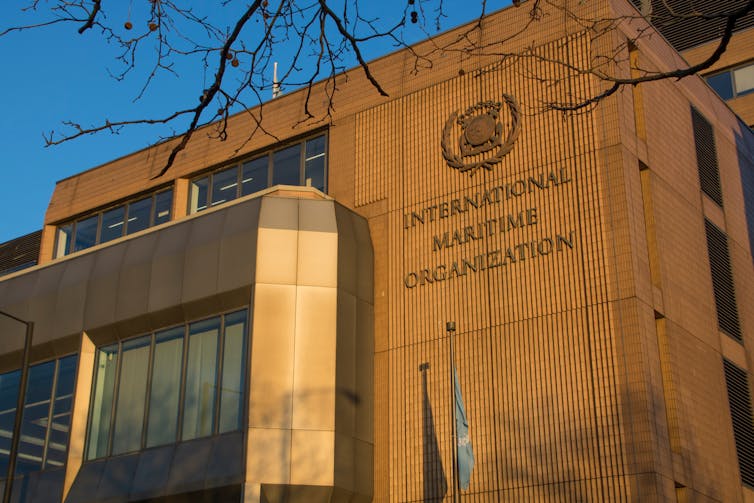
This week, all 174 member states of the International Maritime Organisation (IMO) will discuss a plan to meet an emissions reduction target. But the target falls far short of what’s needed, and the plan to get there is also weak.
As other industries clean up their act, shipping’s share of the global emissions total will only increase. New fuels and ship design, and even technology such as mechanical sails, may go some way to decarbonising the industry – but it won’t be enough.
It’s high time the international shipping industry radically curbed its emissions. The industry must set a net-zero target for 2050 and a realistic plan to meet it.
The shipping industry accounts for more carbon emissions than aviation.Shutterstock
Per tonne-mile, carbon dioxide emissions from shipping are among the lowest of all freight transport options. But in 2018, shipping still emitted 1,060 million tonnes of CO₂ – 2.89% of global emissions. By comparison, the aviation industry contributed 918 million tonnes of CO₂, or 2.4% of the total.
And as international trade increases and other sectors decarbonise, global shipping is expected to contribute around 17% of human-caused emissions by 2050.
An emissions pariah
The IMO, which regulates the global shipping industry, did not set meaningful emissions reduction targets until April 2018. This is despite being requested to reduce emissions as far back as 1997 under the Kyoto Protocol.
The IMO has pledged to halve shipping emissions between 2008 and 2050 while aiming for full decarbonisation. By 2030, the carbon intensity (or emissions per tonne-mile) of individual ships should fall by 40%, compared with 2008 levels.
The IMO’s Marine Environment Protection Committee, is devising binding rules for the industry to achieve these emissions goals. Draft measures being considered this week focus solely on reducing the carbon intensity of individual ships. The plan has been slammed by critics because emissions reductions are not in line with Paris Agreement commitments of limiting global warming to 1.5℃ or 2℃ by 2100.
There are two main issues with the 40% emissions intensity target.
First, it’s not ambitious enough. Research suggests limiting warming to 1.5℃ requires the shipping industry to reach net-zero emissions. Merely reducing the carbon intensity of ships will barely make a dent in current emissions. Worse, even the best-case scenario will likely lead to a 14% emissions increase compared to 2008.
Second, the IMO has yet to say how it will meet its targets. The plan up for discussion this week is weak: not least because it lacks enforcement mechanisms.
The IMO dragged its feet on setting an emissions target for the industry.Shutterstock
So how do we fix the problem?
Earlier this year, I sailed on the Avontuur. This 100-year-old two-masted schooner under German flag sailed from Germany to the Caribbean and Mexico to load 65 tonnes of coffee and cacao, then ship it under sail to Hamburg.
The round-trip took more than six months and 15 crew members. Roughly 169 million ships like the Avontuur would be needed to transport the 11 billion tonnes of goods moved by sea each year. It would require 2.5 billion crew, compared with 1.5 million today. Clearly, that is not realistic.
So how, then, do we solve the international shipping problem? Clean transport advocates say we must reduce demand for cargo transport by using what’s locally available, and generally consuming less and moving to a post-growth economy.
Some scientists concur, arguing either carbon intensity or shipping demand must come down – and probably both.
Ships can significantly reduce their emissions simply by slowing down. Carbon emissions increase exponentially when ships travel above cruising speed. But the industry seems unwilling to pick this low-hanging fruit, perhaps because it would compromise just-in-time supply chains.
Ships commonly burn huge amounts of heavy fuel oil. Emerging fuels, such as hydrogen and ammonia, have the potential to cut emissions from ships. But producing these fuels may create substantial emissions, and adopting new fuels would require building new ships or retrofitting existing ones.
Existing vessels can also be retrofitted with more efficient propulsion mechanisms. They could also be fitted with wind-assist technologiessuch as sails, rotors, kites, and suction wings. Research suggests these technologies could reduce a ship’s emissions by 10–60%.
And new designs for sail-powered cargo vessels areemerging. But these ships are yet to be built and it may be a long time before they are widely used.
Sail-powered cargo vessels can help slash global emissions.Neoline
Earth’s remaining carbon budget is fast shrinking and all industry sectors must do their fair share. At this point in the climate crisis, further delays and weak targets are inexcusable.
Source: The Conversation (Au and NZ) – By Alan McKee, Professor in Digital and Social Media, Faculty of Arts and Social Sciences, University of Technology Sydney
2020 has been the year of the coronavirus lockdown, the year of online education, the year of excessive streaming of entertainment … and the year when people are watching more pornography than before. The website PornHub reports porn viewing has increased by up to 24% this year.
And this may not just be for adults. According to some sources, the average age of first exposure to pornography is 11 years old. Those aren’t reassuring statistics for parents.
Despite this, it’s surprisingly difficult for parents to find straightforward, expert advice on porn and their kids.
To address this problem our team — including experts from psychology, sexology, sociology and media studies — spent three years reviewing over 2,000 pieces of academic research about the ways healthy — or unhealthy — sexual development is related to the consumption of pornography.
Then we synthesised all of that information into a plain-English factsheet setting out the key points for concerned parents. Here’s what you need to know.
What if they just stumble across porn?
The most important thing to know is — don’t panic! With the right support from you, exposure to porn doesn’t need to cause damage.
First things first — you want to make sure porn isn’t the only way your kids find out about sex. Comprehensive, age-appropriate sex education is vital — both from you and from schools.
With more people having educated their kids at home this year, the role of the parent has become more important. Sex education doesn’t make kids have sex earlier. In fact all the evidence shows the opposite is true.
Yes, it can be embarrassing talking to your child about sex. So, have a look at Talk Soon Talk Often, a great booklet about how to talk to your kids about sex.
As soon as your kids start asking questions — which often happens when they’re just a few years old, with questions like “Where do babies come from?” — answer them honestly, using age-appropriate language, without volunteering extra information, and, vitally, without acting like you’re embarrassed.
Make it seem normal, and that you’re happy to talk to them about it.
That’s going to make the next part easier. Research shows when prepubescent kids stumble across explicit material online they’re often more upset their parents will be angry with them for seeing it than they are about the material itself.
Open communication is the best way to ensure your kids won’t be harmed by what they see online.Shutterstock
You want to make sure your kids know that if they do see something that upsets them, you won’t be angry at them for talking to you about it.
What about what they go looking for it?
Of course, after puberty, the situation changes a bit — at that point kids are less likely to “stumble across” porn and more likely to go looking for it.
Again, the key here is comprehensive sex education and open communication. If they already know about sex, they’re less likely to go searching for information about it.
Most porn isn’t good at sex education. For example, it rarely talks about sexual consent. Which is why it’s so important you make sure your kids have a good understanding of how to talk to sexual partners about what they like and what their partners want for when they reach that stage in their own lives.
Tell them about the importance of asking their partners questions about what they prefer, what they’d rather do or not do, and how slowly (or quickly) they may want to take things.
And let them know that consent is ongoing — even if you’ve started doing something sexy, at any point you can say no and that’s fine. If a partner asks them to stop, make sure they know the correct response isn’t to try to convince them, or get angry at them; it’s to ask them how they’re feeling, and listen to the answers honestly.
There’s nothing sexier than being fully present with a partner and really engaging with them.
The final challenge
One final challenge for many parents is that pornography may not teach the same values about sex as you hold. Porn shows sex for fun and pleasure — not for love or procreation. You need to make sure you explain to your kids, openly and honestly, your own values around sex, and be prepared to explain why you hold those values.
Yes, it can be challenging — particularly to keep those lines of communication open as children grow up and start exploring their own sexual lives.
But other cultures manage it. For example, in the Netherlands kids often ask parents for advice about sex, and value it.
And always remember, open communication is the thing most likely to ensure your kids aren’t harmed by the sexual content they see, or anything else disturbing they might find when they’re spending all this extra time online.
Source: The Conversation (Au and NZ) – By Joanna Mendelssohn, Principal Fellow (Hon), Victorian College of the Arts, University of Melbourne. Editor in Chief, Design and Art of Australia Online, University of Melbourne
Review: Know My Name: Australian Women Artists 1900 to now, National Gallery of Australia
Know My Name is more than an art exhibition, although the exhibition attached to its launch is large, complex and wonderful. Described as a “gender equity initiative”, it is part of a strategy by NGA Director Nick Mitzevich to move towards a culture of inclusion in both collecting and exhibiting.
The exhibition begins with a massed display of portraits, hung like a 19th century salon, almost like an honour guard. The subjects are all people with a purpose.
Brenda L Croft, Gurindji/Malngin/Mudburra People; Anglo-Australian/Chinese/German/Irish Heritage, Matilda (Ngambri/Ngunnawal), 2019.National Gallery of Australia, Canberra purchased 2020
Brenda L. Croft’s intense monochrome portrait of Auntie Matilda House, the Ngambri-Ngunnawal elder, provides a welcome to country. Nearby, Julie Dowling’s iconic, heartbreaking portraits of her family and community’s grief and loss are placed alongside Violet Teague’s Dian Dreams (1909), a painting with a subject who does not need to bask in anyone’s approval.
Some of the works are well known, others less so. Inevitably, the eye is drawn to Grace Cossington Smith’s The Sock Knitter (1915), the work that first placed women artists at the centre of Australia’s art history.
A century before the first Countess Report released its meticulously researched data on the inequitable treatment of women artists, The Sock Knitter was exhibited at the 1915 Royal Art Society of NSW’s annual exhibition. It was ignored, as was the artist, long regarded as a “lady amateur” flower painter.
The Sock Knitter remained in her studio until the late 1950s when it was discovered by Bernard Smith. Cossington Smith may now be recognised as perhaps Australia’s most important modernist artist, yet she spent most of her life in relative obscurity.
The exhibition is Mitzevich’s signal of a change in the NGA’s collections policy to one of affirmative action. Previously, the gallery only held 25% of works by women artists. What surprised him, he has said, is that despite the increased profile of female artists in the last four decades, the proportion of works by living women artists collected by the gallery over that time was less than in earlier years.
The gallery’s first director, James Mollison, may not have been prejudiced in favour of women, but he was not prejudiced against us. Key works by Rosalie Gascoigne, Joy Hester, Tracey Moffatt and Emily Kame Kngwarreye, were all bought on his watch. Many more recent works in the exhibition come from elsewhere.
Tracey Moffatt, Something more #8, from Something more series 1989.Naomi Milgrom AO Art Collection
It could be argued that it is not possible to reconfigure Australian art using only the work of one gender. There is, of course, an easy answer to this. For many years, almost all the art on public display was by men.
Relationships, not history
The beauty and the audacity of this exhibition is that it ignores any attempt to slot artists into specific movements. Instead, curators Deborah Hart and Elspeth Pitt have created what they rightly call “a new story of Australian art”, one of relationships, not history.
It is a magnificent, encircling argument of solidarity and inclusion. Works are grouped by thematic concerns; crossing cultural and chronological barriers. Traditional hierarchies between high and low art are dissolved.
Know My Name doesn’t slot artists into specific movements. It is a new story of Australian art.National Gallery Australia
After the salon-style entrance, the visitor moves on to different interpretations of that great creation myth, the Seven Sisters. The space is dominated by the gallery’s recent commission, a large installation by the Tjanpi weavers. It is joined by paintings on the same subject, including works by the Ken sisters from the Anangu Pitjantjatjara Yankunytjatjara Lands. The message is of collaboration and generosity.
In the following room, Connection with Country, artists from different generations and cultures are linked to land and the environment. This includes a wall of Utopia batiks, a reminder that Jeanie Pwerle, Rosie Kngwarray and Emily Kame Kngwarreye first worked purely in textile.
Installation view of Janet Laurence’s Requiem 2020, Know My Name: Australian Women Artists 1900 to Now.National Gallery of Australia, Canberra
Emily Kame Kngwarreye’s great painting Untitled (Alhalker), (1992), from the collection of the Art Gallery of New South Wales, tells of her country.
Rosalie Gascoigne’s Feathered fence evokes the sparse beauty of the landscape around Canberra, while Janet Laurence’s installation, Requiem, mourns the loss of natural life. Fiona Hall’s Tender, with its bird nests woven from shredded American dollar bills, provides a stern reminder of the transience and folly of money.
Despite the cavernous exhibition spaces it is possible to enjoy the intimate pleasure of getting up close and personal to Bea Maddock’s epic etched panorama, Terra Spiritus … with a darker shade of pale (1993-98), a painstakingly recorded circumnavigation of Tasmania, linking original names to those imposed on the land by the British invaders.
Then there are Narelle Jubelin’s exquisite reworking of colonial photographs, all in petit point.
A change of tempo
In the room titled Collaboration and care, the tempo changes. A large wall is covered with activist posters and more incendiary works, including Phoenix (Frances Budden)‘s Relic, a savage, embroidered critique of Catholicism and its regard for women.
The sense of outrage and protest that permeates this wall is matched by R.E.A.’s Resistance rework of the Aboriginal flag hanging opposite.
Ann Newmarch, Women hold up half the sky, 1978.National Gallery of Australia, Canberra, gift of the artist 1988
These polemicist works are countered by the tranqullity of the Westbury Quilt, made by the Misses Hampson in northern Tasmania in the early years of last century. The quilt’s small red and white squares, embroidered with details of daily life, are centred on an idealised vision of Queen Victoria.
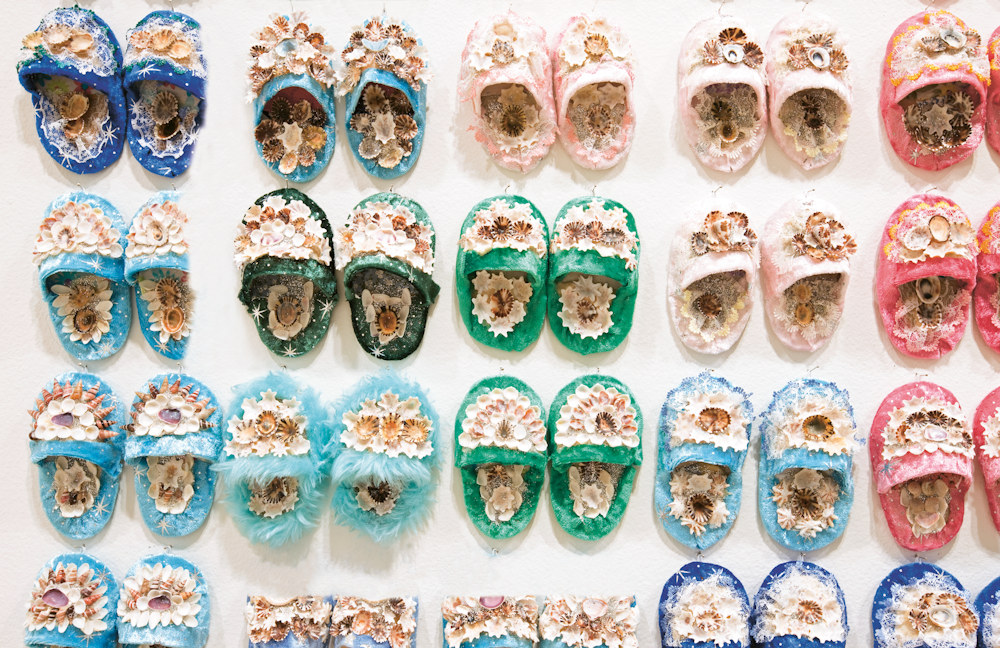
Although they are exhibited in a different section, this quilt has perhaps more in common with Esme Timbery’s Shell worked slippers (from 2008) than other exhibits. They both speak of the domestic scale of traditional women’s work, and the way art can infiltrate into everyday spaces.
Esme Timbery (Bidjigal people), Shellworked slippers 2008.Museum of Contemporary art, Purchased with funds provided by the Coe and Mordant families
There is a sense of familiarity in the room, Colour, Light and Abstraction, as the contribution of women artists to Modernism has been well recorded. Here are old favourites by the pioneers – Dorrit Black, Cossington Smith, Grace Crowley, Klytie Pate – informing later generations including Margaret Worth, Janet Dawson, Virgina Cuppaidge and Melinda Harper.
The room titled Performing Gender presents the full suite of Julie Rrap’s Persona and Shadow, manipulated photographs based on both her body and the paintings of Edvard Munch.
These, along with Anne Ferran’s magnificent black and white Scenes on the Death of Nature, and Tracey Moffatt’s Something More, are probably the most familiar works for those who came of age in the 1980s.
Julie Rrap, Persona and Shadow: Christ 1984, Purchased 2019.National Gallery of Australia, Canberra
Remembering is the most sober of rooms. Kathy Temin’s memorial gardens installation honours loss of family with faux fur architecture. Lindy Lee’s bronze fragments remind us that we are but specks in the universe, while flight research, Rosemary Laing’s series of photographs, shows bridal figures floating in a clear, blue sky.
The exhibition is so big only half of it is on display now. The second half is planned for July next year (it was preceded by an online conference). That one may be more confronting as it will include the in-your-face works of Pat Larter, for many years better known as the wife of Richard Larter.
The Robodebt class action bought by Gordon Legal has been settled at a cost to the government of around $1.2 billion. According to federal Labor frontbencher Bill Shorten, this is the biggest class action in Australian legal history.
This comprised refunds of $721 million to 373,000 people, $112 million in compensation and $398 million in cancelled debts.
As is well-known, “Robodebt” is the label commonly applied to the initiative starting in 2016 designed to increase recoveries by government of “overpayments” made to social security recipients, retrospectively dating back to 2010.
This table sets out a chronology of the major developments in Robodebt from 2016 up to this week.
How Robodebt began
The “Robodebt” story started with an announcement as part of the 2015-16 budget that the government would save $1.7 billion over five years by enhancing the Department of Human Services (DHS) fraud prevention and debt recovery capability.
Data-matching with the Australian Tax Office had been started in 1991 by the then-Labor government, with the automation of the system being increased in 2011.
The 2015 measures reduced human oversight once discrepancies between income reported to the ATO and income reported to the DHS were identified. Previously, officers had scrutinised each discrepancy on a case by case basis before raising an over-payment.
In addition, where previously the DHS collected verifying information from employers, the new system shifted responsibility for providing information to the individuals concerned, reversing the “onus of proof”.
the responsibility for checking and clarifying income information has shifted from the department to current and former recipients of Centrelink payments. … the significant reduction in workload for the department by this outsourcing, has allowed for a huge increase in the number of income discrepancy investigations that the department initiates
As a result, the Senate report pointed out the number of “debt interventions” increased from 20,000 in 2015-16 to nearly 800,000 in 2016-17.
Scott Morrison has apologised for any hurt people suffered as a result of the Robodebt scheme.Mick Tsikas/AAP
Concerns are raised
In late 2016, members of the public raised concerns about letters from the DHS advising they owed the government significant debts for past income support payments they had received.
The controversy escalated, with the shadow human services minister requesting the auditor general to investigate, and an independent MP separately asking the Commonwealth ombudsman to look into the matter after receiving more than 100 complaints about the debts.
In January 2017, a website now sharing more than 1,200 personal accounts, a Facebook account and a Twitter account with the hashtag #notmydebt were all set up to record contested debts.
There have since been tworeports by the Commonwealth ombudsman and two parliamentary committee inquiries (one ongoing).
The unravelling of the scheme
Victoria Legal Aid experienced a large spike in calls for legal help with Robodebt issues going back to 2016. In 2018, Centrelink raised a debt of over $3,700 against a former student, Madeleine Masterton, and in February 2019, VLA filed an application for judicial review. Within a week, the debt was reduced to around $600.
At the first case management hearing, Centrelink accepted Masterton’s original declared income, with the result that there was no debt, and no legal ruling on the issue.
The second case also involved a former student, Deanna Amato, who only became aware that a debt of just over $3,200 had been raised against her — plus a penalty of 10% for “not engaging” — when her income tax refund of around $1,700 was taken as repayment.
After the litigation began, Centrelink gathered information from her employers to determine the debt should be reduced to $1.48. A subsequent Freedom of Information request revealed she had actually been underpaid by $480.
In September 2019, the DHS completely dropped the Amato debt but refused to pay interest. Then in November, the Federal Court ruled that income averaging was unlawful – a conclusion the government conceded a week before the case came to trial.
It was this ruling that required the government to have more than 500,000 individual debts manually recalculated – at an unknown cost.
Lawyer Peter Gordon (right) led the class action against the government.James Ross/AAP
What separates a “fiasco” from other forms of policy failure is that it is commonly regarded as being reasonably foreseeable – that is, the failure should or could have been avoided with foresight.
The current situation was clearly foreseeable. The income reported to the ATO is what people receive in the financial year from July 1 to June 30. Social Security payments are made fortnightly and the level of entitlement is based on the financial and personal circumstances that apply during that reporting period.
In January 2017, I pointed out on this website that “this approach [averaging] will only work correctly if individuals receive exactly the same income each fortnight. For students, this is very unlikely.”
Professor Terry Carney – who served for nearly 40 years as a member of the Social Services and Child Support Division of the Administrative Appeals Tribunal and its predecessor the Social Security Appeals Tribunal – also made five judgements in 2017 that there was no debt where Centrelink calculated overpayments by applying averaged annual income to shorter periods.
In an article in 2018, Carney noted the Commonwealth had to prove that debts existed rather than requiring individuals to prove they did not. This was also pointed out by Hanks in 2017, and was the conclusion reached by the Federal Court in the Amato case.
The department could have appealed these judgements to the next level of the AAT where rulings would have been published, but chose not to – suggesting it was not confident of its position.
The Guardian also revealed there were 76 other AAT cases where robodebts were set aside because the calculations used by Centrelink “could not lawfully support the existence of a debt”. In each case, the Commonwealth elected not to appeal.
What is most striking about Robodebt is how it differs from earlier examples that focus on problems of implementation, or where outcomes do not match intended objectives.
Essentially, the Robodebt fiasco arises from the very formulation of the policy. From the beginning, a central feature of the program was unlawful.
The unlawfulness does not relate to a legal technicality or a mistake in drafting. In brief, the “overpayments” the government recovered using income averaging were not overpayments. No one who understood the social security system and its governing legislation could have realistically thought they were.
What does the future hold?
The Robodebt fiasco involves policy failures across numerous dimensions. The most obvious – and in many ways the least important failure – is it failed to achieve the budgetary savings that were its main objective.
More seriously, hundreds of thousands of people were adversely affected. This human cost is difficult to assess and involves much more than financial losses.
Just over 2,000 people who had received a Robodebt notice between July 2016 and October 2018 died during that period, although in the absence of an official coroner’s report, no causes can be attributed.
However, it has been noted that from January 2017, Centrelink began tweeting the contact number for Lifeline, the national charity providing 24-hour support and suicide prevention services.
This story is not yet finalised. The Federal Court has yet to approve the terms of the settlement. The second inquiry by the Senate Community Affairs is due to present its report in February 2021.
The opposition has indicated it would set up a royal commission into Robodebt if elected to office.
Nevertheless, there are some reasons to be cheerful. While the checks on power that are built into the appeals processes in the Australian social security system were initially brushed aside, the combination of community activism, journalistic investigation, political scrutiny and the legal aid system appear to have ultimately provided a remedy to the victims of this major policy fiasco.
In future, there is clearly a need to strengthen these formal accountability and review structures.
South Australia is battling to prevent a serious COVID outbreak turning into a second wave, as several states slam restrictions on their borders to prevent the import of cases from SA.
The outbreak is a setback the goal of having most of Australia open by Christmas – although Scott Morrison on Monday was quick to say he hoped it would not stymie that timetable.
Queensland, Tasmania, and Western Australia as well as the Northern Territory announced border clamps on travellers from SA. In WA’s case it had only just eased restrictions for them.
NSW and Victoria are leaving their borders open. Victoria will impose health checks on people flying into Melbourne from Adelaide.
SA on Monday announced 18 new cases, in people aged from one through to their 80s. Thirteen of the cases are linked to a Parafield Gardens cluster.
The outbreak started from hotel quarantine. A hotel worker and two security guards have tested positive. The worker spread the virus through a large family.
The SA outbreak and the reaction of various states once again shows the split between leaders over the issue of “living with COVID”.
Morrison and NSW Premier Gladys Berejiklian argue small numbers of cases can be managed while the economy, and borders, remain open. But several state leaders take more conservative approaches, confident they have the support of their populations.
The SA outbreak will test the effectiveness of the state’s contact tracing. The federal government last week released the report of chief scientist Alan Finkel, who found states’ systems were now generally sound while recommending some improvements.
SA premier Steven Marshall said: “Time is now the essence and we must act swiftly and decisively”.
“We will throw absolutely everything at this to get on top of the cluster.” He said the next 24 hours would be critical.
The SA government is closing gyms, recreation centres, and trampoline/play cafes for an expected two weeks. Community sports fixtures and training are also cancelled.
Among a range of caps, gatherings at private residences will be limited to 10 people.
All international flights to Adelaide are suspended for the rest of the week.
The state’s chief public health officer, Nicola Spurrier, said “What we are facing is, indeed, a second wave but we haven’t got the second wave yet. We are in very, very early days.”
AnglicareSA said two employees from its Brompton aged care home had tested positive to COVID-19 on Sunday.
The workers hadn’t been at Brompton since Friday 13 and had not worked at any other AnglicareSA residential aged care home.
On Friday national cabinet committed to having internal borders – apart from WA’s – open by Christmas.
Morrison said on Monday: “It is not a surprise that [an outbreak] can occur from a quarantined facility. What matters is how you respond in these situations”.
Acting Chief Health Officer Paul Kelly said he was confident the systems were in place to deal with this outbreak.
The Australian Health Protection Principal Committee held an emergency meeting on Monday.
Asked about the different responses between NSW and WA on borders, Morrison said the AHPPC had not recommended collectively any one response.
“What is important is these don’t get sort of locked in as part of another enduring disruption and as soon as South Australia is able to get on top of this I would be expecting that states would keep on the path that we have set towards Christmas.”
After the disastrous consequences of Victoria’s second wave for residential aged care, with residents accounting for most of the deaths, Morrison said: “We have stood up the aged care response centre in South Australia. That is important to ensure that we deal with any potential risks or issues in residential aged-care facilities. I particularly spoke to the premier about that today”.
Addressing a Committee for Economic Development of Australia dinner on Monday night, Reserve Bank Governor Philip Lowe highlighted the link between what happens on the health front and the trajectory for the economy.
“There is still considerable uncertainty about the [economic] outlook,” he said.
“If we do get further good news on the health front, we could have a rapid rebound.
“At the same time, it is still possible that we experience further outbreaks. And the hoped-for medical advances may be delayed and could face production and distribution challenges slowing their rollout. This means that there are downside scenarios too.”
The giant Regional Comprehensive Economic Partnership between Australia, China, Japan, South Korea, New Zealand and the ten members of ASEAN (Brunei, Cambodia, Indonesia, Laos, Myanmar, The Philippines, Singapore, Thailand and Vietnam) was signed online on Sunday, November 15.
India left negotiations in November 2019, but even so, the deal will cover one third of the world’s population and economy.
India left the RCEP because of concerns about its potentially negative impact on local industry development.
Since Australia already has free trade agreements with all of the remaining members, India’s absence significantly diminishes what might have been in it for Australian exporters.
What’s left are some agreements on common standards and the claimed ability for Australia to talk to China more than it can through its own one-on-one trade agreement.
The text was completed before the pandemic and has not been revised since.
As it happened, Australia took actions during the pandemic that were technically contrary to the rules embodied in the RCEP in order to boost local manufacturing capacity for essential products.
But the rules signed up to on Sunday will integrate Australia further into regional production chains and commit Australia to avoid assistance for local industries of the kind that will arguably be needed to rebuild and strengthen the economy.
Other rules signed up to on Sunday open essential services such as health, education, water, energy, telecommunications, finance and digital trade to foreign investors and restrict the ability of governments to regulate them in the public interest.
Sunday’s virtual signing ceremony.Lukas Coch/AAP
It remains to be seen whether these rules will give governments the flexibility they will need to get “the balance right”
Oddly for an agreement dealing with standards, there’s nothing in it about forced labour or child labour, and no mention of climate change.
Its members include countries like China and Myanmar in which there is mounting evidence of labour rights and human rights abuses.
But there are also welcome omissions.
No further rights for foreign investors
The final text confers no special rights on foreign corporations to sue governments through what are known as Investor-State Dispute Settlement clauses common in other agreements, although there is an opportunity for the members to revisit the idea two years after ratification
Looked at this way, the US has been weakened by the Trump administration’s decision to pull out of the original Trans Pacific Partnership.
It is argued that the RCEP is China’s creation, and the incoming Biden administration will need to counter it by re-joining the revised Trans-Pacific Partnership, which excludes China.
But this is a US-centric a view that downplays the leading role of the ASEAN countries in creating the RCEP.
A Biden administration is unlikely to re-join the Trans Pacific Partnership any time soon. Parts of the Democratic party remain strongly opposed to it.
The US will rejoin genuinely multilateral organisations such as the World Health Organisation and the Paris Climate Agreement.
But Biden’s trade policy is likely to focus on domestic priorities such as the pandemic and climate change, about which the RCEP says nothing.
The meat industry is waiting with bated breath to find out if there is any truth that New Zealand meat is linked to a coolstore in China where covid-19 has been found on packaging.
The virus was apparently found on more than 3500 products in the eastern Chinese city of Jinan, in Shandong province.
Apart from saying where the products originated, Chinese authorities have not named the companies that shipped them.
New Zealand’s Ministry of Foreign Affairs and Trade said it had not been informed officially by Chinese authorities, and officials were trying to find the origin and veracity of the media reports.
They were also advised that there were some New Zealand products stored in the same coolstore where the positive tests were returned.
Government seeks more information Unlike some media reports, they were not advised that any New Zealand products had tested positive. The government was seeking more information on the testing.
“I want to get to the bottom of this … this is incredibly important to New Zealand. We are confident, of course, that our products do not and are not exported with signs of covid on them given our status as essentially being covid-free,” Ardern said.
Minister of Trade Damien O’Connor said there was nothing to suggest the virus originated in New Zealand.
“We have been aware of the Chinese investigating the possibility of covid spreading through frozen goods. It’s a very, very slim possibility. Genetic material can be found on the goods, we know that, but the risk of it spreading infection is very, very low.”
He said it was a timely reminder to exporters about the risks.
“If they have people who are sick, working anywhere in New Zealand even though we have no community transmission, they should take all precautions and make sure people don’t come to work.”
The Meat Industry Association said they were essentially in a holding pattern awaiting more information from China, with chief executive Sirma Karapeeva saying the science suggested transmission of the virus on frozen products was negligible.
‘No evidence’ of NZ implication “We haven’t had any feedback from our members that suggests that their product has been caught up in this and they should know, they’ve got really close links with their importers in China. So I tend to agree with the minister, it’s not clear or seen any evidence to suggest any New Zealand product has been implicated.”
She said it proved China was serious about the risks of covid getting back in.
“They have stepped up their product testing on imports. They are testing all products as they come through the border, so clearly they are taking this very seriously and in a way it’s positive to see that they are focused on managing Covid within their own borders.”
Karapeeva advised people to keep calm and carry on.
“Now is not the time to panic, we have very good systems in place for food safety as well as for covid management and we are confident those systems are robust in managing transmission within New Zealand, so as long as companies follow the rules I think they should be fine.”
AgriHQ senior sheep and beef analyst Mel Croad said meat exports to China were heading into the busiest period of the year so any hiccup was a worry.
”From here until about March-April, our export volumes are ramping up every month just reflecting those higher processing volumes back here. It’s crucial that we have got a good flow into our export markets.”
The Ministry of Primary Industry’s assessment remains that the risk of covid-19 transmission by food or food packaging is negligible.
The Meat Industry Association said it was unfortunate New Zealand products seemed to be implicated in something with very little or no evidence.
This article is republished by the Pacific Media Centre under a partnership agreement with RNZ.
A COVID cluster linked to a quarantine hotel in Adelaide has today grown to 17 cases.
As a result, the South Australian government has reintroduced certain restrictions, including closing gyms, capping patrons in hospitality venues, and limiting visitors to private homes.
Meanwhile, other states have reimposed border restrictions for South Australians.
After months without any community transmission in the state, this is a big blow for South Australia. But with an effective public health response and cooperation from the community, the hope is we will be able to quickly get this under control.
Seeded in hotel quarantine
The first, or index case, to come to the attention of the health authorities was an 80-year-old woman who attended the emergency department of Lyell McEwin Hospital in Adelaide’s northeast. She comes from an extended family based in the city’s northern suburbs, 15 of whom have now been diagnosed with COVID-19.
Members of this extended family work in aged care, health care and the prison system — all high-risk settings for the spread of COVID-19. It’s possible some of these people worked while infectious, but this information hasn’t been released yet.
It’s been reported the origin of this cluster was one of Adelaide’s quarantine hotels (which in South Australia we call medi-hotels) where one member of the family worked.
It’s likely there’s been some kind of breach in the medi-hotel. We don’t know the exact role this person was working in, but it’s important we find out how they picked up the infection so we can address what went wrong.
From now on, staff working at medi-hotels will be tested for COVID-19 weekly. Before this outbreak, they were only asked to be tested if they had symptoms. In hindsight, regular testing should have been in place months ago.
We know Victoria’s second wave began with someone working in the hotel quarantine system who passed it to their large family, who then spread it in the community.
While there are similarities between what happened in Victoria and what’s unfolding in Adelaide, there are also some notable differences. The first is that South Australia has a very strong public health system, whereas Victoria’s has had many problems.
Second, South Australia doesn’t have the high-density population Victoria does. The population is smaller and more dispersed, making the virus easier to control.
South Australians will now have to self-quarantine when entering some other Australian states and territories.Dean Lewins/AAP
Although both Victoria’s second wave and South Australia’s current cluster were seeded in hotel quarantine, the road out for Adelaide should be more akin to what we’ve seen in New South Wales.
Over recent months, several clusters have emerged in NSW, but they have been stamped out before transmission got out of control. We stand a good chance of doing the same in Adelaide, and indeed must avoid a situation in which this cluster grows exponentially.
Testing will be crucial to getting a handle on this outbreak, and is already a focal point. Pop-up testing sites have already been established, and public health messaging is encouraging people with symptoms to get tested.
South Australia has a well established contact-tracing team which should manage the daily case load, as long as we don’t see exponential growth. The conventional wisdom in my field is that each case has on average ten or so close contacts. If close contacts of close contacts are investigated too (the “second ring” approach), 100 people need to be investigated for each case. With 17 cases, that’s already 1,700 contacts to deal with. So you can see how easily an outbreak can become too big to track.
It may be possible to avoid any kind of lockdown. If the cluster does get much bigger from here, the government might think about mandating masks. Restricting social gatherings and asking people to work from home where possible are also worthwhile measures. These measures could reduce transmission but won’t deal a major blow to South Australia’s economy.
Border questions…
The approach from other states to consider South Australia a “hotspot” and restrict entry, while no doubt disappointing for many, is a sensible move.
Western Australia, Tasmania and the Northern Territory are now asking people arriving from South Australia to self-quarantine. Queensland will require all arrivals to go into hotel quarantine.
Now may be the time to seriously consider rapid antigen testing at all borders. These tests are not as accurate as the traditional COVID tests, but deliver results much more quickly, in as little as 15 minutes. Victoria is considering this tool.
Testing and tracing will be crucial to control South Australia’s outbreak.Shutterstock
…and broader questions
In a situation like this, we should ask why we continue to operate high-risk quarantine hotels in the middle of a city. It would be much safer to quarantine people away from communities, like we did on Christmas Island earlier in the pandemic.
I also believe we should establish a national centre to oversee contact tracing, hotel quarantine, and other important aspects of the pandemic’s management, ensuring all systems and training are uniform across Australia.
As domestic travel increases, this centre could host a national database with information gathered through QR codes, flight data, and so on. Local hubs in each state and territory would continue to be important.
South Australia’s current outbreak shows us this can happen anywhere — even in a place where COVID-19 is well under control. It’s likely this will be our COVID-normal, at least until we have a vaccine.
Source: The Conversation (Au and NZ) – By Christine Schlesinger, Senior Lecturer in Environmental Science and Ecology, Charles Darwin University
Many of us are aware of the enormous destruction feral cats inflict on Australia’s native wildlife, but there’s another introduced species that will cause at least as much harm if left unmanaged — yet it receives far less attention.
We’re referring to buffel grass (Cenchrus ciliaris), a plant native to parts of Africa and Asia that has been widely introduced elsewhere for pasture and to stabilise soils.
Buffel is fast growing, deep rooted and easy to establish, with each plant producing thousands of seeds. But these very characteristics for which it was prized have caused it to spread much further than ever planned.
We recently published two studies on buffel grass. One looked at just how serious the buffel invasion is to humans and wildlife by comparing it to other high-profile threats such as cats and foxes. The other study found that when buffel was removed, native wildlife quickly bounced back.
A catastrophic threat to wildlife
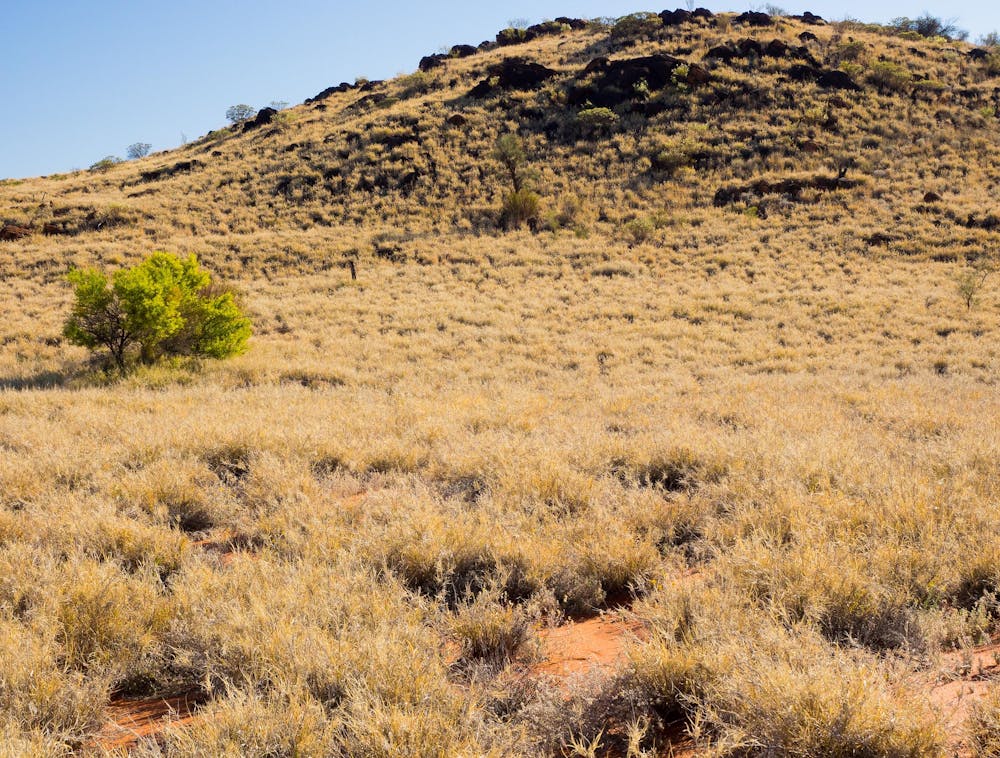
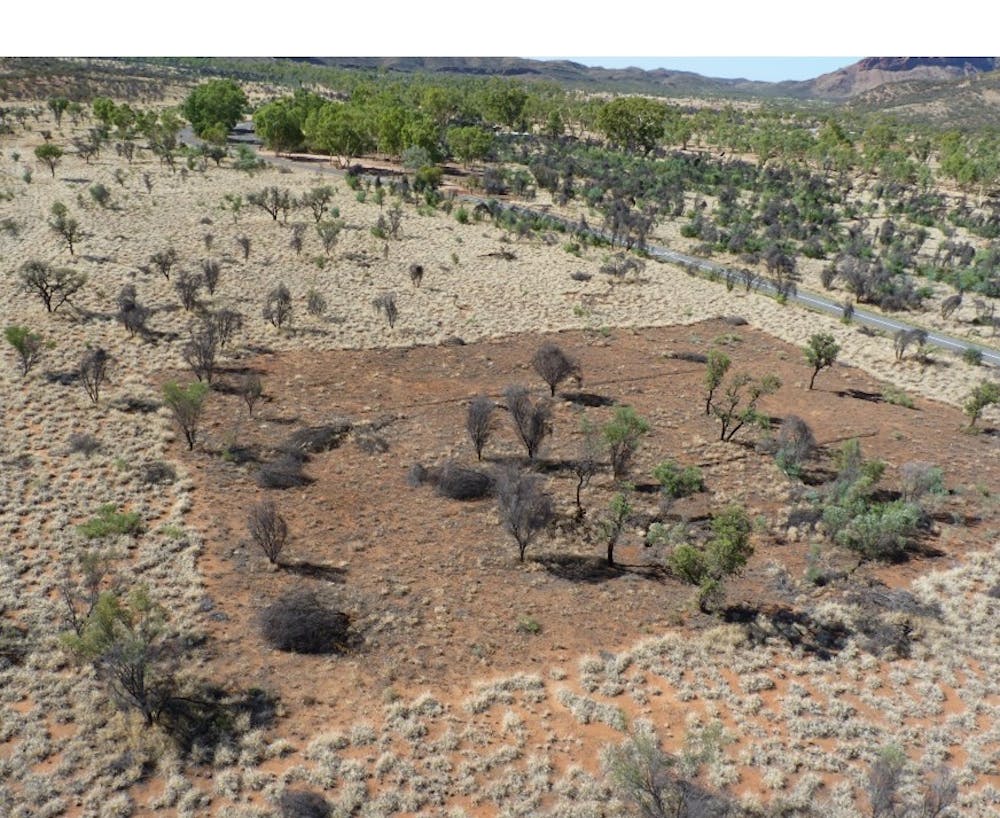
Buffel is now one of the worst invaders of dryland ecosystems worldwide. In Australia, this single species has replaced once diverse communities of native grasses and wildflowers across vast tracks of land. For example, most conservation reserves in the southern part of the NT have been invaded, including parts of Uluru-Kata Tjuta National Park.
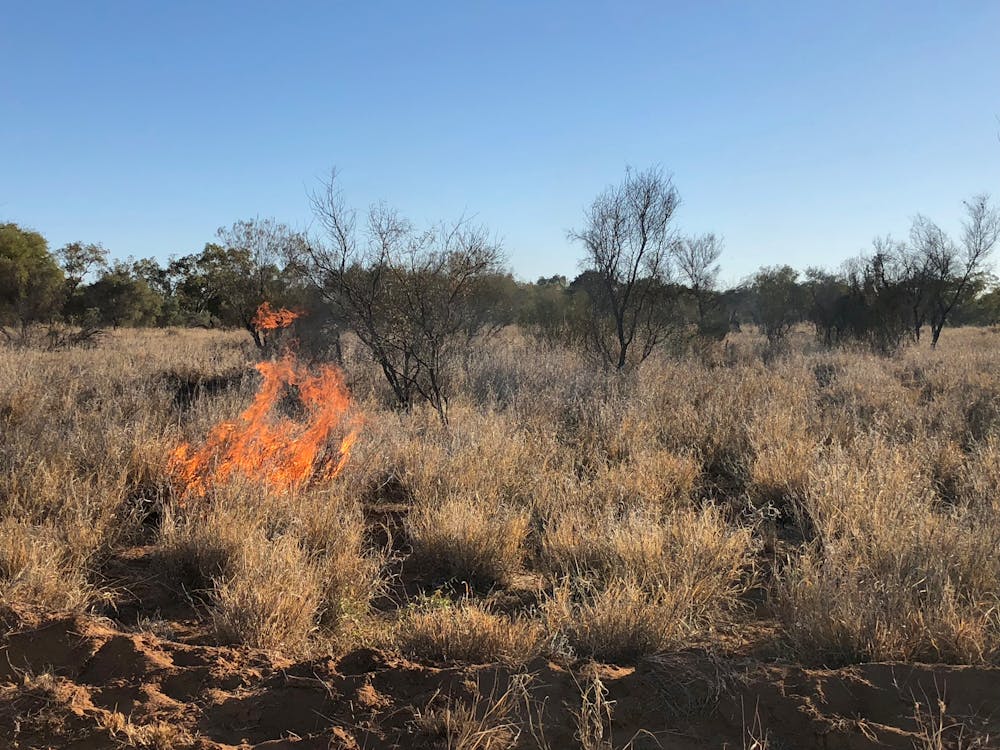
Because it grows so thickly, the dense grassy fuel can feed bigger, hotter and sometimes unexpected fires. These new fires are a risk to wildlife, humans and large, old trees.
Buffel grass promotes new fire risks.Jennifer Firn, Author provided
Our study compared buffel to threats posed by changed fire regimes, feral predators (cats and foxes) and feral herbivores (rabbits and camels). We found buffel was equal to feral cats and foxes in terms of future risk to biodiversity.
Feral cats are currently listed as threatening some 139 species under national environment legislation, including the night parrot and the central rock rat. Each year across Australia, feral cats kill more than three billion animals.
Buffel is formally listed as threatening 27 species under this legislation, such as the floodplain skink (buffel can choke its burrows). But because there has been much less research on the impacts of buffel, this number is likely a significant underestimate.
Unlike cats, buffel impacts whole plant communities and the animals they support. For example, when large old trees are burnt, birds that rely on tree hollows for nesting can no longer breed successfully.
Buffel grass surrounding wattleseed, a bushfood.Ellen Ryan-Colton, Author provided
What’s more, buffel has only spread widely in the last 20-30 years, which means its full impact on ecosystems has not yet been realised. In fact, 70% of the Australian continent has suitable conditions for buffel growth and could, in time, become invaded.
In contrast, cats have already roamed Australia for more than 200 years and, tragically, have caused many species, like the lesser stick-nest rat, to become extinct.
A social and cultural threat for Aboriginal people
Our study found buffel ranked higher than any other environmental threat in terms of its social and cultural impacts for Aboriginal people.
Because buffel is valued as a pasture grass in some regions, much debate has focused on its agro‐economic benefits versus environmental costs.
Meanwhile, the views and values of Aboriginal custodians of inland Australia have remained marginalised. It’s time this changes.
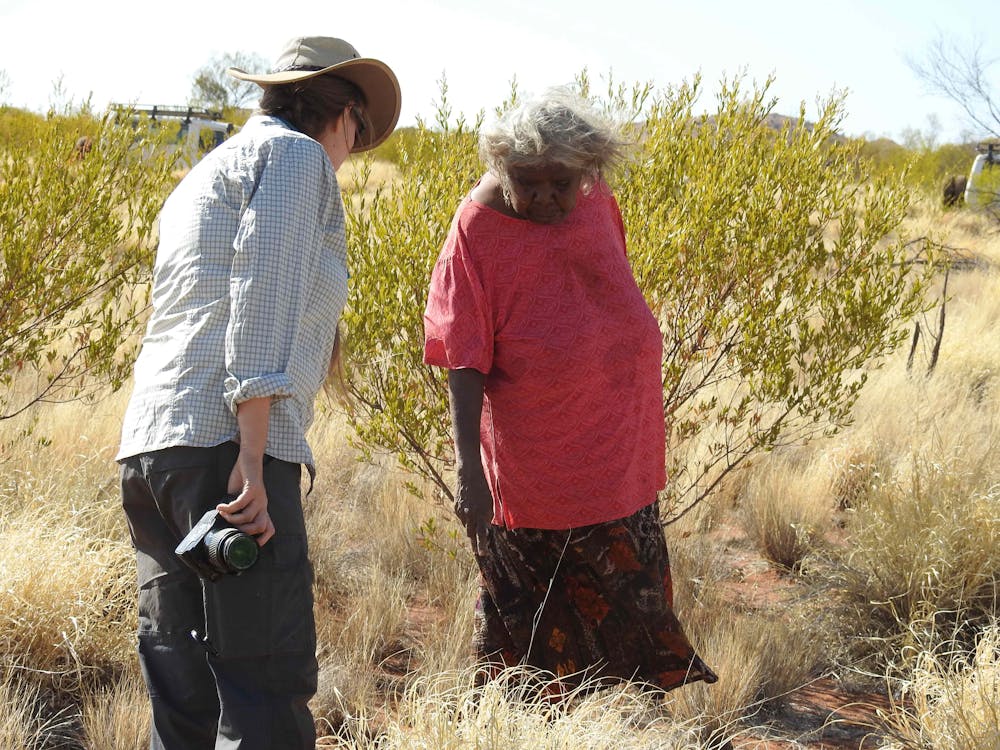
Nyanyu Watson showing how it’s harder to see animal tracks in areas occupied by buffel grass.Ellen Ryan-Colton, Author provided
While feral cats and buffel both threaten culturally important wildlife, buffel is also causing the decline of valued plant foods and medicines.
For example, native desert raisin (Solanum centrale) — “katjirra” to Western Arrernte people and “kampuṟarpa” to Pitjantjatjara people — remains an important staple food across central Australia and is part of Australia’s living cultural heritage.
However, it is becoming harder for women to find and collect as buffel takes over country.
Buffel grass growing right under desert fig, a bushfood that’s sensitive to fire.Ellen Ryan-Colton, Author provided
Buffel also damages important cultural sites by bringing fire and choking water holes. Thick grass makes it difficult to walk through country and it’s now hard to see tracks or animals.
Together with the loss of species, this inhibits the transfer of cultural knowledge from one generation to another.
The return of native wildlife
Buffel responds well to herbicide in smaller areas, and spread can be slowed or stopped by treating isolated infestations.
For six years, we tracked the response of native plants and animals (particularly lizards) after buffel was treated at six sites in the Tjoritja National Park near Alice Springs. And we found biodiversity soon bounced back.
A buffel grass removal experiment, near Alice Springs.Christine Schlesinger, Author provided
Following good rains, native plants like billy buttons and golden everlastings that had just been hanging on quickly re-established in areas where buffel was treated. And as native plant communities were restored, a range of lizards and other wildlife returned, too.
Birds such as Australian ring-neck parrots and red-tailed black-cockatoos began to selectively use the treated areas, foraging on seeds on the more open ground.
Ants also became much more abundant and diverse where buffel was removed. Ants play an important role in ecosystems, for example, by dispersing seeds. This has likely been diminished in buffel-occupied areas.
A fire-tailed skink at one of the the buffel removal sites.Christine Schlesinger, Author provided
Importantly, while research demonstrates the potential for ecosystem recovery following effective control, the negative effects of buffel on fauna increased in areas where we did nothing.
Where to from here?
The findings from both our studies underline the urgent need for management on a much larger scale than what is currently possible, and prevention of further spread.
It’s clear a nationally coordinated response is required, along with policies that support positive local initiatives.
Creating and maintaining large buffel-free sanctuaries in areas not yet invaded could help to protect biodiversity in the future. But we found the cost of maintaining these could be an estimated 40–50 times more than other pest-free sanctuaries, if restricted to current methods of control.
This is why Australia needs new, cost-effective, culturally appropriate and safe control options, rolled out on a broad scale. We stress the need for Aboriginal people from regions affected by buffel and prone to invasion to be central to discussions and the development of solutions.
It’s also important to note controlling buffel doesn’t require its eradication from pastoral regions where it’s valued. It does, however, require a national commitment and dedicated research, with strategic, coordinated and committed action.
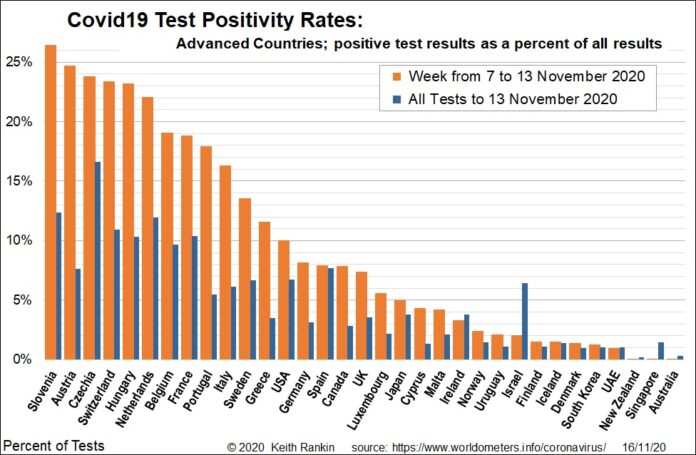
Central Europe is the present Covid-19 epicentre. Chart by Keith Rankin.
Analysis by Keith Rankin.
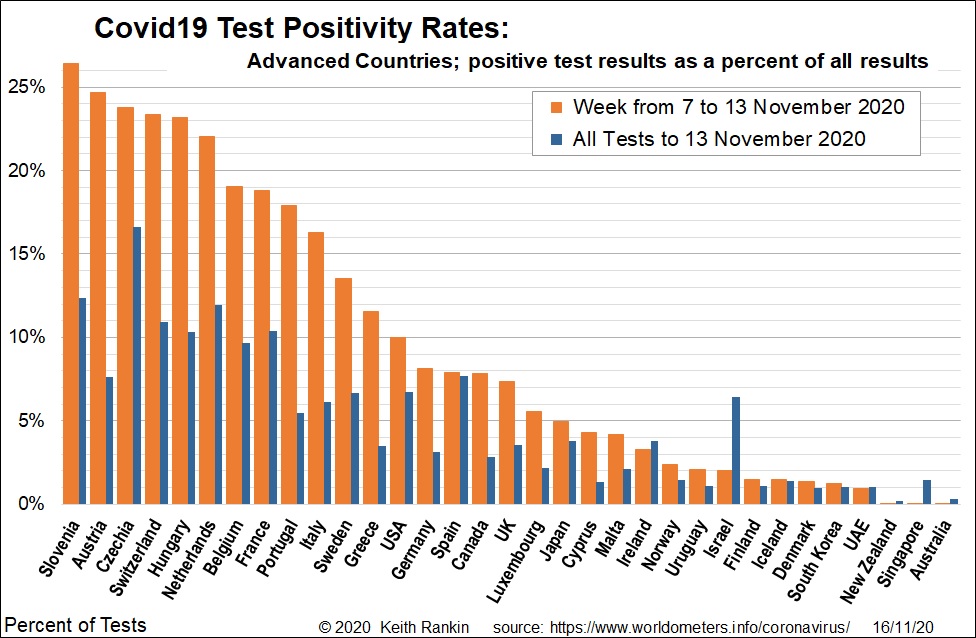
Central Europe is the present Covid-19 epicentre. Chart by Keith Rankin.
The above chart shows the world’s most economically developed countries, including three of the most developed in Eastern Europe (Slovenia, Hungary and Czechia), and one of the most developed in South America (Uruguay).
In early November, the countries with the most positive results are all clustered around Austria, in central Europe. The other main country that borders Austria is Germany, which is also shown to have a recent positivity rate well over five percent.
The next batch of countries are those on the west coast of Europe, with Netherlands being the worst, with France and Belgium not far behind. Portugal, once a good performer, is now one of the worst. The next worst group are the Mediterranean countries in the Eurozone: Italy, Greece, Spain, Cyprus and Malta. Then there is Israel which had a major outbreak two months ago.
Scattered amongst these – with rates above five percent – are several very important countries: Sweden, United States, Canada, United Kingdom. Scandinavian countries on the other hand – Sweden excepted – generally show positivity rates below two percent.
For East Asian economically developed countries, Japan is clearly worst, with South Korea’s testing outcomes comparable with Denmark and Finland; and United Arab Emirates (eg Dubai). Singapore – in November – has had lower positivity rates than New Zealand, but has had significantly higher historical rates. Uruguay has positivity rates similar to the best of the Scandinavian countries, and much better than other South American countries. The Argentine ‘Pumas’ rugby team was able to train in Uruguay before coming to Australia this month.
Of particular importance is that – based on Covid19 test results – many European countries’ leaders are much worse Covid19 performers than are the worst of the Anglo countries (USA, Canada, and UK). We love to lampoon Donald Trump for his appalling pandemic performance; and Boris Johnson too. We should note how much worse in the last few months the political leaders of France, Austria, Netherlands, Switzerland and Belgium have performed. And maybe we should point the finger a bit more at Ursula von der Leyen, who is the president-equivalent of the European Union. Canada’s Justin Trudeau also has questions to answer.
Papua New Guinea’s prime minister James Marape has arisen with fire in his belly today.
A short time ago he issued a short and pugnacious Facebook message to members of Parliament who are plotting to overthrow his government.
The plotters are reportedly led by former prime minister Peter O’Neill and his former deputy Belden Namah.
They claim to have a majority of members who have defected to them, but a parliamentary vote of no confidence cannot be held for another month.
“Produce your numbers on the floor, mate,” a belligerent Marape wrote to chief plotter Belden Namah.
“I am a Huli chief responsible for the small people’s dreams to be rich in their God-given rich land and waters throughout the length and breadth of my country.”
He went on to say that “a Huli doesn’t surrender in a fight, you have to kill me on the battlefield and I will die with dignity.
‘I would rather die in battle’ “I would rather die in battle for the values I stand for than succumbing to the call of a political scumbag.
“And if you do kill me, I can assure you and your cronies, I have kindled a fire in the gut of many of my innocent country-loving first and second term MPs who will carry the fight to take back our country’s resources from the hands of greedy few elites who play this game under the pretext of people’s interest,” Marape said.
“Don’t ask me to resign, come and get it off me in the battlegrounds of Waigani.”
Referring to Namah’s previous hijacking of Parliament, Marape concluded: “You, Belden Namah took it illegally off the father of our nation [Sir Michael Somare] in 2011.
“It will not be as easy this time around.”
Keith Jackson is editor and publisher of PNG Attitude. The Pacific Media Centre republishes his blog items with permission.
With all states called by US media, Joe Biden won the Electoral College by 306 votes to 232 over Donald Trump, an exact reversal of Trump’s triumph in 2016, ignoring faithless electors. Biden gained the Trump 2016 states of Michigan, Pennsylvania, Wisconsin, Arizona and Georgia; he also gained Nebraska’s second district.
While Biden’s win appears decisive, he won three states – Wisconsin (ten Electoral Votes), Arizona (11) and Georgia (16) – by 0.6% or less. Had Trump won these three states, the Electoral College would have been tied at 269-269.
If nobody wins a majority (270) of the Electoral College, the presidency is decided by the House of Representatives, but with each state’s delegation casting one vote. Republicans hold a majority of state delegations, so Trump would have won a tied Electoral College vote.
Wisconsin (Biden by 0.6%) will be the “tipping-point” state. Had Trump won Wisconsin and states Biden won by less (Arizona and Georgia went to Biden by 0.3% margins), he would have won the Electoral College tiebreaker.
The national popular vote has Biden currently leading Trump by 50.9% to 47.3%, a 3.6% margin for Biden. This does not yet include mail ballots from New York that are expected to be very pro-Biden.
Biden is likely to win the popular vote by 4-5%, so the difference between Wisconsin and the overall popular vote will be 3.5% to 4.5%. That is greater than the 2.9% gap between the tipping-point state and the popular vote in 2016.
Prior to 2016, there had not been such a large gap, but in both 2016 and 2020 Trump exploited the relatively large population of non-University educated whites in presidential swing states compared to nationally.
This article, written after the US 2016 election, has had a massive surge in views recently.
Relative to expectations, Democrats performed badly in Congress. In the Senate, Republicans lead by 50-48 with two Georgian runoffs pending on January 5. In the House, Democrats hold a 218-203 lead with 14 races uncalled. Republicans have gained a net seven seats so far, and lead in ten of the uncalled races.
Before the election, Democrats were expected to win the Senate and extend their House majority. The House would be worse for Democrats if not for a judicial redistribution in North Carolina that gave Democrats two extra safe seats.
US polls understated Trump again
New York Times analyst Nate Cohn has an article on the polls. Biden was expected to greatly improve on Hillary Clinton’s 2016 performance with non-University educated whites and seniors, but the results indicate that Trump held up much better with these demographics than expected.
Trump also had large swings in his favour in heavily Latino counties such as Miami Dade, Florida; polls suggested a more modest improvement for Trump with Latinos.
After the 2016 election, most polls started weighting by educational attainment, but this did not fix the problem. Cohn has some theories of what went wrong. First, Republican turnout appears to have been stronger than expected. Second, Trump’s attacks on the mainstream media may have convinced some of his supporters to not respond to polls.
A third theory is that coronavirus biased the polls’ samples, because people who followed medical advice and stayed home were more likely to respond to pollsters and more likely to be Democrats. Polls had suggested Biden would win Wisconsin, a coronavirus hotspot, easily, but he only won by 0.6%.
While US polls understated Trump in both 2016 and 2020, it is not true that international polling tends to understate the right. At the October 17 New Zealand election, polls greatly understated Labour’s lead over National. Polls also understated UK Labour at the 2017 election.
Victorian Labor surges after end of lockdown
In a privately conducted Victorian YouGov poll reported by The Herald Sun, Labor led by 55-45 from primary votes of 44% Labor, 40% Coalition and 11% Greens. Premier Daniel Andrews had a strong 65-32 approval rating, while Opposition Leader Michael O’Brien had a terrible 53-26 disapproval rating. The poll was conducted from late October to early November from a sample of 1,240. Figures from The Poll Bludger.
A Victorian Morgan SMS poll, conducted November 9-10 from a sample of 818, gave Labor a 58.5-41.5 lead, a seven-point gain for Labor since the mid-October Morgan poll. Primary votes were 45% Labor (up five), 34.5% Coalition (down 5.5) and 11% Greens (up two). In a forced choice, Andrews had a 71-29 approval rating, up from 59-41 in mid-October. Morgan’s SMS polls have been unreliable in the past.
Labor wins Queensland election with 52 of 93 seats
At the October 31 Queensland election, Labor won 52 of the 93 seats (up four since 2017), the LNP 34 (down five), Katter’s Australian Party three (steady), the Greens two (up one), One Nation one (steady) and one independent (steady). Labor has an 11-seat majority.
Primary votes were 39.6% Labor (up 4.1%), 35.9% LNP (up 2.2%), 9.5% Greens (down 0.5%), 7.1% One Nation (down 6.6%) and 2.5% Katter’s Australian Party (up 0.2%). It is likely Labor won at least 53% of the two party preferred vote. The final Newspoll gave Labor a 51.5-48.5 lead – another example of understating the left.
Labor gained five seats from the LNP, but lost Jackie Trad’s seat of South Brisbane to the Greens. Two of Labor’s gains were very close and went to recounts, with Labor winning Bundaberg by nine votes and Nicklin by 85 votes.
Federal Newspoll: 51-49 to Coalition
In last week’s federal Newspoll, conducted November 4-7 from a sample of 1,510, the Coalition had a 51-49 lead, a one point gain for Labor since the mid-October Newspoll. Primary votes were 43% Coalition (down one), 35% Labor (up one), 11% Greens (steady) and 3% One Nation (steady). Figures from The Poll Bludger.
Scott Morrison is still very popular, with 64% satisfied with his performance (down one) and 32% dissatisfied (up one), for a net approval of +32. Anthony Albanese’s net approval jumped eight points to +4, but he continued to trail Morrison as better PM by 58-29 (57-28 previously).
A YouGov poll in former Labor frontbencher Joel Fitzgibbon’s seat of Hunter had a 50-50 tie; this would be a three-point swing to the Nationals from the 2019 election. Primary votes were 34% Labor, 26% National, 12% One Nation, 10% Shooters and 8% Greens.
Reactions to the result of the cannabis referendum were highly polarised. Some argued the majority verdict must be accepted. Others pointed to the narrow margin — 50.7% to 48.4% — as evidence that the issue is still alive politically.
The government, however, has seemingly signalled a desire to move on. Before the announcement of the special vote count that narrowed the election night margin considerably, the then justice minister, Andrew Little, said:
The electorate has spoken, they are uncomfortable with greater legalisation and […] decriminalisation of recreational cannabis. The New Zealand electorate is not ready for that, and I think we have to respect that.
Prime Minister Jacinda Ardern echoed those sentiments:
When it comes to a referendum, a majority is a majority and so it hasn’t tipped the balance in terms of what we as a government will do. We gave our commitment to New Zealanders if it won the majority, we would progress legislation. If it didn’t, we wouldn’t.
In the short term, such judgments are understandable. Legalising recreational cannabis use is not an issue a government might need on its policy agenda right now. But in the medium to long term, the wisdom of pushing the matter aside is questionable.
The age factor
Referendums are crude devices and the idea of a “New Zealand electorate” that has collectively spoken is simplistic.
In reality, the electorate is made up of individuals with opinions on cannabis that are far more complex than voting yes or no could adequately express. In particular, the referendum question did not allow a decriminalisation option. There is no basis for interpreting the result as ruling that out.
As with the vote on Brexit in Britain, which the old strongly supported and the young strongly opposed, New Zealand’s cannabis referendum results were defined by age.
Post-election survey data provided by Vox Pop Labs for Vote Compass suggest a majority of those over 50 voted against legalisation. A majority of those under 50 voted for it.
Given the narrowness of the margin, assuming preferences remain roughly the same by age and these data are reasonably accurate, it will not be long before generational replacement within the electorate produces a majority for legalisation and control.
Calls for a second vote
Nor do referendums necessarily produce outcomes that are permanently binding. In 1993, New Zealanders voted for MMP, but there was a second (also successful) MMP referendum in 2011 — to “kick the tyres”, as the then-prime minister, John Key, put it.
The Brexit vote was also close, and there was a strong campaign for a second referendum once the full implications of Britain withdrawing from the European Union became more apparent than they had been at the time of voting.
A second referendum would likely have reversed the outcome, as more young people would have entered the electorate while many older people would have died in the interim.
The poor quality of debate and widely publicised lies leading up to the decisive vote also fuelled demands for a second Brexit referendum.
The cannabis debate never descended to Brexit levels, although there were accusations the anti-legalisation camp used misinformation to support its cause. But there was also another contentious referendum topic (assisted dying), not to mention a general election, consuming media attention and crowding out informed debate.
Another chance for change
As well, the campaign in favour of change was ill-organised and ineffective, if not naive. The proposed legislation involved two concepts: legalisation and control. The most important of these was control, but the issue in many people’s minds came down to legalisation of what they believed to be a harmful and dangerous drug.
Such a belief can only have been based on two implicit assumptions: that the existing law is effective in reducing harm and damage, and legalisation would increase the odds of harm and damage.
Neither of those assumptions has any basis in evidence. The real debate should have been about controlling various aspects of existing use: criminality, strength of product, age thresholds, taxation and health education.
Given that another referendum in the not-too-distant future could well have a different outcome, there are good reasons to continue the campaign for change.
Source: The Conversation (Au and NZ) – By Stephane Shepherd, Associate Professor, Centre for Forensic Behavioural Science, Swinburne University of Technology
An estimated 17,500 casual and fixed-term academic staff at Australian universities are projected to lose their jobs over the next six months. Most of them will be early career researchers (ECRs). ECRs are junior academics who face increasing workloads and expectations, and insecure employment.
This combination of factors makes them susceptible to termination, exploitation and burnout as they pursue a permanent position in academia. During the pandemic, these vulnerabilities have been amplified.
Most universities have programs to assist the career development of ECRs. However, exceptional times required a more proactive and holistic response to meet the urgent needs of vulnerable staff.
A program guided by participants
As Swinburne University’s ECR Program co-ordinator in 2020, here’s what I did. My team and I carefully designed a program of hands-on mentoring, skill-building and social connection for ECRs working remotely. The aim was to keep ECRs engaged and to help them professionally and emotionally navigate the most difficult phase of their careers.
How did we decide what activities to offer our ECRs? We asked them. My first undertaking as program co-ordinator was to survey all ECRs to identify areas of need at the beginning of Victoria’s first lockdown.
The responses directly informed the program. I also formed a committee comprising ECRs from across the university to help oversee and take ownership of their program. The 2020 program, somewhat unexpectedly, provided us with a model of early career professional engagement for post-pandemic life.
First, we substantially increased the number of ECR events in 2020. Seminars were held two to three times a month so ECRs working from home would have more opportunities to connect.
As it turns out, online events are more accessible. Eliminating travel and scheduling barriers allows those with competing life commitments to log on at their convenience.
Second, we matched the content of the seminars to the immediate concerns of our cohort. Historically, ECR professional development seminars provide generic information on applying for funding and writing academic papers. Instead, our seminars canvassed a wide-range of relevant and urgent issues facing ECRs. These included a focus on:
work-life balance while working remotely
career strategy in uncertain times
being professionally flexible
marketing one’s skills externally
opportunities arising from the pandemic
developing and nurturing industry collaborations.
Third, we introduced small group sessions in addition to the larger seminars. These sessions allow for ten ECRs and two to three guest senior mentors to have private, informal discussions where targeted advice and guidance are provided. This format created an intimate and reflective environment conducive to open dialogue and hands-on personalised mentoring.
Small group sessions of a dozen or so people create a more intimate and reflective environment that makes it easier to talk freely.fizkes/Shutterstock
These sessions enabled ECRs to navigate immediate professional challenges and proved to be very popular. Specific small group sessions were arranged for sub-groups such as Aboriginal and Torres Strait Islander ECRs.
Fourth, we conducted several sessions with senior university administrators. The 2020 ECR program featured events with Swinburne’s new and outgoing vice-chancellors. In these sessions, they shared personal insights into their lives and candidly described the challenges and obstacles they faced in their early careers. This gave ECRs a rare opportunity to meaningfully access and interact with both leaders at a difficult time.
Last, we created an online virtual spreadsheet for ECRs to network with each other and seek collaborative opportunities. Building a broad professional network is critical early in researchers’ careers.
What were the results?
The outcomes of our program were encouraging. We tripled the number of attendees from the previous year and more than doubled the average number attending per session. A core group of 50 attendees attended every session.
Feedback noted that the sessions were not only practically useful, but provided a regular source of social connection to the university.
2020 has been an emotionally demanding year for junior academic staff. With campuses unlikely to re-open for some time, many face uncertain futures while disconnected socially and physically from the institution.
Yet we discovered that a simple suite of online activities, led and designed by early career professionals, can provide meaning, connection and guidance in challenging times.
The program’s success shows such schemes can and should be employed across sectors for early career professionals during the pandemic and beyond.
Compared to its peak in the 1990s, the contribution of net migration to growth in the US working age population fell by 60% between 2010 and 2018.
While the incoming Biden Administration is expected to take a more relaxed approach, Trump’s legacy will be difficult to quickly or fully unwind.
Coming to America
The US has traditionally been the preferred destination for migrants. It normally gets close to half of the skilled migrants who come to OECD countries and around one third of skilled migrants globally.
Combined, the English-speaking nations of the US, Canada, the UK and Australia typically capture around 70% of skilled migration flows.
Immigration has historically been a key source of US national power and a leading driver of innovation and entrepreneurship.
Earlier this year, President Trump suspended new work visas, barring tens of thousands of foreign workers and their dependants from entering, and preventing US companies from hiring in two of the skilled visa categories.
According to a Brookings Institution study, that single order wiped US$100 billion from the market value of US firms, highlighting the extent to which they rely on skilled foreign workers.
Previous studies have found that the arbitrary cap on skilled visas (which was 190,000 and had tightened to 65,000) only served to increase offshoring as US firms hired foreign contractors rather than bringing them on shore.
The work visas executive order was just one of around 400 Trump used to tighten immigration policy.
Going to Australia?
Australia is potentially a close substitute for the US on the part of prospective migrants. It typically ranks just below the US, Canada and Germany as their preferred destination.
Trump’s actions give Australia the opportunity to capture some of the global talent that would have normally gone the US but has been increasingly turned away by its increasingly restrictive approach.
Australia’s international arrivals are currently capped by limited isolation and quarantine capacity.
Even Australian citizens are finding it difficulty to return.
The government is assuming that Australia will suffer net outflows in 2020-21 and 2021-22, the first time net overseas migration has turned negative since 1946.
Including births and deaths, total population growth is expected to fall to just 0.2% in 2020-21, the lowest since the first world war.
Perhaps more disturbingly, the Australian government is assuming no future adjustments to make up for the losses — neither a return to the previous levels of net overseas migration over the projection period, “due to economic uncertainty and softer labour market conditions” nor accelerated migration beyond that to get back what was lost.
Australia will be left with less population and productive potential than it would have had there been no pandemic. But it needn’t.
Ramp up capacity, change policy
In my new United States Studies Centre report released this morning, I argue Australia can get back what it has lost, in part by taking migrants the US won’t.
The government’s immediate priority should be to fund an increase in managed isolation and quarantine capacity to ramp up our ability to take in migrants.
In the long-term, it should set aside its current annual cap of 160,000 on permanent migration.
The cap won’t matter much for the next few years because it is unlikely to be filled, but it will in future years, denying Australia the ability to get back what it has lost.
As Australia’s economy recovers, skilled workers are going to become scarce.
Experience with Australia’s uncapped temporary skilled visa program shows skilled migration increases the wages of local workers and induces them to specialise in occupations requiring communication and cognitive skills.
Employers are required to pay foreign workers a minimum salary equal to at least that of comparable local workers.
Hong Kong is shaping up to be a good source of skilled foreign workers. The Australian government has already relaxed visa arrangements for Hong Kong but mainly for temporary migrants.
Australia faces competition. Canada is looking to take up to one million skilled migrants through to 2022 — about 350,000 per year.
Back in March, Joe Biden lamented “the international system that the United States so carefully constructed is coming apart at the seams”.
“As president,” he declared, “I will take immediate steps to renew US democracy and alliances, protect the United States’ economic future, and once more have America lead the world.”
Among the closest allies of the US, none arguably has more at stake in Biden making good on his promises than Australia.
The international system Australia wants repaired is one defined by rules and consensus. As a middle-ranking power, it has long recognised its national interests are best protected by international agreements and the rule of law, rather than one in which might makes right.
At the heart of Australia’s desired international trade system are multilateral trade deals, rather than bilateral deals which tend to favour the stronger nation, and a strong international authority – namely the World Trade Organisation – to negotiate rules and adjudicate disputes.
Donald Trump’s presidency undermined both. His “America First” polices were grounded in grievances about other nations playing the US for “suckers”. He obstructed the WTO, turned his back on multilateral deals and started trade wars.
A Biden presidency promises a return to multilateralism. But it remains to be seen how it approaches the WTO.
Trump’s war on multilateralism
As president, Trump rapidly undid decades of mutilateral trade negotiations.
Trump’s trade war with China was also an exercise in power over principle. Both the escalating tariffs and the truce struck in January, known as the “Phase One Agreement”, repudiated established free-trade principles.
Donald Trump, holding the Phase One trade agreement signed with Chinese Vice Premier Liu He on January 15 2020.Evan Vucci/AP
Along with commitments to reduce “structural barriers”, China is required to buy an extra US$200 billion in specified American goods and services over two years in return for the US cutting tariffs on $US110 billion in Chinese imports.
This worries Australian exporters.
The US shopping list for China includes more American seafood, grain, wine, fruit, meat and energy – all markets in which Australia is a significant exporter to China. As former Australian prime minister Kevin Rudd asked at the time the deal was signed:
How can the US pursue another $US32 billion of American beef, wheat, cotton and seafood – all listed in the agreement – without Australian exporters becoming collateral damage?
The deal, as the Minerals Council of Australia rightly noted, undermined “the principles of free trade which have underpinned Australia’s bipartisan approach to trade policy for many decades”.
The US has blocked every recent appointment and reappointment to the WTO’s Appellate Body, which hears appeals to WTO adjudications. Appointments require the agreement of all of the WTO’s 164 member nations, and the Appellate Body requires three judges to hear appeals. US obstruction reduced the number of judges to just one by December 2019, meaning it simply cannot function.
It’s important to note that US antagonism to the WTO predated Trump. The Obama administration also blocked appointments it considered would not sufficiently represent US preferences. But the Trump administration certainly upped the obstructionism.
Indeed, just days before the 2020 election it blocked the appointment of former Nigerian finance minister Dr Ngozi Okonjo-Iweala to head the World Trade Organisation. A highly regarded development economist with a 25-year career at the World Bank, Okonjo-Iweala is widely considered to be an outstanding candidate to lead the WTO. The United States stood alone in objecting to her appointment.
Dr Ngozi Okonjo-Iweala.Ramin Talaie/EPA
What will change under Biden?
Dropping opposition to Okonjo-Iweala and other appointments so the WTO’s processes can function would be an important symbolic and practical first step for Biden. It would reassure Australia and others that global rules still matter.
How quickly, and on what terms, Biden returns the US to multilateralism remains to be seen.
He has acknowledged the importance of deals like the Trans-Pacific Partnership to ensure an increasingly powerful China “doesn’t write the rules of the road for the world”. But he has also pledged to not enter any more international agreements “until we have made major investments in our workers and infrastructure”.
For Australia – and other US allies – it is important that the US return to the multilateral negotiating table sooner rather than later. For global stability, long-term interests need to override the temptation of short-term expediency.
For “America to lead again” there’s a long and difficult diplomatic road ahead. The international trade system and the WTO are not perfect, but a world without rules would be far worse.
Review: Unfinished Business: The art of Gordon Bennett, QAGOMA, Brisbane.
At the entrance to this exhibition, there is an excerpt from the artist’s notebook from December 1991. Written just three years after Bennett graduated from art school as a mature aged student, it gives a very clear sense of his early ambition and political purpose.
He writes:
I am trying to paint the one painting that will change the world before which even the most rabid racists will fall to their knees … of course this is in itself stupid and I am a fool but I think to myself what have I got to lose by trying?
Impossible aims, such as this one, often underpin and drive the work of major artists; an achievable aim after all would be quickly satisfied. A cause as worthy and challenging as anti-racism, on the other hand, can provide material for a lifetime. This task is the “unfinished business” referenced in the title of the show.
Bennett died in 2014, aged 58. He did not discover his Aboriginal heritage until around age 11 and always resisted being pigeonholed as an Aboriginal artist. Given that consistently expressed view, thinking about how his work addresses the cause of anti-racism is an apt prism through which to view the current exhibition.
Certainly, the notebook quote reflects how Bennett’s reputation has been cemented in Australian art history. We tend to think of him as a key figure in political or critical postmodernism.
He is understood alongside politically inclined American artists from the so-called Pictures generation of the 1970s and 80s (Barbara Kruger, Cindy Sherman, Sherrie Levin). In Australia, he would be placed in dialogue with key postmodernist artists such as Imants Tillers, Tracey Moffatt, and Juan Davila.
Of the latter four, Bennett is most easily understood as a critical postmodernist. Typically, this is the style of contemporary art associated with ideology critique, unveiling systems of discrimination and oppression like racism and sexism. This critical orientation is particularly evident in Bennett’s history paintings, displayed in the third room of the exhibition.
These large scale history paintings of the 1990s are perhaps his best known works. They often use the dots associated with Aboriginal Western Desert painting intertwined with western systems of realist depiction.
The visually complex and layered works challenge received accounts of Australian colonial history. They reference the massacres of Aboriginal people — in Myth of the Western man (White man’s burden) (1992) and The nine ricochets (Fall down black fella, Jump up white fella (1990) — and question the valorising of Captain Cook in Big Romantic Painting (Apotheosis of Captain Cook) (1993) and Possession Island (1991).
In his recent book Rattling Spears: A History of Indigenous Australian Art (2016), art historian Ian McLean argues that anger is the consistent emotion expressed by Bennett’s work. He writes of Bennett: “The anger is never far from the surface of his work, though he was perplexed by the common perception of it as angry.”
Perhaps McLean reads Bennett’s work in this way because anger at injustice is the emotional tone critical postmodernism typically adopts. But is this the tone Bennett actually adopts? I confess I used to think so, but seeing this exhibition has made me reconsider.
Form as much as content
In Bennett’s most anthologised article, acerbically titled “The Manifest Toe”, he describes his approach to art using an expression that is often used in critical rather than art theory: the “politics of representation.” Here we get to the crux of Bennett’s contribution. Not only is art about political content, form is also at stake. Representation itself is political.
Attending to form as much as content enables a different view of Bennett’s oeuvre and critical purpose. Indeed, Bennett’s extraordinary attention to visual languages, their meanings and implications, is the key revelation about his oeuvre I have taken away from the current exhibition.
I already knew Bennett was in dialogue with other artists and their distinct painterly idioms: Mondrian, Margaret Preston, Thomas Bock, Jean-Michel Basquiat and Jackson Pollock to name just a few. I was also aware of his concern with western systems of representation and their oppressive effects.
What I had not realised is that he is also in an intense dialogue with himself and his earlier work. Looking through the exhibition, this internal language becomes insistently present as the resonances between works start to sound.
Forms and styles of representation recur, transmute and metamorphose across his oeuvre in a dizzying fashion.
For example, the small painting of a black angel in the installation in the first room of the exhibition titled Psycho(d)rama (1990) recurs in Notes to Basquiat (Jackson Pollock and his Other) (2001).
Pollock’s vibrant skeins of paint can be tracked across a range of works: a section of Blue Poles as a background image in Notes to Basquiat (Jackson Pollock and his Other) (2001).
Pollock’s action painting is presented as a form of cultural appropriation of First Nations’ sand painting in Notes to Basquiat: Bird (2001), and those same active lines form the veins of Bloodlines (1993).
The diversity of Bennett’s work is another striking feature. At times it is as though we are looking at the work of more than one artist. For example, expressionism features in the highly visceral Outsider (1988), which replays Van Gogh’s Starry Night. An Aboriginal man is inserted into the picture whose exploding head is turning into stars.
In Notes to Basquiat (Death of irony) 2002, Bennett astonishingly knits a homage to Basquiat with Islamic patterns and calligraphy into a coherent composition .
This is the third major survey show to consider the breadth of Bennett’s work and should not be missed. Bennett emerges as one of the most important Australian artists of the latter part of the 20th century and one we have certainly not finished interpreting.
Unfinished Business can be seen until 21 March 2021.
A new study on the impact of social media in the Pacific during the covid-19 coronavirus pandemic has warned about the potential for misinformation or disinformation to have “dangerous outcomes”.
But the report also acknowledges the importance of the so-called “coconut wireless” in Pacific information sharing and says that an effective communication programme can provide “contextually specific understanding” and allow science practitioners to inform and engage.
The study by Vipul Khosla and Prasanth Pillay, entitled Covid-19 in the South Pacific: Science Communication, Facebook and Coconut Wireless, has been published in JCom-The Journal of Science Communication. It was commissioned by the Pacific Media Assistance Scheme (PACMAS) and both researchers are employees of the ABC division for International Development.
“It was clear from our analysis that the planning and implementation of effective science communication around covid-19 requires both an informed sensitivity to cultural contexts (e.g. food security challenges when local markets are inaccessible due to COVID-19 guidelines), and a commitment to using consistent terminology in public health messaging,” the study says.
“The global mainstreaming of terms such as ‘social distancing’ both by the WHO [World Health Organisation]and international and local media as part of common parlance, makes reverting to an alternative term particularly challenging for communication practitioners and one that requires prior consideration at a national level by key stakeholders.”
The researchers repeatedly refer to the role of the “coconut wireless” in communication and the spread of scientific messages in Pacific contexts in their analysis.
“The ‘coconut wireless’ is an informal phrase/slang that has a historical sense of playful notoriety in the Pacific as a way of referring to the centrality of ‘word-of-mouth’ (or interpersonal) accounts in the dissemination and discussion of news and rumours,” say Dr Khosla and Dr Pillay.
“The phrase was used consistently in discussions on COVID-19 (under the sampled analysis period) to flag presumed factual inconsistencies, [or] to clarify the authenticity of a story where news sources are not clearly defined.”
The Pacific social media and covid-19 research report. Image: JCom screenshot
The researchers found a high penetration of technology devices and internet access in the South Pacific, social media – mostly Facebook – was used for disseminating information about covid-19 in the Pacific, and several countries used Facebook as their source of information for alert systems such as with Tropical Cyclone Harold.
“Given Facebook’s high penetration and usage rate in the Pacific, the platform serves as an active space for information exchange and deliberation around COVID-19,” says the report.
The study cites five issues to know about Pacific social media and the “coconut wireless”:
The “practice of doing science communication” is just as important as the science itself: “The methodological practice of curating and classifying evidence in scientific disciplines is valuable in educating [Pacific] audiences on the need to base their assertions and observations around covid-19 on carefully selected evidence.”
Audience/user centred approach to science communication: “There is a greater need to understand audiences and users of science information to ensure that science communication practitioners understand the context and landscape in which the information is received, interpreted, and shared.”
Social media and online discourse as a “rich source’ of understanding audiences/users: “Social media and online platforms offer publicly available information that can provide rich insights into how audiences and users engage with scientific terms.”
Consistency in the use of scientific terminology: “The use of commonly paired terms such as ‘quarantine, isolation’ and ‘physical distancing, social distancing’ can result in confusion among audiences. Furthermore, these terms become embedded into common parlance once introduced in official channels of communication and are accordingly adapted and appropriated, taking a life of their own.”
Greater institutional focus on media literacy: “There is value in developing and promoting audience-oriented discussions around media literacy at a regional and national level (if not extensively done already). These could comprise of sessions to members of the public that explain clearly how to critically evaluate media sources and differentiate between trusted avenues for news and science communication and typically problematic sources.”
The study was conducted across 23 Pacific mainstream Facebook pages from 1 February to 31 May 2020, showing that in the South Pacific there were three ways of communication used – including oral communication and rumours, online discussion, and science discussion.
“Communication and information flow in the Pacific tends to first originate from interpersonal forms of conversation outside the online sphere, through word-of-mouth,” says the study.
However, the research finds that there are some limiting challenges that cause users of social media to accept information shared by authority.
Papua New Guinea’s opposition – bolstered by its government defectors – moved its camp to West Sepik provincial capital Vanimo at the weekened to consolidate its numbers in a move to oust Prime Minister James Marape next month, reports the PNG Post-Courier. The 13 ministers who defected to the opposition will be decommissioned this week, says the Prime Minister.The Australian Prime Minister, Scott Morrison, has deferred a planned trip to Papua New Guinea after it emerged his PNG counterpart could be facing a leadership challenge, reports RNZ Pacific. Morrison had been scheduled to visit PNG this week.
COMMENT:By Scott Waide
How much of the Papua New Guinean economy do we own?
All the prime shop spaces in your towns and cities are owned by foreigners. Can you easily get financing for a business? No. If you do get it, are the terms PNG customer friendly? No. Shop space rentals are unaffordable.
Governments past have had no will to reduce costs for PNG entrepreneurs and to create havens for PNG-owned business to grow.
There is a lot of rhetoric and it will intensify next year as people prepare for the silly season. Rental costs are among the highest in the region.
Cartels are paying off government workers, buying off properties and evicting our own people. Our justice system even favours the cartels and their lawyers.
We refuse to believe that organised crime and their masters have become bolder because our systems and its custodians have allowed themselves to be bought off.
The educated “elites” and “intellects” graduating from a a failed education system seek opportunities to profit from the the system and those less educated.
Praises for sweet-talking leaders We sing praises to sweet-talking leaders and reporters repeat word for word without understanding the corrosive impact of that cheap narrative.
We criticise the media for not taking on the corruption, but when they do, nobody takes custody of the information and uses it for community action.
We are led to believe that unions, protests, and free speech are all illegal and should be discouraged.
Truth is founding father Sir Michael Somare and the independence generation wrote it into our laws. How did we come to forget our rights?
Because our education system made us more stupid that our grandparents’ generation. It taught us not to think for ourselves. A dumb generation raises dumb kids and dumb kids grow up to be dumb adults who vote dumb politicians.
That’s the truth.
They’re the ones who despise intelligence and free speech. They are offended by the expression of rights. Wake up Papua New Guinea!
Wake up! You need to get up and fight for what is yours.
Scott Waide is a leading Papua New Guinean journalist and a senior editor with a national television network. He writes a personal blog, My Land, My Country. The Pacific Media Centre republishes his articles with permission.
Pacific Media Watch reports: The 13 ministers who have defected are: Deputy Prime Minister Sam Basil, Foreign Affairs Minister Patrick Pruaitch, Commerce and Industry Minister William Duma, Higher Education Minister Nick Kuman, Education Minister Joseph Yopyyopy, Public Enterprise Minister Sasindran Muthuvel, Mining Minister Johnson Tuke, Immigration and Border Security Minister Westly Nukundj, Health Minister Sir Puka Temu, Justin Tkatchenko, Labour Minister Lekwa Gure, CS Minister Chris Nangoi and Justice Minister and Attorney-General Steven Davis.
The opposition camp is also boasting four former prime ministers in Sir Julius Chan, Paias Wingti, Sir Mekere Morauta, Peter O’Neill and six former deputy prime ministers in Basil, Steven, Pundari, Chris Haiveta, Sir Puka and Allan Marat.
PNG opposition members in consultation at the weekend. Image: PNG Facts
Source: The Conversation (Au and NZ) – By Emily S Wong, Head of Regulatory Systems, Victor Chang Cardiac Research Institute and Senior research fellow, UNSW
Many human traits, such as height and disease susceptibility, depend on genes that are encoded in our DNA. These genes are switched on and off and further fine-tuned by important but hard-to-find regions in the genome.
A particularly important class of these regions are known as enhancers, which boost the likelihood that a particular gene will be activated. Trying to find enhancers based on the genome sequence alone is incredibly difficult, like finding a light switch in a dark room.
That’s why, until now, there has not been a single example of a DNA sequence enhancer that has been found to be similar right across the animal kingdom.
In a new study published in Science, we found that humans, mice, zebrafish — and most likely the entire animal kingdom — share enhancer regions with a sea sponge that comes from the Great Barrier Reef. Because sea sponges and humans last shared a common ancestor more than 700 million years ago, this means the functional mechanism has been preserved across all this time.
Our study involved a team of researchers from the Victor Chang Cardiac Research Institute, The University of Queensland, The Centenary Institute, and Monash University. We started by collecting sea sponge samples from the Great Barrier Reef, near Heron Island.
At the University of Queensland, we extracted enhancer DNA from the sea sponge and injected it into a single cell from a zebrafish embryo. We found that while the sea sponge enhancer sequences were very different from zebrafish enhancer sequences, they still worked: they successfully and consistently drove the expression of a fluorescent protein in certain types of zebrafish cells.
Based on computational predictions, we also identified and tested similar enhancers from humans and mice, to show that these sequences drive the expression of a fluorescent protein in similar zebrafish cell types during development.
We discovered that despite differences between the genetic sequences of sponges and humans due to millions of years of evolution, we could identify a similar set of genomic instructions that controls gene expression in both organisms.
What this means
Our findings represent a fundamental discovery in understanding the connection between our genomes and our physical traits.
The sections of DNA that are responsible for controlling gene expression are notoriously difficult to find, study and understand. Even though they make up a significant part of the human genome, researchers are only beginning to understand this genetic “dark matter”.
The work is helping us learn to “read” and understand the human genome, which is amazingly complex. Knowing more about how our genes operate will also help us understand what goes wrong in disease. An improved understanding of the genome will also help us understand how animals evolve.
Joe Biden’s victory in the US presidential election raises a perennial question about what Rupert Murdoch does when the candidate he has opposed wins.
Answer: He adapts and he waits. Electoral cycles last three, four or five years. Murdoch has been wielding power for five decades.
Murdoch is a chameleon. It is true that when political and business conditions are favourable he glows brightly in blood-red conservatism. But when, as now, conditions are uncertain, the colour dims and takes on a more complex hue.
The voices and front pages of the empire become more diverse. It gets harder to exactly pin down where the emperor himself stands. He deflects awkward questions by saying he defers to his editors, or he claims to have retired and says he will speak to the heir, his son Lachlan.
These are the first steps in a shadowy repositioning, and we have seen it happen time without number.
Reactionary ideology is important to Murdoch, but not as important as making money.
Money not only keeps the shareholders happy, it provides the means by which he can subsidise his unprofitable or barely profitable newspapers because they are crucial to the way he wields power.
So the priority when a disfavoured candidate or party wins is to do nothing to antagonise the new regime and instead proffer a small olive branch. Last Sunday’s New York Post banner headline – “It’s Joe Time” – was a classic of the genre.
All of a sudden, the chorus of pro-Trump voices on Fox became a discordant racket. Some, like Sean Hannity, amplified Trump’s claims of electoral fraud. Others, like Neil Cavuto, cut off Trump’s press secretary for making the same claims.
The New York Post, which ran a highly questionable story against Hunter Biden in the last week of the campaign, was suddenly dismissing Trump’s claims as baseless and urging him to accept the result.
Conflict, confusion and contradiction are part of the strategy. Murdoch allows it to unfold. It sends a signal to the Biden White House: we can live with you.
The strategy was helped along on November 13 when Trump sent out a tweet saying the daytime ratings on Fox News had collapsed because they had forgotten what made them successful – the “Golden Goose” – an immortal self-description if ever there was one.
There was a similar pattern to the Murdoch strategy in Australia in 2007 when it looked certain that Labor under Kevin Rudd would end the long reign of John Howard.
In his book Rupert Murdoch: A Reassessment, Rodney Tiffen recounted that, while Murdoch did not want to be backing the losing side, it was difficult for his editors to persuade him to back Rudd.
In the end, some of Murdoch’s papers, including The Australian, backed Rudd, while others, including Melbourne’s Herald Sun, were allowed to back the Coalition.
The endorsements were pallid, nothing like the full-throated propaganda characteristic of the Murdoch papers when they are unified behind a conservative cause. The chameleon had turned into a blur of pale reds and blues.
Then in 2018, when it looked as if Labor might beat Malcolm Turnbull’s Coalition in 2019, Murdoch once again showed how the business pragmatist triumphs over the ideologue.
According to Turnbull in his autobiography, A Bigger Picture, Murdoch told the West Australian media mogul Kerry Stokes: “Three years of Labor wouldn’t be too bad.”
He prefers it when the Labor side is led by moderates who are amenable to business: Bob Hawke, Paul Keating, Britain’s Tony Blair. But, even then, his endorsements tend to be muted, nothing like “Kick this mob out” on the front page of Sydney’s Daily Telegraph when he opposed Labor in 2013.
In Britain, Murdoch has employed the same tactics. Although his mass-circulation Sun supported Labour in 1997, 2001 and 2005, he allowed the prestigious Sunday Times to support the Conservatives.
But when it comes to endorsing the conservative side of politics, there is no pussyfooting around.
When he turned on Labour after Gordon Brown had succeeded Blair as prime minister, he unleashed the full Murdoch treatment.
Just as Brown was about to deliver his speech to Labour’s annual conference in September 2009, The Sun declared Murdoch’s abandonment of Labour with the banner headline “Labour’s lost it”.
From then until the 2010 election, Murdoch’s ruthless campaign in support of David Cameron’s Conservative Party was carried by all his papers, The Sun in the vanguard with headlines such as “Brown toast”.
At elections, Murdoch has two priorities.
One is always to try to ensure the new regime, whatever its political colour, does not implement regulatory change that will disadvantage the business.
The second is to be on the winning side. This is important to the maintenance of the belief – at least in the minds of politicians – that he is a kingmaker.
When it is clear the progressive side of politics is in the ascendant, the chameleon can start changing colours early and might even complete a transformation before election day.
When it is not a sure thing, however, the skin-deep transformation has to begin when the results come in.
Joe Biden’s election as US president presents Prime Minister Scott Morrison with the opportunity to reset Australia’s ailing relationship with China. Encouragingly, Biden has signalled his commitment to rebuilding global alliances and restoring a degree of certainty in foreign policy.
In his victory speech, President-elect Joe Biden talked about an “inflection” moment in America’s history, the opportunity to take a different course.
Australian policymakers should, likewise, take advantage of the Biden victory to reassess China policy settings that, under present circumstances, are not serving the country’s interests.
Emphatically, this is not an argument for a quiescent China policy that disregards Beijing’s bad behavior. Rather, it is a case for more nimble policy-making in Australia’s own national interests.
China’s further stifling last week of Hong Kong’s democratic freedoms by forcing the resignation of pro-democracy legislators is another sign of its disregard of international obligations under the “one country two systems” agreement that heralded the territory’s handover in 1997.
Hong Kong pro-democracy lawmakers resigned en masse last week.Jerome Favre/EPA/AAP
But whether we like it or not, whether it’s fair or not, whether China is a regional bully or not, Canberra needs to find a way to drag its relationship with Beijing out of the mire.
The Biden victory may facilitate this.
Canberra does not need to wait for a new American policy towards China to strive for a better balance between its foreign and trade policy interests and its security policy imperatives. Those efforts should begin now that the foreign policy deadweight of the Trump administration is being lifted.
In its clumsy fashion, Beijing has sought to ease frictions. In an editorial foreshadowing a Biden victory, the Global Times, China’s nationalist mouthpiece, made an interesting reference to Australia
When the US-China relationship is about to see some changes there may be also a window for adjustment to the bilateral relationship between China and Australia. Australia is likely to be under less political pressure from the USA on key issues with China, and whether the Morrison government will continue to play tough with China will largely steer Australia’s economic prospects.
On the face of it, this represents a possible break in the clouds. It will reflect views at senior Chinese government level.
Former Australian ambassador to Beijing Geoff Raby had a point when he told the National Press Club that the China debate in Australia had been reduced to a binary argument between “sycophancy and hostility”. This stifles reasonable discussion of something in between. Raby said:
The main thing with diplomacy is not how loudly you speak but the outcomes you get.
He also made the sensible point that, for all the talk of alternative markets at a moment when China is restricting Australian exports, China will remain, for the foreseeable future, the world’s fastest-growing economy and dominant destination for Australian products.
Soaring iron ore prices in the first half of this year, as China sought to re-inflate an economy hit hard by the coronavirus, mask a slippage in Australian business with China more generally.
China’s economy is already springing back harder and faster from the ravages of the coronavirus pandemic than its competitors.
The International Monetary Fund predicts China’s economy will grow by 8.2% in 2021 and account for about a quarter of global growth.
These are the realities that are sometimes pushed aside by threat obsession within the Canberra political establishment.
Morrison could do worse than review an Asialink speech he made soon after he was elected prime minister to remind himself of principles he laid down then for dealing with China, and which appear to have been honoured in the breach since.
Then he decried a “binary prism” through which conflict between the US and China was seen as inevitable. He also rejected what he called the “fatalism of increased polarisation”.
“Australia should not sit back and passively wait our fate in the wake of a major power contest,” he said, while extolling the virtues of “regional agency” in which Canberra sought to work more closely with its like-minded neighbours.
This was all sensible stuff.
However, Australia’s alignment with Trump’s chaotic “America First” foreign policy has overwhelmed talk of a Morrison doctrine that emphasises regional connections. In the process, global alliances have been trashed.
This in turn has tested Canberra’s ability to apply basic principles of statecraft by maximising its strengths and minimising its weaknesses in an era in which power balances are shifting.
In all of this, the national media have played a role in amplifying the views of those who would have you believe the country is under constant existential threat. Voices calling for a more measured approach to dealing with China have been drowned out.
A low point was reached this month when a government senator in a Senate committee demanded Chinese-Australians giving evidence about difficulties in a hostile environment were asked to denounce the Chinese Communist Party. This implied a “loyalty test”.
Clunky Australian interventions on critical issues such as Huawei and investigations into the origins of the novel coronavirus have facilitated China’s strategy of portraying Canberra as Washington’s handmaiden for its own self-serving reasons.
Australia’s conspicuous and injudicious lobbying of its Five Eyes partners to exclude Huawei from a buildout of their 5G networks caused more trouble than it was worth.
Morrison’s heavy-handed intervention – after a phone call with Trump – in presuming to appoint himself co-ordinator of a global investigation into the origins of COVID-19 added further to Chinese disquiet.
An inquiry under World Health Organisation auspices was going to take place anyway. Why Morrison took it upon himself to take the lead in instigating an inquiry at a particularly sensitive moment for China remains a mystery.
Joe Biden’s election offers Australia a chance to reshape its relationship with China.Carolyn Kaster/AP/AAP
In their efforts to get a handle on the form Biden foreign policy might take, Morrison and his advisers could do worse than review the president-elect’s contribution to the journal Foreign Affairs in which he laid out his blueprint for American global leadership.
This is a comprehensive description of how Biden’s foreign policy might evolve in a world that has changed significantly since he served as vice president in the Obama White House. It also demonstrates that Biden would not be outflanked on China policy by his opponent.
His proposal for a global Summit for Democracy to “renew the spirit and shared purposed of the nations of the free world” would be a welcome initiative.
Biden’s reference to how to meet the China challenge is worth noting.
The most effective way to meet that challenge is to build a united front of US allies and partners to confront China’s abusive behaviors and human rights violations, even as we seek to co-operate on issues where our interests converge, such as climate change.
This is the Biden carrot-and-stick formula. Too often in the recent past, the Morrison government has found itself aligned, whether it likes it or not, with the wrong end of the American stick.
Source: The Conversation (Au and NZ) – By Kylie Quinn, Vice-Chancellor’s Research Fellow, School of Health and Biomedical Sciences, RMIT University
Several COVID-19 vaccines are in late-stage clinical trials. So discussion is turning to who should receive these vaccines first, should they be approved for use. Today, we discuss two options. One is to prioritise children. This article looks at the benefits of vaccinating older people first.
While we wait for further results from phase 3 trials, it’s clear that supply of any potential COVID vaccine would initially be limited.
Local authorities will need to prioritise distribution to specific groups, at least at first. So how might they make these decisions?
The general consensus is people with very high risk of exposure to COVID, such as workers in front line health-care and quarantine facilities, should be first.
Less clear is the question of who should be next. This group could include people with work, demographic or health characteristics that put them at high risk of either exposure or serious disease.
Following a National Cabinet meeting on Friday, the federal government indicated the elderly and vulnerable would be a priority group.
Here’s why prioritising older people to receive the earliest COVID vaccines is a good idea.
First, a bit of background
Vaccines work in several different ways, providing benefits to the individual and the community.
An obvious individual benefit is that vaccines can prevent infection in the person who is vaccinated. But vaccines can also reduce the amount of virus a person makes if they do end up becoming infected. This can reduce severe disease and reduce their likelihood of transmitting the virus to others.
All this leads to benefits for the community. If vaccine uptake is high enough and transmission is reduced, our collective (or herd) immunity can be used like a fire break. It blocks pathways of virus transmission and protects vulnerable people from infection, even when those people are not vaccinated.
Here’s what happens when you don’t vaccinate compared to when you do, if we were to have a vaccine that was 66% effective. The figures who turn red catch COVID-19.Author provided
Severe disease due to COVID is a critical health issue, with the potential to put significant stress on health-care systems and resources. But if vaccine supply is limited, do we:
directly reduce severe disease by giving the vaccine to those most at risk, such as older people
indirectly reduce severe disease by vaccinating the people most likely to get sick and transmit the virus, such as certain groups of younger people
use a mix of both strategies?
The question is, how can a limited supply of vaccine have the most impact?
As we get older, our immune cells can become more difficult to activate, in response to the natural ageing process or other factors like chronic inflammation. As a result, vaccines often don’t protect older people as well as younger people.
Importantly, a phase 1 study with a BioNTech/Pfizer COVID vaccine candidate showed the size of the immune response was lower in older people, which may suggest reduced protection.
Because of this, the public might think prioritising vaccines for older people is a bad idea. Why give a vaccine to people who it won’t work as well in? But we should explore older people as a priority group for several reasons.
First, older people are bearing the brunt of severe disease from COVID. In Australia, nearly half of severe cases requiring intensive care, and more than 90% of deaths, have been people over 65.
Second, a potential vaccine may not protect as well in older people, but it should protect to a degree. As an example, the flu vaccine provides 60-70% protection in the general community, dropping to 30-40% protection in people over 65 — but even at that rate it’s still protecting a substantial number of older people.
Third, where a potential vaccine doesn’t prevent infection, it could still reduce severe disease. For example, in one study, the flu vaccine reduced the rate of severe disease in vaccinated people by 23% regardless of age group.
A modest improvement in cases or severe disease in older people could have a big impact on the overall burden of disease and death.
In particular, aged-care facilities should be considered a top priority. This environment is high risk, combining people at very high risk of severe disease and high-density accommodation. Vaccinating aged-care staff could prevent the virus getting in and vaccinating residents could minimise the consequences if it did.
Finally, some vaccines may work well in older people. For example, the Shingrix vaccine stunned the research community in 2015 by demonstrating over 90% protection against shingles in older people — a vast improvement on the previous Zostavax vaccine which provided only 50% protection.
While initial supply will be limited, we may end up with access to multiple COVID vaccines, which could allow us to prioritise potent vaccines for older people.
Big decisions take a village
In any scenario, tackling complex questions around vaccine distribution will require specialist knowledge from across many disciplines.
We need to understand how the virus spreads in a given population, how the vaccine works in different groups within that population, who might be hesitant about the vaccine, how we can deliver the vaccine to a wide variety of people and manyother factors.
Older people are more likely to become severely unwell if they contract coronavirus.Shutterstock
Importantly, we’re still learning about this virus. It behaves differently in different communities, due to different environments, demographics, biology and behaviours. Strategies may differ in different regions and must adapt with our evolving understanding of the virus. There won’t be a “one size fits all” approach.
It’s also vital to keep in mind that a vaccine won’t be a silver bullet. Vaccines are not 100% protective and will take time to roll out. Public health measures such as rigorous testing, hand-washing, mask-wearing and a level of social distancing will remain important for some time.
There will be challenging and contentious decisions for initial access to COVID vaccines, but ultimately vaccine supply will become less restricted. It’s important to remember we all collectively benefit by shepherding certain groups to the front of the vaccine queue.
Source: The Conversation (Au and NZ) – By Julian Savulescu, Visiting Professor in Biomedical Ethics, Murdoch Children’s Research Institute; Distinguished Visiting Professor in Law, University of Melbourne; Uehiro Chair in Practical Ethics, University of Oxford
Several COVID-19 vaccines are in late-stage clinical trials. So discussion is turning to who should receive these vaccines first, should they be approved for use. Today, we discuss two options. One is to prioritise the elderly. This article looks at the benefits of vaccinating children first.
The World Health Organisation isdiscussing how best to allocate and prioritise COVID-19 vaccines when they arrive.
It is focusing on the immediate crisis. To reduce deaths quickly when there are extremely limited vaccine doses available, vaccinating older, more vulnerable people is expected to be the best option, even if the vaccine is relatively poor at protecting them. That is because the elderly are so much more likely to die from the disease.
But as we produce more vaccines, the goal will be returning to normality where we can freely mix without increased risk. If vaccines are not very effective in older adults, we will need many more people to be vaccinated, including children. One possible strategy is to prioritise children.
Why children first?
The risks and benefits of particular COVID-19 vaccination strategies depend on information we don’t yet have. For example, we don’t yet know whether vaccines work or are safe for specific population groups, such as the young or the old.
But it is worth thinking about the ethics of different strategies in advance. In a pandemic, time can save lives.
A COVID-19 vaccine may be less effective in the elderly because their immune systems decline naturally with age, making them perhaps less able to trigger an efficient, protective immune response after vaccination.
We see this with the flu vaccine, which only reduces influenza-like illnesses by around one-third in the over-65s and deaths by around half.
If there are similar results for a COVID-19 vaccine, to return to normality, we may need to also prevent community transmission through vaccinating young people, who generally mount a stronger immune response. This would in turn protect older, more vulnerable people because the virus would be less likely to reach them.
Yes, this is controversial. Children cannot autonomously consent to being vaccinated. Adults, who make these decisions on their behalf, are also likely to benefit from a reduced risk of contracting the virus within their own household, making the decision a possible conflict of interest.
We can also apply the idea that we can restrict liberty where there is a risk of harm to others. For instance, if a child is infected with COVID-19, they need to be isolated and quarantined just like adults.
However, vaccination differs from both examples in one key respect. With vaccination, there is unlikely to be a single identified person the child will help, or whom they are uniquely placed to help. Instead, the potential benefits are collective, to the wider public.
If a child lived with a sibling who had an underlying condition that makes them particularly vulnerable to COVID-19, or lived with their grandparents, vaccination might be an easier choice.
If a child lived with grandparents, vaccination might be an easier choice.Shutterstock
Three factors could help us decide
When weighing up whether children should be vaccinated ahead of adults, we can ask:
1. How severe is the threat to public health?
So far, more than a million people have died from COVID-19. There’s also the risk of overwhelming health systems and the additional collateral damage in terms of economic, social, educational and risk of excess non-COVID-19 deaths as a result (for example through suicide, or delayed access to health care). COVID-19 affects everyone in society, including children.
2. Are there alternatives?
If vaccination works well enough in vulnerable people, or there are other strategies to achieve the same effect, such as general adult vaccination, we should use those instead.
3. Is the response proportional to the threat?
As we vaccinate the vulnerable, and the general adult population, even if it is not fully effective, we will reduce the severity of the crisis. We should assess at that stage whether the remaining problem warrants vaccinating children.
Assuming we meet these conditions, we argue prioritising childrens’ vaccination, on a voluntary basis at least, is the right strategy.
How about mandatory vaccinations?
Mandatory vaccination can be justified if voluntary strategies do not achieve herd immunity, or do not achieve it fast enough to protect the vulnerable.
To gauge whether mandatory vaccination is worth it, we might also need to consider how lethal and infectious a virus is.
Mandatory vaccination (of some kind) could be justified in groups who are at increased personal risk from COVID-19 — such as health-care workers, the elderly, men, or people with other health conditions — if incentives such as increased freedoms, or even payment are not sufficient. For these groups, the vaccine is win-win: it both protects others and the person vaccinated.
And mandatory vaccinations for children?
The situation is more tricky with children. Unless they have underlying health conditions or have a rare but serious inflammatory condition after infection, children are less likely to have severe COVID-19 or die from it.
So the risk of the vaccine itself (as yet unknown) weighs more heavily.
On the other hand, children benefit from grandparent relationships, and other freedoms afforded by a pandemic-free society.
there are other non-COVID benefits to children, such as return to normal social and educational life (school), and access to normal health-care services which they otherwise could not have
measures are reasonable and proportionate, for instance, by limiting child care benefits (rather, for instance, than sending parents to prison).
We are certainly not close to meeting these criteria for mandatory vaccination of children against COVID-19 yet, especially as we don’t know how effective and safe candidate vaccines are in different populations.
This rhetoric greatly exaggerates the relative risk of Australian spiders, leading to excessive pesticide use and unnecessary phobias.
There are more than 49,000 species of spiders in the world and around 4,000 of these live in Australia, many with astounding behaviours, beautiful colours and natural, biological pest control potential. We should be celebrating the diversity of our spiders in Australia — and what better time than right now?
Many insects and spiders have been growing over the winter months to emerge once the weather gets warmer. This means you’re probably going to start noticing more spiders around your house and garden. So which ones should you worry about?
St Andrews cross spiders build beautiful, unique webs, and the spider sits with its legs in pairs.Shutterstock
Don’t fear these common household spiders
Some spiders like to live in houses. It’s cool, dry and there are hundreds of tasty insects to eat that you may not have even noticed, such as silverfish, book lice and springtails.
One of the most common spiders people find at home across Australia is, true to its name, the black house spider. These spiders build messy webs on fences and in the corners of windows.
Because they’re black, people can mistake these spiders for funnel-webs, but black house spiders are smaller and harmless. Also, a funnel-web will never make a web in your window.
In your garden you may spot webs with a white cross (from St Andrews cross spiders, Argiope keyserlingi), with leaf retreats (from leaf curling spiders, Phonognatha graeffei), or golden silk (from golden orb weaving spiders, Trichonephila sp.). While impressive, these spiders are shy and their venom is harmless.
Even larger are huntsman spiders (from the Sparassidae family). While they’re famously fast moving, their bites are rare and, at worst, cause mild to moderate pain.
However, Australia is home to a number of “medically significant” spiders whose bites can be severe.
Huntsmans are huge, but generally harmless.Shutterstock
Funnel-webs are emerging from their burrows
First and foremost are funnel-web spiders, which are in the Atracidae family. Sydneysiders are likely well aware of the infamous Sydney funnel-web spider (Atrax robustus), but there are actually around 40 species of funnel-web spiders spread up and down the east coast of Australia.
Most funnel-webs will spend their lives hidden in their burrow. But during spring and summer, male spiders will wander about the bush (and sometimes back gardens) looking for mates, increasing the risk of human contact.
Recent studies into funnel-web venom evolution have shown male Sydney funnel-webs have a high concentration of a toxin called “delta-hexatoxin”, which disrupts neuronal signalling and can lead to respiratory and cardiac failure. This helps them catch insect prey and defend themselves by causing pain in predators.
The hexatoxins are distributed throughout the funnel-web family. To date, serious bites have only been reported from funnel-webs in southern Queensland and NSW. This includes the Sydney, Blue Mountains, Toowoomba/Darling Downs and the Northern Tree-dwelling funnel-web spiders.
Funnel-web spiders spend most their lives hidden in a burrow.Shutterstock
Fortunately, clinical studies suggest serious mouse spider bites are rare, but these spiders should still be treated with caution.
Mouse spiders are best avoided.Shutterstock
And then there’s the renowned Australian redback spider (Latrodectus hasselti), with its striking red stripe. These spiders are found across the continent.
Redback spiders are related to American black widows and have toxins called latrotoxins, which also disrupt neuronal signalling in their prey. (It’s the female redbacks you need to keep an eye out for.)
Redbacks have a painful bite and symptoms can persist for several days. Fortunately for both redbacks and funnel-webs, effective antivenom treatments are available. If bitten, it’s always best to seek medical attention.
It’s worth noting no one has died directly from a spider bite in Australia in more than 40 years since the introduction of antivenom. So while Australian spiders may have a fearsome reputation, it’s somewhat overblown.
The infamous redback spider (Latrodectus hasselti) is one of Australia’s few spiders capable of serious envenomation.Sam Robinson, Author provided
What to do with spiders in your house and garden
The first thing you should ask yourself is, do I need to get rid of them at all?
If you come face to face with an unwanted spider in your house, we recommend using a container and piece of paper for a simple catch-and-release into the garden. If the webs are what bothers you — and we’ve all walked face-first through a web at some point — sweeping them away will usually be enough for the spider to move on.
Alternatively, you can leave the webs in the garden to catch other insects (think of them as functional, miniature artworks).
Redbacks have a habit of building their webs under, for example, the rims of pot plants and in outdoor furniture. This can be a problem, especially for small children.
So keeping your house and garden tidy, regularly sweeping and avoiding leaving junk lying around makes your garden less attractive for web-building.
It’s also good to avoid leaving shoes outside (or shaking them out) and checking your swimming pools for lost wandering spiders. This will help prevent accidental contact with funnel-webs during spring and summer.
Using amazing close-up footage, Sir David Attenborough explores the world of the redback spider.
If you really have to kill a redback, a quick squish with the shoe is far better than using pesticides, which have negative impacts on human health and the environment. This includes polluting streams, harming birds and bees, and leading to insecticide resistance in pests such as cockroaches and mosquitoes.
Spiders are a key part of Australia’s native ecosystems, including in cities. The harm we do to our own health and the environment by using excessive pesticides far outweighs the risk spiders pose to us.
If we can learn to live alongside these not-so-creepy crawlies, our houses and gardens will be better for it.
As almost anyone who wastes countless hours stuck in traffic would agree, there’s little more frustrating for workers than starting or ending the day with an overly long commute. But, while we might not like it, more of us are doing it. In 2019, the average daily commute time for Australian metro workers was 66 minutes. Then COVID happened.
Although the pandemic has forced change without choice on almost all of us, there have been some positive unintended consequences. Commuting times are one winner, particularly in larger cities. The increase in working from home turns out to be the best policy lever the transport sector has ever pulled for reducing traffic congestion in our cities.
We began looking at the impacts of the increase in working from home on our roads and public transport from March to September. We found a 10-15% drop in peak-period congestion. That’s similar to traffic during school holidays.
COVID-19, it turns out, has done something that nobody in government has been able to achieve – cutting road congestion almost overnight.
All that time spent stuck in traffic has a cost.Syda Productions/Shutterstock
The Greater Sydney metropolitan area, covering Newcastle to Wollongong, is a good example. From late May 2020, commuting times declined as working from home boomed. We calculate this cut total commuting time costs by 54%, from A$10.5 billion a year to A$5.58 billion.
Naturally, commuters want to know the impact on their own metaphorical hip pockets. In Greater Sydney, we calculate the average annual reduction in time costs per car commuter was A$2,312 as at May 2020. That’s equivalent to A$48.16 per week, or A$9.63 per weekday.
For the public transport commuter, the “time cost” of being stuck in traffic is higher as their commute is often longer. Their time saving is worth A$5,203 per person, an equivalent of A$108.39 per week or A$21.68 per weekday.
It’s all money that could be better spent elsewhere, especially in the current economic environment.
Transport planning priorities will change
Congestion shows us working from home is changing more than the workplace: it could have profound implications for road investment and transport policy.
Our datashow the increase in working from home is spread evenly across the five weekdays. This is important, since infrastructure and service capacity are typically determined by peak demand. If demand can be flattened, as the data suggest it can be, then the implications for transport planning priorities will be significant.
Of course, now that full-time working from home is easing for many, we don’t expect this level of benefit to be sustained. But we believe we’ll still be left with a significant improvement on pre-COVID congestion. Early signs, including from our surveys in September, suggest many people in certain occupations are likely to work from home one to two days a week in the future, with full employer support.
But to really capture the benefits of this welcome shift on our roads, we need governments to play a role. They need to publicly support working from home as a way of reducing pressure on transport networks, especially in our big cities.
2020 has proven traffic congestion can be reduced without building more roads. What’s more, doing so brings other benefits: in addition to myriad environmental benefits, our increased ability to work from home will open up new opportunities for revitalising suburbia. These adjustments align well with the concept of the 20- or 30-minute city, a strategy many Australian city planners are grappling with.
As more of us spend fewer days commuting, there are risks. For example, we might move more permanently to using private cars for commuting (even once COVID safety issues subside).
If we commute for only three or four days a week, rather than five, we may be more tolerant of the costs associated with driving, such as parking fees and tolls. Even congestion itself may bother us less.
If this occurs, we may have to find other ways to contain this increase in car use if we want to keep those shorter commutes.
One option is road-pricing reform – a user-pays system. One well-researched user charge is to replace vehicle registration charges (in part or in full) with a distance-based charge (cents/km) during periods of heavy congestion – for example, peak periods in cities.
What makes this option appealing is the ability to set charges at a level that leaves most people no worse off financially (the hip-pocket test), while at the same time reducing peak-period car use to improve travel times. We estimate 5-7c/km would be the right price.
Surveys show over 70% of commuters could switch to other times of the day and still use their cars if keen to avoid the distance-based charge. Our modelling suggests this would deliver an 8% improvement in travel times. That’s equivalent to school holiday periods and the shift we’ve seen from the increase in working from home.
It is likely this shift would only increase in a world where working from home means people can work more flexibly.
An alternative strategy to keep congestion low, even if our love for private car travel increases, centres on incentives – rewards similar to those used by supermarkets or airlines.
Why not create incentives like loyalty points for drivers willing to switch to off-peak car use or to public transport? Drivers’ decisions could be tracked via GPS, and resulting reward points converted to cash payments or discounts on travel and other non-transport-related purchases.
Most people these days are aware that what they share online is both valuable and vulnerable. Data privacy has become a major concern for consumers and corporations alike. The issue will come to a head when New Zealand’s Privacy Act 2020 comes into force on December 1.
The legislation replaces and updates the 1993 act. Its key purpose is to promote people’s confidence that their personal data and information are secure and will be treated properly.
The act makes notification of privacy breaches mandatory. Organisations receiving and collecting data will now have to report any privacy breach they believe has caused, or is likely to cause, serious harm.
Those organisations can also be issued with compliance notices that require them to do something, or stop doing something, in order to comply with the law.
It will be in their interests to quickly adapt to the new regulations — not just legally, but also commercially. Our research suggests building consumer trust is critical for organisations that require customers to share information with them online.
However, a recent survey commissioned by global technology company Masergy revealed 70% of business leaders find data security challenging.
New Zealand’s Privacy Commissioner has been publicising law changes that will enhance personal protections.
Ethics must keep pace
This is a concern in a technologically driven business environment. The collection and analysis of consumer data are now integral to many industries. The high degree of personalisation and convenience this allows gives many businesses their competitive advantage.
Because of this, data analytics will be among the most important technology investments for New Zealand companies over the next 12 months. With COVID-19 driving increased e-commerce and digital activity, we can expect significant increases in consumer data being exchanged online.
At the same time, the fast pace of technological transformation risks important ethical considerations about data ethics and data governance being overlooked.
As the recent Netflix documentary The Social Dilemma highlighted, the growth of social media, e-commerce and online data surveillance (sometimes known as “dataveillance”) has built a huge system of information accumulation.
This enables organisations to anticipate and change consumer behaviours to drive revenue and gain market control. How they responsibly govern themselves will only become more important.
The Social Dilemma highlights the risks inherent in using personal data to predict and influence behaviour.
New Zealand has a good record
Internationally, the European Union’s 2018 General Data Protection Regulation (GDPR) has had a significant impact on international data flows well beyond the EU’s own borders.
GDPR allows the transfer of personal data between countries only if adequate data protection is guaranteed. The level of data protection has to be demonstrated at country level, and the EU has certified New Zealand as “providing adequate protection” of privacy.
This is good news, but organisations will need to ensure their approach to privacy shifts from “are we compliant?” to “are we compliant and doing the right thing?”
There are several measures we think will help organisations build this trust and comply with the law:
being aware of the regulations, including the GDPR and the mandatory data breach reporting provisions in New Zealand’s Privacy Act 2020, as well as other data protection laws that may apply when operating a business internationally
using data experts to design effective governance frameworks that ensure data security and protection
emphasising transparency — organisations should be able to demonstrate to consumers how their data may be used and the specific benefits they can expect from the data disclosures they make
empowering customers — organisations must develop data strategies that will place customers in control of the information they decide to share, while demonstrating how information may be used to benefit others
promoting “privacy by design” approaches that allow customers to match their data-sharing preferences with their privacy level preferences.
The Privacy Act 2020 and the GDPR framework will force organisations to recognise the value of their data and be more aware of the growing legal thresholds they need to meet.
But the penalties and reputational risks of noncompliance should not obscure the clear commercial benefits of voluntarily adopting ethical, customer-first business practices.
We were used to consuming architecture – both near to home and far away – with ease. But this year, our travel wings severed, heritage sites found themselves scrambling to hasten their digital aspirations.
Marcel Proust famously imagined one day travel might be possible without needing to voyage to “strange lands” but through “possessing other eyes”. In 2020, this has become true: virtual reality has allowed audiences to stay put but engaged in architecture and historic buildings.
From the comfort of our home, we can participate in a virtual guided tour of the English architect John Soane’s wondrous house and museum in the heart of London.
The intricate and beautifully preserved Georgian interiors, including the basement “Sepulchral Chamber” – where Soane installed a 3,000-year-old pharaoh’s tomb in 1824 – can be accessed from multiple viewing angles that turn the solid stone walls magically transparent.
Modernist buffs can visit the Farnsworth House in Illinois, designed by Mies van der Rohe in 1945, where the relationship between the glass walls, minimal interior and exterior landscape is emphasised.
A virtual tour of Farnsworth House highlights the conversation between interior and exterior.Victor Grigas, CC BY-SA
The serene Kettle’s Yard house in Cambridge is a deceptively simple mid-20th century English house, beautifully transformed by art collector Jim Ede. Virtual visitors can even exit through the museum gift shop.
But, despite their rapid evolution, most VR tours don’t come close to replacing the real experience.
Virtually stepping into Melbourne
Under lockdown, the annual Open House Melbourne was unable to host their physical program. Instead, they produced an array of virtual building tours, talks and resources in collaboration with immersive technology company PHORIA studio and the sites themselves.
The most successful projects didn’t just rely on virtual visualisation. They melded technology with content from architects, designers, conservators and custodians. And they have been reaching much larger audiences than physical tours can normally accommodate.
Park Life House in Williamstown, designed by Architecture Architecture, can be visited via tour hosted by the house’s architect Michael Roper.
Park Life House was completed in 2019: a modern extension on a 1940s Housing Trust home. Roper directs us to consider the relationship of rooms, their materials and the framing of views from inside to out. But the intimacy and modesty of this project is somewhat lost on a digital platform.
At the award-winning restoration of the Trades Hall and Literary Institute, visitors can glide around and view in stunning detail the meticulously conserved interiors – right down to reading the names on trade union plaques and the layers of wallpaper and paint uncovered in the restoration.
Without the accessibility constraints of a physical tour, visitors can linger and magnify details. Virtual reality is good at enabling this forensic looking at surfaces.
At Boyd House II on Walsh Street, South Yarra, thanks to a collaboration between PHORIA, Arup, the Robin Boyd Foundation and volunteers, visitors can fly over the unique tensile roof structure, appreciate the courtyard plan and then enter this iconic modern house designed in 1958.
But there is no replacement for really experiencing how the two distinct parts of Boyd’s building relate to the intimate courtyard garden, for touching the soft brick walls, or for hearing footsteps fall on the stairs.
These sites can remain “open” for a much longer period than the one weekend of the festival, but they lack the dimensions of visiting real places together with strangers, family and friends. And they can’t yet simulate the changing responses of buildings to different times of day and the changing weather; or allow visitors to feel the scale and impact of spaces in relation to our own bodies.
Designing room for play
These kinds of virtual heritage tours are not at the cutting edge of digital visualisation in comparison to the staggeringly interactive micro-worlds created by the gaming industry.
The ability to make 360-degree panoramas on mobile phones, VR scanning and drone photography are now all reasonably accessible – as evident in their use by commercial real estate platforms in Australia.
But there is a difference between visually capturing these buildings and communicating great content. This requires significantly higher investments.
VR cannot yet capture the unique and unexpected atmospheres, sounds, smells and qualities of light inherent in any good design.
Some academics and heritage organisations have called for international guidelines on the production of VR heritage tours and experiences, with aims of maximising accessibility, accuracy and authenticity.
However this bid for standardisation is in danger of closing down innovation, play and experimentation: all things we need to successfully explore and recreate the many ways buildings can affect us.
The federal government has concluded a $1 billion agreement, funded over 12 years, with Seqirus to secure supply from a new high-tech manufacturing facility in Melbourne which would produce pandemic influenza vaccines as well as antivenoms.
This would boost Australia’s sovereignty when the country was faced with a future pandemic, and make for quick responses.
Seqirus, a subsidiary of CSL Ltd, will invest $800 million in the facility, which will be built at Tullamarine, near Melbourne airport. It will replace Seqirus’ facility in the inner Melbourne suburb of Parkville which is more than 60 years old. The Victorian government has supported the procurement of the land for the new operation.
Seqirus says the complex will be the only cell-based influenza vaccine manufacturing facility in the southern hemisphere, producing seasonal and pandemic flu vaccines, Seqirus’ proprietary adjuvant MF59 ®, Australian antivenoms and Q-Fever vaccine.
Work on construction will begin next year; the project will provide some 520 construction jobs. The facility is due to be fully operating by 2026, with the contract for supply of its products running to 2036.
The present agreement between the federal government and Seqirus is due to end in 2024-25.
Seqirus is presently the only company making influenza and Q fever vaccine in Australia, and the only one in the world making life-saving antivenom products against 11 poisonous Australian creatures, including snakes, marine creatures and spiders.
Scott Morrison said that “while we are rightly focused on both the health and economic challenges of COVID-19, we must also guard against future threats.
“This agreement cements Australia’s long-term sovereign medical capabilities, giving us the ability to develop vaccines when we need them.
“Just as major defence equipment must be ordered well in advance, this is an investment in our national health security against future pandemics,” he said.
Stressing the importance of domestic production capability, the government says when there is a global pandemic, countries with onshore capabilities have priority access to vaccines.
Health minister Greg Hunt said: “This new facility will guarantee Australian health security against pandemic influenza for the next two decades”.
Seqirus General Manager Stephen Marlow said: “While the facility is located in Australia, it will have a truly global role. Demand for flu vaccines continues to grow each year, in recognition of the importance of influenza vaccination programs. This investment will boost our capacity to ensure as many people as possible – right across the world – can access flu vaccines in the future.”
To deal with the present pandemic, the government has earlier announced $3.2 billion to secure access to over 134.8 million doses of potential COVID-19 vaccine candidates developed by the University of Oxford-Astra Zeneca and the University of Queensland, Pfizer-BioNTech and Novavax.
The federal government has concluded a $1 billion agreement, funded over 12 years, with Seqirus for a new high-tech manufacturing facility in Melbourne which would produce pandemic influenza vaccines as well as antivenoms.
This would boost Australia’s sovereignty when the country was faced with a future pandemic, and make for quick responses.
Seqirus says the complex will be the only cell-based influenza vaccine manufacturing facility in the southern hemisphere, producing seasonal and pandemic flu vaccines, Seqirus’ proprietary adjuvant MF59 ®, Australian antivenoms and Q-Fever vaccine.
Seqirus, a subsidiary of CSL Ltd, will invest $800 million in the facility, which will be built at Tullamarine, near Melbourne airport. It will replace Seqirus’ facility in the inner Melbourne suburb of Parkville which is more than 60 years old. The Victorian government has supported the procurement of the land for the new operation.
Work on construction will begin next year; the project will provide some 520 construction jobs. The facility is due to be fully operating by 2026, with the contract for supply of its products running to 2036.
The present agreement between the federal government and Seqirus is due to end in 2024-25.
Seqirus is presently the only company making influenza and Q fever vaccine in Australia, and the only one in the world making life-saving antivenom products against 11 poisonous Australian creatures, including snakes, marine creatures and spiders.
Scott Morrison said that “while we are rightly focused on both the health and economic challenges of COVID-19, we must also guard against future threats.
“This agreement cements Australia’s long-term sovereign medical capabilities, giving us the ability to develop vaccines when we need them.
“Just as major defence equipment must be ordered well in advance, this is an investment in our national health security against future pandemics,” he said.
Stressing the importance of domestic production capability, the government says when there is a global pandemic, countries with onshore capabilities have priority access to vaccines.
Health minister Greg Hunt said: “This new facility will guarantee Australian health security against pandemic influenza for the next two decades”.
Seqirus General Manager Stephen Marlow said: “While the facility is located in Australia, it will have a truly global role. Demand for flu vaccines continues to grow each year, in recognition of the importance of influenza vaccination programs. This investment will boost our capacity to ensure as many people as possible – right across the world – can access flu vaccines in the future.”
To deal with the present pandemic, the government has earlier announced $3.2 billion to secure access to over 134.8 million doses of potential COVID-19 vaccine candidates developed by the University of Oxford-Astra Zeneca and the University of Queensland, Pfizer-BioNTech and Novavax.
The widespread flooding in Cagayan that gripped the Philippines this weekend is partly being blamed on the massive release of water from Magat Dam.
Typhoon Ulysses (Vamco) made landfall late night Wednesday, November 11, and by Thursday, November 12, Magat Dam opened seven gates and discharged 6244 cubic meters of water per second.
On Friday afternoon, November 13, state hydrologist Ed dela Cruz told Rappler seven gates were still open.
By late night on Friday, horrific images and sounds of residents pleading for rescue in Cagayan surfaced on the internet, with Filipinos online scrambling for information. At least nine were confirmed dead in Cagayan as of yesterday.
According to think tank Infrawatch PH, dams including Magat “rushed to open gates only at the height of Ulysses.”
“Magat did not make sufficient water drawdown two to three days prior to Ulysses, as mandated by its protocol, because its gates were not even open three to four days prior to landfall,” said Infrawatch PH convenor Terry Ridon in a statement yesterday.
According to the Magat Dam protocol, there should be a drawdown two-to-three days before the expected landfall.
Panic with dearth of information UP Resilience Institute executive director Mahar Lagmay said there was a way to anticipate rainfall in order to make pre-releases before landfall.
“They had three days in advance [to pre-release water], the forecast was made at least 3 days in advance. If you did not contain the release within one-two days only but rather within 5 days, then the rivers will be able to handle it better,” Lagmay said in a mix of English and Filipino in an interview with Rappler on Friday.
Typhoon Ulysses (Vamco) aftermath: Flooding in Alcala, Cagayan.Video: Rappler
The panic on Friday night was partly due to a dearth of information coming from inside Cagayan, which national media had not physically reached at that time.
The steady stream of updates came from the Twitter feed of Vice-President Leni Robredo, who herself was also only getting updates from Manila.
Former Philippine Information Agency (PIA) chief Jose Fabia recalled that in 2011, during the Aquino administration, dams gradually released water and informed the public ahead of time.
“The Philippine Information Agency and other media outlets will be informed of the time of release. This valuable information is disseminated by text and broadcast to inform the public and the local government officials.
“The local officials will then conduct preemptive evacuation in the areas affected,” Fabia said.
‘Saved a lot of lives’ “In my tour of duty at the PIA, we saved a lot of lives through the timely dissemination of information and close coordination with dam management and local government officials,” said Fabia.
Cagayan Governor Manuel Mamba told DZBB yesterday that his constituents want to sue Magat Dam, not just for Ulysses but for the previous floods they had experienced.
“Minsan ang tao sa Cagayan, gusto nila magkaron ng lawsuit against them for damages dahil wala naman kami nakikita sa Magat Dam o kahit ano, yet we suffer the flooding woes from the Magat Dam every year,” Mamba told DZBB.
(Sometimes the people in Cagayan, they want to bring a lawsuit against Magat Dam for damages because we don’t see any benefits yet we suffer the flooding woes from the Magat Dam every year.)
Ridon said Ondoy 11 years ago should have taught dam operators to do programmatic discharges ahead of time.
‘Unacceptable criminal oversight’ Ridon said the heads of the operators such as National Irrigation Administration (NIA) and National Power Corporation (Napocor) “should be made accountable for this unacceptable criminal oversight.”
“Did they not authorise an aggressive but programmatic dam discharge in preparation for heavy rainfall during this time? If they did not, then the deaths and economic damage in all these communities rest solely on their shoulders,” said Ridon.
“We demand answers from the highest levels of government,” Ridon added.
Infrawatch PH said even other dams like Ipo, Angat, and Caliraya only opened gates at the height of the typhoon and not beforehand.
“Tell us again, Mr President: how is this not criminal incompetence?” Ridon said.
The Pacific Media Centre republishes Rappler articles with permission.
Philippine Coast Guard continue rescue operations in Cagayan and Isabela. Image: Ph Coast Guard
Source: Council on Hemispheric Affairs – Analysis-Reportage
Leaders from the progressive world highlight that “organized peoples make revolutions.”
By Alina Duarte From La Paz and Washington DC
Although the extreme right and their paramilitary groups sought to prevent it by any means necessary, Luis Arce Catacora won the presidency of Bolivia, and Evo Morales returned home from exile in Argentina.
After a year of deep economic, political and social crisis, as a result of a coup d’etat and a de facto government characterized by repression, racism and corruption, the Bolivian people again have a democratically elected government. This opens the way for new paths, debates and proposals for actions to resume and fortify the “process of change” inaugurated in 2006 with the arrival of Evo Morales to the presidency.
Beyond the overwhelmimg 55.11% victory of the Movement Towards Socialism (MAS) at the polls in the elections on October 18, it is important to point out that Bolivia breathes not winds of continuity, but of change. The resistance, organizations and social movements have been invigorated, renewed and strengthened after dozens were killed, many others faced political persecution and some leaders were forced into exile, including the former president Evo Morales himself.
Photo credit: Alina Duarte
But although Evo, his former cabinet, the MAS, and constituents, return to the Government Palace with their heads held high and with the backing of millions, self-criticism seems to be the strongest card that the MAS has to advance. The willingness to engage in self-critique is the most important lesson to offer the region and the popular movements for emancipation. And it is indispensable for overcoming the dilemmas of what seems to be the indications of a second progressive wave in the Latin American region.
Self-Critique and Popular Power
The MAS, formally MAS-IPSP (The Political Instrument for the Sovereignty of the Peoples), reassumes power and faces a great challenge: to return to its origins. While those abroad may view these origins as centered around being a political party, internally the priority falls on the second part of the name: “political instrument”. This “political instrument” is reconfiguring itself today to contest power. At the same time it enables the formation of cadres and combats the regression caused by the coup as well as by errors committed in the process of change.
“We need an instrument to help us fight for the revolution and for power (…) It is known what we no longer want: racism, oligarchs, and exclusion. But we need to build communitarian socialism with the people and that is why we need to keep fighting,” says the sociologist and former coordinator of citizen training in the Vice Presidency of the Plurinational State, Juan Carlos Pinto Quintanilla, during an interview with the author in La Paz, three days after the presidential elections that gave the victory to the Arce-Choquehuanca ticket.
During the interview, Quintanilla also stressed the importance of constant self-criticism and of recognizing the errors that allowed a coup to be carried out, despite the belief in the strength of political institutions. For Quintanilla, the role of the population should be a fundamental part of the analysis.
It is not enough to have the government
“We don’t just need the will of the people to sustain the process, but also their re-politicization. This means that the leadership on this parallel path has to be renewed. It has to be strengthened because we have always mistakenly thought it is enough that we are in government. It is clear that it was not enough to do public infrastructure projects if there is no awareness among the people about what they were going to defend. And to defend, they have to have a perception of the political horizon within which they have to work and build. That is why we are also pushing the issue ofpopular poweras an important axis that must be built. It is not enough to have the government. We have to see how we decentralize it so that the real power is with the people.”
The complex challenges facing Bolivia are clear.
“It is not enough to have the government. We have to see how we decentralize it so that the real power is with the people.”
Juan Carlos Pinto Quintanilla
The Movement Toward Socialism was not born as a political party, and internally it still expresses a plurality of political positions. This plurality has contributed to the victory, genesis and configuration of the process of change. However, “being so diverse it has also generated a weakness because it has not strengthened the axis of discussion,” says Pinto Quintanilla.
Credit photo: Alina Duarte
“Everyone has participated from their own perspective, from their vision of how to build an alternative to the neoliberal world, but sometimes that construction is not enough to the extent that it has been pursued by the progressive government that we have had. The axes are once again found in the capitalist market and in the project of meeting the fundamental needs of the people, but not in going beyond capitalism,” says Pinto Quintanilla.
Given this mix of darkness and light, América Maceda Llanque, who is part of the Abya Yala Community Feminism movement, agrees: “Self-criticism is what we most have to offer.”
She adds that “you have to be critical and self-critical within the process of change. Although the material conditions of the population have improved, this has not been accompanied by a process of political formation, conscience, self-awareness and self-criticism, and that is why the Bolivian people have also had to pay for mistakes ”.
It should be noted that while Bolivia was one of the countries with the highest economic growth in the region during the last decade (annual GDP growth of 4.9% between 2006 and 2019), when walking the streets of La Paz, MAS militants clearly see that economic growth and development (one of whose main architects was precisely Luis Arce) were not enough to sustain a process that allowed, with relative ease, a coup d’état.
“The fundamental task—at least for us women—is to wage a cultural, democratic revolution. That is the path we have chosen with the Bolivian process of change because we know that governments do not make revolutions; we the people—through our organizations—create revolutions.”
America Maceda from the Abya Yala Community Feminist Movement
A community leader in office and the effect of demobilization
One cannot decipher with surgical precision how a coup of such magnitude was able to happen in Bolivia. However, América Maceda lays out some of the causes: the demobilization of social movements, too much bureaucracy, and a rightward shift in some sectors of the administration.
“Over the course of 14 years our social movements demobilized, despite the fact that we have very rich historical memory and strong union organizations in Bolivia. And we have specifically fought against the ruling class and a political class that served the colonialist, capitalist elites of the country. There were just a few who governed and who virtually excluded most of the indigenous and peasant majority of the country. Our enemies were physically in office, holding onto power (…). You knew where your enemy was physically, they were the ones who wielded power,” explained Maceda. “But when one of us, one of our brothers, a coca farmer, an indigenous peasant leader, one of our native peoples took power through a democratic process and led what we have called a democratic and cultural revolution, the enemy is no longer the one who physically holds office and is no longer in our line of sight. So we demobilized. But our enemy was in fact still there. Our enemy was capitalism, patriarchy, colonialism, even though we could not see it physically.” She adds that, “as a result, we could not mobilize for our brother the President, you could not lead a march, a protest. And that is how the social movement organizations also became bureaucratized.”
One year after the coup, the mistakes and criticisms of the pre- and post-coup scenario are fueling another discussion, a discussion about the tasks and challenges to be faced in the aftermath of an election that gave an overwhelming victory to the MAS.
Revolutions are waged by the people through their organizations
“The task of social movements is to continue deepening the process of change, to continue giving mandates; to tell the government—headed by our friend—what it has to do. And that is the role we must now play. While the government itself had become bureaucratized and had moved to the right in certain moments, implementing contradictory policies for what was supposed to be ‘living well, mistakes were made. The population, the social organizations and social movements, have adopted the logic of wanting to be in office when the fundamental task—at least for us women—is to wage a cultural, democratic revolution. That is the path we have chosen with the Bolivian process of change because we know that governments do not make revolutions; we the people—through our organizations—create revolutions.”
According to this analysis, being a “movement of movements” that consolidates people’s power, continues to be the main challenge.
Other key factors
Though they are sometimes left out, we want to be sure to mention two factors that should not be forgotten in the anti-capitalist, anti-imperialist, and anti-fascist agenda that is defending life on this planet.
The first isinternational solidarity. We must revisit the need for international and regional organizations such as ALBA and UNASUR, which were dismantled by the right-wing governments of the region that regrouped to serve interference and interventionism through the Organization of American States and the Lima group, to big effect.
The fact that Mexico did not hesitate to take a decisive stand during the coup, and that the newly elected government of Argentina offered Evo exile in its territory, shows everyone that the lack of an internationalist organization opens the door to fascist and imperialist intervention against progressive government.
But it is not up to governments alone. International solidarity showed that pressure on embassies, debates, public statements, and social media campaigns first and foremost raised the visibility of the coup, and secondarily, exerted key pressure on the organizations and governments that were orchestrating or legitimizing the atrocities committed by Jeanine Añez’ government.
The second, but no less important, factor was that journalists refused to stop calling it a coup d’etat, despite the international media blockade. Independent and local journalists disputed the narrative imposed by corporate media and international organizations that were serving as mouthpieces of the oligarchy.
While the de facto government rushed to take international media outlets such as Telesur and RT off the air, and by closing other television and radio stations and imposing its own editorial line on the media, the information siege was breached by social media. Outlets such as Kawsachun Coca, and its English version Kawsachun News, self-financed by the Tropical Federations of Cochabamba, continued their work despite the crackdown.
Risks during the post-coup period
Social media accounts allege that the Arce-Choquehuanca administration could turn out to be reactionary like the Lenin Moreno administration in Ecuador. But the base of the MAS has been bolstered by its resistance to the coup, and those who manned the barricades laugh at that prospect. Within the MAS, in the streets and among its members, there are no such fears. They seek to decentralize the process of change. First, because they have the leaders to do it, and second, because the base is mobilized.
But there are threats. The far-right groups have not been dismantled and used prayers, threats, blockades, and/or weapons to try and neutralize the people’s victory and cling to a coup government that had clearly been defeated.
With their Nazi symbolism and hate speech, the Santa Cruz Civic Committee and the Cochala Youth have headed up the defense of coup by alleging –without evidence just as they did one year ago– that on October 18th there was electoral fraud. And even though the Supreme Electoral Court, the Organization of American States, and the U.S. State Department have turned their backs on them, they continue to claim there were irregularities in the election.
The actions of these far-right groups are not simply statements, blockades, or prayers. While the exact perpetrators and masterminds remain unknown, on the night of November 5, shortly after the election, there was an explosion at the MAS’s La Paz headquarters while President-elect Luis Arce was inside.
Putting an end to the impunity that these paramilitary groups enjoyed should also be on the agenda of the incoming administration.
Pending issues of the present and future
Upon his return to Bolivia on November 9, addressing the hundreds of people who awaited him at the Argentina-Bolivia Border, Evo summarized the immediate challenges:
“We will keep working. Now we have to protect President Lucho (Luis Arce), and defend our process of change. The Right has not died and is not sleeping. Imperialism has not stopped coveting our natural resources. But we have been made stronger by this experience; the time for tears has passed and it is time to get organized. As always, we will give birth to new social programs, new economic policies. Along with Lucho, we are going to lift up our economy–an economy that is essentially at the service of people of very modest means.”
While it is true that the coup was defeated, there is work to be done to reverse its setbacks, both in the armed forces and in a society that suffered deeply from economic and social blows. It will be necessary to tear down the barriers of a bourgeois democracy that blocks the progress and consolidation of people’s power, community-based socialism, “Living Well,” Sumak Kawsay (Quechua), or Suma Qamana (Aymara).
The country must cultivate leaders that “govern by obeying” and can meet the expectations of a society whose consciousness has been raised after suffering first-hand the wounds of fascism. The media must be restructured and commit itself to the emancipation of the people. There must be a strengthening of international solidarity, both through governments and through activists who favor life and believe that another world is possible. There are all some of the issues that Bolivia still faces after setting an historic example of dignity to the world.
If those who fight for life and the belief that another world is possible–doing so through journalism, academia, work in the neighborhoods, in factories, in social movements and organizations, in communes, and the different battlefields within and outside institutions–do not learn from the mistakes, criticisms, debates, and lessons of these Bolivians who defeated fascism in the 21st Century, then we should not be surprised if the new face of the radical right brings us more blood, death, and despair.
Alina Duarte is a Senior Research Fellow at the Council on Hemispheric Affairs, COHA.
Hong Kong’s government-funded broadcaster, Radio Television Hong Kong (RTHK), is under fire again.
Last week, police arrested freelance TV producer Bao Choy Yuk-ling under allegations that she made a false statement to obtain information on car owners, claiming that she had violated the Hong Kong’s Road Traffic Ordinance.
Choy obtained the information during her reporting for the documentary 7.21: Who Owns the Truth?, aired on the programme Hong Kong Connection.
The documentary investigated individuals potentially involved in the Yuen Long attacks of 2019, in which a pro-Beijing mob of more than 100 men stormed the Yuen Long MTR station wielding steel rods and canes and attacked protesters returning home from an anti-extradition demonstration.
The incident left 45 people injured, including journalists and commuters, and became one of the most notorious events of Hong Kong’s year-long protests.
Using surveillance footage from the nearby area, the documentary producers were able to track down the legal owners of the cars who took the rod-wielding men to Yuen Long.
Hong Kong reporters have for years used car plate records in their reporting for media outlets of different political camps, most commonly by crime, traffic, and entertainment beat reporters.
First to be arrested for car plates probe Choy is the first to be arrested for the practice. If convicted, she could face a HK$5,000 (US$645) fine and six months’ imprisonment.
Choy – who appeared in court on November 10 – told reporters her case was no longer a personal matter but involved the public interest and press freedom. Dozens of members of the media gathered outside the court to show support.
Choy’s documentary 7.21: Who Owns The Truth?
Her case was adjourned to January and she remains free on bail.
But this was not the first time the government appeared to have cracked down on RTHK, which in theory enjoys editorial independence despite receiving public funding and has traditionally been allowed to cover politically sensitive topics.
Amid the political turmoil since the pro-democracy movement erupted last year and the national security law was enacted in July, the public broadcaster has been under fire from various quarters as the government appears to tighten its grip.
Below is a list of some of the recent developments: RTHK staff required to pledge loyalty Most of RTHK staff is employed on civil service terms. The government has decided that all those who joined the civil service on or after July 1, when the national security law came into force, should pledge allegiance to the Hong Kong Special Administrative Region and promise to uphold its constitution known as the Basic Law.
In addition to newcomers, the requirement also applies to existing staff members whose employment is confirmed after completing probation, when contracts are renewed, or when they are up for promotion.
Questions arise as to whether the public broadcaster can stay impartial in its reporting after staff have been compelled to pledge allegiance to the government.
Acting deputy steps down, citing health reasons The public also raised eyebrows when the Deputy Director of Broadcasting Kirindi Chan resigned in June after serving less than a year in the position. She cited health and personal reasons.
At that time, the broadcaster was criticised for airing a 20-episode programme about the national security law that was perceived to be sympathetic to Beijing.
The programme attended a direct request by RTKH’s government-appointed advisory board, who instructed the broadcaster to ease public concerns about the then-looming law.
Chan served more than 30 years at the broadcaster and had overseen numerous current affairs shows, but in her latest position, she was not directly involved in the production of the controversial programmes.
Amen Ng, director of corporate communications and standards at RTHK, said Chan’s main duty was administration and the decision was not political.
Nabela Qoser probation extended RTHK has also come under pressure to rein in reporters who ask “disrespectful” questions of senior officials.
In September, the public broadcaster reopened an investigation into Nabela Qoser, an assistant programme officer who had provoked complaints from the public when she confronted the city’s leader Carrie Lam at a press conference after the July 21 Yuen Long mob attack on MTR travellers.
Lam was asked: “Did you learn about it only this morning? Were you able to sleep well last night?” and Qoser also asked her to “speak like a human.”
An initial investigation found that Qoser had done nothing wrong, but shortly before completing her three-year probation period, she was informed that it would be extended for another 120 days for further inquiries.
Union chair Gladys Chiu slammed the decision and said asking difficult questions should not hinder a reporter’s prospects of promotion or confirmation of employment. Lam refused to comment on the case, which she described as a human resources issue.
Interview with WHO top adviser criticised In March, RTHK News programme The Pulse was criticised by the Hong Kong government for allegedly breaching the One China policy after its producer Yvonne Tong asked questions about Taiwan’s efforts to join the World Health Organisation.
In a video call, Tong asked the WHO’s Dr Bruce Aylward to comment on the Taiwan government’s performance in containing the covid-19 pandemic, and whether the organisation would reconsider the island’s membership.
Dr Aylward appeared to have hung up the call and evaded the question after reconnection.
Secretary for Commerce and Economic Development Edward Yau said the programme breached the principle that there is only one sovereign China. The Director of Broadcasting Leung Ka-wing should be held responsible for RTHK‘s deviation from its charter, Yau added, and RTHK should educate the public about One Country, Two Systems.
Review team set up, pressure by advisory board In July, the Commerce and Economic Development Bureau set up a team to review RTHK’s governance and management, following the Communications Authority’s findings of bias, inaccuracy and hostility to the police force.
The review aimed to ensure the broadcaster complied with the service charter and codes of practice on programming standards issued by the authority. Charles Mok, the lawmaker representing the IT sector, said he feared the review would compromise the station’s editorial and creative freedom.
In May, the satirical show Headliner received a warning from the Communications Authority after the authority ruled as “substantiated” complaints that an episode aired in February had denigrated and insulted the police force.
The episode implied that police had more protective gear than healthcare staff when the covid-19 pandemic first emerged.
Eventually, the 31-year-old show suspended production after airing the final episode in June.
Personal view programme suspended In April, the Communications Authority warned the broadcaster over its personal view programme Pentaprism, after it substantiated complaints that an episode contained inaccuracy, incitement of hatred to the police and unfairness. It featured a guest host who criticised the police handling of unrest around the Hong Kong Polytechnic University in November last year.
Complaints about four other episodes which featured guest hosts commenting on police anti-protest operations were also substantiated in September. RTHK decided to suspend the programme in early August, before it received the warnings. National anthem to be aired every morning
The latest development is that starting from November 16, 2020, the Chinese national anthem – March of the Volunteers – will be aired at 8am every day ahead of news reports on all RTHK radio channels.
Spokesperson Amen Ng said that according to its charter, the public broadcaster should enhance citizens’ understanding of One Country, Two Systems and nurture their civic and national identity. The new arrangement is necessary, she said.
This article was originally published on Hong Kong Free Press (HKFP) on 11 November 2020. This edited version is published by Global Voices and the Pacific Media Centre under a content partnership agreement.
Today, Deputy Prime Minister Sam Basil and 12 other ministers in Papua New Guinea’s James Marape government crossed the floor to support former prime minister Peter O’Neill and opposition leader Belden Namah’s bid to move a vote of no confidence against Prime Minister James Marape.
A total of 41 members from the government side crossed to join Namah and O’Neill and provide them the 57 votes required (majority is 56) to take control of Parliament business and change the Permanent Parliament Committee members to ensure their planned notice of a no confidence vote makes its way to the floor of Parliament.
So was this expected?
Short answer is Yes.
Behind the scenes, I have been tracking the likes of Basil, William Duma, Charles Abel, Sir Puka Temu, Sir Julius Chan, Paias Wingti, and Chris Haiveta, expecting them to make a play for a change of Prime Minister.
I was very much aware that Basil was in secret talks with O’Neill and Namah, who were so desperate to change the government that they would mislead Basil into crossing the floor.
Basil believes he will be the next Prime Minister; so does Chan and O’Neill.
PM Marape informed I brought this issue to the attention of Prime Minister Marape on numerous occasions so he would be informed on the what was going on behind the scenes.
However, he wanted to believe that both Basil and Duma would stay loyal to the government because he afforded their parties’ every request.
57 MPs voted with the Opposition today. Opposition has numbers to change PM.
39 MPs voted with PM. PM claims to have 52 supporting him.
While I note some will say this is a lie because I said there would be no vote of no confidence in the November session, I was factually correct. The November session is over, and Parliament is now adjourned to December 2020.
What is the play?
Right now, I still don’t believe there will be a vote of no confidence. More importantly, the motion for a vote can’t be moved for another four weeks.
Eighteen days from now – on Tuesday, 1 December 2020 – Parliament reconvenes. The Opposition will submit its notice of a no confidence vote against Prime Minister Marape to the Speaker.
The notice must be signed by no less than 12 members and name the next Prime Minister (which is not yet decided).
Naming ‘next PM’ On Wednesday, 2 December 2020, at 1pm, the Speaker and Permanent Parliament Committee will meet to table the notice and confirm it is in order, meeting the constitutional requirements of no less than 12 members signatories and naming the next PM.
Provided the notice is in order, the Speaker will direct the Clerk of Parliament to list the notice on the Parliament Notice Paper.
The next day, on Thursday, 3 December 2020, Parliament will reconvene. The Speaker will announce that he received the notice of the no confidence vote from the opposition and adjourn Parliament for seven days.
On Thursday, 10 December 2020, Parliament will reconvene to deal with the motion of no confidence.
So, folks, that’s almost one month away and right now Basil, O’Neill and Namah have only 59 Members, which they have to keep intact until the day of the vote.
In the meantime, the Marape government needs only to wait around for five members to realize they were badly misled, and that it wasn’t such a great idea to cross the floor. The public will also weigh in, ending their re-election bid in 2022.
Struggle to stay together What is certain is that most, if not all, politicians will struggle to stay in camp for seven days, let alone one month.
It is also important to note that a sitting Prime Minister will always have the last say on whether a vote of confidence is moved on the day of the vote or not.
Right now, the government has the luxury of the full resources of the country and greater public support.
Support that will only build over time. Because the people of Papua New Guinea are sick of corruption, self-interest and greed.
Bryan Kramer is Papua New Guinea’s Police Minister. He is also one of the most transparent ministers on social media. In his rare spare time, he writes columns on issues for his Kramer Report web and Facebook pages. The Pacific Media Centre republishes his columns with permission.
How determined are Labour to take the necessary steps to fix inequality and poverty? Will electoral calculations triumph over their principles and stated ambitions?
These are some of the questions being asked on the political left, as Prime Minister Jacinda Ardern’s government looks determined to stand by while social problems continue to get worse under their watch.
During their last term in government, Ardern and colleagues failed to be transformational on their key promise of fixing inequality and poverty. And now they are choosing policies that massively increase inequality, while ignoring the plight of those at the bottom.
That’s why this week more than 60 charities and NGOs made an open plea to the government to increase welfare benefits before Christmas.
Despite the extraordinary conditions at the moment, Ardern response was a firm “no”. Poverty advocates say Labour should be “ashamed”, with many suggesting that the prime minister’s own advocacy of kindness and compassion is directly contradicted by her actual decisions.
Writing in The New Zealand Herald today, Matthew Hooton argues that the poverty advocates “have a point” in their dissatisfaction, as “Ardern’s response to these issues is unsatisfactory”. He argues that this week’s rejection of benefit increases “has prompted the first mini-rebellion on her left”.
Hooton is particularly dismissive of Ardern’s plea for more time to consider benefit levels: “she says more ‘work’ is needed but it is not clear what ‘work’ is required to make a basic decision on benefit levels.
Why is more ‘work’ needed? Ruth Richardson, after all, took just 53 days after the October 27 1990 election to announce her benefit cuts. It is not obvious why any more “work” is needed to make the opposite decision.
In any case, the “work” was presumably already done in Ardern’s now eight and a half years in the children’s portfolio and by her [Welfare Expert Advisory Group].”
So should the left be rebelling? And is Labour putting hanging on to power above tackling poverty? Hooton seems to believe so: “The Prime Minister just emotes her usual concern.
“This is not economically or socially sustainable — and surely not politically sustainable either. There must come a time when Ardern’s own political base demands something more on such issues than her frowny-concerned face.
“It will be another 100 years before Labour again wins a mandate like the one Ardern secured last month. If she won’t act now on the issues she says concern her, left-wing activists will be entitled to ask whether hungry children and young couples struggling to buy a house really mean anything to her beyond being useful walk-on parts during election campaigns.”
Similarly, writing in the National Business Review yesterday, Brent Edwards says the debate “is a pointed rejoinder to Ardern from those who do not believe she is as committed to reducing child poverty as her rhetoric suggests”, and he argues that the decision to keep benefits down is unsurprising, given that Ardern’s decisions are guided by electoral considerations.
Brent Edwards contrasts the benefit decision with the first policy announcement of the Finance Minister: “Grant Robertson announced the Cabinet had decided to extend the small business cashflow loan scheme, which was due to end next month, for another three years and extend the interest-free period from one to two years.
Wooing the business community “It is also looking at other changes to make the scheme more accessible for small businesses. It was the new government’s first decision of this term and is part of its attempt to woo the business community.”
So, just how long will beneficiaries and others in poverty have to wait until Labour delivers? Today’s Stuff newspaper editorial asks: “It takes more than one term to solve it, but will it take more than two?”
The editorial says Ardern is risking damage to her own brand by talking about kindness but doing the opposite: “Poverty advocates are used to hearing governments say one thing about poverty, especially the emotionally powerful issue of child poverty, but do another.”
They also ask: “What is the political cost of kindness? Or conversely, what is the political cost of doing nothing?”
Poverty advocates are understandably upset by Ardern’s rejection of action on poverty, and some are starting to speak out strongly against her and the government. Auckland Action Against Poverty’s coordinator Brooke Stanley Pao has said that Ardern is “choosing to keep people and families in poverty”.
According to this article, Pao “challenged the prime minister and other politicians to try and live on the current benefit for a month and ‘see how they find themselves’.”
Brooke Stanley Pao also wrote about this just prior to the election, saying, “You can’t eat kindness“. Responding to Ardern’s mantra, she says “We want more than kindness. We want the political bravery necessary to lift people out of poverty. Anything else is lip service.”
Leftwing bloggers losing faith Other leftwing bloggers are losing their faith that Labour and Ardern really believe in progressive politics. For example, No Right Turn says: “The message is clear: their ‘kindness’ extends only to rich people, who will be exempted from paying their fair share of the costs of the pandemic (or society in general).
“As for poor kids, they can keep on starving. Which once again invites the question: what is Labour for, exactly, if they’re not going to ever deliver anything?”
The Child Poverty Action Group reports “the dismayed, disappointed and, in some cases, furious response to its dismissal” of benefit increases by Ardern and asks of the Government, “What, exactly, are they waiting for?”
She argues that increased payments would have an immediate impact on alleviating poverty.
McAllister also draws attention to the Government making decisions in the Covid environment that are likely to worsen inequality while ignoring the needs of those at the bottom: “Using children as economic shock absorbers – that’s unreasonable.
“Covid-response policies that stretch inequity even further – that’s unreasonable. Child Poverty Action Group research this year has shown that core entitlements for those receiving benefits are mostly far below key poverty lines, and in some cases will be tipping people into severest poverty.
“We modelled a scenario that shows 70,000 additional children are at risk of poverty due to Covid-19 on current policy settings.”
Looking back at what Labour have implemented over the last term, she concludes: “By themselves, these policies are disappointing. It’s still just tinkering around the edges and far from big, bold moves to cut the mustard.
“They’re of no use to many of our poorest families.”
Another poverty advocate, Max Rashbrooke of Victoria University of Wellington, has written in The Guardian about how disappointed he is with progress on child poverty under the government, and how things look set to get worse unless policies are implemented that live up to the lofty targets set by Ardern.
The problem according to Rashbrooke is that Ardern “has relied largely on the ‘third way’ policies of her Labour predecessor, Helen Clark, in her fight against child poverty.”
And so although there has been some “modest progress” on some poverty measures, these are essentially the result of picking the low-hanging fruit. He points to Treasury modelling showing that “the number of families in ‘material hardship’ – those reporting they are unable to afford basic items – will ‘rise sharply’.”
Is it true that the government can’t afford to increase benefits? Not according to business journalist Bernard Hickey, whose must-read column this week argues that Ardern and Robertson seem determined to massively increase inequality by following outdated economic philosophies.
Making homeowners richer He asks: “Is it more important that homeowners are $100 billion richer? Or that hundreds of thousands of children are left unnecessarily in poverty?”
Here’s Hickey’s main point: “It is bizarre that a Labour government and a Reserve Bank that talk a big game on their social responsibilities and sustainability are choosing to pump up to $150 billion into increasing housing market valuations for the richest half of New Zealanders who own homes, but don’t think they can afford increasing benefits at a cost of $5.2 billion for the hundreds of thousands of kids and their parents living in poverty.”
He points out that “economists as conservative as those at the OECD, the IMF and the World Bank are now begging Governments to do things differently by spending money on the poor and on infrastructure, rather than just pumping up asset prices to make the rich even richer.”
Hickey also refers to a report out this week with findings from the Growing Up in New Zealand longitudinal study. You can read the report here: Now we are eight: Life in middle childhood.
Hickey sums up the inequality findings: “Nearly 40 per cent are living in cold, mouldy and damp homes. About a third are obese. About 20 per cent of the families surveyed did not have enough money to eat properly.
“Nearly 15 per cent of the eight-year-olds had already moved school twice, largely because of having to move from one rental property to the next.”
Urgent need for relief There is no doubt there is urgent need for relief for those at the bottom. And this week the Auckland City Mission launched a campaign to replenish their run-down stocks of food, noting that prior to covid they estimated “10 percent of Kiwis experienced food insecurity on a regular basis.
“Due to covid-19, it believes the figure is now closer to 20 percent – or one million people – who do not have enough good food to eat on a weekly basis.”
And today it’s being reported that the government’s two-tier welfare payments have come to an end.
Finally, what’s to be done about poverty and inequality, given this government has no great interest in being transformational on this issue? According to veteran leftwing commentator Chris Trotter, “it’s time for some ‘earnest struggle’”. He argues that Labour will only ever carry out leftwing reforms if they are forced to.
Trotter wants to see less reliance on appeals to Ardern and Robertson to “be kind”, and more mass marches down Auckland’s Queen St.
Dr Bryce Edwards is a New Zealand-based political scientist of reliability and prominence. His analysis and commentary is regularly published on EveningReport.nz. This article is republished by the Pacific Media Centre with permission.
University of Canberra Professorial Fellow Michelle Grattan and Director of the Institute for Governance & Policy Analysis Dr Laine Dare discuss the week in politics.
This week the pair discuss the outcome of the US elections, an explosive episode of Four Corners calling into question the culture of parliament house and Joel Fitzgibbon’s departure from the front bench. They also discuss the recently announced appointment of a special investigator, who will prepare a brief into allegations of war crimes committed by Australia soldiers in Afghanistan.
Telstra’s plan to split into three entities is the most radical shake-up of Australia’s largest telecommunications company since the Howard government began privatising it in 1997.
But as David Hetherington, a senior fellow at progressive think tank Per Capita, has suggested, it comes 23 years too late.
In privatising a public monopoly – controlling the copper wires and other infrastructure – the Howard government created a perfect storm for imperfect competition. It meant Telsta competed against other telcos to which it provided critical infrastructure services – hardly an ideal situation.
With the politicised and botched roll-out of the National Broadband Network, the market has become even murkier.
The NBN model championed by the Labor governments of Kevin Rudd and Julia Gillard – fully replacing the century-old copper-wire network connecting the nation’s homes and business with fibre optics – might have corrected the mistakes made in in the way Telstra was privatised, putting monopoly infrastructure back in public hands.
But the Abbott government neutered that by choosing to roll out a half-baked NBN, and now the federal government has its eyes on privatising the broadband network.
This is why Telstra wants to split into three entities. It is positioning to acquire NBN, putting itself back in a monopoly position. That might be good for shareholders. But it’s not good for competition and consumers.
Strategic sense – for shareholders
Telstra’s plan is this. Its existing infrastructure business, InfraCo, will continue to operate Telstra’s fixed-line assets. Mobile infrastructure will be hived off to form InfraCo Towers. The third entity, ServeCo, will own the active parts of Telstra’s mobile phone business, which includes its radio access network and spectrum assets that maintain the network’s coverage.
This makes strategic sense for Telstra.
In 2010, to make way for the National Broadband Network, the Australian parliament passed legislation requiring Telstra to split its retail and wholesale division, and sell its copper and cable broadband networks to the government-owned NBN Co.
Analysts at the time said it was a plus for Telstra as it would get a return on its ageing assets and free it up to focus on higher-margin revenue businesses such as its Next G Mobile and HFC Cable networks.
But it has lost an estimated A$3.5 billion in earnings from giving up control of its network.
Contractors roll out the NBN network in Sydney in July 2017.Brendan Esposito/AAP
Positioning for a privatised NBN
The split will give Telstra the opportunity to acquire a privatised NBN.
Federal Communications Minister Paul Fletcher last year ruled out any chance of Telstra acquiring the NBN. No entity delivering retail telecommunications could own the broadband network, he said. “NBN cannot be owned by a vertically integrated telco.”
The restructure answers that: it won’t be Telstra buying NBN but InfraCo.
As Telstra’s chief financial officer, Vicki Brady, told Dow Jones:
The government has indicated at some point their intention is to privatise NBN and we wanted to make sure we had the optionality at that point to make sure we are at the table.
Analysts now say Telstra is the most appropriate partner for a privatised NBN. It could potentially deliver a better service for NBN customers and create a more efficient Telstra.
Certainly NBN Co isn’t doing very well. In February it reported a half-year net loss after tax of A$2.8 billion, adding to consecutive multibillion-dollar losses. It latest half-year result was a big improvement, but still a A$648 million loss.
The NBN’s biggest problem is that its creation has been muddied by politics.
The Abbott Coalition government (elected in 2013) proclaimed it could deliver the NBN for less money by cutting back from a purely fibre-optic network to a mixed bag of fibre, coaxial cable, a century-old copper network and second-rate technology.
It promised to deliver the NBN for $29.5 billion, rather the estimated A$50 billion for Labor’s plan. The result: costs have blown out fixing outdated technology and NBN Co has delivered an inferior product.
The NBN is way over budget, over deadline and is delivering a product that’s slow and expensive. Global rankings of download speeds show Australia in 62nd place. That puts it just ahead of Montenegro, Kosovo and Kazakhstan, but trailing Uruguay.
Cause for competition scepticism
Telstra’s chief executive, Andy Penn, says the split will improve efficiency post-NBN and ensure customers will get the best possible service. But its track record doesn’t necessarily support such confidence.
In 2011, for example, the Australian Competition and Consumer Commission expressed concern about Telstra’s insufficient assurance its wholesale business would treat its former retail arm and its competitors equally during the rollout of the broadband network. The competition watchdog green-lighted the separation plan only after Telstra made changes including on pricing transparency.
Certainly Telstra is a technology leader in areas like mobile. But its customer service is notoriously bad. Just try calling Telstra. It is not an easy company to deal with compared to some of its competitors in the mobile and broadband retail market.
There should be scepticism about how effective the restructure will be and whether it can deliver a better NBN.
Private monopolies are rarely the best solution for customers.