Page 896

Why social media platforms banning Trump won’t stop — or even slow down — his cause

Source: The Conversation (Au and NZ) – By Bronwyn Carlson, Professor, Indigenous Studies, Macquarie University

Last week Twitter permanently suspended US President Donald Trump in the wake of his supporters’ violent storming of Capitol Hill. Trump was also suspended from Facebook and Instagram indefinitely.

Heads quickly turned to the right-wing Twitter alternative Parler — which seemed to be a logical place of respite for the digitally de-throned president.

But Parler too was axed, as Amazon pulled its hosting services and Google and Apple removed it from their stores. The social network, which has since sued Amazon, is effectively shut down until it can secure a new host or force Amazon to restore its services.

These actions may seem like legitimate attempts by platforms to tackle Trump’s violence-fuelling rhetoric. The reality, however, is they will do little to truly disengage his supporters or deal with issues of violence and hate speech.

With an election vote count of 74,223,744 (46.9%), the magnitude of Trump’s following is clear. And since being banned from Twitter, he hasn’t shown any intention of backing down.

In his first appearance since the Capitol attack, Trump described the impeachment process as ‘a continuation of the greatest witch hunt in the history of politics’.

Not budging

With more than 47,000 original tweets from Trump’s personal Twitter account (@realdonaldtrump) since 2009, one could argue he used the platform inordinately. There’s much speculation about what he might do now.

Tweeting via the official Twitter account for the president @POTUS, he said he might consider building his own platform. Twitter promptly removed this tweet. He also tweeted: “We will not be SILENCED!”.

This threat may come with some standing as Trump does have avenues to control various forms of media. In November, Axios reported he was considering launching his own right-wing media venture.

For his followers, the internet remains a “natural hunting ground” where they can continue gaining support through spreading racist and hateful sentiment.

The internet is also notoriously hard to police – it has no real borders, and features such as encryption enable anonymity. Laws differ from state to state and nation to nation; an act deemed illegal in one locale may be legal elsewhere.

It’s no surprise groups including fascists, neo-Nazis, anti-Semites and white supremacists were early and eager adopters of the internet. Back in 1998, former Ku Klux Klan Grand Wizard David Duke wrote online:

I believe that the internet will begin a chain reaction of racial enlightenment that will shake the world by the speed of its intellectual conquest.

As far as efforts to quash such extremism go, they’re usually too little, too late.

Take Stormfront, a neo-Nazi platform described as the web’s first major racial hate site. It was set up in 1995 by a former Klan state leader, and only removed from the open web 22 years later in 2017.


Read more: Social media giants have finally confronted Trump’s lies. But why wait until there was a riot in the Capitol?


The psychology of hate

Banning Trump from social media won’t necessarily silence him or his supporters. Esteemed British psychiatrist and broadcaster Raj Persaud sums it up well: “narcissists do not respond well to social exclusion”.

Others have highlighted the many options still available for Trump fans to congregate since Parler’s departure, which was used to communicate plans ahead of the siege at Capitol. Gab is one platform many Trump supporters have flocked to.

It’s important to remember hate speech, racism and violence predate the internet. Those who are predisposed to these ideologies will find a way to connect with others like them.

And censorship likely won’t change their beliefs, since extremist ideologies and conspiracies tend to be heavily spurred on by confirmation bias. This is when people interpret information in a way that reaffirms their existing beliefs.

When Twitter took action to limit QAnon content last year, some followers took this as confirmation of the conspiracy, which claims Satan-worshipping elites from within government, business and media are running a “deep state” against Trump.

Gab logo
Gab was launched in 2016. It’s known for having a far-right user base. Ian Langsdon/EPA

Social media and white supremacy: a love story

The promotion of violence and hate speech on platforms isn’t new, nor is it restricted to relatively fringe sites such as Parler.

Queensland University of Technology Digital Media lecturer Ariadna Matamoros-Fernández describes online hate speech as “platformed racism”. This framing is critical, especially in the case of Trump and his followers.

It recognises social media has various algorithmic features which allow for the proliferation of racist content. It also captures the governance structures that tend to favour “free speech” over the safety of vulnerable communities online.

For instance, Matamoros-Fernández’s research found in Australia, platforms such as Facebook “favoured the offenders over Indigenous people” by tending to lean in favour of free speech.

Other research has found Indigenous social media users regularly witness and experience racism and sexism online. My own research has also revealed social media helps proliferate hate speech, including racism and other forms of violence.

On this front, tech companies are unlikely to take action on the scale required, since controversy is good for business. Simply, there’s no strong incentive for platforms to tackle the issues of hate speech and racism — not until not doing so negatively impacts profits.

After Facebook indefinitely banned Trump, its market value reportedly dropped by US$47.6 billion as of Wednesday, while Twitter’s dropped by US$3.5 billion.


Read more: Profit, not free speech, governs media companies’ decisions on controversy


The need for a paradigm shift

When it comes to imagining a future with less hate, racism and violence, a key mistake is looking for solutions within the existing structure.

Today, online media is an integral part of the structure that governs society. So we look to it to solve our problems.

But banning Trump won’t silence him or the ideologies he peddles. It will not suppress hate speech or even reduce the capacity of individuals to incite violence.

Trump’s presidency will end in the coming days, but extremist groups and the broader movement they occupy will remain, both in real life and online.


Read more: Reddit removes millions of pro-Trump posts. But advertisers, not values, rule the day


ref. Why social media platforms banning Trump won’t stop — or even slow down — his cause – https://theconversation.com/why-social-media-platforms-banning-trump-wont-stop-or-even-slow-down-his-cause-152970
Why online platforms banning Trump won’t stop — or even slow down — his cause

Source: The Conversation (Au and NZ) – By Bronwyn Carlson, Professor, Indigenous Studies, Macquarie University

Last week Twitter permanently suspended US President Donald Trump in the wake of his supporters’ violent storming of Capitol Hill. Trump was also suspended from Facebook and Instagram indefinitely.

Heads quickly turned to the right-wing Twitter alternative Parler — which seemed to be a logical place of respite for the digitally de-throned president.

But Parler too was axed, as Amazon pulled its hosting services and Google and Apple removed it from their stores. The social network, which has since sued Amazon, is effectively shut down until it can secure a new host or force Amazon to restore its services.

These actions may seem like legitimate attempts by platforms to tackle Trump’s violence-fuelling rhetoric. The reality, however, is they will do little to truly disengage his supporters or deal with issues of violence and hate speech.

With an election vote count of 74,223,744 (46.9%), the magnitude of Trump’s following is clear. And since being banned from Twitter, he hasn’t shown any intention of backing down.

In his first appearance since the Capitol attack, Trump described the impeachment process as ‘a continuation of the greatest witch hunt in the history of politics’.

Not budging

With more than 47,000 original tweets from Trump’s personal Twitter account (@realdonaldtrump) since 2009, one could argue he used the platform inordinately. There’s much speculation about what he might do now.

Tweeting via the official Twitter account for the president @POTUS, he said he might consider building his own platform. Twitter promptly removed this tweet. He also tweeted: “We will not be SILENCED!”.

This threat may come with some standing as Trump does have avenues to control various forms of media. In November, Axios reported he was considering launching his own right-wing media venture.

For his followers, the internet remains a “natural hunting ground” where they can continue gaining support through spreading racist and hateful sentiment.

The internet is also notoriously hard to police – it has no real borders, and features such as encryption enable anonymity. Laws differ from state to state and nation to nation; an act deemed illegal in one locale may be legal elsewhere.

It’s no surprise groups including fascists, neo-Nazis, anti-Semites and white supremacists were early and eager adopters of the internet. Back in 1998, former Ku Klux Klan Grand Wizard David Duke wrote online:

I believe that the internet will begin a chain reaction of racial enlightenment that will shake the world by the speed of its intellectual conquest.

As far as efforts to quash such extremism go, they’re usually too little, too late.

Take Stormfront, a neo-Nazi platform described as the web’s first major racial hate site. It was set up in 1995 by a former Klan state leader, and only removed from the open web 22 years later in 2017.


Read more: Social media giants have finally confronted Trump’s lies. But why wait until there was a riot in the Capitol?


The psychology of hate

Banning Trump from social media won’t necessarily silence him or his supporters. Esteemed British psychiatrist and broadcaster Raj Persaud sums it up well: “narcissists do not respond well to social exclusion”.

Others have highlighted the many options still available for Trump fans to congregate since Parler’s departure, which was used to communicate plans ahead of the siege at Capitol. Gab is one platform many Trump supporters have flocked to.

It’s important to remember hate speech, racism and violence predate the internet. Those who are predisposed to these ideologies will find a way to connect with others like them.

And censorship likely won’t change their beliefs, since extremist ideologies and conspiracies tend to be heavily spurred on by confirmation bias. This is when people interpret information in a way that reaffirms their existing beliefs.

When Twitter took action to limit QAnon content last year, some followers took this as confirmation of the conspiracy, which claims Satan-worshipping elites from within government, business and media are running a “deep state” against Trump.

Gab logo
Gab was launched in 2016. It’s known for having a far-right user base. Ian Langsdon/EPA

Social media and white supremacy: a love story

The promotion of violence and hate speech on platforms isn’t new, nor is it restricted to relatively fringe sites such as Parler.

Queensland University of Technology Digital Media lecturer Ariadna Matamoros-Fernández describes online hate speech as “platformed racism”. This framing is critical, especially in the case of Trump and his followers.

It recognises social media has various algorithmic features which allow for the proliferation of racist content. It also captures the governance structures that tend to favour “free speech” over the safety of vulnerable communities online.

For instance, Matamoros-Fernández’s research found in Australia, platforms such as Facebook “favoured the offenders over Indigenous people” by tending to lean in favour of free speech.

Other research has found Indigenous social media users regularly witness and experience racism and sexism online. My own research has also revealed social media helps proliferate hate speech, including racism and other forms of violence.

On this front, tech companies are unlikely to take action on the scale required, since controversy is good for business. Simply, there’s no strong incentive for platforms to tackle the issues of hate speech and racism — not until not doing so negatively impacts profits.

After Facebook indefinitely banned Trump, its market value reportedly dropped by US$47.6 billion as of Wednesday, while Twitter’s dropped by US$3.5 billion.


Read more: Profit, not free speech, governs media companies’ decisions on controversy


The need for a paradigm shift

When it comes to imagining a future with less hate, racism and violence, a key mistake is looking for solutions within the existing structure.

Today, online media is an integral part of the structure that governs society. So we look to it to solve our problems.

But banning Trump won’t silence him or the ideologies he peddles. It will not suppress hate speech or even reduce the capacity of individuals to incite violence.

Trump’s presidency will end in the coming days, but extremist groups and the broader movement they occupy will remain, both in real life and online.


Read more: Reddit removes millions of pro-Trump posts. But advertisers, not values, rule the day


ref. Why online platforms banning Trump won’t stop — or even slow down — his cause – https://theconversation.com/why-online-platforms-banning-trump-wont-stop-or-even-slow-down-his-cause-152970
Why the alt-right believes another American Revolution is coming

Source: The Conversation (Au and NZ) – By Clare Corbould, Associate Professor, Contemporary Histories Research Group, Deakin University

The alt-right, QAnon, paramilitary and Donald Trump-supporting mob that stormed the US Capitol on January 6 claimed they were only doing what the so-called “founding fathers” of the US had done in 1776: overthrowing an illegitimate government that no longer represented them.

This was the start of what they called the “second American Revolution”.

This is why the “Don’t Tread on Me” flag was visible in the chaos — a symbol of resistance that dates back to the (first) American Revolution and was resurrected a decade ago by Republican Tea Party activists.

It is not hard to understand the appeal of this history to Trump’s followers. The era of the “founding fathers” has always loomed large in the minds of most Americans. And stories about the past are, after all, how individuals, families, and communities small and large, make sense of themselves.

Yet, it is worth noting these recollections of the past are necessarily selective.

The right to life, liberty — and to abolish government

Alt-right extremists, following conservative politicians, have also drawn succour from the Constitution, particularly when it comes to their “rights”, such as the right to free speech and bear arms.

These and other rights were not actually enumerated in the original Constitution, but rather tacked on in the Bill of Rights — a set of ten amendments passed to appease opponents of the Constitution and get it ratified.

These rights are fused together with the more vague yet “unalienable” rights enunciated in the 1776 Declaration of Independence — chief among them being the right to “life, liberty and the pursuit of happiness”.


Read more: Why were the Capitol rioters so angry? Because they’re scared of losing grip on their perverse idea of democracy


Drawing on philosopher John Locke’s ideas, the Declaration of Independence proclaims “we the people” come together to form a government to protect these rights.

And crucial to Trump supporters today, it says,

whenever any Form of Government becomes destructive of these ends, it is the Right of the People to alter or to abolish it, and to institute new Government.

This was the sentiment voiced on January 6 when pro-Trump rioters stormed the Capitol. They chanted “This is our America” and “Whose house? Our house!”

Trump himself encouraged this thinking when he told the crowd before they marched to the Capitol, “You’ll never take back our country with weakness.”

The question is: who do Trump and, more broadly speaking, the alt-right think has taken the United States from them?

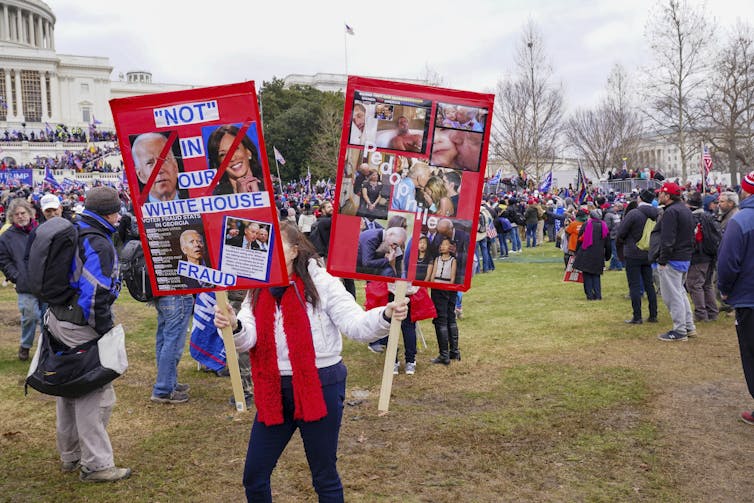
Many protesters outside the Capitol carried signs against the government. John Nacion/STAR MAX/IPx/AP

Rights for only a select few

The answer is evident in how the alt-right imagines the past: their vision of history omits or callously ignores the fact their constitutional rights have come at the cost of the lives and rights of others.

Thomas Jefferson wrote in the Declaration of Independence it was a “self-evident” truth “that all men are created equal.” Generations of enslaved and free Black activists and their allies have worked towards realising this goal.


Read more: Why the far-right and white supremecists have embraced the Middle Ages and their symbols


But for the founding fathers, and many of their white supremacist heirs, true “citizens” were exclusively white and male. A few years after penning the declaration, Jefferson denounced Black people as inferior. He owned hundreds of slaves. Even his own children, whom he fathered with Sally Hemings, were born into slavery.

Almost all of the founding fathers, in fact, were slaveholders or profited from the slave trade. Neither the Declaration of Independence nor the Constitution freed any of the half million enslaved people in the new United States — one-fifth of the population.

Rather, the Constitution purposefully entrenched the institution of slavery. By protecting the rights of slaveholders to pursue their happiness by holding on to their “property”, it doomed four more generations to enslavement.

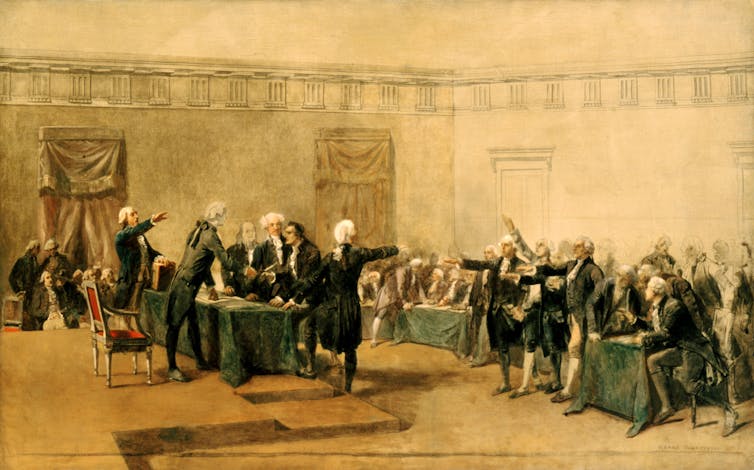
Signing of the Declaration of Independence
Signing of the Declaration of Independence, by Armand Dumaresq. The White House Historical Association (White House Collection)

By the start of the Civil War in 1861, there were 4 million people enslaved in the US.

The Constitution also gave the government the power to raise an army. After the American Revolution, this power was used time and again to wage a long genocidal war against Native Americans across the continent.

When enslaved and free Black people and their white abolitionist allies acted against slavery, slaveholders invoked the Revolution. They claimed they were undertaking God’s will to complete the work begun in 1776 of creating a free nation, and made slave-holding former President George Washington their hero.

It took an unprecedented and destructive Civil War to finally put an end to slavery, and another century or so for African Americans to achieve full rights as citizens in the United States. Every step of the way, they were contested and blocked by individuals, groups, states and judges who claimed they were upholding the principles of the Constitution.


Read more: Why is the Confederate flag so offensive?


Rights trump equality

It should be no surprise, then, the alt-right movement is invoking the same “Revolution” today.

After Barack Obama’s presidency, Trump gave a voice to the grievances of his largely white supporters who feared they were being displaced in their own country.

And following the summer of the Black Lives Matter movement and Trump’s baseless claims the 2020 election was stolen, the Capitol Hill insurrectionists firmly believed “they” had lost control of the United States. They were no longer the “we the people” in charge.

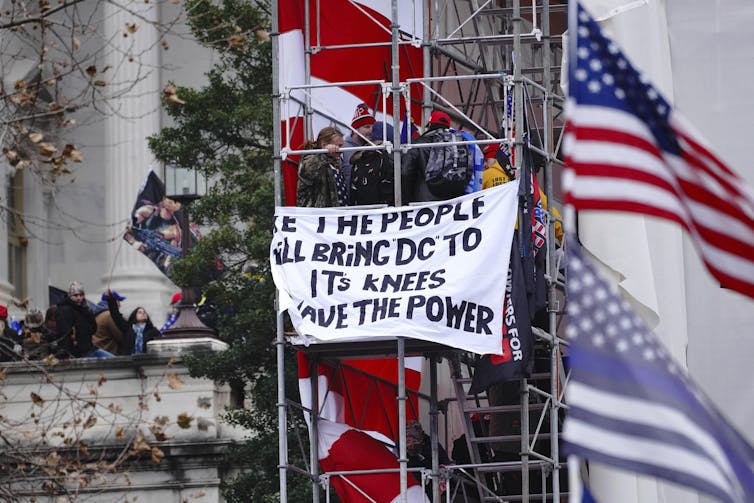
'We the people will bring DC to its knees'
A sign at the Capitol insurrection declaring, ‘We the people will bring DC to its knees’. John Nacion/STAR MAX/IPx/AP

As in the past, they also had the support of prominent politicians beyond Trump. One of their supporters, the newly elected Congresswoman Marjorie Taylor Greene (who is also a QAnon supporter) declared before the January 6 move to block the certification of Joe Biden’s presidential victory, “This is our 1776 moment”.

And Congressman Paul Gosar, a prominent Trump supporter, wrote an op-ed entitled “Are we witnessing a coup d’etat?” in which he advised followers to “be ready to defend the Constitution and the White House”.

It has never been entirely clear when exactly the United States was last great in the minds of Trump supporters wearing their “Make America Great Again” caps. It might be the Ronald Reagan presidency of the 1980s for some, or sometime prior to the civil rights, women’s and gay liberation movements and the US defeat in Vietnam.

But there’s no doubt as to when this mythical greatness started. The yearning for the founding era — a time when slaveholders overthrew a government to protect their rights (including the right to hold people as property) — is palpable.

ref. Why the alt-right believes another American Revolution is coming – https://theconversation.com/why-the-alt-right-believes-another-american-revolution-is-coming-153093

Tuberculosis kills as many people each year as COVID-19. It’s time we found a better vaccine

Source: The Conversation (Au and NZ) – By Andreas Kupz, Senior Research Fellow, James Cook University

In July 1921, a French infant became the first person to receive an experimental vaccine against tuberculosis (TB), after the mother had died from the disease. The vaccine, known as Bacille Calmette-Guérin (BCG), is the same one still used today.

This first dose of BCG was the culmination of 13 years of research and development.

BCG remains the only licensed vaccine against TB and 2021 marks its 100th anniversary.

Today, all eyes are on the rollout of the COVID-19 vaccine. But while the number of people who died from COVID-19 in the last year is shocking, TB kills about the same number of people — about 1.5-2 million — each year, and has done so for many decades.

In fact, it’s estimated that over the last 200 years, more than 1 billion people have died from TB, far more than from any other infectious disease.


Read more: COVID-19 isn’t the only infectious disease scientists are trying to find a vaccine for. Here are 3 others


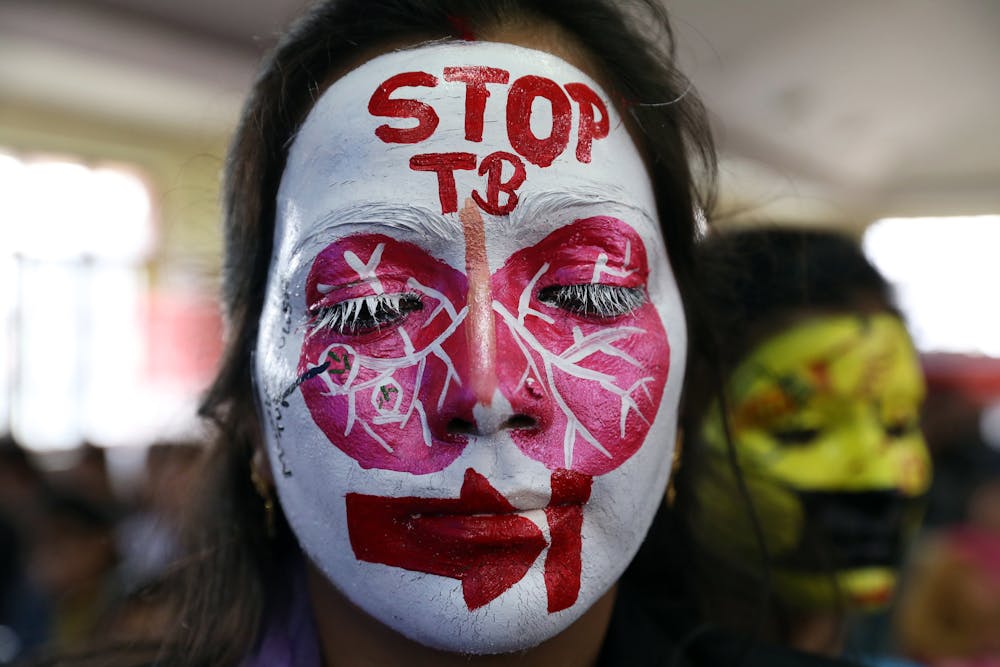
A woman wears face paint saying Stop TB
Over the last 200 years, an estimated 1 billion people have died from TB. SANJAY BAID/AAP

If we have a vaccine, why do so many people still die from TB?

Tuberculosis is caused by the bacterium Mycobacterium tuberculosis. It’s transmitted when a person with active TB coughs up aerosol droplets, which are then inhaled by someone else.

There are about 10 million cases of active TB annually, and it’s estimated up to 2 billion people are what’s known as “latently infected”. That means they are not sick and do not transmit the disease, but in about 10% of these people the disease reactivates.

In most TB endemic regions of the world, BCG is given to infants shortly after birth. The vaccination prevents childhood versions of TB and saves thousands of children’s lives annually.

However, the efficacy of BCG wanes over time. In other words, it stops working. Protection against TB is often lost by adolescence or early adulthood.

Importantly, BCG doesn’t prevent active lung TB in adults, the most important driver of ongoing transmission and cause of death.

The World Health Organization has a goal of TB elimination. To do that, we need to find a TB vaccine that also works in adults.

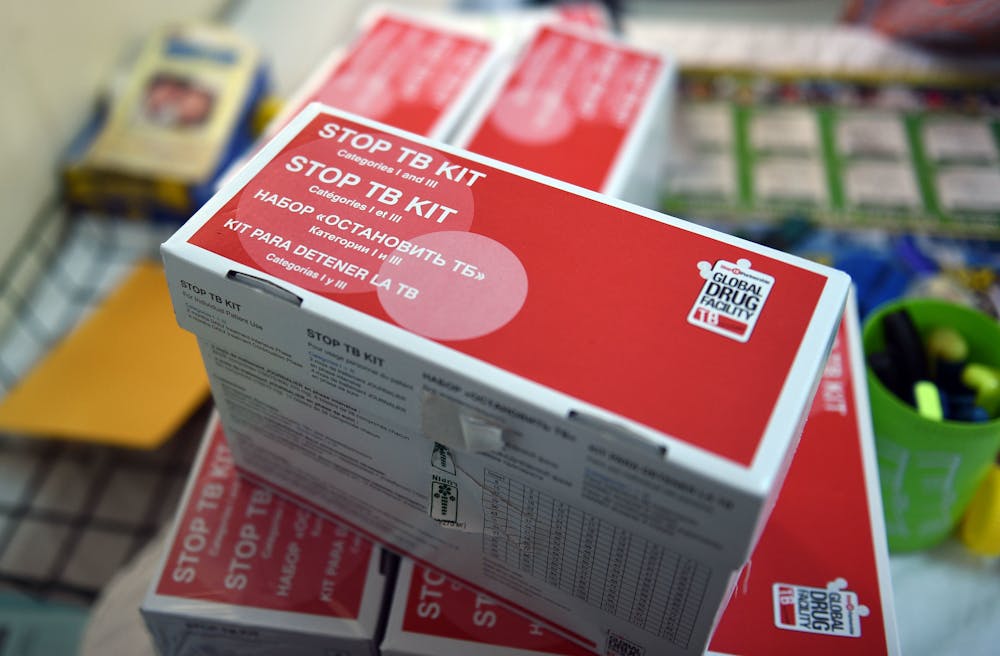
TB medicine sits on a shelf.
BCG vaccine fails to prevent active lung TB in adults. MICK TSIKAS/AAP

Why hasn’t BCG been replaced with a more effective TB vaccine?

Over the last decades only about 15 new TB vaccine candidates have entered clinical trials (versus 63 for COVID-19 in one year).

Worryingly, many of the most advanced TB vaccine candidates work no better than BCG.

Because the current TB vaccine candidate pipeline is relatively small, these setbacks and trial “failures” mean BCG may remain the gold standard for many years to come.

Despite being 100 years old, exactly how BCG vaccine works is largely unknown. It’s unclear why BCG usually only confers protection against childhood versions of TB or why protection wanes in adolescence.

Given those uncertainties, we can count ourselves lucky the bureaucratic hurdles for vaccine development were significantly lower in the 1920s.

If BCG were developed today, it would probably never be used; the current complex regulatory framework for vaccine development and licensing would likely not allow the use of a vaccine for which nothing or little is known about how it works.

The reasons BCG hasn’t been replaced with a more effective TB vaccine include:

  • the decline of TB in many Western countries in the 20th century

  • limited interest from pharmaceutical companies to invest in TB vaccine development

  • the fact TB research and pre-clinical vaccine development is logistically challenging and requires special biological containment facilities

  • the short-term and fiercely competitive environment for government and philanthropic research funding makes it difficult for academics to commit to TB vaccine research as a career path.

Where there’s a will, there’s a way

The pace of COVID-19 vaccine development shows what’s possible when the political will, pharmaceutical interest and funding is there.

While TB is no longer widespread in Australia, it is an issue in remote Indigenous communities.

Papua New Guinea, Australia’s closest neighbour, has high rates of multi-drug resistant TB and low BCG coverage rates. TB has been introduced into Australia via the Torres Strait, with a high proportion of cross-border diagnoses in North Queensland and over-representation of Indigenous children.

Resistance to current TB treatments increases steadily. Treatment of multi drug-resistant TB is hugely expensive and can take up to two years, requiring multiple antibiotics and close monitoring.

A nurse readies a COVID-19 vaccine jab.
The pace of COVID-19 vaccine development shows what’s possible when the will is there. Kristyna Wentz-Graff/AP

Now is the time to put financial and political will into finding a more effective TB vaccine.

2020 taught us pathogens can cause enormous harm to societies and economies. Investment into infectious disease research and vaccine development represents a fraction of the economic cost of a pandemic.

Tuberculosis is a global threat and a public health concern on a scale similar to COVID-19. The development of a new and effective TB vaccine is crucial if TB is to be significantly reduced, let alone eradicated.

Although the anniversary of BCG is cause for celebration, it should also serve as a reminder more needs to be done to combat this deadly disease.


Read more: Just as in coronavirus, young people are key to stopping tuberculosis


ref. Tuberculosis kills as many people each year as COVID-19. It’s time we found a better vaccine – https://theconversation.com/tuberculosis-kills-as-many-people-each-year-as-covid-19-its-time-we-found-a-better-vaccine-151590

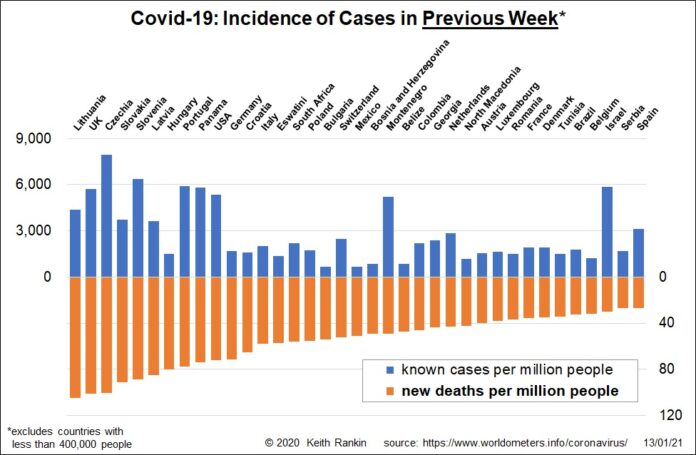
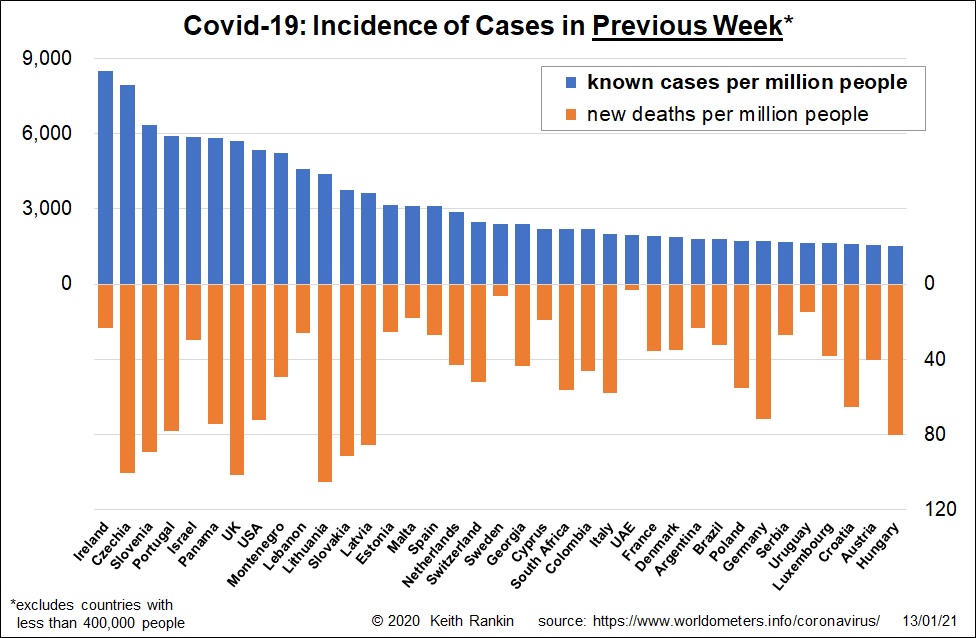
Keith Rankin Chart Analysis – Covid-19: Worst Countries in the New Year

Eastern European Countries in the European Union. Chart by Keith Rankin.

Analysis by Keith Rankin.

Ireland, Israel, and Lebanon. Chart by Keith Rankin.

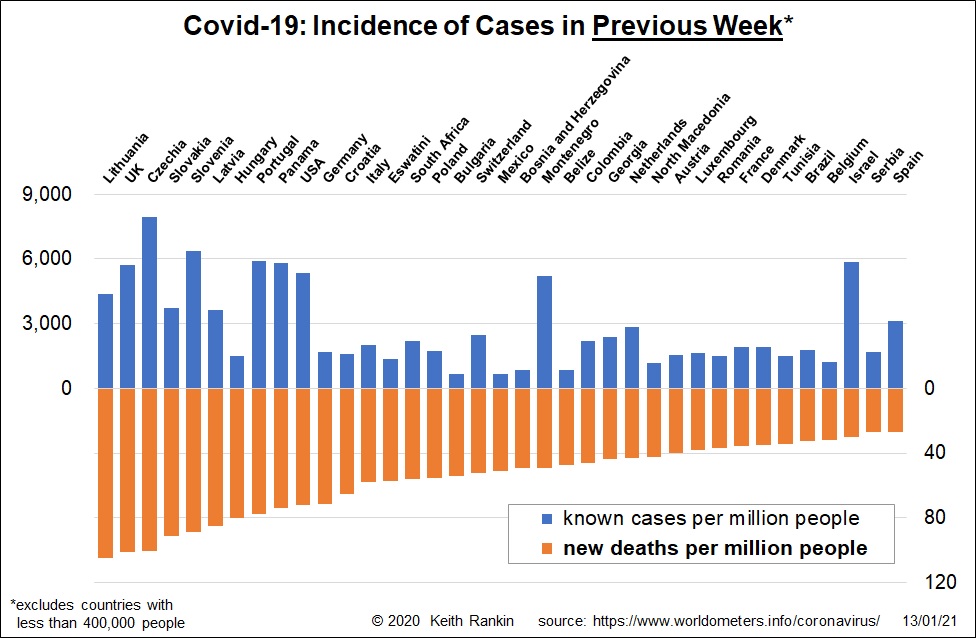
The countries with the most recent large outbreaks of Covid19 are those with large numbers of recent recorded cases, but yet to record the deaths that most likely will result. In this camp, this time, are Ireland, Israel (its third major outbreak), and Lebanon. Of these, only Israel features in my previous iteration of these charts. Lebanon almost certainly features because it is adjacent to Israel.

Other countries making a strong comeback are Sweden and United Arab Emirates, with the later almost certainly arising because of its airport as the pre-eminent transit zone for long-haul international travellers.

Two important countries to note are Slovakia and Uruguay. Both countries are about the same size as New Zealand; and are similar to New Zealand, albeit in different ways. Importantly both have been important Covid19 holdout countries located in high-incidence zones. Both are now succumbing to the virus. Slovakia – with its capital city Bratislava only 50km from Vienna Airport – did remarkably well in the first half of 2020.

Eastern European Countries in the European Union. Chart by Keith Rankin.

For deaths, five of the top six countries are in Eastern Europe, and are full members of the European Union (ie in the Eurozone and are Schengen countries). In the next six are Hungary and Croatia, both in the European Union, though neither is a full member in the sense just mentioned. The next six include Poland and Bulgaria, also European Union members. The bottom half of the chart includes another six Eastern European countries, five of which are not in the European Union.

There is no sense here that better access to the economic resources of rich Europe confer favourable public health outcomes on Eastern European nation states. As it has been over the last 11 months, the Covid19 virus has been transmitted mainly by richer people from richer countries. Not much different from when – centuries ago – the globe was colonised by Western Europe, and also colonised by the lethal pathogens Western Europeans carried with them.

We note that Western Europe continues to hold many of the top places in the Covid19 league tables. Of particular note in the death table is Germany, second in Western Europe after United Kingdom. Many of us will remember the September story Covid 19 coronavirus: New Zealand ranked second-safest country, after Germany. Now it seems quite bizarre that Germany and Switzerland could have been in the top five “safest countries”. Further, the then successes of Slovakia and Uruguay should have been more strongly noted; they successfully fought off Covid19 for many months, despite not having New Zealand’s geographic advantages.

Is it curtains for Clive? What COVID means for populism in Australia 

Source: The Conversation (Au and NZ) – By Gregory Melleuish, Professor, School of Humanities and Social Inquiry, University of Wollongong

What can we make of Clive Palmer?

This week, he announced his United Australia Party (UAP) would not contest the upcoming West Australian state election on March 13.

After a dismal showing in the October 2019 Queensland poll, where does this leave his political prospects?

Palmer is no mini-Trump

Given Palmer’s love of publicity stunts and populist policies, one might be tempted to see him as a miniature, Antipodean Donald Trump — but that would be misleading.

Trump was able to garner massive support in segments of the American population, whereas Palmer’s UAP only managed 3.43% of first preference votes in the lower house at the 2019 federal election.

American-style populism does not resonate with large numbers of Australians. Australian political traditions are quite different to those of America especially in terms of welfare and health provision. Those who seek to take the populist route find it a hard road.

Trump supporters at Washington DC rally.
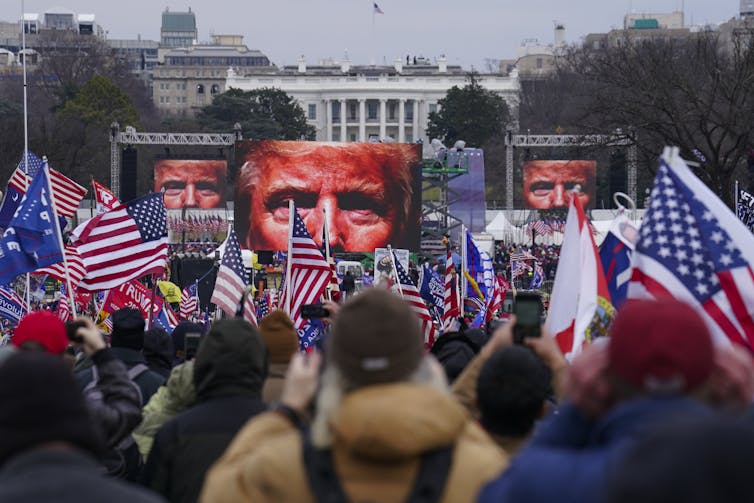
Donald Trump won more than 70 million votes at the recent US presidential election. John Minchillo/AP/AAP

In the 2019 election One Nation and United Australia combined only managed to win 7.76% of the Senate vote.

Given the small base on which the likes of Palmer and One Nation’s Pauline Hanson have to work, one wonders what they now hope to achieve.

Australia’s populism culture

The current situation with COVID-19 might provide a clue as to why they have failed to spark a populist surge in Australia.

Palmer’s major contribution to the COVID world was his unsuccessful High Court challenge to force Western Australia to open its borders.

The last 12 months has demonstrated the significance of “quarantine culture” in Australia, a term first coined by cultural historian John Williams in the 1990s.

The natural instinct of Australians is to close borders against outside threats, be they national or state. The only partial exception to this rule at the moment is New South Wales — the one part of Australia that had a vigorous free trade (or internationalist) political culture in the 19th century.


Read more: WA border challenge: why states, not courts, need to make the hard calls during health emergencies


In late 19th century and early 20th century Australia, writers such as WG Spence and magazines like The Bulletin talked about a desire to “protect” Australia against a harsh outside world and, if possible, limit the operation of international finance. The ideal was an Australia not dependent on the rest of the world.

In this regard, it is also worth recalling that one of the arguments often given for restricting Chinese immigration at the time was they were seen as carrying diseases into Australia.


Read more: What Clive Palmer must now ask himself: would China’s ‘bastards’ buy a mine from him?


This was a form of populism — but one quite different to the American version. It sought to protect Australia and Australians from the outside world, not to assert their right to liberty.

The COVID pandemic seems to have reignited this desire to protect Australians from an outside threat. The most remarkable aspect of this development has been the way in which this desire for protection has devolved to the state level.

Moves to close borders and institute quite draconian measures to halt the spread of the virus have been generally popular. Australians, it would seem, are more interested in being protected than they are in asserting their rights to do as they please.

What does this mean for Palmer?

This makes life quite difficult for someone such as Palmer, who has pushed for freedoms and border openings.

No wonder he has decided not to contest the WA state election. He is not in tune with the popular mood, which has strongly backed Labor Premier Mark McGowan’s hard border approach. It is not the time for libertarian populism.

Clive Palmer speaks to a near-empty press conference.
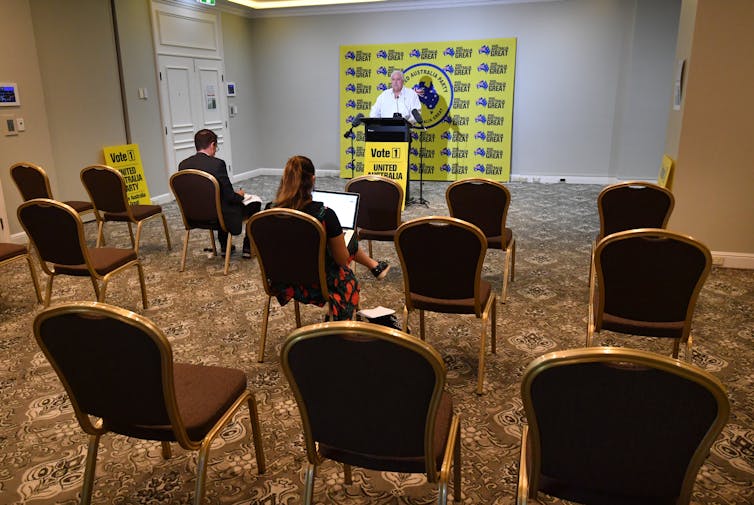
Palmer has said Premier Mark McGowan can ‘breathe easy’ as UAP will not contest the March election. Darren England/AAP

It is difficult to know how long this protectionist attitude will last. One suspects the current situation with China has also fed into it. The mood is one of a threatening world.

… and for Morrison?

From here, two comments are worth making.

The first is political. Prime Minister Scott Morrison will need to cultivate this threatening mood if he is to succeed at the next federal election, which could be held as early as August. He will need to convince Australians he is the leader who will protect them most effectively. This means going slowly, slowly on things such as opening the international border.

The second is economic. Even in the 1890s, the Australian economy depended on international trade through the sale of wool. The idea Australia could operate independently of other countries was a fantasy.

The same is true today. The borders will need to re-open and students and tourists let in.

Prime Minister Scott Morrison
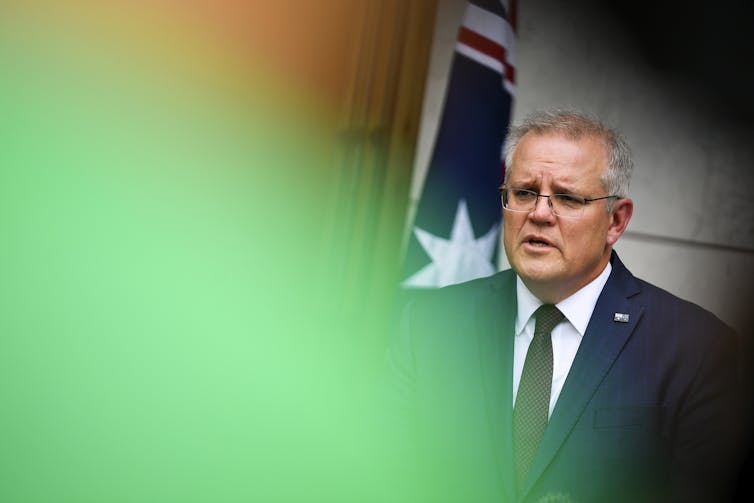
Prime Minister Scott Morrison could call a federal election as early as August. Lukas Coch/AAP

Morrison will have to perform a juggling act. He must appear to be providing protection even as he appreciates protection can only go so far.

In the meantime, the prospects look grim for populists such as Palmer and Hanson.

The prime minister and his coalition have the opportunity to steal many of their supporters. The pandemic shows that to be successful in Australian politics, leaders needs to pose as the protector of the people, not promise more freedom and more openness.

I suspect Morrison understands this very well.


Read more: 2021 is the year Australia’s international student crisis really bites


ref. Is it curtains for Clive? What COVID means for populism in Australia  – https://theconversation.com/is-it-curtains-for-clive-what-covid-means-for-populism-in-australia-153101

Birds that play with others have the biggest brains – and the same may go for humans

Source: The Conversation (Au and NZ) – By Gisela Kaplan, Emeritus Professor in Animal Behaviour, University of New England

Have you ever seen magpies play-fighting with one another, or rolling around in high spirits? Or an apostlebird running at full speed with a stick in its beak, chased by a troop of other apostlebirds? Well, such play behaviour may be associated with a larger brain and a longer life.

For the past 50 years, international animal cognition research has often related the use of tools such as rocks and sticks to cognitive abilities in animals. But my research on Australian native birds, published in Scientific Reports, casts doubt on long-held assumptions about the links between large brains and tool use.

My study found no significant association between tool use and brain mass. However, very clear differences in relative brain mass emerged when birds showing play behaviour were compared to those that didn’t play. In particular, birds that played with others (known as social play) had the largest brain mass, relative to body size, and even the longest lifespans.

The results suggest play behaviour may be an important driver in the evolution of large brains in a number of species, including humans.

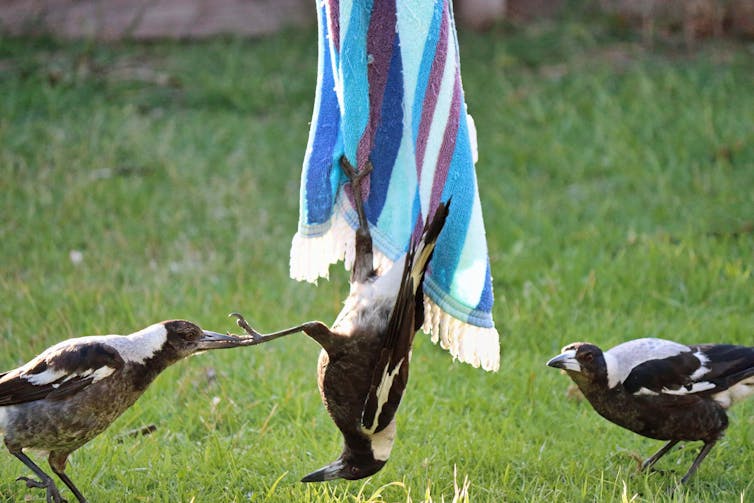
Magpie engaged in play
Magpies engaged in complex social play. One magpie hung solo from a towel on a washing line then was joined by others. One newcomer pulled the hanging magpie’s foot to make it swing, and the other gave it a push back the other way, and so on. The Magpie Whisperer

Tool use in birds

Tool use has been studied in a wider range of species than play behaviour. Some internationally famous Australian examples include:

  • the black-breasted buzzard releasing rocks from their beaks to crack emu eggs

  • the black kite picking up burning embers and twigs and dropping them on dry grass areas to start a fire. The bird then feasts on fleeing or injured insects and vertebrates

  • palm cockatoos that drum with a stick.

According to a classic theory known as the “technical intelligence hypothesis”, humans and other animals developed large brains because circumstances forced them into ever more sophisticated tool use.


Read more: Bird-brained and brilliant: Australia’s avians are smarter than you think


Palm cockatoos drum with a stick.

So what is bird play?

Play behaviour usually occurs in juveniles but in some species, such as little corellas or galahs, it extends into adulthood. Play behaviour occurs in species which tend to have long juvenile periods, long-term support from parents and which grow up in stable social groups.

Play behaviour is usually subdivided into three categories: solo play, object play and social play.

Solo play: this may involve a single bird running, skipping, jumping, ducking, rolling, hanging, swinging, dancing, sliding and snow-romping. Solo play is the most widespread form of play, common among honeyeaters, parrots, magpies, currawongs, butcherbirds, riflebirds and some pigeon species.

The best acrobat among the pigeons is probably the topknot pigeon, but rainbow lorikeets are also known to love swinging.

Object play: this involves objects of any kind, including sticks, stones and small household items. Object players might carry a stick or stone or even just a leaf around, drop it, then pick it up again and run with it.

Object players are not as numerous as solo players but still widespread across species. Click here to read a lovely description of a kookaburra absorbed in playing with a stone.

Social play: involves two or more individuals. Social play is so far the rarest category. It might involve one bird holding an object in its beak and the others chasing it. Published cases are largely limited to parrots and corvids, and are known in magpies and ravens.


Read more: What Australian birds can teach us about choosing a partner and making it last


White-winged choughs are known to play a game in which two youngsters simultaneously grab a small stick or a bunch of grass, then each tries to wrest it from the other.

It’s important to note that social players are also solo and object players, but solo or object players may not be social players. The latter is considered a more complex form of play.

It turns out these categories are meaningful when used to analyse a potential link to brain mass. Information on brain weight/mass in Australian birds has been available only since an important study in 2014. It identified brain volumes and body sizes of all Australian bird species, enabling researchers to link these biological data to behavioural data.

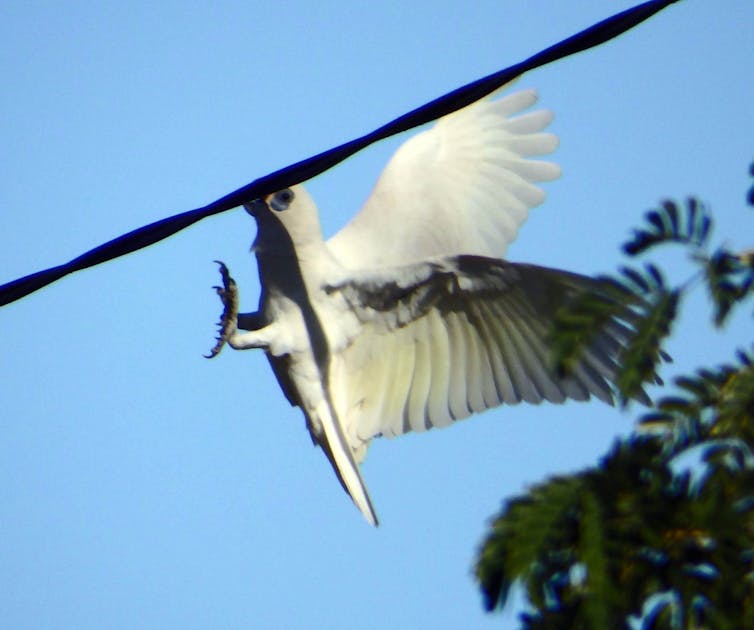
A little corella holding onto a wire by the beak and trying to swing.
A little corella performing a daredevil solo stunt — holding onto a wire by the beak and trying to swing. Gisela Kaplan

A surprising link

My study involved 77 native Australian bird species for which full data sets were available. The results were more than surprising. In the samples used, tool use seems to confer no advantage whatsoever in terms of brain size or life expectancy: no matter whether a species showed tool using or not, relative brain masses were not different. However the results showed, rather dramatically, that brain size and forms of play are associated.

Social players, versus other players and versus non-players showed significantly different average brain sizes in each category:

  • non players have the lowest average brain size

  • solo players had slightly larger brains than non-players

  • object players had larger brains again

  • social players had by far the largest average brain size relative to body weight.

These results are by no means confined to parrots, but are found in songbirds and other orders. Whether this holds for birds globally is not yet known. However, since parrots and songbirds first evolved in Australia, then spread to the rest of the world, the results may indeed hold for birds outside Australia. More research will be needed.


Read more: Magpies can form friendships with people – here’s how


Which came first – play resulting in large brains or large brains triggering play behaviour – is not known. But whichever way one looks at it, playing socially or even just playing at all, is related to a bigger brain and a long life.

So what does all this mean for human brain evolution? It may be a long shot, but the stages of development in humans and birds seem to have some similarities and this may be significant.

Offspring in humans, as in great apes and other primates, also develop slowly, have protracted childhoods and play extensively as do a surprising number of Australian native birds. It may mean playing together offers more than just passing the time. It could be an evolutionary driver for intelligence, and even for a long life.

ref. Birds that play with others have the biggest brains – and the same may go for humans – https://theconversation.com/birds-that-play-with-others-have-the-biggest-brains-and-the-same-may-go-for-humans-151079

Early childhood educators are leaving in droves. Here are 3 ways to keep them, and attract more

Source: The Conversation (Au and NZ) – By Jen Jackson, Program Director, Centre for Policy Development, and Associate Professor of Education, Mitchell Institute, Victoria University

Childcare centres across Australia are suffering staff shortages, which have been exacerbated by the COVID crisis.

Many childcare workers across Australia left when parents started pulling their children out of childcare due to the pandemic, especially casuals not eligible for JobKeeper. And when the federal government introduced its temporary free childcare package, centres struggled to get the staff back.

The situation is not new. In a 2016 survey of 1,200 early childhood educators and teachers in childcare centres and preschools across Australia, one in five said they planned to leave their job within a year. The reasons included low pay, feeling undervalued and increasing time spent on paperwork.

And a survey conducted in 2019 showed up to two in three early childhood educators in Victoria were considering leaving their role. High staff turnover — of up to 30% — is an enduring problem in early childhood services.


Read more: COVID-19: what closing schools and childcare centres would mean for parents and casual staff


Whenever an educator leaves the sector, it’s a loss for children that affects their learning and well-being. Staff turnover also means more public money needs to be spent training new workers.

Based on unpublished Mitchell Institute analysis of ABS census data, just over half the educators who have gained early childhood certificates since 2012 (when qualification requirements were introduced) are still working in relevant jobs. In comparison, almost all of those who completed vocational certificates in building are still in relevant roles.

To address workforce issues in the sector, Australian governments are developing a National Early Childhood Workforce Strategy, due for release in the latter half of 2021. It’s more important than ever before to get this right.

A report from the Mitchell Institute shows three policy moves needed to retain and attract skilled educators to the sector.

1. Early childhood careers need to be valued

Teaching and caring for young children is complex, and requires people with the right training and qualifications. Qualified educators provide better-quality education and care, which benefits children’s learning and development, as numerous international studies have shown.

Childhood educator helping children play.
Most early childhood educators are paid below the Australian average gross weekly earnings. Shutterstock

Yet, most early childhood educators are paid well below the Australian average gross weekly earnings. Educators with vocational certificates are the lowest paid, and earn less for doing skilled work with children than a trainee working in a call centre.

These educators are vital to the sector’s survival: they make up almost 40% of the early childhood workforce, working alongside colleagues with diplomas and degrees.

Recent gains have been made in some states. Victoria has introduced a pay increase of up to 31% for qualified preschool teachers. But this only covers a small proportion of the around 50,000 educators in the state.

More people using early childhood education and care services, and governments lifting the bar for quality, means Australia will still need to recruit 6,800 degree-qualified early childhood teachers to 2024, as well as over 30,000 more educators with vocational diplomas and certificates. This will only happen if all educators are valued, and have opportunities for rewarding careers.


Read more: One-third of all preschool centres could be without a trained teacher in four years, if we do nothing


2. Educator well-being needs to matter too

COVID-19 has been tough on early childhood educators’ well-being. While school teachers had it tough with the transition to remote learning, early childhood educators also had to contend with rapid changes to policy, funding and work arrangements, as governments worked to keep the sector afloat.

The well-being of educators matters to children’s learning. Recent Australian research shows that educators with greater well-being can better respond to children in playful, educational ways that support their learning and development. Educators need support for their physical health and well-being, especially given the challenges of maintaining COVID-safe environments.

Early childhood educators have experienced many stressors during the pandemic. Many have worked hard to adapt their services to the changing needs of children and families, whose lives were turned upside down. Others have experienced financial insecurity themselves, or uncertainty about their future employment.

Under any circumstances, educators need support to cope with the emotional labour of working with young children, and putting their heart into their job.

Skilled early childhood educators make a demonstrable difference to children’s learning. Shutterstock

Research shows one way to boost retention and well-being for early childhood educators is to have meaningful career paths and supportive workplace cultures. While 80% of educators feel supported by their managers, low wages and limited access to professional development and promotion constrain educators’ careers.

Expert educators need more opportunities to become mentors and leaders, to motivate them to stay in the sector and inspire new educators to learn.

3. Streamline funding responsibility

The reason it’s so hard to get educators’ pay and conditions right is that the money comes from different sources.

Governments pay around half the total cost of early childhood services, mainly through the childcare subsidy from the Australian government that helps families pay fees. State governments also contribute to preschool. Families pay the remainder of the fees, with many paying more for early childhood services than they would for private schools.

Employers ultimately make decisions about how much to pay their staff, within various industrial agreements.

This means educators’ wages and conditions are everybody’s problem and nobody’s problem. Former Education Minister Dan Tehan has said paying educators more is up to employers. Employers and unions argue governments need to contribute more funding to the sector before educators’ wages can increase.

Families are already stretched, and passing costs on to them seems unthinkable in the current economic climate.


Read more: Increasing the childcare subsidy will help struggling families — and the economy


Similar problems arise in determining who pays for improvements to educators’ conditions, such as making sure they have enough time for professional development (something few currently receive).

Government funding to early childhood services needs to be high enough to support fair wages, and delivered in a way that ensures it is spent well. With different funding models in each state, and thousands of employers, it won’t be easy to design a system that works for everyone. But governments have a responsibility to Australian families to ensure all educators are paid enough to stay.

Can Australia get this right in 2021? Maybe – in 2020, governments, employers and unions worked together on some of the most critical workforce challenges Australia has faced. Perhaps the education and care of our children will be important enough to bring them together again.

ref. Early childhood educators are leaving in droves. Here are 3 ways to keep them, and attract more – https://theconversation.com/early-childhood-educators-are-leaving-in-droves-here-are-3-ways-to-keep-them-and-attract-more-153187

Government funds are not ‘taxpayer money’ — media and politicians should stop confusing the two

Source: The Conversation (Au and NZ) – By Jonathan Barrett, Senior Lecturer in Taxation, Te Herenga Waka — Victoria University of Wellington

Rhetoric plays an important role in tax debate and therefore tax policy. If your side manages to gain traction in the public imagination with labels such as “death tax” or “dementia tax”, you have gone a long way to normalising the labels and winning support.

Some truth underpins these particular labels — an estate tax is triggered by a person’s death, and the United Kingdom’s abandoned levy for end-of-life care would have been particularly relevant for dementia sufferers.

Nevertheless, these tags are essentially political messages and we should expect unbiased media to use neutral terminology. Fair reportage would not, for example, repeat the extreme libertarian claim that “tax is theft” — a baseless slogan incompatible with the rule of law.

However, both reputable media and politicians of every stripe invariably use the phrase “taxpayer money” to describe government funds, despite the phrase having no constitutional or legal basis.

This article argues that truth-based media should avoid the phrase, and progressive politicians should recognise they fall into a conservative trap when they repeat it.

Taxpayers don’t own their taxes

Richard Murphy, one of the founders of the UK’s Tax Justice Network and author of The Joy of Tax, explains that “taxpayers’ money” is the money left in our pockets after we have paid taxes that are legally due. Money payable through taxes is the government’s property.

This is quite easy to prove — try not paying your income tax and see if the courts will enforce government property rights in that money.

Murphy also observes that “taxpayer” is typically understood as “income tax payer”, thereby implicitly preferring high income earners while excluding beneficiaries. But a goods and services tax (GST) ensures everyone is a taxpayer, and indirect taxes disproportionately affect the poor.


Read more: What’s at stake for NZ in Australia’s case against China at the World Trade Organisation?


Similarly, at a local level, “ratepayer” has become synonymous with the propertied voice to which councils should pay heed, even though renters (rather than the registered ratepayer for a leased property) bear the effective burden of local rates.

If the government is the legal owner of its funds, then, does it hold tax revenue in trust for taxpayers? Not at all. Subject to the rule of law, governments can do what they choose with their money.

Elections decide how taxes are spent

Self-appointed watchdogs such as the Taxpayers’ Union claim to bring government waste to public notice. Rightly so — as citizens, we should demand proper stewardship of government funds.

But our actionable right as electors is to vote a wasteful government out of office. The electorate as a whole, rather than an ideological interest group, determines the size of government we should have.

Unlike trust beneficiaries, we do not have an equitable interest in the government’s money. If it were otherwise, groups of taxpayers might have some claim on the government to spend or not spend its money in particular ways.


Read more: World economy in 2021: here’s who will win and who will lose


For example, paying taxes to fund belligerent activities is problematic for pacifists, notably certain religious groups. A Religious Freedom Peace Tax Fund Act, which has been regularly introduced to the United States Congress, would permit dissenting taxpayers to assign the defence portion of their taxes to supporting peace work and social services.

Proponents of the legislation have not sought to pay less tax than their fellow citizens but to direct how their tax contribution is spent. These attempts have failed, as they must do. Democratic political communities permit dissent, but nonconformism does not extend to directing how taxes should be spent.

Tax is part of the social contract

In The Variorum Civil Disobedience (1849), a reflection on his imprisonment for failing to pay a highway tax, Henry David Thoreau recognised that an individual citizen can protest against government by refusing to pay tax (and accept the consequences), but they cannot treat the government’s choices in its expenditure as if it were a cafeteria. He wrote:

It is for no particular item in the tax-bill that I refuse to pay it. I simply wish to refuse allegiance to the State, to withdraw and stand aloof from it effectually. I do not care to trace the course of my dollar, if I could, till it buys a man or a musket to shoot one with — the dollar is innocent — but I am concerned to trace the effects of my allegiance.

Liberal democracies are based on some form of metaphorical social contract, most obviously manifest in the constitution. Under this arrangement, parliamentarians are elected representatives, not agents for particular groups.

Henry David Thoreau
Henry David Thoreau: ‘the dollar is innocent’. www.shutterstock.com

Like any government that fails to comply with the basic values of society, groups that seek to control government expenditure outside the electoral process can be seen as bending, if not breaching, the social contract.

A handbrake on decisive action

A progressive government should reject the suggestion that its funds are not its own to use as it sees fit for the betterment of society — as always, in accordance with New Zealand’s two fundamental constitutional principles of parliamentary sovereignty and the rule of law.

Kowtowing to a myth of “taxpayer money” may act as a handbrake on decisive action. We are taxed in accordance with statutory law. If Inland Revenue seeks to collect more from us than is due, we have access to various tribunals and courts.

These legal rules and processes determine what is mine and what belongs to the government. Broadly, we are free to deal with our own property as we see fit — and the government is too.

Media and progressive politicians should stop perpetuating the untruth that taxpayers retain some residual property interest in the taxes they pay. Taxpayer money is nothing more than their after-tax property and the government’s money is its own.

ref. Government funds are not ‘taxpayer money’ — media and politicians should stop confusing the two – https://theconversation.com/government-funds-are-not-taxpayer-money-media-and-politicians-should-stop-confusing-the-two-153195

Bridgerton offers clever relationship advice — why friendship is the foundation of happy romantic partnerships

Source: The Conversation (Au and NZ) – By Raquel Peel, Lecturer, University of Southern Queensland

This story contains spoilers for Bridgerton


The first season of Bridgerton, Netflix’s new hit show based on Julia Quinn’s novels, premiered on December 25 last year.

The show is set in London, during the debutante season of 1813. It starts with Miss Daphne, the eldest daughter of the Bridgerton family, being presented to the court in preparation for the social season of marriage arrangements.

As the story develops, filled with secrets and scandals, the young lady seeks to understand what marriage and love is all about. Her mother, Lady Violet, offers this advice:

My dear, why ever do you complicate matters so? You must simply marry the man who feels like your dearest friend.

As a psychology researcher who studies romantic relationships, I think this touches on an idea well supported by research evidence: friendship is the foundation of happy romantic partnerships.

The importance of friendship

American psychologist Robert Sternberg originally theorised love is composed of three elements: passion, intimacy and commitment.

But these elements do not comprehensively describe the complexity of romantic relationships. Researchers have long sought to include other elements such as partner compatibility, emotional connection, accessibility, responsiveness, engagement, acceptance, the ability to communicate and reveal thoughts and feelings (called “self-disclosure”), independence and conflict resolution.

What’s more, although it’s well established physical attraction and earning potential will influence how people select partners, similarity and familiarity are more important for relationships long-term.

Over time, similarities such as values, political attitudes, and religiosity become more relevant and are likely to lead to greater happiness and relationship satisfaction.

All of these are qualities you’d also find in a good friend.

Indeed marriage researcher and psychologist John Gottman argues friendship is the foundation of happy romantic partnerships and the most important predictor of maintaining good relationships long-term.

In his book, The Seven Principles For Making Marriage Work, Gottman explains couples have a better chance of success if they “know each other intimately — they are well versed in each other’s likes, dislikes, personality quirks, hopes, and dreams”.

Daphne Bridgerton and her mother Lady Violet Bridgerton
Lady Violet (right) has sound advice for her daughter Daphne: ‘You must simply marry the man who feels like your dearest friend’. LIAM DANIEL/NETFLIX

The relationship advice and support provided by Lady Violet was a significant contributor to Daphne’s decision to marry Simon, the Duke of Hastings.

The Duke explains that at first, love was out of the question, but in removing it, they found friendship, which is a far greater feat. He put it simply:

To meet a beautiful woman is one thing, but to meet your best friend in the most beautiful of women is something entirely apart.


Read more: What’s next after Bridgerton? 5 romance series ripe for TV adaptation


Barriers to finding (and keeping) love

On the other hand, the show demonstrates how people’s beliefs, attitudes and behaviours can potentially sabotage their chances in love. One reason why so many couples struggle to navigate conflict in their relationships is because people are often intrinsically motivated to protect themselves rather than be vulnerable.

The Duke of Hastings is a good example. In an attempt to protect himself from the hurtful memories of his childhood and relationship with his father, the Duke closed himself off to relationships and love.

Unfortunately, this is all too common. In my recent study, published in July 2020, I surveyed 696 people and uncovered countless examples of people who describe being afraid and believing they’re not worthy of love.

Here are some of them:

“I am always afraid it is not going to work out or I am going to get hurt, but I know that me trying to maintain a distance like that is one of the reasons my relationships always fail”

“I fear not being accepted for who I am”

“My own beliefs that I am maybe not good enough, or worthy of such affection, make it difficult to maintain relationships”

“I am not good enough for my partner and one day they will realise that and leave.”

These beliefs influence how people perceive quality and stress in relationships, and can mean people prevent themselves from forming and maintaining successful relationships.

Sad woman lying on bed facing away from her partner
Many of us are afraid to be vulnerable, and shut ourselves off to potential chances at love. Shutterstock

Overcoming the trials of relationships

Unlike “happily ever after” tales, Bridgerton follows the couple into a story of conflict when navigating the expectations of marriage.

The trust between the couple seemed to have been broken beyond repair after Daphne discovered Simon had been lying to her about his inability to have children. But a foundation of friendship remained. And it was this foundation that helped them overcome their issues.

In my research, I found participants were able to overcome issues in their relationships by focusing on trust, communication, commitment, safety and acceptance. They noted these as important elements when managing conflict and relationship expectations.

Maintaining a healthy relationship long-term requires partners to know, trust and be vulnerable with one another, while also engaging in open communication and collaboration towards the common goal of working on their relationship. Altogether, these elements also describe meaningful friendships.

ref. Bridgerton offers clever relationship advice — why friendship is the foundation of happy romantic partnerships – https://theconversation.com/bridgerton-offers-clever-relationship-advice-why-friendship-is-the-foundation-of-happy-romantic-partnerships-152953

Trump is impeached again in historic vote. Now Republicans must decide the future of their party

Source: The Conversation (Au and NZ) – By Bryan Cranston, Lead Academic Teacher – Politics & Social Science (Swinburne Online), Swinburne University of Technology

In a historic vote today, Donald Trump became the only US president to be impeached twice.

By a margin of 232–197, the Democrat-controlled US House of Representatives voted to charge Trump with “inciting violence against the government of the United States” for his role in encouraging the insurrectionists who stormed the US Capitol last week.

When Trump was impeached by the House last year for abuse of power and obstruction of Congress, no Republicans joined the Democrats in the vote.

This time, however, ten members of Trump’s own party supported the effort to remove him from office.

Is there any chance of conviction?

Now that the House has voted to impeach Trump, a trial will be held in the Senate, though the timing of this is unclear at the moment.

For Trump to be convicted, 67 senators need to vote in favour. If all 50 Democrats and independents vote to convict Trump as expected, then at least 17 Republicans would need to join them.


Read more: Trump impeached a second time – but Trumpism will live on


So far, only three (Lisa Murkowski, Ben Sasse, and Pat Toomey) have indicated they would do so. Mitt Romney, a vocal Trump critic, will probably join them, and Susan Collins is a possibility.

Even though the most powerful Senate Republican, Mitch McConnell, is said to be privately supporting the impeachment effort (and publicly said he hasn’t decided how he will vote), the numbers required to convict Trump will likely still fall short.

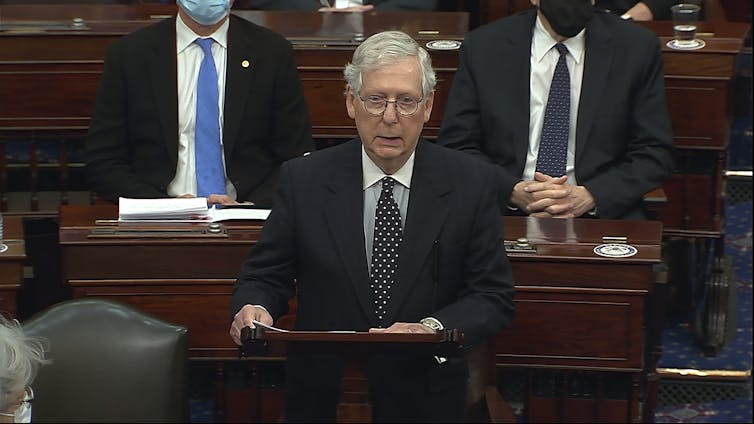
McConnell's vote will be crucial.
The future of the Republican Party may come down to how McConnell votes in the Senate trial. Senate Television/AP

What’s at stake for Republicans?

Trump’s former national security advisor, John Bolton, has said the president “will be remembered as an aberration” when he leaves office after noon on January 20.

Nevertheless, the Republican Party will go on. And it will need to find its identify in the post-Trump era.

Do they continue with the arch-conservatism of the past decade that gave rise to the Tea Party and Trump, or do they return to the more traditional Republican politics associated with George W. Bush, John McCain and Romney?

While some Senate Republicans have loudly declared their allegiance to Trump, others appear to be suddenly on the fence.


Read more: What’s next for the Republicans after Trump? Here are 5 reasons for pessimism — and 5 reasons for hope


Lindsey Graham, who went from being one of Trump’s most outspoken opponents to his staunchest backer in Congress, last week broke with Trump over his efforts to overturn the 2020 election results. However, Graham is strongly opposed to impeachment.

McConnell, too, could be looking ahead to rebuilding the party post-Trump, which is why he is said to be wavering on his vote to convict Trump. As one Republican close to him told Axios,

If you’re McConnell, you want to be remembered for defending the Senate and the institution.

The most prominent Republican to join the impeachment effort in the House is Liz Cheney.

The daughter of former US Vice President Dick Cheney has only been in Congress since 2017. After just two years, however, she was elected chair of the House Republican Conference, the third-most senior Republican position in the House after minority leader (Kevin McCarthy) and minority whip (Steve Scalise).

A rising star in the party, Cheney surprised many when she said she wouldn’t run for the open Senate seat in Wyoming last year, opting to stay in the House.

With both McCarthy and Scalise voting against impeachment today, Cheney’s move suggests she is positioning herself as a leader of the anti-Trump faction in the party, with eyes on perhaps becoming the first female Republican House speaker.

Why purging Trump might not be possible

It must be noted that a significant portion of the American electorate still supports Trump and his policies. According to FiveThirtyEight, about 42% of Americans do not support impeachment. And among Republicans, just 15% say they want him removed from office.

Whoever leads the Republican Party post-Trump will need to consider how they will maintain the rabid support of his “base”, while working to regain more moderate voters who defected from the party in the 2020 election.

The reason McConnell is reportedly said to be considering voting to convict Trump is that is would make it easier to purge him from the party.


Read more: ‘Delighting in causing complete chaos’: what’s behind Trump supporters’ brazen storming of the Capitol


But purging Trump will be difficult. Even without Twitter, the power Trump wields is immense. The fear among many Republicans is that he can encourage primary challenges to any incumbents he feels have wronged him.

He’s done this many times before. In 2018, Trump strongly endorsed Brian Kemp in his successful campaign for governor of Georgia, but when Kemp rejected his claims of election fraud in November, Trump announced he was ashamed of having supported him. Trump loyalists are already looking for a primary challenger to him.

Trump has also called for primary challenges to Republican Ohio governor Mike Dewine and John Thune, the number two Republican in the Senate.

Security concerns among Trump’s supporters

Trump doesn’t appear to want to go away quietly, which is also a cause for concern from a security standpoint.

This week, a leaked internal FBI bulletin warned that armed protests are planned for all 50 states and Washington DC in the days before President-elect Joe Biden’s inauguration on January 20.

Some state capitol buildings have begun boarding up their doors and windows, while 15,000 National Guard troops have been mobilised for deployment to the nation’s capital ahead of expected violence and unrest.

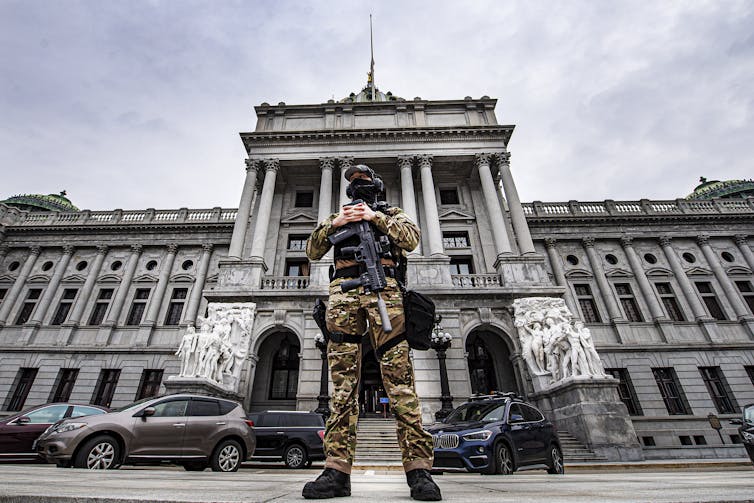
A member of the Pennsylvania Capitol Police
A member of the Pennsylvania Capitol Police stands guard at the entrance to the Pennsylvania Capitol in Harrisburg. Jose F. Moreno/AP

This is an unfortunate sign of how many expect Trump’s supporters to respond to both his impeachment and Biden’s inauguration — even with Trump finally urging against further violence and unrest.

Most presidents aim to leave office with the nation better off than when they entered, but Trump’s legacy appears to be cementing a more divided country, where his brand of aggressive “conflict politics” may be the new norm.

This is a no-win situation for the country. And Republicans are still trying to figure out which side of history they want to be on.

ref. Trump is impeached again in historic vote. Now Republicans must decide the future of their party – https://theconversation.com/trump-is-impeached-again-in-historic-vote-now-republicans-must-decide-the-future-of-their-party-153196

Placing Cuba on the List of State Sponsors of Terrorism Discredits U.S. Foreign Policy

Source: Council on Hemispheric Affairs – Analysis-Reportage

Print Friendly, PDF & Email

By Arturo López-Levy
Oakland, California

Unfortunately, the attack on the Capitol by Trump supporters, encouraged by the Inciter-in-Chief, will not be the last act of mischief. Trump is insisting on causing as much damage as possible to the interests and values of the United States on his way out the door. He is not only sabotaging an orderly transition, but persists in obstructing the mandate the American people have given to the incoming administration. On Monday the Trump administration demonstrated that strategy by adding Cuba, without justification, to the list of State sponsors of terrorism, and on Tuesday Trump will celebrate the supposed completion of the wall on the Mexican border. Who knows what price will be paid by the U.S. for the next irresponsible action taken by Trump and his sycophants?

Few of the actors in this disaster movie come close to the role played by Secretary of State Mike Pompeo.  After the election Pompeo announced that January would mark “a smooth transition to the second Trump administration.” The dream of a coronation turned into a nightmare. On January 20, 2021 Pompeo will leave Foggy Bottom as one of the last cabinet holdouts simply because he is too shameless to resign. After the uprising against Congress, a branch of government in which he himself has served, Pompeo tried to distract from his own lack of courage with a burst of torpedoes against many of the policies announced by the incoming President and Vice-President. Both Joe Biden and Kamala Harris have made it clear that they believe the policies espoused by President Barack Obama during his last years in office show the most appropriate way for a democratic power to act with dignity towards Cuba and other members of the international community.

Support this progressive voice and be a part of it. Donate to COHA today. Click here

Pompeo’s move actually weakens the fight against terrorism

Including Cuba in the State Department’s list of state sponsors of terrorism is a distraction that seeks to commit U.S. resources to fighting a threat that does not exist. The collateral effect of this irresponsibility is to discredit an American foreign policy tool that might be useful in the international community for pointing out some states that do collaborate with terrorists. Who can take this list seriously when the reasons for including Cuba are so pedestrian? 

The “argument” that Cuba’s alignment with the government of Nicolás Maduro in Venezuela makes it a sponsor of terrorism is rather flimsy. The Maduro administration has a seat at the United Nations and in the next few months it is likely to regain recognition by the European Union, which has already described Juan Guaidó as the President of the “outgoing” National Assembly. If the United States wants to draw up a list of Venezuela’s allies, it could start with Russia, China, and several more.

Cuba is condemned for supporting the peace process in Colombia

Pompeo’s second reason for putting Cuba back on the list is that Cuba did not extradite 10 leaders of the ELN (National Liberation Army guerrillas) to Colombia who were in Havana as part of the dialogue between the guerrilla group and the government of Colombia. Norway, a U.S. NATO ally that accompanied Cuba in the peace talks, has reiterated that the security guarantees afforded to the guerrillas were part of the negotiations protocol adopted by the mediators with the consent of the Colombian government. Not only has Cuba not committed or supported any acts of international terrorism according to the National Consortium for the Study of Terrorism and Responses to Terrorism (START) database; Cuba contributed to the peace process in Colombia more than any other state.

If instead of blockading Cuba the Trump administration had continued President Obama’s policy of engagement, which included Bernard Aronson, former Under Secretary of State for Hemispheric Affairs in the George Bush administration (1989-1993) as the U.S. representative, perhaps the dialogue that Norway facilitated between the Venezuelan government and the opposition parties would have made progress with the support of their allies. The same could be said of the dialogue between the ELN and the Colombian government which could have resumed sooner rather than later as the best way to demobilize that guerrilla force and the FARC dissidents who remain armed in Colombian territory. 

The third “reason” Pompeo gave was that Cuba has not extradited some people wanted in the U.S. for acts of terrorism against the U.S. government. One should remember that the extradition treaty signed between Cuba and the United States in 1904 is no longer in force because the U.S. suspended it in 1959 to protect fugitives from the revolution that were primarily associated with the Batista dictatorship. The agreement regulated reciprocal extradition for people who break the law in either country, excluding those involved in non-violent political activity. 

The United States has given refuge to known terrorists

When Presidents Barack Obama and Raúl Castro decided to move the thorny relationship between the two countries into a more manageable space, they agreed to focus on the future rather than relitigating disputes that originated in the Cold War.

For more than six decades, the U.S. has given political asylum to hundreds of people involved in violence in Cuba or even in the United States itself which  its own Department of Justice has labeled terrorism. Under various U.S. administrations, criminals such as Orlando Bosch and Luis Posada Carriles were not extradited to Cuba, Venezuela, or Italy (the home country of one of the victims of one of the attacks attributed to Posada), nor were they put on trial in the United States, as is required by several conventions against terrorism to which the U.S. is a signatory. Bosch and Posada were the masterminds of the placement of a bomb on an Air Cubana flight that killed 73 passengers.

Noteworthy among the people being charged by the United States and living in Cuba  is the case of Assata Shakur, who is accused of involvement in the death of police officer Werner Foerster in New Jersey while she was a member of the Black Liberation Army. All U.S. extradition requests predate Cuba’s removal from the State Department’s list in May of 2015 and the reinstatement of diplomatic relations between Havana and Washington. After 2010,  The many reports on the inclusion of Cuba in this list, made no consistent mention of Shakur or any other cases. Prominent members of the Congressional Black Caucus, such as Maxine Waters (Democrat from California) have sent letters to the Cuban government and U.S. authorities arguing that the Shakur case was a political vendetta that ignored the context of African-American civil rights groups in decades gone by and illegal activities against them through projects such as COINTELPRO.

The decision to move beyond this history of conflict served the interests of both countries. Pompeo’s selective and unilateral relitigation of the American claims is an exercise in hypocrisy  for the sole purpose of making the future a slave of the past.   

Acknowledging progress in the change of leadership in Cuba

Pompeo’s irresponsible act provides Biden’s new Secretary of State with an easy way to discount out of hand this attempt to twist the official image of Cuba in the United States. The designation’s potential damage to the policy announced by Biden and Harris toward Cuba is considerable. A wrong diagnosis that views Cuba as a threat to U.S. security detracts from a realistic approach that sees the island as a country in the middle of an important economic and leadership transition, with significant consequences for its future and for a potential new start with the United States. Raúl Castro is retiring as head of the Communist Party and Cuban leadership is being passed to the next generation. What sense does it make to face this new reality with an inaccurate diagnosis?

Financial profit at the cost of a failed policy

Treating Cuba as a state sponsor of terrorism opens the U.S. courts, particularly those in south Florida, to opportunistic lawsuits in which unscrupulous attorneys will take advantage of the limited sovereign immunity conferred by a country’s appearance on the terrorism list to obtain juicy profits from trials for which Cuba would not be present. These trials could produce multimillion dollar rulings against Cuba, rendering the difficult issue of financial settlements between Cuba and the United States intractable.

One effect of such trials could be to discredit the United States in the eyes of the Cuban people. Although the most recalcitrant sectors of the Communist Party called him a wolf in sheep’s clothing, the first African-American U.S. President left a fresh image of openness to Cuba that transcended the history of conflicts and disagreements. This idea of a change one can believe in contrasts with the imperialist posture of Trump towards Cuba and other issues. The Biden administration should not only resume cancellation of lawsuits under Title III of the Helms-Burton Act, it should also preclude these offensive caricatures of the rule of law—lawsuits against Cuba with limited immunity—from being justified by an unwarranted “terrorist” label. 

Precedents of ideological manipulation of Cuba’s image

If he quickly resumes the path of rapprochement, Biden will show  the difference between an administration stuck in the Helms-Burton imperial framework and the best values of U.S. democracy represented by the open hand Obama extended for dialogue with Havana in 2016. The Cuban people are all too familiar with the attacks, hypocrisy, and lack of civility that characterized imperialist dirty war tactics against Cuba. Gratuitously labeling Cuba a state sponsor of terrorism reminds many Cubans of Operation Northwoods in which the U.S. Joint Chiefs of Staff proposed false flag acts of terrorism in which alleged Cubans would attack the U.S., giving a pretext for an invasion of Cuba.

Biden should continue Obama’s policy

Despite all this, the image of the first African American President and his ultimate decision to propose a new tack with Cuba created good will toward the United States and the Democratic Party in the eyes of many Cubans. But there is nothing more damaging to soft power than deception. The Biden team should bear this in mind. From the outset it should act decisively as an agent of change, and never as a continuation of Trumpism. Trump’s supporters will try to crucify Biden for whatever he does—be it a small or grand gesture. To quote the president-elect, “It makes no sense to hang yourself on a small cross.” The incoming team should return in grand fashion and  deepen the policy announced by Obama in his Presidential Policy Directive of October 2016.

If the Biden administration wants to communicate that it is serious about combatting terrorism and is throwing its hat in with multilateralism, removing Cuba from the list of state sponsors of terrorism is a litmus test. The idea that Cuba is not a top priority  in  Biden’s agenda is an unsustainable pretext. The State Department has enough experts to seriously examine this issue, and follow procedures to remove Cuba from the list in a relatively short time.  

The incoming Secretary of State, Anthony Blinken, should not simply fall into the traps that Pompeo is laying in his path. Pompeo’s last minute outrageous actions do not reflect well on American diplomacy. The new administration owes nothing to the right-wing Cuban exile community in Florida, that simply wants to manipulate the list to hurt Cuba. It is a matter of basic diplomatic professionalism that the incoming administration reviews the case of Cuba according to technical, non-partisan criteria. Since Cuba was taken off the list in 2015, has the island engaged in sponsorship of any terrorist organization or act? If the answer is no, Cuba should be removed from it immediately.

Arturo López-Levy is a Senior Research Fellow at the Council on Hemispheric Affairs (COHA). He is a professor of international relations and politics at Holy Names University in Oakland, California and author of “Raul Castro and the New Cuba: A Close-up of Change.” Twitter, @turylevy.

[Main photo: While the U.S. accuses Cuba of terrorism, Cuban doctors of the Henry Reeve Brigade have been collaborating with several countries around the world to bring medical care to at-risk populations. Credit: Diario Granma Internacional].

Translated by Jill Clark-Gollub, COHA Assistant Editor/Translator       

We found the oldest known cave painting of animals in a secret Indonesian valley

Source: The Conversation (Au and NZ) – By Adam Brumm, Professor, Griffith University

The dating of an exceptionally old cave painting of animals that was found recently on the Indonesian island of Sulawesi is reported in our paper out today.

The painting portrays images of the Sulawesi warty pig (Sus celebensis), which is a small (40-85kg) short-legged wild boar endemic to the island.

Dating to at least 45,500 years ago, this cave painting may be the oldest depiction of the animal world, and possibly the earliest figurative art (an image that resembles the thing it is intended to represent), yet uncovered.

Oldest cave art found in Sulawesi.

Ice age art in Indonesia

Sulawesi is host to abundant cave art, the existence of which was first reported in the 1950s.


Read more: Indonesian cave paintings show the dawn of imaginative art and human spiritual belief


Until recently, the prevailing view was this art was the handiwork of Neolithic farmers who arrived around 4,000 years ago from southern China rather than the hunter-gatherers who had lived on Sulawesi for tens of thousands of years.

We now know that this is not correct.

In 2014, we reported the first dates for the South Sulawesi rock art.

Based on uranium-series analysis of mineral deposits (calcite) that formed naturally on the art we showed that a stencilled image of a human hand found in one cave was created at least 40,000 years ago. This is compatible in age with the famous ice age cave art in Europe.

Ice age art in the tropics.

Then, in 2019, we dated a spectacular painting at another cave that portrays hybrid human-animal figures hunting Sulawesi warty pigs and dwarf buffalos (anoas). This hunting scene is at least 43,900 years old and it features what may be the oldest depictions of supernatural beings.

Earliest hunting scene in prehistoric art.

In our latest study we push the age of Sulawesi’s rock art a little deeper into the past.

The secret valley

In December 2017 we conducted the first survey of an isolated valley set in mountainous terrain a stone’s throw from one of Indonesia’s largest cities, Makassar.

A lush green valley landscape.
The limestone karst valley in which Leang Tedongnge is located. David P McGahan, Author provided

Despite its proximity to a major urban centre, there is no road to this valley. The small community of local Bugis farmers live a secluded existence, although they are widely reputed for the sublime quality (and potency) of their palm wine (ballo).

According to them no Westerner had ever set foot in their valley before.

This secret valley is a pristine environment and a place of resplendent natural beauty. There is hardly any rubbish in the tiny village in the centre of the valley. Being there feels like stepping back in time.

The valley harbours a limestone cave known as Leang Tedongnge and inside it we found a rock painting the locals claimed they had never noticed before.

Inside the cave is a painting of warty pigs.
Adhi Agus Oktaviana in front of the Leang Tedongnge rock art panel. Adhi Agus Oktaviana, Author provided

The painting was produced using a red mineral pigment (ironstone haematite, or ochre). It depicts at least three Sulawesi warty pigs engaged in social interaction of some kind.

We interpret the surviving elements of this artwork as a single narrative composition or scene, a mainstay of how we tell stories using images today but an uncommon feature of early cave art.

The Leang Tedongnge rock art panel enhanced to make the artwork clearer.
The top image has been enhanced (in DStretch) to make the artwork clearer. The bottom image shows a tracing of the art. Adhi Agus Oktaviana, Author provided

Unlocking the age of the art

Dating rock art is very difficult at the best of times. But at Leang Tedongnge we were fortunate to identify a small calcite deposit (known as “cave popcorn”) that had formed on top of one of the pig figures (pig 1).

We sampled the calcite and analysed it for uranium-series dating. Amazingly, the dating work returned an age of 45,500 years ago for the calcite, meaning the painting on which it formed must be at least this old.

A closer image of one of the wild pigs and two hand stencils
A close up of the dated warty pig painting at Leang Tedongnge. Maxime Aubert, Author provided

Early art in Wallacea

Our discovery underlines the global importance of Sulawesi, and the wider Indonesian region, for our understanding of where and when the first cave art traditions developed by our species arose.

The great antiquity of this artwork also offers hints at the potential for other significant findings in this part of the world.

Sulawesi is the largest island in Wallacea, the zone of oceanic islands located between mainland Asia and the ice age continental landmass of Australia-New Guinea.


Read more: First pocket-sized artworks from Ice Age Indonesia show humanity’s ancient drive to decorate


Modern humans are said to have crossed through Wallacea by watercraft at least 65,000 years ago in order to reach Australia by that time.

But the Wallacean islands are poorly explored and presently the earliest excavated archaeological evidence from this region is much younger.

We believe further research will uncover much older rock art in Sulawesi or on other Wallacean islands, dating back at least 65,000 years and possibly earlier.

ref. We found the oldest known cave painting of animals in a secret Indonesian valley – https://theconversation.com/we-found-the-oldest-known-cave-painting-of-animals-in-a-secret-indonesian-valley-153089

How China is controlling the COVID origins narrative — silencing critics and locking up dissenters

Source: The Conversation (Au and NZ) – By John Garrick, University Fellow in Law, Charles Darwin University

Just over a year has gone by since the novel coronavirus first emerged in the Chinese city of Wuhan and the world still has many questions about where and how it originated.

The World Health Organisation is sending a team to China this week to investigate the origins of the virus — which has now claimed nearly 2 million lives globally — but one health expert warns expectations for the visit should be set “very low”.

The Chinese government has greatly restrained any attempts to investigate the origins of COVID-19 — both internally and by foreign experts — while at the same time advocating alternate theories that the pandemic originated elsewhere.

The top leadership sees control over this narrative as vital to its hold over the Chinese population and the boosting of its international reputation.


Read more: Murky origins: why China will never welcome a global inquiry into the source of COVID-19


The stakes could not be higher because Beijing has presented the Communist Party’s strong, centralised rule as the key to the country’s success at controlling the pandemic and reviving its economy.

This has been contrasted with disastrous efforts to control the disease in the US under the Trump administration. The state-run Global Times has called the US a “living hell”.

Against this backdrop, Yanzhong Huang, a senior fellow with the Council on Foreign Relations, says the WHO investigation team

will have to be politically savvy and draw conclusions that are acceptable to all the major parties.

Citizen journalists disappear after reporting the truth

Part of controlling the Communist Party narrative has entailed the detention of many citizen journalists who sounded the alarm about the virus in its early days, exposed the government’s attempts to cover it up and criticised its early response to control it.

In late December, one of these independent journalists, Zhang Zhan, was sentenced to four years imprisonment for the crime of “picking quarrels and provoking trouble”.

A former lawyer, Zhang travelled to Wuhan in February to talk to people about how they were coping in lockdown. She shared videos and talked about what she observed, at one point noting the fear people felt toward the government was actually greater than their fear of the virus.

In an interview before her detention, she said

Maybe I have a rebellious soul … I’m just documenting the truth. Why can’t I show the truth?

Some of Zhang’s video reports from Wuhan.

Zhang is just one of many critics whom the government has attempted to silence.

Chinese law professor Xu Zhangrun was detained by police for a week after writing articles critical of Chinese President Xi Jinping, and then fired from his position at a university. He remains under surveillance and has been banned from leaving Beijing, but he continues to write.

Others have simply disappeared. The outspoken lawyer and citizen journalist Chen Qiushi went missing in February after reporting from Wuhan and didn’t reappear until late September. He also remained under “strict supervision” by the authorities.

And Wuhan businessman Fang Bin, who was detained in early February after posting videos purporting to show COVID victims inside hospitals, hasn’t been heard from since.

Using the security system and courts to target civil society

Under Xi’s leadership, the Communist Party has become increasingly vigorous in guarding the official propaganda around party ideology and Xi’s rule from any form of criticism.

While Xi emphasised in a 2013 speech the importance of the propaganda and “ideological leadership” to the country, the pandemic has allowed China’s party-state to extend its ideological control over the courts, eliminating any pretence of judicial autonomy.

This manipulation of rule-of-law institutions can be seen in the prosecution of citizen journalists like Zhang Zhan and anyone else who questions or criticises the official party line.


Read more: China has a new way to exert political pressure: weaponising its courts against foreigners


Marxist scholars and party propagandists argue there are no contradictions between party ideology and “rule of law”. In China, they say, there is no need for a legal separation of powers to ensure justice because the party is the ultimate expression of the people’s will when it comes to law and order.

In essence, the Communist Party is the rule of law, with Chinese characteristics.

The party has long used the security system and courts in this way to “kill chickens to scare monkeys” (a Chinese idiom meaning to punish an individual as an example to others).

In the past, the targets have typically been prominent political dissidents, such as Liu Xiaobo and Wei Jingsheng, and human rights lawyers.

What is new and disturbing is the use of this tactic to eradicate all dissent and perceived threats to the party’s rule from civil society. Those targeted in recent years include Chinese-Australian writer Yang Hengjun, Hong Kong media mogul Jimmy Lai and Chinese-Australian journalist Cheng Lei, as well as many foreigners.

Jimmy Lai has been charged with foreign collusion.
Jimmy Lai (centre) is charged with alleged foreign collusion under Hong Kong’s new national security law. Kin Cheung/AP

Forced silence does not mean public belief

This domestic political context makes it unlikely the WHO researchers will be allowed to fully investigate all hypotheses as to the origins of the coronavirus, such as the claim it could have been caused by a leak at the Wuhan Institute of Virology.

Although China’s so-called “Bat Woman”, virologist Shi Zhengli, has said she’d welcome a visit by the WHO team to the lab, leaked government documents tell another story.


Read more: Re-creating live-animal markets in the lab lets researchers see how pathogens like coronavirus jump species


According to the documents, published by the Associated Press this month, the government is monitoring scientists’ findings and requiring any research to be approved by a new task force under Xi’s direct command before publication.

Zhang’s case reveals how challenges to official narratives are now being dealt with in China. It also shows that Chinese citizens do not always find official narratives convincing and propagandists cannot force them to believe in ideology. The forced silencing of critics does not equate to people believing in the official party line.

With the origins of COVID-19, China’s citizens — and the world — deserve truth, not politically convenient spin.

ref. How China is controlling the COVID origins narrative — silencing critics and locking up dissenters – https://theconversation.com/how-china-is-controlling-the-covid-origins-narrative-silencing-critics-and-locking-up-dissenters-152751

2021 is the year Australia’s international student crisis really bites

Source: The Conversation (Au and NZ) – By Peter Hurley, Policy Fellow, Mitchell Institute, Victoria University

2021 is shaping up as very difficult for universities, as well as the more than 130,000 people whose jobs rely on the international education sector.

In October 2019 almost 51,000 new and returning international students arrived in Australia. In October 2020, this figure had fallen by 99.7% — to just 130.

The Mitchell Institute has previously estimated about 36% of annual international student spending is on property and another 36% is on hospitality and retail. The large drop in international students inside Australia means the many businesses and property owners that rely on international students will continue to suffer.

Australian states had plans to trial the return of some students with quarantine arrangements in place. These included returning 300 international students to South Australia, 350 to the ACT, and setting aside up to 1,000 quarantine places per week in NSW for international students and temporary migrants. Other states hadn’t specified their plans.

But the NSW effort to bring back international students has stalled, while the ACT is still waiting for approval from the Commonwealth and South Australia’s plan has not been finalised. Only the Northern Territory has succeeded in bringing back 63 international students since the borders closed to temporary visa holders in March last year.

But even if all the states had progressed with their plans, there would be nowhere near the amount of international students needed to stem the economic shortfall.

Fewer students coming in than going out

The impact of the coronavirus pandemic on the international education sector differs to other parts of our economy. Employment in industries such as retail and hospitality have recovered slightly from the initial COVID-19 shock.

But the international education sector continues to decline and is yet to reach its lowest point.

While the situation is bleak, there are encouraging signs for renewal.

The concepts of stock (the number of current students) and flow (the number of new students) help understand the nature of the problems facing the international education sector.

Since the start of the coronavirus pandemic, the stock of enrolled international students has become smaller as they finish their courses.

In October 2019, 580,202 international students were enrolled in Australian courses. By October 2020, this had reduced by 13% to 502,206.


Read more: Interactive: international students make up more than 30% of population in some Australian suburbs


The stock has shrunk because the pandemic has interrupted the flow of new international students. This means there are fewer new students replacing those finishing their courses.

There is still some flow of new students into courses. For instance, between July and October 2020 about 25,000 new international students started a course in Australia. But this is much lower than the 100,000 during the same period in 2019.

And from now on, the stock of enrolled international students is likely to continue to fall much more quickly than the flow of new students.

According to Australian government data, about 120,000 international students, or 24% of the enrolled cohort, were due to finish their course between October 2020 and January 2021. With borders remaining closed there is unlikely to be enough students to replace them.

Students outside Australia aren’t spending in the economy

Compounding the problem is that many international student visa holders are outside Australia. In the 2019 calendar year, international education contributed more than $40 billion to the Australian economy. At the end of December 2020, 158,014 out of 543,522 visa holders were not in the country. This means they will not be spending in the wider Australian economy.

The graph below uses Australian government data to show the location of international student visa holders inside and outside Australia since the start of the pandemic. The number of international student visa holders inside Australia has steadily declined.


The number of international student visa holders inside Australia at the end of 2020 (around 385,000) had dropped by almost 195,000 compared to October 2019.

The trials to bring back international students were mostly addressing the issue of existing students (the stock) stranded overseas. Even if they were successful, they would not have had a substantial impact on restarting the flow of new international students into Australia.

What’s the economic impact?

Universities have been affected greatly by the crisis. In 2019, universities reported A$9.8 billion in revenue from international students. Throughout 2020, losses may have been somewhat contained as international students were still finishing their courses.

However, the continued reduction in the stock of international students means 2021 should be the year the financial impact of the crisis will bite.

More than 40% of the sector’s annual student revenue now comes from international students.

Based on a reduction of 30% in higher education international students who have either finished or scheduled to finish their courses before 2021, the university sector can expect at least a A$3 billion reduction in international student revenue this year compared to 2019.

Modelling by Universities Australia shows by 2023, universities stand to lose A$16 billion due to the loss of international students. Previous modelling by the Mitchell Institute shows universities stand to lose up to A$19 billion by 2023.


Read more: Australian universities could lose $19 billion in the next 3 years. Our economy will suffer with them


It is not just a university problem. The graph below shows the enormous growth in the international education sector. It uses data from the Australian Bureau of Statistics (ABS) and breaks down the economic contribution into two groups, tuition fees, and goods and services.


In 2019, the ABS estimates 57% of the A$40 billion that international education contributed to the Australian economy, or A$22.8 billion, came in the form of goods and services spent in the wider economy.

Research from the Mitchell Institute has previously estimated if borders remained closed by mid-2021 there would be a 50% reduction in the number of international student visa holders inside Australia. This would roughly equate to an annual reduction of about A$11.4 billion in spending in the broader economy.

Green shoots of renewal

Despite the extraordinary challenges, there are positive signs. Visa application data shows people are still applying for international student visas.

The graph below compares monthly student visa approvals between January 2018 and November 2020. It excludes those whose last visa was a student visa, to better capture new applicants instead of current students extending or changing their visa.


This graph shows there has been a sharp drop in approvals since April 2020. In April, there was a 78% drop from the number of approvals the year before and an 83% drop in May. However, there has been some stabilisation. In November 2020, visa approvals were around 38% what they were the year before — a drop of 62%.

The fact there are still a significant number of applications and approvals in the current environment is a testament to how Australia remains an attractive prospect for many international students.


Read more: COVID-19: what Australian universities can do to recover from the loss of international student fees


It suggests that if the international education sector can weather the storm of 2021, better times await in 2022 and beyond.

ref. 2021 is the year Australia’s international student crisis really bites – https://theconversation.com/2021-is-the-year-australias-international-student-crisis-really-bites-153180

Why the far-right and white supremecists have embraced the Middle Ages and their symbols

Source: The Conversation (Au and NZ) – By Helen Young, Lecturer, Deakin University

Medievalist references littered the insurrection at the US Capitol on January 6th.

Rudy Giuliani called for a “trial by combat”; the “Q Shaman”, Jacob Chansley (also known as Jake Angeli), was covered in Norse tattoos; rioters brandished a flag with a Crusader cross and the Latin words Deus Vult: a Crusader war cry meaning “God wills it” that has been taken up by the far-right.

These far-right appropriations of the European Middle Ages are important reminders that recent violence has a long history and global scope. Medievalist symbols were displayed at the 2017 Unite the Right rally in Charlottesville. The Christchurch terrorist’s manifesto referred to Norse and Crusading medievalisms.

There are many other examples.

Extremists misinterpret and appropriate medieval culture to suit their own purposes. They add new modern meanings to historical images and ideas and put them in new contexts. To understand why and how, we need to look to the modern world, not the Middle Ages.

Medievalism and whiteness

The association of the European Middle Ages and white identities reflects modern racisms more than medieval realities.

In the late 18th century, nations like England, Germany and France needed new origin stories that accounted for the emerging pseudo-science of race and the support imperialist claims of superiority over peoples they sought to subjugate.

In the 18th Century, white Europeans developed new unscientific definitions of ‘race’, such as in this 1851 map of Johann Friedrich Blumenbach’s five races. Wikimedia Commons

The Middle Ages had been understood as a dark period of barbarism between Classical and modern times, but were re-imagined as the crucible of European whiteness and its variations such as “Celtic” and “Anglo-Saxon”.

The roots of social and cultural institutions were linked to ideas of biological descent.

In the 1700s, the Germanic “Gothic race” was understood, especially by the English and Germans who claimed descent, as having an inherent love of freedom, capacity for violence and respect for women. These supposed qualities were said to have led to the feudal system of government, chivalry and particular cultural aesthetics.


Read more: A scholar of American anti-Semitism explains the hate symbols present during the US Capitol riot


The same ideas were linked to an imagined “Anglo-Saxon race” in the British Empire and its colonies. Racialized ideas about freedom that come from the 18th and 19th century are still influential among white extremists.

In architecture, academia, literature, language and art, whiteness was associated with the Middle Ages in ways that still resonate in 21st century society and culture. Pre-Raphaelite art created a white medievalist aesthetic reflected in modern TV shows like Game of Thrones (2011-19) and The Last Kingdom (2015–).

The pre-Raphaelites reimagined the Middle Ages as a white society, such as in this 1901 painting by Francis Bernard Dicksee. Bristol Culture, CC BY-NC-SA

This association of white racial and cultural identity with the European Middle Ages is still strong in mainstream culture, as well as among extremists. We only need to look at controversies, such as the black British actor Jodie Turner-Smith playing Anne Boleyn.

Why do white supremacists use medievalist symbols?

White extremists take up existing ideas to legitimise their ideologies and false claims about the past. A rigidly structured feudal society ruled through violence by a king and nobility is appealing to fascists.

Most Western nations, including Australia, understand the European Middle Ages as part of their heritage. A copy of the Magna Carta, an English royal charter from 1215 often said to have enshrined trial by jury and other legal freedoms, hangs in Parliament House in Canberra. This makes medievalist symbols useful in allowing extremists to reach across national borders.

Medievalism is everywhere in contemporary Western culture, from entertainment like Vikings (2013-20) and the Assassin’s Creed video game franchise, to home loan and credit card advertisements, political discourse, themed restaurants and much more.

This helps make extremist associations deniable. Hate symbols can be hidden in plain sight when their meaning is open to question.

While Chansey’s tattoos are classed as hate symbols by the Anti-Defamation League (ADL), they also note they are sometimes used by “non-racist pagans”.


Read more: US Capitol riot: the myths behind the tattoos worn by ‘QAnon shaman’ Jake Angeli


Popular culture medievalisms contribute to this deniability and provide opportunities for radicalisation through shared interests.

Former Ku Klux Klan member Derek Black started a section dedicated to Lord of the Rings and fantasy (a major area of popular medievalism) on the white supremacist site Stormfront in the early 2000s specifically to recruit people to white nationalist ideology. He told the New York Times he thought people who liked the “white mythos” of Lord of the Rings could be “turned on by white nationalism”.

More recently, video games and gaming websites — where medievalist material is common — have become major sites of concern for anti-radicalisation practitioners and policy makers because of activity by the far right.

Awareness is needed

Recent years have seen an increase in white extremist violence, including — but not limited to — mass-murderous terror attacks. It is increasingly important that we are aware of hate symbols.

The ADL’s advice to consider context in deciding if a particular use of a symbol is “racist” is not necessarily useful in deciding whether it is a sign of white extremism because of deniability and exploitation of common beliefs.

Medievalist symbols like those displayed at the Capitol have been linked to white European identities for centuries. Their use by violent extremists means that this connection can not be denied, ignored, or thought of as a neutral choice. We must deliberately, actively, and explicitly reject hateful meanings and the violence that goes with them in all aspects of our medievalist modern world.

ref. Why the far-right and white supremecists have embraced the Middle Ages and their symbols – https://theconversation.com/why-the-far-right-and-white-supremecists-have-embraced-the-middle-ages-and-their-symbols-152968

The Oxford vaccine has unique advantages, as does Pfizer’s. Using both is Australia’s best strategy

Image by CDC/ Alissa Eckert, MS; Dan Higgins, MAM - https://phil.cdc.gov/Details.aspx?pid=23312.

Source: The Conversation (Au and NZ) – By Kylie Quinn, Vice-Chancellor’s Research Fellow, School of Health and Biomedical Sciences, RMIT University

On Sunday, federal Chief Medical Officer Professor Paul Kelly said most Australians will be offered a vaccine from Oxford-AstraZeneca.

Australia currently has agreements in place to receive 53.8 million doses of the AstraZeneca shot, and 10 million doses from Pfizer-BioNTech.

So how do these two vaccines compare, how will they be used in Australia, and what can we learn from other vaccines?


Read more: Australia’s vaccine rollout will now start next month. Here’s what we’ll need


Comparing the two

Both the Pfizer and AstraZeneca vaccines induce immunity but in different ways. They both deliver the instructions for how to make a target on the virus for our immune system to recognise the spike protein.

The Pfizer vaccine packages the instructions up in a droplet of fat, while the AstraZeneca vaccine packages the instructions up in the shell of a virus, the adenovirus.

Clinical trials for both vaccines have shown they’re broadly safe.

In terms of efficacy, the Pfizer vaccine protects 94.5% of people from developing COVID.

The AstraZeneca shot protects 70% of people on average — still pretty good and on par with the protection given by a flu vaccine in a good year.

However, the optimal dose and timing of AstraZeneca’s shots is still unclear. One trial reported 62% efficacy, and another 90%, with a low dose for the first shot and/or longer break between doses possibly improving protection. More studies are underway to define this and the Therapeutic Goods Administration, Australia’s regulatory body, will evaluate new data as it comes through.

In any scenario, the AstraZeneca vaccine will still protect the majority of people that receive the vaccine from disease.


Read more: The Oxford/AstraZeneca vaccine is the first to publish peer-reviewed efficacy results. Here’s what they tell us — and what they don’t


While the Pfizer vaccine was more protective in clinical trials, the AstraZeneca vaccine has other advantages that could make it more appropriate for use outside of clinical trials:

From a logistical perspective, the AstraZeneca vaccine has a major advantage. The ability to distribute vaccines can be almost as important as the vaccine’s effectiveness.

The effect of these advantages on the impact of this vaccine shouldn’t be underestimated. We have lots of people to vaccinate, a low disease burden currently, are far away from the rest of the world in terms of shipping, and Australia is a pretty big country, so distribution to rural and remote communities is a massive hurdle.

Australian Chief Medical Officer Paul Kelly at a press conference

Australian Chief Medical Officer Paul Kelly said on Sunday most Australians would receive the Oxford-AstraZeneca COVID vaccine. Lukas Coch/AAP

Efficacy isn’t the only thing we should consider

It can be helpful to look at the flu vaccine as a contrast. The flu vaccine is far from perfect — it provides moderate protection, with effectiveness varying between different groups of people and from season to season. For example, in the 2015/16 season in the United States, the quadrivalent influenza vaccine (which covers four strains) was about 54% effective against laboratory-confirmed influenza.

People know it’s not perfect, but people don’t generally judge whether they’ll receive a vaccine based on its effectiveness alone. We know from talking to the community that many factors influence motivation, especially perceived risk and severity of infection, and confidence in the safety of the vaccine.

Every year, access to flu vaccines is prioritised to those at most risk, such as people with medical conditions, Aboriginal and Torres Strait Islanders and those aged 65 years and older. The public has confidence in this approach. We need to protect those most at-risk first, and we don’t have an issue doing this day-to-day. We now have a similar challenge with the new COVID vaccines.

The best approach for protecting everyone’s health amid the pandemic is to provide different vaccines to different people according to need and availability, at least in the short term. The best vaccine is always the one you can get to the communities that need it before they urgently need it.

Australia’s combination strategy

Because Australia is essentially COVID-free at present, it means we’re in a unique situation that permits a “combination” vaccine strategy.

The Pfizer vaccine is perfect for preventing the most extreme outcomes for people at very high risk of infection or disease: people on the frontlines of the fight against COVID and older people or people with high-risk health conditions.

The AstraZeneca vaccine has the ability to protect a large number of people against disease quickly, because we can make it easily and distribute it quickly.

Person receiving the Oxford-AstraZeneca COVID vaccine in England.
In the short-term, the choice will probably be between a 70% efficacious vaccine or no vaccine for most of us. Steve Parsons/AP/AAP

As a result, Pfizer is likely to be prioritised for people with higher risk and AstraZeneca is likely to be prioritised for everyone else.

We won’t all be able to get the Pfizer vaccine straight away, so for many of us the choice in the short term will be between a 70% efficacious vaccine or no vaccine.

We all stand to benefit from a strategy that protects extremely vulnerable groups from severe disease and aims to rapidly generate immunity in the rest of our community.

There may also be other vaccines that become available. Australia is part of COVAX which can distribute a variety of vaccines, and it also has an agreement for a vaccine made by Novavax, pending the outcome of phase 3 clinical trials. There could be other vaccines that emerge or other agreements developed, and Australia’s strategy will no doubt respond to that.


Read more: Australia’s just signed up for a shot at 9 COVID-19 vaccines. Here’s what to expect


Nevertheless, both the Pfizer and AstraZeneca vaccines are essential tools in our public health toolkit, with vital roles to play in protecting the entire Australian population. We’ll also need to continue to use other public health tools like testing and contact tracing.

Factoring in effectiveness, availability and distribution challenges, a strategy that uses a combination of the two vaccines for Australia is the best of both worlds.


Shane Huntington also contributed to this article. He is Deputy Director, Strategy and Partnerships, Faculty of Medicine, Dentistry and Health Sciences, University of Melbourne.

ref. The Oxford vaccine has unique advantages, as does Pfizer’s. Using both is Australia’s best strategy – https://theconversation.com/the-oxford-vaccine-has-unique-advantages-as-does-pfizers-using-both-is-australias-best-strategy-152976

Why is it so offensive to say ‘all lives matter’?

Source: The Conversation (Au and NZ) – By Karen Stollznow, Research fellow, Griffith University

This week acting Australian Prime Minister Michael McCormack uttered a controversial phrase.

Defending previous comments in which he compared the Capitol riots to the Black Lives Matter protests, he asserted,

All lives matter.

McCormack was widely condemned for his remarks, including by Indigenous Australian activists, Labor and the Greens.

His use of the phrase was reminiscent of One Nation leader Pauline Hanson’s failed attempt to have the Senate endorse a motion that “all lives matter” in 2019. As former Finance Minister Mathias Cormann noted at the time, “you have to consider things in their context”.

As a linguist, who has just published On The Offensive, a book about offensive language, “all lives matter” is a phrase that reveals prejudice.

So, where does the phrase “all lives matter” come from? And given it is of course true that all lives matter, why is the phrase so offensive in today’s context?

Black Lives Matter

“All lives matter” was born out of “Black Lives Matter”. This is a slogan and a social movement in response to racism and violence perpetuated against black people, both historically and in the modern era.

Protester carrying a 'Black Lives Matter' flag
Acting Prime Minister Michael McCormack’s comments about Black Lives Matter have outraged his political opponents. Stuart Villanueva AP/AAP

This can be traced back to a tragic incident almost nine years ago. In February 2012, 17-year-old African-American Trayvon Martin was walking home in Florida, after buying Skittles at a convenience store.

Local resident George Zimmerman reported Martin to police as “suspicious”, then confronted the innocent young man and fatally shot him. Zimmerman claimed the act was in self-defence and was later acquitted.

After this, the hashtag #BlackLivesMatter began to appear on social media, in support of Martin and in protest against social and systemic racism — that is, racism in society and through institutions. This grew into a movement, co-founded by three black community organisers, Alicia Garza, Patrisse Cullors, and Opal Tometi.

Concerns and anger about racism towards black people was reinvigorated more recently after several high-profile, racially charged incidents in the US.


Read more: Black Lives Matter is a revolutionary peace movement


These include the murder of 25-year-old Ahmaud Arbery, a black man who was shot while jogging in a south Georgia neighbourhood, and also the murder of George Floyd.

These tragic events inspired worldwide protests against institutional racism. In Australia, Black Lives Matter marches also called for justice for Indigenous people, including Aboriginal man David Dungay Jr, who died in custody in 2015. There have been more than 430 Indigenous deaths in custody since 1991.

‘All lives matter’

What does it mean to say “all lives matter”?

When the Black Lives Matter motto arose, some people interpreted the phrase as confrontational and divisive. They took it to exclude other races. The phrase “all lives matter” sprang up in response, ostensibly to argue all lives are equal because we are all human beings.

However, Black Lives Matter was not intended to mean that other lives do not matter. In a world where black people are stigmatised, marginalised, and discriminated against, Black Lives Matter simply recognises black lives matter, too.

Not a straightforward phrase

Responding to “Black Lives Matter” with “all lives matter” derails the specific conversation about racism against black people. The phrase is seen to dismiss, ignore, or deny these problems — it shuts down this important discussion.


Read more: The backlash against Black Lives Matter is just more evidence of injustice


US President Donald Trump, Vice President Mike Pence, and other US conservatives like Rudy Guiliani, have used the phrase to criticise the Black Lives Matter movement.

Through its use, “all lives matter” has also become associated with white supremacy, far-right nationalism and racism.

A racist dog whistle

Black Lives Matter is intended to promote the peaceful protest of racism against black people, not only in the US, but worldwide. It also calls for immediate action against systemic and social racism.

Germans gather to protest the death of George Floyd.
People around the world have marched in support of Black Lives Matter. Martin Meissner AP/AAP

When used by black people, “Black Lives Matter” is a declaration that black lives do indeed matter. It is a call for protection and recognition.

When said by allies — supportive people outside of the racial group — “Black Lives Matter” acknowledges that black lives do indeed matter, and says we stand in solidarity with members of black and indigenous communities both locally, and globally.

So, “all lives matter” can be understood as a racist dog whistle — a direct push-back against the Black Lives Matter movement. It is far from an innocent term celebrating the worth of all humanity.

ref. Why is it so offensive to say ‘all lives matter’? – https://theconversation.com/why-is-it-so-offensive-to-say-all-lives-matter-153188

Worried about Earth’s future? Well, the outlook is worse than even scientists can grasp

Source: The Conversation (Au and NZ) – By Corey J. A. Bradshaw, Matthew Flinders Professor of Global Ecology and Models Theme Leader for the ARC Centre of Excellence for Australian Biodiversity and Heritage, Flinders University

Anyone with even a passing interest in the global environment knows all is not well. But just how bad is the situation? Our new paper shows the outlook for life on Earth is more dire than is generally understood.

The research published today reviews more than 150 studies to produce a stark summary of the state of the natural world. We outline the likely future trends in biodiversity decline, mass extinction, climate disruption and planetary toxification. We clarify the gravity of the human predicament and provide a timely snapshot of the crises that must be addressed now.

The problems, all tied to human consumption and population growth, will almost certainly worsen over coming decades. The damage will be felt for centuries and threatens the survival of all species, including our own.

Our paper was authored by 17 leading scientists, including those from Flinders University, Stanford University and the University of California, Los Angeles. Our message might not be popular, and indeed is frightening. But scientists must be candid and accurate if humanity is to understand the enormity of the challenges we face.

Girl in breathing mask attached ot plant in container
Humanity must come to terms with the future we and future generations face. Shutterstock

Getting to grips with the problem

First, we reviewed the extent to which experts grasp the scale of the threats to the biosphere and its lifeforms, including humanity. Alarmingly, the research shows future environmental conditions will be far more dangerous than experts currently believe.

This is largely because academics tend to specialise in one discipline, which means they’re in many cases unfamiliar with the complex system in which planetary-scale problems — and their potential solutions — exist.

What’s more, positive change can be impeded by governments rejecting or ignoring scientific advice, and ignorance of human behaviour by both technical experts and policymakers.

More broadly, the human optimism bias – thinking bad things are more likely to befall others than yourself – means many people underestimate the environmental crisis.

Numbers don’t lie

Our research also reviewed the current state of the global environment. While the problems are too numerous to cover in full here, they include:

  • a halving of vegetation biomass since the agricultural revolution around 11,000 years ago. Overall, humans have altered almost two-thirds of Earth’s land surface

  • About 1,300 documented species extinctions over the past 500 years, with many more unrecorded. More broadly, population sizes of animal species have declined by more than two-thirds over the last 50 years, suggesting more extinctions are imminent


Read more: What is a ‘mass extinction’ and are we in one now?


  • about one million plant and animal species globally threatened with extinction. The combined mass of wild mammals today is less than one-quarter the mass before humans started colonising the planet. Insects are also disappearing rapidly in many regions

  • 85% of the global wetland area lost in 300 years, and more than 65% of the oceans compromised to some extent by humans

  • a halving of live coral cover on reefs in less than 200 years and a decrease in seagrass extent by 10% per decade over the last century. About 40% of kelp forests have declined in abundance, and the number of large predatory fishes is fewer than 30% of that a century ago.

State of the Earth's environment
Major environmental-change categories expressed as a percentage relative to intact baseline. Red indicates percentage of category damaged, lost or otherwise affected; blue indicates percentage intact, remaining or unaffected. Frontiers in Conservation Science

A bad situation only getting worse

The human population has reached 7.8 billion – double what it was in 1970 – and is set to reach about 10 billion by 2050. More people equals more food insecurity, soil degradation, plastic pollution and biodiversity loss.

High population densities make pandemics more likely. They also drive overcrowding, unemployment, housing shortages and deteriorating infrastructure, and can spark conflicts leading to insurrections, terrorism, and war.


Read more: Climate explained: why we need to focus on increased consumption as much as population growth


Essentially, humans have created an ecological Ponzi scheme. Consumption, as a percentage of Earth’s capacity to regenerate itself, has grown from 73% in 1960 to more than 170% today.

High-consuming countries like Australia, Canada and the US use multiple units of fossil-fuel energy to produce one energy unit of food. Energy consumption will therefore increase in the near future, especially as the global middle class grows.

Then there’s climate change. Humanity has already exceeded global warming of 1°C this century, and will almost assuredly exceed 1.5 °C between 2030 and 2052. Even if all nations party to the Paris Agreement ratify their commitments, warming would still reach between 2.6°C and 3.1°C by 2100.

people walking on a crowded street
The human population is set to reach 10 billion by 2050. Shutterstock

The danger of political impotence

Our paper found global policymaking falls far short of addressing these existential threats. Securing Earth’s future requires prudent, long-term decisions. However this is impeded by short-term interests, and an economic system that concentrates wealth among a few individuals.

Right-wing populist leaders with anti-environment agendas are on the rise, and in many countries, environmental protest groups have been labelled “terrorists”. Environmentalism has become weaponised as a political ideology, rather than properly viewed as a universal mode of self-preservation.

Financed disinformation campaigns against climate action and forest protection, for example, protect short-term profits and claim meaningful environmental action is too costly – while ignoring the broader cost of not acting. By and large, it appears unlikely business investments will shift at sufficient scale to avoid environmental catastrophe.

Changing course

Fundamental change is required to avoid this ghastly future. Specifically, we and many others suggest:

  • abolishing the goal of perpetual economic growth

  • revealing the true cost of products and activities by forcing those who damage the environment to pay for its restoration, such as through carbon pricing

  • rapidly eliminating fossil fuels

  • regulating markets by curtailing monopolisation and limiting undue corporate influence on policy

  • reigning in corporate lobbying of political representatives

  • educating and empowering women across the globe, including giving them control over family planning.

A coal plant
The true cost of environmental damage should be borne by those responsible. Shutterstock

Don’t look away

Many organisations and individuals are devoted to achieving these aims. However their messages have not sufficiently penetrated the policy, economic, political and academic realms to make much difference.

Failing to acknowledge the magnitude and gravity of problems facing humanity is not just naïve, it’s dangerous. And science has a big role to play here.

Scientists must not sugarcoat the overwhelming challenges ahead. Instead, they should tell it like it is. Anything else is at best misleading, and at worst potentially lethal for the human enterprise.


Read more: Mass extinctions and climate change: why the speed of rising greenhouse gases matters


ref. Worried about Earth’s future? Well, the outlook is worse than even scientists can grasp – https://theconversation.com/worried-about-earths-future-well-the-outlook-is-worse-than-even-scientists-can-grasp-153091

Sydney Festival review: Sunshine Super Girl is destined to become a legacy piece of Australian theatre

Source: The Conversation (Au and NZ) – By Liza-Mare Syron, Indigenous Scientia Senior Lecturer, UNSW

Review: Sunshine Super Girl, written and directed by Andrea James, Performing Lines and Sydney Festival

Evonne Goolagong Cawley is one of Australia’s greatest sportspeople. She was the top woman tennis player in the world in 1971 (a feat she repeated in 1976), becoming the first Indigenous woman to achieve national and international prominence.

Born in Griffith, New South Wales, Goolagong Cawley ended her career with 82 singles titles, including seven Grand Slam titles. At just 19, she won the French Open singles crown and the Australian Open doubles championships (with Margaret Court), and in 1980 she became the first woman to win Wimbledon as a mother since 1914.

Sunshine Super Girl, written and directed by Yorta Yorta/Gunnaikurnai playwright Andrea James, brings the biography of the Wiradjuri tennis sensation to the stage.

The task of translating a biography to the stage is a difficult one and James constructs a chronological arrangement focusing on key transition periods in Goolagong Cawley’s life. A passionate tennis fan, James is the right person to pen this story for the stage, weaving this history in a way that is both intimate and personal.

Production image, Evonne and Vic sit talking on a bench.
Tuuli Narkle and Luke Carrol hold this story gently and with confidence. Yaya Stempler/Sydney Festival

Created from interviews with Goolagong Cawley – who was very much part of the play’s development — Sunshine Super Girl is a moving account of Goolagong Cawley’s life from her small town tennis competitions in Barellan, NSW, to becoming a world sensation and Grand Slam champion.

A love story at its heart

One by one, the actors enter, warming up in their white tennis outfits. Taking her place on top of the umpires chair, Evonne (Yued/Willman actor Tuuli Narkle) throws a fishing line into the Murrumbidgee river.

Narkle is a little tentative in her opening performance, given only two weeks to rehearse after Murrawarri actor Katie Beckett was injured. But with renowned Wiradjuri actor Luke Carrol by her side playing both local tennis mentor Bill Kurtzman and her professional coach Vic Edwards, the pair hold this story gently and with confidence.

Production image
Sunshine Super Girl uses both text and dance to tell the story. Yaya Stempler/Sydney Festival

Dancers Jax Compton (Wuthathi), Katina Olsen (Waka Waka/Kombamerri) and Kyle Shilling (Bundjalung) provide a seamless choreography (by Olsen and Vicki Van Hout) of tennis postures deconstructing each pose and stance of the body in its attack of the ball, while also performing various sideline characters.

Goolagong Cawley’s parents, siblings, and tennis opponents (Martina Navratilova, Chris Everett Lloyd and Margaret Court) are thinly sketched at best. But Compton’s satirical portrayal of John Newcombe as the reigning men’s champion dancing at the “Wimbledon Ball” is a scene stealer.

Dramatic moments in the play mostly culminate on court, but at the heart of Sunshine Super Girl is the love story between Evonne and Roger Cawley (played by Shilling), a romance that spans the globe and culminates in a return to country.

The audience on two sides of a red tennis court as a stage.
Staged in the traverse, Sunshine Super Girl mimics sitting court-side at a tennis match. Yaya Stempler/Sydney Festival

The tennis court set, designed in the traverse by Mel Lertz, is simple but effective and brought to life by video designer Mic Gruchy’s animated projections.

Karen Norris’ lighting is subtle with light pink and blue tones suggesting the reticent “rock star” status of Goolagong Cawley, but flashing camera lights regularly intrude the softness of this gentle ambience.

Strength of spirit

Having a writer as the show director is always a precarious choice, but not unusual in Indigenous theatre. Having creative control over how an Indigenous story is developed and presented is a key feature of what makes a work Indigenous.

The theatrical framework in which we work is mostly determined by Western and European understandings of theatre narrative structures, plot, characters, stage elements and language. In this, the role of the Indigenous director or playwright is often to provide and support a way of working that embeds Indigenous ways of knowing, seeing, and doing in performance.

Black and white photo of Goolagong Cawley in action
Evonne Goolagong Cawley at Wimbledon in 1971, where she would win her first Wimbledon, weeks after winning the French Open. AP Photo, File

James’ direction is sparse, allowing for the depth and breadth of Goolagong Cawley’s life to be magnified on stage. The more serious moments in the play are tempered by comic relief, reflecting a common cultural response to the casual racism of Australian media and society many Indigenous peoples face.

In attending the opening night performance, I was saddened by the lack of First peoples in the audience. I understand these events are for patrons and supporters of the festival, but I believe having First peoples present at the telling of one of their own stories provides a different experience than one where they are absent. First peoples audiences hold these stories and can offer an extraordinary generosity of attendance.

Sunshine Super Girl is destined to become a legacy piece, one that celebrates our history, reflects on our struggle for equality, and shows how the spirit can overcome in spectacular ways.

Sunshine Super Girl is at Sydney Festival until January 17.

ref. Sydney Festival review: Sunshine Super Girl is destined to become a legacy piece of Australian theatre – https://theconversation.com/sydney-festival-review-sunshine-super-girl-is-destined-to-become-a-legacy-piece-of-australian-theatre-152167

Despite being permanently banned, Trump’s prolific Twitter record lives on

Source: The Conversation (Au and NZ) – By Audrey Courty, PhD candidate, School of Humanities, Languages and Social Science, Griffith University

For years, US President Donald Trump pushed the limits of Twitter’s content policies, raising pressure on the platform to exercise tougher moderation.

Ultimately, the violent siege of the US Capitol forced Twitter’s hand and the platform permanently banned Trump’s personal account, @realDonaldTrump.

But this doesn’t mean the 26,000 or so tweets posted during his presidency have vanished. They are now a matter of public record — and have been preserved accordingly.


Read more: Twitter permanently suspends Trump after U.S. Capitol siege, citing risk of further violence


The de-platforming of Donald Trump

The loss of public access to Trump’s original Twitter posts means every online hyperlink to a tweet is now defunct. Embedded tweets are still visible as simple text, but can no longer be traced to their source.

Adding to this, retweets of the president’s messages no longer appear on the forwarding user’s feed. Quote tweets have been replaced with the message: “This Tweet is unavailable” and replies can’t be viewed in one place anymore.

But even if Trump’s account had not been suspended, he would have had to part with it at the end of his presidency anyway, since he used it extensively for presidential purposes.

Under the US government’s ethics regulations, US officials are prevented from benefiting personally from their public office, and this applies to social media accounts.

Former US ambassador to the United Nations, Nikki Haley, also used her personal and political Twitter accounts to conduct official business as ambassador. The account was wiped and renamed in 2019 once her role ended.

Where did all the information go?

Despite being permanently suspended, Trump’s prolific Twitter record is not lost. Under the Presidential Records Act, all of Trump’s social media communications are considered public property, including non-public messages sent via direct chat features.

The act defines presidential records as any materials created or received by the president (or immediate staff or advisors) in the course of conducting his official duties.

It was passed in 1978, out of concern that former president Richard Nixon would destroy the tapes which ultimately led to his resignation. Today, it remains a way to force governments to be transparent with the public.

And although Trump tweeted extensively from his personal Twitter account created in 2009, @realDonaldTrump, it has undoubtedly been used for official purposes.

From banning transgender military service to threatening the use of nuclear weapons against North Korea, his tweets on this account constitute an important part of the presidential record.

As such, the US National Archives says it will preserve all of them, including deleted posts — as well as all posts from @POTUS, the official presidential account.

The Trump administration will have to turn over the digital records for both accounts on January 20, which will eventually be made available to the public on a Trump Library website.

Still, the president reserves the right to invoke as many as six specific restrictions to public access for up to 12 years.

We don’t know whether Trump will invoke restrictions. But even if he does, grassroots initiatives have already archived all of his tweets.

For example, the Trump Twitter Archive is a free, public resource that lets users search and filter through more than 56,000 tweets by Trump since 2009, including deleted tweets since 2016.

Screenshot taken from https://www.thetrumparchive.com/
The Trump Twitter Archive, started in 2016, is currently one of few extensive online databases providing access to the president’s past tweets. Screenshot

A matter of public record

In 2017, Trump told Fox News he believed he may have never been elected without Twitter — and that he viewed it as an effective means for pushing his message.

Twitter also benefited from this relationship. Trump’s 88 million followers (as of when his account was suspended) generated endless streams of user engagement for the social media giant.

Trump’s approach to using Twitter was unprecedented. He bypassed traditional media channels, instead tweeting for political and diplomatic purposes — including to make important policy announcements.

His tweets set the agenda for US politics during his presidency. For example, they influenced foreign relations between the US and Mexico, North Korea, China and Iran. They were also used to endorse allies and attack rivals.


Read more: Twitter diplomacy: how Trump is using social media to spur a crisis with Mexico


The closest thing to a town square

For all the reasons listed above, the value of Trump’s Twitter record extends beyond historical research. It’s a way to hold him accountable for what he has said and done.

And this will soon be on display as the US Democratic Party looks to impeach him for the second time for “inciting insurrection”.

Trump’s administration of “alternative facts” has continuously stonewalled a number of enquiries — going as far as refusing to testify before Congress on certain matters.

From this frame of view, Trump’s Twitter feed was arguably one of few places where his claims and decisions could really be scrutinised. And indeed, news coverage of the president often relied heavily on this.

Rioters outside the Capitol building
The US Capitol building in Washington was stormed by thousands of pro-Trump rioters on Wednesday. Trump in response tweeted a video in which he called the agitators ‘very special’ and said he loved them. AP

The amplification effect

The media’s reliance on president Trump’s tweets ultimately highlights a key aspect that governs today’s hybrid media system. That is, it’s highly responsive to a populist communication style.

Trump’s use of Twitter indirectly contributed to his election success in 2016, by helping boost media coverage of his campaign. Researchers also observed him strategically increasing his Twitter activity in line with waning news interest.

Through a constant stream of provocative remarks, Trump exploited news values and continuously inserted himself into the news cycle. And for journalists under pressure to churn out content, his impassioned messages were the perfect sound bites.

Now, stripped of his favourite mouthpiece, it’s uncertain whether Trump will find another way to exert his influence. But one thing is for sure: his time on Twitter will go down in history.

ref. Despite being permanently banned, Trump’s prolific Twitter record lives on – https://theconversation.com/despite-being-permanently-banned-trumps-prolific-twitter-record-lives-on-152969

Indonesia’s aviation safety has improved, but a lot remains to be done

Source: The Conversation (Au and NZ) – By Volodymyr Bilotkach, Associate Professor, Singapore Institute of Technology

The Sriwijaya Air Flight 182 disaster serves as a warning for aviation safety regulators, not only in Indonesia but worldwide.

Four minutes after taking off from Jakarta in heavy rain on January 9, the Boeing 737-500 nosedived into the ocean, killing all 62 passengers and crew. The cause of the crash has yet to be determined.

The tragedy has naturally raised questions about Indonesia’s air safety standards. Over the past decade the nation has done much to improve them. But more still remains to be done. As commercial aviation recovers from its COVID stall, regulators will need to focus on aviation safety to ensure the progress is not reversed.


Read more: How air accident investigators turn disaster into a way of saving lives


Explosive growth

Indonesia’s commercial civil aviation sector has experienced explosive growth in the past two decades, with the number of passengers increasing from 10 million in 2000 to 115 million in 2018.

The flight path of Sriwijaya Air Flight 182 before it went missing on January 9 2021.
The flight path of Sriwijaya Air Flight 182 before it went missing on January 9 2021. Flightradar24.com/EPA

This is due to Indonesia’s population and geography. It is the world’s fourth-most populous country (after China, India, and the United States), with more than 270 million people spread over five main islands and about 6,000 smaller islands.
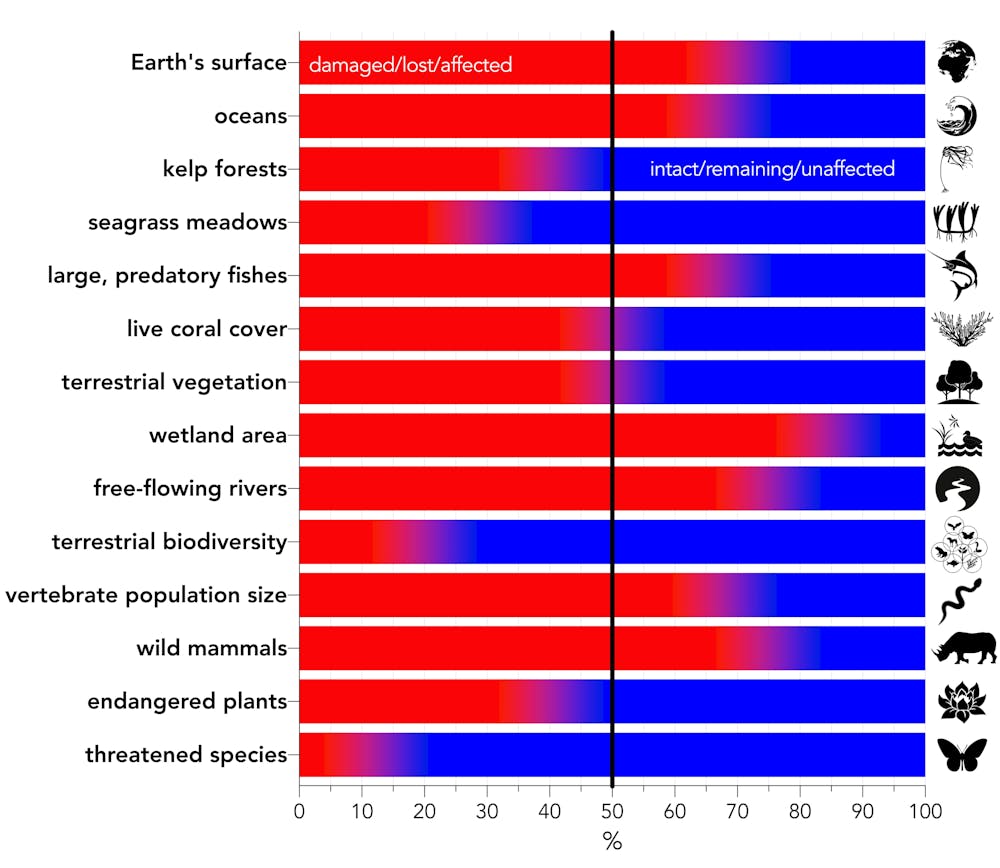
Air travel is the obvious way to get around, and it has become more affordable due to both competition (the government opened the domestic airline industry to competition in the 1990s) and rising incomes (with GDP per capita doubling since 2000).

The International Air Transport Association (IATA) predicts by 2039 Indonesia’s commercial passenger airline market will be the world’s fourth largest.

At the expense of safety?

The explosive growth in Indonesian air travel initially happened, to a certain extent, at the expense of safety. In the 2000s there were more than a dozen serious incidents and several major disasters.

These included Mandala Airlines Flight 91, which in September 2005 crashed into a neighbourhood in Medan, the capital city of North Sumatra, killing 149 people; and Garuda Indonesia Flight 200, which crashed while landing at Yogyakarta, Java in March 2007, killing 20 of the 133 passengers and one crew member.

Workers clear the wreckage of the Garuda Indonesia Boeing 737-400 crash at Adisutjipto International Airport, Yogyakarta, March 11 2007.
Workers clear the wreckage of the Garuda Indonesia Boeing 737-400 crash at Adisutjipto International Airport, Yogyakarta, March 11 2007. WEDA/EPA

In response, the European Union took the rather drastic step of banning all Indonesian carriers from its airspace in July 2007. (This ban was only fully lifted in June 2018.)


Read more: Why pilots don’t always hear alarms


Safety has improved

Improvement in Indonesia’s aviation safety record can be seen in the data provided by the Aviation Safety Network. From 2000 to 2009, there were 27 fatal aviation incidents in Indonesia. From 2010 to 2019, there were 18.

The country has made significant gains in implementing International Civil Aviation Organization (ICAO) standards.

The US Federal Aviation Administration’s International Aviation Safety Assessment Program rates Indonesia as a Category 1 country. This implies Indonesia’s aviation sector conforms to ICAO requirements and allows Indonesian carriers to fly to the US.

At the same time, much work remains to be done to bring Indonesia’s aviation safety level up to that of the OECD nations. Japan, for example, has recorded only five fatal aviation incidents since 2000.

In the US (the world’s largest aviation market before the pandemic) the last crash with similar fatalities to that of Sriwijaya Air Flight 182 was in February 2009, when Colgan Air Flight 3407, a turboprop plane flying between Newark, New Jersey and Buffalo, New York, crashed shortly before arrival, killing all 49 people on board (and one person on the ground).

Colgan Air Flight 3407, a Bombardier Dash-8 Q400 turboprop airliner, crashed into a house on February 12 2009, killing one person on the ground and all 49 passengers and crew on board.
Colgan Air Flight 3407, a Bombardier Dash-8 Q400 turboprop airliner, crashed into a house on February 12 2009, killing one person on the ground and all 49 passengers and crew. David Duprey/AP

Aviation safety globally

Globally, commercial passenger airline regulation can be legitimately proud of the safety record it has achieved.

According to aviation researchers, 2017 was the safest year in commercial aviation history. There were just 79 deaths related to incidents with commercial flights – an impressive record, given airlines carried nearly 4 billion passengers that year. By all metrics, flying in the 21st century has been far safer than in the last two decades of the 20th century.

Regional disparities still persist, however. According to an IATA analysis, Africa and the Commonwealth of Independent States (Russia and eight other former Soviet countries) have considerably worse safety records than other regions. The Asia Pacific region, which includes Indonesia, is about the global average.

How COVID-19 may affect safety

The COVID-19 pandemic has dealt a serious blow to the commercial passenger airline industry. The IATA estimates global passenger volume in 2020 was one-third that in 2019. Return to those levels is not expected before 2023. Whether the industry returns to its pre-pandemic growth trajectory is, at this point, anyone’s guess.

Against this background, my concern is potential of the pandemic to seriously affect the aviation safety culture that took decades to build.

With aircraft sitting idle, pilots remaining on the ground, mechanics and air traffic controllers out of work or underemployed, the question of bringing people and equipment up to speed will be important as travel restrictions lift.


Read more: Once the pandemic is over, we will return to a very different airline industry


The key message for aviation safety regulators, both in Indonesia and worldwide, is simple.

They have have made great progress in building, improving and maintaining safety culture in the industry. But post-pandemic recovery will require an extra sharp focus on aviation safety, above and beyond what has been done before.

This will be especially intense for nations such as Indonesia. The fate of Sriwijaya Air Flight 182 is a reminder of the work still to be done, and the challenges to come.

ref. Indonesia’s aviation safety has improved, but a lot remains to be done – https://theconversation.com/indonesias-aviation-safety-has-improved-but-a-lot-remains-to-be-done-153086

Film review: in My Salinger Year, hope and optimism win out

Source: The Conversation (Au and NZ) – By Anne Maxwell, Professor, School of Culture and Communication, University of Melbourne

Review: My Salinger Year, directed by Philippe Falardeau

In 2014, Joanna Rakoff published a memoir, My Salinger Year, recounting the events of the year she spent working as a “Girl Friday” in Harold Ober Associates – one of New York’s oldest and finest literary agencies.

Rakoff’s sole responsibility was to read the constant stream of fan mail sent to its most famous client, JD Salinger, and to write polite “brush off” letters to their authors.

Rakoff enjoyed at least one encounter with Salinger. The Joanna of Philippe Falardeau’s film adaptation only gets to hear Salinger’s voice courtesy of the phone calls. Nonetheless, these gradually work their magic on Joanna and she comes to appreciate the adoration he inspires in his fans.

As Rakoff remarked in a 2014 interview: “I became a true believer. It was a bit like being inculcated into a cult!”

At first, she scoffed at the god-like awe in which Salinger’s fans and the agency held him, but after reading his books she thought: “I get it, he really is a genius”.

Romantic notions of the literary world

Born in 1919, Salinger is best known for his only novel, The Catcher in the Rye, published in 1951. He followed this novel with several short stories and novellas, including the collection Nine Stories (1953) and Franny and Zooey (1961).

The last work published in his lifetime was Hapworth 16, 1924, published in The New Yorker in 1965. While The Catcher in the Rye remained an erstwhile best seller, Salinger became notoriously reclusive until his death in 2010 at the age of 91.


Read more: Six years on: the enduring influence of J. D. Salinger


Both novel and movie are set in midtown Manhattan in 1996. Computers were only just beginning to appear in American offices. From the art deco design of the agency’s offices (the real Harold Ober Associates was in Madison Avenue) to the small, narrow bookshops with their shelves crammed full of hardbacks, the movie excels at the atmosphere of shabby chic glamour that permeated New York’s literary scene at the time.

The young Joanna, wide-eyed and earnest, is perfectly played by Margaret Walley (daughter of Hollywood actress Demi Moore). Sigourney Weaver as Joanna’s boss and Salinger’s agent, Margaret, is brilliant at playing the neurotic, ageing career woman, at once intimidating and vulnerable.

Director Philippe Falardeau plays up the initial tension between Joanna and her boss: Margaret’s dismissal of new-fangled technology — especially computers — means the agency is caught in a time warp, and Joanna’s letters must be typed on an old typewriter.

Margaret also tries to disabuse her young assistant of any romantic dreams she might have about her job. Being a literary agent, she says it is all about sales and commerce. But Joanna has other ideas. She defies Margaret’s orders and writes personalised replies to Salinger’s fans.

Film still. Margaret smokes, Joanna types.
Margaret’s cynicism is met with wide-eyed optimism by her assistant, Joanna. Palace Films

The fans, she believes, deserve the same thoughtful and passionate response that Salinger’s novels elicit from his readers, a passion which is apparent from their letters. Falardeau presents these letters through a series of imagined conversations between the fans and Joanna.

Youthful dreams

By focusing on the theme of Salinger on the one hand, and the way the year in New York helped Rakoff decide the direction of her life and career on the other, Farlardeau’s movie drastically condenses Rakoff’s narrative while still remaining true to the text.

It is partly because of Salinger’s constant encouragement in their phone calls and her own self belief that Joanna doesn’t lose her dream of becoming a writer. Margaret might be a cynic, but optimism wins out.

Production still: Joanna reads Nine Stories
In learning to love Salinger, Joanna forges her own path as a writer. Palace Films

While the film lacks the sparkling wit of Rakoff’s book, it makes up for in its faithful recreation of 1990s New York and the sensitive way it portrays a young woman’s youthful dreams of becoming a writer — and the first exploratory steps she took in order to get there.

My Salinger Year will warm the hearts of J.D. Salinger fans, and will keep the dream alive for many aspiring creative writers.

My Salinger Year is in cinemas now.

ref. Film review: in My Salinger Year, hope and optimism win out – https://theconversation.com/film-review-in-my-salinger-year-hope-and-optimism-win-out-152087

Enjoy them while you can? The ecotourism challenge facing Australia’s favourite islands

Source: The Conversation (Au and NZ) – By Freya Higgins-Desbiolles, Senior Lecturer in Tourism Management, University of South Australia

I fell for Kangaroo Island from my first visit. I recall standing on a headland on the island’s southern coast, near Remarkable Rocks (a popular tourist site), and being awestruck by the Southern Ocean.

The island (Australia’s third-largest after Tasmania and Melville Island) is one of 16 designated National Landscapes and arguably South Australia’s greatest tourism treasure. Its protected areas (notably Flinders Chase National Park) are home to rare and endangered marsupials and birds.

A year ago, in Australia’s “Black Summer”, bushfires ravaged more than half the island (about 211,000 hectares). Those fires underscored the threat to this and other iconic island destinations.

Both directly and indirectly, humans are endangering these fragile ecosystems through unsustainable development and human-caused climate change.

Kangaroos in burnt bushland on Kangaroo Island, South Australia.
Kangaroos in burnt bushland on Kangaroo Island, South Australia. RSPCA SA/AAP

The most ironic threat is from unsustainable tourism. These islands attract millions of visitors a year keen to experience their natural wonders. Yet often this very “ecotourism” is contributing to their degradation.

How to do better?

Last October I took part in a workshop at which Kangaroo Island’s tourism operators discussed how to do so. 2020 was a difficult year for them, first with the fires, then with the COVID-19 pandemic. But in that adversity they also saw the opportunity to reset “business as usual” and come back better, creating an industry not harming its core asset.


Read more: The end of global travel as we know it: an opportunity for sustainable tourism


A range of ideas came out of our talks applicable to all our island destinations. But there was one key point. Ecotourism should be more than fleeting feel-good experiences. It should not be a “value extraction” but a “values education”, inspiring visitors to go home and live more eco-consciously.

Macquarie island

The paradox of ecotourism is perhaps best exemplified by Australia’s least visited island destination – Macquarie Island, about 1,500 km south-east of Hobart, halfway between New Zealand and the Antarctica.

Just 1,500 tourists a year, rather than hundreds of thousands, are permitted by the Tasmania Parks and Wildlife Service to visit. The island has no hotels, restaurants or souvenir shops. The only buildings are those of the Macquarie Island Station research base and a few isolated field huts for scientists.

The Macquarie Island Research Base.
The Macquarie Island Research Base. Dale Lorna Jacobsen/Shutterstock

Tourists must be content with coming ashore for the day from the 18 small cruise ships that ply these waters in summer. The only hospitality is the traditional station offering of tea and scones.

But what tourists do get is a unique experience. Macquarie is World Heritage listed as the only island made entirely from the earth’s mantle. It also teems with wildlife – multiple species of penguins and seals in their tens of thousands, and birds in their millions.

Royal Penguins and Southern Elephant Seals at Sandy Bay, Macquarie Island.
Royal Penguins and Southern Elephant Seals at Sandy Bay, Macquarie Island. Janelle Lugge/Shutterstock

It’s about as pure an ecotourism experience you can have (if you can afford it). Even so, it still takes resources to get there, including the burning of fossil fuels, contributing to the global warming that is the greatest threat to the environmental integrity of Macquarie Island (and other island ecosystems).

However, the Tasmania Parks and Wildlife Service does at least expect cruise ship operators to “demonstrate their capacity to deliver desirable outcomes” on criteria including minimisation of environmental impacts and communicating to tourists “messages about the natural and cultural values of the island”, including the role they play in its preservation.


Read more: This could be the end of the line for cruise ships


K’gari (Fraser island)

Communicating such messages is something that certainly needs improvement on another World Heritage listed island – K’gari (commonly known as Fraser island), the world’s largest sand island.

About 250 km north of Brisbane, at the southern end of the Great Barrier Reef, the island draws many hundreds of thousands of visitors a year to its beaches, woodlands and rainforests. (There are no recent public statistics on island visitor numbers but in 2017-18 the Fraser Coast region attracted 1,515,000 visitors.)

Rainforest on K'gari.
Rainforest on K’gari. Marco Saracco/Shutterstock

Once the island’s resources were mined and logged. Tourism was meant to be much less exploitative. But a range of organisations including the International Union for Conservation of Nature have highlighted the pressure tourist numbers (along with their vehicles and infrastructure) are placing on K’gari’s landscapes and wildlife.

Communicating to all those visitors the role they play in the island’s preservation appears to be failing. The bushfires that burnt half the island (about 165,500 hectares) over nine weeks between October and December last year allegedly resulted from an illegal camp fire.

K'gari (Fraser Island) bush fires near the Cathedrals camping ground, November 2020.
K’gari (Fraser Island) bush fires near the Cathedrals camping ground, November 2020. QLD Ambulance Service/AAP

Headline-grabbing attacks by the island’s residents dingos – such as in April 2019 when a toddler was dragged from a campervan – have also been credited to rampant irresponsible tourist behaviour (feeding dingoes to get better photos, for example).

Indigenous elders, conservationists and scientists have all pointed to the problem of a mass-tourism model that doesn’t put enough emphasis on educating visitors about the environment and their responsibilities.


Read more: The K’gari-Fraser Island bushfire is causing catastrophic damage. What can we expect when it’s all over?


Rottnest Island

One of our proposals for Kangaroo Island is to reduce the impact of motor vehicles through encouraging more extended walking and cycling experiences.

The value of sustainable transport as the foundation for ecotourism is demonstrated by Rottnest Island, 20 km off the coast of Perth.

The entire island is managed as an A-Class Nature Reserve. Apart from service vehicles and shuttle buses, it is car-free. You can hire a bike or bring your own to get around the island (11 km long and 4.5 km wide). Or simply walk.

The absence of traffic makes a Rottnest holiday a distinctly more relaxed experience. It’s a fair example of slow tourism; and, of course, it is also good for the island’s world famous quokkas, which co-exist with close to 800,000 visitors a year.

Rottnest island has the world’s only sizeable population of quokkas. There are 10,000 to 12,000 quokkas on the island. Grakhantsev Nikolai/Shutterstock

Read more: Before and after: 4 new graphics show the recovery from last summer’s bushfire devastation


Before they are gone

Given a little space, nature is resilient.

After Kangaroo Island’s bushfires a year ago, for example, it was feared a number of endangered species had finally been driven to extinction.

But in two of 2020’s few good news stories, scientists found critically endangered Kangaroo Island dunnarts and little pygmy possums – the world’s smallest marsupial – had survived.

Kangaroo Island pygmy possum.
Kangaroo Island pygmy possum. Ashlee Benc/Kangaroo Island Land for Wildlife, CC BY

But we can’t take that resilience for granted if we keep putting pressure on these fragile ecosystems. We need a better approach to ensure ecotourism isn’t about enjoying these natural wonders before they are gone.

ref. Enjoy them while you can? The ecotourism challenge facing Australia’s favourite islands – https://theconversation.com/enjoy-them-while-you-can-the-ecotourism-challenge-facing-australias-favourite-islands-152679

What’s at stake for NZ in Australia’s case against China at the World Trade Organisation?

Source: The Conversation (Au and NZ) – By Alexander Gillespie, Professor of Law, University of Waikato

With the relationship between China and Australia souring in the past six months, New Zealand’s response will need to be nuanced and careful, but also principled.

First and foremost, we must ensure the dispute between two of our main trading partners stays partitioned from our role within the Five Eyes security alliance. If they become muddied, our economic relationship with China will suffer.

This is complicated by Australia’s recent forthright positions on a number of strategic issues, including an insistence that the World Health Organisation (WHO) conduct a robust inquiry into the origins of COVID-19, and criticism of China’s actions in Hong Kong.

By accident or design, Australia has appeared to be in the front line of Western criticism of Beijing — and has been subjected to a growing list of export restrictions in return.

Chinese authorities have asserted that Australia is unfairly dumping (selling below cost) or subsidising many of its exports, and have imposed tariffs on wines (up to 200%) and barley (up to 80%).

Other export products, such as lobster, have been blocked by more indirect means, such as additional hygiene requirements. Claims of pest threats have affected timber shipments, and meat supply lines have been disrupted by concerns over labelling and health certificates.

Beyond this, coal has been affected by preferential treatment for other producers. Iron ore is the only Australian export that has so far not been targeted — Australia dominates the international market and China has an insatiable demand.

World Trade Organisation headquarters building
WTO headquarters in Geneva: resolution of trade disputes can be a long, drawn-out process. www.shutterstock.com

Why the WTO is vital

Australia has now taken its concerns to the World Trade Organisation (WTO), with barley seen as the best case (although other products may follow). If the consultation process over the next few months fails, a panel will be created to rule on the matter.

There is a lot at stake here, and New Zealand will want to pay close attention because of the wider ramifications. Australia, like New Zealand, has a free trade agreement with China which has seen strong growth since 2015. The value of Australian exports to China has doubled, from AU$75 billion to $150 billion in five years.

China makes up a whopping 30.6% of Australia’s top ten export markets — more than double Japan, the second most important market. At 56% of the total value of those exports, iron ore swamps all other trade streams.

New Zealand has experienced similar growth, with two-way trade increasing from $NZ10 billion in 2007 to over $30 billion today. Around 28% of all New Zealand exports go to China, including more than a quarter of dairy, about half of all meat, and almost two-thirds of wood exports.

But going to the WTO will not be a quick or easy process. It could drag on for years, especially if there are appeals, which is likely given both countries are veterans at this and both are quite litigious.

Australia has been a complainant in nine cases, a respondent in 16, and a third party in 112. China has been a complainant in 21, a respondent in 44, and a third party in 166. By comparison, New Zealand has been a complainant in nine, a third party in 61, but never a respondent.

Both Australia and China have recorded wins and losses. China lost to the European Union but did score a victory over Donald Trump’s trade restrictions. Australia recently lost to Indonesia, and lost earlier to New Zealand with its wrongful biosafety measures keeping our apples out of their market for nearly 100 years. But overall, Australia’s record at the WTO generally suggests more wins than losses.


Read more: China enters 2021 a stronger, more influential power — and Australia may feel the squeeze even more


Supporting a rules-based international order

The good news is that going to the WTO for resolution endorses the rules of international trade law (and a rules-based international order in general) — not an order based on the arbitrary power of the strongest. This is exactly what globalisation should look like.

China, like Australia, publicly professes to be a good member of the WTO. Both have adhered to a temporary appeals process as a way to bypass the Trump administration’s attempts to undermine the WTO’s ability to resolve trade disputes.

While some in the US have cast doubt on China’s compliance with WTO rules, other analyses suggest Chinese compliance with the dispute settlement mechanism is respectable and better than is commonly portrayed.

Indeed, while compliance may sometimes be less than perfect, there are no cases of China simply ignoring rulings against itself.


Read more: Vital Signs: Australian barley growers are the victims of weaponised trade rules


NZ should become a third party

Perhaps the best news is that this dispute has stayed within the trade arena and has not spilled into the area of strategic alliances. This is despite the Five Eyes partners having reportedly discussed widening their focus beyond security to include economic retaliation.

As well as doing what it can to ensure this remains the case, New Zealand (with other interested countries) should seriously consider becoming a third party to the WTO in this dispute.

To do so would mean we would need to demonstrate a “substantial interest” in the case. This need not be only economic, but could involve the impact of the measures in question on the overall trading system.

If we do this, New Zealand should make clear this is not a Gallipoli moment where we are blindly following our ANZAC sibling. Our engagement should be in defence of a higher principle, albeit where trade is the context. Only a rules-based order, premised on international law and independent, binding processes can make the future secure for all players, large and small.

ref. What’s at stake for NZ in Australia’s case against China at the World Trade Organisation? – https://theconversation.com/whats-at-stake-for-nz-in-australias-case-against-china-at-the-world-trade-organisation-153098

Artificial intelligence can deepen social inequality. Here are 5 ways to help prevent this

Source: The Conversation (Au and NZ) – By Tiberio Caetano, Chief Scientist, Gradient Institute, University of Sydney

From Google searches and dating sites to detecting credit card fraud, artificial intelligence (AI) keeps finding new ways to creep into our lives. But can we trust the algorithms that drive it?

As humans, we make errors. We can have attention lapses and misinterpret information. Yet when we reassess, we can pick out our errors and correct them.

But when an AI system makes an error, it will be repeated again and again no matter how many times it looks at the same data under the same circumstances.

AI systems are trained using data that inevitably reflect the past. If a training data set contains inherent biases from past human decisions, these biases are codified and amplified by the system.

Or if it contains less data about a particular minority group, predictions for that group will tend to be worse. This is called “algorithmic bias”.

Gradient Institute has published a paper demonstrating how businesses can identify algorithmic bias in AI systems, and how they can mitigate it.

The work was produced in collaboration with the Australian Human Rights Commission, Consumer Policy Research Centre, CSIRO’s Data61 and the CHOICE advocacy group.

How does algorithmic bias arise?

Algorithmic bias may arise through a lack of suitable training data, or as a result of inappropriate system design or configuration.

For example, a system that helps a bank decide whether or not to grant loans would typically be trained using a large data set of the bank’s previous loan decisions (and other relevant data to which the bank has access).

The system can compare a new loan applicant’s financial history, employment history and demographic information with corresponding information from previous applicants. From this, it tries to predict whether the new applicant will be able to repay the loan.

But this approach can be problematic. One way in which algorithmic bias could arise in this situation is through unconscious biases from loan managers who made past decisions about mortgage applications.

If customers from minority groups were denied loans unfairly in the past, the AI will consider these groups’ general repayment ability to be lower than it is.

Young people, people of colour, single women, people with disabilities and blue-collar workers are just some examples of groups that may be disadvantaged.


Read more: Artificial Intelligence has a gender bias problem — just ask Siri


Bias harms both individuals and companies

The biased AI system described above poses two key risks for the bank.

First, the bank could miss out on potential clients, by sending victims of bias to its competitors. It could also be held liable under anti-discrimination laws.

If an AI system continually applies inherent bias in its decisions, it becomes easier for government or consumer groups to identify this systematic pattern. This can lead to hefty fines and penalties.

Centrelink sign

Centrelink’s now-scrapped robodebt system automatically raised welfare debts against people it predicted were overpaid. If the recipient didn’t provide income evidence, an algorithm generated a fortnightly income figure for them by averaging data available to the Australia Tax Office. These estimates had major errors. James Ross/AAP

Mitigating algorithmic bias

Our paper explores several ways in which algorithmic bias can arise.

It also provides technical guidance on how this bias can be removed, so AI systems produce ethical outcomes which don’t discriminate based on characteristics such as race, age, sex or disability.

For our paper, we ran a simulation of a hypothetical electricity retailer using an AI-powered tool to decide how to offer products to customers and on what terms. The simulation was trained on fictional historical data made up of fictional individuals.

Based on our results, we identify five approaches to correcting algorithmic bias. This toolkit can be applied to businesses across a range of sectors to help ensure AI systems are fair and accurate.

1. Get better data

The risk of algorithmic bias can be reduced by obtaining additional data points or new types of information on individuals, especially those who are underrepresented (minorities) or those who may appear inaccurately in existing data.

2. Pre-process the data

This consists of editing a dataset to mask or remove information about attributes associated with protections under anti-discrimination law, such as race or gender.

3. Increase model complexity

A simpler AI model can be easier to test, monitor and interrogate. But it can also be less accurate and lead to generalisations which favour the majority over minorities.

4. Modify the system

The logic and parameters of an AI system can be proactively adjusted to directly counteract algorithmic bias. For example, this can be done by setting a different decision threshold for a disadvantaged group.

5. Change the prediction target

The specific measure chosen to guide an AI system directly influences how it makes decisions across different groups. Finding a fairer measure to use as the prediction target will help reduce algorithmic bias.

Illustration portraying the input and output of information via a brain.
The effectiveness of an AI system is highly dependent on the quality of data used to train it. Shutterstock

Consider legality and morality

In our recommendations to government and businesses wanting to employ AI decision-making, we foremost stress the importance of considering general principles of fairness and human rights when using such technology. And this must be done before a system is in-use.

We also recommend systems are rigorously designed and tested to ensure outputs aren’t tainted by algorithmic bias. Once operational, they should be closely monitored.

Finally, we advise that to use AI systems responsibly and ethically extends beyond compliance with the narrow letter of the law. It also requires the system to be aligned with broadly-accepted social norms — and considerate of impact on individuals, communities and the environment.

With AI decision-making tools becoming commonplace, we now have an opportunity to not only increase productivity, but create a more equitable and just society – that is, if we use them carefully.


Read more: YouTube’s algorithms might radicalise people – but the real problem is we’ve no idea how they work


ref. Artificial intelligence can deepen social inequality. Here are 5 ways to help prevent this – https://theconversation.com/artificial-intelligence-can-deepen-social-inequality-here-are-5-ways-to-help-prevent-this-152226

You could break espionage laws on social media without realising it

Source: The Conversation (Au and NZ) – By Sarah Kendall, PhD Candidate in Law, The University of Queensland

Did you know you could be charged with spying if you connect with someone who turns out to be a foreign spy on LinkedIn?

Apparently, not enough of us do. Australia’s domestic spy agency ASIO recently launched its first public awareness campaign, warning foreign spies are using social media and professional networking sites to recruit Australians as unwitting agents.

So, how easy is it to commit espionage by simply making connections on social media? How do we know when a line has been crossed between innocent social networking and a national security offence?

Who is at risk?

ASIO warns foreign spies are targeting Australians who have access to sensitive or valuable information, such as national security, government, intellectual property and commercial information.

This could potentially involve public servants, or others with a government security clearance, academics and researchers, and those in sectors like banking and commerce.

If you have access to this kind of information and/or work in one of these professions, then you are at greater risk of committing an espionage offence. But ASIO warns it is not just these professions at risk — everyone must be cautious about what they share online.

Australia’s espionage laws

The United Kingdom’s domestic spy agency, MI5, provides a good explanation of espionage as,

the process of obtaining information that is not normally publicly available, using human sources (agents) or technical means (like hacking into computer systems). It may also involve seeking to influence decision-makers and opinion-formers to benefit the interests of a foreign power.

In 2018, following revelations by ASIO about an “unprecedented” threat of espionage and foreign interference, the federal government introduced a complex scheme of 27 espionage offences. Penalties for these range from 15 years to life in jail.


Read more: Government needs to slow down on changes to spying and foreign interference laws


Australia’s laws include an offence of “preparing for espionage” which makes it a crime to do something which could later result in espionage, such as buying a laptop that could be used for cyber hacking. So this offence could capture conduct with an innocent explanation, provided it could be shown from surrounding circumstances the person intends to later engage in espionage.

Attorney-General Christian Porter described the regime as

strong new laws against those who seek to undermine our national security and our democratic institutions and processes.

But they have been criticised by academics for their complexity and over-reach. For example, they can criminalise the legitimate conduct of journalists and whistleblowers, and rely on a definition of “national security” that not only includes traditional defence matters, but Australia’s diplomatic relations too.

How could you commit an espionage offence?

Unsurprisingly, you would commit espionage if you work for the government and knowingly revealed classified information to a foreign agent via a site such as LinkedIn.

Man logging onto Linkedin
It can be hard to know who you are really talking to online. www.shutterstock.com

You would also be committing espionage if you shared your employer’s trade secrets with a foreign spy via Facebook or WeChat — even if you didn’t think the recipient was a foreign agent.

This is the kind of conduct former CIA officer Kevin Mallory was convicted for in the United States in 2019. He was sentenced to 20 years in prison after selling classified US defence information to someone who messaged him on LinkedIn claiming to be a think tank representative. The representative was actually a Chinese intelligence officer.

Less obvious acts are also a problem

“Preparing for espionage” criminalises a much wider range of conduct. Its purpose is to give law enforcement the power to stop espionage before it occurs. This is the offence you are most likely to break unwittingly on social media.

Connecting with a foreign spy on any social media site opens the door for you to potentially reveal sensitive information to the spy in the future. This could be seen as doing an act in preparation for espionage.

This is especially the case if you:

  • engage in conversation with the spy

  • have access to valuable information of any kind

  • think the person seems even remotely suspicious

  • hand over any sort of information, even if you don’t think it is sensitive.

If charged with this offence, you could face up to 15 years in prison.

How to spot a spy

It is important to recognise the kinds of profiles that may be malicious.

Foreign agents use social media to pose as fake employers or recruitment consultants who offer you “unique” business or career opportunities.


Read more: ASIO chief Mike Burgess says there are more spies in Australia ‘than at the height of the cold war’


These offers usually seem too good to be true, lack detail, and are emphasised as time sensitive or one-off opportunities. The “recruiter” may also be excessively flattering and focus on the role instead of scrutinising you as a candidate. This may involve emphasising perks of the job rather than asking for referees to check your background.

Meanwhile, their real purpose is to gain as much information from you as possible.

They do this by requesting further information about you and your experience, and asking seemingly benign questions. Then they escalate to requests for more sensitive information. They will usually attempt to move you to a different communication platform or set up face-to-face meetings.

As ASIO head Mike Burgess warns,

If a stranger reaches out online, ask yourself if you really know who you are talking to.

How can you protect yourself?

To protect yourself from becoming a target in the first place, there are some simple steps you can follow:

  • include only the lowest level of detail necessary on your online profile

  • only share your CV or details of specific projects with trusted and verified contacts

  • use website settings to control who can view your profile

  • if you have access to sensitive information, don’t make details of your sensitive job roles or employers public.

And if you are contacted by an online profile you suspect may be trying to get sensitive information from you, do not respond. Instead, report the contact to your company’s security adviser or ASIO, then remove them from your network. You cannot “prepare for espionage” if you are not connected to the spy and have not communicated with them.

Ultimately, the message is one of caution. Because the consequences of brief recklessness could include prosecution for a serious national security offence.

ref. You could break espionage laws on social media without realising it – https://theconversation.com/you-could-break-espionage-laws-on-social-media-without-realising-it-151665

Net-zero, carbon-neutral, carbon-negative .. confused by all the carbon jargon? Then read this

Source: The Conversation (Au and NZ) – By Jessica Allen, Senior Lecturer and DECRA Fellow, University of Newcastle

Countries around the world are taking steps to tackle climate change and become net-zero emitters of carbon dioxide (CO₂) by 2050. Most recently, Joe Biden’s presidential election win means the US is the latest nation to adopt the goal.

So what does net-zero mean? Completely eliminating all greenhouse gas emissions? Not necessarily. The “net” part of net-zero means we can still emit CO₂, as long as we offset (or remove) those emissions from the atmosphere by the same amount in other places.

You might have heard a lot of talk about “going net-zero” in the media lately. China recently announced it intends to achieve the goal by 2060. France, the United Kingdom and New Zealand will go net-zero by 2050. In Australia, all states and territories have a net-zero strategy and the federal government is under pressure to make a national commitment.

You might also have heard references to “zero emissions”, “low emissions” and going “carbon-neutral” So let’s get clear on what all these terms mean in practice.

Loy Yang power station at night
Many of Australia’s peers have adopted net-zero emissions targets. Shutterstock

Getting to grips with net-zero

It’s not just countries that can produce net-zero emissions. The term can also apply to a state, city, company or even a single building.

Under a net-zero scenario, emissions are still being generated but they’re offset by the same amount elsewhere. Examples of offset activities include planting trees to absorb CO₂ or using other natural ecosystems to increase carbon stored in the biosphere.

The term “carbon-neutral” is sometimes used instead of net-zero, and they broadly mean the same thing. There are also two specific categories of carbon-neutral technologies that are relevant here:

  • a process that generates CO₂ in a short-term cycle which does not add to global warming. An example of this is bioenergy, where CO₂ is initially absorbed by organic material, then released on conversion to energy. Overall, emissions are stable and there is no net increase in CO₂.

  • a process that generates CO₂ but captures and sequesters (stores) it, rather than releasing it to the atmosphere. An example of this is a coal-fired power plant fitted with carbon capture and storage technology.

Sugar cane in front of electricity infrastructure
Bioenergy is a carbon-neutral technology. Shutterstock

Don’t get confused with these terms

To understand the term “net-zero emissions”, we must also understand what it is not. It should not be confused with the following related, but separate, concepts:

Zero emissions: this refers to a process where no CO₂ is released at all. In fact, in our current global mining and manufacturing system, no technology produces zero emissions.

Technologies such as solar panels and wind energy are often said to be zero-emissions but technically, they’re not. They have what are known as “embedded emissions” – those created in manufacturing the technology. However wind and solar produce no ongoing emissions after installation, unlike fossil fuel energy.


Read more: China just stunned the world with its step-up on climate action – and the implications for Australia may be huge


Carbon-negative: This means removing CO₂ from the atmosphere, or sequestering more CO₂ than is emitted. This might include a bioenergy process with carbon capture and storage.

Low emissions: Generating greenhouse gases at a lower rate than business as usual. Examples include switching from coal-fired to gas-fired power to generate the same amount of electricity, but with fewer emissions.

Wind farm in Western Australia
Wind energy produces no ongoing CO2 emissions. Shutterstock

OK, back to net-zero

There are a few key ways to move to net-zero emissions, which are reflected in most national plans:

  • drastically reduce or eliminate the use of fossil fuels in the energy sector (including transport)

  • improve efficiency and/or develop new technology in other sectors generating emissions but unable to easily reduce them, such as manufacturing and agriculture

  • invest in bio-sequestration (also known as reforestation or tree-planting) and carbon-negative technologies to offset any continuing or unavoidable emissions.

No technology or quantity of trees planted could offset the emissions currently generated globally. That’s why nearly every net-zero plan includes first reducing, and eventually replacing, fossil fuels. Fossil fuels could be used to achieve net-zero with offsets or carbon capture and storage, but in many cases this is not actually the most cost-effective or practical pathway to net-zero.


Read more: The Morrison government wants to suck CO₂ out of the atmosphere. Here are 7 ways to do it


Achieving only the first two points would not take the world to net-zero. Carbon-negative approaches – removing CO₂ from the atmosphere – will also be needed.

Most national plans achieve this through land management techniques such as reforestation. However the amount of CO₂ offset through natural carbon-negative solutions can be difficult to measure. Additionally the long-term delivery of the carbon offsets cannot always be guaranteed – for example, a replanted forest may die or be burnt in a bushfire releasing CO₂ back to the atmosphere.

Other more engineered solutions can also remove CO₂ from the atmosphere. They include the use of biochar – a charcoal-like material added to soil. It promotes microbial activity and soil clumps which prevents organic plant matter breaking down and releasing carbon. But this method is still not perfect.

A handful of biochar.
Biochar helps boost soil carbon stores. Shutterstock

CO₂: problem or opportunity?

Global progress on emissions reduction has been so slow that simply cutting emissions won’t avert a climate catastrophe.

Even if the world manages to achieve net-zero emissions by 2050, we may still blow our “carbon budget” – the amount of CO₂ that can be emitted if Earth’s temperature rise is to stay below 1.5℃ this century. So we must find ways to first eliminate emissions, then remove existing CO₂.

It is foreseeable Earth will one day rely on carbon-negative technologies that draw CO₂ from the air and stabilise it in useful products. For example, direct air carbon capture and storage (which is still under development) could one day remove CO₂ and use it in products such as building materials and plastics.

Such a process would treat CO₂ as a valuable input material – turning Earth’s biggest problem into an opportunity for innovation.

The move towards net-zero is a crucial to avoid a climate catastrophe. And the time to move is not tomorrow or “by 2050” – it’s now.

ref. Net-zero, carbon-neutral, carbon-negative .. confused by all the carbon jargon? Then read this – https://theconversation.com/net-zero-carbon-neutral-carbon-negative-confused-by-all-the-carbon-jargon-then-read-this-151382

No, Twitter is not censoring Donald Trump. Free speech is not guaranteed if it harms others

Source: The Conversation (Au and NZ) – By Katharine Gelber, Professor of Politics and Public Policy, The University of Queensland

The recent storming of the US Capitol has led a number of social media platforms to remove President Donald Trump’s account. In the case of Twitter, the ban is permanent. Others, like Facebook, have taken him offline until after President-elect Joe Biden’s inauguration next week.

This has led to a flurry of commentary in the Australian media about “free speech”. Treasurer Josh Frydenburg has said he is “uncomfortable” with Twitter’s removal of Trump, while the acting prime minister, Michael McCormack, has described it as “censorship”.

Meanwhile, MPs like Craig Kelly and George Christensen continue to ignore the evidence and promote misinformation about the nature of the violent, pro-Trump mob that attacked the Capitol.

A growing number of MPs are also reportedly calling for consistent and transparent rules to be applied by online platforms in a bid to combat hate speech and other types of harmful speech.

The media have conflated this effort with the restrictions on Trump’s social media usage, as though both of these issues reflect the same problem.

Much of this commentary is misguided, wrong and confusing. So let’s pull it apart a bit.

There is no free speech “right” to incite violence

There is no free speech argument in existence that suggests an incitement of lawlessness and violence is protected speech.

Quite to the contrary. Nineteenth century free speech proponent John Stuart Mill argued the sole reason one’s liberty may be interfered with (including restrictions on free speech) is “self-protection” — in other words, to protect people from harm or violence.

Additionally, incitement to violence is a criminal offence in all liberal democratic orders. There is an obvious reason for this: violence is harmful. It harms those who are immediately targeted (five people died in the riots last week) and those who are intimidated as a result of the violence to take action or speak up against it.

It also harms the institutions of democracy themselves, which rely on elections rather than civil wars and a peaceful transfer of power.

To suggest taking action against speech that incites violence is “censoring” the speaker is completely misleading.

There is no free speech “right” to appear on a particular platform

There is also no free speech argument that guarantees any citizen the right to express their views on a specific platform.

It is ludicrous to suggest there is. If this “right” were to exist, it would mean any citizen could demand to have their opinions aired on the front page of the Sydney Morning Herald and, if refused, claim their free speech had been violated.

What does exist is a general right to express oneself in public discourse, relatively free from regulation, as long as one’s speech does not harm others.

Trump still possesses this right. He has a podium in the West Wing designed for this specific purpose, which he can make use of at any time.

Were he to do so, the media would cover what he says, just as they covered his comments prior to, during and immediately after the riots. This included him telling the rioters that he loved them and that they were “very special”.

Trump told his supporters before the Capitol was overrun: ‘if you don’t fight like hell, you’re not going to have a country anymore’. Jacquelyn Martin/AP

Does the fact he’s the president change this?

In many free speech arguments, political speech is accorded a higher level of protection than other forms of speech (such as commercial speech, for example). Does the fact this debate concerns the president of the United States change things?

No, it does not. There is no doubt Trump has been given considerable leeway in his public commentary prior to — and during the course of — his presidency. However, he has now crossed a line into stoking imminent lawlessness and violence.

This cannot be protected speech just because it is “political”. If this was the case, it would suggest the free speech of political elites can and should have no limits at all.

Yet, in all liberal democracies – even the United States which has the strongest free speech protection in the world – free speech has limits. These include the incitement of violence and crime.

Are social media platforms over-censoring?

The last decade or so has seen a vigorous debate over the attitudes and responses of social media platforms to harmful speech.

The big tech companies have staunchly resisted being asked to regulate speech, especially political speech, on their platforms. They have enjoyed the profits of their business model, while specific types of users – typically the marginalised – have borne the costs.

However, platforms have recently started to respond to demands and public pressure to address the harms of the speech they facilitate – from countering violent extremism to fake accounts, misinformation, revenge porn and hate speech.

They have developed community standards for content moderation that are publicly available. They release regular reports on their content moderation processes.

Facebook has even created an independent oversight board to arbitrate disputes over their decision making on content moderation.

They do not always do very well at this. One of the core problems is their desire to create algorithms and policies that are applicable universally across their global operations. But such a thing is impossible when it comes to free speech. Context matters in determining whether and under what circumstances speech can harm. This means they make mistakes.

Where to now?

The calls by MPs Anne Webster and Sharon Claydon to address hate speech online are important. They are part of the broader push internationally to find ways to ensure the benefits of the internet can be enjoyed more equally, and that a person’s speech does not silence or harm others.

Arguments about harm are longstanding, and have been widely accepted globally as forming a legitimate basis for intervention.

But the suggestion Trump has been censored is simply wrong. It misleads the public into believing all “free speech” claims have equal merit. They do not.

We must work to ensure harmful speech is regulated in order to ensure broad participation in the public discourse that is essential to our lives — and to our democracy. Anything less is an abandonment of the principles and ethics of governance.

ref. No, Twitter is not censoring Donald Trump. Free speech is not guaranteed if it harms others – https://theconversation.com/no-twitter-is-not-censoring-donald-trump-free-speech-is-not-guaranteed-if-it-harms-others-153092

Asking people to prepare for fire is pointless if they can’t afford to do it. It’s time we subsidised fire prevention

Source: The Conversation (Au and NZ) – By David Bowman, Professor of Pyrogeography and Fire Science, University of Tasmania

Once again, Australia is on fire. This year it’s the turn of Western Australia and South Australia, where bushfires are threatening homes and lives. In the south of Tasmania, conditions are dry and the region is entering a period of peak fire danger.

In the lead up to every bushfire season, the mantra is the same each year: prepare, prepare, prepare. Remove the fuel load. Clean out the gutters. Mow lawns, tidy gardens, create a burnbreak between bushland and your house. Identify your strengths and weaknesses. Have a plan.

After 40 years studying the interaction between humans and fire, I have seen this mantra rolled out every year — and watched, every year, as it is comprehensively ignored by large numbers of people. Why? Because they are bad or lazy? No.

The fact is asking people to prepare for fire is pointless if they can’t afford to do it. If you don’t have time or money (or both), it doesn’t matter how many times authorities tell you to prepare. It’s not going to happen. What if we had a system, like Medicare, where the cost of these fire prevention measures was subsidised by the public system?


Read more: Friday essay: living with fire and facing our fears


We know the current system doesn’t work

Institutions such as local fire authorities, councils or governments can say “we have done our bit and we expect the community to do their part and manage their risk, their property, their bushfire plan”.

But it’s just passing the problem along to the next person, without considering whether they’re able to actually take up that advice.

For years, authorities have essentially handed people a very formidable and expensive checklist of things to do, right up to the level of retrofitting your house to be compliant with modern building standards. These are significant time and financial investments.

A man cleans leaf litter out of gutters.
Many people are not physically able to get up a ladder to clean gutters and can’t afford to pay someone to do it. Shutterstock

The cost of failing to prepare is huge. Bushfire often spreads by embers landing in a series of unprepared properties. If your neighbours don’t make their home defendable, chances are it may cause your house to burn down.

There are many reasons people don’t prepare, and a key one is affordability. If you’re not physically able to get up a ladder to clean your gutters or mow around your property and remove fuel load — and you can’t afford to pay someone to do it — what are you supposed to do?

You might think, “Well, if people choose to live in a bushfire prone area then that’s their problem. Why should they get subsidies?” But there are many reasons people might not be able to prepare, including poverty, old age, and health issues.

And if they don’t prepare, it won’t just affect them; it could create a vector for the fire to spread to other properties. Research suggests disasters, including fires, are more likely to occur in low socioeconomic areas.

It’s time to look at preventative fire measures the same way we look at preventative healthcare.

Our taxes fund Medicare and public health measures because Australian society recognises it’s cheaper in the long run. It’s cheaper than allowing low-level health problems to fester until they become so threatening they have to be dealt with in the mind-bogglingly expensive emergency department.

In the same way, subsidies for household bushfire preparation would help prevent the vast taxpayer expense incurred for emergency fire-fighting when fire strikes.

What might the system look like?

The system could take many forms.

State governments already give vouchers to citizens to incentivise spending in one area. Think of the NSW government’s Active Kids or Creative Kids voucher systems, or its planned dining and entertainment voucher system.

So why not give vouchers you can use to pay someone to clear your gutters, mow your lawn or clear dry grass and other fuel loads?

Insurers could offer lower premiums to people who take action to reduce fire risk around their home by ember-proofing or installing gutter-guard, for example (in the same way there are insurance benefits if you make your house more resistant to being broken into).

A burnt out house.
Insurers could offer lower premiums to people who take action to reduce fire risk around their home. Shutterstock

Perhaps councils could offer lower rates for low-income people who, in exchange, pay for measures to reduce their fuel load.

Or we could have a bulk-billing system, where you can ask a service provider to assess your home’s risk and do basic fire load reduction, and it’s charged to a Medicare-style system.

To me, these ideas make a lot more sense than more punitive measures being considered in some places, where authorities could clear a fire risk around a house themselves and simply send the bill to the occupant or land owner.

The punitive system just puts more pressure on people who may not be able to afford to reduce their home’s fire risk, much less deal with going to court to dispute a bill they’ve been sent. It also means people are less likely to trust and cooperate with fire authorities.

That sounds expensive

Yes, I know these ideas are expensive. So is Medicare. So is the pension system. So is the public health response that helped Australia drive the COVID-19 epidemic into submission. But they’re worth it, aren’t they?

And do you know what else is expensive? Doing the same thing every year, even though it doesn’t work.

We have just been through an enormously expensive bushfire royal commission. And as fire expert Kevin Tolhurst points out here, we’ve had 57 formal public inquiries, reviews and royal commissions related to bushfires and fire management since 1939. A huge expense to taxpayers.

We know the cost of the Black Summer fires ran into the billions, with costs to the health system, individuals, businesses and emergency services.

Aerial fire suppression aircraft are expensive. Having 100-day firefighting campaign is an extraordinary drain on the public purse — and that’s before you even start counting the cost of economic disruption that comes with it.


Read more: As bushfire and holiday seasons converge, it may be time to say goodbye to the typical Australian summer holiday


It sounds a bit radical

I know! But radical change is what’s needed — and it’s possible. In early 2020, I wrote it was time to re-arrange the Australian school calendar around fire seasons and people said this was crazy. But then a few months later we completely rearranged schooling around the pandemic — an idea that, in January, would have seemed completely unworkable.

It turns out radical change is possible when push comes to shove. And for climate change-related fire risk, push really has come to shove.

Our current system involves telling people to create “a defendable space” around your house. I’ve been on Google Earth to look to at how that’s played out in many bushland suburbs; you don’t need to be a genius to work out there they are not defendable spaces.

Climate change adaptation does feel radical, but it’s also necessary.

If we are sitting round going into a hotter, drier, more fire-prone world, what are we doing if we are not enabling people to adapt?

ref. Asking people to prepare for fire is pointless if they can’t afford to do it. It’s time we subsidised fire prevention – https://theconversation.com/asking-people-to-prepare-for-fire-is-pointless-if-they-cant-afford-to-do-it-its-time-we-subsidised-fire-prevention-151913

Vic, QLD and NSW are managing COVID outbreaks in their own ways. But all are world-standard

Source: The Conversation (Au and NZ) – By Hassan Vally, Associate Professor, La Trobe University

It hasn’t been the start to 2021 many of us wanted. In the past three weeks Victoria, Queensland and New South Wales have dealt with fresh COVID outbreaks, but it’s worth remembering each have faced unique challenges, and tackled them in different ways.

Despite their differences, however, all three have been clear about their intention to aggressively suppress transmission, and all have been effective in their responses.

Significant challenges remain, including the vexed issues of how we define hotspots, manage state borders and deal with threats posed by new COVID strains. And of course, how we deliver the vaccine en masse.

But triumphing over the challenges we’ve faced over the past few weeks should give us confidence as we move to the next phase of the pandemic.

Queensland’s precautionary approach

Queensland’s strategy was clear, decisive, and well articulated. As health authorities explained, the Greater Brisbane lockdown was a circuit breaker aimed at limiting interaction and buying time. This allowed contact tracers to do their job and authorities to learn more about the nature of the outbreak.

The fact it involved a new, more transmissible strain posed a significant threat. And it wasn’t clear, at first, how many chains of transmission had been initiated by the hotel quarantine cleaner who tested positive for it.


Read more: Brisbane’s COVID lockdown has a crucial difference: it aims to squash an outbreak before it even starts


This was no doubt a cautious response informed by the precautionary principle. Given what was at stake, it was justified.

Greater Brisbane’s three-day lockdown ended at 6pm Monday night, and Queensland has recorded just one case of community transmission in the last four days — the partner of the cleaner, who has been in quarantine since January 7 (though could have been infectious in the community for two days prior).

The threat seems to have been averted for now.

We need to wait out the full incubation period for the cleaner’s more than 350 close contacts to see if there are any more cases connected to her, though all of these contacts are in quarantine, and so pose no threat to the broader community.

Queensland Premier Annastacia Palaszczuk wearing a surgical mask
Queensland’s decisive lockdown was justified amid the presence of a more transmissible strain. Darren England/AAP

Victoria showcased its improvement

The Black Rock cluster in Victoria posed a significant risk and required an equally decisive response. It didn’t represent the level of threat Victorians faced at the beginning of its second wave, but given it occurred during Christmas and New Year’s plus the scars Victorians carried from the second wave, the threat couldn’t be underestimated.


Read more: Dear Australia, your sympathy helps, but you can’t quite understand Melbourne’s lockdown experience


The response to this cluster was rapid and decisive. It allowed the Victorian health department to showcase just how much their response capacities had improved in the previous six months. It was incredibly reassuring to see how quickly the public health team was able to establish links, and how quickly they were able to identify contacts of contacts in order to block chains of transmission.

It was a test they passed, and with six consecutive days of no locally acquired COVID cases, Victorians can breathe a collective sigh of relief — for now at least.

While the rapid closing of the border to NSW was an important element of the response, I remain uncomfortable with the scenes we witnessed at the borders, and the notion of Victorian residents being locked out of their homes. I hope that, as we have seen over the previous 24 hours with the new “traffic light” travel system, the government can continue to refine the way it handles this issue.

New South Wales less risk-averse

New South Wales has always appeared to have a greater tolerance for risk when it comes to COVID than other states. Its response has been characterised by a “test, trace and isolate” approach and a reticence to lock down huge areas of Sydney. Lockdowns have been localised and relatively brief.

Many restrictions, however, are still in place — residents of Greater Sydney, Central Coast and Wollongong, for example, can still only have five visitors to the home, including children, and masks are now compulsory in many places. Hotel quarantine remains a vulnerability and refinements continue to be made, in NSW and elsewhere.

Despite its challenges, time and time again the state has shown it can keep virus transmission under control.

The situation it faced with multiple new clusters over the past three weeks could be considered one of its biggest tests. And for the most part, the state seemed to have a reasonable understanding of chains of transmission.

People wearing facemasks at a train station in Sydney
In January, NSW adopted a mandatory mask rule indoors for the first time since the pandemic began. But for the most part, the state has relied on intense contact tracing. Paul Braven/AAP

The way authorities respond to threats must be proportionate, but it’s as much an art as it is a science. Judgement calls must be made, and striking the right balance is not easy when uncertainty is high and luck plays such a huge part.

NSW has seemed to walk this line successfully so far. The latest outbreak did call for more aggressive measures such as a targeted lockdown in the Northern Beaches and the introduction of mandatory mask wearing. Along with testing, tracing and isolating, this has helped bring transmission rates under control.

On the downhill run to the end of this pandemic

There’s still a way to go in the fight against COVID. But unlike other parts of the world, Australia is on the downhill run to the end.

As much as we should be thankful for the good leadership shown by those making decisions, the real thanks is to the community, who have followed the rules and made huge sacrifices to get us where we are now.

Although we will face many challenges over the next year, Australia remains one of the shining lights in the fight against COVID. We are seeing the benefits of our sacrifices now, and will continue to see them for many years to come.

ref. Vic, QLD and NSW are managing COVID outbreaks in their own ways. But all are world-standard – https://theconversation.com/vic-qld-and-nsw-are-managing-covid-outbreaks-in-their-own-ways-but-all-are-world-standard-152974

With COVID-19 mutating and surging, NZ urgently needs to tighten border controls

Source: The Conversation (Au and NZ) – By Nick Wilson, Professor of Public Health, University of Otago

The global COVID-19 pandemic is intensifying, with more infectious variants of the virus, and more rapid spread, especially in countries such as the US and UK. This deterioration has meant a higher number of infected returnees arriving at New Zealand’s MIQ facilities — with 31 new cases in a recent three-day period.

This situation is a particular concern given we know hotels used as managed isolation and quarantine (MIQ) facilities are not designed for infection control due to problems with shared spaces and ventilation.

Indeed, there have been eight border failures identified since early August, 2020, with seven probably associated with failures at MIQ facilities. There have also been many rule breaches in these facilities.

The Simpson and Roche review of the testing and surveillance regime also highlights multiple problems with the national response, although action is underway to address some of these deficiencies and extra funding is being allocated.

Nevertheless, nursing staff at MIQ facilities recently reported persisting concerns with staff shortages.

Recent COVID-19 outbreaks and near-misses in Australia remind us that community spread is a real possibility and could threaten the huge gains from New Zealand’s successful implementation of an elimination strategy.

Reduce numbers of infected arrivals

There are multiple ways New Zealand could greatly reduce the number of infected travellers arriving and entering MIQ facilities, particularly those with more infectious virus variants.

Systematic pre-travel testing requirements have been phased in by many countries and New Zealand has added a requirement for pre-travel PCR testing from January 15.

This process could be made more effective by using a combination of rapid antigen testing and a period of pre-travel quarantine prior to boarding flights (e.g. a five-day stay at an airport hotel combined with rapid antigen testing on arrival at the hotel and just before boarding the flight).

People in masks on hotel balcony
Auckland hotels are still being used as quarantine facilities, despite known problems with ventilation and shared spaces. GettyImages

Antigen testing has several advantages over PCR testing and can provide reasonable diagnostic performance in a screening situation particularly with repeat testing.

The government should also consider a large reduction in travel numbers from high-incidence countries, as has just been implemented in Australia. New Zealand is now accepting higher inbound traveller numbers (about 11,000 per month) than are allowed into all of Australia (about 10,000 per month for a country with five times the population).

Given the seriousness of the current risk, the government could suspend flights from the UK, US, and South Africa immediately. This is what China has done for UK flights, and Japan has recently banned entry to non-resident foreigners from more than 150 countries.


Read more: Coronavirus: few vaccines prevent infection – here’s why that’s not a problem


Such a suspension could then potentially be extended to other countries with out-of-control pandemic spread — especially if pre-flight testing and pre-flight quarantine is not feasible in such countries.

These measures should substantially reduce numbers of infected people boarding flights, the risk of infections on flights to New Zealand (which is well documented), and ultimately the number of infected people arriving and the risks of outbreaks in the community.

The booking system that travellers are using to arrange a space in MIQ facilities as part of their travel planning could be used to help manage these precautions. In the medium term, pre-travel vaccination will become possible and should provide a further way of reducing the risk of importing infection.

Tighten processes at border facilities

Some strengthening of MIQ facility processes has recently occurred (e.g. by the NZ Defence Force) but the government could still consider the following:

  • close MIQ facilities in Auckland (to protect such a key economic centre), or reserve Auckland-based MIQ facilities for relatively low-risk travellers (such as those from Australia)

  • eliminate shared-space use in MIQ facilities, at least until the first test returns a negative result (exercising in rooms only, provision of nicotine patches for smokers)

  • prosecute those who break MIQ rules. Despite many instances of rule-breaking within these facilities, no one has yet been prosecuted.


Read more: Delaying second COVID-19 vaccine doses will make supplies last longer but comes with risks


Fast-track vaccination of border workers

Waiting for a vaccine to arrive in March is too long in our view. The government could explore a fast-track process for vaccinating border control workers. This process would require expedited MedSafe approval and fast-tracked delivery of the vaccine into the country.

Given Australia plans to start vaccinating in February it might be possible to come to a joint arrangement with them. This intervention assumes that vaccination provides some protection against transmitting the infection to others, which is likely but not yet confirmed.

There is a range of other measures that can help New Zealand sustain its COVID-19 elimination status until such time as the population is protected by high vaccine coverage:

  • learn about COVID-19 vaccination roll-out strategies from countries that seem to have done it well so far (e.g. Israel). Unfortunately, many European countries have had a slow start to their programmes

  • upgrade the alert level system so it maximises risk reduction while minimising economic damage

  • mandate that MIQ facility workers and returnees use digital technologies, such as the Bluetooth function on the NZ COVID Tracer app, to facilitate contact tracing in the event of a border failure. Returnees could be required to use such technologies for two weeks after leaving MIQ facilities

  • consider using rapid antigen tests for community testing — which may help counteract the declining number of community tests which are currently far below optimal levels for early detection purposes.

In summary, the global COVID-19 pandemic situation is still deteriorating and may continue to do so for some months. New Zealand’s response needs to be urgently upgraded in the ways outlined here. Failure to adapt to evolving realities puts our successful elimination strategy at risk.

ref. With COVID-19 mutating and surging, NZ urgently needs to tighten border controls – https://theconversation.com/with-covid-19-mutating-and-surging-nz-urgently-needs-to-tighten-border-controls-153078

14 billion litres of untreated wastewater is created each day in developing countries, but we don’t know where it all goes

Source: The Conversation (Au and NZ) – By Jacqueline Thomas, Lecturer in Environmental and Humanitarian Engineering, University of Sydney

To limit the spread of disease and reduce environmental pollution, human waste (excreta) needs to be safely contained and effectively treated. Yet 4.2 billion people, more than half of the world’s population, lack access to safe sanitation.

In developing countries, each person produces, on average, six litres of toilet wastewater each day. Based on the number of people who don’t have access to safe sanitation, that equates to nearly 14 billion litres of untreated faecally contaminated wastewater created each day. That’s the same as 5,600 Olympic-sized swimming pools.

This untreated wastewater directly contributes to increased diarrhoeal diseases, such as cholera, typhoid fever and rotavirus. Diseases such as these are responsible for 297,000 deaths per year of children under five years old, or 800 children every day.

The highest rates of diarrhoea-attributable child deaths are experienced by the poorest communities in countries including Afghanistan, India, and the Democratic Republic of Congo.

Given the global scale of this problem, it’s surprising sanitation practitioners still don’t know where exactly all the human excreta flows or leaches to, due to absent or unreliable data.

Poor sanitation to worsen under climate change

Inadequate sanitation is not only a human health issue, it’s also bad for the environment. An estimated 80% of wastewater from developed and developing countries flows untreated into environments around the world.

If an excess of nutrients (such as nitrogen and phosphorous) are released into the environment from untreated wastewater, it can foul natural ecosystems and disrupt aquatic life.


Read more: Australia’s pristine beaches have a poo problem


This is especially the case for coral reefs. Many of the worlds most diverse coral reefs are located in tropical developing countries.

And overwhelmingly, developing countries have very limited human excreta management, leading to large quantities of raw wastewater being released directly onto coral reefs. In countries with high populations such as Indonesia and the Philippines, this is particularly evident.

A coral reef underwater, with clown fish swimming by.
Sewage discharges in proximity to sensitive coral reefs, particularly in the tropics. Shutterstock

The damage raw wastewater inflicts on corals is severe. Raw wastewater carries solids, endocrine disrupters (chemicals that interfere with hormones), inorganic nutrients, heavy metals and pathogens directly to corals. This stunts coral growth, causes more coral diseases and reduces their reproduction rates.

The challenges of climate change will exacerbate our sanitation crisis, as increased rain and flooding will inundate sanitation systems and cause them to overflow. Pacific Island nations are particularly vulnerable, because of the compounding impacts of rising sea levels and more frequent, extreme tropical cyclones.

Meanwhile, increased drought and severe water scarcity in other parts of the world will render some sanitation systems, such as sewer systems, inoperable. One example is the mismanagement of government-operated water supplies in Harare, Zimbabwe leading to the failure of the sewerage system and placing millions at risk of waterborne diseases.

Even in more developed countries like Australia, increased frequency of extreme weather events and disasters, including bushfires, will damage some sanitation infrastructure beyond repair.

Global targets to improve sanitation

Improving clean water and sanitation have clear global targets. Goal 6 of the United Nation’s sustainable development goals is to, by 2030, achieve adequate and equitable sanitation for all and to halve the proportion of untreated wastewater.

A man emptying a pit latrine in urban Tanzania
A man emptyies a pit latrine in urban Tanzania. Jacqueline Thomas, Author provided

Achieving this target will be difficult, given there is an absence of reliable data on the exact numbers of sanitation systems that are safely managed or not, particularly in developing countries.

Individual studies in countries such as Tanzania provide small amounts of information on whether some sanitation systems are safely managed. But these studies are not yet at the size needed to extrapolate to national scales.


Read more: When bushfires meet old septic tanks, a disease outbreak is only a matter of time


So what’s behind this lack of data?

A big reason behind the missing data is the large range of sanitation systems and their complex classifications.

For example, in developing countries, most people are serviced by on-site sanitation such as septic tanks (a concrete tank) or pit latrines (hole dug into the ground). But a lack of adherence to construction standards in nearly all developing countries, means most septic tanks are not built to standard and do not safely contain or treat faecal sludge.

A hole in the ground, lined with two bricks, and a blue bucket beside it
A typical pit latrine in rural Tanzania. Jacqueline Thomas, Author provided

A common example seen with septic tank construction is there are a lot of incentives to build “non-standard” septic tanks that are much cheaper. From my current research in rural Fiji, I’ve seen reduced tank sizes and the use of alternative materials (old plastic water tanks) to save space and money in material costs.

These don’t allow for adequate containment or treatment. Instead, excreta can leach freely into the surrounding environment.

A white pipe juts out of a blue plastic tank and into the ground.
A ‘non-standard’ septic tank, which uses plastic, in Fiji. Jacqueline Thomas, Author provided

A standard septic tank is designed to be desludged periodically, where the settled solids at the bottom of the tanks are removed by large vacuum trucks and disposed of safely. So, having a non-standard septic tank is further incentivised as the lack of sealed chambers reduces the accumulation of sludge, delaying costly emptying fees.

Another key challenge with data collection is how to determine if the sanitation infrastructure if functioning correctly. Even if the original design was built to a quality standard, in many circumstances there are significant deficiencies in operational and maintenance activities that lead to the system not working properly.


Read more: Sewerage systems can’t cope with more extreme weather


What’s more, terminology is a constant point of confusion. Households — when surveyed for UN’s Sustainable Development Goal data collection on sanitation — will say they do have a septic tank. But in reality, they’re unaware they have a non-standard septic tank functioning as a leach-pit, and not safely treating or containing their excreta.

Fixing the problem

Achieving the Sustainable Development Goal 6 requires nationally representative data sets. The following important questions must be answered, at national scales in developing countries:

  • for every toilet, where does the excreta go? Is it safely contained, treated on site, or transported for treatment?

  • if the excreta is not contained or treated properly after it leaves the toilet, then how far does it travel through the ground or waterways?

  • when excreta is removed from the pit or septic tank of a full on-site latrine, where is it taken? Is it dumped in the environment or safely treated?

  • are sewer systems intact and connected to functioning wastewater treatment plants that releases effluent (treated waste) of a safe quality?

Presently, the sanitation data collection tools the UN uses for its Sustainable Development Goals don’t answer in full these critical questions. More robust surveys and sampling programs need to be designed, along with resource allocation for government sanitation departments for a more thorough data collection strategy.

And importantly, we need a co-ordinated investment in sustainable sanitation solutions from all stakeholders, especially governments, international organisations and the private sector. This is essential to both protect the health of our own species and all other living things.


Read more: Curious Kids: Where does my poo go when I flush the toilet? Does it go into the ocean?


ref. 14 billion litres of untreated wastewater is created each day in developing countries, but we don’t know where it all goes – https://theconversation.com/14-billion-litres-of-untreated-wastewater-is-created-each-day-in-developing-countries-but-we-dont-know-where-it-all-goes-151217

14 billion litres of untreated wastewater is created each day in developing countries, but we don’t know where all of it goes

Source: The Conversation (Au and NZ) – By Jacqueline Thomas, Lecturer in Environmental and Humanitarian Engineering, University of Sydney

To limit the spread of disease and reduce environmental pollution, human waste (excreta) needs to be safely contained and effectively treated. Yet 4.2 billion people, more than half of the world’s population, lack access to safe sanitation.

In developing countries, each person produces, on average, six litres of toilet wastewater each day. Based on the number of people who don’t have access to safe sanitation, that equates to nearly 14 billion litres of untreated faecally contaminated wastewater created each day. That’s the same as 5,600 Olympic-sized swimming pools.

This untreated wastewater directly contributes to increased diarrhoeal diseases, such as cholera, typhoid fever and rotavirus. Diseases such as these are responsible for 297,000 deaths per year of children under five years old, or 800 children every day.

The highest rates of diarrhoea-attributable child deaths are experienced by the poorest communities in countries including Afghanistan, India, and the Democratic Republic of Congo.

Given the global scale of this problem, it’s surprising sanitation practitioners still don’t know where exactly all the human excreta flows or leaches to, due to absent or unreliable data.

Poor sanitation to worsen under climate change

Inadequate sanitation is not only a human health issue, it’s also bad for the environment. An estimated 80% of wastewater from developed and developing countries flows untreated into environments around the world.

If an excess of nutrients (such as nitrogen and phosphorous) are released into the environment from untreated wastewater, it can foul natural ecosystems and disrupt aquatic life.


Read more: Australia’s pristine beaches have a poo problem


This is especially the case for coral reefs. Many of the worlds most diverse coral reefs are located in tropical developing countries.

And overwhelmingly, developing countries have very limited human excreta management, leading to large quantities of raw wastewater being released directly onto coral reefs. In countries with high populations such as Indonesia and the Philippines, this is particularly evident.

A coral reef underwater, with clown fish swimming by.
Sewage discharges in proximity to sensitive coral reefs, particularly in the tropics. Shutterstock

The damage raw wastewater inflicts on corals is severe. Raw wastewater carries solids, endocrine disrupters (chemicals that interfere with hormones), inorganic nutrients, heavy metals and pathogens directly to corals. This stunts coral growth, causes more coral diseases and reduces their reproduction rates.

The challenges of climate change will exacerbate our sanitation crisis, as increased rain and flooding will inundate sanitation systems and cause them to overflow. Pacific Island nations are particularly vulnerable, because of the compounding impacts of rising sea levels and more frequent, extreme tropical cyclones.

Meanwhile, increased drought and severe water scarcity in other parts of the world will render some sanitation systems, such as sewer systems, inoperable. One example is the mismanagement of government-operated water supplies in Harare, Zimbabwe leading to the failure of the sewerage system and placing millions at risk of waterborne diseases.

Even in more developed countries like Australia, increased frequency of extreme weather events and disasters, including bushfires, will damage some sanitation infrastructure beyond repair.

Global targets to improve sanitation

Improving clean water and sanitation have clear global targets. Goal 6 of the United Nation’s sustainable development goals is to, by 2030, achieve adequate and equitable sanitation for all and to halve the proportion of untreated wastewater.

A man emptying a pit latrine in urban Tanzania
A man emptyies a pit latrine in urban Tanzania. Jacqueline Thomas, Author provided

Achieving this target will be difficult, given there is an absence of reliable data on the exact numbers of sanitation systems that are safely managed or not, particularly in developing countries.

Individual studies in countries such as Tanzania provide small amounts of information on whether some sanitation systems are safely managed. But these studies are not yet at the size needed to extrapolate to national scales.


Read more: When bushfires meet old septic tanks, a disease outbreak is only a matter of time


So what’s behind this lack of data?

A big reason behind the missing data is the large range of sanitation systems and their complex classifications.

For example, in developing countries, most people are serviced by on-site sanitation such as septic tanks (a concrete tank) or pit latrines (hole dug into the ground). But a lack of adherence to construction standards in nearly all developing countries, means most septic tanks are not built to standard and do not safely contain or treat faecal sludge.

A hole in the ground, lined with two bricks, and a blue bucket beside it
A typical pit latrine in rural Tanzania. Jacqueline Thomas, Author provided

A common example seen with septic tank construction is there are a lot of incentives to build “non-standard” septic tanks that are much cheaper. From my current research in rural Fiji, I’ve seen reduced tank sizes and the use of alternative materials (old plastic water tanks) to save space and money in material costs.

These don’t allow for adequate containment or treatment. Instead, excreta can leach freely into the surrounding environment.

A white pipe juts out of a blue plastic tank and into the ground.
A ‘non-standard’ septic tank, which uses plastic, in Fiji. Jacqueline Thomas, Author provided

A standard septic tank is designed to be desludged periodically, where the settled solids at the bottom of the tanks are removed by large vacuum trucks and disposed of safely. So, having a non-standard septic tank is further incentivised as the lack of sealed chambers reduces the accumulation of sludge, delaying costly emptying fees.

Another key challenge with data collection is how to determine if the sanitation infrastructure if functioning correctly. Even if the original design was built to a quality standard, in many circumstances there are significant deficiencies in operational and maintenance activities that lead to the system not working properly.


Read more: Sewerage systems can’t cope with more extreme weather


What’s more, terminology is a constant point of confusion. Households — when surveyed for UN’s Sustainable Development Goal data collection on sanitation — will say they do have a septic tank. But in reality, they’re unaware they have a non-standard septic tank functioning as a leach-pit, and not safely treating or containing their excreta.

Fixing the problem

Achieving the Sustainable Development Goal 6 requires nationally representative data sets. The following important questions must be answered, at national scales in developing countries:

  • for every toilet, where does the excreta go? Is it safely contained, treated on site, or transported for treatment?

  • if the excreta is not contained or treated properly after it leaves the toilet, then how far does it travel through the ground or waterways?

  • when excreta is removed from the pit or septic tank of a full on-site latrine, where is it taken? Is it dumped in the environment or safely treated?

  • are sewer systems intact and connected to functioning wastewater treatment plants that releases effluent (treated waste) of a safe quality?

Presently, the sanitation data collection tools the UN uses for its Sustainable Development Goals don’t answer in full these critical questions. More robust surveys and sampling programs need to be designed, along with resource allocation for government sanitation departments for a more thorough data collection strategy.

And importantly, we need a co-ordinated investment in sustainable sanitation solutions from all stakeholders, especially governments, international organisations and the private sector. This is essential to both protect the health of our own species and all other living things.


Read more: Curious Kids: Where does my poo go when I flush the toilet? Does it go into the ocean?


ref. 14 billion litres of untreated wastewater is created each day in developing countries, but we don’t know where all of it goes – https://theconversation.com/14-billion-litres-of-untreated-wastewater-is-created-each-day-in-developing-countries-but-we-dont-know-where-all-of-it-goes-151217

Impeaching Trump a second time is a complex and politically risky act

ANALYSIS: By Markus Wagner, University of Wollongong

President Donald Trump is extremely unlikely to capitulate to pressure to resign in the final days of his presidency. And his Cabinet is equally unlikely to force him out by invoking the 25th amendment of the Constitution, despite calls from the Democrats to do so.

So, in the wake of last week’s insurrection at the US Capitol, which left five people dead and the Trump White House in free fall, the final option available to lawmakers who want to punish the president for his role in encouraging the rioters is impeachment. Again.

The House Democrats introduced an article of impeachment against Trump yesterday for “inciting violence against the government of the United States”.

House Speaker Nancy Pelosi said the Democrats “will proceed” with impeachment proceedings this week if Vice-President Mike Pence does not respond to a separate resolution calling for the Cabinet to invoke the 25th amendment.

This will no doubt be a complicated task in the waning days of the Trump presidency. No US president has faced impeachment twice. And there are many questions about how the process will play out, given Joe Biden will be sworn in as the 46th president of the US in just nine days.

US Congress Speaker Nancy Pelosi
US Congress Speaker Nancy Pelosi says the House “will proceed” with bringing legislation to impeach Trump to the floor this week. Image: The Conversation/J. Scott Applewhite/AP

Impeachment: a two-step process
This is how the impeachment process works under the Constitution. (Trump will be familiar with this since he has already been through it before on charges of abuse of power and obstruction of Congress.)

Impeachment requires both chambers of Congress — the House of Representatives and the Senate — to act. The House has the “sole power of impeachment” for federal officials, and all that is required is a simple majority to initiate proceedings.

The House essentially takes on the role of a prosecutor, deciding if the charges warrant impeachment and a trial.

The Senate is where the actual trial takes place. Under the Constitution, the chamber acts like a court, with senators considering evidence given by witnesses or any other form deemed suitable.

Impeachment managers appointed by the House “prosecute” the case before the Senate and the president can mount a defence. The chief justice of the Supreme Court acts as the presiding officer.

While these proceedings have many of the trappings of an actual court, it is important to bear in mind that impeachment is a political process.

Under the impeachment clause of the Constitution, a president may be removed from office “on impeachment for, and conviction of, treason, bribery, or other high crimes and misdemeanors.”

This language has been the source of considerable debate, with some legal experts, like Trump’s first impeachment lawyer, Alan Dershowitz, arguing that impeachable offences are limited to actual crimes. Others (correctly) disagree.

A "refuse fascism" rally in New York.
A “refuse fascism” rally in New York. Image: The Conversation/STRF/STAR MAX/IPx/AP

Conviction requires two-thirds of senators — a deliberately high threshold to prevent politically motivated impeachments from succeeding. No previous impeachment of a president has ever met this bar: Andrew Johnson (1868), Bill Clinton (1998) and Trump (2019) were all acquitted.

Even though some Republican senators have indicated they would vote in favour of impeachment — or at least be open to it — the number is likely nowhere near enough for conviction.

Complicating factors: time, shifting majorities and a difficult process
With only days left before Trump leaves office on January 20, time is of the essence.

The Constitution does not mandate any particular timeline for the proceedings to take place. Outgoing Senate Majority Leader Mitch McConnell has indicated a Senate trial could not begin before January 19, as the Senate is in recess until then.

Moving that date up would require all 100 senators to agree — an unlikely prospect.

But this may not be an obstacle to starting the process. The Constitution is silent on the question of whether a Senate trial can be held after a president has left office. The 1876 impeachment of War Secretary William Belknap for graft after he left office may serve as precedent.

William Belknap
William Belknap was impeached by the House but acquitted by the Senate. Image: The Conversation/Library of Congress

So, if the House votes to impeach Trump before January 20, a trial could theoretically happen after that date. The maths also change slightly in the Democrats’ favour on that day.

The Democrats will take back control of the Senate, albeit on a 50-50 split with incoming Vice President Kamala Harris casting any tie-breaking vote.

Democrats are pushing for impeachment because the Constitution not only allows conviction, but also provides for barring Trump from holding federal office again. This would thwart his ambitions to run for president in 2024 — a prospect not lost on Republicans with the same goal.

The Constitution does not stipulate how many senators need to vote in favour of disqualifying an impeached official from holding office again, but the Senate has determined a simple majority would suffice.

This tool has also been used sparingly in the past: disqualification has only occurred three times, and only for federal judges.

The bigger hurdle, however, is that it still requires Trump to first be convicted of impeachment by a two-thirds majority in the Senate.

Political implications of impeachment
Biden has remained lukewarm at best to suggestions of a Senate trial after January 20. Such proceedings would allow Trump to style himself a political martyr to his followers even more than is already the case.

This would distract from the critical goals Biden has for his first 100 days and beyond: tackling spiralling COVID infection numbers and the country’s lagging vaccination program, providing immediate financial relief to struggling families, rejoining international climate action efforts and repairing the damage done to the fabric of government by the Trump administration. Last, but not least, it would make confirmation of Biden’s Cabinet picks more difficult.

Achieving these goals while Trump sets off the political fireworks he so cherishes is implausible.

President-elect Joe Biden
President-elect Joe Biden has said impeachment is for Congress to decide. Image: The Conversation/Susan Walsh/AP

The Democrats have floated the idea of impeaching Trump before January 20, but not sending the article of impeachment to the Senate for trial until weeks later — or even longer — to give Biden a chance to get started on these initiatives. But a distraction is a distraction no matter when it happens.

Democrats would also do well to remember that political fortunes can change. It’s understandable to want to punish Trump for his actions, but
rushing into a political trial in the Senate, which Democrats are bound to lose, may have unintended consequences for the future.

What’s to stop the Republicans from pursuing impeachments of future Democratic leaders they disagree with, even in the face of certain defeat in the Senate? This could poison the political atmosphere even further.

Democrats may also want to consider the fact that Trump could face federal charges for allegedly inciting the violence at the Capitol or state charges for urging Georgia Secretary of State Brad Raffensperger to “find” enough votes to overturn his defeat to Biden.

While this outcome is far from certain, the chances of conviction in a court of law would likely prove to be less toxic politically for both Democrats and Republicans alike.


This story has been updated to add Democrats formally introducing an article of impeachment on January 11.The Conversation

By Dr Markus Wagner, associate professor of law, University of Wollongong. This article is republished from The Conversation under a Creative Commons licence. Read the original article.

Print Friendly, PDF & Email

Article by AsiaPacificReport.nz

Tahiti’s covid-19 death tally rises to 122 – 17,000 plus cases

By RNZ Pacific

French Polynesia has recorded another covid-19 death, raising the pandemic’s tally to 122.

There are 46 people with covid-19 in hospital, 21 of them in intensive care.

The first death occurred four months ago at the start of the second wave, which is now reportedly weakening.

So far, more than 17,000 have tested positive for the virus.

All but 62 of the cases were detected after the borders were reopened last July and mandatory quarantine requirements were abolished to boost tourism.

Last November, Asia Pacific Report quoted epidemiologist Dr Pierre-Henri Mallet describing the lack of testing alarming and “dangerous” in the face of the big increase in cases, saying it was possible that “30,000 people [had] already been affected by this virus and one underestimates the number of cases”.

Print Friendly, PDF & Email

Article by AsiaPacificReport.nz

3 reasons to study science communication beyond the West

Source: The Conversation (Au and NZ) – By Lindy Orthia, Senior Lecturer in Science Communication, Australian National University

Ask a science communicator how old their field is. They might say a few decades, or even centuries, because they’re thinking about the Western science communication tradition associated with a scientist-public gap.

These days, we almost exclusively associate science communication with Western science. Yet humans have always communicated knowledge about the world within their own societies and to others. There’s evidence of this going back tens of thousands of years.

Society today should recognise past and ongoing science communication approaches that diverge from the West’s relatively recent ones.

Also, as we have explored in a paper and webinar, we should include this knowledge in science communication histories. Here are three reasons why.

1. Framing science as ‘Western’ is political

The histories we tell are political. Political factors can determine important elements such as where a story begins and ends and what is included or excluded. Histories of science aren’t immune to this.

We often equate science and scientific practice with a gold standard of credibility. But there’s much rhetorical power behind the “science” label.

Some influential 20th-century scholars, such as the late British historian Herbert Butterfield, valorised Western science and judged other sources of human knowledge production as failed attempts.

Others such as Andrew Cunningham, while trying to redress that tendency, defined “science” so narrowly that only the Western version of professional knowledge production applied.


Read more: It’s taken thousands of years, but Western science is finally catching up to Traditional Knowledge


Both these stances denigrate non-Western knowledge systems as lesser, by excluding them from “science”.

They have shaped science communication histories taught today, wherein we mostly ignore the diverse ways in which cultures across the world have communicated knowledge.

Thus, most science communicators lack insight into how these cultures tailored their communication to different audiences, aims and mediums.

Did you know medieval European medical writers regularly used Arabic pseudonyms for their published works to confer prestige?

This was because, at the time, Arabic cultures demonstrated strong leadership in pharmaceuticals and other scientific fields across the Afro-Asian-European landmass.

Or consider the Persian engineers who built ingenious constructions to provide water, air conditioning and refrigeration to desert communities thousands of years ago.

They communicated their technical expertise over generations through spoken word and actions.

Large double-domed stone structures with windcatcher towers.
This is an ancient Ab Anbar from the Iranian desert city of Naeen. It’s a reservoir of drinking water that is part of a qanat water system, kept cool by windcatchers. Wikimedia Commons/Zereshk

Such snippets offer deep insight into myriad science communication cultures. Unfortunately, they’re rarely included in science communication histories today.

To borrow from Peter Pormann, a professor of Classics and Graeco-Arabic Studies at the University of Manchester, this is a case of intellectual amnesia.

It may be historians’ wish to respect diverse cultural categories, since “science communication” is an English term associated with Western culture. But a side effect of this is a profoundly Eurocentric approach.

Ibn Sina cutout from a Tajikistan banknote.
This cutout of Ibn Sina, or Abu Ali Sina, is taken from a Tajikistan banknote. The Persian physician, astronomer and philosopher lived during the Islamic Golden Age and is often regarded the father of early modern medicine. Shutterstock

2. Human cultures are diverse and wonderful

All over the world, different science communication systems have been adapted to different locations, lifestyles, cultures and histories. They are manifestations of a glorious wealth of human expertise and creativity and should be celebrated, not ignored.

Some are poetic, some instructional. Some were used to bridge cultures and some to maintain knowledge throughout generations, over centuries and even millennia.

Māori pūrākau (stories) are one example of a narrative technique for communicating mātauranga (Māori knowledge) about the environment, culture, values and more.

Westerners often dismiss pūrākau as myths. In fact, they encode evidence-based knowledge, gathered and tested over many ages, into a metaphor-driven form of communication.

One pūrākau associated with the Waitepuru stream in the Matatā region of Aotearoa New Zealand describes a “taniwha” — in this case a lizard whose tail flicks from side to side.

Carving of a lizard-like 'taniwha' at the Auckland War Memorial Museum.
The serpent-like taniwah Ureia was guardian of the Hauraki people and, based on different accounts, was said to take the form of a fish or school of fish. WikiCommons

Among this pūrākau’s many meanings is a warning about the stream’s movement over time, indicating where it’s dangerous to build.

The pūrākau encodes complex hydrogeological knowledge that has been observed, tested and communicated over centuries.

The Māori process of constructing knowledge on the evidence of time-honoured experience is, in fact, consistent with Western science’s expectations of evidence-based knowledge.

Yet, strategies such as pūrākau for communicating that knowledge are culturally-specific and unique. Science communicators should pay them attention as part of the rich diversity of global knowledge communication.

3. Science communication should be inclusive

The past few years have seen the science communication discipline come under heavy fire for exclusionary practices.

The strongest supporting evidence comes from University College London science communication researcher Emily Dawson. She worked with low-income ethnic minority communities in London who weren’t heavily involved in science communication practices.

They didn’t visit science centres or museums. Dawson’s work showed “powerlessness” and “cultural imperialism” (feelings of being “othered”) were key reasons why.

Western science museum exhibits incorporating historical narratives may tell stories about the world from a European perspective. This can perpetuate racism and ratify European colonialism.

If European-descended Westerners are the only demographic who see their culture reflected and respected in science communication histories, this can lead to further social exclusion.

For cultural resilience and continuity, we must support knowledge-keepers’ efforts to sustain their science communication practices.

Even where ancient practices are no longer part of a society’s contemporary life, cultural roots still matter.

For instance, many modern Iraqis have great interest in the 2,000-year-old cuneiform cultures of Babylonia and Assyria. Exploring cuneiform science and its communication practices should be on our collective agenda.

Who had access to Babylonian knowledge about lunar eclipses? Within what worldview did Babylonians frame that knowledge?

These are exciting questions we can and should explore, to ensure the science communication histories we learn and teach leave none behind.


Read more: Friday essay: the recovery of cuneiform, the world’s oldest known writing


ref. 3 reasons to study science communication beyond the West – https://theconversation.com/3-reasons-to-study-science-communication-beyond-the-west-152237