Source: The Conversation (Au and NZ) – By Sarah Bendall, Research Fellow, Gender and Women’s Research Centre, Institute for Humanities and Social Sciences, Australian Catholic University
Lingerie sales in 2020 surged as pandemic lockdowns saw online shoppers seek to escape the mundanity of sweatpants and spice up their sex lives. Such sales will likely increase ahead of Valentine’s Day, but the gift of intimate apparel is not a modern phenomenon.
In 17th and 18th-century England and France, intimate objects were also gifted during courtship or amorous liaisons as tokens of romantic intention and sexual desire.
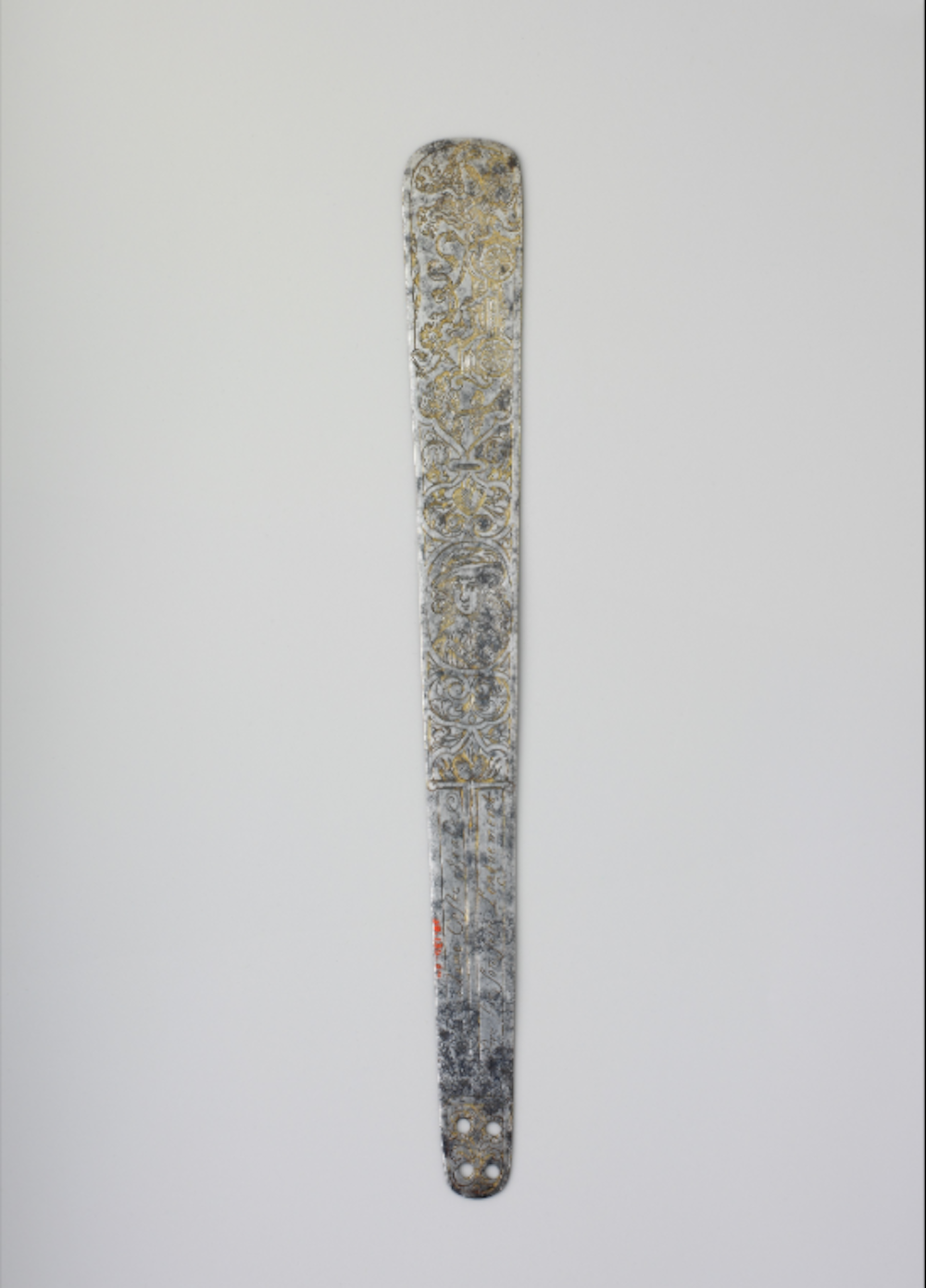
The “busk”, a long piece of wood, metal or whalebone, was placed into a stitched channel between layers of fabric in the front of corset bodices or stays.
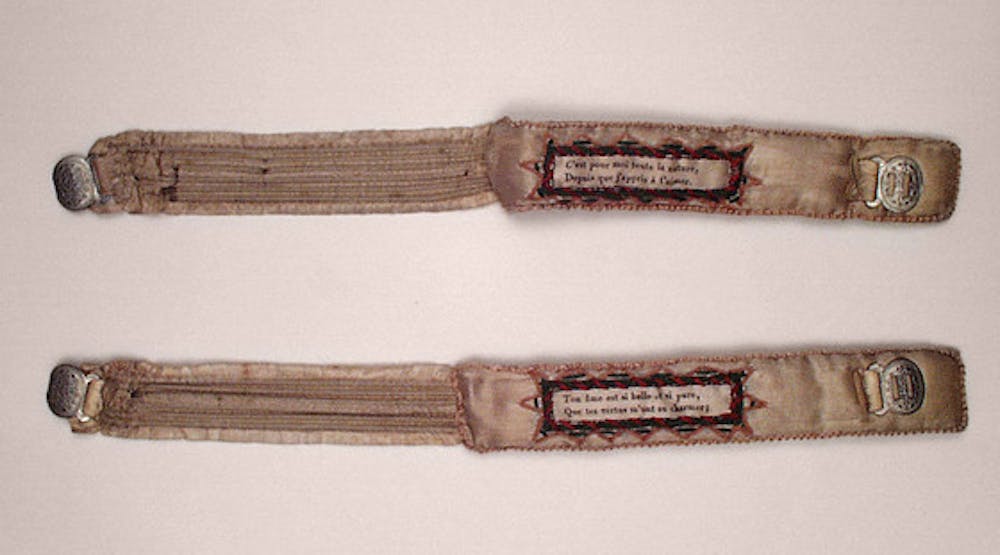
And garters — more of a novelty item today — were strips of fabric or ribbons tied around a woman’s lower thigh to keep her stocking in place.
Both were often inscribed or embroidered with intimate words of love. They were also charged with erotic connotations due to their intimate position on the female body next to breasts, groins and thighs.
A pair of women’s garters, England or France, early 19th century, made from printed and embroidered silk, metal clasp, and coiled wire.Los Angeles County Museum of Art
Intimate tokens
In 1684, English poet and playwright Aphra Behn imagined a tree that for years had witnessed couples wooing under its branches. Her poem ends when the tree falls to the axe and …
As busks were destined to sit on the body next to the heart, it was only fitting that wood from this tree was used to fashion them.
Several plays and poems refer to men who bought or made busks for their sweethearts. The sheer number of surviving busks that contain inscriptions of love testifies to their popularity.
One 17th-century French busk in The Met Museum’s collection exclaims, “Until Goodbye, My Fire is Pure, Love is United”.
Three engravings correspond with each line: a tear falling onto a barren field, two hearts appearing in that field and finally a house that the couple would share together in marriage with two hearts floating above it.
Similarly, surviving 18th-century garters contain embroidered sayings and verses. One 18th-century French pair proclaims, “same hearts, same thoughts”.
Another states, “My motto is to love you, It will never change”.
In February 1660, meanwhile, Samuel Pepys noted in his diary that he sent his wife “silk stockings and garters, for her Valentines.”
Although busks and garters were commonly given as gifts, even on Valentine’s Day they were not socially ostentatious tokens like jewellery.
Their position within or underneath clothing meant that while giving and receiving could be public, the wearing was a matter of intimacy. This was exploited in erotic literature and on the objects themselves.
17th century French busk inscribed with love poetry. Gift of Mrs. Edward S. Harkness, 1930.Metropolitan Museum of Art, New York
Some inscriptions found on busks spoke of men’s jealousy of the busks, giving these inanimate objects voices of their own.
A 17th-century French busk, engraved with a man’s portrait declares, “He enjoys sweet sighs, this lover / Who would very much like to take my place.” That “place” being between his lover’s breasts.
Like busks, garters also contained verses acknowledging their intimate place on the female body. A pair of French embroidered silk garters from 1780 proclaims, “United forever / I die where I cling.”
In this context, “where I cling” refers to a woman’s lower thighs, which were only accessible to those most intimate with her. It was also a euphemism for an orgasm.
The busk itself could also take on phallic connotations as it was likened to a lover’s erection in bawdy jokes.
A Girl with a Basket and Birdcage Adjusts Her Garter. Thomas Rowlandson, c. 1785-95.Thomas Rowlandson/Met Museum
By the late 18th century, busks and garters became less personalised and began to be produced on a large scale.
They tell the tales of both fickle human hearts and also of a changing European culture that embraced and then commodified love and desire — much like many Valentine’s gifts today.
Artificial intelligence (AI) is learning more about how to work with (and on) humans. A recent study has shown how AI can learn to identify vulnerabilities in human habits and behaviours and use them to influence human decision-making.
It may seem cliched to say AI is transforming every aspect of the way we live and work, but it’s true. Various forms of AI are at work in fields as diverse as vaccine development, environmental management and office administration. And while AI does not possess human-like intelligence and emotions, its capabilities are powerful and rapidly developing.
There’s no need to worry about a machine takeover just yet, but this recent discovery highlights the power of AI and underscores the need for proper governance to prevent misuse.
How AI can learn to influence human behaviour
A team of researchers at CSIRO’s Data61, the data and digital arm of Australia’s national science agency, devised a systematic method of finding and exploiting vulnerabilities in the ways people make choices, using a kind of AI system called a recurrent neural network and deep reinforcement-learning. To test their model they carried out three experiments in which human participants played games against a computer.
The first experiment involved participants clicking on red or blue coloured boxes to win a fake currency, with the AI learning the participant’s choice patterns and guiding them towards a specific choice. The AI was successful about 70% of the time.
In the second experiment, participants were required to watch a screen and press a button when they are shown a particular symbol (such as an orange triangle) and not press it when they are shown another (say a blue circle). Here, the AI set out to arrange the sequence of symbols so the participants made more mistakes, and achieved an increase of almost 25%.
The third experiment consisted of several rounds in which a participant would pretend to be an investor giving money to a trustee (the AI). The AI would then return an amount of money to the participant, who would then decide how much to invest in the next round. This game was played in two different modes: in one the AI was out to maximise how much money it ended up with, and in the other the AI aimed for a fair distribution of money between itself and the human investor. The AI was highly successful in each mode.
In each experiment, the machine learned from participants’ responses and identified and targeted vulnerabilities in people’s decision-making. The end result was the machine learned to steer participants towards particular actions.
In experiments, an AI system successfully learned to influence human decisions.Shutterstock
What the research means for the future of AI
These findings are still quite abstract and involved limited and unrealistic situations. More research is needed to determine how this approach can be put into action and used to benefit society.
But the research does advance our understanding not only of what AI can do but also of how people make choices. It shows machines can learn to steer human choice-making through their interactions with us.
The research has an enormous range of possible applications, from enhancing behavioural sciences and public policy to improve social welfare, to understanding and influencing how people adopt healthy eating habits or renewable energy. AI and machine learning could be used to recognise people’s vulnerabilities in certain situations and help them to steer away from poor choices.
The method can also be used to defend against influence attacks. Machines could be taught to alert us when we are being influenced online, for example, and help us shape a behaviour to disguise our vulnerability (for example, by not clicking on some pages, or clicking on others to lay a false trail).
What’s next?
Like any technology, AI can be used for good or bad, and proper governance is crucial to ensure it is implemented in a responsible way. Last year CSIRO developed an AI Ethics Framework for the Australian government as an early step in this journey.
AI and machine learning are typically very hungry for data, which means it is crucial to ensure we have effective systems in place for data governance and access. Implementing adequate consent processes and privacy protection when gathering data is essential.
Organisations using and developing AI need to ensure they know what these technologies can and cannot do, and be aware of potential risks as well as benefits.
Scott Morrison has indicated he wants to embrace a 2050 target of net-zero emissions. That, however, requires bringing the Nationals on board, and a vocal group in that party is fighting a fierce rearguard action.
The Nationals deputy leader David Littleproud, who is Minister for Agriculture, is sympathetic to the target – so long as there is a credible path to get there, which won’t disadvantage rural Australians.
In this podcast Littleproud says he believes the pathway could be settled this year.
“That’s not in my remit. But there is a hope to accelerate that and to make sure that we can provide that [pathway] as quickly as we can. The money’s been set aside for a lot of that work and some of that work’s already been completed.”
As for that Nationals, “our position is we want to see the plan first. Our party room hasn’t got to a juncture of dismissing it. We want to see what the plan is and who pays for it.”
Asked whether agriculture would have to be exempted for the Nationals to sign up to the 2050 target, Littleproud says, “Well, with respect to ag, I think it cane be part of the solution”.
On the ANZ’s announcement this week it would stop lending to Australia’s biggest coal port, the Port of Newcastle, Littleproud is scathing:
“Well, they’re a pathetic joke… We had a banking royal commission and here we are, a bank telling the Australian people about how society should run. That is not their role. Their role is to provide capital.”
When Jacinda Ardern consoled members of the Muslim community after the Christchurch mosque attacks, she wore the hijab. Around the world, she was praised for her compassion and cultural sensitivity.
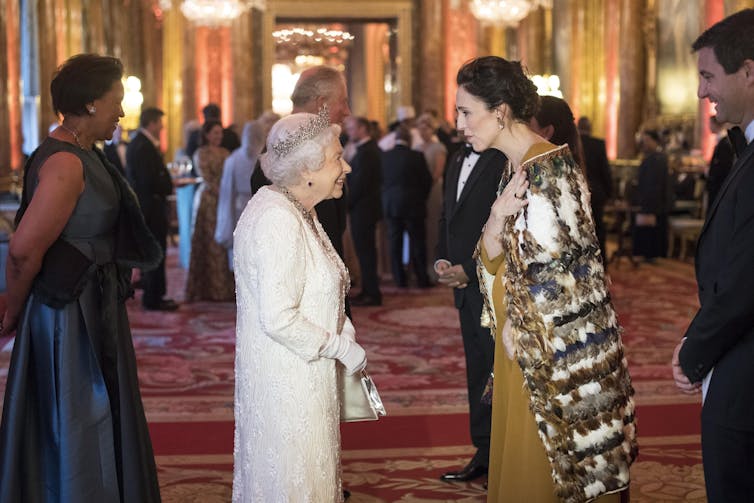
When she went to Buckingham Palace to meet the queen, she wore a kahu huruhuru, a feathered cloak. The press celebrated her choice, noting how regal she looked. The cloak was a visible sign of her mana.
People were proud that our prime minister looked so splendid and felt, by wearing the cloak, she honoured the indigenous culture of Aotearoa New Zealand.
So why have so many people been tied up in knots this week over a heitiki and a missing neck tie?
On Tuesday, parliament’s speaker, Trevor Mallard, expelled Rawiri Waititi from the House because the Māori Party’s co-leader refused to wear a tie, as per the requirements of standing orders.
Waititi likened a tie to a “colonial noose” around his neck. It was an image designed to grab attention, and international headlines.
Cultural meaning: Jacinda Ardern, wearing a kahu huruhuru, meets Queen Elizabeth II in 2018.GettyImages
Political power dressing
The stoush should not have surprised anyone. When he was sworn into the 53rd parliament, Waititi promised to challenge the status quo: “Ka tohe au! Ka tohe au! Ka tohe au!”
What might have puzzled some is that Waititi chose to challenge something so banal. The prime minister was surely right when she said there are far more important things to focus on than what a parliamentarian hangs around their neck.
But, as Ardern knows only too well, clothes and accessories can be a very visible and powerful statement. For Waititi, being forced to wear something he does not consider part of his culture is an act of colonisation that must be resisted.
The colonial claim may be a step too far for some, but it’s clear many agree that neck ties are no longer required business attire and they’re not very comfortable.
End of an era
No matter what knot you favour, ties can be physically restrictive. I never enjoyed wearing one as part of my school uniform. Like Mallard, I’ve never learnt how to tie a tie. Like Waititi, I choose not to wear a tie.
The notion that men in one of the most diverse parliaments in the world should still be required to wear neck ties just seems ridiculous.
And it appears the majority of the Standing Orders Committee now agrees that ties should no longer be a necessity. A decision on Wednesday night meant Waititi and other men in the House will not be required to wear one. Common sense has prevailed. Parliament can focus on more serious matters.
Except, of course, that at a certain level this was a serious matter. As Waititi said, this was about cultural identity, not a tie.
Feminists have long understood this. Women had to fight to wear trousers — in the House, and in the home. They are castigated by some (and objectified by others) if their skirt is “too short” or their top “too tight”.
The sartorial is political
Symbols of white male power: Ronald Reagan often wore a cowboy hat.GettyImages
But many still don’t understand the politics of women’s clothes and so were confused by Waititi’s musings on clothing and cultural identity. If a neck tie is a colonial noose, why did his party co-leader, Debbie Ngarewa-Packer, very pointedly wear one in the House this week?
And if Waititi is concerned that the legacy of colonisation is suppressing the tangata whenua through clothing, why does he wear a cowboy hat so often that people refer to it as his trademark?
Like neck ties, cowboy hats signify a particular type of white, male power. The most prominent politician associated with wearing a cowboy hat was former US president Ronald Reagan. One might well argue there’s a certain white extremism associated with cowboy hats that also needs to be challenged.
Regardless of where you stand on the neck tie divide, it’s clear that clothes and accessories are political. What we buy, how we choose to wear something, and what we refuse to wear all say something about us.
Waititi has adopted the cowboy hat and imbued it with a very different meaning to those who wore their cowboy hats as they stormed the US Capitol last month. Ngarewa-Packer knotted her tie with irony.
There is nothing wrong with politicians being playful with their clothes or refusing to conform to an outdated sartorial norm. But if that is all they do, their constituents will be very disappointed.
The Māori Party has only two MPs. It would be a shame if their legacy was confined to political sideshows.
A magnitude 7.7 earthquake has struck south-east of New Caledonia’s Loyalty Islands and a tsunnami warning is in place for several countries.
Geoscience Australia said the quake, which struck early this morning, had an epicentre 400 km east of the town of Tadine.
Seismic data indicates the undersea earthquake struck at a depth of 54 km.
Several aftershocks of up to magnitude 6.1 on the Richter scale have occurred.
The US Tsunami Warning System said hazardous tsunami waves up to a level of 1m above the normal tide level are possible for coasts within 1000 km of the epicentre with New Caledonia, Vanuatu and Fiji particularly at risk.
Officials in American Samoa have cancelled a tsunami watch for the territory.
RNZ’s correspondent in Pagopago said officials reported no significant wave had been generated by the earthquake.
New Zealand’s National Emergency Management Agency is warning that coastal areas could experience strong and unusual currents, and unpredictable surges at the shore.
Australia’s Bureau of Meteorology said there is a tsunami threat to offshore Australian islands and territories.
This article is republished under a community partnership agreement with RNZ.
The icy continent has historically been a place for men. First “discovered” in 1820, Antarctica would not be visited by a woman for well over a century.
In 1935, Norwegian Caroline Mikkelsen, a whaler’s wife, became the first woman to do so, some 24 years after her compatriot Roald Amundsen had trekked all the way to the South Pole.
It wasn’t until the 1950s that women were finally allowed to participate in Antarctic science.
How had Antarctica come to be so dominated by men? Where were all the women?
Among the group were 77 women working in Science, Technology, Engineering, Mathematics, and Medicine (STEMM), who took part in a three-week leadership program. As part of our study of this program, Meredith travelled with the group to Antarctica to gather women’s first-hand accounts of their experiences.
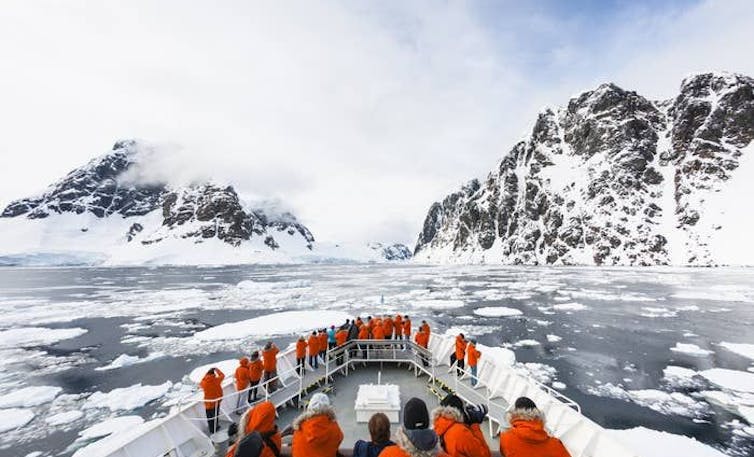
The expedition en route to Antarctica.Author provided
But in terms of unlocking Antarctica’s history, one of the biggest answers came from a surprising source: a map on the wall of the galley, where Meredith looked every morning to see where the ship was headed.
One morning, she spotted Marguerite Bay, on the Western Antarctic peninsula. It turns out there were women here, symbolically at least.
Who was Marguerite?
Marguerite’s name reached the Antarctic because her husband, Jean-Baptiste Charcot, leader of the French Antarctic Expedition in 1909, named a bay after her.
Author and environmentalist Carole Devine has been doing a mapping project to uncover the stories of women like Marguerite – she has found more than 200 places in Antarctica named after women.
The portrayal of Antarctica as a female body that must be mastered and penetrated by men is central to Heroic Era narratives of the continent. Given this framing, it is unsurprising women were long denied access to Antarctica.
Many polar institutes around the world have traditionally justified the exclusion of women by arguing there were no facilities such as toilets for them on stations.
It certainly wasn’t due to a lack of interest. In 1914, three British women named Peggy Pegrine, Valerie Davey and Betty Webster wrote to Ernest Shackleton to apply for his next expedition. They described themselves as “three sporty girls” and offered to wear men’s clothes if there were no suitable female ones available. They added:
…we do not see why men should have all the glory, and women none, especially when there are women just as brave and capable as there are men.
Shackleton’s reply noted his “regrets there are no vacancies for the opposite sex on the expedition”.
Coming in from the cold
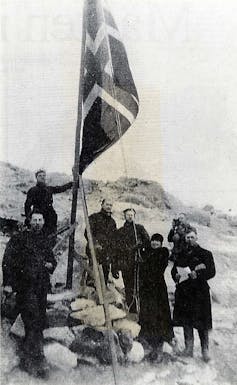
Caroline Mikkelsen hoists the Norwegian flag in Antarctica in 1935.
Mikkelsen became the first woman to set foot on Antarctica in 1935. But it was not until 1956 that women began to be properly involved in Antarctic science.
Russian geologist Maria Klenova landed in Antarctica to make the first Soviet Antarctic Atlas. Women were finally charting maps, rather than just having their names written on them.
In 1969, an all-female group of US scientists led by Lois Jones landed in Antarctica. They wanted to collect their own samples from the McMurdo Dry Valleys — something they had so far been prevented from doing.
Pointing to the anxiety and scepticism surrounding the voyage, the New York Times described the expedition as “an incursion of females” into “the largest male sanctuary remaining on this planet”.
From the 1980s, the Australian Antarctic Program and the British Antarctic Survey allowed women to stay on research stations and conduct land-based Antarctic fieldwork.
Yet while women’s participation in the Australian Antarctic Program is increasing, women still comprise only 24% of expeditioners. Women make up 33% and 30% of US and UK Antarctic expeditioners, respectively.
physical barriers, such as field gear not being available in women’s sizes.
Why does this matter?
Antarctica is strategically important to Australia and many other nations. Yet the credibility of Australia’s Antarctic leadership is at risk without a substantial commitment to diversity and inclusivity.
Existing power relations may prevent women and those from other underrepresented groups (such as people of colour and LGBTIQ+ people) from participating, or even considering, the possibility of an Antarctic science career.
Equity and inclusion in Antarctic science will not come about simply by waiting for more women to volunteer to become expeditioners.
Here is how we can proactively promote inclusion:
Change the image of a polar scientist. The “typical” polar scientist is still assumed to be a straight, white man who works for many months away in Antarctica. Yet polar scientists work in a range of settings. In fact, many polar scientists work indoors at a computer!
Grow the leadership pool. National Antarctic Programs must develop targeted recruitment campaigns, gender-neutral hiring practices, awareness of unconscious bias, training to be an “upstander” rather than a bystander, and parental leave policies and flexible work arrangements that can facilitate a woman’s ability to succeed in polar science.
Women are in Antarctica to stay. They play important roles in the scientific, logistical and managerial realms of Antarctic operations.
Making polar research more inclusive will enrich the diversity of the scientific community and have flow-on effects for the quality of Australia’s Antarctic science.
With COVID-19 still running rampant in many parts of the world, the International Olympic Committee (IOC) has prepared “playbooks” for the Tokyo Olympic and Paralympic Games, set to begin in July.
There are four books, each aimed at a specific group: international federations, athletes and officials, press, and broadcasters. The aim of these playbooks is to outline the rules that will ensure a safe and successful event.
Several commentators consider the games going ahead without a guarantee of safety as “irresponsible”. However, the IOC president, Thomas Bach, responded:
Our task is to organise Olympic Games, not to cancel Olympic Games.
Supporting this view is Tokyo 2020 president Yoshiro Mori, who insists Japan will hold the Olympic and Paralympic Games regardless of the situation with the pandemic.
As a result, the IOC playbooks outline safety precautions to prevent the spread of COVID-19. Here are the main rules and processes proposed for athletes and officials attending the games.
All athletes must take a COVID-19 test within 72 hours of departing their home country. Athletes are required to provide proof of a negative result before they depart their home country.
Prior to arriving in Japan, athletes must observe the playbook rules for 14 days (this includes, for example, minimising contact with others and practising good personal hygiene).
Athletes must have COVID-19 tests before entering Japan for the Olympics and during their stay in Tokyo.Scott Barbour/AAP
During the stay in Japan
Once in Tokyo, all individuals will require another COVID-19 test. Further regular COVID-19 testing and temperature checks will be done throughout their stay in Japan.
Australian athletes will arrive no earlier than five days before their event and depart a maximum of two days after their event is completed. To adhere to COVID-19 safe practices as outlined in the playbooks, the organisers will cut back on the number of athletes who attend the opening and closing ceremonies.
Athletes are asked to compile a list of all the people they expect to have close contact with during their stay in Tokyo. They must not visit games venues as a spectator nor visit tourist areas, shops, restaurants, bars or gyms.
Test, trace and isolate
Japan has created a “contact confirming app” – COCOA – for health reporting and monitoring COVID-19 test results. All athletes will have restrictions on the activities they can undertake, outlined in an activity plan. The IOC is due to publish these later. Further details are needed to ensure compliance with data protection principles, especially sensitive health information.
To minimise physical interaction, athletes and officials are reminded to: avoid hugs and handshakes; keep at least 2 metres apart from other athletes; avoid enclosed spaces; not use public transport (only use games transport); and follow their activity plan. All team members are required to wear face masks and supply enough masks for the duration of stay in Tokyo.
Athletes and officials will be screened and tested for COVID-19 at different times during their stay. Anyone with symptoms must self-isolate. Details of where and how self-isolation will work have not yet been explained.
Further, it is recommended to have insurance for costs of medical treatment in Japan and repatriation if sent home. Questions arise as to who will cover these costs, and whether such insurance cover is even available in these COVID-disrupted times.
If athletes test positive, they are to self-isolate immediately and will not be allowed to compete in the games. However, to mitigate the likelihood of false positives in testing, athletes will have to have a number of false tests before they are barred from competing, the specifics of which will be revealed in April.
Limited information is available on where those with positive tests would be quarantined and what medical support they would receive.
What about the vaccine?
There is debate about whether nations should vaccinate their athletes prior to attending the games. Several athletes, including Australian swimmer Cate Campbell, believe athletes should be prioritised for vaccinations if it saves the games from being cancelled.
However, Bach declared “we are not in favour of athletes jumping the queue”. Therefore, athletes will not be required to be vaccinated against COVID-19 to compete at the games.
Athletes will not need to have been vaccinated against COVID-19 to compete at the Tokyo Games.Yomiuri Shimbun/AP/AAP
So will the Olympics go ahead?
The IOC acknowledges that, despite all the care taken, risks and impacts may not be eliminated and therefore athletes agree to participate in the games at their own risk. Shifting the risk to athletes is problematic as it fails to take into account the vulnerability associated with performance-driven motivations and medal aspirations.
And as for local support, you’d be struggling to find a Tokyo resident who wants the games to go ahead, especially considering Japan has had over 400,000 cases and almost 6,500 deaths from COVID-19, with the majority of cases in the greater Tokyo area.
The first iteration of the playbook lacks the specific detail that is warranted when hosting 10,000 athletes at a global sport event. As the World Players Association says:
Comprehensive COVID-19 protections – not rudimentary statements – are essential if a safe and successful Olympiad is to be possible.
Hopefully, the publication of further details in April will ease concerns. In the meantime, if the games are to go on, we all have to wonder at what cost.
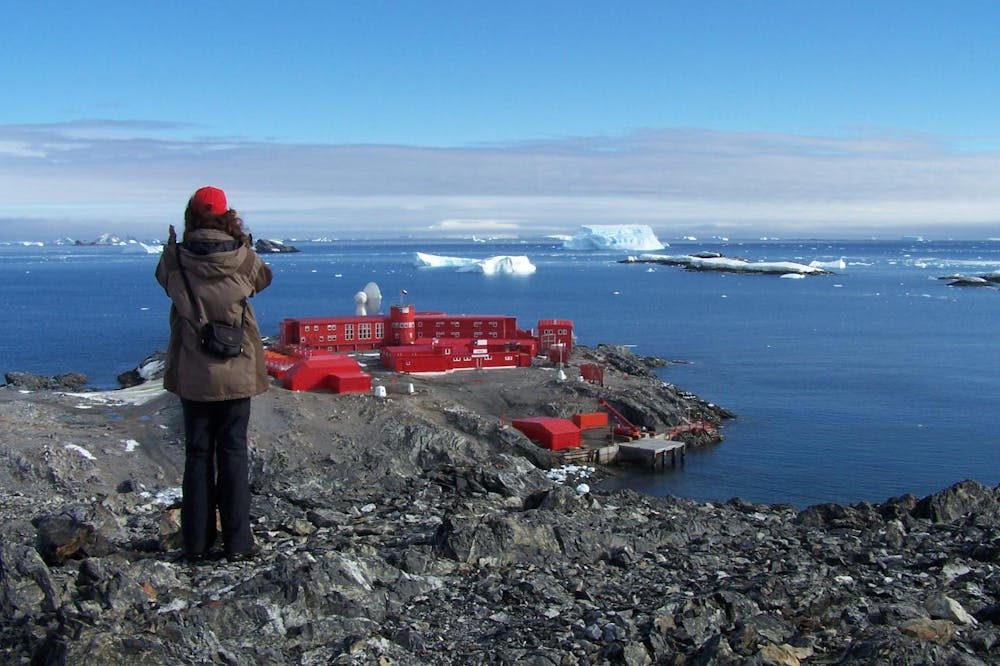
In December, Antarctica lost its status as the last continent free of COVID-19 when 36 people at the Chilean Bernardo O’Higgins research station tested positive. The station’s isolation from other bases and fewer researchers in the continent means the outbreak is now likely contained.
However, we know all too well how unpredictable — and pervasive — the virus can be. And while there’s currently less risk for humans in Antarctica, the potential for the COVID-19 virus to jump to Antarctica’s unique and already vulnerable wildlife has scientists extremely concerned.
We’re among a global team of 15 scientists who assessed the risks of the COVID-19 virus to Antarctic wildlife, and the pathways the virus could take into the fragile ecosystem. Antarctic wildlife haven’t yet been tested for the COVID-19 virus, and if it does make its way into these charismatic animals, we don’t know how it could affect them or the continent’s ecosystem stability.
Bernardo O Higgins Station in Antarctica, where 36 people tested positive to COVID-19.Stone Monki/Wikimedia, CC BY-SA
Jumping from animals to humans, and back to animals
The COVID-19 virus is one of seven coronaviruses found in people — all have animal origins (dubbed “zoonoses”), and vary in their ability to infect different hosts. The COVID-19 virus is thought to have originated in an animal and spread to people through an unknown intermediate host, while the SARS outbreak of 2002-2004 likely came from raccoon dogs or civets.
Given the general ubiquity of coronaviruses and the rapid saturation of the global environment with the COVID-19 virus, it’s paramount we explore the risk for it to spread from people to other animals, known as “reverse zoonoses”.
The World Organisation for Animal Health is monitoring cases of the COVID-19 virus in animals. To date, only a few species around the globe have been found to be susceptible, including mink, felines (such as lions, tigers and cats), dogs and a ferret.
Whether the animal gets sick and recovers depends on the species. For example, researchers found infected adolescent cats got sick but could fight off the virus, while dogs were much more resistant.
While mink, dogs or cats are not in Antarctica, more than 100 million flying seabirds, 45% of the world’s penguin species, 50% of the world’s seal populations and 17% of the world’s whale and dolphin species inhabit the continent.
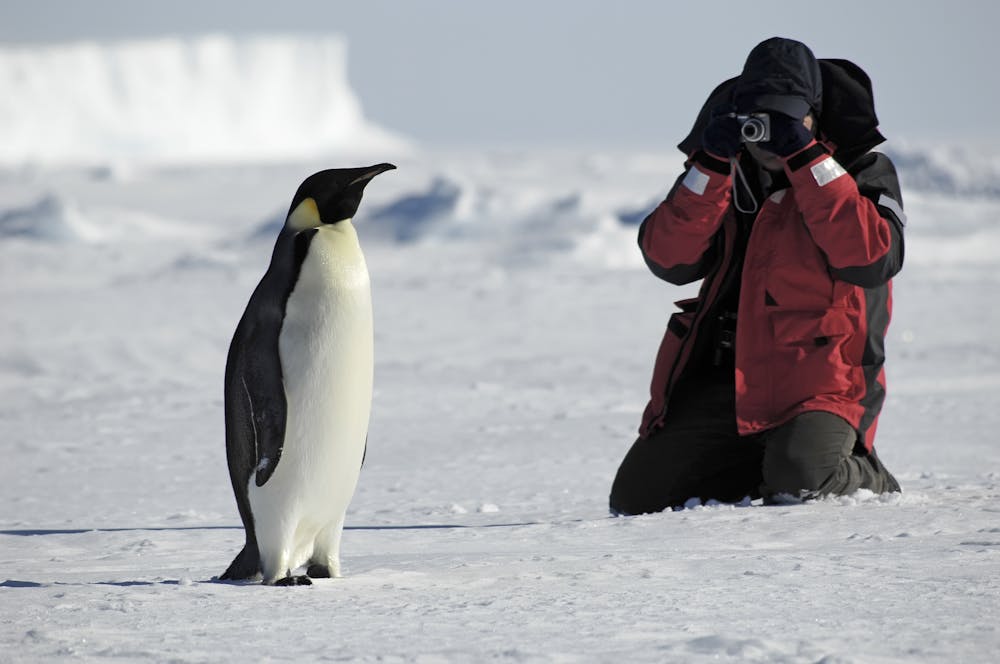
Tourists visit penguin roosts in large numbers.Shutterstock
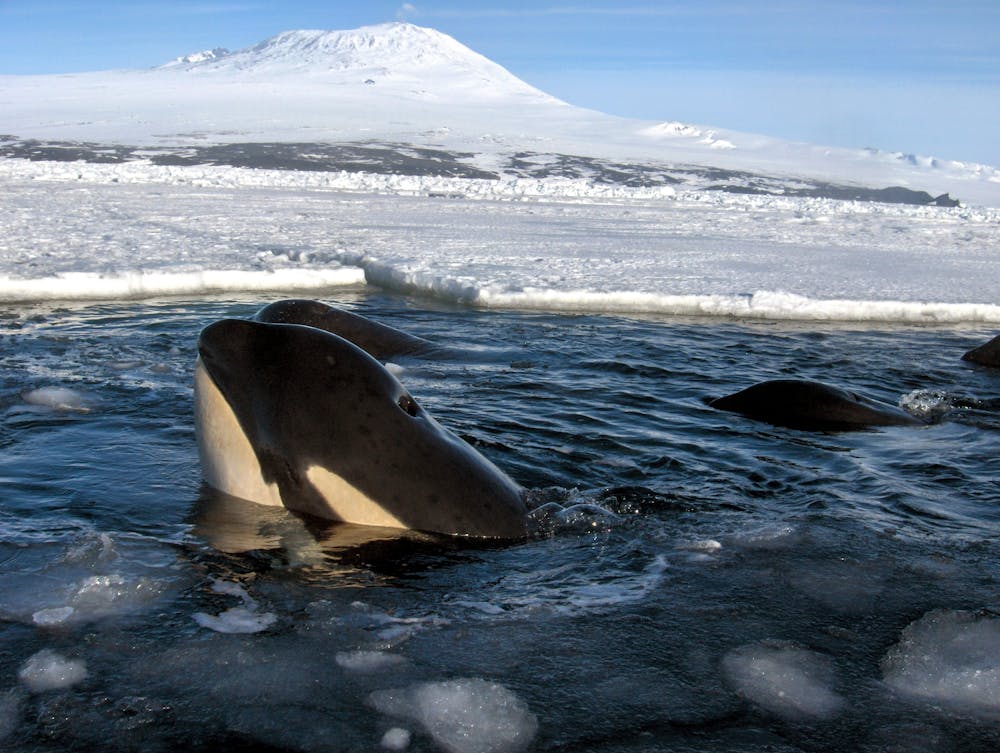
In a 2020 study, researchers ran computer simulations and found cetaceans — whales, dolphins or porpoises — have a high susceptibility of infection from the virus, based on the makeup of their genetic receptors to the virus. Seals and birds had a lower risk of infection.
We concluded that direct contact with people poses the greatest risk for spreading the virus to wildlife, with researchers more likely vectors than tourists. Researchers have closer contact with wildlife: many Antarctic species are found near research stations, and wildlife studies often require direct handling and close proximity to animals.
Tourists, however, are still a concerning vector, as they visit penguin roosts and seal haul-out sites (where seals rest or breed) in large numbers. For instance, a staggering 73,991 tourists travelled to the continent between October 2019 and April 2020, when COVID-19 was just emerging.
Each visitor to Antarctica carries millions of microbial passengers, such as bacteria, and many of these microbes are left behind when the visitors leave. Most are likely benign and probably die off. But if the pandemic has taught us anything, it takes only one powerful organism to jump hosts to cause a pandemic.
How to protect Antarctic wildlife
There are guidelines for visitors to reduce the risk of introducing infectious microbes. This includes cleaning clothes and equipment before heading to Antarctica and between animal colonies, and keeping at least five metres away from animals.
These rules are no longer enough in COVID times, and more measures must be taken.
The first and most crucial step to protect Antarctic wildlife is controlling human-to-human spread, particularly at research stations. Everyone heading to Antarctica should be tested and quarantined prior to travelling, with regular ongoing tests throughout the season. The fewer people with COVID-19 in Antarctica, the less opportunity the virus has to jump to animal hosts.
Cetaceans, such as orcas, are more susceptible to COVID infections than sea birds and seals.Shutterstock
Second, close contact with wildlife should be restricted to essential scientific purposes only. All handling procedures should be re-evaluated, given how much we just don’t know about the virus.
We recommend all scientific personnel wear appropriate protective equipment (including masks) at all times when handling, or in close proximity to, Antarctic wildlife. Similar recommendations are in place for those working with wildlife in Australia.
Migrating animals that may have picked up COVID-19 from other parts of the world could also spread it to other wildlife in Antarctica. Skuas, for example, migrate to Antarctica from the South American coast, where there are enormous cases of COVID-19.
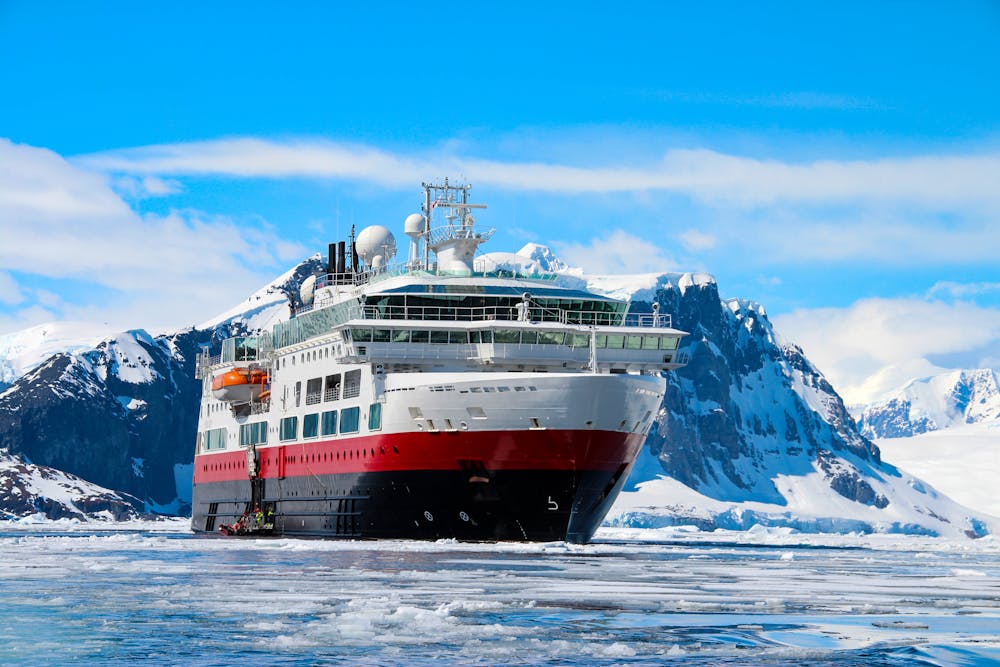
And then there’s the issue of sewage. Around 37% of bases release untreated sewage directly into the Antarctic ecosystem. Meanwhile, an estimated 57,000 to 114,000 litres of sewage per day is dumped from ships into the Southern Ocean.
Fragments of the COVID virus can be found in wastewater, but these fragments aren’t infectious, so sewage isn’t considered a transmission risk. However, there are other potentially dangerous microbes found in sewage that could be spread to animals, such as antibiotic-resistant bacteria.
Ships dump 114,000 litres of sewage into the water, each day.Shutterstock
We can curb the general risk of microbes from sewage if the Antarctic Treaty formally recognises microbes as invasive species and a threat to the Antarctic ecosystem. This would support better biosecurity practices and environmental control of waste.
Taking precautions
In these early stages of the pandemic, scientists are scrambling to understand complexity of COVID-19 and the virus’s characteristics. Meanwhile, the virus continues to evolve.
Until the true risk of cross-species transmission is known, precautions must be taken to reduce the risk of spread to all wildlife. We don’t want to see the human footprint becoming an epidemic among Antarctic wildlife, a scenario that can be mitigated by better processes and behaviours.
Source: The Conversation (Au and NZ) – By Hal Pawson, Professor of Housing Research and Policy, and Associate Director, City Futures Research Centre, UNSW
Australian governments acted to protect homeless people from COVID-19 in 2020 on an even larger scale than previously thought. In the first six months of the pandemic, the four states that launched emergency programs housed more than 40,000 rough sleepers and others.
The states were anxious about rough sleepers’ extreme vulnerability to virus infection and the resulting public health risk to the wider community. New South Wales, Victoria, Queensland and South Australia acted fast to provide safe temporary housing, mainly in otherwise empty hotels.
Drawing on previously unreleased official statistics, our newly published international comparative research reveals the people these programs helped in Australia outnumbered the 33,000 rough sleepers and others housed in England by the equivalent Everyone In initiative. Australia’s population is less than half that of England.
What happens when emergency housing ends?
The numbers Australia’s emergency housing program needed to shelter showed our homelessness problem is much larger than often imagined. The 8,200 people counted as sleeping rough on census night 2016 were only the tip of the iceberg.
Attempts to transfer people from emergency accommodation to longer-term tenancies have also generally been far less successful than in England. By the end of 2020, England’s local authorities had moved two-thirds of their former rough sleepers from temporary placements to more stable housing. As our research shows, despite determined efforts, Australian state governments managed this for less than a third of rough sleepers departing emergency hotel stays in 2020.
Many will have returned to the streets or to homeless shelters. Rough sleeper numbers once again increased in Adelaide and Sydney after mid-year.
A ‘tent city’ of homeless people in a Fremantle park was dismantled by order of the Western Australian government in late January 2021.Richard Wainwright/AAP
Alongside protecting rough sleepers, Australian government actions to shield vulnerable renters who lost jobs and incomes in the pandemic were also relatively effective. These efforts include federal income protection (JobKeeper and Coronavirus Supplement) and state and territory restrictions on evictions.
The short-term success of these measures is clear. Despite a substantial rise in unemployment, there has been – as yet – no sign of any up-tick in homelessness.
At the same time, though, ministerial advice that tenants with COVID-triggered income losses should negotiate rent reductions with landlords came with few ground rules on how to reach such settlements.
Survey evidence shows many property owners refused to reduce rents. At least one in four renters lost income during the pandemic, but no more than 16% (and possibly as few as 8%) got a rent variation. And many variations were only in the form of rent deferrals, not reductions.
The survey data imply at least 75,000 tenants, and possibly as many as 175,000, have been accumulating deferral-generated arrears. These mounting debts could put some at risk of losing their home when eviction moratoriums end. That’s early in 2021 in most states and territories.
Our research also highlights the unusually small direct contribution of the Australian government to protecting homeless people during the pandemic. Even in other federations – Canada and the United States – national governments played a significant role.
In Australia, the Commonwealth government made no direct input to covering the substantial costs involved. Nor did it play any part in even monitoring, let alone co-ordinating, the remarkable efforts of the active states.
Canberra has also steadfastly rejectedcalls for a social housing stimulus program for national economic recovery. This disengagement fits with a now-familiar refrain from federal ministers. Housing and homelessness, they repeat time and again, are constitutional obligations of state and territory governments.
The Morrison government is subsidising private housing construction and renovations but won’t pitch in for social housing.David Crosling/AAP
Granted, that’s an accurate statement for housing and homelessness service delivery. But, especially given the Commonwealth’s control of the vital policy levers of tax and social security, the two levels of government must in reality share responsibility for housing outcomes.
The Victorian government’s A$5.4 billion Big Housing Build shows states may commit to investment in social rental housing on a scale far beyond what had been thought possible. But the fact remains that state and territory governments have much less financial firepower than our national government. It’s fanciful to imagine significant programs being widely initiated or maintained without hefty federal backing.
For all of these reasons, when the pandemic has finally subsided, it’s only with federal government leadership that we can effectively tackle the fundamental flaws in Australia’s housing system. These have been glaringly exposed by the public health crisis of the past 12 months. Without purposeful re-engagement by our national government, Australia’s housing policy challenges will only continue to intensify.
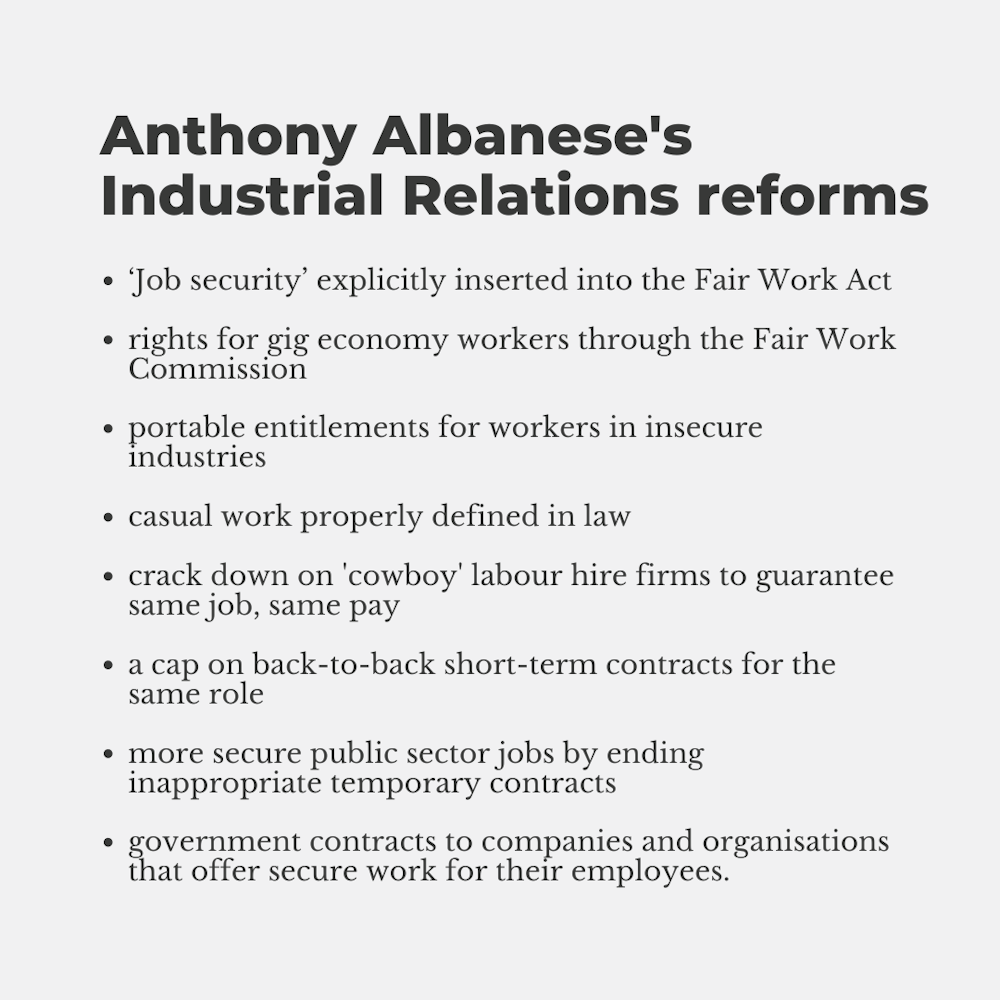
The agenda seems to have been confined to matters the government and business had already marked for attention.
Whatever potential there might have been for consensus on several important issues has plainly not been realised.
Nevertheless, in a submission to the Senate inquiry into the bill, and with the backing of 18 other labour law academics, we have expressed support for many of its provisions, even though there are details we are disappointed with and elements we strongly oppose, not least for their potentially negative impacts on wage growth and job security.
To be supported are greater penalties for employers who underpay workers, including criminal liability for dishonest and systematic conduct, and a new small claims process that would enable the Fair Work Commission to resolve payment disputes more quickly and cheaply, which we think could be improved.
We concentrate here on three concerns – the changes to agreement-making; to certain forms of employer-driven flexibility; and to the regulation of casual employment.
Enterprise agreement-making
The most contentious proposal is a new exception to the “better off overall test” (BOOT), which ordinarily ensures enterprise agreements cannot set pay and other conditions below award standards.
At present, the Commission can approve agreements that fail the BOOT, but only when they are not contrary to the public interest and only in “exceptional” circumstances.
The new exception would operate much more broadly, with no requirement to show unusual circumstances, pandemic or not. Although the exception would last for only two years, agreements approved under it could operate indefinitely.
We characterise the change as “tearing a gaping hole in the award safety net”.
Even if the Fair Work Commission took a narrow view of the exception, advisers would be lining up to encourage employers to give it a go, dangling the enticing prospect of “simplifying” pay and rostering , and reducing labour costs.
The bill also proposes to “simplify” the agreement-making process and make it harder for unions and others not directly involved to object to their approval.
This would weaken the few procedural safeguards that the Fair Work Act provides for workers, especially since there is no requirement for bargaining or negotiation to take place.
There would be no clear process for ensuring an agreement was genuinely made, and it would be harder to identify substandard deals, or to challenge the approval of agreements approved by small and unrepresentative groups of workers.
The sunsetting of agreements made before the Rudd government’s 2009 Fair Work Act (some of them made under “WorkChoices” is welcome and long overdue.
The bill would also allow “greenfields agreements” of up to eight years in duration – rather than the usual four – for construction work on certain major projects.
Employees engaged during that period would have no say on their pay and conditions and no right to strike – and some of these “agreements” could be made without union consent.
Under International Labour Organisation principles of freedom of association, workers in this position have to be afforded access to timely mediation and arbitration to resolve disputes, something the bill does not do.
New forms of flexibility for employers
Two other worrying proposals would permit certain employers to enter into “simplified additional hours agreements” with permanent part-time employees, and to issue “flexible work directions”.
Part-time workers could be offered extra hours, but without penalties.
Even if some ended up being offered extra hours of work, they would come without the usual compensation for antisocial or irregular hours – and they would most likely be taken from casuals, meaning a net reduction in wage bills.
The proposed “flexible work directions” would extend and expand some of the special powers granted to employers under JobKeeper to redeploy workers.
But they could be used in situations which need have nothing to do with recovery from the pandemic, including by employers who were never eligible for JobKeeper.
While both changes would initially be limited to certain industries, the bill allows them to be extended by regulation to all award-covered workers.
No compelling evidence has been presented to justify they are needed. Nor has the government explained why the Fair Work Commission should not continue to be responsible for managing these issues on an industry by industry basis through awards.
Casual employment
Casual employment fell during the initial stages of the pandemic, but then rebounded strongly. Around one in four Australian employees works as a casual, lacking benefits such as paid annual leave or sick leave, but generally entitled in return to a pay loading of 25%.
In practice, many casuals have long-term engagements, with none of the features usually associated with casual work. Among them are labour hire workers deployed not as “temps”, but to work at host firms alongside (or instead of) directly-hired employees with much higher pay and conditions.
The bill’s provisions respond to recent court decisions which have raised the prospect of billions of dollars in unpaid leave entitlements being due to workers misclassified as casuals.
The bill proposes to determine whether a worker is a casual purely by reference to what their contract says, not the reality of their engagement. And it would allow employers who have misclassified casuals to deduct from what they now owe their employees any loading they have previously paid.
After 12 months in a job, casuals would need to have their employment assessed. In certain circumstances, the employer would have to offer to make them permanent.
We agree on the need for a clear definition of “casual”, but the definition proposed would entrench the practice of “permanent casuals” doing jobs which are not truly casual, without necessarily preventing legal challenges to some of those arrangements.
Long-term casual employment does indeed suit many workers. But their lack of job security may have both individual and societal consequences.
That has been made clear during the pandemic, when workers without paid leave entitlements in “essential” jobs (such as cleaning and security for quarantine hotels, or aged care) have had to keep working with adverse consequences for public health.
We also note that the bill will substantially increase administrative costs for employers, in support of a right to convert to permanent that few long-term casuals are likely to even try to exercise, given the loss of loading typically involved.
In our submission to the Senate inquiry, we have suggested that the bill could be improved in a number of ways, including by making the definition of casual employment genuinely objective, requiring offers of conversion to permanent employment after six months rather than 12, and not shielding an employer from liability if it should have known it was misclassifying a permanent worker as casual.
Getting wages moving in the right direction
Even before the pandemic, it was widely accepted that wage stagnation was sapping the Australian economy. Whatever the reasons, it was clear that something needed to be done to get wages growth back above 3%.
If anything, the need is even greater now as we try to rebuild confidence and boost consumer spending.
Yet at a time when the share of national income going to profits rather than labour is still continuing to rise, the government is proposing changes that would not just suppress wage growth, but actually allow employers to cut some forms of pay and conditions.
The reforms would also entrench casual work – one of the largest forms of insecure employment.
As Labor’s new platform on job security recognises, this is a challenge that business, organised labour and government ought to be working together to tackle rather than exacerbate.
Whatever the positive elements of the new industrial relations bill, its crackdown on “wage theft” among them, its overall effect would be to take Australia even more firmly down the road of low-wages and low-growth.
More than ever as we emerge from the crisis we are going to have to get the most out of our economy.
Swapping stamp duty for land tax as the ACT government is doing (over 20 years) and the NSW government is planning (using an opt-in arrangement), is one of the best ways the tax system can help.
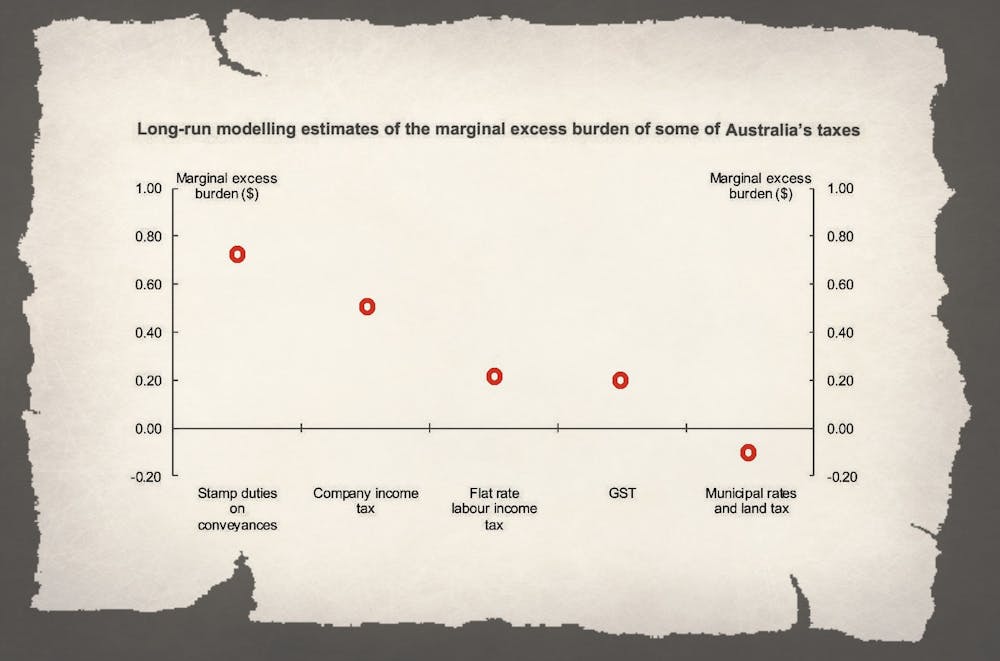
This graph from the federal treasury’s 2015 tax discussion paper makes the point.
It says the “marginal excess burden” (damage) done by real estate stamp duty amounts to 70 cents for each dollar raised.
It discourages people and businesses from changing addresses as often as they should, meaning workers live further away from their work than they would and are reluctant to move to where there is better work.
In contrast, treasury found the marginal excess burden of land tax was negative. Land tax makes sure land was used for its most useful purpose and not left idle.
Efficiency-wise it makes sense to swap one for the other, but as with all changes there will be winners and losers, some of them surprising.
In our just-published study, we use real-world data on living arrangements from the Melbourne Institute’s Household, Income and Labour Dynamics in Australia survey and data on house prices and stamp duty rates from the Real Estate Institute Australia in an attempt to work out who the winners and losers will be.
Good for the young, and the old
We find that overall the swap should reduce the purchase price for home buyers, increase the sale price for sellers, increase the total number of transactions and reduce the degree of mismatch in housing.
It should also increase the rate of home ownership.
Young adults, particularly those who are currently having difficulty saving for a deposit would be better off.
Current homeowners would generally be worse off.
Renters would benefit because they are currently excluded from home ownership.
Older landlords, perhaps surprisingly, would also benefit. In many cases the increase in the value of their houses would outweigh the cost of the land tax.
In the long run the swap would improve the working of the economy, but in the short run it will hurt many current voters.
A gradual transition – either through a very long phase in (of the kind adopted by the ACT) or by allowing households to select into different tax systems (as NSW is planning) would help make the switch more palatable.
It is 25 years since Australian auteur Baz Luhrmann released his gloriously spectacular version of Shakespeare’s Romeo + Juliet, starring Leonardo DiCaprio and Claire Danes as the doomed lovers.
Lurhmann was not presenting us with a reinterpretation of the stage play, but a complete re-imagining of its universe. Gone was the sense of theatre. Gone were the long soliloquies. Gone were the 16th century costumes. Instead of Verona, Italy, we are on Verona Beach, California.
The Capulet and Montague patriarchs do business in adjacent skyscrapers while the younger generation wage a vicious war on the streets. Tattoos, gold chains, loud Hawaiian shirts, leather vests, and silver teeth adorn them. Swords are replaced with Uzis and pistols.
The soundtrack dispenses with classical strings, replaced by 90s bands such as Radiohead and Garbage. Even the “and” in the title was replaced with a + sign. In every way Lurhmann made this film scream “gangsta”. It feels dangerous.
Many critics compared the film to Franco Zeffirelli’s 1968 version of Romeo and Juliet. While Zeffirelli’s film is visually sumptuous, it still plays it safe with the material, with few changes in tone or historical period.
Lurhmann, in contrast, plays fast and loose with every element of his production. To me, the films are in different stratospheres in their approach to the material and thus totally incomparable.
Shakespeare adaptations set in different time periods had happened before Lurhmann. As You Like It (1992) was performed in an industrial wasteland. Richard III (1995), was set in 1930s Britain; and Twelfth Night, made in the same year as Luhrmann’s film, was set in Victorian times.
However, Lurhmann didn’t just take the words and characters from the stage play and insert them into new environments. He created a completely stylised pastiche of visuals, dialogue, character and action.
It’s all quite over the top, as exemplified by the scene where a drag-queened Mercutio dances to Young Hearts Run Free. This is really Shakespeare for a specific demographic — youth. Some have argued Luhrmann’s film was beloved by attention deficit teenagers who later regarded it as “embarrassing” in adulthood . But I think this simplifies things.
I can understand why traditionalists, who didn’t mind the other adaptations set in modern times, don’t like this one. Much of the humour is pure slapstick, the acting can be over-exaggerated and lines are over-emphasised. There are large parts of the film which don’t have any dialogue at all, it’s all just visuals and music.
But the onscreen chemistry between Danes and DiCaprio is electric. Their scenes are genuinely emotionally charged, often heightened by the musical accompaniment.
And Lurhmann was making a film that would appeal to those who loved or loathed, or were indifferent, to traditional Shakespeare. A Shakespeare accessible to everyone.
This can be seen in the dialogue delivery of actors such as John Leguizamo, who plays Tybalt. As he venomously spits out, in modern gangsta rap style, lines like, “Now by the stock and honour of my kin, To strike him dead I hold it not a sin”, you actually forget you are listening to words written 500 years ago.
My favourite scene has always been Mercutio’s death. In the minutes leading up to, during and after he dies, Lurhmann dispenses with glitz and glamour, concentrating solely on the engagement between DiCaprio, Harold Perrineau (Mercutio) and Leguizamo. This is raw, visceral acting, no exaggeration, no contrivance.
Fluid works
Some have argued making such radical changes to the text is unnecessary and harms the essence of Shakespearean drama. The nuance and poetry of Shakespeare’s language is lost in all the flash and sparkle.
But pop culture critic Tori Godfree contends that Lurhmann’s incorporation of contemporary jokes, music and pop culture into his film is exactly what Shakespeare did in the original play. Shakespeare’s works should not be treated as sacrosanct icons but as fluid works open to reconstruction and modernisation.
Luhrmann’s approach worked. The film grossed over ten times its $14.5 million dollar budget. No other direct Shakespeare adaptation has come close to this sort of monetary success. Others have since embraced gangsta style violence in their own Shakespeare adaptions, notably Australian director Justin Kurzel, with Macbeth, and David Michod’s The King.
Lurhmann incorporated pop culture into his telling — just as Shakespeare would have done.Bazmark Films
Romeo + Juliet catapulted Luhrmann into the A-list, where he was given free reign on his next film, Moulin Rouge. Unfortunately, I think Lurhmann’s love of visual excess overwhelmed this and his further films, which were much more focused on screen imagery and design than story, character or meaning.
Perhaps the difference with Romeo + Juliet is that Luhrmann had a great script to start with. One can justly say of this lush, loud film, “For I never saw true beauty till this night”.
Romeo + Juliet is being re-released in selected cinemas from February 11 to mark its 25th anniversary.
Beach trips are a traditional part of our summers, but for some Kiwis and their family members living with a disability it can be a limiting experience.
Around 1 in 4 New Zealanders have a disability. Their disability arises not from their impairments but from having to live in world designed by people who think everyone is the same.
It is society, not the individual’s impairment, that is disabling. Thus, it is society that should be enabling.
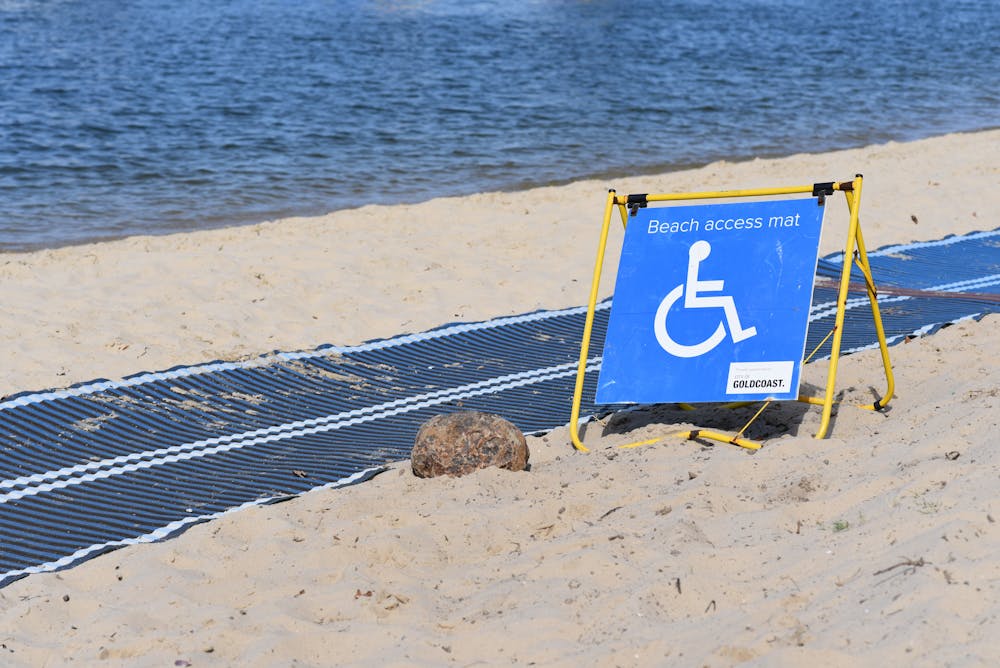
Examples of enabling measures are seen in efforts to provide beach access for those with disabilities with the installation of beach mats for wheelchairs, or the provision of beach wheelchairs.
But after an able-bodied woman suffered a significant leg injury on a beach mat, there are now concerns that Auckland City Council, and other councils across the country, might review the provision of such such mats.
Disabled rights
Any such decisions must take the rights of people with disabilities into account. These rights are to be found in international human rights law, and New Zealand’s own law.
The rights of people with disabilities are protected by international human rights law generally, which recognises that everyone is born equal and all have to the right to be free from discrimination.
The convention prohibits discrimination on the basis of disability, which it describes as the interaction of people with disabilities and attitudinal and environmental barriers.
It also requires countries should take action to ensure accessibility to a range of spaces and services for people with disabilities on an equal basis with those of non-disabled people.
Let’s be reasonable
These rights, like most other rights, must be weighed up with other considerations. A key concept here is reasonable accommodation.
This means that necessary and appropriate changes should be made that allow people with disabilities to enjoy their rights on an equal basis with others. But such changes should not impose a disproportionate or undue burden.
An Optional Protocol to the convention was also adopted in 2006, which means complaints can be made by individuals to the UN. New Zealand accepted this agreement in 2016.
The strategy is informed by the the UN Convention. It is also informed by Te Tiriti o Waitangi, reflecting the cultural importance of whānau and a whānau-centred approach of concepts of family and disability.
These legal obligations and policy measures also extend to local authorities. The decisions of such authorities regarding access to public spaces can have a profound impact on the rights of people with disabilities.
A typical beach mat to help with wheelchair access to the beach.Shutterstock/Tabatha Del Fabbro
The provision of beach mats and/or wheelchairs is one practical example that provides people with disabilities with access to the sand and the sea.
But councils can think bigger by also providing mobility spaces that fits all users, appropriately designed footpaths and kerb ramps that lead to accessible seating, shade areas and picnic areas, as well as public toilets that can be used by those with disabilities and their carers.
There is particular room for improvement with the latter and calls for councils to build fully accessible bathrooms to cater to people with multiple or complex disabilities.
Cost may well be a concern but access to the beach for people with disabilities should not be presented as an optional extra. Ensuring the safety of all beach users will be a paramount consideration, as will the protection of the natural environment.
A diverse and inclusive society means everyone should be treated with dignity and respect at all times. A failure to do so brings its own costs.
New Zealand Herald readers just voted Ōhope beach as New Zealand’s best beach in 2021. One of the reasons given was that everyone — from paddleboarders to kitesurfers to those in wheelchairs — is welcome at Ōhope.
For many New Zealanders, a dip in the ocean on summer days is a simple pleasure but for some, it is simply life-changing.
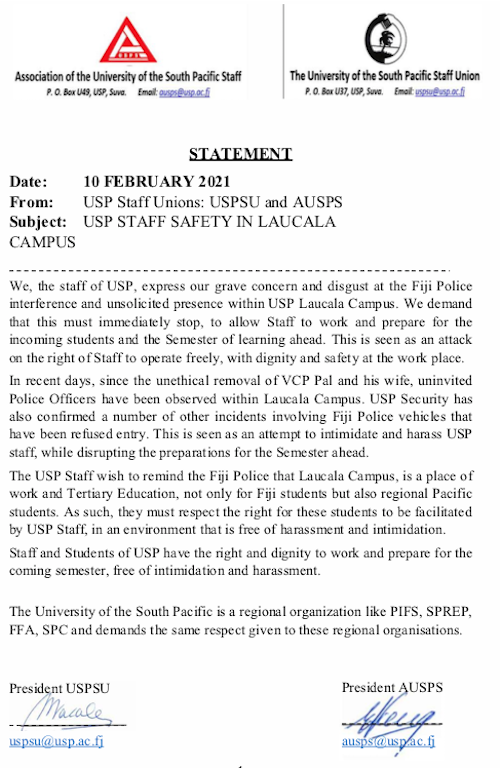
University of the South Pacific staff unions and students have protested in “disgust” over what they call interference and unsolicited presence by Fiji police on the Laucala campus.
“We demand that this must immediately stop, to allow staff to work and prepare for incoming students and the semester of learning ahead,” said a joint statement today from the Association of USP Staff (AUSPS), USP Staff Union (USPSU) and the USP Student Association (USPSA).
The unions described the police activity as an “attack on the right of staff to operate freely, with dignity and safety at the work place”.
The unions said that police officers had been seen on campus since the “unethical” deportation of the vice-chancellor, Professor Pal Ahluwalia last Thursday.
USP security officials had also reported a number of incidents involving police vehicles that had been refused entry onto the campus.
“This is seen as an attempt to intimidate and harass staff while disrupting preparations for the semester ahead,” the statement said.
Fiji police were reminded that Laucala campus was a place of work and tertiary education for regional Pacific students as well as Fiji students.
“As such, [the police] must respect the right for these students to be facilitated by USP staff in an environment that is free of harassment and intimidation,” said the statement.
The USP is a regional institution with 12 member countries and comparable to the Pacific Islands Forum Secretariat (PIFS), South Pacific Regional Environment Programme (SPREP), Forum Fisheries Agency (FFA) and the Secretariat of the Pacific Community (SPC).
The joint USP unions letter today. Image: APR
The opposition National Federation Party (NFP) said in a statement that Fiji’s credibility as a leading state in the region was at stake over the deportation of Kenyan-born professor Ahluwalia, reports RNZ Pacific.
The opposition walked out of parliament yesterday after the Speaker disallowed urgent questions about the removal of Professor Ahluwalia and his wife, saying the matter wasn’t of public importance.
Indonesia is trying again to “divide and rule my people” by further carving Papua into three new provinces, warns interim president Benny Wenda of the United Liberation Movement of West Papua (ULMWP).
And he says that Jakarta is bringing in another 450 troops in to “violently enforce” its policies.
‘Indonesia has failed the world’ “It is Jakarta’s wish. A referendum and full independence is our wish. Indonesia has failed the world, and failed the people of West Papua,” he said.
To enforce this renewal of Special Autonomy, even more Indonesian troops were flooding into West Papua – 450 in the last month alone.
“Indonesia is turning our land into a war zone, a martial law colony with military check points on every street corner,” Wenda said.
“Civilian rule in Indonesia is a myth: the military still holds power. Retired generals experienced in genocide in East Timor continue to call the shots.
“Indonesia has done this to us many times before. In 1963, they invaded our land. They held the fraudulent Act of No Choice in 1969, against the desires of all West Papuans.
“At every turn, they have treated us like a colonised people, less than human. We are called monkeys, spat at, forced off our land.”
“We are no longer bowing down to Jakarta’s rule. I call on all my people to unite and refuse all Indonesian law. We are establishing our own sovereign government,” said Wenda.
“As the legitimate representative of the people of West Papua, the provisional government is peacefully demanding the following:
1.The withdrawal of all Indonesian troops from West Papua; 2. An end to all forms of racism and discrimination against Melanesian West Papuans; 3. Immediate access to West Papua for the UN High Commissioner for Human Rights, in accordance with the call of 83 international states; 4. Cancellation of ‘Special Autonomy’ and an immediate referendum on independence; and 5. For all international states and multinational corporations to cease any and all funding for Jakarta’s ‘Special Autonomy’.”
Wenda saidf the international community must help to force Indonesia to negotiate by withdrawing all support for the “failed ‘Special Autonomy’ project”.
“The world may be banned from seeing what is happening in West Papua. But we can see it,” Wenda said.
And we are going to peacefully continue our long struggle for freedom until the world finally hears our cry.
New Zealand’s parliamentary Speaker has offered an olive branch to Māori Party co-leader Rawiri Waititi over his refusal to wear a tie in the debating chamber yesterday.
Speaker Trevor Mallard’s office has confirmed he has encouraged the party to submit to the Standing Orders Committee asking that hei-tiki be allowed instead of a tie.
Waititi speaks to RNZ Morning Report‘s Corin Dann:
Speaker Trevor Mallard last year announced he would reconsider the requirement, saying he himself believed the tie rule to be outdated.
He ultimately ruled however that the dress standard would remain as that was the will of the majority of MPs.
On the first sitting day of 2021 today, Waititi arrived without a tie. He argued that he was wearing Māori business attire with a taonga around his neck, but Mallard said he was not convinced by that argument.
Mallard notes no party response “I am therefore going to indicate to the leader of Te Pati Māori that I will not be calling him while he is not wearing a tie and he is not to enter the house again not wearing a tie,” Mallard said.
Mallard noted the Māori Party did not respond to the review of the dress code.
Waititi made several attempts to speak in the debating chamber, despite Mallard’s order, and was ejected from the house.
‘My taonga is my tie,’ says Waititi. Video: RNZ
After being removed from the debating chamber, Waititi said not being able to wear a taonga around his neck instead of a tie was a breach of the rights of indigenous people.
“That is not part of my culture, ties, and it’s forcing the indigenous peoples into wearing what I describe as a colonial noose,” Waititi said.
When asked if he would wear a tie at Parliament tomorrow [Wednesday], Waititi said “you’ll have to wait until tomorrow”.
“Our people have worn these types of ties for generations, thousands of years. And it’s time that Parliament, which was consented by my ancestors through Te Tiriti o Waitangi, recognised our right and freedom to express our own cultural identity, in a place that’s supposed to be a place for democracy,” Waititi told Checkpoint.
‘I dressed … quite smart’ “If you see the way I was dressed it wasn’t disrespectful, it was actually I think quite smart. I own to two consultancy businesses, and also our farming business on our family farm. And I never wear a tie,” he said.
“I will wear a tie when I want to wear a tie. But I will not be forced to wear it.
“I will not be forced to be wearing anything that I shouldn’t be wearing… Why are Pākehā making Māori dress like they want us to dress?”
The enforced dress code is hypocritical and an example colonial ways that suppress tangata whenua, he said.
“Parliament should be a place where we could freely practice our democracy and represent the people that voted us in.
“The majority of the people that voted me in are not business attire people… Let’s cut the myth that everybody must wear ties. I’ve been overseas and met with corporate people all over the world. None of them wear ties, they’re open-collared suit-wearing people, because ties are now outdated.”
This article is republished under a community partnership agreement with RNZ.
There is no saga at the University of the South Pacific, claims Fiji’s Attorney-General Aiyaz Sayed-Khaiyum.
“There is no saga, there is no crisis,” said Sayed-Khaiyum when questioned about the deportation last Thursday of the university’s vice-chancellor, Professor Pal Ahluwalia.
Speaking outside Parliament yesterday, he said he could not comment further on the issue, adding that the USP Council had released a statement on the outcome of a special general meeting last Friday.
Opposition spokeswoman on Education Ro Teimumu Kepa said the comment by Sayed-Khaiyum was not true.
“There is a crisis at the university,” she said.
“The regional university is at stake with the recent crisis happening within the institution.
The FijiFirst government, she said, should understand that USP belonged to the region.
‘We do not condone strong tactic’ “We do not condone the strong tactic that was used by government to remove the vice-chancellor.
“Their action was un-Pacific, un-regionalism and I do not know where this attitude came from.
“We are supposed to be like the big brother in the Pacific because we are the most developed.”
The USP Council has appointed Dr Giulio Masasso Tu’ikolongahau Paunga as acting VC and a subcommittee formed to look into the legality of the deportation of Prof Ahluwalia and his wife, Sandra Price, to also ascertain if Prof Ahluwalia’s contract was still valid following his deportation.
The committee will be chaired by the President of Nauru, Lionel Aingimea, aho is also university chancellor, including the council representatives of Australia, Tonga, Niue, Solomon Islands, Samoa and two senate representatives to look into the matter.
Source: The Conversation (Au and NZ) – By Brian Oliver, Research Leader in Respiratory cellular and molecular biology at the Woolcock Institute of Medical Research and Professor, Faculty of Science, University of Technology Sydney
A nebuliser — a medical device that turns a liquid into a fine mist, typically to deliver inhaled medication — may have spread the coronavirus in Melbourne’s hotel quarantine.
Victoria’s Chief Health Officer Brett Sutton said earlier today this was the “working hypothesis” to explain why three people became infected at the airport’s Holiday Inn hotel.
How could this have happened? And what are the implications for people who use nebulisers outside hotel quarantine, such as those with asthma?
A nebuliser creates a fine mist from a liquid, usually using compressed air or oxygen, or via ultrasonic vibration. A nebuliser is different to a vaporiser, which uses heat to produce a mist.
Nebulisers are often used to deliver life-saving drugs. Patients inhale them via a mask they put over their nose and mouth. Sometimes the mist alone is sufficient to provide a treatment. For example, nebulised saline is used to treat the lung condition cystic fibrosis. Sometimes people with asthma or chronic obstructive pulmonary disease are also treated with drugs via a nebuliser.
How could a nebuliser potentially spread COVID-19?
When we breathe in and out, the very small airways and the air sacs in our lungs open and close. This generates particles. These particles, along with water vapour, are what are commonly referred to as exhaled aerosols. Think back to breathing out on a cold day; the mist was aerosols from your lungs.
When we have a viral respiratory infection, the virus can be contained in the particles we exhale, and this is how aerosol transmission occurs. It is now widely accepted that SARS-CoV-2, the virus that causes COVID-19, can be spread via aerosols, as well as via larger droplets when we cough and sneeze.
Any activity that increases the amount of aerosols, for example singing or exercising, can increase the amount of aerosolised virus, thereby increasing the risk of transmission.
When people use a nebuliser, two things happen. The first is they often take in big breaths and exhale more forcefully than normal. This alone increases the amount of particles generated. The second is they breathe in a fine mist, not all of which is absorbed in the lung. This too is exhaled.
And when a nebuliser is used to loosen mucus in the lungs, this mucus could also be exhaled. This could be as particles or coughed out.
So whatever the mechanism, someone with COVID-19 who uses a nebuliser is at risk of inadvertently spreading the virus to others.
We know that using a nebuliser in COVID-19 patients is not a good idea, especially as many drugs can be delivered in other ways.
For example, the Australian Commission on Safety and Quality in Health Care states:
Nebulisation is NOT recommended in patients with COVID-19 as it may contribute to the spread of the virus.
However, it acknowledges that in some circumstances using a nebuliser is unavoidable, for instance, in children.
Was a nebuliser responsible for the spread at the Holiday Inn?
This question is very difficult to answer definitively without making actual measurements.
For example, some so-called super spreaders are highly contagious.
However, if a COVID-positive person was using a nebuliser, and the spread of the virus was limited to those in relatively close proximity to that person, it is highly likely the nebuliser would have contributed to the spread.
In Sutton’s announcement earlier today, he said that in the case of transmission at the Holiday Inn, the theory that a nebuliser was the route of infection:
…makes sense in terms of the geography and it makes sense in terms of the exposure time.
So what does this mean for people using nebulisers?
People using a nebuliser for medical reasons should not be frightened by these developments. They should talk to their health-care provider about any concerns.
The bigger question relates to the use of nebulisers by people in hotel quarantine, which Western Australia says it will now ban.
However, it is highly likely a person using a nebuliser in hotel quarantine needs it to provide life-saving medication. So it’s not as simple as banning their use altogether. We’re more likely to see more consideration around how they are used in our quarantine hotels. For example, they might be restricted to particular areas or only used when there is no other medical alternative.
Over the past week, three returned travellers — one in New South Wales and two in Victoria — have tested positive to COVID-19 shortly after leaving hotel quarantine.
The cases in Victoria appear almost certainly to have been acquired in hotel quarantine. The individuals had quarantined at the Holiday Inn, where eight staff members and guests have been now infected. Authorities are investigating.
But genomic sequencing has now indicated the NSW case was not picked up in hotel quarantine. So it’s possible either the person was still shedding virus from an earlier infection they contracted overseas, or that they incubated the virus for longer than 14 days.
The incubation period is the time between the point at which someone is exposed to the virus and the onset of symptoms (bearing in mind of course that not everyone who tests positive to COVID-19 will develop symptoms).
Theoretically, it is possible for a person to incubate the virus for longer than 14 days. But how likely is it?
The evidence
Most people who are exposed to SARS-CoV-2, the virus that causes COVID-19, will not go on to develop an infection. Sometimes the dose is not high enough, and/or the person can mount a successful immune response to prevent the virus establishing itself in their system.
But of those who do develop an infection, the evidence suggests almost all will return a positive test within 14 days of being exposed to the virus. A review summarising data from 21 studies reported only 1% of people incubated the virus beyond two weeks.
It’s important to note this review is a preprint, so it hasn’t received the same scrutiny as other published research.
But it found the average incubation period to be 5.9 days, which aligns with peer-reviewed research indicating the incubation period for COVID-19 is within the range of five to six days.
This is similar to other coronaviruses, notably SARS and MERS. Average incubation periods of other acute respiratory viral infections vary; 1.4 days for influenza A, 0.6 days for influenza B, and 12.5 days for measles.
Different viruses have different incubation periods.Shutterstock
The ‘day 16’ test
For the small minority of people who incubate the virus beyond 14 days, this can be related to underlying conditions, especially those that weaken a person’s immune response.
Over the weekend, NSW began testing returned travellers on day 16 — that is, two days after they finish hotel quarantine. This is how the latest case in NSW was detected.
The test is not compulsory and if the person doesn’t have symptoms, they don’t need to isolate until receiving their result.
This day 16 test is designed to pick up infections that may develop after the expected maximum 14-day incubation period on which Australia’s quarantine period is based.
Other states are reported to be considering implementing this measure too. This is a good safety net because, not only could it pick up the very rare case where a person might incubate the virus for longer, it could also catch missed cases of the virus being contracted in quarantine.
Some places even have a shorter quarantine period than 14 days. The UK, for example, has just started a hotel quarantine program to try to protect against arrival of other new variants. The quarantine period is ten days.
So Australia is erring on the more cautious end of the spectrum.
Could the new variants affect the incubation period?
Most of the data we have on the incubation period for COVID-19 don’t capture the emerging variants of the virus. For example, most of the studies included in the review I mentioned above were conducted in China, and all were carried out in June 2020 or earlier.
If anything, it’s possible the new variants might have a shorter incubation period.
New variants can change the way the virus behaves.Shutterstock
The accelerated rise in case numbers we’ve seen around the world with new variants means a greater proportion of people become infected following an exposure to these new strains, as we know these new variants can be more infectious. But a shortened incubation period could also be contributing.
These new variants are more efficient at establishing infections, we’re told, with the virus better at binding to, and invading, our cells. We might therefore assume a more efficient virus wouldn’t wait 14 days before establishing an infection. It would get on the job of replicating more quickly.
Although we need more information on these new variants before we can draw any conclusions, we can be reassured Australia’s two-week quarantine period should be ample time to detect the vast majority of cases.
This may change once we see what post quarantine testing reveals over the next while, but for now the priority must be making sure any cases within hotel quarantine don’t escape into the wider community.
The “meet cute” is the moment in which two unlikely people encounter each other while going about their ordinary lives, and something extraordinary begins.
In the romantic comedy The Holiday (2006), Arthur (Eli Wallach) describes it thus to Iris (Kate Winslet):
It’s how two characters meet in a movie. Say a man and a woman both need something to sleep in, and they both go to the same men’s pyjama department. And the man says to the salesman, “I just need bottoms”. The woman says, “I just need a top”. They look at each other, and that’s the meet cute.
The meet cute is a magical moment of happenstance. The people involved aren’t looking for love (at least, not right then).
a comic situation contrived entirely for the purpose of bringing a man and a woman together, after which they can work out their destinies for the remainder of the film.
However you describe it, the meet cute is unexpected. It happens when romance is the furthest thing from the characters’ minds. But in real life, in the age of online dating, more Australians meet their partner online than through friends and work (let alone, while buying pyjamas).
So can you have a meet cute when you are looking for love? Is it possible to have a meet cute on a dating app?
Searching for romance
Driven by new year’s resolutions, holiday break-ups, and the desire for a Valentine’s Day date, the “busy” period for dating apps in Australia spans from Christmas Day through to mid-February. Across this period in 2020, Australians sent over 52.8 million messages on dating app Bumble.
In many ways, finding a valentine is easier than ever. But dating apps aren’t conducive to stumbling into just the right person precisely when you weren’t looking for them.
In two months last year, Australians sent 52 million messages on Bumble alone.iam_os/Unsplash
They rely on a logic of active choice: you sign up to the app in pursuit of some form of coupledom. In interviews one of us, (Lisa), conducted with dating app users, many described these apps as pre-meditated and strategic.
When talking about what they might want in a relationship, many participants specifically desired a “Hollywood moment”, but felt this could never happen via a dating app.
Simultaneously, many felt meet cutes weren’t something that could ever happen to them: meet cutes were reserved for “special” people, not ordinary ones.
People seeking romance on dating apps are caught between two opposing forces: they feel apps provide the best opportunity to meet someone, but also that apps close down the possibility of a rom-com-style romance they dream of.
How fictional meet cutes adapted to online dating
In the most famous rom-com featuring online dating, You’ve Got Mail (1998), Joe (Tom Hanks) and Kathleen (Meg Ryan) don’t meet on a dating site. They meet in an over-30s chatroom and pursue a correspondence, not realising they’re business rivals in real life.
They might have met online, but neither was looking for love – and their business rivalry makes them very unlikely lovers.
More recently, Netflix’s Love, Guaranteed (2020) pairs a man suing a dating site for failing to find him love (Damon Wayans Jr) with his lawyer (Rachael Leigh Cook). They meet because of the site — but because they’re suing it, not because they matched on it.
We see similar patterns in popular romance fiction. In Christina Lauren’s My Favorite Half-Night Stand (2018), the heroine finds love via online dating — but with her best friend, who she already knew.
In Kristin Rockaway’s How to Hack a Heartbreak (2019), the heroine creates her own dating app, but her happily ever after is with the guy who sits in the next cubicle.
Some romance novels are beginning to emerge where the protagonists do meet solely because of apps, such as Alisha Rai’s The Right Swipe (2019), where the protagonists meet via an app — and then meet again in the boardroom.
Conflict or compatibility?
Meeting someone via an app might never feel exactly like the Hollywood rom-com meet cute participants in Lisa’s research were looking for — but this isn’t necessarily a bad thing.
Romance narratives are driven by conflict. There’s usually a reason the two people can’t be together, a conflict they spend the whole story overcoming.
In Notting Hill (1999), Will (Hugh Grant) and Anna (Julia Roberts) have a classic meet cute when they bump into each other and he spills his orange juice all over her. But then they have to overcome the obstacles posed by the very different lives they lead in order to be together.
On dating apps, those looking for a relationship are searching for compatibility and chemistry, not conflict — for someone they could build a connection with, not the most unlikely person possible.
In other words: finding a valentine via an app is a lot more likely than running into them on the street or getting trapped in a lift with them.
And if it doesn’t feel quite like a rom-com, it might just be because we haven’t quite worked out how to tell that kind of story yet.
Recent news about New Zealand’s declining position in international educational assessment rankings has been treated as if it is a new phenomenon requiring drastic changes to the school system.
But some suggested solutions, such as the Principals Federation’s call for greater involvement by the Ministry of Education in curriculum decisions, seem simplistic. Problems in education are more complex and relate to the relationship of schooling to society in general.
It’s worth noting that when these international large-scale assessments (e.g. PISA and TIMSS) were first deployed in the 1990s, New Zealand scored in the top five or 10 of all participating countries at year 5, year 8 and year 11. Since then scores have fallen to the middle of the pack, although slightly above average.
This is disappointing, but before we become overly concerned, a number of factors need to be considered.
Being good at tests counts
The international tests can only test those things that are readily evaluated on either paper or a screen with text. Of all the things that are valuable to our children, these tests measure a very narrow, albeit important, slice of the school curriculum.
While the international test agencies do everything they can to ensure test content is valid for every society, it is clear that routinely taking tests makes a small contribution to greater success. Practice always improves performance.
Unfortunately, by the time New Zealand children reach 15 (PISA measurement age) they will have had very little opportunity to take multiple-choice tests at school.
Many schools conduct yearly standardised tests provided by the New Zealand Council for Educational Research (NZCER) or the electronic assessment tools for teaching and learning (e-asTTle) system.
But that is very little compared to children from countries with a heavy use of testing to motivate and select students, such as China, Japan, Korea and India. Most of the world’s children get tested; New Zealand’s not so much.
Expectation and performance
Research shows that when New Zealand students take tests of little personal consequence, they tend not to try very hard. This is true of students in Nordic countries, too.
In contrast, research is showing that students in Shanghai, for example, treat a test that matters to their country’s reputation nearly as seriously as tests with individual consequences.
New Zealand’s lower scores may simply reflect lower effort on a test that doesn’t personally matter to students.
Although international rankings have declined over the past two decades, it was clear from an overview of New Zealand achievement data some 15 years ago that there was a large discrepancy between what the New Zealand curriculum expected of children and their actual performance.
This was most notable for Māori and Pasifika children and for those in lower decile schools. Despite the 2007 curriculum review, little has been done in New Zealand to close this gap before students enter secondary schooling.
Social and educational policies are linked: pupils in Finland receive lunch in their school canteen.GettyImages
Schooling and society
Families’ socio-economic resources heavily influence educational achievement. This has been established since the mid-1960s as an important causal factor in performance.
Families with good jobs, educated parents, warm and dry homes and access to reasonably priced health care produce children who do well at school. Since the 1990s, New Zealand has become a society increasingly unable to ensure such conditions for all children.
This means New Zealand is faced with a choice when looking at higher-scoring societies for possible solutions. A clear-eyed examination of those nations may give us some insight into what we could do.
Among the most successful are the high-testing regions of East Asia (Hong Kong, Singapore, China, Korea, Japan, Macau). These jurisdictions regularly test children to rank and sort them even before they enter school.
However, my own research has shown large psychological and emotional consequences for systems that rank and reward the winners. The tragedy is that creating a test-based system is relatively simple and cost-effective, but the human cost is not one I would wish on my own children and grandchildren.
The Finland model
A standout alternative to this approach is offered by Finland, which has decided that solving educational achievement problems cannot be separated from health, welfare, housing and employment policies.
The Finns expect government agencies to co-ordinate with each other to ensure the socio-economic determinants of achievement were put in place for all children, in conjunction with action taken by schools and their education ministry.
This means not blaming schools and teachers for poor student performance when that performance was a consequence of hunger, unemployment, poor health or myriad other social ills that schooling alone cannot solve.
Seeing educational outcomes as a canary in the coalmine of social well-being has meant all government policy works together to ensure educational equity.
Also, it’s perhaps startling from the perspective of New Zealand’s tradition of experience-based teacher education that all Finnish teachers require masters degrees and to be trained in evidence-based practices before being deployed as schoolteachers.
Those teachers are well paid and have became highly regarded professionals in their community.
The challenge for New Zealand is that Finland’s solution is expensive. It requires great political will and constant attention to the changing factors that undermine societal equity.
Nonetheless, Finland has shown it is possible to change educational outcomes in a coherent and meaningful way.
Australia has recently seen SARS-CoV-2 (the virus that causes COVID-19) escape several times from hotel quarantine, including in Brisbane, Perth and Melbourne.
These incidents have been particularly concerning because they involved people infected with “variants” of the virus.
But what exactly are these variants, and how concerned should we be?
What’s a variant?
Viruses can’t replicate and spread on their own. They need a host, and they need to hijack the cells of the host to replicate. When they replicate in a host, they face the challenge of duplicating their genetic material. For many viruses, this isn’t an exact process and their offspring often contain errors — meaning they’re not exact copies of the original virus.
These errors are referred to as mutations, and viruses with these mutations are called variants. Often, these mutations don’t affect the biological properties of the virus. That is, they don’t have any effect on how the virus replicates or causes disease.
Some mutations can impair the virus’s ability to replicate and/or transmit. Variants with such mutations are quickly lost from the viral population.
Occasionally, however, variants emerge with an advantageous mutation, one that means it’s better at replicating, transmitting, and/or evading our immune system. These variants have a selective advantage (in biological terms, they are “fitter” than other variants) and may rapidly become the dominant viral strain.
There’s some concern we’re seeing a growing number of variants with advantageous mutations, contributing to the severity of the COVID-19 pandemic.
Here’s a look at the main three variants you might’ve heard about in the media.
The ‘UK variant’ — B.1.1.7
This variant was first detected in the United Kingdom towards the end of 2020. It has a large number of mutations, many of which involve the virus’ spike protein, which helps the virus invade human cells.
It has spread rapidly throughout the UK since it emerged, and to at least 70 other countries, including Australia.
The fact it has spread so rapidly, and quickly replaced other circulating variants, suggests it has some sort of selective advantage over other variants.
After examining the evidence surrounding the new variant, the UK New and Emerging Respiratory Virus Threats Advisory Group (NERVTAG) concluded it “had moderate confidence” the variant is substantially more infectious than other variants.
The Queensland government sent Brisbane into a snap lockdown in early January after a cleaner working in hotel quarantine tested positive to the more infectious UK variant.Darren England/AAP
This may be the result of one of the mutations in the spike protein of the variant — a mutation called “N501Y”. One preprint manuscript, uploaded last month and yet to be peer reviewed, found N501Y is associated with increased binding of the virus to a receptor found on the surface on many of our cells, called “ACE2”. This could mean the variant is even more efficient at entering our cells.
Although initially the variant wasn’t associated with more severe COVID symptoms, more recent data have led NERVTAG to conclude there’s “a realistic possibility” that infection with the variant “is associated with an increased risk of death” compared with non B.1.1.7 viruses.
However, the group acknowledged there are limitations of the available data, and this remains an evolving situation.
Similar to the UK variant, it quickly outcompeted other SARS-CoV-2 variants in South Africa. It now accounts for more than 90% of SARS-CoV-2 samples in South Africa that undergo genetic sequencing.
Like the UK variant, it also has the N501Y mutation in the spike protein, meaning it’s more efficient at gaining access to our cells to replicate. This may help to explain its rapid spread.
It also contains several other concerning mutations. Two of these, called “E484K” and “K417N”, are bad news for our immune system. They can reduce how well our antibodies bind to the virus (though this is also based on preprint data awaiting peer review).
But there’s no evidence yet to suggest the South African variant is more deadly than the original variants.
The ‘Brazilian variant’ — P.1
This variant was first detected in Japan in a group of Brazilian travellers in January 2021.
It’s now highly prevalent in the Brazilian state of Amazonas, and has been detected in countries including South Korea and the United States.
The Brazilian variant has sparked a wave of reinfections in the state of Amazonas.Raphael Alves/EPA/AAP
Like the South African variant, the Brazilian variant has the spike protein mutations N501Y, E484K and K417N (as well as numerous other mutations).
While there’s no evidence this variant causes more severe disease, there’s concern it has facilitated a wave of reinfections in Manaus, the largest city in Amazonas, which was thought to have reached “herd immunity” in October last year.
What does this mean for vaccines?
Major vaccine developers are testing the efficacy of their vaccines against these and other variants. Generally, the currently licensed vaccines protect relatively well against the UK variant.
But recent phase 2/3 data from both Novavax and Johnson & Johnson suggest reduced protection against the South African variant. The Oxford/AstraZeneca vaccine group also released data over the weekend suggesting its vaccine offers only minimal protection against mild-moderate disease caused by this variant.
However, it’s important to recognise reduced protection doesn’t mean no protection at all, and that data are still emerging.
What’s more, numerous vaccine manufacturers are now investigating whether tweaks to the vaccines can improve their performance against the emerging variants.
The take-home message is that variants will emerge, and we need to closely monitor their spread. However, there’s every indication we’ll be able to adapt our vaccine strategies to protect against these and future variants.
Source: The Conversation (Au and NZ) – By Tanya Hill, Honorary Fellow of the University of Melbourne and Senior Curator (Astronomy), Museums Victoria
Three new spacecraft are due to arrive at Mars this month, ending their seven-month journey through space.
The first, the United Arab Emirates’ Hope Probe, should have made it to the red planet this week. It will stay in orbit and study its atmosphere for one complete Martian year (687 Earth days).
China’s Taiwen-1 mission also enters orbit this month and will begin scouting the potential landing site for its Mars rover, due to be deployed in May.
If successful, China will become the second country to land a rover on Mars.
These two missions will join six orbiting spacecraft actively studying the red planet from above:
The oldest active probe – Mars Odyssey – has been orbiting the planet for 20 years.
The third spacecraft to reach Mars this month is NASA’s Perseverance rover, scheduled to land on February 18. It will search for signs of ancient microbial life but its mission also looks ahead, testing new technologies that may support humans visiting Mars one day.
Now NASA hopes Perseverance will land on Mars.
Laboratories on wheels
NASA has an impressive track record for landing on Mars. It has operated all eight successful missions to the Martian surface.
Just minutes after landing, Viking 1 captured the first ever photograph taken from the Martian surface.NASA/JPL
Perseverance will be the fifth rover to arrive on Mars that’s capable of venturing across the surface of another planet.
These amazing laboratories on wheels have extended our knowledge of a faraway world. Here’s what they’ve told us so far.
The first rover – Sojourner
Twenty years after Viking 1 & 2 landed stationary probes on Mars, a third spacecraft finally reached the planet, but this one could move.
On July 4, 1997, NASA’s Pathfinder literally bounced onto the Martian surface, safely enclosed in a giant set of airbags. Once stable, the lander released the Sojourner rover.
See the Sojourner probe from Pathfinder’s viewpoint.
The first rover on Mars could move at a maximum speed of 1cm a second and was about as long (63cm) as a skateboard — smaller than some of the boulders it encountered.
Sojourner explored 16 locations near the Pathfinder lander, including the volcanic rock “Yogi”. Pictures of its landing site, Ares Vallis, showed it was littered with rounded pebbles and conglomerate rocks, evidence of ancient flood plains.
The geologists – Spirit and Opportunity
A pair of upsized rovers arrived on Mars in early 2004. Spirit and Opportunity were geologists, searching for minerals within the rocks and soil, hidden clues that dry, cold Mars may once have been wet and warm.
This overhead ‘selfie’ was combined with Spirit’s largest ever panorama – it contains hundreds of individual images of Gusev Crater taken over three Martian days.NASA/JPL-Caltech/Cornell
Spirit landed in Gusev Crater, a 150km-wide crater created billions of years ago when an asteroid crashed into Mars.
Spirit discovered evidence of an ancient volcanic explosion, caused by hot lava meeting water. Small rocks had been thrown skyward but then fell back to Mars. Examination of the impact or “bomb sag” showed the rock had landed on wet soil.
The arrow points to a small crater or bomb sag, just 4cm across, that formed in the soaking wet ground when an ejected rock fell back to Mars.NASA/JPL-Caltech/USGS/Cornell
Even when things went wrong, Spirit made new discoveries. While dragging a broken front wheel, Spirit churned up a track of soil revealing a patch of white silica.
This mineral usually exists in hot springs or steam vents, ideal environments where life on Earth tends to flourish.
A 20cm track revealing white silica and a clue that Mars was once wet and warm.NASA/JPL/Cornell
The rover that kept on going
Opportunity arrived on Mars three weeks after Spirit. Its original three-month mission was extended to 14 years as it travelled almost 50km across the Martian terrain.
Landing in the small Eagle Crater, Opportunity went on to visit more than 100 impact craters. It also found a handful of meteorites, the first to be studied on another planet.
Outlined in yellow is Opportunity’s journey from Eagle Crater towards its final resting spot on the rim of Endeavour Crater. The blue outline of Victoria’s Phillip Island is included for scale.NASA/JPL-Caltech/MSSS/Museums Victoria
The rover was descending into Endeavour Crater when a dust storm ended its mission. But it was along the crater’s edge that Opportunity made its biggest discoveries.
It found signs of ancient water flows and discovered the crater walls are made of clays that can only form where freshwater is available — more evidence that Mars could well have been a place for life.
The chemist – Curiosity
Curiosity landed in Gale Crater on August 6, 2012, and continues to explore the region today. During the coronavirus pandemic, scientists and engineers have been commanding the rover from their homes.
An artist’s impression of Curiosity as it descends from the top of the Martian atmosphere to softly touchdown on the planet’s surface.NASA/JPL-Caltech
In a first for space exploration, NASA’s Curiosity was lowered to the Martian surface using a “sky crane”. After a successful soft landing, the crane’s cables were cut and the spacecraft’s descent stage flew away to crash elsewhere.
Curiosity is a fully equipped chemical laboratory. It can shoot lasers at rocks and also drill into the soil to collect samples. It’s confirmed ancient Mars once had the right chemistry to support microbial life.
Curiosity also found evidence of ancient freshwater rivers and lakes. It seems that water once flowed towards a basin at Mount Sharp, a central peak that rises 5.5km from within Gale Crater.
Curiosity takes a picture of itself, working through the COVID-19 pandemic and drilling holes in a possible ancient riverbed.NASA/JPL-Caltech/MSSS
From being on the surface of Mars, we’ve learned it was once very different to the dry, dusty planet it is today.
With flowing water, possible oceans, volcanic activity and an abundance of key ingredients necessary for life, the red planet was once much more Earth-like. What happened to make it change so dramatically?
It’s exciting to consider what the Perseverance and Taiwen-1 rovers may discover as they explore their own patch of Mars. They might even lead us to the day when humans are exploring the red planet for ourselves.
The colours in this image from Gale Crater have been adjusted to match conditions on Earth – this helps geologists interpret the rocks but it also changes the natural pink Martian sky to an Earth-like blue.NASA/JPL-Caltech
As Australian producers scramble to find markets for goods hit by Chinese import restrictions, it might look as though China is winning the diplomatic war.
But the current situation is a diplomacy fail for China as much as for Australia.
China suspended imports from six Australian beef suppliers in 2020.Rick Rycroft/AAP
This has hurt some Australian products, such as wine and barley, which have struggled to find equally lucrative markets. However, some others such as wheat have found new buyers relatively easily.
Overall, Australia’s total exports to China actually increased in December, mainly thanks to iron ore, which China needs too much to restrict.
Restrictions cut both ways
But while these import restrictions hurt Australia, they hurt China too.
In the short term, Chinese consumers miss out on products they enjoyed, such as premium Australian wine and lobsters, which are valued for celebrations.
Chinese manufacturers that used Australian goods might have to pay more or accept lower quality, such as for barley used for brewing, which hurts their productivity and economic growth.
In some sectors, there may not be enough immediate replacements for Australian products.
For example, coal shortages have led to China’s worst power blackouts for a decade. While import restrictions are not the only factor – and the Chinese government has denied any link – widespread blackouts at the same time as more than 70 coal ships are stuck offshore show how restrictions cut both ways.
Wider impact
In the medium term, other countries watch the treatment of Australia and consider how to protect themselves, so as not to suffer the same fate.
When China restricted sales of rare earth minerals to Japan in 2010, this led Japan to invest in other countries, resulting in a significant reduction in China’s market share.
While I don’t think countries will band together to resist Chinese coercion – they are more likely to help their companies capture Australia’s market share – they may try to slow the growth of economic ties with China, such as through restricting investment in some sectors.
This means Chinese investors may find overseas markets less friendly, as has happened in Australia with much of the economy now unavailable.
Unfavourable views of China
In the long term, economic coercion has an impact on China’s international reputation.
China starts to be seen as a less reliable trade partner, and trade starts to be seen not as mutual benefit, but as a potential vulnerability that China can weaponise.
In the short term, Chinese consumers and manufacturers are missing out on Australian products.Olivia Zhang/AP/AAP
Chinese citizens seem to be blissfully unaware of the damage to their country’s reputation. Recent public opinion polling found 78% believe China’s international image has improved in recent years. This is dead wrong.
Comprehensive polling by Pew Research shows China’s international reputation in advanced economies has plummeted over the past decade. China’s assertive diplomacy has been spectacularly unsuccessful as a way of winning hearts and minds.
‘Kill the chicken to warn the monkey’
Chinese thinkers who argue China should show patience and restraint in its foreign policy are not winning the argument in Beijing. National pride and strength is seen as more important than the costs.
Looking forward, China is likely to continue to mete out punishment to Australia for the demonstration effect to other countries. The Chinese have a saying “kill the chicken to warn the monkey”.
But no one should be under any illusion this situation is a good result for China.
It would have been much better for China to have a model relationship with Australia. Australia and China have no historical conflicts, no border disputes and Australia is the one with the trade surplus. If China can’t get along with Australia, who can it get along with?
The unravelling of the relationship in just five years is a terrible result for Chinese diplomacy.
This week, China will celebrate the New Year. China has controlled COVID-19 and emerged with an economy stronger than it was a year ago. China’s rhetoric advocates peaceful coexistence, mutual benefit and win-win cooperation. But when it comes to diplomacy, there is room for improvement.
In the words of ancient Chinese scholar Mencius, there are two ways of being a great power: a “big power” that aggressively pursues its interests through force and coercion, or a “great state” that attracts and gains respect by its virtuous character and consideration of others’ interests.
The “floor price” for alcohol introduced by the Northern Territory in 2018 reduced the consumption of cask wine by half, without significantly impacting sales of other types of alcohol, according to our new analysis of the policy’s effectiveness.
On October 1, 2018, the NT introduced a minimum price of A$1.30 per unit (equivalent to 10 grams of pure alcohol or one “standard drink”) on alcohol, in a bid to tackle problem drinking.
The price was chosen to target cheap wines that have historically been an issue throughout the NT, while not influencing other liquor types.
Our study, published today in The Australian and New Zealand Journal of Public Health, examined overall alcohol consumption as well as consumption within specific liquor categories, most importantly cask wine. Cask wine represents less than 5% of the liquor consumed in the NT, but because it offers lots of alcohol for a low price, it contributes inordinately to alcohol problems among vulnerable drinkers and disadvantaged communities.
We split our analysis into two regions: the entire NT, and the Darwin/Palmerston area. The Darwin and Palmerston analysis is particularly important, as other regions of the NT were subject to a change in levels of police intervention at the point of sale during the period examined. The impact of these changes in policing could not be fully controlled for, whereas changes in Darwin/Palmerston can be reliably attributed to the effect of the minimum alcohol price.
In the year following the introduction of the minimum unit price, there was a 48.84% reduction in cask wine consumption in Darwin and Palmerston, and a 50.57% reduction across the NT. No significant reduction in non-wine liquor consumption was found in Darwin and Palmerston or across the NT.
This suggests implementing a minimum price on alcohol can help heavy drinkers reduce their consumption, while not adversely affecting moderate or occasional drinkers.
We found no evidence to indicate heavy drinkers had moved from cask wine to other liquor types in response to the floor price. While there was an increase in spirits sales, this trend began before the introduction of the minimum price.
Members of the community had expressed fears the minimum price would negatively impact beer sales. However, full-strength beer, the most consumed liquor type in the NT, saw no significant change in response to the minimum price.
Cask wine consumption decreased by half in the year following the introduction of minimum pricing.Shutterstock
Time for a national rollout?
Considering the effectiveness with which this policy reduced consumption of cask wine in the NT, it is time for other state and federal governments to consider following suit. Internationally, minimum pricing policies have already been implemented in Scotland and Wales, and the Republic of Ireland has also passed legislation to implement a floor price at a later date.
Other potential benefits of a minimum unit price for alcohol include higher tax revenue, and various social benefits from lower alcohol consumption. Both of these could conceivably help Australia recover from the financial burden of COVID-19.
Notably, after the release of the first evaluation of the minimum unit price policy in the NT, industry group Retail Drinks Australia claimed consumption actually increased. Our latest study directly refutes this.
It will be important for policy-makers throughout Australia to discuss the merits of this policy without being unduly influenced by the alcohol industry, which depends on the profits earned from problem drinkers.
Australia is teeming with cats. While cats make great pets, and can bring owners emotional, psychological and health benefits, the animals are a scourge on native wildlife.
Cats kill a staggering 1.7 billion native animals each year, and have played a major role in most of Australia’s 34 mammal extinctions. They continue to pose an extinction threat to at least another 120 species.
The long-nosed potoroo is extremely vulnerable to cats.Shutterstock
A recent parliamentary inquiry into the problem of feral and pet cats in Australia has affirmed the issue is indeed of national significance. The final report, released last week, calls for a heightened, more effective, multi-pronged and coordinated policy, management and research response.
As ecologists, we’ve collectively spent more than 50 years researching Australia’s cat dilemma. We welcome most of the report’s recommendations, but in some areas it doesn’t go far enough, missing major opportunities to make a difference.
Night curfews aren’t good enough
The report recommends Australia’s 3.8 million pet cats be subject to night-time curfews. This measure would benefit native nocturnal mammals, but won’t save birds and reptiles, which are primarily active during the day.
Other strategies for improving pet cat management proposed in the report include pet cat registration, subsidised programs for early age desexing, public education campaigns to promote responsible pet cat ownership, and improving the consistency of rules and legislation nationally.
Indoor cats live longer than cats allowed to roam.Jaana Dielenberg
The report is also unambiguously opposed to “trap-neuter-release” programs, in which un-owned cats in urban areas are desexed and then released. We agree with this finding, as these programs aren’t effective at reducing the population of stray cats, nor preventing those cats from killing wildlife and spreading disease.
We need more wildlife havens
One of the inquiry’s flagship recommendations is a national conservation project dubbed “Project Noah”. This would involve an ambitious expansion of Australia’s existing network of reserves free from introduced predators, both on islands and in mainland fenced areas. The reserves provide havens — or a fleet of “arks” — for vulnerable native wildlife.
This measure is vital. 2019 research found Australia has more than 65 native mammal species and subspecies that can’t persist, or struggle to persist, in places with even very low numbers of cats or foxes. This includes the bilby, numbat, quokka, dibbler and black-footed rock wallaby.
Boodies used to occur across two-thirds of Australia, but now only exist within havens.McGregor/Arid Recovery
Australia already has more than 125 havens, 100 of which are islands. These have prevented 13 mammal species from going extinct, such as boodies and greater stick-nest rats. In total, these havens have protected populations of 40 mammal species susceptible to cats and foxes.
This is a good start, but we need more investment in havens to prevent extinctions. More than 25 species are highly sensitive to cat and fox predation, but aren’t yet protected in the haven network. This includes the central rock-rat, which is more likely than not to become extinct within 20 years without new action.
What’s more, some species, such as the long-nosed potoroo, exist in just one haven. To avoid issues such as inbreeding and to ensure disasters like a fire at any single haven don’t take out an entire species, each species should be represented across several havens, in reasonable population sizes.
The report didn’t specify how the havens network should be expanded. But 2019 research found to get each species needing protection into at least three havens, Australia requires at least 35 new, strategically located islands or mainland fenced areas.
The predator proof fence at the Australian Wildlife Conservancy’s Newhaven Sanctuary, one of the largest cat- and fox-free havens on mainland Australia.Australian Wildlife Conservancy
What about the rest of the country?
Havens cover less than 1% of Australia. So what we do in the other 99% of the landscape — including across conservation reserves like national parks — is vital.
Yet the parliamentary inquiry report lacks clear recommendations to expand cat control more broadly, including at important conservation sites such as in Kakadu National Park.
The impact of roaming pet cats on Australian wildlife.
The report reaffirms the need to cull feral cats, and to set new targets for culling, without specifying what those targets are. We agree some culling is important, especially at sites with very vulnerable threatened wildlife.
But in many parts of Australia, broad-scale habitat management is a more cost-effective way to reduce cat harm. This involves making habitat less suitable for cats and more suitable for native wildlife, for example, by reducing rabbit numbers, fire frequency and grazing by feral herbivores such as cattle and horses.
Research has shown fewer rabbits leads to fewer cats. Rabbits are a favoured prey of many cats, so they boost feral cat numbers, which then also hunt native wildlife.
And cats gravitate to areas with less vegetation because it’s easier to catch prey. These areas include those with frequent fires, or where feral herbivores have reduced vegetation through grazing and trampling.
Better habitat with more vegetation gives native animals places to hide from predators, and more food and shelter. It’s a bit like giving the last little pig a house of bricks instead of trying to fist-fight the wolf.
Feral horses, such as these in Kakadu National Park, eat and damage vegetation making conditions more favourable for cats to hunt.Jaana Dielenberg
A major step forward
Over the past two decades, Australia has slowly woken up to the damage cats cause to nature. This has led to more research, management and policy to address the problem.
Some state governments, environment groups and scientists have worked hard to develop feral cat control options, and the 2015 Australian Threatened Species Strategy did much to focus national attention and resourcing to the issue.
The parliamentary inquiry is a major step forward, and many recommendations are sound. But overall, its recommendations call for incremental improvement.
Australia’s laws clearly fail to provide a safety net for wildlife. The cat issue is part of a larger problem with how we manage habitat, biodiversity and threats to nature – and fixing that requires wholesale change.
Students across Australia have started the new school year using pencils, pens and keyboards to learn to write.
In workplaces, machines are also learning to write, so effectively that within a few years they may write better than humans.
Sometimes they already do, as apps like Grammarly demonstrate. Certainly, much everyday writing humans now do may soon be done by machines with artificial intelligence (AI).
The predictive text commonly used by phone and email software is a form of AI writing that countless humans use every day.
According to an industry research organisation Gartner, AI and related technology will automate production of 30% of all content found on the internet by 2022.
Some prose, poetry, reports, newsletters, opinion articles, reviews, slogans and scripts are already being written by artificial intelligence.
This means our children should no longer be taught just formulaic writing. Instead, writing education should encompass skills that go beyond the capacities of artificial intelligence.
Back to basics, or further away from them?
After 2019 PISA results (Programme for International Student Assessment) showed Australian students sliding backwards in numeracy and literacy, then Education Minister Dan Tehan called for schools to go back to basics. But computers already have the basics mastered.
In some schools, students write essays with sentences fulfilling specified functions, in specified orders, in specified numbers and arrangements of paragraphs. These can then be marked by computers to demonstrate progress.
This template writing is exactly the kind of standardised practice robot writers can do.
Are you scared yet, human?
In 2019, the New Yorker magazine did an experiment to see if IT company OpenAI’s natural language generator GPT-2 could write an entire article in the magazine’s distinctive style. This attempt had limited success, with the generator making many errors.
But by 2020, GPT-3, the new version of the machine, trained on even more data, wrote an article for The Guardian newspaper with the headline “A robot wrote this entire article. Are you scared yet, human?”
Robots may have a voice, but they have no soul.Shutterstock
This latest much improved generator has implications for the future of journalism, as the Elon Musk-funded OpenAI invests ever more in research and development.
Robots have voice but no soul
Back at school, teachers experience pressure to teach writing for student success in narrowly defined writing tests.
But instead, the prospect of human obsolescence or “technological unemployment” needs to drive urgent curriculum developments based on what humans are learning AI cannot do — especially in relation to creativity and compassion.
Creativity and co-creativity (with machines) should be fostered. Machines are trained on a finite amount of data, to predict and replicate, not to innovate in meaningful and deliberate ways.
Purposeful writing
AI cannot yet plan and does not have a purpose. Students need to hone skills in purposeful writing that achieves their communication goals.
Unfortunately, the NAPLAN regime has hampered teaching writing as a process that involves planning and editing. This is because it favours time-limited exam-style writing for no audience.
Students need to practise writing in which they are invested, that they care about and that they hope will effect change in the world as well as in their genuine, known readers. This is what machines cannot do.
AI is not yet as complex as the human brain. Humans detect humour and satire. They know words can have multiple and subtle meanings. Humans are capable of perception and insight; they can make advanced evaluative judgements about good and bad writing.
There are calls for humans to become expert in sophisticated forms of writing and in editing writing created by robots as vital future skills.
Robots have no morality
Nor does AI have a moral compass. It does not care. OpenAI’s managers originally refused to release GPT-3, ostensibly because they were concerned about the generator being used to create fake material, such as reviews of products or election-related commentary.
AI writing bots have no conscience and may need to be eliminated by humans, as with Microsoft’s racist Twitter prototype, Tay.
Critical, compassionate and nuanced assessment of what AI produces, management and monitoring of content, and decision-making and empathy with readers are all part of the “writing” roles of a democratic future.
Skills for the future
As early as 2011, the Institute for the Future identified social intelligence (“the ability to connect to others in a deep and direct way”), novel and adaptive thinking, cross-cultural competency, transdisciplinarity, virtual collaboration and a design mindset as essential skills for the future workforce.
In 2017, a report by The Foundation for Young Australians found complex problem-solving skills, judgement, creativity and social intelligence would be vital for students’ futures.
This is in stark contrast to parroting irrelevant grammar terms such as “subordinate clauses” and “nominalisations”, being able to spell “quixotic” and “acaulescent” (words my daughter learnt by rote in primary school recently) or writing to a formula.
Teaching and assessment of writing need to catch up to the real world.
Source: The Conversation (Au and NZ) – By Laura Rademaker, Postdoctoral Research Associate, Research Centre for Deep History, Australian National University
The Australian film High Ground, set mostly at a mission in Arnhem Land in the 1930s, blends stories (and languages) from Indigenous Nations across the region.
It is a fictionalised story, inspired, says director Stephen Maxwell Johnson, by “true history”. At times, the film resembles a shoot-em-up Western. But it gets a lot right.
High Ground was written by Chris Anastassiades and co-produced by Witiyana Marika, (a founding member of Yothu Yindi), who appears in a supporting role as Grandfather Dharrpa and was the film’s senior cultural advisor. It tells of a police massacre of Aboriginal people and the repercussions that follow.
Massacres at the hands of police and settlers were tragically common through northern Australia. The opening scene, depicting a massacre beside a waterhole in 1919, echoes the 1911 Gan Gan Massacre in which mounted police killed more than 30 Yolngu people in a “punishment expedition”.
The mission
In the film, a young boy, Gutjuk, who survives the massacre of his family, is taken to a mission. The Roper River Mission (now Ngukurr), established in 1908 and run by the Church Missionary Society, really did take in Aboriginal children who had either lost kin, or been forcibly removed from their families.
By the 1920s, there were so many children at Roper River that the society established a new mission just for them on Groote Eylandt. Another mission opened at Oenpelli (now Gunbalanya) in 1925, the subject of our recent book.
Parts of High Ground were shot in the vicinity of Oenpelli, which likely inspired the mission in the film.
Jacob Junior Nayinggul as Gutjuk, who survives a massacre.Maxo, Bunya Productions, Savage Films
The real station
Before it was a mission, Oenpelli was a cattle station and buffalo shooters’ camp run by a man named Paddy Cahill. In the film, a young woman, Gulwirri, who fights to defend her people, has worked as a “house girl” on a station and speaks of the violence she experienced.
Cahill had a reputation for brutality. He wrote of chaining Aboriginal people by the neck. The community remembers how he used to shoot people’s dogs, and his son was known to give workers a “hiding”. There are rumours, too, that Paddy was involved in a massacre.
Gurrhwek Mangiru (left) with baby Albert Balmana, and unidentified woman and baby (right), Oenpelli, c.1925.Northern Territory Archives Service
Provoked by his behaviour, traditional owners instigated a plot to take out Cahill and his household. In 1917, strychnine was mixed into the family’s butter, killing their dog, and making Paddy’s wife Maria and two Aboriginal housemaids, Marealmark and Topsy seriously ill. Punishment for those Cahill suspected to be responsible was swift and violent.
In High Ground, the police officers’ earlier experience as soldiers fuels their bloody tactics. After Cahill left Oenpelli in 1922, caretaker Don Campbell managed the station until missionaries arrived. Campbell, too, was a returned serviceman, described as violent. Incoming missionary, Rev Alf Dyer wrote:
There are plenty [of Aboriginal people] about. Mr. Campbell said he had about 300 last Christmas. His policy has been to hunt them, because of the cattle killing; as you read between the lines you will see plenty of problems for the Superintendent of Oenpelli — we will have an uphill fight.
The real missionaries
In High Ground, the mission is run by a young brother and sister team. The latter, Claire, speaks the local language.
The original missionaries at Oenpelli were an older, socially awkward couple with prior experience: Alf and Mary Dyer.
Alf and Mary Dyer, c.1930, Northern Territory Archives Service.
Some have questioned whether a missionary woman would have learned language in the 1930s. But the character of Claire resembles the real figure of Nell Harris, who arrived at Oenpelli in 1933, aged 29.
Thanks to her Aboriginal teachers, Harris quickly began learning Kunwinkju and, together with local women Hannah Mangiru and Rachel Maralngurra, translated the Gospel of Mark.
Outside the Church at Oenpelli, c.1930.Northern Territory Archives Service
The real Gutjuk
In the film, Gutjuk (played as an adult by Jacob Junior Nayinggul), grows up at the mission. He uses this affiliation to work for the interests of his kin in defending themselves against the police, who come looking for his uncle, Baywara, a warrior and survivor of the 1919 massacre.
Nipper Marakarra Gumurdul standing behind seated man. Frank ‘Naluwud’ Girrabul on crutches.Northern Territory Archives Service
This reminds us of a real historical figure, Narlim. Narlim was eldest son of senior traditional owner of the land at Oenpelli — Nipper Marakarra. Narlim was born in 1909, making him around the same age as the fictional Gutjuk.
Narlim grew up at the mission because, after working for Cahill, Nipper saw strategic value in an alliance with missionaries. He also wanted his children to learn to read and speak English. This alliance was a way to ensure continued life on Country and to maintain sovereignty as traditional owners.
But, as in the film, missionary cooperation with police was disastrous for Narlim. When a policeman visited in the late 1930s, he found Narlim had an infectious disease. The policeman handcuffed Narlim, intending to chain him with a group of others to be sent to Darwin.
The missionaries said the chains were unnecessary as Narlim “would behave”, but they did not save him. Narlim was exiled from the mission and his country under police escort, baby daughter on one shoulder and spears on the other, never to return.
His daughter, Peggy eventually came home and became a strong community leader.
The real ‘punishment’ and ‘peace’ expeditions
In 1932, Yolngu warriors killed a party of Japanese pearlers trespassing on their country. Constable Albert McColl was sent in; he too was speared. So police proposed a “punishment expedition”, not unlike those depicted in High Ground.
After a humanitarian outcry, the society proposed a “peace expedition” instead. The expedition went unarmed to the Yolngu warriors. Unlike events depicted in the film, three were convinced to come to Darwin for trial. The men were found guilty but eventually released. Yet one, Dhakiyarr, disappeared after his release. The open secret in Darwin was that Dhakiyarr was drowned in the harbour in an extra-judicial police killing.
The film gets right the ambiguous missionary relationship to violence. Missions were meant to be a refuge from inter-tribal and settler violence. Missionaries understood their humanitarian and evangelistic work as seeking to atone for the bloodshed of colonisation.
An attempt at negotiation on the mission in High Ground. Claire and her brother are on the right, Grandfather Dharrpa seated on the left.Maxo, Bunya Productions, Savage Films
But they also relied upon and enabled the ongoing violence of settler authorities. As “Aboriginal Protectors” missionaries functioned as local sheriffs and carried guns. Missionaries would send Aboriginal people for trial in Darwin, or else implement their own punishments.
As portrayed in the film, missionaries joined expeditions to capture supposed lawbreakers. Alf Dyer, for instance, led the so-called “peace expedition” to convince Yolngu men to face trial in white courts.
The historical record
High Ground also shows how self-conscious white authorities were creating a historical record.
The chief of police, played by Jack Thompson, seems to be always directing a photographer to take portraits. These images were good for fund raising, for impressing officials. They do not reflect the full story of the community. But they do give us a glimpse of the complex relationships in Arnhem Land in the 1930s.
Group of girls at the Oenpelli Mission c.1930, Northern Territory Archives Service.Northern Territory Archive Services
High Ground, of course, is a highly dramatised piece of art. But, as the filmmakers have said, it’s closer to uncomfortable historical truths than we might expect. By showcasing such stories, the film will hopefully encourage broader reflection on Australia’s violent history, and its enduring legacies.
Anthony Albanese will risk a backlash from employers when he releases an industrial relations policy promising a Labor government would substantially increase the legal rights and protections for Australians in insecure work.
Wednesday’s policy unveiling will ensure industrial relations is a major political battleground in coming months, with the opposition already declaring it will vote against the government’s workplace legislation now before parliament.
In his speech, issued ahead of its delivery in Brisbane, Albanese pledges Labor would legislate to make “job security” a key objective of the Fair Work Act, and to give “gig” economy workers more protection and benefits, in pay and conditions.
The policy promises “a crack down on cowboy labour hire firms”, to guarantee workers placed through them received the same pay as directly-employed workers performing the same job.
While Labor anticipates aspects of the policy will be unpopular with employers, it argues the IR settings are skewed unfairly against workers in insecure jobs.
Albanese accuses the government of using the pandemic “as a cover to cut pay and make work even less secure”.
Labor would scrap the Australian Building and Construction Commission – the so-called cop-on-the-beat in the construction industry which has been a political football for years.
It would also do away with the Registered Organisations Commission, which Albanese describes as discredited and politicised.
Albanese says that changing the Fair Work Act would require the Fair Work Commission “to bring a sharp focus to jobs security when making decisions”.
Also, Labor would “legislate to ensure more Australian workers have access to employee protections and entitlements currently denied to them by the narrow, outdated definition of an ‘employee’”.
The powers of the Fair Work Commission would be extended “to include employee-like forms of work”, so it could make orders for minimum standards for those in the gig economy.
“Labor will ensure that the independent umpire has the capacity to inquire into all forms of work and determine what rights and obligations should apply.”
Albanese promises a national approach on the portability of entitlements. A Labor government would work with states and territories, unions and industry “to develop portable entitlements for annual leave, sick leave and long service leave” for those in insecure work.
It would legislate for a “fair test” to determine the definition of a casual worker.
A limit would be put on the number of consecutive fixed term contracts an employer could offer for the same role.
While acknowledging a valid place for such contracts, Albanese says “what’s not right is when employees are put on an endless treadmill of fixed-term contracts by employers who want to avoid giving them permanent status”.
The limits for the same role would be 24 months or no more than two consecutive contracts, whichever came first.
“Once that limit is reached, the employer will be required to offer a permanent position – either part time or full time.”
Labor would “call time” on the “relentless outsourcing” in the public service. And more secure employment would be provided in the public service “where temporary forms of work are being used inappropriately”.
Government procurement policy would be used to uphold Labor’s work values “by supporting bids from companies and organisations that are themselves providers of good, secure jobs”.
Albanese says there has been a “creeping expansion of insecure work. Indeed, fewer Australians can access the basic entitlements and protections earlier generations took for granted.
“Nearly a third of Australian workers are in arrangements with unpredictable, fluctuating pay and hours. They endure few or no protections such as sick and holiday leave, or superannuation benefits.”
The opposition leader invokes the spirit of the Hawke and Keating governments’ approach to industrial relations.
“The best governments in our history have understood the need for a compact between capital and labour to advance their mutual interests.
“The Labor governments of Bob Hawke and Paul Keating are a prime example. Collaboration between workers, employers and the government of the day delivered genuine enterprise bargaining and the conditions that created 30 years of continuous economic growth.”
Albanese says a government he led would “always respect the central importance of successful businesses as job creators”.
He accuses Scott Morrison of being “all smirk and mirrors” on industrial relations, saying the Prime Minister wanted to scrap the Better Off Overall Test while hoping “people won’t notice it’s a plan to leave workers worse off”.
The government’s legislation contains “the worst workplace changes” since John Howard’s WorkChoices, Albanese says.
Source: The Conversation (Au and NZ) – By Charles Livingstone, Associate Professor, School of Public Health and Preventive Medicine, Monash University
After months of hearings, characterised by spectacular admissions including threats of violence, the report of the Bergin Inquiry into the probity of Crown Sydney Gaming, a subsidiary of Crown Resorts Limited, has been tabled in the NSW parliament.
Crown Resorts runs the Crown casinos in Melbourne and Perth.
The Inquiry found that Crown Sydney Gaming was “not a suitable person” to operate the Sydney casino.
It also found the parent, Crown Resorts Limited, was “not suitable to be a close associate of the licensee”.
The serious corporate failures relate to
Crown’s operations in China and the arrests of the employees in October 2016 with “numerous failures to escalate indicators of real risks to the staff”
the infiltration and exploitation of Crown’s Melbourne and Perth operations by “criminal elements, probably including international criminal organisations”
the probability of money laundering in the accounts of two Crown subsidiaries “and in the casino premises with hundreds of thousands of dollars brought into the casino in cooler bags and shopping bags and exchanged for chips and plaques”
Crown’s failures to ensure it only had commercial associations with Junket operators of good repute
Other matters relate to “the structures in place that have contributed to the corporate failures” including:
the existence and operation of a Controlling Shareholder Protocol
Crown’s relationship with James Packer and his company Consolidated Press Holdings
Crown’s risk management structures and their resourcing.
The report says it is clear each director understood as at 2019 that Crown had given an undertaking to the NSW Government and the Authority that it would not allow the late organised crime figure Stanley Ho to acquire a direct, indirect or beneficial interest in Crown.
Undertakings not honoured
Jams Packer, giving evidence via videolink.
Yet it found the late Mr Ho’s associated entity had an interest in Melco Resorts & Entertainment to whom Packer agreed to sell his company’s Crown shareholding and “thereby obtained an indirect interest in Crown”.
Speaking ahead of the tabling of the report, NSW Treasurer Victor Dominello said that at the heart of the inquiry was concern over organised crime, money laundering, and gambling.
Commissioner Bergin also recommended that a new Independent Casino Commission with the powers of a standing Royal Commission be given sole authority over licensing and disciplinary issues.
Tabling the report in parliament, and invoking parliamentary privilege, is reportedly intended to circumvent the possibility of defamation action by directors and executives of Crown arising from the report.
No confidence in directors
Commissioner Bergin concluded the Independent Liquor & Gaming Authority
would be justified in concluding that it cannot have any confidence in dealing with Mr Barton as a director of the Licensee or Crown
Ken Barton is the chief executive of Crown Resorts Limited.
Another director, Michael Johnston,
should not have been involved in any managerial role with Crown nor on any board Committees particularly relating to corporate governance or risk management
He should “conclude his tour of duty as soon as possible”.
In regards to another director, former AFL chief executive Andrew Demetriou, the report found
The Authority would be justified in lacking confidence in placing reliance upon Mr Demetriou in the future
It concluded that
in the circumstances of the findings against Mr Barton, Mr Johnston and Mr Demetriou, the Authority would be justified in entertaining very serious doubts that Crown could be converted into a suitable person under the Casino Control Act whilst they remain as directors
Another director, Harold Mitchell, should
further reflect on the need to refresh the Crown board and take steps to expedite that process
Remote management by Packer
The report describes a confused culture within Crown, with some directors and executives more loyal to Mr Packer, who is no longer a director, than the company itself.
The stewardship of long-time Packer associate John Alexander, chairman and chief executive between February 2017 and January 2020, led “to disastrous consequences”.
This included processes that exposed its directors to conflicts of interest and remote management by Mr Packer and a failure to protect Crown’s casino licensees from the infiltration of criminal elements through, at the very least, its lack of robust junket approval processes and a lack of proper oversight and monitoring of risks to money laundering in its subsidiaries’ bank accounts.
Bergin suggests the NSW Casino Control Act be amended to prevent any person from holding more than 10% of any licensee or holding company.
The Independent Liquor & Gaming Authority will consider the report and determine its own path forward.
It’s hard to see how Crown, as currently structured, can open the Sydney casino in the near future.
The report raises obvious questions for the Victorian and Western Australian regulators.
To date there has been little to suggest that Victoria’s Commission for Gambling and Liquor Regulation has the wherewithal to take on Crown.
That has to change. As Greens spokesperson on gambling Senator Rachel Siewert said on reading the report, “we need to know what’s going on in Perth and Melbourne”.
Source: The Conversation (Au and NZ) – By Elena Collinson, Senior Project and Research Officer, Australia-China Relations Institute, University of Technology Sydney
Australia-China relations, which have been spiralling downward for some time, continue to sink. The latest blow comes in the form of the formal arrest of Australian journalist and former business anchor for Chinese state media outlet China Global Television Network (CGTN), Cheng Lei.
Cheng was first detained by Chinese state authorities on August 13 last year.
Chinese officials have offered scant explanation for her arrest, with the Australian government simply stating it had been advised Cheng had been arrested “on suspicion of illegally supplying state secrets overseas”.
Foreign Minister Marise Payne told ABC radio that Australia was currently “not privy to [the] evidence” supporting Beijing’s move. She said Australia was “seeking further advice in relation to the charges”.
The arrest is itself not tantamount to a formal charge, but is indicative of Beijing’s intent to plough ahead with a full-scale criminal investigation into the matter. Should a formal charge be laid, the prospect of acquittal is slim.
A challenge mounted through China’s courts would also likely yield an unhappy outcome. While China’s courts, on paper, are bound to “follow legal provisions to independently exercise the power of adjudication”, the very nature of China’s domestic system means there is no institutional guarantee for this.
This was made explicit in 2017, when China’s Chief Justice Zhou Qiang said:
[China’s courts] must firmly resist the western idea of ‘constitutional democracy’, ‘separation of powers’ and ‘judicial independence’. These are erroneous western notions that threaten the leadership of the ruling Communist Party and defame the Chinese socialist path on the rule of law.
As Colin Hawes, associate professor of law at University of Technology Sydney points out:
In criminal cases, despite recent reforms to protect accused defendants, the system is heavily weighted in favour of the prosecution.
It would be difficult to argue that the detention and formal arrest of Cheng Lei is divorced from the tensions that have crept into nearly every aspect of the Australia-China relationship.
Asked in August last year whether he thought “Cheng Lei is a pawn in a worsening relationship between China and Australia”, then-Trade Minister Simon Birmingham replied it would not be particularly helpful “to try and draw that link”.
However, the timing of Cheng’s arrest and the seeming parallels of her case with those of fellow Australian citizen Yang Hengjun and Canadian citizens Michael Kovrig and Michael Spavor, seem to point to an alarming trend of Beijing using individuals to communicate political dissatisfaction.
Even allowing for circumstances in which there may be substantive merit to the case brought against Cheng, it is evident Beijing has secured another card in its political game with Australia.
It would not be beyond the realm of possibility that Beijing would seize on this particular matter to exert pressure on Australia with respect to decisions that are contrary to Chinese state interests. For example, it could be used to try to force concessions, or simply dissuade Australia from future unfavourable actions.
While the Australian government has pledged to continue to advocate for Cheng – and rightly so – there are limits to what it can do. But continuing, at the very least, to press strongly for basic standards of justice, procedural fairness and humane treatment to be met in accordance with international norms is paramount.
There’s something odd about those television and internet advertisements telling us we are getting more super.
The money seems to come from nowhere.
“Pretty soon,” explains the woman getting onto an escalator, “the amount of super paid on top of our wages will go up”.
Fair enough, but the increases in compulsory super contributions will come out of the same bucket as wages – so-called on-costs which employers use to pay wage cheques, workers compensation, payroll tax, employees pay-as-you-go tax, and employees super contributions, which is also known as the “super guarantee”.
The ad is a bit like those promising buyers of mobile phones the “free gift” of an accessory. It has to be paid for somehow, and it’s usually out of the purchase price.
Paul Keating, prime minister when compulsory super was introduced in 1992, put it this way in a reflection on the history of modern superannuation in 2007
the cost of superannuation was never borne by employers. It was absorbed into the overall wage cost
Last year’s retirement income review examined every study that had ever been conducted on the topic and concluded that the “weight of evidence suggests the majority of increases in the super guarantee come at the expense of growth in wages”.
A more informative advertisement would have referred to super “paid on top of our wages, at the expense of our wages”.
The ads are funded by Industry Super, which represents the big funds that want to manage the extra super. There’s no reason for them to tell the whole story.
They’re the start of a campaign to get the government to actually deliver the five legislated increases of 0.5% of salary starting in July that are scheduled to take compulsory super from 9.5% of salary to 12% over five years, and they are about to get more aggressive.
An extra half a percent of salary into super each year for five years culminating in an extra 2.5% would be a big ask at any time, but in the present circumstances it is worth considering how a COVID-affected employer might respond.
That employer has choices. It could shave each of the next five annual wage increases so that it won’t end up paying out more than it would have.
Or it could eat into profits (which is difficult if it is barely surviving), or attempt to put up prices (which is also difficult at the moment) or it could shave its wage bill by letting go of staff.
In normal circumstances the first is the most likely, although in the circumstances we are in, and given the scale of the increases proposed, economists don’t rule out some of the last – letting go of staff.
The less employers expand employment or the less they increase wages, the less will be spent on their products, giving them even less money for wages. Household saving is already at unprecedented highs.
Most of us save enough, some too much
These downsides mightn’t be worth having if we don’t need the extra super, but the November retirement income review found that – to the surprise of some – we don’t need more.
High earners have always saved enough for retirement, originally outside of super and now inside of it, making very large extra contributions on top of what’s compulsory in order to take advantage of the tax benefits.
Low earners earn so little while working that the cocktail of super, the pension and private savings gives them about as much or more per year in retirement as they got while working, albeit partly funded at the expense of wages while they are working.
The review found that if the increases in compulsory super proceed as planned, the bottom one third of retirees will get more than they got while working.
International benchmarks suggest most non-renters need only 65-75% of what they got while working, because they face far fewer of the costs they faced in their working lives including paying off a home, saving for retirement, raising and educating children, and commuting.
If the legislated increases in compulsory super go ahead, an astounding two-thirds of Australian retirees will get more than that benchmark. They will have been enriched in retirement at the expense of their living standard while working.
So where does the target of 12% salary locked away in super come from? You might be forgiven for thinking it was adopted after an independent review, and you’d be partly right.
It wasn’t linked to the review, and the hubbub over the mining tax announced at the same time meant that few people noticed.
The best thing to do would be to abandon the 12% target. It’s neither something we need nor something that would help us at the moment.
But if the super lobby makes that hard, I’ve another idea. It’s to allow the increase to proceed – an extra 0.5% of salary from each employer per year, amounting to 2.5% of salary after five years – but to give workers the option of having it directed instead to their wage account. For an employer, it’ll make no difference which account it goes to.
For Australians short of income at the time they need it, and an economy needing wages and spending, it might make a difference.
Mercury is a nasty toxin that harms humans and ecosystems. Most human exposure comes from eating contaminated fish and other seafood. But how does mercury enter the Australian environment in the first place?
Our recent research dug into official data and past research to answer this question.
In some rare good news for the environment, it turns out one Australian industry – gold production – has brought mercury emissions down to almost zero. But more can be done about mercury emitted from coal-fired power stations.
Australia is one of the few developed countries yet to ratify the United Nations’ Minamata Convention on Mercury, which aims to reduce mercury in the environment. But once we deal with emissions from coal burning, we’ll be closer than ever to addressing the problem.
Humans are exposed to mercury via seafood.Shutterstock
Where does mercury pollution come from?
Mercury is a heavy metal that cycles between the atmosphere, ocean and land. It occurs naturally but can be toxic to humans and wildlife.
Most human-caused mercury emissions come from the burning of fossil fuels and the mining and production of gold and other metals.
What’s more, items such as light bulbs and thermometers dumped in landfill can release mercury 30-50 years later.
Once in the air, mercury can float around for months, crossing oceans and continents to end up back on the ground, far from where it was emitted.
It’s eventually taken up by soils, water and plants, then slowly released back to the atmosphere.
Coal plants are a major source of mercury emissions.Julian Smith/AAP
A success story
Estimates vary on the exact amount of mercury that Australian activities release to the air. Studies we reviewed put the figure at anywhere between 8 and 30 tonnes each year.
Our analysis shows the figure is likely at the low end of that range – largely due to a single success story.
In 2006, a gold production facility in Kalgoorlie was thought to cause half of Australia’s industrial mercury emissions. The massive operation includes the Fimiston Open Pit, or “Super Pit”, purportedly so large it can be seen from space.
Gold ore naturally contains mercury. To extract the gold, the ore is typically roasted at temperatures of up to 600℃. During this process, the mercury escapes into the atmosphere. Most mercury pollution from Australia’s gold industry came from a single roaster at the Kalgoorlie site.
But over one decade, mercury emissions from the operation dropped from more than 8 tonnes to just 250 kilograms. This was largely due to a technology upgrade in 2015, when the roaster was replaced by a grinding process.
This success means coal-fired power plants are now Australia’s largest controllable source of mercury emissions. They emit between two and four tonnes of mercury every year (along with other air pollutants).
Mercury emissions from two related gold processing facilities in Kalgoorlie, based on data reported to Australia’s National Pollutant Inventory (http://www.npi.gov.au/).Fisher and Nelson, 2020
Other sources of mercury emissions
Other natural and human activities release mercury into the air. They include:
Our research found most estimates of bushfire emissions fall between 4 and 40 tonnes each year. But this work relied on measurements from overseas. Newmeasurements from Australian ecosystems suggests past estimates are probably too high – possibly due to lower mercury concentrations in some Australian vegetation.
Soils and unburnt vegtation: Only one study has calculated the mercury released from Australian soils and unburnt vegetation, which it put at a whopping 74 to 222 tonnes per year.
When that research was published in 2012, there were no Australian data to test the model behind these numbers. We still don’t have many measurements, but most datawe do have show Australian soils and vegetation take up about as much mercury as they release.
The one exception is “enriched” soils, which contain more mercury than other soils. This is because they are located over natural mineral belts and at former mining sites. At one location in northern New South Wales, enriched soils emitted more than 100 times as much mercury as nearby unenriched soils.
Mercury from elsewhere: Mercury released by other countries can travel to Australia in the air. The levels are tough to quantify, but we are currently using models to produce an estimate.
Australian atmospheric mercury sources and sinks, in tonnes per year. Current best estimates are shown in black; range from the literature shown in grey. Question marks indicate insufficient data exist to make an informed best estimate. Images courtesy of Tracey Saxby, Kim Kraeer, Lucy Van Essen-Fishman, Diane Kleine via University of Maryland Center for Environmental Science.Fisher and Nelson, 2020
The federal government recently banned mercury-containing pesticides used in sugar cane farming. With gold production also taken care of, reducing mercury emissions from power plants is the logical next step.
It’s also time for Australia to formally commit to the Minamata Convention. Once we ratify the deal, we’ll be bound to control mercury emissions under international law – and that’s good for humans and wildlife everywhere.
Replacing cars that run on fossil fuels with electric cars will be important in meeting climate goals – road transport produces more than 20% of global greenhouse gas emissions. But there are obstacles to wider uptake, particularly in Australia.
Too much of the debate about these vehicles revolves around abstract, technical calculations and assumptions about cost and benefit. Tariffs, taxes and incentives are important in shaping decisions, but the user experience is often overlooked. To better understand this we took a Tesla on a road trip from Sydney through some regional towns in New South Wales.
We soon found “range anxiety” is real. That’s the worry that the battery will run out of power before reaching the destination or a charging point. It’s often cited as the most important reason for reluctance to buy an electric vehicle.
Even as prices come down and hire and share options become more widespread, range anxiety about electric vehicles is hindering their wider uptake. We found it can largely be overcome through a range of strategies readily available now.
Lessons from our road trip
The first is simply to accumulate driving experience with a particular vehicle. Teslas promise a far simpler machine with fewer moving parts, but also incredibly sophisticated sensing and computational technology to help control your trip. This means you need to get a feel for the algorithms that calculate route and range.
These algorithms are black boxes – their calculations are invisible to users, only appearing as outputs like range calculations. On our trip, range forecasts were surprisingly inaccurate for crossing the Great Dividing Range, for example.
If drivers of electric cars have to worry about making it to the next charging station that’s a big deterrent for many buyers.Morgan Sette/AAP
Second, we found it very helpful to connect with other electric vehicle users and share experiences of driving. Just like any new technology, forming a community of users is a good way to gain an understanding of the vehicle’s uses and limits. Owner associations and lively online groups such as Electric Vehicles for Australia make finding fellow enthusiasts easy.
This connection can also help with the third strategy. It involves developing an understanding of how companies like Tesla control their vehicles and issue “over the air” software updates. If these specify different parameters for acceptable battery charge, that can change the vehicle’s range.
Long driving distances call for better planning and co-ordination of a nationwide charging network.alexfan32/Shutterstock
Understanding what is involved for users is also crucial to the environmental benefits of electric vehicles. Their sustainability isn’t just a function of taxes and technologies. The practices of people driving electric cars matter too.
You learn with experience what efficient driving requires of you. You can also work out how your charging patterns could match solar generation at home, for those lucky enough to have rooftop PV panels.
These vehicles can deliver significant environmental benefits. They produce zero tailpipe emissions, reducing both local air pollution and global greenhouse gas emissions.
Regenerative braking also reduces brake particulate emissions. That’s because the electric motor operating in reverse can slow the car while recharging its battery.
Electric vehicles won’t cure all ills
Switching from internal combustion to electric cars won’t address all the problems of our current car-based system. Some, such as road congestion, could get worse.
Congestion and the costs of providing and maintaining roads, parking and associated infrastructure will still create enormous social, economic and environmental burdens. Electric vehicles need to be part of a much wider transformation – especially in urban areas where other transport options are available.
Longer distances and lower densities make walking, cycling and public transport more challenging in rural and regional areas. Better support for electric vehicles, particularly chargers, could make a significant difference here.
These vehicles can help rural and regional areas in other ways too. Many holiday towns rely on tourist incomes but their electricity supply is at the mercy of long thin power lines that run through bushland. Electric vehicles could potentially help with this problem: when parked they can feed power back into the grid.
Improving rural and regional charging networks can benefit those areas as well as the drivers of electric vehicles.Shutterstock
Regional economic planning that supports visits by electric vehicle drivers can reduce the need to invest in energy generation or battery systems. There are huge opportunities to integrate electricity planning and the (re)building of bushfire-affected towns, which a trial in Mallacoota will explore.
Pooled together, the batteries of an all-electric national vehicle fleet could provide power equivalent to that of five Snowy 2.0s. This would boost energy security and flexibility.
In the US, President Joe Biden has announced electric vehicles will replace the entire federal fleet of 645,000 vehicles. An extra 500,000 public charging stations are to be built within a decade.
In Australia, the policy landscape is more [contested]. It’s time we caught up here.
There is a quiet movement among settler colonials in Australia and the US to critically examine their family histories as a way of re-examining the impact of centuries of dispossession and slavery of Indigenous peoples.
Critical family histories enable a shift from celebratory tropes of benign settlement to deep considerations of legitimacy. The myth of great white men and women, bravely opening new worlds and taming the wilderness, including the “savage” Indigenes, is now being challenged by a search for the truth.
As Diane Kenaston, an American pastor and genealogist, explains in her book Genealogy and Anti-Racism: A Resource for White People, genealogy has long been entwined with white supremacy. And family history research has been the preserve of white privilege.
But, she writes, critical family history can also “change the narratives within our own families”.
Our ancestors were works in progress, just as we are. They, like us, sometimes participated in oppressive systems and sometimes resisted them. [We need to] engage this complex legacy.
Education activist Christine Sleeterfirst adopted the use of critical family history in this way. While researching teaching methods for the multicultural classroom, she discovered that intersections of race, class, culture, gender and other forms of difference and power had shaped her own family history.
In her research, Sleeter found
a history and legacy of not only European American immigration, but also of Appalachia, of slave ownership, of African Americans passing as white and leaving family behind, and of Jim Crow.
Her awareness led to a sense of responsibility and debt. In 2017, she returned to the Ute people US$250,000, which she had inherited from the sale of a homestead on land stolen from the Ute people in Colorado in 1881.
Sleeter (second from right) returning money to the Ute tribe in 2017.Author provided, Author provided
Founding fathers as ancestors
In Australia, David Denborough, a writer and academic, thought there would be nothing of interest in the stories of his ancestors.
Working alongside Aboriginal people, documenting their stories of dispossession and survival, he was challenged by Jane Lester, a Yangkunytjatjara/Antikirinya woman, to find his ancestors.
Denborough is determined to tell the truth as part of his healing journey and his close relationship with Aboriginal people. He has realised
there is no sense in moral superiority towards my ancestry because colonial violence in this country has not ended; no place for hopelessness because First Nations resistance has never wavered; and, no time for paralysing shame because invitations to partnerships are still being offered by Aboriginal people … and [there is] so much to be done.
White deaths at black hands, black deaths at white hands
James Brown was 16 years old and shepherding alone on a remote sheep run near present-day Quorn, South Australia, in 1852. He was found tragically clubbed to death and mutilated in unknown circumstances.
An unwritten rule of the frontier was that attacks on white people, no matter the circumstances, were followed by vigilante violence. Men, women and children were often massacred in retribution.
Seventeen men, including Brown’s brothers and two Aboriginal trackers, rode out. They reported killing four Aboriginal men. Tellingly, though, two of the 15 men would not swear this on the Bible.
Mike Brown, a descendent of this family who took over land in the Flinders Ranges area, knew very little of the Aboriginal history of Australia. After hearing Reg Blow, a Gureng Gureng elder, speak about the true history of the criminal takeover of Aboriginal lands, Brown was inspired to research his own family history.
Wanting to investigate the Aboriginal stories of the 1852 massacre, he found a lifetime friend in Ken McKenzie, a prominent Andyamuthna elder, from whom he received “the dignity of forgiveness”.
Brown is now working with others on a documentary, Beyond Sorry, to reveal the full story of the massacre. He told me,
It’s how we discover who we really are as a people and our relationship to this land […] we need to be released from the illusion we live under that affects our attitudes to ‘others’, to be free.
In NSW, playwright Clare Britton was also shocked to discover the story of brutally murdered relatives in her family history.
The pregnant Elizabeth O’Brien and her infant son Poggy were clubbed to death by the Aboriginal “bushrangers” Jimmy and Joe Governor in 1900. With the help of descendents of the Governor family and Aboriginal elders, Britton’s theatre company produced a play based on this story, Posts in a Paddock. The title refers to all that remained of the O’Brien household when she visited, a stark memorial to the family tragedy.
The hunt for the Governor bushrangers in 1900: a posse of mounted police, Aboriginal trackers and district volunteers.Wikimedia Commons
Britton explained that elder Aunty Rhonda Dixon Grovenor introduced the concept of dadirri “deep listening” to the ensemble. They sat with their Aboriginal collaborators and each other’s families. And listened to each other. She said,
so many Indigenous people were killed, separated from their families and taken away from their homes and you can’t read about that in the same way because those stories were not recorded. [These murders] were thoroughly documented because my family and the other victims were white.
The understandings I formed then have changed me.
Giving back
In the US, artist Anne Mavor was inspired to learn about her ancestors after attending a public meeting where a local Indigenous person challenged the white audience to critically examine their histories.
Mavor put together an exhibition, I Am My White Ancestors: Claiming the Legacy of Oppression, comprised of 12 pieces of art depicting her ancestors. They include royal figures, a slave owner, warriors, farmers and a pilgrim — all with Mavor’s face. The life-size portraits make whiteness visible and accountable.
Mavor told me she seeks
to inspire white viewers … to claim both positive and negative aspects of their own family histories to contribute to the end of racism.
She says white people don’t get a pass by ignoring the oppression of their ancestors. They need to ask: What is the legacy of this oppression and how does this affect me now?
This is just one of many projects designed to give back to Indigenous peoples. In Seattle, residents can pay rent to the city’s first inhabitants, the Duwamish people, who have long been rejected by the US government for federal recognition as a Native American tribe.
The Coalition of Anti-Racist Whites has developed the “Real Rent” program as a means of restitution, but also to educate the broader public about the plight of the Duwamish.
Land hand-backs are happening in Australia, too. Tom and Jane Teniswood have returned half of their 220-acre property in Tasmania to the local Aboriginal community. The Teniswoods advocate individual action over government reconciliation efforts, saying
reconciliation is great but it is so much talk, so many documents and so little action. This is just a symbol of action.
It is easy to agree with them. While government leadership in truth-telling is vital, we will see more of these acts of profound generosity and genuine reconciliation from settler colonials.
The Teniswoods’ gift was touted as the first private land return in the state.Author provided, Author provided (No reuse)
In the spirit of Makaratta
Settler colonials are beginning to understand the true impacts of the criminal takeover of Indigenous lands. They are seeking to right the balance and achieve a spiritual resolution.
This is the Aboriginal way of approaching history, in order to move forward after a conflict. A common process across the continent, it is called Makaratta by the yolngu people of Arnhemland. In the same way, a critical approach to family histories involves a great deal of communication between settler colonials and Indigenous peoples. It enables the forging of new relationships.
It is histories such as these that will change people through deep understanding and empathy. They also present an opportunity to truly and indelibly change the nature of our society and leave a meaningful legacy for our children.
Papua New Guinea’s Police Commissioner David Manning has promised that the full force of the law and all resources at the Constabulary’s disposal will be used against policemen who flout the law and help criminals.
“We had two threats issued against police detectives,” he said.
“Criminals and policemen are involved.
“I will not stand for this and whether you are a criminal or a policeman who decides to engage or attack policemen, you will be dealt with equally under lawful means.
“If you want to be a criminal or align yourself with individuals or entities and challenge the police, then you have no place in the police force and I will ensure your speedy exit … straight into prison.”
Commissioner Manning said reports of policemen continuously being deployed to provide protection for logging camps or private businesses with the full knowledge and authority of their superiors would be investigated and dealt with.
Policemen ‘denying rights to justice’ “In these instances, police resources, including firearms, are being used by these policemen to protect the interest of a few, thereby denying the rights of the majority to seek justice,” he said.
“The police force will undergo beneficial change, and those currently opposing these changes for their own reasons will be weeded out.
“The majority of policemen and women perform their duties with professionalism and dedication, yet we and the country are being let down by these few members.
“The proposed changes in the disciplinary proceedings will allow for a swifter and more effective process that protects all parties concerned whilst enhancing greater accountability and appropriate penalties being dealt out.
“In the near future, legislative amendments will be made to criminalise certain offences that have caused the discipline and performance of the police force to deteriorate.
“If we are to deliver to the people of PNG a police force that they deserve and provide a policing service that adds value to their lives, we must undergo these reforms and remove impediments now.”
Asia Pacific Report republishes The National articles with permission.
There are signs Fiji’s deportation of the University of the South Pacific (USP) vice-chancellor was engineered to avoid his contract being given better security.
Professor Pal Ahluwalia told RNZ Dateline Pacific that on Wednesday last week the USP chancellor, Nauru President Lionel Aingimea, had alerted the university’s governing body, the USP Council, to veiled threats in Fiji news media.
Professor Ahluwalia said this resulted in Aingimea advising council members, including Fijian representatives, that in their next meeting they would amend the vice-chancellor’s contract to afford better security.
Professor Pal Ahluwalia told RNZ Dateline Pacific that on Wednesday last week the USP chancellor, Nauru President Lionel Aingimea, had alerted the university’s governing body, the USP Council, to veiled threats in Fiji news media.
Professor Ahluwalia said this resulted in Aingimea advising council members, including Fijian representatives, that in their next meeting they would amend the vice-chancellor’s contract to afford better security.
However, the vice-chancellor said his work permit was rescinded on the same day (Wednesday) and he was deported on Thursday before the council could meet on Friday, following the notice in the media.
“What had appeared in the Fiji Sun in the Whispers column to say that ‘Watch this space: A school where big students study, its leader will be removed from the country.’ So he took the step to say to council we need to amend the vice-chancellor’s contract.”
An ‘illegal act’ by Fiji Professor Ahluwalia said the way in which his contract was frustrated was an illegal act.
The USP is a regional institution, said Professor Ahluwalia, owned by 12 Pacific countries and “the decisions of the University Council, which has representatives from all the countries, needs to be respected” which is inconsistent with the way Fiji acted in his arrest and deportation, he added.
The council said in a statement that it was not consulted.
Professor Ahluwalia said he had received a lot of support from the entire region and that he would welcome any action from the USP Council that would allow the university to move forward, including a rumoured move of headquarters to another country.
“I believe I was selected to do the job and it’s obvious that the community – staff and students – strongly endorse what I am doing. So it’s my belief that if I need to move to Samoa to run this university, we’ll make it work,” he said.
“I will abide by whatever decision the University Council makes.”
This article is republished under a community partnership agreement with RNZ.