Page 875

Book review: Claire Thomas’s The Performance triggers burning questions

Source: The Conversation (Au and NZ) – By Cecily Niumeitolu, PhD Candidate, University of Sydney

Book review: The Performance by Claire Thomas.

Theatre and its constant recreation, allows for the possibility of the political. Sometimes this is manufactured by directors as they place a loaded question on stage. Sometimes it occurs as an unexpected interruption to the usual flow of a performance.

Claire Thomas explores the possibility of both in her new novel The Performance.

Historically, Samuel Beckett’s Waiting for Godot (1953) has been a rallying point for theatre practitioners and audiences living through a state of crisis: waiting through incarceration, dispossession, racial segregation, or the wake of environmental disaster.

But what if our waiting for tomorrow succumbs to an earth that waits for no one?

At the centre of The Performance is another Beckett drama, Happy Days (1961).

Winnie’s tangential recollections and gestures on stage reverberate into the perspectives and memories of three complex women stuck in the auditorium, watching the play: Margot, the world-weary professor with a theatre subscription; Ivy, the philanthropist lured to donate more money through the offer of free tickets; and Summer, the usher working under duress.
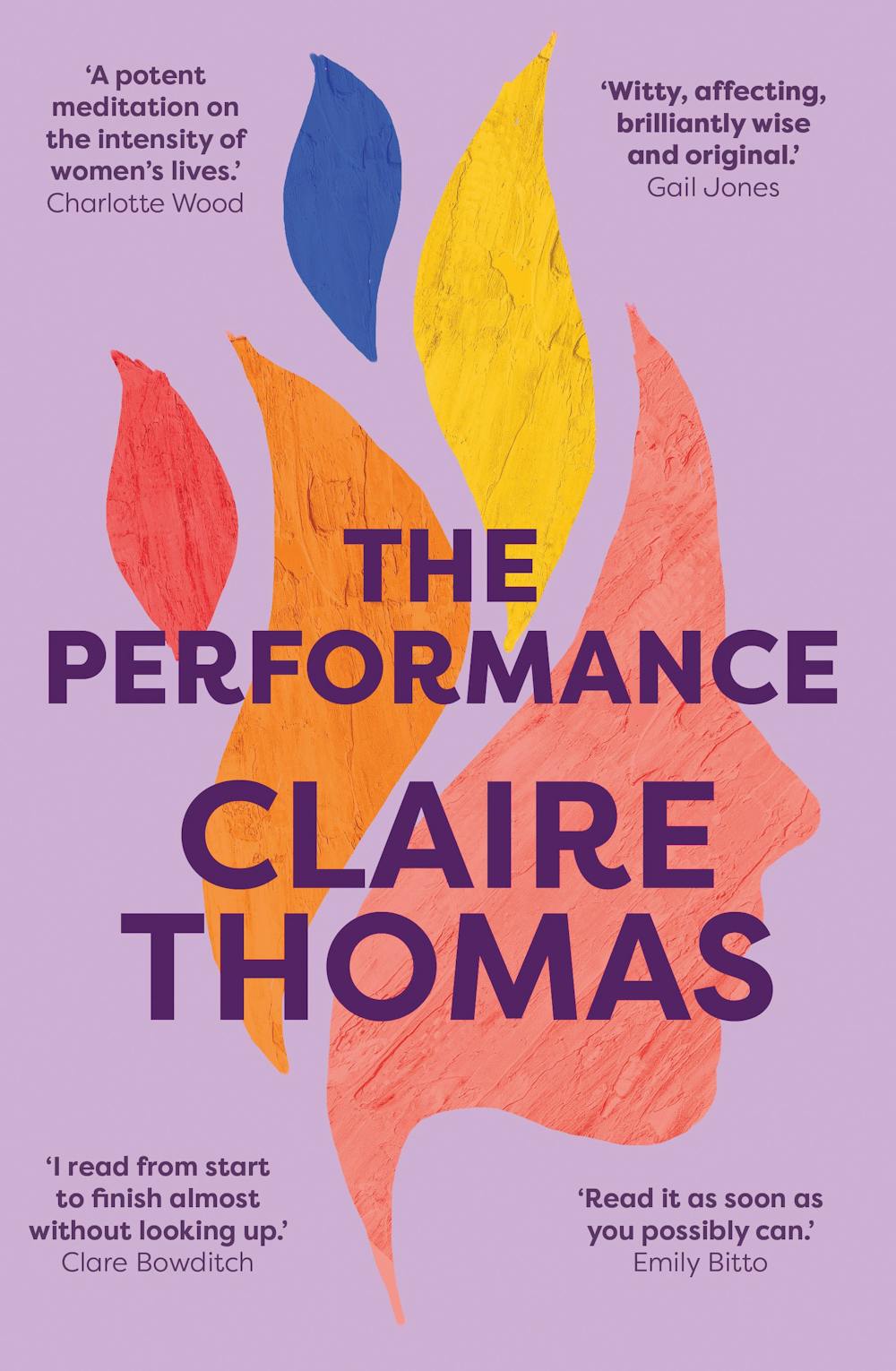
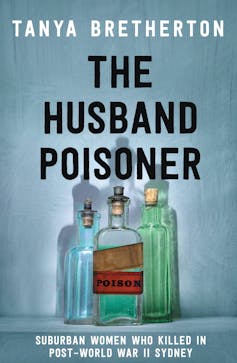
The Performance book cover

The audience watches Winnie as the earth increasingly swallows her, and her terminal happiness. Happy Days is a play adequate to contemporary times: the sixth mass extinction.

The Performance is set against Australia’s bushfire season. Just as Winnie’s parasol catches alight in Happy Days, there is the latent hazard the cool theatre could go up flames. As Ivy watches the play, she thinks: “Climate change is the key moral question of the age”.

And yet, as Thomas explores through her characters, what about those who are not scientists, engineers, policy makers, experts, activists and politicians directly involved in the challenge of global warming?

“The world is a swarm of need, and Ivy knows she cannot save it,” writes Thomas.

Margot, Ivy and Summer do not truly choose to watch Happy Days. It is more so their place in the theatre that night happens through their financial entanglements.

The bodily functions and reactions — ranging from disdain to intimacy — are conducted through Winnie’s words and her pace. Inseparable from this shared performance is the site and its time:

Summer is feeling worried, so worried, but she cannot work out if she’s worried about Winnie, or herself, or the blazing world outside, and where the blood is pooling or spilling at this moment, inside a certain body or beyond it.

Breathe, Summer. Remember to breathe.

Phrasing the musical

Actors and directors who collaborated with Beckett have recounted how he directed his plays for stage, television and radio in musical terms.

The voice he wrote for demanded a certain colour, accent, tone, rhythm. The cast were his instruments and elements.

Billie Whitelaw, Beckett’s favourite female actor, said Beckett “conducts me, something like a metronome”.

Of Happy Days, she mused how “terribly courageous” Winnie was.

Every day, an institutional bell rings, and life demands of Winnie one more day. One more day to apply her lipstick, play her music box, kiss her revolver, to speak in “the old style”: meagre defences in a life barely witnessed, barely there.

And when these props fail Winnie — and when her companion Willie exists only as a possibility out of sight — she sings in hope of an ear in the darkness. She holds on.

The Performance echoes Beckett’s musicality. Thomas tends to the base, cloying, funny, fragile disturbances that make theatre an imperative act. She gives breadth to her characters’ thoughts in tension to the daily performances they play in the role of mother, grandmother, friend, wife, lover, daughter.


Read more: Billie Whitelaw was one of Beckett’s greatest actors – she suffered for her art


She opens up the care it takes for these characters to not leap into easy connection, to allow space for their own and a stranger’s difference. She teases out how ideals and identities fall short of life’s ambiguity.

She gently holds the inescapable paradoxes of wanting, needing and enduring in these strange-becoming-stranger times.

Dissonances of life and art

The Performance is a poetics of the political, without preaching or judgement: it triggers burning questions. This is achieved through the novel’s clever structure. Chapters are a compilation of different points of view with no character’s point winning out over the others.

These perspectives converge in the middle of the book — an interval — which then affects the chapters after.

This book itches at sore points of neoliberalism, class, privilege (and lack thereof), race and Australia’s violent colonial history, gender, sexuality, and the bruises and yearnings that join, alter, or wear away the crossing paths of strangers, friends, and family.

For the treasure hunter, motifs and fragments of visual art, drama, and fiction weave through the plot. There are gestures towards the theatre novel like Virginia Woolf’s Between the Acts (1941).

And for those interested in Beckett’s biography, there are snippets of his life, body of work and Happy Days itself threaded throughout — both pointedly and hidden.

Written with passion, The Performance is a brave book: unafraid of confronting the dissonances of living in a modern Australia.

The Performance is out now through Hachette.

ref. Book review: Claire Thomas’s The Performance triggers burning questions – https://theconversation.com/book-review-claire-thomass-the-performance-triggers-burning-questions-155043


Democratic struggle won’t end with ITE law revision, says Koman

By a special Asia Pacific Report correspondent in Jakarta

It was September 2019, and exiled Indonesian human rights lawyer Veronica Koman was enjoying her final days in Australia. Her studies at the Australian National University in Canberra were almost over and all that was left was to wait for graduation day.

One afternoon, Koman’s mobile phone rang. There was an SMS message from a friend in Indonesia.

Her colleague informed her that the police had declared Koman a suspect.

Since August 17, 2019, the Papua issue had been heating up. Racist actions by rogue security personnel against Papuan students in the East Java provincial capital of Surabaya had triggered a wave of public anger.

Protest actions were held in several parts of the country, including in Papua. The government even cut internet access in Papua after several of the demonstrations ended in chaos.

In the mist of this critical situation, Koman was actively posting on Twitter, sharing information about the mass movement in Papua.

On September 4, Koman was officially declared a suspect. Police charged her under multiple articles, including the Information and Electronic Transaction (ITE) Law.

ITE law ‘is so rubbery’
Aside from the ITE Law, Koman was also indicted under Law Number 1/1946 on Criminal Regulations, Article 160 of the Criminal Code (KUHP) and Law Number 40/2008 on the Elimination of Racial and Ethnic Discrimination.

“I had thought about what articles would perhaps be used to criminalise me. I strongly suspected it would be the ITE. It turned out to be true, because the ITE is so rubbery,” explained Koman when contacted by CNN Indonesia.

Koman said that it was easy to use the ITE Law to criminalise people. Aside from the “rubber” (catchall) articles, the law does not require much evidence. A screen capture from the internet is enough, and the case can go ahead.

She believes there has been a tendency to use the ITE Law to silence activists over the last few years and she gave several examples of cases in Papua.

Koman said that several Papuan activists were indicted under the ITE Law in 2020. They were accused of committing hate speech, yet the activists only criticised police policy.

“Hate speak must contain SARA [hatred based on ethnic, religion, race or inter-group]. Not for hating the police, that has now become hate speech. The tendency in Papua is like that, the ITE Law’s interpretation of hate speech is like that.

“Yeah, I was confused, upset,” she said laughing.

After being declared a suspect, Koman was also put on the wanted persons list (DPO). Because she had been declared fugitive, she was unable to return to Indonesia after her graduation.

“The problem was, if I got imprisoned, who would report alternative information (about Papua)? If they want to arrest me, then arrest me, but I’m not going to turn myself in,” she said.

Agreement with Widodo
Koman supports President Joko “Jokowi” Widodo’s recent proposal to revise the catchall articles in the ITE law, saying that the law violates freedom of expression.

She related how she was often teased by her followers on Twitter. They say she wasn’t afraid to criticise the government because she had unwillingly ended up on the DPO. Meanwhile, they are afraid to criticise because of the ITE Law.

For Vero – as Koman is known – there is a serious issue behind the jokes by her followers. She says freedom to express an opinion in Indonesia is violated by the ITE law.

“[Indonesian] citizens don’t have to be imprisoned by the ITE law for their rights to be violated, no. When citizens feel afraid to express themselves, express an opinion, then their rights have already been violated,” said Koman.

Nevertheless, Koman warned that the struggle to uphold democracy will not end with the planned revisions to the ITE Law. She hopes that the public will take part in monitoring steps to improve the quality of democracy in Indonesia.

“Don’t be satisfied because President Jokowi hopes that the move to revise the ITE law will restore democracy. That’s just one step, there’s still a lot of homework to be done to restore democracy”, she said.

Waiting for Widodo’s ‘seriousness’
Many are now waiting for Widodo to demonstrate his seriousness in abolishing the catchall articles in the ITE law. So far he has asked Indonesian police chief General Listyo Sigit Prabowo to draft guidelines on interpreting the law.

“All that it needs is political will. Does he want to do it or not, or is it just lip service?” asked Indonesian Legal Aid Foundation (YLBHI) chairperson Asfinawati when contacted by CNN Indonesia.

According to data released by the Southeast Asia Freedom of Expression Network (SAFEnet), the catcall articles in the law which need to be abolished include Article 26 Paragraph (3), Article 27 Paragraph (1), Article 27 Paragraph (3), Article 28 Paragraph (2), Article 29, Article 36, Article 40 Paragraph (2) a, Article 40 Paragraph (2) b, and Article 45 Paragraph (3).

Translated by James Balowski for IndoLeft News. The original title of the article was “Nasib Jerat UU ITE: Jadi DPO dan Tak Bisa Pulang Kampung”.

Print Friendly, PDF & Email

Article by AsiaPacificReport.nz

View from The Hill: Craig Kelly’s defection leaves government with razor thin majority

Source: The Conversation (Au and NZ) – By Michelle Grattan, Professorial Fellow, University of Canberra

Craig Kelly’s jump to the crossbench leaves Scott Morrison’s government looking like the man who suddenly finds his jacket feels a little thin in the wind.

It still has a majority, but not a comfortable one.

The Coalition’s block of 76 in a House of Representatives of 151 members means it does not possess a working majority on the floor. A vote would be tied if Labor and all crossbenchers opposed it.

Its majority of one includes the Speaker, Tony Smith. He has a casting vote in the event of a tie – one that he would exercise in a procedurally conservative manner, to preserve the status quo.

The Coalition’s position is not like that of late 2018, when it fell into minority government as things unravelled after the overthrow of Malcolm Turnbull.

But losing a number makes descent into minority more of a possibility – if some unforeseen event took out another government MP. That would put it at greater risk of losing votes.

Kelly has said that, beyond supporting the government on confidence and supply, he will back it on the program it took to the election.

This gives him room to play up on a few measures, if he feels inclined, for example on any legislation relating to climate.

On the other hand, he would be unlikely to find parliamentary bedfellows on his pet issues.

Given the makeup of the crossbench, the government can be confident of its numbers, even if they’ve become a little more precarious.

Rebel Nationals would love to recruit Kelly to their party, to get an extra vote in the cause of removing Michael McCormack from the leadership. But Kelly sees himself as an “independent Liberal”; anyway, he’d have nothing to gain by joining the Nationals (which of course would restore the Coalition numbers).

The government is determined to portray Kelly’s departure in the most positive light it can find. “Good riddance”, is the official informal line.

With his passion for spruiking ivermectin and hydroxychloroquine, unproven treatments for COVID, Kelly has been deeply irritating for Morrison. The Prime Minister recently called him into his office for a dressing down, after Kelly’s spectacular corridor clash with Tanya Plibersek.

He wanted Kelly to shut up. Instead Kelly, the zealot with the contrarian cause, is now more than ever on a mission to promote those controversial drugs,

This is the second defector to catch Morrison on the hop.

In 2018 word came of Julia Banks’ desertion when she was on her feet in the House of Representatives. Morrison was giving a news conference at the time.

Kelly on Tuesday only showed his hand in the party room. He said he wanted to tell his colleagues first. But perhaps there was a touch of tit for tat after that bawling out.

For Kelly’s part, he had the choice of an attention-grabbing exit from the Liberal party, or being dispatched from his seat by the preselectors, who would have ensured he’d not be the Liberal candidate at the election.

What harm can Kelly do the government do now?

He can cast an anti government vote now and then.

He can shout his views on COVID treatments and climate change. But he’s done that often enough. Arguably, at least in the mainstream outlets, when he is not talking as a rebel Liberal, what he says on COVID will get less attention. He’ll just be a crossbench voice.

He is signalling he is likely to run as an independent at the election. If he does, he wouldn’t poll well and it’s doubtful his presence would do much harm to the Liberals in the seat.

In what’s a painful fortnight for the government, an element of the Kelly story fed into its problems with handling allegations of rape and sexual misconduct.

A staffer in Kelly’s office, Frank Zumbo, is being investigated over claims of sexual harassment in the workplace (which he denies).

When this matter was raised with Morrison’s office last year by a local reporter via email, it did not answer her.

Morrison on Tuesday said he had spoken to Kelly about both this matter and the staffer’s performance. But Kelly has kept the man on.

The government had a significant win on Tuesday when Facebook agreed, in a deal involving the Coalition making some changes to its legislation, to lift its ban on republishing news on its Australian site.

Any other time, that would have made it a very good day.

ref. View from The Hill: Craig Kelly’s defection leaves government with razor thin majority – https://theconversation.com/view-from-the-hill-craig-kellys-defection-leaves-government-with-razor-thin-majority-155897

Melbourne finally has a Crown royal commission — is this going to stop crime and gambling harm?

Source: The Conversation (Au and NZ) – By Charles Livingstone, Associate Professor, School of Public Health and Preventive Medicine, Monash University

The Victorian government has announced a Royal Commission into Crown Melbourne, following the damning findings of the Bergin inquiry into Crown’s Sydney casino licence earlier this month.

The inquiry found Crown Sydney Gaming was “not a suitable person” to operate the Sydney casino.

It also found Crown Resorts was “not suitable to be a close associate of the licensee,” pointing to the infiltration and exploitation of Crown’s Melbourne and Perth operations by “criminal elements, probably including international criminal organisations”.


Read more: ‘Not suitable’: where to now for James Packer and Crown’s other casinos?


Last week, the Western Australian government announced an inquiry into the operations of the Perth casino. Now, it is Victoria’s turn.

The Victorian royal commission will look specifically at the suitability of Crown Resorts Ltd (the parent company) to be the operator of the Melbourne Casino. The terms of reference are narrowly oriented towards Crown’s compliance with Victorian law and regulation, rather than focusing on regulation more broadly.

What about existing regulation?

The royal commission appears to be a vote of little confidence in the Victorian gambling regulator. The Victorian Commission for Gambling and Liquor Regulation has at least three inquiries already underway into Crown. These include a review of the Bergin findings and a review announced after 2019 media revelations about links to organised crime. These is also a regular review of the casino licensee, brought forward from 2023.

Crown Casino in Melbourne.
The Victorian government called the royal commission on Monday. Michael Dodge/ AAP

Then again, in her report, Commissioner Patricia Bergin recommended regulation of casinos should be undertaken by an independent casino commission. She also said this body should be armed with the powers of a standing royal commission.

The logic here is conventional regulators lack the power to properly inquire into, and demand evidence of, the workings of a business that is a magnet for criminal involvement and money laundering.

Don’t forget pokies

Of course, any proper investigation into gambling regulation needs to look far beyond what happens in casinos.

Poker machines in Australia’s clubs and pubs take about $A13 billion) from punters every year, more than twice the $A5 billion lost at casinos. Much of what is lost at casinos goes into poker machines. Harm and money laundering are also endemic in suburban pubs and clubs.

Crown, perhaps more than other gambling venues, is a locus of gambling harm. It has more than 2,600 poker machines, each making about $A170,000 per year, or $A462.7 million in total, as Crown’s annual report reveals. The “high rollers” are the cream on top of the profitable “grind” of the main floor — the term casino operators apply to their regular customers.

Poker machines
Crown’s gaming machines make more than $460 million a year. www.shutterstock.com

Across Australia, there are nearly 200,000 poker machines operating in other casinos and suburban clubs and pubs. These are also magnets for money laundering and tax evasion. This might be at a smaller scale individually, but in the aggregate, is it as big a problem as those identified at Crown.

This is easiest in NSW, where poker machines have a “load-up limit” of $A7,500. Laundering drug profits, or some cash-in-hand payments, is as easy as a quick visit to the local club.

So, any scrutiny of Crown’s suitability surely needs to consider how the casino addresses its legal obligation to provide gambling responsibly.

There is certainly evidence this is a significant issue for Crown. It has previously been fined for tampering with poker machines and reprimanded by the Victorian regulator for not taking harm minimisation seriously.

Too big to fail?

Crown is touted as a large employer, a contributor to tax revenue, and a major entertainment and tourism venue.

It may be all of these things, but as far as employment goes, the Australian Bureau of Statistics tells us gambling activities across Australia employed 26,000 people in November 2020, while the creative and performing arts employed 50,000.

As a contributor to tax revenue, the Bureau of Statistics also says Crown contributed less than 1.0% of Victoria’s state tax revenue in 2018-19, or about $A228 million. Lotteries contributed more than twice that, and poker machines in clubs and pubs nearly five times as much.


Read more: ‘Not suitable’: where to now for James Packer and Crown’s other casinos?


It’s entirely possible the net value of the operation to Victoria may be overstated, to put it mildly.

First steps

On Monday, the Victorian government said it would “legislate” later this year to “give effect to any findings of the royal commission”. It also said it had started work to set up an independent casino regulator.

This would be a solid step, but it also needs to encompass the regulation of all forms of gambling. There is no doubt Crown’s malfeasance in Melbourne and Perth went apparently undetected for so long because regulation was under-powered, under-resourced, and frequently undermined by political parties of both major persuasions.

There is also no doubt legislative and regulatory breaches by suburban pokie pubs and clubs are going undetected. There is ample evidence the requirements to protect people harmful gambling habits are not being met, including by Australia’s largest operators.

What happens next?

Melbourne’s Crown royal commission needs to report back by August. This is an ambitious timeline.

In the meantime, it will be fascinating to observe how Crown remakes itself, as has been promised by chair, Helen Coonan, who is now also CEO.


Read more: Australia has a long way to go on responsible gambling


Even more fascinating will be whether the other inquiries, reviews, and assessments also now underway actually produce any real change.

Only when the regulator, the system of regulation, and the legislation that underpins it all are robust, suitably powered, and properly resourced, will there be real change.

Until then, we can expect periodic scandals to engulf gambling operators, and the machinery of gambling harm production to grind on.

ref. Melbourne finally has a Crown royal commission — is this going to stop crime and gambling harm? – https://theconversation.com/melbourne-finally-has-a-crown-royal-commission-is-this-going-to-stop-crime-and-gambling-harm-155759

Having trouble sleeping? Here’s the science on 3 traditional bedtime remedies

Source: The Conversation (Au and NZ) – By Nenad Naumovski, Associate Professor in Food Science and Human Nutrition, University of Canberra

Sleep is essential for good health. Poor sleep quality, or not enough sleep, can negatively affect our mood, cognitive function, and immune system.

Stress can impact our sleep, and stress and anxiety associated with the COVID pandemic have meant many of us are not sleeping as well as we used to. A survey of 2,555 people across 63 countries found 47% of people were experiencing poorer sleep than usual during the pandemic, compared with 25% before COVID hit.

We also know stress is associated with poor dietary habits. People who are feeling stressed and tired may be more likely to reach for energy drinks and caffeinated beverages. But a high intake of caffeine as well as sugar-sweetened and energy drinks can keep us awake. So it’s something of a vicious cycle.

Similarly, people who are feeling stressed may be more likely to drink alcohol. Alcohol before bed, especially in excess, can also disrupt our sleep.

So what can you drink to improve your sleep?

Chamomile

Chamomile tea has been used in traditional medicine for centuries to treat a range of sleep ailments, such as insomnia.

The plant extract contains apigenin, a chemical compound that binds to the same receptors in the brain as benzodiazepines (drugs used to treat anxiety and insomnia), producing a sedative effect.


Read more: Can’t sleep and feeling anxious about coronavirus? You’re not alone


Studies have shown chamomile (consumed in the form of an extract or a tea) leads to significant improvement in sleep quality.

However, although the evidence is positive, these studies were relatively small and we need larger, well-designed clinical trials to reinforce these observations.

A pot of chamomile tea.
If you’re having trouble sleeping, it might be worth trying a cup of chamomile tea before bed. Irene Ivantsova/Unsplash

Milk

A warm cup of cow’s milk is a popular bedtime beverage in Western cultures, particularly for children.

Milk is a source of the essential amino acid tryptophan, which our bodies need to produce compounds including serotonin and melatonin in the brain. These compounds are involved in the sleep-wake cycle, which could explain why milk helps us sleep better — if indeed it does.

Scientists have studied the effects of milk and milk products (such as yogurt and cheese) on sleep quality for decades, but the evidence is still inconclusive.

It may simply be the ritual of drinking warm milk before bedtime that relaxes the brain and body, rather than the effects of compounds present in the milk itself. We’ll need more research evidence before we can be confident one way or the other.


Read more: Get headaches? Here’s five things to eat or avoid


Cocoa

Hot cocoa (commonly dissolved in milk) is also regarded as a sleep-promoting drink. The cocoa bean is a rich source of many beneficial chemicals, including compounds called flavonoids.

Flavonoids have a range of potential health benefits, and may be used to treat some neurodegenerative disorders.

There’s limited research on the effects of cocoa on sleep quality. But a study in mice suggested natural cocoa may improve stress-induced insomnia.

In humans, consuming cocoa is associated with a reduction in blood pressure (in healthy people and those with high blood pressure). This lowering of blood pressure, which relaxes the smooth muscles that line our arteries, could produce a calming effect, making it easier to go to sleep.

A man sits on the couch reading a newspaper, with a mug in hand.
Some people like to drink a glass of milk or a cup of cocoa before bed. Shutterstock

While these sleep remedies are unlikely to be harmful, the overall evidence on improvement in quality of sleep is weak. You may like to try them, but you shouldn’t see any of them as a quick fix.

At the end of the day, several lifestyle factors can influence our sleep quality, including screen time, physical activity, stress and diet.

If you are consistently struggling to sleep, it’s best to consult with your general practitioner.


Read more: Why our brain needs sleep, and what happens if we don’t get enough of it


ref. Having trouble sleeping? Here’s the science on 3 traditional bedtime remedies – https://theconversation.com/having-trouble-sleeping-heres-the-science-on-3-traditional-bedtime-remedies-150360

West Papuans send prayers for the recovery of Sir Michael Somare

By Benny Mawel in Jayapura

The United Liberation Movement for West Papua (ULMWP) has sent prayers for the recovery of the former Prime Minister of Papua New Guinea, Sir Michael Somare, who is critically ill with pancreatic cancer.

Sir Michael, who served as prime minister four times in Papua New Guinea, is also the founder of the Melanesian Spearhead Group (MSG). He is a figure who has played an important role in supporting ULMWP to become a member of the group.

Now 84, Sir Michael is being treated at the Pacific International Hospital in Port Moresby, as reported by Asia Pacific Report.

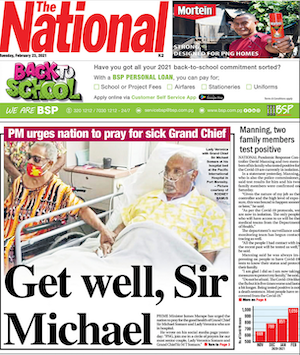
PNG’s The National newspaper said that Cardinal Sir John Ribat had celebrated a special Eucharist with Sir Michael and his wife, Lady Veronica, at his hospital bed.

The executive director of ULMWP in West Papua, Markus Haluk, said the movement and the people of West Papua also sent prayers for the recovery of Sir Michael Somare.

“The people of West Papua [send] healing prayers for Sir Michael Somare,” Haluk told Jubi yesterday.

Haluk said that the news of Sir Michael Somare’s health condition reminded him of the meeting between ULMWP leaders and Sir Michael Somare at the MSG forum in Port Moresby in February 2018.

‘Look to the future’
“I remember a message from Sir Somare, ‘West Papua don’t look at the past, but look to the future. I have opened my heart, you [ULMWP] are not alone anymore,” said Haluk.

The National 230221
“Get well, Sir Michael” – today’s front page banner headline in The National. Image: The National screenshot APR

Haluk also remembers that a few minutes later the Prime Minister of Papua New Guinea at the time, Peter O’Neill, came to the MSG meeting venue.

ULMWP leaders were standing and chatting with Sir Michael Somare.

Haluk, realising O’Neill had arrived, wanted to turn around and greet the prime minister, but Somare prevented him.

“Sir Somare grabbed my shoulder, winked at me, telling me, ‘Don’t turn to face PM O’Neill. Later he will come in your midst ‘. I also followed Sir Somare’s body language,” said Haluk.

What Sir Michael Somare said came to pass. After Peter O’Neill greeted all invited guests, ambassadors and MSG delegates, O’Neill went to Somare’s circle with the ULMWP delegates.

“I spontaneously greeted PM O’Neill. ‘Nopase waaa… waaa… waaa…’ (Papuan greetings to an honourable figure). Sir Somare gasped at my greeting. O’Neill greeted, ‘waa… waa… waa… Thanks Bro ‘.

“Then we shook hands with PM O’Neill,” said Haluk.

‘That’s Papuan politics’
Haluk said he was very impressed with the meeting.

“That’s Papuan politics, Melanesian politics. Everything flows from our hearts. [We] understand each other, acknowledge each other. You are important to me. We both need each other. Continue to keep the fellowship alive,” said Haluk.

Haluk said the West Papuan people remember the stories and services of great figures such as Sir Michael Somare.

According to Haluk, the people from Sorong to Samarai sent prayers for the recovery of Sir Michael Somare.

“Commemorating all the great services and sacrifices for the Papuan people, from Jayapura, West Papua, we send sincere prayers for healing to Sir Somare. I hope you get better soon,” said Haluk.

This article has been translated by an Asia Pacific Report correspondent from Tabloid Jubi and published with permission.

Lady Veronica & Sir Michael Somare
Sir Michael Somare with his wife, Lady Veronica, in the Pacific International Hospital in Port Moresby. Image: Diocese of Wewak
Print Friendly, PDF & Email

Article by AsiaPacificReport.nz

Spate of PNG covid-19 cases include national pandemic chief

By RNZ News

Papua New Guinea’s covid-19 cases have jumped to more than 1000, including the National Pandemic Controller and members of his family.

Eight new covid-19 cases were reported in the country over the weekend taking the country’s number of infections to 1056.

The latest cases were reported in East New Britain, Madang and in the National Capital District.

Ages ranged from an infant of five months old to a 43-year-old woman.

The eight new infections follow 59 positive results reported on Friday.

Ten cases out of the total have resulted in fatalities while 200 people are currently in isolation.

Seventeen provinces, including the Autonomous Region of Bougainville (AROB,) have reported covid cases.

Pandemic controller has covid-19
PNG’s Pandemic Response Controller David Manning is one of those people who have tested positive for the coronavirus.

Two members of Manning’s family have also tested positive and are in isolation.

Manning said his covid results were confirmed over the weekend.

He said given the nature of his job and with the high level of exposure to the infection it was bound to happen sooner or later.

Manning said he had always been impressing upon citizens the need for covid-19 tests so that they could know their status and protect their family.

“I have been telling people to be tested for covid-19 and as the Controller I had to take the test. I am glad I did, so I am now taking measures to protect my family.

“I urge everyone to go to your nearest health centre and get tested. It is by knowing your status you can then take steps to protect your loved ones, especially the most vulnerable including the old and those with existing medical conditions,” Manning said.

Covid ‘not a death sentence’
He told the public not to be be afraid, saying although covid-19 was five times worse than getting the normal flu, testing positive for the coronavirus was not a death sentence.

“Statistics have indicated most people have recovered from covid-19.”

Meanwhile, Manning expressed serious concerns about the low number of covid-19 tests being done in PNG.

“Our covid-19 response is more than 12 months in place but we have only tested about 50,000 people. This is roughly 0.5 percent of the PNG population.

“I want to see more tests being done around the country so that we can have a fair idea of where the pandemic is in PNG and take measures to mitigate and contain it.”

This article is republished under a community partnership agreement with RNZ.

Print Friendly, PDF & Email

Article by AsiaPacificReport.nz

RSF condemns Facebook news ban in Australia – block reported to be lifted

Asia Pacific Report

Reporters Without Borders (RSF) has condemned Facebook for carrying out its threat to block the sharing of its journalistic news content in Australia in retaliation to the federal government’s plan to make platforms pay media outlets.

The ban impacts on the reliability and pluralism of the information available on this social media platform, said the Paris-based global media watchdog.

“No posts yet” is the message that the Facebook pages of the Australian media have been showing since February 17, says RSF in a statement.

This blackout is deliberate. Facebook announced on February 17 that it would “restrict publishers and people in Australia from sharing or viewing Australian and international news content.”

The decision was taken in reaction to the Australian government’s proposed News Media Bargaining Code, under which platforms such as Facebook and Google would have to pay Australian media outlets for the content they display.

Facebook’s response, called the “nuclear option” by The Australian daily newspaper, is radical.

Australian media can no longer share or post content on their Facebook pages, while users in Australia can no longer see or share links to news on the platform, whether Australian or international news.

Facebook ‘abusing dominant position’
Facebook is abusing its dominant position to defend its economic interests at the expense of online news reliability and pluralism,” said Iris de Villars, the head of RSF’s Tech Desk.

“Regardless of the proposed law being discussed, these restrictions affect the ability of Australian citizens to access reliable and independent information on this platform.

“We urge Facebook to reverse this decision, which totally contradicts its pledges to combat disinformation.”

To implement these restrictions, Facebook has been using machine-learning tools to identify news content publishers but this has had the collateral effect of blocking other kinds of content, including the pages of several NGOs such as RSF, public health bodies, governmental institutions and even entities that handle emergencies.

Facebook has not as yet responded to RSF’s questions.

Asia Pacific Report and Pacific Media Watch collaborate with Reporters Without Borders.

Print Friendly, PDF & Email

Article by AsiaPacificReport.nz

Three Papuan youths killed in torture reprisal by Indonesian military

By a special Asia Pacific Report correspondent

Intan Jaya has started Lent with bitter sorrow after losing three young Papuan men alleged to have been shot and brutally tortured to death by the Indonesian military in a local health centre.

Sources said that the armed conflict has caused more than 1000 indigenous West Papuans in Intan Jaya evacuate to the church complex of the Catholic Church of Santo Mikael Bilogai.

Suara Papua reports that the TNI (Indonesia National Army) beat and tortured three youths to death at the Bilogai Health Center, Intan Jaya.

Last Monday morning (February 15), there was a shooting by the TPNPB (West Papua National Liberation Army) in Intan Jaya in which a TNI soldier was killed.

The TNI conducted sweeps around the village of Mamba and a young man, civilian Janius Bagau, was shot in the left arm.

At noon, Bagau was evacuated to the Puskesmas (health centre) in a car belonging to the regent from the crime scene in Amaesiga, reports said.

Two other young men, Justinus Bagau and Soni Bagau, from the victim’s family were in the car to look after the victim at the Puskesmas while he received medical treatment.

Tortured, beaten to death
At the health centre, the TNI came during the night and interrogated the three men while torturing and beating them to death, the reports said.

“Janius is the victim who was previously shot from Amaesiga. The two people [Soni and Justinus] were healthy. They were at the Puskesmas to look after Janius. But they were examined and interrogated, then beaten until all three died at the Puskesmas last night,” said a source who did not want to be named.

They were beaten to death at the Bilogai Health Centre in Yokatapa, Sugapa.

“Soni Bagau and Justinus Bagau, both of them joined the Regent’s car, which brought Janius Bagau from Amaesiga to the Bilogai Health Center so that the victim would receive treatment,” the source explained.

The three victims were reportedly buried in Tambabuga, Bilogai Village. The location of these three burials is not far from the official residence of the Intan Jaya regent.

There is widespread opposition to the central government plan for extending the special autonomy status over two Indonesian-ruled Melanesian provinces, Papua and West Papua provinces (collectively known as West Papua).

Meanwhile, the fate of 45,000 refugees from Nduga still remains unclear.

A source said there had been a further displacement of about 1000 people in Intan Jaya from the districts heavily occupied by police and military forces.

Print Friendly, PDF & Email

Article by AsiaPacificReport.nz

Fear still marks the trial of a former priest in Timor-Leste enclave

By António Sampaio in Pante Macassar, Timor-Leste

The fear that has led for years to silence dozens of children, allegedly victims of sexual abuse by a former priest who begins trial today in Timor-Leste’s western enclave, still shrouds the case.

Witnesses, victims and others who knew about the abuse – including people involved in the process – prefer not to speak, pointing in some cases to the feeling of deference to the figure of the accused American Richard Daschbach, 84.

Even after being expelled from the priesthood and officially condemned by the Vatican, Daschbach continues to be venerated by many who call him “master” and who minimise or ignore the crimes he is accused of.

Instead, they highlight his humanitarian action and even the support he gave during the Indonesian occupation, in some cases, mixing truths with myths.

When he recently turned 84, for example, some of his supporters posted a photo of him in traditional Timorese clothing on Facebook.

The publication had hundreds of congratulatory votes and even a “tag” on the page of one of its alleged victims.

Even if the rumours circulated, the matter was rarely more than half conversations or references in secret, a situation that would have continued if one of the victims had not brought her abuse report to the congregation.

Punished by the Vatican
Richard Daschbach, detained in 2019, who has already been punished by the Vatican, is accused of abusing at least two dozen children at the orphanage where he worked, Topu Honis, located in Oecusse.

The prosecutor also charges Daschbach with the crimes of child pornography and domestic violence.

Unprecedented in Timor-Leste, as it involved a former church member, the case has sparked controversy and intense debate.

Current and past sources in the Timorese judicial sector, heard by Lusa, highlight the importance of the process, admitting that the outcome, whatever it may be, can have a significant impact, silencing or giving confidence to other victims.

Part of the debates focuses on the public perception that Daschbach has had support from some individuals in Timor-Leste, namely two former Presidents of the Republic, Xanana Gusmão and Taur Matan Ruak, the latter current prime minister.

Judicial sources indicated to Lusa that Xanana Gusmão was even listed as a defence witness, among a range of people, most of whom were linked to the orphanage where the crimes were committed.

In 2018, for example, after confessing his crimes to the congregation – the Vatican was beginning the process that would end in his expulsion from the priesthood -, Daschbach was visited by Taur Matan Ruak and his wife, Isabel Ferreira, at headquarters SVD in Dili.

Ex-priest’s return to Oecusse
A visit in which, explained Yohanes Suban Gapun, SVD regional supervisor, Taur Matan Ruak had asked them to let the ex-priest return to Oecusse.

“Mr Taur Matan Ruak and his wife came to visit us and spoke to Daschbach. I was also asked if I would please let him return to Oecusse because many people like him there and still respect him a lot. Please let him go to Oecusse too because he is old and let him die there in peace,” he said.

Asked by Lusa in 2019 about the reason for this visit, Taur Matan Ruak said he did it out of respect.

“I had no intention of passing the priest an immunity card. Just as a human being, out of respect, we visited to find out what was going on and to express our concern about the issues,” he said.

Even more evident has been the support given by former President Xanana Gusmão, which began to be publicly noticed in October last year when Juu’s, which represents the victims, introduced a precautionary measure against the Archdiocese of Dili, to stop the publication of a controversial report on the case prepared by the then head of the Justice and Peace Commission.

Xanana Gusmão, who was outside the Dili Court with an organised demonstration in support of the diocese, was listed as a witness because a copy of the report had been given to him and because he later sent a copy to Juu’s.

In his testimony, the Timorese leader ended up deviating several times from the audience’s purpose, questioning the fact that there were accusations against the former priest only recently, despite the fact that he had been in Timor-Leste for a long time.

Justice ‘has to be fair’
“There has to be justice, but justice has to be fair, obey procedures, criteria that dignify justice itself. I realised that there was something in this case that was not in accordance with the rules of investigation”, he told Lusa at the time.

More controversial was the recent visit that Xanana Gusmão made to the house in Dili where Daschbach was under house arrest, at the time of the defendant’s birthday, and about which he informed some East Timorese press, later distributing a statement that was practically published in full in several newspapers .

The visit led the ex-president’s three children to write letters to the alleged victims, regretting that their father visited Daschbach.

The news coverage of this visit drew criticism from the president of the Timorese Press Council, Virgílio Guterres, who considered that the news in the national press tried to “whiten” the former American priest.

Xanana Gusmão has so far not reacted to the controversy, but on Thursday he traveled with an entourage to accompany Daschbach on the ferry that took him from Dili to Oecusse.

Mateus Assunção Mendes, chief superintendent and commander of the National Police of Timor-Leste (PNTL), confirmed to Lusa that Xanana Gusmão, Daschbach and the rest of the delegation are staying at the same hotel in Pante Macassar, capital of the enclave.

“Yes, they are in the same place,” he confirmed.

Lusa tried several times to talk to Xanana Gusmão, without success.

Little Timorese media attention
Another factor that has conditioned the environment around the case has been the reduced attention of almost all Timorese media, which, in some situations, has even been accused by the Press Council of trying to “whiten” Daschbach.

Exceptions are the publication Tempo Timor, the first to report the case of the former priest and who has already presented testimonies of victims and details of the case, and Néon Metin, which has also written about the case, including recently publishing testimonies of victims.

José Belo, the journalist for Tempo Timor who, with journalist Tjistske Lingsma, first reported the case, tells Lusa that it has been difficult to convince people to talk about the case.

“It is very difficult to convince people to speak. When planning interviews, everyone prefers to remain silent. Some people look at this man as a god,” he told Lusa.

The trial, which takes place behind closed doors, begins today at the Oecusse Court in Pante Macassar.

PNTL plans to install a security perimeter around the building.

This article has been translated by an Asia Pacific Report correspondent and is published with permission.

Print Friendly, PDF & Email

Article by AsiaPacificReport.nz

PNG’s founding father Sir Michael Somare ‘critically ill’, says family

Asia Pacific Report

Grand Chief Sir Michael Somare, widely regarded as the founding father of independent Papua New Guinea, was in a critical condition in Port Moresby last night fighting cancer, reports The National today.

The 84-year-old former politician and his wife, Lady Veronica, had been preparing this week to go overseas for treatment, the newspaper said.

A family member said last night: “It is with sadness that I advise, on behalf of the Somare family, the serious illness pancreatic cancer that has befallen our father, Sir Michael, is at a critical stage and we as a family, along with his medical teams, are giving him the utmost care that he deserves.”

The National said that Cardinal Sir John Ribat celebrated a special Eucharist with Sir Michael and Lady Veronica yesterday at his hospital bed at the Pacific International Hospital in Port Moresby.

The ABC correspondent in Port Moresby, Natalie Whiting, posted a twitter message saying Cardinal Ribat had “released a statement on behalf of the family asking the public to pray for Sir Michael and advising he is receiving palliative care in Port Moresby”.

The family statement continued:

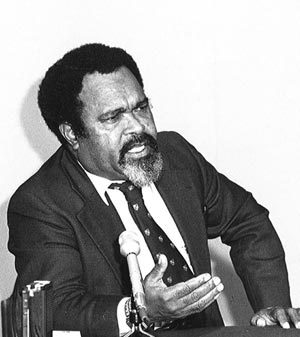
Sir Michael Somare in his political heyday. Image: Radio NZ

“After comprehensive consultation to ensure all clinical opportunities were exhausted in every jurisdiction with the competencies able to treat the critical stage of this form of cancer, the family, in consultation with the grand chief and Lady Veronica, have settled with offering the best palliative care and nutritional and dietary care in PNG.

“Due to the numerous enquiries, we thought it best to be forthright so the public knows the exact extent of this terrible illness.

“We thank the many Papua New Guineans who have sent in their well wishes and prayers for the health and wellbeing of Sir Michael and Lady Veronica.”

Sir Michael, a former broadcaster, was a key politician in the lead up to independence from Australia in 1975 and he became the country’s first prime minister.

His political career spanned from 1968 until his retirement in 2017 and he has been papua New Guinea’s longest-serving prime minister.

Print Friendly, PDF & Email

Article by AsiaPacificReport.nz

$50 a fortnight rise in JobSeeker comes with tougher job search requirements

Source: The Conversation (Au and NZ) – By Michelle Grattan, Professorial Fellow, University of Canberra

The base level of JobSeeker and related payments will increase by $50 a fortnight from April 1 under changes that will also toughen the obligations on people seeking work.

The boost will take the payment to $307 a week. It will go to 1.95 million people, including those on parenting payments, Austudy and Youth Allowance.

But those on unemployment and related payments will be worse off than they are now, because they will lose the temporary coronavirus supplement, which is currently worth $150 a fortnight. This expires at the end of March.

The amount of money a person on JobSeeker and related payments can earn before their payment is affected will also be raised, to $150 a fortnight.

From early April, job seekers will have to search for a minimum of 15 jobs a month, rising to 20 jobs a month from July 1.

The Australian Council of Social Service strongly attacked the decision, saying it was a cut to people’s current income and is “a measly $3.57 a day more than the brutal old Newstart rate.”

ACOSS CEO Cassandra Goldie said: “Already, at $51 a day with the temporary coronavirus supplement, people on JobSeeker are currently being forced to make impossible decisions.

“Now, come the end of next month, they are expected to struggle on even less – just $44 a day to cover the essentials of life, including rent, as well as the cost of job searching.”

The cost of the changes is $9 billion over the forward estimates. The government said this was the largest-ever budget measure for working age payments, and the single biggest year-on-year increase to the rate of unemployment benefits since 1986.

Announcing the changes, Prime Minister Scott Morrison had an eye on those on his own side who might be critical of the rise.

He said it was true this was the single largest increase in the JobSeeker payment since the mid-1980s. He added, “but I think the more relevant feature to focus on is what it is as a percentage of the minimum wage. And this brings [that] up from 37.5% up to 41.2”. That is commensurate with where it sat during the period of the Howard government.“

Among the other changes the government announced:

  • temporarily extending the waiver of the ordinary waiting period for certain payments for a further three months to June 30

  • temporarily extending the expanded eligibility criteria for JobSeeker and Youth Allowance for those required to self-isolate or care for others as a result of COVID to June 30.

The stringent mutual obligation requirements will include an employer reporting line that will be established to refer job seekers who are not genuine about their job search or decline the offer of a job.

Some job seekers will have to take part in “work for the dole” after six months. They will have the alternative of taking an approved, intense, short course instead.

Job seekers will also have to return to compulsory face-to-face services with Jobactive providers, and there will be increased auditing of job applications to make sure they are genuine.

Morrison said: “Welfare is a safety net, not a wage supplement. We want to get the balance right between providing support for people and incentives to work.”

Speaking before the announcement, Nationals backbencher Matt Canavan expressed doubt. He told Sky: “Before the coronavirus I thought it was fair to look at increasing the unemployment assistance, it is very low.

“That was all before we racked $1 trillion up on the nation’s credit card.

“I just think we’re borrowing too much from overseas, we’re borrowing too much from the Chinese government.”

ref. $50 a fortnight rise in JobSeeker comes with tougher job search requirements – https://theconversation.com/50-a-fortnight-rise-in-jobseeker-comes-with-tougher-job-search-requirements-155858

COHA in Haiti: Danny Shaw Reporting on the Serious Political and Social Crisis

Source: Council on Hemispheric Affairs – Analysis-Reportage

Print Friendly, PDF & Email

COHA’s Senior Research Fellow, professor Danny Shaw, opens a window to the mass movement in Haiti which is demanding President Jovenel Moïse step down and cease rule by decree.

Demonstrators are also calling for the release of political prisoners, the restoration of the Supreme Court justices, Police Inspector General and other opposition figures who have been fired, and an end to U.S., United Nations and the Organization of American States (OAS) intervention on behalf of foreign interests in their country.

A broad convergence of opposition parties and social movements maintain that Moïse’s term in office ended on February 7, 2021, while Moïse argues his mandate continues for another year and seeks to hold a referendum on a new constitution this April. It is doubtful, however, that such a referendum can garner democratic legitimacy given the prevailing corruption of constituted power in Haiti.

There has been scarce mainstream media coverage of the protests that have brought thousands of Haitians to the streets day after day, week after week, despite the mounting human rights abuses perpetrated by Haitian police and their allied gangs. Danny Shaw, brings critical light to the ongoing struggle for democracy in Haiti.

Photo-Gallery: a Country that Demands Democracy and Non-Intervention

[Credit Photos: Danny Shaw]

Video Analysis by Professor Danny Shaw, from Port-au-Prince, Haiti

NZ’s smoking rates dropped dramatically thanks to a hard-hitting campaign. Could we do the same to bring emissions down?

Source: The Conversation (Au and NZ) – By Caroline Shaw, Senior Lecturer in Public Health, University of Otago

New Zealand has the highest per capita car ownership in the OECD, and reducing emissions from the transport sector is seen as a wicked problem.

As part of its recently released advice for the government’s first emissions reduction plan, the Climate Change Commission is calling for a public education campaign similar to anti-smoking ads to create a social movement away from cars.

The Crayons campaign, developed in 2014, aimed to encourage quitting by showing the negative impact smoking has on children.

Transport accounts for 21% of New Zealand’s annual greenhouse gas emissions and is the fastest growing source of emissions. We clearly need to reduce transport emissions dramatically.

And the commission is right that tobacco control has lessons to offer for transport decarbonisation.

Changing the system

Decades of investment in a car-based transport system has baked car dependency into New Zealanders’ expectations of how we live and travel.

Once people are used to a particular system, it is hard to see the extent of change needed and mechanisms to make it happen.

The decades-long tobacco control programme offers an exemplar in creating social (and behaviour) change on the scale the commission wants to see. But the lessons are broader than a public education campaign.


Read more: Thank you for not driving: Climate change requires anti-smoking tactics


One of the key lessons from tobacco control is the need to intervene in multiple levels to reshape the entire system. This includes:

  • interventions at the policy level (taxation on tobacco products, advertising and sponsorship bans)
  • creating environments that support being smoke-free (no smoking in public places such as bars, playgrounds, workplaces; plain packaging)
  • community action (community-based tobacco control programmes such as Aukati Kaipaipa)
  • helping individual smokers to quit
  • reorienting health services to promote tobacco control by requiring health providers to collect and report on smoking status.

Combined, these interventions have reduced smoking rates from 36% in 1976 to 13% in 2020. We moved from a society where smoking was ubiquitous (remember smoking in planes, bars, restaurants and workplaces?) to one where smoking is no longer seen as a “normal” activity.

Importantly, tobacco control interventions now enjoy a high level of support, including often from smokers. These wide-ranging environmental interventions created behavioural change and support for further interventions.

Making it easier for people to change

Evidence from public health shows policy interventions that go hand in hand with supportive environments are likely to make the biggest difference in behaviour changes.

These interventions include taxation, advertising restrictions and changes to product availability. They can shift the behaviour of the entire population.

An advertisement for a car.
Advertising bans on cigarettes were part of the anti-smoking campaign and could be used to encourage people to choose low-emission cars or drive less. Shutterstock/Andrei Kholmov

Mass media campaigns need to be treated with caution as some evidence suggests they may increase inequities. Education campaigns are largely futile if there is no accompanying environment to support the promoted behaviour change.

For example, the health sector has a long history of telling people to exercise more and eat a better diet to reduce obesity. But it has achieved little in the way of environmental changes compared with tobacco control.

This sub-optimal approach is reflected in the lack of change in obesity rates since 2012/13. The prevalence of obesity among adults remained stable at 30.9% (an estimated 1.24 million adults), and even increased in the age groups of 45–54 years and 55–64 years.


Read more: What can obesity control learn from tobacco control’s success?


The Genless campaign run by the Energy Efficiency and Conservation Authority (ECCA) is also a good example of an education campaign asking people to make individual choices to reduce emissions in an environment that doesn’t support them.

Equity concerns

International evidence shows that disadvantaged groups experience fewer of the benefits (access to healthcare) and more of the harms (injury, noise and exposure to air pollution) of the transport system. Disadvantaged groups also contribute least to transport emissions. Local New Zealand evidence is patchy but suggests similar patterns.

How do we reduce existing transport inequalities and emissions at the same time? Firstly, we need to recognise that a low-carbon transport system with more walking, cycling and public transport options is likely to be a fairer transport system for the whole population. It also makes our cities nicer places for us all.

People walking in Auckland's Takutai Square.
Pedestrian zones and better public transport options can make cities more attractive. Shutterstock/YIUCHEUNG

Secondly, the types of interventions we select to transform the system are important. Interventions that rely on a large amount of individual effort (material, time, cognitive or psychological) are likely to be less effective and increase inequalities.

For example, if the goal is to improve the efficiency of the vehicle fleet, providing information on fuel efficiency is likely to be far less effective than regulating for minimum standards.

But we also need to acknowledge that even well designed interventions that benefit everyone have nevertheless been taken up more by already advantaged populations and therefore increased inequalities. While smoking has reduced in all groups, it has reduced most in advantaged groups and large differences between groups remain.

We need to do better in transport. We need a comprehensive plan (at multiple levels) aimed at equitably opening up our streets and cities to low-carbon travel.

The uptake of cycling in Vancouver is an international example of a comprehensive approach which achieved changes relatively rapidly. The lessons from tobacco control, and public health more generally, can help us chose the types of interventions that will make the most difference and design them to minimise inequalities.

ref. NZ’s smoking rates dropped dramatically thanks to a hard-hitting campaign. Could we do the same to bring emissions down? – https://theconversation.com/nzs-smoking-rates-dropped-dramatically-thanks-to-a-hard-hitting-campaign-could-we-do-the-same-to-bring-emissions-down-153081

Maverick Liberal Craig Kelly defects to crossbench, vowing to continue to ‘use my voice’ on controversial COVID treatments

Source: The Conversation (Au and NZ) – By Michelle Grattan, Professorial Fellow, University of Canberra

Liberal maverick Craig Kelly has defected to the crossbench, giving Prime Minister Scott Morrison no warning before his surprise announcement to Tuesday’s Coalition parties meeting.

Kelly, who strongly promotes alternative, unproven treatments for COVID said: “If I’m to speak out and to use my voice the best I can, this is the best decision for myself and for the people that I represent.”

Morrison recently dressed down Kelly in an attempt to stop him making comments that could harm the government’s campaign to get maximum take-up of the COVID vaccines.

His move takes away the Coalition working majority on the floor of the House of Representatives – it reduces the government to a one-seat majority, including the speaker’s casting vote. But Kelly said he would support the government on supply and confidence and indicated he did not see anything on its agenda that “I’m going to be objecting to strenuously”.

The member for the Sydney seat of Hughes since 2010, Kelly was considered almost certain to lose Liberal preselection, with a grassroots movement mobilising against him. He was saved from preselection challenges by interventions from Malcolm Turnbull before the 2016 election, and Morrison in the run up to the 2019 election.

Kelly told Sky: “I believe one of the greatest mistakes that’s been made in this country and also the world was prohibiting doctors from prescribing ivermectin and also hydroxychloroquine.

“I believe this was a terrible error.”

He denied he was an anti-vaxxer, which he said was just a “slanderous smear”.

“I support the vaccine program, but in concert, to use the words of our highest credential immunologist, these other treatments should be used in concert with the vaccine.”

He said he had an “obligation” to act on his conscience.

Morrison told a news conference he had learned of Kelly’s action “at the same time he announced it to the party room”.

“We had a discussion a couple of weeks ago.

“I set out some very clear standards and he made some commitments that I expected to be followed through on,” Morrison said.

“He no longer felt that he could meet those commitments and, as a result, he’s made his decision today.

“By his own explanation [in the party room], he has said that his actions were slowing the government down and he believed the best way for him to proceed was to remove himself from the party room and provide the otherwise support to the government so it could continue to function as it so successfully has, which he says is something he remains committed to. So I would expect him to conduct himself in that way.”

ref. Maverick Liberal Craig Kelly defects to crossbench, vowing to continue to ‘use my voice’ on controversial COVID treatments – https://theconversation.com/maverick-liberal-craig-kelly-defects-to-crossbench-vowing-to-continue-to-use-my-voice-on-controversial-covid-treatments-155857

How did NASA’s Martian rover come to land in a crater named after a tiny Balkan village?

Source: The Conversation (Au and NZ) – By Robert Greenberg, Dean of Arts, University of Auckland

The world was excited by the news last week that NASA’s Perseverance rover had successfully landed in a Martian crater. The rover will now set about collecting samples from what scientists say was an ancient lake fed by a river. The name of this exotic Martian crater is Jezero.

As a South Slavic linguist, the name was immediately recognisable to me. In several former Yugoslav countries, including Bosnia and Herzegovina, Croatia, Montenegro, Serbia and Slovenia, “jezero” (pronounced “yeh-zeh-ro”, with the stress on the first syllable) means lake. Fair enough — but why a Balkan lake on Mars?

The task of providing names for places of interest on Mars falls to the International Astronomical Union (IAU). They apparently named the Martian crater Jezero in 2007, well before earthlings had paid any attention.

I later discovered the name was not, in fact, intended simply as a generic “lake”, but refers to a specific village called Jezero. With a population around 500, it is located in western Republika Srpska, the Serb-dominated part of Bosnia and Herzegovina. It is very near a river-fed lake called Veliko Plivsko Jezero, or Great Plivsko Lake.

First views of the Jezero crater from NASA’s Perseverance rover.

Famous on Mars

According to the Balkan Insight news service, the mayor of Jezero first learned of NASA’s plans in a letter from the US ambassador in Bosnia and Herzegovina, informing her the village and its name were to be honoured by the spacecraft landing in the Jezero crater.

Lake in Bosnia
Veliko Plivsko Lake. www.shutterstock.com

The villagers apparently first dismissed this as fake news. But, to their later amazement, people all over the world have now been learning to pronounce Jezero properly.

The landing was broadcast live at the village’s only school, with the Balkan Insight reporter describing the villagers as “star-struck” and justifiably proud of their connection to the mission.

There was also cautious optimism about the prosperity that might flow from tourists discovering their sleepy hamlet (at least after the pandemic). Famous on Mars, might Jezero be celebrated on Earth as well?

Earthly tensions

The alternative to be avoided, one hopes, is that a minor Balkan conflict breaks out over language and designated names. Every one of the former Yugoslav countries can claim the word “jezero” in their respective dictionaries. And any traveller to the Balkans knows the region is rich with lakes.

But only one village carries this generic word as its name. Was it politically advisable for one village in the Serb-dominated entity of Bosnia and Herzegovina to be singled out? For many, this part of the country is still associated with the nationalism and ethnic cleansing of the Bosnian war in the 1990s.


Read more: ‘7 minutes of terror’: a look at the technology Perseverance will need to survive landing on Mars


How would the members of other communities in the country — Bosniaks (the country’s Muslim population) and Croats — respond? Could they support the Serbs of Jezero receiving such positive media coverage?

As my book about the break-up of the Serbo-Croation language explored, language rifts in the Balkans are endemic and have long been both a symptom of ethnic animosity and a cause for inflaming it.

Will people quibble over whether the crater is named for the village or for its nearby lake, or any lake within the region? Or should all who say “jezero” feel proud the word is now in the global lexicon?

Martian crater
Jezero crater on Mars, showing a possible route the Perseverance rover could take as it investigates several ancient environments. Nasa

Space and time

During the time of Tito’s rule in Yugoslavia, such matters would not have been as contentious, since many people believed the dominant common language of the country was Serbo-Croatian.

Ethno-nationalism was forbidden and people mostly got along. However, since the violent break-up of Yugoslavia, people in the newly independent states now speak separate languages: Bosnian, Croatian, Montenegrin and Serbian.


Read more: Remembering Srebrenica, more than 20 years on


Over the years, speakers of the four languages have slowly drifted apart, but they all agree a lake is called “jezero”. Further complications arise with peoples and governments even further afield. The Slovenes and Czechs also say “jezero”, and the Macedonian and Bulgarian form is the almost identical “ezero”.

Any similarity between the landscape around Jezero in Bosnia and Herzegovina and the crater with the same name on Mars may end with the name. And I doubt the scientists at NASA or the IAU ever considered the potential implications of using a common word shared by so many nations to name an important site on Mars.

But, as we know, words have power. It would be a shame if a distant, silent crater on another planet caused envy and resentment here on Earth. So far, however, the political situation in the Balkans remains almost as calm as that on Mars, and that is cause for hope.

ref. How did NASA’s Martian rover come to land in a crater named after a tiny Balkan village? – https://theconversation.com/how-did-nasas-martian-rover-come-to-land-in-a-crater-named-after-a-tiny-balkan-village-155740

Why the World Rugby guidelines banning trans athletes from the women’s game are reasonable

Source: The Conversation (Au and NZ) – By Jon Pike, Senior Lecturer in Philosophy, The Open University

In 2020, World Rugby undertook a painstaking policy process to address the issue of transwomen in rugby. This led to guidelines that exclude transwomen from competing in women’s rugby at the World Cup level — the first international sports federation to do so.

The new guidelines don’t exclude transwomen from rugby completely, of course: they just specify that players must compete in the category of their birth sex, for reasons of safety and fairness.

Though controversial, the guidelines are fair, reasonable and supported by evidence. They offer the best way forward, not just for rugby, but for other sports.

A sports ethics viewpoint

I participated in the global symposium in London where the guidelines were debated, as an expert on sports ethics. I’m a philosopher rather than a sports scientist, and I’ve done work for both the World Anti-Doping Agency and the International Olympic Committee in the past.

Many advocates for trans inclusion in the women’s game believe the right way to address this issue is to balance fairness against safety. But in this recently published paper — drawn from my presentation to the London symposium — I argue such a “balancing” approach is seriously wrong. Instead, organisations like World Rugby should adopt a “lexical priority” approach.


Read more: Better locker rooms: It’s not just a transgender thing


What does that mean? From the possible set of rules that exist, it means first selecting those that are safe, then the safe rules that are also fair, then the safe and fair rules that are maximally inclusive.

This approach — first, do A, then B, then C — is better than an opaque attempt to “balance” all three at the same time.

Scoring a try in the final between Australia and New Zealand in the Rugby League World Cup in 2019. Brendon Thorne/AAP

What about the science?

So much for the method. But what about the science? And how do they fit together?

There’s been a flurry of recent papers on the participation of transwomen in sport. In this one, which also was presented in London, developmental biologist Emma Hilton and sports scientist Tommy Lundberg review a large range of studies, and show the effect of hormone replacement therapy for transwomen is much less than would be needed to ensure a level playing field.

In short, transwomen retain large male advantages in terms of muscle mass, strength, VO2 Max (maximal oxygen uptake) and other relevant metrics.
Another recent study by paediatrics specialist Timothy Roberts and others, looks at US military personnel — trained and fit people subject to monthly physiological tests — and comes to similar conclusions.

And in data presented by World Rugby, biomechanical modelling studies suggest that, in the women’s game, transgender players create head and neck forces 20-30% greater than elite women’s rugby players as a result of mass differences alone. This suggests a potential risk of injury to female players from transwomen players.

How does fairness fit in?

Let’s plug this into a lexical methodology. From the evidence, it doesn’t look as if transwomen competing in women’s rugby is safe. The increased forces generated by transwomen significantly raise the risk of serious and catastrophic injury to female players.

That should be enough, on its own, to make the guidelines appropriate for a collision sport like rugby. But let’s go on, for the sake of other sports, and talk about fairness.

When it comes to fairness, there are two arguments — what I call the “advantage argument” and the “range argument”.


Read more: World Rugby’s ban on trans players has nothing to do with so-called ‘fairness’


The advantage argument says women’s sport is justified by the existence of the physiological advantages that being born male provides to men. Women’s sport necessarily involves the exclusion of those with male advantage. That’s the point of the category.

According to the range argument, however, lots of male-born people, including transwomen, are in the range of females. This means they are not necessarily faster or stronger than the fastest or strongest female athletes just because they were born male.

So, if transwomen are “in the range” of female athletes, then their inclusion in sport is still fair, right?

Wrong. The range argument rests on a misunderstanding of women’s sport. It is not a category for people who are a bit smaller, slower and weaker than the top males. It isn’t justified by performance or body metrics, but by the absence of a particular sort of advantage.

So the range argument is beside the point. If we are to have two classes of sport — male and female — then the division is justified by the existence of male advantage. Those who claim male advantage (including residual male advantage for transwomen) doesn’t matter are actually arguing for unisex sport.

It is crucial to know then if male advantage is retained after a transgender athlete transitions. And the studies by Hilton, Lundberg and Roberts all show, conclusively, that male advantage is still there.

New Zealand’s Portia Woodman, left, scores past France’s Chloe Pelle during the Women’s Rugby Sevens World Cup final in 2018. Jeff Chiu/AP

Where to from here for other sports

The evidence from the World Rugby deliberations is now in, and most of it can be read, analysed and subjected to critique by anyone.

While there will be no changes before the Tokyo Olympics, the IOC is currently in consultation with international sport federations over the inclusion of transgender athletes, each with their own particular concerns.

The question is whether the IOC and other international federations respond to the latest research, or if they will continue to keep their heads in the sand.

ref. Why the World Rugby guidelines banning trans athletes from the women’s game are reasonable – https://theconversation.com/why-the-world-rugby-guidelines-banning-trans-athletes-from-the-womens-game-are-reasonable-152178

Perth Festival review: Whale Fall is a powerful story about a trans boy, and the life of a whale

Source: The Conversation (Au and NZ) – By Chandra Salgado Kent, Associate Professor, School of Science, Edith Cowan University

Review: Whale Fall, written by Ian Sinclair and directed by Melissa Cantwell for The Kabuki Drop. Commissioned by PICA and co-presented with Perth Festival.

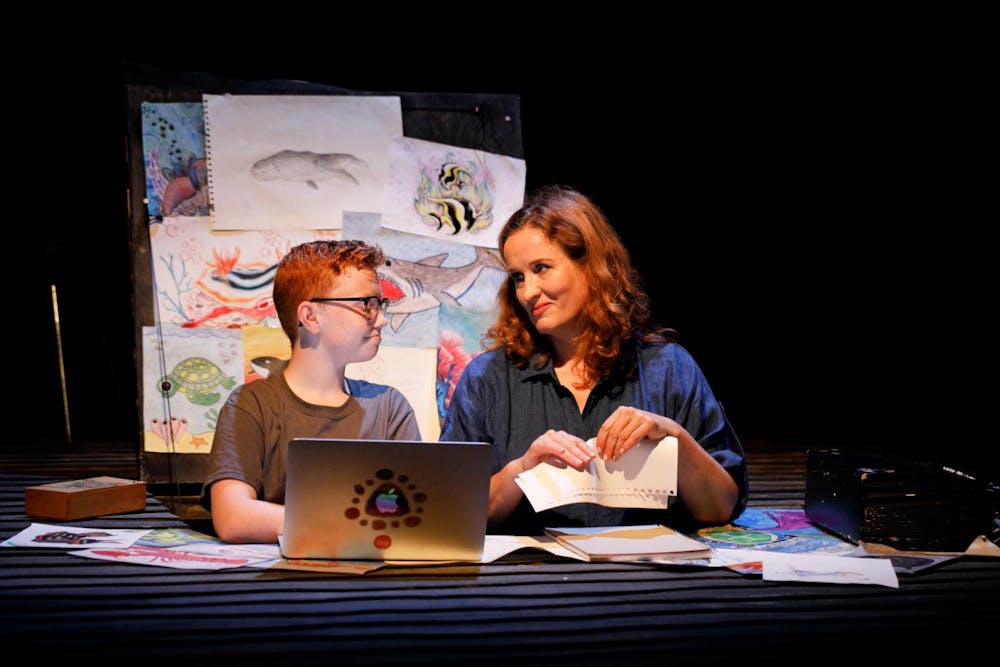
Whale Fall follows the emotional journey of a 12-year-old boy, Caleb (Ashton Brady), and his family grappling with Caleb’s desire to medically affirm his gender: letting go of the daughter they had; accepting and getting to know the son he has become.

We are immersed in an ocean setting. Ian Sinclair’s script carries a strong marine undercurrent from beginning to end: the beachside house, the young boy’s dream of becoming a marine biologist, his excitement in recounting his readings about intriguing sea creatures to his mother, Nadine (Caitlin Beresford-Ord), and the parallel theme of whale fall sewn into the story. This is the new life borne out of a dead whale when it reaches the ocean floor.

The play is as much about a young trans person’s journey as it is about Australians’ strong connection to the ocean and ever-increasing awareness of our ecological responsibility for its preservation.

In death, and life

Sinclair drew inspiration for his play from Rebecca Grigg’s 2015 essay of the same name, which she later developed into the book Fathoms (2020).

Contrary to common belief, most whales’ bodies are slightly higher in density than seawater. Unless their lungs are filled with air, whales will quickly sink to the bottom of the ocean.

Once decomposition of a dead whale sets in, the carcass’ density decreases and gas is produced through putrefaction. In marine environments over 100 meters deep, hydrostatic pressure is sufficiently high to hold carcasses on the seafloor.

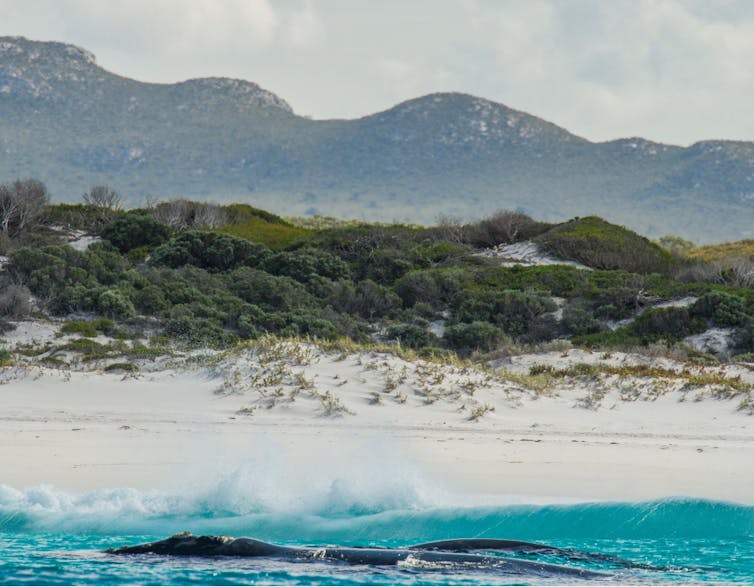
Two southern right whales resting along an Australian beach. Chandra P. Salgado Kent

On the seabed, the carcass transitions to what is scientifically called a “whale fall ecosystem” – a unique habitat island inhabited by a biodiverse and highly specialised range of marine organisms subsisting on the dead carcass.

Since their discovery in the late 1980s, it has become clear that whale fall ecosystems are abundant in certain regions of the deep sea. They support extraordinarily rich communities of species, which can be supported by one whale fall for decades.


Read more: A theatre project explores collective solutions to saving the ocean


Caleb explores the whale’s journey as a way of both escaping the emotional toll of his situation, and finding his path forward.

He sees the whale — a mammal like himself — living and dying in deep-sea darkness, before emerging and giving life in a new form.

The boy’s account of the whale’s journey into the abyss and transforming into whale fall is a delightful mixture of poetry and accurate scientific detail, conjuring images of what it might be like to undergo such a change.

A young boy and his mother
In studying the whale fall, Caleb finds both escape and joy. Perth Festival/Daniel James Grant

Ashton smoothly rolls the scientific poetry off his tongue to describe the “buoyancy of the meat” of the sinking whale, “weighed down by bones, with white worms clinging to a parachute of muscle, a macabre marionette”.

He then takes us into the complex ecosystem of isopods, polychaetes, crustaceans and deep-sea fish that eventually scavenge and inhabit the carcass: incredible new life in the abyssal depths of the sea.

Ecological responsibility

Whale Fall brilliantly brings important social issues, and an intriguing and important ecological phenomenon, to a mainstream audience.

Under Melissa Cantwell’s direction, the performers tell the powerful story with tenderness, emotional outbursts and witty humour.

The dynamic tempo (sound design and composition by Rebecca Riggs-Bennett) is sometimes playful, intensifying to a climax and then releasing, only to be followed by a new wave of dynamic emotion, leaving you caught up in the journey.

Whale Fall highlights our internal battles to adapt to life’s challenges, its humanity, and important social issues regarding gender identity — all while communicating a message about ecological responsibility for safeguarding the ocean.

Only by exploring these issues through powerful, emotionally engaging and thought-provoking artistic works such as this one can we create the cultural changes required for a healthy society.

Whale Fall is at PICA Performance Space until 27 February.

ref. Perth Festival review: Whale Fall is a powerful story about a trans boy, and the life of a whale – https://theconversation.com/perth-festival-review-whale-fall-is-a-powerful-story-about-a-trans-boy-and-the-life-of-a-whale-155733

One of these things is not like the others: why Facebook is beyond our control

Source: The Conversation (Au and NZ) – By Peter Martin, Visiting Fellow, Crawford School of Public Policy, Australian National University

What’s the difference between Google and Facebook?

One difference is that in the past week Google has more-or-less agreed to pay Australian news outlets for their content faced with the threat of government action to force it to.

Facebook most definitely has not, removing Australian news from its feeds.

Another is the reason why.

It’s that Google faces competition, whereas Facebook really doesn’t.

In economists’ language, that’s because Facebook enjoys a rare “network effect”, Google scarcely at all.

If I want to switch from Google to another search engine (something I’ve done) it costs me next to nothing. I might find it hard to move my search history over (although there’s probably an app for that) but otherwise the new search engine will either be better, worse or about the same as the one I left. I’m free to find out.

Google faces competition

It means that Google is forced to defend itself from competition (or the threat of competition) by providing an extraordinarily good service.

Not so Facebook. Although a relatively new concept in economics, the idea of a network effect dates back to at least 1908 when the president of the American Telephone and Telegraph Company, Theodore Vail, spelled it out in a letter to stockholders.

“A telephone, without a connection at the other end of the line, is not even a toy or a scientific instrument,” he wrote. “It is one of the most useless things in the world. Its value depends on the connection with the other telephone — and increases with the number of connections.”

Facebook faces hardly any

The idea has since been expressed in a mathematical formula, but there’s no need to get into details. The world’s first telephone was indeed useless, the second allowed one household to reach only one other. But by the time there were millions, and almost every household had one, each telephone became incredibly valuable, allowing that household to reach almost every other household.

A startup that tried to compete with the phone system would be offering a very unappealing product. It wouldn’t be able to offer anything like the connections of the existing system until a huge proportion of the population signed up, meaning people would be reluctant to sign up, meaning it would stay unappealing.


Read more: We allowed Facebook to grow big by worrying about the wrong thing


Which is the point Vail was making. When it gets big enough, the telephone service is something close to a natural monopoly. There’s no point in anyone setting up a competing one (and in Australia we haven’t — the competing companies, Telstra, Optus and so on, share the one network).

The ASX stock exchange is another example, as is eBay. You could try to sell something on a different platform, but you wouldn’t reach nearly as many potential customers, so you mightn’t get as good a price.

The Australian Competition and Consumer Commission puts it this way in its report on Facebook: even if the government made it easier for a user to switch to another network, perhaps by mandating the transfer of data,

if none of the user’s friends or family are moving away from Facebook, that user would be unlikely to switch platforms

The “lock in” that happens when a network gets so big people feel they have to use it means it doesn’t have to treat them particularly well to get them to stay.

Without Facebook, it’s hard to know what family and friends are up to. Gil C/Shutterstock

Seventeen million Australians use Facebook every four weeks — a huge proportion of the population, and an even bigger proportion of the population aged over 14 (80%).

Without Facebook, it would be hard to know what family and friends and long-lost classmates are up to — whether or not Facebook offers news. It doesn’t need to treat its users particularly well to get them to stay.

Facebook isn’t quite like the phone system. Young people find the fact that so many old people can use it to check up on them a turn-off and go elsewhere. But for the Australians already on it (that’s most Australians) it’s worth staying.

And there’s room for smaller specialised networks.

Linkedin has its own network for people concerned about the jobs market. If that’s the world you’re in, it’s wise to be on it because of the huge number of other such people who are on it. There’s not much point leaving it for something else.

It’s the same for Tinder, which services a different type of market.

Winner take all

It wasn’t always that way for Facebook. Fifteen years ago MySpace was how people connected, but not that many of them — it hadn’t grown to the point where network effects took over. When they did, there could be only one clear winner, and it happened to be Facebook.

Now not even its bad behaviour (Roy Morgan finds it is Australia’s least-trusted brand) can stop most people using it.

Australia’s COVID campaign, off Facebook.

In the same way as people who want the lights on generally have to use the electricity company, people who want to catch trains generally have to use the railway and people who want to drive cars generally have to buy petrol, people who want to stay in touch generally have to use Facebook.

Which makes the government’s decision to remove its vaccination advertising campaign from Facebook silly. Facebook reaches 80% of its target audience.

Facebook has become a (trans-national) utility, unconcerned about its image. Attempts by one government, or even a coalition of governments, to force it to do anything are pretty much a lost cause.

No-one wanted it to be like this, and it’s not like this for Google. Facebook has moved beyond our control.

ref. One of these things is not like the others: why Facebook is beyond our control – https://theconversation.com/one-of-these-things-is-not-like-the-others-why-facebook-is-beyond-our-control-155748

This 17,500-year-old kangaroo in the Kimberley is Australia’s oldest Aboriginal rock painting

Source: The Conversation (Au and NZ) – By Damien Finch, Postdoctoral Researcher, University of Melbourne

In Western Australia’s northeast Kimberley region, on Balanggarra Country, a two-metre-long painting of a kangaroo spans the sloping ceiling of a rock shelter above the Drysdale River.

In a paper published today in Nature Human Behaviour, we date the artwork as being between 17,500 and 17,100 years old — making it Australia’s oldest known in-situ rock painting.

We used a pioneering radiocarbon dating technique on 27 mud wasp nests underlying and overlying 16 different paintings from 8 rock shelters. We found paintings of this style were produced between 17,000 and 13,000 years ago.


Read more: At last, the arts Revolution — Archibald winners flag the end of white male dominance


Our work is part of Australia’s largest rock art dating initiative. The project is based in the Kimberley, one of the world’s premier rock art regions. Here, rock shelters have preserved galleries of paintings, often with generations of younger artwork painted over older work.

By studying the stylistic features of the paintings and the order in which they were painted when they overlap, a stylistic sequence has been developed by earlier researchers based on observations at thousands of Kimberley rock art sites.

They identified five main stylistic periods, of which the most recent is the familiar Wanjina period.

Styles in rock art

The oldest style, which includes the kangaroo painting we recently dated, often features life-sized animals in outline form, infilled with irregular dashes. Paintings in this style are said to belong to the “Naturalistic” stylistic period.

The ochre used is an iron oxide in a red-mulberry colour. Unfortunately, no current scientific dating method can determine when this paint was applied to the rock surface.

A different approach is to date fossilised insect nests or mineral accretions on the rock surfaces that happen to be overlying or underlying rock art pigment. These dates provide a maximum (underlying) or minimum (overlying) age range for the painting.

Our dating suggests the main period for Naturalistic paintings in the Kimberley spanned from at least 17,000 to 13,000 years ago.

The oldest known Australian artwork

Very rarely, we’ll find mud wasp nests both overlying and underlying a single painting. This was the case with the painting of the kangaroo, made on the low ceiling of a well-protected Drysdale River rock shelter.

We were able to date three wasp nests underlying the painting and three nests built on top of it. With these ages, we determined confidently the painting is between 17,500 and 17,100 years old; most likely close to 17,300 years old.

The 17,300 year old painting of a two-metre long kangaroo can be found on the ceiling of a Kimberley rock shelter. Damien Finch. Illustration by Pauline Heaney

Our quantitative ages support the proposed stylistic sequence that suggests the oldest Naturalistic style was followed by the Gwion style. This style featured paintings of decorated human figures, often with headdresses and holding boomerangs.

From animals and plants to people

Research we published last year shows Gwion paintings flourished about 12,000 years ago — some 1,000-5,000 years after the Naturalistic period.

This map of the Kimberley region in Western Australia shows the coastline at three distinct points in time: today, 12,000 years ago (the Gwion period) and 17,300 years ago (the earlier end of the known Naturalistic period). Illustration by Pauline Heaney, Damien Finch

With these dates, we can also partially reconstruct the environment in which the artists lived 600 generations ago. For example, much of the Naturalistic period coincided with the end of the last ice age when the environment was cooler and drier than now.

During the Naturalistic period, 17,000 years ago, sea levels were a staggering 106 metres below today’s and the Kimberley coastline was about 300 kilometres further away, more than half the distance to Timor.

Aboriginal artists at this time often chose to depict kangaroos, fish, birds, reptiles, echidnas and plants (particularly yams). As the climate warmed, ice caps melted, the monsoon was re-established, rainfall increased and sea levels rose, sometimes rapidly.

Traditional Owner Ian Waina inspecting a painting of a kangaroo that we now know is more than 12,700 years old, based on the age of overlying mud wasp nests. INSET: an artist’s recreation of the in-situ rock painting. Photo by Peter Veth / Balanggarra Aboriginal Corporation. Illustration by Pauline Heaney.

By the Gwion period around 12,000 years ago, sea levels had risen to 55m below today’s. This would undoubtedly have prompted long-term adjustment to territories and social relations.

This is when Aboriginal painters depicted highly decorated human figures, bearing a striking resemblance to early 20th-century photographs of Aboriginal ceremonial dress. While plants and animals were still painted, human figures were clearly the most popular subject.


Read more: ‘All things will outlast us’: how the Indigenous concept of deep time helps us understand environmental destruction


Reaching into the past

While we now have age estimates for more paintings than ever before, more work is continuing to find out, more accurately, when each art period began and ended.

For example, one minimum age on a Gwion painting suggests it may be more than 16,000 years old. If so, Gwion art would have overlapped with the Naturalistic period but further dates are required to be more certain.

Moreover, it’s highly unlikely the oldest known Naturalistic painting we dated is the oldest surviving one. Future research will almost certainly locate even older works.

For now, however, the 17,300-year-old kangaroo is a sight to marvel at.


Acknowledgements: we would like to thank the Balanggarra Aboriginal Corporation, the Australian National Science and Technology Organisation, Rock Art Australia and Dunkeld Pastoral Co for their collaboration on this work.

ref. This 17,500-year-old kangaroo in the Kimberley is Australia’s oldest Aboriginal rock painting – https://theconversation.com/this-17-500-year-old-kangaroo-in-the-kimberley-is-australias-oldest-aboriginal-rock-painting-154181

Not as simple as ‘no means no’: what young people need to know about consent

Source: The Conversation (Au and NZ) – By Jacqueline Hendriks, Research Fellow and Lecturer, Curtin University

A recent petition circulated by Sydney school girl Chanel Contos called for schools to provide better education on consent, and to do so much earlier.

In the petition, which since Thursday has been signed by more than 5,000 people, Contos writes that her school

… provided me with life changing education on consent for the first time in year 10. However, it happened too late and came with the tough realisation that amongst my friends, almost half of us had already been raped or sexually assaulted by boys from neighbouring schools.

So, what core information do young people need to know about consent? And is the Australian curriculum set up to teach it?

What’s in the curriculum?

This is not the first time young people have criticised their school programs. Year 12 student Tamsin Griffiths recently called for an overhaul to school sex education after speaking to secondary students throughout Victoria. She advocated for a program that better reflects contemporary issues.

Australia’s health and physical education curriculum does instruct schools to teach students about establishing and maintaining respectful relationships. The resources provided state all students from year 3 to year 10 should learn about matters including:

  • standing up for themselves

  • establishing and managing changing relationships (offline and online)

  • strategies for dealing with relationships when there is an imbalance of power (including seeking help or leaving the relationship)

  • managing the physical, social and emotional changes that occur during puberty

  • practices that support reproductive and sexual health (contraception, negotiating consent, and prevention of sexually transmitted infections and blood-borne viruses)

  • celebrating and respecting difference and diversity in individuals and communities.

Despite national guidance, there is wide variability in how schools interpret the curriculum, what topics they choose to address and how much detail they provide. This is further compounded by a lack of teacher training.


Read more: Relationships and sex education is now mandatory in English schools – Australia should do the same


A study of students in South Australia and Victoria, along with repeated nationwide surveys of secondary students, have shown young people do consider school to be a trustworthy source of sex education. But most don’t believe the lessons have prepared them adequately for relationships and intimacy.

They want lessons that take into account diverse genders and sexualities, focus less on biology, and provide more detail about relationships, pleasure and consent.

The national curriculum also stops mandating these lessons after year 10 and many year 11 and 12 timetables are focused on university entrance exams or vocational learning opportunities. This means senior students have limited opportunity to receive formal sex education at a time when they really need it.

So, what should young people know about consent?

The term “consent” is often associated with sex, but it’s much broader than that. It relates to permission and how to show respect for ourselves and for other people. Consent should therefore be addressed in an age-appropriate way across all years of schooling.

Kids playing with toy train.
Younger children can be taught about consent with relation to sharing toys. Shutterstock

The most important point about consent is that everyone should be comfortable with what they’re engaging in. If you are uncomfortable at any point, you have the right to stop. On the other side, if you see someone you are interacting with being uncomfortable, you need to check in with them to ensure they are enthusiastic about the activity, whatever it may be.

In the early years, students should be taught how to affirm and respect personal boundaries, using non-sexual examples like whether to share their toys or give hugs. It is also important they learn about public and private body parts and the importance of using correct terminology.


Read more: Why having the sex talk early and often with your kids is good for them


In later years, lessons should consider more intimate or sexual scenarios. This also includes consent and how it applies to the digital space.

Older students need to learn sexual activity is something to be done with someone, not to someone. Consent is a critical part of this process and it must be freely given, informed and mutual.

Consent isn’t about doing whatever we want until we hear the word “no”. Ideally we want all our sexual encounters to involve an enthusiastic “yes”.

But if your partner struggles to say the word “yes” enthusiastically, it is important to pay attention to body language and non-verbal cues. You should feel confident your partner is enjoying the activity as much as you are, and if you are ever unsure, stop and ask them.

Often this means checking in regularly with your partner.

Chanelc Instagram Screenshot

Young people also need to know just because you have agreed to do something in the past, this does not mean you have to agree to do it again. You also have the right to change you mind at any time — even partway through an activity.

It’s not as simple as ‘no means no’

The most recent Australian survey of secondary school students highlighted that more than one-quarter (28.4%) of sexually active students reported an unwanted sexual experience. Their most common reasons for this unwanted sex was due to pressure from a partner, being intoxicated or feeling frightened.

We should be careful not to oversimplify the issue of consent. Sexual negotiation can be a difficult or awkward process for anyone — regardless of their age — to navigate.

Some academics have called for moving beyond binary notions of “yes means yes” and “no means no” to consider the grey area in the middle.


Read more: Forget the pick-up lines – here’s how to talk about your sexual desires and boundaries


While criminal acts such as rape are perhaps easily understood by young people, teaching materials need to consider a broad spectrum of scenarios to highlight examples of violence or coercion. For example, someone having an expectation of sex because you’ve flirted, and making you feel guilty for leading them on.

When it comes to sexual activity, we should be clear that:

  • although the law defines “sex” as an activity that involves penetration, other sexual activities may be considered indecent assault

  • a degree of equality needs to exist between sexual partners and it is coercive to use a position of power or methods such as manipulation, trickery or bribery to obtain sex

  • a person who is incapacitated due to drugs or alcohol is not able to give consent

  • wearing certain clothes, flirting or kissing is not necessarily an invitation for other things.

We should also challenge gender stereotypes about who should initiate intimacy and who may wish to take things fast or slow. Healthy relationships involve a ongoing and collaborative conversation between both sexual partners about what they want.

Consent is sexy

A partner who actively asks for permission and respects your boundaries is showing they respect you and care about your feelings. It also leads to an infinitely more pleasurable sexual experience when both partners are really enjoying what they are doing.

It is important that lessons for older students focus on the positive aspects of romantic and sexual relationships.

They should encourage young people to consider what sorts of relationships they want for themselves and provide them with the skills, such as communication and empathy, to help ensure positive experiences.


More information about consent:

ref. Not as simple as ‘no means no’: what young people need to know about consent – https://theconversation.com/not-as-simple-as-no-means-no-what-young-people-need-to-know-about-consent-155736

The news media bargaining code could backfire if small media outlets aren’t protected: an economist explains

Source: The Conversation (Au and NZ) – By Simon Wilkie, Dean, Faculty of Business and Economics; Head of Monash Business School, Monash University

When I was the chief economist at the US Federal Communications Commission, we oversaw was the acquisition of DirecTV, the satellite pay-TV platform, by News Corp in 2003.

Prior to the merger, DirecTV did not own significant content, and content-rich News Corp did not own a pay-TV distribution platform.

Economic analysis showed the merged entity would have the incentive to raise the price of certain TV channels, such as the Fox broadcast network and Fox sports channels, that were sold to rival pay-TV distribution platforms and cable companies such as Comcast.

To counteract this anti-competitive harm, we developed what is known as the FCC arbitration mechanism if firms could not agree on a price for a channel.

This is the same mechanism the Morrison government’s news media bargaining code would impose on Facebook and Google in Australia to force them to compensate Australian media companies for linking to and using their content.

In the US context, the arbitration mechanism worked. In particular, News Corp founder Rupert Murdoch complained about his inability to raise prices and subsequently sold DirecTV to get out of the arbitration requirement.


Read more: Google’s and Facebook’s loud appeal to users over the news media bargaining code shows a lack of political power


But there are some stark differences between the US and Australian contexts. In particular, there were many other channels in the US that were not affected by the merger, so an arbitrator could use the market price benchmark for what was a reasonable price for a TV channel.

For example, a cable company such as Comcast could submit its contracts with broadcast television networks like ABC, NBC and CBS to benchmark the price for the Fox network.

In the Australian context, there is no such benchmark competitive price for the value of news content. Hence the government’s encouragement for parties to reach commercial agreements before the news media bargaining code takes effect, to better inform the arbitrator.

Although the aims of the bargaining code are laudable, Facebook responded last week with a drastic move: blocking the sharing and publishing of Australian news on its platform. Research indicates this could be devastating to the small news publishers in Australia.

The federal government has announced it is pulling all advertising campaigns from Facebook in response to the tech giant’s move last week. Andrew Harnik/AP

What happened when Google News was shut down in Spain

In an important study, Stanford economist Susan Athey and her colleagues Markus Mobius and Jeno Pal examined the impact of the withdrawal of Google News from Spain in 2014.

Similar to Australia today, Spanish regulators required that Google pay publishers for news content. In response, Google shut down Google News in Spain.

By studying the online behaviour of a large set of individual users who had agreed to be tracked, they found that overall online news consumption in Spain (as measured by page visits) declined by around 10%, which is consistent with other studies.

But thanks to the use of individual data, they were able to dig deeper and found the decline was concentrated on a specific set of users. People who specifically relied on Google News to initiate a news search reduced their news consumption by about 20%.

In a concerning finding, this reduction in news consumption disproportionately affected smaller publishers, who experienced a dramatic reduction in page visits. In contrast, large publishers saw an increase in visits to their landing page.

This was particularly true in cases of “breaking news”, where large publishers had the advantage of being first to report.

As a result, the authors wrote, large publishers likely saw their advertising revenues increase. And overall, there was also a change in the type of news people consumed, with fewer people gravitating toward breaking news, hard news and news from diverse news outlets.


Read more: Local news sources are closing across Australia. We are tracking the devastation (and some reasons for hope)


If the role of Facebook in Australia is similar to Google News in Spain in terms of driving traffic to individual news outlets, then the consequences of Facebook’s recent action will be dire for public interest journalism — and, in particular, the diversity of the Australian media landscape.

It will likely increase the market share of entrenched major media outlets and reduce visits to smaller players. If this is the case, the goals of the news media bargaining code will not have been met. It will have backfired.

Fixed payments won’t lead to more investment

There is a second and subtle point of economics relating to how the bargaining code is implemented. The arbitration rules under the code now require a digital platform to make a fixed payment to a media outlet for two years of content.

A fundamental principle of economics is that a fixed cost — or a fixed sum of revenue — does not affect a firm’s decision on how much of a product it makes or the quality of what it produces.

As pointed out by economist Josh Gans, this means a fixed payment from Facebook or Google to news providers will not necessarily lead to any more dollars being invested in journalism by major media firms.

If the objective of the code is to drive a healthier public interest journalism landscape, this is a shortcoming that needs to be addressed.


Read more: The old news business model is broken: making Google and Facebook pay won’t save journalism


To ensure the best possible outcomes for small-to-medium-sized public interest news producers — an important element of media diversity — the government should consider using the revenue from Google and Facebook for short-term capacity funding in the first 12 months of the code.

This would be funding specifically earmarked for the small- and medium-size publishers who will be the most adversely affected.

However, the principles of economics also tell us that a fixed amount of costs or revenue does affect one decision by a firm — the choice to either shut down or stay in business.

So, the code may have a positive effect on Australian public interest journalism to the extent that any payments may keep struggling, small publishers in business with an influx of steady cash.

This further reinforces that the focus should be on small publishers, rather than the larger news organisations.

Most of the attention on the code, thus far, has been on larger players. But if the real issue is in the sustainability of small publishers, we must look beyond the code to introduce additional mechanisms to ensure the viability of public interest journalism, including regional news or journalism for hyper-local markets.

This could include, for instance, taxation reform to fund public interest journalism.

Even with the best possible outcome under the code, measures such as this are necessary and must be implemented as a matter of urgency.

ref. The news media bargaining code could backfire if small media outlets aren’t protected: an economist explains – https://theconversation.com/the-news-media-bargaining-code-could-backfire-if-small-media-outlets-arent-protected-an-economist-explains-155745

Catching COVID from surfaces is very unlikely. So perhaps we can ease up on the disinfecting

Source: The Conversation (Au and NZ) – By Hassan Vally, Associate Professor, La Trobe University

A lot has happened over the past year, so you can be forgiven for not having a clear memory of what some of the major concerns were at the beginning of the pandemic.

However, if you think back to the beginning of the pandemic, one of the major concerns was the role that surfaces played in the transmission of the virus.

As an epidemiologist, I remember spending countless hours responding to media requests answering questions along the lines of whether we should be washing the outside of food cans or disinfecting our mail.

I also remember seeing teams of people walking the streets at all hours wiping down poles and cleaning public benches.

But what does the evidence actually say about surface transmission more than 12 months into this pandemic?

Before addressing this, we need to define the question we’re asking. The key question isn’t whether surface transmission is possible, or whether it can occur in the real world — it almost certainly can.

The real question is: what is the extent of the role of surface contact in the transmission of the virus? That is, what is the likelihood of catching COVID via a surface, as opposed to other methods of transmission?

The evidence is minimal

There’s little evidence that surface transmission is a common way in which the coronavirus is spread. The main way it’s spread is by the air, either by larger droplets via close contact, or by smaller droplets called aerosols. As a side note, the relative role these two routes play in transmission is probably a much more interesting and important question to clarify from a public health perspective.

One of the best commentaries on COVID surface transmission was published in the journal Lancet Infectious Diseases in July 2020 by Emanuel Goldman, a professor of microbiology from the United States.

As he described, one of the drivers for the exaggerated perception of the risk of surface transmission was the publication of a number of studies showing SARS-CoV-2 viral particles could be detected for long periods of time on various surfaces.

You probably saw these studies because they received enormous publicity worldwide and I remember doing numerous interviews in which I had to explain what these findings actually meant.

As I explained at the time, these studies could not be generalised to the real world, and in some instances the media releases accompanying them tended towards overstating the significance of these findings.

The key issue is that as a general principal the time required for a population of microoganisms to die is directly proportional to the size of that population. This means the greater the amount of virus deposited on a surface, the longer you will find viable viral particles on that surface.

So in terms of designing experiments that are relevant to public health, one of the more important variables in these studies is the amount of virus deposited on a surface — and the extent to which this approximates what would happen in the real world.

If you understand this, it becomes apparent that a number of these virus survival studies stacked the odds of detecting viable virus by depositing large amounts of virus on surfaces far in excess of what would be reasonably expected to be found in the real world. What’s more, some of these studies customised conditions that would extend the life of viral particles, such as adjusting humidity and excluding natural light.

Although there was nothing wrong with the science here, it was the real world relevance and the interpretation that was amiss at times. It’s notable that other studies which more closely replicated real world scenarios found less impressive survival times for three other human coronaviruses (including SARS).

It’s important to note we’re relying on indirect evidence in assessing the role of surface transmission for the coronavirus. That is, you can’t actually do an ethical scientific experiment that confirms the role surface transmission plays because you’d have to deliberately infect people. Despite being such a seemingly straightforward question, it’s surprisingly difficult to determine the relative importance of the various transmission pathways for this virus.

What we have to do instead is look at all of the evidence we do have and see what it’s telling us, including case studies describing transmission events. And if we do this, there isn’t a lot out there to support surface transmission being of major importance in the spread of COVID.

Cleaner in hazmat suit disinfecting the pavement in Duomo square, Milan, Italy.
Many countries spend a lot of money cleaning surfaces. It might not be worth it. Luca Bruno/AP/AAP

We could save a lot of time and money

We need to put the risks of exposure to SARS-CoV-2 via the various modes of transmission into perspective, so we focus our limited energy and resources on the right things.

This isn’t to say surface transmission isn’t possible and that it doesn’t pose a risk in certain situations, or that we should disregard it completely. But, we should acknowledge the threat surface transmission poses is relatively small.

We can therefore mitigate this relatively small risk by continuing to focus on hand hygiene and ensuring cleaning protocols are more in keeping with the risk of surface transmission.

In doing this, we can potentially save millions of dollars being spent on obsessive cleaning practices. These are probably providing little or no benefit and being done solely because they’re easy to do and provide the reassurance of doing something, thereby relieving some of our anxieties.

ref. Catching COVID from surfaces is very unlikely. So perhaps we can ease up on the disinfecting – https://theconversation.com/catching-covid-from-surfaces-is-very-unlikely-so-perhaps-we-can-ease-up-on-the-disinfecting-155359

Australia’s marine (un)protected areas: government zoning bias has left marine life in peril since 2012

Source: The Conversation (Au and NZ) – By Bob Pressey, Professor, Conservation Planning, ARC Centre of Excellence for Coral Reef Studies, James Cook University

Last week Australia joined a new alliance of 40 countries pledging to protect 30% of the world’s oceans by 2030 from pollution, overfishing, climate change and other environmental threats. Australia already boasts one of the largest networks of marine protected areas in the world, with about half of Commonwealth waters around mainland Australia under some form of protection.

Job done? Actually, no.

Despite the size of our protected areas, marine wildlife continues to vanish. A government report card recently scored the Great Barrier Reef a “D” for its failing health. Meanwhile, commercial fishing depletes non-target or non-economic species as collateral damage, and damages marine habitats through trawling, the marine equivalent of clear felling forests. These issues are extensive, but poorly understood.

So why the paradox? Our research analysis reveals that size is misleading. Marine zonings vary in their effectiveness in protecting biodiversity, and zones established in 2012, 2015 and 2018 put effective protection in the wrong places.

Unhelpful from the start

In a rich, developed country, a society’s commitment to nature conservation is measured by what it’s prepared to give up. In Australia, that’s not much.

In late 2012, Labor announced a massive increase in Commonwealth marine protected areas (MPAs). But it failed to mention that the placement of “highly protected zones” — which don’t allow any commercial extraction — had no effect on oil and gas activities and a very minor effect on commercial fishing.

Fishing trawler at sea, surrounded by gulls
Many commercial fishing practices, such as trawling, damage marine ecosystems. Shutterstock

As a result, the contribution of the 2012 MPAs to conservation was disproportionately small.

In 2015 the Federal Coalition changed the 2012 zonings. In 2018 the Coalition changed them again.

The Coalition was openly hostile toward the 2012 MPA expansion, so it came as no surprise the 2015 and 2018 MPA systems would become even more strongly residual — biased towards areas with least promise for extractive activities.

Our recent paper tells the story in detail, but here’s a summary.

Zoning the ocean to make almost no difference

Labor’s 2012 additions to the MPA system covered 2.4 million square kilometres, an impressive figure at first glance.

Under the Coalition, the boundaries of Labor’s new MPAs were not altered, but there were large changes to the internal zonings, which specify permitted uses, in 2015 and 2018.

The changes meant highly protected zones declined from 37% of the total MPA system in 2012 to about 22% in 2018. Other zones that allow fishing with varying restrictions, or that place few restrictions on commercial extraction, made up the rest. The conservation benefits of those other zones — dubbed “partially protected areas” — are dubious.

Coral
Last week a reef quality report card highlighted the marine environment around the Great Barrier Reef remains poor. Shutterstock

How much difference did all the zoning and rezoning make to marine conservation? Very little.

That’s because, from the start, highly protected zones were put in places with no petroleum extraction and low previous fishing yield. The bias was only exaggerated in 2015, and again in 2018.


Read more: 75% of Australia’s marine protected areas are given only ‘partial’ protection. Here’s why that’s a problem


By 2018, less than 1% of the area previously used for Commonwealth pelagic longlining had been protected from longlining. Pelagic longlining involves setting baited hooks on lines that can be kilometres long, suspended in the water. It can seriously harm non-target species, including sharks and seabirds.

Likewise, only about 1.5% of Australia’s previously trawled areas became covered by zones that prohibit trawling, a practice also known to have serious biodiversity impacts, such as destroying seafloor habitat.

The zoning of the Coral Sea tells part of the story. The 2012 highly protected zones carefully avoided most commercial fishing in this vast region of open ocean, and research showed the benefits to conservation were “minimal”. When the 2012 zones were changed, the area open to fishing methods that pose ecological risks increased further.

Is Australia really leading the world?

After the latest weakening — proposed in 2017 and formalised in 2018 — of the already weak 2012 marine protection, the federal environment minister and the director of Parks Australia said the revisions achieved the right balance between conservation and use.


Read more: The Coral Sea: an ocean jewel that needs more protection


In terms of commercial fishing, we show the “balance” was about 2% conservation and 98% use across all of Commonwealth marine waters, which cover almost six million square kilometres.

In real terms, Australia’s marine protection is minuscule, and its marine unprotected areas are vast — a failure that has attracted international criticism. In 2017, for instance, 1,286 researchers from 45 countries lambasted the federal government’s draft marine park management plans that are now in place.

Julia Gillard in front of a Labor sign
In late 2012, Labor announced a massive increase in Commonwealth marine protected areas. AAP Image/Alan Porritt

The current highly protected zones might guard against future expansion of petroleum extraction and commercial fishing, as technologies and markets evolve. Unfortunately, however, the chances of that seem slim.

Australian MPA decisions since 2012 suggest strongly that, if highly protected zones are found to prevent profitable extraction, they will be downgraded or moved so they don’t get in the way.

Three ways Australia could lead the world (again)

Australia led the world with the 2004 rezoning of the Great Barrier Reef Marine Park, a systematic exercise that placed about a third of the Park in highly protected zones. But almost 17 years on, we can see plenty of room for improvement in marine conservation as we learn what works and what doesn’t.


Read more: The Great Barrier Reef is in trouble. There are a whopping 45 reasons why


How could Australia lead the world now? A first step would be to drop the deception that square kilometres say anything meaningful about conservation.

Our commitment to marine conservation will be measured by how much oil and gas we leave under the seabed, how many fish we leave in the water, and how we catch the others. Decarbonising and properly managing catchments and coastal zones will also be critical.

A second step would be to establish explicit, quantitative, scientifically informed goals for conservation of individual species and ecosystems in highly protected zones. The lack of such goals allowed zonings from 2012 to 2018 to be passed off as representative of marine environments, when they were not.


Read more: Humans threaten the Antarctic Peninsula’s fragile ecosystem. A marine protected area is long overdue


A third step would be to achieve explicit conservation goals through consultation with diverse stakeholders. This includes co-design and co-management of coastal MPAs that empower local communities and Indigenous peoples from the outset, rather than through consultation late in the process.

After many years of debate over MPAs, some will throw their hands up at the prospect of yet more planning. But that’s what’s needed to make Australia’s MPA zoning effective, along with the (recently elusive) vision and commitment needed for political leadership in real marine conservation.

ref. Australia’s marine (un)protected areas: government zoning bias has left marine life in peril since 2012 – https://theconversation.com/australias-marine-un-protected-areas-government-zoning-bias-has-left-marine-life-in-peril-since-2012-153795

Why we should release New Zealand’s strangled rivers to lessen the impact of future floods

Source: The Conversation (Au and NZ) – By Gary John Brierley, Professor, Chair of Physical Geography, University of Auckland

When two West Coast rivers flooded on the same day in 2019, the Waiho tore down a bridge and cut off local communities for 18 days, and the Fox eroded a landfill, exposing 135 tonnes of rubbish that contaminated beaches more than 100km away.

A flood on the Rangitata River during the same year severed road, rail and power connections along the east coast of the South Island and cut a 25km path to the sea through prime dairy country.

We shouldn’t be surprised when our rivers break their banks — that’s just a river being a river. Current management practices in Aotearoa treat rivers as static, in the hope of making them more predictable.

But this can lead to disasters.

The recently announced reform of the Resource Management Act (RMA) is an opportunity to address river confinement, but it isn’t enough. We need to change the way we think about rivers.

By forcing rivers into confined channels, we are strangling the life out of them and creating “zombie rivers”.

Unless we change management practices to work with a river, giving it space to move and allowing channels to adjust, we will continue to put people and rivers on a collision course.

When flood risk is managed poorly, disadvantaged groups of the population are often disproportionately impacted. Given climate change predictions of more extreme floods and drought, the problem will only get worse.


Read more: Letting rivers run wild could reduce UK flooding – new research


Working with a river, not against it

A healthy river is resilient, constantly adjusting its path and regenerating habitats, with significant capacity to self-heal and recover from disturbance.

Although New Zealanders associate with the ecological and cultural values of living rivers, such as ancestral connections and places of food gathering (mahingai kai), our management practices continue to treat rivers as unchanging. This reflects a colonial approach that tries to confine rivers within defined corridors to maximise the availability of land and manage flood risk.

Images of river channels of the Ngaruroro River, and how they changed between 1950 and 2020.
Photogrammetric and satellite images from identical positions show how a section of the Ngaruroro River, in the Hawkes Bay, changed between 1950 (left) and 2020 (right). NZ Aerial Photography (via Retrolens), SN541 (1950) and Google Earth/Digital Globe (2000).​, Author provided

River confinement in New Zealand is the result of both engineering works such as stop banks, intentionally focused on flood defence, and the slow creep of agricultural encroachment. Current river management practices are funded by targeted rates paid by landowners. Their goal is to protect as much land as possible as cheaply as possible.

This has arguably been very effective to date and is understandable, but ignores other river values. It also misses the point that when design limits are exceeded, disaster usually follows.

Effective river management

There are always trade-offs. For example, planting introduced willows along river banks is a cost-effective way of trying to control the river in the short term. But willows spread aggressively and choke the river, diminishing habitat diversity and reducing the river’s capacity to transport flood waters and gravel. This exacerbates risk in the medium to long term.

In scientific terms, effective approaches to river management look after the geomorphology of river systems — the interactions that shape the changing mosaic of river habitats — alongside concerns for water quality and aquatic ecology. This requires analysis of flows and sediment deposition to assess how a river uses its energy.


Read more: When dams cause more problems than they solve, removing them can pay off for people and nature


When a river has space to move, it dissipates its energy. This builds its capacity to recover from disturbances and maintain a dynamic but stable state. Constraining a river’s flow into a restricted space concentrates flow energy, increases flood magnitude and accentuates problems downstream.

Rather than forcing a river into a defined place (which also often limits people’s access to it), more responsive and low-impact practices would embrace a harmonious relationship with dynamic, living and adjusting rivers.

Reframing environmental law

Just as landowners often perceive wetlands as potential farm land once drained, planted river margins are sometimes considered “wasted” land. Agricultural encroachment removed more than 11,000 hectares of braided river bed on the Canterbury Plains between 1990 and 2012.

Changing flows of the braided Waimakariri river between 1942 and 2020.
Changing flows of the braided Waimakariri river between 1942 and 2020. Author provided

The current wording of the Resource Management Act (RMA) allows this, as its definition of river bed assumes a static river channel. This is clearly inappropriate for braided rivers, which have multiple shifting channels.

That said, we are cautiously optimistic about reframing the RMA to promote more judicious choices of land for development.

Reducing the impacts of future disaster

International studies show that allowing a river to self-adjust is cheaper and more effective than active interventions that force a river into a particular place.

Europe and Japan have a long history of confining rivers. Once management practices start on this path, they become locked into progressively building more and more expensive hard engineering structures. Many rivers in Aotearoa New Zealand are less modified than those in other parts of the world. Changing management practices now can have a significant positive effect.

Contemporary scientifically-informed approaches to river management directly align with te ao Māori, wherein practices respect ancestral connections, living with rivers rather than seeking to control them. This presents an opportunity for regenerative relations to living rivers, recognising and enhancing their mana so they can function unimpeded.

Although rivers in Aotearoa are well described and we have some of the best databases and monitoring practices, this does not mean we are giving effect to the principle of Te Mana o te Wai, which aims to respect the natural need of a river to adjust as a living entity.

Working with the processes that create and rework a river channel and its floodplain will reduce the impacts of future disasters. Recognising the links between sections of a river and the whole catchment will help us assess how likely it is that the river will adjust to accommodate larger and more frequent future floods.

An honest discussion now could save us the direct and indirect costs of future clean-up and repair. Reanimating rivers seeks to respect the rights of healthy, living rivers that erode and flood in the right place and at the right rate.


This article is part of a series The Conversation is running on the nexus between disaster, disadvantage and resilience. You can read the rest of the series here.

ref. Why we should release New Zealand’s strangled rivers to lessen the impact of future floods – https://theconversation.com/why-we-should-release-new-zealands-strangled-rivers-to-lessen-the-impact-of-future-floods-153077

COVID hit casual academics hard. Here are 5 ways to produce a better deal for unis and staff

Source: The Conversation (Au and NZ) – By Elizabeth Baré, Honorary Fellow, LH Martin Institute, The University of Melbourne

Australian universities roughly doubled the number of casual staff employed to 23,000 (in full-time equivalents) from 2001 to 2019 (the latest year for which figures are available).

The greatest increase in casual staff has been in the academic workforce. The proportion of casual staff increased from 20% to 24% of this workforce in full-time equivalent (FTE) terms — as casual staff usually work part-time, we estimate that’s about 90,000 people.

Earlier this month, Universities Australia announced 17,300 university jobs had been lost due to the COVID-19 pandemic. It said the sector was likely to lose about A$3.8 billion in revenue in 2020 and 2021.

Based on previous analysis of individual university announcements in 2020 of job losses totalling around 6,000 FTE, it is highly likely most of the 17,300 jobs lost are people on casual or fixed-term contracts. A modest 10% reduction in academic casual staff would mean 9,000 lost their jobs. This has a significant impact on the capacity to teach domestic students.

There have been and will continue to be legitimate reasons for casual academic employment in higher education. A number of factors have prompted this steady increase in casualisation of academic work.

Two main considerations have been:

  1. rapid growth in student numbers coupled with the decline in the real rate of government funding for teaching and research, making universities less keen to take on more “permanent” academic staff

  2. very generous conditions attached to continuing employment, including 17% employer-provided superannuation, redundancy provisions well above community norms, highly regulated workload provisions and, for some, access to generous “outside work” entitlements.

chart showing total Australian university enrolments from 2000 to 2019
Total Australian university enrolments from 2000 to 2019. Commonwealth Department of Education Skills and Employment, Selected Higher Education Statistics, CC BY

Relying too heavily on casual academic employment could be detrimental in the long term for the student experience, research programs and universities — as well as for the staff themselves.

In 2020, Australian universities responded quickly and nimbly to the immediate emergency created by COVID-19. In 2021, as a fresh round of enterprise bargaining begins, universities have an opportunity to capture the disruption created by the pandemic and reform the terms and conditions for their increasingly contingent and casualised academic workforce.

A better deal for unis and staff

Here are five proposals that are readily achievable. Each would give better effect to universities’ stated commitments to value staff and allow them to fulfil their potential.

1. Allow fixed-term engagement for teaching duties

The Higher Education Industry (Academic Staff) Award specifically excludes the use of fixed-term contracts for staff whose main role is teaching. This provision can in turn be linked to the increasing use of casual staff for teaching. It limits the capacity of universities to take on new teaching staff in times of uncertain student demand.

Varying the award to allow universities to engage fixed-term staff for teaching duties would provide greater certainty for staff and a more consistent experience for students.

2. Change employment structures for teachers regularly employed as casuals

Limitations on fixed-term employment for teaching have resulted in expanded numbers of casual teachers. However, simply removing the restraint is unlikely to change employment patterns, as casual teaching tends to be concentrated in particular periods of the year.

A fixed-term contract that allows for engagement and payment across a year but with work more concentrated in specific periods will not only improve security of tenure, but also enable staff to undertake a broader range of tasks, including student consultation. It will also give these staff access to personal and professional benefits such as academic promotion.

female lecturer points to a laptop as she explains an issue to a male student
A fixed-term contract that allows for engagement and payment across a year would enable staff to undertake a broader range of tasks such as student consultation. Shutterstock

3. Shift the casual pay structure from the 1980s to the 2020s

The current structure is based on the requirement to deliver hour-long lectures and tutorials and separate hourly rates for other academic duties such as marking, music accompaniment and nursing clinical supervision. All hourly rates attract a 25% loading to compensate for loss of annual and sick leave.

The Academic Salaries Tribunal (AST) codified the structure in 1980. The evolution of teaching since then means this structure no longer reflects the breadth of work required. These changes include:

  • team teaching (staff collaborate on delivery)

  • the flipped classroom model (students absorb the lecture and reading materials online at home, then discuss this or work on live problem-solving in classes)

  • the use of workshops and other hands-on work

  • online teaching where staff must be responsive to student work.

4. Create a reward/career structure for casual teaching staff

Many of these staff are both expert in their field and excellent teachers. They include industry professionals and practitioners.

Some universities have developed promotion systems for honorary staff, especially where an academic title is important to professional standing. These processes might be adapted for casual teachers. They could then be appointed or promoted to an academic rank based on merit and receive pay to match, albeit as a casual employee.

5. Allow for core entitlements to be portable

The careers of many academic staff are now built on concurrent or consecutive appointments at several universities. Universities generally have provisions for recognising prior service at another university, but these largely benefit continuing staff.

The creation of the higher education industry superannuation scheme, UniSuper, in 1983 is an example of a whole-of-sector collaboration that has benefited staff and universities. A similar cross-sector framework to recognise service at another university should be considered. This might extend to the training and accreditation of casual teachers, ensuring quality across the sector. And in the case of fixed-term staff, it might allow for core entitlements such as annual and sick leave to be more portable.

The pandemic has greatly sharpened Australian universities’ focus on their staff and HR policies, structures and strategies. This presents an opportunity to review and greatly improve the employment practices for casual academic staff, in particular those relating to core student teaching.


The detailed analysis on which this article is based can be found here.

ref. COVID hit casual academics hard. Here are 5 ways to produce a better deal for unis and staff – https://theconversation.com/covid-hit-casual-academics-hard-here-are-5-ways-to-produce-a-better-deal-for-unis-and-staff-155357

Can I have a pet and be housed, too? It all depends…

Source: The Conversation (Au and NZ) – By Wendy Stone, Professor of Housing & Social Policy, Centre for Urban Transitions, Swinburne University of Technology

Barriers to housing for people with pets around Australia are the focus of newly released national research by an interdisciplinary team. Why? Because laws are changing nationally but are highly inconsistent. A systematic national approach is needed to reduce the numbers of people who have to give up their pets to secure housing – especially as we return to post-COVID “normal”.

Six housing experts spanning five Australian universities undertook the study of animal-inclusive housing and options for reform, the first of its kind internationally. It assesses state and territory housing and legislative reforms in the private rental sector, social housing, homelessness services, strata title, aged care and caravan parks. Here they explain what they found.


Read more: As pet owners suffer rental insecurity, perhaps landlords should think again


CC BY-ND
CC BY-ND
CC BY-ND
CC BY-ND
CC BY-ND
CC BY-ND

ref. Can I have a pet and be housed, too? It all depends… – https://theconversation.com/can-i-have-a-pet-and-be-housed-too-it-all-depends-155202

‘A promiscuous she-pope with a dilated cervix’: the legend of Pope Joan, who gave birth on a horse

Source: The Conversation (Au and NZ) – By Miles Pattenden, Senior Research Fellow, Institute for Religion and Critical Inquiry/Gender and Women’s History Research Centre, Australian Catholic University

If Pope Joan — the infamous female pope of the 9th century – didn’t exist, you can see why someone would have had to invent her.

For the Catholic Church, she became a story of why women should not be allowed to hold power; for the Protestants, she was a helpful argument against falsehoods embedded in the papacy.

A woman who inveigled her way onto St Peter’s throne, some said the “Popess” was English; others German. A popular medieval version of her tale has her gender “discovered” during a papal procession because she gives birth while trying to mount her horse.

Was Joan real? Probably not. Does it matter? Probably not that much either. Her story tells us something important about wider attitudes to sex and gender in pre-modern Christian Europe.

But the story’s on-going popularity also reveals something of our own fascination with arcane and seemingly rigid gender-boundaries in the Catholic Church.

A figure of satire

Likely, Joan was born of a very Roman love of satire. Romans have excoriated political leaders for centuries by posting humorous verses on the so-called “talking statue” of Pasquino outside Piazza Navona.

Gendered tropes and sexual obscenities commonly punctuated these literary efforts. The humanist Niccolò Franco (1515-70) penned one which began “the pope, and all his prelates, are buggers.”

Pope Pius V had him executed.

A 17th-century pamphlet memorably imagines the cardinals in an on-going conclave as whores who fight for control of the bordello.

A woman holds a baby
Depiction of Pope Joan in Hartmann Schedel’s religious Nuremberg Chronicle, published in 1493. Wikimedia Commons

Joan is just the grand old dame of such creations.

Joan’s story first appeared in the chronicle of a Dominican friar in 1255. However, it is probably a century older from a period of upheaval when popes sought to consolidate their rule over Rome.

Many Romans resisted the pope’s encroaching authority and used Joan as a weapon to mock their priestly overlord. They drew on past scandals, notably the 10th century’s “pornocracy” or “rule of the harlots” when the papacy came under the control of Theodora, wife of the Roman consul Theophylactus, and her daughter Marozia.

Theodora helped install Sergius III as pope in 904 with Marozia as his concubine. Marozia’s son later became Pope John XI (931-35) and her grandson Pope John XII (955-64).

Joan’s story can be read as an allegory for those events when a woman really had been in control.

Let’s talk about sex

Joan also speaks to Christianity’s wider problem with sex.

Early Christians fused Greek philosophy with Jewish lore – but they took their sexual ethics from Aristotle, who was not altogether keen on the pleasurable act.

Joan, the promiscuous she-pope whose cervix dilated in the midst of performing sacred duties, was the very antithesis of the proper Christian virgin.

Woodcut illustration hand-colored in red, green, yellow and black
Illustration of Pope Joan giving birth from a German translation of Giovanni Boccaccio’s De mulieribus claris, c 1474 . Wikimedia Commons

16th-century Reformation Protestants seized on this contrast with Christian teachings to cite her as evidence of the papacy’s essentially corrupt nature: verily, she linked it to the biblical Whore of Babylon.

Yet Catholics saw a different parallel for Joan: Queen Elizabeth I of England, a woman who never married nor produced an heir. Her Act of Supremacy (1559) had set her up as “Popess” of her own Anglican Church.

Joan and Elizabeth were painted as heretics, going against Church teachings. And, asked the Catholics, could Elizabeth really be any purer or more virginal than the Joan of legend?

What makes a man?

Both Protestants and Catholics also asked: could a woman really have fooled men in the way Joan is said to have done?

Protestants — adamant she really existed — reached into the historical record for examples of female cross-dressing such as Joan’s notorious namesake Joan of Arc.

Some speculated beardless Italians were so effeminate that Joan’s deception of them was quite believable. Others pointed to the wealth of accounts of Joan’s life in chronicles from before the Reformation which they thought impossible to refute.

Black and white illustration
An illustration of the 1644 coronation of Pope Innocent X, as the new pope sits in the sedia stercoraria to have his testicles examined. Wikimedia Commons

They even found support in descriptions by Renaissance humanists of the sedia stercoraria, a seat with a hole in its centre used in papal coronations.

Was its purpose to check the new pope’s genitalia, they asked? And why would this need to be proven, unless that had ever been questioned?

Joan personified the Catholic Church’s essentially patriarchal nature. Her tradition became the exception to prove the rule.

Enduring tales

By the 18th century a consensus gradually emerged among both Catholics and Protestants that Joan’s life was purely fictional. However, today Joan continues to inspire as both sensation and symbol.

Some consider Joan a feminist pioneer, others see her as an early transgender figure.

Two Pope Joan films, in 1972 and 2009, present her as a feminist character. And Rihanna showed up to the 2018 Met Gala in a gender-bending pope outfit that strongly implied this, too.

But a transgender Joan has now had her own play and inspired the crowning cliché in Robert Harris’ thriller Conclave (2016).

As the Catholic Church finally confronts the yawning gap between the views of the Catholic faithful and its own teachings on sex and gender, Joan could be a pope for the 21st century.

Earlier this month a French nun became the first woman to hold a voting position at the Vatican.

But an actual female pope presiding over mass in St Peter’s? Don’t count on her any time soon.

ref. ‘A promiscuous she-pope with a dilated cervix’: the legend of Pope Joan, who gave birth on a horse – https://theconversation.com/a-promiscuous-she-pope-with-a-dilated-cervix-the-legend-of-pope-joan-who-gave-birth-on-a-horse-155378

Getting news from Facebook and Google is convenient — but it comes at great collective cost

Source: The Conversation (Au and NZ) – By Emil Temnyalov, Senior Lecturer, Economics, University of Technology Sydney

Digital platforms like Facebook and Google give us easy access to media and information. But our collective dependence on these tech giants could in the long run reduce the quality of journalism, making us all worse off.

The tension between convenience for readers and funding for journalism has been highlighted by Facebook’s recent move to block news in Australia rather than pay media companies under new regulations.

Situations like this, where each individual acts in their own best interest but everybody still somehow loses, are surprisingly common in life. Economists see them through the lens of the “prisoner’s dilemma”, a famous fable from game theory that might well illustrate our digital platforms ecosystem.

What is the prisoner’s dilemma?

Imagine two prisoners being interrogated in separate rooms about a crime they’ve committed. Each is offered a reduced sentence if they provide evidence of the crime.

If both prisoners provide evidence, they are both convicted of the crime. If only one does, he or she gets a reduced sentence, while the other gets the harshest of sentences. If neither supplies evidence, the investigator can only convict them of a minor crime.

Now put yourself in either criminal’s shoes: whatever your co-conspirator does, it is always in your own self-interest to provide evidence. If your co-conspirator doesn’t, you get off with a light sentence. If your co-conspirator does too, you are both convicted, but you would have received an even harsher sentence if you didn’t provide evidence yourself.


Read more: The legacy of John Nash and his equilibrium theory


By this logic, both prisoners would give evidence (it is a “dominant strategy” for each of them) — but both would end up worse off than if they had both stayed silent.

This fable is one of the most famous and successful models of game theory — it has been widely used to study nuclear arms races, climate change, the evolution of cooperation, doping in sports, and many other phenomena.

Do digital platforms present a prisoner’s dilemma?

Digital platforms make it easy for users to access news and information by integrating them into the rest of their services. Seeking out news directly from providers would be less convenient.

When we choose to get news and information on these platforms, we individually value the convenience, but not the effect on news quality in the long run.

Google and Facebook dominate the news ecosystem without creating content themselves. We generate value when we use the platforms — but the quality of the news and information we get will depend on how much of that value ultimately goes to the journalists and newsrooms who produce the content in the first place.


Read more: How Facebook and Google changed the advertising game


If very little value goes to content providers, they may have little incentive to develop high-quality content. This is the classical prisoners’ dilemma outcome, where we are all worse off.

Alternatively, if digital platforms pass a lot of the value to content providers, we might all benefit from both high-quality content and ease of access.

Who captures the value of news and information?

Digital platforms capture enormous value by monetising the time and attention we spend on them, and the data we generate.

There are good reasons to think digital platforms bring significant value for news and content providers, but it’s hard to determine how much.

If easy access to news means people read more news than they would otherwise, then the digital platforms are creating value overall, and some of that would benefit the content providers.


Read more: Sure, interest rates are negative, but so are some prices, and when you look around, they’re everywhere


On the other hand, there are also good reasons to think very little of that value ultimately goes to news and content production.

Platforms have a very strong bargaining position in negotiations with providers over how much to pay for news. In part this is because platforms can easily substitute one news provider for another. An article from the Sydney Morning Herald and one from the Australian Financial Review on the same topic are likely to be very similar, apart from some nuance.

But a news provider can’t easily substitute Facebook for Twitter or Google for Bing, because the alternatives have much smaller audiences. So the news providers have a lot less power to negotiate, because they are more replaceable than the platform itself.

What makes digital platforms so irreplaceable?

Facebook and Google are as big as they are today thanks to network effects. When many people use a digital platform, the platform can attract even more users and create economies of scale. It can collect more and better data, and target advertising more effectively.

Markets with such network effects tend to be dominated by a few very large firms in the long run.


Read more: Our corporate cops allowed Facebook to grow big by worrying about the wrong thing


Digital platforms monetise their dominance of social media and search by selling advertising throughout their entire range of products and indirectly selling data about their users. The time and attention that we spend on digital platforms has enormous value, contrary to what Google Australia might want to claim.

Google has made its case against the media bargaining code via several channels.

What comes next?

Facebook turned off news content on its social media platform, in response to the Australian government’s proposed media bargaining code. Google has taken a more conciliatory approach, striking multimillion-dollar deals with several media companies.

Might we be better off this way in the long run? What if we did not consume our news and information on Facebook?

If platforms like Facebook do leave the news and information “market” in Australia, something else will fill the vacuum. People will not simply stop reading news. Rather, they would find alternative channels, or other platforms would step in to aggregate news.

The cooperative solution to the prisoner’s dilemma of news and information requires that we as a society consume news in a way that incentivises journalists to produce high-quality content. This could come about if we all individually choose to get our news content directly from those who produce it, or from platforms that pass more value to producers.

Ideally one might imagine a world with multiple platforms that aggregate news and provide convenient access to journalism. Because news and information are public goods, we might even imagine a non-profit platform which seeks to maximise informed-ness and digital well-being, rather than maximising the profit from eyeballs and user engagement.

ref. Getting news from Facebook and Google is convenient — but it comes at great collective cost – https://theconversation.com/getting-news-from-facebook-and-google-is-convenient-but-it-comes-at-great-collective-cost-155720

Book review: The Husband Poisoner is about lethal ladies and dangerously tasty recipes

Source: The Conversation (Au and NZ) – By Rachel Franks, Conjoint Fellow, School of Humanities and Social Science, University of Newcastle

Book review: The Husband Poisoner, by Tanya Bretherton (Hachette).

Agatha Christie’s first novel, The Mysterious Affair at Styles (1920), introduces her iconic Belgian detective, Hercule Poirot, and features her famous quip: “poison is a woman’s weapon”.

Of course, poison — sometimes referred to as Inheritor’s Powder — is not gender specific. Rather, poison can simply be the preferred means of murder for clever criminals. Those who, as sociologist and author Tanya Bretherton points out:

… believed the perfect murder was possible if it could be made to look like something else entirely and no one even realised that a crime had been committed.

The title of Bretherton’s fourth book, The Husband Poisoner: Suburban women who killed in post-World War II Sydney (2021), suggests a work focused on damaged, disgruntled or daring wives in the early 1950s who were looking for the perfect solution to an immediate problem. But she goes further to look at how other family members were also targeted. She also gives some clues to explain why seemingly ordinary women decided to try their hand at murder.


Read more: Friday essay: from convicts to contemporary convictions – 200 years of Australian crime fiction


Fact versus fiction

In a novel, writers usually ensure death by foul means is quickly established and everyone is a suspect. In real life, the poisoner’s goal for such a scheme is to make sure the idea of murder is never considered, death is something that is just … well, just unfortunate. Nobody is a suspect.

Poison is available to men and women, as the poisoner and the poisoned. This is a fact showcased when Emily Inglethorp, mistress of Agatha Christie’s Styles Court, unknowingly consumes strychnine. Yet, there is an unsettling number of examples of fictional and real-life female villains dispensing with people as easily as they might deal with a bug. This has long generated anxiety around the type of woman who might poison her husband instead of going through a messy divorce.

Some of this anxiousness is because there is a very specific type of malevolence present when one person decides to poison another. Poison requires planning — the methodical undertaking of procurement, delivery and the hiding of evidence. A show of grief or shock is helpful, but there is plenty of time for that. Poison is often slow.

Bretherton is an excellent story teller. Indeed, this book reads like good crime fiction with dialogue deployed to push the stories forward. From Yvonne Fletcher’s disposal of two husbands to Caroline Grills and her four victims, the women are vivid. You can see their desperation, their motivation, their living conditions, their terrible taste in fashion and their wickedness.


Read more: From crime fighters to crime writers — a new batch of female authors brings stories that are closer to home


These women also have something crucial in common: they chose thallium. Discovered in the mid-1800s, thallium — a colourless, odourless tasteless metal — is highly toxic and indiscriminate when it comes to killing insects, rats, and people.

Another thing these women share is a strange mix of cowardice and bravado. Sure, poison might circumvent an ugly confrontation, but it is a brutal way to kill somebody. To sit and watch, and to wait it out. Bretherton does not hold back in describing how the victims suffered.

Bretherton’s interest in the social context of crime is clear, as is her understanding of social change in Australia across the 20th century. The time frame for this work showcases a world that was changing rapidly, but one in which progress on women’s rights was painfully slow. This was a period that pre-dated no-fault divorce and saw women’s minimum wages set at only 75% of men’s wages.

It was also a time when rats presented a serious public health issue in Sydney, and so rat poison was easy to buy. For some, these conditions would inspire murderous plans. Although there were several high profile cases and prosecutions in the 1950s, we may never know how many people fell victim to rat poison.

The Sydney crime wave also inspired the 2011 television movie Recipe for Murder.

Newspaper clipping
The Fletchers in happier times. Truth newspaper

A recipe for murder

Bretherton sets this work apart from most other true crime texts through her integration of recipes. Poison is not easily administered in neat doses via a teaspoon. It needs a vehicle.

In exploring how women served up thallium in beverages and meals, she reinforces the subterfuge required to poison somebody by including recipes from a family cookbook compiled by her own mother. If you enjoy a good, home-made split-pea soup, then it is possible you might have a slightly uncomfortable moment the next time that dish is served.

Dead rat's tail
Not just for rats … Shutterstock

This is one of the great fears of poison that Bretherton makes plain — it is so very domestic. All the killer really needs to do is concentrate on staying calm and pretending everything is normal. Set the table. Put out a potato and bacon pie. Ask, “Another cup of tea, dear?”

Typically, food in true crime is evidence for a timeline: the suspect was seen leaving a particular restaurant around 11pm; or the victim, based on stomach contents, was thought to have died between this hour and that hour. But the women in Bretherton’s book take familiar comforts and turn them into weapons. The “crime and dine” approach, more commonly seen in crime fiction, is very effective in The Husband Poisoner.


Read more: Friday essay: the meaning of food in crime fiction


The cases included have obviously been well researched, and there are several pages of endnotes. The book would have benefited from an index.

Bretherton’s work on the “thallium craze” offers a fascinating, if fiendish, cut of Sydney’s chaotic social fabric in the mid-20th century. Those who enjoyed her previous volumes and those interested in some of our darker histories will quickly devour The Husband Poisoner. Although, you might want to make your own cup of tea before curling up to do a bit of reading.

ref. Book review: The Husband Poisoner is about lethal ladies and dangerously tasty recipes – https://theconversation.com/book-review-the-husband-poisoner-is-about-lethal-ladies-and-dangerously-tasty-recipes-154267

I was the Australian doctor on the WHO’s COVID-19 mission to China. Here’s what we found about the origins of the coronavirus

Source: The Conversation (Au and NZ) – By Dominic Dwyer, Director of Public Health Pathology, NSW Health Pathology, Westmead Hospital and University of Sydney, University of Sydney

As I write, I am in hotel quarantine in Sydney, after returning from Wuhan, China. There, I was the Australian representative on the international World Health Organization’s (WHO) investigation into the origins of the SARS-CoV-2 virus.

Much has been said of the politics surrounding the mission to investigate the viral origins of COVID-19. So it’s easy to forget that behind these investigations are real people.

As part of the mission, we met the man who, on December 8, 2019, was the first confirmed COVID-19 case; he’s since recovered. We met the husband of a doctor who died of COVID-19 and left behind a young child. We met the doctors who worked in the Wuhan hospitals treating those early COVID-19 cases, and learned what happened to them and their colleagues. We witnessed the impact of COVID-19 on many individuals and communities, affected so early in the pandemic, when we didn’t know much about the virus, how it spreads, how to treat COVID-19, or its impacts.

We talked to our Chinese counterparts — scientists, epidemiologists, doctors — over the four weeks the WHO mission was in China. We were in meetings with them for up to 15 hours a day, so we became colleagues, even friends. This allowed us to build respect and trust in a way you couldn’t necessarily do via Zoom or email.

This is what we learned about the origins of SARS-CoV-2.

Animal origins, but not necessarily at the Wuhan markets

It was in Wuhan, in central China, that the virus, now called SARS-CoV-2, emerged in December 2019, unleashing the greatest infectious disease outbreak since the 1918-19 influenza pandemic.

Our investigations concluded the virus was most likely of animal origin. It probably crossed over to humans from bats, via an as-yet-unknown intermediary animal, at an unknown location. Such “zoonotic” diseases have triggered pandemics before. But we are still working to confirm the exact chain of events that led to the current pandemic. Sampling of bats in Hubei province and wildlife across China has revealed no SARS-CoV-2 to date.

We visited the now-closed Wuhan wet market which, in the early days of the pandemic, was blamed as the source of the virus. Some stalls at the market sold “domesticated” wildlife products. These are animals raised for food, such as bamboo rats, civets and ferret badgers. There is also evidence some domesticated wildlife may be susceptible to SARS-CoV-2. However, none of the animal products sampled after the market’s closure tested positive for SARS-CoV-2.

Sign in Chinese wet market

After COVID-19, China brought in new regulations for the trade and consumption of wild animals. Alex Plavevski/EPA/AAP

We also know not all of those first 174 early COVID-19 cases visited the market, including the man who was diagnosed in December 2019 with the earliest onset date.

However, when we visited the closed market, it’s easy to see how an infection might have spread there. When it was open, there would have been around 10,000 people visiting a day, in close proximity, with poor ventilation and drainage.

There’s also genetic evidence generated during the mission for a transmission cluster there. Viral sequences from several of the market cases were identical, suggesting a transmission cluster. However, there was some diversity in other viral sequences, implying other unknown or unsampled chains of transmission.

A summary of modelling studies of the time to the most recent common ancestor of SARS-CoV-2 sequences estimated the start of the pandemic between mid-November and early December. There are also publications suggesting SARS-CoV-2 circulation in various countries earlier than the first case in Wuhan, although these require confirmation.

The market in Wuhan, in the end, was more of an amplifying event rather than necessarily a true ground zero. So we need to look elsewhere for the viral origins.


Read more: Coronavirus: live animals are stressed in wet markets, and stressed animals are more likely to carry diseases


Frozen or refrigerated food not ruled out in the spread

Then there was the “cold chain” hypothesis. This is the idea the virus might have originated from elsewhere via the farming, catching, processing, transporting, refrigeration or freezing of food. Was that food ice cream, fish, wildlife meat? We don’t know. It’s unproven that this triggered the origin of the virus itself. But to what extent did it contribute to its spread? Again, we don’t know.

Several “cold chain” products present in the Wuhan market were not tested for the virus. Environmental sampling in the market showed viral surface contamination. This may indicate the introduction of SARS-CoV-2 through infected people, or contaminated animal products and “cold chain” products. Investigation of “cold chain” products and virus survival at low temperatures is still underway.


Read more: Could frozen food transmit COVID-19?


Extremely unlikely the virus escaped from a lab

The most politically sensitive option we looked at was the virus escaping from a laboratory. We concluded this was extremely unlikely.

We visited the Wuhan Institute of Virology, which is an impressive research facility, and looks to be run well, with due regard to staff health.

We spoke to the scientists there. We heard that scientists’ blood samples, which are routinely taken and stored, were tested for signs they had been infected. No evidence of antibodies to the coronavirus was found. We looked at their biosecurity audits. No evidence.

We looked at the closest virus to SARS-CoV-2 they were working on — the virus RaTG13 — which had been detected in caves in southern China where some miners had died seven years previously.

But all the scientists had was a genetic sequence for this virus. They hadn’t managed to grow it in culture. While viruses certainly do escape from laboratories, this is rare. So, we concluded it was extremely unlikely this had happened in Wuhan.


Read more: British people blame Chinese government more than their own for the spread of coronavirus


A team of investigators

When I say “we”, the mission was a joint exercise between the WHO and the Chinese health commission. In all, there were 17 Chinese and ten international experts, plus seven other experts and support staff from various agencies. We looked at the clinical epidemiology (how COVID-19 spread among people), the molecular epidemiology (the genetic makeup of the virus and its spread), and the role of animals and the environment.

The clinical epidemiology group alone looked at China’s records of 76,000 episodes from more than 200 institutions of anything that could have resembled COVID-19 — such as influenza-like illnesses, pneumonia and other respiratory illnesses. They found no clear evidence of substantial circulation of COVID-19 in Wuhan during the latter part of 2019 before the first case.

Where to now?

Our mission to China was only phase one. We are due to publish our official report in the coming weeks. Investigators will also look further afield for data, to investigate evidence the virus was circulating in Europe, for instance, earlier in 2019. Investigators will continue to test wildlife and other animals in the region for signs of the virus. And we’ll continue to learn from our experiences to improve how we investigate the next pandemic.

Irrespective of the origins of the virus, individual people with the disease are at the beginning of the epidemiology data points, sequences and numbers. The long-term physical and psychological effects — the tragedy and anxiety — will be felt in Wuhan, and elsewhere, for decades to come.


Read more: Yes, we need a global coronavirus inquiry, but not for petty political point-scoring


ref. I was the Australian doctor on the WHO’s COVID-19 mission to China. Here’s what we found about the origins of the coronavirus – https://theconversation.com/i-was-the-australian-doctor-on-the-whos-covid-19-mission-to-china-heres-what-we-found-about-the-origins-of-the-coronavirus-155554

Whopping lead for Labor ahead of WA election, but federal Newspoll deadlocked at 50-50

Source: The Conversation (Au and NZ) – By Adrian Beaumont, Honorary Associate, School of Mathematics and Statistics, University of Melbourne

With less than three weeks left until the March 13 Western Australian election, the latest Newspoll gives Labor a 68-32 lead, two-party-preferred. If replicated on election day, this would be a 12.5% swing to Labor from the 2017 election two party result.

Analyst Kevin Bonham describes the Newspoll result as “scarcely processable” and says it is the most lopsided result in Newspoll history for any state or federally.

Primary votes were 59% for Labor, up from 42.2% at the 2017 election, 23% for the Liberals (down from 31.2% in 2017), 2% National (5.4%), 8% Greens (8.9%) and 3% One Nation (4.9%). This poll was conducted February 12-18 from a sample of 1,034.

Premier Mark McGowan had an 88% satisfied rating with 10% dissatisfied (net +78), while Liberal opposition leader Zak Kirkup was at 29% satisfied, 41% dissatisfied (net -12). McGowan led Kirkup as “better premier” by a crushing 83 to 10.

A pandemic boost?

Other recent polls have been strong, albeit less spectacular for Labor. Bonham refers to a January 30 uComms poll that gave Labor a 61-39 lead, from primary votes of 46.8% Labor, 27.5% Liberal, 5.1% National, 8.3% Greens and 6.9% One Nation.

There is also a pattern here. Since the pandemic began, governments that have managed to keep COVID cases down have been rewarded. This includes Queensland and New Zealand Labo(u)r governments at their respective October elections last year.

WA Liberal leader Zak Kirkup.
Zak Kirkup was only elected as WA’s Liberal leader last November. Richard Wainwright/AAP

McGowan’s imposition of a hard WA border to restrict COVID has boosted both his and Labor’s popularity. There have been relatively few WA COVID cases, and life has been comparably normal with the exception of a five-day lockdown in early February.

Upper house a different story

But it’s not all good news for McGowan. While Labor will easily win a majority in the lower house, it will be much harder for the ALP and the Greens to win an upper house majority. The upper house suffers from both a high degree of rural malapportionment (where there are relatively fewer voters per member) and group ticket voting.

Group ticket voting, in which parties direct the preferences of their voters, was abolished in the federal Senate before the 2016 election, but continues to blight elections in both Victoria and WA.


Read more: Victorian upper house greatly distorted by group voting tickets; federal Labor still dominant in Newspoll


There are six WA upper house regions that each return six members, so a quota is one-seventh of the vote, or 14.3%. While Perth has 79% of the overall WA population, it receives just half of upper house seats.

There is also malapportionment in non-metropolian regions. According to the ABC’s election guide, the south west region has 14% of enrolled voters, the heavily anti-Labor agricultural region has just 6% of voters and the mining and pastoral region 4%. All regions return six members.

Despite the convincing lower house win in 2017, Labor and the Greens combined won 18 of the 36 upper house seats, one short of a majority. Bonham notes if the Newspoll swings were replicated uniformly in the upper house, Labor would win 19 of the 36 seats in its own right on filled quotas without needing preferences.

But group ticket voting and malapportionment could see Labor and the Greens fall short of an upper house majority again if Labor’s win is more like the uComms poll than Newspoll.

Federal Newspoll still tied at 50-50

This week’s federal Newspoll, conducted February 17-20 from a sample of 1,504, had the two party preferred tied at 50-50, the same as three weeks ago. Primary votes were 42% Coalition (steady), 37% Labor (up one), 10% Greens (steady) and 3% One Nation (steady).

Labor leader Anthony Albanese and Prime Minister Scott Morrison look towards the Speaker's chair in Parliament.
Newspoll continues to have the Coalition and Labor neck and neck. Mick Tsikas/AAP

Of those polled, 64% were satisfied with Prime Minister Scott Morrison’s performance (up one), and 32% were dissatisfied (down one), for a net approval of +32. Labor leader Anthony Albanese dropped five points on net approval to -7. Morrison led Albanese by 61-26 as better prime minister (compared to 57-29 three weeks ago).

During the last week, there has been much media attention on the rape allegations made by former Liberal staffer Brittany Higgins against an unnamed colleague.


Read more: Brittany Higgins will lay complaint over alleged rape – and wants a role in framing workplace inquiry


However, it appears the general electorate perceives this issue as being unimportant compared to the COVID crisis. Albanese’s ratings may have suffered owing to the perception that Labor has focussed too much and being too negative on an “unimportant” issue.

Despite Morrison’s continued strong approval ratings and the slump for Albanese, the most important measure — voting intentions — is tied. Since the start of the COVID crisis, there has been a continued discrepancy between voting intentions based off Morrison’s ratings and actual voting intentions.

Newspoll is not alone in showing a close race on voting intentions or strong ratings for Morrison. A Morgan poll, conducted in early to mid February, gave Labor a 50.5-49.5 lead. Last week’s Essential poll gave Morrison a 65-28 approval rating (net +37).

Labor bump in Craig Kelly’s seat

As reported in The Guardian, a uComms robopoll in controversial Liberal MP Craig Kelly’s seat of Hughes has Kelly leading by 55-45. This is about a 5% swing to Labor from the 2019 election result.

Liberal MP for Hughes Craig Kelly.
Liberal MP Craig Kelly has recently been banned by Facebook for promoting alternative, medically unproven COVID-19 treatments on social media. Mick Tsikas/AAP

The poll was conducted February 18 from a sample of 683 for the community group Hughes Deserves Better.

While additional questions are often skewed in favour of the position of the group commissioning uComms polls, voting intention questions are always asked first. However, individual seat polls have been unreliable in Australia.

Trump acquitted by US Senate

As I predicted three weeks ago, Donald Trump was comfortably acquitted by the United States’ Senate on February 13 on charges of inciting the January 6 riots.

The vote was 57-43 in favour of conviction, but short of the two-thirds majority required. Seven of the 50 Republican senators joined all 50 Democrats in voting to convict.

ref. Whopping lead for Labor ahead of WA election, but federal Newspoll deadlocked at 50-50 – https://theconversation.com/whopping-lead-for-labor-ahead-of-wa-election-but-federal-newspoll-deadlocked-at-50-50-155735

Essay: Sustainable energy key to COVID-19 recovery in Asia and the Pacific

Armida Salsiah Alisjahbana is the United Nations Under-Secretary-General and Executive Secretary of the Economic and Social Commission for Asia and the Pacific (ESCAP).

Essay by Armida Salsiah Alisjahbana, Under-Secretary-General of the United Nations and Executive Secretary of ESCAP.

Armida Salsiah Alisjahbana is the United Nations Under-Secretary-General and Executive Secretary of the Economic and Social Commission for Asia and the Pacific (ESCAP).

The past year is one that few of us will forget. While the impacts of the COVID-19 pandemic have played out unevenly across Asia and the Pacific, the region has been spared many of the worst effects seen in other parts of the world. The pandemic has reminded us that a reliable and uninterrupted energy supply is critical to managing this crisis.

Beyond ensuring that hospitals and healthcare facilities continue to function, energy supports the systems and coping mechanisms we rely on to work remotely, undertake distance learning and communicate essential health information. Importantly, energy will also underpin cold chains and logistics to ensure that billions of vaccines make their way to the people who need them most.

The good news is our region’s energy systems have continued to function throughout the pandemic. A new report Shaping a sustainable energy future in Asia and the Pacific:  A greener, more resilient and inclusive energy system released today by the United Nations Economic and Social Commission for Asia and the Pacific (ESCAP) shows the energy demand reductions have mainly impacted fossil fuels and depressed oil and gas prices. Renewable energy development in countries across the region, such as China and India, has continued at a healthy pace throughout 2020.

As the Asia-Pacific region transitions its energy system to clean, efficient and low carbon technologies, the emergence of the pandemic raises some fundamental questions. How can a transformed energy system help ensure our resilience to future crises such as COVID-19? As we recover from this pandemic, can we launch a “green recovery” that simultaneously rebuilds our economies and puts us on track to meet global climate and sustainability goals?

A clean and sustainable energy is central to a recovery from COVID-19 pandemic.  By emphasizing the importance of the SDGs as a guiding framework for recovering better together, we must focus on two critical aspcets:

First, by making meaningful progress on the SDGs, we can address many of the systemic issues that made societies more vulnerable to COVID-19 in the first place – health, decent work, poverty and inequalities, to name a few.

Second, by directing stimulus spending to investments that support the achievement of the SDGs, we can build back better. If countries focus their stimulus efforts on the industries of the past such as fossil fuels, we risk not creating the jobs we need, or moving in the right direction to achieve the global goals that are critical to future generations. The energy sector offers multiple opportunities to align stimulus with the clean industries of the future.

The evidence shows that renewable energy and energy efficiency projects create more jobs for the same investment as fossil fuel projects. By increasing expenditure on clean cooking and electricity access, we can enhance economic activity in rural areas and bring modern infrastructure that can make these communities more resilient and inclusive, particularly for the wellbeing of women and children.

Additionally, investing in low-carbon infrastructure and technologies can create a basis for the more ambitious climate pledges we need to reach the Paris Agreement targets of a 2-degree global warming limit. On this note, several countries have announced carbon neutrality, demonstrating a long-term vision and commitment to an accelerated transformation to sustainable energy. Phasing out the use of coal from power generation portfolios by substituting with renewables, ending fossil fuel subsidies, and implementing carbon pricing are some of the steps we can take.

The COVID-19 crisis has forced us to change many aspects of our lives to keep ourselves and our societies safe. It has shown that we are more adaptive and resilient than we may have believed. Nevertheless, we should not waste the opportunities this crisis presents for transformative change. It should not deflect us from the urgent task of making modern energy available to all and decarbonizing the region’s energy system through a transition to sustainable energy. Instead, it should provide us with a renewed sense of urgency.

We must harness the capacity of sustainable energy to rebuild our societies and economies while protecting the environment in the pursuit of the 2030 Agenda for Sustainable Development.

Armida Salsiah Alisjahbana is Under-Secretary-General of the United Nations and Executive Secretary of ESCAP

Freedom camping needs new regulations and foreign tourists aren’t the only villains

Source: The Conversation (Au and NZ) – By Michael Lueck, Professor of Tourism, Auckland University of Technology

Freedom camping has a long tradition in New Zealand. Using your own vehicle as accommodation and parking in public spaces is seen as something of a birth right.

But when international tourists cottoned on to this cheap and cheerful way to see the country, things began to change. Foreign freedom camper numbers grew from 10,000 in the early 2000s to an astonishing 123,000 by 2018.

This massive growth inevitably led to resentment in local communities. Crowding at car parks and beach fronts, road congestion, littering and campers using the natural environment as toilets became a major concern.

Perhaps not surprisingly, the latest tourism report this month from the Parliamentary Commissioner for the Environment devotes one of its four main recommendations to better regulation of freedom camping in Aotearoa New Zealand.

The report, Not 100% – but four steps closer to sustainable tourism, argues for using the disruption caused by COVID-19 to reset the tourism industry as sustainable and internationally competitive in a climate-conscious world. As such, the old freedom camping model was arguably overdue for reform.

Freedom ‘freeloaders’

This is not the first time it has been a regulatory target. Perception of freedom campers as freeloaders came to head when New Zealand hosted the Rugby World Cup in 2011.


Read more: NZ tourism can use the disruption of COVID-19 to drive sustainable change — and be more competitive


The Freedom Camping Act 2011 (FCA) set out clearer conditions and definitions. It referred to camping in a tent or vehicle in a public space 200m off a road, coastline or Great Walk hiking track.

Local governments are empowered to pass bylaws that regulate freedom camping more tightly. In 2019, the central government announced investments of NZ$8 million in public amenities and education as well technology, such as the Ambassador App (for Android and Apple) to help monitor freedom campers.

Based on the controversy around freedom camping, the Parliamentary Commissioner for the Environment made the following recommendations:

  • vehicles to have a permanently plumbed toilet in order to be certified as self-contained, and vehicles should also have separate holding tanks for grey and black water

  • the government reintroduce national oversight of the certification process […] and a national register of self-contained vehicles

  • the government ensures freedom camping penalties represent a serious deterrent to undesirable camping behaviour.

Tourism rethink

Since the early stages of the pandemic, many voices have been asking to “reset the tourism button” in Aotearoa New Zealand and redevelop tourism guided by sustainability principles. We believe the current absence of international tourists offers the perfect opportunity.

Our research with participants from central and regional governments, regional tourism organisations, tourism businesses, community groups and individual citizens revealed mixed feelings about freedom camping, and how it should be regarded and managed.

Many were sceptical about putting the blame on international tourists for disrespectful behaviour, and argued many New Zealanders are stuck in the past. As one said:

My theory is, that most New Zealanders have had the pleasure, thanks to some friendly farmers, in the past to being able to camp wherever they like and they do believe that is a God-given right. Even though no longer they have a little car and a little tent, but they all have these larger motorhomes.

When it comes to the rubbish left behind in car parks, a story shared from South Island shows the misconceptions about (international) freedom campers:

Some locals got together and set up a camera and they watched it back and they noticed that pretty much every person that left some rubbish wasn’t the freedom campers, it was local teenagers […] the freedom campers, by and large, picked up their rubbish and took it with them.

In terms of congestion, some participants noted that freedom campers clog up small roads in communities, and should be kept out of town centres (such as in Akaroa), and from beach fronts (such as in Napier).

A car park at the town entrance would be a good solution to alleviate such problems.

A campervan parked up with the roof extended.
Freedom campers are not always to blame for problems. Flickr/DANNY DE HEK, CC BY-NC-ND

Reform needed

We agree with the Parliamentary Commissioner for the Environment that the self-contained certification of vehicles needs to be strengthened. Smaller vans with portable camping toilets would not qualify as self-contained.

Vehicles should have permanently fixed toilets and holding tanks for wastewater. Portable camping toilets are inconvenient and are far less likely to be used. Larger motorhomes are less likely to release wastewater and sewage into the environment.


Read more: The mysterious existence of a leafless kauri stump, kept alive by its forest neighbours


The majority of our participants, while often critical, did not see freedom camping as the problem it is often portrayed to be.

In particular, they noted that international freedom campers bear the brunt of the blame when Kiwis are equally problematic, leaving rubbish or parking in unsuitable spaces, due to a sense of entitlement.

So the commissioner’s recommendations have the most potential to lead to a sustainable future for freedom camping by both international and domestic tourists.

ref. Freedom camping needs new regulations and foreign tourists aren’t the only villains – https://theconversation.com/freedom-camping-needs-new-regulations-and-foreign-tourists-arent-the-only-villains-155621

How China is remaking the world in its vision

Source: The Conversation (Au and NZ) – By Natasha Kassam, Fellow, ANU National Security College’s Futures Council, Australian National University

This is an edited extract of an essay in the latest issue of Australian Foreign Affairs, The March of Autocracy, published today.


It is the year 2049. China is celebrating having reached its second centenary goal – to become a “prosperous, powerful, democratic, civilised and harmonious socialist modernised country” by the 100th anniversary of the people’s republic.

Its economy is three times the size of the United States’, as the International Monetary Fund predicted back in the 2010s. The US remains wealthy and powerful – it has functioning alliances in Europe – but its pacts with Asian allies have fallen into disrepair.

For decades, Hong Kong has been accepted as just another province of China. Few dare to criticise the ongoing human rights abuses there, or in Xinjiang and elsewhere, because of the extraterritorial application of China’s national security laws. Taiwan, if not annexed, is isolated, with no diplomatic partners.

The legacy of Xi Jinping, who led China for more than 30 years, monopolises ideological discourse in China. His successors rule under his shadow.

Outside China, many of the third-wave democracies that transitioned in the second half of the 20th century have become far less liberal. Elections are held, but increasingly authoritarian governments have adopted many of Beijing’s technological and legal tools to manage markets and control politics. The internet is heavily censored.

Mistrust permeates every aspect of China’s relations with the West. International co-operation on climate change and the strong carbon-reduction commitments of the early 2020s have long been abandoned. The focus is on individual adaptation.

Australia remains a liberal democracy and a staunch defender of free markets and human rights. But these are no longer the default standards of global governance – they are minority positions associated mostly with Western traditions. No longer a top-20 economic or military power, Australia’s opportunities to make its mark internationally are few and far between.

An unsettling but plausible vision

This vision of a fragmented and decidedly less liberal international order is highly speculative, but also dispiritingly plausible.

It is unsettling to an Australian reader, not just because Australian foreign policy has been centred on a global set of rules and institutions since 1945, but because Australian identity is so enmeshed with the values of liberal democracy.

The 2017 Foreign Policy White Paper states that Canberra is “a determined advocate of liberal institutions, universal values and human rights”, in stark contrast to Beijing.


Read more: Xi Jinping’s grip on power is absolute, but there are new threats to his ‘Chinese dream’


All nation states, especially rising powers, desire a favourable global environment in which they can acquire power, prosperity and prestige. The postwar system greatly aided China, and it would be incorrect to claim Beijing wants to dismantle it entirely.

Similarly, it would be disingenuous to overlook the many instances where the US and other liberal democracies have behaved inconsistently.

But the Chinese Communist Party, which leads an authoritarian state, sees the liberal values embedded in the present order as a threat to its rule. Unlike the US, which at times ignores or violates these principles, China needs many of them to be suppressed, even eliminated.

As China seeks to remake the international order, the challenge is to understand where and how Beijing’s efforts will undercut its liberal character, and to identify where it is possible to resist.

Chinese state media lauded Xi Jinping as a ‘champion of the UN ethos’ ahead of the UN General Assembly last year. Andy Wong/AP

How China is changing the world

Rather than upend the existing international system, Beijing’s approach today is to co-opt, ignore and selectively exploit institutions.

Xi has said:

reforming and improving the current international system do not mean completely replacing it, but rather advancing it in a direction that is more just and reasonable.

In late 2019, for instance, the World Trade Organisation’s appellate body ceased to function after the US – complaining about the organisation’s soft stance on China – blocked the appointment of replacement judges.

In many ways, the WTO’s structure is the epitome of a liberal rules-based system: countries relinquish some sovereignty and are bound by judicial decisions in the interests of resolving trade disputes.

In response, China joined with the European Union, Australia and other governments to set up a parallel stop-gap legal mechanism.

This was a reflection of the CCP’s nuanced relationship with the liberal international order. China needs a stable trading system and will agree to binding rules to preserve it. The odd trade dispute does not substantially threaten China’s ideological security.

In the future, Beijing should be expected to exert its influence on the current order. The challenge for states such as Australia is to identify when Beijing’s behaviour exceeds influence and begins to erode the system’s liberal foundations.

China is already skilfully manoeuvring within international institutions to guide their operations, press for reforms and promote the China model.

Chinese nationals run four of the 15 United Nations specialised agencies, including the Food and Agricultural Organisation and the International Civil Aviation Organisation.

Qu Dongyu, the new director general of the Food and Agricultural Organisation. Riccardo Antimiani/AP

Ironically, the democratic nature of international institutions benefits Beijing. Chinese representatives in a variety of forums, such as the World Health Assembly and committees of the UN General Assembly, muster coalitions of the Global South to ensure favourable votes on issues such as Taiwan’s (non)participation or to counter criticism of its repressive policies in Xinjiang.

China also elevates its government-organised NGOs, presenting an image of independence while drowning out the voices of independent civil society.

The China Society for Human Rights Studies, for example, has official consultative status at the United Nations as an NGO, but is co-located with Chinese government offices and staffed by Chinese government officials. It has vigorously prosecuted China’s human rights agenda.


Read more: The China-US rivalry is not a new Cold War. It is way more complex and could last much longer


The use of deft diplomacy and inducements to generate voting blocs is unsurprising. But China also seeks to change the system, diluting the liberal elements that threaten the China model and thus the CCP’s rule.

For instance, China has already succeeded in weakening the liberal character of international human rights. In 2017, it proposed its first-ever resolution to the UN Human Rights Council, headed: “The contribution of development to the enjoyment of all human rights”.

It prioritised economic development above civil and political rights, and put the primacy of the state above the rights of the individual. Despite objections and nay votes from Western members, the resolution passed. The subsequent report by the council’s advisory committee, a body of 18 experts supposed to maintain independence, referred mainly to Chinese party-state documents.

Chinese diplomats also block human rights resolutions at the UN Security Council, such as a February 2020 resolution on the plight of Myanmar’s ethnic Rohingya.

Chinese Foreign Minister Wang Yi speaks during a UN Security Council briefing in 2018. Evan Vucci/AP

While the US has arguably been similarly obstructive on resolutions about Palestine, it is for the narrow purpose of protecting an ally, rather than the broader project of weakening the rights themselves.

China has even been able to marshal the international system to defend and commend its behaviour in Xinjiang and Hong Kong.

In 2020, at the 44th session of the UN Human Rights Council, a joint statement signed by 27 countries, including Australia, expressed concern at arbitrary detention, widespread surveillance and restrictions in Xinjiang and the national security legislation in Hong Kong.

A competing statement supporting the Hong Kong legislation received support from 53 states, only three of which are considered “free” by the non-governmental organisation Freedom House.

By working within the system to rally a voting bloc, Beijing was able to compromise the world’s peak human rights body. Tactics that have been successful in watering down human rights are now being employed in areas where norms are still being established, such as internet governance.

Preparing for the new world disorder

The history of liberal internationalism is replete with contradictions. Some say that in recent decades it is Washington, not Beijing, that has damaged the order most.

So can China really do more damage to an order already on life support? Liberalism is not just facing an external challenge, but one from within.

The answer requires optimism about liberalism’s capacity to self-correct across the arc of history, and scepticism that illiberalism can do likewise. As much as Donald Trump belittled, criticised and attacked America’s institutions, he also created the conditions for a course correction – Joe Biden’s victory.


Read more: China enters 2021 a stronger, more influential power — and Australia may feel the squeeze even more


The CCP is a well-resourced and well-organised political force. It has the potential to be far more effective than any iconoclastic but capricious populist in permanently weakening the liberal foundations of the global order. Much of China’s influence abroad is unavoidable. A rising power with the economic and military strength that China wields is unlikely to be deterred.

On this logic, optimism has no place. But it would also be mistaken to adopt a fatalistic approach. Instead, Australia and its partners must focus their efforts on those elements of the liberal order most worth preserving and most under threat.

The centenary of the people’s republic is still 28 years away.

ref. How China is remaking the world in its vision – https://theconversation.com/how-china-is-remaking-the-world-in-its-vision-155377

Is Sky News shifting Australian politics to the right? Not yet, but there is cause for alarm

Source: The Conversation (Au and NZ) – By Denis Muller, Senior Research Fellow, Centre for Advancing Journalism, University of Melbourne

In his submission to the current Senate inquiry into media diversity in Australia, former prime minister Kevin Rudd warns that Rupert Murdoch’s Sky News Australia is following the template laid down by Murdoch’s Fox News in the United States to radicalise Australian politics. In a decade’s time, Rudd argues, we will see its full impact.

Given the destructive effect of Fox News on the functioning of American democracy, Rudd’s is an alarming prediction.

Whether it comes to pass, however, is another matter. Certainly there are several danger signs that it might, but there are also a few factors pointing the other way.


Read more: Can Fox News survive without Trump in the White House?


There are three big danger signs.

One is the unconstrained peddling of extreme right-wing propaganda, lies, disinformation, crude distortion of fact and baseless assertions that occurs each night on Sky News.

Here is a brief sample: Rowan Dean’s and Alan Jones’s repeated ravings about the “stolen” US election; Peta Credlin’s false claim that Rudd’s petition for a Murdoch royal commission was an exercise in data-harvesting, for which she had to apologise as part of a confidential defamation settlement; Jones’s disinformation about mask-wearing; James Morrow calling the Trump impeachment trial a “sinister plot by Democrats against the American people”.

Former PM Kevin Rudd is calling for a royal commission into the Murdoch media empire. Glenn Hunt/AAP

The second big danger sign is the way Sky News has been able to extend its reach from a niche pay-TV base to free-to-air television via 30 WIN regional stations across Australia, and then through social media to the world.

After seeing its audience grow in the first half of 2020, Sky’s pay-TV audience ended the year shrinking. But being on free-to-air TV in regional Australia represents an opportunity for growth.

Data on current regional viewing levels are patchy and incomplete. However, prime-time viewing is reported to have grown 36% in 2020, and is claimed to reach 2.9 million unique viewers.

Sky’s non-TV platform is social media. YouTube, owned by Google, is a very important social media outlet for Sky, and that is where the viewer data reported here come from.

Facebook is also an important outlet. When Facebook blacked out Australian news on February 18, there were roughly 260,000 views of Sky’s announcement of its last appearance there.

If Facebook persists in its blackout, it will clearly damage Sky’s online reach.

The patterns of Sky News viewership on YouTube are revealing.

The big picture is that Sky’s Australian stories get tiny audiences, but stories about the United States get vastly bigger ones, suggesting Sky has developed a following in the US.

For instance, an Alan Jones piece, “Trump’s impeachment charge is ‘more Pelosi rubbish’ ” got 130,000 views.

And the right-wing US journalist Megyn Kelly’s piece, “Trump exposed hidden media bias”, got 467,926 views.


Read more: Courting the chameleon: how the US election reveals Rupert Murdoch’s political colours


Contrast these with Paul Murray’s local story, “Daniel Andrews still playing us v them with quarantine”: about 30,000 views, and Peta Credlin’s “Net zero by 2050 is the ‘economic suicide note for workers’”: about 2000 views.

This tells us Sky is not only playing to a US as well as Australian audience, but is tailoring its programming in ways that have worked for Fox News. At the same time, it is siphoning into Australia the kind of content that has been so divisive in the US.

The growth profile of Fox News shows Murdoch plays a long game.

Fox News started in 1996. Pew Research Center data show it straight-lined near the bottom of the cable ratings in the US for five years, took a jump at about the time of the September 11 attacks, another at the time of the Iraq war in 2003 and thereafter cleared away from its main cable news rivals, CNN and MSNBC.

Rupert Murdoch, owner of Sky News and Fox News, plays a long game. Dan Himbrechts/AAP

Until the end of the Trump presidency, Fox News was never headed – then after Trump lost, it took a dive. In February 2021, it suffered its worst ratings in 20 years, coming third behind CNN and MSNBC.

This symbiotic connection between an incumbent government and the Murdoch organisation brings us to the third big danger: the relationship between News Corporation in Australia and the Morrison government.

Morrison is not Trump. Yes, he swaggered around in a baseball cap during the 2019 election campaign and, yes, he talks in slogans and sound bites. However, the danger comes not from Morrison’s political persona but from the relationship he and his government have built with News Corporation.

On one reading, it has become a commercial relationship between the government as client and News Corporation as provider of publicity services for a fee.

The fee has taken the form of two payments to Foxtel, one of A$30 million in 2017 and one of A$10 million in 2020, ostensibly for TV coverage of under-represented women’s sport.

No tender process, no publicly available information about the terms, no way of knowing how this public money is being spent. Then recent technical glitches in the televising of W League matches prompted the Greens to ask the auditor-general to investigate.

Against these dangers are some mitigating factors.

One is that Australia’s compulsory voting system makes it very difficult for anyone to win an election with a primary vote that is not at least near the 40th percentile. A Trump-like “base” of 32% or so will not cut it here.

A second is that the religious right in Australia does not have the political clout it does in the US. Issues that excite the religious right, such as abortion, have been long settled here by the courts. The strong vote for marriage equality was another example of the broadly secular nature of our politics.

A third is that the Australian temperament is not, on the whole, excitable. While this means Australians are often excoriated as apathetic, it also means they are not easily outraged.

A fourth is that Australia’s conservatism is of a largely materialistic kind. Franking credits matter. It is also a conservatism that does not like extremism. Morrison seems at last to have realised that outside their Facebook echo chambers, the likes of Craig Kelly and George Christensen may be liabilities.

This pragmatic outlook among voters may prove to be a psychological bulwark against the firebrand reactionary politics promoted by Fox and Sky.

Having said that, there are plenty of emotion-charged issues that give Sky the opportunity to drive wedges into the Australian body politic: asylum-seekers, Muslims, Aboriginal recognition, African gangs, Asians, white supremacy, the pandemic and above all climate change. Sky is into them all.

If anything concrete is to be done to head off the threat seen by Rudd, it is going to involve public policy concerning media accountability, of which a fit-and-proper-person test for television licensees would be an essential part.

However, every attempt so far to exert meaningful accountability on the Australian media has come to nothing in the face of threats from the big media companies, including News Corporation.

Rudd and Malcolm Turnbull, as prime ministers, were in a position to do something about this. Instead, Rudd developed a friendship with the then editor-in-chief of The Australian, and Turnbull made changes to the media ownership laws that empowered Murdoch even more.

It is futile to hope that the Morrison government, engaged as it is in a highly questionable relationship with News Corporation, will do anything about it. As for Labor leader Anthony Albanese, when asked about a Murdoch royal commission, he reached for the barge pole.

If this form of politics-as-usual persists, then Rudd’s prediction cannot be discounted.

Then the nation would be relying on those qualities of the Australian character already mentioned. The question will be whether it will be enough.

ref. Is Sky News shifting Australian politics to the right? Not yet, but there is cause for alarm – https://theconversation.com/is-sky-news-shifting-australian-politics-to-the-right-not-yet-but-there-is-cause-for-alarm-155356

Can I choose what vaccine I get? What if I have allergies or side-effects? Key COVID vaccine rollout questions answered

Source: The Conversation (Au and NZ) – By Marc Pellegrini, Researcher, Walter and Eliza Hall Institute

Australia’s keenly awaited COVID vaccine rollout begins today, with the ultimate goal of vaccinating all Australians by October.

Here are the answers to some key questions.

Can I choose which vaccine I get?

No, there won’t be a choice for the average person. The current initial rollout of the Pfizer vaccine isn’t enough doses to vaccinate all of Australia. So the first people vaccinated with the Pfizer vaccine will be frontline health-care workers, including aged care and hotel quarantine officers.

The AstraZeneca vaccine will be produced for the general public. It’s hoped that will be rolled out during March.

I can’t say how the logistics will run — that’s up to the government, presumably on a state-by-state basis. Most likely they will try to prioritise the highest-risk groups such as the elderly and people with chronic health conditions.

For most people it will be a case of waiting for further announcements as to when enough vaccine is available and it’s appropriate to make an appointment. Children are unlikely to be included in the vaccination program.

Infographic on COVID vaccine rollout
The Conversation, CC BY

How will I be monitored for side-effects?

As doctors, when we vaccinate people we generally like to look after them for about 15-30 minutes, just to check they haven’t had an adverse reaction. That should be the practice for the COVID jab, just the same as for any vaccine.

For those 15-30 minutes you will generally just be sitting in a waiting area at the clinic. You will be monitored to see if you develop any symptoms such as hives or a rash, or wheezing. In those cases you would be monitored even more carefully and staff would take your blood pressure and pulse rate.

If you experience any symptoms once you’ve gone home, it would be up to you to contact your local doctor. Obviously, when trying to vaccinate 25 million people, health authorities can’t follow up with every individual. It’s very much up to them to follow up with whoever gave them the vaccine — whether their GP clinic or other health service.


Read more: COVID vaccine consent for aged-care residents: it’s ethically tricky, but there are ways to get it right


Should I still have the vaccine if I have an allergy?

That needs to be a conversation between individuals and their doctor, who can advise on a case-by-case basis. But, generally speaking, there are no common allergies that should stop you having a COVID vaccine. If someone has a peanut allergy they can have the vaccine, and the same goes for shellfish, wheat, eggs or any other common allergies.

Some people are allergic to an ingredient called polyethylene glycol, or PEG, which is found in more than 1,000 different medications and is used in the Pfizer vaccine as a mechanism to help deliver the viral mRNA (genetic material) into your cells. In the US and UK vaccine rollouts, a very small proportion of people seemed to have an allergy to this compound: with a million doses you might see about ten people have this allergic reaction. It is rare, albeit less rare than allergic reactions to influenza vaccines.

But no one has yet died from being vaccinated against COVID, so these cases are being captured effectively and are generally detected within the initial observation period of 15-30 minutes. Severe reactions can be treated with an epipen; less severe cases are just monitored.

People might already know they’re allergic to PEG and they shouldn’t receive the Pfizer vaccine, but if they don’t know, there’s no way of knowing that in advance.


Read more: How the Pfizer COVID vaccine gets from the freezer into your arm


The Oxford/AstraZeneca vaccine doesn’t contain PEG. It contains a related compound called polysorbate, which appears not to trigger the same allergy. If you have a known allergy to PEG you would probably be given the AstraZeneca vaccine.

It’s important to stress that these compounds are not preservatives — they are mechanisms to deliver the vaccines effectively.

Will I be fully protected? Do I still need to follow COVID restrictions?

The two vaccines have different efficacy rates — 95% for Pfizer, 62% for AstraZeneca — but these refer to their ability to prevent infection rather than disease. The fact is both are very good at preventing serious disease.

This means that, although you may still have a chance of being infected, you are much less likely to develop severe symptoms, and therefore less likely to infect others. Someone with severe COVID might be coughing and spluttering and spreading the virus more easily, while someone without symptoms might not.

Bear in mind there are two main reasons for the vaccine rollout. The first is to protect members of the public from getting very ill or dying.

The second aim is to provide a degree of immunity in the general population that will ultimately stop the virus circulating.

Of course, this second goal is much harder, which is why it’s still important that we follow any and all COVID precautions. But the hope is that over time we’ll see fewer and fewer people who are COVID-positive, and the risk of spread will fall.

Federal government information on the vaccine rollout.

Will the vaccine last forever or will I need to be revaccinated in future?

The current COVID vaccines require two doses, several weeks apart. It’s very tricky to say how long the resulting immunity will last, because globally we have only had these vaccines in use since December or so. It’s possible the immunity might last a year or longer, but at the moment it’s unclear. People might well have to be revaccinated at some stage.

We’ll start to get that data soon though. In fact we should have plenty more information by the time the AstraZeneca vaccine starts to be administered in high numbers in Australia around June or July.


Read more: 5 things you need to know about the AstraZeneca vaccine now the TGA has approved it for use in Australia


Will the vaccines work against mutant coronavirus strains?

In the fullness of time I expect we’ll start to see “escaped mutant” variants of the coronavirus that can evade the vaccine or make it less effective.

To an extent that’s happened already — the AstraZeneca vaccine looks to be less effective against the South African variant than against the other current variants. Having said that, although it’s not as effective at preventing infection, it still probably has a good chance of stopping you getting seriously sick.

Because we’re not vaccinating everyone in the world, there will always be a pool of people who can incubate new viral strains, potentially giving rise to new mutant variants.

There’s no doubt the vaccines will need to be updated from time to time to deal with this.

Thankfully this process will be relatively straightforward. mRNA vaccines such as Pfizer’s can be tweaked very quickly – virtually overnight – to accommodate new mutants. It’s a bit trickier with non-mRNA vaccines such as the AstraZeneca and Chinese vaccines, but it can still be done.

Will the vaccine rollout mean no more lockdowns?

The vaccine rollout should give us a much firmer handle on the spread of the virus. We can hope to stop seeing hotel quarantine workers being infected and spreading the virus outside, which is what has prompted the recent snap lockdowns in various Australian cities.

As for whether we’ll ever find ourselves in lockdown again, well, we’ll just have to wait and see. But if we’re still persisting with hotel quarantine and hosting arrivals from overseas, the vaccine program will hopefully mean we can afford to be much more liberal with opening our borders without fear that the virus will run rife.


Read more: The COVID vaccine is here. When and to whom will we need to prove we’ve had it?


ref. Can I choose what vaccine I get? What if I have allergies or side-effects? Key COVID vaccine rollout questions answered – https://theconversation.com/can-i-choose-what-vaccine-i-get-what-if-i-have-allergies-or-side-effects-key-covid-vaccine-rollout-questions-answered-155649

Before the coup, Myanmar’s stunning biodiversity had a chance. Now it is not so certain.

Source: The Conversation (Au and NZ) – By Narissa Bax, Marine Biologist, University of Tasmania

The military takeover in Myanmar this month is a serious setback for democratic reform. But the coup also threatens to permanently damage the Southeast Asian nation’s precious environment, and harm the people who rely on it.

Myanmar is renowned as a biodiversity hotspot, and supports more than 230 globally threatened species.

But the nation’s natural resources have been heavily exploited in pursuit of economic growth. In particular, logging, hunting, and fishing have created serious environmental problems.

The transition to civilian rule in 2011 meant conservation efforts could be deployed. It allowed researchers and practitioners such as ourselves to work in Myanmar, from the village to government level, to help manage protected areas. But the coup means this vital work may not continue.

Mountain vista
Work to conserve Myanmar’s natural places has long to run. Shutterstock

An ecological gem

Myanmar’s forested valleys are home to tigers, elephants and other rare animals. The country hosts the largest tiger reserve in the world and is home to newly described primates such as the Myanmar snub-nosed monkey and the Popa langur monkey.

The mighty Ayeyarwady River is the nation’s lifeblood. It flows from north to south, feeding a vast floodplain that forms the country’s agricultural heart.

Myanmar’s coasts, marine islands, seagrass beds, coral reefs and mangrove forests are considered globally important. Mangroves, for example, are nursery grounds for fish and crabs, protect the coast from storms and store carbon dioxide, helping mitigate climate change.

A tiger
Tigers are among Myanmar’s vulnerable species. AP/DAVID LONGSTREATH

A nation plundered

From the time of independence from British rule in 1948, Myanmar was plunged into civil war among its many ethnic groups. The struggle for control over natural resources has been central to these ongoing armed conflicts. After the military coup, Myanmar was isolated from 1962 until 2011. During this time, the military and other armed groups over-exploited natural resources to fund their campaigns, while enriching themselves. Social welfare was neglected, meaning vulnerable citizens were forced to further exploit natural resources to survive.

According to the World Bank, between 1990 and 2015 (part of which covers the period of civilian rule), Myanmar’s forest cover declined at an average rate of 1.2% a year. Over-fishing meant fish stocks have declined by as much as 90% since 1980.

Rampant destruction of mangrove forests along Myanmar’s coastline increased its vulnerability to storms. This exacerbated the damaging effect of Cyclone Nargis in 2008, which killed about 150,000 people and devastated the nation.


Read more: Dams on Myanmar’s Irrawaddy river could fuel more conflicts in the country


Farmers crouch in a field
Much of Myanmar has been cleared for agriculture. Shutterstock

The bumpy road of civilian rule

Under the civilian rule of democratic leader Aung San Suu Kyi, some environmental gains were made. However they were at the rudimentary stage and major challenges persisted.

For example, the opening up of Myanmar allowed bodies such as the United Nations, the World Bank and aid organisations to provide financial and technical support for community development projects. These projects are vital, because environmental destruction in Myanmar, as in other developing nations, is closely linked to poverty.

The democratic transition also meant non-government organisations could establish programs to document, understand and support biodiversity conservation, working in close collaboration with local communities.

These discussions led to initiatives such as Locally Managed Marine Protected Areas. These areas integrated conservation and sustainable development and were managed by the community.


Read more: COVID coup: how Myanmar’s military used the pandemic to justify and enable its power grab


However systemic social and political issues in Myanmar meant such gains were often undermined. For example, even under civilian rule, persistent corruption in Myanmar’s fisheries sector meant fishery crime flourished, undermining conservation efforts.

The Meinmahla Kyun Wildlife Sanctuary in the Ayerwaddy Delta is another good example of the complexities involved under democratic rule. The sanctuary was legally protected to preserve its significant mangrove habitats, as well as crocodiles, fishing cats, bats, crabs and birds.

But the restrictions were weakly enforced and at odds with the needs of locals to earn a livelihood from fishing and logging. To address this, we helped develop a five-year management plan which included sanctuary patrols and small-scale income-generating activities such as horticulture and eco-tourism.

But without sufficient resourcing and effective law enforcement, the plan was not fully implemented and unsustainable illegal activity in the sanctuary continued.

Coup protesters hold poster of Aung San Suu Kyi
The transition to Aung San Suu Kyi’s leadership did not solve Myanmar’s environmental woes. KYDAP/PL KYODO

Much work to be done

Many Myanmar people want to earn livelihoods that don’t harm nature. But achieving this requires large amounts of funding that, to date, have not been made available.

Countries that provided aid to Myanmar are reconsidering their aid programs in the wake of the coup.

It’s understandable that the international aid community wants to distance itself from the military regime. But it’s important that development and conservation programs continue to be funded.

The military rulers have declared a one-year state of emergency, and it’s unclear when, or if, Myanmar will return to civilian rule.

If the coup is defeated, short-term measures will be needed. This might involve cash transfers, conditional on sustainable livelihood practices, similar to those used in disaster relief programs.

In the longer term, funding for community-based conservation and scientific partnerships in Myanmar should be prioritised.

Myanmar people resting
Myanmar’s vulnerable population needs support to transition to sustainable livelihoods. SENG MAI/AP

Hope for the future

Even if Myanmar returns to a democratic government, significant change would be required before the nation completes the transition – one that empowers vulnerable people and protects the environment they depend on.

Myanmar is clearly at a troubling crossroads. But under the right political conditions, and with adequate international support, Myanmar could set a precedent for developing nations the world over, showing how a biologically diverse, resource-rich nation can balance between meeting existing livelihoods needs, whilst conserving nature for future generations.


Read more: Myanmar’s coup might discourage international aid, but donors should adapt, not leave


ref. Before the coup, Myanmar’s stunning biodiversity had a chance. Now it is not so certain. – https://theconversation.com/before-the-coup-myanmars-stunning-biodiversity-had-a-chance-now-it-is-not-so-certain-155209