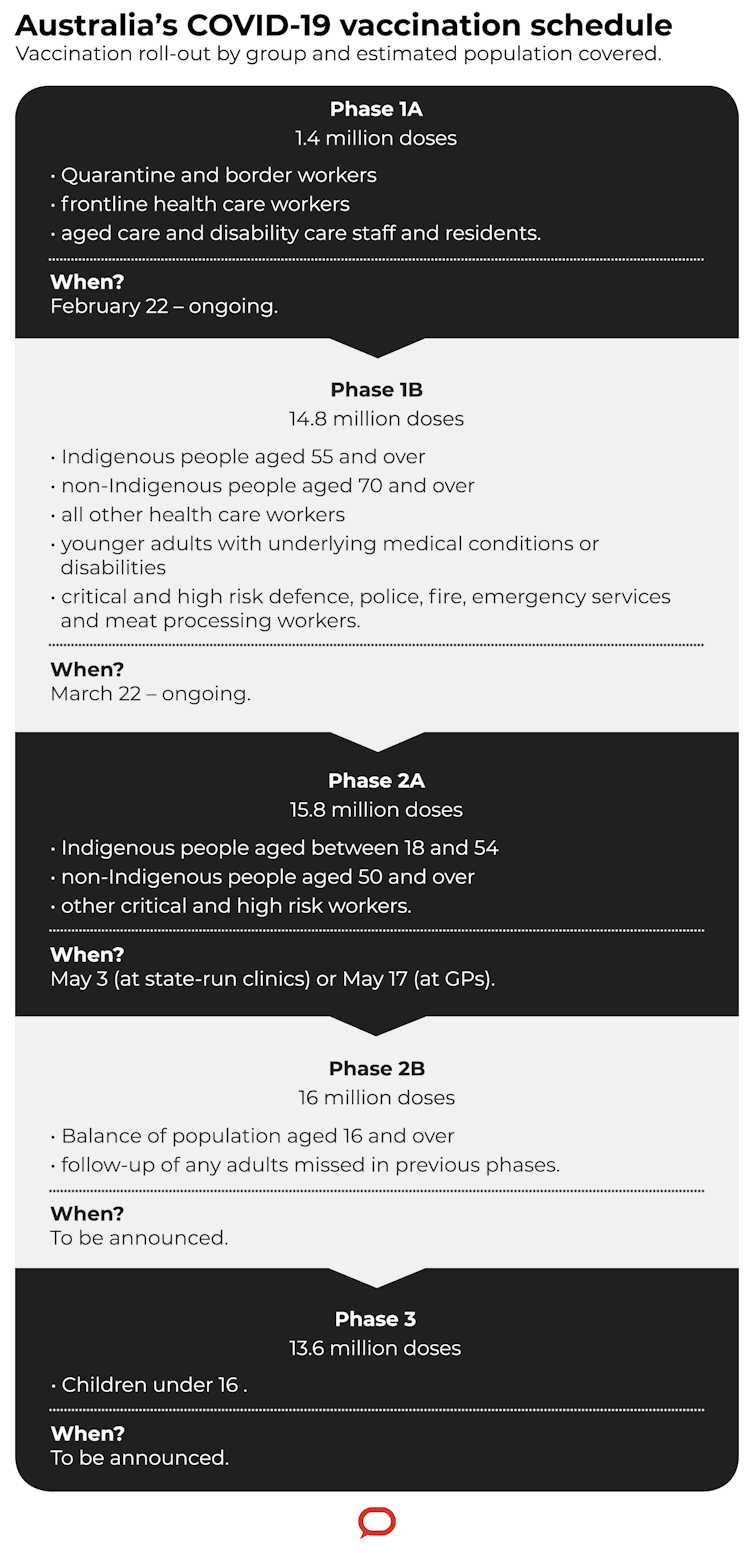
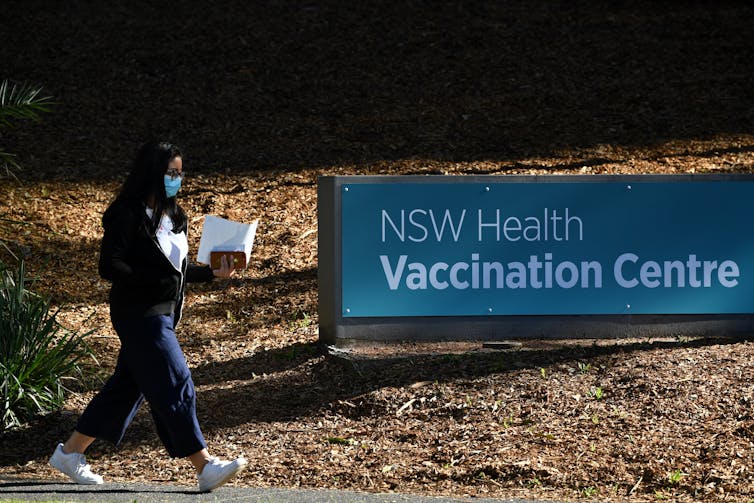
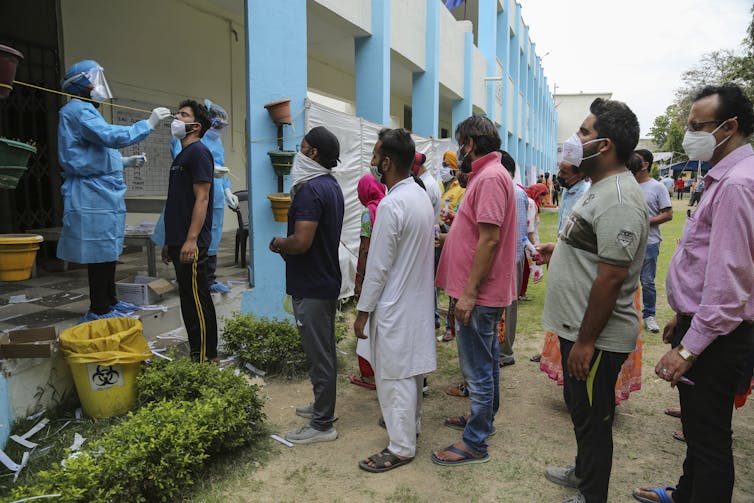
People aged 50 and over are now officially eligible to receive the AstraZeneca COVID-19 vaccine from selected GPs.
Although some practices have had permission to provide the vaccine early if they had excess stock, this marks a major step forward in Australia’s vaccination program.
People over 50 now have a choice of where to get vaccinated: their own GP (if taking part in the vaccination rollout), another GP practice (if their own GP is not), or respiratory clinics and mass vaccination hubs in some states.
Here are some practical things to think about when booking an appointment.
Can I speak to the GP first?
As a GP, I have been recommending patients access a vaccine from wherever is the most convenient for them. This may be from a mass vaccination hub or respiratory clinic, and not actually from a GP. However, some patients are hesitant and/or still have questions. If so, they do need to speak to a GP before they book for a vaccine.
The time to raise questions is not when you have turned up for your injection; most facilities allocate around 3-5 minutes for the doctor or nurse to spend with each patient. This does not allow time for prolonged discussion.
Instead, in the days before your vaccine, discuss concerns with your regular GP (if you have one). They know you and your medical history so are better placed to tailor advice to your individual situation.
If your GP is not one of the practices administering the vaccine, or if you don’t have a regular GP, you may want to book an appointment with a GP at the practice where you plan to get it, with the sole purpose of discussing your concerns.
Even if you book your vaccine through a GP clinic, it may not be a GP administering the vaccine. It may be a practice nurse, who is experienced at giving a range of vaccines and will have taken the same mandatory training as a GP in administering COVID-19 vaccines.
The best time to get vaccinated against COVID-19 is as soon as possible, once you have had all your questions answered. However, there are a few things you may need to consider.
If you feel unwell
If you feel very unwell on the day, especially if you have a high fever (over 38℃), you need to postpone your vaccine. This is partly because your immune system may not respond optimally to the vaccine, and partly so symptoms after the vaccine aren’t confused with symptoms from an underlying illness.
If you want the flu vaccine too
It’s best to leave at least 14 days between your influenza and COVID-19 vaccines. It’s likely safe to have them both together, however this is still being tested. Also, if you happen to get a reaction to one of them, you will know which one you have reacted to.
If it’s time for your mammogram
As the vaccine can cause a temporary swelling of the lymph nodes in the armpit, women are advised to either have a mammogram first, or delay it until six weeks after vaccination. This advice is particularly relevant as we start to vaccinate women 50 and over, the key target group for Australia’s breast cancer screening program.
If you can, book before a scheduled day off
About 20% of people report missing work, study or routine duties for a short period after their first AstraZeneca vaccine. So have your vaccine the day before a scheduled day off work if possible.
Should I take a painkiller directly before or after my vaccine?
Unless you take common painkillers such as paracetamol, ibuprofen or aspirin to regularly to treat an underlying illness, do not take medications that control pain and/or fevers before your vaccine.
You may use them after the shot but only if you need to treat symptoms that are worrying you. Overall it is best to avoid taking them at all as they may curb your immune response.
Both paracetamol and ibuprofen can reduce the immune response to other vaccines, particularly in children, although we’re not certain how much this affects their overall immunity to that disease.
One study showed taking aspirin, paracetamol or ibuprofen resulted in suppression of part of our immune response to viruses. And another study, this time in mice, revealed anti-inflammatory medications can impair production of some immune molecules after COVID-19 infection.
While none of this is strong evidence against taking these medications around a COVID-19 vaccine, the take-home message is not to take them if you don’t need to.
What about exercise before and after the vaccine?
Being physically fit can help you fight off upper respiratory tract infections. However does that translate to exercise also helping your immune response to vaccines? In other words, if you exercise before or after a vaccination will it work better?
While the jury is still out on whether your COVID-19 vaccine will work better if you exercise around the time of having it, here is my suggestion: don’t exercise more than you usually do in the days before or after your shot.
Muscle pain and fatigue are two of the commonest side-effects from the COVID-19 vaccine, and are also normal responses to increasing your exercise. Avoid complicating the picture by maintaining your usual fitness regimen, and give yourself some leeway in the days after the vaccination where you may be feeling the side-effects from it.
The US Centers for Disease Control recommends using or exercising your arm after the shot to help reduce pain and discomfort (although not to help the vaccine work better).
Use the government’s vaccine eligibility checker to see if you’re next in line for the COVID-19 vaccine, and where you can get vaccinated.
Australia’s forest-dwelling wildlife is in greater peril after last week’s court ruling that logging — even if it breaches state requirements — is exempt from the federal law that protects threatened species.
The Federal Court upheld an appeal by VicForests, Victoria’s state timber corporation, after a previous ruling in May 2020 found it razed critical habitat without taking the precautionary measures required by law.
The ruling means logging is set to resume, despite the threats it poses to wildlife. At particular risk are the Leadbeater’s possum and greater glider — mammals highly vulnerable to extinction that call the forests home.
So let’s take a look at the dramatic implications for wildlife and the law in more detail.
Why is this ruling so significant?
The Federal Court agreed VicForest’s logging failed to meet its environmental legal requirements. In fact, the Federal Court dismissed every single ground of appeal but one. And it takes only one to win.
The ground that won the case was that the federal environmental law designed to protect threatened species — the Environment Protection and Biodiversity Conservation (EPBC) Act — did not apply to the logging operations due to a forestry exemption.
To understand the significance of these issues, it’s important to know a bit about the context.
In the 1980s and ‘90s, forestry was passed to the states to regulate. So-called regional forest agreements (RFAs) were struck between federal and state governments. The idea was that forestry would be conducted under these state-led RFAs, avoiding federal scrutiny.
This was meant to streamline procedures, and offer a compromise between sometimes conflicting objectives: conservation and commercially profitable forestry.
However, states weren’t necessarily meant to have absolute control, and a check-and-balance system was put in place. If a logging operation doesn’t follow the RFA requirements, then the federal law is called in.
That way, states have control, but there’s a backup safety net for threatened species (which the federal government has an obligation to protect under international law).
This backup safety net is what the original case was testing. Friends of the Leadbeater’s Possum sued VicForests, arguing the logging operations breached the Victorian RFA, and the organisation won the case.
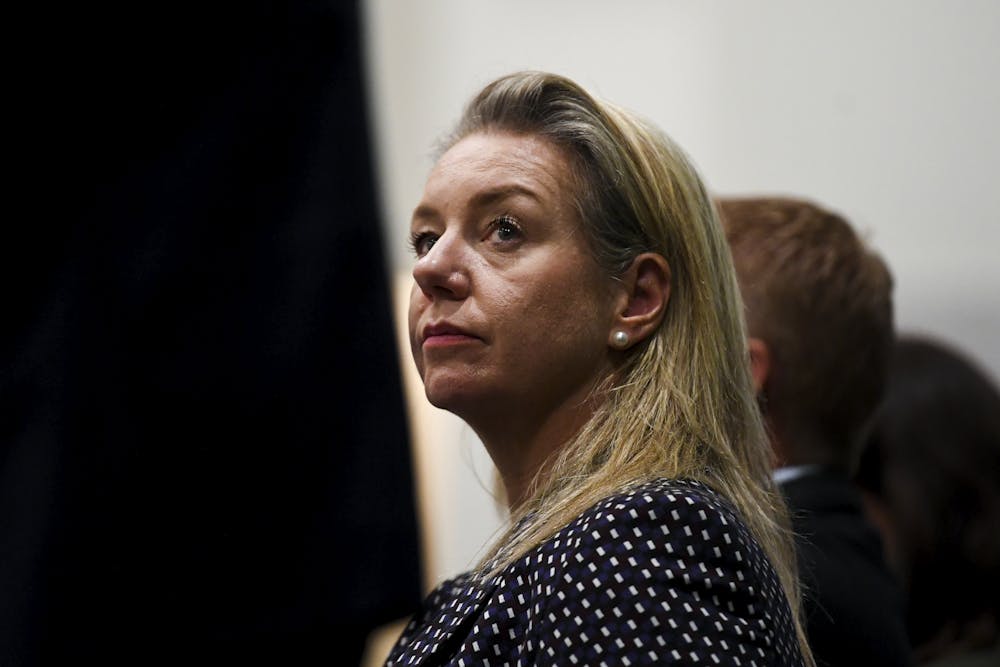
Bridget McKenzie introduced a bill seeking to strengthen logging’s exemption from federal scrutiny.AAP Image/Lukas Coch
In response to the original decision against VicForests, Nationals Senator Bridget McKenzie introduced a private members bill, seeking to strengthen logging’s exemption from federal scrutiny.
If passed, the bill would make forestry activities within RFA areas exempt from scrutiny under the EPBC Act, regardless of whether they follow RFA rules.
Both the court decision and the bill respond to a need for industry certainty and seek to minimise opportunities for legal action against logging under the EPBC Act. But they remove any certainty for environmental protection.
As former competition watchdog chair Professor Graeme Samuel, who led the review, said in his final report:
there are fundamental shortcomings in the interactions between RFAs and the EPBC Act.
The RFAs haven’t been updated as they were meant to be, despite dramatic changes in the environment, such as from mega-fires, and the warming and drying climate. These factors totally change the game for forestry and forest-dependent wildlife, such Leadbeater’s possum and the greater glider, which are declining dramatically.
Leadbeater’s possums rely on old tree hollows.AAP Image/ Australian National University, Tim Bawden
Cutting down trees may seem insignificant to some, in the scheme of things. But small effects can accumulate into dramatic declines, like a death by a thousand cuts.
Both Leadbeater’s possum and the greater glider depend on large old trees with hollows (that take more than 100 years to develop) for shelter. Without many of these trees, they cannot survive.
Logging in Victoria has led to a dramatic decline in the number and extent of these particular trees, and reduces future large tree numbers. This makes the animals more vulnerable.
To avoid extinctions, we can’t afford to lose more ground by continuing practices that damage or remove habitat.
The writing is on the wall
But things could be changing soon. The Victorian government plans to ban native timber harvesting from 2030. This happens to be the same year a decades-old contract with a wood pulp and paper company expires, currently binding the state to provide pulp logs by a legislated supply agreement.
After 2030, paper, pulp, and timber products would be logged from plantations rather than native forests. The writing is already on the wall.
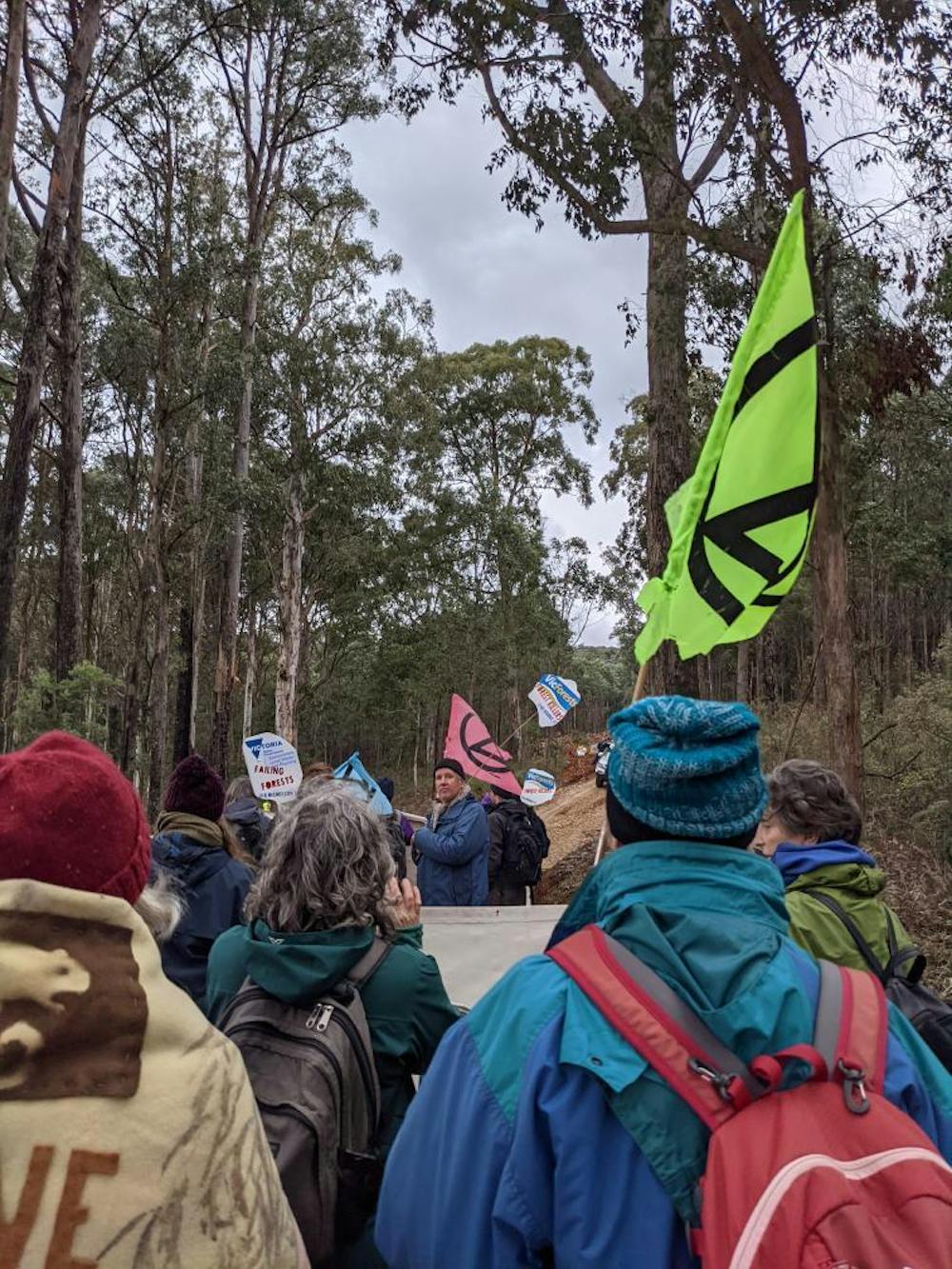
An anti-logging protest in Toolangi State Forest in response to VicForests winning their appeal in the federal court.Kira Whittaker
Whether it’s the federal or state governments in charge, forest management needs to be scientifically robust, with strong compliance, enforcement and governance. Otherwise, as we’ve seen, there’s a significant risk of slippage and loss of trust.
Even before the mega-fires of 2019-20, most Australians didn’t support native forest logging. After the fires, their worries increased, with a majority expressing concerns that Australia’s unique environment might never be the same.
And as a result of rising community expectations on how the environment is treated, some businesses have pivoted.
Many companies now see being associated with environmentally poor outcomes as risky. Bunnings, for example, has already banned VicForests’ native timber. The World Economic Forum places biodiversity loss in the top five risks to the global economy. And a global taskforce is being established that could eventually see environmental disclosures as a new norm.
It’s clear the status quo has led to an alarming rate of species decline. This decline will only be locked in further if legal exemptions make it impossible to hold law-breakers to account.
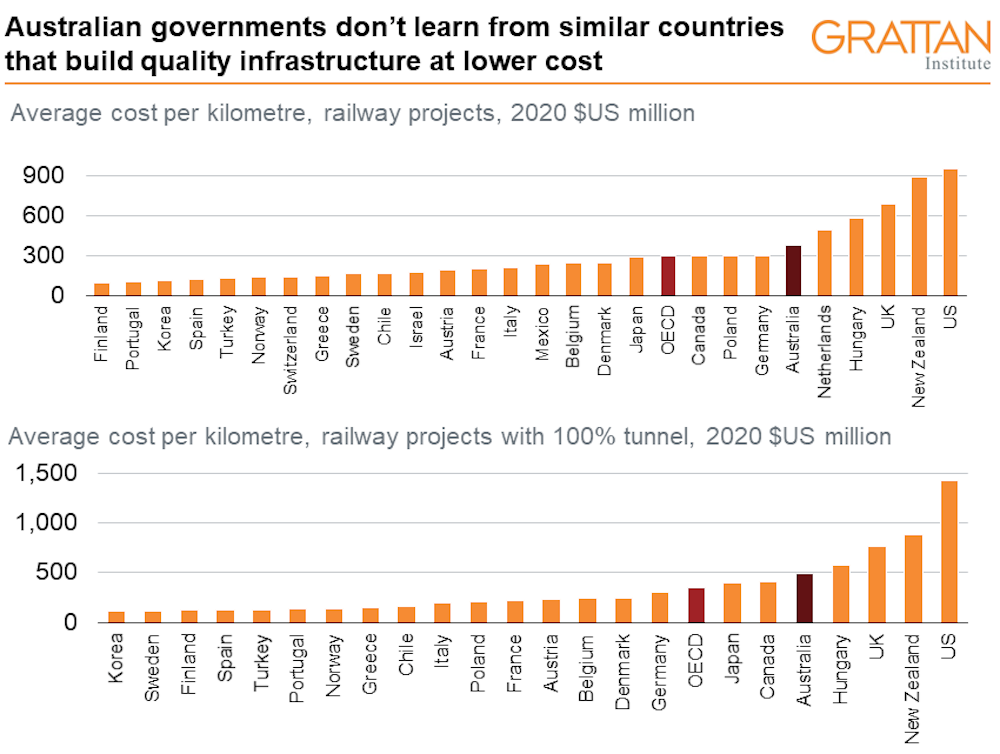
When governments decide to build a new road, bridge or train line, their first concern should be getting it at the cheapest possible long-term price for a given quality standard. But our new report, Megabang for Megabucks, shows cost management is rarely top of mind for governments. And, with the trend towards ever-larger projects, the risk that a lack of competition for contracts will push up prices is very real.
Australia is an expensive place to build large transport projects. An international study of rail projects found costs in Australia are in the top quarter of 27 OECD countries. Our costs are much higher than in many other rich countries: 26% higher than in Canada, 29% higher than in Japan, and more than three times as high as in Spain.
Of course, international comparisons are fraught. The cost of any particular project depends on local factors such as geology, location and the extent of the existing network.
But competition among construction firms is crucial if taxpayers are going to get the best price. Robust competition encourages firms to bid as low as they can and to innovate. If there is a field of potential bidders on megaproject contracts and the market is open to new entrants, there is also less opportunity for firms to collude by market-sharing, bid-rigging or price-fixing.
Bigger contracts reduce competition
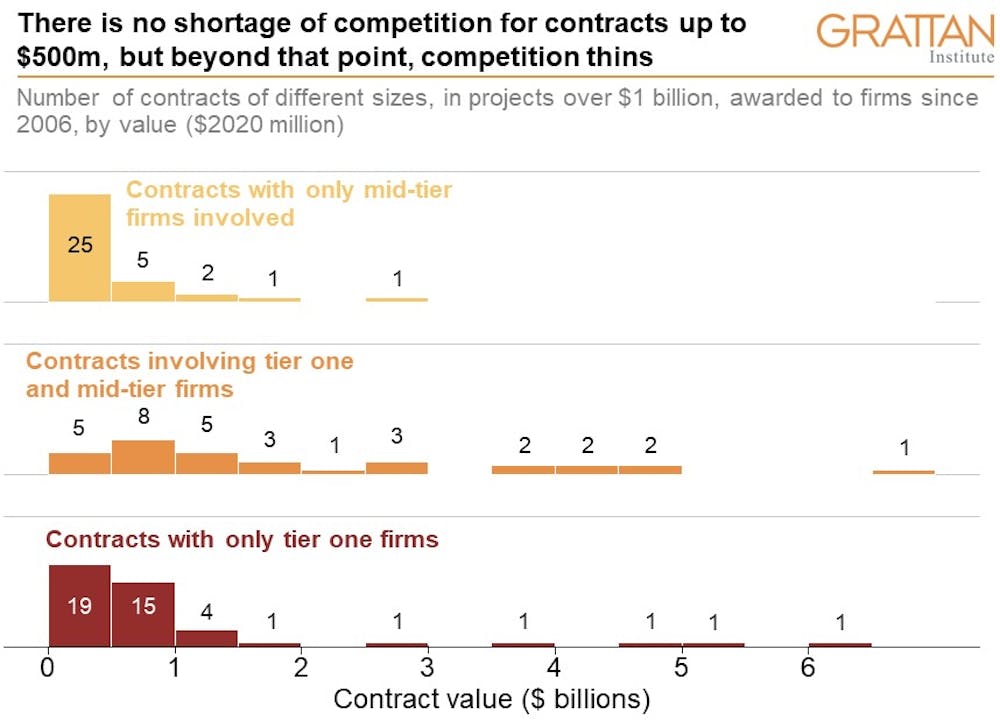
Megaprojects – projects costing more than A$1 billion – are typically broken up into a handful of contracts. For the smaller contracts – worth A$500 million or less – there are few concerns about competition: many firms can bid for and win these contracts. But the larger the contract, the thinner the potential field of construction firms gets.
Australia’s “big three” or “tier one” firms – CPB, John Holland and Acciona – win the vast majority of contracts over $1 billion, either independently or in a joint venture with other firms, as the chart below shows.
Notes: We classify John Holland, CIMIC Group firms CPB Contractors (formerly Leighton Holdings) and Thiess, Lendlease, Bilfinger Berger (including. Valemus firms Abigroup and Baulderstone), and Acciona as tier one firms. Acciona is included as a tier one firm for all past projects, even though it only became a tier one with the acquisition of Lendlease Engineering in 2020. All construction contracts considered by the procuring agency as a major contract or work package are included, for projects over $1 billion since 2006. Does not include rolling-stock contracts.Grattan Institute, Author provided
For the largest contracts, even the tier one firms don’t usually go it alone. A joint venture involving two of the big three has won eight out of 11 contracts larger than $3 billion. When two of these firms form a joint venture, local firms have very little opportunity to compete: even a bid involving the other tier one firm is unlikely to be successful.
An extreme case is the Rozelle Interchange as part of the WestConnex motorway project in New South Wales. At first it attracted only one bid – from a joint venture between all three tier one firms. The state government rejected this offer and re-tendered the job, redesigning the contract in an attempt to entice more bidders.
The Victorian government is clearly aware of the risk of limited competition when tier one firms form joint ventures. It banned joint ventures of two or more tier one firms from bidding for the North East Link freeway. The government preferred to encourage bids by international firms or mid-tier Australian firms.
And what’s really concerning is that these megacontracts are becoming the norm. Contracts above $3 billion in value were a rarity before 2014. In the seven years since, there have been ten, as the chart below shows.
Notes: includes only construction contracts for megaprojects (projects over $1 billion) where the first contract was signed during or after 2006. Does not include rolling-stock contracts.Grattan Institute, Author provided
Governments can take a couple of important steps to ensure there’s enough competition for contracts.
First, ensure international firms can freely enter the Australian market and bid on government contracts.
When two tier one firms form a joint venture to bid on very large contracts, the only avenue for competition is to involve international construction giants. So it’s crucial that Australian governments don’t give undue priority to domestic experience and cut the internationals out.
Governments should publish weighted criteria for bid selection. This ensures the international firms can be confident they’re not wasting resources bidding, only for governments to stick with the safe option of favouring local firms.
The Victorian government barred joint ventures by tier one firms and sought bids from overseas firms to increase competition for the North East Link contract.Erik Anderson/AAP
Second, avoid bundling work into bigger contracts than necessary. Governments have an incentive to enact fewer and larger contracts to make contract management simpler and minimise interface risks. These are the risks arising from interactions between multiple contractors, for example relating to site access. But bigger contracts mean fewer firms can bid for the work, particularly when different types of work are bundled together into a single package.
Governments should develop and use a systematic, consistent and transparent process to bundle up packages of work within a project. Examples would be splitting a highway upgrade into a number of smaller sections, or separating the design and construction tasks on a new rail line.
Megaprojects are making up an ever-bigger portion of transport infrastructure projects. Governments must focus on keeping the long-term cost as low as possible for the preferred quality standard. Otherwise, taxpayers will be at risk of paying over the odds.
Disney is one of the longest running animation studios in the world. As a result, the studio’s nearly 100 year legacy also provides a substantial insight into the history of the animated film.
Disney: The Magic of Animation features 500 items — original sketches, drawings, paintings, concept art and models. They have been carefully curated from the 65 million artworks at the Walt Disney Animation Research Library in Los Angeles.
The first feature exhibition at Australia’s national museum of screen culture since its major redevelopment, it showcases Disney’s legacy, and the process and artistry at work.
Moving pictures
When you first enter the exhibition space you are greeted with an array of large scale zoetropes — spinning cylinders with flickering images inside. They display the animated characters of Mickey Mouse, Pluto and Donald Duck.
These pre-cinematic animation devices provide a neat summation of the animation process, in which a quick succession of individual drawings, each one slightly different than the previous, can create a moving image. The zoetropes remind us animation has existed for many decades (if not centuries) prior to the invention of cinema.
‘They worked in shifts, night and day, to create this unique experiment in entertainment.’
Australia has also played a little known but substantive role in the Disney animation story. Between 1988 and 2006 Walt Disney Animation Australia operated in Sydney, and employed hundreds of extremely talented Australian animators, artists and technicians.
They worked on dozens of animated sequels to big name Disney features, including The Lion King II: Simba’s Pride, Pocahontas II: Journey to a New World, The Little Mermaid 2: Return to the Sea, Lady and the Tramp II: Scamp’s Adventure, and Peter Pan: Return to Neverland.
Exhibition curators have chosen a remarkable selection of highly dynamic animation drawings for display. Even as still images, these pencil drawings express incredible life and movement.
There are also a number of concept drawings created by American artist Mary Blair, whose designs informed Disney’s Cinderella, Alice in Wonderland and Peter Pan. She was also known for her children’s book illustrations (I Can Fly) and murals (including Disneyland’s It’s a Small World attraction). Her drawings and paintings use just a few strokes and splashes of contrasting colour to convey brilliant vibrancy and expression.
Also remarkable to behold are the series of background paintings from 1959’s Sleeping Beauty. Created by artist Eyvind Earle, the works show angular shapes and exquisite detail. Eyvind Earle’s sister, Yvonne Perrin, was also an animation background painter, who spent much of her life in Australia, working at the Eric Porter Animation Studio in Sydney and later illustrative children’s books with bush themes.
Walt Disney was a fan of Mary Blair as an artist within the studio and beyond.
It’s not just two-dimensional art on display. Model cars made of wood and metal from the production of 101 Dalmatians provide insight into the technical aspects of making the film.
Painted black and white, the cars were moved by hand and filmed in real time, using high-contrast film-stock. The resulting footage was then enlarged and transferred, frame-by-frame onto cels and incorporated into the rest of the animated scene.
The result was fluid motion on screen and accurately depicted vehicles which, despite appearing to careen around corners and collide with each other, maintained their precise dimensions. The approach, to some degree, anticipated the use of 3D digital models that would be incorporated into the studio’s later animated films.
Because Disney’s more recent films like Frozen and Moana were created almost entirely in the digital realm, the displays devoted to them tend to highlight concept art, rather than production materials. But it is still fascinating to see the concept artwork which guided these films through their early development. We gain a greater understanding of how the artists conveyed atmosophere, adventure and enchantment to create fantasy worlds.
As technology has evolved, so have Disney’s characters and narratives. This is notable as the exhibition reacquaints visitors with classic and dainty Disney princesses through to today’s more contemporary warriors like Moana and Raya.
Disney: The Magic of Animation celebrates each frame and component behind some of audiences’ favourite films of the last century. In doing so, the exhibition not only provides an illuminating peek into the animation process — but also gives us the opportunity to admire the artistry and complexity of what went into making every second of these works of art.
Snow White, 1937, a tempera on celluloid from the collection of political cartoonist J. Arthur Wood Jr.AP Photo/Library of Congress
The government has failed to get any electoral “bounce” from last week’s budget, despite it being widely seen as good for the economy, according to Newspoll.
Labor retains a two-party lead of 51-49%, although there was a 2 point fall in its primary vote, to 36%. The fall was matched by a 2 point rise in support for the Greens, to 12%.
The Coalition was stable on 41% primary vote.
Publishing the results, The Australian reported it was the most well-received budget since the Howard-Costello days, with 44% saying it would be good for the economy, and only 15% believing it would be bad. This was the largest margin since 2007.
But voters found it harder to get a clear fix on what it would mean for them personally. They were evenly divided, with 19% each side, on whether they would be personally better or worse off financially from the budget.
A record 62% could not say whether they would be better or worse off.
While the budget contained tax cuts for low and middle income earners and a child care package, much of the big spending was directed to particular areas, such as aged care and mental health, rather than affecting the financial position of people more widely.
Both leaders’ personal approval ratings worsened somewhat in the poll, although Anthony Albanese took more of a hit than Scott Morrison.
Dissatisfaction with Albanese increased 3 points to 46%, while his satisfaction rating decreased a point to 39%. His net rating is minus 7.
Satisfaction with Morrison fell a point to 58%, and dissatisfaction increased a point to 38% His net approval is plus 20.
Morrison led Albanese as better prime minister 55% (down a point) to 30% (stable).
In Queensland selling the budget, Morrison said on Sunday: “The recovery cannot be taken for granted. The recovery can be lost. The hard won gains of Australians, particularly over these last 18 months, can be lost unless we keep doing what’s working. And this is working.”
Also in Queensland, Albanese said: “Quite clearly, Scott Morrison has a plan to just get through the next election and then we’ll see cuts, because we know from this government, just like we saw in 2014 when it first came to office, that they will make cuts, they will return to type.”
Indonesia is pressuring Papua New Guinea over an illegal group East Sepik claiming to form an army unit to help West Papuan pro-independence rebels fighting against Indonesian forces across the border.
Calling such armed groups as “terrorists”, Indonesia’s Ambassador to PNG, Andriana Supandy, said his country respected the sovereignty of its neighbour, PNG, and called on the PNG authorities to act over the threat.
A video of a group dressed in military fatigues and brandishing automatic rifles has gone viral on social media, prompting the Indonesian response.
The men in the video, speaking in PNG “tok pisin”, claim to be from East Sepik. They say they stand with the West Papuan rebels and are ready to cross the border to support the West Papuan cause for independence.
Supandy said the Indonesian Embassy had been informed that PNG government officials were in Wewak to investigate the viral video on the social media post.
“The Indonesian government honour[s] the PNG government as a sovereign nation and leave the response to the alleged militants to the relevant authorities in PNG,” Supandy said.
“Both governments have the same understanding about the challenge and opportunity in managing the formal relations through the spirit of friendship and mutual respect.”
Gratitude over safety Supandy said that despite the video causing uneasiness, the Indonesian Embassy would like to convey its gratitude to the government and the people of PNG for “ensuring the safety and wellbeing of Indonesians” working and living in PNG.
The embassy said the Indonesian government and people were reciprocating the gesture for PNG citizens living in Indonesia.
Supandy said the video of a vigilante group would not affect the strong relations between Indonesia and PNG.
“These armed groups in Papua and West Papua have resorted to acts, methods and practices of terrorism aiming at destruction of human rights, fundamental freedoms and democracy while also threatening the territorial integrity and security of the Republic of Indonesia,” he claimed.
Right to ‘reliable information’ Supandy said Papua New Guineans had the right to “reliable information” relating to this issue.
He said Indonesia was committed to taking measures aimed at “addressing the root causes” of the situation in Papua and West Papua provinces.
He said in this context, Indonesia advocated humane, prosperous and inclusive development approach, including:
Respecting the basic rights of the people in Papua and West Papua provinces;
Establishment of good governance in Papua; and
Opportunities for Papuans to shape and direct local development strategies and regional policies.
Samoa is to hear on Monday whether fresh elections will go ahead next week.
The Supreme Court heard challenges yesterday to the new ballot called last week by the Head of State, Tuimaleali’ifano Va’aletoa Sualauvi II.
Chief Justice Satiu Simativa Perese said the hearing would test the extent of the powers held by the Head of State – O le Ao o le Malo.
Tuimaleali’ifano called the vote on the advice of the caretaker Human Rights Protection Party (HRPP) Prime Minister Tuila’epa Sa’ilele Malielegaoi, purportedly to break the 26-seat each deadlock with the newcomer Fa’atuatua i le Atua Samoa ua Tasi (FAST) party.
FAST challenged the new ballot, contending Tuila’epa’s advice meant the Head of State decreed a course of action which deviated from a process set out in the constitution.
FAST’s co-counsel at the court hearing, Taulapapa Brenda Heather-Latu, said it was “a substantive hearing of the constitutional challenge… and a decision will be given at 3 o’clock on Monday afternoon”.
Also on Monday, the court will hear a separate FAST party challenge to the validity of the electoral office’s awarding of an extra women’s seat to the HRPP, which created the current deadlock.
Additional seat at issue If both decisions find in favour of FAST, according to Taulapapa, a former Attorney-General, the additional seat would then be removed.
“Which means they [FAST] can go to the clerk and the Head of State and ask the Parliament to be convened, and they have the majority to form government,” she said.
However, if the court finds against FAST in the electoral matter but in their favour in the case of the additional women’s seat “then we’re actually back at 26-25 for FAST” noted Taulapapa.
“And I guess we’ll have to have another election next Friday.”
However the snap-election in that situation would become the subject of a further challenge, she added.
“Because it does not meet any of the normal requirements for a general election.”
Taulapapa contended that a snap-election being called when legal challenges had not yet been heard and exhausted “disallowed the votes of 89,000 Samoan people”.
Unlawful, say submissions “In the submissions that we made before the court today that was unlawful,” she said.
“And it effectively pre-empted the ability of parliament and all those elected representatives to sit down and find out if there was someone that had the majority who could form government and become our new prime minister.”
Samoa’s constitution prescribes a process to be followed after election results are called and Taulapapa said this had been forsaken.
“The forming of government is a function of the elected representatives. It’s not a function of a Head of State and it’s not a function of an un-elected official.”
Meanwhile, the caretaker HRPP government has made Thursday and Friday public holidays in anticipation of the new ballot. Pre-polling is set to begin on Wednesday.
This article is republished under a community partnership agreement with RNZ.
A collective of community groups in Tahiti trying to preserve a historical-cultural icon at Tautira have condemned the Tahitian government for “deliberately trying to destroy our heritage”.
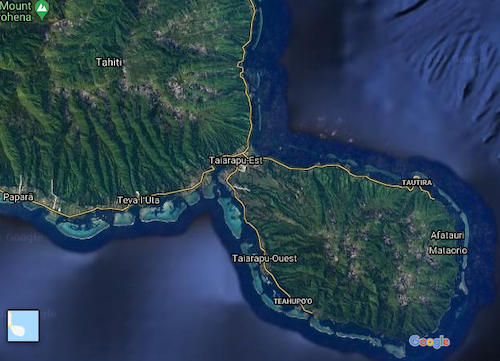
The iconic Tahua-Reva is the community’s sacred mountain on the southeastern tip of Tahiti-Iti, the smaller section adjoining the main island of Tahiti.
The community groups have appealed for help in their campaign to save the mountainside.
“All the government sees is [that] the mountainʻs cliff must be secured to protect against tumbling rocks, and they came up with no alternative other than dynamite [it] because they say itʻs a cheaper solution,” wrote Vaihei Paepaetaata, a voice of the community groups trying to save the mountainside, in a letter today to Asia Pacific Report.
Tautira on Tahiti-Iti. Image: Google Maps
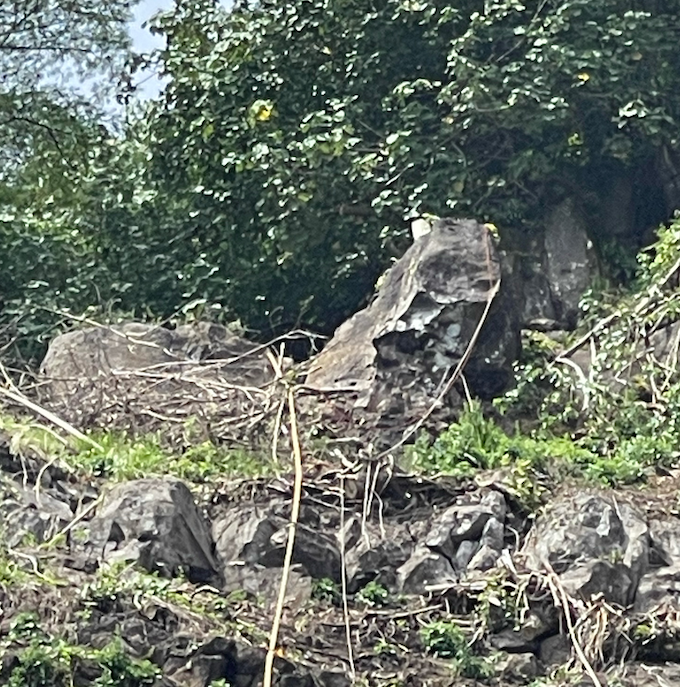
“Their experts say the danger arises from three stones, 50 tonnes each, which threaten to collapse on the road at the foot of Tahua-Reva mountain. But for us the danger is the loss of our heritage, the loss of our history and identity.”
Cultural educator and linguist Paepaetaata said that was why she was seeking help in relaying information “as widely as possible” on behalf of her community of Tautira.
“It is absolutely unacceptable for us that such a decision be taken without any consultation with the population. This cultural site is of capital importance for Polynesian heritage in so far as its history is intimately linked to the marae Tapu-Tapu-Tea, which is registered as a UNESCO World Heritage Site.
“These three stones carry a story and have a powerful energy. They are a resting place for the departing souls before they rise to the firmament called Rauhotu No’ano’a.
“Tahua-Reva is a place of collective memory but unfortunately it is not registered, so no law can protect her from being damaged by humans.
“Tahua-Reva allows me and everyone in my community from Tautira to claim our affiliation to the land and to say:
I have a mountain, its name is TAHUA-REVA E MOU’A TŌ’U, ‘O TAHUA-REVA I have a water, it is called VAIT -PIHA E VAI TŌ’U, ‘O VAIT PIHA I have a piece of land, it is called FATUTIRA-I-TE-TAI-PA’A’INA E FENUA TŌ’U, ‘O FATUTIRA-I-TE-TAI-PA’A’INA
“This chant is taught to young children from preschool. What will we show to our children if our mountain is destroyed?
“What meaning will we give to this desecration? What legacy will we leave for them tomorrow?”
Paepaetaata has appealed to Pacific journalists to take up the issue and report their concerns.
Tahua-Reva … sacred rocks. Image: #ProtectTahuaRevaTahua-Reva … the sacred mountain in Tahiti-Iti. Image: #ProtectTahuaReva
Human Rights Watch (HRW) is calling on the Indonesian police to drop politically motivated treason charges against West Papua National Committee (KNPB) spokesperson Victor Yeimo.
Yeimo was arrested for calling for an independence referendum for Papua which he expressed in 2019 during the anti-racism protests and riots in Papua and West Papua province.
Human Rights Watch said that the Indonesian government had discriminated against indigenous Melanesians in Papua and West Papua for decades.
President Joko “Jokowi” Widodo is being asked to publicly direct security forces involved in operations in Papua to act in accordance with international law to be held to account for violence there.
“Indonesian police should investigate the deadly violence and arson attacks in Papua in 2019 but not use that as a pretext to crack down on peaceful activists,” said HRW Asia director Brad Adams in a statement.
In August 2019, Papuans held protests in at least 30 cities across Indonesia in response to a racist attack against Papuans at a student dormitory in the East Java provincial capital of Surabaya.
Videos show soldiers shouting words such as “monkeys” at the students. Police also fired teargas into the dormitory and arrested scores of students.
Triggered riots The polemic over this triggered riots in the form of attacks, looting and the torching of public facilities in Jayapura, Manokwari, Sorong and Wamena.
In the aftermath of this, HRW noted that at least 43 protest Papuan protest leaders and KNPB activists were charged with treason and sentenced despite the fact that they were not involved in violence.
HRW said that it takes no position on Papuan claims to self-determination, but supports everyone’s right, including independence supporters, to express their political views peacefully without fear of arrest or other forms of reprisal.
“The Indonesian authorities should ensure that all security force operations in Papua are carried out in accordance with the law and that peaceful activists and other civilians are not targeted,” added Adams.
Separately, lawyers from the Coalition for Upholding the Law and Human Rights in Papua said that Yeimo’s arrest on Saturday, May 9, was not in accordance with arrest procedures under Law Number 8/1981 on the Criminal Procedural Code.
This is because the arrest was made on that day while the warrant was received by Coalition lawyers more than a week later on May 19 at 6 pm at the Mobile Brigade Command Headquarters (Mako Brimob) investigators office in Kotaraja, Abepura, Jayapura.
“The coalition could not assist or directly accompany Victor F. Yeimo yet he is not just being charged under Article 106 of the Criminal Code (KUHP) or the articles on makar [treason, subversion, rebellion] but he is also charged under Article 170 Paragraph (1) of the KUHP where in the process lawyers can sit alongside their client,” said the Coalition’s litigation coordinator Emanuel Gobay.
Prevented from helping Gobay also stated that they were prevented from assisting Yeimo because they were unable to directly accompany him. Yeimo was then transferred from the Papua regional police to the Mako Brimob without the Coalition’s knowledge.
At the Mako Brimob, meanwhile, Yeimo is said to have been placed in a cell far away from any sources of fresh air and is said to have asked prison guards to move him to a more comfortable cell.
Furthermore, Gobay revealed that his client also asked police why only he had been arrested if the pretext for the arrest was because he gave a speech during an anti-racism protest on August 19, 2019.
“Many other people also gave speeches (during the action) such as women figures, religious figures, youth figures and so forth. Aside from this [the action] was also attuned by the Papuan provincial governor, the speaker of the MPR [Papua People’s Council], members of the DPRP [Papuan Regional House of Representatives], several SKPD [Regional Administrative Work Unit] members as well as OAP [indigenous Papuans] and non-OAP. But why am I the only one that has been arrested and charged while the others haven’t,” said Yeimo as conveyed by Gobay.
Yeimo was a fugitive from the law who had been on the police wanted persons list (DPO) since 2019.
He is alleged to have committed crimes against state security and makar and or broadcasting reports or issued statements which could give rise to public unrest and or broadcasting news which is unreliable or news which is excessive or incomplete.
He is also alleged to have insulted the Indonesian national flag, language and state symbols as well as the national anthem and or incitement to commit a crime.
Koman named as lawyer In London, Pelagio Doutel of the Indonesian human rights advocacy group TAPOL said UN rapporteurs should call for Yeimo’s immediate and unconditional release.
An urgent appeal on behalf of Yeimo has been submitted by TAPOL and lawyer Veronica Koman to the UN Special Procedures mechanisms of the Human Rights Council.
Yeimo had been living in exile in Papua New Guinea since the crackdown against the so-called Papuan Uprising and had recently returned to his homeland.
“Lawyers have been prevented from accompanying Mr Yeimo during interrogations,” said Pelagio Doutel.
“No family member or anyone else has been able to pay him a visit. He is practically in solitary confinement and currently arbitrarily detained at the Police’s Mobile Brigade Headquarters (Mako Brimob) in Abepura. He was moved there without prior notice to his lawyers.”
Veronica Koman reported that “Papua’s police chief Mathius Fakhiri has publicly indicated that extra charges will likely be put against Victor Yeimo until he ‘gets old’ in prison.
‘History of torture’ “Victor Yeimo has a history of being subjected to torture. Therefore we will be in close communication with UN officials to update them on developments including additional interrogation and maltreatment.”
To support his lawyers on the ground, Yeimo has appointed Koman as his international lawyer.
Veronica Koman is the international advocacy coordinator of the Jayapura-based Association of Human Rights Lawyers for Papua (PAHAM Papua).
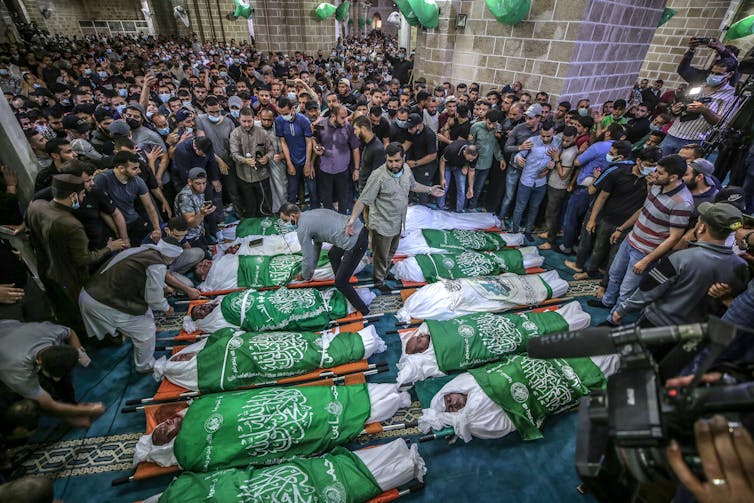
Media offices have been bombed and Palestinian and international journalists arrested, beaten and threatened by Israeli forces amid escalating violence in Gaza, reports the International Federation of Journalists.
The IFJ has declared in a statement that it stands in solidarity with the Palestinian Journalists Syndicate (PJS) and all Palestinian and foreign media workers that have been targeted.
It demands immediate international action to hold Israel accountable for its deliberate targeting of journalists and the media.
On the night of May 11, the Israeli military bombed the Al-Jawhara tower, located in Gaza, which hosts the offices of 13 media institutions and NGOs. The PJS said the attack was deliberate and targeted.
There were no injuries as journalists evacuated their offices after the Israeli army warned some of the media that the building would be bombed.
However, media organisations lost their equipment. The IFJ said the Israeli government must compensate the media for their financial losses.
The offices of the media organisations – the National Information Agency, Palestine newspaper, Al-Arabi Channel, Al-Ittijah TV, Al-Nujaba TV, the Syrian TV, Al-Kufiya Channel, Al Mamalaka channel, APA Agency, Sabq Agency 24, Bawaba 24, the Palestinian Media Forum, the Palestinian Forum for Democratic Dialogue and Development – were completely destroyed.
The offices of Al Jazeera TV, adjacent to the targeted building, were also damaged
Spanish news agency EFE’s correspondent in Jerusalem said on Twitter that their correspondent in Gaza had to flee its office at Al Jawhara tower after a warning message from the Israeli military.
URGENTE: El corresponsal de @EFEnoticias en la Franja de #Gaza debió evacuar hoy su oficina tras comunicarle el Ejército israelí que bombardearía el edificio en el que se encuentra.
In addition to the targeted attacks against media organisations in Gaza, the PJS reported that the Israeli forces arrested photojournalist Hazem Nasser in the West Bank on May 12.
Since the beginning of the clashes in Jerusalem, the Israeli authorities have arrested at least 27 media workers in what the PJS and other press groups denounced as a clear attempt to silence media reporting on the ground.
The PJS said in a statement: “The PJS calls on all the guarantors of freedom of journalistic work, especially the United Nations and its organisations and the Red Cross to provide urgent field protection for journalists, and to activate Security Council Resolution 2222 so to obligate the occupation to implement and respect it.”
IFJ general secretary Anthony Bellanger said: “We stand in solidarity with all the Palestinian journalists and the PJS during these hard moments. The international community cannot turn a blind eye to the systematic violations of human rights and the deliberate targeting of media and journalists. Urgent actions must be taken to hold those responsible for these crimes internationally accountable”.
In December 2020 the IFJ submitted two complaints to the UN Special Rapporteurs over Israel’s systematic targeting of journalists working in Palestine and its failure to properly investigate killings of media workers.
The complaint stated that this was “a violation of the right to life, freedom of expression and in breach of international law and may amount to war crimes”.
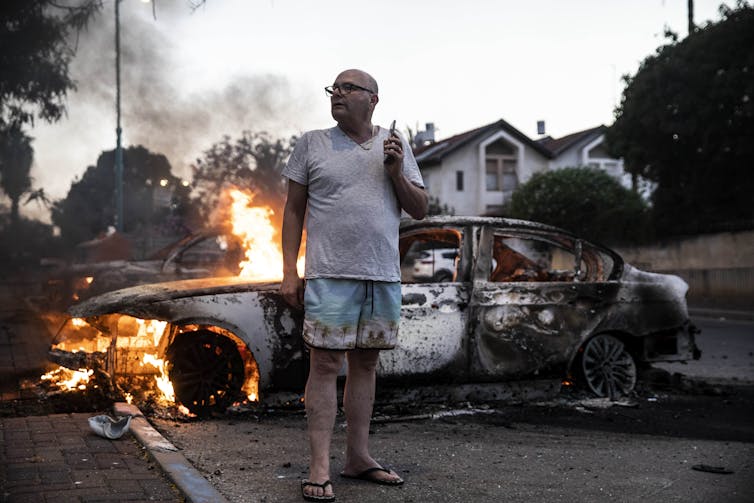
New Zealand’s Green Party has condemned the violent and forced displacement of the Palestinian Sheikh Jarrah community of East Jerusalem by Israeli forces and settlers.
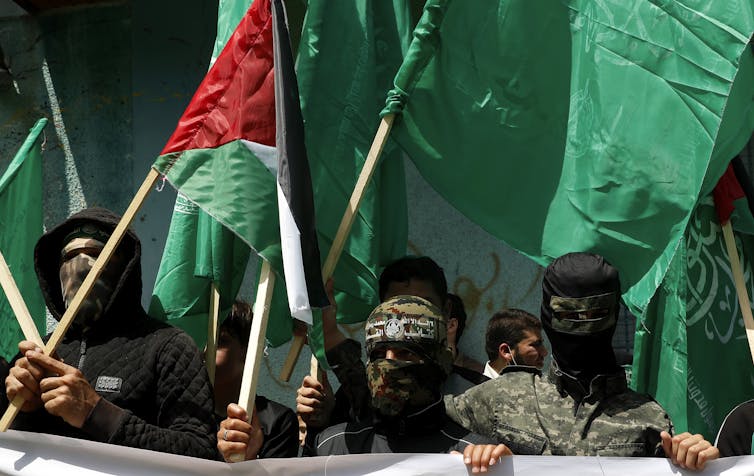
“We further condemn the recent indiscriminate bombing of the Gaza Strip causing the deaths of [113 Palestinian civilians, including 31 children], we call on both the IDF and Hamas to abide by international human rights and humanitarian law”, said Green Party spokesperson on human rights and foreign affairs Golriz Ghahraman.
“We note that the forcible displacement of Palestinians is an atrocity crime in international law, and in these circumstances can amount to ethnic cleansing.
“Israel’s ongoing and continued occupation of Palestinian territories, and siege on Gaza since 2009, constitute serious breaches of international law and have caused an unsustainable humanitarian crisis, exasperated by the current covid-19 crisis.
“The people of Gaza are trapped with little access to humanitarian aid, adequate healthcare or education.
“The Green Party promotes and supports the principle of self-determination of peoples everywhere, including Palestine.
“We support a two state solution that would ensure an independent state of Palestine alongside the state of Israel.”
Strongly condemns the violence committed by Israeli forces in East Jerusalem and its indiscriminate bombing of civilian community in Gaza; and
Calls on both Hamas and [the Israeli military] IDF to abide by international humanitarian law, with clear primary responsibility as the occupying power, on Israel.
Source: Council on Hemispheric Affairs – Analysis-Reportage
With congressman Guillermo Bermejo, member of Pedro Castillo’s Presidential Campaign
Join the Council on Hemispheric Affairs (COHA) to analyze thedecisive presidential election taking place this June 6 in Perú.
COHA Director Patricio Zamorano, COHA Senior Research Fellow Alina Duarte and COHA Senior Analyst William Camacaro will interviewGuillermo Bermejo about the presidential election in Perú, a country in permanent political crisis, which has gone through three presidents in 2020. The second round of the presidential election on June 6 will pit progressive candidate Pedro Castillo against conservative leader Keiko Fujimori, daughter of former president, Alberto Fujimori, who was convicted of crimes related to human rights abuses. With such radically different views of good governance at stake, the outcome of this election will have a decisive impact on the future of the Andean nation.
Guillermo Bermejo was recently elected to serve in Congress representing the “Perú Free” party. He is a political analyst, expert on geopolitics and drug trafficking, and also advisor to Peruvian farmer communities.
This conference will be conducted in both English and Spanish
Certainly for the first time in years it was accompanied by a Women’s Budget Statement printed as part of the budget papers rather than as an add-on glossy brochure.
The statement reported on the effect of the COVID pandemic on women and on government measures in the fields of women’s safety, women’s economic security and women’s health and wellbeing.
While welcome, and an advance on what’s gone before, it remained a long way short of true gender-responsive budgeting, which is about the entire budget process and everything the government does.
When Australia led the way in the 1980s, the analysis took place within each government department.
At times it modified or stopped decisions before they left departments.
The process was hardwired into the budget cycle so that no spending proposals could advance unless they were accompanied by a clear statement setting out their gender implications and effects on equality.
The approach applied to all measures, whether explicitly gender-focussed or not.
Not yet what it could become
The 2021-22 women’s statement identified A$3.4 billion of spending related to women and gender equity — a mere fraction of 1% of total budget expenditure.
Much of it was piecemeal, or too small to have much impact.
The $200,000 funding for working women’ centres, “to support the continued delivery of free information, advocacy, support and advice on work-related matters including workplace sexual harassment” is unlikely to be enough to keep open the doors of the current centres, let alone revive those that have been forced to shut down.
While such measures will help, they don’t address the root causes of labour market segregation and women’s partial exclusion from higher paid, male-dominated sectors such as science, technology, engineering and mathematics.
The extra funding for childcare and for aged care in response to the royal commission will help employment in female-dominated sectors, but it was accompanied by little that would increase pay in those sectors.
Modelling commissioned by the National Foundation for Australian Women found that boosting pay in those sectors would provide an economic boost big enough to almost pay for itself.
The boost to funding for violence against women is welcome, especially the new funding for legal services for women escaping violence, which has been slashed over recent decades.
It is welcome too that the proposal to allow women eat into their superannuation when fleeing violence has been replaced by a grant of up to $5,000.
Strategy missing
What’s missing from this first re-booted Women’s Budget Statement is a strategic approach to the drivers of inequality.
Since 2014, when the Abbott Government stopped publishing a women’s policy statement, the National Foundation for Australian Women has stepped in to conduct an independent expert analysis.
This years’ analysis is likely to find the budget didn’t do anything like enough to close gender equality gaps, to reduce caring gaps or deal effectively with violence.
But non-government organisations can only ever provide an external view: the government holds the data and is the organisation responsible for constructing an evidence-based budget strategy that moves towards gender equality.
It has done it before in the 1980s, using a whole-of-government approach.
This year’s statement can be thought of as a down payment on next steps, but the government needs to begin those steps now. The next budget, regardless of who delivers it, must lay out a roadmap to gender equality.
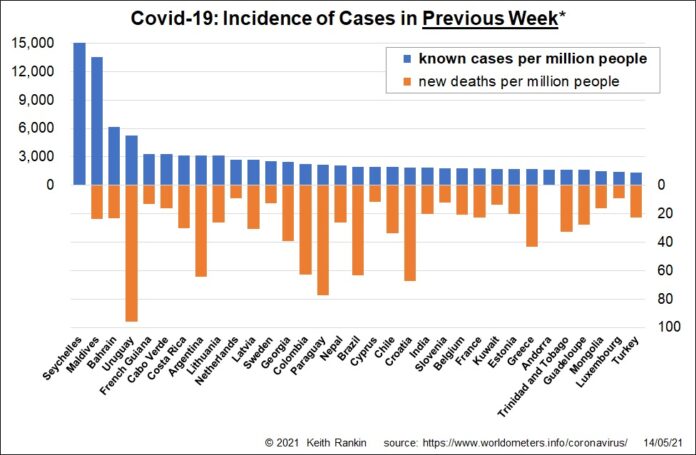
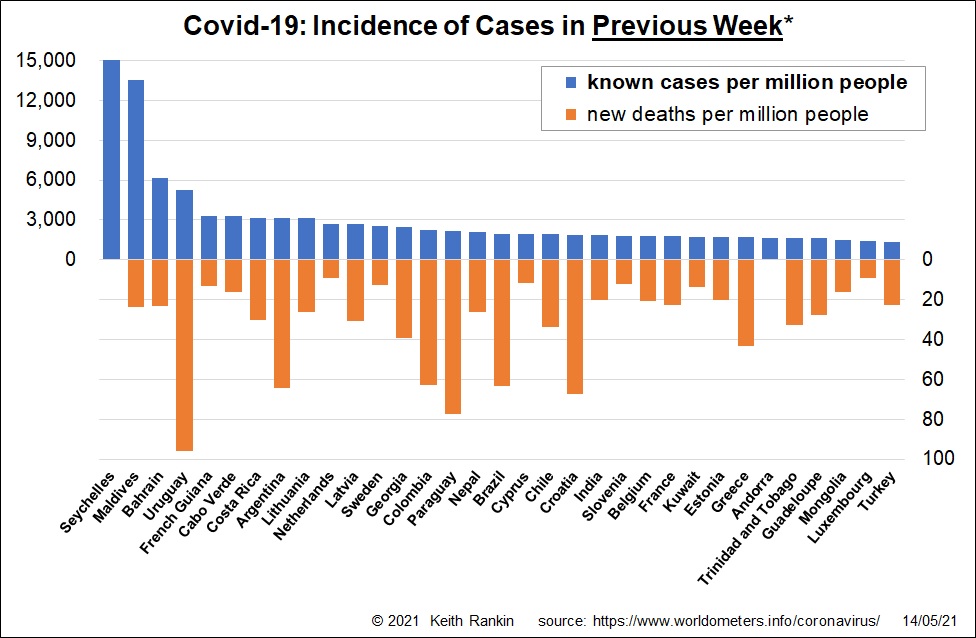
It’s been a big month, so far, for the Maldive Islands. Further, some of New Zealand’s leading cricketers (including captain Kane Williamson) are manuhiri in the Maldives. Indian Ocean neighbour – the Seychelles – has even more reported new cases per capita than the Maldives. I guess that neither country did nearly as well as New Zealand at keeping out visitors from Mumbai and New Delhi.
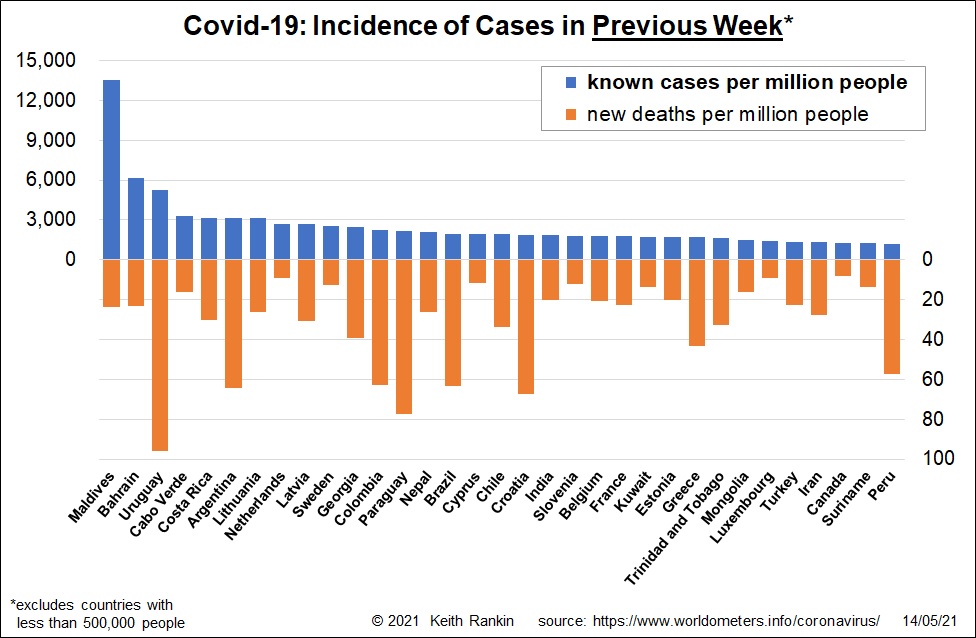
Otherwise, we continue to see quite a mix of countries from all over the world getting caught up in the present outbreak of Covid19. The second chart excludes countries with fewer than 500,000 people.
New Zealand should not be too smug. The latest Covid19 league tables include a number of island countries: as well as those mentioned there are Bahrain, Cabo Verde, Cyrus, Trinidad, and Guadeloupe. And French Guiana, while not technically an island, has the geopolitical characteristics of one.
Also of note is that the two small Latin American countries which New Zealanders feel particularly comfortable staying in – Uruguay and Costa Rica – are right up there in the top 10. So are all three of the Benelux countries, and France, and Sweden.
In Asia, of particular note is that Nepal is now suffering worse than India, and that Mongolia now presents a significant threat to China. (Presumably Mongolia got it from Russia.) Japan is also a worry; while it doesn’t have sufficient cases yet to make it onto the above league chart, in the last week it reported more cases per capita than the United Kingdom (though less than the United States).
In North America, Canada shows up on the second chart as having by no means gotten rid of Covid19.
Deaths: South America and Eastern Europe worst; Croatia and Greece now worst in EU.
Re deaths, it is still South America and Eastern Europe which prevail. While many of these countries are improving, their recorded deaths are still much worse than India’s. While it is almost certainly true that neither India nor Mexico show up on these death charts due to undercounting, we cannot claim that India’s actual death rate is worse than that of, say, Bulgaria (12th on the list). And Nepal, which is on the death charts, clearly has Covid19 worse than India (though some parts of India – eg Goa and the parts bordering Nepal, and still New Delhi – will have more deaths per capita than Nepal, though not necessarily more deaths per capita than Kathmandu).
In Europe, Greece in particular is a concern. This is one of the ‘western’ countries which suffered much less from covid than the usual mercantilist suspects in the north and west of Europe. We also notice the Baltic States; all three – Estonia, Latvia and Lithuania – appear on one or other of these charts. Europe – the main culprit in the global spread of Covid19 – remains unable to shake it off.
Source: The Conversation (Au and NZ) – By Nathan Bartlett, Associate Professor, School of Biomedical Sciences and Pharmacy, University of Newcastle
The Therapeutic Goods Administration (TGA) yesterday revealed there have been six reports of Guillain-Barré syndrome in Australia following the AstraZeneca COVID vaccine.
This is an autoimmune disorder, which causes muscle weakness, numbness and tingling. It can be life threatening if it involves the respiratory muscles.
But at this stage, there isn’t cause for serious concern. The six reports are out of 1.8 million doses of the AstraZeneca vaccine administered in Australia so far. This means the syndrome has affected about one in 300,000, which is less than the rate at which it occurs in the population normally; in adults, we see about 2–3 cases per 100,000 people every year.
Neither the TGA nor any other country have confirmed there’s a link between the AstraZeneca vaccine and Guillain-Barré syndrome. So these cases may have occurred by chance. At the same time, it is possible there’s a connection.
What is Guillain-Barré syndrome?
Guillain-Barré syndrome occurs when the immune system attacks healthy nerve cells. In about two-thirds of cases, it follows a viral or bacterial infection.
The most common infection linked to the syndrome is the bacteria Campylobacter jejuni, which infects the gastrointestinal tract and commonly causes diarrhoea.
We’ve also seen it occur after infection with viruses such as Zika virus and the human immunodeficiency virus (HIV). It has been linked to COVID-19 too, but we don’t have much data on this yet.
In people with Guillain-Barré syndrome, the immune system attacks healthy nerve cells.Shutterstock
The reason for the link between Guillain-Barré syndrome and infections is complex, but essentially scientists believe it’s caused by something called “molecular mimicry”.
This occurs when the structures on the surface of pathogens resemble (or mimic) structures on your cells. For Guillain-Barré syndrome, this relates to sugar structures (glycans) on the myelin sheath (the insulating covering on neurons that enables them to transmit nerve impulses).
For people with Guillain-Barré syndrome, these sugar structures on their nerve cells appear similar to sugar-containing molecules on the surface of some bacteria or viruses. As a result, antibodies generated to target the infection also attack nerve cells (autoantibodies), destroying the myelin sheath nerves need to conduct signals, which stops muscles from working properly.
The syndrome can affect different muscles, meaning the weakness can be felt in different places. For example, it might affect speech, breathing or bladder control.
It can be treated with antibodies from healthy donors (immunoglobulin therapy) which inhibits the autoantibodies causing damage. Another option is to filter the autoantibodies out of the blood (plasma exchange). In time, most people will recover with treatment; the condition is very rarely fatal.
The syndrome is more common in people 50 and older, which is a concern as this is the age group receiving the AstraZeneca vaccine in Australia. But it’s still vanishingly rare, and this risk — if indeed there is a link — doesn’t come close to outweighing the benefit of the vaccine for this age group.
So, how could Guillain-Barré syndrome be linked with the AstraZeneca vaccine?
Along with the TGA, the European Medicines Agency is reportedly assessing reports of Guillain-Barré syndrome in a small number of people who have received the AstraZeneca vaccine.
There is a possible explanation — though it’s important to stress that in the absence of empirical evidence, this is currently only speculation. The adenovirus — that’s the viral vector used in the AstraZeneca vaccine — like many viruses, contains proteins linked to sugar structures (glycoproteins).
So one potential mechanism is that some of the antibodies generated against the vector following vaccination recognise these glycoproteins and cross-react with sugar structures on nerve cells. This is similar to the process I described above in terms of how Guillain-Barré syndrome could be linked to infection.
The AstraZeneca vaccine is one of two vaccines currently part of Australia’s vaccination program.Joel Carrett/AAP
Notably, the blood clots linked to the AstraZeneca vaccine are also thought to be an autoimmune driven illness. This has opened up the possibility autoimmune reactions can be triggered by the AstraZeneca vaccine.
Still, the numbers of either event are very low and currently the data is lacking to definitively show that these adverse events are being caused by autoimmunity induced by the adenovirus vector. We need more research.
In very rare cases, we’ve seen Guillain-Barré syndrome in the days and weeks after flu vaccination.
As the flu vaccine is different from year to year, this only happens sometimes. But when scientists have observed an increased risk, it’s been only 1–2 additional cases per million flu vaccines. You’d be at greater risk of contracting Guillain-Barré syndrome after getting the flu than after getting the flu shot.
The same is very likely to be true of COVID.
What now?
The TGA has called Guillain-Barré syndrome an “adverse event of special interest”. This means it’s still not clear if there’s a causal relationship. From here, the TGA will continue to monitor the situation and collate the data as it comes in, until it can get a clearer picture.
But there’s no need to panic, or to feel discouraged from receiving the AstraZeneca vaccine; this remains an important part of Australia’s vaccination strategy.
For those over 50, you’re still at much greater risk of any of adverse outcomes — Guillain-Barré syndrome, blood clots or otherwise — if you contract COVID-19, than from the vaccine.
The risk of COVID remains significant and for those eligible, the AstraZeneca vaccine remains a sensible option to protect yourself and the wider community.
Aboriginal and Torres Strait Islander (First Nations) children are increasingly being removed from their families and placed into out-of-home care, raising concerns of another Stolen Generation.
One of the main reasons is reporting to child protection services before a child is born, with separation of infants from their parents shortly after birth. This is a national crisis reflecting systemic failures, discrimination, impacts of colonisation and harmful policies, including the Stolen Generations.
In 2018-19, one in five First Nations children removed into out-of-home care was less than one year old. The same year, First Nations infants were removed at a rate of 44.1 per 1,000 – nine times that of non-Indigenous infants.
This represents failed progress towards the Closing the Gap target to reduce over-representation of First Nations children in out-of-home care by 45% by 2031. Rather, the gap is widening and urgent reforms are needed.
Maintaining the best interests of the child and the integrity of Indigenous families and communities should be primary considerations in development, social families and health and education programmes.
The safety, love and nurturing of First Nations children is paramount.Mick Tsikas/ AAP Images
Fear of child protection services
Child protection “risk assessment” guidelines are driving increased notifications from health services. These can be triggered by parental homelessness, previous involvement with child protection services (as a child or adult), mental ill-health, young parenthood, cognitive impairment, substance use or family violence.
Prenatal child protection notifications are made to ensure families get support. However, fear of child protection services is a barrier to this support. Many “risk factors” are directly related to socio-economic deprivation, inadequate access to the social aspects of health, and systemic discrimination.
Child protection responses are often punitive, removing an infant if the mother cannot comply with directives.
For example, identifying family violence is crucial, but notifications can be used as an additional threat against mothers by their perpertrators in coercive relationships. Child protection involvement is then experienced as further (systemic) violence, rather than care.
Increasing fear of losing a baby is likely to discourage women from disclosing domestic violence to welfare workers, putting lives at greater risk. Responses to threats (for example, fight, flight or freeze) can also negatively affect maternal and fetal health and behaviour.
In a survey of perinatal health care workers, 98% reported that trauma, stress and grief significantly impacted First Nations parents – yet only 43% were not satisfied their service could address these issues.
a lack of culturally safe support for mothers before or after they are separated from their child. Some babies are removed shortly after birth without the mother even being told this was being considered
a lack of transparency, accountability and documentation by child protection services.
These systemic failures lead to immeasurable pain for First Nations families. They can also exacerbate intergenerational trauma.
Children removed from their parents often also experience:
lifelong interactions with child protection and justice systems
entrenched disadvantage and institutionalisation
disconnection from culture, community and family.
The high costs of out-of-home care could be better invested in preventing family disruption.
Children removed from their parents often experience entrenched disadvantage.Dan Himbrechts/AAP Photos
A better way forward
Becoming a parent is a time of optimism and hope, offering an opportunity to transform vicious cycles of intergenerational trauma into reinforcing cycles of nurturing, love and healing.
Health care services specialise in complex physical health issues (for example, caring for pre-term babies). Yet, complex social and emotional health issues are classified as “risk factors” and parents are referred to child protection services for “support”, despite mental health and other expertise being available.
According to the World Health Organisation, health is
a state of complete physical, mental and social wellbeing and not merely the absence of disease or infirmity.
Health care services must develop expertise and resource capacity to address social and emotional complexity – including cultural expertise and ways of talking about sensitive issues. This might include yarning, storytelling and deep listening, or dadirri.
Child protection notifications should only be made when concerns remain about risks to the child after support is provided. Child protection support should then be provided in partnership with health care services. Decisions must be transparent, with professional review, research and evaluation to foster expertise.
Principles to follow
The Aboriginal and Torres Strait Islander Child Placement Principle provides an organising framework to coordinate efforts, ensuring a comprehensive response with First Nations children and families at the centre.
Examples under the placement principle could include
prevention: enabling universal access to culturally safe care
partnership: a community-driven co-design of an appropriate model
participation: honest, transparent interactions with parents — no baby should be removed without prior authentic discussions
connection: if child safety concerns still remain, efforts must be made to preserve connections to family, community, culture and Country.
These connections are essential elements for First Nations people’s cultural, social and emotional wellbeing. The welfare of parents must also be considered. Too often parents are left alone, without support, following the removal of their baby.
Child protection services must be culturally safe and responsive to the First Nations children and families they serve. Grounded on these foundations, the Family Matters Building Blocks provide an evidence-informed framework, emphasising all families enjoy access to high quality, culturally safe universal and targeted family supports.
This is aimed at ensuring children can thrive, and are best developed and delivered by First Nations communities themselves.
In this SNAICC Family Matters National Week of Action, we argue over-representation of First Nations children in out-of-home care is not accidental, and we are calling for change to support families to stay together from the start.
We can do this better – and we must.
Those interested in joining the Family Matters campaign can find more information here.
The 2021-22 budget includes funding for 15 hours per week of free preschool education for all children in the year before school. Although in his budget speech, Treasurer Josh Frydenberg said there would be $2 billion for preschools, the budget papers specify:
the government will provide $1.6 billion over four years from 2021-22 (and $589.0 million per year ongoing) to make an ongoing Commonwealth funding contribution to preschool.
Providing funding for preschool is great. Research shows quality preschool has a positive influence on children’s growing intellectual, social, emotional and physical development and learning. It also helps them better transition to school.
But before we get too excited, the money is dependent on the federal government wrangling certain agreements with states and territories. And there is little detail on how these agreements can be met.
More certainty for the sector
Preschool is jointly funded by the federal, state and territory governments, but in some states, government funding is topped up by parent fees. Preschool includes kindergarten and preschool (states and territories use different names) and is delivered by a range of providers (schools, long daycare and standalone preschools).
Since 2008, the federal government has funded preschool through the National Partnership Agreement between the Commonwealth and the states. The agreement was not resigned so the funding was never an ongoing commitment, but a year-on-year investment, which left states holding their breath for a renewal each year.
An ongoing commitment such as what was offered in the budget this week is what people in the sector have been calling for. But the government has conditions on the funding, saying it will be
[…] contingent on the states and territories agreeing to a robust reform timeline focused on increasing participation and school readiness. From 2023 this will include ensuring that every child enrolled in an approved preschool program will see the full benefit of Commonwealth funding (around $1,340 per child in 2022) regardless of the preschool setting. From 2024 payments to states and territories will be tied to attendance targets.
These kinds of targets require a consistent framework across the nation. But even the definition of preschool is not consistent across Australia — we don’t have the same name for the same year, nor the exact starting age.
For example, in Western Australia and Tasmania the year before compulsory school is called kindergarten, whereas in New South Wales, it’s preschool.
Preschool means different things in different states.Dave Hunt/AAP
In WA, preschool is under the care of the education department. Preschools are usually located on a primary school site and administered by the school’s principal.
In other states, preschool can be community-based programs administered by the preschool teacher and a parent committee.
How can you measure school readiness?
The term “school readiness” — and what it means or looks like, let alone how it’s measured — is much debated by those who study this area.
There are warnings internationally about the “schoolification” of preschool. In Australia, early childhood educators have described a “pushdown curriculum” often resulting in the early introduction of instruction in specific subject areas.
How the government might ask states and territories to measure school readiness is a real concern, as children’s numeracy and literacy learning may become the focus.
But high quality preschool programs amplify all aspects of children’s learning, development and growth. Preschool is a prime time for educators to focus on children’s social and emotional competence, relationship building, mental health and well-being — not only their intellectual growth.
Some experts have argued schools should be ready for students, not the other way around. How schools welcome children and their families, what they know about each child, their learning and interests and how educators use that knowledge is important to an effective transition from preschool to school.
Under the government’s plan, states and territories also have to sign on “to improve preschool data collection and support a new preschool framework”. Supporting new ways of collecting data could be good but it depends what is considered important to collect. Some people may be concerned a new preschool testing regime is on the cards.
Preschool isn’t just about preparing children for the future, but ensuring their well-being in the present.Shutterstock
It is important preschool is not only about preparation for the future but allows children to be children in the now.
How one would measure this to meet funding criteria remains to be seen.
What did the announcement miss?
There are missed opportunities in this announcement. It offers access only to preschool for the year before school (generally children are aged four). But evidence shows the importance of two years of preschool before school.
Many Australian advocates say this budget does not go far enough and universal access to quality early childhood programs for all young Australian children should be the goal.
While it is a welcome move to add funding to a sector crying out to be assisted there are many questions to be asked and explained as we move forward. Let’s work through that detail and make sure it is what is best for young children.
Source: The Conversation (Au and NZ) – By Hal Pawson, Professor of Housing Research and Policy, and Associate Director, City Futures Research Centre, UNSW
Opposition Leader Anthony Albanese’s budget reply speech last night highlighted Australia’s huge unnmet need for social and affordable housing. It’s once again shaping up as a major election issue. Labor is proposing a A$10 billion program to build 30,000 social and affordable homes over five years.
The immediate backdrop for the pledge is a post-COVID house price boom, and a continuing dearth of Commonwealth investment in new non-market housing. That is, rentals affordable to low-income Australians and provided by government agencies or non-profit community housing organisations.
Amid the many new spending plans revealed in Tuesday’s budget, Treasurer Josh Frydenberg maintained the government’s resistance to an ever-wider coalition of voices calling for social housing stimulus.
With borders largely closed since March last year, it’s true that sharply reduced migration has temporarily dampened rental housing demand over the past 15 months. That in turn has generally subdued increases in rents. However, that national norm masks the rapidly rising rents seen in many regional markets during 2020-21.
And despite some local price reductions, Anglicare’s recent survey of 74,000 “lease ready” property listings identified only three (0.004%) affordable to a single person on the JobSeeker payment. More strikingly, for every household income type included in the survey, Anglicare found the availability of affordable lets even lower in early 2021 than a year earlier.
The broader and longer-term picture in the private rental market has been one of shrinking numbers of tenancies that low-income Australians can afford to rent. Specifically, we saw a 50% increase in the national deficit in private lets affordable to low-income renters (in the bottom 20% of incomes) in the decade to 2016.
A decade of negligible investment in social housing construction has only made this situation worse. The result has been a continued decline in availability as public and community housing has dwindled from 6% to only 4% of all housing since the 1990s. In fact, proportionate to population, social rental lettings have halved over this period.
A clear point of difference, but not a game-changer
Tuesday’s budget marked a continuation of the Morrison government’s near-exclusive housing focus on efforts to assist aspirational first-home buyers. Most significantly, this policy stance inspired the $2.1 billion HomeBuilder program as an economic recovery measure during 2020-21.
The ALP has pointedly backed both HomeBuilder and the smaller measures to assist first-home buyers announced on Tuesday. But Albanese’s new announcement seemingly extends Labor’s housing pitch beyond the Coalition’s comfort zone.
Anthony Albanese pledges $10 billion to build social housing in budget reply speech.
So is this the “major initiative” hailed by some headline writers? A “fix for house prices” it certainly is not. If unwisely attempted purely through public spending, the funding required to get into that territory would need to be many times as great.
Opposition housing spokesperson Jason Clare more defensibly describes the ALP pitch as “a significant start” in tackling Australia’s “housing crisis”.
The current national stock of social and affordable rental housing totals just over 400,000. In recent years annual additions have amounted to only 2,000-3,000. That’s barely enough even to offset continuing sales and demolitions. In these terms, Albanese’s pledge to expand the supply by 6,000 a year would indeed be significant.
At the same time, as our previous research has shown, a net increase of 15,000 units a year is needed just to keep pace with “normal” population growth – that is, to halt the decline in social rental as a share of all housing. Even under a post-pandemic scenario where migration rules are tightened as far as imaginable, that figure would not be substantially smaller.
So, like the Victorian government’s recently launched social housing stimulus, the ALP’s proposed national program would mark a promising break with the recent past, and a platform for further measures. But it would be hard to describe it as a game-changer.
While greatly expanded social housing provision would be an essential part of any credible package to seriously address Australia’s housing affordability challenge, a far wider program of action is needed. Most importantly, such a program must also tackle our grossly unbalanced housing tax settings, boost renters’ rights and diversify the available choice of housing.
What the country needs above all is a Commonwealth commitment to assembling the national housing strategy that is so long overdue.
Featuring over 350 artworks created by more than 320 artists, The Torch’s annual exhibition, Confined 12, is its largest to date. All of the artists in the Victorian not-for-profit organisation’s show are Indigenous and either in prison or recently released.
The exhibition and the program that precedes it allows them to be seen not as “criminals” or “offenders”, but as people of value, proud Indigenous men and women, citizens and artists.
Bringing about this identity change is critical for exiting the cycle of crime and prison. It’s a difficult and challenging process, but people willing to engage with the art produced can make a big difference.
Teaching art inside
In 2011, artist and The Torch CEO, Kent Morris, started visiting Indigenous men and women in the Victorian prison system to teach art.
He found students who felt disconnected from family, country and culture. They wanted to know just as much about how to paint as who they were and where they were from.
Since then, the organisation has been supporting Indigenous people in Victoria’s prison system to learn about and (re)connect with their cultural heritage, develop their artistic skills and practice, and learn about the arts industry.
Participants are then able to exhibit and sell their artwork through The Torch’s online shop and the annual Confined, and other, exhibitions.
In his classic 1958 ethnographic study of New Jersey State Prison, Gresham M. Sykes outlined a number of fundamental deprivations that feature in daily prison life which he termed the “pains of imprisonment”. They include the loss of liberty, autonomy and security.
Art has the power to buffer the damaging psychological impacts of prison, which Sykes pointed out, should be minimised or eliminated if efforts at rehabilitation are to be effective. Art-making and viewing is good for emotional regulation, psychological health and well-being.
Similar art programs for people in prison include the annual Insider Art exhibition in WA, Koestler Arts in the UK and the University of Michigan Creative Arts Project. But these programs and organisations don’t leverage the power of art to maximise individual and community change like The Torch and there are no other programs specifically for Indigenous artists in prison or recently released.
The Torch produces and distributes texts and images to educate participants about Indigenous nations, languages, country, stories, technologies and aesthetic traditions.
One artist involved in The Torch exhibition described the powerful effect art practice had on them:
When I do my art it’s like a mood stabiliser. It helps me stay focused and I feel more settled. I’d rather do my art than see a counsellor.
Reducing the number of people returning to prison after release is one of Corrections Victoria’s strategic priorities. Efforts to reduce reoffending can include clinical treatment programs (for instance to treat mental health conditions or addiction) alongside practical support to find housing, welfare support and if possible, employment after release.
Long-term abstinence from criminal behaviour, called “desistance”, can be a difficult, painful and fragile process. After the social rejection of prison, it involves successful community integration, self and social acceptance.
It can also involve becoming someone different, someone new. As criminologist Fergus McNeil has pointed out, “people do not simply desist, they desist into something”.
Artist Chris Austin (Gunditjmara) explains how the program helped him:
In the past I was a crook, you know, a jail bird but now I am an artist. My daughter is so very proud of that. I never used to think of myself that way.
Audience participation
By embracing participants as artists rather than ex-offenders, The Torch provides an avenue to change. This part of the process involves audience participation — a partnership with the wider community.
The annual exhibitions allow others to celebrate and accept the artists whose work is on show. Selling a work of art provides validation and a source of income. Artist Flick Chafer-Smith (Ngarrindjeri) says:
I love the idea that someone has seen my painting and loved what I’ve done and paid their money, and have it on display in their home. It gives me so much pride.
In this way, identity is co-created. Participants who exhibit and sell their work with The Torch receive 100% of the sale price. This income can foster independence and lessen reliance on welfare, family and friends. In 2020, sales from The Torch’s exhibitions topped more than $250,000.
Chris Austin took part in The Torch program and created a mural for Yarra Valley Water. He now mentors others.James Henry, Author provided (No reuse)
The Torch reports that of 66 participants in 2017–18 only 11% returned to prison. This is in stark comparison to the 44.2% of Victorian prisoners who returned to prison within two years of release (the rate of recidivism rises to 53.4% for Victorian Indigenous prisoners).
Indigenous Australians are incarcerated at the highest rate of any people in the world. The art exhibited by The Torch — and the people who engage with it as creators and viewers — can transform lives and light a new way forward.
The latest violence between Israeli and Palestinian forces should come as no surprise. The issue of Palestinian statehood has been off the international agenda since US President Barack Obama effectively washed his hands of the issue. The Trump administration then focused on Israel’s relations with other Arab states at the expense of the Palestinians.
However, the tensions underlying the current violence have been building for some time and have the potential to become particularly serious.
In East Jerusalem, Israeli settlers have been trying to seize control of Palestinian homes in Sheikh Jarrah, a historic part of the city. They have resorted to the Israeli Supreme Court, which usually supports the government and settler line in matters relating to the occupied Palestinian territories. The court’s judgement was expected this week, but was deferred.
Palestinians have also been complaining about draconian restrictions imposed on worshippers during Ramadan at the Haram al-Sharif, the area including the Al-Aqsa mosque and the Dome of the Rock (which is known to Jews as the Temple Mount).
Moreover, the end of Ramadan coincided with Jerusalem Day, a celebration of Israel’s capture of East Jerusalem in the 1967 Arab-Israeli war, and with al-Nakba on May 15, the Palestinian day of mourning to mark the Arabs’ loss in the 1948 war.
These factors have given the unrest added ferocity.
Following Israel’s unilateral withdrawal from Gaza in 2005 and the 2006 Palestinian parliamentary elections, which were won by Hamas, violence between Israel and Palestinians in Gaza has been a regular occurrence.
There are worrying signs now that another Israeli incursion is being prepared — and another war will follow.
As the fighting has intensified, the chief prosecutor of the International Criminal Court has expressed concern war crimes are being committed. Israel has been accused of resorting to disproportionate force in Gaza, and both sides have been criticised for causing civilian deaths.
A funeral for 15 people killed in an Israeli air strike in Gaza this week.HAITHAM IMAD/EPA
A particularly worrying aspect of these clashes is that intense fighting has also broken out between Israeli Palestinians and Jews in a number of Israeli cities and towns.
While Israeli Palestinians (who are citizens of Israel) have always been concerned about the fate of Palestinians in the Occupied Territories, they have tended to be left alone, and inter-communal violence has been largely avoided.
But harmony between the two groups is fragile, and this outbreak could have serious implications. Israel’s president is warning of a civil war.
Clashes between Jews and Israeli Arabs have spread across the country this week.Heidi levine/AP
Why diplomacy has failed
A major problem is there is no means of bringing about a negotiated solution to the decades-long, seemingly intractable Israeli-Palestinian conflict.
Obama attempted to initiate negotiations by appointing former Senator George Mitchell as his special envoy to the Middle East. The administration’s focus was on Israeli settlement activity in the West Bank, but it was unable to make any progress with either the Israelis or the Palestinians.
Trump’s son-in-law, Jared Kushner, developed a plan that effectively bypassed the Palestinians and focused on Israel’s relations with Arab Gulf states. This was rejected by the Palestinians.
Trump’s peace plan was dismissed by the Palestinians as heavily favouring Israel.Alex Brandon/AP
The international community has been equally ineffective in trying to reduce tensions in recent weeks. Russia has called for a reconvening of the Quartet, a body formed under former US President George W. Bush’s administration that brought together the US, Russia, the United Nations and the European Union to promote an Israeli-Palestinian peace plan.
China, meanwhile, has urged the UN Security Council to take action to de-escalate tensions — a move that was blocked by Israel’s ally, the US.
The one party that might have the capacity to bring about a ceasefire and promote negotiations is the US. However, beyond issuing the usual platitudes of concern, President Joe Biden has defended Israel’s response to Palestinian rocket attacks.
Biden is focused largely on domestic issues and does not need the distraction of the Israel-Palestinian conflict, a highly divisive issue in American politics. Moreover, Hamas is listed as a terrorist organisation in the US, making it difficult for Biden to apply greater pressure on Israel.
Netanyahu, meanwhile, has done nothing to moderate tensions in recent weeks and his language on Gaza has become increasingly defiant. The conflict could be politically expedient for the beleaguered leader — it may help him regain the prime ministership after he was unable to form a government following recent elections.
Yair Lapid, the opposition leader who was asked by the president to try to form a government last week, has had to suspend coalition negotiations while the fighting continues. His main hope is frustration with Netanyahu will encourage his negotiating partners to continue their talks to try to oust him from power.
The Palestinian side is no better placed to enter negotiations. President Mahmoud Abbas ceased engagement with Israel as a result of what he described as Israel’s refusal to negotiate and the Trump peace plan, which was widely seen as anti-Palestinian.
Abbas had called for Palestinian legislative elections in late May and presidential elections in July, but both have been postponed indefinitely. Though he hasn’t said it outright, his concern (as well as those of Israel and the US) is his party’s rival, Hamas, would easily win.
Abbas’s decision has infuriated Palestinians and added to the tensions in the East Jerusalem and Gaza over recent weeks.
Hamas militants in Gaza protesting last month against Palestinian President Mahmoud Abbas decision to postpone Palestinian elections.Adel Hana/AP
Abbas’s hand is further weakened by the lack of support from other Arab governments, such as the UAE and Egypt. The result is Abbas is an isolated, impotent figure with few friends and waning support among the people he is supposed to represent.
Where to from here?
The relationship between Israelis and Palestinians is filled with suspicion and hate built up over decades. Both sides believe their cause is just.
While Israel’s survival is not at issue here, its future could be seriously influenced by the way its leaders handle crises like this. The departure of Netanyahu could be a positive step, but will not be decisive. The two sides need the international community to help them end the fighting and find a way out of the impasse they find themselves in.
This crisis represents an early major challenge for the Biden administration, but one the new US president will likely be reluctant to take on.
University of Canberra Professorial Fellow Michelle Grattan and University of Canberra Vice-Chancellor and President Professor Paddy Nixon discuss the week in politics.
This week Michelle and Paddy discuss budget week – from Treasurer Josh Frydenberg’s speech in the House of Representatives on Tuesday night, to Opposition Leader Anthony Albanese’s budget reply speech on Thursday. The pair dive into the prospects of this being an “election budget”, the difficulty for an opposition party in finding critique of a big spending budget, and the dreaded return to austerity.
Source: Council on Hemispheric Affairs – Analysis-Reportage
With congressman Guillermo Bermejo, member of Pedro Castillo’s Presidential Campaign
Join the Council on Hemispheric Affairs (COHA) to analyze thedecisive presidential election taking place this June 6 in Perú.
COHA Director Patricio Zamorano, COHA Senior Research Fellow Alina Duarte and COHA Senior Analyst William Camacaro will interviewGuillermo Bermejo about the presidential election in Perú, a country in permanent political crisis, which has gone through three presidents in 2020. The second round of the presidential election on June 6 will pit progressive candidate Pedro Castillo against conservative leader Keiko Fujimori, daughter of former president, Alberto Fujimori, who was convicted of crimes related to human rights abuses. With such radically different views of good governance at stake, the outcome of this election will have a decisive impact on the future of the Andean nation.
Guillermo Bermejo was recently elected to serve in Congress representing the “Perú Free” party. He is a political analyst, expert on geopolitics and drug trafficking, and also advisor to Peruvian farmers’ communities.
This conference will be conducted in both English and Spanish
New Zealand Parliament Buildings, Wellington, New Zealand.
Editor’s Note: Here below is a list of the main issues currently under discussion in New Zealand and links to media coverage. Click here to subscribe to Bryce Edwards’ Political Roundup and New Zealand Politics Daily.
Our business is finding profitable and innovative businesses to invest in. We’ve had a stellar recovery run since Covid. If there’s one thing that separates these companies out from the rest, it is this: They have found a profitable niche and own that part of the market. They are not competing with a plethora of others. As a result, they can sustain good margins and focus on quality.
While some competition is generally a good thing, bending to intense competition can damage businesses and society. Innovation is a much better route.
One of the most competitive societies I have had the privilege to visit many times is Singapore. The island is very densely populated, and the country features a similar level of GDP per capita as the US. Moreover, it has achieved this success in one generation, which is remarkable.
However, most of the economic growth has come from capital accumulation and labour, not productivity.
What this means is that the country has received more investment than others through attractive tax incentives and its strategic trade location on the Strait of Malacca. This is where East–West trade meets.
Singapore has also enjoyed very high rates of net migration and benefited from low-cost migrant labour, particularly in construction. It has not necessarily worked smarter.
You may be surprised to see how two supposed ‘rock star’ economies — Singapore and New Zealand — compare against some of the world’s most productive economies:
The ‘rock star’ economy label now appears short-term and tone deaf.
What do these productivity numbers really mean on the ground?
Perhaps to make it in Singapore, you need to compete aggressively in education. Then in the workplace. Notwithstanding a lack of physical space, this competition makes for a demanding society to live in. With anxiety rates above the norm, particularly for students, where a recent study showed 86% experienced grade stress — far above OECD averages.
I’ve added New Zealand into this comparison because it demonstrates a very different approach to competition. With low population density and abundant commodity exports, this country fails to add high value. In contrast to more productive exporters such as Germany and Ireland.
This demonstrates that if you want a productive, high-wealth society without the hardship of intense internal competition, the secret is innovation. Finding profitable niches without battling a stream of brutal competition.
Apply innovation, not competition
Unfortunately, here in New Zealand, we seem to be attempting to apply the Singapore model of intense competition and previous high net migration, without the same levels of capital accumulation. Nor provision for sufficient infrastructure or housing — which Singapore resolved through government housing development and investment.
Drive into an upmarket Auckland suburb and you’ll witness the approach instantly.
After-school cram-session tutoring schools. Real-estate offices filled with ‘moved-forward’ auction posters. Law offices to convey and dispute.
I see people working long hours in gruelling corporate jobs to pay sky-high mortgages. Up at 5am for an early start to their 12-hour day. Unnecessary mortgage slavery perpetuated by decades of greedy bankers and careless government.
And I know I do not want this for my children. Honestly, I would rather they moved to a smaller centre. Or to Australia — well, maybe not Australia. But somewhere where they can do work they enjoy. Ideally innovate and find their own path. Without blind and often unproductive competition.
Simply, if you are in business — or in whatever you do — it could be more satisfying and enriching to innovate and find a profitable niche than compete with all the other graduates, homebuyers, social climbers, and corporate rats.
The path less travelled has power and beauty.
Here at Wealth Morning, we seek to invest in businesses that take this different path. They have something special about them. And can offer our readers growth and income.
We offer two opportunities in this regard:
Investment research, where you can learn about the businesses we monitor, understand their upside and risks. And assess an optimal entry price.
Simon is the Chief Executive Officer and Publisher at Wealth Morning. He has been investing in the markets since he was 17. He recently spent a couple of years working in the hedge-fund industry in Europe. Before this, he owned an award-winning professional-services business and online-learning company in Auckland for 20 years. He has completed the Certificate in Discretionary Investment Management from the Personal Finance Society (UK), has written a bestselling book, and manages global share portfolios. Simon is a shareholder of Wealth Morning.
Source: The Conversation (Au and NZ) – By Tayanah O’Donnell, Director, Future Earth Australia at the Australian Academy of Science and Honorary Associate Professor, Australian National University
Measures in this week’s federal budget to help Australians withstand and adapt to climate change are sorely needed, after years of cuts in this policy area.
But disaster recovery can’t be the sole focus of climate adaptation. Are we harnessing networks that enable a society to function effectively, and tapping into diverse forms of knowledge? Are we valuing all types of “capital”? In short, are we being imaginative enough?
Australia can take great strides forward in climate policy and action. A reactionary, incremental approach to adaptation will fall short. Now is the time to think big.
Disaster resilience measures were contained in the federal budget delivered this week by Treasurer Josh Frydenberg (right), pictured here with Prime Minister Scott Morrison.Mick Tsikas/AAP
Climate adaptation matters
Importantly, the government is seeking to embed climate adaptation across various portfolios.
The National Recovery and Resilience Agency NRRA will combine fire and flood agencies to centralise disaster recovery and response. This multi-agency structure should reduce “siloing” across government departments.
The Australian Climate Service will collate climate data and advise the NRRA, helping streamline disaster recovery decisions. It will also support the review of Australia’s current resilience and adaptation strategy.
These initiatives are welcome. But climate resilience means far more than responding once disaster hits. Human decision-making is complex, especially during a crisis. A solely post-disaster response inevitably means some people are left behind. In contrast, adaptation that plans for and anticipates future events can help ensure people – especially the vulnerable – are not left worse off by the climate crisis.
And while we will always need climate data and risk modelling, we cannot assume everyone will use the data to make good decisions.
Increasing Australians’ resilience to climate change means putting people’s lived experience and knowledge first. Planning should be community-based, and these perspectives should translate into policy.
The Reimagining Climate Adaptation Summit, held last month, explored this path.
Communities want change – and that means involving them in adaptation planning.Shutterstock
Get comfortable with complexity
The summit in April brought together people from research, business, climate, community and government. Four themes emerged:
1. Learn from diverse knowledges and perspectives
The knowledge and history of Australia’s First Peoples must be at the centre of the climate response.
Work has already begun on incorporating Indigenous fire knowledge into mainstream bushfire management, including research that tests this knowledge in highly flammable forests.
More broadly, Caring for Country is based on deep and detailed knowledge. And First Peoples approaches are fundamentally highly adaptive. They are based on relationships, belonging and responsibility to place, and consider social and economic well-being and environment together.
Indigenous knowledge should be included and respected.Shutterstock
2. Involve communities
Climate anxiety is growing, partly due to a sense of helplessness and uncertainty that comes with unpredictable change. Community-based adaptation also involves creating a supportive social infrastructure that can address such anxiety.
Communities can also embed anticipation of climate change impacts into longer term policy that make sense in that place and to those people. This improves the prospect of success. For example, the City of Newcastle’s Climate Action Plan takes its cue from extensive community consultation.
3. Don’t shy away from hard discussions
Climate change brings risk to homes – from flood, fire, and coastal inundation. Climate adaptation planning must include discussion of what risks a community is willing to tolerate, and whether adaptation pathways should eventually include retreat from some areas.
Recent floods in Western Sydney illustrated well such risks to homes and livelihoods. Urban sprawl in vulnerable locations also highlights the difficulties with managing past decisions in a new, changing, climate.
Such considerations are particularly important for disadvantaged communities, which are often hardest hit by natural disasters.
Climate change increases risk of flood and other disasters.AAP/AUSTRALIAN DEFENCE FORCE
4. Consider all types of capital
Governments should properly balance investment and policy support for all capital: natural, human, social, financial and physical.
Research shows economies can be made more resilient to climate change by adopting more sustainable models. For example, regenerative agriculturepractices can increase production while reducing environmental damage. There are many lessons to be learned here from Australia’s First Peoples.
In terms of “traditional” capital, many large funds want to understand the climate risk across their portfolios. This includes certainty from governments on climate mitigation and adaptation policies and their respective opportunities. This has been forthcoming from some Australian states, and must now be replicated by the federal government.
Regenerative agriculture need not lower farm profits.Shutterstock
The future is now
Australia’s climate is already changing, and this will only worsen. Clearly, we must reimagine how we will adapt to an increasingly uncertain future.
The federal government must provide integrated, long-term national funding and support to help communities and local governments cope with the climate threat. Local adaptation action should be developed, tested and shared in the community before disaster hits.
Amid all this, we must never overlook the vital need for dramatic and immediate emissions reduction. Australia lags the world on climate action, and this week’s budget did little to address that.
Mark Stafford Smith, Steve Dovers, Andrew Ash and Taryn Laubenstein contributed to the adaptation summit process, and to this article.
This story is part of a series The Conversation is running on the nexus between disaster, disadvantage and resilience. You can read the rest of the stories here.
Source: The Conversation (Au and NZ) – By John Hawkins, Senior Lecturer, Canberra School of Politics, Economics and Society and NATSEM, University of Canberra
The Low and Middle Income Tax Offset (known as the LMITO or “lamington”) has been given yet another new lease of life.
What started in 2018 as a stop-gap until broader tax cuts were introduced, was extended because of COVID after the tax cuts were introduced in the 2020 budget and has now been extended again in 2021 to assist with the COVID recovery.
Which is odd, because, being a delayed payment (it is only paid out as tax refunds after the end of each financial year), it offers anything but real-time support.
And despite its name, it isn’t offered to Australians on very low incomes.
If you earn less than the A$18,200 tax-free threshold, LMITO gives you nothing.
If you earn more than that and up to $37,000 it will cut your tax by up to $255.
The LMITO gradually increases with income until it reaches $1,080 for taxable incomes between $48,000 and $90,000.
Beyond $90,000 it starts falling and cuts out entirely for taxable income over $126,000.
The quick fix that came to stay
It was introduced by the Government in the 2018 budget as a temporary measure until the ‘stage 2’ tax cuts came in from 2022. In the 2020 budget the Government brought forward the ‘stage 2’ tax cuts. This meant the LMITO was no longer needed for its original purpose, but the Government extended it for a year.
In the budget, the treasurer labelled the extension a “new and additional tax cut”.
Others might see it as continuing to escape a tax increase.
The extended LMITO will be received by about 10 million taxpayers from July 1 2021 after they lodge their tax returns. The extension will cost $7.8 billion.
This cost makes it one of the more expensive decisions announced in the budget, and — especially if it gets extended again, it will as good as destroy the promise in earlier budgets of a simpler, flatter tax schedule.
Here’s what it does to tax
The LMITO (and its sibling, the longstanding Low Income Tax Offset) make the tax schedule more complicated.
Ignoring them, there are four marginal tax rates, soon to be three after the Morrison government’s stage three tax cuts are introduced.
Including them, as this graph prepared by Steven Hamilton for The Conversation in 2019 shows, there are many more marginal rates which fall and rise and fall and rise again.
Our calculations using the National Centre for Social and Economic Modelling’s STINMOD+ model suggest the LMITO could be more accurately called the “medium and high income tax offset”.
In the following charts the ‘“Q1” columns refer to the poorest fifth of households and “Q5” to the fifth with the highest incomes.
The largest benefits from LMITO accrue to households in the middle.
The impact of LMITO is very small compared to the planned stage three cuts, due to arrive in 2024-25.
Our graph drawn on the same scale shows they are extraordinarily highly skewed towards high income earners.
Treasurer Josh Frydenberg called the LMITO extension “a stimulus measure that will support the recovery”. But it is astoundingly poorly suited for this purpose.
Timely stimulus deferred
The extra year of LMITO won’t be paid until July 2022, at the earliest, depending on when people submit their 2021-22 tax returns.
By then the economy ought to be well over a year out of recession.
Worse still, in the view of economists including Nobel winner Richard Thaler, lump-sum payments such as LMITO are more likely to be saved than would be cuts in ongoing tax that lifted fortnightly pay.
A much better stimulus would have been to have kept in place the boost to JobSeeker payments delivered by the coronavirus supplement and removed at the end of March this year. Almost all of the people on it spent it.
Extending LMITO enables the treasurer to escape the political opprobrium that would come from being seen to increase middle class taxes.
But it runs the risk of making permanent a poorly-designed stop-gap that neither delivers money to the people who need it most nor delivers economic stimulus when it is needed.
If asked where meteorites come from, you might reply “from comets”. But according to our new research, which tracked hundreds of fireballs on their journey through the Australian skies, you would be wrong.
In fact, it is very likely that all meteorites — space rocks that make it all the way to Earth — come not from icy comets but from rocky asteroids. Our new study found that even those meteorites with trajectories that look like they arrived from much farther afield are in fact from asteroids that simply got knocked into strange orbits.
We searched through six years’ worth of records from the Desert Fireball Network, which scans the Australian outback for flaming meteors streaking through the sky. None of what we found came from comets.
That means that of the tens of thousands of meteorites in collections around the world, likely none are from comets, leaving a significant gap in our understanding of the Solar System.
When the Solar System formed, more than 4.5 billion years ago, a disc of dust and debris was swirling around the Sun.
Over time, this material clumped together, forming larger and larger bodies — some so large they swept up everything else in their orbit, and became planets.
Yet some debris avoided this fate and is still floating around today. Scientists traditionally classify these objects into two groups: comets and asteroids.
Asteroids are rockier and drier, because they were formed in the inner Solar System. Comets, meanwhile, formed further out, where ices such as frozen water, methane or carbon dioxide can remain stable — giving them a “dirty snowball” composition.
The best way to understand the origin and evolution of our Solar System is to study these objects. Many space missions have been sent to comets and asteroids over the past few decades. But these are expensive, and only two (Hayabusa and Hayabusa2) have successfully brought back samples.
Another way to study this material is to sit and wait for it to come to us. If a piece of debris happens to cross paths with Earth, and is large and robust enough to survive hitting our atmosphere, it will land as a meteorite.
Most of what we know about the Solar System’s history comes from these curious space rocks. However, unlike space mission samples, we don’t know exactly where they originated.
Meteorites have been curiosities for centuries, yet it was not until the early 19th century that they were identified as extraterrestrial. They were speculated to come from lunar volcanoes, or even from other star systems.
Today, we know all meteorites come from small bodies in our Solar System. But the big question that remains is: are they all from asteroids, or do some come from comets?
In total, scientists around the world have collected more than 60,000 meteorites, mostly from desert regions such as Antarctica or Australia’s Nullarbor Plain.
But might some of them have come not from asteroids, but from comets that originated in the outer reaches of the Solar System? What would such meteorites be like, and how would we find them?
Fireball observatory operated by the Desert Fireball Network in South Australia.
Fortunately, we can actively look for meteorites, rather than hoping to stumble across one lying on the ground. When a space rock is falling through the atmosphere (at this stage, it’s known as a meteor), it begins to heat up and glow — hence why meteors are nicknamed “shooting stars”.
Larger meteors (at least tens of centimetres across) glow brightly enough to be termed “fireballs”. And by training cameras on the sky to spot them, we can track and recover any resulting meteorites.
The network’s data has resulted in the recovery of six meteorites in Australia, and two more internationally. What’s more, by tracking a fireball’s flight through the atmosphere, we can not only project its path forwards to find where it landed, but also backwards to find out what orbit it was on before it got here.
Orbital data of debris in the inner Solar System detected by the Desert Fireball Network between 2014-2020.
Our research, published in The Planetary Science Journal, scoured every fireball tracked by the DFN between 2014 and 2020, in search of possible cometary meteorites. In total, there were 50 fireballs that came from comet-like orbits not associated with a meteor shower.
Unexpectedly, despite the fact that just under 4% of the larger debris was from comet-like orbits, none of the material featured the hallmark “dirty snowball” chemical composition of true cometary material.
A meteorite fragment recently found in the Cotswolds town of Winchcombe. Researchers at Curtin University worked with collaborators in the UK to help recover this rare carbonaceous meteorite.
We concluded that debris from comets breaks up and disintegrates before it even gets close to becoming a meteorite. In turn, this means cometary meteorites are not represented among the tens of thousands of objects in the world’s meteorite collections.
The next question is: if all meteorites are asteroidal, how did some of them end up in such weird, comet-like orbits?
For this to be possible, debris from the main asteroid belt must have been knocked from its original orbit by a collision, close gravitational encounter, or some other mechanism.
Meteorites have given us our most profound insights into the formation and evolution of our solar system. However, it is now clear that these samples represent only part of the whole picture. It is definitely an argument for a sample-return mission to a comet. It’s also testament to the knowledge we can gain from tracking fireballs and the meteorites they sometimes leave behind.
Religion and politics have long been uneasy bedfellows, especially in largely secular societies like Australia. But since September 11 and the sudden focus on Islam in Western politics, it has taken a far more prominent role.
In the past decade, we have seen how conservative evangelicals in the US took over the Republican Party, which led to the election of Donald Trump.
In Australia, we have witnessed a palpable anxiety about the encroachment of religion into politics. For instance, there was an outcry (even by Anglicans) when Sydney Anglicans awarded A$1 million to a campaign against the marriage equality referendum.
Prime Minister Scott Morrison’s open adherence to Pentecostalism has also been a source of unease. After his first invitation to the media to film him attending service at Horizon Church during the election campaign in April 2019 and his subsequent election, numerous media articles and interviews with specialists have asked whether his religious affiliation influenced his decisions.
His most recent claim that he had been called to do “God’s work” just added to the general unease. After all, Australia is a modern secular liberal democracy, where many citizens are not religious and numerous other religions coexist with Christianity. He is supposed to be governing for all of us.
Scott Morrison’s faith, highlighted by this photo taken during the 2019 election campaign, has been at the centre of much commentary during his time in office.Mick Tsikas/AAP
No religion does not mean anti-religion
In his The Protestant Ethic and the Spirit of Capitalism (1905), Max Weber was interested in the “elective affinities” between Protestantism and capitalism. He argued Protestant traits such as puritanism, this-worldly asceticism, a strong work ethic and a focus on the afterlife went hand in hand with the expansion of capitalism.
In the 1960s, social scientists argued that, as societies became modern and industrialised, they would become secular, with science replacing religion as a way of explaining the world.
However, research does not bear out the idea that Australians are becoming less religious. Since the 1990s, many social scientists have rejected secularisation theory by arguing that it was a myth or a matter of “wishful thinking” and never consistent with reality. Indeed, although the number of people ticking “no religion” in censuses in the Western world is increasing, that doesn’t mean people are atheists, just that there has been a decline in institutionalised religion.
Research has shown that, more often than not, these “nones” assert they are “spiritual”. That is, they believe (in God, spirits, angels and so forth) but do not belong to an organised religion.
The idea Australians are becoming less religious is not borne out by research.Stephen Saphore/AAP
In Australia, 30% of people ticked no religion in the last census. But research with young people found 18% were spiritual but not religious, 8% were seekers, 17% were religiously committed, 20% were nominally religious, 15% were indifferent, and 23% were this-worldly. The authors concluded:
While only a minority follow a faith with strong conviction, as a whole they are not anti-religious.
The modern project – with its secular institutions and secular forms of authority – has been increasingly challenged by a growing number of communities that place God and spiritual forces as final authorities in the ways governments should design policies and laws, and how we should lead our lives. For Pentecostals, for example, there is a divine purpose acting in the world, as God is present and intervenes in everyday events.
One only has to look at the growth of conspiracy theories and the anti-vax movement, particularly during the COVID-19 pandemic, and the ways in which the wellness movement merged with conspiracy theories in a phenomenon called “conspirituality” to see that science is being challenged by magical, spiritual and religious beliefs.
Pentecostal churches, especially, blur the boundaries between the public and private spheres. Hillsong, the megachurch I have been researching for the best part of a decade, is at the forefront of this phenomenon due to its intense use of digital and social media (where it has millions of followers), its engagement with contemporary celebrity and youth cultures in music and fashion, and with every sphere of life through its church programs.
As many social scientists have argued, including anthropologist Jean Comaroff, “while faith has never been entirely absent from politics anywhere in the world, we have entered a ‘post-secular’ moment”. By this, she meant that religion plays a role in many areas which were thought of as thoroughly secular, such as economic development, diplomacy and welfare services.
In Australia, the government has delegated the provision of the majority of its welfare services to Christian faith-based organisations, more so since 2010.
Most of these are from mainstream Christian churches (Uniting, Anglican, Baptist, the Salvation Army and Catholic). For instance, faith-based organisations are responsible for refugees when they are released from detention and into Australian communities. They provide housing, employment, English-language classes and a host of other services.
Pentecostal churches have also started engaging with government for the provision of services. For instance, as the Australian government defunded refuges for women fleeing domestic violence, Hillsong has set up “homes of peace” among other programs for women and children.
However, governments’ delegation of their welfare programs to faith-based organisations is problematic. Anthropologists Brian Hennigan and Gretchen Purser researched a faith-based job-readiness program in the US. They found there was a contradictory logic operating within the project, which they called “evangelizing employability”. The program had to reconcile its two ideological projects: “entrepreneurial independence and righteous dependence on God”.
Religion never went away – and that’s unlikely to change
Where does all this leave us? We can say the idea of the secular was more of a historically produced ideal than a reality. Religion never went away.
It is true different nations have different configurations for the place and influence of religion. However, we need to acknowledge that in our societies there are people with different orientations – religious, spiritual, non-religious and everything in between. As political scientist William Connolly has argued, secularists need to acknowledge the ubiquity of faith so they can negotiate with these different orientations instead of claiming they work in a neutral space.
After all, politics is not separate from other spheres of life and that includes religion.
Over the past few years, controversy has surrounded the World Athletics ruling that female hyperandrogenic athletes — female athletes with naturally high levels of testosterone — are banned from competing in certain track events.
The controversy is perhaps best exemplified by the case of South African runner Caster Semenya.
This rule is based on the hypothesis that total testosterone levels directly determine athletic performance in females. But our new research challenges this assumption.
Testosterone is the major androgenic (male) hormone and one of the most common doping agents. Athletes who participate in strength and power-based sports, including bodybuilding, athletics, wrestling and cycling, have used testosterone for decades for its muscle-building properties.
Contemporary anti-doping tests can detect and distinguish between the presence of pharmaceutical (“exogenous”) testosterone and natural (“endogenous”) testosterone with a high level of certainty. The presence of exogenous testosterone is essential to return a positive result.
However, some people, males and females, present with high levels of natural testosterone without having ever taken androgenic hormones. These people are “hyperandrogenic”.
Testosterone acts on muscle cells by binding to a specific receptor protein called the androgen receptor.Anastase Maragos/Unsplash
Male athletes with naturally occurring high testosterone levels can compete normally. In contrast, female hyperandrogenic athletes are at the centre of a controversy of sporting regulations.
Because their natural blood testosterone concentrations are above an arbitrary threshold of five nanomoles of testosterone per litre (nmol/L), hyperandrogenic females are banned from competing in a series of World Athletics events ranging from 400m to the mile.
They can only compete if they choose to take anti-androgen drugs to reduce their testosterone levels.
How does testosterone enhance performance?
Testosterone acts on muscle cells by binding to a specific receptor protein, the androgen receptor. Upon testosterone binding, the androgen receptor signals to the muscle cell to activate the pathways that trigger an increase in muscle mass, called muscle hypertrophy. As a result, the muscle grows and becomes stronger.
But let’s look at what happens when testosterone can’t perform its job in the muscle. “Androgen receptor knockout mice” are genetically modified mice that do not produce this receptor. When compared to normal male mice, male androgen receptor knockout mice lose up to 20% of their muscle mass and strength. This makes sense since testosterone doesn’t have a receptor to bind to anymore.
Surprisingly though, this doesn’t happen in female mice. Female androgen receptor knockout mice are as strong and muscular as their control counterparts. This suggests testosterone may not be necessary to reach peak muscle mass and strength in females.
Our new human data align with this hypothesis. We used a large, publicly available database and showed total testosterone levels were not associated with muscle mass or strength in 716 pre-menopausal females.
This is in contrast to males, where higher testosterone concentrations are associated with increased muscle mass and strength.
We’re also doing experimental research on this topic. We’ve recruited 14 young female volunteers with natural testosterone levels along a spectrum from low to hyperandrogenic.
Although this part of our research is not yet published in a peer-reviewed journal, our results so far appear to confirm the findings from the epidemiological data. We’ve found testosterone levels don’t correlate with thigh muscle size, strength and power even after 12 weeks of resistance training aimed at maximising muscle mass and building strength.
Our laboratory-based study allows us to tightly control for external factors that may influence muscle mass and strength, such as diet, sleep, training status and menstrual cycle.
Why mightn’t testosterone enhance athletic performance in females?
Previous research suggests the female sex hormones oestrogen and progesterone may take over some of the muscle-building role of testosterone in young females.
Another important consideration is natural testosterone exists in two forms: “free” within the bloodstream, or “bound” to a protein that reduces its capacity to signal to the muscle. Our research suggests “free” testosterone has the greater role in regulating female muscle mass and performance.
Unfortunately, the current World Athletics rules are based on the total testosterone pool (the sum of “free” and “bound” testosterone).
We found higher natural testosterone levels weren’t associated with increased muscle mass or strength in more than 700 pre-menopausal females.Shutterstock
A limitation of our studies is most of our participants would not be classified as hyperandrogenic according to World Athletics. Past a certain threshold, testosterone may have a different effect on female muscle physiology.
A recent study tested this hypothesis by administering pharmaceutical testosterone to females to approach the 5nmol/L threshold. After ten weeks of this treatment, the authors found the volunteers receiving testosterone had gained more muscle mass and could run for longer on a treadmill before becoming exhausted compared to the volunteers who didn’t receive testosterone.
Surprisingly though, there was no between-group difference in muscle power, muscle strength, explosive power (sprinting) and the maximum rate of oxygen consumption measured during exercise, which is the best indicator of cardiorespiratory fitness.
All these parameters are important for short- and middle-distance track events. These findings support our hypothesis that total testosterone isn’t a direct determinant of muscle strength and performance in females, and reiterates the need to challenge the World Athletics rules.
What now?
Our research is important as it fights for the right of a cohort of naturally gifted female athletes to compete in their chosen athletics events, despite their naturally high testosterone levels.
By challenging the current assumption that “the more the better”, we hope our project will provide the building blocks for new regulations aimed at treating hyperandrogenic athletes more fairly.
In caves on the Indonesian island of Sulawesi, ancient peoples marked the walls with red and mulberry hand stencils, and painted images of large native mammals or imaginary human-animal creatures.
These are the oldest cave art sites yet known — or at least the oldest attributed to our species. One painting of a Sulawesi warty pig was recently dated as at least 45,500 years old.
Since the 1950s, archaeologists have observed these paintings appear to be blistering and peeling off the cave walls. Yet, little had been done to understand why.
So our research, published today, explored the mechanisms of decay affecting ancient rock art panels at 11 sites in Sulawesi’s Maros-Pangkep region. We found the deterioration may have gotten worse in recent decades, a trend likely to continue with accelerating climate change.
These Pleistocene (“ice aged”) cave paintings of Indonesia have only begun to tell us about the lives of the earliest people who lived in Australasia. The art is disappearing just as we’re beginning to understand its significance.
Australasia’s rock art
Rock art gives us a glimpse into the ancient cultural worlds of the artists and the animals they may have hunted or interacted with. Even rare clues into early people’s beliefs in the supernatural have been preserved.
Climate change could erase ancient Indonesian cave art.
We think humans have been creating art of some kind in Australasia — which includes northern Australia, Papua New Guinea and Indonesia — for a very long time. Used pigments are among the earliest evidence people were living in Australia more than 60,000 years ago.
Tens of thousands of distinctive rock art sites are scattered across Australasia, with Aboriginal people creating many styles of rock art across Australia.
Until as recently as 2014, scholars thought the earliest cave art was in Europe — for example, in the Chauvet Cave in France or El Castillo in Spain, which are 30,000 to 40,000 years old. We now know people were painting inside caves and rockshelters in Indonesia at the same time and even earlier.
Hand stencils in one of the study sites at Leang Sakapao cave.Linda Siagian, Author provided
Ongoing surveys throughout Australasia turn up new rock art sites every year. To date, more than 300 painted sites have been documented in the limestone karsts of Maros-Pangkep, in southern Sulawesi.
Cave paintings in Sulawesi and Borneo are some of the earliest evidence we have that people were living on these islands.
Tragically, at almost every new site we find in this region, the rock art is in an advanced stage of decay.
Big impacts from small crystals
To investigate why these prehistoric artworks are deteriorating, we studied some of the oldest known rock art from the Maros-Pangkep region, scientifically dated to between at least 20,000 and 40,000 years old.
Expanding and contracting salt crystals are causing rock art to flake off the cave walls.Linda Siagian, Author provided
Given these artworks have survived over such a vast period, we wanted to understand why the painted limestone cave surfaces now appear to be eroding so rapidly.
We used a combination of scientific techniques, including using high-powered microscopes, chemical analyses and crystal identification to tackle the problem. This revealed that salts growing both on top of and behind ancient rock art can cause it to flake away.
Salts are deposited on rock surfaces via the water they’re absorbed in. When the water solution evaporates, salt crystals form. The salt crystals then swell and shrink as the environment heats and cools, generating stress in the rock.
In some cases, the result is the stone surface crumbling into a powder. In other instances, salt crystals form columns under the hard outer shell of the old limestone, lifting the art panel and separating it from the rest of the rock, obliterating the art.
On hot days, geological salts can grow to more than three times their initial size. On one panel, for example, a flake half the size of a hand peeled off in under five months.
Climate extremes under global warming
Australasia has an incredibly active atmosphere, fed by intense sea currents, seasonal trade winds and a reservoir of warm ocean water. Yet, some of its rock art has so far managed to survive tens of thousands of years through major episodes of climate variation, from the cold of the last ice age to the start of the current monsoon.
Limestone karsts of Maros and Pangkep Regencies, in South Sulawesi, Indonesia.Shutterstock
In contrast, famous European cave art sites such as Altamira in Spain and Lascaux in France are found in deep caves, in more stable (temperate) climates, so threats to rock art are different and generally weathering is less aggressive.
But now greenhouse gases are magnifying climatic extremes. In fact, global warming can be up to three times higher in the tropics, and the wet-dry phases of the monsoon have become stronger in recent decades, along with more numerous La Niña and El Niño events.
The net effect is that temperatures are higher, there are more hot days in a row, droughts are lasting longer, and other extreme weather such as storms (and the flooding they cause) are more severe and frequent.
What’s more, monsoonal rains are now captured in rice fields and aquaculture ponds. This promotes the growth of art-destroying salt crystals by raising humidity across the region and especially in nearby caves, prolonging the shrink and swell cycles of salts.
Makassar’s culture heritage department, Balai Pelestarian Cagar Budaya, undertaking rock art monitoring in Maros-Pangkep.Rustan Lebe/Griffith University, Author provided
What happens now?
Apart from the direct threats associated with industrial development — such as blasting away archaeological sites for mining and limestone quarrying — our research makes it clear global warming is the biggest threat to the preservation of the trpoics’ ancient rock art.
There’s a pressing need for further research, monitoring and conservation work in Maros-Pangkep and across Australasia, where cultural heritage sites are under threat from the destructive impacts of climate change.
In particular, we urgently need to document the remaining rock art in great detail (such as with 3D scanning) and uncover more sites before this art disappears forever.
If humans are ultimately causing this problem, we can take steps to correct it. Most importantly, we need to act now to stop global temperature increases and drastically cut emissions. Minimising the impacts of climate change will help preserve the incredible artworks Australasia’s earliest people left to us.
Source: The Conversation (Au and NZ) – By Samuel Alexander, Research fellow, Melbourne Sustainable Society Institute, The University of Melbourne
According to The Parable of the Poisoned Well, there once lived a king who ruled over a great city. He was loved for his wisdom and feared for his power. At the heart of the city was a well, the waters of which were clean and pure and from where the king and all the inhabitants drank. But one evening an enemy entered the city and poisoned the well with a strange liquid. Henceforth, all who drank from it went mad.
All the people drank the water, but not the king, for he had been warned by a watchman who had observed the contamination. The people began to say, “The king is mad and has lost his reason. Look how strangely he behaves. We cannot be ruled by a madman, so he must be dethroned”.
The king sensed his subjects were preparing to rise against him and grew fearful of revolution. One evening he ordered a royal goblet to be filled from the well and drank from it deeply. The next day there was great rejoicing among the people, for their beloved king had finally regained his wisdom and sanity.
According to Fromm, we are inclined to see incidents of mental illness as individual and isolated disturbances, while acknowledging — with some discomfort, perhaps — that so many of these incidents should occur in a culture that is supposedly sane. Fromm haunts our self-image even today, attempting to unsettle these assumptions of sanity:
Can we be so sure that we are not deceiving ourselves? Many an inmate of an insane asylum is convinced that everybody else is crazy, except himself.
In an age now widely described as the Anthropocene, the conventionally held distinction between sanity and insanity is at risk of collapsing … and taking our civilisation with it.
At least since Michel Foucault’s Madness and Civilization (1961), it has been understood that the idea of (in)sanity is an evolving, socially constructed category. Not only does the medical validity of mental health diagnoses and treatments shift with the times, but what has been judged “sane” in one era has the potential to blur into what is not in another — and without announcement.
This can disguise the fact that social practices or patterns of thought that may once have been considered healthy may now be properly diagnosed as unhealthy. And while this can apply to individual cases, there is no reason to think it should not also apply more broadly to a society at large. A society might go insane without being aware of its own degeneration.
One does not need to be a conspiracy theorist to recognise, with Foucault, that power shapes knowledge. If profits and economic growth are the benchmarks of success in a society, it simply may not be profitable to expose a society as insane, and even members of an insane society may sooner choose wilful blindness than look too deeply into the subconscious of their own culture.
How can we be so sure of our own sanity, asked psychoanalyst Erich Fromm, pictured in 1974.Wikimedia Commons
If our society is not sane — and I find myself pointing towards this thesis — another question follows: what might sanity look like in an insane world?
I come to these questions without mental health training or expertise, but simply as an ordinary member of late-stage capitalist society, one suffering in his own way and trying to understand the mental health burdens that accompany our ecocidal and grossly inequitable mode of civilisation. I make no comment on the very real biophysical causes for mental illness, such as chemical imbalances or physical injury.
Instead, I reflect, at a “macro” level, on the sanity or insanity of the dominant culture and political economy in contemporary capitalist societies such as Australia, asking how the world “out there” can impact the inner dimension of our lives.
Following Fromm’s lead, I inquire not so much into individual pathology, but into what he calls “collective neuroses” and “the pathology of normalcy”. Of course, collective neuroses are not easily observed, for they are, by nature, the background fabric of existence and so easily missed.
At first, I tried to distil a positive life lesson from the Parable of the Poisoned Well, but I quickly realised this was the wrong way to approach it.
There is arguably no moral guidance in the fable, only an amoral social insight. If there is a lesson, it is that sometimes it is easier or safer simply to conform to common assumptions or practices, no matter how dubious or absurd they are, to avoid being socially ostracised. If you do not go with the flow you may be deemed mad, so it may be better just to blend in and drink the Kool-Aid.
A second reading of the parable points to the relativity of notions of sanity, again suggesting that what’s sane or insane isn’t fixed, but is culturally dependent: a person is sane if they “function” well enough in the society, even if that society is sick.
It is this relativity of sanity that Fromm calls into question in The Sane Society. “The fact that millions of people share the same vices,” he wrote, “does not make these vices virtues, the fact that they share so many errors does not make the errors to be truths, and the fact that millions of people share the same forms of mental pathology does not make these people sane.”
He felt that society needed certain objective conditions to be sane, including environmental sustainability. If too many of humankind’s most basic needs were not being met despite unprecedented capacity, he felt it would be proper to declare a society sick, even if the behaviour producing the sickness was widespread and validated by its own internal cultural logic.
What is “normal” behaviour today? The climate emergency points to our fatal addiction to fossil fuels. We know their combustion is killing the planet, but we can’t help ourselves. The Intergovernmental Panel on Climate Change was established in 1988 to advise us on the science of climate change, yet here we are, more than 30 years later, and carbon emissions continue to rise (excepting only the years of financial crisis or pandemic). We emit 37 gigatons of carbon dioxide into the atmosphere each year, in full knowledge of their impacts.
In 2019, fossil fuels supplied around 85 per cent of global primary energy demand. Driven by a fetish for economic growth, voters support politicians who bring lumps of coal into a parliament for a laugh and enthusiastically build new fossil fuel power stations. It is a tragedy disguised as a grim joke.
Scientists warn that current trajectories of climate heating are not compatible with civilisation as we know it, with potentially billions of lives at risk this century, both human and non-human. You know something is wrong when the Arctic is burning. And yet nothing is more “normal” than hopping into a fossil-fuelled car or consuming products shipped around the world to satisfy the carboniferous desires of affluent society.
NASA images showed wildfires burning across 11 regions of Russia amid a hot, dry summer in July 2019.EPA/NASA
We’re deforesting the planet and destroying topsoil to feed a population that is growing by over 200,000 people every day. The United Nations projects we’ll have reached almost ten billion people by mid-century.
This human dominance of the planet under global capitalism is contributing to a holocaust of biodiversity loss, with the World Wildlife Fund recently reporting that populations of vertebrate species have declined by 68 per cent since 1970. We are living through the sixth mass extinction, driven by human economic activity that is not just normal but encouraged, rewarded and widely admired.
Empire marches on like a snake eating its own tail, pursuing growth for growth’s sake — the ideology of a cancer cell.
For whom, then, do we destroy the planet? Is a greater abundance of “nice things” what we are lacking in the overdeveloped world? Or is there, as historian and philosopher Lewis Mumford once opined, an inner dimension to our crises that must be resolved before the outer crises can be effectively met?
How easy it is to live life regurgitating the prewritten script of advanced industrial society: cogs in a vast machine, easily replaced. Perhaps we see our disenchantment reflected in the eyes of those tired, alienated commuters, a class into which it is so easy to fall simply by virtue of being subjects of the capitalist order. We all know that there is more to life than this.
We find ourselves living in an age where the old dogmas of growth, material affluence and technology are increasingly exposed as false idols. Like a fleet of ships that has been unmoored in a storm, our species is drifting in dangerous seas without a clear sense of direction.
Where are the new sources of meaning and guidance that all societies need to fight off the ennui? Pioneering sociologist Émile Durkheim used the term “anomie” to refer to a condition in which a culture’s traditional norms have broken down without new norms arising that can give sense to a changing world. Perhaps this is the term that best explains our existential condition today.
One could go on, but it would be perverse to do so. “Doom porn” is not my business or purpose. But there is a case for diagnosing our society as insane — not as rhetorical strategy, but in the pursuit of literal truth.
If an individual knowingly destroyed the conditions of his or her own existence, we’d question their sanity. If a mother only fed her children if she could make a profit, we’d doubt the soundness of her mind. If a father took all the household wealth and left the rest of the family in destitution while building bombs in the basement that could destroy the neighbourhood, we’d call him psychopathic.
And yet these are characteristics of our society as a whole. Fromm would not permit us to diagnose ourselves and our society as sane just because the actions that produce the features outlined above are considered “normal”. There is a pathology to our normalcy — my own regrettably included — and this pathology is no less pathological just because it is shared by millions upon millions of people.
‘A sane person in an insane society must appear insane.’ Kurt Vonnegut.Shutterstock
There are negative mental health effects that might naturally and justifiably arise when otherwise sane people find themselves living in an insane world. The paradox that threatens to emerge has already been variously noted.
In Welcome to the Monkey House, Kurt Vonnegut Jnr writes, “a sane person in an insane society must appear insane”. Thomas Stephen Szasz contends: “Insanity is the only sane reaction to an insane society”. And the British psychiatrist R. D. Laing said insanity was “a perfectly rational adjustment to an insane world”. I think I recall Star Trek’s Dr Spock saying something similar.
How can we not get depressed when reading the newspapers today or watching our politicians go about their business with such confident incompetence? How can we not grieve the wildlife and natural habitat being destroyed each moment? What parent can look to the future and not feel a foreboding dread at what world their children and grandchildren will inherit?
At the same time, and because of that dread, it is hard to maintain the emotional resources to care for strangers or “join a movement” when stress, agitation, worry and busyness clutter our mental lives. This can make society seem like a harsh place, lacking in generosity of spirit or compassion.
Whether it’s from watching white supremacists march or listening to climate deniers speak from platforms in parliament and mass media, a nausea sets in, a sickness not so much of the mind but of the soul.
This is an existential diagnosis, not a medical or psychiatric one. It would be wrong to make peace with this madness. The world we live in should not be treated as normal, and it should not be a sign of good health to become “well adjusted” to a society that is casually practising ecocide, celebrating narcissism, institutionalising racism and assessing the value of all things according to the cold logic of profit maximisation.
We must not assume behaviour that makes an individual “functional” within a sick society is sufficient evidence of their sanity. In such a society, it is okay not to feel okay, to cry and feel grief, to feel dread and alienation. In our tears, let us find solidarity, for we are not alone.
Remember this when you wake up prematurely in the morning with an anxiety without object, or as you stare at the ceiling late at night as you try to fall asleep. You are not losing your mind. It is precisely because you have a grip on reality that reality seems so out of whack.
On my third reading of the Parable of the Poisoned Well, I noticed something I had missed — it was the watchman, the man who warned the king not to drink the poisoned water the rest of the citizenry had already consumed.
Wanting to quash the revolutionary sentiment, the king succumbed to public pressure and eventually drank from the well in order to fit in. But what about the watchman? Is it possible he never drank the poisoned water and remained sane in an insane society? Did that made him seem mad?
Perhaps my thoughts here are those of a watchman, someone who has tried not to drink the Kool-Aid, who has attempted to resist the pathology of normalcy.
Admittedly, I have questioned my own sanity at times — when, for example, I’ve found myself dancing in the middle of a busy intersection with Extinction Rebellion, risking arrest. What had driven me to act in a way that sees me surrounded by police with batons, guns and pepper spray? They sure looked mad.
Call me crazy, but I’ll finish with the words often attributed to Friedrich Nietzsche: “Those who were seen dancing were thought to be insane by those who could not hear the music”.
It was a small thing but a revealing moment during Scott Morrison’s Wednesday interview on Nine’s Today show.
Presenter Karl Stefanovic noticed Morrison seemed out of sorts, despite the government having delivered the night before a benign budget that was well received and likely to be popular.
“It is a very big budget. Josh Frydenberg had a very big smile on his face this morning. I thought you might be happier this morning, PM. Everything OK?” Stefanovic asked.
Morrison said he was “fine”. He went on: “I’ve got to tell you, Karl, the reason is this.
“I know, look, budgets are big events and that’s all fine, but I just know the fight we’re in – and the fight we’re in, and me as prime minister I’m in, is to be protecting Australians at this incredibly difficult time.
“I am very cognisant of how big those challenges are. It is with me every second of every day.”
First, the government is using the budget to talk up the current threat of the pandemic to an extent it hadn’t been recently.
Morrison, in particular, had previously been anxious to emphasise the return to as much normality as possible. Now it’s more about lurking dangers.
These provide a justification for the government’s mega spending in the budget. (“Did anyone miss out? Perhaps only the beekeepers of Australia,” quipped one cynical Liberal backbencher.)
The language also indicates Morrison wants to do what state and territory leaders have done – use the pandemic to pave the path to electoral victory.
The other point highlighted by the Today exchange is that Morrison was looking somewhat ragged.
This was accentuated by the contrast with Treasurer Josh Frydenberg who, on the face of it, would have been under the greater stress.
Frydenberg’s performances in the week of his third budget were smooth and, whatever nerves he felt, he appeared unfazed.
The week reinforced the impression he is in the box seat eventually to reach the prime ministership (assuming the Coalition lasts in government).
Pre-budget, he and wife Amie were out for the cameras on a Sunday charity run in Canberra. Post-budget, his staff rang around backbenchers to ask if they’d like a picture with the treasurer.
In question time, Morrison found old problems returning to irritate him. He was pressed on the two internal inquiries into who in his office knew or did what in relation to the Brittany Higgins matter, and he had to say neither was concluded (one had been on hold before this week while the police dealt with their investigation of her rape allegation). Whatever the results of these inquiries, Morrison needs to get them cleared away as soon as possible. They are “barnacles”.
Morrison has been travelling a lot recently and may be tired (although those around him say he’s energised by being on the road). Or he may not be used to sharing the limelight. Or the endless round of everything may be just taking its toll.
Then there’s the challenge of explaining this Labor-lite budget to the hardliners in the Liberal base and among the right-wing commentariat.
The budget has made the opposition’s already formidable task of carving out room for itself more difficult, but it is also proving a hard swallow for those rusted on to the Coalition’s old “debt and deficit” preoccupation.
Many of these critics will be reluctant to buy the proposition the big spending must continue because the pandemic is a constant threat, given they’ve thought the threat was exaggerated in the first place.
The government could attempt to deal with these critics by saying it will “snap back” into tackling debt and deficit as quickly as possible.
But facing an election soon, it doesn’t want to do this, for obvious reasons.
In the budget the timing of the next stage, fiscal consolidation, is imprecise.
The budget papers say: “Progress on the economic recovery will be reviewed at each Budget update. This phase of the Strategy will remain in place until the economic recovery is secure and the unemployment rate is back to pre-crisis levels or lower.”
While some commentary is focused on how the Coalition has done a dramatic U-turn from its old debt-and-deficit rhetoric, there’s an opportunity for Labor to run a major scare campaign claiming it’s not a U-turn at all – that the debt truck is just in the parking lot.
Remember, it can say, when Tony Abbott promised no cuts to health, education and even the ABC – and recall what happened. This time, so the argument runs, cuts and savings will be Coalition priorities again as soon as it has secured the votes.
Morrison and Frydenberg this week have been invoking John Howard’s advice, given to Frydenberg in the early days of the pandemic, that “in times of crisis there are no ideological constraints”.
The question is whether the Liberals have softened their ideology, or just put it in storage during the crisis.
While there can be no definite answer, Tim Colebatch, writing in Inside Story. makes a strong case that the Coalition “won’t dump its political tactic of branding itself as the ‘fiscally responsible’ party and Labor as the party standing for deficits. This [budget] is a short-term tack that will be reversed after the election.
“Of course no government promising $503 billion of deficits in five years can be called fiscally responsible, so it will make cuts then to reclaim the brand,” Colebatch says.
Morrison and Frydenberg are both pragmatists rather than ideologues. But opinions in the wider party are also relevant, as Malcolm Turnbull found on the climate issue.
Frydenberg has pledged there will not be “any sharp pivots towards austerity”.
Nevertheless, there must be a budgetary reset at some point. And whether a pivot is sharp or not, and what amounts to “austerity” depend in part on whether you are one of the losers.
A promise to set up a $10 billion Housing Australia Future Fund to build social and affordable housing was the centrepiece of Anthony Albanese’s Thursday night budget reply.
In the program’s first five years, the investment returns would build about 20,000 social housing properties. Of these, 4,000 would be allocated to women and children fleeing domestic violence, and low-income older women at risk of homelessness.
Albanese said a further 10,000 affordable housing properties would be for “frontline workers” – “the heroes of the pandemic, those nurses, police, emergency service workers and cleaners that are keeping us safe”.
The housing fund would be managed by the Future Fund board of Guardians, which is chaired by former Coalition treasurer Peter Costello. The fund would be off budget.
In the plan, $200 million would go to repair, maintenance and improvement of housing in remote indigenous communities.
And there would also be $30 million over the first five years “to build more supportive housing and fund specialist services for veterans” who were, or risked being, homeless.
Albanese, who started his speech by referencing his own childhood in a council house in Sydney, told Parliament the social housing plan would create more than 21,500 jobs a year, with one in ten construction jobs being for apprentices.
“This is a Future Fund that will give more Australians a future,” he said.
In an initiative combining Labor’s commitments to promote renewable energy and skills, Albanese promised a “new energy” apprenticeship program to train 10,000 young people for “the energy jobs of the future”. This would support them with up to $10,000 over their apprenticeship. The cost would be $100 million.
These apprenticeship would be available in renewable energy generation; storage and distribution; energy efficient upgrades; renewable manufacturing like batteries, and relevant agricultural activities.
“Cutting pollution means creating jobs,” Albanese said.
Labor would also provide loans to students and new graduates with startup ventures who were attached to a tertiary institution or designated private accelerator.
In other initiatives, Albanese said a Labor government would work with employers and unions to make legally clear employers’ responsibility to eliminate sex discrimination, sexual harassment and victimisation from their businesses.
This was recommended by the Respect@Work report but not taken up by the government which said a positive duty already existed under work health and safety laws.
It would outlaw wage theft – a measure that was in the government’s industrial relations legislation but was abandoned after Labor and the crossbench filleted other parts of the package.
Given that the housing plan is off budget, Albanese’s Thursday night promises amount to little in budget outlays.
Attacking the budget, Albanese said it offered “a low growth, low productivity and low wage future”.
“Is that really the best we can aspire to?”
“I want Australia to emerge from this crisis stronger, smarter and more self-reliant, with an economic recovery that works for all Australians.”
Labor’s plan was “about rewarding and repaying the sacrifices that people have made” during the pandemic.
He said there was a once-in-a-century opportunity to reinvent the economy, lift wages, invest in manufacturing and skills, provide affordable childcare, fix aged care, address the housing crisis, champion equality for women’ and emerge as a renewable energy superpower.
“Tuesday’s budget didn’t speak for this country’s future – it only told the sorry tale of eight years of Liberal neglect,” Albanese said.
The budget “is not a plan for the next generation – it is a patch-up job for the next election,” he said. Scott Morrison’s “constant buck-passing and blame shifting has become a handbrake on our economic recovery”.
Albanese said the strength of Australia’s economic recovery depended on effective quarantine and vaccinations, but the government had bungled both.
Now Morrison and Treasurer Josh Frydenberg couldn’t even agree when Australians would be vaccinated, Albanese said – a reference to varying interpretations of the budget’s assumption the population will be vaccinated by year’s end.
Albanese said this was a “show bag budget” – flashy on the night but “falling apart the next day when the reality of falling real wages, vaccination confusion, infrastructure cuts and productivity inertia became apparent”.
It contained “no real reform, just a series of announcements top overcome political problems of the government’s own making”, Albanese said.
“What a missed opportunity if our economy comes out the other side with nothing to show for this transformational moment but the biggest debt and deficit of all time.”
Source: The Conversation (Au and NZ) – By Monica Slavin, Head, Department Infectious Diseases, Peter MacCallum Cancer Centre, Peter MacCallum Cancer Centre
This week we’ve seen reports of an infection called mucormycosis, often termed “black fungus”, in patients with COVID, or who are recovering from COVID, in India.
Fungal infections can be devastating. And in this case mucormycosis is adding to the burden of suffering in a country already in a deep COVID crisis.
As of March this year 41 cases of COVID-19-associated mucormycosis had been documented around the world, with 70% in India. Reports suggest the number of cases is now much higher, which is unsurprising given the current wave of COVID infections in India.
But what is mucormycosis, and how is it linked with COVID-19?
What is mucormycosis?
Mucormycosis, formerly known as zygomycosis, is the disease caused by the many fungi that belong to the fungal family “Mucorales”.
Fungi in this family are usually found in the environment (for example, in soil) and often associated with decaying organic material such as fruit and vegetables.
The member of this family which most often causes infection in humans is called Rhizopus oryzae. In India though, another family member called Apophysomyces, found in tropical and subtropical climates, is also common.
Mucormycosis is a disease caused by the Mucorales fungal family.Shutterstock
In the lab, these fungi grow rapidly and have a black/brown fuzzy appearance.
The family members causing human disease grow well at body temperature and in an acidic environment (seen when tissue is dead or dying or with uncontrolled diabetes).
How do you get mucormycosis?
Mucorales are considered opportunistic fungi, meaning they usually infect people with an impaired immune system, or with damaged tissue. Use of drugs which suppress the immune system such as corticosteroids can lead to impaired immune function, as can a range of other immunocompromising conditions, like cancer or transplants. Damaged tissue can occur after trauma or surgery.
There are three ways humans can contract mucormycosis — by inhaling spores, by swallowing spores in food or medicines, or when spores contaminate wounds.
Inhalation is most common. We actually breathe in the spores of many fungi every day. But our immune system and healthy lungs generally prevent them from causing an infection.
When the lungs are damaged and the immune system is suppressed, such as is the case in patients with severe COVID, these spores can grow in our airways or sinuses and invade our bodies’ tissue.
India is recording many thousands of new COVID cases every day.Channi Anand/AP
Mucormycosis can manifest in the lungs, but the nose and sinuses are the most common site of mucormycosis infection. From there it can spread to the eyes, potentially causing blindness, or the brain, causing headache or seizures.
It can also affect the skin. Life-threatening wound infections have been seen after injuries sustained during natural disasters or on battle fields where wounds have been contaminated by soil and water.
We haven’t seen mucormycosis infections associated with COVID in Australia, and there have been very few in other countries. So why is the situation in India so different?
Before the pandemic, mucormycosis was already far more common in India than in any other country. It affects an estimated 14 per 100,000 people in India compared to 0.06 per 100,000 in Australia, for example.
Globally, outbreaks of mucormycosis have occurred due to contaminated products such as hospital linens, medications and packaged foods. But the widespread nature of the reports of mucormycosis in India suggests it’s not coming from a single contaminated source.
Mucorales can be found in soil, rotting food, bird and animal excretions, water and air around construction sites, and moist environments.
Although never compared, it may be that in Australia we have a lower environmental burden of Mucorales than in India.
Mucormycosis and diabetes
When diabetes is poorly controlled, blood sugar is high and the tissues relatively acidic — a good environment for Mucorales fungi to grow.
This was identified as a risk for mucormycosis in India (where diabetes is increasingly prevalent and often uncontrolled) and worldwide well before the COVID pandemic.
Of all mucormycosis cases published in scientific journals globally between 2000-2017, diabetes was seen in 40% of cases.
A recent summary of COVID-19-associated mucormycosis showed 94% of patients had diabetes, and it was poorly controlled in 67% of cases.
Diabetes is a risk factor for mucormycosis.Shutterstock
A perfect storm
People with diabetes and obesity tend to develop more severe COVID infections. This means they’re more likely to receive corticosteroids, which are frequently used to treat COVID-19. But the corticosteroids — along with their diabetes — increase the risk of mucormycosis.
Meanwhile, COVID itself can damage airway tissue and blood vessels, which could also increase susceptibility to fungal infection.
So damage to tissue and blood vessels from COVID infection, treatment with corticosteroids, high background rates of diabetes in the population most severely affected by COVID, and, importantly, more widespread exposure to the fungus in the environment are all likely to be playing a part in the situation we’re seeing with mucormycosis in India.
In Australia, as in many other Western countries, we’ve seen increased cases of another fungal infection, Aspergillosis, in patients who had severe COVID infections, needed intensive care management and received corticosteroids. This fungus is found in the environment but belongs to a different family.
For the many patients affected with mucormyosis, the outcome is poor. About half of patients affected will die and many will sustain permanent damage.
Diagnosis and intervention as early as possible is important. This includes control of blood sugar, urgent removal of dead tissue, and antifungal drug treatment.
But unfortunately many infections will be diagnosed late and access to treatment limited. This was the case in India prior to COVID and the current demands on the health system will only make things worse.
Controlling these fungal infections will require increased awareness, better tests to diagnose them early, a focus on controlling diabetes and using corticosteroids wisely, access to timely surgery and antifungal treatment, and more research into prevention.
Urgent global action is needed to end the COVID-19 pandemic and prepare for future threats, according to a new report by the Independent Panel for Pandemic Preparedness and Response.
The panel, co-chaired by former New Zealand prime minister Helen Clark and former Liberian president Ellen Johnson Sirleaf, criticises the World Health Organization (WHO) for its tardy actions during the first months of 2020.
The WHO was slow to warn of person-to-person transmission after it first received this information in Wuhan, China, in early January.
And it was slow to declare a public health emergency of international concern (PHEIC), which it did on January 30.
The WHO also opposed international travel restrictions that, if implemented earlier, might have slowed the international spread of the virus. By the time the PHEIC was declared, COVID-19 had spread to 18 countries outside China.
But WHO’s hands were tied
While this may appear just a scathing criticism of the world’s peak health body, the WHO had its hands tied by the international framework that governs the response to emerging infectious diseases and pandemics, the International Health Regulations (IHR).
These regulations were drafted in 2005 in response to the SARS (severe acute respiratory syndrome) and H5N1 (avian flu) pandemics and endorsed by member nations in 2007.
The regulations imposed new requirements that must be met before the WHO director general could act on emergencies, rather than enabling the WHO to act immediately and independently.
The regulations also prohibit international travel restrictions in public health emergencies.
The report describes February 2020 as a “lost month”, referring to the time between the declaration of a PHEIC and the WHO statement on March 11 that characterised COVID-19 as a pandemic.
The panel found this was due to a lack of understanding that the PHEIC declaration was the loudest possible alarm open to the director general. The pandemic declaration was not based on International Health Regulation guidelines.
A public health emergency of international concern was the loudest alarm available to WHO director general Tedros Adhanom Ghebreyesus.AP/Salvatore Di Nolfi
The panel found a number of countries took a wait-and-see attitude during February 2020, allowing the virus to spread uncontrollably.
Effective and high-level coordinating bodies were critical to a country’s ability to adapt to changing information. Yet only a few countries set in motion comprehensive and coordinated COVID-19 protection and response measures.
Of the 28 country responses the panel analysed in depth, only a handful adopted aggressive containment strategies, including China, New Zealand, South Korea, Singapore, Thailand and Vietnam.
Some others had uncoordinated approaches that devalued science, denied the potential impact of the pandemic, delayed comprehensive action and allowed distrust to undermine efforts. While not named, the United States and Brazil were probably among them.
The report praises the role of the African Union and the Africa CDC in leading a continent-wide coordinated response.
It also singles out research and development as a major achievement, especially in vaccine development.
Despite the lessons learned from previous outbreaks of SARS, H1N1 (avian flu), Zika, MERS (Middle East respiratory syndrome) and Ebola, preparedness was vastly underfunded.
The US government, led by the Centres for Disease Control, established the Global Health Security Agenda, a group of 70 countries — including Australia – committed to building global capabilities to implement the International Health Regulations. But the Trump administration defunded most of the US CDC’s activities under the agenda.
After the H1N1 pandemic, Australia reviewed its health sector response and made many recommendations for future preparedness. However, inaction followed. Australia has not run a large-scale pandemic simulation exercise since 2008.
Australia also dropped the ball on regional pandemic preparedness. After the SARS outbreak in 2003, the government developed a five-year regional emerging diseases and pandemics strategy, which received A$100 million from the Howard government. Yet the second five-year strategy attracted very little funding.
Fixing the global system
The panel urges immediate action to end the pandemic through:
accelerated vaccination
proven measures such as masks and social distancing
testing and contact tracing.
However, the focus of its recommendations is on future preparedness.
The panel is convinced a Global Health Threats Council at the most senior level is vital to future success. It would help secure high-level political leadership and ensure attention to pandemic prevention, preparedness and response is sustained over time. Such a body is long overdue.
To ensure the WHO is more agile, the panel recommends an increase in the proportion of funding that is unearmarked for specific programs and countries. This would allow for financial reserves to respond to sudden, unexpected events. It also needs an improved surveillance system, quicker alerts for emerging virus threats, and authority to publish information and dispatch expert missions immediately.
Transparency, speed, flexibility to act more independently and better resourcing are critical to the reforms proposed. Efforts to do this will need unqualified support from its member nations, starting at this month’s World Health Assembly.
After the disruptive years of the Trump presidency, the WHO needs restoration. Australia is influential and should be at the forefront of ensuring this happens.
Refugees and asylum seekers will take little comfort from the 2021–22 budget. Resettlement places remain capped, while spending on offshore processing, immigration detention and deterrence measures remains high.
For those still held offshore in Papua New Guinea or Nauru, in detention here in Australia, or on temporary visas in our community, the budget compounds the human cost of Australia’s hardline asylum policy.
Cap remains the same on refugee placements
Before COVID-19, Australia’s humanitarian program provided for the resettlement of up to 18,750 refugees and others in need each year. The program fell short of this number early last year when international travel was restricted due to the COVID-19 outbreak.
It was then cut by 5,000 places for 2020, and these places have not been restored under the latest budget.
This is despite calls from advocacy groups for Australia to do more in response to global displacement — particularly with the pressures COVID has placed on countries hosting large numbers of forced migrants — and to restore the humanitarian program to its pre-pandemic level.
For the next three years (2022–24), spending on offshore processing is projected at just over $300 million annually, although experience shows annual costs have exceeded those provided in the forward estimates since at least 2015.
This excessive spending raises serious questions about the government’s planning for these refugees stuck in limbo.
Keeping people in Nauru and PNG cannot be the only option, and the UN refugee agency has long made clear Australia must “live up to its responsibilities” to find long-term and humane solutions for those held offshore.
The budget includes continued support for Nauru and PNG to provide “durable migration options” in the way of resettlement, voluntarily return to individuals’ home countries or removal for those found not to be refugees.
But in addition to Australia’s obligations on this front, experts have raised real concerns that some asylum seekers have been pressured to agree to return home, despite the risks this may pose to their safety.
Among those still held offshore, only a small number have received provisional approval as of March for resettlement in the United States. The UN refugee agency, meanwhile, is working to find resettlement places in Canada and Europe, without help from Australia.
Some refugees have been waiting upwards of eight years for their claims to be asylum cases to be decided.BIANCA DE MARCHI/AAP
Vast sums for detention
The budget also sees big spending on immigration detention, with more than $1.2 billion allocated to Home Affairs for onshore detention and compliance in 2021-22. This includes packages to assist individuals to voluntarily return to their countries of origin.
An extra $464.7 million has also been allocated to increase capacity in detention centres on the Australian mainland and on Christmas Island, due to the challenges of deporting people during COVID-19 travel restrictions.
The Christmas Island facility was “reactivated” under last year’s budget to the tune of $55.6m, and currently holds more than 200 people.
The Murugappan family from Biloela, Queensland, lives in a separate section of the facility. They have been detained there since August 2019 — and for a long time they were the only occupants — at a substantial cost.
Farther afield, Home Affairs will spend $104 million to continue working with regional governments and international organisations (such as the International Organisation for Migration) as part of ongoing efforts to prevent human trafficking and people smuggling.
And an additional $38.1 million is going to Indonesia to continue funding basic services for asylum seekers and information campaigns designed to deter people from seeking asylum in Australia.
There are thousands of asylum seekers in Australia still waiting for their claims for protection to be assessed.
The Department of Home Affairs has recently launched a “blitz” in calling people in for their first interviews, which refugee lawyers say has left some applicants with just two weeks to prepare.
Perhaps unsurprisingly, the budget continues a downward trend in the amount of funding for support services for asylum seekers at just $33 million for 2021–22, down from $39 million two years ago.
Advocates say this funding will only cover “a tiny percentage” of the needs of asylum seekers in the community while their protection claims are being assessed.
Elsewhere, however, the budget did hit some positive notes for refugees in the measures aimed at improving women’s safety.
Alongside economic and social support initiatives for refugee and migrant women, there is a pilot program to enable women on temporary visas who are experiencing family violence to explore visa options not reliant on their partner.
With Australia’s borders predicted to remain closed until mid-2022, the needs of refugees and asylum seekers may not be grabbing headlines in this budget cycle.
But as the Refugee Council of Australia has recently documented, there are many ways the government can help displaced people during the pandemic.
This includes bringing people from Nauru and PNG to Australia and ensuring procedural fairness in the assessment of their protection claims.
With studies repeatedly showing the settlement of displaced people can help to address demographic and labour shortages and substantially boost Australia’s economy, this budget’s emphasis on detention, deterrence and removal is disappointing.
It’s a missed opportunity for refugees and for the nation’s post-pandemic future.
The 2021 federal budget has largely ignored the plight of Australian universities. The forward estimates even point to an overall decline, once adjusted for inflation, in Commonwealth direct funding for higher education through to 2023-34.
On top of this, the budget indicates Australia’s borders will remain largely closed until at least mid-2022. That means our universities face a further period of stringency as revenue from international students continues to fall.
Federal Treasurer Josh Frydenberg has described the 2021-22 budget as an expansionary “recovery budget”. And the budget embraces most sectors in need of support during this recovery from the COVID-19 pandemic, except for Australian universities. It appears the Australian government perceives higher education to have a limited role to play in innovation, skills development, job creation, research-based knowledge generation and national productivity – all crucial elements in Australia’s recovery.
The budget offers no vision of the long-term sustainable funding plan our universities need to be internationally competitive. The government is relying on last year’s Job-ready Graduates Package to secure a 30,000 increase in domestic student places. But it has done little about the much greater loss of international students and the revenue they provided.
For greater financial certainty, universities must look to state-based plans for purpose-built quarantine facilities to enable at least some international students to return in 2021-22. The budget contained none of the funding requested for such facilities.
Australian universities are still grappling with the greatest financial challenges since the Great Depression. With national borders closed, universities are struggling to attract new cohorts of international students to replace those who complete their courses. These students have a strong preference for studying on campus, so Australia is increasingly at a disadvantage compared with the UK, US and Canada.
Under Australia’s higher education business model, international student fees have been vital in cross-subsidising university research. University discretionary funds accounted for half of their annual pre-pandemic spending on research and research training.
Without continuing strong research performance, a key driver of innovation essential to Australia’s recovery will decline. The global standing of Australian universities will also suffer, making it even harder to attract international students.
The injection of an extra $1 billion of emergency research funding in 2020-21 was most welcome to shore up the international competitiveness of our universities. The crisis has not passed, but there is no additional research support for 2021-22.
In addition, Australian universities are in the midst of a “digital revolution” as they transform from a predominantly face-to-face mode of teaching and learning to one that is either wholly or partially online. This transition will be expensive. At the same time, total funding for most student places in STEM subjects is being reduced because of the Job-ready Graduates policy.
The impact of the pandemic on Australian universities has been substantial. In February 2021, Universities Australia announced more than 17,000 jobs had been lost. The peak university body also forecast a financial shortfall of several billion dollars for 2021-22.
Universities Australia Chief Executive Catriona Jackson has predicted university revenue losses will be even bigger in 2021 than in 2020.Twitter
The job loss estimates might be conservative, according to our calculations. Victoria, with 36% of the university workforce (on a head count basis), reported the loss of 7,500 jobs in 2020. Pro-rated to all Australian universities, this figure suggests job losses exceeded 21,000 in 2020, with more expected in 2021.
Fixed-term and casual employees have borne the brunt of job cuts in response to the falls in revenue.
The industry-focused emphasis on innovation, commercialisation and tax breaks for earnings from Australian patents in the medical and biotechnology fields are in the national interest. This includes $42.4 million of co-funding with industry of STEM scholarships for women. However, these initiatives have limited spillover benefits for universities.
The federal government’s failure to acknowledge the major financial challenges universities will face for several more years represents a serious flaw in the budget recovery plan. It has missed several opportunities to underpin initiatives essential for wealth generation and universities’ international competitiveness and financial sustainability. The problems include:
no fine-tuning of anomalies identified in the Job-ready Graduates legislation, especially the reduced funding for science and engineering subjects
the shortfall in government research funding to compensate for the loss of discretionary funding available to universities from international student revenue
the lack of financial assistance to help retain highly skilled academic and professional staff – which continues the approach we saw with last year’s divide between private sector eligibility and public sector ineligibility for JobKeeper support
no assistance with recruiting international students, let alone funding to expand limited quarantine capacity and enable their return to Australia. This contrasts with the position of private English language course providers that will receive extra funding.
Financially viable universities, at the leading edge of knowledge generation and skills development, provide a vital service to the Australian community. They contribute to our economic, cultural and social aspirations. An opportunity has been lost with the 2021-22 budget because it has neither acknowledged nor acted upon the fact that universities are a cornerstone of prosperity in developed countries.
A long-term strategy and funding plan for universities are urgently required. The current crisis should prompt a strategic government response.
The federal government’s budget announcements this week included nothing new for universities — an industry hit particularly hard by the pandemic border closures and loss of international students.
Treasurer Josh Frydenberg on Tuesday night confirmed Australia’s border is likely to remain closed until mid-2022. Research from the Mitchell Institute found a third academic year of few new international students (2022) would cost Australia about A$20 billion a year — half its pre-pandemic value.
In his budget speech, the treasurer said only this about universities:
[…] we are also providing more than $19 billion in funding for our universities in 2021‑22. And as a result of decisions made during the pandemic, this year there are 30,000 more places at Australian universities.
This $19 billion is the continuation of previously announced higher education funding, including some temporary additional funding announced in 2020 as part of the government’s COVID response.
This temporary money will quickly phase out. Tuesday’s budget shows a reversion to the previous policy of keeping total higher education funding broadly stable.
Flat funding for university teaching and research
The budget papers show some falls in the next financial year in the main teaching and research grant programs. But this is mainly due due to the end of a special $1 billion COVID-related boost to research spending and the phasing out of $550 million in temporary student places intended to meet an expected increase in demand driven by the COVID recession.
The main recurrent programs for teaching, research and equity are stable at around $11 billion a year from the 2020-21 financial year through to 2023-24, which is unchanged from last year’s budget. Once inflation is taken into account, this implies a decline in real funding.
HELP loans are the main potential source of funding growth
A full picture of government support requires also considering HELP loans. This is the money students borrow from the government to pay for their tuition.
In the 2021-22 financial year, HELP could be the largest single source of university revenue, possibly just exceeding teaching subsidies and overtaking fast-diminishing international student fee revenue. The $19 billion the treasurer referred to includes HELP revenue.
In a surprising omission, the budget papers never directly tell us how much the government is lending through HELP. To work out what this number might be requires us to reconcile figures that appear in different budget documents. These suggest a government estimate that just under $7.6 billion will go towards HELP loans in 2021-22. That’s up about $340 million on the previous year.
Unlike other government higher education programs, outlays on HELP are not capped. This means they have growth potential that is missing for teaching and research grants.
Under this policy, students will pay less for degrees considered job-relevant such teaching, nursing and languages. But student contributions for most arts subjects will more than double. There are also significant increases for business and law students.
On average student contributions will be higher, pushing up average annual per student borrowing under HELP.
No official enrolment data yet shows the 30,000 additional student places mentioned by the treasurer. But early signs are that university enrolments are up in 2021, and a baby boom cohort of students will arrive in the next few years. More students will equal more borrowing.
Some universities are also reporting spikes in full-fee domestic postgraduate enrolments. These courses do not get any subsidies from the government, but the students can borrow under the FEE-HELP scheme.
What about funding for research?
University research is facing a crisis with no real precedent. Australia’s research boom was fuelled by the profits on international students that are now disappearing. It was helped by some domestic undergraduate courses making profits, but Job-ready Graduates will require that money to be spent on new student places instead.
In the 2020 budget, the government injected an extra A$1 billion into the Research Support Program, effectively doubling it for a year.
The goal was to to ease the financial pain caused by the COVID-19 pandemic and loss of international student fee revenue.
If Australia’s borders had re-opened to international students in the second half of 2021 or early 2022 there would not have been a strong case for another $1 billion. But unless safe travel zones on the New Zealand model open for major international student source countries, the budget suggests no major international movements until mid-2022.
With the temporary research grant increase not offered again in Tuesday’s budget, university research output will inevitably decline significantly. There are no major public funding increases on offer, other than for research infrastructure from 2023-24 – after the international student market is expected to be in a recovery phase.
It includes funding for non-university higher education providers and English-language colleges.
The money will go into an additional 5,000 Commonwealth-supported undergraduate certificate and graduate certificate short-course places at non-university higher education providers in 2021.
Unfortunately this money is unlikely to make much difference. Many of these non-university providers rely entirely or largely on international students. Funding for domestic students, a market they don’t usually target, cannot compensate for the loss of international students.
The closure of these colleges would hit universities in coming years, since many of them offer preparatory courses for students seeking university entry.
Assistance should have continued until borders open
It would not be reasonable to expect government to fully insure universities against the loss of international student revenue. Although nobody could have predicted two or more years of closed borders, universities were pursuing international strategies they knew were high risk.
But nor is it reasonable to expect a small number of industries, especially international education and international tourism, to incur massive losses to protect all Australians from the risk of COVID. There is a strong case for assistance to continue until the borders re-open.
Source: The Conversation (Au and NZ) – By Adam Taylor, Early Career Research Leader, Emerging Viruses, Inflammation and Therapeutics Group, Menzies Health Institute Queensland, Griffith University
The deal includes ten million doses against the original strain of the coronavirus to be delivered this year.
This vaccine has been widely used in countries such as Canada, United States and the United Kingdom under emergency use authorisations granted by these countries and the World Health Organization.
Moderna’s deal with Australia also includes 15 million doses of its updated variant booster vaccine candidate, estimated to be delivered in 2022.
The agreement is subject to approval by Australia’s drug regulator, the Therapeutic Goods Administration (TGA), for both the original vaccine and the booster. Moderna expects to submit an application to the TGA “shortly”.
How does Moderna’s vaccine work?
Moderna’s vaccine against the original strain is given as two doses.
Both this vaccine, and the updated booster, are mRNA vaccines (like the Pfizer vaccine). The vaccine contains genetic instructions for our cells to make the coronavirus’ “spike protein”. The mRNA is wrapped in an oily shell that protects it from being immediately degraded by the body, and ensures it’s delivered into cells after injection.
Once in the cell, the mRNA is converted into spike protein that can be recognised by the immune system. Our immune system then builds an immune response against the spike protein, and learns how to fight off the coronavirus if we encounter it in future.
Moderna’s vaccine remains stable at -20°C, the temperature of a household freezer, for up to six months. It can remain refrigerated at 4°C for up to 30 days.
As most pharmaceutical logistic companies are capable of storing and transporting products at -20°C, it’s relatively easy to store and distribute this vaccine. By contrast, Pfizer’s mRNA COVID-19 vaccine needs to be stored long-term below -60°C, though unopened vials can be stored at freezer temperatures for up to two weeks.
Phase 3 clinical trials of the vaccine, with over 30,000 participants, showed 94.1% efficacy at preventing COVID-19 as well as complete protection against severe forms of the disease.
Researchers did not identify safety concerns, with the most common side effects being transient pain at the injection site, and headache or tiredness that typically lasted for up to three days.
These clinical trials, however, largely occurred prior to the emergence of SARS-CoV-2 variants of concern. These include B.1.1.7, which emerged from the United Kingdom, and B.1.351, first detected in South Africa.
Subsequent studies have investigated the potential for these variants to escape the protection offered by Moderna’s vaccine. Preliminary studies have identified slight, although not significant, reductions in the protection it offers against the B.1.351 variant, originating in South Africa.
In response to this data, Moderna updated its mRNA vaccine formulation to account for the changes in the spike protein present in the B.1.351 variant. In March this year, it started phase 1 and 2 clinical trials to investigate the safety and ability of its variant vaccine to provoke an immune response.
Preliminary, preclinical studies suggest vaccination with the variant vaccine was effective at increasing neutralising antibodies against the B.1.351 variant.
Preclinical studies also suggest a vaccine containing an equal mix of its original vaccine, and the B.1.351 vaccine, was most effective at providing broad cross-variant protection, including against the P.1 variant that originated in Brazil.
In people already fully vaccinated against the original strain, clinical studies demonstrated a booster dose of Moderna’s variant vaccine achieved a higher number of neutralising antibodies against the B.1.351 variant, than simply giving a booster dose of Moderna’s original strain vaccine.
Moderna’s vaccines can be rapidly reformulated to target emerging variants. This is largely thanks to the splendour of the mRNA technology, simply requiring the genetic sequence of the virus.
It’s possible Moderna will be able to update its vaccine to cover future variants of the coronavirus so we can quickly provide people with protection to emerging strains.
This is a move that would not only further secure Australia’s supply of COVID-19 vaccines, but kick start the development of an industry within Australia that has the potential to impact multiple diseases.
A line in this week’s federal budget allocating A$288.5 million to repetitive transcranial magnetic stimulation (rTMS) therapy might pass most people by.
This is a brain stimulation technique that’s been used to treat conditions such as depression for almost ten years in Australia, but which has not been funded through Medicare and so has had very limited availability.
Soon, it will be available on the Medicare Benefits Schedule for people with depression that hasn’t responded to other treatments, funding I’ve led applications for since 2012, and treatment I provide.
While we know rTMS can work, and is generally safe, we’re not entirely sure how it works. Here’s what the evidence says so far.
What is it?
In rTMS, a machine produces and applies a highly targeted, pulsed magnetic field to a specific area of the brain, towards the front, known as the prefrontal cortex. This is an area we believe isn’t working normally in people with depression.
During treatment, an electrical current passes through an electromagnetic coil held near the scalp to stimulate the nerve cells.
The person sits in a comfortable chair, awake and alert during treatment. It’s quite different from electroconvulsive therapy (ECT, the modern version of shock treatment). Unlike ECT, rTMS does not involve producing a seizure and does not require the person to be asleep and under an anaesthetic.
People are awake and alert during rTMS treatment.Author provided
How does it work?
We know repeated rTMS stimulation, over the course of weeks, increases nerve activity in the area under the coil. It also changes the strength of connections between different areas of the brain. This is thought to help restore the normal interaction between brain regions, although these ideas are still theoretical and definitely not proven.
Antidepressant medications may act in similar ways, but less directly. The chemicals they affect can influence brain function quite widely: tuning activity or connectivity in brain circuits up or down. rTMS probably does this more directly. By directly making nerve cells fire we can directly change their activity levels. These more direct actions could possibly explain why rTMS may work in some people who have not responded to medication.
Trials show rTMS treatments result in a gradual improvement in depression. A person’s mood will slowly lift, usually over the course of several weeks, they will become more interested in things, sleep better, be more motivated and have more energy.
In people who respond, depression can go away for several months up to many years. If depression returns, most people will get better again with further treatment.
Evidence collected over the past 25 years and collated shows rTMS is a safe and effective treatment for people with treatment-resistant depression. These are the 30-40% of people diagnosed with depression who have tried antidepressant medications, usually two or more, and haven’t seen any or sufficient relief. They have persistent, ongoing depression with major effects on their ability to function, work and lead normal family lives.
The treatment is usually well-tolerated. Although some people experience a strong tapping sensation on the scalp, scalp pain during treatment, or a headache afterwards.
Some 25 years of research have failed to identify any long-term negative consequences. People are much more likely to experience significant side-effects with antidepressant medications than with rTMS.
Studies have also compared the effectiveness of rTMS with other treatments, such as different medications. This study, written by authors from the pharmaceutical industry, only reports the benefits of medications in the study abstract but rTMS was clearly the superior intervention on outcomes across the full analysis.
Finally, research including more than 5,000 people having the treatment shows it provides meaningful and valuable clinical benefits in the real world, outside clinical trials.
This treatment isn’t perfect
Like many medical treatments, rTMS is not perfect. We are trying to develop ways to improve outcomes by better individualising the treatment. For example, we are trying to better understand the exact spot to target in the brain and how to match the frequency of stimulation to an individual person’s pattern of brain activity.
We’re also trying to get around one of the biggest issues: its relative inefficiency.
A course of rTMS typically involves going to a clinic for a 30-minute treatment session, five days a week, for up to six weeks, which is time-consuming and requires a significant commitment. We are working to make the application less time-consuming and potentially shorten the duration of therapy.
One of the most significant implications of the government funding of rTMS therapy through Medicare is that it will become more widely available, including in outer suburban and rural areas.
The funding will take some months to be implemented but once available will be accessible by a referral from a GP or psychiatrist.
If this article has raised issues for you, or if you’re concerned about someone you know, call Lifeline on 13 11 14.