Page 868

Chief Scientist: science will drive a post-pandemic manufacturing boom

Source: The Conversation (Au and NZ) – By Cathy Foley, Australia’s Chief Scientist, Office of the Chief Scientist

It’s early days in my tenure as Australia’s Chief Scientist but I have already been struck by how central science is to the national policy agenda. I knew this as an observer, but since I took up the post it has become clear how many initiatives are looking to science to lead the way.

As we begin to emerge from the COVID-19 pandemic, Australia is looking to boost its manufacturing capacity in areas such as medical manufacturing and low-emissions technologies including clean hydrogen.

This is good news for Australia’s science and research community. It is an enormous opportunity. It is also a considerable challenge and responsibility.

After the pandemic

One of the first events with which I was involved as Chief Scientist was a US-Australia Dialogue on Medical Innovation in Response to COVID-19. This was an opportunity to share experiences across the United States and Australia, and the conversation touched on some of the topics that will be a focus of my term.

In February, an expert panel explored the exceptional contributions Australian health care companies and experts have made in partnership with the US in response to COVID-19.

Contributing to Australia’s pandemic response is high on my agenda. This includes not only short-term activities such as the vaccine rollout, but also learning the lessons of the past 12 months.

Australia’s interests will be well served by a greater capability in pharmaceutical and medical manufacturing. I was interested to hear the insights from two significant companies in this sphere, ResMed and CSL. Both have played important roles in the pandemic both locally and globally: ResMed in the manufacture of ventilators, and CSL in the development of therapies and vaccines.


Read more: 3 medical innovations fueled by COVID-19 that will outlast the pandemic


The federal government is focused on building Australian capability in medical manufacturing, and I strongly support this work.

The pandemic accelerated global vaccine development, especially in the new field of mRNA vaccines. The technology has potential for other vaccines, including for influenza, and for new treatments for diseases such as diabetes and Alzheimer’s. The Medical Products National Manufacturing Priority road map has identified this area as a growth opportunity.

Beyond medicine

The government’s focus on manufacturing also includes new low-emissions technologies, such as clean hydrogen, and Australian capability in a variety of other sectors. These include resources technology and critical minerals processing, food security, recycling and clean energy, defence and space. I am also deputy chair of Industry Innovation and Science Australia, a board advising the government in this effort.


Read more: The science is clear: we have to start creating our low-carbon future today


The government is also strongly focused on encouraging more commercialisation of research and ensuring Australia gets the benefit of the research and innovation that it incubates.

Much of my time in recent weeks has been spent consulting across government, industry and the science and research communities as I bed down a concrete work agenda. It is already clear that research translation — the ability to get the most value from the excellent research being done in our universities and other institutions — will be a key focus. I will have more to say on that when I speak at the National Press Club next week.

From research to commercialisation

I worked at the CSIRO for many years as a researcher in superconducting materials, and was later the organisation’s Chief Scientist. My experience spans the continuum from pure research to commercialisation.

For me, science is where the work starts, but not the whole answer. Science is creative, hard, exciting, sometimes demoralising and immensely fulfilling and fun.

Science can provide the nation with options for the path forward. But we also need engineering, a good business model, user interface and design. Not to mention the social licence to accept, support and pay for the solution.


Read more: Australia can do a better job of commercialising research – here’s how


My job is to ensure the government has access to the best evidence available as it tackles the challenges we face and drives new opportunities for Australian innovation and industry.

I look forward to working with science and research community, industry and business community, government and institutions to make that happen.


Cathy Foley is Australia’s Chief Scientist. She addresses the National Press Club on Wednesday March 17.

ref. Chief Scientist: science will drive a post-pandemic manufacturing boom – https://theconversation.com/chief-scientist-science-will-drive-a-post-pandemic-manufacturing-boom-156935

New survey sheds light on the depth of extremist beliefs among Muslim Australians

Source: The Conversation (Au and NZ) – By Shane Satterley, PhD Candidate, Griffith University

Most Muslim Australians do not subscribe to extremist Islamist beliefs. However, according to a recent nationwide survey, significant minorities did indicate support for some key ideological features of Islamism.

According to the survey, which was completed by 1,034 Muslim Australian citizens in late 2019, 23% of respondents agreed that establishing a caliphate (a form of Islamic government) is a religious obligation.

Nearly one in five respondents (19%) said they defined jihad as an “offensive” concept rather than something that is done only in self defence, while 10% agreed that countries with sharia law are more just and fair than Australia.


The findings are part of recent research I conducted with colleagues at Griffith University. The study is one of the most comprehensive attempts to measure Islamist extremism within a population, and is the largest of its kind to deeply examine Islamist extremism in Australia.

We developed the anonymous survey in consultation with Muslim Australians, including religious scholars, community leaders and representatives of various Muslim organisations. It was distributed online with support from Muslim community organisations, groups and individuals, who shared the link with their networks.

Who holds extremist views and why

To better understand our findings, it helps to start with an explanation of Islamism.

Not all Islamists are violent extremists. Some will use the ballot box and institutions of the state to advocate for an Islamic system of government based on sharia. Why non-violent Islamists are still considered concerning is due to how they intend to govern once in power, dispelling notions of a liberal democracy.

Importantly, we must emphasise that a large majority of our fellow Muslim Australians do not agree with an extremist Islamist interpretation of the religion and strongly condemn the use of violence.

For instance, nearly 90% said Islam never allows violence against civilians, while 60% said they believe countries with sharia laws are not more just and fair than Australia and 51.3% would not want to live in countries where sharia laws are in force.


Previous research has contended that factors such as social marginalisation, alienation and isolation are breeding grounds for radicalisation.

Our survey found some evidence of this, but only in relation to the family unit.

Those who broadly supported Islamist views were more likely to feel strongly connected to the local mosque and Muslim community compared to the other respondents. The responses did not indicate social marginalisation or isolation from Australian society — quite the opposite.

However, those who agreed with more extreme views around martyrdom and attacking civilian targets were much more likely to have experienced a loss of connection to family. These respondents, though, still maintained a connection to other areas of society, particularly the local mosque.


Read more: Islamic State lays claim to Muslim theological tradition and turns it on its head


When it came to gender, the male participants in our survey were far more likely to agree with Islamist views.

For example, 31.5% of the men we surveyed agreed that a caliphate is a religious obligation.

This number is quite striking, as it explains how a group like Islamic State (IS) was able to use this notion to mobilise tens of thousands of recruits around the globe, including many from Australia in 2014 and 2015.

It also shows continued support for this idea of a caliphate, even though IS has largely been defeated in its Middle East stronghold and lost control of its self-declared caliphate.

While there was sizeable support for the idea of a caliphate in our survey, this didn’t necessarily extend to more extremist views. Just 8% of all respondents expressed support for an Islamic political order and sharia law being implemented by force.

And when we asked whether Islam regards civilians as legitimate targets for armed conflict, only 5% of all respondents indicated it was generally or sometimes permissible.


To better understand where those with extremist views got their ideas, we also asked participants what they considered to be the most influential sources of Islamic knowledge from a lengthy list.

Those with Islamist beliefs were more likely to indicate the Quran and social media than others in the survey. And they were much more likely to indicate imams, the mosque, the hadith and scholarly books as very influential sources of Islamic knowledge.


Read more: Explainer: what is ‘sharia law’? And does it fit with Western law?


Using this data to counter radicalisation

How do these new findings compare with international research on Islamism?

Sociological research on Islamism is rare. However in 2010, a study was conducted in Denmark that found similar proportions of Muslims expressing broad support towards Islamist ideas (18%) and the most extremist views (5.6%).

We have presented our survey data to Australian law enforcement and Muslim community organisations to help inform policies and programs related to countering violent extremism (CVE).


Read more: How the Australian government is failing on countering violent extremism


For example, our survey found the higher the educational achievement of participants, the less likely they were to agree with Islamist views.

Also, those who studied STEM subjects (science, technology, engineering and mathematics) were significantly more likely to agree with Islamist ideas compared to those in the humanities fields.

Importantly, our survey also highlights just how important the family unit is to the radicalisation process. We found a drastic drop in connection to family and friends among those who said the use of violence against civilians was permissible.

As such, both education and connection with family must be critical areas of focus and engagement for our CVE policies moving forward.

ref. New survey sheds light on the depth of extremist beliefs among Muslim Australians – https://theconversation.com/new-survey-sheds-light-on-the-depth-of-extremist-beliefs-among-muslim-australians-155471

The death of coal-fired power is inevitable — yet the government still has no plan to help its workforce

Source: The Conversation (Au and NZ) – By Chris Briggs, Research Principal, Institute for Sustainable Futures, University of Technology Sydney

Yallourn power station — Australia’s oldest, dirtiest coal plant — will close four years ahead of schedule in 2028. Announcing the move this week, operator Energy Australia said it will build a giant energy storage battery on the site to make room for more renewables. This is a powerful statement about where our energy system is heading.

Yallourn has operated for 47 years burning brown coal. It supplies one-fifth of Victoria’s energy and employs 500 permanent workers and hundreds more contractors. It’s also responsible for 13% of Victoria’s emissions.

In response to the announcement, federal Energy Minister Angus Taylor said:

Our thoughts are with the workers, their families and local business owners who rely on the power station for their livelihoods.

So what, exactly, is the the federal government doing to help the 10,000 domestic coal workers set to lose their jobs when Yallourn and other coal power stations shut down? At the moment, the federal government isn’t offering anything more than platitudes.

Over the next 15 years, the Australian Energy Market Operator (AEMO) projects most of Australia’s 20-odd coal plants will also close. Australia urgently needs investment and policy solutions to manage this inevitable transition. Without it, workers and electricity consumers will be left dangerously exposed.

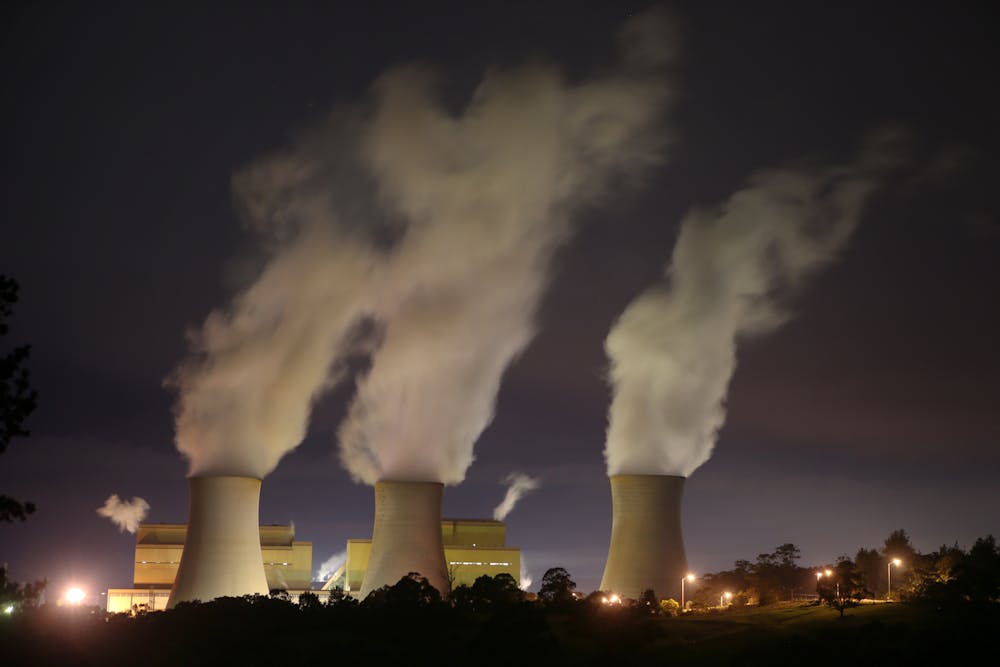
Yallourn power station at night
Yallourn power station is set to shut down in 2028. AAP Image/David Crosling

The inevitable demise of coal

Solar and wind energy are now the cheapest forms of new electricity generation. As the former chief executive of AEMO, Audrey Zibelman, stated last year:

It is inevitable […] we are at a position where the existing coal fleet is coming to the end of its technical life and is going to retire.

Renewable energy has grown to 25-30% of the market, placing enormous pressure on coal-fired generators and lowering their market share. In fact, a recent study estimates that by 2025, as many as five Australian coal power stations could be unprofitable.

At the last federal election, the Morrison government claimed 50% renewable energy by 2030 would be ruinous for our economy.

Now, several expert energy analysts estimate that renewable projects already in the pipeline could see 50% renewables occur as early as 2025.


Read more: Vital Signs: timing of Yallourn’s closure shows it’s high time for a carbon price


Australia has no plan

Australia is not well-prepared for the closure of coal power stations. It has no national climate and energy policy. And unlike nations such as Germany and Spain, there is no timetable for closures or agreements in place to manage the exit of coal power stations.

Under the National Electricity Rules, generators are required to give three years’ notice for a closure. But the penalties for failing to do so are not a significant deterrent relative to the incentive to stay in the market for as long as possible.

A recent Sydney Morning Herald report quoted an energy market source who said coal plant owners are playing a “game of chicken”. They are holding on and hoping another plant closes, which would tighten supply, raise electricity prices and improve the financial viability of remaining generators.

The closure of Yallourn is too far away to change the equation for other coal power stations at risk.

Without effective regulation or policy, regional coal communities are mostly left relying on the owners’ goodwill, or fear of reputational damage, to do the right thing.

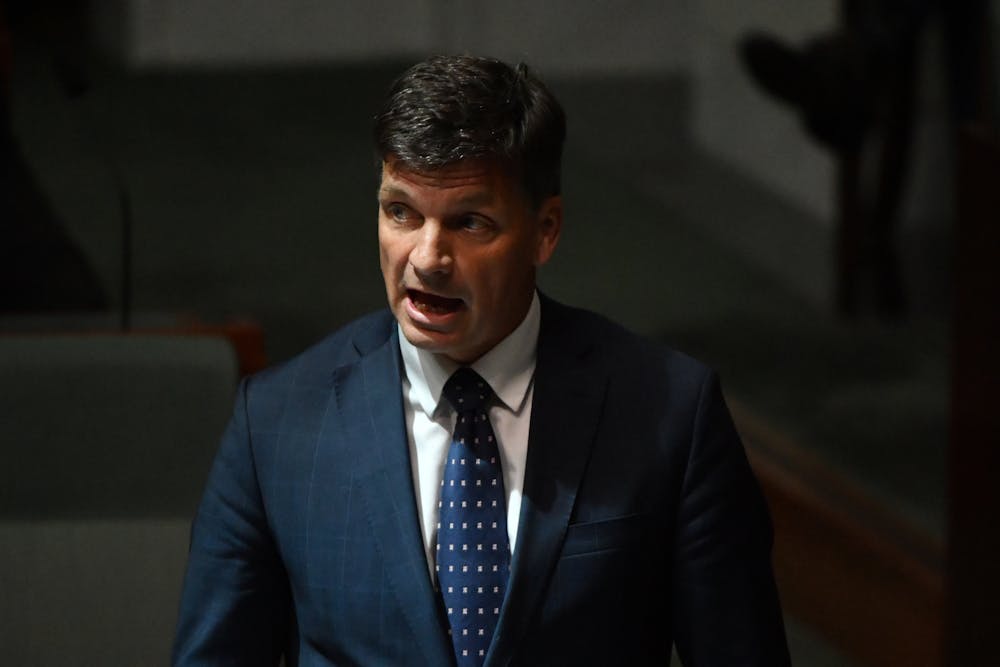
Energy minister Angus Taylor in a blue suit
Energy Minister Angus Taylor has criticised the Yallourn power station closure. AAP Image/Mick Tsikas

Already, we’ve seen the damage planned and unplanned coal plant closures can have on workers and consumers.

After the Hazelwood power station in the Latrobe Valley closed in 2016 with just a few months’ notice, data presented to the Victorian parliament in 2019 showed just one in three workers had found full-time work and one in four were unemployed.

What’s more, electricity prices spiked once Hazelwood’s supply was pulled from the market – demonstrating the risks to electricity supplies and consumers when coal exits don’t happen in an orderly manner.

Regional coal communities need time to adjust to the energy transition. If a string of Australian coal stations close at short notice, the social and economic impacts could be devastating.

In the case of Yallourn, the Victorian government negotiated an agreement, including seven years’ notice of the closure and support for the workforce, such as re-training.


Read more: How Australia can phase out coal power while maintaining energy security


Some coal plant operators are also taking the lead. In 2017, AGL gave five years’ notice that the Liddell coal plant in the New South Wales Hunter Valley would close in 2022 (the shutdown has since been pushed back to 2023). The company is now investing in transition measures for the site and workforce.

Heavy-handed intervention by the federal government has made attracting investment harder for Liddell and could do the same for Yallourn.

Renewable energy already creates more jobs (just under 30,000) than the domestic coal sector. Most of these jobs are currently in construction, but by the mid-2030s as many as half could be in ongoing operation and maintenance as the fleet of renewable projects grows.

This number will increase further. But while renewables projects will create some new jobs in coal regions, most will be in other regional areas and the capital cities.


Read more: 45,000 renewables jobs are Australia’s for the taking – but how many will go to coal workers?


So what needs to happen?

It seems almost everyone recognises the reality of coal power’s inevitable demise — except the federal government.

AEMO projects a grid dominated by renewable energy by 2035. Almost all of Australia’s banks and insurers have committed to exit thermal coal between 2030 and 2035.

The NSW, Queensland and Victorian governments are establishing Renewable Energy Zones to fast-track the growth of renewable energy before coal plants retire. And there are initiatives to grow regional jobs such as the NSW Renewable Sector Board, the Latrobe Valley Authority) and collaborations such as the Hunter Jobs Alliance).

These are all important and meaningful initiatives. But without a national policy or a process for coal exits, they’re operating in a vacuum without timeframes.

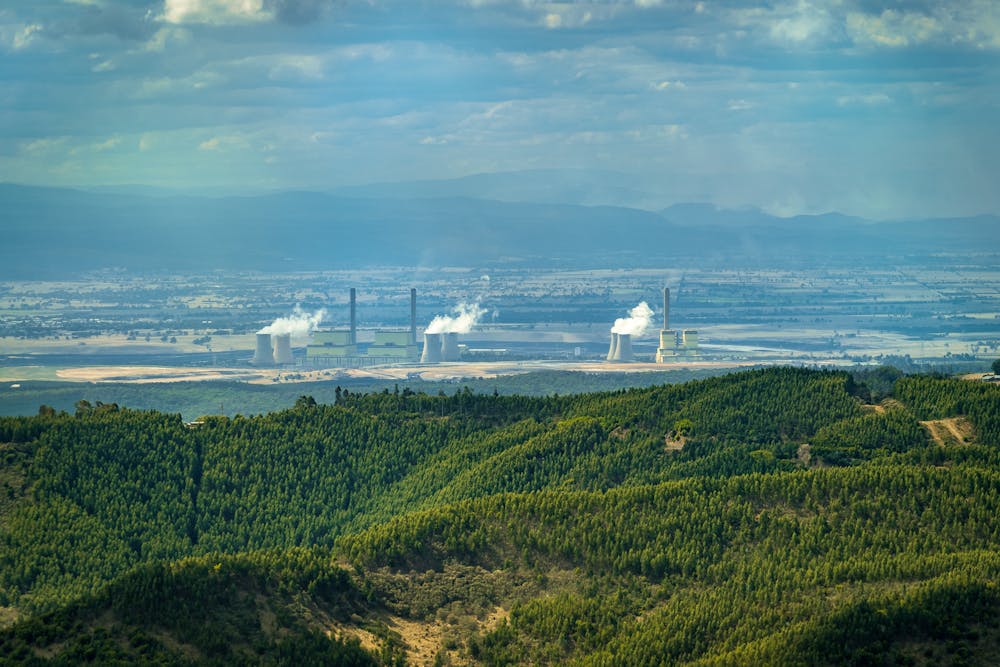
Loy Yang coal-fired power station in Victoria. Shutterstock

Australia should start looking to overseas experiences, where governments are establishing transition authorities and injecting funds to diversify regional economies and retrain workers. The European Union, for example, has set up a €17.5 billion (A$27 billion) Just Transition Fund. And national agreements between the government, industry, unions and communities to phase out coal have been negotiated in Germany and Spain.

There’s little prospect of this happening any time soon in the current Australian political climate, but a range of models have been advocated here. This includes auctions to stagger closures, or coal owners nominating a closure window and depositing money in a fund as insurance towards that commitment.

Whatever the model, a policy solution for the demise of coal is urgently needed across levels of governments, energy planners and local communities. Otherwise, it’s likely to be a bumpy ride for coal workers and the electricity system.


Read more: How to transition from coal: 4 lessons for Australia from around the world


ref. The death of coal-fired power is inevitable — yet the government still has no plan to help its workforce – https://theconversation.com/the-death-of-coal-fired-power-is-inevitable-yet-the-government-still-has-no-plan-to-help-its-workforce-156863

COVID-19 wasn’t just a disaster for humanity – new research shows nature suffered greatly too

Source: The Conversation (Au and NZ) – By Marc Hockings, Emeritus Professor of Environmental Management, The University of Queensland

It’s one year since COVID-19 was declared a global pandemic. While the human and economic toll have been enormous, new findings show the fallout from the virus also seriously damaged nature.

Conservation is often funded by tourism dollars – particularly in developing nations. In many cases, the dramatic tourism downturn brought on by the pandemic meant funds for conservation were cut. Anti-poaching operations and endangered species programs were among those affected.

This dwindling of conservation efforts during COVID is sadly ironic. The destruction of nature is directly linked to zoonotic diseases, and avoiding habitat loss is a cost-effective way to prevent pandemics.

The research papers reveal the inextricable links between the health of humans and the health of the planet. Together, they make one thing abundantly clear: we must learn the hard lessons of COVID-19 to ensure the calamity is not repeated.

A gorilla and man wearing mask
Protected areas are a boon for nature, and can help prevent pandemics. Jerome Starkey

A disaster for conservation

The findings are contained in a special issue of PARKS, the peer-reviewed journal of the International Union for the Conservation of Nature, co-edited with Brent Mitchell and Adrian Phillips.

Researchers found between January and May 2020, 45% of global tourism destinations totally or partially closed their borders to tourists. This caused the loss of 174 million direct tourism jobs around the world, and cost the sector US$4.7 trillion.

Over-dependence on tourism to fund conservation is fraught with peril. For example in Namibia, initial estimates suggested communal wildlife conservancies could lose US$10 million in direct tourism revenues. This threatened funding for 700 game guards and 300 conservancy management employees.

It also threatened the viability of 61 joint venture tourism lodges employing 1,400 community members. This forced families to rely more heavily on natural resource extraction to survive.


Read more: Coronavirus is a wake-up call: our war with the environment is leading to pandemics


Closed entrance to Grand Canyon national park
Around the world, the pandemic forced the closure of national parks – including the Grand Canyon, pictured here. Lani Strange/AP

Emergency funds were raised to cover critical shortfalls. However in April 2020, rhinos were poached in a communal conservancy in Namibia – the first such event in two years. Researchers believe this may have been linked to the pandemic fallout.

More than 70% of African countries reported reduced monitoring of the illegal wildlife trade as a result of the pandemic. More than half reported impacts on the protection of endangered species, conservation education and outreach, regular field patrols and anti-poaching operations.

Rangers have also been hard hit. A global survey of nearly 1,000 rangers found more than one in four had their salaries reduced or delayed due to COVID-related budget cuts. A third of all rangers in Central and South America, Africa and Caribbean countries reported being laid off. Some 90% said vital work with local communities had reduced or ceased.

In more bad news, governments of at least 22 countries used the pandemic as a reason to weaken environmental protections for protected and conserved areas, or cut their budgets.

Many of the changes allowed large-scale infrastructure (such as roads, airports, pipelines, hydropower plants and housing) and extractive activities (such as coal, oil and gas development and industrial fishing). Brazil, India and, until recently, the United States have emerged as hotspots of COVID-era rollbacks.


Read more: UN report says up to 850,000 animal viruses could be caught by humans, unless we protect nature


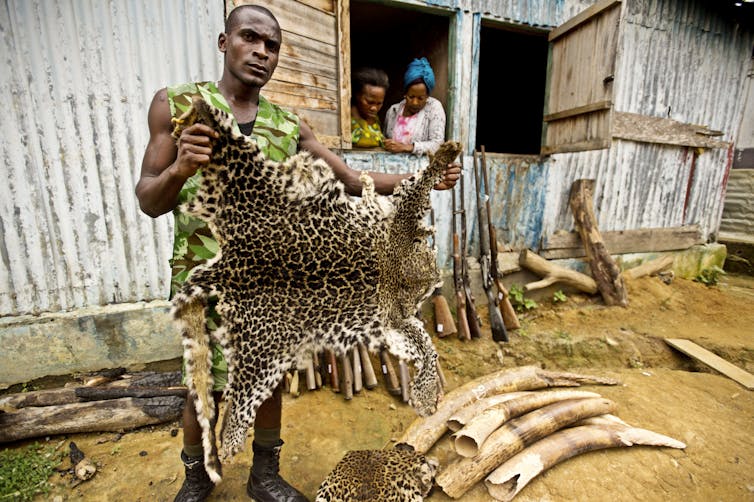
Man holds up leopard skin
When poverty strikes, vulnerable people can turn to poaching and other illegal means to survive. James Morgan/AP/WWF-Canon

Humans and animals pushed closer

SARS-COV-2 is very similar to other viruses in bats, and may have been passed to humans via another animal species. The pandemic shows the potentially devastating outcomes when animals and humans are forced into closer contact in shrinking habitats – for example, as a result of forest destruction.

As one paper found, during the last century an average of two new viruses spilled from animals to humans each year. These include Ebola and SARS.

Clearly, investment is needed to preserve the world’s protected and conserved areas, ensuring they act as a buffer against new pandemics. One study puts the required spending at US$67 billion each year – and notes only about one-third of this is currently being spent.

While it’s undoubtedly a large sum, the International Monetary Fund estimated late last year the pandemic would cause US$28 trillion in lost economic output in 2020.

Like many zoonotic epidemics, it appears COVID-19 was caused by the trade in wildlife and wild meat consumption. But diseases caused by uncontrolled land-use change – often for agriculture and livestock production – are just as dangerous.

The greatest risk, according to one group of researchers, is in forested tropical regions where land use is changing and a rich variety of mammal species are present.


Read more: Most laws ignore ‘human-wildlife conflict’. This makes us vulnerable to pandemics


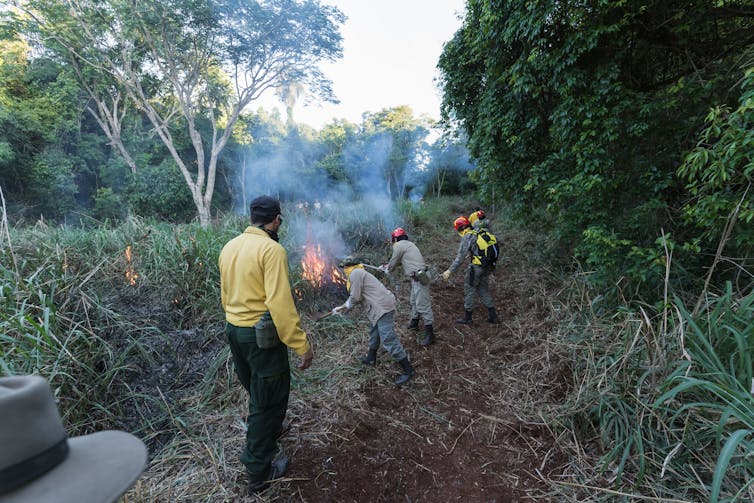
Rangers managing forest with fire.
Investment is needed in protected areas to ensure important conservation and land management continues. Shutterstock

2021: a crucial year

As the special issue’s co-editors argue, if COVID-19 is not enough to make humanity wake up to the “suicidal consequences” of misguided development, then how will future calamities be avoided?

The cost of effectively maintaining protected and conserved natural areas is a small fraction of the cost of dealing with the pandemic and getting economies moving again. Imagine, for a moment, if the effort put into the development of vaccines were applied in the same measure to addressing the root causes of zoonotic pandemics.

In 2021, a series of international meetings will be held to decide how to stabilise our climate, save biodiversity, secure human health and revive the global economy. Through these events should run a golden thread: learn the lessons of COVID-19 by protecting nature and restoring damaged ecosystems.

ref. COVID-19 wasn’t just a disaster for humanity – new research shows nature suffered greatly too – https://theconversation.com/covid-19-wasnt-just-a-disaster-for-humanity-new-research-shows-nature-suffered-greatly-too-156838

Vital Signs: timing of Yallourn’s closure shows it’s high time for a carbon price

Source: The Conversation (Au and NZ) – By Richard Holden, Professor of Economics, UNSW

If you ever doubted the price of renewable energy was falling so rapidly it would eventually replace fossil fuels, the expedited closure of the Yallourn coal-fired power plant should change that.

Energy Australia announced this week it would close the 47-year-old power station in Victoria’s Latrobe Valley in 2028 – four years earlier than expected – given the low price and high uptake of renewable energy.

This is good news for the environment. Yallourn is the nation’s most carbon-intensive generator. It accounts for 13% of Victoria’s greenhouse gas emissions and almost 5% of Australia’s total emissions.

But it also provides 22% of Victoria’s electricity and directly employs 500 people in a region already struggling with the transition away from fossil fuels. (Hundreds more jobs were lost when another Latrobe Valley coal-fired power station, Hazelwood, closed in 2017.)

Some of the impact may be mitigated by Energy Australia’s plan to build a 350 megawatt battery – 3.5 times the capacity of South Australia’s big battery in Hornsdale, larger than any now existing – near the company’s Jeeralang gas-fired power station in the Latrobe Valley.

Policy hodgepodge

The crucial question in all of this is whether Australia’s coal-fired power stations are being retired too slowly – or potentially even too quickly.

It’s hard to know without a price on carbon to create a level playing field for renewable energy and fossil fuels.

We need a carbon price that reflects the “social cost of carbon”. The best evidence is this is about US$51 per metric ton.

What we have instead is a hodgepodge of clumsy government interventions on both sides of the ledger.

Yes, there are subsidies for renewable generation such as wind and solar.

But there is perhaps as much as A$12 billion a year in implicit subsidies for fossil fuels. These subsidies stem from things such as the fuel tax credit scheme, aviation fuel excise concession, accelerated depreciation through effective life caps on power plants, fringe benefits tax concessions, uplift provisions in the petroleum resources rent tax, and more.

Huge uncertainty

All of this creates huge uncertainty about if and when Australia’s remaining 16 coal-fired power plants will close. When will their workers need transition assistance to begin? Are we sending the right price signals for those considering investing in different forms of power generation? Are we going to have enough reliability in the system to avoid blackouts or brownouts?

These issues about transition of companies, workers and indeed whole communities from fossil fuels to green energy are not limited to power generation plants. Far from it. All sectors of the economy will be affected, though some more than others.

For instance, as electric vehicles replace petrol or diesel-powered vehicles, what will happen to petrol stations? Electric charging stations don’t need the same real estate. How many will be decommissioned, how many will remain as convenience stores? What’s the time line?


Read more: Bad news. Closing coal-fired power stations costs jobs. We need to prepare


A mess at best, a disaster at worst

The key point is that the weird combination of government policies subsidising both green energy and fossil fuels has no clear connection to the relative price of these energy alternatives. These policies thus provide no clear signal to influence consumer and business decisions. It is impossible to make sensible predictions about how our energy mix will evolve, and hence how to respond to that evolution.

Worse still, government policy is subject to change at any time – even without a change of government. This adds a big slather of political uncertainty on top of the existing economic uncertainty.

The Yallourn closure should be a wake-up call to both sides of politics that a transition to green energy run by government fiat is going to be a very messy affair at best, and a complete disaster at worst.

In fact, the Hazelwood closure in 2017 should have been that wake-up call. Let’s hope politicians at least get the message this time.


Read more: How Australia can phase out coal power while maintaining energy security


Putting a price on carbon has become the ultimate political issue. Labor is scared to death of losing another election by supporting such a price – even though (with the possible exception of Joel Fitzgibbon) it knows it’s the right policy.

Scott Morrison’s Liberal Party is so wedded to using “technology versus taxes” as a political wedge it can’t even see the right policy any more. The parliamentary National Party, meanwhile, can’t appreciate what many of their constituents do know – that a carbon price would provide enormous economic opportunities in rural and regional Australia.

Our energy transition is in disarray. It will only get worse without a price on carbon and an end to subsidies for all forms of energy. Failure to do so will merely sow the seeds for more transition problems in the years to come.

ref. Vital Signs: timing of Yallourn’s closure shows it’s high time for a carbon price – https://theconversation.com/vital-signs-timing-of-yallourns-closure-shows-its-high-time-for-a-carbon-price-156936

Friday essay: is this the end of translation?

Source: The Conversation (Au and NZ) – By Mridula Nath Chakraborty, Monash Intercultural Lab and National Convenor of the Asian Australian Studies Research Network, Monash University

In 399 CE, Faxian — a monk in China’s Jin Dynasty — went on a pilgrimage to the Indian subcontinent to collect Buddhist scriptures. Returning after 13 years, he spent the rest of his life translating those texts, profoundly altering Chinese worldviews and changing the face of Asian and world history.

Illustration: four monks look up at an ancient Indian palace.
Faxian illustrated as visiting the Palace of Asoka in 407 CE, in modern-day Patna, India, in the 19th century English book series, Story of the Nations. archive.org

After Faxian, hundreds of Chinese monks made similar journeys, leading not only to the spread of Buddhism along the Nirvana Route, but also opening up roads to medicine men, merchants and missionaries.

Along with the two other great translation movements — Graeco-Arabic in the Umayyad and Abbasid periods (2nd-4th and 8th-10th century) and Indo-Persian (13th-19th centuries) — these events were major attempts to translate knowledge across linguistic boundaries in world history.

Transcending barriers of language and space, acts of translation touched and transformed every aspect of life: from arts and crafts, to beliefs and customs, to society and politics.

Going by the latest casualty in the heated — but necessary — debates around representation in our creative and cultural arenas, none of this would be possible today.

Last month, Marieke Lucas Rijneveld, the youngest writer ever to win the International Booker Prize for The Discomfort of Evening (with translator Michele Hutchison), was chosen to translate 22-year-old American poet laureate Amanda Gorman’s forthcoming collection, The Hill We Climb, for Dutch publisher Meulenhoff.

Gorman selected Rijneveld herself. But amid backlash that a white prose writer was chosen to translate the work of an unapologetically Black, spoken word poet, Rijneveld resigned saying,

I understand the people who feel hurt by Meulenhoff’s choice to ask me […] I had happily devoted myself to translating Amanda’s work, seeing it as the greatest task to keep her strength, tone and style. However, I realise that I am in a position to think and feel that way, where many are not.

This week, meanwhile, the poem’s Catalan translator Victor Obiols told AFP he had been removed from the job by Barcelona publisher Univers.

They did not question my abilities, but they were looking for a different profile, which had to be a woman, young, activist and preferably black.

We live in a world rife with controversies around cultural appropriation and identity politics. The power differentials created by the twin forces of colonialism and capitalism are being interrogated in every realm today.

It was only a matter of time before these burning issues ignited the art of translation.

Usually invisible and taken-for-granted, acts of translation take place around us all the time. But in the field of literary translation, questions of authorial voice and speaking position matter.

Marginalised creative practitioners and their growing audiences assume importance in a global publishing regime controlled by a dominant minority wielding majority power over issues of representation.

So it is fitting that some have drawn attention to the myriad spoken word artists eminently qualified to undertake translation in the Netherlands. And Dutch agents, publishers, editors, translators and reviewers could certainly broaden their horizons and embrace diversity.

Nevertheless, if humans only translated the familiar, how would we ever have an inkling of the astonishing world out there that is not familiar?

The task of literary translation entails grappling with profound difference, in terms of language, imagination, context, traditions, worldviews.

None of this would enter our quotidian consciousness but for the translators who step into uncharted waters because they have fallen in love with another tongue, another world.

Translation is resistance

Translators ferry across the meaning, materiality, metaphysics and all the magic that may be unknown in the mediums and conventions of their own tongue. The pull of the strange, the foreign, and the alien are necessary for acts of translation.

It is this essential element of unknowingness that animates the translator’s curiosity and challenges her intellectual mettle and ethical responsibility. Even when translators hail from — or belong to — the same culture as the original author, the art relies on the oppositional traction of difference.

Through opposition and abrasion, a creative translation allows for new meaning and nuance to emerge.

Noaki Sakai, a Japanese historian and translator at Cornell University, writes about the historical complexity of this process. The practices of translation, he says, are “always complicit with the building, transforming and disrupting of power differences.”

Translation is domination

Translation has, however, been a tool for domination in colonisation. La Malinche, for instance, acted as an intermediary and interpreter for the conquistador, Hernán Cortés, in the 16th century Spanish conquest of the Aztec Empire.

Four Aztec men, a Spanish man, and an Aztec woman.
In this drawing by an unnamed Tlaxcalan artist c. 1550, La Malinche (far right) is acting as translator between Hernán Cortés and Moctezuma II, the ninth ruler of the Aztec Empire. Bancroft Library, UC Berkley

Patyegarang was Australia’s first teacher of Aboriginal language, to early colonist, William Dawes, and crucial for the survival of the Gamaraigal language in Eora country. At 15, and as an initiated woman, she was Dawes’ intellectual equal, learning English from him and negotiating a relationship of mutual translation while holding on to her own cultural legacy.

In each of these cases, European imperialists learnt how to survive the lands they were conquering through the processes of translation. Moreover, they used the same languages to fabricate the story of their own superior Western civilisation, at the cost of Indigenous cultures.

As translation theorist Tejaswini Niranjana explains, translation:

shapes, and takes shape within, the asymmetrical relations of power that operate under colonialism.

Translation is not a neutral activity. It functions in a complex set of socio-political relations, where parties have vested interests in the production, dissemination and reception of stories and texts.

Academics Sabine Fenton and Paul Moon have written about the deliberate mis-translation of the Treaty of Waitangi, a strategic example of colonial omissions and selections that achieved “the cession of Maori sovereignty to the Crown.”

One egregious interpolation was the replacement of the word mana (sovereignty) with kawanatanga (government), which misled and induced many Maori chiefs to sign the treaty.


Read more: Explainer: the significance of the Treaty of Waitangi


In situations of conflict and war — and the displacements that result from them — translation again becomes a weapon privileging the powerful, as seen in the impenetrable bureaucratic paperwork, in the dominant language, governing asylum and refugee seeker decisions.

In this charged context, the case of Gorman and Rijneveld becomes a lightning rod for addressing historical disempowerment and injustices.

Translation is diplomatic

In the absence of a level playing field for writers to have their voices heard in the global publishing market, there does need to be historical awareness and post-colonial sensitivity.

To Rijneveld’s credit, this sensitivity has been demonstrated. After stepping down as Gorman’s translator, they composed a poem:

never lost that resistance, that primal jostling with sorrow and joy,

or given in to pulpit preaching, to the Word that says what is

right or wrong, never been too lazy to stand up, to face

up to all the bullies and fight pigeonholing with your fists

raised, against those riots of not-knowing inside your head

Still, while representation is the moral imperative of the 21st century, it is my modest proposal that in the realm of literary translation, the pull of the unknown and the unfamiliar is one of the most important truisms: Rijneveld’s “riots of not-knowing.”

Already the world is losing a language every fortnight; 7000 languages are expected to be extinct by the end of this century. Yet it has often been argued that linguistic diversity is an indicator of genetic diversity, the latter being critical to the survival of the species.

If humans only translate what is known within their own four walls, or what is familiar to them within the boundaries of their own imaginations, something essential is lost both to translation — and to the profligate tongues that proliferate our humanity.

Translation is activism

We do not live in a post-racial world. We do not live in a borderless world — as brought to the fore powerfully by the COVID-19 pandemic. For translators in transnational times, it is of the essence that we break down ethno-linguistic borders, accepting the challenge of the confronting.

In my own work, I have collaborated on translations of Aboriginal & Torres Strait Islander, and tribal & Dalit Indian poets. This has necessarily involved the hard work of understanding historical incommensurabilities.

Yes, structural inequalities mount by the day in the face of capitalism, which is a faithful handmaiden to the ongoing machinations of colonialism. Translators do not live in a vacuum. We are not immune to the forces of structural racism.

But why is it that Rijneveld had to renounce the commission as an individual? Why does this recent story become about individual actions, rather than the entrenched patterns of operation of publishing houses like Meulenhoff?

To achieve equity, transformation must be structural — it cannot fall on the shoulders of one translator alone, making them a fall guy for the business of books as usual.

The directors and CEOs of dominant global (read: Western) publishing companies are predominantly white. Which begs the familiar question: what if editorial boards reflected the multiplicity of society across the axes of class, gender, race, sexuality and ability?

Imagine the scenario if even one of Australia’s mainstream publishing houses was led by a non-white head and/or board?


Read more: Diversity, the Stella Count and the whiteness of Australian publishing


It is precisely the duty of heads of publishing houses, literary and review magazines and cultural institutions, to invite a teeming world of translators to take charge of what needs to be done.

Oil painting. A giant unwieldy tower rises towards heaven.
The biblical story of the Tower of Babel, painted here by Pieter Bruegel the Elder in 1563, tells of how all of humanity once spoke one language and tried to build a tower to Heaven, before God acted to make the people unable to understand each other, and unable to collaborate. Kunsthistorisches Museum/Wikimedia Commons

Still, a translator must attend to the demands of integrity and imagination as much as the demands of history and society. She must throw herself into the challenging task of being in another time and place, of rubbing against the grain of her own aims and assumptions.

Only in imagining such a Babelian world of difference can a truly radical set of possibilities become alive.

This is not to argue that translators who come from similar backgrounds will not be able to engage in the task of translation in ways that wrestle with the creative resistance entailed in such a task. But the field must remain open to whoever is called to the task.

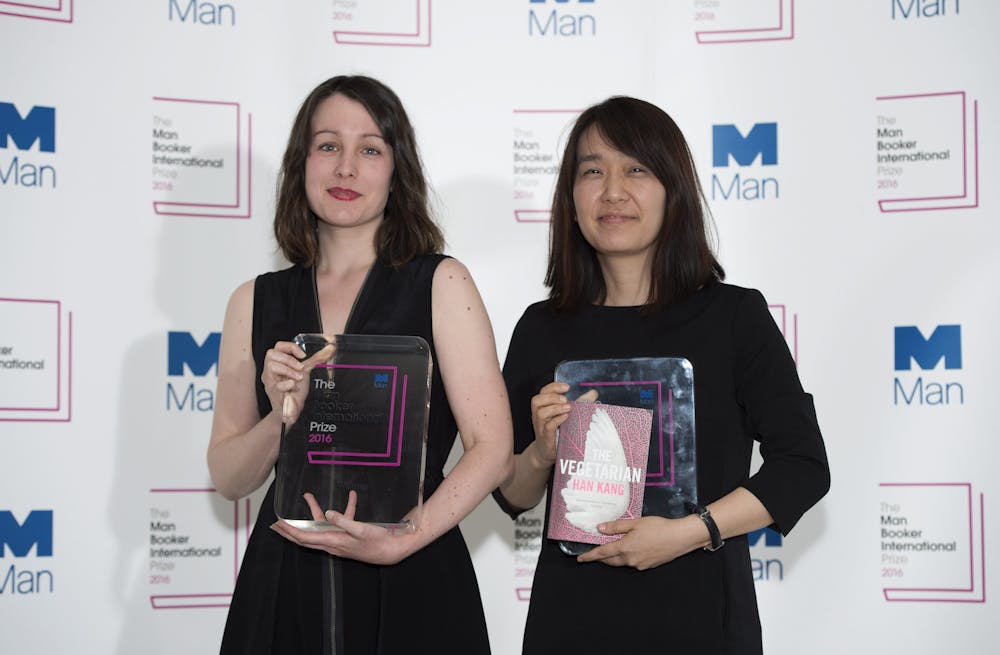
Literary translation is often a matter of happy accidents and passionate engagements. Han Kang’s The Vegetarian (2007) became a runaway success in the United Kingdom and United States in 2016, when Deborah Smith, who had been learning Korean for only six years, embarked on the task.

A white woman and an Asian woman pose with trophies.
Author Han Kang (R) and her translator Deborah Smith (L) won the Man Booker International Prize in 2016 for The Vegetarian. EPA/Hannah McKay

There have been critiques of her translation, but representation is not the issue. Part of the beauty of translation is that texts can be critiqued, and translated again and again.

Translation lore is enriched continually by examples of re-translations, such as the ten translations into English of Tolstoy’s Anna Karenina alone, or the two of Orhan Pamuk’s The Black Book.

The act and the art of translation requires the permission to transcend borders, the permission to make mistakes, and the permission to be repeated, by anyone who feels the tempestuous tug, and the clarion call, of the unfamiliar.

To rein in such liberty through categories and compartments that imprison our creativity is a disservice to the human imagination.

So let a thousand translations bloom: that would be a start and not an end to translation as we know it now.

ref. Friday essay: is this the end of translation? – https://theconversation.com/friday-essay-is-this-the-end-of-translation-156375

Screwed over: how Apple and others are making it impossible to get a cheap and easy phone repair

Source: The Conversation (Au and NZ) – By Ritesh Chugh, Senior Lecturer – Information Systems and Analysis, CQUniversity Australia

If Apple and other tech companies have their way, it will only become harder to have our phones and other devices repaired by third-party businesses.

Smartphones and many other tech devices are increasingly being designed in ways that make it challenging to repair or replace individual components.

This might involve soldering the processor and flash memory to the motherboard, gluing components together unnecessarily, or using non-standard pentalobe screws which make replacements problematic.

Many submissions to an Australian “right to repair” inquiry have called on tech manufacturers to provide a fair and competitive market for repairs, and produce products that are easily repairable.

The right to repair refers to consumers’ ability to have their products repaired at a competitive price. This includes being able to choose a repairer, rather than being forced by default to use the device manufacturer’s services.

But it seems Apple doesn’t want its customers to fix their iPhones or Macbooks themselves. The company has lobbied against the right to repair in the United States and has been accused of deliberately slowing down iPhones with older batteries.

Opposition against the right to repair from tech companies is to be expected. Cornering consumers into using their service centres increases their revenue and extends their market domination.


Read more: Apple, Google and Fortnite’s stoush is a classic case of how far big tech will go to retain power


In its defence, Apple has said third-party repairers could use lower quality parts and also make devices vulnerable to hackers.

It also defended its battery warning indication as a “safety” feature, wherein it started to alert users if their phone’s replacement battery hadn’t come from a certified Apple repairer.

In the US, Apple’s independent repair provider program grants certain providers access to the parts and resources needed to fix its devices. Independent repair shops in 32 countries can now apply, but the scheme has yet to extend outside the US.

Impact on users

With the iPhone 12 — the latest iPhone offering — Apple has made it even harder for third-party repairers to fix the device, thereby increasing users’ reliance on its own services.

Apple has hiked its repair charges for iPhone 12 by more than 40%, compared with the iPhone 11. It is charging more than A$359 to fix an iPhone 12 screen outside of warranty and A$109 to replace the battery.

Historically, third-party repairers have been a cheaper option. But using a third-party repairer for an iPhone 12 could render some phone features, such as the camera, almost inoperable.

According to reports, fixing the iPhone 12’s camera requires Apple’s proprietary system configuration app, available only to the company’s own authorised technicians.

It’s not just Apple, either. Samsung’s flagship phones are also quite tricky for third-party repairers to fix.

Impact on environment

When certain parts for repairs aren’t available, manufacturers will produce new phones instead, consuming more energy and resources. In fact, manufacturing one smartphone consumes as much energy as using it for ten years.

Pile of smashed, discarded smartphones
With smartphones and computers becoming harder and more expensive to repair, consumers may be more likely to dispose of their device when something goes wrong. Shutterstock

As smartphones become harder to repair, electronic waste will grow. Apple and Samsung both cited environmental benefits when they announced they would no longer ship chargers with their phones.

Yet, they’ve turned a blind eye to the environmental damage that would arise from completely cornering the repair market.


Read more: Apple’s iPhone 12 comes without a charger: a smart waste-reduction move, or clever cash grab?


The average Australian home has 6.7 devices, including televisions, personal computers, laptops, tablets and smartphones. With diminishing opportunities for repair, the environmental burden from disposing of these devices will increase.

What is being done?

Phone giants make it tough for third-party repairers to do their job in a variety of ways. This includes constantly changing designs, adding hurdles to the repair process, and restricting access to parts, diagnostic software and repair documentation.

Meanwhile, consumers are left with broken phones and huge repair bills — and repairers are left with less business.

The fight to remove barriers to repair is gaining momentum outside Australia, too, in countries including Canada, the United Kingdom and the United States. Legislative reforms have been introduced in the European Union and Massachusetts.

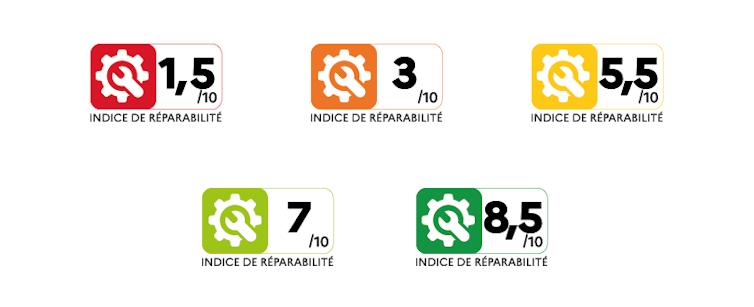
France has introduced a Repairability Index requiring electrical and electronic equipment companies to inform consumers about their products’ repairability on a scale of one to ten.

This takes into account the ease of repairability, availability and price of spare parts and availability of technical repair documents.

France’s Repairability Index tool is designed to help consumers make informed choices about which device they purchase. France Ministry of Ecological Transition

The path moving forward

Until the push for right to repair legislative reform gathers pace globally, consumers will have little choice but to pay up to big companies to access their authorised repair services.

If they don’t, they may risk losing their warranty, ending up with a non-functional device and even infringing upon the manufacturers’ software copyrights.

Ideally, phone companies (and others) would assist users with the repair process by providing replacement parts, repair documentation and diagnostic tools to third-party repairers.

This would also help Apple and Samsung reduce their carbon footprint and achieve their environmental goals.

Although the way things are going, it’s unlikely tech companies will be able to escape their self-inflicted repair obligations. In the past, Apple CEO Jeff Williams has said:

we believe the safest and most reliable repair is one handled by a trained technician using genuine parts that have been properly engineered and rigorously tested.

But with only so much workforce available even to Apple, sharing the load with smaller repairers will help.

And for consumers’ benefit, the right to repair legislation must be taken seriously, with consistent repairability scores developed across the globe.

ref. Screwed over: how Apple and others are making it impossible to get a cheap and easy phone repair – https://theconversation.com/screwed-over-how-apple-and-others-are-making-it-impossible-to-get-a-cheap-and-easy-phone-repair-156871

‘A lot of us can relate to struggling to keep on top of everything.’ This is what mature-age students need from online higher education

Source: The Conversation (Au and NZ) – By Ameena Leah Payne, eLearning Advisor, Swinburne University of Technology

“I completed high school 20 years ago and wanted a ‘little break’ before furthering my study. That ‘little break’ was extended as my family grew. Life happened, and I never quite found the right time to keep my promise to myself to go to uni – until now!”

“This is my first teaching period in uni. I’m 36 years old. I live with my wife and two very active kids. When I’m not being a chef, cleaner and taxi driver (you know the list), I’m working as a learning support officer at our local school. I haven’t written an academic essay in over 15 years!”

These are common introductions of my mature-age students. They often share their family backgrounds, nervousness, excitement and responsibilities they have to juggle as they begin their uni journey. In sharing, they “feel a sense of solidarity seeing others post about their concerns”, as one student put it.

National Centre for Student Equity in Higher Education (NCSEHE)

Students in general say a critical issue in the shift to online higher education has been a lack of adequate support, interaction and engagement with academic staff and peers.

More than 430,000 students are aged 25 years and older. That’s 39.1% of the total domestic higher education enrolment, and mature-age students account for 22% of first-year undergraduates.

Mature-age, online students are identified as the most vulnerable to not completing their degree. That happens to about 43% of them compared to 30% of those aged 20 to 24 and 21% for students who enrol straight out of school.

Given the inconsistent completion outcomes for mature-age students compared to younger and on-campus students, a different approach is needed. This means universities must take account of the particular needs and circumstances of mature-age students.

“I think a lot of us can relate to the idea of struggling to keep on top of everything.”

Who are these students?

Mature age” refers to adults who enter their course based on work experience or who have not studied recently. They are more likely to have responsibility for others and be in the paid workforce.

Growing numbers of students are entering fully online higher education. And students 25 years and older are more strongly represented in online studies than face-to-face studies.

A 2019 study of mature-age learners highlighted the following challenges of studying online:

  • uncertainty in abilities leading to a “narrative of disadvantage” and a feeling of stepping into a space where they feel they do not belong

  • first-year, mature-age students consider withdrawing from their studies at higher rates

  • enrolment in university may be rooted in previous negative educational experiences – traditionally, the status quo in higher education has not served students at the margins.

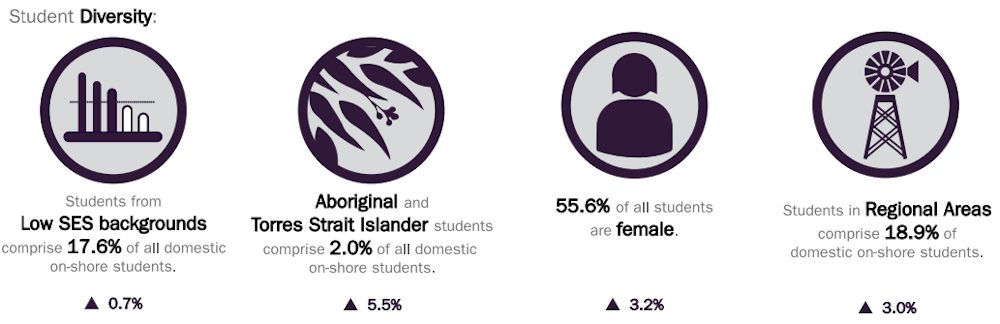
Chart showing diversity of higher education students
DESE 2019 Higher Education Statistics, CC BY

Online teaching compounds existing weaknesses

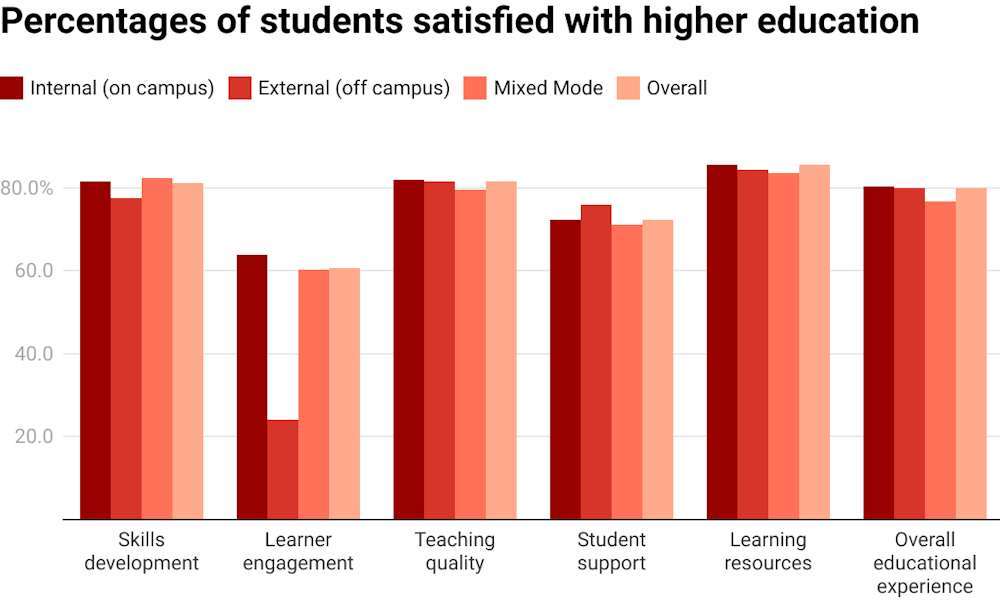
In the shift to online, many education providers are making the same mistakes by continuing with impersonal teaching methods. Students aged 25 and over rate engagement as the least satisfactory aspect of their online courses.

Active engagement tends to drop off as the teaching period progresses. (The proxy measures of “engagement” are active presence and involved participation.)

Further, education has commonly had an emphasis on subordination. Cue the “domineering teacher” portrayed by antagonist Terence Fletcher in the 2014 film Whiplash. One-way information transmission and an expectation of passive knowledge acquisition have overshadowed relationships between teaching staff and students.

The challenge, then, is to start off in a way that develops a culture of trust, collegiality, openness and contribution.

Chart showing student satisfaction with key aspects of higher education
Chart: The Conversation. Data: QILT/Social Research Centre 2019, CC BY

‘It resonates!’ Recognising experiences and skills

Mature-age students are starting online higher education with a variety of aptitudes, knowledge, opinions and values. These backgrounds affect how students engage with and construe information. The online experience should encourage connection, active participation and critical thinking.

The language of education is shifting to incorporate students as “stakeholders”, “co-constructors” and “active participants”. Such terms have a powerful effect.

In 1930, psychologist and educational reformer John Dewey advocated for empowering learners by honouring their lived experiences and capabilities. Reforms of the 1960s and ‘70s began shifting education toward autonomy, allowing for reflection, independence and flexibility. More recent geopolitical movements, driven by social media, are, once again, prompting an upturn in education that emphasises discussion, openness and independent thought.

It’s essential that these themes be re-created in today’s digital learning environments.

“You made me feel like I am not alone in this. I was anxious and afraid that I won’t be able to keep up.”

Emerging from the 2019 study of mature-age students were several key recommendations:

  1. understand and value the circumstances and experiences of this cohort

  2. communication and personal contact are vital

  3. embed timely, proactive support.

In such environments, educators must be given the time to get to know their students’ situations and experiences. They can then reach out to support them. In essence, Dewey argued for educators to meet learners where they are, wherever that may be.

“I have felt I was always able to contact you and receive helpful advice. It means a lot – especially for newcomers like me!”

These suggestions are in line with the findings and recommendations of the recent Macklin Review of post-secondary education and training in Victoria. Times of growth and uncertainty call for greater adaptability, empathy and innovation. This will feed into student retention, progression and ultimately an undergraduate qualification.

To government and institutions: online education, and of mature-age students in particular, must be approached differently. Education can only act as the great social equaliser if the growing cohort of mature-age students are engaged and supported to reach their academic goals.

To current and emerging mature-age learners: well done to you! You are seen and being heard.

ref. ‘A lot of us can relate to struggling to keep on top of everything.’ This is what mature-age students need from online higher education – https://theconversation.com/a-lot-of-us-can-relate-to-struggling-to-keep-on-top-of-everything-this-is-what-mature-age-students-need-from-online-higher-education-155201

Grattan on Friday: Morrison grapples with slow vaccine rollout, end of JobKeeper and ministerial crises

Source: The Conversation (Au and NZ) – By Michelle Grattan, Professorial Fellow, University of Canberra

Best to avoid the media just now if you’re squeamish about seeing needles. Political and other notables are rushing to bare arms for the jab, encouraging confidence in the COVID vaccines.

Commendable example-setting of course. But just now the issue isn’t so much persuading people to take the vaccine as getting it rolled out fast enough.

The government originally set a target of 4 million people reached by the end of March (which slipped to early April). So far, the tally is a little over 100,000 shots administered.

No wonder this week Scott Morrison, acting health minister in the absence of a hospitalised Greg Hunt, was emphasising the program was sure, steady, safe and well planned, rather than speedy.

Health Department Secretary Brendan Murphy, appearing with the PM, preferred to talk about the “major target” of offering every adult a vaccine by the end of October.

On Thursday, when he fronted the Senate’s COVID committee, Murphy said supply problems had hampered the initial rollout, and could not give a time for reaching the 4 million target. He admitted “a small proportion of people” might not have had their second AstraZeneca shot by the end of October (although he insisted they’d be protected by their first shot).

Getting over the initial hurdles and hastening the rollout is one of three challenges Morrison faces right now. The others are managing the economy after JobKeeper’s imminent end, and dealing with his ministerial crises – the trickiest of the three, in political terms.

Australia is lucky that, with virtually no current community transmission of COVID-19, this slow start to the vaccination program does not present a health threat.

But it does mean the removal of remaining restrictions is likely to be held back, and the tardiness leaves Morrison open to opposition criticism for over-promising and under-delivering.

Morrison has always bracketed health and economics in dealing with COVID, and his eyes are now glued to the economy as JobKeeper, the lifeline for so many businesses and workers, finishes in late March.

On the latest figures, at the end of January about 370,000 businesses and 1 million workers were still on JobKeeper.

The post-JobKeeper period will be a reckoning point for many enterprises.

The government has acknowledged some businesses will fail. In economic terms, this is a necessary; in human terms, it will be devastating for many people.

This week Reserve Bank Governor Philip Lowe predicted that “the unemployment rate [currently 6.4%] will continue to trend lower, although this trend could be temporarily interrupted when JobKeeper comes to an end later this month”.

In its measures for the post-JobKeeper period, the government has two objectives: to maintain the pace of the recovery, which has been encouragingly strong (3.1% growth in the December quarter), and to help sectors with special problems.

This week it announced assistance of some $4.2 billion: half for the employment of apprentices and trainees, and the rest for the aviation and tourism industries (including 800,000 subsidised air tickets targeting holiday areas).

The loan scheme for small and medium-sized businesses is also being extended and expanded for enterprises coming off JobKeeper in the March quarter.

Aspects of the aviation and tourism package have been met with some scepticism, and critics argue JobKeeper should be staying for longer.

But the government can be satisfied the recovery so far is V-shaped, which last year many economists thought improbable.

It is a very different story on the political front, which is chaotic.

Morrison faces a hellish fortnight with the return of parliament on Monday.

That day, more than 85,000 women are expected to demonstrate in 38 locations around the country, including outside Parliament House.

The protests have been sparked by Morrison’s handling of the two separate allegations of rape that have consumed federal politics for weeks.

The demonstrators’ broader themes are that gendered violence must end; that women must be heard and believed; and that they must be safe – in their workplaces, homes and daily lives.

Neither Attorney-General Christian Porter nor Defence Minister Linda Reynolds will be there to see the Canberra women. He’s on mental health leave; she’s on medical leave. But the government is certain to be pummelled with questions in parliament about them both.

Morrison has yet to reveal the results of the inquiry by his departmental secretary, Phil Gaetjens, into who of his staff knew what when about Brittany Higgins’ allegation she was raped in Reynolds’ office in 2019. And Reynolds’ “lying cow” comment will no doubt get a run.

Porter remains Morrison’s most serious political problem, going to what standards should be demanded for the occupant of the position of the country’s first law officer.

There continues a chorus of calls, including from within the legal profession, for an independent inquiry to settle the question of Porter’s suitability for his position, given NSW police have closed their investigation of the allegation he raped a 16 year-old girl in 1988, which he strenuously denies.

But Morrison this week was firmly dug in behind Porter, despite his being highly damaged political goods.

Government sources insist Morrison, and other colleagues, want Porter back in his job – they are afraid of the precedent set if he leaves the ministry. This ignores the fact that, on any commonsense view, this is surely a one-off ministerial situation.

On the other hand, Morrison’s preference would probably be for Reynolds to step down, citing her health – but that decision remains in her hands.

The PM is assuming these ministerial crises will blow over soon enough.

He may accept that many people (especially women) will have strong views on the issues – the “toxic” parliamentary culture, the suitability of Porter for office, how the government handles issues affecting women. But he’d calculate these aren’t substantial vote-changers.

That may be right. On the other hand, it might be dangerous complacency.

Although Morrison has a big lead as preferred PM, the poll numbers are tight, and the government has no electoral fat for the contest that’s little more than a year away at most.

Also, for as long as the ministerial crises are front and centre, the Coalition can’t get its messages out properly.

By early May, Morrison needs to have the vaccine rollout marching at a good clip, the economic recovery coping with the end of JobKeeper, and Porter and Reynolds no longer damaging distractions.

That would give him a good run into the budget.

Not much to ask, really.

ref. Grattan on Friday: Morrison grapples with slow vaccine rollout, end of JobKeeper and ministerial crises – https://theconversation.com/grattan-on-friday-morrison-grapples-with-slow-vaccine-rollout-end-of-jobkeeper-and-ministerial-crises-156975

As the world’s attention and money are absorbed by the COVID pandemic, peacebuilding suffers

Source: The Conversation (Au and NZ) – By Eleanor Gordon, Senior Lecturer in Politics and International Relations, Monash University

Resources critical to peacebuilding and to countries vulnerable to conflict have been significantly reduced as a result of COVID-19.

In conflict zones from Ukraine to Syria, hundreds of thousands of people are “suffering in silence”. These conflicts risk becoming “forgotten crises”, and are intensifying as states and non-state armed groups utilise the pandemic and a distracted international community for their own strategic advantage.

The figures are alarming. For instance, foreign direct investment “collapsed” in 2020, according to the UN Conference on Trade and Development (UNCTAD), falling by 42% to an estimated US$859 billion (compared with US$1.5 trillion in 2019). Many humanitarian organisations have also recorded a dramatic drop in donations from private individuals and fundraising activities, or expect private donations will decline as the global recession hits.

Profound cuts to foreign aid are anticipated as countries continue to invest heavily in COVID-19-related activities while facing severe economic recession.

Already, several governments, including the UK, have announced major cuts to aid budgets in light of COVID-19. A decline in public support for foreign aid, typical in times of financial crisis, is also likely to encourage cuts. This in turn is likely to have a negative effect on peacebuilding, which is already underfunded.

Evidence suggests that committed foreign aid being redirected from peacebuilding programs into efforts to deal with COVID-19 is likely to have even more of an impact on the ground than a decrease in foreign aid. The UK, US, France andAustralia, for instance, have announced a reorientation of their aid commitments to medical infrastructure.

A further reduction in funding and troops for UN peacekeeping missions is also likely. This is in turn predicted to reduce the capacity of peace operations by 30-50% over the next year or two.


Read more: Buying a coronavirus vaccine for everyone on Earth, storing and shipping it, and giving it safely will all be hard and expensive


Declining funds hit aid organisations hard

A global survey of organisations engaged in peacebuilding was conducted to assess the impact of these cuts on the ground. In the survey, 62% said they or their organisation had experienced a reduction in funding for peacebuilding work. In addition, 71% said COVID-19 had, or was likely to have had, a negative impact on the financial security of their organisation. Other global surveys have had similar results.

Reduced funds will also inevitably affect employment and job security for these organisations. The survey found 74% felt their work was more precarious, while 56% knew of someone in the sector who had lost a job as a result of the pandemic.

On top of this, 75% said the focus of their work has changed. They referred to “strong signals” given by donors to “pivot” activities towards COVID-19-related issues, even if other needs were perceived to be more pressing.

Impact on conflict zones

The reduction in resources comes when they are most needed. This is because COVID-19 and its effects (economic shocks, unemployment, extreme poverty and vaccine inequalities) worsen conflict situations. These negative impacts are likely to intensify as the pandemic persists.

Following a short decline after the pandemic was declared in March 2020, conflicts in several countries increased again. This notably often takes the form of violence against civilians by state forces and militias.

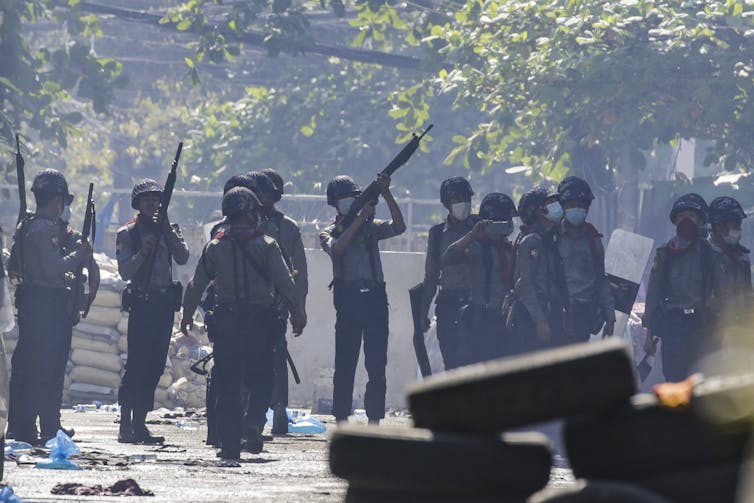
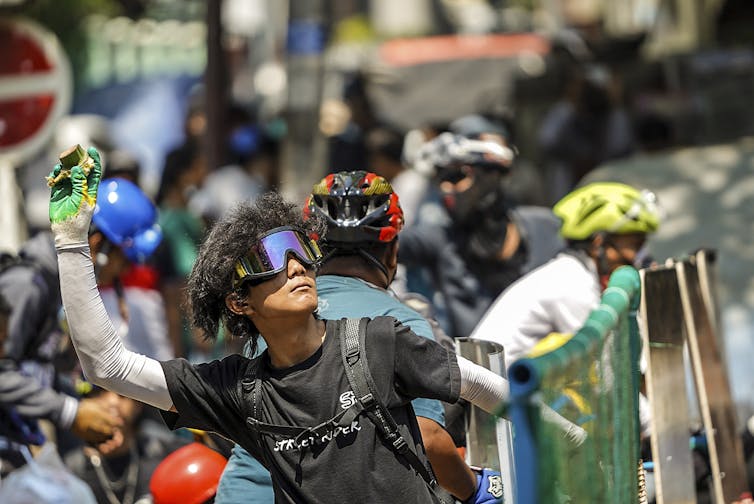
Escalating insecurity has already been witnessed in several conflict zones – Syria, Colombia, Somalia, Yemen, Nigeria, Burkina Faso, Afghanistan, Philippines and Myanmar – as states and non-state armed groups exploit the pandemic to their own strategic advantage.

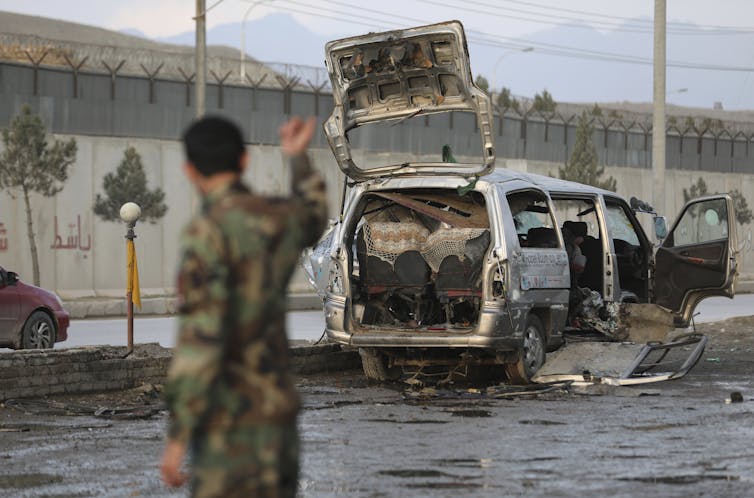
Countries where there is conflict, such as Afghanistan, are suffering as other countries divert funds away from foreign aid to fighting the pandemic. AAP/AP/Rahmat Gul

Many of the ceasefires declared in response to the United Nations secretary-general’s call for a global ceasefire in March 2020 have fallen apart.


Read more: UK government’s foreign aid cuts put girls’ education at risk


From pivoting to preparedness

COVID-19 has exposed weaknesses in global governance, especially in terms of preparedness and threat mitigation. To address these weaknesses, countries need to invest in preparedness, be aware of the complex interconnectedness of security threats, and avoid knee-jerk reactions to singular risks that divert attention and resources away from longer-term threats.

There is also a need to communicate more effectively to the public about how aid budgets are spent. This includes stressing how aid programs benefit donor as well as recipient countries, given public opinion can be a key factor in determining whether aid budgets are reduced.

The increased risk of armed conflict, as a result of the diversion of resources and attention towards COVID-19, has global repercussions. So, too, does the difficulty in controlling COVID-19 within conflict zones and beyond their often-porous borders, until a widely accessible vaccine becomes available to the most disadvantaged people.

ref. As the world’s attention and money are absorbed by the COVID pandemic, peacebuilding suffers – https://theconversation.com/as-the-worlds-attention-and-money-are-absorbed-by-the-covid-pandemic-peacebuilding-suffers-156577

What are breath-holding spells, the common phenomenon that causes children to faint?

Source: The Conversation (Au and NZ) – By Shivanthan Shanthikumar, Respiratory Medicine Fellow, Murdoch Children’s Research Institute

It’s time to leave the playground but your 12-month-old daughter doesn’t want to. She gets angry, cries out loudly, breathing all the way out and then holds her breath. She turns blue around the mouth and faints.

This is understandably very scary for any parent. But the good news is these episodes, called breath-holding spells, are common, not dangerous, resolve as children get older, and don’t cause any long-term damage.

What are breath-holding spells?

Breath-holding spells affect up to one in every 22 children under six years. There are two types.

“Cyanotic” or blue spells are the type we describe above, and are usually triggered by anger or frustration.

“Pallid” or pale spells are typically triggered by pain or fear, and are less common. At the start children open their mouths, but there may not be a cry. They then hold their breath, turn pale and may faint.

In both cases the spells last less than 60 seconds. At the end of an episode when the child regains consciousness, children may return to normal, be slightly drowsy or upset.

Breath-holding spells typically start when the child is aged between six and 18 months. The spells can occur multiple times a day or very infrequently. Some 90% of children grow out of the episodes by the time they turn six.


Read more: Fight, flight or … faint? Why some people pass out when they see blood or feel pain


What causes breath-holding spells?

We don’t know exactly why some children have breath-holding spells, but we think multiple factors could play a role.

Small studies have shown children who experience cyanotic breath-holding spells have differently functioning autonomic nervous systems (the part of the nervous system which controls things like heart rate and breathing rate). They have higher resting-heart rate and blood pressure, and pupils that have an exaggerated response to light in certain conditions (these things are not dangerous for children). But it’s unclear precisely how these differences may be linked to breath-holding spells.

For children who have pallid breath-holding spells, research suggests the vagus nerve — which helps control body functions when we’re at rest — is overactive, and causes the heart to slow down.

Studies have also shown breath-holding spells are more common in children with iron deficiency, though we’re not sure why this is.

A little girl having a tantrum sits against a white brick wall.
Frustration or anger can trigger breath-holding spells. Shutterstock

If this happens to your child, should you be worried?

Although breath-holding spells can be very scary — particularly the first time — they are not cause for concern.

Parents often have two questions. First, are they a sign there’s something wrong with my child? And second, will they cause long-term damage to my child’s brain and development? The answer to both these questions is no.

As they’re such a common problem, we know generally they’re not a sign of an underlying illness, and they don’t have long-term effects (likely because the spells are not associated with significant oxygen deprivation to the brain).

Iron deficiency anaemia, which can be associated with breath-holding spells, is very easily treated. Your child’s GP can test for this and prescribe iron supplements if needed.


Read more: ‘No, I don’t wanna… wahhhh!’ A parent’s guide to managing tantrums


What should an adult do during and after a breath-holding spell?

You should:

  • stay calm and remember the spell will be over in less than 60 seconds

  • remove any objects around your child which may cause injury if they faint

  • if your child faints, lay them on their side.

You should not:

  • try to stimulate your child to breathe by shaking them (this won’t help and may cause injury)

  • put anything in the child’s mouth, including your fingers.

After a spell is over, you should:

  • try to treat the child as normal; don’t punish them or reward them or make a fuss

  • perform first aid to any injuries that might have occurred during fainting.

You can find good information on how to handle breath-holding spells online through resources including the Raising Children’s Network and the Royal Children’s Hospital.

A doctor examines a toddler sitting on the mother's lap.
You can discuss your child’s breath-holding spells with your GP. Shutterstock

Is there anything you can do to prevent breath-holding spells?

Aside from treating any iron deficiency anaemia, there are no medications for breath-holding spells. Parents can only try to prevent the spells by preventing the events that trigger them.

Ways to do this include distracting your child if they’re upset and giving them plenty of warning if their activity is going to change, such as a five-minute countdown before leaving the playground.

Of course, it won’t always be possible to stop a child from becoming frustrated or angry.

When should you see a doctor?

It’s generally a good idea to see a GP after your child’s first spell, just so they can go through what happened with you and ensure it was a breath-holding spell.

If the spells are occurring very frequently, then seeing your GP and getting tested for iron deficiency anaemia is a good idea. Other reasons to see a doctor include if the spells start at less than six months of age, or if your child displays signs of a seizure (such as shaking in their arms and legs).


Read more: Why iron is such an important part of your diet


ref. What are breath-holding spells, the common phenomenon that causes children to faint? – https://theconversation.com/what-are-breath-holding-spells-the-common-phenomenon-that-causes-children-to-faint-131677

PODCAST: Buchanan + Manning: White Supremacists – Has the Five-Eyes Spy Network Let Us Down? Also Ollie Neas on Rocket Lab’s US Military Payload

A View from Afar: Ollie Neas joins Paul G. Buchanan and Selwyn Manning to discuss what Rocket Lab is sending into space from New Zealand's Mahia Peninsular.
A View from Afar
A View from Afar
PODCAST: Buchanan + Manning: White Supremacists - Has the Five-Eyes Spy Network Let Us Down? Also Ollie Neas on Rocket Lab's US Military Payload
Loading
/

A View from Afar – Paul G. Buchanan and host Selwyn Manning discuss whether the Five Eyes spy agencies are adequately monitoring white supremacist activity, and discuss, what can be done. Plus Ollie Neas joins the panel to discuss whether the New Zealand Government is aware of what Rocket Lab is sending into space?

This episode’s topics:

* Terrorism and the Dark Web: White supremacists are back online and making threats. Who is keeping track of these practitioners of hate? Has the US-led Five Eyes spy network let us down?

* Rocket Lab follow-up: What did the New Zealand Government know, and not know, at the point it gave RocketLab’s March mission (with a payload of US military tracking systems) a green-light?

Follow Paul G. Buchanan and Selwyn Manning’s podcast and keep ahead of security intelligence and foreign policy trends and issues.

If you miss the LIVE Episode, you can see it as video-on-demand, and earlier episodes too, by checking out EveningReport.nz or, subscribe to the Evening Report podcast here.

Max Richter’s Sleep, a filmed antidote to modern life with music to dream by

Source: The Conversation (Au and NZ) – By Frederic Kiernan, Research fellow, The University of Melbourne

Review: Max Richter’s Sleep, directed by Natalie Johns.

Music does things. For German-born, English-raised composer Max Richter, music is a “vehicle for travelling through the world, for getting through life”. So he says in the film Max Richter’s Sleep, written and directed by Natalie Johns, which hits Australian screens today.

The film focuses on a composition by Richter which spans more than 200 movements and lasts over eight hours. During performances of this work, audience members (probably not the right term in this case) spend almost the whole concert resting or asleep in hundreds of cots and camping beds lined up where you would normally find seats.

Richter, a prodigious contemporary composer, has made music for solo albums, ballets, concert hall performances, theatre and film and television series (including The Crown, The Leftovers and Peaky Blinders). His Sleep performance-events were conceived with his collaborator and partner Yulia Mahr, a BAFTA-winning filmmaker. The film focuses primarily on an open-air concert in downtown Los Angeles, although it weaves in performance footage from other locations around the world including Berlin, the Sydney Opera House and Paris.

Audience members arrive at the concert in the evening, before being lulled into a dream-state by Richter (on the piano) and his band of musicians. They wake the next morning to find them still softly playing. The technical achievement of the composer, performers and organisers is undeniable. But as a musicologist with strong sociological leanings, my own interest lies in Richter’s treatment of audience expectations and listening behaviours, as well as his interesting perspective on the kinds of things music can do.

‘It’s not [music] necessarily to be listened to … but to be experienced.’

Read more: Review: David Byrne’s American Utopia is a film honouring the love of the live performance


Listen up and settle down

People listen to music in different ways for different reasons. We might use music to keep pace during a gym workout or while jogging. This is partly because our bodily rhythms (heart rate and breathing) can synchronise with externally heard rhythms — something psychologists call rhythmic entrainment.

We often use music to regulate our emotions and moods, to mark occasions such as weddings and birthdays, and to celebrate sporting victories from club to Olympic level, where the music acts not as decoration but as a kind of social glue.

Music listening habits also change over time. In the 18th century, opera-goers were notoriously lively, more likely facing each other than the stage, but since the 19th century these audiences have become rather more reverent. Classical music audiences still typically display “serious” listening behaviours, although companies such as Play On are upending these conventions. By inviting audiences to sleep through an entire concert, Richter and Mahr are doing the same, with interesting results.

Concert for sleeping audience
During the performance, musicians including Richter leave the stage to eat or take a toilet break. Madman

Richter describes the composition as an “eight-hour lullaby”. It is a soothing musical remedy for the increasingly hectic pace of modern life, in which sleep is often considered an inconvenience or even a weakness.

Music is widely used nowadays as a therapeutic tool. In fact the practice of “prescribing” music for soothing, energising or mood-regulating purposes dates back at least as far as ancient Greece. Pythagoras, for example, is said to have sung and played the lyre for his disciples to induce a calm mood prior to sleep, and to shake off numbness and tiredness upon waking.


Read more: Having trouble sleeping? Here’s the science on 3 traditional bedtime remedies


Perchance to dream

For centuries, sleep was regarded as a suspension of activity — a passive state of unconsciousness. However during the 18th and 19th centuries new theories of the origin of sleep emerged, linking sleep to the build up of toxins during the day, blood flow and the paralysis of nerve cells. Many of these ideas are still being explored in current sleep science, which now highlights the active nature and generative power of sleep, as well as the potential benefits of music listening for sleep quality. Musical activities, like other creative activites, can have a positive impact on our wellbeing, as research at the University of Melbourne is showing.

Richter observes in the film that the hectic pace of modern life suits corporations more so than humans. His Sleep opus offers a “quiet protest”, a moment to withdraw and reflect, treating the sleeping mind as a valuable complement to our waking life. The film mirrors what I imagine attendance at a live performance of the work to be like.

Busy japan intersection
The Sleep score hopes to counter the frenetic pace of modern life. Denys Nevozhai/Unsplash, CC BY

Read more: The Portal review: can meditation change the world?


As viewers, we, along with audience members in the film, settle into our own journey. Long passages of deeply resonant music exert their visceral emotional pull, in slow rhythms and very low frequencies outside the usual range of acoustic instruments.

As the piece unfolds through the night, the musicians alternately take breaks, perhaps to eat or use the bathroom. Richter moves from the piano around the venue, to see “what the piece is doing”, before returning to the stage to continue playing.

Darkness shades much of the film visually, and commentary is provided by various audience members who are never quite introduced, as if in a dream. There are scholarly musings too, on the science of sleep and the relationship between music and mathematics.

Richter and Mahr also recount the origins of the piece and the risks, gambles and unknowns they faced as artists. As audience members rouse themselves at the conclusion of the film, their reflections reveal they were not really audience members at all, but participants in a musical study of sleep. This explored music’s capacity to soothe deeply, and, in being soothed, allowed participants to become vulnerable and open to connection with one another.

Can the film successfully replicate the live experience? Of course not. Do I now wish I could attend (and sleep through) a live performance of this piece? Absolutely.

Max Richter’s Sleep is in cinemas from today.

ref. Max Richter’s Sleep, a filmed antidote to modern life with music to dream by – https://theconversation.com/max-richters-sleep-a-filmed-antidote-to-modern-life-with-music-to-dream-by-156491

After a year of pain, here’s how the covid-19 pandemic could play out in 2021 and beyond

ANALYSIS: By Michael Toole, Burnet Institute

One year ago today, the World Health Organisation (WHO) declared covid-19 a pandemic, the first caused by a coronavirus.

As we enter year two of the pandemic, let’s remind ourselves of some sobering statistics. So far, there have been more than 117.4 million confirmed cases of covid-19 around the world; more than 2.6 million people have died.

A total of 221 countries and territories have been affected. Some 12 of the 14 countries and territories reporting no cases are small Pacific or Atlantic islands.

Whether the race to end the pandemic will be a sprint or a marathon remains to be seen, as does the extent of the gap between rich and poor contestants. However, as vaccines roll out across the world, it seems we are collectively just out of the starting blocks.

Here are the challenges we face over the next 12 months if we are to ever begin to reduce covid-19 to a sporadic or endemic disease.

Vaccines are like walking on the Moon
Developing safe and effective vaccines in such a short time frame was a mission as ambitious, and with as many potential pitfalls, as walking on the Moon.

Miraculously, 12 months since a pandemic was declared, eight vaccines against SARS-CoV-2, the virus that causes covid-19, have been approved by at least one country.

A ninth, Novavax, is very promising. So far, more than 312 million people have been vaccinated with at least one dose.

While most high-income countries will have vaccinated their populations by early 2022, 85 poor countries will have to wait until 2023.

This implies the world won’t be back to normal travel, trade and supply chains until 2024 unless rich countries take actions — such as waiving vaccine patents, diversifying production of vaccines and supporting vaccine delivery — to help poor countries catch up.

The vaccines have been shown to be safe and effective in preventing symptomatic and severe covid-19. However, we need to continue to study the vaccines after being rolled out (conducting so-called post-implementation studies) in 2021 and beyond.

This is to determine how long protection lasts, whether we need booster doses, how well vaccines work in children and the impact of vaccines on viral transmission.

What should make us feel optimistic is that in countries that rolled out the vaccines early, such as the UK and Israel, there are signs the rate of new infections is in decline.

What are the potential barriers to overcome?
One of the most salutary lessons we have learnt in the pandemic’s first year is how dangerous it is to let covid-19 transmission go unchecked. The result is the emergence of more transmissible variants that escape our immune responses, high rates of excess mortality and a stalled economy.

Until we achieve high levels of population immunity via vaccination, in 2021 we must maintain individual and societal measures, such as masks, physical distancing, and hand hygiene; improve indoor ventilation; and strengthen outbreak responses — testing, contact tracing and isolation.

Office workers wearing masks, one santising hands
In 2021, we still need to wear masks, physically distance, clean our hands, and improve indoor ventilation. Image: The Conversation/www.shutterstock.com

However, there are already signs of complacency and much misinformation to counter, especially for vaccine uptake. So we must continue to address both these barriers.

The outcomes of even momentary complacency are evident as global numbers of new cases once again increase after a steady two month decline. This recent uptick reflects surges in many European countries, such as Italy, and Latin American countries like Brazil and Cuba.

New infections in Papua New Guinea have also risen alarmingly in the past few weeks.

Some fundamental questions also remain unanswered. We don’t know how long either natural or vaccine-induced immunity will last. However, encouraging news from the US reveals 92-98 percent of covid-19 survivors had adequate immune protection six to eight months after infection.

In 2021, we will continue to learn more about how long natural and vaccine-induced immunity lasts.

New variants may be the greatest threat
The longer the coronavirus circulates widely, the higher the risk of more variants of concern emerging. We are aware of B.1.1.7 (the variant first detected in the UK), B.1.351 (South Africa), and P.1 (Brazil).

But other variants have been identified. These include B.1.427, which is now the dominant, more infectious, strain in California and one identified recently in New York, named B.1.526.

Variants may transmit more readily than the original Wuhan strain of the virus and may lead to more cases. Some variants may also be resistant to vaccines, as has already been demonstrated with the B.1.351 strain. We will continue to learn more about the impact of variants on disease and vaccines in 2021 and beyond.

A year from now
Given so many unknowns, how the world will be in March 2022 would be an educated guess. However, what is increasingly clear is there will be no “mission accomplished” moment. We are at a crossroads with two end games.

In the most likely scenario, rich countries will return to their new normal. Businesses and schools will reopen and internal travel will resume.

Travel corridors will be established between countries with low transmission and high vaccine coverage. This might be between Singapore and Taiwan, between Australia and Vietnam, and maybe between all four, and more countries.

In low- and middle-income countries, there may be a reduction in severe cases, freeing them to rehabilitate health services that have suffered in the past 12 months. These include maternal, newborn, and child health services, including reproductive health; tuberculosis, HIV and malaria programmes; and nutrition.

However, reviving these services will need rich countries to commit generous and sustained aid.

The second scenario, which sadly is unlikely to occur, is unprecedented global cooperation with a focus on science and solidarity to halt transmission everywhere.

This is a fragile moment in modern world history. But, in record time, we have developed effective tools to eventually control this pandemic. The path to a post-covid-19 future can perhaps now be characterised as a hurdle race but one that presents severe handicaps to the world’s poorest nations. As an international community, we have the capacity to make it a level playing field.The Conversation

Dr Michael Toole is professor of international health of the Burnet Institute. This article is republished from The Conversation under a Creative Commons licence. Read the original article.

Print Friendly, PDF & Email

Article by AsiaPacificReport.nz

PNG health official fears covid spike for Somare state funeral

Asia Pacific Report news desk

East Sepik, preparing for the state funeral of Papua New Guinea’s Grand Chief Sir Michael Somare, could expect a surge in covid-19 cases as thousands flock into the province in coming days, an official says.

East Sepik Health Authority chief executive officer Mark Mauludu said this was most likely to happen because people continued to breach the covid-19 protocols and public health safety measures repeated so many times, reports The National.

“We are conscious of the many people who will travel into the province.

“We cannot control the movement of people,” he said.

“There is a possibility of cross-infection among the people and we expect a rise in [covid-19] cases in the province.

“Right now we don’t have proper quarantine and isolation facilities.

“The isolation ward we have in the hospital can cater for only six people.

Three people isolated
“We now have three people isolated at the ward.”

The body of Sir Michael would arrived in Wewak on Sunday.

He will be buried at his Kreer Heights property on Tuesday.

Mauludu said the hospital staff had a meeting on Monday to discuss how to best deal with a spike in cases.

“The hospital staff met and passed a number of resolutions, one of which was to seek permission for the use of the stadium after the burial programme of the late Sir Michael,” he said.

“We would like to propose to convert the stadium into a quarantine and isolation area.”

Mauludu added that they were also very strict with the movement of people in and out of the hospital.

“We continue to screen people going in and out of the hospital.

“We encourage people to wear masks before coming into the hospital.

“Those who continue to defy this are fined K10,” he said.

Sir Michael, 84, died in Port Moresby on February 26.

Asia Pacific Report republishes The National articles with permission.

Print Friendly, PDF & Email

Article by AsiaPacificReport.nz

Politics with Michelle Grattan: Fleur Johns on the rule of law

Source: The Conversation (Au and NZ) – By Michelle Grattan, Professorial Fellow, University of Canberra

Christian Porter has unequivocally denied the historic rape allegations levelled against him, and says he is determined to stay in his job as attorney-general.

Both Scott Morrison and Porter are adamant the “rule of law” in this country places the attorney-general beyond prosecution, now that the NSW police have closed the case.

Porter is the country’s first law officer and many argue that requires a stiffer test of suitability.

This week UNSW professor of law Fleur Johns joins the podcast, to discuss the legal role of the attorney-general, how allegations of this kind can affect the performance of his duties, and the validity of the “rule of law” argument.

The role of the office of the attorney-general is both one of “actual powers” and “a repository of great symbolic power,” Johns says.

This symbolic power is compromised by “serious allegations that go to the ability of a person to exercise power over another person in a way that is responsible.”

“Allegations that are made of a serious abuse of power having been conducted could erode…public trust, especially when those allegations have not had an opportunity to be tested, as is the case here.”

Johns “wholeheartedly” rejects the view an independent inquiry into the rape allegations would compromise the rule of law.

“It’s absolutely par for the course that the rule of law is delivered through a range of different procedural mechanisms.”

“The testing of these allegations…with the appropriate protections to ensure the rule of law, would actually be a way of ensuring that that ideal of the rule of law is defended and promoted.

”[It would show] that we do experience a sense of being governed by laws and legal processes and legal institutions, rather than by particular men and women who happen to be in power at any one time.“

Listen on Apple Podcasts

Stitcher Listen on TuneIn

Listen on RadioPublic

Additional audio

A List of Ways to Die, Lee Rosevere, from Free Music Archive.

ref. Politics with Michelle Grattan: Fleur Johns on the rule of law – https://theconversation.com/politics-with-michelle-grattan-fleur-johns-on-the-rule-of-law-156944

LIVE VIDEO: Buchanan + Manning: White Supremacists – Has the Five-Eyes Spy Network Let Us Down?

A View from Afar – Join Paul G. Buchanan and Selwyn Manning LIVE and keep ahead of security intelligence and foreign policy trends and issues.

This week’s episode will go LIVE Thursday, midday, NZDST (Wednesday evening 6pm USEST).

This episode’s topics:

* Terrorism and the Dark Web: White supremacists are back online and making threats. Who is keeping track of these practitioners of hate? Has the US-led Five Eyes spy network let us down?

* Rocket Lab follow-up: What did the New Zealand Government know, and not know, at the point it gave RocketLab’s March mission (with a payload of US military tracking systems) a green-light?

* Host Selwyn Manning will be joined by Paul Buchanan and Ollie Neas to discuss these issues.

COMMENT ON THIS DISCUSSION:

You can interact with the programme by clicking on one of these social media channels. Here are the links:

If you miss the LIVE Episode, you can see it as video-on-demand, and earlier episodes too, by checking out EveningReport.nz or, subscribe to the Evening Report podcast here.


Hard bump ahead? Drop in insolvencies and bankruptcies is a ticking time bomb

Source: The Conversation (Au and NZ) – By Kevin Davis, Emeritus Professor of Finance, The University of Melbourne

The vast arsenal of fiscal, monetary and legal measures used by Australian governments to offset the COVID-induced economic crisis have worked well. They did not prevent a recession (popularly defined as two quarters of negative GDP growth) but things could have been much worse.

What is particularly interesting is that the expected consequences have not shown up in the official statistics for financial distress – insolvent companies entering administration and individuals declaring bankruptcy.

Indeed, a misleading impression of 2020 being one of “economic good times” could be gained from the statistics.

The big question is whether these statistics show government relief measures have averted economic pain or simply deferred it. As measures are wound down and withdrawn, will the private sector be willing and able to pick up the resulting slack?

Companies entering administration

There are, of course, “lies, damn lies, and statistics”. The figures hide what is likely to be actually happening in terms of financial distress.

Impacts on businesses and individuals have been quite varied. Some large corporations have come through in good shape, much better than might have been imagined. But the tourism, hospitality, entertainment and higher education sectors have taken significant hits and face an uncertain and drawn-out recovery.

The following graphic, using data from the Australian Securities and Investments Commission, shows the number of companies entering external administration (quarterly from 2010 to 2020).


Graphic showing company insolvencies, 2011 to 2020
CC BY-ND

Notable is the decline in business collapses in 2020 – the opposite of what one would expect in a time of economic stress.

A number of policy actions contributed to this.

The most obvious contributors to keeping failing businesses alive were JobKeeper payments as well as changes increasing “safe-harbour protections” to reduce the risk of prosecution for trading while insolvent. These changes also reduced the ability of creditors to speedily force a debtor company into insolvency.


Read more: Government will reform insolvency system to improve distressed small businesses’ survival chances


In many cases it is quite possible these simply put off that day to some time in 2021.

Individuals declaring bankruptcy

At the personal level, which includes owners of small unincorporated businesses, a similar pattern can be seen.

The next graph uses data from the Australian Financial Security Authority. It shows the number of individuals entering into insolvency (bankruptcy, debt agreements etc) on a quarterly basis. The latest data is for the September quarter of 2020. The number had fallen to about half of what it had been prior to 2020.


Graphic showing personal insolvencies in Australia 2011 to 2020.
CC BY-NC

Notably, the number of personal insolvencies began falling in early 2018. There is no obvious single explanation for this trend, though good economic conditions and low interest rates are probably part of the story.

The further decline in 2020 (in contrast to expectations of an increase) is most likely due to legislative changes introduced in March 2020 and extended in September 2020. These include increasing the size of debt owed before a creditor can initiate action from A$5,000 to A$20,000, and allowing debtors six months (rather than 21 days) to respond to creditor demands. Mortgage repayment deferrals by banks also would have helped.

A difficult balancing act

What to make of these unexpected declines in official indicators of financial distress when economic conditions have surely increased the reality?

The more optimistic interpretation is that various government support measures have prevented both business and individuals sliding into insolvency.

The less optimistic interpretation is the measures have simply deferred the final outcome – with the statistics soon to show a bounce in business failures and personal insolvencies.


Read more: We’re facing an insolvency tsunami. With luck, these changes will avert the worst of it


There is no point keeping “zombie” businesses alive, nor in dissuading heavily indebted individuals from taking action under insolvency arrangements that can give them a fresh start.

But finding the right balance of continuing support for recoverable cases while terminating it for others (and limiting the hardship caused by failure) is a difficult and challenging task for our economic masters.

ref. Hard bump ahead? Drop in insolvencies and bankruptcies is a ticking time bomb – https://theconversation.com/hard-bump-ahead-drop-in-insolvencies-and-bankruptcies-is-a-ticking-time-bomb-155744

Making a megalodon: the evolving science behind estimating the size of the largest ever killer shark

Source: The Conversation (Au and NZ) – By John Long, Strategic Professor in Palaeontology, Flinders University

The giant prehistoric Carcharocles megalodon (or Otodus megalodon for some researchers) was the largest predatory shark to ever swim in Earth’s seas. Scientific evidence points to megalodon having lived between 16 million and 2.6 million years ago, going extinct at the end of the Pliocene Epoch when the world’s oceans were much colder than today’s.

Reconstruction of a 16m megalodon. Illustration by Oliver Demuth/Jack Cooper

Over the years, several research papers have estimated meg’s size. Its teeth are shaped like large, flat triangles with serrated edges — much like the teeth of living white sharks. White sharks, along with mako sharks and the porbeagle shark all belong in the family Lamnidae and are referred to as “lamnids”.

The close similarities between meg teeth and those of living lamnid sharks are strong evidence meg was indeed an ancient kind of lamnid shark. This premise is important, as it forms the basis of how we estimate the size of this ancient giant.

Two museum exhibits recently opened public displays featuring spectacular models of megalodon: one at the Smithsonian Museum of Natural History in Washington DC, and the other at the Western Australian Museum Boola Bardip in Perth.

These models, while both outstanding, don’t depict entirely the same shark. So how was each one made? And what scientific approaches were used?


Read more: Giant monster Megalodon sharks lurking in our oceans: be serious!


Making the meghead

The Smithsonian’s megalodon model is a full-body reconstruction measuring 15 metres. The other, at the Museum Boola Bardip, is a beautifully crafted model of meg’s head. This was built under the direction of one of us (Mikael) and opened to the public in November.

The shape of the “meghead” is similar to a white shark’s head, but has a shorter and much rounder snout. Its colouration features “counter-shading” with a dark back and lighter belly — also similar to white sharks, but less contrasted. The greater this colour contrast, the easier it becomes for underwater predators to go unnoticed by prey.

The meghead’s jaw size was based on multiple teeth from a single ancient shark. These specimens allowed us to scale the body size to correspond with tooth size, as well as to match the widest front tooth of another megalodon found in Cape Range, Western Australia.

The rest of the meghead was then 3D modelled to fit the jaws. The end result was a head that corresponded to a creature roughly 14m in length. This would be the largest meg shark ever found in Western Australia, but not the largest overall.

The giant megalodon head was scuplted by Vlad Konstantinov for Boola Bardip (WA Museum) Vlad Konstaninov, Mikael Siversson, Author provided

Magnificent displays make for great selfies

The Smithsonian meg model was overseen by Hans Dieter-Sues, a US paleontologist who drew the shark’s outline based on a general lamnid shark body plan. This was then finessed by University of Maryland shark fossil expert Bretton Kent.

After reviewing a small scale model, the full-size model was constructed based on a complete set of meg teeth assembled by Gordon Hubble, another megalodon expert. Measuring a whopping 15m, the final model had to be assembled as modules, as it wouldn’t have made it through the museum’s doors or corridors in one piece.

This model is now suspended by cables from the Smithsonian’s walls and ceiling, positioned strategically so visitors may take selfies from a nearby balcony.

The 15m-long megalodon model on display at the Smithsonian Museum of Natural History in Washington DC. Hans-Dieter Sues/Smithsonian Museum

Calculating maximum size

The meghead model in Perth was based on several specific tooth specimens found locally and from overseas, painting a picture of a 14m-long predator.

However, to calculate the species’s maximum size, we first estimated the maximum jaw size possible for Meg and then scaled this up, using the same jaw size-to-body length ratio of living white sharks.

The maximum jaw size of meg can be calculated by scaling up the few known “associated dentitions” (multiple tooth specimens that were found together and came from a single shark) with the widest meg tooth ever found.

Once we did this, the size estimate we reached was between 19–20m. And this is much larger than most other recent estimates.

The megashark lineage

Scientists have discovered meg’s teeth to be part of a species continuum known as the megatooth shark lineage. This is based on the discovery of many thousands of fossilised teeth that seem to merge into new shapes over time, pointing to the evolution of new species.

A newly discovered megalodon tooth from near Exmouth, Western Australia. The serrated edge shown here is 145mm long. Mikael Siversson/WA Museum

The start of this lineage began in the Danian stage about 63 million years ago, when the first sharks of the genus Otodus appeared. This is why megalodon, belonging to this lineage, is now officially classified as Otodus megalodon. That said, the shark has been placed in various genera, including Carcharocles and Procarcharodon, and continues to be the subject of debate.

With an estimated body length of about 4m, the first Otodus sharks in the megatooth lineage would have been smaller than several other sharks living at the time. So how could they have evolved to become the colossus that is meg?

DePaul University professor Kenshu Shimada has suggested meg’s huge size may have had something to do with a strange trait of lamnid sharks, which is that their young eat each other in the womb.

This behaviour, called “intrauterine cannibalism”, provides a ready source of nutrition for growing fetuses and may have driven increased growth in megalodon. That said, it would have also forced mothers to feed more actively, due to increased nutrition demand from the rapidly growing young.

This wouldn’t have helped meg’s survival when global temperatures cooled down about three million years ago. The cold spell would have killed off much of meg’s food sources, eventually triggering its extinction.

In recent years, coastal limestone outcrops in Western Australia have yielded several new exciting megalodon teeth. We hope these will tell us more about the story of meg and its variations which swam through the seas of ancient Australia.


Read more: Giant ancient sharks had enormous babies that ate their siblings in the womb


ref. Making a megalodon: the evolving science behind estimating the size of the largest ever killer shark – https://theconversation.com/making-a-megalodon-the-evolving-science-behind-estimating-the-size-of-the-largest-ever-killer-shark-155475

As killings, beatings and disappearances escalate, what’s the end game in Myanmar?

Source: The Conversation (Au and NZ) – By Adam Simpson, Senior Lecturer, University of South Australia

Myanmar’s military appears to be testing out a range of vicious tactics in the hope something will stem the protest movements that have embroiled the country since the coup in early February.

The military crossed a grim threshold last Wednesday when security forces fired live rounds at protesters across the country, resulting in what the UN said were at least 30 deaths and hundreds of critical injuries.

Then, on Saturday, security forces beat and took away Khin Maung Latt, a Muslim ward chairman for the former ruling party, the National League for Democracy (NLD). The next morning, the family recovered his tortured and mutilated body from the hospital.

A relative of Khin Maung Latt flashes a three-finger salute during his funeral procession. Lynn Bo Bo/EPA

That night, the father of MP Sithu Maung, who is one of only two Muslim politicians elected to represent the NLD last year, was beaten and dragged away by security forces. He has not been heard from since.

And this week, another NLD official, Zaw Myatt Linn, died in custody less than a day after being arrested.

These brutal attacks appear designed not only to terrorise the NLD, protesters and others taking part in the civil disobedience campaign, but the Muslim community, in particular.

Myanmar’s Muslim minorities have a history of persecution by the military and other nationalist groups. Brutalising Muslims now may be an attempt to bolster support within the few remaining parts of society that still back the military.

A history of self-delusion and miscalculations

There have now been more than 60 protesters killed and almost 2,000 arrested, but nothing has stopped the popular rage against the coup makers and their ill-considered plans.

Any grudging respect the military may have retained for its role in guiding the political transition over the past decade has now well and truly evaporated.

Police officers search for hiding demonstrators during a protest in Yangon. Lynn Bo Bo/EPA

The military has a reputation for self-delusion, and it certainly miscalculated the public mood prior to launching the coup that ousted the NLD from power just weeks after it won an overwhelming majority in national elections.

The military’s commander-in-chief, Senior General Min Aung Hlaing, may have convinced himself that Thailand could be a model for how to transition from the coup to semi-democratic elections. If so, he is likely to be severely disappointed.

Thailand’s military seized power in 2014, and five years later, the coup leader, Prayuth Chan-ocha, won a compromised election to retain his position as prime minister.


Read more: Taking care of business: the coup in Myanmar is partly about protecting the economic interests of the military elite


But Thai society is much more divided between liberal and nationalist monarchist movements, giving the military there a sizeable support base. In Myanmar, the military doesn’t enjoy the same popular backing, which was why its proxy party suffered a humiliating defeat in the 2020 election.

A further escalation of violence against unarmed protesters in Myanmar is likely to undermine support from the military’s few international allies, including China. It seems there are no good options left for the military to resolve this entirely self-inflicted crisis.

A fragmented but effective opposition movement

The bruising standoff between the military and opposition is now a war of attrition. No one knows for sure who will last the longest.

The opposition movement is comprised of many interlocking parts, of which the protests are not the only — or even the most important.

The civil disobedience movement, mostly made up of striking or uncooperative workers, is paralysing major parts of the economy. Large numbers of civil servants remain at their desks, but are not doing any work, bringing government activity to a halt.

The country’s largest trade unions launched an indefinite, nationwide strike this week, as well.

The loose, anarchic structure of the opposition movement — with few leaders and highly decentralised modes of organisation, funding and operations — means the military cannot easily decapitate the movement.

A protester throws part of a banana at the police during a protest in Yangon. AP

The military tried to silence the most symbolic leader, Aung San Suu Kyi, by placing her under arrest, but it hasn’t affected the opposition’s ability to organise or tap into public anger against the military.

Sources inside the country suggest the civil disobedience movement has been energised by Myanmar’s UN ambassador, Kyaw Moe Tun, who defied the military and declared its rule illegitimate. His courage has proved a lightning rod for the millions of angry protesters looking for inspiration and moral clarity.

These protesters now seem committed to the confrontation. The best approach may be to foment division within the military and police in the hopes of undermining Min Aung Hlaing’s authority.

Security forces haven’t rebelled in great numbers in the past, even when ordered to crack down on the Buddhist monks leading the Saffron Revolution in 2007. But after a decade of political and economic liberties, Myanmar has changed profoundly. Some in the military and police have changed along with it and might not be amenable if a major crackdown is ordered against their own citizens.

If so, there are likely to be increased defections of security forces to the opposition.


Read more: Myanmar’s coup might discourage international aid, but donors should adapt, not leave


What can the world do?

This conflict will be resolved one way or the other by the duelling groups within Myanmar. The outside world has few levers left to pull.

The UN Security Council, for one, remains largely deadlocked on the issue, with China and Russia unwilling to deliver strong statements or endorse any serious action against the military.


Read more: Myanmar coup: how China could help resolve the crisis


The US and other Western nations have implemented sanctions on members of the military and military-linked companies, but many of these were already in place in response to the violence against the Rohingya in recent years.

Australia has also suspended its cooperation with the military and directed all aid funds through non-state actors. This is a welcome measure.

If real external pressure is to be applied on the Myanmar generals, it may have to come from the ASEAN countries — specifically Singapore, one of the biggest investors in Myanmar.

Singapore’s political and commercial leaders are now facing pressure to take a stronger stand. Soon after the coup, a prominent Singaporean businessman divested from a Myanmar tobacco company, which is majority-owned by a military conglomerate.

Kirin, a giant Japanese brewer, pulled out of its joint venture with the same conglomerate.

If other companies can similarly suspend their deals with the military, it will certainly help to strangle the key sources of revenue keeping Myanmar’s top brass in power.

The bravery of the protesters on the streets needs to be matched by a clear international message that Myanmar’s coup-makers cannot expect a financial lifeline to maintain their homicidal rule.

ref. As killings, beatings and disappearances escalate, what’s the end game in Myanmar? – https://theconversation.com/as-killings-beatings-and-disappearances-escalate-whats-the-end-game-in-myanmar-156752

After a year of pain, here’s how the COVID-19 pandemic could play out in 2021 and beyond

Source: The Conversation (Au and NZ) – By Michael Toole, Professor of International Health, Burnet Institute

One year ago today, the World Health Organization (WHO) declared COVID-19 a pandemic, the first caused by a coronavirus.

As we enter year two of the pandemic, let’s remind ourselves of some sobering statistics. So far, there have been more than 117.4 million confirmed cases of COVID-19 around the world; more than 2.6 million people have died. A total of 221 countries and territories have been affected. Some 12 of the 14 countries and territories reporting no cases are small Pacific or Atlantic islands.

Whether the race to end the pandemic will be a sprint or a marathon remains to be seen, as does the extent of the gap between rich and poor contestants. However, as vaccines roll out across the world, it seems we are collectively just out of the starting blocks.

Here are the challenges we face over the next 12 months if we are to ever begin to reduce COVID-19 to a sporadic or endemic disease.

Vaccines are like walking on the Moon

Developing safe and effective vaccines in such a short time frame was a mission as ambitious, and with as many potential pitfalls, as walking on the Moon.

Miraculously, 12 months since a pandemic was declared, eight vaccines against SARS-CoV-2, the virus that causes COVID-19, have been approved by at least one country. A ninth, Novavax, is very promising. So far, more than 312 million people have been vaccinated with at least one dose.

While most high-income countries will have vaccinated their populations by early 2022, 85 poor countries will have to wait until 2023.


Read more: 3 ways to vaccinate the world and make sure everyone benefits, rich and poor


This implies the world won’t be back to normal travel, trade and supply chains until 2024 unless rich countries take actions — such as waiving vaccine patents, diversifying production of vaccines and supporting vaccine delivery — to help poor countries catch up.

The vaccines have been shown to be safe and effective in preventing symptomatic and severe COVID-19. However, we need to continue to study the vaccines after being rolled out (conducting so-called post-implementation studies) in 2021 and beyond. This is to determine how long protection lasts, whether we need booster doses, how well vaccines work in children and the impact of vaccines on viral transmission.

What should make us feel optimistic is that in countries that rolled out the vaccines early, such as the UK and Israel, there are signs the rate of new infections is in decline.


Read more: Coronavirus might become endemic – here’s how


What are the potential barriers to overcome?

One of the most salutary lessons we have learnt in the pandemic’s first year is how dangerous it is to let COVID-19 transmission go unchecked. The result is the emergence of more transmissible variants that escape our immune responses, high rates of excess mortality and a stalled economy.

Until we achieve high levels of population immunity via vaccination, in 2021 we must maintain individual and societal measures, such as masks, physical distancing, and hand hygiene; improve indoor ventilation; and strengthen outbreak responses — testing, contact tracing and isolation.

Office workers wearing masks, one santising hands
In 2021, we still need to wear masks, physically distance, clean our hands, and improve indoor ventilation. from www.shutterstock.com

However, there are already signs of complacency and much misinformation to counter, especially for vaccine uptake. So we must continue to address both these barriers.

The outcomes of even momentary complacency are evident as global numbers of new cases once again increase after a steady two month decline. This recent uptick reflects surges in many European countries, such as Italy, and Latin American countries like Brazil and Cuba. New infections in Papua New Guinea have also risen alarmingly in the past few weeks.

Some fundamental questions also remain unanswered. We don’t know how long either natural or vaccine-induced immunity will last. However, encouraging news from the US reveals 92-98% of COVID-19 survivors had adequate immune protection six to eight months after infection. In 2021, we will continue to learn more about how long natural and vaccine-induced immunity lasts.


Read more: New research suggests immunity to COVID is better than we first thought


New variants may be the greatest threat

The longer the coronavirus circulates widely, the higher the risk of more variants of concern emerging. We are aware of B.1.1.7 (the variant first detected in the UK), B.1.351 (South Africa), and P.1 (Brazil).

But other variants have been identified. These include B.1.427, which is now the dominant, more infectious, strain in California and one identified recently in New York, named B.1.526.

Variants may transmit more readily than the original Wuhan strain of the virus and may lead to more cases. Some variants may also be resistant to vaccines, as has already been demonstrated with the B.1.351 strain. We will continue to learn more about the impact of variants on disease and vaccines in 2021 and beyond.


Read more: What’s the difference between mutations, variants and strains? A guide to COVID terminology


A year from now

Given so many unknowns, how the world will be in March 2022 would be an educated guess. However, what is increasingly clear is there will be no “mission accomplished” moment. We are at a crossroads with two end games.

In the most likely scenario, rich countries will return to their new normal. Businesses and schools will reopen and internal travel will resume. Travel corridors will be established between countries with low transmission and high vaccine coverage. This might be between Singapore and Taiwan, between Australia and Vietnam, and maybe between all four, and more countries.


Read more: Even with a vaccine, we need to adjust our mindset to playing the COVID-19 long game


In low- and middle-income countries, there may be a reduction in severe cases, freeing them to rehabilitate health services that have suffered in the past 12 months. These include maternal, newborn, and child health services, including reproductive health; tuberculosis, HIV and malaria programs; and nutrition. However, reviving these services will need rich countries to commit generous and sustained aid.

The second scenario, which sadly is unlikely to occur, is unprecedented global cooperation with a focus on science and solidarity to halt transmission everywhere.

This is a fragile moment in modern world history. But, in record time, we have developed effective tools to eventually control this pandemic. The path to a post-COVID-19 future can perhaps now be characterised as a hurdle race but one that presents severe handicaps to the world’s poorest nations. As an international community, we have the capacity to make it a level playing field.

ref. After a year of pain, here’s how the COVID-19 pandemic could play out in 2021 and beyond – https://theconversation.com/after-a-year-of-pain-heres-how-the-covid-19-pandemic-could-play-out-in-2021-and-beyond-156380

Curious Kids: could octopuses evolve until they take over the world and travel to space?

Source: The Conversation (Au and NZ) – By Culum Brown, Professor, Macquarie University

Michael, aged 14, asks:

If the faster part of human evolution is over, and squids and octopuses continue to evolve, could there be an apocalypse where the cephalopods take over the world?

If they continue to get smarter, octopuses would be much more suited as conquerors of Earth because they could live nearly anywhere. They have abilities similar to what we would call superpowers: they can fit into any hole that fits their beak, they can camouflage, they can regenerate their lost limbs and more. If and when they eradicate humans, they would be better suited to space travel. In orbit, they could manoeuvre much more easily and fit in smaller spaces.

So if they simply started evolving a smarter brain, what stops all this from happening? Why has this not happened already? Why have so few creatures evolved an intelligent brain?


As Michael points out, octopuses are famous for their alien-like abilities, from regrowing damaged arms to changing their skin colour and texture. They use this colour-shifting power to camouflage and, interestingly, as a strange visual language to talk to other octopuses.

A little known fact is they actually belong to a category of animals (phylum) called Mollusca, which is largely made up of snails. Yep, octopuses are like souped-up snails who lost their shells and grew a rather large brain. The coolest thing about them is their intelligence, which evolved completely independently from our own.

An octopus escapes a boat through a tiny hole.

They use tools to solve problems (like us) and they can open child-proof containers (not always like us). And just last week, research found a cuttlefish (another cephalopod, cousins of octopuses) passed an intelligence test designed for toddlers that showed they have advanced self control.

Humans no doubt have a lot more to learn about what these mysterious creatures are capable of. But what we do know can start to answer Michael’s excellent question: could octopuses one day rule the world?

(Before we go further we should state the plural of octopus is “octopuses” — not necessarily “octopi” — given the word has Greek rather than Latin routes.)

Large orange octopus
The giant Pacific octopus can grow to almost five metres across. Shutterstock

Big-brained but short-lived

Let’s first consider their nervous system. Like us, octopus have large brains compared to their body size – easily the biggest of all invertebrates (animals without a backbone) and of comparable size to many vertebrates, such as frogs.

It is, however, hard to compare brain size between marine animals and land animals, because the laws of physics differ in water and air. Animals are weightless in water but on land body shape and size is limited by gravity.

An octopus brain is made up of about 500 million brain cells (neurons). This is seven times more than a mouse and about the same as a marmoset monkey. Humans, on the other hand, have 86 billion brain cells.

An octopus changing colour and texture.

Testing octopus intelligence can be a problem, because the animals frequently outsmart scientists. For example, scientists can struggle to get an octopus to solve a maze, because they often climb out and crawl over the top to reach their food reward. And that’s assuming they haven’t already escaped from their aquarium home and are crawling around the lab.

Unlike us though, octopuses don’t live for very long. The giant Pacific octopus might live up to five years, but most live for just a year and some as little as six months. They hatch from eggs fully formed and ready to go. The never see their parents and have to learn everything on their own.

So yes, octopuses have big brains and are crazy-smart. But could they take over the world if they kept evolving?

Why they evolve so slowly

Compared to other species, octopuses actually evolve really, really slowly. There are about 300 different species of octopus, which have been around for at least 300 million years. In that time, they haven’t changed much.

Modern humans, by comparison, have only existed for 200,000 years and in that time, have taken over the planet (and badly damaged it in the process).

An orange octopus with vibrant blue circles
A blue-ringed octopus, a highly venomous species found in tide pools and coral reefs. Shutterstock

Evolution occurs when the DNA code is gradually changed in small steps over vast amounts of time. But octopus have a unique method of actively editing their RNA molecules instead. RNA are messages sent from DNA, which tells genes what to do and when.

The ability to edit RNA means they can adapt quickly to new problems, bypassing the need for long-term changes to occur in the DNA — the standard evolutionary process most living things follow. Scientists think this rule-breaking approach may be a reason why octopuses evolve so slowly, and why they are one of the brainiest beasties in the ocean.


Read more: Octopuses can defy their genetic instructions – and it’s slowed down their evolution


But lets face it. Despite all their tricks, octopuses are still working from a snail blueprint, and there’s only so much you can do with that toolbox. They are also highly constrained by their very short life-span.

So, the first item on an evil octopus to-do list for taking over the world is to live well beyond your first birthday. Second on the list might be to develop “cumulative culture” by learning from others like humans do. We already know an octopus can learn by watching other octopuses, but as yet we don’t have evidence of culture.

Very few creatures display intelligence comparable to humans and understanding why is a long-standing scientific question. The most likely explanation is that brain tissue is extremely expensive to maintain, in terms of energy required to keep brain cells firing. So there need to be big benefits to justify the expense.

Octopus camoflaging with coral
Octopuses can bypass standard evolution. Vlad Tchompalov/Unsplash, CC BY

Scientists think one benefit of having a big brain is so humans can keep track of complex social relationships (octopuses, on the other hand, are soliltary) and develop culture. Nature tends to provide animals with just enough smarts to get by, and nothing more.

They might do OK in space

Its hard to imagine an octopus ever evolving to take over the land. Octopus have no hard parts other than their beak. So while they can move on land, with no bones to hold them up against gravity, they really struggle.

They also have gills which need water to pass over them to breathe. Strangely, they can also “breathe” using their skin. When resting, about 40% of their oxygen comes from the water passing over their skin rather than their gills. Trouble is that only works while the skin is wet.


Read more: Clever cuttlefish show advanced self-control, like chimps and crows


But because they live in water and octopuses are neutrally buoyant (they neither float nor sink), gravity is largely irrelevant. This means they would do rather well in space where there’s no gravity — assuming they could take water with them.

In short, octopuses are very intelligent animals and one of the smartest creatures in the ocean. But their short life span and vulnerabilities on land are serious handicaps when it comes to taking over the world.

The Conversation, for one, welcomes any new cephalopod overlords

ref. Curious Kids: could octopuses evolve until they take over the world and travel to space? – https://theconversation.com/curious-kids-could-octopuses-evolve-until-they-take-over-the-world-and-travel-to-space-156493

Scientists used ‘fake news’ to stop predators killing endangered birds — and the result was remarkable

Source: The Conversation (Au and NZ) – By Peter Banks, Professor of Conservation Biology, School of Life and Environmental Sciences, University of Sydney

Animals, including humans, depend on accurate information to navigate the world. But we can easily succumb to deliberate misinformation or “fake news”, fooling us into making a poor choice.

The concept of fake news came to the fore during the term of former US president Donald Trump. It became so prevalent, it was named the Macquarie Dictionary’s word of the decade

In a new paper out today we show how a form of fake news can be deployed to help save vulnerable wildlife. We protected endangered shorebirds by spreading misinformation — in the form of bird smells — to deceive predators. This helped reduce the number of birds lost, without using lethal force.

To be honest, when we began working on the idea ten years ago it seemed a little crazy. But after seeing how fake news messes with the minds of both humans and animals, it now makes a lot of sense.

A newly hatched banded dotterel
The authors used ‘fake news’ odours to protect vulnerable birds and their offspring, including the banded dotterel, above. Shutterstock

The problem with predators

Introduced or “alien” predators are species such as rats, cats and foxes, which have been introduced to new environments and kill local wildlife. If local species have not evolved with such predators — and so learned to evade them or ward them off — the damage can be devastating.

Alien predators have far more impact than native ones and are a major driver of extinctions. In Australia alone, cats threaten the survival of more than 120 listed species, while foxes threaten 95 species. In the South Pacific the threat is even greater.

But killing predators is a blunt and often ineffective tool. Too often, control techniques such as baiting, trapping and shooting can’t reduce predator numbers enough to protect vulnerable prey.

In other circumstances, lethal control may not be possible or socially acceptable. This might occur when the problem predator is a native species (such as foxes in the United Kingdom) or where alien predators such as feral pigs are also a food resource for local people.

That’s why it’s important to examine alternative ways to protect vulnerable species.


Read more: Australia’s threatened birds declined by 59% over the past 30 years


Cat with bird in mouth
Killing introduced predators such as cats may not be possible, or socially acceptable. Shutterstock

New Zealand’s precious shorebirds

In New Zealand, 59 bird species have become extinct since humans arrived and many more close to being lost. Introduced predators contribute substantially to this problem.

Predators such as hedgehogs, cats and ferrets were introduced to New Zealand in the 1800s. They are especially common in our study area, the braided riverbed landscapes of the Mackenzie Basin on New Zealand’s South Island. There, they eat eggs and kill endangered shorebirds such as banded dotterel, plovers, wrybill and the South Island pied oystercatcher.

The birds evolved with avian predators, and have learnt to hide from them by building camouflaged nests among pebbles on the river shores.

But this tactic does not work against introduced predators. Odours emanating from the shorebirds’ feathers and eggs attract these scent-hunting mammals, which easily find the nests.

Tricked you!

Our research set out to undermine the predators’ tactics. We worked closely with Grant Norbury and others from Manaaki Whenua Landcare Research in New Zealand.

We distributed fake news — in the form of nest-like odours — that suggested to predators the shorebirds had begun to nest, even though they were yet to arrive.

First, we distilled odours extracted from the feathers and preen glands of three bird species — chickens, quails and gulls. In this case, any bird species could be used to produce the scent. (Watch a video of the process here). The result smelled a lot like a chicken coup or aviary — unmistakable to the human nose.

Five weeks before the shorebirds arrived for their breeding season in 2016, we mixed the odours with Vaseline and smeared the concoction on hundreds of rocks over two 1,000-hectare study sites. We did this every three days, for three months.

The predators were initially attracted to the odours. But within days, after realising the scent would not lead to food, they lost interest and stopped visiting the site.

Cat, hedgehog and ferret investigating odour treatments.

The shorebirds then arrived at Mackenzie Basin at their normal breeding time, and began building nests and laying eggs. At control sites where our “fake news” had not been deployed, the predators ate eggs and birds at the usual rate. But at sites where we put out unrewarding bird odours, the results were dramatic.

The number of nests destroyed by predators almost halved. As a result, chick production was 1.7 times higher at treated sites compared to control sites over the 25-35 days of the nesting season.

We wanted to be sure our results were not due to lower predator numbers or different behaviour in some areas. So the next year, we flipped treatments at our sites and got the same result.


Read more: Predators, prey and moonlight singing: how phases of the Moon affect native wildlife


A predator monitoring tunnel at a study site. The scientists replicated their results the following year.

Using fake news for good, not evil

Our modelling predicts this fake news tactic would increase plover populations by about 75% over 25 years. By comparison, an absence of intervention would lead to a population decline of more than 40%.

Our results show the profound conservation potential of fake news tactics. The approach cost no more than a traditional lethal control program and delivered comparable benefits.

We hope the work will encourage others to consider manipulating the behaviour of introduced predators when lethal control options are too difficult or ineffective.

ref. Scientists used ‘fake news’ to stop predators killing endangered birds — and the result was remarkable – https://theconversation.com/scientists-used-fake-news-to-stop-predators-killing-endangered-birds-and-the-result-was-remarkable-152320

Book review: Open Minds explores how academic freedom and the public university are at risk

Source: The Conversation (Au and NZ) – By Peter Tregear, Principal Fellow, The University of Melbourne

Academic freedom has become a common topic of Australian public debate. Yet the concept is rarely examined or critiqued in detail.

That has not stopped it becoming a totemic issue for many on the political right. They consider Australian universities to be increasingly prone to doctrinaire and censorious attitudes. In particular, they point to issues of identity politics, climate change and other so-called “progressive” causes.


Read more: University free speech bill a sop to Pauline Hanson and other critics, but what difference will it make?


Prominent cases include the 2018 sacking of geophysicist Peter Ridd by James Cook University and protests against Bettina Arndt’s visit to the University of Sydney to give a controversial speech on date rape that same year. The federal Coalition government responded by commissioning the Independent Review of Freedom of Speech in Australian Higher Education Providers by former chief justice Robert French.

Cover of Open Minds book
Black Inc.

Open Minds: Academic Freedom and Freedom of Speech of Australia, by constitutional law experts Carolyn Evans and Adrienne Stone, is the first book-length examination of the French Review and the idea of academic freedom that lies behind it. The authors are especially well qualified to comment on both the context and specific recommendations of the review.

What is academic freedom?

Among many helpful insights, Evans and Stone point out that academic freedom is not the same thing as freedom of speech. The latter is already at least partially protected by various specific and implied rights to freedom of speech in law.

The exercise of academic freedom, however, as Geoff Sharrock has noted in The Conversation, invokes a particular kind of social relationship. It is both public-facing and aims to be an expression of a public good.


Read more: Feel free to disagree on campus … by learning to do it well


Academic discourse seeks to be both well-reasoned and true. An academic opinion is thus different to an academic merely expressing their personal views.

For instance, climate scientists do not need to “believe” in climate change. Instead they must justify any assertion they make based on rigorous standards of scientific evidence and proof.

Thus, as Evans and Stone note, universities do not provide academic staff with an untrammelled right to say what they like on any issue. Theirs is a more narrowly conceived right based on an underlying obligation to justify their public utterances through the application of disciplinary expertise and values.

Adrienne Stone, one of the authors of Open Minds, discusses the distinction between academic freedom and freedom of speech.

The most contentious debates about academic freedom in Australia have not been about such academic concepts, however. Instead they have been more interested in trying to out a perceived underlying left-wing bias. This shows how skewed the understanding of academic freedom has become in Australia.


Read more: How a fake ‘free speech crisis’ could imperil academic freedom


The French Review found no substantial evidence of any organised attempt to limit the capacity of students to encounter alternative political ideas. Evans and Stone note:

If anything, today’s students are less radical and politicised than their predecessors.

The federal government followed up the French Review by commissioning Sally Walker to report on universities’ adoption of a code of free speech.

What are the real threats?

Glyn Davis’s foreword draws attention to concerns he also expressed in a recent Conversation article. He says threats to academic freedom might arise from direct government intervention, or from the rise in tied grants from big business, or from philanthropic trusts directing teaching and research.


Read more: Special pleading: free speech and Australian universities


What has been much less self-evident, or at least less acknowledged, is the possibility that the very way Australian universities are now constituted and governed may pose an even more fundamental threat.

What, after all does “institutional autonomy” mean when universities are now so closely regulated and controlled by their senior managers and councils, and by the market forces they have unleashed to help fund their operations?

Early on, Evans and Stone assert:

[Universities] are not commercial institutions, nor are they instruments of government. They are special communities dedicated to teaching and research.

But towards the end of their book, they implicitly suggest things might not be so rosy:

Academics should not be required to support the university’s brand or to avoid embarrassing it if doing so comes at the expense of academic freedom. On the contrary, academics should be able to speak out about research, teaching and university governance even when doing so involves harsh and even disrespectful criticism.


Read more: Governing universities: tertiary experience no longer required


It is easy for academics to conclude that essentially unaccountable senior university administrators, not disciplinary professors or other disciplinary experts, have become the ultimate determiners of a particular discipline’s educational and research priorities, and thus of the true limits of academic freedom in its broadest sense.

As Ron Srigley has noted of US campuses:

Ask about virtually any problem in the university today and the solution proposed will inevitably be administrative. Why? Because we think administrators, not professors, guarantee the quality of the product and the achievement of institutional goals. But how is that possible in an academic environment in which knowledge and understanding are the true goals? Without putting too fine a point on it, it’s because they aren’t the true goals any longer.

In such a context, even an everyday event like the Australian National University’s recent announcement of a brand relaunch can start to seem much less benign. The university itself describes it as part of a “journey to foster cohesion, reduce the issue of brand fragmentation and use research to address the cognitive dissonance between how we see ourselves versus how our community and the world sees us”.

Brand managers, like most senior university managers, are generally not practising academics. Thus, they should not be expected to understand, let alone articulate or defend, academic freedom.


Read more: Unis are run like corporations but their leaders are less accountable. Here’s an easy way to fix that


One of the many ways Open Minds may prove to be of lasting value is in helping academics question the propriety of such managerial pronouncements, by framing them properly as issues of academic freedom.

This is why academic freedom is a central concern for Academics for Public Universities. We would argue this issue ultimately requires us to reexamine and revitalise the underlying public character of our universities.

That, too, is something we now need to defend.

ref. Book review: Open Minds explores how academic freedom and the public university are at risk – https://theconversation.com/book-review-open-minds-explores-how-academic-freedom-and-the-public-university-are-at-risk-156213

Build-to-rent surge will change apartment living for Australians, but for better or worse?

Source: The Conversation (Au and NZ) – By Megan Nethercote, ARC DECRA Fellow at the Centre for Urban Research, RMIT University

Australia’s emerging build-to-rent sector is growing — “booming” by some accounts with a 70% jump in value in the past year. Under this model, institutional investors develop purpose-built rental apartments to retain and operate under single ownership. In Australia, it will change how apartments are designed and developed, how we are housed and how our tenancies are managed.

With 40 projects under way, an estimated 15,000 units worth more than A$10 billion are in the pipeline. Site availability has made Melbourne popular, with over 50% of the national market. Investors are active in Sydney, Perth and Queensland too.


Read more: Build to rent could shake up real estate but won’t take off without major tax changes


Sought-after neighbourhoods are earmarked for large developments. Many have 300 or more units, most at market-rate rents.

Build-to-rent is new to our shores, but hardly uncharted territory abroad. In the UK, the sector expanded exponentially from 2013 with government support. It now accounts for one in five new homes built in England and one in four in London.

In the US, the built-to-rent sector is relatively mature. It makes up almost two-thirds of the rental stock in many of the largest cities. Heavyweight corporate landlords operate as many as 400,000 units each.

In Australia, we need more data and more informed public debate to guide tax, design, planning and tenancy reforms to secure the best possible urban and social outcomes from the build-to-rent expansion.

The build-to-rent promise

Build-to-rent presents an enticing vision. For households, it promises several things:

  • flexible long-term tenancies

  • client-centric onsite management

  • hotel-style amenities and services

  • allowances for pets and personalisation, such as painting and decorating.

couple painting an apartment
One of the appeals of built-to-rent apartments is they offer tenants more options to personalise their homes. Shutterstock

For cities, the model promises high-amenity, well-located, purpose-built rental apartments that cater to diverse and changing housing needs.

Proponents hail build-to-rent as a win-win. It’s seen as a salve for various housing woes, including concerns about housing supply, affordability, the private rental sector (including insecure tenancies and inexpert property and tenancy management) and apartment quality.


Read more: Dealing with apartment defects: a how-to guide for strata owners and buyers


Since the COVID-19 downturn, the model has been hailed as an economic lifeline too: good for the construction sector, good for jobs.

Rise of a new asset class

For build-to-rent investors, the rental revenue returns appear relatively modest. Under current market conditions, however, secure margins and “lower (but) for longer” investment prospects appeal.

Advocates continue to push for tax reforms. They point to a growing “weight of capital” awaiting more enticing returns. But many international build-to-rent behemoths, superannuation/pension funds, private equity firms and real estate investment trusts are entering our private rental sector regardless.

Institutional investors’ entry into our rental sector contributes to a broader paradigm shift in urban housing systems dubbed the financialisation of (rental) housing.


Read more: Explainer: the financialisation of housing and what can be done about it


States have endorsed build-to-rent, improving its viability with land tax concessions, exemption from foreign investor surcharges, privileged planning pathways and pilot projects (e.g. in Queensland). The federal government’s position has been more ambiguous.

Crucially, the rise of build-to-rent sets in motion two important structural shifts

  1. institutionalising the private rental sector

  2. diversifying residential development models.

Historically, small-portfolio “mum and dad” landlords have owned and managed our rental stock. They are motivated by many of the same benefits (such as tax concessions and capital gains) and exposed to the same risks as owner-occupiers.

So we’ve had a high degree of integration between the private rental and owner-occupier sectors: few dwellings were purpose-built for renting and most homes were readily interchangeable between sectors.

Build to rent disrupts this integration. It replaces the fragmented ownership of apartment buildings under strata title laws with a single institutional owner.

Build to rent also diverges from familiar speculative build-to-sell development geared towards short-term profits. Its longer-term investment horizons give developers a new incentive to minimise a building’s running costs and to create apartments that appeal to and retain tenants.


Read more: Quality of life in high-density apartments varies. Here are 6 ways to improve it


So will it deliver?

Will build to rent provide high-quality, high-amenity, professionally managed rental homes? And at what scale, for how long, and at what costs to whom?

In the longer term, will this model disrupt the socio-political twinning of home ownership and home?


Read more: Ideas of home and ownership in Australia might explain the neglect of renters’ rights


Could build to rent be a catalyst for more progressive tenancy reforms, leading towards tenure neutrality/equality where ownership isn’t seen as automatically superior to renting?

These questions matter. One in three Australian households now rent their housing. Some argue we’re headed for a “post-ownership” society in which most people rent their homes.

chart showing changes in proportions of households by tenure type
Chart: The Conversation Source: AIHW using ABS data, CC BY

Private rental was once a route to ownership. Now it’s a destination. Ownership has been delayed, become unattainable or been “traded off” for flexibility and being able to live in desirable locations.

Tenants are also more diverse. There are more lower-income and higher-income earners and more families than ever before.

Renters endure short leases on often poorly maintained properties owned by a cottage industry of “mum and dad” landlords. Social housing options are few and far between in a sector that has been marginalised and residualised. More renters, uncapped rents, weak tenant protections and stagnating wages make for a toxic mix of housing stress and financial risk.


Read more: ‘Build to rent’ could be the missing piece of the affordable housing puzzle


Reasons to proceed with caution

We don’t have robust evidence to answer these questions, but limited evidence suggests caution is well advised.

In Australia, build-to-rent properties look set to attract rents of about 10-15% more than comparable non-BTR housing, just as they have in London. Without government subsidies, market-rate BTR will not provide more affordable housing.

Overseas, these rental premiums, alongside planning leniency (which reduced the affordable housing required of these developments), have been blamed for poor outcomes, such as residents being priced out of neighbourhoods they could once afford.

In Ireland, permissive planning concessions enable build-to-rent developers to circumvent design standards. This has raised concerns that build-to-rent may deliver smaller, less diverse and lower-amenity housing (less storage, for example) than standard build-to-sell development.

In New South Wales, BTR developments cannot be subdivided for 15 years (without clawback of land tax concessions). This ensures buildings remain in use as rental stock for that period. But what will happen after that?


Read more: Why NSW is skewing its tax system toward build-to-rent apartments and away from mum and pop landlords


ref. Build-to-rent surge will change apartment living for Australians, but for better or worse? – https://theconversation.com/build-to-rent-surge-will-change-apartment-living-for-australians-but-for-better-or-worse-154839

Hard bump ahead? Decline in insolvencies and bankruptcies is a ticking time bomb

Source: The Conversation (Au and NZ) – By Kevin Davis, Emeritus Professor of Finance, The University of Melbourne

The vast arsenal of fiscal, monetary and legal measures used by Australian governments to offset the COVID-induced economic crisis have worked well. They did not prevent a recession (defined technically as two quarters of negative GDP growth) but things could have been much worse.

What is particularly interesting is that the expected consequences have not shown up in the official statistics for financial distress – insolvent companies entering administration and individuals declaring bankruptcy.

Indeed, a misleading impression of 2020 being one of “economic good times” could be gained from the statistics.

The big question is whether these statistics show government relief measures have averted economic pain or simply deferred it. As measures are wound down and withdrawn, will the private sector be willing and able to pick up the resulting slack?

Companies entering administration

There are, of course, “lies, damn lies, and statistics”. The figures hide what is likely to be actually happening in terms of financial distress.

Impacts on businesses and individuals have been quite varied. Some large corporations have come through in good shape, much better than might have been imagined. But the tourism, hospitality, entertainment and higher education sectors have taken significant hits and face an uncertain and drawn-out recovery.

The following graphic, using data from the Australian Securities and Investments Commission, shows the number of companies entering external administration (quarterly from 2010 to 2020).


Graphic showing company insolvencies, 2011 to 2020
CC BY-ND

Notable is the decline in business collapses in 2020 – the opposite of what one would expect in a time of economic stress.

A number of policy actions contributed to this.

The most obvious contributors to keeping failing businesses alive were JobKeeper payments as well as changes increasing “safe-harbour protections” to reduce the risk of prosecution for trading while insolvent. These changes also reduced the ability of creditors to speedily force a debtor company into insolvency.


Read more: Government will reform insolvency system to improve distressed small businesses’ survival chances


In many cases it is quite possible these simply put off that day to some time in 2021.

Individuals declaring bankruptcy

At the personal level, which includes owners of small unincorporated businesses, a similar pattern can be seen.

The next graph uses data from the Australian Financial Security Authority. It shows the number of individuals entering into insolvency (bankruptcy, debt agreements etc) on a quarterly basis. The latest data is for the September quarter of 2020. The number had fallen to about half of what it had been prior to 2020.


Graphic showing personal insolvencies in Australia 2011 to 2020.
CC BY-NC

Notably, the number of personal insolvencies began falling in early 2018. There is no obvious single explanation for this trend, though good economic conditions and low interest rates are probably part of the story.

The further decline in 2020 (in contrast to expectations of an increase) is most likely due to legislative changes introduced in March 2020 and extended in September 2020. These include increasing the size of debt owed before a creditor can initiate action from A$5,000 to A$20,000, and allowing debtors six months (rather than 21 days) to respond to creditor demands. Mortgage repayment deferrals by banks also would have helped.

A difficult balancing act

What to make of these unexpected declines in official indicators of financial distress when economic conditions have surely increased the reality?

The more optimistic interpretation is that various government support measures have prevented both business and individuals sliding into insolvency.

The less optimistic interpretation is the measures have simply deferred the final outcome – with the statistics soon to show a bounce in business failures and personal insolvencies.


Read more: We’re facing an insolvency tsunami. With luck, these changes will avert the worst of it


There is no point keeping “zombie” businesses alive, nor in dissuading heavily indebted individuals from taking action under insolvency arrangements that can give them a fresh start.

But finding the right balance of continuing support for recoverable cases while terminating it for others (and limiting the hardship caused by failure) is a difficult and challenging task for our economic masters.

ref. Hard bump ahead? Decline in insolvencies and bankruptcies is a ticking time bomb – https://theconversation.com/hard-bump-ahead-decline-in-insolvencies-and-bankruptcies-is-a-ticking-time-bomb-155744

Zoning isn’t to blame for Australia’s soaring house prices

Source: The Conversation (Au and NZ) – By Mark Limb, Lecturer in Urban and Regional Planning, Queensland University of Technology

Among the many explanations put forward for soaring home prices, one we hear repeatedly is zoning — the regulations that govern the purposes for which land can be used, including how densely people can be housed in different locations.

The real estate industry says if only we relaxed the zoning rules and allowed more houses and apartments to be built on each block, housing would be cheaper, maybe A$355,000 per unit cheaper if the Reserve Bank is right.

It’s a story as grounded in simplicity as it is (on the part of developers) in self-interest.

The simple story is that zoning regulations restrict development, restricted development means restricted supply of houses and apartments, and restricted supply means higher prices. Scrap the planning laws, the argument goes, and property developers will shower the market with housing, driving down prices.

So effective is the mantra it has become part of the official story in Britain and the United States, and to some extent here.

What’s missing is evidence.

Studies which point the finger at the planning system almost universally fail to quantify the extent of housing permitted by planning regulations and how it has changed over time.

Rarely have changes in zoning been examined

Analysis by Australia’s Reserve Bank for example, treats zoning rules as though they exist in stasis; an ever-present yet spatially-varied regulation measured by whatever price remains once structure and land values are subtracted.

Our new research fills the gap by measuring changes in zoning at the level of individual properties in greater Brisbane.

The 19 Brisbane centres studied.

We examined 20 years of changes to zoning, housing supply and prices across more than 25,000 sites in 19 major centres subject to repeated zoning changes designed to encourage urban infill.

The centres had within them a wide variety of land use types (detached dwellings, medium-density dwellings, commercial and retail use, etc.) and housing densities. We reviewed and mapped historic and current rules to determine how the zoned capacity changed on each site.

We combined this with data on the changes in land use on each site, changes to the actual supply of dwellings, and property prices.

If the semi-official story was true, we would have expected increases in zoned capacity to lead to falling prices.

Our results show no such thing. Locations with increased zoned capacity for housing saw increased (not reduced) property prices. Across the selected sites, houses increased in value by a factor of three and apartments by 2.3 over the two decades studied, as they did elsewhere in Australia.

Weaker zoning, not weaker prices

During this time, the zoned capacity for housing at these locations doubled. But there was no rush to take up the increase in capacity.

Developers hold off until prices are right.

The vast majority of sites (94%) were not developed within five years of the zoning changes.

Even after 20 years, 71% of the extra capacity remained unexploited.

We found evidence for an alternative story: that planning regulations permit development, but it is the market price that determines if and where development occurs.

Higher sales prices make development more feasible.

Under this story, developers select their sites, build, and sell in strong markets and wait or avoid selling when markets are weak.

This partly explains why locations with highest initial property prices were the most likely to be developed.

Like all good stories, the semi-official one contains an element of truth. If the planning system failed to allow for enough growth, it would almost certainly drive up prices.

Rarely is supply a problem

To avoid this, planning authorities go to great lengths to ensure there is enough zoned capacity to cater for projected growth.

This is one reason why we don’t have a housing supply problem. Deregulating the planning system won’t change that, but nor will it ease price pressure.

What it will do is reduce the environmental and other benefits zoning provides, while continuing to allow developers to sell properties at times of their choosing.

What is driving up house prices now has little to do with zoning, and it is happening worldwide.


Read more: When houses earn more than jobs: how we lost control of Australian house prices and how to get it back


Throughout the globe we have seen increases in easy access to cheap credit and tax regimes that encourage speculative property investment.

Unlike planning regulations, which vary hugely by location, these macroeconomic factors are common. They help explain why the housing affordability crisis transcends national boundaries.

It is the liberalisation of finance and the treatment of housing as an investment product that got us into this mess. Further liberalisation of planning regulations is unlikely to get us out.

ref. Zoning isn’t to blame for Australia’s soaring house prices – https://theconversation.com/zoning-isnt-to-blame-for-australias-soaring-house-prices-154482

‘Where are you really from?’ The harsh realities of Afro-Aussie life are brought to stage in Black Brass

Source: The Conversation (Au and NZ) – By Kwadwo Adusei-Asante, Senior Lecturer, Edith Cowan University

Review: Black Brass, written and performed by Mararo Wangai; directed by Matt Edgerton. Performing Lines WA for Perth Festival.

The scene opens into a messy music studio, used bottles and pizza boxes littered everywhere. A young man of sub-Saharan African descent appears, exhausted, entering the room late at night.

As the young janitor starts cleaning, he is distracted by the music playing in the background. Suddenly, the security alarm goes off: he has forgotten the code and immediately calls his manager to request assistance.

Over the phone, we hear his manager reprimand him, but he sounds more interested in petting his dog than providing the code and protecting the welfare of the cleaner.

Black Brass is a captivating theatrical piece written and performed by Mararo Wangai as the janitor named Sleeper, and accompanied by musician Mahamudo Selimaneat. The show is well executed in all areas: the oratory prowess of Wangai as Sleeper, the transitions, lighting, music and innovative rotating stage were superb.

But behind the artistic brilliance, Black Brass is a story of the harsh realities faced by many African-Australians.

Hyphenated identities

Black Brass is the story of people with hyphenated identities: the Black Africans who juggle and struggle with who they are.

They live here, they were schooled here, they work here, they are “Australians” — but feel they don’t belong here, in a country that constantly asks “where are you really from?

A Black man smokes
Many Black African Australians describe themselves as juggling different identities. Christophe Canato/Perth Festival

Australia’s Immigration Restriction Act 1901 ushered in the White Australia Policy, prohibiting the permanent settlement of Asians, Black Africans and other coloured races in the country.

The abolition of this racist policy in the 1970s by the Whitlam government opened the doors for non-white, non-European immigrants, but neo-White Australian Policies — such as citizenship tests — are still with us, effectively determining who comes to Australia and who does not.

Only 5.1% of Australia’s population were born in sub-Saharan Africa (including White Africans). Clearly, not many Black Africans live in Australia — but, as portrayed in Black Brass, many Black Africans who live here have many troubles.

Blackness in Australia is too often seen as not only inferior, but burdensome. Still, when Wangai interviewed people from Perth’s Zimbabwean, Sudanese, South African, Central Congo, Mauritius, Nigerian, Congolese and Kenyan communities to develop his script, he focused on the theme of resilience.

Brilliance

As Sleeper finally gets his boss to provide the code, we hear police sirens. Sleeper would be all too familiar with police brutality against black bodies and operations that target Black Africans.

The play shows how he subconsciously begins to plan for his arrest and a defence against potential incarceration — or even being shot dead (though he is unarmed).

Then, Sleeper sighs with relief. The police are not coming to where he is, after all: a white-man’s music studio late at night.

A black man looks at a propped up guitar case
Many Black African Australians are not employed in the jobs they are qualified in. Christophe Canato/Perth Festival

Sleeper laments his underemployment in the country he now calls home. He doesn’t like his job, it demeans him; but he needs to make ends meet for himself and his extended family in Africa, who depend on him financially.

This is the resilience of the Black African. Sleeper’s extraordinary retentive memory and excellent command over the English language are a testament to his brilliance.

Sleeper lives in a country where skin colour matters more than what a person can offer. It’s a country that so often reduces Black Africans who hold masters and doctoral qualifications earned in Australia to taxi drivers, cleaners, security wardens and menial job workers.

Not all Black Africans are underemployed in Australia, but sadly many gainfully employed Black Africans pay the “black tax”: an unspoken requirement to do more to keep their jobs, or move up the corporate ladder, than their non-black colleagues.


Read more: A degree doesn’t count for South Sudanese job seekers


Highly qualified Africans in Australia remain underemployed. Perhaps, suggests Black Brass, bosses are more interested in their pets.

The other reality of this performance is that Sleeper misses Africa. He misses his parents and family. He misses his fiancée, who has stayed in Africa when her visa for Australia was refused. Part of him would like to go back to where he came from and start afresh. But it is not a simple decision.

The corruption, the abuse of power by the political elite, the lack of opportunities in his home country scare Sleeper. He feels trapped in a world where almost everyone — including blacks — hate blacks.

Two black men: one mimics playing a trumpet, one plays guitar.
In Black Brass, solace and connection is found through music. Christophe Canato/Perth Festival

But, on stage, he finds solace in the soulful music of Mahamudo. Although their colonial past has eroded their ability to communicate in the same language, they find a common ground in African music.

Meanwhile, Sleeper has to keep cleaning up the mess in the white man’s studio. We don’t know this job will ever end.

ref. ‘Where are you really from?’ The harsh realities of Afro-Aussie life are brought to stage in Black Brass – https://theconversation.com/where-are-you-really-from-the-harsh-realities-of-afro-aussie-life-are-brought-to-stage-in-black-brass-156110

Dear editor, we have you in our sights for reporting ‘the truth’ on Papua

EDITORIAL: By David Robie, editor of Asia Pacific Report

Asia Pacific Report, the Auckland-based independent news and analysis website, has been increasingly targeted by Indonesian trolls over the past three months, involving a spate of “letters to the editor” and social media attacks.

One of the most frequent letter writers, an “Abel Lekahena”, who claims to be a “student” or “writing on behalf of the people of Papua”, has accused APR of “only taking the separatists’ narrative as they played the victim”.

Sometimes he is purportedly a student living in “Yogyakarta”; at other times he is a migrant from East Nusa Tenggara “currently living in Manokwari, West Papua”. He has written to Asia Pacific Report 10 times in the past eight weeks – twice in one day on December 29.

“Lekahena”, if that is even his real name, claims in his latest letter on Monday that since January, “the armed separatists prowled in Intan Jaya” and burned a missionary plane on January 6 and he has cited several clashes between pro-independence militants seeking independence for West Papua and the colonial Indonesian security forces.

He also blames the increase of internal Papuan refugees on the rebels.

Abel Lekahana letter 040321
The latest “Abel Lekahena” letter to Asia Pacific Report. Fake correspondent? Image: APR screenshot

“Instead of feeling guilty, armed separatists continue to make victims, spread propaganda, and take refuge behind refugees’ issues to seek sympathy from the domestic and international public,” claimed Lekahena in his letter to APR’s news editor.

“I would like to point out that Asia Pacific Report as a credible media should have also publish/talk/discuss [sic] regarding the endless list of the Free Papua armed separatists’ crimes in January-February 2021.”

Lekahena follows with a long list of web links to alleged Papuan rebel “crimes” while utterly ignoring the widely documented human rights violations and atrocities attributed by international watchdogs to the Indonesian security forces – both recently and over the last half century since Indonesian paratroopers invaded in 1961 and Jakarta gained control of the Papuan half of New Guinea island in a sham “Act of Free Choice” in 1969.

Abel Lekahana letters 100321
Part of the Abel Lekahena letters file. Image: APR screenshot

‘Separatist’ smear label
Our reply to Abel Lekahena is first that editorially we do not accept the term “separatist” which is a smear label that should not be used when describing indigenous people struggling to regain their homeland. This offensive word should also be discarded by the world’s media and news agencies as well.

We are reporting the struggle of pro-independence militants and human rights activists against a grave injustice. Papuans are Melanesian, just like their brothers and sisters across the border in Papua New Guinea.

They are Pacific Islanders.

Nevertheless, Asia Pacific Report seeks to independently report Papuan development, education, health, human rights, social justice and many other issues with courage, balance, fairness and vigour.

Second, a random look at newspaper headlines in Papua today – such as the West Papua Daily English language edition of Tabloid Jubi – reveals the plight of many Papuans and it is time Western countries, especially Australia and New Zealand, woke up to the reality and really put pressure on Jakarta to urgently allow a fact-finding team with the UN Rapporteurs on Human Rights and Indigenous Peoples to visit Papua:

March 10: Indonesia ‘must take responsibility’ for Nduga and Intan Jaya displaced people

March 10: Indonesian police, military investigate ‘stray bullet’ case that injures a youth in Mimik

March 8: Police arrest nine, disperse International Women’s Day rallies in West Papua

March 8: ‘Indonesia has gone too far’: A disabled man and a teenager in West Papua’s Intan Jaya shot dead

March 4: ‘The case is manipulated’: Two Papuan students detained by Jakarta police

West Papua Daily 100321
West Papua Daily headlines on 10 March 2021. Image: APR screenshot

Reveal yourself
Finally, Abel Lekahena, we invite you reveal who you are really are, and stop wasting our time with pointless propaganda for the Indonesian security forces. Many reports have surfaced about the trolling of media in Pacific countries perceived to be sympathetic voices to West Papuan self-determination.

Facebook and other social media have scrapped or suspended many fake web pages created by the Indonesian military and other authorities.

Let us get on with our job of informing our readers with the facts, stripped of the TNI (Indonesian security forces) fake news and spin or repression, and continue our commitment to speaking truth to power.

Dr David Robie is the retired director of the Pacific Media Centre.

West Papua Daily headline 080321
A report of a disabled Papuan man and a teenager being shot by Indonesian security forces in the West Papua Daily on March 8. Image: APR screenshot
Print Friendly, PDF & Email

Article by AsiaPacificReport.nz

Morrison government to subsidise holidaymakers in $1.2 billion tourism and aviation package

Source: The Conversation (Au and NZ) – By Michelle Grattan, Professorial Fellow, University of Canberra

Nearly 800,000 half-price air tickets for travel to and from holiday areas will be provided under a $1.2 billion program to support aviation and tourism, to be announced by the Morrison government on Thursday.

The measures are designed to assist these industries, still hard hit by the effects of the pandemic, after JobKeeper finishes late this month.

The cheap fares will run from April 1 to July 31.

The loan guarantee scheme that operates for small and medium sized businesses is also being expanded and extended for enterprises that leave JobKeeper in the March quarter.

While this is an economy-wide measure, the government says those eligible will be especially in the tourism sector.

Thirteen regions have been designated initially for the cheap flights – the Gold Coast, Cairns, the Whitsundays and Mackay region (Proserpine and Hamilton Island), the Sunshine Coast, Lasseter and Alice Springs, Launceston, Devonport and Burnie, Broome, Avalon, Merimbula, and Kangaroo Island.

The number of tickets will be demand driven, as will the places the flights depart from, but it is estimated there will be about 46,000 discounted fares a week over 17 weeks. A return ticket counts as two discounted fares, the government said.

Under the loan initiative, the maximum size of eligible loans will be increased from the present $1 million to $5 million. The maximum eligible turnover will also be expanded, from $50 million to $250 million.

Maximum loan terms will go from five years to 10 years, and lenders will be allowed to offer borrowers a repayment holiday of up to two years.

Eligible businesses will also be able to use the scheme to refinance their existing loans, so benefitting from the program’s more concessional interest rates.

The government says more than 350,000 businesses which are on JobKeeper are expected to be eligible under the expanded scheme, for which loans will be available from the start of next month and must be approved by the end of December.

For international aviation, there will be support from April until the end of October, when international flights are expected to resumer. The assistance across both airlines will help them maintain their core international capability, keeping 8600 people in work as well as planes flight-ready.

Among the assistance for aviation, several existing support measures are being extended until the end of September, including waivers for air services fees and security charges.

There are also extensions for the business events grants program, the assistance for zoos and aquariums, and the grants to help travel agents.

More than 600,000 people are employed by the tourism sector with domestic tourism worth $100 billion to the economy.

Tourism has suffered severely from the closed international border and from the state border closures and restrictions.

Scott Morrison described the package as “our ticket to recovery … to get Australians travelling and supporting tourism operators, businesses, travel agents and airlines who continue to do it tough through COVID-19, while our international borders remain closed.

“This package will take more tourists to our hotels and cafes, taking tours and exploring our backyard”.

ref. Morrison government to subsidise holidaymakers in $1.2 billion tourism and aviation package – https://theconversation.com/morrison-government-to-subsidise-holidaymakers-in-1-2-billion-tourism-and-aviation-package-156875

Opioid script changes mean well, but have left some people in chronic pain

Source: The Conversation (Au and NZ) – By Aili Langford, Bpharm (Hons), PhD Candidate School of Pharmacy, Faculty of Medicine and Health, University of Sydney

Chronic pain affects about 3.4 million Australians. Internationally, almost one-third of people with chronic non-cancer pain take opioids to manage their condition.

In Australia, opioids are among the most frequently used medicines. The most commonly prescribed opioids in Australia include codeine, tramadol, oxycodone, morphine, methadone and fentanyl.

In June 2020, the federal government made several changes to regulations that govern the prescription and supply of opioids, significantly impacting people living with chronic pain.

The new regulations certainly have merit, given there’s been a sharp increase in deaths and hospitalisations from prescription opioid misuse in Australia over recent years.

However, changes to medication regulations alone are a one-dimensional strategy to reduce opioid use. Other strategies are needed to support patients, including better patient education and providing patients with other pain management options.

Our research, published last year, shows a “one-size-fits-all” approach to reducing opioid use isn’t favoured by prescribers or patients. Instead, patients should have access to individualised and coordinated care.

The new regulations

Australia’s drug regulator, the Therapeutic Goods Administration (TGA), says opioids should only be used for the short-term management of severe pain (for example, after surgery) and only when other pain medicines are not suitable or effective, for example in cases where patients can’t tolerate non-steroidal anti-inflammatories such as ibuprofen.

The new regulations say opioids should no longer be prescribed for chronic non-cancer pain, except in “exceptional circumstances”.

Other changes include reduced opioid pack sizes and fewer repeat prescriptions, meaning patients may need to see their doctor more often for ongoing supplies.

For patients using opioids for a period of 12 months or longer, a second prescriber must assess and approve ongoing opioid supply.

Strong opioids such as morphine and fentanyl can only be used in patients with cancer, in palliative care, or after a trial of lower-strength opioids.

States across Australia are currently in the process of introducing national real-time prescription monitoring. Health-care professionals who are prescribing or dispensing medicines will be able see a patient’s prescription history.


Read more: Smaller pack sizes from today: could new opioid restrictions stop leftover medicines causing harm?


Why were the changes made?

Opioid-related deaths increased by 62% between 2007 and 2016. Prescription opioids are responsible for more deaths than illicit opioids such as heroin.

Evidence suggests long-term opioid use (greater than three months) for chronic non-cancer pain offers limited benefit. Instead, research suggests pain and physical functioning often improve when opioids are tapered or deprescribed, particularly combined with other treatments such as cognitive and physical therapy. Tapering refers to slowly reducing the amount of the drug taken over time, with the aim of eventually stopping it altogether.

The TGA said regulatory changes were made to reduce the harms of prescription opioids and “ensure the safe and effective prescribing and use of opioids while maintaining access for patients who need them”.

Many patients may be left without options

The full impact of these regulatory changes isn’t known yet. In clinical practice, it’s hard for both health-care professionals and patients to accept and respond to these changes.

Although the new rules may reduce harms from prescription opioids, they may make it harder for chronic pain patients to access medicines.

Opioids are often prescribed when patients are unable to use other medicines, or when they’re not effective.

Other strategies to manage pain, such as seeing a physiotherapist or psychologist, are often expensive and there can be long wait times to see pain specialists.

Reduced access to opioids may mean patients are left without pain management options.


Read more: Thinking of taking opioids for low back pain? Here’s what you need to know


Prescribers can still give opioids to patients with chronic non-cancer pain, if they think the benefits of continuing the medication will outweigh the risks. However, there were initial concerns from doctors on how to implement these changes.

Many researchers have longstanding concerns opioids may be stopped without gaining consent from patients.

In the United States, abrupt and forced opioid tapering has caused significant issues. These include increased or uncontrolled pain, acute opioid withdrawal, use of illicit opioids, depression and suicide.

Alternatively, evidence suggests shared decision making between health-care professionals and patients may improve communication, patient satisfaction and the success of opioid tapering.

If opioids are to be discontinued for certain patients, it must be done safely.

We shouldn’t use a ‘one-size-fits-all’ approach

Health-care professionals must consider ways in which patients can access appropriate and affordable pain management.

Access to non-opioid pain management can be limited for many people, particularly non-drug treatments such as physiotherapy, psychology or multidisciplinary pain management. Challenges include high out-of-pocket costs, lack of availability particularly in rural and remote locations, and long waiting lists.

With the new regulations, each prescriber will need to make a decision about the harms and benefits of ongoing opioid use for individual patients.

If opioids are to be stopped for a patient, clinical practice guidelines recommend to wean gradually to prevent withdrawal symptoms.

Despite efforts to inform Australian health-care professionals on the changes, many still feel they need more guidance on how to successfully deprescribe opioids.

There are resources available for both health-care professionals and patients to assist with opioid tapering. Australian clinical practice guidelines on opioid deprescribing are under development and are due to be published in 2022.

ref. Opioid script changes mean well, but have left some people in chronic pain – https://theconversation.com/opioid-script-changes-mean-well-but-have-left-some-people-in-chronic-pain-156753

‘He had hundreds of pictures of me’: tales of sexism from female teachers in elite boys’ schools

Source: The Conversation (Au and NZ) – By George Variyan, Lecturer, Monash University

Recent allegations of sexual misconduct at parties involving private-school students have exposed the toxic culture in many schools.

The ex-schoolgirl who launched the online petition that led to the revelations, Chanel Contos, told the ABC schools needed to address:

locker room talk […] and throw-away comments because I really think they lay the foundation of the rape culture.

Contos also pointed to all-boys schools where she said objectifying women was normalised. The interview came after a prefect at an all-boys school wrote an opinion piece talking about the need to shift the way boys see women. He wrote:

[…] there have been times when I’ve heard about disgusting behaviour and not done anything about it, times when I’ve tolerated boys referring to women in derogatory ways […] times when I’ve stood by.

I interviewed 32 teachers in three elite private boys’ schools, in two capital cities. I conducted this yet-to-be-published study between 2015 and 2017 just before the #MeToo movement really took off.


Read more: Not as simple as ‘no means no’: what young people need to know about consent


At the time, I wanted to understand the teachers’ moral purpose and their ability to seek and make change in the privileged schools they taught. I was unprepared for the accounts of sexual harassment and sexism female teachers relayed.

How boys behaved

One young teacher described a troubling account that had her almost leaving the profession:

I had year 9, year 10 boys, being very sexually explicit to me […] making nasty rumours up, being quite, very sexual, very, very sexual. Telling me I’m wearing hooker shoes and I look like a hooker to claiming that they saw me on the weekend doing particular things with particular people.

I also heard stories of up-skirting (taking a sexually intrusive photograph up someone’s skirt without their permission), boys participating in sexually explicit discussions about their teachers on social media, and propositioning them. I observed inappropriate personal questions and teasing with sexual innuendo in classroom interactions.


Read more: We can see the gender bias of all-boys’ schools by the books they study in English


One teacher reported a harrowing experience of a boy stalking her, saying:

[…] he had hundreds of pictures of me […] he was filming me and stuff […] I told people and they didn’t believe me.

For victims of sexual harassment disbelief is the first great silencer. But denial and victim-blaming are also factors.

One administrator suggested gender simply didn’t matter, and she wasn’t alone in this sentiment. For her, it was the case that “naive women teachers have a harder time, if they’re not quite firm”.

This mentality among some school leaders may point to why one teacher said she was “worried that people might view us as having done something wrong”.

Another teacher told me:

[…] even if I do take it further […] like what’s the point? Nothing’s really seriously going to be done about it.

But this same teacher excused the behaviour as that of “just boys”, who were “silly” and “trying it on”.

Close up of school lockers.
It’s more than just locker room talk … Shutterstock

Another female school leader, who complained about sexism herself, participated in this type of victim blaming. She said:

I’m having problems with some of my staff, they’re lovely, lovely girls […] they dress very feminine, and the boys are just ga-ga […] it causes havoc.

Excusing such behaviour is a form of internalising. This is when women’s learnt behaviour may be intrinsically sexist towards themselves and other women. It is crucial to understanding how insidious such logic can be.

It comes from peers too

Some female teachers told me of the everyday sexism of their male colleagues:

I experience sexism and discrimination every time I do speak up […] from day one I knew that I was in a place where women didn’t have equality.

Parents also played a part. A school leader told me the fathers:

don’t like being told what to do by a female […] a male member of staff wouldn’t get that treatment whereas as a female they do and it’s disgusting […] how do you educate the parent body?

It may be that elite private schools, with high fees and high expectations struggle to speak back to their clientele. Studies have suggested when a scandal arises in such a school and puts its reputation at risk, this can seriously jeopardise their market share and viability.

As one teacher put it: “they are the client, they’re the ones who you need to please”.

Teachers also talked about their school heads who “don’t want any surprises” and are “worried about parents ringing up”. One of my participants said:

we are basically told […] keep the parents at the gate […] don’t let them go for you, because they will, they will attack you.

Of course, I am not claiming all boys in elite private schools harass their teachers, or indeed all teachers are harassed. There are more progressive elite boys’ schools and my sample of interviewees was limited. There were differences too, in teachers’ experiences both across and between schools I studied.

Still, the evidence of sexual harassment and enabling social mechanisms at all three sites in my study calls on school leaders to look deeply at their practices.


Read more: Elite boys’ schools like St Kevin’s were set up to breed hyper-masculinity, which can easily turn toxic


Unpicking and reforming these mechanisms of gender oppression, which include silence and disbelief, will be crucial if we want to have meaningful change.

Some schools have taken good steps since the petition came about. These include schools hosting sessions about consent and principals acknowledging the need to change the culture.

But it is clear that more courage, and moral leadership, will be required to shift entrenched attitudes and behaviours.

ref. ‘He had hundreds of pictures of me’: tales of sexism from female teachers in elite boys’ schools – https://theconversation.com/he-had-hundreds-of-pictures-of-me-tales-of-sexism-from-female-teachers-in-elite-boys-schools-156748

Part escape room, part choose-your-own adventure, the whodunit Whistleblower has the audience at its heart

Source: The Conversation (Au and NZ) – By Leah Mercer, Associate Professor of Theatre Arts, Curtin University

Review: Whistleblower, directed by Arielle Gray, Wyatt Nixon-Lloyd and Tim Watts. The Last Great Hunt for Perth Festival.

Whistleblower is a cross between a choose-your-own-adventure book and an escape-room experience with a dash of the improv TV-show Thank God You’re Here. The protagonist is chosen from the audience and the audience are part of the creation.

Given COVID restrictions, it is a feat to have pulled off interactive theatre of this magnitude, but the cast began by assuring us that, while what we were about to watch was theatrically risky, they’d taken every precaution to ensure it was virally safe.

An old-school video game vibe to the design belies the sophisticated technical manoeuvres that make the show so slick. With the onstage technicians dressed in white lab coats, a bank of computer monitors and a visible sound desk, watching the wheels keeping the show in motion is part of its appeal.

For the chosen performer, it is an exercise in trust as they hand themselves over to the ensemble cast of 11. Other audience members become involved, but the weight of the show rests on the shoulders of this one former audience member, who is told only their character’s name before they begin.

Everything else, they find out along the way, as they move through a series of locations trying to work out who they are, why they’re there and who to trust.

Multiple cameras project the live action onto screens; pre-recorded segments provide close-ups of what’s happening; Rachel Claudio’s looping, electronic soundtrack responds to the changing action.

A full stage shot showing the technology and multiple screens.
Much about this production is high tech, with all of the work behind the scenes in sight of the audience. Daniel James Grant/Perth Festival

Yet often it is the low-fi elements — relying on the central character’s ability to operate a combination lock briefcase, or their presence of mind and memory under pressure — that become the source of the drama.

An experience above a story

Whistleblower is set in a fictional town resembling a cheesy, 1970s Australian TV show, in a time before the internet brought everything to our fingertips in an instant. The audience member at its heart must choose between acting for the greater good or privileging their personal freedom.

It would be unforgivable for me to blow the whistle on the plot, since future audiences depend on there being no spoilers.

But Whistleblower is not about the plot. It is about the experience of watching real people deal with what is thrown at them, make choices and manage the consequences of those choices. The thrill of the risk is what makes it so engaging.

Creative Ensemble shooting live news with audience member
The heart of the show is the way the audience gets behind one of their own in the spotlight. Daniel James Grant/Perth Festival

The awkward moments have a compelling, car-crash quality. We watch the protagonist miss seemingly obvious clues, and careen towards narrative disaster. Equally, moments when the penny drops, when they — with their hand over their mouth in shock — experience genuine “a-ha” moments, were legitimately felt. We truly celebrated their victories.

Witnessing these authentic responses (albeit expertly manufactured by the ensemble) is a big part of the production’s success. Watching the delight of the cast as their chosen performer makes an unexpected choice or achieves a long-sought victory is another part of the work’s appeal.

The cast in white lab coats.
No matter what happens with the audience, the cast keep the show moving along. Daniel James Grant/Perth Festival

Given that they’re onstage in front of an audience, the production does a brilliant job of isolating the performer via an ingenious combination of sensory deprivation and overload, deepening their immersion in this fictional world.

The art of community

Much of the show is about the audience-member-turned-actor relying on their own wits. This is intensified by their disconnect from the electronic devices we all rely on: setting the story in a time before the internet and mobile phones truly makes the past seem like a foreign country.

The Gen Z performer selected on the night I attended at first seemed overwhelmed by her isolated disconnection.

Quite early, she dropped her persona and tried to call her real-life boyfriend through the old-fashioned, push button telephone prop: the real world and the fictional world in which she was temporarily residing momentarily collided and she lost her bearings.

Watching her rally and forge a path forward became an integral part of her story.

Four cast members smile at computers
The greatest pleasure in Whistleblower is its creation of a community. Daniel James Grant/Perth Festival

The takeaways from this production will be different for each performance, but I found the greatest pleasure in being part of the audience: a community instinctively on the protagonist’s side.

We wanted her to do well, even when we were frustrated by her choices. Her vulnerability awoke our compassion. Recognising we all make mistakes meant it was joyously cathartic every time she had a lightbulb moment and self-corrected: making a choice that would move her forward rather than keep them stuck.

We not only forgave her for stumbling, we celebrated her for persevering.

ref. Part escape room, part choose-your-own adventure, the whodunit Whistleblower has the audience at its heart – https://theconversation.com/part-escape-room-part-choose-your-own-adventure-the-whodunit-whistleblower-has-the-audience-at-its-heart-154271

Suhayra Aden became New Zealand’s problem because of a dubious Australian law that has since been repealed

Prime Minister of Australia, Scott Morrison. Image by Kristy Robinson / Commonwealth of Australia - CC BY 4.0, https://commons.wikimedia.org/w/index.php?curid=57753091

Source: The Conversation (Au and NZ) – By Rayner Thwaites, Senior Lecturer, Sydney Law School, University of Sydney

New Zealand authorities are still refusing to comment publicly on the likely deportation from Turkey of Suhayra Aden, the former Australian-New Zealand dual citizen alleged by Turkish authorities to be an Islamic State terrorist.

But according to one recent report, it is likely New Zealand officials will eventually escort her from Turkey, along with her two children, aged two and five.

Aden was arrested in mid-February trying to enter Turkey from Syria. Her detention triggered a diplomatic row when it emerged Australia had stripped the 26-year-old of her Australian citizenship, leaving New Zealand to deal with her predicament.

Born in New Zealand but having lived in Australia since she was six, Aden travelled to Syria on an Australian passport in 2014. Alleged to be involved with ISIS, her Australian passport was cancelled in 2020. The timing of her actual loss of citizenship is less clear.

Media coverage has largely centred on New Zealand Prime Minister Jacinda Ardern’s accusation that, in stripping Aden of her citizenship, Australia had “abdicated its responsibilities”.

Ardern was right. But what has been less well covered is how the Australian government disabled itself from making a decision — let alone an informed one — on that loss of citizenship.

Aden lost her citizenship automatically under a now-repealed law. That law deprived her of her citizenship without any Australian official evaluating her circumstances.

Police woman in mask holding arm of woman with face covered

Suhayra Aden (right) being taken into custody on the Syrian-Turkish border in February. Erdal Turkoglu/Anadolu Agency via Getty Images

An automatic rule

Introduced under Tony Abbott’s prime ministership, the powers of citizenship deprivation were enacted in December 2015, early in the Malcolm Turnbull government. Automatic loss of Australian citizenship could occur if:

  • the person was aged over 14
  • they would not be rendered stateless (Aden’s New Zealand co-citizenship ensured this)
  • and they had either fought for a declared terrorist organisation or engaged in “disallegient” conduct (defined with reference to various terrorist offences, though not incorporating key elements of those offences).

A person lost their Australian citizenship the instant the statutory conditions were met, irrespective of any official knowing this had occurred. Of course, officials could only act when they found out the relevant conditions had been met — but that might be years later, if ever.

So, for example, a person could be denied a passport on the basis they no longer had citizenship. But a person’s loss of citizenship did not wait on any official action or decision.


Read more: With their mother’s Australian citizenship cancelled over alleged ISIS-links, how will NZ deal with her children?


The Australian government adopted these “automatic” mechanisms in part to avoid any “decision” being subject to judicial review. Legally, it is harder to challenge an automatic statutory change to a person’s rights or status than one decided by an official.

As the Australian Independent National Security Legislation Monitor (INSLM) put it, those statutory provisions lacked “the traditional and desirable accountability which comes from a person taking responsibility for making a reviewable decision”.

That lack of accountability was the point.

Malcolm Turnbull and Tony Abott
Former Australian prime ministers Malcolm Turnbull and Tony Abbott oversaw the introduction and enactment of the now-defunct legislation. AAP

No national security assessment

As the INSLM heard during hearings in June 2019, the Australian government did not necessarily know who had lost their Australian citizenship or when. This considerably complicated the counter-terrorism work of Australian police and intelligence services.

The INSLM found the uncertainty created by an automatic procedure might impede criminal prosecutions or cause them to fail.

Responding to Ardern’s criticisms, Australian Prime Minister Scott Morrison argued it was his job “to put Australia’s national security interests first”.


Read more: In war-torn Syria, the coronavirus pandemic has brought its people to the brink of starvation


The problem was, no national security assessment had preceded Aden’s loss of citizenship. The statute neither required nor allowed for any contextualised assessment of a person’s circumstances or the broader implications of depriving them of citizenship.

The first job of the relevant Australian officials was to mop up — to find out as best they could what the statute had already done, to whom and when.

A failed policy

Discussing the prospect of terrorist fighters leaving a conflict zone and returning to Australia, the Department of Home Affairs had observed:

In managing the risk presented by these individuals to Australia’s safety and security, a suite of measures, that are sufficiently nuanced and can be applied on a case-by-case basis, is paramount.

The provisions that deprived Aden of her citizenship emphatically failed to deliver on this policy objective.


Read more: No, Mr Dutton, DNA testing ISIS brides won’t tell you who’s an Australian citizen


None of this is to say the Australian government’s hands were tied. Even under the now-defunct legislative provisions that provided for an automatic process, the home affairs minister had the power “at any time” to make a determination to “exempt the person from the effect” of the automatic citizenship deprivation provisions.

The Australian government belatedly responded to the counterproductive consequences of the “automatic” process by repealing the relevant provisions and replacing them with a model based on ministerial decision.

But by the time those amendments came into force in September last year, Aden had already lost her Australian citizenship and New Zealand was her only legal home.

ref. Suhayra Aden became New Zealand’s problem because of a dubious Australian law that has since been repealed – https://theconversation.com/suhayra-aden-became-new-zealands-problem-because-of-a-dubious-australian-law-that-has-since-been-repealed-156099

From Elvis to Dolly, celebrity endorsements might be the key to countering vaccine hesitancy

Source: The Conversation (Au and NZ) – By Michelle O’Shea, Senior Lecturer, School of Business, Western Sydney University

The Australian government has secured close to 54 million doses of the AstraZeneca vaccine, as well as 20 million doses of the Pfizer-BioNTech vaccine.

This is more than enough coronavirus vaccines for the entire population — and then some. But with vaccine hesitancy on the rise in Australia, questions remain over what methods the government will use to persuade enough people to get the jab.

According to a recent study, only three out of five Australians said they are willing to receive the vaccine. However, at least four out of five are needed to ensure herd immunity.

In order to create a sense of urgency among Australians and build trust and confidence in the vaccine, the government may need to look beyond its own public communications campaign to the power of influencers.

After all, if people won’t listen to the government, they might just roll up their sleeves if a celebrity is doing the same.


Read more: Just the facts, or more detail? To battle vaccine hesitancy, the messaging has to be just right


The power of celebrity

The power of celebrity has been harnessed in vaccination campaigns many times in the past.

Most famously, Elvis Presley was enlisted to receive his polio vaccine on live television in 1956 as a way of encouraging take-up among teenagers. A group called Teens Against Polio then began its own outreach campaign, which included dances only for the vaccinated. The effort was hugely successful in boosting vaccination rates.

Mothers were another group that were adopting a “wait and see” approach to the polio vaccine. Then, in 1957, Queen Elizabeth announced she had vaccinated her children Prince Charles and Princess Anne, disregarding her usual commitment to keeping her family private.

Queen Elizabeth and Prince Phillip also received their COVID-19 vaccines last month in a bid to counter vaccine hesitancy. The queen had a message for those still on the fence: “they ought to think about other people other than themselves”.

Many other celebrities have also gone public with their COVID vaccines, from Joan Collins to Willie Nelson to Samuel L. Jackson. Politicians, too, have sought to lead by example by receiving their jabs on live television.

Celebrity status over science

But does celebrity endorsement always work with public health campaigns, and if so, why?

Research has shown that celebrity endorsements can trigger biological, psychological and social responses in people that make them more trusting of what celebrities say and do, including their endorsement of health information.

It works because the celebrities’ characteristics are transferred to the endorsed products. The most effective celebrity advocates are those viewed as credible — a perception linked to their perceived “success” in life.

People aspire to be like the celebrities they look up to, causing them to behave like them, too. It helps if the celebrities’ advice matches their existing beliefs — an example of confirmation bias.

Neuroscience research supports these explanations, finding that celebrity endorsements activate regions in the brain involved in making positive associations, building trust and encoding memories.


Read more: COVID vaccine: celebrity endorsements work – even if people don’t like it


Why vetting of influencers is important

There is ample evidence, especially in the social media age, of the power of celebrity endorsements on health issues beyond vaccines.

Kylie Minogue’s public breast cancer diagnosis and treatment, for instance, sparked a 40% rise in breast cancer screenings. And when Magic Johnson announced he was HIV-positive in the early 1990s, a national AIDS hotline reported over 28,000 calls from people wanting more information on HIV/AIDS.

Sometimes, the celebrity effect can backfire. Tennis star Novak Djokovic, for instance, was criticised by epidemiologists for making public statements against the COVID vaccination, due to his significant influence in Serbia. Recently, Djokovic has softened his comments, claiming he’s not against vaccines but doesn’t want to be forced to take one.

Celebrity-led health campaigns, if not conducted properly, can also have negative consequences.

The federal government received considerable backlash in 2018 for using taxpayer money to hire Instagram influencers to promote its “girls make your move” campaign. It was discovered some of the influencers had made racist remarks or were being paid to promote alcohol brands.

For this reason, careful vetting of the celebrity or influencer is fundamentally important. Their social media reach is swift and significant, which can either amplify the message or blow up into a scandal.

Rational arguments and data aren’t enough

But can those who are unsure about COVID vaccines be successfully persuaded? It’s a pertinent and timely question.

Research suggests those who are vehemently dug into their position are unlikely to be persuaded. Those chanting “my body, my choice” at rallies ahead of the vaccine roll-out are likely to be difficult to persuade.


Read more: Yeh, nah, maybe. When it comes to accepting the COVID vaccine, it’s Australia’s fence-sitters we should pay attention to


It’s the malleable middle, those who are merely hesitant about vaccines, the government needs to target with its messages. This is where celebrity or influencer endorsements may help.

For a message to be effective, the use of rational arguments and data alone are not enough. We are persuaded by both the way the message is presented and the messenger (and the desirable attributes we perceive that person to have).

Providing vaccine information on its own might not be enough if it falls on deaf ears.

ref. From Elvis to Dolly, celebrity endorsements might be the key to countering vaccine hesitancy – https://theconversation.com/from-elvis-to-dolly-celebrity-endorsements-might-be-the-key-to-countering-vaccine-hesitancy-152893

New evidence shows half of Australians have ditched social media at some point, but millennials lag behind

Source: The Conversation (Au and NZ) – By Roger Patulny, Associate Professor of Sociology, University of Wollongong

A recent nationally representative survey has shown Australians are willing and able to pull the plug on social media.

But it turns out the generation you were born in, as well as your level of education, will likely have a bearing on whether you do. This is important, as recent events have set the precedent for tech giants to pull or change content at any time.

Short-lived as it was, Facebook’s removal of Australian news raised interesting questions about our dependence on social media and whether we can do without it.


Read more: Google is leading a vast, covert human experiment. You may be one of the guinea pigs


Growing frustration with platforms

Facebook’s actions (coupled with Google’s earlier threat to pull its Search function from Australia) prompted widespread criticism.

Twitter users got #deletefacebook trending, while news columns called on Australians to consider distancing themselves from the platform. But it’s difficult to know exactly how many did.

The Australian Survey of Social Attitudes (AUSSA) is one of few studies uniquely placed to provide a balanced view on Australians’ social media use.

The randomised, nationally representative sample of the Australian population captures those who have never used social media, those who have curbed their use and those who have never stopped or reduced their use.

Results from the 2019–20 survey show many Australians have either cut back on social media, or quit it altogether. Half the respondents had reduced their use at some point.

Reasons for disconnecting

People disconnect from social media for various reasons. These include concerns over privacy, an “always on” digital culture, pressure from being on display to the public and pressure from comparing oneself to others.

Others hold practical concerns such as wasting time, being too busy to use social media, losing interest or being bored. The majority (52%) of AUSSA respondents cited “boredom” and “time wasting” as the main reasons for limiting social media use.

Considering this, Facebook’s threat to become news-free may have constituted self-sabotage; it would have made the platform a blander, less informative and more disposable space.


Read more: If Facebook really pulls news from its Australian sites, we’ll have a much less compelling product


Australians registered other concerns too, but in lower numbers. For instance, 18% cited frustration with online personas (such as excessive social comparisons and inauthenticity) as their main reason for disconnecting, while 15% cited privacy concerns.

Meanwhile, 14% of respondents had never used social media and 36% continued to use it consistently.

Breakdown by education

Past research has raised concerns over “internet addiction”, which refers to becoming so embedded in social media it becomes difficult to exit.

And the AUSSA survey reveals some of us seem more likely (and possibly more able) than others to disconnect from digital life.

Education was an important predictor of social media use and disconnection. Of those who hadn’t completed high school, 45% had reduced their social media use.

This rose to 51% among those with a high-school or post-school certificate — and to 56% among degree holders.

The link between higher education and social media use speaks to a certain “privilege of disconnection”, whereby the choice to disengage is easier for those with certain resources.

For example, when tertiary-educated people give up social media, they may be better placed to replace the networks and information lost with other sources of connection and capital.

Generational gaps

There were also notable differences in social media use between generations, although usage generally increased as generations became younger.

Of the Silent Generation (currently 76-93 years old), 40% had never used social media. This dropped to 0% among Gen Z (9-24 years old).

This graph shows the proportion of respondents from each generation who’d never used social media platforms. Roger Patulny

At 62%, Gen X (41-56 years old) led the way in social media reduction and disconnection. They were significantly more likely to have used and disconnected than baby boomers (57-75 years old).

But the rates of reduction and disconnection among millennials (25-40 years old) decreased, before increasing again for Gen Z. Millennials were also much more likely than Gen X to have never reduced their social media use at any point.

The proportion of each generation which either reduced or ceased social media usage. Roger Patulny

The relatively lower disconnection rate and higher usage rate among millennials is perhaps concerning.

This group may simply not have found a good reason to disconnect. However, since millennials were raised with social media strongly integrated into their teenage and adult lives, it may harder for them to kick the habit when needed.

The slight increase in disconnection among Gen Z is telling here, as it suggests the generation to follow may have developed a little more critical awareness of the downsides of making social media omnipresent in one’s life.

Young people studying together.
It’s often assumed school-aged kids are the most obsessed with social media. But while they might use it often, this happens alongside a growing awareness of the potential harms of excessive use. Shutterstock

Managing a challenging relationship

The survey findings suggest social media use is indeed ubiquitous among young people.

But they also suggest claims of a widespread rise in “internet addiction” are excessive, since the majority of respondents from Gen X onward had either reduced or halted their social media use.

This is good news. Tech platforms at times have shown an ethically questionable willingness to sacrifice our privacy and agency for personal gain, with both Facebook and Google guilty of covertly experimenting on users in the past.

These survey findings suggest we have some agency of our own. Tech giants can’t rely on user loyalty, or inertia and certainly not addiction.

Users may happily switch platforms — or switch off altogether — if they continue to be treated like bargaining chips in business deals. Big tech, take note.

ref. New evidence shows half of Australians have ditched social media at some point, but millennials lag behind – https://theconversation.com/new-evidence-shows-half-of-australians-have-ditched-social-media-at-some-point-but-millennials-lag-behind-156128