Page 859

Bones and all: see how the diets of Tasmanian devils can wear down their sharp teeth to blunt nubbins

Source: The Conversation (Au and NZ) – By Tahlia Pollock, PhD candidate, Monash University

Zoos Victoria, Author provided

Tasmanian devils are expert scavengers, with strong jaws and robust teeth that give them the notorious ability to eat almost all of a carcass — bones and all.
Scientists have even found echidna spikes in their poo.

But regularly crunching through bone comes at a cost: extreme tooth wear. In our new study, we analysed the skulls of nearly 300 devils, and show how regularly crunching through bones wears a devil’s teeth down from sharp-edged weapons to blunt nubbins.

Tasmanian devils are endangered and their wild population is continuing to decline. A key part of conserving this marsupial is by maintaining healthy and happy devils in captivity.

Understanding how their food affects their teeth can help us see if captive devils have the same types of tooth wear as their wild counterparts, and look for signs of any unusual or harmful wear.

Is there anything a devil won’t eat?

Tasmanian devils are the largest marsupial carnivore alive today. As scavengers, they occupy a unique niche in the Australian ecosystem by disposing of dead animal carcasses.

Devil standing over a dead carcass
Captive Tasmanian devils are given a variety of foods to replicate what they’d find in the wild. This photo was taken during a carcass feed at Healesville Sanctuary.
Zoos Victoria, Author provided

Devils are highly opportunistic and can eat many different types of prey. While their favourites are the carcasses of native mammals such as wombats and wallabies, they’ll also eat reptiles, amphibians, birds, fish, and even insects.

We know this because we find hair, feathers, scales, small bones, claws and more in their poo.

Almost nothing is off limits to devils — they’ll even have a go at a stranded whale given the chance. Although devils prefer to scavenge, they’re also accomplished hunters.


Read more:
Tassie devil facial tumour is a transmissible cancer


But due to a transmissible cancer, devil facial tumour disease, wild numbers of these remarkable marsupials have plummeted by around 80%.

Right now, 45 Australian zoos and wildlife sanctuaries, plus an island and a fenced peninsula, are collaborating to maintain a healthy population of disease-free devils. It’s important for these institutions to provide captive animals with the right kinds of food for their health and to help make their future release back to disease-free wild locations successful.

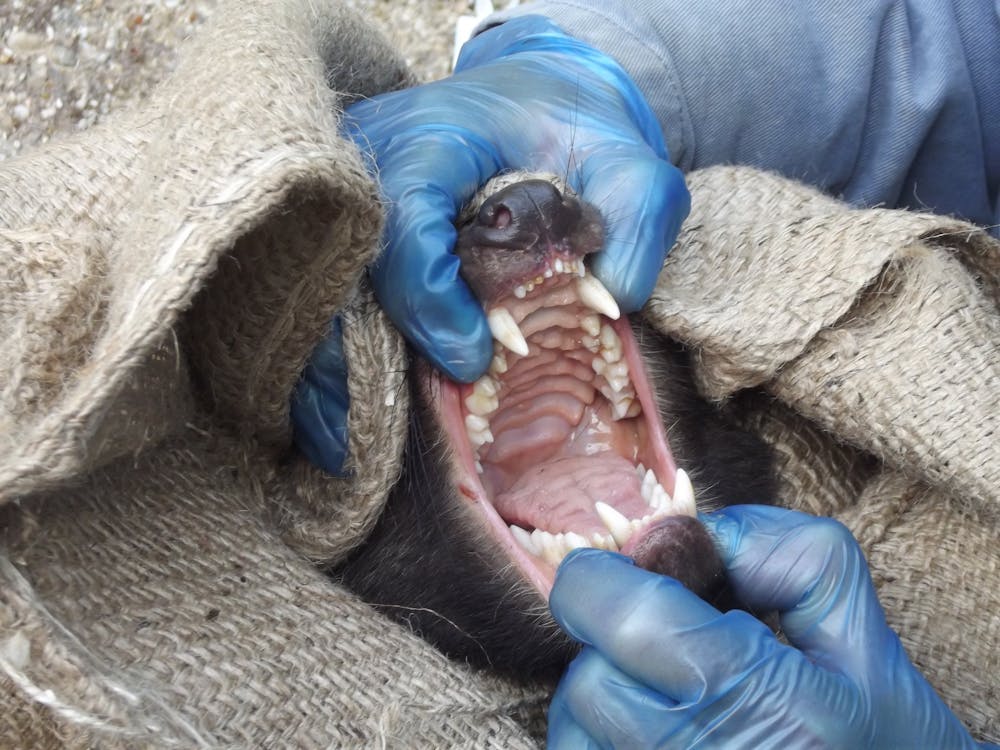
Devils naturally wear their teeth down from sharp points and edges to blunt, almost flat surfaces by regularly eating bones.
Tahlia Pollock, Author provided

This is especially crucial for carnivores, who rely on tough foods to help them develop strong jaws.

Like hyaenas, but stronger

The types of food an animal eats will wear their teeth down differently. For example, big cats such as lions prefer to eat the softer parts of a carcass, like flesh or organs, and leave the bones behind.

Spotted hyaenas, however, will happily eat the bones. As a result, hyaenas have incredibly high tooth wear compared with lions.

This might not hinder the hyaena or devil as much as you might think. Both have very strong jaws that can compensate for the loss of sharp teeth. In fact, devils have the strongest bite force per body weight of any living mammal.

In the interactive below, you can check out 3D models of devil skulls to get a better idea of how much their teeth wear down.

Comparing wild and captive diets

By comparing the tooth wear of wild and captive devils, we can see if captive animals are encountering enough hard foods in their diets.

In the Save the Tasmanian Devil Program — an initiative of the federal and Tasmanian governments — captive devils are given a variety of small and large foods at different times, replicating what they’d find in the wild.

We found no signs of different or harmful tooth wear in captive devils, and they showed much the same patterns and types of wear as wild devils.


Read more:
Meet Moss, the detection dog helping Tassie devils find love


However, we noticed captive devils wore their teeth more slowly than those in the wild. This may be due to eating higher quality food, such as carcasses that were fresh, whole, and yet to be scavenged.

This means captive institutions are doing a good job of providing devils with the right types of food for their teeth and encouraging wild behaviours.

Part of the health check for wild devils involves looking at their teeth. This particular devil has nice sharp tips and edges on their canines and molars.
Marissa Parrott/Zoos Victoria, Author provided

Collecting data about Tassie devils after they’ve been released confirms this. In 2012 and 2013, devils were released onto Maria Island in Tasmania after being born and raised for around a year in captivity.

Encouragingly, these devils kept the behaviours required to scavenge and hunt prey, and had diets similar to wild devils.

How you can help save Tasmanian devils

Our research is one small, but promising, piece in the overall puzzle. While captive research and breeding programs help conserve the Tasmanian devil, there are ways you can help, too.

Because they like to scavenge the carcasses of dead animals, road kill is especially tempting for devils. But being so close to the road is dangerous and road mortality is the second-biggest killer of wild devils.

So take care on the roads to help wildlife, especially if driving at night. And if you’re in Tasmania and see a devil that’s been hit on the road, log it in the Roadkill TAS app.

This will help identify road kill hotspots and protect this impressive, but endangered, species.


Read more:
10 million animals are hit on our roads each year. Here’s how you can help them (and steer clear of them) these holidays


The Conversation

Tahlia Pollock receives funding from the Australian Government Research Training Program Scholarship (RTP stipend), the Monash Graduate Excellence Scholarship (MGE). The research was also funded by the Holsworth Wildlife Research Endowment – Equity Trustees Charitable Foundation & the Ecological Society of Australia.

Alistair Evans receives funding from the Australian Research Council and Monash University, and is an Honorary Research Affiliate with Museums Victoria.

David Hocking has received funding from the Australian Research Council and Monash University.

Marissa Parrott works for Zoos Victoria, a not-for-profit zoo-based conservation organisation. She works closely with partners from the Save the Tasmanian Devil Program and Zoo and Aquarium Association for the conservation of the Tasmanian Devil. Marissa receives no additional payment or funding from outside Zoos Victoria for any work related to threatened species.

ref. Bones and all: see how the diets of Tasmanian devils can wear down their sharp teeth to blunt nubbins – https://theconversation.com/bones-and-all-see-how-the-diets-of-tasmanian-devils-can-wear-down-their-sharp-teeth-to-blunt-nubbins-162422

More stress, unclear gains: are selective schools really worth it?

Source: The Conversation (Au and NZ) – By Melissa Tham, Research officer at the Centre for International Research on Education Systems, Victoria University

Shutterstock

Thousands of primary and secondary students in Sydney and Melbourne are preparing for selective entrance exams. If successful, students will gain entry into a selective secondary school, with other high-achievers, or an “opportunity class”, which is an academic stream for years 5 and 6 in a mixed-ability primary school.

Fully selective and partially selective schools in New South Wales and Victoria are part of the government school sector. They charge minimal fees compared to non-government schools.

But unlike regular government schools that prioritise students living in their catchment zone, selective schools enrol only the highest achieving students based on the outcomes of a competitive entrance exam.


Leer más:
School catchment zones may be annoying for some parents, but they help ensure equality for everyone


Selective schools are known for being consistently high-performing, producing some of the highest final-year secondary school outcomes. The chances of getting into a selective school depends on yearly demand. But are they actually worth it?

Why do families choose selective schools?

Research shows families choose selective schools for many reasons.

Parents are often drawn to them because their students produce good Australian Tertiary Admission Rank (ATAR) scores. These then ensure they can get into the university course of their choice.

Some migrant parents believe their education opportunities were limited or disrupted in their home countries, or during migration. When settled in Australia, these families may be drawn to high-performing schools that select talented and hard-working students.

Parents who have migrated to Australia from overseas also often cite a mix of high aspirations and anxiety about the future — related to university entry, job security and racial discrimination in the workplace — as their main reasons for choosing selective schools.

Selective schools aim to offer opportunities “for all” academically talented students, regardless of their social or cultural backgrounds, or where they live. They seek to enact the ethos of equal opportunity through various practices. For example, the entrance exam comprises aptitude style questions to test students’ natural abilities. And private tutoring to prepare for the entrance exams is discouraged.

Despite this, the types of students enrolled in selective schools are not representative of the population. Selective schools predominantly enrol socially advantaged students from ethnic minority backgrounds.


Leer más:
Selective schools mainly ‘select’ advantage, so another one won’t ease Sydney’s growing pains


A recent review of selective schooling in NSW showed the admission processes provide better outcomes for advantaged students — 59% of applicants were from high socioeconomic backgrounds, or have at least one parent with a bachelor degree or above. The gap widens further on selection, with 64% of selected students considered to be in the high socioeconomic group.

So, these schools take hard-working students who have the advantages of extra tutoring. But do the schools, themselves, make a difference to individual students’ scores?

Do selective schools offer academic benefits?

Studies show selective schools are high performing compared to non-selective schools, but the degree to which they stretch the abilities of selective students is relatively inconclusive.

For instance, a study of three of the four fully selective schools in Victoria found selective school students get ATAR scores that are two and a half percentile points higher than the non-selective school students who narrowly missed out on entry into selective schools.

Girl hugging her schoolfriend and holding letter in her hand.
A study showed students who narrowly missed selective school entry scored very close in final exams to students who got in.
Shutterstock

A recent working paper from the Centre for International Research on Education Systems explored how selective schools shape the socioeconomic composition and academic performance of non-selective schools in Sydney and Melbourne.

It compared the types of students enrolled in geographical “clusters” with one of each type of school: fully selective, partially selective, private and non-selective government schools. The schools were matched where possible in terms of student composition by sex and year levels to enable fair comparisons. The report included 80 schools — 64 in Sydney and 16 in Melbourne.


Leer más:
New South Wales has 48 selective schools, while Victoria has 4. There’s an interesting history behind this


The report showed academic selection through selective school entry ends up with schools being stratified based on students’ social background and academic abilities.

Fully selective schools had the highest proportions of high socioeconomic students (89%). Private schools followed, with 81% of high socioeconomic students. In partially selective schools, advantaged students made up 57% of enrolments. Public schools had the lowest attendance of high socioeconomic students, at just over half, or 50.4%.

Students in selective schools were the highest performing in numeracy, reading and writing. Private and partially selective schools had similar levels of academic performance. Public schools were the lowest performing in all three academic domains.

Given socioeconomic status is a significant predictor of academic scores, it’s unclear whether selective schools would actually make a difference to individual students’ grades. What is clear is that academic selection produces social selection in schools, separating students from wealthy families from those who are of lower socioeconomic status.

Does competition make a difference?

Recent research of 14-year-old students in the United States highlighted competitive, stressful entrance exams — and repetitive testing — affects student well-being, confidence and sense of self when they aren’t selected.

For those who are successful, the process of competitive school entry encourages individualistic mindsets and self-protective actions. The study showed it also heightens racialised stereotyping and lowers empathy towards students who miss out on a place or are unable to compete.

Australian research shows selective school students often compare entrance exam results with others after enrolment. Those who are successful through second or third round offers carry a sense of failure with them into schools, knowing they were not picked first. These successfully selected but lower scoring students see themselves as lesser than first-picked students for many years after selection.

Choosing a selective over a non-selective school flows through to sustaining inequalities in society more broadly. In contrast, enrolling into local government schools and ensuring a mix of students from different socioeconomic backgrounds will help reduce social inequalities, ensuring fairer life outcomes for everyone.

The Conversation

Melissa Tham no recibe salario, ni ejerce labores de consultoría, ni posee acciones, ni recibe financiación de ninguna compañía u organización que pueda obtener beneficio de este artículo, y ha declarado carecer de vínculos relevantes más allá del cargo académico citado.

ref. More stress, unclear gains: are selective schools really worth it? – https://theconversation.com/more-stress-unclear-gains-are-selective-schools-really-worth-it-160762

Hidden women of history: Eliza Hamilton Dunlop — the Irish Australian poet who shone a light on colonial violence

Source: The Conversation (Au and NZ) – By Anna Johnston, Associate Professor of English Literature, The University of Queensland

Portrait of Eliza Hamilton Dunlop (no date), colour photograph of oil painting Wollombi Endeavour Museum

In this series, we look at under-acknowledged women through the ages.

Eliza Hamilton Dunlop’s poem The Aboriginal Mother was published in The Australian on December 13, 1838, five days before seven men were hanged for their part in the Myall Creek massacre.

About 28 Wirrayaraay people died in the massacre near Inverell in northern New South Wales. Dunlop had arrived in Sydney in February, and the Irish writer was horrified by the violence she read about in the newspapers.


Read more:
How can we achieve reconciliation? Myall Creek offers valuable answers


Moved by evidence in court about an Indigenous woman and baby who survived the massacre, Dunlop crafted a poem condemning settlers who professed Christianity but murdered and conspired to cover up their crime. It read, in part:

Now, hush thee—or the pale-faced men
Will hear thy piercing wail,
And what would then thy mother’s tears
Or feeble strength avail!

Oh, could’st thy little bosom
That mother’s torture feel,

Or could’st thou know thy father lies
Struck down by English steel

The poem closed evoking the body of “my slaughter’d boy … To tell—to tell of the gloomy ridge; and the stockmen’s human fire”.

The graphic content depicting settler violence and First Nations’ suffering made Dunlop’s poem locally notorious. She didn’t shrink from the criticism she received in Australia’s colonial press, declaring she hoped the poem would awake the sympathies of the English nation for a people who were “rendered desperate and revengeful by continued acts of outrage”.

An early life as a reader

Dunlop, the youngest of three children, was born Eliza Matilda Hamilton in 1796. Her father, Solomon Hamilton, was an attorney practising in Ireland, England and India. Her mother died soon after Dunlop’s birth, and she was brought up by her paternal grandmother.

Part of a privileged Protestant family with an excellent library, Dunlop grew up reading writers from the French Revolution and social reformers such as Mary Wollstonecraft.

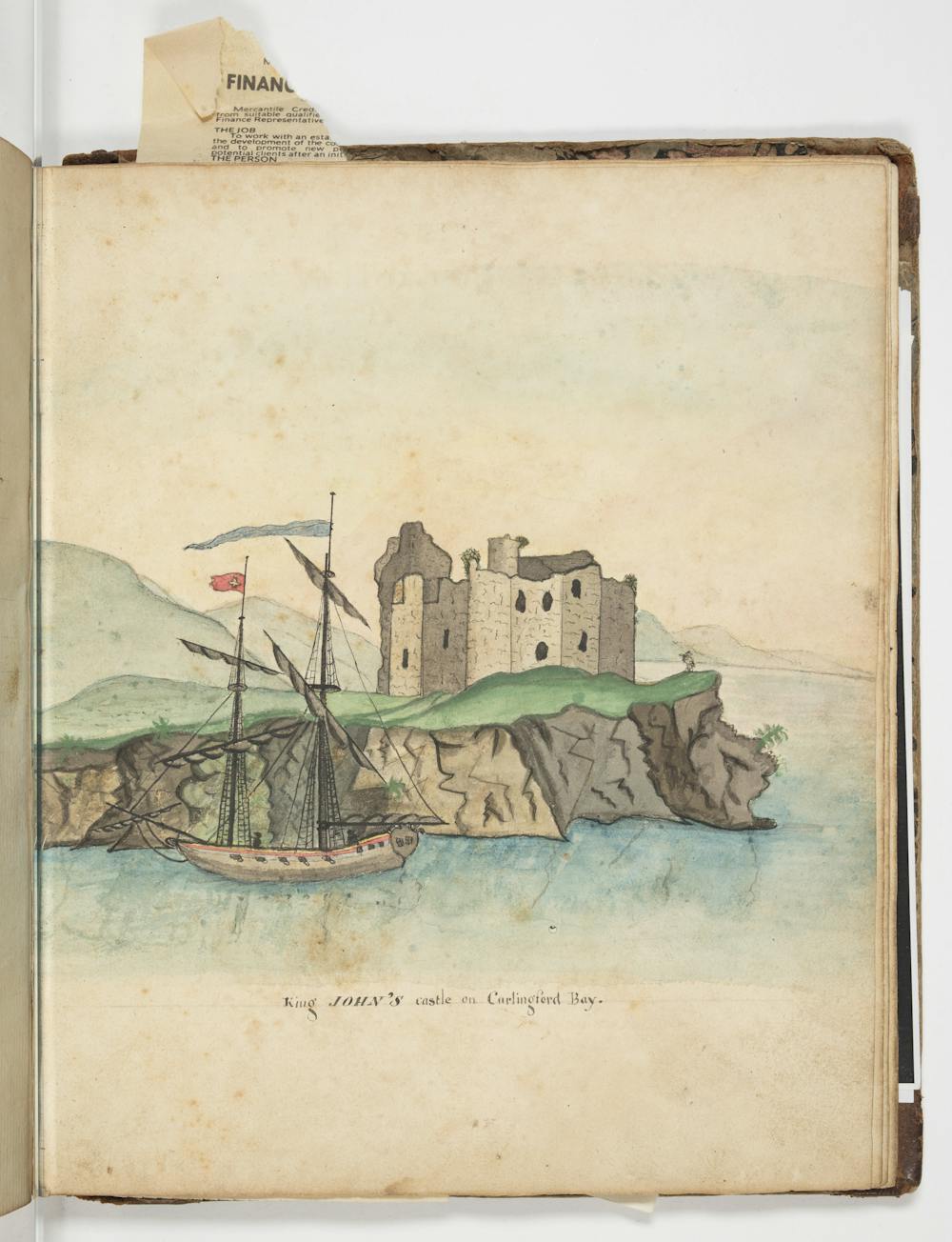
In her teens, Dunlop published poems in local magazines. An unpublished volume of her original poetry, translations and illustrations written between 1808 and 1813 reveals her fascination with Irish mythology and European literature. She was deeply interested in the Irish language and in political campaigns to extend suffrage and education to Catholics.

Eliza Hamilton Dunlop, King John’s Castle on Carlingford Bay, Juvenile notebook, watercolour and ink.
Milson Family Papers – 1810, 1853–1862, State Library of New South Wales, MLMSS 7683

In 1820, she travelled to India to visit her father and two brothers. The journey inspired poems about colonial locations — from the Cape Colony (now South Africa) to the Ganges River — that explored the reach and impact of the British Empire.

In Scotland in 1823, she married book binder and seller David Dunlop. David’s family history inspired poems such as her dual eulogy, The Two Graves (1865), about the bloody suppression of Protestant radicals in the 1798 Rebellion, during which David’s father Captain William Dunlop had been hanged.

The Dunlops had five children in Coleraine, Northern Ireland, where they were engaged in political activity seeking to unseat absentee English landlords, before leaving Ireland in 1837.

Settler poetry and politics

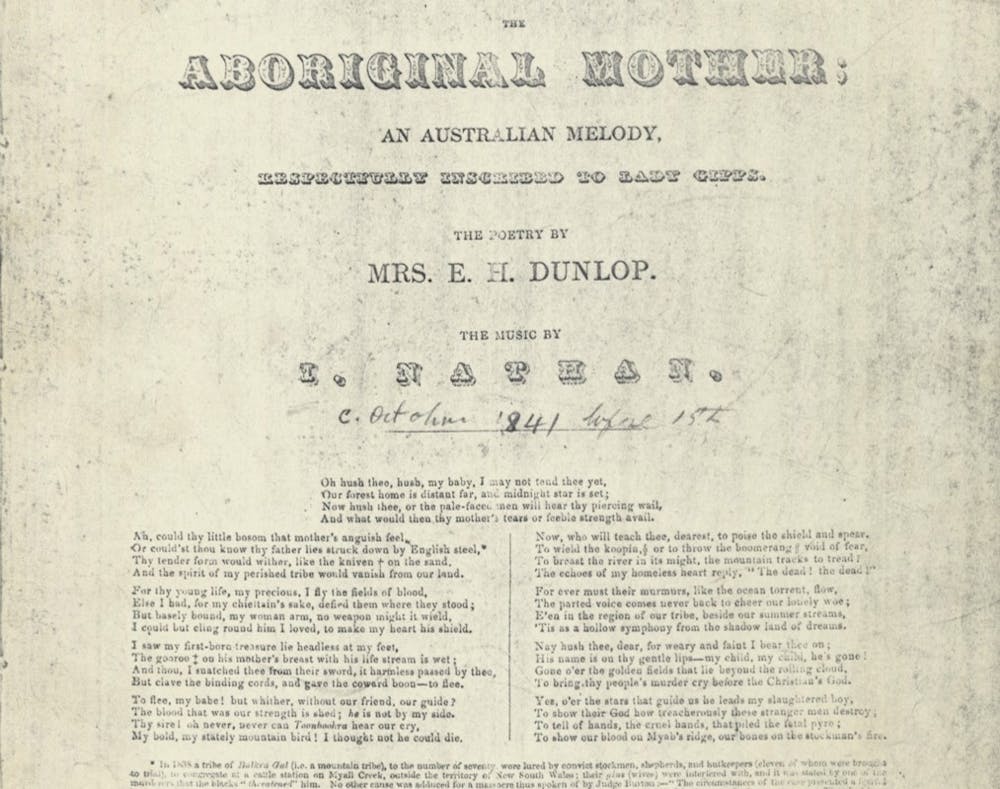
When The Aboriginal Mother was published as sheet music in 1842, set to music by the composer Isaac Nathan, he declared “it ought to be on the pianoforte of every lady in the colony”.

The cover of the music score of The Aboriginal Mother.
Trove

Dunlop often wrote about the Irish diaspora in poems which were alternatively nostalgic and political. But she also brought her knowledge of the violence and divisiveness of colonisation, religion and ethnicity to her writing on Australia.

Her optimistic vision for Australian poetry encouraged colonial readers to be attentive to their environment and to recognise Indigenous culture. This reputation for sympathising with Indigenous people — and her husband’s arguments with settlers in Penrith about the treatment of Catholic convicts — were widely criticised in the press.

This affected David’s career as police magistrate and Aboriginal Protector: he was soon moved to a remote location. There, too, local landholders campaigned against his appointment and undermined his authority.

Indigenous languages

When David was posted to Wollombi in the Upper Hunter Valley, Dunlop sought to expand her knowledge of Indigenous culture, engaging with Darkinyung, Awabakal and Wonnarua people who lived in the area.

She attempted to learn various languages of the region, transcribing word lists, songs and poems, and acknowledging the Indigenous people who shared their knowledge with her.

Some of Dunlop’s transcription between English and the language of the Wollombi people, dated from 1840.
State Library of New South Wales

She wrote a suite of Indigenous-themed poems in the 1840s, publishing poems in newspapers such as The Eagle Chief (1843) or Native Poetry/Nung-ngnun (1848). These poems were criticised by anonymous letter writers, questioning her poetic ability, her knowledge and her choice of subject.

Some critics were frankly racist, refusing to accept the human emotions expressed by Dunlop’s Indigenous narrators.

The Sydney Herald had railed against the death sentences of the men responsible for the Myall Creek massacre, and Dunlop condemned the attitude of the paper and its correspondents. She hoped “the time was past, when the public press would lend its countenance to debase the native character, or support an attempt to shade with ridicule”.

Dunlop would publish with one outlet before shifting to another, finding different editors in the volatile colonial press who would support her.

Poetry of protest

Dunlop wrote in a sentimental form of poetry popular at the time, addressing exile, history and memory. She published around 60 poems in Australian newspapers and magazines between 1838 and 1873, but appears to have written nothing more on Indigenous themes after 1850. This popular writing also contributed to poetry of political protest, galvanising readers around causes such as transatlantic anti-slavery.


Read more:
Five protest poets all demonstrators should read


The plight of Indigenous people under British colonialism inspired many writers, including “crying mother” poems that harnessed the universal appeal of motherhood.

Dunlop’s poems The Aboriginal Mother and The Irish Mother are linked to this literary trend, but her experience of colonialism lent her poetry more authority than writers who sourced information about “exotic” cultures from imperial travel writing and voyage accounts.

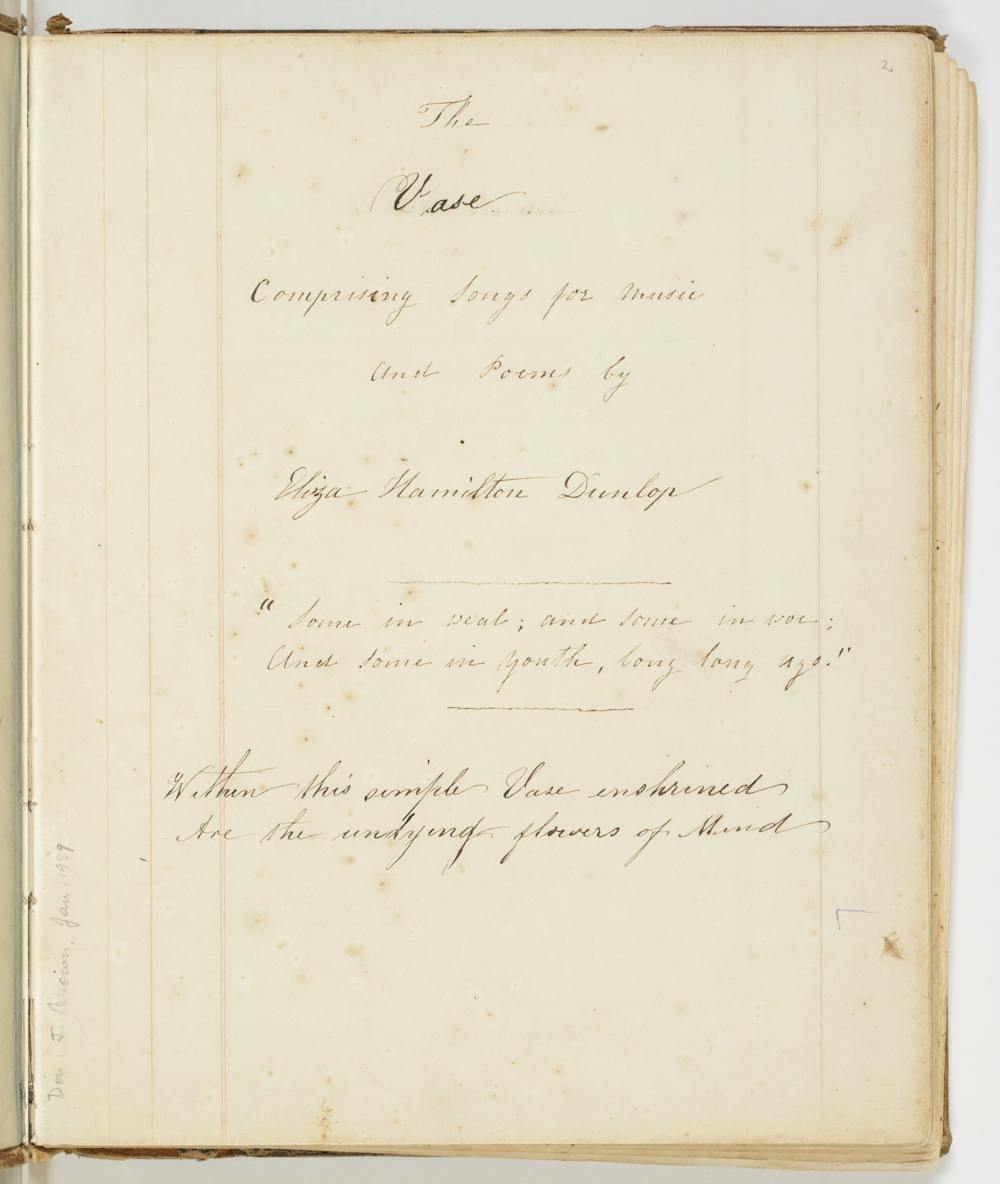
In the early 1870s, Dunlop collated a selection of poetry, The Vase, but she was never able to publish. Family demands and financial constraints precluded it.

Eliza Hamilton Dunlop, Title page, ‘The Vase’, paper.
State Library of New South Wales, B1541

Dunlop died in 1880. Like many women of the time, her writing was neglected and forgotten, until it was rediscovered by the literary critic and editor Elizabeth Webby in the 1960s.

Webby identified Dunlop as the first Australian poet to transcribe and translate Indigenous songs, and as among the earliest to try to increase white readers’ awareness of Indigenous culture. Webby published the first collection of Dunlop’s poems in 1981.

Today, communities and linguists regularly use Dunlop’s transcripts for language reclamation projects in the Upper Hunter Valley.

Last year, 140 years after Dunlop’s death, Wanarruwa Beginner’s Guide — an introduction to one language of the Hunter River area — was published.

At the launch, language consultant Sharon Edgar-Jones (Wonnarua and Gringai) movingly recited one of the songs Dunlop transcribed: revitalising the words of the Indigenous women and men to whom Dunlop listened, when so few white Australians were listening at all.


Eliza Hamilton Dunlop Writing from the Colonial Frontier, edited by Anna Johnston and Elizabeth Webby, is out now through Sydney University Press.

The Conversation

Anna Johnston receives funding from the Australian Research Council (FT130100625).

ref. Hidden women of history: Eliza Hamilton Dunlop — the Irish Australian poet who shone a light on colonial violence – https://theconversation.com/hidden-women-of-history-eliza-hamilton-dunlop-the-irish-australian-poet-who-shone-a-light-on-colonial-violence-161592

European Masterpieces from the Met demonstrates art’s power to speak to the human condition

Source: The Conversation (Au and NZ) – By Alastair Blanshard, Paul Eliadis Chair of Classics and Ancient History, The University of Queensland

Caravaggio (Michelangelo Merisi) Italy 1571–1610
The Musicians 1597
Oil on canvas
92.1 x 118.4cm
Rogers Fund, 1952 / 52.81
Collection: The Metropolitan Museum of Art, New York
The Metropolitan Museum of Art, New York

Review: European Masterpieces from the Metropolitan Museum of Art, New York, Queensland Art Gallery & Gallery of Modern Art, Brisbane.

Thanks to the pandemic, exhibitions such as European Masterpieces from the Metropolitan Museum of Art, New York, which opened at QAGOMA on the weekend, are fraught with logistical difficulties. Quarantine rules and social distancing requirements, not to mention the actual health effects of COVID, have dramatically affected the ability of gallery and museum staff to plan, oversee and shepherd high profile exhibitions into existence.

The fact they are open at all stands as an extraordinary demonstration of trust between institutions and their commitment to the power of masterworks to speak to the human condition.

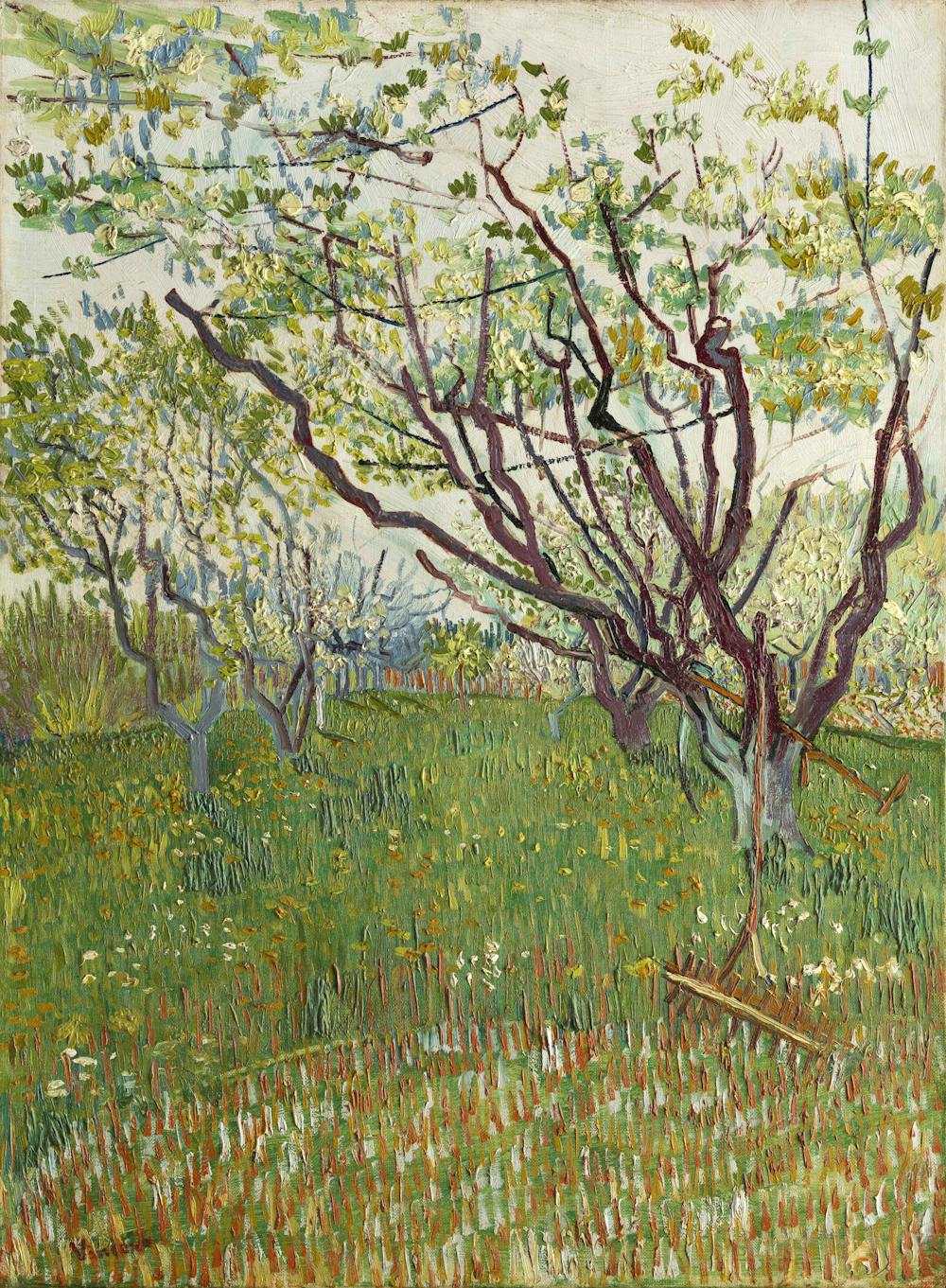
Vincent van Gogh.
The Netherlands 1853–90
The Flowering Orchard 1888
Oil on canvas
72.4 x 53.3cm
Signed (lower left): Vincent
The Mr and Mrs Henry Ittleson Jr Purchase Fund,
1956 / 56.13
Collection: The Metropolitan Museum of Art, New York

The Metropolitan Museum of Art, New York

The excuse for this exhibition was a major refit of the European Galleries at the Met. Planned long before the pandemic, exhibitions like this one take on new meaning in current times. None of us are going to be able to travel with ease to New York any time soon. These exhibitions remind us of what we are missing. So, as our memories of the joy of visiting international galleries fade, what impression of the Met emerges from this show?

Certainly, the quality and depth of its collection shines through. This exhibition doesn’t give us all the Met’s greatest hits. Everyone will have a favourite painting that didn’t make the cut. However, the curatorial choices are clever.

It is fun to play the mental game of which of an artist’s pictures from the Met you would choose to include. Time and again, it proves to be on the walls in Brisbane.

Lost in the interplay of glances among the figures in Georges de La Tour’s The Fortune Teller, you don’t regret for a moment that we didn’t get his darkly moody The Penitent Magdalen.

Georges de La Tour.
France 1593–1653
The Fortune-Teller c.1630s
Oil on canvas
101.9 x 123.5cm
Signed and inscribed (upper right): G. de La Tour Fecit Luneuilla Lothar: [Lunéville Lorraine]
Rogers Fund, 1960 / 60.3
Collection: The Metropolitan Museum of Art, New York

The Metropolitan Museum of Art, New York

Fans of French neoclassical painting are extremely well served by Marie Denise Villers’ portrait of Marie Joséphine Charlotte du Val d’Ognes — a luminous, arresting portrait whose sitter is painted with breathtaking clarity and intensity.

Marie Denise Villers.
France 1774–1821
Marie Joséphine Charlotte du Val d’Ognes (died 1868) 1801 Oil on canvas
161.3 x 128.6cm
Mr and Mrs Isaac D Fletcher Collection, Bequest of Isaac D Fletcher, 1917 / 17.120.204
Collection: The Metropolitan Museum of Art, New York

The Metropolitan Museum of Art, New York

The exhibition plays up the advantages of distance. Second-tier works gain new life separated from their more famous siblings.

In New York, Poussin’s Saints Peter and John Healing the Lame Man is overshadowed by the riotous profusion of bodies in his Abduction of the Sabine Women. In Queensland, away from the noise of the Sabine painting, it is possible to appreciate the elegant structure of this religious picture.

Nicolas Poussin.
France 1594–1665
Saints Peter and John Healing the Lame Man 1655 Oil on canvas
125.7 x 165.1cm
Marquand Fund, 1924 / 24.45.2
Collection: The Metropolitan Museum of Art, New York

The Metropolitan Museum of Art, New York

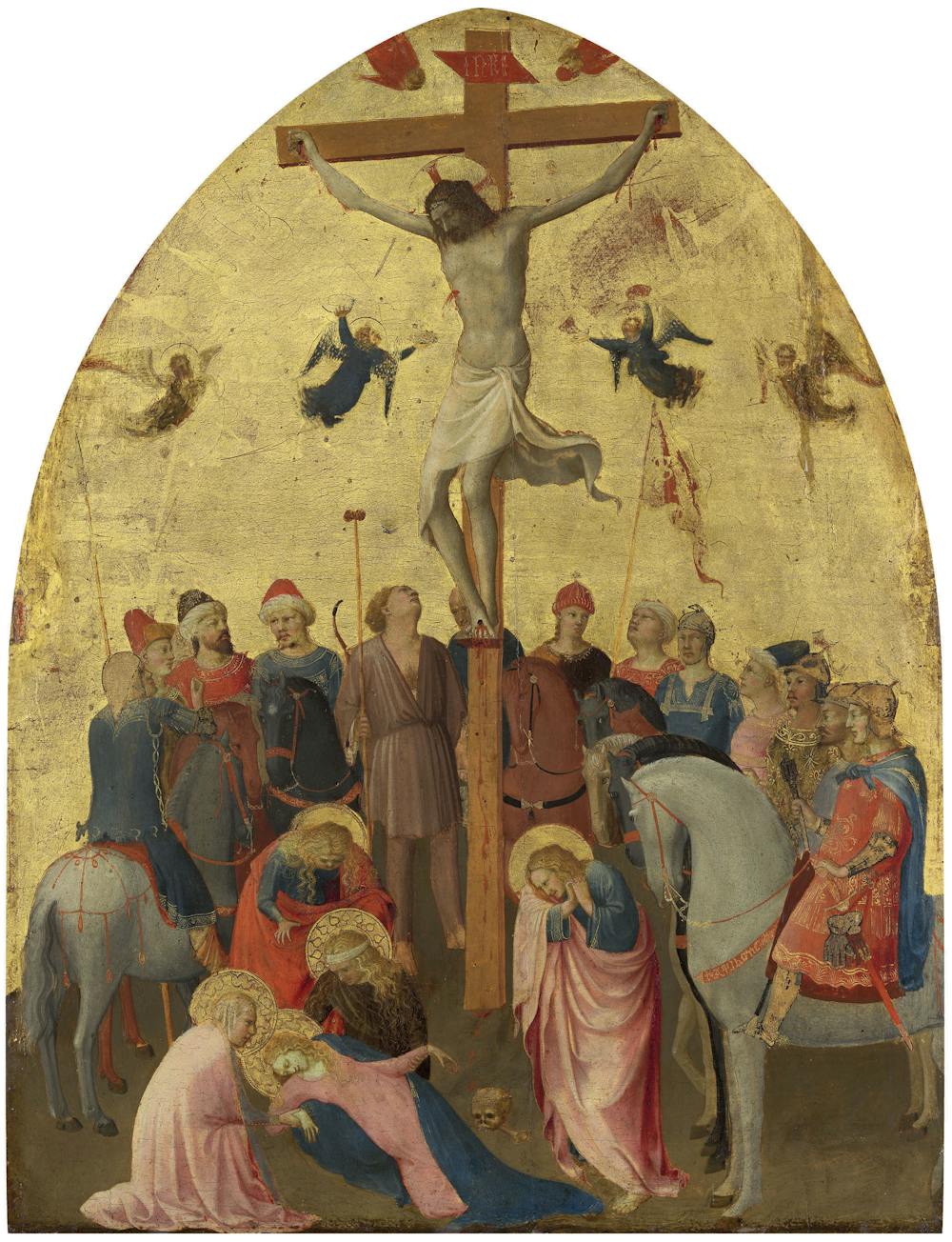
Connoisseurs of technique will not be disappointed by the works on display. Fra Angelico’s The Crucifixion rightly occupies an important place in the history of perspective. One can trace the story of the treatment of light from Caravaggio through to Cézanne.

Fra Angelico (Guido di Pietro) Italy c.1395–1455.
The Crucifixion c.1420–23 Tempera on wood, gold ground 63.8 x 48.3cm
Maitland F Griggs Collection, Bequest of Maitland F Griggs, 1943 / 43.98.5
Collection: The Metropolitan Museum of Art, New York

The Metropolitan Museum of Art, New York

Venice is expertly evoked with Turner’s characteristically soft, wispy brushstrokes; a perfect contrast to the thickness of paint found in El Greco’s The Adoration of the Shepherds or Rembrandt’s Flora. The Fragonard (The Two Sisters) looks like a Fragonard.

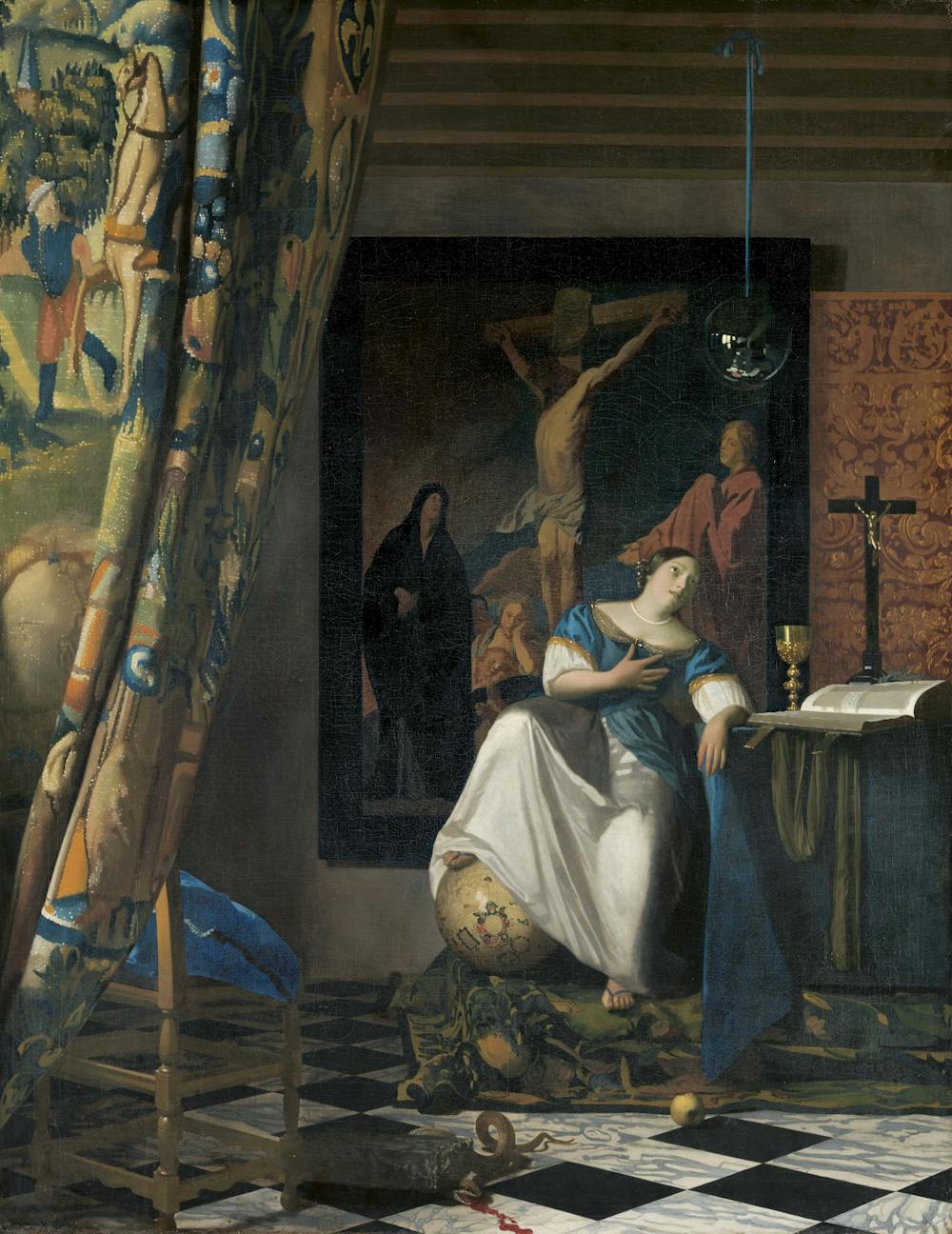
More than this, what makes these works so exciting is the way they brim with ideas. Vermeer’s Allegory of the Catholic Faith is a good example. It’s one of his cleverest paintings. One could spend a week in front of the work unpacking its symbolism and theological ideas.

Johannes Vermeer.
The Netherlands 1632–75
Allegory of the Catholic Faith c.1670–72
Oil on canvas
114.3 x 88.9cm
The Friedsam Collection, Bequest of Michael Friedsam, 1931 / 32.100.18
Collection: The Metropolitan Museum of Art, New York

The Metropolitan Museum of Art, New York

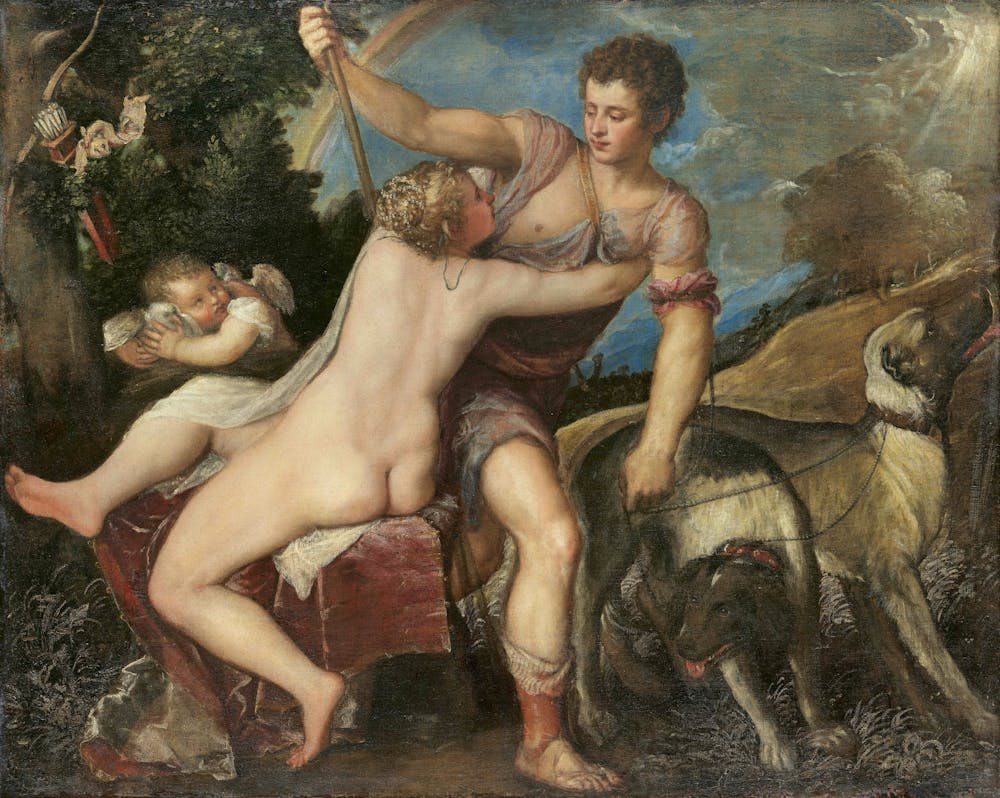
The works not only reflect ideas, they stage deliberate interventions. Titian’s Venus and Adonis is a case in point. It shows the couple in a passionate embrace, the moment before Adonis is about to head off on the ill-fated hunt that will cost him his life.

The accompanying label describes this work as “re-imagining” Ovid’s Metamorphoses, the Latin epic about mythological transformations. This fails to capture the dynamism of the relationship. This is a painting desperately keen to escape its origins in Ovid’s work. In Ovid, you never forget that Adonis is the product of incest, the offspring of a mother who burned with unnatural desire for her father.

Titian (Tiziano Vecellio) Italy c.1485/90–1576 Venus and Adonis 1550s Oil on canvas.
106.7 x 133.4cm
The Jules Bache Collection, 1949 / 49.7.16
Collection: The Metropolitan Museum of Art, New York

The Metropolitan Museum of Art, New York


Read more:
Guide to the classics: Ovid’s Metamorphoses and reading rape


It is a tale so monstrous that Ovid even warns his readers (or at the very least their daughters) not to read it. Ovid makes you feel uneasy about love. His epic is full of rape and violence. This painting rewrites Ovid’s story and invites you to devote yourself to the pleasures of love, even if they have tragic consequences.

Equally compelling is Jean-Léon Gérôme’s Pygmalion and Galatea. Critics have not been kind to Gérôme. His great crime was to be born so late and live so long. He jumped the wrong way on Impressionism, railing against the “junk” of modern art, and few have forgiven him.

Jean-Léon Gérôme.
France 1824–1904
Pygmalion and Galatea c.1890
Oil on canvas
88.9 x 68.6cm
Signed (on base of statue): J.L. GEROME.
Gift of Louis C Raegner, 1927 / 27.200
Collection: The Metropolitan Museum of Art, New York

Collection: The Metropolitan Museum of Art, New York

Yet at the same time, Gérôme was engaged in arguably his most important sequence of works, his series of paintings and sculpture depicting the moment when the fantasies of the sculptor Pygmalion are realised and the statue he has been carving — with whom he has passionately fallen in love — comes to life.

Gérôme’s sequence is uneven. The sculpture is terrible, now perfectly at home in that temple of kitsch, Hearst Castle in California. The reason why that sculpture fails is why this painting succeeds. In the sculpture, despite a bit of added paint, we see only marble.

Here, in an example of virtuoso painting, Gérôme plays with the transition of stone to flesh. We see a miracle unfolding before our eyes. It is a painting inviting us to contemplate art’s ability to imitate, perfect, mediate and complicate our relationship with the world. In this, it is a perfect emblem of this exhibition.

European Masterpieces from the Metropolitan Museum of Art, New York, is showing at QAGOMA Brisbane until October 21.

The Conversation

Alastair Blanshard does not work for, consult, own shares in or receive funding from any company or organisation that would benefit from this article, and has disclosed no relevant affiliations beyond their academic appointment.

ref. European Masterpieces from the Met demonstrates art’s power to speak to the human condition – https://theconversation.com/european-masterpieces-from-the-met-demonstrates-arts-power-to-speak-to-the-human-condition-160462

Politics with Michelle Grattan: Acting PM Michael McCormack on net zero 2050 and prospects for a new coal-fired power station

Source: The Conversation (Au and NZ) – By Michelle Grattan, Professorial Fellow, University of Canberra

With Scott Morrison overseas, Nationals leader Michael McCormack has been Acting Prime Minister this week. In this podcast, he speaks about the free trade agreement with the UK, climate change, coal, the Nationals, and China.

With speculation about whether Morrison will embrace a 2050 net zero target before the Glasgow climate conference, the attitude of the Nationals is critical and McCormack is under pressure from a vocal group in his party that is strongly against the target.

McCormack says the National party will not supporting signing up to the target this year.

When it is put to him, “we can be sure that the Nats would not embrace that target?” his reply is definite. “Correct”.

On coal, unlike many in the government, McCormack believes the controversial proposal for a coal-fired power station at Collinsville in Queensland can be a goer. A feasibility study is being conducted for the project. (It is understood a draft report has been produced already.)

McCormack says the study is “very much on its way”. Shire Energy CEO Ashley Dodd “texts me every day of every week and highlights the progress. And last week there were some really, really positive news.”

Asked whether he thinks the government will be able to support the project, McCormack says, “provided every box [including environmental ones] is ticked, yes”.

“If the proponents come forward with everything that they’re required to do, then I can see no reason why it wouldn’t be supported. And of course, it’s not just the federal government. It’s other entities, too, which need to come on board.”

Transcript (edited for clarity)

Michelle Grattan: Michael McCormack, leader of the Nationals and deputy prime minister, is acting PM this week while Scott Morrison is overseas.

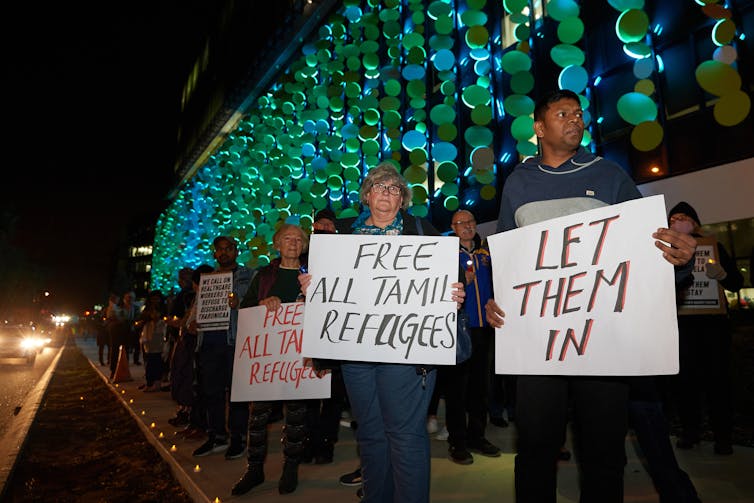
The Labor Party is relishing giving McCormack heat in question time. But McCormack himself seems to be equally relishing the limelight. And this week he had some good trade news to sell to farmers. Michael McCormack joins us today to talk about the Tamil family, the Australian-UK free trade agreement, climate change, coal and the Nationals.

Michael McCormack, can we start with the Biloela family? The government is taking quite a hard line, refusing to allow them to return to the town, which is in the National seat of Flynn. But your member for Flynn, Ken O’Dowd, supports the families return. Mr. O’Dowd is retiring at the election, would you expect your candidate next time round to say the family should be returned or to support the government’s line that they shouldn’t be?

Michael McCormack: Well, Ken has done a marvellous job for Flynn, for Gladstone, Emerald and every other town in that electorate in central Queensland. But the next candidate for Flynn hasn’t been decided. The ultimately the person who will run for the LNP and sit with the National Party, hopefully after the next election has not been determined. And that will be up to that person. But what we’ve done as far as the Biloela family, every step of the way is stick to our clear and steadfast policy. And that is that if you came to Australia via an unauthorised vessel, then you would not be settled in this country. And we’ve stuck by that. And by sticking to that policy, which was made clear at the election when we returned to power in 2013 and continued at the subsequent elections in 2016, 2019, is that we’ve stopped the boats and that has saved lives. Now, under Labor’s watch, under those six years of labour from 2007 when they dismantled John Howard’s clear policy on boats and on illegal immigrants to 2013, when they finished government, Labor saw, sadly, 1,200 people lost at sea. Now we don’t want to go back to those bad dark days. We want to make sure that at every step of the way that people know our clear immigration policies and that if they do attempt to board a vessel via a people smuggler and try to get to Australia, then they will not be settled here.

MG: Let’s move on to the free trade agreement, which was agreed in principle this week between Scott Morrison and Boris Johnson. Its got concessions and advantages for Australian farmers, but they do seem a long way off. A decade, at least 10 to 15 years for our beef and sheep meat exports.

MM: Well, there’s immediate access for 35,000 tonnes tariff free for beef, 25,000 tonnes of sheep meat, 80,000 tonnes of sugar, 24,000 tonnes for dairy produce. This is a good outcome. And trade equals jobs. More trade equals more jobs. So we can look at those things. And as it’s also eight years for beef and sheep and 10 years for the sugar cane produce. And yes, there are elements that do go out to a further period. But this is a good outcome for Australian farmers and for Australians in general. Regional Australia has grown despite Covid-19 and despite every other thing that’s been thrown against it and agriculture has grown to a $66 billion enterprise, we want to make it $100 billion by 2030. Only by doing trade deals such as this are we going to realise that outcome.

MG: In the talks that Scott Morrison has had with the British prime minister, climate change was, of course, one of the elements, and that’s been a theme of the G7 leaders. Now, your Senate leader, Bridget McKenzie, this week warned that it would be against the Nationals’ policy to sign up to net zero by 2050, to sign up to that firmly. What would be the Nationals’ position if the prime minister wants to embrace that target?

MM: Well, we’re not going to sell our coal miners out, no way, shape or form, as Nationals. And nor is Scott Morrison. I was pleased to see overnight that Japan said individual countries should set their own targets and their own pathway to lower emissions. And Japan, of course, has 14 of its 53 power stations are coal-fired power stations. And so they’ve also set a clear pathway to continuing exports. And Australia is the best coal exports in the world. But Australia is not a signatory to the G7 plus or G7 communique. And Scott Morrison hasn’t signed away anything and nor would he. We’ve actually lowered our emissions by 20%, which is, from 2005 levels, which I haven’t seen those sorts of emissions being lowered to that extent, by the US, by Canada or many of those other countries that often make statements about climate, and so, you know, you look at our rooftop solar capacity, it is the highest take-up in the world. And so we’re doing our part, we’re meeting and beating our international obligations for 2030 big time. And we’ll continue to do that. And regional Australia will lead the way in that process.

MG: So if I can just clarify this, the Nationals would not embrace the 2050 target as a firm commitment this year.

MM: Well, how do we get there? That’s the question. Well, it’s technology, not taxes. That’s always been what we’ve said. And we’re not signing, we’re not signing up to anything. We’re not signing up to any international agreements, again, to see farmers and factories and households paying more for energy.

MG: So we can be sure that the Nats would not embrace that target.

MM: Correct.

MG: Right. So, you mentioned coal, the study of a possible coal fired power station at Collinsville. That was set up, what, before the last election?

MM: Part of the underwriting new generation investments.

MG: Around the last election. Now, where is that up to? Is that finished?

MM: Well, Ashley Dodd, who is the proponent of Shine Energy, which is the company that is exploring that possibility, they received some very good news last week. The business case is actually at the moment being reviewed. If it all stacks up, then I can’t see why you wouldn’t have such a facility in Gladstone, which needs the energy. Now Gladstone, I’m not sure whether, Michelle, you visited in more recent times, but it is booming and you’ve got so many companies looking to set up there. And looking to establish there and the port is expanding – it’s a very deep water harbour. We want to see Gladstone be its best self, we want to see it be the industrial manufacturing powerhouse of central Queensland, of the nation. But we’re not going to do it if we don’t have the power. So Shine Energy, forging on, they’re getting that help through that UNGI [Underwriting New Generation Investments] process. And measures are going well.

MG: So that means the study is nearly finished or?

MM: Very much on its way. Yes. And Ashley Dodd…

MG: And you think…

MM: Texts me every day of every week and highlights the progress. And last week there were some really, really positive news. He’s in a good frame of mind. Shine Energy, stand ready to to do what they need to do. But of course, it also needs to meet all the environmental implications. Yes, it does. And yes, it will.

MG: So you think that the government will be able to support this enterprise.

MM: Well, provided every box is ticked, yes.

MG: But nevertheless, you get the feeling that Scott Morrison has now turned away from coal and he’s putting more emphasis on gas. You don’t think that times have just passed by the possibility of this project going ahead?

MM: Well, there’s also diversification of the energy market. And we’ve always said that we believe in a range of energy options. Gas, yes, it’s a big part of it. I’m delighted that Keith Pitt has been so forward leaning with Beetaloo Basin and we’re supporting that project. Massive project, huge numbers of jobs, with the right road infrastructure, with the right amenities in that regard. In the Northern Territory, and even the, even the Gunner government which realises that this might be a way out of their economic malaise, and they’re in a bit of strife at the moment with debt. But this can only help that process of the Northern Territory government getting to some way back to where it needs to be and also addressing the energy needs and export requirements of this nation.

MG: So just to be clear, on Collinsville, it is quite feasible you think that we could have a new coal fired power station there

MM: If everything stacks up. Yes. If everything… Because that’s part of the UNGI process. That’s part of what we put in place prior to the 2019 election. And if the proponents come forward with everything that they’re required to do, then I can see no reason why it wouldn’t be supported. And of course, it’s not just the federal government. It’s other entities, too, which need to come on board. But this is a process that will be worked through.

MG: Now, turning to China, obviously Australian farmers have taken quite a lot of the brunt of China’s ire with Australia generally because it’s their products that are running into obstacles. Do you have any concerns that Australia is going too far in its criticisms of China, so far that we’re really doing ourselves damage?

MM: We trade a $149.6 billion with China. It’s our largest trading partner and I’ve been very, very careful with my comments around that, because what I don’t want to see is the barley grower in South Australia or Western Australia, the meat worker in a boning room in Casino, lose their job or lose their market because in some way, Beijing misinterpreted anything or any support that I have for our trade continuing. And it’s important. It’s important for our growers. It’s important for our workers. It’s important for our nation. That trade continues with China. Yes, I appreciate there are difficulties, but there are always difficulties in a, in a competitive market. And this is one of the reasons why we’re working through this process diligently, respectfully, pragmatically, practically, as you would expect. But that’s also why one of the reasons I’m pleased that Dan Tehan is working so hard to diversify our markets as well in the UK-Australia free trade agreement in principle is one of those recently, of course, opened up a trade arrangement with Indonesia that grew and expanded what we had before and 35,000 tonnes of barley going to Mexico for the very first time recently. That’ll help there. The beer production and everything else and indeed the sheep meat going to Saudi. These are important diversifications of our markets that are good.

MG: But do you think we need to be more careful? The government needs to be more careful with its language about China?

MM: We’ll always do and say what’s in Australia’s national interests first and foremost.

MG: Do you think there’s any possible threat to iron ore exports?

MM: I would like to think not, because Australia’s iron ore is the best in the world.

MG: But what do you think?

MM: Well, I mean, these are matters for others to decide. But I say again that the mills and the production processes in China need our metallurgical coal, need our iron ore. China knows that if it wants to build a better future, then Australia’s resources are one way to be able to enhance and provide that.

MG: Now, just turning to the Nationals. These days, there always seems to be a good degree of angst in the Nationals – more than there used to be – at least in my memory. Is this mainly to do with issues or is it a question of personalities and ambitions?

MM: Oh well, there’ll always be personalities and ambitions in Canberra. That’s why, that’s why the place is like it is. But I’m focused on making sure that our $110 billion of infrastructure is rolled out supporting 100,000 workers. I’m focused on making sure that the regions can get the best deal that they can get in every way, shape or form, whether it’s through infrastructure, whether it’s through water resources, whether it’s through agriculture. That’s my only focus. You’ll only ever get me commenting publicly and privately about the things that will be good for regional Australia. I’ll leave the politics to others if they so choose to go down that path. People out in regional Australia, particularly through Covid and particularly when they’re catching mice in greater numbers than they ever expected. People who are looking to the skies to see that the next shower is going to provide them with that subsoil moisture, to be able to give them hope when they’re planning a crop. They’re not worried. They’re not worried about the internal goings on, the machinations of a federal parliament. They want what’s best for them. And the bread and butter issues are my issues as well. Their concerns are my concerns.

MG: Just finally, because we can hear the bells ringing…

MM: I think that’s just the start of parliament, so a little bit of time…

MG: For parliament to start. I just wonder what it feels like as acting prime minister, sitting in that question time hot seat, being peppered with questions which are well-outside your normal field of the questions you need to answer?

MM: Funnily enough, it’s actually not because when you are the deputy prime minister, you get asked questions from every which way, every angle, every topic. When you’re out at a Bathurst roadside on the Great Western Highway, you’ll get questions about every topic under the sun.

MG: Not so many people are listening, though.

MM: Sure. And for those people who are listening to question time, I’m always amazed by the number of truckies who are listening in as they deliver the goods around the nation, and good on them, they they keep the wheels of the economy turning.

MG: So what’s their feedback?

MM: Good. Generally good. And question time is a cauldron. It’s a robust debating chamber. And you just have to have read your topic, know your topic, and but also show that you’re human. I don’t think people want politicians to be just reading from script all the time or just sticking to the, to the talking points, and I’ve never been like that, I’m always somebody who yes, you’ll see me as I am. I’m Michael from Marra – little town with, tell you what, when I was when I was born and grew up there in the first four years that dad had the farm there, it had only a population of just over 100. How good is it that we have a nation where a little village of just over 100 people can produce somebody who can go on and be the acting prime minister? That gives hope to every boy and girl out there who ever aspired to open the batting for Australia in the cricket, to be a politician, to be the best nurse or doctor or engineer or scientist that they could be, that providing they work hard, providing they listen to their parents and their teachers and provided they have a bit of luck, you can be anything in this nation.

MG: Also, you’re former journalists, of course. So…

MM: I am, and what a great and noble profession that is!

MG: You’ve seen the process from a different perspective. Michael McCormack, thank you very much for talking with the conversation today. We’ll let you get back to those briefs for the parliamentary day.


Listen on Apple Podcasts

Stitcher Listen on TuneIn

Listen on RadioPublic

Additional audio

A List of Ways to Die, Lee Rosevere, from Free Music Archive.

The Conversation

Michelle Grattan does not work for, consult, own shares in or receive funding from any company or organisation that would benefit from this article, and has disclosed no relevant affiliations beyond their academic appointment.

ref. Politics with Michelle Grattan: Acting PM Michael McCormack on net zero 2050 and prospects for a new coal-fired power station – https://theconversation.com/politics-with-michelle-grattan-acting-pm-michael-mccormack-on-net-zero-2050-and-prospects-for-a-new-coal-fired-power-station-162853


Seeing the invisible: tiny crystal films could make night vision an everyday reality

Source: The Conversation (Au and NZ) – By Rocio Camacho Morales, Postdoctoral fellow, Australian National University

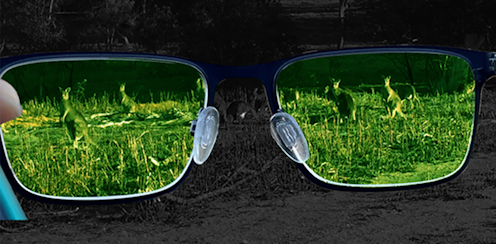
Artist’s impression of the view through future night-vision glasses. Lei Xu / NTU, Author provided

It’s a familiar vision to anyone who has watched a lot of action movies or played Call of Duty: a ghostly green image that makes invisible objects visible. Since the development of the first night-vision devices in the mid-1960s, the technology has captured the popular imagination.

Night vision goggles, infrared cameras and other similar devices detect infrared light reflected from objects or rather detect infrared light emitted from objects in the form of heat. Today these devices are widely used not only by the military, but also by law enforcement and emergency services, the security and surveillance industries, wildlife hunters, and camping enthusiasts.

But current technology is not without its problems. Commercial infrared cameras block visible light, disrupting normal vision. The gear is bulky and heavy, and requires low temperatures — and, in some cases, even cryogenic cooling — to work.

Rocio Camacho Morales in the optics lab.
Jamie Kidston / ANU, Author provided

We have proposed a new technology that uses ultra-thin layers of nanocrystals to make infrared light visible, addressing many of the longstanding problems with current devices. Our research is published in Advanced Photonics.

Our eventual goal is to produce a light, film-like layer that can sit on glasses or other lenses, powered by a tiny built-in laser, allowing people to see in the dark.

Conventional infrared detection

Commercial infrared cameras convert infrared light to an electric signal, which is then shown on a display screen. They require low temperatures, because of the low energy and frequency of infrared light. This makes conventional infrared detectors bulky and heavy – some security personnel have reported
chronic neck injury due to regular use of night vision goggles .

Another drawback of the current technology is that it blocks the transmission of visible light, thereby disrupting normal vision. In some cases, infrared images could be sent to a display monitor, leaving normal vision intact. However, this solution is not feasible when users are on the move.


Read more:
Looking at the universe through very different ‘eyes’


All-optical alternatives

There are also some all-optical alternatives, which do not involve electrical signals. Instead, they directly convert infrared light into visible light. The visible light can then be captured by the eye or a camera.

These technologies work by combining incoming infrared light with a strong light source – a laser beam – inside a material known as “nonlinear crystal”. The crystal then emits light in the visible spectrum.

However, nonlinear crystals are bulky and expensive, and can only detect light in a narrow band of infrared frequencies.

Metasurfaces provide the solution

Our work advances this all-optical approach. Instead of a non-linear crystal, we set out to use carefully designed layers of nanocrystal called “metasurfaces”. Metasurfaces are ultra-thin and ultra-light, and can be tweaked to manipulate the color or frequency of the light that passes through them.

This makes metasurfaces an attractive platform to convert infrared photons to the visible. Importantly, transparent metasurfaces could enable infrared imaging and allow for normal vision at the same time.

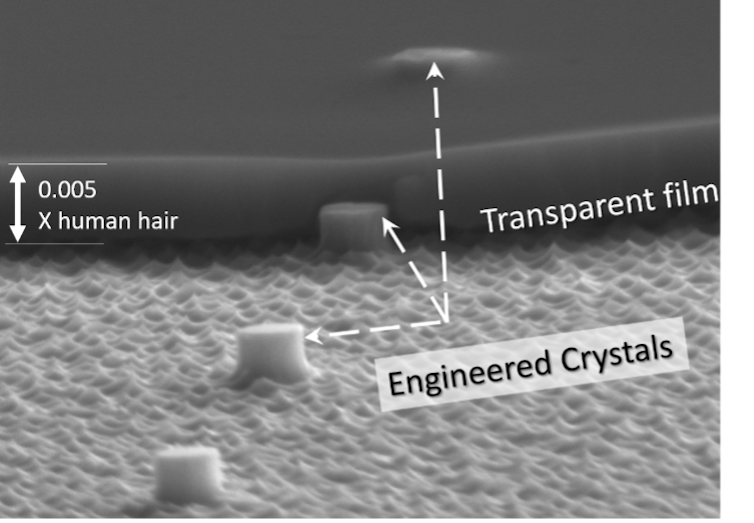
Our group set out to demonstrate infrared imaging with metasurfaces. We designed a metasurface composed of hundreds of incredibly tiny crystal antennas made of the semiconductor gallium arsenide.

This metasurface was designed to amplify light by resonance at certain infrared frequencies, as well as the frequency of the laser and the visible light output. We then fabricated the metasurface and transferred it to a transparent glass, forming a layer of nanocrystals on a glass surface.

A scanning electron microscope image shows the nanocrystal structures of the metasurface used to make infrared light visible.
Mohsen Rahmani/ NTU, Author provided

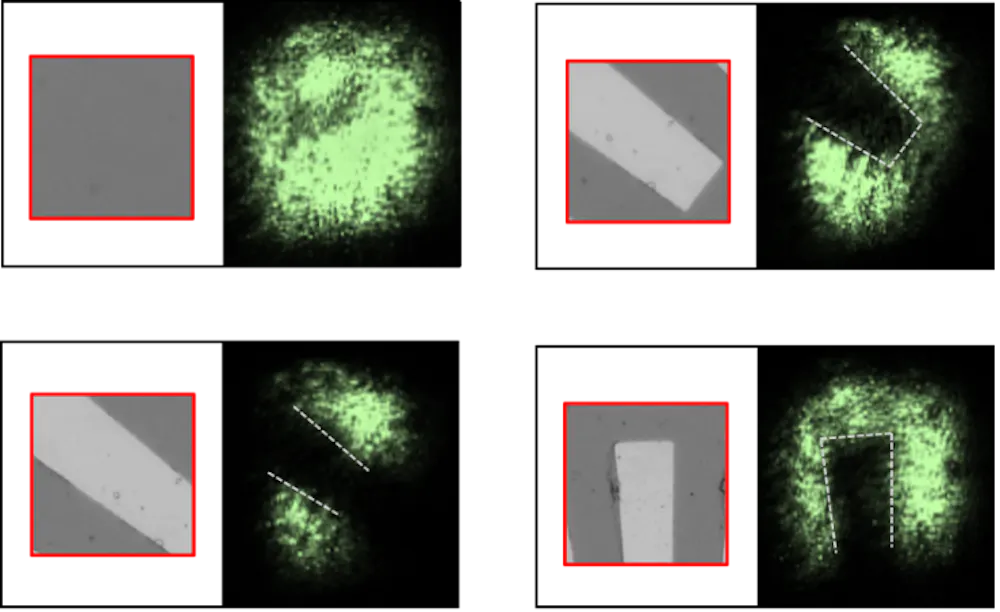
To test our metasurface, we illuminated it with infrared images of a target and saw that the infrared images were converted to visible green images. We tested this with various positions of the target, and also with no target at all — so we could see the green emission of the metasurface itself. In the images obtained, the dark stripes correspond to the infrared target, surrounded by the green visible emission.

Despite different parts of the infrared images being up-converted by independent nanocrystals composing the metasurface, the images were well reproduced in visible light.

These pairs of images show the shape of the infrared target at left and the visible-light view through the metasurface at right.
Rocio Camacho Morales, Author provided

While our experiment is only a proof of concept, this technology can in principle do many things that are not possible with conventional systems, such as a broader angle of view and multi-colour infrared imaging.

The future of metasurfaces in novel technologies

The demand for detecting infrared light, invisible to human eyes, is constantly growing, due to a wide variety of applications beyond night vision. The technology could be used in the agricultural industry to help monitor and maintain food quality control, and in remote sensing techniques such as LIDAR – a technology that is helping to map natural and manmade environments.

In a wider context, the use of metasurfaces to detect, generate and manipulate light is booming. Harnessing the power of metasurfaces will bring us closer to technologies such as real-time holographic displays, artificial vision for autonomous systems, and ultra-fast light-based wifi.


Read more:
Small and bright: what nanophotonics means for you


The Conversation

Rocio Camacho Morales would like to acknowledge the support of the ARC Centre of Excellence for Transformative Meta-Optical Systems (TMOS) and the Consejo Nacional de Ciencia y Tecnología (CONACYT),

ref. Seeing the invisible: tiny crystal films could make night vision an everyday reality – https://theconversation.com/seeing-the-invisible-tiny-crystal-films-could-make-night-vision-an-everyday-reality-162615

Police debacle leaves the McGowan government battling to rebuild public trust in the SafeWA app

Source: The Conversation (Au and NZ) – By Tama Leaver, Professor of Internet Studies, Curtin University

QR code contact-tracing apps are a crucial part of our defence against COVID-19. But their value depends on being widely used, which in turn means people using these apps need to be confident their data won’t be misused.

That’s why this week’s revelation that Western Australian police accessed data gathered using the SafeWA app are a serious concern.

WA Premier Mark McGowan’s government has enjoyed unprecedented public support for its handling of the COVID-19 pandemic thus far. But this incident risks undermining the WA public’s trust in their state’s contact-tracing regime.

While the federal government’s relatively expensive COVIDSafe tracking app — which was designed to work automatically via Bluetooth — has become little more than the butt of jokes, the scanning of QR codes at all kinds of venues has now become second nature to many Australians.

These contact-tracing apps work by logging the locations and times of people’s movements, with the help of unique QR codes at cafes, shops and other public buildings. Individuals scan the code with their phone’s camera, and the app allows this data to be collated across the state.

That data is hugely valuable for contact tracing, but also very personal. Using apps rather than paper-based forms greatly speeds up access to the data when it is needed. And when trying to locate close contacts of a positive COVID-19 case, every minute counts.

But this process necessarily involves the public placing their trust in governments to properly, safely and securely use personal data for the advertised purpose, and nothing else.


Read more:
Australia has all but abandoned the COVIDSafe app in favour of QR codes (so make sure you check in)


Australian governments have a poor track record of protecting personal data, having suffered a range of data breaches over the past few years. At the same time, negative publicity about the handling of personal data by digital and social media companies has highlighted the need for people to be careful about what data they share with apps in general.

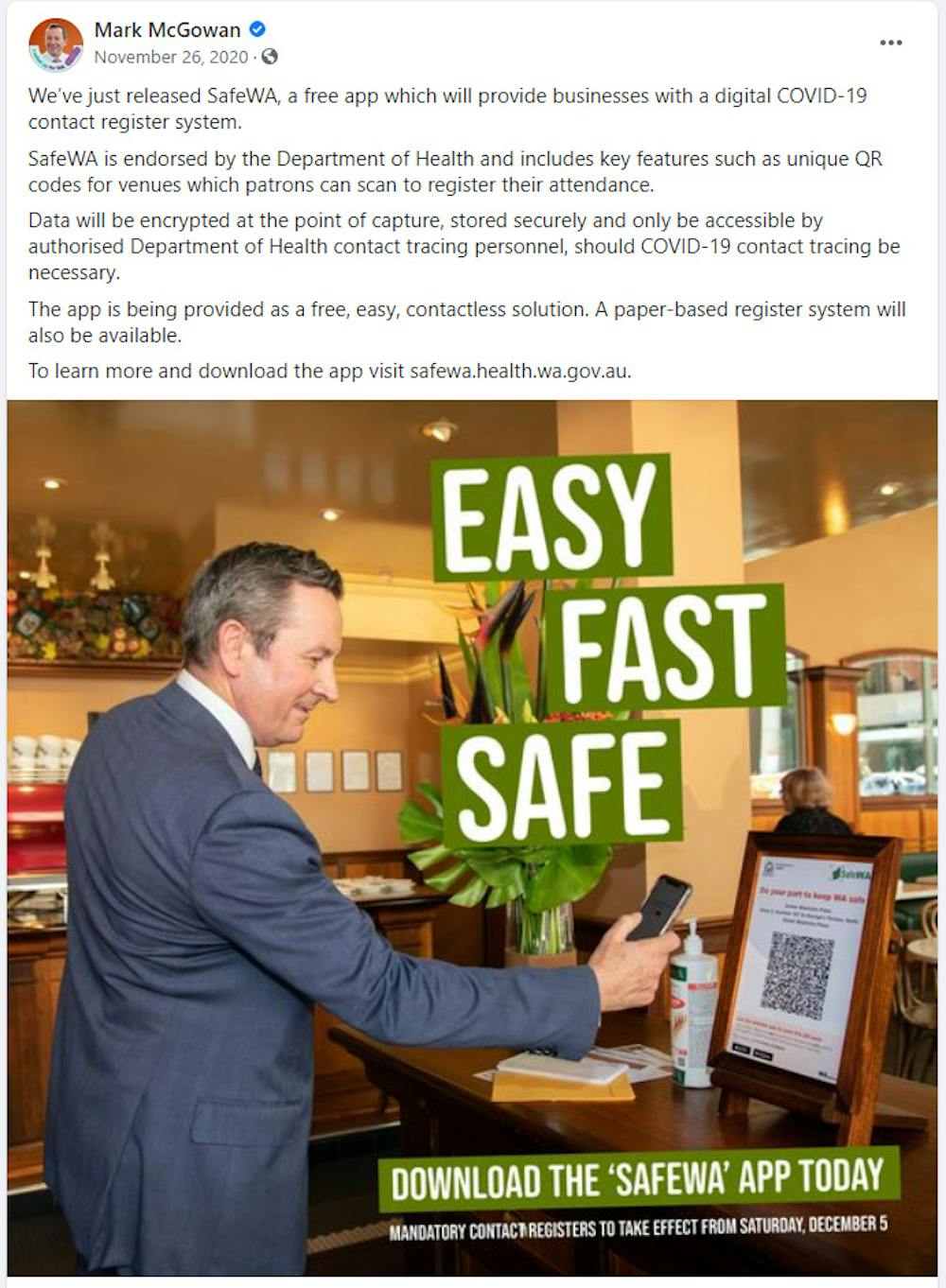
The SafeWA app was downloaded by more than 260,000 people within days of its release, in large part because of widespread trust in the WA government’s strong track record in handling COVID-19. When the app was launched in November last year, McGowan wrote on his Facebook page that the data would “only be accessible by authorised Department of Health contact tracing personnel”.

Screenshot of Mark McGowan’s Facebook Page announcing the SafeWA App.
Mark McGowan’s Facebook Page

In spite of this, it has now emerged that WA Police twice accessed SafeWA data as part of a “high-profile” murder investigation. The fact the WA government knew in April that this data was being accessed, but only informed the public in mid-June, further undermines trust in the way personal data is being managed.

McGowan today publicly criticised the police for not agreeing to stop using SafeWA data. Yet the remit of the police is to pursue any evidence they can legally access, which currently includes data collected by the SafeWA app.

It is the government’s responsibility to protect the public’s privacy via carefully written, iron-clad legislation with no loopholes. Crucially, this legislation needs to be in place before contract-tracing apps are rolled out, not afterwards.

It may well be that the state government held off on publicly disclosing details of the SafeWA data misuse until it had come up with a solution. It has now introduced a bill to prevent SafeWA data being used for any purpose other than contact tracing.

This is a welcome development, and the government will have no trouble passing the bill, given its thumping double majority. Repairing public trust might be a trickier prospect.

Trust is a premium commodity these days, and to have squandered it without adequate initial protections is a significant error.

The SafeWA app provided valuable information that sped up contact tracing in WA during Perth’s outbreak in February. There is every reason to believe that if future cases occur, continued widespread use of the app will make it easier to locate close contacts, speed up targeted testing, and either avoid or limit the need for future lockdowns.

That will depend on the McGowan government swiftly regaining the public’s trust in the app. The new legislation is a big step in that direction, but there’s a lot more work to do. Trust is hard to win, and easy to lose.


Read more:
Not just complacency: why people are reluctant to use COVID-19 contact-tracing apps


The Conversation

Tama Leaver receives funding from the Australian Research Council (ARC) as a chief investigator in the ARC Centre of Excellence for the Digital Child.

ref. Police debacle leaves the McGowan government battling to rebuild public trust in the SafeWA app – https://theconversation.com/police-debacle-leaves-the-mcgowan-government-battling-to-rebuild-public-trust-in-the-safewa-app-162850

There’s a lot we don’t know about the UK trade agreement we are about to sign

Source: The Conversation (Au and NZ) – By Patricia Ranald, Honorary research fellow, University of Sydney

We’re being told about the new Australia-United Kingdom Free Trade Agreement, but not a lot about most of what’s in it.

After an in-principle agreement overnight, Australia released a five-page summary.

Australian farmers will benefit from tariff-free access to the UK for limited amounts of Australian beef, lamb, sugar and dairy products to the UK (but will have to wait ten years for the full elimination of tariffs). Australian consumers will benefit from immediate zero tariffs on products like UK whiskey and cars. Longer working holiday visas may be available for citizens from both countries.

It will take at least a month for the deal to be finalised and signed, and only after the signing will the Australian public see the full text and a parliamentary committee be given the right to inquire into it but not change it.

This secrecy continues what’s become something of a tradition — one that has attracted the ire of the Productivity Commission which in 2010 recommended the government commission and publish an independent and transparent assessment of future free trade agreements “at the conclusion of negotiations but before an agreement is signed”.

The parliament’s joint standing committee on treaties (the same one that will examine this agreement) began inquiring into the system mid last year and took many submissions, but still has not reported.

As many as 30 unseen chapters

The timing of the deal is driven by the UK’s post-Brexit desperation to sign one-on-one agreements and the greater prize of being part of the 11-nation Comprehensive and Progressive Trans-Pacific Partnership (CPTPP) including Japan, Australia, Canada, New Zealand, Vietnam, Singapore, Malaysia, Brunei, Mexico, Chile and Peru which the UK has applied to join.

Like the CPTPP, the Australia-UK Free Trade Agreement is likely to have as many as 30 chapters, some of which restrict the ability of governments to regulate in fields including medicines, essential services and data privacy.

UK Trade Minister Greg Hands.
Brian Minkoff/Shutterstock

UK trade minister Greg Hands said last month he wants the deal to include investor-state dispute settlement (ISDS) provisions of the kind excluded from the Australia-European Union current trade talks, and from the Regional Comprehensive Economic Partnership recently signed with Japan, China, South Korea, New Zealand and the 10 ASEAN countries.

The provisions would allow UK firms to sue Australian governments in international tribunals over decisions they believed infringed on their interests in a way Australian firms cold not.

In return Australian firms could sue UK authorities in a way UK firms could not.

But UK companies are more frequent users of ISDS, having launched 90 recorded ISDS cases, the third most after the US and the Netherlands. Australian companies have launched nine.

Defending the idea in the House of Commons, Hands said the UK had “never lost an ISDS case”.

There are now 1,104, known ISDS cases with increasing numbers against health and environment laws, including laws to address climate change and to protect indigenous rights.

Australians remember that the US Philip Morris tobacco company used an obscure Hong Kong investment agreement to sue Australia for billions over our plain packaging law.


Read more:
Last to know: the EU knows more about our trade talks than we do


It took the international tribunal almost five years to decide that Philip Morris was not a Hong Kong company as it had claimed. Australia had to pay $12 million in legal costs.

ISDS rules in the Australia-UK treaty would give UK mining companies such as Rio Tinto the right to claim compensation for new laws to protect Indigenous heritage areas, and UK aged care companies such as Bupa the right to claim compensation for new regulations arising from the Aged Care Royal Commission.

Longer pharmaceutical monopolies

The UK has also said in its negotiating objectives that it wants to preserve its “existing intellectual property standards” which include rules that provide for longer data protection monopolies on medicines than Australia has.

The UK also supported this demand as a member of the EU before Brexit when it was published by the EU as part of the ongoing EU-Australia FTA negotiations.

Pharmaceutical companies already have 20 year monopolies on new medicines.


Read more:
Planned trade deal with Europe could keep medicine prices too high


The UK has an additional “data protection” monopoly of up to ten years before data is released enabling production of cheaper competitors.

The current Australian standard is five years. Adopting the UK standard would delay the availability of cheaper medicines, costing Australia’s Pharmaceutical Benefits Scheme hundreds of millions of dollars per year.

Unless the text is released before it is signed, we won’t know whether ISDS and longer medicine monopolies are part of the deal.

The Australian government should release the text for public scrutiny and independent assessment of its costs and benefits before it is signed, so that we are able to see what is being traded away before it’s too late.

The Conversation

Dr Patricia Ranald is an honorary research associate at the University of Sydney and the honorary convener of the Australian Fair Trade and Investment Network.

ref. There’s a lot we don’t know about the UK trade agreement we are about to sign – https://theconversation.com/theres-a-lot-we-dont-know-about-the-uk-trade-agreement-we-are-about-to-sign-162841

Curious Kids: when a snake sheds its skin, why isn’t it colourful?

Source: The Conversation (Au and NZ) – By Damian Lettoof, PhD Candidate, Curtin University

A bush viper slithering out of its skin. Shutterstock

When a snake sheds its skin, why isn’t it colourful? Yahya, aged eight

Thanks for the question Yahya!

Snakes come in all sorts of colours and patterns, especially in Australia. Our prettiest snakes include the Jan’s banded snake, the black-striped snake and the broad-headed snake (but this one is endangered, which means there aren’t very many broad-headed snakes left in the world).

You can see each of these snakes in the photos I’ve taken below.

Orange snake with a black stripe
The black-striped snake.
Damian Lettoof, Author provided
Black and yellow snake
The endangered broad-headed snake.
Damian Lettoof, Author provided
Orange and black striped snake
Jan’s banded snake.
Damian Lettoof, Author provided

Snakes are well known for being able to shed their entire skin in one piece. But why isn’t the shed skin of a snake colourful, like the snake itself?

To answer your question, we should explore how snake skin and colour works.

All animals grow new skin over their lifetime. This replaces old skin, heals wounds and lets the animal grow bigger. Most animals, including humans, shed tiny pieces of dead skin all the time.


Read more:
Curious Kids: How do snakes make an ‘sssssss’ sound with their tongue poking out?


But snakes have to do it all at once, and this is because snake skin is quite different to a lot of other animals.

Snake skin is actually made up two main layers: the soft, colourful tissue (what scientists call the “dermis”), and hard, mostly see-through scales.

The dermis is filled with nerves, which is what we use to feel things touching us, as well as tiny grains called pigments, which is what gives skin its colour.

Scales sit on top of the snake’s soft dermis.
Shutterstock

Scales sit on top of the snake’s soft dermis. These are much harder than the skin because scales are made of “keratin” — the same thing our fingernails and hair are made of.

In mammals, like us, the keratin grows from a single point and keeps on growing — think how your fingernails grow from the end of your finger. But in snakes, keratin grows all over, and is stuck on top of the soft dermis, protecting it like a thin shield.


Read more:
Curious Kids: What happens if a venomous snake bites another snake of the same species?


While the keratin in snake (and lizard) scales is mostly see through, it also holds lots of tiny dark brownish black grains called “melanin”, which protects snakes from harmful sun rays. This means scales themselves are mainly either colourless or dark brownish black, depending on the snake.

But sometimes, like for Australian water pythons, the outer layer of scales can shine rainbow colours when the light hits it at the right angle.

The outer layer of some snake scales, like for Australian water pythons, can shine rainbow colours when the light hits it at the right angle.
Wikimedia, CC BY-SA

So let’s say it’s time for a snake to shed its skin

First, it’ll grow a new layer of keratin scales underneath the old layer. When the new layer has finished growing, the snake rubs its body along rocks, plants and other rough things to peel the old layer of keratin off — often in a single, snaky piece.

Because all the brightly coloured pigments live in the soft dermis, and not the scales, the colour mainly stays on the snake, not the part it sheds.

But every so often, the shed skin can show dark brownish black stripes or blotches, because of melanin in the scales.

A little bit of melanin sometimes make the shed skin looks black, so it isn’t always see through.
Shutterstock

Have you ever touched a snake’s shed skin?

Since it’s made up of both the hard keratin scales and a bit of the softer dermis, it feels both rough and soft. And because it’s so stretchy, it can be much longer than snake itself!


Damian Lettoof will be taking questions from kids at the Perth launch of our new Curious Kids picture book Why Do Tigers Have Whiskers, published by Thames and Hudson.

Venue: Paperbird Books

Date: July 10, at 10:30am

Price: Free, but space is limited and bookings are essential.

If you’re a Curious Kid with a question you’d like an expert to answer, ask an adult to send it to curiouskids@theconversation.edu.au

The Conversation

Damian Lettoof is affiliated with the Australian Society of Herpetologists, Society for the Study of Amphibians and Reptiles, the Ecological Society of Australia and the Society of Environmental Toxicology and Chemistry.

ref. Curious Kids: when a snake sheds its skin, why isn’t it colourful? – https://theconversation.com/curious-kids-when-a-snake-sheds-its-skin-why-isnt-it-colourful-160997

Diverse spokespeople and humour: how the government’s next ad campaign could boost COVID vaccine uptake

Source: The Conversation (Au and NZ) – By Jessica Kaufman, Research Fellow, Vaccine Uptake Group, Murdoch Children’s Research Institute

Shutterstock

The federal government recently indicated it will launch a new COVID-19 vaccine advertising campaign in July, targeting younger Australians under 40.

To date, federal vaccine promotion efforts have not been particularly engaging, perhaps due to an over-reliance on consulting firms over vaccine social science researchers. But news of a revitalised campaign is welcome, and could offer a chance to change course.

In our recent Victorian COVID-19 Vaccine Preparedness Study, we looked at the vaccine-related intentions, concerns and information needs of people prioritised in phases 1a and 1b of the rollout.

The results are yet to be published in a peer-reviewed journal. But drawing on our findings, as well as peer-reviewed research in this area, here’s what we want to see in any upcoming COVID vaccination campaign.

1. Diverse spokespeople

The diversity of Australia should be reflected in the spokespeople delivering messages around COVID vaccination, through both broad and tailored campaigns. Research shows we’re more likely to trust people who look like us, which means we need spokespeople from different ethnic backgrounds, of different ages, and with different body shapes.

While it was encouraging to see Channel 9 using its platform to promote COVID-19 vaccination, their cast was rightly criticised for being entirely white. They were also all able-bodied and generally homogenous.

Our research also found members of the public wanted to hear about the COVID-19 vaccines from real people — not politicians. They wanted to hear how people like them made the decision to be vaccinated, what it was like getting the vaccine and what the side effects were afterwards.


Read more:
The government is spending almost A$24m to convince us to accept a COVID vaccine. But will its new campaign actually work?


2. Humour and emotion

It seems like the COVID-19 vaccine advertisements that have been shared most widely in Australia are actually from other countries, like the United Kingdom, Singapore, New Zealand and France.

This is a shame, but it’s not surprising, when you compare these funny, entertaining messages with the relatively dry Australian ads. The Singapore ad is colourful, musical and a little bit bonkers. But amid the silliness, it still manages to highlight key messages like “don’t wait and see” and “low cases isn’t no cases”.

The more engaging the messaging is, the more widely it will be shared. And we need information about the vaccine rollout to reach as many people as possible.

3. Avoid scare tactics

Some people have been calling for fear-based campaigns to scare people into vaccinating. This kind of campaign might include, for example, footage of people with severe COVID or scary statistics about COVID-related deaths or serious illness in Australia or overseas.

However, fear-based messages to promote vaccines can actually backfire, increasing fear of vaccine side effects. Fear campaigns can also stigmatise people who have concerns, questions, or simply face challenges accessing vaccines. This makes it harder to bridge the gap with those who are hesitant.

Fear messaging can also make people angry and erode trust in the messengers. Trust in the public health system is crucial to support vaccine uptake — and we can’t afford to damage this as it’s very hard to build and easy to lose.

What else do we need?

Barriers to vaccine uptake for any group are likely to be a mix of acceptance and access factors. So while a diverse, engaging communication campaign is clearly needed, this should be implemented alongside other evidence-based strategies to bolster vaccine acceptance and uptake.

Nudges

Behavioural “nudges” are simple ways to encourage vaccination. A recent study from the United States found the most effective nudge to increase influenza vaccine uptake was a text message sent to people before a regular GP appointment, indicating a flu vaccine was reserved and waiting for them.

The Therapeutic Goods Administration has recently clarified people in Australia could also be offered incentives to vaccinate. In other countries, incentives have included anything from a free beer to a lottery ticket.


Read more:
Incentives could boost vaccine uptake in Australia. But we need different approaches for different groups


Community engagement

Outreach and face-to-face engagement may be more effective than TV or social media campaigns for many groups, particularly culturally and linguistically diverse populations.

Training community, faith and industry leaders to become vaccine champions enables communication messages to reach more people in a targeted, culturally appropriate way. People want to discuss concerns with their community leaders and communities, where there is the greatest trust.

A young woman shows a bandaid on her upper arm.
Participants in our study wanted to receive information about vaccines from ‘real’ people.
Shutterstock

Support for health-care workers

GPs, nurses and pharmacists are at the coalface of the vaccine rollout, discussing COVID-19 vaccines with people every day. Health-care workers in our study said they wanted resources like decision aids and pictorial representations of risk and benefits to support personalised discussions with people with varying levels of health literacy.

It’s also time we considered Medicare item numbers for GPs separate to vaccine administration, to support the additional time spent addressing hesitancy.

Improved accessibility

Improving access to COVID-19 vaccines is crucial to increase uptake. In addition to securing adequate vaccine supply and clearly communicating where and when vaccines are available, the booking systems need to be simplified and streamlined. In Victoria, the phone booking system crashed as soon as the government announced people aged 40-49 were eligible.

Data

Finally, we need better data about vaccine uptake, concerns and barriers faced by different groups. This will allow us to better target communication and other strategies.


Read more:
Yeh, nah, maybe. When it comes to accepting the COVID vaccine, it’s Australia’s fence-sitters we should pay attention to


The Conversation

Jessica Kaufman receives funding from the Victorian Department of Health (C9824) and the National Health and Medical Research Foundation (Vaccine Barriers Assessment Tool, GNT1164200). She is a member of the Collaboration on Social Science and Immunisation (COSSI) network.

Margie Danchin receives funding from the NHMRC, WHO, Victorian and Commonwealth Departments of Health and holds an MCRI clinician scientist fellowship. She is Chair, Collaboration on Social Science and Immunisation (COSSI).

ref. Diverse spokespeople and humour: how the government’s next ad campaign could boost COVID vaccine uptake – https://theconversation.com/diverse-spokespeople-and-humour-how-the-governments-next-ad-campaign-could-boost-covid-vaccine-uptake-162240

Let’s talk about what each uni does, but don’t make it a choice between teaching or research

Source: The Conversation (Au and NZ) – By Gwilym Croucher, Melbourne Centre for the Study of Higher Education, The University of Melbourne

Shutterstock

Federal Education Minister Alan Tudge has called on Australian universities to “start a conversation about how we can support greater differentiation and specialisation in the university sector. We have 39 comprehensive universities, which may not be an optimal model for the quality of teaching or research in this country.” This is a worthy aspiration, depending on what we mean by differentiation and specialisation.

At its best, seeking to differentiate and specialise can be a way to marshal talent and focus. At worst, such calls can be euphemism and set up a false dilemma of having a simple choice between teaching and research.

A recurring debate

The debate about greater specialisation in Australian universities is not new. As an opposition education spokesman and then Coalition government minister, Christopher Pyne made similar calls for specialisation in the system a decade ago. More recently it was discussed in the context of the 2019 Review of Provider Category Standards.

At different times during the past century governments and university leaders have examined whether teaching and research in some areas should be limited to only a few institutions. From forestry education to legal studies, debate has been common about what is taught where and by whom.

Questioning the need for specialisation and diversity is welcome. Leaving for a moment what benefits it can bring, for some degrees a critical mass of students means it is impractical (and highly costly) to offer them at all institutions.

Not so similar, you and I

Despite Australia public universities often being labelled as “comprehensive”, there is already a lot of specialisation and differentiation in the system.

Medical education is one longstanding example. Only a subset of universities offer it. This is for numerous reasons, not least that it is tightly regulated and requires significant facilities.

Australia has a number of universities for which specialisation is core to their identity and mission. The University of Divinity, for example, offers scholarship in theology, philosophy and ministry.

View of clocktower of bluestone building at sunset.
The 11 colleges of the University of Divinity provide highly specialised offerings.
Michael Coghlan/Flickr, CC BY-SA

The idea of specialised institutions in Australia is not new either. The University of New South Wales began life as the New South Wales University of Technology in 1949. This lasted only a few years, though, before it became UNSW, gaining a law school and other faculties.

Yet discussion about greater specialisation and diversification can often be contentious. It can hit a raw nerve when “specialisation” is used as a euphemism for excluding some universities, especially from research activity.

What’s in a name?

The legal definition of an Australian university requires it to undertake research. Australia specifies what a university is and controls the use of the title “university” for good reason.

One case in point is the short-lived Greenwich University on Norfolk Island. In 1999 the quality of the newly established university came sharply into focus. The then education minister, Brendan Nelson, was forced to intervene to ensure it could not continue to offer sub-standard education.

The Greenwich case also hints at preconceived ideas in Australia about what a university should aspire to in terms of quality and offering. For most people this now includes undertaking research.

This is understandable; there are synergies between teaching and research. Students can benefit from their teacher’s research experience and being exposed to the latest research. They can witness an active research culture.

A false dilemma

When the debate is crudely framed, it can be easy to set up a false dilemma.

There are good reasons to specialise. For one, it makes programs with limited demand financially viable.

Equally, specialisation is not always appropriate for legitimate reasons. An important consideration is to ensure core teaching and research are located where local communities can access them.

There is nothing wrong necessarily with having only comprehensive institutions, if that best meets the needs of students, employers and the community.

There is more that unites Australian universities than divides them: they are all part of an international academic community and hold themselves to standards set by peers who are leaders in their fields.

Which is not to argue they all do (or should do) the same thing. Yet it can be easy to erroneously limit what specialisation means or, at worst, set it up as a proxy for debate about other things, such as prestige and privilege.

The Conversation

Gwilym Croucher does not work for, consult, own shares in or receive funding from any company or organization that would benefit from this article, and has disclosed no relevant affiliations beyond their academic appointment.

ref. Let’s talk about what each uni does, but don’t make it a choice between teaching or research – https://theconversation.com/lets-talk-about-what-each-uni-does-but-dont-make-it-a-choice-between-teaching-or-research-162249

Spiders are cloaking Gippsland with stunning webs after the floods. An expert explains why

Source: The Conversation (Au and NZ) – By Lizzy Lowe, Researcher, Macquarie University

Darren Carney

Stunning photographs of vast, ghostly spider webs blanketing the flood-affected region of Gippsland in Victoria have gone viral online, prompting many to muse on the wonder of nature.

But what’s going on here? Why do spiders do this after floods and does it happen everywhere?

The answer is: these webs have nothing to do with spiders trying to catch food. Spiders often use silk to move around and in this case are using long strands of web to escape from waterlogged soil.

This may seem unusual, but these are just native animals doing their thing. It’s crucial you don’t get out the insecticide and spray them. These spiders do important work managing pests, so by killing them off you would be increasing the risk that pests such as cockroaches and mosquitoes will get out of control.


Read more:
After the floods, stand by for spiders, slugs and millipedes – but think twice before reaching for the bug spray


Using silk to move around

What you’re seeing online, or in person if you live locally, is an amazing natural phenomena but it’s not really very complicated.

We are constantly surrounded by spiders, but we don’t usually see them. They are hiding in the leaf litter and in the soil.

Spider webs blanket the ground in Gippsland
When floods happen, spiders use silk to evacuate quickly.
Darren Carney

When these flood events happen, they need evacuate quickly up out of holes they live in underground. They come out en masse and use their silk to help them do that.

You’ll often see juvenile spiders let out a long strand of silk which is caught by the wind and lifted up. The web catches onto another object such as a tree and allows the spider to climb up.

That’s how baby spiders (spiderlings!) disperse when they emerge from their egg sacs — it’s called ballooning. They have to disperse as quickly as possible because they are highly cannibalistic so they need to move away from each other swiftly and find their own sites to hunt or build their webs.

Small spiders have been seen on a post in Gippsland after floods.
AAP Image/JEFF HOBBS

That said, I doubt these webs are from baby spiders. It is more likely to be a huge number of adult spiders, of all different types, sizes and species. They’re all just trying to escape the flood waters. These are definitely spiders you don’t usually see above ground so they are out of their comfort zone, too.

This mass evacuation of spiders, and associated blankets of silk, is not a localised thing. It is seen in other parts of Australia and around the world after flooding.

It just goes to show how versatile spider silk can be. It’s not just used for catching food, it’s also used for locomotion and is even used by some spiders to lay a trail so they don’t get lost.

Don’t spray them!

The most important thing I need readers to know is that this is not anything to be worried about. The worst thing you could do is get out the insecticide and spray them.

These spiders are making a huge contribution to pest control and you would have major pest problems if you get rid of all the spiders. The spiders will disperse on their own very quickly. In general, spiders don’t like being in close proximity to each other (or humans!) and they want to get back to their homes underground.

If you live in Gippsland, you probably don’t even need to clear the webs away with a broom. There’s no danger in doing so if you wish, but I am almost certain these webs will disperse on their own within days.

Until then, enjoy this natural spectacle. I wish I could come down to see them with my own eyes!


Read more:
City spiders are getting bigger — but that’s a good thing


The Conversation

Lizzy Lowe is a Senior Extension Scientist at Cesar Australia.

ref. Spiders are cloaking Gippsland with stunning webs after the floods. An expert explains why – https://theconversation.com/spiders-are-cloaking-gippsland-with-stunning-webs-after-the-floods-an-expert-explains-why-162852

Friendlyjordies producer arrest: what is the NSW Police Fixated Persons Investigations Unit and when is it used?

Source: The Conversation (Au and NZ) – By Keiran Hardy, Postdoctoral Research Fellow, Griffith Criminology Institute, Griffith University

(YouTube: Friendlyjordies)

A producer for YouTube comedian Friendlyjordies was recently arrested for allegedly stalking and intimidating NSW Deputy Premier John Barilaro, following investigations by the Fixated Persons Investigations Unit (FPIU) of the NSW police.

This unit, set up in the wake of the Lindt café siege, was created to monitor extremists and fixated persons who may not fall under Australia’s counter-terrorism laws but nonetheless pose a risk of serious violence.

At the heart of this case will be the charges of intimidation and stalking, but it also will raise questions around what constitutes a “fixated person” and when the use of this unit is appropriate.


À lire aussi :
Australia doesn’t need more anti-terror laws that aren’t necessary – or even used


Two alleged incidents

Kristo Langker, 21, produces videos for the popular YouTube channel Friendlyjordies, run by Jordan Shanks. At the time of writing, the channel has around 500,000 subscribers.

Shanks has appeared in videos alleging wrongdoing by NSW Nationals leader Barilaro, which Barilaro has strenuously denied. Lawyers for Barilaro say Shanks defamed the deputy premier in a number of “vile and racist” videos. The NSW deputy premier is now suing Shanks (and Google) for defamation.

Langker was arrested at a home in Dulwich Hill, Sydney, on June 4. The charges relate to two alleged incidents.

According to a Guardian Australia news report, the first allegedly occurred at a Macquarie University politics in the pub event. Langker and Shanks (who was dressed as Luigi from Mario Brothers) approached Barilaro and shouted “Why are you suing us?”. According to police, as reported in the Guardian, Shanks then left but Lankger stayed, repeating the question and allegedly “tussling with several persons in an attempt to get close” to Barilaro.

The second alleged incident involved Langker filming and speaking to Barilaro as he returned to his car after the funeral of rugby league player Bob Fulton. According to the same Guardian report, Langker asked the NSW deputy premier again, “why are you suing my boss?”. According to the report, this second incident allegedly occurred hours before Langker’s arrest.

Based on these alleged incidents, Langker was arrested by the FPIU and charged with two counts of stalking and intimidation. The offence attracts a maximum penalty of five years imprisonment, where someone stalks or intimidates another person with intent to cause the person fear of physical or mental harm.

Langker has been released on bail under very strict conditions. He is even prohibited from possessing images or caricatures of the deputy premier, or “commenting on his appearance or behaviour”.

The Fixated Persons Investigations Unit

The FPIU was established in April 2017, shortly before the NSW coroner released his report into the Lindt café siege.

In announcing the new unit, NSW Police Commissioner Mick Fuller referred to people who are “obsessed about issues, ideals or individuals” and are “plotting acts of violence” or “capable of acts of terrorism”.

The unit comprises 17 detectives and government mental health workers. It is based on similar units established previously in the UK and Queensland.

The FPIU is a specialist unit that performs risk assessments of people with obsessions, grievances or ideologies that may lead to serious violence. It can access a suspect’s medical records to assess the level of risk they pose.

People monitored by the FPIU include a man who bombed a couple’s car following months of online abuse, and another who was charged with terrorism offences after threatening Sydney police with a knife.

The NSW coroner supported the unit’s creation, calling it a “commendable” step towards improving terrorism prevention. He believed there was a clear gap in the identification and management of “lone-actor terrorists or fixated individuals”, who could fall through the cracks despite repeated warning signs of violence.

In response to questions from The Conversation, NSW Police said the FPIU investigates “fixated persons”, which is defined as someone who

has an obsessive preoccupation, pursued to an excessive or irrational degree with:

  • a public office holder or internationally protected person, or

  • other person/s nominated by the commissioner of police, or

  • a cause influenced by an extreme ideology (a “cause” is an intensely personal and idiosyncratic grievance or quest for justice).

Police might argue Langker fits under the first of these grounds, if the content and conduct towards Barilaro could be classed as obsessive and excessive. Langker’s lawyers have argued Langker’s arrest and bail conditions “strike at the core of our democracy”.

At trial, the issue will be whether the charges of stalking and intimidation can be proven beyond a reasonable doubt, but the case may also set a precedent about what is fixated behaviour and an appropriate use of the FPIU. If that bar is set too low, there will be a serious risk to free speech and democracy. Of course, everything will turn on the evidence at trial, so we should watch this case closely.

The Conversation

Keiran Hardy ne travaille pas, ne conseille pas, ne possède pas de parts, ne reçoit pas de fonds d’une organisation qui pourrait tirer profit de cet article, et n’a déclaré aucune autre affiliation que son organisme de recherche.

ref. Friendlyjordies producer arrest: what is the NSW Police Fixated Persons Investigations Unit and when is it used? – https://theconversation.com/friendlyjordies-producer-arrest-what-is-the-nsw-police-fixated-persons-investigations-unit-and-when-is-it-used-162758

As organised crime makes headlines, are bikie gangs the threat they are made out to be?

Source: The Conversation (Au and NZ) – By Terry Goldsworthy, Associate Professor in Criminology, Bond University

Victoria Police

Organised crime has been front page news after the Australian Federal Police revealed its pivotal role in a multinational sting, three years in the making.

Along with drug cartels, the mafia and Asian crime syndicates, the AFP listed bikie gangs as one of the prime targets of Operation Ironside, with media reports also highlighting the role of bikies.

This follows recent calls from Western Australian police commissioner Chris Dawson for tougher laws against bikies to tackle organised crime.

But are outlaw motorcycle gangs the serious organised crime threat they are made out to be?

Outlaw motorcycle gangs

According to the Australian Institute of Criminology an outlaw motorcycle gang is a motorcycle club used by members to engage in criminal activity. This activity can include:

violent crimes designed to protect the club and its reputation, its members and its territory, and more profit-motivated crimes that enhance the gang’s power or economic resources.

Outlaw motorcycle gangs have been the prime target in Australia’s fight against organised crime in recent years, with the Australian Criminal Intelligence Commission identifying them as a priority crime “theme” (along with cyber crime and illicit drugs). It launched a special operation against bikie gangs in 2020, describing them as a “significant threat”.

In the wake of Operation Ironside, the AFP’s anti-gangs squad commander Andrew Donoghoe told The Courier Mail:

They are purely an organised crime network that is there to make money, generally off drug dealing, sometimes off intimidation and acts of violence and with no remorse for anyone, including innocent members of the community being hurt or killed in the process.

But the common assumption that all members of bikie gangs are criminals is incorrect.

What type of crime do they commit?

Much of the rationale for targeting bikie gangs is they predominately commit high-level or serious offences, such as murder, drug trafficking and extortion.

But our analysis of crime data in two Australian jurisdictions shows outlaw motorcycle gangs in both Queensland and the ACT contribute less than 1% to most organised crime offence categories. For example, in Queensland, between 2008 and 2014, bikie members represented 1% of murders and 0.1% of reported robberies. In the ACT between 2000 and 2019, gang members represented 0.4% of reported drug offences and 0.3% of unlawful weapons possessions.

The top ten offences by numbers committed by bikie gang members are minor offences such as low-level drug possession, driving offences and public nuisance.

How much crime are we talking about?

A 2020 study by the Australian Institute of Criminology showed 12.5% of bikie gang members had a history of organised crime offending. But this finding is problematic in that it relies on apprehension data. Not all apprehensions will result in a court appearance or caution, or a finding of guilt.

Importantly, bikie gang members are subjected to over-policing and targeting. The failed prosecution rate for outlaw gang members charges is much higher than the general population rate on data available both in the ACT and Queensland.

For example, the failed prosecution rate for bikie gang members in Queensland is 23%, compared to 6% for the general population. In the ACT, the rate is 27% compared to 4%.

Queensland government data shows outlaw motorcycle gang members were found guilty of just 0.17% of all reported offences in the state from 2008 to 2014. This accords with a separate 2016 taskforce in Queensland, which noted:

On any view of all the statistics, [outlaw motorcycle gangs] account for a very small proportion of the overall reported crime in Queensland – definitively, less than 1%.

In 2019, we conducted a review of the criminal activity of all current outlaw motorcycle gang members in the ACT. We found they were guilty of 0.06% of all reported ACT offences between 2000-2019.

The role of the gang structure in criminal enterprise

One could fairly have expected broader involvement of bikie gangs to been uncovered Operation Ironside’s three-year, landmark investigation. Yet of some 44 clubs in Australia, to date only the Comancheros and Lone Wolves received any specific mention.

One reason for this is that bikie gangs do not usually engage in organised crime as a collective unit. Rather, their threat arises from small numbers of members conspiring with other criminals for a common purpose.

A systemic review of relevant research by Australian Institute of Criminology in March 2021 found if bikie gang members are involved in crime – especially organised crime,

it appears that they tend to operate in small, loose networks that may include other [outlaw motorcycle gang] members but also individuals who are not members.

A 2018 study noted individuals within the group were more likely to interact with other criminal groups and freelance for common criminal purposes.

What are the big organised crime threats?

The Australian Criminal Intelligence Commission says around 70% of Australia’s serious and organised criminal threats have an offshore base or linkage.

Operation Ironside has shown just how attractive Australia is to overseas criminal groups other than just bikie gangs, with groups such as the mafia, Asian and Eastern European crime groups are now operating in Austalia’s criminal markets.
Mexican drug cartels are also moving into Australia’s lucrative methamphetamine market.


Read more:
The great bikie beat-up: why we shouldn’t confuse crime lords with boofheads on bikes


So when it comes to organised crime, we need to look beyond simple generic responses, such as consorting laws — that theoretically stop bikies from interacting with each other — and bring a more nuanced approach to fighting organised crime.

Bikies make good headlines and are seen as the “usual suspects”, but we also need to look at the data to support our policy, legislative and investigative decisions.

The Conversation

Terry Goldsworthy has previously received funding from the Australian Capital Territory Government to conduct an independent review of its responses to organised crime.

Gaelle Brotto has previously received funding from the Australian Capital Territory Government to conduct an independent review of its responses to organised crime.

ref. As organised crime makes headlines, are bikie gangs the threat they are made out to be? – https://theconversation.com/as-organised-crime-makes-headlines-are-bikie-gangs-the-threat-they-are-made-out-to-be-157425

Why is everyone so obsessed with going to Mars? Here are some other worlds ripe for exploration

Source: The Conversation (Au and NZ) – By Gail Iles, Senior Lecturer in Physics, RMIT University

Cassini Imaging Team, Image Credit: NASA/JPL-Caltech/Space Science Institute

Last month, China successfully landed and deployed the ‘Zhurong’ rover on Mars, becoming the second country ever to set wheels on the surface of red planet.

Last year the United States, the United Arab Emirates and China all launched missions to Mars, taking advantage of the relatively short journey time offered by the two planets’ unusually close proximity.

Why are planetary scientists so obsessed with Mars? Why spend so much time and money on this one planet when there are at least seven others in our solar system, more than 200 moons, countless asteroids, and much more besides?

Fortunately, we are going to other worlds, and there are lots of missions to very exciting places in our solar system — worlds bursting with exotic features such as ice volcanoes, rings of icy debris, and huge magnetic fields.

There are currently 26 active spacecraft dotted around our solar system. Some are orbiting other planets and moons, some have landed on the surfaces of other worlds, and some have performed fly-bys to beam back images. Only half of them are visiting Mars.

Included in those 26 spacecraft are long-term missions like Voyager 1 and 2 – which are still operational after over 40 years and have now left the Solar system and ventured into interstellar space. And it also includes some less famous, but no less weird and wonderful, spacecraft.

Active space probes in the Solar System.
By Olaf Frohn – http://www.planetary.org/multimedia/space-images/charts/whats-up-in-the-solar-system-frohn.html (image link), CC BY-SA 3.0, https://commons.wikimedia.org/w/index.php?curid=80963751

Take the Juno spacecraft in orbit around Jupiter, for example. Launched in 2011, it arrived in orbit around Jupiter almost five years later. It is now measuring various properties of the giant planet, including its magnetic field, atmospheric conditions, and determining how much water is in Jupiter’s atmosphere. This will help theorists work out which planet formation theory is correct (or if new theories are needed). Juno has already surpassed its planned seven-year mission duration, and has been extended to at least 2025.

Rocky ride

One of the most complex feats of astrodynamics was completed late last year when the Japanese Space Agency (JAXA) not only landed a spacecraft on an asteroid, but in a spectacular slingshot manoeuvre, returned a sample to Earth.

Hayabusa2, named after the Japanese term for a peregrine falcon, completed a rendezvous with asteroid 162173 Ryugu in 2018, surveying the surface and taking samples.

Departing in 2019, Hayabusa2 used its ion engines to change orbit and return to Earth. On December 5, 2020, a sample-return capsule about the size of a hatbox and weighing 16 kilograms was dropped through Earth’s atmosphere, landing unscathed at the Woomera Test Range in Australia.

As JAXA begins analysing the rocks and dust collected on the Ryugu asteroid, Hayabusa2 is off on its travels once more – this time to meet up with a second asteroid, 1998 KY_(26), some time in 2031.

Well of knowledge

Not included in the list of planetary missions earlier, are those spacecraft trapped in “gravitational wells” within our Solar system.

There are special locations in orbits called “Lagrangian points”, which are gravitationally balanced spots between two bodies.

‘Lagrange Points’ are positions in space where the gravitational forces of a two body system like the Sun and the Earth produce enhanced regions of attraction and repulsion. These can be used by spacecraft to reduce fuel consumption needed to remain in position.
NASA/WMAP Science Team

The Solar and Heliospheric Observatory (SOHO) is one of four spacecraft close to the Lagrangian point between the Earth and the Sun, roughly 1.5 million kilometres from Earth (about four times further away than the Moon).

It makes observations of the Sun’s outer layer and the solar wind, sending early warning back to Earth of potentially disastrous space weather. Geomagnetic storms from the Sun are powerful enough to hit the Earth with electromagnetic blasts so strong they have been known to take out country-wide power grids.

Another hostile location is our nearest planetary neighbour, Venus. Despite the searing temperatures and crushing pressures on the surface, NASA recently approved funding for two big missions to explore the origins of Venus and its atmosphere. The discovery of phosphine gas in the upper atmosphere led life scientists to believe life may exist at the more habitable and cooler temperatures of higher altitudes.


Read more:
NASA is returning to Venus, where surface temperatures are 470°C. Will we find life when we get there?


Hot on the heels of the successful flight of the Ingenuity helicopter on Mars — the first flight of any powered aircraft on another world — NASA’s Dragonfly mission will fly a drone through the atmosphere of Saturn’s icy moon, Titan. Launching in 2026 and arriving in 2034, the rotorcraft will fly to dozens of promising locations on Titan looking for any chemical precursors or life similar to those on Earth.

So how much does all this cost?

Governments tend to allocate relatively small amounts of their budgets to science and space exploration. Countries typically spend less than 1% of their budget on space missions — far less than social services or military defence.

Deciding what space missions will receive that money is very often driven by public interest. But trying to decide definitively which probe or spacecraft offers the most bang for buck is almost impossible.

When humans first set foot on the Moon, 25% of the world’s population watched the video with bated breath, inspiring several generations of space explorers for decades afterwards. You can’t put a price on that.

The Conversation

Gail Iles does not work for, consult, own shares in or receive funding from any company or organisation that would benefit from this article, and has disclosed no relevant affiliations beyond their academic appointment.

ref. Why is everyone so obsessed with going to Mars? Here are some other worlds ripe for exploration – https://theconversation.com/why-is-everyone-so-obsessed-with-going-to-mars-here-are-some-other-worlds-ripe-for-exploration-161802

In neglecting the National Archives, the Morrison government turns its back on the future

Source: The Conversation (Au and NZ) – By Judith Brett, Emeritus Professor of Politics, La Trobe University

Wes Mountain/The Conversation, CC BY-ND

Why didn’t the federal government increase funding for the National Archives of Australia in its recent budget?

We know it wasn’t because of budget discipline. Money was splashed around on all sorts of worthy causes. And the emergency funding to save film and magnetic tape recordings from disintegration was modest: A$67 million over seven years.

Nor was it because a scorn for history is in the Liberal Party’s DNA. The party’s founder, Robert Menzies, was a history buff. His library, which is the centrepiece of the newly established Robert Menzies Institute at the University of Melbourne, is full of books of history and biography.

Moreover, his government established the precursor of today’s institution, the Commonwealth Archives Office, in 1961 so the records of the past could help guide the future. Prominent Liberals like Paul Hasluck and David Kemp have written histories, as has John Howard in The Menzies Era.

There are plenty of distinguished Liberal-aligned historians, and historians across the political spectrum supported the open letter to the prime minister, spearheaded by journalist Gideon Haigh and academic Graeme Davison.


Read more:
Our history up in flames? Why the crisis at the National Archives must be urgently addressed


Some commentators have seen the failure to provide the archives with emergency funds as a skirmish in the culture wars against an intellectual and cultural left purported to be obsessed with identity politics. This, the argument goes, is of a piece with the government’s apparent hostility to universities, its increase in fees for humanities degrees and its parsimonious treatment of the arts.

But was it that deliberate? Perhaps it was just careless philistinism in a budget designed for a forthcoming election. It was a budget addressed primarily to groups of voters rather than to national problems, and the users of archives will never swing a marginal electorate. Last week, The Australian ran an editorial on the issue, which concluded: “Failure to fund the NAA properly is an oversight that must be corrected.”

Embracing history is in the Liberal Party’s DNA – its founder, Robert Menzies, was a history buff.
Daniel Pockett/AAP

The government is wrong to think it is only professional and academic historians who use the archives. So do family historians, as the archives include personal records of hundreds of thousands of Australians. They are especially relevant to those of non-Anglo descent who had to apply to government authorities for various exemptions and entry permits. These include Indigenous Australians, Chinese living in Australia or displaced persons wanting to immigrate.

Haigh has pointed out that Treasurer Josh Frydenberg’s defence last year of his eligibility to sit in parliament depended on a document in the archives – the certificate of exemption from the provisions of the Immigration Act for his mother, then a seven-year-old girl deemed to be “stateless”.

The National Archives sit in the attorney-general’s department. Queensland Senator Amanda Stoker, who is assistant minister to the attorney-general as well as assistant minister for women and industrial relations, defended the government’s failure to provide the recommended emergency funding with the facile claim that “time marches on and all sources degrade over time”.

The government had nothing to be embarrassed about, she said, even when she was reminded Prince Charles had expressed his alarm at the threatened loss of records. Judging from her silly remarks, she seems to have given the subject little thought. The aim of the letter is to bring the archive’s budgetary neglect to the attention of the prime minister and his senior ministers.


Read more:
Jenny Hocking: why my battle for access to the ‘Palace letters’ should matter to all Australians


While I do not think the neglect of the archives is a deliberate move in the culture wars, it is evidence of the Coalition’s truncated temporal imagination. This is in part an occupational hazard of politicians with their eyes on the electoral cycle. But it is also evident in the difficulty too many of the Coalition have in understanding what climate scientists have been telling them about the future, so they focus on present costs as if future costs will never arrive.

To understand the value of archives, we have to think not just about the past but about the future, when the present will be well and truly over. As the open letter says, the National Archives’ “most important users have not yet been born”, and we do not know what questions they will want to ask.

Thinking about time is difficult, wrenching oneself out of the dramas and routines of the present to fully imagine worlds that were and will be different, confronting our transience and our mortality.

Historians are experts in temporal imagining. They spend their days reading the words and examining the objects of the men and women who walked the world before us. We hope the prime minister will heed our words on the future’s desire for a memory bank of Australian life as full and rich as it can be.

The Conversation

Judith Brett is a signatory to the open letter to the prime minister.

ref. In neglecting the National Archives, the Morrison government turns its back on the future – https://theconversation.com/in-neglecting-the-national-archives-the-morrison-government-turns-its-back-on-the-future-162599

No, it’s not just a lack of control that makes Australians overweight. Here’s what’s driving our unhealthy food habits

Source: The Conversation (Au and NZ) – By Gary Sacks, Associate Professor, Deakin University

Shutterstock

Public health experts have long argued that when it comes to preventing obesity, we need to stop blaming individuals.

Our new online tool, released today, confirms we live in an environment where the odds of having a healthy diet are heavily stacked against us.

Unhealthy foods are readily available and heavily marketed to us by the food industry. This makes it very easy to over-consume unhealthy foods. It also makes it very difficult to consistently select healthy options.

Our online tool – Australia’s Food Environment Dashboard – brings together the best-available data to describe Australia’s food environments. For the first time, we have a clear picture of the ways our environment drives us to consume too much of the wrong types of foods.

How healthy are Australia’s food environments?

Supermarkets heavily promote unhealthy food

Australian supermarkets are a key setting in which unhealthy foods are pushed at us.

More than half of the packaged food on Australian supermarket shelves is unhealthy. At end-of-aisle displays, unhealthy products are promoted much more often than healthier products.


Read more:
Supermarket price deals: the good, the bad and the ugly


Unhealthy products are also “on special” almost twice as often as healthy foods. What’s more, the discounts on unhealthy foods are much larger than the discounts on healthier foods.

And at checkouts, it’s almost impossible to pay for groceries without being exposed to unhealthy foods.

All of this intense marketing for unhealthy foods contributes to the unhealthy mix of products in our supermarket trolleys.

It’s difficult to ignore all the prompts to buy junk food.
Shutterstock

Children’s exposure to junk food promotion

Australian children cannot escape unhealthy food marketing. As they travel to school, and play and watch sport in their community, kids are exposed to a constant barrage of promotions for unhealthy food and drinks.

When they turn on the TV they will see more than twice as many ads for unhealthy food compared to healthy food.

And when kids are on their mobile devices, they are hit with as many as ten unhealthy food and drink ads every hour.

It’s worse in more disadvantaged areas

Our dashboard shows food environments in disadvantaged areas are less healthy than those in advantaged areas. The cost of a healthy diet is generally higher in low socioeconomic areas and is much higher in very remote parts of Australia.

Critically, the cost of a healthy diet is simply unaffordable (meaning it costs more than 30% of a household’s income) for people on low incomes and those living in rural or remote areas.


Read more:
Supermarkets claim to have our health at heart. But their marketing tactics push junk foods


People living in low socioeconomic areas are also exposed to more promotions for unhealthy food. A study in Perth, for example, found low socioeconomic areas had a significantly higher ratio of unhealthy food ads to healthy ads within 500m of schools, compared to high socioeconomic areas.

Some good news stories

While almost all the key aspects of food environments in Australia are currently unhealthy, there are some areas that support health.

Our major supermarkets are leading the way in displaying the Health Star Rating on their home-brand product labels, which helps consumers make more informed food choices.


Read more:
We looked at the health star rating of 20,000 foods and this is what we found


Some state governments have shown great progress in creating healthier environments in their hospitals and other health services, by offering water and nuts in vending machines, for example, rather than sugary drinks and lollies.

People line up for vending machine
Some hospitals are providing healthier options in their vending machines.
Shutterstock

Greater monitoring is needed

Unhealthy diets and obesity are leading contributors to poor health in Australia. For that reason, it’s critical to closely monitor the key drivers of our unhealthy diets.

We’re pretty good at monitoring our exposure to other key health risks and taking public health action accordingly. For example, the government has successfully reduced road fatalities through a range of measures, including prominent identification and eradication of traffic “black spots”.

Now we need the same level of attention paid to our food environments, where there are still some key gaps in our knowledge.

For example, while most state governments have policies to guide foods available in schools, only Western Australia and New South Wales monitors and/or reports adherence to policies.

In many other areas, such as food promotion, data is not routinely collected. This means we often need to rely on data that’s a few years old and that might only be relevant to small geographic regions.

Little boy on bed watching TV
Data isn’t routinely collected on food promotion.
Shutterstock

Governments need to take stronger action

The unhealthy state of our food environments indicates much stronger policy action is needed from all levels of government in Australia.

The National Obesity Strategy which is currently in development and now overdue, can provide the framework for Australian governments to fix up the “black spots” in our food environment.

Improvements can be made by introducing globally recommended policies, such as taxes on sugary drinks and higher standards for how the food industry markets its unhealthy food and drink products.

These actions can help ensure all Australians have access to food environments that support healthy diets.


Read more:
How much longer do we need to wait for Australia to implement a sugary drinks tax?


The Conversation

Gary Sacks receives funding from the National Heart Foundation of Australia, National Health and Medical Research Council, Australian Research Council and VicHealth.

Funding for Australia’s Food Environment Dashboard was provided from the Australian Government’s Medical Research Future Fund (MRFF). The MRFF provides funding to support health and medical research and innovation, with the objective of improving the health and wellbeing of Australians. MRFF funding was provided to The Australian Prevention Partnership Centre under the MRFF Boosting Preventive Health Research Program.

Sally Schultz does not work for, consult, own shares in or receive funding from any company or organisation that would benefit from this article, and has disclosed no relevant affiliations beyond their academic appointment.

ref. No, it’s not just a lack of control that makes Australians overweight. Here’s what’s driving our unhealthy food habits – https://theconversation.com/no-its-not-just-a-lack-of-control-that-makes-australians-overweight-heres-whats-driving-our-unhealthy-food-habits-162512

Home quarantine for vaccinated returned travellers is extremely low risk, and won’t damage their mental health

Source: The Conversation (Au and NZ) – By Gregory Dore, Scientia Professor, Kirby Institute; Infectious Diseases Physician, St Vincent’s Hospital, Sydney, UNSW

Matt Dunham/AP/AAP

Many thousands of people need to return to Australia, and many at home wish to reunite with partners and family abroad.

A move away from a one-size-fits-all approach to quarantine is a way to make this happen — including home quarantine for vaccinated returnees.

The federal government implemented home quarantine over a short period in March 2020, before switching to mandatory hotel quarantine for returned residents and other incoming passengers.

But the considerably changed circumstances — most importantly, access to effective vaccines — calls for its reintroduction despite caution among politicians and the community.

The low rate of positive cases, and proven effectiveness of further safeguards to limit breaches, make home quarantine a persuasive strategy.

It’s worth remembering people who contract COVID, and their contacts, have successfully self-isolated at home since the pandemic began.

How will we make sure it’s safe?

There are several protective layers which would ensure extremely limited risk of home quarantine for fully vaccinated returned overseas travellers.

The first is requiring a negative COVID test within three days of departure, which is currently a requirement for all returnees.

The second is COVID vaccination. Recent studies indicate full vaccination provides 60-90% infection risk reduction. In cases where fully vaccinated people do get infected, these “breakthrough cases” are less infectious.

It’s also important to test returnees in home quarantine. A positive case would trigger testing of any contacts and may extend self-isolation.

Also, high levels of testing in the broader community can ensure early detection of outbreaks, enabling a rapid public health response to limit spread, if it did leak out of home quarantine.


Read more:
The crisis in India is a terrifying example of why we need a better way to get Australians home


The risk would be extremely low

Data from hotel quarantine in New South Wales, which takes around half of returned travellers in Australia, suggests home quarantine for fully vaccinated returnees would likely present an extremely low risk.

In 2021, NSW has screened around 4,700 returnees a week, with the proportion of positive cases detected during quarantine averaging around 0.6%.

From March 1, since vaccination has become more accessible, only eight of 406 positive cases were fully vaccinated.

Unfortunately we don’t have the overall data on how many returnees were fully vaccinated, but even if only 10-20%, this would equate to a positive rate of around 6-12 per 10,000 among the vaccinated. This is considerably lower than the overall rate of 66 COVID cases per 10,000 since March 1.


Read more:
Hotel quarantine causes 1 outbreak for every 204 infected travellers. It’s far from ‘fit for purpose’


If home quarantine was initially restricted to fully vaccinated returnees from countries with low to moderate caseloads, the rate would be lower again, probably less than five per 10,000.

If NSW increased their quarantine intake by taking an extra 2,500 per week from this population into home quarantine, it would equate to maybe a few positive cases per month, compared to around 120 cases per month in hotel quarantine. As vaccination uptake increases, this capacity could be expanded, with reduced hotel quarantine requirements.

Will people comply?

The enormous desire for stranded Australian residents, overseas partners and family of residents in Australia to return and reunite should ensure a high level of compliance with home quarantine.

Home quarantine has been successfully implemented in other countries with elimination strategies such as Taiwan and Singapore. Taiwan’s system was deployed rapidly and has 99.7% compliance. Singapore uses a grading system to enable lower-risk returnee residents to do seven days in home quarantine, with a negative test required for release on day seven.

Two major reviews of the hotel quarantine system — the Victorian government-commissioned Coate report, and the national review of hotel quarantine — recommended implementing home quarantine with monitoring technology, such as electronic bracelets. Their recommendations were made prior to the approval of vaccines.

Recent data suggests the current hotel quarantine system has harmful effects. Research published in the Medical Journal of Australia in April found mental health issues were responsible for 19% of all emergency department presentations among people in NSW hotel quarantine. It’s highly likely home quarantine would be more beneficial for the mental health of returnees.

What are the barriers?

Issues which would need to be sorted through include:

  • methods for determining how risky different countries are

  • how returnees can prove they’ve been vaccinated

  • how we would test returnees and home-based contacts, and how frequently

  • and how long home quarantine would be for.

But none of these are insurmountable, and small-scale home quarantine already exists in the ACT.

Health authorities could ensure returnees can collect their own COVID testing samples, for example by doing nasal swabs or collecting saliva themselves. This would reduce contact with health workers.

Home quarantine is undoubtedly being considered by major Australian COVID policy committees, along with other measures to enable a larger number of returnees and to increase the safety of the quarantine system.

Australians’ excessive caution continues to have direct consequences for the well-being of many thousands of stranded Australian residents, together with non-resident partners and family members desperate to return.

It’s time to change this situation and make their human rights a public health priority.


The author would like to thank John Kaldor, Esther Rockett, and Liz Hicks for their input.

The Conversation

Gregory Dore receives funding from NHMRC, National Institutes for Health, Australian Government Department of Health, and NSW Health.

ref. Home quarantine for vaccinated returned travellers is extremely low risk, and won’t damage their mental health – https://theconversation.com/home-quarantine-for-vaccinated-returned-travellers-is-extremely-low-risk-and-wont-damage-their-mental-health-162436

Peatlands worldwide are drying out, threatening to release 860 million tonnes of carbon dioxide every year

Source: The Conversation (Au and NZ) – By Yuanyuan Huang, Research Scientist , CSIRO

Shutterstock

Peatlands, such as fens, bogs, marshes and swamps, cover just 3% of the Earth’s total land surface, yet store over one-third of the planet’s soil carbon. That’s more than the carbon stored in all other vegetation combined, including the world’s forests.

But peatlands worldwide are running short of water, and the amount of greenhouse gases this could set loose would be devastating for our efforts to curb climate change.

Specifically, our new research in Nature Climate Change found drying peatlands could release an additional 860 million tonnes of carbon dioxide into the atmosphere every year, by around 2100. To put this into perspective, Australia emitted 539 million tonnes in 2019.

To stop this from happening, we need to urgently preserve and restore healthy, water-logged conditions in peatlands. These thirsty peatlands need water.

Peatlands are like natural archives

Peatlands are found across the world: the arctic tundra, coastal marshes, tropical swamp forests, mountainous fens and blanket bogs on subantarctic islands.

They’re characterised by having water-logged soil filled with very slowly decaying plant material (the “peat”) that accumulated over tens of thousands of years, preserved by the low-oxygen environment. This partially decomposed plant debris is locked up in the soils as organic carbon.


Read more:
Peat bogs: restoring them could slow climate change – and revive a forgotten world


Peatlands can act like natural archives, letting scientists and archaeologists reconstruct past climate, vegetation, and even human lives. In fact, an estimated 20,500 archaeological sites are preserved under or within peat in the UK.

As unique habitats, peatlands are home for many native and endangered species of plants and animals that occur nowhere else, such as the white-bellied cinclodes (Cinclodes palliatus) in Peru and Australia’s giant dragonfly (Petalura gigantea), the world’s largest. They can also act as migration corridors for birds and other animals, and can purify water, regulate floods, retain sediments and so on.

Giant dragonfly on a branch
The giant dragonfly (Petalura gigantea) is listed as endangered under NSW environment law.
Christopher Brandis/iNaturalist, CC BY-NC

But over the past several decades, humans have been draining global peatlands for a range of uses. This includes planting trees and crops, harvesting peat to burn for heat, and for other land developments.

For example, some peatlands rely on groundwater, such as portions of the Greater Everglades, the largest freshwater marsh in the United States. Over-pumping groundwater for drinking or irrigation has cut off the peatlands’ source of water.

Together with the regional drier climate due to global warming, our peatlands are drying out worldwide.

What happens when peatlands dry out?

When peat isn’t covered by water, it could be exposed to enough oxygen to fuel aerobic microbes living within. The oxygen allows the microbes to grow extremely fast, enjoy the feast of carbon-rich food, and release carbon dioxide into the atmosphere.

A marsh in Les Sables d Olonne, France. Some peatlands are also a natural sources of methane, which is a more potent greenhouse gas than carbon dioxide.
Arthur Gallois, Author provided

Some peatlands are also a natural source of methane, a potent greenhouse gas with the warming potential up to 100 times stronger than carbon dioxide.

But generating methane actually requires the opposite conditions to generating carbon dioxide. Methane is more frequently released in water-saturated conditions, while carbon dioxide emissions are mostly in unsaturated conditions.


Read more:
Emissions of methane – a greenhouse gas far more potent than carbon dioxide – are rising dangerously


This means if our peatlands are getting drier, we would have an increase in emissions of carbon dioxide, but a reduction in methane emissions.

So what’s the net impact on our climate?

We were part of an international team of scientists across Australia, France, Germany, Netherlands, Switzerland, the US and China. Together, we collected and analysed a large dataset from carefully designed and controlled experiments across 130 peatlands all over the world.

In these experiments, we reduced water under different climate, soil and environmental conditions and, using machine learning algorithms, disentangled the different responses of greenhouse gases.

Our results were striking. Across the peatlands we studied, we found reduced water greatly enhanced the loss of peat as carbon dioxide, with only a mild reduction of methane emissions.

A swamp forest in Peru.
Rupesh Bhomia, Author provided

The net effect — carbon dioxide vs methane — would make our climate warmer. This will seriously hamper global efforts to keep temperature rise under 1.5℃.

This suggests if sustainable developments to restore these ecosystems aren’t implemented in future, drying peatlands would add the equivalent of 860 million tonnes of carbon dioxide to the atmosphere every year by 2100. This projection is for a “high emissions scenario”, which assumes global greenhouse gas emissions aren’t cut any further.

Protecting our peatlands

It’s not too late to stop this from happening. In fact, many countries are already establishing peatland restoration projects.

For example, the Central Kalimantan Peatlands Project in Indonesia aims to rehabilitate these ecosystems by, for instance, damming drainage canals, revegetating areas with native trees, and improving local socio-economic conditions and introducing more sustainable agricultural techniques.

Likewise, the Life Peat Restore project aims to restore 5,300 hectares of peatlands back to their natural function as carbon sinks across Poland, Germany and the Baltic states, over five years.

But protecting peatlands is a global issue. To effectively take care of our peatlands and our climate, we must work together urgently and efficiently.


Read more:
People, palm oil, pulp and planet: four perspectives on Indonesia’s fire-stricken peatlands


The Conversation

The authors do not work for, consult, own shares in or receive funding from any company or organisation that would benefit from this article, and have disclosed no relevant affiliations beyond their academic appointment.

ref. Peatlands worldwide are drying out, threatening to release 860 million tonnes of carbon dioxide every year – https://theconversation.com/peatlands-worldwide-are-drying-out-threatening-to-release-860-million-tonnes-of-carbon-dioxide-every-year-162438

Many of us want to take our dogs on public transport, but others shudder at the thought — what’s the solution?

Source: The Conversation (Au and NZ) – By Jennifer Kent, Senior Research Fellow in Urbanism, University of Sydney

Shutterstock

We’ve being looking at the ways people travel with dogs and what it says about attempts to shift towards a more sustainable and healthier transport system. Our research first established that trips with dogs in Australia are both common and car-dependent. This is because Australia has some of the highest rates of dog ownership in the world but we are relatively unusual compared to other countries in that we restrict people taking dogs on public transport.

We are interested in how this situation might be changed. Our recent research explores why some people might not want dogs on public transport, and how these concerns can be managed.

This research, published in the International Journal of Sustainable Transportation, reports the results of an analysis of 163 comments made on a Conversation article about dogs on public transport. About 40% of comments supported the idea. A similar proportion expressed disapproval.


Read more:
Riding in cars with dogs: millions of trips a week tell us transport policy needs to change


The trouble with dogs

Many of the negative comments included simple statements about the smell of dogs. Others referenced more complex concerns such as hygiene and disease.

Several focused on the impact on people with allergies to dogs. These comments often pointed out that the rights of people with allergies and of those who do not like dogs should take precedence over the rights of dogs and dog owners.

Some comments referred specifically to concerns about the operation of the transport system. They raised issues such as the increased cleaning workload for facilities, the need to replace upholstery more regularly, as well as concern about who would pay the costs of accommodating dogs on public transport.

There were several passionate comments about dog attacks. Statements that dogs are dirty and dangerous often either implicitly or explicitly referenced the notion that dog owners cannot be trusted to control, or minimise the impact of, their dog.

Many claimed that canine and transport contexts are different in Australia, suggesting a policy that works in, for example, a European country would not work in Australia. Sentiment that Australia is somehow “behind” countries in Europe often underpinned these comments.


Read more:
Australians love their pets, so why don’t more public places welcome them?


We need to listen to objections, but there are solutions

Many of the comments contained opinions that were obviously posted with some emotion. Dogs are, indeed, a polarising issue. This polarity reflects the common perception that there are “dog people”. Policy change proposals must consider the opinions of those who support pets on public transport and those who don’t.

Two dogs with paws up on fence
Dogs can evoke very different responses in people, from finding them cute to seeing them as dirty and dangerous.
Author provided

Our analysis, however, does provide several reasons Sydney’s public transport agencies should consider a policy to allow dogs to travel on public transport.

First, negative comments were more likely to demonstrate unfamiliarity with the operational details of a policy that permits dogs to travel on public transport. For example, physical separation of those travelling with dogs could overcome many of the concerns about smell and even allergies. This separation is easily attainable on trains and also possible on buses.

Similarly, concerns about payment could be resolved by ensuring a ticket must be bought for dogs prior to travel, with the fare based on the cost to the system. This may also go part way to alleviating the sense that allowing dogs on transport is a clash of rights between dog owners and non-owners.

Third, negative comments suggesting Australia’s dogs and dog owners are somehow less responsible than their European counterparts are not supported by empirical evidence. Positive local experiences of travelling with well-behaved dogs could soften negative perceptions.


Read more:
We need a better understanding of how we manage dogs to help them become better urban citizens


What might a policy change look like?

The analysis does suggest opposition could be allayed in time. However, the policy would have to be applied with care.

Other cities that have managed this shift could be consulted for strategies to ensure the policy works well in practice. In Milan, Italy, for example, dogs are allowed only on the first and last carriages of the metro. No more than two dogs are allowed on a bus at any one time.

Two dogs sitting on a bench at a bus top
Dogs are allowed on buses in Rome, Italy, but no more than two at a time.
Shutterstock

In Gothenberg, Sweden, only one dog is allowed per bus and the dog must board at the rear of the bus. On trains, dogs are permitted to travel in the last carriage only. In Dublin, Ireland, dogs over a certain size must travel near the guard’s bay on trains.


Read more:
Curious Kids: is it true dogs don’t like to travel?


It’s not just about the dogs

Travel with dogs might not seem like a priority issue for public transport systems. We argue, though, that Australia’s heavily car-dependent cities need public transport that meets our need for the less obvious, “messy” trips that make up modern lives in cities. By looking beyond the car for these trips, we can develop a system that Australians can use for more than just the journey to work.

This analysis, however, demonstrates the complexity of dragging our public transport systems up to the task of competing with the private car.

The Conversation

Jennifer Kent receives funding from the Australian Research Council. She volunteers for the Cat Protection Society.

Corinne Mulley does not work for, consult, own shares in or receive funding from any company or organisation that would benefit from this article, and has disclosed no relevant affiliations beyond their academic appointment.

ref. Many of us want to take our dogs on public transport, but others shudder at the thought — what’s the solution? – https://theconversation.com/many-of-us-want-to-take-our-dogs-on-public-transport-but-others-shudder-at-the-thought-whats-the-solution-161983

How the stunning abstract art of Hilma af Klint opens our eyes to new ways of seeing

Source: The Conversation (Au and NZ) – By Joanna Mendelssohn, Principal Fellow (Hon), Victorian College of the Arts, University of Melbourne. Editor in Chief, Design and Art of Australia Online, The University of Melbourne

Hilma af Klint, Group IX/UW, The dove, no 2. 1915. Oil on canvas, 155.5 x 115.5 cm. Courtesy of the Hilma af Klint Foundation. Kak174. Photo: The Moderna Museet, Stockholm, Sweden

Review: Hilma af Klint, The Secret Paintings. Art Gallery of New South Wales.

In 1986, those art historians who see art as some form of linear progression “improving” with time received a rude shock. The Los Angeles County Museum of Art’s exhibition The Spiritual in Art — Abstract Paintings 1890 – 1985 introduced a hitherto unknown woman artist.

The issue was not just that this art was so exquisitely beautiful — but that the paintings had been painted in the early 20th century.

Hilma af Klint, Botanical study, 1890s. Watercolour and ink on paper, 35.8 x 22.4 cm.
Courtesy of the Hilma af Klint Foundation. Hak1327. Photo: The Moderna Museet, Stockholm, Sweden

Hilma af Klint was once known as a minor academic Swedish artist. Born in 1862, she had been one of the first women to graduate from the Royal Academy of Fine Arts in Stockholm and had exhibited at the Swedish General Art Association.

But these paintings on display in Los Angeles revealed another life, a different art. Her involvement with spiritualism had radicalised her art to such an extent she can only be described as one of the great abstract artists.

Her work was the sensation of the 2013 Venice Biennale, with a full scale retrospective organised by the Moderna Museet shown in Stockholm, Berlin and Malaga the same year. In 2018, New York’s Guggenheim Museum exhibition broke all attendance records. Hilma af Klint: The Secret Paintings brings her art to the southern hemisphere for the first time.

The transformation of af Klint from competent academic to inspirational mystical abstractionist is a result of the same ideas that influenced many of her contemporaries including Kandinsky, Mondrian, Klee and Malevich.

Rather than rewriting the history of art by slotting her in as a hitherto unknown great woman artist, it is probably more useful to consider these ideas and their impact on her art.

Scientific and mystical change

The scientific discoveries of the late 19th and early 20th century encouraged many to question the very nature of the universe.

In the 17th century, Isaac Newton discovered light was made of particles. In the early 19th century, Goethe’s Theory of Colours led many to see colour had spiritual and psychological powers. In the early 20th century, Max Planck demonstrated light particles had energy.

Hilma af Klint, Group 1, Primordial chaos, no 16. 1906-07. Oil on canvas, 53 x 37 cm.

Courtesy of the Hilma af Klint Foundation. Hak016. Photo: The Moderna Museet, Stockholm, Sweden

Many began to think that, if the universe was more than it seemed, then perhaps there were other lives living on different astral planes. Perhaps it was possible for some to be mediums, opening themselves to communicate with spirit guides to these worlds.

At the end of the 19th century a new religion, Theosophy, appeared, incorporating both ancient wisdom and modern science.

Today, this may seem esoteric in the extreme, but Theosophy offered an apparently logical and modern system of belief. Its spread was global, and was a major factor behind the liberation of colour in early Australian modernism. In Sydney in 1926, the Theosophical Society was sufficiently mainstream to start a radio station: 2GB.


Read more:
Clarice Beckett exhibition is a sensory appreciation of her magical moments in time


It is not surprising af Klint should become a follower. What is surprising is the power of the art unleashed as a consequence.

In 1896, she joined with four colleagues in a group they called The Five whose investigation of the spirit world included automatic drawing.

Hilma af Klint, Untitled, 1908. Dry pastel and graphite on paper. 52.5 x 62.6 cm.
Courtesy of the Hilma af Klint Foundation. Hak1258. Photo: The Moderna Museet, Stockholm, Sweden

In 1906, her spiritual communications led to her spirit guide Amaliel “commissioning” a new series, The Paintings for the Temple. She later described this as “the one great task that I carried out in my lifetime.”

However, af Klint did not see herself as just a simple conduit for the spirits to control:

it was not the case that I was to blindly obey the spirits, but that I was to imagine that they were always standing by my side.

The first Paintings for the Temple were completed five years before Kandinsky proclaimed his revolutionary argument for abstraction in The Spiritual in Art.

In 1907 she painted her great series of works, The Ten Largest.

Hilma af Klint, Group IV, The ten largest no 3, youth. 1907. Tempera on paper mounted on canvas, 321 x 240 cm.
Courtesy of the Hilma af Klint Foundation. Hak104. Photo: The Moderna Museet, Stockholm, Sweden

They are, by any measure, a magnificent study of the seasons of life. Elements of nature, geometry and mysterious writing are traced through juvenile floral blues to orange youth, mauves and yellows of adulthood, then in the seeds of old age where the red paint is all scumbled and thin.

Installation view of The Ten Largest at the Hilma af Klint: The Secret Painting exhibition at the Art Gallery of New South Wales, 12 June — 19 September 2021.
Photo: Jenni Carter © AGNSW

The value in being forgotten

To understand both why her art developed the way it did, and why it was so little known for so long, it is probably worth considering the events of her lifetime and her own position.

Hilma af Klint was from an aristocratic Swedish naval family. During the first world war, Sweden’s position was armed neutrality, but was only too aware of the carnage. Her Swan series, started shortly after the outbreak of war, pitches white swan against black as forms become abstracted, looping in harmony, dissolving into geometry and pure abstraction — until at the very end the two swans are locked together. Each contained elements of the other.

Hilma af Klint, Group IX/SUW, The swan, no 1. 1914-15. Oil on canvas, 150-150 cm.
Courtesy of the Hilma af Klint Foundation. Hak149. Photo: The Moderna Museet, Stockholm, Sweden

In 1908, Hilma af Klimt showed the Paintings of the Temple to Rudolph Steiner who failed to understand her work, and did not appreciate the way she saw herself as working with spirits.

This, as well as the burden of caring for her frail and blind mother, may be why she abandoned painting for four years. It may also be why she specified her art be kept secret until 20 years after her death.

There is also a more pragmatic reason. For all its studied neutrality, Sweden was very close to Germany as the Nazis assumed power: radical abstract art with mystical overtones could have caused problems.

Hilma af Klint, Group X, Altarpiece, no 1. 1915. Oil and metal leaf on canvas, 237.5 x 179.5 cm.
Courtesy of the Hilma af Klint Foundation. Hak187. Photo: The Moderna Museet, Stockholm, Sweden

Hilma af Klint died in 1944. In 1970, after seeing the riches of his aunt’s creative legacy, her nephew Erik offered her art to Sweden’s Moderna Museet. The gift was rejected out of hand when the director heard she was a mystic and a medium.

A year later Linda Nochlin published Why Have There Been No Great Women Artists? — an essay ushering in a new era of scholarly reassessment of art by women.


Read more:
Why weren’t there any great women artists? In gratitude to Linda Nochlin


It was perhaps fortunate this gift was rejected. Almost all her art is now owned by the Hilma af Klint Foundation, created by her family. It will never be scattered by the art market nor be the subject of speculation by dealers. Instead, it is both a constant resource for scholars and for audiences to marvel at the meditative beauty of her forms, the incandescence of her colour and the way she opens eyes to new ways of seeing.


Hilma af Klint: The Secret Paintings is at the Art Gallery of New South Wales until September 19, then City Gallery Wellington from December 4.

The Conversation

Joanna Mendelssohn has received funding from the Australian Research Council.

ref. How the stunning abstract art of Hilma af Klint opens our eyes to new ways of seeing – https://theconversation.com/how-the-stunning-abstract-art-of-hilma-af-klint-opens-our-eyes-to-new-ways-of-seeing-162605

The debate over transgender athletes’ rights is testing the current limits of science and the law

Source: The Conversation (Au and NZ) – By Claire Breen, Professor of Law, University of Waikato

www.shutterstock.com

The petition presented to parliament last week calling for trans women to be excluded from women’s sport is simply the latest round in a difficult and volatile global debate.

Organised by Save Women’s Sport Australasia, the petition challenges Sport New Zealand’s “draft guiding principles for the participation of transgender players in sport” for failing to consult widely enough.

Despite the draft principles covering community-level sport, not international competition, former Olympians and elite athletes supported the petition in an open letter to Minister for Sport and Recreation Grant Robertson.

The controversy comes not long after New Zealand transgender weightlifter Laurel Hubbard’s Pacific Games victory was criticised due to her alleged physical advantage, and not long before the Olympic Games open in late July.

Overall, this polarising issue is likely to keep dividing people. Consensus looks increasingly difficult to achieve. With both sides claiming discrimination, can existing laws and principles provide a way forward?

Laurel Hubbard lifting weights
New Zealand weightlifter Laurel Hubbard competing at the Gold Coast 2018 Commonwealth Games.
GettyImages

Sports participation as a human right

The wider relationship between sports and human rights is complex and often contradictory. No explicit right to participate in sport exists in international law. However, a number of core human rights are relevant:

Recognising trangender athletes

As with all human rights, the right to participate in sport is underpinned by the right to be free from discrimination on grounds of sex, gender or other status. That includes gender identity and the right of trans people to be free from discrimination.

This broad principle informs much of the thinking on the issue. The UN Special Rapporteur on the Right to Health, for example, has said the participation of girls and women in sport should not result in the arbitrary exclusion of transgender people.


Read more:
How high school sports became the latest battleground over transgender rights


The rapporteur has also asked for a consensus by all international sporting bodies and national governments, in consultation with transgender organisations, with subsequent policies ideally reflecting international human rights norms.

The UN’s Independent Expert on “protection against violence and discrimination based on sexual orientation and gender identity” has highlighted the negative impact of exclusionary practices in sport, and noted the value of inclusive programs.

The UN Convention on the Elimination of All Forms of Discrimination Against Women calls for equality between men and women in sports and includes gender identity among the forms of potential discrimination.

The devil is in the detail

Beyond these areas of broad agreement, however, the issue quickly becomes more complex.

In Aotearoa New Zealand, the Human Rights Act 1993 prohibits discrimination on the grounds of “sex” and “sexual orientation”. These prohibitions have been interpreted to encompass the legal right of trans people to be free from discrimination.



Read more:
Hostility to elite trans athletes is having a negative impact on participation in everyday sport


However, the act also says it is not discriminatory to exclude people of one sex from participating in any competitive sporting activity in which the strength, stamina or physique of competitors is relevant.

Unfortunately, this is where the arguments run into the limited help offered by science. There is still strong disagreement about whether transgender athletes have a competitive advantage or not.

The limits of science and the law

Research focusing on testosterone levels to justify the exclusion (or inclusion) of trans athletes has been criticised as an inappropriate oversimplification.

Whether testosterone even provides a competitive advantage is disputed, and commentators point to other factors that may be at play.

One study of the available literature concluded that a consensus could not be reached due a lack of data. That finding was itself challenged, but both sides agreed more research was required.


Read more:
Do naturally high testosterone levels equal stronger female athletic performance? Not necessarily


In the meantime, we need to recognise the limits of science and the law when it comes to setting demonstrably balanced guidelines for trans athletes’ participation in sport.

Progress will only come through listening to both sides in the short term, but broad support for the required research is also needed in the longer term.

Ultimately it is in everyone’s interests that this hugely complex issue is resolved properly. Given it goes to the heart of human identity, the potential benefits are not confined to the sporting world.

The Conversation

Claire Breen does not work for, consult, own shares in or receive funding from any company or organisation that would benefit from this article, and has disclosed no relevant affiliations beyond their academic appointment.

ref. The debate over transgender athletes’ rights is testing the current limits of science and the law – https://theconversation.com/the-debate-over-transgender-athletes-rights-is-testing-the-current-limits-of-science-and-the-law-162593

Boris Johnson overstates Morrison’s climate ambition, as Australia-UK trade agreement reached

Source: The Conversation (Au and NZ) – By Michelle Grattan, Professorial Fellow, University of Canberra

British Prime Minister Boris Johnson put Scott Morrison on the spot when he told their joint news conference he thought the Australian PM had “declared for net zero by 2050”.

When Johnson made the statement a journalist interjected to point out Morrison’s policy was to get to net zero “preferably” by 2050.

Johnson pressed on to say this was “a great step forward when you consider[…] the situation Australia is in. It’s a massive coal producer. It’s having to change the way things are orientated, and everybody understands that.

“You can do it fast. In 2012 this country had 40% of its power from coal. It’s now less than 2%, going down the whole time. […] I’m impressed by the ambition of Australia. Obviously we’re going to be looking for more the whole time, as we go into COP26 in November.”

The net zero moment came as the two stood together to announce they had reached an in-principle agreement for a free trade deal between Britain and Australia – the first such deal the United Kingdom has done post Brexit.

Johnson had been asked whether he wanted Australia to go beyond its present 2030 emissions reduction target.

Morrison has been under strong pressure from both Johnson and United States President Joe Biden to embrace the 2050 target. But he has so far not done so, despite edging towards it. His position is to get to net zero “as soon as possible, preferably by 2050.”

Formally embracing the target would threaten a fight within the Nationals that could destabilise the party’s leader Michael McCormack.

Nationals Senate leader Bridget McKenzie warned this week:

“There is no agreement with the second party of this Coalition government on any target date for zero emissions. In fact it would fly in the face of the Nationals public policy commitment.”

The planned free trade agreement, which still has details to be finalised, would reduce barriers on the mobility of workers between the two countries as well on trade in goods and services.

The deal would promote more exchange of young people, allowing them to stay and work in each country for three years instead of two. This arrangement would apply to people up to age 35 rather than 30, as at present.

The federal government says Australian producers and farmers would “receive a significant boost by getting greater access to the UK market” while Australian consumers would “benefit from cheaper products, with all tariffs eliminated within five years, and tariffs on cars, whisky, and the UK’s other main exports eliminated immediately” the agreement started.

Australia would within five years place less onerous conditions on British backpackers, who presently have to spend a set time working in agriculture, or other sectors of labour shortage in regional Australia, to get an extension of their visa.

A separate agriculture visa would be established for UK and Australian visa holders, to get more two way traffic (for example, of shearers) in the agricultural sector.

Over 10 to 15 years the UK would liberalise Australian imports of beef and sheep meat, with shorter periods for sugar and dairy products.

The agricultural sectors in both Britain and Australia expressed concerns when the agreement was being negotiated. In Australia farmers have been worried about the possibility of losing labour if the conditions on backpackers were scrapped.

Johnson said the deal would be good for British car manufacturers and the export of British financial and other services, and he hoped for the agricultural sectors on both sides.

On agriculture “we’ve had to negotiate very hard. […] This is a sensitive sector for both sides, and we’ve got a deal that runs over 15 years and contains the strongest possible provisions for animal welfare.”

The removal of the farm work requirement would make it easier for British people and young people to go and work in Australia, he said.

Morrison said the deal would open the pathway to Britain’s entry into the The Comprehensive and Progressive Agreement for Trans-Pacific Partnership (CPTPP).

Morrison and Johnson discussed the final points of the agreement in principle over a dinner meeting at 10 Downing Street. Their talks also included climate change.

The Conversation

Michelle Grattan does not work for, consult, own shares in or receive funding from any company or organisation that would benefit from this article, and has disclosed no relevant affiliations beyond their academic appointment.

ref. Boris Johnson overstates Morrison’s climate ambition, as Australia-UK trade agreement reached – https://theconversation.com/boris-johnson-overstates-morrisons-climate-ambition-as-australia-uk-trade-agreement-reached-162790

Word from The Hill: the Biloela Tamil family, G7 and the upcoming parliamentary fortnight

Source: The Conversation (Au and NZ) – By Michelle Grattan, Professorial Fellow, University of Canberra

As well as Michelle Grattan’s usual interviews with experts and politicians about the news of the day, Politics with Michelle Grattan now includes “Word from The Hill”, where all things political will be discussed with members of The Conversations’s politics team.

In this episode, politics + society editor Amanda Dunn and Michelle dive into Tuesday’s announcement that the Bioela Tamil family will now live in Perth while their court proceedings are underway, after being incarcerated on Christmas Island since 2019. They also discuss Scott Morrison’s meeting with US President Joe Biden, and Michael McCormack’s sitting in the PM’s parliamentary chair this week.

Listen on Apple Podcasts

Stitcher Listen on TuneIn

Listen on RadioPublic

Additional audio

A List of Ways to Die, Lee Rosevere, from Free Music Archive.

The Conversation

Michelle Grattan does not work for, consult, own shares in or receive funding from any company or organisation that would benefit from this article, and has disclosed no relevant affiliations beyond their academic appointment.

ref. Word from The Hill: the Biloela Tamil family, G7 and the upcoming parliamentary fortnight – https://theconversation.com/word-from-the-hill-the-biloela-tamil-family-g7-and-the-upcoming-parliamentary-fortnight-162769

The end of JobKeeper wasn’t a blip. It might have cost nearly 100,000 jobs

Source: The Conversation (Au and NZ) – By Peter Martin, Visiting Fellow, Crawford School of Public Policy, Australian National University

MultifacetedGirl/Shutterstock

At its peak, more than 3.8 million Australians were on JobKeeper — three in every ten Australian workers.

Adding in those workers already employed by government, it meant four in every ten received a paycheck that originated from government, more than in Russia.

Yet when JobKeeper ended at the end of March, it looked like a mere blip in employment. The unemployment rate actually fell, for the sixth consecutive month.

The Bureau of Statistics said the cutoff had no “discernible impact”.

Treasurer Josh Frydenberg went further. The economy had “strengthened, even after the end of JobKeeper”.

Since the end of JobKeeper 132,000 people had come off income support.

The treasurer is right. After March the number of Australians on JobSeeker and related support payments fell 9%.

Changed rules pushed people off benefits

But it’s possible for people to come off benefits at the same time as people are losing jobs, especially if something else is driving them off, as it was at the end of March.

At the end of March the coronavirus supplement that topped up unemployment benefits stopped. The payment dropped from $715.70 to $620.80 per fortnight.

And job seekers were once again required to search for a minimum of 15 jobs a month, climbing to 20 from July.


Read more:
New finding: jobseekers subject to obligations take longer to find work


While burdensome for employers (if all of Australia’s job seekers actually apply for those jobs, employers will be lumbered with 17 million applications per month, climbing to 23 million) it’s also unhelpful for job seekers.

There’s evidence to suggest job seekers get real jobs sooner if they don’t have to go through charades.

The “dob in a job seeker” hotline will have further dissuaded them from applying for benefits.

These changes make the drop in the number of claimants understandable, much more so than the suggestion they got jobs, which in net terms they did not. Employment fell after the end of March, by 30,600 according to Bureau of Statistics figures which will be updated on Thursday.

As many as 97,000 fewer workers?

How is a drop in employment consistent with a drop in the unemployment rate?

The unemployment rate fell to 5.5% in April not because employment grew, but because 33,600 people who had previously identified themselves as unemployed dropped out of contention, changing their status to “not in the labour force”.

Had they continued to not work but continued to describe themselves as “unemployed”, the unemployment rate would have been 5.7%.

And it would have been higher still if those shifted to zero or reduced hours with the end of JobKeeper had been called unemployed. Employment fell 0.2%, but hours worked fell 0.7%.


Read more:
Josh Frydenberg has the opportunity to transform Australia, permanently lowering unemployment


My rough maths suggests this means the number of Australians actually working might have fallen by 94,100.

An analysis prepared by Melbourne University employment specialist Jeff Borland for the Fair Work Commission puts the number of jobs lost between 45,000 and 97,000.

He gets 45,000 by comparing the number of people who left employment between March and April this year with the number who left between March and April in previous years.

He gets 97,000 by comparing the average (rapid) growth over the previous four months as we emerged from recession with the growth between March and April.

One in 11 JobKeeper jobs

A touch over one million Australians remained on JobKeeper to the end, suggesting that as many as ten in every 11 of them kept their jobs when JobKeeper ended. One in every 11 might have lost their jobs.

Young workers run the risk of being scarred.
Mangostar/Shutterstock

The Australians most knocked around were the youngest. Since the end of JobKeeper, women under the age of 30 have on balance lost jobs while women over that age have continued to gain jobs.

Men under the age of 40 have lost jobs while men over that age have gained them.

The treasury’s deepest concern about jobs since the start of COVID (it mentions it right at the top of that section of the budget) has been scarring.

The unlucky young people who happen not to secure jobs during downturns can fail to secure them for years, being passed over by newer, fresher young people who are barely affected.

Even where these people get jobs, if they enter the market when the youth unemployment is five percentage points higher than normal, they can expect to earn roughly 8% less in their first year, and 3.5% less after five years. It takes about a decade for the effect to fully disappear, and it’s worse for women than men.

Vacancies, plus mismatch

Australia’s record-high vacancy rate (2% of all jobs were vacant at the end of March) makes it look as if scarring needn’t be much of a concern. But jobs are vacant for reasons.

It might be that the mix of jobs we will need is changing, or that employers can for the moment no longer rely on migration to give them the mix of skills they want. Or it might simply be that the general bounceback in jobs has been so fast that the right employers and the right workers are still working out how to find each other.


Read more:
The four GDP graphs that show us roaring out of recession pre-lockdown


Many businesses will die as a result of the end of JobKeeper. Businesses are forever dying. Some have been kept alive for longer than they would have been, and some have exited JobKeeper into a changed environment.

We’ve managed to end JobKeeper without a catastrophe, but that doesn’t mean there hasn’t been damage, and it doesn’t mean young lives won’t be scarred.

After a textbook exit from a recession — the sharpest V-shaped recovery ever — it would be awful if we left a slice of young Australia behind.

The Conversation

Peter Martin does not work for, consult, own shares in or receive funding from any company or organization that would benefit from this article, and has disclosed no relevant affiliations beyond their academic appointment.

ref. The end of JobKeeper wasn’t a blip. It might have cost nearly 100,000 jobs – https://theconversation.com/the-end-of-jobkeeper-wasnt-a-blip-it-might-have-cost-nearly-100-000-jobs-162744

Biloela family to be released into community detention – what happens now?

Source: The Conversation (Au and NZ) – By Mary Anne Kenny, Associate Professor, School of Law, Murdoch University

Federal immigration minister Alex Hawke has exercised his power to allow the Murugappan family from Biloela to live in the Perth community.

The Tamil asylum seeker family was previously held in an “alternative place of detention” (APOD) on Christmas Island. Residence determination, also known as “community detention”, was introduced in 2005 an alternative to held detention. As of April 2021, there were 536 people in community detention, including 181 children.


Read more:
Biloela family moved to Perth in holding decision by Immigration Minister Hawke


Community detention allows people to transition out of detention into the community with appropriate supports. The family will have to live at a specified address and are legally still “detained”. They will not be under any physical supervision and will have the ability to live in the Perth community and engage with local support networks, and the children will be able to go to a local school. However, the requirement to live at a particular place means they are not free to leave Perth and return to Biloela in Queensland, unless the minister allows them to.

Immediate health and mental health a priority

Families in community detention are provided with support services from local community based organisations contracted by the Department of Home Affairs under the Status Resolution Support Service . The Murugappans will be given accommodation, health and welfare services as well as casework support. A small income is provided to allow them to pay for food, clothing and utilities, but the parents will not be allowed to work.

The Biloela family’s plight was brought to the head by their youngest daughter Tharunicaa being hospitalised with a serious illness.
AAP/supplied

Much has happened in recent days. Physical and mental health must be a priority. There is a strong body of evidence to suggest people’s health deteriorates significantly in immigration detention, with a clear association between time in detention and rates of mental illness. Anxiety, depression and traumatic stress experiences are commonly reported. Length of time in detention is associated with severity of distress. There is evidence that mental health improves shortly after release, although results have shown that the negative impact of detention can be ongoing.

After years in detention, the family’s situation has been brought to a head by their youngest daughter, Tharunicaa, being transferred to hospital in Perth with a serious blood infection. Medical experts have advocated for the family to be reunited as the little girl recovers.


Read more:
View from The Hill: the Morrison government has escape hatch in Tamil family case – if it wants to use it


What are the legal options now?

The family’s future remains uncertain. Hawke said:

I will consider at a future date whether to lift the statutory bar presently preventing members of the family from reapplying for temporary protection, for which they have previously been rejected.

The parents came to Australia by boat without visas, so the law classifies them as unlawful maritime arrivals. Their children, although born in Australia, are also classified as unlawful maritime arrivals. This means they are not allowed to apply for any visa in Australia unless the immigration minister personally allows it under section 46A of the Migration Act.


Read more:
As a young child is evacuated from detention, could this see the Biloela Tamil family go free?


The minister has previously allowed the father, Nades, to apply for a protection visa. The mother, Priya, has also applied and included the older daughter in her application. All had applied for protection visas, claiming they would face persecution if returned to Sri Lanka. Their claims were not successful and they were then detained in 2018.

Attempts to remove them from Australia were stopped by an injunction issued by the courts on the basis that the youngest daughter had not had the opportunity to apply for a protection visa.

The minister may allow them to apply for any visa under section 46A, or alternatively allow the family’s claims for protection to be reassessed under section 48B.

Section 48A of the Migration Act allows the minister to personally allow a person to apply again for a protection visa where they have previously been refused if he considers it in the “public interest” to do so. The minister’s guidelines state he can exercise this power if he considers there are “exceptional circumstances”, including new information, or where there is a significant change in the circumstances of the case.

In the case of the Biloela family, this could include a change to the circumstances of their case that has arisen since they last applied, which are known as sur place claims. In May 2021, an asylum tribunal in the United Kingdom issued new country guidance addressing the risk of persecution for Sri Lankan nationals. It sets out the risk of persecution as a result of sur place activities that are (or perceived by the government to be) in opposition to the government of Sri Lanka.

This is important in the case of the Biloela family, as they are clearly identifiable due to the large amount of national and international media coverage, which has included references to their previous asylum claims.


Read more:
It’s time to give visas to the Biloela Tamil family and other asylum seekers stuck in the system


The immediate need for a trauma-informed response

Community detention is an appropriate compassionate response and a step in the right direction. However, the failure to exercise a discretion either granting the Murugappans a visa or allowing them to apply again leaves the family in limbo.

Prolonged uncertainty and ongoing trauma can have devastating impacts. There is a well documented body of evidence that when people are traumatised and at the same time feel trapped by their circumstances, it becomes increasingly difficult to make decisions, sustain healthy, satisfying relationships or manage life’s uncertainties. Efforts must be made to reduce that uncertainty. A trauma-informed approach is essential to reduce ongoing distress and prevent retraumatisation.

Specialist support for both parents and children are essential. How children experience traumatic events, how they express their distress, and what actually helps, depends in large part on the children’s age and stage of development. It also depends on the circumstances of the entire family. The goal must be to restore certainty to these children’s lives and the lives of their parents.

The Conversation

Mary Anne Kenny has previous received funding from the Australian Research Council and sitting fees from the Department of Home Affairs.

Nicholas Procter has previously received grant funding and sitting fees from the Department of Home Affairs. This article is part of a series on asylum seeker policy supported by a grant from the Broadley Trust.

ref. Biloela family to be released into community detention – what happens now? – https://theconversation.com/biloela-family-to-be-released-into-community-detention-what-happens-now-162661

Why do Tamil asylum seekers need protection — and why does the Australian government say they don’t?

Source: The Conversation (Au and NZ) – By Niro Kandasamy, Lecturer, Australian Catholic University

Julian Smith/AAP

Immigration Minister Alex Hawke has announced the Murugappans will be moved from detention on Christmas Island, to community detention in Perth.

This follows mounting public concern for the Tamil family, particularly regarding the health of four-year-old Tharunicaa, who was medevaced to Perth from Christmas Island last week.


Read more:
Biloela family moved to Perth in holding decision by Immigration Minister Hawke


But the government is yet to make a final decision about where the family can live in the long-term. The family has previously had its refugee claims rejected.

Priya and Nades Murugappan have been trying to stay in Australia for the best part of a decade, through multiple appeals. All the while, Sri Lanka has one of the worst records of state-perpetrated violence against civilians in the early 21st century.

Tamils and the Sri Lankan civil war

Tamils are an ethnic group native to Sri Lanka. Many Tamils have sought to come to Australia due to fear of persecution in their home country. This is due to links either real or perceived with the Liberation Tigers of Tamil Eelam (Tamil Tigers), a separatist group fighting for an independent homeland for Tamils in north and east Sri Lanka.

Protesters keep a vigil outside the Perth hospital treating Tharunicaa Murugappan.
Tharunicaa Murugappan was evacuated to a Perth hospital last week, suffering pneumonia and a blood infection.
Stefan Gosati/AAP

The Tamil Tigers fought and lost a brutal 26-year civil war with the Sinhalese majority government, which ended in 2009. This included serious allegations of genocide and the military’s intentional shelling of government-designated “no fire zones”. It is estimated at least 100,000 Tamils died in the final stages of the war.

In 2012, the United Nations admitted its “failures” in protecting the Tamils. Namely, its failure to “act within the scope of institutional mandates to meet protection responsibilities”.

Post-war persecution

The post-war period has also been marked by the ongoing persecution of the Tamils.

In 2018, the Human Rights Watch reported that military occupation of the north and east of the island “is a cruel legacy
of the war and encroaches on Tamil civilian life. In 2019, the International Truth and Justice Project reported Sri Lankan police had committed torture against civilians, with many of the perpetrators who orchestrated such crimes occupying senior positions in government.


Read more:
As a young child is evacuated from detention, could this see the Biloela Tamil family go free?


Earlier this year, the United Nations Human Rights Office published a damning report on the deteriorating human rights situation in Sri Lanka, observing:

deepening impunity, increasing militarization of governmental functions, ethno-nationalist rhetoric, and intimidation of civil society.

Tamils in Australia

According to the 2016 census, there more than 27,000 Tamil people — who were born in Sri Lanka — living in Australia. But it could be many more.

Tamils seeking asylum in Australia reportedly face some of the lowest acceptance rates. And Australia’s position when it comes to Sri Lanka — and the safety of Tamils — has drawn criticism from human rights experts at home and overseas.

The Department of Home Affairs relies heavily on the Department of Foreign Affairs and Trade country information report on Sri Lanka to decide whether to give permanent protection to Tamil asylum seekers. The current (2019) report says:

Sri Lankans face a low risk of torture on a day-to-day basis. In the case of individuals detained by the authorities, DFAT assesses the risk of torture to be moderate. Where it occurs, some mistreatment may amount to torture. DFAT assesses that Sri Lankans face a low risk of torture overall.

This is also despite reports from Tamils deported from Australia they have been targeted by local security forces on their return to Sri Lanka.

In May this year, the United Kingdom’s Upper Tribunal (which handles immigration appeals) issued a damning critique of the DFAT report, finding:

None of the sources are identified, there is no explanation as to how the information from these sources was obtained, and there is no annex containing, for example, records of any interviews.

The landmark decision by the tribunal challenges decisions in recent years by the UK government — which has been “considering ceasing” the refugee status of Tamil refugees as recently as 2017. This year, the German government has been deporting Tamils to Sri Lanka, amid public opposition. New Zealand maintains its offer to resettle Australia’s offshore refugees, which includes Tamils.

Australia’s relationship with Sri Lanka

Australia has a special security relationship with Sri Lanka that can’t help but affect its response to Tamil persecution and asylum seekers.

This relationship has been steadily intensifying since the 1970s, when the Indian Ocean gained strategic importance for both countries. In recent years, the Indian Ocean has become increasingly important for Australia’s national security as part of its geographical location in the Asia-Pacific region.

Along with joint exercises, Australia has gifted Sri Lanka patrol boats to stop people smuggling. This April, it gave the police five drones “to support crime fighting”.

In 2015, Human Rights Watch reported both governments “colluded” when it came to the treatment of asylum seekers.

Australia and Sri Lanka colluded to ensure that asylum seekers leaving Sri Lanka were either returned or else not allowed onto Australian territory.

Australia sent back many asylum seekers to Sri Lanka after cursory interviews at sea; those found to have legitimate claims were processed in other countries. In an apparent bid to secure Sri Lanka’s assistance in stopping migrants and asylum seekers, Australia failed to call for better human rights protections […]

Australia has also opposed international investigations into war crimes in Sri Lanka. Until today, it has also ignored a 2019 UN request to release the Murugappan family into the Australian community.

The Australian government will likely continue to grow its special relationship with its Indian Ocean neighbour.

But as more and more Australians show their support to asylum seekers like Priya, Nades, Kopika, and Tharunicaa, the Australian government needs to seriously confront its relationship with a country descending deeper into authoritarianism and human rights abuses.

The Conversation

Niro Kandasamy is affiliated with the Tamil Refugee Council.

Parts of this research have been funded by the Contemporary Histories Research Group Award in History and Policy, Deakin University

ref. Why do Tamil asylum seekers need protection — and why does the Australian government say they don’t? – https://theconversation.com/why-do-tamil-asylum-seekers-need-protection-and-why-does-the-australian-government-say-they-dont-162609

The end of JobKeeper wasn’t a blip. It might have cost 100,000 jobs

Source: The Conversation (Au and NZ) – By Peter Martin, Visiting Fellow, Crawford School of Public Policy, Australian National University

MultifacetedGirl/Shutterstock

At its peak, more than 3.8 million Australians were on JobKeeper — three in every ten Australian workers.

Adding in those workers already employed by government, it meant four in every ten received a paycheck that originated from government, more than in Russia.

Yet when JobKeeper ended at the end of March, it looked like a mere blip in employment. The unemployment rate actually fell, for the sixth consecutive month.

The Bureau of Statistics said the cutoff had no “discernible impact”.

Treasurer Josh Frydenberg went further. The economy had “strengthened, even after the end of JobKeeper”.

Since the end of JobKeeper 132,000 people had come off income support.

The treasurer is right. After March the number of Australians on JobSeeker and related support payments fell 9%.

Changed rules pushed people off benefits

But it’s possible for people to come off benefits at the same time as people are losing jobs, especially if something else is driving them off, as it was at the end of March.

At the end of March the coronavirus supplement that topped up unemployment benefits stopped. The payment dropped from $715.70 to $620.80 per fortnight.

And job seekers were once again required to search for a minimum of 15 jobs a month, climbing to 20 from July.


Read more:
New finding: jobseekers subject to obligations take longer to find work


While burdensome for employers (if all of Australia’s job seekers actually apply for those jobs, employers will be lumbered with 17 million applications per month, climbing to 23 million) it’s also unhelpful for job seekers.

There’s evidence to suggest job seekers get real jobs sooner if they don’t have to go through charades.

The “dob in a job seeker” hotline will have further dissuaded them from applying for benefits.

These changes make the drop in the number of claimants understandable, much more so than the suggestion they got jobs, which in net terms they did not. Employment fell after the end of March, by 30,600 according to Bureau of Statistics figures which will be updated on Thursday.

94,100 fewer workers?

How is a drop in employment consistent with a drop in the unemployment rate?

The unemployment rate fell to 5.5% in April not because employment grew, but because 33,600 people who had previously identified themselves as unemployed dropped out of contention, changing their status to “not in the labour force”.

Had they continued to not work but continued to describe themselves as “unemployed”, the unemployment rate would have been 5.7%.

And it would have been higher still if those shifted to zero or reduced hours with the end of JobKeeper had been called unemployed. Employment fell 0.2%, but hours worked fell 0.7%.


Read more:
Josh Frydenberg has the opportunity to transform Australia, permanently lowering unemployment


Rough maths suggests this means the number of people actually working might have fallen 94,100.

An analysis prepared by Melbourne University employment specialist Jeff Borland for the Fair Work Commission puts the number of jobs lost between 45,000 and 97,000.

He gets 45,000 by comparing the number of people who left employment between March and April this year with the number who left between March and April in previous years.

He gets 97,000 by comparing the average (rapid) growth over the previous four months as we emerged from recession with the growth between March and April.

One in 11 JobKeeper jobs

A touch over one million Australians remained on JobKeeper to the end, suggesting that as many as ten in every 11 of them kept their jobs when JobKeeper ended. One in every 11 might have lost their jobs.

Young workers run the risk of being scarred.
Mangostar/Shutterstock

The Australians most knocked around were the youngest. Since the end of JobKeeper, women under the age of 30 have on balance lost jobs while women over that age have continued to gain jobs.

Men under the age of 40 have lost jobs while men over that age have gained them.

The treasury’s deepest concern about jobs since the start of COVID (it mentions it right at the top of that section of the budget) has been scarring.

The unlucky young people who happen not to secure jobs during downturns can fail to secure them for years, being passed over by newer, fresher young people who are barely affected.

Even where these people get jobs, if they enter the market when the youth unemployment is five percentage points higher than normal, they can expect to earn roughly 8% less in their first year, and 3.5% less after five years. It takes about a decade for the effect to fully disappear, and it’s worse for women than men.

Vacancies, plus mismatch

Australia’s record-high vacancy rate (2% of all jobs were vacant at the end of March) makes it look as if scarring needn’t be much of a concern. But jobs are vacant for reasons.

It might be that the mix of jobs we will need is changing, or that employers can for the moment no longer rely on migration to give them the mix of skills they want. Or it might simply be that the general bounceback in jobs has been so fast that the right employers and the right workers are still working out how to find each other.


Read more:
The four GDP graphs that show us roaring out of recession pre-lockdown


Many businesses will die as a result of the end of JobKeeper. Businesses are forever dying. Some have been kept alive for longer than they would have been, and some have exited JobKeeper into a changed environment.

We’ve managed to end JobKeeper without a catastrophe, but that doesn’t mean there hasn’t been damage, and it doesn’t mean young lives won’t be scarred.

After a textbook exit from a recession — the sharpest V-shaped recovery ever — it would be awful if we left a slice of young Australia behind.

The Conversation

Peter Martin does not work for, consult, own shares in or receive funding from any company or organisation that would benefit from this article, and has disclosed no relevant affiliations beyond their academic appointment.

ref. The end of JobKeeper wasn’t a blip. It might have cost 100,000 jobs – https://theconversation.com/the-end-of-jobkeeper-wasnt-a-blip-it-might-have-cost-nearly-100-000-jobs-162744

Green space around primary schools may improve students’ academic performance

Source: The Conversation (Au and NZ) – By Alison Carver, Senior Research Fellow, Behaviour Environment and Cognition Program, Mary MacKillop Institute for Health Research, Australian Catholic University

Shutterstock

Greenery around primary schools may improve students’ academic performance, while traffic pollution may be detrimental, our study shows.

With increasing urbanisation in Australia and globally, consideration needs to be given to the location of schools. Children need to grow and learn in environments that promote their physical health, as well as their cognitive development and academic learning.

Our research mapped greenery and traffic exposure around 851 primary schools across greater Melbourne.

We examined how greenery and traffic-related air pollution were associated with the average 2018 NAPLAN scores in years 3 and 5. The scores were in five domains: reading, writing, spelling, grammar, punctuation and numeracy.

People tend to see green leafy suburbs as more wealthy, and socioeconomic status is a significant predictor of academic scores. So to ensure we were looking at the effects of the greenery itself, we compared schools in the same socioeconomic bracket. We found more greenery was associated with better NAPLAN scores. Meanwhile, higher exposure to traffic-related pollution was associated with poorer scores.

The importance of urban greenery

A growing body of evidence shows access to green space — which includes parks, trees, shrubs and grass — is linked to children’s healthy development.

We know greenery in urban areas may boost mental health among older adults and can offset traffic emissions.

Research conducted internationally suggests greenness surrounding schools can lead to better cognitive development in primary school-aged children. But there is still debate over whether greenery around schools can boost academic performance.

Three girls sitting in a park with their arms around each other.
Green space is linked to healthy development in children.
Shutterstock

Exposure to traffic-related air pollution at school, where children spend much of their waking hours, has been associated with poorer performance in tests of brain health and development. Air pollution may be more detrimental to the health of children compared with adults, due to children’s physiology and rapid growth.

We wanted to investigate if greenery and traffic pollution have clear links with academic performance, an indicator of cognitive development.

Children perform better with more greenery

We measured the amount of greenery in the school grounds, and then the traffic pollution and greenery around the school grounds within distances of 100m, 300m, 1,000m and 2,000m.

We found school-level academic performance in reading, numeracy, grammar and punctuation was better on average for schools located in areas with more greenery.

Our statistical modelling included data on socioeconomic levels of the area as well as variations in schools, such as parental occupation and proportion of Indigenous students.


Read more:
People’s odds of loneliness could fall by up to half if cities hit 30% green space targets


We compared the NAPLAN scores of similar socioeconomic-status schools and found higher scores in greener areas. For example, when comparing schools with the highest and lowest levels of green within 300 m, we found statistically significant differences of an average 20 points in reading scores for year 5.

Poorer performance was associated with higher levels of traffic-related air pollution surrounding schools. Reading scores in year 5 were around 16 points lower, on average, in schools with the highest levels of traffic-related air pollution within 300m of schools, compared with those with lowest levels.

Boy kicking soccer ball.
There is a link between more green space around schools and higher academic scores.
Shutterstock

The specifics of the NAPLAN scores aren’t as important as the associations we found with greenery and traffic pollution. Our findings show preliminary evidence that greener environments with low traffic levels around primary schools may promote children’s academic performance.


Read more:
Higher-density cities need greening to stay healthy and liveable


Our exploratory study is the first of its kind in Melbourne, a metropolis with projected growth and plans for future school developments and traffic infrastructure.

How can greenery help?

Greenery can help reduce air pollution in several ways including filtering the air through plant surfaces and foliage.

But other factors (not examined in our study) that may play a role in the association between greenery and academic performance are related to the type and location of greenery.

Better performance among children in greener areas could be due to attention restoration, stress reduction or reducing harmful environmental exposures (such as noise from traffic and air pollution).

Town and school planners, as well as educators, should consider where schools are located and how their surrounding environments may be improved to promote childhood learning and health.

Additional steps to reduce traffic levels around schools should be encouraged where possible, as well as active transport and use of public transport to reduce the number of vehicles on the roads.

The Conversation

The research in this article was conducted in collaboration with Joep Claesen and Dr Gonnie Klabbers at Maastricht University in the Netherlands, and Professor Mark Nieuwenhuijsen, ACU and ISGlobal, Spain.

Amanda J. Wheeler does not work for, consult, own shares in or receive funding from any company or organisation that would benefit from this article, and has disclosed no relevant affiliations beyond their academic appointment.

ref. Green space around primary schools may improve students’ academic performance – https://theconversation.com/green-space-around-primary-schools-may-improve-students-academic-performance-161673

US lawmakers are taking a massive swipe at big tech. If it lands, the impact will be felt globally

Source: The Conversation (Au and NZ) – By Katharine Kemp, Senior Lecturer, Faculty of Law & Justice, UNSW, UNSW

Kathy Willens/AP

Five antitrust laws proposed in the United States aim to aggressively rein in the market power of “big tech” companies and change the way they do business.

The set of bills, introduced on June 11, targets the enormous economic power wielded by the likes of Amazon, Apple, Facebook and Google (owned by parent company Alphabet).

The expansive proposals range from breaking up different businesses run by big tech, to more effectively preventing mergers known as “killer acquisitions”, in which big tech companies buy up rivals to stamp out threats to their market power.

The proposals would represent a massive change to US antitrust laws. US courts applying these laws currently tend to favour the growth of large companies and regard their economic power as a sign of superior economic efficiency.

Each of the bills has some support from both Democrats and Republicans. It’s remarkable the proposals have survived to this stage, in the face of record lobbying by big tech companies in Washington.

Even if only some of the proposals are passed as law, they will likely have significant consequences for the way big tech does business globally.


Read more:
‘Big Tech’ isn’t one big monopoly – it’s 5 companies all in different businesses


Who is targeted as “big tech” and why?

The five bills — collectively called “A Stronger Online Economy: Opportunity, Innovation and Choice” — would apply to any “covered platform” which:

  • has at least 50 million active monthly users in the US
  • has an owner with minimum net annual sales or market capitalisation of US$600 billion
  • and is a critical trading partner for the supply of any product or service on or directly related to the platform.

This would capture at least Amazon, Apple, Facebook and Google. The proposals are the result of a 16-month investigation into these companies by the US House Judiciary Subcommittee on Antitrust.

The investigation famously saw the chief executives of Apple, Amazon, Facebook and Google each testify before members of the committee. This culminated in a 450-page report published by the majority Democrats in October last year.

The report slammed various strategies used by the companies as being monopolistic and harmful to innovation, competition and consumers. It said:

To put it simply, companies that once were scrappy, underdog startups that challenged the status quo have become the kinds of monopolies we last saw in the era of oil barons and railroad tycoons.

How the proposals would change big tech

The measures included in the bills are extensive, but four key proposals stand out. First, big tech companies could be forced to split or sell certain businesses, in cases where running both the business and the platform creates a conflict of interest.

For example, Amazon has been accused of using data gained about third-party sellers in its marketplace, to gain a competitive advantage for its own Amazon Basics products.

Similarly, Apple might be stopped from selling its own products in competition with others in its app store or music store.

Second, platforms could be prevented from advantaging their own products over rivals’ products on their platform, unless they could prove it wouldn’t harm competition.

Google, for instance, has been accused of advantaging its services such as Google Shopping in search results. This kind of preferencing may prevent rival services getting a leg up, even if they offer a better service.

Third, the proposals target “killer acquisitions” made by big tech companies. These refer to cases where Amazon, Facebook, Apple and Google buy up smaller competitors.

These acquisitions may prevent better or more innovative products emerging. They remove a vital competitive threat, and venture capitalists may be discouraged from funding remaining rivals.

Consider WhatsApp, which began as a champion of privacy in instant messaging. Those privacy protections have been eroded since Facebook was allowed to buy WhatsApp in 2014.

Under one of the bills, big tech companies would face greater hurdles to achieve killer acquisitions. It would place the onus on the acquiring company to first prove it doesn’t compete with the target company.

Finally, another proposal would require platforms to allow consumers to easily and securely transfer their digital history on a platform to themselves or to another platform. For instance, they could seamlessly transfer their Facebook history to another platform, and make the switch between platforms without losing their data.

How likely is it the proposals will become law?

Lobbyists for big tech are already hard at work in Washington, arguing such laws would weaken successful US companies, which would then be overtaken by rivals from China.

On the other hand, there are representatives from both major US political parties backing each of the bills, which could increase the chances of success.

However, this doesn’t amount to a general consensus between the parties. Each tends to support measures against big tech for different reasons.

Many Republicans believe the platforms have a bias against their party and want to see more conservative-friendly rivals emerge. Democrats, meanwhile, focus on threats to democracy from the platforms’ economic power and their ability to spread misinformation, including about public health and politics.

While it’s unlikely all the proposals will ultimately become law, the strategy and support from both sides of politics means at least some changes will probably be legislated.

Splitting the measures into different bills also increases the chances some will be passed. If they were all included in one, a lack of support for one or two proposals could stop them all in their tracks.

Consequences in Australia and the world over

The effects of the proposed antitrust legislation will be felt well beyond the US.

Where measures are successfully imposed on a US company, it may decide to implement the same changes globally. For instance, Google last week announced it would make changes to its operations globally to comply with commitments Google made, following abuse of dominance complaints from the European Union (EU).

The EU has already been considering its own more stringent laws against large digital platforms. Lawmakers in other countries are likely to be influenced by these moves.

In Australia, the Australian Competition and Consumer Commission has had its Digital Platforms Inquiry extended into an ongoing five-year inquiry and is expected to make recommendations to government throughout this period.


Read more:
ACCC ‘world first’: Australia’s Federal Court found Google misled users about personal location data


The Conversation

Katharine Kemp receives funding from The Allens Hub for Technology, Law and Innovation. She is a Member of the Advisory Board of the Future of Finance Initiative in India, the Centre for Law, Markets & Regulation and the Australian Privacy Foundation.

ref. US lawmakers are taking a massive swipe at big tech. If it lands, the impact will be felt globally – https://theconversation.com/us-lawmakers-are-taking-a-massive-swipe-at-big-tech-if-it-lands-the-impact-will-be-felt-globally-162757

Climate explained: could biofuels replace all fossil fuels in New Zealand?

Source: The Conversation (Au and NZ) – By Troy Baisden, Professor (Environmental Sciences), University of Waikato

Aleksandar Malivuk/Shutterstock


CC BY-ND

Climate Explained is a collaboration between The Conversation, Stuff and the New Zealand Science Media Centre to answer your questions about climate change.

If you have a question you’d like an expert to answer, please send it to climate.change@stuff.co.nz


Could biofuels replace all fossil fuels in New Zealand? What are the economic and climate benefits and costs of biofuels, compared to other low-carbon solutions, such as hydrogen?

A quick look at the numbers suggests New Zealand would have enough land to produce biomass energy to replace the nation’s current fossil fuel use. But this doesn’t mean we have the technology or could do so economically — nor in ways driven by people’s choices.

The Climate Change Commission’s final advice to government, tabled last week, runs the numbers on costs, benefits and alternatives but has no realistic scenario suggesting a complete switch to biofuels would be feasible. After considering submissions, the commission found biofuels and other alternatives, including green hydrogen, could replace more fossil energy than its first estimates suggested.

New Zealand’s current demand for fossil fuels is about 570 petajoules (PJ), which breaks down into 70PJ of coal, just under 200PJ of natural gas and just over 300PJ of liquid fuels. Forests covering about 11% of New Zealand’s land could produce this much energy.

For comparison, the pastures covering about half the country produce 700-900PJ of energy livestock can metabolise. This drives exports of dairy, sheep and beef products.

The pros and cons of biofuels

Some insights spring from efforts to compare different forms of energy. Even when converted into the same units, fuels and energy are not easily interchangeable.

It may help to put energy into more familiar terms. A dinner serving is around 1 megajoule (MJ), a billionth of a PJ. Compare that to 38MJ of energy content in one litre of diesel fuel — which converts to approximately 10kWh of electricity, worth two or three dollars on a home electricity bill. The electricity is convenient at home, but hard to take with you like a litre of fuel.

Liquid biofuels are convenient for transport but harder to produce. And combustion engines waste 65-75% of their energy as heat, regardless of whether they burn fossil fuel or biofuel. Also, any new biofuel production that isn’t from waste usually means we stop producing something that previously had value.

Tractor harvesting
Biofuels can be produced from waste streams, including forestry slash, or by growing fuel crops on land currently used to grow food.
Kletr/Shutterstock

The conversion of biomass to biofuels also loses a significant amount of energy, and the commission therefore expects biofuels to remain relatively costly. Battery electric vehicles have changed all this, because they are about 90% efficient, making the same energy go three times further than liquid petrol or diesel.


Read more:
Move over, corn and soybeans: The next biofuel source could be giant sea kelp


Many biofuel feedstocks have environmental impacts, from nitrous oxide emissions and soil carbon loss from crops to methane emissions associated with tallow, which is produced as a meat byproduct in sufficient quantity to offset about 2% of liquid fossil fuel use. Forestry slash and waste are even more plentiful and should have lower impacts, aside from possibly contributing to erosion.

Saving energy

The most beneficial solution is energy conservation. The commission suggests current policies will reduce coal and gas demand to just over 40PJ and 100PJ by 2035, respectively. But growing demand for energy in the transport sector means liquid fossil fuels are expected to increase to a plateau of 400PJ before slowly declining after 2035.

The commission produced a demonstration path, which reduces fossil coal, gas and liquid energy use to 25PJ, 80PJ and 270PJ by 2035, respectively, greatly cutting emissions and the need for new renewable energy.

A good example comes from replacing the use of coal for process heat with wood, most importantly in dairy factories that dry milk.


Read more:
Climate explained: could the world stop using fossil fuels today?


After conservation, increasing the use of renewable electricity can play a big role. In addition to electric road transport, short regional flights could also be electrified. But batteries and efficient electric motors require mining for lithium and energy and are far from impact-free.

Impacts of biofuel production

If produced in quantities that exceed current waste streams, biofuels would need land that produces economically valuable agricultural or forest products. Using land for biofuel also limits its use as a forest carbon sink, although new forests planted for biofuels are a temporary carbon sink as they grow. Thus, the costs and benefits of biofuels depend very much on where and how they are produced.

wood pellets for heating
Wood pellets can replace fossil fuel to heat industrial boilers.
Aliaksei Charapanau/Shutterstock

Growing, transporting and producing biofuels would have some visible impacts, just as today’s fossil fuel production has a footprint that includes mining, drilling, refining, storage and transport. Depending on the location, new forests might change local landscapes and economies, with specific effects such as lower river flows.

In 2018, Scion estimated that converting 30% of transport fuel to biofuel would require an area three times the size of Stewart Island and use 55 truckloads per hour.

The idea of a biofuel economy is both fascinating and uncertain because it could have dramatic effects on land use, across large areas, with potential benefits such as reduced nitrate leaching or erosion.

Future environmental effects are hard to predict because biofuel technologies are still developing, and the future costs of energy and emissions are uncertain. But so are the costs and benefits of many alternatives.

Ideas and debate continue to develop regarding the use of hydrogen as a fuel, either in transport or to augment batteries, if efficiency can be improved, or for combustion where it could even be added to natural gas. But hydrogen is only green if it is produced with clean, renewable power.

The Conversation

Troy Baisden receives research funding from the New Zealand government and is affiliated with Te Pūnaha Matatini Centre of Research Excellence in Networks and Complexity. He also owns shares in the renewable electricity sector.

ref. Climate explained: could biofuels replace all fossil fuels in New Zealand? – https://theconversation.com/climate-explained-could-biofuels-replace-all-fossil-fuels-in-new-zealand-162502

Prehistoric ‘river boss’ is the largest extinct croc species ever discovered in Australia

Source: The Conversation (Au and NZ) – By Jorgo Ristevski, PhD candidate, The University of Queensland

Eleanor Pease, Author provided

Say hello to Gunggamarandu maunala, or the “hole-headed river boss” — the biggest extinct croc yet found in Australia, and an important addition to the jigsaw of crocodylian evolution.

The newly named species, known from a partial skull that was unearthed in Queensland’s Darling Downs region, belongs to a group called the tomistomines. Before this, tomistomines had never been found in Australia.

Today, there are only two crocodile species living in Australia: the Australian freshwater crocodile and the Indo-Pacific crocodile (also known as the estuarine or saltwater crocodile). The latter is the largest living reptile in the world, capable of reaching more than six metres in length and weighing more than a tonne.

Australia’s two living crocodile species: the freshwater crocodile (left) and the Indo-Pacific or saltwater crocodile (right).
Jorgo Ristevski

As impressive as these two species are, there were many more types of crocs in Australia’s prehistoric past. Currently, there are 21 named species of extinct Australian crocodylians spanning the past 66 million years, an era known as the Cenozoic. Of these, 19 belong to a group called the Mekosuchinae, which was found only in Australia and the southwest Pacific.

Mekosuchines came in many shapes and sizes, ranging from less than two metres long to well over five metres, and with diverse snout shapes that indicate different lifestyles and methods of acquiring prey. Some were semi-aquatic ambush predators similar to today’s crocodiles and alligators, whereas others likely hunted on land. The last mekosuchines persisted on a few Pacific islands until they went extinct not long after human colonisation.

Endemic crocodylian overlords?

Crocodylian palaeontology in Australia has been particularly active over the past 30 years, especially during the 1990s when many significant discoveries were made. Since then, almost all studies have indicated that the vast majority of extinct crocodylians from Australia were mekosuchines. This has led to the perception that mekosuchines were the dominant, if not only, crocodylians in Australia, until the relatively recent arrival of true crocodiles (that is, members of the genus Crocodylus) such as the two species that survive today.

A continent represented by just a single group of crocodylians for more than 60 million years is rather unusual. With the exception of Antarctica, all other continents had representatives of more than one crocodylian group at some point of the Cenozoic. Crocodiles, gharials and alligators still live in Asia today, and the Americas are home to crocodiles, caimans and another species of alligator. Why should Australia be any different?


Read more:
Crocodiles today look the same as they did 200 million years ago – our study explains why


As it turns out, our new discovery reveals crocs were not as lonely on this continent as we once thought, because Gunggamarandu maunala is Australia’s first recorded tomistomine crocodylian.

The name Gunggamarandu maunala is based on words from the languages spoken by the Barunggam and Waka Waka nations in the Darling Downs region. Gunggamarandu translates as “river boss”, and maunala means “hole head”, in reference to the large openings on the top of its skull that served as sites for attachment of large jaw muscles.

The fossil skull of Gunggamarandu maunala viewed from the top (left) and back (right).
Jorgo Ristevski

Tomistomines are yet another group of crocodylians with a long fossil record, spanning more than 50 million years. Except for Antarctica, Australia was the only other continent where fossil remains of tomistomines had never been found. With the discovery of Gunggamarandu, Australia is now officially a member of the “once inhabited by tomistomines” club.

Today, there is only one living species of tomistomine in the world, the so-called false gharial, which lives in fresh water on the Malay peninsula and some Indonesian islands. One of the most obvious characteristics of this species, and its extinct relatives, are their long, slender snouts.

Hypothetical reconstruction of the skull outline of Gunggamarandu maunala. The human silhouette is 1.8 metres tall.
Jorgo Ristevski

An Australian croc… from Europe?

The discovery of a new crocodylian species is exciting in its own right, but the significance of our study doesn’t end there. As the first known tomistomine from Australia, Gunggamarandu proves that crocodylians on this continent were more diverse than we realised.

The region where Gunggamarandu was discovered – the Darling Downs – is the southernmost locality for any tomistomine in the world.

Map of Australia, with the black star indicating the Darling Downs region where the skull of Gunggamarandu maunala was found.
Jorgo Ristevski

It’s not possible to tell exactly how big Gunggamarandu maunala was, because all we have so far is a partial skull. But the proportions of the fossil suggest it is the largest known extinct croc from Australia.

What’s more, CT scans of the skull allowed us to digitally reconstruct the brain cavity of the animal, resulting in the most detailed look of these anatomical features for an extinct tomistomine yet.

Left: an opaque digital model of the skull of Gunggamarandu maunala; middle: a transparent digital model of the skull, showing the brain cavity, a cranial nerve canal, and inner ear; right: the digitally reconstructed endocranial elements.
Jorgo Ristevski

All of these are exciting discoveries. But arguably our most surprising finding regards the ancestry of Gunggamarandu. It is most similar to tomistomines that lived in Europe more than 50 million years ago, despite the fact Gunggamarandu maunala is between five million and two million years old.

This implies a “ghost lineage”, stretching some 50 million years into the past, linking the European and Australian tomistomines. It also suggests that more tomistomines, closely related to Gunggamarandu, may await discovery in Asia.

Exactly when tomistomines arrived in Australia is unclear, but the marine barrier between Southeast Asia and Australia would have been sufficiently small to cross for a crocodylian from at least 25 million years ago.


Read more:
Friday essay: reckoning with an animal that sees us as prey — living and working in crocodile country


The Conversation

Steven W. Salisbury has received funding from The Australian Research Council and the National Science Foundation.

Jorgo Ristevski does not work for, consult, own shares in or receive funding from any company or organisation that would benefit from this article, and has disclosed no relevant affiliations beyond their academic appointment.

ref. Prehistoric ‘river boss’ is the largest extinct croc species ever discovered in Australia – https://theconversation.com/prehistoric-river-boss-is-the-largest-extinct-croc-species-ever-discovered-in-australia-162667

An act of God, or just bad management? Why trees fall, and how to prevent it

Source: The Conversation (Au and NZ) – By Gregory Moore, Doctor of Botany, The University of Melbourne

AP

The savage storms that swept Victoria last week sent trees crashing down, destroying homes and blocking roads. Under climate change, stronger winds and extreme storms will be more frequent. This will cause more trees to fall and, sadly, people may die.

These incidents are sometimes described as an act of God or Mother Nature’s fury. Such descriptions obscure the role of good management in minimising the chance a tree will fall. The fact is, much can be done to prevent these events.

Trees must be better managed for several reasons. The first, of course, is to prevent damage to life and property. The second is to avoid unnecessary tree removals. Following storms, councils typically see a spike in requests for tree removals – sometimes for perfectly healthy trees.

A better understanding of the science behind falling trees – followed by informed action – will help keep us safe and ensure trees continue to provide their many benefits.

tree lying on home
We must try to stop trees falling over to prevent damage to life and property.
James Ross/AAP

Why trees fall over

First, it’s important to note that fallen trees are the exception at any time, including storms. Most trees won’t topple over or shed major limbs. I estimate fewer than three trees in 100,000 fall during a storm.

Often, fallen trees near homes, suburbs and towns were mistreated or poorly managed in preceding years. In the rare event a tree does fall over, it’s usually due to one or more of these factors:

1. Soggy soil

In strong winds, tree roots are more likely to break free from wet soil than drier soil. In arboriculture, such events are called windthrow.

A root system may become waterlogged when landscaping alters drainage around trees, or when house foundations disrupt underground water movement. This can be overcome by improving soil drainage with pipes or surface contouring that redirects water away from trees.

You can also encourage a tree’s root growth by mulching around the tree under the “dripline” – the outer edge of the canopy from which water drips to the ground. Applying a mixed-particle-size organic mulch to a depth of 75-100 millimetres will help keep the soil friable, aerated and moist. But bear in mind, mulch can be a fire risk in some conditions.

Root systems can also become waterlogged after heavy rain. So when both heavy rain and strong winds are predicted, be alert to the possibility of falling trees.


Read more:
Why there’s a lot more to love about jacarandas than just their purple flowers


People inspect trees fallen on cars
A combination of heavy rain and strong winds can cause trees to fall.
Shutterstock

2. Direct root damage

Human-caused damage to root systems is a common cause of tree failure. Such damage can include roots being:

  • cut when utility services are installed
  • restricted by a new road, footpath or driveway
  • compacted over time, such as when they extend under driveways.

Trees can take a long time to respond to disturbances. When a tree falls in a storm, it may be the result of damage inflicted 10-15 years ago.

tree uprroted
This elm, growing very close to a footpath, fell in Melbourne during a 2005 storm.
Author provided

3. Wind direction

Trees anchor themselves against prevailing winds by growing roots in a particular pattern. Most of the supporting root structure of large trees grows on the windward side of the trunk.

If winds come from an uncommon direction, and with a greater-than-usual speed, trees may be vulnerable to falling. Even if the winds come from the usual direction, if the roots on the windward side are damaged, the tree may topple over.

The risk of this happening is likely to worsen under climate change, when winds are more likely to come from new directions.

4. Dead limbs

Dead or dying tree limbs with little foliage are most at risk of falling during storms. The risk can be reduced by removing dead wood in the canopy.

Trees can also fall during strong winds when they have so-called “co-dominant” stems. These V-shaped stems are about the same diameter and emerge from the same place on the trunk.

If you think you might have such trees on your property, it’s well worth having them inspected. Arborists are trained to recognise these trees and assess their danger.


Read more:
The years condemn: Australia is forgetting the sacred trees planted to remember our war dead


car bumper stopped at fallen tree trunk
Storms can trigger falling trees which block roads.
Shutterstock

Trees are worth the trouble

Even with the best tree management regime, there is no guarantee every tree will stay upright during a storm. Even a healthy, well managed tree can fall over in extremely high winds.

While falling trees are rare, there are steps we can take to minimise the damage they cause. In densely populated areas, we should consider moving power and communications infrastructure underground.

By now, you may be thinking large trees are just too unsafe to grow in urban areas, and should be removed. But we need trees to help us cope with storms and other extreme weather.

Removing all trees around a building can cause wind speeds to double, which puts roofs, buildings and lives at greater risk. Removing trees from steep slopes can cause the land to become unstable and more prone to landslides. And of course, trees keep us cooler during summer heatwaves.

Victoria’s spate of fallen trees is a concern, but removing them is not the answer. Instead, we must learn how to better manage and live with them.


Read more:
Here are 5 practical ways trees can help us survive climate change


The Conversation

Gregory Moore does not work for, consult, own shares in or receive funding from any company or organisation that would benefit from this article, and has disclosed no relevant affiliations beyond their academic appointment.

ref. An act of God, or just bad management? Why trees fall, and how to prevent it – https://theconversation.com/an-act-of-god-or-just-bad-management-why-trees-fall-and-how-to-prevent-it-162754

Sinuous, sinewy and transcendent: SandSong proves Bangarra is one of Australia’s best dance companies

Source: The Conversation (Au and NZ) – By Kate Maguire-Rosier, Honorary Associate, Department of Theatre and Performance Studies, School of Literature, Art, and Media, Faculty of Arts and Social Sciences, University of Sydney

Daniel Boud/Bangarra

Review: SandSong, directed and choreographed by Stephen Page and Frances Rings, Bangarra Dance Theatre

Aboriginal and Torres Strait Islander readers are advised the following article contains the name of someone who has passed. The family of Ningali Lawford-Wolf has given the media permission to use her name.


SandSong opens in scratchy black and white images. An Australian coat of arms, colonial maps of the country deemed “Terra Nullius”, a placard with the text “Stop Black Deaths” flash and flicker against a soundscape echoing the same sense of static and interference.

This is a history centering the disruptions of black bodies by white others.

The screen gives way to a stage with a pile of rocks left of centre. An ethereal female body begins to emerge.

The pile of rocks, undulating human bodies, becomes a boat this woman rows, and the water beneath. Bodily extremities quiver, waterlilies rustling on the surface in response to a gentle morning breeze. The woman and the pile of flesh beneath her move as one, suggesting little difference between body and earth.

Glory Tuohy, Daniell Rika Hamaguchi and Lillian Banks
SandSong is a contemporary Australian ballet.
Daniel Boud/Bangarra

SandSong: Stories of the Great Sandy Desert, is a contemporary Aboriginal Australian ballet. It borrows from traditional dance stories — particularly from the Kimberley regions including Fitzroy Crossing, a community the company visited in May 2021 — and also draws on Bangarra’s signature style of Indigenous contemporary dance with hints of modern dance.

Stephen Page and Frances Rings have exquisitely choreographed a rich, evocative and powerful piece of contemporary dance. Sublime music by Steve Francis is perhaps the most outstanding element of the work with its melodic acoustic instrumentals overlayed with voices speaking in Language.

Expressionist and visceral

Movement is at times sinuous, at others, sinewy. The stumps of leafless branches materialise in the repeated image of flexed feet; men wear leaves around their calves and women hold coolomons for preparing onions to eat or digging sticks for finding potatoes in cracked earth.

In the most visceral scene, a mumbling masculine voice spits numbers punctuated by the crackle of a whip. Bodies contort, hands rub skin, torsos collapse sharply, joints twist and writhe. Each person looks poisoned or twitching high and stoned: a derailed existence. It is, without a doubt, an auction. Humans are not poisoned nor are they drugged, but merely expressing the dehumanising horror of slavery.

Bangarra ensemble
Movement is at times sinuous, at others, sinewy.
Daniel Boud/Bangarra

In one scene, after appearing to manufacture baskets on stage, female dancers each wear their basket wrapped around their chests and under one arm, a simple yet beautiful wearable prop (costumes by Jennifer Irwin). The magic of the baskets only appears with movement. As dancers walk, reach and twirl, the baskets morph from a bearer of food, into a baby on their backs and a cage that traps them.

The expressionist movement in this scene, including its strong shapes and spiralling lines, echoes the spirit of Martha Graham and powerfully reinforce the shapeshifter aesthetic so palpable throughout SandSong.

Bangarra ensemble
Woven baskets become wearable props, transforming in the hands of the dancers.
Daniel Boud/Bangarra

Page and Rings’ new choreography is joined by traditional dances, such as when the male dancers of the company perform Marjarrka, a dance belonging to the Lawford, Tighe, Cox and James families.

Each man enters the stage and stomps his feet into the ground, causing his shoulders to shake. The men all perform the routine slightly differently. Some skip onto stage. Others walk. Some bend low. Others gaze steadily ahead. Others again step to a different beat. The dance is about dispossession — a recovered totem previously stolen: recreating the original choreography gesture for gesture, exactly as it was originally performed, in order to continue telling the truth.


Read more:
Firestarter review — Bangarra’s story is a film of national and personal tragedies, with light in the dark


A similar meditation occurs when the lithe, young female dancers transform into older women with slower movement performing Junta, a traditional bush onion dance. Their careful embodiment of the dance is transcendent.

Past intertwining with present

There is a discursive power in paying attention to moving Black bodies on stage at the prestigious Sydney Opera House. Bodies resist (protest), expend effort (dance) and remain present (survive). On stage, they demand our focus.

SandSong vividly enables these dancing figures to tell stories of First Nations Australian memories tainted by intergenerational trauma wrought by stolen lands and stolen lives.

It is also a tribute to the Wangkatjungka and Walmajarri people of the Kimberley. In particular, the work honours Wangkatjungka woman Ningali Josephine Lawford-Wolf, an artist and a friend of Bangarra. Ningali (as she is endearingly referred to) wished to collaborate on this work, but passed away suddenly in 2019.

Baden Hitchcock and dancers
SandSong is a vivid exploration of histories past and lives present.
Daniel Boud/Bangarra

Composer Francis excavated old tapes with Ningali speaking and singing, and used these tapes to create “playable instruments from her hums and […] new songs using her voice”.

The result is poignant, reminding us to dig up the past, see what finds you and apply the lessons to your present.

After skin is smeared in gold — a metaphor for the value of water in the desert after rainfall — the work finds redemption for the people of the Kimberley. A backdrop reminiscent of crinkled foil (set design by Jacob Nash) reflects the warm light and conjures the cloudy mist of a new dawn. A lone woman lies down to a voiceover reciting a poem that ends with the words: “You belong to Country. You belong to Country”.


SandSong is at the Sydney Opera House until July 10, then touring to Canberra, Bendigo, Brisbane and Melbourne.

The Conversation

Kate Maguire-Rosier is affiliated with Bangarra dancer, Emily Flannery, with whom she organised an Ausdance NSW independent artist residency in 2020.

ref. Sinuous, sinewy and transcendent: SandSong proves Bangarra is one of Australia’s best dance companies – https://theconversation.com/sinuous-sinewy-and-transcendent-sandsong-proves-bangarra-is-one-of-australias-best-dance-companies-161887

New finding: jobseekers subject to obligations take longer to find work

Source: The Conversation (Au and NZ) – By Ruud Gerards, Coordinating Senior Researcher, Research Centre for Education and the Labour Market , Maastricht University

New Africa/Shutterstock

Under so-called mutual obligation rules, the Australian government requires the unemployed to complete activities (including training and applying for a certain number of jobs) in return for receiving unemployment benefits.

Failure to comply attracts demerit points which can lead to the loss of benefits.

The goal is meant to be to help the unemployed return to work more quickly.

But do they? Academic literature provides several reasons to think they might not.

One is self-determination theory.

The argument is that there are two types of motivation: self-authored (intrinsic motivation) and enforced by others (external motivation).

Both types can spur action, but often only the former leads to success.

Remember your parents told you to do something, rather than you deciding for yourself? We’re guessing it mattered for the end result.

External motivators needn’t work well

“Mutual obligations” and threats of penalties are external motivators. Self-determination theory says they are not likely to work well.

Another is scarcity theory.

The idea is that decision-making takes place in two separate parts of the brain — automatic decision-making in one part; careful, deliberate decision-making in another part.

The second part, scarcity theory argues, only works well if you have sufficient cognitive resources, or “bandwidth”, to use it.

Bandwidth is limited

The threat of penalties might create stress that uses up bandwidth that might otherwise be available for properly searching for jobs.

We followed the experiences of 6,253 unemployed Australians aged 15-65 who were part of the Household, Income and Labour Dynamics in Australia HILDA survey between 2001 and 2019.

Because of changes in the rules governing who was subject to mutual obligations and delays in administering mutual obligations, some were subject to obligations, some were not.


Read more:
The true cost of the government’s changes to JobSeeker is incalculable. It’s as if it didn’t learn from Robodebt


In what we believe is the first study to assess the effects of Australia’s mutual obligations requirements on job search and employment outcomes, we compared the experiences of otherwise-similar Australians who were subject to mutual obligations with those who were not.

We didn’t (for instance) simply compare people who had been out of work for a short period of time and not subject to mutual obligations with people who had been unemployed for longer and were.

We matched those who were similar across about 30 dimensions and differed mainly in whether or not they were subject to mutual obligations.

Those under obligations take longer to find work

We found that those subjected to mutual obligations search just as intensively (if not more) for jobs, but that they took longer to find employment and spent less time in employment twelve months on.

Twelve months on those who had been on mutual obligations who were in employment were in lower quality jobs in terms of hourly wage, hours worked and weekly wage, than those otherwise identical Australians who had not been.

We conclude that mutual obligation as a labour market policy instrument fails the test of assisting unemployed Australians into jobs. Where it does, it gets them into jobs which aren’t as remunerative.

Bandwidth seems to matter

It is consistent with the theory that energy (“bandwidth”) spent on compliance, reduces the energy available to properly search.

It lends support to the theories of self-determination and scarcity (of bandwidth).

Our findings suggest that removing mutual obligations would improve employment outcomes in addition to removing red tape.

But they do not suggest this is sufficient for getting unemployed Australians into good jobs.


Read more:
What happens when you free unemployed Australians from ‘mutual obligations’ and boost their benefits? We just found out


That will require sustained fiscal stimulus in excess of the kind the government is now providing to ensure there is enough work for everyone who wants work, including the 160,000 people presently underemployed.

Only then will we properly use our resources, and be able to provide a proper job for everyone who wants one.

The Conversation

Ruud Gerards receives funding from the Think Forward Initiative. https://www.thinkforwardinitiative.com/

Riccardo Welters receives funding from the Think Forward Initiative. https://www.thinkforwardinitiative.com/

ref. New finding: jobseekers subject to obligations take longer to find work – https://theconversation.com/new-finding-jobseekers-subject-to-obligations-take-longer-to-find-work-162093

‘Terror in our society that money can’t pay for’, Polynesian Panthers founder tells NZ

RNZ News

A co-founder of the Polynesian Panthers says the government should allow overstayers to remain in New Zealand after it formally apologises for the Dawn Raids later this month.

An emotional Minister for Pacific Peoples, ‘Aupito William Sio, also revealed today harrowing details of his own family’s subjection to the notorious police raids of the 1970s.

Prime Minister Jacinda Ardern yesterday acknowledged the racist policies of National and Labour governments that targeted overstayers by their Pacific ethnicity, despite those of European descent making up the majority of illegal immigrants at that time.

Ardern will apologise on behalf of the state at a commemoration event in the Auckland Town Hall on June 26.

But social Justice advocate and co-founder of Polynesian Panthers Will ‘Ilolahia says it is not enough for the government to belatedly apologise and that any so-called compensation for the injustice should be paid by opening up pathways to residency for people now in similar circumstances.

“There has been terror in our society that money can’t pay for,” he said. “What is more beneficial for our people in society is pathways to residency for the present overstayers here.

“We’ve got overstayers here whose children are head boys and head girls. We’re got overstayers here those children have the potential to represent our country, but they can’t because they have no papers.

Qualification for citizen
“But the fact is they pay tax and surely that is enough qualification to be a citizen of New Zealand… We’re only talking about 10,000 people here.”

The Polynesian Panthers was formed in June 1971 to campaign for equality, justice and indigenous rights.

Another of its co-founders, Manase Lua, told Morning Report that something more meaningful then just words needed to be offered if justice was to be truly served.

Manase Lua
Manase Lua … residency would provide a just and fair settlement of past grievances. Image: Tikilounge Productions/RNZ

The Pasifika leader, whose parents were targeted in the Dawn Raids, said residency would provide a just and fair settlement of past grievances, so that others would not experience a similar trauma and sense of worthlessness as his own family did in the mid-1970s.

“Compensation is the wrong word and that just sparks division among our communities,” he said.

“We have not sought compensation, you cannot compensate my family, my dad’s already passed away. He was a dawn raider who came here and contributed towards this country, paid tax all his life and never got into trouble with the law, he came here illegal but he wasn’t a criminal – he came here to seek a better life.”

The Minister for Pacific Peoples, ‘Aupito William Sio, revealed his own family was subjected to a dawn raid, describing the helplessness felt at the time by his father and the screams of terror of family members.

'Aupito William Sio.
Minister for Pacific Peoples ‘Aupito William Sio. Image: Dom Thomas/RNZ

‘A bang in the early hours’
“We had just bought a house a year or two before and my parents were quite proud owners, putting roots into New Zealand and then to receive a bang in the early hours of the morning,” he told Morning Report.

“We were all awakened because of the noise, there was a man standing there with a flash light in my father’s eye, my mother clutching him so he doesn’t do anything that might hurt the police because it was his home. He felt there was a great deal of disrespect shown… to be treated like that – we were treated like animals.”

He said the apology would help raise up a mirror to New Zealand society and show how racism had inflicted hurt and trauma on a people who had simply responded to the call to fill labour gaps and wanted to live dignified lives.

Talking openly about the raids after an acknowledgement of injustice by government would hopefully help young Pacific people see their place in society as one hard fought and of value.

“I hope that it would empower them. I hope it gives them a sense of confidence that they are valued as human beings, that their heritage as peoples of the Pacific is something to be held tightly and to be treasured and I hope that this gives them a better understanding of what their grandparents and parents have endured and the sacrifices that were made, ‘Aupito said.

“That they stand on the shoulders of those giants and that they should be proud, not ashamed and recognise Pacific peoples have continued to provide a strong and positive contribution to the fabric of Aotearoa.”

He said Ardern and her cabinet would make decisions regarding what practical actions should accompany the apology.

Green call for residency
The Green Party’s spokesperson for Pacific people, Teanau Tuiono, echoed the calls for residency. He told RNZ Morning Report the government apology was significant and a start, but needed to be backed by substantive action, which should include educating people on the raids and offering legal pathways to contemporary overstayers.

“They came here for exactly the same reasons that our parents and our grandparents came here in the ’50s, ’60s, ’70s and the ’80s and the important thing also to remember here is that they are also essential workers and they have helped carry us through the pandemic,” he said.

“For me it’s really important to see what has happened in the past in particular in the damn raids within the wider trajectory of history of Pacific peoples within Aotearoa.”

National leader Judith Collins also backed the government apology. She told RNZ Morning Report that it was a sad time in New Zealand history and that anything beyond an apology was up to the prime minister.

This article is republished under a community partnership agreement with RNZ.

Print Friendly, PDF & Email

Article by AsiaPacificReport.nz

Lawyer Clooney welcomes dismissal of second libel suit against Maria Ressa

Human rights lawyers Amal Clooney and Caoilfhionn Gallagher, who lead the international defence legal team, have call on the international community to ensure that all charges against Philippines journalist and editor Maria Ressa are dropped.

The legal team of Rappler CEO Ressa welcomed the recent dismissal of the second cyber libel charge filed against her.

Clooney said Makati Regional Trial Court Branch 148 Judge Andres Soriano was correct in dismissing the “absurd case”, reports Rappler.

Clooney called on authorities to drop the other charges filed against Ressa and overturn her 2020 conviction of cyber libel, a decision that is still pending with the Court of Appeals.

“One down, eight to go. Prosecutors in the Philippines were right to drop this absurd case, and Judge Soriano was right to dismiss it with prejudice,” she said in a statement.

“But since none of the cases against Maria have any merit, the authorities should also drop the other prosecutions and overturn her criminal conviction for libel.”

UK lawyer Caoilfhionn Gallagher, co-leader of the team, also lauded the dismissal of the case and thanked Ressa’s supporters for fighting the “nonsensical charges”.

Stemmed from Ressa’s tweets
The second cyber libel complaint stemmed from Ressa’s tweets, which were screenshots of an old newspaper article about the complainant, businessman Wilfredo Keng.

“Ms Ressa should never have faced an arrest warrant, the threat of imprisonment, and the stress and expense of defending herself over an innocuous tweet and screengrab,” Gallagher said.

“This [month’s] good news marks one small battle victory in a far larger and longer war.

“Ressa already faces up to six years imprisonment following her conviction on baseless charges last year, and she continues to be threatened by the Philippines authorities with decades more in prison,” Gallagher said.

Clooney and Gallagher called on the European Union and the international community to ensure that all charges against Ressa are dropped.

“She is a journalist who is being pursued for her journalism and she should be allowed to get back to work without further harassment. If not, we should see concrete action by the United States, the EU, and the group of states that form the Media Freedom Coalition,” Clooney said.

Gallagher said the Philippines benefits from a preferential trading agreement with the EU, on the basis that it complies with international human rights standards.

Continuing barrage
“This continuing barrage of cases against Ms Ressa, punishing her for her work and attempting to silence investigative journalists in the Philippines, makes a mockery of this. The EU and the international community must now press the authorities to ensure that all charges against Ms Ressa are dropped and all other proceedings against her halted,” Gallagher said.

The #HoldTheLine Coalition, composed of 80 international media, human rights, and advocacy groups, also welcomed the dismissal of the case and urged President Rodrigo Duterte and his administration to follow suit and drop all eight remaining cases and charges against the award-winning journalist.

Ressa faces eight other charges before the Court of Tax Appeals (CTA), the Pasig City Regional Trial Court, and the Manila Regional Trial Court.

Republished from Rappler with permission.

Article by AsiaPacificReport.nz

The COVID-19 lab-leak hypothesis is plausible because accidents happen. I should know

Source: The Conversation (Au and NZ) – By Allen Rodrigo, Professor and Head, The School of Biological Sciences, The University of Auckland, University of Auckland

Chen Jimin/China News Service via Getty Images

At the conclusion of the G7 summit yesterday, leaders called for a fresh and transparent investigation to determine how the COVID-19 pandemic began.

I welcome the renewed interest in the potential “lab-leak” origins of SARS-CoV-2, the virus that causes COVID-19. It wouldn’t be the first time an infectious pathogen was accidentally released from a research laboratory.

I know from personal experience. Back in 1994, on my first day of a fellowship at Stanford University, I picked up a damp courier parcel at reception and took it back to the lab. My professor put on latex gloves immediately. The parcel contained a vial with an HIV-infected lymph node.

The dry ice used to pack the sample had evaporated, soaking the cardboard. There I was, someone who had not worked with HIV before, with hands damp from handling a box containing live virus.

I didn’t get infected. But the experience left me acutely aware of how easily accidents happen. A 2018 review found 27 cases of laboratory-acquired infections between 1982 and 2016 in the Asia-Pacific region alone. The list of pathogens included everything from the virus that causes dengue fever to the SARS coronavirus.


Read more:
Fifty-nine labs around world handle the deadliest pathogens – only a quarter score high on safety


The American Biological Safety Association (ABSA) maintains a searchable database of reported laboratory-acquired infections. It documents “leakage from the plastic bag in the negative-pressure transport chamber” and exposure to “droplets when cleaning a spill”, among many other examples.

From a scientific perspective alone, it is important to investigate the lab-leak hypothesis because, if true, we have to tighten safety procedures to prevent future leaks.

Two lab-leak hypotheses

When the virus was first reported from Wuhan almost 18 months ago, people have raised the possibility that it emerged from the Wuhan Institute of Virology, where research on SARS coronaviruses was underway.

This lab-leak hypothesis comes in two flavours. First, the virus could have jumped from an animal (or animal tissue) infected with a SARS coronavirus as part of the research. The infected person subsequently infected others in the community.

The transfer of a pathogen from an animal to people is called a zoonotic transmission. This process also occurs outside of laboratories, perhaps when there is close contact with infected animals or they are eaten.

The second hypothesis suggests a purposeful genetic modification of a coronavirus that gave rise to a more infectious and human-transmissible variant, which then leaked into the community. This type of genetic modification is called gain-of-function, because the engineered virus acquires new biological traits.

It is unfortunate these hypotheses have been miscast as somehow equivalent, and often portrayed as alternative to the “natural origins” hypothesis.

When I and other computational biologists think of origins, we think about evolutionary ancestors: a virus’ evolutionary line of descent. If SARS-CoV-2 had evolved without human intervention from an ancestral variant found in one or more hosts, it is quite possible that such a host animal, or a sample from an infected host animal, was the subject of study in a lab.

Through some unfortunate misadventure, it is plausible that someone in that lab became infected.

Why an investigation is important

Arguments for or against these hypotheses are often couched in terms of likelihoods. In February, the World Health Organisation (WHO) listed four scenarios in its global study of SARS-CoV-2 origins: direct zoonotic transmission, indirect zoonotic transmission through an intermediate host, transmission through cold/food-chain products and accidental laboratory release.

Indirect zoonotic transmission through an intermediate host was deemed “likely to very likely” and accidental lab release “extremely unlikely”. The WHO panel rejected deliberate gain-of-function manipulation because it “has been ruled out by other scientists following analyses of the genome”.

But that wasn’t the last word, because the exact origin of the COVID-19 virus remains a mystery.


Read more:
The COVID-19 lab leak theory highlights a glaring lack of global biosecurity regulation


Genome sequencing of SARS-CoV-2 has shown the virus is related (about 96%) to a strain found in horseshoe bats. Although this seems like a high level of similarity, it implies that SARS-CoV-2 diverged from this strain several decades ago. Therefore, it remains unclear if the spillover was directly to humans or through an intermediate species.

In any case, such evolutionary analysis cannot distinguish between transmission in or outside a laboratory.

The WHO panel considered a lab-acquired infection as extremely unlikely because of the Wuhan laboratories’ strict biosafety protocols. But the ABSA database lists accidental infections happening even in labs with the highest biosafety accreditation, and these include SARS-coronavirus infections.


Read more:
The next pandemic is already happening – targeted disease surveillance can help prevent it


In its arguments for and against accidental lab release, the WHO report noted the Wuhan laboratories moved to a new location near the Huanan market in early December 2019, but “reported no disruptions or incidents caused by the move”. There is no reason to distrust the WHO panel’s conclusions, but it is nonetheless true that lab relocations present opportunities for error.

The lab-leak hypothesis is at least plausible and it’s therefore important to investigate it. If it were related to the operations of the lab, or its relocation, we need to re-examine safety protocols. For relocations, we may want to require independent monitoring and pre- and post-move quarantine of essential personnel.

The Conversation

Allen Rodrigo does not work for, consult, own shares in or receive funding from any company or organization that would benefit from this article, and has disclosed no relevant affiliations beyond their academic appointment.

ref. The COVID-19 lab-leak hypothesis is plausible because accidents happen. I should know – https://theconversation.com/the-covid-19-lab-leak-hypothesis-is-plausible-because-accidents-happen-i-should-know-162430

Under pressure on the Olympics, Japan’s prime minister is saying little and hoping for a political lifesaver

Source: The Conversation (Au and NZ) – By Donna Weeks, Professor of Political Science, Musashino University

Japanese Prime Minister Yoshihide Suga is probably a little relieved the G7 Summit came when it did.

Before departing for the UK at the end of last week, Suga had been subjected to three days of intense scrutiny in the Diet, Japan’s parliament, over the Tokyo Olympics and the country’s slow rollout of the COVID-19 vaccine.

When an opposition lawmaker pointed out that Suga was being singled out for criticism over the Olympics instead of Tokyo’s governor, the prime minister replied,

I’m very glad you said what I want to say. […] I am not trying to run away from [responsibilities], but I feel it is regrettable that this is the direction of the debate in parliament.

Suga (second from left) answering questions about the government’s COVID response in the Diet last week.
Ryohei Moriya/AP

Suga’s political fortunes are increasingly tied to the success of the Tokyo games, which are scheduled to begin in just over a month. As the country grapples with a fourth wave of COVID infections, the pressure is building on the government from all quarters.

The public’s support for Suga’s government is hovering in the low- to mid-30% range, while medical professionals are warning the games could lead to the emergence of a new “Olympic” variant of the coronavirus.


Read more:
Olympic athletes speak up: current COVID plans aren’t enough to keep them safe


Proposed public viewing areas for Olympic events around the country are gradually being withdrawn as local authorities fear the spread of the virus. Notable figures selected to run in the torch relay are pulling out, citing “timetable clashes”. Some 10,000 volunteers have withdrawn from the games, as well.

To make matters worse, Kaori Yamaguchi, a Japanese Olympic Committee member and former judo medallist, said Tokyo had been “cornered” into hosting the games in a scathing opinion piece:

We are damned if we do, and damned if we do not. […] What will these Olympics be for, and for whom? The games have already lost meaning and are being held just for the sake of them.

Suga’s long game

All of this would appear to be very bad for Suga’s government. In the Diet last week, Suga took what many perceived to be a non-committal approach, failing to clearly answer questions put to him over the games.

He insisted he is responsible for ensuring the health and safety of the Japanese people, but didn’t offer specifics beyond this. He waxed lyrical about his memories of the 1964 Tokyo Olympics and his hope that everyone can experience the excitement of that time.

He did manage to announce, to the surprise of most observers, that the vaccination rollout is picking up and should be completed by November. Japan has administered 20 million vaccine doses so far, but just 4% of the population is fully vaccinated.


Read more:
Can the Olympics still be cancelled? Yes, but the legal and financial fallout would be staggering


By focusing his attention on the pandemic and offering vague responses on the Olympics, one could speculate Suga is playing the long game.

Elections are expected this year both nationally and for the Tokyo governorship.
Suga may be hedging on the Olympics. If the games are successful, this will work in his electoral favour, but if there are problems, he can claim the games were outside his purview.

Suga and his government do have some room for optimism, too. Though his public support has plummeted from around 70% last year, voters may be reluctant to transfer their support to what many see as a lacklustre opposition.

And though there is still much public opposition to the games going ahead, it is becoming clearer to people that the decision lies with the International Olympic Committee, not with government officials at the national and local level.

Suga’s term as PM ends September 30 and he must call a national election before October 21.
Masanori Genko/AP

The fortunes of Koike and (possibly) Abe?

Interestingly, the three politicians with direct political carriage of the Olympics are women: Tokyo Governor Yuriko Koike; Hashimoto Seiko, the recently installed president of the Japanese Olympic Committee; and Marukawa Tamayo, the minister responsible for the Olympics.

Koike was comfortably re-elected last year and has been consistent in her push to apply tight restrictions to combat the pandemic. She fronts the media on an almost daily basis appealing to Tokyoites to “stay home” and observe all the necessary protocols to prevent the spread of the virus.

She has also garnered some support from her prefectural colleagues in a team effort to force the hand of the national government to implement stricter controls. As a result, her popularity has remained relatively high, with 57% of respondents in a recent poll approving of her leadership.

Koike has become one of the most public government faces during the COVID outbreak.
Masanori Genko/AP

Koike was formerly a member of Suga’s Liberal Democratic Party prior to taking on Japan’s largest governorship. There has been speculation around whether she will make a return to national politics to realise her own prime ministerial ambitions. A strong show of leadership during this time won’t hurt her ambitions.

The recent machinations of former Prime Minister Shinzo Abe are not to be overlooked, either. When Abe made a surprise appearance at the 2016 Rio Olympics closing ceremony, he no doubt harboured ambitions to see a successful Tokyo Olympics as the swansong of his long time in office.

Abe resigned as prime minister last year due to health reasons, but not, significantly, from parliament. Suga was then elected by his party colleagues to replace Abe as prime minister.

Abe recently made some “observations” regarding Suga’s potential successor, and rumours swirled about a possible (but unlikely) return to the top job. Abe appeared to take himself out of the running, but polls show he still has some public support.

A new opinion poll suggests the Japanese public are reluctantly giving into the inevitable, accepting the games will get underway in just over one month.

With the upcoming elections increasingly being seen as a referendum on the government’s handling of both the Olympics and the vaccine rollout, Suga and his colleagues are probably hoping the same sense of inevitably will get them over the line, as well.


Read more:
The Tokyo Olympics are going ahead, but they will be a much compromised and watered-down event


The Conversation

Donna Weeks works at Musashino University in Tokyo, which was due to be a hub for the host city officials during the Games. She also was allotted tickets (paid for herself) for two events in the initial ticketing lottery.

ref. Under pressure on the Olympics, Japan’s prime minister is saying little and hoping for a political lifesaver – https://theconversation.com/under-pressure-on-the-olympics-japans-prime-minister-is-saying-little-and-hoping-for-a-political-lifesaver-161740