Page 813

Despite US led Dirty Campaign, Nicaraguans Came Out in Force in Support of the FSLN 

Source: Council on Hemispheric Affairs – Analysis-Reportage

Print Friendly, PDF & Email

By Rita Jill Clark-Gollub
Managua, Nicaragua

Nicaragua’s Supreme Electoral Council declared President Daniel Ortega and Vice President Rosario Murillo of the Sandinista National Liberation Front (FSLN) winners in an election that drew 65% of the eligible 4.4 million voters. Although Washington and its allies in the region denounced the election as a fraud preceded by repression of the opposition, there was significant participation of the electorate; moreover, despite claims that Ortega ran virtually unopposed, his ticket was contested by several long-standing opposition parties. Winning 75% of the vote, the FSLN demonstrated solid strength despite the U.S. government and mainstream media campaign to delegitimize this election.

Rita Jill Clark-Gollub shares her report from the ground in Nicaragua:

On Sunday, November 7, 2021, millions of Nicaraguan voters showed up at the polls to cast their votes in an orderly, calm election process. I was one of over 165 international accompaniers and at least 40 independent international  journalists who collectively observed the vote at about 60 voting centers in 10 of Nicaragua’s 15 departments as well as its two autonomous regions.

Gender equity

Two pieces of background information provide helpful context. First, the Nicaraguan constitution creates an independent, non-partisan fourth branch of government to run elections, the Supreme Electoral Council (CSE). Second, the electoral law was updated this year to bring computer technology into the system, and to bring gender equity to the staff running the elections, thus completing implementation of the gender parity law passed in 2014. This means that all aspects of the CSE must be staffed with an equal number of men and women, and half of all poll workers, including poll watchers designated by the various political parties, must be women.

My observations were in the country’s second largest city, León. My first stop was a voting center at a school in the indigenous neighborhood of Subtiava, where 5,000 people are registered to vote.

Day of the election

Voters had shown up before the doors opened at 7:00 AM, and by 7:40, 500 people had already voted. A voter’s experience started by checking-in with staff manning four laptops. There had been a massive update and confirmation of the voter rolls earlier this year that informed people of their polling places. Voters were able to verify this information on paper and online, which minimized any issues at check-in. On election day, the entire voter roll for the individual voting centers was posted outside. This not only confirmed to people their voting place, but also allowed neighbors to identify names that should not be on the rolls, such as people who had died or moved away. Because of these updates and use of electronic tools, the check-in process was more efficient than people remembered in the past. Some of my fellow accompaniers even timed voters’ experiences and found the whole process usually took less than nine minutes.

Photo credit: Rita Jill Clark-Gollub/COHA

After a voter checked in, he or she went to one of 13 classrooms to cast their vote. These are called Juntas Receptoras de Votos (Vote Intake Boards–JRV). Each one is designated to serve between 380-400 voters. Again, the voter roll for that JRV is posted outside the door. When voters came in, they gave their name to the three CSE workers who then checked them off on a paper printout of the roll. Then the CSE checked to find the voter on the pages with printouts of government-issued photo identification cards, and had the voter sign under their picture. After that they were given a copy of the ballot and directed to the three voting booths to mark the ballot. As you can see from this photo of the ballot, it is rather straightforward in showing the various parties running for President and Vice-President, National Assembly, and Central American Parliament. Voters then  placed their folded ballots into the ballot boxes. After that, one of the three CSE members proceeded to mark the voters’ thumbs with indelible ink so that they could not vote twice.

Also present in the room were poll watchers (each party on the ballot is allowed to have a poll watcher present in each JRV for the entire election day) and elections police. The latter primarily provide alcohol to disinfect hands (a common practice in Nicaragua during the pandemic) and assist people with mobility issues to move within the classroom, as well as keeping disorderly people (such as drunks), from disrupting the process. I did not witness any such disruptions, nor did I hear of them (no liquor can be sold on election day). An interesting thing about the Nicaraguan voting process is that the vote tally takes place with paper ballots in the same room in which the votes are cast, and in the presence of the poll watchers. The number of ballots counted, plus the unused ballots, must match the number of ballots given to that room at the beginning of the day. A paper copy of the vote count is submitted to the central CSE, and it is also communicated electronically, but it is the paper trail that prevails in this case. Other international accompaniers who have witnessed elections in several countries said that this provides the most secure elections integrity possible.

“Nicaraguans want peace”

I saw this process repeated numerous times in the four voting centers I visited. I also asked people if they would like to answer a question, and virtually everyone I approached was eager to speak.  I asked: What is the significance of what is happening in Nicaragua today? The answer was surprisingly unanimous among the dozens of people I spoke to: They said, “Nicaraguans want peace.” They also overwhelmingly said that they want to determine their future for themselves and want respect for their sovereignty without interference from the outside.

Plenty presence of the opposition

I found it particularly interesting to speak to the poll watchers from opposition parties that were present in the voting rooms. It bears noting that five traditional opposition parties, some of which have held the presidency in the 21st century,  ran candidates for president, despite the reports we hear from the U.S. about Daniel Ortega eliminating his opponents. I asked them what they thought about participating in this election as part of the opposition. They generally indicated that it had been a smooth and respectful experience. One gentleman from the Independent Liberal Party (PLI) said, “We want to see what the people think. If a majority of people come out to vote—60 or 70 percent—then the election results will tell us what the people want. But if fewer than half of the electorate turns out to vote, that will mean that people felt they did not have a real choice in this election.”

I imagine the PLI will continue to participate in Nicaragua’s democratic process, despite the fact that the U.S. government is calling for sanctions on participating opposition parties, because of the high turnout. The landslide electoral victory indicates a clear mandate to stay on the path the country has been following since Daniel Ortega came back into office in 2007. If I needed further confirmation that this reflected the will of the people, I got it on the way back to my hotel late Sunday night from seeing people dancing in the streets and setting off fireworks in Managua.

Young voters

Another thing that was very palpable about the Nicaraguan elections experience was the massive involvement of young people. Not only were voters as young as 16 years old (the Nicaraguan voting age) turning out in large numbers, they were also working as poll watchers and accompanying entire families during what they called “a civic festival of democracy.”

As in most countries, the youth are big users of social media. But in Nicaragua about a week before the vote, over a thousand of these young people had their social media accounts shut down, causing them to collectively lose hundreds of thousands of followers. The Silicon Valley platforms said they were stopping a Nicaraguan government troll farm. I spoke with several people who were incensed by this because they personally knew real people who were accused of being bots, or were shut down themselves. A young Sandinista named Xochitl shared with me the screenshots of her FloryCantoX account that had 28,228 followers before Twitter shut it down, telling her that she violated their rules on using spam. This also happened to some of the international visitors to Nicaragua. And I have just heard from Dr. Richard Kohn, who was in Nicaragua observing the elections in the North Caribbean Coast Autonomous Region, that all of his photos and videos uploaded to Twitter on election day were removed.

The lies about the process

I am astounded at reports in the mainstream media and from the Biden administration declaring the vote a fraud, and that as few as 20% of the electorate turned out to vote. This flies in the face of my own experience. If I keep talking about it, will I, too, be accused of being a bot? And what does this information warfare mean for democracy in the United States and the American people’s right to know what is happening in other countries?

The Nicaraguan people know their lived reality. We need to continue helping to disseminate their truth.

[Credit main photo: Rita Jill Clark-Gollub/COHA]

VIDEO: Michelle Grattan on Scott Morrison seeking to reconnect with voters

Source: The Conversation (Au and NZ) – By Michelle Grattan, Professorial Fellow, University of Canberra

University of Canberra Professorial Fellow Michelle Grattan and University of Canberra Vice-Chancellor Professor Paddy Nixon discuss the week in politics.

They canvass Scott Morrison’s early start to campaigning for next year’s election, as the government lags behind in the polls. The PM has been out and about in NSW and Victoria for photo opportunities and to spruik his climate plan.

But his release of the government’s electric vehicles policy ran into immediate trouble when Morrison was confronted with his exaggerated attack on Labor’s policy in 2019.

And the now-perennial issue of trust dogged him, By week’s end he was claiming he had never lied in public life.

The Conversation

Michelle Grattan does not work for, consult, own shares in or receive funding from any company or organisation that would benefit from this article, and has disclosed no relevant affiliations beyond their academic appointment.

ref. VIDEO: Michelle Grattan on Scott Morrison seeking to reconnect with voters – https://theconversation.com/video-michelle-grattan-on-scott-morrison-seeking-to-reconnect-with-voters-171726

New Zealand’s legal aid crisis is eroding the right to justice – that’s unacceptable in a fair society

Source: The Conversation (Au and NZ) – By Kris Gledhill, Professor of Law, Auckland University of Technology

Shutterstock

Most lawyers are happy to accept we’ll never be as popular as doctors. We are probably on a level with dentists: nobody really wants to see them – until they have a toothache.

Same with lawyers. Having to sort out a legal dispute without a lawyer can often be as problematic as doing dentistry on yourself.

Disputes about all sorts of things – bullying bosses, violent spouses, governmental overreach, custody of children, what happens to people with dementia – can end up in court. Judges are given significant powers over us. They can take away liberty, property and children; they can order psychiatric treatment.

That is why the right to a fair trial is such a fundamental one – and why the legal aid system is integral to that fairness. So, the recent
Law Society survey of lawyers that found the legal aid system is “on life support” is cause for deep concern.

Balancing the odds

Our court system is largely based on the adversarial model, whereby arguments are made from those involved and the neutral judge (or judge and jury) makes a decision. This requires what is termed “equality of arms” – essentially, equal access to lawyers.

Otherwise, there is an imbalance, which might lead to an unfair result with significant adverse consequences. This is also why legal aid is of fundamental importance to a society that values equity.

Governments, corporations and well-resourced organisations will invariably have lawyers. Society pays for these in full if they are working for public bodies. Society also pays in part for lawyers who represent commercial bodies, since their fees will be allowable against income and so, will reduce taxes paid.


Read more:
Protesting during a pandemic: New Zealand’s balancing act between a long tradition of protests and COVID rules


It has long been accepted that society has to provide lawyers for those who face the power of the state in criminal proceedings. In 1912, the New Zealand Parliament enacted a legal aid system for criminal defendants who did not have sufficient means. The starting point was to pay those lawyers at the same rate as prosecuting lawyers.

But many important decisions are also made in the civil courts. A legal aid scheme for civil proceedings was introduced in 1939, aimed at “poor people”.

When the system was revised and extended in 1969, the aim was to make better provision for those of “small or moderate means”. This also proposed that legal aid lawyers should be paid 85% of the rate they would otherwise have charged.

Lawyers abandoning legal aid

Much has changed since. If you get legal aid now, it is in the form of a loan – rarely written off – bearing interest and leading to caveats on any assets.

But it is more likely you won’t be granted legal aid at all, because only those with severely constrained resources qualify.


Read more:
NZ’s hate speech proposals need more detail and wider debate before they become law


And, as the Law Society survey shows, even if you do qualify there is a good chance you won’t be able to find a lawyer. The survey found over 60% of lawyers have no interest in doing legal aid work. Of those who are willing, many have to limit the numbers of cases they can take on.

This means legally aided clients are more likely to be turned away. The situation will probably worsen, too, because a quarter of those willing to do legal aid are planning to do less in the future.

Red tape and low pay

Among the other problems identified by the surveyed lawyers is the level of bureaucracy they face. This can be traced back to a review of legal aid in 2009, which led to the current legislative framework under the Legal Services Act 2011.

The review placed a heavy reliance on anecdotal evidence of misbehaviour by some lawyers. It has always been true that legally aided spending has to be justified, but the current regime seems to be micro-managed.

The other significant problem is that legal aid pay rates are low and haven’t changed for many years. It’s not just that lawyers can earn more – a lot more – if they avoid legal aid. It’s that legal aid rates sometimes barely cover their costs.

When legal academics ask law students why they want to be lawyers, the desire to help people in difficult situations is a common answer. This can be especially true for students from groups who face more disadvantage, including Māori, Pacific Island and refugee communities.

But those desires can only go so far if the work does not provide a living.


Read more:
Criminal lawyers are regularly exposed to trauma — how can NZ’s justice system look after them better?


Eroding the right to justice

Of course, it is easy to be cynical about lawyers asking for funding for lawyers. This comes back to the image problem. Contrast it with medical professionals calling for a better-funded health service, including better pay for doctors and nurses. The public is generally sympathetic.

But just as access to health is a good thing, so is access to justice. They are both prerequisites for a decent society.

If we go back to the origins of legal aid, it involved a recognition that relying on charity was not an appropriate response when the stakes are high. There was an acceptance fair trials are a keystone of the justice system, and legal aid can contribute to equal access to justice for all.

This right to justice is recognised in the New Zealand Bill of Rights Act 1990. But it is being hollowed out as time goes by, as fewer people can obtain legal aid and fewer lawyers are willing to do such work.

The Law Society survey suggests urgent action is required to avoid a justice gap that should be unacceptable in modern New Zealand.

The Conversation

Kris Gledhill is affiliated with the Criminal Bar Association, which represents both defence and prosecution lawyers, and regularly works with lawyers, including those who undertake legally aided work; he used to be a barrister in England and Wales, where the majority of his work was paid under legal aid.

ref. New Zealand’s legal aid crisis is eroding the right to justice – that’s unacceptable in a fair society – https://theconversation.com/new-zealands-legal-aid-crisis-is-eroding-the-right-to-justice-thats-unacceptable-in-a-fair-society-171663

Xi Jinping puts his stamp on Communist Party history, but is his support as strong as his predecessors?

Source: The Conversation (Au and NZ) – By David Goodman, Professor of Chinese Politics, Acting Director of China Studies Centre, University of Sydney

As the Chinese Communist Party’s sixth plenary session wraps up in Beijing, much of the focus outside China has been on two key aspects.

The first is the meeting was primarily designed to strengthen the political position of Xi Jinping as both general secretary of the CCP and president of the country heading into next year’s Party Congress when he looks certain to secure a third five-year term as leader.

The second is the approval of a resolution on Communist Party history. This was intended not only to cement Xi’s position in the party, but also determine the official narrative of CCP history that will provide an ideological guide to future policies.

Notwithstanding Xi’s centrality in all of this – as well as the significance of a resolution on party history – these interpretations of the events may be somewhat misleading.

How Mao and Deng cemented power

The inner political dynamics of the CCP’s leadership are largely unknown. Commentators guess intelligently about groups and factions, about policy divides and preferences, about past experiences and future visions.

Xi occupies the leading position in the political system, and has done since 2012. At the same time, Xi’s current position in the party is different to that of former leaders Mao Zedong and Deng Xiaoping when they initiated the previous resolutions on party history in 1945 and 1981, respectively.

Both Mao and Deng had well-established political authority that was in many ways independent of their formal positions in the CCP.


Read more:
‘To get rich is glorious’: how Deng Xiaoping set China on a path to rule the world


From 1927 to the early 1940s, Mao had been on the outside of the party leadership in many ways. It was his insistence on a rural-based, guerrilla strategy to acquire national political power and to fight the Japanese that eventually proved successful – and proved others wrong. This became the political base of the CCP that was celebrated in 1945.

When the CCP used this strategy to take control of China in 1949, it essentially bestowed on Mao an almost unchallengeable authority over others, including apparently close colleagues (including Deng). That authority was a major contributing factor in the development of the Cultural Revolution.

Mao Zedong at party conference in 1957
Mao Zedong with female representatives of the Democracy Youth League of China at the 3rd National Representative Conference in 1957.
Wikimedia Commons

A recognition of the “political errors” of the years from 1966 to Mao’s death in 1976 was a major point of the 1981 resolution on party history, passed under Deng’s leadership.

Deng was able to bring about China’s opening up and economic reforms in the late 1970s. He also had the power to re-interpret the past because of his role in the CCP’s early development, and the fact he had been a victim of the Cultural Revolution, as well as one of Mao’s righthand men from the early 1930s.

During those years, he developed close relationships with others in the CCP’s leadership, which helped him when he was in trouble, such as during the Cultural Revolution.

How strong is Xi’s support?

It is reasonable to assume Xi has had close supporters within the leadership of the CCP, and even among former leaders. However, they are not as visible, for the most part, as was the case for Mao and Deng.

In both their cases, many of their supporters and allies were relatively well-known. In Xi’s case, this is remarkably less the case.

At the moment, he certainly does not have the degree of independent political authority enjoyed by Mao and Deng, though he may be considerably respected in his positions as the Chinese president and general secretary of the CCP.

The CCP’s formal events, such as this week’s plenary session and next year’s Party Congress, do not determine policies or party ideology, or decide on appointments and leaders. All these actions are settled well in advance. The purpose of such meetings is to transmit political messages.

Much attention will inevitably be paid to how the new resolution on party history deals with the interpretation of the past 100 years since the founding of the CCP. Of more immediate interest, though, are the pointers to the future.

Xi’s role is clearly seen as central to the party’s leadership, and especially its ideological development.

Much has been made of the change to the PRC constitution in 2018 to remove the two-term limit on presidents, enabling Xi to stay in the office after 2023. Interestingly, though, there have never been any term limits to the significantly more important position of CCP general secretary.

Only time will tell whether this will result in a personal political position with the same kind of authority and independence as Mao or Deng, as some have claimed, or the further manifestation of the coalition of ideas, people and forces who have supported him since 2012.

What other messages emerged from the meeting?

The party meeting is also significant because it confirms recent shifts in the party’s policies and strategies. These are not as dramatic as those formulated in 1981 when the country opened up, but they are likely to prove significant not just for China, but also the rest of the world.

Much of the recent commentary on political change in China over the last few years, for example, has highlighted the CCP’s appeals to nationalism and patriotism.

The communique from the meeting reinforces this, focusing on the strength of China’s emerging position in both the region in the world.

China was content in the early years of its post-Mao economic growth to keep a low profile internationally. Now, however, it has become more assertive in its international reach, not only towards Hong Kong and the South China Sea, but also through international economic institutions and strategies such as the Asian Infrastructure Investment Bank and the Belt and Road Initiative.

At the same time, domestic considerations are central to the CCP’s new ideological goals. Most obvious is the drive to grow a middle class consumer society, a goal frequently described by the CCP as creating an “olive-shaped” society.

The new (but so far largely undetailed) policy goal of “common prosperity” is designed to assist poorer people to learn new skills to improve their economic positions, while reassuring the still relatively small middle class their social status and economic wealth are not under threat.

The party was less explicit, however, in how it will deal with the likely challenge of generational change in China and the public’s continued belief in the CCP’s centrality in political life and wider society.


Read more:
Xi Jinping’s grip on power is absolute, but there are new threats to his ‘Chinese dream’


Generational change within the CCP leadership may also be of concern to many of its senior members.

This is where Xi may play a central role in holding together the CCP’s leadership coalition. Certainly this would seem to be the case from the formal communique of the party meeting.

Xi’s contributions to the party’s leadership since 2012 and for the future are indeed emphasised. At the same time, this is part of a historical trajectory that highlights not only Mao and Deng, but also Xi’s immediate predecessors, Jiang Zemin and Hu Jintao.

The Conversation

David Goodman does not work for, consult, own shares in or receive funding from any company or organisation that would benefit from this article, and has disclosed no relevant affiliations beyond their academic appointment.

ref. Xi Jinping puts his stamp on Communist Party history, but is his support as strong as his predecessors? – https://theconversation.com/xi-jinping-puts-his-stamp-on-communist-party-history-but-is-his-support-as-strong-as-his-predecessors-170874

What is the Australian merchant navy flag, the red ensign? And why do anti-government groups use it?

Source: The Conversation (Au and NZ) – By Joe McIntyre, Senior Lecturer in Law, University of South Australia

The Australian red ensign – a red version of the familiar Australian flag – has appeared all over the news and social media in recent months. The question is, why?

Historically associated with Australia’s commercial shipping vessels, the merchant navy, the flag has recently been adopted by people involved in anti-lockdown and anti-government movements.

It’s almost certain the flag has gained popularity due to its use by Australia’s sovereign citizen (or “SovCit”) movement, a fringe group who believe laws do not apply to them.

Since 2019, I’ve been researching the SovCit movement and the insights it reveals into public (mis)understanding of our legal order.

To understand why this particular flag is being flown requires a detour into their strange, conspiracy-laden, pseudo-legal culture.


Read more:
Many anti-lockdown protesters believe the government is illegitimate. Their legal arguments don’t stand up


Who are the sovereign citizens?

Self-identifying sovereign citizens – and their counterparts the “Freemen on the land” – believe they possess a pure and true understanding of the legal system. The movement emerged in America, and has spread to Australia and other countries.

According to their version of the law, individuals are “sovereign”, meaning they are not bound to the laws of the country in which they live, unless they waive those rights by accepting a contract with the government.

While the movement has no single leader or central doctrine, SovCits believe that by reciting certain phrases, such as “I am a natural living being” or “I do not consent”, they can lawfully avoid any obligation to obey laws and regulations.

Like a magic spell, these phrases grant them a cloak of legal immunity, and beneath that cloak, there is no need to wear masks, pay taxes, or hold a driver’s licence.

To those with any understanding of the legal system, these arguments are without foundation. It’s not surprising SovCits struggle to distinguish between valid and fanciful legal arguments: we do a poor job of educating Australians about how the legal system operates, and the system remains irreducibly complex and profoundly inaccessible to most Australians.

Nevertheless, SovCit arguments are devoid of any legal merit.

It is a mistake to think such eccentric movements are benign. Some SovCits have been identified as anti-government extremists and a potential terrorism threat in Australia, as well as in America.

The movement has gained prominence during the pandemic, with the “pick-and-choose” approach to legal obligations attracting anti-health measure activists, such as the infamous “Bunnings Karen”.

By encouraging people to disregard laws they don’t like, the SovCit movement presents an insidious threat to our legal order.

So what is the Australian red ensign?

Back to that strange flag. The Australian red ensign is the official flag flown at sea by Australian registered merchant ships.

The flag was developed as part of the Commonwealth government’s 1901 federal flag design competition, which resulted in two flags: the familiar Australian blue ensign for official Commonwealth government use and our national flag, and the Australian red ensign for the merchant navy, which refers to our shrinking commercial shipping fleet.

In the early years of federation, the red ensign was an important symbol of Australian identity as the main flag used by private citizens on land and at sea. Australians have fought under it during both world wars.


Read more:
Public protest or selfish ratbaggery? Why free speech doesn’t give you the right to endanger other people’s health


So, are fringe groups using it to suggest they are private citizens? The flag’s history suggest it’s not that simple.

At federation, Australia was not an independent country, but a dominion of the British empire. Australian citizenship did not exist until 1948, and the UK parliament could theoretically pass laws governing Australia until 1986.

So, in the half century after federation, the official flag for general use was the Union Jack.

Like the current governor-general’s flag, the Australian blue ensign was used only by the Commonwealth government. It did not become the general national flag until 1953.

Before that date, if citizens wanted a distinctive flag to signify an Australian rather than a British identity, they tended to (mis)use the Australian red ensign.

Why do SovCits use the Australian red ensign?

Unfortunately, the decentralised nature of the SovCit movement makes it difficult to reach definitive conclusions.

For a movement that has an inherent distrust of government, the flag’s historical usage as a “people’s flag” must seem appealing.

A similar appeal may derive from the fact the ANZACs fought under this flag (as Australian divisions of the British Army).

In both cases, though, a little knowledge is a dangerous thing. In both cases, those historical usages spoke more to Australia’s identity as a British dominion.

Indeed, RSL Australia has condemned the flag’s use by protesters as disrespectful.

Alternatively, the usage may derive from the maritime nature of the flag. One of the more outlandish claims of the SovCits is that the only valid sources of law are the common law and “admiralty law”. As such, a maritime people’s flag must seem like the perfect symbol.

There are darker possibilities, too. For some people, it could be an attempt to mirror the use of the Canadian red ensign by the far-right. In Canada, white supremacists see their red ensign as a
throwback to a time when Canadians were overwhelmingly white.

In the US, the SovCit movement has explicitly racist and antisemitic roots, emerging from the Posse Comitatus movement led by the notorious preacher William Potter Gale.

A similar undertone may underpin the use of the flag in Australia, a racist yearning for a non-existent “golden age” when Australia was “free” and “white”.

To me, the use of this flag also suggests a yearning for certainty and a simpler past, that, though misguided and exclusionary, perhaps emerges from the collective trauma of the last two years.

In the minds of these fringe protesters, they are not law-breakers, but patriots who possess a deep and true understanding of the law.

Like the Australian red ensign itself, these movements take familiar images and ideas and twist them.

The Conversation

Joe McIntyre does not work for, consult, own shares in or receive funding from any company or organisation that would benefit from this article, and has disclosed no relevant affiliations beyond their academic appointment.

ref. What is the Australian merchant navy flag, the red ensign? And why do anti-government groups use it? – https://theconversation.com/what-is-the-australian-merchant-navy-flag-the-red-ensign-and-why-do-anti-government-groups-use-it-170270

COP26 leaves too many loopholes for the fossil fuel industry. Here are 5 of them

Source: The Conversation (Au and NZ) – By Jeremy Moss, Professor of Political Philosophy, UNSW

Shutterstock

For the Glasgow climate summit to be judged a success, a key outcome had to be that parties agree the majority of the world’s fossil fuel reserves need to be left in the ground.

As recent research suggests, 89% of coal and 59% of gas reserves need to stay in the ground if there’s to be even a 50% chance of global temperature rise staying under the crucial limit of 1.5℃ this century.

The summit, COP26, has not lived up to that ambition because there are too many loopholes for the fossil fuel industry to exploit.

Some promising proposals have been put forward, including the pledge to cut methane emissions, some increased emissions reductions targets at the national level, limits to deforestation, and ending some overseas funding of fossil fuels. Yesterday, 13 countries launched a new alliance to end gas and oil production within their borders, led by Denmark and Costa Rica.

But most proposals suffer either from a lack of ambition or a lack of participation from key countries.

Take the pledge to cut methane emissions. Some of the biggest methane emitters such as Russia, China and Australia failed to sign up. Similarly, the plan to phase out coal allows some signatories such as Indonesia to keep building coal-fired power plants.


Read more:
Australia’s refusal to sign a global methane pledge exposes flaws in the term ‘net-zero’


What these proposals and, indeed, the whole COP process, suffer from is an inability to address the fact that if we’re to avoid the worst of climate change, we simply can’t keep extracting fossil fuels.

While national governments and their negotiators remain willing to listen to the interests of fossil fuel lobbyists, the COP process will continue to be riddled with loopholes that will derail the achievement of real targets. Five big loopholes come to mind.

1. Subsidies and finance

Much has been made of the Glasgow Financial Alliance for Net Zero (GFANZ), a global coalition of financial institutions which aims to accelerate the decarbonisation of the economy.

But many of its efforts will be undermined while governments continue to subsidise the fossil fuel industry. With fossil fuel subsidies globally running at US$11 million (A$15 million) every minute, GFANZ is insufficient to halt emissions because subsidising the cost of production and sale of fossil fuels continues to make the industry feasible.

Moreover GFANZ is voluntary, when we need commitments to be binding. It also includes banks who have recently provided US$575 billion (A$787 billion) in fossil fuel finance to some of the world’s biggest polluters.

Governments should not wait for future COPs to address this issue. Countries such as Australia should immediately start reining in the subsidies that make the industry profitable and should not entertain new subsidies, such as the National Party’s proposal in Australia for a coal rail line to Gladstone.

2. New production

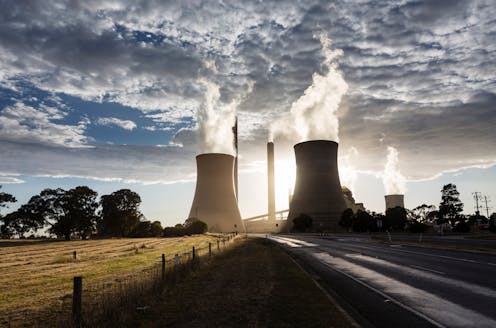
Despite the overwhelming evidence that most of the world’s fossil fuel reserves must stay in the ground, governments are still approving new projects. The UK government has 40 fossil fuel projects in the pipeline despite being host of COP26.

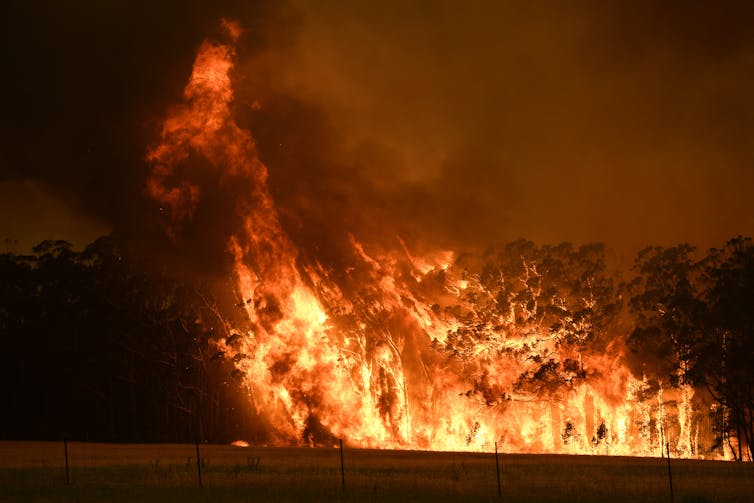
Australia, too, continues to approve new gas and coal developments. The NSW government has approved eight new projects since 2018, despite the state’s target of 50% emissions reduction by 2030.

Until future climate negotiations put a ban on new fossil fuel projects and agree to a clear and rapid phase out of current production levels, the fossil fuel industry will continue to thrive.

Governments worldwide are still approving new fossil fuel projects.
Shutterstock

3. Business as usual

A further loophole for the fossil fuel industry is how it’s being allowed to continue its huge levels of production because it has committed (in some cases) to making its operations greener.

Measures such as carbon capture and storage and offsetting have been touted by some governments as solutions to bringing the industry’s emissions down. But these are not real solutions if they simply allow fossil fuel production and use to continue at dangerous levels.


Read more:
Big-business greenwash or a climate saviour? Carbon offsets raise tricky moral questions


While offsetting will have to play a role in reducing emissions in some hard-to-abate sectors such as aviation and agriculture, it is not a substitute for genuine cuts to fossil fuel use and misleadingly gives the impression fossil fuel companies are going green.

4. Influence

These loopholes that allow fossil fuel production are, of course, no accident. The largest group of representatives at COP26 were from the fossil fuel industry.

One of the striking and disturbing characteristics of government approaches to climate change is the impact of fossil fuel companies on decision making. It’s hard to think of other issues (smoking, peace negotiations) where we tolerate this kind of influence.

The industry’s influence on successive Australian governments has been well documented, with over A$136.8 million in donations recorded between 1999 and 2019.

Having a display by gas company Santos (a major donor to Australian political parties) at Australia’s COP26 pavilion rightly provoked ridicule.

5. Decoupling production

The failure to address these loopholes will mean the production of fossil fuels in countries like Australia will continue for much longer than it should.

The fact there are still willing buyers for fossil fuel assets such as BHP’s Queensland coal mines indicates investors are anticipating years of profits (and few climate liabilities) from fossil fuels, despite the measures proposed at COP26.


Read more:
BHP is selling its dirty oil and gas assets, but hold the applause


One of the most glaring failures of COP26 is the failure to connect emission cuts with production cuts. Nowhere is this more apparent than in countries such as Norway which have impressive domestic reduction targets (55% by 2030) yet continue to champion fossil fuel production through oil and gas exploration.

A key to progress at future COPs and domestically is ending the false idea one can make progress on climate by cutting domestic emissions while simultaneously supporting fossil fuel production. If countries such as Australia and Norway can’t come together to agree on cutting support for production, then we will continue to see loopholes that allow the industry to flourish.

Some countries are taking positive steps. The Beyond Oil and Gas Alliance that aims to phase out production is key to cutting supply of fossil fuels.

Multilateral action such as this, whether as part of COP or outside it – and, crucially, the pressure from below that causes it – must be a focus if we’re to avoid climate change.


Read more:
‘Try harder. Try harder’: Today, COP26 negotiators will fight to save life on Earth. The next decade will reveal if they succeeded


The Conversation

Jeremy Moss receives funding from the Australian Research Council.

ref. COP26 leaves too many loopholes for the fossil fuel industry. Here are 5 of them – https://theconversation.com/cop26-leaves-too-many-loopholes-for-the-fossil-fuel-industry-here-are-5-of-them-171398

COP26: New Zealand depends on robust new rules for global carbon trading to meets its climate pledge

Source: The Conversation (Au and NZ) – By Nathan Cooper, Associate Professor of Law, University of Waikato

Shutterstock/rafapress

As the COP26 climate summit draws to a close, debate continues on one key issue in particular: a new rule book for global carbon trading to allow countries to purchase emissions reductions from overseas to count towards their own climate action.

The world has generally welcomed headline-grabbing agreements on halting deforestation and tackling methane and coal. Likewise ambitious commitments from some large polluters, most notably India’s pledge to reach net zero carbon by 2070.

But the devil is in the detail and there is serious concern that some of these commitments are only voluntary, while others look unachievable.

Defining the rules for international carbon trading is a contentious agenda item — but one that will partly determine whether countries can meet their pledges and collectively limit global warming to as close to 1.5℃ as possible.

The new rules, known as Article 6 under the Paris Agreement, will be important for New Zealand.

During COP26, New Zealand announced its new Nationally Determined Contribution (NDC) to reduce emissions by 50% on 2005 levels by 2030.

Prime Minister Jacinda Ardern described this as “our fair share” and it is indeed a significant step up on New Zealand’s previous pledge to cut emissions by 30%. It leaves the country with 571 Megatons of CO₂-equivalent emissions to “spend” between 2022 and 2030.


Read more:
COP26: New Zealand’s new climate pledge is a step up, but not a ‘fair share’


New rules for global carbon trading

The New Zealand government stated its “first priority” was to reduce domestic emissions, but it acknowledged that alone could not meet the country’s new pledge. In fact, two thirds of the promised emissions reductions will have to come through overseas arrangements, especially with nations in the Asia-Pacific region.

The Climate Change Commission has been critical of this approach, describing it as “purchasing offshore mitigation, rather than [doing] what was necessary to achieve actual emissions reductions at source”.
But the approach is allowed under the Paris Agreement, which all states at COP26 have signed up to.

This would allow one country to buy credits from another country that has exceeded its NDC, or to carry out activities that reduce emissions in another (host) country and count those towards its own NDC. It also supports non-market approaches to climate cooperation between countries around technology transfer, finance and capacity building.

But these provisions have proved contentious, not least because they could result in double counting of emissions reductions, unless clear and robust operational rules are agreed. The COP26 summit has made some progress on this, but many finer details are yet to be resolved.


Read more:
Big-business greenwash or a climate saviour? Carbon offsets raise tricky moral questions


Cutting emissions at home versus elsewhere

Uncertainty about carbon market rules will be particularly problematic for New Zealand, given its reliance on overseas activities to meet its new NDC. There are also practical questions around how much of these activities will count towards New Zealand’s NDC, and how ready potential partners in the Pacific are for such carbon market trading mechanisms.

Pacific Island nations are not currently trading or part of established carbon markets. They may not be able to develop the necessary technical expertise to ensure fairness, compliance and transparency well in advance of 2030.


Read more:
COP26: time for New Zealand to show regional leadership on climate change


While there is scope to pursue opportunities to reduce emissions beyond our shores, we should be looking harder at what can be done domestically to help fulfil our NDC in the short time available.

Public consultation on the government’s first emissions reduction plan is currently underway until November 24. A final version is due in May 2022 and is expected to set out strategies for specific sectors (transport, energy and industry, agriculture, waste and forestry) to meet emissions budgets.

It will also include a multi-sector plan to adapt to climate change, and to mitigate the impacts emissions cuts may have on people.

It’s not ideal that a concrete plan for domestic emissions reductions is still six months away. But this does provide opportunity for people and interest groups to help shape priorities and pathways, and to encourage the government to set bolder domestic targets than would otherwise have been likely.

The Climate Change Commission has already produced recommendations for a low-emissions Aotearoa, including the rapid adoption of electric vehicles, reduction in animal stocking rates and changing land use towards forestry and horticulture.

Now is also the time to start building capacity to support Pacific Island nations in designing their carbon market policies. New Zealand has already pledged NZ$1.3 billion in funding for climate change aid, about half of which will go to Pacific Island countries.

Allocating some of this to enhancing technical know-how will help create a level playing field in carbon trading. It would ensure that whichever overseas arrangements materialise, these will be fair and deliver an “overall mitigation in global emissions”, as the Paris Agreement requires.

The Conversation

The authors do not work for, consult, own shares in or receive funding from any company or organisation that would benefit from this article, and have disclosed no relevant affiliations beyond their academic appointment.

ref. COP26: New Zealand depends on robust new rules for global carbon trading to meets its climate pledge – https://theconversation.com/cop26-new-zealand-depends-on-robust-new-rules-for-global-carbon-trading-to-meets-its-climate-pledge-171194

We studied suicide notes to learn about the language of despair – and we’re training AI chatbots to do the same

Source: The Conversation (Au and NZ) – By David Ireland, Senior Research Scientist at the Australian E-Health Research Centre., CSIRO

Shutterstock

While the art of conversation in machines is limited, there are improvements with every iteration. As machines are developed to navigate complex conversations, there will be technical and ethical challenges in how they detect and respond to sensitive human issues.

Our work involves building chatbots for a range of uses in health care. Our system, which incorporates multiple algorithms used in artificial intelligence (AI) and natural language processing, has been in development at the Australian e-Health Research Centre since 2014.

The system has generated several chatbot apps which are being trialled among selected individuals, usually with an underlying medical condition or who require reliable health-related information.

They include HARLIE for Parkinson’s disease and Autism Spectrum Disorder, Edna for people undergoing genetic counselling, Dolores for people living with chronic pain, and Quin for people who want to quit smoking.

Research has shown those people with certain underlying medical conditions are more likely to think about suicide than the general public. We have to make sure our chatbots take this into account.

Siri often doesn’t understand the sentiment behind and context of phrases.
Screenshot/Author provided

We believe the safest approach to understanding the language patterns of people with suicidal thoughts is to study their messages. The choice and arrangement of their words, the sentiment and the rationale all offer insight into the author’s thoughts.

For our recent work we examined more than 100 suicide notes from various texts and identified four relevant language patterns: negative sentiment, constrictive thinking, idioms and logical fallacies.


Read more:
Introducing Edna: the chatbot trained to help patients make a difficult medical decision


Negative sentiment and constrictive thinking

As one would expect, many phrases in the notes we analysed expressed negative sentiment such as:

…just this heavy, overwhelming despair…

There was also language that pointed to constrictive thinking. For example:

I will never escape the darkness or misery…

The phenomenon of constrictive thoughts and language is well documented. Constrictive thinking considers the absolute when dealing with a prolonged source of distress.

For the author in question, there is no compromise. The language that manifests as a result often contains terms such as either/or, always, never, forever, nothing, totally, all and only.

Language idioms

Idioms such as “the grass is greener on the other side” were also common — although not directly linked to suicidal ideation. Idioms are often colloquial and culturally derived, with the real meaning being vastly different from the literal interpretation.

Such idioms are problematic for chatbots to understand. Unless a bot has been programmed with the intended meaning, it will operate under the assumption of a literal meaning.

Chatbots can make some disastrous mistakes if they’re not encoded with knowledge of the real meaning behind certain idioms. In the example below, a more suitable response from Siri would have been to redirect the user to a crisis hotline.

An example of Apple’s Siri giving an inappropriate response to the search query: ‘How do I tie a hangman’s noose it’s time to bite the dust’?
Author provided

The fallacies in reasoning

Words such as therefore, ought and their various synonyms require special attention from chatbots. That’s because these are often bridge words between a thought and action. Behind them is some logic consisting of a premise that reaches a conclusion, such as:

If I were dead, she would go on living, laughing, trying her luck. But she has thrown me over and still does all those things. Therefore, I am as dead.

This closely resemblances a common fallacy (an example of faulty reasoning) called affirming the consequent. Below is a more pathological example of this, which has been called catastrophic logic:

I have failed at everything. If I do this, I will succeed.

This is an example of a semantic fallacy (and constrictive thinking) concerning the meaning of I, which changes between the two clauses that make up the second sentence.

This fallacy occurs when the author expresses they will experience feelings such as happiness or success after completing suicide — which is what this refers to in the note above. This kind of “autopilot” mode was often described by people who gave psychological recounts in interviews after attempting suicide.

Preparing future chatbots

The good news is detecting negative sentiment and constrictive language can be achieved with off-the-shelf algorithms and publicly available data. Chatbot developers can (and should) implement these algorithms.

Our smoking cessation chatbot Quin can detect general negative statements with constrictive thinking.
Author provided

Generally speaking, the bot’s performance and detection accuracy will depend on the quality and size of the training data. As such, there should never be just one algorithm involved in detecting language related to poor mental health.

Detecting logic reasoning styles is a new and promising area of research. Formal logic is well established in mathematics and computer science, but to establish a machine logic for commonsense reasoning that would detect these fallacies is no small feat.

Here’s an example of our system thinking about a brief conversation that included a semantic fallacy mentioned earlier. Notice it first hypothesises what this could refer to, based on its interactions with the user.

Our chatbots use a logic system in which a stream of ‘thoughts’ can be used to form hypothesises, predictions and presuppositions. But just like a human, the reasoning is fallible.
Author provided

Although this technology still requires further research and development, it provides machines a necessary — albeit primitive — understanding of how words can relate to complex real-world scenarios (which is basically what semantics is about).

And machines will need this capability if they are to ultimately address sensitive human affairs — first by detecting warning signs, and then delivering the appropriate response.


Read more:
The future of chatbots is more than just small-talk


If you or someone you know needs support, you can call Lifeline at any time on 13 11 14. If someone’s life is in danger, call 000 immediately.

The Conversation

The authors do not work for, consult, own shares in or receive funding from any company or organization that would benefit from this article, and have disclosed no relevant affiliations beyond their academic appointment.

ref. We studied suicide notes to learn about the language of despair – and we’re training AI chatbots to do the same – https://theconversation.com/we-studied-suicide-notes-to-learn-about-the-language-of-despair-and-were-training-ai-chatbots-to-do-the-same-169828

Gut bacteria don’t cause autism. Autistic kids’ microbiome differences are due to picky eating

Source: The Conversation (Au and NZ) – By Chloe Yap, MD-PhD candidate, The University of Queensland

Shutterstock

There has been much speculation that the community of bacteria living in the gut – known as the microbiome – may be different among people on the autism spectrum than the wider population. This has led some researchers and clinicians to speculate that gut bacteria could cause autism.

But our new research, published today in the journal Cell, turns this theory on its head.

Rather than differences in gut bacteria influencing brain development, our research suggests changes in gut bacteria are driven by restricted diets, or “picky eating”.

Restricted diets are more common among children with autism because of their sensory sensitivities and restricted and repetitive interests. Some may have strong preferences for a select few foods, while others find some flavours, smells or textures unpleasant or off-putting.

What’s the theory?

You may have heard claims the microbiome is related to autism: it may have a “causal” role, or microbiome “therapies” can alter autistic behaviours.


Read more:
What causes autism? What we know, don’t know and suspect


Interest in the autism gut microbiome first came from observations people on the autism spectrum are more likely to experience gut problems, such as constipation and diarrhoea.

Further studies seemed to suggest children on the autism spectrum had different combinations of bacteria living in their gut.

Child sits on the end of a bed, clutching their stomach.
Autistic children are more likely to have restricted diets.
Shutterstock

These intriguing relationships inspired studies of mice and rats, some of which indicated the microbiome may cause differences in behaviour.

But the excitement has been misguided.

Assessing the evidence

Weighing up all the findings, the evidence linking the microbiome to autism is highly inconsistent and many studies have significant problems with their scientific design.

There are also problems in relating mouse studies to humans, because autism does not exist in mice.

Despite the uncertainty in the science, the hype around the microbiome and autism has continued to gather momentum.

Out of this momentum emerged speculative therapies claiming to support children with autism by altering the microbiome, including faecal microbiota transfers and diet therapies.

These “therapies” were long on hope but short on evidence for efficacy and safety, and come with their own risks and substantial costs.

What our study did

We worked with the Australian Autism Biobank, which includes extensive clinical and biological data from children on the autism spectrum and their families, as well as the Queensland Twin Adolescent Brain Project.

We compared microbial DNA from stool samples of 99 children on the autism spectrum to two groups of non-autistic children: 51 of their siblings and 97 unrelated children.

We also looked at clinical, family and lifestyle information, including about the child’s diet, for a comprehensive, broad look at factors that may contribute to the their microbiome.

What we found

We found no evidence for a relationship between autism and measures of the microbiome as a whole, or with microbiome diversity.

Only one bacterial species out of more than 600 showed an association with autism. We found no evidence for other bacterial groups that have previously been reported in autism (for example, Prevotella).

Instead, we found children on the autism spectrum were more likely to be “picky eaters” – consistent with reports from earlier studies – and this was related to particular traits associated with autism, such as restricted interests and sensory sensitivity.

We also found pickier eaters tended to have a less diverse microbiome, and runnier (more diarrhoea-like) stool. We’ve also known for some time children on the autism spectrum are more likely to have gastrointestinal issues such as constipation, diarrhoea and abdominal pain.

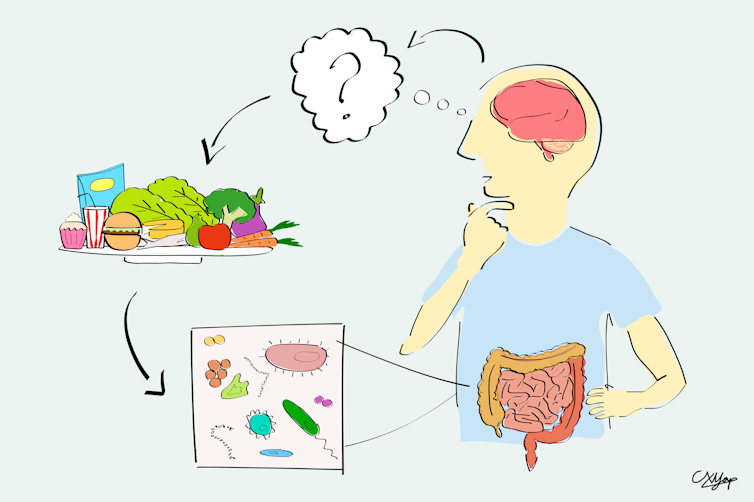
Changes in gut bacteria are driven by restricted diets.
Author provided

The genetic information told a similar story: autism and restricted interests corresponded to a less-diverse diet, but not directly with the microbiome.

These genetic data are critical, because they rule out other environmental factors that may have influenced the findings.

Overall, our results did not support the popular view that gut microbes cause autism.

What we propose instead is strikingly simple: autism-related traits and preferences are associated with less-diverse diet, leading to a less-diverse microbiome and runnier stool.

Here’s how our study maps the effect of diet.

What do our findings mean?

Our findings have important implications for the autism community.

First, microbiome interventions for autism, such as faecal microbiota transplants, should be viewed with caution. Our findings suggest they are unlikely to be effective and may do more harm than good.


Read more:
These 4 diets are trending. We looked at the science (or lack of it) behind each one


Our study also draws attention to the importance of diet for children on the autism spectrum. Poor diet in children and young people is a major public health concern in Australia, with important implications for their well-being, development and health conditions such as obesity.

We need to do more to support families at mealtimes, in particular for families with autistic children, rather than resorting to fad “therapies” that may do more harm than good.

The Conversation

Chloe Yap receives funding from the University of Queensland, the Cooperative Research Centre for Living with Autism (Autism CRC), and the Australian-American Fulbright Commission.

Andrew Whitehouse receives funding from the National Health and Medical Research Council, the Australian Research Council, and the Autism CRC.

Jake Gratten receives funding from the Australian National Health and Medical Research Council (NHMRC) and the Cooperative Research Centre for Living with Autism (Autism CRC).

ref. Gut bacteria don’t cause autism. Autistic kids’ microbiome differences are due to picky eating – https://theconversation.com/gut-bacteria-dont-cause-autism-autistic-kids-microbiome-differences-are-due-to-picky-eating-170366

‘Try harder. Try harder’: Today, COP26 negotiators will fight to save life on Earth. The next decade will reveal if they succeeded

Source: The Conversation (Au and NZ) – By Tim Flannery, Professorial fellow, Melbourne Sustainable Society Institute, The University of Melbourne

AP

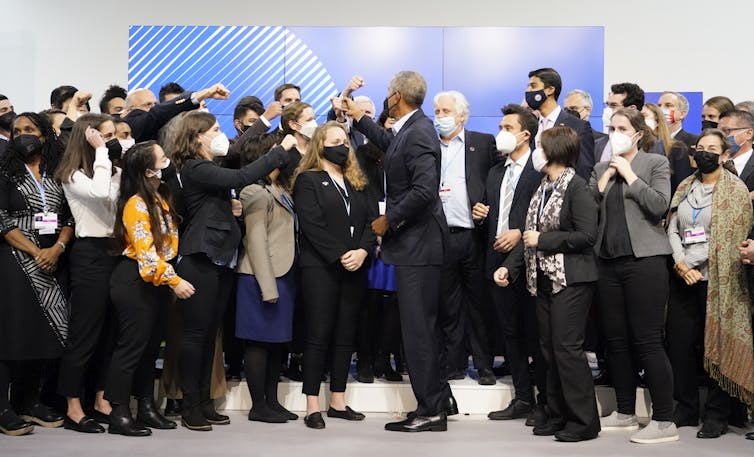
At COP26 in Glasgow, the announcements came so fast there was barely time to give each proper scrutiny before the next arrived. I’ve attended many United Nations climate change conferences, but this fortnight felt different. The feeling of momentum was palpable.

Countries that in past years fought tooth-and-nail against stronger action stepped up with new commitments. Many of them joined an array of new partnerships and alliances struck in the first week.

As I write, negotiators are locked in tense talks to try and land the final COP26 agreement. But whether the summit succeeds or fails doesn’t depend solely on the decisions reached this week.

From the outset, COP26 was seen not as an end point, but a kickstart to a decade of truly transformative action. Only in coming years will we know if the event was a real game-changer for the planet, or just empty promises and spin.

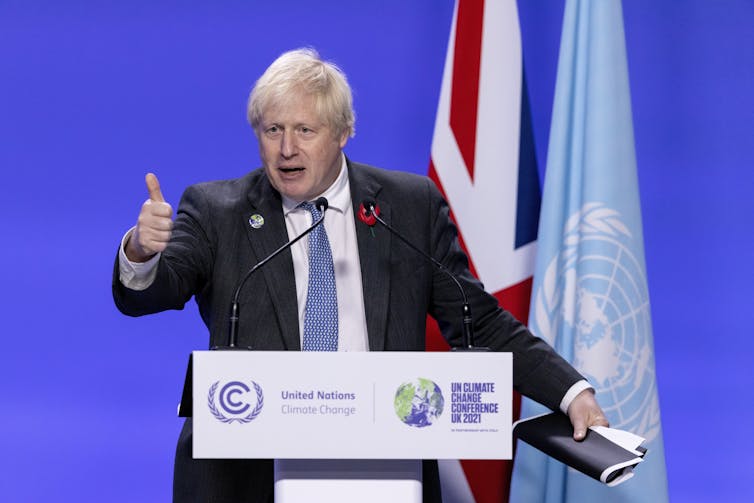
man at lectern gives thumbs up
The next decade will tell if COP26 was a game changer, or just empty promises.
EPA

COP26: a journey, not a destination

The UK government, as the conference hosts, knew early on that most countries would bring new climate ambition – known in COP-speak as “nationally determined contributions”. But it also knew these pledges would never be be enough.

For COP26 to be successful in getting the world on the path of limiting global warming to 1.5℃ this century, two things were required.

First were a series of side deals to kick things along. These came in the form of a new global pledge to reduce emissions of methane – a highly potent greenhouse gas – as well as deals on coal phase-out, deforestation, climate finance and more.

Second, countries would have to further ratchet up their commitments in coming years. That means the final negotiated outcome of COP26, due on Friday Glasgow time, must require nations to make immediate further increases in emission-reduction ambition.

As I write, that outcome is uncertain at best.

The first draft of the final agreement urges countries that didn’t bring a new and stronger 2030 target to Glasgow – such as Australia – to do so within a year.


Read more:
Take heart at what’s unfolded at COP26 in Glasgow – the world can still hold global heating to 1.5℃


Perhaps unsurprisingly, Australia is among a group of nations working to have that part of the text softened, or removed from the final agreement entirely. That is a worrying sign, though there will be many other countries fighting hard to ensure it stays in.

Negotiators have spent countless hours arguing over the minutiae of the final text, and there’s still a way to go yet. But if the final agreement is too weak, the 1.5℃ goal is at serious risk.

The draft wording is weaker than that sought by a group of 50 of the world’s most climate-vulnerable countries, which want national commitments to be reviewed and strengthened each year between now and 2025. However, the wording is still stronger than many observers anticipated.

And while COP26 is not yet over, it’s so far fallen short on one crucial measure – climate finance. More than a decade ago, developed nations agreed to mobilise US$100 billion a year by 2020 to support climate action in developing countries. This pledge has not yet been fulfilled.

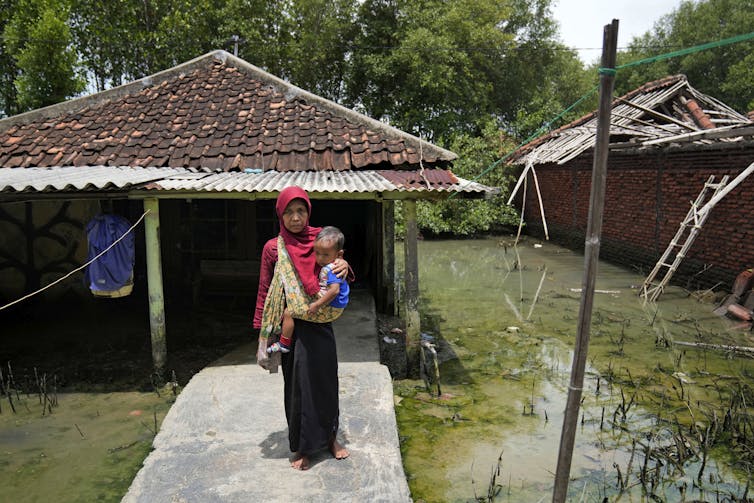
woman holds child outside home surrounded by water
COP26 failed to deliver adequate finance to developing nations to help them deal with climate change..
Dita Alangkara/AP

Australia outdid itself

Being an Australian at international climate talks is rarely a comfortable experience. Australia long ago cemented its reputation as a drag on global climate cooperation – known for its weak targets, obstructive approach and demands for special treatment.

However, even seasoned observers have been taken aback by Australia’s actions before and during COP26.

Australia went to Glasgow as just about the only developed country without a new and significantly stronger 2030 emissions reduction target.

The Morrison government then proceeded to use the Australia pavilion inside the COP venue to promote the interests of fossil fuel companies such as Santos.

Australia also refused to sign up to two signature deals at COP26 – the global pledge to cut methane emissions, and one to phase out coal-fired power.


Read more:
The fate of our planet depends on the next few days of complex diplomacy in Glasgow. Here’s what needs to go right


Despite Australia’s recalcitrance, the coal pledge, in particular, is a big step forward in global terms.

In years past, nations agreeing to a coal phase-out were not particularly reliant on coal. This time, signatories included big coal-using nations such as Vietnam, Indonesia, Poland, the Ukraine and South Korea.

One energy-related announcement in Glasgow was particularly important for Australia. Japan and South Korea, the second and third biggest buyers of Australian liquified natural gas (LNG) both signalled their desire to shift to hydrogen and renewables.

This development, among others, makes one thing abundantly clear: the world is moving fast while Australia stands still. Sooner rather than later, Australia will feel the cost of its inaction – not just in the hit to our international reputation, but in foregone economic opportunities in the clean industries of the future.

‘Try harder. Try harder’

International climate talks can feel far removed from the urgent reality of the climate crisis. But at every COP, someone invariably manages to cut through the noise with a brutally honest and rousing contribution.

This year it was Barbados Prime Minister Mia Mottley, who at the outset of the conference excoriated leaders for failing on the promises of the Paris Agreement.

Mottley’s commanding eight-minute speech was a show-stopping moment. As world leaders including US President Joe Biden and British Prime Minister Boris Johnson looked on, Mottley declared a 2℃ increase in global temperatures would be a “death sentence” for small developing island nations.

She went on:

For those who have eyes to see. For those who have ears to listen. And for those who have a heart to feel … We do not want that dreaded death sentence, and we have come here today to say ‘Try harder. Try harder’.

Barbados Prime Minister Mia Mottley urged the world to ‘try harder’ at COP26.

So did the world try harder in Glasgow? The progress we’ve so far seen during the conference, and in the lead up, would have been unimaginable only a few years ago. The surprise pact between the US and China – in which the two nations recognised climate change as an “existential threat” – is a case in point.

But the summit’s final outcome is still likely to fall massively short of what the science demands. The real test of COP26 is whether pledges are honoured, and if the talks have triggered a virtuous cycle of increased ambition and action over the next decade.


Climate Council research director Simon Bradshaw, who travelled with Tim Flannery to COP26, assisted with the drafting of this article.

The Conversation

Tim Flannery works for the Climate Council and the not-for-profit Ocean Forests Foundation. He receives funding from both organisations. He is affiliated with the Australian Museum and Melbourne University’s Melbourne Sustainable Society Institute.

ref. ‘Try harder. Try harder’: Today, COP26 negotiators will fight to save life on Earth. The next decade will reveal if they succeeded – https://theconversation.com/try-harder-try-harder-today-cop26-negotiators-will-fight-to-save-life-on-earth-the-next-decade-will-reveal-if-they-succeeded-171661

‘The Australian way’: how Morrison trashed brand Australia at COP26

Source: The Conversation (Au and NZ) – By Robyn Eckersley, Professor of Political Science, School of Social and Political Sciences, The University of Melbourne

Ray Noble/AP/AAP

As the COP26 climate talks wind up in Glasgow, Australia has again proved itself a climate laggard on the world stage. Prime Minister Scott Morrison might be a marketing supremo, but he can’t spin his way out of his government’s failures.

Indeed, it is baffling the prime minister would think his new commitment to net zero emissions by 2050 would be enough to warrant a plane ticket to Scotland.

But while Morrison does not appear to understand – or care – what is required from Australia under the 2015 Paris Agreement, and what is at stake at COP26, his refusal to ramp up emissions reductions is starting to backfire.

‘The Australian way’

In announcing his net zero commitment last month, Morrison declared “Australians will set our own path by 2050 and we’ll set it here by Australians for Australians”. This was also the message he took to the world stage at COP26, where he described his policy of “technology not taxes” to be the core of “the Australian way”.

Most countries have a pavilion at the climate negotiations, where they host events and showcase their efforts to negotiators and observers. The Morrison government appeared to mistake COP26 for a fossil fuel expo – its pavilion was branded as “Positive energy the Australian way”, which touted fossil fuels and carbon capture and storage.

At Glasgow, the Morrison government also stuck with its paltry 2030 target, set in 2015 by the Abbott government, making it an extreme outlier among developed countries. It also refused to join the pledge to reduce methane emissions and another to phase out coal.

Morrison set the tone at the G20 meeting in Rome, just days before Glasgow, when Australia joined China and India in blocking a proposed coal phase-out. Minister for Resources Keith Pitt has since made the government’s position clear: Australia will continue to export coal for decades.

Australia already had a bad reputation

Australia already had a reputation for “gaming” the processes of carbon accounting. But Morrison took creative carbon accounting to a new level at US President Joe Biden’s climate summit in April.

Seasoned climate analysts were shocked at the metrics used, such as excluding emissions associated with extracting fossil fuels for export. This breaks with the official methodology for measuring all emissions produced within a country’s territory.


Read more:
Take heart at what’s unfolded at COP26 in Glasgow – the world can still hold global heating to 1.5℃


At COP26, the Morrison government has enhanced the size of its climate finance – to help Pacific and Southeast Asian neighbours with the effects of climate change – from A$500 million to A$2 billion over the next five years. However, this is well below Australia’s fair share of US$2.9 billion (A$3.96 billion) per year, based on responsibility, economic capacity and population.

Aside from the Trump administration, since 2018 Australia is also the only developed country to refuse to channel its climate finance through the multilateral Green Climate Fund. According to Donor Tracker, in recent years, Australia’s climate-related aid has had “cross-cutting objectives” and none of it went to projects that address climate change as a “principal goal”.

‘Aiming low’

The annual climate COPs are, among other things, a global “show and tell”. The problem for Australia is that it had nothing to show, and no amount of telling can cover this lack. As Lord John Deben, the UK’s chief climate advisor told the ABC this week, “it was just a whole series of words”, with no understanding of “the urgency of what we have to do”.

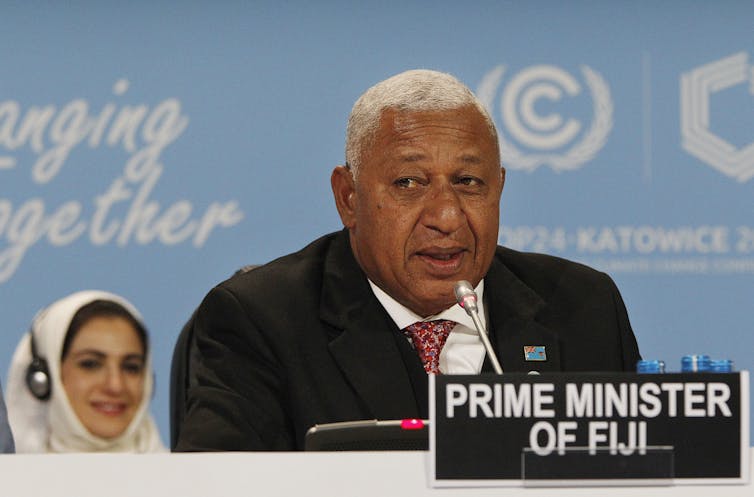
Fijian Prime Minister Frank Bainimarama tried a different tactic. At COP26, after urging Morrison to halve Australia’s emissions by 2030, he handed him a copy of Fiji’s Climate Change Act “as a guide – it is our uniquely Fijian way of following the science to keep faith with future generations”.

Fiji's Prime Minister Frank Bainimarama
Fijian Prime Minister Frank Bainimarama is among world leaders who are unimpressed by Australia’s climate approach.
Czarek Sokolowski/AP/AAP

The rise of “scorecard diplomacy” based on ratings and rankings of national climate performance has also made marketing cover-ups impossible.

Key examples include Climate Action Tracker, which has rated Australia’s overall performance as “highly insufficient”, and the Climate Performance Index, which ranked Australia seventh last overall – and behind Russia – in the most recent assessment announced at COP26 this week.

The “Fossil of the Day” awards go to those parties “doing the most to achieve the least” at the annual climate negotiations. Organised by Climate Action Network International, made up of over 1,500 environmental groups from around 140 countries, they are a talking point among negotiators. So far at COP26, Australia has won five fossil awards, more than any other country.

This includes the award for “aiming low” on the first day of COP26.

Australia, we’ve come to expect some unconscionable behaviour from you on climate change but this time you’ve truly outdone yourself.

Flying in the face of Paris

The Morrison government’s stubbornness on its 2030 target flies in the face of not only the goals and rules but also the core equity principles in the Paris Agreement.

These principles require developed countries to take the lead in climate mitigation in line with their greater historical responsibility and economic capabilities. They are also required to mobilise climate finance to support to mitigation and adaptation in countries with minimal responsibility for emissions, high vulnerability and weak capacity.

The Morrison government lives in a parallel universe to the Paris Agreement in its defence of the “Australian way”. This signalling can only mean one of two things.

The first is that the rest of the world, including poor countries, must compensate by carrying most of Australia’s burden if we are to hold warming to the necessary 1.5℃ this century. The second is that the government has no interest in “keeping 1.5℃ alive,” on the assumption Australia can adapt to a hotter world and never mind the enormous suffering elsewhere.

Commitments and performance (not branding)

In international climate politics, a country’s reputation is determined by the credibility of commitments and performance over time in relation to the collective goals, principles and rules negotiated by the parties.

It is not a brand or image that can be created in Canberra and then marketed to the world like Vegemite.

Australia’s COP26 diplomacy is damaging its reputation further. There is rising anger from developing countries, which constitute the majority of world’s states.

There is also deep anxiety in our regions, among Pacific nations, where Australia is an increasingly awkward partner. Tuvalu’s foreign minister Simon Kofe filmed his COP26 speech standing thigh-deep in the ocean.

Even Australia’s closest allies, the United States and the United Kingdom, are frustrated about our the government’s stubbornness.

The free ride will end

Australia’s free ride will come to end sooner or later, as our trading partners consider imposing carbon tariffs and the export market for coal and gas shrinks.


Read more:
Australia is undermining the Paris Agreement, no matter what Morrison says – we need new laws to stop this


However, the reputational damage arising from Australia’s great refusal may come to haunt us when we seek the cooperation of others. As the oceans rise, it should also haunt Australians that Fiji sent military engineers during the Black Summer fires of 2019-2020.

We may not be able to count on such help in future.

The Conversation

Robyn Eckersley has receive funding from the Australian Research Council.

ref. ‘The Australian way’: how Morrison trashed brand Australia at COP26 – https://theconversation.com/the-australian-way-how-morrison-trashed-brand-australia-at-cop26-171670

How much time should you spend studying? Our ‘Goldilocks Day’ tool helps find the best balance of good grades and well-being

Source: The Conversation (Au and NZ) – By Dot Dumuid, Senior Research Fellow, Allied Health & Human Performance, University of South Australia

Shutterstock

For students, as for all of us, life is a matter of balance, trade-offs and compromise. Studying for hours on end is unlikely to lead to best academic results. And it could have negative impacts on young people’s physical, mental and social well-being.

Our recent study found the best way for young people to spend their time was different for mental health than for physical health, and even more different for school-related outcomes. Students needed to spend more time sitting for best cognitive and academic performance, but physical activity trumped sitting time for best physical health. For best mental health, longer sleep time was most important.

It’s like a game of rock, paper, scissors with time use. So, what is the sweet spot, or as Goldilocks put it, the “just right” amount of study?


Read more:
Back to school: how to help your teen get enough sleep


Using our study data for Australian children aged 11 and 12, we are developing a time-optimisation tool that allows the user to define their own mental, physical and cognitive health priorities. Once the priorities are set, the tool provides real-time updates on what the user’s estimated “Goldilocks day” looks like.

Stylised dial set between 'too little' and 'too much' to achieve 'perfect balance'.
Because of the need to juggle conflicting demands on their time, individuals must fine-tune the daily balance of activities to match their priorities and needs.
Shutterstock

More study improves grades, but not as much as you think

Over 30 years of research shows that students doing more homework get better grades. However, extra study doesn’t make as much difference as people think. An American study found the average grades of high school boys increased by only about 1.5 percentage points for every extra hour of homework per school night.

What these sorts of studies don’t consider is that the relationship between time spent doing homework and academic achievement is unlikely to be linear. A high school boy doing an extra ten hours of homework per school night is unlikely to improve his grades by 15 percentage points.

There is a simple explanation for this: doing an extra ten hours of homework after school would mean students couldn’t go to bed until the early hours of the morning. Even if they could manage this for one day, it would be unsustainable over a week, let alone a month. In any case, adequate sleep is probably critical for memory consolidation.


Read more:
What’s the point of homework?


As we all know, there are only 24 hours in a day. Students can’t devote more time to study without taking this time from other parts of their day. Excessive studying may become detrimental to learning ability when too much sleep time is lost.

Another US study found that, regardless of how long a student normally spent studying, sacrificing sleep to fit in more study led to learning problems on the following day. Among year 12s, cramming in an extra three hours of study almost doubled their academic problems. For example, students reported they “did not understand something taught in class” or “did poorly on a test, quiz or homework”.

Excessive study could also become unhelpful if it means students don’t have time to exercise. We know exercise is important for young people’s cognition, particularly their creative thinking, working memory and concentration.

On the one hand, then, more time spent studying is beneficial for grades. On the other hand, too much time spent studying is detrimental to grades.

We have to make trade-offs

Of course, how young people spend their time is not only important to their academic performance, but also to their health. Because what is the point of optimising school grades if it means compromising physical, mental and social well-being? And throwing everything at academic performance means other aspects of health will suffer.

US sleep researchers found the ideal amount of sleep for for 15-year-old boys’ mental health was 8 hours 45 minutes a night, but for the best school results it was one hour less.

Clearly, to find the “Goldilocks Zone” – the optimal balance of study, exercise and sleep – we need to think about more than just school grades and academic achievement.


Read more:
‘It was the best five years of my life!’ How sports programs are keeping disadvantaged teens at school


Looking for the Goldilocks Day

Based on our study findings, we realised the “Goldilocks Day” that was the best on average for all three domains of health (mental, physical and cognitive) would require compromises. Our optimisation algorithm estimated the Goldilocks Day with the best overall compromise for 11-to-12-year-olds. The breakdown was roughly:

  • 10.5 hours of sleep

  • 9.5 hours of sedentary behaviour (such as sitting to study, chill out, eat and watch TV)

  • 2.5 hours of light physical activity (chores, shopping)

  • 1.5 hours of moderate-to-vigorous physical activity (sport, running).

We also recognised that people – or the same people at different times — have different priorities. Around exam time, academic performance may become someone’s highest priority. They may then wish to manage their time in a way that leads to better study results, but without completely neglecting their mental or physical health.

To better explore these trade-offs, we developed our time-use optimisation tool based on Australian data. Although only an early prototype, the tool shows there is no “one size fits all” solution to how young people should be spending their time. However, we can be confident the best solutions will involve a healthy balance across multiple daily activities.

Just like we talk about the benefits of a balanced diet, we should start talking about the benefits of balanced time use. The better equipped young people and those supporting them are to find their optimal daily balance of sleep, sedentary behaviours and physical activities, the better their learning outcomes will be, without compromising their health and well-being.

The Conversation

Dot Dumuid is supported by an Australian National Health and Medical Research Council (NHMRC) Early Career Fellowship GNT1162166 and by the Centre of Research Excellence in Driving Global Investment in Adolescent Health funded by NHMRC GNT1171981.

Tim Olds receives funding from the NHMRC and the ARC.

ref. How much time should you spend studying? Our ‘Goldilocks Day’ tool helps find the best balance of good grades and well-being – https://theconversation.com/how-much-time-should-you-spend-studying-our-goldilocks-day-tool-helps-find-the-best-balance-of-good-grades-and-well-being-171399

Vital Signs: Marketing is getting in the way of markets that could get us to net-zero

Source: The Conversation (Au and NZ) – By Richard Holden, Professor of Economics, UNSW

This week the prime minister entered full marketing mode.

Scott Morrison’s topic was climate change and his plans to get to net-zero.

At the Victorian Chamber of Commerce and Industry on Wednesday, he tried out a few slogans.

Among those he test marketed:

  • can do capitalism, not ‘don’t do governments’

  • no one passed a law or introduced a tax or passed a resolution at the UN that led to the world developing a COVID vaccine, no one passed a law for the world to move digital, Google and Cochlear were not invented at a UN workshop or summit

  • Australia has already reduced our emissions by more than 20%, now, our emissions are going down, not up, they’re down by more than 20%

He said a bunch of other stuff, but those are my top three.

He wants to contrast his approach with certain United Kingdom and US environmentalists, who do indeed want to restrict what people can buy or do. Ideas like mandatory “meatless Mondays” and banning advertising for SUVs do indeed have no place in Australia, or even in the UK for that matter.


Read more:
Economists back carbon price, say benefits of net-zero outweigh costs


And nor does telling people where to drive, although the prime minister assured us he was not going to tell people “where to drive or where they can’t drive.

Economists don’t like such ideas either. The whole idea behind a price on carbon (whether through a carbon tax or a system of tradable permits) is to respect people’s preferences, while making sure their decisions take account of the costs they impose on others.

Innovations often come from government

His second claim was that innovation (things like the COVID vaccine, Google search and digitisation) isn’t sparked by governments.

While it’s true that “Google and Cochlear were not invented at a UN workshop or summit”, to suggest that governments played no role is to wilfully ignore history.

The miraculous Moderna mRNA vaccine was developed… checks notes… in partnership with the US National Institutes of Health. Moderna received nearly US$10 billion in taxpayer funding.

Much of the work on the Cochlear ear implant was done at the largely government-funded University of Melbourne; the internet revolution grew from the US Department of Defense’s Advanced Research Projects Agency; and Google’s search algorithm was developed by fully-funded graduate students at Stanford University, whose endowment is tax exempt.

Very often, cuts in emissions come from government

Morrison emphasised on Wednesday that Australia has reduced emissions by 20%.

It’s natural to ask what brought it about. Much of it was a cutback in land clearing, which is counted as emissions reduction under the rules. Land clearing is regulated by government.

Much of the rest happened during the two years Australia had a carbon price in place, as this chart shows.


Australian emissions excluding land use, land-use change and forestry

Million tonnes of carbon dioxide equivalent per annum, updated quarterly.
Climate Council, Department of Industry

The claimed 20% reduction owes much to the laws and summits the prime minister derides.

All prime ministers are politicians, so isn’t surprising they spin narratives. But to spin one so sharply at odds with reality is surprising.

When it comes to “technology not taxes”, the truth is it is often taxes that drive the development and uptake of technologies.


Read more:
Top economists call for measures to speed the switch to electric cars


Importantly, taxes don’t specify the particular technologies that will emerge.

Perhaps that’s why the nation’s peak body for can-do-capitalitsts – the Business Council of Australia – has asked the government to subject more businesses to Australia’s existing little-known (weak) price on carbon.

If we are going to get to net-zero, we need less marketing and more markets. Now there’s a slogan.

The Conversation

Richard Holden is President-elect of the Academy of the Social Sciences in Australia.

ref. Vital Signs: Marketing is getting in the way of markets that could get us to net-zero – https://theconversation.com/vital-signs-marketing-is-getting-in-the-way-of-markets-that-could-get-us-to-net-zero-171602

Friday essay: beautiful, available and empty – how landscape photographers reinvented the colonial project in Australia

Source: The Conversation (Au and NZ) – By Jarrod Hore, Co-Director & Postdoctoral Fellow, New Earth Histories Research Program, UNSW

Anson Brothers Studio, Fern Tree Gully, Hobart Town, Tasmania, 1887. Albumen print. Collection of the Art Gallery of New South Wales.

Colonial history overflows with commodities. From the early 1800s, wool generated extraordinary wealth for squatters and pastoralists and substantial investment in the Australian colonies. In the 1850s, gold motivated tens of thousands of people to work the earth or service the diggings. Coal, copper, tin, wheat, barley and cotton all assumed importance at different times.

In those great cathedrals of late 19th century colonial self-representation, the International Exhibitions, any visitor would have immediately noticed the way New South Wales, Victoria and Tasmania sought to identify with the commodities produced in these places.

In a photograph from 1879, the NSW Department of Mines filled its portion of the exhibition building, the Garden Palace, with gold ingots, silver ores and samples of tin. On the balconies above were coal sections and geological maps.

The prominent mining displays inside the Garden Palace, 1879.
Collection of the Museum of Applied Arts and Sciences, Sydney

Walking through these displays a visitor would also have noticed walls of landscape photographs, which, mirroring the extractive logic of settler colonialism itself, worked to bring all these raw materials together in a vision of abundant nature.

Photographers captured images of budding settlements, seemingly empty vistas, and stunning panoramas of emerging colonial cities.

The increasing popularity of these photographs throughout the final decades of the 19th century shows colonial expansion was not just generated by the search for raw materials to extract and exploit. Colonial Australia was also a product of vision and imagery: literally developed through chemicals, glass and light.

Charles Bayliss and Bernhardt Otto Holtermann, Panorama of Sydney and the Harbour, New South Wales, 1875. Albumen prints on cloth.
Art Gallery of New South Wales

I have studied over 2000 early landscape photographs, taken by six settler photographers between the 1850s and the 1930s. They show how colonisation was re-enacted in the imagination of places, rather than simply through the movement of people from one site to another, the Lockean mixture of labour and earth, or the transfer of deeds.

Visions of nature allowed for a different kind of investment in the colonial earth. They paid off in feelings of belonging even for those who never turned a sod. These photos reveal, as the American environmental historian William Cronon has insisted, that nature itself is a profoundly human artefact.

In settler colonies, landscape photography framed nature as beautiful, available and empty. In Victoria and Tasmania especially, landscape photography flourished. And although this mode of photography was not uniquely antipodean – it was pioneered, then perfected in the American West by photographers like Carleton Watkins and Eadweard Muybridge – it did have remarkable purchase in the Australian colonies.

J. W. Lindt, Lindt’s Hermitage, 1894. Gelatin silver print.
National Gallery of Victoria, Melbourne

A photographic sleight of hand

Figures such as Nicholas Caire, John Lindt, and John Beattie took up the camera to encourage settlers to feel at home in Australian environments. This perspective disguised the ancestral ownership and continuing presence of First Nations peoples, turning their homelands into a wilderness through a photographic sleight of hand.


Read more:
Indigenous knowledge and the persistence of the ‘wilderness’ myth


The best example of this was in Victoria, where Caire and Lindt began framing the stretch of bush between Healesville and Narbethong as a kind of wilderness retreat from the late 1870s.

Caire, born in Guernsey in 1837, came to this collaborative work via South Australia, the forests of Gippsland and the Goldfields. Lindt, originally from Frankfurt, had just finished photographing Bundjalung and Gumbaynggir people along the Clarence River in northern NSW.

Around 1878 Caire captured Fairy Scene at the Landslip, Blacks’ Spur, which quickly became one of his most popular photographs.

Nicholas Caire, Fairy Scene at the Landslip, Blacks’ Spur, c. 1878.
National Gallery of Victoria

In it, Caire focuses on a glade of tree-ferns clustered on the side of a gully. Writing in 1904, Caire and Lindt boasted about the wildness of this pocket of the Great Forest, the ancient age of the trees, and the “refreshing” seclusion of Fernshaw. Lindt wrote that the allure of places like this came back to their capacity to “carry you back to the morning of time”.

The empty natures of the Yarra Ranges relied on the removal and containment of Woiwurrung, Bunurong, and Taungurong people at the Coranderrk mission. Located just kilometres away from Lindt and Caire’s “refreshing” forest, Coranderrk helped the photographers create a partition between the environment and its ancestral owners.

The mission became a complementary site of interest. When promoting the natural features of the Yarra Ranges, Lindt and Caire wrote about Coranderrk as a place where tourists could mimic the anthropologist, just as they mimicked the geographer or explorer while traipsing through sylvan glades or gazing up at giant mountain ash.

At about the same time that Caire and Lindt were developing their visions of nature in the Yarra Ranges, the photographer Fred Kruger was taking influential shots of life on the reservation. One of the key challenges for aspiring landscape photographers in the 1870s and 1880s was to deal with this presence of Aboriginal people in landscapes that were becoming coveted for their natural beauty.

Caire and Lindt took up an established tradition of photography at Coranderrk, combining it with a new interest in wilderness, balancing the apparent contradiction between Indigenous presence and absence.

The Tasmanian sublime

In Tasmania, too, photographers began constructing a similar wilderness tradition from the 1870s. Emigrating from Scotland in 1878, John Beattie, the so-called “prince of landscape photographers in Australasia”, settled with his family in New Norfolk, about 30 kilometres up the Derwent valley from Hobart.

This was a perfect location for a budding photographer, and Beattie made attractive pictures of the river and its hop gardens in the 1890s, but the interior of the island offered a different order of beauty.

This photograph frames a harmonic interaction of settlement, agriculture and geography on the lowlands along the Derwent River. John Beattie, Hop Garden, New Norfolk, 1895–1898. Albumen print.
Art Gallery of New South Wales

In 1879 Beattie began making expeditions into the bush around the valley, onto the central highlands, and eventually all the way to the remote Lake St. Clair. In 1882 he joined the Anson Brothers’ photographic studio and quickly became their most important artist.

An Anson Brothers image from 1887 is quite likely Beattie’s work, showing a stand of ferns on the Huon Road. Unlike Caire’s shot, however, this image includes a group of settlers enjoying exactly the kind of immersion in nature that these photographs were designed to evoke.

Taken on the Huon Road, this photograph depicts the kind of vegetation that could be found in pockets of bush around the Beattie’s property at New Norfolk. Anson Brothers Studio, Fern Tree Gully, Hobart Town, Tasmania, 1887. Albumen print.
Art Gallery of New South Wales

Many of Beattie’s photographs are deeply Romantic. Between 1896 and 1906 he conducted regular presentations in Hobart and Launceston based on the wild features of the Tasmanian landscape, cultivating a high wilderness aesthetic in his magic lantern shows.


Read more:
Friday essay: journey through the apocalypse


Photographs of Lake Marion and the Du Cane Range and another of Lake Perry and The Pinnacles trade in the sublime. Beattie evoked the great American transcendentalist poets in his respect for the mountaintop, which often moved him to wordlessness: “I am struck dumb, but oh! my soul sings.”

John Beattie, Lake Marion, Du Cane Range (Tasmania), 1890s. Albumen print. The Richard Ledgar Collection of Photographs, 1858–1910, National Library of Australia, Canberra.
National Library of Australia

These sublime sentiments relied on old Romantic ideas that stretched back to Edmund Burke and William Wordsworth, but they rested just as heavily on new experiences of space. Beattie’s breakthrough years were in the 1890s, a decade in which depictions of wilderness in Australian Romantic painting went into terminal decline and were replaced by photographic visions of nature.

Romanticism, through photography, came to influence how environments were envisioned and how histories of dispossession were remembered. The high wilderness imagery of settler photography came to support a fantasy of spatial control, delivering reproducible, enduring symbols of the natural world.

This photograph of Lake Perry in the Hartz Mountains gives a good sense of the gradations of the Tasmanian highlands and the dramatic topography that attracted photographers. John Beattie, Lake Perry and Pinnacles looking Nth, Hartz Mountains, c. 1900. Glass Lantern Slide. Tasmanian Views Collection.
State Library of Victoria

Aboriginal extinction and Romantic communion

Just as Caire did, Beattie divided his visions of nature and his portraits of native people. He was an insatiable and opportunistic collector of photographs of the “last” Tasmanians, leaning into and commercialising the myth of Tasmanian Aboriginal extinction.

Sometimes advertisements for these pictures featured on the back covers of Beattie’s landscape collections, gently leading interested audiences to the other side of the partition.


Read more:
Friday essay: painting ‘The Last Victorian Aborigines’


Most of Beattie’s photographs of Aboriginal people were simple reproductions of the portraits that Francis Nixon, the first Bishop of Tasmania and amateur photographer, took in 1858 at putalina (Oyster Cove). Nixon took pictures of the few remaining Aboriginal people, who had survived exile on Wybelenna Station on Flinders Island and a decade of surveillance at the former penal probation station just south of Hobart.

In the 1890s Beattie copied these images and labelled each of them with the phrase “the last of the race”.

It is no simple coincidence that this language was adopted by one of Australasia’s most successful landscape photographers. Aboriginal extinction and Romantic communion with the wilderness were the twin fantasies that shaped settler visions of nature in the late 19th century.

This dynamic influenced landscape photography well beyond the Australian colonies. Across the Tasman in New Zealand, the Dunedin photographer Alfred Burton became famous for an 1885 album called The Maori at Home, which delicately balanced ethnographic and wilderness imagery, much as Caire did.

Burton used the camera to carve the the local Māori from their ancestral homes, creating a “terra incognita”. He created visual partitions between the traditional custodians, Ngāti Maniopoto, and the landscapes of the Waikato and divided the people of Ngāti Tūwharetoa from the monumental geography around Tongariro, Ngāuruhoe, and Ruapehu.

Burton and Payton are pictured here outside a whare in Taumaranui, near the centre of the King Country. Alfred Burton, Burton Brothers Studio,
Photography Collection, Museum of New Zealand Te Papa Tongarewa

Burton and a party of adventurers returned a year later, in 1886, to immerse themselves more fully in these sublime environments. More settlers would follow in Burton’s footsteps from the mid 1890s, when, after a long struggle with Ngāti Tūwharetoa, the heights around Tongariro became New Zealand’s first national park.

Alfred Burton, Burton Brothers Studio, Ngauruhoe—(Tongariro)—Active Volcano, 1880s, 1885. Black-and-white print.
Photography Collection. Museum of New Zealand Te Papa Tongarewa.

The same kind of processes shaped settler attitudes to one of the United States’ most famous national parks, Yosemite, where photographers like Watkins and Muybridge erected similar partitions between their natural and human subjects.

This division was spectacularly represented in a set of photographs that used the still waters of Yosemite’s reflective lakes to capture stunning landmarks. In these works, the myth of empty wilderness was turned into the beautiful motif of a glassy lake.

Eadweard Muybridge, Mirror Lake, Valley of the Yosemite, 1872. Albumen silver print.
Metropolitan Museum of Art, New York

We might expect that Caire, Beattie, and Burton consciously adopted this technique from their American kin but there is no evidence this was the case.

Control over land

It’s more likely that comparable visions of nature developed in parallel, drawing from similar histories of dispossession and environmental transformation in different settler colonies.

In a whole range of places where pastoralists failed to graze their herds and geologists struggled to identify economic deposits, photographers helped colonists continue the cultural work of establishing dominion over stolen land.

The earliest visions of nature in Australia perfectly captured this drive, fixing its orientation to the physical world and its settler colonial history onto glass negatives, lantern slides and paper cards.

And here is where the commodities come back into the story. Settlers adopted the holistic vision of landscape photography to exert control over land. Figures like Caire and Beattie perfected a kind of environmental image-making and storytelling that encouraged settlers to feel an affinity with the natural world.

Their customers were drawn to breathe in the highly oxygenated forest air or pursue the Romantic thrill of summiting a mountain. These experiences became a commodity in and of themselves, and so did the photographs documenting them. They adorned sitting rooms, galleries and exhibition halls – summoning memories and lending a new assurance to the settler enterprise.

Jarrod Hore’s book, Visions of Nature: How Landscape Photography Shaped Settler Colonialism, is available for pre-order now.

The Conversation

Jarrod Hore receives funding from the Australian Research Council.

ref. Friday essay: beautiful, available and empty – how landscape photographers reinvented the colonial project in Australia – https://theconversation.com/friday-essay-beautiful-available-and-empty-how-landscape-photographers-reinvented-the-colonial-project-in-australia-169945

Grattan on Friday: Scott Morrison has a bingle or two on the campaign trail

Source: The Conversation (Au and NZ) – By Michelle Grattan, Professorial Fellow, University of Canberra

It seemed remarkable chutzpah that Scott Morrison, back from Glasgow where Australia remains a criticised laggard despite its embrace of a 2050 target, would hit the trail to campaign on climate policy.

Alternatively, as some suggest, perhaps the prime minister just wanted to tick that box early, before moving onto more congenial issues.

Either way, it didn’t turn out well.

His policy to promote electric cars, which contained minimal substance, backfired. And he wedged himself with a too-smart-by-half attempt to wedge Labor on carbon capture and storage.

Morrison surely must have seen the dangers of exposing himself on electric cars, after all he’d said in denouncing Bill Shorten’s policy in 2019.

The quotes from then were grenades for the throwing. Shorten wanted to end the Aussie weekend, Morrison declared; such a vehicle “won’t tow your trailer. It’s not going to tow your boat. It’s not going to get you out to your favourite camping spot with your family.”

How did Morrison believe he could execute a turnaround in the harsh political spotlight without being called to account? Especially when his political honesty is under the most intense questioning.

Sean Kelly, columnist and former staffer for Julia Gillard and Kevin Rudd, writes in his just-published The Game: A Portrait of Scott Morrison that the PM, “never feels, in himself, insincere or untruthful, because he always means exactly what he says; it is just that he means it only in the moment he is saying it. Past and future disappear.”

Unfortunately for Morrison, the electronic clips don’t disappear. Those on electric cars were there to be played again and again.


Read more:
Scott Morrison spruiks electric vehicles – but rules out subsidies and an end-date for petrol cars


Morrison himself explained his about-face by claiming it was a “Labor lie” that he had campaigned against EVs in 2019. “I didn’t. […] I was against Bill Shorten’s mandate policy, trying to tell people what to do with their lives, what cars they were supposed to drive and where they could drive.”

There was another problem with Morrison’s decision to climb into a hydrogen-fuelled car during his first visit to Melbourne in a very long time.

His policy – $178 million for charging and refuelling infrastructure and the like – lacked substance. It had no subsidies, with the government claiming they would not be a good use of taxpayers’ money.

Within hours of the announcement, a devastating critique of the policy came from his own side of politics, delivered by NSW Environment Minister Matt Kean.

Speaking to ABC 7.30, Kean contrasted Morrison’s weak policy with NSW’s robust approach and spelled out how Morrison should be acting.

“I would encourage the federal government to be looking at doing things like providing direct support for people who want to purchase an EV. There are a range of taxes and charges that could be waived,” Kean said.

“We want to see things like the federal government investing more heavily in electric vehicle charging infrastructure. The funding that they’ve put on the table doesn’t even match the funding that we’ve put here just for the state of New South Wales.

“But the biggest thing the federal government can do is deal with the issue of fuel standards. Australia has some of the worst fuel standards anywhere in the world”, which meant it “is becoming the dumping ground for the vehicles the rest of the world doesn’t want”.

The NSW government is forward-leaning on climate issues, and Kean and Morrison have some interesting history. The PM sledged him spectacularly last year after Kean said “some of the most senior members” of the Morrison government were concerned about its climate change policies.


Read more:
Morrison to link $500 million for new technologies to easing way for carbon capture and storage


In one of those “in the moment” prime ministerial statements, Morrison responded that Kean “doesn’t know what he’s talking about” and declared “most of the federal cabinet wouldn’t even know who Matt Kean was”.

They certainly know now. Kean is treasurer as well as environment minister in the Perrottet government, and that government is willing to chivvy the Feds when it feels like it.

In another climate announcement this week, Morrison said the government would contribute $500 million for a new $1 billion fund, administered by the Clean Energy Finance Corporation, to help small companies commercialise low-emissions technology.

The legislation will contain a provision widening the remit of the CEFC to allow it to invest in carbon capture and storage, which it is banned from doing at present.

Labor has consistently opposed such a widening, so the government briefed that this would put pressure on the opposition. But Labor took one look at the trap and seems determined to avoid it. It indicated it might support the change, given the $500 million would be “new money” for the CEFC rather than a redirection of existing funds. In the meantime, a couple of renegade Queensland Coalition senators, Matt Canavan and Gerard Rennick, flagged they’d vote against the fund.

More generally, Morrison this week sharpened the Coalition-Labor contrast he has set up on climate policy, between a government that encourages and supports and an opposition that would regulate and tax.

He encapsulated his desired dichotomy by saying that “we believe climate change will ultimately be solved by ‘can do’ capitalism, not ‘don’t do’ governments seeking to control people’s lives and tell them what to do, with interventionist regulation and taxes that just force up your cost of living and force businesses to close”.

Indeed, he seeks to use the contrast broadly. “I think that’s a good motto for us to follow not just in this area, but right across the spectrum of economic policy in this country,” he told a business audience. “We’ve got a bit used to governments telling us what to do over the last couple of years. I think we have to break that habit.”

This reverts to Liberal Party “free enterprise” ideology, which has had to take a battering in the pandemic as the government spent wildly to keep things afloat. It also taps into the post-lockdown sentiment of those exhausted by restrictions and orders and welcoming “freedom” again.

But in terms of climate policy, the reality is far from so simple.


Read more:
Book review: Sean Kelly’s The Game: A Portrait of Scott Morrison


The point has been made many times that “taxes” – taxpayers’ money – are financing the multiple billions the Morrison government has committed to encouraging “capitalist” solutions.

While expounding “can do capitalism”, the government is in fact pursuing an interventionist approach by putting all its eggs in the technology-support basket and not enough in the market-creation one.

“Scotty from Marketing” likes slogans, but “can do capitalism” doesn’t ring like one with a future. “Capitalism” works as an economic system (with more than a little help from governments), but it is beyond clunky as part of a sound bite.

The Conversation

Michelle Grattan does not work for, consult, own shares in or receive funding from any company or organisation that would benefit from this article, and has disclosed no relevant affiliations beyond their academic appointment.

ref. Grattan on Friday: Scott Morrison has a bingle or two on the campaign trail – https://theconversation.com/grattan-on-friday-scott-morrison-has-a-bingle-or-two-on-the-campaign-trail-171678

Technology-enabled abuse: how ‘safety by design’ can reduce stalking and domestic violence

Source: The Conversation (Au and NZ) – By Bridget Harris, Associate professor, Queensland University of Technology

Dragana Gordic / Shutterstock

Mobile phones and online technologies are frequently used by perpetrators of domestic and family violence to coerce, control and restrict the freedoms of victims and survivors.

Recent death reviews have found that stalking by technology and the use of fake social media identities are becoming more common elements in cases of domestic and family violence homicide.

In Australia, there are two leading agencies working to reduce this kind of technology-enabled abuse: WESNET and the eSafety Commissioner. Both provide training for advocates and practitioners, as well as resources for victims and survivors. WESNET also provides replacement phones.

Their work – and the “safety work” of people experiencing violence – is made more difficult by tech products and services that treat user safety as an afterthought. Platforms and the tech industry can do a lot to reduce harm by building in user safety from the earliest stages of product design.

Creating risk

At present, major tech companies often design and manage devices and digital media without considering user vulnerabilities.

Until 2020, Google allowed spyware and stalkerware – software designed to be covertly installed on a phone to monitor and record photos, videos, texts, calls and other information – to be freely advertised on its platform. It banned the ads amidst mounting evidence that this kind of software is used to enact intimate partner violence.

In April 2021 Apple released coin-sized tiles called AirTags intended to help people keep track of belongings via Bluetooth signals. After they were criticised as presenting a serious security risk by enabling stalking of intimate partners, Apple updated the devices to make them beep at random intervals if they were away from the owner’s phone.

Apple’s AirTags had safety features added after release following criticism.
Jack Skeens / Shutterstock

Facebook’s new smart glasses have also sparked privacy concerns, like Snapchat’s Spectacles and Google Glass before them. The glasses contain cameras and microphones that enable (potentially covert) recording.

Facebook did consult groups such as the US National Network to End Domestic Violence in an effort to “innovate responsibly”, though there are still concerns about how the glasses might be used.


Read more:
Can Facebook’s smart glasses be smart about security and privacy?


Recognising user realities and threat

Traditional ideas of cybersecurity are focused on “stranger threats”. However, to reduce and combat digital domestic and family violence we need an “intimate threat” model.

Partners and family can compel others to provide access to devices. They may be linked to online accounts or able to guess passwords, based on their intimate knowledge of the owner.


Read more:
Technology-facilitated abuse: the new breed of domestic violence


In this context, technologies that enable surveillance and recording can be used to constrain and threaten victims and survivors in alarming ways, in everyday life.

Understanding and seeking to alleviate risk posed by abusers requires platforms and industry to think proactively about how technologies may be co-opted or weaponised.

Safety by Design

The eSafety Commissioner’s Safety by Design initiative aims to make user safety a priority in the design, development and deployment of online products and services. The initiative revolves around three basic principles.

The first is that service providers are responsible for making user safety the number one priority. This means platforms and other companies work to anticipate how their products may facilitate, increase or encourage harm. In this way the burden of safety will not fall solely on the user.

The second is that users should have power and autonomy to make decisions in their own best interest. Platforms and services should engage in meaningful consultation with users, including diverse and at-risk groups, to ensure their features and functions are accessible and helpful to all.

‘Safety by design’ makes user safety the top priority in the design of new products and services.
Shutterstock

The third principle is transparency and accountability about operations and published safety objectives is essential. This also helps users to address safety concerns.

There is growing support for these principles among tech companies. Last year IBM published its own guide to “coercive control resistant design”.

Effective approaches must also acknowledge how intersecting or overlapping forms of structural or systemic oppression shape an individual’s experience of technology and can deepen social inequalities.

To realise the goals of safety by design or coercive control resistant design, we will need to review not only the policies but also the actual practices of platforms and industry, as they emerge.

How tech can improve

eSafety has produced Safety by Design assessment tools to improve and innovate based on good practice and evidence-informed resources and templates.

Platforms and industry have a key role to play in addressing the impacts of domestic and family violence through design. They can and should do more in this space.

The Conversation

Bridget Harris receives funding from The Australian Research Council. She has previously conducted research for the eSafety Commissioner and worked on research with WESNET.

ref. Technology-enabled abuse: how ‘safety by design’ can reduce stalking and domestic violence – https://theconversation.com/technology-enabled-abuse-how-safety-by-design-can-reduce-stalking-and-domestic-violence-170636

The ‘Ringo Starr’ of birds is now endangered – here’s how we can still save our drum-playing palm cockatoos

Source: The Conversation (Au and NZ) – By Christina N. Zdenek, Lab Manager/Post-doc at the Venom Evolution Lab, The University of Queensland

Palm cockatoo breeding pair at the nesting hollow. Female on left, male on the right. Christina N. Zdenek

Environmental scientists see flora, fauna and phenomena the rest of us rarely do. In this series, we’ve invited them to share their unique photos from the field.


Australia’s largest parrot, the palm cockatoo, is justifiably famous as the only non-human animal to craft tools for sound. They create drumsticks to make a rhythmic beat. Sadly, the “Ringo Starr” of the bird world is now threatened with extinction – just as many other parrots are around the world.

This week, the Queensland government moved this species – also known as the goliath cockatoo – onto the endangered list, due to our research on palm cockatoo populations over more than 20 years.

Our analysis predicts a severe decline from 47% to as high as 95% over the next half-century. Given the current population is estimated at just 3,000 birds, it is likely to drop to as low as 150 birds. They could all but disappear from Australia in our lifetimes.

Is it too late? Not yet. There are concrete ways to protect these magnificent, elusive birds by conserving habitat and their all-important breeding hollow trees, by reintroducing cool burns (including unburnt areas), and finding out more about these special parrots.

One of the crucial palm cockatoo hollows burning down in Cape York.
Christina N. Zdenek, Author provided

So why are palm cockatoos in trouble?

Palmies, as we call these charismatic birds, hail from an ancient lineage on the parrot evolutionary tree. In Australia they only live on the Cape York Peninsula in far north Queensland, where they face a perfect storm of threats and vulnerability.

They’re losing habitat due to poor fire management and ongoing land-clearing, but they also have extremely low breeding rates, with females laying a single egg every two years.

Of the offspring, only 23% of their chicks live until they fledge. On average, this means each breeding pair successfully raises just one chick every 10 years. And who knows if that fledgling will make it to sexual maturity at five or more years old?


Read more:
Bird-brained and brilliant: Australia’s avians are smarter than you think


One challenge in studying these birds is the difficulty in identifying individual birds over time. To date there has been no successful capture of palmies to mark them via leg bands or GPS trackers. Without knowing who’s who, major problems with breeding success could be masked by an ageing population, given their life expectancy is up to 60 years.

Our research on palm cockatoo genetics and vocal dialects reveals their three major populations on the peninsula are poorly connected, meaning little movement of birds between groups.

Scientist with palm cockatoo
Researcher Christina Zdenek with a palm cockatoo.
Christina N. Zdenek, Author provided

Each group has developed “cultural” traits which have not spread between the populations. For example, the famous drumming display mainly occurs in the eastern population, where the birds also make distinctive calls including a unique human-like “hello”.

The downside is that if one population is in trouble, the others are unable to pick up the slack and provide breeding reinforcements.

How do we save them?

Palmies are in real trouble. Saving them from extinction will take a concerted effort.

We urgently need a better understanding of why they have such trouble breeding, to figure out if it’s similarly bad across all three populations, and to work out how palmies use the landscape.

At the same time, we have to get better at managing the landscape they need to survive. What does that look like? It means cool burns to prevent extreme bushfires burning down their ancient nesting trees – plus avoiding any further felling of these priceless trees.

Palm cockatoo splintering a stick to make his nesting platform.
Christina N. Zdenek, Author provided
Palm cockatoos can live up to 60 years.
Christina N. Zdenek, Author provided

These trees are a key part of the puzzle. Palmies are picky breeders. For these birds, not just any tree hollow will do. They require large, old hollow-bearing trees to breed in, which can be up to 300 years old.

The hollowing process typically starts with a small burn at the base, giving termites access to the insides of the trunk. Eventually, these trees resemble vertical hollow pipes. The palmies then spend months splintering sticks and bringing them to the hollow to make a nesting platform up to a metre deep – the only parrot to do in the entire world.

Unfortunately, these “piped” trees are especially vulnerable to big fires, which also lower termite populations and reduce the chances of future hollows being formed.

Protecting their habitat

We’ve found using a brush cutter and rake to clear the grass and debris for three metres around nesting trees is enough to save them from fires. This is of course labour intensive.

Breeding hollow tree for palm cockatoos
Protecting palm cockatoo breeding hollows from fire.
Christina N. Zdenek, Author provided

A longer-term strategy is to manage fire better. The frequency and intensity of bushfires in tropical Australia has changed for the worse since Europeans started managing the landscape. A return to the traditional cool burns employed by indigenous people from the Uutaalnganu, Kanthanampu and Kuuku Ya’u language groups could largely resolve this problem.


Read more:
It’s not too late to save them: 5 ways to improve the government’s plan to protect threatened wildlife


Land clearing also reduces habitat. Though long saved by distance, Cape York is now seeing strip-mining, road building, and quarrying, which all contribute to habitat loss. We can reduce the damage done if skilled ecologists survey proposed clearance areas ahead of time.

Another vital step towards keeping this species alive is to broadly assess and protect as much as possible of the remaining palm cockatoo breeding habitat on Cape York.

We also need better ways of detecting their nest hollows. We’ve researched these birds for over two decades, and can confidently say that birds don’t come any harder to study than palmies.

Just 23% of palmie chicks live until they fledge.
Christina N. Zdenek, Author provided
Palmies go quiet during nesting, making them hard to find.
Christina N. Zdenek, Author provided

Hunting for their nests is time consuming and expensive because palmies can lay their egg any day in an eight month breeding season, with pairs often switching among several hollows on their territories. This spreads our survey teams thin.

We’ve also found that palmies go quiet during nesting and are super wary of humans, making finding their nesting hollows especially difficult.

Despite all the challenges in saving them, it is worthwhile. Even after watching them for 20 years, we have not tired of their company. They’re magnificent birds with unique behaviour and a surprising number of parallels with humans, such as drumming, blushing, tool-making, and their “Hello” call.

To bring them back from the edge, we must work quickly to figure out why and where their breeding survival rates are so low, improve how we use fire, and protect their habitat and the all-important old trees.

The Conversation

Christina N. Zdenek receives funding from the Australian Research Council and has worked as a biological consultant for both a mining company and ecological consulting company on Cape York Peninsula.

Rob Heinsohn receives funding from the Australian Research Council.

ref. The ‘Ringo Starr’ of birds is now endangered – here’s how we can still save our drum-playing palm cockatoos – https://theconversation.com/the-ringo-starr-of-birds-is-now-endangered-heres-how-we-can-still-save-our-drum-playing-palm-cockatoos-169534

People who choose not to get vaccinated shouldn’t have to pay for COVID care in hospital

Source: The Conversation (Au and NZ) – By Stephen Duckett, Director, Health and Aged Care Program, Grattan Institute

Shutterstock

When I went out in Melbourne for a coffee with a friend earlier this week, the waiter verified my vaccination status before allowing me to sit down. But for the unvaccinated in Victoria, New South Wales, and the ACT, it’s a case of no clubbing, no coffee catch-ups, no movies.

Many employers have even gone beyond the government-mandated minimum and required all staff to be vaccinated as part of ensuring a safe workplace.

These mandates are designed to reduce the number of COVID-19 outbreaks and their consequences as Australia’s “lockdown states” open up. Introducing different rules for the vaccinated and the unvaccinated also gives people an incentive to get vaccinated as soon as possible.

Singapore went a step further this week, announcing people who are unvaccinated by choice will have to pay for their own health care.

This isn’t the right way to encourage vaccination, and shouldn’t be replicated in Australia.

What if an unvaccinated Singaporean gets COVID?

Singapore has a complicated system of health insurance which includes “medical savings accounts” from which people can pay for their health care and keep the balance for distribution to their estate when they die.


Read more:
Creating a better health system: lessons from Singapore


Under the new policy, unvaccinated Singaporeans will still get care, but could be substantially out-of-pocket when or if they recover. COVID-related hospital care can be expensive and so could easily wipe out a medical savings account balance.

Singapore’s new policy is implemented with the best intentions – to reduce demand on a stretched health system by reducing the number of avoidable hospital admissions among the unvaccinated.

Why some are calling for us to follow Singapore’s lead

Despite high rates of vaccination in Australia (more than 80% of over-16s are double-dose vaccinated) and COVID cases trending down, hospitals in NSW, Victoria, and the ACT are still under pressure.

And even though the unvaccinated are only a small proportion of the population in those jurisdictions, almost everyone with COVID in an intensive care unit bed is unvaccinated.

Former NSW premier Bob Carr endorsed the Singaporean approach and called for Australia to follow suit.

Others have hopped on the bandwagon. I strongly disagree.

The importance of universal coverage – for everyone

Australia’s Medicare system provides universal coverage for medical and public hospital care. It’s not a system just for the poor, or just for the well-behaved. It promotes social solidarity.

Widespread vaccination was always going to be the best way out of lockdowns and the path to reopening Australian and state borders. Grattan Institute’s Race to 80 report supported vaccine passports and other strategies to encourage vaccination. But how far should these nudges to increase vaccination rates go?

Undermining Medicare’s universality – by excluding the unvaccinated from its financial protection – is a bridge too far.

Hospital trolly in a dark corridor.
Unvaccinated Australians should have access to free hospital care, just like the rest of the population.
Shutterstock

Sure, I think anti-vaxxers should know better; their vaccination status poses a risk to themselves and all of us.

But the Singaporean policy statement has hidden in it the root of the problem – it is targeted at those who are unvaccinated by choice.

The evidence shows vaccination in Australia – like other aspects of health care – suffers from a distinct social gradient. Poorer people and those less well educated have lower rates of vaccination.

This may be because their lives are less well organised, and they can’t take time off from precarious employment to get vaccinated. It may be they are more susceptible to misinformation campaigns.

Whatever the case, their “choice” may not be a fully informed and freely made one.


Read more:
Just the facts, or more detail? To battle vaccine hesitancy, the messaging has to be just right


Failures in the government’s vaccination program

Penalising unvaccinated Australians by excluding them from Medicare would be a convenient way of shifting responsibility on to individuals for government failures.

Early on, the federal government did not make vaccination easy to get. And the government has failed to ensure the whole population has all the information it needs to make good vaccination decisions.

If the unvaccinated were barred from Medicare, these government failures would magically become a problem for a small number of individuals, and no longer a political failure.

If we exclude unvaccinated people, where to next?

If we exclude the unvaccinated from Medicare’s protection today, tomorrow we might exclude the smoker, the day after the drinker, or the person who did not go out jogging, or has not taken up private health insurance.

Hospital emergency department staff regularly have to care for a drink driver and their victim on the same day. They have an ethical obligation to treat everybody equally. Similarly, as frustrating as it might seem, the health system must still be there for the unvaccinated.

The health system needs to be there for everyone, not just people who look like us, nor just for people we like, nor just for people whose choices we endorse.

Nudges to encourage people to get vaccinated are good public policy. But if they undermine the universality of health care, these well-intentioned policies would cause more harm than good.

The Conversation

Grattan Institute began with contributions to its endowment of $15 million from each of the Federal and Victorian Governments, $4 million from BHP Billiton, and $1 million from NAB. In order to safeguard its independence, Grattan Institute’s board controls this endowment. The funds are invested and contribute to funding Grattan Institute’s activities. Grattan Institute also receives funding from corporates, foundations, and individuals to support its general activities, as disclosed on its website.

ref. People who choose not to get vaccinated shouldn’t have to pay for COVID care in hospital – https://theconversation.com/people-who-choose-not-to-get-vaccinated-shouldnt-have-to-pay-for-covid-care-in-hospital-171669

No, people who choose not to get vaccinated shouldn’t have to pay for COVID care in hospital

Source: The Conversation (Au and NZ) – By Stephen Duckett, Director, Health and Aged Care Program, Grattan Institute

Shutterstock

When I went out in Melbourne for a coffee with a friend earlier this week, the waiter verified my vaccination status before allowing me to sit down. But for the unvaccinated in Victoria, New South Wales, and the ACT, it’s a case of no clubbing, no coffee catch-ups, no movies.

Many employers have even gone beyond the government-mandated minimum and required all staff to be vaccinated as part of ensuring a safe workplace.

These mandates are designed to reduce the number of COVID-19 outbreaks and their consequences as Australia’s “lockdown states” open up. Introducing different rules for the vaccinated and the unvaccinated also gives people an incentive to get vaccinated as soon as possible.

Singapore went a step further this week, announcing people who are unvaccinated by choice will have to pay for their own health care.

This isn’t the right way to encourage vaccination, and shouldn’t be replicated in Australia.

What if an unvaccinated Singaporean gets COVID?

Singapore has a complicated system of health insurance which includes “medical savings accounts” from which people can pay for their health care and keep the balance for distribution to their estate when they die.


Read more:
Creating a better health system: lessons from Singapore


Under the new policy, unvaccinated Singaporeans will still get care, but could be substantially out-of-pocket when or if they recover. COVID-related hospital care can be expensive and so could easily wipe out a medical savings account balance.

Singapore’s new policy is implemented with the best intentions – to reduce demand on a stretched health system by reducing the number of avoidable hospital admissions among the unvaccinated.

Why some are calling for us to follow Singapore’s lead

Despite high rates of vaccination in Australia (more than 80% of over-16s are double-dose vaccinated) and COVID cases trending down, hospitals in NSW, Victoria, and the ACT are still under pressure.

And even though the unvaccinated are only a small proportion of the population in those jurisdictions, almost everyone with COVID in an intensive care unit bed is unvaccinated.

Former NSW premier Bob Carr endorsed the Singaporean approach and called for Australia to follow suit.

Others have hopped on the bandwagon. I strongly disagree.

The importance of universal coverage – for everyone

Australia’s Medicare system provides universal coverage for medical and public hospital care. It’s not a system just for the poor, or just for the well-behaved. It promotes social solidarity.

Widespread vaccination was always going to be the best way out of lockdowns and the path to reopening Australian and state borders. Grattan Institute’s Race to 80 report supported vaccine passports and other strategies to encourage vaccination. But how far should these nudges to increase vaccination rates go?

Undermining Medicare’s universality – by excluding the unvaccinated from its financial protection – is a bridge too far.

Hospital trolly in a dark corridor.
Unvaccinated Australians should have access to free hospital care, just like the rest of the population.
Shutterstock

Sure, I think anti-vaxxers should know better; their vaccination status poses a risk to themselves and all of us.

But the Singaporean policy statement has hidden in it the root of the problem – it is targeted at those who are unvaccinated by choice.

The evidence shows vaccination in Australia – like other aspects of health care – suffers from a distinct social gradient. Poorer people and those less well educated have lower rates of vaccination.

This may be because their lives are less well organised, and they can’t take time off from precarious employment to get vaccinated. It may be they are more susceptible to misinformation campaigns.

Whatever the case, their “choice” may not be a fully informed and freely made one.


Read more:
Just the facts, or more detail? To battle vaccine hesitancy, the messaging has to be just right


Failures in the government’s vaccination program

Penalising unvaccinated Australians by excluding them from Medicare would be a convenient way of shifting responsibility on to individuals for government failures.

Early on, the federal government did not make vaccination easy to get. And the government has failed to ensure the whole population has all the information it needs to make good vaccination decisions.

If the unvaccinated were barred from Medicare, these government failures would magically become a problem for a small number of individuals, and no longer a political failure.

If we exclude unvaccinated people, where to next?

If we exclude the unvaccinated from Medicare’s protection today, tomorrow we might exclude the smoker, the day after the drinker, or the person who did not go out jogging, or has not taken up private health insurance.

Hospital emergency department staff regularly have to care for a drink driver and their victim on the same day. They have an ethical obligation to treat everybody equally. Similarly, as frustrating as it might seem, the health system must still be there for the unvaccinated.

The health system needs to be there for everyone, not just people who look like us, nor just for people we like, nor just for people whose choices we endorse.

Nudges to encourage people to get vaccinated are good public policy. But if they undermine the universality of health care, these well-intentioned policies would cause more harm than good.

The Conversation

Grattan Institute began with contributions to its endowment of $15 million from each of the Federal and Victorian Governments, $4 million from BHP Billiton, and $1 million from NAB. In order to safeguard its independence, Grattan Institute’s board controls this endowment. The funds are invested and contribute to funding Grattan Institute’s activities. Grattan Institute also receives funding from corporates, foundations, and individuals to support its general activities, as disclosed on its website.

ref. No, people who choose not to get vaccinated shouldn’t have to pay for COVID care in hospital – https://theconversation.com/no-people-who-choose-not-to-get-vaccinated-shouldnt-have-to-pay-for-covid-care-in-hospital-171669

Iwi urge pastor Tamaki to ‘follow science’ in fight against covid-19

RNZ News

An iwi that pastor Brian Tamaki descends from are calling him out to say he is putting Māori communities at risk.

This follows mass protests across the country on Tuesday organised by a “freedom” group set up by Tamaki opposing vaccines and lockdown restrictions.

Te Rūnanganui o Ngāti Hikairo located between Kāwhia and Te Awamutu were especially concerned with the number of young tamariki involved in the rallies.

They said Tāmaki, who was one of their own, was asking Māori communities to undermine science, putting their people at risk.

They have now called on the Destiny Church leader to take a whānau-first approach.

New Zealand’s Ministry of Health reported 185 new community cases of covid-19 today, including 25 in Waikato and eight in Northland.

Rūnanga chair Susan Turner said because Tamaki was a descendant of their rūnanga it was important to show leadership and encourage the right messaging and approach to combatting covid 19.

She said Tamaki needed to promote scientific advice among whānau, iwi and the wider community to protect each other against the virus.

‘Share the right messages’
“Brian as a member of Ngāti Hikairo, we wanted to encourage him to share the right messages and dispel the rhetoric that he and his followers are saying to our people.

“We want them to follow science and go with the right advice and for our people to be united in this fight against covid,” she said.

The inclusion of mixed messaging related to freedom and self-determination was particularly concerning.

It comes as the rūnanga battles to prevent an outbreak amongst Ngāti Hikairoa whānau.

Turner said it did not reflect a mātauranga Māori approach as tino rangatiratanga should be represented by a collective effort to protect whānau and those most vulnerable.

The current approach from Tamaki was promoting a colonial approach to preserving life and liberty, she said.

“The biggest concern that we’ve got is the fact that they’re giving our people the wrong information.

Tamaki message ‘opposing tikanga’
“Those sentiments simply oppose the whole concept of what we believe is our tikanga which is about protecting ourselves, protecting our whānau and the people that live in our community.

“It’s clear to us that this virus is going to spread, and we need to do all we can to protect our whānau, our rangatahi and our tamariki,” she said.

The rūnanga strongly supported vaccines and said Tamaki carried a Ngāti Hikairo name, and with that came obligations to use his platform to strengthen Māori communities by encouraging whānau to get vaccinated and comply with health restrictions.

A spokesperson for Tamaki rejected RNZ’s request for an interview but said they wished to speak to Te Rūnanga o Ngāti Hikairo face-to-face about the issues at hand.

This article is republished under a community partnership agreement with RNZ.

Print Friendly, PDF & Email

Article by AsiaPacificReport.nz

Politics with Michelle Grattan: Chris Bowen says Labor’s climate policy will be ‘realistic and ambitious’

Source: The Conversation (Au and NZ) – By Michelle Grattan, Professorial Fellow, University of Canberra

With the Glasgow conference nearly over and the government promising to release its climate policy modelling before parliament resumes later this month, eyes are turning to Labor for its long-awaited alternative.

Climate change spokesman Chris Bowen says the policy will be both “realistic and ambitious” – which of course neatly embraces the debate within Labor about how far to differentiate itself from the government on an issue that caused it grief at the 2019 election.

“I hope and intend to be the climate change minister within six months. So anything we say […] it’s got to be realistic. But it will be realistic and ambitious. Both of these things can be true.”

Bowen slates the government for its lack of ambition. “We like to be an influential country and we have never been as out of touch on any issue ever in our foreign affairs than we are on climate change. So I think there’s a particular onus on Australia.”

On one of the issues to the forefront this week – ways to encourage electric cars – Bowen says there’s “a legitimate conversation to be had” about fuel standards (which NSW environment minister Matt Kean says should be addressed by the federal government).

Labor earlier this year announced measures on electric cars and has more policy to come.

Bowen says Morrison’s attempt to wedge Labor by linking an expansion of the remit of the Clean Energy Finance Corporation to the $500 million for a new fund to encourage the commercialisation of technology, has backfired.“Two coalition senators have come out and said they’re crossing the floor to vote against it. […] He’s wedged himself.”

Asked about the claims the renewable sector won’t produce as many jobs as the old fossil fuel sector, Bowen says: “Every dollar spent on renewable energy and energy efficiency creates three times more jobs than a dollar spent on traditional energy.

“And that’s also true when you consider some of the other things the country has to do […] we also have to upgrade our transmission massively to get renewable energy from where it’s generated to where it’s consumed. Our electricity grid can’t cope. So we need billions of dollars of investment to upgrade our transmission grid. We have a policy to do that and that’ll create lots of jobs.”

“I see it as a positive story to say we’re going to diversify regional economies, create new jobs, have lots of regional job creation as we go. And that’s a positive story for Australia’s regions.”

But, Bowen says, “it is dishonest to pretend that coal communities aren’t going to be impacted by reducing coal exports as countries move away from coal fired power.”

“We’re also going to have detailed plans for communities. We’re also going to have an opportunity for them to have a say from the ground up in their economic future.”

Speaking more generally about what the Labor party stands for today, Bowen says: “We still stand for growth and opportunity, which is what I’ve always said Labor stands for. Economic growth lifts people out of poverty. It turns aspiration into reality and we stand for giving people the opportunity to make the most of that. Though I do not mean a sort of narrow ‘equality of opportunity’ frame. I mean, the opportunity to live their lives to their fullest capacity.”

The Conversation

Michelle Grattan does not work for, consult, own shares in or receive funding from any company or organisation that would benefit from this article, and has disclosed no relevant affiliations beyond their academic appointment.

ref. Politics with Michelle Grattan: Chris Bowen says Labor’s climate policy will be ‘realistic and ambitious’ – https://theconversation.com/politics-with-michelle-grattan-chris-bowen-says-labors-climate-policy-will-be-realistic-and-ambitious-171672

Postnatal psychosis is rare, but symptoms can be brushed aside as ‘normal’ for a new mum

Source: The Conversation (Au and NZ) – By Diana Jefferies, Senior lecturer, Western Sydney University

Shutterstock

The period after birth of a child is supposed to be a time of great happiness for women. However, a significant number of new mothers will experience a mental illness at this time.

One is postnatal psychosis (also known as postpartum or puerperal psychosis). It’s not related to postnatal depression.

Postnatal psychosis affects one to two in every 1,000 new mothers, or about 600 women each year in Australia.

But our interviews with women who have been diagnosed with this rare but serious condition show their symptoms were often dismissed as a normal part of adjusting to motherhood.

What is postnatal psychosis?

Postnatal psychosis affects women across all cultures and geographic areas.

The condition can put a woman at risk of self-harm or suicide and, on rare occasions, of harming others including her new baby or other children.

We don’t know what causes it. But contributing factors may include sleep deprivation, and rapid hormone changes associated with pregnancy and childbirth.

The risk of postnatal psychosis increases if a woman has a history of bipolar disorder or has had postnatal psychosis before.

One woman tells her story.

What are the symptoms?

Symptoms can begin in the first few days after giving birth but may not appear until up to 12 weeks afterwards.

Some women have manic symptoms

  • manic symptoms include feeling they do not need to sleep, and are powerful and strong

  • women may have unusual experiences, such as seeing or hearing things others cannot. They may believe things that are not true

  • they can also make unrealistic and impulsive plans, can be disorganised or forgetful, and talk very quickly

  • their moods may change rapidly or they may seem excessively happy.

Others have depressive symptoms

  • depressive symptoms include a loss of energy and an inability to sleep or eat

  • women may have thoughts or auditory hallucinations that they are a bad mother and they may say they wish to die. Hallucinations or delusions (false beliefs) point to postnatal psychosis rather than to postnatal depression

  • women may find it difficult to complete activities, such as caring for themselves or their baby, or attending to other tasks in the home

  • they may believe they are helpless, hopeless and worthless, especially as a mother

  • they can become isolated and no longer enjoy activities.

Women say it’s traumatic

Women say postnatal psychosis is traumatic, especially if they do not get help when they first report symptoms. But it can be challenging to diagnose because of the stigma surrounding mental illness around the time of giving birth.

Women say they are reluctant to disclose unusual symptoms as they feel ashamed they are finding motherhood difficult and worry they may lose custody of their baby.

When we interviewed ten women, who had experienced an episode of postnatal psychosis in the past ten years, we discovered another barrier to diagnosis.

Women said they knew they had unusual symptoms, such as not being able to sleep or changes in the way they thought or behaved, but they found it difficult to get help. Often, they were told these symptoms were a normal part of adjusting to motherhood.

Their postnatal psychosis was not identified until their only option was admission to an acute mental health unit and separation from their baby.

So we need more education about the condition for health-care workers. By identifying the condition earlier, this gives women more treatment options.

There are treatments

Once diagnosed, the condition can be treated with antipsychotic and mood stabilising medication, prescribed by a psychiatrist or other treating doctor.

This is very effective but medication is often not started until the symptoms have become very severe and the woman requires hospitalisation in an acute mental health unit, without her baby. This separation can compromise the developing bond between them.

So early diagnosis can potentially reduce the time a woman may spend in an acute mental health unit.


Read more:
Postpartum psychosis: as we work to find causes, mothers still aren’t getting the support they need


Admission to a mother-baby unit

Best practice is to admit women and their babies to a mother-baby unit, which is usually linked to a hospital. This allows women to continue to care for their babies with the support of child and family health-care professionals.

However, publicly funded units are only available in Victoria, South Australia, Western Australia and Queensland. In New South Wales, two public mother-baby units are being built. In NSW, the only existing one is a private facility, which many families cannot afford.


Read more:
Historical hospital records can show us what not to do in helping psychosis patients


Helping others

The women we interviewed said they developed support networks with each other. One woman told us:

You feel like, okay, that was such a hard experience, is there a way that we could make that a little less hard for the women who are going to go through it next time?

Women wanted to tell their stories so others would better understand postnatal psychosis and could find it easier to get help.


If this article has raised issues for you, or if you’re concerned about someone you know, contact the following organisations for more information or support: Perinatal Anxiety & Depression Australia (PANDA), 1300 726 306; Centre of Perinatal Excellence; Beyondblue,
1300 22 4636; Lifeline, 13 11 14. You can also contact your GP or go to your nearest hospital emergency department.

The Conversation

Diana Jefferies does not work for, consult, own shares in or receive funding from any company or organisation that would benefit from this article, and has disclosed no relevant affiliations beyond their academic appointment.

ref. Postnatal psychosis is rare, but symptoms can be brushed aside as ‘normal’ for a new mum – https://theconversation.com/postnatal-psychosis-is-rare-but-symptoms-can-be-brushed-aside-as-normal-for-a-new-mum-170278

Book review: Sean Kelly’s The Game: A Portrait of Scott Morrison

Source: The Conversation (Au and NZ) – By Joshua Black, PhD Candidate, School of History, National Centre of Biography, Australian National University

“How can you tell if a politician is lying?” It is a favourite joke of my grandfather’s, and the punchline is all too obvious: “His mouth will be moving.”

The joke gives succinct expression to a cynicism that has shaped Australian politics since the introduction of self-government in the 1850s. The implication, of both the joke and the culture informing it, is that the politician’s lies reflect solely on their kind and reveal nothing about the rest of us.

In his newly published profile of Prime Minister Scott Morrison, Sean Kelly flips this way of thinking on its head. The Game offers many powerful and revealing insights into Morrison’s career and the tricky political tactics that have characterised it. But the most important revelations in this book are about the society that created our prime minister, and the structures and cultures that facilitated his path to the Lodge.

Kelly explains, for example, that Morrison worked hard to be a “blank canvas” in the public eye until perhaps 2015, at which point he became the more recognisable suburban “good bloke down the road”.

This persona, replete with the “ScoMo” nickname, has characterised his public performances ever since. But the performance only matters because it finds in the Australian community “a willing audience” who, recently at least, like to have what novelist E.M. Forster called “flat characters” (or instantly recognisable “types”) in their newspapers and their parliaments.

Formerly a self-described “spin doctor” for both Kevin Rudd and Julia Gillard, Kelly studies Morrison’s public persona not just with the eye of a Canberra insider, but also with the lens of a cultural critic. In this “land of extremes”, he says, Australians are

always splitting ourselves in two, then ignoring the half that discomfits us.

For Kelly, this mentality explains why the so-called “quiet Australians” have indulged “the game” that Morrison plays, while the others have rejected him entirely (“I am completely different”).

Given Kelly’s Labor connections, cynics might expect a partisan hit-job on the prime minister. This portrait is no hit-job, but it is, unsurprisingly, unflattering.


Read more:
Grattan on Friday: If the government is re-elected it may be in spite of Scott Morrison rather than because of him


Kelly gives Morrison the benefit of the doubt with respect to the early stages of the pandemic, “a situation unlike anything those involved had dealt with before”. There is recognition, too, of the burdens that Jenny Morrison and her daughters have borne in service of public life. But the portrait of Morrison himself is a study of duplicity and hollowness.

There are criticisms of Morrison’s more tone-deaf and morally dubious performances, none more so than the forced handshakes with reluctant bushfire survivors and firefighters during that black summer of 2019-20.

But the most important conclusion about Morrison in this book relates to the way he thinks. Kelly suggests Morrison’s mind does not think in narratives, but only in images or snapshots (think of the punchline of the tourism ad he commissioned, “Where the bloody hell are ya?”). This, Kelly reasons, is why he can say one thing with such apparent conviction today, and the opposite with equal fervour tomorrow.

For a public figure, this inconsistency would be impossible “if it were not a central aspect of their experience of the world”. The psychological analysis here is sweeping, its inferences devastating.

There are many praiseworthy qualities in Kelly’s study. Serious issues, from asylum-seeker policy to the COVID-19 pandemic and vaccine roll-out, are given ample coverage. But this is no traditional biography, and these debates are not its central concern.

The main subject of this book is the performance of politics itself, and the narratives that mediate the public’s relationship with its representatives. The idea of “performance” seems resurgent in political theory and history, and its capacity for revelation is rich.

In some ways, Kelly’s book builds on an older tradition of political profiles that took performance as their main subject. Graham Little’s Strong Leadership (1988) and Judith Brett’s Robert Menzies’ Forgotten People (1992) stand tall in that tradition, using psychosocial theory to unpack the hearts and minds of Australian liberals from Menzies to Malcolm Fraser. Don Watson’s Recollections of a Bleeding Heart (2002) is equally important, part-memoir, part-meditation and part-psychological study of Paul Keating as prime minister, written from the intimate perspective of a prime ministerial speechwriter.

In each case, the biographer’s goal was to explain not just who the prime minister was, but how their way of thinking engaged with the world around them.

Kelly does not try to discover the “real” Scott Morrison, a task rendered almost impossible by the vacuousness of the prime minister’s performances and the role of the media in presenting him to us.

Instead, he evokes the divided community to whom Morrison performs, and the social and cultural processes that allow those performances to take place and, at least sometimes, hit their mark. Kelly’s method is to home in on public speech, its sounds and cadences, as well as the often elusive messages and impressions that Morrison seeks to convey with his words.

The chief limitation of The Game is that, relying largely on public material, it cannot take us into the institutions that empower Morrison, other than the media.


Read more:
‘I don’t think, I know’ – what makes Macron’s comments about Morrison so extraordinary and so worrying


We don’t learn much about the Prime Minister’s Office, other than that it failed to respond to Brittany Higgins’s alleged rape in Parliament House in an appropriate fashion.

Parliament itself is a stage here, but scarcely recognisable as an institution that makes laws. The public service is invisible. National Cabinet is, according to Kelly, little more than an “aesthetic change” from the Council of Australian Governments (COAG) that preceded it.

It says something about the condition of contemporary politics that it is hard to say whether these absences are a flaw in the author’s approach, or inevitable given the style of leadership it so astutely anatomises.

In the end, The Game invites us to look toward the next election. That poll will, Kelly implies, reveal something more of ourselves, or at least those “quiet” Australians who are supposed to have voted for Morrison in 2019. Like most of us, Kelly is unsure who will have the last laugh.

The Conversation

Joshua Black does not work for, consult, own shares in or receive funding from any company or organization that would benefit from this article, and has disclosed no relevant affiliations beyond their academic appointment.

ref. Book review: Sean Kelly’s The Game: A Portrait of Scott Morrison – https://theconversation.com/book-review-sean-kellys-the-game-a-portrait-of-scott-morrison-171489

Market immunity? How public safety warnings have little impact on drug sales volumes or company share prices

Source: The Conversation (Au and NZ) – By Jeremy Edmund Clark, Associate Professor, Department of Economics and Finance, Business School, University of Canterbury

Shutterstock

The race by pharmaceutical companies to find effective vaccines for COVID-19 has shone a global spotlight on the trade-offs regulators face in approving new drugs.

Under the system used by drug regulators in the US, Europe and elsewhere, drug companies need only show from clinical trials that new drugs have short-term safety and efficacy in order to gain approval.

So, what happens if something goes wrong longer term?

Specifically, does the market itself punish drug companies when regulators issue warnings about a product’s safety, or withdraw it entirely? Our latest research set out to answer that question.

Warnings after the fact

Companies don’t need to demonstrate a drug’s long-term safety and efficacy. The limited length of clinical trials is allowed in order to keep the cost of developing drugs from being so high that new drugs don’t get developed.

There are also ethical problems with long trials – would you like to spend three years randomly assigned to take a drug you quickly realise is ineffective, or worse?

But our system brings the risk that new drugs can turn out to cause long-term problems undetected at the time of approval – opioid pain killers being a prime example.

Instead, after a drug gets approved, doctors or patients can report “adverse drug events” which regulators can investigate. The regulators may issue a new warning to go on a drug’s label or, in extreme cases, the drug may be withdrawn from the market, as happened with the painkiller Vioxx in 2004.

Covid vaccine vials
COVID vaccine development has highlighted the trade-offs regulators face in approving new drugs.
Shutterstock

Regulation versus market signals

New safety warnings can vary in seriousness, with examples in our sample ranging from risk of permanent skin discolouration from certain dermal patches, up to increased risk of potentially fatal heart or liver damage, or suicidal ideation.

In the US, the Food and Drug Administration (FDA) therefore further distinguishes between new regular warnings and more serious “boxed” warnings that are urgent enough to be framed and placed at the top of a drug’s information label.


Read more:
The price of a drug should be based on its therapeutic benefits – not just what the market will bear


Do regulators get the balance right between encouraging new drug creation and safeguarding public health from unforeseen problems with newly approved drugs?

The burden would not fall on regulators alone if markets tended to “punish” companies whose drugs turn out to cause longer-term problems. This would create additional market incentives for companies to avoid such outcomes.

So do markets help keep us safe when we take approved drugs?

Testing the market

We first tested how total sales volumes of individual drugs across four broad categories in the US and the UK hospital and retail sectors are affected when each country’s respective regulator issues new safety warnings.

Some of these drugs were sold by only one or two companies, while others were sold by many, but we focused on whether warnings significantly affected total sales of individual drugs.

We included individual drugs across the four drug categories of diabetes, analgesic pain relievers (including opioids), nervous system analeptics for calming (including antipsychotics), and nervous system psychoanaleptic stimulants (including antidepressants).


Read more:
How pharma can build trust in COVID-19 vaccines: Transparency on trials and side-effects


Beyond asking whether warnings affected total sales volumes of individual drugs, we next tested whether they affected the share price of the individual publicly listed companies selling the drug, in the days surrounding the announcement of the safety warning.

Share prices matter because they should capture whether shareholders in the affected company believe the warning will lower its future profits.

Prescription opioids were hailed as a breakthrough in pain management but created an addiction epidemic.
Shutterstock

Little impact on sales

We followed new warnings, sales and share prices for the US and UK over 12 years, from 2006 to 2017. Across a variety of statistical methods, we found surprisingly little evidence that new safety warnings affect the sales volume of the relevant drugs within our four categories.

The exceptions were in the US (with the UK regulator’s warnings never having a measurable effect on sales in that country). Specifically, if we excluded diabetic drugs, FDA warnings significantly lowered subsequent US sales of the other three drug categories if pooled together, but didn’t significantly lower sales if each broad category of drug was considered separately.


Read more:
COVID vaccine trials were a triumph – now we need a similar system for antibiotics


Similarly, having “at least one new boxed warning” during our sample period significantly lowered US hospital sales volume for all four categories of drug combined, but not significantly for each category separately, and not for US retail sales.

At the extreme, we found having at least ten new FDA warnings, or at least three new FDA boxed warnings, significantly lowered total sales volumes in all categories in both US retail and hospitals.

Share prices unaffected

We found even less evidence that warnings affected drug company share prices. The effects of warnings were small, sensitive to our choice of time span around the warning, and statistically insignificant. The single significant exception used a 25-day time span following warnings issued by the UK regulator.

We conclude that if society judges the problems identified by post-approval warnings to be rare or mild, then perhaps there is no reason to think sales volume or company share price should take a hammering.

The current system might then be doing a good job of balancing the cost of new drug development with safeguarding public health against the risk of unforeseen negative side effects.

But if society does judge the problems being identified in new warnings to be too common or serious, then the balance of our evidence is that markets do not punish companies that sell such drugs.

If the market does not fulfil this function, then, it must fall to regulators alone to insist that pre-approval drug trials be run for longer periods for more patients.

The Conversation

The authors do not work for, consult, own shares in or receive funding from any company or organization that would benefit from this article, and have disclosed no relevant affiliations beyond their academic appointment.

ref. Market immunity? How public safety warnings have little impact on drug sales volumes or company share prices – https://theconversation.com/market-immunity-how-public-safety-warnings-have-little-impact-on-drug-sales-volumes-or-company-share-prices-169459

‘Be professional’ plea to Indonesian journalists over risk to Koman’s family

Pacific Media Watch newsdesk

The Alliance of Independent Journalists (AJI) has appealed to news media that reported on intimidation against the parents and relatives of human rights lawyer Veronica Koman to immediately make corrections.

Some media have revealed the identity and addresses exposing them to further violence, reports Tabloid Jubi in Jayapura.

The plea comes amid many protests among civil society groups about the harassment and the London-based Indonesian human rights organisation TAPOL condemned the increasing threats and attacks against Koman’s family in Jakarta.

Koman, a prominent advocate for West Papuan human rights, lives in Australia in self-imposed exile.

AJI chairman Sasminto Madrim said that mentioning the identity, names, and addresses of Koman’s family members in the news would lead to further “terrorism” acts.

“Regarding the news that reveals the identity of Veronica Koman’s family, we want to convey that there is no news worth a life,” Madrim said during an online media conference.

“The safety of the informants is paramount.”

Journalism code of ethics
Article 2 of Indonesia’s Journalism Code of Ethics (KEJ) reads: “Indonesian journalists use professional methods in carrying out journalistic duties.”

Madrim said that “being professional’ meant respecting the privacy of the source in certain cases, such as victims of terrorism, violence, or sexual violence.

Madrim further mentioned Article 10, which says: “Indonesian journalists immediately retract, rectify, and correct false and inaccurate news accompanied by apologies to readers, listeners, or viewers.”

In London, TAPOL issued a statement saying that is was “deeply concerned” about a series of escalating threats and attacks made against Koman’s family in Jakarta.

“These threats and attacks indicate a worsening situation for human rights lawyers and defenders in Indonesia, with other prominent human rights defenders being subjected to police investigations,” TAPOL said.

“The incidents against Koman’s family have in recent weeks involved an arson attack outside the house of her parents on October 24.

Explosive device
“Two weeks later, on Sunday, November 7, assailants left an explosive device outside her parents’ house. A package containing a dead chicken was also sent to a different relative, with a note stating that ‘anyone who helps to hide Veronica Koman will end up like this’.

“TAPOL is concerned that, particularly in Koman’s case, the police are responsible for conducting an investigation into the attacks on the family but had also previously paid unsolicited visits to the same family residence in Jakarta.”

Koman was put on a so-called “police search list” (Daftar Pencarian Orang, DPO) following social media posts she had made in support of West Papuan students who were subjected to racial abuse in 2019.

“Other human rights defenders are now being subjected to police investigations with complaints having been initiated by government ministers,” said TAPOL.

“Furthermore, in October 2020, prominent environmental activist Golfrid Siregar died [in] suspicious circumstances in North Sumatra.

One conclusion to be drawn about at least some of these incidents is that the police, due to their previous record in relation to Koman and others, and willingness to pursue dubious investigations at the behest of politicians, may require careful independent scrutiny to ensure that its investigations are carried out objectively.”

TAPOL added that human rights defenders and activists in Indonesia were facing increasing risks to their own personal safety and the safety of their family members.

The human rights agency called for a “thorough investigation” of the attacks against Koman and her family, and to stop criminalising human rights defenders.

Joe Collins of the Australia West Papua Association (AWPA) has appealed to the Australian government to press Indonesia to “conduct an investigation into the attacks against Veronica’s family and that the police investigation must be impartial and subject to independent oversight”.

Print Friendly, PDF & Email

Article by AsiaPacificReport.nz

Big-business greenwash or a climate saviour? Carbon offsets raise tricky moral questions

Source: The Conversation (Au and NZ) – By Christian Barry, Professor of Philosophy at the ANU, Australian National University

Massive protests unfolded in Glasgow outside the United Nations climate summit last week, with some activists denouncing a proposal to expand the use of a controversial climate action measure to meet net-zero targets: carbon offsetting.

Offsetting refers to reducing emissions or removing carbon dioxide (CO₂) from the atmosphere in one place to balance emissions made in another. So far, more than 130 countries have committed to the net zero by 2050 goal, but none is proposing to be completely emissions free by that date – all are relying on forms of offsetting.

The use of offsets in meeting climate obligations has been rejected by climate activists as a “scam”. Swedish climate campaigner Greta Thunberg, joining the protesters, claimed relying on buying offsets to cut emissions would give polluters “a free pass to keep polluting”.

Others, however, argue offsetting has a legitimate role to play in our transition to a low-carbon future. A recent report by Australia’s Grattan Institute, for example, claimed that done with integrity, carbon offsets will be crucial to reaching net zero in sectors such as agriculture and aviation, for which full elimination of emissions is infeasible.

So who’s in the right? We think the answer depends on the kind of offsetting that is being employed. Some forms of offsetting can be a legitimate way of helping to reach net zero, while others are morally dubious.

Climate change as a moral issue

The debate over offsetting is part of a key agenda item for COP26 – establishing the rules for global carbon trading, known as Article 6 of the Paris Agreement. The trading scheme will allow countries to purchase emissions reductions from overseas to count towards their own climate action.

To examine carbon offsetting in a moral context, we should first remember what makes our contributions to CO₂ emissions morally problematic.

Greta Thunberg rallies climate activists in Glasgow.

The emissions from human activity increase the risks of climate change-related harms such as dangerous weather events – storms, fires, floods, heatwaves, and droughts – and the prevalence of serious diseases and malnutrition.

The more we humans emit, the more we contribute to global warming, and the greater the risks of harm to the most vulnerable people. Climate change is a moral issue because of the question this invites on behalf of those people:

Why are you adding to global warming, when it risks harming us severely?

Not having a good answer to that question is what makes our contribution to climate change seriously wrong.

The two ways to offset emissions

The moral case in favour of offsetting is it gives us an answer to that question. If we can match our emissions with a corresponding amount of offsetting, then can’t we say we’re making no net addition to global warming, and therefore imposing no risk of harm on anyone?

Well, that depends on what kind of offsetting we’re doing. Offsetting comes in two forms, which are morally quite different.

The first kind of offsetting involves removing CO₂ from the atmosphere. Planting trees or other vegetation is one way of doing this, provided the CO₂ that’s removed does not then re-enter the atmosphere later, for example as a result of deforestation.

Another way would be through the development of negative emissions technologies, which envisage ways to extract CO₂ from the atmosphere and store it permanently.

The second form is offsetting by paying for emissions reduction. This involves ensuring someone else puts less CO₂ into the atmosphere than they otherwise would have. For example, one company might pay another company to reduce its emissions, with the first claiming this reduction as an offset against its own emissions.

Australia’s Clean Energy Regulator issues Australian Carbon Credit Units for “eligible offsets projects”. These include for projects of offsetting by emissions reduction.

The regulator certifies that a company, for example, installing more efficient technology “deliver abatement that is additional to what would occur in the absence of the project”. Another company whose activities send CO₂ into the atmosphere, such as a coal-fired power station, can then buy these credits to offset its emissions.

So what’s the problem?

There is a crucial difference between these two forms of offsetting. When you offset in the first way – taking as much CO₂ out of the atmosphere as you put in – you can indeed say you’re not adding to global warming.

That’s not to say even this form of offsetting is problem-free. It’s crucial such offsets are properly validated and are part of a transition plan to cleaner energy generation compatible with everyone reaching net zero together. Tree-planting cannot be a complete solution, because we could simply run out of places to plant them.

But when you offset in the second way, you cannot say you’re not adding to global warming at all. What you’re doing is paying someone else not to add to global warming, while adding to it yourself.

The difference between the two forms of offsetting is like the difference between a mining company releasing mercury into the groundwater while simultaneously cleaning the water to restore the mercury concentration to safe levels, and a mining company paying another not to release mercury into the groundwater and then doing so itself.


Read more:
We can’t stabilise the climate without carbon offsets – so how do we make them work?


The first can be a legitimate way of negating the risk you impose. The second is a way of imposing risk in someone else’s stead.

Let’s use a few simple analogies to illustrate this further. In morality and law, we cannot justify injuring someone by claiming we had previously paid someone who was about to injure that same person not to do so.

The same is true when it comes to the imposition of risk. If I take a high speed joyride through a heavily populated area, I cannot claim I pose no risk on people nearby simply because I had earlier paid my neighbour not to take a joyride along the same route.

Had I not induced my neighbour not to take the joyride, he would’ve had to answer for the risk he imposed. When I do so in his place, I am the one who must answer for that risk.


Read more:
Take heart at what’s unfolded at COP26 in Glasgow – the world can still hold global heating to 1.5℃


In our desperate attempt to stop the world warming beyond the internationally agreed limit of 1.5℃, we need to encourage whatever reduces the climate impacts of human activity. If selling carbon credits is an effective way to achieve this, we should do it, creating incentives for emissions reductions as well as emissions removals.

What we cannot do is claim that inducing others to reduce emissions gives us a moral license to emit in their place.

The Conversation

Christian Barry receives funding from the Australian Research Council

Garrett Cullity receives funding from the Australian Research Council.

ref. Big-business greenwash or a climate saviour? Carbon offsets raise tricky moral questions – https://theconversation.com/big-business-greenwash-or-a-climate-saviour-carbon-offsets-raise-tricky-moral-questions-171295

COP26: cities create over 70% of energy-related emissions. Here’s what must change

Source: The Conversation (Au and NZ) – By Anna Hurlimann, Associate Professor in Urban Planning, The University of Melbourne

Shutterstock

Cities are responsible for 71-76% of energy-related CO₂ emissions. Today, the United Nations climate summit in Glasgow will convene to discuss this urgent global problem.

Carbon emissions in cities are generated through activities including the construction and operation of buildings, manufacture of building materials such as steel and concrete, and through the movement of people, goods and services.

The sector has been described as the “sleeping giant” of carbon emissions. This includes Australia, where a pre-COVID forecast estimated the population will reach 30 million by 2029 – requiring many more buildings to be constructed this decade and beyond.

Over the next 30 years, lifecycle emissions associated with new homes in Australia are expected to exceed the federal government’s economy-wide net-zero emissions targets. Where we locate new buildings and how they’re built is crucial to reducing emissions and managing our exposure to the impacts of climate change.

Australia’s cities are predominantly coastal, but development is underway in areas we know will face sea level rise. Homes and suburbs are not being built to withstand heatwaves and other climate change threats.

We must take significant and rapid action now to ensure cities play their part in limiting dangerous global warming, so they can cope with the climate challenges ahead.


Read more:
The Great Australian Dream? New homes in planned estates may not be built to withstand heatwaves


What’s happening at COP26?

At COP26 today, national, regional, local governments and the private sector will come together to work towards a zero-emission built environment.

A coalition known as #BuildingToCOP26 aims to halve the built environment’s emissions by 2030. Ahead of COP26, it outlined three goals for the sector. They cover targets to decarbonise buildings, committing to the United Nations’ Race to Zero campaign and adopting shared goals for emissions reductions.

A man with a pram looks at a construction site.
Without significant and rapid change to the buildings and construction sector, society will be further exposed to climate risks.
Shutterstock

Research consistently shows the clear need to act. Yet our study this year found city planning in Victoria does not sufficiently address climate change.

While Australian states have set goals for emission reductions, these are not yet activated through land use planning and development regulations. We found climate change impacts like sea level rise and urban heat were not sufficiently addressed.

Blind spots like these mean the implications of climate change on our built environment – and on property values – are being mispriced and underestimated.

Without significant, rapid change, society will be further exposed to climate risks.

All of us will bear the cost – through higher council rates to pay for infrastructure damage, rising home and contents insurance costs, and in some cases, being refused any insurance at all. This could devalue your property and put your mortgage at risk.

New Zealand recently made it mandatory for big banks, insurers and firms to disclose their climate risk. This leaves Australia increasingly isolated as a climate laggard and exposed to stranded climate assets (when buildings and properties are worthless due to their climate exposure or lack of insurability).

During extreme weather events, fuelled by climate change, there will be impacts to essential services such as water supply, power, and telecommunications.

These will affect all areas of life – schooling, livelihoods, commercial activities, and retirement plans and funding of them – and the damage is likely to be disproportionately felt by society’s most vulnerable.

Through our super funds, many Australians are investing in properties and businesses that may be exposed to a raft of climate risks, jeopardising our future financial security.

Measures to reduce emissions from the built environment should include a focus on design of buildings and suburbs and active transport options for walking and cycling.

More energy-efficient buildings can reduce emissions and help us adapt to higher temperatures.


Read more:
The Great Australian Dream? New homes in planned estates may not be built to withstand heatwaves


people photograph pool collapsed into ocean
Australia’s cities are vulnerable to sea level rise.
David Moir/AAP

Barriers to climate action in the sector

Without urgent change, Australia’s 2050 goal of reaching net-zero emissions is at risk. Looking at the new homes required to house Australia’s population to 2050, for example, lifecycle emissions generated in construction and operation obliterates the net-zero target. And that doesn’t even account for emissions from the rest of the building sector.

We must rapidly change how we make and implement decisions around urban planning, property, construction and design. We developed a Built Environment Process Map to help with this task.

It describes the fundamental activities involved in producing the built environment. This can help ensure climate change goals are effectively implemented over a city’s life stages and integrated across sectors and actors.

Our research on the Australian property and construction sectors identified barriers to climate change action. They include:

  • a lack of clear, trustworthy information for key stakeholders about climate change

  • a perception among stakeholders that investing in climate change action when it’s not mandatory will threaten their economic competitiveness

  • a lack of a stable regulatory environment, which hampers investor certainty.

Frontrunners in the Australian property and construction sector are not waiting.

Some property and construction firms and local governments are taking progressively more sophisticated approaches to climate change mitigation and adaptation.

But a lack of government regulation is hampering broad-scale action on climate risks, adaptation and mitigation efforts.

Governments must act now

Existing emissions reduction efforts in the industry now need to be supported and mainstreamed through regulatory change. We also urgently need change in the electricity sector to set us on the path of net-zero emissions.

We can’t afford decisions today that lock in further greenhouse gas emissions.

What happens this week in the COP26 is crucial if we are to work towards a zero-emissions built environment, and achieve the critical goal of limiting warming to 1.5℃ this century.


Read more:
Buildings produce 25% of Australia’s emissions. What will it take to make them ‘green’ – and who’ll pay?


The Conversation

Anna Hurlimann receives funding from the Australian Research Council (Discovery Grant DP200101378); from a University of Melbourne Faculty of Architecture Building and Planning Research Development Grant; and a Brookfield Multiplex Construction Innovation Grant.

Georgia Warren-Myers receives funding from Australian Research Council. She is affiliated with the Australian Property Institute, the Investor Group on Climate Change, Australian Business Roundtable – Resilience Valuation Initiative, Australian Sustainable Built Environment Council, Green Building Council – Homes Advisory Panel, Residential Efficiency Scorecard Program Advisory Group.

Judy Bush receives funding from the Australian Research Council (Discovery Grant DP200101378), and the University of Melbourne: Faculty of Architecture Building and Planning Research Development Grant.

ref. COP26: cities create over 70% of energy-related emissions. Here’s what must change – https://theconversation.com/cop26-cities-create-over-70-of-energy-related-emissions-heres-what-must-change-171307

Studies suggest no causal link between young children’s screen time and later symptoms of inattention and hyperactivity

Source: The Conversation (Au and NZ) – By Maria Corkin, PhD candidate, University of Auckland

Shutterstock/Anna Kiryakova

The possibility that screen time during early childhood could cause poorer attention later in a child’s life is a major concern for both parents and researchers.

Earlier studies have suggested links between preschoolers’ screen time and difficulties with attention.

But there is by no means consensus among the research community that such a relationship exists, and there have been conflicting results.

Two studies based on data from the Growing Up in New Zealand (GUiNZ) longitudinal cohort study may shed some new light on the issue, in the context of interactive media on offer for young children today.

The first study examined whether exceeding two hours of screen time per day for children aged two and almost four predicted symptoms of inattention and hyperactivity at four and a half years.

We used the Goodman’s Strengths and Difficulties questionnaire to measure symptoms and found no association between higher levels of screen time and more symptoms.

Young child watching or listening on a digital device.
Higher levels of screen time at the age of two do not result in poorer attention during later childhood.
Shutterstock/Mangostar

A second study investigated the correlation between screen time and symptoms of inattention or hyperactivity for children at the age of four and a half.

Here, screen time and symptoms were measured at the same point in time, in contrast to the longitudinal approach of the first study. We found a significant association between more symptoms and higher levels of screen time.

These two findings suggest there is no causal link between screen time and symptoms of inattention and hyperactivity. But instead, parents of children displaying more of these symptoms may allow more screen time.


Read more:
A new study sounds like good news about screen time and kids’ health. So does it mean we can all stop worrying?


Potential explanations for longer screen time

Several factors may be at play, and one is the child’s preference. Most children enjoy screen time. For children with Attention Deficit and Hyperactivity Disorder (ADHD), for instance, peer interactions are often difficult, and screen time may provide a more enjoyable and less stressful alternative.

Children with attention problems could find it hard to concentrate for long periods on pastimes such as reading a book. Screen time, with its bright colours and action, may capture their attention and keep them interested.

Children with symptoms of inattention or hyperactivity are typically very active and impulsive and parents may find screen time can help settle and occupy their child for a while. It can also be something that parents and children enjoy doing together.

Parent and child using a digital device.
Screen time can be part of family time.
Shutterstock/fizkes

Much of the past research into the potential effects of screen time on children’s attention has found associations between higher levels of screen time and poorer attention or other symptoms of ADHD.

Our findings don’t imply these past findings have been incorrect, as most of this research has focused on television. The media landscape preschool children engage with today has changed considerably.


Read more:
Stop worrying about screen ‘time’. It’s your child’s screen experience that matters


Newer screen technologies have been introduced and, arguably, a higher quality of screen time is now possible. For instance, one researcher argues that the features of modern touchscreen devices allow children to interact with them in ways similar to traditional toys, providing children with some of the benefits of traditional play when engaging with digital devices.

Young child with toys and a digital device
Interactive digital experiences can have benefits similar to playing with toys.
Shutterstock/Bangkok Click Studio, CC BY-ND

Our findings highlight the importance of considering the changing nature of children’s screen time in future research into the potential effects on childrens’ development.

Takeaway ideas

It is important to remember our results do not rule out the possibility that very high levels of screen time or certain types of screen time could have immediate effects on children’s attentional functions. Nor do our results suggest consistently high levels of screen time are harmless.

On the basis of my research, I advise parents to use their judgement about how much screen time is appropriate for their child, and how much may be excessive.

The children in our sample were preschool children (aged 2-4.5). Ministry of Health guidelines recommend less than an hour of screen time per day for this age group. We think this is about right for children this young.

However, in COVID times, when parents are being parents, teachers and employees all at once, it’s understandable that they may sometimes allow their children more screen time.

Our results may be reassuring to parents because they suggest that if preschool children end up having more than two hours of screen time per day while under COVID restrictions, this will not lead to long-term attention problems or ADHD.

The Conversation

I worked at Growing Up in New Zealand.

ref. Studies suggest no causal link between young children’s screen time and later symptoms of inattention and hyperactivity – https://theconversation.com/studies-suggest-no-causal-link-between-young-childrens-screen-time-and-later-symptoms-of-inattention-and-hyperactivity-169943

Rev James Bhagwan: Climate justice now for the sake of humanity

COMMENTARY: By Reverend James Bhagwan

The climate emergency is the result of an ethical, moral and spiritual crisis, manifested in a fixation on profit.

The extractive and, ultimately, unsustainable systems of production and consumption, by those complicit in this crisis, continue to ignore increasing scientific, and moral warnings.

Those who have contributed to this crisis the least, suffer the most, physically, existentially, and ecologically.

COP26 GLASGOW 2021

This is an injustice that must end.

We affirm the Faith and Science Joint Appeal, calling us to respond, with the knowledge of science, and the wisdom of spirituality: to know more and to care more.

Our interconnectedness to this common home forces us to a radical solidarity, across gender and generation, for climate justice for all.

In this spirit, wealthier countries must lead in reducing their own emissions, and in financing emission reductions of poorer nations.

Industrialised countries must support the vulnerable
Industrialised countries must support the vulnerable countries, and finance adaptation.

They must put into action a mechanism for loss and damage, with additional funds.

Love calls us to seek climate justice and restoration. It calls us to respect the rights of Indigenous Peoples, to protect them, and their ancestral domains, from predatory economic interests, and to learn from their ancient wisdom.

Indigenous spirituality could restore our understanding of interdependence between land, ocean, and life, between generations before us,and the ones to come.

Love calls us to transformation of systems and lifestyles. This transition away from fossil fuel-based economies must be just, securing livelihoods and wellbeing for all and not just some.

Keep Paris Agreement promise alive
We ask our leaders to not only keep the promise of the Paris Agreement alive, but also to keep alive the hope of a flourishing future for humanity.

We have heard many commitments in this place.

Words have power, but only when they are manifested into action.

The fate of the planet depends on it.

The World Council of Churches (WCC) presented a longer statement to the COP26 Climate Summit. This was the text of Pacific Conference of Churches (PCC) secretary-general Reverend James Bhagwan’s intervention to the High Level Plenary yesterday.

Print Friendly, PDF & Email

Article by AsiaPacificReport.nz

LIVE@12:15pm: Buchanan + Manning on Covid-19 Driven Economic Change

Selwyn Manning and Paul G Buchanan present A View from Afar, November 11, 2021.

A View from Afar – In this podcast, political scientist Paul Buchanan and Selwyn Manning will discuss the Covid-19 driven transition from Neo-liberal to Neo-Keynesian Economics.

In particular, Buchanan and Manning will examine whether we are witnessing a fundamental change to global economics and will consider:

  • How since the Covid-19 pandemic arrived even neo-liberal state economies have embraced an expansionist government strategy and significant degrees of stimulus.
  • It would appear that the excesses of small government, market driven economies have, at this time, run their course.
  • But what will replace the earlier systems?
  • From a political economy point of view, what can we expect to take shape as the Pandemic grinds on, even while we all have had a glimpse of what a post-Pandemic new normal may mean?

Join Paul and Selwyn for this LIVE recording of this podcast while they consider these big issues, and remember any comments you make while live can be included in this programme.

You can comment on this debate by clicking on one of these social media channels and interacting in the social media’s comment area. Here are the links:

If you miss the LIVE Episode, you can see it as video-on-demand, and earlier episodes too, by checking out EveningReport.nz or, subscribe to the Evening Report podcast here.

The MIL Network’s podcast A View from Afar was Nominated as a Top  Defence Security Podcast by Threat.Technology – a London-based cyber security news publication.

Threat.Technology placed A View from Afar at 9th in its 20 Best Defence Security Podcasts of 2021 category. You can follow A View from Afar via our affiliate syndicators.

Podchaser - Evening Report
Listen on Apple Podcasts
***

The Moon’s top layer alone has enough oxygen to sustain 8 billion people for 100,000 years

Source: The Conversation (Au and NZ) – By John Grant, Lecturer in Soil Science, Southern Cross University

NASA/JPL

Alongside advances in space exploration, we’ve recently seen much time and money invested into technologies that could allow effective space resource utilisation. And at the forefront of these efforts has been a laser-sharp focus on finding the best way to produce oxygen on the Moon.

In October, the Australian Space Agency and NASA signed a deal to send an Australian-made rover to the Moon under the Artemis program, with a goal to collect lunar rocks that could ultimately provide breathable oxygen on the Moon.

Although the Moon does have an atmosphere, it’s very thin and composed mostly of hydrogen, neon and argon. It’s not the sort of gaseous mixture that could sustain oxygen-dependent mammals such as humans.

That said, there is actually plenty of oxygen on the Moon. It just isn’t in a gaseous form. Instead it’s trapped inside regolith — the layer of rock and fine dust that covers the Moon’s surface. If we could extract oxygen from regolith, would it be enough to support human life on the Moon?

The breadth of oxygen

Oxygen can be found in many of the minerals in the ground around us. And the Moon is mostly made of the same rocks you’ll find on Earth (although with a slightly greater amount of material that came from meteors).

Minerals such as silica, aluminium, and iron and magnesium oxides dominate the Moon’s landscape. All of these minerals contain oxygen, but not in a form our lungs can access.

On the Moon these minerals exist in a few different forms including hard rock, dust, gravel and stones covering the surface. This material was resulted from the impacts of meteorites crashing into the lunar surface over countless millennia.

Some people call the Moon’s surface layer lunar “soil”, but as a soil scientist I’m hesitant to use this term. Soil as we know it is pretty magical stuff that only occurs on Earth. It has been created by a vast array of organisms working on the soil’s parent material — regolith, derived from hard rock — over millions of years.

The result is a matrix of minerals which were not present in the original rocks. Earth’s soil is imbued with remarkable physical, chemical and biological characteristics. Meanwhile, the materials on the Moon’s surface is basically regolith in its original, untouched form.

One substance goes in, two come out

The Moon’s regolith is made up of approximately 45% oxygen. But that oxygen is tightly bound into the minerals mentioned above. In order to break apart those strong bonds, we need to put in energy.

You might be familiar with this if you know about electrolysis. On Earth this process is commonly used in manufacturing, such as to produce aluminium. An electrical current is passed through a liquid form of aluminium oxide (commonly called alumina) via electrodes, to separate the aluminium from the oxygen.

In this case, the oxygen is produced as a byproduct. On the Moon, the oxygen would be the main product and the aluminium (or other metal) extracted would be a potentially useful byproduct.

It’s a pretty straightforward process, but there is a catch: it’s very energy hungry. To be sustainable, it would need to be supported by solar energy or other energy sources available on the Moon.

Extracting oxygen from regolith would also require substantial industrial equipment. We’d need to first convert solid metal oxide into liquid form, either by applying heat, or heat combined with solvents or electrolytes. We have the technology to do this on Earth, but moving this apparatus to the Moon – and generating enough energy to run it – will be a mighty challenge.

Earlier this year, Belgium-based startup Space Applications Services announced it was building three experimental reactors to improve the process of making oxygen via electrolysis. They expect to send the technology to the Moon by 2025 as part of the European Space Agency’s in-situ resource utilisation (ISRU) mission.

How much oxygen could the Moon provide?

That said, when we do manage to pull it off, how much oxygen might the Moon actually deliver? Well, quite a lot as it turns out.

If we ignore oxygen tied up in the Moon’s deeper hard rock material — and just consider regolith which is easily accessible on the surface — we can come up with some estimates.

Each cubic metre of lunar regolith contains 1.4 tonnes of minerals on average, including about 630 kilograms of oxygen. NASA says humans need to breathe about 800 grams of oxygen a day to survive. So 630kg oxygen would keep a person alive for about two years (or just over).

Now let’s assume the average depth of regolith on the Moon is about ten metres, and that we can extract all of the oxygen from this. That means the top ten metres of the Moon’s surface would provide enough oxygen to support all eight billion people on Earth for somewhere around 100,000 years.

This would also depend on how effectively we managed to extract and use the oxygen. Regardless, this figure is pretty amazing!

Having said that, we do have it pretty good here on Earth. And we should do everything we can to protect the blue planet — and its soil in particular — which continues to support all terrestrial life without us even trying.

The Conversation

John Grant is affiliated with the human race and as such he has a vested interest in maintaining their ongoing existence. He, therefore, tends to advocate for planet earth, the natural home of the human race. He also has strong feelings for soil which plays a critical role in earth’s ecosystems and which has nurtured the emotional, physical, and spiritual health of human beings since their first beginnings.

ref. The Moon’s top layer alone has enough oxygen to sustain 8 billion people for 100,000 years – https://theconversation.com/the-moons-top-layer-alone-has-enough-oxygen-to-sustain-8-billion-people-for-100-000-years-170013

Yes, young people are concerned about climate change. But it can drive them to take action

Source: The Conversation (Au and NZ) – By Emma Sciberras, Associate Professor, Deakin University

The COP26 climate change conference in Glasgow is drawing to a close. And despite high hopes, many young people may be feeling disappointed with the progress at these landmark talks.

They may be feeling anxious about their future, considering they’ll be bearing the brunt of the impact of decisions made over the past two weeks.

Our soon-to-be published research in the journal Child and Adolescent Mental Health shows most young people in Australia are concerned about climate change.

But that’s not necessarily a problem. For some, a growing concern can motivate them to take action.

There’s a word for this concern – eco-anxiety

Eco-anxiety relates to worry and despair about climate change. Connected terms include “ecological grief”, which reflects grief related to ecological loss. People can also experience emotions such as fear, guilt and anger about climate change.

We know adults experience these types of climate-related emotions.


Read more:
Feel alone in your eco-anxiety? Don’t – it’s remarkably common to feel dread about environmental decline


However, understanding young people’s views about climate change is important as they are more likely to be alive to experience its worst potential effects.

Young people have also had a prominent role in climate activism, including the School Strike 4 Climate movement involving millions of young people around the world.

Given the level of young people’s worry or concern about climate change we identified in our study, we may see their views becoming more influential as they reach voting age.

Listening to these climate change concerns is vital. However, only 13% of young people in Australia feel government leaders are listening to them.

We asked young people about climate change

In our study, we tracked concern and worrying about climate change in more than 2,200 Australian young people over a period of eight years. At the start of the study, participants were aged 10-11, so by the end, they were 18-19 years old.

At 18-19 years of age, most young people (75%) had at least some concern or worry about climate change. But we also identified different patterns of climate worry over time.

About half had increasing or had maintained moderate levels of worry over time. A total of 13% maintained high levels of worry over the eight years we tracked them.

But 17% had persistently low levels of worry. Some young people became less worried over time.


Read more:
Greta Thunberg emerged from five decades of environmental youth activism in Sweden


Compared to those who were moderately worried, adolescents with high levels of persistent climate worry had higher depression symptoms at age 18-19. However, those who increased their climate-related worry over time did not.

This suggests developing an awareness and concern for the environment was not associated with general mental health difficulties.

Those with persistently high and increasing levels of climate worry had greater engagement with politics and news at 18-19 years.

There are some positives

Some level of worry and anxiety is normal. Anxiety can play an important role in protecting ourselves from danger and threat.

Some worry may also motivate people to engage in constructive responses to climate change.

Although we did not specifically examine activism in our study, previous studies show climate worry is associated with greater feelings of personal responsibility to make changes to reduce the impacts of climate change.

However, anxiety can become a problem when it preoccupies us, leads us to avoid the thing that makes us anxious, gets in the way of daily life or stops us from doing the things we want to do.

Our study shows that for most young people, climate worry is not associated with general mental health difficulties.

However we don’t yet know the relationship between climate-related worry and mental health difficulties in younger children, as our study only looked at mental health outcomes at age 18-19.


Read more:
The rise of ‘eco-anxiety’: climate change affects our mental health, too


What if your concerns are overwhelming?

Open communication about climate-related worry is essential. Parents play an important role and can talk with their children about these issues and listen to and validate their concerns.

Worrying about the environment is rational and grounded in reality, as we are increasingly seeing the impacts of climate change around us.

It’s OK for young people to feel worried. And we shouldn’t assume these worries are unproductive or necessarily associated with broader mental health difficulties.

Acknowledging and validating feelings is key, and supporting young people to engage in activities to take action, if they want to, may help.

Reassuringly, most young people in our study were not presenting with levels of worry that would warrant further assessment or treatment.


Read more:
Treating a child’s mental illness sometimes means getting the whole family involved


Where to go for support

If young people (and their parents) want additional support, seeing a GP is a good first step. Young people can also visit specialist youth mental health services such as headspace.

A psychologist or other mental health professional can help young people develop ways of coping with and managing their worries.


If this article has raised issues for you, or if you’re concerned about someone you know, call Lifeline on 13 11 14.

The Conversation

Emma Sciberras receives funding from the National Health and Medical Research Council, the Medical Research Future Fund, veski, and the Waterloo Foundation.

Julian Fernando does not work for, consult, own shares in or receive funding from any company or organization that would benefit from this article, and has disclosed no relevant affiliations beyond their academic appointment.

ref. Yes, young people are concerned about climate change. But it can drive them to take action – https://theconversation.com/yes-young-people-are-concerned-about-climate-change-but-it-can-drive-them-to-take-action-171300

Take heart at what’s unfolded at COP26 in Glasgow – the world can still hold global heating to 1.5℃

Source: The Conversation (Au and NZ) – By John Quiggin, Professor, School of Economics, The University of Queensland

AP

Greta Thunberg has already pronounced the COP26 climate conference a failure. In important respects, the Swedish activist is correct.

The commitments made at the conference are insufficient to hold global heating to 1.5℃ this century. Leading producers and users of coal, including Australia, rejected a proposed agreement to end the use of coal in electricity generation by 2030. The Australian government went further and refused to commit to reducing methane emissions – a position endorsed by the Labor opposition.

And the rapid economic recovery from the COVID-19 pandemic has produced an equally rapid recovery in demand for all forms of energy, resulting in spikes in the prices of coal, oil and gas.

On the other hand, considered over a longer term, the outcomes of the Glasgow conference look rather better.

At the Copenhagen climate summit in 2009, participants agreed to aim at holding global heating below 2℃ this century, but did not deliver policy commitments to achieve this goal. The scenarios considered most plausible at the time yielded estimated heating of around 3℃.

The worst-case scenario, commonly described as “business as usual”, implied a catastrophic increase of up to 6℃ in global temperatures by 2100. As a result of all this, the Copenhagen talks were considered a spectacular failure.

But heading into the final days of the Glasgow summit, the goal of limiting heating below 2℃ looks attainable, and 1.5℃ is still possible. Despite the inevitable disappointments in the decade or so since Copenhagen, there is still room for hope.

group of people bumping fists
Former US president Barack Obama greets people at COP26 – where negotiators are seeking global progress on climate action.
AP

1.5℃ to stay alive

Ahead of COP26, commitments by each nation had the world on track for 2.7℃ warming this century.

The ten days of the talks so far, however, have yielded new binding commitments. According to one analysis, the commitments put the world on a trajectory to 2.4℃ warming. This assessment is based on current submitted climate pledges by each country, known as nationally determined contributions or NDCs, together with legally binding net-zero commitments.

When we account for additional pledges announced – but not yet formalised – by the G20 countries, the projected temperature rise this century lowers to to 2.1℃, according to analysis by Climate Action Tracker released in September.

So that’s the good news. And of course, those optimistic trajectories assume all pledges are fully implemented.

It has become clear, however, that even 2℃ of global heating would be environmentally disastrous.


Read more:
The fate of our planet depends on the next few days of complex diplomacy in Glasgow. Here’s what needs to go right


Even under the current 1.1℃ of warming since the beginning of large-scale greenhouse gas emissions, Earth has experienced severe impacts such as devastating bushfires, coral bleaching and extreme heatwaves resulting in thousands of human deaths. Such events will only become more frequent and intense as Earth warms further.

This underscores the vital importance of urgently pursuing the 1.5℃ goal. It is, quite literally, a matter of life and death for both vulnerable human populations and for natural ecosystems.

The idea of a target of 1.5℃, supported by many developing countries, was rejected out of hand by major countries at the Copenhagen conference.

The Paris conference in 2015 marked an important, but still partial move towards the 1.5℃ goal. There, nations agreed on a goal to hold global average temperature rise to well below 2℃ above pre-industrial levels, while pursuing efforts to limit the increase to 1.5℃.

We’re yet to see the final communique from Glasgow, and every word in it will doubtless be subject to lengthy negotiation. But it’s almost certain to include a strengthening of the language of the Paris Agreement, hopefully with a formal commitment that warming will be held to 1.5℃.

flames rise off trees into sky
Australia has already borne the brunt of climate-related disasters such as bushfires.
Dan Himbrechts/AAP

Reason for hope

As with previous conferences, policy commitments at Glasgow will be insufficient to reach the 1.5℃ target. Most notably, the commitment to reduce methane emissions is, at this stage, merely an aspiration with no concrete policies attached.

And as analysis released on Tuesday found, real-world action is falling far short despite all the net-zero promises. If that “snail’s pace” continues, a temperature rise of 2.4℃, or even 2.7℃, remains a distinct possibility.

But the technologies and policies needed to hold warming to 1.5℃ are now available to us. And they can be implemented without condemning developing countries to poverty or requiring a reduction in living standards for wealthier countries.

The fact we have these options reflects both remarkable technological progress and the success of policies around the world, including emissions trading schemes and renewable energy mandates.

Thanks largely to government support, advances in solar and wind technology kicked off in the early 2000s. This ultimately pushed the cost of carbon-free electricity below that of new coal-fired and gas-fired plants.

wind turbines and solar panels
The technology to address the climate crisis is already here.
Shutterstock

The biggest impact was felt in the European Union, where carbon prices and emissions trading drove a rapid transition. The EU has a clear path to the goal of net-zero emissions by 2050.

The most important requirement is to accelerate the transition to carbon-free electricity. This involves rapidly expanding solar and wind energy and replacing petrol- and diesel-powered vehicles with electric alternatives.

These changes would incur a one-off cost in scrapping existing power plants and vehicles before the end of their operational life, but would reduce energy and transport costs in the long run.

Other important steps are already beginning. They include reducing methane emissions, and adopting carbon-free production methods for steel, cement and other industrial products. Hydrogen produced from water by electrolysis will be crucial here.

There is no guarantee these outcomes will be achieved. The leading national emitters – China, India and the United States – have all been inconsistent in their pursuit of stabilising Earth’s climate.

China is currently wavering as economic difficulties mount. In the US, Donald Trump has not ruled out a presidential bid in 2024 which, if successful, would almost certainly reverse progress there.

Global action on climate change is still not nearly enough, but we’re undeniably moving in the right direction. By the time of the next major COP, presumably in 2026, Earth could finally be on a path to a stable climate.


Read more:
Scott Morrison is hiding behind future technologies, when we should just deploy what already exists


The Conversation

John Quiggin is a former member of the Climate Change Authority

ref. Take heart at what’s unfolded at COP26 in Glasgow – the world can still hold global heating to 1.5℃ – https://theconversation.com/take-heart-at-whats-unfolded-at-cop26-in-glasgow-the-world-can-still-hold-global-heating-to-1-5-171488

Students’ choice of university has no effect on new graduate pay, and a small impact later on. What they study matters more

Source: The Conversation (Au and NZ) – By Andrew Norton, Professor in the Practice of Higher Education Policy, Australian National University

Shutterstock

Every year in Australia school leavers suffer ATAR anxiety, worrying about whether they will get into their preferred course and university. New research by the Commonwealth Department of Education, using Australian Taxation Office earnings data, examines in detail how much difference what a person studies, and where, makes to their future income.

It finds students’ course choices matter more than their choice of university. Qualifications in some fields of study lead to much higher incomes nine years after graduation. Which university a student attends has little influence on short-term graduate earnings, but differences emerge over time.


Read more:
Let’s not focus on graduate incomes when assessing the worth of education


Why might graduates of some universities earn more?

We would expect some university effect on earnings. Universities vary in their teaching quality, at least as measured by student satisfaction. In theory, those whose graduates learn more could expect labour market rewards.

Whether justified by objective learning gains or not, some universities are better known and more prestigious than others. This could influence employers when choosing between job applicants.

And some universities, especially those with many full-time and on-campus undergraduates, offer greater networking opportunities. The people met at university could open up employment and business opportunities.

Why might graduates of some courses earn more?

Previous research shows graduate earnings vary greatly according to a degree’s field of education.

Some degrees are entry points to specific occupations. The pay for those jobs is a major influence on graduate earnings. Other degrees provide more general skills that are valued to a greater or lesser extent in the labour market.

These differences reflect market conditions, occupational regulation and political decisions more than how good either the university or the graduate might be. University and graduate factors can influence who gets hired and promoted, but job markets set the salary range.


Read more:
Want to improve your chances of getting a full-time job? A double degree can do that


What do the department’s results show?

The Department of Education’s graduate income report and accompanying spreadsheets show earnings at various time points after graduation. I will mainly discuss the medium-term results, as at 2017-18 for people who graduated in the late 2000s.

As the chart shows, bachelor degree earnings differ significantly by the field of study nine years after graduation. At the high end, half of medical graduates reported annual incomes of A$149,500 or more (the median). A quarter earned $206,900 or more (the 75th percentile). The equivalent figures for performing arts were $53,000 and $80,300.

The overall results (including fields not shown here) were a median of $77,100 and a 75th percentile of $102,600.

Bar chart showing median and 75th percentile earnings for bachelor degree graduates in 2017-18 by profession

Source: Author/ANU. Data: DESE graduate income data from Australian Taxation Office records

The department’s statistical analysis shows substantial course differences persist after taking into account university attended and personal characteristics such as gender, socioeconomic background and ATAR. For example, compared to business and management graduates, law and engineering graduates earn an extra $11,000 a year.

Much of the apparent variation in earnings between universities reflects differences in enrolment patterns. For example, universities with more graduates in high-paying fields such as medicine, law and engineering end up with higher median earnings than universities that focus on teaching or nursing.


Read more:
Think our unis are all much the same? Look more closely and you will find diversity


The department’s analysis does show, however, that a decade after leaving university Group of Eight (Go8) graduates earn about $4,300 a year more than others from a comparison group of universities. Australian Technology Network (ATN) university graduates also earn more than non-Go8 graduates. These findings take into account course taken and personal characteristics such as gender, socioeconomic background and ATAR.

Does this change our understanding of graduate outcomes?

These findings confirm general patterns observed in previous research. They do so in ways that give us more confidence in earlier results.

Several studies have found either no or a small Go8 salary advantage for new graduates, after taking into account other factors known to influence graduate pay. The short-term results (one to two years after graduation) using ATO data also report no such advantage.

These findings count against strong prestige effects. If there were such effects, we would expect these to be greatest early in graduates’ careers, before they have had a chance to demonstrate their quality to employers.

Before now, longer-term earnings by university have been very difficult to analyse. Few data sources record both income and university attended more than three years after graduation.

The main exception has been the HILDA survey. Its data were used in a study I co-authored at the Grattan Institute in 2014 and a later one by Curtin University researchers.

Both these studies found small university and larger course effects on income. The Grattan paper also found Go8 and ATN graduates doing slightly better. The Curtin paper found an earnings disadvantage for regional university graduates, with other university grouping differences not statistically significant.


Read more:
How does your choice of university affect your future?


At the time of the Grattan paper there was some surprise that the university differences were not larger. Given the modest number of graduates in the HILDA sample, including people who finished university at many different times, its findings needed to be checked using other data sources.

The Department of Education’s analysis includes most graduates who finished in the same year. It both provides a much larger sample and lets us compare people at similar points in their career who faced common economic conditions. The strong parallels between the HILDA and ATO-based findings give us confidence the conclusions are right.


Read more:
Surveys are not the best way to measure the performance of Australian universities


Caveats and suggestions

While a significant step forward, the ATO data source has some weaknesses. It relies on students borrowing under the HELP loan scheme to create the link between tax file numbers and enrolment records. The analysis excludes international students and domestic students who paid their fees up-front.

For future work using the ATO data I suggest looking at the effects of local labour markets. After taking into account courses taken and student characteristics, most of the universities showing earnings premiums are in NSW or the ACT.

Have universities there found a special strategy for improving graduate outcomes? Or are there simply more well-paid jobs in Sydney and Canberra? With the Grattan and Curtin papers both finding a NSW premium, the second explanation looks most plausible.

Will student choices change?

The ATO data show significant differences in earnings by course taken, but this is already well-known and probably won’t change students’ course choices. Student interests primarily shape these choices.

Within a prospective student’s range of interests, labour market prospects affect choices, but job availability is the main driver of shifts in applications. Nursing, which recorded a big increase in applications for 2021, may not lead to high salaries but is a reliable source of flexible employment.

On university choice, the main message is that earnings should only be a small factor in students’ decision-making. University attended explains only a small proportion of all the variation in graduate income.

A degree from a Go8 university is not going to open many doors that would otherwise be closed. A wide range of personal, occupational, firm, industry and broader economic factors influence long-term earnings.

The Conversation

Andrew Norton has worked on projects funded by the Department of Education, Skills and Employment that include analysis of post-school outcomes.

ref. Students’ choice of university has no effect on new graduate pay, and a small impact later on. What they study matters more – https://theconversation.com/students-choice-of-university-has-no-effect-on-new-graduate-pay-and-a-small-impact-later-on-what-they-study-matters-more-171491

What is Bitcoin’s fundamental value? That’s a good question

Source: The Conversation (Au and NZ) – By John Hawkins, Senior Lecturer, Canberra School of Politics, Economics and Society and NATSEM, University of Canberra

Salvador Melendez/AP

As it hits new highs, there is no shortage of bold predictions about Bitcoin reaching US$100,000 or more.

Often these are based on not much more than extrapolations by people with vested interests: the price has gone up a lot so it will keep going up. If it gets above its previous high, it must keep going up.

There is also “charting” or “technical analysis” – looking at graphs and seeing patterns in them. There may be fancy terms such as “resistance levels” and “Tenkan-Sen”. There is talk about “fundamentals”.

Let’s examine this last idea. Does Bitcoin have a fundamental value?

Calculating fundamental values

A fundamental value in traditional financial-speak means a value based on what return (or cash flow) is generated by an asset. Think of an apple tree. To an investor its fundamental value is in the apples it produces.

In the case of company shares, the fundamental value is the dividend paid from profits. A standard measure used by investors is the price-to-earnings ratio. In property, the fundamental value reflects the rent the investor earns (or the owner-occupier saves). For a bond, the value depends on the interest it pays.

Gold has a fundamental value also, based on its use for jewellery or dental fillings or in electronics. But this value is not why most people buy gold.

Fundamentals for cryptocurrencies

National currencies are different. Their value is in being a trusted and accepted unit of exchange.

In the past coins made with gold and silver had a fundamental value because they could be melted down for their precious metals. That’s no longer the case with fiat currencies, whose value depends solely on people trusting that others accept them at face value.

Most cryptocurrencies, such as Bitcoin, Ethereum and Dogecoin are essentially private fiat currencies. They have no corresponding assets or returns. This makes it hard to determine a fundamental value.

In September analysts with Britain’s Standard Chartered Bank argued Bitcoin could peak at about US$100,000 by the end of 2021. “As a medium of exchange, Bitcoin may become the dominant peer-to-peer payment method for the global unbanked in a future cashless world,” said the head of the bank’s crypto research team, Geoffrey Kendrick (a former Australian Treasury official).


Read more:
What is an ETF? And why is it driving Bitcoin back to record high prices?


Theoretically this could be possible. Globally an estimated 1.7 billion people lack access to banking services. But Bitcoin has been spruiked as the future of payments since its invention in 2008. It has made little progress.

There are at least two significant barriers. First is the computational grunt needed to process payments. Technology may overcome this. The second obstacle is harder: the volatility of its price.

Digital currencies that can maintain a stable value are more likely to become payment instruments. These include the existing stablecoins, Meta’s mooted Diem and central bank digital currencies, already operational in some Caribbean economies.

So far the only significant company to have accepted payments in Bitcoin is Tesla, which announced this policy in March only to reverse it in May.

The only country to adopt Bitcoin as an approved currency is El Salvador (which also uses the US dollar). But it is far from clear what benefits there are. The laws forcing businesses to accept the cryptocurrency have also led to protests.


Read more:
Can Bitcoin become a real currency? Here’s what’s wrong with El Salvador’s crypto plan


Bitcoin as digital gold

If Bitcoin has no real value as a widespread means of payment, what about as a store of value, like digital gold? It does have this advantage over most of the “altcoins”. Its supply, like gold, is (arguably) limited.

One tool used by crypto enthusiasts to compare Bitcoin’s scarcity with gold is called the “stock-to-flow” model. This approach claims gold holds its value because the existing stock of gold is 60 times more than the amount of new gold mined each year. The stock of Bitcoin is more than 50 times than the new coins “mined” annually.

But this does not explain why Bitcoin’s price halved earlier this year. Nor does it have any theoretical basis in economics: prices don’t depend just on supply.


Read more:
In gold we trust: why bullion is still a safe haven in times of crisis


Some Bitcoin promoters predict higher prices on the assumption funds managers will eventually invest an abritrary proportion, say 5%, of their funds in Bitcoin.

But such predictions implicitly assume Bitcoin, as the largest and best-known cryptocurrency, will continue to maintain its dominant position in the crypto market. This is not guaranteed. And there is no limit to the number of cryptocurrency alternatives.

Remember Bankcard? This credit card company once had 90% of the Australian market in the early 1980s. It was defunct by 2006. What about MySpace? Before 2008 it was a bigger social networking site than Facebook.

Here we go again

In September The Economist argued Bitcoin “is now a distraction” to the future of decentralised finance, with rival blockchain cryptocurrency Ethereum “reaching critical mass”.


Read more:
Ethereum: the transformation that could see it overtake bitcoin


There are parallels between the Bitcoin bubble and the dotcom bubble of 2000, driven by overly optimistic assumptions about new technologies – and human greed.

Just as a few stars such as Amazon emerged from the wreckage of the dot.com bubble, so it is possible some applications of the block-chain technology underlying Bitcoin have enduring utility. But I doubt Bitcoin will be one of them.

The Conversation

John Hawkins formerly worked in two central banks and for the Bank for International Settlements.

ref. What is Bitcoin’s fundamental value? That’s a good question – https://theconversation.com/what-is-bitcoins-fundamental-value-thats-a-good-question-171387