Page 806

The George Christensen formula — how do maverick MPs succeed in Australian politics?

Source: The Conversation (Au and NZ) – By Paul Williams, Senior Lecturer, School of Humanities, Griffith University

Mick Tsikas/AAP

Nationals MP George Christensen recently copped condemnation from federal parliament for spreading misinformation about COVID-19.

The member for the central Queensland seat of Dawson falsely claimed masks and lockdowns were ineffective against the spread of COVID, demanding governments “open society back up” to “restore our freedoms [and] end this madness”. In a rare move, both Labor and the government backed the motion against him.

The comments were outrageous, but not surprising. Christensen, who has been in parliament since 2010, has a long history of courting controversy, including comments on Muslim immigrants and global warming.

Why do people listen to him? Where does his power base come from?

Democratically elected, so…

Understanding why Christensen can make such statements — and why the news media report them — is simple: as a democratically elected MP, he is entitled to air even the most egregious views under parliamentary privilege.

Of course, the parliament is equally entitled to condemn him. And the more novel his views, and the more conflict they produce, the more likely they are to be reported.

What is more difficult to explain, however, is how and why maverick politicians succeed in a liberal democracy like Australia, where the confines of political discourse have traditionally been quite narrow.

Unlike many European polities, Australian politics have never really entertained hard socialism on the left or ultra-conservatism on the right, at least until the rise of Pauline Hanson’s One Nation in the late 1990s.

The maverick tradition in Australia

Yet mavericks have existed since the earliest days of Australian politics.

Before the evolution of the modern party system 130 years ago, rogues were common in legislatures free from party constraints. Today, given the major parties’ discipline over their MPs — most of whom boast frontbench ambitions — and an aggressive Fourth Estate, political mavericks are much rarer.


Read more:
Twenty years on, One Nation is still chaotic, controversial and influential


And those who fail to toe the party line are often forced out. Pauline Hanson, Bob Katter, Clive Palmer, Fraser Anning (Queensland appears to be a natural home to mavericks) are just a few examples of those who left established parties to lead their own, self-titled brigades.

Other mavericks include Graeme Campbell (Western Australia), Jacqui Lambie (Tasmania) and Fred Nile, Mark Latham and Craig Kelly (NSW).

While overwhelmingly from conservative ranks, mavericks have come from the centre, such as South Australia’s Nick Xenophon. They have also come from the hard left, in the case of Queensland’s Fred Paterson, Australia’s only Communist Party MP, elected to a central Queensland seat in the 1940s.

What is it about Queensland?

But what is it about Queensland regional voters and their predilection for mavericks?

The answer lies in understanding Queensland’s unique political culture – steeped in a populism that vilifies “elites” and “outsiders”. This itself built upon five pillars:

  1. a reverence for strong, opinionated leaders
  2. a demand for regional services across Australia’s most decentralised mainland state
  3. a demand for local infrastructure
  4. a preference for political pragmatism (“common sense” solutions to complex problems)
  5. a Queensland chauvinism that encourages locals to feel superior to other Australians.

In a decentralised state overwhelmingly dependent on primary industries, where regional voters boast significantly higher rates of Christian identity and lower rates of higher education and multiculturalism, it’s perhaps unsurprising regional Queensland has long been shaped by frontier politics.

And any regional MP hoping to maintain electoral support must pander at least to some of these elements.

MP Bob Katter and senator Pauline Hanson.
Bob Katter and Pauline Hanson are two more examples of ‘maverick’ MPs who hail from Queensland.
Lukas Coch/AAP

Christensen, for example, has previously called for a ban on the burqa and Muslim immigration from “radicalised” countries. In 2016, he floated the return of the death penalty. In 2014, the MP labelled environmentalists “terrorists” and, in a statement he later regretted, described the “Safe Schools” program as paedophile “grooming”.

Yet Christensen also supported a banking royal commission when his Coalition colleagues would not. And while his pandemic libertarianism – rooted in Donald Trump’s Republicanism – is a new development on the Australian hard right, it’s hardly surprising it finds a ready audience among regional Queenslanders, already suspicious of capital city power.

Christensen’s success

The formula appears to work. The seat of Dawson, based on sugar farming districts surrounding Mackay, has been in Country/ National/Liberal-National party hands for all but 12 of its 72-year history. But over the past decade, Christensen has turned a thin after-preference margin of 2.4% into a safe 14.6% buffer.

However, the Christensen style has come at a cost. In sating the appetite of local voters, the MP has inevitably angered metropolitan colleagues and, therefore, blocked any chance of promotion.

Nationals leader Barnaby Joyce and MP George Christensen.
Nationals leader Barnaby Joyce (pictured in 2016) argues it is better not to provoke Christensen.
Mick Tsikas/AAP

Interestingly, returned Nationals’ leader Barnaby Joyce, himself something of a maverick, refuses to rebuke his MP — Joyce insists it’s worse than useless to “prod the [Christensen] bear”. Given the Morrison government’s razor-thin majority, an unwanted by election could plunge the Coalition into crisis.

In April, Christensen stunned observers when he announced his retirement at the next federal election. On Sunday, Whitsunday Regional Council Mayor Andrew Willcox was preselected as the Liberal National Party’s candidate for Dawson. Coal miner Shane Hamilton will contest the election for Labor.

Christensen’s successor won’t have to mirror him to hold the seat, but engaging in at least some of his populist behaviour will go far in building support over the longer term.

In choosing the timing of his own departure from a safe seat at age just 43, it seems Christensen remains a maverick to the very end.


Read more:
Right out there: how the pandemic has given rise to extreme views and fractured conservative politics


The Conversation

Dr Paul Williams is an associate of the T.J. Ryan Foundation.

ref. The George Christensen formula — how do maverick MPs succeed in Australian politics? – https://theconversation.com/the-george-christensen-formula-how-do-maverick-mps-succeed-in-australian-politics-166190

Thinking of trying ivermectin for COVID? Here’s what can happen with this controversial drug

Source: The Conversation (Au and NZ) – By Nial Wheate, Associate Professor of the Sydney Pharmacy School, University of Sydney

Shutterstock

Westmead Hospital in Sydney’s west says it has treated a patient who overdosed after taking the drug ivermectin, an unproven and potentially dangerous treatment for COVID-19.

The person went to hospital seeking treatment for diarrhoea and vomiting side-effects, after taking the drug, which is usually used to treat parasites. The person had ordered this and other unproven COVID “cures” online.

While the patient did not die, health authorities are concerned at the number of people taking ivermectin, and warn against it for anyone else who may have COVID symptoms or has been diagnosed with the virus.

Other known ivermectin side-effects range from mild to the life-threatening, including seizures and coma.

Why are people taking it?

Ever since researchers showed ivermectin could kill SARS-CoV-2 (the virus that causes COVID-19) in the laboratory, there has been interest in whether the drug would also work to kill the virus in the human body.

So far, there is no clinical evidence it works to treat or prevent COVID-19. And there is widespread consensus people should not take ivermectin at home for COVID-19.

Organisations that recommend against it include: the World Health Organization, Australia’s National COVID-19 Clinical Evidence Taskforce and NPS Medicinewise, the United State’s Food and Drug Administration, and the Cochrane Library.


Read more:
A major ivermectin study has been withdrawn, so what now for the controversial drug?


How are people getting hold of it?

Despite this, community pharmacists have reported increased demand for ivermectin, with people seeking the drug as a possible COVID treatment.

In Australia, ivermectin is approved to treat parasite infections in humans. It’s also widely used in veterinary medicine to treat and prevent parasite infections.

However, as a prescription-only human medicine (known as schedule 4), you can only access ivermectin legally in Australia after approval from a doctor.

This is because, like all medicines, ivermectin is not 100% safe. It does have possible harmful side-effects and a doctor’s judgement is necessary to decide if ivermectin is safe and appropriate for each patient.

So ivermectin is currently only recommended to treat and prevent COVID-19 when used as part of a clinical trial, where patients can be more safely selected and carefully monitored.

As well as more patients presenting to pharmacies with scripts, the Therapeutic Goods Administration warns about the danger of importing ivermectin products of unknown quality, bought over the internet.

This is risky because products may not contain the stated drug, may contain dangerous contaminants or much more of the drug than thought, which may result in an overdose.

Of most concern are reports from Australia and overseas of people buying and taking ivermectin products intended for animal use. People may be resorting to these types of products where they have been unable to access a script for human formulations of ivermectin.

What does it do to your body?

We know very little about what the drug does to humans, and the little we do know mostly comes from its use in animals.

When taken at the recommended dose, the drug is generally well tolerated. But ivermectin is known to cause mild side-effects such as diarrhoea, nausea, dizziness and sleepiness. Less common, but serious, side-effects include severe skin rashes and effects on the nervous system (causing tremor, confusion and drowsiness).

In higher doses, and overdose cases, these side-effects can be more severe. These include low blood pressure, problems with balance, seizures, liver injury, and it can even induce comas.


Read more:
Coronavirus misinformation is a global issue, but which myth you fall for likely depends on where you live


The take-home message

The public is understandably interested in medicines to treat and prevent COVID-19. However, misinformation about ivermectin and others continues to circulate.

COVID-19 vaccination remains the best way to reduce the risk of serious illness and death from COVID-19. Australia’s National COVID-19 Clinical Evidence Taskforce provides the most up-to-date information about COVID-19 treatments and is a reliable source of information as new knowledge emerges.


If you or a family member take ivermectin and have strong side-effects you should seek medical advice. Call the Poisons Information Centre on 131 126. For life-threatening symptoms, call 000 for an ambulance.

The Conversation

Associate Professor Wheate in the past has received funding from the ACT Cancer Council, Tenovus Scotland, Medical Research Scotland, Scottish Crucible, and the Scottish Universities Life Sciences Alliance. He is Fellow of the Royal Australian Chemical Institute and a member of the Australasian Pharmaceutical Science Association. Nial is science director of the medicinal cannabis company Canngea Pty Ltd, a board member of the Australian Medicinal Cannabis Association, and a Standards Australia committee member for sunscreen agents.

Andrew McLachlan receives research funding from the NHMRC and the Sydney Pharmacy School receives research scholarship funding from GSK for a PhD student under his supervision. Andrew has served as a paid consultant on Australian government committees related to medicines regulation. Andrew does not work for, consult, own shares in or receive funding from any company or organisation that would benefit from this article.

Slade Matthews has served the Australian Therapeutic Goods Administration as an external evaluator for the Therapeutic Goods Evaluation Panel. He also serves on the NSW Poisons Advisory Committee as the pharmacologist member. Slade does not work for, consult or own shares in or receive funding from any company of organisation that would benefit from this article.

ref. Thinking of trying ivermectin for COVID? Here’s what can happen with this controversial drug – https://theconversation.com/thinking-of-trying-ivermectin-for-covid-heres-what-can-happen-with-this-controversial-drug-167178

This shy little wallaby has a white moustache and shares its name with a pub meal. Yet it’s been overlooked for decades

Source: The Conversation (Au and NZ) – By Elliott Dooley, PhD Candidate, University of Newcastle

Shutterstock

Am I not pretty enough? This article is part of The Conversation’s new series introducing you to Australia’s unloved animals that need our help.


For many people, the term “wallaby” may describe a single species, or rather just a small kangaroo. So you may be surprised to learn there are actually more than 50 known species of wallaby in Australia.

The parma wallaby (Macropus parma) is one of Australia’s smallest. It’s no larger than a house cat, with a body length up to 55 centimetres and a tail about the same length again. It has thick, brownish-grey fur, and a defining white moustache.

But this is about as much as can be said for its appearance, as even its moustache is common to many other wallaby species, such as the yellow-footed rock-wallaby.

Here, we aim to defend the voiceless. The parma wallaby’s failure to charm with either its looks or charisma has condemned it to obscurity by the general public and wildlife researchers alike, potentially dooming it to extinction.

The parma’s resurrection

So overlooked is the parma wallaby that for more than 30 years, it was presumed extinct until 1966, when a feral population was discovered on Kawau Island, New Zealand.

The species was introduced there a century earlier by former Prime Minister of New Zealand, Sir George Grey, who’s zoological interests led to Kawau becoming home to a menagerie of exotic animals.

A parma wallaby with a joey
Parma wallaby was presumed extinct for 30 years.
Benjamint444/Wikimedia, CC BY-SA

This sudden rediscovery resurrected the parma from the pages of natural history books, prompting a reintroduction program to re-establish the Kawau Island population in Australia. This occurred on two occasions, once on Pulbah Island in Lake Macquarie, and near Robertson, NSW. But both attempts were considered abject failures, with all reintroduced, marked individuals found dead, mostly due to predation by dogs and foxes.

Despite this unsuccessful program, the sudden spotlight on the species led to its rediscovery on the mainland in 1972 near Gosford, NSW. Soon after, a state-wide parma survey was conducted.

An elusive species

But since then, its ecology has largely gone unstudied and, once again, the parma has faded to obscurity.

The IUCN Red List — the pre-eminent assessment of the conservation status of the world’s biodiversity — has relied on a guestimate of population size, placing it at under 10,000 individuals.

Despite little monitoring the species is still considered only “near threatened” on the Red List, but events like the Black Summer bushfires may have significantly reduced its population.


Read more:
Meet the broad-toothed rat: a chubby-cheeked and inquisitive Australian rodent that needs our help


As a result of its cryptic nature and very recent rediscovery in the wild, there is scarce known about the ecology of the parma wallaby. We don’t even know the exact origins of its name.

We do know its preferred habitat is moist eucalyptus forest with thick, shrubby understory. It shelters there during the day, often with nearby grassy areas as, at night, they typically feed on grass and herbs. They’re also found in rainforest margins and drier eucalypt forest, but to a lesser extent.

Parma wallabies weigh just 5kg, making them vulnerable to dogs, foxes and cats.
Lachlan McRae, Author provided

The parma wallaby is under threat

We also know the parma wallaby’s range is in decline and has been since European colonisation.

The species once occurred from southern Queensland to the Bega area in the southeast of NSW. Now, its range is confined to the coast and ranges of central and northern NSW. It’s patchily distributed throughout cool, high-altitude forests along the Great Dividing Range.

It weighs around 5 kilograms, placing it in the critical weight range category. This means it’s vulnerable to feral predators, such as dogs, cats and foxes.


Read more:
One cat, one year, 110 native animals: lock up your pet, it’s a killing machine


Another major threat facing parma wallabies is habitat destruction from catastrophic bushfires.

The 2019-2020 Black Summer bushfires killed, injured or displaced an estimated three billion animals. Over half (55%) of the parma’s key habitat was severely burned. Coupled with the loss of those that would have perished in the flames, the species is now considered vulnerable in NSW.

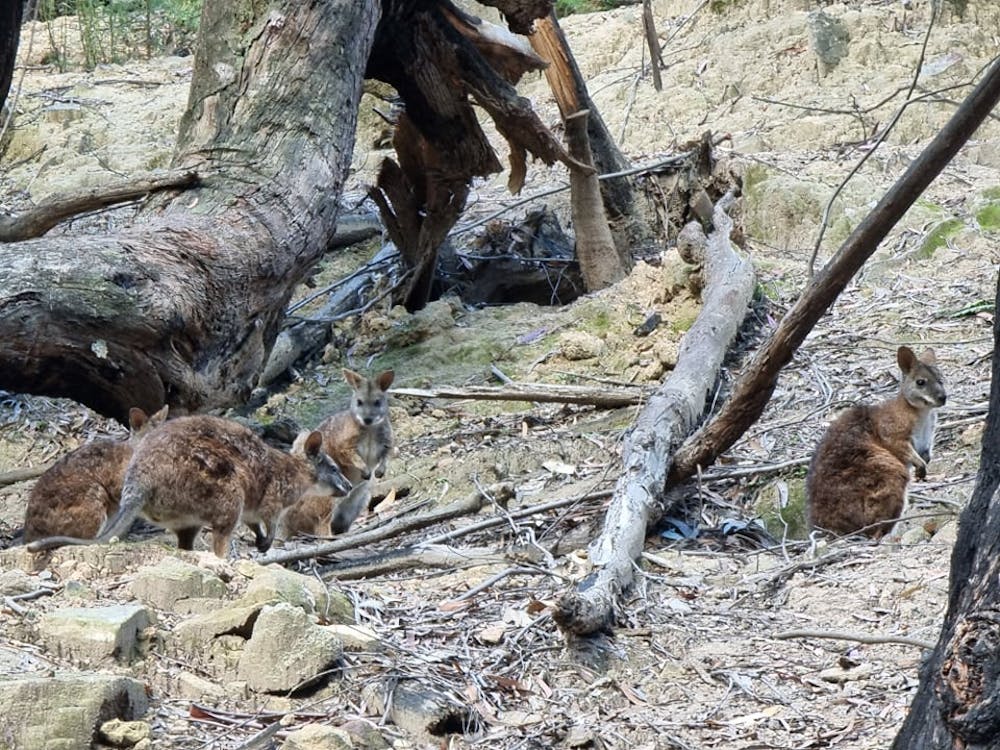
Over half of the Parma wallaby’s habitat was burned in the Black Summer bushfires.
Elliott Dooley, Author provided

Saving the parma

The recent bushfire Royal Commission raised the issue that Australia doesn’t have a comprehensive, central source of information about its native flora and fauna. This is especially urgent, given seemingly “drab” species like the parma wallaby that have gone unnoticed for too long.

All species rely on interactions with a plethora of other species to survive in a complex system from which humans are not exempt. But with so little known about these interconnected relationships, we don’t know what the broader impacts to the ecosystem would be if one species disappeared.


Read more:
3 billion animals were in the bushfires’ path. Here’s what the royal commission said (and should’ve said) about them


Imagine a Jenga tower where each species is a wooden block. You can never really be certain which block you remove will cause the tower to collapse. Australia has an appalling extinction record, and we can’t afford to be playing Jenga with our biodiversity — whether it’s a boring bird, an ugly fish or just another wallaby.

Our ongoing research aims to help fill this conservation gap. We focus on a range of conservation actions the parma wallaby needs immediately.

These include carrying out field surveys to gauge the extent of their survival, and identifying the places that need refuge vegetation recovery. Refuge patches of bushland are important because they provide parma wallabies escape routes and places to hide, helping protect them from predation.

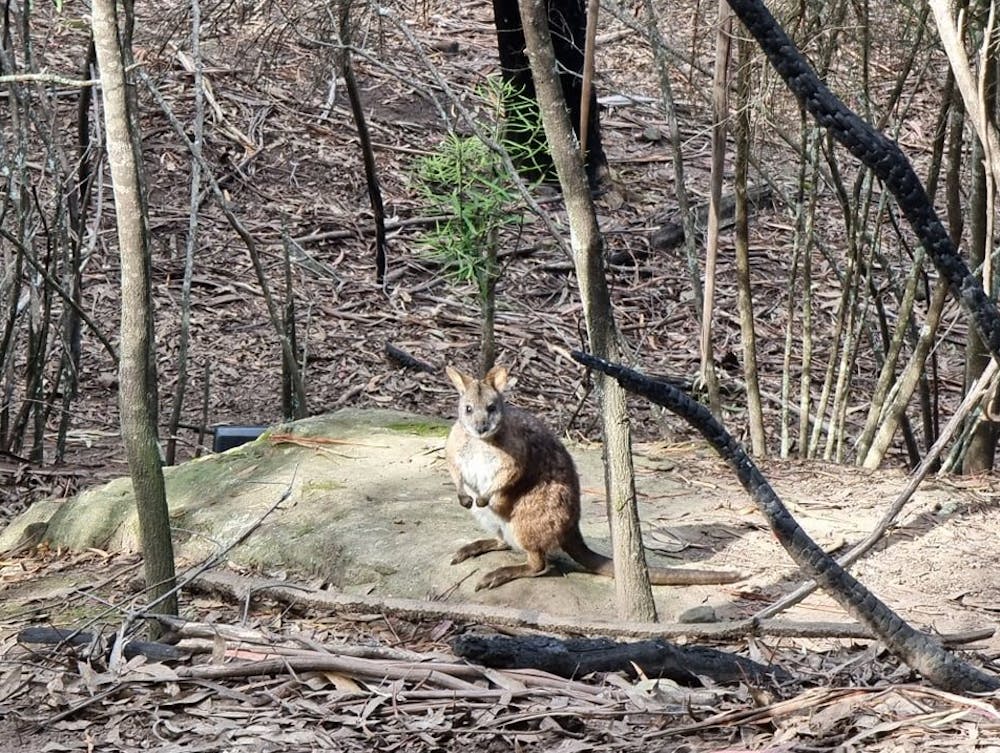
Parma wallaby sitting on a rock
If you want to help save parmas, keep your cat inside.
Lachlan McRae, Author provided

But you can help, too

Given the breadth of catastrophic fires is expected to increase under climate change, we can all help threatened species like the parma wallaby bounce back.

Come bushfire season, you can reduce the fire risk around your home by clearing anything that could fuel a fire — long grass, weeds and leaves on the ground and in guttering.

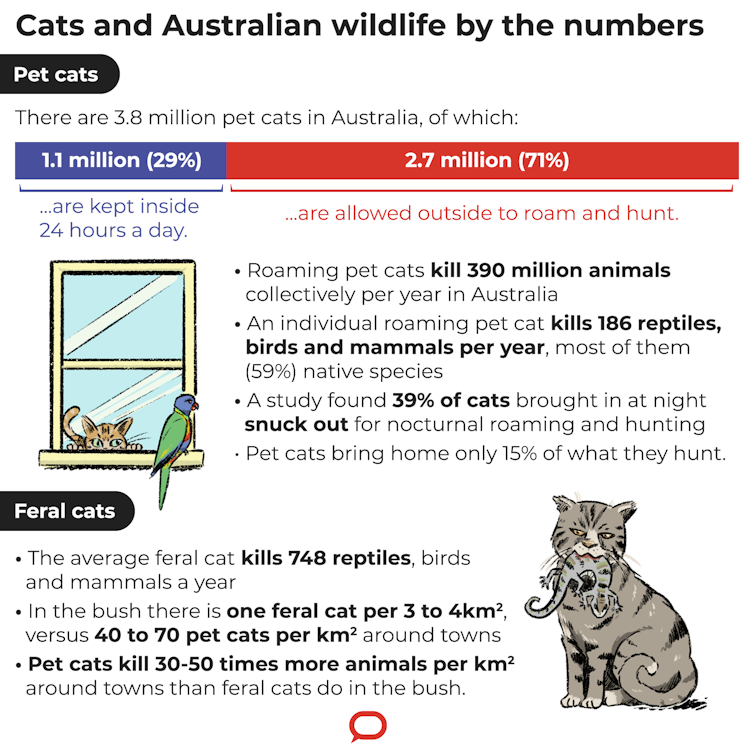
The parma wallaby, like many other little mammals, is vulnerable to introduced predators, especially cats. By keeping your cat indoors, you could be sparing the lives of 186 animals per year.


Wes Mountain/The Conversation, CC BY-ND

You can urge your politicians to value Australia’s unique and precious biodiversity. They are the ones who will ultimately determine whether our threatened species survive or go extinct.

Finally, you can volunteer. There are many volunteer-based conservation projects all over Australia, run by government agencies, charities, and universities.

With the ongoing pandemic travel restrictions, there’s no better time to experience the rich biodiversity this country has to offer, and discover less celebrated, but still fascinating, species like the parma wallaby.

The Conversation

Elliott Dooley receives funding from an Australian Government Research Training Program Scholarship.

Matt Hayward receives funding from the Australian Research Council via Linkage Grant LP200100261.
.

ref. This shy little wallaby has a white moustache and shares its name with a pub meal. Yet it’s been overlooked for decades – https://theconversation.com/this-shy-little-wallaby-has-a-white-moustache-and-shares-its-name-with-a-pub-meal-yet-its-been-overlooked-for-decades-164326

OnlyFans controversy highlights the bind facing most gig workers

Source: The Conversation (Au and NZ) – By Dilan Thampapillai, Associate Professor, University of New South Wales, UNSW

Shutterstock

The saga over subscription-based social media platform OnlyFans, which announced it would ban sexually explicit content only to reverse that decision a week later, has highlighted just how quickly such a platform can move the goalposts for those relying on it for an income.

Yes, the most successful “content creators” on OnlyFans can reportedly make more than US$100,000 a month. But they are the minority. Most barely make enough to justify the hustle, with the median income estimated to be US$180 a month.

Strip away the sexy marketing and what you have is just another digital platform facilitating another form of gig work, substantially no different to ride-share drivers or food-delivery couriers.

The increase in popularity of OnlyFans during the COVID-19 pandemic is mirrored by the growth of the gig economy more generally. With the pandemic hitting other forms of part-time and casual work, the attraction of the income-earning activities provided by digital platforms has increased.

Some of these activities outside of the traditional, long-term employer-employee relationship may even appear desirable, offering flexibility as child care and other demands have increased during lockdowns.

Though precise estimates are complicated by differences in definitions of work and the way statistics are counted, the data suggests at least 10% of the labour force in industrialised economies now rely primarily on gig work for their income. They may be called freelancers, independent contractors, temporary workers or consultants. More than a quarter of the workforce participates in the gig economy in some capacity.

OnlyFans’ popularity has grown significantly during the pandemic.
STRMX/AP

Gig work is rightly controversial. It continues to be accused of driving inequities, exploitation and issues around workplace and occupational health safety. While there have been a few significant legal wins this year for some gig workers over employment status and rights, platforms still largely have the whip hand.

Shifting risks

Key to platforms’ power is how they avoid responsibilities and transfer risks to gig workers, by positioning themselves legally as intermediaries between customer and service provider.

This is achieved via the terms and conditions users agree to when they sign up. These terms and conditions can be changed at any time. While users are generally given notice, they are often unaware of changes because they don’t bother to read notifications before agreeing to updated terms.


Read more:
The rise of the ‘porntropreneur’: even hustlers need side hustles in the gig economy


In the case of OnlyFans, its “standard contract” gives subscribers permission to access content produced by a creator, and also implicitly obligates a creator to produce and provide content over time. The contract is just over 1,500 words — theoretically short enough to read, though it’s likely few do so entirely.

The contract does permit for the expiry of the licence where the creator removes content. It also includes a “no guarantees” clause that mostly protects the creator with regard to the removal or unavailability of content. These clauses superficially seem to give creators some protection from disgruntled fans. But in reality they are a trap for the unwary.

If things go wrong, consumer protection laws generally give customers rights that create liabilities for creators. For example, under Australian Consumer Law a court could strike out the “no guarantees” clause in the OnlyFans standard contract, making creators liable for non-delivery to fans.

Had OnlyFans banned sexually explicit content, subscribers could well have have been entitled to demand their money back from content creators. The platform would not have been liable.


Read more:
3 ways ‘algorithmic management’ makes work more stressful and less satisfying


Future challenges

The OnlyFans case thus highlights the precarity of gig work, and some interesting legal, social and governance challenges for the future.

2021 has delivered some landmark court rulings in Britain, the Netherlands and Australia rolling back the ability digital platforms such as Uber and Deliveroo to dictate the terms by which they engage and pay drivers and riders.

But these were limited wins, not applicable to all gig workers even in those jurisdictions. There is still more work to be done.

The Conversation

Sarah Steele receives funding from the Wellcome Trust via Bocconi University and the University of Cambridge. She consults for Australian National University’s College of Law. She has worked on research funded by the John and Laura Arnold Foundation, but received no funds or grants directly from that organisation herself. She receives monies from various organisations and companies to provide active bystander training aimed at addressing sexual harassment and assault in workplace and institutional contexts, and is working with EdX to delivery this training worldwide.

Dilan Thampapillai does not work for, consult, own shares in or receive funding from any company or organisation that would benefit from this article, and has disclosed no relevant affiliations beyond their academic appointment.

ref. OnlyFans controversy highlights the bind facing most gig workers – https://theconversation.com/onlyfans-controversy-highlights-the-bind-facing-most-gig-workers-167101

Flies like yellow, bees like blue: how flower colours cater to the taste of pollinating insects

Source: The Conversation (Au and NZ) – By Jair Garcia, Research fellow, RMIT University

Hoverfly (_Eristalis tenax_) feeding on marigold Fir0002/Flagstaffotos, CC BY-NC

We all know the birds and the bees are important for pollination, and we often notice them in gardens and parks. But what about flies?

Flies are the second most common type of pollinator, so perhaps we should all be taught about the bees, the flies and then the birds. While we know animals may see colour differently, little was known about how fly pollination shapes the types of flowers we can find in nature.

In our new study we address this gap in our knowledge by evaluating how important fly pollinators sense and use colour, and how fly pollinated flowers have evolved colour signals.

Specialed flower visiting flies: a hoverfly (Eristalis tenax) (left panel), and a bee-fly (Poecilanthrax apache) (right panel)
Michael Becker, Pdeley

The way we see influences what we choose

We know that different humans often have preferences for certain colours, and in a similar way bees prefer blue hues.

Our colleague Lea Hannah has observed that hoverflies (Eristalis tenax) are much better at distinguishing between different shades of yellow than between different blues. Other research has also reported hoverflies have innate responses to yellow colours.


Read more:
The mystery of the blue flower: nature’s rare colour owes its existence to bee vision


Many flowering plants depend on attracting pollinators to reproduce, so the appearance of their flowers has evolved to cater to the preferences of the pollinators. We wanted to find out what this might mean for how different insects like bees or flies shape flower colours in a complex natural environment where both types of insect are present.

The Australian case study

Australia is a natural laboratory for understanding flower evolution due to its geological isolation. On the mainland Australian continent, flowers have predominately evolved colours to suit animal pollination.

Around Australia there are plant communities with different pollinators. For example, Macquarie Island has no bees, and flies are the only animal pollinator.

We assembled data from different locations, including a native habitat in mainland Australia where both bees and flies forage, to model how different insects influence flower colour signal evolution.

Measuring flower colours

Since we know different animals sense colour in different ways, we recorded the spectrum of different wavelengths of light reflected from the flowers with a spectrometer. We subsequently modelled these spectral signatures of plant flowers considering animal perception, allowing us to objectively quantify how signals have evolved. These analyses included mapping the evolutionary ancestry of the plants.

Generalisation or specialisation?

According to one school of thought, flower evolution is driven by competition between flowering plants. In this scenario, different species might have very different colours from one another, to increase their chances of being reliably identified and pollinated. This is a bit like how exclusive brands seek customers by having readily identifiable branding.

An alternative hypothesis to competition is facilitation. Plants may share preferred colour signals to attract a higher number of specific insects. This explanation is like how some competing businesses can do better by being physically close together to attract many customers.


Read more:
Plants use advertising-like strategies to attract bees with colour and scent


Our results demonstrate how flower colour signalling has dynamically evolved depending on the availability of insect pollinators, as happens in marketplaces.

In Victoria, flowers have converged to evolve colour signals preferred by their pollinators. The flowers of fly-pollinated orchids are typically yellowish-green, while closely related orchids pollinated by bees have more bluish and purple colours. The flowers appeared to share the preferred colours of their main pollinator, consistent with a facilitation hypothesis.

Typical flowers preferred by bees (Lobelia rhombifolia, left panel) and flies (Pterostylis melagramma, right panel) encountered in our study sites. Inserts show the spectral profile for each species as measured by a spectrometer.
Mani Shrestha

Our research showed flies can see differences between flowers of different species in response to the pollinator local “market”.

On Macquarie Island, where flies are the only pollinators, flower colours diverge from each other – but still stay within the range of the flies’ preferred colours. This is consistent with a competition strategy, where differences between plant species allow flies to more easily identify the colour of recently visited flowers.

When both fly and bee pollinators are present, flowers pollinated by flies appear to “filter out” bees to reduce the number of ineffective and opportunistic visitors. For example, in the Himalayas specialised plants require flies with long tongues to access floral rewards. This is similar to when a store wants to exclusively attract customers specifically interested in their product range.

Our findings on fly colour vision, along with novel precision agriculture techniques, can help using flies as alternative pollinators of crops. It also allows us to understand that if we want to see a full range of pollinating insects including beautiful hoverflies in our parks and gardens, we need to plant a range of flower types and colours.

The Conversation

Adrian Dyer receives funding from The Australian Research Council.

Jair Garcia and Mani Shrestha do not work for, consult, own shares in or receive funding from any company or organisation that would benefit from this article, and have disclosed no relevant affiliations beyond their academic appointment.

ref. Flies like yellow, bees like blue: how flower colours cater to the taste of pollinating insects – https://theconversation.com/flies-like-yellow-bees-like-blue-how-flower-colours-cater-to-the-taste-of-pollinating-insects-167111

Regressive changes to Northern Territory water laws could undermine Indigenous rights

Source: The Conversation (Au and NZ) – By Erin O’Donnell, Early Career Academic Fellow, Centre for Resources, Energy and Environment Law, The University of Melbourne

Water management in the Northern Territory just keeps making headlines. The recent decision to grant an unprecedentedly large groundwater licence is a case in point.

The licence, granted to Fortune Agribusiness at Singleton Station, threatens springs and sacred sites near Alice Springs, and Aboriginal people, who are the custodians of these places, say they “are not being listened to”.

These media stories point to a wider problem with water law and water management in the Northern Territory. New legislation passed just this month is set to make it worse.

Under the cover of responding to a COVID-induced economic slowdown, the Northern Territory government is set to undermine hard-won national standards of water governance. This includes one of the most important advances in Indigenous water rights: the reservation of water for Aboriginal land owners to use or trade.

The Northern Land Council called the water law reforms a “betrayal of the interests of all Territorians”.

With even more regressive reforms on the books, the future of the NT’s water is looking more like its frontier past.

The NT’s history of undermining Aboriginal economic development

Water is a valuable resource, especially in the drier zones of Australia. The sheer volume of the Alice Springs water licence, in particular, represents a new form of resource extraction that rivals mineral extraction in scale.

Just as in the 19th and 20th centuries, the rampant reach of the Crown to appropriate and control natural resources to the detriment of Aboriginal peoples is evident. Analysis of the actions of the NT government in land rights disputes since the 1970s showed it made “immense areas of land and resources” available to commercial interests at virtually no cost.

A major participant (and beneficiary) of the government’s efforts to prevent land claims was the Northern Territory Land Corporation. Its role included holding title to certain lands, thereby removing them from the category of land over which claims could be made under the Land Rights Act.

History is being repeated in today’s water reforms. The Northern Territory Land Corporation has now been repurposed to accelerate the transfer of water rights to commercial interests. This move could make it harder for Aboriginal people to access water.

Why is Northern Territory water governance so weak?

In 2004, states and territories across Australia signed the National Water Initiative, which laid a foundation for good water management. On almost all counts, the Northern Territory is not compliant.


Read more:
Australia, it’s time to talk about our water emergency


Only 5% of the Northern Territory is covered by water allocation plans. Under NT law, environmental water is protected through provisions in water plans – which means it is largely unprotected in the 95% of the territory without a plan.

Major decisions about water use are made by the water controller, who wears multiple hats. They are the water regulator, the chief executive of the Territory’s environment department, and also sometimes a water holder through their role on the board of the Northern Territory Land Corporation. We think that this inevitably creates a perception of a conflict of interest, and objectively leaves the decisions open to criticism, even where the decisions are well based.

One of the only areas in which the NT is arguably ahead of the curve is the Strategic Aboriginal Water Reserve. It was introduced into law in 2019 because Indigenous people have historically been locked out of water allocation processes and denied water rights.

The reserve sets aside up to 30% of water rights in a water allocation plan area for Aboriginal economic development. The reserve is only available to Aboriginal people with recognised rights to land.

Water can only be accessed under the reserve through an allocation plan. Even then, if all the available water is allocated by the time the plan is prepared, the reserve will have no water.

New laws make NT water governance worse

On August 12, the NT parliament passed the first of two key pieces of water legislation. The Statute Law Amendment (Territory Economic Reform) Act creates “head licence” arrangements that will formally allow “speculative” water licence applications from land developers, including the NT Land Corporation.

As water licences in the NT cost nothing to acquire, developers can effectively hoard this water for free until they are ready to proceed, locking others out.

The second set of law reforms are in the environment omnibus bills, which have been recently delayed by the NT environment minister after widespread concern about inadequate consultation.

As currently written, these bills:

  1. reduce the need to comply with water allocation plans when issuing a water licence

  2. enable water trade to occur outside water allocation plan areas

  3. reduce public notification requirements, including for dams, limiting public feedback.

If passed, these laws would reduce transparency and scientific rigour in water allocation and undermine public confidence in regulation.

Together, these proposed changes mean the Northern Territory government is less likely to invest resources to produce more water allocation plans (essential for Aboriginal Water Reserves). Even where they do, new “head licence” law means more water may be allocated by the time the plans come into effect, leaving less in the Aboriginal Water Reserve.


Read more:
The Beetaloo drilling program brings potential health and social issues for Aboriginal communities in remote NT


The future of water management in the Northern Territory

We can’t help but also draw a connection between the new legislation and the successful challenges to water licence decisions made by the water controller.

These include most recently the decision by the NT minister to cancel the Larrimah water licence (issued to the Northern Territory Land Corporation) on the grounds it lacked clarity on future water use and was therefore too “speculative”.

A similar challenge has been made to the decision to grant the 40,000 megalitre licence at Alice Springs. However, the new “head licence” arrangements could entrench speculative water use in the Northern Territory’s water law.

While the changes appear to be aimed at stimulating economic development, the package of law reforms (those passed in August and those still under consideration) weaken legal controls on the issuing of water licences. Considering the Northern Territory’s colonial history, these new laws seem like a way to make it harder for Aboriginal people to access water for economic gain.

The excessive scope of this package of new water laws is not dissimilar to the long campaign by mining companies and the Northern Territory government itself in opposition to Aboriginal land rights from the 1970s.

The Northern Territory government has a long, tragic history of weakening land and water rights for Aboriginal people, and the proposed laws could further entrench the national problem of water dispossession.

The Conversation

Erin O’Donnell has received funding from the Northern Land Council for research on the Strategic Aboriginal Water Reserve in 2021. She is a member of the Birrarung Council, the voice of the Yarra River.

Professor Marcia Langton AO holds the Chair in Australian Indigenous Studies at The University of Melbourne consults to Origin Energy (2021) and other private sector entities cultural awareness, reconciliation and Indigenous engagement. She has received receives funding from the ARC and AIATSIS for research on Indigenous agreements and resource management, including water resources.

Sue Jackson has received funding from the Northern Land Council for research on the Strategic Aboriginal Water Reserve in 2021 and from a number of ARC grant schemes (for research on Indigenous water rights, water cultures, and water and carbon markets). She is a member of the scientific advisory committees of the Murray-Darling Basin Authority and the Lake Eyre Basin Ministerial Council.

ref. Regressive changes to Northern Territory water laws could undermine Indigenous rights – https://theconversation.com/regressive-changes-to-northern-territory-water-laws-could-undermine-indigenous-rights-166561

‘A singular vision’: new film tells the touching story of musician and Triffids founder David McComb

Source: The Conversation (Au and NZ) – By Ted Snell, Honorary Professor, Edith Cowan University

The Triffids photographed in 1987. Andrew Catlin

Love in Bright Landscapes: The story of David McComb of The Triffids, directed by Jonathan Alley

David McComb’s lyrics embed narratives of love and loss within the vastness of the Western Australian landscape. “The sky was big and empty, my chest filled to explode, I yelled my insides out at the sun, at the wide-open road.”

It’s a song “full of air,” explains Paul Kelly. The lyrics of McComb, who founded legendary band The Triffids with his friend Alsy MacDonald and brother Robert in 1978, evoke a palpable sense of place. The group attracted enthusiastic audiences at festivals, garnering critical acclaim as part of the Australian indie band invasion of Britain in the early 1980s.

“You don’t just hear these songs,” says Kelly in Jonathan Alley’s extraordinary documentary Love in Bright Landscapes? “You see them, feel and smell them.”

By the late 1980s, The Triffids were filling stadia all over Europe, performing songs such as Wide Open Road, Save What You Can and Bury Me Deep in Your Love. However, this didn’t guarantee commercial success. In 1989, they disbanded, leaving a legacy of tender, lyrical songs and memorable performances.

The band’s successes and frustrations, McComb’s ascendancy as songwriter and performer, his physical decline, and his early death in 1999, aged 36, are beautifully told in this film.

Alley has structured his documentary like one of McComb’s songs. The unfurling narrative is driven by an urgent sense of purpose and inspired by McComb’s “magpie aesthetic,” where everything makes a connection.

From his early life (described by those who loved and worked with him), an image emerges of a sensitive boy from a privileged background with high achieving parents. His mother Athel confesses he was “… different from the others; his life was singular”.

Young David with rabbits.
Label distribution

David met his best mate MacDonald at Christ Church Grammar School in the 1970s, where, coincidentally, I was Senior Art Master. Art was a means of escape, a way to make sense and break free. The inquiring, intelligent McComb brothers (David had three siblings) trooped through my classes. As McComb said in 1998, the stricter the school, “the better rock and roll music it can produce”.

As punk spread from London to Seattle and Claremont, David and drummer MacDonald formed a band called Daisy, making their own albums on cassette. Daisy morphed into The Triffids in 1978, drawing on the DIY energy that seems to coalesce around the western edge of continents.

In the documentary Hype, for instance, which chronicles the rise of the grunge scene in Seattle, the lack of mainstream infrastructure is described as liberating, making it possible for young musicians to imagine recording their own music, writing their own magazines, and distributing their work. In Perth, like Seattle, doing it yourself was the only way to get something happening.

A creative cauldron

As a result, these young musicians and entrepreneurs were free to break new ground and stir it up. “David was the original Punk, not Johnny Lydon,” says Alley, “… everything was up for grabs, he made no distinction between high and low culture”.


Read more:
Friday essay: punk’s legacy, 40 years on


From the creative cauldron of Perth in the 70s emerged Hoodoo Gurus frontman Dave Faulkner, and bands like the Manikins, Kim Salmon and the Surrealists and The Triffids.

Despite McComb’s conviction that “nothing happens here, nothing gets done, but you get to like it,” The Triffids did make great music and performed some terrific gigs before leaving, first for Sydney, then London.

There they found the success that had eluded them. In 1984, they recorded a session with John Peel on BBC radio. By 1985 they were on the cover of New Musical Express. They were on the cusp of global success, playing major festivals and signed by Island records.

Through Alley’s scrapbook of home videos, photographs, and interviews, we hear how it all slowly unravelled. It’s a sad story of a driven musician whose creativity was the bulwark keeping his demons at bay. Fuelled by a regime of drugs, he died of a heart attack on February 2 1999. The conflict that informed his best work was internal.

David McComb and vocalist Will Akers photographed in 1998.
Denise Nestor

“I woke to discover an inferior replica of myself,” wrote McComb in a diary note; “avoid madness” in another. This inner tension with his dark side was a catalyst for his songs but as Alley explains “… for David, his best self was his creative self.”

McComb joined the galaxy of rock and roll stars whose short lives continue to inspire generations. Still, albums like Born Sandy Devotional and songs like Wide Open Road remain potent markers in our cultural life.

Laure Prouvost, Lick in The Past, 2016, installation view at the Perth Institute of.
Contemporary Arts.

Bo Wong

For curator Annika Kristensen, McComb’s album title Love in Bright Landscapes — borrowed from the Spanish poet Rafael Alberti but made his own — is a lens through which to explore the social, political and cultural landscapes of Perth and Los Angeles.

Coincidentally on show currently at Perth Institute of Contemporary Art, the 14 artists from both cities she has selected locate stories of love, hope, desperation, and despair under the vast canopy of a shared open sky.

McComb, whose love stories inflected with pain, humour, and wistful longing bleed into imagery of expansive WA landscapes, would have been delighted.

Love in Bright Landscapes will premiere at Luna Leederville in Perth on September 9.

Love in Bright Landscapes, curated by Annika Kristensen, is at Perth Institute of Contemporary Art, until October 10

The Conversation

Ted Snell does not work for, consult, own shares in or receive funding from any company or organisation that would benefit from this article, and has disclosed no relevant affiliations beyond their academic appointment.

ref. ‘A singular vision’: new film tells the touching story of musician and Triffids founder David McComb – https://theconversation.com/a-singular-vision-new-film-tells-the-touching-story-of-musician-and-triffids-founder-david-mccomb-166758

How ‘tax forgiveness’ could help New Zealand’s many small businesses weather the financial woes brought on by COVID-19

Source: The Conversation (Au and NZ) – By Ranjana Gupta, Senior Lecturer Taxation, Auckland University of Technology

Shutterstock/Sam Wordley

Governments worldwide have released emergency stimulus packages to support workers and businesses through the economic crisis COVID-19 has wrought.

These measures include financial support, credit relaxation and tax relief for small businesses and some individuals, but they benefit only some taxpayers.

New Zealand may need to consider more significant changes to the tax system to repay the unprecedented level of borrowing that has funded the pandemic response. Tax cuts, investment incentives, changes to filing deadlines and tax amnesties could all play a significant role in helping to alleviate COVID-19’s financial and economic impact.

My research explores whether, under current uncertain economic conditions, introducing a voluntary disclosure program for overseas income could help protect New Zealand’s pandemic-impacted businesses — and promote honesty in tax matters at the same time.

New Zealand’s tax system is primarily punitive, rather than encouraging tax compliance. If a taxpayer is operating outside the tax system, the consequences of re-entering may be harsh. This encourages even inadvertent offenders to remain outside the system.

Tax amnesties, also known as “tax forgiveness”, can help short-term tax collection, recoup lost tax revenue and allow taxpayers to “regularise” their tax compliance.


Read more:
How a one-off tax on wealth could cover the economic cost of the coronavirus crisis


A low-cost compliance initiative

New Zealand has strengthened penalties for tax offences considerably during the late 1980s to protect existing voluntary compliance. The introduction of an Overseas Voluntary Disclosure (OVD) mechanism would not only improve compliance but boost future tax revenue. Taxpayers cannot hide from their tax obligations once they have disclosed overseas income.

Since 1990, the number of immigrants has increased in New Zealand. According to the 2018 census, 31% of New Zealand’s population are immigrants. One in ten are self-employed without employees, and 5% have employees.

Many of these immigrants own small businesses. As a result of COVID-19, they are dealing with cash-flow stress. They may not be fluent in English or be unaware of their tax obligations and are unintentionally non-compliant. They now face the ramifications and penalty costs of voluntary disclosure.

Of course, some taxpayers are intentionally non-compliant in reporting their offshore income and assets. Whether unintentionally or deliberately non-compliant, many are self-employed and may want to inject their undeclared overseas funds into their local businesses to offset cash-flow stress.

Irrespective of these taxpayers’ accidental or deliberate lack of compliance, the Inland Revenue Department (IRD) must support these small businesses through the current crisis.

Offshore tax investigations

New Zealand adopted the Automatic Exchange of Information (AEOI) mechanism, which allows the IRD to obtain information about offshore assets and funds for New Zealand tax residents to verify it is accurately reported for tax purposes. New Zealand completed its first information exchange in 2018.

Since 2019, the IRD has started sending letters to New Zealand resident taxpayers regarding foreign income and tax residence status. They are advised to disclose the foreign-sourced income in their tax returns.

Some taxpayers may falsely assume the IRD is randomly targeting them and may continue to hide their foreign income. For those non-compliant taxpayers, an audit investigation is the first option.


Read more:
Post-coronavirus, we’ll need a working tax system, not more taxes and not higher rates


My research shows that offering voluntary disclosure would substantially reduce administrative costs in cross-checking the millions of lines of additional data received under the AEOI policy.

To administer such a program effectively, the IRD must use the best strategies to encourage voluntary declaration. For example, the opportunity to declare should be offered once only. Enforcement strategies and sanctions for non-compliance should be credible, consistent and clear.

Tougher penalties and interest would apply to those who choose not to take advantage of the program. Research shows a well-administered tax amnesty program facilitates strong engagement.

My research suggests New Zealand should offer a robust voluntary disclosure initiative similar to Australia’s 2014 Project Do It. Australian tax administrators gave taxpayers a last chance to correct their offshore tax affairs before audits or litigation.

This allowed intentional and unintentional tax evaders to pay the debt assessed under amnesty conditions without fear of prosecution or compliance penalties. It succeeded in encouraging them to return to the tax system.

Deliberate tax evaders will get the message that if they do not declare offshore assets, severe punishments will be imposed. Voluntary disclosure would also help non-compliant taxpayers protect their businesses from the financial and economic turmoil COVID-19 has caused.

The Conversation

Ranjana Gupta does not work for, consult, own shares in or receive funding from any company or organisation that would benefit from this article, and has disclosed no relevant affiliations beyond their academic appointment.

ref. How ‘tax forgiveness’ could help New Zealand’s many small businesses weather the financial woes brought on by COVID-19 – https://theconversation.com/how-tax-forgiveness-could-help-new-zealands-many-small-businesses-weather-the-financial-woes-brought-on-by-covid-19-166955

PODCAST: After two decades of unnecessary conflict Should US security partners question this Coalition of the Willing

Paul G. Buchanan and Selwyn Manning deliver the A View from Afar podcast - September 2, 2021.
A View from Afar
A View from Afar
PODCAST: After two decades of unnecessary conflict Should US security partners question this Coalition of the Willing
Loading
/

A View from Afar – In this week’s podcast, Paul G. Buchanan and Selwyn Manning discuss: With the United States being viewed as responsible for a monumental botch-up in Afghanistan, how should its traditional security partners, including NATO and Australia, regard US-leadership in conflict? And, how should US allies position their own national interest in the future?

  • For example; why should the United States of America’s global security partners, in both northern and southern hemispheres, view the USA as a reliable security leader?

When we consider the United States-led conflicts in Libya, Iraq, Syria, and Afghanistan, there is a pattern that stands out: these are all wars of opportunity or choice, rather than necessity.

In analysing this, it follows that lessons learnt by NATO and other global security partners may very well be to not follow the USA into such conflicts if existential threats do not exist.

Also of consideration is this:

  • Are the United States’ failures tied solely to incompetent leadership?
  • Or is this clearly apparent incompetence caused by those within the star-general-ranks of occupational forces command?
  • Or is this problem institutionalised within a morphed alliance-of-incompetence from a broad-base of institutions located within the United States security-defence apparatus?

Now, the United States is shifting its global defence strategy to counter the rise of China in the Western Pacific and Indo-Pacific regions.

  • Should the states and economies of the Asia Pacific fall in behind the USA once again and risk being drawn into another unnecessary and protracted war?
  • And considering the United States’ domestic situation being insecure and democratically chaotic, should the USA lead from the rear but only after it gets its own house in order?

YOU CAN CONTINUE THE DEBATE WITH COMMENTS AND QUESTIONS IN THE RECORDING OF THIS PODCAST:

You can comment on this debate by clicking on one of these social media channels and interacting in the social media’s comment area. Here are the links:

If you miss the LIVE Episode, you can see it as video-on-demand, and earlier episodes too, by checking out EveningReport.nz or, subscribe to the Evening Report podcast here.

The MIL Network’s podcast A View from Afar was Nominated as a Top  Defence Security Podcast by Threat.Technology – a London-based cyber security news publication.

Threat.Technology placed A View from Afar at 9th in its 20 Best Defence Security Podcasts of 2021 category. You can follow A View from Afar via our affiliate syndicators.

Podchaser - Evening Report
Listen on Apple Podcasts

***

A good induction is important for all new jobs. So why are teachers being left behind?

Source: The Conversation (Au and NZ) – By Anna Sullivan, Associate Professor of Education, University of South Australia

Shutterstock

Australian schools are struggling to recruit and keep teachers. Low wages, overwork, difficult student behaviour, lack of support and stress are some of the reasons teachers leave the profession or have periods of sick leave.

More than half of teachers with a current teaching qualification are not working in education. States such as New South Wales are facing major difficulties in employing teachers. This is especially so in the case of casual teachers who are needed to replace stressed and sick teachers.

Part of the reason for the teacher shortage is Australia’s lack of support for graduating teachers to successfully transition into the profession.

How does this work?

The transition for graduate teachers into the profession can be very challenging and they need to be supported with a quality induction program. Such programs help new teachers learn more about their roles, gain confidence and refine their teaching skills.

They are especially important for new teachers learning how to effectively manage diverse classrooms and student behaviour.

According to the Australian Institute for Teaching and School Leadership, induction programs should be:

  1. school-based

  2. delivered over two years

  3. embedded in daily practice

  4. practice-focused to further develop teaching skills.

From doing research in this area, we know Australian schools have responded to this need and increasingly developed induction programs to support new teachers over the past decade.

But it can take teachers several years to find long-term employment, which means many new teachers miss out on effective induction programs.

Research from 2019 shows that, within the first two years of graduating, 60% of new teachers are employed as insecure replacement teachers. We know

  • 30% of new teachers are employed on contracts of less than one year

  • 30% of new teachers are employed as casual teachers.

This leaves many new teachers relying on the strategies they develop during their insecure work experience to manage diverse classrooms and difficult student behaviours.

Newly qualified teachers who aren’t involved in a good induction program are more likely to leave the profession within their first five years of teaching.

No induction affects students too

Teachers employed casually or on short-term contracts know it is important to understand students’ strengths, needs and interests, as well as build good relationships with them. But they often don’t have the time or opportunity to do this properly.


Read more:
Six ways to support new teachers to stay in the profession


They know curriculum and pedagogy are important, yet often don’t know what the regular teacher had planned. And they haven’t always got time to assess and understand the students’ learning needs.

Short-term teaching work leads to a reliance on surviving or just getting through the day. Typically, this means managing student behaviour using more reactive techniques such as rewards and consequences (punishments).

On top of this, newly qualified teachers may feel anxiety about their uncertain job prospects and the potential loss of income.

Tired teacher leaning head against blackboard.
New teachers employed as casuals just try to survive. They don’t have the time or experience to use evidence-based approaches to teaching and class management.
Shutterstock

Teachers employed for a short term usually try to perform as well as they can, so they get a subsequent job. This means they are usually reluctant to let anyone know they need help. They are aware they are being scrutinised and it’s important they are seen as being capable of managing students’ behaviour. More controlling approaches can help them achieve this.

Such teaching approaches mean they are not attending to the students’ problem behaviours in a way that prevents them from reoccurring. This can lead to an escalation of these behaviours over time and result in the student being disaffected at school.


Read more:
How teachers are taught to discipline a classroom might not be the best way


Teachers need to develop a broad range of proactive strategies to build a positive learning environment and prevent student behaviour problems. They must also be able to intervene effectively to de-escalate issues when they arise.

Much of this learning is based on developing and refining classroom management strategies during the induction period with the support of colleagues.

We’ll keep losing teachers

Induction programs are focused more on permanent new teachers. But the majority of new teachers are contract or casual staff.

A one-size-fits-all approach to induction programs will not address the specialist needs of casual teaching staff, particularly graduate teachers who move regularly between diverse school settings as work demands require.


Read more:
Teachers shouldn’t have to manage behaviour issues by themselves – schools need to support them


Education departments should support schools, including financially, to include casual and contract teachers in meaningful induction programs. They should also think more creatively about what is possible because this problem rests with them.

If we don’t develop meaningful ways for new teachers to be inducted into the profession, we may keep losing them.

The Conversation

Anna Sullivan receives funding from the Australian Research Council. She is Board Chair and Director of the Media Centre for Education Research Australia.

Michele Simons receives has received research funding from the ARC, the NVETRE program as well as from state-based education employers. Michele is currently the President of the Australian Council of Deans of Education, Treasurer of the the Australian Association for Educational Research, and a member of the AVETRA executive. Michele sits on a number of boards including MCERA, the Chain Reaction Foundation and a number of education providers in the school and tertiary education sectors

Neil Tippett receives funding from the Australian Research Council.

Andrea Reupert, Simone White, and Stuart Woodcock do not work for, consult, own shares in or receive funding from any company or organization that would benefit from this article, and have disclosed no relevant affiliations beyond their academic appointment.

ref. A good induction is important for all new jobs. So why are teachers being left behind? – https://theconversation.com/a-good-induction-is-important-for-all-new-jobs-so-why-are-teachers-being-left-behind-166570

From vaccination to ventilation: 5 ways to keep kids safe from COVID when schools reopen

Source: The Conversation (Au and NZ) – By C Raina MacIntyre, Professor of Global Biosecurity, NHMRC Principal Research Fellow, Head, Biosecurity Program, Kirby Institute, UNSW

Shutterstock

Last week the New South Wales government announced schools are scheduled to re-open in October. While face-to-face learning undoubtedly has benefits for both children and parents, the announcement left unanswered a series of important questions about how this can be done safely.

By the time NSW lifts restrictions (estimated to be around October), only 60-70% of the population in NSW — and possibly less in Australia — who are 16 years and over may be fully vaccinated.

The Australian Technical Advisory Group on Immunisation (ATAGI) has recommended vaccination for children 12 and over, but most of these children will not be fully vaccinated by October, and children under 12 will remain unvaccinated for now.

In NSW, with well over 1,000 cases a day and rising, there will still be substantial community transmission when schools open. It is unclear when schools in Victoria (where cases are also on the rise) will open, but there may still be some transmission in the state when they do.

So, what do we need to do to make sure kids are as safe as possible at school?


The Conversation, CC BY-ND

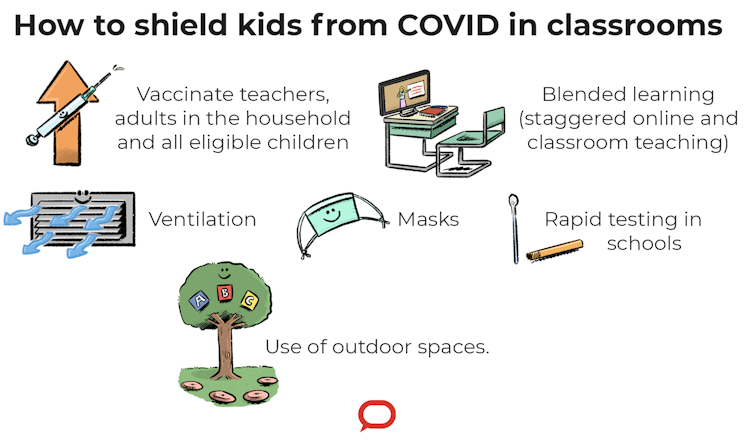
1. Vaccinate the adults around them

In California, a primary school outbreak occurred when an unvaccinated teacher, who came to work despite symptoms, read to students with their mask off. Most kids who became infected were well over 2 metres from the teacher, which confirms the 1-2m distancing rule is not effective for an airborne virus.

Every child and teacher in a classroom or childcare centre with an infected person is at risk. Shared air is the major way SARS-CoV-2 — the virus that causes COVID-19 — spreads.

Children often get the virus from the adults around them, so vaccinating adults in a child’s household, and teachers, can help protect them.

Vaccination is now mandatory for teachers in NSW, but around 67% have had one dose. This probably corresponds to less than 40% of the NSW population being fully vaccinated.

Teacher reading books to kids sitting on the floor.
Anyone in the same room with an infected person, especially if that person isn’t wearing a mask, is at risk of catching the virus.
Shutterstock

One dose of vaccination gives about 31% protection and two doses gives 67% (AstraZeneca) to 88% (Pfizer) protection against the Delta variant. Most kids will still be unvaccinated if schools in the two largest states re-open for the last term of the year. This means it’s even more important to ensure the adults are vaccinated.

2. Mandate masks for teachers and students

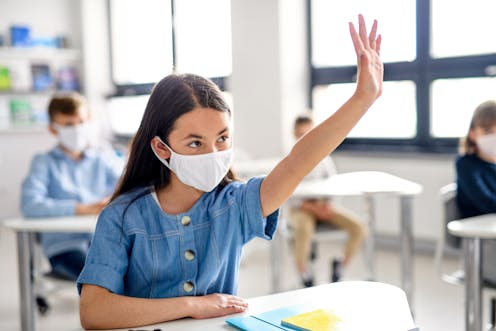
We can mandate masks in schools for teachers and students, and highly recommend mask use for younger children in childcare.

The American Academy of Pediatrics recommends masks for children two years and up; children over this age can wear masks without much trouble.

As mask use in schools has been more common overseas, there are now numerous toolkits (including translated versions) and recommendations to support children to wear a mask. For example, your child is more likely wear a mask if it has their favourite colour, sports team, character or special interest on it.

Importantly, a DIY cloth mask can be made to fit your child’s face and be high quality if key design principles are followed. It is important to ensure children have choices and understand the reason why they are wearing a mask (for instance: “When we wear a mask, the virus can’t jump from person to person.”


Read more:
Can’t get your kid to wear a mask? Here are 5 things you can try


3. Ventilated classrooms

Classrooms can be ventilated by opening windows (ideally two windows at opposite ends of the room). If there is only one window, a fan can help move the dirty air out. If opening windows is not possible there is fortunately a cheap fix available — portable air purifiers, which dramatically reduce the viral load in classrooms.


Read more:
Poorly ventilated schools are a super-spreader event waiting to happen. It may be as simple as opening windows


There are DIY methods for making air purifiers, too.

4. Reduce numbers of people indoors

Reducing the number of people packed together in a classroom can reduce the risk of COVID. For example, during high epidemic periods, if the decision is made to open schools, a group of kids can come in every second day and learn online on alternate days.

We have shown this approach, when combined with masks, reduces the risk of transmission on university campus.

Use of outdoor spaces for lessons is also a smart move as the weather gets warmer. While Delta can transmit outdoors, the risk is likely much lower.

5. Test school kids

Finally, rapid point-of-care testing in schools will help reduce transmission, and self-testing kits (when approved in Australia) can help.

Saliva tests are also a practical way to test children. These tests are now available in official health settings, so governments could make them available to schools.

What about childcare centres?

We also need to consider childcare centres. Contrary to popular narrative, a new study shows kids up to three years old transmit more than older kids. So, vaccinating childcare workers and parents of young kids is also essential.

All the measures above, except masks for 0-2 year olds, can easily be used in childcare settings.

Girls getting swabbed in the mouth.
Rapid testing in schools could help reduce transmission.
Shutterstock

Record numbers of children are being hospitalised with COVID-19 in the USA. It remains unclear whether the high numbers of sick children are due mostly to Delta’s increased transmissibility, or whether it also causes more severe disease in children, as it does in adults. Although the risk of severe disease remains much lower in children than adults.


Read more:
Under-12s are increasingly catching COVID-19. How sick are they getting and when will we be able to vaccinate them?


One thing we do know is that as vaccination rates increase in adults, unvaccinated groups, the largest of which is children, will be proportionally more at risk. The 70-80% targets for vaccination of eligible adults for relaxing restrictions corresponds to 56-64% of the whole population, which leaves plenty of room for Delta to spread like wildfire in unvaccinated adults and kids. So there is good reason to protect kids if we open schools.

In addition, the productivity losses from lockdowns are an important component of the estimated A$220 million daily economic cost in NSW alone. Sick kids make it harder for their parents to work productively, if at all. And they make it more likely parents themselves become sick and are unable to work.

The Conversation

C Raina MacIntyre receives funding from NHMRC and MRFF. She is currently involved in face mask research.

Holly Seale is an investigator on research studies funded by NHMRC and has previously received funding for investigator driven research from NSW Ministry of Health, as well as from Sanofi Pasteur and Seqirus. She is the Deputy Chair of the Collaboration on Social Science and Immunisation.

Richard Holden is President-elect of the Academy of the Social Sciences in Australia.

Greg Kelly does not work for, consult, own shares in or receive funding from any company or organization that would benefit from this article, and has disclosed no relevant affiliations beyond their academic appointment.

ref. From vaccination to ventilation: 5 ways to keep kids safe from COVID when schools reopen – https://theconversation.com/from-vaccination-to-ventilation-5-ways-to-keep-kids-safe-from-covid-when-schools-reopen-166734

What is EMDR therapy, and how does it help people who have experienced trauma?

Source: The Conversation (Au and NZ) – By Peta Stapleton, Associate Professor in Psychology, Bond University

Shutterstock

Earlier this year, Prince Harry revealed he has used a therapy called EMDR to cope with anxiety and trauma, including trauma resulting from his mother Princess Diana’s death when he was 12.

He demonstrates the technique in the Apple TV+ docuseries The Me You Can’t See.

EMDR stands for eye movement desensitisation and reprocessing. But what is this therapy and how does it work?


Read more:
Thinking of seeing a psychologist? Here’s how to choose the therapy best for you


What is EMDR?

EMDR is a psychotherapy treatment that aims to reduce distressing emotions associated with traumatic memories.

It involves consulting with a trained psychologist, usually over about 12 sessions.

Broadly speaking, the sessions involve eight steps:

  1. History and treatment planning: the psychologist will discuss the patient’s specific reason for coming and take a detailed history

  2. Preparation: the psychologist will talk to the patient about what they can expect from EMDR. In this phase, the psychologist will also teach the patient relaxation techniques they can use to calm themselves during or after sessions

  3. Assessment: the psychologist will ask the patient to select a vivid image in their mind relating to the memory they wish to work on. The patient will also be asked to focus on any negative beliefs about themselves, or negative emotions associated with the event

  4. Desensitisation: the patient will be asked to hold the traumatic memory in their mind while following the movements of the psychologist’s finger back and forth with their eyes. The psychologist may also lead the patient in tapping (for example, the patient taps their knees with their hands in an alternating pattern) or auditory tones delivered through headphones. These alternatives to eye movements engage the same parts of the brain

  5. Installation: the patient is guided to replace the original negative belief with a positive one

  6. Body scan: the patient thinks of the original memory to see if there is any physical tension remaining in the body. Usually the memory processing is complete when the memory no longer causes the patient any distress. If it still does, step 4 will be repeated

  7. Closure: this is the end of the session. If the memory has not yet been completely reduced in intensity, the psychologist will guide the patient in relaxation exercises to do until the next session

  8. Reevaluation: this is the start of the next session, where the psychologist and the client assess the previous session’s work and reevaluate the treatment plan as needed.


Read more:
What is repetitive transcranial magnetic stimulation and how does it actually work?


The therapist continually checks in with the client throughout the process.

An important phase at the end of treatment involves looking to the future. The psychologist might ask the patient to imagine an anticipated challenge.

For example, if the patient had been in a car accident, they might imagine driving on a highway, perhaps at night or alone, and see if any distressing emotions arise. If they do, the patient might still need some more treatment.

A unique aspect of EMDR is that the person may not have to discuss any of their disturbing memories in detail. The psychologist may ask “What event do you remember that made you feel distressed?” and the patient may say, “It was something my father did to me.” The process can be done without any extra information.

How does EMDR work? And who can use it?

The dual activity of thinking about a distressing memory and rapidly moving the eyes from side to side appears to reduce the level of emotion in the memory.

One theory is that thinking about a traumatic memory and following something with the eyes requires more memory capacity than is available, therefore the distressing memory is not completely accessed and loses its strength.

A young man talks with a clinician.
EMDR is undertaken with a trained therapist.
Shutterstock

EMDR therapy is most commonly used to treat traumatic stress symptoms and post-traumatic stress disorder (PTSD).

A review of 26 clinical trials showed EMDR treatments significantly reduced symptoms of PTSD, depression, anxiety, and distress in people with PTSD.

The use of EMDR in children with PTSD has been demonstrated to be effective too.

People with phobias or anxiety concerns can also benefit, as can people with depression.


Read more:
More than half of Australians will experience trauma, most before they turn 17. We need to talk about it


While the research suggests EMDR is an effective approach to reducing trauma, there may be some risks or side effects involved. These include:

  • an increase in distressing memories

  • heightened emotions or physical sensations during sessions

  • light-headedness

  • vivid dreams

  • the surfacing of new traumatic memories.

Should any of these occur, the treating psychologist would typically support the patient to process these during the sessions.

Is EMDR recognised?

The World Health Organization and the International Society for Traumatic Stress Studies both recommend EMDR therapy as a treatment for adults and children with PTSD.

It’s also endorsed by the Australian Psychological Society.

If this article has raised issues for you, or if you’re concerned about someone you know, call Lifeline on 13 11 14.

The Conversation

Peta Stapleton does not work for, consult, own shares in or receive funding from any company or organisation that would benefit from this article, and has disclosed no relevant affiliations beyond their academic appointment.

ref. What is EMDR therapy, and how does it help people who have experienced trauma? – https://theconversation.com/what-is-emdr-therapy-and-how-does-it-help-people-who-have-experienced-trauma-161743

Decaying forest wood releases a whopping 10.9 billion tonnes of carbon each year. This will increase under climate change

Source: The Conversation (Au and NZ) – By Marisa Stone, Adjunct Research Fellow, Centre for Planetary Health and Food Security, Griffith University

Shutterstock

If you’ve wandered through a forest, you’ve probably dodged dead, rotting branches or stumps scattered on the ground. This is “deadwood”, and it plays several vital roles in forest ecosystems.

It provides habitat for small mammals, birds, amphibians and insects. And as deadwood decomposes it contributes to the ecosystem’s cycle of nutrients, which is important for plant growth.

But there’s another important role we have little understanding of on a global scale: the carbon deadwood releases as it decomposes, with part of it going into the soil and part into the atmosphere. Insects, such as termites and wood borers, can accelerate this process.

The world’s deadwood currently stores 73 billion tonnes of carbon. Our new research in Nature has, for the first time, calculated that 10.9 billion tonnes of this (around 15%) is released into the atmosphere and soil each year — a little more than the world’s emissions from burning fossil fuels.

But this amount can change depending on insect activity, and will likely increase under climate change. It’s vital deadwood is considered explicitly in all future climate change projections.

An extraordinary, global effort

Forests are crucial carbon sinks, where living trees capture and store carbon dioxide from the atmosphere, helping to regulate climate.
Deadwood — including fallen or still-standing trees, branches and stumps — makes up 8% of this carbon stock in the world’s forests.

Our aim was to measure the influence of climate and insects on the rate of decomposition — but it wasn’t easy. Our research paper is the result of an extraordinary effort to co-ordinate a large-scale cross-continent field experiment. More than 30 research groups worldwide took part.

White boxes on the forest floor
We used mesh cages to keep insects away from some deadwood to test their effect on decay.
Marisa Stone, Author provided

Wood from more than 140 tree species was laid out for up to three years at 55 forest sites on six continents, from the Amazon rainforest to Brisbane, Australia.
Half of these wood samples were in closed mesh cages to exclude insects from the decomposition process to test their effect, too.

Some sites had to be protected from elephants, another was lost to fire and another had to be rebuilt after a flood.

What we found

Our research showed the rate of deadwood decay and how insects contribute to it depend very strongly on climate.

We found the rate increased primarily with rising temperature, and was disproportionately greater in the tropics compared to all other cooler climatic regions.

In fact, deadwood in tropical regions lost a median mass of 28.2% every year. In cooler, temperate regions, the median mass lost was just 6.3%.

More deadwood decay occurs in the tropics because the region has greater biodiversity (more insects and fungi) to facilitate decomposition. As insects consume the wood, they render it to small particles, which speed up decay. The insects also introduce fungal species, which then finish the job.


Read more:
Wood beetles are nature’s recyclers – with a little help from fungi


Of the 10.9 billion tonnes of carbon dioxide released by deadwood each year, we estimate insect activity is responsible for 3.2 billion tonnes, or 29%.

Let’s break this down by region. In the tropics, insects were responsible for almost one-third of the carbon released from deadwood. In regions with low temperatures in forests of northern and temperate latitudes — such as in Canada and Finland — insects had little effect.

Mushrooms growing on a log
After insects break deadwood into smaller pieces, fungi are responsible for the final stages of decay.
Marisa Stone, Author provided

What does this mean in a changing climate?

Insects are sensitive to climate change and, with recent declines in insect biodiversity, the current and future roles of insects in deadwood are uncertain.

But given the vast majority of deadwood decay occurs in the tropics (93%), and that this region in general is set to become even warmer and wetter under climate change, it’s safe to say climate change will increase the amount of carbon deadwood releases each year.

Close-up of three termites in wood
Termites and other insects can speed up deadwood decay in warmer climates.
Shutterstock

It’s also worth bearing in mind that the amount of carbon dioxide released is still only a fraction of the total annual global deadwood carbon stock. That is, 85% of the global deadwood carbon stock remains on forest floors and continues to store carbon each year.

We recommend deadwood is left in place — in the forest. Removing deadwood may not only be destructive for biodiversity and the ability of forests to regenerate, but it could actually substantially increase atmospheric carbon.


Read more:
Photos from the field: zooming in on Australia’s hidden world of exquisite mites, snails and beetles


For example, if we used deadwood as a biofuel it could release the carbon that would otherwise have remained locked up each year. If the world’s deadwood was removed and burned, it would be release eight times more carbon than what’s currently emitted from burning fossil fuels.

This is particularly important in cooler climatic regions, where decomposition is slower and deadwood remains for several years as a vital carbon sink.

Lush, green forest
Deadwood is essential for a healthy forest ecosystem.
Milk tea/Unsplash, CC BY

What next?

The complex interplay of interactions between insects and climate on deadwood carbon release makes future climate projections a bit tricky.

To improve climate change predictions, we need much more detailed research on how communities of decomposer insects (such as the numbers of individuals and species) influence deadwood decomposition, not to mention potential effects from insect diversity loss.

But insect diversity loss is also likely to vary regionally and would require long-term studies over decades to determine.

For now, climate scientists must take the enormous annual emissions from deadwood into account in their research, so humanity can have a better understanding of climate change’s cascading effects.


Read more:
Trees can’t save us from climate change – but society will always depend on forests – podcast


The Conversation

David Lindenmayer receives funding from the Australian Government, the Government of Victoria, the Government of NSW, The Australian Research Council, and The Australian National University. David Lindenmayer is an Elected Fellow of the Australian Academy of Science, and a member of Birds Australia, the Canberra Ornithologists Group, the Ecological Society of Australia, and the Ecological Society of America.

Sebastian Seibold has received funding from EU Marie Curie actions through the German Ministery for Education and Research provided (DAAD prime fellowship).

Nigel Stork receives an ARC Discovery Grant.

Kurtis Nisbet and Marisa Stone do not work for, consult, own shares in or receive funding from any company or organisation that would benefit from this article, and have disclosed no relevant affiliations beyond their academic appointment.

ref. Decaying forest wood releases a whopping 10.9 billion tonnes of carbon each year. This will increase under climate change – https://theconversation.com/decaying-forest-wood-releases-a-whopping-10-9-billion-tonnes-of-carbon-each-year-this-will-increase-under-climate-change-164406

Research reveals humans ventured out of Africa repeatedly as early as 400,000 years ago, to visit the rolling grasslands of Arabia

Source: The Conversation (Au and NZ) – By Julien Louys, Deputy Director, Australian Research Centre for Human Evolution, Griffith University

Eleanor Scerri, Author provided

If you stood in the middle of the Nefud Desert in central Arabia today, you’d be confronted on all sides by enormous sand dunes, some rising more than 100 meters from the desert floor.

The few scraggly bushes make poor browse for the herds of goats and camels that eke out a living in this harsh environment. But this wasn’t always the case.

Our research published today in Nature shows that in repeated pulses over the past 400,000 years, the Nefud Desert landscape received monsoon rains that resulted in rolling grasslands, flowing rivers and large lakes home to thousands of wild donkeys, antelopes and hippos.

Humans also inhabited these green corridors as they made their way out of Africa, only to disappear when conditions deteriorated again.

Among other findings, we present the oldest dated evidence for hominins in Arabia, in the form of stone tools dated to about 400,000 years ago. The Homininae subfamily is the group of humans of which Homo sapiens is the sole survivor.

A 400,000 year ‘handaxe’ stone tool from Khall Amayshan 4.
Palaeodeserts Project (photo by Ian Cartwright)

Early movements out of Africa

Today Arabia is one of the world’s driest places, and was long thought to have played little role in human prehistory.

While the rich and long-studied Levant and the Mediterranean regions were considered critical for the dispersal of people out of Africa, it was thought most humans would have avoided places like the Arabian “Empty Quarter” — due to the harshness of its environmental conditions.

The Nefud Desert today.
Julien Louys

But detailed scientific investigations over the past few decades have been slowly changing these ideas. A rich stone tool culture has now been recovered from the surfaces of many ancient and dried out lakebeds in Southwest Asia.

However, because these were from isolated beds — often hundreds of kilometres apart — and restricted to surface scatters, it was difficult to determine who had left these tools, when, and where they came from.

In collaboration with the Heritage Commission of the Saudi Ministry of Culture and other Saudi colleagues, our international team of researchers has been working in Saudi Arabia, Southwest Asia’s largest country, for the past decade.

We have recorded and studied a wealth of stone tools and animal fossils emerging from the sands and ancient lakebeds. And we’ve made some startling discoveries.

We recovered a Homo sapiens finger bone, among other fossils, from an ancient Saudi Arabian lakebed known as Al Wusta. These remains were dated to 85,000 years ago. This finding shows modern humans had made it out of Africa at least 20,000 years before the genetic evidence indicates we left.

It has been thought (and many still believe) Homo sapiens only left Africa about 50-65,000 years ago. Our finger bone finding challenges this view, as do other discoveries – including from Madjedbebe in Australia.


Read more:
Buried tools and pigments tell a new history of humans in Australia for 65,000 years


What happened to the group of people from Al Wusta remains unknown. They may have moved further into Asia, or retreated back to Africa. Or they may have become locally extinct.

A green Arabia

We also report a series of archaeological sites associated with multiple lakes across two locations which tell the story of human prehistory going back 400,000 years. The first of these locations, Khall Amayshan 4, is a depression located between large sand dunes covering 60,000 square metres.

In this single depression we found individual lakebeds dated back to 55,000, 100,000, 200,000, 300,000 and 400,000 thousand years ago. And each of the five lake phases is represented by its own unique archaeological signature.

Aerial view of Khall Amayshan 4 showing the series of ancient lakebeds. See the two small, white 4WDs on the left for scale.
Julien Louys

Today different populations around the world can be identified by their cultures, which include the tools they use, how they’re made and how they use them. Think chopsticks across Asia and forks in Europe, for example.

These tools are passed on to successive generations, even if those generations move from their point of origin. The way people made and used stone tools in the past also reflected patterns of cultural inheritance.

So by studying and comparing the stone tools from Arabia with those from surrounding regions, we can find out not just when people were living and moving through the region, but also where their ancestors had moved from and how they changed as they moved.

The most striking thing we found was that each assemblage of stone tools recovered from each ancient lakebed was very different from the others.

Our detailed examination of the lakebeds and the mammal fossils they preserved, including from hippos, clearly pointed to how much wetter, greener and more productive each of those phases were compared to the region today.

Antelope teeth eroding from an ancient lakebed in the Nefud Desert.
Julien Louys

The different technologies associated with each green phase indicate there was no long-term continuity in the populations in the area. Instead, different populations, perhaps even different species of hominin, were moving in and out with each phase.

At the Jubbah Oasis around 150 km east of Khall Amayshan 4, two further sites – Jebel Qattar 1 and Jebel Umm Sanman 1 – filled in the last of the gaps in the timeline. These sites presented different stone tools dating to around 200,000 and 75,000 years ago, also associated with green phases.

Each of these phases occurs during wetter climatic periods, which are wetter due to the northern movements of the monsoon, bringing increased rainfall to the desert. Once the climate shifted back, however, conditions became arid again and humans and other fauna disappeared from Arabia.


Read more:
Prehistoric desert footprints are earliest evidence for Homo sapiens on Arabian Peninsula


Our findings reveal the intimate association between early human migrations and patterns of climate change — wherein different groups of humans repeatedly made it out of Africa when conditions became favourable.

And this happened long before the dispersal event of 50-65,000 years ago, which finally saw their descendents permanently colonise other regions.

Yet dozens of questions remain. Were some of these migrations from northern Neanderthals? What became of these different populations? Where did they go? Could some have made it to Southeast Asia and hence to Australia?

The human story won’t be told completely until we explore more long-neglected areas, much like our ancestors once did.

The Conversation

Julien Louys receives funding from The Australian Research Council and the Leakey Foundation

Gilbert Price receives funding from The Australian Research Council and the Leakey Foundation.

Huw Groucutt receives funding from the Max Planck Society.

Michael Petraglia receives funding from the European Research Council and the Max Planck Society.

ref. Research reveals humans ventured out of Africa repeatedly as early as 400,000 years ago, to visit the rolling grasslands of Arabia – https://theconversation.com/research-reveals-humans-ventured-out-of-africa-repeatedly-as-early-as-400-000-years-ago-to-visit-the-rolling-grasslands-of-arabia-167050

Albanese’s small-target strategy may give Labor a remarkable victory — or yet more heartbreak

Source: The Conversation (Au and NZ) – By Shaun Carney, Vice-Chancellor’s professorial fellow, Monash University

The history of the Australian Labor Party is both proud and miserable. At the federal level, it has spent considerably more time in opposition than in office, holding government for just 26 of the 66 years since the end of the second world war.

It has been a party of debilitating, long-running splits. One was over conscription during the first world war. Another was over how to respond to the Great Depression. The worst split, over the influence of communists within the ALP and the Catholic groups that fought against it, extended from the 1950s to the 1970s.

It was so deep, so enduring, that it came to be known simply as The Split and kept Labor in opposition for 23 years straight.

That’s the miserable part. What about the pride? The ALP has, through the decades, survived the disruptions and eventually found its way back to office, even if only for brief periods as was the case under the leadership of Jim Scullin (1929-32), Gough Whitlam (1972-75), Kevin Rudd (2007-10; June-September 2013) and Julia Gillard (2010-13).

Since Federation, the ALP has enjoyed just two decent runs in office, under arguably the party’s four best leaders. John Curtin and then Ben Chifley headed a Labor government from 1941 to 1949. And the Labor government led first by Bob Hawke and later by Paul Keating governed for five terms in 1983-96.

In keeping with its remit as a standard-bearer of social democracy, Labor has habitually been the party of ideas, change and legislative ambition. This internal dynamism, drawing from the party’s members and its affiliated unions, which themselves have millions of members, has been what has helped Labor overcome its disappointments and blunders.


Read more:
With the government on the ropes, Anthony Albanese has a fighting chance


On the three occasions in the past 50 years that voters have decided to elect Labor to government from opposition, the party has gone to them with an established, well-articulated, wide-ranging set of policy proposals. It has never just fallen into office.

Whitlam came to power with an extensive reform agenda dubbed The Program – another Labor product that attracted capitalisation. He sought to implement it with an unyielding determination so fierce that it ultimately weakened his tenure.

Hawke offered a wide-ranging economic and social policy accord with the union movement as well as a formal consensus approach that included the corporate sector.

Rudd’s program in 2007 was less coherent and far-ranging but it did encompass a new workplace relations regime, a carbon emissions trading scheme and ambitious policies on education, broadband and manufacturing.

On the few occasions since the second world war when Labor has won office from opposition, it has done so with a bold reform agenda. This included Bob Hawke’s win in 1983.
solidarity.net.au

Each time, Labor took office after voters bought its message that there were substantial problems in Australian society that needed fixing.

The personalities and capabilities of the party’s leaders have counted for a great deal. But, above all, policy and ideology have been decisive factors in Labor’s triumphs and troubles throughout its long history.

How times have changed. More than two years into Anthony Albanese’s leadership, and with an election likely to be called less than six months from now, the Labor Party has offered few real signs of its plans for the nation.

Albanese’s approach so far has been to emphasise what he won’t do. He has overseen the stripping back of the party’s platform and junked proposals deemed to have hurt Labor at the last election, covering franking credits, capital gains tax and negative gearing.

On climate change, voters have been told to wait until closer to the election to be told how Labor would reach zero net carbon emissions by 2050. Policy pronouncements in most key areas are being pushed off into that nebulous “closer to the election” timeframe.


Read more:
Labor is set to have itself a nervy little Christmas. It’s not too late to make 2021 sing


Essentially, Albanese has asked himself “what would Bill Shorten do?” and then done the opposite. As leader, Shorten saw off two Liberal prime ministers in Tony Abbott and Malcolm Turnbull. He did this by going in hard against them – a strategy he continued against the third Liberal leader he faced, Scott Morrison – while also releasing a torrent of challenging policy ideas.

At the 2016 election, this approach almost got Shorten across the line. In 2019, he failed again even though the opinion polls had suggested he would win.

Anthony Albanese’s strategy so far has been to ask himself ‘what would Bill Shorten do?’ and then do the opposite.
Mick Tsikas/AAP

Shorten’s approach of setting the political agenda did not produce electoral success, so Albanese has dedicated himself to not reproducing it. Judging that in 2019 Labor had too many policies, a confusing set of messages and a deeply unpopular chief salesman, he has backed himself in as a considerably better salesman who cannot be tripped up because he is in no danger of offering too much, too soon.

Nowhere was this better demonstrated than in Albanese’s budget reply speech in May. The government had thrown out its entire budget strategy, the nation was roiled by the pandemic, and the vaccine rollout was a shambles. Albanese used this nationally televised prime time appearance to talk about social housing – a worthy policy area, for sure, but an exceedingly strange choice for that moment.

The Labor leader’s risk-averse strategy seems to rest on an assumption that there is a natural equilibrium in national electoral politics – that an open-minded public approaches each election as a contest between evenly matched contenders. History suggests, however, that when it comes to electing Labor to power that is not true.

Clearly, Shorten was not popular enough among voters to get Labor over the line. There appears to be less antagonism and disdain towards Albanese in the community, but is he sufficiently more popular to make a difference? Here, we are left to rely on opinion polls, a fraught enterprise after their failures at the 2019 election.

On personal measures such as satisfaction and preferred prime minister, Albanese rates higher than Shorten but still scores a negative approval rating and lags behind Morrison in Newspoll and the Nine papers’ Resolve Political Monitor. To put it crudely, while Albanese is not as unpopular as Shorten, he could not be said to be popular; he is certainly not more popular personally than Morrison, his direct opponent.

Albanese’s supporters, mindful that the prime minister is expected to call an election less than five months from now, point to the latest Newspoll, which shows Labor ahead of the government 54-46 on a two-party preferred basis, as a sign that his strategy is working.


Read more:
Coalition slumps but Morrison gains in Newspoll; electoral changes to curb micro parties


Shorten’s backers did the same thing at the end of 2018. In November and December of that year, just five months before the election, Newspoll had Labor with an even bigger lead, 55-45. Come the election, Labor’s two-party preferred vote was 48.5%.

It’s true political leaders live to create history rather than follow it, but it’s also the case that a Labor leader who pursues a strategy of keeping out of trouble in the hope that his opponent will fall over is taking a bold and unprecedented course. The result will be either the ALP’s most remarkable victory, or yet more heartbreak.

The Conversation

Shaun Carney does not work for, consult, own shares in or receive funding from any company or organisation that would benefit from this article, and has disclosed no relevant affiliations beyond their academic appointment.

ref. Albanese’s small-target strategy may give Labor a remarkable victory — or yet more heartbreak – https://theconversation.com/albaneses-small-target-strategy-may-give-labor-a-remarkable-victory-or-yet-more-heartbreak-166752

Stolen Generation redress scheme won’t reach everyone affected by the policies that separated families

Source: The Conversation (Au and NZ) – By Brendan Loizou, PhD Candidate, University of Technology Sydney

Children display banners at the Redfern Community Centre after watching the live telecast of the formal Apology to the Stolen Generations. Wikimedia

This article contains mentions of the Stolen Generations, and policies using outdated and potentially offensive terminology when referring to First Nations people.

There has been a long debate around whether First Nations people should be compensated for the past acts and conduct of settlers. Recently, the Commonwealth government created the Territories Stolen Generations Redress Scheme to compensate Northern Territory, the Australian Capital Territory and Jervis Bay Stolen Generations survivors.

The primary purpose of the redress scheme is to

help the Stolen Generations to heal the trauma from being forcibly removed from their family.

The redress scheme seeks to specifically “recognise the harm and ongoing trauma of forced removal from family for Stolen Generations survivors” and “assist with the healing of this trauma for the Stolen Generations survivors”.

A way to consider the nature and purpose of any redress scheme is to reflect on whether reconciliation can be achieved through engaging with injustices of the past.

This redress scheme raises questions about the ability of Australia to address the needs of First Nations peoples. Australia still hasn’t properly compensated First Nations people after the recommendations of the Bringing Them Home report 20 years ago.

Addressing past injustices

Damage was created through injustices against First Nations people, and it is the legacy of this damage that Australia needs to address.

This legacy stems from the history of modern settler colonialism, which is defined as

a distinct type of colonialism that functions through the replacement of Indigenous populations with an invasive settler society that, over time, develops a distinctive identity and sovereignty. Settler colonial states include Canada, the United States, Australia, and South Africa.


Read more:
The discovery of Indigenous children’s bodies in Canada is horrific, but Australia has similar tragedies it’s yet to reckon with


In 1997, the Human Rights Commission issued the Bringing Them Home report. This landmark document identified the intention of the removal policies was to destroy Aboriginal culture:

one principal effect of the forcible removal policy was the destruction of cultural links. This was of course their declared aim.

The report noted this practice was a form of genocide:

When a child was forcibly removed that child’s entire community lost, often
permanently, its chance to perpetuate itself in that child. The inquiry has concluded that this was a primary objective of forcible removals and is the reason they amount to genocide.

On this basis, federal and state governments have been well informed that policies imposed on First Nations people were genocidal in nature.


Read more:
Morrison government sets up redress scheme for survivors of Stolen Generation in territories


Limitations of the recent redress scheme

The redress scheme concedes the finding by the Bringing Them Home report that “most [Aboriginal] families have been affected in one or more generations, by the forcible removal of one or more children.”

However, there are limitations to this proposed scheme.

First, the Bringing them Home report is over 20 years old. It would have been more accurate to refer to a more recent report. Organisations such as The Healing Foundation have created many recent reports while working with Stolen Generations survivors.

Second, the purpose behind the redress scheme is to provide financial compensation for the damage caused by the policies and actions impacting Stolen Generations survivors — but only in the territories. It raises questions about other states committing to compensating and providing redress for Stolen Generations survivors.

Third, the nature of trauma requires greater consideration. This ongoing trauma is not just the loss of immediate and extended family and community – but the disconnect from respective lands and culture.

Genocide affects more than one member of the family, and is carried on through generations. So, the issue of trauma suffered by Stolen Generations survivors and their descendants needs to be considered more broadly.

What government should do to help survivors

Over the years, Stolen Generations survivors have attempted to seek justice through litigation, such as the case of Cubillo v Commonwealth. This case sought redress and compensation for the past injustices of policies and practices designed to separate Lorna Cubillio and Peter Gunner from their families when they were children.

However, the High Court found the plaintiffs were not able to sue the Commonwealth for negligence, despite the abuse they endured.

A one-off payment to Stolen Generations survivors isn’t the best way to approach long-term and intergenerational trauma. It would be more effective to provide ongoing support for these survivors through culturally safe health services. It would also be more beneficial for the government to have discussions with Stolen Generations survivors and their families about their respective needs to heal.

This would need to include the consideration of trauma experienced by other Stolen Generations survivors who might not qualify under the eligibility criteria of the redress scheme.

For example, descendants of Stolen Generations are not covered by the redress scheme proposal, despite many of them being impacted by intergenerational trauma.

Australia has a colonial settler legacy, and its effects continue to cause suffering to the families who had their children taken from them. Most have yet to be recognised or compensated. These are the silent victims of policies designed to destroy their culture and the future of their families.

A just society would be able to engage with its past and not shy away from it. However, the colonial settler society of Australia is yet to fully face its past and the legacy of the foundations it was built on, as it struggles to comprehend the nature of a just society.

The Conversation

Lorna Cubillo was my Aunty. She was in the Retta Dixon Home with my Mother.

Jim Morrison does not work for, consult, own shares in or receive funding from any company or organisation that would benefit from this article, and has disclosed no relevant affiliations beyond their academic appointment.

ref. Stolen Generation redress scheme won’t reach everyone affected by the policies that separated families – https://theconversation.com/stolen-generation-redress-scheme-wont-reach-everyone-affected-by-the-policies-that-separated-families-166499

You don’t need to worry about COVID vaccines being ‘unnatural’ or ‘synthetic’

Source: The Conversation (Au and NZ) – By Archa Fox, Associate Professor and ARC Future Fellow, The University of Western Australia

Tara Croser/AAP

The Pfizer and Moderna mRNA vaccines are some of our best weapons in the fight against COVID-19. They’re highly effective and many millions of people around the world have received their doses.

These vaccines are the first to be made synthetically, that is, they are made outside of a living cell.

Some posts on social media grasp onto the fact they are not “natural” and have created anxiety in vaccine-hesitant people by playing on this point.

So what does it mean for the mRNA vaccines to be synthetic, and why is that OK?

How did we develop our first synthetic vaccines?

Humans have been inoculating with germs to train our bodies to fight infectious diseases for a long time.

Even before the famous experiments of Edward Jenner (credited with developing smallpox vaccine) in the mid 18th century, Chinese and some European societies were using material from cow pustules to protect against smallpox.


Read more:
From smallpox to polio, vaccine rollouts have always had doubters. But they work in the end


In the 20th century vaccine production gathered pace, using weakened or inactivated viruses.

Many viruses for vaccines are grown in chicken eggs, making this a problem for those allergic to eggs. Some of the newest vaccines, like the AstraZeneca COVID-19 vaccine, are grown in cells in large fermentation tanks. Recombinant protein vaccines, such as the hepatitis B vaccine, are made inside bacteria, then purified for use.

So we now have a whole range of different types of vaccines, each made differently, providing protection against different conditions. The thing all these vaccines have in common is that they are grown inside a living cell, so might be considered “natural”.

The mRNA vaccines are the first synthetic vaccines.

An older person in a yellow top pulls their sleeve up to reveal a pink bandaid.
Having a ‘synthetic’ vaccine is nothing to be scared of.
Shutterstock

mRNA is a temporary genetic instruction that tells our cells to make a particular protein. It consists of a central portion with the genetic code for the protein and shorter portions either side that are important for the “readability” of the code.

mRNA vaccines are made in reaction vessels (large containers), and involve first making mRNA, then wrapping that in oily coats.

To make the mRNA, we use methods figured out in the 1970s, in a process known as “transcription”, where a DNA template is copied, creating an mRNA version of the genetic sequence.

This mRNA production is very similar to what happens when our cells make our own mRNA. The oily coats are also made synthetically and are very similar to lipids in our cells.

Why is synthetic OK?

The definition of synthetic is where a substance or compound is made by chemical synthesis, especially to imitate a natural product.

What is important to recognise is that, from a chemical perspective, a compound is the same, whether it was made by a living organism inside a cell, or whether it was made in a lab. If a chemist synthesises a compound, and a biochemist extracts the same compound from a natural source, those two compounds are identical.

This understanding was developed in the 19th century, when the concept of “vitalism” was being challenged. Vitalism espouses that organic materials cannot be created from inorganic matter. But we know now this is not the case.

A classic experiment was reported by Friedrich Wöhler, who synthesised urea (a molecule also produced by our bodies and found in urine) by heating a chemical called ammonium cyanurate. The synthetic urea was identical to natural urea, even though his synthetic method was nothing like the biological production of urea.

We don’t even think about it, but many of us eat and drink a huge number of synthetic molecules each day.

Vitamin C in pills, for example, is usually synthetic, but it still works because it is identical to the vitamin C we get from fresh fruits and vegetables. In fact, many of the dietary supplements that we take are synthetic.

Close up of a vitamin C tablet in a woman's hand, in front of spring blossoms.
Vitamin C in a pill is synthetic.
Shutterstock

Some common medicines, like aspirin, are synthetic variants of naturally occurring biomolecules.

Other fully synthetic molecules, like aspartame (artificial sweetener), are consumed in large quantities, up to hundreds of milligrams per soft-drink can. These quantities are thousands of times greater than the doses of the mRNA vaccines (between 30 and 100 micro-grams).

Synthetic components of mRNA vaccines

While the components of mRNA vaccines are almost identical to the components in our cells, there are some differences.

mRNA is a chain of linked building blocks, or nucleosides. Most of the mRNA vaccine building blocks – the As, Gs and Cs that make up the mRNA genetic code – are the same as the ones in our cells, and are originally extracted from yeast.


Read more:
3 mRNA vaccines researchers are working on (that aren’t COVID)


The fourth building block, U, is replaced with a component called N1-methylpseudouridine to make the mRNA more stable and stop our cells breaking it up immediately.

Although this component is not normally found in our mRNA, this modified building block is found in some archaea, microbes that can be found in extreme environments on earth, but also in our guts and in our belly buttons.

How are mRNA vaccines broken down in our cells?

The vaccine mRNA gets degraded relatively quickly, just like our own mRNAs get degraded.

The individual mRNA building blocks are salvaged by our efficient cell recycling system, and can be used to make new mRNAs, while other parts are excreted in urine.

So after a few days there is unlikely to be any mRNA vaccine left in our bodies. But hopefully it will have done the job needed to teach our immune system to recognise SARS-CoV-2 and prevent the worst symptoms of COVID-19.


Read more:
What do I need to know about the Moderna vaccine? And how does it compare with Pfizer?


Actually, the ability to make mRNA vaccines outside of cells is one of the strengths of the technology. By eliminating the need for growing cells, or viruses, in some ways it simplifies vaccine production.

On the other hand, synthesis involves it’s own complex technical steps, but in the coming years we will likely see innovation in simplifying this too. In fact, the World Health Organization is calling for all countries in the developing world to learn to make mRNA vaccines.

Hopefully when the next pandemic hits the world will be ready.

The Conversation

Archa Fox receives funding from the ARC and NHMRC. She is a Director of the RNA Society and Chair of the RNA network of Australia.

Charles Bond does not work for, consult, own shares in or receive funding from any company or organisation that would benefit from this article, and has disclosed no relevant affiliations beyond their academic appointment.

ref. You don’t need to worry about COVID vaccines being ‘unnatural’ or ‘synthetic’ – https://theconversation.com/you-dont-need-to-worry-about-covid-vaccines-being-unnatural-or-synthetic-166268

Rotting forest wood releases a whopping 10.9 billion tonnes of carbon each year. This will increase under climate change

Source: The Conversation (Au and NZ) – By Marisa Stone, Adjunct Research Fellow, Centre for Planetary Health and Food Security, Griffith University

Shutterstock

If you’ve wandered through a forest, you’ve probably dodged dead, rotting branches or stumps scattered on the ground. This is “deadwood”, and it plays several vital roles in forest ecosystems.

It provides habitat for small mammals, birds, amphibians and insects. And as deadwood decomposes it contributes to the ecosystem’s cycle of nutrients, which is important for plant growth.

But there’s another important role we have little understanding of on a global scale: the carbon deadwood releases as it decomposes, with part of it going into the soil and part into the atmosphere. Insects, such as termites and wood borers, can accelerate this process.

The world’s deadwood currently stores 73 billion tonnes of carbon. Our new research in Nature has, for the first time, calculated that 10.9 billion tonnes of this (around 15%) is released into the atmosphere and soil each year — a little more than the world’s emissions from burning fossil fuels.

But this amount can change depending on insect activity, and will likely increase under climate change. It’s vital deadwood is considered explicitly in all future climate change projections.

An extraordinary, global effort

Forests are crucial carbon sinks, where living trees capture and store carbon dioxide from the atmosphere, helping to regulate climate.
Deadwood — including fallen or still-standing trees, branches and stumps — makes up 8% of this carbon stock in the world’s forests.

Our aim was to measure the influence of climate and insects on the rate of decomposition — but it wasn’t easy. Our research paper is the result of an extraordinary effort to co-ordinate a large-scale cross-continent field experiment. More than 30 research groups worldwide took part.

White boxes on the forest floor
We used mesh cages to keep insects away from some deadwood to test their effect on decay.
Marisa Stone, Author provided

Wood from more than 140 tree species was laid out for up to three years at 55 forest sites on six continents, from the Amazon rainforest to Brisbane, Australia.
Half of these wood samples were in closed mesh cages to exclude insects from the decomposition process to test their effect, too.

Some sites had to be protected from elephants, another was lost to fire and another had to be rebuilt after a flood.

What we found

Our research showed the rate of deadwood decay and how insects contribute to it depend very strongly on climate.

We found the rate increased primarily with rising temperature, and was disproportionately greater in the tropics compared to all other cooler climatic regions.

In fact, deadwood in tropical regions lost a median mass of 28.2% every year. In cooler, temperate regions, the median mass lost was just 6.3%.

More deadwood decay occurs in the tropics because the region has greater biodiversity (more insects and fungi) to facilitate decomposition. As insects consume the wood, they render it to small particles, which speed up decay. The insects also introduce fungal species, which then finish the job.


Read more:
Wood beetles are nature’s recyclers – with a little help from fungi


Of the 10.9 billion tonnes of carbon dioxide released by deadwood each year, we estimate insect activity is responsible for 3.2 billion tonnes, or 29%.

Let’s break this down by region. In the tropics, insects were responsible for almost one-third of the carbon released from deadwood. In regions with low temperatures in forests of northern and temperate latitudes — such as in Canada and Finland — insects had little effect.

Mushrooms growing on a log
After insects break deadwood into smaller pieces, fungi are responsible for the final stages of decay.
Marisa Stone, Author provided

What does this mean in a changing climate?

Insects are sensitive to climate change and, with recent declines in insect biodiversity, the current and future roles of insects in deadwood are uncertain.

But given the vast majority of deadwood decay occurs in the tropics (93%), and that this region in general is set to become even warmer and wetter under climate change, it’s safe to say climate change will increase the amount of carbon deadwood releases each year.

Close-up of three termites in wood
Termites and other insects can speed up deadwood decay in warmer climates.
Shutterstock

It’s also worth bearing in mind that the amount of carbon dioxide released is still only a fraction of the total annual global deadwood carbon stock. That is, 85% of the global deadwood carbon stock remains on forest floors and continues to store carbon each year.

We recommend deadwood is left in place — in the forest. Removing deadwood may not only be destructive for biodiversity and the ability of forests to regenerate, but it could actually substantially increase atmospheric carbon.


Read more:
Photos from the field: zooming in on Australia’s hidden world of exquisite mites, snails and beetles


For example, if we used deadwood as a biofuel it could release the carbon that would otherwise have remained locked up each year. If the world’s deadwood was removed and burned, it would be release eight times more carbon than what’s currently emitted from burning fossil fuels.

This is particularly important in cooler climatic regions, where decomposition is slower and deadwood remains for several years as a vital carbon sink.

Lush, green forest
Deadwood is essential for a healthy forest ecosystem.
Milk tea/Unsplash, CC BY

What next?

The complex interplay of interactions between insects and climate on deadwood carbon release makes future climate projections a bit tricky.

To improve climate change predictions, we need much more detailed research on how communities of decomposer insects (such as the numbers of individuals and species) influence deadwood decomposition, not to mention potential effects from insect diversity loss.

But insect diversity loss is also likely to vary regionally and would require long-term studies over decades to determine.

For now, climate scientists must take the enormous annual emissions from deadwood into account in their research, so humanity can have a better understanding of climate change’s cascading effects.


Read more:
Trees can’t save us from climate change – but society will always depend on forests – podcast


The Conversation

David Lindenmayer receives funding from the Australian Government, the Government of Victoria, the Government of NSW, The Australian Research Council, and The Australian National University. David Lindenmayer is an Elected Fellow of the Australian Academy of Science, and a member of Birds Australia, the Canberra Ornithologists Group, the Ecological Society of Australia, and the Ecological Society of America.

Sebastian Seibold has received funding from EU Marie Curie actions through the German Ministery for Education and Research provided (DAAD prime fellowship).

Nigel Stork receives an ARC Discovery Grant.

Kurtis Nisbet and Marisa Stone do not work for, consult, own shares in or receive funding from any company or organisation that would benefit from this article, and have disclosed no relevant affiliations beyond their academic appointment.

ref. Rotting forest wood releases a whopping 10.9 billion tonnes of carbon each year. This will increase under climate change – https://theconversation.com/rotting-forest-wood-releases-a-whopping-10-9-billion-tonnes-of-carbon-each-year-this-will-increase-under-climate-change-164406

When it comes to preparing for disaster there are 4 distinct types of people. Which one are you?

Source: The Conversation (Au and NZ) – By Agathe Tiana Randrianarisoa, PhD student and Senior Researcher, RMIT University

Darren Pateman/AAP

Imagine it’s summer in Australia and a bushfire is bearing down on your suburb. Are you the pragmatic type – you’ve swapped phone numbers with the neighbours, photocopied your ID and have your emergency plan at the ready? Or are you the sentimental type – you’ve backed up the family photos but forgotten to insure the house, or don’t have an evacuation plan for the cat?

Our research out today shows when it comes to getting ready for disasters, there are four types of people. And this matters, because good disaster preparedness doesn’t just help people during and immediately after a disaster – it can also mean a quicker recovery.

The research, commissioned by Australian Red Cross, examined the experiences of 165 people who lived through a disaster such as fire and flood between 2008 and 2019. We identified a number of steps people wished they’d taken to prepare for disaster, such as protecting sentimental items, planning where the family should meet if separated and better managing stress.

The Black Summer bushfires, this year’s New South Wales floods, the storms around Melbourne and even COVID-19 remind us how disasters can disrupt people’s lives. Hopefully, examining the hard-won lessons of those who’ve lived through the worst life can throw at us will help individuals and communities better prepare and recover from these events.

man, woman and two children in blankets
Examining the hard-won lessons of those who’ve lived through disaster will help others prepare.
Dean Lewins/AAP

Our key findings

The survey questions focused on preparedness actions people took before a disaster, their experience of a disaster and recovery.

Participants were 18 years or older and had experienced a disaster between January 2008 and January 2019. This allowed time for people to experience the challenges and complexity of the recovery process.

Among our key findings were:

  • feeling prepared leads to a reduction in stress when dealing with the recovery process. And the less people are stressed, the better their recovery up to ten years after a disaster.

  • generally, the more people do to get prepared, the more they feel prepared. However, one in five respondents who reported not feeling prepared had undertaken actions that should have made them feel prepared. And 3% said they were prepared when they hadn’t undertaken any action, which mostly comes from the lack of knowledge of the most efficient preparedness actions.

  • the source of advice matters. More of those who received preparedness advice from Australian Red Cross – either directly or through its Get Ready app – had recovered. Those who had no preparedness training or received advice from family or friends were least likely to report having felt in control during the emergency.


Read more:
Proceed to your nearest (virtual) exit: gaming technology is teaching us how people respond to emergencies


man gathers leaves
The research found disaster preparedness, such as clearing fire risk around the home, can be linked to recovery.
Dominica Sanda/AAP

3 ways to prepare

Three distinct groups of preparation actions emerged, which we outline below.

Protect my personal matters:

  • develop strategies to manage stress levels
  • protect or back up items of sentimental value
  • make copies and protect important documents such as identification papers, wills, financial documents
  • make plans for reunification of family if separated during an emergency.

Build my readiness:

  • identify sources of information to help prepare for and respond to an emergency
  • find out what hazards might affect their home and plan for them
  • use preparedness materials such as bushfire survival plans.

Be pragmatic:

  • make a plan for pets/livestock/animals
  • swap phone numbers with neighbours
  • take out property insurance.

Those who had taken action to prepare for disaster were asked what other actions they wished they’d taken. The top answer was having copies of important documents, such as ID and financial papers, that are potentially complicated to replicate and may be needed during recovery.

The full range of answers is below:


Which preparedness type are you?

Our research showed four types of persona emerged in terms of preparing for a disaster. Hopefully, identifying these groups means preparedness messaging can in future be customised, based on people’s characteristics.

Have a look at the graphic below – is there a type you identify with the most?


The Conversation/author provided data, CC BY-ND

Recovery is complex

Our survey asked if people felt they had recovered from the disaster. Importantly, we did not propose a standard definition of recovery, which allowed respondents to define their recovery in their own way. We then sought to determine how a person’s disaster preparation affected recovery.

Nearly 18% of respondents said they had not recovered at the time of the survey. Surprisingly, 86% of those said they took action to get prepared (compared to 76% of those who had recovered). But those who had not recovered were more likely to feel their preparation actions were not enough. Importantly, 86% also experienced high levels of stress during the recovery, compared to 60% who had already recovered at the time of the survey.

Interestingly, the proportion of respondents who found the recovery process slightly stressful, somewhat stressful or extremely stressful are comparable (15%, 16% and 16% respectively). However, four out of ten respondents reported high levels of stress during the recovery.

What’s more, a greater proportion of those who had not yet recovered required government assistance after the disaster (71%), relative to those who felt they had recovered (38%).

In the group of those not yet recovered, people earning less than A$52,000 a year were over-represented.


Read more:
COVID-19 revealed flaws in Australia’s food supply. It also gives us a chance to fix them


children rake branches
Disaster preparedness advice should be tailored to the needs of those receiving it.
Dan Peled/AAP

Ready for anything

Our research shows being prepared can help reduce the long-term impacts of a disaster. The level of disaster preparedness in the Australian population is traditionally low, and so it’s important to demonstrate the benefits to ensure more people get ready for emergencies.

Preparedness programs should have a greater focus on preparing for the long-term impacts of a disaster. And these programs should differ based on people’s characteristics and they type of preparation support they need, particularly focusing on those who have less capacity to prepare and recover from the disruption of disaster.


This story is part of a series The Conversation is running on the nexus between disaster, disadvantage and resilience. It is supported by a philanthropic grant from the Paul Ramsay Foundation. Read the rest of the stories here.

The Conversation

Agathe Tiana Randrianarisoa works for Australian Red Cross. She also is a PhD student at RMIT University and DIAL (Dauphine University/IRD).

John Richardson works for Australian Red Cross. He is also an Honorary Fellow of the University of Melbourne’s Melbourne School of Population and Global Health

ref. When it comes to preparing for disaster there are 4 distinct types of people. Which one are you? – https://theconversation.com/when-it-comes-to-preparing-for-disaster-there-are-4-distinct-types-of-people-which-one-are-you-164169

In a time of COVID and climate change, social sciences are vital, but they’re on university chopping blocks

Source: The Conversation (Au and NZ) – By Rochelle Spencer, Co-Director, Centre for Responsible Citizenship and Sustainability, Murdoch University

Shutterstock

What are the three biggest challenges Australia faces in the next five to ten years? What role will the social sciences play in resolving these challenges?

The Academy of the Social Sciences in Australia asked these questions in a discussion paper earlier this year. The backdrop to this review is cuts to social science disciplines around the country, with teaching taking priority over research.

One Group of Eight university, for example, proposes to cut the number of anthropology and sociology staff from nine to one. Positions across the social sciences are to be reclassified from teaching and research to teaching-only.

In addition, research funding is increasingly going to applied research. The federal government wants research that has greater engagement with industry and can be shown to contribute to the national interest.

The confluence of funding changes and loss of revenue from fee-paying international students comes on the back of other ominous long-term trends. Since the 1980s, successive federal governments have undermined perceptions of the importance of the social sciences compared with science, technology, engineering and mathematics (STEM).


Read more:
Defunding arts degrees is the latest battle in a 40-year culture war


The latest policy involves a major shift in the purpose of Australian universities — to produce “job-ready graduates”, with more emphasis on industry engagement. The restructuring of funding is touted as an investment in the sciences. Fees have increased for social science students.

Today’s problems call for social science expertise

All this is happening at a time, during a pandemic, when the social sciences could not be more relevant and necessary. The challenges we face make it vital that the sciences work in partnership with the social sciences.

The pandemic has highlighted issues such as attitudes to vaccination and behaviour change, fake news and the politics of science, the vulnerability of people in care, roles and responsibilities of the state and the citizen, and gender disparities of the pandemic’s impact, to name a few. To tackle such issues we need to understand the social and cultural diversity underpinning people’s beliefs and values and how these interact during a global emergency. That’s the work of social scientists.

For example, gender analyses of the impacts of COVID-19 have revealed:

  • women are 22% more likely to lose their jobs
  • 20 million girls worldwide will never return to school
  • a paltry 23% of emergency aid targets women’s economic security.

These impacts are likely to be long-lasting due to systemic gender inequality. But to remedy such impacts we need to understand the context of cultural and social structures.

It is social science research that reveals how the pandemic is compounding the precarity and inequality that women face. Around the world cultural norms restrict women’s independence and mobility, and burden them with unpaid care work and unequal access to resources. Women are disproportionately concentrated in the social, care and education sectors that have been hit hardest by the pandemic.


Read more:
Pandemic widens gap between government and Australians’ view of education


Beyond the pandemic, the social sciences equip students to tackle the complex problems we face in the 21st century. Social sciences provide the skill set to:

  • understand the nature of individuals, communities and cultures (the human condition)
  • gain a broad comparative perspective on questions and concerns of the world today
  • appreciate how the crises of this century impact how we live.

Fields of study include development studies, sustainability, anthropology, sociology, gender and race, Indigenous studies, human security, political science and economics. This makes the social sciences directly relevant to countless pressing issues. These include the pandemic and vaccine hesitancy, climate change, race and gender relations, inequality and poverty, mass migration and refugees, and authoritarianism.

Events in the news give us a sense of the complex social phenomena that require social science analysis to be fully understood. Examples include Black Lives Matter, #MeToo, March 4 Justice, the aged care royal commission, community support for the Tamil asylum-seeker family from Biloela, and the Federal Court victory for a group of teenagers that means the environment minister has a duty of care to protect children from the harms of carbon dioxide emissions.

Anthropologists, sociologists and political scientists provide the evidence that enables us to apply the solutions to globally important issues in local settings. For example, we have the science to prevent the spread of COVID-19 and create vaccines. But how do we achieve the social and behavioural change required for sanitation, vaccine uptake, mask-wearing, social distancing and so on? In short, how do we translate that science into good public policy?

In another example, it’s one thing to understand climate science, but how do we then ensure people know what they can do about it in their everyday lives? Expert analysis and translation by social scientists gives us insights into why certain social change occurs or doesn’t.


Read more:
Creating research value needs more than just science – arts, humanities, social sciences can help


Job-ready? Social science graduates are

Social scientists have perhaps never been in greater demand. They are employed across public and private sectors, in environmental sustainability, community and international development, refugee and humanitarian agencies, health and education services, business and social enterprise, minerals and resource development, agriculture and land management, politics and policy. Employers value social science graduates for their analytical skills, cultural awareness, effective communication and language skills.

Indeed, arts, humanities and social science graduates are more employable than science graduates.


Read more:
Humanities graduates earn more than those who study science and maths


The pandemic should have reminded us why we need the insights from the social and behavioural sciences to help align human behaviour with the advice of experts. We have become acutely aware that pandemics are complex social phenomena. Divestment from the social sciences at this precarious moment in time is remarkably short-sighted.

The Conversation

Rochelle Spencer has received funding from the Australian Research Council, the Australian Development Research Awards, the National Climate Change Adaptation Research Facility, and the Australian Centre for International Agricultural Research. She is affiliated with the Research for Development Impact Network, the Development Studies Association of Australia, and the Development in Practice Journal.

ref. In a time of COVID and climate change, social sciences are vital, but they’re on university chopping blocks – https://theconversation.com/in-a-time-of-covid-and-climate-change-social-sciences-are-vital-but-theyre-on-university-chopping-blocks-166015

Do vaccination passports take away freedoms? It depends on how you frame the question

Source: The Conversation (Au and NZ) – By John Quiggin, Professor, School of Economics, The University of Queensland

You may have already downloaded to your phone a digital certificate proving you have received one or two doses of a COVID vaccine. Its dark-green colour calls to mind the “Green Pass” now in use in European countries, which is required to gain access to venues such as restaurants, museums and some public transport.

These “vaccine passports” (also available to those who have recovered from COVID-19, or tested negative within the past 72 hours) have been met with a good deal of protest. In France, for example, more than 200,000 people turned out to protest against the Pass Sanitaire, which is requireed to dine out, drink in a bar, visit a hospital or travel on a long-distance train. The numbers at these events, though, are eclipsed by the millions who have rushed to get vaccinated, reviving stalling rollouts.

Australia’s Prime Minister Scott Morrison has vacillated on the issue of vaccine passports (as he has on many pandemic issues).

In May he supported the passport idea for interstate travel. Then he backed away from the idea in the face of opposition from state premiers and the Coalition’s own ranks. In mid-August, however, he was again speaking in favour of passports for interstate travel. By last week he was even more supportive, calling them sensible and saying businesses had a legitimate” right to refuse entry to anyone refusing to get vaccinated.

Predictably enough, there is passionate opposition to any form of vaccine passport — mostly, though not exclusively, from the political right. But polls show overwhelming support. A YouGov poll published the week, for example, shows 66% support (with 21% opposed and 13% undecided).

Findings from behavioural economics suggests this is likely to continue.


Read more:
Top economists in no rush to offer cash incentives for vaccination


Framing decisions

Most modern work in behavioural economics can be traced back to the work of psychologists Amos Tversky and Daniel Kahneman (winner of the 2002 Nobel memorial prize for economics).

The pair introduced the idea of “framing” — the way in which a problem in presented, affecting the decision made — in their classic 1981 paper “The framing of decisions and the psychology of choice”.

The paper demonstrated the power of framing through an experiment that asked American and Canadian university students to decide on a response to a hypothetical (at the time, though more relevant today) “outbreak of an unusual Asian disease”

Participants were asked to imagine preparing for an outbreak expected to kill 600 people by choosing from alternative programs to combat the disease.

One group of participants was asked to choose between “A” and “B” programs:

  • Program A: “200 people will be saved”
  • Program B: “there is a 1/3 probability that 600 people will be saved, and a 2/3 probability that no people will be saved”

In this scenario 72% of participants preferred program A.

A second group of participants was asked to choose between “C” and “D” programs:

  • Program C: “400 people will die”
  • Program D: “there is a 1/3 probability that nobody will die, and a 2/3 probability that 600 people will die”

In this scenario 78% preferred program D — the same outcome as program B. The framing of the issue — lives saved versus deaths — was critical.

Similar findings have been reported from many other studies, most notably in the work of George Lakoff, author of Don’t Think of an Elephant: Know Your Values and Frame the Debate.

Australia’s context differs to Europe

How does this relate to vaccine passports?

In European countries, where the strategy has been to “live with COVID”, managing infection rates without the restrictions adopted by Australia and New Zealand, vaccine passports have been introduced in response to the surge in cases resulting from the Delta variant. The passports have been framed as restricting the freedom of the unvaccinated to do things for which the passport is now required. Resistance has been expressed primarily in these terms.

In Australia, by contrast, it is highly likely much of the country will be in some form of lockdown by the time vaccination rates are high enough to relax controls in any significant way.

In this context, introducing vaccine passports can be framed as restoring freedom to those who are vaccinated. We’ve already seen this in a small way, with the NSW government’s decision to allow small outdoor gatherings provided everyone present is vaccinated.


Read more:
Grattan on Friday: Vaccine passports are a better tool than mandating jabs for all jobs


With this framing, opposition to passports will be divided between two groups.

One group is the hardcore anti-vaxers and opponents of any public health mandate, who want to resist any push for vaccination.

The other group is at the opposite end of the spectrum — those who think even the much smaller risks posed by fully vaccinated people are too great to bear. To confuse things, some people may switch between one argument and the other depending on the audience. This division makes it even less likely that effective opposition will emerge.

Protesters might make some noise, but in practice the biggest hurdle for vaccine passports will likely be the administrative failures that have plagued every aspect of Australia’s response. Two problems to already emerge are security flaws enabling certificates to be forged, and incomplete records meaning people can’t download their certificate.

We can only hope such problems are sorted out by the time vaccine passports become a reality.

The Conversation

John Quiggin is fully vaccinated with Astrazeneca and is in a high-risk age group for Covid.

ref. Do vaccination passports take away freedoms? It depends on how you frame the question – https://theconversation.com/do-vaccination-passports-take-away-freedoms-it-depends-on-how-you-frame-the-question-166963

Watching It’s a Sin under lockdown: a different kind of home shaped by life-saving queer friendships

Source: The Conversation (Au and NZ) – By Leigh Boucher, Senior Lecturer – Modern History, Macquarie University

Olly Alexander (Ritchie) on left, Omari Douglas (Roscoe) and Callum Scott Howells (Colin) in It’s a Sin. Red Production Company

Our writers nominate the TV series keeping them entertained during a time of COVID.

Binge watching a gut-wrenching story about the early years of the HIV/AIDS epidemic might seem like a strange choice in Sydney right now. What possible solace could be found in a story about a group of young friends in 1980s London who found their joyful steps towards the creation of a queer world fractured by fear and death?

I rewatched the five-part British TV series It’s a Sin in lockdown recently, and the sorrow that reverberates through the show resonated a little more potently than it did on my first viewing earlier this year. It also, though, in its elaboration of joyful possibilities fractured by an epidemic, helped me make sense of some of the intangible losses of lockdown.

As counsellor Neeraja Sanmuhanathan has written, many in lockdown are feeling “disenfranchised grief”. Yet even naming these feelings risks insensitivity, because others are dealing with grief much more difficult to bear.

New South Wales Premier Gladys Berejiklian speaks from a rhetorical playbook of unity, discipline and shared citizenship obligations to compel Sydneysiders to stay at home under lockdown. It’s a Sin can help us consider how the sorrows and hardships of these obligations are unevenly distributed, for they depend on what your home looks like, and whether it is your primary source of nourishment and care.


Read more:
Think of it this way: at least you’re not locked down with drunken, misanthropic bookshop owner Bernard Black


Queer networks

It’s A Sin opens in 1981. A group of young Londoners find their way to each other and a queer life as new forms of social visibility are being carved out from the grip of homophobic discrimination and sentiment.

We soon come to love, even if they sometimes behave a little poorly, Olly (a star-making turn from Year and Years frontman Olly Alexander), Roscoe (Omari Douglas), Colin (Callum Scott Howells) and Jill (Lydia West) as their lives converge in a share house, “the Pink Palace”, which becomes the emotional centre of the story.

Omari Douglas in It’s a Sin.
Red Production Company

They are a diverse lot, both in ambition and background. All, in different ways, seek to escape the futures mapped for them by others, although what they would like to become is much less clear.

Exuberant confusions and experiments are at the centre of the first few episodes. I challenge anyone not to be totally undone by Colin’s endearing uncertainties as he takes tentative steps into homosexual worlds. We see parties, drinks at the pub, exciting intimacies. And The Pink Palace develops its own tender traditions and vocabularies; the housemates exclaim “La” to each other as they enter and exit the house. These are the everyday familiarities that feel like a hug of recognition.

Rather than a world organised by biological family and the romantic couple, friendship is sovereign here. These new kinds of friendship prioritise pleasure and joy. They are full of disordering excitements that produce new ways to understand their world.

Friendship is sovereign in The Pink Palace.
Red Production Company

This is why the emergence of HIV/AIDS, which haunts the show from the first episode, feels so tragic. Just as historical change produced the possibility of forging queer public worlds — spaces for dissident desires — an epidemic ravaged them, unleashing fresh waves of homophobia.

Created by Russell T. Davies, each episode of It’s a Sin takes place a few years apart, tracing the impact of the epidemic on queer lives over a decade. We watch these tentative worlds shattered first by fear, then by death, doubly punished by a state that refused to help. In the UK and US, gay men in the early years of the epidemic were seen as a problem to be managed and a sin to be expunged rather than partners in the possible response.

New intimacies are forged.
Red Production Company

There are lessons here about the importance of engaging with — rather than disciplining and policing — communities. The “Australian-Response” to HIV/AIDS was hailed as a success because the state engaged with and learnt from those vulnerable to the disease to develop community-led policy.


Read more:
Friday essay: recognising the unsung heroes of Australia’s AIDS crisis


Part of the mastery of the show is that we, as viewers, share the fears of these young men and their friends. We know what is coming, even if they don’t. We find ourselves wondering who from the Pink Palace and their friends will be struck down.

In one episode, one of the housemates is forcibly and legally detained in hospital after his diagnosis. His mother and friends hire a lawyer to release him so he might be cared for by those who understand him.

Watching this makes for difficult viewing. Queer networks, however, power the show. They hold those who are sick, comfort those who are stricken by loss, and politically mobilise to force the state to act. They share grief with parents who lose their sons, holding to account families whose love turned out to be conditional.

Queer networks power the show, politically mobilising where needed.
Red Production Company

This is queer intimacy as life-saving.

This is friendship as primary nourishment and radical politics.

Less rigid boundaries

The emotional and narrative centre of It’s a Sin is a home. But this home looks quite different to the one our leaders today might imagine when they issue stay-at-home orders — almost always referring to a family when doing so. It’s certainly not organised around a couple (and the children).

The boundaries around the Pink Palace are porous, people come and go, and you never know who might be at the breakfast table. It is, however, affirming in its instabilities. For Roscoe, this home is an escape from a familial home that was a place of violent rejection.

Roscoe (Omari Davis) flees a violent, rejecting familial home.
Red Production Company

And that, I think, highlights the challenge facing so many queers in lockdown today. Queer lives are often organised around friendships, (as indeed are many others not oriented around a romantic couple). Boundaries around queer homes may be less rigidly drawn. The intimacies and communities that sustain living queer, enabling joyful exploration of who we might become with each other, are often forged both within and beyond the walls of our home.

This is why so many queer friends I know are struggling. Lockdown hasn’t simply shut down our capacity to dance and have fun, or to have casual (and thus apparently meaningless) sex. It has turned the spaces beyond our homes, in which we nourish our queer selves, into sites of danger. It has turned having your friends over and snuggling on the couch into a breach of duty.

Which is to say, much like the HIV/AIDS epidemic, the impact of lockdown is being felt unevenly and with different effects.

On the release of It’s a Sin, there was much public discussion about the ways in which this show re-imagined the experience of HIV/AIDS for a generation far enough removed from the early years of the epidemic to understand it as history rather than experience.

Watching this series now, though, I find myself mourning the everyday, public, and non-familial intimacies of queer life lost to us during lockdown. It might not have provided solace, but it has helped me to explain my sense of loss.

It also made me wail. And perhaps having a good cry is what many of us need.

It’s a Sin is showing on Stan.

The Conversation

Leigh Boucher receives funding from the Australian Research Council.

ref. Watching It’s a Sin under lockdown: a different kind of home shaped by life-saving queer friendships – https://theconversation.com/watching-its-a-sin-under-lockdown-a-different-kind-of-home-shaped-by-life-saving-queer-friendships-166735

Podcast with Michelle Grattan: Learning to live with COVID

Source: The Conversation (Au and NZ) – By Michelle Grattan, Professorial Fellow, University of Canberra

As well as her interviews with politicians and experts, Politics with Michelle Grattan now includes “Word from The Hill”, where she discusses the news with members of The Conversation politics team.

In this episode, politics + society editor Amanda Dunn and Michelle discuss the June quarter national accounts, released on Wednesday. While this quarter was better than expected, the September quarter is certain to be negative as a result of the prolonged lockdowns.

They also mark the change this week in the national COVID debate, as the Victorian government, following NSW, admits defeat in the battle to get to COVID zero.

Listen on Apple Podcasts

Stitcher Listen on TuneIn

Listen on RadioPublic

Additional audio

Gaena, Blue Dot Sessions, from Free Music Archive.

The Conversation

Michelle Grattan does not work for, consult, own shares in or receive funding from any company or organisation that would benefit from this article, and has disclosed no relevant affiliations beyond their academic appointment.

ref. Podcast with Michelle Grattan: Learning to live with COVID – https://theconversation.com/podcast-with-michelle-grattan-learning-to-live-with-covid-167131

Politics with Michelle Grattan: Pat Turner on COVID – and god botherers – stalking Indigenous communities

Source: The Conversation (Au and NZ) – By Michelle Grattan, Professorial Fellow, University of Canberra

COVID has been spreading quickly in western NSW Indigenous communities where low vaccination rates and poor conditions make for a toxic mix. The first Indigenous death occurred in Dubbo this week.

As efforts intensify to deal with the NSW outbreak Pat Turner, CEO of the National Aboriginal Community Controlled Health Organisations (NACCHO) joins the podcast. As well as discussing the NSW situation, she warns of the vulnerability of communities in Western Australia, attacks religious figures promoting dangerous misinformation, and says Indigenous communities can’t safely open at 70% or 80% vaccination rates.

On western NSW, where there are hundreds of cases, Turner says crowded and bad housing make it “almost impossible to isolate and quarantine”. People in Wilcannia are “having to isolate in tents – in Australia in 2021”.

In WA First Nations communities, the low vaccine coverage “is a very significant concern to all of us”.

“It has by far the lowest uptake, with less than 10% of its population 12 years and over fully vaccinated”.

“I would think that the first death for Aboriginal and Torres Strait Islander people […] has been a wake up call for some, especially those who didn’t think that COVID would affect them. The reality is sinking in for many of those.”

One obstacle is the spread of false claims by god botherers.

“[Aboriginal] Pastor Geoffrey Stokes called out a circular that had been sent around by [a] so-called Indigenous prayer group in the goldfields of Western Australia. And it happened that it was a white bloke from Brisbane who had circulated the misinformation. So that was soon put to bed.

“But there are people and communities, Aboriginal communities that belong to groups like the Assemblies of God and, you know, other such religions that strongly believe that God will protect them.”

“God will not stop COVID killing our people. I’m sorry to the religious leaders who believe that, but I’m telling them that will not happen.”

While the national cabinet’s plan provides for easing restrictions for the general community at 70% and 80% vaccination levels of those 16 and over, Turner insists that can’t apply in Indigenous communities.

“No, no, no, 70 to 80% will not be good enough for our communities. We are aiming for 100% vaccination of Aboriginal and Torres Strait Islander people 12 years and over by the end of this year.”

Listen on Apple Podcasts

Stitcher Listen on TuneIn

Listen on RadioPublic

Additional audio

A List of Ways to Die, Lee Rosevere, from Free Music Archive.

The Conversation

Michelle Grattan does not work for, consult, own shares in or receive funding from any company or organization that would benefit from this article, and has disclosed no relevant affiliations beyond their academic appointment.

ref. Politics with Michelle Grattan: Pat Turner on COVID – and god botherers – stalking Indigenous communities – https://theconversation.com/politics-with-michelle-grattan-pat-turner-on-covid-and-god-botherers-stalking-indigenous-communities-167115

Is Google getting worse? Increased advertising and algorithm changes may make it harder to find what you’re looking for

Source: The Conversation (Au and NZ) – By Mohiuddin Ahmed, Lecturer of Computing & Security, Edith Cowan University

Shutterstock

Over the past 25 years, the name “Google” has become synonymous with the idea of searching for anything online. In much the same way “to Hoover” means to use a vacuum cleaner, dictionaries have recognised “to Google” as meaning to undertake an online search using any available service.

Former competitors such as AltaVista and AskJeeves are long dead, and existing alternatives such as Bing and DuckDuckGo currently pose little threat to Google’s dominance. But shifting our web searching habits to a single supplier has significant risks.

Google also dominates in the web browser market (almost two-thirds of browsers are Chrome) and web advertising (Google Ads has an estimated 29% share of all digital advertising in 2021). This combination of browser, search and advertising has drawn considerable interest from competition and antitrust regulators around the world.

Leaving aside the commercial interests, is Google actually delivering when we Google? Are the search results (which clearly influence the content we consume) giving us the answers we want?

Advertising giant

More than 80% of Alphabet’s revenue comes from Google advertising. At the same time, around 85% of the world’s search engine activity goes through Google.

Clearly there is significant commercial advantage in selling advertising while at the same time controlling the results of most web searches undertaken around the globe.

This can be seen clearly in search results. Studies have shown internet users are less and less prepared to scroll down the page or spend less time on content below the “fold” (the limit of content on your screen). This makes the space at the top of the search results more and more valuable.

In the example below, you might have to scroll three screens down before you find actual search results rather than paid promotions.

In a simple Google search (for ‘buy shoes’), you have to scroll a long way to find the results.
Author provided

While Google (and indeed many users) might argue that the results are still helpful and save time, it’s clear the design of the page and the prominence given to paid adverts will influence behaviour. All of this is reinforced by the use of a pay-per-click advertising model which is founded on enticing users to click on adverts.

Annoyance

Google’s influence expands beyond web search results. More than 2 billion people use the Google-owned YouTube each month (just counting logged-in users), and it is often considered the number one platform for online advertising.

Although YouTube is as ubiquitous to video-sharing as Google is to search, YouTube users have an option to avoid ads: paying for a premium subscription. However, only a minuscule fraction of users take the paid option.

Why are there so many ads on YouTube lately?

Evolving needs

The complexity (and expectations) of search engines has increased over their lifetime, in line with our dependence on technology.

For example, someone trying to explore a tourist destination may be tempted to search “What should I do to visit the Simpsons Gap”.

The Google search result will show a number of results, but from the user perspective the information is distributed across multiple sites. To obtain the desired information users need to visit a number of websites.

Google is working on bringing this information together. The search engine now uses sophisticated “natural language processing” software called BERT, developed in 2018, that tries to identify the intention behind a search, rather than simply searching strings of text. AskJeeves tried something similar in 1997, but the technology is now more advanced.

BERT will soon be succeeded by MUM (Multitask Unified Model), which tries to go a step further and understand the context of a search and provide more refined answers. Google claims MUM may be 1000 times more powerful than BERT, and be able to provide the kind of advice a human expert might for questions without a direct answer.

Google MUM MultiTask Unified Model Introduction.

Are we now locked into Google?

Given the market share and influence Google has in our daily lives, it might seem impossible to think of alternatives. However, Google is not the only show in town. Microsoft’s Bing search engine has a modest level of popularity in the United States, although it will struggle to escape the Microsoft brand.

Another option that claims to be free from ads and ensure user privacy, DuckDuckGo, has seen a growing level of interest – perhaps helped through association with the TOR browser project.

While Google may be dominating with its search engine service, it also covers artificial intelligence, healthcare, autonomous vehicles, cloud computing services, computing devices and a plethora of home automation devices. Even if we can move away from Google’s grasp in our web browsing activities, there is a whole new range of future challenges for consumers on the horizon.


Read more:
Robot take the wheel: Waymo has launched a self-driving taxi service


The Conversation

The authors do not work for, consult, own shares in or receive funding from any company or organization that would benefit from this article, and have disclosed no relevant affiliations beyond their academic appointment.

ref. Is Google getting worse? Increased advertising and algorithm changes may make it harder to find what you’re looking for – https://theconversation.com/is-google-getting-worse-increased-advertising-and-algorithm-changes-may-make-it-harder-to-find-what-youre-looking-for-166966

There’s no need to panic about the new C.1.2 variant found in South Africa, according to a virologist

Source: The Conversation (Au and NZ) – By Ian M. Mackay, Adjunct Associate Professor, Faculty of Medicine, The University of Queensland

Shutterstock

Scientists in South Africa have discovered a new viral variant of SARS-CoV-2, the virus that causes COVID-19.

It’s not a single virus but a clustering of genetically similar viruses, known as C.1.2.

The researchers, in a pre-print study released last week but yet to be peer reviewed, found this cluster has picked up a lot of mutations in a short period of time.

Indeed, this is what viruses do. They continually evolve and mutate due to selective pressures but also because of opportunity, luck and chance.

C.1.2 has some concerning individual mutations. But we don’t really know how they’ll work together as a package. And it’s too early to tell how these variants will affect humans compared with other variants.

There’s no need to panic. It’s not spreading widely, and it’s not at Australia’s doorstep. The tools we have in place work against SARS-CoV-2, whatever the variant.

Will it be more infectious or severe?

C.1.2 is distinct from but on a genetic branch near the Lambda variant, which is common in Peru.

It has some concerning individual mutations. But we don’t know how these mutations will work altogether, and we can’t predict how bad a variant will be based on mutations alone.

We need to see how a certain variant works in humans to give us an idea of whether it’s more transmissible, causes more severe disease or escapes the immunity we get from vaccines more than other variants.

At this stage we don’t know enough about how C.1.2 behaves in humans because it hasn’t spread enough yet. It represents less than 5% of new cases in South Africa, and has only been found in around 100 COVID cases worldwide since May.

It’s not yet listed by the World Health Organization as a variant of interest or a variant of concern.


Read more:
The Lambda variant: is it more infectious, and can it escape vaccines? A virologist explains


Will it overtake other variants?

It’s early days, so it’s impossible to predict what will happen to C.1.2.

It could expand and overtake other variants, or it could fizzle and disappear.

Again, just because this virus has a bunch of mutations, it doesn’t necessarily mean the mutations will work together to out-compete other variants.

Delta is the kingpin variant at the moment, so we need to keep an eye on C.1.2 to see if it starts to push out Delta.

So, it’s important to keep watching it in case it starts transmitting widely. One group in Australia, the Communicable Diseases Genomics Network, monitors these developments closely.


Read more:
Why is Delta such a worry? It’s more infectious, probably causes more severe disease, and challenges our vaccines


There’s no need to panic

At this point, there’s no need for concern.

Australia still has its border restrictions in place, so the odds of this rarely occurring virus coming into the country and spreading are very low.

There’s no evidence our vaccines don’t work against it. Our vaccines provide protection from severe disease and death against all other SARS-CoV-2 variants thus far and there’s a good chance they’ll continue to do so against C.1.2 variants.


Read more:
What’s the difference between mutations, variants and strains? A guide to COVID terminology


It won’t be long until we have a better idea of how C.1.2 behaves. There’s a lot of eyes on it, and we need to have patience as the data comes in.

Sensationalism and panic in the meantime isn’t going to solve anything.

New variants, and other bits of news amid the pandemic, are often latched onto and amplified by certain people and media. There’s a real risk this causes fear when it’s not needed, and inducing fear is a form of harm.

It is a tough time for the public because it’s hard to know who to listen to and trust.

I would say it’s best to listen to the experts, particularly organisations whose job it is to track and communicate risks about these things, like the WHO and your local jurisdiction’s health department.

Don’t amplify or pay attention to obvious alarmism and extreme negativity, and make sure you’re getting your information from media sources that are trustworthy.

Vaccination remains our best single tool

The chances of new variants arising increases the more the virus spreads.

Vaccinating as many people as possible, as quickly as possible, is key to reducing the risk of new variants arising.

That’s not to say it will reduce the risk to zero and there will be no more variants. Mutations happen by chance, and happen in a single person. One way mutations can arise is in people whose immune systems are compromised — they mount an incomplete immune response and the virus adapts, escapes and is released with more mutations.

Nothing is perfect in biology. People’s immune systems respond in different ways, and a lot is based on individals’ immune history — how competent their immune system is and whether they have chronic disease.

We also won’t have every single person fully vaccinated, and vaccines aren’t 100% perfect, so there will still be some spread of the virus.

But vaccination reduces the risk a lot. We also know what else works to limit this virus, including ventilation, filtering air, masks and social distancing measures.

The Conversation

Ian Mackay has previously received research funding from NHMRC and the ARC.

ref. There’s no need to panic about the new C.1.2 variant found in South Africa, according to a virologist – https://theconversation.com/theres-no-need-to-panic-about-the-new-c-1-2-variant-found-in-south-africa-according-to-a-virologist-167105

Four GDP graphs that show how well Australia was doing – before Delta hit

Source: The Conversation (Au and NZ) – By Peter Martin, Visiting Fellow, Crawford School of Public Policy, Australian National University

Lukas Coch/AAP

Australia’s economy was performing exceptionally well in the lead-up to the Delta variant lockdowns, propped up by a barrage of government spending in the three months to June and impressive household spending.

The June quarter national accounts published on Wednesday show inflation-adjusted production, income and spending (gross domestic product) climbed 0.7% between March and the end of June, ahead of the NSW lockdown that began on June 26.

Were it not for a surge in imports and a weather-related decline in the volume of exports (each of which cuts measured GDP) gross domestic product would have climbed 1.7% in the June quarter.

Over the year to June economic activity grew a record 9.6%, as it climbed back from a record 7% slide in the three months to June in 2020.


Australian quarterly gross domestic product

Chain volume measures, seasonally adjusted.
ABS

At a Parliament House press conference, Treasurer Josh Frydenberg was the first to concede the good news was historical — of “little comfort” to Australians under renewed lockdowns facing difficult days ahead.

The September quarter figures, to be released in three months’ time, were likely to show an economic collapse of at least 2% — the deepest dive since 1974, with the exception of last year’s COVID collapse.

But the starting point for the dive was better than any other developed country. Australia is the only developed country to have gone into this year’s Delta lockdowns with both GDP and employment higher than before COVID-19 struck early last year.


Read more:
The four GDP graphs that show us roaring out of recession pre-lockdown


Propping up gross domestic product in the June quarter was a 7.4% surge in public infrastructure spending, driven by state and local governments, which by itself accounted for more than half of the growth in quarterly GDP.

A 1.3% increase in other government spending accounted for the other half.

But household spending accounted for almost as much, jumping 1.1% in the quarter as Australians took advantage of a relatively COVID-free autumn to boost spending on domestic tourism, on one measure by as much as 28%.


Household final consumption expenditure

Chain volume measures, seasonally adjusted.
ABS

Australians were in a better position to spend than the published economic growth figures suggest.

A better measure of buying power is real net national disposable income per capita. This takes account of things such as high iron ore prices, which are excluded from the GDP. It shows buying power up 1.8% in the quarter to a new all-time high.


Real net national disposable income per capita

Chain volume measures, seasonally adjusted.
ABS

Before the Delta lockdowns, households were continuing to wind back their record high savings rate, which peaked at 22% in June 2020. They saved 9.7% of their income in the June quarter of this year, compared to 11.9% in the March quarter.


Household saving ratio

Ratio of saving to net-of-tax income, seasonally adjusted.
ABS

The lockdowns and the growing realisation they won’t have a clear end date, as they did last year, are likely to have already pushed the saving rate back up.

For months to come, today’s good economic news is set to be as good as it gets.

The Conversation

Peter Martin does not work for, consult, own shares in or receive funding from any company or organisation that would benefit from this article, and has disclosed no relevant affiliations beyond their academic appointment.

ref. Four GDP graphs that show how well Australia was doing – before Delta hit – https://theconversation.com/four-gdp-graphs-that-show-how-well-australia-was-doing-before-delta-hit-166817

Scheduled LIVE: After two decades of unnecessary conflict Should US security partners question this Coalition of the Willing – Buchanan + Manning

A View from Afar – In this week’s podcast, Paul G. Buchanan and Selwyn Manning will discuss: with the United States being viewed as responsible for a monumental botch-up in Afghanistan, how should its traditional security partners, including NATO, position for the future?

  • For example; why should the United States of America’s global security partners, in both northern and southern hemispheres, view the USA as a reliable security leader?

When we consider the United States-led conflicts in Libya, Iraq, Syria, and Afghanistan, there is a pattern that stands out: these are all wars of opportunity or choice, rather than necessity.

In analysing this, it follows that lessons learnt by NATO and other global security partners may very well be to not follow the USA into such conflicts if existential threats do not exist.

Also of consideration is this:

  • Are the United States’ failures tied solely to incompetent leadership?
  • Or is this clearly apparent incompetence caused by those within the star-general-ranks of occupational forces command?
  • Or is this problem institutionalised within a morphed alliance-of-incompetence from a broad-base of institutions located within the United States security-defence apparatus?

Now, the United States is shifting its global defence strategy to counter the rise of China in the Western Pacific and Indo-Pacific regions.

  • Should the states and economies of the Asia Pacific fall in behind the USA once again and risk being drawn into another unnecessary and protracted war?
  • And considering the United States’ domestic situation being insecure and democratically chaotic, should the USA lead from the rear but only after it gets its own house in order?

WE INVITE YOU TO PARTICIPATE WHILE WE ARE LIVE WITH COMMENTS AND QUESTIONS IN THE RECORDING OF THIS PODCAST:

You can comment on this debate by clicking on one of these social media channels and interacting in the social media’s comment area. Here are the links:

If you miss the LIVE Episode, you can see it as video-on-demand, and earlier episodes too, by checking out EveningReport.nz or, subscribe to the Evening Report podcast here.

The MIL Network’s podcast A View from Afar was Nominated as a Top  Defence Security Podcast by Threat.Technology – a London-based cyber security news publication.

Threat.Technology placed A View from Afar at 9th in its 20 Best Defence Security Podcasts of 2021 category. You can follow A View from Afar via our affiliate syndicators.

Podchaser - Evening Report
Listen on Apple Podcasts

***

What’s the point of homework?

Source: The Conversation (Au and NZ) – By Katina Zammit, Deputy Dean, School of Education, Western Sydney University

Shutterstock

Homework hasn’t changed much in the past few decades. Most children are still sent home with about an hour’s worth of homework each day, mostly practising what they were taught in class.

If we look internationally, homework is assigned in every country that participated in the OECD’s Programme for International Student Assessment (PISA) in 2012.

Across the participating countries, 15-year-old students reported spending almost five hours per week doing homework in 2012. Australian students spent six hours per week on average on homework. Students in Singapore spent seven hours on homework, and in Shanghai, China they did homework for about 14 hours per week on average.


Read more:
Aussie students are a year behind students 10 years ago in science, maths and reading


Shanghai and Singapore routinely score higher than Australia in the PISA maths, science and reading tests. But homework could just be one of the factors leading to higher results. In Finland, which also scores higher than Australia, students spent less than three hours on homework per week.

So, what’s the purpose of homework and what does the evidence say about whether it fulfils its purpose?

Why do teachers set homework?

Each school in Australia has its own homework policy developed in consultation with teachers and parents or caregivers, under the guiding principles of state or regional education departments.

For instance, according to the New South Wales homework policy “… tasks should be assigned by teachers with a specific, explicit learning purpose”.

Homework in NSW should also be “purposeful and designed to meet specific learning goals”, and “built on knowledge, skills and understanding developed in class”. But there is limited, if any, guidance on how often homework should be set.

Research based on teacher interviews shows they set homework for a range of reasons.
These include to:

  • establish and improve communication between parents and children about learning

  • help children be more responsible, confident and disciplined

  • practise or review material from class

  • determine children’s understanding of the lesson and/or skills

  • introduce new material to be presented in class

  • provide students with opportunities to apply and integrate skills to new situations or interest areas

  • get students to use their own skills to create work.

So, does homework achieve what teachers intend it to?

Do we know if it ‘works’?

Studies on homework are frequently quite general, and don’t consider specific types of homework tasks. So it isn’t easy to measure how effective homework could be, or to compare studies.

But there are several things we can say.

First, it’s better if every student gets the kind of homework task that benefits them personally, such as one that helps them answer questions they had, or understand a problem they couldn’t quite grasp in class. This promotes students’ confidence and control of their own learning.


Read more:
Learning from home is testing students’ online search skills. Here are 3 ways to improve them


Giving students repetitive tasks may not have much value. For instance, calculating the answer to 120 similar algorithms, such as adding two different numbers 120 times may make the student think maths is irrelevant and boring. In this case, children are not being encouraged to find solutions but simply applying a formula they learnt in school.

In primary schools, homework that aims to improve children’s confidence and learning discipline can be beneficial. For example, children can be asked to practise giving a presentation on a topic of their interest. This could help build their competence in speaking in front of a class.

Young boy holding a microphone in the living room.
Children can practise giving a speech to their parents to gain confidence to present in front of the class.
Shutterstock

Homework can also highlight equity issues. It can be particularly burdensome for socioeconomically disadvantaged students who may not have a space, the resources or as much time due to family and work commitments. Their parents may also not feel capable of supporting them or have their own work commitments.

According to the PISA studies mentioned earlier, socioeconomically disadvantaged 15 year olds spend nearly three hours less on homework each week than their advantaged peers.


Read more:
‘I was astonished at how quickly they made gains’: online tutoring helps struggling students catch up


What kind of homework is best?

Homework can be engaging and contribute to learning if it is more than just a sheet of maths or list of spelling words not linked to class learning. From summarising various studies’ findings, “good” homework should be:

  • personalised to each child rather than the same for all students in the class. This is more likely to make a difference to a child’s learning and performance

  • achievable, so the child can complete it independently, building skills in managing their time and behaviour

  • aligned to the learning in the classroom.

If you aren’t happy with the homework your child is given then approach the school. If your child is having difficulty with doing the homework, the teacher needs to know. It shouldn’t be burdensome for you or your children.

The Conversation

Katina Zammit does not work for, consult, own shares in or receive funding from any company or organisation that would benefit from this article, and has disclosed no relevant affiliations beyond their academic appointment.

ref. What’s the point of homework? – https://theconversation.com/whats-the-point-of-homework-154056

China’s new rules allow kids on video games just 3 hours a week – but gaming addiction isn’t about time, it’s about attitude

Source: The Conversation (Au and NZ) – By Joanne Orlando, Researcher: Children and Technology, Western Sydney University

People in China under the age of 18 will only be allowed to play video games between 8pm and 9pm on Fridays, weekends and on public holidays, under new rules introduced this week. China’s state media service says the rules aim to curb gaming addiction.

China has a history of making dramatic moves aimed at cutting down children’s gaming time, which have included a cyber curfew set in 2019 restricting game play at night, to forcing players to make their real names and identification numbers visible when playing. Some parents have sent kids to military-style anti-gaming camps.

It’s clear China is associating time spent gaming with addiction; that more time gaming equals addiction.

However, the way the World Health Organization defines addictive gaming disorder is different. It’s not about time, it’s more about the attitude and intensity a person brings to the gaming. Addiction means being obsessed to the point where other things in life are falling down due to the gaming.


Read more:
Gaming has benefits and perils – parents can help kids by playing with them


My research, which has involved speaking to many children about their gaming, suggests most kids are drawn to gaming chiefly because it is a way to hang out with friends. And even when strict rules are introduced, many kids will try very hard to find a way around them.

How to recognise gaming addiction

True gaming addiction is like gambling addiction; it goes beyond a fun past time to a no-holds barred intense approach.

People might stop showering, they may lose friends, they may find themselves thinking about it day and night, watching as their grades go down.

The WHO says to be diagnosed with gaming addiction, a person needs to demonstrate all three of these symptoms for at least 12 months:

  • losing control over how much you’re gaming

  • prioritising gaming to the extent that it takes precedence over other activities and interests

  • continuing to game despite negative effects on school, family life, work, health, hygiene, relationships, finances or social relationships.

There is a big difference between being an enthusiastic gamer and being addicted to gaming. So as long as these things aren’t happening, spending time gaming isn’t found to be harmful in the long run. In fact, some studies are showing the benefits of gaming on children’s well-being.

True gaming addiction affects only a small number of people. The American Psychiatric Association estimates that around 0.3 to 1% of the population will be diagnosed with this condition.

Three hours a week is not much

When I heard about these new rules, I thought: to an average 15 year old boy, three hours a week is not a lot. Many would clock that up in an average day. So for many kids in China, this will feel like a big change.

If players all game at the same time, there will be a lot of pressure on the servers and a lot of lag time. Many games will not function properly, which will be very frustrating for players. In response, the gaming industry may develop games that can be completed in a shorter amount of time.

Gaming could also shift to other kinds of platforms that are not official video game platforms, such as unlicensed games accessible on foreign platforms such as Steam, or gaming on virtual private networks (VPNs).

China’s ruling may reduce video game play at first. However, one thing we know for sure is that the online world always adapts.

What about parents who say ‘I wish we had China’s video game rules’?

A lot of parents really struggle to get their kids off the games, especially in lockdown. It still tends to be boys (usually between about the ages of 10 and 18) who game a lot, although girls are getting there.

I can understand parents who have heard about China’s new rules and thought it sounded pretty good. Having the government take the reins would appeal to some parents.

But I would urge parents worried about their children’s gaming to really sit down and ask their child why they are drawn to gaming so much. Not in a judgemental “Why are you always on there? Why can’t you give it a break?” way, but in the spirit of true curiosity.

When I talk to children for my research, the number one thing they say about why they game so much is that they like hanging out with friends.

It is a sense of community. It’s like going to the park or hanging out at a mall, but it occurs in an online space. Some kids talk about how they don’t even really play the game, they are just hanging out with friends on that platform.

Yes, the games are designed to be competitive and there is an adrenaline rush and lots of action, which of course they are attracted to as well. But for many kids, it’s chiefly about the social aspect.

Understanding why your kid is drawn to gaming may help you contextualise your own concerns around their gaming time.

What if I brought in the three-hours-a-week rules at my home?

Some parents may be considering implementing the three hours a week rule in their own home.

I can understand the appeal, but everything in my research shows most older kids will find ways to get around the rules. They may game at odd hours, when parents are not watching or disguise their gaming as other online work.

Yes, parents need to set boundaries around gaming. It should not be 24/7. It’s healthy to have rules around when they can play, how long they can play and the types of games allowed.

Parents need to properly understand the ratings for games; I have encountered cases of six year olds playing R-rated games, which have very strong sex and violence themes.

Look up your games on YouTube to see the type of imagery and game play involved. Play them with your child and talk together about the content.

Children often tell me they are drawn to gaming because they feel there’s nothing else to do at home. In lockdown, that may feel especially true.

So think about creating space for other activities kids can do at home. We don’t expect parents to be their child’s social concierge and organise all of their activities, but if you can do some non-screen family activities that may help give the child a more diverse diet of playtime.

And lastly, parents should be aware of their own screen time. Kids can perceive rules restricting gaming time as hypocritical if the parent themselves spends a lot of time watching TV or on their phone.


Read more:
Forget old screen ‘time’ rules during coronavirus. Here’s what you should focus on instead


The Conversation

Joanne Orlando does not work for, consult, own shares in or receive funding from any company or organisation that would benefit from this article, and has disclosed no relevant affiliations beyond their academic appointment.

ref. China’s new rules allow kids on video games just 3 hours a week – but gaming addiction isn’t about time, it’s about attitude – https://theconversation.com/chinas-new-rules-allow-kids-on-video-games-just-3-hours-a-week-but-gaming-addiction-isnt-about-time-its-about-attitude-167104

What art are you engaging with in lockdown? Australians are mostly watching TV — but music, singing and dancing do more for your mood

Source: The Conversation (Au and NZ) – By Frederic Kiernan, Research Fellow, Creativity and Wellbeing Hallmark Research Initiative, The University of Melbourne

y Kinga Cichewicz/Unsplash

How have you been passing the time during lockdown? Have you been taking an online drawing class, or did you join an online choir? Perhaps you focused on gardening, or finally picked up that guitar in the corner to have a go?

We have long known creative activities help us cope during hard times. Engaging with the arts enhances physical and mental well-being, can boost our sense of accomplishment and meaning, and strengthen our resilience to cope with life’s challenges.

The arts help give life beauty.

So we wanted to explore how Australians turned to art during lockdowns in 2020. We wanted to know which art forms most appealed to Australians, and which ones were helping Australians cope with the lows of lockdown.

In our newly published research, we found many Australians improved their mood using the arts. But the activities we turned to the most frequently weren’t necessarily the ones which could most improve our sense of well-being.

What makes us feel better?

In an online survey, we asked Australians which artistic creative activities they had been undertaking during the lockdown, and which activities they normally participated in but weren’t under lockdown.

An Asian girl and mother bake.
Cooking and baking was one of our favourite lockdown creative activities.
Shutterstock

We also asked our participants to rank their activities from most to least effective at making them “feel better”. Measures for anxiety, depression, loneliness and emotion regulation were taken to help us identify any relationships between mental health and well-being and arts engagement.

The most popular activities were watching films and television, listening to music and cooking and baking. Listening to music was ranked as the most effective activity at making our participants feel better — but watching films and television ranked more than halfway down the list, at 18 out of 27.


Read more:
Great time to try: baking sourdough bread


Of the most effective activities, singing took second place and dancing came in third.

The power of music

Three of the four most frequently undertaken activities (watching films and television, listening to music and reading) are usually considered passive or receptive activities: engaging with the artistic creation of others, rather than creating our own new art.

It comes as little surprise the most prevalent activities were receptive ones, since they could be easily done from home. But passive activities were often not the ones which were effective in helping us through trying times.

Active arts activities are beneficial partly because they involve seeking out novel ideas, experiences and possibilities, which in turn have positive cognitive, physical, emotional and social effects.


Read more:
Great time to try: learning to draw


But listening to music seemed to be different from other passive arts activities.

Music has long been regarded as an effective coping tool. We use music to regulate our emotions and to create a refuge for healing and imaginative play.

A woman on a lounge chair with headphones.
Most passive activities didn’t improve our moods — but listening to music was an exception.
Shutterstock

Listening to music can also accompany daily activities such as cooking or doing household chores much better than activities such as watching television or reading. Some of music’s well-being benefits may originate in this combination of aesthetic and practical elements.

We also found anxious and depressed Australians seem to be turning to music as a coping mechanism or emotional crutch significantly more than others. People often report specifically listening to sad music to help improve their mood.

While this might seem counter intuitive, listening to sad music while in a negative state can produce a positive outcome as a form of processing or catharsis.

(However, people living with depression should approach listening to sad or negative music with caution. Emerging research indicates those with clinical depression may find the outcome of sad music to be more negativity instead of positive release.)

Get up and moving

Participants who reported exercising more during the pandemic compared to their pre-pandemic routine fared significantly better in terms of mental health and well-being compared to those undertaking less or the same amount of exercise than prior to the pandemic.

This finding supports a growing body of research showing increased physical activity during lockdown is a robust method for maintaining mental wellness.

Two young Black girls dancing
Dancing is both art and exercise, and can have a hugely positive impact on our mood.
Ilona Virgin/Unsplash

It also indicates why participants found dancing to be so beneficial. Not only is dance a form of artistic expression, it can be more effective than other forms of exercise at reducing body fat and is linked to numerous physical and psychological benefits.

Sadly, dancing was the activity most likely to have ceased under lockdown, followed by theatre rehearsals and performances, and singing.

Your own artistic helper

There are clear public health and safety reasons for why so many people had to stop dancing, singing and making theatre during the COVID-19 pandemic. But these activities are very effective in helping us navigate difficult times.


Read more:
Great time to try: knitting your first woolly scarf


With this in mind, artistic creative activities — and in particular active activities such as singing and dancing — warrant additional support and consideration as an important and efficient aspect of Australia’s mental health response to COVID.

For those interested in incorporating singing and dancing into your lockdown routines, there is no shortage of inspiration for how to do so online. The arts always seem to find a way.

The Conversation

This research was a collaboration between the Creativity and Wellbeing Hallmark Research Initiative (CAWRI) at the University of Melbourne and the MARCS Institute for Brain, Behaviour and Development at Western Sydney University.

Frederic Kiernan has previously received funding from the former Australian Government Department of Education and Training as well as the Australian Research Council Centre of Excellence for the History of Emotions CE1101011.

Anthony Chmiel and Jane Davidson do not work for, consult, own shares in or receive funding from any company or organisation that would benefit from this article, and have disclosed no relevant affiliations beyond their academic appointment.

ref. What art are you engaging with in lockdown? Australians are mostly watching TV — but music, singing and dancing do more for your mood – https://theconversation.com/what-art-are-you-engaging-with-in-lockdown-australians-are-mostly-watching-tv-but-music-singing-and-dancing-do-more-for-your-mood-166823

China’s new rules allow kids on video games just three hours a week – but gaming addiction isn’t about time, it’s about attitude

Source: The Conversation (Au and NZ) – By Joanne Orlando, Researcher: Children and Technology, Western Sydney University

People in China under the age of 18 will only be allowed to play video games between 8pm and 9pm on Fridays, weekends and on public holidays, under new rules introduced this week. China’s state media service says the rules aim to curb gaming addiction.

China has a history of making dramatic moves aimed at cutting down children’s gaming time, which have included a cyber curfew set in 2019 restricting game play at night, to forcing players to make their real names and identification numbers visible when playing. Some parents have sent kids to military-style anti-gaming camps.

It’s clear China is associating time spent gaming with addiction; that more time gaming equals addiction.

However, the way the World Health Organization defines addictive gaming disorder is different. It’s not about time, it’s more about the attitude and intensity a person brings to the gaming. Addiction means being obsessed to the point where other things in life are falling down due to the gaming.


Read more:
Gaming has benefits and perils – parents can help kids by playing with them


My research, which has involved speaking to many children about their gaming, suggests most kids are drawn to gaming chiefly because it is a way to hang out with friends. And even when strict rules are introduced, many kids will try very hard to find a way around them.

How to recognise gaming addiction

True gaming addiction is like gambling addiction; it goes beyond a fun past time to a no-holds barred intense approach.

People might stop showering, they may lose friends, they may find themselves thinking about it day and night, watching as their grades go down.

The WHO says to be diagnosed with gaming addiction, a person needs to demonstrate all three of these symptoms for at least 12 months:

  • losing control over how much you’re gaming

  • prioritising gaming to the extent that it takes precedence over other activities and interests

  • continuing to game despite negative effects on school, family life, work, health, hygiene, relationships, finances or social relationships.

There is a big difference between being an enthusiastic gamer and being addicted to gaming. So as long as these things aren’t happening, spending time gaming isn’t found to be harmful in the long run. In fact, some studies are showing the benefits of gaming on children’s well-being.

True gaming addiction affects only a small number of people. The American Psychiatric Association estimates that around 0.3 to 1% of the population will be diagnosed with this condition.

Three hours a week is not much

When I heard about these new rules, I thought: to an average 15 year old boy, three hours a week is not a lot. Many would clock that up in an average day. So for many kids in China, this will feel like a big change.

If players all game at the same time, there will be a lot of pressure on the servers and a lot of lag time. Many games will not function properly, which will be very frustrating for players. In response, the gaming industry may develop games that can be completed in a shorter amount of time.

Gaming could also shift to other kinds of platforms that are not official video game platforms, such as unlicensed games accessible on foreign platforms such as Steam, or gaming on virtual private networks (VPNs).

China’s ruling may reduce video game play at first. However, one thing we know for sure is that the online world always adapts.

What about parents who say ‘I wish we had China’s video game rules’?

A lot of parents really struggle to get their kids off the games, especially in lockdown. It still tends to be boys (usually between about the ages of 10 and 18) who game a lot, although girls are getting there.

I can understand parents who have heard about China’s new rules and thought it sounded pretty good. Having the government take the reins would appeal to some parents.

But I would urge parents worried about their children’s gaming to really sit down and ask their child why they are drawn to gaming so much. Not in a judgemental “Why are you always on there? Why can’t you give it a break?” way, but in the spirit of true curiosity.

When I talk to children for my research, the number one thing they say about why they game so much is that they like hanging out with friends.

It is a sense of community. It’s like going to the park or hanging out at a mall, but it occurs in an online space. Some kids talk about how they don’t even really play the game, they are just hanging out with friends on that platform.

Yes, the games are designed to be competitive and there is an adrenaline rush and lots of action, which of course they are attracted to as well. But for many kids, it’s chiefly about the social aspect.

Understanding why your kid is drawn to gaming may help you contextualise your own concerns around their gaming time.

What if I brought in the three-hours-a-week rules at my home?

Some parents may be considering implementing the three hours a week rule in their own home.

I can understand the appeal, but everything in my research shows most older kids will find ways to get around the rules. They may game at odd hours, when parents are not watching or disguise their gaming as other online work.

Yes, parents need to set boundaries around gaming. It should not be 24/7. It’s healthy to have rules around when they can play, how long they can play and the types of games allowed.

Parents need to properly understand the ratings for games; I have encountered cases of six year olds playing R-rated games, which have very strong sex and violence themes.

Look up your games on YouTube to see the type of imagery and game play involved. Play them with your child and talk together about the content.

Children often tell me they are drawn to gaming because they feel there’s nothing else to do at home. In lockdown, that may feel especially true.

So think about creating space for other activities kids can do at home. We don’t expect parents to be their child’s social concierge and organise all of their activities, but if you can do some non-screen family activities that may help give the child a more diverse diet of playtime.

And lastly, parents should be aware of their own screen time. Kids can perceive rules restricting gaming time as hypocritical if the parent themselves spends a lot of time watching TV or on their phone.


Read more:
Forget old screen ‘time’ rules during coronavirus. Here’s what you should focus on instead


The Conversation

Joanne Orlando does not work for, consult, own shares in or receive funding from any company or organisation that would benefit from this article, and has disclosed no relevant affiliations beyond their academic appointment.

ref. China’s new rules allow kids on video games just three hours a week – but gaming addiction isn’t about time, it’s about attitude – https://theconversation.com/chinas-new-rules-allow-kids-on-video-games-just-three-hours-a-week-but-gaming-addiction-isnt-about-time-its-about-attitude-167104

How Ghost Train Fire exposed remarkable police corruption, yet also failed ABC’s high journalistic standards

Source: The Conversation (Au and NZ) – By Denis Muller, Senior Research Fellow, Centre for Advancing Journalism, The University of Melbourne

An independent review has concluded that while the ABC’s recent true-crime series on the 1979 Luna Park fire makes a strong case that it was arson, the program misled its audience by suggesting a link between the notorious Sydney crime figure Abe Saffron and the late NSW premier, Neville Wran.

The review was commissioned by the ABC after an initial complaint about the program’s treatment of Wran had been dismissed by the ABC’s internal processes.

It was carried out by one of Australia’s foremost media scholars, Emeritus Professor Rodney Tiffen of Sydney University, and the distinguished investigative journalist Chris Masters.

Three main questions in the series

The Exposed: The Ghost Train Fire series dealt with three main issues.

  1. Was the cause of the fire properly investigated by the police, bearing in mind six children and one adult died?

  2. Who stood to benefit from the proposed redevelopment of the site that followed the fire?

  3. Was Wran connected with Saffron and did he interfere with the decision-making about the redevelopment to advance Saffron’s interests?

On the first issue, Tiffen and Masters found the program produced sufficient evidence to show that on the balance of probabilities, the fire was caused by arson. They went on to say:

The police investigation was inadequate and had a predetermined outcome – that the fire was the result of an electrical fault.

The reason for this police failure was corruption, and the links between the officers involved and organised crime figures.

The program mounts a scathing demolition of the police investigation. Uncovering fresh evidence and with the use of witness testimony, Exposed demonstrated there was no effective forensic investigation of the scene, and in fact it was immediately compromised by police and others.

The program convincingly makes the case that the coroner had to proceed with insufficient evidence.

As to who stood to benefit, the reviewers found that although Saffron’s name did not appear on any relevant documents, the program produced evidence showing Saffron’s cousins and nephew were principals of Harbourside Amusements, the company that ultimately won the tender to redevelop the Luna Park site.

The reviewers said the program mounted a persuasive case that through personal links, Saffron was effectively in charge of this venture.


Read more:
10 years after Finkelstein, media accountability in Australia has gone backwards


Shortcomings with one main argument

It was on the third issue where the reviewers found fault with the series.

They found the crucial decision to award the contract to Harbourside Amusements was made by a committee of senior public servants, and there was no evidence of Wran interfering with that decision-making.

Concerning Wran’s alleged connections with Saffron, the reviewers found a number of shortcomings.

The first was reliance on evidence from what became known as The Age tapes. These were made by NSW police tapping the telephone of a Sydney solicitor, Morgan Ryan, who was suspected of being involved in an immigration racket, among other things.

Several of the taped conversations were between Ryan and Justice Lionel Murphy, a former attorney-general in the Whitlam government and by then a justice of the High Court.

However, because the tapping was done without a warrant, the tapes were inadmissible in court. They were leaked to the crime reporter Bob Bottom and published in The Age in February 1984. It led to a royal commission.

The commission found that although the tapes were genuine, the transcripts were too unreliable to be admissible as evidence in court.

One allegation in the transcripts was that Murphy had intervened with Wran to arrange for a Saffron company to win the lease for Luna Park, at the behest of Ryan. Further, it was alleged Murphy told Ryan that Wran had agreed to do this.

Concerning this, the reviewers said:

Wran himself was not caught in any surviving evidence, and so he figures in the transcripts only as a figure whom others are making claims about. Even if Wran had agreed with Murphy to make representations regarding the Luna Park lease – and this is far from an established fact – it is not clear how he did so.

The reviewers continued:

The program makers contended to the reviewers that the surviving Age tapes evidence supports the proposition that Neville Wran was allegedly in direct communication with criminals.

The reviewers note the 394-page report sighted by them does not mention Luna Park. Nor is there any evidence of Neville Wran’s communications being directly intercepted.

Strong impression that Wran was complicit

Tiffen and Masters also did not find corroborating evidence in the program to support the related question of whether Wran socialised with Saffron.

The primary source here was Rosemary Opitz, who said she was “in Abe Saffron’s inner circle for approximately 40 years”. She said Saffron used to put on Friday night drinks, and that she saw Wran there, “very pally” with Saffron.

The reviewers concluded the program’s due diligence checks affirmed Opitz’s credibility. However, they said no solid evidence was given to corroborate her most serious claims, and no contrary views were presented.

Finally, the reviewers drew attention to a storyboard used by the program to illustrate alleged connections between Saffron and several other figures, including Wran. Of this, the reviewers stated:

Apart from the Opitz interview, no such direct relationship between Saffron and Wran has been established. This graphic is dramatic but in suggesting such a strong and direct link between Wran and Saffron it is misleading.

The cumulative effect of interview commentary, the storyboard graphic, the sequence summarising findings with family members and absence of rebuttal content left the reviewers with a strong impression the program concluded Wran was complicit.

In response, ABC News Director Gaven Morris issued a statement saying the network did not accept the reviewers’ opinion that the graphic was misleading. He went on:

The series did not purport to have proven the allegation. The review does not question the decision to include any of that material in the series but contends that viewers would have been left with the impression that the program was asserting Mr Wran’s guilt. That was not the program’s intention or assertion.

The ABC’s editorial director, Craig McMurtrie, had previously told a Senate committee the program had not needed to corroborate the material about Wran with multiple sources because Wran was not a focus of the series. Further, he said, the material about Wran was presented as allegations, not proven facts.

This position was also supported by the ABC’s editor-in-chief and managing director, David Anderson.

‘Unproven’ allegations swinging in the breeze

These responses do not represent the journalistic standards the ABC is renowned for, on the whole rightly. “What is your second source?” is one of the first questions the editor of an investigations unit will ask a reporter bringing forth serious allegations of the kind aired about Wran.

Serious allegations cannot just be left swinging in the breeze as “unproven” when the initiating process that hangs them out there is your own investigation.

It doesn’t matter whether Wran was the focus of the series or not. What matters is the seriousness of the allegations made against him: that he was complicit in a corrupt process and socialised with a notorious crime figure who ultimately benefited from that corrupt process.

At the same time, the baby should not be thrown out with the bathwater.

Anyone who was paying attention to the aftermath of the Luna Park fire knew there was a stench surrounding it, but in the Sydney of the late 1970s and early 1980s, it was impossible to get to the bottom of it.

As the reviewers noted, the Exposed series did a remarkable job in showing how corrupt police derailed the investigation from the start, prompting calls now for a new inquest or a judicial inquiry.

The series also joined the dots connecting Saffron to the crime, providing at least a modicum of explanatory relief for the families devastated by the deaths of six children and an innocent man.


Read more:
The long history of political corruption in NSW — and the downfall of MPs, ministers and premiers


The Conversation

Denis Muller does not work for, consult, own shares in or receive funding from any company or organisation that would benefit from this article, and has disclosed no relevant affiliations beyond their academic appointment.

ref. How Ghost Train Fire exposed remarkable police corruption, yet also failed ABC’s high journalistic standards – https://theconversation.com/how-ghost-train-fire-exposed-remarkable-police-corruption-yet-also-failed-abcs-high-journalistic-standards-167042

Curious Kids: why is the Sun’s atmosphere hotter than its surface?

Source: The Conversation (Au and NZ) – By Hannah Schunker, Lecturer of Physics, University of Newcastle

Shutterstock

Why is the Sun’s atmosphere hotter than its surface? — Olivia, age 9, Canberra

Hi Olivia, that’s a great question! In fact, it’s such a great question many scientists around the world are trying to answer it.

The truth of the matter is — we don’t know! But we do have some ideas about where the energy that heats the Sun’s atmosphere might be coming from, and it has a lot to do with the Sun’s magnetic field. Let me explain what this means.

The temperature of the Sun

Heat is created in the very centre of the Sun, at its core, where the temperature is a blistering 27 million degrees Celsius. And just like walking away from a campfire, the temperature gets cooler further away from the core.

The temperature of the Sun’s surface is about 6,000℃, which means it’s much cooler than the core. Also, it continues to cool down for a short distance above the surface.

But higher above the surface, in the atmosphere, the temperature suddenly shoots up to more than a million degrees! So there must be something that’s heating the Sun’s atmosphere. But we can’t easily find out what it is.

The key is the Sun’s magnetic field

The leading idea among experts is the Sun’s magnetic field is actually bringing energy from inside the Sun up through its surface and into its atmosphere.

Like Earth, the Sun has a magnetic field. We can imagine a magnetic field as invisible lines connecting the North and South poles of a star or planet.

We can’t see magnetic fields, but we know they are there because we have objects that react to them. For example, a compass needle on Earth will always point to the North pole because it lines up with Earth’s magnetic field.

Here you can see how Earth’s magnetic field extends out into space and loops back. The red end is the North magnetic pole and the white end is the South pole.
Shutterstock

While the Sun also has a North and South pole, its magnetic field behaves differently to Earth’s and looks a lot messier. At the surface of the Sun, the magnetic field lines look like many loops rising up out of the surface into the atmosphere — and these loops are changing all the time.

If the loops touch each other they can cause sudden explosions of enormous amounts of energy that heat up the atmosphere. We also know there are waves travelling along the magnetic field lines bringing energy up. Could they be responsible for heating the atmosphere?

Is it a combination of the waves and the explosions, or something else altogether? Being able to measure the Sun’s magnetic field would really help us understand what’s going on.

This is what we think the Sun’s magnetic field lines might look like if we could see them coming up from its surface.
NASA

Measuring the magnetic field

Magnetic fields may be invisible, but we can still measure them because they make small changes to the light that comes from the Sun. The surface of the Sun is very bright, so it’s easy to see changes in the light coming from the surface, and measure the magnetic field there.

But the Sun’s atmosphere is so hot the light there is not visible anymore. Rather it makes X-rays, which are a type of light we can’t see! Even if we use special X-ray telescopes, the X-rays from the Sun’s atmosphere are too dim for us to figure out what the magnetic field in the atmosphere looks like.

The good news is there is a brand new satellite, NASA’s Parker Solar Probe, which is now orbiting close to the Sun (but not too close) and actually flying through the magnetic field to measure it. We should be receiving a lot of exciting new information from it over the next five years.

These magnetic field measurements will bring us closer to understanding what is making the atmosphere of the Sun, and other stars, much hotter than their surface.

NASA’s Solar Parker Probe is about the size of a car.
NASA


Read more:
Curious Kids: how does the Sun make such pretty colours at sunsets and sunrises?


The Conversation

The authors do not work for, consult, own shares in or receive funding from any company or organisation that would benefit from this article, and have disclosed no relevant affiliations beyond their academic appointment.

ref. Curious Kids: why is the Sun’s atmosphere hotter than its surface? – https://theconversation.com/curious-kids-why-is-the-suns-atmosphere-hotter-than-its-surface-166747

The ANZUS treaty does not make Australia safer. Rather, it fuels a fear of perpetual military threat

Source: The Conversation (Au and NZ) – By Emma Shortis, Research Fellow, RMIT University

In June 2020, the Australian federal government announced a new, A$270 billion defence strategy. Part of this entailed spending $800 million on new AGM-158C long-range anti-ship missiles from the United States.

The new spend formed part of a long tradition of Australian defence procurement from the US. In 2017, the Australian National Audit Office estimated the Australian Defence Force (ADF) had spent an eye-watering $10 billion on American weapons and equipment in the previous four years alone.

This trend looks set to continue. This May, for example, the ADF announced the establishment of a $7 billion space division, which will inevitably deepen Australia’s security and economic ties with the US.

And as the Biden administration focuses more attention on “the Quad” — the quadrilateral security arrangement between the US, Australia, Japan and India — to counter Chinese influence in the Asia-Pacific region, Australia will most likely purchase even more American weapons and military equipment.

The Quad leaders meet virtually.
The Quad leaders meet virtually in March to discuss Indo-Pacific security.
Ryohei Moriya/AP

ANZUS is no security guarantee

These close security linkages reflect the broader consensus underpinning the Australia, New Zealand, United States Security Treaty (ANZUS), which marks its 70th birthday today.

This consensus – shared not just by US and Australian governments, but also by the broader foreign policy and media establishments in both countries – is that ANZUS makes Australia, and the world, safer.

The belief is the treaty — and the deep friendship between our two countries — gives Australia special access to advanced American military technology that we need (although not at a discount).

And, more importantly, that it keeps us under an American security umbrella. Australians can rely, in the recent words of one senior bureaucrat, on the “protection afforded” by ANZUS.

This assumption rests specifically on Article IV of the treaty, in which each party “declares that it would act to meet the common danger”. This language is widely assumed to constitute a security guarantee from the US. However, the reality is, it does not.

President Harry Truman, who oversaw the birth of the treaty, was never willing to provide that, nor has any administration since. A commitment to “act” in the face of “common danger” could, after all, mean absolutely anything.

ANZUS does not provide Australia with a security guarantee, and it never will. And, perhaps more importantly, even if it did, it does not make us safer.


Read more:
Defence update: in an increasingly dangerous neighbourhood, Australia needs a stronger security system


Reinforcing a perception of perpetual military threat

Why is this? One reason is the treaty (and Australia’s relationship with the US more broadly) reinforces and perpetuates a belief that Australia faces a perpetual military threat.

It also reinforces the idea that military might is needed to meet that threat. The purchase of more American weapons, in the words of Prime Minister Scott Morrison, has the effect of “deterring an attack on Australia and helping to prevent war”.

Even putting the questionable basis of this assumption aside, this focus on military threat at the expense of all else has had significant consequences for both Australia and our region. Other genuine threats, such as climate change, are always treated as peripheral to the core of Australia’s relationship with the US.

It was perhaps telling that as Australian officials were negotiating the purchase of more American weaponry last year, they weren’t using our uniquely close relationship to secure priority access to something that would actually make Australians safer: American vaccines.

When Morrison announced the country’s new defence strategy, he justified both the spending and aggressive posturing on the basis a post-COVID world will be “poorer, more dangerous and more disorderly”.

As I argue in my new book, Our Exceptional Friend: Australia’s Fatal Alliance with the United States, ANZUS reinforces this way of seeing the world.


Hardie Grant Publishing

Instead of viewing our region with empathy and generosity — or partnering with the US to prevent the world from becoming poorer, more dangerous or more disorderly — the Australian government seeks to arm itself.

In the process, it serves only to perpetuate a world in which conflict becomes ever more likely, and economic, racial and environmental inequality more entrenched.

A shift in mentality is needed

ANZUS was born out of a shared experience of war in the 1950s, and particularly Australian perceptions of ongoing, existential threats from non-white neighbours. These perceptions, based on deep racism and fear, were wrong then, and they are wrong now.

Yet, the current US-Australia strategic relationship still requires an enemy – a “common danger”. As a result, the US and Australia will always find one, together.

The only way to change this is through a deep, honest reckoning with the origins of Australia’s security alliance with the US — and its consequences.


Read more:
ANZUS at 70: Together for decades, US, Australia, New Zealand now face different challenges from China


This doesn’t mean scrapping ANZUS. Even if that were possible, the structures that exist around it and the ideas that inform Australian foreign policy would endure.

It does mean, however, trying to find different ways for Australia to manoeuvre within those structures, stepping back from a fear-mongering, military threat mentality, and forging genuine relationships with our neighbours.

It means trying to forge a relationship with the United States that is not, in the words of a former US president, “sealed with … blood”.

Yet, even as the recent events in Afghanistan make the consequences of our unquestioning security alliance so glaringly obvious, there is no indication Australia will do anything other than double down on it.

The mindset that has led successive Australian governments to follow the US will not change, no matter what Washington does or who is in charge. The position of the current government is to strengthen the treaty, rather than try to dismantle it.

That’s dangerous for us and the world. Happy birthday, ANZUS.


Emma Shortis’s new book, Our Exceptional Friend: Australia’s Fatal Alliance with the United States, was published last month by Hardie Grant Books.

The Conversation

Emma Shortis does not work for, consult, own shares in or receive funding from any company or organisation that would benefit from this article, and has disclosed no relevant affiliations beyond their academic appointment.

ref. The ANZUS treaty does not make Australia safer. Rather, it fuels a fear of perpetual military threat – https://theconversation.com/the-anzus-treaty-does-not-make-australia-safer-rather-it-fuels-a-fear-of-perpetual-military-threat-165670

We asked 9,000 Australians about their mental health needs post-COVID — this is what they want

Source: The Conversation (Au and NZ) – By Karin Hammarberg, Senior Research Fellow, Global and Women’s Health, School of Public Health & Preventive Medicine, Monash University

David Hunt/AAP

The COVID-19 pandemic has taken an enormous toll on people’s mental health around the world.

Even in Australia, where the numbers of those infected, hospitalised, and dying from COVID-19 have been much lower than in most other countries, our research has shown the mood of the population has been badly affected by lockdowns and restrictions on freedoms.

This in turn can make it harder for people to work and participate in society. That’s why policy makers need to turn their attention to what they can do to support people as they adapt to life in a COVID-normal world.

Findings from our new survey research offer important clues to what people think will help them adjust.

Our research

In 2020 we conducted two anonymous online surveys of Australians over 18 about their experiences of living with COVID 19 and their mental health. The first was launched in April, just after nationwide COVID-19 restrictions began. The second was done in August when restrictions had eased except in Victoria.

A man in a mask walks down an empty street.
Australians’ mental health has suffered during amid health scares, job losses and lockdowns.
Mick Tsikas/AAP

In the second survey we included a list of 16 potential policies and asked respondents to tell us which ones would help them recover from the COVID-19 restrictions.

They included policies around mental health, financial support, employment assistance, access to telehealth, support for community organisations, and government management of future pandemics.

What we found

More than 13,000 people completed the first survey.

This showed more than one in four had significant symptoms of depression and more than one in five had significant symptoms of anxiety during the first month of COVID restrictions. This was at least double the rates of non-COVID times.


Read more:
Australians are 3 times more worried about climate change than COVID. A mental health crisis is looming


The second survey was completed by more than 9,000 people. We were surprised to find people who lived in parts of the country where restrictions had eased were not feeling much better than they did at the time of the first survey. Less surprising was people in locked-down Victoria were feeling much worse than people elsewhere.

Of all the potential policy solutions, respondents most strongly backed planning for next time. Almost half (46%) said, “to have a publicly available plan about management of future pandemics” would be “very helpful” for their personal recovery.

This policy option was the most supported across genders, ages, places of residence, and socioeconomic circumstances.

Four other potential policies were rated as “very helpful” by more than 30% of respondents: two related to mental health support, one to individual financial support, and one to support for community organisations.

“Access to face-to-face counselling with a mental health professional” and “a GP asking me about my mental health” as well as “financial support for living expenses” were most strongly supported by respondents who identified as women or non-binary and those in the youngest group. This was probably because they were more likely than men and older people to have lost their job and experience financial hardship as a result of COVID-19 restrictions.

“Additional support for community organisations” (such as Men’s Sheds, community choirs, sports clubs, environmental groups) was rated as “very helpful” by around one third of people of all genders and ages.

Why policymakers need to listen

The findings from our study offer policymakers insights into what people in Australia think would help as we all adjust to the reality that COVID-19 is likely to be part of their lives for the foreseeable future.

The United Nations has already recommended all countries plan a response to the mental health consequences of the pandemic. We argue this planning should be guided by evidence, and as the OECD recommends, the community needs to be involved in working out the details.

Couple in masks, flopped on a park bench.
The UN wants all countries to respond to the mental health fallout from COVID-19.
Daniel Pockett/AAP

The most popular proposed policy among those surveyed was for a publicly available pandemic management plan. This is particularly notable because a key recommendation from the Health Department after the H1N1 pandemic in 2009 was that a comprehensive plan for managing pandemics should be developed for the whole of Australia.

“Effective communications, robust science-based decision making and a flexible public health response system able to respond rapidly to a crisis” were identified as essential components of such a plan.

Had this recommendation been implemented then, it is likely Australia’s response to the COVID-19 pandemic would have been quicker, better coordinated among the commonwealth, state, and territory governments – and so less confusing and more effective.


Read more:
Lockdowns make people lonely. Here are 3 steps we can take now to help each other


It supports the argument by international disaster risk reduction experts that governments need to change the mindset from “if” to “when” future pandemics will occur.

And as a weary public works its way through more lockdowns and worrying daily updates, they need to know lessons have been learned. Reassurance Australia is ready for “next time” will be an essential plank of their mental health recovery.

The Conversation

Heather Rowe receives funding from the Australian Government Medical Research Future Fund

Jane Fisher receives funding from The Finkel Family Foundation, The National Health and Medical Research Council, the Medical Research Futures Fund, Grand Challenges Canada, the Victorian Department of Families, Fairness and Housing, the Victorian Department of Jobs, Precincts and Regions, the Australian Department of Health, VicHealth, the Sexual Violence Research Initiative and World Bank Group, and the Ramsay Hospital Research Foundation.

Karin Hammarberg, Maggie Kirkman, and Thach Tran do not work for, consult, own shares in or receive funding from any company or organisation that would benefit from this article, and have disclosed no relevant affiliations beyond their academic appointment.

ref. We asked 9,000 Australians about their mental health needs post-COVID — this is what they want – https://theconversation.com/we-asked-9-000-australians-about-their-mental-health-needs-post-covid-this-is-what-they-want-165885

Why is a third COVID-19 vaccine dose important for people who are immunocompromised?

Source: The Conversation (Au and NZ) – By Emily Edwards, Research fellow, Allergy and Clinical Immunology Laboratory, Monash University

Shutterstock

A number of countries including the United States and the United Kingdom are moving to make a third dose of COVID-19 vaccine available to people who are immunocompromised.

But why are people with weaker immune systems at the front of the queue for a third dose?

As we continue to roll out COVID-19 vaccines around the world, emerging data is showing those who are immunocompromised aren’t necessarily as well protected by the first two doses.

So for these people, a third dose, sooner rather than later, could be particularly beneficial.

First, who is ‘immunocompromised’?

People who are immunocompromised have conditions called immunodeficiencies, where part of their immune system is missing or not functioning as well as it should.

Around 2.8% of adults in the US are immunocompromised. We expect the rate is similar in Australia.

Immunodeficiencies are broadly divided into two categories:

  • primary immunodeficiencies are very rare, often inherited conditions caused by mutations in our DNA

  • secondary immunodeficiencies are more common and are acquired after birth. Factors that can cause secondary immunodeficiency include malnutrition, certain infections, cancer, and some drug treatments.


Read more:
Why do we need booster shots, and could we mix and match different COVID vaccines?


Immunodeficiencies vary in severity, depending on what part of the immune system is missing or the degree of function lost.

The moderate to severe end of the spectrum includes serious forms of primary immunodeficiencies, untreated human immunodeficiency virus (HIV) infection, organ or bone marrow transplant recipients, and people treated with chemotherapy or high doses of immunosuppressive drugs.

We know severely immunocompromised people are susceptible to more severe and prolonged illness with COVID-19.

A man receives a vaccination.
A person undergoing cancer treatment could be immunocompromised.
Shutterstock

How well do COVID-19 vaccines work in immunocompromised people?

A preprint (a study yet to undergo peer review) from the UK shows the Pfizer and AstraZeneca vaccines are 73% and 74.6% effective in preventing symptomatic COVID-19 in immunocompromised people respectively.

However, several published and emerging studies are reporting that people who are severely immunocompromised have very high rates of “breakthrough” infections (where people become infected despite being fully vaccinated). This clearly signals COVID-19 vaccines aren’t working optimally in this group.

Some people with primary immunodeficiencies can generate immune responses to COVID-19 vaccines, but these responses tend to be lower than what we’re seeing in healthy people. This decreased immunity could lead to increased breakthrough infections.

Normally, after one dose of the Pfizer vaccine, nearly 100% of healthy people will make detectable levels of antibodies against the virus.

But in a trial with organ transplant recipients, only 4% of people generated a detectable immune response after one dose, increasing to 40% after two doses and 68% after three doses.

So a third dose is likely to provide significant benefit to severely immunocompromised patients.


Read more:
We don’t yet know how effective COVID vaccines are for people with immune deficiencies. But we know they’re safe — and worthwhile


Notably, immunocompromised people are already given additional doses of some vaccines.

For example, it’s recommended people who have received a bone marrow transplant receive two doses of the influenza vaccine in the first year after the transplant, instead of the usual single dose.

What about third doses in other people?

In addition to classic immunodeficiencies, ageing can lead to a modest immune deficit. In turn, older people are more susceptible to some infections, including COVID-19.

Studies with the Pfizer vaccine show immune responses are lower in older people compared to younger people. Pfizer has shared early data showing a third dose of their vaccine can increase immunity in 65 to 85-year-olds.

Some countries are starting to offer third doses to older people. For example, Israel started delivering third doses to people over 60 in late July (before opening boosters up to younger age groups during August).

However, double and even single doses of the Pfizer or AstraZeneca vaccines very effectively protect against severe disease with COVID-19 among older people. So it’s still unclear whether this is urgently needed.

A third dose for all ages could ultimately be used to generate optimal immunity against COVID-19. Some preprint studies suggest immunity can modestly decline by about three months after the second dose.

Pfizer has shared preliminary data showing a third dose can boost immunity in healthy people.

But the rollout of third doses to a broader range of people in higher-income countries has implications for vaccine equity. The World Health Organization Director General, Tedros Adhanom Ghebreyesus, has led calls to pause third doses until more people in lower and middle income countries are able to access vaccines.

However, he specified immunocompromised people should have access to a third dose.

When might third doses be offered in Australia?

In Australia, a third dose of a vaccine may be offered to immunocompromised people, and possibly eventually to everyone. Some media reports have suggested this may be months away. Health Minister Greg Hunt has indicated current vaccine agreements have factored in the possibility of boosting.

A shift to third doses would need approval from the Australian regulatory and vaccine advisory bodies, and would probably focus on immunocompromised and other high-risk people initially.

A third dose of a variant-specific vaccine could also be an option in the future. These vaccines can deliver an updated version of the virus “antigen” — the target our immune system learns to recognise on the surface of the virus — to refocus our immune system on new strains like Delta.

This approach would be similar to our yearly update of the flu vaccine. Pfizer, Moderna and other vaccine manufacturers have variant-specific COVID-19 vaccines in clinical testing.


Read more:
Immunocompromised people make up nearly half of COVID-19 breakthrough hospitalizations – an extra vaccine dose may help


Even with a third dose, other measures will continue to be important in protecting immunocompromised people from COVID-19. These include “shielding” (staying at home and minimising face-to-face contact with others), immunoglobulin replacement treatment (which replaces antibodies needed to fight disease), and high vaccine uptake among the rest of the community.

But it’s clear a third dose would be uniquely beneficial for this group.

The Conversation

Emily Edwards is Vice President of AusPIPS (Australian Primary Immunodeficiency Patient Support group) Inc.

Kylie Quinn receives funding from the Rebecca L. Cooper Foundation, the CASS Foundation, the Medical Research Future Fund and RMIT University.

ref. Why is a third COVID-19 vaccine dose important for people who are immunocompromised? – https://theconversation.com/why-is-a-third-covid-19-vaccine-dose-important-for-people-who-are-immunocompromised-166569