Page 805

Global emissions almost back to pre-pandemic levels after unprecedented drop in 2020, new analysis shows

Source: The Conversation (Au and NZ) – By Pep Canadell, Chief research scientist, Climate Science Centre, CSIRO Oceans and Atmosphere; and Executive Director, Global Carbon Project, CSIRO

Shuttestock

Global carbon dioxide emissions have bounced back after COVID-19 restrictions and are likely to reach close to pre-pandemic levels this year, our analysis released today has found.

The troubling finding comes as world leaders meet at the COP26 climate talks in Glasgow in a last-ditch bid to keep dangerous global warming at bay. The analysis was undertaken by the Global Carbon Project, a consortium of scientists from around the world who produce, collect and analyse global greenhouse gas information.

The fast recovery in CO₂ emissions, following last year’s sharp drop, should come as no surprise. The world’s strong economic rebound has created a surge in demand for energy, and the global energy system is still heavily dependent on fossil fuels.

Most concerning is the long-term upward trends of CO₂ emissions from oil and gas, and this year’s growth in coal emissions, which together are far from trending towards net-zero by 2050.
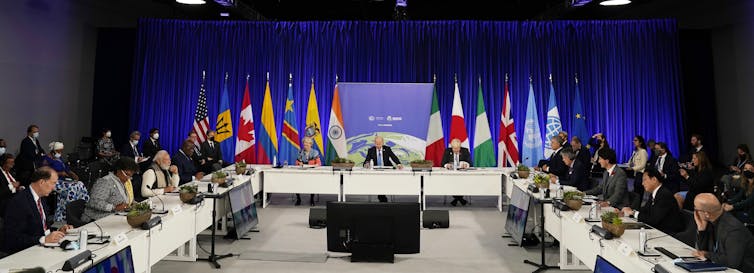
people seated around U-shaped table
The troubling findings come as world leaders meet at the COP26 climate summit in Glasgow.
Evan Vucci/AP

The global emissions picture

Global CO₂ emissions from fossil fuels dropped by 5.4% in 2020, compared to the previous year. But they are set to increase by about 4.9% above 2020 levels this year, reaching 36.4 billion tonnes. This brings them almost back to 2019 levels.

We can expect another 2.9 billion tonnes of CO₂ emissions this year from the net effect of everything we do to the land, including deforestation, degradation and re-vegetation.

This brings us to a total of 39.4 billion tonnes of CO₂ to be emitted by the end of this year.

The fast growth in emissions matches the corresponding large increase in energy demand as the global economy opens up, with the help of US$17.2 trillion in economic stimulus packages around the world.

CO₂ emissions from all fossil fuel types (coal, oil and natural gas) grew this year, with emissions from coal and natural gas set to grow more in 2021 than they fell in 2020.

Emissions from global coal use were declining before the pandemic hit in early 2020 but they surged back this year. Emissions from global gas use have returned to the rising trend seen before the pandemic.

CO₂ emissions from global oil use remain well below pre-pandemic levels but are expected to increase in coming years as road transport and aviation recover from COVID-related restrictions.
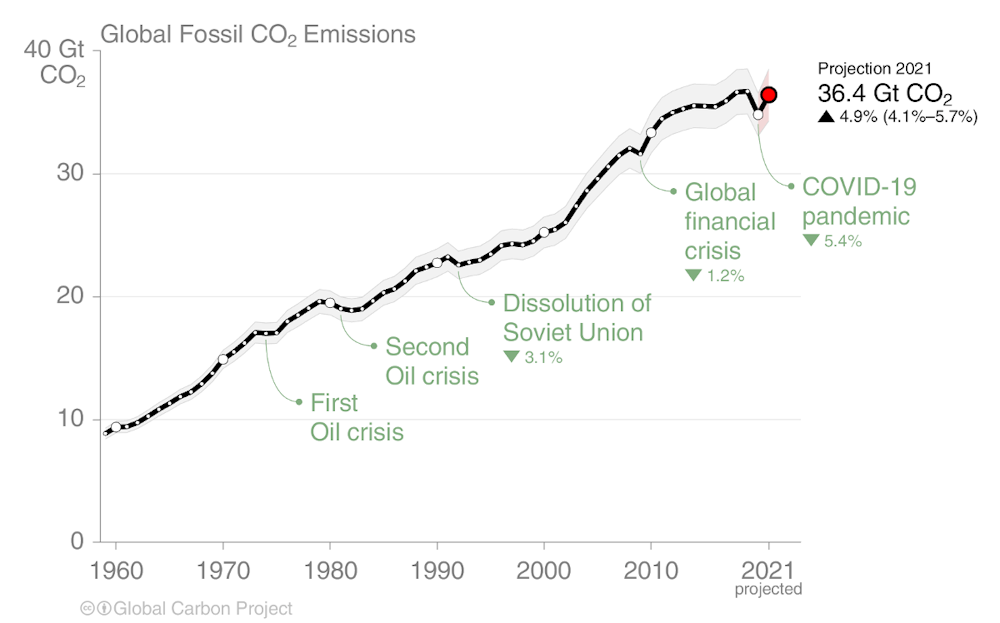
Global fossil CO₂ emissions.
Source: Global Carbon Project, https://www.globalcarbonproject.org/carbonbudget

Nations leading the emissions charge

Emissions from China have recovered faster than other countries. It’s among the few countries where emissions grew in 2020 (by 1.4%) followed by a projected growth of 4% this year.

Taking these two years together, CO₂ emissions from China in 2021 are projected to be 5.5% above 2019 levels, reaching 11.1 billion tonnes. China accounted for 31% of global emissions in 2020.

Coal emissions in China are estimated to grow by 2.4% this year. If realised, it would match what was thought to be China’s peak coal emissions in 2013.

India’s CO₂ emissions are projected to grow even faster than China’s this year at 12.6%, after a 7.3% fall last year. Emissions this year are set to be 4.4% above 2019 levels – reaching 2.7 billion tonnes. India accounted for 7% of global emissions in 2020.

Emissions from both the US and European Union are projected to rise 7.6% this year. It would lead to emissions that are, respectively, 3.7% and 4.2% below 2019 levels.

US and EU, respectively, accounted for 14% and 7% of global emissions in 2020.

Emissions in the rest of the world (including all international transport, particularly aviation) are projected to rise 2.9% this year, but remain 4.2% below 2019 levels. Together, these countries represent 59% of global emissions.
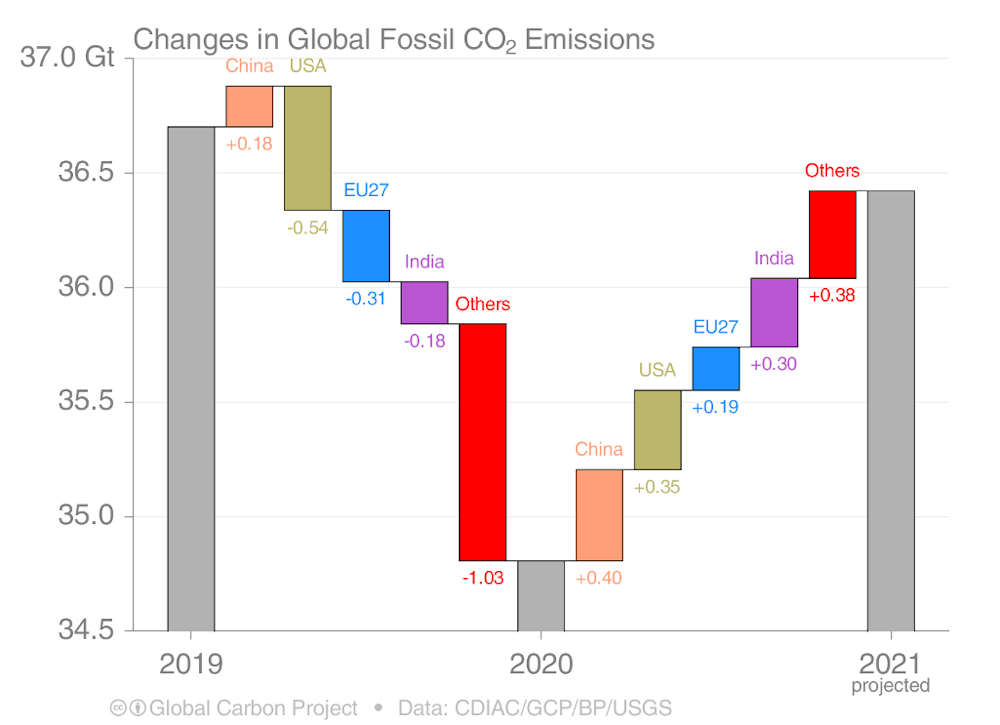
Regional fossil CO₂ emissions 2019-2021.
Source: Global Carbon Project, https://www.globalcarbonproject.org/carbonbudget

The remaining carbon budget

The relatively large changes in annual emissions over the past two years have had no discernible effect in the speed at which CO₂ accumulates in the atmosphere.

CO₂ concentrations, and associated global warming, are driven by the accumulation of greenhouse gases – particularly CO₂ – since the beginning of the industrial era. This accumulation has accelerated in recent decades.

To stop further global warming, global CO₂ emissions must stop or reach net-zero – the latter meaning that any remaining CO₂ emissions would have to be compensated for by removing an equivalent amount from the atmosphere.

Carbon budgets are a useful way of measuring how much CO₂ can be emitted for a given level of global warming. In our latest analysis, we updated the carbon budget outlined by the Intergovernmental Panel on Climate Change (IPCC) in August this year.

From the beginning of 2022, the world can emit an additional 420 billion tonnes of CO₂ to limit global warming to 1.5℃, or 11 years of emissions at this year’s rate.

To limit global warming to 2℃, the world can emit an additional 1,270 billion tonnes of CO₂ – or 32 years of emissions at the current rate.
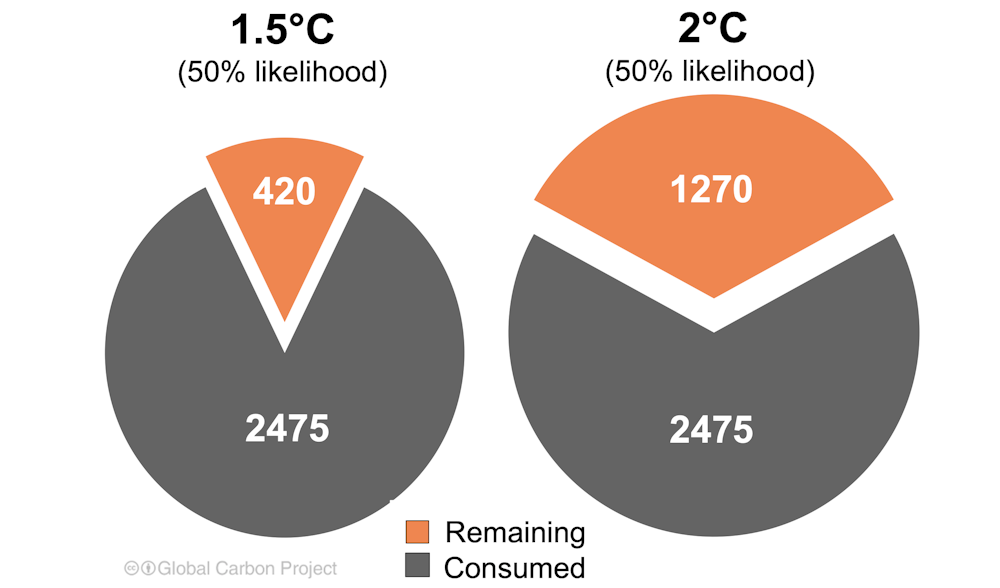
The remaining carbon budgets to limit warming to 1.5℃ and 2℃. Updated from IPCC 2021.
Source: Global Carbon Project, https://www.globalcarbonproject.org/carbonbudget

These budgets are the compass to net-zero emissions. Consistent with the pledge by many countries to reach net-zero emissions by 2050, CO₂ emissions need to decline by 1.4 billion tonnes each year, on average.

This is an amount comparable to the drop during 2020, of 1.9 billion tonnes. This fact highlights the extraordinary challenge ahead and the need to increase short- and long-term commitments to drive down global emissions.

The Conversation

Pep Canadell receives funding from the Australian National Environmental Science Program – Climate Systems Hub.

Corinne Le Quéré receives funding from the European Union’s Horizon 2020 research and innovation programme under grant agreement Nos. 821003 (4C) and 776810 (VERIFY), from the UN Natural Environment Research Council under grant NE/P021417/1 (SONATA) and NE/V011103/1 (Frontiers), and from the UK Royal Society under grant RPR1191063 (Research Professorship.

Glen Peters receives funding from European Union’s Horizon 2020 research and innovation programme under grant agreement Nos. 821003 (4C), 776810 (VERIFY), 820846 (PARIS REINFORCE), and 958927 (CoCO2).

Pierre Friedlingstein receives funding from the European Commission Horizon 2020 (H2020) 4C project.

Robbie Andrew receives funding from European Union’s Horizon 2020 research and innovation programme under grant agreement Nos. 821003 (4C), 776810 (VERIFY), 958927 (CoCO2).

Rob Jackson does not work for, consult, own shares in or receive funding from any company or organization that would benefit from this article, and has disclosed no relevant affiliations beyond their academic appointment.

ref. Global emissions almost back to pre-pandemic levels after unprecedented drop in 2020, new analysis shows – https://theconversation.com/global-emissions-almost-back-to-pre-pandemic-levels-after-unprecedented-drop-in-2020-new-analysis-shows-170866

Eternals is something entirely new for Marvel – and entirely ancient in its origins

Source: The Conversation (Au and NZ) – By Louise Pryke, Honorary Research Associate, University of Sydney

IMDB

Marvel’s Eternals will likely divide audiences into two groups: those who wish to tease out the mythical and comic book influences in Chloé Zhao’s modern epic, and those who prefer to enjoy the spectacle. This review takes the first approach, yet the film offers much to entertain both types of viewer.

Eternals explores new horizons in the Marvel Universe, both in its god-like protagonists, and in the inclusivity of its casting and plot-lines.

Shifting the franchise’s focus from mortals with extraordinary abilities and/or superpowers (such as Iron Man or Black Panther, the Eternals are new breed of Earth-defenders: a group of immortal (or at least, impressively enduring) superheroes often mistaken for deities.

But while they are new to the Marvel universe, they could more accurately be described as the (very) old guard.

An early origin story

Classical myths play a shaping role in many modern superhero stories, a trend that continues in Eternals.

The Eternals Sersi aligns with the Ancient Greek Circe.
J W Waterhouse/Art Gallery of South Australia

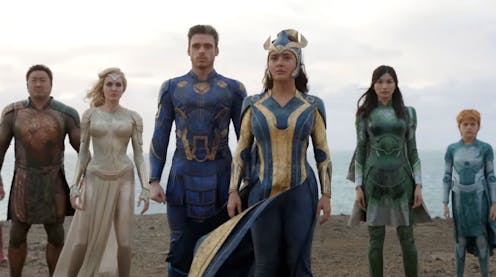
Thena (Angelina Jolie) is associated with the Greek goddess of warfare, Athena. Sersi (Gemma Chan) aligns with the enchantress from Homer’s Odyssey, Circe. Ikaris (Richard Madden) parallels the flying (and falling) Icarus from Cretan myth.

The first Eternals comic book was released in 1976. There, the Eternals and their enemies, the war-mongering Deviants, arrived from distant galaxies in ancient times and were viewed with awe by their puny Earthling relatives.

As the comic goes, the battles between Eternals and Deviants (continued in the film) were translated into the legends of numerous ancient cultures.

As per the self-mythology of the Eternals, it is not that these characters are inspired by Ancient Greek legends, but that Ancient Greek legends were inspired by them.


Read more:
Guide to the Classics: Homer’s Odyssey


The first ancient Near Eastern Marvel superhero

The film opens with ten Eternals, clad in colourful cosmic activewear, establishing their role as planetary protectors in Mesopotamia around 7000 BCE.

Ancient Mesopotamia (roughly located in modern-day Iraq) was home to many early developments in civilisation, such as writing, agriculture, and even some of the earliest known literary “superheroes”: the legendary king Lugalbanda, for example, was divinely gifted with superspeed.

The character of Gilgamesh in Eternals is the first ancient Near Eastern hero with a leading role in a Marvel film.

The 11th Tablet of the Epic of Gilgamesh and tells how the gods determined to send a flood to destroy the earth, dated to the 7th Century BCE.
© The Trustees of the British Museum, CC BY-NC-SA

In myth, Gilgamesh is the heroic protagonist of the world’s oldest known epic. The ancient story follows the journey of the heroic young king as he adventures to the edges of the world in search of fame and immortality.

Eternals gives further nods to Mesopotamian myth. There is speculation from fans that Kingo (Kumail Nanjiani) could represent the deity Kingu, from the Babylonian myth, Enuma Elish. In this myth, the primary deity Marduk battles the primordial ocean goddess, Tiamat.

Indeed, even Tiamat herself – or Tiamut in the film – counts among the heroes’ adversaries in Eternals.

A scene where the Eternals battle Deviants before the famous Ishtar Gate in ancient Babylon beautifully captures the largely untapped cinematic potential of the Mesopotamian world.

A lion mosaic
The Ishtar Gate dates to the 6th century BCE. These lions lined the road of the Processional Way.
The Metropolitan Museum of Art

Don Lee’s Gilgamesh is a delight, well reflecting the brawny charm of the ancient hero as he smashes his way through crowds of Deviants with the same strength used to defeat the Stone Ones and the Bull of Heaven in the original epic.


Read more:
Guide to the classics: the Epic of Gilgamesh


A journey worth taking

The presence of a Mesopotamian legend and Korean superhero are just two of the “firsts” seen in Eternals. Others include the first openly gay superhero in the franchise (Phastos, played by Brian Tyree Henry), and a superhero who is hearing impaired (Lauren Ridloff’s Makkari).

The presence of same-sex relationships and characters with disabilities are common to many ancient myths and modern comics (Hawkeye of Avengers fame is portrayed with a hearing impairment in many comics). Here, Eternals’ Phastos is identified through his technical skills with Hephaestos, the Greek god of metalwork. In Classical myth, Hephaestos is depicted with a physical diability, walking with a limp.

Interestingly, metal work may have been a common occupation for people with physical disabilities in ancient Near Eastern culture — reflecting the interplay between history, myth, and popular culture common to the superhero genre.

In various Ancient Greek myths, Hephaestus was disabled from birth, or after being thrown from the heavens by Zeus. He was known for his metal working, as painted here by Anthony van Dyck.
Kunsthistorisches Museum

Indeed, the film’s increased inclusivity brings it into closer alignment with both its ancient and modern sources.

For myth and comic book buffs, there is plenty to explore in Eternals. The film’s use of on-location shooting helps create a universe that feels broader and deeper than many before. The journey of Madden’s Ikaris reflects the typically creative recycling of ancient legends found in the comics.

Like speedy Makkari (whose character aligns with the messenger deity, Mercury known for his winged shoes), Ikaris’ power of flight is shared by his mythical counterpart Icarus – but it’s a power that must be used wisely.

Fans of the Gilgamesh epic will note his tendencies to take power naps and fight celestial bulls are adapted from ancient legend.

For those seeking pure entertainment, Eternals offers an inviting – at times spectacular – step into a world that is at once both old and new.

Eternals is in cinemas from today.

The Conversation

Louise Pryke does not work for, consult, own shares in or receive funding from any company or organisation that would benefit from this article, and has disclosed no relevant affiliations beyond their academic appointment.

ref. Eternals is something entirely new for Marvel – and entirely ancient in its origins – https://theconversation.com/eternals-is-something-entirely-new-for-marvel-and-entirely-ancient-in-its-origins-170953

Australia accused of ‘bullying’ Pacific over climate action, ‘buying silence’

Asia Pacific Report newsdesk

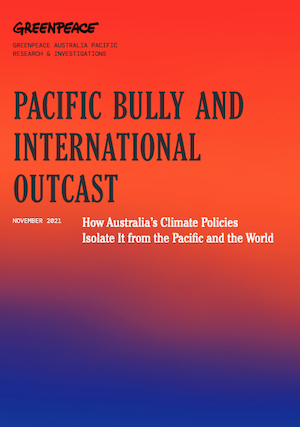
Australia is accused of using “diplomatic strong-arm tactics” to water down outcomes in Pacific climate negotiations and “buy silence” on climate change, a new report has revealed.

Greenpeace Australia Pacific’s report, Australia: Pacific Bully and International Outcast, reveals that the Australian government uses “bullying tactics” in regional negotiations on climate change, according to former Pacific Island leaders interviewed as part of the study.

The leaders include former Kiribati President Anote Tong and former Prime Minister of Tuvalu Bikenibeu Paeniu.

Pacific Bully report
Australia: Pacific Bully and International Outcast report

Australia’s aid to the Pacific has been “greenwashed”, with some of the largest and most expensive “climate adaptation” projects having no link to climate change or contributing to increase the climate resilience of Pacific peoples.

The Australian government’s climate position harms its international relations and economy with Australia’s export markets for coal and gas shrinking as major trading partners such as Japan and South Korea commit to net-zero emissions, says the report, published coinciding with the COP26 climate summit in Glasgow.

The report draws on dozens of interviews with present and former Pacific leaders, Australian diplomats and academics to expose the hardline tactics used by Australia to thwart stronger regional action on climate change and to shift focus away from Australia’s responsibility to reduce greenhouse gas emissions.

The report also uncovers the greenwashing of Australian aid in the Pacific, finding that millions of aid dollars have been given to “climate adaptation” projects that do not have any link to climate change.

COP26
COP26 GLASGOW 2021

Australian standing damaged
Greenpeace Australia Pacific researcher and international relations expert Dr Alex Edney-Browne said the investigation showed Australia’s international standing had been damaged by its climate obstruction.

“Australia has lost its once-respected position in the Pacific and now has a reputation for bullying and strong-arm diplomatic tactics to thwart regional climate action,” she said.

“Pacific Island leaders are some of the world’s strongest climate advocates, but Australia has brazenly tried to buy their silence through aid with strings attached.

“Morrison’s last-minute commitment at COP26 this week to increase regional climate finance by $500 milion, via bilateral agreements, simply won’t cut it. Given the level of greenwashing going on in Australia’s foreign aid to the Pacific as revealed in this report, there is also no guarantee that this money will go where it’s needed to increase the climate resiliency of Pacific peoples,” she said.

“Australia has a history of using bilateral aid as a way of gaining leverage over Pacific island countries. It would be nice to see Australia being a good international citizen and showing support for multilateral climate finance such as the UN’s Green Climate Fund. It refuses to do so.

“Australia must make a serious effort on climate change, which is threatening the very survival of Pacific nations. That means ruling out any new coal or gas projects, ending the billions in subsidies given to the fossil fuel industry and committing to a science-based target to cut emissions by 75 percent this decade to bring it up to speed with our regional neighbours and trading partners.”

Gareth Evans, a former Australian foreign minister, said Australia’s climate policy was already hurting the country’s diplomatic standing.

‘Reputation for decency’
“A country’s reputation for decency in these matters does really, really matter… Australia’s credibility in all sorts of ways depends on our being seen to be responsible, good international citizens and Australia is putting that reputation very much at risk on the climate front,” he said.

Anote Tong, former President of Kiribati, said Australia had not acted in the spirit of mutual respect in its dealings with the Pacific on climate change.

“I cannot read into the minds of Australian leaders but it’s always been my hope that we would treat each other with mutual respect, but I’m not sure this has always been the case,” he said.

“But we should be partners in every respect and not when it is convenient to one party but not the other, for example on climate change. We expect Australia to be stepping forward because climate change is very important for us and we’re meant to be part of this family. It had always been my expectation, my hope, that Australia would provide the leadership we desperately need on climate change.”

Dr Matt McDonald, associate professor of International Relations at University of Queensland, refers to Australia’s climate policies as a “perfect storm”, with serious repercussions for the country’s regional and international relations if these policies remain weak by comparison with similar developed countries.

Print Friendly, PDF & Email

Article by AsiaPacificReport.nz

Tonga patient tests negative in second round of covid-19 testing

By Kalino Latu in Auckland

A person who tested positive for covid-19 in Tonga has now tested negative, says the Ministry of Health CEO.

Dr Siale ‘Akau’ola said another test was expected tomorrow for the patient.

He said yesterday the covid-positive person, who arrived in Tonga from Christchurch, would continue to stay in the MIQ until his 21-day quarantine was over.

Dr ‘Akau’ola, who joined the Prime Minister and a team of government officials in a press conference in Nuku’alofa, said he was advised on Monday that the person had provided a second negative test.

Dr ‘Akau’ola reiterated during the conference that the sample from the patient was tested on Thursday, October 28 and Friday, October 29. He referred to the positive result as “weak positive”.

The Tonga case came after a weak positive case tested negative on the second test in New Zealand.

Last month, a covid-positive person who travelled to Katikati from Auckland, tested negative on their second test.

“The person had a high CT value, indicating a weak positive result, and was tested again following their initial positive result last week”, Stuff reported.

Tested on three machines
‘Akau’ola said the person’s sample was tested on all three of the Health Ministry’s covid-19 testing machines on October 28.

He also repeated what he had said in the previous conference on Friday that the weak virus could be a historical virus or a “baby virus” which tried to grow, but was stopped by the antibiotic because the patient was fully vaccinated.

“The nature of the virus is shedding and it can be negative or positive at various times and this is why we have the 21-day quarantine rule.”

All the people on the flight from Christchurch were required to have negative covid tests prior to departure.

New Zealand’s Ministry of Health said the positive case was fully vaccinated with the Pfizer vaccine, and had their second dose on October 15.

Tonga’s main island Tongatapu is currently on lockdown for one week until Monday, November 8.

Kalino Latu is editor of Kaniva Tonga. Republished with permission.

Print Friendly, PDF & Email

Article by AsiaPacificReport.nz

Facebook Does the U.S. government’s Censorship Work in Nicaraguan Elections

Source: Council on Hemispheric Affairs – Analysis-Reportage

Print Friendly, PDF & Email

By John Perry
From Masaya, Nicaragua

A few days before the Nicaraguan presidential elections on November 7, Facebook and other social media companies began closing down many of the pages used by Sandinista supporters in their campaign to re-elect President Daniel Ortega. This blatant censorship move was said to be because they had discovered “troll farms” operated by government agencies. But many of the 1,500 accounts closed appear simply to belong to pro-Sandinista journalists or young commentators. TikTok, Twitter and Instagram took similar action, and Google said that it has closed 82 YouTube channels and three blogs in a related operation.

Among those closed were several well-known pro-Sandinista accounts with thousands of followers on Facebook-owned Instagram, including those of the online new sites Barricada, Redvolución and Red de Comunicadores.[1] They even suspended the popular fashion organization Nicaragua Diseña.[2] When such websites attempted to create new accounts, they were also blocked.

Censorship extended to neutral websites covering the election. For example, Carta Bodan’s daily newsletter on November 2 carried brief descriptions of five opposition candidates.[3] When colleagues tried to share this link on their Facebook pages it was rejected. The fact that there are five opponents of Daniel Ortega standing might be an inconvenient truth, of course, given that many of the reports of Facebook’s censorship repeated the U.S. government’s contention that the Nicaraguan elections are a “sham” with no real opponents (despite the fact that two of the parties standing were in government between 1990 and 2007).[4]

Facebook’s head of security, Nathaniel Gleicher, tweeted justifications for its actions, even admitting that “this is a domestic op, with links to multiple gov’t institutions and the FSLN party. We don’t see evidence of foreign actors behind this campaign.” Gleicher failed to respond to accusations that huge numbers of genuine accounts had been disabled.[5]

The Grayzone’s Ben Norton contacted several pro-Sandinista journalists and commentators who had lost their Facebook or Twitter accounts.[6] These included young Sandinista Ligia Sevilla, who attempted to show her genuine status on her Twitter account, which was immediately suspended.[7] The same happened to well-known Sandinista activist Daniela Cienfuegos.[8] Darling Huete, a journalist, had the same experience.[9] Some, like ElCuervoNica,[10] managed to set up alternative accounts. Effectively many commentators suffered double censorship: blocked because they were falsely accused of being bots, then prevented from proving that the accusations were false when they posted videos of themselves as real people. One journalist who complained to Facebook was simply told that “For security reasons we can’t tell you why your account was removed.”

Exploring the motivations for Facebook’s actions, Norton points out its government connections. For example, Gleicher was director for cybersecurity policy at the National Security Council and previously worked at the Department of Justice. Other senior Facebook executives involved have similar government connections.

International media such as Reuters and the BBC simply took Facebook’s justification at face value – that it had disabled a “cross-government troll operation.”[11] Even media such as Aljazeera, often critical of the U.S. government, carried reports on what Facebook had done without adverse comment.[12] Apart from The Grayzone, only the U.K.’s Morning Star appears to have criticized Facebook’s decisions.[13] Anti-Sandinista news sites, such as Artículo 66, listed the accounts affected, calling them “propaganda” and disseminators of “false news,” even though they are themselves well-established propaganda sources for the opposition.[14] None questioned why this had occurred days before a crucial election, or how it happened that action was coordinated across different social media outlets. The Financial Times reported, without comment, that the Facebook pages were followed by 784,500 users, even though this might have alerted them to the fact that most if not all the pages were genuine.[15]

The FT even compared the government’s operation to that of the Russian government’s St. Petersburg troll farm, accused of meddling in two recent U.S. elections.[16] It ignored a crucial difference: that the Nicaraguan accounts closed were engaged in campaigning during their own country’s elections, not interfering in anyone else’s. Even more obviously, having made this comparison, it failed to ask why Facebook is itself interfering in an election campaign, and whether it is doing so at the behest of the U.S. government.

John Perry is a writer living in Masaya, Nicaragua.


Sources

[1] Original links: https://instagram.com/barricada79; https://instagram.com/redvolucionnic; https://instagram.com/somosredjs

[2] Original link: https://www.instagram.com/nicaragua_disena/

[3] See http://cartabodan.net/boletin/01nov21pm.html

[4] “Blinken accuses Nicaragua’s Ortega of preparing ‘sham election’,” https://www.reuters.com/world/americas/blinken-accuses-nicaraguas-ortega-preparing-sham-election-2021-10-22/

[5] See https://twitter.com/ngleicher/status/1455241703678365696

[6] “xxx,” https://thegrayzone.com/2021/11/02/facebook-twitter-purge-sandinista-nicaragua/

[7] See https://twitter.com/ligiasevilla_

[8] See https://twitter.com/dani100sweet

[9] See https://twitter.com/DarlingHHuete

[10] See https://twitter.com/elcuerv0nica

[11] See “Facebook says it removed troll farm run by Nicaraguan government,” https://www.reuters.com/world/americas/facebook-says-it-removed-troll-farm-run-by-nicaraguan-government-2021-11-01/ xxx and “Cómo funcionaba la ‘granja de troles’ desmantelada por Facebook en Nicaragua,” https://www.bbc.com/mundo/noticias-america-latina-59136577

[12] “Facebook says it shut down Nicaraguan government-run troll farm,” https://www.aljazeera.com/news/2021/11/1/facebook-says-it-shut-down-nicaraguan-government-run-troll-farm

[13] “Facebook accused of censoring Sandinista media organisations ahead of Sunday’s election,” https://morningstaronline.co.uk/article/w/facebook-accused-of-censoring-sandinista-media-organisations-ahead-of-sunday-election

[14] “Estas son las cuentas de troles orteguistas,” https://www.articulo66.com/2021/11/01/troles-orteguistas-facebook-instagram-cuentas-eliminadas-manipulacion-nicaragua/

[15] “Nicaragua’s government accused by Facebook of running social media troll farm,” https://www.ft.com/content/0998f9ac-7e37-430e-a411-2456b9124e7c

[16] “Russian troll farm makes US comeback,” https://www.ft.com/content/447724b0-bc98-4690-a150-674f451d1b3e

Australia is putting a rover on the Moon in 2024 to search for water

Source: The Conversation (Au and NZ) – By Joshua Chou, Senior lecturer, University of Technology Sydney

ispace

Last month the Australian Space Agency announced plans to send an Australian-made rover to the Moon by as early as 2026, under a deal with NASA. The rover will collect lunar soil containing oxygen, which could eventually be used to support human life in space.

Although the deal with NASA made headlines, a separate mission conducted by private companies in Australia and Canada, in conjunction with the University of Technology Sydney, may see Australian technology hunting water on the Moon as soon as mid-2024.

If all goes according to plan, it will be the first rover with Australian-made components to make it to the Moon.

Roving in search of water

The ten-kilogram rover, measuring 60x60x50cm, will be launched on board the Hakuto lander made by ispace, a lunar robotic exploration company based in Japan.

The rover itself, also built by ispace, will have an integrated robotic arm created by the private companies Stardust Technologies (based in Canada) and Australia’s EXPLOR Space Technology (of which I am one of the founders).

Using cameras and sensors, the arm will collect high-resolution visual and haptic data to be sent back to the mission control centre at the University of Technology Sydney.

It will also collect information on the physical and chemical composition of lunar dust, soil and rocks — specifically with a goal of finding water. We know water is present within the Moon’s soil, but we have yet to find a way to extract it for practical use.


Read more:
Water on the Moon: research unveils its type and abundance – boosting exploration plans


The big push now is to identify regions on the Moon where water sources are more abundant, and which can deliver more usable water for human consumption, sample processing, mining operations and food growth.

This would also set the foundation for the establishment of a manned Moon base, which could serve as a transit station for further space exploration (including on Mars).

The ispace moon lander was displayed in Washington DC.
Courtesy of Australian Embassy staff

Moon-grade materials

Once the Hakuto lander takes off, the first challenge will be to ensure it lands successfully with the rover intact. The rover will have to survive an extreme environment on the lunar surface.

As the moon rotates relative to the Sun, it experiences day and night cycles, just like Earth. But one day on the Moon lasts 29.5 Earth days. And surface temperatures shift dramatically during this time, reaching up to 127℃ during the day and falling as low as -173℃ at night.

The rover and robotic arm will also need to withstand the effects of space radiation, vibrations during launch, shock from the launch and landing, and exposure to dust and water.

At the same time, the arm must be light enough to conduct advanced manoeuvres, such as grabbing and collecting moon rocks. Advanced space-grade aluminium developed in Australia will help protect it from damage.

The TechLab antenna chamber at the The University of Technology Sydney is being used to test communication signals which will be critical to this mission.

The team behind the mission is currently in the process of testing different designs of the robotic arm, and figuring out the best way to integrate it with the rover. It will be tested together with the rover at a new lunar test bed, at the EXPLOR Space Technologies facility in New South Wales.

Like the one used by NASA, this test bed can mimic the physical and chemical conditions on the Moon. It will be critical to determining whether the rover can stay mobile and continue to function under different environmental stressors.

Step into your astronaut boots

The rover will also send back data that allows people on Earth to experience the Moon with virtual reality (VR) goggles and a sensor glove. Haptic data collected back by the robotic arm will essentially let us “feel” anything the arm touches on the lunar surface.

We plan to make the experience available as a free app — and hope it inspires future generations of space explorers.


Read more:
So a helicopter flew on Mars for the first time. A space physicist explains why that’s such a big deal


The Conversation

Joshua Chou is the co-founder of EXPLOR Space Technologies.

ref. Australia is putting a rover on the Moon in 2024 to search for water – https://theconversation.com/australia-is-putting-a-rover-on-the-moon-in-2024-to-search-for-water-170097

It’s time for Anthony Albanese to get angry

Source: The Conversation (Au and NZ) – By Judith Brett, Emeritus Professor of Politics, La Trobe University

Remember Scott Morrison’s promise in May 2019: “You vote for me, you’ll get me. You vote for Bill Shorten and you’ll get Bill Shorten.” As well as attacking Shorten, Morrison was also signalling that the rules around the Liberal leadership had changed. Shortly after Morrison came through the middle of Peter Dutton and Malcolm Turnbull to become PM, the federal parliamentary Liberal Party changed the rules for selecting the leader. The person who led the party to electoral victory would lead it to the next election, so was now immune from the challenges and simple majorities that had unseated Tony Abbott and Turnbull.

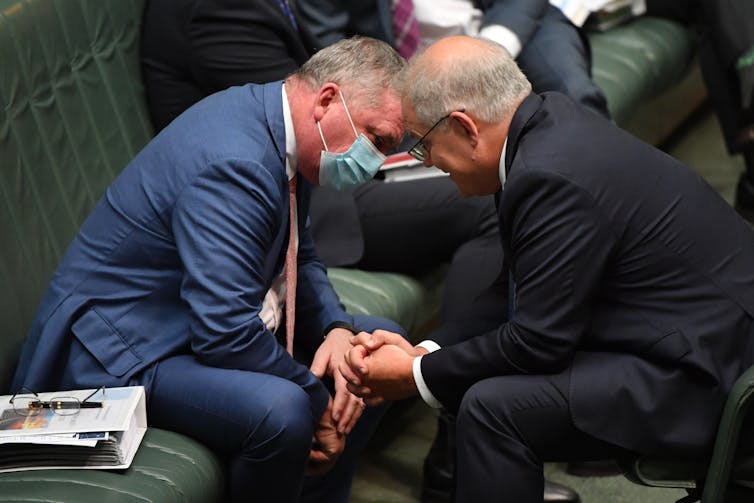
This was the subtext. The main text was you don’t want Bill. To be sure, we didn’t get Bill, but now it seems that instead of the man himself, we’ve got Barnaby Joyce and the government’s climate policy was outsourced to the Nationals Party room.

It reminds me of 1963 when Arthur Calwell and Gough Whitlam, then the leader and deputy leader of the federal Labor Party, were photographed after midnight, waiting under a street light outside the Hotel Kingston for the federal executive to determine Labor’s policy on US bases. Before Whitlam reformed the party, policy was made in the organisational wing by the federal executive with no automatic representation of the parliamentary leadership. The 36 Faceless Men, journalist Alan Reid called them, and the term took off.

When then-Prime Minister Robert Menzies called a snap election a few months later, he pilloried Calwell as a man who took instruction from others, and so, was unfit to be Australia’s prime minister. Today we have a prime minister so lacking in authority and conviction that his emissions reduction policy depended on the outcome of Nationals’ Party meetings on not one but two Sunday afternoons.

Barnaby Joyce and Scott Morrison
Barnaby Joyce and Scott Morrison during question time last week.
Mick Tsikas/AAP

As I have said many times, the National Party, and the Country Party before it, wields far more power than its electoral support warrants. It did do especially well at the 2019 election, winning around 10% of the vote, with which it won 16 lower house seats. It also provides the deputy prime minister, the deputy speaker, and, with Keith Pitt’s return to Cabinet, five Cabinet ministers. Its vote was about the same as the Greens, who have one lonely voice in the House of Reps. Thanks goodness for the Senate, where the proportional voting system gives the Greens representation that more truly reflects their support in the electorate – they have nine senators to try to hold back the more egregious of the government’s legislation and probe its actions.


Read more:
Want to understand how the Coalition works? Take a look at climate policy


Why won’t Anthony Albanese now say, “You vote for Morrison, you get Barnaby. You vote for me, you get me”? And why won’t he say it over and over and over? Like Abbott did with the brutal retail politics of calling the Gillard government’s price on carbon a tax, when, as Peta Credlin later admitted, it wasn’t one at all. “It took Abbott about six months to cut through,” she said, “but when he cut through, Gillard was gone”.

Albanese desperately needs some cut-through lines, to up his public profile, to simplify the political contest, and to land some blows on Morrison. The Nationals’ grandstanding should be a gift. It plays into two already existing doubts about Morrison: his capacity to lead, and his focus on electoral strategy rather than national problems.

The Nationals, with six Queenslanders, two Victorians and eight from New South Wales, are a party of the eastern states. There are no Nationals members from South Australia, Tasmania or Western Australia. This plays into the suspicion many already have that Morrison is the prime minister for New South Wales, an impression reinforced by his decision to live in Sydney in Kirribili House rather than the Lodge in Canberra.

Then there are the 38,000 or so coal miners we hear so much about, whose jobs are at risk if we move too fast to reduce our emissions. About as many people have already lost their jobs in universities over the past two years because the COVID pandemic stopped international students, and the government did nothing as the university sector shrank. The most obvious explanation for this difference is that people in universities are less likely to vote for the Coalition than the coal miners, with little consideration of their contributions to the national interest.

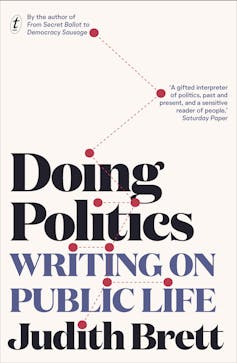
Doing Politics: Writing on Public Life by Text Publishing.

So, Labor and Albanese have plenty of opportunity to channel anger towards Morrison. Why are they so reluctant? I have been thinking a lot about anger in politics lately. In the book of essays I have just published, Doing Politics: Writing on Public Life, I pay tribute to the profound influence of Alan Davies and Graham Little from the University of Melbourne Politics Department on my thinking about politics. Davies and Little looked to psychoanalysis to help understand politics. Both wrote about emotions in public life, their risks and opportunities and the way they come in sets: fear, anger and paranoia; envy and resentment; pathos and compassion; guilt and denial; hope, possibility and delusion. The book includes a series of essays on our most recent leaders, and all draw on their wisdom.


Read more:
Labor’s wicked problem: how to win back Queensland


Since John Howard’s time as prime minister, the Liberals have specialised in the politics of fear and anger, fear of being over-run by refugees, of others getting what you deserve, and of change; and anger at anyone who opposed them. And they have succeeded, again and again, at turning fear and anger against Labor, such as at the last election when they whipped up fear of Labor’s policies on franking credits, negative gearing, electric cars and an ambitious climate target. It was negative campaigning and it worked enough to get the government back across the line.

Labor is not shy of negative campaigning, as in the 2016 “Mediscare” campaign, but it is more uneasy with anger. At present, Albanese seems mired in the politics of pathos, with the oft-repeated story of his childhood upbringing by a single mum in council housing, and his unfulfillable promise that there will be no one left behind. What he needs is some anger and to direct it at Morrison; to play the man like Morrison did against Shorten.

I can understand why he might be reluctant to do this. For many of us, anger is not a comfortable emotion. But anger has big advantages for a campaigning politician – its energy and its illusion of conviction – especially if it can be condensed into cut-through slogans and images. The emotions are not skilled workers, as the fictional poet Ern Malley so wisely observed, especially when they are abroad in public life. They need to be handled with black and white gloves to be effective. Morrison the electoral strategist knows this. Albanese needs to learn, and fast. If he cuts through, Morrison is gone.


A collection of Judith Brett’s essays, Doing Politics: Writing on Public Life, went on sale last week through Text Publishing.

The Conversation

Judith Brett does not work for, consult, own shares in or receive funding from any company or organisation that would benefit from this article, and has disclosed no relevant affiliations beyond their academic appointment.

ref. It’s time for Anthony Albanese to get angry – https://theconversation.com/its-time-for-anthony-albanese-to-get-angry-170771

Voter ID is a bad idea. Here’s why

Source: The Conversation (Au and NZ) – By Graeme Orr, Professor of Law, The University of Queensland

The Morrison government is pushing legislation to mandate voter ID at polling places. Contrary to some critics, what it proposes will not create US-style “voter suppression”. But it is still an unnecessary idea at an inappropriate time.

Countries like Australia, New Zealand and the United Kingdom (until now at least) do not require electors to show ID to vote. Many other systems do.

Insecurity about security is a conservative trope. So it is natural for political conservatives, temperamentally, to favour voter ID, with the argument being it is an “integrity” measure. Social democrats, on the other hand, are more trusting and concerned to ensure everyone can and does vote.

The Australian proposal lists an array of documents as acceptable ID. Photo ID such as a driver’s licence is not mandatory; a credit card or utility bill would suffice. “Documents” in law now include electronic records, which is important given how few people receive paper utility bills.

If an elector does not bring ID, or it is rejected (say for a misspelled name), they are to be offered a “provisional” vote. That is a rigmarole involving extra forms and delays. But it is a buffer – imagine a remote voter driving an hour to a polling station having forgotten their wallet.

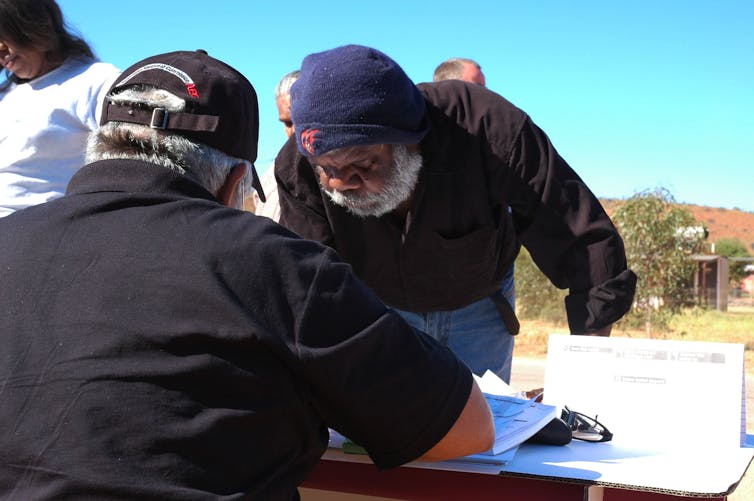
Young people, the very elderly and Indigenous people are all less likely to have such ID. To address the latter, a document from an Indigenous land council or similar agency will also count. When the LNP in Queensland briefly introduced voter ID in 2013-15, it was clear remote electors were more likely to have problems with ID.


Read more:
Who’s Liberal? What’s Labor? New bill to give established parties control of their names is full of holes


Cost in the time of COVID

The UK Cabinet Office estimates voter ID there will cost in the order of £20 million (A$36.7 million) per election. That is for mandatory photo ID. The direct cost in Australia will be less, if not insignificant. The Australian Electoral Commission will need to mail proof of enrolment to each elector as one form of ID.

There are also indirect costs. The most obvious is in training – and trying to ensure consistency among tens of thousands of casual poll workers. Inevitably, some forms of ID will be accepted in some polling places and not others. Think of bills on cracked mobile screens, or cards with minor differences to the name on the electoral roll.

Most of all, with Australia reopening, COVID will be spreading across states that have never had a real wave. Voter ID will add to processing time for millions of electors. Those whose ID is rejected will have to join separate queues to make a fussy “declaration” vote.

Finally, those declaration votes enter a black box. Unlike some US states, electors are not told whether their provisional vote was ever accepted into the count. This in itself will hamper, not enhance, trust.

One group of electors will not need to produce ID: postal voters. Asking (predominantly older) postal voters to scan or copy ID is a step too far, as they already sign and witness forms to vote.

Australians in remote and rural areas are most likely to be disadvantaged by the introduction of voter ID at elections.
AAP/Karen Michelmore

What does the Constitution say?

On voting “rights”, next to nothing. But in 2007, the High Court implied a universal franchise for Australian citizens. Then, in 2010, it struck down the early closing of electoral rolls as an undue burden on the ability to vote.

In doing so, it said parliament cannot impose such burdens without evidence. The “evidence” to support voter ID is the intuition that voters should produce ID. The benefit of voter ID is said to be enhancing perceptions of integrity.

This may be a fair call in the abstract. Yet in reality, Australia has high levels of trust in our independent and thorough electoral processes. Any lack of trust buzzes around parties as hierarchical entities, their funding and accountability, not electoral administration.

Perceptions of risk can also be circular, if not manipulated. By playing up integrity risks, regardless of actual evidence, you can generate concerns that you then use to justify new rules. (We also see this in debates about electoral donations.)

As long as the law allows electors without ID to cast a declaration vote without excessive palaver, the High Court will not veto voter ID. In any event, the law cannot be challenged before it is implemented. Any plaintiff claiming to be affected before the election will likely be rebuffed with “go and organise ID”.


Read more:
From robo calls to spam texts: annoying campaign tricks that are legal


Voter ID cuts across compulsory voting

Most of all, voter ID is a dull idea in a country that has required people to enrol to vote for 110 years, and to turn out to vote since 1924.

Quite why we need voter ID is not clear. Most European countries do. But they have national ID cards. That is, every citizen, equally, has official ID. Such ID is something liberals in Australia fought against.

Ultimately, electoral integrity comes from having the most thorough roll and the highest turnout possible. Australia has a good record here, thanks to compulsion and direct enrolment laws.

Short of evidence of rogue electors impersonating other voters, voter ID is an unnecessary bureaucratic requirement, at an inappropriate point in a pandemic.

The Conversation

Graeme Orr has held various ARC grants in the field of electoral law, and does pro bono work on voting rights and reform in the law of politics (eg currently with Australians Voting Abroad and the Australian Republican Movement).

ref. Voter ID is a bad idea. Here’s why – https://theconversation.com/voter-id-is-a-bad-idea-heres-why-170777

Health care contributes 7% to Australia’s carbon emissions – but health is missing from our COP26 plan

Source: The Conversation (Au and NZ) – By Fiona Armstrong, Executive Director, Climate and Health Alliance; Honorary Associate, Department of Public Health, La Trobe University

Shutterstock

Australia finally has a net zero plan at the Commonwealth level. But so far, health hasn’t been factored into Australia’s national climate response. The federal government has yet to announce plans specific to the sector or, more broadly, the health of Australians.

This is despite experts warning climate inaction is putting lives at risk and could overwhelm our health system, and Australia’s health sector accounting for 7% of the country’s carbon emissions.

Countries are expected to arrive in Glasgow for the 2021 United Nations Climate Change Conference, known as COP26, with dramatically scaled up commitments to those they pledged in Paris in 2015.

And health is clearly on the agenda. The UK government has announced a COP26 Health Programme, calling on governments to commit to climate resilience and low-carbon health systems.

But when it comes to how the health sector is affected by, and contributes to, emissions, Australia’s response is missing in action.

Australia’s report card

The COP26 Health Programme’s rationale is that climate change is driving poorer health outcomes, increasing deaths, and health inequities.

But health systems are well placed to be a significant part of the solution and can:

  • motivate stronger global ambition to reduce emissions

  • help protect people from negative impacts of climate change

  • and make a substantial contribution to reducing national and global emissions.

Australia is one of the most climate-vulnerable places on Earth. A hotter and more hostile climate spells dangers for the human population as well as the natural world. Extreme heat is impacting worker productivity, affecting outdoor community and sporting activities, and driving critical workforces, like doctors, away from the Northern Territory.

Health impacts of bushfires and smoke pollution and other extreme weather drives up demand for urgent health care. And as we have seen, infectious diseases like COVID can render our societies inoperable.

Novel viruses and infectious diseases like COVID are expected to increase in a warming world, and made even more likely due to human-caused destruction of natural environments (to feed our unsustainable appetite for “growth”) that otherwise provide a buffer against disease.

And as we now know, when health-care systems are struggling to manage a crisis like COVID, many other health problems get ignored, leading to worsening health outcomes from other causes.


Read more:
Coronavirus is a wake-up call: our war with the environment is leading to pandemics


A recent analysis of Australian policy reveals little recognition at the Commonwealth level of the health impacts of climate change. Policy action is only just getting under way at state and territory level.

The federal government’s net zero by 2050 pamphlet, The Australian Way, doesn’t address the risks and opportunities for the health sector, despite its significant contribution to national emissions. This emission contribution is largely from public and private hospitals, which have huge energy demands, largely met by coal-powered electricity. Also, the production of pharmaceuticals is extremely energy intensive.

Australia’s failure to address the health impacts of climate change in its climate plan recently scored it 0/15 compared to other countries by the Global Climate and Health Alliance ahead of COP26.

The Australian government had not integrated health into its climate policies on any of the five measures: health impacts, health in adaptation measures, health co-benefits, economics and finance, or overall.

Australia’s update to the National Climate Resilience and Climate Adaptation Strategy (released quietly, ahead of COP26) mentions health and well-being. But it firmly hands responsibility to state, territory and local governments.

So far, the Queensland government has led the way. It developed a Human Health and Wellbeing Climate Adaptation Plan in 2018, offering high level guidance for managing the health risks of climate change and realising the benefits of climate action.

Victoria recently released a draft Health and Human Services Adaptation Action Plan, as part of its commitments under the state’s Climate Change Act.

In Western Australia, a year-long Climate and Health Inquiry led to a comprehensive 2020 report. Climate action is necessary, the McGowan government said, “for health system sustainability and [because] the benefits of change far outweigh costs when health is factored in”. Implementation is yet to commence.

New South Wales supports human health and social impact research at the University of Sydney, but is yet to release an adaptation plan or strategy.

Other states have announced initiatives but no state-wide plans, yet.


Read more:
Australia needs a national approach to combat the health effects of climate change


Change from the ground up

Despite an absence of guiding policy, the vast majority of public hospitals and health services in Australia have joined Global Green and Healthy Hospitals. This is an international network of health institutions working to reduce their carbon and environmental footprint. Queensland Health, Victorian Department of Health and the ACT Health Directorate are also members.

Without the national coordination called for by health groups, this could lead to a fragmented approach, limit effective adaptation and likely drive up costs.

Last week, over 50 health groups offered over 175 recommendations to reduce greenhouse gas emissions in ways that protect and promote health and well-being. They include legislating a 75% cut in emissions by 2030, rapidly phasing out fossil fuels and transport, and decarbonising health care by 2035.

While federal Health Minister Greg Hunt said the federal government’s plan is “good for health”, health stakeholders are less convinced.

Most countries now have national climate and health plans.

A leadership vacuum

The recent COP26 Health Roundtable for Australian, New Zealand and Fiji health ministries was attended by seven of the eight states and territories – Tasmania and the federal government didn’t attend.

The roundtable aimed to encourage national and subnational governments to make commitments to developing climate-health adaptation plans and low carbon and sustainable health care.

Fiji has made such commitments, which will be announced in Glasgow by World Health Organization (WHO) Director General Dr Tedros Ghebreyesus on November 9. But none of Australia’s state, territory or national representatives have yet made the pledge.

The global health community is watching closely. Some 450 organisations, representing 45 million health workers in 102 countries, signed a letter sent to all national leaders attending COP26 calling for health to be included in all national climate plans.

The WHO has released a report, The Health Argument for Climate Action, with a set of ten priority actions for governments.

These include:

  • aligning climate and public health commitments in their COVID recovery plans

  • putting health at the centre of the global climate talks

  • and prioritising climate interventions that deliver the largest health, social and economic gains.

We hope the Australian government, and all leaders in Glasgow, are listening.

The Conversation

Fiona Armstrong is the Executive Director of the Climate and Health Alliance. Climate and Health Alliance receives funding from Lord Mayors Charitable Foundation and Health Care Without Harm, and has previously had grants from Australian Communities Foundation and Community Impact Foundation.

ref. Health care contributes 7% to Australia’s carbon emissions – but health is missing from our COP26 plan – https://theconversation.com/health-care-contributes-7-to-australias-carbon-emissions-but-health-is-missing-from-our-cop26-plan-170624

Land, culture, livelihood: what Indigenous people stand to lose from climate ‘solutions’

Source: The Conversation (Au and NZ) – By Robert Hales, Director Centre for Sustainable Enterprise, Griffith University

EPA

In the first major deal of the Glasgow climate summit, more than 100 nations have pledged to end, and reverse, deforestation by 2030. As the declaration states, forests store vast amounts of carbon dioxide and are essential to stop global warming beyond 1.5℃ this century.

This new pledge is an example of so-called “nature-based solutions” – using ecosystem restoration and protection, better forest management and forest plantations to tackle climate change. Research suggests, if done appropriately, they could provide 30–40% of the CO₂ reductions required by 2030.

But these approaches should not take away from the need to stop burning fossil fuels. There’s also a glaring omission in the new declaration: no mention of the need for Indigenous people to give our/their prior informed consent, or be the decision makers on our/their own land.

This is significant, because some nature-based solutions can negatively affect Indigenous people around the world. For this reason, more than 250 organisations, networks and movements have signed a new statement against nature-based solutions, calling them nature-based “dispossessions”, and a scam.

Indigenous people should have a seat at the table in Glasgow, and a voice in decisions about our/their lands. The best pathway forward for Indigenous people is to manage carbon projects themselves. This is true self determination.

Disrupting livelihood and culture

Indigenous people manage or have tenure rights over at least 38 million square kilometres in 87 countries on all inhabited continents. This represents over a quarter of the world’s land surface, intersecting about 40% of all land-based protected areas and ecologically intact landscapes.

And yet, disadvantage is still widespread. International carbon policies such as nature-based climate schemes continue to contribute to a variety of poverties.

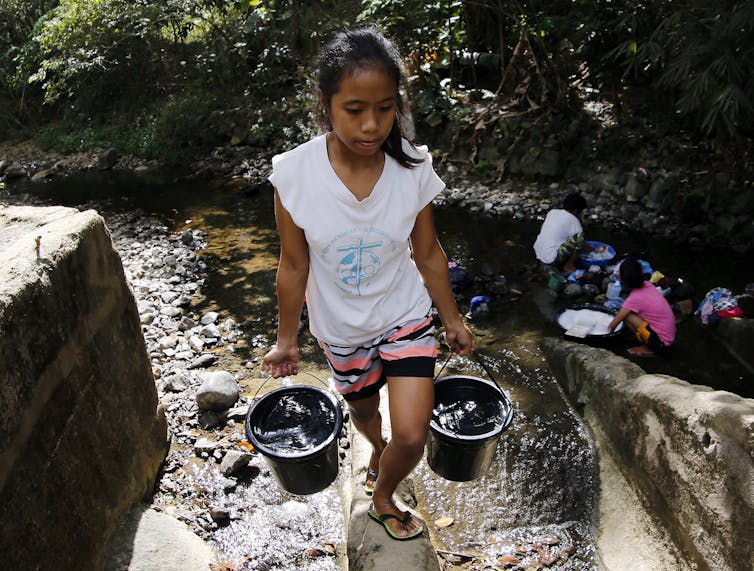
girl carries buckets of water from stream
The rights of Indigenous people to their land should be respected.
EPA

Examples abound. Take, for instance, the REDD+ program which operates under the auspices of the United Nations. It aims to reduce emissions from deforestation and forest degradation, such as through sustainable management of forests to increase carbon stocks.

A review in 2018 revealed how REDD+ projects disrupted local peoples’ livelihoods and culture in various ways. The more serious impacts included:

  • creating food insecurity by reducing the availability of agricultural land

  • loss of land through shifts in land tenure and forest management to outside corporations

  • unfair consent processes which do not include all people affected by projects

  • the clearing of forest to make way for monoculture plantations with higher carbon storage

  • limited formal frameworks to maintain local livelihoods and biodiversity.


Read more:
‘The pigs can smell man’: how decimation of Borneo’s ancient rainforests threatens hunters and the hunted


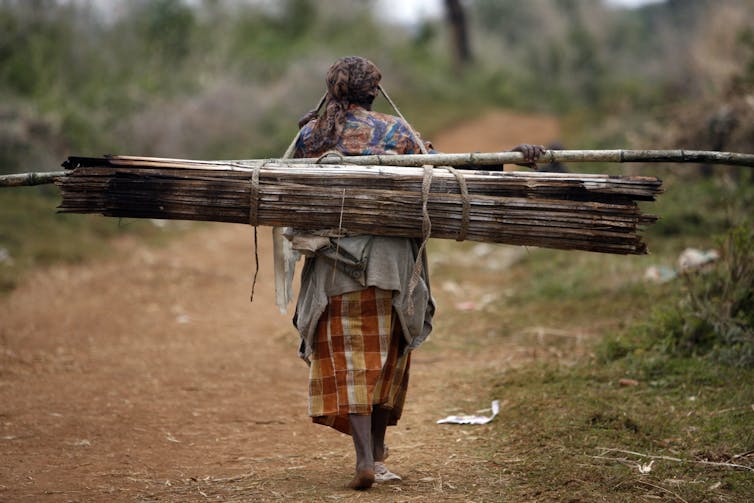
woman carries slender logs
Nature-based climate schemes often fail to take the views of Indigenous people into account.
EPA

Indigenous people must benefit

Less than 1% of climate finance from developed nations supports Indigenous and local community tenure security and forest management.

But research suggests securing the rights of Indigenous People to our/their homelands would help conserve more carbon in the territories under our/their control. Land managed by Indigenous people tends to have lower rates of deforestation and store more carbon than lands managed or owned by non-Indigenous People.

Under a best-case scenario, First Nations ownership of land would be recognised under law. Projects should be designed to acknowledge Indigenous participation and priorities. And the practices should draw on western science and Indigenous science and knowledge.

And when nature-based solutions are proposed, land tenure issues need to be resolved, and Indigenous rights need to be respected. These are the preconditions that lead to benefits for both Indigenous people and the climate.

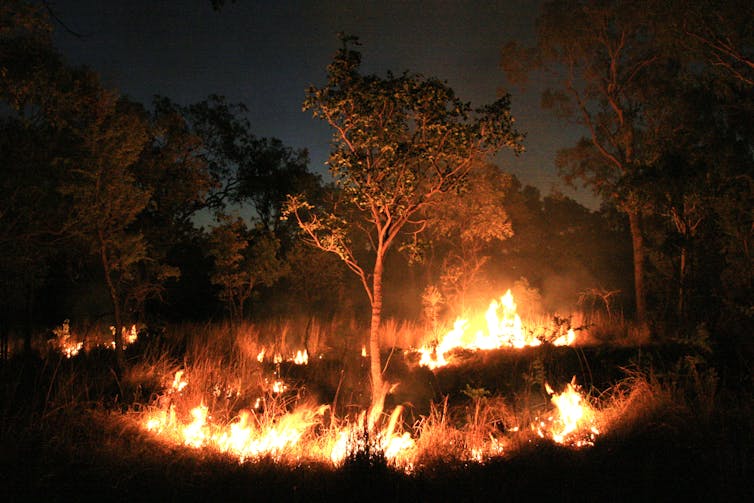
The Aboriginal Carbon Foundation in Australia is an excellent example of such a scheme. It involves savanna fire management projects in northern Australia to reduce the frequency and extent of late dry season fires. This results in fewer greenhouse-gas emissions and more carbon stored in dead organic matter.

Core benefits are developed by Traditional Owners and later verified. They include:

  • improved social ties as community members work together on projects using a peer-to-peer framework

  • elders sharing traditional ecological knowledge with young people

  • Indigenous-led land management that protects the environment, rock art and sacred sites

  • meaningful employment that aligns with the interests and values of Traditional Owners

  • increased pride and self-esteem of Indigenous people.


Read more:
Indigenous expertise is reducing bushfires in northern Australia. It’s time to consider similar approaches for other disasters


ring of fire surrounds tree
Savanna fire management projects in northern Australia reduce dry season fires.
Shutterstock

The real culprit

Indigenous people are not just vulnerable to the effects of climate change solutions, they can also be disproportionately affected by climate change itself. Traditional Owners often live on lands directly affected by climate change and can also lack the social and economic infrastructure to ensure resilience to respond to these changes.

This underscores why Indigenous people should be at the centre of decision-making about climate change and solutions to address it.

Recognition of this need is slowly growing. But more needs to be done – including enshrining the rights of Indigenous people in Paris Agreement rules governing carbon trading.


Read more:
Why UNESCO’s ‘nature based solutions’ to water problems won’t work in Africa


man in traditional Brazilian head-dress
securing the rights of Indigenous People to their homelands would help conserve more carbon in the territories under their control.
EPA

What’s more, the high cost of global travel and accommodation and restrictions during the COVID-19 pandemic hinders the attendance of First Nations leaders at international talks.

A Local Communities and Indigenous Peoples Platform was formalised at COP21 in Paris. But it remains to be seen whether this will influence negotiations at COP26.

Finally, while nature-based solutions have the potential to be an important response to reducing human-caused emissions, they are fraught with danger. The real culpability for climate change lies with nations and regions that burn large amounts of fossil fuels.

First Nations people should not be forced to carry the burden of climate action. Instead, world leaders must prioritise reducing CO₂ emissions at their source.

At the same time, they must recognise the rights and interests of Indigenous people and guarantee climate solutions are determined by Traditional Owners on our/their land.

The Conversation

Joint first authorship is ascribed to all listed authors.

Tim Cadman has been part of ARC funded projects investigating the integrity of climate change policy. He provides advice to community and not-for-profit organisations on forest policy as part of his academic service obligations.

Rowan Foley and Toni Hay do not work for, consult, own shares in or receive funding from any company or organisation that would benefit from this article, and have disclosed no relevant affiliations beyond their academic appointment.

ref. Land, culture, livelihood: what Indigenous people stand to lose from climate ‘solutions’ – https://theconversation.com/land-culture-livelihood-what-indigenous-people-stand-to-lose-from-climate-solutions-170083

‘Just say no’ doesn’t work for teen sex and drug use, so why rely on it for young driver education?

Source: The Conversation (Au and NZ) – By Teresa Senserrick, Professor, Centre for Accident Research & Road Safety – Queensland (CARRS-Q), Queensland University of Technology

Shutterstock

Human behaviour is complex. And yet approaches to road safety education are commonly far too simple, especially for young drivers. They are not only inexperienced but also biologically wired to be among those most at risk of crashing.

It is time to explore a new, more proactive approach to driver education.

Currently, we focus on teaching young people about major crash risks. Then we tell them not to take those risks. Should we really be surprised this does little to reduce the problem?

Common risks for young drivers include speeding and driving while tired. They are also more likely to be distracted by mobile phones or an array of other secondary tasks that take their eyes – and minds – away from the road.

Young drivers are not alone in taking risks. They see them on the road every day, often among their own family members and social circles, which normalises such behaviour. However, coupled with their lack of experience, such risks are much more likely to result in a crash for the young driver.

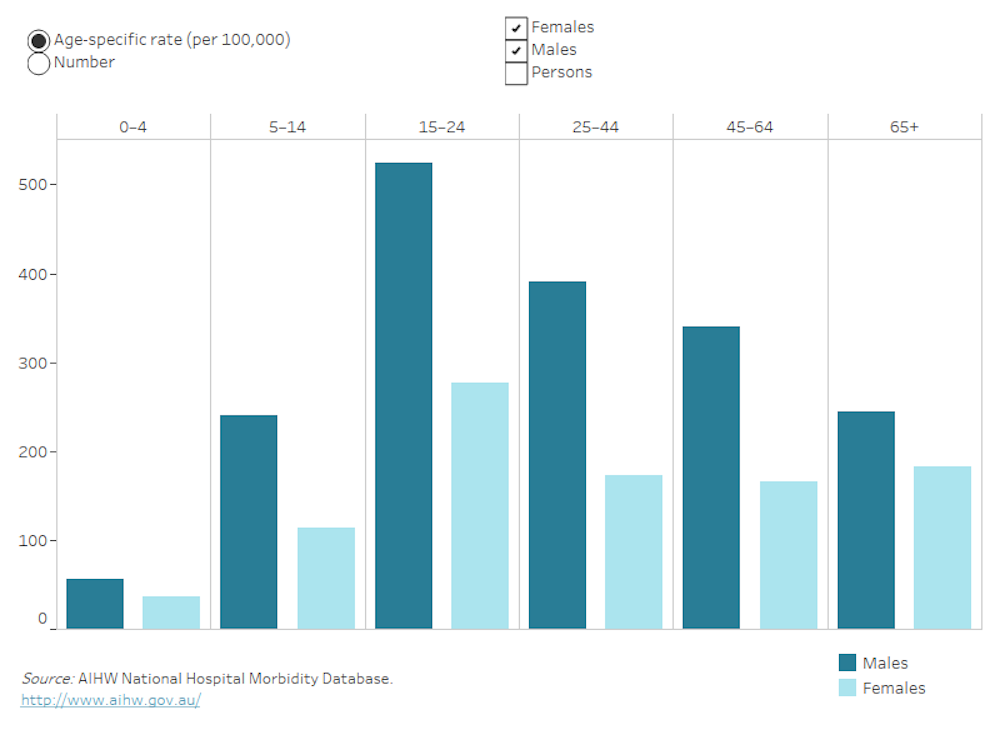
Transport accident hospitalisation rates are highest for young drivers

Bar chart showing rates of transport-related hospitalisation by age group and sex
Age-specific rates of transport-related hospitalisation (per 100,000) by age group and sex in 2017-18.
Source: Australian Institute of Health and Welfare


Read more:
Despite lockdowns, 1,142 Australians, including 66 kids, died on our roads in the past year. Here’s what we need to do

Is it realistic to expect we can predict and plan ahead to never become fatigued while driving? How many of us refuse all phone use while driving? In today’s highly connected world, why do we expect this of young drivers?

Why then does youth road safety education often simply adopt a “just don’t do it” message?

Some risks are inevitable

In other fields of youth health, education has long moved on from such an approach. It has progressed to teaching young people strategies both to avoid taking risks and to reduce harm if the risk does occur. Some risks are even considered inevitable.

An example of such a shift in approach is the move from “just say no” to safe sex education around the 1970s. Some feared this would lead to young people having sex earlier. Not only were these concerns unfounded, but research continues to show a link between sex education and lower rates of teenage pregnancies.

This approach is known as risk or harm reduction, or minimisation. It is well recognised in relation to risky alcohol and other drug use. Think of needle exchange programs, safe injecting rooms and, more recently, pill testing. Initiatives like these receive mixed support but are shown to reduce harm.


Read more:
Here’s why doctors are backing pill testing at music festivals across Australia


Harm-reduction approaches are evident in many other road safety measures that allow for margins of error. These include demerit point systems for offences and vehicle technologies that activate only after a certain threshold is exceeded. These include speed alerts, seatbelt reminders, feedback to stay inside the lane and phone-blocking apps.

In fact, allowing for human-made risks is a tenet of systems engineering. If risk can’t be eliminated, then systems are re-engineered to at least transform or reduce the risk of harm to an acceptable level.

How would harm reduction work for young drivers?

Many experienced drivers compensate for risky driving conditions by slowing down and leaving a greater gap to the traffic ahead – even if they don’t consciously realise this.

There is clear, physics-based evidence these compensating behaviours reduce crash risk. The result is a wider view of the road environment so drivers can see any potential hazards early. They also have more time and space to react to any hazards.

Technology can help alert young drivers to when they need to reduce risk using strategies more experienced drivers automatically use.

A harm-reduction approach to driver education would still emphasise avoiding key risks. However, it would also challenge young people to reflect on their own “inevitable risks”. Will they never be tempted to speed when running late for work? Will they obey every road rule, even when they see others breaking them? Would any of their answers be different if certain friends or family members were their passengers?


Read more:
Not as simple as ‘no means no’: what young people need to know about consent


If not able to eliminate the risk, young people would be challenged to identify strategies they would be willing and able to apply to reduce potential negative consequences of the risk. Slowing down and increasing following distances are key responses to many risks.

Other more tailored options include interacting with a phone only while stopped at traffic lights rather than when moving – albeit still teaching that this is not risk-free.

Time for a fresh approach

Some might argue harm-reduction approaches to driver education are too risky. We know the casualties in young driver crashes are more often their passengers or other road users rather than the young driver. However, we also know road risks cluster with other youth risks and harm reduction works to reduce negative outcomes from these other risks.

Current approaches are not working, or at least not well enough. Young drivers remain persistently over-represented in road trauma statistics, despite decades of attention. Without any evidenced-based research on harm-reduction approaches to road safety, the potential benefits as well as risks remain unknown.

The Conversation

Teresa Senserrick does not work for, consult, own shares in or receive funding from any company or organisation that would benefit from this article, and has disclosed no relevant affiliations beyond their academic appointment.

ref. ‘Just say no’ doesn’t work for teen sex and drug use, so why rely on it for young driver education? – https://theconversation.com/just-say-no-doesnt-work-for-teen-sex-and-drug-use-so-why-rely-on-it-for-young-driver-education-169371

Artists are not at the negotiating table at COP26 but art is everywhere. What can they accomplish through their work?
Source: The Conversation (Au and NZ) – By Christiaan De Beukelaer, Senior Lecturer, The University of Melbourne

At COP26 in Glasgow, a public artwork intervention stands at Govan Graving Docks, directly opposite the main delegate zone. Still/Moving’s unmissable NO NEW WORLDS is a text and light-based piece that alternates between nine iterations of the three words in its title.
As artist Leonie Hampton explains, the re-writable quality of NO NEW WORLDS

embodies the idea that if we want to change the future, we need to address the stories we tell ourselves about our past, present and future.

This artwork echoes and responds to David Buckland’s powerful Cape Farewell project, done for the Paris COP21 in 2015, in which “Another World is Possible” was projected onto a melting iceberg.

It perfectly sums up the tensions playing out between broader society and the world leaders visiting this conference, and is a desperate plea for substantive political commitments to action.

Art is now a permanent fixture at UN climate conferences. In Paris, ArtCOP21 saw some 400 events that took place in 46 countries. This year, the artists’ presence is gathered in the Climate Fringe, its title referencing the Edinburgh Fringe Festival.

Climate Fringe, its organisers claim, is “run by civil society for civil society”, and the in-person events are joined by an online hub with community-generated content including lectures, exhibitions, public artworks, film screenings and poetry readings.

But what can art accomplish at a high-stakes political meeting? Everything and nothing, depending on whom you ask.

An existential threat

Kathy Jetn̄il-Kijiner, a poet and Climate Envoy of the Marshall Islands is currently reporting from Glasgow for Yahoo. She is no stranger to climate activism. At COP21 in Paris, she recited her poem 2 Degrees, explaining, in no uncertain terms, what difference half a degree would make for her peoples’ survival and sovereignty.

For those unfamiliar with the arcane theatrics of climate diplomacy, voices like hers are crucial to understanding what’s at stake. But artists are not at the negotiating table. They’re not actually making the decisions. So what can they hope to accomplish?

Artists can raise awareness, making complex scientific reports accessible and tangible.

For instance, Waanyi artist Judy Watson’s painting, australian mean temperature anomaly (2021), washes statistical bar graphs with an expressive, regenerative and hopeful hue of green to reference the regrowth of K’gari (Fraser Island) following the Black Summer bushfires. At Brisbane’s Institute of Modern Art’s recent show On Fire, Watson’s work sat in contrast to a lump of coal on a plinth.

Judy Watson, australian mean temperature anomaly, 2021 (installation view)
. Acrylic, graphite, pastel, chinagraph on canvas, and coal, 269 x 179.5 cm, assisted by Leecee Carmichael. Courtesy of the artist, Milani Gallery, Brisbane, and Tolarno Galleries, Melbourne.
 Installation view: ‘On Fire: Climate and Crisis’
IMA Brisbane. Photo: Carl Warner.

Artists do more than simply tell us there’s a problem. They can add nuance to the complex web of interconnected issues we face. They can tell stories about loss, about possibility and transformation, inside and beyond the art world.

Some, like the Brandalism collective, aim to influence political action. After Australia’s devastating Black Summer fires in 2019-2020, they created How’s the Serenity?, a guerrilla art intervention with posters linking the fires, climate change, and political inaction. These posters were pasted up as caustic “anti-advertising” across Melbourne, Sydney and Brisbane.

In Glasgow and other towns and cities across the UK and Europe, billboard campaigns target the greenwashing propaganda of COP’s principal sponsor NatWest. Hundreds more unsanctioned satirical posters have taken over bus stops and billboards, targeting corporate carbon offsetting schemes and the questionable climate policies of Barclays, Shell and HSBC.

These interventions are pungent reminders of the existential challenge we face.

A journey, not a destination

But while they may highlight the threats, these artworks don’t quite help us to imagine pathways to a sustainable future.

One problem is that the challenges of climate change have been reduced to a handful of simplified proxies. We should not exceed 350 parts per million of carbon dioxide in the atmosphere – though we have reached 420ppm and remain on a frightening upward trajectory.

A red house sinks into a lake.
Too often, climate art imagines the future – but not the paths we must take.
Shutterstock

We should keep global warming below 1.5 degrees – but most recent policies are still projected to lead to a 2.9 degree increase.

We must meet a “net-zero” target by 2050. But what do such abstractions and distant targets mean for our daily lives?


Read more:
Climate scientists: concept of net zero is a dangerous trap


Climate artists also face another dilemma.

Climate-related apocalyptic art now speaks to audiences largely familiar with global warming’s threats and projected impacts. Though at its best still starkly confronting, such art is heavily “message-laden”. Often saying little new, it is increasingly banal and, paradoxically, begins to naturalise the awful future it wishes to avert.

Alternatively, arcadian images of a climate-safe future seem in deep denial about the turbulence of the coming transition. Contending futures have become increasingly difficult to construct visually, and to rally people behind or against.

We believe the way forward for climate art is not to imagine our fatalistic or idyllic futures, but instead to sketch out pathways that can get us there.

Without Molly Crabapple’s rapid-fire captivating drawings, visualising and making accessible Alexandria Ocasio-Cortez’s complex proposal for a Green New Deal, would people have listened? Would they have understood?

On Friday 5 November, in the fringes of the COP, artists collective Julie’s Bicycle is hosting The Missing Link. This event “explores the vital role that arts and culture must play in climate transformation”, and will give attendees online from all over the world a handle on this issue.

At their best, artists are still uniquely able to add meaning and generate empathy and perspective to the tangled web of climate discourse. In doing so, they help imagine and illuminate the complex and ultimately radical voyage we’re on together.

The Conversation

Christiaan De Beukelaer receives funding from the Australian Research Council and the ClimateWorks Foundation. He previously received funding from the European Cultural Foundation, the European Science Foundation, and the Royal Society Te Apārangi.

Peter Christoff was a Chair and board member of the arts organisation, CLIMARTE.

Eloise Jane Breskvar does not work for, consult, own shares in or receive funding from any company or organisation that would benefit from this article, and has disclosed no relevant affiliations beyond their academic appointment.

ref. Artists are not at the negotiating table at COP26 but art is everywhere. What can they accomplish through their work? – https://theconversation.com/artists-are-not-at-the-negotiating-table-at-cop26-but-art-is-everywhere-what-can-they-accomplish-through-their-work-170786

View from The Hill: A battered Scott Morrison proclaims it’s time to ‘move on’

Source: The Conversation (Au and NZ) – By Michelle Grattan, Professorial Fellow, University of Canberra

Having endured a shocking shellacking over the last few days, Scott Morrison declared at a news conference en route for home that “it’s important now that we all just move on”.

Easier said than done, when the French have just delivered another blast at your integrity, via their ambassador’s uncompromising speech at the National Press Club, Malcolm Turnbull has branded you a well-known liar, and your week away has been a clear net negative.

But one thing we can bank on. Morrison will jut out his jaw and plough ahead. This prime minister has the thickest of political skins, and he is facing the fight of his life in a few months.

He showed again in his Wednesday remarks to the travelling media that he will admit no mistakes or miscalculations in his dealings with the French, even in relation to the leaking of a text Emmanuel Macron sent him just prior to the cancellation of the French submarine contract.

In the message, two days before the announcement, Macros asked: “Should I expect good or bad news for our joint submarines ambitions?” The text was put out to reinforce Morrison’s argument that the French knew the contract was on life support. (The French suggest it showed the opposite.)

Disclosure of another leader’s private communication is hardly the done thing diplomatically. But Morrison isn’t fussed by such niceties and was unrepentant when pressed about it.

“Claims had been made and those claims were refuted, ” he said bluntly.

“What is needed now is for us to all just get on with it. I mean, that’s what is most important to the Australian people. That the United States, the United Kingdom and Australia get on with the historic agreement that we came to, to deliver an incredibly important capability for Australia, to keep Australians safe and to defend and protect Australia.”

Asked what he was going to do to try to repair the rift with France Morrison said “I’m going to move on and get the job done”.


Read more:
‘I don’t think, I know’ – what makes Macron’s comments about Morrison so extraordinary and so worrying


In his Wednesday speech, ambassador Jean-Pierre Thébault emphasised the depth of the partnership between the two countries that had been represented by the now aborted submarine deal, arguing it went well beyond a commercial contract, including the provision of highly sensitive technology.

He repeated the earlier French line that the Australian action had been “a stab in the back” to France, and pointed to recent evidence by Australian departmental and military figures to Senate estimates that rejected widespread media reports the project had run off the rails with big cost overruns.

Thébault suggested, indeed, that dark arts had been at work.

“We had questioned the Australian government several times over the years about the false or misleading allegations which were regularly made, with scarce official reaction. We were told that such things ‘do occur in Australia’, are ‘normal’, ‘do go away’ and ‘have to be managed solely by Defence’.

“But in light of the subsequent events, the question now arises legitimately: why was it impossible earlier to state the naked truth, as was done just some days ago, on record, during Senate estimates? This would have set the record straight and stopped the smear campaign,” Thébault said.


Read more:
G20 leaders talk up climate action but avoid real commitments, casting a shadow over crucial Glasgow talks


“In retrospect, knowing what we know for sure today, about the relentless conduct in parallel of an alternative plan, some had a direct interest to sabotage the public support and understanding for the Attack class program,” he said.

“The Attack class program, despite the allegations made in this intensive smearing campaign, was in fact not at all a ‘troubled’ program.

“The Attack class program has been intentionally vilified to become an easy scapegoat, to justify a change of footing that was long time in the making,” the ambassador claimed.

How much more damage the French can do Australia remains to be seen, especially as France takes over the presidency of the Council of the EU in January. The French say it is up to the Australian government to come up with “substantial proposals” to repair the relationship but it is hard to see it mending for a long time, and probably never with Morrison.

It would be interesting to see if tensions would ease at all if there were a change of government, given that Labor, while strongly criticising Morrison’s handling of the French, has supported the AUKUS agreement and said Australia was within its rights to cancel the contract.


Read more:
Australia’s refusal to sign a global methane pledge exposes flaws in the term ‘net-zero’


Morrison would reckon that in terms of domestic politics, the rapidly moving news cycle will relatively quickly overtake the publicity around the French onslaught.

As for Turnbull’s attack, he will hope the public put that into the context of the former PM having become one of his harshest and most constant critics.

When he’s back on Australian soil, Morrison can be expected to deploy two tactics.

Insisting he’s now fully explained what happened with the French, he is likely to try to shut down further questioning on the matter as much as he can.

And he will play up his portrayal of himself as doing whatever is necessary as the custodian of the security of Australians.

That’s the essence of the “moving on” strategy.

The Conversation

Michelle Grattan does not work for, consult, own shares in or receive funding from any company or organisation that would benefit from this article, and has disclosed no relevant affiliations beyond their academic appointment.

ref. View from The Hill: A battered Scott Morrison proclaims it’s time to ‘move on’ – https://theconversation.com/view-from-the-hill-a-battered-scott-morrison-proclaims-its-time-to-move-on-171127

Word from The Hill: Scott Morrison’s trip blown up by French grenade

Source: The Conversation (Au and NZ) – By Michelle Grattan, Professorial Fellow, University of Canberra

As well as Michelle Grattan’s usual interviews with experts and politicians about the news of the day, Politics with Michelle Grattan now includes “Word from The Hill”, where all things political will be discussed with members of The Conversation’s politics team.

Scott Morrison’s trip to the G20 summit in Rome and COP26 in Glasgow, from which he returns early Thursday, was overshadowed by the drama of French President Emmanuel Macron declaring the PM a liar, arising from the circumstances surrounding the cancellation of the French submarine contract.

After Macron’s extraordinary attack, made on the sidelines of the G20, the Australian government retaliated by leaking a private text from Macron to Morrison, which further infuriated the French.

In Glasgow, Morrison delivered the 2050 net zero commitment that caused the Nationals such angst, and gave Prince Charles a rapid-fire briefing on Australia’s climate policy, just in case the royal had missed it.

The Conversation

Michelle Grattan does not work for, consult, own shares in or receive funding from any company or organization that would benefit from this article, and has disclosed no relevant affiliations beyond their academic appointment.

ref. Word from The Hill: Scott Morrison’s trip blown up by French grenade – https://theconversation.com/word-from-the-hill-scott-morrisons-trip-blown-up-by-french-grenade-171121

NZ anti-vaxxers foil PM Ardern’s planned clinic media briefing

RNZ News

Prime Minister Jacinda Ardern did not turn up to a planned New Zealand media event at a vaccination clinic in Whanganui today where a group of anti-vaccination protesters gathered.

Ardern was visiting a vaccination bus in the city and changed the time of the stand-up to just after 1.20pm at a new venue.

Around 200 anti-vaccination protesters made their presence felt at the mobile clinic on Victoria Avenue.

But this did not put off a few people from getting their shots or turning up hoping to catch a glimpse of Ardern.

In the stand-up, Ardern said she was not taking the protest personally and was not surprised by it.

Whanganui’s vaccination rates are below the national vaccination average.

In other developments today:

  • The Ministry of Health announced 100 new community covid-19 cases — 97 in Auckland and three in Waikato.
  • The government has purchased another 4.7 million doses of the Pfizer/BioNTech vaccine for use in New Zealand over the next year, Covid-19 Response Minister Chris Hipkins revealed while giving the latest details on the pandemic with Director-General of Health Dr Ashley Bloomfield.

Second day in row
This was the second day in a row that an Ardern covid media briefing had been disrupted by protest over covid vaccination. Yesterday, heckling in Northland by an American pharmacist claiming to be a journalist forced the prime minister to change venues in the middle of the press conference.

“We are at a stage in the vaccine roll-out where we are trying to reach into communities that may hold firm views,” Ardern said today.

“But we need to have those conversations and, just talking to some of our health practitioners, their goal is to talk to everyone wherever they can to have those conversations about why it’s so important that people are vaccinated.”

On teachers who may be about to lose their jobs due to the government vaccination mandate, Ardern said: “We have not taken lightly the decision for some areas to require vaccination. It’s taken a lot of discussion and careful thought and we have focused in on those groups that we consider high risk.”

On whether mandates have destroyed social cohesion and forced some into corners, Ardern said although it may have had that effect with some, for others it had forced a conversation and made people ask questions.

“We had the experience of having already rolled this out for our border workers and what we noticed was by putting a date it did cause those who had questions to go and seek advice, talk to trusted health professionals and then make a decision.”

On her statement at the beginning of the pandemic that vaccinations would never be forced on anyone, yet mandates seemed to contradict that, Ardern said it was always her view that the government would not force all New Zealanders to be vaccinated and that view had not changed. They would not.

‘Duty of care to the vulnerable’
“This is about certain workforces and work places, where we’ve applied assessment on whether or not we have a duty of care to look after those most vulnerable.”

“We’ve guarded against requiring vaccines where we need to ensure that people are always, no matter what, they are able to access health services, food, government support.

“We have been very clear, we will not require nor will we ever require vaccine certificates to access food, government benefits, access services that people need to live.”

Vaccination efforts across the country are in fully swing as district health boards work towards 90 percent full vaccination rates.

Only five district health boards have hit the milestone for first jabs: Capital and Coast, Auckland, Waitematā, Canterbury, and, just yesterday, Southern DHB.

Counties Manukau District Health Board is on the home stretch to meeting the 90 percent first dose milestone, only 3951 injections away.

This article is republished under a community partnership agreement with RNZ.

Print Friendly, PDF & Email

Article by AsiaPacificReport.nz

‘We’ve done our part’ to ward off a ‘hellish future’, says Fiji PM

By Talebula Kate

Fiji has done its part in the fight against climate change by pushing for the first international accord to include the 1.5-degree threshold in the Suva Declaration in 2015 and committing to net-zero carbon emissions by 2050, says Prime Minister Voreqe Bainimarama.

“At COP21, in a fury of forceful negotiations in Paris, France, the 1.5-degree guardrail was written into the Paris Agreement on climate change,” he said.

“Fiji has since done our part — legally empowering ourselves to achieve net-zero carbon emissions by 2050 through our recently passed Climate Change Act,” he said at a COP26 briefing in Glasgow, Scotland this week.

COP26 GLASGOW 2021

“But too few countries have joined us.

“Six years post-Paris, we are on track for 2.7 degrees of warming — a hellish future that will spare no nation,” he said.

“To demand the action we need, the world’s climate champions are marching to Glasgow to the mantra of ‘keep 1.5 alive’ — a battle cry first uttered here in the Pacific.”

PM condemns selfish ‘carbon addicts’
Timoci Vula reports that in his speech at COP26 yesterday, Bainimarama said the world could not let “a coalition of carbon addicts” write out the urgency of accelerating climate action for the survival of low-lying island nations and communities.

Bainimarama said the “1.5” (global warming limit target) was a compromise that Fiji had struck alongside all of the world’s most climate vulnerable nations.

He said they knew then all the human tragedy that level of warming would mean, but it would also ensure that, at the very least, low-lying island nations and communities would survive.

“Six years on, where has that goodwill gotten us? The world’s collective climate commitments will see us fly past 1.5 by the end of the decade.

“We are losing the race to net-zero to a coalition of carbon addicts who would rather fight for coal than for a future of good jobs and innovative industries created by climate ambition,” Bainimarama said.

“These leaders make pledges but won’t show us plans. They even seek to spin the science. But we cannot let them write out the urgency of accelerating action.

“Clean coal, responsible natural gas, and ethical oil are all figments of the selfish mind.

“No matter what they call them, carbon emissions are wrecking the climate. There’s nothing clean, natural or ethical about it.”

Bainimarama claimed other leaders pursued a “policy of appeasement”.

“They sit idly by as their high-emitting counterparts destroy our children’s futures.”

Talebula Kate and Timoci Vula are Fiji Times reporters. Republished with permission.

Print Friendly, PDF & Email

Article by AsiaPacificReport.nz

Anti-vaxxer attacks on PNG health workers force closure of Lae clinics

By Carmella Gware in Lae

Urban clinics in Papua New Guinea’s second city Lae have closed for an indefinite period following attacks on health workers.

Anti-vaxxers have been verbally or physically attacking health workers over false claims of state mandatory vaccinations against the covid-19 pandemic.

Health workers and support staff manning facilities around the city have reported incidents of stone throwing, swearing and threats to their personal safety, with some people viewing them as “agents of a forced covid-19 vaccine”.

The National reported at the weekend on an attack on a three-member ambulance crew by people last Thursday wrongly believing St John Ambulance staff were administering vaccines.

A surge in covid misinformation and disinformation on social media is hampering health authorities in their work.

While the Morobe Provincial Health Authority is yet to advise residents about the crisis, health workers say nobody is manning the clinics as they have all been asked to stay at home until further notice.

A visit to the Malahang and Butibam clinics revealed that similar notices were posted saying: “Haus sik bai pas inap ol bosman/bosmeri i tok orait lo open gen”. (Hospital will close until approval is received from bosses.)

The next option for residents is to go to the overcrowded ANGAU Memorial Provincial Hospital or visit private clinics and pharmacies.

Barely 1 percent vaccinated
Asia Pacific Report reports only 1.2 percent of the nine million Papua New Guineans are vaccinated against covid-19.

According to the John Hopkins University covid dashboard, 29,715 cases of covid and 370 deaths have been reported on Papua New Guinea but health officials fear the real toll is far higher because of limited testing and records.

John Hopkins has reported that the total death toll from covid-19 has now passed five million globally.

A "closed under bosses' orders" sign in Lae
A “closed under bosses’ orders” sign in Tok Pisin at a Lae medical clinic. Image: Loop PNG
Print Friendly, PDF & Email

Article by AsiaPacificReport.nz

Australia’s refusal to sign a global methane pledge exposes flaws in the term ‘net-zero’

Source: The Conversation (Au and NZ) – By Mark Howden, Director, ANU Institute for Climate, Energy and Disaster Solutions, Australian National University

Shutterstock

Overnight at the United Nations climate summit in Glasgow, more than 90 nations signed a global pledge led by the United States and United Kingdom to cut methane emissions. However, Australia was not among them.

China, Russia, India and Iran also declined to sign the pledge, which aims to slash methane emissions by 30% before 2030.

Methane is emitted in coal and gas production, from livestock and other agricultural activity, and when organic waste breaks down in landfill.

Almost half of Australia’s annual methane emissions come from the agriculture sector. Defending the federal government’s decision, Energy and Emissions Reduction Minister Angus Taylor said Australia had pledged net-zero greenhouse gas emissions by 2050 and would not set specific targets for each sector.

Days out from COP26, National Party leader Barnaby Joyce had claimed signing the pledge would be a disaster for coal mining and agriculture, saying “the only way you can get your 30% by 2030 reduction in methane on 2020 levels would be to grab a rifle and go out and start shooting your cattle”.

Australia’s position on the pledge is inconsistent with methane reductions the Intergovernmental Panel on Climate Change (IPCC) says are required to keep Earth below 1.5℃ warming this century.

The debate also highlights how the shorthand phrase “net-zero emissions” conceals and distorts the real challenges in avoiding dangerous climate change.

It focuses attention on the wrong time frame for action – the next decade is far more important for climate action than 2050. It also addresses the means of action – emissions reduction – rather than the desired goal, which is to avoid dangerous climate change.

And importantly, simply through delaying action, the world could feasibly reduce emissions to net-zero by 2050, but still fail to meet the goals of the Paris Agreement – keeping average global temperature rise below either 1.5℃ or 2℃ this century.


Read more:
COP26: a global methane pledge is great – but only if it doesn’t distract us from CO₂ cuts


man at lecture with flag on blue background
The Morrison government has refused to sign a global methane pledge.
Ian Forsyth/AP

Net-zero is both too much, and not enough

The IPCC report released in August painted a clear picture of how different trajectories for various greenhouse gases translate to global temperature increases.

Carbon dioxide (CO₂) emissions last a very long time in the atmosphere so they accumulate. Consequently, net CO₂ emissions need to decline sharply as soon as possible if we’re to limit temperatures to 1.5℃ or 2℃ above pre-industrial levels.

However, CO₂ emissions not only need to reach net-zero – the IPCC says CO₂ emissions need to go “net-negative”. This will require a massive scaling up of methods and technologies to remove existing CO₂ in the atmosphere.

In other words, when it comes to CO₂, net-zero is not enough. It is a way point, not the end point.

So how do we remove CO₂ from the atmosphere? Some methods, such as mass tree planting, are already widely implemented. Some are difficult to implement at scale, such as substantial increases in soil carbon.

Others are in the exploratory stages including incorporating captured CO₂ into building products and high-value materials or in the ocean.

Each option has advantages, disadvantages and limits. The “net-zero by 2050” terminology obscures this complexity. It also conceals the need for crucial discussions about feasibility, governance and support for research and development that’s needed now.

Meanwhile, the situation is quite different for shorter-lived gases such as methane and nitrous oxide. In those cases, going all the way to net-zero is not needed to meet the Paris goals.

According to the IPCC report, an illustrative scenario consistent with 1.5℃ warming would involve methane emission reductions of about 30% by 2030, 50% by 2050 and just over 60% by 2100.

This is consistent with the global methane pledge signed at COP26 overnight. For nitrous oxide, the illustrative reductions would be about 30% by 2050.

So, for methane and nitrous oxide, net-zero is too much.


Read more:
Monday’s IPCC report is a really big deal for climate change. So what is it? And why should we trust it?


Targets based on science

It should be noted, to keep temperatures to 1.5℃, there are many possible combinations of emission-reduction trajectories for various greenhouse gases. The extent to which CO₂, methane or nitrous oxide is reduced is interchangeable and the final mix will be a function of political decisions.

A clear and integrated assessment of the economic, environmental and social consequences of different emission-reduction pathways is needed to inform those decisions. Without that, inefficient and inequitable economic responses may result.

For example, methane (from livestock) and nitrous oxide (from fertiliser use) make up a high proportion of agriculture emissions. But options for completely stopping these emissions are limited.

Farmers could offset their emissions by planting trees or rehabilitating vegetation on their properties to increase carbon stores. But this would prevent them from selling those emissions reductions on carbon markets, thus removing a potential source of farm income.

So an economy-wide target of net-zero for all key greenhouse gases might mean agriculture must make far more effort in emissions reduction, at much greater cost, than other sectors which largely emit CO₂ and where decarbonisation options are more readily available.

sunset on farm with cattle and trees
Methane represents a large part of agriculture emissions.
Shutterstock

New Zealand has recognised this, and treats agricultural emissions separately.

Carving agriculture out of national emissions-reduction goals would place a greater requirement to act onto other sectors. For example, emission reductions in the transport sector may have to be greater than otherwise, to compensate for the lack of progress in agriculture.

But is isolating agriculture from emission reductions necessary? A recent study assessed new emission reduction options for livestock, including several approaches that together may reduce emissions at the rate required by the methane pledge. They involve more efficient production, technological advances, changes in demand for livestock-related products and land-based carbon storage.

These are approaches already being adopted by industry groups and farmers.

Towards ‘Paris-aligned’

Targets for methane and nitrous oxide reductions should be set using the IPCC science – and don’t have to be set at net-zero. That would leave sectors emitting these gases with a feasible (but still challenging) pathway to reducing emissions in line with the Paris goals.

And where appropriate, we should start describing effective climate action as being “Paris-aligned”. Clearly, over-use of the term “net-zero emissions” misdirects attention from where it’s needed.


Read more:
The clock is ticking on net-zero, farmers must not get a free pass


The Conversation

Mark Howden is affiliated with CO2 Value Australia, a not-for-profit corporation with a mission to promote the development and deployment of sustainable industrial solutions which transform captured CO2 into useful products.

ref. Australia’s refusal to sign a global methane pledge exposes flaws in the term ‘net-zero’ – https://theconversation.com/australias-refusal-to-sign-a-global-methane-pledge-exposes-flaws-in-the-term-net-zero-170944

Slippery definitions and alarming silences: a parliamentary inquiry into the creative industries gives us a plan for a plan

Source: The Conversation (Au and NZ) – By Julian Meyrick, Professor of Creative Arts, Griffith University

A sculpture of chimpanzee David Greybeard unveiled in Melbourne last year, the result of a collaboration between artist Lisa Roet and the Jane Goodall Institute Global. James Ross/AAP

Fourteen months after it was announced, the House of Representatives Standing Committee on Communications and the Arts has handed down its report, “Sculpting A National Cultural Plan”, on Australia’s cultural and creative industries and institutions.

Labor finished six years in government in 2013 with the launch of Creative Australia, our last national cultural policy. The Coalition finishes an eight year stretch with a call to think about developing one. Still, a plan for a plan is better than no plan at all.

The 205-page document is broken into six sections. They cover the composition of the cultural sector, approaches to evaluating it, the impact of COVID-19 on artists and organisations (spoiler alert, it isn’t good), and the problem of arts education in schools (and, glancingly, at a tertiary level).


Read more:
Why an education in visual arts is the key to arming students for the future


As befits an investigative inquiry, the report devotes considerable space to describing what the sector does and communicating the views of those who work in it. There is frequent quotation from 352 submissions, and responses to a related survey.

A useful tip: read “Appendix F. Labor Members – Additional Comments” first. It raises the issues the rest of the report avoids, particularly around two institutions crucial to any cultural plan of national scope, the Australia Council for the Arts and the ABC.

Managing director of the ABC David Anderson speaks via video to a Senate Estimates Committee. Where is the ABC in this report?
Lukas Coch/AAP

Light on calls for action

There are five terms of reference, and some are addressed in more detail than others. The first two are the most crucial: culture’s “direct and indirect economic benefits and employment opportunities”, and its “non-economic benefits [that] enhance community, social well-being and … Australia’s national identity”.

The terms were provided by the Minister for Communications, and it is not the job of the committee to contest them.

Even so, both their order and wording is restrictive. Slicing culture into economic and non-economic benefits is a binary with limited policy application. Making the former the primary lens has a reductive effect on all discussion thereafter.

In respect of Australian cultural policy’s three favoured key terms – they seem on perpetual rotation – there is a return to the limelight for “access” (74 mentions), while “innovation”, a preoccupation of the Turnbull government slips to a supporting role (46 mentions), and “excellence”, dominant in the years when George Brandis ran the portfolio, becomes a spear-carrier (4 mentions).

Bangarra Dance Theatre performers at the reopening ceremony for the Australian Museum last year. Slicing culture into economic and non-economic benefits is a binary with limited policy application.
Lisa Maree Williams, Getty/AAP

Submissions show a diverse mix of people, organisations and art forms. A New Approach (ANA) is the think tank most frequently cited though (50+ mentions), and its comments often have headline status.


Read more:
The limits of advocacy: arts sector told to stop worrying and be happy


The report’s 22 recommendations can be divided into three categories: restorations, bespoke suggestions, and calls for further action.

The first are welcome, though in rejoicing at the return of the word “arts” to the Department of Infrastructure, Transport, Regional Development and Communications, or the resumption of ABS cultural and creative satellite accounts (dedicated statistics on the sector’s activities) we should remember who removed them.

The bespoke suggestions are interesting, even when their impact is not immediately apparent (an app for information on arts events) or their implementation likely to be contested (20% of local revenue for streaming services to be spent on local content).

The calls for action are light-on, even by the standards of a broad-ranging report. Discussion of the national identity aspects of Australian culture is thin, for example. This leaves the report at a disadvantage when considering the non-economic benefits of the arts – the ones most people regard as synonymous with them.

Apart from the awkwardness of talking about culture in this displaced way (do we refer to the “non-economic benefits of the health system”?), it leaves the report looking truncated and partisan.

This report looks truncated and partisan.
Joel Carrett/AAP

Apolitical

There is discussion of culture’s contribution to our mental health, but not our political health; to social cohesion but not social change. The arts come across as soft-edged, catering to emotional needs like “confidence” and “hope” rather than intellectual ones, like insight and truth.

On the economic side, there are lots of figures, but it is hard to know how to parse them. They are sourced in different ways by different agencies, and append different production contexts (literary publishing vs. performing arts vs. digital games). The report swings between terms: “culture”, “creative industries”, “cultural and creative industries” – all “otherwise known as the arts”.


Read more:
Beyond bulldust, benchmarks and numbers: what matters in Australian culture


The aggregate figure of $111.7 billion of culture’s annual economic contribution is repeated, though according to the ABS, 50% of this is “non-cultural”, involving computing, industrial design, fashion and retail. The “arts industry”, including broadcast and electronic media, is far smaller, just $14 billion.

Such definitional slippages suggest these metrics are more ritual offerings to the ideological gods than a serious guide to policy-making.

Here, ANA should be careful how it manages relations with the government. Uncritically adopting an econometric mind-set is unwise, as is insistent reference to a “middle Australia” that has little sociological substance to it. To the extent ANA mirrors the report’s “market first” assumptions, it aligns with the Coalition’s view of the cultural sector.

Business-speak, with one exception

The exception – and it stands out markedly – is the report’s discussion of, and proposals for, Indigenous arts and culture.

There is not the same division of the economic and non-economic, and respect is afforded culture’s intrinsic worth. (“Country, culture and community are, for many Aboriginal and Torres Strait Islander people, intrinsically linked and the well-being and success of one depends on the health of the other”.)

Artist Vincent Namatjira pictured in 2020 with his Archibald Prize winning portrait of Australian Rules footballer and community leader Adam Goodes.
Iwantja Arts/AGNSW

The closest the report comes to adopting this holistic tone elsewhere is in reference to heritage institutions and their “important preservation and curation service”. Though even here, there is a rapid shift to focusing on spill-overs (“enhancing well-being, fostering shared values [and] supporting social cohesion”).

The 10-person committee has two Coalition chairs and a Coalition majority of six to four. This is reflected in the report’s language of business-speak, used not only to describe what the sector does but to validate it. Thus the report is firmly “inside the box” of 40 years of neoliberal prescriptions on small government, culture-as-enterprise and value-as-money.

That said, the committee has a number of members on it with diverse backgrounds and interesting pre-Parliamentary experience. It is not a collection of the usual suspects.

This raises the question of whether the report’s “market first” perspective comes from the committee or from the sector itself, which, after 40 years of being told its value is to be measured in dollars now believes it.

The report cites some challenges to this viewpoint, but they feel muted. The suspicion is that what was once a rhetoric of convenience is now a self-view. It is, for example, a very bad idea to call in the Productivity Commission to consider “arrangements which govern funding of artistic programs” (one report recommendation) given its traditional hostility to all forms of producer subsidy and its perennial muddling of equity and efficiency issues.

Likewise omitting the Australia Council and the ABC from detailed discussion should flash a warning light. Much government policy-making now involves vested interest lobbying and ministerial fiat, as the Grattan Institute’s ex-chief executive, John Daley (who has worked with ANA) noted in a recent report on removing barriers to policy reform.


Read more:
Latest arts windfalls show money isn’t enough. We need transparency


“It’s goodbye Whitlam, hello pork-barrel” a colleague said to us recently. How then should we greet a report that says nothing about the public sector or intermediary cultural agencies established precisely to avoid such political control of arts and culture?

The Conversation

Julian Meyrick made a written submission and supplementary submission to the inquiry, and also gave oral evidence to it.

Justin O’Connor receives funding from The Australian Research Council.

ref. Slippery definitions and alarming silences: a parliamentary inquiry into the creative industries gives us a plan for a plan – https://theconversation.com/slippery-definitions-and-alarming-silences-a-parliamentary-inquiry-into-the-creative-industries-gives-us-a-plan-for-a-plan-170963

America’s public broadcasters are thriving – here’s what Australian media can learn from them

Source: The Conversation (Au and NZ) – By Prue Clarke, Research Fellow at the Centre for Media Transition and head of New Narratives, a US-based not-for-profit newsroom and media development organisation working in low income countries., University of Technology Sydney

Shutterstock

When ABC chair Ita Buttrose told a National Press Club lunch earlier this year that the January 6 insurrection at the US Capitol could be blamed on the lack of a “well-funded public broadcaster”, she echoed a dangerous misunderstanding about the American media landscape.

In fact, America’s public broadcasters are better funded than Australia’s, and the rise of Trumpism led to a golden age of journalism in the United States.

The January 6 insurrection happened in spite of excellent journalism. Australian policymakers and media leaders need a more sophisticated understanding of America’s information ecosystem if they’re to counter the same forces here.

Buttrose said in May that countries without a well-funded public broadcaster often have examples of right-wing extremism, as was evident in the Jan. 6 Capitol insurrection.
Jose Luis Magana/AP

A different definition of ‘public funding’

The US has two public broadcast systems. The biggest of them – National Public Radio – attracts an audience of 57 million each week. One in five US adults gets their political news from NPR. That is the seventh-largest audience of any news organisation in any medium in the US.

If you’ve ever listened to This American Life, Serial or Radio Lab – among the most downloaded podcasts ever – you’re part of the American public radio audience.


Read more:
Philanthropy is funding serious journalism in the US, it could work for Australia too


NPR staff would agree with Buttrose that they need more funding, but not in the way she means. US public radio has nearly twice the budget of the entire ABC, with US$1.3 billion (AUD$1.8 billion) in annual revenue for NPR, the Public Radio Exchange (PRX) and the 123 largest local public radio stations.

Annual revenue for public TV in the US is smaller at $US690 million (A$927 million). Still, 16% of all US adults get their political news from the Public Broadcasting Service (PBS), comparable to the BBC audience in the US.

The depth of NPR funding shows in deeply reported programs such as Morning Edition and The New Yorker Radio Hour, which feature experienced journalists (some of whom have been on the same beat for decades). Solid resources underpin shows that are dense with field recordings and interviews with real people across America and from 17 international bureaus.

NPR has also funded a spring of innovative, popular podcasts such as Invisibilia and In the Dark, which are finding large global audiences.

A different definition of ‘public broadcaster’

Buttrose’s narrow definition of “public broadcaster” is based on how much money comes directly from government.

NPR’s coalition of 1,000+ content makers and stations receives only 12% of its funding directly from the government. But the bulk of funding still comes from taxpayers. Public radio stations are structured as not-for-profits and all contributions are tax deductible. Nearly 40% of their funding comes directly from audience members, while another 10% comes from foundations.

“Corporate sponsorships” from carefully vetted companies – which are also mostly tax deductible – make up 19% of NPR’s funding.


Read more:
NPR is still expanding the range of what authority sounds like after 50 years


In 2019, individual donations to the top 123 public radio stations totalled $US430 million (A$593 million) from 2.35 million listeners. The average listener contribution was $US183 (A$250).

Those are still taxpayer dollars – money diverted from government coffers where it might have been used on education, health care or infrastructure. But by making news media donations tax deductible, the US government allows audiences to decide which public interest journalism they want to support with their tax money, if any at all.

That, in turn, gives news media that qualify for tax-deductible status a strong incentive to reach as big an audience as possible with content that is so trusted, valuable and engaging, people want to pay to help keep it alive.

It’s the same case Guardian Australia has made to persuade 170,000 readers to voluntarily contribute to keep its content free for all.

This is not necessarily an argument to change the ABC funding model in Australia. (The ABC only accepts money from government – and none from donors – in the belief this protects it from influence.) Australia also has a more dispersed population and smaller news media market, which is highly vulnerable to foreign competition.

It is an argument for a more sophisticated understanding of the options available to all public interest media as they battle for financial survival.

Like NPR, Australian not-for-profit media should have access to tax-deductible status. Among content makers, only The Conversation, Australian Associated Press and the Judith Neilson Institute have made their way through the opaque and subjective government approval process.

The ACCC and a coalition of media and politicians have advocated for this change, but it has yet to gain parliamentary support.

A pioneer in reader-revenue business models

This audience revenue-driven business model made NPR a pioneer in the world of media “community building”, which has gone mainstream as advertising revenue has shrunk. Successful media businesses are now working hard to replicate NPR’s success in persuading audiences to pay.

Jad Abumrad, creator of the groundbreaking public radio program Radio Lab, explained the concept to my class at the Newmark Graduate School of Journalism at the City University of New York in 2015.

Build audience trust and engagement with authenticity, he said. Tell stories that are driven by real people, with language that is accessible to all. Reporter diversity is key to ensuring stories engage with a broad audience. Be transparent about the reporting process and funding (financial statements including staff salaries are published online).

Like all American public radio journalists I’ve met, he had no envy of the government-funded model for public broadcasters. Audience funding makes journalists answerable and responsive to their audiences, he said, and he liked it that way. It has also protected NPR from government pressure.


Read more:
Funding public interest journalism requires creative solutions. A tax rebate for news media could work


A golden age of journalism is not enough to stop extremism

In truth, the rise of Trumpism has been a gift to American journalism in important ways. President Donald Trump’s attacks on the press and democracy itself unleashed a flood of funding from audiences and philanthropists, who saw quality journalism as their best defence against authoritarianism.

The New York Times quadrupled its subscriptions to eight million, while The Washington Post and Wall Street Journal have each grown to more than three million subscribers.

The rise of Trumpism was rooted in America’s decades-long lack of investment in education, healthcare and a social safety net. The resulting inequality was fanned by right-wing media and voices on social media.

Those same forces have driven a big rise in far-right politics in Europe and the UK, in spite of government-funded broadcasters and strong social welfare nets. And, as the pandemic has made clear, social-media-driven, right-wing extremism and growing inequality are alive in Australia, too.

Australia will need strong media to combat this rise. A more nuanced understanding of what’s happening in the US media ecosystem is a critical place to start.

The Conversation

Prue Clarke heads a not-for-profit media development organisation that receives funding from foundations and governments not mentioned in this article including the Wellspring Philanthropic Fund, German Development Cooperation, Australian Aid, American Jewish World Service. She is a contributor to National Public Radio.

ref. America’s public broadcasters are thriving – here’s what Australian media can learn from them – https://theconversation.com/americas-public-broadcasters-are-thriving-heres-what-australian-media-can-learn-from-them-170361

No, that’s not the law: the danger of using pseudolegal arguments against COVID-19 rules

Source: The Conversation (Au and NZ) – By Sarah Moulds, Senior Lecturer of Law, University of South Australia

Don’t want to take a COVID test, wear a mask or get vaccinated? It’s pretty easy to find advice telling you you’re legally entitled to say no. Unfortunately, this advice is very bad.

The COVID-conspiracy ginger group Reignite Democracy Australia, for example, claims to have “been working with lawyers” to provide template letters “you can use in situations where your personal rights are being encroached on”.

These letters state it is illegal for an employer or business to ask you to get tested, wear a mask or show proof of vaccination under the Australian Constitution and the Commonwealth Biosecurity Act 2015.

They suggest you cite Section 60, Subsection (2) of the Act and demand your employer provide a “human biosecurity control order”. They even suggest threatening legal action using the following words:

If you take any action to terminate or otherwise restrict my employment, you will be in breach of my employment contract and I reserve my rights to take legal action against you for your unlawful termination.

Similar advice is being spread on Facebook, Telegram and other social media channels. Other grounds cited for an employee or customer refusing to comply with COVID-related rules include the Federal Privacy Act 1988, human rights charters, anti-discrimination acts, the Nuremberg Code, statements by Australia’s Fair Work Ombudsman, and even “common law”.

All these arguments are flawed. They are what is known as “pseudolaw” – a mixture of real and fantasy legal ideas. Relying on them is most likely to make a situation worse. They might be enough to overwhelm or confuse a shop assistant, but they won’t stand up in court.

The consequences may include losing your job, putting yourself in a position where you may be arrested, spending money on fruitless legal cases, and incurring thousands of dollars in fines.

Mixing fact and fantasy

The term pseudolaw describes any statement that claims to represent a valid law but is actually false or “pretend”. This often involves squishing together real bits of law with false claims.

The Privacy Act 1988 (Cth), for example, is a real law that imposes rules on federal government agencies when it comes to handling personal information. But there’s nothing in the act that makes it unlawful to ask a customer to use a contact-tracing form when entering a shop.

The Australian Constitution does preclude “civil conscription” in Section 51(xxiiiA).

But this is about the federal government having the power to legislate on the provision of medical and dental services (as well as other forms of welfare) but not being able to force doctors and others to provide such services. It doesn’t stop federal or state governments proclaiming mask or vaccine mandates.

The Commonwealth Biosecurity Act does state that a biosecurity control order from an authorised biosecurity officer is needed to compel an individual to do something, such as undertake vaccination. But this does not not override or contradict state or territory health directions that mandate vaccinations in specific workplaces or other settings. Those directions are authorised by emergency management laws or public health acts, which coexist with federal biosecurity legislation.

Australia’s Disability Discrimination Act 1992 makes it unlawful to disadvantage another person or treat them differently because of a physical disability or even a disease. But it doesn’t mean a business can’t deny you entry if you refuse to show proof of vaccination. Businesses are generally entitled to set whatever conditions of entry they want, provided those conditions are reasonable, don’t discriminate on grounds such as sex or ethnicity, and are imposed to comply with other laws.

A lot like pseudoscience

While pseudolaw has probably been around as long as law, one of its most common expressions in recent decades has been the “sovereign citizen” movement, which essentially argues that individuals do not have to comply with laws they disagree with.

One Nation senator Malcolm Roberts used sovereign citizen arguments in a 2011 affidavit he sent to Prime Minister Julia Gillard, arguing he was exempt from the carbon tax and claiming compensation of A$280,000. Former One Nation senator Rod Culleton has also used sovereign citizen arguments, such as in his petition to Queen Elizabeth about the Australian government being illegitimate since 1973.

The attraction of these “personal sovereignty” arguments among those who fear COVID tests, masks and vaccines should hardly be surprising. Indeed, pseudolaw shares much ground with pseudoscience. As US lawyer Colin McRoberts has put it:

They both appeal to people’s natural fondness for self-reliance and secret knowledge. The path from curiosity toward self-destruction probably starts for many with curiosity about strange but compelling ideas – what if some of it were really true, and what’s the harm in believing it when you aren’t sick or in legal trouble? When the cost of error is low, the fact that snake oil doesn’t work is not particularly relevant. But once the believer starts to rely on it in the real world, the spiral has begun.

Pseudolaw also uses similar methods to pseudoscience. McRoberts credits believers with being “typically intelligent and motivated, and capable of constructing complex edifices that sound superficially credible”. But this artifice and the ability to overwhelm those without legal training can easily mislead people into believing the actual arguments have legal merit.


Read more:
‘Living people’: who are the sovereign citizens, or SovCits, and why do they believe they have immunity from the law?


Real consequences

Relying on pseudolaw can give rise to serious legal consequences. Using them in a letter or document can cause harm and distress not only to the recipient but to your own case. If they lead to a genuine legal response or to court proceedings, they could potentially results in fines or penalties for falsifying documents.

Which is presumably why Reignite Democracy Australia includes the following disclaimers with its pseudolegal letters:

Keep in mind that some employees might not take this well and could actually fire you if you choose not to wear a mask/get a test. You would then need to decide how to move forward from there. Please take this into consideration.

In other words, before doing something that could result in you losing your job or incurring a large fine, you should get real legal advice. Consult your union, or a citizens’ legal advisory agency, or a lawyer you can trust.

The Conversation

Sarah Moulds receives occasional research funding from the Law Foundation of South Australia. She is the Director of the volunteer-run Rights Resource Network SA and a member of the Law Society of South Australia.

ref. No, that’s not the law: the danger of using pseudolegal arguments against COVID-19 rules – https://theconversation.com/no-thats-not-the-law-the-danger-of-using-pseudolegal-arguments-against-covid-19-rules-170630

NZ’s government plans to switch to a circular economy to cut waste and emissions, but it’s going around in the wrong circles

Source: The Conversation (Au and NZ) – By Hannah Blumhardt, Senior Associate at the Institute of Governance and Policy Studies, Te Herenga Waka — Victoria University of Wellington

Shutterstock/Brian Scantlebury

The New Zealand government is currently developing plans to address two crises — climate change and waste — and to embrace a circular economy. But it has no clear path for how to do this. The resulting muddle is watering down the potential of a circular economy to bring lasting change.

Public consultation is underway to develop an emissions reduction plan, following the Climate Change Commission’s advice on carbon budgets towards New Zealand’s 2050 net-zero target.

Another consultation document proposes to overhaul the country’s waste strategy and legislation.

Both documents intend to move Aotearoa towards a circular economy — one that limits waste and pollution, keeps products in use, and regenerates natural systems to protect, not pillage, natural resources.

But the government’s plans for circularity are fragmented, contradictory and uncoordinated. They fail to confront the business-as-usual drivers of the linear economy or to enhance collaboration.

New Zealand needs a dedicated Crown agency to champion a low-waste, low-emissions circular economy.


Read more:
What a sustainable circular economy would look like


The need for circularity

New Zealand is one of the most wasteful countries in the OECD. Waste is not only a pollutant but the dead end of a linear supply chain that emits greenhouse gases at every step along the way.

Roughly half of global emissions come from producing and consuming stuff. Every bit of waste represents embodied emissions lost to the economy.

Circular practices preserve this embodied energy by keeping products and materials in use. This slows down global extraction of natural resources, from mining to tree-felling. The less is extracted, the more waste and emissions are reduced.

Bale of squashed drink cans in a recycling facility
About half of global emissions come from things we consume.
Peter Dazeley/Getty Images, CC BY-SA

Currently, just 8.6% of the global economy is circular. This figure must double by 2032 to keep us on track to limit global warming to 1.5℃.

Doubling the circularity of New Zealand’s economy would mean transforming production and consumption systems. Today, much of what we make and buy is inherently linear.

In a circular economy, products are built to last and designed for repair. Organics are composted to replenish soils. Business models favour sharing over individual ownership, and reuse over single use.

A stand of share bicycles.
In a circular economy, sharing is better than ownership.
Shutterstock/Amelia Tomkins

This seismic shift in economic direction demands coordination across sectors, strong leadership and a shared understanding of the circular model. The government must collaborate with those already practising circularity and reconfigure the rules to wind down linear practices.

Lack of a whole-of-system approach

The consultation documents do not tell a shared circular economy story. The waste strategy focuses on end-of-product-life processes such as waste management, litter and recycling; the proposed emissions reduction plan discusses business models and innovation.

The waste proposal suggests the Ministry for Business Innovation and Employment (MBIE) will eventually bind everything together in a “separate and broader circular economy strategy”, but this risks creating a bigger tangle.

The confusion is not surprising. The government’s work on circularity has been splintered between the Ministry for the Environment and MBIE. The agencies’ organisational cultures and priorities differ and they have not connected their thinking for a whole-of-system approach.

Critical elements of the circular economy are falling through the cracks in the silos, particularly the part about economic transformation. Increasing corporate responsibility for waste is the hottest potato no one wants to touch.


Read more:
How businesses could cut plastic waste with a track and trace system


The consultation documents propose few upstream policy interventions to trigger product redesign or new business models that reduce waste and emissions. Instead, they focus on using or disposing of waste after it’s been produced, which presumes, rather than challenges, linear inefficiencies.

All the wrong circles

Despite responsibility being the central theme of the waste proposal, it makes nobody responsible for waste creation because it never analyses where waste comes from. Instead, it emphasises improved waste management and anti-littering laws. This lumps responsibility at the end of the pipe, on individuals and councils who cannot influence waste baked into the system further upstream.

Furthermore, product stewardship is ring-fenced to ‘end-of-life’ activity, neutralising its potential to redistribute responsibility further up product supply chains.

The emissions reduction plan does not fill this gap, apart from some promising initiatives for the construction sector. The connection it draws between circularity and climate abatement mostly relates to organic waste rather than overall production and consumption. Despite considering the potential for new business models to address climate change, product stewardship is barely mentioned.

Instead, it views circular innovation through the lens of the “bioeconomy”, where waste-derived biomass is converted into bioenergy and new products. But a bioeconomy depends on continued waste generation, which is arguably non-circular. It also contradicts the waste proposal’s suggestion to discourage waste-to-energy “downcycling” through levies.


Read more:
Why municipal waste-to-energy incineration is not the answer to NZ’s plastic waste crisis


A circular economy with no driver

The government cannot achieve circularity alone, but has no cogent plan for collaboration.

Supporting community groups and local enterprises does not appear a government priority. Both documents describe circularity and innovation as future states, yet many organisations already implement circular and zero-waste practices and are potential partners.

A Te Tiriti-based partnership is fundamental for economic transformation. The Climate Change Commission described the circular economy as aligned with a Māori worldview. Organisations like Para Kore show Māori leadership in advancing zero waste and circularity.

While the emissions reduction plan promises meaningful partnership with Māori, the waste proposal does not. This is a missed opportunity. New waste legislation could protect Māori decision-making rights and rangatiratanga over natural resources.

Rather than charting a clear path to a circular economy, the government is proliferating documents that perpetuate a business-as-usual approach where communities, councils and government run around in the wrong kinds of circles, cleaning up after industry.

The problem isn’t a lack of good ideas. But these ideas aren’t properly filtered or organised, important elements and key partners are missing and nobody’s in the driver’s seat.

Moving Aotearoa away from silos and towards a circular economy requires a dedicated Crown agency with a Te Tiriti-compliant governing structure. This agency could champion circularity, resource efficiency and conservation across the system, from resource extraction to product disposal.

The Conversation

Hannah Blumhardt is a researcher for Āmiomio Aotearoa – a trans-disciplinary, multi-partner research project into the circular economy funded by the Ministry for Business, Innovation and Employment (MBIE) and hosted by the University of Waikato. She is also a contractor for the Zero Waste Network. She founded and runs The Rubbish Trip and Takeaway Throwaways. She is affiliated with the New Zealand Product Stewardship Council, Aotearoa Plastic Pollution Alliance and WasteMINZ. She was a member of the advisory group to the Ministry for the Environment for the proposed waste strategy.

ref. NZ’s government plans to switch to a circular economy to cut waste and emissions, but it’s going around in the wrong circles – https://theconversation.com/nzs-government-plans-to-switch-to-a-circular-economy-to-cut-waste-and-emissions-but-its-going-around-in-the-wrong-circles-170704

COP26: global deforestation deal will fail if countries like Australia don’t lift their game on land clearing

Source: The Conversation (Au and NZ) – By Kate Dooley, Research Fellow, Climate & Energy College, The University of Melbourne

Shutterstock

At the Glasgow COP26 climate talks overnight, Australia and 123 other countries signed an agreement promising to end deforestation by 2030.

The declaration’s signatories, which include global deforestation hotspots such as Brazil, Indonesia and the Democratic Republic of the Congo, have committed to:

working collectively to halt and reverse forest loss and land degradation by 2030 while delivering sustainable development and promoting an inclusive rural transformation.

This declaration should be welcomed for recognising how crucial forest loss and land degradation are to addressing climate change, biodiversity decline and sustainable development.

But there have been many such declarations before, and it’s hard to feel excited about yet another one.

What really matters is changing policy domestically; if countries don’t change what they are doing at home to bring emissions from fossil fuels to zero and restore degraded lands, declarations like this are meaningless.


Read more:
Want to beat climate change? Protect our natural forests


A forest is next to a palm oil plantation.
The drivers of deforestation are international agricultural commodities such as palm oil.
Shutterstock

The good parts

The declaration does a good job of joining up interrelated issues that for too long have been treated as separate problems.

Signatories say they will:

emphasise the critical and interdependent roles of forests of all types, biodiversity and sustainable land use in enabling the world to meet its sustainable development goals; to help achieve a balance between anthropogenic greenhouse gas emissions and removal by sinks; to adapt to climate change; and to maintain other ecosystem services.

Biodiversity is key to forest conservation and sustainable land use.

From there, the signatories promise to:

reaffirm our respective commitments, collective and individual, to the UN Framework Convention on Climate Change and the Paris Agreement, the Convention on Biological Diversity, the UN Convention to Combat Desertification, the Sustainable Development Goals; and other relevant initiatives.

To see commitments under several UN declarations recognised in one place is somewhat of a breakthrough; forests, biodiversity and land-use are often siloed despite the critical links in dealing with these issues.

It is also promising to see recognition that conserving existing forests and other terrestrial ecosystems is the priority, and signatories committing to accelerate their restoration (as opposed to just planting new trees).

A vast body of research shows planting new trees as a climate action pales in comparison to protecting existing forests. As I have written before,

restoring degraded forests and expanding them by 350 million hectares will store a comparable amount of carbon as 900 million hectares of new trees […] Forest ecosystems (including the soil) store more carbon than the atmosphere. Their loss would trigger emissions that would exceed the remaining carbon budget for limiting global warming to less than the 2℃ above pre-industrial levels, let alone 1.5℃, threshold.

Once intact forests are gone, we can’t regain the carbon lost. It is known as “irrecoverable carbon”. So protecting existing forests is the top priority, especially given the critical time frame we are in now to keep climate change under the 1.5℃ or even 2℃ thresholds.

The declaration also mentions trade, promising to:

facilitate trade and development policies, internationally and domestically, that promote sustainable development, and sustainable commodity production and consumption, that work to countries’ mutual benefit, and that do not drive deforestation and land degradation

Here, we are starting to get to the real drivers of deforestation. For a long time, there has been too much focus on local drivers of deforestation including local communities. But research shows the leading drivers of deforestation are internationally traded agricultural commodities such as beef, soy, palm oil and timber.

The overall rate of commodity-driven deforestation has not declined since 2001. We can’t tackle forest loss without tackling the trade drivers behind it.


Read more:
Deforestation: why COP26 agreement will struggle to reverse global forest loss by 2030


The not-so-good parts

The main deficiency in the text is that not enough attention is paid to the rights of Indigenous peoples and local communities.

It is mentioned the countries will “recognise” and “support” the rights of Indigenous peoples but many of these signatories do not have adequate – or, in some cases, any – legislation that actually recognises those rights.

Subjugation of these rights to national law has been a problem in previous international agreements.

The challenge in many countries is regulatory reform to bring national recognition of land, tenure and other collective rights into line with the internationally recognised rights of Indigenous Peoples.

The track records of some of these signatories bring into question what policy change they will be making back home to ensure this declaration isn’t just for show.

As a global land clearing hotspot, Australia will need to enact rapid policy change to bring its current practices in line with what it has signed on to. Australia remains the only developed nation on the list of global deforestation fronts. This is due to weakening land clearing legislation in New South Wales and Queensland, mostly for expansion of grazing lands.

As a signatory to this new declaration, Australia must strengthen land clearing laws, end native forest logging, and restore degraded ecosystems – just planting new trees will not get us there. Australia has the potential to restore large areas of degraded land. Experts have proposed how this could be done for relatively little investment.

The European Union has signed on too; it has been a global leader on developing trade policies designed to end illegal logging and reduce deforestation. But it recently backpedalled on its commitment to a program of forest governance and law enforcement in timber-producing countries that allow access to the EU timber market.

If they are serious about this declaration, the EU must reaffirm its commitment to partner countries to address illegal logging in traded timber.

In Brazil, the Bolsonaro government has been winding back previous legislation to recognise Indigenous peoples’ land rights. Deforestation rates have soared in the past few years. Perhaps the first action Brazil could take as a signatory to this declaration is to prioritise the landmark case (currently on hold) before Brazil’s Supreme Court to protect Indigenous land rights.

The Amazon rainforest is seen from the air.
Brazil, home to the critically important Amazon rainforest, has signed on to the declaration.
Shutterstock

Ending deforestation and restoring forests is not enough

This is the latest in a series of similar declarations. A pledge made at COP24 in Katowice, the New York Declaration on Forests, and Sustainable Development Goal 15 (Life on Land) all include similar commitments to end deforestation by 2030 or earlier.

This week’s COP26 declaration ends with the importance of

pursuing efforts to limit it to 1.5℃, noting that the science shows further acceleration of efforts is needed if we are to collectively keep 1.5℃ within reach.

The fact is, we won’t achieve this through ending deforestation and restoring forests. These efforts are critically needed to address biodiversity loss and rural sustainability, but for limiting warming to 1.5℃, fossil fuel emissions need to come down to zero – now.

The Conversation

Kate Dooley has received funding from One Earth philanthropy.

ref. COP26: global deforestation deal will fail if countries like Australia don’t lift their game on land clearing – https://theconversation.com/cop26-global-deforestation-deal-will-fail-if-countries-like-australia-dont-lift-their-game-on-land-clearing-171108

How to stop fixating on the daily COVID numbers

Source: The Conversation (Au and NZ) – By Sophie H Li, Senior Clinical Research Manager and Clinical Psychologist, UNSW

Shutterstock

Daily updates of COVID case numbers have been part of our pandemic lives. These numbers are reported, analysed and widely shared. They’re conversation starters, and with good reason.

Until recently, daily numbers had direct consequences. Officials used them to make decisions that significantly impacted our lives. No wonder many of us were glued to the daily media conferences or kept an eye on our social media accounts announcing the numbers.

But as Australia opens up, we’ve been warned to expect higher case numbers. And with so many of us vaccinated, we’ve been told to not follow the case numbers so closely. Instead, we should be focusing on the rates of people hospitalised with COVID.

Why is it so hard to disengage from daily case numbers? What should you do if, like a car crash, you can’t look away?

Why are some people fixated?

Rising case numbers can provoke anxiety, whether it’s because of increased restrictions or concerns about you or a loved one being infected.

However, some people, especially those vulnerable to anxiety or who have already been diagnosed with it, may continue to fixate on daily case numbers, despite advice not to. This fixation is likely to increase their anxiety, particularly as case numbers rise.

Some people seek out and pay greater attention to information around them they perceive to be a threat. This tendency, known as attentional bias, is thought to have an evolutionary basis. To survive, paying greater attention to risky things around you may help keep you safe and increase your control over the situation.

What is attentional bias?

Looking out for information that might affect your safety – such as COVID case numbers – is normal and can lead to helpful behaviours, such as following social distancing rules.

But too much attentional bias is linked to anxiety. So, fixation on daily case numbers, particularly when it does not serve a specific purpose or impacts day-to-day functioning, is unlikely to be beneficial.


Read more:
7 ways to manage your #coronaphobia


How we interpret the numbers also matters

Understanding COVID trends is important as it can lead to helpful behaviours, such as getting vaccinated. However, exposure to COVID information can be a problem if it results in catastrophising to the point where it’s having a significant detrimental effect on our psychological well-being.

With increasing rates of vaccination, daily case numbers are less accurate indicators of threat to our well-being than earlier in the pandemic when vaccination levels were low.

That’s because high vaccination rates reduce the rate of transmission and severity of COVID-19.

So case numbers no longer signify the implementation of the types of public health measures we’ve been used to (such as state-wide lockdowns), or the likelihood of becoming unwell due to COVID.

What if you can’t look away?

If you are fixated on the numbers and it’s doing more harm than good, you may need to make some changes.

But you do not need to avoid the numbers, even if they are causing some distress. Staying well informed from reliable news sources is an important way to maintain well-being during the pandemic. Totally avoiding the case numbers is unlikely to improve anxiety in the longer term. That’s because avoidance does not address the source of your anxiety.


Read more:
Doomscrolling COVID news takes an emotional toll – here’s how to make your social media a happier place


What you can do

Here’s what we recommend instead:

  • reduce consumption of COVID-related news: constantly searching news websites and social media for information on COVID-19 is likely causing more distress than reassurance. Avoid doomscrolling and surfing. One daily update from a reliable source should be enough

  • manage your thoughts: what catastrophic beliefs are triggered by viewing the daily case numbers? Are you fearful you or someone close to you will catch COVID? Are you worried about what will happen when you enter the world post-lockdown? Create a rational, balanced thought by using facts from reliable sources and try to maintain a realistic perspective

  • try mindfulness mediation: rather than dwelling on events that may never occur, switch your attention to the present moment by practising mindfulness. You can try some mindfulness exercises, for free, with the
    Smiling Mind app

  • plan other activities: counter urges to repeatedly check daily numbers by scheduling other activities at these times. Activities do not to be difficult or time-consuming but should require you to focus your attention.

If you need any extra support

If you’re struggling to disengage from the case numbers or other COVID-related information – and this is causing significant distress or having a negative impact on your life – you may need extra support.

Speak to your GP, who can provide a referral to a mental health professional.

Online resources or support include: Lifeline, 13 11 14; Beyond Blue, 1300 22 4636; eheadspace; MindSpot; or This Way Up.

The Conversation

Sophie H Li receives funding from the Goodman Foundation and the Perpetual Foundation, and previously from the Mason Foundation.

Gemma Sicouri has received funding from a Macquarie University Research Fellowship.

ref. How to stop fixating on the daily COVID numbers – https://theconversation.com/how-to-stop-fixating-on-the-daily-covid-numbers-170279

Specks of dust on the microscope slide? No, we are looking at the building blocks of our genome

Source: The Conversation (Au and NZ) – By Jenny Graves, Distinguished Professor of Genetics and Vice Chancellor’s Fellow, La Trobe University

The genome of the spiny-tailed monitor is divided up into 8 big macochromosomes and 10 tiny microchromosomes huddled in the middle. Jason Dobry, Author provided

If you look at cells from a human or other mammal under a microscope, you’ll see big fat molecular complexes called chromosomes that contain our DNA. If the cells are from a bird or reptile, you’ll see a few of these chunky chromosomes but also a flotilla of tiny specks that look like broken-down pieces of chromosomes or even specks of dust.

Those specks turned out to be tiny chromosomes, but their significance has been a mystery for decades. I assembled a talented team of young genome scientists to show that these “microchromosomes” are almost identical, and they represent the ancient chromosomes of a spineless animal ancestor that lived 684 million years ago.

The human genome and human chromosomes

The human genome comprises about 3 billion base pairs of DNA, each one like a rung on a long, twisted ladder. If you stretched the whole genome out, it would be about 1 metre long. It contains about 20,000 genes and a lots of repetitive sequences of DNA with few known functions.

Our genome is broken up into 23 bits. We can see these bits when a cell divides into two, because during this process the DNA condenses with proteins into chromosomes (literally “staining bodies”) which we can see under the microscope. We have two copies of the genome in each of our cells (one from our mum and one from our dad), so we see 46 chromosomes in each cell.


Read more:
Did sex drive mammal evolution? How one species can become two


Other mammals have pretty much the same set of genes on a similar length of DNA, but it is broken up differently. Some animals have lots of small chromosomes (there is a South American rat with 51) and others have a few big ones (the swamp wallaby has only 5).

Surprisingly, other higher vertebrates (birds and reptiles), though they have somewhat smaller genomes (1 or 2 billion base pairs) have pretty much the same sets of genes – as do frogs and even fish. The genomes of all vertebrates are amazingly similar.

The story of microchromosomes

When we look at the chromosomes of birds, turtles and squamates (snakes and lizards), however, we see big differences from those of mammals. They have between six and nine normal-looking chromosome pairs, but also lots of tiny elements that at first were thought to be degraded bits of chromosome or even dust on the microscope slide.

However, it proved that these elements were present in a constant – and even – number. Most birds have 62, representing 31 pairs of tiny “microchromosomes”.

Although microchromosomes are tiny, they have the same ends (telomeres) and attachment points (centromeres) as larger chromosomes. Curiously, they seem to hang out together in the centre of the cell.


Read more:
Tick, tock… how stress speeds up your chromosomes’ ageing clock


The real surprise came when it became possible to sequence bits of chicken microchromosome DNA and check out the genes they contained. It turned out that chick microchromosomes carry a big share of the genes and contain far fewer repetitive sequences than the large “macrochromosomes”. In fact, about half the chicken genes lie on microchromosomes. This implied that microchromosomes are important parts of the bird genome.

But the mystery remained. Why are there two such distinct size classes of chromosomes in birds and other reptiles? And why do you always see microchromosomes huddled together in the centre of the cell?

About half the genes of a chicken are carried in microchromosomes.
Fernando de Sousa, CC BY-SA

Microchromosomes are highly conserved across birds and reptiles

Thanks to huge improvements in DNA sequencing technology, there are now well-assembled end-to-end or “telomere-to-telomere” sequences of many birds and reptiles.

In our new work, we have lined up DNA sequences of macro- and microchromosomes between several birds, turtles and squamates. We see startling similarities in the sequences.

Emus and pigeons are only distantly related to chickens, as birds go, but they have virtually the same chromosomes. Turtles and squamates have fewer microchromosomes than birds, but the ones they do have are very similar within each group.

Turtles have fewer microchromomes than birds.
Roberto Costa Pinto, CC BY-SA

When we compared sequences between emus, turtles and squamates, we saw a high degree of homology in microchromosome DNA sequences stretching over the nearly 300 million years since these species last shared a common ancestor. Turtles and squamates each carry different subsets of emu microchromosomes. We could see the lost microchromosomes; they had fused with each other or with macrochromosomes.

This suggested that 31 bird microchromosomes was present in the genome of a common ancestor of birds and reptiles about 300 million years ago, and turtles and squamates independently lost different subsets of these.

We used new techniques to reveal which bits of DNA are physically closest to which in the DNA tangle of a non-dividing cell. This showed that microchromosomes play tag with each other, and not with macrochromosomes.

This gives molecular reality to the old observations that microchromosomes lie close together in bird and reptile cells. It looks like microchromosomes form a compartment in the cell that might help the genes work together.

The tiny chromosomes of the amphioxus or lancelet are the building blocks of the genomes of modern vertebrates.
Hans Hillewaert, CC BY

Microchromosomes are ancient genetic elements

As it turns out, microchromosomes go back far, far further than the ancestral reptile: all the way to the tiny chromosomes of a very distantly related animal called the amphioxus or lancelet. Lancelets are small fish-like invertebrates that last shared a common ancestor with vertebrates 684 million years ago, long before the spine evolved.

Lancelets have a very small genome (520 million base pairs) cut up into 19 tiny, gene-dense chromosomes. This genome was duplicated twice during the evolution of the fish that gave rise to animals with four limbs (tetrapods).


Read more:
It looks like an anchovy fillet but this ancient creature helps us understand how DNA works


We found that most emu microchromosomes aligned with a single lancelet chromosome, or sometimes with two. So the tiny lancelet chromosomes have survived almost unchanged as bird and reptile microchromosomes. The rest of the vertebrate genome is made up of copies of these chromosomes, diluted with enormous amounts of repetitive DNA.

This means that the tiny lancelet chromosomes, represented today by bird and reptile microchromosomes, were the original building blocks of vertebrate genomes.

Mammal genomes have gone mad

Some reptile and bird groups seem to have lost all or most of their microchromosomes. We show that, in these exceptional genomes, microchromosomes fused with each other (as in crocodiles) or with macrochromosomes (as in eagles and their relatives).

But mammals are the real exceptions. They have no microchromosomes. When we lined up emu sequence against the human and koala genomes (representing the marsupial and placental branches of the mammal family tree), we could find only small patches of homology with microchromosomes, scattered all over the genome.

However, in monotremes (egg-laying mammals that represent a third, and the oldest, branch of mammals), we saw that four platypus chromosomes are composed entirely of fused microchromosomes.

Genomes of lizards and snakes, birds, turtles and mammals (vertical lines show genome size) with DNA sequences lined up between chromosomes (coloured by size, microchromosomes in blue/green). Chromosomes have stayed the same in birds and reptiles but gone mad in mammals. Genome array by Hardip Patel, Paul Waters, Nick Lister.
Author provided

This implies that microchromosomes fused together into large blocks in a reptile-like mammal ancestor more than 200 million years ago. The chromosomes stayed that way in monotremes. But in our own lineage (therian mammals that diverged into marsupials and placental mammals), blocks of micro- and macrochromosomes were rearranged, obliterating their origins.

After this rearrangement, marsupial chromosomes stayed quite conserved, 19 large blocks of genes being shifted around in simple ways. However, the chromosomes of placental mammals have gone quite mad, rearranging multiple times in many lineages. Such dizzying chromosome variation is unusual in vertebrates.

So the tiny microchromosomes of birds and reptiles are really the “normal” chromosomes rather than our big, fat mammal chromosomes that are scrambled and inflated by repetitive DNA sequences.

The Conversation

Jenny Graves receives funding from the Australian Research Council.

ref. Specks of dust on the microscope slide? No, we are looking at the building blocks of our genome – https://theconversation.com/specks-of-dust-on-the-microscope-slide-no-we-are-looking-at-the-building-blocks-of-our-genome-168784

Should I take a gift? As borders open, how to prepare for reuniting with your grandkids

Source: The Conversation (Au and NZ) – By David Coall, Senior Lecturer, Edith Cowan University

www.shutterstock.com

As border restrictions lift, family reunions are being planned around Australia. This is an exciting but also uncertain time, particularly for grandparents who have been separated from grandchildren.

Over the past months (and in some cases, years), grandchildren will have grown and changed. They may have new interests, routines and skills. You may even have the transformative experience of meeting a new grandchild for the very first time.

With older grandchildren, digital technologies may have kept you in contact and up-to-date. But with younger grandchildren, this is harder, and it may be time to rekindle relationships.

We are researchers investigating the roles grandparents play and the influence this has on families and communities. So, how can grandparents make the most of this time?

The special role of grandparents

Due to increased lifespans, grandparents have more time and ability to invest in their grandchildren than ever before in human history.

The grandparent-grandchild relationship can be a very special one. A grandparent’s involvement in a child’s life, whether through shared actives or a listening ear, is linked to the child’s well-being.

Grandparents hug a baby.
Researchers are finding increasing evidence of the importance of grandparent-grandchild relationships.
www.shutterstock.com

The benefits depend on your family situation, but can include improved psychological adjustment for grandchildren, increased workforce participation for mothers, and a longer and happier life for grandparents.

The importance of asking questions

When preparing to see your grandchildren again, our first suggestion is to ask your grandchild’s parents what they think is a good idea for your first catch-up. What does your grandchild enjoy doing at the moment? What is their daily routine? Is there anything to avoid?

If you are meeting a grandchild for the very first time, bear in mind the parents have gone through huge changes since you last met. As with older children, ask the parents what will suit them in terms of visit type and time.


Read more:
New research shows how hard it is for ‘flying grannies’ to care for their Australian grandkids


Be open and honest about what support you think you can provide, and be aware the parents needs may change (they may want more or less help than they anticipated).

When it comes to discussing the changes a new baby has brought, grandparents are trying to juggle in their mind the thrill of participating in their grandchild’s life, without disrupting or overstepping parents’ boundaries. From our yet to be published research, we understand this is not a simple matter for many families, but starting the conversation is important in maintaining these valuable relationships.

Persistent, not pushy

Your grandchildren may be feeling shy when you first meet. So even though this may have been a longed-for reunion, you may need to tread carefully.

This is perfectly normal and can be overwhelming for everyone. Just take your time, and let them get to know you again. Your first instinct will be to catch up on the thousands of lost hugs, but it may work better stay close by and let them come to you.

Grandparents playing with grandkids.
With young children, you don’t have to plan something fancy for your first catch-up.
www.shutterstock.com

The good news for grandparents is that several research projects have shown what grandchildren really want is simply for grandparents to be “there when needed”.

So just “being there” – interested and available – for your first visit is perfectly fine. This helps reduce expectations of what you feel you need to do.

Gifts

Your first inclination may be to bring something exciting to play with together. But on top of seeing each other again, rushing in with a new treat might be too much. You will need to read the room.

Consider taking something small, or maybe you can keep something in the car and bring it out once everyone has warmed up.

Parallel play

Play is obviously central to children’s learning and experience. Early in life, however, this may mean playing alone, which may be confusing for some of us.


Read more:
Why you shouldn’t force the kids to hug Granny at Christmas


A good way to work with this while rekindling your relationship is parallel play, particularly if a child is aged between two and five. Parallel play involves playing next to your grandchild and letting them come to you when they are ready.

This is one way you might need to put the patience and persistence we discussed earlier into practice.

Let grandchildren lead (within reason)

In the same vein, don’t feel as though you need to take the lead when working out what to do with your grandchild, either. Or that your idea for reading a certain book or doing a particular puzzle is the one your grandchild will go with.

Grandparents push a grandchild on a swing.
Seeing your grandchild again could be as simple as a walk to the park.
www.shutterstock.com

Often, seemingly simple activities like a walk to a park are the most rewarding. Here your grandchild has the opportunity to show you about their world and what they like to do on their terms. It is also a good way to see how your grandchild has grown and developed.

We want to show our unconditional affection and love for our grandchildren, this feels natural, and we know it can be so valuable.

But in the the early stages of getting to know each other again, don’t put pressure on you or them. Being available, interested, curious and patient is enough.


Rebecca Bullingham, a masters student in medical and health science at Edith Cowan University, contributed to this article.

The Conversation

David Coall receives funding from Lotterywest and is an active researcher working with grandparents contributing to some of this research.

Shantha Karthigesu does not work for, consult, own shares in or receive funding from any company or organisation that would benefit from this article, and has disclosed no relevant affiliations beyond their academic appointment.

ref. Should I take a gift? As borders open, how to prepare for reuniting with your grandkids – https://theconversation.com/should-i-take-a-gift-as-borders-open-how-to-prepare-for-reuniting-with-your-grandkids-169731

True grit – we measured it and found it protected doctors from career burnout

Source: The Conversation (Au and NZ) – By Donald Angstetra, Adjunct Associate Professor, Bond University

Shutterstock

Doctors are under increased pressure today – with hospitals and health settings under strain, extra COVID safety protocols in place, and patients fraught with worry.

Many doctors will be working long hours under stressful conditions, after years of gruelling training and groundwork. Some will suffer from extreme exhaustion and, at worst, burn out and leave the profession.

We studied 751 Obstetrics and Gynaecology doctors working in Australia and New Zealand and used an established test of “grit”.

We found those who had it were less likely to suffer burnout. Our findings might help other doctors or those outside the medical field altogether.


Read more:
Hospital emergency departments are under intense pressure. What to know before you go


Measuring grit and burnout

For our survey we recruited members of the Royal Australian and New Zealand College of Obstetricians and Gynaecologists (RANZCOG). We divided them into three groups: core trainees (in the early years of their training placements), advanced trainees (in their penultimate years of training) and fellows (fully qualified specialists).

Grit is defined as passion and sustained persistence for long-term achievement. It combines resilience, ambition and self-control.

We measured grit using the Short Grit Scale, and burnout using the Oldenburg Burnout Inventory – two of the most recognised and widely validated tools in this field of psychological assessment.

The Grit Scale was developed by Angela Duckworth, a professor of psychology at the University of Pennsylvania. Duckworth’s GRIT score consists of ten self-assessment questionnaires with multiple-choice answers ranging from “very much like me” through to “not like me at all”. Prompt statements include: “My interests change from year to year”, and “Setbacks don’t discourage me. I don’t give up easily”.

We used the Oldenburg Burnout Inventory to assess burnout in terms of disengagement and exhaustion. Like the Grit Scale, the Oldenberg Inventory asks respondents to rate themselves on a scale from “Strongly disagree” to “Strongly agree”. Statements include: “I always find new and interesting aspects in my work”, and “During my work, I often feel emotionally drained.”

In 2017, American College of Obstetricians and Gynaecologists reported up to 75% of Obstetrics and Gynaecology doctors experience some form of professional burnout during their career.

boy tries monkey bars
Grit has been studied in other contexts including children’s learning and sporting achievement.
Shutterstock


Read more:
You should care about your doctor’s health, because it matters to yours


True grit and gynaecology

In our study, the level of seniority and grit were the only two factors that significantly predicted the level of burnout among obstetricians and gynaecologists.

Specialists scored higher on the grit scale and experience less burnout than the training doctors. This isn’t surprising, given they’ve already shown they can power their way through the tough training years to achieve the senior rank of specialist.

But doctors across the spectrum with higher grit scores are also less likely to report burnout. This is consistent across age, gender, location of practice and seniority level. It shows the amount of grit a doctor has, can protect their well-being and predict success.

In Australia, our research paper is the first study investigating the concept of grit and burnout in medical speciality training. The relationship between grit and burnout has been studied in other fields of medical training across the world, including ear, nose and throat specialists in the United Kingdom, neurosurgery and orthopaedics in the United States, and medical students in Slovenia.

The grit concept has been studied outside the medical field too, in military academies for training, among teachers for academic engagement and learning outcomes for students and within sporting teams.


Read more:
Grit matters when a child is learning to read, even in poor South African schools


Duckworth suggests grit is a useful concept for reflection and research, but cautions against using it as a decision-making tool for “selecting employees, admitting students to college, gauging the performance of teachers, or comparing schools or countries to each other”. She adds researchers have yet to find significant grit score differences between the sexes.

There have been critics of the Grit Scale, who say it measures two constructs – perseverance plus consistency of interests – as one.

Researcher Angela Duckworth explains it isn’t good looks or IQ that determines success – it’s grit.

Can we foster grit for doctors and others?

There is understandable interest in fostering grit among doctors. However, little is known about how to foster the development of these traits within individuals.

Grit is likely to develop over time and be learnt through challenges, rather than being taught.

A “growth mindset” – a belief capability can be developed with effort over time – rather than a fixed mind-set has been associated with the presence of grit in individuals. This might prove a useful approach.

Our surveys show grit has a protective role in combating burnout among doctors. Assessing doctors’ grit could become a standard test to minimise the likelihood of burnout or be useful for them – indeed anyone – to reflect on their goals and monitor risks to their well-being. Incorporating the concept of grit may have the potential to identify doctors intrinsically more susceptible to workplace stress and burnout and its consequences.


Read more:
How to avoid ‘toxic positivity’ and take the less direct route to happiness


The Conversation

Donald Angstetra is a consultant obstetrician and gynaecologist at Gold Coast University and Gold Coast Private Hospitals

ref. True grit – we measured it and found it protected doctors from career burnout – https://theconversation.com/true-grit-we-measured-it-and-found-it-protected-doctors-from-career-burnout-170628

Can selective breeding of ‘super kelp’ save our cold water reefs from hotter seas?

Source: The Conversation (Au and NZ) – By Cayne Layton, Postdoctoral fellow and lecturer, University of Tasmania

Institute for Marine and Antarctic Studies, CC BY

Australia’s vital kelp forests are disappearing in many areas as our waters warm and our climate changes.

While we wait for rapid action to slash carbon emissions – including the United Nations climate talks now underway in Glasgow – we urgently need to buy time for these vital ecosystems.

How? By ‘future-proofing’ our kelp forests to be more resilient and adaptable to changing ocean conditions. Our recent trials have shown selectively bred kelp with higher heat tolerance can be successfully replanted and used in restoration.

This matters because these large seaweed species are the foundation of Australia’s Great Southern Reef, a vast but little-known temperate reef system and a global hotspot of biodiversity.

The reef’s kelp forests run along 8000 km of Australia’s southern coastline, from Geraldton in Western Australia to the Queensland border with New South Wales. These underwater forests support coastal food-webs and fisheries. Think of the famous mass-spawning of Australian Giant Cuttlefish off Whyalla, the rock lobster and abalone fisheries, or our iconic weedy and leafy seadragons.

Unfortunately, these seas are hotspots in the literal sense, with the nation’s southeast and southwest waters warming several times faster than the global average and suffering from some of the worst marine heatwaves recorded.

These increasing temperatures and other climate change impacts are devastating our kelp, including shrinking forests and permanent losses of golden kelp (Ecklonia radiata) on the east and west coasts, and staggering declines of the now-endangered giant kelp (Macrocystis pyrifera) forests in Tasmania.

Golden kelp forest
Golden kelp forests support a wealth of life.
Andrew Green, Author provided


Read more:
Australia’s ‘other’ reef is worth more than $10 billion a year – but have you heard of it?


We need novel measures to buy time for climate action

Australian researchers are leading the way to try to find ways of future-proofing our critical ocean ecosystems, such as kelp forests and coral reefs. In part, that’s because climate change is hitting our ecosystems early and hard.

Climate change is moving much faster than kelp species can adapt. In turn, that threatens all the species that rely on these forests, including us.

If climate change wasn’t happening, we could try to halt or reverse the losses of kelp forests by using traditional restoration methods.
But in a world getting hotter and hotter, that is futile in many cases. Even if we slash carbon emissions soon, decades more warming are already locked in.

If we want to keep these forests of the sea alive, we must now consider cutting-edge methods to help kelp survive current and future ocean conditions while governments pursue the urgent goal of reducing emissions.

How to future proof an underwater forest

Together and separately, we’ve been exploring techniques to speed up the natural rate of evolution to boost kelp resilience. Along with other researchers, we’ve put several techniques to the test in the real world, with promising results. Others remain hypothetical.

At present, there are several broad approaches to future-proofing restoration work. These include:

  • Genetic rescue focuses on enhancing the genetic diversity of genetically compromised populations to boost their potential to adapt to future conditions. This involves planting and restoring a mix of kelp from disconnected populations of the same species. Improved genetic diversity can boost the ability of these forests to respond to change. We expect this approach to be especially useful in areas where climate change poses a limited threat at present.

  • Assisted gene flow strategies introduce naturally adapted or tolerant kelp individuals into threatened populations to increase their ability to survive specific threats, like hotter seas. This could help kelp forests in areas affected by climate change now or in the near future. In these situations, the genetic rescue technique could be counterproductive if the new genetic diversity introduced isn’t able to cope with the heat.

  • Selective breeding is a well-known agricultural technique, and can be used to identify the best kelp to use in these cases. In short, we try to identify kelp with naturally higher tolerance, and then use these as the basis for restoration efforts. These can be transplanted into ailing kelp forests. Trials are presently underway in Tasmania using giant kelp. Early results are exciting, with the largest ‘super kelp’ growing over 12 metres high a year after being planted.

In the future, we may have to explore more cutting-edge strategies to deal with the changing conditions. These include:

  • Genetic manipulation. This technique extends what is possible with selective breeding by directly manipulating genes to enhance the traits or characteristics that might further boost kelp’s ability to thrive in hotter waters.

  • Assisted expansion is when species with little chance of survival are relocated to better but novel locations, assuming these exist. This technique could also see new species of kelp being planted to replace existing species, guided by the need to protect the forest ecosystem as a whole, rather than save specific species.


Read more:
Underwater health check shows kelp forests are declining around the world


Scientist experimenting on kelp
Co-author Adjunct Professor Melinda Coleman working on kelp genomics as part of her selective breeding research.
Photo by Alejandro Tagliafico, Author provided

Are these approaches ethical?

Each of these techniques – tested or untested – pose challenging ethical questions. That’s because we are not undertaking traditional conservation, where we work to restore a historic kelp ecosystem. Instead, we are modifying these ecosystems in the hope they can better cope with conditions at the extremes of their current survival limits.

That means we must move carefully, weighing potential downsides like genetic pollution and maladaptation (accidental poor adaptation to other stressors) against the probability of further kelp forest destruction from doing nothing.

Such future-proofing interventions could be well suited to areas already hit hard by severe kelp forest losses, those that will be threatened in the near future, or where kelp losses would be particularly damaging environmentally, socially, or economically.

What is certain is that communities that live and rely on our southern coasts must now talk about what they value from kelp forests, and how they want them to look and function into the future.

Our view is that traditional approaches focused on recreating previous ecosystems are likely to be increasingly challenging, given the rate and scale of ongoing disruption in our oceans.

It is crucial that we do not restore nostalgically for ocean conditions which are quickly changing, but instead, work to ensure the long-term survival of these spectacular underwater forests while we wait for rapid action to reduce carbon emissions.

The Conversation

Cayne Layton receives funding from the University of Tasmania, The Nature Conservancy, and the Australian Government’s National Environmental Science Program.

Melinda Coleman receives funding from The Australian Research Council.

ref. Can selective breeding of ‘super kelp’ save our cold water reefs from hotter seas? – https://theconversation.com/can-selective-breeding-of-super-kelp-save-our-cold-water-reefs-from-hotter-seas-170271

Philosophy and sex work: how courtesans in Ancient Greece crossed the mind/body divide

Source: The Conversation (Au and NZ) – By Dawn LaValle Norman, Research Fellow and ARC DECRA Fellow, Institute for Religion and Critical Inquiry, Australian Catholic University

Attributed to Onesimos (Greek (Attic), active 500 – 480 B.C.) Attic Red-Figure Kylix, about 490 B.C. The J. Paul Getty Museum, Villa Collection, Malibu, California

As the philosopher and historian Xenophon tells the story, Socrates and his friends gathered around a classy sex worker, watching her as if she were a tableau, using her beautiful body to talk about other things that they care more about: desire, love, philosophy.

Then suddenly, the woman they are analysing joins the conversation. Theodote, a rich and beautiful courtesan, asks Socrates a question. Socrates gamely engages her in a witty conversation about the best way to increase desire. Socrates claims he wants to learn the skills of a courtesan in order to attract young men to join his life of philosophy.

While exchanging sexy philosophical chat with Theodote, Socrates had at least one wife of his own at home (possibly two at once). But his biographers never show him engaging his wives Xanthippe or Myrto in conversation. Instead, we see Xanthippe encumbered by a baby boy on her knee, sent away from Socrates’ deathbed in order for the philosophising to begin in earnest among the men.

Socrates can talk philosophically to Theodote and not to Xanthippe because the two women filled very different cultural roles in ancient Greece. Xanthippe’s respectable marriage – even to the controversial vagabond Socrates – placed her in a web of social obligations that prioritised her public silence and her physical obligations of caring for the family’s children and material wealth.

Theodote, on the other hand, made a living by being seductive, through her persuasive rhetoric and her adroitness at caring for her clients.

Her life, and those of women like her, depended on persuasion.

Participants in the world of thought

Sex workers in Ancient Greece divided into two somewhat overlapping types. The most common were those who lived in brothels, often enslaved sex workers providing a sanctioned service to the men of the ancient Greek city. The word for this role was porne, from where we get the English word pornography.

Not only did these women lack freedom, but their profession could also be dangerous. Women consigned to this life had no leisure and no expectation of education.

But there was another kind of sex worker who gripped the imagination of writers in the ancient world. These women did not live in brothels, but in their own homes. They granted favours, rather than being bought for a fee, and participated in the language of aristocratic exchange of goods.

They were called “friends”, hetairai in Greek, or, as they came to be known in English, courtesans.


Read more:
Hidden women of history: Neaera, the Athenian child slave raised to be a courtesan


These women were seen as having captivating minds, not just captivating bodies. They could be conversation partners and were allowed unprecedented freedom in the ancient world.

Theodote was one of these women. When Socrates sees her, she is sitting next to her “mother”: it was common for courtesans to form female social clusters using the language of family even when the relationship was not biological.

These women were seen as having captivating minds, not just captivating bodies, as in this painting of a gathering of Agathon’s friends.
The Symposium (Second Version) by Anselm Feuerbach. Wikimedia Commons

Their public status made many of these women notorious. We know a disproportionate amount about women like Neaera, one of several young girls raised to be sex workers by a madam named Nicarete, who called them all her “daughters”; Aspasia, the most famous and controversial courtesan of Classical Greece, whom Aristophanes claims ran a brothel; and the plethora of named (albeit fictional) courtesans in Lucian’s Dialogues of the Prostitutes, including the widow Crobyle who persuades her young daughter Corinna to begin a life of high-class sex work in order to support the family.


Read more:
Wise women: 6 ancient female philosophers you should know about


A story told by men

Stories about philosophical courtesans formed part of elite male fantasy. Athenaeus of Naucratis, in the thirteenth book of his Deipnosophistae, preserves a long speech in praise of such high-class sex workers, put in the mouth of the character Myrtilus.

Myrtilus is in turn relying on an ancient book of witticisms, the Chreiae of Machon written around 250 BCE, which gathered together the clever sayings of many different courtesans. Educated men thought it worthwhile to record and recollect the witty sayings of such women, who (unlike their wives) led a very public life, often as companions of politicians and philosophers.

Of course, in the ancient world, those who preserved and consumed such tales of witty courtesans were men. Women were excluded from the production of their own portrayal.

The connection between sex work and philosophy had a long life in the western tradition. In the 16th century, Tullia d’Aragona featured as a character in Sperone Speroni’s On Love, is given the role of mouthpiece for the carnal, physical side of love. Like Theodote, the male author of the dialogue used the voice of a female sex worker as an expert on the body and its desire.

However, for the first time in the history of the genre of the philosophical dialogue, the woman who was written into a dialogue replied with her own literary work. Tullia soon wrote her own dialogue, On the Infinity of Love, in which she critiques Speroni’s stereotypical portrayal of her.

Renaissance women had means of responding to their portrayal in literature in a way unimaginable to their ancient Grecian sisters.

Ancient male writers fantasised alternatives to their wives: sexy philosophers with sharp tongues. But in the ancient world, such women were just as restricted by their stereotypes as the wives with whom they were contrasted.


Read more:
Sex and the sisterhood: how prostitution worked for women in 19th-century Melbourne


The Conversation

Dawn LaValle Norman receives funding from the Australian Research Council, Discovery Early Career Research Award (2022-2024) DE220100854.

ref. Philosophy and sex work: how courtesans in Ancient Greece crossed the mind/body divide – https://theconversation.com/philosophy-and-sex-work-how-courtesans-in-ancient-greece-crossed-the-mind-body-divide-168940

COP26: New Zealand’s new climate pledge is a step up, but not a ‘fair share’

ANALYSIS: By Robert McLachlan, Massey University

As the Glasgow climate summits gets underway, New Zealand’s government has announced a revised pledge, with a headline figure of a 50 percent reduction on gross 2005 emissions by the end of this decade.

This looks good on the surface, but the substance of this new commitment, known as a Nationally Determined Contribution (NDC), is best assessed in emissions across decades.

New Zealand’s actual emissions in the 2010s were 701 million tonnes (Mt) of carbon dioxide equivalent. The carbon budget for the 2020s is 675Mt. The old pledge for the 2020s was 623Mt.

COP26 GLASGOW 2021

The Climate Change Commission’s advice was for “much less than” 593Mt, and the new NDC is 571Mt. So yes, the new pledge meets the commission’s advice and is a step up on the old, but it does not meet our fair share under the Paris Agreement.

It is also a stretch to call the new NDC consistent with the goal of keeping global temperature rise under 1.5℃.

True 1.5℃ compliance would require halving fossil fuel burning over the next decade, while the current plan is for cuts of a quarter.

The dark dashed line shows New Zealand's domestic climate goal – its carbon budget. The blue area shows a possible pathway under the old climate pledge, and the red area represents the newly announced pledge.
The dark dashed line shows New Zealand’s domestic climate goal – its carbon budget. The blue area shows a possible pathway under the old climate pledge, and the red area represents the newly announced pledge. Graph: Office of the Minister of Climate Change, CC BY-ND

Emissions need to halve this decade
Countries’ climate pledges are at the heart of the Paris Agreement. The initial round of pledges in 2016 added up to global warming of 3.5℃, but it was always intended they would be ratcheted up over time.

In the run-up to COP26, a flurry of new announcements brought that figure down to 2.7℃ — better, but still a significant miss on 1.5℃.

As this graph from the UN’s Emissions Gap Report 2021 shows, the world will need to halve emissions this decade to keep on track for 1.5℃.

This graph shows that new and existing pledges under the Paris Agreement leave the world on track for 2.7ºC of warming. If recent net-zero pledges are realised, they will take us to 2.2ºC.
This graph shows that new and existing pledges under the Paris Agreement leave the world on track for 2.7ºC of warming. If recent net-zero pledges are realised, they will take us to 2.2ºC. Graph: UNEP, CC BY-ND

New Zealand’s first NDC, for net 2030 emissions to be 30 percent below gross 2005 emissions, was widely seen as inadequate. An update, reflecting the ambition of the 2019 Zero Carbon Act to keep warming below 1.5℃, has been awaited eagerly.

But several factors have combined to make a truly ambitious NDC particularly difficult.

First, New Zealand’s old climate strategy was based on tree planting and the purchase of offshore carbon credits. The tree planting came to and end in the early 2010s and is only now resuming, while the Emissions Trading Scheme was closed to international markets in 2015. The Paris Agreement was intended to allow a restart of international carbon trading, but this has not yet been possible.

Second, New Zealand has a terrible record in cutting emissions so far. Burning of fossil fuels actually increased by 9 percent from 2016 to 2019. It’s a challenge to turn around our high-emissions economy.

Third, our new climate strategy, involving carbon budgets and pathways under advice from the Climate Change Commission, is only just kicking in. The government has made an in-principle agreement on carbon budgets out to 2030, and has begun consultation on how to meet them. The full emissions-reduction plan will not be ready until May 2022.

Regarding a revised NDC, the government passed the buck and asked the commission for advice. The commission declined to give specific recommendations, but advised:

We recommend that to make the NDC more likely to be compatible with contributing to global efforts under the Paris Agreement to limit warming to 1.5℃ above pre-industrial levels, the contribution Aotearoa makes over the NDC period should reflect a reduction to net emissions of much more than 36 percent below 2005 gross levels by 2030, with the likelihood of compatibility increasing as the NDC is strengthened further.

The government then received advice on what would be a fair target for New Zealand. However, any consideration of historic or economic responsibility points to vastly increased cuts, essentially leading to net-zero emissions by 2030.

Announcing the new NDC, Climate Change Minister James Shaw admitted it wasn’t enough, saying:

I think we should be doing a whole lot more. But, the alternative is committing to something that we can’t deliver on.

What proper climate action could look like
Only about a third of New Zealand’s pledged emissions cuts will come from within the country. The rest will have to be purchased as carbon credits from offshore mitigation.

That’s the same amount (100Mt) that Japan, with an economy 25 times larger than New Zealand’s, is planning to include in its NDC. There is no system for doing this yet, or for ensuring these cuts are genuine. And there’s a price tag, possibly running into many billions of dollars.

New Zealand has an impressive climate framework in place. Unfortunately, just as its institutions are beginning to bite, they are starting to falter against the scale of the challenge.

The commission’s advice to the minister was disappointing. It’s being challenged in court by Lawyers For Climate Action New Zealand, whose judicial review in relation to both the NDC and the domestic emissions budgets will be heard in February 2022.

With only two months to go until 2022 and the official start of the carbon budgets, there is no plan how to meet them. The suggestions in the consultation document add up to only half the cuts needed for the first budget period.

Thinking in the transport area is the furthest advanced, with a solid approach to fuel efficiency already approved, and an acknowledgement total driving must decrease, active and public transport must increase, and new roads may not be compatible with climate targets.

But industry needs to step up massively. The proposed 2037 end date for coal burning is far too late, while the milk cooperative Fonterra — poised to announce a record payout to farmers — intends to begin phasing out natural gas for milk drying only after that date.

The potentially most far-reaching suggestion is to set a renewable energy target. A clear path to 100 percent renewable energy would provide a significant counterweight to the endless debates about trees and agricultural emissions, but it is still barely on the radar.

Perhaps one outcome of the new NDC will be that, faced with the prospect of a NZ$5 billion bill for offshore mitigation, we might decide to spend the money on emissions cuts in Aotearoa instead.The Conversation

Dr Robert McLachlan is professor in applied mathematics at Massey University. This article is republished from The Conversation under a Creative Commons licence. Read the original article.

Print Friendly, PDF & Email

Article by AsiaPacificReport.nz

PM Jacinda Ardern moves covid media conference after conspiracy heckling

RNZ News

Prime Minister Jacinda Ardern says the New Zealand government wants to lift vaccination rates and wants to remove anything that is a barrier to getting as many people vaccinated as quickly as possible.

Ardern and Māori-Crown Relations Minister Kelvin Davis, who is also the MP for Te Tai Tokerau, are in Northland viewing the rollout of vaccinations.

Ardern spoke to media this afternoon until she was continuously interrupted by a conspiracy theorist in the crowd. She then decided to shut down and move the conference.

In other developments today:

Low vax rates not government’s fault
In today’s media conference, Ardern said the low vaccination rates in Northland were not a failure of the government.

She said the government wanted to lift vaccination rates, and wanted to remove anything that was a barrier to getting as many people vaccinated as quickly as possible.

“I asked one provider, what are you hearing when you’re out vaccinating … they described it as covid not necessarily feeling close enough to the community yet, that even when there have been cases in Northland it might be seen as a valley over, not at the front door,” she said.

“We will do everything we can to keep it isolated, but we need everyone to be vaccinated.”

She said decisions were made based on public health advice.

Watch the media conference:

Prime Minister Jacinda Ardern and Māori-Crown Relations Minister Kelvin Davis speak about vaccination in Northland. Video: RNZ News

In the conference, Ardern said the low vaccination rates in Northland are not a failure of the government.

She said the government wants to lift vaccination rates, and wants to remove anything that is a barrier to getting as many people vaccinated as quickly as possible.

“I asked one provider, what are you hearing when you’re out vaccinating … they described it as Covid not necessarily feeling close enough to the community yet, that even when there have been cases in Northland it might be seen as a valley over, not at the front door.”

“We will do everything we can to keep it isolated, but we need everyone to be vaccinated.”

She said decisions were made based on public health advice.

She would rather people were getting vaccinated regardless of alert level, because it was the right thing to do, she said.

Asked about the ruling ordering the ministry of health to reconsider its stance of withholding Māori vaccination data on the basis of privacy, Ardern said it was an issue about what data had been available or able to be shared, and she would allow the health team to work through that.

Raise concerns with professionals
She said people should be able to raise concerns about the vaccine, and if they had questions or concerns they should be able to come forward to talk to health professionals, or someone they trusted, to make the right decision.

She said the number of people who “would be described as … anti-vaccination” was relatively small in New Zealand. She said she absolutely believed the 90 percent double vaccinated rate the government was aiming for could be achieved.

She said young people in particular could be exposed to misinformation online, so there was more work ahead.

Ardern said despite best efforts, cases had come out of Auckland “and so we do need people to be vaccinated”.

Minister Davis said Te Tai Tokerau had not been forgotten.

“I have weekly meetings with all iwi leaders, so there’s a lot of work going into protecting our people, and as we’ve said there’s extra $4m going into the north today. We’re doing everything we can to make sure that our people are protected and people get vaccinated.”

Ardern said the approach from the government had been to ask Māori providers to focus on older kaumātua and kuia, and to take a whānau-based approach.

‘They think they’re smarter than the virus’
Davis was asked about protesters.

“That’s the first protest I’ve seen, there were two people. Obviously, they think they’re smarter than the virus… I don’t think it helps what we’re trying to do here, to protect whānau, to protect whakapapa.

“And to have people think that what’s going on is not reality? I think that they’re just living in a strange world.

“Our focus is on making sure that as many people as possible get vaccinated to protect their whānau, to protect their whakapapa, and that sort of stuff just doesn’t help at all.”

Ardern said misinformation existed everywhere but it was a minority voice.

Northland is one of the lowest-performing regions for vaccinations, with just 64 percent of the region fully vaccinated – second-last, only ahead of Tairāwhiti.

It is also the region that needs the largest number of first doses to reach 90 percent of the eligible population, with more than 17,000 doses required to reach that milestone.

The government’s proposed traffic light system would see restrictions across New Zealand reduced, and lockdowns ended, once every DHB in the country reaches 90 percent double dosed.

Northland also has a high percentage Māori population. Māori have accounted for about 40 to 50 percent of cases in the delta outbreak in recent weeks, and have lower vaccination rates than the rest of the population.

The government this morning announced the first round of funding for initiatives to boost Māori vaccination rates around the country, allocating $23.3 million from the $120m fund announced just over a week ago.

This article is republished under a community partnership agreement with RNZ.

Print Friendly, PDF & Email

Article by AsiaPacificReport.nz

Pasifika climate activist’s cry to COP: ‘We’re not drowning, we’re fighting’

By Hamish Cardwell, RNZ News climate reporter

A New Zealand Pasifika climate activist has told the UN climate meeting that young Pacific people are not victims of climate change but beacons of hope.

The first day of the Leaders Summit is wrapping up at COP26 in Glasgow.

Environmental advocate for Samoa Brianna Fruean said Pacific people were not just victims of the climate crisis, but were beacons of hope.

COP26 GLASGOW 2021

“This is our warrior cry to the world – we are not drowning, we are fighting.

“This is my message from earth to COP.”

She said Pacific countries were living in the reality of climate inaction with more frequent cyclones, floods and coral bleaching.

If the world leaders at COP failed, the people will step up, she said.

“I believe that COP is like a compass, that we are all in collective canoe and if we’re able to get COP right we can be pointed in the right direction.

“But at the end of the day, my ancestors travelled the oceans without compasses. So if COP doesn’t work, the people will.

Many Pacific nations face an existential threat from sea level rise.

Their work at the Paris agreement in 2015 was instrumental in getting the world to agree to try and keep warming to 1.5 degrees.

The world’s current emissions pledges will allow 2.7 degrees of warming, which will be catastrophic.

This article is republished under a community partnership agreement with RNZ.

Print Friendly, PDF & Email

Article by AsiaPacificReport.nz

PNG police block illegal anti-vaxxer rally in Port Moresby amid fake info

By Marysilla Kellerton in Port Moresby

Demonstrators gathered in Port Moresby yesterday for a march to Parliament in protest over the covid-19 vaccines, which they claimed wrongly to be mandatory, a day after Papua New Guinean police warned such gatherings were illegal.

The protest was a result of a post circulating on social media about a “peaceful protest march” planned for the day against mandatory vaccination.

Despite assurances from Controller of the Pandemic Response and Police Commissioner David Manning that the notice circulated was false and misleading because vaccination was not mandatory and still remained a personal choice, the protesters gathered for the rally.

The anti-vaccine crowd disobeyed advice from the police to disperse. Instead, they took to the Gordon bus stop, gained momentum from others who joined them and attempted to march through a residential street towards the Wardstrip Primary School and on to Parliament.

However, police thwarted their their attempts by blocked the route and spoke to the crowd who disregarded social distancing and masks.

The NCD/Central Assistant Commissioner of Police (ACP), Anthony Wagambie Jnr, addressed the crowd. He said their concerns had already been heard.

It was not clear who the organisers of the march were.

Endangering public safety
ACP Wagambie explained that the march had to be stopped by police to prevent disorder stemmed that would endanger the safety of others in Port Moresby.

The anti-vaxxers carried a banner with messages condemning “666” and “artificial intelligence”.

Misinformation about the covid-19 vaccines is currently swamping genuine information available to Papua New Guineans and is allowing fear and confusion to gain momentum.

Asia Pacific Report reports only 1.2 percent of the nine million Papua New Guineans are vaccinated against covid-19.

According to the John Hopkins University covid dashboard, 29,715 cases of covid and 370 deaths have been reported on Papua New Guinea but health officials fear the real toll is far higher because of limited testing and records.

John Hopkins has reported that the total death toll from covid-19 has now passed five million globally.

Marysilla Kellerton is a Loop PNG reporter.

Print Friendly, PDF & Email

Article by AsiaPacificReport.nz

After winning Nobel, Maria Ressa allowed to travel to US for lectures

By Lian Buan in Manila

The Philippine Court of Appeals (CA) has finally granted overseas travel to Rappler CEO and Nobel Laureate Maria Ressa, who will be in the United States for the entire month of November to deliver a series of lectures at the Harvard Kennedy School in Boston.

Ressa filed the request on October 5, three days before the Nobel announcement was made.

The CA promulgated its decision in favour of Ressa on October 18, 10 days after the journalist was named one of the two joint winners of the 2021 Nobel Peace Prize.

Unlike past travel requests, the CA Eighth Division said the Harvard lectures were proven to be urgent and necessary.

In August 2020, the CA denied Ressa’s travel request saying that to accept the 2020 International Press Freedom Award from the National Press Club was not necessary and urgent.

In December 2020, the CA also denied a travel request from Ressa to visit her 76-year-old mother in Florida who had just been diagnosed with breast cancer two months prior to the request. The CA said then that it was also not considered a necessary and urgent travel.

For this request, the CA said Harvard’s “invitation letter shows that Ressa’s participation in the programme requires her physical presence” and that “in fact, the Harvard Kennedy School explained that the programme involves an in-person 30-day residency.”

Wish to visit her parents
Ressa also indicated in her request her wish to visit her parents in Florida within November which will coincide with the American Thanksgiving holiday, saying she had not seen them in two years.

The CA said “humanitarian reasons support Ressa’s intended travel,” adding that “certainly, one’s legitimate intention to be reunited with her/his parents cannot be doubted”.

Generally, a person under trial for bailable offences in the Philippines are easily granted their travel requests. The other courts handling Ressa’s tax and securities charges have granted her requests.

It’s the CA, which is handling her appeal for her cyber libel conviction, that’s the hardest to hurdle as conviction further restricts one’s right to travel.

“While Ressa’s conviction changes her situation and warrants the exercise of greater caution in allowing her to leave the Philippines, her undisputed compliance with the conditions imposed by the court a quo on her previous travels shows that she is not a flight risk,” said the CA, the decision penned by Associate Justice Geraldine Fiel-Macaraig, with concurrences from Associate Justices Elihu Ybañez and Angelene Mary Quimpo-Sale.

Ressa is scheduled to fly home to the Philippines in early December. To attend the Nobel awarding in Oslo on December 10, she would have to file another batch of travel requests before all the courts handling the seven cases.

The Office of the Solicitor General (OSG) tried to contest this travel grant, citing among others Ressa’s alleged flight risk, but the CA did not agree.

“We cannot sustain the OSG’s opposition grounded on Ressa’s dual citizenship and alleged lack of respect for the Philippine judicial system because the same is speculative as of now,” the CA said in its October 29 denial of OSG’s motion for reconsideration.

Ressa has strong economic ties in the Philippines as she is the CEO of Rappler, an online media platform based in the country.”

Lian Buan covers justice and corruption for Rappler. This article is republished with permission.

Print Friendly, PDF & Email

Article by AsiaPacificReport.nz

Australia’s Reserve Bank signals the end of ultra-cheap money. Here’s what it will mean

Source: The Conversation (Au and NZ) – By Isaac Gross, Lecturer in Economics, Monash University

Robb1037/Shutterstock

The Reserve Bank of Australia had a Cup Day surprise in store for the country, announcing it was abandoning its policy of “yield curve control”, meaning it was no longer going to defend any particular interest rate for borrowing over any particular duration.

Until today it had a formal target for the three-year bond yield of 0.10%, enabling banks to provide three-year fixed mortgages very cheaply, and indicating the cash rate wouldn’t climb above 0.10% until the most recent three-year bond expires in April 2024.

But it has now abandoned the target, a full two years early.

Why control the yield curve in the first place?

When COVID hit last year, the bank announced it would buy enough government bonds to keep the yield on the three-year bond at 0.25%, as good as guaranteeing money would be cheap for years to come.

Later, it cut the target for three-year bond yields (and the target for its cash rate) to a near-zero 0.10%, further lowering the cost of borrowing.


Read more:
5 ways the Reserve Bank is going to bat for Australia like never before


Responding to an improving economy, the bank decided at its July 2021 meeting not to extend the program bond target beyond April 2024.

The decision created a reasonable expectation the cash rate would remain close to zero until 2024.

What did yield curve control achieve?

Yield curve control achieved a lot. It took the bank just 11 days and A$27 billion dollars of bond purchases to achieve its first target, establishing ultra-low interest rates for years into the future.

After that, it didn’t need to spend much. The new three-year rate became the new norm. Markets believed it would do whatever was needed to defend it.

Over the next 18 months it intervened in the market only occasionally, and only in small amounts. That all changed last week.


Read more:
RBA starts three-year countdown to lift in interest rates


On October 15, the three-year bond rate started to climb above the bank’s target of 0.10%. It initially bought enough bonds to defend the rate and then, without warning, capitulated last Thursday, as good as withdrawing from the market and allowing the rate to climb to a high of 0.70%.

By Monday the rate had climbed to more than 1.00%, more than ten times the Reserve Bank’s target.


Trading Economics

Today’s announcement merely made formal what was apparent on Thursday: the bank is no longer going to spend public funds defending a line that might eventually be crossed.

Bond traders thought the improving economic outlook meant the bank would have to lift its record low cash rate sooner that it had said it would. It lost the will to disagree.

In a 4pm press conference Governor Philip Lowe said that to maintain the target would have been untenable. Eventually the bank would have owned all the three-year bonds on offer.

What will this do to the housing market?

Today’s decision is a sure sign interest rates are going to start to rise. Not today, or even for the rest of this year, but sooner was previously expected.

For what it is worth, Lowe said the latest data and forecasts did “not warrant an increase in interest rates in 2022”.

For now, sub-2% fixed-rate mortgages are a thing of the past. The last were withdrawn this week.

Reserve Bank Governor Philip Lowe press conference, Tuesday November 2.

The decision means the booming housing market will start to crest. Low interest rates sparked the boom as renters flocked to become first-homebuyers and investors jumped in to catch rising prices.

The prospect of higher mortgage payments is going to dent this enthusiasm, perhaps quickly.


Read more:
Home prices are climbing alright, but not for the reason you might think


Home prices are set to stabilise, before potentially edging, or sliding down .

We don’t yet know how quickly variable interest rates will start to rise, but given the Reserve Bank has walked away from a battle to defend yield curve control, we do know it’ll be a long time before it even considers doing it again.

The Conversation

Isaac Gross does not work for, consult, own shares in or receive funding from any company or organisation that would benefit from this article, and has disclosed no relevant affiliations beyond their academic appointment.

ref. Australia’s Reserve Bank signals the end of ultra-cheap money. Here’s what it will mean – https://theconversation.com/australias-reserve-bank-signals-the-end-of-ultra-cheap-money-heres-what-it-will-mean-170928

‘Similar to ordering a pizza’: how buy now, pay later apps influence young people’s spending

Source: The Conversation (Au and NZ) – By Steven Threadgold, Associate Professor, Sociology, University of Newcastle

www.shutterstock.com

Young people are often blamed for making irresponsible choices with money.

But the real issue is not whether they eat too many expensive cafe breakfasts. Young Australians today face an uncertain job market, rising university fees and astronomical house prices. Unfortunately, debt is also an inevitable part of their lives.

This comes amid a huge rise in the number of “buy now, pay later” apps, such as AfterPay, and payday loan apps, such as Nimble. It is possible to make purchases online with the the tap of a button, even if you don’t have the money in your account or on your credit card. It is also possible the able to borrow money within minutes.

To better understand how young people negotiate debt, we interviewed 31 people aged between 18 and 29 in the Newcastle and Hunter Valley area in 2020 and 2021. We asked them how they access credit and their views on different kinds of debt.

Our study

Our participants saw debt as a necessity if they are going to have an acceptable life in the present and plan for the future. As Steph, a 22-year-old university student, said:

Large debts like the mortgage, the HECS debt […] things like that I suppose in a sense it’s useful debt. It makes sense and it gets you further by doing it because there’s still an equity in what you’re doing … It follows you not nearly as badly as some other debts.

Young people also made distinctions about the way debt feels and how approachable it is. They acknowledged short-term consumer debts may not be “good”, but felt they were also part of being able to buy the things and have the experiences associated with being young.


Read more:
What’s the difference between credit and debt? How Afterpay and other ‘BNPL’ providers skirt consumer laws


Those we interviewed talked about AfterPay (where you pay off the debt in four installments) as an everyday part of life. As Alexa, a 23-year-old university student, told us:

AfterPay is for just those little wants that I don’t want to pay for up front.

They also described it as a low-risk and almost friendly way to buy things. This was particularly when compared to a bank. Alice, a 21-year-old sales assistant, put it this way:

AfterPay is like, ‘Oh, just pay this off in four quick things and you can have your item. We’ll send it out.’ But then banks are like, ‘If you don’t pay this back, you’re going to get so much interest and it’s going to suck, and you’ll have the sheriffs roll up at your house and you’re going to be sad.’

Like ordering a pizza

Interviewees attributed some of this friendliness to the process of accessing the money or goods. Mia, a 21-year-old paralegal, described applying for a small loan on the Nimble app:

When you apply for the money […] you can track at any point on it. The Nimble app is so similar to ordering a Domino’s pizza […] Whereas a credit card through a banking app, it’s nothing like that […] They send me letters and even opening the mail terrifies me, nothing good comes via snail mail ever.

The online, easy nature of these loan services closely relates to how young people engage with information more generally in their lives. In this sense, there is a familiarity and comfort to the way they work.

As Mia continues:

[It’s] positive, it’s not daunting, it’s informative, it’s instantaneous. The second the money comes out, I get a thank you email and a notification on the app. It’s like, ‘you have this many payments left, this is how much you’ve paid, this is how much you have left to pay, you will still be paid in full by this date’. I don’t have any of that with my credit card.

Familiar tactics

Inteviewees also spoke of how services like AfterPay and short-term loan apps used similar tactics to social media platforms to encourage increased engagement and make the experience feel informal and even social.

Young people using their phones and laptops.
Applying for a loan via an app does not involve ‘scary’ paperwork, according to interviewees.
www.shutterstock.com

These include “on this day” reminders (such as, “this time last year, you bought this pair of shoes”) and waiting time indicators. There are also game elements, including “rewards” for early repayments.

Interviewees were aware this was manipulative. Lilian (26) works at a chain clothing store and was “rewarded ” for paying off a purchase early.

I got this thing the other day saying that my first payment [on a new purchase] is actually going to come out [later] now. Of course, I’ve been rewarded for paying everything off early [before] […] Yeah it’s like it’s delaying it, it’s not an issue now, but it’s going to be an issue in two weeks’ time.

What next?

Our interviewees may see debt as a necessity, but they are also aware they have (some) choices within this. So they prefer to go with providers or platforms that feel less threatening, especially as using “buy now, pay later” services sometimes does not feel like being in debt.

Young man on his phone with a coffee.
Young people see debt as an inevitable part of life, according to new research.
www.shutterstock.com

There is a need for greater regulation of the ways these products are promoted. It should always be made clear that this is a form of debt, not just a way to pay.

Beyond, this, instead of “blaming” young people for their spending habits, we need a better understanding of the economy and society they are living and working in. And how debt it is all but inevitable for people on low wages, with poor job security and insecure housing.


Steven Threadgold also talks about how buy now, pay later apps influence young people’s spending on the Seriously Social podcast by the Academy of the Social Sciences in Australia.

The Conversation

The research in this article was funded by the University of Newcastle, Faculty of Education and Arts, Research Program Pilot Scheme, 2020-21.

The research in this article was funded by the University of Newcastle, Faculty of Education and Arts, Research Program Pilot Scheme, 2020-21.

Kate Senior receives funding from The Australian Research Council

David Farrugia, Julia Cook, and Kate Davies do not work for, consult, own shares in or receive funding from any company or organisation that would benefit from this article, and have disclosed no relevant affiliations beyond their academic appointment.

ref. ‘Similar to ordering a pizza’: how buy now, pay later apps influence young people’s spending – https://theconversation.com/similar-to-ordering-a-pizza-how-buy-now-pay-later-apps-influence-young-peoples-spending-170024

Australia is about to be hit by a carbon tax whether the prime minister likes it or not, except the proceeds will go overseas

Source: The Conversation (Au and NZ) – By Peter Martin, Visiting Fellow, Crawford School of Public Policy, Australian National University

Perutskyi Petro/Shutterstock

Ten years ago, in the lead-up to Australia’s short-lived carbon price or “carbon tax” (either description is valid), the deepest fear on the part of businesses was that they would lose out to untaxed firms overseas.

Instead of buying Australian carbon-taxed products, Australian and export customers would buy untaxed (possibly dirtier) products from somewhere else.

It would give late-movers (countries that hadn’t yet adopted a carbon tax) a “free kick” in industries from coal and steel to aluminium to liquefied natural gas to cement, to wine, to meat and dairy products, even to copy paper.

It’s why the Gillard government handed out free permits to so-called trade-exposed industries, so they wouldn’t face unfair competition.

As a band-aid, it sort of worked. The firms with the most to lose were bought off.

But it was hardly a solution. What if every country had done it? Then, wherever there was a carbon tax (and wherever there wasn’t), trade-exposed industries would be exempt. The tax wouldn’t do enough to bring down emissions.

We are about to face carbon tariffs

The European Union has cottoned on to the imperfect workarounds introduced by countries such as Australia, and is about to tackle things from the other direction.

Instead of treating foreign and local producers the same by letting them both off the hook, it’s going to place both on the hook.

It’s about to make sure producers in higher-emitting countries such as China (and Australia) can’t undercut producers who pay carbon prices.


Australia Institute

Unless foreign producers pay a carbon price like the one in Europe, the EU will impose a carbon price on their goods as they come in — a so-called Carbon Border Adjustment Mechanism, or “carbon tariff”.

Australia’s Energy Minister Angus Taylor says he is “dead against” carbon tariffs, a stance that isn’t likely to carry much weight in France or any of the other 26 EU nations.

Australia is familiar with the arguments for them

From 2026, Europe will apply the tariff to direct emissions from imported iron, steel, cement, fertiliser, aluminium and electricity, with other products (and possibly indirect emissions) to be added later.

That is, unless they come from a country with a carbon price.

Canada is also exploring the idea, as part of “levelling the playing field”. So is US President Joe Biden, who wants to stop polluting countries “undermining our workers and manufacturers”.

Their arguments line up with those heard in Australia in the lead-up to our carbon price: that unless there’s some sort of adjustment, a local carbon tax will push local employers towards “pollution havens” where emissions are untaxed.


Read more:
The EU is considering carbon tariffs on Australian exports. Is that legal?


In practice, there’s little Australia can do to stop Europe and others imposing carbon tariffs.

As Australia discovered when China blocked its exports of wine and barley, there’s little a free trade agreement, or even the World Trade Organisation, can do. The WTO was neutered when former US President Donald Trump blocked every appointment to its appellate body, leaving it unstaffed, a stance Biden hasn’t reversed.

Even so, the EU believes such action would be allowed under trade rules, pointing to a precedent established by Australia, among other countries.

Legality isn’t the point

When Australia introduced the Goods and Services Tax in 2000, it passed laws allowing it to tax imports in the same way as locally produced products, a move it has recently extended to small parcels and services purchased online.

Trade expert and Nobel Prizewinning economist Paul Krugman says he is prepared to argue the toss with politicians such as Australia’s trade minister about what’s legal and whether carbon tariffs would be “protectionist”.

But he says that’s beside the point:

Yes, protectionism has costs, but these costs are often exaggerated, and they’re trivial compared with the risks of runaway climate change. I mean, the Pacific Northwest — the Pacific Northwest! — has been baking under triple-digit temperatures, and we’re going to worry about the interpretation of Article III of the General Agreement on Tariffs and Trade?

And some form of international sanctions against countries that don’t take steps to limit emissions is essential if we’re going to do anything about an existential environmental threat.

Victoria University calculations suggest Europe’s carbon tariffs will push up the price of imported Australian iron, steel and grains by about 9%, and drive up the price of every other Australian import by less, apart from coal whose imported price would soar by 53%.

The tariffs would be collected by Europe rather than Australia. They could be escaped if Australian makers of iron, steel and other products can find ways to cut emissions.


Increase in price of exports to EU under carbon border adjustment mechanism

Assumes an EU carbon price of 60 euro per tonne, which is roughly today’s price; assumes the CBAM covers CO2 emissions including fugitive emissions involved in production other than direct combustion emissions that are priced already by the EU Emissions Trading Scheme.


The tariffs could also be avoided if Australia were to introduce a carbon price or something similar, and collected the money itself.

This makes a compelling case for another look at an Australian carbon price. If Australian emissions are on the way down anyway, as Prime Minister Scott Morrison contends, it needn’t be set particularly high. If he is wrong, it would need to be set higher.


Read more:
No point protesting, Australia faces carbon levies unless it changes course


One thing the sad story of Australia’s on-again, off-again, now on-again (through carbon tariffs) history of carbon pricing has shown is that politicians aren’t the best people to set the rates.

In 2011, Prime Minister Julia Gillard set up an independent, Reserve Bank-like Climate Change Authority to advise on the carbon price and emissions targets, initially chaired by a former governor of the Reserve Bank.

Astoundingly, despite attempts to abolish it, it still exists. It might yet have work to do.

The Conversation

Peter Martin does not work for, consult, own shares in or receive funding from any company or organisation that would benefit from this article, and has disclosed no relevant affiliations beyond their academic appointment.

ref. Australia is about to be hit by a carbon tax whether the prime minister likes it or not, except the proceeds will go overseas – https://theconversation.com/australia-is-about-to-be-hit-by-a-carbon-tax-whether-the-prime-minister-likes-it-or-not-except-the-proceeds-will-go-overseas-170959