Generations of students sitting exams would know what Australian poet Joanne Burns means when she writes of the fear of failure when expressing ideas.
they don’t come out of your mouth in smooth formation very often […]
you become intimidated far too easily by the prospect of that great black trapdoor under your words, that might open and tumble you down to the cavern of indefinite shame if you start to make the slightest mistake […]
In 2021, English students are not only striving to overcome the “trapdoor” under their words, they are doing so in a year that has challenged them to see their world very differently.
COVID-19 has shaped a year of uncertainty. For secondary students eyeing the finish line of their school days, the disruptions to life, and disappointments from cancelled rites of passage, have been a crash course in the vicissitudes of human experiences.
There is no denying the serious challenges faced by so many. But senior students writing English exams can also use their experiences from this period of turbulence as a source of inspiration.
Write what you know, but stand outside your experience
Classroom-based research has long supported the importance of “harnessing students’ own knowledge, experience, imagination and memories” in writing. Helping students to tell their own stories is a powerful way to value their experiences and support their identity.
Authors often use their everyday perceptions of the world as a source of inspiration. Novelist P.D. James famously observed:
You absolutely should write about what you know… [but] You have to learn to stand outside of yourself. All experience, whether it is painful or whether it is happy, is somehow stored up and sooner or later it’s used.
Drawing on lived experience doesn’t have to be explicit. Standing outside of yourself means not literally recounting a life story in boring detail. It means being original and doing what good writers do by asking questions to re-imagine personal experiences.
Questions you could ask yourself include:
what if the personal experience was told from a different perspective?
how could a character trait or emotion be exaggerated for comic or tragic effect?
how could the setting be changed to become more dramatic, unfamiliar, surreal, or perhaps possible in the future?
what if you use a flashback or flashforward to delay the action and build suspense?
could the dominant mood be altered to take the narrative in a different direction?
Could you use personal experience and change it to make it surreal? Shutterstock
Using these techniques you could write about Zoom gatherings and viral TikTok dances in a satirical way.
Or consider using the enduring tensions around individual choice and collective responsibility as an example or metaphor in a writing task or persuasive text (writing an argument).
Use the writing prompt, but be interesting
Writing tasks in English exams include prompts. These vary widely but commonly focus on human experience and are broad enough to open a wide range of possibilities you could use in your writing.
In a past senior English Queensland exam, students were asked to use a set of images and develop a narrative using the theme of “a fork in the road”.
In one of the images a man wearing a backpack is standing in a forest.
For this task, you could use the image and “fork in the road” theme to explore potential decisions that could come about from having experienced social isolation during COVID. For instance, after the pandemic is over, do you want to return to your old social life or continue spending more time by yourself?
You could explore the idea of social isolation. Shutterstock
English exams often contain excerpts from texts as a writing stimulus, like this one from the short story Underdog, by Tobias Madden, which appeared in a NSW exam.
This is my world now, and it can be yours too, if you like. A place can soak through your skin like sweat, and ooze into your heart and soul. Breathe it in, and let me tell you a story.
With a prompt like this, you could use personal experiences such as:
a familiar location such as a disused warehouse in a local street, or the carefully styled loft apartment from an influencer’s social media post
comparisons between two worlds – your known world (a bustling commercial landscape) and another world (a desolate, urban landscape waiting for people to re-inhabit it)
a memoir-style description of a grandparents’ house, as told to a younger family member with use of dialogue in English and the student’s first language to construct authenticity.
It is always important for students to closely follow the task instructions because the marking criteria will assess the extent to which students are able to reflect the task parameters in their response.
Rote-learned, off-task pieces of writing will not be graded highly by markers.
English offers a unique space for students to write about their world. If students write what they know but make it interesting, their experiences during their turbulent senior year can be reshaped into meaningful and creative exam writing tasks.
Janet was Chief Examiner, English (Advanced & Standard), NSW HSC (2012-2016).
China’s economic momentum is slowing. Official figures published this week show GDP growth in the last quarter came in at annual rate of “just” 4.9%. This compares with 7.9% annualised GDP growth for the previous quarter.
I say “just” because the last time the Australian economy grew this fast was — checks notes – 80 or so years ago. So China’s economic growth may have slowed, but it’s not slow.
A number of supply disruptions have caused the drop. Industrial production such as steel making has been hit by power outages. Other parts of Chinese industry such as the automotive sector have been hit by the global shortage of silicon chips. And there’s the debacle of Evergrande, China’s second-largest property developer, which may collapse without a government bailout and has damaged the entire construction sector. It has been an almost biblical confluence.
But even without such factors, economics says China’s growth rate must inevitably slow.
Conditional convergence
In the past 30 years China’s annual GDP has grown from US$361 billion to US$14,720 billion. That’s a nearly 41-fold increase, or a rate of 13.2% a year. Over the same period the US economy grew from US$5.96 trillion to $20.94 trillion, a growth rate of 4.3%.
Though the US can still claim to be the world’s biggest economy on these figures, a more nuanced measure such as “purchasing power parity” – which considers what each currency can buy rather than official exchange rates – shows China has already overtaken the US due to these different rates of growth.
The difference reflects one of the most important facts in the theory of economic growth – known as “conditional convergence”.
Up until a few decades ago most economists expected the per capita wealth of nations to eventually converge, as the poorer countries caught up to the richer ones. As Harvard economics professor Robert Barro wrote in an influential 1991 study:
In neoclassical growth models […] a country’s per capita growth rate tends to be inversely related to its starting level of income per person. In particular, if countries are similar with respect to structural parameters for preferences and technology, then poor countries tend to grow faster than rich countries. Thus, there is a force that promotes convergence in levels of per capita income across countries.
In other words, the theory was that nations’ per capita GDP should converge because in poorer nations the “marginal product” of capital – the return from adding an extra dollar of capital – is very high, leading to high growth. As they become wealthier, the marginal return from capital declines, meaning the growth rate slows.
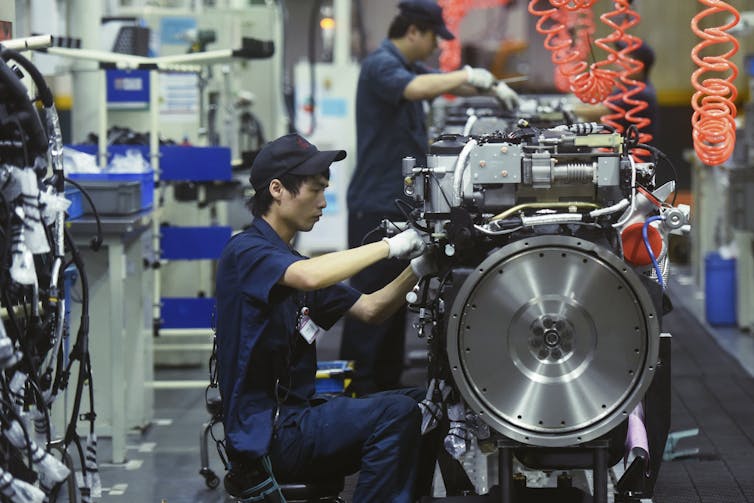
China’s automotive industry has been hit by the global shortage of computer chips. Chinatopix/AP
It’s a good theory with one problem: real-world data says something different.
When Barro (and others) examined the empirical evidence – analysing the GDP rates of 98 countries from 1960 to 1985 – they found there was convergence, but it was “conditional”.
From a given “starting” level of GDP per capita, countries with more education, greater life expectancy, lower fertility, lower government consumption, better rule of law and lower inflation tended to grow faster than those with less of these attributes. From a given starting level of structural characteristics such as these, countries with lower GDP per capita tended to grow faster than wealthier ones.
But countries with different GDP levels and different structural characteristics did not necessarily converge.
Education and rule of law
This provides a useful lens for thinking about the future of the Chinese economy.
Aside from the symbolic question of when the Chinese economy will, by any measure, be the world’s largest, the substantive question is how much faster China’s per capita GDP will continue to grow.
This is relevant for countries such as Australia that benefit from Chinese demand for goods and services. The more China’s per capita GDP grows, the greater its demand not just for iron ore and coal but also wine, lobsters, beef, education and overseas holidays.
The lessons of economic growth tell us that for China to continue to grow rapidly it will need to invest further in its human capital, and ensure there is a stable and predictable legal regime.
These look like challenges. China’s education system is not nearly as sophisticated as the best in the world (like the US or France). Which is why so many parents send their children to universities abroad.
Can it develop a truly world-class university sector? Great academic institutions require empowering great minds to engage in free inquiry. Will the Chinese Communist Party ever be down with free speech? Right now, under Xi Jinping it is going in the other direction.
Then there’s the lack of a rule of law. A predictable legal regime means serious corruption cannot be tolerated, and foreign capital must trust that it won’t be expropriated. How China navigates the Evergrande crisis will be informative on both counts.
Every challenge is an opportunity, as the saying goes. But the fear is these issues – education and rule of law – may be, in the words of Sir Humphrey Appleby, “insoluble opportunities”.
Richard Holden is President-elect of the Academy of the Social Sciences in Australia.
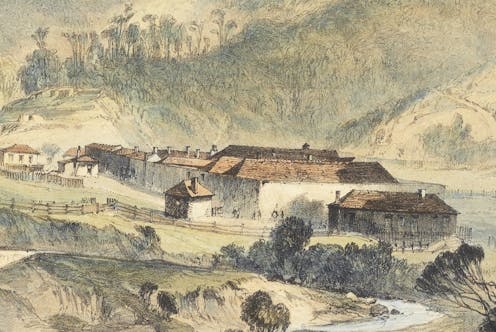
John Skinner Prout’s 1849 painting of the Cascades Female Factory in Hobart, Van Dieman’s Land, where Alexandrina bore an illegitimate child.Wikimedia Commons
In this series, we look at under-acknowledged women through the ages.
“A LADY SWINDLER”, gasped the Illustrated Australian News in November 1867.
It appears that for a length of time the lady has been in the habit of visiting lodging houses and inquiring for apartments […] Having agreed to take the lodgings she proceeds to pay a deposit, when, lo! on feeling in her pocket, she cries, ‘I’ve lost my purse; they have stolen my purse,’ and forthwith commences to lament and bemoan her loss, exclaiming, ‘What shall I do; what will my husband say’.
The lady is always accompanied by a little boy, dressed in Highland costume, whose tears mingled with sobs of his mother, are the secret of the facility with which she accomplishes her schemes.
The lady swindler was Mrs Alexandrina Askew. She didn’t ask for money, loans were offered in her time of crisis. As she collected more funds, her clothes became more ladylike.
Outside Melbourne she would suddenly appear from the bush and de-materialise back into it afterwards. Throughout all her forays, she insisted her husband was a wealthy squatter near Piggoreet with 30,000 sheep and 900 head of cattle.
One conquest in the Melbourne suburb of Richmond involved the family of a coach-maker, one of whose buggies she fancied buying. They invited her to take sherry and conversation flowed: about the squatter husband, the home property.
Author provided
Mrs Askew took particular interest in the daughter of the family, who was feeling poorly and in need of country air, prompting her to invite the daughter to travel with her to Piggoreet and stay awhile to recover her health. Such a pity it was that the new friends should miss each other the next day at Spencer Street Station.
Alexandrina, or Jemima or Alice, as she became in later life, arrived as Alexandrina Grant on the convict ship Tory in Hobart in 1845, along with 30 other Scottish women among a shipload of 170, otherwise from England.
She was 18, allegedly born in Inverness, and had been transported for “falsehoods, fraud and wilful imposition” in obtaining clothes.
Like all convicts transported by the Scottish courts, she had form. She had been convicted in Aberdeen at the age of 17 and had already served 60 days for theft, she reported also that she had done six months for “leaving my place” (that is, leaving her position as a servant while under contract).
When she alighted in Hobart, she recited an imaginary family to the convict clerk: her father John and her brothers William, James, Dennis, Alexander, John and Donald, plus her sister Elizabeth, all in Scotland.
Alexandrina’s convict record. Author provided
But there is no sign of them in the census: there is no record of a Dennis Grant anywhere in Scotland before 1901. She was, in fact, a bastard child born in gaol to convict parents.
On the voyage out, the perceptive ship’s surgeon described Alexandrina as “orderly but precious”. Under her seven-year sentence she was frequently absent without leave, meeting men at night, and consequently bore an illegitimate child in Hobart’s Cascades Female Factory in 1849.
She found no-one presumably good enough to marry her, and domestic service was not to her liking (she was twice dismissed from her places of assigned service), so she spent most of her sentence in the female factories where women were punished and put to work doing tasks such as laundry “at the tubs”.
Social dysphoria
Alexandrina’s story illustrates in extreme personal form the pain of perceived inferiority and stigma felt by those transported to Van Diemen’s Land: the daily humiliations of being a nobody, without a family let alone a lineage. If her secrets and lies were spectacular, they were nonetheless reflective of the desperation of the socially thwarted and ignored.
She felt she deserved to be a somebody, a woman of refinement, respected and deferred to – not an old lag, a former homeless woman of the town. She suffered a form of social dysphoria, born into the wrong social body. Alexandrina knew how to speak and deport herself like a lady, except her secret was that she wasn’t.
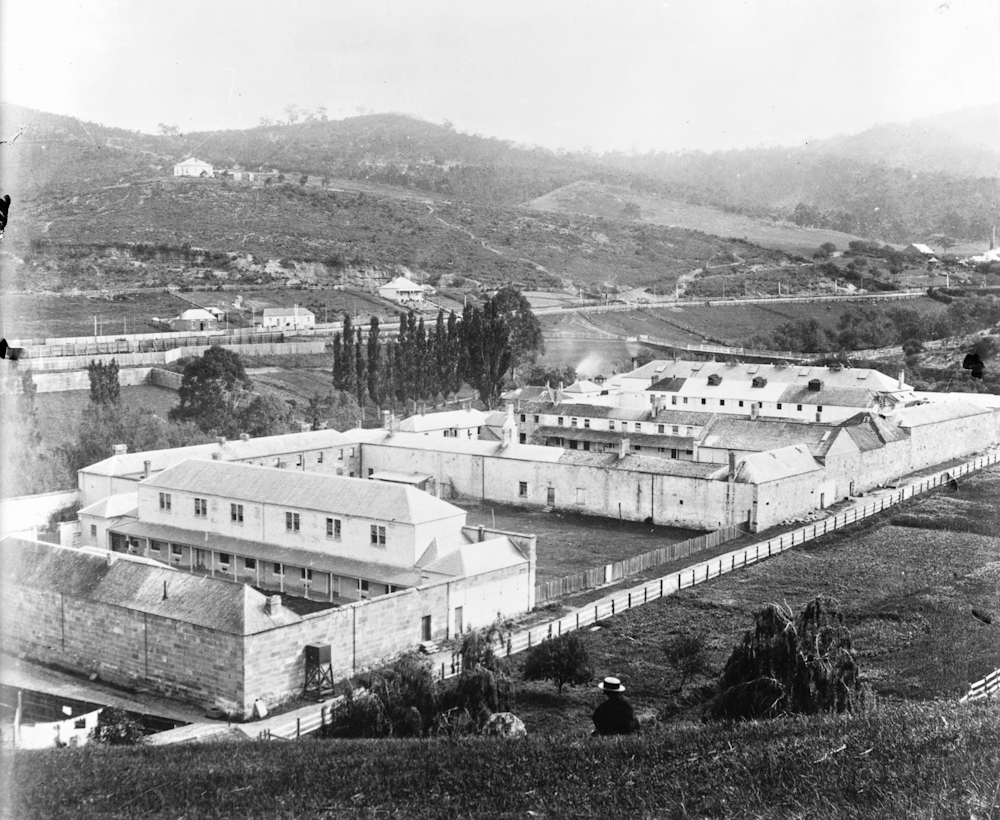
The Female Factory in Hobart. Tasmanian Archives and Heritage Office
The terrible daily burden of the convict stain – of spoiled identity – meant people had to lie and withhold secrets, even from their own partners and children.
There were significant passages of their lives that could not be spoken of, stories that could not be recounted, memories that could not be shared. Always they had to calculate how best to obscure the missing seven or ten years of their servitude in their personal narrative.
Many changed their name and then had to guard against dropping the wrong name, or place of birth, or work history, let alone criminal history. Many, it seems, succeeded admirably in concealing their convict past from their families, only to be found out later by assiduous genealogists.
Vandemonians were expected to re-enter society at the bottom of the human ladder and remain there. Over time they might be tolerated as amusing eccentrics, or shunned as people of untrustworthy character, but either way they could not rise and blend in with those who had been received. They had crossed over to “the other side”, and there they were doomed to remain.
But among the convicts of Van Diemen’s Land was a clutch of women whose crimes were yearnings for things above their station: for positions, husbands, lodgings, or finery or jewellery they could not pay for. They had the good fortune to be born good-looking and intelligent and so they could be plausible and ladylike. Alexandrina was tall and attractive and spoke well.
They were also especially vulnerable to seduction and abandonment, and the trigger for crime was often a betrayal or desertion by a lover.
A success story
Why is this story worth telling beyond its poignancy? It matters because Alexandrina Grant was a success among Scottish convict women transported to Van Diemen’s Land.
She lived into her ninth decade; was not a conspicuous drunkard; and married a free man, William Askew, who stayed with her. They went to the gold mines at Bulldog (now Bullarook) near Piggoreet. Her swindling career forced them to relocate to Ballarat, then Echuca and finally, Sydney.
She bore ten children, six of whom lived into middle life; and successfully delivered and reared the illegitimate child of her second daughter under the common fiction that the child was her own.
Moreover, two of her daughters, including the one who had a baby out of wedlock at 16, married good providers, even if one was an eccentric Swiss-Italian, self-styled professor who dealt over the years variously in mesmerism, phrenology, homeopathy and marriage guidance.
Alexandrina, who died in 1913, was apparently loved. The final chapter of her life took place in Sydney, where she ran boarding houses at dubious addresses in Redfern, twice going bankrupt. Few of the 1636 Scottish women transported to Van Diemen’s Land achieved anything like this ordinary triumph over poverty, stigma and marginalisation.
Janet McCalman’s book Vandemonians is out now (MUP).
Janet McCalman AC receives funding from the Australian Research Council
Barnaby Joyce will probably never again have so much power as he does at this moment, in his trading with Scott Morrison over support for the net zero by 2050 target.
Yet it’s a negotiation forced on him, for an objective he doesn’t believe in and which he fears could cost him and his party at the election.
Joyce never accepted relinquishing the Nationals leadership, never stopped his quest to seize the job back. He and his supporters undermined Michael McCormack, in effect dubbing him Morrison’s doormat and insisting that on climate policy the prime minister would walk all over him.
Now Joyce has found himself needing to deliver to Morrison for Glasgow, albeit not as much as the PM wanted – the Nationals would not contemplate a bigger 2030 target – but enough to put the party into an awkward position in some of its seats.
For all his rambunctious style, Joyce doesn’t want the Nationals to blow up Morrison or the government. But nor does he want to self-destruct by losing seats.
He used opposition to net zero as weaponry in overthrowing McCormack. Not long ago Joyce was as strongly against it as his close mate Senator Matt Canavan, who will never sign up to it, whatever deal the Nationals get from Morrison. Canavan says: “In the past decade, opposing radical climate action has won us the support of blue-collar workers and saved the Nationals from the ashes.”
In the jam in which he finds himself, Joyce has decided to lead by following. He declared from the start the Nationals’ position would be decided by the party room, not by him or even the leadership team. One National describes him as “facilitator-in-chief”.
Morrison is holding himself in but must be privately apoplectic. The PM’s preferred style, when it comes to governing, might be characterised as “we are me”. He’s all about control, discipline, paying lip service to his troops, but denying them any real clout.
Now here is Joyce not just giving his party a voice, but with frontbenchers running free and wild.
Which brings us to the Nationals’ Senate leader, Bridget McKenzie, the woman Morrison forced to fall on her sword when the sports rorts affair became dangerously hot.
In the Senate McKenzie was asked, did she agree with Canavan that if Morrison adopted net zero without Nationals’ support it would be “ugly”, and did Joyce agree?
“I think that it will be ugly. I agree with Senator Canavan,” McKenzie said. “You’ll have to check with Barnaby about whether he doesn’t.”
This followed multiple interviews when McKenzie said the Nationals had been dudded in the delivery of promises in the past and it shouldn’t happen again.
The Nationals have been anarchic over the past few years but, in another irony in this imbroglio, they have shown organisation and, despite their internal differences, a degree of solidity in dealing with Morrison.
Of course if Joyce wasn’t the leader, he’d be destabilising. Indeed, McCormack pointedly urged the party room this week to show integrity and not to leak like it did when he was leader.
A committee drew together the Nationals’ demands to be put to Morrison; it included McKenzie, deputy leader David Littleproud, resources minister Keith Pitt and Kevin Hogan, assistant minister to Joyce. It’s now being left to Joyce to clinch the deal with Morrison, before it comes back to the party room on Sunday.
The party sees itself in a pivotal moment in which it must extract guarantees. Nationals have said their focus is on support and security for regional industries and jobs rather than a string of specific projects financed by a big buckets of money (“this is not about 30 pieces of silver”, says McKenzie), though it would be surprising if a good amount of funding isn’t involved.
Money is one thing, and not that painful to provide now the government doesn’t talk “debt and deficit”. Demands, for example for changes to environmental legislation, can be harder because they can set off fresh arguments for the government.
The trade-offs are important in the selling challenge ahead, but they’re not a magic carpet. Morrison might have a host of lobby groups and a News Corp tabloid campaign on side, but there is plenty of angst in the Nationals’ Queensland base and among some high-profile conservative commentators (such as Sky’s Peta Credlin) who appeal to that base.
In electoral terms, the Nationals’ fears are focused on central Queensland, where they hold three seats: Flynn, Capricornia and Dawson. The first two are mining seats; Dawson is economically and in other ways also tied into mining.
According to Nationals sources, polling in central Queensland shows strong opposition to net zero among their hard-core supporters.
All three of these seats have seemingly very safe margins. But that can be deceptive.
Flynn is on 8.7% now, but went into the 2019 election on 1%. Capricornia sits on 12.4%; before the last election it was on 0.6%. Dawson has a 14.6% buffer, compared to 3.4% in 2019. Queensland is a state of big swings.
In Flynn and Dawson the members, Ken O’Dowd and George Christensen respectively, are retiring.
Of the three seats Flynn is the most vulnerable, with Labor running a strong candidate, Gladstone mayor Matt Burnett.
The Nationals are worried about votes being eroded on the right in Queensland. One Nation will be active and Clive Palmer will be throwing around a large amount of money in advertising.
Joyce has always sold himself as an effective retail politician. But he’s politically stronger when he’s on the attack than defending a policy – let alone one he doesn’t actually believe in.
There’s a lot of the contrarian in Joyce. The government will invoke modelling to reassure doubters that net zero won’t harm jobs, indeed that it will help create them. But this week in parliament, Joyce was casting aspersions on modelling in general. “Modelling is not a letter from God. It is no more than the opinion of people.”
After Morrison flies off next week with net zero in his bag for the Glasgow climate conference, Joyce will be acting prime minister, fronting cameras and microphones, promoting what the Nationals have received in the deal and making the best he can of the 2050 target.
Both he and his prime minister will be nervous about how he’ll go in those early days when he’s in the spotlight.
Michelle Grattan does not work for, consult, own shares in or receive funding from any company or organisation that would benefit from this article, and has disclosed no relevant affiliations beyond their academic appointment.
A commentary from Melbourne – Megan Gold, Melbourne embraced zero-Covid, now isolated as world bounces back, NZ Herald 16 Oct, originally published in the UK Daily Telegraph – notes that “even high vaccine uptake may not protect the most vulnerable from Covid; let alone the other illnesses that could ravage Australia due to the ‘immunity debt’ caused by much lower exposure to other viruses”.
‘Immunity debt‘ is a prescient conceptualisation of the cost-concept that I also have been writing about. I have written about ‘viral virginity’, ‘community respiratory virus immunity’, and being ‘naïve’ to viruses.
Before discussing debt in this context, it is useful to take stock of what debt means, both in its essential financial context, and in broader contexts.
In its simplest form, debt is a contract (or promise or obligation) between a debtor party and a creditor party. The debtor owes a debt, and the creditor owns the debt (as an asset). The parties may be individuals, collectives, or sectors of ‘the economy’. The debtor promises to ‘service’ the creditor, typically over a period of time.
The simplest financial debt is simply for a debtor to borrow something from a creditor at the beginning of a contractual period, and to repay the same (or some other specified thing) in the future in accordance with an agreed terms of contract. Sometimes such terms might be ‘implicit’. In Māori, the settlement of a debt is called ‘utu’; and the creditor may extract utu if the explicit or implicit terms of the contract are not met by the debtor. In literature, one of the most famous examples of utu is the ‘pound of flesh’ provision in Shakespeare’s Merchant of Venice.
Five Memes for Financial Debt (excuse the masculine pronouns):
Meme One. The simple example that forms the basic assumptions of the finance industry works like this. Two villagers – A and B – have different consumption inclinations. While both favour present consumption over future consumption, A favours present consumption more than B. So B makes available (‘lends’) some of his present entitlement to A; as a result A is contractually in debt to B. A will service his debt to B, on terms agreed to.
It is clearly understood by the financially literate among us that B will require compensation for his sacrifice of present consumption; compensation over and above repayment. That contractual compensation is called interest.
The innate preference for certain present enjoyment over uncertain future enjoyment means that both villagers ‘discount’ the future. In the very simplest case, A and B have close to the same discount rate (ie close to the same preference for the present over the future), and the interest rate for the loan will equal that discount rate. As a result of the loan, A gets more enjoyment than B in the present. B gets more enjoyment than A in the future. In total, B gets more enjoyment than A. A pays for his extra present consumption by giving up some future consumption; B pays by waiting.
A common way for A to service his debt to B would be through regular small future payments to B; those payments compensate B for the one big present payment B made to A. In essence, A and B do a trade; an ‘inter-temporal trade’ because A trades a present benefit for a future cost, and B trades a future benefit for a present cost.
This example has no ‘power play’, or ‘asymmetry’ as financial academics call it. B does not enter the contract in a privileged position.
In a debt-market with many village ‘players’, the different villagers’ discount rates will average out, creating a ‘market’ with a market rate of interest that averages out the different personal discount rates of the villagers. Those villagers with lower (below average) personal discount rates will tend to be lenders (like B), and those with higher discount rates will be borrowers (like A). As with all free and symmetric markets, the outcome is ‘win-win’, meaning that everybody gets a good deal. Nobody is a victim.
In this view, the differences in persons’ discount rates is due to their different temperaments; some people are believed to be more able (or willing) than others to forgo present pleasure in favour of future pleasure. Indeed, western communities – as cultural collectives – generally applaud creditors more than debtors. Of course, however, neither creditors nor debtors can exist without the other. B depends on A, as much as A depends on B.
We also should note that there is always a possibility of a contractual default. The simplest rule for a default would be that the contract terminates in the event of the death of A or B. In some periods in the past, other instances of default have been ‘managed’ through the use of debtor prisons.
The financial industry, which emphasises the understanding of debt contracts as inter-temporal exchanges, is principally in the business of providing services to creditors; to owners rather than owers of debt. ‘Thrifty and virtuous’ creditors are portrayed – through Meme One – as akin to squirrels accumulating interest-bearing magic-nuts. The abstemious puritan burgher is a role-model for ‘passive thrift’; a meme which in reality fosters a sense of ‘financial entitlement’, that good things necessarily come to those who wait. (Any reading of the history of capitalism in the century 1840 to 1940 would soon uncover the French-originating English word ‘rentier’, which serves as a contrast for that other French-English word ‘entrepreneur’. Today we use the word ‘investor’, as an incorrect substitute for rentier. [One apocryphal story is that Ronald Reagan lambasted the French for not having a word for ‘entrepreneur’.])
Meme Two. One very important sociological view of debt is that of an asymmetric contract, whereby A is in some respect ‘desperate’ for present consumption (eg, is starving), and B thereby has the power to control the terms of the contract to his advantage. This is a case of exploitation.
The most obvious reasons for asymmetry are differences in personal incomes (given that persons’ incomes represents their present consumption entitlements). Generally, it is easier for a person with a high present entitlement (ie high income) to forego some of his current pleasure allocation than it is for a person with a low present entitlement; so a high-income person typically has a lower discount rate than a low-income person.
One important feature of financial-asymmetry, then, is if a prospective debtor A has a very high personal discount rate (eg, his very survival depends on increased present consumption), and creditor B has a very low (probably negative) discount rate (eg he is very rich, would struggle to spend all his income in the present, and thereby favours future consumption over present consumption).
A person with a power-advantage – in this case creditor B – would be able to skew the contract in his favour. The interest rate may be set high; that is, at A’s high discount rate. Further the contract may include ‘flexibility’ terms which, for example, give B the right to adjust the interest rates. And B may be better able to set a default protocol, such as transferring the debt to a relative of A, or being able to take possession of items of A’s property.
The result may be a win-draw contract; B wins, while A is only marginally better off. Or, given the very high rates for which these kinds of debtor discount the future in favour of the present, these flexible (open-ended) debt contracts are best described as exploitative win-lose deals, with the debtor – facing additional unanticipated costs – becoming the inevitable loser.
(Sometimes these contracts can even be best described as lose-lose deals, because creditors are not necessarily winners. While the debt-contract in The Merchant of Venice falls into the Meme Four category – below – it can be understood as a case which had a lose-lose outcome. [A lose-lose deal – distinct from a lose-lose outcome – exists when unaccounted-for costs fall on both parties, and that such costs were always more likely than unaccounted-for benefits.] While no party to a deal ever intends to lose, loses may come to either party – or both – if pertinent information is ignored.) Also, unexpected inflation may turn the tables on creditors; unexpected deflation may aggravate the pain of debtors.
The important point here is that debt is popularly understood as an earthly purgatory suffered as a consequence of an initial gratification; and that the purgatorial nature of debt is understood to be so without any necessary reference to whoever might own that debt. (We may note that, in criminal courts, a guilty prisoner is in debt to a victim; but the victim tends to be sidelined, with the state taking over as the legal creditor. The procedural emphasis is on the debt of the criminal, and the subsequent purgatory that a convicted criminal must face; compensation for the victim creditor is not the focus of the process.)
Credit card debts largely takes this form. Although the high interest rates recompense the creditors for the possibility of uncompensated default through bankruptcy, these are cases of open-ended debt-contracts whereby the creditor party has some flexibility to adjust the contract to forestall bankruptcy.
The term ‘usury’ is particularly applicable to asymmetric debt contracts, where the charging of interest may represent extortion under the guise of risk management.
Memes three and four are a reflection of debt from an economist’s point of view.
Meme Three. One well-known example of this meme is hire-purchase, which continues to be a main method through which a consumer finances the purchase of a car. The best-known example of this meme, however, is a ‘home-loan’ or ‘mortgage’. (The ‘home-loan’ example has been complicated by economists, through the fact that the ‘national accounts’ formally treat home loans as business loans. This interpretation is not really tenable, however, for an owner-occupied apartment; the financing of such an apartment is really quite comparable to the financing of a car.) Home purchases with mortgages are, essentially, secured consumer debt.
In this case, the creditor (‘mortgagee’) trades a present cost for a future benefit; a benefit which we may call ‘profit’. The debtor (‘mortgagor’), on the other hand, incurs a future benefit coincident with a lesser future cost. In the case of home loans in New Zealand, the future cost is variable, alterable at the behest of the creditor. (Further, the possibility of unexpected inflation or deflation – inflation or deflation rates different from those built into the mortgage contract – may amend the creditor’s benefit or the debtor’s cost.) In the case of loans contracted through professional intermediaries – such as banks – the creditors are their depositors or any other party appearing on the liability side of their balance sheets.
Where a debtor’s benefit is in the future rather than in the present, the contract becomes an economic investment. An investment, by definition, represents an expected win-win outcome; the creditor gets to share in the gains that formally accrue to the debtor.
Under this meme, while debt cannot be regarded in any sense as a ‘problem’, we understand that the future by definition is not able to be fully predicted, so a creditor or a debtor (or both) might not achieve their anticipated gains. Or one or both may achieve gains that exceed expectations.
Meme Four. This category of debt is that of a classic business investment. It is largely unsecured debt (servicing depends on future revenue), and is the essence of the way economists understand debt, and is intrinsically linked to the concepts of economic investment and economic growth. Unlike the previous category, these debt contracts are highly sensitive to interest rates. (This is why, when interest rates increase, bank lending tends to switch from the Meme Four type – this type – towards the Meme Three type.)
In this case, the debtors, by expanding their businesses, expect a net profit gain. The debt funds new machinery, premises, and labour upskilling. The resulting income stream – to the businesses’ shareholders – is expected (by debtors and creditor alike) to exceed the debt-service cost.
Again, as in Meme Three, such debt contracts are the antithesis of a problem; they represent the essence of a thriving economy. Nevertheless, any particular contract can go ‘pear-shaped’, as in the example of The Merchant of Venice. This is because the two things that most characterise these contracts are risk and uncertainty. The difference is that risk is calculable by actuaries (known unknowns), whereas the probability of uncertain outcomes is not calculable (being either ‘unknown unknowns’ or ‘black swan’ events). Banks and other lenders manage actuarial risk through calculation and through pooling (spreading risk). While uncertainty – unlike risk – is problematic to the finance sector, uncertainty is actually an essential component of dynamic economic change; an important lesson from history is the importance of serendipity frequently prevailing over catastrophe.
As we will see, ‘immunity debt’ is a black swan consequence to which most societies apply ‘wilful ignorance’. Any other way of approaching this issue of wilful unknown unknowns is bureaucratically ‘too hard’, and would require a person or an authority to acknowledge a possible truth from which they would rather hide. Black Swans, while ‘unknown unknowns’ to the ‘need-to-knows’, represent ‘known unknowns’ to the Cassandras (such as the abovementioned Megan Gold) among us.
Entrepreneurial debts fall into this Meme Four debt category; indeed, in The Merchant of Venice, the protagonist debtor (Antonio) was a venturer entrepreneur who lost a fleet of ships in a storm, and was thereby unable to fulfill his contract with Shylock. (There is a reason why the words ‘venture’ and ‘adventure’ are so similar; and they connect to the Latin verb ‘to sell’.)
Meme Five. Government debt represents a particularly problematic source of societal hand-wringing. In particular, government debt is an issue which splits the economics profession. Many economists are employed by financial institutions. Further, one large branch of the economics profession – the ‘neoclassical school’ – tends to take a ‘neoliberal’ normative view of capitalism; a view that sees governments and certain other collectives as impediments to (rather than agents of) societal economic success.
As such, these economists, while ‘pro-debt’ (as all economists are, as per Meme Four) are ‘anti-government’, or at least they favour ‘small government’. The result is that government debts – regardless of who the creditors might be – are painted in accordance with the Meme Two view; that is, debt being a kind of purgatory. (We might note that one particular dictator in the 1970s and 1980s obsessed about ending his country’s public debt; indeed he, like no other, succeeded in repaying his country’s government debt. See this 17 Oct NZ Herald story – Smoking plane and the ‘spy’ who followed the All Blacks through Romania – about life in Nicolae Ceaușescu’s Romania in 1981, a country in the 1980s about as close to ‘hell on earth’ as any country ever could be.)
The neoliberal viewpoint is predicated on the view that governments are at best inefficient, and at worst highly corrupt, and that ‘bad debt’ incurred by governments ‘crowds out’ what would be otherwise good debt contracted by productive businesses.
Some governments – and New Zealand’s government seems to be one of these – are so committed to ‘financial probity’ (the avoidance of public debt purgatory) that they will refuse to facilitate many of the investments that non-neoliberal economists understand as being essential to the economic well-being of a society.
The tendency when discussing government debt, and regardless of the interest rates applying to that debt, is to ignore the creditor party. While ignoring the creditor is a complete nonsense when discussing financial debt (consider Meme One and Meme Two), the tendency to do so, nevertheless, leads to a concept of community debt purgatory for which there is no explicit creditor.
Community Debt
With essentially financial debts in mind, we can transfer the predominant ‘purgatory’ meme (Meme Two) to a social context. Thus, any societal – ie political – choice made that is seen to exchange a present gain for a purgatorial future creates a community debt. In this situation, the essentially financial role of the creditor is lost from the discussion. Community debt can be understood as the ongoing costs incurred from a community decision – advertent or inadvertent – that prioritised the present over the future. Community – or societal – debt thus arises, not so much from the presence of investment (Meme Four debt) but from the absence of investment; that is, community debt arises from the absence of Meme Five public debt.
Abstention from incurring government financial debt can also be understood as an avoidance of collective investment, and thereby the creation (rather than the eschewal) of community debts. It is these community debts – too much saving and too little investment – that young people end up having to pay for.
An interesting example in the literature of the merchant capitalist era is the Dr Faustus story, a story of an alchemist popularised as a sixteenth century drama by Christopher Marlowe, and (as ‘Faust’) both a play and an opera inspired by the early nineteenth century Industrial Revolution.
The ‘diabolical’ Faustian bargain is represented as a fork in the road of history; a road between two future social choices, both of which can be represented as either beneficial or as detrimental. In particular, the industrial future (from the standpoint of 1850) is painted as a kind of indefinite purgatory; a purgatory with consumerist pleasures that eventually (and episodically) give way to unsustainable crises of pollution and pestilence.
The community debt discourse that has dominated the twentyfirst century is that of climate change. Added to that, we now have the pestilence of Covid19, which comes with the ‘black swan’ of immunity debt.
Immunity Debt
Immunity debt can be understood as a future health cost; or, if you prefer, a loss of future benefits. The context is the Covid19 pandemic. The debtor is a community; each community affected. In the article by Megan Gold, the debtor party is a collective; the ‘people of Melbourne, Australia’. To place this in context, we could consider an alternative contract, where the debtor party is the ‘people of Stockholm, Sweden’. In my context here, the debtor party is the people of Aotearoa New Zealand (AoNZ).
Who/what is/are the creditors? Let’s start by considering the creditor as the Covid19 virus. This is a simple but ‘clever’ living species which ‘wants’ to ‘survive and prosper’. And it does so by ‘borrowing’ and enjoying human lungs. We extract payment by refusing it access to our lungs; by making it work hard, by denying the virus future enjoyment. So, in this relationship, we may be creditors, with the virus is the debtor. Remember, a debtor enjoys substantial immediate benefits in exchange for a loss of future benefits.
More pertinently, and because we do not consider the welfare of a virus, we think of Covid19 as a trickster; not unlike Loki, the Norse God. (And not unlike the proposer of the Faustian bargain.) So, we come to see ourselves as being in debt to – or beholden to – the Covid19 virus. Much as we might consider ourselves beholden to a con-artist.
In another view, the creditor in this case may be regarded as the alternative ‘us’. Just as with internal government debt, we ‘the people’ are both creditor and debtor. The credit is the immediate benefit of the policy pursued. The debt is the future cost of that policy. (If in fact we wished to emphasise the immediate cost of the policy, and its future benefits, we would regard the policy choice made as an investment rather than as a debt.)
While there are a variety of alternative policy responses that could have been pursued, the appropriate counterfactual is the one of a minimalist government response, such as that of Sweden. Which policy choice incurred the bigger community debt? Which choice delivered a higher rate of return? (New Zealand policy announcements today accentuate New Zealand’s position of having made a diametrically opposite choice from that made in Sweden.)
Seen from a debtor point of view (and with 2020 being considered ‘the present’), the contract is present gain in return for future pain (with ‘future’ potentially beginning in 2021). The higher the discount rate, the higher the future pain. Did the New Zealand government intentionally trade 2020 gain for post-2021 pain? That’s a rhetorical question.
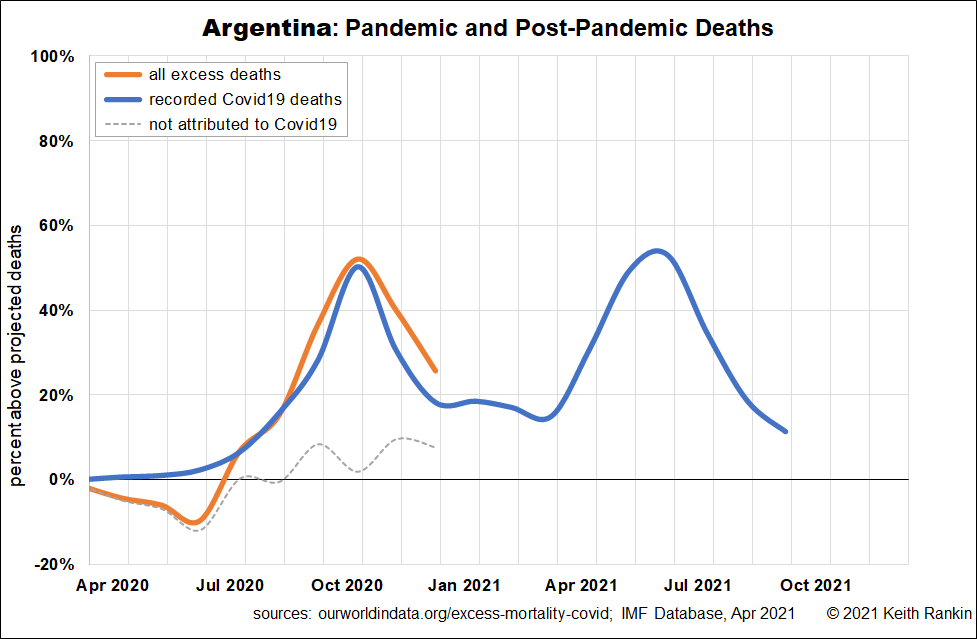
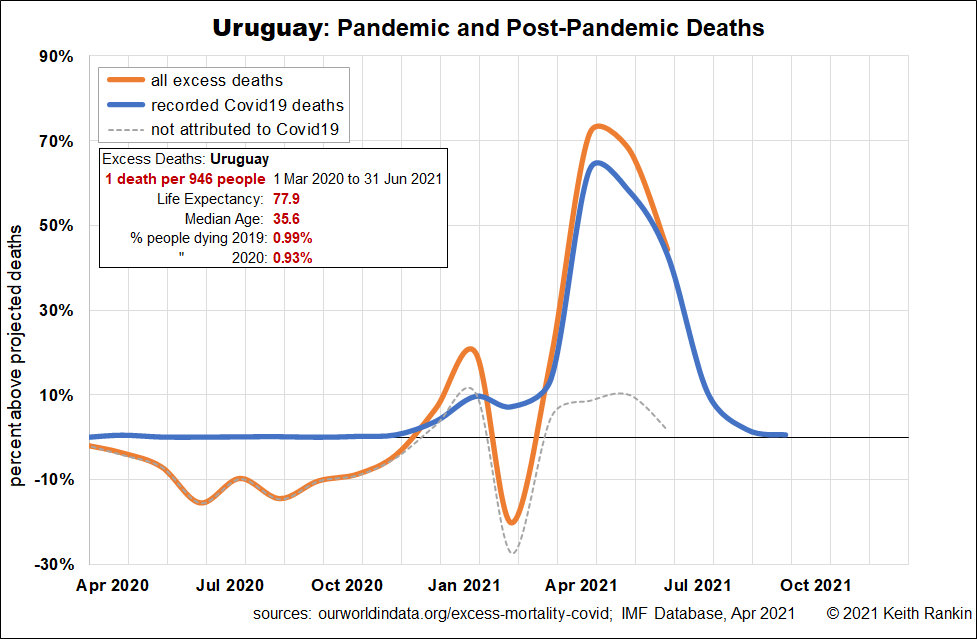
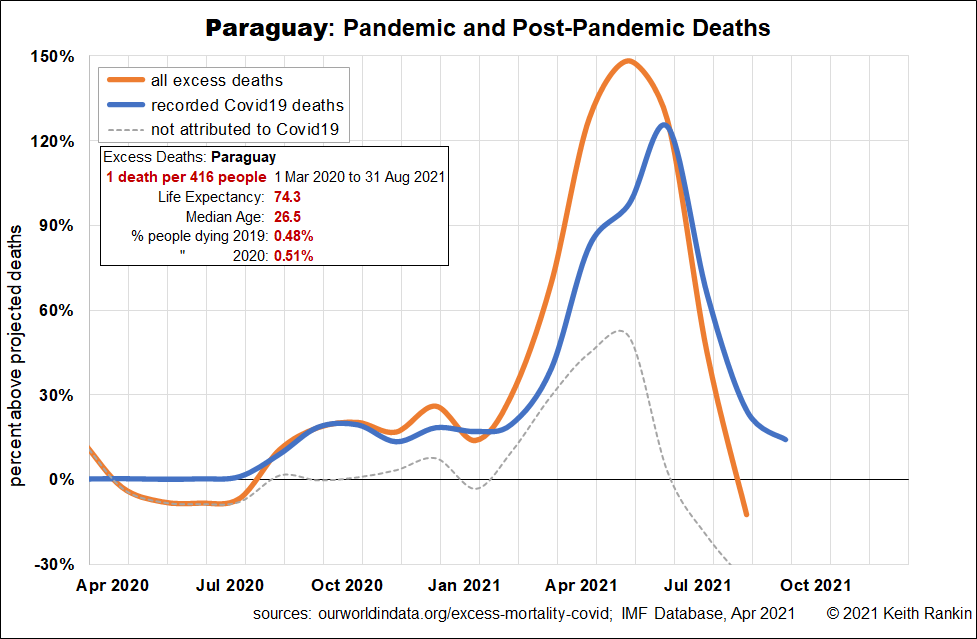
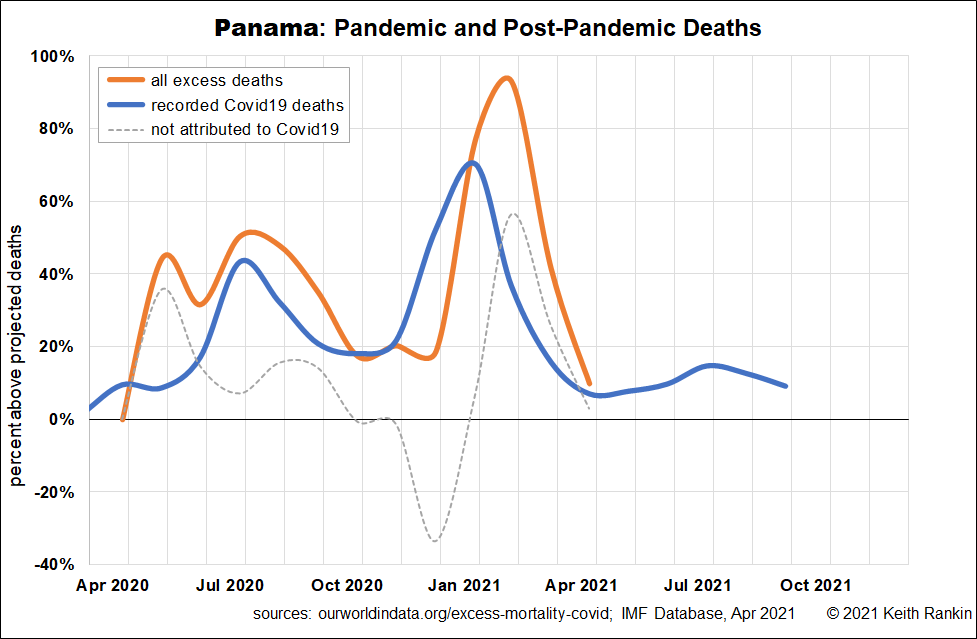
The 2020 gain in AoNZ was considerable. In the 12 months beginning March 2020, New Zealanders clearly gained substantially, relative to, say, the Sweden counterfactual. (There are exceptions: while some New Zealanders would have been worse of in that 12-month period than their Swedish counterparts, most were clearly better off.)
The future pain (from mid-2021) clearly puts New Zealand worse off than Sweden. So far in the 2021 period, excess deaths in New Zealand and Sweden have been similarly negative. Though, in other measures, those Swedes who survived 2020 have lived reasonably normally, while New Zealanders have not. So far, the ‘purgatory’ in New Zealand has largely taken the form of restrictions and vaccinations that show no sign of coming to an end. Sweden may have come out of its purgatory, though I expect it will pursue a revaccination strategy.
At the time that the key covid policy choices were made, the discount rate associated with New Zealand’s policy choice seemed quite low. (Indeed, at the time some thought the policy discount rate was negative; negative interest rate contracts see debtors gaining both present and future benefits [not incurring costs at all], with creditors making smaller present and future losses than they would otherwise expect to make. We might note that, with hindsight, people in New Zealand who bought houses in the 1960s, late 1970s enjoyed negative discount rates; ie, negative real interest rates.)
From August 2021, however, we see that resident New Zealanders have started to service the community debt associated with the policy choice made. The problem is that nobody has any idea at what date the debt contract matures (ie when purgatory ends), and community debtors find themselves subject to floating interest/discount rates. The ‘goal-posts’ keep shifting.
One of the biggest problems – one that New Zealanders are only just starting to see – is that the ‘immunity debt’ may be more than a vulnerability to Covid19. This is like a floating debt that policymakers took no account of in March 2020, and which still, by and large, they have not taken account of (it was a possibility in the small print; the print that nobody read). We do not know the size of this extra debt, or how long (if ever) it will take for us to settle this debt. But it could be very large, meaning that the true discount rate for the New Zealand policy is starting to look very high. [On RNZ’s Nine-to-Noon today, Business, health and Covid modelling analysis of new Covid traffic-light system, Professor Michael Baker said that he is expecting influenza to be problematic in the winter of 2022.]
The immunity debt incurred in 2020 comes in three parts. And, with hindsight, New Zealand seems to be facing a significantly higher immunity debt than does Sweden.
The first part is lost immunity specific to Covid19. We try to service this debt through mass vaccination, understanding that New Zealanders need to be more vaccinated that they would have had they chosen the Swedish counterfactual. We also understand that this most likely includes the cost of regular revaccinations – refer Dr Ashley Bloomfield: Nationwide Super Saturday Vaxathon kicks off (RNZ, 16 Oct); so far this has been poorly communicated in most countries, and some strategic workers in New Zealand are now approaching six months from their most recent vaccination shots, and with little guidance so far about how revaccination would be prioritised within the new ‘traffic-light’ policy.
The second part of the immunity debt is the loss of population immunity to other viruses. My sense is that this policy choice has opened the door to an influenza pandemic within 20 years. We already know that unusually large numbers of New Zealand infants and children were hospitalised in 2021 due to respiratory infections that they used to be much more immune towards. Then there are the past childhood illnesses that we had thought we had vaccinated away; refer Revealed – health authorities’ warnings that falling vaccine rates are putting Māori and Pacific children at risk, NZ Herald, 21 Oct. What we do know, informally, is that regular day-to-day immunity to ‘common cold’ type viruses is maintained by repeated exposure to those viruses; and that we have no idea how serious these viruses can become because of that exposure being impeded, and what impact this will have on population life expectancy.
The third part comes in essentially economic costs: food inflation, disrupted livelihoods, thwarted aspirations, and reduced access to the other fundamentals of life (including timely treatment for non-covid health conditions). While the size of this ongoing debt-service cannot be known, it will most likely contribute further to reduced life expectancy. Indeed, we may expect immunity debt to be paid in reduced average life expectancy.
With open-ended debt contracts – floating-rate rather than fixed-rate contracts – the final effective rate of interest can only be calculated when the debt is settled. In the case of immunity debt arising from lost protection from otherwise endemic diseases, the debt is settled when a new normal prevails. My sense is that the extent to which life-expectancy decreases as a result of a net loss of immunity to disease would be measure of the debt-service price for the immunity community debt that our choices have unintentionally contracted. That, of course, would have to be contrasted with any ‘new normal’ loss of life expectancy that would have occurred as a result of a different policy choice. A degree of immunity debt might yet be a price worth paying.
Of course, immunity debt can be mitigated to some extent, if acknowledged. I would like to see, for the foreseeable future, both Covid19 and influenza vaccination becoming mandatory. An influenza pandemic could hit at any time; a society with immunity debt will be woefully unprepared for it.
Debt Peonage to Covid19?
Finally, there is the price we pay to protect ourselves from severe Covid19 ilness, regardless of the immunity debt and other prices we pay for the disruptive lockdowns and associated paraphernalia.
“For the [fully-vaccinated] rest of us, we are all going to get Covid; now this is something that people don’t realise, but it will be a mild disease because we’ve been vaccinated, so covid will be like a booster to our vaccination. … In Singapore they are trying to manage the spread of covid through the vaccinated population.”
I don’t think that the New Zealand public has been told that, in the view of some epidemiologists, the game plan is [or some think it should be] to give ‘everyone’ two vaccinations plus at least one dose of Covid19. Dr Jackson clearly believes that even people multiply-vaccinated against Covid19 will still get the disease, albeit as an uncommon cold.
By contrast, if we believe one group of experts, including the same Rod Jackson, the Covid19 virus – SARS-Cov2 – will, if not eliminated globally, become one of the worst circulating viruses that we will have to contend with. (Refer: Why we must not allow virus to become endemic in New Zealand, Asia-Pacific Report, 13 Oct; also NZ Herald, 11 Oct, originally from The Conversation.) Uncommon cold, indeed.
Keith Rankin (keith at rankin dot nz), trained as an economic historian, is a retired lecturer in Economics and Statistics. He lives in Auckland, New Zealand.
A council in Southern England recently sent an email to parents urging them to “be vigilant” after receiving reports “young people are copying games and violence” from the show. In Australia, similar warnings have been issued by educators in Sydney and Western Australia.
In Squid Game, characters compete for a cash prize by participating in challenges that augment classic Korean children’s games, with the “losers” being killed at the end of each round. Further emphasising the show’s twisted take on child’s play, these games are staged in highly stylised arenas, such as an adult scale children’s playground. After each challenge, these traditional children’s play spaces tend to be left soaked in blood and littered with piles of corpses.
While the recent warnings urge parents not to let their children watch Squid Game, young children’s awareness of the violent show more likely relates to its pervasive presence on social media, which has extended to viral content on TikTok and YouTube, popular with teenagers and children. The show is certainly a craze within children’s digital cultures.
A number of successful channels on YouTube Kids (designed for viewers under 12) have capitalised on the Squid Game trend. This YouTube content includes “How to Draw Squid Game” character videos, and Squid Game themed gameplay videos from online videogame Roblox.
This videogame, which is popular with kids, enables users to program games and share them with other users.
On both the kids’ and main version of YouTube, videos aimed at children feature people (often children) playing these Squid Game inspired games in Roblox, with the “Red Light, Green Light” challenge emerging as a particularly popular trend. This challenge is also a trend on TikTok, with people emulating the game in a vast variety of real life settings and in videogames Roblox and Minecraft.
The “Red Light, Green Light” scene has become one of Squid Game’s most widely shared moments: the giant animatronic doll that acts as a deadly motion sensor in this game has been heavily meme-ified. This doll often features in video thumbnails for Squid Game-related children’s YouTube content.
Most of these kids’ YouTube videos are quite innocuous by themselves. However, they show how Squid Game has crept into digital content explicitly targeting young children.
Murky boundaries
Given Squid Game’s bright, childish aesthetics and focus on playground games, it is perhaps not surprising that viral online content about the show appeals to children. But the boundaries between adult and child-oriented content online have always been murky.
After a historic fine of US$170 million (A$227 million) was imposed on YouTube by the US Federal Trade Commission in 2019, sweeping changes were introduced to make the distinction between adult and children’s content clearer on the platform. For instance, creators must now inform YouTube if their content is for children and machine-learning is used to identify videos that clearly target young audiences.
Despite these changes, YouTube remains a very different beast to broadcast television, and content popular with children on both the main and children’s version of the platform often differs markedly from kids’ TV.
Squid Game appropriates playgrounds and other child-like iconography for their hyper-violent games. Noh Juhan | Netflix
Like Squid Game content, “mash-up” videos harness trending themes, search terms, and characters – often featuring popular characters in thumbnail imagery and video titles.
Adult anxieties about Squid Game’s malign influence on children build on earlier concerns about this “mash-up” content, but also about children’s interaction with the web more generally.
Squid Game’s sadistic interpretation of playing marbles. Noh Juhan | Netflix
The rising global panic about children’s participation in Squid Game challenges echoes the “Momo” phenomenon of 2018 and 2019. In this case, a photo of a sinister figure that became associated with the moniker “Momo” went viral online (the photo was actually of a Japanese sculpture).
An international news cycle emerged about “Momo”, claiming the creature was appearing in children’s content on YouTube and encouraging kids to participate in deadly games and challenges.
As is now occurring in relation to Squid Game, in Australia and beyond official warnings were issued to parents about the “Momo Challenge”, advising them to be vigilant. It soon became clear the “Momo Challenge” was most likely a viral hoax.
Momo embodied parents’ worst fears about the dangers of children’s internet use. Concerns about Squid Game’s influence on children have a similar tenor: these fears may not be a response to actual dangers, but a manifestation of our discomfort with how easily adult-oriented media can seep into online content aimed at young children.
The unruly tentacles of Squid Game’s inter-generational appeal show how streaming media challenges existing conceptions of “child-appropriate” content.
Jessica Balanzategui receives funding from the Australian Children’s Television Foundation.
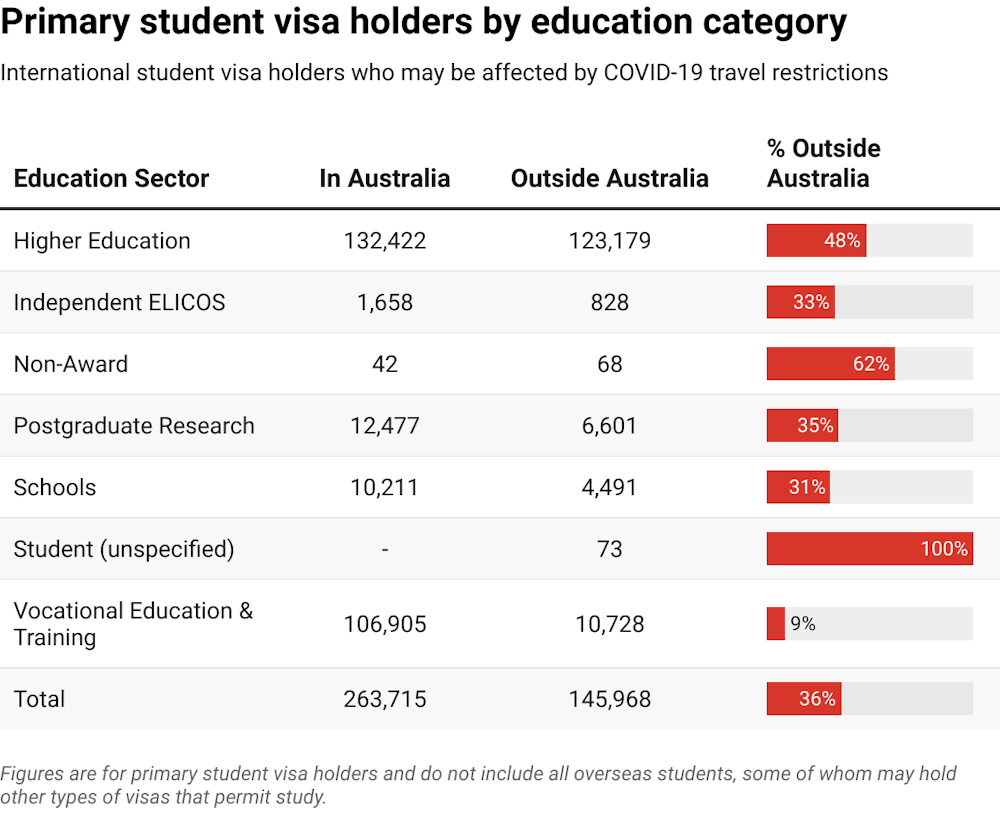
COVID-19 has meant international students have been unable to arrive in Australia to commence their studies, devastating one of our most profitable sectors.
We’re joined in this podcast by Phil Honeywood, CEO of the International Education Association of Australia to talk about the impact of the pandemic on universities, students, and the economy – and the way forward.
Honeywood says the data shows many international students have voted with their feet and given up their Australian courses to study elsewhere – Britain, Canada, and now even United States under Joe Biden’s more open door policy.
“For example, UK university international student enrolments are up over 30% year on year. […] They’re recruiting full fee, paying international students at Australia’s expense, and we lose enormous market share to those countries because they’ve kept the doors open largely throughout the pandemic.”
“And as we know, that has also reverberated across our agriculture, horticultural and hospitality sectors in our economy who’ve relied very heavily on international students to fill the low skilled jobs.”
One problem in restarting the industry is what Honeywood calls a “pass the parcel syndrome”.
“On the one hand, the federal government say, yes state government can be masters of their own destiny and put up a student return plan which the federal government endorsed. On the other hand, when it looked as though we’re going to have large numbers of international students coming back in one state, the federal government remind everybody that no, actually they control Border Force. They control visa entry into the country and they will choose to tell the state to get back to its box.”
Honeywood criticises the Home Affairs Department for being unwilling to endorse student visas for Africans. These students go to the Uk in “the tens of thousands” but “our Home Affairs Department who issue student visas […] seem to prefer to just say no to African students”.
Honeywood also says “it’s really important to understand the motivation of young people who want to study in another country. For many of them, it’s a chance to obviously explore their own personality, to prove their resilience.”
A report released this week by the International Education Association of Australia titled ‘Student Voices’ found that “the appetite for face-to-face study in Australia is a primary driver”.
Michelle Grattan does not work for, consult, own shares in or receive funding from any company or organisation that would benefit from this article, and has disclosed no relevant affiliations beyond their academic appointment.
Source: The Conversation (Au and NZ) – By Deanna Kemp, Professor and Director, Centre for Social Responsibility in Mining, The University of Queensland
On May 24 last year, mining giant Rio Tinto legally destroyed ancient and sacred Aboriginal rock shelters at Juukan Gorge in Western Australia to expand an iron ore mine.
Public backlash prompted a parliamentary inquiry. After almost 18 months of submissions and hearings, the joint standing committee released its final report titled A Way Forward this week.
Rio Tinto’s actions form part of a broader discriminatory pattern of development in Australia. Traditional owners are denied the right to object and as a result, Aboriginal heritage is routinely destroyed.
The committee’s final report grapples with the complex issues of cultural heritage protection in Australia. It recommends major legislative reforms, including:
a new national Aboriginal cultural heritage act co-designed with Indigenous peoples
a new national council on heritage protection
a review of the Native Title Act 1993 to address power imbalances in negotiations on the basis of free prior and informed consent.
The report is strong on the need for change, although achieving this will be far from straightforward.
Hard-to-resolve issues
The committee’s interim report, was released in December last year. From it, we learned how Rio Tinto silenced traditional owners and prevented their cultural heritage specialists from raising concerns. Rio Tinto prioritised production over heritage protection.
A Way Forward places the tragedy of Juukan Gorge in a broader context. It shines a light on how the regulatory system empowered Rio Tinto to destroy the caves and prevented the Puutu Kunti Kurrama and Pinikura peoples from doing anything about it.
It also demonstrates how the system has run roughshod over Indigenous interests for decades. Governments have been able to make determinations about cultural heritage without proper consultation and consent.
The report focuses on getting the regulatory framework right. It succeeds in bringing a wide and complex set of controversial issues together in the one place. But many of these issues are highly contested, which has hindered previous attempts to solve them.
Already, two committee members, Senator Dean Smith and MP George Christensen, disagree with the rest of the committee on the need for the Commonwealth to set standards for states’ cultural heritage protection laws. They say this would constrain the mining industry and give anti-mining activists too much power.
In contrast, Greens Senator and Gunnai Gunditjmara and Djab Wurrung woman Lidia Thorpe supports traditional owners having a “right to veto” the destruction of their cultural heritage.
Western Australian Premier Mark McGowan and some industry organisations have dismissed the inquiry’s calls for a stronger federal government role in protecting cultural heritage across Australia. Western Australia is yet to pass its draft heritage law, which the premier says will address the issues raised in the final report.
Aboriginal groups disagree that ultimate control over the destruction of cultural heritage should rest with the minister. These groups have tabled their issues at the United Nations.
One of the most contentious matters addressed in the final report is the need to obtain free prior and informed consent of traditional owners under Australia’s federal and state laws, affording them the right to manage their own heritage sites.
Change is needed despite Australia’s economic recovery pressures
It is not an ideal time to be driving this type of major change. Australia is heading towards a federal election. The federal government is focused on COVID-19 vaccinations, opening borders and the nation’s economic recovery from the pandemic.
The mining sector sits at the centre of Australia’s economic recovery, with climate change driving demand for energy transition minerals. Australian states and territories are focused on mining these minerals for green and renewable technologies.
Green technologies will require more extraction of copper, nickel, lithium, cobalt, and other critical minerals, often located on Indigenous peoples’ lands and territories. This will put added pressure on the consent processes that A Way Forward recommends so strongly.
So far, none of the big mining companies have come out in support of the committee’s recommendations for regulatory reform. But there are some positive prospects for change.
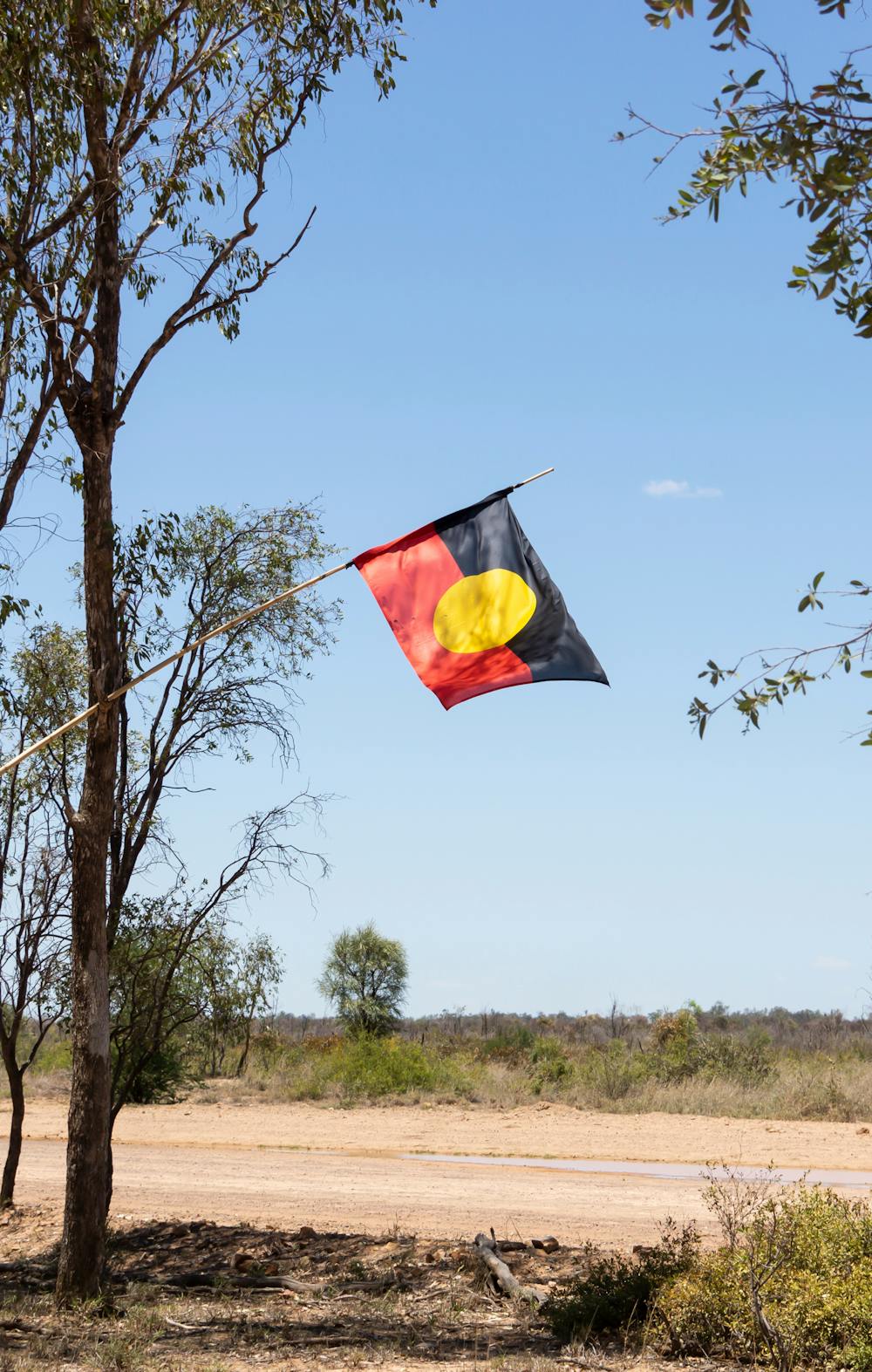
An Aboriginal flag flown in protest against mining at the Adani Bravus Carmichael mine site in the Galilee Basin, Central Queensland. Shutterstock
The inquiry has helped generate public awareness and a greater appreciation of Australia’s Indigenous heritage and the need to protect it. Australia’s commitments to the United Nations Declaration on the Rights of Indigenous Peoples have come under national and international scrutiny. This has added weight to the inquiry’s recommendations to elevate the importance of free prior and informed consent.
In the absence of regulatory reform to address systemic issues, Indigenous groups such as the National Native Title Councilcontinue working with investor groups and peak industry bodies for change through developing voluntary guidelines and other formal commitments.
Returning responsibility for cultural heritage to the Indigenous affairs minister’s portfolio, as recommended in the final report, could be a positive step.
Nothing short of the recommended reforms in the report will address the lessons learned from Juukan Gorge. The public must be vigilant in holding business, investors, and politicians to account by insisting on meaningful change.
Deanna is chief investigator of an ARC Linkage grant on public-private inquiries in mining; member of the International Council of Mining and Metals independent expert review panel; and trustee and member of the international advisory council for the Institute for Human Rights and Business. She is Director of the Centre for Social Responsibility in Mining (CSRM) at UQ. CSRM conducts applied research with communities, governments, and major mining companies.
I was previously the BMA Chair in Indigenous Engagement at the CQUniversity, Australia (2013-2018).
Kado Muir is the chairperson of the National Native Title Council, which operates with funding from the federal government.
Rodger is a Research Manager at the Centre for Social Responsibility in Mining (CSRM) at UQ, which conducts applied research with communities, governments, and mining companies, including Rio Tinto.
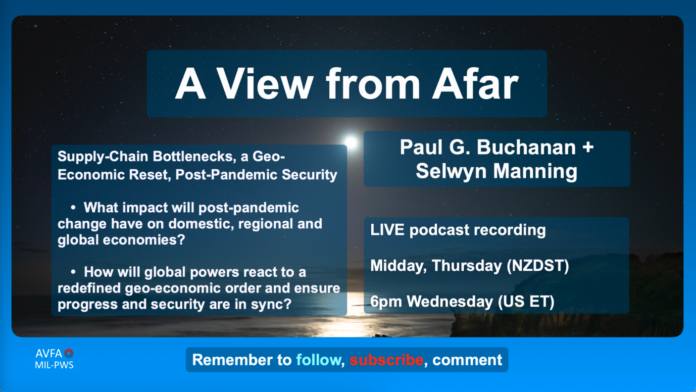
In this podcast, Paul G. Buchanan and Selwyn Manning will analyse how supply-chain bottlenecks, a global economic reset, and post-pandemic security are about to trigger a new era in geo-economics.
A View from Afar – In this podcast, Paul G. Buchanan and Selwyn Manning analyse how supply-chain bottlenecks, a global economic reset, and post-pandemic security are about to trigger a new era in geo-economics.
Wherever you are around the world, if you haven’t yet experienced the impact of supply-chain pressures, then you soon will.
As 2021 edges toward a conclusion, everyone and everything is impacted by supply-chain pressures. This problem laps at your front door with you waiting for your online-ordered-product to be delivered. And, it scales up to monumental proportions as global super economies wait for the latest shipment of iron ore or semi-conductors to dock in port.
At this stage along the global-pandemic timeline, supply-chain bottlenecks are a huge problem that impacts on every sector of our lives from the petrol our vehicles consume to the rice we have with our meals.
And this problem is going to get more challenging as countries move to seek a best-case-economic-advantage as the world slowly emerges out from the shadow of Covid-19.
We have all heard a lot about a new world emerging in the post-pandemic period.
But what will this look like?
What impact will global change have on domestic, regional, and global economies?
And, how will global powers react to a redefined world economic order?
If change is coming, and it is, then how can the world re-emerge from this pandemic-period, and ensure progress and security are in sync?
Progress and security, that will be the next challenge of our times.
Remember to join Paul and Selwyn for future LIVE recordings of of this podcast. And remember any comments you make while live can be included in this programme.
You can comment on this debate by clicking on one of these social media channels and interacting in the social media’s comment area. Here are the links:
Threat.Technology placed A View from Afar at 9th in its 20 Best Defence Security Podcasts of 2021 category. You can follow A View from Afar via our affiliate syndicators.
Throughout the pandemic, Australians with a sniffle or other cold and flu symptoms have been encouraged to get a PCR test – a swab of their throat and the back of their nose, taken by a nurse or doctor. This is then sent to a pathology laboratory for analysis.
So far, a total of 41.5 million COVID PCR tests have been performed in Australia. Private companies that process the tests are paid a Medicare rebate of A$85 per test, up from A$28.65 at the start of the pandemic in March 2020.
Although pathology companies undoubtedly have high overhead costs, the sector has recorded massive profits as a consequence of COVID.
But with rapid antigen tests, which can be performed in the home without needing to be sent to a lab, pathology companies could see a drop-off in revenue.
Who are the big players and how much profit did they make?
Clinics and practitioners are generally aligned with a particular service provider: consumers don’t get to choose the particular provider.
The pathology sector involves a handful of very large commercial groups operating nationally and often using multiple brand names as a result of takeovers.
The sector also includes much smaller commercial competitors and public sector operations within hospitals.
The large commercial groups typically require significant investment in infrastructure and specialist staff, alongside networks for collecting specimens for testing and communicating results to whoever ordered the test.
COVID testing requires substantial infrastructure and logistics. Shutterstock
There are potential efficiencies in scale: large groups might have more expertise, more capacity and better logistics. The profits are also likely to be higher.
In the 2020-21 financial year, one of the pathology giants, Sonic Healthcare, reported a net profit growth of 149%, to A$1.3 billion, with a significant proportion of that from COVID testing.
The other market leader, Healius, today reported a 44% growth in revenue in the September quarter, compared to 2020, driven by COVID testing and stronger than expected routine testing.
How rapid testing could shake up the system
The pathology industry’s dominance is likely to be eroded in coming decades by the emergence of rapid-testing “diagnostics on a stick” for a range of different illnesses.
These highly specialised low-cost and often disposable (use once and throw away) tools can be used in the home, GP clinic, or even venues such as pubs, clubs, restaurants and universities.
Rapid tests are similar to roadside alcohol testing or off-the-shelf pregnancy tests.
For COVID, rapid antigen tests take around 15 minutes and cost about A$8.50 to A$15, but they don’t currently attract a Medicare rebate.
Rapid tests aren’t as accurate as PCR tests, which use high-end equipment and expertise in pathology labs, and are likely to miss some COVID cases. So rapid tests won’t replace PCR tests altogether but are likely to have an important role in testing people without symptoms.
The Therapeutic Goods Administration (TGA) regulates medical devices, ranging from plastic gloves through to pacemakers, and is responsible for authorising new test equipment.
The TGA has been slow to authorise rapid testing tools for COVID. TGA head John Skerritt told News.com the regulator had been waiting for a signal from government about when it was an appropriate time to add rapid antigen tests into the mix.
That signal came in September, with federal health minister Greg Hunt saying he wanted rapid tests to be made available as soon as the regulator had given them the all-clear.
The TGA is now assessing applications from manufacturers for rapid tests that can be used in the home, with the minister expecting these to become available from November.
Slowness is, however, likely to please the big pathology groups, with their eyes on the bottom line and a sense that their world is going to change with advances in technology.
It has cautioned about undue reliance on rapid tests. It has noted potential issues about accuracy, the handling of devices, and the need to capture data as the basis for effective public health responses when infection spreads across locations.
The government has said rapid antigen tests will play a role in Australia’s COVID response going forward, but we’re yet to see exactly how this will work, who will have access, and at what cost.
But it’s clear we need more transparency about how these decisions are made.
Bruce Baer Arnold is affiliated with Friends of Science in Medicine.
In inland Australia, rabbits have taken a severe toll on native wildlife since they were introduced in 1859. They may be small, but today rabbits are a key threat to 322 species of Australia’s at-risk plants and animals — more than twice the number of species threatened by cats or foxes.
Our latest research looked at the conservation benefits following the introduction of three separate biocontrols used to manage rabbits in Australia over the 20th Century — all three were stunningly successful and resulted in enormous benefits to conservation.
But today, rabbits are commonly ignored or underestimated, and aren’t given appropriate attention in conservation compared to introduced predators like cats and foxes. This needs to change.
Why rabbits are such a serious problem
Simply put, rabbits are a major problem for Australian ecosystems because they destroy huge numbers of critical regenerating seedlings over more than half the continent.
Rabbits can prevent the long-term regeneration of trees and shrubs by continually eating young seedlings. This keeps ecosystems from ever reaching their natural, pre-rabbit forms. This has immense flow-on effects for the availability of food for plant-eating animals, for insect abundance, shelter and predation.
Grazing competition from rabbits has been attributed to the decline of southern hairy-nosed wombats. David Taggart, Author provided
In some ecosystems, rabbits have prevented the regeneration of plant communities for 130 years, resulting in shrub populations of only old, scattered individuals. These prolonged impacts may undermine the long-term success of conservation programs to reintroduce mammals to the wild.
Things are particularly dire in arid Australia where, in drought years, rabbits can eat a high proportion of the vegetation that grows, leaving little food for native animals. Arid vegetation is slow growing and doesn’t regenerate often as rainfall is infrequent. This means rabbits can have a severe toll on wildlife by swiftly eating young trees and shrubs soon after they emerge from the ground.
Rabbits eat a high proportion of regenerating vegetation even when their population is at nearly undetectable levels. For example, it took the complete eradication of rabbits from the semi-arid TGB Osborn reserve in South Australia, before most tree and shrub species could regenerate.
Rabbits spread weeds and eat seedlings. Shutterstock
If you control prey, you control predators
When restoring ecosystems, particularly in arid Australia, it’s common for land managers to heavily focus on managing predators such as cats and foxes, while ignoring rabbits. While predator management is important, neglecting rabbit control may mean Australia’s unique fauna is still destined to decline.
Cats and foxes eat a lot of rabbits in arid Australia and can limit their populations when rabbit numbers are low. A common argument against rabbit control is that cats and foxes will turn to eating native species in the absence of rabbits. But this argument is unfounded.
Cats and foxes may turn from rabbits to native species in the immediate short-term. But, research has also shown fewer rabbits ultimately lead to declines in catandfox numbers, as the cats and foxes are starved of their major food source.
Culling rabbits starves feral predators of their major food source. Shutterstock
Regrowth could be seen from space
An effective way to deal with rabbits is to release biocontrol agents – natural enemies of rabbits, such as viruses or parasites. Our research reviewed the effects of rolling out three different biocontrols last century:
myxomatosis (an infectious rabbit disease), released in 1950
European rabbit fleas (as a vector of myxomatosis), released in 1968
rabbit haemorrhagic disease, released in 1995.
Each lead to unprecedented reductions in the number of rabbits across Australia.
Rabbits eventually built up a tolerance to biocontrols. Shutterstock
Following the introduction of the European rabbit flea, native grasses became prolific along the Mount Lofty Ranges, South Australia. Similarly, southern hairy-nosed wombats and swamp wallabies expanded their ranges.
By the time rabbit haemorrhagic disease was introduced in 1995, interest in conservation and the environment had grown and conservation benefits were better recorded.
Native vegetationregenerated over enormous spans of land, including native pine, needle bush, umbrella wattle, witchetty bush and twin-leaved emu bush. This regeneration was so significant across large parts of the Simpson and Strzelecki Deserts, it could be seen from space.
When rabbits were controlled, the number of red kangaroos doubled. Shutterstock
But each time, after 10 to 20 years, the biocontrols stop working so well, as rabbits eventually built up a tolerance to the diseases.
So what should we do today?
Today, there are an estimated 150-200 million rabbits in Australia, we need to be on the front foot to manage this crisis. This means researchers should continually develop new biocontrols — which are clearly astonishingly successful.
But this isn’t the only solution. The use of biocontrols must be integrated with conventional rabbit management techniques, including destroying warrens (burrow networks) and harbours (above-ground rabbit shelters), baiting, fumigation, shooting or trapping.
Land managers have a major part to play in restoring Australia’s arid ecosystems, too. Land managers are required by law to control invasive pests such as rabbits, and this must occur humanely using approved and recognised methods.
They, and researchers, must take rabbit management seriously and give it equal, if not more, attention than feral cats and foxes. It all starts with a greater awareness of the problem, so we stop underestimating these small, but powerful, pests.
The authors would like to acknowledge the significant contribution of Dr Graeme Finlayson from Bush Heritage Australia, who is the lead author of the published study.
Pat Taggart works for the Department of Primary Industries NSW. He receives funding from the Federal Department of Agriculture, Water and Environment, and the Centre for Invasive Species Solutions.
Brian Cooke is an adjunct Associate Professor at the University of Canberra. He previously worked for the South Australian Government and CSIRO on biological control of rabbits. He is affiliated with Rabbit Free Australia.
It’s looking much more likely that international students will be able to return for the first semester next year, with international travel for Australians opening up from November 1.
From that date, there will be no cap on the number of fully vaccinated citizens and permanent residents able to fly into New South Wales. In response to NSW Premier Dominic Perrottet’s announcement last Friday, Prime Minister Scott Morrison also confirmed fully vaccinated travellers won’t have to go into quarantine in NSW.
This is an important moment in the transition to COVID-normal. One by one other states will follow NSW’s lead. Victoria is likely to be the next cab off the rank.
NSW is keen for inbound travel to resume also for international students and tourists. However, the Commonwealth has adopted a staged approach. As Morrison explained on Friday:
“In the first instance, it will be for Australians, Australian residents and their families. We’ll see how that goes and then we’ll move to the other priorities, which I’ve already set out as being skilled migration, as well as students to Australia.”
To date, only small numbers of students have been able to apply for a travel exemption to enter the country. They include research students with Australian government funding and medical, dental, nursing or allied health students who will undertake work placements, and secondary school students in years 11 and 12.
Some other students may soon be able to enter under plans for international student arrivals agreed to by the Commonwealth and the relevant state or territory. Numerous pilot plans have been announced and later abandoned over the past year.
Only one plan is currently in place, and it is yet to begin. This plan will allow up to 250 international students studying with NSW education providers to return each fortnight from early December 2021.
Victoria’s recent proposal will at first allow 120 currently enrolled students nominated by universities to enter the state each week. Numbers are to be expanded to more students and other providers over time.
These proposal require students to quarantine for two weeks, with universities to cover the bulk of the A$5,000 price tag per student. If implemented, these plans would allow for only about 1,500 additional students to arrive in NSW and about 2,100 in Victoria before first semester. But these small-scale plans are likely to be short-lived, and will soon give way to less complicated and costly arrangements for incoming students.
Requiring fully vaccinated international students to quarantine for two weeks makes little sense once fully vaccinated Australians entering from the same countries no longer need to quarantine. International students pose no more risk than returning Australians.
The scale of international student arrivals will grow steadily once borders begin to open. When states and territories reach the 80% double vaccination rate they will open to returning Australians as the priority. It’s likely be expressed as “getting Aussies home for Christmas”.
The next step will be to open up to migrants and international students. With campuses closed over the summer, most international students would be happy to wait to travel in January and February as long as there is certainty that borders will be open and flights will be available.
How many returning students can we expect?
The shift away from hotel quarantine removes the major constraint of hotel capacity. The limiting factor on the number of returning students will be the availability of international flights in early 2022.
Currently, over 45,000 Australians overseas have registered with the Department of Foreign Affairs and Trade for assistance to return to Australia. About 146,000 international students, across all levels of study, have visas to enter Australia but haven’t been able to enter the country. (Nearly 264,000 international students are still in Australia – less than half as many as two years ago.)
The majority of the students stuck offshore are in China, for two reasons. Flights from China were stopped early in 2020 before other countries were affected, and Chinese students have been more willing than others to begin their studies online.
We can expect to see a flurry of new students applying as soon as it is clear the border is open to them. And many Australians will be taking advantage of their newfound travel freedom over the summer and will also be wanting return flights.
So can we manage that many arrivals?
The big question now is will there be enough inbound flights for all these returning Australians and international students over the summer? In pre-COVID times, this would have been a walk in the park. There were 21.3 million international arrivals in Australia in 2019, or around 1.8 million inbound passengers per month.
It will take a long time to reach those numbers again, but the key point is that airlines have ample capacity to allow Australians to travel over the summer and students to arrive on campus in 2022.
Airlines are keen to resume flying, students are keen to get onto campus next semester and our cities are keen to get international students back. International education will play a big part in our recovery in 2022. We are just waiting on governments to commit to a timeline for reopening so we can all start making plans.
Christopher Ziguras is past President of the International Education Association of Australia and has had a role as the Association’s Research Director.
Despite lengthy lockdowns, new data show that 1,142 Australians, including 66 children, died on Australian roads in the past year.
Road traffic deaths remain the number one killer of children in Australia.
Despite fewer cars on the road, we have seen a 25% increase in deaths of children this year, compared to the average from 2017-2020. Although minor fluctuations are typical, this year’s rise represents an additional 13 children dying on our roads.
Deaths on our roads are not inevitable: they are not “accidents”, they are preventable. There are more than 150 cities across the world where no kids or adults have died on their roads for five or more years since 2009.
So far this year, in Sydney, Newcastle and Melbourne, 52, 6 and 69 lives have been lost, respectively. Across New South Wales as a whole, 203 people, including 14 children, have died so far this year.
We can learn from cities such as Oslo and Helsinki, where pedestrian and cyclist deaths were cut to zero in 2019. We can also learn from Belfast and Edinburgh, where they have managed to reduce speed, crashes and road traffic deaths.
So how do we get to zero traffic deaths in Australia? And what other benefits could better safety measures bring?
5 actions to get to zero deaths
We have to start by acknowledging that “humans are human, and we make mistakes”. Therefore, training and education are not enough. We also need to invest in safely designed streets that attract people to walk and cycle, and mitigate the risk of human error.
This is the basis of an approach that has enabled hundreds of cities globally to continually achieve Vision Zero – zero deaths from road crashes.
The World Health Organization outlines five combined actions to make streets safer and more liveable:
implementing traffic-calming strategies – such as those that limit vehicle speeds and reduce congestion by making walking and cycling the default mode for short journeys (for example, road diets that reallocate street space, speed bumps, continuous crossings)
setting lower speed limits for particular roads – such as 30km/h on streets where people live, play and shop
embracing in-vehicle technologies as they emerge, such as intelligent speed assist to support drivers to avoid speeding, and autonomous emergency braking to avoid crashes
We know what works to create safer and more liveable streets. Matthew Mclaughlin
Speeding is the most common factor in road traffic deaths: more than drink-driving and fatigue. Two-thirds of Australians admit to speeding, and a third of these drivers now admit to speeding weekly. The problem is getting worse, with 17% more drivers admitting to speeding since the COVID lockdowns.
Campaigns and programs that focus on children may be particularly helpful, but not sufficient on their own. For example, a new grassroots campaign called Safe Streets to School calls on councils to either build crossings and footpaths, or request 30km/h speed limits within 2km of schools.
5 co-benefits of safer roads
Beyond the strikingly obvious benefit of reducing the numbers of children and adults dying and being seriously injured on Australia’s roads, what other benefits would safer streets bring?
Local businesses benefit – designing enticing shopping streets that feel safe leads to more spending in local shops. Big shopping centres have recognised this and have designed people-friendly shopping arcades that are safely separated from cars. Councils should adopt some of these design principles for local shopping streets.
Less congestion, more walking and cycling – more than one-third of city car journeys in Australia are so short they could be cycled in 12 minutes or less, or even walked. More people walking and cycling for short journeys means less congestion. Walking and cycling are also fun, safe, inexpensive and good for our physical, mental and social health.
Improved air and noise pollution – we can save fuel and reduce air and noise pollution by driving at lower speeds, particularly on streets with many intersections and junctions. We can save even more fuel when we feel safe and enticed to walk and cycle short journeys instead.
Social connection and neighbourliness – 7 in 10 Australians value traffic-calming measures and a sense of community. Walkable and appealing streets encourage healthy social connections.
Protecting our community – children, people on lower incomes, the elderly and people living with mobility impairments equitably benefit from streets that are safer and more appealing to walk and cycle.
Don’t fall for the ‘nanny state’ rhetoric: it can save lives
The key is acknowledging that humans make mistakes and designing road networks with this in mind. Safer and more liveable streets are a win-win public health policy.
The authors would like to thank Professor Jasper Schipperijn for his expert input and feedback.
Matthew ‘Tepi’ Mclaughlin is affiliated with the International Society for Physical Activity and Health and The Australasian Society for Physical Activity.
Hayley Christian receives funding from the National Health and Medical Research Council, Australian Research Council and Health Promotion Foundation of Western Australia (Healthway). Hayley Christian is supported by an Australian National Heart Foundation Future Leader Fellowship (102549).
Karen Milton received funding from the National Institute for Health Research (NIHR) in the UK for her role in the evaluation of 20mph speed limits in Edinburgh and Belfast. She has also received funding for related work from the Wellcome Trust. She is President-elect of the International Society for Physical Activity and Health (ISPAH) and Co-Director of a charity (Pragmatic Evaluation in Physical Activity and Health – PEPAH), which focuses on building capacity in physical activity research and evaluation globally.
Jacinda Ardern and partner Clarke Gayford visit a pop-up vaccination clinic on ‘Super Saturday’.Hagen Hopkins/Getty Images
New Zealand’s mass vaccination event last Saturday, when more than 130,000 people turned up to get their first or second dose, surpassed Prime Minister Jacinda Ardern’s expectations.
Super Saturday and a televised “vaxathon” were part of the government’s push towards a 90% vaccination goal. About 85% of New Zealanders have now had their first dose, and 65% of the population are fully vaccinated.
But only 65% of the Māori population have had their first dose. By ethnicity, Māori had the highest proportion of first doses on Super Saturday, with 50% of all Māori vaccinations being the first dose.
The mass vaccination showed that improved access through pop-up and walk-in clinics, community events and free transportation can make a big difference in uptake. But it also highlighted ongoing gaps and structural inequities in New Zealand’s vaccine rollout.
Ardern is expected to announce a new system this week to replace the current COVID-19 alert levels and to ease restrictions gradually, once higher vaccination rates are achieved across the population.
Tairāwhiti had the lowest Super Saturday turnout, and the region also has some of the worst access to vaccination services. The East Cape is served by just two permanent facilities and, as of October 19, there were no appointments available within the next week.
Out of concern that public health protections could be removed before people in the region had a chance to get vaccinated, members of the Te Aroha Kanarahi Trust decided to take matters into their own hands and crowd-fund for a mobile vaccination clinic.
As commentator Morgan Godfery points out, the high levels of government distrust and socioeconomic constraint exacerbate issues of inequitable access.
Recently, the Ministry of Health released suburb-level COVID-19 vaccination rates for the first time. There was an inevitable rush to see which towns were doing the best, and who was lagging behind.
This map shows travel times to vaccination centres with appointments available within seven days. Author provided
Murupara was identified as the nation’s “slowest town”. However, this title is unhelpful, and misses a lot of important contextual information.
One reason Murupara’s vaccination rates are low is that the town has one of the lowest levels of access to vaccination services in Aotearoa. The nearest permanent vaccination site is more than a 50-minute drive away.
Another reason is that most residents haven’t even been eligible for the vaccine until early September. The median age of Murupara in 2018 was 29 years, placing most people firmly at the tail end of Group 4 of the vaccination rollout.
On the other hand, suburbs in central Auckland, Wellington and Queenstown – “leading the way” with high first-dose vaccination rates – tend to have good access to vaccination services. Of the top 30 “most-vaxed” suburbs, the longest drive time to a vaccination centre was just five minutes.
More than 130,000 people received their first or second vaccine dose during a mass vaccination event last Saturday. Fiona Goodall/Getty Images
Long-running structural inequities
Associating neighbourhood ethnic composition with vaccination uptake also masks key contextual information and risks creating a racist pile-on. It hides the structural inequities within Aotearoa’s health system, and the vaccination rollout specifically, by placing the blame for low vaccination on individuals and communities.
Findings from international research suggest we need geographic and ethnic targeting of vaccination programmes to address inequitable outcomes, including a higher risk of death. Te Rōpū Whakakaupapa Urutā have been calling for this approach in Aotearoa.
We have long known that Māori, Pasifika and poorer populations are at the highest risk of COVID-19 infection and death, and are likely to have the worst access to vaccination services.
The age-based sequencing of the vaccination rollout was rational and important for prioritising older people who are at a higher risk of COVID-19 infection, hospitalisation and death. But rational policies can result in discriminatory outcomes.
Māori and Pasifika have much younger age structures, with median ages of 25.6 and 23.7 respectively, compared to 41.2 for European New Zealanders. During the Delta outbreak, this means a large proportion of Māori and Pasifika people remain unvaccinated and at risk.
In fact, more than 25% of both Māori and Pasifika communities can’t be vaccinated because they are children under the age of 12.
Vaccination rates need to be very high, across the country, for all communities, before we open up. As the pressure mounts on communities to adopt the “individual armour of vaccination” before protective public health measures are removed, we need to shift resources and control over vaccination programmes to local solutions.
Māori and Pasifika community organisations and leaders need the resources, support and data required to enable them to reach and vaccinate their people.
Jesse Whitehead receives funding from the Health Research Council of New Zealand and the National Science Challenge
Unions have been quick to condemn Australia’s new Agricultural Visa, which will give approved employers access to “skilled, semi-skilled and unskilled” workers from ASEAN nations and the UK from late this year.
ACTU president Michelle O’Neill has warned of a “second-class workforce” with “none of the protections or rights that all Australian workers should be able to rely on”. But many aspects of the visa are actually a step in the right direction and could provide unions with organising opportunities.
The scheme is being sold as a complement to two existing schemes, the Seasonal Worker Programme and the Pacific Labour Scheme.
In reality, it’s a concession to farmers who lost rights to British backpackers.
Australia waived the requirement for backpackers to extend their working holiday visas to complete three months of work in regional Australia as part of negotiations for a UK-Australia free trade agreement.
In filling the gap left by backpackers, the visa program has introduced provisions that will protect the interests of incoming workers.
The Seasonal Workers’ Program and the Pacific Labour Scheme bond workers to single employers, making it hard for them to escape mistreatment.
As the president of the Vanuatu Association of Public Service Employees, Dr Basil Leodoro, told me in my research, this leaves workers in trouble with no choice but to hide.
I think that’s, that’s their way of protesting the conditions that they have […] their way of saying they miss home, and they’d rather not do anything than work even more
By allowing movement between approved employers, the agricultural visa will give workers the ability to leave bad situations without having to abscond and endanger their migration status.
Better, but no silver bullet
Another feature of the Agricultural Visa which will separate it from the Seasonal Workers’ Program and the Pacific Labour Scheme is that it will offer a pathway to permanent residency.
The time limits on other visas have created problems for unions in the past, with mistreated workers keen to keep their heads down until they go home.
Horticulture is one of the few industries in which piece work is still legal. F Armstrong
Low unionisation, underpayment and illegal overtime are realities for agricultural employees regardless of their visa status.
Asmarina, an Australian citizen of Eritrean background whose family lives on the Mid North Coast of NSW, started working on the berry farms at the age of 10.
“People” she told me, “don’t know their legal rights on these farms.”
Many Eritreans work on the farms because language barriers make it difficult to find other work. The hours are long, the conditions are harsh and the pay is low.
Horticulture is one of the few industries in which piece work is still legal.
This is corroborated by Daisy, who travelled from Wollongong to Coffs Harbour for the harvest season at the end of 2020. She says though contractors promised workers could earn over the minimum wage if they worked hard enough, most were paid something nearer A$15 per hour.
Only the most experienced could pick enough to earn as much as a café worker.
The Agricultural Visa won’t solve these problems by itself, but it might make the recipients more receptive to organising than have other visas.
In Vanuatu, Dr Leodoro is gearing up for greater union involvement.
The Vanuatu National Workers Union has been collaborating with Australia’s United Workers’ Union to ensure that temporary migrants know their rights.
With union involvement, the Agricultural Visa could be a step in the right direction for agricultural migrant workers.
Rather than dismiss it out of hand, Australia’s union movement could ensure that the workers on it don’t become “second class” workers in the first place.
I know one of the interviewees personally through a charity group to which we both contribute- the Community Union defence League. This group has been involved in farmworker activism before.
Facebook has announced a research project that aims to push the “frontier of first-person perception”, and in the process help you remember where your left your keys.
The Ego4D project provides a huge collection of first-person video and related data, plus a set of challenges for researchers to teach computers to understand the data and gather useful information from it.
In September, the social media giant launched a line of “smart glasses” called Ray-Ban Stories, which carry a digital camera and other features. Much like the Google Glass project, which met mixed reviews in 2013, this one has prompted complaints of privacy invasion.
The Ego4D project aims to develop software that will make smart glasses far more useful, but may in the process enable far greater breaches of privacy.
a massive-scale, egocentric dataset and benchmark suite collected across 74 worldwide locations and nine countries, with over 3,025 hours of daily-life activity video.
Ego4D: Teaching AI to perceive the world through your eyes.
The “Ego” in Ego4D means egocentric (or “first-person” video), while “4D” stands for the three dimensions of space plus one more: time. In essence, Ego4D seeks to combine photos, video, geographical information and other data to build a model of the user’s world.
There are two components: a large dataset of first-person photos and videos, and a “benchmark suite” consisting of five challenging tasks that can be used to compare different AI models or algorithms with each other. These benchmarks involve analysing first-person video to remember past events, create diary entries, understand interactions with objects and people, and forecast future events.
The dataset includes more than 3,000 hours of first-person video from 855 participants going about everyday tasks, captured with a variety of devices including GoPro cameras and augmented reality (AR) glasses. The videos cover activities at home, in the workplace, and hundreds of social settings.
What is in the data set?
Although this is not the first such video dataset to be introduced to the research community, it is 20 times larger than publicly available datasets. It includes video, audio, 3D mesh scans of the environment, eye gaze, stereo, and synchronized multi-camera views of the same event.
Most of the recorded footage is unscripted or “in the wild”. The data is also quite diverse as it was collected from 74 locations across nine countries, and those capturing the data have various backgrounds, ages and genders.
What can we do with it?
Commonly, computer vision models are trained and tested on annotated images and videos for a specific task. Facebook argues that current AI datasets and models represent a third-person or a “spectator” view, resulting in limited visual perception. Understanding first-person video will help design robots that better engage with their surroundings.
Wikimedia: Future robotic agents will benefit from a better understanding of their environment
Furthermore, Facebook argues egocentric vision can potentially transform how we use virtual and augmented reality devices such as glasses and headsets. If we can develop AI models that understand the world from a first-person viewpoint, just like humans do, VR and AR devices may become as valuable as our smartphones.
Can AI make our lives better?
Facebook has also developed five benchmark challenges as part of the Ego4D project. The challenges aim to build better understanding of video materials to develop useful AI assistants. The benchmarks focus on understanding first person perception. The benchmarks are described as follows:
Episodic memory (what happened when?): for example, figuring out from first-person video where you left your keys
Hand-object manipulation (what am I doing and how?): this aims to better understand and teach human actions, such as giving instructions on how to play the drums
Audio-visual conversation (who said what and when?): this includes keeping track of and summarising conversations, meetings or classes
Social interactions (who is interacting with whom?): this is about identifying people and their actions, with a goal of doing things like helping you hear a person better if they’re talking to you
Forecasting activities (what am I likely to do next?): this aims to anticipate your intentions and offer advice, like pointing out you’ve already added salt to a recipe if you look like you’re about to add some more.
What about privacy?
Obviously there are significant concerns regarding privacy. If this technology is paired with smart glasses constantly recording and analysing the environment, the result could be constant tracking and logging (via facial recognition) of people moving around in public.
Facebook says it will maintain high ethical and privacy standards for the data gathered for the project, including consent of participants, independent reviews, and de-identifying data where possible.
As such, Facebook says the data was captured in a “controlled environment with informed consent”, and in public spaces “faces and other PII [personally identifing information] are blurred”.
But despite these reassurances (and noting this is only a trial), there are concerns over the future of smart-glasses technology coupled with the power of a social media giant whose intentions have not always been aligned to their users.
The ImageNet dataset, a huge collection of tagged images, has helped computers learn to analyse and describe images over the past decade or more. Will Ego4D do the same for first-person video?
We may get an idea next year. Facebook has invited the research community to participate in the Ego4D competition in June 2022, and pit their algorithms against the benchmark challenges to see if we can find those keys at last.
The authors do not work for, consult, own shares in or receive funding from any company or organisation that would benefit from this article, and have disclosed no relevant affiliations beyond their academic appointment.
New Zealand Parliament Buildings, Wellington, New Zealand.
Editor’s Note: Here below is a list of the main issues currently under discussion in New Zealand and links to media coverage. You can sign up to NZ Politics Daily as well as New Zealand Political Roundup columns for free here.
Some people have reacted with moral outrage at the prospect of making a killer robot in the image of our loyal best friend. But if this development makes us pause for thought, in a way that existing robot weapons don’t, then perhaps it serves a useful purpose after all.
The response to Ghost Robotics’ latest creation is reminiscent of an incident involving Boston Dynamics, another maker of doglike robots (which, in contrast, strongly frowns on the idea of weaponising them).
In 2015, Boston Dynamics caused controversy after posting footage online of technicians kicking a doglike robot to demonstrate its stability. Many viewers sympathised with the robot, and claimed kicking it was morally wrong.
Ghost Robotics Chief Executive Jiren Parikh has offered an evolutionary explanation for the moral qualms about sniper robo-dogs, claiming they evoke our “evolutionary memories of predators” because they have legs.
But I’m not convinced. I think people are reacting strongly because the robots look like dogs.
A killer best friend?
Dogs are intelligent. When we see a weapon shaped like a dog, it becomes very easy to view that weapon in the same terms. We instinctively see it as a gun that makes its own decisions, because that’s what dogs do.
For many people, that is the true horror of automated weaponry: a deadly robot that makes its own choices about whom it kills. There’s no guarantee the choices the robot makes will be constrained by human morality.
In truth, the robots produced by Ghost Robotics are no more autonomous than existing weapons systems. Like most drones, these gun-toting robo-dogs are fully piloted by a remote operator.
But there’s a crucial difference in our perception: the doglike robots seem more like fully autonomous killing machines, even though they’re not. They just appear that way because we take the intelligence we associate with dogs, and project it onto a bunch of bolts, wires and guns that happens to look like them.
If robotic dogs equipped with sniper rifles fill us with unease, should we stop making them? Well, ideally yes. But if, as seems inevitable, humans are going to continue building robots with guns, maybe we should make them all look like dogs. Or, better yet, domestic pets more generally.
Pets are our family. We know our pets are largely free to act as they please, but the familial bonds we develop with them encourage us to feel accountable for their actions.
That’s because, although we see pets as having a capacity for choice, we also see them as morally inert. When a dog steals the last pork chop from the table, we don’t think the dog is morally culpable. Granted, we might say “bad dog”, but that’s just a way to curb its behaviour. A sharp tone and gruff voice discourage future chop theft, but we aren’t blaming the dog for doing what comes naturally.
Rather, it is we who must take moral responsibility for our pets. That means caring for them, avoiding cruelty and, above all, assuming responsibility if they do something wrong. If my dog bites someone, I feel morally bad even if the dog doesn’t.
If robots with guns look and act like pets, and if we come to see them as such, then some of the moral responsibility we assume for pets might just rub off onto these robots. We may well be more willing to take moral responsibility for the actions of a doglike robot than a faceless military drone.
The real horror of autonomous weapons is not the potential they will turn against us in a Skynet-style robotic uprising. It is the horror of detachment. Autonomous weaponry makes it easy to distance ourselves from killing done in our name.
I’m not talking about physical distance (although that is certainly part of it), but rather about moral and emotional distance. Just as buying neatly packaged meat at a supermarket lets us feel detached from the violence done to animals in producing it, so we might feel morally distanced from violence against humans if perpetrated by a remote machine.
We need to discourage moral detachment from autonomous weapons. And our existing moral attitude to our pets might offer a shortcut to this goal.
Let me be clear: I don’t support the development of autonomous weaponry or weaponised artificial intelligence. But if we are going to develop such technology, let it be in the shape of pets. Maybe then we won’t kill quite so many people.
Sam Baron receives funding from the Australian Research Council.
Vaccines save lives, and have been doing so since the development of the smallpox vaccine more than 200 years ago.
However, for vaccines to keep entire communities safe they need to be taken up by very large proportions of the population. Only then can the vaccinated offer protection to the unvaccinated, known as “herd immunity”.
Unfortunately, too often this doesn’t occur. Hesitancy around the measles vaccine, for example, contributed to a 30% increase in cases globally in 2019.
So, why does vaccine hesitancy occur? There are many reasons, and these will differ between people.
But, as clinical psychologists who study anxiety and avoidance, we think one big factor is fear – specifically the fear of death, and how we manage that fear.
Vaccination rates increasing, but fear still out there
In the case of COVID, refusing or delaying vaccination has been a significant problem, with anti-vax and freedom marches dominating news cycles over recent months.
In Australia, the issue of vaccine hesitancy remains significant, despite some reports to the contrary.
The article also claimed “vaccine fears have plunged to a record low”.
However, while the data were real, in our view, the interpretation of them was flawed.
Fear hasn’t substantially diminished. Instead, mandatory vaccination of certain groups in the community, and significant disadvantages for those who refuse to be vaccinated, is driving increases in vaccination uptake.
In several Australian states, mandatory vaccinations are in place for many professions, including quarantine workers, health workers, teachers, construction workers, aged-care workers and other groups. When you need to work to put food on the table, the decision to stay unvaccinated can become an impossible one.
What’s more, politicians have foreshadowed various freedoms for the vaccinated. For example, the freedoms currently afforded to fully vaccinated Sydneysiders, but not the unvaccinated, include: visitors to your home and access to gyms, pools, retail stores, hairdressers, nail salons, pubs, zoos, cinemas, theatres, museums and galleries.
If people weren’t vaccine hesitant, mandatory vaccinations and incentives wouldn’t be necessary. A substantial portion of the community don’t want to be vaccinated, and would choose not to be vaccinated, if it wasn’t for the strong arm of government.
So why do people delay or refuse to get vaccinated?
The WHO lists complacency among the leading reasons for vaccine hesitancy.
But how can this be the case? After all, COVID has already killed nearly five million people globally and infected over 240 million. In the face of these numbers, how could anyone remain complacent? Why do we see unmasked protesters, apparently oblivious to the threat?
The psychological theory that best explains these behaviours is “terror management theory”. According to this theory, humans are unable to face the stark reality of death, and often engage in various forms of denial.
We see ourselves as grander than the animals, immune to many of their problems, and destined for immortality with our gods. As one group of researchers put it, humans
could not function with equanimity if they believed that they were not inherently more significant and enduring than apes, lizards, or lima beans.
Hundreds of studies in social psychology laboratories have shown that subtle reminders of death (known as “death primes”) lead participants to vigorously defend their religious and cultural beliefs, and their freedoms.
In the process, we may defy the warnings of modern medicine, convinced of our own superiority. Researchers at the University of Chicago Divinity School reported half of their participants, all of whom indicated some religious affiliation, agreed with the statement “God will protect me from being infected”. To cope with our dread of death, we delude ourselves into thinking we are invincible: death might happen to other people, but not to me.
This effect will be magnified even further if the social groups to which we belong also endorse similar views. Reminders of death lead people to fiercely defend the values and beliefs of their group. In the context of COVID, this means we may become more individualistic, more distrustful of science or government, or more trusting in our god’s ability to protect us, if these attitudes are valued and shared by our culture or subgroup.
Living in the times of COVID has made us all participants in a social psychology experiment. Daily death counts and case numbers are regular reminders of death that have produced all the behaviours we see in the laboratory.
Early deaths associated with the vaccines themselves became another “death prime” that drove additional caution and avoidance.
Vaccine hesitancy will remain an urgent problem globally while we refuse to see ourselves for who we really are.
As COVID continues to mutate, the speedy uptake of vaccines may remain a pressing issue over coming years.
Vaccine hesitancy will continue to kill tens of thousands globally until its roots are fully understood and confronted.
The authors do not work for, consult, own shares in or receive funding from any company or organization that would benefit from this article, and have disclosed no relevant affiliations beyond their academic appointment.
Source: The Conversation (Au and NZ) – By Peter Christoff, Senior Research Fellow and Associate Professor, Melbourne Climate Futures initiative, The University of Melbourne
Prime Minister Scott Morrison is poised to take a 2050 net-zero emissions target to Glasgow. While this may seem like a milestone, Australia is still failing to abide by one of the core requirements of the Paris Agreement.
At Paris in 2015, Australia – like the rest of the world – signed up to toughening our emissions reduction targets every five years. We’ve now reached that point (factoring in a one-year COVID delay).
Yet Australia’s current 2030 targets remain no more ambitious than those we produced six years ago, and Morrison has all but ruled out increasing them ahead of the Glasgow summit.
This means Australia is undermining the international treaty central to combating climate change – and highlights yet again the need for Australia’s climate agreements to be written into domestic law.
Under the Paris Agreement, nations should increase their climate ambition every five years. Shutterstock
What is the Paris Agreement?
The 2015 Paris Agreement is a curious instrument, allowing countries to nominate their own emissions-reduction targets and related actions. This discretionary arrangement was the only option to ensure support and compliance by individual states, especially the United States and China.
In 2015, Australia’s first target was to reduce emissions by 26–28% below 2005 levels by 2030. It was well below the 45–65% reduction recommended by Australia’s Climate Change Authority.
In combination, the first emissions-reduction pledges made by the 195 signatories to the Paris Agreement was insufficient. They put the world on track for global warming of at least 3.5℃ above pre-industrial levels this century – far higher than the Paris Agreement goals of limiting warming to 2℃, while aiming for no more than 1.5℃ .
So the Agreement also requires nations to amend their targets every five years. These amendments are required to “represent a progression” beyond the last plan and “reflect a country’s highest possible ambition”.
Specifically, each country with a 2030 target – such as Australia – is expected to update its contribution by 2020 (a deadline pushed out by COVID to 2021).
The Paris Agreement entered into force in 2016, following the Paris climate change conference in 2015. Jacky Naegelen/AP/AAP
Breaking our legal obligations
A fundamental principle of international law – and arguably the oldest – is “pacta sunt servanda”, which means “agreements must be kept”. It is essential to the functioning of the global treaty system.
Although the Paris Agreement does not include enforcement mechanisms, it is nonetheless a legally binding treaty and so, according to the “pacta sunt servanda” principle, must be implemented in good faith.
In practice, major developed countries have shown they understand “updating” to refer to toughening short-term targets, separate from a commitment to the longer term aim of net-zero by 2050.
For example, in December 2020 the United Kingdom lifted its 2030 target from 57% to 68% below 1990 levels. Germany has increased its target from 55% to 65% below 1990 levels. The United States will now aim for a 50-52% reduction below 2005 levels by 2030.
Australia, on the other hand, has not budged on its short-term ambition. Its 2020 formal communication to the United Nations lists a raft of policy initiatives. But there is no change to its old 2030 target.
This failure builds on Coalition’s record of undermining international climate agreements, stretching back to 1997 when the Howard government first negotiated extraordinarily favourable emissions targets but ultimately refused to ratify the Kyoto Protocol.
Howard’s recalcitrance contributed to an eight-year delay before the protocol came into legal force, and slowed global efforts to reduce emissions. Australia finally ratified the Protocol in 2007, under the Rudd government.
Morrison adds to this record as he continues to dither. His failure is puzzling, given the absence of threats to his prime ministership, and the clear support for tougher emissions targets from business, farmers and in crucial rural seats.
What’s more, Australia is actually already tracking towards emissions reductions of 30-38% below 2005 levels by 2030.
The Morrison government has not increased the ambition of its 2030 target. AAP
National climate target law
So how can we ensure Australia abides by international laws, both in terms of the letter and the spirit?
Under our Constitution, unless the substance of an international treaty signed by Australia is also enacted in Australian law, that treaty has no legal hold over domestic behaviour.
No federal government – Coalition or Labor – has embedded Australia’s emissions-reduction targets in law. Most recently, in 2018, then-Prime Minister Malcolm Turnbull sought to do so as part of the proposed National Energy Guarantee. Internal party tensions forced him to dump that legislative plan – but not soon enough to prevent him being dropped as leader.
Those times have passed; parliamentary support for climate action is now overwhelming.
The absence of legislative teeth means no one can be held accountable if Australia misses its emissions goals. That means the Morrison government has been able to approve new coal mines and subsidise coal-fired power generation and gas expansion without fear of punishment or redress.
By contrast, many other countries – for instance, the UK, Austria, Denmark and Scotland – have established effective national climate laws, setting long-term and interim targets with associated mechanisms for reviewing and requiring progress.
Many include mechanisms for systematic review and are regularly amended to bring them into line with the targets and other provisions of the Paris Agreement.
The recognised gold standard for such climate legislation is the UK Climate Change Act 2008, which includes:
interim and final targets, and related implementation mechanisms
an independent committee with science-informed processes for reviewing progress
mechanisms for setting and regularly increasing ambition over time
parliamentary accountability mechanisms and the basis for whole-of-government planning and coordination.
Four Australian states and territories – Victoria, South Australia, Tasmania and the ACT – have developed similar tough framework legislation. Indeed, recent research shows we were once global leaders: South Australia was the first jurisdiction in the world to enact such a law.
The administration of UK Prime Minister Boris Johnson has enshrined the nation’s climate targets in law. AP
Overcoming past failures
Without a stringent and binding plan to minimise national emissions in the short term, a 2050 net-zero target is vacuous.
Without a national climate law, the problems of the past will persist. National policies and effort will remain uncoordinated, investors will face continued uncertainty and economic opportunities will continue to be lost.
If Australia is really serious about climate action, Morrison must announce a new, tougher 2030 goal and enshrine it in law. This law must also include clear processes for coordinating, reviewing and enhancing national climate action.
The urgency and scale of the climate crisis demands it.
Peter Christoff does not work for, consult, own shares in or receive funding from any company or organisation that would benefit from this article, and has disclosed no relevant affiliations beyond their academic appointment.
Before COVID, university and vocational education students were at high risk of developing mental disorders, such as depression and anxiety. This is because they already experience much higher levels of psychological distress than the general population.
But since COVID, this group is even more at risk. Our study has found the percentage of university and vocational education students reporting extremely high levels of distress during the pandemic (23%) was higher than before the pandemic (19%).
We also compared the percentage of Australian adults in the general population reporting extremely high levels of distress before (3%) and during (13%) COVID. In this population too, distress levels have increased significantly.
So, overall, the percentage of tertiary students reporting extremely high levels of distress (23%) has remained much higher than for adults in the general population (13%).
Women and international students among worst affected
Pandemics increase the amount of stressors people are subjected to for a number of reasons. In university students, these include health impacts associated with illness, worrying about becoming ill, being unable to work, having to study online and being separated from friends and family.
Results of studies conducted in the United States and China have also shown COVID has increased levels of distress and mental health problems in university students.
In our yet-to-be-published study, we measured distress in 1,072 students enrolled in university and vocational education and training across Australia. We did this using an online survey consisting of demographic questions and the Kessler 10 Item Psychological Distress Scale (K10) — a global measure of distress and symptoms of depression and anxiety.
The survey asks ten questions such as “in the past four weeks, about how often did you feel hopeless?” and “in the past four weeks, about how often did you feel so restless you could not sit still?”
For each question, respondents have to signify whether this is “all of the time”, “most of the time”, “some of the time”, “a little of the time” or “none of the time”.
In part one of the study, we compared current levels of student distress to distress in students before the pandemic, also measured using the K10, and found current levels were higher.
Women, international students and students with a history of mental health issues had the highest rates of depression and anxiety symptoms. Shutterstock
The groups displaying the highest levels of distress were younger students, women, international students, students living in Queensland, and those who have had a previous diagnosis of a mental disorder, as well as those receiving mental health care.
We recently conducted a review of studies (yet-to-be published) designed to promote mental health and stress resilience among university students. We found:
focusing attention on the present moment was the most reliable exercise for reducing symptoms of anxiety
engaging in enjoyable and personally meaningful activities was the most effective exercise for reducing symptoms of depression
positive relations with others decreased symptoms of anxiety and paranoia, and improved positive emotions
humour relieved symptoms of anxiety
keeping a journal relieved symptoms of anxiety. Doing this may also improve positive emotions
acceptance during difficult circumstances also relieved symptoms of anxiety, but not as effectively as focusing attention on the present moment, humour, journaling or positive relationships
gratitude, optimism, self-compassion, being aware of emotions and taking probiotics all helped to improve mental health, but not as effectively as the other exercises outlined above
exercise relieves symptoms of depression and anxiety and can also improve positive emotions if the participant does not push too far beyond their ability level.
Preventive measures are important
Most Australian universities already offer mental health support programs to students. But these are typically focused on treating distress rather than preventing it. Where stress management training does exist, this generally occurs through isolated programs.
This is in contrast to national medical health strategies that rely heavily on preventive health initiatives. These are generally educational campaigns that teach people how to look after their health instead of waiting for them to turn up at hospital emergency departments. Campaigns start in early school years and continue throughout life.
Australia’s national mental health plan also includes preventive strategies but it doesn’t involve educating people on how to look after their own mental health in the same way preventive medical health training does.
Research shows every $1 universities spend on preventive mental health programs saves more than $6 in health-care costs and waste from non-completion of courses.
In vocational education and training, this amount increases to more than $11 saved for every $1 spent. This is due to fewer on-campus mental health resources and training in these institutions compared to universities.
The Productivity Commission has recommended preventive mental health programs be mandated at universities and other tertiary training institutions. There is an even greater need for this now due to the negative impact of the pandemic.
If you are experiencing extreme levels of distress that you cannot manage, it’s advisable to talk to your GP about creating a mental health plan, or contact the counselling service of your educational institution.
If this article has raised issues for you, or if you’re concerned about someone you know, call Lifeline on 13 11 14.
David Tuck receives funding from an Australian Goverment Research Training Grant.
Joshua Wiley receives funding from the National Health and Medical Research Council.
Emily Berger and Lefteris Patlamazoglou do not work for, consult, own shares in or receive funding from any company or organisation that would benefit from this article, and have disclosed no relevant affiliations beyond their academic appointment.
Australia has been built on immigration. In recent years it has been skilled migration, and that will continue to be important to us, especially as we recover from the COVID economic malaise.
Skilled migrants are offered visas that can lead to permanent residency, whereas those with lesser skills are normally only offered visas without such pathways.
As we emerge from the COVID crisis, groups such as the Grattan Institute have been calling for an even greater focus on skilled migration, saying it will deliver us Australians who are younger, smarter and richer.
But COVID has underscored how much we also depend on low-skilled workers, especially in agriculture, hospitality, aged and disability care and construction.
Shortages in aged care alone are projected to approach one million by 2050.
Ageing means all types of workers will become more scarce. The 40-year projections in this year’s Intergenerational Report have the number of working-age Australians for each Australian aged over 65 shrinking from four to 2.7.
(Though the projection is less dramatic than presented. The ratio of working Australians to both older and younger Australians of dependent age is expected to decline more modestly over the 40 year period, from 1.8 to 1.6.)
Low-skilled workers are increasingly valued
Similar falls in the ratio of workers to dependants are expected in much of Europe and in Japan, Korea, Singapore and China, meaning Australia will face competition for workers.
Things are starting to move. The recently announced Agricultural Visa will give migrants from the UK and the ASEAN region who want to work in agriculture, fisheries and forestry sectors a pathway to permanent residency.
The Joint Standing Committee on Migration has recommended the temporary skilled workers (visa subclass 482) also be given a pathway to permanent residency and that it be made easier in regional areas.
Japan has changed course
Japan’s population is increasingly old. Suptar/Shutterstock
Japan, which has traditionally made migration difficult, is offering skilled migration pathways for foreigners without tertiary degrees in occupations including agriculture, aged care and construction.
These were previously seen as unskilled or semi-skilled occupations. After five years, workers on these visas will have their skills assessed and can apply to become permanent residents.
While the impact of this scheme is too early to assess, the important point is that there is public support for it in Japan. People there now recognise “the country would not be able to sustain its industries, social security system and cultural heritage without admitting migrants with a broader range of skill sets”.
Australia is facing competition
The post-pandemic era provides a rare opportunity for Australia to rethink its migration system. The Japanese case study warrants a closer look at how we define skills and shortages and the balance between the type of workers we want.
There’s a looming war for manual and low-skilled labour.
There are risks that the Agricultural Visa could undermine these existing schemes and bring with it challenges in protecting the rights of the workers who take it up.
But it’s a battle we might have to be part of. Migrants of all kinds have served us well in the past. We are likely to need those we are used to calling “low skilled” as well as those with high skills in the future.
Garry Goddard contributed to this piece. Garry has been Deputy Chief Executive at the South Australian Department of Treasury and Finance and Chief of Staff to the South Australian Minister for Innovation and Skills.
George Tan is a member of the Ministerial Advisory Council for Skilled Migration for the Minister for Immigration, Citizenship, Migrant Services and Multicultural Affairs.
Adam Graycar does not work for, consult, own shares in or receive funding from any company or organization that would benefit from this article, and has disclosed no relevant affiliations beyond their academic appointment.
I came across Hannah Kent some years ago, hearing from colleagues at another university that she was a particularly impressive student, and I should stay alert for what she might deliver. Not long after, Burial Rites (2013) – a fictional account of the last public execution in Iceland in 1830 – appeared, to popular and critical reception.
I couldn’t finish the book; having come to know the main character, Agnes Magnúsdóttir – “know”, that is, in the way readers connect to those who are only squiggles on a page – I just couldn’t watch her die.
Her next book, The Good People (2016), again dealt with an historical legal case, this one set in Ireland in 1825. As in her previous book, Kent’s deft portraiture and capacity for empathy meant the whole work sang; the people, the physical and built environments, even the unfamiliar systems of belief were visceral, resonant.
In Devotion, again set in the 19th century, she has turned from crime to community. The story is based on the migration of the Old Lutherans from Hamburg to South Australia.
Kent engages here, she writes in the preface, with the lives of the individuals and families who made the traumatic journey across the globe. And particularly, she engages with what is largely excluded from the formal record: girls and women; their friendships; and the chains of love between them.
There are empathically drafted portraits of love in all its complexities: between mothers and daughters, between siblings and neighbours. But at the heart of the novel is what Kent terms “a queer love story” between the narrator, Hanne, and her friend Thea.
Deftly crafted
Both are exquisite characters. Hanne is tall, uncomely and, to a distressing extent, unloved. The daughter of an elder in their church, she frets within the cramped confines of their version of faith, with its rigid doctrines and its denial of the body’s need for physical connection.
‘The Zebra’, one of the boats which brought German migrants to the colony of South Australia. State Library of South Australia
Thea is at the other end of the scale: the child of a woman considered by many to be just too close to witchcraft. But her parents are warm, playful, affectionate and imbue her with confidence in her nature, and in her rights to think, and to perform.
This sets the architecture for a novel filtered through Hanne, while crafting a 3D image of the whole community. All its members are deftly and generously characterised in their struggles to pick a path through life, to balance its inevitable slings and arrows against adherence to their version of the word and will of God.
Hanne and Thea are both mid-teens, and while the trope of the adolescent outsider is a very familiar one, Kent does something fresh and convincing. She lifts her characters beyond the type, and allows them to sustain interest and attention.
Opening of the Free Chapel at Angaston, German Pass, South Australia in February 1844, illustrated by George French Angas (1822-1886). National Library of Australia
A good part of this is, I suspect, because of the world we see through Hanne’s eyes. It is shot through with a sort of magic, constant reminders of the co-presence of everything, and evidenced in Hanne’s sympathetic attunement to her surroundings. While this is at odds with her joyless church, it fills Hanne, she says,
with gratitude to God […] I reconciled divinity with the smell of spa, imagined the Lord’s mansion as a wilderness.
She hears trees call her; listens to what the wind has to say; knows the song of the ocean. She knows, too, time is not mere linearity. When she joins her voice to her fellow travellers in a hymn of farewell to Europe, the pure sound she produces will, she avers, continue across history. This is a sort of Einsteinian river of time concept: that the way we understand time is an illusion. This idea is lightly touched on in the first half of the novel and takes on a new weight in the second half (no spoiler alert needed; I shan’t tell you any more of the plot).
Queer love
Hanne’s loneliness and her longing to be seen and cared for combine in the tumultuous love she finds in Thea, and Thea in her. It’s a portrait of that sort of high, innocent, and hungry passion that is a part of adolescence. But it is more than just that; it is also an avowal of possibility, of difference, and of rights to follow all sorts of paths through this life.
Though her community see queer love as utterly sinful, so wrong it cannot even be spoken, Thea and Hanne find ways to be themselves, together and apart. Desire asserts in them its own identity: a shimmering yearning to be close to each other’s bodies, and to share minds committed to unconditional trust.
The German settlement of Bethany, at the foot of the Barossa Hills in 1847. illustrated by George French Angas (1822-1886). State Library of South Australia
The openness they have to each other, and to all around them, allows Kent to subtly but clearly chart the process of settlement: the knowledge and generosity of the Indigenous people whose land they have claimed, and the phenomenological qualities of country – of plant and soil and animal, and of the humans who inhabit the space with them.
Devotion is a rich, often surprising novel, written with the sort of prosody poets like me are always seeking.
Jen Webb receives funding from the Australian Research Council.
Geography Photos/Universal Images Group via Getty Images
Microplastics are found in the most remote places on land and in the ocean as well as in our food. Now severalstudies around the world have confirmed they are also present in the air we breathe.
In our research, published today, we investigated for the first time how airborne microplastics behave in the atmosphere and whether they contribute to a warming or cooling of Earth’s climate system.
Other types of airborne particles (aerosols) such as dust, sea spray and soot either scatter or absorb sunlight, and as a consequence they cool or warm the climate system. We found microplastics do both.
In this first study to link airborne microplastics and climate change, we highlight just how widespread microplastic pollution is and the potential it has to influence climate on a global scale.
The current concentration of microplastics in the atmosphere is low and they have only a very small influence on global climate at this point. But given projections for a doubling of plastic waste over coming decades, we expect microplastics could have a larger impact on Earth’s climate system, unless we take action to address plastic pollution.
Microplastics are tiny fragments or fibres shed during the degradation of larger pieces of plastic. They are light enough to be transported by the wind over large distances.
Microplastic sampling at Kaitorete Spit in Canterbury. Alex Aves, Author provided
Other studies have shown that once microplastic pollutants enter the ocean, they don’t necessarily remain there but can leave the sea with sea spray and, driven by wind currents, return to the atmosphere.
This has led us to think of a plastic cycle: microplastics don’t stay in soils, rivers, the ocean or air, but move between different parts of the Earth system.
Initially, we expected airborne microplastics would scatter sunlight like most aerosols, which act like tiny disco balls and reflect sunlight back to space. This has a cooling effect on Earth’s climate.
Most types of aerosols in Earth’s atmosphere scatter light – therefore in general, aerosols have partially offset greenhouse gas warming in recent decades. One exception is soot (or black carbon), which is good at absorbing sunlight and has a warming effect.
We found that, overall, airborne microplastics are efficient at scattering sunlight, which implies a cooling effect on climate. However, they can also absorb radiation emitted by the Earth, which means they contribute, in a very small way, to the greenhouse effect.
Microplastic impacts on climate
The highest reported concentrations of airborne microplastics (thousands of fragments per cubic metre of air) were measured at urban sampling sites in London and Beijing.
We don’t know yet how far up into the atmosphere microplastics have reached, but an aircraft-based study found them at altitudes of up to 3.5 kilometres.
This presents additional questions whether microplastics could alter atmospheric chemistry by providing surfaces for chemical reactions to occur on, and how they interact with clouds.
Billions of tonnes of plastic waste are already in landfills and the environment, degrading into smaller fragments. Shutterstock/Mohamed Abdulraheem
The magnitude of microplastics’ influence on climate varies in our climate model simulations, depending on assumptions we made about how the plastic fragments are distributed throughout Earth’s atmosphere.
Because airborne microplastics research is so new, we had a limited number of studies to inform our research.
Our study shows the influence of microplastics on global climate is currently very small, and a cooling effect dominates. However, we expect it to increase in future, to the point that airborne microplastics exert a climate influence comparable to other types of aerosols.
An estimated 5 billion tonnes of plastic waste has already accumulated in landfills or the environment to date. This figure is projected to double over the next three decades. Without serious efforts to address microplastic pollution, mismanaged plastic waste will continue to increase the abundance of airborne microplastics, and their influence on the climate in the future.
Laura Revell receives funding from the Royal Society of New Zealand Marsden Fund, Ministry of Business, Innovation and Employment, and the Deep South National Science Challenge.
The government has blocked an inquiry into whether Christian Porter breached parliamentary privilege in refusing to reveal who donated to his legal costs.
This was despite Speaker Tony Smith giving the Labor motion for the reference precedence to be debated, which would normally see the house send the matter to the privileges committee.
Manager of opposition business Tony Burke said this was the first time a government had voted against a privileges referral to which a speaker had given precedence.
After Labor argued on Monday Porter should be referred, Smith announced on Wednesday that “based on my careful consideration of all of the information available to me, I am satisfied that a prima facie case has been made out”.
Smith made it clear that saying this “does not imply a conclusion that a breach … has occurred”.
House of Representative practice specifies that to grant precedence to a privilege motion the speaker must be satisfied “a prima facie case of contempt or breach of privilege has been made out”.
The government opposed the motion, which was then voted down.
Burke said the government had abandoned a principle that had been a “a key protection against corruption” since the federal parliament came into existence.
“That means we may never learn the truth about who paid Mr Porter’s legal bills and what they may expect in return.
“This is a disgraceful, shameful moment in Australian political history,” Burke said in a statement.
Porter was forced to step down from the ministry last month because he would not supply names of those who donated to a “blind trust” to help with his bills for the defamation action he took against the ABC. He said he didn’t know the names, and was “not prepared to seek to break the confidentiality of those people who contributed to my legal fees”.
The leader of the house, Peter Dutton, in opposing the reference, told the house there was a much broader issue because there were “a number of other cases which are of a similar ilk”.
Dutton has written to privileges committee chairman Russell Broadbent asking the committee to clarify what the MPs’ register requires when members receive third party contributions or assistance, including from crowd funding and political parties, for personal legal matters, or any other matters.
The letter specifies assistance for legal costs in the form of financial or non-financial contributions and provision of legal services on a reduced or no-fee basis.
In parliament Dutton instanced crowd funding by Greens senator Sarah Hanson-Young for her legal action against then senator David Leyonhjelm.
He pointed to a number of names that obviously were made up.
Hanson-Young said she had received 1800 donations, with only eight donations above the disclosable $300 threshold.
“I have declared all donations in the spirit of members and senators interests and Mr Porter should do the same.”
A spokeswoman said those with false names were all under the threshold.
Michelle Grattan does not work for, consult, own shares in or receive funding from any company or organization that would benefit from this article, and has disclosed no relevant affiliations beyond their academic appointment.
In fact, Baird, who is not accused of any wrongdoing, told the hearing he was “incredulous” when he found out about the relationship between Berejiklian and former MP Daryl Maguire, and believed she ought to have disclosed it.
In the wake of the ICAC hearings, questions are also emerging about the system surrounding, and potentially enabling, perceived actions of political integrity.
We are witnessing a moment that will test widely held assumptions about politics beyond NSW alone. Integrity has become stock and trade in Australian politics. It crystallises views on what is, and what isn’t, good government. Faith in political systems depends on it. Democracy requires us to trust the integrity of political structures, elections, parliament, and parliamentarians.
The most experienced political actors know this. That’s why they return to the issue of integrity, repeatedly, both in the bluster of attack, and in the stiff resolve of defence. Berejiklian did just that in her recent resignation speech. She said
History will demonstrate that I have always executed my duties with the highest degree of integrity for the benefit of the people of NSW.
That is precisely the proposition ICAC is testing. Its investigation into whether Berejiklian engaged in conduct that “constituted or involved a breach of public trust” will substantially shape the historical record.
The integrity of the political processes behind the deployment of public funds in NSW has again been drawn into question. It is not the first time, and if we look at recent history, it may be that hints of structural vulnerability were emerging.
Asked late last year about accusations of pork barrelling Berejiklian replied, “It’s not an illegal practice”. It was a curious response; a frank admission that electoral imperatives influence the stewardship of public resources. Nevertheless, she was right.
The ICAC inquiry will examine whether Gladys Berejiklian breached public trust while in office. AAP/Bianca de Marchi
The integrity of the system is not, according to the NSW Ministerial Code of Conduct, compromised if ministers make decisions that might result in the “expectation that the manner in which a particular matter is dealt with will enhance a person’s or party’s popular standing”.
But, the code warns, ministers do “have a responsibility to avoid or otherwise manage appropriately conflicts of interest to ensure the maintenance of both the actuality and appearance of Ministerial integrity”. That’s the issue here.
The current ICAC proceedings are examining whether the former premier – who has denied wrongdoing – failed to declare a “conflict of interest” regarding her relationship with McGuire in relation to decisions on the allocation of public funds to particular projects in his electorate of Wagga Wagga.
On this issue, the comments from Baird – Berejiklian’s predecessor – at ICAC were pointed. His remark that her relationship with Maguire “should have been disclosed” goes to the heart of the matter.
The integrity of the deployment of public funds, in Baird’s view, relies on appropriate public disclosure. The varied treatment of that proposition, both politically and under the code, is becoming clearer. But what about the public service?
Public servants are there to advise ministers and ensure public monies are spent well. Indeed, the Government Sector Employment Act 2013 provides a list of four core values – integrity, trust, service and accountability. It also lists 18 principles guiding how these values should be implemented for those employed in the public service and wider government sector. In particular, the act requires public servants to make decisions that result in the fair provision of services.
Importantly, the act stipulates public servants should be “fiscally responsible and focus on efficient, effective and prudent use of resources”.
To protect public servants from compromise, the ministerial code specifies that ministers have a “responsibility to ensure that they do not act in a way that would place others, including public servants, in a position that would require them to breach the law or their own ethical obligations”.
But as with most sets of rules, exceptions apply. The code does not “limit Ministerial discretion to make decisions and direct departments in accordance with the principle of departmental responsibility to Ministers, including to disagree with advice and recommendations put to them by public servants”.
Where political integrity lies in all of this remains to be seen. If pork barrelling is okay, and disclosure discretionary, then the basis of public trust in politicians and political processes is also drawn into question.
The authors do not work for, consult, own shares in or receive funding from any company or organisation that would benefit from this article, and have disclosed no relevant affiliations beyond their academic appointment.
Many allegations have been leveled against Papua New Guinea’s disciplinary forces over the years, alleging that police and soldiers sell firearms.
However, Papua New Guinea Defence Force (PNGDF) Commander Major-General Gilbert Toropo denies these claims, saying all firearms are inspected and are accounted for on a fortnightly basis.
He said that the military had a system in place to ensure accountability for weapons in the force.
PNGDF commander Major-General Gilbert Toropo … “Today, people can get such military specification weapons anywhere through the borders.” Image: Wikipedia
With recent reports of the use of firearms in tribal fights across parts of the country, many have started to ask where they are getting the guns from.
General Toropo said such statements must be backed up with evidence.
“Today, people can get such military specification weapons anywhere through the borders,” he said.
“So these allegations have to be supported with evidence. It is unfair to make generalised statements which only undermine our efforts to make PNGDF a force that our people and governments can trust.
“It’s easy for people to make statements that only discredit the force [and] that are very hard to retract,” he said.
Attempts made to get comments from the Royal Papua New Guinea Constabulary (RPNGC) were unsuccessful.
Unwritten rule Back at Independence in 1975, there were already a few guns in the community, but as the former Provincial Secretary of Chimbu, Barungke Kaman, said some 40 years ago, there was an unwritten rule that they would not be used in tribal fights, where participants would stick with traditional weapons.
When asked about the consequences of those unwritten rules being dropped, Kaman responded at that time that “there would then be mayhem”.
Well those rules have long since been dropped, said Institute of National Affairs (INA) executive director Paul Barker.
Barker said tribal leaders today were hiring gunmen — or hitmen — often from outside their own clans, to target opponents, and the other side responded in the same way.
“We had the gun summit and task force, led by former commander Jerry Singirok and respected senior police officers, like John Toguata, but little action has ever been taken by government to follow up,” he said.
“This is partly because those that are involved in the gun trafficking and arming of groups, sometimes called warlords, are often closely linked to politics and politicians, helping deliver support and countering opponents, or law enforcement officials.”
According to the United Nations Trust Facility Supporting Cooperation on Arms Regulation (UNSCAR) that backs action on guns regulation, Papua New Guinea has about 51,957 illegal and unlicensed firearms.
Tougher PNG gun laws In 2018, to address the widespread use of firearms in crimes and in tribal fights, Parliament passed tougher gun laws that included penalties of up to K10,000 (NZ$4000) or five years’ jail for the use of unlicensed firearms or the misuse of licensed weapons, with the manufacturing of guns now attracting up to 10 years’ jail time.
But Barker said users and manufacturers of guns seemed to consider themselves astonishingly immune from arrest and prosecution by law enforcement.
Some operating within PNG’s cities have even been ready to be interviewed by international film crews and barely conceal their identities or whereabouts or activities, as though they consider themselves protected from police action.
New Zealand today reported a drop by a third in the number of new community cases of covid-19 to 60 after a record high yesterday.
The Ministry of Health said 56 of today’s cases were in Auckland and four were in Waikato.
Yesterday the ministry reported 94 new community cases — the highest number since the pandemic began.
There were also two cases reported at the border today.
Authorities also reported that three positive covid-19 cases staying at an Auckland managed isolation facility allegedly escaped last night.
There were two separate escapes involving the three people who were staying at the Holiday Inn Auckland Airport managed isolation and quarantine (MIQ) facility in Māngere, South Auckland.
Two were caught five minutes later.
The other involved a woman with covid-19 who has since handed herself in to the police after fleeing quarantine in Auckland last night.
Police said she was being taken to a custody unit before appearing in Manukau District Court tomorrow on a charge of failing to comply with a health order.
She was allegedly on her way from hospital to a quarantine facility and had stopped to collect belongings from home, when she fled.
Twenty-two of today’s 60 cases are yet to be linked to earlier cases. There are 166 unlinked cases from the past 14 days.
43 people in hospital There are 43 people in hospital, including five in intensive care.
The number of community cases connected to the current outbreak is now 2158 and there have now been 4854 cases in this country since the pandemic began.
In announcing today’s new covid-19 case numbers, Director-General of Health Dr Ashley Bloomfield said infections were still expected to rise and daily numbers would bounce around.
He continued to encourage New Zealanders to get tested for the virus.
“Of the four new cases today in Waikato, two of those are close household contacts who were already in a quarantine facility and the other two were also known to have likely links to existing cases.”
The total number of cases in Waikato was now 56, 10 of whom have now recovered.
Dr Bloomfield again urged people in Waikato to get tested
“Yesterday, New Lynn’s Shadbolt Park was classified as a location of interest. It’s now been reclassified as an exposure event and has been taken down from the Ministry of Health website.
“Having looked further into the event, which was being managed by a PHU elsewhere in the country it is now being assessed as an exposure event with a small number of people who are contacts.
“They are all known, have all been contacted and are now isolating.”
42,809 vaccine doses given There were 42,809 vaccine doses given yesterday — 10,392 first doses and 32,417 second doses.
He said health teams in Auckland had moved away from using suburbs of interest as part of their testing regime because the infections are widespread across the city.
Testing instead was going to be focused in areas where there was a higher test-positivity rate, where the risk of unidentified cases is considered potentially higher.
“People with symptoms and even if they are mild symptoms, even if you are vaccinated in New Lynn and the North Shore suburbs of Rosedale, Redvale and Bayswater please do go and get tested as soon as possible,” Dr Bloomfield said.
He said it was important to determine whether there were undetected cases in those communities.
Dr Bloomfield also said from Thursday healthcare employees working into quarantine and isolation facilities would be allowed to work in other healthcare facilities without the need for a 48-hour stand-down period and negative test requirement.
“This will allow greater flexibility in using that MIQ workforce and of others being able to supplement that workforce and reduce some of the real pressure that is under that workforce,” he said.
Third dose for some He said information was going up on the Health Ministry’s website soon relating to the third dose of the Pzifer vaccine for immuno-compromised people.
It would include the inclusion criteria, including how this small group of people would be identified and when they would receive their third vaccination.
“You will not be able to book a third vaccine on the Book My Vaccine website … details will be up on the website later this afternoon,” he said.
A leading anti-independence politician in New Caledonia, Sonia Backes, has rejected calls for the referendum on independence from France to be postponed, saying it should be held as planned.
Pro-independence politicians have asked Paris to postpone the vote — due on December 12 — until next year because of the impact of the covid-19 pandemic on the Kanak population.
About 10,000 mainly Kanak people have been infected since early September and more than 200 patients have died.
Southern Province President Sonia Backes … argues that campaigning should resume as vaccinations are being ramped up after the Kanak population has been hit badly by the delta virus outbreak.
In a letter to her rivals, Backes, who is the president of the Southern Province government, said campaigning should resume as vaccinations are being ramped up, and soon 80 percent of those over 12 would be vaccinated.
She said it was the pro-independence side, which in April unanimously wanted to have this third referendum, when there could have been the option of negotiating a way forward instead of seeking a divisive vote.
Backes said talk of a boycott was misplaced because there was no basis for such a stance, wondering how the United Nations and the observers would be able to understand such a move.
She said waiting for an outcome of the vote stops all initiative, hampers economic development and discourages people who wanted to have a perspective and a future.
French Overseas Minister Sebastien Lecornu, who met New Caledonian leaders in Noumea last weekend, wants to maintain the December date he set in June.
He said only an out-of-control pandemic could justify a postponement.
In 2018 and 2020, a majority voted against independence, but the winning margin shrank from 56.7 percent to 53.3 percent.
The officers, who are fully vaccinated, were received by the French High Commissioner Patrice Faure and General Jean-Marc Descoux, who oversees security for the referendum process.
Minister Lecornu said a total of 2000 police would be brought in for the plebiscite, marking a substantial strengthening of the force compared to the previous two referendums in 2018 and 2020.
He said in a great democracy there could be no feeling of insecurity.
After the 2018 plebiscite, rioting south of Noumea closed the main road, which police managed to reopen after two days.
Lecornu, who ended a two-week visit to New Caledonia on Monday, confirmed Paris wanted the referendum to be held well before the French presidential election due in April.
According to the Noumea Accord, the third and last vote must be held within two years of the previous vote.
This article is republished under a community partnership agreement with RNZ.
SPECIAL REPORT:By Sri Krishnamurthi for Asia-Pacific Report
“Public interest journalism plays a crucial role in promoting the quality of public life, protecting individuals from misconduct on the part of government and the private sector, and giving real content to the public’s ‘right to know’.” – The Crucial Role of Public Interest Journalism in Australia and the Economic Forces Affecting It, by Henry Ergas, Jonathan Pincus and Sabine Schnittger, 2017.
No sooner had New Zealand’s $55 million Public Interest Journalism Fund (PIJF) been announced back in February than the howls of prejudice from the privileged few bubbled to the surface.
The notion that the PIJF was a political construct as the fund is overseen by the Ministry for Culture and Heritage and administered by NZ On Air, whose board members are appointed by the Minister for Broadcasting, Kris Faafoi, found favour in the apprehension of the displeased.
Accusations of media bias in favour of the incumbent government, instilling Article 2 of the Te Tiriti o Waitangi as well as the perception that Māori were being given preferential treatment in the PIJF have since been debated long and hard.
Goal 3: The PIJF says: “Actively promote the principles of Partnership, Participation and Active Protection under Te Tiriti o Waitangi acknowledging Māori as a Te Tiriti partner.”
“You have to wonder, does that buy compliance or what? And if it doesn’t buy compliance then why is part of that, that says that you’ve got to be seen to be promoting the principles of the Treaty of Waitangi, what the hell has this got to do with it,” Collins said with incredulity in an interview played on RNZ’s Mediawatch.
“You are talking about free media, free speech and you’ve got a government going around telling people we’ll help you out in the media because we think its good for you to have a media but you have to say what we think, I don’t buy it and I don’t think media should be buying it, obviously some have completely drunk the kool-aid.”
“We’re in a situation where the government has spent $55 million on a public interest broadcasting fund. [This] is something the media can apply for to get grants and one of the conditions of doing that is they have to, if you like, speak out in favour of this Treaty partnership agenda.”
A grain of truth? Is there a grain of truth to some of the critique and to the accusations of the media selling out its independence?
“The line that once separated journalism from activism is being erased, and it’s happening with the eager cooperation of the mainstream journalism organisations that are lining up to take the state’s tainted money. We are witnessing the slow death of neutral, independent and credible journalism.
“Last month, The Dominion Post published a letter from me in which I challenged an article by Stuff editor-in-chief Patrick Crewdson headlined, ‘Why government money won’t corrupt our journalism’, in which Crewdson insisted Stuff’s editorial integrity wouldn’t be compromised by accepting government funding.
“I wrote: “ … what he doesn’t mention is that before applying for money from the fund, media organisations must commit to a set of requirements that include, among other things, actively promoting the Māori language and ‘the principles of Partnership, Participation and Protection under Te Tiriti o Waitangi’.
“In other words, media organisations that seek money from the fund are signing up to a politicised project whose rules are fundamentally incompatible with free and independent journalism.
“The PIJF should be seen not as evidence of a principled, altruistic commitment to the survival of journalism, which is how it’s been framed, but as an opportunistic and cynical play by a left-wing government — financed by the taxpayer to the tune of $55 million — for control over the news media at a time when the industry is floundering and vulnerable.”
‘Politicised project’ As Melissa Lee, National’s broadcast spokesperson, who is a former Asia Down Under broadcaster, said in the House during question time on August 4:
“Any news outlet that seeks money from the fund is signing up to a politicised project whose rules are fundamentally incompatible with free and independent journalism.”
Media consultant and former New Zealand Herald editor-in-chief Dr Gavin Ellis, who was one of a group of independent assessors who made initial assessments and had his Knightly Views column come under scrutiny from former North and South, Newsroom and Spinoff journalist Graham Adams, who wrote on the Democracy Project that:
“Some of journalism’s grandees have derided critics of the fund who object to its Treaty directions as ‘embittered snipers’ and as members of the ‘army of the disaffected’.
Media analyst Dr Gavin Ellis … dismisses critical colleagues as ‘siding with conspiracy theorists who are convinced the nation’s mainstream media are in the government’s pocket’. Image: Knightly Views
“In a column titled ‘Trashing journalists is not in the public interest’, Gavin Ellis, a former editor-in-chief of the NZ Herald, dismissed critical colleagues as ‘siding with conspiracy theorists who are convinced the nation’s mainstream media are in the government’s pocket’.
“He also passed off criticisms of ‘the emphasis on the Treaty of Waitangi in the criteria’ with: ‘There is no doubt that part of the funding will redress imbalances in that area and some of the already-announced grants aim to do that.’
“Given the fund’s criteria, redressing ‘imbalances’ can only mean amplifying the prescribed notion of the Treaty as a partnership — and certainly not questioning whether that interpretation is logically or constitutionally defensible.”
‘Sheer nonsense’ However, Dr Ellis wouldn’t have a bar of the insinuation that the media had sold out.
“The suggestion the media have been bought off is sheer nonsense,” Dr Ellis says.
“Look at it rationally: This is a modest amount of money spread over a number of years and across all eligible media organisations.
“If they were capable of being bought off – and I contend they are NOT – this would hardly be a winning formula for achieving it. Frankly, I think every working journalist in this country would be insulted by this suggestion.”
Faafoi was adamant that the fund remained independent of political interference.
“I am confident that any decision made around funding support announced recently is completely and utterly clear of any ministerial involvement, and quite rightly is undertaken by New Zealand on Air,” Faafoi said.
To the widespread view pushed by those suspicious of the PIJF that it would impact on media freedom and create bias, Selwyn Manning, publisher of Evening Report, says nothing could be further from the truth.
‘Simply silly’ argument “The argument that the PIJF is an instrument of a Labour-led government is simply silly. The reality is, the lead appointment of the PIJF (NZ on Air Head of Journalism, Raewyn Rasch) is a former executive producer of TVNZ’s Seven Sharp.
“She was the executive producer when right-wing shock-jock Mike Hosking was the lead-host of that show.
“It beggars belief that some right-wing elements from within mainstream media are harping on that the PIJF will impact on media freedom,” Manning says.
“Now, I don’t know the politics of this former executive producer, but if the Labour-led cabinet was truly controlling NZ on Air operations, I doubt it would appoint Mike Hosking’s former gatekeeper into the key role of overseeing who and what gets a slice of the millions being dished out of the PIJF.”
The suggestion that the media had been ‘bought’ by the government earned a rebuke from Manning.
Multimedia’s Selwyn Manning … “The PIJF is designed to serve the public interest — not entrap an independent Fourth Estate.” Image: Evening Report
“The claim is absolute tripe. The same people who make the accusation are the very ones who have benefited from decades of corporate employment,” he says.
“Their former employers failed to develop new-century business models, and, many who believed they had a job for life, found themselves having to share the experience of the unemployed.
‘Smug mainstream complacency’ “Once cast into the wild, their lack of logic follows their years of smug mainstream complacency. The PIJF is designed to serve the public interest — not entrap an independent Fourth Estate. I’m not surprised that these practitioners of self-interest fail to understand the difference.”
Meanwhile, MP Melissa Lee has been conducting her own review into the media.
“Having met with dozens of broadcasting, media and content creators and industry leaders around New Zealand it is clear there needs to be a fundamental shift in the understanding of the future of media,” Lee says.
“Not just in funding, but in regulation and creativity in New Zealand; in other parts of the world global content creation platforms are innovating and embracing local markets and this needs to be considered within the framework as to how we fund these directly from the Crown and taxpayer.
MP and former broadcaster Melissa Lee … “outside of directly non-commercial content there is a serious question as to some of the things we are seeing NZ on Air and other public-funded platforms supporting.” Image: FB
“If there are commercial markets open to adapting Kiwi Stories that may have not had the same level of marketability before. We should be championing and discussing better partnerships on shore with all international and domestic content creators.
“When I set out on my own review, it showed me the industry, not the government and actually, not the taxpayer either, should be front-footing the future of their sector.
“Simply put, outside of directly non-commercial content there is a serious question as to some of the things we are seeing NZ on Air and other public-funded platforms supporting.”
Google and Facebook issue As hinted by Minister Faafoi, the government may follow Australia’s lead, in seeking advertising revenue from Google and Facebook which was legislated for last year.
“Media is changing, the way people are consuming media is changing. We do think we need to assist some of the changing business models in the media at the moment,” he said in a recent podcast with Spinoff’s ‘The Fold’.
“At the time it was happening I said we wouldn’t take a similar approach and we haven’t.
“They have got an outcome and we have had discussions at the start of the year.
“If those (further) discussions happen it might go some way to replacing some of the revenue; we have put the PIJF to assist in the transition so we are keeping a very close eye on those discussions.
“We’ve sent the message to both Google and Facebook, after the round of talks (with local media). I would like to see more momentum there having said that officials are giving us advice on what other options are available to us.”
For once, Lee was in agreement with Faafoi as to the time limitation on the fund. Nor would she suggest a revenue gathering model for the industry to adopt.
‘Excessive level of funding’ “The government considers the PIJF to be a short term measure so I’m hoping it won’t be there when National returns to the Treasury benches. I wouldn’t support the model and the excessive level of funding that has been given in its current format and heavy conversations need to actually be had with the people of New Zealand as to what they want in the future of publicly funded journalism,” she said.
Dr Ellis considers that some form of assistance will need to go to the industry after its three-year duration.
“I sense that there will need to be ongoing support for initiatives like the Local Democracy Reporting (LDR) and the court reporting scheme, among others. However, we should not forget that among the grants are a number of (mainly TV and radio) programmes that have already been receiving long-term support from NZ on Air that have been moved into the PIJF.”
“Look at the Freedom Index. New Zealand sits alongside those Nordic countries in terms of government attitudes to non-interference in media,” Dr Ellis says.
“There is a fundamental difference between trying to persuade — and all governments do that — and the type of coercion that ‘buying off the media’ suggests. There are legislative and constitutional safeguards against it.”
Māori and iwi journalism One of the areas that has caused much consternation is under “Māori and iwi journalism in the general criteria is the section which says: “This spectrum of reporting is integral to the protection of te ao Māori under article 2 of Te Tiriti o Waitangi and includes (but is not limited to) focus areas such as: ● Te reo Māori and tikanga ● Political matters ● Historical accounts ● Profile-based reporting ● Tangihanga ● Māori interest ● Sports (Ki O Rahi, Waka Ama, Touch Nationals etc.) ● Civil Emergencies “
Yet under the what PIJF is NOT section, is the offending topic “National Political coverage”.
Although it has tried to justify this by comparing mainstream journalism with Māori journalism that is culturally specific.
That has been troubling for Manning, who saw it as a deficiency of the PIJF.
“A failure of this year’s PIJF remit was to exclude from consideration foreign affairs reporting and political reporting efforts,” he says.
‘Two vital elements’ “To me, that decision stripped two vital elements of public interest journalism from securing access to sustainable funding.
“It follows that communities, ethnicities that make up Aotearoa’s diverse multicultural experience, see politics and Pacific-wide affairs as essential components of their make-up.
“It is in the public interest that their experience and intellectual interaction with politics, and the world, be encouraged, supported and funded. But this was excluded from even being considered.
“That decision simply amplifies a Eurocentric bias. It was eyebrow-raising, to say the least, that New Zealand on Air stated to applicants that politics and foreign affairs reportage was excluded as it was already satisfactorily covered.”
It was a foible that drew the attention of Lee who said the fund draws over the cracks when it came to pluralism.
“I was deeply troubled and concerned at NZ on Air deciding to allow some forms of political journalism funding but not others and have yet to see a clear rationale for this from them or a clear answer from the Minister if he believes such funding plans were in scope for his policy proposals,” she says.
“While more ethnic media may get a temporary uplift through the fund, the reality is an effort to ensure diversity in reporters should be industry-led and not something that needs to be prescribed.
The Public Interest Journalism Fund payout in rounds one and two. Graphic: NZ On Air
‘Other ethnicities excluded’ “One of the more discriminatory elements of the way the PIJF has been established is to pre-suppose Māori political reporting should be allowed but other ethnicities is excluded because for some reason the government believes Māori culture is innately political but other political reporting based on different ethnicities is barred; that is simply not right.”
Manning has another view on why Māori media matters specifically to New Zealand.
“Let’s seek some solutions. Ideally, the PIJF effort should be split into two camps; the first where Māori media develop an expression of public interest journalism that serves the needs of the Māori community; the second where all others express the development of public interest journalism through a multicultural frame.
“If that was embarked upon, then the challenge of measuring reach and diversity would be resolved through meritocracy and need, as opposed to racial through Eurocentric considerations,” Manning said.
He pulls no punches when he casts a caustic eye on media saying they are as much to blame for young talent not emerging from their own ranks as the Crawford Report in the Fund’s Stakeholder consultations and recommendations noted: “There was a consensus that the pipeline of talent into NZ journalism is broken. Newsrooms cannot find experienced journalists to fill vacancies and many in the industry believe the tertiary sector is not supplying sufficiently skilled graduates.”
As Manning explains: “If I may, I’ll speak to the degrees of blame emitting from mainstream media outlets. I’ll try to explain… The fact is the business models of many mainstream media are beyond their golden years.
“They cannot sustain the viability of their effort for much longer. They operate within a competitive paradigm where the value of an investigation is calculated by how popular it is; how it affects the time-on-site analytics; and how it may devalue an opponent’s brand (clickbait).
Reasons for journalism “Public interest doesn’t come into it, that is unless it serves these elements. Nor does holding the powerful to account.
“Or creating an understanding that promotes common ground or positive change. A Fourth Estate endeavour couldn’t be farthest from their managers’ minds.
“Compare this to the reasons why young professionals study journalism and choose it as their preferred career path.
“I’d suggest 90 percent of those graduating with tertiary degrees majoring in journalism have made the commitment due to a desire to make a difference; to hold the powerful to account; to serve the public interest, and are dedicated to the ethics and ideals of a real Fourth Estate.
“The two cultures: the old corporate conservative dinosaur and the young idealistic professional, simply do not mix well. I fail to see any common ground between them.
“The consequence is a well-healed blame-game where the former media elites complain about the quality of entry-level journalists, and the rarity of the experienced.
“The reality is they want underpaid journalists, of all levels, that will serve them rather than public interest ideals”
Fourth Estate recognition heartening Manning, in his final thoughts on the PIJF, said:
“If New Zealand on Air is sincere in its resolve (i.e. to learn from the PIJF early rounds) then a solid sustainable funding framework will emerge. From a media point of view, it is heartening that our democracy’s executive government has recognised how important is to have a sustainable Fourth Estate.
“It is disappointing in equal measure that the PIJF effort’s biggest critics come from mainstream media backgrounds.
“I suggest this reveals a pathetic state of intellectual decay that sadly is rife among those who once were journalists but are now yesterday’s news.”
That is the nature of the still-evolving media industry.
Half of all adult mental health issues emerge before the age of 14, with 14% of Australian children aged four to 17 currently impacted by poor mental health.
These are the drivers for the first National Children’s Mental Health and Well-being strategy, developed by the National Mental Health Commission and released by the government last week.
The strategy suggests viewing children’s mental health and well-being along a continuum of well–coping–struggling–unwell, and recommends focusing on support, prevention and early intervention before mental illness occurs.
The strategy also calls for “integrated child and family well-being services to better support families”. This means focusing on all the environments in which a child lives, learns and plays.
So what does the strategy recommend? And why is it important to get family involved in children’s mental health care?
Supporting the child’s family, school and community
The strategy recommends focusing on four key areas to improve Australian children’s mental health and well-being:
1. Empowering families to play a role.
This means having access to mental health information and education, and allowing parents to better identify the signs of poor mental health in their child. Families should be supported to access services in the community before their child becomes significantly unwell, potentially decreasing the need for more acute support.
2. Closing the gaps in access.
More than 50% of children with mental health issues are not receiving professional support, highlighting a significant gap in access. The strategy notes ways for services to better support families, including:
improvements in system navigation so families can find the right help at the right time
building the system to support children with complex care needs, for example, by providing support to engage with multiple government agencies
upskilling the existing workforce to increase capacity.
3. Increasing the role for schools in supporting children’s well-being and mental health.
This includes:
creating a culture within schools where well-being is nurtured
providing targeted responses for at-risk youth
supporting the development of educators that are trained and equipped to deliver well-being support.
While some of this work is already underway, the impacts of the COVID-19 pandemic, extended school absence and facial coverings on children cannot be underestimated.
4. Use treatments based on evidence.
Therapeutic treatments and supports should be based on scientific evidence from high quality research.
Why involve the family?
Therapies are increasing involving parents and other family members. Shutterstock
While therapies for children vary according to the issue of concern, more and more are integrating families at various stages to increase their effectiveness.
So how do they work? Let’s take a closer look at these examples.
Oppositional defiant disorder
Young people with oppositional defiant disorder display a frequent and persistent pattern of anger, irritability, arguing and defiance towards authority figures.
Parent management training for the disorder focuses on spending quality time with your child, providing positive reinforcement (such as praise) for desired behaviour and setting consistent limits for undesirable behaviour.
Family therapies vary, but typically ask all household members to attend sessions together. Discussion points may include understanding each family member’s views of the concern, identifying family strengths, exploring challenges and conflicts, encouraging consistency between parents and strengthening family bonds.
Research combined with our own clinical experience suggests including parents and/or family members in treatment results in better outcomes for children that are maintained longer, and typically in fewer sessions.
Anorexia nervosa
Family support is the gold standard in the treatment of anorexia nervosa and other eating disorders.
Anorexia nervosa is a psychological illness that results in low body weight and body image distortion. Young people with anorexia nervosa restrict the types and amount of food they eat and will often engage in extreme forms of weight loss, such as excessive exercise.
Outcomes for young people tend to improve when their parent(s) are supported to better understand and manage the symptoms of the eating disorder.
It’s about consistency and support
Families are sometimes anxious about joining therapy, often due to fears regarding perceived blame. In reality, clinicians understand most families are doing the best they can with the resources they have.
By integrating parents and other family members in therapy, it is hoped young people will have consistent support between the therapy space and their home environment. Family members can also be important advocates and cheerleaders for their children, as well as challenging symptoms of concern.
Children’s lives and obligations are much broader than ever before. They typically spend a significant time outside of their family and school such as sporting groups, church, social activities and the online space. To provide truly targeted, child-centred care, services will need to consider all domains of the young persons’ world.
Associate Professor Jade Sheen has received research grants from the Australian Government and Victorian Government.
Amanda Dudley does not work for, consult, own shares in or receive funding from any company or organization that would benefit from this article, and has disclosed no relevant affiliations beyond their academic appointment.
A View from Afar - Supply-chain bottlenecks, Geo-Economic Resets, Post-Pandemic Security - Buchanan and Manning analyse.
A View from Afar – In this podcast, Paul G. Buchanan and Selwyn Manning will analyse how supply-chain bottlenecks, a global economic reset, and post-pandemic security are about to trigger a new era in geo-economics.
Wherever you are around the world, if you haven’t yet experienced the impact of supply-chain pressures, then you soon will.
As 2021 edges toward a conclusion, everyone and everything is impacted by supply-chain pressures. This problem laps at your front door with you waiting for your online-ordered-product to be delivered. And, it scales up to monumental proportions as global super economies wait for the latest shipment of iron ore or semi-conductors to dock in port.
At this stage along the global-pandemic timeline, supply-chain bottlenecks are a huge problem that impacts on every sector of our lives from the petrol our vehicles consume to the rice we have with our meals.
And this problem is going to get more challenging as countries move to seek a best-case-economic-advantage as the world slowly emerges out from the shadow of Covid-19.
We have all heard a lot about a new world emerging in the post-pandemic period.
But what will this look like?
What impact will global change have on domestic, regional, and global economies?
And, how will global powers react to a redefined world economic order?
If change is coming, and it is, then how can the world re-emerge from this pandemic-period, and ensure progress and security are in sync?
Progress and security, that will be the next challenge of our times.
Join Paul and Selwyn for this LIVE recording of this podcast while they consider these big issues, and remember any comments you make while live can be included in this programme.
You can comment on this debate by clicking on one of these social media channels and interacting in the social media’s comment area. Here are the links:
Threat.Technology placed A View from Afar at 9th in its 20 Best Defence Security Podcasts of 2021 category. You can follow A View from Afar via our affiliate syndicators.
The stories of international students’ struggles amid the challenges and uncertainties of the COVID-19 pandemic seem to have reached the stage of psychic numbing. Despite their numbers, their voices have been largely neglected. They are still waiting to be heard, and that includes the nearly 100,000 Indian international students who make up the second-largest population of the international cohort in Australia.
The students I interviewed in 2020 were a part of my PhD study that examined Indian students’ experiences in student-staff partnership projects. They were all enrolled as international students in Australian universities.
The students offered personal accounts of their experiences of financial strain, mental stress and alienation amid the pandemic. This article is both a call for compassion and a reminder of the perils of treating international students as customers. And if we insist on treating them as customers, some of these customers are unhappy.
Students expressed disappointment about the quality of education they received in return for high international student fees.
Vani (all names are pseudonyms) is a postgraduate student. She had extensively researched the options of studying in Canada and the UK before narrowing down her choice to one of the Australian universities. She was dismayed when her university education quickly moved online within months of her arrival in the country.
“I completely understand everything was happening in a hurry in 2020, and moving online was the only option. The library, the labs and other facilities were not accessible. Still, we were paying the same fees for amenities. For what?”
Another student, Beena, said her university missed the opportunity to demonstrate human-centric education.
“Apart from a few academics, there was no checking-in, no poster of ‘R U OK?’ when I needed it the most.”
Many students talked about how mental stress affected their academic performance. One detailed how at the peak of the pandemic he struggled to book an appointment with the university-appointed counsellor. The wait times were very long.
It was difficult for Indian students to find part-time work, which they depended on. Their struggles intensified as a result of the lack of immediate government support.
Raised in an Indian culture, the students felt it was their responsibility to take care of their parents. The students explained how, as adults, they felt overwhelmed by having to ask their parents for help to sustain them. Kinjal, a postgraduate student, shared her experience of dealing with plummeting job opportunities.
“At one stage of this pandemic, I was literally scavenging for work. I handed my resume to random offices and outlets as if it was a promotional brochure. Those were the moments when the gravity of the situation sank in.
“I remember attending the video call to my parents in pretend formal wear. The least I could do was not let them worry about me. I am already guilty of putting them into financial burden with a student loan for my overseas education.”
When Prime Minister Scott Morrison told international students to head back to their country in April 2020 it had a powerful emotional impact. A 18-year student enrolled in a computer science degree said:
“I know we really do not belong in this country. I have made peace with random racial slurs. I do not feel threatened with the occasional loud screams on the quiet street – ‘Aye, you curry muncher, go back where you come from.’
“But the news headline was a tight slap. Words matter. I have engaged with various groups in a conversation about this statement, about righteousness and ethical dilemmas of politics. All I can say is that – you are asking a loyal customer to leave the store.”
Students also drew comparisons with other countries’ treatment of international students and skilled workers, specifically Canada. They felt developed countries such as Australia need to follow the humane approach of other countries.
Feeling helpless as COVID swept India
The students were also terribly concerned for the well-being of their family members, relatives and friends as India’s healthcare system collapsed under the second wave of the pandemic. Many students expressed difficulty in managing the stress of living a double life.
“It was business as usual in my university, while Indians were fighting for their breath. When I saw my dad in the hospital through a WhatsApp call, it was devastating. It was a hard call to make. Leaving the country would mean never coming back and still paying fees for a course run online. Not going back may mean a lifetime of regret. These decisions are complicated, and it takes a mental toll.”
The experiences of these students affirm that it is time to rethink higher education and look beyond just the economic imperatives. We need to have the moral courage to stop commodifying education.
In future, one of the metrics for universities’ rankings should be how humanely they treat their students. There needs to be a place for respect and compassion for international students in educational policies.
If this article has raised issues for you, or if you’re concerned about someone
you know, call Lifeline on 13 11 14.
Preeti Vayada is an Indian student enrolled in the PhD program at The University of Queensland. She is supported by an Australian Government Research Training Program Scholarship.
My utopia is based on one simple idea: we should all become citizen scientists.
Why? Because citizen scientists can overturn the information inequity that plagues much of our collective decision-making. If citizens immerse themselves in gathering knowledge and asking questions, they gain power – and are far more likely to engage in participatory democracy. This is fundamental to achieving sustainable environmental change.
Let me give you an example. Over the last 25 years, I’ve been lucky enough to be an active participant in the development of marine spatial plans in many countries.
These plans aim to deliver win-win outcomes for nature, climate, the economy and equity. If you protect marine areas from fishing and other human uses, the fish and other species will bounce back, increasing the number of fish we can catch outside the parks.
But there’s a problem. To work, these plans need buy-in from everyone from artisanal fishermen to national governments. Ideally, that means people need to be able to understand fish growth, movement and population dynamics to be able to discuss the issues on a level playing field. At present, that isn’t always possible.
That’s why I have my hopes pegged on a rapid expansion and celebration of citizen science.
public participation and collaboration in scientific research with the aim to increase scientific knowledge.
In short, it’s where lay people collect and sometimes analyse, interpret and share scientific information.
Finding out which species live where is often the first step to becoming a citizen scientist. Many people do this without realising.
Birdwatchers are often engaged in citizen science without even knowing it. Shutterstock
Every day, thousands of birdwatchers enter data about birds they’ve seen into apps. This collective undertaking can become almost addictive for the user. On a mass scale, it allows us to produce maps showing where species are present, where they are not, and in some cases their abundance.
This citizen-collected data is exactly the kind we need for better spatial planning and environmental regulations. Collecting this data across large areas quickly would be almost impossible without the help of citizen scientists.
A huge body of scientific literature has been built around assembling, analysing and interpreting community-gathered spatial data.
Citizen science also creates informed citizens who ask crucial questions.
Are there errors in the data and do they matter? How can we make distribution maps when so many parts of Australia are rarely visited by people? What does this data tell us about whether species are becoming more or less abundant, or changing their distribution?
If we collectively create and share data on species distributions, that allows communities to meaningfully discuss thorny issues such as the tension between threatened species and urban development.
Is a block of koala habitat important even if no koala has been seen in it for a couple of years? Should we be planting koala habitat in other areas?
The next fundamental question – what is changing? – is what leads citizen scientists further into engagement with science and collective decision-making.
This question has been important in improving policies for more than 50 years. Rachel Carson’s groundbreaking book about environmental science, Silent Spring, was inspired in part by data collected by birdwatchers in the US showing some species were declining rapidly. That book led to changes in pesticide policy and gave rise to the modern environmental movement in the US.
To truly understand change, citizen scientists ideally collect data in the same way, at the same locations and across many years. Though this type of data requires more commitment and more attention to process, it produces the most valuable outcome: information on changes in species distribution and abundance.
Observing changes in where species live and their abundance provides vital data. Shutterstock
But this index would not have been possible without the data generated by citizen scientists (and researchers and governments). It was the quality of the data that made clear the alarming trends for our wildlife.
Knowing that the sky is falling is necessary, but it’s not enough. Knowing what to do about the falling sky is much more useful. This happens when a citizen scientist begins asking how our actions cause change.
In my ideal world, everybody in Australia would not only be asking questions about what causes changes to the environment but would also be involved in solving the problems we face and making the most of whatever opportunities emerge.
For example, we have found that the work of recreational fishers in monitoring species abundance and size of fish in and outside of protected areas proves powerful advocacy for more marine zoning.
When people see with their own eyes how fish increase in size in protected zones compared to fishing zones, they often become advocates for protected areas. To me, this is a clear example of the power of information and connected knowledge in locally managed ecosystems.
Citizen science can help capture changes in fish abundance and distribution in real time. Shutterstock
Any utopia requires decision-making by the people, for the people. For us to make good decisions together, we need to have equal access to information – not only consumption, but production.
That’s why I see citizen science as so important. It’s information produced by the people for everyone’s benefit. Its power lies in the opportunities it gives anyone to learn about the world, to ask questions about how it is changing, and and how our actions are affecting that change.
More and more citizen scientists are willing to speak up and speak out about matters they care about, and to question policies or decisions they disagree with. Science has given them power to speak with authority. If we were all citizen scientists, information inequities would be a thing of the past.
This piece has been adapted from Professor Possingham’s essay in Griffith Review 73: Hey, Utopia!
Hugh Possingham works for The Queensland State Government and The University of Queensland . He receives funding from the Australian Research Council. He is affiliated with BirdLife Australia, Birds Queensland, Accounting for Nature, Ecological Society of Australia, Ecological Society of America, Australian Academy of Sciences, Nature Conservation Society of South Australia. and several other science and environmental organisations.
Review: Home Truths: A Memoir by David Williamson (HarperCollins)
Is playwright David Williamson a “Bad Art Friend”? The ethical questions raised by the viral New York Times article about two writers’ friendship, which imploded when one used the other’s kidney donation as inspiration for a short story without permission, reverberate through his memoir, Home Truths. In fact, the tale could be a Williamson play.
Throughout Home Truths, Williamson reflects on taking creative licence with others’ lives. Who has the rights to their conversations, characteristics and intimacies? But he rejects Bob Ellis’ infamous accusations that he stole the idea of his play The Removalists (1971), and plagiarised in the film Gallipoli (1981). He’s not that “Bad Art Friend”.
Stunningly prolific, Williamson has crafted 56 plays since his debut, The Indecent Exposure of Anthony East, in 1969. Don’s Party also premiered in 1971, and The Club in 1977. Williamson’s final plays, Family Values and Crunch Time, were staged in 2020 in the shadow of COVID-19.
In this same half-century, he wrote or co-wrote 26 film and television screenplays, including adaptations of his plays. Unsurprisingly, he is honoured in the Live Performance Australia Hall of Fame.
Ever the dramatist, Home Truths reads like Williamson is on a stage narrating a monologue of his life with the lights sporadically falling on actors performing an anecdote or play extract, written in vignettes of script throughout the book.
Home Truths is over 400 pages long, which makes for a bulky beach read in hard cover. Its length and chronological structure from childhood to Williamson’s self-declared retirement in Noosa suggests the book is really an autobiography.
Thanks to the “memoir boom”, memoir is a more marketable term. However, memoir is a “slice of life” whereas autobiography is traditionally a grand, chronological narrative. In Home Truths, Williamson hasn’t written a slice of life but given readers the whole cake.
Both memoir and autobiography have expectations of accuracy and authenticity even if memory can be subjective. Fake memoirs are now routinely exposed or the author’s claims scrutinised, as has happened with former Trump press secretary Stephanie Grisham’s recent memoir. Williamson fact checked using the meticulous diaries of his wife, writer Kristin Williamson, and subscribes to the belief that memory is not selective.
The irony of memoir is that it’s relational rather than solely reflective on the self, and this is where Williamson claims ownership of the genre. Home Truths is an Australian cultural and political history of which Williamson has had a backstage view. He recounts staging his breakthrough plays at the alternative theatres La Mama and the Pram Factory in Melbourne, and Nimrod in Sydney. His ensuing success is set against a backdrop of Gough Whitlam’s social reforms and sacking, and the rise of the right.
The continual vacuum of arts funding; cultural cringe, and identity politics weave throughout the book. He bristles that many of his plays are critiqued as middle class, first world problems, and that his satire is anti-feminist.
Williamson pointedly describes Family Values as, “a cry of rage at our inhuman refugee detention policies, packaged as a family drama”. The comment reads like one last clap back to his lifetime of critics.
Within this history is a study of characters whom Williamson has been inspired by, loved, admired, fought, collaborated with, betrayed or – in the character of his wife – all of these things.
Williamson begins with his mother Elvie. Apart from insecurity about his height and his miserable choice to study engineering at university, it’s Elvie, “a seething cauldron of hostility”, who’s the focus of these early chapters.
Elvie inspired “Irene” in his play What If You Died Tomorrow? — does that make Williamson a “Bad Art Son”? In Elvie’s eyes, no. Elvie saw the play’s 1973 production in which Irene was played by Ruth Cracknell, and Williamson recounts:
“[Mum] saw the plain-speaking Irene as the heroine of the piece, missing the satirical edge entirely.”
Less happy were friends who after seeing Don’s Party, recognised themselves and their conversations from an actual election night party at Williamson’s suburban Melbourne home. One was aggrieved at the play’s discussion about the size of his penis from the party, that Williamson recalls, “had become a national issue when the play went on to become a smash hit and toured all states”.
Williamson acknowledges a home truth:
There’s a certain ruthlessness in making art, and at least in the early plays, I wasn’t immune from it.
Kristen Williamson and their turbulent marriage as a constant inspiration is Williamson’s most personal disclosure of his ruthlessness. During rehearsals for Emerald City (1987), Williamson recalls that Robyn Nevin told Kristen, “‘Looks like I’m playing you again’. Robyn had hit a raw nerve”.
Kristen later wrote a biography of Williamson in 2009.
Williamson is now a reformed “Bad Art Friend” and “Bad Art Husband” who learnt to show those who inspire him drafts before they see themselves as art. His candour includes acknowledging the pain that he has sometimes caused off stage.
Of all the characters in Home Truth’s mash up of autobiography and memoir, as much as Williamson casts himself as the “plunderer” of others’ lives, it is still the narrator whom you learn about most.
Kerrie Davies does not work for, consult, own shares in or receive funding from any company or organization that would benefit from this article, and has disclosed no relevant affiliations beyond their academic appointment.
Source: The Conversation (Au and NZ) – By Jane McAdam AO, Scientia Professor and Director of the Kaldor Centre for International Refugee Law, UNSW
Melizabeth Uhi, a school principal, stands in front of her destroyed home in Vanuatu, a week after Cyclone Pam tore through the South Pacific archipelago in 2015.Nick Perry/AP
As world leaders prepare for the COP26 climate talks next month, it’s worth recalling a sobering line from the royal commission’s report into the 2019-20 Australian bushfires: “what was unprecedented is now our future”.
The bushfires saw the largest peacetime evacuation of Australians from their homes, with at least 65,000 people displaced. As climate change amplifies the frequency and severity of extreme weather events, evacuations are likely to become increasingly common – and costly – in human and economic terms.
Numbers of displaced people on the rise
Globally, the displacement of people due to the impacts of disasters and climate change is now at a record high.
In 2020, nearly 31 million people were displaced within their own countries because of disasters, at least a third of which resulted from government-led evacuations. And people in poorer countries are six times more likely to be evacuated than those in wealthier countries, according to some estimates.
Already, close to 90% of the world’s refugees come from countries that are the most affected by climate change – and the least able to adapt.
Evacuations are an important life-saving emergency response – a temporary measure to move people to safety in the face of imminent harm. Under human rights law, states are obligated to protect people from threats to life, including the adverse effects of disasters and climate change.
At times, this may include an obligation to evacuate people at risk.
However, without careful planning and oversight, evacuations can also constitute arbitrary displacement. They can uproot “significant numbers” of people for prolonged periods of time. And they can expose people to other types of risks and vulnerabilities, and erode human rights.
For example, in 2020, wildfires and flooding exacerbated the existing humanitarian crisis in Syria, prompting the evacuation of thousands of already internally displaced persons who were forced to move yet again.
Too little support after disasters
Unfortunately, the “rescue” paradigm that characterises the way we typically think about evacuations means such risks are too often overlooked. As a result, national responses may fail to appreciate the scale of internal displacement triggered by evacuations, or to identify it at all.
In practice, this may mean there is insufficient support for those who are displaced, and little accountability by the relevant government authorities. Moving people out of harm’s way during a disaster may be one element of an effective government response. Ensuring people can return, safely and with dignity, however, is crucial to economic and social recovery.
This is particularly prescient given that evacuations can create significant economic and social disruption.
For instance, the cost of a year’s temporary housing for Australia’s 2019–20 bushfire evacuees amounted to A$60–72 million. Each day of lost work cost A$705 per person.
Small island states are particularly affected by disasters and the impacts of climate change. For instance, large proportions of Vanuatu’s population were displaced by Cyclone Pam in 2015 and by Cyclone Harold just five years later.
According to a UN forecast, such countries could face average annual disaster-related losses equivalent to nearly 4% of their GDPs. The impact on the long-term prosperity, stability and security of individuals and communities cannot be overstated.
The point is that with greater investment in disaster risk reduction and planning, many of these outcomes could be avoided.
Currently, the amount of money allocated in development assistance to prepare for disaster risks is “miniscule” compared to aid funding for post-disaster responses.
This is clearly is the wrong way around – especially when the UN Office for Disaster Risk Reduction estimates each dollar spent on preparation could have a 60-fold return.
What leaders at COP26 need to do
The ABC television’s miniseries Fires shows that people’s decisions about whether to stay or go in an emergency are not simple. People are influenced not only by their perceptions of the risk of harm, but also by the desire to protect relatives, property and animals, or a belief that they can withstand the disaster.
Well-planned, evidence-based strategies are important when an emergency requires rapid decision-making, often in changing conditions and with limited resources to hand. If lines of authority are unclear, or there is insufficient attention to detail during the planning process, evacuation efforts may be hampered further, putting lives and property at greater risk.
It is essential for policymakers to recognise that a government’s “life-saving” response to a disaster, such as an evacuation, can itself generate significant human and financial costs. Governments need to incorporate principles from human rights law into their response plans to help protect people from foreseeable risks and to enhance their rights, well-being and recovery.
Climate change is only going to exacerbate increasingly extreme weather events that force people from their homes. At next month’s climate talks, leaders must agree on climate change mitigation targets and adaptation policies that avert the need to evacuate people in the first place.
However, achieving change on the ground will require a far more linked-up and integrated approach to climate change, disaster risk reduction, sustainable development and mobility. This includes systematically implementing the recommendations not only of the Paris Agreement, but other international agreementsfocused on these goals.
The Kaldor Centre for International Refugee Law at UNSW is holding a conference this week bringing together experts to share evidence, experiences and solutions for people at risk of displacement in due to climate change and disasters. A schedule of events and more information can be found here.
Jane McAdam AO receives funding from the Australian Research Council.
These charts give an insight into the actual impact – and progression – of Covid19 in South and Central America. As for the previously posted charts showing Russia, and showing the Middle East, these countries are included because they report their overall mortality monthly rather than weekly.
Chart by Keith Rankin.
Brazil
Brazil received more publicity than most countries, because of its large population, and because its political leader President Jair Bolsonaro was a politically divisive man who received much attention from the international media.
Brazil’s overall death rate is comparable with those of Poland, Iran and South Africa. It is better than Mexico, and worse than the United States. With one excess death per 327 people, Brazil has done much better than Russia, which – according to the most available data – has one excess death per 192 people in its population.
Brazil, getting its critical exposures to Covid19 at about the same time at the United States, had its first significant mortality peak in May 2020. After that, and while public health measures were taken – indicated by negative deaths ‘not attributed to Covid19’ in the middle of 2020 – Covid19 was at no stage suppressed; excess mortality continued at around 20% of normal (counterfactual) deaths. Covid19 accelerated for the winter Christmas months, and then really took off at the time of the emergence of the Brazilian (gamma) variant of the virus.
Overall, excess deaths closely match official Covid19 deaths, so the death registration process is reliable. Further, Brazil is now over its worst, has vaccination rates comparable with the United States, and, with high immunity to Covid19, will probably not suffer any more severe outbreaks.
If the timing of Covid had been slightly different, I would have been in Brazil in April 2020; probably stranded at Foz do Iguaçu.
Chart by Keith Rankin.
Bolivia
A landlocked country of two parts – one high altitude altiplano, one forested and ranch lands that form part of the Amazon basin. I enjoyed a few days there in 2017; in Copacabana on Lake Titicaca, La Paz, and the main high-altitude highway to the Chilean border. It was in high-altitude Copacabana that a local, on discovering I was from New Zealand, greeted me ‘Kia Ora’. I feel for Bolivia.
Covid19 hit Bolivia early and hard, despite taking some precautions in April 2020. But ‘Bertie Covid’ got away, and exploded through Bolivia in July. Conditions in Bolivia were both like those in Peru – the worst-affected country in the world, and like those in the covid-afflicted Brazilian Amazon. The high altitude conditions – always a challenge for those with breathing difficulties – may have substantially aggravated this respiratory disease. Bolivia’s hospitals were clearly overwhelmed, with only a small portion of covid deaths diagnosed as such.
In subsequent Covid waves, greater proportions of Covid19 deaths were registered as such. But it was a struggle. Conditions in Bolivia were especially problematic in 2020, following a ‘right-wing’ political coup in 2019. Late in 2020, the previous ‘left-wing’ administration was restored. The election campaign, in October 2020, does not appear to have been a super-spreader event.
Chart by Keith Rankin.
Argentina
Argentina is shown on the same scale as Brazil. It’s official death statistics are clearly reliable, just slow to become available. Argentina fought hard to keep covid out – including closing its border with Brazil – but covid breeched Argentina’s defences in July 2020.
Covid quiesced in the summer, but reappeared with a vengeance – and the new gamma strain – in the early winter of 2021. The data for that super-outbreak is almost certainly demographically accurate. Hopefully Argentines are substantially immune to Covid now, though the long period of lockdown in Buenos Aires suggests there may be an immunity debt – to other viruses if not to the Covid19 virus – still to be paid.
Many New Zealanders are familiar with Argentina, and will be quite disappointed that, in future, it will be much harder to get to.
Chart by Keith Rankin.
Uruguay
Whereas it was common in the twentieth century for economic historians to compare Argentina and Australia, the equivalent comparative study for New Zealand was with Uruguay. Uruguay was – along with New Zealand, Australia and South Africa – a principal of the International Wool Secretariat (which I worked for in London in the 1970s). Along with Argentina and ahead of New Zealand, Uruguay was a co-founder of the Welfare State in the 1920s.
Like New Zealand, Uruguay was the first host – and first winner – of the World Cup for its national sport; Uruguay in 1930, New Zealand in 1987.
Also like New Zealand, Uruguay made a heroic effort to keep Covid19 out; especially difficult given its border with Brazil. The breech, when it came, took place in December 2020; a not uncommon date for covid to strike.
Uruguay’s negative excess deaths show that Uruguay’s public health response was very quick, and very hard. Nevertheless, the elimination strategy could not be sustained. Uruguay’s immune-naïve population suffered – and suffered hard – from March 2021. It took months for the (mainly gamma) outbreak to resolve; for some of that time, Uruguay had the highest official Covid19 death toll in the world.
So far, the delta-strain seems to have left Uruguay alone; in particular because immunity levels re covid are high. Uruguay’s vaccination rate is substantially higher than New Zealand’s; while that should protect Uruguay as well from other coronaviruses, Uruguay may have become highly vulnerable to a future influenza outbreak.
Chart by Keith Rankin.
Paraguay
Paraguay is a much poorer – though more populous – landlocked country with a somewhat quirky history. While few New Zealanders will have been there, New Zealand did play Paraguay in the 2010 Football World Cup.
Paraguay’s experience of Covid19 in 2020 reflected that of Argentina; indeed the overall pattern of deaths suggests that similar public health measures were taken. Covid19 really exploded though in early 2021; the country was indeed overwhelmed by covid, much as Bolivia was in 2020. Hopefully, Paraguay is now ‘out of the woods’, the woods of Paraguay were no place for a picnic earlier this year.
Chart by Keith Rankin.
Panama
Now it’s the Pandora Papers; previously it was the Panama Papers. Panama City has been a boom financial centre ever since Panama formally acquired the Panama Canal. We know that, in February and March 2020, the little financial centres of the world were Covid leaders, and almost certainly contributed to the initial spread of the pandemic.
The first wave of Covid19 hit Panama early, and unexpectedly. It’s peak in July 2020 was one of the world’s largest national peaks. Covid came back to Panama with a vengeance in November 2020, and the Panamanian authorities responded swiftly this time, as revealed by the big fall in deaths from other causes in December.
I visited Panama City in April 1974 – long before it was the city it is today – and sailed through the canal in the Northern Star. A very humid tropical city, which today will be one of the world’s most intensive users of air-conditioning.
Covid19 still appears to be a problem in Panama, though relatively contained.
Chart by Keith Rankin.
Costa Rica
Costa Rica is a country in the region widely known for its high levels of social capital, and for its ecotourism. It has traditionally hosted many western ‘travellers’; the people who don’t like to be called ‘tourists’, but are OK with the label ‘backpackers’.
Costa Rica clearly did its best to ‘eliminate’ covid, but succumbed at about the same time as Argentina, in the third quarter of 2020. Since then, Costa Rica has had its ups and its downs. As part of the Caribbean region, it seems to have been highly vulnerable to new incursions of western travellers, and, as for the region as a whole, its economic dependence on tourism will have made it especially hard to mount a fortress defence against ‘Bertie Covid’.
Costa Rica’s statistics are clearly reliable.
Chart by Keith Rankin.
Finally, Cuba.
Cuba seems to have got an early touch of Covid19, probably from Europe. It’s subsequent low excess deaths indicate that Cuba did mount a substantial defence. However, Cuba seems to not have done much testing, so its authorities were completely unprepared for the outbreak that did come at the end of 2020, most likely as western visitors visited during the early northern winter months.
Cuba seems to have been reluctant to acknowledge that it had a Covid problem in 2021, but eventually – mid-2021 – did start testing, and the rest of the world came to know that Cuba was not immune from the Caribbean covid tragedy. We should eventually know just how bad Covid19 has been in Cuba.
———–
Generally, Latin America has high levels of social capital; it’s statistics can be relied upon, and it did its very best to manage the Covid19 pandemic, despite its economically constrained circumstances.
When I chart excess deaths in these other countries – Chile, Peru, Colombia, Ecuador, Guatemala, Mexico – we will get a fuller picture. These countries report deaths on a weekly basis, so I will batch them together at a later date. South America is proud, contradictory, and wonderful. It will recover.
Keith Rankin (keith at rankin dot nz), trained as an economic historian, is a retired lecturer in Economics and Statistics. He lives in Auckland, New Zealand.
New Zealand Parliament Buildings, Wellington, New Zealand.
Editor’s Note: Here below is a list of the main issues currently under discussion in New Zealand and links to media coverage. You can sign up to NZ Politics Daily as well as New Zealand Political Roundup columns for free here.
The Australian government’s recent warning to Facebook over misinformation is just the latest salvo in the seemingly constant battle to hold the social media giant to account for the content posted on its platform.
It came in the same week as the US Senate heard whistleblowing testimony in which former Facebook executive Frances Haugen alleged the company knew of harmful consequences for its users but chose not to act.
Governments all over the world have been pushing for years to make social media giants more accountable, both in terms of the quality of information they host, and their use of users’ data as part of their business models.
The Australian government’s Online Safety Act will come into effect in January 2022, giving the eSafety Commissioner unprecedented powers to crack down on abusive or violent content, or sexual images posted without consent.
But even if successful, this legislation will only deal with a small proportion of the issues that require regulation. On many such issues, social media platforms have attempted to regulate themselves rather than submit to legislation. But whether we are talking about legislation or self-regulation, past experiences do not engender much confidence that tech platforms can be successfully regulated and regulation put in action easily.
Our research has examined previous attempts to regulate tech giants in Australia. We analysed 269 media articles and 282 policy documents and industry reports published from 2015 to 2021. Let’s discuss a couple of relevant case studies.
1. Ads and news
In 2019, the Australian Competition and Consumer Commission (ACCC) inquiry into digital platforms described Facebook’s algorithms, particularly those that determine the positioning of advertising on Facebook pages, as “opaque”. It concluded media companies needed more assurance about the use of their content.
Facebook initially welcomed the inquiry, but then publicly opposed it (along with Google) when the government argued the problems related to Facebook’s substantial market power in display advertising, and Facebook and Google’s dominance of news content generated by media companies, were too important to be left to the companies themselves.
The revised and amended News Media Bargaining Code was passed by the parliament in February. Both the government and Facebook declared victory, the former having managed to pass its legislation, and the latter ending up striking its own bargains with news publishers without having to be held legally to the code.
2. Hate speech and terrorism
In 2015, to deal with violent extremism on social media the Australian government initially worked with the tech giant to develop joint AI solutions to improve the technical processes of content identification to deal with countering violent extremism.
This voluntary solution worked brilliantly, until it did not. In March 2019, mass shootings at mosques in Christchurch were live-streamed on Facebook by an Australian-born white supremacist terrorist, and the recordings subsequently circulated on the internet.
The Australian government responded in 2019 by amending the Criminal Code to require social media platforms to remove abhorrent or violent material “in reasonable time” and, where relevant, refer it to the Australian Federal Police.
What have we learned?
These two examples, while strikingly different, both unfolded in a similar way: an initial dialogue in which Facebook proposes an in-house solution involving its own algorithms, before a subsequent shift towards mandatory government regulation, which is met with resistance or bargaining (or both) from Facebook, and the final upshot which is piecemeal legislation that is either watered down or only covers a subset of specific types of harm.
There are several obvious problems with this. The first is that only the tech giants themselves know how their algorithms work, so it is difficult for regulators to oversee them properly.
Then there’s the fact that legislation typically applies at a national level, yet Facebook is a global company with billions of users across the world and a platform that is incorporated into our daily lives in all sorts of ways.
How do we resolve the impasse? One option is for regulations to be drawn up by independent bodies appointed by governments and tech giants to drive the co-regulation agenda globally. But relying on regulation alone to guide tech giants’ behaviour against potential abuses might not be sufficient. There is also the need for self-discipline and appropriate corporate governance – potentially enforced by these independent bodies.
Olga Kokshagina is affiliated with the French Digital Council (CNNUM): https://cnnumerique.fr/
Stan Karanasios does not work for, consult, own shares in or receive funding from any company or organisation that would benefit from this article, and has disclosed no relevant affiliations beyond their academic appointment.
The formation of Australia’s federation in 1901 was both practical and sentimental. Pressing policy matters in the areas of immigration, trade and defence required the coordination of a federal government. As important was the growing nationalist feeling that the people in the different colonies were defined by the challenges and opportunities of the great south land. They were Australians, as well as Tasmanians, Queenslanders, Victorians and so on.
Nationalism is a modernising project, building identities and moral communities which transcend regional and parochial identifications. Compared with the regional identities of the old world, the colonial identities of Australia’s 19th century European settlers were weak, but they existed nonetheless.
The enthusiastic young men of the Australian Natives’ Association, which pushed hard for federation in the late 19th century, may have thought of themselves first and foremost as Australians, but colonial identities persisted after federation, due to their roots in the different histories, economies and social worlds of the six colonies. Time and again during the first decade of the new Commonwealth, Alfred Deakin, the country’s second prime minister, would conjure up the map of Australia and tell people they needed to think of themselves as Australians first and to approach political problems from a national perspective.
Alfred Deakin, one of the founding fathers of federation. Wikimedia Commons
An intriguing historical question is when people’s identities as Australians transcended their state-based identities. I have always thought it was during the second world war. Prior to the war, the decisions and policies of state governments had greater effect on people’s day-to-day lives than those of the federal government. Health, education, transport, law and order, land management, local government, roads, sewerage, water and power were all state responsibilities. As yet, Commonwealth welfare responsibilities were limited and there was no federal income tax.
When Australia was threatened by Japan, the federal government assumed primacy. In addition to responsibility for defence, the Commonwealth assumed the power to re-allocate resources, including labour, to support the war effort, as well as taxing people’s incomes.
The different experiences of the states and territories with the COVID pandemic and the closure of state borders raise the question of whether state-based identities are stronger now than they were, say, 20 years ago. I’d suggest three reasons this might be the case, based on historical observations, rather than hard quantitative data.
The first is that much of the colonies’ individual differences in political culture survived federation. Separatist sentiments have survived in Western Australia. Queensland, which is less dominated by its capital city than the other states, still has a strong strain of rural populism.
Sydney and Melbourne have also maintained their inherent political differences. In The Sydney Melbourne Book, political scientist James Jupp contrasts the reformist, Protestant, middle-class political culture of Melbourne with the hard-nosed materialism of Sydney. Melbourne was patrician, idealistic and internationalist; Sydney proletarian, masculinist and cynical.
For much of the 20th century, this made Victoria the natural home of the Liberal Party, until the early 1970s when Gough Whitlam lured a section of the moral middle class over to a social democratic Labor Party.
Victoria’s political culture is still more progressive than that of New South Wales, but this now tilts it towards Labor and the Greens rather than the Liberals. The Liberals’ centre of gravity, meanwhile, has shifted to the more proletarian and anti-intellectual culture of Sydney.
The second reason state-based identities might be strengthening is the differing impact of neoliberalism on our two levels of government. After the second world war, Australia had three decades of confident, government-led nation-building: the postwar immigration and Snowy Mountains schemes, the development of manufacturing, and the expansion of the nation’s universities and scientific capacities. The effort culminated in the cultural nationalism of the Whitlam government.
This nation-building momentum was stalled by the onset of stagflation in the mid-1970s, and it gradually petered out as governments turned to neoliberal remedies to restore economic growth.
A major casualty of neoliberalism has been the capacity of the federal government to deliver services, as it privatised and outsourced many of its responsibilities. Steering not rowing was the mantra. Government would pay the bills for the private sector to do the work.
In the September issue of The Monthly, John Quiggin ponders how the Commonwealth government of 50 years ago would have handled the pandemic. Back then, it operated quarantine facilities, had a Department of Works that was able to expand them as needed, owned an airline that could have flown Australians home, ran a network of repatriation hospitals and owned the Commonwealth Serum Laboratories.
Above all, mid-century federal governments had the confidence and capacity to lead. They were, writes Quiggin, far better equipped to deal with the pandemic and would have seen themselves as having the obvious responsibility to do so. Quarantine management would not have been handballed to the states, and the vaccine rollout would have been less shambolic.
Pretty well the entire political class subscribed to the neoliberalism of the 1970s and ‘80s, but state governments have been far less successful than the federal government in offloading their core responsibilities, such as health, education, policing and emergency services. Hence, state governments have retained more capacity. As they have become more effective in these regards, and the federal government less so, people have been drawn back into their orbit. Differences between the states in people’s political experiences have been enhanced, along with people’s sense of the distinctiveness of their state.
The third reason Australians’ state-based identifications may have strengthened is the development of the two-speed economy since the 1980s. The reduction of tariffs since the 1980s damaged the economies of the manufacturing states, especially Victoria and South Australia, which turned to services such as education and tourism. At the same time, mining boomed in Queensland, Western Australia and parts of NSW. People in the different states have experienced very different economies. Horizontal fiscal equalisation, the transfer of resources between jurisdictions, softened the impact of this on the service delivery capacities of the states, but we were not all in the same economic boat.
The political impact of this has played out most obviously and destructively in the inability of our federal governments since 2000 to develop a coherent response to climate change. Coal has been weaponised, with effective policy held to ransom by mining electorates, especially in Queensland.
At the 2019 election, the number of Australians voting for Labor and the Greens was marginally higher than the number voting for the Coalition, although this did not translate into a majority of seats. In Queensland, for example, the Coalition won 23 of the 30 seats. In the winner-takes-all commentary, election victories are interpreted as telling us something about all Australians, the country at large. But they don’t.
Perhaps I am speaking as a Victorian here, but for the past decade or so I have been feeling more strongly identified with Victoria and its progressive politics, as Labor loses federal elections in Queensland and Western Australia. COVID has simply strengthened a pre-existing feeling.
The author will be appearing on a panel to discuss federalism in the time of COVID on Friday, October 22, as part of Australian Catholic University’s Friday Forum series. Please email IHSS@acu.edu.au for more information.
Judith Brett does not work for, consult, own shares in or receive funding from any company or organisation that would benefit from this article, and has disclosed no relevant affiliations beyond their academic appointment.