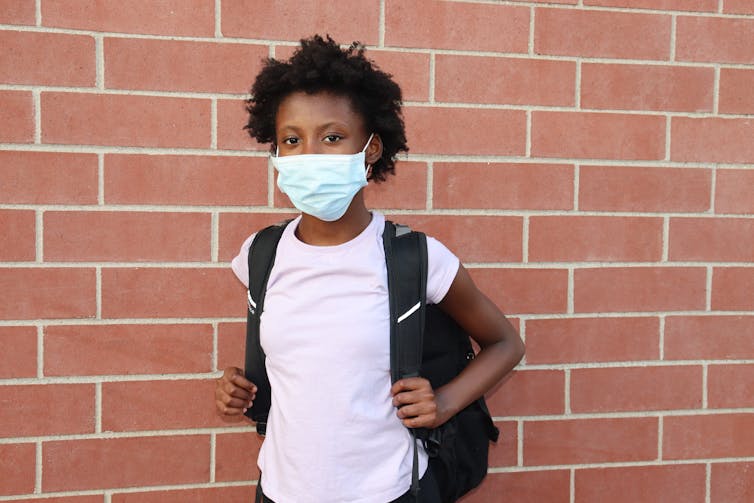
For students, as for all of us, life is a matter of balance, trade-offs and compromise. Studying for hours on end is unlikely to lead to best academic results. And it could have negative impacts on young people’s physical, mental and social well-being.
Our recent study found the best way for young people to spend their time was different for mental health than for physical health, and even more different for school-related outcomes. Students needed to spend more time sitting for best cognitive and academic performance, but physical activity trumped sitting time for best physical health. For best mental health, longer sleep time was most important.
It’s like a game of rock, paper, scissors with time use. So, what is the sweet spot, or as Goldilocks put it, the “just right” amount of study?
Using our study data for Australian children aged 11 and 12, we are developing a time-optimisation tool that allows the user to define their own mental, physical and cognitive health priorities. Once the priorities are set, the tool provides real-time updates on what the user’s estimated “Goldilocks day” looks like.
Because of the need to juggle conflicting demands on their time, individuals must fine-tune the daily balance of activities to match their priorities and needs. Shutterstock
More study improves grades, but not as much as you think
Over 30 years of research shows that students doing more homework get better grades. However, extra study doesn’t make as much difference as people think. An American study found the average grades of high school boys increased by only about 1.5 percentage points for every extra hour of homework per school night.
What these sorts of studies don’t consider is that the relationship between time spent doing homework and academic achievement is unlikely to be linear. A high school boy doing an extra ten hours of homework per school night is unlikely to improve his grades by 15 percentage points.
There is a simple explanation for this: doing an extra ten hours of homework after school would mean students couldn’t go to bed until the early hours of the morning. Even if they could manage this for one day, it would be unsustainable over a week, let alone a month. In any case, adequate sleep is probably critical for memory consolidation.
As we all know, there are only 24 hours in a day. Students can’t devote more time to study without taking this time from other parts of their day. Excessive studying may become detrimental to learning ability when too much sleep time is lost.
Another US study found that, regardless of how long a student normally spent studying, sacrificing sleep to fit in more study led to learning problems on the following day. Among year 12s, cramming in an extra three hours of study almost doubled their academic problems. For example, students reported they “did not understand something taught in class” or “did poorly on a test, quiz or homework”.
Excessive study could also become unhelpful if it means students don’t have time to exercise. We know exercise is important for young people’s cognition, particularly their creative thinking, working memory and concentration.
On the one hand, then, more time spent studying is beneficial for grades. On the other hand, too much time spent studying is detrimental to grades.
We have to make trade-offs
Of course, how young people spend their time is not only important to their academic performance, but also to their health. Because what is the point of optimising school grades if it means compromising physical, mental and social well-being? And throwing everything at academic performance means other aspects of health will suffer.
US sleep researchers found the ideal amount of sleep for for 15-year-old boys’ mental health was 8 hours 45 minutes a night, but for the best school results it was one hour less.
Clearly, to find the “Goldilocks Zone” – the optimal balance of study, exercise and sleep – we need to think about more than just school grades and academic achievement.
Based on our study findings, we realised the “Goldilocks Day” that was the best on average for all three domains of health (mental, physical and cognitive) would require compromises. Our optimisation algorithm estimated the Goldilocks Day with the best overall compromise for 11-to-12-year-olds. The breakdown was roughly:
10.5 hours of sleep
9.5 hours of sedentary behaviour (such as sitting to study, chill out, eat and watch TV)
2.5 hours of light physical activity (chores, shopping)
1.5 hours of moderate-to-vigorous physical activity (sport, running).
We also recognised that people – or the same people at different times — have different priorities. Around exam time, academic performance may become someone’s highest priority. They may then wish to manage their time in a way that leads to better study results, but without completely neglecting their mental or physical health.
To better explore these trade-offs, we developed our time-use optimisation tool based on Australian data. Although only an early prototype, the tool shows there is no “one size fits all” solution to how young people should be spending their time. However, we can be confident the best solutions will involve a healthy balance across multiple daily activities.
Just like we talk about the benefits of a balanced diet, we should start talking about the benefits of balanced time use. The better equipped young people and those supporting them are to find their optimal daily balance of sleep, sedentary behaviours and physical activities, the better their learning outcomes will be, without compromising their health and well-being.
Dot Dumuid is supported by an Australian National Health and Medical Research Council (NHMRC) Early Career Fellowship GNT1162166 and by the Centre of Research Excellence in Driving Global Investment in Adolescent Health funded by NHMRC GNT1171981.
Tim Olds receives funding from the NHMRC and the ARC.
This week the prime minister entered full marketing mode.
Scott Morrison’s topic was climate change and his plans to get to net-zero.
At the Victorian Chamber of Commerce and Industry on Wednesday, he tried out a few slogans.
Among those he test marketed:
can do capitalism, not ‘don’t do governments’
no one passed a law or introduced a tax or passed a resolution at the UN that led to the world developing a COVID vaccine, no one passed a law for the world to move digital, Google and Cochlear were not invented at a UN workshop or summit
Australia has already reduced our emissions by more than 20%, now, our emissions are going down, not up, they’re down by more than 20%
He said a bunch of other stuff, but those are my top three.
He wants to contrast his approach with certain United Kingdom and US environmentalists, who do indeed want to restrict what people can buy or do. Ideas like mandatory “meatless Mondays” and banning advertising for SUVs do indeed have no place in Australia, or even in the UK for that matter.
Economists don’t like such ideas either. The whole idea behind a price on carbon (whether through a carbon tax or a system of tradable permits) is to respect people’s preferences, while making sure their decisions take account of the costs they impose on others.
Innovations often come from government
His second claim was that innovation (things like the COVID vaccine, Google search and digitisation) isn’t sparked by governments.
While it’s true that “Google and Cochlear were not invented at a UN workshop or summit”, to suggest that governments played no role is to wilfully ignore history.
The miraculous Moderna mRNA vaccine was developed… checks notes… in partnership with the US National Institutes of Health. Moderna received nearly US$10 billion in taxpayer funding.
Much of the work on the Cochlear ear implant was done at the largely government-funded University of Melbourne; the internet revolution grew from the US Department of Defense’s Advanced Research Projects Agency; and Google’s search algorithm was developed by fully-funded graduate students at Stanford University, whose endowment is tax exempt.
Very often, cuts in emissions come from government
Morrison emphasised on Wednesday that Australia has reduced emissions by 20%.
It’s natural to ask what brought it about. Much of it was a cutback in land clearing, which is counted as emissions reduction under the rules. Land clearing is regulated by government.
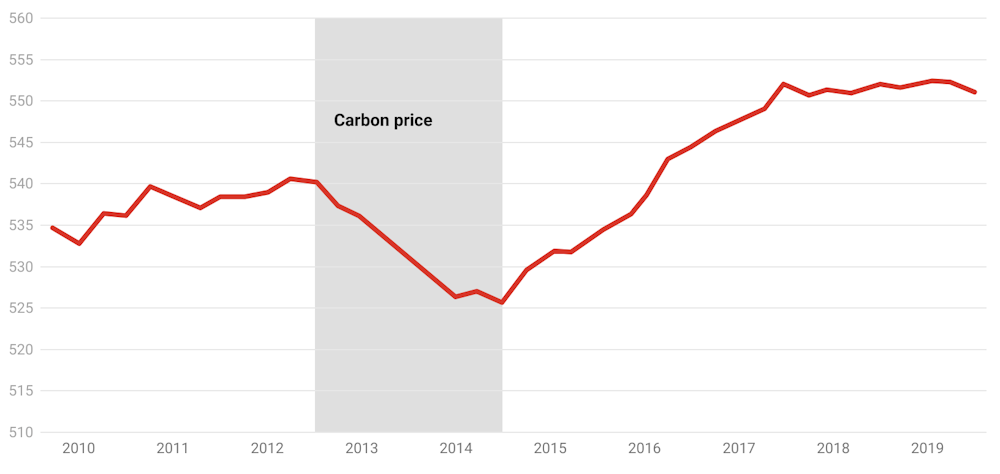
Much of the rest happened during the two years Australia had a carbon price in place, as this chart shows.
Australian emissions excluding land use, land-use change and forestry
Importantly, taxes don’t specify the particular technologies that will emerge.
Perhaps that’s why the nation’s peak body for can-do-capitalitsts – the Business Council of Australia – has asked the government to subject more businesses to Australia’s existing little-known (weak) price on carbon.
If we are going to get to net-zero, we need less marketing and more markets. Now there’s a slogan.
Richard Holden is President-elect of the Academy of the Social Sciences in Australia.
Anson Brothers Studio, Fern Tree Gully, Hobart Town, Tasmania, 1887. Albumen print. Collection of the Art Gallery of New South Wales.
Colonial history overflows with commodities. From the early 1800s, wool generated extraordinary wealth for squatters and pastoralists and substantial investment in the Australian colonies. In the 1850s, gold motivated tens of thousands of people to work the earth or service the diggings. Coal, copper, tin, wheat, barley and cotton all assumed importance at different times.
In those great cathedrals of late 19th century colonial self-representation, the International Exhibitions, any visitor would have immediately noticed the way New South Wales, Victoria and Tasmania sought to identify with the commodities produced in these places.
In a photograph from 1879, the NSW Department of Mines filled its portion of the exhibition building, the Garden Palace, with gold ingots, silver ores and samples of tin. On the balconies above were coal sections and geological maps.
The prominent mining displays inside the Garden Palace, 1879. Collection of the Museum of Applied Arts and Sciences, Sydney
Walking through these displays a visitor would also have noticed walls of landscape photographs, which, mirroring the extractive logic of settler colonialism itself, worked to bring all these raw materials together in a vision of abundant nature.
Photographers captured images of budding settlements, seemingly empty vistas, and stunning panoramas of emerging colonial cities.
The increasing popularity of these photographs throughout the final decades of the 19th century shows colonial expansion was not just generated by the search for raw materials to extract and exploit. Colonial Australia was also a product of vision and imagery: literally developed through chemicals, glass and light.
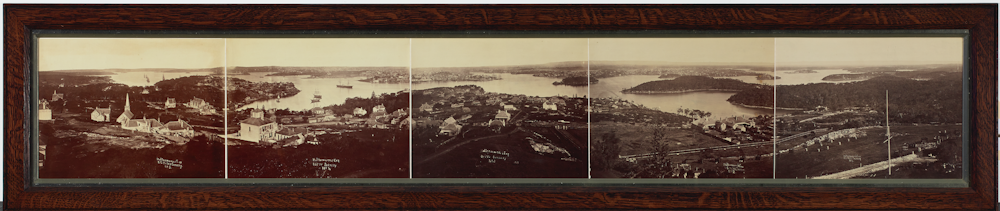
Charles Bayliss and Bernhardt Otto Holtermann, Panorama of Sydney and the Harbour, New South Wales, 1875. Albumen prints on cloth. Art Gallery of New South Wales
I have studied over 2000 early landscape photographs, taken by six settler photographers between the 1850s and the 1930s. They show how colonisation was re-enacted in the imagination of places, rather than simply through the movement of people from one site to another, the Lockean mixture of labour and earth, or the transfer of deeds.
Visions of nature allowed for a different kind of investment in the colonial earth. They paid off in feelings of belonging even for those who never turned a sod. These photos reveal, as the American environmental historian William Cronon has insisted, that nature itself is a profoundly human artefact.
In settler colonies, landscape photography framed nature as beautiful, available and empty. In Victoria and Tasmania especially, landscape photography flourished. And although this mode of photography was not uniquely antipodean – it was pioneered, then perfected in the American West by photographers like Carleton Watkins and Eadweard Muybridge – it did have remarkable purchase in the Australian colonies.
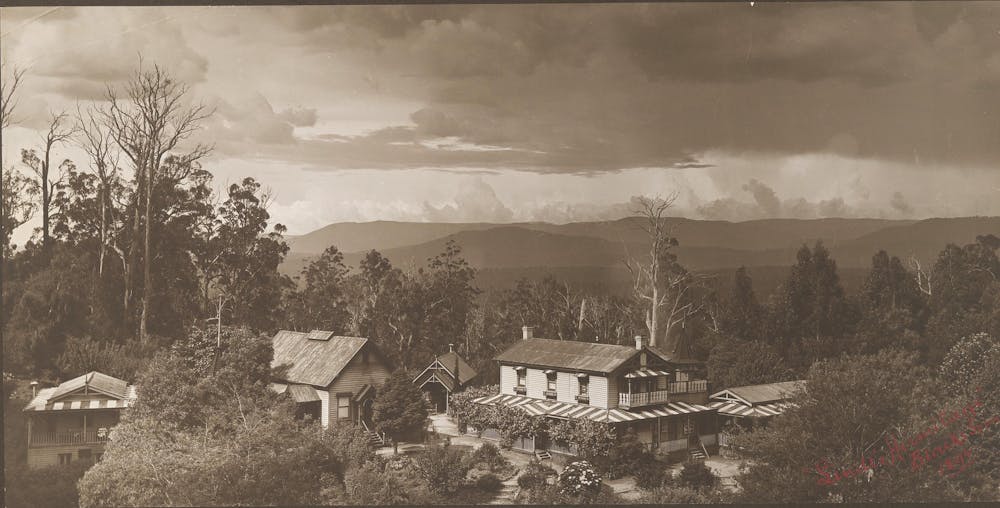
J. W. Lindt, Lindt’s Hermitage, 1894. Gelatin silver print. National Gallery of Victoria, Melbourne
A photographic sleight of hand
Figures such as Nicholas Caire, John Lindt, and John Beattie took up the camera to encourage settlers to feel at home in Australian environments. This perspective disguised the ancestral ownership and continuing presence of First Nations peoples, turning their homelands into a wilderness through a photographic sleight of hand.
The best example of this was in Victoria, where Caire and Lindt began framing the stretch of bush between Healesville and Narbethong as a kind of wilderness retreat from the late 1870s.
Caire, born in Guernsey in 1837, came to this collaborative work via South Australia, the forests of Gippsland and the Goldfields. Lindt, originally from Frankfurt, had just finished photographing Bundjalung and Gumbaynggir people along the Clarence River in northern NSW.
Around 1878 Caire captured Fairy Scene at the Landslip, Blacks’ Spur, which quickly became one of his most popular photographs.
Nicholas Caire, Fairy Scene at the Landslip, Blacks’ Spur, c. 1878. National Gallery of Victoria
In it, Caire focuses on a glade of tree-ferns clustered on the side of a gully. Writing in 1904, Caire and Lindt boasted about the wildness of this pocket of the Great Forest, the ancient age of the trees, and the “refreshing” seclusion of Fernshaw. Lindt wrote that the allure of places like this came back to their capacity to “carry you back to the morning of time”.
The empty natures of the Yarra Ranges relied on the removal and containment of Woiwurrung, Bunurong, and Taungurong people at the Coranderrk mission. Located just kilometres away from Lindt and Caire’s “refreshing” forest, Coranderrk helped the photographers create a partition between the environment and its ancestral owners.
The mission became a complementary site of interest. When promoting the natural features of the Yarra Ranges, Lindt and Caire wrote about Coranderrk as a place where tourists could mimic the anthropologist, just as they mimicked the geographer or explorer while traipsing through sylvan glades or gazing up at giant mountain ash.
At about the same time that Caire and Lindt were developing their visions of nature in the Yarra Ranges, the photographer Fred Kruger was taking influential shots of life on the reservation. One of the key challenges for aspiring landscape photographers in the 1870s and 1880s was to deal with this presence of Aboriginal people in landscapes that were becoming coveted for their natural beauty.
Caire and Lindt took up an established tradition of photography at Coranderrk, combining it with a new interest in wilderness, balancing the apparent contradiction between Indigenous presence and absence.
The Tasmanian sublime
In Tasmania, too, photographers began constructing a similar wilderness tradition from the 1870s. Emigrating from Scotland in 1878, John Beattie, the so-called “prince of landscape photographers in Australasia”, settled with his family in New Norfolk, about 30 kilometres up the Derwent valley from Hobart.
This was a perfect location for a budding photographer, and Beattie made attractive pictures of the river and its hop gardens in the 1890s, but the interior of the island offered a different order of beauty.
This photograph frames a harmonic interaction of settlement, agriculture and geography on the lowlands along the Derwent River. John Beattie, Hop Garden, New Norfolk, 1895–1898. Albumen print. Art Gallery of New South Wales
In 1879 Beattie began making expeditions into the bush around the valley, onto the central highlands, and eventually all the way to the remote Lake St. Clair. In 1882 he joined the Anson Brothers’ photographic studio and quickly became their most important artist.
An Anson Brothers image from 1887 is quite likely Beattie’s work, showing a stand of ferns on the Huon Road. Unlike Caire’s shot, however, this image includes a group of settlers enjoying exactly the kind of immersion in nature that these photographs were designed to evoke.
Taken on the Huon Road, this photograph depicts the kind of vegetation that could be found in pockets of bush around the Beattie’s property at New Norfolk. Anson Brothers Studio, Fern Tree Gully, Hobart Town, Tasmania, 1887. Albumen print. Art Gallery of New South Wales
Many of Beattie’s photographs are deeply Romantic. Between 1896 and 1906 he conducted regular presentations in Hobart and Launceston based on the wild features of the Tasmanian landscape, cultivating a high wilderness aesthetic in his magic lantern shows.
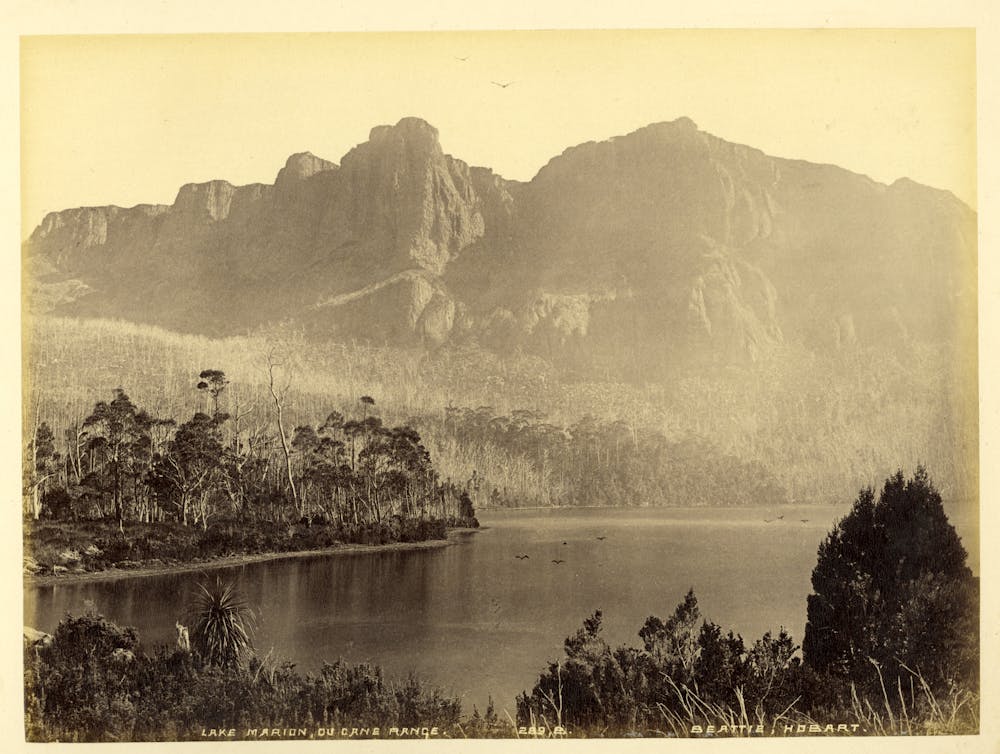
Photographs of Lake Marion and the Du Cane Range and another of Lake Perry and The Pinnacles trade in the sublime. Beattie evoked the great American transcendentalist poets in his respect for the mountaintop, which often moved him to wordlessness: “I am struck dumb, but oh! my soul sings.”
John Beattie, Lake Marion, Du Cane Range (Tasmania), 1890s. Albumen print. The Richard Ledgar Collection of Photographs, 1858–1910, National Library of Australia, Canberra. National Library of Australia
These sublime sentiments relied on old Romantic ideas that stretched back to Edmund Burke and William Wordsworth, but they rested just as heavily on new experiences of space. Beattie’s breakthrough years were in the 1890s, a decade in which depictions of wilderness in Australian Romantic painting went into terminal decline and were replaced by photographic visions of nature.
Romanticism, through photography, came to influence how environments were envisioned and how histories of dispossession were remembered. The high wilderness imagery of settler photography came to support a fantasy of spatial control, delivering reproducible, enduring symbols of the natural world.
This photograph of Lake Perry in the Hartz Mountains gives a good sense of the gradations of the Tasmanian highlands and the dramatic topography that attracted photographers. John Beattie, Lake Perry and Pinnacles looking Nth, Hartz Mountains, c. 1900. Glass Lantern Slide. Tasmanian Views Collection. State Library of Victoria
Aboriginal extinction and Romantic communion
Just as Caire did, Beattie divided his visions of nature and his portraits of native people. He was an insatiable and opportunistic collector of photographs of the “last” Tasmanians, leaning into and commercialising the myth of Tasmanian Aboriginal extinction.
Sometimes advertisements for these pictures featured on the back covers of Beattie’s landscape collections, gently leading interested audiences to the other side of the partition.
Most of Beattie’s photographs of Aboriginal people were simple reproductions of the portraits that Francis Nixon, the first Bishop of Tasmania and amateur photographer, took in 1858 at putalina (Oyster Cove). Nixon took pictures of the few remaining Aboriginal people, who had survived exile on Wybelenna Station on Flinders Island and a decade of surveillance at the former penal probation station just south of Hobart.
In the 1890s Beattie copied these images and labelled each of them with the phrase “the last of the race”.
It is no simple coincidence that this language was adopted by one of Australasia’s most successful landscape photographers. Aboriginal extinction and Romantic communion with the wilderness were the twin fantasies that shaped settler visions of nature in the late 19th century.
This dynamic influenced landscape photography well beyond the Australian colonies. Across the Tasman in New Zealand, the Dunedin photographer Alfred Burton became famous for an 1885 album called The Maori at Home, which delicately balanced ethnographic and wilderness imagery, much as Caire did.
Burton used the camera to carve the the local Māori from their ancestral homes, creating a “terra incognita”. He created visual partitions between the traditional custodians, Ngāti Maniopoto, and the landscapes of the Waikato and divided the people of Ngāti Tūwharetoa from the monumental geography around Tongariro, Ngāuruhoe, and Ruapehu.
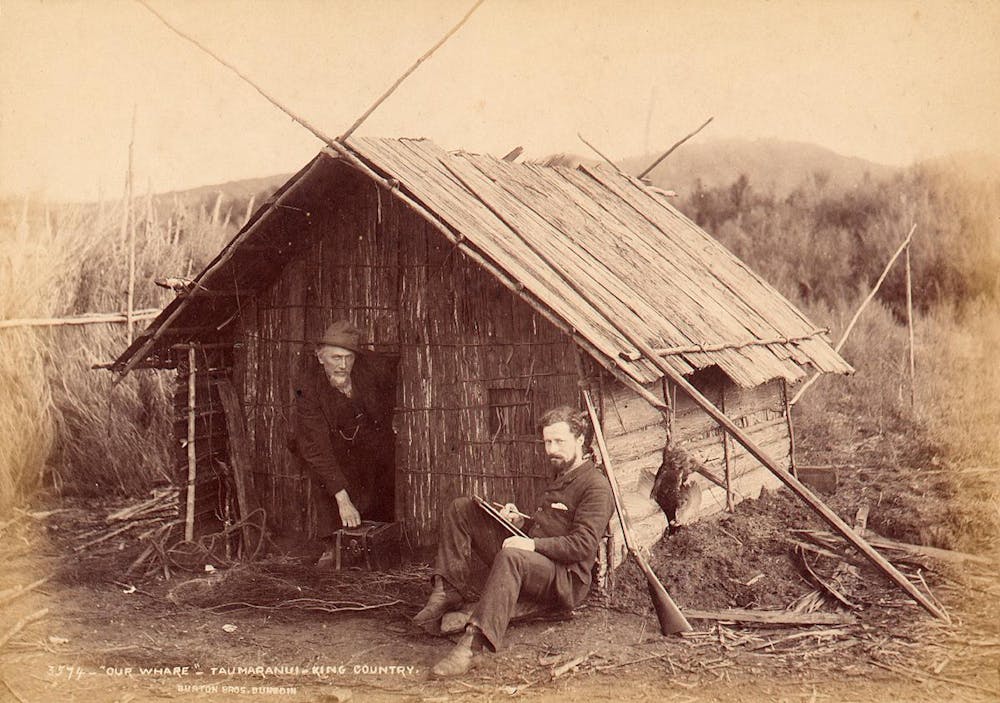
Burton and Payton are pictured here outside a whare in Taumaranui, near the centre of the King Country. Alfred Burton, Burton Brothers Studio, Photography Collection, Museum of New Zealand Te Papa Tongarewa
Burton and a party of adventurers returned a year later, in 1886, to immerse themselves more fully in these sublime environments. More settlers would follow in Burton’s footsteps from the mid 1890s, when, after a long struggle with Ngāti Tūwharetoa, the heights around Tongariro became New Zealand’s first national park.
Alfred Burton, Burton Brothers Studio, Ngauruhoe—(Tongariro)—Active Volcano, 1880s, 1885. Black-and-white print. Photography Collection. Museum of New Zealand Te Papa Tongarewa.
The same kind of processes shaped settler attitudes to one of the United States’ most famous national parks, Yosemite, where photographers like Watkins and Muybridge erected similar partitions between their natural and human subjects.
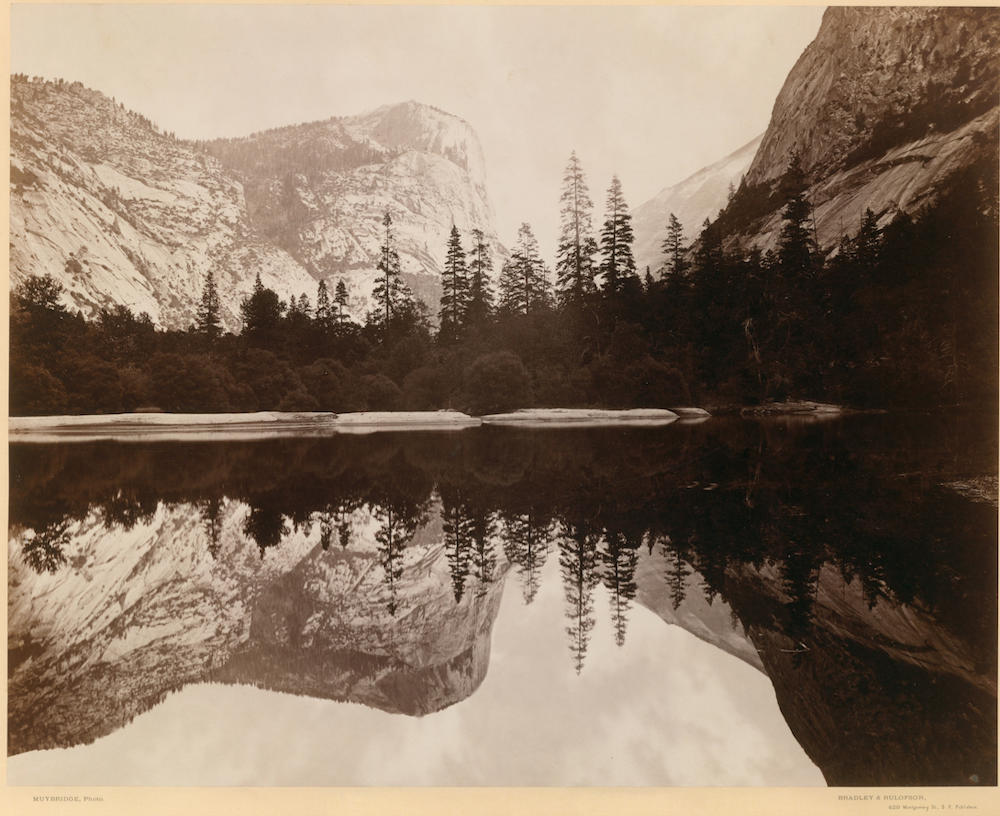
This division was spectacularly represented in a set of photographs that used the still waters of Yosemite’s reflective lakes to capture stunning landmarks. In these works, the myth of empty wilderness was turned into the beautiful motif of a glassy lake.
Eadweard Muybridge, Mirror Lake, Valley of the Yosemite, 1872. Albumen silver print. Metropolitan Museum of Art, New York
We might expect that Caire, Beattie, and Burton consciously adopted this technique from their American kin but there is no evidence this was the case.
Control over land
It’s more likely that comparable visions of nature developed in parallel, drawing from similar histories of dispossession and environmental transformation in different settler colonies.
In a whole range of places where pastoralists failed to graze their herds and geologists struggled to identify economic deposits, photographers helped colonists continue the cultural work of establishing dominion over stolen land.
The earliest visions of nature in Australia perfectly captured this drive, fixing its orientation to the physical world and its settler colonial history onto glass negatives, lantern slides and paper cards.
And here is where the commodities come back into the story. Settlers adopted the holistic vision of landscape photography to exert control over land. Figures like Caire and Beattie perfected a kind of environmental image-making and storytelling that encouraged settlers to feel an affinity with the natural world.
Their customers were drawn to breathe in the highly oxygenated forest air or pursue the Romantic thrill of summiting a mountain. These experiences became a commodity in and of themselves, and so did the photographs documenting them. They adorned sitting rooms, galleries and exhibition halls – summoning memories and lending a new assurance to the settler enterprise.
It seemed remarkable chutzpah that Scott Morrison, back from Glasgow where Australia remains a criticised laggard despite its embrace of a 2050 target, would hit the trail to campaign on climate policy.
Alternatively, as some suggest, perhaps the prime minister just wanted to tick that box early, before moving onto more congenial issues.
Either way, it didn’t turn out well.
His policy to promote electric cars, which contained minimal substance, backfired. And he wedged himself with a too-smart-by-half attempt to wedge Labor on carbon capture and storage.
Morrison surely must have seen the dangers of exposing himself on electric cars, after all he’d said in denouncing Bill Shorten’s policy in 2019.
The quotes from then were grenades for the throwing. Shorten wanted to end the Aussie weekend, Morrison declared; such a vehicle “won’t tow your trailer. It’s not going to tow your boat. It’s not going to get you out to your favourite camping spot with your family.”
How did Morrison believe he could execute a turnaround in the harsh political spotlight without being called to account? Especially when his political honesty is under the most intense questioning.
Sean Kelly, columnist and former staffer for Julia Gillard and Kevin Rudd, writes in his just-published The Game: A Portrait of Scott Morrison that the PM, “never feels, in himself, insincere or untruthful, because he always means exactly what he says; it is just that he means it only in the moment he is saying it. Past and future disappear.”
Unfortunately for Morrison, the electronic clips don’t disappear. Those on electric cars were there to be played again and again.
Morrison himself explained his about-face by claiming it was a “Labor lie” that he had campaigned against EVs in 2019. “I didn’t. […] I was against Bill Shorten’s mandate policy, trying to tell people what to do with their lives, what cars they were supposed to drive and where they could drive.”
There was another problem with Morrison’s decision to climb into a hydrogen-fuelled car during his first visit to Melbourne in a very long time.
His policy – $178 million for charging and refuelling infrastructure and the like – lacked substance. It had no subsidies, with the government claiming they would not be a good use of taxpayers’ money.
Within hours of the announcement, a devastating critique of the policy came from his own side of politics, delivered by NSW Environment Minister Matt Kean.
Speaking to ABC 7.30, Kean contrasted Morrison’s weak policy with NSW’s robust approach and spelled out how Morrison should be acting.
“I would encourage the federal government to be looking at doing things like providing direct support for people who want to purchase an EV. There are a range of taxes and charges that could be waived,” Kean said.
“We want to see things like the federal government investing more heavily in electric vehicle charging infrastructure. The funding that they’ve put on the table doesn’t even match the funding that we’ve put here just for the state of New South Wales.
“But the biggest thing the federal government can do is deal with the issue of fuel standards. Australia has some of the worst fuel standards anywhere in the world”, which meant it “is becoming the dumping ground for the vehicles the rest of the world doesn’t want”.
The NSW government is forward-leaning on climate issues, and Kean and Morrison have some interesting history. The PM sledged him spectacularly last year after Kean said “some of the most senior members” of the Morrison government were concerned about its climate change policies.
In one of those “in the moment” prime ministerial statements, Morrison responded that Kean “doesn’t know what he’s talking about” and declared “most of the federal cabinet wouldn’t even know who Matt Kean was”.
They certainly know now. Kean is treasurer as well as environment minister in the Perrottet government, and that government is willing to chivvy the Feds when it feels like it.
In another climate announcement this week, Morrison said the government would contribute $500 million for a new $1 billion fund, administered by the Clean Energy Finance Corporation, to help small companies commercialise low-emissions technology.
The legislation will contain a provision widening the remit of the CEFC to allow it to invest in carbon capture and storage, which it is banned from doing at present.
Labor has consistently opposed such a widening, so the government briefed that this would put pressure on the opposition. But Labor took one look at the trap and seems determined to avoid it. It indicated it might support the change, given the $500 million would be “new money” for the CEFC rather than a redirection of existing funds. In the meantime, a couple of renegade Queensland Coalition senators, Matt Canavan and Gerard Rennick, flagged they’d vote against the fund.
More generally, Morrison this week sharpened the Coalition-Labor contrast he has set up on climate policy, between a government that encourages and supports and an opposition that would regulate and tax.
He encapsulated his desired dichotomy by saying that “we believe climate change will ultimately be solved by ‘can do’ capitalism, not ‘don’t do’ governments seeking to control people’s lives and tell them what to do, with interventionist regulation and taxes that just force up your cost of living and force businesses to close”.
Indeed, he seeks to use the contrast broadly. “I think that’s a good motto for us to follow not just in this area, but right across the spectrum of economic policy in this country,” he told a business audience. “We’ve got a bit used to governments telling us what to do over the last couple of years. I think we have to break that habit.”
This reverts to Liberal Party “free enterprise” ideology, which has had to take a battering in the pandemic as the government spent wildly to keep things afloat. It also taps into the post-lockdown sentiment of those exhausted by restrictions and orders and welcoming “freedom” again.
But in terms of climate policy, the reality is far from so simple.
The point has been made many times that “taxes” – taxpayers’ money – are financing the multiple billions the Morrison government has committed to encouraging “capitalist” solutions.
While expounding “can do capitalism”, the government is in fact pursuing an interventionist approach by putting all its eggs in the technology-support basket and not enough in the market-creation one.
“Scotty from Marketing” likes slogans, but “can do capitalism” doesn’t ring like one with a future. “Capitalism” works as an economic system (with more than a little help from governments), but it is beyond clunky as part of a sound bite.
Michelle Grattan does not work for, consult, own shares in or receive funding from any company or organisation that would benefit from this article, and has disclosed no relevant affiliations beyond their academic appointment.
Mobile phones and online technologies are frequently used by perpetrators of domestic and family violence to coerce, control and restrict the freedoms of victims and survivors.
In Australia, there are two leading agencies working to reduce this kind of technology-enabled abuse: WESNET and the eSafety Commissioner. Both provide training for advocates and practitioners, as well as resources for victims and survivors. WESNET also provides replacement phones.
Their work – and the “safety work” of people experiencing violence – is made more difficult by tech products and services that treat user safety as an afterthought. Platforms and the tech industry can do a lot to reduce harm by building in user safety from the earliest stages of product design.
Creating risk
At present, major tech companies often design and manage devices and digital media without considering user vulnerabilities.
Until 2020, Google allowed spyware and stalkerware – software designed to be covertly installed on a phone to monitor and record photos, videos, texts, calls and other information – to be freely advertised on its platform. It banned the ads amidst mounting evidence that this kind of software is used to enact intimate partner violence.
In April 2021 Apple released coin-sized tiles called AirTags intended to help people keep track of belongings via Bluetooth signals. After they were criticised as presenting a serious security risk by enabling stalking of intimate partners, Apple updated the devices to make them beep at random intervals if they were away from the owner’s phone.
Apple’s AirTags had safety features added after release following criticism. Jack Skeens / Shutterstock
Facebook did consult groups such as the US National Network to End Domestic Violence in an effort to “innovate responsibly”, though there are still concerns about how the glasses might be used.
Traditional ideas of cybersecurity are focused on “stranger threats”. However, to reduce and combat digital domestic and family violence we need an “intimate threat” model.
Partners and family can compel others to provide access to devices. They may be linked to online accounts or able to guess passwords, based on their intimate knowledge of the owner.
In this context, technologies that enable surveillance and recording can be used to constrain and threaten victims and survivors in alarming ways, in everyday life.
Understanding and seeking to alleviate risk posed by abusers requires platforms and industry to think proactively about how technologies may be co-opted or weaponised.
Safety by Design
The eSafety Commissioner’s Safety by Design initiative aims to make user safety a priority in the design, development and deployment of online products and services. The initiative revolves around three basic principles.
The first is that service providers are responsible for making user safety the number one priority. This means platforms and other companies work to anticipate how their products may facilitate, increase or encourage harm. In this way the burden of safety will not fall solely on the user.
The second is that users should have power and autonomy to make decisions in their own best interest. Platforms and services should engage in meaningful consultation with users, including diverse and at-risk groups, to ensure their features and functions are accessible and helpful to all.
‘Safety by design’ makes user safety the top priority in the design of new products and services. Shutterstock
The third principle is transparency and accountability about operations and published safety objectives is essential. This also helps users to address safety concerns.
There is growing support for these principles among tech companies. Last year IBM published its own guide to “coercive control resistant design”.
Effective approaches must also acknowledge how intersecting or overlapping forms of structural or systemic oppression shape an individual’s experience of technology and can deepen social inequalities.
To realise the goals of safety by design or coercive control resistant design, we will need to review not only the policies but also the actual practices of platforms and industry, as they emerge.
How tech can improve
eSafety has produced Safety by Design assessment tools to improve and innovate based on good practice and evidence-informed resources and templates.
Platforms and industry have a key role to play in addressing the impacts of domestic and family violence through design. They can and should do more in this space.
Bridget Harris receives funding from The Australian Research Council. She has previously conducted research for the eSafety Commissioner and worked on research with WESNET.
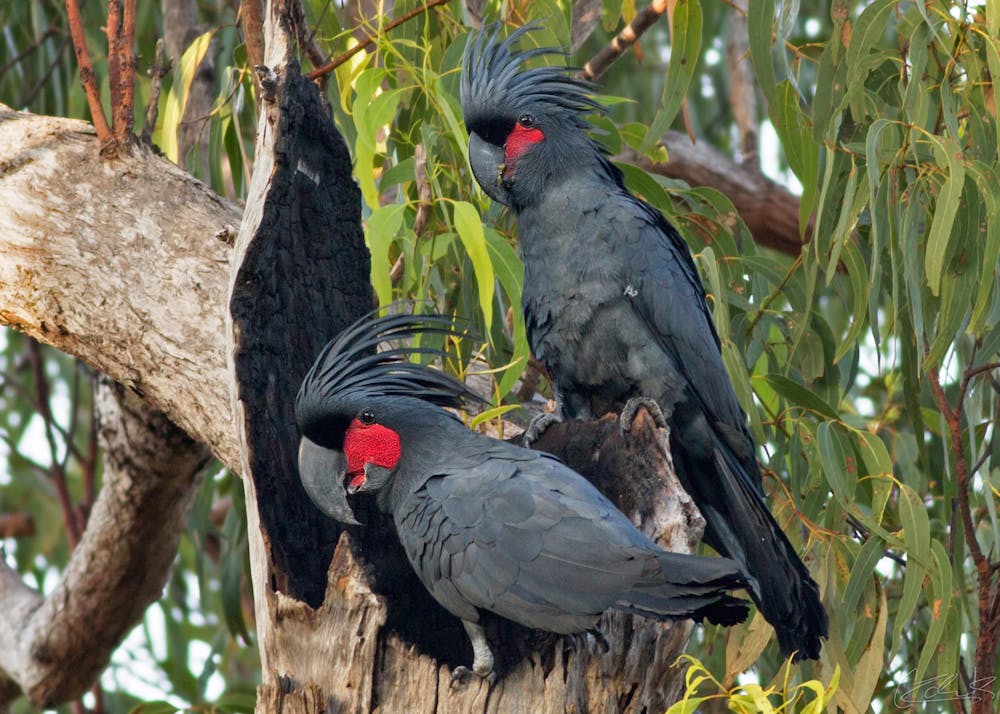
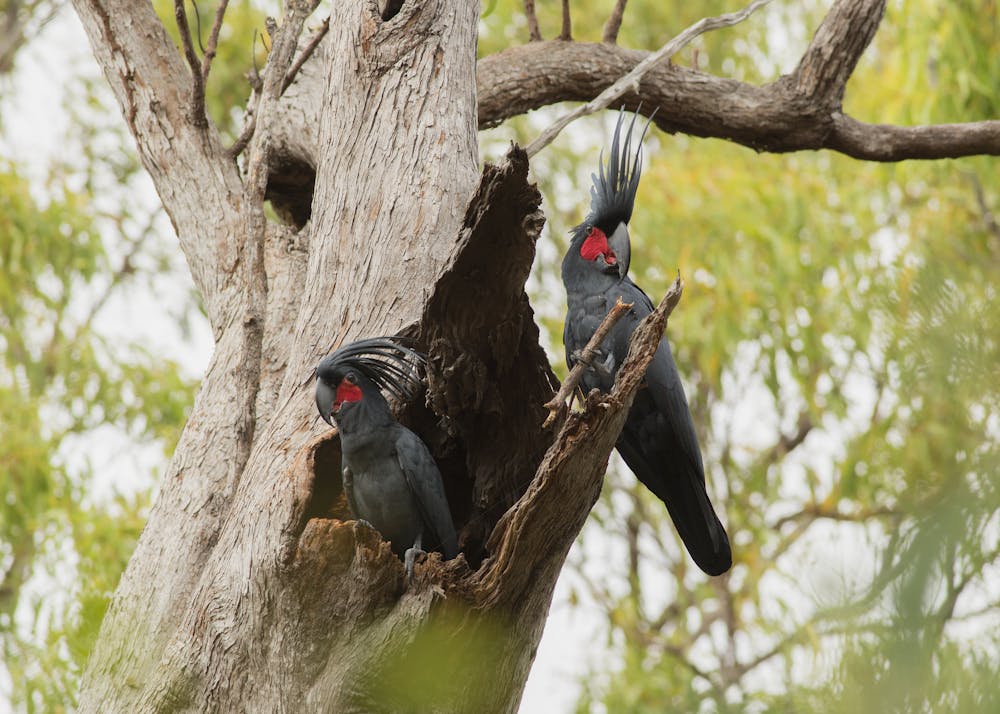
Palm cockatoo breeding pair at the nesting hollow. Female on left, male on the right.Christina N. Zdenek
Environmental scientists see flora, fauna and phenomena the rest of us rarely do. In this series, we’ve invited them to share their unique photos from the field.
Australia’s largest parrot, the palm cockatoo, is justifiably famous as the only non-human animal to craft tools for sound. They create drumsticks to make a rhythmic beat. Sadly, the “Ringo Starr” of the bird world is now threatened with extinction – just as many other parrots are around the world.
This week, the Queensland government moved this species – also known as the goliath cockatoo – onto the endangered list, due to our research on palm cockatoo populations over more than 20 years.
Our analysis predicts a severe decline from 47% to as high as 95% over the next half-century. Given the current population is estimated at just 3,000 birds, it is likely to drop to as low as 150 birds. They could all but disappear from Australia in our lifetimes.
Is it too late? Not yet. There are concrete ways to protect these magnificent, elusive birds by conserving habitat and their all-important breeding hollow trees, by reintroducing cool burns (including unburnt areas), and finding out more about these special parrots.
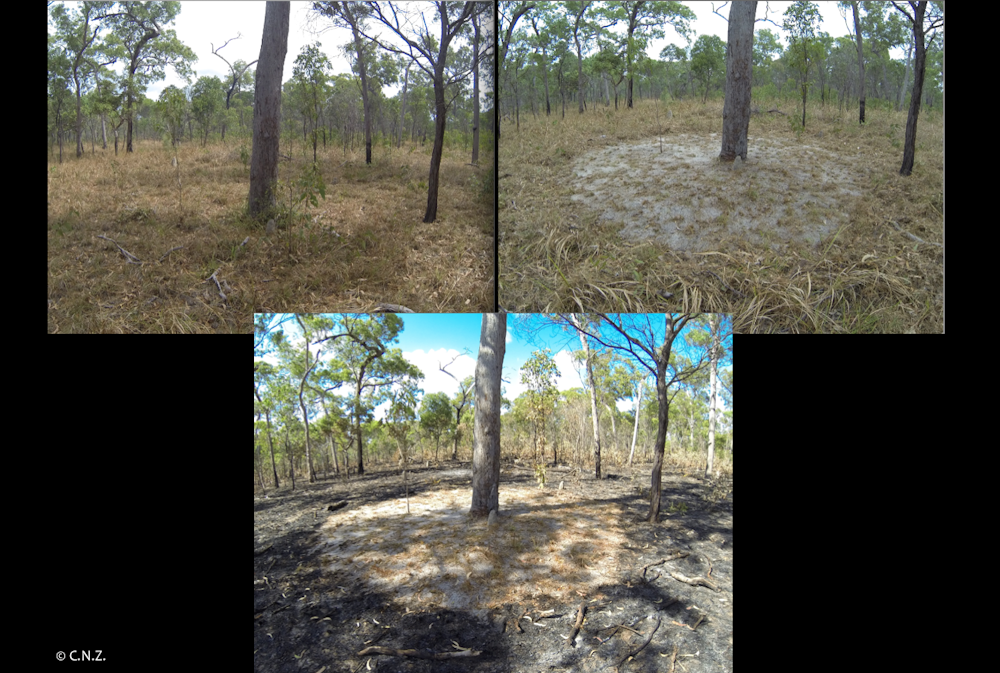
One of the crucial palm cockatoo hollows burning down in Cape York. Christina N. Zdenek, Author provided
So why are palm cockatoos in trouble?
Palmies, as we call these charismatic birds, hail from an ancient lineage on the parrot evolutionary tree. In Australia they only live on the Cape York Peninsula in far north Queensland, where they face a perfect storm of threats and vulnerability.
They’re losing habitat due to poor fire management and ongoing land-clearing, but they also have extremely low breeding rates, with females laying a single egg every two years.
Of the offspring, only 23% of their chicks live until they fledge. On average, this means each breeding pair successfully raises just one chick every 10 years. And who knows if that fledgling will make it to sexual maturity at five or more years old?
One challenge in studying these birds is the difficulty in identifying individual birds over time. To date there has been no successful capture of palmies to mark them via leg bands or GPS trackers. Without knowing who’s who, major problems with breeding success could be masked by an ageing population, given their life expectancy is up to 60 years.
Our research on palm cockatoo genetics and vocal dialects reveals their three major populations on the peninsula are poorly connected, meaning little movement of birds between groups.
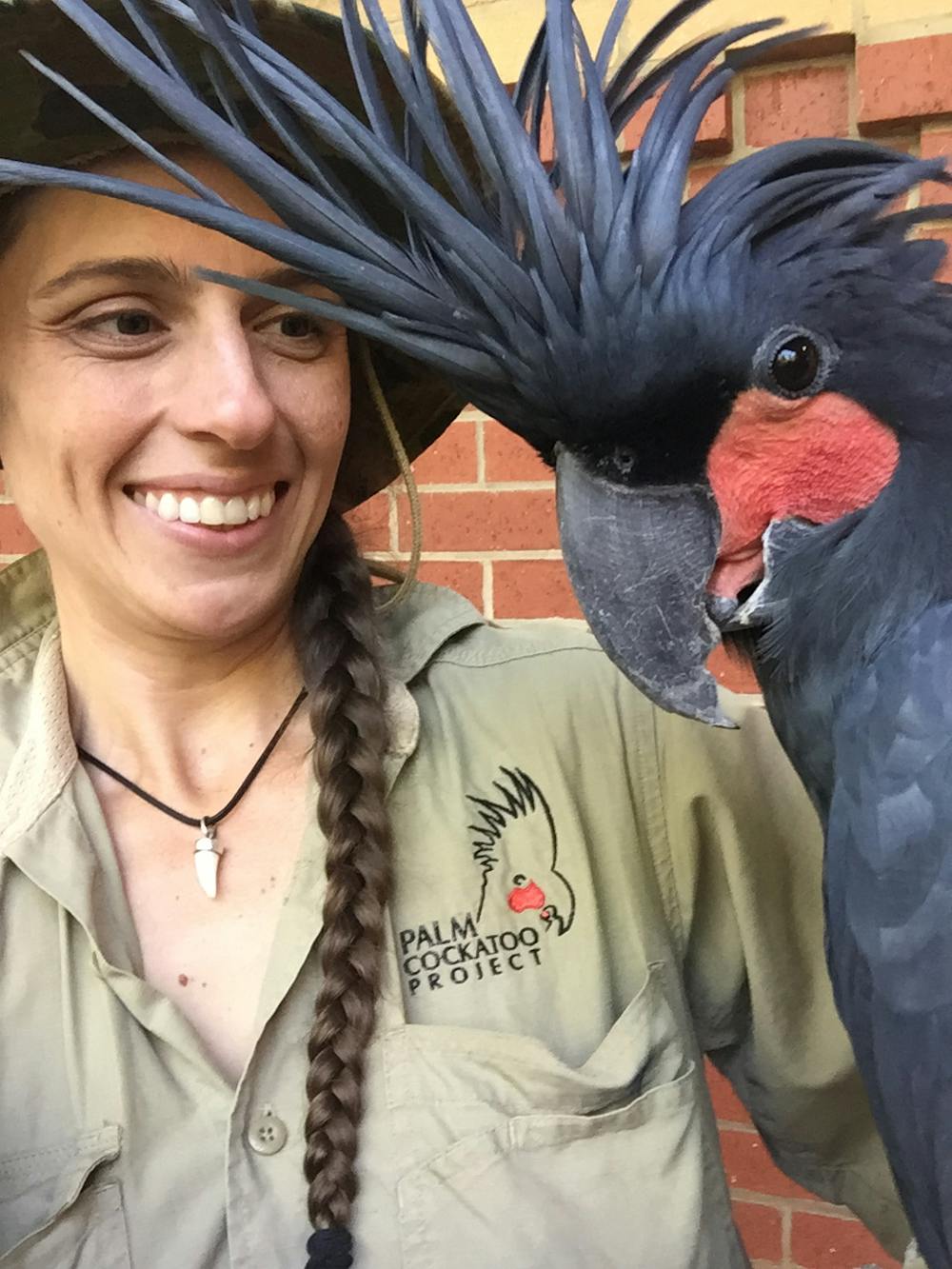
Researcher Christina Zdenek with a palm cockatoo. Christina N. Zdenek, Author provided
Each group has developed “cultural” traits which have not spread between the populations. For example, the famous drumming display mainly occurs in the eastern population, where the birds also make distinctive calls including a unique human-like “hello”.
The downside is that if one population is in trouble, the others are unable to pick up the slack and provide breeding reinforcements.
How do we save them?
Palmies are in real trouble. Saving them from extinction will take a concerted effort.
We urgently need a better understanding of why they have such trouble breeding, to figure out if it’s similarly bad across all three populations, and to work out how palmies use the landscape.
At the same time, we have to get better at managing the landscape they need to survive. What does that look like? It means cool burns to prevent extreme bushfires burning down their ancient nesting trees – plus avoiding any further felling of these priceless trees.
Palm cockatoo splintering a stick to make his nesting platform. Christina N. Zdenek, Author provided Palm cockatoos can live up to 60 years. Christina N. Zdenek, Author provided
These trees are a key part of the puzzle. Palmies are picky breeders. For these birds, not just any tree hollow will do. They require large, old hollow-bearing trees to breed in, which can be up to 300 years old.
The hollowing process typically starts with a small burn at the base, giving termites access to the insides of the trunk. Eventually, these trees resemble vertical hollow pipes. The palmies then spend months splintering sticks and bringing them to the hollow to make a nesting platform up to a metre deep – the only parrot to do in the entire world.
Unfortunately, these “piped” trees are especially vulnerable to big fires, which also lower termite populations and reduce the chances of future hollows being formed.
Protecting their habitat
We’ve found using a brush cutter and rake to clear the grass and debris for three metres around nesting trees is enough to save them from fires. This is of course labour intensive.
Protecting palm cockatoo breeding hollows from fire. Christina N. Zdenek, Author provided
A longer-term strategy is to manage fire better. The frequency and intensity of bushfires in tropical Australia has changed for the worse since Europeans started managing the landscape. A return to the traditional cool burns employed by indigenous people from the Uutaalnganu, Kanthanampu and Kuuku Ya’u language groups could largely resolve this problem.
Land clearing also reduces habitat. Though long saved by distance, Cape York is now seeing strip-mining, road building, and quarrying, which all contribute to habitat loss. We can reduce the damage done if skilled ecologists survey proposed clearance areas ahead of time.
Another vital step towards keeping this species alive is to broadly assess and protect as much as possible of the remaining palm cockatoo breeding habitat on Cape York.
We also need better ways of detecting their nest hollows. We’ve researched these birds for over two decades, and can confidently say that birds don’t come any harder to study than palmies.
Just 23% of palmie chicks live until they fledge. Christina N. Zdenek, Author provided Palmies go quiet during nesting, making them hard to find. Christina N. Zdenek, Author provided
Hunting for their nests is time consuming and expensive because palmies can lay their egg any day in an eight month breeding season, with pairs often switching among several hollows on their territories. This spreads our survey teams thin.
We’ve also found that palmies go quiet during nesting and are super wary of humans, making finding their nesting hollows especially difficult.
Despite all the challenges in saving them, it is worthwhile. Even after watching them for 20 years, we have not tired of their company. They’re magnificent birds with unique behaviour and a surprising number of parallels with humans, such as drumming, blushing, tool-making, and their “Hello” call.
To bring them back from the edge, we must work quickly to figure out why and where their breeding survival rates are so low, improve how we use fire, and protect their habitat and the all-important old trees.
Christina N. Zdenek receives funding from the Australian Research Council and has worked as a biological consultant for both a mining company and ecological consulting company on Cape York Peninsula.
Rob Heinsohn receives funding from the Australian Research Council.
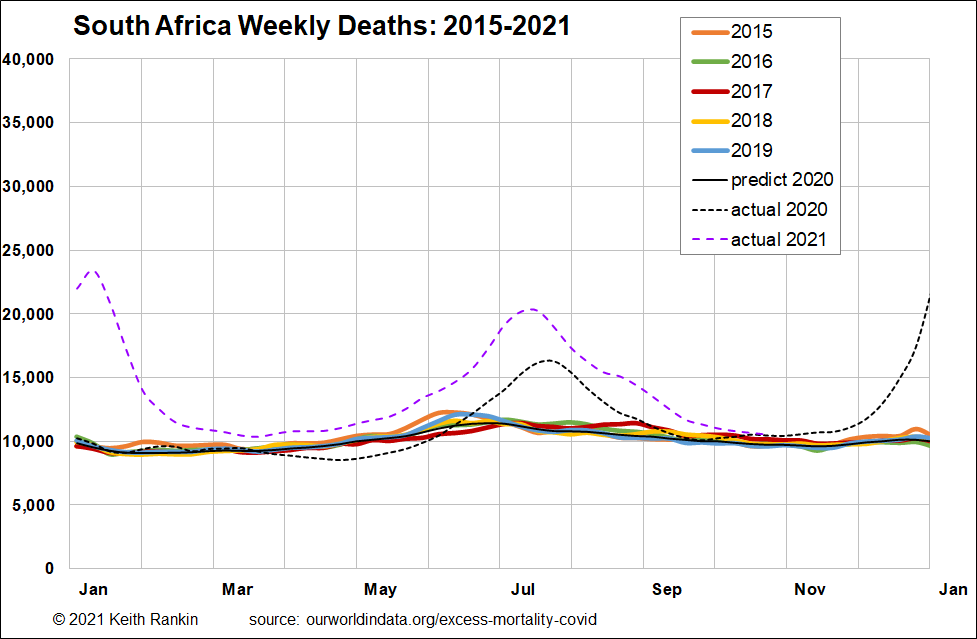
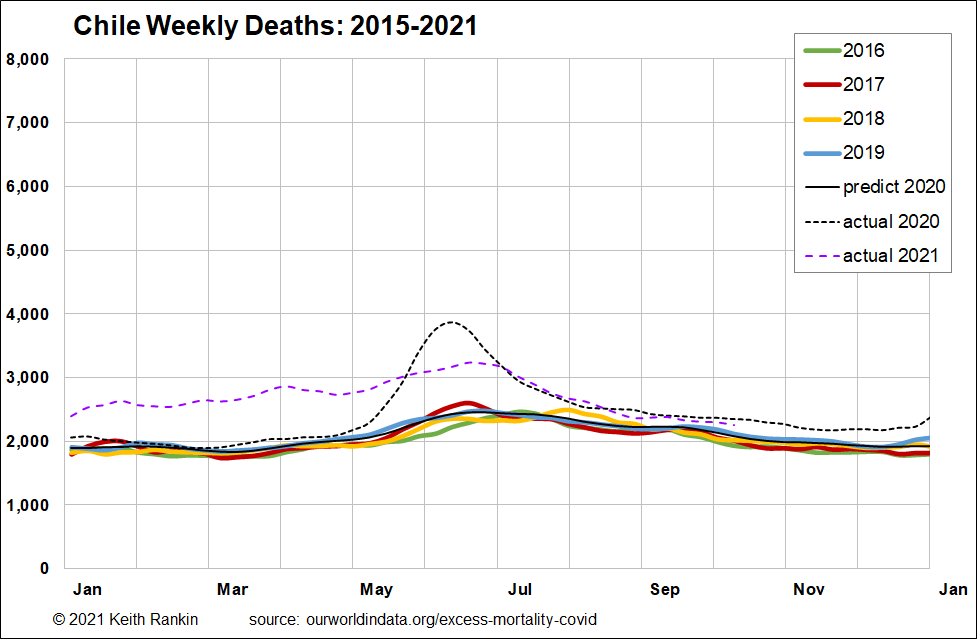
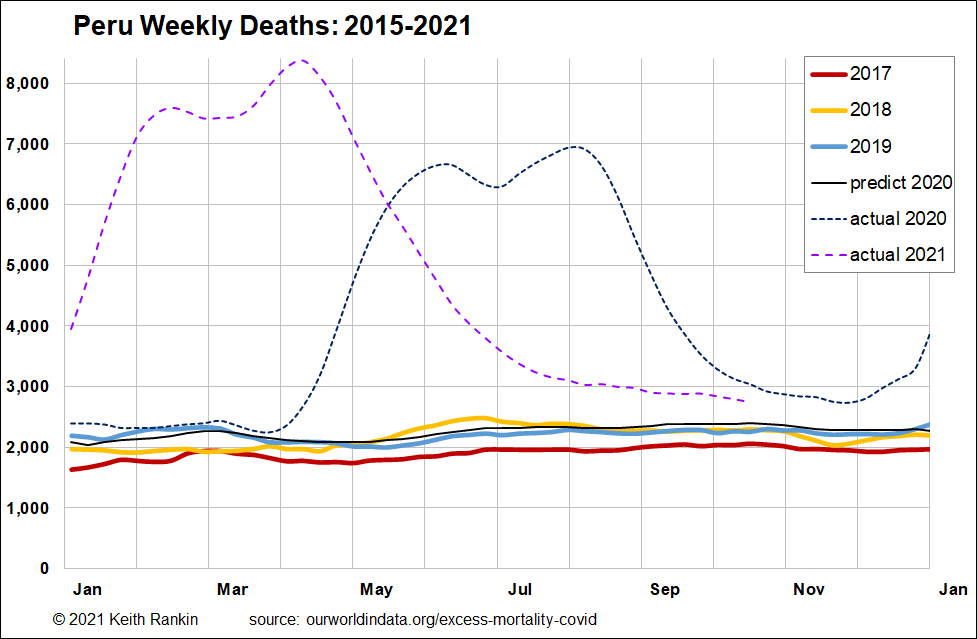
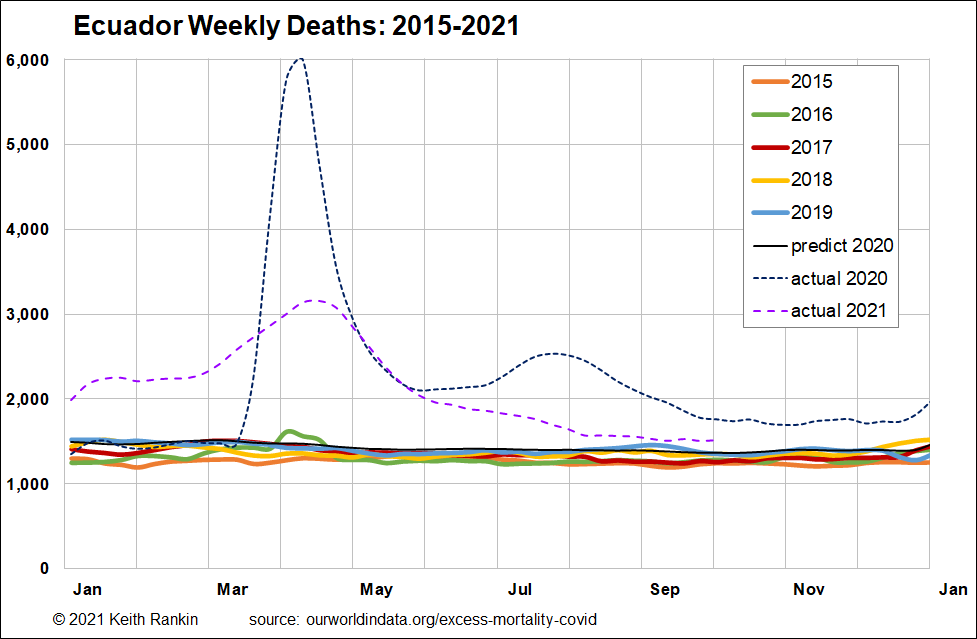
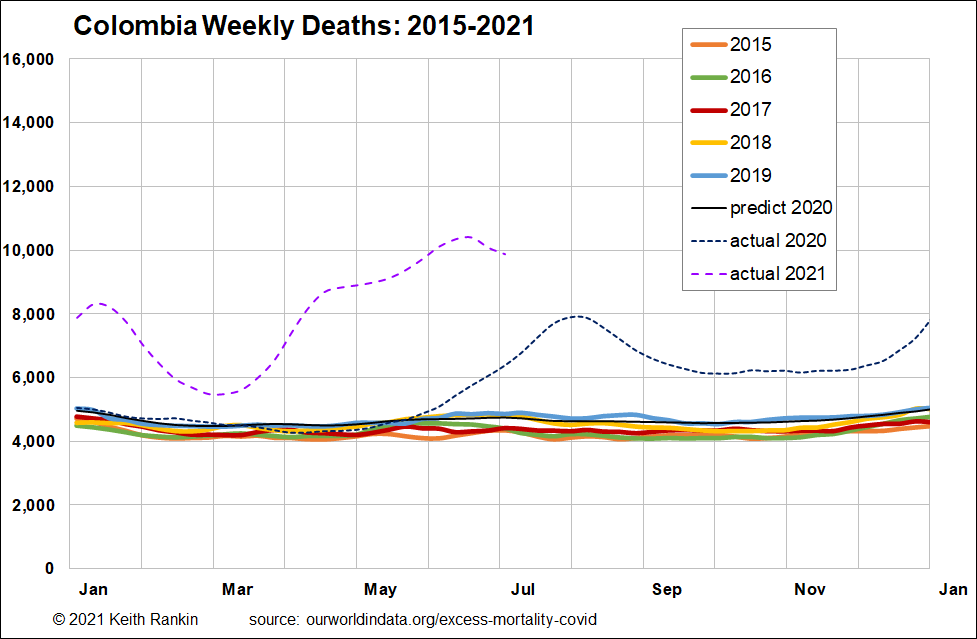
Today’s five charts are all set to the same scale, allowing for total weekly deaths being four times (300%) above normal.
South Africa and Chile are both countries with substantial connections to New Zealand. Most of New Zealand’s pioneering immigrants sailed to New Zealand via Cape Town. And the relationship has continued through rugby, cricket and immigration from South Africa. The relationship with Chile also goes back a long way. Chile is across the ‘big ditch’. Ships sailing east from Sydney would call into New Zealand ports on their way to Valparaiso. (And the Beagle, carrying Darwin and Fitzroy, came the other way, in December 1835; albeit via the Galapagos Islands.) The more recent Latam direct flight from Auckland to Santiago has recently been the mainstay of New Zealand’s formerly growing relationship with South America. And Australia’s first Labour Prime Minister, John Watson, was a New Zealander born in Chile.
Chart by Keith Rankin.
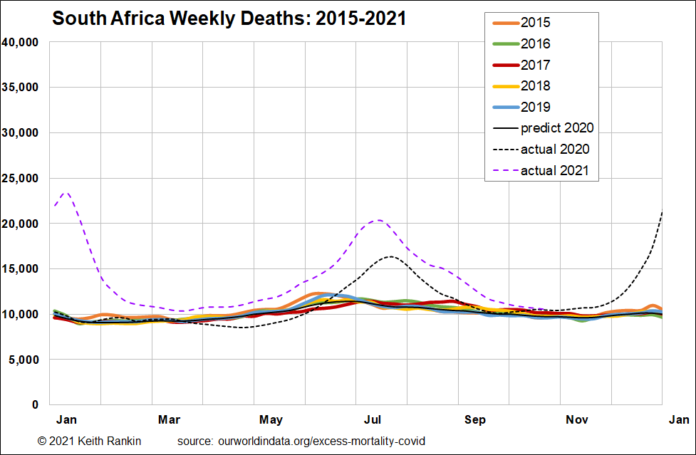
In the autumn of 2020, South Africa had a ‘successful’ covid lockdown, as evidenced by a significant drop in death numbers. However, as happened in many countries with successful lockdowns, the good news didn’t last. Death rates doubled in July 2020. After getting back to normal death rates, a second covid wave hit at Christmas, taking death rates up to 140% above normal in the New Year. And again, in July 2021, in a third (delta) wave death rates again reached 100% above normal. The July peaks look suspiciously like South Africa’s peak time for visitors flying in from the Northern Hemisphere. We should never lose sight of the fact that Covid19 is an airborne disease.
Chart by Keith Rankin.
Chile held Covid19 at bay for quite a while in 2020, despite having more relaxed lockdowns than, for example, Peru and Argentina. But Covid broke through, soon enough, in May 2020, causing deaths to peak at just under twice the normal level. From then, deaths remained significantly above normal until September 2021. Chile suffered particularly in the first half of 2021, facing the virulent gamma strain of Covid19. Delta has had no impact yet in Chile, though it is now the dominant strain.
In South America, Chile was first to roll-out a vaccination program, which did save may lives of especially older Chileans.
Chart by Keith Rankin.
Peru tried to fight Covid19; indeed, many western tourists were stranded there, with New Zealanders amongst the last to be rescued. But Peru never properly sealed its air border; Covid flowed into Lima. It almost certainly flowed in, as well, through its northern land border with Ecuador.
While Peru’s early emergency was focussed at Lima, not at its high altitude Andean tourist spots, it would appear that people living at high altitude were nevertheless vulnerable to respiratory infections such as coronaviruses. Not even the coca tea, good in normal times for helping the locals to deal with the altitude, could keep covid at bay. (I well remember the warm hospitality in the little hotel in Cusco where I stayed.)
Peru basically couldn’t cope, and many of its people live at high altitude away from the tourist areas. At least, to its credit, Peru did not cover-up its covid suffering. The Peruvian government decided to use ‘excess deaths’ as its official measure of pandemic mortality. (Based on this measure, Peru is no longer the world’s worst covid case. Bulgaria is, with Russia next; though some other countries in or near the Black Sea part of the world may be even worse.)
A particular issue faced by South America’s high altitude equatorial lands is that they do not get ‘seasonal’ influenza; despite temperatures being temperate, these places have neither winter nor summer as we know it. This means that base immunity levels are not regularly boosted by seasonal respiratory viruses; it makes their populations ‘sitting ducks’ to a respiratory pandemic.
Chart by Keith Rankin.
Next up the Pacific coast is Ecuador, source of the great Kiwi banana. In South America, Ecuador copped covid first. Deaths were over 300% above normal in two bad weeks in early April 2020. While a degree of control – or immunity – was established in May, covid has sustained levels of mortality up to 100% above normal; it’s still about 20% above normal, though with no sign of any impact from the delta strain. Almost certainly, much subsequent infection on the continent – especially in the equatorial region of South America – was consequent on Ecuador’s unfortunate circumstance.
Chart by Keith Rankin.
Finally, Colombia, South America’s most populous country after Brazil. Again, once Colombia’s initially successful defences were breached, death rates reached double normal levels by the end of July 2020, and again at Christmas New Year. In 2021, Colombia suffered particularly badly from Gamma. While excess death data for Colombia is slow to come through, I am pleased to be able to say that, since September, officially recorded deaths have been at their lowest since May 2020. The delta strain has made no impact so far, and overall immunity levels suggest that it might not make an impact, though the coming Christmas New Year will be the big test.
Overall, these countries have suffered much. We can learn from them, and they are open about their experiences. In particular, we can learn about how immunity patterns (re respiratory viruses) can vary in different climatic zones. The South American experience also reminds us of the experience of ‘colonisation’ in South America; an experience that saw wholesale indigenous mortality in the third quarter of the last millennium, owing to the complete naivety of Native Americans to European and African pathogens. In those days these countries suffered from multiple novel viruses – and other micropredators – all at pretty much the same time.
Interestingly the anti-colonisation backlash, prominent here in New Zealand and in Canada, is even more prominent in South America, especially (at least to my knowledge) in Colombia and Chile. Unfortunately, this backlash is unnuanced; the suffering of (and lack of recognition of) indigenous peoples in the New World varied considerably between places and between times. And, of course, indigenous peoples in America and Aotearoa are substantially assimilated in irreversible genetic ways; less so in South Africa. Past tragedies should be a point of shared sympathy and understanding, not a basis for future division.
Keith Rankin (keith at rankin dot nz), trained as an economic historian, is a retired lecturer in Economics and Statistics. He lives in Auckland, New Zealand.
When I went out in Melbourne for a coffee with a friend earlier this week, the waiter verified my vaccination status before allowing me to sit down. But for the unvaccinated in Victoria, New South Wales, and the ACT, it’s a case of no clubbing, no coffee catch-ups, no movies.
Many employers have even gone beyond the government-mandated minimum and required all staff to be vaccinated as part of ensuring a safe workplace.
These mandates are designed to reduce the number of COVID-19 outbreaks and their consequences as Australia’s “lockdown states” open up. Introducing different rules for the vaccinated and the unvaccinated also gives people an incentive to get vaccinated as soon as possible.
Singapore went a step further this week, announcing people who are unvaccinated by choice will have to pay for their own health care.
This isn’t the right way to encourage vaccination, and shouldn’t be replicated in Australia.
Under the new policy, unvaccinated Singaporeans will still get care, but could be substantially out-of-pocket when or if they recover. COVID-related hospital care can be expensive and so could easily wipe out a medical savings account balance.
Singapore’s new policy is implemented with the best intentions – to reduce demand on a stretched health system by reducing the number of avoidable hospital admissions among the unvaccinated.
Why some are calling for us to follow Singapore’s lead
And even though the unvaccinated are only a small proportion of the population in those jurisdictions, almost everyone with COVID in an intensive care unit bed is unvaccinated.
The importance of universal coverage – for everyone
Australia’s Medicare system provides universal coverage for medical and public hospital care. It’s not a system just for the poor, or just for the well-behaved. It promotes social solidarity.
Widespread vaccination was always going to be the best way out of lockdowns and the path to reopening Australian and state borders. Grattan Institute’s Race to 80 report supported vaccine passports and other strategies to encourage vaccination. But how far should these nudges to increase vaccination rates go?
Undermining Medicare’s universality – by excluding the unvaccinated from its financial protection – is a bridge too far.
Unvaccinated Australians should have access to free hospital care, just like the rest of the population. Shutterstock
Sure, I think anti-vaxxers should know better; their vaccination status poses a risk to themselves and all of us.
But the Singaporean policy statement has hidden in it the root of the problem – it is targeted at those who are unvaccinated by choice.
The evidence shows vaccination in Australia – like other aspects of health care – suffers from a distinct social gradient. Poorer people and those less well educated have lower rates of vaccination.
This may be because their lives are less well organised, and they can’t take time off from precarious employment to get vaccinated. It may be they are more susceptible to misinformation campaigns.
Whatever the case, their “choice” may not be a fully informed and freely made one.
Penalising unvaccinated Australians by excluding them from Medicare would be a convenient way of shifting responsibility on to individuals for government failures.
Early on, the federal government did not make vaccination easy to get. And the government has failed to ensure the whole population has all the information it needs to make good vaccination decisions.
If the unvaccinated were barred from Medicare, these government failures would magically become a problem for a small number of individuals, and no longer a political failure.
Hospital emergency department staff regularly have to care for a drink driver and their victim on the same day. They have an ethical obligation to treat everybody equally. Similarly, as frustrating as it might seem, the health system must still be there for the unvaccinated.
The health system needs to be there for everyone, not just people who look like us, nor just for people we like, nor just for people whose choices we endorse.
Nudges to encourage people to get vaccinated are good public policy. But if they undermine the universality of health care, these well-intentioned policies would cause more harm than good.
Grattan Institute began with contributions to its endowment of $15 million from each of the Federal and Victorian Governments, $4 million from BHP Billiton, and $1 million from NAB. In order to safeguard its independence, Grattan Institute’s board controls this endowment. The funds are invested and contribute to funding Grattan Institute’s activities. Grattan Institute also receives funding from corporates, foundations, and individuals to support its general activities, as disclosed on its website.
When I went out in Melbourne for a coffee with a friend earlier this week, the waiter verified my vaccination status before allowing me to sit down. But for the unvaccinated in Victoria, New South Wales, and the ACT, it’s a case of no clubbing, no coffee catch-ups, no movies.
Many employers have even gone beyond the government-mandated minimum and required all staff to be vaccinated as part of ensuring a safe workplace.
These mandates are designed to reduce the number of COVID-19 outbreaks and their consequences as Australia’s “lockdown states” open up. Introducing different rules for the vaccinated and the unvaccinated also gives people an incentive to get vaccinated as soon as possible.
Singapore went a step further this week, announcing people who are unvaccinated by choice will have to pay for their own health care.
This isn’t the right way to encourage vaccination, and shouldn’t be replicated in Australia.
Under the new policy, unvaccinated Singaporeans will still get care, but could be substantially out-of-pocket when or if they recover. COVID-related hospital care can be expensive and so could easily wipe out a medical savings account balance.
Singapore’s new policy is implemented with the best intentions – to reduce demand on a stretched health system by reducing the number of avoidable hospital admissions among the unvaccinated.
Why some are calling for us to follow Singapore’s lead
And even though the unvaccinated are only a small proportion of the population in those jurisdictions, almost everyone with COVID in an intensive care unit bed is unvaccinated.
The importance of universal coverage – for everyone
Australia’s Medicare system provides universal coverage for medical and public hospital care. It’s not a system just for the poor, or just for the well-behaved. It promotes social solidarity.
Widespread vaccination was always going to be the best way out of lockdowns and the path to reopening Australian and state borders. Grattan Institute’s Race to 80 report supported vaccine passports and other strategies to encourage vaccination. But how far should these nudges to increase vaccination rates go?
Undermining Medicare’s universality – by excluding the unvaccinated from its financial protection – is a bridge too far.
Unvaccinated Australians should have access to free hospital care, just like the rest of the population. Shutterstock
Sure, I think anti-vaxxers should know better; their vaccination status poses a risk to themselves and all of us.
But the Singaporean policy statement has hidden in it the root of the problem – it is targeted at those who are unvaccinated by choice.
The evidence shows vaccination in Australia – like other aspects of health care – suffers from a distinct social gradient. Poorer people and those less well educated have lower rates of vaccination.
This may be because their lives are less well organised, and they can’t take time off from precarious employment to get vaccinated. It may be they are more susceptible to misinformation campaigns.
Whatever the case, their “choice” may not be a fully informed and freely made one.
Penalising unvaccinated Australians by excluding them from Medicare would be a convenient way of shifting responsibility on to individuals for government failures.
Early on, the federal government did not make vaccination easy to get. And the government has failed to ensure the whole population has all the information it needs to make good vaccination decisions.
If the unvaccinated were barred from Medicare, these government failures would magically become a problem for a small number of individuals, and no longer a political failure.
Hospital emergency department staff regularly have to care for a drink driver and their victim on the same day. They have an ethical obligation to treat everybody equally. Similarly, as frustrating as it might seem, the health system must still be there for the unvaccinated.
The health system needs to be there for everyone, not just people who look like us, nor just for people we like, nor just for people whose choices we endorse.
Nudges to encourage people to get vaccinated are good public policy. But if they undermine the universality of health care, these well-intentioned policies would cause more harm than good.
Grattan Institute began with contributions to its endowment of $15 million from each of the Federal and Victorian Governments, $4 million from BHP Billiton, and $1 million from NAB. In order to safeguard its independence, Grattan Institute’s board controls this endowment. The funds are invested and contribute to funding Grattan Institute’s activities. Grattan Institute also receives funding from corporates, foundations, and individuals to support its general activities, as disclosed on its website.
Te Rūnanganui o Ngāti Hikairo located between Kāwhia and Te Awamutu were especially concerned with the number of young tamariki involved in the rallies.
They said Tāmaki, who was one of their own, was asking Māori communities to undermine science, putting their people at risk.
They have now called on the Destiny Church leader to take a whānau-first approach.
Rūnanga chair Susan Turner said because Tamaki was a descendant of their rūnanga it was important to show leadership and encourage the right messaging and approach to combatting covid 19.
She said Tamaki needed to promote scientific advice among whānau, iwi and the wider community to protect each other against the virus.
‘Share the right messages’ “Brian as a member of Ngāti Hikairo, we wanted to encourage him to share the right messages and dispel the rhetoric that he and his followers are saying to our people.
“We want them to follow science and go with the right advice and for our people to be united in this fight against covid,” she said.
The inclusion of mixed messaging related to freedom and self-determination was particularly concerning.
It comes as the rūnanga battles to prevent an outbreak amongst Ngāti Hikairoa whānau.
Turner said it did not reflect a mātauranga Māori approach as tino rangatiratanga should be represented by a collective effort to protect whānau and those most vulnerable.
The current approach from Tamaki was promoting a colonial approach to preserving life and liberty, she said.
“The biggest concern that we’ve got is the fact that they’re giving our people the wrong information.
Tamaki message ‘opposing tikanga’ “Those sentiments simply oppose the whole concept of what we believe is our tikanga which is about protecting ourselves, protecting our whānau and the people that live in our community.
“It’s clear to us that this virus is going to spread, and we need to do all we can to protect our whānau, our rangatahi and our tamariki,” she said.
The rūnanga strongly supported vaccines and said Tamaki carried a Ngāti Hikairo name, and with that came obligations to use his platform to strengthen Māori communities by encouraging whānau to get vaccinated and comply with health restrictions.
A spokesperson for Tamaki rejected RNZ’s request for an interview but said they wished to speak to Te Rūnanga o Ngāti Hikairo face-to-face about the issues at hand.
This article is republished under a community partnership agreement with RNZ.
With the Glasgow conference nearly over and the government promising to release its climate policy modelling before parliament resumes later this month, eyes are turning to Labor for its long-awaited alternative.
Climate change spokesman Chris Bowen says the policy will be both “realistic and ambitious” – which of course neatly embraces the debate within Labor about how far to differentiate itself from the government on an issue that caused it grief at the 2019 election.
“I hope and intend to be the climate change minister within six months. So anything we say […] it’s got to be realistic. But it will be realistic and ambitious. Both of these things can be true.”
Bowen slates the government for its lack of ambition. “We like to be an influential country and we have never been as out of touch on any issue ever in our foreign affairs than we are on climate change. So I think there’s a particular onus on Australia.”
On one of the issues to the forefront this week – ways to encourage electric cars – Bowen says there’s “a legitimate conversation to be had” about fuel standards (which NSW environment minister Matt Kean says should be addressed by the federal government).
Labor earlier this year announced measures on electric cars and has more policy to come.
Bowen says Morrison’s attempt to wedge Labor by linking an expansion of the remit of the Clean Energy Finance Corporation to the $500 million for a new fund to encourage the commercialisation of technology, has backfired.“Two coalition senators have come out and said they’re crossing the floor to vote against it. […] He’s wedged himself.”
Asked about the claims the renewable sector won’t produce as many jobs as the old fossil fuel sector, Bowen says: “Every dollar spent on renewable energy and energy efficiency creates three times more jobs than a dollar spent on traditional energy.
“And that’s also true when you consider some of the other things the country has to do […] we also have to upgrade our transmission massively to get renewable energy from where it’s generated to where it’s consumed. Our electricity grid can’t cope. So we need billions of dollars of investment to upgrade our transmission grid. We have a policy to do that and that’ll create lots of jobs.”
“I see it as a positive story to say we’re going to diversify regional economies, create new jobs, have lots of regional job creation as we go. And that’s a positive story for Australia’s regions.”
But, Bowen says, “it is dishonest to pretend that coal communities aren’t going to be impacted by reducing coal exports as countries move away from coal fired power.”
“We’re also going to have detailed plans for communities. We’re also going to have an opportunity for them to have a say from the ground up in their economic future.”
Speaking more generally about what the Labor party stands for today, Bowen says: “We still stand for growth and opportunity, which is what I’ve always said Labor stands for. Economic growth lifts people out of poverty. It turns aspiration into reality and we stand for giving people the opportunity to make the most of that. Though I do not mean a sort of narrow ‘equality of opportunity’ frame. I mean, the opportunity to live their lives to their fullest capacity.”
Michelle Grattan does not work for, consult, own shares in or receive funding from any company or organisation that would benefit from this article, and has disclosed no relevant affiliations beyond their academic appointment.
The period after birth of a child is supposed to be a time of great happiness for women. However, a significant number of new mothers will experience a mental illness at this time.
But our interviews with women who have been diagnosed with this rare but serious condition show their symptoms were often dismissed as a normal part of adjusting to motherhood.
What is postnatal psychosis?
Postnatal psychosis affects women across all cultures and geographic areas.
The condition can put a woman at risk of self-harm or suicide and, on rare occasions, of harming others including her new baby or other children.
We don’t know what causes it. But contributing factors may include sleep deprivation, and rapid hormone changes associated with pregnancy and childbirth.
The risk of postnatal psychosis increases if a woman has a history of bipolar disorder or has had postnatal psychosis before.
One woman tells her story.
What are the symptoms?
Symptoms can begin in the first few days after giving birth but may not appear until up to 12 weeks afterwards.
Some women have manic symptoms
manic symptoms include feeling they do not need to sleep, and are powerful and strong
women may have unusual experiences, such as seeing or hearing things others cannot. They may believe things that are not true
they can also make unrealistic and impulsive plans, can be disorganised or forgetful, and talk very quickly
their moods may change rapidly or they may seem excessively happy.
Others have depressive symptoms
depressive symptoms include a loss of energy and an inability to sleep or eat
women may have thoughts or auditory hallucinations that they are a bad mother and they may say they wish to die. Hallucinations or delusions (false beliefs) point to postnatal psychosis rather than to postnatal depression
women may find it difficult to complete activities, such as caring for themselves or their baby, or attending to other tasks in the home
they may believe they are helpless, hopeless and worthless, especially as a mother
they can become isolated and no longer enjoy activities.
Women say it’s traumatic
Women say postnatal psychosis is traumatic, especially if they do not get help when they first report symptoms. But it can be challenging to diagnose because of the stigma surrounding mental illness around the time of giving birth.
Women say they are reluctant to disclose unusual symptoms as they feel ashamed they are finding motherhood difficult and worry they may lose custody of their baby.
When we interviewed ten women, who had experienced an episode of postnatal psychosis in the past ten years, we discovered another barrier to diagnosis.
Women said they knew they had unusual symptoms, such as not being able to sleep or changes in the way they thought or behaved, but they found it difficult to get help. Often, they were told these symptoms were a normal part of adjusting to motherhood.
Their postnatal psychosis was not identified until their only option was admission to an acute mental health unit and separation from their baby.
So we need more education about the condition for health-care workers. By identifying the condition earlier, this gives women more treatment options.
There are treatments
Once diagnosed, the condition can be treated with antipsychotic and mood stabilising medication, prescribed by a psychiatrist or other treating doctor.
This is very effective but medication is often not started until the symptoms have become very severe and the woman requires hospitalisation in an acute mental health unit, without her baby. This separation can compromise the developing bond between them.
So early diagnosis can potentially reduce the time a woman may spend in an acute mental health unit.
Best practice is to admit women and their babies to a mother-baby unit, which is usually linked to a hospital. This allows women to continue to care for their babies with the support of child and family health-care professionals.
However, publicly funded units are only available in Victoria, South Australia, Western Australia and Queensland. In New South Wales, two public mother-baby units are being built. In NSW, the only existing one is a private facility, which many families cannot afford.
The women we interviewed said they developed support networks with each other. One woman told us:
You feel like, okay, that was such a hard experience, is there a way that we could make that a little less hard for the women who are going to go through it next time?
Women wanted to tell their stories so others would better understand postnatal psychosis and could find it easier to get help.
If this article has raised issues for you, or if you’re concerned about someone you know, contact the following organisations for more information or support: Perinatal Anxiety & Depression Australia (PANDA), 1300 726 306; Centre of Perinatal Excellence; Beyondblue,
1300 22 4636; Lifeline, 13 11 14. You can also contact your GP or go to your nearest hospital emergency department.
Diana Jefferies does not work for, consult, own shares in or receive funding from any company or organisation that would benefit from this article, and has disclosed no relevant affiliations beyond their academic appointment.
Source: The Conversation (Au and NZ) – By Joshua Black, PhD Candidate, School of History, National Centre of Biography, Australian National University
“How can you tell if a politician is lying?” It is a favourite joke of my grandfather’s, and the punchline is all too obvious: “His mouth will be moving.”
The joke gives succinct expression to a cynicism that has shaped Australian politics since the introduction of self-government in the 1850s. The implication, of both the joke and the culture informing it, is that the politician’s lies reflect solely on their kind and reveal nothing about the rest of us.
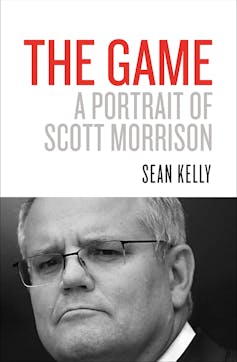
In his newly published profile of Prime Minister Scott Morrison, Sean Kelly flips this way of thinking on its head. The Game offers many powerful and revealing insights into Morrison’s career and the tricky political tactics that have characterised it. But the most important revelations in this book are about the society that created our prime minister, and the structures and cultures that facilitated his path to the Lodge.
Kelly explains, for example, that Morrison worked hard to be a “blank canvas” in the public eye until perhaps 2015, at which point he became the more recognisable suburban “good bloke down the road”.
This persona, replete with the “ScoMo” nickname, has characterised his public performances ever since. But the performance only matters because it finds in the Australian community “a willing audience” who, recently at least, like to have what novelist E.M. Forster called “flat characters” (or instantly recognisable “types”) in their newspapers and their parliaments.
Formerly a self-described “spin doctor” for both Kevin Rudd and Julia Gillard, Kelly studies Morrison’s public persona not just with the eye of a Canberra insider, but also with the lens of a cultural critic. In this “land of extremes”, he says, Australians are
always splitting ourselves in two, then ignoring the half that discomfits us.
For Kelly, this mentality explains why the so-called “quiet Australians” have indulged “the game” that Morrison plays, while the others have rejected him entirely (“I am completely different”).
Given Kelly’s Labor connections, cynics might expect a partisan hit-job on the prime minister. This portrait is no hit-job, but it is, unsurprisingly, unflattering.
Kelly gives Morrison the benefit of the doubt with respect to the early stages of the pandemic, “a situation unlike anything those involved had dealt with before”. There is recognition, too, of the burdens that Jenny Morrison and her daughters have borne in service of public life. But the portrait of Morrison himself is a study of duplicity and hollowness.
There are criticisms of Morrison’s more tone-deaf and morally dubious performances, none more so than the forced handshakes with reluctant bushfire survivors and firefighters during that black summer of 2019-20.
But the most important conclusion about Morrison in this book relates to the way he thinks. Kelly suggests Morrison’s mind does not think in narratives, but only in images or snapshots (think of the punchline of the tourism ad he commissioned, “Where the bloody hell are ya?”). This, Kelly reasons, is why he can say one thing with such apparent conviction today, and the opposite with equal fervour tomorrow.
For a public figure, this inconsistency would be impossible “if it were not a central aspect of their experience of the world”. The psychological analysis here is sweeping, its inferences devastating.
There are many praiseworthy qualities in Kelly’s study. Serious issues, from asylum-seeker policy to the COVID-19 pandemic and vaccine roll-out, are given ample coverage. But this is no traditional biography, and these debates are not its central concern.
The main subject of this book is the performance of politics itself, and the narratives that mediate the public’s relationship with its representatives. The idea of “performance” seems resurgent in political theory and history, and its capacity for revelation is rich.
In some ways, Kelly’s book builds on an older tradition of political profiles that took performance as their main subject. Graham Little’s Strong Leadership (1988) and Judith Brett’s Robert Menzies’ Forgotten People (1992) stand tall in that tradition, using psychosocial theory to unpack the hearts and minds of Australian liberals from Menzies to Malcolm Fraser. Don Watson’s Recollections of a Bleeding Heart (2002) is equally important, part-memoir, part-meditation and part-psychological study of Paul Keating as prime minister, written from the intimate perspective of a prime ministerial speechwriter.
In each case, the biographer’s goal was to explain not just who the prime minister was, but how their way of thinking engaged with the world around them.
Kelly does not try to discover the “real” Scott Morrison, a task rendered almost impossible by the vacuousness of the prime minister’s performances and the role of the media in presenting him to us.
Instead, he evokes the divided community to whom Morrison performs, and the social and cultural processes that allow those performances to take place and, at least sometimes, hit their mark. Kelly’s method is to home in on public speech, its sounds and cadences, as well as the often elusive messages and impressions that Morrison seeks to convey with his words.
The chief limitation of The Game is that, relying largely on public material, it cannot take us into the institutions that empower Morrison, other than the media.
We don’t learn much about the Prime Minister’s Office, other than that it failed to respond to Brittany Higgins’s alleged rape in Parliament House in an appropriate fashion.
Parliament itself is a stage here, but scarcely recognisable as an institution that makes laws. The public service is invisible. National Cabinet is, according to Kelly, little more than an “aesthetic change” from the Council of Australian Governments (COAG) that preceded it.
It says something about the condition of contemporary politics that it is hard to say whether these absences are a flaw in the author’s approach, or inevitable given the style of leadership it so astutely anatomises.
In the end, The Game invites us to look toward the next election. That poll will, Kelly implies, reveal something more of ourselves, or at least those “quiet” Australians who are supposed to have voted for Morrison in 2019. Like most of us, Kelly is unsure who will have the last laugh.
Joshua Black does not work for, consult, own shares in or receive funding from any company or organization that would benefit from this article, and has disclosed no relevant affiliations beyond their academic appointment.
Source: The Conversation (Au and NZ) – By Jeremy Edmund Clark, Associate Professor, Department of Economics and Finance, Business School, University of Canterbury
Shutterstock
The race by pharmaceutical companies to find effective vaccines for COVID-19 has shone a global spotlight on the trade-offs regulators face in approving new drugs.
Under the system used by drug regulators in the US, Europe and elsewhere, drug companies need only show from clinical trials that new drugs have short-term safety and efficacy in order to gain approval.
So, what happens if something goes wrong longer term?
Specifically, does the market itself punish drug companies when regulators issue warnings about a product’s safety, or withdraw it entirely? Our latest research set out to answer that question.
Warnings after the fact
Companies don’t need to demonstrate a drug’s long-term safety and efficacy. The limited length of clinical trials is allowed in order to keep the cost of developing drugs from being so high that new drugs don’t get developed.
There are also ethical problems with long trials – would you like to spend three years randomly assigned to take a drug you quickly realise is ineffective, or worse?
But our system brings the risk that new drugs can turn out to cause long-term problems undetected at the time of approval – opioid pain killers being a prime example.
Instead, after a drug gets approved, doctors or patients can report “adverse drug events” which regulators can investigate. The regulators may issue a new warning to go on a drug’s label or, in extreme cases, the drug may be withdrawn from the market, as happened with the painkiller Vioxx in 2004.
COVID vaccine development has highlighted the trade-offs regulators face in approving new drugs. Shutterstock
Regulation versus market signals
New safety warnings can vary in seriousness, with examples in our sample ranging from risk of permanent skin discolouration from certain dermal patches, up to increased risk of potentially fatal heart or liver damage, or suicidal ideation.
In the US, the Food and Drug Administration (FDA) therefore further distinguishes between new regular warnings and more serious “boxed” warnings that are urgent enough to be framed and placed at the top of a drug’s information label.
Do regulators get the balance right between encouraging new drug creation and safeguarding public health from unforeseen problems with newly approved drugs?
The burden would not fall on regulators alone if markets tended to “punish” companies whose drugs turn out to cause longer-term problems. This would create additional market incentives for companies to avoid such outcomes.
So do markets help keep us safe when we take approved drugs?
Testing the market
We first tested how total sales volumes of individual drugs across four broad categories in the US and the UK hospital and retail sectors are affected when each country’s respective regulator issues new safety warnings.
Some of these drugs were sold by only one or two companies, while others were sold by many, but we focused on whether warnings significantly affected total sales of individual drugs.
We included individual drugs across the four drug categories of diabetes, analgesic pain relievers (including opioids), nervous system analeptics for calming (including antipsychotics), and nervous system psychoanaleptic stimulants (including antidepressants).
Beyond asking whether warnings affected total sales volumes of individual drugs, we next tested whether they affected the share price of the individual publicly listed companies selling the drug, in the days surrounding the announcement of the safety warning.
Share prices matter because they should capture whether shareholders in the affected company believe the warning will lower its future profits.
Prescription opioids were hailed as a breakthrough in pain management but created an addiction epidemic. Shutterstock
Little impact on sales
We followed new warnings, sales and share prices for the US and UK over 12 years, from 2006 to 2017. Across a variety of statistical methods, we found surprisingly little evidence that new safety warnings affect the sales volume of the relevant drugs within our four categories.
The exceptions were in the US (with the UK regulator’s warnings never having a measurable effect on sales in that country). Specifically, if we excluded diabetic drugs, FDA warnings significantly lowered subsequent US sales of the other three drug categories if pooled together, but didn’t significantly lower sales if each broad category of drug was considered separately.
Similarly, having “at least one new boxed warning” during our sample period significantly lowered US hospital sales volume for all four categories of drug combined, but not significantly for each category separately, and not for US retail sales.
At the extreme, we found having at least ten new FDA warnings, or at least three new FDA boxed warnings, significantly lowered total sales volumes in all categories in both US retail and hospitals.
Share prices unaffected
We found even less evidence that warnings affected drug company share prices. The effects of warnings were small, sensitive to our choice of time span around the warning, and statistically insignificant. The single significant exception used a 25-day time span following warnings issued by the UK regulator.
We conclude that if society judges the problems identified by post-approval warnings to be rare or mild, then perhaps there is no reason to think sales volume or company share price should take a hammering.
The current system might then be doing a good job of balancing the cost of new drug development with safeguarding public health against the risk of unforeseen negative side effects.
But if society does judge the problems being identified in new warnings to be too common or serious, then the balance of our evidence is that markets do not punish companies that sell such drugs.
If the market does not fulfil this function, then, it must fall to regulators alone to insist that pre-approval drug trials be run for longer periods for more patients.
The authors do not work for, consult, own shares in or receive funding from any company or organization that would benefit from this article, and have disclosed no relevant affiliations beyond their academic appointment.
The Alliance of Independent Journalists (AJI) has appealed to news media that reported on intimidation against the parents and relatives of human rights lawyer Veronica Koman to immediately make corrections.
The plea comes amid many protests among civil society groups about the harassment and the London-based Indonesian human rights organisation TAPOL condemned the increasing threats and attacks against Koman’s family in Jakarta.
Koman, a prominent advocate for West Papuan human rights, lives in Australia in self-imposed exile.
AJI chairman Sasminto Madrim said that mentioning the identity, names, and addresses of Koman’s family members in the news would lead to further “terrorism” acts.
“Regarding the news that reveals the identity of Veronica Koman’s family, we want to convey that there is no news worth a life,” Madrim said during an online media conference.
“The safety of the informants is paramount.”
Journalism code of ethics Article 2 of Indonesia’s Journalism Code of Ethics (KEJ) reads: “Indonesian journalists use professional methods in carrying out journalistic duties.”
Madrim said that “being professional’ meant respecting the privacy of the source in certain cases, such as victims of terrorism, violence, or sexual violence.
Madrim further mentioned Article 10, which says: “Indonesian journalists immediately retract, rectify, and correct false and inaccurate news accompanied by apologies to readers, listeners, or viewers.”
In London, TAPOL issued a statement saying that is was “deeply concerned” about a series of escalating threats and attacks made against Koman’s family in Jakarta.
“These threats and attacks indicate a worsening situation for human rights lawyers and defenders in Indonesia, with other prominent human rights defenders being subjected to police investigations,” TAPOL said.
“The incidents against Koman’s family have in recent weeks involved an arson attack outside the house of her parents on October 24.
Explosive device “Two weeks later, on Sunday, November 7, assailants left an explosive device outside her parents’ house. A package containing a dead chicken was also sent to a different relative, with a note stating that ‘anyone who helps to hide Veronica Koman will end up like this’.
“TAPOL is concerned that, particularly in Koman’s case, the police are responsible for conducting an investigation into the attacks on the family but had also previously paid unsolicited visits to the same family residence in Jakarta.”
Koman was put on a so-called “police search list” (Daftar Pencarian Orang, DPO) following social media posts she had made in support of West Papuan students who were subjected to racial abuse in 2019.
“Furthermore, in October 2020, prominent environmental activist Golfrid Siregar died [in] suspicious circumstances in North Sumatra.
One conclusion to be drawn about at least some of these incidents is that the police, due to their previous record in relation to Koman and others, and willingness to pursue dubious investigations at the behest of politicians, may require careful independent scrutiny to ensure that its investigations are carried out objectively.”
TAPOL added that human rights defenders and activists in Indonesia were facing increasing risks to their own personal safety and the safety of their family members.
The human rights agency called for a “thorough investigation” of the attacks against Koman and her family, and to stop criminalising human rights defenders.
Joe Collins of the Australia West Papua Association (AWPA) has appealed to the Australian government to press Indonesia to“conduct aninvestigation into the attacks against Veronica’s family and that the police investigation must be impartial and subject to independent oversight”.
Same energy here:
A day after the explosion in @VeronicaKoman parents house became an international news, journalists receive dozen of mentions from pro-government bots. They claim that the incidents could be a false flag that will benefit the West Papua freedom campaign. https://t.co/oCvhQeckO7pic.twitter.com/q8C6fIbECp
PODCAST: Buchanan + Manning on Covid-19 Driven Economic Change
/
RSS Feed
Share
Link
Embed
A View from Afar – In this podcast, political scientist Paul Buchanan and Selwyn Manning discuss the Covid-19 driven transition from Neo-liberal to Neo-Keynesian Economics.
In particular, Buchanan and Manning examine whether we are witnessing a fundamental change to global economics and consider:
How since the Covid-19 pandemic arrived even neo-liberal state economies have embraced an expansionist government strategy and significant degrees of stimulus.
It would appear that the excesses of small government, market driven economies have, at this time, run their course.
But what will replace the earlier systems?
From a political economy point of view, what can we expect to take shape as the Pandemic grinds on, even while we all have had a glimpse of what a post-Pandemic new normal may mean?
You can comment on this debate by clicking on one of these social media channels and interacting in the social media’s comment area. Here are the links:
Threat.Technology placed A View from Afar at 9th in its 20 Best Defence Security Podcasts of 2021 category. You can follow A View from Afar via our affiliate syndicators.
Massive protests unfolded in Glasgow outside the United Nations climate summit last week, with some activists denouncing a proposal to expand the use of a controversial climate action measure to meet net-zero targets: carbon offsetting.
Offsetting refers to reducing emissions or removing carbon dioxide (CO₂) from the atmosphere in one place to balance emissions made in another. So far, more than 130 countries have committed to the net zero by 2050 goal, but none is proposing to be completely emissions free by that date – all are relying on forms of offsetting.
The use of offsets in meeting climate obligations has been rejected by climate activists as a “scam”. Swedish climate campaigner Greta Thunberg, joining the protesters, claimed relying on buying offsets to cut emissions would give polluters “a free pass to keep polluting”.
Others, however, argue offsetting has a legitimate role to play in our transition to a low-carbon future. A recent report by Australia’s Grattan Institute, for example, claimed that done with integrity, carbon offsets will be crucial to reaching net zero in sectors such as agriculture and aviation, for which full elimination of emissions is infeasible.
So who’s in the right? We think the answer depends on the kind of offsetting that is being employed. Some forms of offsetting can be a legitimate way of helping to reach net zero, while others are morally dubious.
Climate change as a moral issue
The debate over offsetting is part of a key agenda item for COP26 – establishing the rules for global carbon trading, known as Article 6 of the Paris Agreement. The trading scheme will allow countries to purchase emissions reductions from overseas to count towards their own climate action.
To examine carbon offsetting in a moral context, we should first remember what makes our contributions to CO₂ emissions morally problematic.
Greta Thunberg rallies climate activists in Glasgow.
The emissions from human activity increase the risks of climate change-related harms such as dangerous weather events – storms, fires, floods, heatwaves, and droughts – and the prevalence of serious diseases and malnutrition.
The more we humans emit, the more we contribute to global warming, and the greater the risks of harm to the most vulnerable people. Climate change is a moral issue because of the question this invites on behalf of those people:
Why are you adding to global warming, when it risks harming us severely?
Not having a good answer to that question is what makes our contribution to climate change seriously wrong.
The two ways to offset emissions
The moral case in favour of offsetting is it gives us an answer to that question. If we can match our emissions with a corresponding amount of offsetting, then can’t we say we’re making no net addition to global warming, and therefore imposing no risk of harm on anyone?
Well, that depends on what kind of offsetting we’re doing. Offsetting comes in two forms, which are morally quite different.
The first kind of offsetting involves removing CO₂ from the atmosphere. Planting trees or other vegetation is one way of doing this, provided the CO₂ that’s removed does not then re-enter the atmosphere later, for example as a result of deforestation.
Another way would be through the development of negative emissions technologies, which envisage ways to extract CO₂ from the atmosphere and store it permanently.
The second form is offsetting by paying for emissions reduction. This involves ensuring someone else puts less CO₂ into the atmosphere than they otherwise would have. For example, one company might pay another company to reduce its emissions, with the first claiming this reduction as an offset against its own emissions.
Australia’s Clean Energy Regulator issues Australian Carbon Credit Units for “eligible offsets projects”. These include for projects of offsetting by emissions reduction.
The regulator certifies that a company, for example, installing more efficient technology “deliver abatement that is additional to what would occur in the absence of the project”. Another company whose activities send CO₂ into the atmosphere, such as a coal-fired power station, can then buy these credits to offset its emissions.
So what’s the problem?
There is a crucial difference between these two forms of offsetting. When you offset in the first way – taking as much CO₂ out of the atmosphere as you put in – you can indeed say you’re not adding to global warming.
That’s not to say even this form of offsetting is problem-free. It’s crucial such offsets are properly validated and are part of a transition plan to cleaner energy generation compatible with everyone reaching net zero together. Tree-planting cannot be a complete solution, because we could simply run out of places to plant them.
But when you offset in the second way, you cannot say you’re not adding to global warming at all. What you’re doing is paying someone else not to add to global warming, while adding to it yourself.
The difference between the two forms of offsetting is like the difference between a mining company releasing mercury into the groundwater while simultaneously cleaning the water to restore the mercury concentration to safe levels, and a mining company paying another not to release mercury into the groundwater and then doing so itself.
The first can be a legitimate way of negating the risk you impose. The second is a way of imposing risk in someone else’s stead.
Let’s use a few simple analogies to illustrate this further. In morality and law, we cannot justify injuring someone by claiming we had previously paid someone who was about to injure that same person not to do so.
The same is true when it comes to the imposition of risk. If I take a high speed joyride through a heavily populated area, I cannot claim I pose no risk on people nearby simply because I had earlier paid my neighbour not to take a joyride along the same route.
Had I not induced my neighbour not to take the joyride, he would’ve had to answer for the risk he imposed. When I do so in his place, I am the one who must answer for that risk.
In our desperate attempt to stop the world warming beyond the internationally agreed limit of 1.5℃, we need to encourage whatever reduces the climate impacts of human activity. If selling carbon credits is an effective way to achieve this, we should do it, creating incentives for emissions reductions as well as emissions removals.
What we cannot do is claim that inducing others to reduce emissions gives us a moral license to emit in their place.
Christian Barry receives funding from the Australian Research Council
Garrett Cullity receives funding from the Australian Research Council.
Cities are responsible for 71-76% of energy-related CO₂ emissions. Today, the United Nations climate summit in Glasgow will convene to discuss this urgent global problem.
Carbon emissions in cities are generated through activities including the construction and operation of buildings, manufacture of building materials such as steel and concrete, and through the movement of people, goods and services.
The sector has been described as the “sleeping giant” of carbon emissions. This includes Australia, where a pre-COVID forecast estimated the population will reach 30 million by 2029 – requiring many more buildings to be constructed this decade and beyond.
Over the next 30 years, lifecycle emissions associated with new homes in Australia are expected to exceed the federal government’s economy-wide net-zero emissions targets. Where we locate new buildings and how they’re built is crucial to reducing emissions and managing our exposure to the impacts of climate change.
Australia’s cities are predominantly coastal, but development is underway in areas we know will face sea level rise. Homes and suburbs are not being built to withstand heatwaves and other climate change threats.
We must take significant and rapid action now to ensure cities play their part in limiting dangerous global warming, so they can cope with the climate challenges ahead.
At COP26 today, national, regional, local governments and the private sector will come together to work towards a zero-emission built environment.
A coalition known as #BuildingToCOP26 aims to halve the built environment’s emissions by 2030. Ahead of COP26, it outlined three goals for the sector. They cover targets to decarbonise buildings, committing to the United Nations’ Race to Zero campaign and adopting shared goals for emissions reductions.
Without significant and rapid change to the buildings and construction sector, society will be further exposed to climate risks. Shutterstock
Research consistently shows the clear need to act. Yet our study this year found city planning in Victoria does not sufficiently address climate change.
While Australian states have set goals for emission reductions, these are not yet activated through land use planning and development regulations. We found climate change impacts like sea level rise and urban heat were not sufficiently addressed.
Without significant, rapid change, society will be further exposed to climate risks.
All of us will bear the cost – through higher council rates to pay for infrastructure damage, rising home and contents insurance costs, and in some cases, being refused any insurance at all. This could devalue your property and put your mortgage at risk.
New Zealand recently made it mandatory for big banks, insurers and firms to disclose their climate risk. This leaves Australia increasingly isolated as a climate laggard and exposed to stranded climate assets (when buildings and properties are worthless due to their climate exposure or lack of insurability).
During extreme weather events, fuelled by climate change, there will be impacts to essential services such as water supply, power, and telecommunications.
These will affect all areas of life – schooling, livelihoods, commercial activities, and retirement plans and funding of them – and the damage is likely to be disproportionately felt by society’s most vulnerable.
Through our super funds, many Australians are investing in properties and businesses that may be exposed to a raft of climate risks, jeopardising our future financial security.
Measures to reduce emissions from the built environment should include a focus on design of buildings and suburbs and active transport options for walking and cycling.
Australia’s cities are vulnerable to sea level rise. David Moir/AAP
Barriers to climate action in the sector
Without urgent change, Australia’s 2050 goal of reaching net-zero emissions is at risk. Looking at the new homes required to house Australia’s population to 2050, for example, lifecycle emissions generated in construction and operation obliterates the net-zero target. And that doesn’t even account for emissions from the rest of the building sector.
We must rapidly change how we make and implement decisions around urban planning, property, construction and design. We developed a Built Environment Process Map to help with this task.
It describes the fundamental activities involved in producing the built environment. This can help ensure climate change goals are effectively implemented over a city’s life stages and integrated across sectors and actors.
Our research on the Australian property and construction sectors identified barriers to climate change action. They include:
a lack of clear, trustworthy information for key stakeholders about climate change
a perception among stakeholders that investing in climate change action when it’s not mandatory will threaten their economic competitiveness
a lack of a stable regulatory environment, which hampers investor certainty.
Frontrunners in the Australian property and construction sector are not waiting.
Some property and construction firms and local governments are taking progressively more sophisticated approaches to climate change mitigation and adaptation.
But a lack of government regulation is hampering broad-scale action on climate risks, adaptation and mitigation efforts.
Governments must act now
Existing emissions reduction efforts in the industry now need to be supported and mainstreamed through regulatory change. We also urgently need change in the electricity sector to set us on the path of net-zero emissions.
We can’t afford decisions today that lock in further greenhouse gas emissions.
What happens this week in the COP26 is crucial if we are to work towards a zero-emissions built environment, and achieve the critical goal of limiting warming to 1.5℃ this century.
Anna Hurlimann receives funding from the Australian Research Council (Discovery Grant DP200101378); from a University of Melbourne Faculty of Architecture Building and Planning Research Development Grant; and a Brookfield Multiplex Construction Innovation Grant.
Georgia Warren-Myers receives funding from Australian Research Council. She is affiliated with the Australian Property Institute, the Investor Group on Climate Change, Australian Business Roundtable – Resilience Valuation Initiative, Australian Sustainable Built Environment Council, Green Building Council – Homes Advisory Panel, Residential Efficiency Scorecard Program Advisory Group.
Judy Bush receives funding from the Australian Research Council (Discovery Grant DP200101378), and the University of Melbourne: Faculty of Architecture Building and Planning Research Development Grant.
The possibility that screen time during early childhood could cause poorer attention later in a child’s life is a major concern for both parents and researchers.
Earlier studies have suggested links between preschoolers’ screen time and difficulties with attention.
But there is by no means consensus among the research community that such a relationship exists, and there have been conflicting results.
Two studies based on data from the Growing Up in New Zealand (GUiNZ) longitudinal cohort study may shed some new light on the issue, in the context of interactive media on offer for young children today.
The first study examined whether exceeding two hours of screen time per day for children aged two and almost four predicted symptoms of inattention and hyperactivity at four and a half years.
We used the Goodman’s Strengths and Difficulties questionnaire to measure symptoms and found no association between higher levels of screen time and more symptoms.
Higher levels of screen time at the age of two do not result in poorer attention during later childhood. Shutterstock/Mangostar
A second study investigated the correlation between screen time and symptoms of inattention or hyperactivity for children at the age of four and a half.
Here, screen time and symptoms were measured at the same point in time, in contrast to the longitudinal approach of the first study. We found a significant association between more symptoms and higher levels of screen time.
These two findings suggest there is no causal link between screen time and symptoms of inattention and hyperactivity. But instead, parents of children displaying more of these symptoms may allow more screen time.
Several factors may be at play, and one is the child’s preference. Most children enjoy screen time. For children with Attention Deficit and Hyperactivity Disorder (ADHD), for instance, peer interactions are often difficult, and screen time may provide a more enjoyable and less stressful alternative.
Children with attention problems could find it hard to concentrate for long periods on pastimes such as reading a book. Screen time, with its bright colours and action, may capture their attention and keep them interested.
Children with symptoms of inattention or hyperactivity are typically very active and impulsive and parents may find screen time can help settle and occupy their child for a while. It can also be something that parents and children enjoy doing together.
Screen time can be part of family time. Shutterstock/fizkes
Much of the past research into the potential effects of screen time on children’s attention has found associations between higher levels of screen time and poorer attention or other symptoms of ADHD.
Our findings don’t imply these past findings have been incorrect, as most of this research has focused on television. The media landscape preschool children engage with today has changed considerably.
Newer screen technologies have been introduced and, arguably, a higher quality of screen time is now possible. For instance, one researcher argues that the features of modern touchscreen devices allow children to interact with them in ways similar to traditional toys, providing children with some of the benefits of traditional play when engaging with digital devices.
Interactive digital experiences can have benefits similar to playing with toys. Shutterstock/Bangkok Click Studio, CC BY-ND
Our findings highlight the importance of considering the changing nature of children’s screen time in future research into the potential effects on childrens’ development.
Takeaway ideas
It is important to remember our results do not rule out the possibility that very high levels of screen time or certain types of screen time could have immediate effects on children’s attentional functions. Nor do our results suggest consistently high levels of screen time are harmless.
On the basis of my research, I advise parents to use their judgement about how much screen time is appropriate for their child, and how much may be excessive.
The children in our sample were preschool children (aged 2-4.5). Ministry of Health guidelines recommend less than an hour of screen time per day for this age group. We think this is about right for children this young.
However, in COVID times, when parents are being parents, teachers and employees all at once, it’s understandable that they may sometimes allow their children more screen time.
Our results may be reassuring to parents because they suggest that if preschool children end up having more than two hours of screen time per day while under COVID restrictions, this will not lead to long-term attention problems or ADHD.
The climate emergency is the result of an ethical, moral and spiritual crisis, manifested in a fixation on profit.
The extractive and, ultimately, unsustainable systems of production and consumption, by those complicit in this crisis, continue to ignore increasing scientific, and moral warnings.
Those who have contributed to this crisis the least, suffer the most, physically, existentially, and ecologically.
We affirm the Faith and Science Joint Appeal, calling us to respond, with the knowledge of science, and the wisdom of spirituality: to know more and to care more.
Our interconnectedness to this common home forces us to a radical solidarity, across gender and generation, for climate justice for all.
In this spirit, wealthier countries must lead in reducing their own emissions, and in financing emission reductions of poorer nations.
Industrialised countries must support the vulnerable Industrialised countries must support the vulnerable countries, and finance adaptation.
They must put into action a mechanism for loss and damage, with additional funds.
Love calls us to seek climate justice and restoration. It calls us to respect the rights of Indigenous Peoples, to protect them, and their ancestral domains, from predatory economic interests, and to learn from their ancient wisdom.
Indigenous spirituality could restore our understanding of interdependence between land, ocean, and life, between generations before us,and the ones to come.
Love calls us to transformation of systems and lifestyles. This transition away from fossil fuel-based economies must be just, securing livelihoods and wellbeing for all and not just some.
Keep Paris Agreement promise alive We ask our leaders to not only keep the promise of the Paris Agreement alive, but also to keep alive the hope of a flourishing future for humanity.
We have heard many commitments in this place.
Words have power, but only when they are manifested into action.
The fate of the planet depends on it.
The World Council of Churches (WCC) presented a longer statement to the COP26 Climate Summit. This was the text of Pacific Conference of Churches (PCC) secretary-general Reverend James Bhagwan’s intervention to the High Level Plenary yesterday.
Selwyn Manning and Paul G Buchanan present A View from Afar, November 11, 2021.
A View from Afar – In this podcast, political scientist Paul Buchanan and Selwyn Manning will discuss the Covid-19 driven transition from Neo-liberal to Neo-Keynesian Economics.
In particular, Buchanan and Manning will examine whether we are witnessing a fundamental change to global economics and will consider:
How since the Covid-19 pandemic arrived even neo-liberal state economies have embraced an expansionist government strategy and significant degrees of stimulus.
It would appear that the excesses of small government, market driven economies have, at this time, run their course.
But what will replace the earlier systems?
From a political economy point of view, what can we expect to take shape as the Pandemic grinds on, even while we all have had a glimpse of what a post-Pandemic new normal may mean?
Join Paul and Selwyn for this LIVE recording of this podcast while they consider these big issues, and remember any comments you make while live can be included in this programme.
You can comment on this debate by clicking on one of these social media channels and interacting in the social media’s comment area. Here are the links:
Threat.Technology placed A View from Afar at 9th in its 20 Best Defence Security Podcasts of 2021 category. You can follow A View from Afar via our affiliate syndicators.
New Zealand Parliament Buildings, Wellington, New Zealand.
Editor’s Note: Here below is a list of the main issues currently under discussion in New Zealand and links to media coverage. You can sign up to NZ Politics Daily as well as New Zealand Political Roundup columns for free here.
Alongside advances in space exploration, we’ve recently seen much time and money invested into technologies that could allow effective space resource utilisation. And at the forefront of these efforts has been a laser-sharp focus on finding the best way to produce oxygen on the Moon.
In October, the Australian Space Agency and NASA signed a deal to send an Australian-made rover to the Moon under the Artemis program, with a goal to collect lunar rocks that could ultimately provide breathable oxygen on the Moon.
Although the Moon does have an atmosphere, it’s very thin and composed mostly of hydrogen, neon and argon. It’s not the sort of gaseous mixture that could sustain oxygen-dependent mammals such as humans.
That said, there is actually plenty of oxygen on the Moon. It just isn’t in a gaseous form. Instead it’s trapped inside regolith — the layer of rock and fine dust that covers the Moon’s surface. If we could extract oxygen from regolith, would it be enough to support human life on the Moon?
The breadth of oxygen
Oxygen can be found in many of the minerals in the ground around us. And the Moon is mostly made of the same rocks you’ll find on Earth (although with a slightly greater amount of material that came from meteors).
Minerals such as silica, aluminium, and iron and magnesium oxides dominate the Moon’s landscape. All of these minerals contain oxygen, but not in a form our lungs can access.
On the Moon these minerals exist in a few different forms including hard rock, dust, gravel and stones covering the surface. This material was resulted from the impacts of meteorites crashing into the lunar surface over countless millennia.
Some people call the Moon’s surface layer lunar “soil”, but as a soil scientist I’m hesitant to use this term. Soil as we know it is pretty magical stuff that only occurs on Earth. It has been created by a vast array of organisms working on the soil’s parent material — regolith, derived from hard rock — over millions of years.
The result is a matrix of minerals which were not present in the original rocks. Earth’s soil is imbued with remarkable physical, chemical and biological characteristics. Meanwhile, the materials on the Moon’s surface is basically regolith in its original, untouched form.
One substance goes in, two come out
The Moon’s regolith is made up of approximately 45% oxygen. But that oxygen is tightly bound into the minerals mentioned above. In order to break apart those strong bonds, we need to put in energy.
You might be familiar with this if you know about electrolysis. On Earth this process is commonly used in manufacturing, such as to produce aluminium. An electrical current is passed through a liquid form of aluminium oxide (commonly called alumina) via electrodes, to separate the aluminium from the oxygen.
In this case, the oxygen is produced as a byproduct. On the Moon, the oxygen would be the main product and the aluminium (or other metal) extracted would be a potentially useful byproduct.
It’s a pretty straightforward process, but there is a catch: it’s very energy hungry. To be sustainable, it would need to be supported by solar energy or other energy sources available on the Moon.
Extracting oxygen from regolith would also require substantial industrial equipment. We’d need to first convert solid metal oxide into liquid form, either by applying heat, or heat combined with solvents or electrolytes. We have the technology to do this on Earth, but moving this apparatus to the Moon – and generating enough energy to run it – will be a mighty challenge.
Earlier this year, Belgium-based startup Space Applications Services announced it was building three experimental reactors to improve the process of making oxygen via electrolysis. They expect to send the technology to the Moon by 2025 as part of the European Space Agency’s in-situ resource utilisation (ISRU) mission.
How much oxygen could the Moon provide?
That said, when we do manage to pull it off, how much oxygen might the Moon actually deliver? Well, quite a lot as it turns out.
If we ignore oxygen tied up in the Moon’s deeper hard rock material — and just consider regolith which is easily accessible on the surface — we can come up with some estimates.
Each cubic metre of lunar regolith contains 1.4 tonnes of minerals on average, including about 630 kilograms of oxygen. NASA says humans need to breathe about 800 grams of oxygen a day to survive. So 630kg oxygen would keep a person alive for about two years (or just over).
Now let’s assume the average depth of regolith on the Moon is about ten metres, and that we can extract all of the oxygen from this. That means the top ten metres of the Moon’s surface would provide enough oxygen to support all eight billion people on Earth for somewhere around 100,000 years.
This would also depend on how effectively we managed to extract and use the oxygen. Regardless, this figure is pretty amazing!
Having said that, we do have it pretty good here on Earth. And we should do everything we can to protect the blue planet — and its soil in particular — which continues to support all terrestrial life without us even trying.
John Grant is affiliated with the human race and as such he has a vested interest in maintaining their ongoing existence. He, therefore, tends to advocate for planet earth, the natural home of the human race. He also has strong feelings for soil which plays a critical role in earth’s ecosystems and which has nurtured the emotional, physical, and spiritual health of human beings since their first beginnings.
The COP26 climate change conference in Glasgow is drawing to a close. And despite high hopes, many young people may be feeling disappointed with the progress at these landmark talks.
They may be feeling anxious about their future, considering they’ll be bearing the brunt of the impact of decisions made over the past two weeks.
Our soon-to-be published research in the journal Child and Adolescent Mental Health shows most young people in Australia are concerned about climate change.
But that’s not necessarily a problem. For some, a growing concern can motivate them to take action.
There’s a word for this concern – eco-anxiety
Eco-anxiety relates to worry and despair about climate change. Connected terms include “ecological grief”, which reflects grief related to ecological loss. People can also experience emotions such as fear, guilt and anger about climate change.
However, understanding young people’s views about climate change is important as they are more likely to be alive to experience its worst potential effects.
Young people have also had a prominent role in climate activism, including the School Strike 4 Climate movement involving millions of young people around the world.
Given the level of young people’s worry or concern about climate change we identified in our study, we may see their views becoming more influential as they reach voting age.
Listening to these climate change concerns is vital. However, only 13% of young people in Australia feel government leaders are listening to them.
We asked young people about climate change
In our study, we tracked concern and worrying about climate change in more than 2,200 Australian young people over a period of eight years. At the start of the study, participants were aged 10-11, so by the end, they were 18-19 years old.
At 18-19 years of age, most young people (75%) had at least some concern or worry about climate change. But we also identified different patterns of climate worry over time.
About half had increasing or had maintained moderate levels of worry over time. A total of 13% maintained high levels of worry over the eight years we tracked them.
But 17% had persistently low levels of worry. Some young people became less worried over time.
Compared to those who were moderately worried, adolescents with high levels of persistent climate worry had higher depression symptoms at age 18-19. However, those who increased their climate-related worry over time did not.
This suggests developing an awareness and concern for the environment was not associated with general mental health difficulties.
Those with persistently high and increasing levels of climate worry had greater engagement with politics and news at 18-19 years.
There are some positives
Some level of worry and anxiety is normal. Anxiety can play an important role in protecting ourselves from danger and threat.
Some worry may also motivate people to engage in constructive responses to climate change.
Although we did not specifically examine activism in our study, previous studies show climate worry is associated with greater feelings of personal responsibility to make changes to reduce the impacts of climate change.
However, anxiety can become a problem when it preoccupies us, leads us to avoid the thing that makes us anxious, gets in the way of daily life or stops us from doing the things we want to do.
Our study shows that for most young people, climate worry is not associated with general mental health difficulties.
However we don’t yet know the relationship between climate-related worry and mental health difficulties in younger children, as our study only looked at mental health outcomes at age 18-19.
Open communication about climate-related worry is essential. Parents play an important role and can talk with their children about these issues and listen to and validate their concerns.
Worrying about the environment is rational and grounded in reality, as we are increasingly seeing the impacts of climate change around us.
It’s OK for young people to feel worried. And we shouldn’t assume these worries are unproductive or necessarily associated with broader mental health difficulties.
Acknowledging and validating feelings is key, and supporting young people to engage in activities to take action, if they want to, may help.
Reassuringly, most young people in our study were not presenting with levels of worry that would warrant further assessment or treatment.
If young people (and their parents) want additional support, seeing a GP is a good first step. Young people can also visit specialist youth mental health services such as headspace.
A psychologist or other mental health professional can help young people develop ways of coping with and managing their worries.
If this article has raised issues for you, or if you’re concerned about someone you know, call Lifeline on 13 11 14.
Emma Sciberras receives funding from the National Health and Medical Research Council, the Medical Research Future Fund, veski, and the Waterloo Foundation.
Julian Fernando does not work for, consult, own shares in or receive funding from any company or organization that would benefit from this article, and has disclosed no relevant affiliations beyond their academic appointment.
Greta Thunberg has already pronounced the COP26 climate conference a failure. In important respects, the Swedish activist is correct.
The commitments made at the conference are insufficient to hold global heating to 1.5℃ this century. Leading producers and users of coal, including Australia, rejected a proposed agreement to end the use of coal in electricity generation by 2030. The Australian government went further and refused to commit to reducing methane emissions – a position endorsed by the Labor opposition.
And the rapid economic recovery from the COVID-19 pandemic has produced an equally rapid recovery in demand for all forms of energy, resulting in spikes in the prices of coal, oil and gas.
On the other hand, considered over a longer term, the outcomes of the Glasgow conference look rather better.
At the Copenhagen climate summit in 2009, participants agreed to aim at holding global heating below 2℃ this century, but did not deliver policy commitments to achieve this goal. The scenarios considered most plausible at the time yielded estimated heating of around 3℃.
The worst-case scenario, commonly described as “business as usual”, implied a catastrophic increase of up to 6℃ in global temperatures by 2100. As a result of all this, the Copenhagen talks were considered a spectacular failure.
But heading into the final days of the Glasgow summit, the goal of limiting heating below 2℃ looks attainable, and 1.5℃ is still possible. Despite the inevitable disappointments in the decade or so since Copenhagen, there is still room for hope.
Former US president Barack Obama greets people at COP26 – where negotiators are seeking global progress on climate action. AP
1.5℃ to stay alive
Ahead of COP26, commitments by each nation had the world on track for 2.7℃ warming this century.
The ten days of the talks so far, however, have yielded new binding commitments. According to one analysis, the commitments put the world on a trajectory to 2.4℃ warming. This assessment is based on current submitted climate pledges by each country, known as nationally determined contributions or NDCs, together with legally binding net-zero commitments.
When we account for additional pledges announced – but not yet formalised – by the G20 countries, the projected temperature rise this century lowers to to 2.1℃, according to analysis by Climate Action Tracker released in September.
So that’s the good news. And of course, those optimistic trajectories assume all pledges are fully implemented.
It has become clear, however, that even 2℃ of global heating would be environmentally disastrous.
Even under the current 1.1℃ of warming since the beginning of large-scale greenhouse gas emissions, Earth has experienced severe impacts such as devastating bushfires, coral bleaching and extreme heatwaves resulting in thousands of human deaths. Such events will only become more frequent and intense as Earth warms further.
This underscores the vital importance of urgently pursuing the 1.5℃ goal. It is, quite literally, a matter of life and death for both vulnerable human populations and for natural ecosystems.
The idea of a target of 1.5℃, supported by many developing countries, was rejected out of hand by major countries at the Copenhagen conference.
The Paris conference in 2015 marked an important, but still partial move towards the 1.5℃ goal. There, nations agreed on a goal to hold global average temperature rise to well below 2℃ above pre-industrial levels, while pursuing efforts to limit the increase to 1.5℃.
We’re yet to see the final communique from Glasgow, and every word in it will doubtless be subject to lengthy negotiation. But it’s almost certain to include a strengthening of the language of the Paris Agreement, hopefully with a formal commitment that warming will be held to 1.5℃.
Australia has already borne the brunt of climate-related disasters such as bushfires. Dan Himbrechts/AAP
Reason for hope
As with previous conferences, policy commitments at Glasgow will be insufficient to reach the 1.5℃ target. Most notably, the commitment to reduce methane emissions is, at this stage, merely an aspiration with no concrete policies attached.
And as analysis released on Tuesday found, real-world action is falling far short despite all the net-zero promises. If that “snail’s pace” continues, a temperature rise of 2.4℃, or even 2.7℃, remains a distinct possibility.
But the technologies and policies needed to hold warming to 1.5℃ are now available to us. And they can be implemented without condemning developing countries to poverty or requiring a reduction in living standards for wealthier countries.
The fact we have these options reflects both remarkable technological progress and the success of policies around the world, including emissions trading schemes and renewable energy mandates.
Thanks largely to government support, advances in solar and wind technology kicked off in the early 2000s. This ultimately pushed the cost of carbon-free electricity below that of new coal-fired and gas-fired plants.
The technology to address the climate crisis is already here. Shutterstock
The biggest impact was felt in the European Union, where carbon prices and emissions trading drove a rapid transition. The EU has a clear path to the goal of net-zero emissions by 2050.
The most important requirement is to accelerate the transition to carbon-free electricity. This involves rapidly expanding solar and wind energy and replacing petrol- and diesel-powered vehicles with electric alternatives.
These changes would incur a one-off cost in scrapping existing power plants and vehicles before the end of their operational life, but would reduce energy and transport costs in the long run.
Other important steps are already beginning. They include reducing methane emissions, and adopting carbon-free production methods for steel, cement and other industrial products. Hydrogen produced from water by electrolysis will be crucial here.
There is no guarantee these outcomes will be achieved. The leading national emitters – China, India and the United States – have all been inconsistent in their pursuit of stabilising Earth’s climate.
China is currently wavering as economic difficulties mount. In the US, Donald Trump has not ruled out a presidential bid in 2024 which, if successful, would almost certainly reverse progress there.
Global action on climate change is still not nearly enough, but we’re undeniably moving in the right direction. By the time of the next major COP, presumably in 2026, Earth could finally be on a path to a stable climate.
Every year in Australia school leavers suffer ATAR anxiety, worrying about whether they will get into their preferred course and university. New research by the Commonwealth Department of Education, using Australian Taxation Office earnings data, examines in detail how much difference what a person studies, and where, makes to their future income.
It finds students’ course choices matter more than their choice of university. Qualifications in some fields of study lead to much higher incomes nine years after graduation. Which university a student attends has little influence on short-term graduate earnings, but differences emerge over time.
Why might graduates of some universities earn more?
We would expect some university effect on earnings. Universities vary in their teaching quality, at least as measured by student satisfaction. In theory, those whose graduates learn more could expect labour market rewards.
Whether justified by objective learning gains or not, some universities are better known and more prestigious than others. This could influence employers when choosing between job applicants.
And some universities, especially those with many full-time and on-campus undergraduates, offer greater networking opportunities. The people met at university could open up employment and business opportunities.
Some degrees are entry points to specific occupations. The pay for those jobs is a major influence on graduate earnings. Other degrees provide more general skills that are valued to a greater or lesser extent in the labour market.
These differences reflect market conditions, occupational regulation and political decisions more than how good either the university or the graduate might be. University and graduate factors can influence who gets hired and promoted, but job markets set the salary range.
The Department of Education’s graduate income report and accompanying spreadsheets show earnings at various time points after graduation. I will mainly discuss the medium-term results, as at 2017-18 for people who graduated in the late 2000s.
As the chart shows, bachelor degree earnings differ significantly by the field of study nine years after graduation. At the high end, half of medical graduates reported annual incomes of A$149,500 or more (the median). A quarter earned $206,900 or more (the 75th percentile). The equivalent figures for performing arts were $53,000 and $80,300.
The overall results (including fields not shown here) were a median of $77,100 and a 75th percentile of $102,600.
Source: Author/ANU. Data: DESE graduate income data from Australian Taxation Office records
The department’s statistical analysis shows substantial course differences persist after taking into account university attended and personal characteristics such as gender, socioeconomic background and ATAR. For example, compared to business and management graduates, law and engineering graduates earn an extra $11,000 a year.
Much of the apparent variation in earnings between universities reflects differences in enrolment patterns. For example, universities with more graduates in high-paying fields such as medicine, law and engineering end up with higher median earnings than universities that focus on teaching or nursing.
The department’s analysis does show, however, that a decade after leaving university Group of Eight (Go8) graduates earn about $4,300 a year more than others from a comparison group of universities. Australian Technology Network (ATN) university graduates also earn more than non-Go8 graduates. These findings take into account course taken and personal characteristics such as gender, socioeconomic background and ATAR.
Does this change our understanding of graduate outcomes?
These findings confirm general patterns observed in previous research. They do so in ways that give us more confidence in earlier results.
Several studies have found either no or a small Go8 salary advantage for new graduates, after taking into account other factors known to influence graduate pay. The short-term results (one to two years after graduation) using ATO data also report no such advantage.
These findings count against strong prestige effects. If there were such effects, we would expect these to be greatest early in graduates’ careers, before they have had a chance to demonstrate their quality to employers.
Before now, longer-term earnings by university have been very difficult to analyse. Few data sources record both income and university attended more than three years after graduation.
Both these studies found small university and larger course effects on income. The Grattan paper also found Go8 and ATN graduates doing slightly better. The Curtin paper found an earnings disadvantage for regional university graduates, with other university grouping differences not statistically significant.
At the time of the Grattan paper there was some surprise that the university differences were not larger. Given the modest number of graduates in the HILDA sample, including people who finished university at many different times, its findings needed to be checked using other data sources.
The Department of Education’s analysis includes most graduates who finished in the same year. It both provides a much larger sample and lets us compare people at similar points in their career who faced common economic conditions. The strong parallels between the HILDA and ATO-based findings give us confidence the conclusions are right.
While a significant step forward, the ATO data source has some weaknesses. It relies on students borrowing under the HELP loan scheme to create the link between tax file numbers and enrolment records. The analysis excludes international students and domestic students who paid their fees up-front.
For future work using the ATO data I suggest looking at the effects of local labour markets. After taking into account courses taken and student characteristics, most of the universities showing earnings premiums are in NSW or the ACT.
Have universities there found a special strategy for improving graduate outcomes? Or are there simply more well-paid jobs in Sydney and Canberra? With the Grattan and Curtin papers both finding a NSW premium, the second explanation looks most plausible.
Will student choices change?
The ATO data show significant differences in earnings by course taken, but this is already well-known and probably won’t change students’ course choices. Student interests primarily shape these choices.
Within a prospective student’s range of interests, labour market prospects affect choices, but job availability is the main driver of shifts in applications. Nursing, which recorded a big increase in applications for 2021, may not lead to high salaries but is a reliable source of flexible employment.
On university choice, the main message is that earnings should only be a small factor in students’ decision-making. University attended explains only a small proportion of all the variation in graduate income.
A degree from a Go8 university is not going to open many doors that would otherwise be closed. A wide range of personal, occupational, firm, industry and broader economic factors influence long-term earnings.
Andrew Norton has worked on projects funded by the Department of Education, Skills and Employment that include analysis of post-school outcomes.
Source: The Conversation (Au and NZ) – By John Hawkins, Senior Lecturer, Canberra School of Politics, Economics and Society and NATSEM, University of Canberra
Salvador Melendez/AP
As it hits new highs, there is no shortage of bold predictions about Bitcoin reaching US$100,000 or more.
Often these are based on not much more than extrapolations by people with vested interests: the price has gone up a lot so it will keep going up. If it gets above its previous high, it must keep going up.
There is also “charting” or “technical analysis” – looking at graphs and seeing patterns in them. There may be fancy terms such as “resistance levels” and “Tenkan-Sen”. There is talk about “fundamentals”.
Let’s examine this last idea. Does Bitcoin have a fundamental value?
Calculating fundamental values
A fundamental value in traditional financial-speak means a value based on what return (or cash flow) is generated by an asset. Think of an apple tree. To an investor its fundamental value is in the apples it produces.
In the case of company shares, the fundamental value is the dividend paid from profits. A standard measure used by investors is the price-to-earnings ratio. In property, the fundamental value reflects the rent the investor earns (or the owner-occupier saves). For a bond, the value depends on the interest it pays.
Gold has a fundamental value also, based on its use for jewellery or dental fillings or in electronics. But this value is not why most people buy gold.
Fundamentals for cryptocurrencies
National currencies are different. Their value is in being a trusted and accepted unit of exchange.
In the past coins made with gold and silver had a fundamental value because they could be melted down for their precious metals. That’s no longer the case with fiat currencies, whose value depends solely on people trusting that others accept them at face value.
Most cryptocurrencies, such as Bitcoin, Ethereum and Dogecoin are essentially private fiat currencies. They have no corresponding assets or returns. This makes it hard to determine a fundamental value.
In September analysts with Britain’s Standard Chartered Bank argued Bitcoin could peak at about US$100,000 by the end of 2021. “As a medium of exchange, Bitcoin may become the dominant peer-to-peer payment method for the global unbanked in a future cashless world,” said the head of the bank’s crypto research team, Geoffrey Kendrick (a former Australian Treasury official).
Theoretically this could be possible. Globally an estimated 1.7 billion people lack access to banking services. But Bitcoin has been spruiked as the future of payments since its invention in 2008. It has made little progress.
There are at least two significant barriers. First is the computational grunt needed to process payments. Technology may overcome this. The second obstacle is harder: the volatility of its price.
Digital currencies that can maintain a stable value are more likely to become payment instruments. These include the existing stablecoins, Meta’s mooted Diem and central bank digital currencies, already operational in some Caribbean economies.
So far the only significant company to have accepted payments in Bitcoin is Tesla, which announced this policy in March only to reverse it in May.
The only country to adopt Bitcoin as an approved currency is El Salvador (which also uses the US dollar). But it is far from clear what benefits there are. The laws forcing businesses to accept the cryptocurrency have also led to protests.
If Bitcoin has no real value as a widespread means of payment, what about as a store of value, like digital gold? It does have this advantage over most of the “altcoins”. Its supply, like gold, is (arguably) limited.
One tool used by crypto enthusiasts to compare Bitcoin’s scarcity with gold is called the “stock-to-flow” model. This approach claims gold holds its value because the existing stock of gold is 60 times more than the amount of new gold mined each year. The stock of Bitcoin is more than 50 times than the new coins “mined” annually.
But this does not explain why Bitcoin’s price halved earlier this year. Nor does it have any theoretical basis in economics: prices don’t depend just on supply.
Some Bitcoin promoters predict higher prices on the assumption funds managers will eventually invest an abritrary proportion, say 5%, of their funds in Bitcoin.
But such predictions implicitly assume Bitcoin, as the largest and best-known cryptocurrency, will continue to maintain its dominant position in the crypto market. This is not guaranteed. And there is no limit to the number of cryptocurrency alternatives.
Remember Bankcard? This credit card company once had 90% of the Australian market in the early 1980s. It was defunct by 2006. What about MySpace? Before 2008 it was a bigger social networking site than Facebook.
Here we go again
In September The Economist argued Bitcoin “is now a distraction” to the future of decentralised finance, with rival blockchain cryptocurrency Ethereum “reaching critical mass”.
There are parallels between the Bitcoin bubble and the dotcom bubble of 2000, driven by overly optimistic assumptions about new technologies – and human greed.
Just as a few stars such as Amazon emerged from the wreckage of the dot.com bubble, so it is possible some applications of the block-chain technology underlying Bitcoin have enduring utility. But I doubt Bitcoin will be one of them.
John Hawkins formerly worked in two central banks and for the Bank for International Settlements.
Netflix’s comedy Sex Education, now in its third season, is set among a group of students and teachers at a British high school. In depicting sex education, it teaches viewers about sex and sexuality – often doing a better job than school-based sex ed classes.
In the first episode of season three, Dr Jean Milburn (Gillian Anderson) is interviewed on the radio about her new book, Uneducated Nation: A Sex Education Manifesto for Our Youth.
When the host asks her to tell him about the book, she replies she was “shocked at the ineptitude” of school sex ed classes. So she created
this easy-to-read manual to help empower our teenagers, and their parents, as they become sexually active young adults.
He responds, “Sounds a bit racy”. Jean retorts,
Well, if, by racy, you mean highly researched and completely essential to the health and well-being of our children, then, yes, I suppose it is.
Jean’s response could easily be applied to the television series itself – racy but essential. It could also be seen as a comment about how school-based sexual education programs could improve their communication of relevant information to curious teenagers.
We are part of an international research team working with scholars from Greece, Ireland and Norway to interview adolescents and their parents about their perceptions of harm in accessing sexual content.
As researchers with expertise in the fields of sexology, communication and media studies, we value the knowledge young people share about their own needs and desires.
Our research with teens – and into stories that represent their experiences – illustrates they are sexual beings who want and deserve sex-positive information. Too often, this positive side of sex is left out of the classroom.
Sex Education is one example of how stories in popular culture can portray teen sexuality positively.
For instance, the opening scene of this first episode of season three is upbeat, playful and sexy.
It cuts between at least 13 different moments of sexual pleasure: heterosexual sex, gay sex between young men, gay role-playing sex between young women, masturbating while watching porn, online sex, virtual reality sex – and the pleasure of reading a book while eating cheese puffs.
Sex education happens at school and in the home. Sam Taylor/Netflix
This sequence is sexually provocative, but it also educational. It shows a range of desires across ages (yes, teachers and parents have sex, too), races, sexualities and body sizes.
There are none of the messages about abstinence and fear often associated with representations of teen sex, and no coy curtain-wafting standing in for sex.
The premise of the show is the teenagers at Moordale High do not receive adequate sex education classes, so Jean’s son Otis (Asa Butterfield) and his classmate Maeve (Emma Mackey) set up a sex therapy service for their peers.
These young people seek information about how to overcome sexual difficulties and become better lovers. They find (usually) correct – and always frank – information from Otis and Maeve, who offer resources and advice.
Teenagers and porn
As we argue in a recent essay, this TV show complicates the idea that pornography is only harmful to teens.
Watching porn can be “a bit of fun”, to quote one character, but also a source of misinformation about sex. Sex Education debunks this misinformation, such as when one character mistakenly believes a large penis is required for sexual satisfaction, and another thinks her labia should be tucked in.
Teenagers as consumers and producers of pornographic and erotic narratives can use these stories, and the stories in Sex Education, to develop an understanding of sex and sexuality and supplement the information provided in school curriculum.
This seeming contradiction about pornography aligns with a report written by the Australian Institute of Family Studies about the effects of porn on young people.
This report highlights the lack of information about how young people access sexual content (unintentionally or intentionally); about the content of pornography they view; and about teenagers’ ability to distinguish between the fantasy pornography represents and the reality of their sexual experiences.
The report also found very few accounts from teens themselves about their experiences accessing sexual content online and any perceived harm from it. It points to a need for further research, which includes the voices of adolescents.
At present, the quality of sex education varies widely across the nation, but in Western Australia, a group of researchers have identified the “need for a greater focus on positive sexuality and relevant contemporary issues” in the classroom.
Sex Education challenges a commonly-held perception teenagers should be protected from the harms of sex and sexual material. The stories told by teens and about teens can be crucial tools to open conversations between children and adults about sex.
The conversation started by shows like Sex Education highlights the need for more comprehensive sexual education not only in schools but in communities and in the family home itself.
Debra Dudek receives funding from the Australian Government through the Australian Research Council’s Discovery Projects funding scheme (project DP190102435). The views expressed herein are those of the authors and are not necessarily those of the Australian Government or the Australian Research Council.
Giselle Natassia Woodley and this project receive funding from Australian Research Council
Some Aucklanders enjoying new freedoms today said there had been stress and anxiety in the community during New Zealand’s longest lockdown.
The country’s largest city moved to level 3 step 2 and shops can open — but swimming pools, cinemas and theatres remain closed.
Coincidentally, Prime Minister Jacinda Ardern visited Auckland for the first time in 12 weeks touring a factory and visiting a Pacific vaccination drive.
She faced criticism for not meeting with other businesses such as hospitality or hairdressers.
Ardern said she would be returning to Auckland to see how the people were dealing with the delta outbreak.
This morning she spoke with Employers and Manufacturers Association chief executive Brett O’Riley and toured an engineering factory, before visiting a Pacific youth vaccination event in Māngere. It is her first trip to the city since lockdown was imposed in August.
In the stand-up, Ardern said the reason she was delayed in visiting Auckland was limitations in Parliament.
“As soon as those measures lifted, I found the first available time to come home,” she said.
“Tāmaki Makaurau is my home and today’s been really important for me to reconnect with those I’ve been keeping in contact with at a distance — business representatives, health providers — but also to have a chance to talk to Aucklanders about their experience.”
Schools to reopen Covid-19 Response and Education Minister Chris Hipkins said the benefits of reopening primary schools and kura in Auckland and Waikato on November 17 far outweighed any risks.
Children in Year 4 and up will need to wear a mask, the number on-site will be limited, and groups of children will have to distance themselves from one another.
Schools and kura will decide what works best for them, but most pupils in Years 1 to 8 will probably return part-time, while Years 9 and 10 go back full-time.
The opposition National Party wants all schools to reopen immediately, and said paying schools up to $400 per student and regularly testing children would help them make up for lost class time.
The party this morning released its “Back on Track” plan to help school students catch up on their curriculum.
The suburbs of interest in Auckland are Ranui, Sunnyvale, Kelston, Birkdale, Manurewa and Māngere.
81 people with Covid-19 in hospital, including 11 in ICU or HDU. Of those, 40 cases are either unvaccinated or not eligible, 25 are partially vaccinated, 10 are fully vaccinated, and the vaccination status of six is unknown.
4813 community cases in the current outbreak.
New Zealand’s vaccination percentages as at 10 November 2021. Graphic: Ministry of Health/RNZ
A man in his 60s who had covid-19 and was isolating at a home in Glen Eden in Auckland has died — the third such death.
The cause of his death will be determined by the coroner, including whether it may have been covid-related.
Two people isolating at home with covid-19 died last week.
Director-General of Health Dr Ashley Bloomfield said allowing covid-19 patients to isolate at home was generally working well but the deaths were being reviewed.
AstraZeneca vaccine becomes an option The AstraZeneca vaccine will be made available later this month for a small number of people aged 18 and over who cannot have the Pfizer shots for medical reasons.
Dr Bloomfield said people who were required to be vaccinated under the public health order, but who preferred AstraZeneca to Pfizer, could also opt for it.
He said only a few hundred people aged 18 and over would be eligible for the AstraZeneca vaccine from late November.
However, several hours later, Covid-19 Response Minister Chris Hipkins told Newstalk ZB AstraZeneca would actually be available to anyone who has a conversation with their doctor.
Vaccination status of total people in hospital in NZ’s delta outbreak as at 10 November 2021. Image: Ministry of Health/RNZ
To celebrate the launch of The Conversation’s tenth anniversary collection No you’re not entitled to your opinion, and 49 other essays that got the world talking, Chief Political Correspondent Michelle Grattan and Business and Economy Editor Peter Martin joined Dr Caroline Fisher from The University of Canberra to discuss the year that’s been, and take an expert punt at what lies ahead for 2022.
You can watch the book launch below, and pick up a copy here.
Sun, surf, sand, sea – and public sex with strangers. These five S’s are a key part of tourism in the Canary Islands, a Spanish archipelago west of Morocco. Unfortunately, what’s fun for humans can be bad for wildlife.
Our new research, released yesterday, found public sex – known as “cruising” – in the Canary Islands is leading to significant degradation of the Dunes of Maspalomas, one of Europe’s last naturally functioning transgressive dune fields (in other words, they move around).
These semi-vegetated and mobile dunes are one of the most popular sightseeing spots on Gran Canaria island, and are legally protected as a nature reserve. Unfortunately, they are being loved to death.
We studied almost 300 sex spots across the vegetated section of these dunes, and found damage to 10 plant species, including three endemic to dune areas.
When plants suffer, so do the animals and reptiles, with rare lizards and endemic plant species notably impacted.
We’re not calling for an end to public sex – but we do want people to be aware of the damage it can do.
Sex in the Canary Islands
Before COVID, the Canary Islands was attracting up to 14 million tourists a year. Around 15% of tourists are men drawn to the gay-friendly beach resorts, with the area also popular for lesbians and heterosexual swingers. Those interested in casual sex are likely to venture into the coastal dunes, seeking privacy and partners.
The impact of these visitors is, unfortunately, large and growing. We found around 5,800 square metres of the dunes has been totally altered by people seeking sex. These impacts have made it impossible for the area to be used as an environmental education centre for students.
Dumped cigarette butts and condoms have become a major problem, as has removal of vegetation to make “nests”, sites for sex, and destruction due to trampling and track creation.
While there are sand-only dunes known as the little Sahara nearby, we found these are far less popular for sex spots compared to the vegetated dunes, which are home to more wildlife. And interestingly, the building of resorts nearby has changed the way the dunes move, and allowed more vegetation to grow in these areas. This, in turn, may have made cruising more popular.
Semi-private sex spots built by pleasure seekers out of local dune plants on Gran Canaria island. Author provided
So what’s the damage?
Sex on the beach as an isolated activity is unlikely to damage the environment. The issue starts when a dune area becomes popular for cruising (casual sex) and attracts hundreds of people a day. It’s similar to the impact of 4WD driving, which may have a relatively low impact on dune ecosystems if vehicle numbers are low, but leads to major erosion and habitat destruction when vehicle numbers are high.
We found public sex was particularly damaging to the local nebkhas, the term for discrete dune hummocks covered in plants. That’s because people have trampled many paths through the vegetation, as well as cutting branches off trees and shrubs to make a semi-private space.
The rare plants are the first ones to disappear. Soon, you lose connectivity for animals. A lizard has to run from one vegetated patch to another, making them more exposed to predators. The whole ecosystem starts to fragment into isolated islands, which can eventually destabilise the ecosystem as a whole.
Animals suffer in more direct ways, too. Jellyfish-eating Gran Canary giant lizards (Gallotia stehlini) have died after eating condoms left behind by pleasure seekers.
This matters because these dunes are rare. Transgressive dunefields are wide, semi-vegetated dune systems with a variety of dunes found nowhere else in coastal systems. They’re worth protecting due to their beauty, value for research, educational value and endemic plants and animals. Europe has almost none left, due to massive development along its coasts since the 1970s.
Are the dunes trashed beyond repair?
No, not yet. Our research has helped nudge the government and local resort owners to take action.
Over the last two years, the government has run major cleanup operations through its MASDUNAS project, removing a great deal of waste and dead vegetation. Encouragingly, some resort owners are discussing the impact of cruising with their guests.
Environmental protection will be high on the radar for authorities as the Canary Islands recovers from the ongoing volcanic eruption on La Palma island.
While dune systems are popular cruising locations around the world, it is not known if Australian dunes have been similarly affected, given few studies have been conducted.
But if you are looking to go cruising on dunes in one of the popular spots near major cities, it’s good to be aware of your impact on plants, animals and birds. Some Australian shorebirds use dunes as nesting sites, for instance.
Tread lightly – and preferably in a less environmentally fragile location.
Patrick Hesp receives funding from the Australian Research Council and Flinders University
Aboriginal and Torres Strait Islander readers are advised this article contains names and images of deceased people.
A High Court ruling today has thwarted the capacity of Northern Territory Constable Zachary Rolfe to argue he was acting in “good faith” as a police officer when he fired the shots that fatally killed 19-year-old Warlpiri man Kumunjayi Walker in Yuendumu, Northern Territory.
Rolfe has been charged with murder in Walker’s death in his family home in November 2019. He is also facing the alternative charges of manslaughter and engaging in a violent act that caused Walker’s death.
The start of the trial was delayed against a backdrop of legal arguments and decisions on the availability of defences. Especially contentious has been the availability of police immunity defences.
The full bench of the Northern Territory Supreme Court had earlier handed down a judgment affirming Rolfe could argue the special police defences before a jury, including the “good faith” defence.
The NT court held that Rolfe was fulfilling a police function authorised by the Police Administration Act 1978 (Northern Territory) because he was executing a warrant for Walker’s arrest, including potentially when he fired all three shots. Therefore, the court said, Rolfe could argue the police immunity defences.
The High Court then issued a stay on the trial to allow prosecutors to appeal the NT Supreme Court decision. The High Court delayed the trial, now set down to start in February 2022, to hear the application.
What is the “good faith” defence?
The defence’s argument that Rolfe is immune from criminal liability had relied on three legal propositions: he was acting in good faith as a police officer, acting in the reasonable performance of his duties, and acting in self-defence.
The “good faith” defence is set out in the NT’s Police Administration Act. It says police are not civilly or criminally liable when an action is undertaken
in good faith in the exercise of a power or performance of a function under this act.
The NT police recently relied on this defence in an anti-discrimination case brought by an Aboriginal person who claimed he was racially targeted when the police pulled him over for an alcohol and drug test.
The man, who was not speeding or driving dangerously, said the police stop and testing was discriminatory and not random. He argued the police were “always” harassing him and his family.
Although the Civil and Administrative Tribunal doubted the drug test was random, it nonetheless regarded the police conduct to be in good faith. This afforded the officer and police force immunity from potential liability.
What did the prosecution argue in the High Court challenge?
In Rolfe’s case, the prosecution sought to challenge the “good faith” defence before the High Court. The prosecutors likely perceived this defence to be the easiest for Rolfe’s lawyers to prove before a jury, due to its criteria.
As it relies on a subjective mental state, Rolfe could have argued he subjectively believed the shootings occurred in “good faith” while he exercised his power as a police officer.
For this defence, the jury is not required to consider whether a reasonable person in Rolfe’s circumstances would have shot Walker multiple times and at close range. It merely has to decide if Rolfe perceived himself to be acting in “good faith” in carrying out his duties.
Of course, the jury would have needed to consider whether Rolfe was acting in “good faith” based on all of the evidence, which was not a fait accompli. Nonetheless, it was a stronger basis for potential immunity than the other defences.
The High Court unanimously found the “good faith” defence was not available unless it could be established Rolfe was exercising a power under the Police Administration Act, including arrest. This is crucial because it is contested whether the fatal second and third shots were reasonable and necessary for the arrest.
The High Court, therefore, overturned the NT Supreme Court decision. However, the High Court did not rule out the availability of the “good faith” defence in other cases involving allegations of police misconduct.
What defences are still available to Rolfe?
Rolfe still has two other police immunity defences available to him.
The first is under the Criminal Code Act 1938 (NT), which says law enforcement officers can claim immunity from criminal liability in situations where they are reasonably performing their duties.
The second is that Rolfe acted in self-defence, which is set out under the same NT criminal code. This defence requires proof that a person believed their conduct was necessary to defend themselves, and their conduct was a reasonable response to the circumstances as they perceived them.
In contrast to the “good faith” defence, these other two defences require proof the shootings were objectively reasonable in response to the circumstances.
The indictment for a dangerous act was quashed because it was brought outside of the Police Administration Act, which requires charges against police officers be brought within two months. It failed on procedural grounds.
More recently, a Northern Territory local court considered the availability of police immunity in another case involving a senior constable who assaulted three Aboriginal people in 2020.
Similar to Rolfe, the officer argued he was acting reasonably to perform his duties. This was the first time the defence was tested in the territory.
The court found, however, the officer had not proven the defence due to inconsistencies in the evidence. He was found guilty on all counts: two charges of aggravated unlawful assault and one charge of unlawful assault.
Rolfe’s Supreme Court trial will determine whether the other defences can be successfully argued in a case involving a police shooting. It will also hinge on how the jury perceives the evidence and credibility of the witnesses and defendant.
Ultimately, however the court decides, the trial will have significant implications for ongoing relationships and perceptions of justice between police and Aboriginal communities in the Northern Territory and across Australia.
Thalia Anthony receives funding from the Australian Research Council
Collection of timber samples from the Powerhouse Museum’s historic collection, 1886-1932. Zan Wimberley
The Eucalyptus tree smells like minty life. Its branches bend and wrap like human arms, its scribbly or papery bark cries out to be touched and it emits a blue, oily haze. It would be hard to find an Australian who hasn’t sat beneath its shady canopy, tugged at its leaves to squeak out a tune, or used its oil to minimise a congested cold.
Eucalyptusdom, a multi-sensory exhibition of museum collection objects and new artworks at Sydney’s Museum of Applied Arts and Sciences, is a testament to the utilitarian and cultural life of the tree.
Plant science tells us that trees emit chemicals and gases to communicate with one another, that they spread their roots across astonishing distances and share nutrients via mycelium that spread information to other trees, often from a mother tree to smaller saplings. This adds to cultural and philosophical knowledge that connects with the animism and independent agency of the tree.
Hand-coloured photographic transparency, one of eight depicting various aspects of research and industry related to Eucalyptus oil distillation in Australia, circa 1880–1960. Powerhouse Collection
While this exhibition celebrates human relations with the Eucalyptus, rather than the tree’s own nonhuman life, it does other things such as walking the tightrope towards decolonising the museum’s collection.
This is important work. It refers to (re)telling stories of Aboriginal culture and often means admitting the truth about how museum objects were collected, classified, named and curatorially interpreted, sometimes in culturally insensitive ways.
Mittji by Wukun Wanambi, commissioned for the exhibition Eucalyptusdom, acquired 2021. Zan Wimberley
Lepastrier co-designed the exhibition and Hay has contributed literary writings to replace exhibition labels, which have long been criticised for their didactic, androcentric and eurocentric tone.
View of Eucalyptusdom, showing the exhibition’s architectural design, developed in collaboration between Richard Leplastrier AO, Jack Gillmer (Worimi, Biripi Nations) of SJB, Adam Haddow of SJB and Vania Contreras, spatial designer. Zan Wimberley
And then there is Jones, who has created yet another installation to stop viewers in their tracks. It’s in a side room of the exhibition, which has the unfortunate effect of seeming like an afterthought, but reverberates with his subtle and finessed (re)presentation of Australian Indigenous history.
On the walls hang eight ink drawings: thick with representations of ceremonial smoke and explained as sentinels. In the centre of the room is a pile of traditional tools, more like a pyre, made from mandang (wood), alongside piles of gum leaves. Jones, a Wiradjuri and Kamilaroi artist, collaborated with Wiradjuri man, Dr Uncle Stan Grant, to create this work, which includes a sound component.
The pyre is bleached and pale and connects to guardian ancestor Dharramalin, who is central to men’s business. The soundscape presents as the ancestor voice, a roar of thunder and animalistic, aggressive power.
Other commissioned Indigenous artworks and soundscapes in this exhibition, include textiles and wearable garments (one made of bark), alongside objects such as jars of eucalyptus sap, tapestry and video portraits.
There are also glass plate photographs of settlers felling eucalyptus trees; more than 100 eucalyptus wood specimens from the 1800s collected by the museum and various botanists; painted porcelain plates depicting eucalypts and letters and receipts regarding economic botany from London’s Kew Gardens.
Porcelain plates, designed by Marian Ellis Rowan, Melbourne, made by.
Worcester Royal Porcelain Company Ltd, 1910-14. Powerhouse Collection
These historically fascinating objects draw a story of settler culture but also lay bare the absence of Indigenous stories therein.
This exhibition presents current and ongoing discussions in “botanical aesthetics”, where plant or tree stories from the settler past sit in (dis)harmony with Indigenous truths and cultural knowledge.
This extends to a wider debate about decolonising plants: understanding the institutional practices that informed and still exist in herbaria, such as following Linnaean naming systems (Latin and common names) without acknowledging Indigenous names.
Collection of timber samples from the Museum’s historic collection, 1886-1932. Zan Wimberley
It reminds audiences of the absence of information regarding the Indigenous botanical collectors who guided the colonial botanists to their rare and bountiful specimens. It refers to the imperial colonial history of malevolent and strident plant collecting that wrought damage to lands and peoples across the world.
Eucalyptusdom is a theatre of colonial collecting but also an introduction to exciting Indigenous artworks. It works as an instruction on how to decolonise plants, in this case the Eucalyptus tree.
While it doesn’t completely escape the subtle dangers of re-colonising the objects and artworks – there is not much dialogue or critique between them – nevertheless, it is a heady and immersive vegetal experience.
View of Eucalyptusdom showing commissioned work, Let Me Pass Onto You by Vera Hong in background and a collection of carved timber objects from the Museum’s historic collection in the foreground. Zan Wimberley
Economic botany and colonial botanical curiosity are marked in the exhibition by a cabinet of glass jars containing barks and kinos (a gum-like oozing substance from the tree). These were collected under the direction of Joseph Maiden, director of Sydney’s Royal Botanical Gardens in the late 19th century.
Such specimens are the perfect reminder of the problems of decolonising collections because they are exquisite objects of aesthetic desire. I don’t know anyone who would want them destroyed or locked away. They feed a human (mostly western) desire to gather, to sort, to order and to name.
The joy of ordering objects is a way of ordering thoughts, for some of us. However, collecting has a violent colonial history and it still feels uncomfortable to view them alongside new Indigenous artworks that work to redress that violence.
This discomfort is perhaps the exhibition’s greatest strength. It reminds those of us who are tree-lovers and/or plant-mad that we have responsibilities to respect the Eucalyptus and to acknowledge that Indigenous people always knew this tree.
Eucalyptusdom is at The Powerhouse until May 2022.
Prudence Gibson does not work for, consult, own shares in or receive funding from any company or organisation that would benefit from this article, and has disclosed no relevant affiliations beyond their academic appointment.
Source: The Conversation (Au and NZ) – By Wesley Morgan, Research Fellow, Griffith Asia Institute and Climate Council researcher, Griffith University
A new, grim projection, released overnight by Climate Action Tracker, has dashed the cautious optimism following last week’s commitments at the UN climate talks in Glasgow. It found the the world is still headed for 2.1℃ of warming this century, even if all pledges are met.
Similar new analysis from Climate Analytics suggests if global warming is to be limited to 1.5℃, an enormous ambition gap remains for this decade.
Last week, national leaders shared their plans to cut carbon pollution and to transition to a net-zero emissions economy. Some countries made much more ambitious commitments than others. The UK for example, as summit hosts, pledged to cut emissions by 68% this decade, while Australia – a clear laggard among developed countries – refused to strengthen the target it set in 2015 to cut emissions by 26-28% by 2030.
Taken together, national announcements clarify that the world has made some progress since the 2015 Paris climate summit, but not nearly enough to avoid climate catastrophe. So what needs to happen in the final days of frantic negotiations at COP26 to close the ambition gap?
Global ambition in this decisive decade
While most world leaders have headed home, negotiators remain locked in late night talks aimed at securing a “Glasgow Package”, including a final political outcome that will keep the goals of the Paris Agreement in reach. Their discussions are now focused on achieving a political outcome that will accelerate climate action this decade.
The 2015 Paris Agreement requires countries to set new and more ambitious targets to reduce emissions every five years, and national pledges aren’t due again until 2025. But if the world is to keep the Paris Agreement goal of limiting global warming to 1.5℃ in reach, countries will need to increase ambition before then.
More than 100 countries are calling for strengthened ratchet mechanisms to be established in Glasgow, which could require countries like Australia to set a new 2030 target as soon as next year. These proposals have support from major powers, including the United States, but achieving consensus for an ambitious Glasgow package will be a tough ask.
The current 2030 targets (without long-term pledges) put us on track for a 2.4°C temperature increase by the end of the century. Climate Action Tracker
The good news is countries have committed to greater climate action than they did in 2015. This provides hope that the Paris Agreement – which requires stronger commitments over time – is working.
Last week, projections from the International Energy Agency suggested that, if they are fully funded and implemented, Glasgow commitments give the world a 50% chance to limit warming to 1.8℃ this century.
But the bad news? This is a big “if”. As it is, Earth is still on track for catastrophic warming. Emissions are projected to rebound strongly in 2021 (after an unprecedented drop in 2020 because of the global pandemic).
Indeed, alongside the sobering findings overnight that we’re still on track for at least 2.1℃ global warming, the UN Environment Programme updated its Emissions Gap Report. Taking last week’s pledges into account, it found we’re on track to reduce global emissions by just 8% by 2030, falling well short of the 55% reduction needed to keep global warming to below 1.5℃.
Limiting warming to 1.5℃ this century is key to avoiding the worst impacts of climate change, and is a matter of survival for some Pacific island nations.
These proposals have won support from key developed nations, including the United States, as part of the High Ambition Coalition – a grouping of countries that unites developed and developing nations which have traditionally not acted in concert.
This coalition was crucial to securing the 2015 Paris Agreement. Last week, it stressed the need to halve global emissions by 2030, and called on parties to deliver more ambitious national commitments well before COP27 “in line with a 1.5℃ trajectory”.
This provides renewed hope Glasgow will deliver a political outcome that will require countries to ratchet up short-term climate action.
Finding a ‘landing zone’ for a Glasgow deal
The COP26 presidency has tasked the nations of Grenada and Denmark with finding a landing zone for a Glasgow decision that would “keep 1.5℃ alive”. In October, Denmark released a summary of consultations they held with country negotiators to that point.
It provided options including:
a requirement for countries that have not yet submitted enhanced targets to do so in 2022
an annual review of pre-2030 ambition
a leaders-level event to consider 2030 ambition.
All these options made it to an early draft of the Glasgow final decision text released at the weekend, and a new draft is expected on Wednesday morning (Glasgow time).
However, significant differences between countries remain, and negotiators will now try to hammer out a final political outcome. Saudi Arabia, for example, has already tried to head off an ambitious commitment to new action before 2030.
The Australian government might have been cheering Saudi Arabia from the sidelines. Australia is the only advanced economy that didn’t bring a strengthened 2030 target to Glasgow. An ambitious political statement in the COP26 decision text could require the federal government to set new 2030 targets – and devise policy to meet them – as soon as next year.
Reaching consensus
The UN climate talks are built on consensus among 190-odd countries. Achieving meaningful outcomes is a diplomatic balancing act built on trust among negotiating parties.
Central to building trust is a commitment by wealthy nations to provide climate finance, to help developing countries deal with the impacts of climate change and to transition to low-emissions development.
More than a decade ago, wealthy nations promised the developing world they would provide US$100 billion per year by 2020. So far they have failed to deliver on this promise.
Wary of broken promises, developing countries are looking for renewed commitments on climate finance, especially for the period after 2025. Countries most clearly in the firing line of climate impacts are also pressing for finance to compensate for unavoidable loss and damage.
Progress in the UN climate talks, both at COP26 and beyond, may involve a “grand bargain” encompassing new promises on climate finance from wealthy countries, and new commitments to reduce emissions from both developed and developing countries.
It is no overstatement to say the fate of our planet depends on the next few days of complex multilateral diplomacy in Glasgow.
This story is part of The Conversation’s coverage on COP26, the Glasgow climate conference, by experts from around the world.
Amid a rising tide of climate news and stories, The Conversation is here to clear the air and make sure you get information you can trust. More.
Wesley Morgan is a Researcher with the Climate Council
Last month, First Nations leaders Pabai Pabai and Paul Kabai filed a landmark class action against the Australian government to protect communities in the Torres Strait from climate change.
In the Torres Strait, First Nations communities are facing an existential threat as the planet warms. Rising seas are already inundating infrastructure and cultural sites, and some islands may be uninhabitable by the end of the century causing devastating harm to Torres Strait Islander Peoples and Ailan Kastom culture.
Mr. Pabai and Mr. Kabai have seen the impacts first hand. They have filed their class action to protect over 65,000 years of connection to land. Mr. Kabai has described the class action as answering their responsibility to community and culture.
We have a cultural responsibility to protect our communities, our culture and spirituality from climate change – for our ancestors and future generations.
Mr. Pabai and Mr. Kabai are part of a proud history of Torres Strait Islander Peoples fighting for their rights through the courts. They draw on the legacy of Eddie Mabo and his co-plaintiffs James Rice and David Passi, who took on the government and established that terra nullius was a lie, paving the way for Native Title recognition as we know it today.
Mr. Kabai and Mr. Pabai are also part of the foundational tradition of First Nation stewardship of land and water. As Traditional Owners, their knowledge and protection of Country is vital to tackling climate change.
Indigenous Peoples have always known this. Our communities have adapted and thrived together by caring for country for countless generations. The scientific community has only recently caught up.
In 2019, the Intergovernmental Panel on Climate Change recognised Indigenous Peoples, our knowledge and rights to land and water are key to tackling climate change.
Pabai and Paul’s case
In their class action, Mr. Pabai and Mr. Kabai will argue the Australian government has a duty to protect the people, islands, and culture of the Torres Strait. The duty arises from the common law of negligence, the Torres Strait Treaty (between Australia and Papua New Guinea, providing protection for the way of life of traditional peoples of the Torres Strait Protected Zone), and the Native Title rights of Torres Strait Islander Peoples.
The legal rights Torres Strait Islander Peoples hold as Traditional Owners of their lands and waters are central to Mr. Kabai and Mr. Pabai’s case. As is their deep spiritual and personal connection to the islands.
Mr. Kabai has further detailed that if the government’s climate failure continues they will lose everything.
Becoming climate refugees means losing everything: our homes, our culture, our stories and our identity […] If you take us away from this island then we’re nothing. It’s like the Stolen Generation, you take people away from their tribal land, they become nobodies.
Boigu, Torres Strait. Talei Elu
The Australian government’s responsibility to Torres Strait Islander Peoples comes from the particular vulnerability of their communities to climate harms like sea level rise. Similar arguments have been made and won by the Sami people in Norway to protect their rights as part of climate change mitigation. Although in different legal and political contexts, both Indigenous rights and climate action are entrenched, structural priorities.
Mr. Pabai and Mr. Kabai will argue the government’s failure to reduce emissions will extinguish the Native Title rights of Torres Strait Islander Peoples as their traditional lands are lost beneath rising seas.
In court, they will urge the government to take pre-emptive steps to stop climate change impacts from destroying their islands – and with them, over 65,000 years of custom and culture protected by Native Title.
The government’s responsibility to act is also said to come from legal protections provided by the Torres Strait Treaty. Australia entered into the Treaty with Papua New Guinea in 1978, after grassroots political pressure from Torres Strait Islander leaders like Getano Lui Snr.
The Treaty created a protected zone to acknowledge and protect the traditional way of life of Torres Strait Islander Peoples and requires the Australian government to prevent damage to the marine environment of the Torres Strait.
These protections exist to preserve the deep spiritual connection First Nations communities have to their islands and waters.
A concrete seawall in the Torres Strait protecting against rising sea levels. Talei Elu
The importance of this connection to Country has been recognised by the High Court. In 2019, the court found the Northern Territory government was responsible for spiritual hurt caused to Ngaliwurru and Nungali native title holders by the building of roads and infrastructure on their traditional lands.
It is this combination of legal rights – unique to Torres Strait Islander Peoples – that Pabai and Paul will rely on to ask the court to create a new duty of care.
Earlier this year, the Federal Court found a novel duty of care not to cause climate harm to young people. The Court found that the minister for the environment had a responsibility to take reasonable care to avoid harm to children caused by greenhouse gas emissions when exercising her power to approve new coal mining.
Mr. Pabai and Mr. Kabai’s case is the first of its kind because it argues a far broader case: that the Australian government has a duty to protect the Torres Strait from climate harm.
While this may sound ambitious, these kinds of cases have worked before. Most notably, in the Netherlands, where the Urgenda Foundation and 886 people took the Dutch government to court for climate inaction – and won.
The Urgenda Foundation has partnered with Mr. Pabai and Mr. Kabai on their case, and the circumstances are similar. Both communities live on land perilously exposed to rising sea levels and face severe harm from climate change.
First Nations communities have a history of bringing legal cases vital to the development of Australian law. Often against the odds.
Mabo’s legal victory placed the Torres Strait at the centre of a transformation in the way the Australian nation places itself in a long history of Indigenous ownership and connection. Mr. Kabai and Mr. Pabai are inspired by that legacy.
As world leaders meet in Glasgow for the COP26 climate summit, billed as a “last chance” for real climate action, Mr. Pabai and Mr. Kabai are asking the Australian government to step up and stop causing harm.
Their class action could prevent extreme climate harm for all Torres Strait Islander Peoples, and all Australians.
It is a vitally important case. It is also an action taken by traditional owners that highlights our continued commitment to country over countless generations, a commitment that is a proven practice of providing for all of existence.
Eddie Synot does not work for, consult, own shares in or receive funding from any company or organisation that would benefit from this article, and has disclosed no relevant affiliations beyond their academic appointment.
Proliferating metrics and rankings in recent decades have, for better or worse, reshaped the priorities of universities around the world. Despite this “metric tide”, Australian universities provide little reliable, publicly available data on their class sizes. To this day, there is no mechanism for reporting how many students are allocated to the various types of classes at universities in Australia.
The result is a clear lack of systematic evidence on how universities organise their teaching in terms of class sizes. We also don’t know for sure how this may have changed over the years.
From a policy perspective, having reliable, publicly available data on Australian universities’ class sizes matters for a number of reasons.
First, class size metrics would provide prospective students with more meaningful information about a key aspect of their future learning experience.
University rankings such as the Academic Ranking of World Universities are mostly geared towards research performance. They provide little guidance on how universities value and approach their teaching.
All this means student-staff ratios are a limited source of information.
Second, class sizes could have impacts on students’ learning outcomes and levels of satisfaction.
Some studies suggest student outcomes get worse as classes at universities get larger. Other studies paint a more complex picture. These suggest the the effect of increasing class size on students’ achievement differs substantially between academic disciplines. It also depends on the student demographics.
The picture of the relationship between class sizes and student satisfaction remains similarly inconclusive.
It is ultimately undeniable, however, that smaller classes provide students with better access to and more interaction with their lecturer or tutor. This is particularly important for tutorial classes, which are meant to enable high levels of interaction. It is reasonable to assume smaller tutorial classes make it easier to provide students with more detailed and targeted feedback.
Third, publishing reliable information on class sizes would eventually lead to better understanding of trends and their potential impacts on students’ learning experiences.
Ample anecdotal evidence suggests Australian universities’ class sizes have increased dramatically over recent decades. For example, tutorial class sizes of more than 35 students are not uncommon these days. Only a decade ago an upper limit of 20 students appears to have been the norm.
Unsurprisingly, these numbers are a long way from what tutorial classes looked like before mass higher education. A 2017 study has shown UK universities in the 1960s, for example, had tutorial classes of only about four students on average. The picture at Australian universities would probably not have been too different given the similarities of these two higher education systems.
To make university class-size data usable for prospective students and other stakeholders, consistent reporting standards would need to be agreed. Any published class-size metrics should clearly distinguish different modes of delivery, such as online or face-to-face, and different levels of education, such as undergraduate or postgraduate.
Metrics should also reflect the variety of sessions students typically attend. These include lectures, seminars, tutorials or lab classes. Information on class sizes is much more meaningful for group-based and highly interactive teaching activities such as tutorials than for less interactive activities such as lectures.
Logistically, collating class-size metrics should not be too onerous for universities. The information already exists in their learning management or business intelligence systems. The public reporting of data on class sizes could use existing mechanisms such as the annual Quality Indicators for Leaning and Teaching (QILT).
Overall, from a higher education policy perspective, publishing relevant class-size metrics would greatly enhance the transparency of Australian universities’ teaching offerings. It would provide students with meaningful information about what to expect at the university of their choice.
Peter Woelert does not work for, consult, own shares in or receive funding from any company or organization that would benefit from this article, and has disclosed no relevant affiliations beyond their academic appointment.
With many children around the country required to wear masks in classrooms, including those as young as eight in Victoria, parents are wondering how they can support their kids’ mask use.
Schools are a breeding ground for respiratory viruses. When a large number of people are gathered together for extended periods of time within indoor areas, it’s a perfect recipe for aerosol transmission.
Along with proper ventilation, physical distancing and good hygiene, face masks can help reduce the spread of COVID.
So what masks are best for kids? And how can children increase the likelihood their mask will protect them from COVID?
The dominant route for COVID transmission is through the inhalation of infectious aerosols. When someone with COVID coughs, sneezes, talks or even breathes, they are exhaling scores of tiny virus-laden particles into the air that others around them can breathe in.
Evidence from the United States shows wearing masks in classrooms may reduce the chance of children contracting COVID from their classmates. Regions with school mask mandates have roughly half the rates of COVID infection among children than those without.
While randomised clinical studies focusing on mask use in schools are not available, data from larger community mask use trials support their ability to reduce the number of symptomatic COVID cases in the community.
Masks stop infected children releasing the virus, and other children inhaling viral particles. Shutterstock
The World Health Organization recommends mask use in students 12 years or older, and in students from six to 11 years old under appropriate supervision.
Masks don’t impact the air exchange in children or their ability to breathe, so they’re safe to use. However, masking students with specific needs should be evaluated on a case-by-case basis.
Mask use in children aged five and younger is not recommended, in part because facial expressions are important for social and emotional learning.
What masks are best for kids?
When selecting a mask, pay close attention to the fit; a mask will lose much of its effectiveness if it’s not worn appropriately. There shouldn’t be any gaps around the nose or along the sides of the face.
While many masks are capable of preventing the release of large droplets in those who are infected, a tighter fit will improve the filtration of the smaller aerosol particles.
Of the available mask varieties, N95 or P2 types have the best filtration efficiency, capturing more than 95% of particles. Though they need to be tested to ensure a proper fit to be most effective, and they may prove uncomfortable when worn for long periods.
Surgical masks (the disposable kind you can buy at supermarkets and pharmacies) are the next best at filtration, with efficiencies from 50–75%.
Surgical mask efficiency can be improved if a tighter fit is created around the face, such as by wearing the surgical mask underneath a cloth mask, or through the “knot & tuck” method.
Here’s what we mean by knot & tuck.
While useful for older students, N95s and most surgical masks may not be as effective in protecting young children, as many of these masks were designed for adults.
Cloth varieties, on the other hand, usually fit children much better. Being able to use fun prints and colours can help kids feel more comfortable with mask-wearing.
However, single-layer cloth masks are typically not recommended due to their low filtration efficiency. Well-fitting triple-layered masks are much better, and they are as effective as surgical varieties.
Three layers are better than one.
Tips for young mask-wearers
The recommendations for children’s mask use mirror those for adults, so:
try to avoid touching the outside of the mask. This means using the ear loops to put on and remove the mask. If the mask is doing its job effectively, there could be virus particles on the outside of the mask. Always wash or sanitise hands after touching the mask
use a separate bag for storage. It’s important that a mask does not contaminate or be contaminated by other items
ensure the mask covers both the mouth and nose
wash cloth masks after every use. It may help to have several cloth masks so a fresh one can be used daily
throw out surgical and N95 masks after each use
don’t use a mask with valves. These won’t prevent an infected person spreading the virus.
While the advice might feel relatively complicated, research shows that even children in the first two years of school are very compliant with mask guidelines, using them appropriately for 77% of the school day, on average.
For best results, instructions on mask use and safety are needed alongside the rollout of masks in schools.
The use of masks is less important during outside recess and breaks, because outdoor areas are generally well-ventilated.
In indoor areas where masks can’t be used, such as during lunch, physical distancing is encouraged.
Joel Rindelaub does not work for, consult, own shares in or receive funding from any company or organisation that would benefit from this article, and has disclosed no relevant affiliations beyond their academic appointment.
COMMENTARY:By the Cook Islands Prime Minister Mark Brown
After years of empty promises by major emitters, it’s time to deliver on climate financing.
The world is warming. The science is clear. Most large, developed countries need to take ambitious action to reduce their emissions in order not to impact us further.
If they don’t, there is dire consequence, and in turn a significant rise in adaptation cost to us, those that did not cause this problem.
Some people call it paradise, but for me and thousands of Pacific people, the beautiful pristine Pacific Island region is simply home. It is our inheritance, a blessing from our forebears and ancestors.
As custodians of these islands, we have a moral duty to protect it – for today and the unborn generations of our Pacific anau.
Sadly, we are unable to do that because of things beyond our control. The grim reality of climate change, especially for many Small Island Developing States like my beloved Cook Islands, is evidently clear.
Sea level rise is alarming. Our food security is at risk, and our way of life that we have known for generations is slowly disappearing. What were “once in a lifetime” extreme events like category 5 cyclones, marine heatwaves and the like are becoming more severe.
No longer theory These developments are no longer theory. Despite our negligible contribution to global emissions, this is the price we pay.
We are talking about homes, lands and precious lives; many are being displaced as we speak. I am reminded about my Pacific brothers and sisters living on remote atolls including some of those in our 15 islands that make up the Cook Islands — as well as our Pacific neighbours such as Kiribati, Tuvalu, Tokelau and many others, not just in the Pacific Ocean.
This family of small islands states is spread beyond our Pacific to across the globe.
Cook Islands Prime Minister Mark Brown … “the devastating impact of climate change has evolved from a mere threat to a crisis of epic proportion.” Image: Nate McKinnon/RNZ
Here in the Cook Islands, we are raising riverbanks to protect homes that for the first time in history are being reached by floodwater. We are building water storage on islands that have never before experienced levels of drought that we see now.
Over the years, the devastating impact of climate change has evolved from a mere threat to a crisis of epic proportion, now posing as the most pressing security issue to livelihoods on our island shores.
We live with undeniable evidence to back up the science. Most of you who follow the climate change discourse know our story. We have been saying this for as far as back as I can remember.
For more than 10 years of my political career, our message to the world about climate change has been loud and clear. Climate change is a matter of life and death. We need help. Urgently.
Given only empty promises Today, I am sad to say that after all the years of highlighting this bitter truth, the discourse hasn’t progressed us far enough. All we have been given are promises and more empty promises from the world’s biggest emitters while our islands and people are heading towards a climate catastrophe where our very existence and future is at stake.
But we will not stop trying. As long as we have the strength and the opportunity to speak our truth to power, we will continue to call for urgent action. In the words of our young Pacific climate activists, “We are not drowning, we are fighting.”
Koro Island, Fiji, after Tropical Cyclone Winston in 2016. “It is critical that COP26 begins discussions for a new quantifiable goal on climate finance.” Image: UNOCHA
As the political champion of Climate Finance for the Pacific Islands, I believe it is imperative that world leaders fast track large-scale climate finance that are easy to access for bold long-term and permanent adaptation solutions.
It is critical that COP26 begins discussions for a new quantifiable goal on climate finance. We need to do this now. Not tomorrow, next year or the next COP.
Last week when I addressed world leaders attending COP26, I urged them to consider a new global financial instrument that recognises climate-related debt, separately from national debt. We need to provide for innovative financing modalities that do not increase our debt.
We need to take climate adaptation debt off national balance sheets, especially since many Pacific countries are already heavily in debt. Why? Pacific countries contribute the least to global emissions and they should not have to pay a debt on top the consequences they are already struggling with.
Amortising adaptation debt We need to consider amortising adaptation debt over a 100-year timeframe.
We must seek a new commitment that dedicates financing towards Loss and Damage that would assist our vulnerable communities manage the transfer of risks experienced by the irreversible impacts of climate change. We must also ensure that adaptation receives an equitable amount of financing as for mitigation.
I want to reiterate that adaptation measures by their very nature are long-term investments against climate impacts, thus we need to be talking about adaptation project lifecycles of 20 years, 50 years and 100 years, and more.
UN Secretary-General Antonio Guterres visited Tuvalu in 2019 and described the nation as “the extreme front-line of the global climate emergency”. Image: UN in the Pacific
We are at a critical juncture of our journey where the fate of our beautiful, pristine homes is a stake. I call on all major emitters to take stronger climate action, especially to deliver on their funding promises.
Stop making excuses; climate change existed way before covid-19 when the promises of billions of dollars in climate financing were made.
It is time to deliver.
Mark Brown, Prime Minister of the Cook Islands, is also the Pacific Political Champion for Climate Finance at COP26. While not attending the COP this year due to covid-19 travel restrictions, Prime Minister Brown is providing support and undertaking this role remotely. This article is republished under a community partnership agreement with RNZ.
What do you do when the other small island nations don’t recognise your brilliance and won’t go along with your suggestions?
Well, when you are Fiji Attorney-General Aiyaz Sayed-Khaiyum, you call up your brother, Riyaz’s, broadcasting network (their FBC, not yours), and instruct it to express your displeasure.
FBC News reports that the Chair of the Alliance of Small Island States, Antigua and Barbuda, rejected a proposal on oceans put forward by Fiji at COP26 and “this has not gone down well with Fiji, which says it does not believe this position is in the long-standing collaborative interest of AOSIS”.
Which actually means the big slap in the face has not gone down well with Aiyaz Sayed-Khaiyum, an oceans champion at COP.
The FBC News story doesn’t carry the name of the author of the story, which is a requirement for every story under the AG’s media laws. But those rules don’t apply either when the AG orders a version of a story to go to air to try to counter a humiliating setback.
Grubsheet Feejee understands that with the Chair of AOSIS “shunning Fiji’s presentation” – which is how even FBC News put it – other island nations have taken Antigua and Barbuda’s lead.
Indeed, there are reports that not a single other AOSIS member has sided with the AG, which just compounds his humiliation.
It wasn’t meant to be this way. COP26 was meant to showcase Aiyaz Sayed-Khaiyum’s brilliant negotiating skills by putting oceans at the centre of the climate agenda.
But Glasgow is not Suva. And the AG is finding out the hard way that just because he wants something doesn’t mean that he will get it.
Maybe he can use his celebrated skills of persuasion to turns things around before it all ends in failure.
But let’s hope Captain Mendacious has learned a valuable lesson in one of his first forays onto the global stage. That the leaders of other nations don’t necessarily share his high opinion of himself.
Australian-Fijian journalist Graham Davis publishes the blog Grubsheet Feejee on Fiji affairs. He was a member of the Fiji government’s climate delegation at COP23.
Review: The Drover’s Wife: the Legend of Molly Johnson, written and directed by Leah Purcell, Sydney Film Festival
Leah Purcell’s The Drover’s Wife: the Legend of Molly Johnson is an inspired and compelling re-imagining of Henry Lawson’s The Drover’s Wife, a short story originally published in The Bulletin in 1892.
Purcell’s debut feature film as writer and director, filmed in late 2019, has emerged out of a lifelong connection with this story. Citing three generations of drovers in her own family, Purcell explained in a recent interview how, as a five-year-old girl, she would implore her mother to read Lawson’s story to her. For Purcell, it was, “the first time I used my imagination and saw myself in a story”.
As her mother recited, Purcell would imagine a “little film in my head”. In it, she was the little boy in the story and her mother the drover’s wife.
Purcell has been repeatedly drawn to The Drover’s Wife as a way of placing her Indigenous family’s story before a broad Australian audience. The film expands on the acclaimed stage play she wrote and starred in, which premiered at Belvoir Street Theatre in 2016 and won the Victorian prize for literature, two NSW premier’s literary awards and four Helpmann awards. She also adapted the play into a novel, released in 2019.
In all three versions of the story, set in 1893 in the Snowy Mountains in NSW, Purcell gives voice to Indigenous experiences of the frontier that were maligned and marginalised in Lawson’s version.
As in the play, the film is carried by its Indigenous co-stars. Purcell plays the drover’s wife, Molly Johnson, unearthing an Indigenous heritage for the character. Johnson is burdened by a dark secret and Purcell imbues the role with a determined strength, her posture and gaze expressing fortitude, grit and constant vigilance, whether she is carrying her broom or her rifle.
Rob Collins plays Yadaka, a character inspired by Purcell’s great-grandfather, Tippo Charlie Chambers, a caring and gentle man who spent time as a travelling circus performer in the 1890s while yearning for his Country.
Yadaka (Rob Collins), left, is central to this reworked story. Bunya Productions, Oombarra Productions
Yadaka is central to Purcell’s reworking of the original story, fleshed out from the brief mention of a “stray blackfellow” who chops some wood for the drover’s wife in Lawson’s version.
In the film, the fugitive Yadaka arrives at the heavily pregnant Molly’s isolated property and ultimately saves her life when her labour goes wrong, helping her to bury her stillborn child. But Yadaka is a wanted man, blamed for the murder of a white family in town. This sets off an unfortunate chain of events.
Yadaka also unlocks Molly’s understanding of her Indigenous family, paving the way for her children to escape from becoming wards of the state. The strong bond the drover’s wife has with her children in Lawson’s original story is deepened in Purcell’s film. Molly is driven to protect her children from the authorities and to overcome violence and hardship.
Molly’s eldest son Danny – played by Malachi Dower-Roberts, who Purcell joyfully describes as a “red-haired freckled Blackfella from Glebe” – functions as a figure of hope in the film.
He forms a bond with Yadaka, taking responsibility for guiding his siblings to safety. The absence of the drover himself, Jo Johnson, meanwhile, is attributed to his being a violent drunk and an abuser, rather than the heroic, pioneering figure imagined by Lawson.
Molly Johnson is driven to protect her children. Bunya Productions, Oombarra Productions
The film was shot in and around Adaminaby. Cinematographer Mark Wareham captures the beauty and harshness of the rolling hills and valleys of this vast, alpine landscape, from dusty clearings to lush greenery and stark, white snow.
Foreboding, enveloping mists are rendered by the time-lapse photography of Murray Fredericks. The beauty and menace of this landscape frame the film’s harrowing violence. The final closeup shots are especially chilling.
Violent realities
Purcell’s is not, of course, the first re-imagining of Lawson’s story. In 2017, Frank Moorhouse brought together a collection of its numerous literary reworkings in The Drover’s Wife: A Celebration of a Great Love Affair, including the writer and director’s notes from Purcell’s original play.
But Purcell’s cinematic version of the story exemplifies what Felicity Collins and Therese Davis describe in their book Australian Cinema After Mabo as a process of “cinematic backtracking”. Familiar figures and archetypes are revived and reworked, opening up new meanings and interpretations.
In recent years, we have witnessed a surge of interest in the archetypes, themes and aesthetics of the Western in Australian cinema with films like The Proposition (John Hillcoat, 2005), Sweet Country (Warwick Thornton, 2017), The Nightingale (Jennifer Kent, 2018) and High Ground (Stephen Johnson, 2020). All suggest a growing reckoning with the violent realities of our frontier history.
By bringing her personal history and identity as a Black woman to bear on the Australian Western, Purcell has enriched this burgeoning film cycle.
The way that Purcell’s Molly Johnson endures in this film is both inspiring and heartbreaking. This is a subversive survival story that brings an unflinching new perspective to Australian cinema’s ongoing engagement with the frontier.
The Drover’s Wife will be in cinemas May 2022.
Megan Carrigy does not work for, consult, own shares in or receive funding from any company or organisation that would benefit from this article, and has disclosed no relevant affiliations beyond their academic appointment.