Page 778

Fair access to university depends on much more than making students ‘job-ready’

Source: The Conversation (Au and NZ) – By Sally Patfield, Postdoctoral Fellow, Teachers and Teaching Research Centre, University of Newcastle

Shutterstock

Today is World Access to Higher Education Day, but Australia is still a long way off fair access for students from all backgrounds.

The enrolment share of students from low socio-economic, regional and non-English-speaking backgrounds fell in 2019. And that was before the COVID-19 pandemic hit these students hard, affecting both their expectations and pathways to higher education. Access rates of other equity groups, such as students from remote areas, remain low.

Achieving equitable access is a complex challenge. Our longitudinal study of school student aspirations shows we need to think more broadly about how young people see the meaning and value of higher education.

Of course they see its value for getting a job. But they also value higher education for intellectual enquiry, social interaction, personal growth and the desire to just experience “university life”. And students from equity groups in particular valued these last four aspects the most.

Higher education policy has often focused on the economic goals of participation. However, our research suggests that policies to support fair access need to do more than funnel students into degrees and aim to make them “job-ready”.

To appeal to a more diverse range of young people, equity policy must take heed of what higher education actually represents to prospective applicants.


Read more:
Pandemic widens gap between government and Australians’ view of education


Equity and ‘Job-Ready Graduates’

The federal government has long had policies targeted at widening participation, including measures in the 2020 Job-Ready Graduates Package. Australian universities have also long had a vocational focus.

The “Job-Ready Graduates” reforms include new funding supports for students from equity groups. For example, there is a Tertiary Access Payment for regional and remote students and a new Indigenous, Regional and Low SES Attainment Fund.

To influence course choice, fees have been reduced in “national priority” areas and increased in areas deemed to not directly benefit the labour market.

This particular change, however, is not about equity. It’s about meeting perceived workforce needs. It may well decrease diversity in certain degrees. The impacts on the workforce profiles of different industries could have wide-ranging consequences.


Read more:
3 flaws in Job-Ready Graduates package will add to the turmoil in Australian higher education


What matters to prospective students

Our longitudinal study of young people’s post-school aspirations looked at the way school students start to form ideas about university during late primary and secondary school. The study drew on focus groups with 310 university aspirants from 30 government schools in New South Wales.

We found young people were interested in higher education for many reasons. But there were important differences in their interest depending on background.

A way to get a job

While students did value higher education for employment, these students tended to match the profile of the “traditional” university applicant – high-achieving and from a higher socio-economic background.

Young people who mentioned employment often focused on the need for a qualification in today’s job market. This view reduced the experience of university to the degree awarded at the end. As one student put it:

“I would definitely go to uni because you can’t really get a job without a piece of paper.”

Line of graduates holding their degree certificates
That ‘piece of paper’ needed to get a job tends to be important for the sort of students who traditionally have dominated university enrolments.
Shutterstock


Read more:
Students’ choice of university has no effect on new graduate pay, and a small impact later on. What they study matters more


Its inherent value

Students from a wide range of backgrounds saw inherent value in higher education. But those living in lower socio-economic circumstances tended to focus on this intrinsic value rather than employment. For example, one student told us:

“I’ll definitely go to university, that’s the thing – the top of the list. And that’s the thing with university […] there’s so much that’s being offered to attract more students, it ticks all your interests […] I adore history and geography, and all sorts of things that are not going to be focused on my career, but I’ll still do them anyway.”

Many of these students saw university as an opportunity to meet people who share similar interests and passions. This was particularly the case for young people attending relatively disadvantaged schools:

“It’s going to be a lot of learning opportunities with like-minded people that are open-minded […] They care and they want to do something, not be with people that don’t care and don’t want to do anything.”

Group of university students enjoying a discussion around a table
Many young people saw university as an opportunity to meet people with similar interests and passions.
Shutterstock


Read more:
In this ‘job-ready’ era, it’s worth looking at how a US-style broader education can benefit uni students


Equity is much more than being ‘job-ready’

The social justice and economic goals of higher education have long been in tension within policy. Employability agendas, such as “Job-Ready Graduates”, narrowly link the value of higher education to economic objectives. In doing so, they obscure important philosophical questions about the purpose of higher education, particularly for those from equity groups.

Other research has similarly shown that university students link the purpose of higher education to employment, personal growth and societal change. University students from equity target groups can also have much more expansive views of “success” than what is portrayed in policy.


Read more:
What’s the purpose of university? Your answer may depend on how much it costs you


There is a clear need, therefore, for the intrinsic value of higher education – not just its economic value – to be more widely promoted in equity policy and practice.

Universities often use outreach activities such as campus visits and mentoring programs to spark interest among young people from equity groups. Such activities should not just narrowly focus on degrees and jobs.

We also need to continue to ask questions about the nature of higher education today, and what young people from equity groups are being asked to participate in, rather than just the outcome of participation.

A more equitable higher education sector can play a critical role in creating a more just society. Again, this is not just in terms of economic value, but in terms of how students see themselves and society. On World Access to Higher Education Day, our research challenges the sector to think more genuinely about fair access.

The Conversation

The Aspirations Longitudinal Study was funded by the NSW Department of Education and the Australian Research Council.

ref. Fair access to university depends on much more than making students ‘job-ready’ – https://theconversation.com/fair-access-to-university-depends-on-much-more-than-making-students-job-ready-171674

5 unmissable films from the Sydney Film Festival

Source: The Conversation (Au and NZ) – By Ari Mattes, Lecturer in Communications and Media, University of Notre Dame Australia

Sydney Film Festival

In his announcement as spokesperson for the jury of the Sydney Film Festival, film director David Michôd pointed out that judging films at film festivals is like comparing apples and oranges.

And he’s right – there’s such an assortment of films from a variety of genres, that it becomes difficult to lay out clear judgements. The best we can hope to do is articulate the strengths and weaknesses of particular films on their own terms, and then hold these evaluations in relation to one another.

With this caveat in mind, my pick for the top five films of the Sydney Film Festival follows, in no particular order.


Read more:
ShoPaapaa, a film about COVID lockdowns, is long and excruciatingly dull – but weren’t lockdowns, too?


The Hand of God

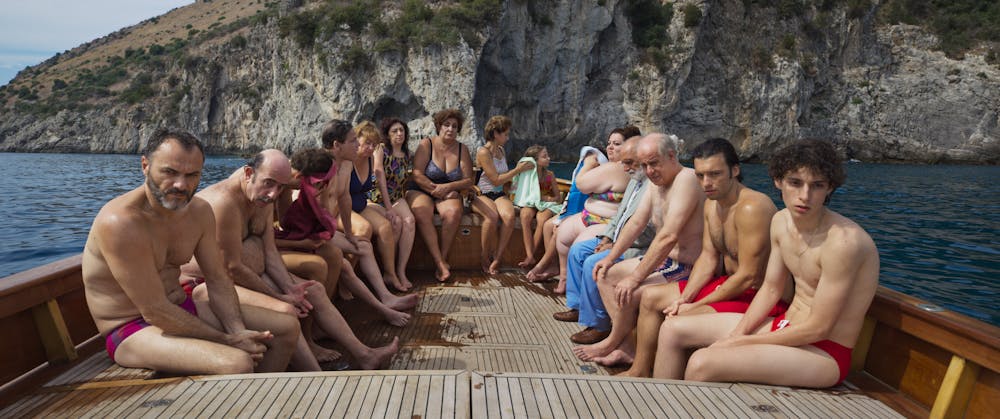
Paolo Sorrentino’s latest film is his best to date, and I wouldn’t hesitate to suggest that this will endure as a masterpiece of cinema. In some respects, it’s a simple coming of age film, following adolescent Fabietto (Filippo Scotti) and his family as they live their lives in Naples in the 1980s, anchored around the event of Maradona coming to play soccer for Napoli.

But it’s a far more complex film than its simple narrative would suggest, and where other films of this type chart the course of the main character’s life purely through narrative, with events marking their education about the reality of the world, The Hand of God embodies this transformation at a formal cinematic level in the film’s transition from kitschy Italian comedy in the first part to devastating urban drama in the second.

It begins like a tourist advertisement for Italy. We are presented with a colourful, sun-drenched Naples bound by the usual cliches: buxom women, sexist men, yearning boys, bad driving, and bounteous food. It’s good natured and funny, and so beautifully shot that we are sucked into the world despite all the silliness.

Hand of God is set in Naples in the 1980s, anchored around the event of superstar player Maradona coming to play soccer for Napoli.
Sydney Film Festival

However, midway through a completely random tragic event befalls Fabietto, and the film’s whole tenor is transformed in a way that forces us to re-imagine what we have just been watching. All of the clichés are suddenly redrawn as the product of Fabietto’s (and the cinematic viewer’s) fantasies about Italy and the world at large, as realised with the simplicity of caricature.

The second half moves more clearly into the “true” consciousness of Fabietto as he finds himself deracinated, bereft, wondering around Naples without a clue what to do. His formerly adored Naples soccer team no longer holds any interest for him, and the hand of God, rather than referring to his idol Maradona, now seems to suggest, merely, the cruelty and arbitrariness of the world.

The Hand of God is a haunting, miraculous film about the power – and lack thereof – of our illusions to comfort us. Despite its appearance, it is hard edged and unsentimental, forcing us to think about our positions as subjects in the cinema.

Pleasure

Like many of the best films about America, Pleasure is made by a European, Swedish writer-director Ninja Thyberg. It is a thoroughly formulaic film, following an ingenue’s rise to stardom in an American tradition stretching from Paul Verhoven’s Showgirls back to Theodore Dreiser’s novel Sister Carrie. But this makes Pleasure no less pleasurable.

The narrative is centred on Bella Cherry (Sofia Kappel) as she arrives in LA to try to become, as she puts it early in the film, the best porn star in the world. We follow her from shoot to shoot, on her way to becoming a “Spiegler girl” (played by real-life talent agent Mark Spiegler, with all of the cast of the film, except Kappel, coming from the porn industry).

Much of the action is comical, and one of the key comedic tropes of the film is the contrast between the fantasy when the cameras are rolling and the reality when the cameras stop. Brutal, tattooed men become attentive and sensitive coworkers.

Pleasure follows Bella Cherry (Sofia Kappel) as she arrives in LA to try to become, as she puts it early in the film, ‘the best porn star in the world’.
Sydney Film Festival

But it’s not all hugs and jokes. In a particularly disturbing sequence, the boundaries between reality and fantasy are blurred during a “rough sex” shoot. Bella finds herself harassed and abused by two men on camera, demands they stop, and when she tries to get out of it the director and actors pressure her to continue. When she later confronts her agent, claiming that she was “raped,” he replies “Don’t throw that word around just because you had a bad day at work.”

The inconsistency of Bella’s experience across different “rough sex” sets – rather than the morality of the acts themselves – is critically scrutinised by the film as a reflection of a general lack of regulation in the industry.

Kappel is absolutely mesmerising as Bella, star-struck ingenue-come-Machiavellian player, and she performs the part with confident understatement, surprising for an actress in her first film. The supporting cast are equally brilliant, including newcomer Revika Anne Reustle as Joy, and porn actors Chris Cock and Kendra Spade in non-porn roles as Bella’s friends Bear and Kimberly.

Pleasure is an intense experience, raucous, but terrifying at times too. It is beautifully shot by Sophie Winqvist, capturing the neon lights of party LA with electric intensity, while visually connecting this to the other LA – the LA of the sprawling, post-industrial wasteland. This is a film that truly revels in its own pleasure, amoral and sublime.

Television Event

Television Event is an extremely well-made documentary that follows the difficulties of the (American) ABC network producing and then exhibiting the nuclear apocalypse telemovie, The Day After, which aired in 1983 and became the most-watched TV movie to this day.

Director Jeff Daniels skilfully assembles a plethora of archival material, interspersing this with talking head interviews with the main figures behind the television event. This includes director of The Day After, Nicholas Meyer, and his nemesis at ABC, executive Stu Samuels, who still mostly have only negative stuff to say about each other.

Television event is a documentary about the Cold War nuclear apocalypse telemovie, The Day After, which aired in 1983 and became the most-watched TV movie to this day.
Sydney Film Festival

While it taps into a certain nostalgia for the period, evident in the hilariously outdated network promos and talk shows featured in the film, the story of the conception, filming and screening of the movie is carefully contextualised by Daniels in terms of the Reagan-era Cold War, with the anti-nuke message of the film changing, the film suggests, America’s nuclear policy.

And this is the ultimate claim of the film – that mass media does have the potential to positively effect the world for most of the population, not just the powerful who control the networks – even if one’s cynicism regarding the military-media-industrial complex is usually warranted.

The Story of My Wife

In a seemingly inconsequential piece of dialogue in Ildikó Enyedi’s The Story of My Wife, protagonist Jakob (Gijs Naber) challenges the astrological obsession of his landlord Herr Blume (Josef Hader). Why not a carrot?, he asks him – the miracle of the world is in a carrot, not in the stars, in the simplicity of being-as-it-is, not in the attempt to decipher some underlying mystery.

In this moment, the film articulates its vision of the world – the mystery is in the play of light across surfaces, not in the attempt to render depth where there is none. And the film performs this truth: it is an epic-scale production, a period film featuring meticulous design in every aspect – and yet the whole thing seems effortless, breezing along for nearly 3 hours with the lightest of touches propelled by two amazing actors in the lead roles.

After sea captain Jakob is advised to get a wife by his vessel’s cook, he promises his colleague that he will marry the next woman who enters the café in Paris where they are drinking. It happens to be Lizzy (Léa Seydoux), and, charmed by his combination of bravado and frankness, she agrees to his proposal.

The Story of My Wife is epic in length, a massive-scale production shot in multiple languages.
Sydney Film Festival.

Once they are married, suspicions regarding his wife’s motives immediately begin to emerge. He cannot believe she has married him – she is a social butterfly type, he is a stodgy sea captain. He is unable to follow his own advice, to find beauty in the present, in the simple appearance, in the being of the carrot.

It sounds tragic and dramatic, but it’s not really, with the film adopting the easygoing attitude of Lizzy, at the same time romantic, whimsical and profoundly melancholic. Its three hours passes like a flash of light on a Parisian street, and it is rare to see such a light touch in a film today.

Pompo the Cinéphile

Pompo: The Cinéphile, an animated work from writer-director Hirao Takayuki, is an incredibly joyful film. The title character is a hotshot producer in “Nyallywood”, renowned for her exciting but trashy blockbusters, the kind of stuff involving bikini-clad beauties fighting giant octopi with machine guns. Pompo, despite her status, acts and looks like a kid, with her temper tantrums, one suspects, poking fun at some of the more eccentric Hollywood producers.

Pompo the Cinéphile is set in ‘Nyallywood’, a fictional Hollywood analogue.
Sydney Film Festival

When Pompo develops an idea for a more serious dramatic film – a corny but completely believable Oscar-bid type film about an ageing conductor’s path to redemption – she enlists her assistant, film nerd Gene, to direct it. We follow Gene as he flourishes into a star director, with his rise paralleling the rise to stardom of the leading actress in the film, Nathalie.

The whole thing plays like a weird and delightful fantasy. It’s of the funny and sweet rather than violent and mean school of anime, but this does not make its barbs about the film industry any less incisive. This film will not be for everyone – maybe not even for most – but it makes my top five as an exercise in pure cinematic joy, full of stunningly drawn images and a pleasurably escapist narrative.

Other hits

Many other brilliant films screened, like Eddie Martin’s stunning documentary The Kids, which looks at the aftermath of career and life of those who participated in Larry Clarke/Harmony Korine’s famous 1990s film Kids, and received virtually nothing for their efforts. Or Paul Schrader’s brooding exercise in minimalistic noir, The Card Counter, about an ex-torture specialist soldier who now spends his life travelling from casino to casino.

Then there were the standouts from the Freak Me Out section of the festival, The Spine of God, a fantasy film made by rotoscope animation that played like an R-rated, ultraviolent version of the Masters of the Universe cartoon, and Censor, a grim, beautifully made horror film set in the UK video nasties era, about a censor who finds herself swept into her own horror story.

The two strongest films not in the above five are A Hero, an Iranian film from Asghar Farhadi that skilfully dissects the effects of social media when a prisoner’s return of a bag of gold becomes a local media event, and Compartment Number 6, a beautifully shot film from director Juho Kuosmanen that follows the budding friendship between pretentious Irina (Dinara Drukarova) and macho Vadim (Yuriy Borisov) as they share a compartment while travelling across Russia by train.

A frequent refrain during this film festival was that “Sydney needs the festival now more than ever.” It sounds corny, but having sat in the dark with masses of potentially germ-bearing strangers over the past twelve days, collectively participating in an absolute feast of cinema, I can at least confirm this for myself.

The Conversation

Ari Mattes does not work for, consult, own shares in or receive funding from any company or organization that would benefit from this article, and has disclosed no relevant affiliations beyond their academic appointment.

ref. 5 unmissable films from the Sydney Film Festival – https://theconversation.com/5-unmissable-films-from-the-sydney-film-festival-171814

Electric cars alone won’t save the planet. We’ll need to design cities so people can walk and cycle safely

Source: The Conversation (Au and NZ) – By Timothy Welch, Senior Lecturer in Urban Planning, University of Auckland

EV

At the COP26 climate summit, world politicians patted themselves on their backs for coming to a last-minute agreement. Humanity now waits with bated breath to see if countries implement the commitments they made, and if those commitments help the planet.

If the rest of our climate progress mirrors the policies around transportation, we’re in for a difficult future.

COP26 may have been one of the last chances to head off devastating climate change, and yet, the best and boldest action our leaders could envision for transportation was the universal adoption of electric vehicles (EVs) — with a vague nod to active and public transport.

EVs are exciting for politicians, many businesses and a few drivers. They give us the illusion we are dramatically reducing our environmental impact while changing virtually nothing about our lifestyles.

But EVs do what cars with internal combustion engines (ICE) have always done to our urban areas. They make it possible to put greater distances between the places we live, work and shop. But ever expanding cities are unsustainable.

Building endlessly into greenfield areas and swapping forests or agricultural land for low-density housing uses exorbitant amounts of limited resources. The further out our cities grow, the less interest there is in building up to achieve the scale our urban areas need for the efficient use of infrastructures like water, sewerage, electricity and public transport.

Electric cars are still cars

Electric cars make our cities less attractive and less efficient for more sustainable modes of transport. No matter the type of propulsion, people driving cars kill 1.35 million people globally, including more than 300 in New Zealand, every year.

More cars in cities mean more space taken for parking, less room and more danger for active modes and less efficient public transport. Plugging in a car doesn’t stop it from being a lethal machine or causing congestion.

There is still no clear and sustainable pathway to manage the e-waste generated by EVs. Electric cars are not “green”. They still use tyres which create massive waste streams. Tyre wear produces microplastics that end up in our waterways and oceans.

Although EVs use regenerative braking, which is better than traditional internal-combustion cars, they still use brake pads when the brakes are applied. Braking generates toxic dust composed of heavy metals like mercury, lead, cadmium and chromium. These heavy metals make their way to our streams and rivers, embedding themselves in these waterways forever.

Driving less, switching to active transport

Even if EVs were great for the planet, we may not get to a level of use in New Zealand to meaningfully reduce transport emissions to merit our climate goals.

New Zealand introduced subsidies in July this year, but at this point less than 0.5% of the vehicle fleet is fully electric. At the current rate of EV adoption, it will take many decades before enough electric motors propel our vehicle fleet to reduce greenhouse gas emissions.

According to the Climate Change Commission’s advice to the government, to achieve New Zealand’s 2050 net zero target, at least 50% of imported light vehicles would need to be fully electric by 2029, with no light internal-combustion vehicle imports from the early 2030s. The report goes on to concede that:

Even with the rapid switch to EVs, roughly 80% of the vehicles entering the fleet this decade would still be ICE vehicles.

The current rates of EV adoption reflect uptake by the wealthiest in our society. Once those with the greatest disposable income purchase electric cars, we can expect the adoption curve to flatten.


Read more:
Seven reasons global transport is so hard to decarbonise


It is unfair to expect middle and lower-income people to replace their current vehicles with more expensive electric cars. Mitigating emissions through consumerism is highly inequitable. We are placing the most significant burden on the most vulnerable groups.

Those who push technology like EVs make big promises that lull us into a false sense that we can live our lives in virtually the same way we do now and not worry about the planet. In reality, our lifestyles need to undergo significant changes to make a meaningful impact.

Despite all this, there is good news. The changes needed to move us closer to a sustainable future are many of the things a lot of us love about living in a community. It’s about bringing different land uses closer together to make it possible to live, work and shop in your neighbourhood. It’s about connecting communities with cycling and public transport infrastructure for longer trips.


Read more:
COVID-19 cyclists: Expanding bike lane network can lead to more inclusive cities


Life as we know it will have to change, but that change could be for the better. We don’t need to ditch the more than three million fossil fuel cars we already have, but we should drive them a lot less. Though it sounds nice, buying a new electric car won’t save the planet.

The Conversation

Timothy Welch does not work for, consult, own shares in or receive funding from any company or organisation that would benefit from this article, and has disclosed no relevant affiliations beyond their academic appointment.

ref. Electric cars alone won’t save the planet. We’ll need to design cities so people can walk and cycle safely – https://theconversation.com/electric-cars-alone-wont-save-the-planet-well-need-to-design-cities-so-people-can-walk-and-cycle-safely-171818

Labor $2.4 billion plan to expand suburban and regional access to full-fibre NBN

Source: The Conversation (Au and NZ) – By Michelle Grattan, Professorial Fellow, University of Canberra

Anthony Albanese is promising a Labor government would invest $2.4 billion to boost the NBN, expanding full-fibre access to 1.5 million homes and businesses.

With the faux election campaign in full swing, although the election isn’t until next year, Albanese on Wednesday will release a policy designed to push fibre deeper into the suburbs and regional areas.

Labor will pledge that more than 90% of premises across Australia in the fixed line footprint – more than 10 million premises – would have access to “world-class gigabit speeds” by 2025.

“Labor will also keep the NBN in public hands, keeping internet costs for families affordable while ensuring improvements in the network,” Albanese and shadow communications minister Michelle Rowland say in a statement.

The opposition says its proposed investment would be funded by a combination of Commonwealth loans, free cash flows and equity if deemed appropriate. The mix would be determined in government.

The plan would run fibre into the street, giving those relying on copper wire the choice of having fibre connected by NBN without extra cost to their premises to get faster speed.

“Owners of these properties, mainly in the outer suburbs of our cities and in regional areas, were dudded by the Coalition when it took an axe to Labor’s original NBN design in 2013,” the policy says.


Read more:
It’s time for Anthony Albanese to get angry


“It is estimated 660,000 premises in the regions will benefit under this plan, and 840,000 in the suburbs.”

The policy says 7.5 million households and businesses would be on a full-fibre connection or have access to one, and nearly seven in eight premises in the fibre to the node footprint would have fibre access.

Labor says its plan would create 12,000 jobs for construction workers, engineers and project managers in the regions and suburbs.

Albanese and Rowland condemn the Coalition’s oversight of the NBN as “a masterclass in technological incompetence and mismanagement causing Australia to trail behind other developed countries, slipping to 59th in the world on average broadband speeds”.

They say this has been “a drag on our economy. It has undermined the competitiveness of small businesses and left our health care and education sectors reliant on patchy, outdated technology”.


Read more:
Coalition improves but Morrison’s slide continues in Newspoll; Liberals in danger in Kooyong


Under Labor’s original plan, unveiled by the Rudd government in 2009, the NBN was set to install fibre-optic cables to 93% of Australian homes and businesses, as part of a wholesale replacement of the existing copper network.

This “fibre to the premises” network would have delivered speeds of 100 megabits per second and above to almost the entire population, with wireless and satellite internet connections covering the remote areas not covered by the new network.

But the plan was significantly scaled back by the Abbott government in response to concerns the $37.4 billion price tag, including $30.4 billion of public funding, was too high.

The replacement NBN plan involved a mixed approach in which , while others would make do with “fibre to the node” – optical cables to a central hub from which the existing copper network would service individual premises.


Read more:
Why does my internet connection feel slow and jumpy, even when my internet speed is high?


The rollout of the revised plan was beset with technical problems in many areas, while some experts decried the mixed-technology plan as short-sighted (see https://theconversation.com/expert-panel-the-state-of-the-national-broadband-network-56073).

While other nations have uniform 100Mbps broadband, Australia has languished in the international league tables, offering speeds of 25Mbps across much of the NBN. Telecommunications firms such as AT&T in the United States have begun designing networks capable of delivering 1 gigabit per second (1,000Mbps) as part of efforts to future-proof their infrastructure for the coming decades.

The Conversation

Michelle Grattan does not work for, consult, own shares in or receive funding from any company or organisation that would benefit from this article, and has disclosed no relevant affiliations beyond their academic appointment.

ref. Labor $2.4 billion plan to expand suburban and regional access to full-fibre NBN – https://theconversation.com/labor-2-4-billion-plan-to-expand-suburban-and-regional-access-to-full-fibre-nbn-171963

Morrison spruiks Australia’s potential in quantum technology

Source: The Conversation (Au and NZ) – By Michelle Grattan, Professorial Fellow, University of Canberra

Support for a quantum commercialisation hub is part of a plan for “critical technologies” that Scott Morrison will unveil on Wednesday.

The government will invest more than $100 million in quantum technology, including $70 million over a decade for the hub to pursue partnerships with “likeminded” countries to commercialise Australia’s quantum research and help businesses find markets and investors.

The government has already signed a co-operation agreement with the United States.

Chief Scientist Cathy Foley will lead the development of a quantum strategy.

Quantum technology has vast potential in computing, defence, and cryptography.

The government’s “blueprint” says critical technologies – which can be digital, such as artificial intelligence or non-digital, such as synthetic biology – are those able “to significantly enhance or pose risk to our national interest”.

“They are fundamental to Australia’s economic prosperity, social cohesion and national security, and are increasingly the focus of international geopolitical competition,” the document says.

Although the blueprint does not spell it out, it is clear that the danger posed by China is one central consideration in the government’s thinking about the need to both advance and protect Australia’s critical technologies.

“Critical technologies confer a strategic edge, and at a time of intensifying geostrategic competition, this can be used to threaten our values, interests and way of life,” the blueprint says.

The critical technologies plan includes a list of 63 technologies but the government is focusing on nine.

These are critical minerals extraction and processing; advanced communications (including 5G and 6G); artificial intelligence; cyber security technologies; genomics and genetic engineering; novel antibiotics, antivirals and vaccines; low emission alternative fuels; quantum technologies; and autonomous vehicles, drones, swarming and collaborative robotics.


Read more:
View from The Hill: Scott Morrison caught in catch-22 over the issue of his integrity


In a speech to the Australian Strategic Policy Institute, released ahead of delivery, Morrison says one goal in the government’s blueprint is to “maintain the integrity of our research, science, ideas, information and capabilities – to enable Australian industries to thrive and maximise our sovereign IP”.

Morrison says “quantum science and technology has the potential to revolutionise a whole range of industries, including finance, communications, energy, health, agriculture, manufacturing, transport, and mining.

“Quantum sensors, for example, could improve the discovery of valuable ore deposits and make groundwater monitoring more efficient; and quantum communications could provide for secure exchange of information to better secure financial transactions.

“Quantum technologies will also have defence applications, like enabling navigation in GPS denied environments and helping to protect us from advanced cyber attacks.”

Morrison says Australia leads globally in several aspects of quantum technology, and has a foundation for a thriving quantum industry. The national quantum strategy would better integrate the activities of industry and government.

“I’m confident the new strategy will help position Australia as a quantum technology leader in the Indo-Pacific.”

Morrison says technology reflects the values of the society that creates and uses it.

“We want technology to protect our citizens’ autonomy, privacy and data.

“Australia, like the United States, is committed to playing our part so that rules and norms around technology reflect the values of our open societies.


Read more:
Is Morrison gaining a reputation for untrustworthiness? The answer could have serious implications for the election


“But … not all governments see technology the same way,” he says.

“We cannot shy away from the ethical implications of new technologies.

“We need to be asking ourselves what should be done with technology — not just what can be done.

“Ensuring our citizens understand that technologies are safe and secure and working in their interest is fundamental in providing the enabling environment necessary to support deployment.”

The Conversation

Michelle Grattan does not work for, consult, own shares in or receive funding from any company or organisation that would benefit from this article, and has disclosed no relevant affiliations beyond their academic appointment.

ref. Morrison spruiks Australia’s potential in quantum technology – https://theconversation.com/morrison-spruiks-australias-potential-in-quantum-technology-171975

Corruption in Pacific big problem – and it’s getting worse, says report

Asia Pacific Report newsdesk

Pacific Islanders believe corruption is a big problem in both their governments and the business sector, says a new report.

About one third of 6000 interviewees across the region believe that most or all members of parliament and staff in heads of government’s offices are involved in corruption, says Transparency International’s Global Corruption Barometer – Pacific 2021.

The survey subjects across 10 countries and territories were asked what they thought about corruption, if they have directly experienced it, and whether things could change.

Transparency International says the result is the most extensive public opinion data on corruption ever gathered in the region.

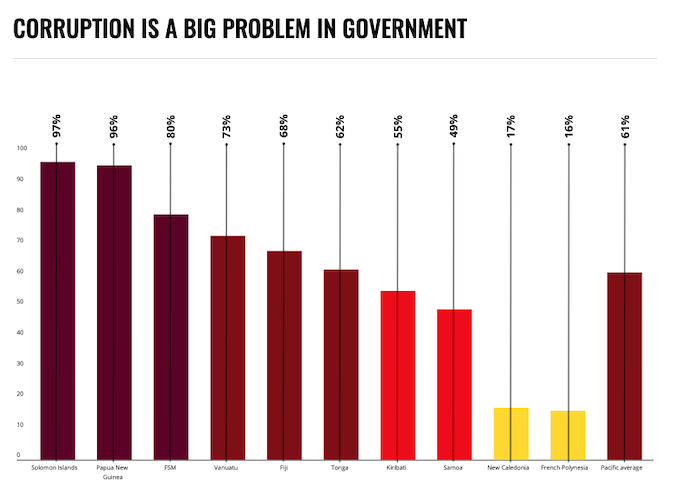
Corruption was perceived to be worst in Solomon Islands (97 percent) and Papua New Guinea (96 percent), followed closely by the Federated States of Micronesia (80 percent). It is also bad in Vanuatu (73 percent), Fiji (68 percent) and Tonga (62 percent).

Despite more than half of respondents reporting a “fair amount” or a “great deal” of trust in their government to do a good job and treat people fairly, 61 percent believe corruption is a significant problem in their government and 56 percent think it is getting worse.

Impunity also appears to be a problem, with less than a fifth of respondents (18 percent) believing that corrupt officials frequently face appropriate consequences for their actions.

Added to this, only 14 percent believe their government regularly considers them when making decisions.

Bribery common
About one in three paid a bribe

“One of the most significant results was how often ordinary people in the Pacific directly encounter corruption in their daily lives,” says the report.

“Thirty-two percent of interviewees recently paid a bribe to receive public services – a higher rate than any other region surveyed by Transparency International.”

However, rates differ widely by country.

The most common reason given across the region for bribery is to receive a quicker or better public service.

Bribery appears to be a problem across a range of government services, from applying for official government documents to dealing with the police.

Only 13 per cent of those who paid a bribe for a public service reported it. This rises to around 30 percent in Fiji and Kiribati.

‘Sextortion’ also a problem
“Even more worrying is that 38 percent of respondents say they or someone they know have personally experienced ‘sextortion’, where an official requests sexual acts in exchange for an essential government service,” says the report.

About a quarter of respondents have been offered a bribe for their votes. This has serious consequences for the integrity of national and local elections.

In addition, 15 percent of people have received threats of retaliation if they do not vote in a specific way.

It is not only their governments which Pacific Islanders are concerned about. A majority of people interviewed feel that corruption is a big problem in business, too.

“A corruption ‘hotspot’ appears to be government contracts, which more than two thirds of respondents believe businesses secure through bribes and connections,” the report says.

“Almost half of the people we surveyed think there is little control over companies [which] extract natural resources, which is of particular concern given that this is one of the largest industries in the region.”

The good news, says Transparency International, is that “more than 70 percent of respondents say that ordinary people can help to fight corruption”.

“More than 60 percent also think their government is doing a good job at combating corruption”

Transparency International Pacific corruption perceptions
How Pacific Islanders in the 10 surveyed countries perceive corruption … French Pacific believed to have the least corruption. Graph: Transparency International
Print Friendly, PDF & Email

Article by AsiaPacificReport.nz

COP26 climate trip branded ‘junket’ – Prasad slams 36-strong Fiji team

By Luke Nacei in Suva

Opposition National Federation Party leader Professor Biman Prasad has hit out at the Fiji government, calling on Prime Minister Voreqe Bainimarama and Attorney-General Aiyaz Sayed-Khaiyum to tell the Fijian people who funded the 36-member Fiji delegation to the Glasgow COP26 climate summit.

Professor Prasad said Fiji’s failure to achieve anything tangible from its agenda at COP26 proved that the donor-funded trip was a “junket”.

He said human rights activist Shamima Ali was right to ask the government to tell Fiji’s people who funded the delegation to Glasgow.

COP26 GLASGOW 2021

“Bigger countries than Fiji, such as New Zealand, sent fewer than 10 people,” he said.

“The Marshall Islands made a bigger impact than Fiji at COP26. It had a delegation of just five.

“But instead of sending a small, effective delegation that Fiji could afford — and lowering Fiji’s own carbon footprint — Fiji put out the begging bowl for three dozen people to travel.

“But which donors donated the money? Were these donors aligned with Fiji’s interests at COP26? Or were they big polluters such as China or Australia?

“Was the Fiji government compromised? Whose tune were the Prime Minister and Aiyaz Sayed-Khaiyum dancing to in Glasgow?

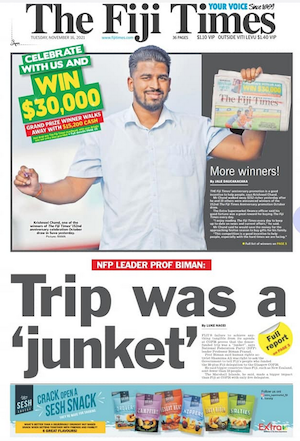
Fiji Times 16-11-2021
How The Fiji Times reported the COP26 funding controversy today. Image: Fiji Times screenshot APR

“And regardless of who was paying, the Prime Minister Voreqe Bainimarama and Attorney-General Aiyaz Sayed-Khaiyum should tell the people of Fiji what per diem allowances they collected for the duration of the trip?”

Professor Prasad said tens of thousands of people had had their jobs and lives ruined by covid-19 and could barely keep their families fed.

“Perhaps our elected leaders are too ashamed to tell us what money they have been able to receive in their two weeks away from the country.”

Questions sent to Bainimarama and Sayed-Khaiyum by The Fiji Times remained unanswered when it went to press last night.

Luke Nacei is a Fiji Times reporter. Republished with permission.

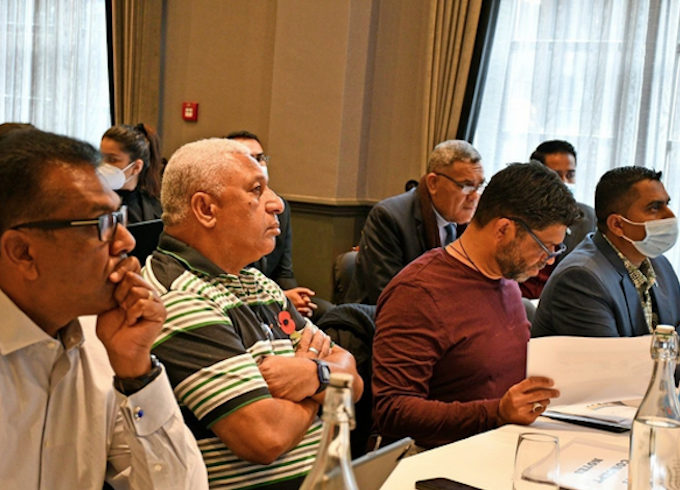
Fiji Prime Minister Voreqe Bainimarama being briefed at COP26
Fiji Prime Minister Voreqe Bainimarama being briefed on Pacific priority areas at COP26. Image: FT/Fiji govt
Print Friendly, PDF & Email

Article by AsiaPacificReport.nz

Record 222 new community cases of covid-19, one death in NZ

New Zealand reported a record 222 new community cases of covid-19 and one virus-related death today.

There are now 91 people in hospital and seven in ICU across the country, reports the Ministry of Health.

More than 21,000 doses of vaccine were administered yesterday.

Of today’s official cases, 197 cases are in Auckland, 20 are in Waikato, two are in Taupō, two are in Wairarapa, and one is in Northland.

Public health officials said they were investigating a common link between cases reported in Taupō, Tararua and Masterton.

Patient in 70s dies
In a statement this afternoon, the ministry confirmed a patient in her late 70s had died at Auckland City Hospital after she was admitted on November 11 and had subsequently tested positive for the virus.

This takes the total of deaths from covid-19 in New Zealand to 35.

Public health staff in Auckland are now supporting 4416 people to isolate at home around Auckland. This includes 2023 covid-19 cases.

There are 18 community testing centres available across Auckland today.

The ministry said 21 residents and four staff members of Edmonton Meadows Care Home in Henderson had tested positive since the start of the outbreak.

Five residents who tested positive are receiving appropriate ward-level care at Auckland hospitals, it added.

This article is republished under a community partnership agreement with RNZ.

Article by AsiaPacificReport.nz

Hundreds of NZ health workers unvaccinated facing deadline

By Rowan Quinn, RNZ News health correspondent

About 2000 New Zealand district health board workers had not been vaccinated 15 hours before the deadline to lose their jobs.

From today no one can work in healthcare unless they have had at least one dose of the covid-19 vaccine or are exempt from the government mandate.

Unite Union’s Gerard Hehir represents six Waikato Hospital orderlies who have decided to quit.

They had a last minute meeting with the district health board (DHB) yesterday, one of a series over the past few weeks.

“People have been given the opportunity to think about it, respond, have some time, offered more information,” he said.

Even though they could not work from today, they would have one more meeting this week, a chance to change their minds before their contracts were terminated, he said.

Other DHBs also met with workers yesterday, with most offering the chance for last minute vaccinations.

Numbers unclear
It was still unclear how many people have made the same choice as the Waikato orderlies.

A spokesperson representing all district health boards said at 9am yesterday they estimated there were about 2 percent or 3 percent of their 80,000 staff nationally who were unvaccinated — between 1600 and 2400 people.

But it would be a few days before they knew the final number, she said.

That estimate did not count the tens of thousands of contractors who worked at hospitals, doing jobs like carpentry, food preparation or patient transport.

Counties Manukau DHB managers have been told they are responsible for checking every contractor who is coming on site to do work for their team.

The mandate went beyond DHBs to people working in the community – GPs, physiotherapists, psychologists, midwives, chiropractors and more.

The College of GPs medical director Dr Bryan Betty said it was also trying to get a gauge on how many of the country’s 5000 GPs were not vaccinated.

He knew of about 20, but also of nurses and receptionists who would lose their jobs.

Awaiting DHB figures
Nurse and midwife organisations were also waiting on DHB figures to find out how their professions were impacted.

Nurses Organisation Kaiwhakahaere Kerri Nuku said there was a small number out of the roughly 50,000 nurses working around the country.

She knew personally of six who were still holding out but also of some who had been reluctant then realised their jobs were more important and got vaccinated.

College of Midwives chief executive Alison Eddy said she worried about losing any midwife from the workforce, because it was already so stretched.

Hehir said the union was supporting its workers but it did back the mandate.

When it surveyed its DHB workers, for every vaccine hesitant response, there were many more from those who said they would be uncomfortable working with unvaccinated people.

“It is a real serious issue with people losing their jobs but it is also a very serious issue for people concerned about their health and the health of their families,” he said.

This article is republished under a community partnership agreement with RNZ.

Print Friendly, PDF & Email

Article by AsiaPacificReport.nz

Word from The Hill: On Morrison’s character ratings

Source: The Conversation (Au and NZ) – By Michelle Grattan, Professorial Fellow, University of Canberra

As well as Michelle Grattan’s usual interviews with experts and politicians about the news of the day, Politics with Michelle Grattan now includes “Word from The Hill”, where all things political will be discussed with members of The Conversation’s politics team.

This week they discuss Morrison’s fall in ratings on character qualities in the latest Newspoll, published in The Australian . The poll ranks Scott Morrison and Anthony Albanese on traits such as trustworthiness, likeability, and care for people. On all but three, Morrison fared worse than Albanese.

They also canvass Australia’s position post COP26, with nations already gearing up for next year’s conference and how australia has refused to increase its 2030 targets in line with other countries.

Campaigning has started for the 2022 election, and Morrison has already launched his scare against Labor, with claims of rising interest rates and petrol prices under an ALP government. This tactic has drawn comparisons with the 2004 election, when John Howard ran on similar lines.

The Conversation

Michelle Grattan does not work for, consult, own shares in or receive funding from any company or organisation that would benefit from this article, and has disclosed no relevant affiliations beyond their academic appointment.

ref. Word from The Hill: On Morrison’s character ratings – https://theconversation.com/word-from-the-hill-on-morrisons-character-ratings-171964

Is the latest ABC inquiry really just ‘business as usual’?

Source: The Conversation (Au and NZ) – By Matthew Ricketson, Professor of Communication, Deakin University

Danny Casey/AAP

A fresh fight has broken out between the national broadcaster and the Coalition government. This time, it is over a Senate inquiry, instigated by a Liberal senator, into the way the ABC handles complaints.

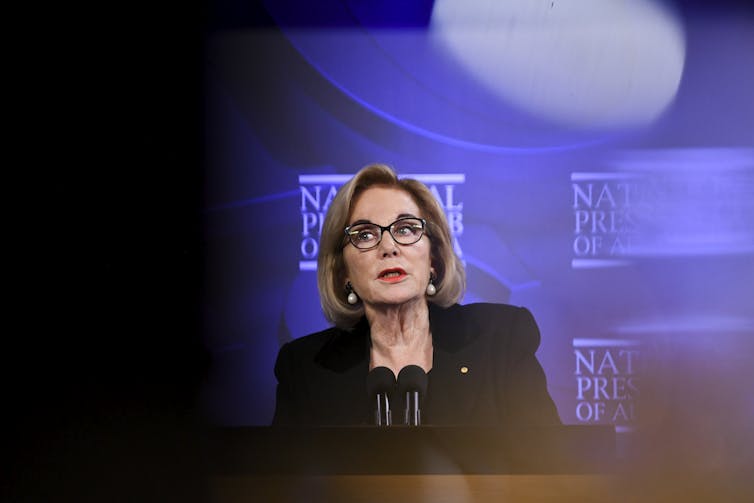
ABC chair Ita Buttrose has sensationally labelled the inquiry an act of “political interference designed to intimidate the ABC and mute its role”. She is calling on the senate to block the inquiry, when parliament returns next week.


Read more:
View from The Hill: Ita isn’t saluting the captain who picked her


Prime Minister Scott Morrison dismissed the comments on Monday, arguing a parliamentary investigation is just “business as usual” and the ABC is “not above scrutiny for how they conduct themselves using taxpayers’ money”.

We have been researching ABC-government relations for our upcoming book, Who Needs the ABC? Is there more to this simple senate inquiry than meets the eye?

What will the inquiry do?

The latest stoush broke out after NSW Liberal senator Andrew Bragg announced an inquiry into the ABC’s complaints-handling process.

It has just one term of reference, which is to

examine the adequacy of the existing arrangements to provide a framework that is accessible, responsive, efficient, accountable and fit-for-purpose.

However, in October, the ABC announced its own inquiry into the complaints-handling process. It has 11 terms of reference and is an external, independent review by former Commonwealth ombudsman, John McMillan, and former news and current affairs executive for SBS and Ten, Jim Carroll.

The Senate committee is due to report by February 2022, with the McMillan/Carroll inquiry due to come back to the ABC board by March.

Complaints handling and the ABC

The ABC set up its inquiry following criticism of the way it handled complaints about editorial decisions.

This includes comments by communications minister, Paul Fletcher, who told The Australian in September:

If viewers or listeners have a concern about a program on the ABC they should have access to a robust, independent complaints process. Yet it’s clear that this is far from the universal experience of those who complain to the ABC about a program.

Liberal Senator Andrew Bragg
Andrew Bragg was elected to the Senate at the 2019 federal election and has recently been made chair of the Senate’s communications committee.
Sean Davey/AAP

Bragg has suggested a “litany” of people are unhappy with complaints-handling, including Jewish groups and veterans. Former editor of The Sydney Morning Herald Milton Cockburn has also complained regarding the Luna Park documentary Ghost Train.

News Corp has been particularly hostile towards the ABC after Four Corners programs in August investigated the Murdoch-owned Fox News and its conduct around the 2020 US elections.

There may be merit in some of these concerns, but there is also a dollop (or should that be a wallop) of politics and ideology.

Any system can be improved, but there is no compelling evidence the ABC’s system is broken. In any case, its board has already acted to improve it.

Anyone unhappy with the ABC’s internal process can already take their complaint to the Australian Communications and Media Authority, which is responsible for regulating broadcast media.

The ABC’s complaints-handling process was also reviewed by then director of editorial policies, Paul Chadwick, and the ABC chair, Maurice Newman, in 2009. They found the processes to be “fundamentally sound” and “transparent” when compared to other media organisations. In 2018, the Australian National Audit Office reviewed the ABC and found it “effectively manages complaints” and that its system was responsive to its audience and easy to navigate.

The ‘forever war’

This latest episode should be seen in the context of what seems like a “forever war” waged by the Coalition against the ABC. Put simply, the Coalition believes the ABC is irretrievably biased against it (and pro Labor), even though we have not been able to find a properly conducted academic study that supports their belief.

Examples range from former Prime Minister Tony Abbott breaking an election eve promise not to cut the public broadcaster’s funding, to his full-frontal attacks on ABC reporting.

There are also the Turnbull government attacks on the work of senior journalists Emma Alberici and Andrew Probyn and the Liberal Party’s federal council voting to privatise the ABC in 2018.

ABC chair Ita Buttrose
Ita Buttrose was appointed as ABC chair by Scott Morrison in 2019.
Lukas Coch/AAP

Coalition cabinet ministers distanced themselves from the motion, pointing out it was not government policy. But that did not stop Morrison, then treasurer, from saying some Australians “may think the Labor Party already owns it”.

This Senate inquiry is also the latest in a long line of parliamentary investigations into the national broadcaster. Remember the 2018 inquiry into whether the ABC was breaching rules around competitive neutrality? (It wasn’t.)

There has also been the push to include the words “fair and balanced” in the ABC Act. This not only doubles up on the “objective”, “accurate” and “fair” requirements spelled out in the ABC’s comprehensive code of editorial policies, it opens the door to Holocaust and climate change deniers and anti-vaxxers to be given an equal platform.

The bill to amend the act was listed in the autumn 2020 sittings, but has not been brought on for debate.

A critical point

The ABC is at a critical point in its history, as we discuss in our coming book.

Its content reaches more people, in more ways, than at any time in its near 90-year existence. It is routinely judged by audiences to be the most respected news and current affairs provider in the country.


Read more:
America’s public broadcasters are thriving – here’s what Australian media can learn from them


Yet it is enduring probably the worst relations with any government, and that includes the Howard Coalition governments of 1996-2007 whose communications minister, Richard Alston, took ABC to the broadcasting regulator, complaining about its reporting of the 2003 Iraq war (he largely lost).

All of which give the prime minister’s recent words “business as usual” an unintentionally ironic flavour.

As to his invocation that no one is above scrutiny, well, yes of course they are not. But isn’t the ABC’s scrutiny of his government, whether on Four Corners or elsewhere, exactly what has so irritated Morrison and his colleagues?

The Conversation

Matthew Ricketson is the Media Entertainment and Arts Alliance’s representative on the Australian Press Council.

He will receive a fee for three feature writing training sessions he has been conducting for the ABC’s Asia Pacific Newsroom.

Patrick Mullins does not work for, consult, own shares in or receive funding from any company or organization that would benefit from this article, and has disclosed no relevant affiliations beyond their academic appointment.

ref. Is the latest ABC inquiry really just ‘business as usual’? – https://theconversation.com/is-the-latest-abc-inquiry-really-just-business-as-usual-171824

Russia’s anti-satellite missile test threatened both the international space station and the peaceful use of outer space

Source: The Conversation (Au and NZ) – By Melissa de Zwart, Professor (Digital Technology, Security and Governance), Flinders University

Shutterstock

This week, Russia tested an anti-satellite missile on one of its own satellites, COSMOS 1408, and created a stream of debris that forced the International Space Station (ISS) crew to take shelter in their Soyuz and SpaceX Dragon capsules.

The action has generated widespread international condemnation, including from the US Space Command, US State Department and UK Ministry of Defence. And rightly so; it was an irresponsible and menacing action in the context of recent progress towards global agreements on the responsible use of outer space.

NASA condemned the “irresponsible and destabilizing” missile test, too, saying it had also placed China’s Tiangong Space Station and crew at risk.

Harm to the space environment

The destruction of the COSMOS 1408, a defunct Russian spy satellite, generated more than 1,500 pieces of trackable debris and likely thousands more that are too small to be tracked.

Russia’s space agency, ROCOSMOS, dismissed concerns regarding the debris field, tweeting:

The orbit of the object, which forced the crew today to move into spacecraft according to standard procedures, has moved away from the ISS orbit. The station is in the green zone.

As commercial uses of space have expanded in recent years, access to the low Earth orbit – roughly the altitude zone less than 1,000 kilometres above Earth – has become increasingly important.

The ISS orbits the Earth in this zone, at an altitude of about 420km. The station shares the low Earth orbit with mega constellations of satellites – including the many satellites that form SpaceX’s Starlink internet network.

But there has been growing recognition that our use of outer space is threatened by increasing space debris, much of which has been created by anti-satellite (ASAT) missile tests, generally conducted to demonstrate technological power.

China destroyed its FY-1C weather satellite in January 2007, creating more than 2,000 trackable pieces of debris.

Russia and the US have also undertaken ASAT tests in the past. Before this week, India had conducted the most recent test in 2019, becoming the fourth country to do so.

The issues of space debris and destructive uses of outer space (both of which are linked) pose significant environmental and national security concerns.

The effects of Russia’s latest test will be felt for some time. Although smaller pieces of debris will no doubt degrade and burn up in the atmosphere, the ongoing threat to the ISS and other operators in low Earth orbit will remain.

Studies have estimated 79% of the debris created by China’s 2007 test will remain in orbit until 2108. It’s time to bring an end to these needless displays of power.

The responsible use of outer space

Russia’s action is particularly surprising given the recent progress in the United Nations First Committee towards the development of norms of behaviour in space.

Since the formation of key UN Space Treaties between 1967 and 1984, there has been little international consensus with respect to peaceful uses of outer space. Also, the last of these treaties, the Moon Agreement, received few ratifications.

After decades of stalemate in the UN, progress was achieved last year with the UK sponsoring a draft resolution for the Prevention of an Arms Race in Outer Space.

This month, the draft resolution was approved by the UN First Committee (Disarmament and International Security) by a vote of 163 countries in favour to eight against, with nine abstentions. Notably, Russia voted no.

Despite Russia’s opposition, this resolution was the first success in international efforts towards space security in several decades. Prior failed initiatives included a draft treaty sponsored by Russia and China and another draft treaty sponsored by the EU.

A shifting discussion

The 1967 UN Outer Space Treaty requires states to conduct their activities in space in accordance with international law and in the interest of maintaining international peace and security. However, the extent of these obligations have remained largely untested.

It says states must “undertake appropriate international consultations” before proceeding with any activity or experiment that may create harmful interference to the activities of another state. Yet, such consultations are rarely held. And a US Department of Defense spokesperson confirmed no such warning was provided by Russia prior to yesterday’s test.

Concern over Russia’s latest action is noteworthy. Even though international space law doesn’t explicitly prohibit ASAT tests (and countries have previously been reluctant to condemn such behaviour by other states), this development seems different.

Voices are being raised and human missions have been placed in jeopardy. Perhaps recognition is dawning that space is a fragile and finite resource worthy of protection.

The Conversation

Melissa de Zwart is a Board Member and Deputy Chair of the Space Industry Association of Australia and the Space Law Council of Australia and New Zealand.

ref. Russia’s anti-satellite missile test threatened both the international space station and the peaceful use of outer space – https://theconversation.com/russias-anti-satellite-missile-test-threatened-both-the-international-space-station-and-the-peaceful-use-of-outer-space-171955

The embarrassingly easy, tax-free way for Australia to cut the cost of electric cars

Source: The Conversation (Au and NZ) – By Peter Martin, Visiting Fellow, Crawford School of Public Policy, Australian National University

Prime Minister Scott Morrison says he wants to keep prices down.

Without his party in power, “you’re going to see petrol prices go up, you’re going to see electricity prices go up”.

There’s something practical he can do straight away to stop prices from rising.

Apart from a home, a car is the most important purchase most Australians make.

We typically hold on to our cars for six years, and most last many years longer.

This means that when we buy a car we have to have an eye on the future, on what it will make sense to drive half a decade down the track.

Electric cars are cheaper overseas

In almost every way, certainly when it comes to running and maintenance costs, electric vehicles are the best option.

And yet their price is set to come down far faster overseas than in Australia.

Here’s why.

Europe has imposed what it calls CO₂ emission performance standards.

They don’t relate to particular cars, as the term “performance standards” suggests, but to an average of what’s sold over each company’s entire range.


Read more:
Tough car emissions ceilings could get us well on the road to net-zero


From 2020 each manufacturer’s cars are limited to an average emissions of 95 grams of carbon dioxide emitted per kilometre, and vans to an average of 147 grams emitted per kilometre.

It’s up to the companies how they achieve this. They could do it by selling more low-emission and fewer higher emission conventionally-powered cars, or they could do it by selling more electric cars.

If they haven’t sold enough electric cars to get under their brand’s emissions ceiling, they’ll have to discount them to sell more in order to get average emissions down.

In Europe, electric sales are valuable

In the first year of the new European standard, average emissions from new passenger cars registered in Europe fell 12%. The share of electric cars tripled.

In 2025 the standard will become tougher again, requiring a further 15% cut in average emissions, and then from 2030 (for cars) a further 35%.

The big car manufacturers are finding it hard. It’ll make every electric car they sell valuable for them, valuable enough to sell cheaply, but only in Europe (and Canada, China, India, Japan, Korea, Mexico and the United States, which have similar standards, sometimes called fuel economy standards).

The International Energy Agency says four in five of the cars sold worldwide are subject to such standards.

In places where they are not (such as Australia) there is no particular reason for an international manufacturer to go all out to sell an electric car. It won’t help them meet the standard.

Australia has standards, sort-of

Australia has stickers.
Motorama

Not that Australia doesn’t have standards, of a sort. Since 2008 all new cars sold have had to display a sticker quoting fuel economy and emissions per kilometre.

The standards for actual CO₂ emissions are voluntary. The Grattan Institute kindly says they are “lacking in ambition and have often not been met”.

Faced with one of the few big markets in the world in which there is no particular imperative to sell electric cars, international manufacturers direct them elsewhere and sell higher emission cars here.

Their local arms want to sell better cars here, but are overruled.

The local head of Nissan puts it this way:

clear and consistent direction from governments is a critical signal to car makers to prioritise the importation of the latest low and zero-emissions vehicles

The local head of Volkswagen is more blunt.

Every six months we do an update with a board meeting on the electric vehicle environment in Australia. They are sitting in waiting for something to change, you know, but nothing ever changes. I guess the way I would put it is that it is embarrassing

It isn’t just that there is no particular incentive to discount an electric car sold in Australia. It is that there’s an incentive to charge more.

Without standards, we are an unattractive market

It harms a manufacturer’s profits to sell an electric car here that could be used to lower its average emissions profile in (say) Europe. It makes sense to do as much as is needed to keep it out of Australia.

Fixing the anomaly would be easy and would actually bring prices down, as well as increasing the limited range on offer. And it would help buyers of conventional vehicles worried about the price of petrol. New cars would use less.

Australians able to buy electric cars because of the change would find they used no petrol at all.


Read more:
Top economists call for measures to speed the switch to electric cars


Introducing international-grade standards would not require a tax and would not require a tax concession. It would merely require regulations of the kind in place elsewhere.

Business won’t object. The Business Council asked for the change four years ago. Australian car makers won’t object. We no longer have any.

Petrol refiners won’t object. They are finding it hard to reduce the sulphur and other pollutants that kill hundreds of Australians each year. The government has advanced them up to A$250 million to help.

But carbon dioxide is different. We don’t need good quality fuel to reduce it, merely good quality cars. We are able to put them in the hands of more Australians near-costlessly.

The Conversation

Peter Martin does not work for, consult, own shares in or receive funding from any company or organisation that would benefit from this article, and has disclosed no relevant affiliations beyond their academic appointment.

ref. The embarrassingly easy, tax-free way for Australia to cut the cost of electric cars – https://theconversation.com/the-embarrassingly-easy-tax-free-way-for-australia-to-cut-the-cost-of-electric-cars-171919

Is Morrison gaining a reputation for untrustworthiness? The answer could have serious implications for the election

Source: The Conversation (Au and NZ) – By Denis Muller, Senior Research Fellow, Centre for Advancing Journalism, The University of Melbourne

For good legal and ethical reasons, the media are generally wary of calling someone a liar.

It is a serious slur on a person’s reputation, implying that he or she is untrustworthy, unreliable, duplicitous and deceitful.

These are the kinds of meanings lawyers draw from the word “liar” when preparing a writ for defamation. Unless a media outlet is confident it can defend these meanings, it is foolhardy to make the accusation.

From an ethical standpoint, such a serious slur on a person’s reputation ought not be made without solid evidence and good reason.

Up to the point when French President Emmanuel Macron accused him of lying over the submarine contract, the media had generally avoided calling Morrison a liar, while many times accusing him of playing fast and loose with the truth.

Sean Kelly, in his recent book The Game: A Portrait of Scott Morrison, gives several examples.

One was a statement about the risk that asylum seekers would bring diseases such as typhoid to Australia, followed by a denial that he had said anything about the risk. Another was perpetuating the lie that the Uluru Statement from the Heart included a proposal for a third chamber of parliament. A third was when he declared Australia was “at the front of the queue” for COVID-19 vaccines when it clearly was not.

The significance of the Macron accusation is that it gave the media legal cover to call Morrison a liar by quoting the French president. Then Morrison’s predecessor, Malcolm Turnbull, said Morrison had lied to him often. This is all useful evidence.

“Oh, he’s lied to me on many occasions,” Turnbull was reported as saying. “Scott has always had a reputation for telling lies.”

Then Neil Mitchell on Melbourne radio 3AW put the accusation of lying directly to Morrison. Mitchell asked him whether he had ever told a lie in public life. Morrison replied: “I don’t believe I have, no.”

This was a very interesting answer.


Read more:
View from The Hill: Scott Morrison caught in catch-22 over the issue of his integrity


No one is in a position to refute Morrison’s belief. If he says he believes he has never lied, then that’s that. But it is not conclusive.

Morrison’s belief is subjective: it comes from within the person concerned.

The public, however, is entitled to an objective response – what his words convey to the ordinary reasonable person. The media are entitled to hold Morrison to account for the objective meaning, regardless of what he might have believed he was saying.

The media and the public are under no obligation to accept his beliefs. They can look at the facts, at the words he used, and ask: what would an ordinary reasonable person think Morrison was saying?

Take the submarine deal. Morrison’s office leaked a text message from Macron in which Macron asked: “Should I expect good or bad news for our joint submarines ambitions?”

Morrison, when asked about it, said:

[Macron] made it pretty clear he was concerned that this would be a phone call that could result in a decision by Australia not to proceed.

Morrison’s subjective interpretation is that this amounted to telling the French the deal was off. Objectively, it is nothing of the kind. It is obvious Macron did not know what the government’s decision was.

Now, under the legal cover provided by Macron and Turnbull, there has been a cascade of media stories about Morrison’s alleged lying.

The Guardian has listed five topics on which it says Morrison has made false or incorrect statements: electric vehicles, the submarines, the vaccination roll-out, Australia’s policy on Taiwan, and his calling the former Labor senator, Sam Dastyari, “Shanghai Sam”.

The Australian Financial Review’s Phil Coorey commented that there were now questions about Morrison’s integrity and this meant he was carrying baggage into the election that he had not had to carry in 2019.

Even Morrison’s media allies on Sky News are joining in. After Morrison’s about-face on electric vehicles, Andrew Bolt said Morrison was exacerbating exactly the criticism he has been getting, “of being a fake, of being untrustworthy, of not telling the truth”. Bolt went on to call Morrison a fake and a fool.

At a time when democracies are being weakened by disinformation and misinformation, the conduct that Morrison is accused of is pernicious. The world saw what happened to the American democracy when the big lie about a stolen election took hold.

This places an extra responsibility on journalists not only to be sure they tell the truth themselves but to call out lies and falsehoods when they see them.

There is a vast literature stretching back to Machiavelli’s The Prince on the subject of truth and lying in public life. Machiavelli argued that a lie was justified if it succeeded in accomplishing a political goal, wrong if it failed. Morality did not enter the calculation.


Read more:
‘I don’t think, I know’ – what makes Macron’s comments about Morrison so extraordinary and so worrying


The contemporary ethicist Sissela Bok takes a radically different view. She begins by asking under what circumstances does lying in public life undermine trust most grievously?

She also argues for a broad definition of what constitutes lying. She rejects a definition that requires both that a statement be made with the intention to deceive others and that the statement itself be false.

It is sufficient, in her view, that there be an intention to deceive – for example, by making a statement that might not be entirely false but which is couched in such terms as to mislead.

The risk Morrison takes is that if the media continue to focus on his integrity, as they have for the past couple of weeks, a stereotype will develop of him as untrustworthy. In the run-up to an election, that would be bad news for him.

The Conversation

Denis Muller does not work for, consult, own shares in or receive funding from any company or organisation that would benefit from this article, and has disclosed no relevant affiliations beyond their academic appointment.

ref. Is Morrison gaining a reputation for untrustworthiness? The answer could have serious implications for the election – https://theconversation.com/is-morrison-gaining-a-reputation-for-untrustworthiness-the-answer-could-have-serious-implications-for-the-election-171816

How can the bite of a backyard mozzie in Australia make you sick?

Source: The Conversation (Au and NZ) – By Cameron Webb, Clinical Associate Professor and Principal Hospital Scientist, University of Sydney

Cameron Webb/NSW Health Pathology, Author provided

Mosquitoes will be loving the wet weather that’s hit the east coast of Australia over the last week.

Mosquito populations naturally increase in spring, especially when there is plenty of water left around to complete their breeding cycle. So it’s a good time to start thinking about where water might be collecting around your backyard.

The bites of backyard mozzies aren’t just annoying – they can also make us sick. So what pathogens, or bugs, can mosquitoes transmit to humans? And how do they do it?

What types of mosquito are found in our backyard?

Hundreds of mosquitoes are found across the country but only a few regularly breed in our backyards. The larvae of these mosquitoes were originally found in natural water-filled receptacles like tree holes.

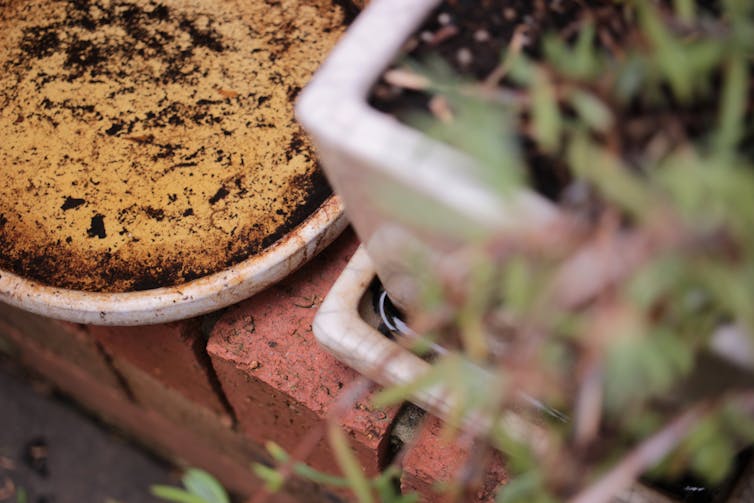
Now they’re commonly found in water-holding containers around our homes such as bird baths, damaged rainwater tanks, potted plant saucers and roof gutters. Neglected swimming pools can be a great place for mosquitoes too.

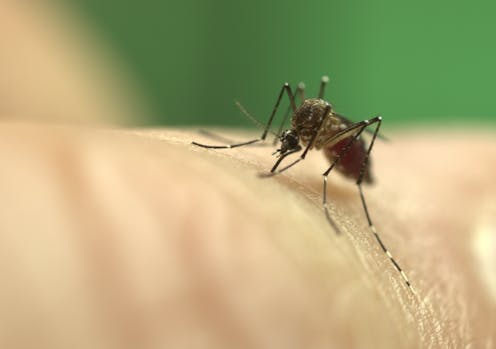
The most common of these mosquitoes is Aedes notoscriptus. It’s likely every Australian has been bitten by this “home grown” mosquito at least once. As well as being found in every corner of the country, it has also found its way to New Zealand and North America.

The common backyard mosquito, Aedes notoscriptus.
Cameron Webb

Aedes aegypti is also found in Australia. This mozzie is widespread in tropical regions of the world and loves water-filled containers around the home.

Aedes aegypti is currently only found in central and far north Queensland, but it has a habit of popping up elsewhere if given the chance.


Read more:
Hidden housemates: the mosquitoes that battle for our backyards


What diseases are a risk in our backyards?

Like most mosquitoes, these backyard mozzies need blood. When they bite, there is a chance that can spread the pathogens that make us sick.

But it isn’t just that they bite that determines if we’ll get sick. The mosquitoes need to pick up the pathogen first and that typically means they have to bite an animal or a person who has the pathogen circulating in their blood.

Dengue is the most significant mosquito-borne viral disease globally. In Australia, we’re fortunate very few local cases are reported.

The mosquito that spreads dengue viruses is Aedes aegypti. As it isn’t widespread in Australia, the risks are limited to parts of Queensland and transmission only occurs when these viruses are introduced by an infected traveller.

These regions in Queensland have been the focus of innovative mosquito management programs that have minimised public health risks by reducing mosquito populations or their capacity to spread viruses.

Ross River and Barmah Forest viruses are responsible for most mosquito-borne disease notifications in Australia. More than 5,000 cases are reported each year across the country, mostly in Queensland and New South Wales.

Outbreaks of Ross River virus have become more common, including around metropolitan areas.

In the cities, suburbs and towns of Australia, Aedes notoscriptus may well be playing an important role in spreading these viruses. There is still lots to learn about these mosquitoes, their biology, and risk to human health.


Read more:
Bzzz, slap! How to treat insect bites (home remedies included)


New research highlights how much we have to learn

Newly published research from investigators in Queensland has identified a diverse range of viruses found within Aedes notoscriptus collected throughout the suburbs of Brisbane.

After testing more than 6,600 mosquitoes, the researchers identified a number of viruses, including those of potential human health concern. The results suggest these backyard mosquitoes may pose much more than a nuisance disrupting our time in the backyard.

The researchers also discovered a diverse range of lesser known “insect-specific” viruses. These viruses only infect mosquitoes and they’re not spread to people or animals.

Interestingly, related “insect-specific” viruses are being used to develop diagnostic tests and vaccines to combat the viruses that make humans sick. This highlights the importance of identifying viruses in wild mosquito populations.

Water left in even the smallest of quantity can be home to mosquitoes.
Cameron Webb/NSW Health Pathology

What can you do about backyard mosquitoes?

There are plenty of ways you can reduce the numbers of mosquitoes in your backyard. You don’t need to rely on insecticides. You can still leave water out for pets and wildlife.

Routinely tip out, throw away, or cover up any water-holding containers. This includes discarded tyres, buckets, and bottles. Neglected children’s toys have lots of nooks and crannies that catch water too and can be a great place for mosquitoes.

Ensure your roof gutters, and other drains around the home, are regularly cleaned and your rainwater tank should be correctly installed and screened, too.


Read more:
You can leave water out for wildlife without attracting mosquitoes, if you take a few precautions


The Conversation

Cameron Webb and the Department of Medical Entomology, NSW Health Pathology, have been engaged by a wide range of insect repellent and insecticide manufacturers to provide testing of products and provide expert advice on mosquito biology. Cameron has also received funding from local, state and federal agencies to undertake research into mosquito-borne disease surveillance and management.

Andrew van den Hurk has received funding from local, state and federal agencies to study the ecology of mosquito-borne pathogens, and their surveillance and control. He is an employee of the Department of Health, Queensland Government.

ref. How can the bite of a backyard mozzie in Australia make you sick? – https://theconversation.com/how-can-the-bite-of-a-backyard-mozzie-in-australia-make-you-sick-171601

We need to design housing for Indigenous communities that can withstand the impacts of climate change

Source: The Conversation (Au and NZ) – By Tess Lea, Professor, Anthropology and Cultural Studies, University of Sydney

Remote Indigenous communities in Australia will experience the impacts of climate change disproportionately to the rest of the country.

Take the Aṉangu Pitjantjatjara Yankunytjatjara (APY) Lands in northwest South Australia, where maximum temperatures are increasing. The summer periods of sustained high temperatures are starting earlier and lasting longer.

A rapidly warming planet provides a significant challenge to design, deliver, and maintain habitable housing across Australia. Yet, few analyses consider Indigenous housing and climate change together.

A new report, Sustainable Indigenous Housing in Regional and Remote Australia, fills this gap.


Read more:
Aboriginal housing policies must be based on community needs — not what non-Indigenous people think they need


Exploring sustainable housing for First Nations communities

This new report examines the role of housing in remote and regional communities, given the increasing pressures of climate change. It shows existing and new housing can and should be better maintained for these communities. We found that Indigenous-run tenancy management is part of the solution.

In Gunnedah, we partnered with Gunida Gunyah Aboriginal Corporation, an Aboriginal community housing provider in New South Wales. The houses that Gunida Gunyah manage vary in age and quality, which all housing organisations must negotiate as they assume responsibility for ongoing maintenance.

Unfortunately the legacies of inadequate construction in housing do not belong to the past. What is built or refurbished today could haunt residents for decades. So, will attempts to revive old housing using existing national construction guidelines be enough to ensure future habitability?

We used simulation software to understand the impact of climate change, especially of increasing heat, on Indigenous housing. This software considered the effectiveness of strategies for refurbishing existing housing to improve thermal performance and energy efficiency. This simulation was modelled for Australia’s tropical, dry, and hot/mild climate zones.

After 366 simulations, our results showed modifying or refurbishing existing housing and even building new homes to meet recommended standards are not adequate measures for current or future climate changes. Even if existing housing was improved or new housing was built to current national construction code standards, at best, benefits will be short term.

Further, whether houses are old or new, crowding is a critical limitation for “thermal comfort” – the technical term for not too hot, not too cold. So, even if housing was greatly improved on the design front, crowding would cancel out the benefits.

The solution is a combination of better design and construction standards, increased housing and restorative work on existing housing, with well-funded repair and maintenance programs to ensure ongoing function.


Read more:
Why the Australian government must listen to Torres Strait leaders on climate change


Basic housing needs are not being met

As Healthabitat has long demonstrated, basic needs for householders, such as the ability to wash themselves, wash clothes and bedding, and store and prepare food, requires things to work inside and outside the house.

Decades of data shows the impact of restoring function to health hardware (washing facilities, safe food storage systems, and so on) and reveals the key reasons for housing dysfunction are poor original construction and inadequate repairs and maintenance.

Some governments respond to evidence of poor maintenance by claiming that the rent they can collect is not enough to cover the expenses involved, or that the record-keeping systems for showing what needs to be repaired are at fault, especially in remote areas.

However, our case material from the APY Lands shows the holy grail of proactive and planned maintenance of housing is perfectly doable and can generate savings.

A preventive maintenance program is economical. It minimises major hardware failures, bundles work orders (so more is fixed in less time) and reduces travel costs.

By spending three-quarters of its maintenance budget for APY Lands housing on planned works, and working closely with the Indigenous community-controlled Nganampa Health Council, Housing SA keeps repair and maintenance travel expenses for APY Lands housing to under 11%.

This contrasts with national research revealing travel costs consume up to 96% of per-unit costs for emergency repairs in Indigenous housing, leaving only 11% to 37% of budgets for planned repairs and maintenance.


Read more:
Another stolen generation looms unless Indigenous women fleeing violence can find safe housing


Greater national funding is needed for better housing designs, related construction and ongoing maintenance work to provide year-round seasonal comfort and protection, and to alleviate crowding in residences.

Australia could lead the way in meeting these needs, but first the policy challenge to meet housing, health, heat, and climate change together must be openly acknowledged.

This is the path to achieve climate mitigation rather than forced migrations. Housing, health, maintenance, and climate must be thought about together, to enable people to stay on or near their Country and sites of connection now and into the future.

The Conversation

Tess Lea received funding from the Australian Housing and Urban Research Institute (AHURI 20/PRO/73237). She is affiliated with Healthabitat, a not-for-profit organisation which urges increased attention to health hardware functionality in Indigenous and other public housing. She is otherwise an anthropologist who studies policy and bureaucracy.

This research was funded by the Australian Housing and Urban Research Institute (AHURI) – 20/PRO/73237.

Arianna Brambilla and John Singer do not work for, consult, own shares in or receive funding from any company or organisation that would benefit from this article, and have disclosed no relevant affiliations beyond their academic appointment.

ref. We need to design housing for Indigenous communities that can withstand the impacts of climate change – https://theconversation.com/we-need-to-design-housing-for-indigenous-communities-that-can-withstand-the-impacts-of-climate-change-171203

Beyond Bluey: why adults love re-watching Australian kids’ TV from their childhoods

Source: The Conversation (Au and NZ) – By Djoymi Baker, Lecturer in Cinema Studies, RMIT University

IMDB

Due to the COVID-19 extended lockdowns this year, as well as greater accessibility on streaming services, many adults have been returning to their childhoods via nostalgic kids’ TV viewing.

As part of our research project, Australian Children’s Television Cultures, we surveyed over 600 adults about their viewing habits — and it turns out some viewers never forget the joy of the television shows that they raced home to watch after school.

Many survey participants confessed they had simply never stopped watching children’s shows in the first place. Australia’s own Dance Academy (2010-2013) was frequently mentioned in the responses as a show that even adult viewers “can watch… anytime and feel connected with,” as one respondent put it.

The cast of Dance Academy.
Australia’s Dance Academy (2010-2013) is popular with adults today.
IMDB

Streaming Nostalgia

For those who didn’t keep their old VHS tapes or DVDs, it has been the advent of streaming services, from YouTube to Netflix, that has enabled viewers to rediscover their cherished kids’ shows of old. Nearly two thirds of adult respondents have revisited Australian children’s shows in recent years, most often via online clips and streaming services.

In our survey, Round the Twist (1989-2001) emerged as the favourite Australian children’s television show to revisit, with Lift Off! (1992-1995), Lockie Leonard (2007-2010) and Play School (1966-) also highly placed.

Lift Off! (1992-1995) is a popular show for adults to find clips from on YouTube.
IMDB

Netflix has licensed a swathe of Australian kids shows, among them Round the Twist and Lockie Leonard. Our survey showed that these classic programs not only turn up as recommendations on Netflix kids’ profiles, but in adults’ recommendations as well, whether or not they have children. Indeed, Netflix has been keen to license and commission nostalgic content with intergenerational appeal.

While there’s nothing new about adults getting swept up in nostalgia for childhood viewing, the streaming era has made it even easier to pass on these family viewing traditions.


Read more:
Round the Twist’s fans grew up – and their love for the show grew with them


Kids’ shows in lockdown

The heightened nostalgic urge to return to old TV shows has also been linked to the COVID-19 lockdowns many of us have recently been through, or indeed are still experiencing.

In our survey, many respondents mentioned the lockdown made them more likely to revisit children’s TV from their youth. As one survey respondent noted, “in these strange and chaotic COVID-19 times, I’ve been really feeding into the nostalgia.”

Nostalgia emerged as a term in 1688 to describe a disease primarily associated with soldiers longing to return home, even though upon their return, home was never quite the same. The word itself reflected this bittersweet combination, forged from the Greek nostos (homecoming) and algos (pain). In popular culture, nostalgia is frequently associated with warm and fuzzy feelings, but, as Svetlana Boym influentially suggests, nostalgia is also a type of grieving for a past that has been lost.

Returning to kids’ TV is a way of both grieving for and celebrating our own past childhood, as well as a pre-COVID world we used to enjoy. In other words, nostalgia is not as simple as we might at first assume.

Family viewing

Our survey responses indicate families have been uniting across the divide of lockdown restrictions and closed borders to watch old kids’ TV shows together:

“In lockdown, it’s provided a connection point for my family” by rewatching Round the Twist and Sky Trackers (1994), one respondent noted. They explained, “we talk about what we remember, and tell jokes about it consistently through messaging services.”

Not only parents but also grandparents and babysitters revealed they enjoy sharing beloved shows from their childhood with the next generation. This strategy isn’t always successful given tastes and expectations have changed, with today’s kids finding some old shows “bonkers” or describing the special effects as dated. As one parent from the survey notes, “having children now, I want to show them some of the shows I loved (whether they like it or not!)”

Many of our survey participants discussed this shared viewing across generations, but also just among other adults. So as it happens, kids’ TV isn’t just for kids.

Unifying a generation

Beyond family members, our participants are finding connections with their own generation on social media through old kids’ shows they still enjoy. Even young adults are already feeling nostalgic.

“I have loved watching on TikTok people recreating some of the iconic scenes” from H2O: Just Add Water (2006-2010) and Blue Water High (2005-2008), one participant told us. They explained, “When scrolling through the comments of these videos there’s often hundreds of other young Australians that relate as they had the same fond memories of these shows which I feel unites us.”

H2O: Just Add Water (2006-2010 has become a popular worldwide meme on TikTok, and has spurred many people to revisit the series.
IMdB

With so much content now spread across broadcasting, cable and streaming television services, it’s uncertain whether today’s kids’ TV will offer this same sense of communal nostalgia to future generations — though Bluey (2018-) is surely a contender. Bluey is already the focus of popular memes and a successful recap podcast, so perhaps the show is a contemporary vehicle for adult viewers’ nostalgia about growing up in Australia, albeit in a new guise.


Read more:
‘An idealised Australian ethos’: why Bluey is an audience favourite, even for adults without kids


Ultimately, our research indicates that engaging nostalgically with kids’ TV has been an important means of social connection during the pandemic, both between adults and within and across different generations.

Although nostalgia was initially defined as a ‘disease’, today it is combating the division the pandemic has created, with locked down audiences using streaming services to reconnect with their favourite kids’ TV and each other.

The Conversation

Djoymi Baker receives funding from the Australian Children’s Television Foundation (ACTF)

Jessica Balanzategui receives funding from the Australian Children’s Television Foundation.

Joanna McIntyre receives funding from the Australian Children’s Television Foundation (ACTF).

Liam Burke receives funding from the Australian Children’s Television Foundation (ACTF).

ref. Beyond Bluey: why adults love re-watching Australian kids’ TV from their childhoods – https://theconversation.com/beyond-bluey-why-adults-love-re-watching-australian-kids-tv-from-their-childhoods-169727

Good design lies at the heart of normalising disability – NZ’s new Ministry for Disabled People must make it a priority

Source: The Conversation (Au and NZ) – By Sally Britnell, Senior Lecturer in Nursing, Auckland University of Technology

Shutterstock

While working as a nurse in a busy hospital I began to use a magnifying glass, as I could no longer read the small print on medication vials. I regarded this adaptation as a part of my professional responsibility to keep patients safe.

Others didn’t see it the same way. I was asked to stop using the magnifying glass because it apparently reduced public trust in the care I provided patients and families.

This is just one personal example of how those with a disability are often forced to confront negative language, values and beliefs to engage with the world personally and professionally.

This goes right to conventional definitions of the word “disability” itself, which stem from a medical model that promotes the disability over the person, manifesting in the kinds of attitudes I and many others encounter in everyday life.

Minister for Disability Issues Carmel Sepuloni says the new ministry will ‘replace a fragmented system where there is no single agency responsible’.
GettyImages

Shifting attitudes

Historically, disability was identified as an individual health problem, rendering invisible the variety and normality of living with a disability. So the creation of a Ministry for Disabled People, and the principles set out in the Accelerating Accessibility in New Zealand cabinet paper, offer a unique opportunity for progress.

The new ministry aims to place disability alongside gender, age and ethnicity in terms of state representation. It should help raise the profile of disabled people while normalising their need for access to things others take for granted.


Read more:
A new ministry sets out to improve services and accessibility for New Zealanders living with disabilities


But while the ministry can potentially change the narratives around disability at a structural level, the challenge will be in shifting societal and individual attitudes.

As Workbridge CEO Jonathan Mosen has stressed, disabled people face an employment crisis due to their low “visibility” in the community and consequently low societal expectations that in turn reduce their opportunities.

Better design for disability

Improving visibility and accessibility at a practical level will depend to a large extent on good design. Take the NZ COVID Tracer app, for example, where accessibility relies on the environment in which it’s used.

How often have you seen the QR code for shops or cafes placed high up on a window or counter? For those with restricted mobility these are impossible to scan independently. Similarly, people who are blind or have low vision have difficulty finding the QR code and lining up their smartphones to scan.


Read more:
How pandemic responses neglected disabled people’s rights


While guidelines for the placement of QR codes are specific, the environment they’re used in often precludes better accessibility.

Improvements such as near field communication (NFC) technologies (currently being tested by the Ministry of Health) and size reduction of QR codes all help. But imagine a world in which the built environment was designed from the outset for accessibility.

Woman scanning QR code on shop window
Everyday activities like scanning a QR code should not be a challenge for disabled people.
GettyImages

Harnessing lived experience

Meeting recently with several app project managers to discuss accessibility, I was reminded of the need for accessible design to be considered from the inception of a project. While intentions were good, the lack of guidelines and limited lived experience of disability were evident.

Good results are overly dependent on the motivation of the project team, rather than on established rules and goals. Many industries include the input of the eventual end users in the design process, but other user subsets – such as disabled people – have long been overlooked.

Separating disability from the health sector at a socio-political level is a good start because it turns traditionally negative perceptions into ones of possibility. But is it enough to overcome both structural barriers and unconscious bias in the community?

I believe harnessing the lived experience of disabled people is key to changing the face of disability and design at both a societal and personal level.


Read more:
Should I say ‘disabled person’ or ‘person with a disability’?⁠


Changing the narrative

As the Global Centre of Possibility’s Minnie Baragwanath explains, tackling some of the limitations of dominant design practices will be key. New design paradigms will be required that respond to the complexity, volatility, uncertainty and ambiguity that disabled people often navigate in the contemporary world.

New Zealand could learn from the UK and US, where equity for the disabled is being pursued through regulation and legislation. In 2019 I attended several conferences in London and travelled to meet friends and family. While accessible design was not always perfect, the acceptance and normalisation of disability at community and professional levels was profound.


Read more:
Tracking progress on the government’s disability and employment commitments


So, while it’s exciting to see the new ministry’s plans to change the narrative around disability, it remains to be seen how this will filter down to reach everyday New Zealanders.

Perhaps now is the time to take the government at its word and expect opportunities for people with disabilities to participate meaningfully in reshaping that narrative. With this in mind, perhaps the new ministry could be renamed the Ministry for Possibility.

The Conversation

Sally Britnell does not work for, consult, own shares in or receive funding from any company or organisation that would benefit from this article, and has disclosed no relevant affiliations beyond their academic appointment.

ref. Good design lies at the heart of normalising disability – NZ’s new Ministry for Disabled People must make it a priority – https://theconversation.com/good-design-lies-at-the-heart-of-normalising-disability-nzs-new-ministry-for-disabled-people-must-make-it-a-priority-171720

How do pigeons find their way home? We looked in their ears with a diamond-based quantum microscope to find out

Source: The Conversation (Au and NZ) – By David Simpson, School of Physics, Senior Lecturer, The University of Melbourne

Shutterstock

Homing pigeons are known for their uncanny ability to find their way home – navigating complex and changing landscapes. In fact, they do this so well they were used as a source of secure communication more than 2,000 years ago.

Julius Caesar reportedly sent news of his conquest of Gaul back to Rome via pigeons, as did Napoleon Bonaparte following his defeat by England in the 1815 Battle of Waterloo.

We know pigeons use visual cues and can navigate based on landmarks along known travel routes. We also know they have a magnetic sense called “magnetoreception” which lets them navigate using Earth’s magnetic field.


Read more:
Explainer: how do homing pigeons navigate?


But we don’t know exactly how they (and other species) do this. In research published today in the Proceedings of National Academy of Sciences, my colleagues and I tested a theory that attempts to link magnetoreception in homing pigeons with tiny lumps of iron-rich material found in their inner ears.

By using a new kind of magnetic microscope, we confirmed this isn’t the case. But the technology has opened the door for us to investigate the phenomenon in several other species.

The current hypotheses

Scientists have spent decades exploring the possible mechanisms for magnetoreception. There are currently two mainstream theories.

The first is a vision-based “free-radical pair” model. Homing pigeons and other migratory birds have proteins in the retina of their eyes called “cryptochromes”. These produce an electrical signal that varies depending on the strength of the local magnetic field.

This could potentially allow the birds to “see” Earth’s magnetic field, although scientists have yet to confirm this theory.

The second proposal for how homing pigeons navigate is based on lumps of magnetic material inside them, which may provide them with a magnetic particle-based directional compass.

We know magnetic particles are found in nature, in a group of bacteria called magnetotactic bacteria. These bacteria produce magnetic particles and orient themselves along the Earth’s magnetic field lines.

Scientists are now looking for magnetic particles in a range of species. Potential candidates were found in the upper beak of homing pigeons more than a decade ago, but subsequent work indicated these particles were related to iron storage and not magnetic sensing.


Read more:
New evidence for a human magnetic sense that lets your brain detect the Earth’s magnetic field


A peek inside a pigeon’s ear

The new search is now underway in the inner ear of pigeons, where iron particles known as “cuticulosomes” were first identified in 2013.

Single cuticulosomes have been located within distinct regions in the pigeon inner ear where other known sensory systems exist (such as for hearing and balancing during flight). In theory, if there were a magnetic sensing system in pigeons, it should be located close to other sensory systems.

But to determine whether iron cuticulosomes can act as magnetoreceptors in pigeons, scientists need to determine their magnetic properties. This is no mean feat, since cuticulosomes are 1,000 times smaller than a grain of sand.

What’s more is they are only found in 30% of the hair cells within the inner ear, making them difficult to identify and characterise.

Diagram showing a homing pigeon's inner ear, with labels for hair cells and magnetic particles.
We conducted quantum magnetic imaging of iron-organelles in the pigeon inner ear.
Robert W de Gille, Author provided

To tackle this problem our group at the University of Melbourne, together with colleagues from Vienna’s Institute of Molecular Pathology and the Max Planck Society in Bonn, turned to a new imaging technology to explore the magnetic properties of iron cuticulosomes in the pigeon inner ear.

We developed a magnetic microscope that uses diamond-based sensors to visualise delicate magnetic fields emanating from tiny magnetic particles.

Disproving the theory

We carefully studied thin sections of the pigeon inner ear placed directly onto the diamond sensors. By applying magnetic fields of varying strengths to the tissue, we were able to gauge the magnetic susceptibility of single cuticulosomes.

Our results showed the magnetic properties of the cuticulosomes were not strong enough for them to act as a magnetic particle-based magnetoreceptor. In fact, the particles would need to be 100,000 times stronger to activate the sensory pathways required for magnetoreception in pigeons.

However, despite the search for the elusive magnetoreceptor coming up short, we are extremely excited by the potential of this magnetic microscope technology.

We hope to use it study a host of magnetic candidates across a variety of species including rodents, fish and turtles. And by doing so we can focus not only on cuticulosomes, but a range of other potentially magnetic particles.

The Conversation

David Simpson receives funding from the Australian Research Council.

ref. How do pigeons find their way home? We looked in their ears with a diamond-based quantum microscope to find out – https://theconversation.com/how-do-pigeons-find-their-way-home-we-looked-in-their-ears-with-a-diamond-based-quantum-microscope-to-find-out-171738

What is ECMO? Doctors are shocked so many ICU patients are on this advanced life support right now

Source: The Conversation (Au and NZ) – By Greg Kelly, Senior lecturer, The University of Queensland

Shutterstock

Doctors and health experts have expressed shock on social media recently about the number of ICU patients on ECMO treatment, especially in Victoria.

ECMO, which stands for extra corporeal membrane oxygenation, is the life support of last resort for patients with severe heart and lung failure.

At any one time, a busy ECMO hospital would normally have three to five patients supported with ECMO. The number of patients on ECMO at the Alfred Hospital in Melbourne is hovering around 20, almost all because of COVID. In the US, hospitals report more requests for ECMO for teenagers and young adults and severely stretched resources.

ECMO is a vital tool but it requires highly trained staff and a huge amount of hospital resources. Patients who survive ECMO support may have long term health complications related to their critical illness.


Read more:
We’re two frontline COVID doctors. Here’s what we see as case numbers rise


Outsourcing the heart and lungs

In lay terms, ECMO is a heart or lung bypass machine. A pump and artificial lung, both sitting outside the body, provide a level of support the sick organs can no longer provide. This way, the rest of the body’s functions are maintained.

The meaning of each of the letters of the ECMO acronym is:

  • Extracorporeal: outside the body

  • Membrane: the artificial lung is referred to as a “membrane”, or thin layer of material that keeps blood flowing on one side and oxygen on the other. This thin and porous membrane allows oxygen in and carbon dioxide out

  • Oxygenation: when oxygen enters the blood it is equivalent to breathing in. The process equivalent to breathing out, the removal of carbon dioxide, also occurs.

As well as the oxygenator, the ECMO machine includes cannulae – or tubing – to drain the blood from the patient and return it once oxygen has been added and carbon dioxide removed, a pump and a control panel.

ECMO evolved from cardiopulmonary bypass (heart-lung bypass) machines used to perform open heart surgery. But ECMO equipment is optimised for support lasting days to weeks rather than hours.

ECMO can be connected to the patient in two main ways: veno-venous (to replace just the function of the patient’s lungs) and veno-arterial (to do the work of both the heart and lungs).

diagram of blood pumping ECMO machine
Two types of ECMO transfusion.
Shutterstock


Read more:
When COVID patients are intubated in ICU, the trauma can stay with them long after this breathing emergency


A heavy load

ECMO is the highest level of life support that can be provided, with a machine wholly or partly replacing the function of the patient’s own heart and/or lungs.

Only a small number of facilities in the world, and in Australia, are able to provide ECMO. In Australia, all ECMO services are located in large city intensive care units (ICUs), though some ECMO retrieval services can initiate ECMO support in smaller hospitals before moving patients to an ECMO ICU for ongoing care.

Highly specialised equipment and staff are required to provide ECMO.

Around-the-clock care is provided by highly trained ECMO nurses. Many ECMO ICUs have one nurse to look after the ECMO machine and another to look after the patient, who remains critically ill and usually on a full suite of other life support measures in addition to ECMO. These might include a ventilator to support the lungs, a dialysis machine to support the kidneys and many different types of drugs continuously delivered to keep the patient alive.

Medical care in the ICU is provided by large specialised teams. A broader allied health team including physiotherapists, dietitians, social workers and pharmacists help provide holistic care. Perfusionists, who specialise in extracorporeal life support, provide vital expert guidance.

Life-threatening problems with bleeding, clotting and infection are common when managing ECMO patients. Patients frequently require highly specialised support from cardiothoracic surgical teams, haematology and specialised blood bank services, radiology and interventional radiology, general surgical services, infectious diseases, cardiology, and respiratory medicine.

Some patients require weeks to months of ECMO support, which can raise ethical issues regarding resources, allocation and deaths. Some COVID patients are on ECMO for more than 100 days. The COVID pandemic has severely tested the ability of our health-care services to provide ECMO care.


Read more:
If COVID hospitalisations increase, it’s still not clear how patients will be prioritised for ICU beds


Often just the beginning

A patient’s time on ECMO represents only one early phase of their critical illness recovery and, even if they survive their initial illness, most require ongoing hospital care and rehabilitation for many months afterwards. It is vital that a full suite of specialised hospital and rehabilitation services are available to maximise the patient’s chances of good quality survival.

Despite ECMO being the most complex form of life support available, the simple maxim that “prevention is better than cure” still applies.

Avoiding COVID infection by getting vaccinated, wearing a mask and paying attention to ventilation and air quality all remain vitally important to protect yourself and our healthcare system.

The Conversation

Greg Kelly is a Staff Specialist, Paediatric Intensive Care, Sydney Children’s Hospital Network and affiliated with OzSAGE.

Josh Ihle is Senior Intensive Care Physician and Deputy Head of Cardiothoracic ICU at the Alfred Hospital.

ref. What is ECMO? Doctors are shocked so many ICU patients are on this advanced life support right now – https://theconversation.com/what-is-ecmo-doctors-are-shocked-so-many-icu-patients-are-on-this-advanced-life-support-right-now-171490

Deforestation can raise local temperatures by up to 4.5℃ – and heat untouched areas 6km away

Source: The Conversation (Au and NZ) – By Sally Thompson, Associate professor, The University of Western Australia

Shutterstock

Forests directly cool the planet, like natural evaporative air conditioners. So what happens when you cut them down?

In tropical countries such as Indonesia, Brazil and the Congo, rapid deforestation may have accounted for up to 75% of the observed surface warming between 1950 and 2010. Our new research took a closer look at this phenomenon.

Using satellite data over Indonesia, Malaysia and Papua New Guinea, we found deforestation can heat a local area by as much as 4.5℃, and can even raise temperatures in undisturbed forests up to 6km away.

More than 40% of the world’s population live in the tropics and, under climate change, rising heat and humidity could push them into lethal conditions. Keeping forests intact is vital to protect those who live in and around them as the planet warms.

Trees provide shade, habitat, and regulate the supply of clean water.
Shutterstock

Deforestation hot spots

At the recent climate change summit in Glasgow, world leaders representing 85% of Earth’s remaining forests committed to ending, and reversing, deforestation by 2030.

This is a crucial measure in our fight to stop the planet warming beyond the internationally agreed limit of 1.5℃, because forests store vast amounts of carbon. Deforestation releases this carbon – approximately 5.2 billion tonnes of carbon dioxide per year – back into the atmosphere. This accounts for nearly 10% of the global emissions from 2009-2016.

Deforestation is particularly prevalent in Southeast Asia. We calculate that between 2000 and 2019, Indonesia lost 17% of its forested area (26.8 million hectares of land), and Malaysia 28% of its forest cover (8.12 million hectares). Others in the region, such as Papua New Guinea, are considered “deforestation hot spots”, as they’re at high risk of losing their forest cover in the coming decade.

Forests in this region are cut down for a variety of reasons, including for expanding palm oil and timber plantations, logging, mining and small-scale farms.
And these new types of land uses produce different spatial patterns of forest loss, which we can see and measure using satellites.

What we found

We already know forests cool the climate directly, and losing forest causes local temperatures to rise. But we wanted to learn whether the different patterns of forest loss influenced how much temperatures increased by, and how far warming spread from the deforested site into neighbouring, unchanged areas.

To find out, we used satellite images that measure the temperature of the land surface. As the illustration below shows, we measured this by averaging forest loss in rings of different widths and radius, and looking at the average temperature change of the forest inside the ring.

Illustration of how temperature changes due to forest loss.
How forest clearing near an unchanged area causes temperatures to rise.

For example, if you consider a circle of forest that’s 4km wide, and there’s a completely deforested, 2km-wide ring around it, the inner circle would warm on average by 1.2℃.

The closer the forest loss, the higher the warming. If the ring was 1-2km away, the circle would warm by 3.1℃, while at 4-6km away, it’s 0.75℃.

These might not sound like big increases in temperature, but global studies show for each 1℃ increase in temperature, yields of major crops would decline by around 3-7%. Retaining forest within 1km of agricultural land in Southeast Asia could therefore avoid crop losses of 10-20%.

These estimates are conservative, because we only measured the effect of forest loss on average yearly temperatures. But another important factor is that higher average temperatures usually create higher temperature extremes, like those during heatwaves. And those really high temperatures in heatwaves are what put people and crops at most risk.

Of course, forests aren’t normally cut down in rings. This analysis was designed to exclude other causes of temperature change, putting the effect of non-local forest loss in focus.

Why is this happening?

Forests cool the land because trees draw water from the soil to their leaves, where it then evaporates. The energy needed to evaporate the water comes from sunshine and heat in the air, the same reason you feel colder when you get out of a pool with water on your skin.

A single tree in a tropical forest can cause local surface cooling equivalent to 70 kilowatt hours for every 100 litres of water used from the soil — as much cooling as two household air conditioners.

Forests are particularly good at cooling the land because their canopies have large surface area, which can evaporate a lot of water. When forests in tropical regions are cut down, this evaporative cooling stops, and the land surface warms up.

This is not news to the people of Borneo. In 2018, researchers surveyed people in 477 villages, and found they’re well aware nearby forest loss has caused them to live with hotter temperatures. When asked why forests were important to their health and the health of their families, the ability for trees to regulate temperature was the most frequent response.

Logging road
A logging road in East Kalimantan, Bornea: logged forest on the left, virgin/primary forest on the right.
Aidenvironment, 2005/Wikimedia Commons, CC BY-SA

A climate change double whammy

In many parts of the world, including the tropics and Australia, expanding farmland is a major reason for cutting down forest. But given hotter temperatures also reduce the productivity of farms, conserving forests might prove a better strategy for food security and for the livelihoods of farmers.

If forests must be removed, there may be ways to avoid the worst possible temperature increases. For example, we found that keeping at least 10% of forest cover helped reduce the associated warming by an average of 0.2℃.

Similarly, temperatures did not increase as much when the area of forest loss was smaller. This means if deforestation occurs in smaller, discontinuous blocks rather than uniformly, then the temperature impacts will be less severe.

To help share these findings, we’ve built a web mapping tool that lets users explore the effects of different patterns and areas of forest loss on local temperatures in maritime South East Asia. It helps show why protecting forests in the tropics offers a climate change double whammy – lowering carbon dioxide emissions and local temperatures together.

The Conversation

Sally Thompson receives funding from the US National Science Foundation, the Western Australian Department of Water and Environmental Regulation, the Western Australian Department of Biodiversity, Conservation and Attractions, and the Australian Research Council. The research described in this article was funded by the National Geographic Society through the “AI for Earth” grant program.

Débora Corrêa receives funding from the Australian Research Council via the Discovery Project DP200102961 and the Centre for Transforming Maintenance through Data Science (IC180100030). The research described in this article was funded by the National Geographic Society through the “AI for Earth” grant program. Sheis affiliated with de Department of Mathematics and Statistics at the University of Western Australia and the ARC Industrial Transformation Training Centre (Transforming Maintenance through Data Science), also at the University of Western Australia.

John Duncan receives funding from the British Council COP26 Seasons Programme, the Australian Urban Research Infrastructure Network, and the research described in this article was funded by the National Geographic Society through the “AI for Earth” grant program.

Octavia Crompton receives funding from the US National Science Foundation (under the BSF-NSF joint program, the NSF EAR Program and the NSF Postdoctoral Fellowship), and the National Geographic Society’s AI for Earth program which funded the research discussed in the article.

ref. Deforestation can raise local temperatures by up to 4.5℃ – and heat untouched areas 6km away – https://theconversation.com/deforestation-can-raise-local-temperatures-by-up-to-4-5-and-heat-untouched-areas-6km-away-163584

Making Australian research free for everyone to read sounds ideal. But the Chief Scientist’s open-access plan isn’t risk-free

Source: The Conversation (Au and NZ) – By Kathy Bowrey, Professor, Faculty of Law, UNSW

Chief Scientist Cathy Foley is leading an open access strategy for Australia.
Foley estimates the Australian government invests A$12 billion a year of public money in research and innovation only for most of the publications that eventuate to be locked behind a paywall, inaccessible to industry and the taxpayer. At the same time, Australian universities and others pay publishers an estimated $460 million to $1 billion a year to see this published work.

Inspired by the European open-access initiative Plan S, Foley’s goal is to make all publicly funded Australian research publications free for the public to read. This is to be done through a sector-wide agreement between universities and publishers.


Read more:
2020 locked in shift to open access publishing, but Australia is lagging


The multinational publishers of science, technology, engineering and mathematics (STEM) research – Elsevier, Springer Nature Group, Wiley and Clarivate – are talking with the Chief Scientist. But no new sector funding is available from the government. The idea is it will pool the funds that universities currently pay to publishers to finance new sector-wide transformative agreements. These are also known as “read and publish” agreements.

Australia has lagged behind Europe and America in making research open access. That’s despite it being required by funders like the National Health and Medical Research Council (NHMRC) and Australian Research Council (ARC).

Transformative agreements could help redress the problem. However, these agreements are also a new business model.

Two existing models: green and gold

When publishers accept a journal article for publication they negotiate with authors about the licence terms that will apply to its distribution. Most publishers will issue contracts that allow for open access. It’s usually achieved in one of two ways.

The “green model” involves researchers placing copies of their work in an online open-access repository. Often the pre-editing and layout version is made available because the publisher denies permission to make the “version of record” accessible to non-subscribers, even in the university institutional repository. Sometimes authors can negotiate green access but with a delay of at least 12 months and up to several years.

The “gold model” guarantees the article will immediately be made available free to readers. It usually involves authors or their institutions paying an up-front article processing charge (APC) to publishers.

APCs can be steep. Costs map the “prestige” of the journal and what the market will bear. The huge diversity in fees, even from the same publisher, shows these are unrelated to any real-world cost of article processing.


Read more:
Increasing open access publications serves publishers’ commercial interests


Both green and gold open-access publishing can increase the social capital or reputation of the author. For the publisher, it increases the asset value of the much-cited text and the associated journal.

However, in the business of scholarly communication, individual articles are not of significant value. Commercial products emerge from the accumulation of individual copyrights. Publishers bundle works under recognisable titles to be sold back to the sector as database subscriptions and data-driven research services and platforms.

Data related to citations, reads and downloads can be sold to third parties. These include the ARC to underpin its ranking of universities and grants.

Large publishers monitor repositories and sharing sites that often house green open-access papers. They do this both to capture the data generated and to reduce the potential of these outlets to challenge the need for commercial library subscriptions.

For example, Elsevier’s research products include Scopus, SciVal, Science Direct, Mendeley, Pure, Academia and bepress/SSRN. Elsevier has taken copyright infringement action against independent sharing sites such as Sci-Hub and ResearchGate.

Paywall page of Science journal requesting payment for individual article or login by subscribers.
Paywalls have limited access even to research publications relating to open access.
Dunk/Flickr, CC BY


Read more:
Science publishing has opened up during the coronavirus pandemic. It won’t be easy to keep it that way


What is the transformative agreement business model?

With transformative agreements, universities agree to pay a fee that covers both subscriptions and costs for their future open-access publishing. These agreements do not necessarily reduce subscription costs.

Some agreements create a “read fee” for subscription access to existing academic literature, with open-access publishing apparently permitted at no extra cost. Others limit how many articles will be published as open access by the institution or discount article processing costs. Many include an annual fee increase of 2-3% to cover inflation.

In Australia, the Council of Australian University Librarians (CAUL) has taken the lead on negotiating transformative agreements on behalf of its member institutions. It is not yet clear who would negotiate agreements with publishers under the Chief Scientist’s plan, if the funding is not directly paid by universities but by government.

In the UK, the introduction of Plan S has raised concerns for the future of humanities, arts and social sciences (HASS), which also face the higher costs of monograph publishing. Were Foley’s negotiations to proceed with the big STEM publishers first, HASS, Australian and independent publishers could find themselves locked out of open access, as the pooled fund runs dry. A sustainable transition to open access requires arrangements with a variety of publishers.

Pooling funds and collective negotiation are helpful in achieving better open-access outcomes. However, greater financial transparency and accountability over who benefits from academic copyright are required for Plan S-style agreements.


Read more:
All publicly funded research could soon be free for you, the taxpayer, to read


There are risks in taking money from universities that are struggling to fund research. Their grants already do not cover the full cost of academic research. One outcome is pressure to increase teaching-only positions.

As global open-access advocacy organisation SPARC reported in its 2021 update:

“The past year has seen more [commercial] deals that led to more concentration, loss of diversity, and ultimately to the academic community’s lessening control over its own destiny.”

Academics provide a free service to commercial publishers by researching, writing, reviewing and editing journals without payment. Universities pay for this labour, which generates the intellectual property relied on by publishers. Recognising this value could help us cut better deals with publishers.

The Conversation

Kathy Bowrey receives funding from the Australian Research Council. This research is based on ARC DP200101578 Producing, managing and owning knowledge in the 21st century university.

Kimberlee Weatherall works for the University of Sydney. She also receives funding from the Australian Research Council. This research is based on ARC DP200101578, Producing, managing and owning knowledge in the 21st century university.

Kylie Pappalardo receives funding from the Australian Research Council. She is the recipient of an ARC DECRA Fellowship (DE210100525) and a Chief Investigator on the ARC Discovery Project (DP200101578) Producing, managing and owning knowledge in the 21st century university.

Marie Hadley receives funding from the University of New South Wales, to work as a postdoctoral researcher/collaborator on the ARC DP2001101578 ‘Producing, Managing and Owning Knowledge in the 21st Century University’.

ref. Making Australian research free for everyone to read sounds ideal. But the Chief Scientist’s open-access plan isn’t risk-free – https://theconversation.com/making-australian-research-free-for-everyone-to-read-sounds-ideal-but-the-chief-scientists-open-access-plan-isnt-risk-free-171389

Paul McCartney’s The Lyrics: an extraordinary life in song

Source: The Conversation (Au and NZ) – By David McCooey, Professor of Writing and Literature, Deakin University

Paul McCartney photographed backstage at the television show ‘Thank Your Lucky Stars’, Birmingham, England, 1963 © MPL Communications Ltd

Review: Paul McCartney, The Lyrics: 1956 to the Present, ed. Paul Muldoon, Allen Lane, 2021.

The Lyrics recounts Paul McCartney’s life and art through the “prism of his songs”. Despite its apparently unambiguous title, The Lyrics is not an exhaustive collection of the words to songs written or co-written by McCartney over his 60-year career. Rather, it brings together, across two volumes, 154 songs, some of which are universally known, and some of which are minor and/or off the beaten track of McCartney’s discography.

As well as reproducing the texts of these songs, The Lyrics includes commentaries by their author. These commentaries are based on 50 hours of recorded conversations, undertaken between 2015 and 2020, with the poet Paul Muldoon.

Muldoon, as editor, shaped these conversations into coherent mini essays, deleting his own voice in the process. The resulting product, richly decorated with over 600 photos and reproductions of memorabilia, is a kind of “self-portrait in song”.

Paul during a Beatles recording session at Apple Studios, London, 1969.
© Paul McCartney / Photographer: Linda McCartney

Many songs are covered no doubt for their musical and/or literary importance. But many others, if not most, are included because they allow an entry into certain themes or periods of McCartney’s life. The commentary on Rocky Raccoon, for instance, leads into an anecdote about McCartney requiring stitches to his lip from a drunk doctor (an experience that indirectly led to all four Beatles sporting moustaches in 1967).

On My Way to Work (from the 2013 album NEW) allows McCartney to talk about his first job as a delivery man, which leads into the oft-repeated Beatles’ ur-narrative of when McCartney met John Lennon at a church fete in 1957.

Writing the unexpected

McCartney’s primary strength (sometimes considered a fault by detractors) is melody, rather than words. And while it’s the case some of his lyrics can be facile even in their musical contexts, McCartney can be a fine lyricist. His lyrics, as he points out in his commentaries, often traffic in the unexpected (in the sense of the surreal and/or the nonsensical) and the comedic.

These characteristics are also observable in McCartney’s commentaries. The account of She Came in Through the Bathroom Window begins with the deadpan observation that

My mum was a nurse and my dad loved words, so I was the only one in my class who could spell ‘phlegm’.

McCartney – who long stood in Lennon’s shadow as a lyricist – most clearly came into his own as a lyricist with Eleanor Rigby, which was the first of McCartney’s songs to receive wide praise for its lyrical content.


Read more:
Two of Us: inside John Lennon’s incredible songwriting partnership with Paul McCartney


McCartney’s lyrics often revel in word play, and his wit, often seen by critics as a sign of facileness, is surely one of his great strengths. Maxwell’s Silver Hammer, from the Beatles’ Abbey Road (1969), was publicly dissed by Lennon and George Harrison at the time of its release, and it has often stood as an example of “bad McCartney”.

But the song is blackly comic, and it shows McCartney’s understanding of the comic potential of multisyllabic rhyme:

PC Thirty-One said, we’ve caught a dirty one
Maxwell stands alone.

(It’s not surprising that, as well as the obvious rock’n’roll antecedents, McCartney refers to the influence of the earlier Tin Pan Alley songwriters, such as Cole Porter and the Gershwins.)

Paul during the recording of London Town, Virgin Islands, 1977.
© MPL Communications Ltd

As well as showing McCartney’s attraction to wit, Maxwell’s Silver Hammer highlights a feature noticed by both him and Muldoon: the use of the vignette. As Muldoon notes in his introduction, McCartney

has the capacity to render a fully rounded character from what might otherwise be merely a thumbnail sketch.

In songs such as Eleanor Rigby, Paperback Writer and Uncle Albert/Admiral Halsey, McCartney presents self-contained sketches of characters and situations, often bringing together the mysterious and the mundane.

This latter characteristic is most obviously found in the Beatles’ A Day in the Life, where McCartney’s section (“Woke up, fell out of bed …”) is placed within the psychedelic splendour of the greater body of the song by Lennon.

The mix of the extraordinary and the ordinary is a leitmotif that runs throughout The Lyrics. With his customary emphasis on parents, family, education and work, McCartney is also open to the unexpected and anarchic.

Ghosts behind the music

But there is also an elegiac feeling to this collection, with numerous references to McCartney’s late parents, and his late wife, Linda. The death of his mother, Mary, when McCartney was 14, is repeatedly evoked. In his commentary on Let it Be (famously inspired by a dream about “mother Mary”), McCartney cites two lines from Hamlet, a play he learnt at school.


Read more:
On the intimate and character-revealing photographs of Linda McCartney – Paul’s wife, and a stunning artist


Hamlet is a play about ghosts and hauntings and there are plenty of ghosts – in the form of lost friends and colleagues, most obviously Lennon – in The Lyrics.

But there is a more literary and musical sense of hauntedness in McCartney’s songs, something apparent in this book, with its emphasis on precedents, mimicry, and revisionism. Back in the USSR, for instance, is a parody of Chuck Berry via the Beach Boys.

The Lyrics reminds us McCartney’s greatness is his ability to inhabit styles and genres and make them his own.

What is extraordinary about this ability is not just McCartney’s facility, but also his range; from Rupert Bear (We All Stand Together) to Helter Skelter, from Here, There and Everywhere to his classical work (represented here by an aria from the Liverpool Oratorio), there seems to be almost no style that McCartney can’t turn his hand to.

In his foreword, McCartney compares The Lyrics to an “old snapshot album”, that vernacular storehouse of haunting presences, memory and loss. Like a photo album, The Lyrics can be dipped into anywhere, and one can find the serious and frivolous, the straightforward and the enigmatic, side by side. What is amazing is that these “snapshots” are, for the most part, the work of one person.

The Conversation

David McCooey does not work for, consult, own shares in or receive funding from any company or organization that would benefit from this article, and has disclosed no relevant affiliations beyond their academic appointment.

ref. Paul McCartney’s The Lyrics: an extraordinary life in song – https://theconversation.com/paul-mccartneys-the-lyrics-an-extraordinary-life-in-song-171603

Vaccine mandates for NZ’s health and education workers are now in force – but has the law got the balance right?

Source: The Conversation (Au and NZ) – By Claire Breen, Professor of Law, University of Waikato

GettyImages

For workers in the health and disability and education sectors, midnight last night was the deadline to receive at least their first vaccine dose under a government mandate that now extends to about 40% of New Zealand’s workforce.

With the potential for this to mean “no jab, no job”, and with no end date set for the mandates, there have already been challenges in the streets and in the courts.

As well as border and MIQ workers, some aviation workers, midwives and teachers and doctors have claimed the vaccine mandates are a breach of their legal rights.

So far, the focus of legal action has been the right to refuse medical treatment, with the courts consistently finding any such breaches were justifiable.

But the question of what breaches of which rights are justifiable in a public health emergency is not as clear cut as might first appear. And there is a case to be made for new and comprehensive legislation addressing these complex ethical and legal issues.

What are our existing protections?

As it stands, vaccine mandates and exemptions are covered by the COVID-19 Public Health Response (Vaccinations) Order 2021. The order allows an exemption for a very narrow category of people, based on a medical professional determining an individual’s medical history and health status would make vaccination inappropriate.

This is consistent with the Human Rights Act 1993’s prohibition of discrimination on the grounds of disability and illness. But, as noted in the aviation workers’ case, the order could raise questions around the right to be free from discrimination on the grounds of religious beliefs.

In a similar vein, the Human Rights Act also prohibits discrimination on the grounds of ethical beliefs and political opinions. As such, it could be argued some New Zealanders may face discrimination because of their beliefs or opinions. And this raises some very important questions around some of our wider fundamental freedoms.


Read more:
How do NZ’s vaccinated teachers have those hard conversations with their anti-vax colleagues?


One of the arguments (unsuccessfully) raised in the aviation workers’ case was that the order limited the right to freedom of thought, conscience and religion, as well as the right to freedom of expression.

The New Zealand Bill of Rights Act 1990 protects each of these rights as do the Universal Declaration of Human Rights 1948 and the International Covenant on Civil and Political Rights 1966.

The rights to freedom of thought, conscience and religion are difficult to define. But because they go to the heart of who we are as individuals, they are considered absolute. This means the freedom to think or believe what we want cannot be restricted or suspended, even in times of emergency.

In particular, the United Nations takes the right to freedom of thought to be far-reaching and profound, closely related to the absolute right to hold an opinion.

The difference between thinking and acting

The right to freedom of thought, conscience and religion, and the right to hold an opinion, are closely related to the right to freedom of expression. Indeed, according to the International Covenant on Civil and Political Rights, freedom of opinion and freedom of expression are indispensable to our full development as individuals, and are the foundation stone of every free and democratic society.

In turn, the right to freedom of expression is closely related to the rights to freedom of association and peaceful assembly, and all three freedoms form the basis of protest action.


Read more:
Protesting during a pandemic: New Zealand’s balancing act between a long tradition of protests and COVID rules


Although we have the absolute freedom to think or believe what we like about a particular issue, our freedom to turn our thoughts into something tangible (by doing something or not doing something) may be restricted.

The external manifestations of our inner thoughts and beliefs can be limited – but only in a carefully controlled way. According to the UN Human Rights Committee, any restrictions must:

  • be applied only for specified purposes

  • be directly related and proportionate to the specific needs on which they are based

  • match one of the grounds specified in the Covenant on Civil and Political Rights

  • not be applied for discriminatory purposes or in a discriminatory manner.

The UN Human Rights Committee takes a similar approach to limits on the rights to freedom of opinion and expression.

Public health is a specified ground for restricting all of these rights, but such restrictions should only be permitted to allow a state to take measures specifically aimed at preventing disease.

Anti-lockdown and vaccine mandate protesters with signs and placards
Protest and public health: an anti-vaccine, lockdown and mandate protest outside parliament on November 9.
GettyImages

Time for a new law?

Because of the profound nature of these rights and restrictions, perhaps it is time for new legislation to deal with how we strike the right balance between protecting the rights of New Zealanders and the government’s obligation to protect public health.

At a minimum it would address the vexed questions of compulsion and exemption.

There are a few historic examples to draw from. The Vaccination Act 1863 made the smallpox vaccination for children compulsory, although it was neither well received nor very effective.


Read more:
Spirit of resistance: why Destiny Church and other New Zealand Pentecostalists oppose lockdowns and vaccination


During WWI and WWII, conscientious objectors were exempt from compulsory military service if they could demonstrate their objection stemmed from their religious beliefs. There were very few of them, however, and no exemptions were given on political or philosophical grounds.

Also during WWII, teachers who were conscientious objectors were given one month’s salary and put on leave of absence for the duration of the war.


Read more:
New Zealand’s mass vaccination event lifts uptake but highlights dangerous inequities as the country prepares to open up


The people need a voice

Today, we need appropriately worded law to deal with matters such as equitable access to vaccines, whether vaccinations should be mandatory, the requirement for vaccine passports or certificates, potential restrictions on unvaccinated people, and the vaccination of children.

Such a law would also address time limits for all such restrictions and requirements, and provide for transparent processes governing their extension.

It would ensure any restrictions are justifiable and for specified purposes only, are not discriminatory, and are directly related and proportionate to the specific needs on which they are based.

The legislative process of making such a law would also allow New Zealanders to express their own thoughts and opinions (through select committee submissions, for example) on what are fundamental issues of citizenship. And it would oblige elected representatives to squarely confront their actions and accept any consequent political cost.

The Conversation

The authors do not work for, consult, own shares in or receive funding from any company or organisation that would benefit from this article, and have disclosed no relevant affiliations beyond their academic appointment.

ref. Vaccine mandates for NZ’s health and education workers are now in force – but has the law got the balance right? – https://theconversation.com/vaccine-mandates-for-nzs-health-and-education-workers-are-now-in-force-but-has-the-law-got-the-balance-right-171392

View from The Hill: Ita isn’t saluting the captain who picked her

Source: The Conversation (Au and NZ) – By Michelle Grattan, Professorial Fellow, University of Canberra

Ita Buttrose was Scott Morrison’s “captain’s pick” for chair of the ABC. When he appointed her in 2019, he said “Australians trust Ita, I trust Ita and that’s why I have asked her to take on this role.”

If he was right that “Australians trust Ita”, she has shown why, in pushing back in the most unequivocal terms against a Senate inquiry into the ABC’s complaints procedure. With a long, diverse and demanding media career behind her, Buttrose is her own woman.

The inquiry was announced by NSW Liberal Andrew Bragg, chair of the Senate’s communications committee, late last week. What has particularly raised Buttrose’s ire is that the move is despite the ABC itself having underway an independent inquiry into the handling of complaints.

In his announcement Bragg, who says it was his idea, described the inquiry, which also takes in SBS, as “surgical”, a rather odd term.

Bragg drew on his own experience of making “extensive complaints” in saying the current arrangements are wanting. His inquiry will report late February, before the ABC one is concluded.

Buttrose was quick out of the blocks with a long, strongly worded statement, targeting Bragg directly, and she followed up by appearing on ABC radio.

Her core accusation was succinct.

“This is an act of political interference designed to intimidate the ABC and mute its role as this country’s most trusted source of public interest journalism. If politicians determine the operation of the national broadcaster’s complaints system, they can influence what is reported by the ABC,” she said.

Governments over the years have had a history of battles with the ABC, but under this Coalition government the conflict has been more sustained and intense.

The period has also included a major implosion in the ABC (admittedly not the first) which led to the sacking of Michelle Guthrie, who was managing director, and the departure of then chair, Justin Milne, amid accusations of his interfering in the organisation’s editorial independence, with a swirl of controversy about high profile journalists.

ABC investigations and stories have caused much angst in the government, most dramatically those relating to Christian Porter, but also to other individuals and a range of issues. In general, government critics claim the public broadcaster is biased to the left, in political orientation generally and in the subjects it features.

Tensions have deepened as the media have become more polarised. News Corp in recent years has increasingly run interference on the ABC, driven by a combination of ideological and commercial factors. Some Coalition parliamentarians feel much more at home with Sky, believing they’re talking to their base when they appear on Sky-after-dark.

News Corp was angered by a recent Four Corners investigation calling out Fox News, about which Fox News lodged a complaint.

It’s not always the right of politics complaining – a program on the Luna Park “Ghost Train” fire stirred wrath for a reflection on the late Neville Wran.

Bragg describes himself as pro-ABC. He said, when interviewed on the ABC on Monday:“There’s been quite a lot of concern from different community groups about the way that the ABC has handled complaints. So as a supporter of the ABC, I’d like to see those complaints handled in a better and stronger way.”

Bragg mentioned veteran and multicultural groups, an apparent reference to discontent over reporting of alleged war crimes in Afghanistan and complaints by Jewish groups about the coverage of the most recent Israel-Palestinian conflict.

Dealing with complaints properly is vital to a media organisation’s credibility. But even with the best intentions, it is not as easy as it sounds.

Some lapses – errors of fact, unacceptable behaviour – will be clear. Others will be a matter of interpretation. (Federal energy minister Angus Taylor and NSW environment minister Matt Kean, both Liberals, might view the same report on a climate issue and have different opinions on whether it was “biased”.)

Acknowledging this is a very tricky area, the ABC needs a complaints procedure in which the public generally, and the political class to the extent possible, have confidence.

The independent inquiry, being undertaken by former federal ombudsman John McMillan and former SBS director of news and current affairs, Jim Carroll is directed to ensuring that.

It’s hard to see, beyond the politics, how a Senate inquiry can be justified on the grounds of need. Buttrose wants the Senate to stop or suspend the inquiry until the ABC one is finished.

But despite a report in The Australian that Bragg had been “rapped over the knuckles” by the Prime Minister’s Office for his initiative, there has been no retreat by the government, or Bragg.

Morrison on Monday supported Bragg, not Buttrose. The PM said it was a matter for the Senate “and I don’t understand why that would be an extraordinary initiative to take”.

Pressed on being comfortable with the inquiry, Morrison said the ABC was “a government agency. Yes, they have their independence, and no one’s questioning that. But they’re not above the scrutiny for how they conduct themselves using taxpayers’ money.”

A lot of public money does go into the ABC – of course there has to be accountability. And there is: ABC executives regularly appear at Senate estimates, at which they are questioned about a range of things including editorial decisions.

But the ABC is not like any other “government agency”, and its “independence” is of a special nature. To subject its complaints procedure to what inevitably will be a political inquiry, with senators very likely dividing along party lines, is not simply or even primarily an exercise in accountability – it is sending a wider message.

Buttrose says Australians should see the message “for what it is: an attempt to weaken the community’s trust in the public broadcaster.”

When it comes to “trust” the surveys indicate the ABC starts well ahead of the politicians. Nevertheless, the ABC is in for a testing time between now and the election. That might, however, be mild compared with how it would fare under a re-elected Coalition.

The Conversation

Michelle Grattan does regular commentary on the ABC.

ref. View from The Hill: Ita isn’t saluting the captain who picked her – https://theconversation.com/view-from-the-hill-ita-isnt-saluting-the-captain-who-picked-her-171828

I chose the electricity retailer offering the best deal for my home. That’s not what I got

Source: The Conversation (Au and NZ) – By Bruce Mountain, Director, Victoria Energy Policy Centre, Victoria University

Shutterstock

Households in most of Australia have been able to choose between electricity retailers for more than a decade. The main reason is to reduce their bills.

But past research by the Victoria Energy Policy Centre (at Victoria University) has found only marginal benefits in switching retailers. Our study of more than 48,000 bills from Victorian households in 2018, for example, found households typically saved less than A$50 a year by switching energy providers.

Has anything improved since then? A few weeks ago I decided to test the market for my own household supply. To guide my choice, I evaluated 357 competing offers from 30 retailers using my half-hourly consumption and solar export data for the last year.

The 357 offers came from the Victorian government’s price comparison website, the only comprehensive source of all commonly available offers. After having found the deal I wanted, it was a painless and quick online process to switch to the new retailer.

Two weeks later I checked what had actually happened.

I discovered my new retailer had not switched me to its cheapest offer, but to one of its most expensive. I estimate I’ll still save about $143 for the year. But I would have saved about $100 more if the company had put me on its cheapest advertised offer (which, after all, was the reason I chose this retailer).

These numbers might not be large, but I have a small bill because I have solar panels and consume much less electricity than typical customers. For the typical customer, the differences would be bigger.

I have asked my new retailer to explain, but am yet to receive a reply.

How I worked out my (lack of) savings

My electricity bill has five elements: a daily charge, two consumption rates and a solar feed-in rate. You might note such elements in the offer you choose and then compare them to the offer the retailer actually puts you on. But you’d need to be highly motivated with time on your hands to do so.

To do my sums I used special software to scrape and price all competing offers. This software, developed over several years and used in our previous research, is not publicly available.

The outcome of my test is broadly consistent with the findings of our previously mentioned research.


Read more:
You can’t trust the price-comparison market, as iSelect’s $8.5 million fine shows


That analysis – using more than 48,000 bills voluntarily uploaded to the Victorian government’s price comparison website in 2018 – found typical households could theoretically save A$281 a year, or about 20% of their bill, by switching to the best possible advertised deal.

In reality, however, customers who switched retailers saved only A$45 a year – or about 3% of their annual bill.

Child using light switch
In theory customers who switch electricity retailers should be able cut their annual bill by 20%. In reality it turns out to be about 3%.
Shutterstock

I cannot be sure my recent experience is typical. But I think it likely other switchers will have had a similar experience. My study of the 357 competing offers available to me suggests many retailers seem to use “bait and switch” – or “tease and squeeze” – marketing strategies to attract new customers.


Read more:
How better data would improve the electricity market


What should be made of this?

Choice can be valuable. Competition can lead to innovations – such as solar and battery packages with zero upfront payment that are now appearing in the the market. But the benefit of reforms making it easier to choose and switch between electricity retailers are not being fully realised.

The more complex the market becomes as electricity generation is progressively decentralised and electricity buyers also become sellers, the harder it becomes to assess the merits of the complicated offers from energy retailers. Or even to know if what you signed up for is what you are actually getting.

Had I known my new retailer would not switch me to its best offer (the one that attracted me in the first place), I wouldn’t have switched.

This underlines the need for governments and regulators to look at how the market is working in practice, not just in theory.


Read more:
Your household power bills could be 15% cheaper, if Australia’s energy regulator was doing its job


Examples of this approach are the 2017 independent review of Victoria’s electricity and gas retail markets chaired by former deputy premier John Thwaites and the Australian Competition and Consumer Commission’s 2018 inquiry into electricity affordability. But these are exceptions.

The devil lies in the detail of how customers search for better offers and then switch to retailers in pursuit of those better offers. Regulations to clean up possibly misleading advertising and “sharp” business practices should flow from that.

The Conversation

Bruce Mountain co-developed price comparison software which has since been sold. He retains access to the software for research purposes.

ref. I chose the electricity retailer offering the best deal for my home. That’s not what I got – https://theconversation.com/i-chose-the-electricity-retailer-offering-the-best-deal-for-my-home-thats-not-what-i-got-171676

Curious Kids: how do we feel thirsty?

Source: The Conversation (Au and NZ) – By Roshan Rigby, PhD Candidate in Nutrition and Dietetics, Griffith University

Shutterstock

How do we feel thirsty? Shruthi (she), 8 years

Hi Shruti!

Thank you for your important question.

Most of our body is made of water. And we need water to do all sorts of really important things. We need water to help us digest our food, and move nutrients and oxygen around our body. We need water to make our muscles move and to make sure we don’t get too hot or too cold.

We lose water all the time too – when we sweat, breathe and go to the toilet.

So we need to replace that water. If we don’t, we can start to feel thirsty.

Feeling thirsty is good for us

Our brain is amazing. It can tell us when our body doesn’t have enough water (but has too many salts and minerals).

Our brain then sends messages to parts of our body to put things right. We feel those messages as an urge to drink. And when we feel that thirst, we drink.


Read more:
Curious Kids: how do sea creatures drink sea water and not get sick?


How do we know when to stop drinking?

We all know that nice feeling once you start gulping down water on a hot day. But how does your brain know you’ve had enough water?

When we drink water, the water levels in our blood rises, and the levels of salts and minerals drop. When your brain is happy with these levels, it tells us. It removes the urge to drink any more.

Also, when we swallow water, a “happy” chemical called dopamine is released into our bodies that makes us feel good. This is why drinking other liquids, like fruit juice, can feel good, even if it doesn’t doesn’t do as good a job as water at rehydrating us.

Feeling thirsty is a sign you need to drink more water.
Created in Canva by Roshan Rigby/Author provided

Listen to your body

As the weather gets hotter, it’s even more important to keep drinking water. You want to replace all that water you lose while riding your bike, or running around with your friends in the heat.

So if you feel thirsty, that’s really your brain telling you to drink up.


Hello, Curious Kids! Do you have a question you’d like an expert to answer? Ask an adult to send your question to curiouskids@theconversation.edu.au

The Conversation

Lauren Ball receives funding from the National Health and Medical Research Council, Royal Australian College of General Practitioners & Queensland Health.

Clare Van Dorssen and Roshan Rigby do not work for, consult, own shares in or receive funding from any company or organisation that would benefit from this article, and have disclosed no relevant affiliations beyond their academic appointment.

ref. Curious Kids: how do we feel thirsty? – https://theconversation.com/curious-kids-how-do-we-feel-thirsty-169531

Top economists see no prolonged high inflation, no rate hike next year

Source: The Conversation (Au and NZ) – By Peter Martin, Visiting Fellow, Crawford School of Public Policy, Australian National University

Despite appearances – especially in the United States – the era of high inflation isn’t set for a comeback in the view of Australia’s leading economists, and most see no need for the Reserve Bank to lift interest rates next year.

In the US, figures released last week showed the consumer price index surged 6.2% in the year to October, the most since 1990. So-called “core” inflation (which excludes volatile prices) climbed 4.6%, also the most for 30 years.


US underlying inflation

US consumer price index for all urban consumers, all items less food and energy, city average.
US Bureau of Labor Statistics, St Louis Fed

Former US treasury secretary Larry Summers is talking about a jump to 11% as over-heating becomes entrenched, necessitating rate hikes in the United States, Britain and Australia.

But the 55 leading Australian economists surveyed by the Economic Society of Australia and The Conversation this week aren’t buying it. They point out that Australia’s underlying inflation rate (while climbing) is much lower, at 2.1%.


US and Australian underlying inflation


Australian Bureau of Statistics, US Bureau of Labor Statistics

Whereas in the US wages climbed 4.6% in the year to September, in Australia they climbed 1.7% in the year to June, an official figure that will be updated with readings from the September quarter on Wednesday.

32 of the 55 top economists surveyed by the Economic Society of Australia rejected the proposition that the current combination of Australian fiscal and monetary policy posed “a serious risk of prolonged above-target inflation”.

Only 12 supported it. When weighted by the confidence of respondents expressed on a scale of 1-10, backing for the proposition shrank from 22% to 20%.


Independent economists Nicki Hutley and Saul Eslake said fiscal policy (government spending) was set to tighten as COVID spending programs expired, making projected high inflation unlikely.

Harry Bloch said the prices of Australian services were predominantly determined here, by Australian wage rates, which were held back by the bargaining strength of unions and government wage setting policies.

Big inflation would require wage inflation

Matthew Butlin, until this year South Australia’s Productivity Commissioner, said prices were rising quickly in asset markets such as those for land and shares.

“The pressure simply to recover the real value of wages, let alone increase their real value, will be significant,” he said. Australia risked a wage-price spiral.

Rana Roy foresaw temporary high inflation until high energy prices and supply chain disruptions passed, but “temporary” in the sense that the hyperinflation in Germany’s Weimar Republic was temporary, lasting from 1921 to 1923.

Suppressing the higher inflation would require deliberate corrective action.

Higher rates, but not yet

Asked when the Reserve Bank would next lift its cash rate to combat inflation, most nominated 2023. Only 15 of the 52 economists who answered the question expected a hike next year, putting the majority at odds with financial market pricing which backs in several hikes during 2022.

Reserve Bank Governor Philip Lowe said earlier this month he didn’t expect to have to lift the cash rate until 2024, a proposition backed by only 10 of the 52 economists who tackled the question.


Most (33 of the 55) believed the Reserve Bank had managed the economy well during the past five years, effectively used the tools available to it to achieve its goals of maintaining the stability of the currency, ensuring full employment and furthering the “economic prosperity and welfare of the people of Australia”.

Only 15 believed the bank had managed things badly.


Fabrizio Carmignani said it could be argued the bank had kept its cash rate too low for too long and also argued that it had failed to get inflation up to its target band, two apparently contradictory positions.

Paul Frijters said that by targeting the underlying inflation rate as calculated by the Bureau of Statistics, which excludes much of housing, the bank had “cooked the books” to avoid having to increase interest rates.


Read more:
What’s in the CPI and what does it actually measure?


John Quiggin said the bank should abandon its inflation target of 2-3% and instead target nominal GDP growth, doing whatever was needed to get the economy to grow at a nominal rate of 6-7%.

No clear case for an inquiry

The economists surveyed were divided about the need for an independent review of the Reserve Bank after next year’s election.

The Organisation for Economic Co-operation and Development and the International Monetary Fund have backed a review of the kind proposed by Labor, which would examine the bank’s mandate, board structure, and hiring and communication processes.


Asked about the idea in the survey, former Labor minister Craig Emerson said the bank had consistently undershot the 2% lower bound of its inflation target, causing unnecessarily high unemployment and low wages growth in part because it had targeted projected rather than actual inflation, and its projections had fallen short.

In October last year Governor Philip Lowe announced the bank would switch to targeting actual inflation, saying it would not be lifting its cash rate “until actual inflation is sustainably within the target range”.

Other panellists including Joaquin Vespignani argued that by targeting only measured inflation the bank had created “a bubble in the housing market which is not consistent with economic prosperity”.

More economists on the RBA board

Panellists including Ken Clements argued there was a case for appointing more board members with the economic expertise needed to challenge bank officials.

Former OECD official Adrian Blundell-Wignall argued the bank’s structure and goals were the broadly right ones. We should “not try to fix what isn’t broken”.

James Morley was concerned an independent commission of inquiry might be “highly politicised and lead to unrealistic expectations about what monetary policy can and should do”.

The Bank of Canada reviewed its performance and frameworks in cooperation with the federal government every five years, a practice that would work well in Australia.


Detailed responses:

The Conversation

Peter Martin does not work for, consult, own shares in or receive funding from any company or organisation that would benefit from this article, and has disclosed no relevant affiliations beyond their academic appointment.

ref. Top economists see no prolonged high inflation, no rate hike next year – https://theconversation.com/top-economists-see-no-prolonged-high-inflation-no-rate-hike-next-year-171731

ShoPaapaa, a film about COVID lockdowns, is long and excruciatingly dull – but weren’t lockdowns, too?

Source: The Conversation (Au and NZ) – By Ari Mattes, Lecturer in Communications and Media, University of Notre Dame Australia

Sydney Film Festival

Review: ShoPaapaa, written and directed by Molly Reynolds and Shekhar Bassi

The COVID-19 pandemic threw the world into disarray, forcing many to reinvent processes, reimagine what it means to live in modernity.

Artists, actors, filmmakers and musicians had to adapt to cancellations of exhibitions, productions and gigs, and had to quickly (try to) transition to working in a digital space.

Despite the valiant efforts to make Zoom theatre productions interesting, for example, there was always a sense of desperation and making-do about these events.

ShoPaapaa, written and directed by Molly Reynolds and star of the film Shekhar Bassi, screening at this year’s Sydney Film Festival, responds to the lockdown in kind: how do you make a stultifying boring situation interesting?

The film follows the day-to-day life of “ShoPaapaa”, a fictional (or is the film documentary?) character played by Bassi during the 2020 lockdown in the UK.

ShoPaapaa is in a “high risk” category and – unlike his niece, nephew and brother who visit him during the film and stay outside – he does not feel safe leaving the house at all, even for permitted exercise or shopping.

Revelling in the uninteresting

We watch him as he completes mundane tasks like boiling a kettle, making a cup of coffee, cleaning a table. Some tasks – like changing his bed – take longer than they would for the able-bodied, the film suggesting this character already lived in a world at times difficult to navigate. Everyone’s mobility was affected by COVID-19; ShoPaapaa’s mobility is always affected.


Read more:
Our minds may be wandering more during the pandemic — and this can be a good thing


We hear his view on a variety of aspects of his life through straight to camera interviews and voice overs. Being disabled and Indian in the UK is the main topic, and the racism and bullying he has faced because of these facts.

His observations are delivered in a monotonous voice over an excruciating 95 minutes, indicating the depression of the character being stuck in this situation. The actual content of his discourse is thoroughly uninteresting, and nothing about the narrative or style (though its hints at a Zoom-esque aesthetic through split screen are worth noting) moves it beyond the banal.

The film seems to revel in this, and one assumes this was a strategy on the part of Reynolds and Bassi – it seems to be a monologue into the void delivered with the energy of the void.

A man with forearm crutches
Everyone’s mobility was affected by COVID-19; ShoPaapaa’s mobility is always affected.
Sydney Film Festival

ShoPaapaa’s discourse sits firmly in the realm of the kind of trite self-help patois of the online age, including statements like “All you can do is move forward and try not to think about it” regarding his memories of being bullied, and “closure’s always about oneself.”

It’s an axiom of making narrative that you make it interesting: you may want to present a character’s boredom, but if the audience or reader are bored then it isn’t working as a narrative. Of course, various artists – like Andy Warhol with his “anti-film” Sleep, which runs for five hours and 20 minutes and features a person sleeping – have experimented with this in the past, and ShoPaapaa is up there with some of these experiments in audience tedium.

Split screen: a man on zoom and a window to the outside.
The pleasure of film lies in its objectification of the world.
Sydney Film Festival

Opposed to pleasure

The pleasure of film lies in its objectification of the world. In turning the world into an image limited in space and time, film is able to briefly suspend time and space – to transcend the limitations of the world, and, in doing so, to formally say something about it.

Film turns live bodies into glistening and vital dead things, and endows objects with a mystery and enigmatic quality absent from reality. In doing so, it murders the world. This is both its glory and its curse.


Read more:
My Name is Gulpilil: a candid, gentle portrait of one of Australia’s best actors


ShoPaapaa’s position is almost diametrically opposite to this pleasure. We watch a person mired in a bad situation and suffering for it – but it isn’t energetic or dramatic. It seems sincere, but sincerity does not necessarily make good art.

At the same time, ShoPaapaa does effectively capture the weird combination of boredom and self-loathing so many experienced (are still experiencing) during the pandemic lockdowns. Self-indulgent would be an understatement, but there weren’t exactly a lot of options for filmmakers and actors around, and one senses there is an authenticity and accuracy to the self-indulgence: who doesn’t become “self-indulgent” when they keep themselves company for months on end?

Split screen: a man in close up and in the distance.
Shopaapaa captures the monotony of boredom and loneliness.
Sydney Film Festival

It is likely the film will endure as a record and testimony of the COVID-19 pandemic, and for this, the filmmakers deserve recognition. Does it work as a film, as a piece of cinema? No – it’s long and excruciatingly dull, the most colour coming from ShoPaapaa’s assortment of superhero t-shirts – but maybe this is its point.

Why should we be interested and entertained when the world has been so radically and negatively impacted by COVID-19 – why should we be given spectacular pleasure when the world is so rife with inequality and discrimination?

ShoPaapaa is available to stream at the Sydney Film Festival until November 21.

The Conversation

Ari Mattes does not work for, consult, own shares in or receive funding from any company or organisation that would benefit from this article, and has disclosed no relevant affiliations beyond their academic appointment.

ref. ShoPaapaa, a film about COVID lockdowns, is long and excruciatingly dull – but weren’t lockdowns, too? – https://theconversation.com/shopaapaa-a-film-about-covid-lockdowns-is-long-and-excruciatingly-dull-but-werent-lockdowns-too-171604

Victoria’s controversial pandemic bill: 6 ways for the government to show it is serious about scrutiny

Source: The Conversation (Au and NZ) – By Gabrielle Appleby, Professor, UNSW Law School, UNSW

Victoria’s Pandemic Management Bill, designed to replace the current state of emergency powers in pandemic emergencies, has swiftly become one of the state’s most polarising pieces of legislation.

Amid the politics, public fear-mongering and death threats, there appears to be a growing consensus among lawyers the bill would bring positive changes to the way emergency powers have been exercised during the COVID pandemic. Still, it needs improvement.

Public law academics, the Centre for Public Integrity, the Human Rights Law Centre, the Law Institute of Victoria, Liberty Victoria, and a growing number of barristers are calling for key amendments to the bill, as well as an independent review of the law a year after its enactment.

The government’s powers rapidly expanded during the COVID pandemic. Here are six amendments to the pandemic bill we think the government must adopt to ensure these powers are used in a fair and accountable manner.

1) Give parliament stronger oversight

A fundamental democratic principle in Australia – called responsible government – is the ability of parliament to hold the executive branch (the premier and other ministers) to account. Parliament does this by asking questions, requiring documents to be released, and reporting on the government’s actions to the public.

Already, the bill includes stronger mechanisms to ensure parliament can hold the premier and health minister accountable during pandemic emergencies. For instance, it calls for the Scrutiny of Acts and Regulations Committee (otherwise known as SARC) to review the legality of public health directions, including their compatibility with the Victorian human rights charter.

However, the bill risks using the SARC to create a veneer of scrutiny only. As the Victorian Bar has argued, amendments are needed to ensure the SARC has the powers and time to conduct those reviews effectively.


Read more:
Victoria’s draft pandemic law is missing one critical element – stronger oversight of the government’s decisions


The bill should also follow emerging global best practice and create a specialised cross-party parliamentary committee that would immediately start operating when a pandemic declaration is put into effect.

This already exists at the federal level with the Senate Select Committee on COVID-19, which reviews the Commonwealth government’s actions in response to the pandemic. New Zealand also created a cross-party Epidemic Response Committee that reviews that government’s pandemic-related responses.

This kind of committee would have broader oversight powers of the executive and, therefore, work in conjunction with the more detailed reviews carried out by the SARC.

2) Bolster the expert oversight committee

The pandemic bill creates an expert committee (including public health, law, and Indigenous rights experts) to provide advice to the health minister. However, there is little guarantee this committee would be independent from the minister, or that it would have the resources and powers it needs to do its job.

A merits-based appointment process should be introduced to guarantee the independence and calibre of the committee. It must include public lawyers and have a mandate to provide advice to the government on whether certain measures would infringe on fundamental human rights.

Finally, the committee must report to parliament, rather than to the minister.


Read more:
Have our governments become too powerful during COVID-19?


3) Create an emergency review mechanism

One serious deficiency of the bill is its failure to provide for an expedited and independent merits review for individuals who might be detained or fined for breaching public health orders. This kind of mechanism would provide a way for people to contest a fine or detention if they believe it’s unlawful.

Given the significance of these powers, the inclusion of a no-cost, expedited and independent merits review process is essential – an emergency review for emergency powers.

This role could be performed by the ombudsman, or by the Victorian Civil and Administrative Tribunal (VCAT), and it must be properly resourced.

4) Protect safe protest

The bill contains no protections of the right to safe protest. The right to peaceful protest is fundamental to a liberal democracy, and is protected under the Australian constitution, the Victorian human rights charter and international law. It is essential during a pandemic.

The bill should accommodate “safe” protest that follows proper health guidelines by recognising it as an “essential” activity, similar to food shopping and exercise.


Read more:
Is protesting during the pandemic an ‘essential’ right that should be protected?


One example is allowing for socially distanced or sit-in protests (as have occurred in Israel and elsewhere during the pandemic), or a drive-by car protest that accords with social distancing rules.

A socially distanced protest in Israel.
A socially distanced protest against the Israeli government last May.
Ariel Schalit/AP

5) Require justification of measures targeted at specific groups

The bill currently permits a pandemic order to apply differently to people with various attributes protected under the Victorian Equal Opportunity Act, such as age and pre-existing medical conditions. The government has noted this could also include how an order applies to vaccinated versus unvaccinated people.

Such a differentiation may be supported if it relates to a person’s health profile. However, the attributes in the Equal Opportunity Act also include race and political and religious beliefs (among many others). This means the bill has a wider remit than just a person’s health profile.

This aspect of the bill has therefore led to significant community backlash and concern.

The preferable means to deal with this is to amend the bill to ensure the health minister must justify any differentiation in pandemic restrictions or policies on health grounds.

6) Require a mandatory two-year review

In light of the lack of adequate time for meaningful consultation on the bill – and the serious concerns that experts have about the appropriateness of its safeguards – we recommend it should have a sunset clause. This means the law would automatically terminate after a set period of time, such as two years.

An alternative would be a mandatory independent review (for instance by a retired judge), to be completed within two years of the law being enacted.

These suggestions would allow the government to respond to the current COVID pandemic under an improved legislative framework, but also require it to conduct further consultation and review before enacting a more permanent law.

The Conversation

Gabrielle Appleby is a member of the Executive Power Project Committee for the Centre for Public Integrity. She is the constitutional consultant to the Clerk of the Commonwealth House of Representatives. She teaches the annual parliamentary law, practice and procedure course for the Australian and New Zealand Association of Clerks at the Table (ANZACATT). Gabrielle is a director of The Wilderness Society Ltd.

Catherine Williams is Research Director at the Centre for Public Integrity

Maria O’Sullivan previously received funding from the Commonwealth Attorney-General’s Department and currently serves as a legal adviser on the Human Rights Panel with Queensland Parliamentary Services.

William Partlett does not work for, consult, own shares in or receive funding from any company or organisation that would benefit from this article, and has disclosed no relevant affiliations beyond their academic appointment.

ref. Victoria’s controversial pandemic bill: 6 ways for the government to show it is serious about scrutiny – https://theconversation.com/victorias-controversial-pandemic-bill-6-ways-for-the-government-to-show-it-is-serious-about-scrutiny-171600

Coalition improves but Morrison’s slide continues in Newspoll; Liberals in danger in Kooyong

Source: The Conversation (Au and NZ) – By Adrian Beaumont, Honorary Associate, School of Mathematics and Statistics, The University of Melbourne

AAP/Dean Lewins

This week’s Newspoll, conducted November 10-13 from a sample of 1,524, gave Labor a 53-47 lead, a one point gain for the Coalition since the last Newspoll, three weeks ago. Primary votes were 38% Labor (steady), 37% Coalition (up two), 11% Greens (steady), 2% One Nation (down one) and 12% for all Others (down one).

52% (up two) were dissatisfied with Scott Morrison’s performance, and 44% (down two) were satisfied, for a net approval of -8, down four points. This continues Morrison’s slump from his pandemic highs. Six months ago, Morrison’s net approval in Newspoll was +20, and last November his net approval was +36.

Anthony Albanese’s net approval also fell, by two points to -11. Morrison’s lead over Albanese as better PM was cut to 46-38 from 48-34 three weeks ago. Newspoll figures are from The Poll Bludger.

While Morrison’s ratings are sliding, that does not mean the Coalition is doomed. Analyst Kevin Bonham says five PMs with worse ratings in the six months prior to an election have won, two with pro-government swings.

However, Morrison has failed to gain following the reopening of Sydney and Melbourne. His recent international performance appears to have hurt him, with the Liberals suffering marked declines in maintaining international relations and national security in an Essential poll (see below).

Inflation could cause problems for Morrison and the Coalition in the lead-up to the next election that is due by May 2022. It has damaged the US Democrats.

The Guardian’s datablog has 69.4% of the population (not 16+) with two vaccine doses, up from 60.3%three weeks ago. We rank 14 of 38 OECD countries in share of population double dosed, up 12 places from three weeks ago; we were ranked last a few months ago. In the past three weeks, Australia has overtaken the UK, France and Germany, and retaken the lead from New Zealand.

Official government data show 83.0% of 16+ are double dosed and 90.4% have received at least one dose. Around 90% of 16+ are double dosed in Victoria, NSW and the ACT, compared with 80% of 12+ in the UK; this shows the success of Australia’s vaccine mandates.

Liberals in danger in Kooyong seat poll

A Redbridge poll of the federal seat of Kooyong (currently held by Treasurer Josh Frydenberg) for the activist group Climate 200, conducted October 16-18 from a sample of 1,017, gave the Liberals 38%, Labor 31%, the Greens 15% and UAP 7%. The Liberals had 58.2% of the Kooyong primary vote at the 2016 election, and this dropped to 49.4% in 2019. These results imply another 11% primary vote swing against the Liberals.

There are skewed poll questions that were designed to promote a climate-focused independent. The results that have the independent ahead of the Liberals on primary votes after these questions should be ignored.

While the Coalition won the 2019 election owing to gains in regional Queensland and Tasmania, there were solid swings to Labor in inner city seats with high levels of educational attainment. A continuation of this trend would make Kooyong and other former safe Liberal seats in Sydney and Melbourne attainable for Labor.


Read more:
Final 2019 election results: education divide explains the Coalition’s upset victory


Essential poll: Morrison’s ratings slump

In last week’s Essential poll, 48% approved of Morrison’s performance (down six since October), and 42% disapproved (up five), for a net approval of +6, down 11 points. This is Morrison’s worst approval in Essential since before the pandemic began. He had gained eight points on net approval in October.

Albanese’s net approval was down two points to +5, and Morrison led as better PM by 44-28 (45-29 in October).

The Liberals led Labor on just two of nine issues canvassed: the economy (by eight points) and national security (by six). The Liberals’ position deteriorated since September on most issues, with marked falls on national security and maintaining international relations.

94% thought it important for Australia to have a good international reputation. By 47-27, voters thought Morrison had undermined, rather than enhanced, our international reputation.

Despite Morrison’s slump, the federal government’s COVID rating improved to 48-29 good from 46-31 in late October, owing to an 11-point jump in Victoria (to 45% good). The Victorian state government also benefited, with its good rating up 13 to 56%.

43% thought the net zero by 2050 commitment was not enough action on climate change, and we need to do more, while 37% thought it was enough. There was pessimism about COP26 achieving meaningful changes to address climate change both globally (52-35 not confident) and in Australia (52-37).

Morgan poll: 53.5-46.5 to Labor

A Morgan poll, conducted in late October and early November from a sample of over 2,700, gave Labor a 53.5-46.5 lead, a 0.5% gain for the Coalition since mid-October. Primary votes were 36.5% Coalition (steady), 35% Labor (steady), 11.5% Greens (down 2%), 3% One Nation (down 0.5%) and 14% for all Others (up 2.5%).

Unemployment rate jumped to 5.2% in October

The ABS reported last Thursday that the unemployment rate jumped 0.6% from September to 5.2% in October. The participation rate was up 0.1% to 64.7% and the employment population ratio – the percentage of eligible Australians employed – was down 0.3% to 61.3%; it has fallen 1.7% from its July peak of 63.0%.

This ABC report says fieldwork for the labour force survey was taken between September 26 and October 9, before lockdowns in Sydney and Melbourne were eased. Economists expect a strong rebound in November’s report.

Proposed changes to require voter ID

The government is proposing voters be required to show ID at the polls to vote. This has been compared to the US, where some Republican state governments make it harder for Democratic supporting minorities to vote.

While such tactics in the US receive much media attention and condemnation, gerrymandering – the manipulation of electoral district boundaries – has a far bigger impact on electoral outcomes.

Both Democrats and Republicans will gerrymander when given the opportunity. To gerrymander, a party usually needs control of both chambers of a state’s legislature and the governor. I had more on US gerrymandering in a Poll Bludger article on October 29.

Canada has similar requirements on voter ID to what is being proposed in Australia. But the left in Australia obsesses over the US comparison.

If these voter ID proposals become law, they will have very little impact on the next federal election.

Swings against US Democrats in off-year elections point to a drubbing next November

I live blogged the Virginia and New Jersey state elections for The Poll Bludger on November 3. Virginia voted for Joe Biden in 2020 by ten points and Democrats lost the governor election. New Jersey voted for Biden by 16, and Democrats barely won.

If these swings are repeated at the November 2022 midterm elections, when all federal House seats and one-third of the Senate are up for election, Democrats would be thumped.

President Biden is unpopular owing to inflation. Headline US inflation increased 0.9% in October to be up 6.2% for the 12 months to October, the highest inflation rate since 1990. The high inflation has resulted in real earnings falling 1.2% (hourly) and 1.6% (weekly) in the 12 months to October.

The Conversation

Adrian Beaumont does not work for, consult, own shares in or receive funding from any company or organisation that would benefit from this article, and has disclosed no relevant affiliations beyond their academic appointment.

ref. Coalition improves but Morrison’s slide continues in Newspoll; Liberals in danger in Kooyong – https://theconversation.com/coalition-improves-but-morrisons-slide-continues-in-newspoll-liberals-in-danger-in-kooyong-171593

Antarctic bacteria live on air and make their own water using hydrogen as fuel

Source: The Conversation (Au and NZ) – By Pok Man Leung, PhD candidate in Microbiology, Monash University

Ian Hogg, Author provided

Humans have only recently begun to think about using hydrogen as a source of energy, but bacteria in Antarctica have been doing it for a billion years.

We studied 451 different kinds of bacteria from frozen soils in East Antarctica and found most of them live by using hydrogen from the air as a fuel. Through genetic analysis, we also found these bacteria diverged from their cousins in other continents approximately a billion years ago.

These incredible microorganisms come from ice-free desert soils north of the Mackay Glacier in East Antarctica. Few higher plants or animals can prosper in this environment, where there is little available water, temperatures are below zero, and the polar winters are pitch-black.

Despite the harsh conditions, microorganisms thrive. Hundreds of bacterial species and millions of cells can be found in a single gram of soil, making for a unique and diverse ecosystem.

The freezing soil of Antarctica makes a surprising home for a diverse community of microbes that have adapted to life in the harsh conditions.
Ian Hogg, Author provided

How do microbial communities survive in such punishing surroundings?

A dependable alternative to photosynthesis

We discovered more than a quarter of these Antarctic soil bacteria create an enzyme called RuBisCO, which is what lets plants use sunlight to capture carbon dioxide from air and convert it into biomass. This process, photosynthesis, generates most of the organic carbon on Earth.

However, we found more than 99% of the RuBisCO-containing bacteria were unable to capture sunlight. Instead, they perform a process called chemosynthesis.

Rather than relying on sunlight to power the conversion of carbon dioxide into biomass, they use inorganic compounds such as the gases hydrogen, methane, and carbon monoxide.


Read more:
Extremophiles: resilient microorganisms that help us understand our past – and future


Living on air

Where do the bacteria find these energy-rich compounds? Believe it or not, the most reliable source is the air!

Air contains high levels of nitrogen, oxygen and carbon dioxide, but also trace amounts of the energy sources hydrogen, methane, and carbon monoxide.

They are only present in air in very low concentrations, but there is so much air it provides a virtually unlimited supply of these molecules for organisms that can use them.

And many can. Around 1% of Antarctic soil bacteria can use methane, and some 30% can use carbon monoxide.

More remarkably, our research suggests that 90% of Antarctic soil bacteria may scavenge hydrogen from the air.

Only a tiny fraction of air is hydrogen, but there’s so much air it makes an unlimited supply of fuel for bacteria that can harvest it.
Ian Hogg, Author provided

The bacteria gain energy from hydrogen, methane and carbon by combining them with oxygen in a chemical process that is like a very slow kind of burning.

Our experiments showed the bacteria consume atmospheric hydrogen even at temperatures of -20°C, and they can consume enough to cover all their energy requirements.

What’s more, the hydrogen can power chemosynthesis, which may provide enough organic carbon to sustain the entire community. Other bacteria can access this carbon by “eating” their hydrogen-powered neighbours or the carbon-rich ooze they produce.

Water from thin air

When you burn hydrogen, or when the bacteria harvest energy from it, the only by-product is water.

Making water is an important bonus for Antarctic bacteria. They live in a hyper-arid desert, where water is unavailable because the surrounding ice is almost permanently frozen and any moisture in the soil is rapidly sucked out by the dry, cold air.

So the ability to generate water from “thin air” may explain how these bacteria have been able to exist in this environment for millions of years. By our calculations, the rates of hydrogen-powered water production are sufficient to rehydrate an entire Antarctic cell within just two weeks.

By adopting a “hydrogen economy”, these bacteria fulfil their needs for energy, biomass, and hydration. Three birds, one stone.

Could a hydrogen economy sustain extraterrestrial life?

The minimalist hydrogen-dependent lifestyle of Antarctic soil bacteria redefines our understanding of what is the very least required for life on Earth. It also brings new insights into the search for extraterrestrial life.

Hydrogen is the most common element in the universe, making up almost three-quarters of all matter. It is a major component of the atmosphere on some alien planets, such as HD 189733b which orbits a star 64.5 light-years from Earth.

If life were to exist on such a planet, where conditions may not be as hospitable as on much of Earth, consuming hydrogen might be the simplest and most dependable survival strategy.

“Follow the water” is the mantra for searches of extraterrestrial life. But given bacteria can literally make water from air, perhaps the key to finding life beyond Earth is to “follow the hydrogen”.


Read more:
Hydrogen-breathing aliens? Study suggests new approach to finding extraterrestrial life


The Conversation

Chris Greening receives funding from the Australian Research Council, the Australian Antarctic Science Program, the National Health & Medical Research Council, and the Wellcome Trust.

Steven Chown receives funding from the Australian Research Council, the Australian Antarctic Science Program, the National Health & Medical Research Council and the Wellcome Trust. He is Immediate Past President of the Scientific Committee on Antarctic Research.

Pok Man Leung does not work for, consult, own shares in or receive funding from any company or organisation that would benefit from this article, and has disclosed no relevant affiliations beyond their academic appointment.

ref. Antarctic bacteria live on air and make their own water using hydrogen as fuel – https://theconversation.com/antarctic-bacteria-live-on-air-and-make-their-own-water-using-hydrogen-as-fuel-171808

COP26: the Glasgow climate summit demonstrates an appetite for change Australia simply can’t ignore

Source: The Conversation (Au and NZ) – By Frank Jotzo, Professor, Crawford School of Public Policy and Head of Energy, Institute for Climate Energy and Disaster Solutions, Australian National University

COP26 president Alok Sharma has described the pivotal United Nations talks, which concluded over the weekend, as only a “fragile win” for ambition on climate change. But, against the odds, the summit produced the goods on several important aspects of international climate policy.

It resolved tricky outstanding issues for implementing the Paris Agreement. And most importantly, it reinforced the multilateral consensus that much stronger climate action is needed in both the short and long term.

Stabilising the climate depends on a lot more than the outcome of multilateral negotiations like Glasgow. But those agreements set a frame for real-world decisions.

Here’s a preliminary interpretation of some of the decisions at COP26 on climate change mitigation, and the implications for Australia.

woman at lectern looks at woman holding banner
Some were unhappy with the COP26 outcome, but it created momentum for change.
Alastair Grant/AP

Coal power “phase down”

Global climate negotiations are usually a relentless grind, with occasional fireworks. One such firework moment came in the final session when India, supported by China, demanded the Glasgow Climate Pact’s language on coal should be weakened from “phase-out” to “phasedown” of unabated coal power.

To prevent the disagreement scuttling the entire deal, the revision was agreed to, despite bitter protests by many countries intent on stronger action.

The wording of United Nations agreements is cumbersome, but deliberate. Here’s the full reference to coal in the final COP26 text. It calls on the parties to the Paris Agreement to:

accelerate the development, deployment and dissemination of technologies, and the adoption of policies, to transition towards low-emission energy systems, including by rapidly scaling up the deployment of clean power generation and energy efficiency measures, including accelerating efforts towards the phase-down of unabated coal power and phase-out of inefficient fossil fuel subsidies, while providing targeted support to the poorest and most vulnerable in line with national circumstances and recognising the need for support towards a just transition.

(By way of definition, “unabated” coal power refers to the absence of carbon capture and storage in power stations. This technology is very expensive for power generation and unlikely to be used at large scale.)

So what does the above text mean, exactly? At the core of it, the international community is spelling out an expectation that countries strive to greatly reduce the use of coal in electricity generation, and to stop subsidising fossil fuels. The original “phase-out” language would obviously have meant nations should stop using unabated coal power altogether.


Read more:
Are you kidding, India? Your last-minute Glasgow intervention won’t relieve pressure to ditch coal


On the face of it, the change in wording makes a big difference. But the signal to investors in coal mining and coal power plants is the same: the international community has decided coal-fired power must fall, and its end is coming.

No previous United Nations climate change decision has so directly called for action to cut fossil fuels. So even the weakened language is unprecedented.

What’s more, nations can act independently of – and more ambitiously than – the wording in the COP agreement.

For example, China recently pledged to rely much less on coal power and stop building coal-fired power stations abroad. And the surprise US-China joint declaration on climate change announced at Glasgow enshrines the “elimination of support for unabated international thermal coal power generation”.

The international market for thermal coal – the type burned for electricity – will shrink and could do so quickly. Australia is the world’s number two thermal coal exporter behind Indonesia. We’d better get used to the fact the business is in decline.

industrial scene with smoke billowing
The market for thermal coal is likely to shrink quickly.
Li Bin/AP

Ratcheting up 2030 targets

Another key aspect of the Glasgow pact is the call for stronger 2030 emissions targets and short-term action.

By the end of next year, nations are asked to strengthen their 2030 targets to align with the 1.5℃ temperature goal. This puts big pressure on Australia.

The federal government still retains the very weak target of a 26-28% emissions reduction by 2030, based on 2005 levels, and recently said the target will be exceeded by up to 9%. Prime Minister Scott Morrison’s insistence on Sunday that the target is “fixed” will not cut it over the next year.

Almost all other developed countries have strengthened their targets already, some greatly so. An important reference point is the United States, which has adopted a 50-52% reduction target in the same time frame.

In yet stronger language, the Glasgow pact “urges” countries that haven’t yet submitted a long-term emissions-reduction strategy to do so by next year’s conference.

This puts the onus on the federal government. Its recent “plan” to reach net-zero by 2050 falls far short of the mark of what constitutes a real national strategy.


Read more:
Government assumes 90% of Australia’s new car sales will be electric by 2050. But it’s a destination without a route


wind farm
Countries without a long-term emissions-reduction strategy should address this by next year.
Alex Plaveski/EPA

International carbon trading

COP26 managed to resolve an issue that had proven extremely difficult since the Paris talks – rules for future international carbon markets.

The compromise reached appears to largely close loopholes for double-counting of emissions reduction. What kind and extent of international emissions markets will emerge under the Paris Agreement framework remains to be seen. However, the rules to underpin them are now available.

From an Australian perspective, an outcome on international emissions markets is very positive. Australian governments and negotiators have worked to help make it happen.

It opens the door to Australian companies or governments purchasing emissions reductions achieved in other countries, if this turned out cheaper than acting more strongly to cut emissions at home. It will also help Australia work with countries in the Pacific and Southeast Asia to reduce emissions there, and to share the resulting emissions reductions between countries.

Australia’s large land mass and unlimited potential for cheap renewable energy means it’s better positioned than most countries to become a net-negative emissions economy in the long term. In other words, Australia could one day remove more greenhouse gases from the atmosphere than it emits.

So an international carbon trading framework means Australia could eventually sell emissions reduction credits to other countries, and the revenue could fund large-scale CO₂ removal from the atmosphere.

A momentum that cannot be ignored

Earth’s climate will not be determined by what is agreed at global climate talks, but by the actions that businesses and people take, and the policies governments put in place.

But what’s decided at conferences like Glasgow sets the frame for real-world decisions. The Glasgow outcome shows there is resolve to get on top of the problem.

Governments that might prefer the old ways of a carbon-intensive economy cannot ignore that momentum.


Read more:
COP26 leaves too many loopholes for the fossil fuel industry. Here are 5 of them


The Conversation

Frank Jotzo leads and has led research projects funded by a variety of funders. None present a conflict of interest on this topic.

ref. COP26: the Glasgow climate summit demonstrates an appetite for change Australia simply can’t ignore – https://theconversation.com/cop26-the-glasgow-climate-summit-demonstrates-an-appetite-for-change-australia-simply-cant-ignore-171810

Northland principal faces ‘vindictive’ abuse for backing vaccine mandate

By Ella Stewart, RNZ News reporter

A Northland high school principal says she has been accused of being “complicit in mass genocide” by people opposed to getting vaccinated.

After today, anyone who works or volunteers in an education setting in New Zealand and who has not received at least one dose of the covid-19 vaccine will be barred from school grounds.

Last week, thousands of people marched up the streets of Wellington to Parliament to protest for various covid-19-related reasons.

Some were angry at the covid-19 vaccination mandates, the lockdowns or the vaccine itself.

The protesters screamed abuse at police and media, demanding an end to covid-19 restrictions.

This level of anger is all too familiar for Whangārei Boys High School principal Karen Gilbert-Smith.

“I appreciate that what’s happening for a lot of people is really challenging, but the kind of things that have been happening from my end, and I know speaking to other colleagues, they’re experiencing similar things, is relentlessness that we’re doing something to others,” Gilbert-Smith said.

‘Worst message’
“I think the worst message that I got was that I was complicit in mass genocide by supporting the vaccination mandate,” she said.

“We get a lot of emails from parents: the vast majority of those are positive, but the ones that kind of take the wind out of your sails and that require the most thoughtful response are the ones that are really awful and vindictive.”

The abuse was coming from all angles and although it was a minority, their voices were loud, Gilbert-Smith said.

“I think it’s the ill-informed or misinformed anti-vaxxers that are really whipping up that hatred. That just feels really abhorrent to me that misinformation just gets so widely spread and is leading to that sense of lack of safety for people in their communities.”

But today the no jab, no job policy for education staff officially kicks in.

Teachers need to have received at least one dose of the covid-19 vaccine if they want to continue to work with students in a face-to-face learning environment.

‘Where are we going to find those replacements?’
Gilbert-Smith preferred not to comment on their own staffing situation at Whangārei Boys High School, but did say she was nervous.

“As principals, many of us have had conversations about the impact in our own schools and certainly in Te Tai Tokerau, it’s likely to have a significant impact on staffing across our schools, so we’re not just talking about teachers,” she said.

“We’re talking about groundsmen, canteen staff, support staff, everyone. We can ill afford to have staffing shortages and in Tai Tokerau it’s difficult enough.”

She is concerned that it will impact on students.

“It’s hard enough to put well qualified, passionate, knowledgeable, smart teachers in front of students, which is what they deserve. And now we’re in a situation of being a little bit further behind than that.

“Where are we going to find those replacements? Particularly teachers. That is very worrying to me.”

She said the constant hate and abuse was wearing her down and was making it harder for her to do her job.

‘Creating reassurance’
“Principals are creating reassurance for everyone in their community, but also fielding all the negativity that comes. Anyone with aspirations of being a principal right now, they might be reconsidering at this point,” she said.

“We are obliged to uphold the law, and that’s what we’re doing as principals, and we’re doing the best that we can. We’re managing people’s expectations and we’re dealing with their upset and distress.

“And keeping the school running as we’re supposed to do on any other day of the week, or any other time of the year. It is a lot of work.”

Gilbert-Smith said she loved her job, but the current conversations had moved too far away from being about creating better outcomes for young people in Aotearoa.

“That’s a real shame because they are the ones that will suffer, those young people in our schools.”

The impact of the vaccine mandate on teacher supply will not be known until the vaccination deadline has passed and numbers are clear, according to the Ministry of Health.

This article is republished under a community partnership agreement with RNZ.

Print Friendly, PDF & Email

Article by AsiaPacificReport.nz

Pacific scholar Dr Damon Salesa named AUT’s next vice-chancellor

Asia Pacific Report newsdesk

Pacific scholar and senior university sector leader Toeolesulusulu Dr Damon Salesa has been appointed as the next vice-chancellor of Te Wānanga Aronui o Tāmaki Makaurau Auckland University of Technology (AUT), AUT News reports.

The appointment by the University Council at Te Wānanga Aronui o Tāmaki Makaurau AUT was announced today and is the result of a global search after current vice-chancellor Derek McCormack announced his retirement in March 2022 after 18 years at the helm.

Toeolesulusulu is a prizewinning historian and former Rhodes Scholar. After obtaining his MA with first class honours at the University of Auckland, he completed his doctoral studies at Oxford University.

He is the author and editor of many books and academic articles including Island Time: New Zealand’s Pacific Futures (BWB, 2017) and Racial Crossings (Oxford University Press, 2011) which won the international Ernest Scott Prize in 2012. He is a Fellow of the Royal Society of New Zealand, and currently serves on their council.

“For 20 years AUT has been the most remarkable story in Aotearoa New Zealand tertiary education, showing how the pursuit of excellence can be set on a foundation of service, inclusion and close relationships with our communities, businesses and stakeholders,” said Toeolesulusulu.

“AUT is New Zealand’s tech university, a pacesetter in the social, educational and economic transformation in Aotearoa New Zealand. I am excited by the opportunity to lead AUT on the next leg of its journey of excellence, Te Tiriti partnership, equity and service to our city, nation, region and the world.”

His current role is as pro vice-chancellor Pacific at the University of Auckland where he also serves on the executive committee tasked with the strategic leadership and governance of the organisation.

Pacific programme in US
Toeolesulusulu has also served as co-head of Te Wānanga o Waipapa (School of Māori Studies and Pacific Studies) at the University of Auckland and previously worked at the University of Michigan for 10 years, including in roles as director of the Asian Pacific Islander American Studies Programme and as an associate professor in the History Department and Programme in American Culture.

An Aucklander, Toeolesulusulu was born and bred in Glen Innes, the son of a factory worker from Samoa and a nurse from the Far North. He is married with two teenage daughters.

Toeolesulusulu retains strong connections to many of Auckland’s communities, especially in South Auckland. He has been an innovator at the interface between schools and universities and has been an important leader and supporter of the work of schools, in pedagogy, curriculum and governance.

AUT chancellor Rob Campbell said the council was looking forward to welcoming Toeolesulusulu Dr Salesa to AUT next year.

“We are impressed by Damon’s vision of the critical contribution AUT can make to Aotearoa New Zealand and the Pacific through quality research and teaching, and the role of Te Tiriti o Waitangi throughout the work of the university,” he said.

Print Friendly, PDF & Email

Article by AsiaPacificReport.nz

The ultimate guide to why the COP26 summit ended in failure and disappointment (despite bright spots)

ANALYSIS: By Robert Hales, Griffith University and Brendan Mackey, Griffith University

After two hard-fought weeks of negotiations, the Glasgow climate change summit is, at last, over. All 197 participating countries adopted the so-called Glasgow Climate Pact, despite an 11th hour intervention by India in which the final agreement was watered down from “phasing out” coal to “phasing down”.

In an emotional final speech, COP26 president Alok Sharma apologised for this last-minute change.

His apology goes to the heart of the goals of COP26 in Glasgow: the hope it would deliver outcomes matching the urgent “code red” action needed to achieve the Paris Agreement target.

COP26 GLASGOW 2021

At the summit’s outset, UN Secretary-General António Guterres urged countries to “keep the goal of 1.5℃ alive”, to accelerate the decarbonisation of the global economy, and to phase out coal.

So, was COP26 a failure? If we evaluate this using the summits original stated goals, the answer is yes, it fell short. Two big ticket items weren’t realised: renewing targets for 2030 that align with limiting warming to 1.5℃, and an agreement on accelerating the phase-out of coal.

But among the failures, there were important decisions and notable bright spots. So let’s take a look at the summit’s defining issues.

Weak 2030 targets
The goal of the Paris Agreement is to limit global temperature rise to well below 2℃ this century, and to pursue efforts to limit warming to 1.5℃. Catastrophic impacts will be unleashed beyond this point, such as sea level rise and more intense and frequent natural disasters.

But new projections from Climate Action Tracker show even if all COP26 pledges are met, the planet is on track to warm by 2.1℃ — or 2.4℃ if only 2030 targets are met.

Despite the Australian government’s recent climate announcements, this nation’s 2030 target remains the same as in 2015. If all countries adopted such meagre near-term targets, global temperature rise would be on track for up to 3℃.

Technically, the 1.5℃ limit is still within reach because, under the Glasgow pact, countries are asked to update their 2030 targets in a year’s time. However, as Sharma said, “the pulse of 1.5 is weak”.

And as Australia’s experience shows, domestic politics rather than international pressure is often the force driving climate policy. So there are no guarantees Australia or other nations will deliver greater ambition in 2022.

Phase down, not out
India’s intervention to change the final wording to “phase down” coal rather than “phase out” dampens the urgency to shift away from coal.

India is the world’s third-largest emitter of greenhouse gases, after China and the United States. The country relies heavily on coal, and coal-powered generation is expected to grow by 4.6 percent each year to 2024.

India was the most prominent objector to the “phase out” wording, but also had support from China.

And US climate envoy John Kerry argued that carbon capture and storage technology could be developed further, to trap emissions at the source and store them underground.

Carbon capture and storage is a controversial proposition for climate action. It is not proven at scale, and we don’t yet know if captured emissions stored underground will eventually return to the atmosphere. And around the world, relatively few large-scale underground storage locations exist.

It is hard to see this expensive technology ever being cost-competitive with cheap renewable energy.

In a crucial outcome, COP26 also finalised rules for global carbon trading, known as Article 6 under the Paris Agreement. However under the rules, the fossil fuel industry will be allowed to “offset” its carbon emissions and carry on polluting. Combined with the “phasing down” change, this will see fossil fuel emissions continue.

It wasn’t all bad
Despite the shortcomings, COP26 led to a number of important positive outcomes.

The world has taken an unambiguous turn away from fossil fuel as a source of energy. And the 1.5℃ global warming target has taken centre stage, with the recognition that reaching this target will require rapid, deep and sustained emissions reductions of 45 percent by 2030, relative to 2010 levels.

What’s more, the pact emphasises the importance to mitigation of nature and ecosystems, including protecting forests and biodiversity. This comes on top of a side deal struck by Australia and 123 other countries promising to end deforestation by 2030.

The pact also urges countries to fully deliver on an outstanding promise to deliver US$100 billion a year for five years to developing countries vulnerable to climate damage. It also emphasises the importance of transparency in implementing the pledges.

Nations are also invited to revisit and strengthen the 2030 targets as necessary to align with the Paris Agreement temperature goal by the end of 2022. In support of this, it was agreed to hold a high-level ministerial roundtable meeting each year focused on raising ambition out to 2030.

The US and China climate agreement is also cause for cautious optimism.

Despite the world not being on track for the 1.5℃ goal, momentum is headed in the right direction. And the mere fact that a reduction in coal use was directly addressed in the final text signals change may be possible.

But whether it comes in the small window we have left to stop catastrophic climate change remains to be seen.The Conversation

Dr Robert Hales, director of the Centre for Sustainable Enterprise, Griffith University and Dr Brendan Mackey, director of the Griffith Climate Change Response Programme, Griffith University. This article is republished from The Conversation under a Creative Commons licence. Read the original article.

Print Friendly, PDF & Email

Article by AsiaPacificReport.nz