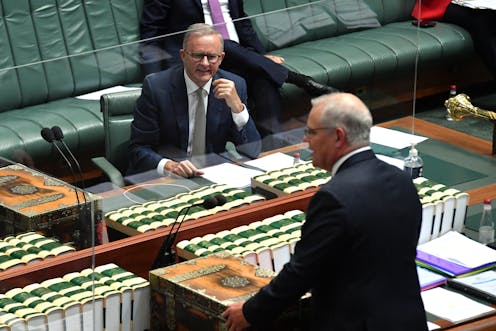
If you were to believe the Morrison government, you’d think Anthony Albanese as prime minister would sell out Australia’s interests to China, give criminals a break, and perhaps sneak in a death tax.
You’d question whether this man, who held senior positions in the Labor years, including briefly being deputy PM, could run a competent government. Because, you see, he didn’t have an economic or national security portfolio.
Scott Morrison is determined to do what Malcolm Turnbull refused to do in the 2016 election – run a ferocious, no-holds-barred negative campaign to try to trash his opponent.
The trouble with being a small target, which has been Albanese’s strategy all this term but especially recently, is that your opponent will still seek to turn you into a big target, indeed a scary risk to the nation.
The government’s campaign over the past fortnight’s parliamentary sitting has been full of gross exaggeration and, on the issue of policy on China, it has been outrageous and irresponsible. It’s a mark of Morrison’s desperation, and it carries risks of backfiring.
The question remains, however, whether the assault will be effective. Or will the government just harm itself by going over the top?
We’ve seen many scare campaigns through the years that have had little regard for the truth. Labor’s “Mediscare” claims in 2016 about an alleged Coalition threat to Medicare was potent, despite lacking substance. But the Morrison government’s effort is among the most brazen.
Without a compelling positive agenda of its own, the government believes – or hopes – that Albanese, who is still not well defined in the public’s mind, is potentially a soft target in the two key policy areas where the Coalition usually has an advantage – national security and economics.
It has gambled that in our fast-moving media cycle it can get away with extraordinary claims, helped by sections of the media.
But in its national security attack on Labor, the government this week ran into some heavy counter fire it would not have expected, from impeccable sources. The current and a former chief of ASIO weighed in against the Coalition’s crude attempt to wedge Labor over China.
The saga started when Defence Minister Peter Dutton declared last week that “the Chinese Communist Party, the Chinese government” had picked Albanese as “their candidate” in the coming election.
Dutton led with his chin, saying he was reflecting on what had been reported and commented on by the ASIO director-general, Mike Burgess.
Burgess, in his “Annual Threat Assessment” speech the previous evening, had said ASIO recently disrupted “a foreign interference plot in the lead-up to an election in Australia”. He didn’t name the country or the jurisdiction. Burgess related how a wealthy “puppeteer” had hired an employee to identify potential target candidates.
This week Morrison dipped back into the China well.
On Wednesday, he told parliament the Chinese government “have picked their horse” (Albanese) and labelled Labor’s deputy leader, Richard Marles, a “Manchurian candidate” for remarks Marles made some years ago. (“Manchurian candidate” is a reference from a political thriller to someone brainwashed and manipulated by an enemy power.)
The stakes were raised for the government when, in a rare TV appearance on Wednesday night, Burgess made it clear he was less than impressed with ASIO, which was “apolitical”, being drawn into political infighting.
Then on Thursday the government received a massive whack from Dennis Richardson, who is not only a former ASIO head but also a former secretary of the defence and foreign affairs departments and was Australia’s ambassador in Washington.
Richardson denounced the government’s “attempt to create an artificial division where one in practice does not exist”, saying that only served “the interests of one country. And that’s China.”
He described the tactic as “grubby beyond belief”.
Morrison was not put off, later that day saying Albanese “is the Chinese government’s pick at this election”.
The government’s sledges against Albanese on the economic and law-and-order fronts were less spectacular but equally stretched.
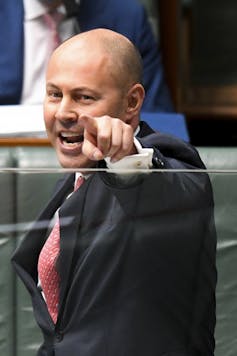
Treasurer Josh Frydenberg last week delved into the archives, back to when Albanese, as a Labor Party official from the left in the early 1990s, moved a motion at a conference calling for consideration of an inheritance tax. From this, Frydenberg asserted, “he stands for death duties”.
In promoting legislation to make it easier to deport visa holders convicted of serious crimes, Morrison accused Albanese of being “clearly on the side of criminals”.
In defensive tactics, Albanese has been extremely surefooted.
Thus, after Burgess’s revelation about foreign interference, the opposition leader immediately contacted him and was able to report that ASIO has no problem with any of Labor’s federal candidates.
As Morrison attacked Labor’s credentials on national security, Albanese tabled a letter from the PM last year thanking him for supporting the government on the AUKUS agreement.
Albanese met the “scare” around his one-time backing for an inheritance tax three decades ago with ridicule, waving around an economics essay he’d written four decades ago.
Efforts by the government to wedge Labor on the visa legislation and legislation on guns fell in a heap. The opposition waved the bills through the House of Representatives with little prospect of them being considered in the Senate before the election.
The government’s effort last week to wedge Labor on the religious discrimination legislation ended with it being wedged by its own rebel backbenchers.
Albanese has covered off every angle that’s come up.
For instance, on Thursday he told parliament in a personal explanation that he had consulted Burgess before attending the opening of the Chau Chak Wing Museum at Sydney University in 2020. He added that he had obtained Burgess’s permission to say this to parliament.
Earlier this week a Labor senator named, under parliamentary privilege, businessman and political donor Chau as the “puppeteer” referred to in the Burgess speech, something Burgess declined to be drawn on.
In his statement to parliament, Albanese said he did “regularly consult with our national security agencies, because I take their role seriously as leader of the opposition”.
However neat Albanese’s moves, however reprehensible the government’s, Labor doesn’t fool itself. Morrison and his ministers have sown the seeds for a national security scare, and it’s too early to know whether they will germinate.
What we do know is that the Chinese government must be enjoying this spectacle immensely.
Michelle Grattan does not work for, consult, own shares in or receive funding from any company or organisation that would benefit from this article, and has disclosed no relevant affiliations beyond their academic appointment.
Wellington iwi leaders have called for an end to Aotearoa New Zealand’s 10-day-old anti-covid mandates protest in Parliament grounds and condemned comparisons made by protesters to the 1881 colonial assault at Parihaka.
The parliament complex and surrounding streets form part of the historic Pipitea Pā.
Port Nicholson Block Settlement Trust chairperson Kara Puketapu-Dentice said the ongoing occupation required a political solution.
“Our political leaders need to find a way out of this and stop the harm that’s happening on our ancestral lands, with some protesters having threatened our people and property,” he said in a statement.
“We’ve already had smashed windows and threats made against some of our kuia and kaumātua and uri involved in the Covid response.”
Puketapu-Dentice said comparisons to the assault at Parihaka were wrong, and amounted to cultural misappropriation.
On 5 November 1881, about 1600 colonial troops invaded the western Taranaki rural settlement of Parihaka, which had come to symbolise peaceful resistance to the confiscation of Māori land.
Native Minister John Bryce ordered the arrest of Parihaka’s leaders — who were detained without trial for 16 months, the destruction of much of the village, and the dispersal of most of its inhabitants.
Ngāti Toa said it, too, wanted an end to the scenes in Thorndon, condemning threatening behaviour and describing aspects of the protest as deplorable.
Te Rūnanga o Toa Rangatira supported the people’s right to protest but added that its offices, marae and uri had been the target of intimidating and threatening behaviour for trying to support their communities.
This article is republished under a community partnership agreement with RNZ.
The 1881 assault by colonial forces on the peaceful Parihaka settlement in Taranaki. Image: Alexander Turnbull Library
A group of church ministers in Fiji have resigned because they do not want to be vaccinated against covid-19.
There has been growing pressure on the clergy to get the injections since the Fiji government’s “No jab, no job” policy for public servants was announced last June.
The Methodist Church said this week 11 of its pastors had tendered their resignations.
The church’s secretary, Reverend Wilfred Regunamada, said the ministers were not forced to resign but had done so of their own free will.
“And in between that deadline, the church continued to call and ask them if they had changed their decision,” he said.
“Those who have not changed and made their decision, the church in the various circuits or the divisions that they were in, farewelled them very well. ”
Reverend Regunamada said the church respected their decision and the vacant positions would be filled by other lay preachers and theology students within the church.
Methodist Church the largest The Methodist Church is the largest Christian denomination in Fiji, with 36.2 percent of the total population (300,000) including 66.6 percent of indigenous Fijians.
In October last year, 10 ministers of the Christian Mission Fellowship Church quit over their refusal to be vaccinated.
At the time, Reverend Regunamada, then the Methodist Church’s secretary for communications and overseas mission, said they had not laid off any of their ministers nor had anyone been forced to resign.
“Currently, we are carrying out awareness for our ministers and they are being given time, until November, to get their vaccines.
“The church’s stand is mainly to ensure the safety of its members which means that its ministers, who are servants of the people, need to be vaccinated first.
“At the moment, those that have not been vaccinated have been requested not to partake in any church services but have been advised to stay in their own homes and they are still being paid,” Reverend Regunamada said.
Reverend Wilfred Regunamada … Photo: Supplied
Remaining 8 percent tough to vax, says ministry Meanwhile, Fiji’s Health Ministry is finding it hard to vaccinate the remaining eight percent of the adult population against covid-19.
Health Secretary Dr James Fong said they continued to receive requests for vaccine exemption from people with medical comorbidities, particularly non communicable diseases (NCDs).
He said the medical condition of these people required vaccination “and granting the exemption is not an option for any qualified medical person”.
“We have noted how difficult it is to increase our vaccination coverage for the last 8 percent of our adult population, despite the increased risk of severe outcomes in this group,” Dr Fong said.
He said community support was needed to sustain the impact of their efforts.
“While we will continue to do our part to promote and deploy vaccines, we need community support to sustain the impact of our efforts especially to the vulnerable within this 10 percent.
“It is a grave concern that we continue to receive requests for vaccine exemption from persons with medical comorbidities, especially NCDs.”
Booster dose programme As of February 14, 574,700 of Fiji’s adult population had been fully vaccinated, the Health Ministry stated.
The booster dose programme began at the end of November 2021. As of February 14, 91,414 individuals had received booster doses of the Moderna vaccine and 60 people got the Pfizer dose.
Dr Fong said for the month of February, 175,558 more people had become eligible for booster doses.
“We are targeting to cover all these eligible individuals in the days ahead. Please come forward to get your booster (third dose) vaccine if you are aged 18 or over and it has been at least 5 months since your second dose.”
Fiji has 141 active cases of covid-19 in isolation while the death toll is at 820.
This article is republished under a community partnership agreement with RNZ.
A Kaipara district councillor’s almost week-long participation in New Zealand’s anti-covid-19 mandate protest at Parliament is jeopardising the safety of Kaipara residents, warns Mayor Dr Jason Smith.
Dr Smith said he was particularly worried about those in the councillor’s West Coast/Central council ward which had Kaipara’s lowest vaccination rates.
The councillor was participating in a likely “superspreader” event when health authorities yesterday reported a surge to a record 1160 covid-19 cases.
Anti-mandate campaigner and Kaipara District Council (KDC) councillor Victoria del la Varis-Woodcock left Kaipara for the Wellington anti-vaccine, anti-mandate protest on Thursday, February 10, and was still there yesterday.
She declined to say when she would be returning home. She also dismissed Dr Smith’s safety concerns as “nonsensical”.
Since arriving at the protest, del la Varis-Woodcock has addressed thousands of protesters through a megaphone, calling for the government’s covid-19 legislation to be immediately repealed.
“My name is Victoria del la Varis-Woodcock and I have a message, repeal all covid-19 legislation now,” she has told thousands of Wellington protesters.
Declined to comment She declined to comment on whether she was representing any of the groups participating in the protest.
Del la Varis-Woodcock has previously told Local Democracy Reporting that elected representatives needed to be role models.
“Elected members need to be role models, need to stand for values of respect, of civil liberties and human rights,” she said.
A video of del la Varis-Woodcock’s speech is circulating online, including accompanying reference to her being a protest organiser, which she said was not the case, in response to Local Democracy Reporting clarification questioning.
The video has been viewed almost 3000 times, amid a protest that started on Tuesday, 8 February 8, and is now entering its ninth day.
She said protesters would be continuing their mission, regardless of water being sprayed or music being played, until the government repealed “draconian” laws it had enacted around the virus.
Del la Varis-Woodcock has been a local government elected representative since 2016.
Individual rights She said she was not at the protest as a KDC councillor. instead, she was there as a protester exercising her individual rights. It was possible to separate the two.
Mayor Dr Smith said being a councillor was a 24/7 365-day-a-year role.
Dr Smith said del la Varis-Woodcock was entitled to her opinions, but being an elected representative brought a unique position of leadership in her local community that needed to be taken into account.
“As an elected representative there are all sorts of responsibilities to the people and organisation of the council. It is a 24/7, seven day a week role. You don’t get to suddenly be someone else. That’s part of the responsibility of this role,” Dr Smith said.
He said her protest participation was “worrisome” in terms of Kaipara residents’ health and safety.
“It’s a long way to travel from Kaipara to a likely superspreader event during the height of a pandemic with a heightened risk of bringing the virus back here,” Smith said.
That was particularly the case with Omicron rates increasing through the community, he said.
Low vaccination rate Dr Smith said he was particularly worried about people in del la Varis-Woodcock’s West Coast/Central council ward. Latest available figures showed Māori in this area had a double vaccination rate of just over 71 percent (76.5 percent single dose rate).
Overall, there was a just over 78 percent double vaccination rate and just under 82 percent single vaccinated, he said.
Del la Varis-Woodcock said being at the protest did not compromise being able to carry out her role as a councillor.
She said she would be participating virtually from Wellington in KDC’s District Plan review meeting. The meeting was being held face-to-face in Dargaville Town Hall.
Del la Varis-Woodcock also participated virtually while councillors gathered face-to-face for KDC’s first 2022 meeting, in the same venue on February 2. A vaccination passport is required to enter the building.
Mayor Dr Smith said del la Varis-Woodcock had not provided this.
Del la Varis-Woodcock declined today to confirm her vaccination status, including whether she was unvaccinated.
Personal information She has previously told Local Democracy Reporting that was her personal information.
Del la Varis-Woodcock describes herself on her Facebook page as “environmentalist, district councillor, mother, artist and lover of language”.
The page shares posts including against vaccination passports and concerns over media representations regarding the virus.
Local Democracy Reporting is Public Interest Journalism funded through NZ On Air. Published by Asia Pacific Report in collaboration.
New Zealand’s Police Commissioner admits some tow companies are reluctant to help with the removal of vehicles near Parliament but says some towing will begin today.
The anti-mandate protest on Parliament’s grounds and neighbouring streets is entering its ninth day.
Commissioner Andrew Coster told RNZ Morning Report he expected to see some of those vehicles towed today although it was unclear how many tow truck operators would take part.
Greg Cox, who owns Wellington’s Cox Heavy Salvage, said he has been contacted twice by police, and he has told them his vehicles are not available.
He said operators in the top half of the North Island are also refusing to help police.
Commissioner Coster agreed that there had been some reluctance by tow companies to be involved.
He said they had had some “constructive engagement” with operators and some may still be willing to play a part.
Some towies threatened Some have said they have been threatened, while others say their vehicles are unavailable.
He said it was hard to gauge why the tow truck companies were reluctant and if they were sympathetic to the protesters.
“It’s hard for me to speak for what’s driving them but it’s clear that they are reluctant, and that’s very similar to the the treatment we saw overseas. Canada particularly has had a real problem with it.”
Police are in touch with the NZ Defence Force with a view to them helping with the removal operation.
Police Commissioner Andrew Coster … “It does call for patience [dealing with the protesters]. I know how frustrating the situation is for all concerned. It’s an unacceptable impact on people in the central city but we just have to work it through.” Image: Samuel Rillstone/RNZ
“They have some capability, it won’t be the whole answer to the problem.”
Police have “some other tow capability” that they can draw on using some towing firms but he refused to discuss specifics.
“I expect you will see some tow activity today.”
Constructive dialogue Constructive dialogue is also occurring with some of the protesters and he expects some of them will move their vehicles to a free parking area at Sky Stadium also.
“So that will be part of the answer.”
Police will hold on to the vehicles they remove and probably the courts will decide what happens in terms of them being returned to their owners.
“That’s the message to the protesters who are parked illegally — move your car to the stadium and we’ll not have any further interest in it.
“Leave it where it is and we will take it and we won’t be giving it back any time soon.”
Commissioner Coster is keen for a careful approach from police so they do not escalate the anger and resentment among protesters.
“It does call for patience. I know how frustrating the situation is for all concerned. It’s an unacceptable impact on people in the central city but we just have to work it through.”
Actions are unlawful Commissioner Coster said while it was not the police’s aim to arrest the protesters, aspects of their actions were unlawful.
These included the extended blocking of the roads which was the biggest problem and extensive structures that have been erected on Parliament’s grounds.
Asked if Wellington police were caught out by the erection of tents at Parliament, where camping overnight is not allowed, Coster said the law around protest did not allow police many options early on to shut it down.
It was a balancing act, he said.
“Clearly this protest has crossed the line but the problem we have in the early stages is it might not have crossed the line but by then you have got a big problem on your hands.”
Morning Report invited protest organisers on to the programme to discuss their intentions for moving their vehicles but they said they were not yet ready to comment.
They have released a statement — issued on behalf of half a dozen groups including the so-called Voices for Freedom — which said they had been working with police on traffic management and were mindful of public safety and minimising disruption to those living and working in Wellington.
Towies are frightened – Wellington mayor Wellington City Council has been engaging with towies who are under significant pressure, says mayor Andy Foster.
Some of them have been threatened over taking on the job of removing protesters’ vehicles and he was unaware of any who were sympathetic to the protesters.
“The feedback I’ve had, and I know they’ve been spoken to by our senior management, they are frightened.”
The towing of the vehicles was outside any contracts the council held with tow truck operators for vehicles parked illegally in the city.
Foster said it was unacceptable that the towies felt unsafe about accepting the work.
The mayor has visited the protest site several times and while most people seemed to be peaceful the site was “potentially intimidating”.
Offensive signs – nooses Asked about offensive signs, such as pictures of nooses, Foster responded: “I think they would all do themselves a big favour if they stopped anybody behaving badly or they got rid of some of those signs.
“They would do everybody a favour. They would look more credible in the eyes of the public but those sorts of things will always let any movement down.”
Foster said he wanted people to be able to move freely around the streets without the fear of being threatened or abused.
“We want business to be back operating. We want all those the day before yesterday so as quickly as it can be done is good.
“But we’re working closely with police, supporting the police in the way they want.”
‘Impinging on others’ freedoms’ – Luxon Protesters are calling for freedom but their actions are impacting on the freedom of others, opposition National Party leader Christopher Luxon says.
He told Morning Report he was pleased there were plans to move protesters’ vehicles because of the inconvenience to residents trying to get to schools and work and emergency services needing to move freely around the city.
He did not want to comment on the reluctance of tow truck operators to get involved because they were sympathetic to the protesters’ cause.
He preferred to leave it to the police who he trusted would sort it out.
Luxon, like the government, had no intention of engaging with protesters because they had no defined leadership and they were difficult to deal with because their issues covered such a wide range.
“They range from white supremacists to separatists and everything in between,” he said.
“There’s a wide range of issues from what we can gather from signage and things that range from anti-authority to anti-vaccination to anti-mandates…
‘Really anti-social and abusive’ “It’s tough when you come here and want to protest about freedoms and you actually end up impinging on others’ freedoms and the tone has been really anti-social and abusive.”
Luxon said the protesters should follow the rule of law and be respectful of others.
They did not seem to be taking into consideration that as a result of the occupation small businesses in the area were suffering.
Regarding his call for a timeline on the vaccine mandate, he said as omicron became endemic in a community the effectiveness of vaccine passes and mandates diminishes.
He believed there needed to be a discussion on the criteria and triggers for when the timeline could be put in place for their removal.
“There’s lots of other countries in the world who fundamentally as they’ve gone through this have had to say how they step out of it as well.”
The country was “in for quite a ride over the coming weeks and months” as omicron became endemic which was the pattern overseas so there should be clarity on the criteria for removing restrictions.
He said National did not want to see hospitality and tourism businesses fall over after two years of the pandemic and called on the government to defer spending on light rail and health restructuring and instead support the hardest hit sectors.
In response to rightwing blogger Cameron Slater’s criticism that Luxon was “hiding behind [Prime Minister] Jacinda Ardern’s skirts” regarding the protest, he said he did not know Slater and the National Party had been clear about its views on the protest from the start.
This article is republished under a community partnership agreement with RNZ.
It is common practice for journalists to share contact details and locations in hostile environments such as war zones. Something is very wrong when news organisations in New Zealand share those details about their staff covering a story in downtown Wellington.
Stuff’s head of news Mark Stevens disclosed last Friday that “competing media have shared contacts of journalists in the field to provide a safety network if things get dangerous”.
It followed incidents during the “Convoy 2022” protest in the grounds of Parliament when journalists were abused, spat on, and assaulted. A Stuff reporter was pushed and shoved and a protester abused a Newshub news crew member and threatened to destroy his video camera.
Protesters told reporters to “watch your backs on the street tonight” and that they would be “executed” for their reporting. Placards read “Media is the Virus”, “Fake News”, and accused journalists of treason.
One placard parodied a covid-19 health message: “UNITE AGAINST MEDIA 22”.
Anti-media sentiment is nothing new. The 2020 Acumen-Edelman Trust Barometer showed New Zealanders scored media poorly — and below the global average — in terms of competence and ethics and only 28 percent thought they served the interests of everyone equally and fairly.
Those results did make me wonder what news media Kiwis were actually seeing and hearing but, in such things, perception is everything.
Journalists reasonably thick-skinned But journalists are reasonably thick-skinned: They can take criticism and even insults. I doubt there is a reporter in the country who hasn’t been on the receiving end. Even death threats are something that goes with the territory.
I’ve received a few in my career. Most were of the “Drop Dead” or “You don’t deserve to be here” variety and only one was a credible threat. That one could have endangered others and was not specifically directed at me (it was reported to the police).
However, something has changed.
A reporter I hold in high regard told me last week that he had received more death threats in the last three months of 2021 than in the previous three decades. I’m not going to name him because to do so will simply increase the likelihood of further attempts at intimidation.
He told me reporters had become the focus of a great deal of anger and resentment:
“A few recent events I’ve covered have seen members of the anti-crowd deliberately moving to within a foot of me, maskless, and breathing or coughing at me, or trying to physically rub against me. That’s not an uncommon experience for those out in the field. And there’s the odd occasion, too, where the threat of physical violence is such that I’ve needed to back-peddle quickly.”
We are seeing a migration of behaviour. The US Press Freedom Tracker recorded 439 physical attacks on journalists in that country in 2020 (election year) and a further 142 in 2021. That compared with 41 in 2018 and 2019.
Tightened security Last June the BBC tightened security around its staff after an escalation in the frequency and severity of abuse from anti-vaxxers. During Sydney anti-mandate protests last September, 7News reporter Paul Dowsley was sprayed with urine and hit in the head by a thrown drink can.
Then, in November, it came here. A 1News camera operator on the West Coast graphically recorded a foul-mouthed middle-aged man carrying an anti-vaxx placard who shoved him backwards and tried to dislodge his camera: “Do you want this [expletive] camera smashed in your face, you [expletive]?”
The current anti-vaxx movement in Canada has generated similar behaviour. Brent Jolly of the Canadian Association of Journalists said several reporters covering the trucker convoy in Ottawa have said they have been harassed on the scene and online and feel like they have a “target on their backs”.
Evan Solomon, a reporter for CTV, told the Committee to Protect Journalists (CPJ) that he had a full can of beer thrown at his head. It missed but exploded inside a camera case. All CTV crews now have a security person with them when filming outside, no longer use lights or tripods, and in one province have removed CTV identification from vehicles.
In Ottawa people have asked reporters to remove their names from stories because they are getting death threats. Broadcasting journalists have been targeted – probably because their presence is more obvious – although one print reporter told the CPJ that she does not wear a mask during protests because it draws attention to her (she is triple vaccinated), does not go into protest crowds at night, and liaises with other reporters to advise current locations and risks.
None of this should suggest a coherent and organised anti-media campaign is sweeping the globe. We are seeing something that is a good deal more orchestrated than organised, in which the anti-vaccination movement is no more than a rallying point, and the media are a target because they are messengers for inconvenient truth.
The proof of that became apparent while I was watching the live feed of the protest in the grounds of Parliament.
‘End the Mandate’ signs A string of images spelled out how incoherent it was. There were printed “End the Mandate” signs, “My body, my choice” t-shirts, a loony sign saying natural immunity was 99.6 per cent effective, Canadian flags, a figure in Black Power regalia wearing a full-face plastic mask, someone wearing a paramilitary “uniform”, and a man waving the ultimate conspiracy theory sign: “Epstein didn’t kill himself”.
Then there were the actions of the protesters. A few were gesticulating to police and the media, uttering things I could not (and arguable did not want) to hear. Many more were gyrating to rhythms playing over loudspeakers, beaten out on the plastic barriers on the forecourt, or generated in their own heads. It was a sort of group euphoria.
And in a perverse sort of way I think that is what is behind the attitude toward media. 1News reporter Kristin Hall had been reporting the protest and wrote a commentary on the broadcaster’s website. In it she said that despite their varying opinions and causes, the protesters were “united in their distaste for the press”. Then she gave an example of just how incoherent this united front can be:
“‘You’re all liars,’ a man told me today. When I asked if he could be more specific, he said he doesn’t consume mainstream media. People have asked me why I’m not covering the protests while I’m in the middle of interviewing them.”
Unfortunately, it is this lack of logic that makes abuse of media so hard to counter. Media cannot make peace with leaders of a movement because it is a moving feast and the orchestrators are hidden from sight. It cannot be remedied simply by stating facts because these people accept only what supports and ennobles their own disinformation-fuelled world view, a view fed by inflammatory social media that conflates then amplifies discontent on a global scale.
Nor can media offer immediate solutions to pent-up anger aggravated by two years of pandemic.
What media can — and must — do is prevent contagion. They need an inoculation campaign to ensure that the malaise infecting a small group of people does not spread.
Duty of care a priority Mark Stevens alluded to cooperation between media to keep staff safe and that duty of care is a priority. However, media organisations need to go further. They must, on the one hand, earn the trust of a population that does not generally hold them in high regard. It is best done by demonstrating that journalists are following best professional practice and that means quality reporting and presentation.
On the other hand, they must ensure that the community understands that journalists have a right (indeed, a duty) to report on events in its midst — irrespective of whether or not its members agree with what they are being told.
The United States has an excellent track record in openly discussing professional standards and the role of media in society. We should take some leaves from their book and bring the community more into the conversation.
That is challenging, because the problem does not lie solely with the media but with the system of democracy of which it is a vital part.
“We have really struggled, though, to conceive, plan and execute deep systemic change, let alone get as many people as possible involved in that and benefiting from it. But that’s the only way we’ll tackle our deeply rooted economic, social and environmental failures.”
That democratic reform must include the media rethinking how it engages with the public. They must introduce open industry-wide governance to replace anachronistic and sometimes self-serving structures. They must demonstrate their commitment to accuracy, fairness and balance. They must find new ways to be inclusive and pluralistic. They must secure recognition as trusted independent sources of verified facts.
Calling out manipulation That will take time. Meanwhile the problem of media abuse will continue. The short-term solutions will include calling out those who seek to manipulate a minority to destabilise our society. Here are two good examples:
The short term also requires media organisations to continue to meet that duty of care toward their staff. The Committee to Protect Journalists has developed a four-part “Safety Kit” to provide journalists and newsrooms with basic safety information on physical, digital and psychological safety. It’s a good starting point for any journalist.
Of course, journalists also need to keep matters in perspective. The threats represented by a group of disorganised protesters remains relatively small and, with the right training, journalists can judge the level of risk they face in most situations.
When it came to death threats, for example, I soon learned that I could bin the ones that were written in crayon.
Dr Gavin Ellis holds a PhD in political studies. He is a media consultant and researcher. A former editor-in-chief of The New Zealand Herald, he has a background in journalism and communications – covering both editorial and management roles – that spans more than half a century. Dr Ellis publishes a blog called Knightly Views where this commentary was first published and it is republished by Asia Pacific Report with permission.
If you were to believe the Morrison government, you’d think Anthony Albanese as prime minister would sell out Australia’s interests to China, give criminals a break, and perhaps sneak in a death tax.
You’d question whether this man, who held senior positions in the Labor years, including briefly being deputy PM, could run a competent government. Because, you see, he didn’t have an economic or national security portfolio.
Scott Morrison is determined to do what Malcolm Turnbull refused to do in the 2016 election – run a ferocious, no-holds-barred negative campaign to try to trash his opponent.
The trouble with being a small target, which has been Albanese’s strategy all this term but especially recently, is that your opponent will still seek to turn you into a big target, indeed a scary risk to the nation.
The government’s campaign over the past fortnight’s parliamentary sitting has been full of gross exaggeration and, on the issue of policy on China, it has been outrageous and irresponsible. It’s a mark of Morrison’s desperation, and it carries risks of backfiring.
The question remains, however, whether the assault will be effective. Or will the government just harm itself by going over the top?
We’ve seen many scare campaigns through the years that have had little regard for the truth. Labor’s “Mediscare” claims in 2016 about an alleged Coalition threat to Medicare was potent, despite lacking substance. But the Morrison government’s effort is among the most brazen.
Without a compelling positive agenda of its own, the government believes – or hopes – that Albanese, who is still not well defined in the public’s mind, is potentially a soft target in the two key policy areas where the Coalition usually has an advantage – national security and economics.
It has gambled that in our fast-moving media cycle it can get away with extraordinary claims, helped by sections of the media.
But in its national security attack on Labor, the government this week ran into some heavy counter fire it would not have expected, from impeccable sources. The current and a former chief of ASIO weighed in against the Coalition’s crude attempt to wedge Labor over China.
The saga started when Defence Minister Peter Dutton declared last week that “the Chinese Communist Party, the Chinese government” had picked Albanese as “their candidate” in the coming election.
Dutton led with his chin, saying he was reflecting on what had been reported and commented on by the ASIO director-general, Mike Burgess.
Burgess, in his “Annual Threat Assessment” speech the previous evening, had said ASIO recently disrupted “a foreign interference plot in the lead-up to an election in Australia”. He didn’t name the country or the jurisdiction. Burgess related how a wealthy “puppeteer” had hired an employee to identify potential target candidates.
This week Morrison dipped back into the China well.
On Wednesday, he told parliament the Chinese government “have picked their horse” (Albanese) and labelled Labor’s deputy leader, Richard Marles, a “Manchurian candidate” for remarks Marles made some years ago. (“Manchurian candidate” is a reference from a political thriller to someone brainwashed and manipulated by an enemy power.)
The stakes were raised for the government when, in a rare TV appearance on Wednesday night, Burgess made it clear he was less than impressed with ASIO, which was “apolitical”, being drawn into political infighting.
Then on Thursday the government received a massive whack from Dennis Richardson, who is not only a former ASIO head but also a former secretary of the defence and foreign affairs departments and was Australia’s ambassador in Washington.
Richardson denounced the government’s “attempt to create an artificial division where one in practice does not exist”, saying that only served “the interests of one country. And that’s China.”
He described the tactic as “grubby beyond belief”.
Morrison was not put off, later that day saying Albanese “is the Chinese government’s pick at this election”.
The government’s sledges against Albanese on the economic and law-and-order fronts were less spectacular but equally stretched.
Treasurer Josh Frydenberg last week delved into the archives, back to when Albanese, as a Labor Party official from the left in the early 1990s, moved a motion at a conference calling for consideration of an inheritance tax. From this, Frydenberg asserted, “he stands for death duties”.
In promoting legislation to make it easier to deport visa holders convicted of serious crimes, Morrison accused Albanese of being “clearly on the side of criminals”.
In defensive tactics, Albanese has been extremely surefooted.
Thus, after Burgess’s revelation about foreign interference, the opposition leader immediately contacted him and was able to report that ASIO has no problem with any of Labor’s federal candidates.
As Morrison attacked Labor’s credentials on national security, Albanese tabled a letter from the PM last year thanking him for supporting the government on the AUKUS agreement.
Albanese met the “scare” around his one-time backing for an inheritance tax three decades ago with ridicule, waving around an economics essay he’d written four decades ago.
Efforts by the government to wedge Labor on the visa legislation and legislation on guns fell in a heap. The opposition waved the bills through the House of Representatives with little prospect of them being considered in the Senate before the election.
The government’s effort last week to wedge Labor on the religious discrimination legislation ended with it being wedged by its own rebel backbenchers.
Albanese has covered off every angle that’s come up.
For instance, on Thursday he told parliament in a personal explanation that he had consulted Burgess before attending the opening of the Chau Chak Wing Museum at Sydney University in 2020. He added that he had obtained Burgess’s permission to say this to parliament.
Earlier this week a Labor senator named, under parliamentary privilege, businessman and political donor Chau as the “puppeteer” referred to in the Burgess speech, something Burgess declined to be drawn on.
In his statement to parliament, Albanese said he did “regularly consult with our national security agencies, because I take their role seriously as leader of the opposition”.
However neat Albanese’s moves, however reprehensible the government’s, Labor doesn’t fool itself. Morrison and his ministers have sown the seeds for a national security scare, and it’s too early to know whether they will germinate.
What we do know is that the Chinese government must be enjoying this spectacle immensely.
Michelle Grattan does not work for, consult, own shares in or receive funding from any company or organisation that would benefit from this article, and has disclosed no relevant affiliations beyond their academic appointment.
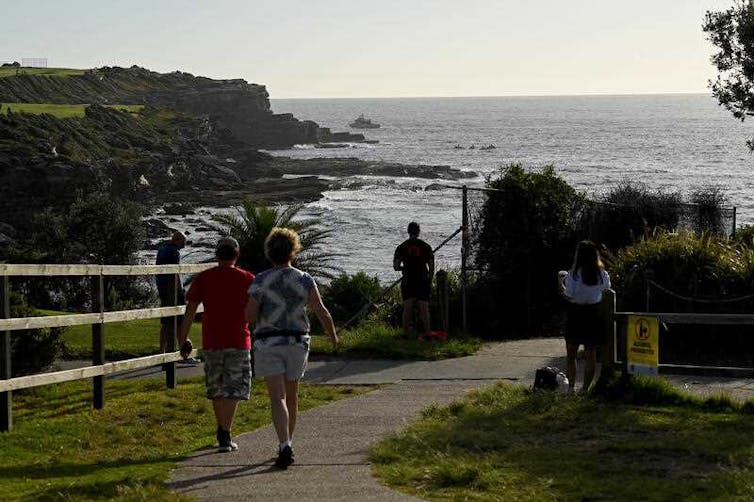
The fatal shark attack off Sydney on Wednesday left the city shocked, and triggered questions from the horrified public. Why would a shark just grab a man from the water? And will it strike again?
The incident – Sydney’s first fatal shark attack since 1963 – has prompted debate on what to do next. Some people even took to social media to call for sharks to be culled.
This is a common community response following unprovoked shark attacks. But killing sharks is highly controversial. And as my research has shown, there are many non-lethal alternatives to protect beachgoers from sharks.
As authorities grapple with the best way to respond to this tragedy, it’s worth remembering all shark mitigation measures come with both merits and drawbacks – and none is a silver bullet.
The incident was Sydney’s first fatal shark attack since 1963. Bianca De Marchii/AAP
Killing sharks is problematic
It’s unlikely authorities would ever be able to hunt down the specific shark involved in Wednesday’s fatality. As Macquarie University marine scientist Vanessa Pirotta has noted, sharks travel large distances and the animal is likely to be long gone.
Other times, members of the community call for an area-wide shark cull – and in rare cases a government will oblige.
In Western Australia in 2013, for example, the then Liberal government announced shark “kill zones” near beaches following a string of attacks. But the measure was scrapped after fierce opposition from the public and environment officials.
Any increased effort to kill sharks is likely to face public and political opposition, for several reasons.
First, sharks pose a low risk to humans. It’s true that globally, the frequency of unprovoked shark bites has increased, due to factors such as more water users and changes in shark distribution and behaviour.
But the probability of an unprovoked shark bite remains low.
Second, public perception towards sharks is changing. Many people now realise the intrinsic value of sharks and their important role in marine ecosystems.
Given all this, we must keep pursuing non-lethal methods to protect swimmers and surfers from sharks while avoiding environmental damage.
Let’s look at such approaches in more detail.
Many people recognise sharks’ vital role in marine ecosystems. Shutterstock
Aerial surveys
Aerial surveys involve detecting sharks via a plane, helicopter or unmanned drone, or by people on land.
Their effectiveness can vary depending on how clear, calm or deep the water is, and on wind strength and shark behaviour.
An aircraft with human observers on board can survey a lot of coastline. But an aircraft can spend less than a minute on each beach, limiting the opportunity to locate a shark.
And research has shown even in reasonably clear water, overall rates of detection from planes and helicopters is low.
Drones cost less to operate than manned aircraft and are better for surveying a single location. However, battery constraints mean commercially available models can only stay airborne for a limited time.
In future, drones could be tethered to helium balloons or kites to allow for longer-term surveillance. But such technology is still at an early stage.
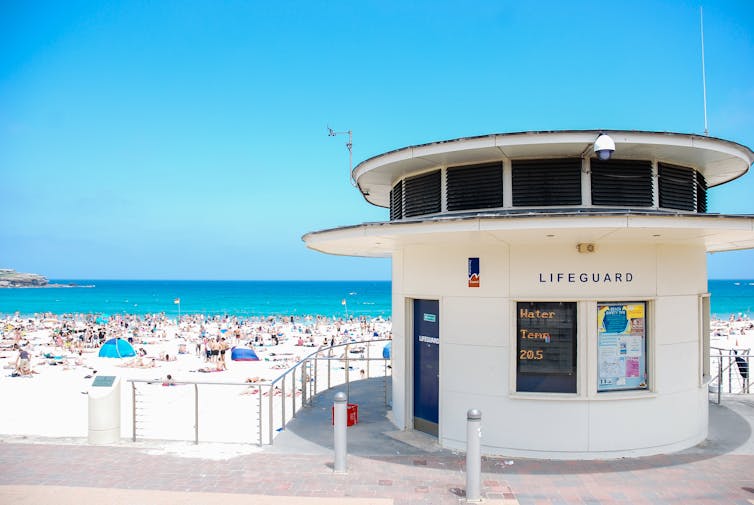
Surf patrol towers can help lifeguards detect sharks. But they must offer a vantage point more than 40 metres above sea level to be suitable for the task – a height well above that normally afforded by existing towers.
Lifeguard towers are not always high enough to enable shark spotting. Shutterstock
Nets and drumlines
Sharks can be detected by capturing then releasing them. These methods include deploying either mesh nets or “drumlines” – baited hooks that lure sharks.
Shark nets operate at more than 50 NSW beaches in the warmer months. The program releases all live sharks caught in nets, but more than 80% of large “target” sharks caught in the nets die.
Traditional drumlines, used extensively in Queensland, also historically kill a significant proportion of sharks.
New “SMART” drumlines are designed to kill fewer captured animals. The device issues an alert when an animal is caught, and a contractor unhooks and relocates it.
Over three years of SMART drumline trials in NSW, high levels of live shark releases were reported. But the method requires extra labour expense to ensure rapid response to a capture.
Drum lines can kill sharks. Humane Society International
Area-based deterrents
Electrical shark deterrents have been investigated over many years. Research shows substantial promise, and Australia is making progress in commercialising the technology.
Scientists have investigated using acoustic deterrents such as orca calls and novel sounds to deter sharks. But such methods do not work on all shark species, and the impacts on other animals needs to be considered.
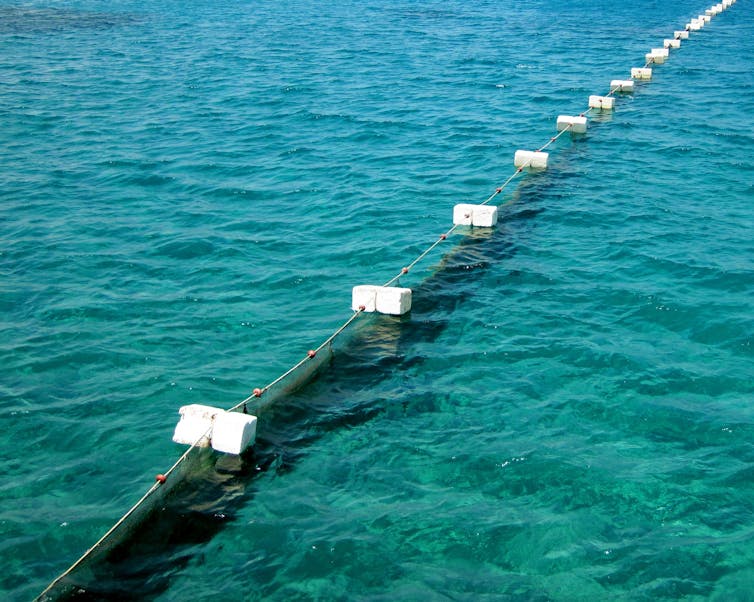
Physical barriers to exclude sharks from a particular area is a longstanding approach to protect bathers. Permanent swimming enclosures have worked in areas protected from exposed ocean conditions, such as Sydney Harbour.
But on ocean beaches, physical barriers must be designed to withstand constant wave energy, including extreme conditions. Previous attempted trials on NSW surf beaches failed as the gear either could not be installed, or was destroyed by the surf.
Shark nets can tear in rough ocean conditions. Shutterstock
No quick fix
Wednesday’s fatal shark attack has understandably shaken the community and prompted heated debate. In all this, of course, we must remember that a human life has been lost.
Right now, talk of preventing future attacks will be of little comfort to the victim’s family and friends, eyewitnesses and first responders.
Looking further ahead, no system will ever deter or detect 100% of sharks. But risks can be reduced with well-considered approaches, suited to local conditions.
More research is needed into non-lethal strategies. The cost of various approaches is also an important consideration.
And no matter what system is used to protect beachgoers, it should be accompanied by efforts to educate the public about shark safety.
Tips include avoiding swimming or surfing in low light levels, avoiding beaches near estuaries after heavy rain and flooding, and avoiding places where stranded marine mammals are present – as the sites may attract sharks.
Daryl McPhee has previously received funding from the NSW, Queensland and WA Governments to investigate unprovoked shark bite and mitigation responses. This article was based on the publication “A comparison of alternative systems to catch and kill for mitigating unprovoked shark bite on bathers or surfers at ocean beaches” in the journal Ocean and Coastal Management which was partly funded by the NSW DPI. Dr McPhee is not currently in receipt of any research or other funding associated with the sharks and shark-human interactions.
Carbohydrates are found in breads, cereals and other grains, fruit, vegetables and milk. They’re also in ultra-processed fast foods, cakes, chips and soft drinks.
These days, low-carb diets are promoted as a weight-loss solution, to beat heart disease and as better for diabetes. But how do these claims match up with the latest research?
A new review of the evidence found long-term low-carb dieters lost just under a kilo more weight than other dieters. However the review concluded there was no evidence low-carb diets have any additional health benefits.
In fact, if you’re on a low-carb diet, you’ll need to pay closer attention to what you eat to make sure you get enough essential vitamins, minerals, dietary fibre and other phytonutrients.
What did the reviewers investigate?
The Cochrane review included 61 randomised controlled trials (the highest level of evidence) with almost 7,000 adults with excess body weight. About 1,800 had type 2 diabetes. People in the healthy weight range were not included.
The reviewers compared weight-loss diets that varied in carbohydrate content:
lower carbohydrate diets. This included very low-carb or ketogenic diets (less than 50g of carbs a day or less than 10% of your total energy from carbs) and low-carb diets (50-150g of carbs per a day, or less than 45% of total energy from carbs)
“balanced” carbohydrate diets (150+ grams of carbs a day, or 45-65% of your total energy from carbs).
Here’s an example comparing how a very low-carb, low-carb and balanced carb one-day meal plan might look. The portion sizes differ between the meals to keep the total kilojoules about the same. Note, the reviewers grouped the first two low carb diet categories together. Author provided
What did they find?
The reviewers found that among adults with excess body weight (but who didn’t have type 2 diabetes), those following lower-carb diets for 3-8.5 months lost, on average, one kilogram more weight than those on balanced carb diets.
However, when they ensured restrictions in energy intake were the same in both groups, by providing the food or meal plans, the difference was about half a kilogram.
In longer-term weight-loss interventions lasting one to two years, the average difference in weight-loss between those on low-carb versus balanced carb diets was just under one kilogram.
There isn’t a great different in weight-loss outcomes between those on low-carb diets and those on balanced carb diets. Shutterstock
The average weight lost by groups on any weight-reducing diet varied greatly across the trials from less than one kilogram in some, up to about 13kg in others.
The studies in adults with type 2 diabetes found greater initial weight loss on low-carb diets compared to balanced carb diets: 1.3kg over three to six months. However, in longer interventions that lasted between one to two years, there was no difference.
In the small group of studies that included a maintenance period at the end of the weight-loss intervention, there were no differences in weight-loss in adults either with or without type 2 diabetes.
There were no significant differences in other health measures, including blood pressure, cholesterol, blood sugar control or risk of constipation. And they found no important clinical differences in results based on the extent of participants’ carb restriction.
Overall, the review shows that whether you prefer a lower carb or a balanced carb eating pattern, both can work for weight loss.
Carbohydrate is a macronutrient. Your body uses it to produce energy to fuel your muscles, brain, lungs and other vital processes.
Healthy foods with carbs – breads, cereals and other grains, fruit, vegetables and milk – are packed with other important nutrients, especially dietary fibre, thiamine, calcium and folate.
Without careful planning, a low-carb diet could also be lower in these nutrients. So how can you ensure you’re consuming enough? Here’s what to look out for – and some lower- and higher-carb options.
Dietary fibre is needed to keep your bowel function regular and promote growth of healthy bacteria in your colon.
Lower carb sources: green leafy vegetables, avocado, broccoli, peanuts
Higher carb sources: wholemeal bread (Australian bread-making flour is fortified with folic acid), fortified wholegrain cereals, brown rice, oranges.
Ultimately, if you love carbs and want to lose weight, you can. Plan to lower your kilojoule and carb intake by not eating ultra-processed, energy-dense, nutrient-poor (junk) foods, while still eating carbohydrates from healthy foods.
Clare Collins is a Laureate Professor in Nutrition and Dietetics at the University of Newcastle, NSW and a Hunter Medical Research Institute (HMRI) affiliated researcher . She is a National Health and Medical Research Council (NHMRC) Leadership Fellow and has received research grants from NHMRC, ARC, MRFF, HMRI, Diabetes Australia, Heart Foundation, Bill and Melinda Gates Foundation, nib foundation, Rijk Zwaan Australia, WA Dept. Health, Meat and Livestock Australia, and Greater Charitable Foundation. She has consulted to SHINE Australia, Novo Nordisk, Quality Bakers, the Sax Institute, Dietitians Australia and the ABC. She was a team member conducting systematic reviews to inform the 2013 Australian Dietary Guidelines update and the Heart Foundation evidence reviews on meat and dietary patterns.
Erin Clarke is affiliated with the School of Health Sciences, College of Health, Medicine and Wellbeing, The University of Newcastle, NSW, Australia.
Rebecca Williams is affiliated with the School of Health Sciences, College of Health, Medicine and Wellbeing, at the University of Newcastle, NSW, Australia.
News the prominent live music venue The John Curtin Hotel is up for sale, with the current lease expiring at the end of this year, has been met with grief and outrage by the Melbourne music community.
In their announcement on social media, the long-term leaseholders of this much-loved venue said the building had been put up for sale by the estate of the recently deceased former owner and is expected to be sold to developers.
Built in the 1860s and originally trading as The Lygon Hotel, for decades the John Curtin Hotel has been a crucial space for Melbourne’s musicians and as a meeting place for activist, socialist and unionist traditions.
Buildings like this hold a special place in the unofficial heritage of our cities. Its loss would not only be a blow to Melbourne’s current arts and political scene, but also our shared cultural heritage.
This unofficial heritage function of the Curtin, curated by participants in its own cultural and political setting, is difficult to capture – and would be near impossible to reproduce if lost.
A political watering hole
Pushing through its heavy double doors from the noise of Lygon Street, punters at the John Curtin Hotel are immediately met with the smell of beer and the timber and leather of its iconic booths.
Posters of local punk bands are stuck alongside framed portraits of prominent Labor luminaries, including its titular wartime PM.
The sound of musicians thrashing onstage upstairs mixes with the soul and funk records spun by front bar DJs and the conversations of nearby union representatives, students and other activists.
The venue has a “lived-in” feeling: somewhere with character and history close to its working-class roots.
Sitting directly opposite the Victorian Trades Hall – established in 1859 and “the birthplace of organised labour in Australia” – the John Curtin Hotel represents an architectural style typical of inner-urban public houses in the late Victorian era.
In 1887, the Working Men’s College opened close to the hotel, offering night-classes to working class men. To this day, the venue continues to host students and academics from RMIT, serving as a melting pot for musical, intellectual and activist cultures.
Renamed after prime minister John Curtin in 1953, many ALP prime ministers and premiers have shared a pint there, most notably Bob Hawke who used the venue as a de facto office in his early career.
More recently, the Curtin hosted the after party for the “Yes” marriage equality campaign, which was driven by Trades Hall and culminated in a huge street-party between the two venues on the day of the result’s announcement.
A place for musicians to cut their teeth
Climbing the centre staircase to the Curtin’s upstairs bandroom, punters encounter the volume of the performance well before they can see the band.
Entering directly onto the venue’s dance floor in full view of the stage, the bandroom wraps around its stairwell: a wide, L-shaped room, with the stage at its top and the bar off to the side. The venue’s disco ball, DIY lighting and sweaty, dark atmosphere lend it an immediate appeal, and the space is a favourite among local musicians.
Band rooms like this are an important element of the live music circuit, and are hard to replace once gone. Current indie darlings Big Thief played here on their first Australian tour. Local acts like King Gizzard and the Lizard Wizard cut their teeth at the venue.
One of the few dedicated music venues in Carlton, the Curtin Hotel is that rare small live music space that acts as stepping-stone for local and international up-and-comers, and a social hub for the local music scene.
How we capture cultural memories
Discussions have begun as to whether the Victorian state government, the unions, or a combination of both could step in and buy the freehold outright.
The Curtin Hotel represents much more than its current purpose as a music venue, eatery and drinking hole for those of Melbourne’s political left. Its heritage value lies not just in the building, but in what the building represents: the stories of those who have passed through its doors over the years, from students, musicians and academics, to trade unionists, activists and prime ministers.
The age of the building, its specific layout and modifications that have happened over the years, and its location create a unique character which can only truly be understood in person.
Buildings have a unique role to play in anchoring our cultural memories. As a tangible connection to the past – and a continuing focal point for the communities connected to the site today – the Curtin enables new stories to be told that are grounded in a sense of place.
Memories and histories will remain. New band rooms may emerge. But if the building is lost, the particular embodied experience of the Curtin and its layers of complex past will be lost, too.
Sam Whiting is a member of the ALP, and is currently involved with the Reset Arts and Culture collective (https://resetartsandculture.com/).
Catherine Strong does not work for, consult, own shares in or receive funding from any company or organisation that would benefit from this article, and has disclosed no relevant affiliations beyond their academic appointment.
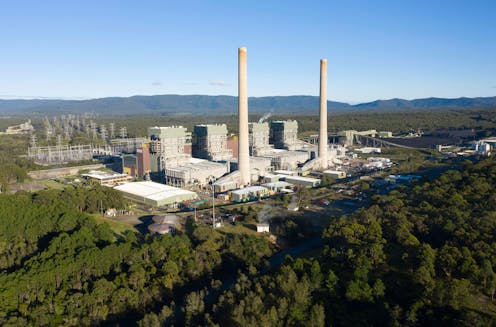
In a major step forward for Australia’s clean energy transition, the country’s biggest coal-fired power station Eraring is set to close seven years early in 2025, Origin Energy announced this morning.
Eraring has been operating for 35 years in the central coast of New South Wales. Last year, it alone was responsible for around 2% of Australia’s greenhouse gas emissions, based on calculations from electricity market and emissions data.
The fundamental reason for its early closure is the brutal impact the growth of renewable energy is having on the profitability of coal plants. Origin has announced it will be building a large, 700 megawatt battery on-site in its place to store renewable energy.
This announcement follows the acceleration of other major coal plant closures: Liddell power station is scheduled to close in 2023, Yallourn’s closure was brought forward to 2028, and only last week AGL Energy edged forwards the scheduled closure of two more coal plants.
This is a welcome step with transition planning by Origin – but also underlines the risks of Australia’s clean energy transition accelerating without a national plan for the exit of coal.
Why is this happening?
Old power stations are excellent sites for batteries due to their existing connections to transmission lines and lots of electricity capacity. This has also been announced for the closed Hazelwood and Wallerawang coal power stations.
Over the past 12 months, the market share of renewable energy has increased to over 30%. In particular, the rapid growth of rooftop solar and solar farms in the middle of the day has sent daytime wholesale electricity prices crashing.
To stay open, coal plants are using a variety of coping strategies. This includes cycling their output down on sunny days and ramping back up for higher prices as the sun sets and demand increases at the end of the day. However, this places stress on ageing plants and breakdowns are becoming more common.
Something has to give. Electricity market analysis last year found Eraring was the coal plant most exposed to the growth of renewable energy and likely to lose significant money by 2025 – so the writing was on the wall for Eraring.
the reality is the economics of coal-fired power stations are being put under increasing, unsustainable pressure by cleaner and lower-cost generation, including solar, wind and batteries.
In announcing the closure, Origin also cited its commitment to net-zero emissions by 2050, and the recommendation of the International Energy Agency that advanced economies close coal plants by 2030.
What will happen to the market and workforce?
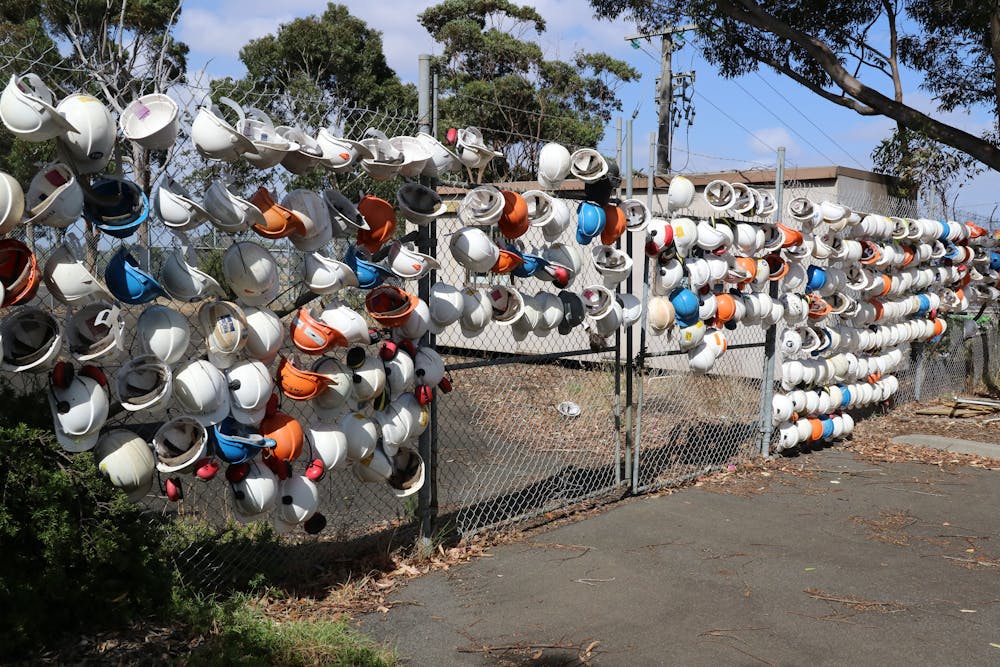
When the Hazelwood coal power station closed in 2017 with just a few months notice, power prices spiked for several years afterwards and many workers were unable to find alternative work.
Origin, however, has given three-years notice in accordance with electricity market rules brought in after the shockwaves from Hazelwood’s closure, and announced it will develop a transition plan for its workforce. This includes training, redeployment and prioritising site employees for long-term operational roles.
Origin presented figures showing the energy and capacity gap will be filled by a combination of new storage, Snowy 2.0, a new transmission line to move power between South Australia and NSW, and new renewable energy infrastructure scheduled for NSW.
Consequently, the impact on prices is likely to be modest compared to the Hazelwood closure.
When Hazelwood Power Station closed in 2017, workers hung their hard hats on the gate. Shutterstock
Eraring’s closure may provide other coal plants some breathing space. Coal plant owners have effectively been playing a game of chicken, holding on and hoping another plant shuts to tighten supply and increase prices.
But as Origin’s figures illustrate, there’s a lot more renewable energy projects in the pipeline, and its figures don’t include the tremendous growth of rooftop solar, which last year saw over 3,000 megawatts installed.
So this is unlikely to be the last of the coal plant closures in our near future. Indeed, in the draft 2022 Integrated System Plan (a “roadmap” for the electricity system), the Australian Energy Market Operator projects as much as 60% of coal plant capacity could be gone by 2030.
We still don’t have an exit plan for coal
Even though coal plants are shutting up shop faster, Australia still doesn’t have an exit plan for coal. That’s unlikely to change, given neither major party is going to want to “own” the closures in an election year.
As a result, this pattern seems likely to continue: renewable energy will continue to grow as the cheapest form of electricity generation, governments will put in place policies to accelerate its growth, and it will be left to the market and asset owners to make decisions on closures without a policy framework. This is extremely risky.
Origin has done the right thing by giving three-years notice, committing to a transition plan for its workforce and investing in battery storage.
But energy market players don’t consider the penalties for not complying with notice requirements an effective deterrent, compared to the financial incentive to hang on and hope for a price uplift when other plants close.
This means we’re left relying on the owner’s goodwill, enlightened self-interest and fear of reputational damage to act responsibly.
Maybe Australia will muddle through like this. But without a plan, we’re at risk of a rush of closures in future years with disastrous impacts on electricity prices, regional economies and livelihoods in coal communities.
We need policy commitments
A variety of models for an orderly exit from coal have been proposed and national agreements have been negotiated to phase out coal in other nations such as Germany and Spain.
While the Australian Energy Market Operator has noted there are technical challenges in the clean energy transition, it considers they can be addressed. There’s no lack of alternative generation and storage to fill the energy gap from retiring coal plants.
Just this week, the NSW government received expressions of interest from renewable energy and storage projects worth over A$100 billion. The government observed that this was equivalent to the electricity output of ten coal-fired power stations in the Hunter Valley Renewable Energy Zone.
Hopefully on the other side of the election there’ll be a political and policy commitment to an orderly exit from coal – a plan that can manage impacts on our electricity system and support coal power station workers through the inevitable transition.
The Institute for Sustainable Futures has received funding for research on projects related to coal transition including the Clean Energy Council (large-scale survey of renewable energy employment), Infrastructure Australia (electricity employment projections) and Global Compact Network/Westpac (implications of just transition for financial institutions and corporate sector).
Next month we will see a significant shake-up in courts across Australia’s eastern seaboard. Three chief justices – Tom Bathurst, of the Supreme Court of New South Wales, Catherine Holmes, of the Supreme Court of Queensland, and Helen Murrell of the Supreme Court of the Australian Capital Territory – are all due to retire.
To date, two replacements have been announced. Andrew Bell is to be sworn in as chief justice in NSW on March 5, followed by Lucy McCallum in the ACT on March 8. The announcement of the Queensland chief justice is imminent.
The appointment of a chief justice is always an important occasion. A chief justice is sometimes called the “first among equals”, referring to the fact that they don’t hold authority over other judges in the court.
But this doesn’t capture fully the role of the chief justice. Increasingly, eras in judicial history and decision-making are discussed by reference to their judicial leader. An example is the discussion of “the Mason court” and its decisions on Indigenous and constitutional rights during the 1990s.
This is in part a reflection of the key role a chief justice can play as an intellectual leader and in the creation of court culture. It also reflects that it is often the chief justice who speaks publicly for the court, including to the media. They will often respond to controversies involving the court, such as delay, misconduct or other shortcomings of judicial officers.
Chief justices also perform key administrative functions in the court. These include the allocation of cases, engaging with the government about court reform and budgets and, of course, consulting on judicial appointments.
Chief justices will often act as a spokesperson for the court. Darren England/AAP
How do we appoint chief justices?
Chief justices are appointed by the same process as other judges.
This means their appointment is at the discretion of the executive government. The cabinet acts on the advice of the attorney-general.
To appoint a judge to the High Court, the Commonwealth attorney-general must first consult with state attorneys-general. In the states and territories, there is no requirement for an attorney-general to consult before appointment.
In practice, though, the attorney-general would generally seek input from the head of jurisdiction (if appointing a new chief justice, that would be the outgoing chief justice), as well as professional bodies representing barristers and solicitors.
This remains the process at the Commonwealth level. It was also the approach adopted most recently in New South Wales.
Some jurisdictions have recently experimented with a more transparent appointment process. In Queensland, following the highly criticised appointment of Tim Carmody as chief justice in 2014 on the basis he was unsuited to be appointed to the position, the government adopted a Protocol for Judicial Appointments.
This includes an expression-of-interest process and a judicial appointments advisory panel. The panel provides the attorney-general with a shortlist of candidates. The shortlist must be based on six criteria set out by the Australasian Institute of Judicial Administration (AIJA):
intellectual capacity
personal qualities (including, for instance, integrity and independence of mind)
an ability to understand and deal fairly
authority and communication skills
efficiency
leadership and management skills, particularly in the court, but also relating to those external to the court such as the legal profession.
The Queensland protocol also requires the panel to consider “opportunities for promoting diversity in the judiciary”.
However, these experiments with more open appointment processes have rarely been secured through legislative or constitutional reform. This leaves them vulnerable to being shelved by future governments. Indeed, when the Abbott government came to power in 2013 it quietly abandoned a Labor-initiated federal reform of the late 2000s.
Whether a process for appointment is fluid and secret or transparent and consultative depends greatly on how governments understand the essential attributes of a “good” judge in a diverse democratic society.
What should a government look for in a chief justice?
Is there anything, then, that governments should be looking for specifically in a chief justice? We have written elsewhere that the chief justice has distinctive relationships with the government, the legislature, the media and the public, the profession and the academy. This means they are uniquely placed, and obliged, to protect and promote judicial values in the court they lead.
When well-established principles such as judicial independence and impartiality come under threat, from the government or elsewhere, the chief justice must defend them. A prominent recent example was when Victorian Chief Justice Marilyn Warren issued a public defence of the court in 2017 after federal government ministers attacked the impartiality of her court, particularly in criminal sentencing of terrorist offenders.
In 2017, then-Victorian Chief Justice Marilyn Warren defended the court against accusations of impartiality. Melbourne Law School
Chief justices can also advance emerging values, such as a commitment to robust accountability for judges who misbehave, or to increase diversity and transparency on the bench.
How can the process be improved?
The AIJA’s criteria for appointing a judge require chief justices to display various “authority and communication” and “leadership and management” skills. But does a chief justice require something more?
We say yes. They must be individuals who can provide intellectual leadership and contribute constructively to the collegiality of the court. These characteristics are no doubt important, but they will largely be met through the existing criteria.
Chief justices must also bring to the role an institutional sensitivity and a reform mindset that allows them to respond to and anticipate contemporary challenges to the court.
Recently, this has included the need for courts to respond quickly to the COVID-19 pandemic to maintain access to justice and uphold the open court principle. It has also included responding appropriately to public revelations, and administrative findings, of sexual harassment by judicial officers.
In this respect, High Court Chief Justice Susan Kiefel has been widely commended for the personalised understanding she showed to those women who brought complaints of sexual harassment against former High Court judge Dyson Heydon. In response, she implemented an administrative inquiry into the conduct and a subsequent review of the judicial workplace, focusing particularly on the vulnerable position of judicial associates.
If a government is truly committed to the traditional and modern values of the court system, it should be seeking an individual who can defend the institution from unwarranted attacks, as well as recognise and respond to genuine criticism and shortfalls of the institution.
These attributes should not be left to chance, but should be set out and candidates’ experience considered against them. It is only in this way the judiciary will retain the confidence of the public.
Professor Gabrielle Appleby was a member of the Advisory Committee of the Australian Law Reform Commission Inquiry into Judicial Impartiality (2020-2021).
Associate Professor Heather Roberts receives funding from the Australian Research Council for a project titled ‘The Ideal Judge’, which examines changing expectations of judges and judging in Australia since federation. She was a member of the legal history committee that designed the legal history installation for the Supreme Court of the ACT.
Interdisciplinary, transdisciplinary and multidisciplinary are all nice buzzwords. But talk of “breaking down the barriers” is all too often a cover for breaking down academic disciplines to create administrative flexibility. This is a disaster in the making for both research and education.
Universities need to learn to recognise antidisciplinarity and avoid it. Running through the initial restructuring proposal was the idea that academic disciplines are “silos” that stand in the way of interdisciplinary research and teaching. This is a complete misunderstanding: strong disciplines are the essential foundation of interdisciplinarity.
What is interdisciplinarity?
Interdisciplinary research uses knowledge and skills from different disciplines to target a specific problem. Interdisciplinary teaching examines the same question from different disciplinary perspectives. If universities are to meet today’s challenges, whether that is climate change and extinction or reconciliation and closing the gap, they need to support interdisciplinary research and education.
I have the privilege of working in the University of Sydney’s Charles Perkins Centre. This interdisciplinary research centre was created because solving the problem of lifestyle diseases requires input not only from medicine and the biosciences, but also economics, political science, law, engineering and the humanities and creative arts.
Interdisciplinary teams, when assembled with insight and managed with skill, can achieve extraordinary results. But the foundations of those results are strong disciplines.
An interdisciplinary team is not a group of people trained in “interdisciplinarity”. It’s a group of people who have deep knowledge and sound judgment in their disciplines.
I once worked with an international collaboration that was standardising how some biomolecules are named. I was not invited as an interdisciplinary scholar who knows a bit about molecular biology, but as an expert in the history and philosophy of biological classification. A key skill in an interdisciplinary team is knowing when to defer to other people’s disciplinary expertise. That is what they are there for.
What are the warning signs of antidisciplinarity?
Truly interdisciplinary work is likely to reach right across the university and beyond.
If an “interdisciplinary” initiative encourages people from the same administrative unit or “cost centre” to work together and even discourages involving people from another cost centre, that should set off alarm bells. It’s likely not an interdisciplinary initiative at all, but an effort to force intellectual activity into an ill-fitting administrative box. That is antidisciplinarity in action.
A discipline is much more than a particular stream of courses in the undergraduate syllabus, despite efforts to redefine it as such. A discipline is an international community of expertise.
A discipline is the group within which one expert can legitimately judge another expert’s work. A historian, an epidemiologist or a quantum theorist is best placed to judge whether work in history, epidemiology or quantum theory is good work. They can tell if a course covers the right material. They can also tell who is the most promising candidate for employment or for promotion.
If these day-to-day management decisions are not made by disciplinary experts, bullshit can flourish. That is why universities were traditionally organised into departments based on a discipline or tightly related disciplines like the different branches of physics.
Interdisciplinary education is better described as multidisciplinary, since what it really does is expose students to multiple disciplinary perspectives.
In a truly interdisciplinary project each participant has a different perspective on the problem. They negotiate through these differences to a shared – and often highly innovative – approach. That is one reason interdisciplinary teams are so powerful.
But only the most advanced undergraduate students have started to develop a disciplinary mindset. They can learn to work in a group – an important skill – but they are not collaborating as discipline experts. We should not be training students to think that having “done your research”, as we now say, is a substitute for disciplinary expertise.
Disciplines are continually evolving. The changing structure of knowledge itself drives this evolution. The administrative structures of universities must accommodate these changes or become obstacles to progress.
For example, retired biologists will remember departments of botany, zoology and microbiology, with a department of biochemistry somewhere else in the university. The molecular revolution in biology dissolved those divisions as the ideas and techniques of the life sciences became more broadly integrated.
But a university cannot create meaningful disciplines or interdisciplinary fields by creating administrative units. Back in 1900 it was common for philosophy and psychology to sit together in departments of “moral sciences” or “mental and moral philosophy”. If we did that today it would not create an exciting new synergy. It would just make life difficult for everyone involved – staff and students.
Like running a research team, running a university means knowing when to defer to discplinary expertise. Those actively involved in creating knowledge understand best what will create synergy and what will merely create confusion.
Disciplines are not the real problem
Administrative structures do frequently do stand in the way of interdisciplinary research and teaching. But the problem is not that people are fenced off in different disciplines. It is that they are fenced off in different cost centres, unable to collaborate because income would be “lost” to another part of the university.
It would be convenient if every administrative unit was an interdisciplinary synergy, where everyone wants to collaborate and no-one wants to collaborate with a different cost centre. But wishing will not make it so.
It would be convenient if academics cared more about whether their research and teaching are profitable and a bit less about whether they are credible in their discipline. But unless research and teaching have credibility with disciplinary experts a university loses its social licence to operate.
Antidisciplinarity arises from an understandable frustration with these facts among those who must manage university budgets. But it’s a recipe for poor research and poor education.
Paul E. Griffiths receives funding from the Australian Research Council and the John Templeton Foundation
Are you one of the increasingly large number of people seeking to minimise the environmental damage wrought when producing the food you eat? If so, you might use the common “environmental footprint” method to decide what to buy.
Environmental footprints measure the environmental damage caused by a product throughout its life. For food, this includes the impacts of growing crops and livestock, and manufacturing the inputs required such as fertilisers. It can also include packaging and transport.
But unfortunately, environmental footprints often don’t tell the full story. When consumers switch to a food seen as more environmentally friendly, its production expands at the expense of other products. This has consequences that environmental footprints don’t take into account.
Environmental footprint calculators may promise to help consumers lead a greener life. But they may in fact encourage choices that don’t benefit – and may even harm – the environment.
Footprint calculators may encourage choices that don’t necessarily benefit the environment. Neil Hall/EPA
A problematic assumption
We are experts in assessing the effectiveness of climate change mitigation for agricultural systems. We regularly provide policy advice to governments, United Nations bodies and other organisations.
The design of environmental footprint calculators is guided by international standards organisations and policymakers, including the European Union. The tool is commonly found on the websites of environmental groups, government agencies, companies and other organisations.
The calculators aim to guide consumer choice, by assessing the impacts of current production on the environment. But this is a problem.
It assumes the footprint of a product calculated today remains constant as production is scaled up or down, but this often doesn’t hold true. When demand for a product changes, this has knock-on effects on nature. It might mean more agricultural land is required, or river water is used to irrigate different crops.
Below, we examine three ways environmental footprints can provide a misleading picture of a product’s true impacts.
1. Land use
Agriculture makes a large contribution to greenhouse gas emissions – primarily due to animal belches but also the production and use of synthetic fertilisers.
Organic farming can help reduce agriculture emissions, primarily because it doesn’t use synthetic fertiliser. But some research suggests converting to organic farming production could also exacerbate greenhouse gas emissions.
Some research suggests converting to organic farming production could also exacerbate greenhouse gas emissions. Shutterstock
One study in England and Wales examined what would happen if all food production was converted to organic. It found global greenhouse gas emissions from food production could increase by about 60%.
This was because organic systems produce lower yields, meaning more crop and livestock production would be needed overseas to make up the shortfall. Creating this agricultural land would mean clearing vegetation, which emits carbon dioxide when it decomposes.
And when grasslands are converted to cropland, soil organic carbon is also lost.
Enhanced soil carbon storage from organic farming offsets only a small part of the higher overseas emissions.
When considering the consequences of switching from one food to another, the type of agricultural land used is also important.
In Australia, about 325 million hectares of land is used to raise cattle to produce red meat. This land often can’t be used to grow crops because it’s too dry, steep, vegetated or rocky.
If consumers switch from red meat to plant-based diets, more land suitable for growing crops would be needed, either in Australia or overseas, to produce alternative proteins such as legumes or plant-based meats.
In Australia, existing arable land is already being used to supply crops to domestic and global markets. So new land would have to be made suitable for crops, either by cultivating grazing land or clearing forest. Alternatively, crop production could be increased by using more fertiliser or other inputs.
The emissions associated with these shifts are not included in carbon footprints of plant-based protein production.
Around 325 million hectares of land in Australia is used to raise cattle for meat. Rick Rycroft/AP
2. Water
It’s commonly assumed that choosing a product with a smaller water footprint will increase the water in rivers and lakes which replenishes the environment. However, in Australia, policy and markets determine how water is used.
Irrigation water can be traded between users. If a water-intensive crop such as rice is no longer grown, the farmer will almost always either use the water to grow a different crop or trade it with another farmer. In such a scenario, no water is returned to the environment.
Similarly, a fall in red meat production may not necessarily increase water for the environment.
Farmers whose land adjoins a river or other water body are allowed to take water for livestock to drink. Fewer livestock would leave more water available in rivers, but research in Australia suggests this water would be extracted for domestic uses, especially in dry years.
3. Goods produced together
Many agricultural products are produced in conjunction with others. For example, a cow slaughtered for red meat will also produce hide, meat meal and tallow. Likewise, a sheep can produce wool when alive, then other products when slaughtered.
So if consumers eschewed red meat due to its high carbon footprint, the associated products would also need to be replaced – and this would have environmental impacts.
If synthetic materials replace wool or hides, for example, demand for oil will likely increase. Or if wool is replaced with bio-based products such as cotton or hemp, demand for cropland will increase.
A switch from hide to synthetic materials would likely increase oil demand. Shutterstock
Increasing milk production per cow – and thus keeping fewer cows – has been considered as a way to reduce livestock emissions. But research suggests it may not have the intended result.
Fewer cows would produce fewer calves, which are used to produce veal. The research found less veal would require more red meat to be produced elsewhere, meaning no overall reduction in emissions.
It is realistic to assume that more red meat would be required. While per capita beef consumption is declining in some Western countries, global demand for beef is projected to increase to 2030 as wealth in developing countries increases and global population grows.
Towards a healthier planet
We and other experts are increasingly trying to raise awareness of the simplistic nature of environmental footprints.
It’s important to recognise the limitations of current methods and create tools that fully assess the consequences of consumers’ decisions.
Developing these tools will be challenging, due to the many uncertainties involved, and will require substantial research investment.
But it will lead to better environmental policy, fewer unintended consequences and a healthier planet.
Aaron Simmons is a Technical Specialist in Climate Change Mitigation with the NSW Department of Primary Industries, and a
an adjunct Senior Research Fellow with The University of New England. He receives funding from the Commonwealth government and rural research and development corporations.
Annette Cowie is a Senior Principal Research Scientist in the Climate Branch at the NSW Department of Primary Industries, and Adjunct Professor in the School of Environmental and Rural Science at the University of New England. She receives research funding from NSW and Commonwealth government programs and rural research and development corporations. She is a member of Soil Science Australia and an adviser to the Australia New Zealand Biochar Industry Group and the Land Degradation Neutrality Fund.
Source: The Conversation (Au and NZ) – By Adrian Beaumont, Honorary Associate, School of Mathematics and Statistics, The University of Melbourne
AAP/Mick Tsikas
This week’s Newspoll, conducted February 9-12 from a sample of 1,526, gave Labor a 55-45 lead, a one-point gain for the Coalition since the late January Newspoll. Primary votes were 41% Labor (steady), 34% Coalition (steady), 8% Greens (down three), 3% One Nation (steady) and 14% for all Others (up three).
40% were satisfied with Scott Morrison’s performance (up one), and 56% were dissatisfied (down two), for a net approval of -16. Anthony Albanese’s net approval was down six to -6. Morrison increased his better PM lead from 43-41 to 43-38. Figures are from The Poll Bludger.
For most of this term, Newspolls have been published every three weeks, but this Newspoll was released a fortnight after the previous one. That suggests Newspoll will be fortnightly in the lead-up to the federal election.
The big story is the three-point drop in the Greens’ primary vote. It’s possible some Greens supporters are not enamoured with the Greens’ anti-Labor rhetoric
and so switched to Labor, and that the Greens are also losing support to climate independents.
If the Greens lost support to Labor, why isn’t Labor up? It’s possible Labor lost support to the Coalition, but the Coalition lost ground to vaccine-sceptical others like Clive Palmer’s UAP.
The overall Labor lead of 55-45 is still strong for Labor, but Essential last week
gave Labor just a one-point lead after preferences. Essential and Resolve, which have been the worst polls for Labor since late 2021, are likely to both be published next week.
NSW byelection updates: Willoughby could be close
After originally selecting the Greens as the Liberals’ two candidate opponent in Willoughby, the Electoral Commission has nearly finished re-doing this count as Liberal vs independent Larissa Penn.
Based on preference flows from polling places that have reported a Liberal vs Penn count, the ABC is estimating 51.7-48.3 to Liberal from the current primary votes. But postals have not yet been counted, and there are almost as many postals received to date as votes counted so far.
I suggested in Sunday’s article that, if more left-leaning voters were anxious about COVID, the postals could skew left. Postals almost always skew right in Australian elections, but far fewer people vote by post than at these byelections.
In the other byelections, Labor’s two party share in Bega dropped from 57.1% on election night to 55.6%, still a 12.6% swing to Labor. In Strathfield, Labor rose from 54.4% to 55.7%, a 0.7% swing to them that was negative on election night. In Monaro, the Nationals were down from 55.0% to 54.9%, a 6.7% swing to Labor.
These changes from the election night figures mainly reflect the addition of pre-poll booths that were not counted on election night. Postal votes will not start being counted until Saturday.
Morgan poll: Frydenberg preferred as Liberal leader
A Morgan SMS poll had Josh Frydenberg as preferred Liberal leader. AAP/Lukas Coch
A Morgan federal SMS poll, conducted February 14-15 from a sample of 1,080, had 38.5% of voters preferring Treasurer Josh Frydenberg as Liberal leader, 31% incumbent PM Scott Morrison and 12.5% Defence Minister Peter Dutton.
Coalition voters still had Morrison first with 40%, Frydenberg at 32.5% and Dutton 12.5%. Dutton had his highest ratings (22%), with the independent/other category, which would include One Nation.
Australian jobs report: little change in January despite COVID crisis
The ABS released the January Australian jobs report Thursday. Despite the massive COVID surge in early to mid-January, there was little change from December. Unemployment was steady at 4.2% and underemployment and participation both up 0.1% to 6.7% and 66.2% respectively. This ABC report focuses on the drop in hours worked, which are likely to rebound in February.
The 4.2% unemployment is tied with December as Australia’s lowest since August 2008, just before the global financial crisis. The employment population ratio – the percentage of eligible Australians employed – increased 0.1% to 63.4%, and is higher than at any prior point on the ABS chart in the past ten years.
Bad COVID outbreaks are having a diminishing impact on the overall economy; this was the case in the US in January too. While the jobs situation is good for the government, inflation is not so good.
WA poll: McGowan’s approval slumps to 64%
From the front page of Wednesday’s West Australian, a People’s Voice poll has WA Premier Mark McGowan at 64% approval, 25% disapproval (net +39).
While a 64% approval is very good by most standards, McGowan had a 91% approval rating in late 2020, with just 5% disapproving. His approval dropped to 77% in November 2021.
US Democrats gain in redistricting, but Biden’s ratings still poor
I wrote for The Poll Bludger Tuesday that redistricting of the 435 US federal House seats occurs once a decade after a Census. So far this cycle, Democrats are up 11, Republicans down three and competitive down eight. But Joe Biden has almost overtaken Donald Trump in having the worst net approval of any president at this stage of their term since approval polling began.
Also covered in this article: Boris Johnson remains UK Prime Minister despite the “PartyGate” scandal, the centre-left Socialists won a majority at the Portuguese election, and Emmanuel Macron likely to be re-elected at French presidential elections in April.
Adrian Beaumont does not work for, consult, own shares in or receive funding from any company or organization that would benefit from this article, and has disclosed no relevant affiliations beyond their academic appointment.
Following years of discussions, support for a global treaty to stem the tide of plastic pollution is now widespread, with 75% of UN member states backing the idea.
Next week, countries will negotiate two competing resolutions in the lead-up to the UN Environment Assembly. Both resolutions call for the establishment of an intergovernmental negotiating committee to start work on a legally binding treaty.
The negotiations are a crucial moment for the New Zealand government. More than 750 groups — including civil society, Indigenous peoples, trade unions and youth groups — are calling for a binding treaty that captures the full life cycle of plastics.
New Zealand has so far only expressed general support for a plastics treaty, but has not co-sponsored either of the two resolutions. More than 300 scientists and research organisations are calling on all UN member states to accept nothing less than the key elements of the stronger Rwanda-Peru resolution.
Solutions to match the severity of the plastic crisis
The Peru-Rwanda resolution is commensurate with the gravity of the plastic pollution crisis. It has the backing of more than 70 countries, including 27 from the European Union. It was the result of a consultative process and has widespread support among civil-society organisations.
Japan’s resolution has only three co-sponsors to date: Cambodia, Palau and Sri Lanka. It has been described as the “skin” of the Rwanda-Peru resolution “without the muscle” — a significantly diluted version.
Islands of plastic in the Karnaphuli river in Bangladesh. Mohammad Shajahan/Anadolu Agency via Getty Images
The Rwanda-Peru resolution proposes a legally binding agreement which addresses the full life cycle of plastics. This covers the extraction of fossil fuels for the production of plastics, manufacture and consumption, end-of-life management and the safe retrieval of legacy plastics.
It sets out an open mandate for the intergovernmental negotiating committee. This means negotiators could work on a broad range of issues relevant to plastic pollution as discussions progress.
The Rwanda-Peru resolution also requires a scientific advisory committee to ensure all countries have free and open access to the latest science and best practice, financial support for developing countries and coordination with pre-existing international agreements.
Cleaning up ocean plastics is not enough
Japan’s resolution proposes a closed mandate which severely limits what diplomats can consider. This significantly undermines the ability of the intergovernmental negotiating committee to prepare an effective treaty.
This resolution refers to plastics’ “life cycle” but its text prioritises waste management interventions over preventative measures, while further limiting its scope to marine litter.
New Zealand’s government should support the key elements of the Rwanda-Peru resolution. It presents the absolute minimum needed to ensure the global community operates within the safe space of the planetary boundary for “novel entities”, including plastics.
Plastic pollution crosses borders and lasts for generations. This is an opportunity for New Zealand and other UN member states to meet their moral obligation to protect people from its wide range of impacts.
Marine plastic pollution is merely one aspect of a bigger crisis. Andrey Nekrasov/Barcroft Media via Getty Images
Plastics are threat multipliers. They can act together with other stressors, such as climate change and over-exploitation of marine resources, to cause far greater damage than if they occurred in isolation.
An effective treaty would dramatically reduce the volume of persistent toxic plastics released into the biosphere. Simultaneously, it would also reduce the impacts of escalating plastic pollution on the climate, human health, human rights and biodiversity.
The Ministry for the Environment says the New Zealand government supports a global treaty, but “the overall scope, level of ambition, and nature of commitments of a global agreement all remain subject to negotiations”.
If we are to realise a treaty with long-term and effective outcomes, New Zealand will need to negotiate hard for an agreement with a sufficiently wide scope and high ambition.
The international scientific community is clear. Efforts focusing only on waste management will not scale up to the crisis. The priority must be prevention and product redesign.
Turning off the tap at the point of production offers the largest reduction of plastic pollution. It often represents net savings to consumers and producers, while providing the best opportunity to reduce greenhouse gas emissions.
The last thing we want is to come out of negotiations with a treaty that can only respond to waste management and marine litter. This would fail to address the source and impacts of rapidly increasing volumes of global plastic pollution.
Trisia Farrelly receives funding from the United Nations Environment Programme, the Environmental Investigation Agency, and Massey University. She is affiliated with Massey University, The Aotearoa Plastic Pollution Alliance, and the New Zealand Product Stewardship Council.
PODCAST - Buchanan + Manning on What Putin wants from a negotiated diplo-solution
/
RSS Feed
Share
Link
Embed
A View from Afar – In this podcast, political scientist Paul Buchanan and Selwyn Manning deep-dive into the latest events emerging from the Russia/Ukraine crisis, and they consider:
What does Russia’s Vladimir Putin want from NATO and the US in a negotiated diplomatic solution to the Ukraine issue?
And what, from Ukraine’s perspective, is the most favourable outcome from the threat of the Russian military build-up on its border.
Also, in the US there are concerns that once the Beijing Winter Olympics concludes, the Peoples Republic of China may assert a renewed diplomatic crisis with Taiwan.
But, does this fit with a renewed Russia-PRC strategic partnership? And what does such a strategic partnership look like?
You can comment on this debate by clicking on one of these social media channels and interacting in the social media’s comment area. Here are the links:
Threat.Technology placed A View from Afar at 9th in its 20 Best Defence Security Podcasts of 2021 category. You can follow A View from Afar via our affiliate syndicators.
New Zealand Parliament Buildings, Wellington, New Zealand.
Editor’s Note: Here below is a list of the main issues currently under discussion in New Zealand and links to media coverage. You can sign up to NZ Politics Daily as well as New Zealand Political Roundup columns for free here.
Domestic and family violence perpetrators commonly use technology such as phones and other devices as a weapon to control and entrap victims and survivors, alongside other forms of abuse. This “digital coercive control” is not bound to a particular location and can follow targets anywhere, any time they access devices or digital media.
For women outside urban Australia, technology-enabled abuse can pose more risk than for those in cities. In research funded by the Australian Institute of Criminology, we spoke to 13 such women who have been subjected to digital coercive control to understand what it is like.
The disturbing side of technology
… you see a side of a phone that you probably wish you didn’t know about [Shelly]
The women reported that abusers used technology to harass and stalk. The majority experienced image-based sexual abuse (the creation and/or release of intimate images without consent) or recordings made of victims or survivors, overtly or covertly.
Some experienced doxxing (release of personal and identifiable information). Perpetrators in some cases impersonated real or fake people and initiated contact with women or their children. Authorised functions of phones and other devices and accounts were sometimes impaired, or unauthorised functions enabled.
I think you can feel a lot safer knowing they are not in proximity; they can’t hurt me. When it comes to technology it can – I guess you’re more hyper-vigilant because they can come any time and you can’t stop it. Even if you block someone, they find another way. They do; he always found other means to make contact with me. I never – I guess you never got to escape, which I hadn’t experienced before, because every other type of abuse I was able to – it ended at some point. [Kira]
It is different outside the cities
These behaviours have also been observed in urban settings in Australia. Also, like in cities, we found that violence persisted (and often increased) after separation.
However, women outside cities face higher barriers when seeking help and responding to family violence, and they can also be at greater risk.
Domestic violence agencies are further from women’s homes in non-urban areas, as we have observed in this study and in other work. Legal services can be limited and there are shortages in alternative and crisis accommodation.
Complicated financial arrangements and pressures may hinder women’s ability to exit violent relationships, such as where they work on farms or other small businesses and there may be few employment and educational opportunities in the region.
No anonymity
Numerous survivors spoke of the lack of anonymity in rural areas, so they and/or their abusers were more likely to be known when disclosing and reporting violence. This can be confronting, especially when perpetrators are well-known and well liked.
He is established – he knows people and he’s well liked … he’s in a boys’ club and knows lots of people … whereas I don’t. [Fiona]
This could be heightened for women with family and networks out of the region or overseas, culturally and linguistically diverse women, criminalised women, or those viewed as “different” outsiders.
As well as actively destroying women’s social networks, abusers would challenge women’s accounts of abuse and attempt to gather allies, as Claire explains:
He went around the streets telling people that I’m crazy … Because we’re in a small country town he was going in and out of shops … He affiliated himself with one of the local churches and got them on his side.
Isolation and fear
Abusers socially isolate women, and those in non-urban areas are often socially further from family, friends and support services than those urban areas. We found too, that some abusers sought to extend geographic isolation, by moving women to more remote locations.
Technology could provide channels to communicate with others and to seek assistance and support. Natalie had “a good amount of friends” and so would be “on the phone, or I’d be texting, and that was my outlet for a crazy situation”. However, some women felt this was not always possible when devices had been taken over or were monitored by abusers.
[I was] too scared to use it [technology]. I just couldn’t reach out to people … I didn’t want to use it just in case [Lola]
Fear loomed large in women’s accounts of digital coercive control. All those we spoke to had contact with police.
Some had positive encounters, most commonly with specialist (domestic and family violence liaison officers, who are less available in many rural areas) but more spoke of negative encounters. Women who were dissatisfied with police felt that officers were dismissive of digital coercive control.
‘Homicide flags’
We believe digital coercive control warrants attention. Coercive control, obsessive tendencies, stalking, and threats to kill or self-harm have all been noted as signals of fatal violence by death review teams.
The women we interviewed reported all these behaviours. Non-fatal strangulation is another “homicide flag” and was reported by 46% of our participants.
Firearm ownership and threats to use firearms also signal high risk. Firearm ownership is common on farms and in many rural areas.
An assault can become a homicide in rural areas, because of the sheer distance between the site of an attack and a hospital or medic.
It is imperative that we acknowledge and address how technology is used against survivors and the impact that technology-facilitated abuse has on women across landscapes. We must also recognise that women in rural locations face elevated risks, and that digital coercive control can provide evidence and signal risk of fatal violence.
Pseudonyms have been used for the women quoted in this article.
The National Sexual Assault, Family & Domestic Violence Counselling Line – 1800 RESPECT (1800 737 732) – is available 24 hours a day, seven days a week for any Australian who has experienced, or is at risk of, family and domestic violence and/or sexual assault.
Bridget Harris receives funding from the Australian Research Council and has previously received funding from The eSafety Commissioner. This work was funded by the Australian Institute of Criminology. She has completed and ongoing grants funded by this organisation.
Delanie Woodlock has previously received funding from The eSafety Commissioner. This work was funded by the Australian Institute of Criminology. She has completed and ongoing grants funded by this organisation
As the major parties shift into election mode, the Morrison government is clearly placing defence and security issues at the centre of its campaign.
By depicting Labor as “weak” on China, Defence Minister Peter Dutton is hoping fears of China’s global ambitions will provide an electoral advantage to the Coalition.
What does history tell us about the role of defence and security issues in federal elections? And if these areas do become a major election issue, who benefits?
However, in both these cases, the issues were related to homeland security and asylum seekers, rather than Australia’s defence or foreign policies.
We have to go back to the elections in the late 1960s and early 1970s, when Australia’s involvement in the Vietnam War was a divisive issue, to find an example of defence figuring prominently in an election.
In 1966, at the height of public support for the Vietnam War, Harold Holt won a decisive victory for the incumbent Liberal/Country coalition, arguing Labor’s position on withdrawing troops from Vietnam would put the country’s security at risk.
Since then, debate around Australia’s defence and foreign affairs policies has been relatively muted. Australia’s withdrawal from Vietnam in 1972 marked the beginning of a long period of bipartisanship on security, with both parties viewing the US as the linchpin for Australian defence and foreign policy.
There’s also been little disagreement on the importance of the US to Australia in public opinion, as we explain in our new book looking at these trends from 1945 to the present day.
Both the Australian Election Study (AES) surveys and polls by the Lowy Institute have rarely recorded fewer than eight out of 10 voters believing the alliance with the US was either “very” or “fairly” important for Australia’s security. And the differences between supporters of the two major parties are negligible.
This could be explained by the fact that since the end of the Cold War in the early 1990s, the public has seen relatively few external threats to Australia’s security.
The wars in Afghanistan and Iraq took place far away and were not regarded as a direct threat. To the extent the public has seen a threat, it has been through terrorism, with the 2002 Bali bombings being the most recent example.
Changing perceptions of China as a threat
The economic and military rise of China in recent years has changed the public’s threat calculation. This is at least partly due to a greater awareness of China’s belligerence towards Taiwan, its claims over the South China Sea and its embargoes on Australian goods, all of which have raised concerns about China’s potential to threaten Australian security.
Other factors, such as the tone of media coverage on China, may have also contributed to this changed threat perception.
As a result, we have seen a measurable shift in the public debate about Chinese influence in Australia. Since 2015, this perceived threat has moved from being a relatively niche issue in the mainstream media, to a major one.
Usually, any changes in the public’s views towards other countries tend to take place over many years. However, when it comes to China, the shift has been dramatic.
The AES surveys show that in 1987, just before the Tiananmen Square massacre, only 3% of the public regarded China as “very likely” to pose a security threat to Australia. In 2019, this was 31%. We expect it to be even higher in this year’s AES survey.
Lowy’s polls also show the same rise in public concern about China. In the 2006 poll, 40% of Australians had “little trust” in China; in 2021, that figure more than doubled.
The 2021 Lowy poll also found that, for the first time, more people saw China as a security threat than an economic partner.
In the relatively stable world of public opinion towards security and foreign affairs, these are major changes with important political implications, not least for the upcoming federal election.
More Australians now view China more as a threat than a partner. Andy Wong/AP
Which party stands to benefit?
The two major parties are generally regarded by the public as better able to handle some issues than others. According to our research, the Coalition is regarded as better on economic management, taxation and immigration; Labor is preferred on health, education and climate change.
The Coalition also had an advantage over Labor on national security the last time the AES asked about this issue in 2007. Voters preferred the Coalition’s defence and security policies over Labor’s by eight percentage points.
This advantage is likely to be much greater in 2022 compared to 2007. In times of threat, the public tends to view the government in power as more trustworthy on defence and security issues — the “rally around the flag” effect.
The Coalition government benefited from this at the beginning of the pandemic when it was seen as effectively handling a once-in-a-century health emergency. However, the slow vaccine roll-out and other problems have since eroded this advantage.
Faced with defence and security as an election issue, Labor’s only option is to emphasise bipartisanship.
As such, Labor has made relatively few statements about the new AUKUS security pact with the US and UK, other than to register its in-principle support. Nor has Labor disagreed in any fundamental way with the government’s policy response to China’s trade embargoes against Australia.
While the Coalition leans into its perceived advantage on security issues, Labor’s best strategy is to try to shift the policy debate towards the issues on which it has a long-term advantage among voters, such as health, education and the environment. But its success in doing that may well depend on global events beyond the control of either of the major parties.
Ian McAllister receives funding from the Australian Research Council.
Danielle Chubb does not work for, consult, own shares in or receive funding from any company or organisation that would benefit from this article, and has disclosed no relevant affiliations beyond their academic appointment.
If emissions continue to accelerate, Western Sydney can expect to endure up to 46 days per year over 35℃ by 2090, a new analysis from the Australia Institute finds. This is a fivefold increase from the historical average of just under nine days of extreme heat per year.
Western Sydney, home to around 2.5 million people, is highly vulnerable to extreme heat and is 8-10℃ hotter than east Sydney during heatwaves. The region is too far inland to benefit from coastal breezes, and lacks the altitude of the neighbouring Blue Mountains.
The furthest inland suburbs, such as Penrith, are hottest. Indeed, in early January, 2020, Penrith was the hottest place on Earth, reaching a scorching high of 48.9℃.
However, such a dramatic rise in extreme heat days is not inevitable. If global warming is limited to 1.5℃ this century, in line with the Paris Agreement, Western Sydney will have fewer than 17 days of 35℃ per year by 2090. Emissions reduction and smart urban design are urgent measures to protect Western Sydney-siders from heat stress.
The rise in extreme heat days can be limited to 17 days per year if we cut emissions. The Australia Institute, Author provided
Heatwaves are deadly
In Australia, heat accounts for more deaths than all other natural disasters combined. If the power goes out, it’s much harder to mitigate the stress.
In January 2009, during the devastating heatwave that preceded the Black Saturday fires, Melbourne experienced a power outage on a 44℃ day, leaving some 500,000 people in the heat without electricity. The heatwave alone killed 374 people, and cost Melbourne an estimated A$800 million.
Heat also acutely affects worker productivity. The New South Wales treasury estimates that by 2061, the state could lose up to 2.7 million working days every year from reduced worker productivity in agriculture, construction, manufacturing and mining, due to heat.
However, under a low-emissions pathway, NSW estimates the loss in worker productivity could be limited to about 700,000 days. While this is still significant, it’s a quarter of cases compared to a high-emissions future.
To find out how climate change would affect Western Sydney, we analysed climate projections from the Bureau of Meteorology and CSIRO. We calculated temperature projections using a low-emissions scenario (where global warming is stopped at 1.5℃) and a high-emissions scenario (where global emissions continue unabated).
Examining 12 federal electorates that make up Western Sydney, we found the electorate of Lindsay, which includes the city of Penrith, will be most impacted. It can expect up to 58 days of 35℃ by 2090 under a high emissions scenario.
Who is impacted?
Western Sydney is uniquely prone to the “urban heat island” effect. The dense concrete and lack of green spaces absorbs and amplifies heat, raising temperatures to dangerous levels.
Residents without access to affordable air conditioning, with preexisting medical conditions or who work outdoors are most at risk of heat stress.
To understand the human impact of extreme heat, we partnered with extreme heat advocacy nonprofit Sweltering Cities. They conducted a targeted survey of Western Sydney in 2020, collecting insights from 682 respondents.
Gemma is a single mum who lives in affordable housing in Ropes Crossing, near Penrith. Kim Vernon/Sweltering Cities
Gemma MacMillan is a single mum of a three-year-old boy, living in affordable housing in Ropes Cross. “In summer I have to keep my son Oliver inside as much as possible on hot days,” she says. “There’s no shade at all in my backyard.”
Gemma has lived in a house without air conditioning or ceiling fans. “In the past we’ve gone to stay with my ex-partner’s mum who has an air con, but now we’ve broken up and I worry about my son when it’s really hot.”
Even though retired chemist Rafael Perez has air conditioning, he says: “you’ve got to think of the cost. I’m not in a position to have it on all the time so I turn it off as soon as I can.”
Rafael is a retired chemist who has lived in Erskine Park in Sydney’s Western Suburbs for 22 years. Kim Vernon/Sweltering Cities
In fact, despite Western Sydney having, on average, lower income levels, residents in areas such as Penrith are paying on average up to $100 per month more in electricity bills than those living closer to the coast.
Reflecting on his 22 years in the neighbourhood, Rafael says, “there used to be a lot more trees when I moved here, now there is a lot more concrete.”
What needs to change?
Reducing emissions is the difference between 1.5 months and 17 days of extreme heat per year in Western Sydney.
Thankfully, there is appetite for change. Earlier this month, for example, prominent cricketer Pat Cummins launched Cricketers for Climate in Penrith, a movement for Australian cricket clubs to achieve net-zero emissions over the next decade. The initiative highlights how the climate crisis threatens our ability to play sports, and positions athletes as advocates for climate action.
Additionally, the upcoming federal election could provide the policy window to increase climate ambition, as Western Sydney has a number of highly contested swing seats. According to the Sweltering Cities survey, 92.5% of Western Sydney residents say they want politicians and political parties to have policies on heat.
What do these policies look like? At the local level, we need to design our cities and homes to protect vulnerable members of the community. The NSW government recently announced a move to ban dark roofs. Lighter coloured roofs reflect heat, and can reduce indoor temperatures by 10℃ during heatwaves.
Increasing green spaces, ensuring bus stops and parks are adequately shaded, and providing affordable access to air conditioning are also crucial steps to making Western Sydney safe.
Most importantly, preventing extreme heat requires a significant emissions reduction. Australia’s national target of a 26-28% emissions reduction from 2005 is consistent with warming of 4℃, if all other countries were to follow a similar level of ambition. At the state level, instead of planning new coal mines, NSW should accelerate its transition to renewable energy.
Hannah Melville-Rea is a researcher at the Australia Institute’s Climate & Energy Program.
Everyone has an opinion about what should go into history curriculum. Politicians are especially good at expressing theirs.
The acting federal education minister, Stuart Robert, has announced a delay in approving the revised Australian Curriculum until at least April. This means the ongoing debate about Australian history in the curriculum is likely to be dragged out to the eve of the next federal election. History curriculum is political but should not be used as a political plaything at election time.
The federal government and Western Australian government are concerned that the revised history curriculum is “very busy”. Robert said Western civilisation “is well and truly back in the curriculum, but it remains quite cluttered”.
This latest delay comes after the then education minister, Alan Tudge, last year rejected the first draft. Tudge called for “a positive, optimistic view of Australian history” and more content about Australia’s “Western heritage”.
The draft was the product of an independent review by the Australian Curriculum, Assessment and Reporting Authority (ACARA).
Delay gives Coalition an election issue
The delay gives the Coalition the opportunity to control the debate and use history curriculum as a wedge issue in the lead-up to the election.
We saw the way historical narratives get split along political lines last year. Tudge argued for describing Anzac Day as “sacred” rather than “contested”. This was criticised by Labor’s shadow education minister, Tanya Plibersek, who spoke about the importance of not censoring history.
Signing off on the revised curriculum close to an election might be a good political tactic. A national history curriculum that promotes a more “patriotic” narrative would appeal to Coalition voters. It would also reinforce an ideological point of difference from Labor.
Around the world governments promote their preferred historical narratives to push their political agendas. And, of course, public discussion about the complexities of Australian and world history is important. So is debate about how and what young people study in history.
However, if these issues are used to divide voters, they are in danger of being simplified and reduced to political rhetoric. We know from past rounds of the “history wars” that the black armband versus white blindfold history approach has a dividing effect.
“History can play a vital role in truth-telling and reconciliation […] Seeking justice, remembering and addressing this nation’s past is an ongoing and necessary condition of individual and collective healing.”
Expanding our collective historical understanding takes much more than a series of media moments.
‘Cluttered’ curriculum claim is overblown
Attempts to extend debate about “decluttering” history overlook the complexities of curriculum reform. Decisions do need to be made about what topics are included at each year level. However, we cannot apply a Marie Kondo approach to history and keep only the bits that “spark joy”.
The minister’s insistence that history content must be reduced further suggests a neater narrative is needed.
Historians help us to understand that the past is long, messy and requires special skills for interpreting it. For this reason, the approach taken in the Australian Curriculum places equal emphasis on the skills and knowledge students need to do historical inquiry.
One of the stated aims is to ensure students develop interest in and enjoyment of historical study. Another is to develop understanding of historical concepts: evidence, continuity and change, cause and effect, significance, perspectives, empathy and contestability.
History curriculums provide maps for teachers and students to navigate a range of topics. Some topics get selected and some do not.
Even after the introduction of the national curriculum, research shows it still gets adapted at the state and territory level. Teachers in schools then interpret the curriculum in different ways. Local context is seen to be an important factor in selecting content and perspectives.
Therefore, not every point in the curriculum will get covered. So perhaps it does not matter if the history curriculum is “busy”.
We also know from research that students will make their own meanings of curriculum, regardless of how other people might want them to make sense of certain messages.
The government’s attitude to delaying the review process and now inviting “mums and dads to be involved” fails to acknowledge the process of a curriculum review. There was an extended consultation period in 2021. Teachers, subject experts, educational organisations and curriculum professionals have worked hard during that process to improve the existing curriculum.
The government will use the overdue publication of version 9.0 of the Australian Curriculum as an opportunity to stamp its authority on it. But decisions about history curriculum should not be a matter of political opinion.
Rebecca Cairns does not work for, consult, own shares in or receive funding from any company or organisation that would benefit from this article, and has disclosed no relevant affiliations beyond their academic appointment.
Nursing home residents confined to their rooms during COVID are like hypothetical tenants locked in their bedrooms by landlords – unable to take showers, able only to make only sandwiches for meals and cut off from visitors and socialising with fellow residents.
If it happened to tenants they would be entitled to stop paying rent, go to an appeals tribunal, or move out. But aged care residents have to keep paying.
The Commonwealth has instigated an investigation focusing on death among residents during COVID, but this narrow focus ignores the broader impacts of the pandemic on residents’ quality of life.
What do residents pay, and for what?
Residents in aged care homes pay what’s called a Basic Daily Fee. This is set at 85% of the single age pension to cover meals, laundry and other daily living services. It is currently $53.56 per day.
The RAD is fully refundable 14 days after the resident leaves. The home lives off the interest. The average RAD is less than A$500,000. Some exceed $1 million.
Both the RAD and DAP are set by the provider, within Commonwealth guidelines.
Those entering residential care have increasingly opted to pay via the rent-style DAP rather than RAD.
This change appears to reflect increased awareness on the part of incoming residents and their families and advisers that the financial commitment of a RAD may not be the best option if the stay turns out to be shorter rather than longer.
The average length of stay is skewed by some very long stays. While the average stay is almost three years, the median (typical) stay is half as long. About 30% of residents leave within six months, mainly through death.
The Commonwealth pays an accommodation supplement to fully or partly cover the cost of providing accommodation to those who can’t afford either the full RAD or DAP.
Currently $59.49 per day, the supplement is a proxy for the average DAP.
All up $791.35 a week, but it’s hard to move
A resident paying the Basic Daily Fee and a Daily Accommodation Charge equal to the supplement pays $791.35 per week.
But for many residents confined to their rooms, the $374.92 per week Basic Daily Fee is for services no longer fully delivered.
For these residents a good deal of the Refundable Accommodation Deposit or Daily Accommodation Payments is for accommodation that cannot be fully used.
There’s an Aged Care Quality and Safety Commission they could complain to. But as each resident has an individual agreement with the provider, it would have to be done one-on-one, rather than collectively.
Aged care royal commissioner Lynelle Briggs. Kelly Barnes/AAP
The ability to move has been limited at the best of times. Aside from the emotional upheaval involved, finding a vacancy, making financial arrangements and getting a refund of a RAD takes time.
They lack bargaining power and individual complaints to the Aged Care Quality and Safety Commission are few and far between. No advocates have so far talked of a class action.
A start would be to phase out Refundable Accommodation Deposits as recommended by aged care royal commissioner Lynelle Briggs in March 2021.
This would mean residents hadn’t effectively pre-paid their rent as a lump sum.
In the short term, immediate action is needed to ensure no resident pays on-going fees for daily services they are not receiving or for accommodation they can only occupy and use in very restricted ways.
But requiring providers to repay and then forgo even part of these payments might hurt their liquidity, jeopardising their ability to continue to provide care.
Instead, the Commonwealth needs to urgently come up with compensation arrangements and ensure charges are applied only to services that are delivered.
Anna Howe is affiliated with Australian Labor Party
Have also received grants in the past, but not for about 15 years!,
Source: The Conversation (Au and NZ) – By Elisa deCourcy, Australian Research Council DECRA Fellow 2020-2023, Research School of Humanities and the Arts, Australian National University
In this new series, Remaking History, academics take a look at the ways they are recreating historical practices, and how this impacts their research today.
Cased daguerreotypes are among the oldest photographic images in Australian gallery, library and museum collections.
These tiny, pocket-sized photographs look quite foreign to us today. Their mirror-like surfaces make their subjects appear ethereal and other-worldly – but they are also sharp images often with incredible detail.
The daguerreotype was used internationally during the 1840s and for much of 1850s concurrently to the paper-based calotype and, later, the collodion-on-glass ambrotype.
The first photographs of First Nations people were taken with daguerreotype technology. And, the earliest colonial exhibitions of photography, in Adelaide, Kaurna Country in 1845 and Sydney, Gadigal Country, in 1848, were of daguerreotypes.
By the mid-1850s, there were daguerreotype studios in all colonial Australian capitals with many itinerant photographers travelling to offer daguerreotype portraits in regional centres.
My research is interested in the experience of early photography. What was it like to be photographed? How did the cumbersome technology and volatile chemistry influence the kinds of photographs made? What stories about the colonial past are represented in daguerreotypes we now have in public collections?
As humanities researchers, we traditionally look to diaries, letters, trade manuals, historic newspapers, solvency listings and, of course, photographs to answer these questions.
These sources provide us with an archival trace to the past – but they can only partially evoke the experience of early photography. It is hard to retrieve a comprehensive sense of the negotiations happening across the camera and photo chemistry.
To supplement and extend conventional research, I led a collaboration last year which made a series of seven daguerreotype portraits, following the 180-year-old process.
I wanted to understand the embodied nature of this early photographic experience.
My collaborators and I also used the project to think more carefully about conversations around colonisation, photography and collecting begun in the 1840s, and how these historic circumstances influence our understanding of the past and underpin historic collections today.
I invited people to participate in making the portraits on account of their professional and personal connection with early colonial Australian photography. I worked with historic processes photographer Craig Tuffin and, for one portrait, Kaurna First Nations artist James Tylor. Tylor’s practice spans historic and modern photographic technologies, and combines photography with carved, engraved and cast media.
Reactivating the daguerreotype process
To make a daguerreotype, the photographer takes a slim sheet of copper coated with a thin layer of silver. The silver surface is polished and then fumed in the dark with iodine and bromine, which makes the surface light sensitive.
After sensitisation, the photographer has about an hour before the chemistry on the plate begins to degrade. The plate is placed in a darkened carrier ready to be inserted into the back of a large box camera.
The sitters in historic photographs often appear sombre or stern. This affect comes less from a universal displeasure with being photographed and more from the concentration required not to move during the photograph and blur the image.
The exposure of a daguerreotype is a protracted moment. In the case of a portrait, the sitter must remain completely still for approximately 20 seconds, depending on light conditions.
We asked our contemporary sitters to hold their breath for the length of the exposure to lessen incidental movement in the upper body that unconsciously occurs when inhaling and exhaling.
The daguerreotype is developed (and its sensitivity to light stopped) with mercury vapour. The plate is heated and bathed in a gold-chloride solution to both enhance and protect the delicate image. Then, especially in cases of portraiture, the copper photographic plate is sandwiched behind a piece of glass and wedged into a leather case.
Lessons in the details
Following a historic process excavates knowledge known to early photographers, which has rarely survived in the archives.
Imperfections and mistakes are rarely preserved. In the mid 19th century, over-exposed plates were repolished to be used again. Plates where dust and debris upset chemical preparation were similarly repolished or discarded.
It is focused, sharp images, the ones that left the studio with patrons, which have made their way into our public collections.
In recreating this process, I learnt how the inevitable chemical failures and the cost of materials needed to be factored into the early photographer’s business model.
This investment and expenditure underpinned an itinerancy among early photographers in the Australian colonies, whose businesses’ survival was predicated on constant flow of new customers.
Historic daguerreotype sitters brought significant objects with them to the studio: books, letters from loved ones, cloaks, shields, heirlooms and even other daguerreotypes.
Sitters in this project brought with them objects to narrate their biographies as descendants of the subjects in historic daguerreotypes; as artists and curators who work with interpreting and responding to historic Australian photography; and as people whose families’ migration mirrored or deviated from migratory “highways” of the mid-19th century.
Buried stories
As a historian of photography, I learnt how the composure and investment of sitter, as much as the technical skill of the daguerreotype photographer, contributed to the success of the final image.
Daguerreotype photography was not a prescriptive exercise or passive undertaking on the part of the sitter. It was contingent on a two-way dialogue.
The colonial context in which historic daguerreotypes were made affected their custodianship, use and display – all of which resonated with the exploitative and damaging relationships of colonisation.
But the experience of photography in the studio was much more dynamic.
This contemporary series is a conversation with the past. It is an effort to portray and emphasise the nature of early photography where images were made in collaboration, and it is an effort to consider how those negotiations get muddied, buried and hidden in our archives.
The contemporary daguerreotypes were made at the School of Art and Design ANU and the National Portrait Gallery, Canberra, and plates were prepared and developed at the ANU Research School of Physics. The series will be exhibited in Canberra and at a number of regional galleries over 2022-2023.
The contemporary daguerreotype series was funded by the Australian Research Council project ‘Capturing Foundational Australian Photography in a Globalising World’ DE200101322, and supported by the Research School of Humanities and the Research School of Physics at the Australian National University.
The Migration Amendment (Strengthening the Character Test) Bill will pass the House of Representatives by the end of this week. The bill would enhance the immigration minister’s powers to cancel the visas of people convicted of certain crimes.
This bill was debated and rejected twice previously, in 2019 and again in October 2021. This week, the government introduced it for a third time. Prime Minister Scott Morrison anticipated Labor would reject it again and accused the opposition of being “on the side of criminals”.
This time around, though, Labor has confirmed it will not oppose the bill in the House of Representatives.
The bill will now progress to a Senate inquiry or debate and then a vote in the Senate. This means it is highly unlikely to be passed into law before the upcoming election. The Senate has only two sitting days left, in budget week in late March.
What is the proposed legislation?
Under the Migration Act, Australia’s immigration minister has discretion and powers so broad they have been termed “God-like”. The act, first passed in 1958, has been amended multiple times since the Tampa crisis of 2001 to progressively enhance the Commonwealth’s capacity to pursue its border protection and related policies.
In 2014, Morrison, who was then immigration minister, introduced amendments to section 501 of the Migration Act, which strengthened the minister’s capacity to refuse or cancel a visa on character grounds. The amendments also introduced mandatory visa cancellation in cases where non-citizens were sentenced to 12 months or more imprisonment, or convicted of sexual crimes involving a child.
The parliament passed those amendments, substantially boosting the minister’s already very broad discretion. This is clear in the dramatic increase in the number of visas cancelled under section 501 – from 76 cancellations in 2013-14 to 983 cancellations in 2015-16. This week, Morrison told Ben Fordham on 2GB radio the government has used these powers to expel 4,000 people from Australia since the last election.
The Migration Amendment (Strengthening the Character Test) Bill was drafted in 2018 to further tighten the character test. These latest proposed amendments confirm that a non-citizen would fail the character test if convicted of designated offences, including those
involving violence or use of weapons
punishable by imprisonment for two years
involving violence in foreign countries that would constitute crimes if committed in Australia.
In other words, these amendments would enable the minister to expel someone convicted of a designated crime, even if they did not receive a custodial sentence.
The latest introduction of these proposed amendments was foreshadowed in October 2021. Immigration Minister Alex Hawke said the government would continue to push for the bill’s passage so it could protect Australians “from foreign criminals”.
Hawke says the amendments address a gap by ensuring visa cancellation in cases where people are convicted of crimes but receive a reduced sentence, for example following a guilty plea.
On 2GB this week, Morrison went further, claiming judges are deliberately handing down reduced sentences to ensure non-citizen offenders do not fail the character test. Hawke, on ABC Radio, also criticised lawyers for representing non-citizens accused of crimes:
Lawyers are part of the problem in this system. They go and represent some pretty serious criminals. These are not Australians. These are not people who should have a right to be in Australia.
These are quite striking attacks, particularly on the independence of the judiciary – a fundamental principle of the separation of powers. The government is claiming the amendments are required to limit the significance of sentencing in the visa outcomes of offenders. However, the vast weight of expertise, as offered to inquiries into these amendments, does not support their necessity.
At no stage in this debate has the government provided evidence that the claimed loophole in the law is actually preventing the deportation of violent non-citizen offenders.
The government is aware this bill is most unlikely to pass the Senate during this parliamentary term. The timing of the public and parliamentary debate, then, seems aimed at wedging Labor on national security.
Indeed, Morrison has accused Opposition Leader Anthony Albanese and Shadow Immigration Minister Kristina Keneally of wanting to keep convicted domestic violence offenders in the country “because the judge gave them a soft sentence”.
Morrison also told John Laws on 2GB that Labor was “soft” on keeping Australia safe:
You know, I don’t flinch on these things. But Labor, they baulk. They baulked on turning boats back. They baulked on the Pacific Solution. They baulked on all of these things. They baulked on defence spending. They baulk on all of these issues. They, they want to appease when it comes to China, the Chinese Government […]
Keneally rejected this characterisation. She said the minister’s powers are already broad enough to cancel the visa of anyone who is a risk to Australian society.
Why is Labor allowing the bill through the House?
When the Senate Legal and Constitutional Affairs Legislation Committee examined the proposed character test amendments, the Labor senators on the committee issued a dissenting report. They opposed the passage of the bill in its drafted form. Until this week, Labor refused to support the bill, partly because it feared the further expansion of deportation powers would inflame tensions with New Zealand on that issue.
So, has Labor shifted course because it now supports the proposed bill? Labor Senator Murray Watt was asked on ABC’s Afternoon Briefing if he could see the bill passing into law:
We have said that we will support the legislation in the House so that it can get to the Senate and we can consider amendments the government is now making or talking about making… The reality is that the only reason this is coming out of the woodwork now is because government is desperate to find wedges; the government did this last week with the religious discrimination bill before it blew up in their face.
Keneally similarly referred to potential amendments at the Senate committee stage to explain the opposition’s about-face.
Labor’s approach echoes the strategy it recently took in relation to the Religious Discrimination Bill. Labor joined with Liberal defectors and crossbenchers to pass that bill in the House – with amendments. The government then chose to pull the bill from the Senate rather than seek to pass it with those changes.
In both cases, the opposition’s strategy seems clear – moving a bill through the house when it is unlikely to pass the Senate takes the sting out of public debates on religious freedom or national security.
But in legal terms, this approach fails to engage with the substance of the proposed legislation. The question remains as to why the immigration minister needs any greater power than he already holds.
Amy Maguire does not work for, consult, own shares in or receive funding from any company or organisation that would benefit from this article, and has disclosed no relevant affiliations beyond their academic appointment.
Private equity companies generally have a reputation for buying “distressed assets” at bargain prices, squeezing as much cash out of them while making them look as profitable as possible, then selling out for a huge profit.
But the takeover of Australia’s disgraced casino operator Crown Resorts by US private equity behemoth the Blackstone Group may be the best option available to Crown’s shareholders, the governments that benefit from gambling revenue, and the community that suffers the consequences of problem gambling.
The board of Crown Resorts has recommended Blackstone’s A$9 billion offer for total ownership, subject to approval from the federal Foreign Investment Review Board and state gaming regulators in New South Wales, Victoria and Western Australia.
The astonishing ethical and moral depths Crown plumbed in its pursuit of profit means that this may be one of those rare occasions where private equity’s financial and (particularly) non-financial engineering leads to a net positive outcome for the wider community.
An atypical private equity deal
Private equity companies raise money from private investors to buy undervalued and often distressed businesses to nurture back to commercial health before exiting at a profit.
Private ownership can be advantageous for a struggling company because it removes the regulatory and other distractions that come with being a listed public company. It means management can make decisions without worrying about short-term stock price fluctuations, for example.
Blackstone’s takeover of Crown Resorts is not a typical private equity transaction; Crown’s problems arose from moral, not financial, bankruptcy.
Notwithstanding the impact of the pandemic on casino profits – in particular the loss of foreign high-rollers – Crown has been consistently profitable. But its licences to continue to rake in those profits are under a cloud.
A NSW commission of inquiry (headed by former NSW Supreme Court judge Patricia Bergin) and a Victorian royal commission (headed by former Federal Court judge Ray Finkelstein) found Crown unfit to hold its Sydney and Melbourne casino licences. A Western Australian royal commission into the company’s fitness to hold its Perth casino licence is pending.
Illegal, dishonest, unethical, exploitative
The Victorian royal commission’s final report described Crown Melbourne’s management as disgraceful and its practices as variously illegal, dishonest, unethical and exploitative.
It lambasted senior executives for being “indifferent to their ethical, moral and sometimes legal obligations”, and the board for failing in its prime responsibility to ensure the company “satisfied its legal and regulatory obligations”.
This included facilitating the laundering of millions of dollars and ignoring its problem gambling obligations. Its claim to have a “world’s best approach to problem gambling”, Finkelstein said, could not “be further from the truth”.
Blackstone’s priority, therefore, will be to repair Crown’s many regulatory inadequacies, and deeply tarnished reputation, away from the gaze of shareholders, the media and investment bank analysts.
A rare opportunity
For Blackstone, Crown Resorts is a rare opportunity. Casino cash flows are irresistible to highly leveraged private equity investors. Casino company balance sheets dominated by valuable real estate assets are also a draw-card.
Blackstone has extensive experience in “flipping” hotels and casinos.
For example, it acquired the Hilton hotels empire in 2007 and exited 11 years later, making a $US14 billion profit. Last year it sold The Cosmopolitan of Las Vegas for US$5.65 billion, seven years after buying it for US$1.8 billion. It is in the process of exiting its investment in Spanish gambling company CIRSA, which runs casinos and betting shops across Spain and Latin America.
Crown Resorts’ shareholders, meanwhile, are over a regulatory barrel.
The company’s licence to operate its brand-new Barangaroo casino is suspended. Its Victorian licence is on probation, with a requirement that Packer reduce his 37% stake (through his company Consolidated Press Holdings) to 5%.
Existing casino operators would have been averse to tarnishing their reputations by buying into Crown, given its outstanding regulatory problems. Correcting its myriad problems can be expected to raise Crown’s costs (especially compliance costs) and cut its revenue (fewer high-roller junkets) – reducing its profitability and, hence, investor appeal.
If Blackstone can oversee Crown’s rehabilitation from regulatory pariah, it has the opportunity to profit from the ultimate corporate redemption story.
What happens next
Private equity outfits assist distressed companies by injecting the money required to turn things around and providing management expertise.
Crown doesn’t need money, so Blackstone’s main role will be rehabilitating its brand and corporate credentials with regulators and, hence, the investment community.
It can then be expected, after a polite interval, to sell Crown either to a global casino operator via a trade sale, or to public investors via a refloat on the Australian Stock Exchange.
One of the criticisms often made of private equity firms like Blackstone is that they aggressively (but legally) minimise their tax obligations. In the case of a casino, tax obligations should be harder to avoid since they are calculated on the basis of revenue received rather than reported profit. (That said, the Victorian Royal Commission did find Crown Resorts had avoided $200 million in tax, of which the company has since repaid $61.5 million).
But so long as Blackstone follows the rules, particularly those to do with policing problem gambling, there’s a chance it could serve shareholder interests while minimising the social harm casinos tend to visit on the communities in which they operate.
Mark Melatos is a member of the Reserve Bank of Australia’s Educators Advisory Panel and a member of the NSW Education Standards Authority’s HSC Standards Committee. He is also a volunteer for the Australian Conservation Foundation.
People choose certain foods or change their diets for a range of reasons: to improve their health, lose weight, save money or due to concerns about sustainability or the way food is produced.
Consider the trend towards low-fat products in the 1980s and low-carb diets in the 1990s, and now, the rise in plant-based protein products and ready-to-eat meals.
But before you abandon your traditional food choices, it’s important to consider the nutritional trade-offs. If you’re replacing one food with another, are you still getting the vitamins, minerals and other nutrition you need?
In a recent paper, I sought to raise awareness of nutritional differences between foods by producing a new index specific to Australia. It aims to help Australians make better informed dietary choices and get the nutrients recommended for good health.
Before you abandon your traditional food choices, it’s important to consider the nutritional tradeoffs. Shutterstock
Nutrients: are we getting enough?
The Australian Bureau of Statistics publishes tables showing the usual intake of selected nutrients across the population. The tables also show the proportion of Australians whose usual nutrient intake is below what’s known as the “estimated average requirement”.
While Australian adults eat in diverse ways, they generally get enough of some nutrients regardless of their diets.
For example, most people seem to obtain adequate niacin (Vitamin B3) and phosphorus. And the tables suggest 97% of Australians get enough vitamin C.
However, inadequate intake of calcium, magnesium, vitamin B6 and zinc is common.
Around two-thirds of Australian adults consume less calcium than what’s recommended (which ranges from 840 to 1100 mg/day depending upon age). Worryingly, 90% of women aged over 50 don’t get enough calcium.
Inadequate zinc intake is most prevalent among Australian men – more than half aged over 50 consume below recommended levels.
So what about free sugars? These include added sugars and the sugar component of honey and fruit juices, but exclude natural sugars in intact fruit, vegetables and milk.
It’s recommended Australians limit free sugars to less than 10% of dietary energy intake. However, almost 50% of Australian adults exceed this recommended limit.
Worryingly, 90% of women aged over 50 have calcium intake beklow what is recommended. Shutterstock
Paying attention to under-consumed nutrients
Every food has a different nutrient composition. And as the Australian Dietary Guidelines show, we should eat a variety of foods to stay healthy.
We should pay particular attention to foods that are important sources of nutrients for which large numbers of Australians are not getting enough. If possible, Australians should seek to include more of these foods in their diet.
At the same time, foods with free sugars should be eaten only in moderation.
The new food index I produced seeks to help Australians achieve this. It provides an overall nutrient composition score tailored to the Australian dietary context.
The index includes eight vitamins (B1, B2, B3, B6, B12, Folate, A and C), eight minerals (calcium, phosphorus, zinc, iron, magnesium, iodine, selenium and molybdenum), along with protein and free sugars.
These 18 elements are weighted in proportion to the extent of inadequate or excessive intake in Australia. A higher score is better than a lower score.
So, the index scores foods highly if they are low in free sugars, and rich in the elements many Australians need more of – calcium, magnesium, vitamin B6, zinc and vitamin A.
Foods containing few nutrients but added sugar score very low. For example, a chocolate chip cookie weighing 35 grams scored 0.004 and a sugar-sweetened cola-flavoured beverage scored below zero.
Foods containing few nutrients but added sugar score very low in the index. Matt Dunham/AP
Swapping foods may not achieve like-for-like
The index can be used to compare foods that might be considered substitutes in pursuit of a diet that’s healthier, more affordable or better for the environment.
In the case of dairy foods, 250ml of full cream milk scored 0.160, and reduced-fat milk almost as high at 0.157.
The index shows the potential nutritional trade-offs when choosing dairy alternatives. A 250ml serving of calcium-fortified oat beverage scored 0.093. Without calcium fortification, the score fell to 0.034.
Looking at meat, 100g of raw lean diced beef scored 0.142. An equivalent serving of plant-based burger made from pea protein, with many added vitamins and minerals, scored almost the same at 0.139. This shows plant-based alternatives are not necessarily less nutrient dense.
The index also shows the different nutritional needs of women and men. For example, the scores for two large eggs were higher for women (0.143) than men (0.094). This reflects, in part, the greater prevalence of inadequate iron intake among younger women.
Packaging on unprocessed foods doesn’t usually include nutrition information. Shutterstock
Understanding trade-offs
To date, comprehensive nutritional information about foods eaten in Australia has been found only in databases used by scientists and nutrition professionals.
For the average consumer, packaging on unprocessed foods – such as fruits and vegetables, fresh meats and some cheese – doesn’t usually include nutrition information.
Consumers can consult the nutrition information panel when buying processed foods, but only some nutrients are shown.
I hope my research may prompt manufacturers produce more nutrient-dense foods or those formulated to meet the nutrient needs of a particular subgroup.
In future, I hope the index will also be translated into a user-friendly format or app that everyday Australians can consult, to ensure their changing food preferences result in a healthier choice.
Brad Ridoutt is a Principal Research Scientist with CSIRO, Australia’s national science agency. He has previously undertaken food system and nutritional research for a variety of private sector organizations and Australian government agencies. The research underpinning this article was partly funded by CSIRO and partly funded by Dairy Australia. Dairy Australia had no role in undertaking the study and the decision to publish research findings was made prior to funding and before the results were known. Dairy Australia had no role in the preparation of this article.
Many might choke at the suggestion Big Oil could play a key role in saving the climate. But, culpability for past actions aside, it is worth considering how fossil fuel interests might be recruited to combat global warming.
International commitments to achieving net-zero greenhouse gas emissions by 2050 leave less than three decades to achieve monumental change. A healthy dose of pragmatism will be essential.
Allowing time for new technologies to emerge might not be enough. Consumers will be reluctant to switch from familiar fossil fuels to untried or inconvenient new technologies with limited infrastructure – even if they are cheaper.
By the same token, new fuel infrastructures will not become competitive unless they achieve scale, meaning existing infrastructures will enjoy scale-related cost advantages unless sufficient users migrate to the new technologies.
Breaking this cycle is as much an economic challenge as a technological one. Harnessing the massive infrastructure and resources of the fossil fuel industry could be one way to meet that challenge.
Would it be better to repurpose existing infrastructure than build from scratch? Shutterstock
Accelerating net-zero targets
History shows the mass market adoption of new technologies is driven by their convenience and cost-effectiveness compared to what they replace. And large vested interests can be key to rolling out the required infrastructures.
For example, canals and railways in industrial revolution Britain were not built for ordinary travellers. They were sponsored by industrialists wanting more cost-effective transport options.
A recent study I authored on transitioning to net-zero emissions in transport and other sectors highlighted another (perhaps unexpected) solution: repurposing existing fossil fuel supply chains and infrastructures to supply low- or zero-emission fuels.
This could represent an affordable way to transition more rapidly to net-zero than by building entirely new infrastructures.
Hydrogen fuel cell vehicles are already on the road in some countries. Shutterstock
The hydrogen alternative
Central to any viable solution is certainty. For instance, vehicle buyers face the risk of choosing a new technology that fails to take off, or opting for one that is displaced by another.
Electric vehicles (EVs) are a case in point. At the turn of the 20th century they challenged both steam and fossil fuel vehicles (FFVs) in the race to replace the horse, until they were eclipsed by FFVs.
Modern EVs have taken an early lead in replacing FFVs, despite a less-than-ideal environmental footprint. But major carmakers in Japan, Europe and China are actively exploring rival clean technologies, with hydrogen the most likely contender.
Hydrogen technology is perhaps as developed now as EVs were a decade ago, and is rapidly improving. It’s not inconceivable that EVs could be displaced, given the ability of hydrogen to fuel heavy transport, aviation and shipping.
In practice, hydrogen would be transported in modified gas networks and likely distributed through new or existing petrol stations. It could be made using renewable electricity to split water, or from natural gas with carbon dioxide emissions from manufacturing captured and stored in depleted gas fields.
A recent Californian study predicts hydrogen produced using renewable electricity will reach price parity with existing fuels this decade.
Toyota and Hyundai have already released consumer hydrogen cars, and New Zealand recently imported its first hydrogen-powered truck. Hydrogen refuelling infrastructure is also emerging both locally and globally.
Promisingly, hydrogen combustion vehicles are already under development, raising the possibility of retro-fitting existing FFVs to run on hydrogen (just as FFVs were converted to run on natural gas after oil price shocks in the 1970s).
This could substantially reduce the cost of replacing New Zealand’s 3.5 million private vehicles with low-emissions alternatives – an unavoidable challenge in decarbonising transport.
Why would fossil fuel companies make the necessary clean energy investments? Because they see it as sufficiently profitable compared to the alternatives.
Rather than abandoning much of their existing assets and switching to electricity generation and distribution to profit from a transition to EVs, they could repurpose their considerable assets and resources to produce and distribute hydrogen (or some other clean fuel).
Fossil fuel companies could be assured of playing a key role in the transition if governments picked a winner among competing clean technologies – but this would be politically hazardous.
Usefully, there is another approach that avoids those risks: franchise bidding – a much-used policy tool that replaces competition in markets with competition for markets.
Under this approach, governments would plan fossil fuel reductions over time, but auction a monopoly right to develop a clean energy alternative. That right would be time-limited and subject to performance standards and pricing oversight.
Creating a monopoly right allows economies of scale. Critically, vehicle manufacturers and buyers, fuel manufacturers and infrastructure investors can be confident they are not investing in the “wrong” technology – they all know the way forward.
Efficiency and equity
Furthermore, auctioning the monopoly right means governments avoid the political hazards of picking a winner. And proceeds from such an auction could be used to subsidise clean vehicle uptake or conversion of existing vehicles to clean fuels.
Finally, an auction can induce parties to participate when they might otherwise prefer no new technologies to emerge at all. Confronted with the prospect of owning a declining technology while a competitor enjoys the monopoly right to build the new one, winning the auction would look like the least-worst future.
Fossil fuel companies should have a substantial head start in winning such an auction, given their highly developed infrastructures, massive balance sheets and skilled workforces.
They could also ensure a more orderly transition away from fossil fuels to clean ones, since they would manage the supply of both.
And whether fossil fuel companies or other clean energy suppliers win, by holding a franchise-bidding auction the net-zero transition in transport is achieved more quickly, efficiently and equitably.
Richard Meade is Principal Economist at Cognitus Economic Insight. Research funding for the study cited in this article was provided by companies owning electricity and/or natural gas distribution networks. The views expressed in that study, and in this article, are the author’s alone.
Source: The Conversation (Au and NZ) – By Sara Webb, Postdoctoral Research Fellow, Centre for Astrophysics and Supercomputing, Swinburne University of Technology
It’s probably no surprise that keeping healthy in space is incredibly important. And without the typical resources found on Earth, creative solutions have to be explored.
Right now, some excited Year 10 and 11 students from around Victoria are waiting with anticipation as their space-made yoghurt – fresh off the International Space Station (ISS) – heads back to Australia from NASA facilities in the United States.
The students worked with researchers at the Swinburne University of Technology to design an experiment investigating the nutritional values of space-made yoghurt. The results could provide insight into how to best help astronauts with vital nutrition during long-haul spaceflight.
The human gut
A critical factor in human health is the overall health of our gut microbiome, which is estimated to host more than 100 trillion bacteria.
Maintaining the health and diversity of these bacteria might be even more important in space than on Earth. In 2019, NASA released groundbreaking results from a year-long study on astronaut twins Mark and Scott Kelly.
In 2016, Scott spent 365 days on the ISS, experiencing reduced gravity, while Mark remained on Earth. A fascinating result from the study was that Scott experienced significant changes to his gastrointestinal microbiome when in space – and which didn’t persist after he returned to Earth.
In 2016, Mark and Scott Kelly were part of a study on how living in space can affect the human body. NASA/Robert Markowitz
It’s theorised the changes in microbiome experienced by astronauts are due to the lack of exposure to the “everyday” microbes encountered on Earth. Additionally, astronauts in space are exposed to less gravity, and high levels of radiation, which increase as they travel further away.
Understanding how to supplement astronauts’ gut bacteria and sustain its health is one of NASA’s current research goals. NASA is exploring this through both the use of capsule probiotics and simulated gravity experiments.
Why yoghurt?
Yoghurt is made by the bacterial fermentation of milk. The lactic acid produced in this process acts on the milk’s proteins to create yoghurt’s signature tart taste and thick texture. We wanted to see how this process is affected in the space environment.
Our student-led experiment is investigating whether different probiotic strains of bacteria can be used to make yoghurt directly in space. The ideal outcome would be to show that healthy, living bacteria cultures can be generated from frozen bacteria and milk products sent to space. This has not yet been achieved, although yoghurt has been made using bacteria returned from space previously.
This would be hugely beneficial during long space flights, where fresh food is limited and typical probiotic capsules would lose potency. Yoghurt also offers the nutritional benefits of the milk the bacteria are feeding off.
Our brilliant students began this journey via two paths. Through the ongoing SHINE program, six exceptional STEM students from Victoria’s Haileybury school worked with Swinburne staff and student mentors to develop, prototype and produce an experiment for the ISS.
In the past, this program has sent human teeth, chia seeds and magnetorheological fluid to the ISS. For the 2021-22 experiment the students had 24 five-millilitre vials (things have to be tiny in space) in which to build their detailed experiment.
Teams from four Victorian schools undertook an 11-week crash course in space applications before pitching their dream experiment. The winning team from Viewbank College was assigned six dedicated experimental vials, with all other teams also awarded a vial – all working towards the goal of investigating probiotics, bacteria and yoghurt in space.
The 2021 SYSIC winning team from Viewbank College blew the judges away with their insightful idea of investigating magnetic fields on plant growth in space. Pictured (L-R): Tarnie Jones, Belle Shi, Madeline Luvaul and Paisley Noble.
Aboard the ISS
Once ready for flight, the final bacteria samples were prepared and put into deep freeze by our Rhodium Scientific partners at the Kennedy Space Centre in the US.
The experiment samples were prepared at the Kennedy Space Centre (left), which involved putting them through a rapid-spinning vortex procedure (right). Rhodium Scientific
All 33 vials boarded their rideshare to the ISS via the SpaceX Crew Dragon 24, and were launched on December 24. Once onboard, the samples were removed from deep freeze by Astronaut Mark Vande Hei and set aside in a room-temperature experiment chamber in the Japanese Experiment Module, named Kibo.
After the allotted 48- and 72-hour timestamps (the time it takes to typically make yoghurt on Earth) the samples were placed back in deep freeze to preserve the progress. It’s expected they would have become yoghurt during this time.
The samples returned to Earth in late January and will be investigated by staff and students in the coming months, once they return to Australia.
The Rhodium Probiotic Challenge samples were boarded on the SpaceX Crew Dragon 24 spacecraft.
What we might find
The students chose to explore six different bacteria strains mixed together in various combinations, as well as certain strains isolated. With both the space-based experiment and control experiments conducted on Earth, we’ll be able to determine whether the bacteria sent to the ISS were significantly affected by reduced gravity.
Working from the lab at Swinburne, we will use methods such as DNA sequencing to isolate any variations in the genetic makeup of the bacteria, and investigate how many generations (or cell divisions) have occurred in the samples.
The students also purposely designed the experiment to test both dairy and non-dairy milk options, to see the potential differences in nutritional output. But perhaps the most exciting part for all involved will be the final taste test – and finding out if space yoghurt really is out of this world.
The authors do not work for, consult, own shares in or receive funding from any company or organization that would benefit from this article, and have disclosed no relevant affiliations beyond their academic appointment.
This climate pattern typically causes warm, humid air to rise from the western Pacific Ocean, ultimately leading to greater cloud formation, increased rainfall, and higher humidity along Australia’s eastern seaboard and tropical north.
So what’s the best way to cope with what’s left of a hot and humid La Niña summer?
Sweating (and the heat loss that goes with it) is by far the most effective way our bodies use to cool us down. But it’s not sweating alone that does the trick. It’s the evaporation of sweat that is key.
For every gram of sweat you evaporate, a little over 2.4 kilojoules of heat energy is taken with it.
That’s a bit difficult to visualise. So let’s think of it in terms of boiling water.
Evaporating roughly 140 grams of sweat results in enough energy (heat) “loss” to bring a litre of 20℃ water to boiling point (at sea level).
We were treated to some interesting facts during this year’s notoriously sweaty Australian Open tennis tournament.
Sweat evaporation is dictated primarily by the wetness of the skin, and the absolute humidity of the air. Absolute humidity is a function of the amount of water vapour in the air.
This is not to be confused with relative humidity which is the term usually used in weather reports. This tells us how much water vapour the air is holding (as a percentage) relative to how much it could possibly hold, which goes up with temperature.
The bigger the difference between the wetness of the skin and the absolute humidity, the more readily sweat evaporates.
In arid climates, such as central Australia, where the absolute humidity is low, sweat evaporates so rapidly you can barely feel it on your skin.
Whereas in humid conditions, such as in northern Australia and more recently much of eastern Australia, sweat evaporation is hindered.
This is why on humid days we think we’re much sweatier, when in reality we may not be sweating that much more than any other warm day. It’s just more sweat is staying on our skin (rather than evaporating), forming patches on our clothes and making us feel sticky.
Hot and sticky with all this humidity? Shutterstock
What can we do about it?
These three simple strategies will actually keep you cool on a humid day (without aircon):
Misting fans also work well as water settles on the skin and subsequently evaporates, taking body heat with it. Alternatively, you can spray your skin with water and sit in front of a fan.
2. Use ‘ice towels’
Wrap crushed ice in a damp towel and wrap it around your neck. Professional tennis players regularly do this to keep cool. This circumvents the need for evaporation by taking heat straight from the body via conduction.
3. Wet your clothes
Soaking your t-shirt with water and putting it back on reduces the increase in core temperature the same way as the evaporation of sweat. But it has the added bonus of not dehydrating the body. Alternatively, directly wetting the skin with a spray or wet sponge provides the same benefit.
What won’t work
Here are three strategies commonly recommended for beating the heat that won’t always work.
1. Evaporative cooling
Evaporative coolers work by passing hot air across a wet membrane to cool it. These work really well on hot, dry days. But on humid days, the air can hold less extra water, so evaporation is reduced and therefore, air is cooled far less.
2. Drinking chilled drinks
Although cold drinks may feel like they cool you down, it is mainly in your mind. Your body warms up the cold fluids or ice. At the same time, this triggers a reduction in sweating, which reduces the amount of heat you lose via evaporation. One cancels out the other.
This results in the same body temperature irrespective of how cold (or hot) the drink is.
We’re not suggesting abandoning drinks altogether. In fact, you do need to replenish water that you sweat, to avoid dehydration. But don’t expect cold drinks to perform any better than warm ones. Just drink fluid at the temperature you find most palatable.
Similarly, eating cold food, such as ice cream or other frozen or chilled snacks, does not result in any net cooling effect. By all means, eat them if they make you feel better, but don’t expect them to actually cool you down.
3. Sunscreen
While it is very important to protect you skin from UV, there is no evidence wearing sunscreen makes any difference to how hot you get or how hot you feel.
Ollie Jay receives funding from National Health and Medical Research Council (NHMRC), Wellcome Trust (UK), MS Research Australia, NSW Dept of Industry and Environment, Tennis Australia, Cricket Australia, National Rugby League (NRL). He also serves as a consultant on research projects for the National Institutes of Health and US Dept of Defence. He served on Board of Trustees for the American College of Sports Medicine (ACSM) from 2018-21
Connor Graham does not work for, consult, own shares in or receive funding from any company or organisation that would benefit from this article, and has disclosed no relevant affiliations beyond their academic appointment.
A study published last month in the journal Frontiers in Nutrition made headlines around the world.
Among a number of findings concerning alcoholic drinks and COVID, it reported drinking red wine was associated with a reduction in the risk of contracting COVID.
Before you start inviting people over to celebrate, it’s important to be aware there are a number of reasons to be cautious about these findings.
This paper is a great example of why many studies addressing diet and health are unreliable and need to be interpreted carefully.
Limitations in the way many of these studies are conducted is the reason we’re often told a food is good for us one day, only for this to be contradicted in another study.
This whiplash in study findings is a source of continued frustration in the field of nutritional science.
Let’s explore some of the the reasons why these studies can be misleading.
What were some of the findings?
There were a number of findings reported in this study.
Probably the most captivating from a media perspective was that drinking between one to four glasses of red wine a week was associated with an approximate 10% reduction in the risk of getting COVID.
Drinking five or more glasses of red wine a week was associated with a reduction in risk of 17%.
Although drinking white wine and champagne also appeared protective, the effect was smaller than with red wine.
In contrast, drinking beer was associated with a 7–28% increased risk of getting COVID.
It was hard to identify clear patterns with some of the other findings. For example, while drinking spirits was associated with an increased risk of contracting COVID, drinking fortified wine, in small doses only, appeared protective.
Similarly, while drinking alcohol more frequently was associated with a lower risk of getting COVID, drinking more than the UK guidelines for alcohol consumption was associated with an increased risk of contracting COVID.
Let’s delve deeper into the findings concerning red wine to explore some of the reasons why one should be sceptical about the results of these sorts of studies.
You hear this phrase all the time, but that’s because it’s so important to make the distinction between two variables being simply linked with each other, and one causing the other.
This analysis was completed from data collected from a large longitudinal study, which is a study in which you recruit participants and track them over time to collect information about their behaviours and health. Although this study, the UK Biobank cohort, had an impressive number of participants, the analysis simply involved looking for associations between alcohol consumption patterns and the diagnosis of COVID.
As this was an observational study where data was collected and analysed from people living their lives normally, all one can say with confidence is drinking red wine was associated with a lower likelihood of having been diagnosed with COVID. One can’t say drinking red wine was actually the reason the risk of contracting disease in this group was lower.
It’s entirely possible this association reflected other differences between red wine drinkers and those who developed COVID. This phenomenon is called “confounding”, and it’s very hard to completely remove the effect of confounding in observational studies to tease out what’s really going on.
Although the researchers made attempts to statistically adjust the results to account for some obvious confounders in this study – such as age, sex and education level – this type of adjustment isn’t perfect.
There’s also no guarantee there weren’t other sources of confounding in the study that weren’t considered.
Data on alcohol drinking is unreliable
There are two major limitations in the data collected relating to alcohol drinking patterns in this study.
The first is collecting information on what people eat and drink is notoriously unreliable.
And even more of a problem is the extent of this misreporting tends to vary considerably between people, making it very difficult to correct for.
The second major limitation was the researchers collected data on alcohol drinking patterns at the beginning of this longitudinal study and extrapolated forward many years to complete the analysis. That is, researchers looked at drinking patterns at the start of the study and assumed people had the same drinking patterns for the whole study.
Clearly a person’s drinking patterns could change considerably over the years, so this also introduces a great deal of potential error.
The public health significance is questionable
Another reason to temper your response to these findings is even if we assume red wine reduces the risk of COVID infection, the key question we need to ask is whether a 10–17% reduction in this risk compared with non-drinkers is of any real-world significance.
That is, how does this finding impact on our response to COVID?
Considering the huge benefit one can gain from other measures such as wearing masks, social distancing, improved hand hygiene, and getting vaccinated, this reduction in risk (if real) is marginal, and doesn’t translate to any significant protection from COVID.
The reality is drinking red wine solely to reduce your risk of contracting COVID isn’t something that can be recommended on the basis of this study – especially considering the other potentially detrimental effects of drinking alcohol.
Putting it together
Observational studies addressing aspects of our diet and health come with numerous and significant challenges.
They’re highly susceptible to the presence of confounders and biases, which limit their reliability and make the interpretation of their findings fraught.
So it’s really important the results from these types of studies are interpreted with a great deal of caution.
Therefore, the message when it comes to drinking alcohol remains you shouldn’t drink because of any perceived health benefits relating to COVID or any other illness. You should drink moderately if it brings you pleasure, and be clear this is why you are drinking.
While this isn’t the news any of us wanted to hear, this shouldn’t be a surprise, because if something sounds too good to be true, it usually is.
Hassan Vally does not work for, consult, own shares in or receive funding from any company or organisation that would benefit from this article, and has disclosed no relevant affiliations beyond their academic appointment.
We’ve all been there (and perhaps even done it): a quick glance in the rear-view mirror shows the car behind is too close to our bumper, an aggression designed to make us drive faster or move over.
It is not only unpleasant, but highly dangerous. A Queensland study found being tailgated is one of the most stressful driving experiences. This is no surprise considering tailgating is among the top five complaints of road users.
So, what is being done to prevent this behaviour on our roads?
Based on the statistics, one could assume current countermeasures are not effective in preventing tailgating behaviours. For example, over 500,000 motor-vehicle collisions and injuries globally have been attributed to not maintaining a safe following distance.
In Queensland, Australia, over 7,000 injuries and fatalities were attributed to tailgating between 2019 and 2020. However, only 3,120 drivers received an infringement notice for the behaviour in this period.
Our research applied three deterrence-based theories used in road safety to examine whether current countermeasures are effective in preventing tailgating.
A total of 887 Queensland licensed drivers completed an online survey (55% male and an average age of 49 years). An alarming 98% of participants reported having tailgated at some point, highlighting how common the behaviour is on Queensland roads. Consistent with previous research, males and younger drivers reported the highest levels of tailgating.
Our research made the following findings (based on three deterrence-based theories):
drivers who believe the consequences for tailgating (that is, the fine and demerit points) are high, are less likely to engage in the behaviour
drivers who frequently tailgate (but are not caught) are more likely to continue the behaviour
those who know of family or friends who have been caught for tailgating are less likely to engage in the behaviour
those who think tailgating increases their risk of injury are less likely to engage in the behaviour
drivers who feel guilty for tailgating are less likely to engage in the behaviour
those who believe the chances of being caught for tailgating are low are more likely to continue engaging in the behaviour.
So, some current countermeasures for tailgating can be effective. Of particular interest is the finding that individuals who know of someone receiving a fine for tailgating are less likely to tailgate.
And information can spread widely, so someone being fined for tailgating may also deter friends and family from doing it.
However, some findings highlight that there is certainly room for improvement. These findings include:
drivers believe there is a low chance of being caught for tailgating
people frequently avoid detection.
Importantly, the findings suggest that legal sanctions can be improved by increasing drivers’ perceptions that they will be caught for tailgating.
Our findings also suggest that increasing the penalties (fines and demerit points) for tailgating may not necessarily improve the deterrent effect, as the current penalty is already considered effective.
There are two main actions that could increase drivers’ perceptions of the likelihood of being caught for tailgating. These include the use of cameras that can capture this behaviour, and additional police operations to detect the practice.
In the UK, there are police operations to detect phone use while driving that use larger vehicles to see what other drivers are doing more easily. UK police also encourage drivers to send in dash-cam footage of drivers violating road rules. Such measures may also be useful for capturing tailgating.
The findings also identify that the risk of injury and sense of guilt associated with tailgating are associated with less frequent engagement in this behaviour. So, those who tailgate frequently likely do not feel much guilt about doing so and do not think about the risk of injury associated with crashing. Therefore, campaigns that target these factors is another area to consider for preventing tailgating.
Taken together, the research findings highlight that tailgating remains a pervasive problem. Both legal and non-legal factors need to be part of efforts to counter this behaviour.
Tailgating may seem minor, but it is stressful for other drivers and dangerous. We must look at ways to curb this behaviour.
Michelle Nicolls receives funding from the Motor Accident Insurance Commission (MAIC).
This research was funded by the Motor Accident Insurance Commission.
This research was partially supported by the Motor Accident Commission (MAIC) Queensland. The views expressed herein are those of the authors and are not necessarily those of the MAIC.
Verity Truelove receives funding from the Motor Accident Insurance Commission (MAIC).
A View from Afar – In this podcast, political scientist Paul Buchanan and Selwyn Manning will deep-dive into the latest events emerging from the Russia/Ukraine crisis, and they will consider:
What does Russia’s Vladimir Putin want from NATO and the US in a negotiated diplomatic solution to the Ukraine issue?
And what, from Ukraine’s perspective, is the most favourable outcome from the threat of the Russian military build-up on its border.
Also, in the US there are concerns that once the Beijing Winter Olympics concludes, the Peoples Republic of China may assert a renewed diplomatic crisis with Taiwan.
But, does this fit with a renewed Russia-PRC strategic partnership? And what does such a strategic partnership look like?
Join Paul and Selwyn for this LIVE recording of this podcast while they consider these big issues, and remember any comments you make while live can be included in this programme.
You can comment on this debate by clicking on one of these social media channels and interacting in the social media’s comment area. Here are the links:
Threat.Technology placed A View from Afar at 9th in its 20 Best Defence Security Podcasts of 2021 category. You can follow A View from Afar via our affiliate syndicators.
New Zealand Parliament Buildings, Wellington, New Zealand.
Editor’s Note: Here below is a list of the main issues currently under discussion in New Zealand and links to media coverage. You can sign up to NZ Politics Daily as well as New Zealand Political Roundup columns for free here.
Why is Russia encircling Ukraine with what looks very much like an invasion force? The first principle in answering such a question is that one should never take the simple media-reported statements of any of the major protagonists at face value.
Keith Rankin.
Yesterday I argued that an important part of the context for conflicts of this type is rival views of nationality. Here I look at the reality of the world’s many ambiguous ‘nations’ (we may call each of these a ‘polity’, a more inclusive term than ‘nation-state’ and a more specific term than ‘country’). Also, in the context of their present relationship to a dominant partner, we may all these places ‘annexes’, though not necessarily ‘annexed’.
My interest in political ambiguity was heightened when I watched the five-part BBC documentary series Places that Don’t Exist, presented by the intrepid and familiar Simon Reeves. Four of the six places featured are located in the former Soviet Union; none of these far from Ukraine. Of the other two, one was Taiwan. (The sixth was Somaliland, a breakaway from Somalia.)
China and Taiwan.
My sense is that the status of Taiwan continues to remain the greatest threat to ‘world peace’ (where ‘world peace’ is here defined as anything that is not ‘world war’). China ‘has’ three ambiguous annexes: Hong Kong, Macau, and Taiwan. Each has its own quite different set of historical circumstances. Hong Kong, as a polity, was almost entirely independent of China for 157 years to 1997. Its principal relationship was with United Kingdom, and it became one of the world’s biggest financial centres. In the last 25 years it has been subject to a now-near-complete reclamation process, the last few years being ones of intense internal conflict.
The polity of Macau was linked to another nation (Portugal, in this case) for much longer than Hong Kong was. So far it seems to have avoided the conflict that has plagued Hong Kong, and may indeed be poised to become a new focal point for China’s one country, two systems presentation of diversity.
Taiwan was a full part of China in the immediate post- World War Two period, between the surrender of the Japanese occupiers (1945) and the completion of the Maoist [Communist] Chinese Revolution (1949). It became the final bastion of the pre-Mao regime. The new Communist regime had priorities in 1949 other than waging a final battle, in the island of Formosa, with the surviving forces led by Chiang Kai-Shek. To the Chinese Communist Party, the polity of Taiwan remains the most significant unreclaimed territory.
Very early on, from 1949, Taiwan became a significant icon of the Pacific ‘Cold War’. It became an important part of the United States’ informal Pacific empire. Taiwan is an ambiguous annex. As such, we have come to expect that any attempt by China to repossess Taiwan by military means would mean an immediate state of war between United States and China.
However, what is little known, is that the polity of Taiwan covers more than the big island of Formosa. Lieyu Township, on Taiwan’s island group of Kinmen, is just three kilometres of shallow water away from China’s Xiamen city. The Mashan Observation Post is similarly close to China. Another Taiwanese archipelago – the Matsu Islands, aka Lienchiang County – are just off the Fujian coast, near the Chinese city of Fuzhou. (For a few months in the 1990s, I hosted a boarder from Fuzhou; he was always intensely interested in news about the then military build-up across the Taiwan Strait.)
What would the United States or the United Kingdom do if China militarily occupied Kinmen or Lienchiang, and stopped there? Quite possibly even less than they did with respect to Hong Kong. Military responses, pragmatically, have to be proportionate. Few would want to risk a world war over a few islands that almost nobody ever knew existed.
China also incorporates other contested territories, and is particularly eager to keep them under tight control, given the importance of central power to the Chinese territorial state. One obvious one is Tibet. The other is ‘East Turkistan’, essentially Xinjiang, home of the Turkic (and Muslim) Uighur people. (See East Turkestan independence movement, and the Turkistan Islamic Party.) Another important point of contest is the borderlands between China and India; both countries are significant nuclear powers.
United States
The United States ‘has’ five external territories, plus two mainland enclaves. While none of these are politically ambiguous at present – in the sense that they are not currently contested – the five territories fall well short of being states (as Hawaii is). The territories are Puerto Rico, American Virgin Islands (whose people drive on the left), American Samoa, the Northern Mariana Islands (from where the 1945 atomic bombs ‘took off’) and Guam. The enclaves are Alaska, a full state, and Point Roberts, part of Washington State. Alaska remains the best place in the English-speaking world to see authentic Russian architecture; a clue to its ambiguous political history.
There are other places in the Pacific with significant American presence, including Okinawa (Japan). And, we shouldn’t forget the United States military enclave in Cuba, Guantanamo Bay.
New Zealand and its neighbours
New Zealand is a surprisingly interesting case. It has a realm with time zones covering a 24 hour span. (Niue is 24 hours behind New Zealand in summer; Tokelau, hundreds of kilometres to the north is a full day ahead of Niue).
New Zealand’s closest international neighbours – both on the Zealandia continental mass – are ambiguous foreign polities, with contested histories.
Norfolk Island would probably today be part of New Zealand’s realm, were it not for the convict history that tied it to Australia. (It is the only foreign territory that my parents ever took a holiday to, together. Today it is serviced by the regional airline, Air Chathams.)
Norfolk Island is an external – realm – territory of Australia, which has been recently subject to a (contested) loss of autonomy. According to Wikipedia, the results of a recent survey indicated that 25 percent of the local population want full independence; the remainder were equally split over whether their association should be with Australia or with New Zealand.
New Caledonia’s formal status today is as a French Overseas Territory (like French Polynesia and Wallis/Futuna; unlike Reunion, Guadeloupe, Martinique and French Guiana which are full ‘Departments’); ie New Caledonia is a French realm country.
New Caledonia’s sovereignty has been highly contested, though with the weight of the French identifying population prevailing. In 1988, an independence insurrection – Ouvéa cave hostage taking – was violently suppressed by the French Government, with at least 21 fatalities on both sides. Since then there have been a number of independence referendums, the results of which were determined – as noted – by the weight of population identities; the demographics favouring those with French identity. (In another group of islands, the Comoros Islands off Africa’s east coast, a similar demographic balance led to most of the islands becoming independent, but one island – Mayotte – becoming a French Department.)
United Kingdom
England probably ‘has’ the more ambiguous territories than any other nation. First there is Scotland, Wales, and Northern Ireland, each with different circumstances, and with different degrees of and processes of contestation as hegemons of England. Then there are the nearby tax haven polities: Isle of Man, Jersey and Guernsey. The last two – together known as the Channel Islands – are just off the French coast, a long way from England, and were occupied by Nazi Germany during World War 2.
Even the status of the Republic of Ireland is ambiguous. While a full member of the European Union, it continues to have a relationship with the English-centred United Kingdom that is different from the United Kingdom’s relationships with the rest of the European Union. It even shares an ‘All Ireland’ rugby team with the Northern Ireland ‘province’ of the United Kingdom. After all, Ireland is a part of the British Isles, and the flag of the United Kingdom continues to include the Irish cross of St Patrick.
The United Kingdom still maintains an extensive realm, which includes part of the European mainland (Gibraltar), enclaves of Cyprus (Britain’s equivalent of Guantanamo Bay), the Chagos Islands (recently in the news; and see this and this on youtube) including the American military base at Diego Garcia, and Pitcairn Island.
The most numerous group of British extensions is in the Atlantic Ocean and the Caribbean Sea. They include Bermuda, and the Cayman Islands tax haven. Of particular interest here is the contested Falkland Islands (aka Las Malvinas) in the South Atlantic Ocean. Forty years ago, Argentina claimed or reclaimed Las Malvinas by military force. However, most of the Falklands’ residents identified as British, and were resistant to the claims from the South American mainland, especially as 1982 represented a particularly problematic period in Argentine history.
The result was a substantial military (and ultimately successful) operation undertaken by United Kingdom, though not supported by United States. It was never going to become a World War. But what if the nearby mainland had been Russia or China?
Other Europe and Asia
Before looking at Russia, we might note that both Denmark and Netherlands have significant ‘overseas territories’. In the Netherland’s case, the territories of Aruba and Curacao used to attend the Olympic Games as ‘Netherlands Antilles’; now their residents must form part of the Netherlands’ team. As in the Norfolk Island case, the possessor has this century taken the territory into a closer embrace.
Two other places that should be noted here are the Spanish possession in Africa of Ceuta, and Republika Srpska within what is generally recognised as Bosnian territory.
At either ends of Asia there: is Houthi Yemen, a product of Shia/Sunni Islamic rivalry; and the purported Republic of West Papua (and other contested territories in eastern Indonesia).
And there is of course Palestine, now two highly contested territories bisected by the post-1948 ethno-political state of Israel.
India has the seemingly permanent flashpoint of Jammu and Kashmir, contested with Pakistan. Similarly, Myanmar has Rakhine State. Philippines has its Bangsamoro region in Western Mindanao and the neighbouring Sulu Archipelago. All these contested places, like previously mentioned East Turkistan, are associated with Islamic as well as ethnic-identity nationalism.
Former Soviet Union
It is with the context of the above ambiguous political states that the Ukraine crisis – the problems and the solutions – can be understood. Before going directly to the Ukraine region, it is pertinent to note that, in 1945, the Soviet Union annexed a group of Kuril Islands from Japan. Now considered fully a part of Russia, these islands lie just a few kilometres to the east (not west!) of Hokkaido, one of Japan’s main islands.
So, if World War 3 was to break-out from the Ukrainian impasse, there is more fuel than just Taiwan for there to be a Pacific War in parallel with a European war.
The breakup of the Soviet Union into its constituent republics was inevitably going to create a number of border issues, as former provincial boundaries become national territorial boundaries, with the possibility of becoming geopolitical boundaries. (Indeed, we see this problem in the boundary within Ireland. While there are two distinct national polities within Ireland, the preference of all, nevertheless, is to downplay the role of the border.)
Ukrainian nationalism was always going to be a significant force, despite both a shared ethnicity with Russia and shared variant of Christianity (Orthodox). In the last 100 years this particularly relates to the economic exploitation of Ukraine by Russia, especially in Stalinist times. This parallels the economic exploitation of Ireland by England at the time (1840s and 1850s) of the potato famine.
It has taken time for some of the various nationalisms to unfold, however, thanks to the original terms of the Soviet Union breakup, that left compliant autocrats in charge of flawed fledgling democracies.
The first of the significant splits was Transnistria, on the Ukrainian edge of Moldova. The Moldovian Soviet Republic was an unstable Romanian-Russian identity mix. Transnistria, formed in the early 1990s, remains a strongly pro-Russian separatist polity that is internationally recognised today as part of Moldova. Russia does have military hardware in Transnistria, poised as part of Russia’s near encirclement of Ukraine.
Next was Abkhazia, a Russian-leaning province of Georgia located on the Black Sea close to Sochi. Abkhazia fought for (and won) its freedom from Georgia in 1992 and 1993. Still recognised in the west as a part of Georgia, Abkhazia is in reality still part of the ‘Russian Riviera’.
Next, in 1994, was Nagorno-Karabakh, which saw the creation of an unrecognised Armenian enclave within recognised Azerbaijan territory. In late 2020, Azerbaijan successfully reclaimed – by military means – Nagorno-Karabakh.
Jump to 2008. While the Beijing Olympic Games were being held, Russia invaded Georgia, a post-Soviet nation making strong advances to both Europe and NATO. Russia annexed the Georgian territory of South Ossetia, not far from the problematic Chechnya, again like Abkhazia a place nominally in Georgia but whose people identified, for the most part, with Russia. Russia also gained a set of assurances that Georgia would not become a full member of NATO. It is this event, however, that the American National Security Adviser Jake Sullivan was almost certainly alluding to when he commented that he expected Russia to invade Ukraine before the end of the present Beijing Winter Olympics Games.
By the end of the Beijing Summer Olympic Games, this intervention had become a historical fait accompli. Today, most people, including most of the mainstream media, have forgotten. Looking back, it was certainly not regarded today as a lost opportunity by the west to engage in an expanded war with Russia.
Fast forward to late 2013. This is when the occupation of central Kyiv began, an event reminiscent of the Arab Spring occupation of Tahrir Square in Cairo. The issue was the political leadership reneging on a promise to align Ukraine with the European Union. After three months and quite a lot of bloodshed, the President fled, and paved the way for a more western-aligned political leadership.
These events triggered the Russian intervention into Crimea, a strategic and ethnically diverse region not historically aligned with Ukraine. Thus, Crimea become another (strictly, two other) new nation that doesn’t officially exist. The parallel is with South Ossetia. At the same time, the eastern region of Donbas extended its attempts to breakaway from Ukraine, much as Abkhazia had fought against the state of Georgia. The result has been the creation of two unofficial Russian-aligned states that are usually referred to as Donbas. While there exists a definite boundary between Donbas and the rest of Ukraine, many people who lived in Donbas have moved to Russia which is more economically and militarily secure.
So, in the region there are effectively five ambiguous though Russian-aligned polities, three of which border on Ukraine and two of which are internationally recognised as part of Ukraine. We may also note that Belarus itself, with its strongly Russian-aligned regime, is also somewhat ambiguous, and helps to maintain the balance of power in the region. Belarus may be described, for the present at least, as a Russian-aligned ‘autonomy’.
Current Events
My present interpretation of the current impasse is that Russia has received intelligence to the effect that Ukraine plans to push to reclaim one or both of its ‘lost territories’. If I am correct, then Russia has no actual plans to invade Ukraine; certainly not as per the American ‘Olympic’ narrative. However, Russia I believe will take military action against Ukraine if the Kyiv-based government acts in any military way to reclaim either Donbas or Crimea. Crimea seems to more likely; especially it seems the more likely that the western powers would wish to prompt Ukraine to reclaim.
For a Ukrainian nation to go ahead and forge substantial ties with the European Union, it does not have to be distracted by its hitherto peripheral territories which have always been less keen to embark on that nationalist journey. For Russia, it would seem, the critical issue is that the five ambiguous territories maintain their present ambiguity. The Russian leadership might be ‘bad’, but I don’t think that they are ‘mad’.
What looks like an aggressive posture may really be about defending – and eventually recognising – the ‘places that do not exist’ as Russian-aligned ‘autonomies’. (Just as the United States will defend Taiwan – or at least the main island of Taiwan – from any attempt to reincorporate it into China.)
Some Wider Thoughts
NATO should be understood as a Cold-War institution that is no longer fit for purpose. Indeed a number of European Union Eurozone countries are not members of NATO: Ireland, Austria, and Finland. Finland is most significant here; it has a long history of rivalry with Russia, but is no longer seen as either beholden to Russia or a threat to Russia. Ukraine can forge for itself a future much as Finland has done. And it needs neither Crimea nor Donbas to do this.
It is also useful to note that the Russian desire to build a Greater Russia based upon Slavic identity may be not quite that. In the Interwar period – 1920s and 1930s – there was an underlying European racial hierarchy (as noted by Robert Boyce in his introduction in his 2009 book The Great Interwar Crisis) with Teutonic peoples (including ‘Anglo-Saxons’ and Scandinavians) at the top, Latin peoples next, and Slavic peoples below them. These beliefs, common in the past, are of course racist nonsense. Nevertheless, they linger, and East European people have suffered much because of them. Is Vladimir Putin the champion of the historically unappreciated Slavs? I think maybe not. The Rus’ people were in fact Swedish Vikings. And the supreme Rus’ were the Kyivan Rus’; thus the Russian national identity broadly defined may reflect the once-accepted racial hierarchy rather than bely it.
So, it could be interpreted that President Putin would like to acquire the citadel of Kyiv as the pinnacle of a Russian hegemony that controls the world in the terms that some early political geographers understood such control. (See Halford Mackinder in Wikipedia, and this Battle for the Heartland commentary by Chris Trotter in 2017.)
Having noted that, my preferred view about the present crisis is that the Russian leadership principally wants to defend the former Soviet places which, officially, do not exist. And therein lies our problem; we find it hard to cast a narrative around places that few of us have heard of. And we default to the presumption of officially recognised territorial sanctity; except when it comes to Taiwan.
Conclusion
Intractable boundary issues can be practically resolved by allowing for ambiguity. So far, the process of ambiguity – and a willingness by interested parties to live with that – has held the post-war peace with respect to Taiwan. It can do the same with respect to the much more complex boundary issues associated with the post- Soviet Union unravelling. We can take the middle road, avoiding both territorial dogmatism and identity dogmatism. And, we should always be sensitive to the preferences of the people who live in these ambiguous territories; so long as those people are willing to live peaceably with their neighbours.
————-
Keith Rankin (keith at rankin dot nz), trained as an economic historian, is a retired lecturer in Economics and Statistics. He lives in Auckland, New Zealand.
Australian Jaclyn Narracott admits it took a significant change of mindset to help her claim silver at the Beijing Winter Olympics in the women’s skeleton – the bobsled event in which competitors hurl themselves down a curving track at speeds of 130 kilometres per hour, with mere centimetres between their chin and the ice.
I was part of the coaching team that introduced her to this event more than a decade ago, in March 2011 at Lake Placid, New York, the venue for the 1980 Winter Olympics. I was the sport scientist and program manager of the Olympic Winter Institute of Australia’s Skeleton Program, along with my colleagues from the Australian Bobsleigh Skeleton Association (now Bobsleigh Skeleton Australia).
These days, Jacklyn splits her training time between sunny Queensland, at the Queensland Academy of Sport, and training with her partner in the UK during the off-season. On-ice training happens either during the northern summer in an “ice push house” – an indoor facility that lets athletes practise the start component of the event – or during the northern winter at one of just 15 tracks worldwide.
So what does it take to produce a medal-winning performance? And, perhaps more intriguingly, how does someone even begin to learn this fearsome sport?
What is skeleton?
Skeleton racers ride along a banked, ice-covered track, lying face-down on a single-piece sled with no suspension, no steering and no brakes. It’s a bumpier ride than it looks – ice isn’t smooth when you’re travelling faster than a car on a freeway!
Unlike the related events of bobsleigh, in which athletes sit inside a sled with steering cables attached to the front runners, and luge, in which competitors lie on their backs and use their legs to activate steering paddles, a skeleton sled is steered mainly by applying pressure via the knee or shoulder, or by subtly shifting the head or body position.
Beginners’ guide to skeleton.
How do you win?
Olympic skeleton athletes make four runs down the track, which is typically 1.2km long and features about 20 corners, with the fastest cumulative time taking the gold.
The overall speed depends on three things: the momentum generated during the short running start; the kinetic energy supplied by gravity as athletes descend along the course and by centrifugal force as they round the corners; and how effectively competitors can conserve energy by taking the most efficient line through the corners.
In general, athletes prefer to steer using their knee, shoulder or both. Steering left, for example, would involve pressing the right shoulder or left knee down onto the sled, or both at once for a sharper turn. This flexes and twists the sled, affecting the direction of the runners.
When approaching a corner, both the entry point (either early or late into the corner) and the direction of the sled affect how the centrifugal force of the corner will act on the slider. The athletes seek to anticipate the centrifugal force in the corner, to stick to a natural flowing line so as to carry more speed through the corner exit. Dragging a toe along the ice, while very effective for changing direction, can cost a lot of speed, so generally racers avoid this move where possible.
In straight sections of track, where there is no centrifugal force, steering the sled in the usual way doesn’t work, but a subtle tilt of the head can create an “air dam” that slightly changes the sled’s direction. But you don’t want to break the sled into a power slide skid, as you will lose a lot of momentum.
Finding an aerodynamic position is relatively straightforward: arms and hands by the competitor’s sides or tucked slightly under the top of the thighs; legs together and toes slightly pointed to remain off the ice. The head and chin are not tucked down, but instead held in a neutral position to maintain a clear view down the track.
As athletes develop, they become comfortable in this sliding position despite the alarming proximity of face and ice.
There’s no time to enjoy the view. Pavel Golovkin/AP
Ok, but how do you learn?
An athlete’s approach to skeleton depends on what we sports scientists call their “fear/risk profile”. This is an analytical tool that can help any athlete who may need to deal with significant fear or risk in their chosen event. It can boost confidence by allowing athletes to describe and contextualise their previous experiences of a track, with reference to particular weather or ice conditions.
When first learning this discipline, all skeleton sliders will begin from a lower position in the track, and only navigate the final six or so corners. This reduces both the speed and complexity of the run. At Lake Placid a decade ago, Jaclyn began her first ever run from corner 10 and completed four runs that day, before moving up to corner 7 the next day.
This might sound like a very small amount of practice for such a complex sport, but the on-ice vibrations and the g-forces involved are very fatiguing. After training, some athletes can show symptoms similar to impact trauma without having suffered any actual impact.
Their coach will then ask them to describe their entrance and exit from each corner, when and where they steered, and what steering technique they used. Using visual and video feedback, the athlete and their coach reviews their performance, thus building their risk profile and improving their speed.
As the athlete improves, they move further up the track to include more corners and greater speeds, until eventually they have mastered the entire course. But an experienced slider like Jaclyn will tackle a new course from the top straight away, as they have the necessary skills and confidence.
To cement their performance and learning, athletes take detailed track notes which they use to perform “mind runs”, either purely by mentally picturing the descent, or while lying on their sled and rehearsing the moves in the correct sequence.
As mentioned above, a skeleton bobsled has no brakes. Bobsled courses generally have a long uphill ramp beyond the finish line, and competitors can also drag their spiked shoes along the ice or aim to rub off speed by steering into the walls of the track. After crossing the finish timing eye, the finishing straight or “outrun” of a track is usually about 100m long.
Stopping comes with its own risk of injury – athletes have fallen off their sleds, usually bruising nothing more than their ego, but occasionally something may be tweaked or broken. But compared with the challenge of successfully navigating a succession of corners at speeds faster than a car on a freeway, stopping is the relatively easy part.
Job done. Pavel Golovkin/AP
Dale Chapman does not work for, consult, own shares in or receive funding from any company or organization that would benefit from this article, and has disclosed no relevant affiliations beyond their academic appointment.
More than five months after Taliban forces overran Kabul, Immigration Minister Alex Hawke made a long-awaited announcement in January to resettle Afghan refugees. Over the next four years, Australia will offer 10,000 places to Afghans in humanitarian need and another 5,000 visas to Afghans reuniting with family in Australia.
The news came as a Senate committee released a “damning consensus report” that called Australia’s approach to the evacuation of Afghans last year “short-sighted”, “confused” and “dishonourable”.
The Senate committee urged the Australian government to “play a global leadership role” in resettling those displaced from Afghanistan. But just 15,000 visas fall far short of this task, particularly as these places will come out of Australia’s existing refugee and migration quotas, reducing space for others in need.
The Refugee Council of Australia called the announcement “hopelessly inadequate”. It pointed out that a large proportion of the pledged 10,000 humanitarian places could be taken up by Afghans who were evacuated to Australia last year, leaving just 4,500 spots for those overseas.
Meanwhile, 150,000 Afghans have submitted applications for refugee and humanitarian visas to Australia since Kabul fell.
Members of the Afghan community met with Hawke this week to urge him to recognise Australia’s “moral obligation” to the people of Afghanistan, calling for at least 20,000 more humanitarian resettlement places.
With borders closed, thousands are stuck in limbo
The COVID-19 pandemic has severely diminished Australia’s modest contribution to global refugee resettlement needs.
In 2019-20, Australia was planning to welcome up to 18,750 people in humanitarian need, but this number was slashed to some 13,750 annual places for 2020–25.
This is a tiny proportion of the more than 1.4 million displaced people identified by the UN refugee agency as being in need of resettlement each year.
Crucially, Australia’s program was suspended in March 2020 due to the pandemic. This left around 9,500 refugees waiting in limbo for borders to re-open almost two years later. There were only extremely limited exceptions for refugees to be resettled in the interim.
In contrast, after a short suspension early in the pandemic, the United States, Canada and some European countries resumed their resettlement programs in 2020, welcoming more than 30,000 refugees. These countries then welcomed the bulk of the more than 39,000 refugees resettled in 2021.
In December 2021, Australia reopened its borders to vaccinated skilled migrants and international students and began to welcome refugees who had been waiting for resettlement. Home Affairs did not respond to a request by The Conversation, however, for the numbers of refugees resettled since December 15, or when the program would ramp up.
Two months on, it is clear the government has been slow to develop COVID-safe processes that would allow for a larger-scale refugee intake.
Many refugees awaiting resettlement are stuck in countries that have low COVID vaccination rates. Some may also have received vaccines that have not been approved in Australia.
However, the government requires humanitarian entrants be fully vaccinated before arriving. The Refugee Council of Australia is calling for Canberra to create space in quarantine facilities to facilitate the entry of refugees who do not meet the vaccination requirements.
Even though Australia has announced 15,000 visas for Afghan nationals over the next four years, its contribution is still well behind that of Canada and the US.
The Canadian government made a pledge of 40,000 places for Afghan refugees after the fall of Kabul. Delays in processing have meant only about 6,500 have been granted entry so far. But these places are in addition to Canada’s existing annual resettlement program (unlike Australia).
Since mid-2021, the Biden administration has admitted more than 74,000 Afghan nationals, many of whom now need to apply to stay in the United States permanently.
And for 2022, President Joe Biden has pledged to provide permanent resettlement to up to 125,000 refugees from around the world, although progress has been delayed somewhat as authorities work to speed up the entry of Afghan refugees.
With the Taliban once again allowing chartered evacuation flights to Qatar, the US plans to expedite its system of interviews, security and health checks, and visa processing for those fleeing Afghanistan.
No clear path for Afghans already here, either
Not only has the Australian government been slow to process Afghans fleeing their homeland, it has also not made it easier for those already in Australia to stay permanently.
This includes around 5,000 Afghans living on temporary visas for the last decade. The visa conditions prevent individuals from bringing their family members to safety in Australia.
The Afghanistan-Australian Advocacy Network has also called for the government to review its eight-year ban on the resettlement of Afghan refugees from Indonesia. Several thousand people are stuck there without work, education or health care, waiting for a chance at resettlement elsewhere.
Meanwhile, around 25 Afghan refugees remain in limbo on Nauru or in Papua New Guinea, while others are detained in hotels in Australia.
The Senate committee’s call for Australia to be a global leader in refugee protection has been issued many times in recent years – by representatives of the US, the UN refugee agency and civil society groups.
Such leadership can have real impact. Ahmad Shuja Jamal, a special advisor at the Refugee Council of Australia, told the Senate committee Australia could use its influence to encourage neighbouring Pakistan to allow Afghan refugees to enter and wait for resettlement safely. This diplomacy can “literally save lives”, he said.
Instead, Australia’s response during the pandemic reveals a country quick to close its borders and drag its feet. This ignores the strong community support for the admission of Afghan refugees and Australia’s “international standing”
as a country with a well-established resettlement program.
Should Australia wish to stake a credible claim to leadership in helping refugees, a much greater contribution to the protection of those fleeing Afghanistan is a crucial place to start.
Claire Higgins receives funding from the Australian Research Council.
Regina Jefferies does not work for, consult, own shares in or receive funding from any company or organization that would benefit from this article, and has disclosed no relevant affiliations beyond their academic appointment.
Australia’s forests now carry far more flammable fuel than before British invasion, our research shows, revealing the catastrophic risk created by non-Indigenous bushfire management approaches.
Contemporary approaches to forest management in Australia are based on suppression – extinguishing bushfires once they’ve started, or seeking to prevent them through hazard-reduction burning.
This differs from the approach of Indigenous Australians who’ve developed sophisticated relationships with fire over tens of thousands of years. They minimise bushfire risk through frequent low-intensity burning – in contrast to the current scenario of random, high-intensity fires.
Our research, released today, provides what we believe is the first quantitative evidence that forests and woodlands across southeast Australia contained fewer shrubs and more grass before colonisation. This suggests Indigenous fire management holds the key to a safer, more sustainable future on our flammable continent.
Globally, climate change is causing catastrophic fire weather more often. In Australia, long-term drought and high temperatures were blamed for the Black Summer bushfires in the summer of 2019-20. This event burned 18 million hectares, an area almost twice the size of England.
The unusually high fire extent in forests prompted several important questions. Could these massive fires be explained by climate change alone? Or was the way we manage forests also affecting fire behaviour?
Recent catastrophic fires in Australia and North America prompted renewed scrutiny of how the disruption and exclusion of First Nations’ burning practices has affected forest fuel loads.
Fuel load refers to the amount of flammable organic matter in vegetation such as leaves, twigs, branches and trunks. Large fuel loads in the shrubby layers of vegetation enable flames to more easily reach tree canopies, causing intense and dangerous “crown” fires.
Colonial vegetation management involved clear-cutting and intense intentional burning to create land on the plains for agriculture. Forests in rugged and less desirable terrain were left unmanaged or exploited through logging.
A fire-fighting mentality came to dominate fire management in Australia, in which fires are seen as a threat to be prevented, or stopped once they start. This thinking underlies mainstream fire and land management to this day.
Current mainstream fire management focuses on suppression techniques. Sean Davey/AAP
Uncovering past landscapes
Our research set out to examine vegetation change at 52 sites across much of Australia’s southeast before and after colonisation in 1788. A large proportion of these are in forested areas of Victoria and New South Wales.
Scientists can develop a picture of past vegetation by extracting tiny fossilised grains of pollen from ancient sediment in wetlands and lake beds. Different plants produce pollen grains with different shapes, so by analysing them we can reconstruct past vegetation landscapes.
We also calibrated the amount of pollen to vegetation cover, to determine the past proportions of trees, shrubs, and grasses and herbs.
We did this using new modelling techniques that allow the conversion of pollen grain counts to plant cover across the landscape. These models have been widely applied in Europe, but our work represents a first in Australia.
We could then quantify vegetation changes before and after British invasion. We found forests in the southeast are now much denser, and more flammable, than before 1788.
Researchers preparing a platform for extracting lake sediment cores. Photo by Haidee Cadd.
We found grass and herb vegetation dominated the pre-colonial period, accounting for about half the vegetation across all sites. Trees and shrubs covered about 15% and 34% of the landscape, respectively.
After British invasion, shrubbiness in forests and woodlands in southeast Australia increased by up to 48% (with an average increase of 12%). Shrubs replaced grassy areas, while tree cover has remained stable overall.
Considering the vast area covered by our analysis, the shrub increase represents a massive accumulation of fuel loads.
The transition from pre- to post-colonial fuel structure in southeastern Australian forests, according to results presented in our recent publication in Frontiers in Ecology and the Environment (Mariani et al., 2022).
More than 200 years of neglect
In 1770, natural history artist Sydney Parkinson described the landscape along Australia’s east coast as “free from underwood […] like a gentleman’s park”.
In 2011, historian Bill Gammage published a controversial book titled The Biggest Estate on Earth. It contained several paintings of early colonial Australia in which the landscapes resembled a savanna, with large gaps between trees and a grassy understorey.
Nowadays, many such areas are dense forest. Our research is the first region-wide analysis that gives scientific credence to these historical accounts of a landscape very different to what we see today.
Painting by Eugen von Guerard, Crater of Mt Eccles (Budj Bim National Park), Victoria (1858). Sourced from Gammage, 2011, The Biggest Estate on Earth.
The disposession of Indigenous Australians by British invaders has had a deep social and ecological impact. This includes neglect of the bush, the direct result of denying Aboriginal Australians the right to exercise their duty of care over Country, using fire.
Australia’s forests need fire, deployed by capable Indigenous hands. Without it, increased fuel loads, coupled with climate change, will create conditions for bushfires bigger and more ferocious than we’ve ever seen before.
Michela Mariani receives funding from the Australian Research Council. She is affiliated with the Centre of Excellence for Australian Biodiversity and Heritage (CABAH) at the Australian National University.
Michael-Shawn Fletcher is a Wiradjuri scholar and receives funding from the Australian Research Council.
Simon Connor receives funding from the Australian Research Council.
According to UNICEF, Australia ranks in the bottom third of OECD countries in providing equitable access to quality education. This means our education system – from access to early childhood education to expectations for study after school – does not allow every student to enjoy the same benefits that come from schooling.
The students who often miss out are from disadvantaged families. This includes young people with disabilities, First Nations peoples, those from lower socioeconomic backgrounds, students in regional and remote communities, and young refugees and asylum seekers.
A Grattan Institute report shows the gap between students whose parents have low education and those with highly educated parents grows from ten months in year 3 to around two-and-a-half years by year 9. And because of COVID, and the disruption to education, vulnerable students are even worse off than before.
This is important because what happens to young people at school affects the opportunities they are exposed to for the rest of their lives.
Existing testing measures don’t capture young peoples’ whole learning experience which occurs both inside and outside formal education settings. Nor do they capture all key objectives of education including promoting active citizenship and social engagement.
In our report out today through the Centre for Social Impact, we reviewed 45 education interventions and culturally inclusive studies. We synthesised the findings and have come up with so-called “levers for change”. These represent actions that can be implemented not only in schools, but also outside educational settings including communities, to make education more equitable.
What programs did we evaluate?
The 45 programs we chose to review had been through a rigorous evaluation process. We specifically looked for those implemented in schools and communities that had shown promise in improving education and other social learning outcomes – such as problem solving and teamwork skills – for young people in vulnerable contexts.
These included programs that connect families in remote communities with local early childhood services and community playgroups, as well as offer small staff-to-student ratios and targeted care to families experiencing stress.
Other programs exposed students to a variety of workplace and study settings and provided Indigenous cultural activities to both Indigenous and non-Indigenous students.
Out of the 45 programs we looked at, 15 focused on First Nations students.
Our findings
From our review, four key findings emerged:
students in disadvantaged groups have a range of skills that aren’t captured in traditional education. These include the ability to care for family members with disability, or be an interpreter to other family members. School systems and other flexible learning models should find a way to use these young people’s existing strengths which will contribute to outcomes including building their resilience and confidence
while there are a number of culturally responsive Indigenous education programs, they are often lacking rigorous evaluation. This means successful ones cannot be replicated. Indigenous education experts are calling for strong evidence of best practice models for Indigenous young people
student agency is often missing from discussions about their future. For example, there could be a formal process in schools where students document and integrate various experiences they gain when doing work experience in their local community. These experiences would transfer to skills such as confidence, time management, teamwork, and students’ increased understanding of themselves and belonging in the world
when schools, families and communities work in non-tokenistic partnerships, this can lead to decreased drop-out rates for young people, improved attendance and strengthened pride in their culture. This was evident in programs where school authorities partnered with parents, Elders and the community to nurture cultural perspectives.
Our findings translate to what we have termed “levers for change” as well as recommendations for governments, education systems and communities.
The key recommendations include:
acknowledge the limitations of Western definitions of knowledge and look to other perspectives. This means rethinking what counts as “success” in learning by prioritising competencies gained outside traditional education settings. This includes investing in flexible education options with non-ATAR based pathways
engage young people more fully into school and community life through social learning programs. This includes supporting partnerships between schools, universities and communities to enable young people to pursue education and employment pathways in local and outer regions
Traditional education doesn’t recognise skills such as caring for family members. Shutterstock
develop a robust evidence ecosystem, so there is a continuous process of collecting best practice evidence of student learning from schools and outside schools
share and replicate successful or promising interventions across education settings and in the community. We must recognise programs and evidence are often highly contextual, bound by demographic groups, settings, duration and other parameters.
Feedback on our recommendations
In January we workshopped our recommendations with educators, philanthropic organisations, and those who implement programs. We spoke about which recommendations should be prioritised and the barriers that need to be removed.
People recognised the importance of non-ATAR driven approaches and recognising and documenting skills developed outside schools.
They also identified policy choices and institutional barriers, such as lack of sustained investment and approaches which focus on deficits rather than strengths. We should also be careful in assuming successes in one jurisdiction or context will replicate in others.
Above all, steps must be taken to actively include diverse young people in decisions that impact their future. This is our next step; we will take our recommendations to young people to gain further feedback.
Meera Varadharajan receives funding from Allan and Gill Gray Philanthropy Australasia.
Jack Noone does not work for, consult, own shares in or receive funding from any company or organization that would benefit from this article, and has disclosed no relevant affiliations beyond their academic appointment.
Last month the British Medical Journal published an editorial calling for racism to be listed as a leading cause of death among Black people in the United States.
The authors argue reporting excess deaths by race and ethnicity will “galvanise action and promote accountability”. They write:
There is no biological reason, independent of social context, that Black people should die younger than White people. The excess premature deaths are the cumulative difference in death between Black and White people across every specific cause of death.
This call echoes the global shift to declare racism a public health crisis, after the confluence of COVID and the Black Lives Matter movement showed how it affected the lives of Black and Indigenous peoples.
We commend these calls. But measuring the impact of racism by the number of excess deaths raises concerns about how we deal with the racialised health disparities Aboriginal and Torres Strait Islander people continue to experience.
If racism is only understood in terms of excess death, it risks perpetuating racialised imaginings of Indigenous peoples as “destined to die”.
The findings of the Royal Commission into Aboriginal Deaths in Custody and the failure to implement recommendations, shows Indigenous deaths don’t galvanise action or promote accountability in this country.
Measuring racism via excess deaths also fails to account for the ways race bears down heavily upon the lives of Indigenous peoples from birth to death. This is the problem with seeking to measure something that remains poorly defined and only measured by its worst possible outcome: death.
Race operates as a structure of power. Our understanding of it is not well served by only telling the statistical story of death. What is needed is not “more data”, but a better understanding of power. The refusal to pursue a deeper understanding of race sustains the existing power structure – even in efforts that claim to improve it.
For instance, despite the investment in Indigenous health research in recent decades, there has yet to be a focused investment in studies examining the operation of race and racism in this realm. This is disturbing given the efforts of Closing the Gap are intended to remedy a range of disparities marked by race.
Perhaps this explains why Closing the Gap is widely considered a policy failure. Each year the account of Indigenous ill health is reported on in the floors of parliament. Yet this tragic failure is often attributed to Indigenous peoples as though they haven’t taken “proper responsibility” for their health and used as justification to maintain power over Indigenous peoples’ lives.
The BMJ editorial authors claim biological understandings of race have been abandoned by medical science. We argue such understandings have been replaced with a behaviouralist explanation that is also racist.
Both approaches – the biological and the behavioural – focus on blaming the Black body. It is to be measured, monitored and ultimately controlled. The individual behavioural approach in public health has been widely criticised in global efforts as a form of victim-blaming because it doesn’t address the structural conditions that create health disparities.
Over the past few months, the Australian Human Rights Commission’s (AHRC) Race Discrimination Commissioner has invited public submissions surrounding the formation of a National Anti-Racism Framework, and put forward a “concepts paper” detailing eight national outcomes.
Included was a call for better data which describes the nature, prevalence and incidence of racism. But the AHRC provides no conceptual clarity around the very thing they wish to measure and eradicate. What is clear, is that more of the same is not enough to address racism in this country.
Chelsea Watego: ‘I think of myself as a Black speed bump of the capital B kind. A cautionary disruption to an otherwise smooth ride.’
Indigenous lived experience is the answer, not death
Recognising the public health crisis of racism, and the formation of a national anti-racism framework demands a richer understanding of how racism “originates in the operation of established and respected forces” of society and the ways it impacts lives.
Canada’s Anti-Racism Strategy prioritises an “increased awareness of the historical roots of racism and discrimination, and their impacts on communities and Indigenous peoples”. This centres the expertise of Indigenous peoples and communities.
While excess Black deaths may tell a certain truth about the ongoing violence of racism, it is in Black living that a richer understanding of how race works materialises. It is also in the expertise and actions of Aboriginal and Torres Strait Islander people that we can see more meaningful anti-racist efforts emerge that attend to the structural nature of racism.
Sadly, we’ve a long way to go in this country for there to be a foregrounding of the lived experiences and expertise of Aboriginal and Torres Strait Islander peoples in developing an understanding of the realness of race. This is what speaks so clearly to how big the racism crisis really is in this place.
Chelsea Watego is affiliated with Inala Wangarra. She receives funding from the Australian Research Council. She is a Director of the Institute for Collaborative Race Research.
Lisa J Whop receives funding from the Australian Research Council and the National Health and Medical Research Council.