Page 770

Raising West Papua’s banned Morning Star flag – a global act of solidarity

Asia Pacific Report newsdesk

From Auckland Tāmaki Makaurau in Aotearoa New Zealand to Paris, France, and from Wellington Te Whanganui-a-Tara to Jayapura and far beyond, thousands of people across the world today raised the Morning Star flag — banned by Indonesian authorities — in simple acts of defiance and solidarity with West Papuans.

They honoured the raising of the flag for the first time 60 years ago on 1 December 1961 as a powerful symbol of the long West Papua struggle for independence.

One of the first flag-raising events today was in Wellington where Peace Movement Aotearoa and Youngsolwara Pōneke launched a virtual ceremony online with most participants displaying the banned flag.

Green MP Teanau Tuiono
Green MP Teanau Tuiono … indigenous solidarity for West Papuans. Image: APR screenshot

Hosted by Victoria University Pacific studies lecturer Dr Emalani Case, a Hawai’an, many young Pacific Islanders spoke of the indigenous struggle in West Papua and their hopes for eventual independence.

“Here in Aotearoa, we have the opportunity and the privilege of being able to raise the flag without being punished for it,” Dr Case said.

Two Green MPs — Teanau Tuiono and Eugenie Sage — were also among the “flag-raisers”, declaring their solidarity with the Papuan self-determination struggle.

Asia Pacific Report editor Dr David Robie and Del Abcede were among those who spoke.

In six decades of brutal civil conflict, hundreds of thousands of lives have been lost through combat and deprivation, and Indonesia has been criticised internationally for human rights abuses, reports Stefan Armbruster of SBS News.

In Australia, the Morning Star flew in activist Ronny Kareni’s adopted hometown of Canberra.

Asia Pacific Report's Dr David Robie and Del Abcede
Asia Pacific Report’s Dr David Robie and Del Abcede … messages of West Papuan support. Image: APR screenshot

“It brings tears of joy to me because many Papuan lives, those who have gone before me, have shed blood or spent time in prison, or died just because of raising the Morning Star flag,” Kareni, the Australian representative of the United Liberation Movement of West Papua (ULMWP), told SBS.

“Commemorating the 60th anniversary for me demonstrates hope and also the continued spirit in fighting for our right to self-determination and West Papua to be free from Indonesia’s brutal occupation.”
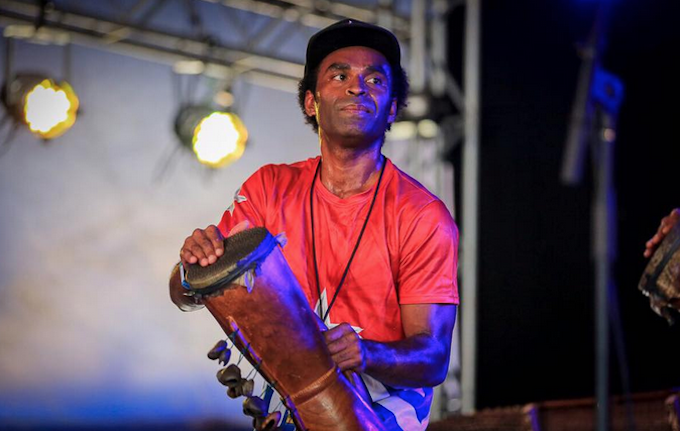
Ronny Kareni
West Papua’s Ronny Kareni … “Commemorating the 60th anniversary for me demonstrates hope and also the continued spirit in fighting for our right to self-determination.” Image: SBS

Indonesia’s diplomats regularly issue statements criticising the flag protests, including two years ago when the flag was raised at Sydney’s Leichhardt Town Hall, as “a symbol of separatism” that could be “misinterpreted to represent support from the Australian government”.

No response to questions about the flag’s 60th anniversary had been received by SBS News from the Indonesian embassy this year and community members and groups declined to comment.

“It’s a symbol of an aspiring independent state which would secede from the unitary Indonesian republic, so the flag itself isn’t particularly welcome within official Indonesian political discourse,” said Vedi Hadiz, an Indonesian citizen and director of the Asia Institute at the University of Melbourne.

“The raising of the flag is an expression of the grievances they hold against Indonesia for the way that economic and political governance and development has taken place over the last 60 years.

“But it’s really part of the job of Indonesian officials to make a counterpoint that West Papua is a legitimate part of the unitary republic.”

The history of the Morning Star
After World War II, a wave of decolonisation swept the globe.

The Netherlands reluctantly relinquished the Dutch East Indies in 1949, which became Indonesia, but held onto Dutch New Guinea, much to the chagrin of President Sukarno, who led the independence struggle.

In 1957 Sukarno began seizing the remaining Dutch assets and expelled 40,000 Dutch citizens, many of whom were evacuated to Australia, in large part over The Netherlands’ reluctance to hand over Dutch New Guinea.

The Dutch created the New Guinea Council of predominantly elected Papuan representatives in 1961 and it declared a 10-year roadmap to independence, adopted the Morning Star flag, the national anthem — “Hai Tanahku Papua” or “Oh My Land Papua” — and a coat-of-arms for a future state to be known as “West Papua”.

Dutch and West Papuan flags
The Dutch and West Papuan flags fly side-by-side in 1961. Image: SBS

The West Papua flag was inspired by the red, white and blue of the Dutch but the design can hold different meanings for the traditional landowners.

“The five-pointed star has the cultural connection to the creation story, the seven blue lines represent the seven customary land groupings,” Kareni told SBS.

The red is now often cited as a tribute to the blood spilt fighting for independence.

Attending the 1961 inauguration were Britain, France, New Zealand and Australia — represented by the president of the Senate Sir Alister McMullin in full ceremonial attire — but the United States, after initially accepting an invitation, withdrew.

Morning Star raised for first time
The Morning Star flag was raised for the first time alongside the Dutch one at a military parade in the capital Hollandia, now called Jayapura, on December 1.

On December 19, President Sukarno began ordering military incursions into what he called “West Irian”, which saw thousands of soldiers parachute or land by sea ahead of battles they overwhelmingly lost.

With long supply lines on the other side of the world and waning international support, the Dutch sensed their time was up and signed the territory over to UN control in October 1962 under the “New York Agreement”, which abolished the symbols of a future West Papuan state, including the flag.

The Morning Star flag in Paris
The Morning Star flag in Paris, France. Image: AWPA

The UN handed control to Indonesia in May 1963 on condition it prepared the territory for a referendum on self-determination.

The so-called Act Of Free Choice referendum in 1969 saw the Indonesian military round up 1025 Papuan leaders who then voted unanimously to become part of Indonesia.

The outcome was accepted by the UN General Assembly, which failed to declare if the referendum complied with the “self-determination” requirements of the New York Agreement, and Dutch New Guinea was incorporated into Indonesia.

In 1971, the Free Papua Movement (OPM) declared the “republic of West Papua” with the Morning Star as its flag, which has gone on to become a potent binding symbol for the movement.

“It’s a milestone, 60 years, and we’re still waiting to freely sing the national anthem and freely fly the Morning Star flag so it’s very significant for us, ” Kareni said.

“We still continue to fight, to claim our rights and sovereignty of the land and people.”
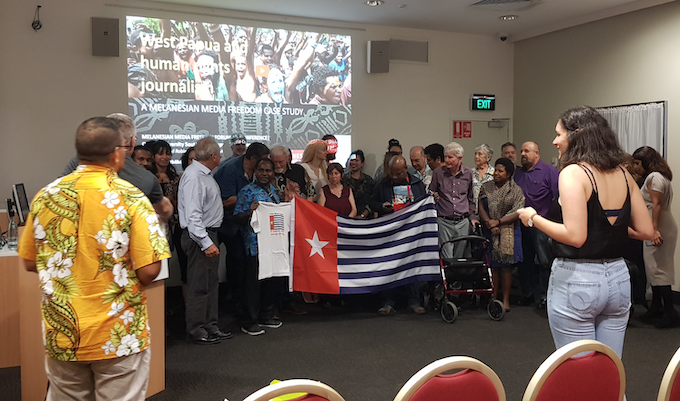
Morning Star flag-raising in Brisbane
Morning Star flag-raising at a public lecture by Professor David Robie at Griffith University’s Brisbane campus before the  in October 2019 before the Melanesian Media Freedom Forum (MMFF) conference. Image: Griffith University
Print Friendly, PDF & Email

Article by AsiaPacificReport.nz

AUT’s new academic head seeks to build relationships around Pacific

By Sri Krishnamurthi for Asia-Pacific Report

Incoming new vice-chancellor for Te Wānanga Aronui o Tāmaki Makaurau Auckland University of Technology (AUT) Toelesulusulu Dr Damon Ieremia Salesa is keenly aware that he has broken through another glass ceiling.

The son of a factory worker made New Zealand history last week, as the first Pacific person to be appointed to the eminent leadership position in academia at a New Zealand university.

“I’m really excited to be the AUT vice-chancellor and with that excitement comes a sense of its significance with the sector which I work in and have given much of my life to, actually looking like the people it serves. So I’m really excited to be part of that story,” Toelesulusulu told Asia-Pacific Report.

“AUT is a place where talent can find opportunity and I would hope that lots of other people would want to express that excitement by wanting to come to AUT,” he says.

“What matters more is the work of the whole institution, that the university itself embraces its many different communities, its Māori students, its Pacific students and already AUT is a little bit known for that and what we can do is to build even more deeply on that.”

Professor Steven Ratuva, director of the Macmillan Brown Centre for Pacific Studies at the University of Canterbury, says Dr Salesa’s appointment is a significant milestone for the Pacific.

“It is something he richly deserves, and he has been working hard for and it is a good career choice, it is good for the Pacific academic community, and I congratulate him for his contribution to Pacific education.”

South Auckland priority
Currently pro-vice-chancellor Pacific at the University of Auckland (UOA), Dr Salesa takes up his new role as vice-chancellor at AUT in March.

From just up the hill at UOA, he has observed AUT, and likes what he saw.

“I’ve really admired the way AUT prioritised and served its students, particularly the students of South Auckland and mature students, and that is one of reasons I was really interested in the job,” he says.

“Just because those communities of learners for whom education really matters, AUT has really embraced them and that is part of what is exciting about AUT — that is why I wanted to come across and join AUT.

“There is no question that the campus down south and campus on the shore bring universities into the communities that they serve and as well as being global institutions they are local institutions.

“If you have heart to service and you keep the students at the very centre of the decisions you make, you get great results like you see AUT deliver in South Auckland and the North Shore,” he says.

Strengthening Māori and Pacific research
Pacific and Māori research is one area he wants to strengthen as well as build relationships with other institutions in the Pacific.

“Certainly, one of the things I have as a priority is to make sure that AUT is in all of the partnerships that it needs to be in, that we are serving our communities and our partners as well in a reciprocal relationship from which everyone grows.

“That will mean we have to be a little bit selective, but it will also mean that Pacific partnerships and other partnerships are critical to the very centre of the university, and they are not seen as being marginal because we’re a university in the middle of the South Pacific.

“We need to honour that and be connected to our whanau around the Pacific.

Toeolesulusulu Damon Salesa
Toeolesulusulu Dr Damon Salesa … ““We need to honour … and be connected to our whanau around the Pacific.” Image: RNZ

“It is absolutely important that we are having those conversations, we need to understand how we can support the University of the South Pacific (USP) and their work, how we can find benefit and value for New Zealand and AUT students and staff from those relationships, so certainly we will be taking that seriously.

“But certainly, USP is a special institution in our region, so we need to be strategic in how we support and partner with them.”

Associate Professor Shailendra Singh, head of journalism at USP, says “as many have pointed out, the appointment is well deserved. He was not given any preference as a Pacific Islander. He was picked on merit.

A Pacific ‘trailblazer’
“As a trailblazer, he will inspire many Pacific Islanders and Pacific people beyond New Zealand as the vice-chancellor of one of the finest universities in our region.

“Through my association with the Pacific Media Centre (PMC), I have participated in AUT journalism-related workshops, seminars, and conferences.

“I have a high regard for the AUT and the PMC, long a flagship of the university for its cutting-edge research and publications in Pacific journalism.

“I hope the PMC is revived as journalism in the region has been struggling due to economic and political factors. Pacific journalism needs support and leadership and AUT can become the beacon it was,” Associate Professor Singh says.

Dr Salesa was in the dark about the PMC which has now been in hiatus for almost a year for unknown reasons.

“I’d have to learn more about that, I don’t know the ins and outs of that situation, but these are things that have to be collaborative, they have to be built with the kind of collective will and expertise of the university especially.

“There is no question that AUT will be prioritising Māori research and Pacific research among its other amazing specialisations,” Dr Salesa says.

AUT ‘anchored in Pacific’
“AUT will always be anchored in the Pacific region and obviously has a long history of educating people from the Pacific region and we hope to continue and deepen that.

“Those partnerships will speak directly to AUT’s future, and this is a period in time where everyone is just hoping for the best possible outcome for USP, and we will be looking to support in ways that make sense for them and AUT.”

Dr Salesa is testament to the fact that people of a Pacific background or ethnicity can succeed and excel — not just in sport, but in every facet of society.

“I think we’ve always known, as the saying goes, talent is everywhere, but opportunity isn’t — and what AUT is the story of, is making opportunity available to diverse groups of talented people.

“We know if you make opportunities available to those who have been denied them, they will flourish if they are supported in the right way.

“I have no doubt what people will see in my own story is that the kinds of diverse talent we have in New Zealand that too often we haven’t made the most of, can come to AUT and thrive.

“I hope that people see in that all kinds of stories because I am also the son of a factory worker, and I am also a first-generation university attendee people can understand that when talent gets opportunity and support it drives them and that’s what I am hoping you’ll see and that is what success at AUT is all about and its story,” the Auckland suburb of Glen Innes-raised Dr Salesa says.

Education pathway
A strong advocate for education, he wanted young Māori and Pasifika people to pursue that pathway rather than young school leavers joining the workforce.

“We know that education is one of the proven pathways to wellbeing and prosperity for families, and that at the same time we know that many families need their young people to go out and work.

“So, it is absolutely critical that we find ways to get talented young Pacific, Māori and other students into high value employment and education is one of the ways of doing that.

“What we need is for them to be ambitious, to have high expectations of themselves and their families and it is for AUT and other universities to deliver that transformational learning which is the secret to those strong and prosperous futures,” Dr Salesa says.

Transformative learning allowed people to change and have more than one career.

“We know all of us are living in the most uncertain and highly changeable times. In the old days everyone imagined they would have just one career and many people now are realising they might not only change jobs but change careers and they have also come to realise that in many, many of our jobs technology sits at the centre of opportunity and the ability to be effective.

“AUT is the kind of institution that is built for these times, it offers all sorts of flexible learning offerings and a truly diverse student body and it is New Zealand’s tech university.

Transformative learning
“So transformative learning is the kind of learning that actually transforms individual students lives where you can see outcomes writ large and that’s what I’m hoping to support further development at AUT so that people understand AUT is a great place to go, to study and get a great job but also prepare themselves for a great future,” Dr Salesa says.

Then there was the inevitable vexed question, whether it was time for another university, namely AUT, to start a new medical school? To which he played with a straight bat.

“At the moment AUT is one of the great providers of the health workforce in New Zealand and certainly for the short term we will be focusing on doing an even better job of doing that.

“Delivering a health workforce and the health researchers that New Zealand needs. That is obviously a critical contribution in the age of the pandemic, but again that will be built collaboratively with my colleagues at AUT.

“I think it is a very challenging time for universities across the board and particularly where next year is going to be where students have had two years of lockdown learning in Auckland so we have to make sure that the university can support them in their ambitions to be successful at AUT.

“That is going to be one of the great challenges, not just facing AUT, but all the tertiary providers that have suffered lockdowns in Auckland.”

Print Friendly, PDF & Email

Article by AsiaPacificReport.nz

New Zealand forces deployed to Solomon Islands in wake of riots

RNZ Pacific

The New Zealand government is deploying dozens of Defence Force and police personnel to Honiara in the coming days “to help restore peace and stability”.

Since rioting and looting started in the Solomon Islands last week, Australia, Fiji and Papua New Guinea have sent troops to help keep the peace there.

An initial NZDF team of 15 will join them tomorrow, followed by a larger group of 50 at the weekend.

New Zealand Prime Minister Jacinda Ardern said the response was short-term and to help restore peace and stability.

“New Zealand is committed to its responsibilities and playing its part in upholding regional security.

“We are deeply concerned by the recent civil unrest and rioting in Honiara, and following yesterday’s request of the Solomon Islands government, we have moved quickly to provide urgent assistance.

Samoan police are also on standby to send personnel to assist peacekeeping forces.

Unrest stemmed from protest
The unrest stemmed from a protest calling for the removal of Prime Minister Manasseh Sogavare that spilled over into rioting and left major destruction in the capital.

Earlier today, it was reported that the Solomon Islands government had warned that instigators were planning what it called “another evil plan” to decimate the whole of Honiara.

A government statement said the destruction of local businesses was done by “heartless people with selfish agendas”.

It warned that instigators were planning a next phase of unrest, including the declaration of Malaita province as an independent state.

Malaita’s provincial Premier Daniel Suidani, whose administration has fallen out with the national government, denies claims that he instigated the unrest.

Malaitans played a central role in last week’s protest before opportunists and looters co-opted the mobilisation into major unrest.

Premier of Malaita province Daniel Suidani.
Premier Daniel Suidani of Malaita province … denies claims that he instigated the unrest. Image: Daniel Suidani/Provincial Facebook/RNZ

Ringleader statements on Facebook
The government statement said it was aware of reports that ringleaders behind the unrest were openly stating on Facebook that “in order to build a new house, the old house must be first destroyed”.

“Such statements are not helping the volatile situation we are currently experiencing in Honiara,” the statement said.

“To the peace loving and right minded Malaitans, we should ask ourselves whether we are comfortable with the violent advocators to lead our people to an independent state.”

However, the national government said it was encouraged by “the wisdom of the majority of our citizens not to employ violence, looting or threatening tactics to impose one’s evil plan of decimating Honiara city, the capital of Solomon Islands”.

This article is republished under a community partnership agreement with RNZ.

Print Friendly, PDF & Email

Article by AsiaPacificReport.nz
Pacific regional response to Solomons post-riots crisis takes shape

RNZ Pacific

Fiji is the latest regional country to announce it is sending security forces to Solomon Islands where major unrest rocked the capital.

Days of rioting in Honiara by mobs who torched buildings and looted shops prompted the government to call for outside help.

In what’s shaping up as a Pacific regional response, Fiji yesterday deployed 50 soldiers to help keep the peace in Honiara, with 120 more troops on standby.

They follow last week’s deployment of more than 100 Australian defence force and police personnel, as well as 37 Papua New Guinea police and correctional service forces.

Canberra has been playing a co-ordinating role with the other Pacific nations. New Zealand is also part of the conversation, although its role appears minimal at this stage.

Signs from both Australia and PNG indicate that, provisionally, their forces are expected to be in Solomon Islands no longer than a month.

The Fiji military unit is deploying as part of a reinforcement platoon embedded with the Australian contingent in Honiara.

120 troops on standby
According to the Fiji government, another 120 Fijian troops are on standby if required.

Over three days last week, many buildings were torched in Honiara’s east, particularly its Chinatown area — leaving at least three people dead.

The unrest had spiralled from a protest against Prime Minister Manasseh Sogavare last Wednesday.

By the weekend, law and order was largely restored in Honiara due to the reinforcement of local police capabilities due to the peacekeepers from Australia and Papua New Guinea.

On Monday, the Solomons Parliament met briefly — amid tight security — to pass two motions. One was for the routine extension of the State of Public Emergency in place since the start of the covid-19 pandemic.

The other was to authorise expenditure for the massive loss and damage caused by the riots — estimated at US$28 million.

Despite the resignation of four government MPs last week, and calls for him to stand down to restore control in the country, Prime Minister Manasseh Sogavare still commands a clear majority in the House.

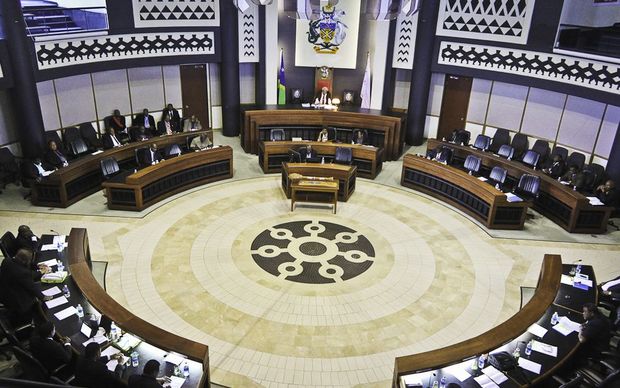
Solomon Islands Parliament
Solomon Islands Parliament … still a clear majority for Prime Minister Manasseh Sogavare. Image: Koroi Hawkins/RNZ

‘Melting pot of the country’
The MP for Central Guadalcanal, Peter Shanel Agovaka, who is also Communications and Aviation Minister, said each time a group of people from outer provinces who were unhappy with the government, they tended to come to Honiara and destroy local business houses.

“I think people from other provinces should respect that as hosts of this capital we allow people of all provinces, and all denominations and all races, to come here.

“This is the melting pot of the country, and to see it in ruins like this is really very sad.”

According to Shanel, a lot of households had been affected.

“Eighty to 90 percent of Chinatown is burnt down. This is really sad, because these are innocent people,” he said.

“The way to remove a prime minister is through the parliamentary process. It’s not through the burning of businesses or private properties and looting them.”

Capital’s schools close
All schools in the Solomon Islands capital have been ordered to close early as a result of the widespread destruction caused by last week’s unrest in Honiara.

Education Secretary Dr Franco Rodie said the decision was reached after consultation with the heads of various schools and taking into consideration parents concerns for the safety of their children.

Dr Rodie said thankfully most major exit examinations had already been conducted and in class assessments will have to be taken into consideration for everyone else.

State of emergency
Forty-one out of 49 members of Parliament on Monday yesterday voted in favour of the four-month-extension, as proclaimed by the Governer-General, Sir David Vunagi.

Opposition leader Matthew Wale asked for clarification on the covid status of emergency personnel from Australia and Papua New Guinea brought in because of last week’s riots.

Health Minister Culwick Togamana said all foreign security personnel were double vaxxed and tested negative for covid-19 upon departure and again on arrival in the country.

Togamana also expressed disappointment in the poor uptake of vaccines with less than 20 percent of the population fully vaccinated.

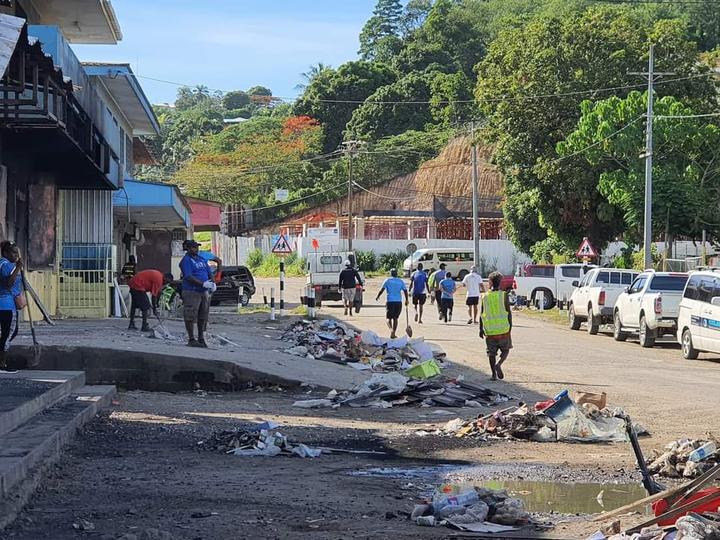
Honiara clean-up after the riots
Clean-up time after the riots in Honiara. Image: Fijian community, Honiara/RNZ

Clean-up underway
The clean-up in Honiara is underway and church and community groups are turning up to clear the wreckage from last week’s rioting.

However, the riots have created a shortage of food and RNZ Pacific correspondent Elisabeth Osifelo said there had been long queues for the shops that were open, as well as for petrol and at ATMs while banks remain closed.

“The prices have sllightly gone up with rice and so it just depends on where the shop is,” she explained.

“I found out towards the eastern parts of Honiara because I think the shops are very limited that the prices have gone up and varying on different items as well.”

Solomon Islands police have confirmed the identity of the three bodies recovered from a building burnt in Chinatown during the violence — an adult and two children.

This article is republished under a community partnership agreement with RNZ.

Print Friendly, PDF & Email

Article by AsiaPacificReport.nz
Verification will be essential as New Zealanders start using vaccine passes — to stop fraud and the spread of COVID

Source: The Conversation (Au and NZ) – By Andrew Chen, Research Fellow at Koi Tū: The Centre for Informed Futures, University of Auckland

Hannah Peters/Getty Images

When New Zealand switches to the COVID-19 Protection Framework tomorrow, people will have to present vaccine passes to access many public spaces and venues.

At this point, more than 2.4 million people have downloaded their official vaccine passes, which represents almost 70% of the 3.6 million people who are fully vaccinated.

The transition will likely exacerbate inequities that have already emerged during the vaccine rollout itself, and discriminate against vaccinated but “digitally excluded” people who have limited access to email or phone apps to carry a vaccine pass. People can now get their passes in person at some pharmacies, which helps but does not fully solve the problem.

Another major concern is the integrity of how we use and verify vaccine passes. Businesses and venues have different choices in how strongly they verify the legitimacy of the pass itself and whether or not they request an ID to verify the identity of the vaccine pass holder. This can make all the difference in how effective the system will be in reducing the spread of the virus.

Verifying vaccine passes

Last week, the government passed legislation under urgency to enact a “traffic light” system, which places regions under certain settings. Under red and orange settings, many venues will only be open to fully vaccinated people who can present proof of vaccination.

The vaccine pass includes a QR code which can be presented on paper or on a smartphone. So far, the government has said the minimum requirement is only to visually check the pass. The next level of verification would be for staff to use the official NZ Pass Verifier app to scan the QR code to ensure the pass is legitimate, and that the details printed on the pass match the details encoded in the QR code.

But the highest level of verification is to ask for a photo ID to make sure the person carrying the pass is the person named on it. Taking all three steps provides the highest confidence the person is vaccinated.

Image of someone setting up their vaccine pass on their phone
Almost 70% of fully vaccinated New Zealanders have downloaded their vaccine passes.
Phil Walter/Getty Images

Understandably, some venues will consider this too much hassle or impractical. Requiring a photo ID will also discriminate against people who are fully vaccinated but may not have an ID (such as under-18s or people who have no need for one) or those who may not have a photo ID in their preferred name.

In my opinion, venues that are required to check for vaccine passes need to scan the QR code to lift confidence that the pass is legitimate. Otherwise, it is simply too easy to fake a vaccine pass.


Read more:
How far should compulsory proof of vaccination go — and what rights do New Zealanders have?


QR Codes and data privacy

Another challenge is that individuals also need to continue scanning in with their contact-tracing app (preferably NZ COVID Tracer). These apps are generally designed as anonymous systems and all of the data stays on the user’s device.

The vaccine pass verifier app inherently needs to know the identity of the person, and it operates on the venue’s device, which doesn’t store any of the data and works offline. This is why the two apps and functionalities cannot be combined into one.

Inevitably, people will have to provide a vaccine pass and possibly a photo ID to confirm they are allowed to enter. Then the visitor will also have to scan in to keep their own record for contact tracing. It might be annoying, but that’s what we have to do to keep ourselves safe.

The official pass verifier app does not store any data, but there might be some exceptions in which certain businesses create their own apps.

Examples include ticketing, where a person’s vaccination status may have to be verified at the time of purchase rather than entry to the venue. Businesses with repeat customers, such as gyms, may also want to keep a record of their customers’ vaccination status to avoid having to check their pass each time they enter.

The COVID-19 protection framework legislation includes privacy protection that ensures information about people’s vaccination status can only be collected, used or disclosed for the purposes of managing COVID-19, with heavy penalties for breaches.

Are vaccine passes effective?

One major question is whether the passes actually mitigate the risk to public health.

Evidence from other jurisdictions suggests vaccinated people transmit COVID-19 less than unvaccinated people, hence the effort to prevent unvaccinated people from entering venues to avoid the spread of the virus. But in a New Zealand context, it remains to be seen whether or not the vaccine passes are effective at suppressing the reproduction rate.


Read more:
No, vaccinated people are not ‘just as infectious’ as unvaccinated people if they get COVID


The government has been using vaccine passes as an incentive for people to get vaccinated by preventing unvaccinated people from accessing venues they might otherwise want to enter. But this motivation expires when we reach a sufficient percentage of people who are vaccinated – and simply aiming for a vaccination percentage raises ethical issues.

We should keep coming back to the public health reasons for why we need people to be vaccinated and why we separate vaccinated and unvaccinated individuals. And to uphold that, we have to make sure vaccine passes are used effectively.

This means, at the very least, scanning the QR code to check the passes are legitimate. And we have to reduce the barriers for people to get their vaccine pass so they aren’t excluded for the wrong reasons.


Read more:
To be truly ethical, vaccine mandates must be about more than just lifting jab rates


Vaccine passes come at a cost. It’s a cost financially to the government and taxpayers in developing the system. But there’s also a cost socially in terms of exacerbating inequities, and a cost ethically in terms of privacy and restrictions on people’s freedom of movement.

If we were to weaken the system to the extent that people can easily fake a vaccine pass, then we aren’t separating vaccinated and unvaccinated individuals effectively and make no progress towards mitigating public health risk. That would mean the existence of vaccine passes is not justified.

The Conversation

Andrew has provided independent advice to the Ministry of Health and the Department of Prime Minister and Cabinet as an academic but is not paid by them.

ref. Verification will be essential as New Zealanders start using vaccine passes — to stop fraud and the spread of COVID – https://theconversation.com/verification-will-be-essential-as-new-zealanders-start-using-vaccine-passes-to-stop-fraud-and-the-spread-of-covid-172940

Australia has a heritage conservation problem. Can farming and Aboriginal heritage protection co-exist?

Source: The Conversation (Au and NZ) – By Michael Westaway, Australian Research Council Future Fellow, Archaeology, School of Social Science, The University of Queensland

Rio Tinto’s destruction of the 46,000 year old Juukan Gorge rock shelters has led to recommendations by the Parliamentary Inquiry on how Australia can better conserve Aboriginal heritage sites.

Around the time the recommendations were made, Queensland’s Aboriginal Cultural Heritage Act faced an important test when a pastoralist who cleared 500 hectares of bushland at Kingvale Station in Cape York was charged with failing to protect Aboriginal cultural heritage.

The charges were eventually dismissed but the prosecution, the first of its kind in Queensland, highlights weaknesses in the law.

Like related legislation in other Australian states and territories, Queensland’s law requires landholders to conserve Aboriginal heritage sites or risk prosecution.

But the law has been criticised by many Aboriginal people and heritage specialists for allowing destructive development by removing any ability for government to independently assess how proposed clearing would affect Aboriginal heritage.

Under the “duty of care” provisions in the Act, Aboriginal heritage must be protected even if it is not known to landholders. However, as the Kingvale clearing case heard, if Aboriginal heritage is not known, how can it be shown to have been lost?


Read more:
Australia’s coastal waters are rich in Indigenous cultural heritage, but it remains hidden and under threat


What we learned from the Kingvale clearing case

In 2013, the former Newman government in Queensland removed protection for the environment by introducing the Vegetation Management Act which enabled clearing of what they deemed as “high value agricultural projects” in Cape York.

The World Wildlife Foundation argued this would see large areas of forest and bushland destroyed. Advocates for the new Act argued primary producers are “acutely aware of their responsibility to care for the environment”.

In opening up new areas of Cape York to clearing, this legislation posed new threats to heritage sites. In this context the landholder of Kingvale decided he did not need to assess cultural heritage when clearing 500 hectares.

At the conclusion of the hearing into this case, Judge Julie Dick of the Cairns District Court instructed the jury to return a not-guilty verdict, exonerating the landholder, as the offence could not be proved beyond reasonable doubt.

The landholder’s legal team noted in the media if their defendant had been found guilty, every landholder (including freeholders) who had cleared land, built a fence or firebreak, ploughed a paddock, or built a road or airstrip since 2003 would potentially be guilty of a criminal offence.

The defendant argued the ramifications of the legal case were significant

for the rest of Queensland […] anyone who mowed a lawn or cut down a tree since 2003 would be automatically liable.

In our view, this is hyperbole. Section 21 of the Act makes explicit a person’s right to enjoy the normal and allowed use of their land to the extent they don’t harm Aboriginal heritage.

Further, a person doesn’t commit an offence if they take into account the nature of the activity and the likelihood of it causing harm. Mowing the lawn is quite different to clearing 500 hectares of native vegetation.

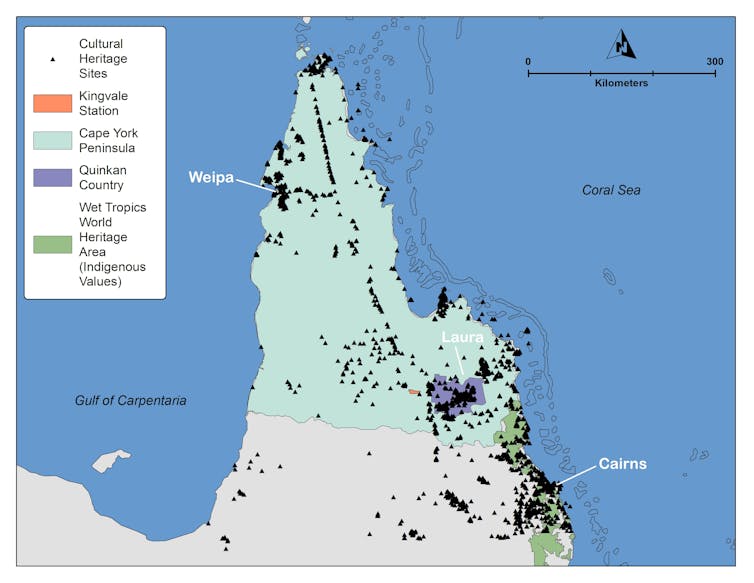
The setting of this activity is also important. Kingvale Station is located 100 kilometres west of the national heritage listed Quinkan Country. Heritage studies in similar landscapes across Cape York have identified scarred trees, artefact scatters, stone arrangements and cultural burial places.

Based on our heritage experience across Queensland, it would be surprising not to find Aboriginal heritage sites at Kingvale.

To reduce heritage risks, we assess the potential impacts of an activity, and talk with relevant Aboriginal groups about their sites and heritage values. Archaeologists and anthropologists also develop models to predict where unknown sites are likely to be found.

Recorded archaeological sites across Cape York. The distribution pattern reflects several key heritage surveys. It is expected that cultural sites would be found across the cape, including within the 500 hectares cleared at Kingvale. Image by Kelsey M. Lowe.

Can farming and the conservation of Aboriginal heritage co-exist?

The best way to conserve heritage is for Aboriginal and non-Aboriginal Australians to work together to identify, document, and protect places. An important example is the discovery of human remains from a mortuary tree west of St George, southern Queensland.

The site was discovered during fence clearing by the landholder, who contacted the police. We worked with the landholder who has supported the Kooma nations people to conserve the mortuary tree and enable it to remain on country.

Courtesy of Tony Miscamble, NGH Consulting.

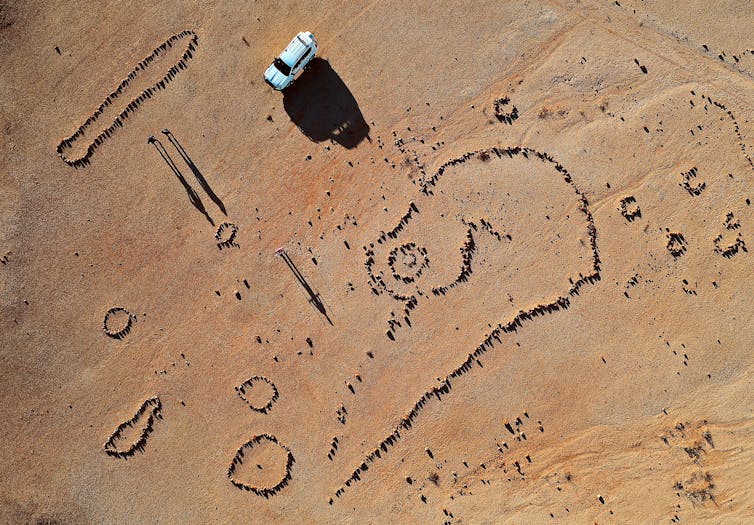
A further example from Mithaka Country saw a spectacular stone arrangement discovered by a pastoral station manager, who notified the native title holders.

All are now engaging with researchers to investigate the site’s history.

Dozens of other examples around the state illustrate collaborative approaches to heritage conservation. But more effective legislation is urgently needed in response to Kingvale’s failed prosecution.

A spectacular stone arrangement from Mithaka country. Image courtesy of Lyndon Mechielsen

How can we improve cultural heritage protection?

The Juukan Gorge case highlighted how Australia has a problem protecting its Aboriginal cultural heritage. The final report of the parliamentary inquiry into the disaster made several recommendations that could help pave a way forward.

Instances like Kingvale emphasise more work needs to be done. The Queensland government needs to act now to address the glaring problem with its heritage legislation.

Heritage management investment will also help. Victoria provides an example of how to improve Aboriginal heritage management. A standout action is the roll-out of a Certificate IV in Aboriginal cultural heritage management, with over 500 Aboriginal graduates to date.

This program is decentralising heritage management and empowering Aboriginal people across Victoria, building a level of professionalism rarely seen in other states.

Establishing treaties and agreements similar to those in Canada and New Zealand could go a long way to enable First Nations people in Australia to authoritatively protect their respective cultural heritage sites.


Read more:
The Wet Tropics’ wildlife is celebrated worldwide. Its cultural heritage? Not so much


Heritage conservation will remain challenging, particularly in resource-rich states like Queensland. But we can do better.

Judge Dick’s ruling, while frustrating for the effort to conserve heritage, is crucial as it highlights weaknesses in the law.

This trial, along with the Juukan Gorge incident, may represent a critical tipping point in the struggle to protect Aboriginal cultural heritage in Queensland and across Australia.

The Conversation

Michael Westaway receives funding from the Australian Research Council.

Joshua Gorringe is Mithaka Traditional owner and General Manager of Mithaka Aboriginal Corporation RNTBC. Mithaka has received funding from NIAA and QLD Caring for Country Grants. He is affiliated with Mithaka Aboriginal Corporation RNTBC.

Kelsey M. Lowe receives funding from University of Queensland Strategic Research Investment.

Richard Martin receives funding from the Australian Research Council. Richard also receives funding from a range of Aboriginal groups across Queensland relating to native title claims and cultural heritage protection.

Ross Mitchell Kooma Chairperson currently receives funding from NIAA for IPA Ranger Program Murra Murra and Bendee Downs Station owned by Kooma Traditional Owner association Inc

ref. Australia has a heritage conservation problem. Can farming and Aboriginal heritage protection co-exist? – https://theconversation.com/australia-has-a-heritage-conservation-problem-can-farming-and-aboriginal-heritage-protection-co-exist-170956

Mathematical discoveries take intuition and creativity – and now a little help from AI

Source: The Conversation (Au and NZ) – By Geordie Williamson, Professor of Mathematics, University of Sydney

shutterstock

Research in mathematics is a deeply imaginative and intuitive process. This might come as a surprise for those who are still recovering from high-school algebra.

What does the world look like at the quantum scale? What shape would our universe take if we were as large as a galaxy? What would it be like to live in six or even 60 dimensions? These are the problems that mathematicians and physicists are grappling with every day.

To find the answers, mathematicians like me try to find patterns that relate complicated mathematical objects by making conjectures (ideas about how those patterns might work), which are promoted to theorems if we can prove they are true. This process relies on our intuition as much as our knowledge.

Over the past few years I’ve been working with experts at artificial intelligence (AI) company DeepMind to find out whether their programs can help with the creative or intuitive aspects of mathematical research. In a new paper published in Nature, we show they can: recent techniques in AI have been essential to the discovery of a new conjecture and a new theorem in two fields called “knot theory” and “representation theory”.

Machine intuition

Where does the intuition of a mathematician come from? One can ask the same question in any field of human endeavour. How does a chess grandmaster know their opponent is in trouble? How does a surfer know where to wait for a wave?

The short answer is we don’t know. Something miraculous seems to happen in the human brain. Moreover, this “miraculous something” takes thousands of hours to develop and is not easily taught.

The past decade has seen computers display the first hints of something like human intuition. The most striking example of this occurred in 2016, in a Go match between DeepMind’s AlphaGo program and Lee Sedol, one of the world’s best players.

AlphaGo won 4–1, and experts observed that some of AlphaGo’s moves displayed human-level intuition. One particular move (“move 37”) is now famous as a new discovery in the game.


Read more:
AI has beaten us at Go. So what next for humanity?


How do computers learn?

Behind these breakthroughs lies a technique called deep learning. On a computer one builds a neural network – essentially a crude mathematical model of a brain, with many interconnected neurons.

At first, the network’s output is useless. But over time (from hours to even weeks or months), the network is trained, essentially by adjusting the firing rates of the neurons.

Such ideas were tried in the 1970s with unconvincing results. Around 2010, however, a revolution occurred when researchers drastically increased the number of neurons in the model (from hundreds in the 1970s to billions today).

One of the first neural networks, the Mark I Perceptron, was built in the 1950s. The goal was to classify digital images, but results were disappointing.
Cornell University

Traditional computer programs struggle with many tasks humans find easy, such as natural language processing (reading and interpreting text), and speech and image recognition.

With the deep learning revolution of the 2010s, computers began performing well on these tasks. AI has essentially brought vision and speech to machines.

Training neural nets requires huge amounts of data. What’s more, trained deep learning models often function as “black boxes”. We know they often give the right answer, but we usually don’t know (and can’t ascertain) why.

Deep learning systems often function as ‘black boxes’: data goes in and data comes out, but we have difficulty making sense of what happens in between.
Shutterstock

A lucky encounter

My involvement with AI began in 2018, when I was elected a Fellow of the Royal Society. At the induction ceremony in London I met Demis Hassabis, chief executive of DeepMind.

Over a coffee break we discussed deep learning, and possible applications in mathematics. Could machine learning lead to discoveries in mathematics, like it had in Go?

This fortuitous conversation led to my collaboration with the team at DeepMind.

Mathematicians like myself often use computers to check or perform long computations. However, computers usually cannot help me develop intuition or suggest a possible line of attack. So we asked ourselves: can deep learning help mathematicians build intuition?

With the team from DeepMind, we trained models to predict certain quantities called Kazhdan-Lusztig polynomials, which I have spent most of my mathematical life studying.

In my field we study representations, which you can think of as being like molecules in chemistry. In much the same way that molecules are made of atoms, the make up of representations is governed by Kazhdan-Lusztig polynomials.

Amazingly, the computer was able to predict these Kazhdan-Lusztig polynomials with incredible accuracy. The model seemed to be onto something, but we couldn’t tell what.

However, by “peeking under the hood” of the model, we were able to find a clue which led us to a new conjecture: that Kazhdan-Lusztig polynomials can be distilled from a much simpler object (a mathematical graph).

This conjecture suggests a way forward on a problem that has stumped mathematicians for more than 40 years. Remarkably, for me, the model was providing intuition!


Read more:
How explainable artificial intelligence can help humans innovate


In parallel work with DeepMind, mathematicians Andras Juhasz and Marc Lackenby at the University of Oxford used similar techniques to discover a new theorem in the mathematical field of knot theory. The theorem gives a relation between traits (or “invariants”) of knots that arise from different areas of the mathematical universe.

Our paper reminds us that intelligence is not a single variable, like the result of an IQ test. Intelligence is best thought of as having many dimensions.

My hope is that AI can provide another dimension, deepening our understanding of the mathematical world, as well as the world in which we live.

The Conversation

Geordie Williamson is a Professor at the University of Sydney, and a consultant in Pure Mathematics for DeepMind, a subsidiary of Alphabet.

ref. Mathematical discoveries take intuition and creativity – and now a little help from AI – https://theconversation.com/mathematical-discoveries-take-intuition-and-creativity-and-now-a-little-help-from-ai-172900

Buying silence: we can’t stop workplace sexual harassment without banning non-disclosure agreements

Source: The Conversation (Au and NZ) – By Maria O’Sullivan, Associate Professor, Faculty of Law, and Deputy Director, Castan Centre for Human Rights Law, Monash University

Shutterstock

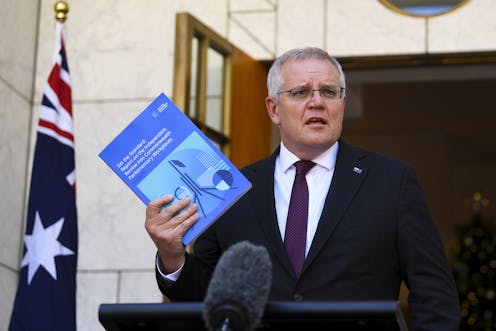
One major problem uncovered in “Set the Standard”, the landmark report on sexual harassment and bullying in the parliament workplace is that secrecy and silence conceal toxic workplace culture.

The report conducted by Sex Discrimination Commissioner Kate Jenkins shows that serious harms, particularly gender-based harassment and bullying, have been normalised within the our own national parliament – and the victims have been unable to speak out until now.

Central to this practice of concealment is the increased use of non-disclosure agreements, or NDAs, in Australia.

These agreements have become a focus of public debate since the #MeToo movement began in the US. Their harmful effects were demonstrated after it was revealed Harvey Weinstein systematically used NDAs to prevent his victims from talking about his conduct.

But the silencing effect of these agreements has not yet received the same attention in Australia.

That has now changed with the release of Jenkins’ Respect@Work Report last year and the new Set the Standard report released this week.

Both have recommend changes to the use of NDAs in relation to sexual harassment and bullying cases. The time has come for a serious re-evaluation of these agreements.

What is an NDA?

NDAs are restrictive confidentiality arrangements. They can have a legitimate role in, for instance, protecting company secrets, such as patents or intellectual property. Such agreements are designed to ensure a person or organisation who gets access to sensitive and often valuable information does not disclose it to a third party.

However, these agreements have been exploited and their use extended far beyond their original limited function.

NDAs are now increasingly used against employees who make complaints about discrimination and harassment. Organisations often settle these matters by compensating and then terminating the employment of the person who made the complaint, but on the condition that person signs an NDA forbidding them from disclosing the bullying or harassment.


Read more:
Who’s to blame for keeping Time’s #MeToo ‘silence breakers’ silent?


Indeed, lawyers say NDAs have become standard practice for employers dealing with sexual harassment complaints in Australia.

The widespread use of NDAs is also reflected in a statement made by the union representing public sector employees to the Jenkins’ inquiry. It said it is common

[…]once a complaint has begun to be aired for the process to become about getting the worker a payout or moving them on in a way that limits damage to their employer. In some cases, employees will be required to sign nondisclosure agreements on termination of their employment.

The problem with this practice is the offending conduct is never formally “known about” by senior leaders in the organisation – or the public.

Oftentimes, the perpetrator stays at the organisation and is promoted. Or they move on to another organisation where the offending conduct continues. Meanwhile, senior managers and human resources simply deny knowledge of the problem.

In contrast, the victim-survivor is stigmatised and condemned to silence in perpetuity, unable to defend themselves or even to talk about what happened.

What did the Jenkins’ report say about NDAs?

In the report, the Human Rights Commission has reiterated its serious concerns with the use of NDAs in Australia.

It says these agreements “should not be made a condition of settlement of complaints” because

NDAs been criticised as ‘covering up’ or ‘shutting down’ issues while protecting respondents.

Instead, the report says, NDAs should be optional for the complainant as a way of protecting their privacy, rather than a “blanket condition of settlement”.


Read more:
The Jenkins review has 28 recommendations to fix parliament’s toxic culture – will our leaders listen?


What, then, can be done about this?

California has set the best practice in this regard, passing a law in 2018 that bans the use of NDAs in sexual harassment cases.

More recently, the state has built on this by passing the “Silenced No More Act” in October this year. This legislation will protect workers who want to speak out about harassment and discrimination, even if they have signed a non-disclosure agreement. It also extends to workplace harassment or discrimination on any basis, not just sex.

In supporting the legislation, California Senator Connie Leyva said,

It is unconscionable that an employer would ever want or seek to silence the voices of survivors that have been subjected to racist, sexist, homophobic or other attacks at work.

How can the law be reformed in Australia?

It is clear NDAs have a chilling effect on people’s willingness to speak out against harassment and bullying. Significantly, these agreements not only silence those coerced into signing them, but also discourage openness and suppress transparency and accountability in workplaces.

They also have a detrimental, systemic effect by signalling to other employees they must self-censor if they experience similar workplace harms, rendering them fearful of speaking out.

The Set the Standard report – and the broader #MeToo movement – send a clear message: every workplace and organisation in Australia can, and must, do better to prevent an epidemic of bad behaviour.

It is, therefore, time for Australia to ban the use of NDAs in situations involving harassment or bullying.


Read more:
Can the government get its workplace harassment laws right? Its bill is a missed opportunity


We note others in Australia have also made such a recommendation. The Australian Law Alliance, for instance, has called for banning the use of NDAs in all harassment and discrimination cases, except when requested by survivors.

Now that Jenkins has released not one, but two significant reports on workplace protections – both of which show the true extent of workplace harassment and silencing – we must take a step toward protecting victims by introducing laws to reform the use of NDAs in Australia.

The Conversation

Maria O’Sullivan previously received funding from the Commonwealth Attorney-General’s Department and currently serves as a legal adviser on the Human Rights Panel with Queensland Parliamentary Services.

Judith Bessant does not work for, consult, own shares in or receive funding from any company or organization that would benefit from this article, and has disclosed no relevant affiliations beyond their academic appointment.

ref. Buying silence: we can’t stop workplace sexual harassment without banning non-disclosure agreements – https://theconversation.com/buying-silence-we-cant-stop-workplace-sexual-harassment-without-banning-non-disclosure-agreements-172856

No, we shouldn’t worry too much about getting COVID from young kids

Source: The Conversation (Au and NZ) – By Philip Britton, Senior lecturer, Child and Adolescent Health, University of Sydney

Very high vaccination rates in Australia are ensuring community COVID transmission is decreasing.

Vaccines markedly reduce severe disease and death. Our health-care systems are more able to cope because fewer new cases are requiring admission to hospital and ICU.

But, children under 12 years of age aren’t yet eligible for vaccination and some people are asking whether children are going to become a reservoir of infection.

Are children now a major risk for COVID transmission? Should we worry about exposure to COVID in places that kids and their families frequent, such as schools, pools, cinemas, and sporting and recreational facilities?

The short answer to those questions is – no. Evidence suggests kids aren’t major drivers of COVID spread, so it’s only fair to let kids get back to their normal activities.

Aren’t kids the main ones getting COVID?

Children are gradually making up a higher proportion of COVID infections. This was expected as older age groups are vaccinated and their rates of infection have declined.

But overall, infection numbers in kids haven’t increased. In fact, the number of infections in children in NSW remained roughly the same after lockdown ended as it was in the weeks before.

This confirms what was known from evidence overseas – young children are not major drivers of COVID, especially with the mitigation measures currently in place in schools.


Read more:
Why do kids tend to have milder COVID? This new study gives us a clue


It depends on where you’re exposed

The risk of children transmitting the coronavirus is different in different settings.

In the home, we know the Delta strain is easily transmitted among household members, regardless of whether a child or adult is the first infected case.

Yet at school, the risk of catching COVID is much lower, even with the Delta variant.

This low risk likely also holds true in outdoor public spaces, such as sports grounds, parks and swimming pools.

Can I still catch COVID from an unvaccinated child even if I’m vaccinated?

Recently vaccinated adults have a 70-90% lower chance of getting COVID, irrespective of the vaccine they’ve received, according to a recent pre-print of a study yet to be peer reviewed. Vaccinated adults are also 30-60% less likely to transmit the virus onwards.

COVID vaccines are even more effective (greater than 90%) at keeping adults and young people out of hospital and potentially dying.

Being a vaccinated adult reduces the risk of severe disease and hospitalisation tenfold, compared to unvaccinated adults.

What’s more, children are less likely to transmit to others than adults.

Reassuringly, despite the reopening of schools and the restarting of childhood activities, hospitalisation and ICU admission rates have gone down in NSW.

This indicates vaccines are successfully preventing moderate and severe COVID in adults.

This data is with the Delta variant, and we don’t yet know whether the new Omicron variant will be any different.


Read more:
Your unvaccinated friend is roughly 20 times more likely to give you COVID


Why haven’t we vaccinated kids yet? Wouldn’t that help stop any risk of transmission?

While the vaccines developed for COVID are safe, we know children are not simply little adults.

Vaccine programs typically evolve over time. Experts initially monitor for side effects following widespread vaccination in adults before a vaccine is administered to younger age groups.

Children’s immune responses differ to those in adults. It takes time to ensure the right dose and timing between vaccinations has been considered carefully in kids.

Given the very low risk of severe COVID in children, weighing up the benefits of COVID vaccination for them is complex.

That’s why the experts from Australia’s Technical Advisory Group on Immunisation (ATAGI) are being careful and considered in their advice regarding vaccination in young children.

It’s safe and beneficial for kids and families to get out and about

The pandemic has impacted children’s lives significantly.

School closures and lockdowns have affected their education and social interaction with friends. Community sport and other activities that give children a strong sense of belonging and enhance self-esteem have been cancelled.

All this has impacted the mental health of children and young people.


Read more:
Do kids get long COVID? And how often? A paediatrician looks at the data


Vaccines work and measures such as COVID-safe guidelines, QR-code check-ins, physical distancing and masks are still in place in many settings. Enhanced hygiene is still encouraged.

Vaccinated adults should feel comfortable to move about and socialise.

Children have sacrificed their personal well-being largely to protect adults from COVID. We now have high levels of adult vaccination and stable or reducing community transmission.

Children need to be given the opportunity to return to public spaces, play sport, and engage in other recreational and social activities.

It’s time children and families are given the opportunity to resume normal activities to ensure their health and well-being.

The Conversation

Philip Britton receives funding from the National Health and Medical Research Council and from the Commonwealth department and NSW Ministry of Health.

Phoebe Williams receives funding from the National Health and Medical Research Council.

Archana Koirala does not work for, consult, own shares in or receive funding from any company or organisation that would benefit from this article, and has disclosed no relevant affiliations beyond their academic appointment.

ref. No, we shouldn’t worry too much about getting COVID from young kids – https://theconversation.com/no-we-shouldnt-worry-too-much-about-getting-covid-from-young-kids-172232

Do La Niña’s rains mean boom or bust for Australian farmers?

Source: The Conversation (Au and NZ) – By Chelsea Jarvis, Research fellow, University of Southern Queensland

Shutterstock

After years of punishing drought in some areas, many farmers in Australia’s east were hoping the newly declared La Niña event would bring them good rains.

Many are now rejoicing, with the wettest November experienced in Australia for more than two decades. But for some farmers, heavy and prolonged rain is causing a new set of problems.

Last year’s La Niña delivered good rainfall in some areas – while leaving others drier than they would have been under an El Niño, with many areas in southern Queensland missing out. In La Niña years, the cattle farming town of Roma receives an average of 247mm from November to the end of January. Last year they only got half that.

This year’s La Niña has already delivered rain to many areas left dry last year. Roma, for example, has received more than 200mm in November 2021 alone. These large rainfall events and seasons are required after ongoing drought to recharge the moisture in the soil.

But continued rain will be less welcome in newly waterlogged areas along the Queensland and NSW border and the Northern Rivers region, given it may lead to further flooding.


Read more:
Climate change is likely driving a drier southern Australia – so why are we having such a wet year?


What does La Nina mean for farmers?

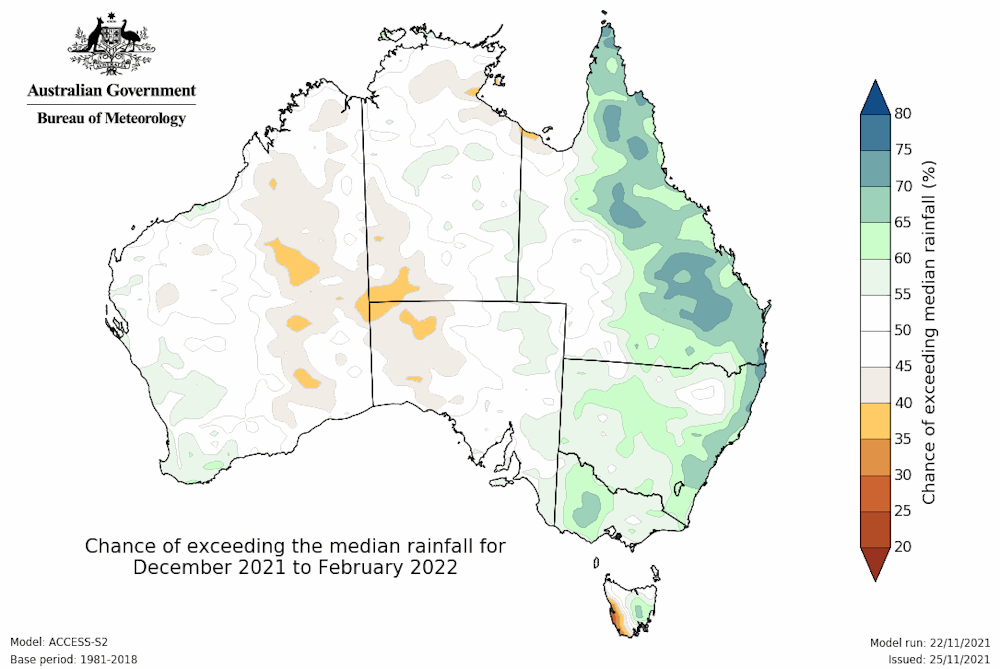
Seasonal forecasts give a greater than 60% chance of rainfall above the median for much of eastern Australia from now to the end of March.

If this summer of rain eventuates, it will be welcome news for many farmers in eastern Australia who have had below-median rainfall for three or more years.

Map of Australia showing eastern coast higher rainfall prediction

Bureau of Meteorology, CC BY

Farmers usually welcome La Niña with open arms, given plentiful rainfall can boost production and profits.

Still, a boon for one industry can be a burden for another, with heavy or prolonged rainfall able to damage fruit and delicate crops as well as delaying harvests or making them more challenging. Flooding can wash away entire fields and damage roads and other infrastructure.

For the sugar industry, increased rainfall associated with La Niña can mean sugarcane has to be harvested at lower sugar content levels, or be delayed in harvesting. The cane can be knocked over by heavy rain, which makes harvesting difficult and reduces yield, all of which reduce profitability.

For the grains industry, the bumper grain crop predicted for 2021 has already been downgraded in areas like New South Wales due to flooding, with losses expected to be in the billions.

By contrast, the beef industry in Queensland relies on grass, so a La Niña summer with above average rain can increase pasture growth and regeneration as well as cattle weight gain and market prices.

This double-edged sword – too much rain or not enough – is nothing new to Australian farmers.

Understanding how La Niña and other ENSO (El Niño-Southern Oscillation) events impact different regions and industries is critical to take advantage of good years, minimise losses in poor years, and make sound decisions based on the best possible information.

What does that look like? In La Niña years, cattle farmers may decide to move their cattle out of flood prone regions or rest a paddock to allow it to regenerate with the extra rain, which will provide more grass in the following season.

For grain farmers, La Niña means keeping a close eye on both three-month seasonal climate forecasts and the daily weather forecasts to decide if it’s worth the risk to plant a big crop and if they are likely to be able to harvest it before any big rainfall events occur.


Read more:
Yes, Australia is a land of flooding rains. But climate change could be making it worse


Storm moving across field of wheat
La Niña’s rain can mean promise or threat to farmers.
Shutterstock

Can we predict La Niña rainfall?

La Niña events usually bring average to above average rain to much of Australia’s east. Unfortunately, no two La Niñas occur in the same way.

Because of this variability, it is important for farmers to understand how La Niña events impact their area so that they can plan for likely conditions.

Australia’s east coast climate is heavily influenced by the El Niño-Southern Oscillation (ENSO), a naturally occurring phenomenon centred in the tropical Pacific that consists of three separate phases: La Niña, El Niño, and a neutral or inactive phase.

La Niña years occur around 25% of the time, with El Niño years also at 25%, and neutral years making up 50%. ENSO is not fully predictable, and moves irregularly between these phases. While it is unusual to have back-to-back La Niñas it is not unprecedented.

During these La Niña events, surface water in the central and eastern equatorial Pacific cools and the ocean to the north of Australia tends to warm.

Changes in the ocean drive changes in the atmosphere over the Pacific. Like a rock thrown in a pond, however, this Pacific phenomenon ripples outwards, causing atmospheric changes in places like Australia and Chile.

In Australia, La Niña tends to bring more rain and lower temperatures across much of the country, while we see increases in heavy rain, flooding, and severe tropical cyclones making landfall.

What does the future hold? While most La Niña events are projected to produce less rainfall in many regions, projections suggest the wettest La Niña years will tend to be just as wet or wetter that they were in the past.

Australia’s farmers will continue to face the challenges of floods and droughts brought by La Niña and El Niño, but as farmers learn more about these events and how they impact their area and industry, they can become more resilient.

The Conversation

Chelsea Jarvis receives funding from the Northern Australia Climate Program, which is funded by Meat & Livestock Australia, the Queensland Government, and the University of Southern Queensland. She is affiliated with (a member of) the Australian Meteorological and Oceanographic Society (AMOS).

Professor Scott B. Power, Dip. Ed. does not work for, consult, own shares in or receive funding from any company or organisation that would benefit from this article, and has disclosed no relevant affiliations beyond their academic appointment.

ref. Do La Niña’s rains mean boom or bust for Australian farmers? – https://theconversation.com/do-la-ninas-rains-mean-boom-or-bust-for-australian-farmers-172511

Kiwi kids who read for pleasure will do well in other ways – it’s everyone’s responsibility to encourage them

Source: The Conversation (Au and NZ) – By Ruth Boyask, Lead Researcher, Children’s Reading for Pleasure Study, Auckland University of Technology

Shutterstock

Summer’s here and the school holidays are coming. For many parents, of course, it’s all a bit academic – pandemic lockdowns and other disruptions have blurred the line between home and school, with no guarantee things will return to normal in 2022.

The good news for parents and whānau is that relief can be as simple as turning a page. Encouraging children to read for pleasure – which is different from it being a school task – has all kinds of benefits, as highlighted in the first comprehensive review of reading for pleasure in Aotearoa New Zealand.

The review is one of three reports commissioned from AUT by the National Library as part of its Pūtoi Rito Communities of Readers initiative. The researchers looked at international and national research on reading for pleasure, finding very little on the topic in New Zealand. What research there has been has had little influence on policy.

The review’s main conclusion is that reading for pleasure is a beneficial social activity where everyone has a role to play in distributing those benefits.

Parents should feel reassured, however, that this doesn’t mean they need to be “teachers”. Simply supporting their children’s enjoyment of reading is relatively easy to do and has been shown to be very good for children’s overall development and health.

Various studies have shown children’s enjoyment of reading is related to a longer life, better mental well-being and healthier eating. Fiction reading is related to better performance at school.

But reading for pleasure is also good for communities because readers tend to be good at making decisions, have more empathy and are likely to value other people and the environment more.

Reading for pleasure is associated with wider health and well-being benefits.
Shutterstock

Gaps in the research

We should be making more of these benefits. Because while most younger children enjoy reading in their early years at school, their level of enjoyment seems to drop off as they move into adolescence.

Time spent reading also declines as children get older. In New Zealand a lot of attention is focused in research and policy on developing children’s reading literacy at school, but there is little focus on supporting their enjoyment of reading – especially outside school hours.


Read more:
Five ways that reading with children helps their education


There has been some attention to the importance of reading picture books and telling stories to very young children at home or in libraries. But older children and young people tend to value reading more as a functional skill that will help them with future education or employment.

There are very few well-researched studies of the reading habits and reading enjoyment experienced by children and young people beyond the school gates. Nor has there been enough research into how best to encourage them to read for pleasure.


Read more:
You could be putting your child off reading – here’s how to change that


Reading as shared experience

From our review of international literature we conclude that creating a culture of enjoyable reading needs to be approached from various angles.

One of the most important motivations for children learning to enjoy reading for pleasure comes from the people around them. When other readers share their enthusiasm for reading with children it rubs off.


Read more:
If you can only do one thing for your children, it should be shared reading


Obviously this begins at home, but it can also occur in youth or religious groups, on marae, with peer groups or even online. In a major UNESCO report on “fostering a culture of reading and writing”, it’s even suggested doctors can prescribe reading together for younger parents of small children.

But while there are many good examples of people and organisations working in partnership to achieve these aims, often the focus is on improving school literacy rather than simply increasing children’s enjoyment of reading. Libraries taking a lead could change this.

Public libraries have a role to play in increasing children’s enjoyment of reading.
Shutterstock

Building a culture of reading

At its best, reading for pleasure is about engaging with other people in enjoyable ways – not as a solitary activity, as it is often portrayed. Practical steps anyone can take include:

• finding reading material that connects to children’s wider interests

• choosing books that more than one person enjoys to encourage discussion and sharing of ideas

• asking librarians, perhaps from the school library, or other readers for recommendations to help find the right books

• using public libraries, including their e-book catalogues, which can be downloaded to mobile devices

• trying audio books as a way to encourage and engage readers with different reading levels or busy schedules

• encouraging discussion among peers about reading through digital and social media.

Creating a reading culture based on individual and shared enjoyment is everyone’s responsibility, not just the domain of teachers and schools. Nor does sharing the benefits of reading for pleasure mean acting like a teacher.

But it will pay dividends in improved school performance, thinking ability, well-being and sense of belonging – all especially important during these uncertain and disrupted times.

The Conversation

The AUT School of Education research team received funding for the research reported here from Te Puna Mātauranga o Aotearoa National Library of New Zealand.

The AUT School of Education research team received funding for the research reported here from Te Puna Mātauranga o Aotearoa National Library of New Zealand.

ref. Kiwi kids who read for pleasure will do well in other ways – it’s everyone’s responsibility to encourage them – https://theconversation.com/kiwi-kids-who-read-for-pleasure-will-do-well-in-other-ways-its-everyones-responsibility-to-encourage-them-171947

You actually can teach an old dog new tricks, which is why many of us keep learning after retirement

Source: The Conversation (Au and NZ) – By Darryl Dymock, Adjunct Senior Research Fellow in Education, Griffith University

Shutterstock

Lorna Prendergast was 90 years old when she graduated with a master’s degree from the University of Melbourne in 2019. She said her message to others was, “You’re never too old to dream.”

Nor, obviously, too old to learn.

In the same year 94-year-old David Bottomley became the oldest person in Australia to graduate with a PhD from Curtin University. The great-grandfather said he wasn’t yet finished. “I have a great deal yet to work out,” he said, perhaps making him the ultimate lifelong learner.

Prendergast’s and Bottomley’s achievements are examples of the levels of learning some older adults are capable of. In 2019-20, around 73,000 Australian adults aged 60 or more were enrolled in vocational training, community education and university courses. That’s enough to populate a mid-size Australian city.

But the term “lifelong learning” has increasingly tended to focus on the period of compulsory education and training across working lives – that is, before retirement.

Professor of adult education, Stephen Billett, argues the concept of lifelong learning has come to be associated with lifelong education, which is more about the institutional provision of learning experiences.

Instead, he says, it should go back to its roots. Lifelong learning is a personal process based on the sets of experiences people have had throughout their lives.

Learning after retirement

According to David Istance, the nonresident senior fellow at the OECD’s Center for Universal Education, a result of this foreshortened view of lifelong learning is to downplay the considerable amount of formal learning taking place after retirement. This means learning like that done by Prendergast and Bottomley. Although much learning also happens in non-institutional settings.

For example, a Scottish study tracked the learning activities of almost 400 Glaswegians aged 60 or over. Using a broad definition of “learning”, researchers discovered an “active ageing” subset in the sample.

This active ageing group was:

socially and technologically engaged … “learner-citizens”, participating in educational, physical, cultural, civic and online activities.

Such findings are particularly significant for a country like Australia where the population is ageing, due to sustained low fertility and increasing life expectancy. The result is proportionally fewer children and a larger proportion of people aged 65 and over.


Read more:
Australian universities need to be more age-friendly — what does that look like in practice?


Over the past two decades, the population aged 85 and over has also increased, by 110% (more than doubled) compared with total population growth of 35%. In mid-2020 there were more than half a million of these “older olds” in Australia.

Older woman painting at home.
Learning doesn’t have to be in an institutionalised setting.
Shutterstock

The nation could have 50,000 centenarians by 2050.

A lifetime of complex cognitive activity

Brain researcher Perminder Sachdev says surviving into older age relies partly on “a lifetime of good effort”. Some of that effort is a solid education in our formative years and then ongoing purposeful learning.

Sachdev believes this builds better cognitive reserves and sets us up for a lifetime of more complex cognitive activity.

But what is “purposeful learning”? A Swedish review found older adults do formal learning to maintain or increase quality of life, including through learning new things and sharing knowledge, and to connect through social networks. They also see classes and courses as a means of developing coping skills that enhance individual autonomy, and as a way of stimulating their cognitive abilities to help stave off mental decline.


Read more:
What is ‘cognitive reserve’? How we can protect our brains from memory loss and dementia


But numerous studies in recent decades have shown formal education is just the tip of the adult learning iceberg.

As the Glasgow study reveals, many older adults are continuing their learning in guises other than through formal courses. Communal examples include sewing groups, men’s sheds, bird-watching clubs, travel groups, and musical jam sessions.

Few of the participants are likely to perceive their activities in explicit learning terms, yet all four reasons for learning the Swedish study identified can be discerned within such groups.

Sewing groups, bird watching clubs and musical jam sessions are ways seniors can continue their learning.
Shutterstock

As in the Glasgow research, the proportion of older people engaged in purposeful learning is likely to be a subset of the larger population. Nevertheless there needs to be official and community acknowledgement that a segment of older people has both the motivation and capacity to continue to learn, including into their 90s. These people are “active agers”.

According to Sachdev, the key to maximising healthy ageing is improving the quality of initial and ongoing education because this impacts positively on our brains.


Read more:
Contested spaces: we need to see public space through older eyes too


This is not to say older adults should feel obliged to engage in “purposeful learning”. After all, they’re not a homogeneous group, and some may decide it’s not something they want to do.

David Istance intimates some may also subscribe to the outmoded mindset that “you can’t teach an old dog new tricks”.

For older people who do want to continue to engage with the wider world and have the capacity to do so, however, we need to ensure “active ageing” is part of any “lifelong learning” agenda.

Let’s continue to promote older learning champions like Prendergast and Bottomley, not as outliers but as shining lights in a broader expanse of long-twinkling stars.

The Conversation

Darryl Dymock does not work for, consult, own shares in or receive funding from any company or organisation that would benefit from this article, and has disclosed no relevant affiliations beyond their academic appointment.

ref. You actually can teach an old dog new tricks, which is why many of us keep learning after retirement – https://theconversation.com/you-actually-can-teach-an-old-dog-new-tricks-which-is-why-many-of-us-keep-learning-after-retirement-170379

Good riddance: the costs of Morrison’s voter ID plan outweighed any benefit

Source: The Conversation (Au and NZ) – By John Quiggin, Professor, School of Economics, The University of Queensland

The Morrison government has shelved its plan to make Australians produce identification before casting their vote. Yesterday it withdrew the Electoral Legislation Amendment (Voter Integrity) Bill 2021 it had hoped to pass in time for the 2022 election.

The reason is political. The announcement came hours after Tasmanian independent senator Jacqui Lambie said she would vote against the bill.

With rebel Coalition backbenchers in both the House of Representatives and Senate vowing to vote against all legislation in a bid to force the Morrison government’s hand on vaccine mandates, it reportedly did a deal with the Opposition to drop the bill in return for Labor supporting another bill, to oblige charities to reveal donors.

But it should have dropped the bill as a matter of good policy.

There are various ways in which such proposals might be analysed, but an economic framework of cost-benefit analysis would be a useful starting point. As the name implies, the aim is to weigh up the potential benefits of a policy to determine if they outweigh the costs.

The Australian government says it is “committed to the use of cost–benefit analysis to assess regulatory proposals in order to encourage better decision making”. Had it done a cost-benefit analysis of the bill, it’s hard to see how it could have introduced it in the first place.

Benefits of identification

Let’s start with the benefits.

The strongest argument for voter ID is to prevent impersonation – one person voting in the name of another. In Australia, however, voting is compulsory, which makes impersonation hard to accomplish.

About 95% of registered voters normally vote in elections.

To effectively impersonate another voter without producing an apparent double vote, a fraudster would have know who the non-voters were. There is some anecdotal evidence that people do sometimes vote on behalf of a friend. But while this is illegal, such proxy votes are unlikely to change the result.

Because of votes are checked against the electoral roll, we have good evidence on the extent of multiple voting in Australia.

After the 2016 election, the Australian Electoral Commission identified 18,343 instances where a name had been crossed off twice – about 0.12% of the 14.89 million votes cast.

Investigating a sample of these, the AEC found nearly 80% were most likely errors by it own staff, such as crossing off the name above or below the correct one on the electoral roll.

Another 10% were mistakes by voters, who might have been mentally ill, confused because of language issues, or who simply forgot they had already voted.

That left about 1,800 votes (0.012% of votes cast) where there was no obvious explanation. But also no compelling evidence of deliberate multiple voting.

The strongest evidence came from 59 cases where three votes were cast under the same name, including one person who apparently voted 16 times.

A requirement to show ID would not prevent someone from voting multiple times if they chose to do so. But it might facilitate prosecution by making it impossible for a multiple voter to claim that someone else voted in their name.

However, the AEC’s data suggest the total number of excess votes here amounts to two or three per electorate. With about 100,000 voters per electorate, this is nowhere near enough to make any real difference.

Voter ID would prevent someone from voting on behalf of another with their consent. There is anecdotal evidence that this happens, but not on a large scale, and we would expect the real voter would choose someone who they trust to lodge a vote according to their wishes.

Now let’s look at the costs.

Administrative costs

A voter ID proposal has two kinds of costs.

First, there are the costs of ID checking: administrative costs for the electoral commission and the compliance cost for voters who have to ensure they have ID.

Australia’s only previous experience with voter ID laws is in Queensland. The Liberal National Party government led by Campbell Newman introduced an ID requirement in 2014. This was in force for the 2015 state election, in which the LNP was narrowly defeated. The incoming Labor government repealed it.

In that election, the Electoral Commission of Queensland mailed every voter a card they could use to vote. This was the predominant method used, and made compliance easier. But presumably it cost hundreds of thousand of dollars in postage and administration.

Moreover, since the cards had no photo they didn’t provide any security against consensual vote impersonation. There was nothing to stop someone who didn’t feel like voting giving their card to a friend.

The big cost, though, lies in the possibility that some people would be discouraged from voting or would be refused a vote because of inadequate ID. Even if the Queensland card scheme is emulated, there’s a chance of voters failing to receive their card or misplacing it.

Turnout fell at the Queensland 2015 election, but we can’t necessarily draw any sharp conclusions about the role ID laws may have played because there was a further decline in 2017. The likelihood of these laws disenfranchising the poor, homeless and vulnerable, however, does appear quite high.


Read more:
Why voter ID requirements could exclude the most vulnerable citizens, especially First Nations people


Effects on trust

Beyond these direct costs and benefits, it is important to consider the effects of ID laws on our political culture as a whole.

Some proponents of ID laws have argued they will increase public confidence in the electoral system.

That might be the case if there were widespread concern about closely contested elections. A 2017 study by University of Sydney and Harvard researchers found about one in four Australian believe fraud occurs “usually” or “always” in elections. But there’s no real evidence to suggest voter ID laws would ease these doubts.


Confidence in the AEC’s ability to conduct an election

Graph showing confidence in the AEC's ability to conduct an election.

The Australian Voter Experience: trust and confidence in the 2016 federal election, CC BY

Under current circumstances, voter ID laws are more likely to undermine public confidence than to enhance it.

The push for voter ID laws in Australia are modelled on similar efforts by the US Republican Party, which are widely seen as an attempt to suppress voting, particularly by poor and minority voters more likely to vote for the Democratic Party.


Read more:
No mail-in votes, proof of citizenship: the long history of preventing minorities from voting in the US


Moreover, many of the staunchest advocates of voter ID, such as Fox News host Tucker Carlson, have supported the false claims that the 2020 election was stolen – a direct assault on confidence in the system.

An attempt to impose new requirements for voting, introduced at the last minute by a government trailing in the polls, looked more like political desperation than a considered attempt to improve the working of the electoral system.

It was always best to proceed only with broad multi-party support. Which there isn’t.

The Conversation

John Quiggin does not work for, consult, own shares in or receive funding from any company or organization that would benefit from this article, and has disclosed no relevant affiliations beyond their academic appointment.

ref. Good riddance: the costs of Morrison’s voter ID plan outweighed any benefit – https://theconversation.com/good-riddance-the-costs-of-morrisons-voter-id-plan-outweighed-any-benefit-172874

We identified 39,000 Indigenous Australian objects in UK museums. Repatriation is one option, but takes time to get right

Source: The Conversation (Au and NZ) – By Maria Nugent, Co-Director, Australian Centre for Indigenous History, Australian National University

Shield, collected by Admiral John Elphinstone Erskine, c.1851. National Museums Scotland. Photo: National Museums Scotland, Edinburgh.

Campaigns for the repatriation of certain objects in prominent museums dominate media reporting on the fraught legacies of historical collections. The Parthenon (Elgin) Marbles, Benin Bronzes, and the “Gweagal” shield are among the most conspicuous examples.

Regularly discussed in books, featured on podcasts like Stuff the British Stole, and cited by journalists and commentators, these high-profile, highly charged objects encapsulate many of the issues at stake in how museums should go about redressing the violent colonial histories that contributed to the creation of their collections and ongoing injustices.

In Australia, the federal government has funded the Australian Institute of Aboriginal and Torres Strait Islander Studies to pursue the repatriation of collections in international museums

The program was funded initially as part of its commemoration of the 250th anniversary of the Endeavour voyage led by Lieutenant James Cook – an expedition that marks the beginning of a long history of Aboriginal and Torres Strait Islander material culture being taken from Country to Britain and Europe where it entered public and private institutions.


Read more:
A failure to say hello: how Captain Cook blundered his first impression with Indigenous people


During the same period this program was identifying collections for repatriation, we were researching Aboriginal and Torres Strait Islander material culture in UK and Irish museums. For three years, we carried out a survey, led by Gaye Sculthorpe, Curator and Section Head, Oceania at The British Museum, and assisted by Indigenous research fellows Dr Jilda Andrews and Michael Aird to answer the question: “What Indigenous Australian material culture actually exists in museums in the UK and Ireland now?”

Much of the discussion about the future of collections proceeds without a clear sense of what has survived – and misunderstandings about what does. Between 2016 and 2019, Sculthorpe visited over 45 museums in the UK to look at their collections. Indigenous Australian objects identified number about 38,400 in institutions across the UK and about 600 in Ireland. The total number includes around 16,000 stone tools from Tasmania.

The material includes bags and baskets, wooden artefacts like clubs, boomerangs and shields, shell items such as fishing hooks and decorative shellwork, as well as contemporary art.

Map showing British and Irish museums which hold collections of Aboriginal and Torres Strait Islander objects. Reproduced in Sculthorpe et al, Ancestors, artefacts, empire: Indigenous Australia in British and Irish museums, British Museum Press, 2021.
C. The British Museum

There is a mammoth task to rebuild knowledge about these objects and collections widely distributed in the UK and Ireland. Over time, knowledge has dissipated, and documentation and information lost. In many cases historical and contextual details for objects are scant, unreliable, illegible, or replete with misnomers, if not missing altogether.

Deserving serious attention

Today’s bland and stubborn characterisations of museums as nothing other than engines of colonial theft, trickery and violence, as well as irredeemable essences of empire, are often easily unsettled and complicated by close and critical examinations of the objects they hold.

Contemporary critiques tend to focus on 19th-century attitudes, shaped at a time when museums imagined they were collecting from cultures and peoples facing extinction. Even then, however, interactions between cultures were transforming objects, object-making and other art practices.


Read more:
Friday essay: 5 museum objects that tell a story of colonialism and its legacy


Some Indigenous people collaborated with anthropologists in gift exchanges and in making collections of material culture, both to provide a resource for future generations to access and as an assertion of the value of their ways of life.

Three boomerangs in Paisley Museum, near Glasgow in Scotland, were made by Kirwallie Sandy, one of the best known Aboriginal men in the Moreton Bay region. He sold them for a shilling each on 15 December 1875 at Sandgate near Brisbane to traveller and naturalist James W. Craig.

Craig documented these details in his journal, although this information was not included in the museum records or exhibition labels. Michael Aird, with his deep knowledge of Brisbane’s Aboriginal people and history, has reconstructed the boomerangs’ story with Kirwallie Sandy at the centre.

Trade, purchase, exchange, gifting, commissions and agency – as well as theft, exploitation, violence and trauma – were all in evidence for the objects we researched, and sometimes in respect to the same one.

Partnerships

Working in partnership with Indigenous people and organisations to better understand the multiple meanings of surviving material culture is the foundation on which the future development and building of collections is taking place.

Some of the least documented objects are potentially of the most interest to contemporary people. For instance, a single, shell-worked bootie of the kind long made in Aboriginal settlements on the New South Wales south coast and at La Perouse in Sydney was identified by Sculthorpe in a box of undocumented, unidentified objects handed to her by a curator at Warrington Museum & Art Gallery near Liverpool in England.

This baby shoe was one of the first pieces of shell work identified in collections outside Australia. It was likely bought at auction after being exhibited – perhaps in a missionary exhibition or a display of women’s work.

Shellwork baby shoe, c,1920, likely from La Perouse, Sydney. Warrington Museum & Art Gallery.
Photo: The Trustees of the British Museum & Culture Warrington.

A shield at National Museums Scotland in Edinburgh was labelled only as “Australia”, but its form and the travels of its collector, Admiral John Elphinstone Erksine, in the mid-1800s suggest a NSW, possibly greater Sydney, origin.

The shield, remarkable for its intricate designs, has not (yet) garnered the attention it warrants.

If scholarship on Britain’s colonisation of Australia from the late 18th century onwards has produced anything it is an insistence on the plurality of encounters, experiences, and legacies.

This is due not only to the diversity of imperial travellers and colonial immigrants. There is growing recognition that Indigenous groups were diverse and distinct, sometimes as different from each other as they were to outsiders. The surviving material record is a testament to this; and its significance for expanding understanding and challenging conventional thought cannot be overestimated.

What emerged as we shared information about objects and collections with – and learnt from Indigenous people and “communities” in turn – was that repatriation was only one of several options they were interested in pursuing.

And this is only when there is certainty about details regarding where objects came from, the conditions under which they had been acquired, the pathways by which they travelled, and the conditions under which and into which they would return.

Recent experience of the repercussions of misinformation, leading to senior people being excluded from discussions, as Noeleen Timbery from the La Perouse Local Aboriginal Land Council in Sydney has explained, makes some groups cautious about how to proceed.

The La Perouse Aboriginal Land Council and other local groups are interested in working with overseas museums to ensure access to collections for educational and other purposes.

A new collaborative Australian Research Council-funded project with the Australian National University, the Museum of Archaeology and Anthropology, Cambridge, and The British Museum is working with them towards this aim.

It is vital to get things right. And getting things right takes time and resources. A concern for care, diligence, caution and time to work through the emotions that collections provoke – as well as to take charge of the decision-making about what should happen – are at the forefront of people’s minds when they learn of the objects in international museums their ancestors made.

This book Ancestors, artefacts, empire: Indigenous Australia in British and Irish Museums, edited by Gaye Sculthorpe, Maria Nugent and Howard Morphy (British Museum Press) will be launched at the National Museum of Australia in Canberra on December 2.

The Conversation

Maria Nugent receives funding from the Australian Research Council through a Linkage Grant involving the Australian National University and The British Museum, which published the book ‘Ancestors, artefacts, empire: Indigenous Australia in British and Irish Museums’ from which this article derives.

Gaye Sculthorpe receives funding from the Australian Research Council through a Linkage Grant involving the Australian National University and The British Museum, which published the book ‘Ancestors, artefacts, empire: Indigenous Australia in British and Irish Museums’ from which this article derives.

Howard Morphy received funding from the Australian Research Council through a Linkage Grant involving the Australian National University, the National Museum of Australia, the Museum of the Riverina and The British Museum. The British Museum are the publishers of the book ‘Ancestors, artefacts, empire: Indigenous Australia in British and Irish Museums’ from which this article derives.

ref. We identified 39,000 Indigenous Australian objects in UK museums. Repatriation is one option, but takes time to get right – https://theconversation.com/we-identified-39-000-indigenous-australian-objects-in-uk-museums-repatriation-is-one-option-but-takes-time-to-get-right-172302

View from The Hill: A study in contrast, Porter and Hunt to leave Parliament

Source: The Conversation (Au and NZ) – By Michelle Grattan, Professorial Fellow, University of Canberra

One will depart from parliament a deeply disappointed man, dragged down by scandal, with hopes for a brilliant career dashed by an allegation surfacing from his youth.

The other will leave with a solid record of performance, despite some criticism and ambition for higher things unfulfilled.

Christian Porter, 51, on Wednesday announced he will not run again for his Western Australian seat of Pearce. It was a surprise to no one.
Health Minister Greg Hunt, 56, is also set to quit at next year’s poll, with his announcement due on Thursday.

Both had previously said they were recontesting their seats.

Porter – subject of a historical rape allegation (that he strongly denies) – had little practical alternative but to quit.

His political career was effectively over. His guilt or innocence could never be proven, because the woman is dead.

His statement on Wednesday contained a note of bitterness. “There are few, if any, constants left in modern politics.” he said. “Perhaps the only certainty now is that there appears no limit to what some will say or allege or do to gain an advantage over a perceived enemy.”

After a high-flying career in state politics, Porter entered federal parliament at the 2013 election, rising to the pinnacle of attorney-general, before the rape allegation began a fall that happened in slow motion.

First he was moved to another portfolio, while remaining in cabinet. Later he was forced to go to the backbench after refusing to disclose secret donors to his legal costs in his defamation action against the ABC.

In terms of his political fortunes, his decision to launch the defamation case was a massive misjudgement, all the stranger given his legal expertise. If he hadn’t done so, he’d likely still be in cabinet, because he would not have needed the money from the secret donors.

Porter was a competent attorney-general, much more qualified than his successor Michaelia Cash. He saw himself as a future prime minister, and many observers and colleagues regarded him as potentially competitive for the leadership.


Read more:
Government shuts down move to refer Christian Porter’s secret funds to privileges inquiry


One wonders, if Porter had remained attorney-general, whether the government would have progressed further on an integrity commission. He prepared the original model, from which the prime minister now won’t budge. If Porter had still been in the job, he might have had the authority to persuade Morrison to accept some necessary changes.

Politically, Porter seemed to have it all, until he had nothing at all, and Liberal tacticians were weighing up whether he would be a liability in his electorate, which is on a 5.2% margin. The seat is a worry for the government but sources believe it will be easier with a fresh candidate.

In contrast Hunt, who lacks the lofty intellect of Porter, will have the legacy of his part (shared with others, including the states) in Australia’s strong health record in managing COVID, despite some negatives on the ledger.

Hunt has been indefatigable in a difficult, uncertain and rapidly changing pandemic world, where advice is necessarily always changing and the outlook often uncertain.

One of his tools of trade, in his public presentations, has been a command of numbers, which gush out in his press conferences and interviews. He’s the positive spinner. Mistakes are not admitted.

On the downside, however, were the missteps in vaccine ordering and the slow rollout that had the government on the back foot for months. Hunt’s health department came under increasing criticism and a military man was appointed roll-out surpremo.

Earlier, the nation had been shocked by the 2020 wave of deaths among aged care residents. Although multiple factors were involved, aged care is a federal responsibility, coming under the health department, and what happened showed the vulnerabilities and lack of preparedness in the sector.

The pandemic catapulted Hunt into the centre of federal government decision-making over the past two years. His prospects had looked very different when, in the leadership turmoil of 2018, he was trounced for the deputy Liberal leadership by his good friend Josh Frydenberg.


Read more:
Grattan on Friday: Assertive Liberal moderates give Scott Morrison curry


That vote demonstrated he would rise no further in the Liberal hierarchy, and if it hadn’t been for COVID he’d have been in the ministerial background.

His decision to leave parliament has been rumoured for some time. His Victorian seat of Flinders is on 5.6% and the Liberals are not particularly worried about it.

Hunt came from a political family – his late father Alan was a Victorian government minister. Elected in 2001, Hunt became a parliamentary secretary in the Howard government.

In opposition, he was spokesman on climate change and environment, which involved some slick footwork when Malcolm Turnbull was replaced by Tony Abbott, given the two leaders’ totally different views on climate policy.

In government, as environment minister Hunt put into place the Coalition’s minimalist climate policy. After a brief time in the industry portfolio he was shifted to health in early 2017.

He’s been very attuned to the retail politics of the portfolio, often announcing drugs added to the pharmaceutical benefits list with a news conference, sometimes accompanied by a beneficiary.

In personal terms, Hunt is a volatile character, liable to blow up at people. His then departmental head, Martin Bowles, formally complained about him after one incident a few years ago. Bowles wasn’t the only senior bureaucrat to find him difficult to deal with.

Hunt, who in his youth had a plan for his life, will move on easily and seamlessly to the next stage, whatever it is. For Porter, who will return to the law, rebuilding will be a hard slog, and the thought of what might have been will never leave him.

The Conversation

Michelle Grattan does not work for, consult, own shares in or receive funding from any company or organization that would benefit from this article, and has disclosed no relevant affiliations beyond their academic appointment.

ref. View from The Hill: A study in contrast, Porter and Hunt to leave Parliament – https://theconversation.com/view-from-the-hill-a-study-in-contrast-porter-and-hunt-to-leave-parliament-172969

500,000 or 20,000? How to estimate the size of a political rally properly

Source: The Conversation (Au and NZ) – By Jumana Abu-Khalaf, Research Fellow in Computing and Security, Edith Cowan University

Mining magnate Clive Palmer created controversy last week when he claimed on ABC Radio that 500,000 people had attended the COVID “freedom” protest in Melbourne on Saturday November 20. Maverick MP Craig Kelly opted for the marginally more modest “tens of thousands of people as far as the eye could see”. The official police estimate was 20,000.

Crowd sizes have often been bones of contention. Donald Trump’s US presidency was bookended by competing claims over the size of his inauguration crowd in January 2017, and the number of rioters who stormed Capitol Hill after his electoral defeat four years later.


Read more:
It is difficult, if not impossible, to estimate the size of the crowd that stormed Capitol Hill


But why are crowd sizes so apparently open to interpretation? And what’s the most accurate way to estimate them?

Modern crowd-size estimation techniques are typically based on the Jacobs Method, invented by Herbert Jacobs in the 1960s. Jacobs, who was a journalism professor at the University of California, Berkeley, was watching Vietnam War protesters outside his office window, and noticed they were standing on a paved pattern of repeating squares. He counted the students in a few squares, and calculated the average number of students per square, or crowd density. Then he simply multiplied the number of squares by the density to estimate the size of the crowd.

From his observations, he found that in a light crowd each person takes up about 10 square feet (0.93 square metres), whereas in a denser crowd each person occupies less than half this space. In the most densely packed crowds, each person occupies just 2.5 square feet (0.23 square metres) – referred to by researchers as “mosh-pit density”.

This is considered an upper limit to crowd density, because it is not physically possible for a person to occupy less space. Hence, any crowd estimate that assumes a density higher than that of a mosh pit can be safely discarded.

Crowd density simulation
Simulation of a crowd density of two people per square metre.

This basic principle is used by some online tools to estimate and factcheck the number of people standing in a given area. Instead of counting squares, the total area is multiplied by the density to calculate the crowd size estimate. For example, the crowd size in the highlighted section of the Melbourne map below is estimated to be 26,050, based on a density of two people per square metre (we’ll come to how to estimate crowd density in a moment).

Map of Melbourne protest route
Map showing the approximate area covered by the route from Victoria’s Parliament House to the junction of Bourke St and Swanston St in Melbourne.

Although these tools give a decent rough estimate of the total crowd size, they assume a uniform distribution of a crowd across an area, which is not realistic. This method also fails to take into account the space taken up by street furniture, cars, trees, or other spaces not occupied by people.

People can bunch together or spread out for different reasons, including seeking shade on hot days or avoiding windy areas in colder months. This can be dealt with by assigning various probable densities to different sections on a map with the help of aerial photos. Some consulting firms claim this method allows them to estimate crowds numbering in the tens of thousands to within 10%.

Estimating crowd density

Estimating crowd density is crucial to producing a good overall estimate, but this technique is naturally prone to human error. In urban areas, CCTV footage can be used, or digital counting systems such as thermal cameras, although these are expensive if covering a large area. Crowd size can also be indirectly inferred from public transport usage, phone location data, mobile data networks, and social media activity, although this may depend on being able to access companies’ proprietary data.

Aerial photography is perhaps the best way to estimate crowd density and size. While ground-based images provide limited views, aerial images offer a literal overview. Images can be collected via satellites, helicopters, balloons or drones (although drones can only be operated by authorised entities in such public spaces). A military satellite image was used to estimate that 800,000 people were present at Barack Obama’s presidential inauguration in 2009.

Having collected aerial images or video stills, there are various ways to estimate how many people are within the frame, depending on the image quality and resolution.

AI algorithms can count people by recognising and counting the distinctive shape of humans, or even just their heads in denser crowds. Statistical methods can also be used to detect the independent motion of the people in the crowd. Or, if the crowd is too packed to count individuals, groups of people can be tracked.

Marchers on the move

It’s harder to estimate the size of a mobile crowd than a static one. The crowd density of a political march can vary significantly as people join and leave at various points along the route, and banners or placards can make people effectively invisible to crowd-detection algorithms.

Some researchers suggest using on-ground inspection points where people are counted. The best estimates are likely to involve multiple complementary methods, such as direct counting, aerial and map-based imagery, and public transport data.

Of course, knowing the size of a crowd is about more than just earning bragging rights for politicians. It is a crucial part of crowd management and safety monitoring at large events such as sports fixtures and music concerts.

Aerial monitoring can also spot dangerous crowd congestion or unexpected behaviour, and first responders can be provided with an estimate of the number of people who may need help or treatment in the case of an emergency.


Read more:
Astroworld tragedy: here’s how concert organisers can prevent big crowds turning deadly


The Conversation

The authors do not work for, consult, own shares in or receive funding from any company or organisation that would benefit from this article, and have disclosed no relevant affiliations beyond their academic appointment.

ref. 500,000 or 20,000? How to estimate the size of a political rally properly – https://theconversation.com/500-000-or-20-000-how-to-estimate-the-size-of-a-political-rally-properly-172867

Sure, the national accounts show GDP going backwards, but look at what’s to come

Source: The Conversation (Au and NZ) – By Peter Martin, Visiting Fellow, Crawford School of Public Policy, Australian National University

The most revealing graph presented in Wednesday’s September quarter national accounts is one showing what has happened just beyond the end of the September quarter, in the one we are in now.

Melbourne’s lockdown ended on October 27.

The graph uses anonymised bank account data to show what happened to spending in Victoria as soon as the lockdown was lifted.


Selected Victorian spending data

Aggregated bank data. Index for May 2020 = 100.
ABS

Spending on clothing, furnishings, recreation, transport and restaurants and hotels surged.

As happened after last year’s lockdowns, Victorians returned to spending pretty much what they had before.


Read more:
GDP is like a heart rate monitor: it tells us about life, but not our lives


The September quarter national accounts released on Wednesday are a statement of their time – they show what things were like when NSW, Victoria and the ACT were locked down.

Australia’s gross domestic product shrank 1.9% in the three months to September, after climbing for four consecutive quarters following the record hit of 6.8% from the first wave of COVID and last year’s lockdowns.


Australian quarterly gross domestic product

Chain volume measures, seasonally adjusted.
ABS

The biggest hit to GDP came from household spending, down 4.8% in the quarter.

National spending on hotels, cafes and restaurants fell 21.2%, spending on recreation and culture fell 11.8%, and spending on transport fell 40.8%.


Household final consumption expenditure

Chain volume measures, seasonally adjusted.
ABS

But the decline was anything but national.

Whereas spending in hotels, cafes and restaurants collapsed 33% (or more) in each of the states that were locked down, in the states that weren’t, it barely suffered.

Aggregate spending shrank 6.5% in NSW, 1.4% in Victoria and 1.6% in the ACT, while climbing strongly in the states that weren’t locked down, surging an impressive 4% in the Northern Territory and 4.2% Tasmania.


State final demand, September quarter

Seasonally adjusted.
ABS

Nationally, personal saving soared, with the jump centred in the lockdown states as those households whose income hadn’t taken a hit saved more because of concern about the future and fewer opportunities to spend.

The national household saving rate bounded back up to an extraordinary 19.8% of household income from the 11.8% it fell to in March, after hitting an all-time high of 23.3% in the first wave of lockdowns.


Household saving ratio

Ratio of saving to net-of-tax income, seasonally adjusted.
ABS

The bank-sourced data on post-lockdown spending in the lockdown states suggests household saving is already on the way down.

At his parliament house press conference, Treasurer Josh Frydenberg spoke of the unusually high saving rate as a source of future spending.

“Not all of it is going to be spent,” he said. “But it’s a lot of damn money that’s been accumulated”.


Read more:
Four GDP graphs that show how well Australia was doing, before Delta


If household spending had been the only thing driving changes in gross domestic product, it would have been down 2.5%. Working in the other direction this quarter was a jump in net exports and a jump in government spending. Neither business investment nor housing construction changed much.

How much economic activity does rebound will be revealed in the December quarter figures to be released on Wednesday March 2, a month ahead of a pre-election budget set down for Tuesday March 29.

The Conversation

Peter Martin does not work for, consult, own shares in or receive funding from any company or organization that would benefit from this article, and has disclosed no relevant affiliations beyond their academic appointment.

ref. Sure, the national accounts show GDP going backwards, but look at what’s to come – https://theconversation.com/sure-the-national-accounts-show-gdp-going-backwards-but-look-at-whats-to-come-172950

What is complex PTSD and how does it relate to past abuse and trauma?

Source: The Conversation (Au and NZ) – By David Berle, Associate professor, University of Technology Sydney

A. L./Unsplash

Naming Grace Tame the 2021 Australian of the Year was a belated but important acknowledgement of the extraordinary courage of many sexual assault and child sexual abuse survivors in adjusting to life and processing trauma following sexual assault.

On ABC’s Australian Story last week, Tame highlighted the importance of accessing emotional support after trauma and said she had been diagnosed with complex post-traumatic stress disorder (CPTSD).

Tame’s advocacy has also prompted others to seek help for CPTSD, a variant of post-traumatic stress disorder (PTSD).

So what is CPTSD?

First, let’s look at PTSD

Post-traumatic stress disorder (PTSD) can arise after exposure to a traumatic event, with symptoms falling into four clusters:

  1. upsetting and intrusive re-experiencing of the trauma (memories and nightmares)

  2. avoiding reminders of a trauma

  3. profound changes to mood and beliefs following the traumatic experience

  4. heightened reactivity to and vigilance for danger.

However, there are a multitude of ways PTSD symptoms can manifest. For some, the highly distressing re-experiencing of trauma memories is most prominent, whereas for others, a persistent hypervigilance for danger and threat may be the most difficult aspect.


Read more:
Explainer: what is post-traumatic stress disorder?


PTSD was first codified as a diagnosis in 1980. By the 1990s, there was an increasing push to acknowledge trauma survivors sometimes experienced difficulties across a much broader range of domains than the initial criteria suggested.

What makes complex PTSD complex?

There hasn’t always been agreement about what characterises a more complex version of PTSD, or even if there is any use in such a diagnostic label at all.

Previous efforts to describe a more complex version of PTSD focused on the nature of the traumatic event(s), for instance, that people with CPTSD may have experienced their trauma in childhood. This may lead to a more pervasive set of difficulties in adulthood.

Others argued repeated or prolonged exposure to trauma throughout one’s life was the key feature.

Secluded suburban house.
People with CPTSD might have experienced repeated and prolonged trauma.
Unsplash/Devon MacKay

Yet others suggested particular types of trauma experience, such as torture, were the most reliable way of distinguishing CPTSD.

Another line of research has focused on the consequences of trauma exposure. In this respect, prominent feelings of detachment and “dissociation” (loss of orientation to time and place) were proposed to be reliable features of a more “complex” clinical presentation.

Now there is a consensus of sorts about CPTSD, which acknowledges the wide range of psychological consequences that can follow from the above types of trauma. This is recognised by the inclusion of CPTSD in the International Classification of Diseases 11th Revision (ICD-11), which is based on a series of studies that identified a broader set of difficulties than those typically seen in PTSD alone.

So what are the broader difficulties?

A person with CPTSD is considered to have all the signs of standard PTSD, but also:

  1. difficulties regulating emotions, for instance, feelings of anger may seem overwhelming and difficult for the person to manage

  2. a negative sense of self, with feelings of guilt and worthlessness

  3. interpersonal difficulties. The person may describe feeling disconnected from others, and struggle to feel close to others in their relationships.

It makes sense childhood trauma might put a person at risk of CPTSD. Childhood traumas are often experienced before the person has had the opportunity to develop a secure sense of self, or to learn skills to regulate emotions and maintain meaningful relationships.

However, other types of trauma which fundamentally undermine a person’s sense of safety in the world or trust in others may also precipitate CPTSD. This includes sexual trauma and traumas involving betrayal by a parent, family member or trusted authority.

How common is CPTSD?

Community surveys conducted in the United States and Germany suggest between 0.5% and 3.8% of the population experience CPTSD at any given time.

Some 7.3% of people are estimated to develop CPTSD during their lifetime.

How is PTSD treated?

There are well established treatments for PTSD, such as trauma-focused therapies. These approaches involve a systematic recall of the trauma memory in a safe and controlled way.


Read more:
Treating post-traumatic stress disorder: confronting the horror


However, trauma-focused therapy can be stressful. Not everyone gets better. It also remains unclear whether trauma-focused therapies are as beneficial for CPTSD as PTSD.

For this reason, psychological therapies for CPTSD often include additional modules to support the person in achieving stability in their emotions and their relationships before focusing on the traumatic experiences themselves.

One such approach, which has an emerging evidence base, is Skills Training in Affective and Interpersonal Regulation (STAIR).

Man talks to female therapist.
Therapy for CPTSD supports the person in achieving stability in their emotions.
Shutterstock

Discussions about diagnoses can seem far removed from the lived experience of people who have experienced trauma. Diagnostic systems are based on research, but they are products of committees of stakeholders with a wide range of viewpoints.

Nonetheless, despite all the limitations of diagnostic labels, with CPTSD there is an important validation of the profound challenges trauma exposure can bring.

What should I do if I think I have CPTSD?

If you think you might have CPTSD, a GP or other health professional should be able to provide a referral to a clinical psychologist.

There are also online referral resources that can assist in finding someone with experience and expertise in treating CPTSD. The BlueKnot Foundation also provides resources and referral information.


Read more:
Does the government’s new national plan to combat child sexual abuse go far enough?


If this article has raised issues for you, or if you’re concerned about someone you know, call Lifeline on 13 11 14.

The Conversation

David Berle has previously received funding from the National Health and Medical Research Council (NHMRC), Australian Research Council, Defence Health Foundation and Fortem Australia.

ref. What is complex PTSD and how does it relate to past abuse and trauma? – https://theconversation.com/what-is-complex-ptsd-and-how-does-it-relate-to-past-abuse-and-trauma-172497

GDP is like a heart rate monitor: it tells us about life, but not our lives

Source: The Conversation (Au and NZ) – By Peter Martin, Visiting Fellow, Crawford School of Public Policy, Australian National University

Shutterstock

How much cash would you need to be paid to agree to live without a smartphone for a year?

If you are like the typical American, the answer is US$10,000 – which is far, far more than what we are actually charged for having and using smartphones.

How much would you need to be paid to live without a computer?

According to the same research, just published by Stanford University’s Hoover Institution, a typical American would want US$25,000 to live computer-free for a year.

For the GPS system that lets us map where we are on all our devices, the answer is US$3,000; for streaming services such as Netflix the answer is another US$3,000.

For refrigeration the answer is US$10,000; for air conditioning, another US$10,000; and for running water US$50,000.

The point of this study, by economist Tim Kane, is that if we add up the worth to us of everything the economy produces each year, we get much, much more than the gross domestic product – even though GDP is meant to be a summation of the prices paid each year.

Not a day goes by when we don’t get astounding value for money: on Kane’s estimate, about 20 times what we pay.

GDP monitors changes, not our lives

It’s a useful perspective to bear in mind ahead of the latest Australian gross domestic product figures, being released on Wednesday.

Those figures will show Australia spent less, earned less and produced less in the lockdown-affected September quarter months of July, August and September than in the three months before – about 3% less on private estimates.

It won’t be a “recession” because in Australia that’s generally taken to mean two consecutive quarters of those things going backwards. And we already know spending, earning and production all started climbing as soon as the lockdowns ended at the beginning of the quarter we are in now.

The GDP has the same relationship to life as a heart rate monitor has to health.

There’s more to GDP than you might think

Behind the headline figure you hear about are actually three different measures.

GDP(P) is a measure of everything that’s produced in the quarter. The Bureau of Statistics has the unenviable job of adding up most things that are produced at market prices (and having a stab at trying to infer market prices where they are not apparent) in industries as diverse as mining, financial services and education.

It tries to count each thing only once, which is difficult because some things are used as inputs to others. Its work is made harder by relying partly on surveys and partly on complete sets of data from organisations such as the Tax Office.

Ask whether it uses guess work, you will be told it uses “informed judgement”.


Read more:
Four GDP graphs that show how well Australia was doing, before Delta


GDP(E) is a totalling of government and household expenditure to buy those products. After adjusting for imports and exports it ought to equal GDP(P), but imperfections in measurement mean it usually doesn’t.

Then there’s GDP(I), which is a measure of the income households and businesses get from working and selling those products. Again, it ought to equal the other two, but it usually doesn’t.

After trying to get the three measures nearer each other (perhaps there was something somebody missed) the technicians in the bureau simply average the three, producing GDP(A). That’s what goes up on the ABS website at 11:30am AEDT Wednesday, followed by a Treasurer’s press conference and loads of analysis.

It needn’t indicate an underlying condition

Just as a heart rate monitor needn’t tell us much about health, because even in healthy people hearts beat slower while sleeping and faster while awake, GDP needn’t tell us that much about the condition of our lives.

A lot of the economy went to sleep during this year’s and last year’s lockdowns and is now waking up. The GDP will show that, but at least on Wednesday it won’t tell us more than that.

As it happens, economic growth has been weakening over time. Annual GDP growth is no longer the 3-4% it typically was between the early 1990s recession and the 2008 financial crisis. In the decade leading up to COVID it has been much lower, rarely touching 3%.


Annual financial year GDP growth

Financial year on financial year growth, 2002-03 to 2018-19.
ABS

Put starkly, for little-understood reasons unrelated to quarterly fluctuations or COVID, we are getting better off more slowly than we were.

There are always people who say this doesn’t matter, we should be happy with what we had (and as I noted, much of what we’ve had isn’t counted in the GDP).

There is an underlying condition nonetheless

But it matters a good deal, because ever since economic growth took off in the 1870s we’ve grown used to things continually getting better, and have come to expect it.

US economic historian Brad Delong uses an 1880s science fiction book to illustrate how much we’ve come to regard improving living standards as a birthright.

In Looking Backward, Edward Bellamy purports to look back from the year 2000.

At one point a hostess asks if he would like to hear some music. Instead of playing the piano, she merely touched one or two screws and “immediately the room was filled with the music of a grand organ”, one of four she could dial up by landline.

It appeared to him that

if we could have devised an arrangement for providing everybody with music in their homes, perfect in quality, unlimited in quantity, suited to every mood, and beginning and ceasing at will, we should have considered the limit of human felicity already attained, and ceased to strive for further improvements.

He got it wrong.

The Conversation

Peter Martin does not work for, consult, own shares in or receive funding from any company or organisation that would benefit from this article, and has disclosed no relevant affiliations beyond their academic appointment.

ref. GDP is like a heart rate monitor: it tells us about life, but not our lives – https://theconversation.com/gdp-is-like-a-heart-rate-monitor-it-tells-us-about-life-but-not-our-lives-172762

Women play a critical role in diplomacy and security, so why aren’t more in positions of power?

Source: The Conversation (Au and NZ) – By Dr Federica Caso, Sessional Lecturer in Peace and Conflict Studies, The University of Queensland

In recent years, Australia has put an emphasis on bringing more women into its defence, foreign affairs and diplomacy ranks. But a new global index shows the country still has work to do to improve gender equality and promote women in security.

The recently released #SHEcurity Index measures women’s participation and representation in politics, diplomacy, military, police, international missions, and security, comparing data from more than 100 countries. It also discusses the inclusion of LGBT+ communities and people of colour.

Australia only features in the top 10 on one list. This is in the number of women in foreign affairs committees of national parliament – Australia has 50% of female representation (ranking seventh globally), albeit with a male chair.

This is a step in the right direction, but the representation of Australian women across other portfolios varies. The Lowy Institute finds women make up only a third of senior management in Australia’s intelligence agencies and the foreign affairs and defence departments.

By comparison, women make up two-thirds of foreign affairs committees in New Zealand’s parliament, with a female chair. New Zealand is also in the top ten countries in the #SHEcurity Index on number of female ambassadors.

In other fields, it’s hard to gauge how Australia compares with the rest of the world due to lack of data.

Australia provided most of the requested data to the first #SHEcurity index in 2019, but didn’t provide statistics in 2020 for many areas, including ambassadors, diplomatic services, foreign ministry staff, military, and police.

Australia’s commitment to women in defence and security

Statistics compiled by other organisations show that Australia has made progress in some areas, but not others.

At the highest level, Australia has made some major achievements in the past decade. After Julia Gillard became the country’s first female prime minister in 2010, Julie Bishop was named the first female foreign minister in 2013 and Marise Payne followed as the first female defence minister in 2015.

The Morrison government maintained this positive trend by appointing Payne to succeed Bishop as foreign minister, with Linda Reynolds now defence minister.

In April, Australia also renewed its commitment to support women in conflict and disaster zones with a new national action plan on women, peace and security. To enable this, Australia has pledged to increase the participation and leadership of women in the security and foreign policy sectors. However, no targets were set and no budget defined.

Data compiled by the Lowy Institute shows the number of women in the Australian diplomatic workforce has been steadily increasing since 2016. In 2021, 49 of the 118 Australian heads of mission abroad (such as ambassadors, consuls-general and high commissioners) are women, representing 40% of overall appointments.

The number of women in the military has also gone up, but hasn’t reached similar figures. The defence annual report for 2020-21 shows that women comprise just 19% of the Australian Defence Force and represent only 31 of 171 star-ranked officers.

A recent study by the Australian Civil-Military Centre reveals a consensus among women in the ADF about the need to create more opportunities for women to achieve career progression and ultimately rise to senior positions.

Australia is tracking better than other countries in this regard. According to the #SHEcurity Index, the ratio of women’s representation in militaries globally is at just 11.4%. Yet, the index estimates it will still take more than 50 years for Australia to reach gender equality in its military ranks.


Read more:
Julia Banks’ new book is part of a 50-year tradition of female MPs using memoirs to fight for equality


The value of women’s participation

The benefits of increasing the numbers of women in foreign policy and security cannot be overstated.

Gender equality is not just about organisational balance and diversity in the workforce. The presence of women in traditionally male-dominated spheres, such as diplomacy and defence, can change leadership styles that prioritise force and aggression. It can also challenge organisational cultures that objectify women.

The inclusion of women also improves results. The representation of women in peace negotiations, for instance, has been shown to improve the durability of peace agreements after civil wars. Female soldiers are also needed in modern conflicts in which civilian women are increasingly targeted.

But to truly reap the benefits of gender equality in foreign policy and security, we must move beyond a focus on women’s participation alone.


Read more:
Diplomacy and defence remain a boys’ club, but women are making inroads


We must also address the factors that prevent their full engagement and progression to positions of power. This includes confronting entrenched sexism in these sectors, including deficiencies in the promotion process for women, a lack of female mentors, and the disproportionate impact of child care on women.

We must also develop a stronger understanding of what security means for women of diverse races, sexualities and abilities, both domestically and abroad.

This involves addressing the root causes of conflict and non-traditional security threats, such as climate disasters, which disproportionately affect women and girls, and how to help women and girls recover from these crises.


Read more:
Sexism in the military: more women needed in senior roles to force cultural change


The Conversation

Shannon Zimmerman is affiliated with Women In International Security (WIIS) – Australia and has received funding from the Australian Department of Defense for the project “Bridging the Gap: New Voices in Australian National Security”.

Dr Federica Caso does not work for, consult, own shares in or receive funding from any company or organization that would benefit from this article, and has disclosed no relevant affiliations beyond their academic appointment.

ref. Women play a critical role in diplomacy and security, so why aren’t more in positions of power? – https://theconversation.com/women-play-a-critical-role-in-diplomacy-and-security-so-why-arent-more-in-positions-of-power-170875

Ethics and avoiding conflicts of interest are vital in the public service – can New Zealanders be confident in the system?

Source: The Conversation (Au and NZ) – By Barbara Allen, Senior Lecturer in Public Management, Te Herenga Waka — Victoria University of Wellington

Shutterstock

New Zealand has a reputation for being transparent and free from corruption – but how true is this really? Recent events suggest there could be cause for concern, especially at a time when government agencies are engaged in urgent and large-scale procurement processes to combat COVID-19.

A report from the Office of the Auditor-General (OAG) early in November was highly critical of the Ministry of Health’s contracting for saliva testing, raising serious issues with the way the ministry dealt with potential conflicts of interest.

Nor was this the first time questions have been asked about the ministry’s COVID-19 procurement processes, with complaints in October about how the ministry procured the software to handle vaccination records. While the OAG eventually found no fault, how the government manages such complex and urgent deals deserves greater scrutiny.

These issues extend beyond the purely commercial, too. Kāinga Ora (the crown agency providing rental housing for New Zealanders in need) is under investigation over a sponsored media story it commissioned featuring Arena Williams. She was then a community advocate but had informed the agency of her intention to run for parliament (she is now a Labour MP).

Emails released by the parliamentary opposition showed officials were aware of her intentions but decided to “proceed as though we didn’t know about her impending announcement”. At issue was the possibility the articles could be perceived as electioneering before Williams announced her candidacy. Agreeing to an investigation, Public Service Commissioner Peter Hughes said:

Political neutrality and trustworthiness are bottom lines for the public service. The matters that have been raised go to trust and confidence in a key public service agency.

These cases raise questions about the rigour of ethical procedures, and about whether individuals can or should speak up, even if the wider organisation or agency has signed off on a course of action.

Warning from Britain

To the casual observer, these stories may not seem that serious – it is hard to point to genuine policy mistakes that have flowed directly from any alleged ethical breeches.

Nonetheless, there are patterns of behaviour that should be of public concern – especially in light of recent events in Britain, where former politician Owen Paterson was found by the parliamentary standards commissioner to have broken the rules around paid lobbying while still a Conservative MP.


Read more:
The handling of the Owen Paterson case is a danger to the entire fabric of British politics


Paterson had been highly paid to lobby on behalf of two companies, including Randox, which was offering COVID-19 testing and tracing solutions, and which was eventually given multi-million-pound contracts without any competitive bidding process.

Following the commissioner’s report the Conservative government even attacked the standards committee and attempted to form an alternative committee to investigate disciplinary processes for MPs. Widespread outrage saw the government eventually back down.

Defenders of Paterson argued the investigation was unfair as it had not taken into account testimonials as to his “noble” motives. While attempts to curb the powers of the House of Commons standards committee came to nothing, the debate in Britain about MPs and lobbying continues.

‘Integrity Town’ offers a simple test of realistic ethical challenges for public servants.
https://oag.parliament.nz/

The ‘noble narrative’ problem

While nothing in New Zealand has reached these extremes, there are elements of the Paterson scandal that serve as a reminder of the need for good pandemic procurement procedures and robust scrutiny of possible conflicts of interest.

Such scrutiny needs to be mindful of what might be called the “noble narrative defence”. Paterson claimed witnesses to another enquiry would support the notion he was acting out of altruism. Kāinga Ora reportedly wanted to capitalise on the success of Williams as a community advocate to promote the agency’s own work.


Read more:
Learning from COVID: how to improve future supplies of medical equipment and vaccines


But good intentions are not enough, so are there ways to ensure firmer policing of ethical standards and procedures?

In 2018 and again in 2020, the international anti-corruption and transparency agency Transparency International (TI) recommended the New Zealand government take immediate steps to improve transparency in state procurement. In particular, TI raised questions about data quality in the Government Electronic Tenders Service (GETS) and incomplete reporting for COVID-19 related procurement.

These are worthy goals, but stronger institutions and rules can’t be the only solution. Individuals in government (and business for that matter) must also embrace the principles of transparency and anti-corruption.


Read more:
A useful guide for CEOs on how to make ethical decisions in business


A good starting point would be the OAG’s “Integrity Town” quiz, which presents a variety of realistic scenarios dealing with conflicts of interest. Similarly, the Chartered Institute of Procurement and Supply has short ethical modules that all members are encouraged to pass each year.

Understanding how poor practice becomes embedded or normalised in organisational operations needs further study. During a global pandemic, when the state enjoys greatly expanded powers, this is arguably more urgent than ever.

The Conversation

Barbara Allen is affiliated with the Chartered Institute of Procurement and Supply as a member of the Wellington Committee.

James Gluck’s PhD originally received funding from the Institute of Governance and Policy Studies at Victoria University of Wellington

ref. Ethics and avoiding conflicts of interest are vital in the public service – can New Zealanders be confident in the system? – https://theconversation.com/ethics-and-avoiding-conflicts-of-interest-are-vital-in-the-public-service-can-new-zealanders-be-confident-in-the-system-172752

Low bar for ‘genuine consultation’ set by UWA case feeds into crisis of legitimacy for Australian institutions

Source: The Conversation (Au and NZ) – By Tauel Harper, Senior Lecturer, Media and Communication, UWA, The University of Western Australia

Scott Lewis/Flickr, CC BY

When Martin Forsey was presented with a proposal for change at his workplace that lacked a logical argument and used flawed data, he brought a case to the Fair Work Commission. The associate professor at the University of Western Australia argued that such a flawed proposal could not be used as the basis of “genuine consultation” about structural reform, as required under his enterprise agreement.

However, the commission has ruled the university was under no obligation to provide data, let alone accurate data, to justify its proposal. Staff had been given the opportunity to respond to the proposal, the commission said in its judgment. This meant UWA had clearly fulfilled its remit to provide “genuine consultation”, despite having created a proposal using incorrect enrolment data and then ignoring the vast majority of responses.

The term “genuine consultation” was included in the enterprise agreement. Presumably, this was done to imply that consultation will not be based on a cursory or misleading representation of the justification for change. However, while the commission assumed the university had included data that was “proven to be incorrect” because “it believed this data was persuasive”, it did not see this as an indication that the consultation could not be genuine.

The problem with this ruling does not sit necessarily in its adherence to the Fair Work Act. The problem is it simply doesn’t pass the pub test of common sense. In spelling out its finding, the commission outlined the dictionary definition of data “figures, statistics, etc”, but overlooked the dictionary definition of “genuine”:

truly what something is said to be, authentic; sincere.

In the real world, if your manager produced false data to justify the end of your career and called that “consultation”, would you understand that consultation to be authentic or sincere?

No, the manager wants you out, and out you’ll go – regardless of the consultation. That surely means the consultation can’t be authentic or sincere – or genuine. At least as far as the common person would understand it.

Why does being genuine and authentic matter?

In his vast body of work on communicative ethics, democracy and law, philosopher Jurgen Habermas repeatedly states that real authenticity has its own, inherent power. If something is correct, genuine or true, it can analysed almost endlessly because that truth is inherent and can easily be explained. As Habermas writes:

“The democratic procedure is institutionalised in discourses and bargaining processes by employing forms of communication that promise that all outcomes reached in conformity with the procedure are reasonable.”

The process of questioning as a way of finding truth is how democratic systems ensure their legitimacy. According to Habermas, in a legitimate system all claims should withstand scrutiny and interrogation – because they are true!

Our reality is defined by what we can all agree upon by “redeeming claims to truth”, as Habermas put it. So we have courts of law organised around the principle that people will be questioned and questioned again until the truth comes out. Our government is organised around the principle that if enough people can present their arguments, with enough scrutiny of those arguments, then the outcome of those debates should be legitimate.

Only by opening decisions up to cross-examination is it possible to present an outcome that stands up to public scrutiny.

The concern for our society is that Habermas always understood that these mechanisms of democratic legitimacy were embedded in a broader democratic public that would oppose illegitimacy and understand and act upon the inherent value of broad social truths. If this weren’t the case, he states in Between Facts and Norms, “then the experts’ perception of problems will prevail at the citizens’ expense”.

Habermas was an optimist in this respect. He believed democratic opinion and will formation were in some sense guaranteed in liberal democracy. Free speech, a free press and adversarial political parties should ensure some accountability in public statements.

White-haired man leans forward and gestures with his hand
Jurgen Habermas may have been too optimistic in his faith in a democratic public that understands and acts upon the inherent value of broad social truths.
Európa Pont/Flickr, CC BY

‘Post-truth’ world challenges that optimism

To be accountable is to have to answer for one’s action and be responsible for the consequences. But as people with intimate experience of Australia’s federal politics and employment law are often finding out, this belief in a general demand for accountability seems mislaid.

Instead, politicians and employers bank on the notion that they won’t be asked to redeem their claims to truth and will not be held accountable if they lie or fail to deliver what they promised. This is what it means to be in a “post-truth” world.

The problem then is that people lose faith in democratic institutions that ought to be able to “redeem their claims to truth” but are not able to do so. In this way, our “democratic institutions” too often betray the trust citizens place in them. If enough citizens give up on believing in the legitimacy of our political and legal institutions, we end up in a vicious cycle of spin, deceit and manufactured ignorance.

Following this Fair Work Commission ruling on Forsey’s case, UWA has put sweeping changes in place. These changes have decimated UWA’s critical and social research capacity and ended the careers of many academics who would have legitimately criticised such decisions and their implications. A team of people who have made their careers out of questioning faulty logic have essentially had their life-long contribution to public knowledge curtailed by faulty logic. As a result, more faulty logic will go unquestioned.

At a time when Prime Minister Scott Morrison has called on universities to focus more on priorities such as the defence industry and less on critical research, Australians should not take our democracy for granted.

The Conversation

Tauel Harper is an employee at UWA Social Sciences whose reserach career is also threatened as a result of the proposal for change discussed in this article.

Jeannette Taylor is an employee at UWA Social Sciences whose research career is also threatened as a result of the proposal for change discussed in this article.

ref. Low bar for ‘genuine consultation’ set by UWA case feeds into crisis of legitimacy for Australian institutions – https://theconversation.com/low-bar-for-genuine-consultation-set-by-uwa-case-feeds-into-crisis-of-legitimacy-for-australian-institutions-172480

3 reasons the announcement to dump radioactive waste in South Australia is extremely premature

Source: The Conversation (Au and NZ) – By Ian Lowe, Emeritus Professor, School of Science, Griffith University

Radioactive waste from nuclear medicine facilities around Australia will be trucked to and buried near the South Australian town of Kimba, the federal government announced this week.

The site, Napandee, comprises 211 hectares of government-acquired land, with radioactive waste set to be stored for over 100 years in deep trenches. The announcement comes after six years of consultation with the local community – but, as resources minister Keith Pitt noted, the problem of managing radioactive waste has been on the national agenda for 40 years.

There is a good reason it has taken so long: storing radioactive waste is a complex issue. Radioactive waste is extremely hazardous to people and the environment as it emits radiation, which can pollute water, kill wildlife and cause a number of deadly health issues such as cancer. Even waste with low potency levels needs to be stored away for centuries, so the community should be assured the repository is well designed and properly managed.


Read more:
Japan plans to dump a million tonnes of radioactive water into the Pacific. But Australia has nuclear waste problems, too


Currently, radioactive waste – which results from the radiation needed to perform diagnostic imaging and cancer treatment – is scattered in dedicated storage facilities in hospitals across the country, but the majority is secured safely at Lucas Heights in Sydney.

While Pitt is celebrating what he regards as a resolution, there are three reasons this announcement is premature.

1. Legislative and regulatory hurdles

Twenty years ago, The Olsen government of SA passed legislation to prevent radioactive waste being brought into the state. When the Howard government proposed storing radioactive waste in SA soon after, the subsequent SA Rann government strengthened that legislation.

This means the new proposal will require the current SA government to repeal or amend the current law. This will be difficult, as Premier Steven Marshall runs a minority government and, with an MP defecting in October, he’s likely to struggle to get the support he needs.

There is also a regulatory hurdle. A proposal such as this needs the approval of the regulator, the Australian Radiation Protection And Nuclear Safety Authority (ARPANSA), which will assess the proposal to determine whether it ensures the safety of people and the natural environment.

ARPANSA took the previous proposal by the Howard government very seriously. The process included public hearings at which the Director of ARPANSA was assisted by two scientists – I was one and the other was a Canadian expert in radioactive waste management.

It became clear in the assessment process that the federal government had made no attempt to calculate the risk of transporting radioactive waste from the various sites where it’s now stored to the more secure centralised facility. It simply asserted that the risk was minimal.

ARPANSA was not impressed by this data-free approach. Faced with opposition by the state government and questions raised by the regulator, the federal government withdrew the proposal.


Read more:
Curious Kids: why does the world store nuclear waste and not just shoot it into the Sun or deep space?


2. The waste is more dangerous

The second serious hurdle is that “intermediate level” waste from a nuclear reactor temporarily stored at Lucas Heights will be sent there.

The new Napandee facility will mostly store the comparatively benign “low-level waste”. This includes residues from nuclear medicine, scientific research and industrial applications. Once buried in deep trenches, this poses relatively little risk to humans or wildlife.

Intermediate level waste is much nastier and demands much greater levels of security. It contains long-lived radioactive isotopes that need t
o be isolated and contained for periods of thousands of years – effectively permanent disposal. This is generally seen as requiring engineered underground containment facilities, rather than the near-surface repositories used for low-level waste.

No such facility to safely, and permanently, house this waste has been built in Australia, and the regulator will undoubtedly require assurances it could be safely constructed and managed.

It will also be much more difficult to justify transporting this waste along the roads of three states, given it’s now securely held at Lucas Heights. Transporting nuclear waste comes with risks of accidents or possible theft by terrorists of the dangerous material.

There seems to be no point moving intermediate waste from its temporary storage in Lucas Heights, to temporary storage in Napandee.

3. No consent from Traditional Owners

The third hurdle for the proposal is the opposition of the Barngarla Traditional Owners, who have made clear they do not support the proposal for radioactive waste to be stored on their land.

After the consultation process in SA, a ballot showed 60% of the local residents supported the proposal. But the the Barngarla people say they have not been included in consultations.

In previous decades, our governments have ridden roughshod over the wishes of Traditional Owners and imposed developments they did not want. Today, the Australian public is generally more respectful of the wishes of Traditional Owners.

There will certainly be legal challenges to the government’s scheme. But even if the Barngarla people don’t have the law on their side, they have the moral authority. It will be politically difficult for any government to justify going ahead with a scheme that is totally opposed by the relevant Indigenous group.


Read more:
Uranium mines harm Indigenous people – so why have we approved a new one?


The storage of radioactive waste is the extreme example of an issue that demands long-term thinking. Finding a site must involve serious discussion with Traditional Owners as well as current landholders. There is no need to rush, as the intermediate-level waste is securely held in temporary storage at Lucas Heights.

The Conversation

Prof. Ian Lowe was for twelve years a member of the Radiation Health and Safety Advisory Council, which advises the regulator ARPANSA.

ref. 3 reasons the announcement to dump radioactive waste in South Australia is extremely premature – https://theconversation.com/3-reasons-the-announcement-to-dump-radioactive-waste-in-south-australia-is-extremely-premature-172766

Stephen Sondheim showed me the beauty, terror and exquisite pain of being alive

Source: The Conversation (Au and NZ) – By Sonya Suares, Guest Lecturer, WAAPA, Edith Cowan University

Nick Simpson-Deeks, Vidya Makan and company in the Watch This production of Sunday in the Park With George, 2019.
Watch This/Jodie Hutchinson, Author provided

What did Stephen Sondheim mean to me? This is an attempt to bring order to the chaos.

My first encounter with his work is a re-run of the 1962 film adaptation of West Side Story (1957). I am about 7 or 8. It has an immediate effect on me – the lyrics and book especially. The translation of the familial divide in Romeo and Juliet to a story exploring social disadvantage, racial tensions and violence. It is thrilling, young as I am.

Stephen Sondheim was a titan of the American musical.
Getty

At 16, I see a live performance of Into The Woods (1986). I learn theatre can be playful and cerebral and ironic and emotionally compelling all at once. It resonates deeply with me as a passionate and bewildered teenager aching for guidance. Not only does it frame my understanding of theatre, it shapes the way I think about the human condition.

I am 26 and we are performing Merrily We Roll Along (1981) for our final production at drama school. “How will it all unfold for us?”, we can’t help but wonder.

It is a show I revisit over and over as an artist, including with the company I founded, Watch This, in 2017. When a once-in-a-lifetime pandemic has us all locked inside our homes, I play Sondheim’s incredible overture and soundtrack for my kids. We spend mornings dancing around and singing along:

Some roads are soft
And some are bumpy
Some roads you really fly
Some rides are rough
And leave you jumpy
Why make it tough
By getting grumpy?
Plenty of roads to try

Sometimes life rolls you into a ditch and you just have to lie there until you can crawl out. I lean on Sondheim’s music and lyrics to convey this difficult truth to my children.

Realising Sondheim

In 2011, I embark on the project of establishing a Sondheim repertory company Watch This. It staggered me Australia didn’t have one.

It was a singularly daunting thing to set my cap at realising such a weighty body of work with an independent company and all the constraints that entails. You want to do his work justice.

In inviting an audience to see a Sondheim show, I always try to be clear-eyed about how it speaks to us here and now.

Andrew Kroenert, Noni McCallum, Nick Simpson-Deeks, Elenor Smith-Adams, Leighton Phair and Reece Budin in Pacific Overtures.
Watch This/Jodie Hutchinson, Author provided

In 2014, when we produced Pacific Overtures (1975), it was an election year and much of the political rhetoric was about “stopping the boats”.

Pacific Overtures is set in Japan after 200-odd years of deliberate seclusion from the world, at the moment of Western incursion. It was important for us to ensure the Japanese characters were centred in the narrative rather than being exoticised, with our audience positioned squarely as “the foreigners”.

We see the story unfold from a Japanese perspective, via our two heroes who are sent to the water’s edge to quite literally stop the boats and hold back the tide of history.

Tim Paige and Sonya Suares in Company.
Watch This/Jodie Hutchinson, Author provided

We staged Company (1970), a musical about relationships and intimacy, during the national marriage equality debate.

In a twist of fate, we programmed Into the Woods, a story about a motley collection of characters who must band together to confront an existential crisis, in 2020.

In 2019, I was lucky enough to co-direct Sunday in the Park with George (1983) with Dean Drieberg and an extraordinary team. It was an absolute career highlight.

It’s worth pausing for a moment here.

Often, people approach this musical as if it is all about George, the auteur-artiste. But Dot, his lover and muse, is equally important. She makes a stunningly difficult decision to prioritise a future for their child. Her choice is what propels us into act two.

George chooses a vertical eternity: he dedicates himself to “finishing the hat” so his experimental masterpiece may be suspended forever in a gallery. Dot’s choice extends horizontally across the axis of time: she lives on in the generations that follow her.

It is a show about legacy and mortality. Children and art.

An industry in mourning

It is a strange and disorienting thing to grieve for a person you’ve never met. I didn’t expect it to hit me as hard as it has. When you spend a decade inside someone’s works diving deeper and deeper into different worlds and myriad complex ideas, it is an incredibly intimate relationship.

I know I’m not alone in this feeling. Many people all over the world are experiencing a profound sense of loss. The grief within the theatre community is like an electric current. I cried on the phone to a longtime collaborator, because it is hard to explain to anyone outside our community: it feels so unbelievably personal.


Read more:
Here’s to the ladies who lunch: one of Sondheim’s greatest achievements was writing complex women


In a 1988 interview with 60 Minutes, Sondheim was asked if he would have liked to have children. You can see the regret streak across his face. “Yes” he replies, but adds: “art is the other way”.

It is. There are generations of theatre-makers and audiences who have an immensely personal relationship with Sondheim’s work. That is his legacy. His musicals – even those that are 40 or 50 years old – still speak so directly to my own generation and those younger. His works are porous, allowing constant reimagining and immediate, contemporary connections.

Sondheim revolutionised the American musical and changed us along with it. He absolutely changed me. His career is testament to an artist’s need to take risks and transform, to get “through to something new”. And his works refract the beauty and terror and exquisite pain of being alive.

The fact that we reach for his lyrics and music as the very tools for processing his death points to Sondheim’s impact on the world he has departed. It is a giant’s footprint.

The Conversation

Sonya Suares does not work for, consult, own shares in or receive funding from any company or organisation that would benefit from this article, and has disclosed no relevant affiliations beyond their academic appointment.

ref. Stephen Sondheim showed me the beauty, terror and exquisite pain of being alive – https://theconversation.com/stephen-sondheim-showed-me-the-beauty-terror-and-exquisite-pain-of-being-alive-172768

Not again … how to protect your mental health in the face of uncertainty and another COVID variant

Source: The Conversation (Au and NZ) – By Dr Julie Ji, Postdoctoral research fellow, School of Psychological Science, The University of Western Australia

Unsplash/Niklas Hamann, CC BY

Reports about the latest COVID variant of concern, Omicron, have exploded all over the news. No sooner had we learned its name, it had arrived in Australia.

Waves of familiar dread are washing ashore for many, just when there was fresh hope we would soon put all this behind us. Will there be masks and lockdowns again? Will we need booster shots? What about border closures?

Some will be worrying about getting refunds for their interstate Christmas holiday trips. Many others may be grappling with a sense of déjà vu and hopelessness – wondering how they will get their life and mental health back on track, again.

In August, calls to the 24-hour crisis support service Lifeline Australia peaked at 3,505 calls per day – the hightest number of daily number of calls in its 57-year history. Since the start of this year, 694,400 distressed Australians have called Lifeline for help, often for issues relating to economic hardship, relationship breakdowns, loneliness, and self harm. The call numbers in September stayed just as high, and were 30% higher than the same time last year.

The latest report from Australia’s Mental Health Think Tank shows COVID has compounded emotional, social and financial pressure for already vulnerable groups, including children and young people, Aboriginal communities, women, health care workers, those who are in insecure jobs or unemployed, and those with existing mental or physical illnesses.

As we continue to live in uncertain times, there are things we can do to boost our mental immune system to help us stay as resilient as we can, for whatever 2022 may bring.


Read more:
Delayed graduations, no formals — the class of 2021 has had a hell of a year. They need mental health support, and quickly


1. Focus on nutritious brain food

Pay attention to what information your brain has consumed today – has it been fed a diet of doomscrolling and bad news about things largely outside our control?

Uncertainty makes us feel anxious and fearful, which leads us to pay more attention to negative information in our environment, interpret ambiguous situations as threatening, and worry about how things could go wrong. Our mood shapes what comes to mind, and what comes to mind also influences how we feel. So when we feel bad, negative things come to mind easily, which makes us feel bad – forming a negative loop.

On top of this, if our brains are flooded with negative pictures and information from news and social media, then when we think of our future, our minds will easily be filled with compelling yet distorted negative images and thoughts. This can fuel a negative cycle of anxiety and despair, making us feel hopeless and helpless.

hands with flower
Being present.
Unsplash, CC BY

My own research asked people to track how often their mind wandered during a computer task, what they were imagining and feeling. We found people who were less likely to imagine positive aspects of the future when mind wandering were also less optimistic about the future, which was in turn linked to low moods, sadness and anxiety.


Read more:
The shifting sands of COVID and our uncertain future has a name — liminality


2. A daily dose of rewarding activities

When we feel out of control, it can be hard to muster the energy to do things that are pleasurable or that are hard work but ultimately make us feel proud of ourselves. Yet we know this is precisely the time we must keep doing rewarding activities.

Whether it’s cooking, working in the garage, going for a jog, or listening to music, doing things we find rewarding and that absorb our attention can boost our positive emotions, recharge our energy, and even treat depression.

If motivation is lagging, evidence shows imagining ourselves engaged in activities we want to do more of, but keep putting off, can make it more likely we’ll will do them.

outside walk near beach
Walking in nature.
Unsplash, CC BY

3. Connecting with and helping others, helps us

Humans are social animals who need to feel connected to others. A study of loneliness during lockdown last year found those who maintained frequent social interaction with people they felt close to experienced lower levels of loneliness. This was particularly true for those already experiencing elevated depression symptoms.

Helping others greatly benefits our own mental and physical well-being and builds a buffer against negative stress.

We can help others or give them the gift of helping us because it’ll likely make them feel better too.

4. Build a mental toolkit

The right time to boost mental resilience is now – but it can be hard to navigate all the information available. Look for information that’s evidence-based and resources that have been checked by experts. The Head to Health site is a good place to start.

COVID has seen a rise in telehealth and online counselling. If you think counselling or therapy might be useful, you could try an evidence-based cognitive-behavioural therapy course online, such as This Way Up.

Orygen’s Moderated Online Social Therapy for 15–25 year olds aims to support young people while they’re waiting for face-to-face care. It is available in Victoria and will soon be available in Queensland. The Black Dog Institute provides evidence-based digital mental health tools and resources.

Hang in there

Living through a pandemic is testing our resilience and challenging our coping abilities in ways they’ve never been challenged before. But new tools, expert advice and support is available.


If this article has raised issues for you, or if you’re concerned about someone you know, call Lifeline on 13 11 14.

The Conversation

Julie Ji receives funding from the Forrest Research Foundation, the Raine Medical Foundation, and the WA Department of Health.

ref. Not again … how to protect your mental health in the face of uncertainty and another COVID variant – https://theconversation.com/not-again-how-to-protect-your-mental-health-in-the-face-of-uncertainty-and-another-covid-variant-172847

More than 200 Australian birds are now threatened with extinction – and climate change is the biggest danger

Source: The Conversation (Au and NZ) – By Stephen Garnett, Professor of Conservation and Sustainable Livelihoods, Charles Darwin University

Shutterstock

Up to 216 Australian birds are now threatened – compared with 195 a decade ago – and climate change is now the main driver pushing threatened birds closer to extinction, landmark new research has found.

The Mukarrthippi grasswren is now Australia’s most threatened bird, down to as few as two or three pairs. But 23 Australian birds became less threatened over the past decade, showing conservation actions can work.

The findings are contained in a new action plan released today. Last released in 2011, the action plan examines the extinction risk facing the almost 1,300 birds in Australia and its territories. We edited the book, written by more than 300 ornithologists.

Without changes, many birds will continue to decline or be lost altogether. But when conservation action is well resourced and implemented, we can avoid these outcomes.

small bird perches on twig
Without change, threatened birds such as the southern emu wren, pictured, will be lost.
Barry Baker

The numbers tell the story

The 216 Australian birds now at risk of extinction comprise:

  • 23 critically endangered
  • 74 endangered
  • 87 vulnerable
  • 32 near-threatened.

This is up from 134 birds in 1990 and 195 a decade ago.

We assessed the risk of extinction according to the categories and criteria set by the International Union for Conservation of Nature in its Red List of threatened species.

As the below graph shows, the picture of bird decline in Australia is not pretty – especially when compared to the global trend.


Authors supplied

What went wrong?

two black birds nuzzling
Birds are easily harmed by changes in their ecosystems.
Dean Ingwersen/BIRDLIFE AUSTRALIA

Birds are easily harmed by changes in their ecosystems, including introduced species, habitat loss, disturbance to breeding sites and bushfires. Often, birds face danger on many fronts. The southeastern glossy black cockatoo, for example, faces no less than 20 threats.

Introduced cats and foxes kill millions of birds each year and are considered a substantial extinction threat to 37 birds.

Land clearing and overgrazing are a serious cause of declines for 55 birds, including the swift parrot and diamond firetail. And there is now strong evidence climate change is driving declines in many bird species.

A good example is the Wet Tropics of far north Queensland. Monitoring at 1,970 sites over 17 years has shown the local populations of most mid- and high-elevation species has declined exactly as climate models predicted. Birds such as the fernwren and golden bowerbird are being eliminated from lower, cooler elevations as temperatures rise.

As a result, 17 upland rainforest birds are now listed as threatened – all due to climate change.

The Black Summer bushfires of 2019-20 – which were exacerbated by climate change – contributed to the listing of 27 birds as threatened.

We estimate that in just one day alone – January 6, 2020 – about half the population of all 16 bird species endemic or largely confined to Kangaroo Island were incinerated, including the tiny Kangaroo Island southern emu-wren.

Some 91 birds are threatened by droughts and heatwaves. They include what’s thought to be Australia’s rarest bird, the Mukarrthippi grasswren of central west New South Wales, where just two or three pairs survive.

Climate change is also pushing migratory shorebirds towards extinction. Of the 43 shorebirds that come to Australia after breeding in the Northern Hemisphere, 25 are now threatened. Coastal development in East Asia is contributing to the decline, destroying and degrading mudflat habitat where the birds stop to rest and eat.

But rising seas as a result of climate change are also consuming mudflats on the birds’ migration route, and the climate in the birds’ Arctic breeding grounds is changing faster than anywhere in the world.


Read more:
We name the 26 Australian frogs at greatest risk of extinction by 2040 — and how to save them


dead bird lies one charred ground
The Black Summer bushfires devastated some bird populations.
James Ross/AAP

The good news

The research shows declines in extinction risk for 23 Australian bird species. The southern cassowary, for example, no longer meets the criteria for being threatened. Land clearing ceased after its rainforest habitat was placed on the World Heritage list in 1988 and the population is now stable.

Other birds represent conservation success stories. For example, the prospects for the Norfolk Island green parrot, Albert’s lyrebird and bulloo grey grasswren improved after efforts to reduce threats and protect crucial habitat in conservation reserves.

Intensive conservation efforts have also meant once-declining populations of several key species are now stabilising or increasing. They include the eastern hooded plover, Kangaroo Island glossy black-cockatoo and eastern bristlebird.

And on Macquarie Island, efforts to eradicate rabbits and rodents has led to a spectacular recovery in seabird numbers. The extinction risk of nine seabirds is now lower as a result.

There’s also been progress in reducing the bycatch of seabirds from fishing boats, although there is much work still to do.


Read more:
Australia’s smallest fish among 22 at risk of extinction within two decades


lyrebird under leaves
The Albert’s lyrebird has been a conservation success.
Barry Baker

Managing threats

The research also examined the impact of each threat to birds – from which we can measure progress in conservation action. For 136 species, we are alarmingly ignorant about how to reduce the threats – especially climate change.

Some 63% of important threats are being managed to a very limited extent or not at all. And management is high quality for just 10% of “high impact” threats. For most threats, the major impediments to progress is technical – we don’t yet know what to do. But a lack of money also constrains progress on about half the threats.

What’s more, there’s no effective monitoring of 30% of the threatened birds, and high-quality monitoring for only 27%.

Nevertheless, much has been achieved since the last action plan in 2010. We hope the new plan, and the actions it recommends, will mean the next report in 2030 paints a more positive picture for Australian birds.


Read more:
Australia’s threatened species protections are being rewritten. But what’s really needed is money and legal teeth


The Conversation

Stephen Garnett receives funding from the Australian Research Council and was a Director of the Threatened Species Recovery Hub of the National Environment Science Program. He coordinates the Threatened Species Committee of BirdLife Australia

Barry Baker is a Fellow of BirdLife Australia, was a Board member until May 2021, and current Chair of the Australasian Seabird Group. He currently works as an environmental consultant and has been contracted by the Australian government over the last 20 years to provide expert advice on a range of environmental issues.

ref. More than 200 Australian birds are now threatened with extinction – and climate change is the biggest danger – https://theconversation.com/more-than-200-australian-birds-are-now-threatened-with-extinction-and-climate-change-is-the-biggest-danger-172751

Breathtaking wilderness in the heart of coal country: after a 90-year campaign, Gardens of Stone is finally protected

Source: The Conversation (Au and NZ) – By Hannah Della Bosca, PhD Candidate and Research Assistant at Sydney Environment Institute, University of Sydney

Julie Favell, Author provided

In the rocky upland wilderness of Wiradjuri Country two hours west of Sydney lies a new protected area with a nine-decade-long history of dogged environmental activism: the Gardens of Stone.

Last month, the New South Wales government officially recognised the Gardens of Stone as a State Conservation Area within the National Parks estate. First proposed in 1932 and with a small portion of the area designated as National Park in 1994, this decision will see more than 30,000 hectares finally protected.

The government has also earmarked the region for ecotourism. With its epic gorges, the globally unique hanging swamps of Newnes Plateau, craggy cliff ravines and slot canyons, this 250-million-year-old geological landscape is a paradise for adventurers.

But more than anything, the Gardens of Stone is, as stalwart campaigner Julie Favell puts it, a “storybook of nature”. This is no simple story, but one of a generational mining community on the brink of social change and an often thankless, hard-won battle for ecological recognition in the heart of coal country.


Read more:
4 unexpected places where adults can learn science


Sandstone towers and rare wildlife

Towering sandstone and iron-banded pagoda formations are what you’d most likely find on a Gardens of Stone postcard. These intricately weathered structures breach the eucalyptus canopy and cluster on a cliff, like a cross between the temples of Angkor Wat and a massive beehive complex.

The Lost City, Newnes Plateau, in Lithgow.

For close and curious observers, there are also smaller, less dramatic icons. Rare wildflowers abound, including countless native orchids and the pagoda daisy, which grows only in rocky crags. In fact, the park is home to more than 40 threatened species, including the regent honeyeater and the spotted-tail quoll.

A humble jewel of the Gardens of Stone is its endangered upland peat swamps. Resembling a meadow clearing, up close these swamps form watery spongescapes that function as both kitchen and nursery to hundreds of local species. Inhabitants include the endangered Blue Mountains water-skink and giant dragonfly.

These upland swamps on sandstone are found nowhere else in the world, and they play a critical role in regional water and climate resilience, as they store carbon and mediate flooding and drought.

Pagoda daisy, which grows nowhere else in Australia.
Julie Favell, Author provided

A rocky battle

The environmental features of the Gardens of Stone are so intertwined with local, state and national conservation efforts that to tell the story of one is to tell the story of the other.

Local environment groups have worked relentlessly to demonstrate the geological heritage of the pagodas in the face of open cut mining. They have documented the impacts of mining on swamps and waterways, tried to hold companies accountable for their destruction, and recorded the presence of many hundreds of previously undocumented plant and animal species in an effort to have the area’s value formally recognised.

Gooches Crater swamp, ringed by cliffs and pagodas.
Julie Favell, Author provided

This long campaign has also been the subject of legal battles in the courts of NSW. The last two decades in particular have seen, for example, countless petitions, public events, environmental testing and monitoring projects, and the task of sifting through technical mining documents with each new mining proposal.

Two mines are currently in operation within the conservation area, with an extension to an existing site proposed. The most significant impacts from mining in recent decades have been sandstone cracking, causing swamps to dry out and die, and disruptions to upland water flows and regional water quality.

Lithgow Environment Group’s Chris Jonkers in a swamp damaged from nearby mining.
Julie Favell, Author provided

Conserving the Gardens of Stone has been an uphill battle in overcoming indifference and opposition.

At the local level, environmental impacts from mining were derided as inconsequential in the face of mining employment, with campaigners bearing the brunt of distrust and hostility from pro-coal locals towards their perceived interference.

At the state level, hard-won environmental protections were overthrown in favour of mining approvals. In 2017, the NSW government weakened laws to allow mining extensions that impacted Sydney’s drinking water quality, with likely damage to legally protected swamps within the Gardens of Stone not addressed.

Due to existing mining developments, the extended Gardens of Stone isn’t officially designated as a National Park, but is instead a “conservation area”. This means any new developments, such as extensions to mines, must use processes that support conservation requirements.

Spotted-tail quolls are one of the rare species living in the Gardens of Stone.
Shutterstock

Transitioning away from coal

Hopefully, encouraging responsible developments will avoid further ecological damage and help enable a smoother economic transition away from coal in the coming decades.

Despite Australia’s national climate strategy remaining entrenched in coal, local coal prospects are winding down. This seems heralded by last week’s demolition of Wallerawang Power Station just outside the new conservation area.


Read more:
How to transition from coal: 4 lessons for Australia from around the world


The new conservation area comes with a A$50 million investment, and will see hundreds of thousands of visitors flocking to explore a range of proposed new attractions. Chief among these will be the Lost City Adventure Experience, featuring Australia’s longest zipline and an elevated canyon walk, as well as a rock-climbing route and a six day wilderness track. These attractions are expected to create an extra 200 jobs.

This new pivot towards ecotourism provides an example of a strategic and environmentally just transition pathway for the coal community in practice.

Pagodas at Newnes in the Gardens of Stone.
Julie Favell, Author provided

The Gardens of Stone victory may reflect a new dawn of negotiation that could mark an end to the often antagonistic view of conservation as a threat to local livelihoods in this area.

This victory and vision belongs squarely with its environmental campaigners, some of whom have given over 30 years of sustained and dedicated effort to make it a reality.

As the world’s attention is increasingly turned towards climate action, the success of this campaign may provide the surge of momentum we need for a more sustainable future.


Read more:
The Blue Mountains World Heritage site has been downgraded, but it’s not too late to save it


The Conversation

Hannah Della Bosca grew up in Lithgow within a coal mining family and is a supporter of the Lithgow Environment Group, a founding member of the Gardens of Stone Alliance. She has no official role within the organisation nor any campaign associated with the proposal, but has conducted associated research in this area since 2016.

ref. Breathtaking wilderness in the heart of coal country: after a 90-year campaign, Gardens of Stone is finally protected – https://theconversation.com/breathtaking-wilderness-in-the-heart-of-coal-country-after-a-90-year-campaign-gardens-of-stone-is-finally-protected-172503

Students who cheat don’t just have to worry about getting caught. They risk blackmail and extortion

Source: The Conversation (Au and NZ) – By Kristina Nicholls, Director, Academic Integrity, Torrens University Australia

Shutterstock

When students use a commercial contract cheating service, getting caught by their lecturers is just one of many serious consequences that could damage them and those who trust them. They also expose themselves to blackmail and extortion. Despite these risks, one in ten students at Australian higher education institutions have used a commercial cheating service to complete an assessment, according to survey findings presented at the inaugural Australian Academic Integrity Network Forum 2021 (AAIN) hosted by Torrens University.


Read more:
1 in 10 uni students submit assignments written by someone else — and most are getting away with it


With sophisticated artificial intelligence and indeed sinister forces coming into play, there is a growing urgency for higher education institutions to act on this increasing threat to academic integrity. The threat isn’t just to the reputation of institutions. It also places students at risk.

When students fill in their credit card number to complete a purchase from a contract cheating service, they are doing business with unscrupulous gremlins. They risk heading down a sinister black hole of extortion and blackmail using the threat of exposure to their university or employer.

Services have found a new income stream

Extortion is the new name of the game. Contract-cheating gremlins have turned to blackmail as an ongoing source of income from students. They threaten to tell the university the student has bought an assignment unless the student pays up.

Students can be blackmailed even after finishing their degrees when the gremlins threaten to expose their cheating behaviour to employers.

If the student refuses to pay up, then the gremlins get to work on destroying their credibility. The university can revoke the degree the student “earned”. The student loses their qualification and potentially their career and suffers reputational damage and financial loss.

Contract cheating starts off as a rational approach to getting an assignment done quickly and easily. As the student descends the morality ladder, the lines between right and wrong become blurred. The student who engages in academic misconduct is laying the foundations for unethical conduct in the workplace.

There is strong evidence that cheating as a student can lay the foundations for unethical behaviour in life and as members of society.

When the US audit watchdog fined KPMG Australia A$615,000 following major cheating in its workplace, it revealed the dangers of the normalisation of these practices in society. Similarly, ASIC is suing the ANZ Bank for breaching the Credit Act by allegedly paying commissions to unlicensed third parties who referred borrowers to the bank for loans. Bank representatives overlooked these actions in an attempt to achieve sales targets for bonuses.

Gremlins are smart. They advertise their services as assignment help and tutors 24/7, in an attempt to normalise the practice of cheating.

Students then unknowingly open themselves up to a raft of offences, including misrepresentation, fraud, forgery and financial advantage from crime. When a student submits a bought assignment and completes the cover sheet stating that it’s their own work, it could be considered fraud because they are making a false or misleading statement. The financial advantage from this action would be the avoidance of retaking a subject and saving on course fees.

It’s potentially an act of forgery when a student submits a fabricated assignment and the university considers it to be original work, legitimately created by the student. So far no students have been charged with fraud for submitting a contract-cheated assessment in Australia.


Read more:
Artificial intelligence is getting better at writing, and universities should worry about plagiarism


What is being done about cheating?

The Australian government’s introduction of anti-cheating laws in 2020 offers some hope of reining in the gremlins. The first successful prosecution by the higher education regulator, the Tertiary Education Quality and Standards Agency (TEQSA), resulted in the blocking of two illegal cheating websites.

The new law also makes the promotion and selling of contract cheating services illegal. Penalties include up to two years’ jail and a fine of $110,000.

By their very nature, these services are not exemplars of integrity and ethical behaviour. They blackmail their customers and exploit the so-called “academic” writers they employ. They are now also recruiting students to on-sell their services, exposing them to the risk of a criminal record.


Read more:
Universities unite against the academic black market


Individuals make a significant investment in their education. But if they turn to cheating, their actions can have far-reaching consequences for their lives. They also harm those around them – their families, partners, employers and society in general.

While the AAIN Forum identified some strategies to encourage students to rethink cheating, it is critical that we create a robust culture of academic integrity across our institutions. Appreciating the true value of a well-earned degree will be just as important as the law in keeping the cheat gremlins at bay.

Let the student buyer beware!

The Conversation

Kristina Nicholls does not work for, consult, own shares in or receive funding from any company or organisation that would benefit from this article, and has disclosed no relevant affiliations beyond their academic appointment.

ref. Students who cheat don’t just have to worry about getting caught. They risk blackmail and extortion – https://theconversation.com/students-who-cheat-dont-just-have-to-worry-about-getting-caught-they-risk-blackmail-and-extortion-172403

The ostentatious story of the ‘young pope’ Leo X: his pet elephant, the cardinal he killed and his anal fistula

Source: The Conversation (Au and NZ) – By Miles Pattenden, Senior Research Fellow, Institute for Religion and Critical Inquiry/Gender and Women’s History Research Centre, Australian Catholic University

Portrait of Pope Leo X with Cardinals Giulio de’ Medici and Luigi de’ Rossi, circa 1518 The Capodimonte Museum/Wikimedia Commons

Giovanni di Lorenzo de’ Medici, who died 500 years ago today, has a claim to be one of the most miscast popes of all time.

Perhaps the youngest pontiff of the last thousand years, he was the last non-priest to be elected as pope – and he remains the only pope to have kept a pet elephant.

Giovanni’s reign as Leo X (1513-21) marked the highest point of the Renaissance’s flowering in Rome. However, it also saw the birth of the Reformation, the greatest rupture in Christianity since the East-West Schism of 1054.

History has not always been kind to Leo. Protestant divines railed against his decadence and corruption. Catholic scholars drew attention to his patronage of supreme artistic accomplishments yet still lamented his fecklessness in not anticipating the import of what was going on around him.


Read more:
‘A promiscuous she-pope with a dilated cervix’: the legend of Pope Joan, who gave birth on a horse


The young pope

Born on December 11 1475, like many second sons of the elite, Giovanni was destined for a career in the Church. And they made clerics young in Renaissance Italy: he went to Rome to be a cardinal aged just 13.

Yet Giovanni’s first decades at the papal court were quiet ones. His family lost power in Florence at the start of the Italian Wars in 1494, which diminished his clout. Only in 1512, when the Medici regime was restored, did his star rise.

An engraved portrait of Pope Leo X, from between 1615–75.
Metropolitan Museum of Art

A valued lieutenant to Julius II – the Warrior Pope who drove French armies out of Italy – Giovanni was rewarded in the papal election that followed Julius’ death in 1513.

In agony with an anal fistula, he needed to be carried into the Vatican on a sedan chair and was operated on during the conclave.

Maybe out of sympathy for his discomfort, or perhaps because they thought his ailments precluded a long pontificate, the other cardinals surprised many by voting for him.

His unlikely candidacy carried the day.

Vain, capricious and cruel

As pope, Leo X was an enigmatic figure. Full of outward generosity and congenial friendliness, he loved music and is notable for his role in building up the papal choir. But Leo could also be vain, capricious and cruel.

In 1517, he sentenced a 26-year-old cardinal, Alfonso Petrucci, to death on spurious charges. The case shocked because it had no real precedent and the Petrucci were Medici rivals in Tuscan politics, not Catholicism’s religious opponents.

Leo read voraciously and could take a joke about himself. When the satirist Pietro Aretino mocked him mercilessly, both for his excessive love of luxury and for his improper sexual tastes, Leo rewarded him.

Leo took a particular interest in a 16-year-old boy, Marcantonio Flaminio, whom he tried to shower with gifts (the boy’s father would have none of it). But Leo was not so diligent with his liturgical duties. Why should he have been, when he had not yet been consecrated as a priest, let alone bishop, when he became pope?

His rise through the Church’s ranks – rushed through in just a few days in the lead up to his coronation – remains one of the fastest in history and attests to the very different mores of the age.

Giovanni’s elephant

Besides being the first pope to kill a cardinal, Leo is also renowned for his pet elephant Hanno.

Hanno the elephant, drawn around 1516.
© bpk – Photo Agency / Kupferstichkabinett, Staatliche Museen zu Berlin – Preußischer Kulturbesitz / Dietmar Katz, CC BY-NC-SA

A gift from King Manuel I of Portugal, Hanno lived in an enclosure in the Vatican’s Belvedere courtyard from 1514. Leo commissioned art and poems to celebrate their friendship:

In the Belvedere before the great Pastor
Was conducted the trained elephant
Dancing with such grace and such love
That hardly better would a man have danced:
And then with its trunk such a great noise
It made, that the entire place was deafened:
And stretching itself on the ground to kneel
It then straightened up in reverence to the Pope,
And to his entourage.

Hanno died aged seven, after being fed a laxative mixed with gold. Leo was distraught. He buried Hanno in the Vatican and personally composed an epitaph for his tomb.

Hanno did not live to see what historians now see as the most significant event of Leo’s papal reign: the day in October 1517 when an obscure German friar called Martin Luther appended his Ninety-Five Theses to a church door in Wittenberg.

This woodcut shows Luther writing his theses on the door of the church. His quill pierces the head of the lion, here representing Leo X.
Staatliche Museen zu Berlin, Kupferstichkabinett

Leo was an early target of Luther’s criticisms. He was the one who had given permission for the sale of so-called “indulgences” which Luther targeted. These financial instruments were claimed to give those who purchased them remission from doing time in Purgatory to atone for their sins.

Luther found that proposition theologically suspect and morally obscene.

Leo responded cautiously to Luther at first, encouraging debate. Yet he lost patience and excommunicated Luther on January 3 1521. By then, Luther had branded Leo as the Antichrist.


Read more:
Revisiting the Reformation: how passions sparked a religious revolution 500 years ago


Leo’s legacy

Luther never succeeded in persuading all Christian Europe to abandon its support for the papacy, but nor did Leo’s successors contain the movement he created. For many, Luther’s teachings became a spiritual equivalent to the laxative which Leo had so unwisely fed to Hanno. They purged the Church of adulterations which they came to feel Leo himself embodied.

For Catholics, Leo’s reign has come to be understood as a turning point when the papacy’s worldly predicaments reached their unfortunate crescendo.

Half a millennium on, Leo’s story, a giddy tale of ostentation, hubris, intrigue, and superfluous vice, still entertains – not least because it reminds us ecclesiastical oddities and papal scandals are nothing new.

We should remember Leo as a man who bore witness to, and helped shape, key developments in European History. He was also an unusually emblematic figure for a rich Renaissance culture whose legacies still resonate around us today.

The Conversation

Miles Pattenden has previously received research funding from the British Academy, the European Commission, and the Government of Spain.

ref. The ostentatious story of the ‘young pope’ Leo X: his pet elephant, the cardinal he killed and his anal fistula – https://theconversation.com/the-ostentatious-story-of-the-young-pope-leo-x-his-pet-elephant-the-cardinal-he-killed-and-his-anal-fistula-171499

Pressure mounts on Jakarta for dialogue, not brutal ‘war on Papua’

By David Robie

Pressure is mounting on Indonesia to back off its brutal and unsuccessful military strategy in trying to crush West Papuan resistance to its flawed rule in “the land of Papua”.

Critics have intensified their condemnation of the intransigent “no negotiations” stance of authorities as West Papuans mark their national day today on 1 December 1961 when the banned Morning Star flag of independence was raised for the first time.

The TNI (Indonesian military), the Polri (Indonesian police) and the West Papua National Liberation Army (TPNPB) have been locked in a conflict since Jakarta ordered a crackdown in May following a declaration of resistance groups as “terrorists”.

Many groups have raised their criticism of Jakarta’s flawed handling of its two colonised Melanesian provinces, Papua and West Papua. Recent developments include:

‘Path of violence’
Pastor Benny Giay, a member of the Papua Council of Churches, says the Indonesian government is still choosing the path of violence in dealing with the armed conflict.

The council has come to this conclusion based on its experience of how conflicts in Papua have been handled in the past and the recent situation, involving six regencies in Papua — Intan Jaya, the Bintang Mountains, Nduga, Yahukimo, Maybrat and Puncak Papua.

“Based on past experience and the most recent facts, we concluded that the Indonesian government is still choosing the path of violence in dealing with the Papua conflict,” said Pastor Giay, according to CNN Indonesia.

Giay said that as a consequence of many years of armed conflict, at least 60,000 Papuans had fled into the forests or neighbouring regencies.

He and three other pastors view this as part of what could not be separated from the politics of “systematic racism”.

They suspect that “buzzers” — fake internet account operators — are being used by Indonesian intelligence and pro-government groups.

These buzzers, said Pastor Giay, continued to spread hoaxes and news containing anti-Papuan views based on racism against the Papuan people.

‘Prolonged suffering’
The Papua Council of Churches is calling for the United Nations Human Rights Council (Dewan HAM PBB) to visit Papua to see the humanitarian crisis directly – “the prolonged suffering of Papuans for the last 58 years.”

The council also wants the Indonesian government to put an end to its racist policies.

Pastor Giay and his fellow pastors have demanded that President Widodo be consistent about a statement he made on September 30, 2019, agreeing to dialogue with the ULMWP.

“Mediated by a third party [in a similar way] as took place between the Indonesian government and the GAM (Free Aceh Movement) on August 15, 2005,” said Pastor Giay.

Deputy Presidential Chief of Staff Jaleswari Pramodhawardani has reportedly said that the government was managing the security situation in Papua and West Papua provinces in “accordance with the law”.

This was conveyed in response to a UN report in intimidation and violence against human rights activists in Papua, says CNN Indonesia.

ELSHAM Papua open letter
Open letter of protest from ELSHAM Papua. Image: Screenshot APR

Open letter of protest
On November 15, ELSHAM Papua sent an open letter to President Widodo protesting about the presence of non-organic troops in Papua and West Papua provinces. It says this has resulted in the deaths of many civilian victims as well as members of the TNI, Polri and the TPNPB, according to Suara Papua.

Each time an armed conflict happened, the first casualties were mothers and children — along with the elderly — who were forced to seek shelter and were suffering, ELSHAM said.

“What is happening at the moment, once again shows that the state has been negligent in protecting its citizens,” it said.

“It should be the responsibility of the state to protect its citizens as mandated by the preamble to the 1945 Constitution — that the state is obliged to protect everyone regardless of their birthplace in Indonesia.”

The open letter asked the government to withdraw all non-organic troops from Papua, for the TNI, Polri and TPNPB troops to restrain themselves, and for both warring parties to prioritise respect for human rights.

The letter also declared that security forces should not become the “accomplices of business interests and companies” in Indonesia — and instead be the protectors of ordinary people and “good” law enforcement officials.

The open letter was supported by 24 civil society organisations which work in human rights, justice and the environment.

Media conference by Catholic leaders in Papua
Media conference by Catholic leaders in Jayapura, Papua. Image: Suara Papua

Catholic leaders protest
On November 11, some 194 Catholic leaders in Papua called for an end to Indonesian military operations.

Speaking on behalf of the priests, Father Alberto John Bunai said the government had been ecstatic over the success of the recent 20th National Games in Papua, but the people were “deeply saddened by the suffering of God’s communities” in Nduga, Intan Jaya, Puncak, Kiwirok and Maybrat.

“To solve the root of the problem, what is needed is dialogue and reconciliation in a dignified manner,” Father Bunai said at a “moral call” media conference in Waena, Jayapura.

It was the church’s duty to articulate the “cries of God’s communities” who had no voice, Father Bunai said.

“The government must halt the ongoing military operations which have resulted in the killing of civilians, violence and people being displaced in several parts of Papua.”

Print Friendly, PDF & Email

Article by AsiaPacificReport.nz

Parliamentary inquiry to put behaviour of ‘big tech’ under scrutiny

Source: The Conversation (Au and NZ) – By Michelle Grattan, Professorial Fellow, University of Canberra

The Morrison government is setting up a parliamentary inquiry to put big tech companies “under the microscope” over dangers posed to people’s wellbeing by toxic material on their sites.

In its latest strike against big tech, Scott Morrison said the move built on the weekend announcement that the government would legislate “to unmask anonymous online trolls”.

“Mums and dads are rightly concerned about whether big tech is doing enough to keep their kids safe online,” he said.

The House of Representatives select committee on social media and online safety will be chaired by Lucy Wicks, MP for the NSW seat of Robertson. It will begin hearings in December and report in mid February.

In political terms, the government believes it is tapping into strong community concerns about the conduct of big tech and the risks posed to children.

The inquiry is expected to invite evidence from Tayla Harris, Adam Goodes and Erin Molan, who have been victims of trolling.

Facebook whistleblower Frances Haugen will also be invited. A former employee of Facebook, Haugen earlier this year left the company taking a massive trove of documents, including research reports, which she provided to the media. She later outing herself as the source.


Read more:
Scanlon survey shows community fears about COVID can spike quickly, as governments face Omicron


She said: “The thing I saw at Facebook over and over again was there were conflicts of interest between what was good for the public and what was good for Facebook. And Facebook, over and over again, chose to optimise for its own interests, like making more money.”

She has provided material to officials bodies in the US, and given evidence to British and European parliamentary hearings as well as congresssional hearings.

Communications Minister Paul Fletcher said, “The troubling revelations from a Facebook whistleblower have amplified existing concerns in the community”.

He said organisations and individuals would have an opportunity through the inquiry “to air their concerns” and big tech would have the opportunity “to account for its own conduct”. Facebook, Instagram, Twitter, and TikTok will be asked to take part.

Australia had led the world in regulating social media, Fletcher said. It had established the world’s first dedicated online safety watchdog in 2015. This year the Online Safety Act had been passed to give the eSafety Commissioner stronger powers to direct the removal of online abuse.

Assistant Minister to the Prime Minister for Mental Health and Suicide Prevention, David Coleman, accused social media platforms of putting profits ahead of children’s safety.

He said even before COVID, in Australia there had been an increase in signs of distress and mental ill health among young people. Social media was part of this problem.


Read more:
Who decides when parliament sits and what happens if it doesn’t?


“In a 2018 headspace survey of over 4000 young people aged 12 to 25, social media was nominated as the main reason youth mental health is getting worse. And the recent leak of Facebook’s own internal research demonstrates the impact social media platforms can have on body image and the mental health of young people.

“We know that we can’t trust social media companies to act in the best interests of children, so we’re going to force them to,” Coleman said.

Under its terms of reference the inquiry will look at the range of harms that may be faced by Australians on social media and other online platforms, including harmful content and harmful conduct.

It will investigate the potential harm to mental health and wellbeing, and the extent to which algorithms used by platforms permit, increase or reduce harm.

Also under scrutiny will be identity verification and age assurance policies, and the effectiveness and takeup of industry measures to keep people, especially children, safe online, and to give parents the tools for protecting their children.

An exposure draft of the anti-trolling bill will be released on Wednesday.

Under this legislation, social media platforms would have to reveal the identity of those posting defamatory material anonymously.

Morrison said earlier this week, “The online world should not be a Wild West where bots and bigots and trolls and others are anonymously going around and can harm people and hurt people”.

The Conversation

Michelle Grattan does not work for, consult, own shares in or receive funding from any company or organisation that would benefit from this article, and has disclosed no relevant affiliations beyond their academic appointment.

ref. Parliamentary inquiry to put behaviour of ‘big tech’ under scrutiny – https://theconversation.com/parliamentary-inquiry-to-put-behaviour-of-big-tech-under-scrutiny-172878

Politics with Michelle Grattan: Politicians condemn bad behaviour, and then behave badly

Source: The Conversation (Au and NZ) – By Michelle Grattan, Professorial Fellow, University of Canberra

As well as Michelle Grattan’s usual interviews with experts and politicians about the news of the day, Politics with Michelle Grattan now includes “Word from The Hill”, where all things political will be discussed with members of The Conversation’s politics team.

This week they discuss the just-released Jenkins Report on workplace culture in Parliament House. This was commissioned after allegations of rape by former Liberal staffer Brittany Higgins.

At a Tuesday news conference, Scott Morrison deplored what had been found and promised action, but it will take more than promises to change this culture.

Immediately afterwards in parliament, there was a lot of bad behaviour.

Omicron, the new Coronavirus variant, has arrived in Australia just as the country was about to open its borders to workers and students (now delayed). Although the government is reacting cautiously to Omicron, saying it needs more information, Morrison’s message is that we don’t want more lockdowns, we want to continue to open up and not go backwards.

The provisional 2022 parliamentary calendar, issued this week, includes a March budget. Scott Morrison believes an election framed by a budget is the best electoral course, although the March poll option has its supporters.

The Conversation

Michelle Grattan does not work for, consult, own shares in or receive funding from any company or organisation that would benefit from this article, and has disclosed no relevant affiliations beyond their academic appointment.

ref. Politics with Michelle Grattan: Politicians condemn bad behaviour, and then behave badly – https://theconversation.com/politics-with-michelle-grattan-politicians-condemn-bad-behaviour-and-then-behave-badly-172876

Ex-Air NZ chief Christopher Luxon voted new National Party leader

Former business executive Christopher Luxon has been voted the new leader of New Zealand’s opposition National Party after main rival Simon Bridges moved to support him.

It followed Judith Collins’ tumultuous exit as leader last week, after she summarily demoted Bridges last week.

Shellshocked, MPs went into a hastily called caucus the next morning and cast a vote of no confidence in her. Deputy Shane Reti became interim leader and the vote for leader was set down for today.

“It is a tremendous privilege to lead our great party, and I thank my colleagues for the confidence they have placed in me,” Luxon said in a statement shortly after the vote.

Luxon, a former chief executive of Air New Zealand between 2012-2019, also said that he was pleased Nicola Willis had been chosen as his deputy.

“She will do an incredible job and we will be a formidable team.”

They face a National Party reset at a critical when New Zealand has been facing its toughest covid-19 lockdown after initially weathering the first waves of the virus last year.

Evangelical Christian
Luxon, who describes himself as an Evangelical Christian and has expressed his opposition to policies such as abortion and cannabis legalisation, said he had entered politics because he was a problem solver who “gets things done”.

“I have built a career out of reversing the fortunes of under-performing companies and I’ll bring that real-world experience to this role.”

Video: RNZ News

Luxon said he and Willis would be working hard to earn back New Zealanders’ trust and confidence “and deliver for them”.

He also promised that the party would be unified under their leadership.

“We are the new National Party that New Zealand needs.”

Luxon’s main rival, former leader Simon Bridges, tweeted his support for Luxon with just over an hour remaining before this afternoon’s caucus meeting where the party voted on the new leader.

“This morning I met with Chris Luxon and had a great discussion. I am withdrawing from the leadership contest and will be backing Chris. He will make a brilliant National leader and Prime Minister,” he said.

Few words for media
“Luxon had few words for the media as he arrived at Parliament this afternoon.

“Great day for the National Party, it’s really wonderful today … I’m looking forward to going to see my caucus colleagues,” he said.

Other National MPs were saying little as they arrived at Parliament throughout the morning and early afternoon.

Covid-19 Response spokesperson Chris Bishop, who had been raised as a possibility in initial speculation about the leadership, also backed Luxon.

“He’s gonna make a great leader of the National Party, he’s gonna make a great prime minister, I can’t wait to serve in his team. It’s an exciting day for New Zealand, big reset moment for the National Party.”

He said Bridges would remain in the party.

“Simon’s gonna be a critical part of the National team going forward, he’s got undoubted political skills, I’m really looking forward to serving with him, he’s gonna make a great whatever role he gets from Christopher Luxon and National just resets now.

Go forward together
“We go forward together and we’re gonna change the government in two years’ time.”

Waimakariri MP Matt Doocey said it would mean a new direction for the party.

“I’m looking for a fresh start and a new vision for the party, and a new vision for the country. I’m looking forward to that, it’s exciting.”

List MP Melissa Lee said she thought Luxon was “very experienced in life”.

“He is very new but the thing is that he’s not daft. He’s a very intelligent man, I think he has led companies before and although it is actually a very different feel, that experience does speak to his life experience and I think he will make a great leader.”

This article is republished under a community partnership agreement with RNZ.

Print Friendly, PDF & Email

Article by AsiaPacificReport.nz

50 Fiji troops join Australian, PNG forces boosting Honiara security

Asia Pacific Report newsdesk

A contingent of 50 Republic of Fiji Military Forces troops flew to Honiara today to help restore security and stability in the Solomon Islands after three days of rioting last week.

Prime Minister Voreqe Bainimarama had pledged Fijian support for his Solomon Islands counterpart Manasseh Sogavare.

The request was accepted and Fiji’s troops were prepared, the RFMF said today in a statement.

The Fijian soldiers departed for Honiara on a Royal Australian Air Force C-130 transport plane about 12 noon. They are joining about 150 Australian and Papua New Guinea troops and police in Solomon Islands.

Commander Major-General Jone Kalouniwai said in his farewell speech to the troops at the Queen Elizabeth Barracks in Suva: “We are here, heeding the call of our nation through the Prime Minister after his discussion with the Solomon Islands Prime Minister to assist our fellow Melanesian family in the Solomons.”

“We are all placing our trust on you that you will go out there and perform to the best of your ability to help bring peace and stability in the Solomons,” said General Kalouniwai.

Contingent Commander Lieutenant-Colonel Asaeli Toanikeve thanked the RFMF leadership for their trust in his leadership.

‘We will bravely stand’
“I would also like to assure you that we will bravely stand and heed the call of the military and the nation for we believe this is God calling on our lives to assist the people of the Solomon Islands in their time of need,” Lieutenant-Colonel Toanikeve said.

Assigned to prepare the contingent, the commanding officer 3rd Battalion Fiji Infantry Regiment, Lieutenant-Colonel Penioni Naliva, said the troops had been briefed on what to expect.

“More importantly, they are there to assist law enforcement agencies in the Solomon Islands bring back peace and stability to their country,” Colonel Naliva said.

Naliva added that the deploying contingent, which has been made up of men from all units of the RFMF, would be specifically tasked with ensuring a stable environment for future operations in case more troops were needed.

Just four years into his military career and going on his first deployment, Legal Officer Captain Aisea Paka said he was excited when it was conveyed to him that he was going on this tour.

“I had a feeling that the time would come for it. However, mindful of the work we are to partake in, there are a lot of legal matters to deal with apart from operations. I want to thank the leadership for this opportunity,” said the Rotuman officer.

Akanisi Vakanawa, wife of a deploying soldier, said that while the news of the sudden deployment came as a surprise it was something she had always expected.

Almost 80 years after Fiji troops first landed in the Solomons during the Second World War and 15 years since their last deployment with the Australian-led Regional Assistance Mission to the Pacific nation, Fijian soldiers are returning.

Print Friendly, PDF & Email

Article by AsiaPacificReport.nz

Word from The Hill: Politicians condemn bad behaviour, and then behave badly

Source: The Conversation (Au and NZ) – By Michelle Grattan, Professorial Fellow, University of Canberra

As well as Michelle Grattan’s usual interviews with experts and politicians about the news of the day, Politics with Michelle Grattan now includes “Word from The Hill”, where all things political will be discussed with members of The Conversation’s politics team.

This week they discuss the just-released Jenkins Report on workplace culture in Parliament House. This was commissioned after allegations of rape by former Liberal staffer Brittany Higgins.

At a Tuesday news conference, Scott Morrison deplored what had been found and promised action, but it will take more than promises to change this culture.

Immediately afterwards in parliament, there was a lot of bad behaviour.

Omicron, the new Coronavirus variant, has arrived in Australia just as the country was about to open its borders to workers and students (now delayed). Although the government is reacting cautiously to Omicron, saying it needs more information, Morrison’s message is that we don’t want more lockdowns, we want to continue to open up and not go backwards.

The provisional 2022 parliamentary calendar, issued this week, includes a March budget. Scott Morrison believes an election framed by a budget is the best electoral course, although the March poll option has its supporters.

The Conversation

Michelle Grattan does not work for, consult, own shares in or receive funding from any company or organization that would benefit from this article, and has disclosed no relevant affiliations beyond their academic appointment.

ref. Word from The Hill: Politicians condemn bad behaviour, and then behave badly – https://theconversation.com/word-from-the-hill-politicians-condemn-bad-behaviour-and-then-behave-badly-172876

The Jenkins review has 28 recommendations to fix parliament’s toxic culture – will our leaders listen?

Source: The Conversation (Au and NZ) – By Sonia Palmieri, Gender Policy Fellow, Australian National University

Lukas Coch/AAP

In the wake of Brittany Higgins’ shocking allegations about being raped in a ministers’ office by a colleague, Prime Minister Scott Morrison initiated multiple inquiries.

Arguably, the most significant was the independent review into parliamentary workplaces, headed up by Sex Discrimination Commissioner Kate Jenkins and supported by Labor and the crossbench.

The review has been underway since March, speaking to current and former MPs and employees at parliament house and its associated workplaces – such as electorate offices and the press gallery. On Tuesday, the 450-page report, Set the Standard, was released.

As Jenkins observed, parliament house should be something “Australians look to with pride”.

This report represents a wholesale change strategy, and calls for leadership and accountability across a diverse parliamentary “ecosystem”. This new roadmap is grounded in the testimony and experiences of more than 1,700 contributors, including 147 former and current parliamentarians.

What did the report find?

The report included a survey of current parliamentarians and people currently working at parliament house (such as staffers, journalists and public servants). More than 900 people responded.

It found more than 37% of people currently in parliamentary workplaces have personally experienced bullying in a parliamentary workplace. As one interviewee noted:

Frequently, like at least every week, the advice was go and cry in the toilet so that nobody can see you, because that’s what it’s like up here.

It also found 33% of people currently in parliamentary workplaces have personally experienced sexual harassment in a parliamentary workplace. As one interviewee reported:

Aspiring male politicians who thought nothing of, in one case, picking you up, kissing you on the lips, lifting you up, touching you, pats on the bottom, comments about appearance, you know, the usual. The point I make with that… was the culture allowed it, encouraged it.

The report notes a devastating impact on people as a result of these experiences. This included an impact on their mental and physical health, confidence and ability to do their job, as well as their future career, “these experiences also caused significant distress and shame”.

Sex Discrimination Commissioner Kate Jenkins
Sex Discrimination Commissioner Kate Jenkins has been working on the parliamentary review since March.
Dan Himbrechts/AAP

The drivers behind this behaviour

A critical part of the report looks at the drivers which contribute to misconduct in parliamentary workplaces. Participants also described risk factors which interact with these drivers to endanger their workplaces.

The drivers include:

  • power imbalances, where participants described a focus on the pursuit and exercise of power as well as insecure employment and high levels of power and discretion in relation to employment
  • gender inequality, including a lack of women in senior roles
  • lack of accountability, including limited recourse for those who experience misconduct
  • entitlement and exclusion, or “a male, stale and pale monopoly on power in [the] building”

The risk factors include:

  • unclear standards of behaviour, leading to confusion about the standards that apply
  • a leadership deficit, such as a prioritisation of political gain over people management
  • workplace dynamics, a “win at all costs” and high-pressure and high-stakes environment
  • social conditions of work, including “significant” alcohol use and a “work hard, play hard” culture.
  • employment structures and systems, such as a lack of transparent and merit-based recruitment.

Recommendations

There are 28 recommendations in the report.

They include a statement of acknowledgement from parliamentary leaders, recognising people’s experiences of bullying, sexual harassment and sexual assault in parliamentary workplaces, targets to increase gender balance among parliamentarians and a new office of parliament staffing and culture.

Former Liberal staffer Brittany Higgins.
Former Liberal staffer Brittany Higgins was briefed on the report before it was made public.
Lukas Coch/AAP

The report also wants to see the professionalisation of management practices for parliamentary staff and a code of conduct for parliamentarians and their staff. An independent commission would enforce these standards.

The report also calls for a new parliamentary health and well-being service.

Where to from here

Two key press conferences – from Morrison and Jenkins – accompanied the release of the Set the Standard report. But the change expected by the report requires much more than words – it requires concerted action.

Parliament now needs to endorse and implement a number of key accountability mechanisms to ensure that, as an institution, it ensures all building occupants are safe and respected at work. These include the office on parliamentary staffing and culture and independent parliamentary standards commission.


Read more:
Who decides when parliament sits and what happens if it doesn’t?


In addition, the report calls on the parliament itself to continue reflecting and thinking through appropriate changes. For example, the parliamentary work schedule is shown to drive a workplace culture that values “presence and endurance” over remote working and flexibility. Sitting in the chamber at 9pm does not necessarily equal productivity, particularly when it is propped up – among political staffers – with alcohol.

There is no simple solution here. Some argue long hours in parliament house mean longer periods away from parliament, in the electorate, with families. Others argue the work day should end – as it does in other workplaces – before dinner. Jenkins recommends parliament does its own review of the sitting schedule. Hopefully this will create “buy in” from parliamentarians, but reviews like this have been undertaken before (and have not led to cultural change).

For this report to lead to meaningful change, everyone in all the many, varied parliamentary workplaces has to take responsibility for the systemic inequality that drives toxic workplace behaviour in the building.

Responsibility is not equally distributed though. Morrison may call for a bipartisan approach, but he currently leads the government responsible for instigating the inquiry and implementing its recommendations.

His challenge will be in convincing the electorate he means it when he says he wants to fix this “very, very serious problem”.


If you or someone you know is impacted by sexual assault, family or domestic violence, call 1800RESPECT on 1800 737 732 or visit www.1800RESPECT.org.au. In an emergency, call 000. International helplines can be found via www.befrienders.org.

The Conversation

Sonia Palmieri provided expert advice and contributed to the Review.

ref. The Jenkins review has 28 recommendations to fix parliament’s toxic culture – will our leaders listen? – https://theconversation.com/the-jenkins-review-has-28-recommendations-to-fix-parliaments-toxic-culture-will-our-leaders-listen-172858

What’s the secret to making sure AI doesn’t steal your job? Work with it, not against it

Source: The Conversation (Au and NZ) – By Cecile Paris, Chief Research Scientist, Knowledge Discovery & Management, CSIRO

Shutterstock

Whether it’s athletes on a sporting field or celebrities in the jungle, nothing holds our attention like the drama of vying for a single prize. And when it comes to the evolution of artificial intelligence (AI), some of the most captivating moments have also been delivered in nailbiting finishes.

In 1997, IBM’s Deep Blue chess computer was pitted against grandmaster and reigning world champion Garry Kasparov, having lost to him the previous year.

But this time, the AI won. The popular Chinese game Go was next, in 2016, and again there was a collective intake of breath when Google’s AI was victorious. These competitions elegantly illustrate what is unique about AI: we can program it to do things we can’t do ourselves, such as beat a world champion.

But what if this framing obscures something vital – that human and artificial intelligence are not the same? AI can quickly process vast amounts of data and be trained to execute specific tasks; human intelligence is significantly more creative and adaptive.

The most interesting question is not who will win, but what can people and AI achieve together? Combining both forms of intelligence can provide a better outcome than either can achieve alone.

This is called collaborative intelligence. And this is the premise of CSIRO’s new A$12 million Collaborative Intelligence (CINTEL) Future Science Platform, which we are leading.


Read more:
Work is a fundamental part of being human. Robots won’t stop us doing it


Checkmate mates

While chess has been used to illustrate AI-human competition, it also provides an example of collaborative intelligence. IBM’s Deep Blue beat the world champion, but did not render humans obsolete. Human chess players collaborating with AI have proven superior to both the best AI systems and human players.

And while such “freestyle” chess requires both excellent human skill and AI technology, the best results don’t come from simply combining the best AI with the best grandmaster. The process through which they collaborate is crucial.

So for many problems – particularly those that involve complex, variable and hard-to-define contexts – we’re likely to get better results if we design AI systems explicitly to work with human partners, and give humans the skills to interpret AI systems.

Human with tablet oversees automated machines working in a factory
Machines can do repetitive and dangerous work, but only in a set environment. They can’t transfer their skills as humans can.
Shutterstock

A simple example of how machines and people are already working together is found in the safety features of modern cars. Lane keep assist technology uses cameras to monitor lane markings and will adjust the steering if the car appears to be drifting out of its lane.

However, if it senses the driver is actively steering away, it will desist so the human remains in charge (and the AI continues to assist in the new lane). This combines the strengths of a computer, such as limitless concentration, with those of the human, such as knowing how to respond to unpredictable events.

There is potential to apply similar approaches to a range of other challenging problems. In cybersecurity settings, humans and computers could work together to identify which of the many threats from cybercriminals are the most urgent.

Similarly, in biodiversity science, collaborative intelligence can be used to make sense of massive numbers of specimens housed in biological collections.

Laying the foundations

We know enough about collaborative intelligence to say it has massive potential, but it’s a new field of research – and there are more questions than answers.

Through CSIRO’s CINTEL program we will explore how people and machines work and learn together, and how this way of collaborating can improve human work.
Specifically, we will address four foundations of collaborative intelligence:

  1. collaborative workflows and processes. Collaborative intelligence requires rethinking workflow and processes, to ensure humans and machines complement each other. We’ll also explore how it might help people develop new skills that might be useful across areas of the workforce

  2. situation awareness and understanding intent. Working towards the same goals and ensuring humans understand the current progress of a task

  3. trust. Collaborative intelligence systems will not work without people trusting the machines. We must understand what trust means in different contexts, and how to establish and maintain trust

  4. communication. The better the communication between humans and the machine, the better the collaboration. How do we ensure both understand each other?

Robots reimagined

One of our projects will involve working with the CSIRO-based robotics and autonomous systems team to develop richer human-robot collaboration. Collaborative intelligence will enable humans and robots to respond to changes in real time and make decisions together.

For example, robots are often used to explore environments that might be dangerous for humans, such as in rescue missions. In June, robots were sent to help in search and rescue operations, after a 12-storey condo building collapsed in Surfside, Florida.


Read more:
An expert on search and rescue robots explains the technologies used in disasters like the Florida condo collapse


Often, these missions are ill-defined, and humans must use their own knowledge and skills (such as reasoning, intuition, adaptation and experience) to identify what the robots should be doing. While developing a true human-robot team may initially be difficult, it’s likely to be more effective in the long term for complex missions.

The Conversation

Cecile Paris receives funding from various departments of the Australian Government. She is an Honorary Professor at Macquarie University.

Andrew Reeson has received funding from various departments of the Australian Government and is involved in research collaborations with nbn co and TAFE Queensland.

ref. What’s the secret to making sure AI doesn’t steal your job? Work with it, not against it – https://theconversation.com/whats-the-secret-to-making-sure-ai-doesnt-steal-your-job-work-with-it-not-against-it-172691