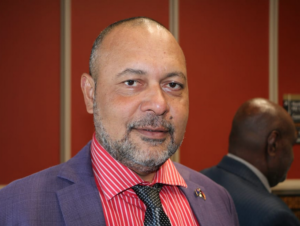
Papua New Guinea police have been tasked to furnish a full investigation report on the death of Deputy Prime Minister Sam Basil and his bodyguard First Constable Neil Maino.
Prime Minister James Marape told Basil’s children that “no stone would be left unturned” by police as they investigate the deaths.
He was speaking on Sunday during the arrival of the casket of his deputy at the Jackson’s International Airport ceremonial car park.
Basil died in a head-on vehicle collision along the Bulolo Highway in Morobe Province last Wednesday night.
“I have instructed the police to give a full account of the last steps of the Deputy Prime Minister, the journey the oncoming driver took, and every circumstance behind what happened in the lead-up to his passing,” Marape said.
“A report is expected for us to bring to full conclusion the passing of our nation’s Deputy Prime Minister.”
Marape gave this assurance to family members, people of Bulolo and Morobe, friends, members of Basil’s United Labour Party (ULP), members of the disciplined forces and the public at the airport.
“Sometimes, in life, it is not easy to understand why such tragic circumstances happen in this manner,” he said.
Words cannot express loss Marape said words could not fully express the loss of Basil to the nation.
“We stand with the family, we stand with the people and Wau-Bulolo, we stand with the people of Morobe Province, we stand with the United Labour Party, we stand with every citizen — men and women, boys and girls — of our beloved country to receive the Deputy Prime Minister of our country,” he said.
PNG Deputy Prime Minister Sam Basil … died last week after a collision along the Bulolo-Lae Road. Image: Johnny Blades/RNZ
“It is his last time to leave Lae for Port Moresby, and for the last time to be with us in Port Moresby, for us to accord him the respect he deserves and send him back to rest.
“It is a moment none of us thought would happen, I never thought it would happen.”
Marape said he was in a meeting last Wednesday night when news came from Lae of the accident.
“I asked those who were seated with me to offer a prayer for him (Mr Basil), as we were hearing that he was struggling,” he said.
“Today, the nation is coming to grips with the passing, for the first time, of a deputy prime minister of our country while serving in office.
Highest dignity promised “This is very, very sad.”
Marape told Basil’s family that the entire country joined with them in mourning the loss of their father, husband, son and brother.
He said Basil and himself first entered Parliament in 2007 and he was privileged to have served with him in Cabinet as a minister and later as DPM.
“He excelled to the highest standard in service to his people of Wau-Bulolo – which was second to none, to Morobe and to Papua New Guinea,” Marape said.
“The nation will give the highest dignity to a servant of our nation who has passed.
“We will give him, in his final tour-of-duty, the highest recognition that he deserves.”
Miriam Zarrigais a PNG Post-Courier reporter. Republished with permission.
Source: The Conversation (Au and NZ) – By Jim Stanford, Economist and Director, Centre for Future Work, Australia Institute; Honorary Professor of Political Economy, University of Sydney
Shutterstock/The Conversation
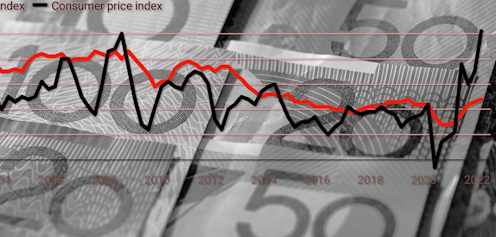
Every three months the Bureau of Statistics releases the lesser-known cousin of the consumer price index. It’s called the Wage Price Index (WPI) and it records changes in the overall level of wages, in the same way the price index records changes in the overall level of consumer prices.
Rarely does it generate headlines, but coming three days before an election and showing the worst performance ever compared with the consumer price index, it has provided concrete evidence that the buying power of wages is shrinking.
Contrary to hopes that lower unemployment would spark higher wages growth, the WPI barely budged in the year to March: climbing 2.4%, up from 2.3% in the year to December.
The consumer price index for the year to March grew twice as fast, by 5.1%
It means real wages (the buying power of wages) shrank 2.7% over the year to March in aggregate – one of the fastest and steepest declines ever.
Coming right at the end of the campaign, the news reinforces a traditional Labor concern (living costs) and diminishes a traditional Coalition selling point (superior economic management).
And it’s a full frontal challenge to conventional economics.
Here are just three of the conventional thoughts it has thrown into doubt.
Wages are determined by supply and demand
Conventional economics treats the price of labour like the price of any other commodity (such as fruit at a market), determined by supply (if there’s too much the price will fall) and demand (if a lot of people want it the price will rise).
That is held to mean that, even if there is still some unemployment, wages will grow faster if employers find it hard to find workers (as they are now) and slower if workers find it hard to find jobs (as was the case when unemployment was higher).
There is said to be a special unemployment rate – the Non-Accelerating Inflation Rate of Unemployment, NAIRU – below which wages will start to grow quickly, entrenching accelerating inflation.
The problem is that the NAIRU can’t easily be observed, and moves around.
The Treasury and Reserve Bank once believed NAIRU was close to 7%, then 6%, then 5% or lower. Now they are not sure it exists.
With unemployment well below the rates they once believed would push up the growth rate, there is growing doubt about whether it can.
Part of the reason is that unlike the market for fruit (or pork bellies or flat whites), institutions and bargaining power affect what happens to wages in addition to supply and demand. De-unionisation, insecure work, and deregulation of the wage-setting process have shifted the balance of power away from workers.
Labour markets are flexible
Decades of changes to Australia’s wage-setting system were sold as allowing labour markets to respond more smoothly to changes in supply and demand, ensuring workers were more closely paid in accordance with what they produced (productivity).
But a lot of (anti-worker) rigidity remains. One source is punitive public sector pay caps, which even the Reserve Bank says are contributing to weak wage growth.
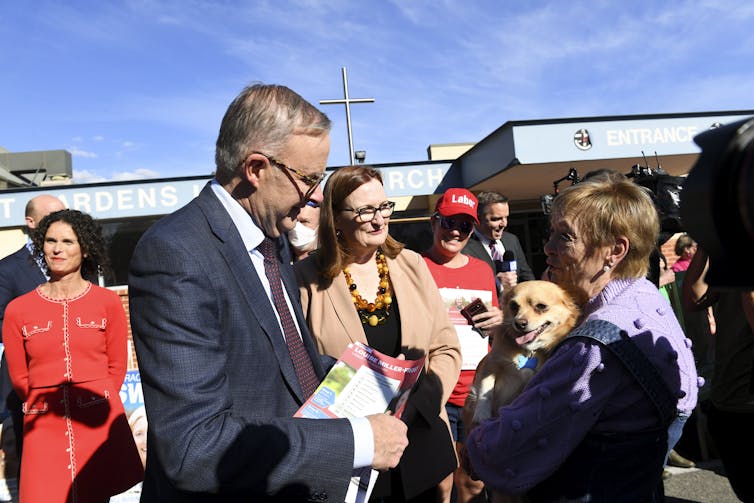
Anthony Albanese sparked an important debate when he said wages should at least keep up with inflation.
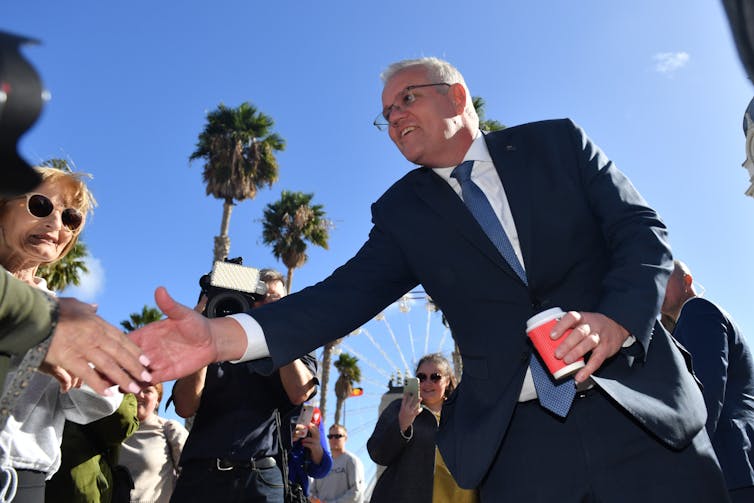
Scott Morrison said this would be like “throwing throwing fuel on the fire” of inflation. But Wednesday’s figures seem to indicate that inflation has a life of its own. It is soaring while wages growth is not.
And after adjusting for productivity growth (which has been surprisingly resilient, averaging 2% per year for the past two years), unit labour costs have grown the slowest in years, by just 1.5% per year since 2019.
Whatever is causing inflation, it isn’t firms passing on higher wage costs to their customers. Some are passing on higher profit margins. In anything, what we are experiencing is more like profit-price inflation than wage-price inflation.
During the COVID crisis, profits climbed to a record high as a share of GDP while labour compensation (mainly wages) fell to its lowest point in postwar history.
While economic truisms are being reassessed, voters are in the process of coming to grips with what stubbornly low wages growth means for them. Many more of them make their living by selling their labour than by taking profits.
Jim Stanford is a member of the Australian Services Union
On the eve of the election, the Coalition has said it will impose a higher “efficiency dividend” on public service agencies over the next four years in an effort to cut public service spending and address the budget deficit.
An efficiency dividend is a measure, first introduced by Labor in the late 1980s, that reduces the budgets of public sector agencies by a certain percentage.
The current efficiency dividend is 1.5%, but the Coalition has promised to boost the figure to 2% for the next three years, with Treasurer Josh Frydenberg saying:
What we are doing is offsetting that spending with an increase in the efficiency dividend by half a per cent, which will raise more than A$2.3 billion […] The annual departmental bill across the Commonwealth is about $327 billion. What we’re saying is it will be reduced to about $324 billion, as a result of this additional measure.
Across-the-board cuts to the public service via the so-called efficiency dividend represent a blunt instrument to achieve budgetary savings.
They have been used by both sides of politics over the years. They allow politicians to avoid taking responsibility for cuts on the pretence they are only about efficiency and that the public sector agency heads can manage them with no impact on services to the public.
But there have been many reviews over the years, including by parliamentary committees, that have revealed the efficiency dividend often does impact the level and quality of services, particularly for smaller agencies and particularly over time.
It can lead to increased charges, reduced services (for example, the Australian Bureau of Statistics’ Year Book no longer comes out annually) and increased waiting times.
While Labor has strongly criticised the Coalition’s proposed increase in the dividend, its criticism is a little hollow as it has said it will retain the efficiency dividend.
Labor is also proposing an additional cut in spending on administrative expenses through cuts to funding of consultants, contractors and labour hire – only some of which will be redirected to new public service positions.
Of course, taxpayers should expect the public service to pursue efficiencies and increased productivity – administrative expenses should not be automatically increased in line with increases in input costs. In particular, there is scope to use technology better to drive down costs and improve service provision.
But this requires new investments as recommended by an independent review of the Australian public service, led by David Thodey AO.
Following the Thodey report’s release in 2019, the government agreed to an audit of its current IT investments but we are yet to see that audit.
Nor has any mention been made of new investments that might deliver the efficiencies the government expects, let alone achieve the improved services Thodey was looking for.
In the absence of a more nuanced and targeted approach to make genuine efficiency gains, there is also the risk of further reducing the capability of the public service.
It is likely to mean further reducing resources for longer-term research and being less able to enhance public service wages where there is a need to attract key skills (such as in information technology).
A lazy cost-saving measure
While Labor and the unions are highlighting the likely impact on public service numbers, I would be less concerned on that score if the measure was genuinely about efficiency.
The concern I have is that this is not only a lazy cost-saving measure: it also reflects antipathy towards the public service as an institution.
We have seen this before with the imposition of staffing caps, in addition to the caps on administrative expenses. These have forced greater use of consultants and labour hire, even where this is less efficient than using public servants.
And we have seen it in the rejection of key Thodey report recommendations, not only about removing the staffing caps but also about enhancing the role of the public service commissioner. This would have ensured more merit-based senior appointments and a more appropriate way of setting pay and conditions.
Andrew Podger does not work for, consult, own shares in or receive funding from any company or organisation that would benefit from this article, and has disclosed no relevant affiliations beyond their academic appointment.
Every election is unique, but each also presents comparisons and contrasts with elections past.
In this podcast, Australian National University history professor Frank Bongiorno gives his insights into the current battle but also takes the long views of campaigns.
Bongiorno talks about the role of leaders in what’s often dubbed the “presidential” election age (“a kind of proxy for judgements about policy”) and how Scott Morrison and Anthony Albanese are presenting themselves.
The debate on wages and inflation has overtones of the arguments in the 1970s and 1980s, but “sort of minus the policy”.
This was supposed to be a “khaki” election, but the khaki has faded during the campaign, perhaps unsurprisingly. Most often, Australians are solidly focused on domestic issues when they vote.
The “teals” have been a special feature of this campaign. But are they a new version of other breakaways, like the Australian Democrats of old?
The rise of voter disillusionment is a feature of recent elections, as is the detachment of voters from the major parties. Not so long ago, about seven in ten voters voted at each election the same way as they had voted throughout their lives, Bongiorno says, based on the ANU’s Australian Election Study. But now it is just under four in ten. “That means there’s a growing number of voters whose support is biddable, and the independents and minor parties are benefiting from that kind of loosening of the hold of the major parties over the voters.”
Michelle Grattan does not work for, consult, own shares in or receive funding from any company or organisation that would benefit from this article, and has disclosed no relevant affiliations beyond their academic appointment.
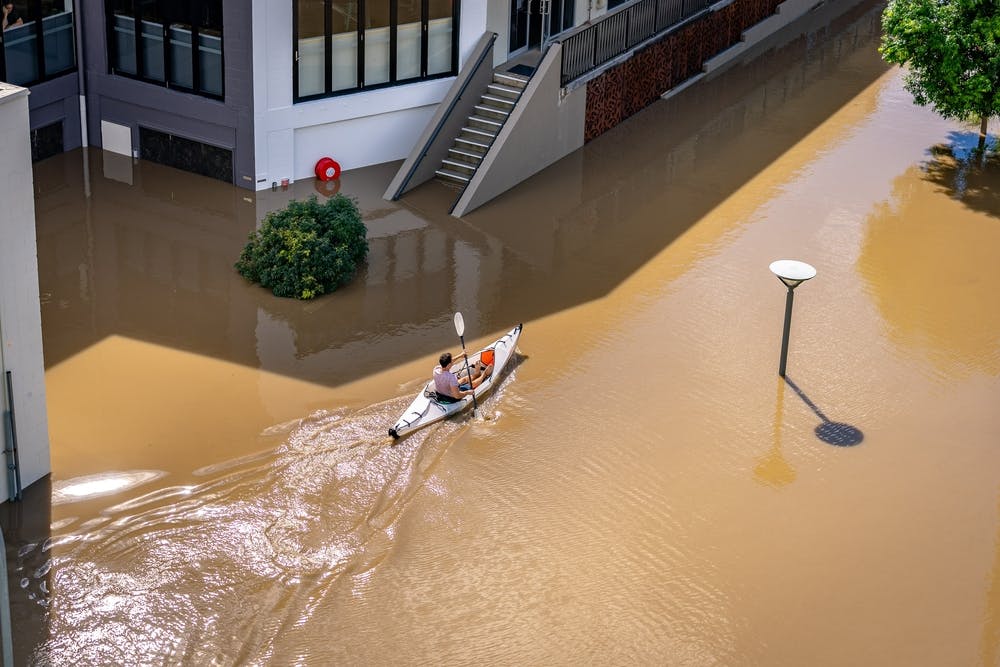
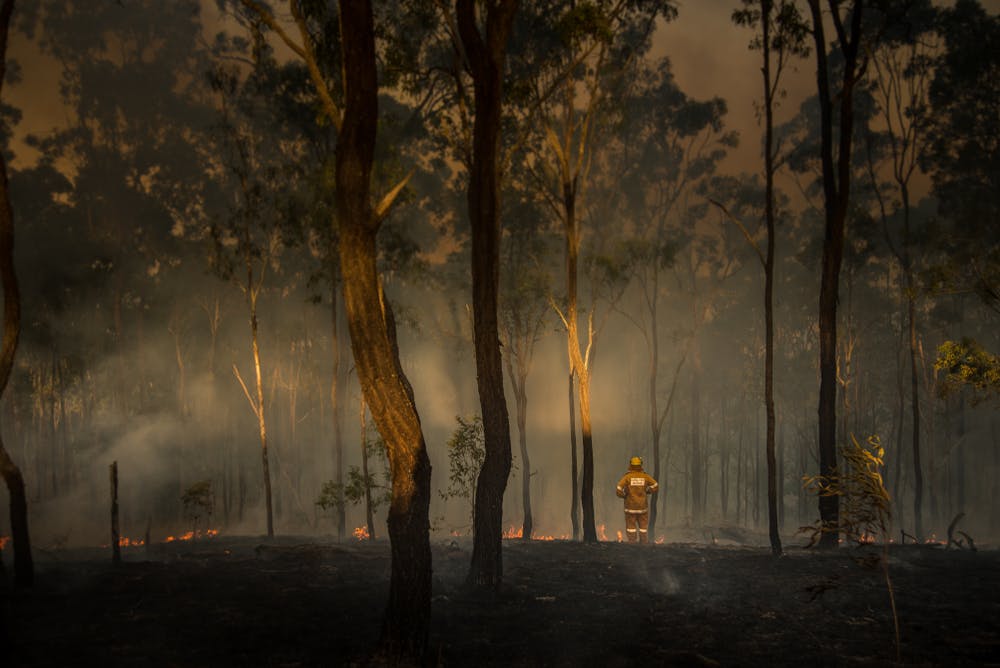
Australia is no stranger to disasters like droughts, floods, bushfires and heatwaves. The problem is, they’re going to get worse. And then worse again. As the global temperature ratchets up, these disasters will grow in size, frequency and intensity. We will have to get much better at adapting, and do this even as we phase out fossil fuels to stop climate change getting worse.
Climate adaptation is about working with our new reality, rather than clinging to the way things were done in the past. We must accept our climate and environment has already changed, with more major upheavals on the way. If we don’t, we’ll be caught napping by “unprecedented” events which just keep on coming.
While local and state governments have led the way on climate adaptation to date, we have much more to do, as the worrying lack of preparation for the floods that devastated Lismore makes clear.
Do both: climate adaptation and emissions reduction
Many people believe climate adaptation is a red herring, diverting resources and attention away from emissions.
This is simply not true. We must do both. The world has already warmed 1.2℃ since the industrial age began, and is heating up by just under 0.2℃ per decade. There is also a lag time between fossil fuels burned today and the extra warming this causes.
Climate change is already here, and will only intensify. We must urgently slash emissions while also helping our communities be ready. The good news is adaptation often helps lower emissions, and vice versa.
It can be hard to picture what climate adaptation looks like. So take the hard-hit town of Lismore as an example. Official warnings did not reach this Northern Rivers community. When these monster floods hit, these communities were largely left to save themselves. If it hadn’t been for neighbours undertaking rooftop rescues, the death toll would likely have been much higher. In the aftermath, many residents have been living in tents and caravans while struggling to find affordable housing.
To be ready for the next floods, Lismore would benefit from:
rebuild using flood-resistant designs and materials
coordinating community preparations
exploring land-swap or changing land-use planning for high-risk areas
better coordination between government agencies
better warnings delivered sooner.
As soon as you consider the problem, it becomes clear there is no silver bullet. We need to plan ahead of time, rather than try to scramble to respond to disasters as they grow in size and frequency. Preparing and planning saves lives and cuts costs.
Drawing on local community strength is vital, as the Northern Rivers has shown Australia. But it is not enough by itself. Movements like Resilient Byron and Resilient Lismore show how locally led adaptation can assist communities. They could do more, with directed long-term investments and support.
What have we done so far?
The knowledge we already have about surviving in the world’s most arid inhabited continent is a start. First Nations communities have a sophisticated understanding of caring for country, while Australian farmers are among the best climate-risk managers globally, after a rocky start.
To date, most government-led climate adaptation happens at local and state levels. Highly innovative approaches have come from local governments, such as a council-led land-swap to get people permanently out of flood plains in the Lockyer Valley. Victoria’s state government has a climate adaptation program to help the natural resources sector prepare for possible futures, while Queensland has a strategy for local governments to find the greatest risks to coastal areas and plan for adaptation.
While these are welcome, we must do much more at a national level. In this area, we seem to be going backwards. In 2007 the federal government invested heavily in climate adaptation, but these initiatives were progressively dismantled after the 2013 election. Today, disaster spending is focused on recovery rather than preparation. While that might be politically rewarding, it is extraordinarily expensive.
On a national scale, our current climate adaptation strategy lacks clear targets and timelines. Not only that, it does not connect the dots between the levels of adaptation required and different scenarios for cutting emissions. We hope the new framework being produced by the National Reconstruction and Recovery Agency will better incorporate adaptation.
What does well-adapted look like?
Our political parties differ substantially on climate adaptation efforts. Liberal and National Party policies barely mention climate adaptation. Labor has disaster preparation policies, such as up to A$200 million per year on disaster prevention and recovery, while the Greens are most ambitious with plans to both slash emissions and boost adaptation through initiatives such as making housing better able to cope with floods and cyclones.
Climate adaptation pays dividends – regardless of who takes government. Active climate adaptation would save Australia A$380 billion in gross domestic product over the next 30 years.
We cannot let climate adaptation be the plaything of day-to-day politics. To have any chance of success, we need a robust bipartisan strategy. We should look to countries such as the UK which has laws requiring a national climate risk assessment every five years as well as a program coordinating and reporting adaptation actions across the country.
There is support for these measures in Australia, with 72% of us in favour of introducing national climate risk assessments giving our state and local governments access to up to date information on flood projections, neighbourhoods most vulnerable to heatwaves and expected levels of sea level rise. Crucially, this would let us pick out the best ways we could adapt.
Australia also needs a national climate adaptation hub, a one-stop shop offering advice to all levels of government, communities, non-governmental organisations and the private sector on the adaptation strategies available and ways to scale up the best approaches.
We must act now to make the best of the future coming towards us. We know a great deal about what we’ve set in motion by heating up our planet. Now we must prepare for what this brings. And we have to do it together.
Johanna Nalau receives funding from Australian Research Council. She is also a Lead Author for the Intergovernmental Panel on Climate Change 6th Assessment Working Group and the Co-chair of Science Committee in the World Adaptation Science Program, United Nations Environment Programme.
Hannah Melville-Rea is affiliated with an independent think tank, the Australia Institute.
Prof Mark Howden is a Vice Chair of the IPCC Working Group II.
A View from Afar – In this podcast, political scientist Paul Buchanan and Selwyn Manning will examine the Implications of the Russia-Ukrainian conflict and how it impacts on regional security architecture.
In particular, we will assess Finland and Sweden’s move to become NATO members and whether Turkey will prevent this from occurring.
Also, this week, Russia’s Vladimir Putin hosted the leaders of Russia’s equivalent to NATO – the CSTO, which stands for the Collective Security Treaty Organization and includes: Armenia, Belarus, Kazakhstan, Kyrgyzstan, Russia, and Tajikistan.
Belarus’ authoritarian leader, Aleksandr Lukashenko, was the only leader of the CSTO to speak persuasively about Russia’s invasion of Ukraine.
Paul and I will analyse the CSTO meeting and discuss its relevancy from a security and geopolitical perspective and what implications all this has on the East Asia region.
Join Paul and Selwyn for this LIVE recording of this podcast while they consider these big issues, and remember any comments you make while live can be included in this programme.
You can comment on this debate by clicking on one of these social media channels and interacting in the social media’s comment area. Here are the links:
Threat.Technology placed A View from Afar at 9th in its 20 Best Defence Security Podcasts of 2021 category. You can follow A View from Afar via our affiliate syndicators.
GPs have been sounding the alarm over rising costs of providing care – compounded by the pandemic and more complex demands. Many have said they are abandoning bulk billing, the Medicare scheme that pays doctors a flat rate for providing consultations.
GPs earn considerably less than other medical specialists, sometimes two or three times less annually. If GPs maintain high rates of bulk billing and the Medicare repayment rate doesn’t cover their costs, practices become unsustainable.
Health-care quality can also decline, as GPs try to see more patients in a day to clock more bulk-billing fees. But opting out of bulk billing, as our specialist colleagues have done, could mean some patients lose access to care.
Meanwhile, more than 13% of voters who responded to The Conversation’s #SetTheAgenda poll were worried about health. Cost-of-living pressures were also on their list of concerns before the election.
The Australian Medical Association (AMA) has long supported GPs moving away from bulk billing so they don’t have to depend on government to set their incomes. This time around, many GPs will heed the call, and leave patients with a larger gap fee to pay. Here’s why.
General medical practices are essentially small, private businesses, which are free to set their own fees and working conditions. Medicare is a government insurance scheme to help patients access private GPs.
Medicare Benefits Schedule (MBS) fees are raised each year in accordance with the government’s Wage Price Index. This approach has long been criticised for failing to keep pace with inflation in the health sector.
Compounding this lag, rebates were frozen in 2013 as a cost-cutting measure for attendance items until July 2018.
Total spending on health in 2021–22 is estimated to be A$98.3 billion, representing 16.7% of the federal government’s total expenditure. Around 6.5% of total health expenditure is allocated to delivering GP services.
The gap between the AMA-recommended fee (around $86) and the Medicare rebate for a standard GP consult ($39.10) has grown by $13.50 over a decade to around $47. Average patient out-of-pocket costs for services directly provided by GPs have increased by 50% over the last decade.
Some 88.4% of GP services were bulk-billed in the final quarter of 2021, an increase of 0.3% on the previous year, according to the Department of Health. But much of this increase can be explained by mandated bulk-billed telehealth consultations under COVID rules, which replaced in-person consultations during lockdowns. The percentage of bulk-billed consultations was also down on the previous quarter.
Health care consumer confidence
So, health care costs in Australia are rising faster than cost of living pressures and wages growth. And there is ample evidence out-of-pocket costs create barriers to people getting health care – especially for many who need it most: rural populations, young families, those with disabilities and chronic conditions.
Earlier this year, a large survey found 30% of people with chronic conditions were not confident they could afford health care if they became seriously ill; 14% of people with chronic conditions said they could not afford healthcare or medicine now.
Rising out-of-pocket costs for health care is an important issue the major parties have not yet substantially addressed during the election campaign. The Labor party has finally come to the table with a funding promise to better support GPs and primary care, which the AMA has applauded as a good start.
Some 14% of people with chronic health conditions say they can’t afford medical care. Editor supplied, CC BY
General practices have worked hard to adapt to funding squeezes by creating efficiencies of scale (boosting practice size); adopting new technology, and seeing more patients with shorter consultation times. But around half are concerned about the long-term viability of their practices.
Anecdotally, younger GPs say they are thinking about leaving face-to-face general practice, finding the demands and expectations unsustainable. Even sadder is their perception the specialty has been devalued and deskilled.
Due to the lower income and status of general practice, medical students have a limited interest in pursuing it as a career and registrar training places go unfilled.
So, the GP workforce gets older. Some 50% of GPs are now over 50. Around 80% of GPs think better pay would attract more graduates to the specialty.
The pandemic has compounded the strain on our health workforce, with GP clinics shouldering significant responsibility for testing, vaccinating and caring for COVID patients. Staff and supply shortages and inadequate funding models have put substantial stress onto an already busy and demanding career.
It’s understandable that many GPs are opting out of bulk-billing. But there are no simple solutions for delivering high quality health care to everyone.
Adopting new funding models, including more blended payments – moving away from fee-for-service and incorporating “pay for performance” funding – could ease the strains on general practices.
Our health system is due for some courageous reforms. GPs have long advocated for better telehealth, reducing the current funding bias towards procedural medicine, and more consultation tiers, to improve quality of care. A strong Medicare system is important to provide a safety net, ensuring equitable access for all Australians.
David King does not work for, consult, own shares in or receive funding from any company or organisation that would benefit from this article, and has disclosed no relevant affiliations beyond their academic appointment.
Imagine there is a public speaking square in your city, much like the ancient Greek agora. Here you can freely share your ideas without censorship.
But there’s one key difference. Someone decides, for their own economic benefit, who gets to listen to what speech or which speaker. And this isn’t disclosed when you enter, either. You might only get a few listeners when you speak, while someone else with similar ideas has a large audience.
Would this truly be free speech?
This is an important question, because the modern agoras are social media platforms – and this is how they organise speech. Social media platforms don’t just present users with the posts of those they follow, in the order they’re posted.
Rather, algorithms decide what content is shown and in which order. In our research, we’ve termed this “algorithmic audiencing”. And we believe it warrants a closer look in the debate about how free speech is practised online.
Our understanding of free speech is too limited
The free speech debate has once more been ignited by news of Elon Musk’s plans to take over Twitter, his promise to reduce content moderation (including by restoring Donald Trump’s account) and, more recently, speculation he might pull out of the deal if Twitter can’t prove the platform isn’t inundated with bots.
Musk’s approach to free speech is typical of how this issue is often framed: in terms of content moderation, censorship and matters of deciding what speech can enter and stay on the platform.
But our research reveals this focus misses how platforms systematically interfere with free speech on the audience’s side, rather than the speaker’s side.
Outside the social media debate, free speech is commonly understood as the “free trade of ideas”. Speech is about discourse, not merely the right to speak. Algorithmic interference in who gets to hear which speech serves to directly undermine this free and fair exchange of ideas.
Algorithmic audiencing happens through algorithms that either amplify or curb the reach of each message on a platform. This is done by design, based on a platform’s monetisation logic.
Newsfeed algorithms amplify content that keeps users the most “engaged”, because engagement leads to more user attention on targeted advertising, and more data collection opportunities.
This explains why some users have large audiences while others with similar ideas are barely noticed. Those who speak to the algorithm achieve the widest circulation of their ideas. This is akin to large-scale social engineering.
Algorithmic audiencing has a material effect on public discourse. While content moderation only applies to harmful content (which makes up a tiny fraction of all speech on these platforms), algorithmic audiencing systematically applies to all content.
So far, this kind of interference in free speech has been overlooked, because it’s unprecedented. It was not possible in traditional media.
And it is relatively recent for social media as well. In the early days messages would simply be sent to one’s follower network, rather than subjected to algorithmic distribution. Facebook, for example, only started filling newsfeeds with the help of algorithms that optimise for engagement in 2012, after it was publicly listed and faced increased pressure to monetise.
Only in the past five years has algorithmic audiencing really become a widespread issue. At the same time, the extent of the issue isn’t fully known because it’s almost impossible for researchers to gain access to platform data.
But we do know addressing it is important, since it can drive the proliferation of harmful content such as misinformation and disinformation.
Individually, Twitter users should heed Elon Musk’s recent advice to re-organise their newsfeeds back to chronological order, which would curb the extent of algorithmic audiencing being applied.
You can also do this for Facebook, but not as a default setting – so you’ll have to choose this option every time you use the platform. It’s the same case with Instagram (which is also owned by Facebook’s parent company, Meta).
What’s more, switching to chronological order will only go so far in curbing algorithmic audiencing – because you’ll still get other content (apart from what you directly opt-in to) which will target you based on the platform’s monetisation logic.
And we also know only a fraction of users ever change their default settings. In the end, regulation is required.
In return, the public expects platforms to facilitate a free and fair exchange of their ideas, as these platforms provide the space where public discourse happens. Algorithmic audiencing constitutes a breach of this privilege.
As US legislators contemplate social media regulation, addressing algorithmic audiencing must be on the table. Yet, so far it has hardly part of the debate at all – with the focus squarely on content moderation.
Any serious regulation will need to challenge platforms’ entire business model, since algorithmic audiencing is a direct outcome of surveillance capitalist logic – wherein platforms capture and commodify our content and data to predict (and influence) our behaviour – all to turn a profit.
Until we are regulating this use of algorithms, and the monetisation logic that underpins it, speech on social media will never be free in any genuine sense of the word.
The authors do not work for, consult, own shares in or receive funding from any company or organisation that would benefit from this article, and have disclosed no relevant affiliations beyond their academic appointment.
Source: The Conversation (Au and NZ) – By Stephen Duckett, Honorary Enterprise Professor, School of Population and Global Health, and Department of General Practice, The University of Melbourne
Medicare, Australia’s universal health insurance scheme, provides financial protection against the cost of medical bills, and makes public hospital care available without any charge to the patient. For the large majority of Australians in urban settings, it is a brilliant system – providing subsidised access to care.
But subsidised access is only useful for those who have access. If there is no doctor nearby, there is nothing to subsidise. This creates a huge inequity – most of Australia has good access to doctors, but the Northern Territory does not.
And what’s worse, there is no effective policy to redress the inequity that payments flow to areas where there are doctors.
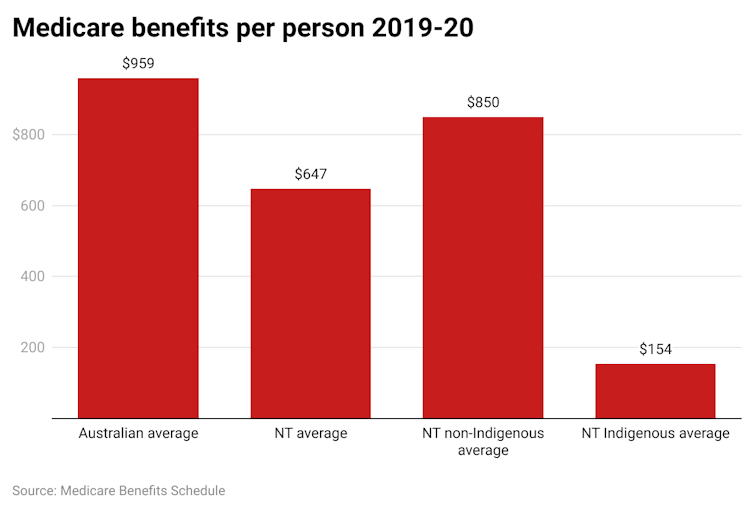
In our recently published paper, we found NT residents receive roughly 30% less Medicare funding per capita than the national average (A$648 compared with A$969).
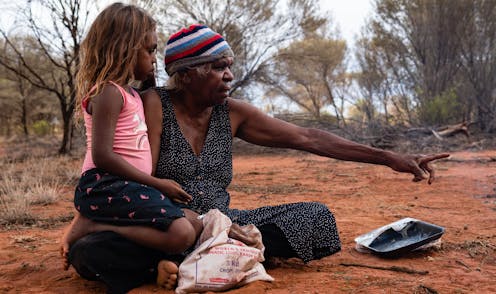
The gap is worse for First Nations Australians in the NT, who attract only 16% of the Medicare funding of the average Australian.
We measured the extent of the problem over the years 2010–20. We used the federal government’s published figures on Medicare to explore the impact of this uneven workforce distribution on Medicare billing in the NT.
The differences are stark.
The inequitable funding is even worse when the poorer health status of First Nations Australians and the additional costs associated with geographical remoteness are taken into account.
The NT has a younger age profile than the rest of Australia, but this explains only one-third of the gap.
What’s going wrong with the funding?
Despite Medicare’s intended universality, the NT is systematically disadvantaged.
People in the Territory have poorer access to primary health care, which includes GP services and those provided by Aboriginal community-controlled health services.
Aboriginal health services receive some special additional funding separate from the Medicare-billing funding. However, even with that extra funding, there is still a shortfall to NT residents of about A$80 million each year.
The NT government receives a relatively higher proportion of the GST funding pool in recognition of its challenges with remoteness and Indigenous services. But this is calculated assuming NT residents have the same access to Medicare as all other Australians. As we have shown, they don’t and so the extra GST funding does not result in a fair funding stream to meet NT primary care needs.
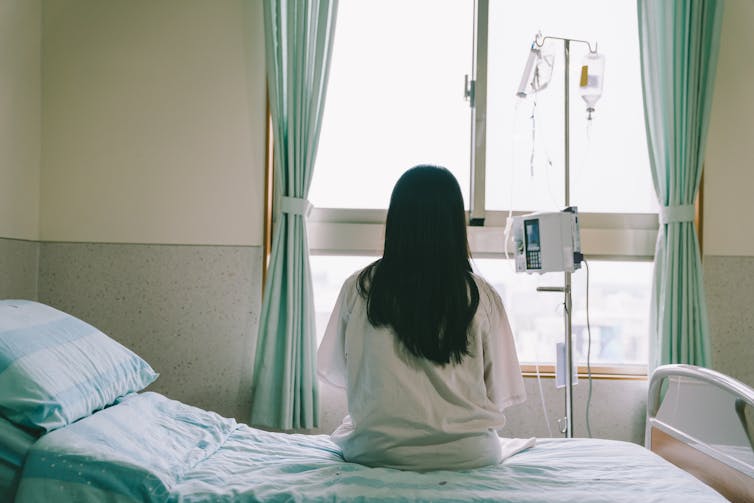
The outcome of inadequate primary health care funding is increasing reliance on hospital services. People’s chronic health conditions worsen if they’re not well managed in the community and this increases the risk they will need a hospital admission, especially for “potentially preventable hospitalisations”. NT hospitals experience excessive pressure of workload and complexity as a result.
Poorer access to primary care services results in more hospitalisations. Shutterstock
We have shown previously that effective primary health care for remote patients with chronic, long-term diseases can substantially reduce their use of hospital services and result in better health outcomes at a lower cost.
When visiting the NT in 2000, one of the architects of Medicare, John Deeble, observed the funding failure first hand and suggested another form of health-care financing was needed to adequately support remote primary health care.
In terms of health equity and our national commitment to close the life expectancy gap for First Nations peoples, the status quo is undeniably short-changing our efforts.
What needs to be done?
There needs to be a reset in how we finance remote primary health care services in the NT.
The value proposition is excellent. Due to the extreme health needs and vulnerable populations, the return on investment is high – more than A$5 in saved acute care costs for every dollar invested.
The federal government’s Health Care Homes funding reform trial was very successful in remote NT communities. For the first time, service providers received flexible funding to care for patients’ chronic conditions, rather than a fee for each service they provided. It also enabled the provider and patient to develop a relationship.
Unfortunately the Health Care Homes program ended in June 2021, and has not been renewed. This program should be reinvigorated for chronic disease care in the NT and extended to include other core programs of mental health and suicide prevention, and child and maternal health.
The federal government should take this opportunity to get remote primary health care financing right and ensure Medicare funds reach those who need them most.
Acknowledgement: Xiaohua Zhang, Jo Wright, and Maja Van Bruggen from the Northern Territory Department of Health are co-authors of the journal article on which this article is based.
John Wakerman receives funding from The Australian Research Council, the Medical Research Future Fund and the NT Primary Health Network.
Paul Burgess has previously received grant funding as an investigator on MRFF, NHMRC and the Digital Health CRC funded projects. No funding was received for the work that led to this publication. Paul works for the NT Government.
Rus Nasir worked for the NT Government as acting director of Aboriginal health.
Yuejen Zhao works for the NT Govnernment.
Stephen Duckett does not work for, consult, own shares in or receive funding from any company or organisation that would benefit from this article, and has disclosed no relevant affiliations beyond their academic appointment.
Mentions of arts and cultural policy have been thin on the ground this election. The Coalition has not released any specific arts policies during the campaign, and Labor’s arts policies have only just been announced in the last week before everyone heads to the polls.
While arts isn’t one of the big talking points this election like health or climate change, it is still an important policy area for many. In response to The Conversation’s #SetTheAgenda poll, readers told us they were interested in support for the ABC and Australian literature, arts and humanities.
One reader said they were hoping for “the recognition of the arts in relation to the well being of people”. Another said they wanted a cultural policy “catering to the smaller/gig economy not just the big players/organisations”.
So what do we know about the major parties’ commitment to the arts, and how do they stack up? We asked five experts to analyse and grade the major parties’ arts and cultural policies. No one gets an A, but there are a couple of Fs.
Here are their detailed responses:
Coalition
Labor
Ben Eltham has previously received funding from the Australia Council for the Arts. He is affiliated with the Centre for Future Work at The Australia Institute, where he has previously co-written a report about federal cultural policy. He is a member of the Media, Entertainment and Arts Alliance (MEAA), a union that represents workers in the cultural sector.
Brendan Keogh has previously received funding from the Australian Research Council
Kirsten Stevens has received funding from the Australian Research Council.
Peter Tregear is Chair of IOpera, a chamber opera company which has received financial support from the Federal Government’s RISE fund. He is also a founding member of Public Universities Australia, an alliance of organisations and individuals lobbying to promote the public value and function of Australian universities.
Tully Barnett receives funding from the Australian Research Council.
Denying the severity of a crisis neither removes nor lessens the problem. Sticking to the status quo because it doesn’t suit our work practices, or social and economic norms, not only delays the inevitable, it compounds the problem.
The crisis, whether a pandemic or climate change, must dictate the timetable. Given the urgency of the crises we face, that timetable needs to be equally urgent. The world needs much more regular reporting on progress (or lack of it) for action and adaptation to keep pace.
Society’s response to the COVID-19 health crisis demonstrated the ability of citizens and governments to adapt rapidly when provided with information daily. The chronic crises of climate change and biodiversity loss require similar treatment: global assessments should be published annually, not once every few years.
The pace of the pandemic, with half-a-billion people infected and over six million deaths to date, demanded daily epidemiological data from the outset to manage the response. Failures in timely or accurate monitoring and reporting, and naïve responses, led to more deaths and illness, and many suffering with long COVID for years.
Nature will not wait for changes in scientific knowledge or public opinion, nor for electoral cycles to shift politicians’ priorities. The lessons of the pandemic should now be applied to other global crises.
Interrelated crises
Decades of evidence of fossil-fuel-driven climate change means it is now accepted as fact by the Intergovernmental Panel on Climate Change (IPCC).
While regionally variable, the frequency, intensity and duration of extreme events related to climate change – including wildfires, droughts, floods, landslides and heatwaves – have international consequences for human health, property loss and food security. In turn, these may lead to mass migration, government instability and military conflict.
Most citizens now grasp the interrelated nature of the climate crisis and the loss of the biodiversity on which food security and healthy ecosystems depend.
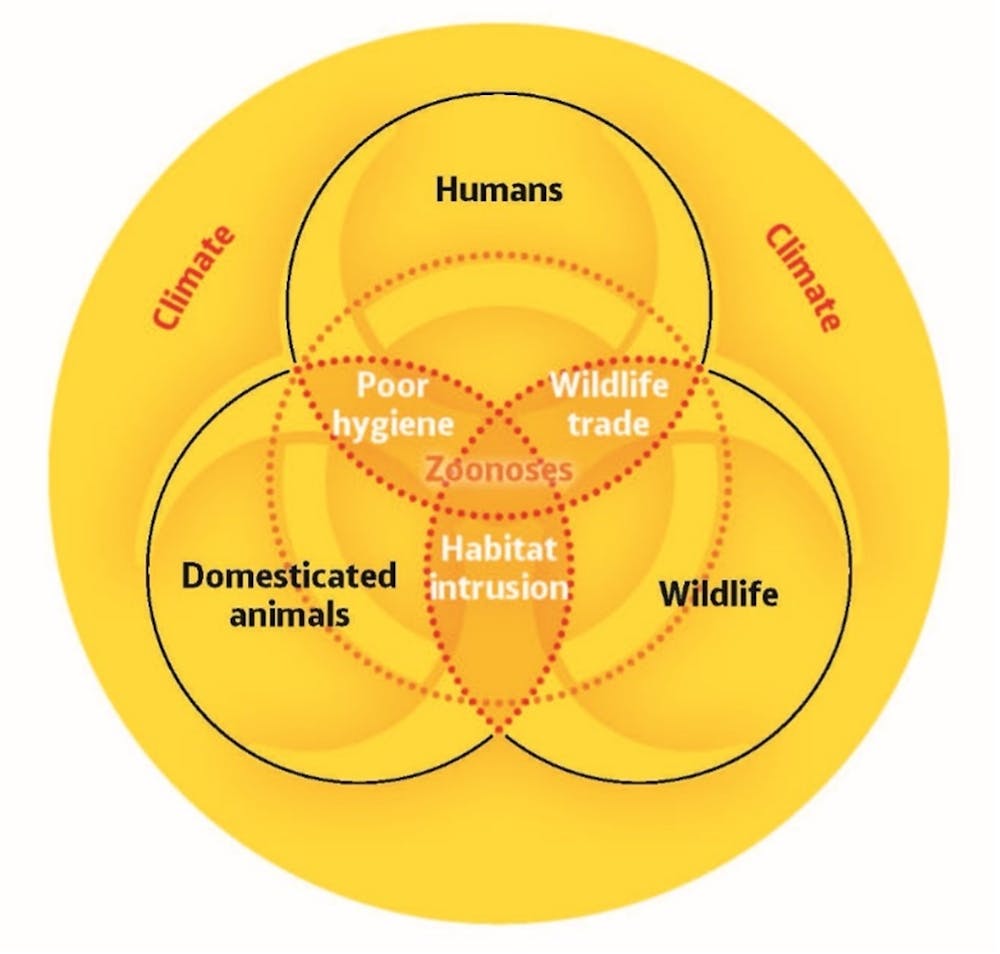
The pandemic, climate and biodiversity crises are interconnected (see diagram below). One study lists 52 interactions covering equity, governance, public health, food systems, water availability, hygiene, urbanisation and infrastructure. These are symptoms of the unsustainable human impacts on the planet and its biodiversity.
Diseases from wildlife (zoonoses, such as SARS-CoV-2) result from the intrusion of people and their domestic animals into wildlife habitats, combined with poor hygiene in marketplaces. All are exacerbated by climate change which additionally drives shifts in the distribution of people, domestic animals and wildlife. Author provided
Since its inception in 1988, the IPCC has scheduled rigorous assessments of scientific data and knowledge of climate change. This work involves thousands of scientists and numerous meetings, at five- to eight-year intervals. Most importantly, these form a scientific consensus approved by governments.
The Intergovernmental Panel on Biodiversity and Ecosystem Services (IPBES) follows a similar path. Special reports and assessments from both organisations provide salient and up-to-date scientific information to governments worldwide. These run to thousands of pages and are expensive to produce.
But the accelerating pace of climate change, loss of biodiversity and now regular extreme events dictate that the IPCC and IPBES must shift their assessment cycles from once every few years to yearly. The transformational adaptation of society called for by the IPCC should also apply to its own scientific reporting.
Annual reports may not need to be as detailed and comprehensive and could have fewer authors, while still maintaining breadth of expertise, geographic representation and diversity. Workloads and costs would be reduced by the data-gathering and analysis covering just one year.
Accountability and action
Reports could be more succinct, with less jargon, by focusing on the facts and their meaning. This would streamline production and increase efficiencies. Annual assessments could then be synchronised with government and business budgeting and planning, as the climate and biodiversity crises are also economic problems.
In turn, this would enable governments to adjust policies and funding priorities, investments, taxes and fines on an annual basis. Crucially, they could highlight any failures to meet the previous year’s promises.
Still only 2.8% of the ocean is designated to be fully protected from human impacts, and 3.2% partially. Despite international commitments under the United Nations Law of the Sea in 1982, it seems 94% of the ocean is not being managed in an environmentally sustainable way. We are a long way from the new target of 30% by 2030.
Action can never be guaranteed, but annual accessible assessments and a better-informed population would mean greater accountability, particularly as election cycles would cover multiple reports.
Social and political change
There have been calls, too, for monthly data on emissions on top of annual national reporting on progress to climate change targets. And while some agree that the present IPCC assessment process is untenable, their proposal is to halt further IPCC assessments altogether.
We argue that more frequent assessments will lead to the societal and political change needed. Other shifts in societal behaviour – reducing smoking, alcohol abuse, healthy diets, drunk driving and promoting recycling – took years of convincing scientific evidence to take hold.
This process of shifting individual behaviour that then translates into government action is well under way with the climate and biodiversity crises. We’re optimistic that increased government efforts can address the crises, with their delays making action to reduce greenhouse gas emissions a higher priority every year.
Shortening and simplifying the process to make primary data more accessible to society, as demonstrated during the pandemic and commonly seen in the reporting of weather and climate (though sadly not for biodiversity data) is a starting point.
A globally representative and diverse panel of scientists can oversee the process, interpreting the observations in the light of peer-reviewed research, as already happens with assessments. All of this will guide solutions to ensure the health of our planetary ecosystem and the future of all its inhabitants.
Mark John Costello was a lead author in a regional chapter and co-lead of a cross-cutting chapter in the IPCC WG2 6th Assessment. His participation in the IPCC was supported by the New Zealand Ministry for the Environment. He was the first chair of OBIS and served as vice-chair of the GBIF Science Committee.
Katherine Kelly does not work for, consult, own shares in or receive funding from any company or organisation that would benefit from this article, and has disclosed no relevant affiliations beyond their academic appointment.
Source: The Conversation (Au and NZ) – By Adrian Beaumont, Honorary Associate, School of Mathematics and Statistics, The University of Melbourne
AAP/Lukas Coch/Mick Tsikas
The final Resolve poll for Nine newspapers, conducted May 12-17 from a sample of 2,049, gave Labor just a 52-48 lead by 2019 election preferences, a two-point gain for the Coalition since last fortnight’s Resolve. By respondent preferences, Labor’s lead was narrower at 51-49, a three-point gain for the Coalition.
Primary votes were 34% Coalition (up one), 31% Labor (down three), 14% Greens (down one), 6% One Nation (up one), 4% UAP (down one), 6% independents (up two) and 4% others (steady). 86% said they were now committed to their first preference (up 10), while 14% were not yet committed (down 10).
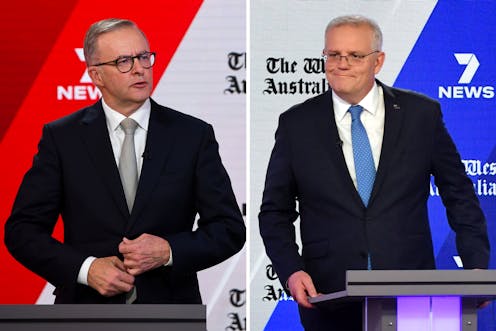
50% thought Scott Morrison was doing a bad job and 43% a good job for a net approval of -7, up two points. Anthony Albanese gained three points for a net approval of -8. Morrison led as preferred PM by 40-36 (39-33 previously).
Labor and Albanese led the Liberals and Morrison by 32-30 on keeping the cost of living low (34-28 previously). On economic management, the Liberals led by 40-30 (42-27 last time).
The poll supplemented its usual online sample of about 1,400 for campaign polls with several hundred respondents interviewed by telephone.
In the three polls so far this week, Resolve has had the most dramatic narrowing. Essential has generally had better results for the Coalition than other polls, and Labor’s lead after preferences has been as low as one point twice this year. The narrowing in Morgan was not all it seemed.
I don’t think the Coalition’s campaign launch on Sunday and their housing policy is responsible, as the fieldwork for these polls began well before then. With Morrison’s ratings still well in negative territory, the narrowing may reflect hesitation about voting Labor.
I expect more polls from Newspoll, Ipsos and perhaps a final Morgan poll by Friday night.
Essential: 48-46 to Labor with undecided included
The final Essential poll, conducted May 11-16 from a sample of 1,600, gave Labor a 48-46 lead with undecided included (49-45 last fortnight). Primary votes were 36% Coalition (steady), 35% Labor (steady), 9% Greens (down one), 4% One Nation (up one), 3% UAP (down one), 6% Others (up one) and 7% undecided (up one).
With undecided excluded, the two party would be 51-49 to Labor. Analyst Kevin Bonham estimated 51.6-48.4 to Labor by 2019 preference flows.
49% disapproved of Morrison’s performance (up one since April) and 43% approved (down one), for a net approval of -6, down two points. Albanese’s net approval was up one point to +1. Morrison led as better PM by 40-37 (40-36 previously).
34% said the government deserved to be re-elected (up one since last fortnight), and 49% said it was time to give someone else a go (up three).
Morgan poll: Labor’s lead narrows to 53-47, but …
A national Morgan poll, conducted May 9-15 from a sample of 1,366, gave Labor a 53-47 lead, a 1.5-point gain for the Coalition since the previous week’s poll. Primary votes were 34% Labor (down 1.5), 34% Coalition (steady), 13% Greens (steady), 4% One Nation (steady), 1% UAP (steady), 9% independents (up 0.5) and 5% others (up one).
This two party result is based on 2019 preference flows. Until last week, Morgan was using respondent preferences, which were better for Labor. Bonham gets a Labor lead of 53.9-46.1 from Morgan’s primaries, implying Morgan miscalculated the 2019 flows.
It’s likely Morgan’s high independent vote is because they continue to ask for independents in all seats, even though most seats don’t have viable independents. Resolve was the other pollster that used to have high independent votes, but dropped the independent option in its last poll in most seats, leading to a surge for the Greens.
It’s not mentioned in the poll report, but Labor’s two party estimate using respondent preferences was actually up 0.5 points from the previous week to a 56.5-43.5 lead for Labor.
Seat polls galore, but mainly in NSW and WA
As I’ve said before, seat polls have been unreliable at past elections. The polls listed here are relatively poor for Labor in WA, but strong in NSW, which most of these polls focused on. There are two potential NSW losses for Labor: Eden-Monaro and Hunter, but far more for the Coalition.
Data for the seat polls would mostly have been collected last week, before any national narrowing began.
Polls were good for “teal” independents in Wentworth and Goldstein, and for Labor in inner Brisbane seats, but none of these polls surveyed a regional Queensland seat.
A note on seat margins: in Australia, the margin is the winning party’s two party percentage minus 50%, not the difference between the two leading candidates. For example, Parramatta is Labor held by a 3.5% margin, meaning that Labor won it by 53.5-46.5 at the 2019 election, a 7.0% difference.
Utting research robopolls of four WA seats were conducted May 12-13 from samples of 400 per seat for the WA Sunday Times. Compared to March polls of the same four seats, these are much better for the Coalition. Labor would still gain Swan and Pearce.
In Swan (Lib, 3.2% margin), Labor’s March lead is down from 59-41 to 53-47. In Pearce (Lib, 5.2%), Labor’s lead reduced from 55-45 to 52-48. In Hasluck (Lib, 5.9%), the Liberals lead by 55-45 after trailing 52-48 previously. And in Tangney (Lib, 9.5%), the Liberals have a 54-46 lead after a 50-50 tie last time.
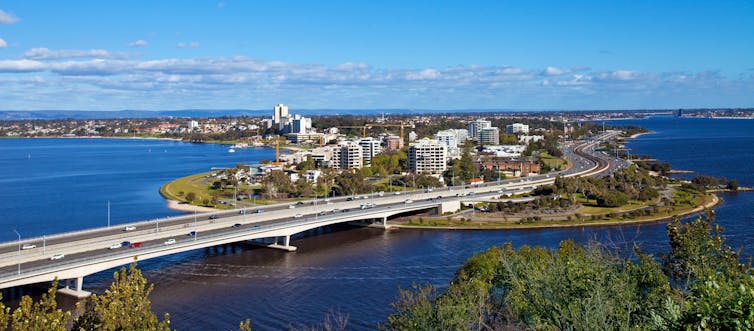
WA has nearly always been much more pro-Coalition at federal elections than the country overall. These polls suggest that it has reverted to type. Labor’s national poll leads may reflect swings to Labor in the eastern states since the campaign began.
At a federal level, Western Australia has always favoured the Coalition. Shutterstock
Polls for the Industry Association were reported by Sky News on Sunday. They surveyed seven NSW seats from samples of 800 per seat. Fieldwork dates and pollster used were not mentioned.
In Robertson (Lib, 4.2%), Labor led by 58-42. In Reid (Lib, 3.2%), Labor led by 53-47. In Parramatta (Lab, 3.5%), Labor led by 54-46. In Gilmore (Lab, 2.6%), Labor led by 56-44. In Shortland (Lab, 4.5%), Labor led by 57-43. In Hunter (Lab, 3.0%), Labor led by 51-49. And in Lindsay (Lib, 5.0%), the Liberals led by 57-43.
The report also said that similar polling earlier in the campaign showed losses for the Coalition in Banks (Lib, 6.3%) and Bennelong (Lib, 6.9%).
The weighted share in a Compass poll of North Sydney (Lib, 9.3%), conducted in the week of May 6 from a sample of 507, gave the Liberals 40.5%, Labor 21.6%, an independent 13.6% and the Greens 12.9%. Analyst Kevin Bonham estimated this would be 50.5-49.5 to Labor.
A Redbridge poll of North Sydney for Climate 200, conducted May 3-14 from a sample of 1,267, gave the Liberals 35.5%, the independent (Kylea Tink) 24.8% and Labor 18.9%. Bonham said respondent preferences gave Tink a 54.5-45.5 lead over the Liberals.
A Redbridge poll for independent Allegra Spender in Wentworth (Lib, 1.3% vs independent Kerryn Phelps in 2019), reported by The Guardian, gave the Liberals 36%, Spender 33.3%, Labor 11.7%, the Greens 6.2% and UAP 5.3%. Spender would win from these primary votes.
The Poll Bludger reported Tuesday that a Laidlaw poll of Fowler (Lab, 14.0%), conducted three weeks ago from a sample of 618, had Labor’s Kristina Keneally leading independent Dai Le by 45-38 after preferences with 17% undecided.
In the Victorian seat of Goldstein (Lib, 7.8%), Samantha Maiden reported Saturday that a uComms poll for the left-wing activist GetUp! with a sample of 831 gave independent Zoe Daniel a 59-41 lead over Liberal incumbent Tim Wilson.
uComms has had very strong results in its polls for “teal” independents. The Poll Bludger is sceptical as they have not altered their weighting since the 2019 election, when not weighting by education is thought to have caused the poll failure.
YouGov polls for Labor in May of Brisbane (Qld, LNP, 4.9%), Ryan (Qld, LNP, 6.0%), Bennelong and Higgins (Vic, Lib, 2.6%) from samples of 400 per seat had Scott Morrison’s disapproval rating at 57% in Bennelong, 58% in Ryan, 62% in Brisbane and 65% in Higgins according to The Guardian.
Maiden reported Tuesday that uComms polls for GetUp! in Gilmore, Ryan, Eden-Monaro (NSW, Lab, 0.9%), Page (NSW, Nat, 9.5%) and Macquarie (NSW, Lab, 0.2%) gave Labor a 57-43 lead in Gilmore, 55-45 in Ryan and 56-44 in Macquarie. But the Nationals led by 51-49 in Page and the Liberals by 51-49 in Eden-Monaro.
Tasmanian upper house: Labor loses Huon
Tasmanian upper house elections occurred in Huon, McIntyre and Elwick on May 7. The last two were decided by large margins, but in Huon preferences were distributed Tuesday after the postal reception deadline.
Primary votes were 25.1% Labor, 23.7% for conservative independent Dean Harriss, 22.7% Liberals, 20.9% Greens and 7.8% Local Party. After preferences, Harriss defeated Labor by 52.6-47.4. This means Labor drops from five seats to four in the 15-member upper house.
Adrian Beaumont does not work for, consult, own shares in or receive funding from any company or organisation that would benefit from this article, and has disclosed no relevant affiliations beyond their academic appointment.
Fabrice Demeter (University of Copenhagen / CNRS Paris), Author provided
What do a finger bone and some teeth found in the frigid Denisova Cave in Siberia’s Altai mountains have in common with fossils from the balmy hills of tropical northern Laos?
Not much, until now: in a Laotian cave, an international team of researchers including ourselves has discovered a tooth belonging to an ancient human previously only known from icy northern latitudes – a Denisovan.
The find shows these long-lost relatives of Homo sapiens inhabited a wider area and range of environments than we previously knew, confirming hints found in the DNA of modern human populations from Southeast Asia and Australasia.
Little is known about these distant cousins of modern humans, except that they once lived in Asia, were related to and interacted with the better-known Neanderthals, and are now extinct.
The first traces of Denisovans were only found in 2010, with the discovery of an innocuous finger bone in remote Denisova Cave. The extreme cold of the cave meant some ancient DNA was preserved in the bone – and the DNA revealed the finger had belonged to an unknown species of human.
This discovery changed the course of human evolutionary studies, and the newly discovered humans were named Denisovans after the cave where the fossil was found.
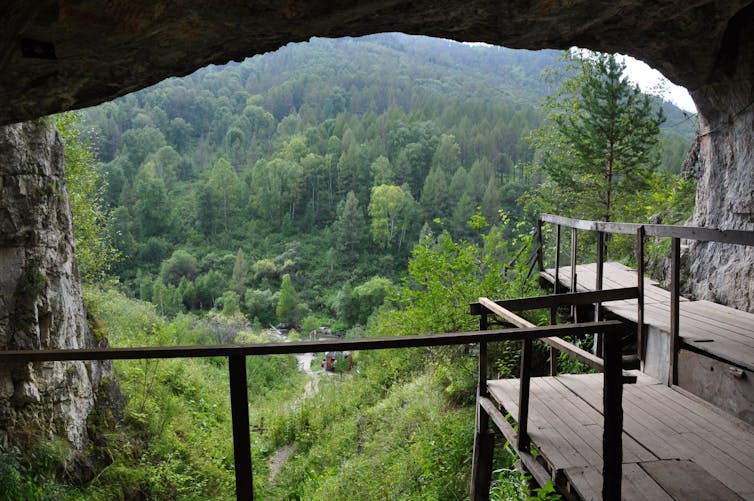
The first traces of the Denisovans were found at Denisova Cave in Siberia in 2010. Mike Morley (Flinders University), Author provided
Fossilised teeth from Denisovans were later discovered in the same cave. Two upper and one lower molar were found in sediments that were dated to between 195,000 and 52,000 years ago.
Meanwhile, it was found that genes from Denisovans survived in modern day people from Southeast Asia and Australasia. This implied that the Denisovans had dispersed over a far larger area than anticipated.
The hunt was on to find more evidence of these humans outside Russia, but scientists had no idea what they actually looked like. For the first time in history we knew more about a human’s DNA than their anatomy!
The next twist came when a 160,000-year-old Denisovan jawbone surfaced on the Tibetan Plateau, giving the scientific community a tantalising glimpse of what the bodies of these ancient humans were like and where they lived.
But questions remained: just how far did they spread in Asia, and how did their genetic imprint survive in Southeast Asians and Australasians?
Clearly Denisovans could live in the cold environments of Siberia and Tibet, but could they have also occupied a completely different ecological niche and adapted to a tropical climate?
Tam Ngu Hao 2 (Cobra Cave)
Enter a new cave found by an international (Laos–French–American–Australian) team in northern Laos in 2018, close to the famous Tam Pa Ling cave where 70,000-year-old modern human fossils were found.
The site, named Tam Ngu Hao 2 (or Cobra Cave), was found high up in the limestone mountains and contained remnants of old cave sediment packed with fossils.
The cave sediments contained teeth from giant herbivores, such as ancient elephants and rhinos that liked to live in woodland environments. The teeth were likely washed into the cave during a flooding event that deposited the sediments and fossils.
These sediments were covered by a layer of very hard rock called flowstone, which is formed by water flowing over the cave floor. The sediments and fossils were dated by this study to provide an age for the time of deposition in the cave, and by association a minimum age for the death of the animals.
A young girl’s tooth
A human tooth (a lower permanent molar) was found in the cave sediments, but we could not initially identify what species of human it came from. The humid conditions in Laos meant that the ancient DNA was not preserved.
This tooth likely belonged to a young Denisovan girl who lived around 150,000 years ago. Fabrice Demeter (University of Copenhagen / CNRS Paris), Author provided
We did however find ancient proteins that suggested the tooth came from a young, likely female, human – probably between 3.5 and 8.5 years old.
After very detailed analysis of the shape of this tooth, our team identified many similarities to the Denisovan teeth found on the Tibetan Plateau. This suggested the tooth’s owner was most likely a Denisovan who lived between 164,000 and 131,000 years ago in the warm tropics.
An ancient human hotspot
This fossil represents the first discovery of Denisovans in Southeast Asia, and shows that Denisovans were at least as far south as Laos. This is in agreement with the genetic evidence found in modern day Southeast Asian populations.
They may have been just at home in the balmy tropical climates of Laos as the icy conditions of northern Europe and the high-altitude environments of the Tibetan Plateau. This suggests the Denisovans were very good at adapting to diverse environments.
It would seem that Southeast Asia was a hotspot of diversity for humans. At least five different species set up camp there at different times: Homo erectus, the Denisovans/Neanderthals, Homo floresiensis, Homo luzonensis, and Homo sapiens.
How many of these species overlapped and interacted? Another fossil discovered in the dense network of Southeast Asian caves could provide the next clue to understanding these complex relationships.
Kira Westaway receives funding from the Australian Research Council (ARC) and the Leakey Foundation
Mike W Morley receives funding from the Australian Research Council (ARC).
Renaud Joannes-Boyau receives funding from the Australian Research Council (ARC).
Because “women’s issues” have been in the headlines over the last year, it may seem strange they have not been more prominent in the election campaign.
Yet it is clear gender has played a crucial role in defining the choice voters will make in the 2022 election, and female voters may well prove decisive in the election outcome on May 21.
The campaign coverage has obsessively focused on Anthony Albanese and Scott Morrison’s performance on the campaign trail, rather than on their fitness to lead the nation.
Each man has offered a different model of leadership. After his success in 2019, Morrison continues to focus on wooing male voters who might vote Labor, with his blokey campaign schtick.
Albanese, too, loves a hard hat and high-vis vest, though he is equally at home holding babies and talking to women. Blair Williams described Albanese’s style of leadership as “state daddy” : a more caring and consultative masculinity.
In the opening weeks of the election campaign, neither side made an explicit pitch to women. However, Ingrid Matthews astutely observed that with its emphasis on care, Labor spoke to women, but given Australia’s history of political misogyny, especially that directed towards Julia Gillard, it was, necessarily “sotto voce”. Male voters, it seems, may still be alienated by a leader who focuses on women’s needs.
Labor, then, has tried to balance appealing to blue-collar men and holding onto the blue-collar and middle-class women who are Labor’s most fervent supporters. Labor’s promise to make gender pay equity an objective of the Fair Work Act was an important signal to these voters.
Morrison, on the other hand, has barely discussed women’s issues, unless you count the participation of trans women in sport. Preselecting the transphobic Katherine Deves was a blunt political calculation by Morrison, designed to vilify a marginalised group and dogwhistle to some outer-suburban voters. The media’s focus on Deves also served to deflect attention away from the Coalition’s failings on women.
Morrison only seemed to realise at the end of week five of the campaign just how toxic he has become for women voters. His promise to these women – “I can change” – made him sound like a bad boyfriend, begging for one more chance.
So where are the women candidates?
It is clear from this stunted, combative election campaign that our political system needs greater diversity. Many women are running in this election, but only two in ten of the major party’s female candidates are running in winnable seats. Both parties have a very long way to go before their party rooms reflect the gender, class and ethnic diversity of contemporary Australia.
Since 1999, Australia’s parliament has become less, not more representative of women: we have plunged from 15th in the world to 57th on this measure. In the early 1990s, both major parties had around 11% female MPs: now, the ALP has 47%; the LNP has just 26%.
The ALP used quotas to achieve this shift; the Coalition claims it selects candidates on “merit”. The fact some of their most “meritorious” male candidates now fear losing their seats might give preselectors pause in future.
The rise of (mostly) female independent candidates has highlighted the LNP’s cultural problems with women. Faced with a government that bullied and humiliated many of the women in its ranks, and which has proved intransigent on climate change and corruption, a group of highly capable women have steadily built grassroots campaigns in formerly safe Liberal seats.
The teal independents are highly accomplished, white female professionals, running against “moderate” or self-described “modern” Liberal MPs. They are not former staffers or party hacks. They have tapped a deep well of frustration about politics but have channelled it to build positive, inclusive and local campaigns.
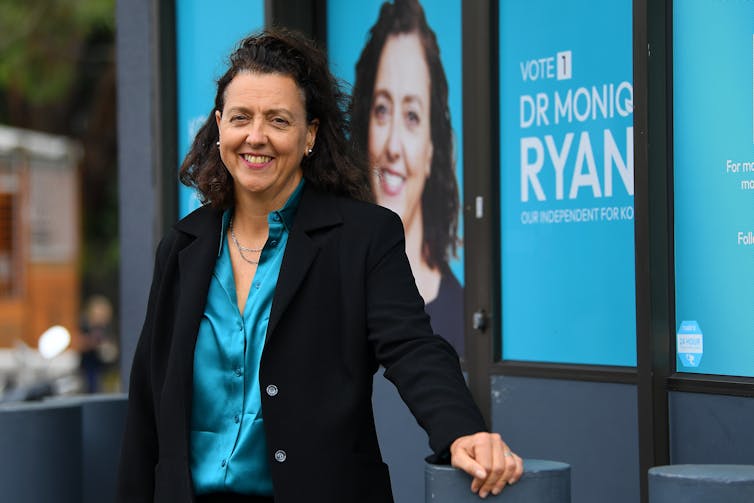
Monique Ryan is one of the ‘teal’ independents contesting historically blue-ribbon Liberal seats. AAP/James Ross
The men of the Liberal party have responded to them with a mixture of outrage, misogyny and petulance. These women had the temerity to challenge Liberal MPs who, in the words of Alexander Downer, “could become truly great men”.
Liberal MP Jason Falinski suggested the money independents were spending on their campaigns was “immoral” because they could be directing their resources to women’s refuges. Matt Canavan even described gender equality as a “luxury” that only the teal seats, not “bogans”, could afford.
The treatment of the independents by the men in the LNP has provided a telling insight for the ways they have treated the women in their own party. It has also offered a glimpse of the ways they regard women, even ones who would normally be inclined to vote for them. Women are fine, provided they know their ‘place’.
How might women vote?
If the polls are to be believed, Australian women are waiting for this government with baseball bats in hand. The gender gap in the 2019 election was the biggest since 1987, and women have continued to desert the LNP ever since, especially after the Brittany Higgins case went public in February 2021.
Polls differ on their assessment of the women’s voting intention, but Roy Morgan puts Labor ahead of the Coalition on two-party preferred at 58-42. On the other hand, men barely differ on their support for the major parties.
Many women will continue to vote for the LNP, driven by political loyalty and economic self-interest. But if Labor wins government on May 21, it will owe much of this victory to women voters. Labor will need to reward their loyalty with policies that address their needs, and resolve factional disputes to ensure their most talented women are on the frontbench.
If the Coalition ends up in opposition, they will have to work hard to restore their standing with women. They might start by reforming preselections. Is it little wonder a political party with such a low proportion of female MPs might struggle to communicate with women? Is it little wonder the talented teal candidates didn’t seek to join the LNP?
Whoever is elected this weekend, Australian women will need to build on their organising of the last two years and insist policies promised are actually implemented. Not only have women shown they cannot be taken for granted, in their collective rage, they can demonstrate their electoral power. Women can, and must, build on this, whoever wins on Saturday.
Michelle Arrow receives funding from the Australian Research Council. She has worked as a volunteer for the Australian Labor Party during this election campaign.
In the seat-by-seat slugfest that is the federal election, transport infrastructure is once again at the forefront. Small, hyper-local projects are a favourite of both major parties this time around. That’s even though small local projects, such as roundabouts and carparks, simply aren’t the job of the federal government, and in practice often go badly.
A better deal for taxpayers would be for whichever party wins government on Saturday to halt this spending on small local infrastructure, and focus instead on nationally significant projects that have been properly assessed by Infrastructure Australia.
There’s a big difference in what the parties are promising. The Coalition has committed an exuberant $18.1 billion worth; Labor a much more restrained $4.7 billion. In both cases, these transport promises are a pale shadow of the 2019 campaign, when the Coalition promised $42 billion worth, and Labor an eyewatering $49 billion.
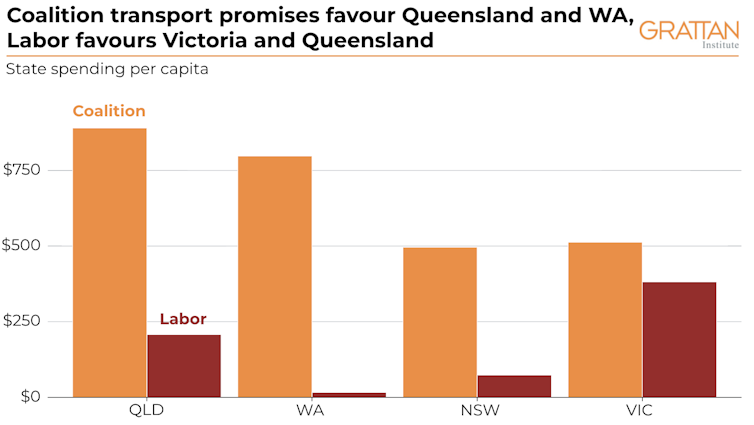
The Coalition is sticking with the dominant strategy of the past 15 years, which is promising more funding to Queensland – the state where elections tend to be won and lost.
It has promised nearly $900 per Queenslander in transport funding, compared with about $500 for each person in New South Wales and Victoria. Labor hasn’t overlooked Queensland either; although its promises favour Victoria, at close to $400 per person, Queenslanders are next in line, with about $200 worth of transport spending each.
Source: Guardian Pork-O-Meter Data. Notes: Data downloaded 13 May, 2022. Includes promises from 1 January to 10 May, 2022., Author provided
Billion-dollar projects are much less prevalent than they were last election, with just six of them promised so far (five by the Coalition, one by Labor).
Of the six, none has been assessed by Infrastructure Australia as nationally significant and worth building. Two have yet to achieve the first stage of assessment; two are early in the process of being assessed; one didn’t make it onto the list because its costs would outweigh its benefits, and one has been removed from the list because it has been fully funded – although that appears to have happened before a full appraisal was completed.
And that’s even with the newly watered-down requirement for Infrastructure Australia scrutiny: since January 1 2021, only projects that require more than $250 million in federal funding are supposed to be scrutinised, a lax threshold compared with the $100 million threshold that used to apply.
Notes: Data downloaded 13 May, 2022. Includes promises from 1 January to 10 May, 2022. Infrastructure Australia’s priority list addresses identified problems and infrastructure opportunities. At Stage 2, potential investment options have been identified and analysed. Stage 3 projects are investment-ready proposals. The North South corridor was assessed as a Source: Guardian Pork-O-Meter Data., Author provided
It’s prudent for potential future governments to step back from the megaproject binge of recent years. The engineering construction sector has been raising red flags for years about its capacity to deliver the existing pipeline of projects, never mind adding to it.
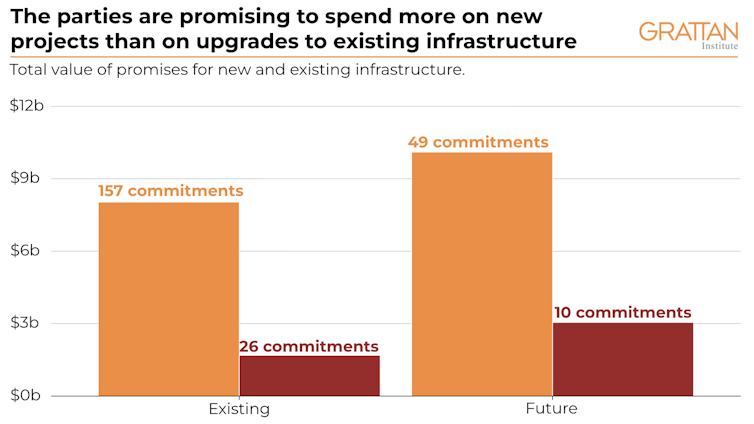
Even before the pandemic, employment in the sector had surged by 50%, and supply chain disruptions have made it slower, more difficult, and more expensive to source materials. What’s more, the slowing of population growth has dampened the rationale for big new projects, and strengthened the case to maintain and upgrade assets. Even so, both parties are promising more for new construction than upgrades.
Source: Guardian Pork-O-Meter Data. Notes: Data downloaded 13 May, 2022. Includes promises from 1 January to 10 May, 2022., Author provided
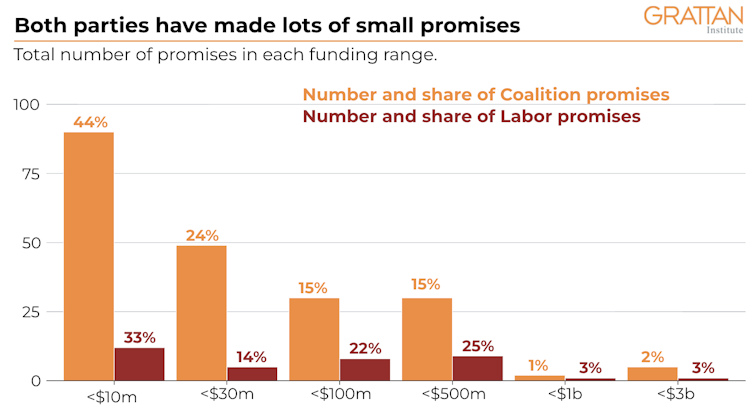
In fact, the parties have gone hard for tiny projects. Two-thirds of the promised spend of the Coalition, and nearly half of Labor’s, is for projects valued at $30 million or less. For the Coalition, these include commuter car park upgrades at Panania in the electorate of Banks (NSW), Hampton in Goldstein (Victoria), Woy Woy in Robertson (NSW), and Kananook in Dunckley (Victoria). For Labor, they include upgrading the Mornington roundabout in Franklin (Tasmania), and several roundabout upgrades in Perth.
Source: Guardian Pork-o-Meter data. Notes: Data downloaded 13 May, 2022. Includes promises from 1 January to 10 May, 2022., Author provided
These very small, hyper-local projects may be important to the local community, and popular, but there’s no roundabout or car park in the land that’s nationally significant.
When the federal government encroaches on the turf of state and local government like this, it often goes badly. The commuter car parks that were cancelled in 2021 and 2022 show what can go wrong when a federal government operates outside its proper sphere: projects had to be cancelled because there were no feasible design options, feasible sites, or because the railway station was being merged with another.
Political parties make little secret of the fact they use transport spending to win votes. Indeed, given transport spending seems to be electorally popular, politicians may ask what’s wrong with focusing investment on electorally important states and seats? Well, there are three problems.
First, the quality of the projects promised in the heat of election campaigns is poor, with none of the billion-dollar-plus projects this time around having been positively assessed by Infrastructure Australia.
Second, government decisions should be made in the public interest, and those making the decisions should not have a private interest – including seeking private political advantage, with public funds.
And third, much of the promised spending lies outside the federal government’s proper role of funding nationally significant infrastructure, focusing instead on small hyper-local projects that are the remit of state and local governments.
Voters should demand better. Whichever party wins the 2022 federal election should strengthen the transport spending guardrails.
The government, whether Coalition or Labor, should require a minister, before approving funding, to consider and publish Infrastructure Australia’s assessment of a project, including the business case, cost/benefit analysis, and ranking on national significance grounds.
And the next federal government should also stick to its job: no more roundabouts or car parks, just nationally significant infrastructure that’s been assessed as worth building.
Grattan Institute began with contributions to its endowment of $15 million from each of the Federal and Victorian Governments. In order to safeguard its independence, Grattan Institute’s board controls this endowment. The funds are invested and Grattan uses the income to pursue its activities. Marion Terrill does not work for, consult, own shares in or receive funding from any other company or organisation that would benefit from this article, and has disclosed no relevant affiliations beyond the academic appointment above.
There are up to 29,000 people aged under 65 living with dementia in Australia. Our new research shows people with young onset dementia experience delays to diagnosis and a faster decline in their cognitive abilities than older people with the condition.
They must also tackle a challenging maze of accessing support services across both a disability system inexperienced with their care and an aged-care system not suited to meet their needs.
Using the strengths of both sectors could prevent people with young onset dementia from falling through the cracks.
When dementia meets busy lives
People with young onset dementia (defined as any form of dementia that begins before age 65) are usually in their 50s and early 60s. They experience progressive memory loss, difficulty with planning and decision-making, personality changes, and/or language difficulties.
Many people with young onset dementia (also referred to as younger onset or early onset dementia) have dependent children, ageing parents, high-pressure jobs and significant financial responsibilities.
We systematically reviewed 30 studies on Alzheimer’s disease, vascular dementia and frontotemporal dementia. Our analysis demonstrated younger people with dementia experience a faster progression of their symptoms than older people with dementia.
Studies that tracked symptoms over time showed that, while younger people generally maintained better physical health than older people while living with dementia, their thinking and language difficulties can worsen quickly.
This has an important impact on their care and support needs – and how often these needs are assessed.
Because the likelihood of developing dementia rises sharply with age, most people with dementia are older than 65.
The unique needs of younger people with dementia prompted the federal government to move funding for their care and support services to the National Disability Insurance Scheme (NDIS) in 2016. Older people with dementia continue to be supported by the aged-care system.
This division means people with young onset dementia sit at the intersection of two complex service systems. They can access services to support their independence and community participation via the NDIS, but dementia-specific services and housing are still largely delivered by the aged-care sector.
Aged-care providers face difficulty providing tailored support services due to complex eligibility rules, and many have withdrawn their specific programs for young onset dementia.
People diagnosed with dementia before they turn 65 get lost between NDIS and aged care. Shutterstock
The disability sector has little experience with delivering dementia care. Most NDIS participants are aged under 35 years and live with disabilities such as autism, intellectual disabilities and hearing impairments that remain relatively stable over their lifetime.
The sometimes rapidly progressive nature of young onset dementia means care needs can change more quickly than the standard yearly reviews offered by the NDIS. So even when people with young onset dementia receive adequate funding to suit their needs, these needs may change quickly. And there is a major shortage of disability service providers with dementia expertise with whom they can spend their funding.
This is especially true in rural and remote areas, where there may only be one or two people with young onset dementia across a large geographical area.
Strict eligibility rules about the “significance” of disability can also delay NDIS access. People newly diagnosed with young onset dementia may have mild impairments – but there are major benefits to early intervention.
Young people with dementia and their families frequently have to navigate their own care needs and educate the providers they encounter along the way. This can increase their stress.
Aged care isn’t the answer
Despite the difficulties people with young onset dementia and their families experience, our research tells us they want their care to remain in the disability system rather than revert back to the aged-care system. The NDIS philosophy of a strengths-based approach to maximise independence is valued.
The disability sector needs to be better equipped to support people with young onset dementia and others who have progressive impairments.
Training for the disability workforce about progressive neurological conditions including dementia would be a good first step.
Beyond training, better integration of the aged and disability sectors could have mutual benefits.
The disability sector can learn and grow from the rich dementia expertise of the aged care workforce. And the aged care sector can benefit from the disability sector’s experience with delivering strengths-based and goal-directed care. Hours of testimony from the Royal Commission into Aged Care Quality and Safety highlight how desperately this is needed.
Flexibility in funding rules around the 65-year-old NDIS cutoff point could see co-delivered services capitalise on these respective strengths.
Flexibility could also ensure people aged close to 65 years at the time of their dementia diagnosis can make informed choices about the sector from which they will seek support. Then suitable care that can adjust to their changing needs will stop them falling through the cracks.
Monica Cations receives funding from the National Health and Medical Research Council Medical Research Future Fund and the South Australian Hospital Research Foundation.
Source: The Conversation (Au and NZ) – By Susanne Becken, Professor of Sustainable Tourism and Director, Griffith Institute for Tourism, Griffith University
Shutterstock
This year, Qantas announced two plans in direct conflict. In March, Australia’s largest airline group went public with the admirable goal of achieving net zero emissions by 2050 and a 25% reduction by 2030 by using new clean fuels, boosting efficiency and using carbon offsets. For the aviation industry, this was a watershed moment, containing world-leading detail and bold links between executive pay and improved sustainability.
But only two months later, Qantas confirmed its order for 12 new Airbus planes capable of ultra long-distance flights, making possible non-stop flights from Sydney and Melbourne to London or New York.
What’s the conflict? These long distance flights must carry substantially more fuel and, as a result, fewer passengers, making them markedly less efficient.
If the aviation industry heads down this route, it will be a backwards step in the fight against climate change. While Qantas intends these flights to be carbon neutral, this will have to involve carbon offsets given there are no other options at present.
As the world gets more serious about climate action, flights like this will come under scrutiny.
Flying the furthest comes with a carbon cost
For decades, Qantas has hoped to overcome Australia’s tyranny of distance, beginning ultra long-haul test flights as early as 1989. These tests didn’t translate into regular flights, however, leaving the door open to key competitor Singapore Airlines, which currently has the world’s top two ultra long flights.
Qantas seems determined to change that. In 2025, the carrier’s new Sydney-London non-stop flight will cover 17,800km non-stop to become the world’s longest flight.
While it might seem like a single flight would produce less emissions, the opposite is true.
The most efficient flights (based on fuel burned per kilometre) are those between 3,000 and 5,000km, depending on aircraft type. By contrast, non-stop ultra long haul flights produce more carbon emissions than two shorter journeys with a stop-over.
The reason is simple physics. Planes flying ultra long distances must carry lots of fuel, especially at take-off, to cover the later stages of the journey. For the new planes Qantas has ordered, it takes about 0.2kg of fuel to transport a kilo a thousand kilometres.
Given the long distance, this means it’s not a very efficient use of fuel. Not only that, but the high fuel load means there is less space for passengers.
That gives an even less favourable result based on the metric of carbon dioxide emitted per passenger-kilometre. For example, the non-stop flight from Auckland to Dubai of 14,193km produces 876kg of CO2 per person in economy class, whereas the same journey with a stop-over in Singapore would produce 772kg. Exact emission rates may differ due to flight paths, freight weight, and weather, among other issues.
So while a typical A350-900 seats between 300 and 350 passengers, Singapore Airline’s existing marathon flights using these planes can only carry half that, naemly 161 passengers. Similarly, the planned Qantas flights would have just 238 passengers, 112 to 172 seats fewer than what Airbus recommends.
As you’d expect, less passengers increases the ticket cost and makes these flights more exclusive, adding to the problem that a small wealthy elite have a disproportionately high environmental impact.
Can long-haul ever be low carbon?
Marathon non-stop flights stand in the way of a wider shift towards a low-emissions world. If airlines are serious about tackling their sector’s growing contribution to fossil fuel emissions, they must look to research into alternative fuels and technologies by programs like the EU’s Clean Sky.
These programs have shown sustainable fuels and new technologies are much better suited to shorter flights. Electric aircraft, for instance, are becoming viable for short flights in the near-term future. In Sydney, electric seaplanes will soon enter the short-hop sector, while hybrid-electric technology has the potential to support flights of up to 1500km, depending on progress in battery technology.
Electric planes are shaping up as a good solution for short flights. Mark Mitchell/AP
So what about long distance? We have two options. One is hydrogen and the other is sustainable aviation fuels.
While there is a huge amount of hype around clean hydrogen at present, the reality is green hydrogen derived from renewable electricity currently makes up just 1% of all hydrogen we produce. We would need a monumental effort to scale up to fill the demand from aviation.
Another challenge is hydrogen’s low energy density, which will restrict flying range to an estimated maximum of 7,000km by 2040.
That leaves sustainable aviation fuel as the only option for long-haul flights. The airline industry is pinning their hopes on fuels derived either from biological feedstocks (used cooking oils or oil derived from algae)
or produced synthetically.
The sustainability of these fuels depends on the feedstock, the production process (which, again, will demand large amounts of renewable energy) and a detailed understanding of impacts on the atmosphere from any gases emitted. That suggests these fuels will likely be expensive, with volumes hard to secure to fully replace fossil fuels. Even so, these fuels will have to be part of aviation’s future.
Algae-derived oil is one possibility for sustainable aviation fuels. Shutterstock
In response, some countries have begun to ramp up their focus and infrastructure spending on rail travel, to encourage new travel patterns. The growing regenerative tourism movement – which emphasises deeper engagement with place and people – signals there is real potential to shift mass travel away from far-and-fast destinations to close-and-deep.
The role of flying in tourism is already changing, and it will change more in coming years. You can already glimpse this in the trends towards more climate-friendly travel closer to home. Soon, electric and hybrid planes will encourage shorter flights in a carbon-constrained world.
As for ultra long-haul flights, it is difficult to picture how these are compatible with the goal of net-zero emissions.
Susanne Becken receives funding from the Australian Research Council. She is also a member of the Air New Zealand Sustainability Advisory Panel.
Paresh Pant does not work for, consult, own shares in or receive funding from any company or organisation that would benefit from this article, and has disclosed no relevant affiliations beyond their academic appointment.
There has been speculation the Coalition is hesitant to campaign on schools because education minister, Alan Tudge is currently in career limbo (and has been limiting his public appearances).
Meanwhile, Labor’s education spokesperson, Tanya Plibersek, appeared to be initially frozen out of the campaign, although in the past couple of weeks has been more visible.
Politics aside, what are the major parties offering?
The Coalition, ALP, and The Greens are all pledging a similar investment in mental health and well-being services, and support for respectful classrooms, particularly regarding violence against women. The largest difference between them is an (ongoing) ideological divide when it comes to the curriculum. Meanwhile, the big issues go ignored.
The Coalition
The Coalition is focusing its efforts on “raising school standards” and “improving the quality of teacher training”.
This includes creating a one-year diploma for initial teacher education. Given the current demands on accreditation bodies, this might create administrative burden. It would also need schools to shoulder a greater responsibility for “on-the-job” training.
Prime Minister Scott Morrison during a school visit in Sydney in December 2021. Bianca De Marchi/AAP
The Coalition also has a focus on traditional skills such as literacy, numeracy and STEM, with a clear focus on what the LNP terms “traditional classrooms”, which one can assume to be of students seated in rows with a single classroom teacher. There is an emphasis on Christian and ANZAC content and phonics for reading.
It also includes specified teaching methods through explicit instruction, which is the teacher standing at the front providing information for students to learn rather than explore or discover.
Labor’s headline policy is to offer students with an ATAR score over 80 up to $12,000 a year to study education.
This is part of the party’s bid to improve teacher standards, although it has been criticised by experts who say it implies the current teacher workforce is not up to scratch, which could be interpreted as quite insulting.
Labor leader Anthony Albanese and education spokesperson Tanya Plibersek visit Albanese’s old school in Sydney on day 29 of the campaign. Lukas Coch/AAP
Like the Coalition, it also offers no significant investment or policy to address current staffing shortages or teacher workloads – this is presumably being left to the states to “fix”.
Labor has promised $440 million for building upgrades, improving air quality and mental health support. The ALP also made a $6 million commitment to e-safety in schools. In terms of the curriculum, the ALP provide little detail – they do not detail teaching methods or content.
The Greens
The Greens have pledged $49 billion to fully fund public schools to the Gonski model. At the moment, public schools are funded to only 90% of their recommended school resource standard.
Like Labor, they also promise $400 million for infrastructure, with an additional $224 million to improve air quality post COVID.
Uniquely, the Greens also have made a commitment to close segregated school settings, but have not costed this. Segregated settings are where particular groups of students are taught separate to mainstream students, such as schools for children with a disability. The United Nations and multiple research studies have highlighted significant issues with this segregated settings.
One Nation and the United Australia Party
One Nation have very little policy detail available on education. In one paragraph, they say they want to focus more on traditional values and teaching methods. Then they say they don’t want to see “Western, white, gender, guilt” shaming in the classroom but students should be taught the benefits of a “free-thinking” society.
Similar to One Nation, the United Australia Party has just a few sentences of education policy, which is to remove HECS debt and inject $20 billion into education, although how this money can be used is left unspecified.
The bigger picture
Overall, the critical issues facing education have been left to the states to deal with.
There is new funding available, but neither the Coalition nor Labor are offering significant change from what we are currently doing in schools.
Both are looking at initial teacher education and thus the quality of teachers to improve results (which is highly denigrating to current teachers and does not support the current system).
But much more change is required. It’s important to note that additional funding over the past decade has not changed Australia’s educational decline. Tinkering with the curriculum has also not changed the decline, and neither have previous attempts to so called improve “teacher quality”.
Overall, the critical issues facing education have been left to the states to deal with. Con Chronis/ AAP
Genuine solutions would include an increase to teacher wages, relieve administrative workloads, and allow teacher to focus on planning and teaching within reasonable time requirements and greater support to disadvantaged students.
In other words, it needs a significant reappraisal of the schooling system and conditions for students and staff.
You would be forgiven for being unsure about whether the buying power of wages was rising or falling. On one hand, Opposition Leader Anthony Albanese says wages are going backwards.
On the other, Prime Minister Scott Morrison points to “better wages” over his government’s term in office.
To get at the truth, we need to appreciate that prices fluctuate more rapidly than wages do and that underlying economic forces drive the longer term growth in real wages.
These two factors have produced real growth in wages over the past 10 years, but a fall over the past year.
Buying power
The best way to measure changes in the buying power of wages is to examine changes in their “real” value, measured by changes in wages in relation to changes in prices, usually measured by the consumer price index.
The real value of the award rates of pay determined by the Fair Work Commission, including the minimum wage, climbed in all but but one of the ten years between 2011 and 2020, at an average of slightly more than 1% per year.
But the buying power of an award wage fell 2.5% during the last 12 months, because of the unexpected, large rise in consumer prices of 5.1%.
This increase in consumer prices easily eclipsed the most recent – July 2021 – increase in award wages of 2.6% increase in award wages.
The high inflation was caused in part by the impact on fuel prices of the Russian invasion of Ukraine, which no one could have anticipated inflation fluctuates much more than wages do in the short run.
This too has grown in real terms over the past decade, by about as much as award rates. And it too has fallen in real terms over the past year, because of the sharp rise in inflation.
Another measure is the Bureau of Statistics’ wage price index which measures the hourly pay for the job, regardless of who is doing it. This is the key cost measure for employers.
Many employees get pay rises through promotions or switching employers. By design, the wage price index does not capture that, and so has grown more slowly.
Even the wage price index has grown faster than inflation, by 4% over the past 10 years, until the last year, when the sudden jump in inflation pushed it behind.
Cost to employers
For employers, the labour cost of delivering a unit of output depends both on how much the worker produces in an hour (known as productivity), and how much the worker is paid for that hour (the wage).
Over the past decade, the Bureau of Statistics’ measure of labour productivity has climbed 12%, while real wages (as captured in the wage price index) have grown only modestly.
This has resulted in a 6% decline in the Bureau’s measure of real unit labour costs, and in the share of national income that goes to labour rather than to capital.
It’s not clear why this happened, but there are suspects.
One is that the total income per person, available to be shared between wages and profits, stagnated for much of the past decade, being no greater by the end of 2018 than it was in 2011.
The recent rise in export prices has boosted national income, but much of it has accrued to the mining sector in the form of profits. The wages share of mining income is only 14%, compared with 55% for the rest of the economy.
The result has been an increase in the share of national income going to profits and a slide in the proportion going to wages.
Other sources of downward pressure on wages growth include high rates of immigration, especially of temporary workers such as students, tight caps on wage increases for state and federal government employees, increased outsourcing to low-wage countries, and declining union membership.
Low union membership not only reduces the power of unions to bargain for higher wages, it also reduces their ability to ensure that the conditions set by the Fair Work Commission are met by employers.
Declining union power
This is of particular concern at a time when there is a large, new, vulnerable group in the workforce: temporary migrants dependent on employers to retain their visas.
As of May 2022, there are signs that wage growth is at last likely to increase, which will be quite an achievement in the midst of COVID.
The signs include low unemployment and underemployment; a record high number of Australians employed, and employed full-time; record high vacancy rates; and robust household spending and profits.
The biggest immediate beneficiaries appear to be younger workers and older workers, and women. There is ground to make up.
Sue Richardson does not work for, consult, own shares in or receive funding from any company or organisation that would benefit from this article, and has disclosed no relevant affiliations beyond their academic appointment.
Almost all governments today support some funding towards promoting their international political and economic agendas through cultural activities overseas: commonly referred to as part of “cultural diplomacy” or “soft power”.
Cultural diplomacy is not new. Julius Caesar brought gladiatorial performance to Britain, not so subtly suggesting Rome’s power. James Cook presented gifts to the Pacific island chiefs – albeit insubstantial ones in return for the highly prized objects he received, now in European collections.
The British Council was established in 1934 to stem the force of Soviet cultural diplomatic success. The Japan Foundation was founded in 1972 to create a more sophisticated view of a Japan emerging from the second world war.
The British Council – photographed here in Washington DC – was established in 1934. Shutterstock
Australia’s efforts have always been paltry.
We have never had an international cultural agency, and the Federal government avenues we do have for supporting international artistic projects, the Department for Foreign Affairs and Trade (DFAT) and the Australia Council, have shrinking funds.
In the 2000s, I was a member of DFAT’s Australia Indonesia Institute. Our small fund supported almost all the official cultural engagement between the two countries, and even it decreased before our eyes. It didn’t surprise me when leading curator Jim Supangkat asked me in Jakarta: “Where have all you Australians gone?”
In 2021/22, in admittedly difficult COVID times, just one cultural project – the Ubud Writers Festival – was funded through the Australia Indonesia Institute’s tiny A$450,000 allocation for all people-to-people projects between us and our so-important neighbour.
It does not help that the Australia Indonesia Institute, like most of the DFAT bilateral agencies with these precious country colleagues, now has no specialist arts person on its board.
Most Commonwealth government funding and capacity in the area is allocated to individual applicants by the federal arts agency, the Australia Council.
The application forms for funding from DFAT, bilateral agencies like the Indonesia Institute, and the Australia Council are particularly onerous, as is the ensuing reporting of how funds are spent. There are smarter ways all round.
The diminishing role of Australia’s cultural diplomacy has been known for a long time, but there has been a change recently of senior arts and diplomatic figures speaking out.
Former Ambassador to China, Geoff Raby writes in his 2020 book on our general relations with China that:
over the last two decades, Australia has been seen to be regionally inactive. [To change that] active engagement with China in cultural diplomacy should be another essential element of Australia’s statecraft.
Carrillo Gantner’s 2022 book, eloquently titled Dismal Diplomacy, written from his 40 years working particularly in cultural projects with China, pleads for better and more sophisticated relations all round.
In 2018, John McCarthy, former Ambassador to Indonesia (and other places) wrote public diplomacy has “always been the poor relation in Australian foreign policy implementation”:
Canada spends more on public diplomacy than Australia spends on the whole of its foreign service. Excluding public broadcasting, France spends an estimated A$1.9 billion, Germany A$1.6 billion, the UK A$350 million, and the Netherlands A$100 million. Australia spends A$12 million, of which, in most years, our Indonesia program will receive about A$1 million.
Cultural diplomacy comes under the umbrella of the broader public diplomacy described by McCarthy.
The Australia Council’s International Engagement Strategy has had an annual budget over the last five years averaging $2.7 million, while DFAT’s Australian Cultural Diplomacy Grants program currently has an allocation of $400,000. There are other programs here and there that loosely come under the cultural diplomacy tag, so let us average up this figure to around $5 million.
The Goethe-Institut, pictured here in Singapore, has an annual budget of around A$400 million. Shutterstock
Comparisons are hard for specific cultural activity because each country includes different areas, but Australia’s contrast with the specialist Goethe-Institut and British Council are stark. The Goethe-Institut has had fairly stable funding of A$400 million per annum over recent years, and the British Council A$320 million.
On these figures, they spend A$4-5 per capita on cultural engagement and diplomacy, and we spend 20 cents.
Another calculation is through activities. The Arts and Cultural Program described in the Japan Foundation’s recent annual report counts audiences of over five million attendances for 2,300 events it has “organised or supported”.
We are nowhere in that ballpark.
‘How to win friends’
As Jo Caust writes in her recent paper, “support for the arts is not primarily a question of economics. It is a question of values.”
Assessment of the importance of international activities is a bigger issue than straight numbers.
The appreciation of the British Council merited debate recently in the House of Commons, concluding the program provided the United Kingdom with
an object lesson in how to win friends and influence people. […] We intend to continue to ensure that global Britain is a world leader for soft power.
There is an argument Australia needs cultural diplomacy more than others.
We carry the stain of our settler founding, increasingly clearly articulated. The racist White Australia Policy rescinded relatively recently (in 1966) is well known by our neighbours. Our position in the region has always been debatable, something sensed by our neighbours as much as known. Are we in “in” or “out” of Asia? To many, we have a confused cultural identity: one that needs all the help it can get.
We can look to the German and Japanese examples, equally recognising their need to be proactive in their international imaging after events of the last 100 years. They have created serious, professional, cultural diplomatic agendas.
Australia’s cultural diplomacy should be done better, more effectively and with more confidence. The best way forward is to give the running to a central, nuanced, specialist body well equipped to tackle it.
Alison Carroll does not work for, consult, own shares in or receive funding from any company or organisation that would benefit from this article, and has disclosed no relevant affiliations beyond their academic appointment.
Until now, the government’s approach to climate action has largely been about getting the policy architecture right. This work is vital, but it’s more about rearranging possible futures, less about emissions reductions in the near term.
The newly released Emissions Reduction Plan (ERP) was supposed to shift gears, to get real about urgent climate action – and it partially achieves this, but only partially.
Budget 2022 will reveal some extra expenditure, but most of the $2.9 billion of climate-relevant funding was confirmed alongside the ERP. It exhibits a sensitivity to the electoral constraints on transformation, less so a sense of realism about what decarbonisation actually demands.
There are significant steps forward. Resourcing for Māori involvement in climate policy is long overdue. Integration of education and social support measures is also helpful.
In this sense, the ERP process is itself a minor victory. For years, policy scholars and public sector mandarins have championed the ideal of joined-up government, without ever doing much in practice. Consequently, the ERP is unique, even unprecedented, by taking a whole-of-government approach, weaving together all core government departments in a 340-page report.
Finance Minister Grant Robertson faces media with a copy of the Wellbeing Budget 2022. Getty Images
Time to be decisive
Some of the best bits of the ERP play to this interconnectedness. Nature-based solutions – that is, enhancing natural ecosystems to address multiple challenges – emerge as a strong connective theme, not only between various sectors, but also across the National Adaptation Plan and Biodiversity Strategy/Te Mana o te Taiao.
The same can be said for planning and infrastructure which is explicit about the overlapping opportunities to reduce emissions across multiple sectors.
Similarly, the rising theme of the “bioeconomy” sheds new light on the importance of forestry, not only as a supplier of timber and carbon removals, but also as feedstock for bioplastics and biofuels to substitute crude oil.
But instead of investments to make this happen, the ERP promises a bioeconomy and circular economy strategy that won’t be complete until 2025. This is the overriding character of the document, where a large proportion of “actions” begin with the words “explore” or “investigate”, or lapse into research, baseline setting and elongated work programmes.
Even well-established ideas, such as congestion charging, are deferred. The government has investigated this policy for more than a decade, but the ERP only confirms it is “considering progressing legislative changes to enable congestion charging”.
The ERP was the moment to be decisive, one way or the other. The failure to do so leaves a lingering suspicion that the ERP’s new slew of pledges may face a similar fate.
Acceptability over ambition
So there are plans, and plans for plans, but still a shortfall of strategy. Energy sector policy, for example, takes a technology-neutral approach rather than narrowing down on priorities, such as geothermal energy, where Aotearoa is known to have natural advantages, expertise, and potential for global impact.
Such opportunities are already identifiable, even in the absence of a central energy strategy (due in 2024). Research, development and deployment take time, so strategic decisions need to be made now, rather than backloaded for later this decade.
The proposal of “climate innovation platforms” might provide the vehicle for strategic innovation, but only if properly resourced. The ERP gives an air of compromise, tending toward acceptability over ambition.
Fortunately, though, the proposed policy mix – along with an improved Emissions Trading Scheme (ETS) – will take us quite some way.
Emissions pricing in the ERP
Impact of the 2021 update of the price control settings on mitigation compared with.
the total new mitigation needed to meet emissions budgets. NZ Government
The NZ$69 million Government Investment in Decarbonising Industry (GIDI) fund is being topped up with nearly $680 million, a ten-fold increase, to accelerate industrial decarbonisation.
In transport, this includes $350 million for cycleways and public transport, $40 million to decarbonise the bus fleet by 2035, $20 million to decarbonise freight transport, and $20 million for a vehicle social leasing scheme trial.
Agriculture is also the beneficiary of $710 million from ETS auctioning revenue for agri-tech and research – arguably unfairly, given that agriculture currently sits outside the ETS.
Overshadowing these initiatives is the scrap-and-replace scheme, aimed at subsidising people into electric vehicles (EVs), and already a lightning rod for controversy. The empirical record for scrappage schemes elsewhere, such as the US Cash for Clunkers programme, tends to conclude that emissions reductions are minimal despite the high investment.
Given that replacement cars must be EVs and hybrids, the New Zealand scheme may produce more emissions reductions than previous schemes did. However, the high price of EVs may mean that, even with high subsidies, low-income households cannot easily cover the difference.
Also, the scheme risks perpetuating the dependence on cars that makes transport mode-shift so elusive. Indeed, the $569 million committed to scrap-and-replace is far larger than the $350 million committed to cycleways and public transport.
It is hard to resist the conclusion that a scrappage scheme – for all the flak it will receive from efficiency-minded economists – was perceived as more politically palatable than getting people out of cars.
The ERP is projected to drive enough change to meet New Zealand’s 2030 Paris Agreement pledge. But part of this effort will involve the purchasing of emission reduction credits on international carbon markets, at potentially high prices.
A high reliance on paying for other countries to reduce their emissions reflects a hangover in the New Zealand government’s thinking, dating back to the Kyoto Protocol era. Deferring hard choices now by “planning more plans” might reduce the risk of backing the wrong technologies, but deferral is not without its risks either.
It speaks to the longstanding problem of treating climate change as merely a scientific, technical problem. This implies that, like any puzzle, climate action will benefit from further discovery, analysis and evaluation.
For elected and unelected officials alike, this is irresistible, because commissioning further research and strategy is a way of appearing serious, even prudent, while also avoiding vital decisions and associated responsibilities. The slow-moving quality of the climate crisis, in contrast to the fast-moving pandemic, increases the window for dawdling.
But climate action was always fundamentally about politics. The ERP practices the arts of acceptability but neglects the art of the possible – of making ambitious commitments and bringing the people along.
David Hall is affiliated with the Forestry Ministerial Advisory Group.
Melody Meng and Nina Ives do not work for, consult, own shares in or receive funding from any company or organization that would benefit from this article, and have disclosed no relevant affiliations beyond their academic appointment.
Nothing justifies the killing of Al Jazeera journalist Shireen Abu Akleh and the wounding of her colleague Ali al-Samoudi during an Israeli raid on Jenin in the Occupied West Bank. Nothing.
I believe the renowned reporter died at the hands of Israeli armed forces and that she was deliberately targeted because she was a journalist, easily identified by the word PRESS on the flak jacket and helmet that did not protect her from the shot that killed her. Her wounded colleague was identically dressed.
I am left in no doubt about the culpability of the Israeli Defense Forces (IDF) on a number of grounds.
Several eyewitnesses, including an Agence France-Presse photographer and another Al Jazeera staffer, were adamant that there was no shooting from Palestinians near the scene of the killing. Shatha Hanaysha, the Al Jazeera journalist who had been standing next to Abu Akleh against a high wall when firing broke out, stated they were deliberately targeted by Israeli troops.
Israeli spokesmen who initially laid the blame on Palestinian militants became more equivocal in the face of the eyewitness accounts, although they would go no further than saying she could have been accidentally shot from an armoured vehicle by an Israeli soldier.
That is about as close to an admission of guilt as the IDF is likely to get.
However, perhaps the strongest evidence of IDF culpability is the fact that the killing of Abu Akleh is part of a pattern of targeting journalists. Reporters Without Borders — which has called for an independent international investigation of the death that it says is a violation of international conventions that protect journalists — says two Palestinian journalists were killed by Israeli snipers in 2018 and since then more than 140 journalists have been the victims of violations by the Israeli security forces.
30 journalists killed since 2000 By its tally, at least 30 journalists have been killed since 2000.
Of course, those deaths are but one consequence of the IDF’s disproportionate response — in terms of the number of victims — to actions by Palestinian militants over the occupation of the West Bank. Since the present Israeli government took office last year, 76 Palestinians have died at the hands of Israeli forces.
There has been condemnation of such deaths, particularly when they include a number of children. So the reaction to the killing of Shireen Abu Akleh was sadly predictable. In other circumstances the outcry would dissipate and Israeli forces would continue to carry out their government’s wishes.
However, three things may make the condemnation louder, longer and more effective.
First was the fact that, although she was born in Jerusalem, she was a United States citizen. This could well explain the US Administration’s statement condemning the killing and its willingness to back a similarly reproachful UN Security Council resolution.
The second factor was that, although a Palestinian, Abu Akleh was not a Muslim. She was raised in a Christian Catholic family. It may not be a particularly becoming trait but the ability of the West to identify with a victim affects the way in which it reacts.
However, it is the third factor that may have the most telling effect on the long-term consequences of her death. I am referring to the desecration of her funeral by baton-wielding armed Israeli police.
Pallbearers assaulted by police The journalist’s coffin was carried in procession from an East Jerusalem hospital to the Cathedral of the Annunciation of the Virgin in the Christian Quarter of the Old City where a service was held before burial in a cemetery on the Mount of Olives. However, shortly after the pallbearers left the hospital the procession — waving Palestinian flags and chanting — was assaulted by police.
It is the third factor that may have the most telling effect on the long-term consequences of Palestinian journalist Shireen Abu Akleh’s death … the desecration of her funeral by baton-wielding armed Israeli police. Image: Al Jazeera screenshot APR
Mourners were hit with batons, stun grenades were detonated, and a phalanx of armed police in riot gear advanced on the coffin. The procession scattered in disarray and, as the pallbearers tried to avoid the police action, the coffin tilted almost vertical and was in danger of falling to the road.
At that point, an Al Jazeera journalist providing commentary on live coverage of the funeral said an an anguished voice: “Oh my God. Such disrespect for the dead, for those mourning the dead. How is that a security threat? How is that disorderly? Why does it require this kind of reaction, this level of violence on the part of the Israelis?”
Why did the police act as they did? Apparently because it is illegal to display the Palestinian flag and chant Palestinian slogans. Even after Abu Akleh’s coffin was transferred to a vehicle, police ran alongside to tear Palestinian flag from the windows.
The message was clear: There was no contrition on the part of Israeli authorities for the death of the Al Jazeera journalist. The justification for the police action was pathetic. There were lame excuses that stones had been thrown at them. In other words, it was business as usual.
That may not be the way the world sees it. Nor, indeed, the way it may be seen by many ordinary Israelis who would have been affronted by the indignity shown to the remains of a widely respected woman who died doing her job.
‘Time for some accountability?’ Yaakov Katz, the editor of the Jerusalem Post, an English-language Israeli newspaper, said on Twitter: “What’s happening at Abu Akleh’s funeral is terrible. This is a failure on all fronts.” In a later message he asked: “Is it not time for some accountability?”
The targeting of journalists aims to intimidate and to prevent them from bearing witness, particularly where authorities have something to hide. That is why, for example, we have seen seven journalists killed in Ukraine, 12 of their colleagues injured by gunfire, and multiple reports of clearly identified journalists coming under fire from Russian forces.
One might have thought the international community — and in particular Israel’s close friend the United States — would have put significant pressure on Tel Aviv to cease such intimidation a year ago after Israeli aircraft bombed the Gaza City building that was home to various media organisations including Al Jazeera and the US wire service Associated Press.
Israel claimed, without any evidence and contrary to AP’s own knowledge, that the building was being used by Hamas, the Palestinian nationalist organisation.
Associated Press chief executive Gary Pruitt said after that attack that “the world will know less about what is happening in Gaza because of what happened today”. Aidan White, founder of the Ethical Journalism Network described the bombing as a “catastrophic attempt to shut down media, to silence criticism, and worst of all, to create a cloak of secrecy”.
That, no doubt, was what Tel Aviv intended.
Yet there were no recriminations sufficient to change the course Tel Aviv was on. As the killing of Shireen Abu Akleh so tragically illustrates, Israel has continued its policy of intimidation and violence against journalists.
Sooner or later, it will come to realise that such actions diminish a government in the eyes of the world. The death of Abu Akleh and the indignity shown to her remains have added significantly to the damage to its reputation.
Dr Gavin Ellis holds a PhD in political studies. He is a media consultant and researcher. A former editor-in-chief of The New Zealand Herald, he has a background in journalism and communications — covering both editorial and management roles — that spans more than half a century. Dr Ellis publishes a website called Knightly Views where this commentary was first published and it is republished by Asia Pacific Report with permission.
The targeting of journalists aims to intimidate and to prevent them from bearing witness, particularly where authorities have something to hide … One of the images of slain journalist Shireen Abu Akleh shown in a “guerilla-projection” by a pro-Palestinian group at Te Papa yesterday to mark the 74th anniversary of the Nakba, the forced expulsion of Palestinians from their homeland in 1948. Image: Stuff screenshot APR
As well as her interviews with politicians and experts, Politics with Michelle Grattan includes “Word from The Hill”, where she discusses the news with members of The Conversation politics team.
In this podcast Michelle and politics + society editor Amanda Dunn canvass the Coalition’s “super” housing pitch, five seats to eyeball on Saturday night, and what would happen if the parliamentary numbers were “hung”.
Michelle Grattan does not work for, consult, own shares in or receive funding from any company or organisation that would benefit from this article, and has disclosed no relevant affiliations beyond their academic appointment.
As you head to your local polling place this Saturday, or cast your ballot in an early vote, it’s worth pondering: how does Australia’s voting system really work, anyway?
The fundamentals of our electoral system have been shaped by democratic values enshrined in Australia’s Constitution and pragmatic decisions made by federal politicians since 1901.
I’ve been studying elections and electoral systems for some 65 years.
Here’s what you need to know to understand how the vote you cast this election fits into the bigger picture.
How long are politicians’ terms?
For members of the House of Representatives – three years.
Section 28 of the Constitution says:
Every House of Representatives shall continue for three years from the first meeting of the House, and no longer, but may be sooner dissolved by the Governor-General.
Since the prime minister advises the governor general, it means he or she makes the exact choice of date. Many people object to that, but I don’t. That power hasn’t been abused.
The now dissolved term (the 46th Parliament) was elected in May 2019, so it has run a full term.
Why do we have more seats in the House than the Senate?
The Constitution says there must be approximately double the number of seats in the House compared to the Senate.
Section 24 says:
The House of Representatives shall be composed of members directly chosen by the people of the Commonwealth, and the number of such members shall be, as nearly as practicable, twice the number of the senators.
The September 1946 election saw 74 members of the House of Representatives elected to the 18th Parliament (1946-49). There were 36 senators then, six from each of the six states.
Since 1984 there have been 76 senators, 12 from each state and two from each territory.
There are currently 151 seats in the House, which therefore meets the requirement “as nearly as practicable twice the number” of senators.
How are electoral boundaries drawn?
Electoral boundaries are drawn so there are similar numbers of voters in each seat.
Section 24 of the Constitution reads:
The number of members chosen in the several States shall be in proportion to the respective numbers of their people…
The number of 151 electorates was determined mid-way during the 45th Parliament (2016-19). In August 2017 the electoral commissioner, Tom Rogers, issued the latest population statistics and determined there should be 47 members from New South Wales, 38 Victoria, 30 Queensland, 16 Western Australia, 10 South Australia, five Tasmania, three ACT and two for the Northern Territory.
Where necessary, electoral boundaries are re-drawn according to the principle of “one vote, one value” or, as I prefer to say, equal representation for equal numbers of people.
In July 2020, Rogers acknowledged population growth was above average in Victoria and below average in Western Australia.
That is why the forthcoming election will see 39 members elected in Victoria (up one) and 15 in WA (down one). New boundaries will apply in those two states and the redistributions have been done fairly and with maximum transparency, as always.
Elsewhere the boundaries will be the same as in May 2019.
Since 1949 the system has been one of proportional representation.
That means within each state six Senate seats are roughly distributed according to a party’s share of the vote. So a party getting about 12% of the vote would win one seat, about 26% two seats, about 40% three seats and so on.
This is why the Greens do so well at Senate elections compared to the House of Representatives. With about 10% of the vote for both houses, they presently have nine senators but only one member of the House of Representatives.
This differs from preferential voting for the House of Representatives, introduced in 1918, where voters number candidates in the order of their preferences – first choice, second choice and so on.
How long are senators’ terms?
Senators from the states serve six year terms, and those from the territories serve three year terms.
However, a system of rotation means half the senators’ terms end every three years. So in most elections, half the Senate spots are contested.
But there’s an exception to this rule. Every so often there’s a “double dissolution”, where the entire Senate is elected. That happened most recently in 2016. This parliament was dissolved early because there was a dispute between the two houses, so the entire parliament faced the people.
In a double dissolution, half the senators from the states get three year terms instead of six. This is based on the number of votes.
One Nation’s Pauline Hanson and Larissa Waters of the Greens are good examples of how it works.
Both were elected among the 12 Queenslanders at the 2016 election. However, Hanson was one of the six more popular vote winners, and Waters one of the six less popular vote winners. So, Hanson got a six-year term and Waters a three-year term.
Waters won a higher proportion of votes in the 2019 election, so was elected to a six-year term, expiring on June 30 2025.
Hanson is up for re-election this year, and I predict she will be elected to a six-year term, and therefore her term would expire on 30 June 2028.
Issues with our voting system
About 16.5 million votes will be cast for each house of parliament.
Based on the last two federal elections, I estimate the informal vote will be roughly 800,000 for the House of Representatives (4.9%) and 650,000 for the Senate (3.9%).
By world standards that’s a high number of informal votes, which is thought by many to be a blot on our democracy.
Two reasons for this are because we have compulsory voting, and because ballot papers are unnecessarily complex and voter unfriendly, particularly for the Senate.
The United Kingdom, Ireland, Canada and New Zealand have voluntary voting and simple one-house ballot papers, and the rate of informal voting is negligible. Some argue we should copy them.
There’s also a lack of rules around campaign finance – the stand-out case being the obscene spending by Clive Palmer’s United Australia Party.
I argue there’s no need to reform the Constitution and the democratic values it upholds. But there should be legislative changes to improve the system. I expect some democratic reforms during the next term, 2022-25, the 47th Parliament.
These changes wouldn’t require a referendum, just negotiation to ensure passage through both houses. By contrast, changes to the Constitution require a referendum. For that reason reforms by referendum are rare.
Malcolm Mackerras does not work for, consult, own shares in or receive funding from any company or organisation that would benefit from this article, and has disclosed no relevant affiliations beyond their academic appointment.
The Kanak people will not accept France’s attempt to “recolonise” New Caledonia, a pro-independence delegate has told the United Nations.
Addressing a UN Decolonisation Committee seminar on the Pacific in Saint Lucia, Dimitri Qenegei said since 2020 the French President, Emmanuel Macron, and his Overseas Minister Sebastien Lecornu had been taking unilateral decisions.
Qenegei said the signatories to the 1998 Noumea Accord stopped having their annual meetings in 2019 and the date for the referendum on independence last year was set without the consent of the Kanak people.
Paris decided to go ahead with the third and last referendum last December under the Noumea Accord despite pleas by the pro-independence camp to delay the vote because of the impact of the covid-19 pandemic on the Kanak people.
France insisted that the timetable for the vote had to be upheld.
Amid a boycott by the pro-independence camp, fewer than half of the voters took part in the referendum but of those who did vote more than 96 percent were in favour of staying with France.
Qenegei said Macron declared after the referendum that New Caledonia showed it wanted to stay French although it was known that 90 percent of Kanaks wanted independence.
Claims of manipulation and lies To therefore proclaim that New Caledonia chose to stay French was not legitimate, he said, adding that it was a “manipulation and a lie” by France and the heirs of the colonial system.
He said France, as the administrative power, had reorientated its policies to the methods of bygone centuries to hold on to its non-autonomous territories.
Qenegei said France had reneged on its undertaking given in 1998 to accompany New Caledonia to its decolonisation.
He pointed out that in case of three rejections of independence in the referenda under the Noumea Accord, the political parties needed to be convened to discuss the situation.
Qenegei said nowhere did it say that in a case of three “no” votes, New Caledonia remained French.
He said on the international stage, France had been losing influence, which prompted President Macron in 2018 to work towards an Indo-Pacific axis from Paris to Noumea that included India and Australia.
However, he said France suffered a first humiliation when Australia backed out of a multi-billion dollar contract for French submarines.
New Caledonia becoming independent would be another blow to the military axis aimed at containing China, he said.
Parallel drawn with China Qenegei drew a parallel between China and France, saying France decried the possibility of Chinese troops in Solomon Islands as imperialism while France had placed troops in New Caledonia to “contain the Kanaks”.
While France criticised China’s lending policies, Qenegei said France regarded its loans to New Caledonia, given with interest to be paid, as something different.
Qenegei said the recent French policies were nothing but a return to the source of colonisation.
He warned that France’s intention to open up the electoral rolls to French people who arrived after 1998 was the ultimate weapon to drown the Kanak people and recolonise New Caledonia.
The Kanaks would be made to disappear and that would not be accepted but inevitably lead to conflict.
Qenegei said his outline was not a threat a but a call for help to bring the administrative power to its senses.
This article is republished under a community partnership agreement with RNZ.
The Kanak people won’t accept France’s attempt to recolonise New Caledonia, a pro-independence delegate has told the United Nations. https://t.co/UBRq27EyTi
Critics of New Zealand’s new $4.5 billion global warming plan to help New Zealanders into electric vehicles and hybrids say a significant cheque for the Clean Car programme is sending the wrong message about the role cars play in the country’s future.
Victoria University of Wellington’s environmental studies Professor Ralph Chapman said — electric or not — cars were still heavy on the wallet and on the environment.
“The sheer carbon emissions associated with running cars, the life cycle of a car and all the infrastructure that goes with it — like highways and more spread-out infrastructure for water and waste water … when you start to add it all up, cars are pretty much a disaster.”
Professor Chapman said there were still carbon emissions that went into making EVs and the like, as well as the emissions involved in importing them to New Zealand.
“The whole model has to change, rather than just encouraging people to go to a slightly more efficient car.”
Professor Chapman said the alternative option of scrapping an old car in return for money towards buying a bike or using public transport was a good move.
Free Fares lobby disappointed Free Fares, which is lobbying the government to make all public transport free, is also disappointed in the scheme.
A spokesperson for the group said the wider Emissions Reduction Plan was “a continuation of an individualised culture and a focus on car ownership” rather than public transport, “which is what we need”.
Low-income families who scrap their old car will get funding to buy a low-emitting vehicle in a $569 million scheme, one of the big-ticket items in the government’s first Emissions Reductions Plan.
The money will not just be for electric vehicles – it could also help buy an e-bike or could be in the form of public transport vouchers.
But there was very little detail released about the scheme, such as who exactly will be eligible and – critically – how much financial help they would get.
New Zealand’s first Emissions Reduction Plan. Video: RNZ News
A pilot will be rolled out for 2500 households first, before an expansion of the scheme in about two years’ time.
Climate Change Minister James Shaw yesterday said it would follow a similar scheme which was introduced in California.
“Notoriously challenging” says MIA But even if a similar discount was offered here, it would still be costly, and “notoriously challenging”, the Motor Industry Association (MIA) said.
Chief executive David Crawford said the cost of new EV imports started at $40,000 and went upwards of $80,000, whereas used models started at about $20,000.
“If it is a new EV, their prices are quite high; would [eligible people] be able to afford debt servicing the difference? The price gap for a new EV can still be big,” Crawford said.
New Zealand has many old cars still being driven around; they pollute more and aren’t as safe so the MIA said it was supportive of moves to get more of them off the road.
The Motor Trade Association (MTA), which represents mechanics and repair shops, wants the government to go further than the $569m scheme, and roll out a scrappage model for everyone.
Its energy and environment manager Ian Baggott said it would be a challenge for the government to determine the criteria for scrappage.
This article is republished under a community partnership agreement with RNZ.
A West Papuan international student in Aotearoa New Zealand has devoted hundreds of hours to a non-profit organisation and opened a door to a new career.
Arnold Yoman, 19, came to New Zealand in 2019 from the Papuan provincial capital Jayapura on an Indonesian government scholarship and has been studying at Awatapu College in Palmerston North.
The school’s international department had a programme in Manawatū to get students involved in business during their first summer separated from overseas friends and family.
Yoman — a younger son of Reverend Socratez Yoman, president of the Fellowship of Baptist Churches in West Papua, who visited New Zealand in 2016 — started volunteering at Wholegrain Organics when he could not go home because of covid-19 border closures.
“I was welcomed to volunteer by the Wholegrain Organics farm and cafe and liked it so much that I asked to stay on after the holidays were over,” he said.
He volunteered at Wholegrain Organics’ farm during the school holidays and once it became obvious he had a passion and a knack for horticulture, the school started working with Wholegrain Organics so he could continue his work and get National Certificate of Educational Achievement (NCEA) credits.
Yoman’s work is through Wholegrain Organics’ hands-on food programme, where he plants, maintains and harvests organic produce for the community.
500 hours by the end He will have completed more than 500 hours by the end of his voluntary work.
He is in his final year of school and wants to stay in New Zealand to study horticulture at Lincoln University in Canterbury next year.
Wholegrain Organics’ hands-on food programme has been running since 2015, a non-profit scheme working with young people in community programmes like a regenerative vegetable farm and a training kitchen and deli.
The programme’s food technology, nutrition and horticulture educator Gosia Wiatr said they loved having young people involved because it gave them access to quality and inclusive learning opportunities.
“Arnold’s work ethic has been an encouragement for other young people in the programme.
“International students have always been a great part of our programme, so we wanted to support the students who were separated from their families over the holidays.
“We’ve been happy about their success stories, with students finding new career paths, improving their English and enriching their time in New Zealand as a result.”
Republished with permission from Stuff.
Awatapu College student Arnold Yoman (left) and Wholegrain Organics’ Fred Kretschmer inspect a broccoli on one of the non-profit business farms. Image: David Unwin/Stuff
What do One Nation’s Pauline Hanson and Labor’s Tanya Plibersek have in common? They are both winning the battle for eyeballs on social media, says a top Facebook official.
In the final episode before polling day of our election podcast Below the Line, our regular panel talks to Mia Garlick, Facebook’s Director of Policy in Australia and New Zealand, about the ways politicians use the social media platform in election campaigns. Our political scientists quiz Garlick on how transparent the company is about the political advertising it carries and the assistance it provides to big-spending campaigners.
Video content is an increasingly important way for politicians to get their messages across to online audiences. Aside from Hanson and Plibersek, Garlick says politicians who are doing video messaging particularly well this election include the Liberal party’s Lucy Wicks and Jason Falinski, and founder of the Reason party Fiona Patten.
Andrea Carson says the digital campaign will ramp up once the three-day blackout on broadcast and newspaper political ads comes into effect on Wednesday evening, because online ads are outside the law’s reach. Jon Faine describes the law as “absurd” in the digital age, akin to using Morse Code.
Faine also asks the panel why Prime Minister Scott Morrison vowed this week to no longer be “a bulldozer”. “It was a significant shift on Scott Morrison’s part,” says Anika Gauja, in recognition that the public seems to want a more positive campaign than it has been getting. But with more than five million pre-poll and postal votes already cast, according to ABC election analyst Antony Green, has Morrison’s mea culpa come too late?
Below the Line is a limited-edition election podcast brought to you by The Conversation and La Trobe University. It is produced by Courtney Carthy and Benjamin Clark.
Below the Line will broadcast one last episode after the election result next week. If you have a question you would like the panel to answer, email us at:
belowtheline@theconversation.edu.au
Disclosures: Andrea Carson has received funding for research projects from Facebook.
Jon Faine does freelance work for Industry Super Australia, a peak body for industry superannuation funds.
Simon Jackman is an unpaid consultant on polling data for the Climate 200 network of independent candidates.
The last week of campaigns used to be frantic, behind the scenes. In public, right up until the final week, the leaders would make all sorts of promises, many of them expensive, with nary a mention of the spending cuts or tax increases that would be needed to pay for them.
Then, in a ritual as Australian as the stump jump plough, days before the vote the leaders’ treasury spokesman would quietly release pages and pages of costings detailing “savings”, which (astoundingly) almost exactly covered what they were spending, meaning they could declare their promises “fully funded”.
It was a trap for oppositions. Whereas governments seeking reelection could have their savings costed by the enormously-well-resourced departments of treasury and finance before campaigns began, oppositions were forced to rely on little-known accounting firms with little background in government budgeting.
The errors, usually not discovered until after people voted, were humiliating.
Costings time was danger time
The Coalition’s Joe Hockey , ran into trouble over costings. Mick Tsikas/AAP
In 2010, a treasury analysis of the opposition costings prepared by the Coalition’s treasury spokesman Joe Hockey and finance spokesman Andrew Robb found errors including double counting, booking the gains from a privatisation without booking the dividends that would be lost, and purporting to save money by changing a budget convention.
The Gillard government evened the playing field in 2011 by setting up an independent Parliamentary Budget Office to provide oppositions with the same sort of high-quality advice governments got, helping ensure they didn’t make mistakes, and enabling them to publish the advice in the event of disputes.
Ahead of the 2019 election the PBO processed 3,000 requests, most them confidential.
This means you should take with a grain of salt Treasurer Josh Frydneberg’s assertion that Labor has “not put forward one policy for independent costing by treasury or finance” – these days opposition costings are done by the PBO.
But the PBO didn’t end the costings ritual. In fact, it institutionalised it.
The ritual derives from the days when, on taking office, new governments proclaimed themselves alarmed, even shocked, at the size of the deficits they inherited. From Fraser to Hawke to Howard, they used the state of the books they had just seen to justify ditching promises they had just made.
The Charter of Budget Honesty improved things
Howard applied a sort-of science to it, memorably dividing promises into “core” and, by implication, “non-core” in deciding which to ditch.
Then that game stopped. Since 1998, Howard’s Charter of Budget Honesty has required the treasury and department of finance to publicly reveal the state of the books before each election, making “surprise” impractical.
But the legislation that set up the Parliamentary Budget Office entrenched the costings ritual by requiring each major party to hand it a list of its publicly announced policies by 5pm on election eve, in order for it to publish an enduring account of their projected impact on the budget.
Which is why the parties have remained keen to get in early and find savings.
Sometimes, savings backfire
In 2016 this led to a human and financial tragedy. Treasurer Scott Morrison announced what came to be called “Robodebt” three days before the election as part of a savings package, designed to to offset spending. It was to save $2 billion.
Five years later in the Federal Court, Justice Bernard Murphy approved the payment of $1.7 billion to 443,000 people he said had been wrongly branded “welfare cheats”, ending what he called a “shameful chapter” in Australia’s history.
The costings document the Coalition released on Tuesday is less dramatic.
It says it will offset $2.3 billion in new spending over four years with a $2.7 billion boost in the efficiency dividend it imposes on departments to restrain spending.
Labor abandons the game
Labor will release its costings on Thursday, and here’s what’s changed. It says it won’t offset its spending.
Shadow Treasurer Jim Chalmers wants to be judged not on the size of spending, but on what the spending is for.
The most important thing here is not whether deficits are a couple of million dollars each year better or worse than what the government is proposing. What matters most is the quality of the investments.
He points to the hundreds of millions borrowed to support the economy during the pandemic, the $20 billion he says was spent on companies that didn’t need it, and the $5.5 billion spent on French submarines that now won’t be built.
In sporting parlance, Chalmers has walked away from the field.
Peter Martin does not work for, consult, own shares in or receive funding from any company or organisation that would benefit from this article, and has disclosed no relevant affiliations beyond their academic appointment.
Queensland residents are facing yet another arduous clean-up after floods inundated roads and towns last week.
In the current La Niña period, from November 2021 to present, at least 41 people have died (including three missing presumed dead) from floods across south-east Queensland, northern New South Wales, Greater Sydney, and Victoria. Many involved decisions to enter floodwater, often in vehicles.
Indeed, driving into floodwater is the leading cause of flood-related death. Despite media campaigns – such as Queensland’s “If It’s Flooded, Forget It” advertisements – people continue to enter the unpredictable water, risking their lives and the lives of their rescuers.
Our research exploring reasons why people drive into and avoid driving into floodwater has provided comprehensive insights into this behaviour. Having a Plan B could be the difference between life and death in these situations.
Queensland’s campaign to stop drivers entering floodwaters.
Why people drive on flooded roads
We surveyed people who had previously driven into floodwaters for our research. We found many drivers acknowledge the dangers associated with entering floodwaters, though many identify circumstances where they think it’s safe to do so.
But only a small error in judgement can result in tragedy. Water can flow faster than anticipated, rise rapidly, and roads can be washed away, but not visible under murky floodwater. In fact, water can move fast enough to strip bitumen from roads and damage bridges.
A small car can float in just 15 centimetres of floodwater. The record-breaking floods in Lismore earlier this year saw flood waters peak at 14.4 metres, higher than the town’s levees. Dangerous floodwaters can be experienced even during minor flooding and have been widespread in recent months.
We learned many of the reasons people chose to drive into floodwaters were based on feeling pressure. Pressure to get to work, school, or home to family or pets. Pressure from passengers in the vehicle. Or pressure from other motorists on the road.
As one respondent said:
I saw, this is going to sound dreadful, I saw signs up saying the road was closed. But there were cars, four-wheel-drives coming towards me
I thought ‘oh I should turn around, I should turn around’. But I was panicking about being late for work […] And when I saw four-wheel-drives coming towards me I thought, ‘okay I can do this’.
Another said:
It was mainly the pressure […] to get there and lecture. The silly thing is once I got through [the floodwater], people were saying [my workplace] was out of power and totally flooded in there and they were cancelling the lecture anyway.
What we found
Our research from 2021 was conducted with the State Emergency Service in Newcastle, New South Wales – an area prone to regular flooding. It showed promising results for making plans with “if/then” scenarios in place. In other words if you were to be in a particular scenario or a danger were to arise, then what would you do?
Making alternative plans may stop drivers from being faced with a situation where they feel they need to drive into floodwaters. We experimentally tested if/then plans in Newcastle using two scenarios:
you have a trip planned but receive an alert to potential moderate or major flooding in Newcastle before you have started driving
you approach a flooded section of road, and you are being pressured by other cars to drive into the floodwater.
For scenario 1, an example if/then plan was: “If its time to leave work and I receive an alert for moderate or major flooding then I will stay at work until it is safe for me to proceed.”
For scenario 2, an example if/then plan was: “If cars behind me are pressuring me to drive through floodwater, then I will turn my hazards on and let them pass, then turn around.”
After an exercise exploring these scenarios with survey respondents, people reported being more willing to stay put until the threat had passed for scenario 1, and less willing to drive into floodwater after feeling pressured from other drivers for scenario 2.
Forming your own Plan B
Our findings show the importance of having a detailed if/then plan – a Plan B – for specific scenarios, as it can lower your chances of engaging in risky, potentially life-threatening driving during floods.
Your Plan B examples may include:
picking up children early from school or day care
allowing workers to leave early if flooding is predicted or work from home
knowing alternate routes should your intended route be flooded
preparing to have safe alternative behaviours, despite pressures to drive through.
Reinforcing your Plan B is vital to its success when faced with needing to make a quick decision in the moment.
We encourage people to formulate their plans for several scenarios, put these plans in writing, and revisit them regularly by posting them on the fridge and in the car.
It’s also a good idea to verbally communicate your plan to significant others, such as friends, family and work colleagues and employers, as an additional layer of intent to solidify your plan should flooding hit.
With Queensland in the grips of yet another flood crisis and La Niña predicted to last through May, and potentially into Winter, more extreme rainfall and flooded roads should be expected.
Forming your Plan B now just might help you make safer decisions, should the worst happen.
Amy Peden is a research fellow in the School of Population Health, UNSW Sydney, an honorary Senior Research Fellow with Royal Life Saving Society – Australia and a co-founder of the UNSW Beach Safety Research Group. Dr Peden currently receives funding from the National Health and Medical Research Council (NH&MRC) and has received funding from the New South Wales Natural Disaster Resilience Program and the City of Newcastle.
Andrew Gissing has received funding from the Bushfire and Natural Hazards Cooperative Research Centre
Kyra Hamilton has received research funding from Royal Life Saving Society – Australia and New South Wales Natural Disaster Resilience Program and the City of Newcastle.
“Strengthening Medicare” is one of Labor’s key election platforms. On Saturday, one week from the election, the opposition finally outlined its commitment to prop up the ailing primary care system, with a A$970m funding package.
The promise of additional funding for primary care is welcome. More money is badly needed, but Labor’s plans have no detail on how this will improve health outcomes and equity of access.
In order to ignite the structural health care reform we so desperately need, Labor needs to focus on three key areas: GP numbers, free access to GPs and better access to specialists.
Primary care is a person’s first point of contact with the health system. This is usually in general practice, with GPs and practice nurses, and also includes some care provided in community health centres and Aboriginal community-controlled health services.
The current Liberal government published its Primary Care ten year plan in 2022 after a consultation period starting in 2019. It included technological improvements to boost quality, voluntary patient registration for the elderly (to sign up with a GP clinic which will support their long-term, chronic diseases), and support for integrated care, allowing people to move more easily from hospital to primary care, and other parts of the health system.
But as the Australian Medical Association (AMA) has highlighted throughout the campaign, this plan remains unfunded.
What does Labor’s plan include?
Labor’s plan promises new funding of A$950 million. The centrepiece is a new, so-called Strengthening Medicare Fund of A$750 million that aims to improve access to GPs – though it doesn’t say how. There is little detail on how this fund will be used.
The “how” will be decided by a so-called Strengthening Medicare Taskforce, chaired by the new health minister, plus many of the same people who designed the Liberals’ plan. It’s therefore unclear how different this would end up being from the Coalition’s plan.
Labor’s plan also includes A$25,000 or A$50,000 grants to improve practice infrastructure including IT, “upskilling” staff, and new equipment including infection control.
Direct subsidies to support the costs of running a practice is important, though by itself does not guarantee more patients can find a bulk billing GP. Nor does it guarantee the rising health care costs will slow down.
Three problems that need to be fixed
The taskforce will take time to deliberate. But here are some ideas to begin with.
1) Address the GP shortage
There remains a chronic shortage of GPs, with many GP training places remaining unfilled and with a much higher growth in the number of specialists compared to GPs.
Our research has shown three things can persuade junior doctors to choose general practice as a career: money, more procedural work (such as helping deliver babies or removing skin lesions) and more opportunities for research and academic work.
There are no policies in any parties’ plans that address these.
More money needs to be used carefully and needs to reduce the large gap between GPs’ and specialists’ incomes if more junior doctors are to be attracted to this specialty.
Procedural work for GPs exists in rural areas but is more tricky in cities, but many city GPs have specific special interests in undertaking procedures that should be better supported.
Primary care research and basic data collection remains a gaping hole in need of additional funding.
2) Increase free access to GPs
The key issue for many patients is accessing free GP services, with many people avoiding GP visits because they have to pay.
Again, nothing in either party’s plan will directly reduce out-of-pocket costs.
The solution requires new, innovative funding models for primary care, especially in low socioeconomic and rural areas. This could include federal government funding to expand community health centres, which are run by states.
There has never been a specific policy focus in Medicare for low socioeconomic areas.
Cost is a major issue for some people. Shutterstock
3) Improve access to specialists
Labor’s plans are about strengthening Medicare, yet the largest part of spending on Medicare services is for services provided by specialists. Of the total spending on Medicare benefits of A$27.5 billion in 2020-21, 32% (A$8.8 billion) was spent on GPs, while 54% (A$14.2 billion) was spent on other specialists.
However, the Labor and Coalition plans completely ignore the continuing problems of access to specialists.
Rich people have better access to specialists, including for child health services. You either wait up to a year for a public hospital appointment or pay sometimes exorbitant out-of-pocket costs. This contributes to significant inequalities in health.
It’s easy to point out what’s wrong with the Australian health system, and much harder to think of solutions, especially where significant structural change is actively discouraged by some in the sector.
We need primary care that is guaranteed to be free and accessible for a significant part of the population in the bottom half of the income distribution.
More money is good only if it can address these issues to properly strengthen Medicare and primary care.
Anthony Scott receives some funding from the Medibank Beter Health Foundation.
Source: The Conversation (Au and NZ) – By Carol Johnson, Emerita Professor, Department of Politics and International Relations, University of Adelaide
Scott Morrison’s election strategy was clear at the end of last year. As borders were opened up and restrictions eased, Morrison argued the Coalition would be winding back the big government measures that were necessary during the pandemic.
The Coalition would be relying instead on so-called “can-do capitalism” to build the economy and improve standards of living.
It was a post-pandemic form of neoliberal, free market populism. It aimed to attack Labor big government on the left while also countering Clive Palmer’s critique of big government attacks on freedom from the right.
The strategy built on the Coalition’s successful 2019 election campaign. Then, Morrison argued the Liberals would protect voters from a big-spending Labor government that would rip off ordinary taxpayers via higher taxes.
Morrison’s masculine image as an suburban “daggy dad” reinforced that economic message, suggesting he empathised with ordinary Australians. It also undercut Bill Shorten’s arguments the Liberals favoured the “top end of town”.
However, Morrison’s strategy faces a number of challenges in 2022.
Having been burned by Bill Shorten’s big government policy agenda in 2019, Labor has now decided to pursue a small target strategy.
But Morrison’s problems go deeper. All too often, “can-do capitalism” involves leaving things to the market, not government.
The result, as business commentator Alan Kohler has observed, has been inadequate government action on several key issues, including RAT tests.
Meanwhile, criticisms of big spending governments no longer cut through in a time of record pandemic-related Coalition deficits.
Morrison no longer highlights “can-do capitalism”, but he has retained an emphasis on the market and a smaller role for government.
However, relying on the market rather than government actually reinforces Labor’s attacks on Morrison for not holding a hose and for denying issues are his job.
It’s also a difficult strategy when the market is delivering higher interest rates, inflation and low wages growth.
Relying on the market also opens up opportunities for Labor to say it’ll take action, unlike the Coalition government.
For example, it allows Labor to build a case for minimum wages keeping pace with inflation and for higher wages in female dominated professions such as aged care. It reveals opportunities for Labor to say it would be better at supporting aged care, Medicare, childcare and the NDIS.
In short, there is an ideological contest between neoliberal free market views and Labor’s argument that government action can make an important difference.
Labor’s social democratic ideology may not be quite as obvious as in the 2019 campaign, when it emphasised addressing inequality, increasing taxation and tackling the “top end” of town.
As researcher and writer Rob Manwaring observes, today’s Labor offering is a somewhat “thin”, watered down, form of social democratic ideology.
Nonetheless, the idea of governments protecting and caring for people in hard times is a very social democratic focus.
A masculinity contest – but times have changed
The ideological contest involves not just a contrast between different economic and social visions, but between different masculine images related to them.
Male political leaders tend to draw on the traditional familial male role of being both protector and economic provider.
Bob Hawke and Kevin Rudd both won against Coalition governments partly by depicting themselves as more caring than their political opponents. Joe Biden used a similar strategy against Trump.
The Coalition has responded to Labor’s care agenda by suggesting Albanese is weak, promising instead strong leadership, a strong economy and a stronger future.
In other words, Morrison has tried to emasculate Albanese just as he attempted to do with Shorten in 2019.
Researcher Blair Williams has characterised it as a masculinity contest between conservative “daggy dads” and caring “state daddies”.
However, times have changed. Morrison’s masculine “daggy dad” image is not so relevant now that Labor is no longer targeting Liberal support for the “top end of town”.
And Morrison’s image as a strong male leader has been damaged by his failure to adequately protect Australians from bushfires, floods and the pandemic. He also stands accused of failing to protect women politicians and staffers from parliament’s toxic culture.
Morrison’s attempts to suggest the Coalition is stronger than Labor on issues of national security have been undercut by China’s Solomon’s deal.
Given falling real wages, rising costs of living and interest rates, many voters are now concerned about whether Morrison can fulfil another traditional aspect of a “masculine” persona – being a good economic provider.
Labor has attacked not just Morrison’s performance and personality but his masculinity, suggesting he is all spin and no delivery. Morrison, it argues, has repeatedly failed to protect Australians.
The Deves strategy
Morrison has faltered in his subsequent attempts to establish a masculine image that cuts though.
His support for transgender critic and Liberal candidate Katherine Deves reflects a longhistory of trying to mobilise traditional gender identities.
Such strategies have been successful overseas but may not be so effective here, even in the outer suburban seats Morrison is targeting.
Some of Deves’ extreme comments are seen as not just conservative. They’re seen as cruel to an extremely vulnerable section of the population.
Rather than successfully depicting himself as protecting women from a claimed influx of transgender athletes in women’s sport, Morrison’s support for Deves risks alienating moderate Liberals and reinforcing Labor’s argument he is uncaring.
Morrison’s recent attempts to suggest he will change his personality from being a bulldozer to an emphathetic listener are interesting. It seems to be a recognition that Albanese’s more caring form of masculinity, including around costs of living issues, may be cutting through.
Meanwhile, Albanese has appealed to traditional conceptions of masculinity as well, suggesting that while bulldozers just knock things down, he will be a builder.
When a positive becomes a negative
In short, the positive nexus between Morrison’s economic agenda and his masculine leadership image in 2019 may have turned into a negative one in 2022.
This reinforces Labor narratives about Morrison’s uncaring character and poor performance as prime minister.
Whether those challenges will facilitate a Labor election win remains to be seen.
However, some factors that assisted Morrison’s “miracle” victory in 2019 no longer seem to be working quite so well for him.
It would be hard to find someone who’s visited Copenhagen or Amsterdam and complained about too many bikes. And you don’t tend to hear a lot of moaning about too much public transport in Singapore or Hong Kong.
Talk to someone after a trip to Los Angeles, Moscow, Rome or Mumbai, however, and you will almost certainly get an earful about the horrendous traffic.
The vast differences in such experience lie in how local and national governments invest their transportation funds. It always comes down to money, and the perennial question of how to spend limited resources while maximising the benefits and the returns on investment.
As this year’s budget approaches, and with the government’s first Emissions Reduction Plan (ERP) just released, these questions are coming into sharper focus. And the biggest, perhaps, is how to reduce New Zealanders’ dependence on cars.
No complaints: cyclists in Copenhagen benefit from sizeable state investment in bike infrastructure. Shutterstock
On your bike
The ERP contains NZ$350 million for measures to improve low-impact transport modes such as walking, cycling and public transport, including provision for at least 100km of urban cycleways.
At the same time, it offers even more subsidies for electric vehicles. With only 0.7% of New Zealand’s vehicle fleet being pure electric cars, the plan would likely have a bigger impact if it subsidised e-bikes and public transport.
The figures for cycling are particularly startling. New Zealand has over 96,000km of roads but just 111km of separated cycleways that protect cyclists from vehicles. That amounts to just 0.1% of roads with safe places for cyclists.
This lack of cycling infrastructure essentially matches transport spending. Urban cycleways received just 0.5% of the transportation budget last year, despite cycling comprising 1% of all trips nationally.
Compare this to the €70 million (just over NZ$116 million) Denmark has committed to building separated cycling roads.
By 2045, Denmark also plans to have spent €295 million building 45 cycle “superhighway” routes connecting the entire country. It’s expected this will result in one million fewer car trips and 40,000 fewer sick days each year.
For reference, New Zealand spent the equivalent of more than €750 million on the Transmission Gully motorway into Wellington. It’s clear we could significantly increase spending and make cycling attractive and feasible for many more people.
Safer streets
Around 30% of urban car trips are under two kilometres in length and could easily be replaced by walking. But the lack of footpaths, or their poor condition, can deter many people.
The transport budget should recognise the importance of enabling healthy and zero-carbon modes of transport by prioritising funding for better footpaths and safer streets.
Such a budget would allocate more funding to widening footpaths, repairing the existing footpath inventory, slowing vehicles, reducing the number of cars in cities and creating more on-street amenities.
Walking and cycling also have many co-benefits, including better physical health, which would have obvious beneficial effects on healthcare budgets.
Much of the overall transport budget each year goes into long-term programmes with various aims. Of these, the National Land Transport Programme (NLTP) is arguably the hardest done by.
Its purpose is to allocate funds to provide “a safe, accessible land transport system for Aotearoa now and in the future”. It’s tasked with delivering public transport services, implementing the wide-ranging Road to Zero programme (aimed at reducing the road death toll), and maintaining roads – yet consumes just under 1.6% of the annual transport budget.
Ideally, such an important programme would attract a much larger budget share.
For example, within the NLTP’s overall budget, public transportation and transport infrastructure receive roughly the same funding as the Road to Zero programme. And Road to Zero itself commits almost as much money to policing roads as will be spent on providing all public transport services.
But funding programmes that reduce the total number of car trips – such as more extensive cycleways and better public transport options – would reduce that need to police roads.
Better roads for all
Fewer cars equal safer roads, so putting more money into non-car modes is actually a win for drivers and non-drivers alike.
The apparent success of the recent half-price fare scheme for public transport has shown how making it more affordable encourages more trips. The budget should allocate funding to make these cuts permanent and increase the number of fare concessions.
Over time, fare reductions would be more than paid for by a reduction in road maintenance due to fewer cars. Currently, planned road maintenance is projected to cost more than $5 billion over the next four years.
Greater use of public transport would also reduce the pressure to expand roads. This falls under the overall transport budget’s “capital investment package”, of which nearly $3 billion has already been spent this year – 40% of all transport dollars.
New Zealand can achieve more with its transport funding by just getting people out of their cars more often. In the same way that using trains, buses, bikes and feet is easier on personal finances, the national transport budget will benefit from less emphasis on the automobile.
But even if we don’t want to shift spending from one mode to many, there is another option – to spend more.
As a percentage of GDP, transportation spending has been declining ever since its peak in the 1950s. We don’t have to treat the relationship between road, public transport and active travel (walking and cycling) as mutually exclusive. We can keep road funding at its current level and spend more on other modes.
That way, we could do the things we so admire in other counties and still satisfy those who demand a car. The better our cycling and public transport infrastructure, the less reliant we’ll be on cars, bringing us one step closer to breaking the vicious cycle of automobile dependence.
Timothy Welch does not work for, consult, own shares in or receive funding from any company or organisation that would benefit from this article, and has disclosed no relevant affiliations beyond their academic appointment.
Uncertainty in the aftermath of Russia’s invasion of Ukraine has wreaked havoc with the international commodity markets.
In the normal pattern of the global economy, commodity exporting countries like New Zealand benefit from a rise in commodity prices and the subsequent strengthening of their currencies.
But these are not normal times.
In 2022, commodity prices have risen but the New Zealand dollar has failed to strengthen. So what is different and what should consumers expect?
The Russian invasion of Ukraine has contributed to extreme uncertainty in financial markets, including the currency markets.
But on May 13, the value of New Zealand’s currency against the United States dollar dropped to its lowest in two years. The New Zealand dollar was buying US68.32 cents on January 1, peaked at US69.75c on March 31, and then dropped to US62.39c on May 13.
Uncertainty around Russia’s invasion of Ukraine has caused the price of commodities to increase. Getty Images
Historically unusual
Again, this imbalance between the commodity markets and our currency is not normal.
The New Zealand dollar is classified as a commodity currency, along with the Australian dollar, Canadian dollar and Norwegian krone. Primary commodities (dairy, meat and timber in the case of New Zealand) constitute a substantial part of these nations’ exports.
For countries like New Zealand, the changes in global commodity prices are one of the main drivers of the country’s terms of trade fluctuations and, therefore, the currency value.
Generally, the value of the currency – the exchange rate – increases when export commodity prices increase. The New Zealand dollar, for example, tends to increase in value when global dairy prices increase.
But recent research has revealed a blip in the normal pattern.
The authors studied the relationship between the changes in value of 31 currencies (including the New Zealand dollar) and commodity prices over the past ten years. The analysis confirmed the traditional positive relationship between the changes in the currency values and commodity prices.
However, around the start of the Ukraine war this relationship reversed and became negative. The reversal was particularly evident for commodity currencies.
This study showed that despite the substantial increases in global commodity prices between January and March 2022, the expected corresponding increases in the value of commodity currencies did not occur.
The value of the New Zealand dollar dropped 0.6% from January 18 to March 1, despite sizeable increases in the global commodity index, the S&P GSCI (Standard & Poor’s Goldman Sachs Commodity Index), and the global dairy trade index, which increased 17.74% and 13.4% respectively over the same period.
Negativity driven by uncertainty
It appears the breakdown in the relationship between the value of the currencies and commodity prices was due to the extreme uncertainties and geopolitical risks during the January to March period.
This global study also found that the closer a currency was to the conflict, the worse it performed. So, New Zealand has been advantaged by its geographic distance from the war.
The New Zealand dollar value held better during the January to March period compared to the value of other currencies.
Currencies of Eastern European countries that border Ukraine (Czech Republic, Hungary, Poland, Slovak Republic) lost, on average, more than 5% from January 18 to March 1.
Commodity currencies like the New Zealand dollar traditionally strengthen on the back of rising commodity prices. Getty Images
Returning to normal
Perceived uncertainty due to the conflict has reduced as the war has dragged on and the global commodity markets reversed their upward trend.
During April and May, global dairy prices decreased 13.1%, potentially due to the expected global economic slowdown and subsequent reduction in consumption, China’s “zero-COVID” policy with lockdowns and the corresponding drop in demand, as well as the seasonal adjustments of dairy prices.
The New Zealand dollar has lost 10.6% of its value since its peak in March. It seems the expected positive relationship between commodity prices and the value of New Zealand dollar is evident again.
That said, a weak New Zealand dollar is bad news for New Zealand consumers as it increases the prices of imported goods, including fuel, further contributing to already high inflationary pressure.
It also makes it more expensive for New Zealanders to travel overseas, something many people were looking forward to after two years of closed borders.
On the flip side, a weaker New Zealand dollar can give a much needed boost to the New Zealand tourist and tertiary education sectors, as it makes New Zealand less expensive and therefore a more attractive travel and study destination.
A weakening New Zealand dollar is also beneficial for exporters of products like wine, as it makes them more competitive in global markets and increases external demand for these products.
While the war in Europe had a global and unexpected impact on New Zealand’s currency, the normal state of play is returning. The reemerging trends can give businesses and consumers a small sense of certainty after months of things being upside-down.
Simon Sosvilla-Rivero receives funding from the Spanish Ministry of Science and Innovation.
Adrian Fernandez-Perez and Olga Dodd do not work for, consult, own shares in or receive funding from any company or organisation that would benefit from this article, and have disclosed no relevant affiliations beyond their academic appointment.
Ahead of the 2022 budget, apprenticeships have been given a $230 million funding boost while negotiations between care workers and the government have fallen apart.
It’s hard not to see this as a gender equity issue.
Apprenticeships, and the industries they benefit, are held almost exclusively by men, while New Zealand’s 65,000 care, support, mental health and addiction workers are predominantly women.
Multiple court cases identified gender discrimination in the way previous governments funded care and support workers.
These court cases led to an historic $2 billion agreement between care workers and the then National-led government in 2017. But this agreement is set to expire in July and with it, warn advocates, the hard fought gains of care workers across the country.
So, the question has to be asked: do the latest budget priorities and collapse of negotiations with care workers reflect the fact that five years on from the 2017 agreement, little has changed?
It’s hard not to notice the difference in the way the government has treated male dominated apprenticeships versus the female dominated care worker industry. Getty Images
An historic settlement
The 2017 Pay Equity Settlement for care and support workers was reached after years of legal action led by aged care worker Kristine Bartlett, other care and support workers and their unions.
The New Zealand Supreme Court determined that the care workers’ low wages and poor work conditions were the result of persistent gender discrimination.
In other words, their pay didn’t reflect the skills, experience and knowledge required but instead was based on the fact that most care and support workers were women. In New Zealand, women continue to be paid less than men.
The government of the day intervened to settle out of court before further legal action could be taken. But negotiations were limited from the outset, with the government concerned more with curbing costs than equal pay.
The government’s offer to the unions was about half what the unions had calculated would cover the cost of gender equal pay. The settlement also prevented these same women from taking further action on equal pay until the settlement expired.
After the settlement was reached, the lowest agreed wage rate for care and support workers was 121% of the minimum wage; the highest rate came in at 149% of the minimum wage.
Over the past five years, care and support workers’ wages have not maintained the same relativity to the minimum wage, let alone gender equal pay.
The current lowest wage rate for care and support workers is NZ$21.84 and the highest is $27.43 per hour. The minimum wage is $21.20. That highest rate offered to care workers is only achieved after several years of training and qualifications as well as experience on the job.
Wages for care and support workers would need to range from at least $25.60 to $31.60 or more to maintain the same relativity to the minimum wage as was seen in 2017.
Care workers feel like they are back at square one now that the 2017 pay equity settlement is set to expire. Hannah Peters/Getty Images
Deadline comes as no surprise
That the 2017 Care and Support Workers (Pay Equity) Act expires this year is not news for the government.
Indeed, there have been some discussions on how funding models for this sector should be changed to ensure that the gender equal value of this work is maintained into the future.
However, the government only recently offered a concrete proposal to care and support workers despite earlier union calls for agreement and decision ahead of July’s deadline.
The offer is a 2.5% to 3% pay increase on current rates for the next 18 months. This is not even half the inflation rate, amounts to about 70 cents an hour and does not maintain the wages as gender equal.
The offer just does not value care and support work.
Care and support workers will now have to undergo another equal pay claim process to reassess wages – despite the earlier court decisions that identified gender discrimination as the cause for low wages within the industry.
The contrast with ‘men’s work’
At the same time as care and support workers were struggling to get gender equal pay, the government made a pre-budget announcement to invest $230 million more into apprenticeships in 2023. This follows the $1.6 billion trades and apprenticeships training package in the 2020 budget.
There is no doubt that investing in apprenticeships is important for upskilling New Zealanders to meet labour shortages in key industries. But apprenticeships favour male dominated industries and consequently provide significantly more opportunities for men than women.
This figure has remained low despite the gendered impact of the global pandemic – 10,000 of the 11,000 New Zealand workers who lost their jobs during the first year of the COVID-19 crisis were women.
At the same time, care and support workers have operated as essential workers. During the pandemic, care and support workers were on the front line, with many going into people’s homes to look after vulnerable patients.
Despite this role and its risks, care workers struggled to access basics such as PPE to protect themselves and the people they support or be recognised for the sacrifices they made in the course of their work.
Time for a long-term solution
The government has had the power, but not the foresight, to conduct an updated analysis of pay ahead of the expiration of the settlement agreement.
Over the past five years, policy makers could have completed a full equal pay assessment, comparing this job not just to other female dominated jobs in the public health sector, but to male dominated occupations with similar skills, qualifications, risk and experience requirements.
Fully funded gender-equal pay for care and support workers could then have been included in this year’s budget. At the very least, the pay increase on offer could have brought wages to the same level in relation to the minimum wage as in 2017.
It would have been a win for these women, for the people who rely upon their care and support, for our healthcare system and our identity as a good country for women in work. Instead, it appears that no matter which government is in power, women are expected to take a back seat to profit, budgets and men.
Katherine Ravenswood does not work for, consult, own shares in or receive funding from any company or organization that would benefit from this article, and has disclosed no relevant affiliations beyond their academic appointment.
When people hear the term “accessibility” in the context of disability, most will see images of ramps, automatic doors, elevators, or tactile paving (textured ground which helps vision impaired people navigate public spaces). These are physical examples of inclusive practice that most people understand.
You may even use these features yourself, for convenience, as you go about your day. However, such efforts to create an inclusive physical world aren’t being translated into designing the digital world.
New buildings are required to comply with a range of physical access requirements, which may include tactile paving (seen in yellow). Shutterstock
Accessibility fails
Digital accessibility refers to the way people with a lived experience of disability interact with the cyber world.
One example comes from an author of this article, Scott, who is legally blind. Scott is unable to purchase football tickets online because the ticketing website uses an image-based “CAPTCHA” test. It’s a seemingly simple task, but fraught with challenges when considering accessibility issues.
Despite Scott having an IT-related PhD, and two decades of digital accessibility experience in academic and commercial arenas, it falls on his teenage son to complete the online ticket purchase.
Screen readers, high-contrast colour schemes and text magnifiers are all assistive technology tools that enable legally blind users to interact with websites. Unfortunately, they are useless if a website has not been designed with an inclusive approach.
The other author of this article, Justin, uses a wheelchair for mobility and can’t even purchase wheelchair seating tickets over the web. He has to phone a special access number to do so.
Both of these are examples of digital accessibility fails. And they’re more common than most people realise.
We can clearly do better
The term “disability” covers a spectrum of physical and cognitive conditions. It can can range from short-term conditions to lifelong ones.
At last count, nearly one in five Australians (17.7%) lived with some form of disability. This figure increases significantly when you consider the physical and cognitive impacts of ageing.
At the same time, Australians are becoming increasingly reliant on digital services. According to a 2022 survey by consulting firm PricewaterhouseCoopers, 45% of respondents in New South Wales and Victoria increased their use of digital channels during the COVID-19 pandemic.
In contrast, research undertaken by Infosys in December 2021 found only 3% of leading companies in Australia and New Zealand had effective digital accessibility processes.
But have we improved?
Areas that have shown accessibility improvement include social media platforms such as YouTube, Facebook and Instagram, food ordering services such as Uber Eats, and media platforms such as the ABC News app.
Data from the United States indicates lawsuits relating to accessibility are on the rise, with outcomes including financial penalties and requirements for business owners to remedy the accessibility of their website/s.
In Australia, however, it’s often hard to obtain exact figures for the scale of accessibility complaints lodged with site owners. This 1997 article from the Australian Human Right Commission suggests the conversation hasn’t shifted much in 25 years.
It’s a human right to have fair and equal access to the web and all its services. Shutterstock
There are solutions at hand
There’s a clear solution to the digital divide. The World Wide Web Consortium’s Web Content Accessibility Guidelines (WCAG) standard has been widely adopted across the globe. It’s universally available, and is a requirement for all Australian public-facing government websites.
It guides website and app developers on how to use web languages (such as HTML and CSS) in ways that enable end users who rely on assistive technologies. There are no specialist technologies or techniques required to make websites or apps accessible. All that’s needed is an adherence to good practice.
Unfortunately, WCAG is rarely treated as an enforceable standard. All too often, adherence to WCAG requirements in Australia is reduced to a box-ticking exercise.
Our academic work and experience liaising with a range of vendors has revealed that even where specific accessibility requirements are stated, many vendors will tick “yes” regardless of their knowledge of accessibility principles, or their ability to deliver against the standards.
In cases where vendors do genuinely work towards WCAG compliance, they often rely on automated testing (via online tools), rather than human testing. As a result, genuine accessibility and usability issues can go unreported. While the coding of each element of a website might be WCAG compliant, the sum of all the parts may not be.
In 2016, the Australian government adopted standard EN 301549 (a direct implementation of an existing European standard). It’s aimed at preventing inaccessible products (hardware, software, websites and services) entering the government’s digital ecosystem. Yet the new standard seems to have achieved little. Few, if any, references to it appear in academic literature or the public web.
It seems to have met a similar fate to the government’s National Transition Strategy for digital accessibility, which quietly disappeared in 2015.
Accessibility advocates take different approaches to advancing the accessibility agenda with reticent organisations. Some instil the fear of legal action, often citing the Maguire v SOCOG case, where the 2000 Olympic website was found to be inaccessible.
In a more recent example, the Manage v Coles settlement saw Coles agree to make improvements to their website’s accessibility after being sued by a legally blind woman.
After getting sued by a legally blind customer in 2014, Coles made improvements to its website’s accessibility features. Screenshot/Coles
In the Coles case, the stick became the carrot; Coles went on to win a national website accessibility award after the original complainant nominated them following their remediation efforts.
But while the financial impact of being sued might spur an organisation into action, it’s more likely to commit to genuine effort if this will generate a positive return on investment.
Accessible by default
We can attest to the common misconception that disability implies a need for help and support. Most people living with disability are seeking to live independently and with self-determination.
To break the cycle of financial and social dependence frequently associated with the equity space, governments, corporations and educational institutions need to become accessible by default.
The technologies and policies are all in place, ready to go. What is needed is leadership from government and non-government sectors to define digital accessibility as a right, and not a privilege.
Scott Hollier is on the board of the not-for-profit Disability in the Arts Disadvantage in the Arts (DADAA), and is CEO and Co-founder of the Centre For Accessibility Australia. The Centre for Accessibility Australia receives government grants for accessibility activity, but the funding has no specific bearing on the content of this article. The accessibility award that Coles won (after the Coles v Manage case) was awarded through the Centre for Accessibility Australia – however Scott was not involved in the voting for the award, or the nomination of Coles, and CFA was not involved in the website remediation.
This story is part of The Conversation’s Breaking the Cycle series, which is about escaping cycles of disadvantage. It is supported by a philanthropic grant from the Paul Ramsay Foundation.
Justin Brown is on the board of the not-for-profit Disability in the Arts Disadvantage in the Arts (DADAA)
In the first week of the campaign, we journeyed around the country with six politics experts to examine the key seats and issues affecting different parts of the Australia.
What has happened since? Which seats do you need to watch on election night? In the final week, our experts return to look at Queensland, Victoria, South Australia, Western Australia, Tasmania and New South Wales.
Paul Williams, associate professor in politics and journalism, Griffith University
Election watchers increasingly remark that, despite the electorate’s volatility, campaigns today are making little difference to election outcomes.
During both the 2016 and 2019 campaigns (leaving aside the inaccuracy of the 2019 data), public opinion polls hardly moved. This campaign, too, has seen little change, with almost all polls consistently pointing to a modest Labor majority.
Labor leader Anthony Albanese campaigned in the marginal seat of Leichardht, which includes Fitzroy Island, on day 33 of the campaign. Lukas Coch/AAP
Perhaps former British Prime Minister Harold Wilson’s famous remark, “a week is a long time in politics” is now redundant. Voters now appear to make their vote choice well in advance of polling day.
That appears especially true in Queensland.
Sub-national opinion polling has been sparse this campaign, but a recent Roy Morgan survey found the Liberal National Party continues to lead Labor in Queensland on after-preference votes, 53.5% to 46.5%. While this still represents a swing of almost five percentage points to Labor since 2019, Queensland maintains its longer-term trend of being a wasteland for federal Labor. Only Tasmania boasts a stronger Coalition vote.
Labor knows the perils of Queensland well. That’s why leader Anthony Albanese launched his campaign in the far more fertile ground of Western Australia with the enormously popular Premier Mark McGowan, and not in Queensland where Annastacia Palaszczuk sits under an integrity cloud.
However, Albanese did spend the campaign’s crucial second week in the Sunshine State, seeking to repair the damage wrought by his earlier economic gaffes. In fact, he invested five whole days in the electorates of Hinkler, Leichhardt and Rankin. He also sandbagged the at-risk Griffth, and visited the must-win LNP seat of Brisbane.
Prime Minister Scott Morrison visited the Living Gems Retirement Village in Longman on day 11. Mick Tsikas/AAP
Prime Minister Scott Morrison soon followed with a visit to Longman – the LNP’s most marginal Queensland seat – before participating in the first leaders’ debate in Brisbane. The fact Nationals’ leader Barnaby Joyce also visited central Queensland suggests the Coalition fears losing support to both Pauline Hanson and Clive Palmer there.
Like other states, cost of living (including interest rate hikes) remains a tier one issue. But, unlike other states, Morrison is still seen as the stronger leader against Albanese, with whom regional Queenslanders simply cannot identify.
However, one development of the campaign is the likely surge in minor party support in Queensland. This won’t see anyone on the populist right, except Bob Katter, win in the lower house. But watch out for a Greens upset in at least one House of Representatives seat.
VICTORIA
Zareh Ghazarian, lecturer in politics, Monash University
When the campaign began, Victoria was unlikely to be the state that captured the national attention. This was partly due to the fact that the state had just two seats held by either party by 1% or less. However, as the campaign has gone on, some important electoral contests and tactics have garnered interest.
The so-called teal independents have become a prominent feature of the political debate in the state. In the inner metropolitan and traditionally safe Liberal seat of Goldstein, independent Zoe Daniel is well placed to cause an upset on election night. While incumbent Liberal MP Tim Wilson has been campaigning vigorously in the district, a recent poll showed both candidates have a primary vote of 33% each.
Treasurer Josh Frydenberg and independent challenger Monique Ryan faced of in a candidates’ debate at the Hawthorn Town Hall. Andrew Henshaw/AAP
The trouble for the Liberal Party also extends to Kooyong, currently held by Treasurer Josh Frydenberg and being challenged by paediatric neurologist Monique Ryan. The Liberals’ Kooyong campaign appears to emphasise Frydenberg while downplaying the party and prime minister. As reports show, the campaign aims to “keep Josh”. Despite this, polling is suggesting significant support for Ryan, which makes Kooyong a key seat to watch on election night.
A loss in either seat would not only make the task of holding government more difficult for the Liberal Party, it would also deprive it of high profile MPs who would be expected to form the core of the party’s future leadership team.
These electoral problems for the Liberal Party are in addition to trying to maintain its most marginal seat of Chisholm (currently held by just 0.5%), while trying to win back Corangamite (currently held by Labor by just 1.1%).
SOUTH AUSTRALIA
Rob Manwaring, associate professor in politics and public policy, Flinders University
In South Australia, the focus remains on the key marginal seat of Boothby, which the Liberals currently hold on a margin of just 1.4%. In a sign of how prominent the seat is, ten candidates are running (an increase of two from 2019), and the seat is a critical three-way split between the two major parties and the prominent independent Jo Dyer.
Boothby is being showered with electoral promises compared to its neighbours. Labor has pledged at least $12.4 million to the seat including upgrades to various sporting and community club facilities. The Coalition has announced about $20 million for similar projects.
Albanese and Labor candidate Louise Miller-Frost campaign in Boothby on day 29. Lukas Coch/AAP
Federal Labor seems to want to capitalise on state Labor’s recent win through the focus on health, and Albanese visited the marginal seat to pledge $200 million in matched state funding to upgrade the Flinders Medical Centre. Questions were immediately raised about the “coincidence” the centre was in Boothby. It shows how marginal seat politics can undermine needs-based funding approaches.
But Boothby is not the only seat worth watching in South Australia. First, if Labor does pick up some final momentum, then Christopher Pyne’s old seat of Sturt is worth watching on election night, currently held by the Liberals with 6.9%.
Second, if the Liberals have an overall election loss, then the seat of Mayo (currently held by Centre Alliance’s Rebekha Sharkie on 5.1%) will be emblematic of its problems. First elected in 2016, Sharkie is an early version of the teal independents. If she cements her majority, it reflects the wider fragmentation of the centre-right.
Morrison shakes the hand of a voter at Glenelg on day 24, in Boothby. Mick Tsikas/AAP
The third seat well worth looking at is the seat of Grey (currently held by the Liberals on 13.3%), where incumbent Liberal MP Rowan Ramsey is being challenged by independent Liz Habermann. She pushed the Liberals to a very tight finish at the state election in the neighbouring (state) seat of Flinders. The message here is marginal seat politics might dictate which seats get what, but it can leave behind frustration and a sense of neglect in other, seemingly safe seats.
WESTERN AUSTRALIA
John Phillimore, professor and executive director, John Curtin Institute of Public Policy, Curtin University
Western Australia’s status as a critical battleground in the federal election was confirmed when Labor chose to launch its campaign in Perth on May 1. This was the first time a major party campaign launch had been held in WA for at least 80 years.
Despite the admittedly large hiccup of both Albanese and McGowan contracting COVID just over a week before (ruining the chance to add a few days’ local campaigning), the launch went well. Labor luminaries such as Paul Keating and Kevin Rudd attended, and the event received blanket, and generally positive, local media coverage.
Labor’s Perth launch was supported by former prime ministers Kevin Rudd and Paul Keating. Lukas Coch/AAP
The Liberal Party has also showered a lot of attention on the state. Morrison has visited twice already since the election was called, and former prime minister John Howard was a prominent visitor as well, campaigning for Minister for Indigenous Australians Ken Wyatt in his marginal seat of Hasluck.
Both parties have been keen to remind voters in the west of past sins allegedly perpetrated by their opponents. Labor’s advertising (controlled by the WA branch, rather than national headquarters), focuses on Morrison’s disparaging remarks about WA’s supposed isolationism and his support in 2020 for Clive Palmer’s High Court challenge to the state’s border restrictions.
The Liberals are running advertisements reminding voters of Labor’s 2012 mining tax introduced by Rudd, and his closeness to Albanese.
On day 27, Morrison campaigns with frontbencher Ken Wyatt, whose seat of Hasluck is under threat. Mick Tsikas/AAP
The Liberals have a “plan for WA” that includes significant investments in hydrogen, critical minerals, shipbuilding and defence, as well as a major cancer treatment facility. Labor’s showcase WA promise has been a $125 million promise to support the local manufacture of electric buses, as well as support for value-adding to resources including lithium and nickel.
Electorate-based promises – particularly in the marginal seats of Cowan, Hasluck, Pearce and Swan – have been coming thick and fast, with an array of announcements supporting local sporting clubs, cultural centres and local infrastructure.
The 3 big unknowns
There are three key unknowns as we head towards the finishing line. First is the seat of Curtin, where independent Kate Chaney is receiving plenty of attention and support in her battle to unseat the Liberals’ Celia Hammond. Despite pressure from the media and the Liberal Party, Chaney is refusing to say who she will support in the case of a hung parliament.
A second unknown is the impact of the state budget, which was handed down last Thursday. WA is the only government in Australia in surplus, and massively so ($5.7 billion in 2021-22), thanks to iron ore royalties and a GST deal negotiated with Morrison. McGowan was able to spread some financial cheer to voters in the shape of a $400 electricity credit for every household. But will that translate into more votes for Labor federally?
The third unknown is the impact of rising interest rates and inflation. Annual inflation in Perth was the highest of all the capital cities, at 7.6% (compared to 5.1% nationally). Three of the state’s most marginal seats, Cowan, Hasluck and Pearce, have a much higher share of households with mortgages than the national average of 35%.
The latest polling in WA shows Labor’s primary vote falling since the campaign began, but still enough to win Swan and Pearce. This suggests these classic “hip pocket” voters could well decide the federal election.
TASMANIA
Michael Lester, casual academic, University of Tasmania
Despite numerous visits by both major party leaders and hundreds of millions in spending commitments in the state, it may be that just one seat changes hands in Tasmania this election.
Given its small population and just five House of Representatives seats, Tasmania has received disproportionate attention from both the Coalition and Labor. But the marginal north-west seat of Braddon may be the only seat to change hands.
In the 2004 campaign, former Prime Minister John Howard’s pledged to allow old-growth logging to continue to protect jobs. This was credited with helping the Coalition win two seats in Tasmania and bolstering Coalition support nationally. In a similar move, Morrison has made a series of industry support funding announcements in Tasmania.
Morrison and member for Bass, Bridget Archer visit a Tasmanian oak products company on day 4 of the campaign. Mick Tsikas/AAP
These include $100 million to create a national institute of forestry in Launceston as part of $219 million for the Australian forestry industry and $50 million towards the expansion of the Nyrstar zinc works near Hobart. The latter is seen as a major boost to the Tasmanian mining industry.
Meanwhile, Albanese has focused on infrastructure spending, such as $15 million for an aquatic centre in Launceston, in the seat of Bass. He has also promised $60 million to strengthen the Hobart Airport runway, which would allow it to carry heavier wide-bodied aircraft and benefit both the international tourism industry and agricultural exports. He also offered $5 million for a study for a $75 million federally-funded expansion of the industrial estate adjacent to Launceston airport. Both airports are in the marginal electorate of Lyons.
Albanese takes a selfie with nurses on day 1 of the campaign in Devonport. Lukas Coch/AAP
Such is the level of spending pledges, The Guardian’s “pork-o-meter” estimates Bass has received more than $550 million in pledges from the Liberal and Labor parties – and the pledges keep coming daily. This is the second-highest per-electorate spend for the Liberal Party (behind Canning in WA).
Neck and neck
Party insiders and commentators sense Labor’s Chris Lynch has drawn ahead of the Braddon incumbent, Liberal Gavin Pearce, who holds the seat on just 3.1%. Revelations of a 30-year-old drug conviction does not appear to have hurt Lynch, a vocational education teacher and youth worker. He is also expected to benefit from a decision by the Jacqui Lambie Network to preference him above the Liberals.
Labor fronbencher Julie Collins is tipped to retain her safe seat of Franklin (12.2%) while independent Andrew Wilkie (22.1%) is expected to easily hold off a challenge from Labor candidate Simon Clark. In Lyons, the Jacqui Lambie Network’s decision to preference sitting Labor member Brian Mitchell (5.2%) ahead of Liberal challenger Susie Bower should help him retain the seat.
No one is yet willing to call the ultra-marginal seat of Bass, held by maverick Liberal Bridget Archerby just 0.4%. She is up against the previous incumbent Labor’s Ross Hart. It should be noted that for almost 20 years the seat has changed hands at each election, and Bass and Braddon have been in lock-step – if one swings, so does the other.
In the Senate, the likely outcome is the return of Labor senators Anne Urquhart and Helen Polley and Liberal senators Jonathon Duniam and Wendy Askew, along with the Greens’ Peter Whish-Wilson.
Most pundits are tipping the Jacqui Lambie Network’s Tammy Tyrell – a former Lambie staffer – will take the sixth seat, though it is expected to be a three-way contest against the third Labor and Liberal candidates Kate Rainbird and Senator Eric Abetz respectively. The reasoning for this is that Labor will preference the Jacqui Lambie Network above other parties and independents, which boosts Tyrell’s chances. The question is whether personal support for Lambie will carry over to her candidate.
NEW SOUTH WALES
Mark Rolfe, honorary lecturer, School of Social Sciences, University of New South Wales
Both Morrison and Albanese have led lopsided campaigns relying on highly localised issues, negative campaigning, and vague generalities. This has overshadowed any substantial explanation of policies.
Nineteen of the top 20 renter-stressed electorates and nine of the top 20 mortgage-stressed electorates are in NSW. Curiously, neither leader jumped from the blocks touting wages and housing solutions. However, these (bleeding obvious) problems have became more prominent over the course of the campaign.
Morrison campaigned in his Sydney seat of Cook with junior rugby players on day 25. Mick Tsikas/AAP
The Coalition is hoping its last-minute pledge to allow first home buyers to access up to 40% of their superannuation to a maximum of $50,000, will be a vote winner. Even though former Liberal Prime Minister Malcolm Turnbull previously described it as “the craziest idea I’ve heard”.
Curiously, Labor has said little of its proposed National Reconstruction Fund (aimed at rebuilding Australia’s industrial base) and nothing of its Buy Australian policy (which would legislate to get the government buying more goods and services here). Both would help its cause on wages.
Sometimes, Morrison has sounded like he is competing in a local election, with pledges like a $137,000 to upgrade a Country Women’s Association hall in Robertson. Mind you, in Dobell, Labor has promised $40,000 for new shade sails at the ocean baths at The Entrance.
Albanese chats to the crowd at a market in the seat of Bennelong on day 28. Lukas Coch/AAP
Morrison’s relentless energy has taken him to Macquarie (which includes the Blue Mountains), Parramatta in Sydney’s west, Dobell on the central coast and Gilmore on the south coast. But he has avoided fire-affected Eden-Monaro on the south coast and the flood-affected Richmond on the north coast. These seats are all in the top ten marginal Labor electorates where the Coalition need gains.
Albanese has campaigned across most of these seats as well as John Howard’s former seat of Bennelong, which Morrison has also visited but is behind according to polls.
The Liberals’ are also behind in the central coast’s Robertson. And are facing a tough contest in Reid, where Liberal MP Fiona Martin’s campaign has been marred by infighting and gaffes.
While Morrison has defended Liberal candidate Katherine Deves in his remarks, he has not campaigned for his controversial captain’s pick on the ground in Warringah.
Morrison has also avoided the Liberal seats of North Sydney, Warringah, Wentworth and Mackellar where teal independents are exciting local passions – using free concerts, rallies and thousands of volunteers. In the northern NSW seat of Cowper, the sitting National MP Pat Conaghan is also facing a teal challenge.
We can assume Morrison has bypassed these seats because he is not seen as a campaign asset for them. This could be due to community anger about the Liberal Party’s lack of action on climate change, or the Liberal party’s “woman problem”. Most women voted against the Liberals in 2019 and the party’s issues around gender have only has escalated since then. So, in the last dash before May 21, he is focusing his efforts elsewhere.
Paul Williams is an Associate of the T.J.Ryan Foundation.
John Phillimore worked as an adviser to state Labor governments in Western Australia in the 1980s and between 2001 and 2007.
Michael Lester was a political adviser to Labor Premier Jim Bacon from 1998 to 2002.
Mark Rolfe, Rob Manwaring, and Zareh Ghazarian do not work for, consult, own shares in or receive funding from any company or organisation that would benefit from this article, and have disclosed no relevant affiliations beyond their academic appointment.
Australia has recently experienced multiple natural and man-made disasters, creating overlapping crises, often disproportionately affecting disadvantaged populations. The situation is here to stay, and, worryingly, likely to worsen.
But what are we doing to prepare?
The federal election presents an opportunity to promote plans for improving national disaster governance and resilience.
Yet, alarmingly, the governance challenges exposed by recent crises and the vulnerabilities they highlight in Australia’s preparedness remain unknown, unheard, and far from understood.
The silence on these issues in political debates has been remarkable.
Australia has recently experienced multiple natural and man-made disasters. Shutterstock
We must adapt while we still can
Our current research project on collective action and collaborative governance in crisis situations has, so far, involved over 50 interviews. Respondents include members of emergency services organisations, government representatives, and crisis management experts in the private, and non-profit sectors in Australia.
The message from our respondents is loud and clear: preparing for future disasters requires good collaborative governance. It is time to act now. We have some breathing space in the wake of recent disasters, and we must adapt while we still can.
Our research has highlighted three distinct governance challenges.
1. Inter-agency collaboration remains a challenge
Collaboration between response agencies during disasters is critical but remains challenging.
Although effective governance arrangements enable collaboration within states, disasters often transcend borders – and current arrangements that govern emergency response across multiple jurisdictions are far less effective.
Our respondents note, amongst other examples, that emergency workers on the ground routinely turn to ad hoc communication channels when disasters cross borders. They often bypass formal governance structures in their struggle to effectively deploy and coordinate resources.
As one respondent who works at the Victoria-NSW border told us:
You have this big formal governance structure, but for me to go and talk to the southern command in NSW, I have to go to the state duty officer, who has to go to the NSW duty officer, to talk to someone just 15 minutes away over on the other side of the river. It’s madness […] [What would be] a ten-minute conversation takes a day of everyone’s time.
Collaboration between response agencies during disasters is critical but remains challenging. Shutterstock
2. We need overarching governance across the nation
Currently, the parallel and competing governance structures operating at federal level and within states make collaboratively managing crises extremely difficult.
As one respondent, discussing division among states on crisis governance, explains
It’s almost like nobody wants to compromise because they are so wedded to their system, or their view of the world, that we may as well be seven different nations and actually have hard borders, not soft borders.
Why do we persist with isolated and siloed disaster response planning in which systems and processes are not integrated enough?
Effective governance calls for clarity around who is responsible and takes action during crisis. In other words, it must be clear who does what, and when. For instance, our respondents consistently refer to misguided federal interventions using Australian Defence Force resources during recent fires, floods, and COVID-19.
Without an overarching and integrated governance system that defines competencies across the nation we will continue to see confused reactions to crises that undermine Australia’s disaster resilience.
3. We must better understand the community’s role in major disasters
Collaboratively dealing with disasters requires action across government, emergency services, and the community.
Our respondents highlight that when and how the community should be involved is, however, far from being clear. One person told us:
One of the things we need is community involvement to be much more systematised, so that we can bring to bear the skills, assets, and knowledge of the community to play a proper role during emergencies.
They refer to communities feeling at the same time “overwhelmed”, “abandoned”, and “under-used” during recent disasters.
As one respondent affected by the 2019-2020 bushfires outlined:
I can say from personal experience that the sense of being abandoned is something I never want to feel again […] it’s horrid. And I’ve been in the military, I’ve been in emergency services, done all those bloody things, overseas aid and development and the like […] but when you feel abandoned in your own town, you really do start to wonder what’s going on in the sector.
In future, we need robust collaborative governance arrangements that enable collective action. We must design processes and systems in a way that allows communities and emergency services to work effectively together to improve safety before, during, and after crises.
These issues have not been front and centre during the election campaign, despite the floods and severe rains seen in recent weeks and months.
In the months ahead, we hope, these issues will become the subject of debate, government commitment – and eventually new policy.
Now is the moment to take stock and prepare for a future of worsening disasters. Doing so will, more than ever, require collective action through good governance and collaboration.
Markus A. Höllerer receives funding from the Australian Research Council. This story is part of The Conversation’s Breaking the Cycle series, which is about escaping cycles of disadvantage. It is supported by a philanthropic grant from the Paul Ramsay Foundation.
Graham Dwyer currently receives funding from Natural Hazards Research Australia. He has previously received funding as part of the Swinburne Seed Grant Scheme of which the Country Fire Authority were an industry partner. He previously worked at the Department of Justice, Victoria, Australia in the police and emergency services portfolio.
Paul Spee receives funding from the Australian Research Council.
Jaco Fourie does not work for, consult, own shares in or receive funding from any company or organisation that would benefit from this article, and has disclosed no relevant affiliations beyond their academic appointment.
While your symptoms are likely to be less severe, in some cases they can be worse. Here’s what we know so far.
After COVID, you don’t need to test for 12 weeks
Current guidelines define you as a “cleared case” for 12 weeks after ending COVID isolation. If you develop COVID-like symptoms in that 12 weeks, you don’t need to be tested.
The science behind this 12-week timeframe is evolving. The original idea was that if you have recovered from COVID, and you have a healthy immune system, you will have developed immunity against reinfection. And this will protect you for at least 12 weeks.
As case numbers in Australia increase, the reports of reinfections are also on the rise. And it’s likely reinfection is occurring sooner than we first thought.
What’s happening in our body?
In order for a person to fight off re-infection with any virus, they must have developed a protective immune response.
Two main factors decide whether a person will have a protective immune response:
1) how long a person’s immune memory lasts
2) how well that memory recognises the virus, or a slightly different virus.
Immune memory is made up of many critical parts, which each play a role in the protective army of your immunity. The biggest players in protective immunity memory are your B-cells (which mature to make antibodies) and your T-cells (which destroy virus-infected host cells).
So far, the evidence suggests immune memory for SARS-CoV-2, the virus that causes COVID, lasts for months or even years when it comes to B-cells and the antibodies they produce.
Similarly, current evidence shows the memory T-cells can last over a year.
This means that for a healthy person, immune memory for SARS-CoV-2 appears to last for a year, against reinfection with the exact same virus.
The immune memory from SARS-CoV-2 might last months or even years. Shutterstock
So why the reinfections?
One clear explanation for reinfection is the virus is mutating. SARS-CoV-2 replicates fast and in doing so makes replication errors. We refer to these errors as mutations. Over time, the mutations accumulate and a new sub-variant is born.
Since the start of the pandemic we have seen the parental Wuhan strain mutate to Alpha, Beta, Delta and now Omicron.
The current theory is that immunity from one variant may not provide enough protection from another.
Data so far suggest the Omicron variant is better at immune escape than its predecessors. This means Omicron is “escaping” the immune memory created by SARS-CoV-2 infections from other variants such as Delta, Beta or Alpha.
Emerging data is now showing sub-variants of Omicron can also escape immunity from a previous Omicron variant. This means a person might be able to get an Omicron reinfection.
A small, yet to be peer-reviewed study from Denmark found that in unvaccinated people, reinfection with Omicron BA.2 is possible following a primary infection with Omicron BA.1. Despite this finding, the study also concluded reinfection rates were low and therefore rare.
With winter approaching and case numbers climbing, we’re also seeing the emergence of new sub-variants such as BA.4 and BA.5. Early evidence shows these new sub-variants are even better at escaping immune memory than the parental BA.1 Omicron.
For those who get a reinfection, disease severity appears to be milder and less likely to result in hospitalisation. This is likely because the immune memory can recognise at least part of the re-infecting virus.
However it’s difficult to measure disease severity on a population level. A systemic review of case studies found that while some second infections were milder, this was not so in all cases. Some reinfections resulted in worse outcomes, including death. (During this study period, one of the original strains, B.1, caused most primary infections, with reinfections caused by Alpha or Beta variants.)
But while Omicron appears to be causing more reinfections than other variants, there isn’t enough robust data to make firm conclusions about the severity of reinfection with Omicron or other variants.
We also know from several studies that being vaccinated does provide protection from reinfection, including in previously infected people who then receive subsequent vaccines.
Some reinfections cause severe illness. Shutterstock
Another reason to get boosted
A recent study that’s yet to be peer-reviewed found immunity from Omicron BA.1 variant drops around 7.5 fold with the new Omicron BA.4 and BA.5 variants. This means the antibodies you produce from a BA.1 infection, which are able to detect and neutralise the BA.1 virus, are 7.5 times less able to recognise and neutralise BA.4 and BA.5 than BA.1.
This study also found vaccination plus natural exposure to Omicron BA.1 gave five times greater protection to Omicron BA.4 and BA.5 than the immunity from natural exposure to BA.1 alone.
Data also shows the strongest protective immunity comes from a mix of triple vaccination and natural infection.
A further study found this type of hybrid immunity protects better against both reinfection and hospitalisation than natural immunity alone, highlighting the importance of vaccination and vaccine boosters.
So the question remains: if our immune memory lasts for at year, but is too specific to recognise the new variants, will we need a new vaccine every year? Time will tell.
Lara Herrero receives funding from NHMRC on emerging infectious diseases.
Source: The Conversation (Au and NZ) – By Michelle Baddeley, Associate Dean Research/Professor in Economics, UTS Business School, University of Technology Sydney
Getty
If a week is a long time in politics, three years is an eternity. Since the 2019 election, Australia has endured devastating megafires and unprecedented floods. Meanwhile, news of extreme weather such as India and Pakistan’s horrific heatwaves has poured in. And international pressure to act on climate change is growing.
Perhaps in response, Australian views of climate change have become less partisan. A new poll my colleagues and I organised of around 1,100 Australians found almost 90% now believe climate change is a problem. That’s an average across the political spectrum, from the Greens to One Nation.
Not only that, but almost 80% of us are optimistic, believing it’s possible for Australia to halve its emissions by 2030.
In a similar poll we undertook before the 2019 election, Australians were far more divided. Then, just 48% of right-leaning voters (those intending to vote for the Liberals, Nationals, One Nation or United Australia parties) thought government policies to address environmental damage and climate change were important compared to 84% of left-leaning voters (those intending to vote for the Greens or ALP).
In our 2022 poll, views converged. Now, similar proportions of left- and right-leaning voters rate highly the need for government action on environmental damage and climate change.
What does that mean for this Saturday’s federal election? I can’t say with any certainty, given other issues are front of mind for many people – including the cost of living, house prices and rising interest rates. But the findings do challenge the pervading belief Australians are split on the need for climate action.
What did we find?
In short, we found concern for the environment is nearly universal. Fully 94% of all voters believe environmental damage is a problem and 89% believe climate change is a problem.
And as for readiness to change or help, that’s high across the spectrum too. We found 84% of people would now choose an electric vehicle if they were cheaper than internal combustion engine equivalents, while 95% report recycling regularly and the same proportion believe people should do their bit for the environment.
Economic factors still play a role, of course, with motivations for conserving energy more focused on costs than the environment: 82% conserve energy because they are worried about climate change, but 95% conserve energy because they are worried about their bills.
These results come from our polling undertaken over May 10-12 of around 1,100 Australian voters using a representative sample collected by market research company PureProfile. I asked the same questions on environment and climate change, as well as additional questions, as those included in a poll my colleagues and I conducted just before the 2019 election. The answers uncovered strong feelings about environmental issues – from across the political spectrum.
Of course, political preferences still matter. When we asked respondents what government priorities on the environment should be, we saw marked differences.
Overall, the Greens and the ALP – unsurprisingly – ranked highly on policies to address environmental damage, climate change, renewable energy and threatened habitats/endangered species, with little difference in priority between these four issues.
Those intending to vote for an independent candidate showed similar patterns but with a stronger preference for policies on renewable energy and threatened habitats/endangered species, and weaker preferences around climate change policies.
Liberal Party voters were less concerned about all four sets of priorities, and Nationals voters less so again. Overall, the Nationals voters rated policies around energy and the environment least strongly compared to the other groups of voters.
We unearthed interesting differences between voters in favour of newer fringe parties. One Nation voters seem especially keen on policies to address threatened habitats but were the least keen to see more climate change policies, while United Australia Party voters were similar to One Nation, but not nearly so keen on policies to address threatened habitats and endangered species.
When we posed questions about the current government’s record on the environment, we found significant dissatisfaction, especially for those intending to vote for an independent candidate. While those planning to vote Liberal ranked the government record relatively highly, the overall energy and environment report card was poor, with respondents giving the government an average of just under 5/10.
We also asked respondents general questions about environmental and energy policies relevant to any level of government. Interestingly, the leading preference was for more government investment in public transport. This was followed by incentives for green homes, for example via subsidies for insulation, with better regulation of emissions and plastics also ranked highly.
Given the political climate wars raging over the last decade, it’s no surprise a carbon tax was the most unpopular preference.
So what should we take from this poll? Voters have become more concerned about environmental issues broadly, and are willing to do their part.
That’s a promising sign, if the next government can use this groundswell to bring in policies that would substantially accelerate our progress towards net zero emissions, and tackle our many other environmental threats.
In recent years, Australia has gained a reputation for dragging its heels on climate action. This survey shows that there is a real, significant appetite for action across the spectrum of Australian voters.
Michelle Baddeley does not work for, consult, own shares in or receive funding from any company or organisation that would benefit from this article, and has disclosed no relevant affiliations beyond their academic appointment.